SAINT JUDE THE APOSTLE INTEGRATED
SCHOOL, INC.
#204 SUMULONG HIGHWAYBRGY. MAYAMOTANTIPOLO CITY
Contact No.: 09279564720 Email Address: stjudeantipolo@gmail.com
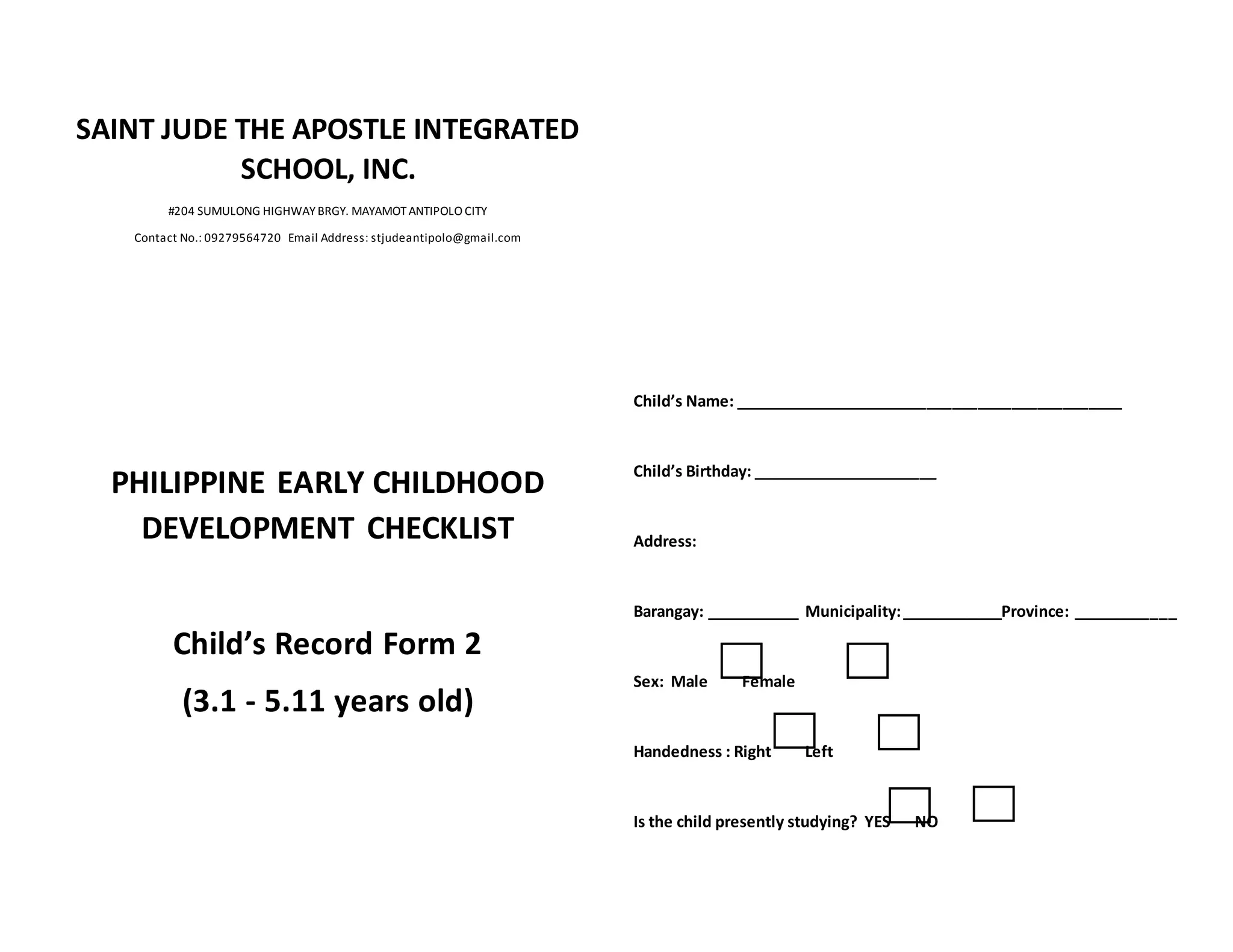
PHILIPPINE EARLY CHILDHOOD
DEVELOPMENT CHECKLIST
Child’s Record Form 2
(3.1 - 5.11 years old)
Child’s Name: ______________________________________________
Child’s Birthday: ______________________
Address:
Barangay: ___________ Municipality:____________Province: ____________
Sex: Male Female
Handedness : Right Left
Is the child presently studying? YES NO
Father’s Name: _________________________________
Mother’s Name: _________________________________
To the Parents:
The Philippine Early Childhood Development Checklist (Form 2) contains knowledge,
skills and attitudes of children 3.1 to 5.11 years old. This may be used as guide in
knowing your child and consequently giveappropriatecareand teachingto guide their
growth and development.
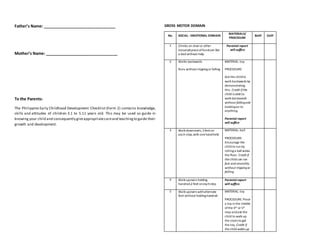
GROSS MOTOR DOMAIN
No. SOCIAL -EMOTIONAL DOMAIN
MATERIALS/
PROCEDURE
BoSY EoSY
1 Climbs on chairor other
elevatedpieceoffurniture like
a bed without help
Parental report
will suffice
2 Walks backwards
Runs without tripping or falling
MATERIAL: toy
PROCEDURE:
Ask the childto
walk backwards by
demonstrating
this. Credit ifthe
child is able to
walk backwards
without fallingand
holdingon to
anything.
Parental report
will suffice
3 Walk downstairs, 2feeton
each step,with onehandheld
MATERIAL: ball
PROCEDURE:
Encourage the
child to run by
rolling a ball across
the floor. Credit if
the child can run
fast and smoothly
without trippingor
falling.
4 Walk upstairs holding
handrail,2 feet oneachstep
Parental report
will suffice.
5 Walk upstairs withalternate
feet without holding handrail
MATERIAL: toy
PROCEDURE: Place
a toy in the middle
ofthe 4th or 5th
step andask the
child to walk up
the stairs to get
the toy. Credit if
the child walks up
the stairs using the
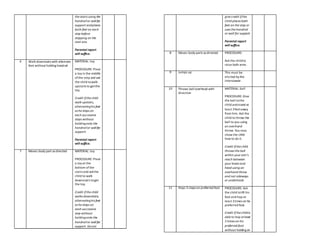
handrailor wallfor
support andplaces
both feet on each
step before
stepping on the
next one.
Parental report
will suffice.
6 Walk downstairs with alternate
feet without holding handrail
MATERIAL: toy
PROCEDURE: Place
a toy in the middle
ofthe step and ask
the child towalk
upstairs to getthe
toy.
Credit ifthe child
walk upstairs,
alternatinghis feet
as he steps on
each successive
steps without
holdingonto the
handrailor wallfor
support.
Parental report
will suffice.
7 Moves body part as directed MATERIAL: toy
PROCEDURE: Place
a toy at the
bottom ofthe
stairs and askthe
child to walk
downstairs toget
the toy.
Credit ifthe child
walks downstairs,
alternatinghis feet
as he steps on
eavh successive
step without
holdingonto the
handrailor wallfor
support. Donot
give credit ifthe
child places both
feet on the step or
uses the handrail
or wall for support.
Parental report
will suffice.
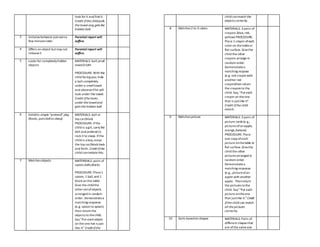
8 Moves body parts as directed PROCEDURE:
Ask the childto
raise both arms.
9 Jumps up This must be
elicited by the
interviewer.
10 Throws balloverhead with
direction
MATERIAL: ball
PROCEDURE: Give
the ball tothe
child andstand at
least 3feetaway
from him. Ask the
child to throw the
ball to you using
an overhand
throw. You may
show the child
how to do it.
Credit ifthe child
throws the ball
within your arm’s
reach between
your knees and
head using an
overhand throw
and not sideways
or underhand.
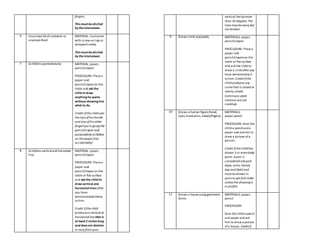
11 Hops 3 steps on preferred foot PROCEDURE: Ask
the child tolift his
foot and hop at
least 3times on his
preferred foot.
Credit ifthe childis
able to hop atleast
3 times on his
preferred foot
without holdingon
to anything.
12 Jumps and turns PROCEDURE: Ask
the child tojump
while making a
half-turn. Creditif
the child is able to
do this without
trippingor falling.
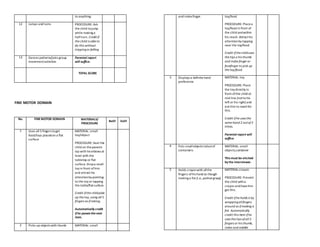
13 Dances patterns/joins group
movementactivities
Parental report
will suffice.
TOTAL SCORE
FINE MOTOR DOMAIN
No. FINEMOTOR DOMAIN MATERIALS/
PROCEDURE
BoSY EoSY
1 Uses all 5 fingers toget
food/toys placedon a flat
surface
MATERIAL: small
toy/object
PROCEDURE: Seat the
child on theparents
lap with his elbows at
level with the
tabletop or flat
surface.Dropa small
toy in front ofhim
and attract his
attentionby pointing
to the toy or tapping
the table/flatsurface.
Credit ifthe childpicks
up the toy, using all 5
fingers as ifraking.
Automatically credit
ifhe passes thenext
item.
2 Picks up objects with thumb MATERIAL: small
and indexfinger. toy/food
PROCEDURE: Placea
toy/food in front of
the child andwithin
his reach. Attracthis
attentionby tapping
near the toy/food.
Credit ifthe childuses
the tips o his thumb
and index finger or
forefinger to pick up
the toy/food.
3 Displays a definitehand
preference
MATERIAL: toy
PROCEDURE: Place
the toy directly in
front ofthe child at
mid line (notto his
left or his right) and
ask him to reachfor
this.
Credit ifhe uses the
same hand 2 outof3
times.
Parental report will
suffice.
4 Puts smallobjects in/outof
containers
MATERIAL: small
objects,container
Thismust be elicited
by the interviewer.
5 Holds crayonwith allthe
fingers ofhis hand as though
making a fist (i.e.,palmargrasp)
MATERIAL:crayon
PROCEDURE: Present
the child witha
crayon andhavehim
get this.
Credit ifhe holds it by
wrappingallfingers
around as ifmaking a
fist. Automatically
credit this item ifhe
uses the tips ofall 5
fingers or his thumb,
index and middle
fingers.
This must beelicited
by theinterviewer.
6 Unscrews lid of container or
unwraps food
MATERIAL: Container
with screw-on top or
wrapped candy.
This must beelicited
by theinterviewer.
7 Scribbles spontaneously MATERIAL: paper,
pencil/crayon
PROCEDURE: Placea
paper and
pencil/crayonon the
table and ask the
child to draw
anything he wants
without showing him
what to do.
Credit ifthe childuses
the tips ofhis thumb
and any ofhis other
fingertips to graspthe
pencil/crayon and
purposefully scribbles
on the paper (not
accidentally)
8 Scribbles verticaland horizontal
line
MATERIAL: paper,
pencil/crayon
PROCEDURE: Placea
paper and
pencil/crayonon the
table or flat surface
and ask the child to
draw vertical and
horizontal lines after
you have
demonstrated these
to him.
Credit ifthe child
produces a vertical or
horizontal line that is
at least 2 inches long
and does not deviate
or vary from your
vertical line bymore
than 30 degrees. The
lines may be wavy but
not broken.
9 Draws circle purposely MATERIALS: paper,
pencil/crayon
PROCUDURE: Placea
paper and
pencil/crayonon the
table or flat surface
and ask the child to
draw a circleafteryoy
have demonstrateit
to him. Creditifthe
child produces any
curve that is closed or
nearly closed.
Continuos spiral
motions arenot
credited.
10 Draws a human figure(head,
eyes,trunk,arms, hands/fingers)
MATERIALS:
paper,pencil
PROCEDURE: Give the
child a pencilanda
paper and ask him to
draw a picture ofa
person.
Credit ifthe childhas
drawn 3 or more body
parts. Apair is
considered one part
(eyes, arms, hands,
legs and feet) and
must be drawn in
pairs to get fullcredit
unless the drawingis
in profile.
11 Draws a houseusing geometric
forms
MATERIALS: paper,
pencil
PROCEDURE:
Give the childa pencil
and paper and ask
him to draw a picture
ofa house. Creditif
the child has drawn at
least the roof, main
frame, and a door or
window.
TOTAL SCORE
SELF-HELP DOMAIN
No. SELF-HELP DOMAIN MATERIALS/
PROCEDURE
BoSY EoSY
1 Feeds self with fingerfoods
(e.g. biscuits,bread using
fingers)
MATERIALS: bread,
biscuits.
This must be elicited
by the interviewer.
2 Feed self using fingers to eat
rice/viands with spillage
Parental report will
suffice.
3 Feed self using spoon with
spillage
Parental report will
suffice.
4 Feeds self using fingers without
spillage
Parental report will
suffice.
5 Feeds self using spoonwithout
spillage
Parental report will
suffice.
6 Eats without need for spoon
feeding during any meal
Parental report will
suffice.
7 Helps hold cup for drinking Note: The cup should
not have a lid orspout
8 Drinks from cup with spillage Ask the caregiverif
the child candrink
from a cup/glass with
some spillage.. The
cup shouldnothave a
lid or spout.
9 Drinks from cup unassisted MATERIALS: drinking
cup,water
This must be elicited
by the interviewer.
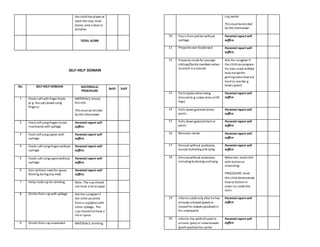
10 Pours from pitcherwithout
spillage
Parental report will
suffice.
11 Prepares own food/snack Parental report will
suffice.
12 Prepares meals for younger
siblings/family members when
no adult is is around
Ask the caregiverif
the child canprepare
his own snack without
help exceptfor
getting items thatare
hard to reach(e.g
bowl,spoon)
13 Participates when being
dressed (e.g.raises arms orlift
legs)
Parental report will
suffice
14 Pulls down gartered shorts
pants
Parental report will
suffice
15 Pulls down gateredshortor
pants
Parental report will
suffice
16 Removes sando Parental report will
suffice
17 Dresses without assistance,
except buttoning and tying
Parental report will
suffice
18 Dresses without assistance,
including buttoning andtying
Materials: smallshirt
with buttonor
shoestring
PROCEDURE: Have
the child demonstrate
how to buttonin
order to creditthis
item.
19 Informs adultonly after hehas
already urinated (peed) or
moved his bowels (poohed) in
his underpants
Parental report will
suffice
20 Informs the adultofneed to
urinate (pee) or movebowels
(pooh-pooh)sohe canbe
Parental report will
suffice
brought to designated place
(e.g. comfort room)
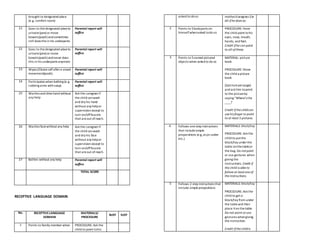
21 Goes to thedesignated placeto
urinate(pee) or move
bowels(pooh) andsometimes
still does this in his underpants
Parental report will
suffice
22 Goes to thedesignated placeto
urinate(pee) or move
bowels(pooh) andnever does
this in his underpants anymore
Parental report will
suffice
23 Wipes/Cleans selfaftera vowel
movement(pooh)
Parental report will
suffice
24 Participates when bathing (e.g.
rubbing arms withsoap)
Parental report will
suffice
25 Washes and dries hand without
any help
Ask the caregiverif
the child canwash
and dry his hand
without any helpor
supervision except to
turn on/offfaucets
that areout ofreach.
26 Washes facewithout any help Ask the caregiverif
the child canwash
and dry his face
without any helpor
supervision except to
turn on/offfaucets
that areout ofreach.
27 Bathes without any help Parental report will
suffice
TOTAL SCORE
RECEPTIVE LANGUAGE DOMAIN
No. RECEPTIVELANGUAGE
DOMAIN
MATERIALS/
PROCEDURE
BoSY EoSY
1 Points to family member when PROCEDURE: Ask the
child to point tohis
asked to doso mother/caregiver.Cre
dit ifhe does so.
2 Points to 5bodyparts on
himselfwhenasked todo so
PROCEDURE: Have
the child point tohis
eyes, nose, mouth,
hands, and feet.
Credit ifhe can point
to all ofthese.
3 Points to 5named pictured
objects when askedto do so
MATERIAL: picture
book
PROCEDURE: Show
the child a picture
book
(2pictureperpage)
and ask him topoint
to the pictureby
saying “Where’s the
____?
Credit ifthe childcan
use his finger to point
to at least 5 pictures.
4. Follows one-step instructions
that includesimple
preparations (e.g.,in,on under
etc.)
MATERIALS: block/toy
PROCEDURE: Ask the
child to putthe
block/toy underthe
table:onthetable;in
the bag. Do notpoint
or use gestures when
giving the
instructions. Credit if
the child is able to
follow at leastone of
the instructions.
5 Follows 2-step instructions that
include simpleprepositions
MATERIALS: block/toy
PROCEDURE: Ask the
child to get a
block/toy from under
the tableand then
place iton thetable.
Do not point oruse
gestures whengiving
the instruction.
Credit ifthe childis
able to follow.
TOTAL SCORE
EXPRESSIVE LANGUAGE DOMAIN
No. EXPRESSIVELANGUAGE
DOMAIN
MATERIALS/
PROCEDURE
BoSY EoSY
1 Use 5-20 recognizable words PROCUDEURE: Ask
the caregiver ifthe
child canclearly say 5
to 6 words asidefrom
“mama”and “papa”.
This will bethe
minimum number
2 Uses pronouns (e.g., I,me,ako,
akin)
Parental report will
suffice.
3 Use 2-3 word verb-noun
combinations (e.g hingigatas)
Parental report will
suffice.
4 Names objects inpictures MATERIALS:
Picture book
PROCEDURE:
Show the child a
picture book, point to
an objectin the book,
then ask him toname
it (e.g., Ano ito?)
Credit ifthe childcan
say the correct name
ofat least 4 objects.
5 Speaks ingrammatically correct
2-to-3 word sentences
Parental report will
suffice.
6 Asks “whatquestions” Parental report will
suffice.
7 Asks “who” and“why”
questions
Parental report will
suffice.
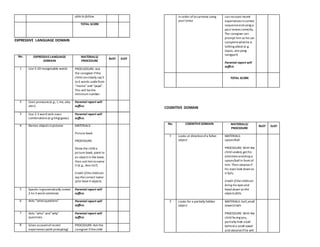
8 Gives accountof recent
experiences (with prompting)
PROCEDURE: Ask the
caregiver ifthechild
in order ofoccurrence using
past tense
can recount recent
experiences incorrect
sequenceandusing a
past tenses correctly.
The caregiver can
prompt him so hecan
completewhathe is
talking about (e.g.
tapos, ano pang
nangyari)
Parental report will
suffice.
TOTAL SCORE
COGNITIVE DOMAIN
No. COGNITIVEDOMAIN MATERIALS/
PROCEDURE
BoSY EoSY
1 Looks at directionofa fallen
object
MATERIALS:
spoon/ball
PROCEDURE: With the
child seated, gethis
attentionanddropa
spoon/ballin front of
him. Then observeif
his eyes look downas
it falls.
Credit ifthe childcan
bring his eyes and
head down as the
objects falls.
2 Looks for a partially hidden
object
MATERIALS: ball,small
towel/cloth
PROCEDURE: With the
child facing you,
partially hide a ball
behind a small towel
and observeifhe will
look for it and find it.
Credit ifthe childpulls
the towel ang gets the
hidden ball.
3 Imitates behavior justseena
few minutes later
Parental report will
suffice.
4 Offers on object butmay not
releaseit
Parental report will
suffice.
5 Looks for completelyhidden
objects
MATERIALS: ball,small
towel/cloth
PROCEDURE: With the
child facing you, hide
a ball completely
under a smalltowel
and observeifhe will
look under the towel.
Credit ifhe looks
under the toweland
gets the hidden ball.
6 Exhibits simple “pretend” play
(feeds, puts dollto sleep)
MATERIALS: doll or
toy car/block
PROCEDURE: Ifthe
child is a girl, carry the
doll and pretend to
rock it to sleep. Ifthe
child is a boy,move
the toy car/block back
and forth. Creditifthe
child canimitate this.
7 Matches objects MATERRIALS: pairs of
spoon,balls,blocks
PROCEDURE: Place1
spoon, 1 ball, and 1
block on the table.
Give the childthe
other setofobjects
arrangedin random
order. Demonstratea
matching response
(e.g. spoon to spoon)
then return the
objects to thechild.
Say “Put eachobject
on the one hat is just
like it” Creditifthe
child canmatch the
objects correctly.
8 Matches 2 to 3 colors MATERIALS: 3 pairs of
crayons (blue, red,
yellow) PROCEDURE:
Place 1 crayon ofeach
color on thetableor
flat surface. Givethe
child the other
crayons arrange in
random order.
Demonstratea
matching respose
(e.g. red crayon with
another red
crayon)then return
the crayons to the
child. Say,“Put each
crayon on theone
that is justlike it”.
Credit ifthe child
match.
9 Matches picture MATERIALS: 3 pairs of
picture cards (e.g.,
pictures ofanapple,
orange,banana)
PROCEDURE: Place
one copy ofeach
picture onthetable or
flat surface. Givethe
child the other
pictures arranged in
random order.
Demonstratea
matching response
(e.g., pictureofan
apple with another
apple. Thenreturn
the pictures tothe
child. Say’“Put each
picture ontheone
that justlike it.”Credit
ifthe child can match
all the pictures
correctly.
10 Sorts basedon shapes MATERIALS: Pairs of
different shapes that
are ofthe samesize
and color.
PROCEDURE: Show
the child theshape.
Tell the child, “Put
together the ones
that arethesame”.
After the child sorts
and groups the
shapes, point to the
ones withsameshape
and ask. “Whydidyou
put thesetogether?
Credit ifthe childcan
group the same
shapes and say why
they are the
same(Pareho silang
hugis/shape, purosila
bilog)
11 Sorts objects basedon 2
attributes (e.g., sizeand color)
MATERIALS: 4 pairs of
the sameshapethat
differ in size and
color: 2 sizes, 2 colors.
PROCEDURE: Show
the child theshapes,
Tell the child, “Put
together the ones
that arethesame”.
Credit ifthe childcan
sort all the shapes
accordingto size and
color.
12 Arrange objects according to
size from smallest tobiggest
MATERIALS: 4 pieces
ofgraduated sized
squares and4 pieces
ofgraduated sized
circles. PROCEDURE:
Show the child the
first set ofsquares
spread out at random
on a tableor flat
surface.Say,“Here
are 4 squares. Look,I
can begin withthe
smallest,then move
to the next big one,
until I reachthe
biggest one.
Demonstratehowto
arrange the squares.
Then disarrangethese
and tell thechild,
“Now you start with
the smallest,put to
the next oneand the
next big one until the
last one. Repeatthis
procedure. Using the
circles without
demonstrating. Credit
ifthe child arranges at
least one set of
shapes in correct
order from smallest to
biggest. Allow one
trial for eachset of
shapes.
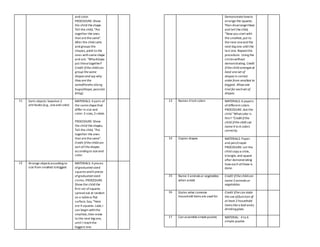
13 Names 4 to6 colors MATERIALS: 6 papers
ofdifferent colors
PROCEDURE: Ask the
child “Whatcolor is
this? “Creditifthe
child ifthe child can
name 4 to 6 colors
correctly.
14 Copies shapes MATERIALS: Paper
and pen/crayon
PROCEDURE: Let the
child copy a circle,
triangle, and square
after demonstrating
how each ofthese is
done.
15 Name 3 animals or vegetables
when asked
Credit ifthe childcan
name 3 animals or
vegetables.
16 States what common
household items are used for
Credit ifhe can state
the use offunction of
at least 2 household
items like a bed anda
drinkingglass.
17 Can assemblesimplepuzzles MATERIAL: 4 to 6
simple puzzles
18 Demonstrates an
understanding ofopposites by
completing a statement
(e.g. “Ang aso ay malaki, ang
daga ay ____________” )
Credit ifthe chikd can
give an opposite
word.
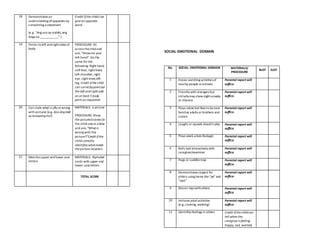
19 Points to left andrightsides of
body
PROCEDURE: Sit
across thechildand
ask, “Showme your
left hand”. Do the
same for the
following: Right hand,
Left foot, right knee,
left shoulder, right
eye, right knee,left
leg. Credit ifthe child
can correctlypointout
the left and right side
on at least 5 body
parts as requested.
20 Can state what is silly orwrong
with pictures (e.g. Ano angmali
sa larawangito?)
MATERIALS: a picture
PROCEDURE: Show
the picturedscenes to
the child oneat a time
and ask, “Whatis
wrong with this
picture?”Credit ifthe
child correctly
identifies whatmade
the picture incorrect.
21 Matches upper andlower case
letters
MATERIALS: Alphabet
cards with upper and
lower caseletters
TOTAL SCORE
SOCIAL-EMOTIONAL DOMAIN
No. SOCIAL-EMOTIONAL DOMAIN MATERIALS/
PROCEDURE
BoSY EoSY
1 Enjoys watching activities of
nearby people oranimals.
Parental report will
suffice.
2 Friendly with strangers but
initiallymay show slightanxiety
or shyness
Parental report will
suffice.
3 Plays alone but likes to benear
familiar adults or brothers and
sisters
Parental report will
suffice.
4 Laughs or squeals aloudin play Parental report will
suffice.
5 Plays peek-a-boo (bulaga) Parental report will
suffice.
6 Rolls ball interactively with
caregiver/examiner
Parental report will
suffice.
7 Hugs or cuddles toys Parental report will
suffice.
8 Demonstrates respect for
elders using terms like“po” and
“opo”
Parental report will
suffice.
9 Shares toys withothers Parental report will
suffice.
10 Imitates adultactivities
(e.g.,cooking, washing)
Parental report will
suffice.
11 Identifies feelings in others Credit ifthe childcan
tell when the
caregiver is feeling
happy, sad, worried,
etc.
Parental report will
suffice.
12 Appropriately uses cultural
gestures of greeting without
much prompting (e.g.,mano,
bless,kiss etc.)
Parental report will
suffice.
13 Comforts playmates/siblings in
distress
Parental report will
suffice.
14 Persists when faced with a
problem or obstacleto his
wants
Credit ifthe childtries
to solve problem
instead ofcrying
when something
stands in the way of
what he wants (e.g.,
fastening a boxofhis
treasures with a string
ifthe lid no longer
closes).
15 Helps with family chores (e.g.,
wiping tables, watering plants
etc.)
Parental report will
suffice.
16 Curious about environmentbut
knows whento stopasking
questions of adults
Credit ifthe childasks
questions about
things aroundhim but
knows when he is
being “makulit”about
the topic.
Parental report will
suffice
17 Wait for his/her turn Parental report will
suffice.
18 Asks permissionto playwith
toy being used byanother
Parental report will
suffice.
19 Defends possessions with
determination
Credit ifthe childtries
to hold on towhat is
his when someone
tries to grab this from
him.
20 Plays organizedgroupgames
fairly (e.g., does notcheat in
Parental report will
suffice.
order to win)
21 Can talk about complex
feelings(e.g.,anger, sadness,
worry) he experiences
Parental report will
suffice.
22 Honors a simplebargain with
caregiver (e.g., plays outside
only after cleaning/fixing his
room)
Parental report will
suffice.
23 Watches responsibly over
younger siblings/family
members
Parental report will
suffice.
24 Cooperates withadults and
peers in group situations to
minimize quarrels andconflicts
Parental report will
suffice.
TOTAL SCORE
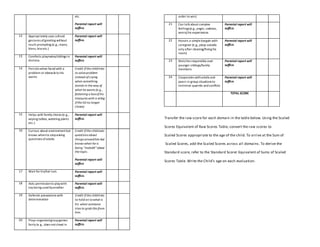
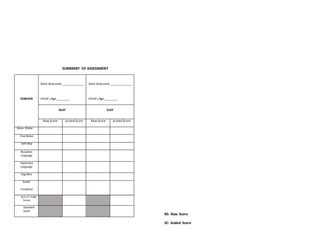
Transfer the raw score for each domain in the table below. Using the Scaled
Scores Equivalent of Raw Scores Table, convert the raw scores to
Scaled Scores appropriate to the age of the child. To arrive at the Sum of
Scaled Scores, add the Scaled Scores across all domains. To derive the
Standard score, refer to the Standard Scorer Equivalent of Sums of Scaled
Scores Table. Write the Child’s age on each evaluation.
SUMMARY OF ASSESSMENT
DOMAIN
Date Assessed: ______________
Child’s Age:________
Date Assessed: ______________
Child’s Age:________
BoSY EoSY
Raw Score Scaled Score Raw Score Scaled Score
Gross Motor
Fine Motor
Self-Help
Receptive
Language
Expressive
Language
Cognitive
Social-
Emotional
Sum of Scaled
Scores
Standard
Score
RS- Raw Score
SC- Scaled Score
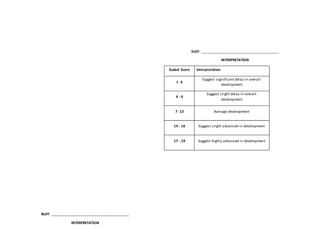
BoSY: _______________________________________
INTERPRETATION
EoSY: _______________________________________
INTERPRETATION
Scaled Score Interpretation
1 -3
Suggest significant delay in overall
development
4 - 6
Suggest slight delay in overall
development
7 -13 Average development
14 - 16 Suggest slight advanced in development
17 - 19 Suggest highly advanced in development
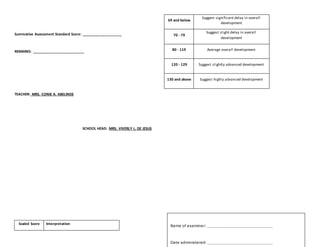
Summative Assessment Standard Score: ____________________
REMARKS: __________________________
TEACHER: MRS. CONIE A. ABELINDE
SCHOOL HEAD: MRS. VIVERLY L. DE JESUS
Scaled Score Interpretation
69 and below
Suggest significant delay in overall
development
70 - 79
Suggest slight delay in overall
development
80 - 119 Average overall development
120 - 129 Suggest slightly advanced development
130 and above Suggest highly advanced development
Name of examiner: ____________________________
Date administered: ____________________________

ECD_FORM2.docx

  • 1.
    SAINT JUDE THEAPOSTLE INTEGRATED SCHOOL, INC. #204 SUMULONG HIGHWAYBRGY. MAYAMOTANTIPOLO CITY Contact No.: 09279564720 Email Address: stjudeantipolo@gmail.com PHILIPPINE EARLY CHILDHOOD DEVELOPMENT CHECKLIST Child’s Record Form 2 (3.1 - 5.11 years old) Child’s Name: ______________________________________________ Child’s Birthday: ______________________ Address: Barangay: ___________ Municipality:____________Province: ____________ Sex: Male Female Handedness : Right Left Is the child presently studying? YES NO
  • 2.
    Father’s Name: _________________________________ Mother’sName: _________________________________ To the Parents: The Philippine Early Childhood Development Checklist (Form 2) contains knowledge, skills and attitudes of children 3.1 to 5.11 years old. This may be used as guide in knowing your child and consequently giveappropriatecareand teachingto guide their growth and development. GROSS MOTOR DOMAIN No. SOCIAL -EMOTIONAL DOMAIN MATERIALS/ PROCEDURE BoSY EoSY 1 Climbs on chairor other elevatedpieceoffurniture like a bed without help Parental report will suffice 2 Walks backwards Runs without tripping or falling MATERIAL: toy PROCEDURE: Ask the childto walk backwards by demonstrating this. Credit ifthe child is able to walk backwards without fallingand holdingon to anything. Parental report will suffice 3 Walk downstairs, 2feeton each step,with onehandheld MATERIAL: ball PROCEDURE: Encourage the child to run by rolling a ball across the floor. Credit if the child can run fast and smoothly without trippingor falling. 4 Walk upstairs holding handrail,2 feet oneachstep Parental report will suffice. 5 Walk upstairs withalternate feet without holding handrail MATERIAL: toy PROCEDURE: Place a toy in the middle ofthe 4th or 5th step andask the child to walk up the stairs to get the toy. Credit if the child walks up
  • 3.
    the stairs usingthe handrailor wallfor support andplaces both feet on each step before stepping on the next one. Parental report will suffice. 6 Walk downstairs with alternate feet without holding handrail MATERIAL: toy PROCEDURE: Place a toy in the middle ofthe step and ask the child towalk upstairs to getthe toy. Credit ifthe child walk upstairs, alternatinghis feet as he steps on each successive steps without holdingonto the handrailor wallfor support. Parental report will suffice. 7 Moves body part as directed MATERIAL: toy PROCEDURE: Place a toy at the bottom ofthe stairs and askthe child to walk downstairs toget the toy. Credit ifthe child walks downstairs, alternatinghis feet as he steps on eavh successive step without holdingonto the handrailor wallfor support. Donot give credit ifthe child places both feet on the step or uses the handrail or wall for support. Parental report will suffice. 8 Moves body parts as directed PROCEDURE: Ask the childto raise both arms. 9 Jumps up This must be elicited by the interviewer. 10 Throws balloverhead with direction MATERIAL: ball PROCEDURE: Give the ball tothe child andstand at least 3feetaway from him. Ask the child to throw the ball to you using an overhand throw. You may show the child how to do it. Credit ifthe child throws the ball within your arm’s reach between your knees and head using an overhand throw and not sideways or underhand. 11 Hops 3 steps on preferred foot PROCEDURE: Ask the child tolift his foot and hop at least 3times on his preferred foot. Credit ifthe childis able to hop atleast 3 times on his preferred foot without holdingon
  • 4.
    to anything. 12 Jumpsand turns PROCEDURE: Ask the child tojump while making a half-turn. Creditif the child is able to do this without trippingor falling. 13 Dances patterns/joins group movementactivities Parental report will suffice. TOTAL SCORE FINE MOTOR DOMAIN No. FINEMOTOR DOMAIN MATERIALS/ PROCEDURE BoSY EoSY 1 Uses all 5 fingers toget food/toys placedon a flat surface MATERIAL: small toy/object PROCEDURE: Seat the child on theparents lap with his elbows at level with the tabletop or flat surface.Dropa small toy in front ofhim and attract his attentionby pointing to the toy or tapping the table/flatsurface. Credit ifthe childpicks up the toy, using all 5 fingers as ifraking. Automatically credit ifhe passes thenext item. 2 Picks up objects with thumb MATERIAL: small and indexfinger. toy/food PROCEDURE: Placea toy/food in front of the child andwithin his reach. Attracthis attentionby tapping near the toy/food. Credit ifthe childuses the tips o his thumb and index finger or forefinger to pick up the toy/food. 3 Displays a definitehand preference MATERIAL: toy PROCEDURE: Place the toy directly in front ofthe child at mid line (notto his left or his right) and ask him to reachfor this. Credit ifhe uses the same hand 2 outof3 times. Parental report will suffice. 4 Puts smallobjects in/outof containers MATERIAL: small objects,container Thismust be elicited by the interviewer. 5 Holds crayonwith allthe fingers ofhis hand as though making a fist (i.e.,palmargrasp) MATERIAL:crayon PROCEDURE: Present the child witha crayon andhavehim get this. Credit ifhe holds it by wrappingallfingers around as ifmaking a fist. Automatically credit this item ifhe uses the tips ofall 5 fingers or his thumb, index and middle
  • 5.
    fingers. This must beelicited bytheinterviewer. 6 Unscrews lid of container or unwraps food MATERIAL: Container with screw-on top or wrapped candy. This must beelicited by theinterviewer. 7 Scribbles spontaneously MATERIAL: paper, pencil/crayon PROCEDURE: Placea paper and pencil/crayonon the table and ask the child to draw anything he wants without showing him what to do. Credit ifthe childuses the tips ofhis thumb and any ofhis other fingertips to graspthe pencil/crayon and purposefully scribbles on the paper (not accidentally) 8 Scribbles verticaland horizontal line MATERIAL: paper, pencil/crayon PROCEDURE: Placea paper and pencil/crayonon the table or flat surface and ask the child to draw vertical and horizontal lines after you have demonstrated these to him. Credit ifthe child produces a vertical or horizontal line that is at least 2 inches long and does not deviate or vary from your vertical line bymore than 30 degrees. The lines may be wavy but not broken. 9 Draws circle purposely MATERIALS: paper, pencil/crayon PROCUDURE: Placea paper and pencil/crayonon the table or flat surface and ask the child to draw a circleafteryoy have demonstrateit to him. Creditifthe child produces any curve that is closed or nearly closed. Continuos spiral motions arenot credited. 10 Draws a human figure(head, eyes,trunk,arms, hands/fingers) MATERIALS: paper,pencil PROCEDURE: Give the child a pencilanda paper and ask him to draw a picture ofa person. Credit ifthe childhas drawn 3 or more body parts. Apair is considered one part (eyes, arms, hands, legs and feet) and must be drawn in pairs to get fullcredit unless the drawingis in profile. 11 Draws a houseusing geometric forms MATERIALS: paper, pencil PROCEDURE: Give the childa pencil and paper and ask him to draw a picture ofa house. Creditif
  • 6.
    the child hasdrawn at least the roof, main frame, and a door or window. TOTAL SCORE SELF-HELP DOMAIN No. SELF-HELP DOMAIN MATERIALS/ PROCEDURE BoSY EoSY 1 Feeds self with fingerfoods (e.g. biscuits,bread using fingers) MATERIALS: bread, biscuits. This must be elicited by the interviewer. 2 Feed self using fingers to eat rice/viands with spillage Parental report will suffice. 3 Feed self using spoon with spillage Parental report will suffice. 4 Feeds self using fingers without spillage Parental report will suffice. 5 Feeds self using spoonwithout spillage Parental report will suffice. 6 Eats without need for spoon feeding during any meal Parental report will suffice. 7 Helps hold cup for drinking Note: The cup should not have a lid orspout 8 Drinks from cup with spillage Ask the caregiverif the child candrink from a cup/glass with some spillage.. The cup shouldnothave a lid or spout. 9 Drinks from cup unassisted MATERIALS: drinking cup,water This must be elicited by the interviewer. 10 Pours from pitcherwithout spillage Parental report will suffice. 11 Prepares own food/snack Parental report will suffice. 12 Prepares meals for younger siblings/family members when no adult is is around Ask the caregiverif the child canprepare his own snack without help exceptfor getting items thatare hard to reach(e.g bowl,spoon) 13 Participates when being dressed (e.g.raises arms orlift legs) Parental report will suffice 14 Pulls down gartered shorts pants Parental report will suffice 15 Pulls down gateredshortor pants Parental report will suffice 16 Removes sando Parental report will suffice 17 Dresses without assistance, except buttoning and tying Parental report will suffice 18 Dresses without assistance, including buttoning andtying Materials: smallshirt with buttonor shoestring PROCEDURE: Have the child demonstrate how to buttonin order to creditthis item. 19 Informs adultonly after hehas already urinated (peed) or moved his bowels (poohed) in his underpants Parental report will suffice 20 Informs the adultofneed to urinate (pee) or movebowels (pooh-pooh)sohe canbe Parental report will suffice
  • 7.
    brought to designatedplace (e.g. comfort room) 21 Goes to thedesignated placeto urinate(pee) or move bowels(pooh) andsometimes still does this in his underpants Parental report will suffice 22 Goes to thedesignated placeto urinate(pee) or move bowels(pooh) andnever does this in his underpants anymore Parental report will suffice 23 Wipes/Cleans selfaftera vowel movement(pooh) Parental report will suffice 24 Participates when bathing (e.g. rubbing arms withsoap) Parental report will suffice 25 Washes and dries hand without any help Ask the caregiverif the child canwash and dry his hand without any helpor supervision except to turn on/offfaucets that areout ofreach. 26 Washes facewithout any help Ask the caregiverif the child canwash and dry his face without any helpor supervision except to turn on/offfaucets that areout ofreach. 27 Bathes without any help Parental report will suffice TOTAL SCORE RECEPTIVE LANGUAGE DOMAIN No. RECEPTIVELANGUAGE DOMAIN MATERIALS/ PROCEDURE BoSY EoSY 1 Points to family member when PROCEDURE: Ask the child to point tohis asked to doso mother/caregiver.Cre dit ifhe does so. 2 Points to 5bodyparts on himselfwhenasked todo so PROCEDURE: Have the child point tohis eyes, nose, mouth, hands, and feet. Credit ifhe can point to all ofthese. 3 Points to 5named pictured objects when askedto do so MATERIAL: picture book PROCEDURE: Show the child a picture book (2pictureperpage) and ask him topoint to the pictureby saying “Where’s the ____? Credit ifthe childcan use his finger to point to at least 5 pictures. 4. Follows one-step instructions that includesimple preparations (e.g.,in,on under etc.) MATERIALS: block/toy PROCEDURE: Ask the child to putthe block/toy underthe table:onthetable;in the bag. Do notpoint or use gestures when giving the instructions. Credit if the child is able to follow at leastone of the instructions. 5 Follows 2-step instructions that include simpleprepositions MATERIALS: block/toy PROCEDURE: Ask the child to get a block/toy from under the tableand then place iton thetable. Do not point oruse gestures whengiving the instruction. Credit ifthe childis
  • 8.
    able to follow. TOTALSCORE EXPRESSIVE LANGUAGE DOMAIN No. EXPRESSIVELANGUAGE DOMAIN MATERIALS/ PROCEDURE BoSY EoSY 1 Use 5-20 recognizable words PROCUDEURE: Ask the caregiver ifthe child canclearly say 5 to 6 words asidefrom “mama”and “papa”. This will bethe minimum number 2 Uses pronouns (e.g., I,me,ako, akin) Parental report will suffice. 3 Use 2-3 word verb-noun combinations (e.g hingigatas) Parental report will suffice. 4 Names objects inpictures MATERIALS: Picture book PROCEDURE: Show the child a picture book, point to an objectin the book, then ask him toname it (e.g., Ano ito?) Credit ifthe childcan say the correct name ofat least 4 objects. 5 Speaks ingrammatically correct 2-to-3 word sentences Parental report will suffice. 6 Asks “whatquestions” Parental report will suffice. 7 Asks “who” and“why” questions Parental report will suffice. 8 Gives accountof recent experiences (with prompting) PROCEDURE: Ask the caregiver ifthechild in order ofoccurrence using past tense can recount recent experiences incorrect sequenceandusing a past tenses correctly. The caregiver can prompt him so hecan completewhathe is talking about (e.g. tapos, ano pang nangyari) Parental report will suffice. TOTAL SCORE COGNITIVE DOMAIN No. COGNITIVEDOMAIN MATERIALS/ PROCEDURE BoSY EoSY 1 Looks at directionofa fallen object MATERIALS: spoon/ball PROCEDURE: With the child seated, gethis attentionanddropa spoon/ballin front of him. Then observeif his eyes look downas it falls. Credit ifthe childcan bring his eyes and head down as the objects falls. 2 Looks for a partially hidden object MATERIALS: ball,small towel/cloth PROCEDURE: With the child facing you, partially hide a ball behind a small towel and observeifhe will
  • 9.
    look for itand find it. Credit ifthe childpulls the towel ang gets the hidden ball. 3 Imitates behavior justseena few minutes later Parental report will suffice. 4 Offers on object butmay not releaseit Parental report will suffice. 5 Looks for completelyhidden objects MATERIALS: ball,small towel/cloth PROCEDURE: With the child facing you, hide a ball completely under a smalltowel and observeifhe will look under the towel. Credit ifhe looks under the toweland gets the hidden ball. 6 Exhibits simple “pretend” play (feeds, puts dollto sleep) MATERIALS: doll or toy car/block PROCEDURE: Ifthe child is a girl, carry the doll and pretend to rock it to sleep. Ifthe child is a boy,move the toy car/block back and forth. Creditifthe child canimitate this. 7 Matches objects MATERRIALS: pairs of spoon,balls,blocks PROCEDURE: Place1 spoon, 1 ball, and 1 block on the table. Give the childthe other setofobjects arrangedin random order. Demonstratea matching response (e.g. spoon to spoon) then return the objects to thechild. Say “Put eachobject on the one hat is just like it” Creditifthe child canmatch the objects correctly. 8 Matches 2 to 3 colors MATERIALS: 3 pairs of crayons (blue, red, yellow) PROCEDURE: Place 1 crayon ofeach color on thetableor flat surface. Givethe child the other crayons arrange in random order. Demonstratea matching respose (e.g. red crayon with another red crayon)then return the crayons to the child. Say,“Put each crayon on theone that is justlike it”. Credit ifthe child match. 9 Matches picture MATERIALS: 3 pairs of picture cards (e.g., pictures ofanapple, orange,banana) PROCEDURE: Place one copy ofeach picture onthetable or flat surface. Givethe child the other pictures arranged in random order. Demonstratea matching response (e.g., pictureofan apple with another apple. Thenreturn the pictures tothe child. Say’“Put each picture ontheone that justlike it.”Credit ifthe child can match all the pictures correctly. 10 Sorts basedon shapes MATERIALS: Pairs of different shapes that are ofthe samesize
  • 10.
    and color. PROCEDURE: Show thechild theshape. Tell the child, “Put together the ones that arethesame”. After the child sorts and groups the shapes, point to the ones withsameshape and ask. “Whydidyou put thesetogether? Credit ifthe childcan group the same shapes and say why they are the same(Pareho silang hugis/shape, purosila bilog) 11 Sorts objects basedon 2 attributes (e.g., sizeand color) MATERIALS: 4 pairs of the sameshapethat differ in size and color: 2 sizes, 2 colors. PROCEDURE: Show the child theshapes, Tell the child, “Put together the ones that arethesame”. Credit ifthe childcan sort all the shapes accordingto size and color. 12 Arrange objects according to size from smallest tobiggest MATERIALS: 4 pieces ofgraduated sized squares and4 pieces ofgraduated sized circles. PROCEDURE: Show the child the first set ofsquares spread out at random on a tableor flat surface.Say,“Here are 4 squares. Look,I can begin withthe smallest,then move to the next big one, until I reachthe biggest one. Demonstratehowto arrange the squares. Then disarrangethese and tell thechild, “Now you start with the smallest,put to the next oneand the next big one until the last one. Repeatthis procedure. Using the circles without demonstrating. Credit ifthe child arranges at least one set of shapes in correct order from smallest to biggest. Allow one trial for eachset of shapes. 13 Names 4 to6 colors MATERIALS: 6 papers ofdifferent colors PROCEDURE: Ask the child “Whatcolor is this? “Creditifthe child ifthe child can name 4 to 6 colors correctly. 14 Copies shapes MATERIALS: Paper and pen/crayon PROCEDURE: Let the child copy a circle, triangle, and square after demonstrating how each ofthese is done. 15 Name 3 animals or vegetables when asked Credit ifthe childcan name 3 animals or vegetables. 16 States what common household items are used for Credit ifhe can state the use offunction of at least 2 household items like a bed anda drinkingglass. 17 Can assemblesimplepuzzles MATERIAL: 4 to 6 simple puzzles
  • 11.
    18 Demonstrates an understandingofopposites by completing a statement (e.g. “Ang aso ay malaki, ang daga ay ____________” ) Credit ifthe chikd can give an opposite word. 19 Points to left andrightsides of body PROCEDURE: Sit across thechildand ask, “Showme your left hand”. Do the same for the following: Right hand, Left foot, right knee, left shoulder, right eye, right knee,left leg. Credit ifthe child can correctlypointout the left and right side on at least 5 body parts as requested. 20 Can state what is silly orwrong with pictures (e.g. Ano angmali sa larawangito?) MATERIALS: a picture PROCEDURE: Show the picturedscenes to the child oneat a time and ask, “Whatis wrong with this picture?”Credit ifthe child correctly identifies whatmade the picture incorrect. 21 Matches upper andlower case letters MATERIALS: Alphabet cards with upper and lower caseletters TOTAL SCORE SOCIAL-EMOTIONAL DOMAIN No. SOCIAL-EMOTIONAL DOMAIN MATERIALS/ PROCEDURE BoSY EoSY 1 Enjoys watching activities of nearby people oranimals. Parental report will suffice. 2 Friendly with strangers but initiallymay show slightanxiety or shyness Parental report will suffice. 3 Plays alone but likes to benear familiar adults or brothers and sisters Parental report will suffice. 4 Laughs or squeals aloudin play Parental report will suffice. 5 Plays peek-a-boo (bulaga) Parental report will suffice. 6 Rolls ball interactively with caregiver/examiner Parental report will suffice. 7 Hugs or cuddles toys Parental report will suffice. 8 Demonstrates respect for elders using terms like“po” and “opo” Parental report will suffice. 9 Shares toys withothers Parental report will suffice. 10 Imitates adultactivities (e.g.,cooking, washing) Parental report will suffice. 11 Identifies feelings in others Credit ifthe childcan tell when the caregiver is feeling happy, sad, worried,
  • 12.
    etc. Parental report will suffice. 12Appropriately uses cultural gestures of greeting without much prompting (e.g.,mano, bless,kiss etc.) Parental report will suffice. 13 Comforts playmates/siblings in distress Parental report will suffice. 14 Persists when faced with a problem or obstacleto his wants Credit ifthe childtries to solve problem instead ofcrying when something stands in the way of what he wants (e.g., fastening a boxofhis treasures with a string ifthe lid no longer closes). 15 Helps with family chores (e.g., wiping tables, watering plants etc.) Parental report will suffice. 16 Curious about environmentbut knows whento stopasking questions of adults Credit ifthe childasks questions about things aroundhim but knows when he is being “makulit”about the topic. Parental report will suffice 17 Wait for his/her turn Parental report will suffice. 18 Asks permissionto playwith toy being used byanother Parental report will suffice. 19 Defends possessions with determination Credit ifthe childtries to hold on towhat is his when someone tries to grab this from him. 20 Plays organizedgroupgames fairly (e.g., does notcheat in Parental report will suffice. order to win) 21 Can talk about complex feelings(e.g.,anger, sadness, worry) he experiences Parental report will suffice. 22 Honors a simplebargain with caregiver (e.g., plays outside only after cleaning/fixing his room) Parental report will suffice. 23 Watches responsibly over younger siblings/family members Parental report will suffice. 24 Cooperates withadults and peers in group situations to minimize quarrels andconflicts Parental report will suffice. TOTAL SCORE Transfer the raw score for each domain in the table below. Using the Scaled Scores Equivalent of Raw Scores Table, convert the raw scores to Scaled Scores appropriate to the age of the child. To arrive at the Sum of Scaled Scores, add the Scaled Scores across all domains. To derive the Standard score, refer to the Standard Scorer Equivalent of Sums of Scaled Scores Table. Write the Child’s age on each evaluation.
  • 13.
    SUMMARY OF ASSESSMENT DOMAIN DateAssessed: ______________ Child’s Age:________ Date Assessed: ______________ Child’s Age:________ BoSY EoSY Raw Score Scaled Score Raw Score Scaled Score Gross Motor Fine Motor Self-Help Receptive Language Expressive Language Cognitive Social- Emotional Sum of Scaled Scores Standard Score RS- Raw Score SC- Scaled Score
  • 14.
    BoSY: _______________________________________ INTERPRETATION EoSY: _______________________________________ INTERPRETATION ScaledScore Interpretation 1 -3 Suggest significant delay in overall development 4 - 6 Suggest slight delay in overall development 7 -13 Average development 14 - 16 Suggest slight advanced in development 17 - 19 Suggest highly advanced in development
  • 15.
    Summative Assessment StandardScore: ____________________ REMARKS: __________________________ TEACHER: MRS. CONIE A. ABELINDE SCHOOL HEAD: MRS. VIVERLY L. DE JESUS Scaled Score Interpretation 69 and below Suggest significant delay in overall development 70 - 79 Suggest slight delay in overall development 80 - 119 Average overall development 120 - 129 Suggest slightly advanced development 130 and above Suggest highly advanced development Name of examiner: ____________________________ Date administered: ____________________________