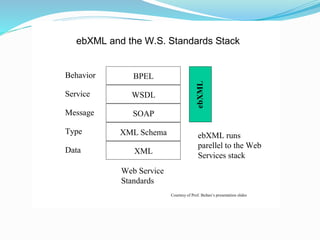
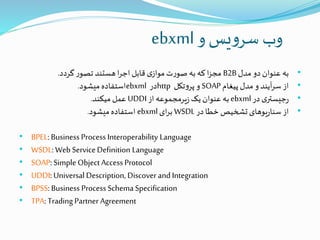
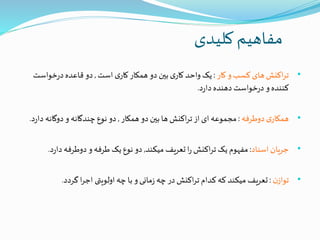
ebXML and theW.S. Standards Stack
Data
Type
Service
Behavior
Message
BPEL
Web Service
Standards
ebXML
WSDL
SOAP
XML Schema
XML
Courtesy of Prof. Bultan’s presentation slides
ebXML runs
parellel to the Web
Services stack
10.
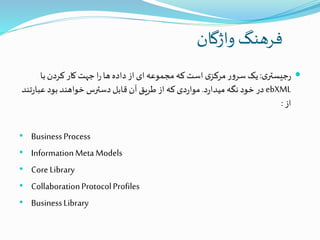
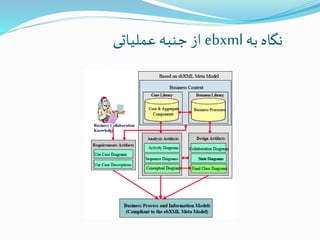
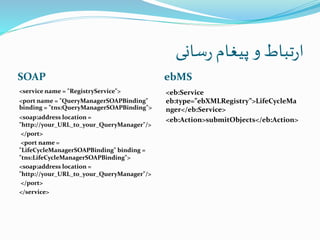
ویسوسر وبebxml
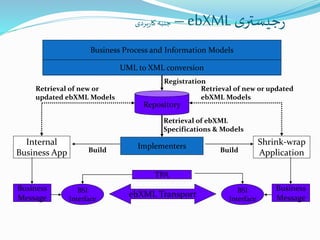
•مدل دوعنوان بهB2Bگردد رتصو هستند اراجقابل یمواز ترصو بهکه ازمج.
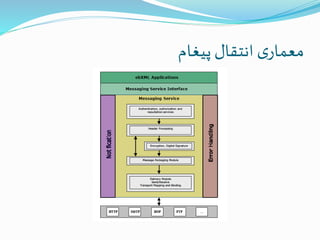
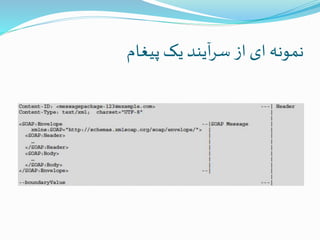
•پیغام مدل و آیندرس ازSOAPتکلوپر وhttpدرebxmlمیشوداستفاده.
•در یجیستررebxmlاز یرمجموعهز یکعنوان بهUDDIمیکند عمل.
•در خطاتشخیص یوهایرسنا ازWSDLایربebxmlمیشوداستفاده.
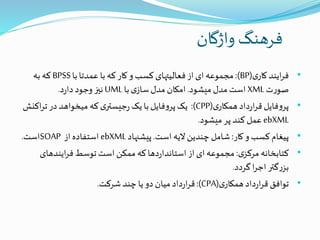
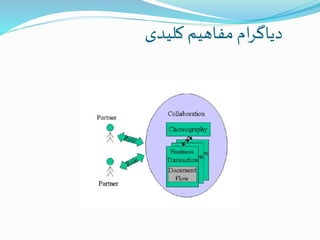
• BPEL: Business Process Interoperability Language
• WSDL: Web ServiceDefinition Language
• SOAP: Simple Object Access Protocol
• UDDI: Universal Description, Discover and Integration
• BPSS: Business Process Schema Specification
• TPA: Trading Partner Agreement
Find more
FindthesponsorsofebXMLat:UN/CEFACT (UnitedNationsCentreforTradeFacilitationandElectronic Business)and OASIS(Organizationforthe Advancementof
StructuredInformationStandards).
TheebXMLinitiativehasproduceda number of specifications.Findallof thesespecificationsat ebXML.org.As specificationsproceedthroughtheir approvalprocess,
theirexact URLs will change, soit is bestsimplyto navigatevia theebXMLhomepage.If later versionsof the documentsmentionedhereare produced,it will obviously
make senseto referto thosesupercedingversions:
Findout more aboutSOAPmessagingin an articlebyBob DuCharmeaboutbuildingyour ownSOAPclient andin the developerWorksXML messagingwith SOAP
tutorial.
Uche Ogbuji covers ebXMLandothermattersrelatingto semantictransparencyin his developerWorkscolumn, ThinkingXML. Checkout thepreviousinstallments:
ThinkingXML #1: XMLmeetssemantics:TherealityintroducesXMLandsemantictransparency.
ThinkingXML #2: XML Semantics:Meetthenew kids ontheblock ... discussessomeof theplayersinthatarena.
ThinkingXML #3: Walkingthe semanticbeatreportssomenew developmentswithebXMLandrelatedhappeningsinspring 2001.
R. A. Smith of IBM Researchtoucheson howebXMLfits intothe fabricof e-businessinfrastructure.
Checkout theIBM® WebSphere®BusinessIntegrationZoneandexploreproductsforintegratingdata,applications,processes,and people.
Look intoDavid Mertz'spreviousinstallmentsofhis XMLMatterscolumn. Hismostrecent installmentcovers SQLqueriesvia XML.
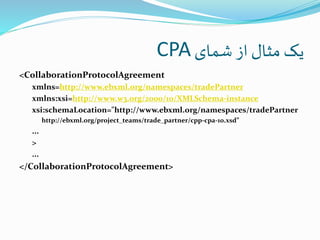
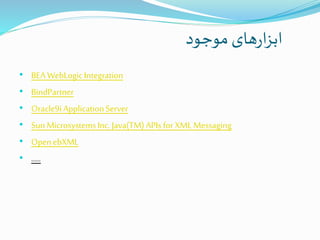
http://www.ebxml.org/tools/index.htm
Editor's Notes
#10 They can be viewed as serving two different B2B models and will continue to be used in parallel
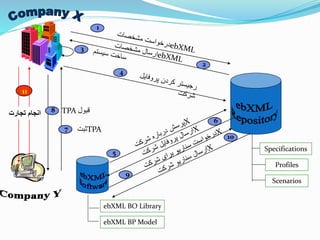
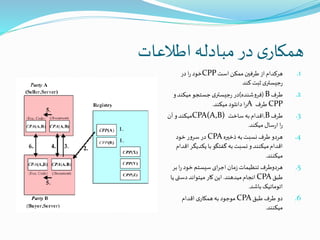
#21 Company X has become aware of ebXML and that there is a repository that contains the ebXML specifications.
1. Company X request from the repository the specification in order to determine if it was to become a ebXML compliant participant.
2. The request results in the specification be send to Company X
3. Company X, after reviewing the specification, decides to build its own ebXML compliant application.
4. After completing the creation of the ebXML application, Company X send a request to upload its company profile (for discovery of its ebXML capabilities and constrains) as well as its scenarios. These scenarios as XML versions of the business processes and associated information parcels (based on Business Objects) the company is able to engage in.
5. After verification that the format and usage of BO is correct a acknowledgment is send to Company X.
6. Company Y (a SME) was informed by Company X that they like to engage in a business transaction using ebXML. Company Y finds a shrink-wrap application that is ebXML compliant and interfaces with its current PC based accounting and inventory applications. The ebXML program has already the base ebXML information such as a library of BO and models for the specific industry they are part of. However, since Company X just registered is scenarios they are not part of the purchased package. Therefore the program queries the ebXML repository about Company X.
7. Company X’s profile is provided.
8. Based on the profile the program determines that it is able to execute a certain scenario specified by Company X. Before engaging in that the scenario Company Y submits to Company Y the trading partner agreement (TPA) which outlines the scenario it wants to use with company X as well as certain transport and security related requirements.
9. The TPA is accepted by Company X and an acknowledgement is send.
10. Since the scenario from company X was not available in the software package that Company Y is using, the program requests it from the repository.
11. The scenario is being provided to company’s Y application.
12. Based on the processes (as contained in the process models) and information parcels (as presented in the class diagrams) Company X and Y are now engaging in eBusiness utilizing ebXML specifications.
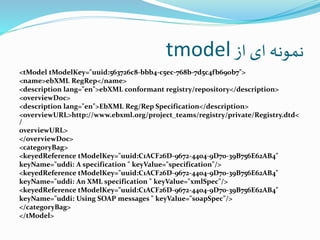
#32 .<tModelKey> : If supported as a Canonical tModel this will be defined in the UDDI
v3.0 specifications. If not then it will be calculated by the operator when processing
the save_tModel API call.
.<name>: This is a mandatory element and will be used to find registered tModels using
the find_tModel API call.
.<description>: What is shown is a single English short description. It is possible to
support other national language descriptions.
.<overviewDoc>: This allows a reference to a remote descriptive item related to the
tModel. In the example above, the <overviewURL> element is the current URL for the
Reg/Rep DTD file.
.<categoryBag>: When using the save_tModel it is possible to supply extra
categorisation and identification information with the tModel. In this case the
following keyedReferences are used, xmlSpec, specification, soapSpec1.