CASE Network E-briefs 
5/2009 May 
1/2008 January 
Europe’s recent transition: growth, 
convergence and regional disparities 
by Arne Melchior 
Since the fall of the iron curtain, Europe has undergone dramatic reforms 
and changes, most notably East-West integration, expansion of the Euro-pean 
Union (EU) internal market and monetary integration. Two decades 
after the initiation of reforms we now have data to assess whether they 
have caused dramatic changes to the economic landscape of Europe. 
Specifically, has European integration contributed to regional conver-gence 
or greater income disparities? Using data from 1995-2005, recent 
findings from the ENEPO (Eastern Neighbourhood: Economic Potential 
and Future Development) project show that economic integration has re-sulted 
in greater EU-wide convergence, but also that regional inequality 
has increased considerably in Central and Eastern Europe (CEE); in new 
member states as well as outside the EU. 
A V-shaped pattern of growth 
While it is well known that within Europe, economic growth was recently 
(before the financial crisis) higher in the new EU member states, it is less 
known that growth was also higher in the most western parts of Europe. 
The lowest growth was observed in a central area stretching from Den-mark 
through Germany, Switzerland and Italy; with higher growth to the 
west and east of this area. Along this east-west axis, there was a V-sha-ped 
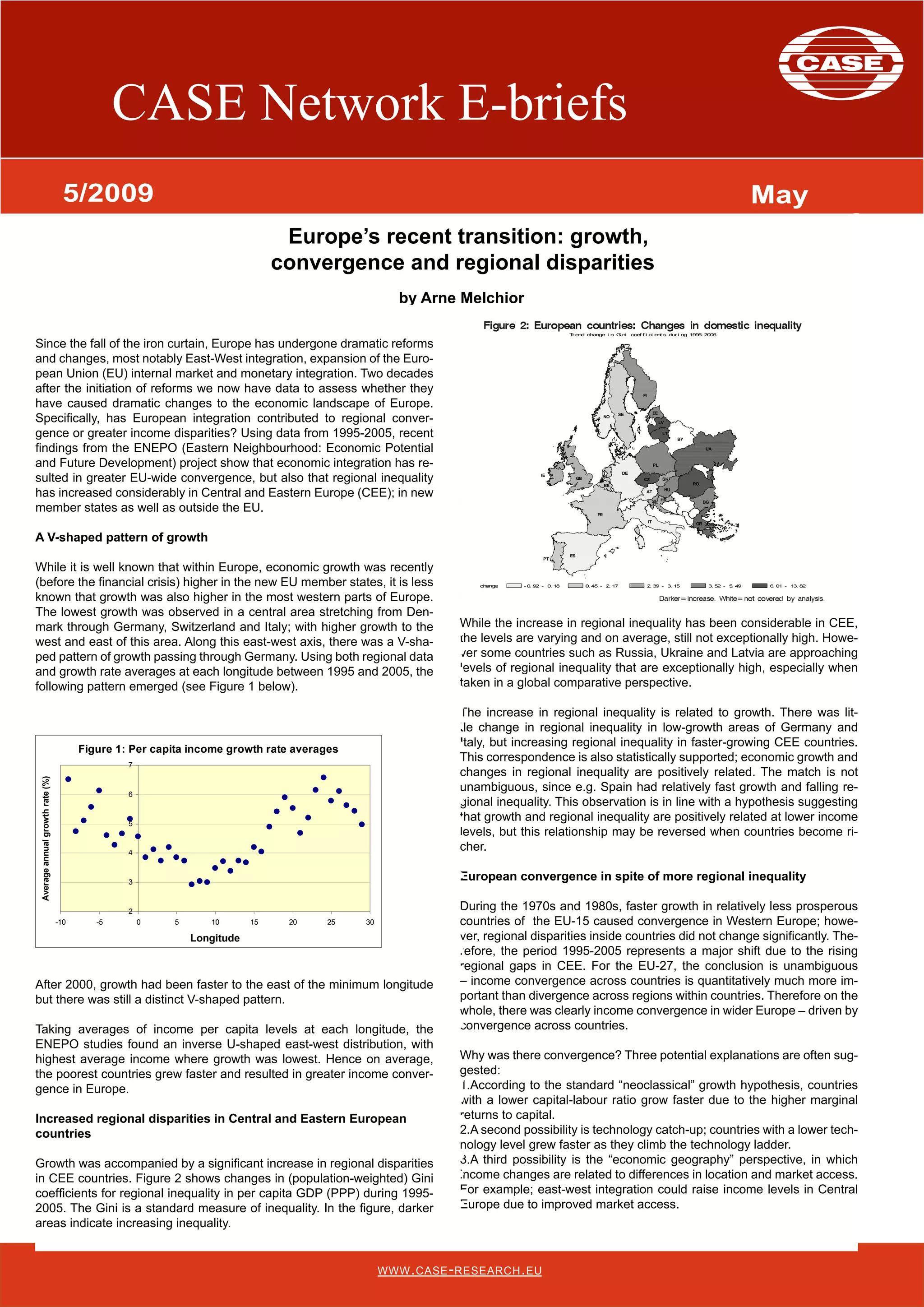
pattern of growth passing through Germany. Using both regional data 
and growth rate averages at each longitude between 1995 and 2005, the 
following pattern emerged (see Figure 1 below). 
IE 
www.case-research.eu 
Figure 1: Per capita income growth rate averages 
7 
6 
5 
4 
3 
2 
-10 -5 0 5 10 15 20 25 30 
Longitude 
Average annual growth rate (%) 
After 2000, growth had been faster to the east of the minimum longitude 
but there was still a distinct V-shaped pattern. 
Taking averages of income per capita levels at each longitude, the 
ENEPO studies found an inverse U-shaped east-west distribution, with 
highest average income where growth was lowest. Hence on average, 
the poorest countries grew faster and resulted in greater income conver-gence 
in Europe. 
Increased regional disparities in Central and Eastern European 
countries 
Growth was accompanied by a significant increase in regional disparities 
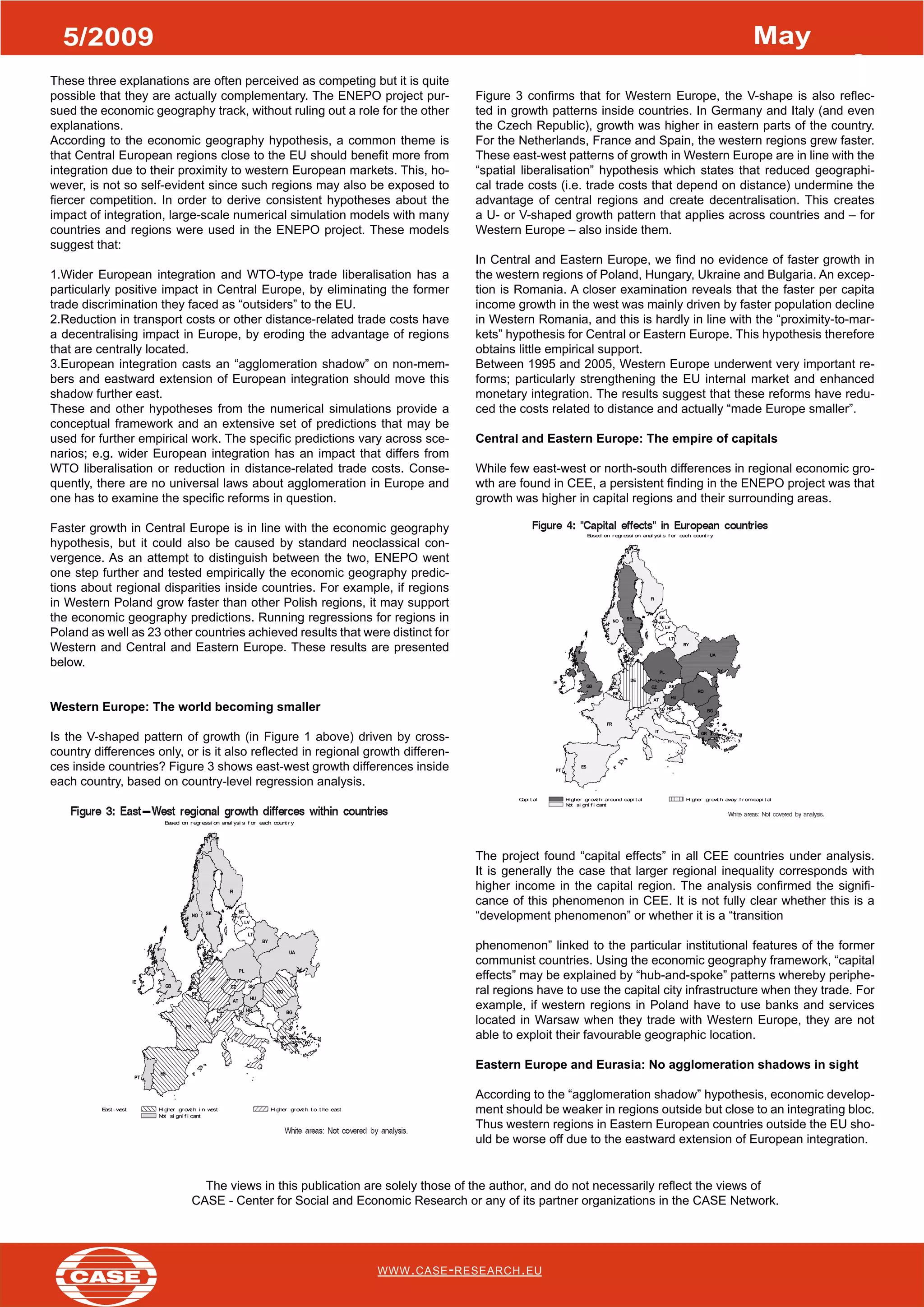
in CEE countries. Figure 2 shows changes in (population-weighted) Gini 
coefficients for regional inequality in per capita GDP (PPP) during 1995- 
2005. The Gini is a standard measure of inequality. In the figure, darker 
areas indicate increasing inequality. 
Trend change i n Gi ni coef f i ci ent s dur i ng 1995-2005 
FI 
NO 
PL 
SE 
NL SK 
CZ 
AT 
BE 
BY 
UA 
BG 
DK 
EE 
FR 
DE 
RO 
GR 
LV 
LT 
HU 
HR 
IT 
PT 
SI 
ES 
GB 
change -0. 92 - 0. 18 0. 45 - 2. 17 2. 39 - 3. 15 3. 52 - 5. 49 6. 01 - 13. 82 
While the increase in regional inequality has been considerable in CEE, 
the levels are varying and on average, still not exceptionally high. Howe-ver 
some countries such as Russia, Ukraine and Latvia are approaching 
levels of regional inequality that are exceptionally high, especially when 
taken in a global comparative perspective. 
The increase in regional inequality is related to growth. There was lit-tle 
change in regional inequality in low-growth areas of Germany and 
Italy, but increasing regional inequality in faster-growing CEE countries. 
This correspondence is also statistically supported; economic growth and 
changes in regional inequality are positively related. The match is not 
unambiguous, since e.g. Spain had relatively fast growth and falling re-gional 
inequality. This observation is in line with a hypothesis suggesting 
that growth and regional inequality are positively related at lower income 
levels, but this relationship may be reversed when countries become ri-cher. 
European convergence in spite of more regional inequality 
During the 1970s and 1980s, faster growth in relatively less prosperous 
countries of the EU-15 caused convergence in Western Europe; howe-ver, 
regional disparities inside countries did not change significantly. The-refore, 
the period 1995-2005 represents a major shift due to the rising 
regional gaps in CEE. For the EU-27, the conclusion is unambiguous 
– income convergence across countries is quantitatively much more im-portant 
than divergence across regions within countries. Therefore on the 
whole, there was clearly income convergence in wider Europe – driven by 
convergence across countries. 
Why was there convergence? Three potential explanations are often sug-gested: 
1.According to the standard “neoclassical” growth hypothesis, countries 
with a lower capital-labour ratio grow faster due to the higher marginal 
returns to capital. 
2.A second possibility is technology catch-up; countries with a lower tech-nology 
level grew faster as they climb the technology ladder. 
3.A third possibility is the “economic geography” perspective, in which 
income changes are related to differences in location and market access. 
For example; east-west integration could raise income levels in Central 
Europe due to improved market access.
5/2009 May 
1/2008 January 
These three explanations are often perceived as competing but it is quite 
possible that they are actually complementary. The ENEPO project pur-sued 
the economic geography track, without ruling out a role for the other 
explanations. 
According to the economic geography hypothesis, a common theme is 
that Central European regions close to the EU should benefit more from 
integration due to their proximity to western European markets. This, ho-wever, 
is not so self-evident since such regions may also be exposed to 
fiercer competition. In order to derive consistent hypotheses about the 
impact of integration, large-scale numerical simulation models with many 
countries and regions were used in the ENEPO project. These models 
suggest that: 
1.Wider European integration and WTO-type trade liberalisation has a 
particularly positive impact in Central Europe, by eliminating the former 
trade discrimination they faced as “outsiders” to the EU. 
2.Reduction in transport costs or other distance-related trade costs have 
a decentralising impact in Europe, by eroding the advantage of regions 
that are centrally located. 
3.European integration casts an “agglomeration shadow” on non-mem-bers 
and eastward extension of European integration should move this 
shadow further east. 
These and other hypotheses from the numerical simulations provide a 
conceptual framework and an extensive set of predictions that may be 
used for further empirical work. The specific predictions vary across sce-narios; 
e.g. wider European integration has an impact that differs from 
WTO liberalisation or reduction in distance-related trade costs. Conse-quently, 
there are no universal laws about agglomeration in Europe and 
one has to examine the specific reforms in question. 
Faster growth in Central Europe is in line with the economic geography 
hypothesis, but it could also be caused by standard neoclassical con-vergence. 
As an attempt to distinguish between the two, ENEPO went 
one step further and tested empirically the economic geography predic-tions 
about regional disparities inside countries. For example, if regions 
in Western Poland grow faster than other Polish regions, it may support 
the economic geography predictions. Running regressions for regions in 
Poland as well as 23 other countries achieved results that were distinct for 
Western and Central and Eastern Europe. These results are presented 
below. 
Western Europe: The world becoming smaller 
Is the V-shaped pattern of growth (in Figure 1 above) driven by cross-country 
differences only, or is it also reflected in regional growth differen-ces 
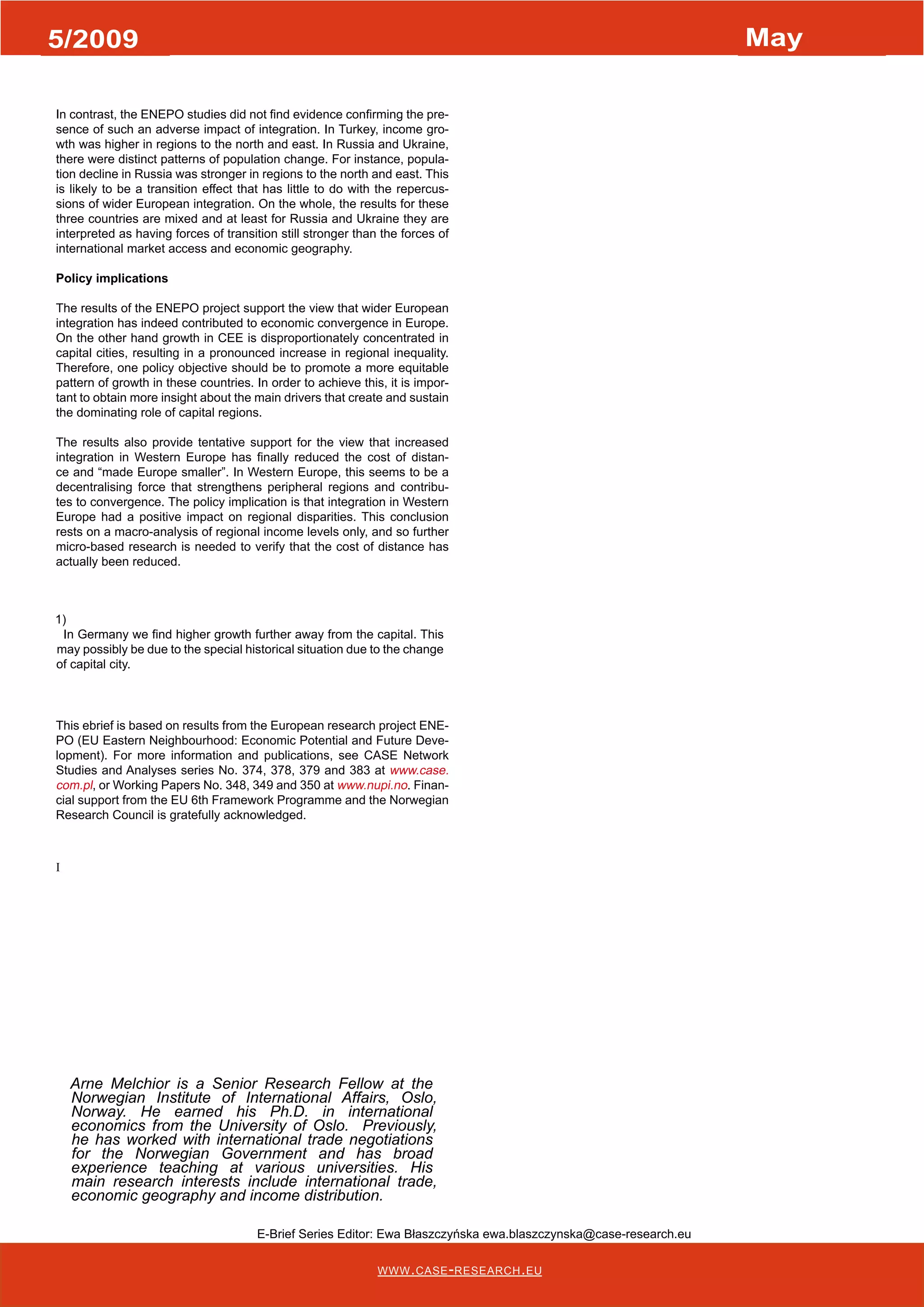
inside countries? Figure 3 shows east-west growth differences inside 
www.case-research.eu 
each country, based on country-level regression analysis. 
Based on regressi on anal ysi s f or each count ry 
HU 
NO 
PL 
East -west Hi gher growt h i n west Hi gher growt h t o t he east 
Not si gni f i cant 
AT 
BE 
BY 
BG 
CZ 
DK 
EE 
FI 
FR 
DE 
GR 
HR 
IE 
IT 
LV 
LT 
NL SK 
PT 
RO 
SI 
ES 
SE 
GB 
UA 
Figure 3 confirms that for Western Europe, the V-shape is also reflec-ted 
in growth patterns inside countries. In Germany and Italy (and even 
the Czech Republic), growth was higher in eastern parts of the country. 
For the Netherlands, France and Spain, the western regions grew faster. 
These east-west patterns of growth in Western Europe are in line with the 
“spatial liberalisation” hypothesis which states that reduced geographi-cal 
trade costs (i.e. trade costs that depend on distance) undermine the 
advantage of central regions and create decentralisation. This creates 
a U- or V-shaped growth pattern that applies across countries and – for 
Western Europe – also inside them. 
In Central and Eastern Europe, we find no evidence of faster growth in 
the western regions of Poland, Hungary, Ukraine and Bulgaria. An excep-tion 
is Romania. A closer examination reveals that the faster per capita 
income growth in the west was mainly driven by faster population decline 
in Western Romania, and this is hardly in line with the “proximity-to-mar-kets” 
hypothesis for Central or Eastern Europe. This hypothesis therefore 
obtains little empirical support. 
Between 1995 and 2005, Western Europe underwent very important re-forms; 
particularly strengthening the EU internal market and enhanced 
monetary integration. The results suggest that these reforms have redu-ced 
the costs related to distance and actually “made Europe smaller”. 
Central and Eastern Europe: The empire of capitals 
While few east-west or north-south differences in regional economic gro-wth 
are found in CEE, a persistent finding in the ENEPO project was that 
growth was higher in capital regions and their surrounding areas. 
Based on regressi on anal ysi s f or each count ry 
HU 
NO 
PL 
Capi t al Hi gher growt h around capi t al Hi gher growt h away f rom capi t al 
Not si gni f i cant 
AT 
BE 
BY 
BG 
CZ 
DK 
EE 
FI 
FR 
DE 
GR 
HR 
IE 
IT 
LV 
LT 
NL SK 
PT 
RO 
SI 
ES 
SE 
GB 
UA 
The project found “capital effects” in all CEE countries under analysis. 
It is generally the case that larger regional inequality corresponds with 
higher income in the capital region. The analysis confirmed the signifi-cance 
of this phenomenon in CEE. It is not fully clear whether this is a 
“development phenomenon” or whether it is a “transition 
phenomenon” linked to the particular institutional features of the former 
communist countries. Using the economic geography framework, “capital 
effects” may be explained by “hub-and-spoke” patterns whereby periphe-ral 
regions have to use the capital city infrastructure when they trade. For 
example, if western regions in Poland have to use banks and services 
located in Warsaw when they trade with Western Europe, they are not 
able to exploit their favourable geographic location. 
Eastern Europe and Eurasia: No agglomeration shadows in sight 
According to the “agglomeration shadow” hypothesis, economic develop-ment 
should be weaker in regions outside but close to an integrating bloc. 
Thus western regions in Eastern European countries outside the EU sho-uld 
be worse off due to the eastward extension of European integration. 
The views in this publication are solely those of the author, and do not necessarily reflect the views of 
CASE - Center for Social and Economic Research or any of its partner organizations in the CASE Network.
1/2008 January 
5/2009 May 
In contrast, the ENEPO studies did not find evidence confirming the pre-sence 
of such an adverse impact of integration. In Turkey, income gro-wth 
was higher in regions to the north and east. In Russia and Ukraine, 
there were distinct patterns of population change. For instance, popula-tion 
decline in Russia was stronger in regions to the north and east. This 
is likely to be a transition effect that has little to do with the repercus-sions 
of wider European integration. On the whole, the results for these 
three countries are mixed and at least for Russia and Ukraine they are 
interpreted as having forces of transition still stronger than the forces of 
international market access and economic geography. 
Policy implications 
The results of the ENEPO project support the view that wider European 
integration has indeed contributed to economic convergence in Europe. 
On the other hand growth in CEE is disproportionately concentrated in 
capital cities, resulting in a pronounced increase in regional inequality. 
Therefore, one policy objective should be to promote a more equitable 
pattern of growth in these countries. In order to achieve this, it is impor-tant 
to obtain more insight about the main drivers that create and sustain 
the dominating role of capital regions. 
The results also provide tentative support for the view that increased 
integration in Western Europe has finally reduced the cost of distan-ce 
and “made Europe smaller”. In Western Europe, this seems to be a 
decentralising force that strengthens peripheral regions and contribu-tes 
to convergence. The policy implication is that integration in Western 
Europe had a positive impact on regional disparities. This conclusion 
rests on a macro-analysis of regional income levels only, and so further 
micro-based research is needed to verify that the cost of distance has 
actually been reduced. 
1) 
In Germany we find higher growth further away from the capital. This 
may possibly be due to the special historical situation due to the change 
of capital city. 
This ebrief is based on results from the European research project ENE-PO 
(EU Eastern Neighbourhood: Economic Potential and Future Deve-lopment). 
For more information and publications, see CASE Network 
Studies and Analyses series No. 374, 378, 379 and 383 at www.case. 
com.pl, or Working Papers No. 348, 349 and 350 at www.nupi.no. Finan-cial 
support from the EU 6th Framework Programme and the Norwegian 
www.case-research.eu 
Research Council is gratefully acknowledged. 
I 
Arne Melchior is a Senior Research Fellow at the 
Norwegian Institute of International Affairs, Oslo, 
Norway. He earned his Ph.D. in international 
economics from the University of Oslo. Previously, 
he has worked with international trade negotiations 
for the Norwegian Government and has broad 
experience teaching at various universities. His 
main research interests include international trade, 
economic geography and income distribution. 
E-Brief Series Editor: Ewa Błaszczyńska ewa.blaszczynska@case-research.eu

CASE Network E-briefs 5.2009 - From fiscal stimulus to fiscal crisis

  • 1.
    CASE Network E-briefs 5/2009 May 1/2008 January Europe’s recent transition: growth, convergence and regional disparities by Arne Melchior Since the fall of the iron curtain, Europe has undergone dramatic reforms and changes, most notably East-West integration, expansion of the Euro-pean Union (EU) internal market and monetary integration. Two decades after the initiation of reforms we now have data to assess whether they have caused dramatic changes to the economic landscape of Europe. Specifically, has European integration contributed to regional conver-gence or greater income disparities? Using data from 1995-2005, recent findings from the ENEPO (Eastern Neighbourhood: Economic Potential and Future Development) project show that economic integration has re-sulted in greater EU-wide convergence, but also that regional inequality has increased considerably in Central and Eastern Europe (CEE); in new member states as well as outside the EU. A V-shaped pattern of growth While it is well known that within Europe, economic growth was recently (before the financial crisis) higher in the new EU member states, it is less known that growth was also higher in the most western parts of Europe. The lowest growth was observed in a central area stretching from Den-mark through Germany, Switzerland and Italy; with higher growth to the west and east of this area. Along this east-west axis, there was a V-sha-ped pattern of growth passing through Germany. Using both regional data and growth rate averages at each longitude between 1995 and 2005, the following pattern emerged (see Figure 1 below). IE www.case-research.eu Figure 1: Per capita income growth rate averages 7 6 5 4 3 2 -10 -5 0 5 10 15 20 25 30 Longitude Average annual growth rate (%) After 2000, growth had been faster to the east of the minimum longitude but there was still a distinct V-shaped pattern. Taking averages of income per capita levels at each longitude, the ENEPO studies found an inverse U-shaped east-west distribution, with highest average income where growth was lowest. Hence on average, the poorest countries grew faster and resulted in greater income conver-gence in Europe. Increased regional disparities in Central and Eastern European countries Growth was accompanied by a significant increase in regional disparities in CEE countries. Figure 2 shows changes in (population-weighted) Gini coefficients for regional inequality in per capita GDP (PPP) during 1995- 2005. The Gini is a standard measure of inequality. In the figure, darker areas indicate increasing inequality. Trend change i n Gi ni coef f i ci ent s dur i ng 1995-2005 FI NO PL SE NL SK CZ AT BE BY UA BG DK EE FR DE RO GR LV LT HU HR IT PT SI ES GB change -0. 92 - 0. 18 0. 45 - 2. 17 2. 39 - 3. 15 3. 52 - 5. 49 6. 01 - 13. 82 While the increase in regional inequality has been considerable in CEE, the levels are varying and on average, still not exceptionally high. Howe-ver some countries such as Russia, Ukraine and Latvia are approaching levels of regional inequality that are exceptionally high, especially when taken in a global comparative perspective. The increase in regional inequality is related to growth. There was lit-tle change in regional inequality in low-growth areas of Germany and Italy, but increasing regional inequality in faster-growing CEE countries. This correspondence is also statistically supported; economic growth and changes in regional inequality are positively related. The match is not unambiguous, since e.g. Spain had relatively fast growth and falling re-gional inequality. This observation is in line with a hypothesis suggesting that growth and regional inequality are positively related at lower income levels, but this relationship may be reversed when countries become ri-cher. European convergence in spite of more regional inequality During the 1970s and 1980s, faster growth in relatively less prosperous countries of the EU-15 caused convergence in Western Europe; howe-ver, regional disparities inside countries did not change significantly. The-refore, the period 1995-2005 represents a major shift due to the rising regional gaps in CEE. For the EU-27, the conclusion is unambiguous – income convergence across countries is quantitatively much more im-portant than divergence across regions within countries. Therefore on the whole, there was clearly income convergence in wider Europe – driven by convergence across countries. Why was there convergence? Three potential explanations are often sug-gested: 1.According to the standard “neoclassical” growth hypothesis, countries with a lower capital-labour ratio grow faster due to the higher marginal returns to capital. 2.A second possibility is technology catch-up; countries with a lower tech-nology level grew faster as they climb the technology ladder. 3.A third possibility is the “economic geography” perspective, in which income changes are related to differences in location and market access. For example; east-west integration could raise income levels in Central Europe due to improved market access.
  • 2.
    5/2009 May 1/2008January These three explanations are often perceived as competing but it is quite possible that they are actually complementary. The ENEPO project pur-sued the economic geography track, without ruling out a role for the other explanations. According to the economic geography hypothesis, a common theme is that Central European regions close to the EU should benefit more from integration due to their proximity to western European markets. This, ho-wever, is not so self-evident since such regions may also be exposed to fiercer competition. In order to derive consistent hypotheses about the impact of integration, large-scale numerical simulation models with many countries and regions were used in the ENEPO project. These models suggest that: 1.Wider European integration and WTO-type trade liberalisation has a particularly positive impact in Central Europe, by eliminating the former trade discrimination they faced as “outsiders” to the EU. 2.Reduction in transport costs or other distance-related trade costs have a decentralising impact in Europe, by eroding the advantage of regions that are centrally located. 3.European integration casts an “agglomeration shadow” on non-mem-bers and eastward extension of European integration should move this shadow further east. These and other hypotheses from the numerical simulations provide a conceptual framework and an extensive set of predictions that may be used for further empirical work. The specific predictions vary across sce-narios; e.g. wider European integration has an impact that differs from WTO liberalisation or reduction in distance-related trade costs. Conse-quently, there are no universal laws about agglomeration in Europe and one has to examine the specific reforms in question. Faster growth in Central Europe is in line with the economic geography hypothesis, but it could also be caused by standard neoclassical con-vergence. As an attempt to distinguish between the two, ENEPO went one step further and tested empirically the economic geography predic-tions about regional disparities inside countries. For example, if regions in Western Poland grow faster than other Polish regions, it may support the economic geography predictions. Running regressions for regions in Poland as well as 23 other countries achieved results that were distinct for Western and Central and Eastern Europe. These results are presented below. Western Europe: The world becoming smaller Is the V-shaped pattern of growth (in Figure 1 above) driven by cross-country differences only, or is it also reflected in regional growth differen-ces inside countries? Figure 3 shows east-west growth differences inside www.case-research.eu each country, based on country-level regression analysis. Based on regressi on anal ysi s f or each count ry HU NO PL East -west Hi gher growt h i n west Hi gher growt h t o t he east Not si gni f i cant AT BE BY BG CZ DK EE FI FR DE GR HR IE IT LV LT NL SK PT RO SI ES SE GB UA Figure 3 confirms that for Western Europe, the V-shape is also reflec-ted in growth patterns inside countries. In Germany and Italy (and even the Czech Republic), growth was higher in eastern parts of the country. For the Netherlands, France and Spain, the western regions grew faster. These east-west patterns of growth in Western Europe are in line with the “spatial liberalisation” hypothesis which states that reduced geographi-cal trade costs (i.e. trade costs that depend on distance) undermine the advantage of central regions and create decentralisation. This creates a U- or V-shaped growth pattern that applies across countries and – for Western Europe – also inside them. In Central and Eastern Europe, we find no evidence of faster growth in the western regions of Poland, Hungary, Ukraine and Bulgaria. An excep-tion is Romania. A closer examination reveals that the faster per capita income growth in the west was mainly driven by faster population decline in Western Romania, and this is hardly in line with the “proximity-to-mar-kets” hypothesis for Central or Eastern Europe. This hypothesis therefore obtains little empirical support. Between 1995 and 2005, Western Europe underwent very important re-forms; particularly strengthening the EU internal market and enhanced monetary integration. The results suggest that these reforms have redu-ced the costs related to distance and actually “made Europe smaller”. Central and Eastern Europe: The empire of capitals While few east-west or north-south differences in regional economic gro-wth are found in CEE, a persistent finding in the ENEPO project was that growth was higher in capital regions and their surrounding areas. Based on regressi on anal ysi s f or each count ry HU NO PL Capi t al Hi gher growt h around capi t al Hi gher growt h away f rom capi t al Not si gni f i cant AT BE BY BG CZ DK EE FI FR DE GR HR IE IT LV LT NL SK PT RO SI ES SE GB UA The project found “capital effects” in all CEE countries under analysis. It is generally the case that larger regional inequality corresponds with higher income in the capital region. The analysis confirmed the signifi-cance of this phenomenon in CEE. It is not fully clear whether this is a “development phenomenon” or whether it is a “transition phenomenon” linked to the particular institutional features of the former communist countries. Using the economic geography framework, “capital effects” may be explained by “hub-and-spoke” patterns whereby periphe-ral regions have to use the capital city infrastructure when they trade. For example, if western regions in Poland have to use banks and services located in Warsaw when they trade with Western Europe, they are not able to exploit their favourable geographic location. Eastern Europe and Eurasia: No agglomeration shadows in sight According to the “agglomeration shadow” hypothesis, economic develop-ment should be weaker in regions outside but close to an integrating bloc. Thus western regions in Eastern European countries outside the EU sho-uld be worse off due to the eastward extension of European integration. The views in this publication are solely those of the author, and do not necessarily reflect the views of CASE - Center for Social and Economic Research or any of its partner organizations in the CASE Network.
  • 3.
    1/2008 January 5/2009May In contrast, the ENEPO studies did not find evidence confirming the pre-sence of such an adverse impact of integration. In Turkey, income gro-wth was higher in regions to the north and east. In Russia and Ukraine, there were distinct patterns of population change. For instance, popula-tion decline in Russia was stronger in regions to the north and east. This is likely to be a transition effect that has little to do with the repercus-sions of wider European integration. On the whole, the results for these three countries are mixed and at least for Russia and Ukraine they are interpreted as having forces of transition still stronger than the forces of international market access and economic geography. Policy implications The results of the ENEPO project support the view that wider European integration has indeed contributed to economic convergence in Europe. On the other hand growth in CEE is disproportionately concentrated in capital cities, resulting in a pronounced increase in regional inequality. Therefore, one policy objective should be to promote a more equitable pattern of growth in these countries. In order to achieve this, it is impor-tant to obtain more insight about the main drivers that create and sustain the dominating role of capital regions. The results also provide tentative support for the view that increased integration in Western Europe has finally reduced the cost of distan-ce and “made Europe smaller”. In Western Europe, this seems to be a decentralising force that strengthens peripheral regions and contribu-tes to convergence. The policy implication is that integration in Western Europe had a positive impact on regional disparities. This conclusion rests on a macro-analysis of regional income levels only, and so further micro-based research is needed to verify that the cost of distance has actually been reduced. 1) In Germany we find higher growth further away from the capital. This may possibly be due to the special historical situation due to the change of capital city. This ebrief is based on results from the European research project ENE-PO (EU Eastern Neighbourhood: Economic Potential and Future Deve-lopment). For more information and publications, see CASE Network Studies and Analyses series No. 374, 378, 379 and 383 at www.case. com.pl, or Working Papers No. 348, 349 and 350 at www.nupi.no. Finan-cial support from the EU 6th Framework Programme and the Norwegian www.case-research.eu Research Council is gratefully acknowledged. I Arne Melchior is a Senior Research Fellow at the Norwegian Institute of International Affairs, Oslo, Norway. He earned his Ph.D. in international economics from the University of Oslo. Previously, he has worked with international trade negotiations for the Norwegian Government and has broad experience teaching at various universities. His main research interests include international trade, economic geography and income distribution. E-Brief Series Editor: Ewa Błaszczyńska ewa.blaszczynska@case-research.eu