(eBook PDF) Information Systems A Manager's
Guide to Harnessing Technology Version 6.0

download
https://ebooksecure.com/product/ebook-pdf-information-systems-a-
managers-guide-to-harnessing-technology-version-6-0/
Download full version ebook from https://ebooksecure.com
We believe these products will be a great fit for you. Click
the link to download now, or visit ebooksecure.com
to discover even more!
(eBook PDF) Information Systems A Manager's Guide to
Harnessing Technology Version 7.0
http://ebooksecure.com/product/ebook-pdf-information-systems-a-
managers-guide-to-harnessing-technology-version-7-0/
(Original PDF) Information Systems; A Managers Guide to
Harnessing Technology, 5th Edition
http://ebooksecure.com/product/original-pdf-information-systems-
a-managers-guide-to-harnessing-technology-5th-edition/
Biology: A Guide to the Natural World, Technology
Update (5th Edition - PDF Version) 5th - PDF Version
http://ebooksecure.com/product/biology-a-guide-to-the-natural-
world-technology-update-5th-edition-pdf-version-5th-pdf-version/
(eBook PDF) Introduction to Information Systems:
People, Technology and Processes 3rd Edition
http://ebooksecure.com/product/ebook-pdf-introduction-to-
information-systems-people-technology-and-processes-3rd-edition/
CISM Certified Information Security Manager All-in-One
Exam Guide 1st Edition - eBook PDF
https://ebooksecure.com/download/cism-all-in-one-ebook-pdf/
CISM Certified Information Security Manager All-in-One
Exam Guide, 2nd Edition Peter H. Gregory - eBook PDF
https://ebooksecure.com/download/cism-certified-information-
security-manager-all-in-one-exam-guide-2nd-edition-ebook-pdf/
(Textbook) Introduction to Information Systems 6th
Edition
http://ebooksecure.com/product/textbook-introduction-to-
information-systems-6th-edition/
(eBook PDF) Introduction to Information Systems 3rd
Edition
http://ebooksecure.com/product/ebook-pdf-introduction-to-
information-systems-3rd-edition/
(eBook PDF) Introduction to Information Systems 16th
Edition
http://ebooksecure.com/product/ebook-pdf-introduction-to-
information-systems-16th-edition/
Information Systems
A Manager’s Guide to
Harnessing Technology
John Gallaugher
Version 6.0
233
235
238
245
247
Chapter 11
247
250
260
266
273
281
285
Chapter 12
285
287
290
293
295
296
297
299
301
Chapter 13
301
303
307
311
316
319
324
325
Chapter 14
325
327
329
331
332
Future Outlook: Established Players Get Collaborative
Airbnb—Hey Stranger, Why Don’t You Stay at My Place?
Uber: Sharing Economy Success from Tech-Fueled Superior Service
Endnotes
Facebook: A Billion-plus users, the High-Stakes Move to Mobile, and Big
Business from the Social Graph
Introduction
Disrupting Competition, Building Competitive Advantage, and the
Challenging Rise of Mobile
Lessons from Facebook as an Apps Platform: Early Promise, Continued
Challenges, Mobile Missteps
Advertising and Social Networks: A Challenging Landscape but a Big
Payoff
A Platform Player that Moves Fast and Breaks Things: What All Managers
Can Learn from Facebook’s Mistakes, Responses, and Pursuit of New
Opportunities
Endnotes
Rent the Runway: Entrepreneurs Expanding an Industry by Blending Tech
with Fashion
Introduction
Founding the Business: Are We On To Something?
Customer Engagement (Mobile, Social, and Physical Storefronts)
Data
Operations and Logistics
Expanding with New Models
Conclusion
Endnotes
Understanding Software: A Primer for Managers
Introduction
Operating Systems
Application Software
Distributed Computing, Web Services, and APIs
Writing Software
Understanding Technology beyond the Price Tag: Total Cost of Ownership
(TCO) and the Cost of Tech Failure
Endnotes
Software in Flux: Open Source, Cloud, Virtualized and App-driven Shifts
Introduction
Open Source
Why Open Source?
Examples of Open Source Software
Why Give It Away? The Business of Open Source
334
336
339
341
345
348
349
351
353
355
Chapter 15
355
359
362
366
368
373
380
383
385
Chapter 16
385
385
393
399
407
409
Chapter 17
409
411
416
430
436
439
Chapter 18
439
443
449
450
456
Defining Cloud Computing
Software in the Cloud: Why Buy When You Can Rent?
SaaS: Not without Risks
Understanding Cloud Computing Models: PaaS, IaaS, and Motivations and
Risks
Clouds and Tech Industry Impact
Virtualization: Software That Makes One Computer Act Like Many
Apps and App Stores: Further Disrupting the Software Industry on
Smartphones, Tablets, and Beyond
Make, Buy, or Rent
Endnotes
The Data Asset: Databases, Business Intelligence, Analytics, Big Data, and
Competitive Advantage
Introduction
Data, Information, and Knowledge
Where Does Data Come From?
Data Rich, Information Poor
Data Warehouses, Data Marts, and Technology behind “Big Data”
The Business Intelligence Toolkit
Data Asset in Action: Technology and the Rise of Walmart
Endnotes
A Manager’s Guide to the Internet and Telecommunications
Introduction
Internet 101: Understanding How the Internet Works
Getting Where You’re Going
Last Mile: Faster Speed, Broader Access
Endnotes
Information Security: Barbarians at the Gateway (and Just About Everywhere
Else)
Introduction
Why Is This Happening? Who Is Doing It? And What’s Their Motivation?
Where Are Vulnerabilities? Understanding the Weaknesses
Taking Action
Endnotes
Google in Three Parts: Search, Online Advertising, and an Alphabet of
Opportunity
Introduction
Understanding Search
Understanding the Increase in Online Ad Spending
Search Advertising
Ad Networks—Distribution beyond Search
460
461
466
471
474
487
491
More Ad Formats and Payment Schemes
Customer Profiling and Behavioral Targeting
Profiling and Privacy
Search Engines, Ad Networks, and Fraud
The Battle Unfolds
Endnotes
Index
© 2014 Cate Jones Photography
About the Author
Professor John Gallaugher has led student learning experiences on five continents. Part
of the founding faculty for Boston College’s TechTrek programs, and former co-lead of
the school’s graduate field studies in Europe and Asia, Professor Gallaugher has had re-
markable access to effectively study technology growth and its impact worldwide. Pro-
fessor Gallaugher and his students spend several weeks each year visiting technology
executives, entrepreneurs, and venture capitalists in San Francisco, Silicon Valley,
Seattle, Boston, New York, and Ghana, and are regularly hosted in master-class sessions
at firms from Amazon to Zynga. This unique opportunity helps give his teaching and
writing a broad, deep, and continually refreshed perspective on key industry trends and
developments. He is the author of the award-winning, annually-updated textbook
“Information Systems: A Manager’s Guide to Harnessing Technology,” as well as "Learn
to Program Using Swift for iOS Development," an online book featuring over 70 video
lessons that progressively teaches coding and app-building skills to new-to-program-
ming students. Prof. Gallaugher’s research has appeared in the Harvard Business
Review, MIS Quarterly, and other leading journals.
Named “Guru to Grads” by Entrepreneur magazine, Gallaugher has also received
the Boston College Trzaska Faculty Leadership Award, the all-university Teaching
Award, and the student newspaper’s Momentum Award for campus impact. During his
time on the leadership team of the Boston College Venture Competition (BCVC), en-
trepreneurs affiliated with the program gained admittance to elite startup accelerators
(Y-combinator, TechStars, MassChallenge, Summer@Highland), launched multiple
products, and raised over $100 million in capital. Professor Gallaugher has been a featured speaker at Apple Inc’s AcademiX educat-
or conference, and was the international keynote speaker at AIBUMA (the African International Business and Management Confer-
ence) in Nairobi, Kenya. He has consulted for and taught executive seminars for several organizations, including Accenture, Alcoa,
Duke Corporate Education, ING, Partners Healthcare, Staples, State Street, the University of Ulster, and the U.S. Information
Agency. His comments on business and technology have appeared in the New York Times, National Public Radio, BusinessWeek, the
Boston Globe, Wired, the Associated Press, Chronicle (WCVB-TV), The Daily Yomiuri (Japan), and the Nation (Thailand), among
others.
A member of the Information Systems Department at BC’s Carroll School of Management, Professor Gallaugher earned his
Ph.D. in Information Systems from the Syracuse University School of Management, and he holds an MBA and an undergraduate
degree in computer science, both from Boston College. He shares additional content related to his teaching and research at
http://gallaugher.com, and is also active on Twitter at @gallaugher.
Acknowledgments
First and foremost, my enduring thanks to my current and former students, who continue to inspire, impress, and teach me more
than I thought possible. It’s deeply rewarding to see so many former students return to campus as executive speakers and to host vis-
iting students at their own firms. Serving as your professor has been my greatest professional privilege, and I am grateful for such an
extraordinary opportunity. Keep at it and continue to make us all proud!
Thanks also to the many alumni, parents, and friends of Boston College, who have so generously invited me to bring my stu-
dents to visit with and learn from them. The experiences that you’ve provided to us have been nothing short of astonishing. We were
present at the launch of the iPhone. We’ve not only made twice-a-year pilgrimages to Sand Hill Road, One Infinite Loop, Hacker
Way, and The Googleplex, but many of our former students were funded and mentored by the VCs we’ve visited with. Name a tech
firm making waves and we’ve almost certainly got an alumnus there, and when asked, they’ve uniformly opened their offices to share
insight with our students. The East and West Coast leadership of the Boston College Technology Council have played a particularly
important role in making this happen. From Bangalore to Boston, Guangzhou to Ghana, Seoul to Silicon Valley, you’ve provided my
students with world-class opportunities, enabling us to meet with scores of CEOs, senior executives, partners, and entrepreneurs.
You’ve positively impacted lives, shaped careers, and helped make our university stronger. My students and I remain deeply grateful
for your commitment and support.
A tremendous thanks to my student research team at Boston College. In this update, the work of Kaitlin Ardiff, Tiffany Liu, and
Branick Weix helped keep our book the most current available. Prior editions benefited from input from Rootul Patel, Kelly Peder-
sen, Michael Lapointe, Abhinav Arora, Mujtaba Syed, Phil Gill, Xin (Steven) Liu, and Kathie Chang, who at various times sped
things along and helped me fill this project with rich, interesting examples. You have all been so kind to tolerate my constant and
unreasonable requests.
I am also deeply grateful to my colleagues at Boston College. My former department chair, Jim Gips, is not only a consummate
mentor and educator, as creator of the EagleEyes and CameraMouse projects (cameramouse.org) he has given voice to countless
people with disabilities worldwide and is the single most impactful researcher that I know. Tremendous thanks, as well, to my cur-
rent department chair, Rob Fichman, for his unwavering support of this project; to my BC IS Department colleagues Jerry Kane, for
helping shape the social media section, and Sam Ransbotham, for guiding me through the minefield of information security (Jerry
and Sam both hold NSF CAREER grants and are MIT Sloan Management Review editors for Social Media and Big Data, respect-
ively); to BC’s Mary Cronin, Burcu Bulgurcu, Peter Olivieri, and Jack Spang for suggestions and encouragement; and to the many
administrators who have been so supportive of this effort. Allen Li, Marios Kokkodis, Peter Sterpe, and Shannon Provost—I hope
the text helped make your start at BC a bit easier. And Xuan Ye, welcome to the team! A special thanks to BC Professor George
Wyner, who has provided extraordinary guidance, encouragement, ideas, and friendship, all of which have kept me motivated on
such a high-demand project. I’m so lucky to work with such brilliant and caring faculty. I hope you know how very much I appreci-
ate you all.
I'm also grateful for the folks at FlatWorld, who continue to wear the white hats while offering low-cost, highly innovative learn-
ing products, challenging industry conventions, and helping students and faculty worldwide. Vicki Brentnall has been an especially
understanding, highly skilled, and rapidly responding steward of this work. Thank you so much for keeping things on track and
making the final product stronger. Alastair Adam and John Eielson, I'm excited about your stewardship of FlatWorld and look for-
ward to great things to come.
I would also like to thank the following colleagues who so kindly offered their time and comments while reviewing this work:
< Donald Army, Dominican University of California
< David Bloomquist, Georgia State University
< Teuta Cata, Northern Kentucky University
< Chuck Downing, Northern Illinois University
< John Durand, Pepperdine University
< Marvin Golland, Polytechnic Institute of New York University
< Brandi Guidry, University of Louisiana
< Kiku Jones, The University of Tulsa
< Fred Kellinger, Pennsylvania State University–Beaver Campus
< Ram Kumar, University of North Carolina–Charlotte
< Eric Kyper, Lynchburg College
< Alireza Lari, Fayetteville State University
< Mark Lewis, Missouri Western State University
< Eric Malm, Cabrini College
< Roberto Mejias, University of Arizona
< Esmail Mohebbi, University of West Florida
< John Preston, Eastern Michigan University
< Shu Schiller, Wright State University
< Tod Sedbrook, University of Northern Colorado
< Richard Segall, Arkansas State University
< Ahmad Syamil, Arkansas State University
< Sascha Vitzthum, Illinois Wesleyan University
I’m also grateful to the kindness and insight provided by early adopters of this text. Your comments, encouragement, suggestions,
and student feedback were extremely helpful in keeping me focused and motivated while advancing the current edition:
< Animesh Animesh, McGill University
< Elizabeth Bagnani, Boston College
< Geneviève Bassellier, McGill University
< Michel Benaroch, Syracuse University
< Hanyin Cheng, Morgan Stanley
< Barney Corwin, University of Maryland—College Park
< Brad Crisp, Abilene Christian University
< Lauren B. Eder, Rider University
< Rob Fichman, Boston College
< James Gips, Boston College
< Wolfgang Gatterbauer, Carnegie Mellon University
< Roy Jones, University of Rochester
< Jakob Iverson, University of Wisconsin—Oshkosh
< Jerry Kane, Boston College
< Fred Kellinger, Penn State University—Beaver Campus
< Eric Kyper, Lynchburg College
< Ann Majchrzak, University of Southern California
< Eric Malm, Cabrini College
< Michael Martel, Ohio University
< Ido Millet, Pennsylvania State University—Erie Campus
< Ellen Monk, University of Delaware
< Marius (Florin) Niculescu, Georgia Tech
< Sam Ransbotham, Boston College
< Nachiketa Sahoo, Carnegie Mellon University
< Shu Schiller, Wright State University
< Tom Schambach, Illinois State University
< Avi Seidman, University of Rochester
< J. P. Shim, Georgia State University
< Jack Spang, Boston College
< Veda Storey, Georgia State University
< Sascha Vitzthum, Illinois Wesleyan University
I’ll continue to share what I hope are useful insights via my blog, The Week In Geek (http://www.gallaugher.com), Twitter
(@gallaugher), and Google+ (https://plus.google.com/+JohnGallaugher). Do feel free to offer comments, encouragement, ideas, and
examples for future versions. I am hugely appreciative of all who continue to share the word about this project with others. Your
continued advocacy helps make this model work! Want to learn to program and build apps? Check out the online learning resource
at http://gallaugher.com/swift. Professors, it’s a great way to offer a high-impact, light-lifting technical course in a flipped-class mod-
el, and it also works well for online learning, independent study, as well as for a traditional lecture-driven programming course.
Boston College students Courtney Scrib and Nate Dyer also pointed me to examples I’ve used in this edition, as did ACU stu-
dent Aaron Andrew. Thanks for thinking of me and for sharing your very useful ideas!
And finally, a thanks to my family, to whom I’ve dedicated this book. That really doesn’t do a shred of justice to my great for-
tune in being Kim’s husband and father to Ian, Maya, and Lily. You’ve been epically tolerant of the time commitment associated
with this project. You are my world.
ACKNOWLEDGMENTS 3
Dedication
For Ian, Maya, Lily, and Kim—yottabytes of love!
Preface
WHAT'S NEW IN VERSION 6.0
FRESHLY UPDATED
Chapters 1–10 have received updates to ensure that they cover the latest topics and material. Today’s cutting edge firms and
headline grabbing topics are presented through durable frameworks and concepts.
UPDATED AND NEW EXAMPLES THROUGHOUT
Zara: An entire sub-section on Zara e-commerce has been added, plus an image of the firm's 5-star-rated app. Includes inform-
ation defining omni-channel and how Zara's online and offline efforts blend for an integrated customer experience. Zara's efforts are
contrasted with rival Primark's failed attempts to sell online. Additional information is updated throughout the chapter, including
new stats and information on emerging competitors. Three compelling charts showing Zara's two-decade-plus growth in revenue,
store openings, and operating profit have now been included in the text.
Netflix: Additional information on the importance of data as firms struggle to be the “first search” interface for entertainment.
Rivals highlighted include Comcast offering Netflix on Xfinity (and even signing up new Netflix subscribers), Apple allowing
Amazon into AppleTV, and Amazon integrating premium cable content into Prime TV search, and selling subscriptions to these
channels in the process (a great concept to relate to learning in the Amazon chapter, as well). A roughly 2-and-a-half minute video,
"How Netflix Changed TV," is embedded in the chapter's first section. Updated stats are included throughout, including information
on original content and licensing spending, the profitability of DVD-by-mail, subscriber growth, international market expansion,
and the firm's $1 billion international debt issue.
Moore's' Law & More: Includes additional information on the rise of graphics chips/ASICs & FPGAs for machine learning and
artificial intelligence. The chapter now describes these technologies, why they're useful, and a table and photos that offer quick com-
parison with pros and cons. Also included are updated references of IoT with new examples (HomePod, Snapchat Spectacles), and
fun new media examples including an image and spec list of the $10 Raspberry Pi Zero W (a specs-rich full computer that costs less
than what many spend on an iPhone cable), and a Netflix-created video (with website link) on using an Arduino to create "Netflix
Socks," which pauses streaming if the wearer has fallen asleep. You’ll also find updated stats on the incredible growth of M-Pesa in
Kenya and information on the approval of the Proteus ingestible, as well as new information on Waton's use in health care, pharma,
financial services, marketing, and education.
Disruptive Innovation: The call-out section on threats to Intel has been updated and is now labeled "Intel’s Cash Cow: Increas-
ingly Threatened by Chip Designs Originally Used in Phones and Graphics Cards." The section includes new information on
Microsoft's commitment to ARM-based chips in its data center, information on consortia attempts to make ARMs run Intel-com-
patible software, and how to relate this information to the rise of graphics chips for machine learning–further eroding the data cen-
ter market that Intel has traditionally dominated. The section that explains Bitcoin and the block chain has been updated and re-
named "From Bitcoin to Blockchain and Beyond." Statistics are updated as well. Emerging cryptocurrencies such as the popular
Ethereum and Ripple are mentioned, new examples of blockchain technology use are offered, and a callout section that describes the
recent developments known as ICOs (or Initial Coin Offerings) is included.
Amazon: New information is included on "clicks" and "bricks" including Amazon Campus stores, Amazon Books stores,
Amazon Go, Amazon Fresh, and the announced Whole Foods purchase. You’ll find an Amazon Go demonstration video, which
shows how machine learning/computer vision may change physical retail. There’s a new discussion of Amazon warehousing and
distribution facilities, which currently total 400 centers worldwide. Also included are new details on the functioning of Amazon
fulfillment centers, and an updated video (replacing two prior videos) that shows a Greater Toronto Area fulfillment center in ac-
tion, from products coming in and being stacked on robot-mounted shelves to order picking, packing, and sorting prior to leaving
the warehouse. Amazon's push into logistics is examined, with the firm using data and vertical integration to determine when to
share packages with UPS, FedEx, and the US Postal Service, and when to arrange for package delivery itself. The firm's leasing of
cargo jets, purchase of tractor trailers, foray into ocean freight, and local truck scheduling are detailed. Students learn how analytics,
scale, and custom infrastructure help cut shipping costs, speed delivery, and perhaps even lay the groundwork for a possible separate
shipping business. New information on Amazon's commercial drone delivery tests is offered, along with a video demonstration of
the Cambridge, UK effort. New stats are included, including the fact that Amazon's market cap is currently larger than Walmart,
Target, Best Buy, Macy’s, Nordstrom, Kohl’s, JCPenny, and Sears–combined. The Quidsi shutdown is mentioned, as well as
Walmart's acquisition of Jet. Also covered is new Amazon Dash Wand video–content on Dash products is now used in conjunction
with other consumer electronics and Alexa/Echo.
The Sharing Economy: Includes important details on the ouster of Travis Kalanic as Uber's CEO, the firm's bad behavior, and
how internal culture can harm a brand, employee morale, and fundraising efforts (an important discussion as the industry works to
be more inclusive and appeal to a broader talent base).
And More: The challenges of competition based on technology is highlighted by comparing Snap's post IPO struggles with
Facebook's rapid feature matching with its much more widely used Instagram and Facebook products. Updated stats on FreshDirect
are included, including info on profitability, sales, Washington DC expansion, and meal kit delivery business/investment.
Augmented Reality and Virtual Reality are defined, and examples are offered throughout the text, including an expanded discussion
of Blue Nile in the Strategy and Technology chapter.
NEW DEFINITIONS
Several new terms are introduced and linked as keywords in the text, including: ASIC (application-specific integrated circuit)
processors, augmented reality, channel conflict, coopetition, frenemies, FPGA (field programmable gateway array) processors, initial
coin offering, machine learning, omnichannel, and showrooming.
NEW HANDS-ON EXERCISES
A Brief introduction to Tableau is included in the Data Asset chapter, including a video tutorial where students can download
a free student version of the leading business analytics tool and experiment with a short example showing data visualization for
decision-making. The Understanding Software chapter also encourages students with access to a Mac to experiment with the first
chapters (free online) in Learn to Program using Swift for iOS Development.
LETTER FROM THE AUTHOR
Thanks for using this book. I very much hope that you enjoy it!
I find the space where business and technology meet to be tremendously exciting. The information systems (IS) course should
be the most exciting class within any university. No discipline is having a greater impact on restructuring work, disrupting indus-
tries, and creating opportunity. And none more prominently features young people as leaders and visionaries. But far too often stu-
dents resist rather than embrace the study of tech.
My university has had great success restructuring the way we teach our IS core courses, and much of the material used in this
approach has made it into this book. The results we’ve seen include a four-fold increase in IS enrollments in four years, stellar stu-
dent ratings for the IS core course, a jump in student placement, an increase in the number of employers recruiting on campus for
tech-focused jobs, and the launch of several student-initiated start-ups.
Material in this book is used at both the graduate and undergraduate levels. I think it’s a mistake to classify books as focused on
just grad or undergrad students. After all, we’d expect our students at all levels to be able to leverage articles in the Wall Street Journ-
al or BusinessWeek. Why can’t our textbooks be equally useful?
You’ll also find this work to be written in an unconventional style for a textbook, but hey, why be boring? Let’s face it, Fortune
and Wired wouldn’t survive if forced to write with the dry-encyclopedic prose used by most textbooks. Many students and faculty
have written kind words about the tone and writing style used in this book, and it’s been incredibly rewarding to hear from students
who claim they have actually looked forward to assigned readings and have even read ahead or explored unassigned chapters. I hope
you find it to be equally engaging.
The mix of chapter and cases is also meant to provide a holistic view of how technology and business interrelate. Don’t look for
an “international” chapter, an “ethics” chapter, a “mobile” chapter, or a “systems development and deployment” chapter. Instead,
you’ll see these topics woven throughout many of our cases and within chapter examples. This is how professionals encounter these
topics “in the wild,” so we ought to study them not in isolation but as integrated parts of real-world examples. Examples are
consumer-focused and Internet-heavy for approachability, but the topics themselves are applicable far beyond the context
presented.
Also note that many chapters are meant to be covered across multiple classes. For example, the chapter about Google is in three
parts, the one about Netflix is in two, and the one on strategy and technology likely covers more than one lecture as well. Faculty
should feel free to pick and choose topics most relevant to their classes, but many will also benefit from the breadth of coverage
provided throughout the book. I’d prefer our students to be armed with a comprehensive understanding of topics rather than merely
a cursory overview of one siloed area.
There’s a lot that’s different about this approach, but a lot that’s worked exceptionally well, too. I hope that you find the material
to be as useful as we have. I also look forward to continually improving this work, and I encourage you to share your ideas with me
via Twitter (@gallaugher), Google+ (https://plus.google.com/+JohnGallaugher), or the Web (http://www.gallaugher.com). And if
you find the material useful, do let others know, as well. I remain extremely grateful for your interest and support!
Best wishes!
Professor John Gallaugher
Carroll School of Management
Boston College
6 INFORMATION SYSTEMS: A MANAGER'S GUIDE TO HARNESSING TECHNOLOGY VERSION 6.0
C H A P T E R 1
Setting the Stage: Technology
and the Modern Enterprise
1. TECH’S TECTONIC SHIFT: RADICALLY CHANGING
BUSINESS LANDSCAPES
L E A R N I N G O B J E C T I V E
1. Appreciate how, in recent years, technology has helped bring about radical changes across in-
dustries and throughout societies.
This book is written for a world that has changed radically in the most recent years of your lifetime.
Consider just a few examples: Uber, the world’s largest “taxi service,” owns no vehicles for hire. Airbnb,
the world’s largest accommodations provider, doesn’t own a single hotel or rental property. Facebook,
the world’s most visited media destination, creates no content. And the world’s most valuable retailer,
China’s Alibaba, owns no product inventory of its own.[1] Change is clearly afoot, and it’s wearing silic-
on sneakers, carrying a smartphone, and is being blown forward by cloud-fueled hurricane tailwinds.
Here are some more examples: At the start of the prior decade, Google barely existed and well-
known strategists dismissed Internet advertising models.[2] By decade’s end, Google brought in more
advertising revenue than any firm, online or off, and had risen to become the most profitable media
company on the planet. Today, billions in advertising dollars flee old media and are pouring into digit-
al efforts, and this shift is reshaping industries and redefining skills needed to reach today’s consumers.
The firm’s ambitions have grown so large that Google has rechristened itself Alphabet (http://abc.xyz),
a holding company with divisions focused on markets as diverse as driverless cars and life extension.
At roughly the same time Google was being hatched, Apple was widely considered a tech industry
has-been, but within ten years and powered by a succession of handheld consumer electronics hits
(iPod, iPhone, iPad) Apple had grown to be the most valuable firm in the United States. The firm has
since posted several of the most profitable quarters of any firm in any industry, ever.[3] If app sales
through iTunes, alone, were considered a separate business, they would constitute a firm larger than
more than half of the companies ranked in the Fortune 500.[4]
The smartphone and app store are the modern accelerant of business growth. It took telephones
seventy-five years to get to 50 million users, but it took Angry Birds just thirty-five days to do the same.
WhatsApp gained 700 million adherents in its six years of existence, a figure Christianity took nineteen
centuries to achieve.[5]
Social media barely warranted a mention a decade ago. Today, Facebook’s user base is larger than
any nation in the world. Mobile is its lynchpin, with more than 1.25 billion users visiting on handheld
devices each month, and roughly two-thirds visiting each day.[6] Firms are harnessing social media for
new product ideas, for millions in sales, and to vet and build trust. But with promise comes peril. When
mobile phones are cameras just a short hop from YouTube, Facebook, Instagram, and Twitter, every
ethical lapse can be captured, every customer service flaw graffiti-tagged on the permanent record that
is the Internet. The service and ethics bar for today’s manager has never been higher. Social media has
also emerged as a catalyst for global change, with Facebook and Twitter playing key organizing roles in
uprisings worldwide. While a status update alone won’t depose a dictator or expunge racism, techno-
logy can capture injustice, broadcast it to the world, disseminate ideas, and rally the far-reaching.
Moore’s Law and other factors that make technology faster and cheaper have thrust computing
and telecommunications into the hands of billions in ways that are both empowering the poor and
poisoning the planet.
IPO
Initial public stock offering,
the first time a firm makes
shares available via a public
stock exchange, also known
as ‘going public.’
China started the century as a nation largely unplugged and offline. But today, China has more In-
ternet users than any other country. Chinese mobile payments in 2016 were nearly 50 times greater
than those in the US.[7] China now tops the United States as the worldwide leader in iPhone sales.[8]
Watch your back, Apple: Chinese handset maker Xiaomi has been jockeying with Uber as the world’s
most valuable startup.[9] And China has spectacularly launched several publicly traded Internet firms
including Baidu, Tencent, and Alibaba—the largest IPO of all time.[10]
The world’s second most populous nation, India, has ridden technology to become a global IT
powerhouse. In two decades, India’s tech sector has grown from almost nothing to a $120 billion in-
dustry, expanding even during the recent global recession.[11] Technology has enabled the once
almost-exclusively-agrarian nation to become a go-to destination for R&D and engineering across sec-
tors as far-flung as aircraft engine design, medical devices, telecom equipment, and micropro-
cessors.[12] India’s TCS (Tata Consulting Services) is the world’s second-largest technology solutions
firm, second in size only to IBM.[13]
Think the United States holds the top ranking in home broadband access? Not even close: the Un-
ited States is ranked thirty-first in download speeds[14] and twenty-sixth in mobile broadband.[15]
Today, smartphones are used by 2 billion people worldwide. By the end of this decade that number
will be 4 billion, with 80 percent of adults being smartphone equipped. The most popular brand in In-
dia, Micromax, sells entry-level smartphones priced below $40.[16]
Even in the far reaches of nations in sub-Saharan Africa, fast/cheap tech is becoming an economic
lubricant. Seventy percent of the region’s population lives within range of mobile phone coverage, a
percentage of the population greater than those who have access to reliable and safe water or electricity.
Forty percent of sub-Saharan Africans already have mobile phones.[17] Tech giants including Google,
IBM, and Microsoft now run R&D centers and significant operations in several African nations, tap-
ping into world-class tech talent that’s finally gaining infrastructure for growth.[18] Many nations in
sub-Saharan Africa now rank among the world’s fastest growing economies.[19] And entrepreneurs
with local expertise are increasingly serving local needs and building impactful businesses. Ghanaian
firm Esoko leverages mobile phones to empower the agrarian poor with farming info and commodity
pricing, raising incomes and lowering the chance of exploitation by unscrupulous middlemen. The
firm Sproxil uses text message verification to save lives by fighting drug counterfeiting in developing
nations around the world. Kenya’s M-PESA and Somaliland’s Zaad use text messages to replace cash,
bringing the safety and speed of electronic payment and funds transfer to the unbanked and leveraging
mobile money at rates that far outstrip any nation in the West.[20] Adoption rates are astonishing: 84
percent of adults in Tanzania use mobile phones for money transactions.[21] Mobile money can cut
corruption, too, an effort with broad implications as this tech spreads worldwide. When Afghan police
officers adopted M-PESA and began receiving pay using mobile money, many reportedly thought they
had received a big raise because the officers handing out their pay were no longer able to cheat workers
by skimming cash for themselves.[22]
8 INFORMATION SYSTEMS: A MANAGER'S GUIDE TO HARNESSING TECHNOLOGY VERSION 6.0
Internet of Things
A vision where low-cost
sensors, processors, and
communication are
embedded into a wide array
of products and our
environment, allowing a vast
network to collect data,
analyze input, and
automatically coordinate
collective action.
FIGURE 1.1
Many nations in sub-Saharan Africa are seeing significant tech-fueled growth. Throughout the continent,
technologies substitute for cash, deliver insights to farmers, and help uncover counterfeit pharmaceuticals. This
plant in Accra, owned by Ghanaian firm Rlg, is the first sub-Saharan PC, tablet, and cell phone assembly facility.
Source: Photograph taken with permission of the Rlg plant.
Fast/cheap computing is also helping create the multi-billion dollar Internet of Things (IoT), putting
smarts in all sorts of products: lamps, watches, thermostats, and door locks. Disney has embedded
smarts in a wristband it uses to replace ticketing at Disney World. GE thinks sensors and computing
will save the planet trillions of dollars through a hyper-efficient, data-driven, collectively orchestrated
set of devices,[23] and has embedded smarts in everything from home air conditioners to high-end air-
craft parts.[24] Think the smartphone market is big? Research firm Gartner says there are already some
5 billion connected IoT devices in use today, with 25 billion on the way by the end of the decade.[25]
Cheap processors and software smarts are also powering the drone revolution with far-reaching
impact. Today’s farmers use drones to regularly survey crops at closer distances and with greater regu-
larity than satellite or plane flight could ever match. A combination of conventional an infrared im-
agery can show irrigation variation, crop success, plant damage, fungal and insect infestations, and
offer other insights to improve crop yields, stave off crises, improve farmer profits, and cut consumer
costs. Today’s agricultural drones can be purchased for less than $1,000, as compared with agricultural
plane flights that cost more than $1,000 an hour.[26] And while Amazon and rivals race to replace UPS
with drone-to-doorstep delivery, Silicon Valley’s Zipline is leading the charge for the humanitarian
community, delivering medical supplies and blood to remote regions of the world (rural Rwanda is up
first), offering lifesaving packages at pizza-delivery speed.[27]
CHAPTER 1 SETTING THE STAGE: TECHNOLOGY AND THE MODERN ENTERPRISE 9
Drones Deliver Medical Supplies in Rwanda
The startup Zipline is one of many organizations working to leverage cheap, accurate drones to quickly and
cost-effectively deliver medical supplies to remote, underserved communities.
The way we conceive of software and the software industry is also changing radically. Apple, Facebook,
Google, IBM, Netflix, and Oracle are among the firms that collectively pay thousands of programmers
to write code that is then given away for free. Today, open source software powers most of the websites
that you visit. And the rise of open source has rewritten the revenue models for the computing industry
and lowered computing costs for start-ups to blue chips worldwide.
Cloud computing and software as a service are turning sophisticated, high-powered computing in-
to a utility available to even the smallest businesses and nonprofits. Amazon Web Services, by far the
world’s biggest provider of cloud computing services, has been adding about as much server capacity
each day as its entire e-commerce parent required ten years earlier.[28]
Three-dimensional printers, which allow designs for fabrication to be shared as easily as an e-mail,
are poised to reshape manufacturing and transportation. Crafts marketplace Etsy is full of artist-cre-
ated and custom-printed products, from jewelry to cookie cutters,[29] and this technology has also been
used to print tools on-demand for the international space station.[30]
FIGURE 1.2
An astronaut shows a tool produced on-demand using a 3D printer on the International Space Station.
Source: NASA
Many organizations today collect and seek insights from massive datasets, which are often referred to
as “Big Data.” Data analytics, business intelligence, and so-called machine-learning are driving
View the video online at: http://www.youtube.com/embed/t30taY9a3ZM?rel=0
10 INFORMATION SYSTEMS: A MANAGER'S GUIDE TO HARNESSING TECHNOLOGY VERSION 6.0
discovery and innovation, redefining modern marketing, and creating a shifting knife-edge of privacy
concerns that can shred corporate reputations if mishandled.
And the pervasiveness of computing has created a set of security and espionage threats unimagin-
able to the prior generation.
As recent years have shown, tech creates both treasure and tumult. While tech creates new Giants,
also know that half of the Fortune 500 companies on the list in 2000 have fallen off since then as a res-
ult of mergers, acquisitions, and bankruptcies.[31] These disruptions aren’t going away and will almost
certainly accelerate, impacting organizations, careers, and job functions throughout your lifetime. It’s
time to place tech at the center of the managerial playbook.
K E Y T A K E A W A Y S
< In the previous decade, tech firms have created profound shifts in the way firms advertise and individuals
and organizations communicate.
< New technologies have fueled globalization, redefined our concepts of software and computing, crushed
costs, fueled data-driven decision making, and raised privacy and security concerns.
Q U E S T I O N S A N D E X E R C I S E S
1. Search online and compare profits from Google, Apple, and other leading tech firms with those of major
media firms and other nontech industry leaders. How have profits at firms such as Google and Apple
changed over the past few years? What do you think is behind such trends? How do these compare with
changes in the nontech firms that you chose?
2. How do recent changes in computing impact consumers? Are these changes good or bad? Explain. How
do they impact businesses?
3. Serial entrepreneur and venture capitalist Marc Andreessen has written that “software is eating the world,”
suggesting that software and computing are transforming entire industries and creating disruptive new
upstarts. Come to class with examples of firms and industries that have been completely transformed
through the use of software.
4. Venture capitalist Ben Evans, who works with Andreessen, has said “mobile is eating the world.” Give
examples of how mobile has built billion dollar industries that wouldn’t exist without handheld
computing power. How should today’s managers be thinking about mobile as an opportunity and threat?
5. How is social media impacting firms, individuals, and society?
6. What kinds of skills do today’s managers need that weren’t required a decade ago?
7. Investigate the role of technology in emerging markets. Come to class with examples to share on how
technology is helping fuel economic growth and provide economic opportunity and public good to
consumers outside of North America, Europe, and Asia’s wealthier nations.
8. Work with your instructor to identify and implement ways in which your class can leverage social media.
For example, you might create a Facebook group where you can share ideas with your classmates, join
Twitter and create a hash tag for your class, leverage Google Hangouts and other tools on Google+, or
create a course wiki. (See Chapter 9 for more on these and other services.)
2. IT’S YOUR REVOLUTION
L E A R N I N G O B J E C T I V E
1. Name firms across hardware, software, and Internet businesses that were founded by people in
their twenties (or younger).
The intersection where technology and business meet is both terrifying and exhilarating. But if you’re
under the age of thirty, realize that this is your space. While the fortunes of any individual or firm rise
and fall over time, it’s abundantly clear that many of the world’s most successful technology
firms—organizations that have had tremendous impact on consumers and businesses across indus-
tries—were created by young people. Consider just a few:
CHAPTER 1 SETTING THE STAGE: TECHNOLOGY AND THE MODERN ENTERPRISE 11
FIGURE 1.3
Wealth accumulation wasn’t the only fast-
paced activity for young Bill Gates. The
Microsoft founder appears in a mug shot for a
New Mexico traffic violation. Microsoft, now
headquartered in Washington State, had its
roots in New Mexico when Gates and partner
Paul Allen moved there to be near early PC
maker Altair.
Source: Wikimedia Commons.
FIGURE 1.4
Payal Kadakia, founder of ClassPass
Source: Image courtesy of ClassPass.
Bill Gates was an undergraduate when he left college to found Microsoft—a firm
that would eventually become the world’s largest software firm and catapult Gates to
the top of the Forbes list of world’s wealthiest people (enabling him to also become the
most generous philanthropist of our time).
Michael Dell was just a sophomore when he began building computers in his dorm
room at the University of Texas. His firm would one day claim the top spot among PC
manufacturers worldwide.
Mark Zuckerberg founded Facebook as a nineteen-year-old college sophomore.
Steve Jobs was just twenty-one when he founded Apple.
Sergey Brin and Larry Page were both twenty-something doctoral students at Stan-
ford University when they founded Google. So were Jerry Yang and David Filo of Ya-
hoo! All would become billionaires.
Kevin Systrom was twenty-six when he founded the photo-sharing service Ins-
tagram. In just eighteen months, his thirteen-person start-up garnered 35 million users
worldwide, including 5 million Android users in just a single week, and sold to Face-
book for a cool $1 billion. Systrom’s take was $400 million.[32] Snapchat founder Evan
Spiegel dropped out of college to focus on his new firm. By age twenty-four he was run-
ning a firm valued at over $15 billion[33] with a personal net worth of over $1.5 bil-
lion.[34] Tony Hsieh proved his entrepreneurial chops when, at twenty-four, he sold
LinkExchange to Microsoft for over a quarter of a billion dollars.[35] He’d later serve as
CEO of Zappos, eventually selling that firm to Amazon for $900 million.[36]
Steve Chen and Chad Hurley of YouTube were in their late twenties when they
launched their firms. Jeff Bezos hadn’t yet reached thirty when he began working on
what would eventually become Amazon. The founders of Dropbox, Box, and Spotify were all under
thirty when they founded businesses that would go on to be worth billions.[37] The founders of Rent the
Runway, Jenn Hyman and Jenny Fleiss, were in their twenties and still in grad school when they
launched the firm that is recasting how millions of consumers engage with high-end designer apparel
and accessories. And just a few years out of undergrad, dancer and fitness enthusiast Payal Kadakia
launched ClassPass, a service allowing customers to take fitness classes from multiple providers. Today
the firm is valued at over $400 million, more than the firm behind the New York, Boston, Washington
DC, and Philadelphia Sports Clubs.[38]
David Karp was another early bloomer. Karp wasn’t just another college dropout;
he actually quit high school for self-paced, tech-focused home schooling. It was a good
move: He was taking meetings with venture capitalists at twenty, went on to found
what would become one of the world’s most visited websites, and sold that website,
Tumblr, to Yahoo! for $1.1 billion at an age when he was younger than most MBA stu-
dents.[39] Another young home-schooler, Palmer Luckey, started “modding” video
game controllers at age fifteen, founded Oculus as a teenager, and sold it to Facebook
for $2 billion (that’s two Instagrams) by age twenty-one, and all before his company
had even shipped its first consumer product.[40] In another brilliant sign of the times,
Luckey jump started his effort not by gaining investment from angel investors or ven-
ture capitalists, who would demand an ownership stake in his business, but from a
Kickstarter campaign. Hoping to raise $250,000, Luckey’s Oculus Rift campaign actu-
ally raised over $2.4 million without giving up a single share of equity.[41]
This trend will almost certainly accelerate. We’re in a golden age of tech entrepren-
eurship where ideas can be vetted and tested online, and funding crowdsourced,
Kickstarter-style; “the cloud” means a start-up can rent the computing resources one
previously had to buy at great expense; app stores give code jockeys immediate, nearly
zero-cost distribution to a potential market of hundreds of millions of people worldwide; and social
media done right can virally spread awareness of a firm with nary a dime of conventional ad spending.
Crafting a breakout hit is tough, but the jackpot can be immense.
But you don’t have to build a successful firm to have an impact as a tech revolutionary. Shawn
Fanning’s Napster, widely criticized as a piracy playground, was written when he was just nineteen.
Fanning’s code was the first significant salvo in the tech-fueled revolution that brought about an
upending of the entire music industry. Finland’s Linus Torvalds wrote the first version of the Linux op-
erating system when he was just twenty-one. Today Linux has grown to be the most influential com-
ponent of the open source arsenal, powering everything from cell phones to supercomputers.
TechCrunch crows that Internet entrepreneurs are like pro athletes — “they peak around [age]
25.”[42] BusinessWeek regularly runs a list of America’s Best Young Entrepreneurs — the top twenty-
five aged twenty-five and under. Inc. magazine’s list of the Coolest Young Entrepreneurs is subtitled the
“30 under 30.” While not exclusively filled with the ranks of tech start-ups, both of these lists are non-
etheless dominated with technology entrepreneurs. Whenever you see young people on the cover of a
business magazine, it’s almost certainly because they’ve done something groundbreaking with
12 INFORMATION SYSTEMS: A MANAGER'S GUIDE TO HARNESSING TECHNOLOGY VERSION 6.0
technology. The generals and foot soldiers of the technology revolution are filled with the ranks of the
young, some not even old enough to legally have a beer. For the old-timers reading this, all is not lost,
but you’d best get cracking with technology, quick. Junior might be on the way to either eat your lunch
or be your next boss.
K E Y T A K E A W A Y S
< Recognize that anyone reading this book has the potential to build an impactful business.
Entrepreneurship has no minimum age requirement.
< The ranks of technology revolutionaries are filled with young people, with several leading firms and
innovations launched by entrepreneurs who started while roughly the age of the average university
student.
< Several forces are accelerating and lowering the cost of entrepreneurship. These include crowdfunding,
cloud computing, app stores, 3D printing, and social media, among others.
Q U E S T I O N S A N D E X E R C I S E S
1. Look online for lists of young entrepreneurs. How many of these firms are tech firms or heavily rely on
technology? Are there any sectors more heavily represented than tech?
2. Have you ever thought of starting your own tech-enabled business? Brainstorm with some friends. What
kinds of ideas do you think might make a good business?
3. How have the costs of entrepreneurship changed over the past decade? What forces are behind these
changes? What does this mean for the future of entrepreneurship?
4. Many universities and regions have competitions for entrepreneurs (e.g., business plan competitions,
elevator pitch competitions). Does your school have such a program? What are the criteria for
participation? If your school doesn’t have one, consider forming such a program.
5. Research business accelerator programs such as Y-Combinator, TechStars, and DreamIt. Do you have a
program like this in your area? What do entrepreneurs get from participating in these programs? What do
they give up? Do you think these programs are worth it? Why or why not? Have you ever used a product
or service from a firm that has participated in one of these programs?
6. Explore online for lists of resources for entrepreneurship. Use social media to share these resources with
your class.
7. Why are we in the ‘golden age’ of technology entrepreneurship? What factors are helping entrepreneurs
more rapidly achieve their vision, and with a lower cost?
8. Have any alumni from your institution founded technology firms or risen to positions of prominence in
tech-focused careers? If so, work with your professor to invite them to come speak to your class or to
student groups on campus. Your career services, university advancement (alumni giving and fundraising),
alumni association, and LinkedIn searches may be able to help uncover potential speakers.
3. GEEK UP—TECH IS EVERYWHERE AND YOU’LL NEED
IT TO THRIVE
L E A R N I N G O B J E C T I V E S
1. Appreciate the degree to which technology has permeated every management discipline.
2. See that tech careers are varied, richly rewarding, and poised for continued growth.
Shortly after the start of the prior decade, there was a lot of concern that tech jobs would be out-
sourced, leading many to conclude that tech skills carried less value and that workers with tech back-
grounds had little to offer. Turns out this thinking was stunningly wrong. Tech jobs boomed, and as
technology pervades all other management disciplines, tech skills are becoming more important, not
less. Today, tech knowledge can be a key differentiator for the job seeker. It’s the worker without tech
skills that needs to be concerned.
As we’ll present in depth in a future chapter, there’s a principle called Moore’s Law that’s behind
fast, cheap computing. And as computing gets both faster and cheaper, it gets “baked into” all sorts of
CHAPTER 1 SETTING THE STAGE: TECHNOLOGY AND THE MODERN ENTERPRISE 13
products and shows up everywhere: in your pocket, in your vacuum, and on the radio frequency
identification (RFID) tags that track your luggage at the airport.
Well, there’s also a sort of Moore’s Law corollary that’s taking place with people, too. As techno-
logy becomes faster and cheaper and developments like open source software, cloud computing, soft-
ware as a service (SaaS), and outsourcing push technology costs even lower, tech skills are being em-
bedded inside more and more job functions. And ubiquitous tech fuels our current era of “Big Data”
where bits-based insights move decision making from hunch to science. What this means is that even if
you’re not expecting to become the next Tech Titan, your career will doubtless be shaped by the forces
of technology. Make no mistake about it—there isn’t a single modern managerial discipline that isn’t
being deeply and profoundly impacted by tech.
3.1 Finance
Many business school students who study finance aspire to careers in investment banking. Many i-
bankers will work on IPOs (initial public stock offerings), in effect helping value companies the first
time these firms wish to sell their stock on the public markets. IPO markets need new firms, and the
tech industry is a fertile ground that continually sprouts new businesses like no other. Other i-bankers
will be involved in valuing merger and acquisition (M&A) deals, and tech firms are active in this space,
too. Leading tech firms are flush with cash and constantly on the hunt for new firms to acquire. In just
five years, Google has bought a whopping 103 firms, IBM has bought sixty-four, Microsoft has bought
sixty-three, Cisco has bought fifty-seven, and Intel has bought forty-eight![43] Yahoo! bought thirty-sev-
en companies in a year and a half.[44] Apple bought twenty-seven firms in roughly the same period,
spending over $14 billion, including $3 billion just for Beats (note to rappers: Want to be a billionaire?
Then form a tech firm like Beats co-founder Andre Young, a.k.a. Dr. Dre.).[45] And even in nontech in-
dustries, technology impacts nearly every endeavor as an opportunity catalyst or a disruptive wealth
destroyer. The aspiring investment banker who doesn’t understand the role of technology in firms and
industries can’t possibly provide an accurate guess at how much a company is worth.
TABLE 1.1 Tech Deals by Sector in 2015
Sector Deals Value (millions)
Software 105 $34,877
IT Services 67 $35,572
Internet 37 $20,788
Hardware 37 $18,450
Semiconductor 32 $38,010
Source: PwC, US Technology Deal Insights, Feb. 2016.
Those in other finance careers will be lending to tech firms and evaluating the role of technology in
firms in an investment portfolio. Most of you will want to consider tech’s role as part of your personal
investments. And modern finance simply wouldn’t exist without tech. When someone arranges for a
bridge to be built in Shanghai, those funds aren’t carried over in a suitcase—they’re digitally transferred
from bank to bank. And forces of technology blasted open the 200-year-old floor trading mechanism of
the New York Stock Exchange, in effect forcing the NYSE to sell shares in itself to finance the acquisi-
tion of technology-based trading platforms that were threatening to replace it. Computer-automated
trading, where a human doesn’t touch the deal at all, is responsible for some 60 percent of US equity
trading volume.[46] As another example of the importance of tech in finance, consider that Boston-
based Fidelity Investments, one of the nation’s largest mutual fund firms, spends roughly $2.8 billion a
year on technology. Tech isn’t a commodity for finance—it’s the discipline’s lifeblood.
14 INFORMATION SYSTEMS: A MANAGER'S GUIDE TO HARNESSING TECHNOLOGY VERSION 6.0
Another Random Scribd Document
with Unrelated Content
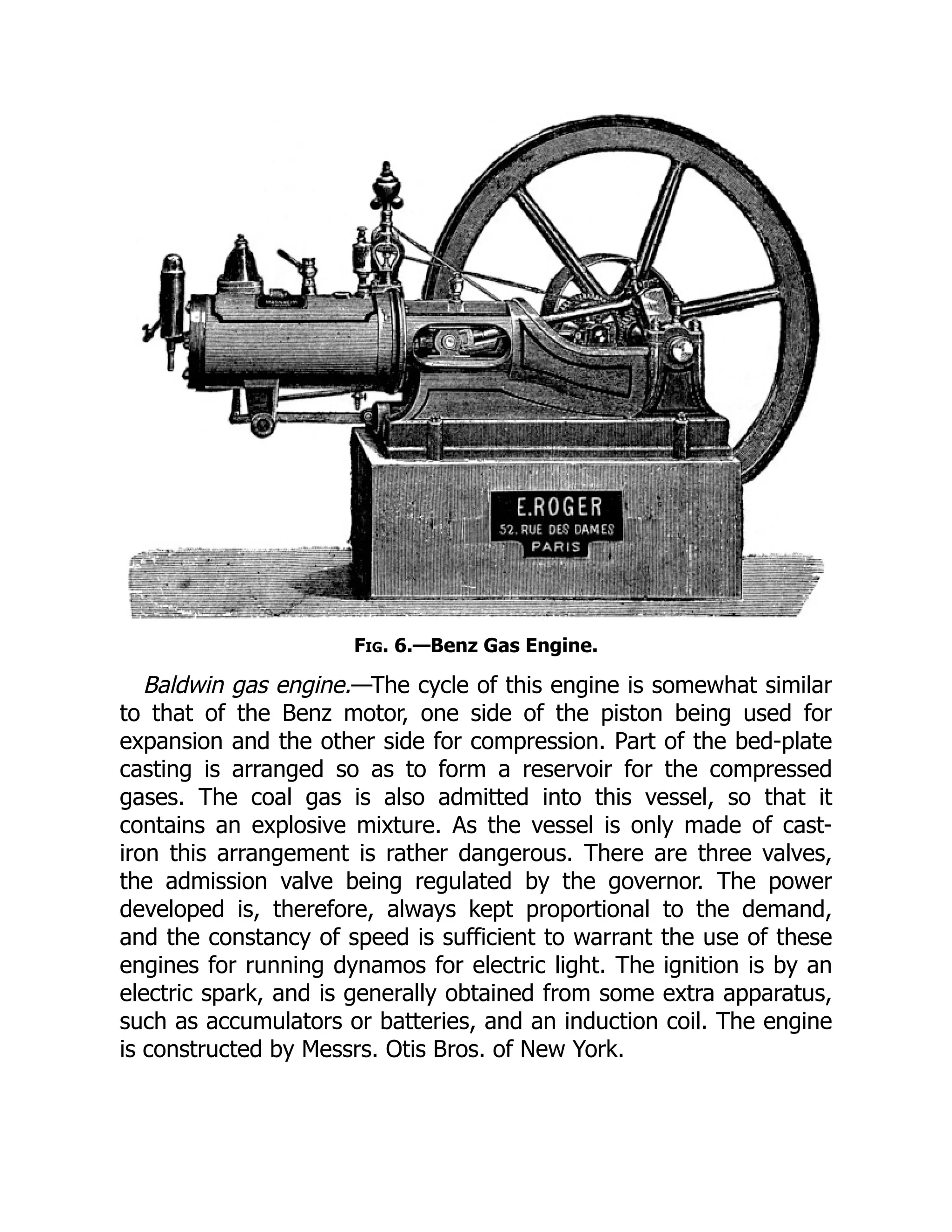
Fig. 6.—Benz Gas Engine.
Baldwin gas engine.—The cycle of this engine is somewhat similar
to that of the Benz motor, one side of the piston being used for
expansion and the other side for compression. Part of the bed-plate
casting is arranged so as to form a reservoir for the compressed
gases. The coal gas is also admitted into this vessel, so that it
contains an explosive mixture. As the vessel is only made of cast-
iron this arrangement is rather dangerous. There are three valves,
the admission valve being regulated by the governor. The power
developed is, therefore, always kept proportional to the demand,
and the constancy of speed is sufficient to warrant the use of these
engines for running dynamos for electric light. The ignition is by an
electric spark, and is generally obtained from some extra apparatus,
such as accumulators or batteries, and an induction coil. The engine
is constructed by Messrs. Otis Bros. of New York.
De Ravel motors.—The first motor constructed by M. de Ravel was
exhibited in Paris in 1878, and was of the oscillating cylinder type,
with a variable centre of gravity. The explosion drove up a heavy
piston whose rod was directly connected to the crank-pin. The
revolution of the crank-pin caused the whole cylinder to move in the
same manner as that of the early oscillating steam engines. This
movement was used as a means of opening and closing the ports.
The efficiency of the engine was low, using some 600 to 700 litres of
gas per horse-power hour; and besides the motor had, owing to
faulty mechanism, the unhappy knack of suddenly stopping dead.
These defects caused M. de Ravel to abandon this type and to bring
out a second motor in 1885, performing one cycle per revolution.
This new motor only had one cylinder, whose rear half acted as a
compression chamber during the backward stroke of the piston,
whilst the explosion took place in the front end of the cylinder. The
consumption of gas was slightly more than an Otto engine, and the
motor ran exceedingly silently and evenly, but this advantage was
not of much service in the struggle against the all-conquering Otto
motor.
Midland motor (Taylor).—Constructed in Nottingham, this engine is
of the horizontal double-cylinder type. One cylinder compresses the
explosive mixture and passes it on to the other, where it is ignited
and does work. The cranks connected to the two pistons are placed
65° apart, and a complete cycle in the cylinders is performed every
revolution. The makers of this engine claim a consumption of only
600 litres of gas per horse-power hour.
Campbell gas engine.—The mechanism of this engine is very much
like that of the Dugald-Clerk motor, two cylinders being placed side
by side. The utilization of the heat is, however, far superior, and only
about 500 litres of coal gas per horse-power hour are required. A
result which the inventor of this type of cycle never succeeded in
obtaining, but as far as we know the motor has never had any
official trial, and the above figures are only taken from the makers
prospectus. However, there is only a hardly perceptible shock from
the explosion, and the motor can be safely recommended to
anybody requiring a silent gas engine. There still exist gas engines
worked on this same cycle per revolution principle, such as the
Conelly, Day, De Ravel motors, descriptions of which must be sought
elsewhere. The limited space at our disposal prevents us from
discussing all those types which have only obtained a very small
measure of success. The only remaining engine based on this
principle worth mentioning is the Bénier motor, which is exceedingly
instructive, but we shall speak of it later under the head of poor-gas
engines. We shall at present pass on to the consideration of engines
based in principle on the patent of Beau de Rochas, and first
practically realized in 1877 by Dr. Otto.
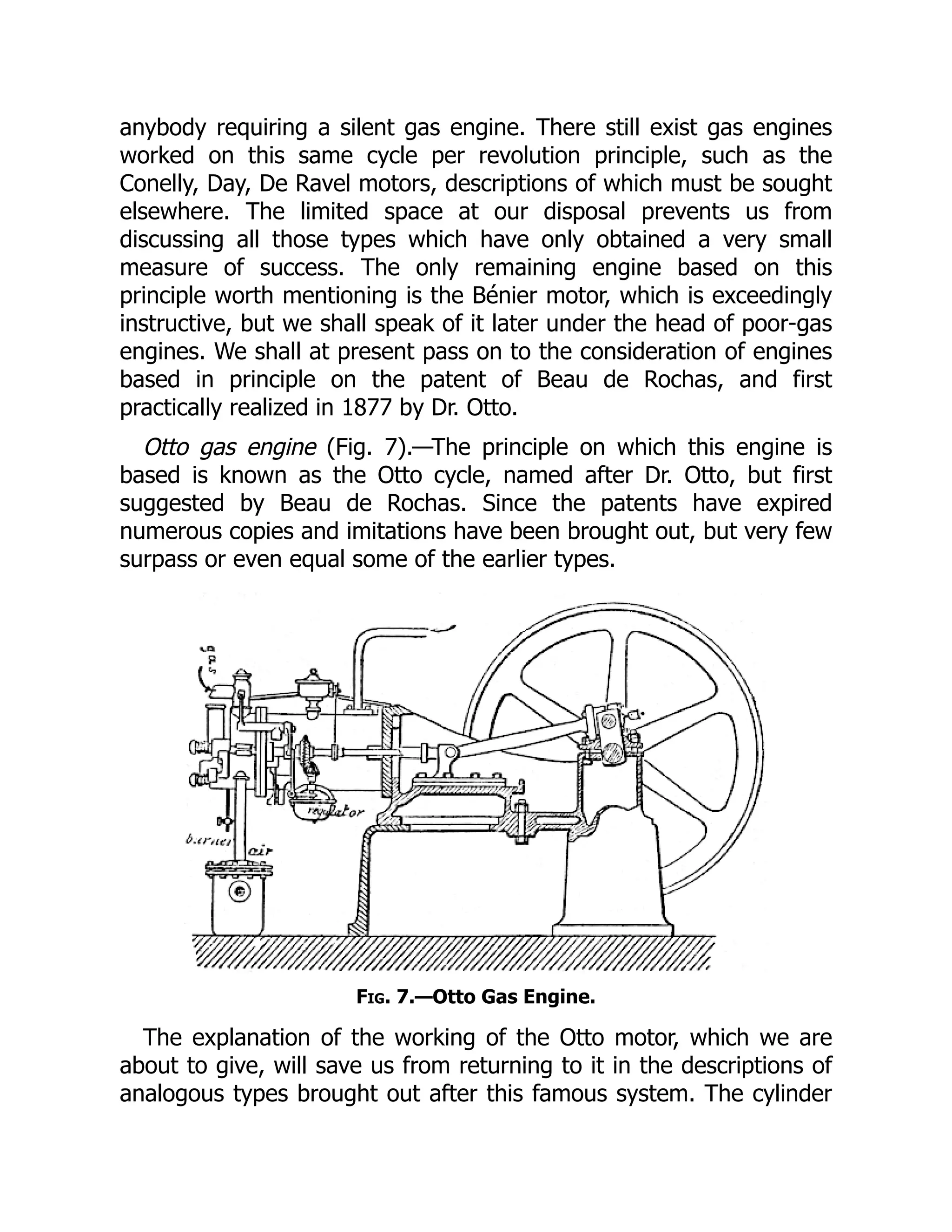
Otto gas engine (Fig. 7).—The principle on which this engine is
based is known as the Otto cycle, named after Dr. Otto, but first
suggested by Beau de Rochas. Since the patents have expired
numerous copies and imitations have been brought out, but very few
surpass or even equal some of the earlier types.
Fig. 7.—Otto Gas Engine.
The explanation of the working of the Otto motor, which we are
about to give, will save us from returning to it in the descriptions of
analogous types brought out after this famous system. The cylinder
is continued in a backward direction so as to form a compression
chamber, into which the mixture of gas and air is drawn during the
forward stroke of the piston. The mixture is compressed during the
return stroke in this chamber, the pressure rising at the end of the
stroke to about 3 or 4 atmospheres. At this point in the cycle a flame
is brought into contact with the compressed gases and they explode.
This explosion raises the temperature of the gases to 1500° C., and
drives forward the piston under a pressure of about 150 lbs. to the
square inch. During the second return stroke, corresponding to the
latter half of the second revolution of the crank, the piston drives out
the products of the combustion into the air under a pressure of
about an atmosphere. The heating of the cylinder is avoided by
keeping water automatically circulating through a jacket surrounding
it. This is necessary, because if the cylinder walls became heated,
the oil upon them would become decomposed, and lose its
lubricating properties. Dr. Otto paid special attention to the efficiency
of the engine, and in order to increase it, he diluted the air and gas
drawn into the cylinder with a portion of the gases already burnt in
the previous stroke. Consequently the explosion at the beginning of
the stroke is less violent, and the gases continue burning while the
piston moves forward. The cause of this slow combustion has been
wrongly attributed to stratification of superimposed layers of gas and
air, but it is probably due to the action of the cylinder walls.
The Otto gas engine is a marvel of simplicity from a mechanical
point of view, very much more so than a Corliss steam engine for
instance. The admission and exhaust valves are worked by cams,
and the ignition takes place under pressure. The governor is
sometimes of the centrifugal type, and at others of the inertia type,
but in both it is a case of all or nothing, the supply being completely
shut off if the engine is going too fast. The connecting rod joins the
crank to the piston rod by a cross-head running into a bored out-
guide. It is necessary to have a heavy fly-wheel, because, as only
one explosion takes place per two revolutions, the fly-wheel must
store up enough energy during that explosion to carry it through the
rest of the cycle. Many different types of Otto gas engines now exist,
some having two cylinders and a single crank, and others two fly-
wheels, in order to ensure constancy of speed for driving dynamos.
Dr. Otto devised a compound gas engine, but it did not succeed, and
also a cheaper vertical type (Fig. 8), which is very convenient for
small workshops. Since the invention of carburetted air the creator
of the Otto cycle has devised another motor for use with gasoline
instead of coal gas.
Otto devised the first practical gas engine and opened up the path
for others, who, following in his footsteps, have confined their
attention to improvement of detail. Some have undoubtedly
succeeded, and by avoiding waste of heat, and by raising the initial
temperature of the gases, they have considerably reduced the
consumption of fuel. We shall now discuss different types of motors
which have appeared during the last fifteen years, confining
ourselves to the really successful ones.
Fig. 8.—Otto Gas Engine (vertical type).
Second Lenoir motor.—Twenty-five years separated the
appearances of the first and second Lenoir motors, and during this
time M. Lenoir gained a great deal of practical experience, so that if
reference be made to Figs. 1 and 9 they will be seen to have very
little in common. In the later type the cylinder projects over the back
of the bed-plate, and is provided with deep circular grooves on the
outside to increase the cooling surface. Ignition is obtained by the
spark from a coil supplied by a battery as in the early form. The
consumption of gas is about 800 litres per horse-power hour. Later
on we shall discuss a petroleum motor for motor cars, and also a
stationary petroleum engine by the same inventor. These engines
were originally constructed by Mignon and Rouart, but later by the
Compagnie Parisienne du Gaz, and are very well designed and
constructed.
Fig. 9.—Lenoir Gas Engine (second type).
Koerting-Lieckfeld motor.—The first of these motors was
constructed in 1877, and was based on the Dugald-Clerk cycle. The
original type has, however, been abandoned, and the firm of Brûlé et
Cie. of Paris now construct these engines on the Otto system. All the
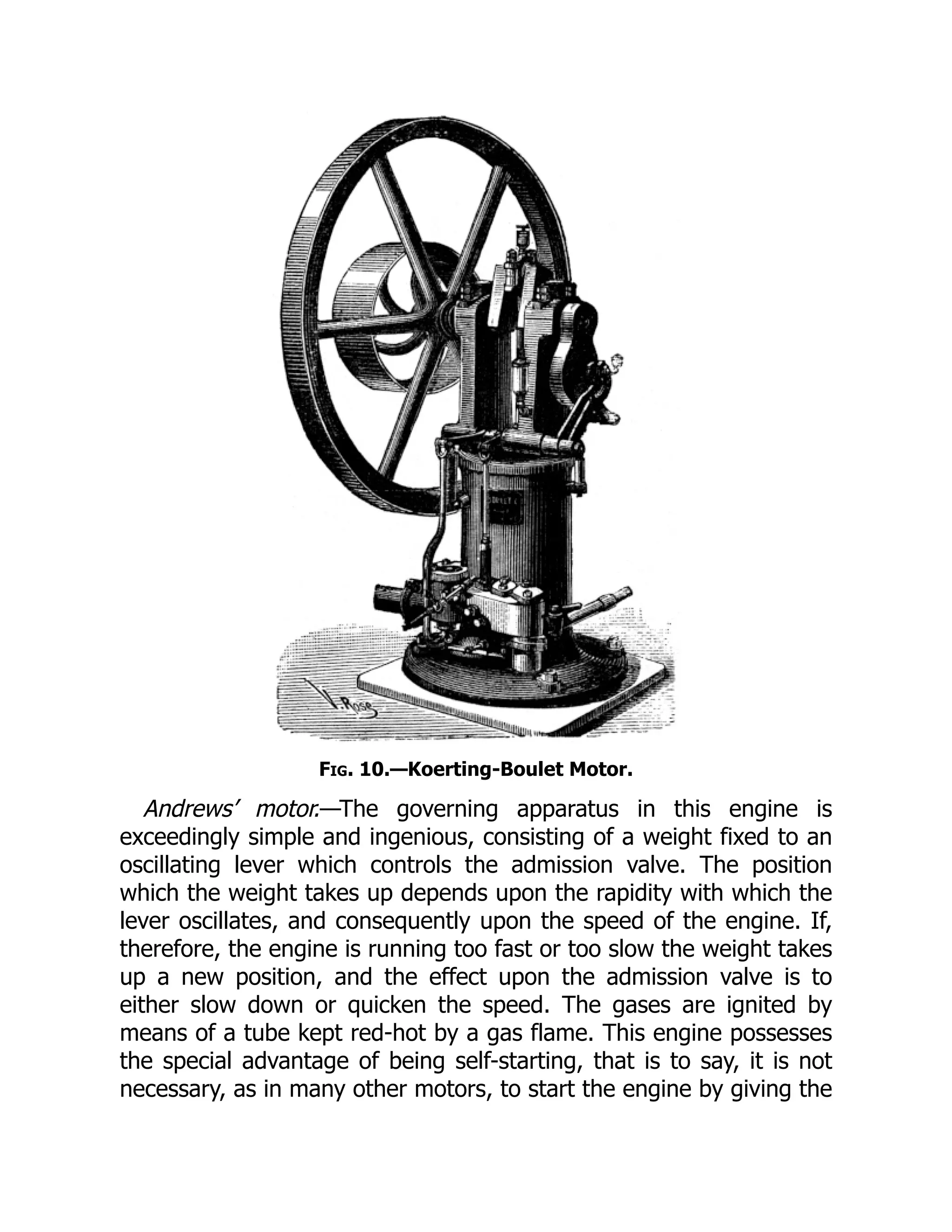
moving parts are attached to a vertical frame of cast-iron (Fig. 10),
the lower half containing the cylinder. The admission and exhaust
valves are situated in front and near the base. The governor is of the
centrifugal type and acts directly on the levers of the valves. The
flame ignition makes it necessary to occasionally clean out the
valves, but otherwise the motor has few drawbacks, and is very neat
and compact. The consumption of coal gas for engines of 8 horse-
power and upwards is about 800 litres per horse-power hour. The
crank-shaft is placed horizontally across the top of the frame, and
the cams acting upon the valves are rotated by a bevel gear
enclosed in a case, driving a thin supplementary shaft on which they
are placed. The motor is self-lubricating, and is also constructed as a
horizontal gas engine.
Fig. 10.—Koerting-Boulet Motor.
Andrews’ motor.—The governing apparatus in this engine is
exceedingly simple and ingenious, consisting of a weight fixed to an
oscillating lever which controls the admission valve. The position
which the weight takes up depends upon the rapidity with which the
lever oscillates, and consequently upon the speed of the engine. If,
therefore, the engine is running too fast or too slow the weight takes
up a new position, and the effect upon the admission valve is to
either slow down or quicken the speed. The gases are ignited by
means of a tube kept red-hot by a gas flame. This engine possesses
the special advantage of being self-starting, that is to say, it is not
necessary, as in many other motors, to start the engine by giving the
fly-wheel a few rapid turns by hand. The motor is stopped with the
crank in a position slightly in advance of the point corresponding to
ignition. The gas is allowed to enter by a small auxiliary valve, which
closes after the first explosion. This volume of gas entering the
cylinder mixes with the air already in it, forming an explosive
mixture. This explosive mixture then begins to escape by similar
automatic self-closing valves situated at the top of the red-hot
ignition tube. Ignition takes place, and is communicated to the rest
of the gas in the cylinder, closing the two small valves by the force of
the explosion. The piston is therefore driven forward, and the energy
of this combustion is sufficient to start the engine. It must be
understood that this operation is only performed once at starting, for
immediately afterwards the engine falls into its normal cycle of
operations. Two fly-wheels are as a rule provided to ensure
constancy of speed. The consumption of gas is as low as 580 litres
per horse-power hour in the large units of 100 horse-power.
The Andrews gas engine is also constructed of a special type for
consuming poor gas produced by the Dowson process, and gives
very good results. As a rule, about 600 to 800 grammes of
anthracite are necessary to produce one horse-power hour. In one
particular plant generating electricity, the cost has been certified to
be as low as one penny per kilowatt hour, including lubrication.
Fielding gas engine.—The characteristic point in these engines is
the extreme simplicity of the valve gear, only one valve being ever
subjected to pressure. Even in the small engines of this type all
sliding valves are replaced by those of the spring pattern, in fact, the
valve mechanism consists simply of two spring-valves, one of which
fulfils two functions, controlling the admission and the escape of the
gases. The two valves are moved by a double lever actuated by a
single cam. The cycle is that of Dr. Otto. When the piston is starting
on the return stroke after an explosion has taken place, the lever
lifts one of the valves, and the products of the combustion escape
into a circular space situated below. In the next forward stroke this
valve is still further lifted, opening the admission port, while at the
same moment the exhaust port is closed by the second valve; a new
charge is therefore drawn into the cylinder. At the end of the
admission stroke the valves are released by the lever, and the
compression can now take place during the second return stroke.
The movement causing the lifting of the valve continuously
throughout one whole revolution is effected by means of a cam with
two prominences on it, which act in succession on the lever. There is
only one valve, therefore, which is subjected to pressure, and even
this is well provided against risk of leakage by the second valve
being placed behind it, acting as a double seating. A chamber is also
provided in which the gases are first mixed, and this mixing is
regulated by a second lever and a special valve. The governor is of
the inertia type, and is attached to the upper side of the double
lever. It consists of a straight rod with a ball at one end and a knife
edge at the other, pivoted at its centre to the end of the valve lever.
As this lever is thrown forward the knife edge strikes the end of the
spring-valve admitting gas to the mixing chamber. If the speed is too
great the sudden jerk on the ball at the other end of the knife edge
causes it to miss the valve, and no gas is admitted till the speed is
reduced to the normal number of revolutions per minute. This
arrangement is very sensitive, and keeps the speed exceedingly
constant. Mr. Fielding has constructed some large gas engines of 350
horse-power which are started by compressed air, this air having
been previously stored up under pressure when the motor was
stopping.
Niel motor.—As will be seen from Fig. 11, the valves are actuated
by cams rotating on a supplementary shaft placed parallel to the
cylinder. A pair of toothed wheels transmit the rotation of the crank
to this valve-shaft, and it is arranged so as to give one rotation to
every two of the crank. The cycle of operations is somewhat similar
to the Otto cycle; gas is only admitted to the cylinder for two-thirds
of the forward stroke, so that the compression on the back stroke is
somewhat lessened. It is doubtful whether there is much advantage
in this method, but the Niel motors have had a large sale, which is a
sufficient proof of their good qualities.
Fig. 11.—Niel Gas Engine (elevation and sectional plan).
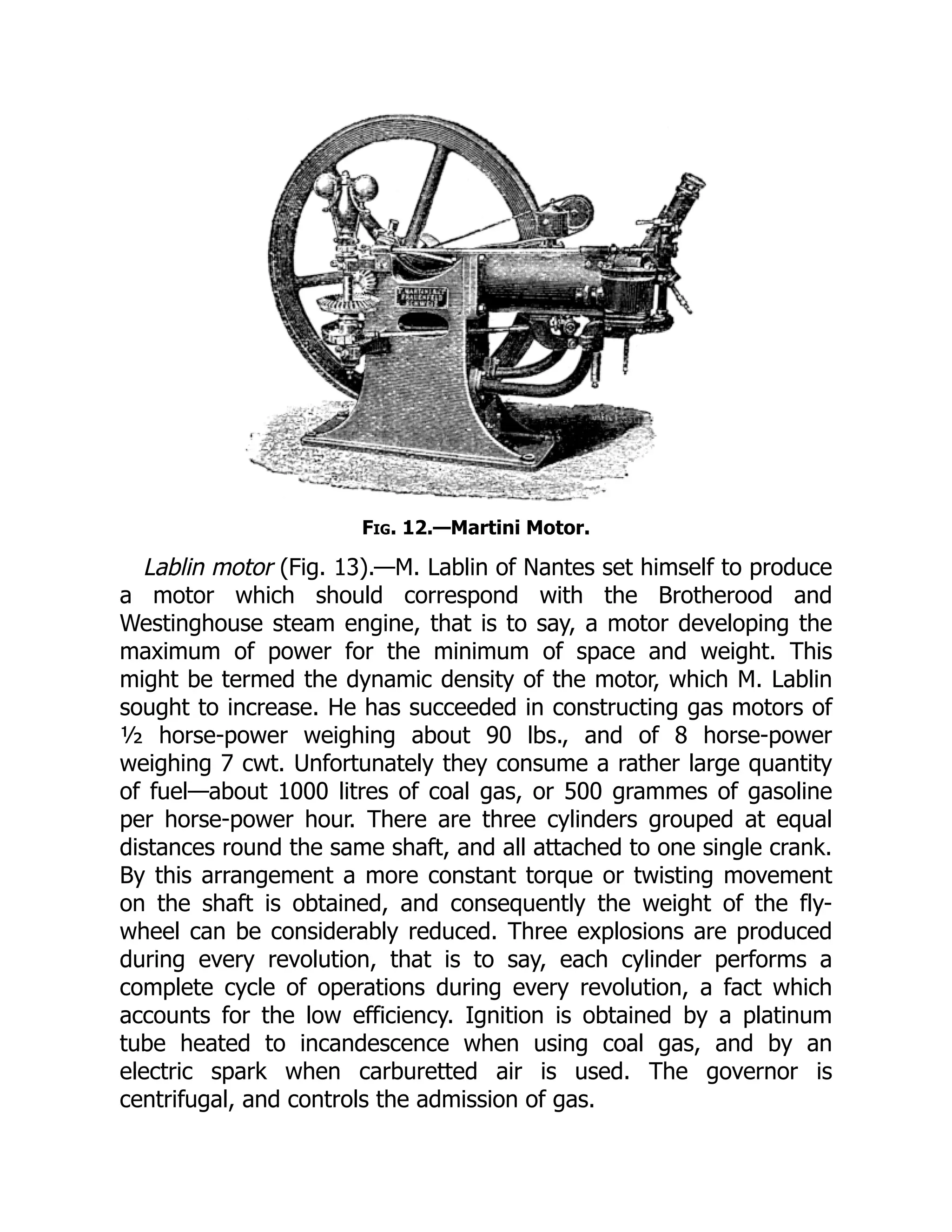
Lombart, Martini (Fig. 12), Adam, Le Parisien, and Le Kientzy
motors.—All these motors, each of which is constructed by a
different maker, are based in principle on the Otto engine, and
except for slight modifications of the working parts, they do not call
for any particular notice. The small amount of space at our disposal
only admits of our mentioning them.
Fig. 12.—Martini Motor.
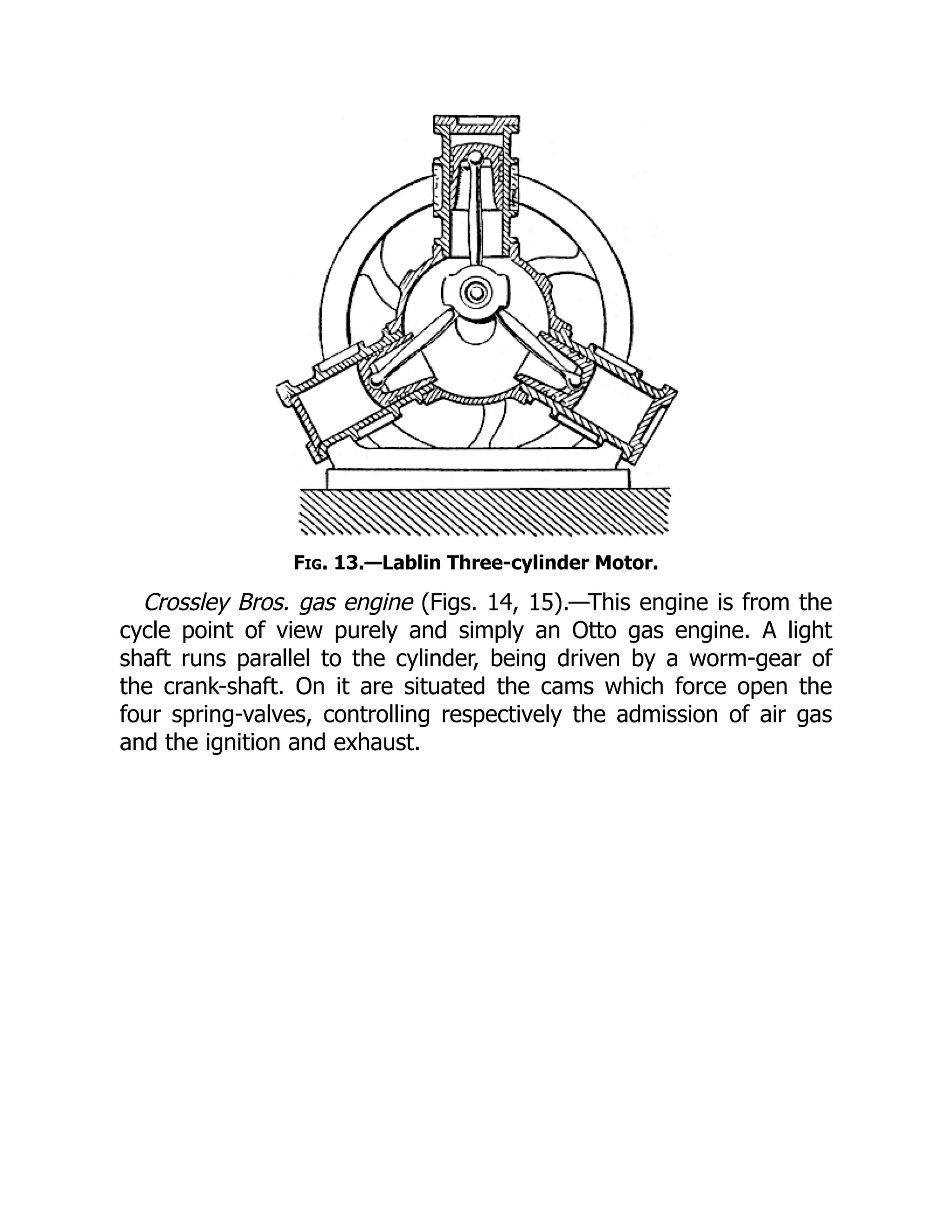
Lablin motor (Fig. 13).—M. Lablin of Nantes set himself to produce
a motor which should correspond with the Brotherood and
Westinghouse steam engine, that is to say, a motor developing the
maximum of power for the minimum of space and weight. This
might be termed the dynamic density of the motor, which M. Lablin
sought to increase. He has succeeded in constructing gas motors of
½ horse-power weighing about 90 lbs., and of 8 horse-power
weighing 7 cwt. Unfortunately they consume a rather large quantity
of fuel—about 1000 litres of coal gas, or 500 grammes of gasoline
per horse-power hour. There are three cylinders grouped at equal
distances round the same shaft, and all attached to one single crank.
By this arrangement a more constant torque or twisting movement
on the shaft is obtained, and consequently the weight of the fly-
wheel can be considerably reduced. Three explosions are produced
during every revolution, that is to say, each cylinder performs a
complete cycle of operations during every revolution, a fact which
accounts for the low efficiency. Ignition is obtained by a platinum
tube heated to incandescence when using coal gas, and by an
electric spark when carburetted air is used. The governor is
centrifugal, and controls the admission of gas.
Fig. 13.—Lablin Three-cylinder Motor.
Crossley Bros. gas engine (Figs. 14, 15).—This engine is from the
cycle point of view purely and simply an Otto gas engine. A light
shaft runs parallel to the cylinder, being driven by a worm-gear of
the crank-shaft. On it are situated the cams which force open the
four spring-valves, controlling respectively the admission of air gas
and the ignition and exhaust.
Fig. 14.—Crossley Gas Engine (X type).
Fig. 15.—Crossley Gas Engine.
The pressure of the gases is raised during compression to about
four atmospheres, and immediately after the explosion it rises to
about 180 lbs. on the square inch; during the exhaust it averages
about 10 lbs. per square inch. Ignition is obtained by a tube heated
to a bright red incandescence by a Bunsen flame. At the right
moment a valve is opened, placing the explosive mixture in contact
with it and causing the explosion. When starting the machine the
ignition is retarded or takes place a little after passing the dead
point, so that the machine cannot start the wrong way by mistake.
Two or three other features call for special notice, especially the
device for lubricating the cylinder. In the illustration (Fig. 14) will be
seen a small bell-shaped receptacle. This vessel contains oil, and
also a small crank inside driven by a belt off the valve-shaft. As this
crank rotates it dips into the oil at the bottom of the vessel, and at
the top of its path it wipes off the oil which it has gathered on to a
cup which allows it to flow into the cylinder.
The water jacket is cast separately from the cylinder, and not, as
in many engines, in one piece with it. There is an advantage in this,
because there is less likelihood of flaws or blow-holes in the cylinder
wall passing unobserved when the engine is leaving the maker’s
hands. The governor in some of the sizes is centrifugal, and in
others of the inertia type similar to that described in the Fielding gas
engine.
Pygmée motor (Lefebvre).—This motor, shown in Fig. 16, gives
one the idea of solidity and compactness. It possesses the peculiar
property of working equally well in any position, either horizontal or
vertical. This is due to the fact that it is particularly well balanced,
and when running does not vibrate at all. Easily started, these
engines run at a very constant speed, and their power in relation to
their size is truly remarkable, hence the name Pygmée. They have
been especially designed for self-propelled vehicles, and are not
affected by the worst running conditions, such as inclement weather
or bad roads. In this type they are constructed with two cylinders in
order to obtain a more constant torque, and also have an
arrangement by which the speed can be changed. For stationary
purposes the motor is mounted on a cast-iron stand (Fig. 16). In
virtue of their exceedingly small dimensions and reduced weight
they are specially suitable where small-power motors are required
for home industries or small workshops, and also for driving private
electric installations and pumping water. They have economically
replaced steam engines in agricultural operations, both on a large
and small scale. The working parts being entirely enclosed they
stand a good deal of rough usage, and will work in positions in
which other motors would be useless. Where it is necessary to bring
the motor to the work it is required to perform they are bolted to a
carriage instead of a cast-iron base.
Fig. 16.—Pygmée Gas Engine.
The “National” gas engine.—As a gas engine this machine is
constructed in all sizes, from one horse-power up to large units
requiring a gas plant of their own. As petroleum motors they range
from one to ten horse-power. They are all provided with two fly-
wheels, which keep them well balanced and steadies their speed.
They have besides been especially designed with a view to economy
of coal gas or petroleum. An idea of the general arrangement of the
parts will be obtained by glancing at Fig. 17. The petroleum motors
are provided in addition with a vaporizer and a petroleum lamp
placed at the front end of the machine, and the oil reservoir is
situated immediately above the cylinder. M. Herckenrath has
specially devoted himself to simplifying the mechanism and making it
more self-contained and less unsightly. Up to 50 horse-power only
one cylinder is found necessary, and for larger powers two are
provided. The patent governor is centrifugal and rather novel in
construction, and to it is partly due the high efficiency of these
engines. The large sizes are as easily started as the smaller ones,
and the lubrication is perfectly automatic. Besides these advantages
they require a minimum of attention, in fact, a skilled attendant can
be dispensed with, a few explanations and instructions being all that
is necessary to enable a boy or labourer to take competent charge of
them.
Fig. 17.—Herckenrath National Gas Engine.
Forest motor (Figs. 18, 19, 20).—We have already described the
earlier attempts of M. Forest to produce a practical gas engine. The
idea embodied in the motor depicted in Fig. 20, if not particularly
advantageous, is none the less highly original. The ends of the single
cylinder are open, and within it are two pistons, between which the
explosive mixture is introduced. The explosion drives these pistons
out in different directions, but by means of a suitable mechanism
they are each connected to one of two cranks on the same shaft.
The whole forms a very neat and compact arrangement. In another
type by the same inventor (Figs. 18, 19), also working on the Otto
cycle, the cylinders are vertical, there being one, two, or four placed
side by side. In the last case two explosions per revolution are
obtained, ensuring a very constant torque throughout. M. Forest
has, however, particularly applied himself in collaboration with M.
Gallice to designing petroleum engines for small boats. These two
inventors have conceived a highly ingenious arrangement for
reversing the direction of rotation of the engine, which is absolutely
necessary in the propulsion of boats. All the cams which actuate the
valves are grouped together on a light shaft, and by a simple
twisting of this shaft from one end by a handle the engine is
reversed. The engines are self-starting, and are so especially suitable
for the propulsion of boats that they have been adopted by the
French navy, who at the present date have a number of small
vessels propelled by this motive power.
Fig. 18. De Forest Gas Engines. Fig.
19.
Fig. 20.—De Forest Double Piston Motor.
Cuinat gas engines.—These engines are constructed in four types.
The A type is vertical with the cylinder above and fly-wheel and shaft
below. This is a more stable arrangement than placing them in the
reversed order, as is more frequently done. For small engines the
vertical type is undoubtedly the best, space, or rather lack of space,
being very often an important consideration to the purchaser. The B
type is similar to the previous one, except that two fly-wheels are
provided so as to make it suitable for small electric light installations.
The C type is horizontal, having all the valves placed vertically, which
plan seems to work better for engines of power greater than 10
horse-power. The D type is also horizontal, but has two fly-wheels,
having been specially designed for electric lighting purposes. In
order to take up as little space as possible the dynamo is situated
underneath the projecting cylinder, both the engine and dynamo
being bolted down on to a special bed-plate. This arrangement is
more stable than placing them on separate foundations. In the
petroleum engines an electric spark is used to ignite the gases, and
in the gas engines both electricity and a gas flame.
It is best not to use animal or vegetable oils for lubricating the
inside of the cylinder, because they decompose, forming fatty acids
which have a corrosive action. Besides this, when they have fulfilled
their function of lubrication they settle down to a thick paste, which
has a most injurious effect on the working of the engine. It is best,
therefore, to use nothing but perfectly pure mineral oils and to avoid
all others. This does not only apply to the type of engine we have
just been describing, but to all gas engines. The Cuinat gas and
petroleum motors do not mix a portion of their exhausted gases with
the fresh charge as is frequently done, but completely sweep away
the products of the explosion before admitting a new charge. The
result is, that combustion is more complete but at the same time
rather more violent. An examination of an indicator diagram taken
from one of these engines shows that the combustion takes place at
once as an explosion, and that the final expanded pressure is as low
as it is possible to get it. These being the conditions necessary for a
high efficiency, it is needless to state that the consumption of fuel in
these engines is as low as in any other engine.
Noël motor.—This type, constructed at Provins, has the advantage
of being exceedingly simple. The entries to the cylinder are
controlled by spring-valves, and the gases are ignited by electricity.
From the ¼ up to the 2 horse-power size the cylinder is not
provided with a water jacket, and the general arrangement is either
vertical or horizontal. These engines work equally well with coal gas
or carburetted air; in the latter case the carburator is placed inside
the cast-iron frame of the motor. The guaranteed consumption of
fuel is about 900 litres of gas or 500 grammes of gasoline per horse-
power hour, which is quite satisfactory.
Tenting motor.—This is a horizontal motor with the cylinder cooled
atmospherically, and the gases ignited by electricity. The governor
acts upon the exhaust valve; the products of the explosion remain in
the cylinder if the speed is too great, and then the admission valve,
which is automatic, no longer rises to admit a fresh charge until the
speed has once more fallen to the normal. This little motor is one of
the most practical small-power engines existing, partly because of
the great simplicity of the mechanism. It works well with carburetted
air, and the vertical type has been successfully applied to the
propulsion of small pleasure-boats.
Atkinson motor (Figs. 21, 22).—This apparatus, constructed by the
British Gas Engine Company, was until recently the most efficient
heat engine in existence, its indicated efficiency being 22·8%. Mr.
Atkinson, the inventor, has arrived at this result by making the gases
burn gradually and by shortening the compression stroke. The
discharge of the residual gases is complete, this being directly
opposite to Dr. Otto’s procedure, for he diluted his explosive mixture
largely with the exhausted gases. In order, however, to make the
piston execute two strokes relative to the cylinder of different
lengths, the inventor has had to devise a rather complicated
mechanism (Fig. 21). The result, however, quite neutralizes this
slight disadvantage.
Fig. 21.—Diagram of Atkinson Mechanism.
Fig. 22.—Section of Charon Motor.
Charon motor (Fig. 23).—M. Charon has attempted to obtain a
prolonged combustion without the complicated devices resorted to
by Atkinson. He has obtained the same result by means of a
regulator controlling a double cam, one half of which actuates the
admission valve and the other half an auxiliary valve, which opens
into a tube forming a sort of reservoir, into which part of the
explosive mixture passes during the compression. After the explosion
this stored-up mixture is gradually allowed to re-enter the cylinder
and prolong the combustion. By this means a considerable gain in
economy is obtained, so that engines of this type only use about 500
litres of coal gas per horse-power hour. In appearance the motor
much resembles the Otto motor, the crank-shaft and valve-shaft and
valves being placed in the same relative positions. Although these
motors are rather more expensive than others working with the Otto
cycle, they are nevertheless widely used. This is due to the fact that
if cost of coal gas in a particular district is high it is cheaper in the
end to pay a higher price for an efficient engine than to buy a less
expensive and at the same time less economical machine.
Fig. 23.—Charon Motor (latest type).
Roger motor.—This excellent little engine (Fig. 24) was especially
designed for small workshops. The extreme simplicity of the working
parts in no way lessens the efficiency, for the two horse-power only
burns 700 litres of gas per horse-power hour. The simple design also
keeps the cost of construction low, and the price averages about £30
per horse-power.
Fig. 24.—Roger Vertical Gas Engine.
The governor controls the admission valve. Ignition is obtained by
means of an incandescent tube; the cylinder is cooled by a water
jacket; the mean speed is about 200 revolutions per minute, and this
speed is constant enough to allow the engine to drive a dynamo for
electric lighting. The motor has been very favourably received
abroad, but is not much known in this country.
Motor of the Compagnie Parisienne du Gaz (Fig. 25).—Owing to its
very large consumption of gas the engine can only be used if the
price of gas is low, but it has several advantages which to a certain
extent neutralize this defect. It runs at a high speed of 400
revolutions per minute, and the parts are arranged so as to be easily
accessible.
Fig. 25.—Vertical Gas Engine of the Compagnie Parisienne du Gaz.
Letombe motor.—Constructed by the firm of Mollet-Fontaine of
Lille, this engine presents several interesting features which we will
briefly enumerate. The cylinder is double-acting, giving one impulse
to the piston during every revolution. The speed is therefore
maintained fairly constant. The efficiency is high owing to the gases
in the cylinder being made to burn slowly as in the Charon motor.
The machine on the whole works exceedingly satisfactorily and
reflects great credit on its inventors.
Robuste (Levasseur) motor.—The composition, admission, and
ignition of explosive mixture are regulated by a sliding valve as in
the Otto motor; in this case, however, it is a piston-valve and not a
flat one. The valve-chest is at the back of the cylinder. The governor
is of the inertia type, and suppresses the admission if the speed
becomes higher than the normal. A double water jacket is provided
for cooling the cylinder walls. Although not presenting any new
features, this motor fully merits its name, and its solid construction
enables it to withstand a surprising amount of bad handling.
Richardson and Norris gas engine.—Yet another high-speed
engine, running at a speed of 230 revolutions per minute. Roby &
Co. construct this machine especially for driving dynamos, and for
this purpose two fly-wheels are provided in order to make it run
smoothly without variation of speed. The gases are ignited through a
valve with a double seating by means of a red-hot tube. The motor
is reversible, which is an advantage under certain conditions. Poor
gas can also be used instead of coal gas, consuming about 510
grammes of anthracite per horse-power hour for an 86 horse-power
engine supplied with Dowson gas. This works out to a thermal
efficiency of 21%, a result which places this engine above criticism.
H. C. motor.—This is an enclosed motor for use in mines or dusty
places, the fly-wheel alone of the moving parts being visible. It
works equally well with coal gas, carburetted air, or petroleum, and
is constructed in sizes from ½ to 60 horse-power. In spite of its
original features it has not met with much success up to the present
time.
Le Marcel and Le Maurice motors (Cadiot) (Fig. 26).—The smallest
types of the Marcel motors are of one man-power, and the largest of
one horse-power, so that they are only suitable for small operations.
One impulse is given to the piston every two revolutions, the cycle
being that of Dr. Otto. The gas is compressed in a red-hot tube
during half of the backward stroke. There are only two valves, one
for the admission and the other for the escape of the gases,
actuated by a single cam on the crank-shaft. The cylinder is cooled
by a water jacket. The governor works on the all or nothing
principle, the supply of gas being completely shut off if the speed
rises above the normal of 350 revolutions per minute.
Fig. 26.—Maurice Motor (de Cadiot).
The Maurice motors are somewhat similar in construction, but are
designed for operating dynamos. For this purpose two fly-wheels are
provided. Many of these little motors are to be seen about the
country working fans, lathes, pumps, etc.
Various.—We have described about thirty different sorts of motors,
selected from the best-known and most original types. About one
hundred other motors exist in Europe, which are similar in one way
or another to those already described, such as the engines of
Dürkopp, Forward, Brouhot, Debry de Soissons, Narjot, Archat,
Wertenbruch, the “Acmé” motor, and many others. But we are
obliged to limit our descriptions, and to conclude the chapter by a
couple of examples of motors performing one cycle of operations per
three revolutions.
Griffin motor.—In this engine we have only two explosions over
three revolutions, but as it is double-acting this number is reduced to
one explosion per revolution and a half. The different operations are
as follows:—(1) gases drawn into the cylinder, (2) compression of
gases, (3) ignition and expansion, (4) products of combustion driven
out of the cylinder, (5) a volume drawn into it to completely sweep
away any residue of the exhaust gases, (6) this volume of air drawn
out.
Admission and ignition are obtained by the action of a sliding valve
and eccentric. The governor causes the gas admission valve to
remain open for a shorter or longer time, so as to ensure constancy
of speed. The exhaust gases escape by two valves actuated by a
pair of cams, opening them at every turn and a half, so that the
gases are alternately discharged from the back and front parts of the
cylinder. The consumption of fuel for a 12 horse-power motor was
about 792 litres of coal gas per horse-power hour in an official trial.
The speed is very constant in spite of the long cycle.
Rollason gas engine.—This is also an engine using a long cycle of
operations, the arrangement of the parts being copied off the Otto
motor. The governor is electric, and acts on the admission valve,
varying the amount of gas admitted to the cylinder in proportion to
the demand for power. In the larger size of from 20 to 100 horse-
power a self-starting arrangement has been added. This engine, like
the Griffin motor, has proved that it is possible, by completely
getting rid of the products of combustion, to use a very dilute
explosive mixture, which would be impossible in the Otto motor. The
Rollason engine is constructed by Messrs. Beck and Co. of
Newcastle-on-Tyne.
CHAPTER IV
CARBURETTED AIR ENGINE
If cold air be saturated with the vapour of volatile spirits such as
gasoline, or distillates of petroleum of about ·65 mean specific
gravity, an explosive mixture is formed with similar properties to that
produced by coal gas mixed with air. This carburetted air can be
used as fuel for heat engines of the explosive type. About twenty
different methods of carburating air are in existence, some of which
are more practical than others. We shall proceed to describe the best
known of these.
Mille carburetted gas.—In this system air is drawn into a reservoir
containing a petroleum spirit by the volatilization and fall of the
petroleum vapour, this vapour being heavier than air. The reservoir is
placed on a higher level, and an indiarubber tube connected to its
base leads the explosive mixture to the cylinder. The success of this
arrangement encouraged inventors to perfect it. One of the earliest
carburators by Lafroque was provided with a tiny hot-air engine,
which helped to obtain a more perfect saturation of the air with the
volatile spirit. In the Eclipse motors, and also in the Phœbus motors
of Pluyer and Muller of Birmingham, the air and spirit vapour are
mixed by an injector. The vapour is first obtained by heating the
liquid spirit in a small still; it then passes by a fine nozzle across a
space drawing air with it after the manner of the Giffard injector. The
explosive mixture thus obtained passes into a reservoir.
Faignot apparatus.—The air is drawn in by a revolving pump and
forced into a vessel, divided into several compartments, one above
the other, separated by porous partitions and containing gasoline;
several taps or valves cause the compartments to be alternately
opened or closed, so that the mixture can always be drawn off rich
in hydrocarbon vapour. This apparatus appeared in 1885 at the
Antwerp Exhibition, and supplied a Bénier motor with carburetted air.
It is suitable for lighting villages, country houses, etc., in fact, any
places where coal gas is not laid on. The apparatus has been
imitated by Polack of Hamburg and others.
Lenoir carburetted air motor.—Carburators for producing fuel for
motive power have been carefully studied during the last ten years
by reason of the rapidly extended use of gas motors. One of the
most ingenious is due to M. Lenoir, constructed for a special motor
designed by himself and constructed by Messrs. Rouart frères. This
carburator consists of a horizontal cylinder rotated by a pinion
wheel, and performing five or six revolutions a minute. Vertical
perforated partitions divide the cylinder internally into several
compartments, and the interior wall of the cylinder has attached to it
a number of small buckets which draw up the spirit like a water-
wheel, and pour it out again when they reach the summit of their
path. The air and vapour are thus thoroughly mixed, and pass from
thence into the cylinder. Motors supplied by such carburators have
been used for agricultural operations, and also for driving small
pleasure vessels, the cost of maintenance per horse-power hour
being about 2½d.
Schrab carburator.—The idea of this apparatus is quite original.
The jacket for cooling the motive cylinder is filled not with water but
with the hydrocarbon to be vaporized. From thence it passes at a
temperature of about 180° F. into a carburator containing several
compartments, and through which pass part of the products of
combustion; these gases passing through the already boiling liquid
hydrocarbon become saturated with its vapour, but require
admixture with air before they are capable of being exploded. The
inventor states that the waste gases only take up 1
/16th part of that
which pure air would in passing through the hot liquid fuel, and thus
explains the extraordinary economy of fuel which is obtained by
these motors, only 1/16th of a litre of gasoline being necessary to
produce one horse-power hour. This is a very remarkable result, and
if it is correct places this combined plant in the foremost rank of
carburetted air engines.
Meyer carburator.—This apparatus has the advantage of allowing
heavier and cheaper oils to be used, at the same time completely
volatilizing them. The heavy hydrocarbons are allowed to fall drop by
drop into a steel chamber about eight centimetres diameter and four
centimetres in height, heated by a flame. The vapour is produced at
a high pressure, and escapes through a fine nozzle at high speed
drawing the necessary air with it. Entering a reservoir this explosive
mixture is prevented from returning by a check-valve. The apparatus
is so arranged, that when the pressure in the reservoir has reached
a certain point, the flame heating the vaporizer is turned down and
prevents further explosive mixture being formed. The apparatus is
therefore self-regulating, the supply of carburetted air being always
proportional to the demand.
Delamare carburator.—M. Delamare-Deboutteville has devised a
very compact carburator for use with his Simplex motor. Gasoline is
contained in an upper vessel, from which it flows in a fine stream
from a tap on to a horse-hair brush, and is there met by a similar
stream of warm water coming from the water jacket of the cylinder.
The heat obtained from this source tends to vaporize the
hydrocarbon, and the two liquids fall together into a closed vessel.
The gasoline rids itself of its impurities and floats on the surface of
the water, which is withdrawn from underneath it by a siphon. The
hydrocarbon vapour produced during the fall, and afterwards by the
heat of the substratum of water, passes by a check-valve to the
motor. It is found that the cleansing effect of the water renders the
cylinder much less liable to become fouled by tarry products.
Lothhammer carburator.—Experience has shown that vapour of
petroleum when mixed with air soon separates out; the vaporizer
must therefore be placed as close to the engine as possible. In this
motor it has been the aim of the inventor to obtain an exceedingly
perfect mixture of the explosive gases. In order to do this the air
enters the vaporizer near its base, and passes through it in a
number of exceedingly fine streams of bubbles. The petroleum spirit
is at the same time heated by a flame, and the result is a very close
mixture of the gases. The inventor claims that he thereby obtains
much more complete combustion.
Tenting motor.—M. Tenting has arranged his gas engine, which we
have already described on page 57, for use also as an oil engine.
The carburator is composed of three superposed vessels, through
each of which the oil flows in turn. The upper vessel acts as a
reservoir and will hold a day’s consumption of oil, and the lower one
is traversed by the exhaust pipe, which supplies the heat necessary
to obtain the change of state of the oil from liquid to gas. Although
this carburator is rather crude it gives a very fair practical result.
Durand carburetted air engine (Fig. 27).—M. Durand has set
himself to produce a motor which should work equally well with gas
or petroleum, and which should require a minimum of attention at
the same time, keeping in view such points as regularity of speed,
rigidity, economy of space, and above all low price. This ideal he
has, however, failed to reach, although his engine has many good
points. He fails chiefly because the mechanism is too complicated.
The motor works with an Otto cycle, and the ignition is by an electric
spark generated by a small magneto machine. The regulation of the
speed is obtained by throttling the admission, and the air is drawn
through a tube heated by the waste gases; this arrangement allows
a slight economy to be effected. The carburator is automatic,
consisting of a closed cylinder placed vertically over the motor
cylinder. Within it is placed the oil fuel, and also a spongy mass of
cork which soaks up the heavier impurities found in the oil, and
thereby allows cheaper oils to be used. Air is drawn through the
spongy mass, becoming carburetted in the process; these gases are
mixed with a further quantity of pure air in a distributing chamber
before entering the cylinder.
Welcome to Our Bookstore - The Ultimate Destination for Book Lovers
Are you passionate about testbank and eager to explore new worlds of
knowledge? At our website, we offer a vast collection of books that
cater to every interest and age group. From classic literature to
specialized publications, self-help books, and children’s stories, we
have it all! Each book is a gateway to new adventures, helping you
expand your knowledge and nourish your soul
Experience Convenient and Enjoyable Book Shopping Our website is more
than just an online bookstore—it’s a bridge connecting readers to the
timeless values of culture and wisdom. With a sleek and user-friendly
interface and a smart search system, you can find your favorite books
quickly and easily. Enjoy special promotions, fast home delivery, and
a seamless shopping experience that saves you time and enhances your
love for reading.
Let us accompany you on the journey of exploring knowledge and
personal growth!
ebooksecure.com

(eBook PDF) Information Systems A Manager's Guide to Harnessing Technology Version 6.0

  • 1.
    (eBook PDF) InformationSystems A Manager's Guide to Harnessing Technology Version 6.0 download https://ebooksecure.com/product/ebook-pdf-information-systems-a- managers-guide-to-harnessing-technology-version-6-0/ Download full version ebook from https://ebooksecure.com

  • 2.
    We believe theseproducts will be a great fit for you. Click the link to download now, or visit ebooksecure.com to discover even more! (eBook PDF) Information Systems A Manager's Guide to Harnessing Technology Version 7.0 http://ebooksecure.com/product/ebook-pdf-information-systems-a- managers-guide-to-harnessing-technology-version-7-0/ (Original PDF) Information Systems; A Managers Guide to Harnessing Technology, 5th Edition http://ebooksecure.com/product/original-pdf-information-systems- a-managers-guide-to-harnessing-technology-5th-edition/ Biology: A Guide to the Natural World, Technology Update (5th Edition - PDF Version) 5th - PDF Version http://ebooksecure.com/product/biology-a-guide-to-the-natural- world-technology-update-5th-edition-pdf-version-5th-pdf-version/ (eBook PDF) Introduction to Information Systems: People, Technology and Processes 3rd Edition http://ebooksecure.com/product/ebook-pdf-introduction-to- information-systems-people-technology-and-processes-3rd-edition/
  • 3.
    CISM Certified InformationSecurity Manager All-in-One Exam Guide 1st Edition - eBook PDF https://ebooksecure.com/download/cism-all-in-one-ebook-pdf/ CISM Certified Information Security Manager All-in-One Exam Guide, 2nd Edition Peter H. Gregory - eBook PDF https://ebooksecure.com/download/cism-certified-information- security-manager-all-in-one-exam-guide-2nd-edition-ebook-pdf/ (Textbook) Introduction to Information Systems 6th Edition http://ebooksecure.com/product/textbook-introduction-to- information-systems-6th-edition/ (eBook PDF) Introduction to Information Systems 3rd Edition http://ebooksecure.com/product/ebook-pdf-introduction-to- information-systems-3rd-edition/ (eBook PDF) Introduction to Information Systems 16th Edition http://ebooksecure.com/product/ebook-pdf-introduction-to- information-systems-16th-edition/
  • 4.
    Information Systems A Manager’sGuide to Harnessing Technology John Gallaugher Version 6.0
  • 5.
    233 235 238 245 247 Chapter 11 247 250 260 266 273 281 285 Chapter 12 285 287 290 293 295 296 297 299 301 Chapter13 301 303 307 311 316 319 324 325 Chapter 14 325 327 329 331 332 Future Outlook: Established Players Get Collaborative Airbnb—Hey Stranger, Why Don’t You Stay at My Place? Uber: Sharing Economy Success from Tech-Fueled Superior Service Endnotes Facebook: A Billion-plus users, the High-Stakes Move to Mobile, and Big Business from the Social Graph Introduction Disrupting Competition, Building Competitive Advantage, and the Challenging Rise of Mobile Lessons from Facebook as an Apps Platform: Early Promise, Continued Challenges, Mobile Missteps Advertising and Social Networks: A Challenging Landscape but a Big Payoff A Platform Player that Moves Fast and Breaks Things: What All Managers Can Learn from Facebook’s Mistakes, Responses, and Pursuit of New Opportunities Endnotes Rent the Runway: Entrepreneurs Expanding an Industry by Blending Tech with Fashion Introduction Founding the Business: Are We On To Something? Customer Engagement (Mobile, Social, and Physical Storefronts) Data Operations and Logistics Expanding with New Models Conclusion Endnotes Understanding Software: A Primer for Managers Introduction Operating Systems Application Software Distributed Computing, Web Services, and APIs Writing Software Understanding Technology beyond the Price Tag: Total Cost of Ownership (TCO) and the Cost of Tech Failure Endnotes Software in Flux: Open Source, Cloud, Virtualized and App-driven Shifts Introduction Open Source Why Open Source? Examples of Open Source Software Why Give It Away? The Business of Open Source
  • 6.
    334 336 339 341 345 348 349 351 353 355 Chapter 15 355 359 362 366 368 373 380 383 385 Chapter 16 385 385 393 399 407 409 Chapter17 409 411 416 430 436 439 Chapter 18 439 443 449 450 456 Defining Cloud Computing Software in the Cloud: Why Buy When You Can Rent? SaaS: Not without Risks Understanding Cloud Computing Models: PaaS, IaaS, and Motivations and Risks Clouds and Tech Industry Impact Virtualization: Software That Makes One Computer Act Like Many Apps and App Stores: Further Disrupting the Software Industry on Smartphones, Tablets, and Beyond Make, Buy, or Rent Endnotes The Data Asset: Databases, Business Intelligence, Analytics, Big Data, and Competitive Advantage Introduction Data, Information, and Knowledge Where Does Data Come From? Data Rich, Information Poor Data Warehouses, Data Marts, and Technology behind “Big Data” The Business Intelligence Toolkit Data Asset in Action: Technology and the Rise of Walmart Endnotes A Manager’s Guide to the Internet and Telecommunications Introduction Internet 101: Understanding How the Internet Works Getting Where You’re Going Last Mile: Faster Speed, Broader Access Endnotes Information Security: Barbarians at the Gateway (and Just About Everywhere Else) Introduction Why Is This Happening? Who Is Doing It? And What’s Their Motivation? Where Are Vulnerabilities? Understanding the Weaknesses Taking Action Endnotes Google in Three Parts: Search, Online Advertising, and an Alphabet of Opportunity Introduction Understanding Search Understanding the Increase in Online Ad Spending Search Advertising Ad Networks—Distribution beyond Search
  • 7.
    460 461 466 471 474 487 491 More Ad Formatsand Payment Schemes Customer Profiling and Behavioral Targeting Profiling and Privacy Search Engines, Ad Networks, and Fraud The Battle Unfolds Endnotes Index
  • 9.
    © 2014 CateJones Photography About the Author Professor John Gallaugher has led student learning experiences on five continents. Part of the founding faculty for Boston College’s TechTrek programs, and former co-lead of the school’s graduate field studies in Europe and Asia, Professor Gallaugher has had re- markable access to effectively study technology growth and its impact worldwide. Pro- fessor Gallaugher and his students spend several weeks each year visiting technology executives, entrepreneurs, and venture capitalists in San Francisco, Silicon Valley, Seattle, Boston, New York, and Ghana, and are regularly hosted in master-class sessions at firms from Amazon to Zynga. This unique opportunity helps give his teaching and writing a broad, deep, and continually refreshed perspective on key industry trends and developments. He is the author of the award-winning, annually-updated textbook “Information Systems: A Manager’s Guide to Harnessing Technology,” as well as "Learn to Program Using Swift for iOS Development," an online book featuring over 70 video lessons that progressively teaches coding and app-building skills to new-to-program- ming students. Prof. Gallaugher’s research has appeared in the Harvard Business Review, MIS Quarterly, and other leading journals. Named “Guru to Grads” by Entrepreneur magazine, Gallaugher has also received the Boston College Trzaska Faculty Leadership Award, the all-university Teaching Award, and the student newspaper’s Momentum Award for campus impact. During his time on the leadership team of the Boston College Venture Competition (BCVC), en- trepreneurs affiliated with the program gained admittance to elite startup accelerators (Y-combinator, TechStars, MassChallenge, Summer@Highland), launched multiple products, and raised over $100 million in capital. Professor Gallaugher has been a featured speaker at Apple Inc’s AcademiX educat- or conference, and was the international keynote speaker at AIBUMA (the African International Business and Management Confer- ence) in Nairobi, Kenya. He has consulted for and taught executive seminars for several organizations, including Accenture, Alcoa, Duke Corporate Education, ING, Partners Healthcare, Staples, State Street, the University of Ulster, and the U.S. Information Agency. His comments on business and technology have appeared in the New York Times, National Public Radio, BusinessWeek, the Boston Globe, Wired, the Associated Press, Chronicle (WCVB-TV), The Daily Yomiuri (Japan), and the Nation (Thailand), among others. A member of the Information Systems Department at BC’s Carroll School of Management, Professor Gallaugher earned his Ph.D. in Information Systems from the Syracuse University School of Management, and he holds an MBA and an undergraduate degree in computer science, both from Boston College. He shares additional content related to his teaching and research at http://gallaugher.com, and is also active on Twitter at @gallaugher.
  • 10.
    Acknowledgments First and foremost,my enduring thanks to my current and former students, who continue to inspire, impress, and teach me more than I thought possible. It’s deeply rewarding to see so many former students return to campus as executive speakers and to host vis- iting students at their own firms. Serving as your professor has been my greatest professional privilege, and I am grateful for such an extraordinary opportunity. Keep at it and continue to make us all proud! Thanks also to the many alumni, parents, and friends of Boston College, who have so generously invited me to bring my stu- dents to visit with and learn from them. The experiences that you’ve provided to us have been nothing short of astonishing. We were present at the launch of the iPhone. We’ve not only made twice-a-year pilgrimages to Sand Hill Road, One Infinite Loop, Hacker Way, and The Googleplex, but many of our former students were funded and mentored by the VCs we’ve visited with. Name a tech firm making waves and we’ve almost certainly got an alumnus there, and when asked, they’ve uniformly opened their offices to share insight with our students. The East and West Coast leadership of the Boston College Technology Council have played a particularly important role in making this happen. From Bangalore to Boston, Guangzhou to Ghana, Seoul to Silicon Valley, you’ve provided my students with world-class opportunities, enabling us to meet with scores of CEOs, senior executives, partners, and entrepreneurs. You’ve positively impacted lives, shaped careers, and helped make our university stronger. My students and I remain deeply grateful for your commitment and support. A tremendous thanks to my student research team at Boston College. In this update, the work of Kaitlin Ardiff, Tiffany Liu, and Branick Weix helped keep our book the most current available. Prior editions benefited from input from Rootul Patel, Kelly Peder- sen, Michael Lapointe, Abhinav Arora, Mujtaba Syed, Phil Gill, Xin (Steven) Liu, and Kathie Chang, who at various times sped things along and helped me fill this project with rich, interesting examples. You have all been so kind to tolerate my constant and unreasonable requests. I am also deeply grateful to my colleagues at Boston College. My former department chair, Jim Gips, is not only a consummate mentor and educator, as creator of the EagleEyes and CameraMouse projects (cameramouse.org) he has given voice to countless people with disabilities worldwide and is the single most impactful researcher that I know. Tremendous thanks, as well, to my cur- rent department chair, Rob Fichman, for his unwavering support of this project; to my BC IS Department colleagues Jerry Kane, for helping shape the social media section, and Sam Ransbotham, for guiding me through the minefield of information security (Jerry and Sam both hold NSF CAREER grants and are MIT Sloan Management Review editors for Social Media and Big Data, respect- ively); to BC’s Mary Cronin, Burcu Bulgurcu, Peter Olivieri, and Jack Spang for suggestions and encouragement; and to the many administrators who have been so supportive of this effort. Allen Li, Marios Kokkodis, Peter Sterpe, and Shannon Provost—I hope the text helped make your start at BC a bit easier. And Xuan Ye, welcome to the team! A special thanks to BC Professor George Wyner, who has provided extraordinary guidance, encouragement, ideas, and friendship, all of which have kept me motivated on such a high-demand project. I’m so lucky to work with such brilliant and caring faculty. I hope you know how very much I appreci- ate you all. I'm also grateful for the folks at FlatWorld, who continue to wear the white hats while offering low-cost, highly innovative learn- ing products, challenging industry conventions, and helping students and faculty worldwide. Vicki Brentnall has been an especially understanding, highly skilled, and rapidly responding steward of this work. Thank you so much for keeping things on track and making the final product stronger. Alastair Adam and John Eielson, I'm excited about your stewardship of FlatWorld and look for- ward to great things to come. I would also like to thank the following colleagues who so kindly offered their time and comments while reviewing this work: < Donald Army, Dominican University of California < David Bloomquist, Georgia State University < Teuta Cata, Northern Kentucky University < Chuck Downing, Northern Illinois University < John Durand, Pepperdine University < Marvin Golland, Polytechnic Institute of New York University < Brandi Guidry, University of Louisiana < Kiku Jones, The University of Tulsa < Fred Kellinger, Pennsylvania State University–Beaver Campus < Ram Kumar, University of North Carolina–Charlotte < Eric Kyper, Lynchburg College < Alireza Lari, Fayetteville State University < Mark Lewis, Missouri Western State University < Eric Malm, Cabrini College < Roberto Mejias, University of Arizona
  • 11.
    < Esmail Mohebbi,University of West Florida < John Preston, Eastern Michigan University < Shu Schiller, Wright State University < Tod Sedbrook, University of Northern Colorado < Richard Segall, Arkansas State University < Ahmad Syamil, Arkansas State University < Sascha Vitzthum, Illinois Wesleyan University I’m also grateful to the kindness and insight provided by early adopters of this text. Your comments, encouragement, suggestions, and student feedback were extremely helpful in keeping me focused and motivated while advancing the current edition: < Animesh Animesh, McGill University < Elizabeth Bagnani, Boston College < Geneviève Bassellier, McGill University < Michel Benaroch, Syracuse University < Hanyin Cheng, Morgan Stanley < Barney Corwin, University of Maryland—College Park < Brad Crisp, Abilene Christian University < Lauren B. Eder, Rider University < Rob Fichman, Boston College < James Gips, Boston College < Wolfgang Gatterbauer, Carnegie Mellon University < Roy Jones, University of Rochester < Jakob Iverson, University of Wisconsin—Oshkosh < Jerry Kane, Boston College < Fred Kellinger, Penn State University—Beaver Campus < Eric Kyper, Lynchburg College < Ann Majchrzak, University of Southern California < Eric Malm, Cabrini College < Michael Martel, Ohio University < Ido Millet, Pennsylvania State University—Erie Campus < Ellen Monk, University of Delaware < Marius (Florin) Niculescu, Georgia Tech < Sam Ransbotham, Boston College < Nachiketa Sahoo, Carnegie Mellon University < Shu Schiller, Wright State University < Tom Schambach, Illinois State University < Avi Seidman, University of Rochester < J. P. Shim, Georgia State University < Jack Spang, Boston College < Veda Storey, Georgia State University < Sascha Vitzthum, Illinois Wesleyan University I’ll continue to share what I hope are useful insights via my blog, The Week In Geek (http://www.gallaugher.com), Twitter (@gallaugher), and Google+ (https://plus.google.com/+JohnGallaugher). Do feel free to offer comments, encouragement, ideas, and examples for future versions. I am hugely appreciative of all who continue to share the word about this project with others. Your continued advocacy helps make this model work! Want to learn to program and build apps? Check out the online learning resource at http://gallaugher.com/swift. Professors, it’s a great way to offer a high-impact, light-lifting technical course in a flipped-class mod- el, and it also works well for online learning, independent study, as well as for a traditional lecture-driven programming course. Boston College students Courtney Scrib and Nate Dyer also pointed me to examples I’ve used in this edition, as did ACU stu- dent Aaron Andrew. Thanks for thinking of me and for sharing your very useful ideas! And finally, a thanks to my family, to whom I’ve dedicated this book. That really doesn’t do a shred of justice to my great for- tune in being Kim’s husband and father to Ian, Maya, and Lily. You’ve been epically tolerant of the time commitment associated with this project. You are my world. ACKNOWLEDGMENTS 3
  • 12.
    Dedication For Ian, Maya,Lily, and Kim—yottabytes of love!
  • 13.
    Preface WHAT'S NEW INVERSION 6.0 FRESHLY UPDATED Chapters 1–10 have received updates to ensure that they cover the latest topics and material. Today’s cutting edge firms and headline grabbing topics are presented through durable frameworks and concepts. UPDATED AND NEW EXAMPLES THROUGHOUT Zara: An entire sub-section on Zara e-commerce has been added, plus an image of the firm's 5-star-rated app. Includes inform- ation defining omni-channel and how Zara's online and offline efforts blend for an integrated customer experience. Zara's efforts are contrasted with rival Primark's failed attempts to sell online. Additional information is updated throughout the chapter, including new stats and information on emerging competitors. Three compelling charts showing Zara's two-decade-plus growth in revenue, store openings, and operating profit have now been included in the text. Netflix: Additional information on the importance of data as firms struggle to be the “first search” interface for entertainment. Rivals highlighted include Comcast offering Netflix on Xfinity (and even signing up new Netflix subscribers), Apple allowing Amazon into AppleTV, and Amazon integrating premium cable content into Prime TV search, and selling subscriptions to these channels in the process (a great concept to relate to learning in the Amazon chapter, as well). A roughly 2-and-a-half minute video, "How Netflix Changed TV," is embedded in the chapter's first section. Updated stats are included throughout, including information on original content and licensing spending, the profitability of DVD-by-mail, subscriber growth, international market expansion, and the firm's $1 billion international debt issue. Moore's' Law & More: Includes additional information on the rise of graphics chips/ASICs & FPGAs for machine learning and artificial intelligence. The chapter now describes these technologies, why they're useful, and a table and photos that offer quick com- parison with pros and cons. Also included are updated references of IoT with new examples (HomePod, Snapchat Spectacles), and fun new media examples including an image and spec list of the $10 Raspberry Pi Zero W (a specs-rich full computer that costs less than what many spend on an iPhone cable), and a Netflix-created video (with website link) on using an Arduino to create "Netflix Socks," which pauses streaming if the wearer has fallen asleep. You’ll also find updated stats on the incredible growth of M-Pesa in Kenya and information on the approval of the Proteus ingestible, as well as new information on Waton's use in health care, pharma, financial services, marketing, and education. Disruptive Innovation: The call-out section on threats to Intel has been updated and is now labeled "Intel’s Cash Cow: Increas- ingly Threatened by Chip Designs Originally Used in Phones and Graphics Cards." The section includes new information on Microsoft's commitment to ARM-based chips in its data center, information on consortia attempts to make ARMs run Intel-com- patible software, and how to relate this information to the rise of graphics chips for machine learning–further eroding the data cen- ter market that Intel has traditionally dominated. The section that explains Bitcoin and the block chain has been updated and re- named "From Bitcoin to Blockchain and Beyond." Statistics are updated as well. Emerging cryptocurrencies such as the popular Ethereum and Ripple are mentioned, new examples of blockchain technology use are offered, and a callout section that describes the recent developments known as ICOs (or Initial Coin Offerings) is included. Amazon: New information is included on "clicks" and "bricks" including Amazon Campus stores, Amazon Books stores, Amazon Go, Amazon Fresh, and the announced Whole Foods purchase. You’ll find an Amazon Go demonstration video, which shows how machine learning/computer vision may change physical retail. There’s a new discussion of Amazon warehousing and distribution facilities, which currently total 400 centers worldwide. Also included are new details on the functioning of Amazon fulfillment centers, and an updated video (replacing two prior videos) that shows a Greater Toronto Area fulfillment center in ac- tion, from products coming in and being stacked on robot-mounted shelves to order picking, packing, and sorting prior to leaving the warehouse. Amazon's push into logistics is examined, with the firm using data and vertical integration to determine when to share packages with UPS, FedEx, and the US Postal Service, and when to arrange for package delivery itself. The firm's leasing of cargo jets, purchase of tractor trailers, foray into ocean freight, and local truck scheduling are detailed. Students learn how analytics, scale, and custom infrastructure help cut shipping costs, speed delivery, and perhaps even lay the groundwork for a possible separate shipping business. New information on Amazon's commercial drone delivery tests is offered, along with a video demonstration of the Cambridge, UK effort. New stats are included, including the fact that Amazon's market cap is currently larger than Walmart, Target, Best Buy, Macy’s, Nordstrom, Kohl’s, JCPenny, and Sears–combined. The Quidsi shutdown is mentioned, as well as Walmart's acquisition of Jet. Also covered is new Amazon Dash Wand video–content on Dash products is now used in conjunction with other consumer electronics and Alexa/Echo. The Sharing Economy: Includes important details on the ouster of Travis Kalanic as Uber's CEO, the firm's bad behavior, and how internal culture can harm a brand, employee morale, and fundraising efforts (an important discussion as the industry works to be more inclusive and appeal to a broader talent base). And More: The challenges of competition based on technology is highlighted by comparing Snap's post IPO struggles with Facebook's rapid feature matching with its much more widely used Instagram and Facebook products. Updated stats on FreshDirect are included, including info on profitability, sales, Washington DC expansion, and meal kit delivery business/investment.
  • 14.
    Augmented Reality andVirtual Reality are defined, and examples are offered throughout the text, including an expanded discussion of Blue Nile in the Strategy and Technology chapter. NEW DEFINITIONS Several new terms are introduced and linked as keywords in the text, including: ASIC (application-specific integrated circuit) processors, augmented reality, channel conflict, coopetition, frenemies, FPGA (field programmable gateway array) processors, initial coin offering, machine learning, omnichannel, and showrooming. NEW HANDS-ON EXERCISES A Brief introduction to Tableau is included in the Data Asset chapter, including a video tutorial where students can download a free student version of the leading business analytics tool and experiment with a short example showing data visualization for decision-making. The Understanding Software chapter also encourages students with access to a Mac to experiment with the first chapters (free online) in Learn to Program using Swift for iOS Development. LETTER FROM THE AUTHOR Thanks for using this book. I very much hope that you enjoy it! I find the space where business and technology meet to be tremendously exciting. The information systems (IS) course should be the most exciting class within any university. No discipline is having a greater impact on restructuring work, disrupting indus- tries, and creating opportunity. And none more prominently features young people as leaders and visionaries. But far too often stu- dents resist rather than embrace the study of tech. My university has had great success restructuring the way we teach our IS core courses, and much of the material used in this approach has made it into this book. The results we’ve seen include a four-fold increase in IS enrollments in four years, stellar stu- dent ratings for the IS core course, a jump in student placement, an increase in the number of employers recruiting on campus for tech-focused jobs, and the launch of several student-initiated start-ups. Material in this book is used at both the graduate and undergraduate levels. I think it’s a mistake to classify books as focused on just grad or undergrad students. After all, we’d expect our students at all levels to be able to leverage articles in the Wall Street Journ- al or BusinessWeek. Why can’t our textbooks be equally useful? You’ll also find this work to be written in an unconventional style for a textbook, but hey, why be boring? Let’s face it, Fortune and Wired wouldn’t survive if forced to write with the dry-encyclopedic prose used by most textbooks. Many students and faculty have written kind words about the tone and writing style used in this book, and it’s been incredibly rewarding to hear from students who claim they have actually looked forward to assigned readings and have even read ahead or explored unassigned chapters. I hope you find it to be equally engaging. The mix of chapter and cases is also meant to provide a holistic view of how technology and business interrelate. Don’t look for an “international” chapter, an “ethics” chapter, a “mobile” chapter, or a “systems development and deployment” chapter. Instead, you’ll see these topics woven throughout many of our cases and within chapter examples. This is how professionals encounter these topics “in the wild,” so we ought to study them not in isolation but as integrated parts of real-world examples. Examples are consumer-focused and Internet-heavy for approachability, but the topics themselves are applicable far beyond the context presented. Also note that many chapters are meant to be covered across multiple classes. For example, the chapter about Google is in three parts, the one about Netflix is in two, and the one on strategy and technology likely covers more than one lecture as well. Faculty should feel free to pick and choose topics most relevant to their classes, but many will also benefit from the breadth of coverage provided throughout the book. I’d prefer our students to be armed with a comprehensive understanding of topics rather than merely a cursory overview of one siloed area. There’s a lot that’s different about this approach, but a lot that’s worked exceptionally well, too. I hope that you find the material to be as useful as we have. I also look forward to continually improving this work, and I encourage you to share your ideas with me via Twitter (@gallaugher), Google+ (https://plus.google.com/+JohnGallaugher), or the Web (http://www.gallaugher.com). And if you find the material useful, do let others know, as well. I remain extremely grateful for your interest and support! Best wishes! Professor John Gallaugher Carroll School of Management Boston College 6 INFORMATION SYSTEMS: A MANAGER'S GUIDE TO HARNESSING TECHNOLOGY VERSION 6.0
  • 15.
    C H AP T E R 1 Setting the Stage: Technology and the Modern Enterprise 1. TECH’S TECTONIC SHIFT: RADICALLY CHANGING BUSINESS LANDSCAPES L E A R N I N G O B J E C T I V E 1. Appreciate how, in recent years, technology has helped bring about radical changes across in- dustries and throughout societies. This book is written for a world that has changed radically in the most recent years of your lifetime. Consider just a few examples: Uber, the world’s largest “taxi service,” owns no vehicles for hire. Airbnb, the world’s largest accommodations provider, doesn’t own a single hotel or rental property. Facebook, the world’s most visited media destination, creates no content. And the world’s most valuable retailer, China’s Alibaba, owns no product inventory of its own.[1] Change is clearly afoot, and it’s wearing silic- on sneakers, carrying a smartphone, and is being blown forward by cloud-fueled hurricane tailwinds. Here are some more examples: At the start of the prior decade, Google barely existed and well- known strategists dismissed Internet advertising models.[2] By decade’s end, Google brought in more advertising revenue than any firm, online or off, and had risen to become the most profitable media company on the planet. Today, billions in advertising dollars flee old media and are pouring into digit- al efforts, and this shift is reshaping industries and redefining skills needed to reach today’s consumers. The firm’s ambitions have grown so large that Google has rechristened itself Alphabet (http://abc.xyz), a holding company with divisions focused on markets as diverse as driverless cars and life extension. At roughly the same time Google was being hatched, Apple was widely considered a tech industry has-been, but within ten years and powered by a succession of handheld consumer electronics hits (iPod, iPhone, iPad) Apple had grown to be the most valuable firm in the United States. The firm has since posted several of the most profitable quarters of any firm in any industry, ever.[3] If app sales through iTunes, alone, were considered a separate business, they would constitute a firm larger than more than half of the companies ranked in the Fortune 500.[4] The smartphone and app store are the modern accelerant of business growth. It took telephones seventy-five years to get to 50 million users, but it took Angry Birds just thirty-five days to do the same. WhatsApp gained 700 million adherents in its six years of existence, a figure Christianity took nineteen centuries to achieve.[5] Social media barely warranted a mention a decade ago. Today, Facebook’s user base is larger than any nation in the world. Mobile is its lynchpin, with more than 1.25 billion users visiting on handheld devices each month, and roughly two-thirds visiting each day.[6] Firms are harnessing social media for new product ideas, for millions in sales, and to vet and build trust. But with promise comes peril. When mobile phones are cameras just a short hop from YouTube, Facebook, Instagram, and Twitter, every ethical lapse can be captured, every customer service flaw graffiti-tagged on the permanent record that is the Internet. The service and ethics bar for today’s manager has never been higher. Social media has also emerged as a catalyst for global change, with Facebook and Twitter playing key organizing roles in uprisings worldwide. While a status update alone won’t depose a dictator or expunge racism, techno- logy can capture injustice, broadcast it to the world, disseminate ideas, and rally the far-reaching. Moore’s Law and other factors that make technology faster and cheaper have thrust computing and telecommunications into the hands of billions in ways that are both empowering the poor and poisoning the planet.
  • 16.
    IPO Initial public stockoffering, the first time a firm makes shares available via a public stock exchange, also known as ‘going public.’ China started the century as a nation largely unplugged and offline. But today, China has more In- ternet users than any other country. Chinese mobile payments in 2016 were nearly 50 times greater than those in the US.[7] China now tops the United States as the worldwide leader in iPhone sales.[8] Watch your back, Apple: Chinese handset maker Xiaomi has been jockeying with Uber as the world’s most valuable startup.[9] And China has spectacularly launched several publicly traded Internet firms including Baidu, Tencent, and Alibaba—the largest IPO of all time.[10] The world’s second most populous nation, India, has ridden technology to become a global IT powerhouse. In two decades, India’s tech sector has grown from almost nothing to a $120 billion in- dustry, expanding even during the recent global recession.[11] Technology has enabled the once almost-exclusively-agrarian nation to become a go-to destination for R&D and engineering across sec- tors as far-flung as aircraft engine design, medical devices, telecom equipment, and micropro- cessors.[12] India’s TCS (Tata Consulting Services) is the world’s second-largest technology solutions firm, second in size only to IBM.[13] Think the United States holds the top ranking in home broadband access? Not even close: the Un- ited States is ranked thirty-first in download speeds[14] and twenty-sixth in mobile broadband.[15] Today, smartphones are used by 2 billion people worldwide. By the end of this decade that number will be 4 billion, with 80 percent of adults being smartphone equipped. The most popular brand in In- dia, Micromax, sells entry-level smartphones priced below $40.[16] Even in the far reaches of nations in sub-Saharan Africa, fast/cheap tech is becoming an economic lubricant. Seventy percent of the region’s population lives within range of mobile phone coverage, a percentage of the population greater than those who have access to reliable and safe water or electricity. Forty percent of sub-Saharan Africans already have mobile phones.[17] Tech giants including Google, IBM, and Microsoft now run R&D centers and significant operations in several African nations, tap- ping into world-class tech talent that’s finally gaining infrastructure for growth.[18] Many nations in sub-Saharan Africa now rank among the world’s fastest growing economies.[19] And entrepreneurs with local expertise are increasingly serving local needs and building impactful businesses. Ghanaian firm Esoko leverages mobile phones to empower the agrarian poor with farming info and commodity pricing, raising incomes and lowering the chance of exploitation by unscrupulous middlemen. The firm Sproxil uses text message verification to save lives by fighting drug counterfeiting in developing nations around the world. Kenya’s M-PESA and Somaliland’s Zaad use text messages to replace cash, bringing the safety and speed of electronic payment and funds transfer to the unbanked and leveraging mobile money at rates that far outstrip any nation in the West.[20] Adoption rates are astonishing: 84 percent of adults in Tanzania use mobile phones for money transactions.[21] Mobile money can cut corruption, too, an effort with broad implications as this tech spreads worldwide. When Afghan police officers adopted M-PESA and began receiving pay using mobile money, many reportedly thought they had received a big raise because the officers handing out their pay were no longer able to cheat workers by skimming cash for themselves.[22] 8 INFORMATION SYSTEMS: A MANAGER'S GUIDE TO HARNESSING TECHNOLOGY VERSION 6.0
  • 17.
    Internet of Things Avision where low-cost sensors, processors, and communication are embedded into a wide array of products and our environment, allowing a vast network to collect data, analyze input, and automatically coordinate collective action. FIGURE 1.1 Many nations in sub-Saharan Africa are seeing significant tech-fueled growth. Throughout the continent, technologies substitute for cash, deliver insights to farmers, and help uncover counterfeit pharmaceuticals. This plant in Accra, owned by Ghanaian firm Rlg, is the first sub-Saharan PC, tablet, and cell phone assembly facility. Source: Photograph taken with permission of the Rlg plant. Fast/cheap computing is also helping create the multi-billion dollar Internet of Things (IoT), putting smarts in all sorts of products: lamps, watches, thermostats, and door locks. Disney has embedded smarts in a wristband it uses to replace ticketing at Disney World. GE thinks sensors and computing will save the planet trillions of dollars through a hyper-efficient, data-driven, collectively orchestrated set of devices,[23] and has embedded smarts in everything from home air conditioners to high-end air- craft parts.[24] Think the smartphone market is big? Research firm Gartner says there are already some 5 billion connected IoT devices in use today, with 25 billion on the way by the end of the decade.[25] Cheap processors and software smarts are also powering the drone revolution with far-reaching impact. Today’s farmers use drones to regularly survey crops at closer distances and with greater regu- larity than satellite or plane flight could ever match. A combination of conventional an infrared im- agery can show irrigation variation, crop success, plant damage, fungal and insect infestations, and offer other insights to improve crop yields, stave off crises, improve farmer profits, and cut consumer costs. Today’s agricultural drones can be purchased for less than $1,000, as compared with agricultural plane flights that cost more than $1,000 an hour.[26] And while Amazon and rivals race to replace UPS with drone-to-doorstep delivery, Silicon Valley’s Zipline is leading the charge for the humanitarian community, delivering medical supplies and blood to remote regions of the world (rural Rwanda is up first), offering lifesaving packages at pizza-delivery speed.[27] CHAPTER 1 SETTING THE STAGE: TECHNOLOGY AND THE MODERN ENTERPRISE 9
  • 18.
    Drones Deliver MedicalSupplies in Rwanda The startup Zipline is one of many organizations working to leverage cheap, accurate drones to quickly and cost-effectively deliver medical supplies to remote, underserved communities. The way we conceive of software and the software industry is also changing radically. Apple, Facebook, Google, IBM, Netflix, and Oracle are among the firms that collectively pay thousands of programmers to write code that is then given away for free. Today, open source software powers most of the websites that you visit. And the rise of open source has rewritten the revenue models for the computing industry and lowered computing costs for start-ups to blue chips worldwide. Cloud computing and software as a service are turning sophisticated, high-powered computing in- to a utility available to even the smallest businesses and nonprofits. Amazon Web Services, by far the world’s biggest provider of cloud computing services, has been adding about as much server capacity each day as its entire e-commerce parent required ten years earlier.[28] Three-dimensional printers, which allow designs for fabrication to be shared as easily as an e-mail, are poised to reshape manufacturing and transportation. Crafts marketplace Etsy is full of artist-cre- ated and custom-printed products, from jewelry to cookie cutters,[29] and this technology has also been used to print tools on-demand for the international space station.[30] FIGURE 1.2 An astronaut shows a tool produced on-demand using a 3D printer on the International Space Station. Source: NASA Many organizations today collect and seek insights from massive datasets, which are often referred to as “Big Data.” Data analytics, business intelligence, and so-called machine-learning are driving View the video online at: http://www.youtube.com/embed/t30taY9a3ZM?rel=0 10 INFORMATION SYSTEMS: A MANAGER'S GUIDE TO HARNESSING TECHNOLOGY VERSION 6.0
  • 19.
    discovery and innovation,redefining modern marketing, and creating a shifting knife-edge of privacy concerns that can shred corporate reputations if mishandled. And the pervasiveness of computing has created a set of security and espionage threats unimagin- able to the prior generation. As recent years have shown, tech creates both treasure and tumult. While tech creates new Giants, also know that half of the Fortune 500 companies on the list in 2000 have fallen off since then as a res- ult of mergers, acquisitions, and bankruptcies.[31] These disruptions aren’t going away and will almost certainly accelerate, impacting organizations, careers, and job functions throughout your lifetime. It’s time to place tech at the center of the managerial playbook. K E Y T A K E A W A Y S < In the previous decade, tech firms have created profound shifts in the way firms advertise and individuals and organizations communicate. < New technologies have fueled globalization, redefined our concepts of software and computing, crushed costs, fueled data-driven decision making, and raised privacy and security concerns. Q U E S T I O N S A N D E X E R C I S E S 1. Search online and compare profits from Google, Apple, and other leading tech firms with those of major media firms and other nontech industry leaders. How have profits at firms such as Google and Apple changed over the past few years? What do you think is behind such trends? How do these compare with changes in the nontech firms that you chose? 2. How do recent changes in computing impact consumers? Are these changes good or bad? Explain. How do they impact businesses? 3. Serial entrepreneur and venture capitalist Marc Andreessen has written that “software is eating the world,” suggesting that software and computing are transforming entire industries and creating disruptive new upstarts. Come to class with examples of firms and industries that have been completely transformed through the use of software. 4. Venture capitalist Ben Evans, who works with Andreessen, has said “mobile is eating the world.” Give examples of how mobile has built billion dollar industries that wouldn’t exist without handheld computing power. How should today’s managers be thinking about mobile as an opportunity and threat? 5. How is social media impacting firms, individuals, and society? 6. What kinds of skills do today’s managers need that weren’t required a decade ago? 7. Investigate the role of technology in emerging markets. Come to class with examples to share on how technology is helping fuel economic growth and provide economic opportunity and public good to consumers outside of North America, Europe, and Asia’s wealthier nations. 8. Work with your instructor to identify and implement ways in which your class can leverage social media. For example, you might create a Facebook group where you can share ideas with your classmates, join Twitter and create a hash tag for your class, leverage Google Hangouts and other tools on Google+, or create a course wiki. (See Chapter 9 for more on these and other services.) 2. IT’S YOUR REVOLUTION L E A R N I N G O B J E C T I V E 1. Name firms across hardware, software, and Internet businesses that were founded by people in their twenties (or younger). The intersection where technology and business meet is both terrifying and exhilarating. But if you’re under the age of thirty, realize that this is your space. While the fortunes of any individual or firm rise and fall over time, it’s abundantly clear that many of the world’s most successful technology firms—organizations that have had tremendous impact on consumers and businesses across indus- tries—were created by young people. Consider just a few: CHAPTER 1 SETTING THE STAGE: TECHNOLOGY AND THE MODERN ENTERPRISE 11
  • 20.
    FIGURE 1.3 Wealth accumulationwasn’t the only fast- paced activity for young Bill Gates. The Microsoft founder appears in a mug shot for a New Mexico traffic violation. Microsoft, now headquartered in Washington State, had its roots in New Mexico when Gates and partner Paul Allen moved there to be near early PC maker Altair. Source: Wikimedia Commons. FIGURE 1.4 Payal Kadakia, founder of ClassPass Source: Image courtesy of ClassPass. Bill Gates was an undergraduate when he left college to found Microsoft—a firm that would eventually become the world’s largest software firm and catapult Gates to the top of the Forbes list of world’s wealthiest people (enabling him to also become the most generous philanthropist of our time). Michael Dell was just a sophomore when he began building computers in his dorm room at the University of Texas. His firm would one day claim the top spot among PC manufacturers worldwide. Mark Zuckerberg founded Facebook as a nineteen-year-old college sophomore. Steve Jobs was just twenty-one when he founded Apple. Sergey Brin and Larry Page were both twenty-something doctoral students at Stan- ford University when they founded Google. So were Jerry Yang and David Filo of Ya- hoo! All would become billionaires. Kevin Systrom was twenty-six when he founded the photo-sharing service Ins- tagram. In just eighteen months, his thirteen-person start-up garnered 35 million users worldwide, including 5 million Android users in just a single week, and sold to Face- book for a cool $1 billion. Systrom’s take was $400 million.[32] Snapchat founder Evan Spiegel dropped out of college to focus on his new firm. By age twenty-four he was run- ning a firm valued at over $15 billion[33] with a personal net worth of over $1.5 bil- lion.[34] Tony Hsieh proved his entrepreneurial chops when, at twenty-four, he sold LinkExchange to Microsoft for over a quarter of a billion dollars.[35] He’d later serve as CEO of Zappos, eventually selling that firm to Amazon for $900 million.[36] Steve Chen and Chad Hurley of YouTube were in their late twenties when they launched their firms. Jeff Bezos hadn’t yet reached thirty when he began working on what would eventually become Amazon. The founders of Dropbox, Box, and Spotify were all under thirty when they founded businesses that would go on to be worth billions.[37] The founders of Rent the Runway, Jenn Hyman and Jenny Fleiss, were in their twenties and still in grad school when they launched the firm that is recasting how millions of consumers engage with high-end designer apparel and accessories. And just a few years out of undergrad, dancer and fitness enthusiast Payal Kadakia launched ClassPass, a service allowing customers to take fitness classes from multiple providers. Today the firm is valued at over $400 million, more than the firm behind the New York, Boston, Washington DC, and Philadelphia Sports Clubs.[38] David Karp was another early bloomer. Karp wasn’t just another college dropout; he actually quit high school for self-paced, tech-focused home schooling. It was a good move: He was taking meetings with venture capitalists at twenty, went on to found what would become one of the world’s most visited websites, and sold that website, Tumblr, to Yahoo! for $1.1 billion at an age when he was younger than most MBA stu- dents.[39] Another young home-schooler, Palmer Luckey, started “modding” video game controllers at age fifteen, founded Oculus as a teenager, and sold it to Facebook for $2 billion (that’s two Instagrams) by age twenty-one, and all before his company had even shipped its first consumer product.[40] In another brilliant sign of the times, Luckey jump started his effort not by gaining investment from angel investors or ven- ture capitalists, who would demand an ownership stake in his business, but from a Kickstarter campaign. Hoping to raise $250,000, Luckey’s Oculus Rift campaign actu- ally raised over $2.4 million without giving up a single share of equity.[41] This trend will almost certainly accelerate. We’re in a golden age of tech entrepren- eurship where ideas can be vetted and tested online, and funding crowdsourced, Kickstarter-style; “the cloud” means a start-up can rent the computing resources one previously had to buy at great expense; app stores give code jockeys immediate, nearly zero-cost distribution to a potential market of hundreds of millions of people worldwide; and social media done right can virally spread awareness of a firm with nary a dime of conventional ad spending. Crafting a breakout hit is tough, but the jackpot can be immense. But you don’t have to build a successful firm to have an impact as a tech revolutionary. Shawn Fanning’s Napster, widely criticized as a piracy playground, was written when he was just nineteen. Fanning’s code was the first significant salvo in the tech-fueled revolution that brought about an upending of the entire music industry. Finland’s Linus Torvalds wrote the first version of the Linux op- erating system when he was just twenty-one. Today Linux has grown to be the most influential com- ponent of the open source arsenal, powering everything from cell phones to supercomputers. TechCrunch crows that Internet entrepreneurs are like pro athletes — “they peak around [age] 25.”[42] BusinessWeek regularly runs a list of America’s Best Young Entrepreneurs — the top twenty- five aged twenty-five and under. Inc. magazine’s list of the Coolest Young Entrepreneurs is subtitled the “30 under 30.” While not exclusively filled with the ranks of tech start-ups, both of these lists are non- etheless dominated with technology entrepreneurs. Whenever you see young people on the cover of a business magazine, it’s almost certainly because they’ve done something groundbreaking with 12 INFORMATION SYSTEMS: A MANAGER'S GUIDE TO HARNESSING TECHNOLOGY VERSION 6.0
  • 21.
    technology. The generalsand foot soldiers of the technology revolution are filled with the ranks of the young, some not even old enough to legally have a beer. For the old-timers reading this, all is not lost, but you’d best get cracking with technology, quick. Junior might be on the way to either eat your lunch or be your next boss. K E Y T A K E A W A Y S < Recognize that anyone reading this book has the potential to build an impactful business. Entrepreneurship has no minimum age requirement. < The ranks of technology revolutionaries are filled with young people, with several leading firms and innovations launched by entrepreneurs who started while roughly the age of the average university student. < Several forces are accelerating and lowering the cost of entrepreneurship. These include crowdfunding, cloud computing, app stores, 3D printing, and social media, among others. Q U E S T I O N S A N D E X E R C I S E S 1. Look online for lists of young entrepreneurs. How many of these firms are tech firms or heavily rely on technology? Are there any sectors more heavily represented than tech? 2. Have you ever thought of starting your own tech-enabled business? Brainstorm with some friends. What kinds of ideas do you think might make a good business? 3. How have the costs of entrepreneurship changed over the past decade? What forces are behind these changes? What does this mean for the future of entrepreneurship? 4. Many universities and regions have competitions for entrepreneurs (e.g., business plan competitions, elevator pitch competitions). Does your school have such a program? What are the criteria for participation? If your school doesn’t have one, consider forming such a program. 5. Research business accelerator programs such as Y-Combinator, TechStars, and DreamIt. Do you have a program like this in your area? What do entrepreneurs get from participating in these programs? What do they give up? Do you think these programs are worth it? Why or why not? Have you ever used a product or service from a firm that has participated in one of these programs? 6. Explore online for lists of resources for entrepreneurship. Use social media to share these resources with your class. 7. Why are we in the ‘golden age’ of technology entrepreneurship? What factors are helping entrepreneurs more rapidly achieve their vision, and with a lower cost? 8. Have any alumni from your institution founded technology firms or risen to positions of prominence in tech-focused careers? If so, work with your professor to invite them to come speak to your class or to student groups on campus. Your career services, university advancement (alumni giving and fundraising), alumni association, and LinkedIn searches may be able to help uncover potential speakers. 3. GEEK UP—TECH IS EVERYWHERE AND YOU’LL NEED IT TO THRIVE L E A R N I N G O B J E C T I V E S 1. Appreciate the degree to which technology has permeated every management discipline. 2. See that tech careers are varied, richly rewarding, and poised for continued growth. Shortly after the start of the prior decade, there was a lot of concern that tech jobs would be out- sourced, leading many to conclude that tech skills carried less value and that workers with tech back- grounds had little to offer. Turns out this thinking was stunningly wrong. Tech jobs boomed, and as technology pervades all other management disciplines, tech skills are becoming more important, not less. Today, tech knowledge can be a key differentiator for the job seeker. It’s the worker without tech skills that needs to be concerned. As we’ll present in depth in a future chapter, there’s a principle called Moore’s Law that’s behind fast, cheap computing. And as computing gets both faster and cheaper, it gets “baked into” all sorts of CHAPTER 1 SETTING THE STAGE: TECHNOLOGY AND THE MODERN ENTERPRISE 13
  • 22.
    products and showsup everywhere: in your pocket, in your vacuum, and on the radio frequency identification (RFID) tags that track your luggage at the airport. Well, there’s also a sort of Moore’s Law corollary that’s taking place with people, too. As techno- logy becomes faster and cheaper and developments like open source software, cloud computing, soft- ware as a service (SaaS), and outsourcing push technology costs even lower, tech skills are being em- bedded inside more and more job functions. And ubiquitous tech fuels our current era of “Big Data” where bits-based insights move decision making from hunch to science. What this means is that even if you’re not expecting to become the next Tech Titan, your career will doubtless be shaped by the forces of technology. Make no mistake about it—there isn’t a single modern managerial discipline that isn’t being deeply and profoundly impacted by tech. 3.1 Finance Many business school students who study finance aspire to careers in investment banking. Many i- bankers will work on IPOs (initial public stock offerings), in effect helping value companies the first time these firms wish to sell their stock on the public markets. IPO markets need new firms, and the tech industry is a fertile ground that continually sprouts new businesses like no other. Other i-bankers will be involved in valuing merger and acquisition (M&A) deals, and tech firms are active in this space, too. Leading tech firms are flush with cash and constantly on the hunt for new firms to acquire. In just five years, Google has bought a whopping 103 firms, IBM has bought sixty-four, Microsoft has bought sixty-three, Cisco has bought fifty-seven, and Intel has bought forty-eight![43] Yahoo! bought thirty-sev- en companies in a year and a half.[44] Apple bought twenty-seven firms in roughly the same period, spending over $14 billion, including $3 billion just for Beats (note to rappers: Want to be a billionaire? Then form a tech firm like Beats co-founder Andre Young, a.k.a. Dr. Dre.).[45] And even in nontech in- dustries, technology impacts nearly every endeavor as an opportunity catalyst or a disruptive wealth destroyer. The aspiring investment banker who doesn’t understand the role of technology in firms and industries can’t possibly provide an accurate guess at how much a company is worth. TABLE 1.1 Tech Deals by Sector in 2015 Sector Deals Value (millions) Software 105 $34,877 IT Services 67 $35,572 Internet 37 $20,788 Hardware 37 $18,450 Semiconductor 32 $38,010 Source: PwC, US Technology Deal Insights, Feb. 2016. Those in other finance careers will be lending to tech firms and evaluating the role of technology in firms in an investment portfolio. Most of you will want to consider tech’s role as part of your personal investments. And modern finance simply wouldn’t exist without tech. When someone arranges for a bridge to be built in Shanghai, those funds aren’t carried over in a suitcase—they’re digitally transferred from bank to bank. And forces of technology blasted open the 200-year-old floor trading mechanism of the New York Stock Exchange, in effect forcing the NYSE to sell shares in itself to finance the acquisi- tion of technology-based trading platforms that were threatening to replace it. Computer-automated trading, where a human doesn’t touch the deal at all, is responsible for some 60 percent of US equity trading volume.[46] As another example of the importance of tech in finance, consider that Boston- based Fidelity Investments, one of the nation’s largest mutual fund firms, spends roughly $2.8 billion a year on technology. Tech isn’t a commodity for finance—it’s the discipline’s lifeblood. 14 INFORMATION SYSTEMS: A MANAGER'S GUIDE TO HARNESSING TECHNOLOGY VERSION 6.0
  • 23.
    Another Random ScribdDocument with Unrelated Content
  • 24.
    Fig. 6.—Benz GasEngine. Baldwin gas engine.—The cycle of this engine is somewhat similar to that of the Benz motor, one side of the piston being used for expansion and the other side for compression. Part of the bed-plate casting is arranged so as to form a reservoir for the compressed gases. The coal gas is also admitted into this vessel, so that it contains an explosive mixture. As the vessel is only made of cast- iron this arrangement is rather dangerous. There are three valves, the admission valve being regulated by the governor. The power developed is, therefore, always kept proportional to the demand, and the constancy of speed is sufficient to warrant the use of these engines for running dynamos for electric light. The ignition is by an electric spark, and is generally obtained from some extra apparatus, such as accumulators or batteries, and an induction coil. The engine is constructed by Messrs. Otis Bros. of New York.
  • 25.
    De Ravel motors.—Thefirst motor constructed by M. de Ravel was exhibited in Paris in 1878, and was of the oscillating cylinder type, with a variable centre of gravity. The explosion drove up a heavy piston whose rod was directly connected to the crank-pin. The revolution of the crank-pin caused the whole cylinder to move in the same manner as that of the early oscillating steam engines. This movement was used as a means of opening and closing the ports. The efficiency of the engine was low, using some 600 to 700 litres of gas per horse-power hour; and besides the motor had, owing to faulty mechanism, the unhappy knack of suddenly stopping dead. These defects caused M. de Ravel to abandon this type and to bring out a second motor in 1885, performing one cycle per revolution. This new motor only had one cylinder, whose rear half acted as a compression chamber during the backward stroke of the piston, whilst the explosion took place in the front end of the cylinder. The consumption of gas was slightly more than an Otto engine, and the motor ran exceedingly silently and evenly, but this advantage was not of much service in the struggle against the all-conquering Otto motor. Midland motor (Taylor).—Constructed in Nottingham, this engine is of the horizontal double-cylinder type. One cylinder compresses the explosive mixture and passes it on to the other, where it is ignited and does work. The cranks connected to the two pistons are placed 65° apart, and a complete cycle in the cylinders is performed every revolution. The makers of this engine claim a consumption of only 600 litres of gas per horse-power hour. Campbell gas engine.—The mechanism of this engine is very much like that of the Dugald-Clerk motor, two cylinders being placed side by side. The utilization of the heat is, however, far superior, and only about 500 litres of coal gas per horse-power hour are required. A result which the inventor of this type of cycle never succeeded in obtaining, but as far as we know the motor has never had any official trial, and the above figures are only taken from the makers prospectus. However, there is only a hardly perceptible shock from the explosion, and the motor can be safely recommended to
  • 26.
    anybody requiring asilent gas engine. There still exist gas engines worked on this same cycle per revolution principle, such as the Conelly, Day, De Ravel motors, descriptions of which must be sought elsewhere. The limited space at our disposal prevents us from discussing all those types which have only obtained a very small measure of success. The only remaining engine based on this principle worth mentioning is the Bénier motor, which is exceedingly instructive, but we shall speak of it later under the head of poor-gas engines. We shall at present pass on to the consideration of engines based in principle on the patent of Beau de Rochas, and first practically realized in 1877 by Dr. Otto. Otto gas engine (Fig. 7).—The principle on which this engine is based is known as the Otto cycle, named after Dr. Otto, but first suggested by Beau de Rochas. Since the patents have expired numerous copies and imitations have been brought out, but very few surpass or even equal some of the earlier types. Fig. 7.—Otto Gas Engine. The explanation of the working of the Otto motor, which we are about to give, will save us from returning to it in the descriptions of analogous types brought out after this famous system. The cylinder
  • 27.
    is continued ina backward direction so as to form a compression chamber, into which the mixture of gas and air is drawn during the forward stroke of the piston. The mixture is compressed during the return stroke in this chamber, the pressure rising at the end of the stroke to about 3 or 4 atmospheres. At this point in the cycle a flame is brought into contact with the compressed gases and they explode. This explosion raises the temperature of the gases to 1500° C., and drives forward the piston under a pressure of about 150 lbs. to the square inch. During the second return stroke, corresponding to the latter half of the second revolution of the crank, the piston drives out the products of the combustion into the air under a pressure of about an atmosphere. The heating of the cylinder is avoided by keeping water automatically circulating through a jacket surrounding it. This is necessary, because if the cylinder walls became heated, the oil upon them would become decomposed, and lose its lubricating properties. Dr. Otto paid special attention to the efficiency of the engine, and in order to increase it, he diluted the air and gas drawn into the cylinder with a portion of the gases already burnt in the previous stroke. Consequently the explosion at the beginning of the stroke is less violent, and the gases continue burning while the piston moves forward. The cause of this slow combustion has been wrongly attributed to stratification of superimposed layers of gas and air, but it is probably due to the action of the cylinder walls. The Otto gas engine is a marvel of simplicity from a mechanical point of view, very much more so than a Corliss steam engine for instance. The admission and exhaust valves are worked by cams, and the ignition takes place under pressure. The governor is sometimes of the centrifugal type, and at others of the inertia type, but in both it is a case of all or nothing, the supply being completely shut off if the engine is going too fast. The connecting rod joins the crank to the piston rod by a cross-head running into a bored out- guide. It is necessary to have a heavy fly-wheel, because, as only one explosion takes place per two revolutions, the fly-wheel must store up enough energy during that explosion to carry it through the rest of the cycle. Many different types of Otto gas engines now exist,
  • 28.
    some having twocylinders and a single crank, and others two fly- wheels, in order to ensure constancy of speed for driving dynamos. Dr. Otto devised a compound gas engine, but it did not succeed, and also a cheaper vertical type (Fig. 8), which is very convenient for small workshops. Since the invention of carburetted air the creator of the Otto cycle has devised another motor for use with gasoline instead of coal gas. Otto devised the first practical gas engine and opened up the path for others, who, following in his footsteps, have confined their attention to improvement of detail. Some have undoubtedly succeeded, and by avoiding waste of heat, and by raising the initial temperature of the gases, they have considerably reduced the consumption of fuel. We shall now discuss different types of motors which have appeared during the last fifteen years, confining ourselves to the really successful ones. Fig. 8.—Otto Gas Engine (vertical type). Second Lenoir motor.—Twenty-five years separated the appearances of the first and second Lenoir motors, and during this time M. Lenoir gained a great deal of practical experience, so that if reference be made to Figs. 1 and 9 they will be seen to have very
  • 29.
    little in common.In the later type the cylinder projects over the back of the bed-plate, and is provided with deep circular grooves on the outside to increase the cooling surface. Ignition is obtained by the spark from a coil supplied by a battery as in the early form. The consumption of gas is about 800 litres per horse-power hour. Later on we shall discuss a petroleum motor for motor cars, and also a stationary petroleum engine by the same inventor. These engines were originally constructed by Mignon and Rouart, but later by the Compagnie Parisienne du Gaz, and are very well designed and constructed. Fig. 9.—Lenoir Gas Engine (second type). Koerting-Lieckfeld motor.—The first of these motors was constructed in 1877, and was based on the Dugald-Clerk cycle. The original type has, however, been abandoned, and the firm of Brûlé et
  • 30.
    Cie. of Parisnow construct these engines on the Otto system. All the moving parts are attached to a vertical frame of cast-iron (Fig. 10), the lower half containing the cylinder. The admission and exhaust valves are situated in front and near the base. The governor is of the centrifugal type and acts directly on the levers of the valves. The flame ignition makes it necessary to occasionally clean out the valves, but otherwise the motor has few drawbacks, and is very neat and compact. The consumption of coal gas for engines of 8 horse- power and upwards is about 800 litres per horse-power hour. The crank-shaft is placed horizontally across the top of the frame, and the cams acting upon the valves are rotated by a bevel gear enclosed in a case, driving a thin supplementary shaft on which they are placed. The motor is self-lubricating, and is also constructed as a horizontal gas engine.
  • 31.
    Fig. 10.—Koerting-Boulet Motor. Andrews’motor.—The governing apparatus in this engine is exceedingly simple and ingenious, consisting of a weight fixed to an oscillating lever which controls the admission valve. The position which the weight takes up depends upon the rapidity with which the lever oscillates, and consequently upon the speed of the engine. If, therefore, the engine is running too fast or too slow the weight takes up a new position, and the effect upon the admission valve is to either slow down or quicken the speed. The gases are ignited by means of a tube kept red-hot by a gas flame. This engine possesses the special advantage of being self-starting, that is to say, it is not necessary, as in many other motors, to start the engine by giving the
  • 32.
    fly-wheel a fewrapid turns by hand. The motor is stopped with the crank in a position slightly in advance of the point corresponding to ignition. The gas is allowed to enter by a small auxiliary valve, which closes after the first explosion. This volume of gas entering the cylinder mixes with the air already in it, forming an explosive mixture. This explosive mixture then begins to escape by similar automatic self-closing valves situated at the top of the red-hot ignition tube. Ignition takes place, and is communicated to the rest of the gas in the cylinder, closing the two small valves by the force of the explosion. The piston is therefore driven forward, and the energy of this combustion is sufficient to start the engine. It must be understood that this operation is only performed once at starting, for immediately afterwards the engine falls into its normal cycle of operations. Two fly-wheels are as a rule provided to ensure constancy of speed. The consumption of gas is as low as 580 litres per horse-power hour in the large units of 100 horse-power. The Andrews gas engine is also constructed of a special type for consuming poor gas produced by the Dowson process, and gives very good results. As a rule, about 600 to 800 grammes of anthracite are necessary to produce one horse-power hour. In one particular plant generating electricity, the cost has been certified to be as low as one penny per kilowatt hour, including lubrication. Fielding gas engine.—The characteristic point in these engines is the extreme simplicity of the valve gear, only one valve being ever subjected to pressure. Even in the small engines of this type all sliding valves are replaced by those of the spring pattern, in fact, the valve mechanism consists simply of two spring-valves, one of which fulfils two functions, controlling the admission and the escape of the gases. The two valves are moved by a double lever actuated by a single cam. The cycle is that of Dr. Otto. When the piston is starting on the return stroke after an explosion has taken place, the lever lifts one of the valves, and the products of the combustion escape into a circular space situated below. In the next forward stroke this valve is still further lifted, opening the admission port, while at the same moment the exhaust port is closed by the second valve; a new
  • 33.
    charge is thereforedrawn into the cylinder. At the end of the admission stroke the valves are released by the lever, and the compression can now take place during the second return stroke. The movement causing the lifting of the valve continuously throughout one whole revolution is effected by means of a cam with two prominences on it, which act in succession on the lever. There is only one valve, therefore, which is subjected to pressure, and even this is well provided against risk of leakage by the second valve being placed behind it, acting as a double seating. A chamber is also provided in which the gases are first mixed, and this mixing is regulated by a second lever and a special valve. The governor is of the inertia type, and is attached to the upper side of the double lever. It consists of a straight rod with a ball at one end and a knife edge at the other, pivoted at its centre to the end of the valve lever. As this lever is thrown forward the knife edge strikes the end of the spring-valve admitting gas to the mixing chamber. If the speed is too great the sudden jerk on the ball at the other end of the knife edge causes it to miss the valve, and no gas is admitted till the speed is reduced to the normal number of revolutions per minute. This arrangement is very sensitive, and keeps the speed exceedingly constant. Mr. Fielding has constructed some large gas engines of 350 horse-power which are started by compressed air, this air having been previously stored up under pressure when the motor was stopping. Niel motor.—As will be seen from Fig. 11, the valves are actuated by cams rotating on a supplementary shaft placed parallel to the cylinder. A pair of toothed wheels transmit the rotation of the crank to this valve-shaft, and it is arranged so as to give one rotation to every two of the crank. The cycle of operations is somewhat similar to the Otto cycle; gas is only admitted to the cylinder for two-thirds of the forward stroke, so that the compression on the back stroke is somewhat lessened. It is doubtful whether there is much advantage in this method, but the Niel motors have had a large sale, which is a sufficient proof of their good qualities.
  • 34.
    Fig. 11.—Niel GasEngine (elevation and sectional plan). Lombart, Martini (Fig. 12), Adam, Le Parisien, and Le Kientzy motors.—All these motors, each of which is constructed by a different maker, are based in principle on the Otto engine, and except for slight modifications of the working parts, they do not call for any particular notice. The small amount of space at our disposal only admits of our mentioning them.
  • 35.
    Fig. 12.—Martini Motor. Lablinmotor (Fig. 13).—M. Lablin of Nantes set himself to produce a motor which should correspond with the Brotherood and Westinghouse steam engine, that is to say, a motor developing the maximum of power for the minimum of space and weight. This might be termed the dynamic density of the motor, which M. Lablin sought to increase. He has succeeded in constructing gas motors of ½ horse-power weighing about 90 lbs., and of 8 horse-power weighing 7 cwt. Unfortunately they consume a rather large quantity of fuel—about 1000 litres of coal gas, or 500 grammes of gasoline per horse-power hour. There are three cylinders grouped at equal distances round the same shaft, and all attached to one single crank. By this arrangement a more constant torque or twisting movement on the shaft is obtained, and consequently the weight of the fly- wheel can be considerably reduced. Three explosions are produced during every revolution, that is to say, each cylinder performs a complete cycle of operations during every revolution, a fact which accounts for the low efficiency. Ignition is obtained by a platinum tube heated to incandescence when using coal gas, and by an electric spark when carburetted air is used. The governor is centrifugal, and controls the admission of gas.
  • 36.
    Fig. 13.—Lablin Three-cylinderMotor. Crossley Bros. gas engine (Figs. 14, 15).—This engine is from the cycle point of view purely and simply an Otto gas engine. A light shaft runs parallel to the cylinder, being driven by a worm-gear of the crank-shaft. On it are situated the cams which force open the four spring-valves, controlling respectively the admission of air gas and the ignition and exhaust.
  • 37.
    Fig. 14.—Crossley GasEngine (X type).
  • 38.
    Fig. 15.—Crossley GasEngine. The pressure of the gases is raised during compression to about four atmospheres, and immediately after the explosion it rises to about 180 lbs. on the square inch; during the exhaust it averages about 10 lbs. per square inch. Ignition is obtained by a tube heated to a bright red incandescence by a Bunsen flame. At the right moment a valve is opened, placing the explosive mixture in contact with it and causing the explosion. When starting the machine the ignition is retarded or takes place a little after passing the dead point, so that the machine cannot start the wrong way by mistake. Two or three other features call for special notice, especially the device for lubricating the cylinder. In the illustration (Fig. 14) will be seen a small bell-shaped receptacle. This vessel contains oil, and also a small crank inside driven by a belt off the valve-shaft. As this crank rotates it dips into the oil at the bottom of the vessel, and at the top of its path it wipes off the oil which it has gathered on to a cup which allows it to flow into the cylinder. The water jacket is cast separately from the cylinder, and not, as in many engines, in one piece with it. There is an advantage in this,
  • 39.
    because there isless likelihood of flaws or blow-holes in the cylinder wall passing unobserved when the engine is leaving the maker’s hands. The governor in some of the sizes is centrifugal, and in others of the inertia type similar to that described in the Fielding gas engine. Pygmée motor (Lefebvre).—This motor, shown in Fig. 16, gives one the idea of solidity and compactness. It possesses the peculiar property of working equally well in any position, either horizontal or vertical. This is due to the fact that it is particularly well balanced, and when running does not vibrate at all. Easily started, these engines run at a very constant speed, and their power in relation to their size is truly remarkable, hence the name Pygmée. They have been especially designed for self-propelled vehicles, and are not affected by the worst running conditions, such as inclement weather or bad roads. In this type they are constructed with two cylinders in order to obtain a more constant torque, and also have an arrangement by which the speed can be changed. For stationary purposes the motor is mounted on a cast-iron stand (Fig. 16). In virtue of their exceedingly small dimensions and reduced weight they are specially suitable where small-power motors are required for home industries or small workshops, and also for driving private electric installations and pumping water. They have economically replaced steam engines in agricultural operations, both on a large and small scale. The working parts being entirely enclosed they stand a good deal of rough usage, and will work in positions in which other motors would be useless. Where it is necessary to bring the motor to the work it is required to perform they are bolted to a carriage instead of a cast-iron base.
  • 40.
    Fig. 16.—Pygmée GasEngine. The “National” gas engine.—As a gas engine this machine is constructed in all sizes, from one horse-power up to large units requiring a gas plant of their own. As petroleum motors they range from one to ten horse-power. They are all provided with two fly- wheels, which keep them well balanced and steadies their speed.
  • 41.
    They have besidesbeen especially designed with a view to economy of coal gas or petroleum. An idea of the general arrangement of the parts will be obtained by glancing at Fig. 17. The petroleum motors are provided in addition with a vaporizer and a petroleum lamp placed at the front end of the machine, and the oil reservoir is situated immediately above the cylinder. M. Herckenrath has specially devoted himself to simplifying the mechanism and making it more self-contained and less unsightly. Up to 50 horse-power only one cylinder is found necessary, and for larger powers two are provided. The patent governor is centrifugal and rather novel in construction, and to it is partly due the high efficiency of these engines. The large sizes are as easily started as the smaller ones, and the lubrication is perfectly automatic. Besides these advantages they require a minimum of attention, in fact, a skilled attendant can be dispensed with, a few explanations and instructions being all that is necessary to enable a boy or labourer to take competent charge of them. Fig. 17.—Herckenrath National Gas Engine.
  • 42.
    Forest motor (Figs.18, 19, 20).—We have already described the earlier attempts of M. Forest to produce a practical gas engine. The idea embodied in the motor depicted in Fig. 20, if not particularly advantageous, is none the less highly original. The ends of the single cylinder are open, and within it are two pistons, between which the explosive mixture is introduced. The explosion drives these pistons out in different directions, but by means of a suitable mechanism they are each connected to one of two cranks on the same shaft. The whole forms a very neat and compact arrangement. In another type by the same inventor (Figs. 18, 19), also working on the Otto cycle, the cylinders are vertical, there being one, two, or four placed side by side. In the last case two explosions per revolution are obtained, ensuring a very constant torque throughout. M. Forest has, however, particularly applied himself in collaboration with M. Gallice to designing petroleum engines for small boats. These two inventors have conceived a highly ingenious arrangement for reversing the direction of rotation of the engine, which is absolutely necessary in the propulsion of boats. All the cams which actuate the valves are grouped together on a light shaft, and by a simple twisting of this shaft from one end by a handle the engine is reversed. The engines are self-starting, and are so especially suitable for the propulsion of boats that they have been adopted by the French navy, who at the present date have a number of small vessels propelled by this motive power.
  • 43.
    Fig. 18. DeForest Gas Engines. Fig. 19. Fig. 20.—De Forest Double Piston Motor.
  • 44.
    Cuinat gas engines.—Theseengines are constructed in four types. The A type is vertical with the cylinder above and fly-wheel and shaft below. This is a more stable arrangement than placing them in the reversed order, as is more frequently done. For small engines the vertical type is undoubtedly the best, space, or rather lack of space, being very often an important consideration to the purchaser. The B type is similar to the previous one, except that two fly-wheels are provided so as to make it suitable for small electric light installations. The C type is horizontal, having all the valves placed vertically, which plan seems to work better for engines of power greater than 10 horse-power. The D type is also horizontal, but has two fly-wheels, having been specially designed for electric lighting purposes. In order to take up as little space as possible the dynamo is situated underneath the projecting cylinder, both the engine and dynamo being bolted down on to a special bed-plate. This arrangement is more stable than placing them on separate foundations. In the petroleum engines an electric spark is used to ignite the gases, and in the gas engines both electricity and a gas flame. It is best not to use animal or vegetable oils for lubricating the inside of the cylinder, because they decompose, forming fatty acids which have a corrosive action. Besides this, when they have fulfilled their function of lubrication they settle down to a thick paste, which has a most injurious effect on the working of the engine. It is best, therefore, to use nothing but perfectly pure mineral oils and to avoid all others. This does not only apply to the type of engine we have just been describing, but to all gas engines. The Cuinat gas and petroleum motors do not mix a portion of their exhausted gases with the fresh charge as is frequently done, but completely sweep away the products of the explosion before admitting a new charge. The result is, that combustion is more complete but at the same time rather more violent. An examination of an indicator diagram taken from one of these engines shows that the combustion takes place at once as an explosion, and that the final expanded pressure is as low as it is possible to get it. These being the conditions necessary for a
  • 45.
    high efficiency, itis needless to state that the consumption of fuel in these engines is as low as in any other engine. Noël motor.—This type, constructed at Provins, has the advantage of being exceedingly simple. The entries to the cylinder are controlled by spring-valves, and the gases are ignited by electricity. From the ¼ up to the 2 horse-power size the cylinder is not provided with a water jacket, and the general arrangement is either vertical or horizontal. These engines work equally well with coal gas or carburetted air; in the latter case the carburator is placed inside the cast-iron frame of the motor. The guaranteed consumption of fuel is about 900 litres of gas or 500 grammes of gasoline per horse- power hour, which is quite satisfactory. Tenting motor.—This is a horizontal motor with the cylinder cooled atmospherically, and the gases ignited by electricity. The governor acts upon the exhaust valve; the products of the explosion remain in the cylinder if the speed is too great, and then the admission valve, which is automatic, no longer rises to admit a fresh charge until the speed has once more fallen to the normal. This little motor is one of the most practical small-power engines existing, partly because of the great simplicity of the mechanism. It works well with carburetted air, and the vertical type has been successfully applied to the propulsion of small pleasure-boats. Atkinson motor (Figs. 21, 22).—This apparatus, constructed by the British Gas Engine Company, was until recently the most efficient heat engine in existence, its indicated efficiency being 22·8%. Mr. Atkinson, the inventor, has arrived at this result by making the gases burn gradually and by shortening the compression stroke. The discharge of the residual gases is complete, this being directly opposite to Dr. Otto’s procedure, for he diluted his explosive mixture largely with the exhausted gases. In order, however, to make the piston execute two strokes relative to the cylinder of different lengths, the inventor has had to devise a rather complicated mechanism (Fig. 21). The result, however, quite neutralizes this slight disadvantage.
  • 46.
    Fig. 21.—Diagram ofAtkinson Mechanism. Fig. 22.—Section of Charon Motor. Charon motor (Fig. 23).—M. Charon has attempted to obtain a prolonged combustion without the complicated devices resorted to by Atkinson. He has obtained the same result by means of a regulator controlling a double cam, one half of which actuates the admission valve and the other half an auxiliary valve, which opens
  • 47.
    into a tubeforming a sort of reservoir, into which part of the explosive mixture passes during the compression. After the explosion this stored-up mixture is gradually allowed to re-enter the cylinder and prolong the combustion. By this means a considerable gain in economy is obtained, so that engines of this type only use about 500 litres of coal gas per horse-power hour. In appearance the motor much resembles the Otto motor, the crank-shaft and valve-shaft and valves being placed in the same relative positions. Although these motors are rather more expensive than others working with the Otto cycle, they are nevertheless widely used. This is due to the fact that if cost of coal gas in a particular district is high it is cheaper in the end to pay a higher price for an efficient engine than to buy a less expensive and at the same time less economical machine.
  • 48.
    Fig. 23.—Charon Motor(latest type). Roger motor.—This excellent little engine (Fig. 24) was especially designed for small workshops. The extreme simplicity of the working parts in no way lessens the efficiency, for the two horse-power only burns 700 litres of gas per horse-power hour. The simple design also keeps the cost of construction low, and the price averages about £30 per horse-power.
  • 49.
    Fig. 24.—Roger VerticalGas Engine. The governor controls the admission valve. Ignition is obtained by means of an incandescent tube; the cylinder is cooled by a water jacket; the mean speed is about 200 revolutions per minute, and this speed is constant enough to allow the engine to drive a dynamo for electric lighting. The motor has been very favourably received abroad, but is not much known in this country.
  • 50.
    Motor of theCompagnie Parisienne du Gaz (Fig. 25).—Owing to its very large consumption of gas the engine can only be used if the price of gas is low, but it has several advantages which to a certain extent neutralize this defect. It runs at a high speed of 400 revolutions per minute, and the parts are arranged so as to be easily accessible. Fig. 25.—Vertical Gas Engine of the Compagnie Parisienne du Gaz. Letombe motor.—Constructed by the firm of Mollet-Fontaine of Lille, this engine presents several interesting features which we will briefly enumerate. The cylinder is double-acting, giving one impulse to the piston during every revolution. The speed is therefore maintained fairly constant. The efficiency is high owing to the gases in the cylinder being made to burn slowly as in the Charon motor. The machine on the whole works exceedingly satisfactorily and reflects great credit on its inventors. Robuste (Levasseur) motor.—The composition, admission, and ignition of explosive mixture are regulated by a sliding valve as in
  • 51.
    the Otto motor;in this case, however, it is a piston-valve and not a flat one. The valve-chest is at the back of the cylinder. The governor is of the inertia type, and suppresses the admission if the speed becomes higher than the normal. A double water jacket is provided for cooling the cylinder walls. Although not presenting any new features, this motor fully merits its name, and its solid construction enables it to withstand a surprising amount of bad handling. Richardson and Norris gas engine.—Yet another high-speed engine, running at a speed of 230 revolutions per minute. Roby & Co. construct this machine especially for driving dynamos, and for this purpose two fly-wheels are provided in order to make it run smoothly without variation of speed. The gases are ignited through a valve with a double seating by means of a red-hot tube. The motor is reversible, which is an advantage under certain conditions. Poor gas can also be used instead of coal gas, consuming about 510 grammes of anthracite per horse-power hour for an 86 horse-power engine supplied with Dowson gas. This works out to a thermal efficiency of 21%, a result which places this engine above criticism. H. C. motor.—This is an enclosed motor for use in mines or dusty places, the fly-wheel alone of the moving parts being visible. It works equally well with coal gas, carburetted air, or petroleum, and is constructed in sizes from ½ to 60 horse-power. In spite of its original features it has not met with much success up to the present time. Le Marcel and Le Maurice motors (Cadiot) (Fig. 26).—The smallest types of the Marcel motors are of one man-power, and the largest of one horse-power, so that they are only suitable for small operations. One impulse is given to the piston every two revolutions, the cycle being that of Dr. Otto. The gas is compressed in a red-hot tube during half of the backward stroke. There are only two valves, one for the admission and the other for the escape of the gases, actuated by a single cam on the crank-shaft. The cylinder is cooled by a water jacket. The governor works on the all or nothing
  • 52.
    principle, the supplyof gas being completely shut off if the speed rises above the normal of 350 revolutions per minute. Fig. 26.—Maurice Motor (de Cadiot). The Maurice motors are somewhat similar in construction, but are designed for operating dynamos. For this purpose two fly-wheels are provided. Many of these little motors are to be seen about the country working fans, lathes, pumps, etc. Various.—We have described about thirty different sorts of motors, selected from the best-known and most original types. About one hundred other motors exist in Europe, which are similar in one way or another to those already described, such as the engines of Dürkopp, Forward, Brouhot, Debry de Soissons, Narjot, Archat, Wertenbruch, the “Acmé” motor, and many others. But we are obliged to limit our descriptions, and to conclude the chapter by a couple of examples of motors performing one cycle of operations per three revolutions. Griffin motor.—In this engine we have only two explosions over three revolutions, but as it is double-acting this number is reduced to one explosion per revolution and a half. The different operations are as follows:—(1) gases drawn into the cylinder, (2) compression of gases, (3) ignition and expansion, (4) products of combustion driven out of the cylinder, (5) a volume drawn into it to completely sweep
  • 53.
    away any residueof the exhaust gases, (6) this volume of air drawn out. Admission and ignition are obtained by the action of a sliding valve and eccentric. The governor causes the gas admission valve to remain open for a shorter or longer time, so as to ensure constancy of speed. The exhaust gases escape by two valves actuated by a pair of cams, opening them at every turn and a half, so that the gases are alternately discharged from the back and front parts of the cylinder. The consumption of fuel for a 12 horse-power motor was about 792 litres of coal gas per horse-power hour in an official trial. The speed is very constant in spite of the long cycle. Rollason gas engine.—This is also an engine using a long cycle of operations, the arrangement of the parts being copied off the Otto motor. The governor is electric, and acts on the admission valve, varying the amount of gas admitted to the cylinder in proportion to the demand for power. In the larger size of from 20 to 100 horse- power a self-starting arrangement has been added. This engine, like the Griffin motor, has proved that it is possible, by completely getting rid of the products of combustion, to use a very dilute explosive mixture, which would be impossible in the Otto motor. The Rollason engine is constructed by Messrs. Beck and Co. of Newcastle-on-Tyne.
  • 55.
    CHAPTER IV CARBURETTED AIRENGINE If cold air be saturated with the vapour of volatile spirits such as gasoline, or distillates of petroleum of about ·65 mean specific gravity, an explosive mixture is formed with similar properties to that produced by coal gas mixed with air. This carburetted air can be used as fuel for heat engines of the explosive type. About twenty different methods of carburating air are in existence, some of which are more practical than others. We shall proceed to describe the best known of these. Mille carburetted gas.—In this system air is drawn into a reservoir containing a petroleum spirit by the volatilization and fall of the petroleum vapour, this vapour being heavier than air. The reservoir is placed on a higher level, and an indiarubber tube connected to its base leads the explosive mixture to the cylinder. The success of this arrangement encouraged inventors to perfect it. One of the earliest carburators by Lafroque was provided with a tiny hot-air engine, which helped to obtain a more perfect saturation of the air with the volatile spirit. In the Eclipse motors, and also in the Phœbus motors of Pluyer and Muller of Birmingham, the air and spirit vapour are mixed by an injector. The vapour is first obtained by heating the liquid spirit in a small still; it then passes by a fine nozzle across a space drawing air with it after the manner of the Giffard injector. The explosive mixture thus obtained passes into a reservoir. Faignot apparatus.—The air is drawn in by a revolving pump and forced into a vessel, divided into several compartments, one above the other, separated by porous partitions and containing gasoline; several taps or valves cause the compartments to be alternately opened or closed, so that the mixture can always be drawn off rich in hydrocarbon vapour. This apparatus appeared in 1885 at the Antwerp Exhibition, and supplied a Bénier motor with carburetted air.
  • 56.
    It is suitablefor lighting villages, country houses, etc., in fact, any places where coal gas is not laid on. The apparatus has been imitated by Polack of Hamburg and others. Lenoir carburetted air motor.—Carburators for producing fuel for motive power have been carefully studied during the last ten years by reason of the rapidly extended use of gas motors. One of the most ingenious is due to M. Lenoir, constructed for a special motor designed by himself and constructed by Messrs. Rouart frères. This carburator consists of a horizontal cylinder rotated by a pinion wheel, and performing five or six revolutions a minute. Vertical perforated partitions divide the cylinder internally into several compartments, and the interior wall of the cylinder has attached to it a number of small buckets which draw up the spirit like a water- wheel, and pour it out again when they reach the summit of their path. The air and vapour are thus thoroughly mixed, and pass from thence into the cylinder. Motors supplied by such carburators have been used for agricultural operations, and also for driving small pleasure vessels, the cost of maintenance per horse-power hour being about 2½d. Schrab carburator.—The idea of this apparatus is quite original. The jacket for cooling the motive cylinder is filled not with water but with the hydrocarbon to be vaporized. From thence it passes at a temperature of about 180° F. into a carburator containing several compartments, and through which pass part of the products of combustion; these gases passing through the already boiling liquid hydrocarbon become saturated with its vapour, but require admixture with air before they are capable of being exploded. The inventor states that the waste gases only take up 1 /16th part of that which pure air would in passing through the hot liquid fuel, and thus explains the extraordinary economy of fuel which is obtained by these motors, only 1/16th of a litre of gasoline being necessary to produce one horse-power hour. This is a very remarkable result, and if it is correct places this combined plant in the foremost rank of carburetted air engines.
  • 57.
    Meyer carburator.—This apparatushas the advantage of allowing heavier and cheaper oils to be used, at the same time completely volatilizing them. The heavy hydrocarbons are allowed to fall drop by drop into a steel chamber about eight centimetres diameter and four centimetres in height, heated by a flame. The vapour is produced at a high pressure, and escapes through a fine nozzle at high speed drawing the necessary air with it. Entering a reservoir this explosive mixture is prevented from returning by a check-valve. The apparatus is so arranged, that when the pressure in the reservoir has reached a certain point, the flame heating the vaporizer is turned down and prevents further explosive mixture being formed. The apparatus is therefore self-regulating, the supply of carburetted air being always proportional to the demand. Delamare carburator.—M. Delamare-Deboutteville has devised a very compact carburator for use with his Simplex motor. Gasoline is contained in an upper vessel, from which it flows in a fine stream from a tap on to a horse-hair brush, and is there met by a similar stream of warm water coming from the water jacket of the cylinder. The heat obtained from this source tends to vaporize the hydrocarbon, and the two liquids fall together into a closed vessel. The gasoline rids itself of its impurities and floats on the surface of the water, which is withdrawn from underneath it by a siphon. The hydrocarbon vapour produced during the fall, and afterwards by the heat of the substratum of water, passes by a check-valve to the motor. It is found that the cleansing effect of the water renders the cylinder much less liable to become fouled by tarry products. Lothhammer carburator.—Experience has shown that vapour of petroleum when mixed with air soon separates out; the vaporizer must therefore be placed as close to the engine as possible. In this motor it has been the aim of the inventor to obtain an exceedingly perfect mixture of the explosive gases. In order to do this the air enters the vaporizer near its base, and passes through it in a number of exceedingly fine streams of bubbles. The petroleum spirit is at the same time heated by a flame, and the result is a very close
  • 58.
    mixture of thegases. The inventor claims that he thereby obtains much more complete combustion. Tenting motor.—M. Tenting has arranged his gas engine, which we have already described on page 57, for use also as an oil engine. The carburator is composed of three superposed vessels, through each of which the oil flows in turn. The upper vessel acts as a reservoir and will hold a day’s consumption of oil, and the lower one is traversed by the exhaust pipe, which supplies the heat necessary to obtain the change of state of the oil from liquid to gas. Although this carburator is rather crude it gives a very fair practical result. Durand carburetted air engine (Fig. 27).—M. Durand has set himself to produce a motor which should work equally well with gas or petroleum, and which should require a minimum of attention at the same time, keeping in view such points as regularity of speed, rigidity, economy of space, and above all low price. This ideal he has, however, failed to reach, although his engine has many good points. He fails chiefly because the mechanism is too complicated. The motor works with an Otto cycle, and the ignition is by an electric spark generated by a small magneto machine. The regulation of the speed is obtained by throttling the admission, and the air is drawn through a tube heated by the waste gases; this arrangement allows a slight economy to be effected. The carburator is automatic, consisting of a closed cylinder placed vertically over the motor cylinder. Within it is placed the oil fuel, and also a spongy mass of cork which soaks up the heavier impurities found in the oil, and thereby allows cheaper oils to be used. Air is drawn through the spongy mass, becoming carburetted in the process; these gases are mixed with a further quantity of pure air in a distributing chamber before entering the cylinder.
  • 59.
    Welcome to OurBookstore - The Ultimate Destination for Book Lovers Are you passionate about testbank and eager to explore new worlds of knowledge? At our website, we offer a vast collection of books that cater to every interest and age group. From classic literature to specialized publications, self-help books, and children’s stories, we have it all! Each book is a gateway to new adventures, helping you expand your knowledge and nourish your soul Experience Convenient and Enjoyable Book Shopping Our website is more than just an online bookstore—it’s a bridge connecting readers to the timeless values of culture and wisdom. With a sleek and user-friendly interface and a smart search system, you can find your favorite books quickly and easily. Enjoy special promotions, fast home delivery, and a seamless shopping experience that saves you time and enhances your love for reading. Let us accompany you on the journey of exploring knowledge and personal growth! ebooksecure.com