Read Anytime Anywhere Easy Ebook Downloads at ebookluna.com
(Original PDF) Information Systems; A Managers
Guide to Harnessing Technology, 5th Edition

https://ebookluna.com/product/original-pdf-information-
systems-a-managers-guide-to-harnessing-technology-5th-
edition/
OR CLICK HERE
DOWLOAD EBOOK
Visit and Get More Ebook Downloads Instantly at https://ebookluna.com
Instant digital products (PDF, ePub, MOBI) available
Download now and explore formats that suit you...
(eBook PDF) Information Systems A Manager's Guide to
Harnessing Technology Version 7.0
https://ebookluna.com/product/ebook-pdf-information-systems-a-
managers-guide-to-harnessing-technology-version-7-0/
ebookluna.com
(eBook PDF) Information Systems A Manager's Guide to
Harnessing Technology Version 6.0
https://ebookluna.com/product/ebook-pdf-information-systems-a-
managers-guide-to-harnessing-technology-version-6-0/
ebookluna.com
(eBook PDF) Information Technology for Managers 2nd
Edition
https://ebookluna.com/product/ebook-pdf-information-technology-for-
managers-2nd-edition/
ebookluna.com
(eBook PDF) Managing Information Technology: What Managers
Need to Know 7th Edition
https://ebookluna.com/product/ebook-pdf-managing-information-
technology-what-managers-need-to-know-7th-edition/
ebookluna.com
(eBook PDF) Information Systems for Managers with Cases
Edition 3.1
https://ebookluna.com/product/ebook-pdf-information-systems-for-
managers-with-cases-edition-3-1/
ebookluna.com
(eBook PDF) Introduction to Information Systems: People,
Technology and Processes 3rd Edition
https://ebookluna.com/product/ebook-pdf-introduction-to-information-
systems-people-technology-and-processes-3rd-edition/
ebookluna.com
Information Systems for Managers : With Cases 4.0 4th
Edition (eBook PDF)
https://ebookluna.com/product/information-systems-for-managers-with-
cases-4-0-4th-edition-ebook-pdf/
ebookluna.com
(eBook PDF) Biology: A Guide to the Natural World
Technology Update 5th Editio
https://ebookluna.com/product/ebook-pdf-biology-a-guide-to-the-
natural-world-technology-update-5th-editio/
ebookluna.com
(eBook PDF) Information Technology Law 5th Edition
https://ebookluna.com/product/ebook-pdf-information-technology-
law-5th-edition/
ebookluna.com
Information Systems
A Manager’s Guide to
Harnessing Technology
John Gallaugher
Version 5.0
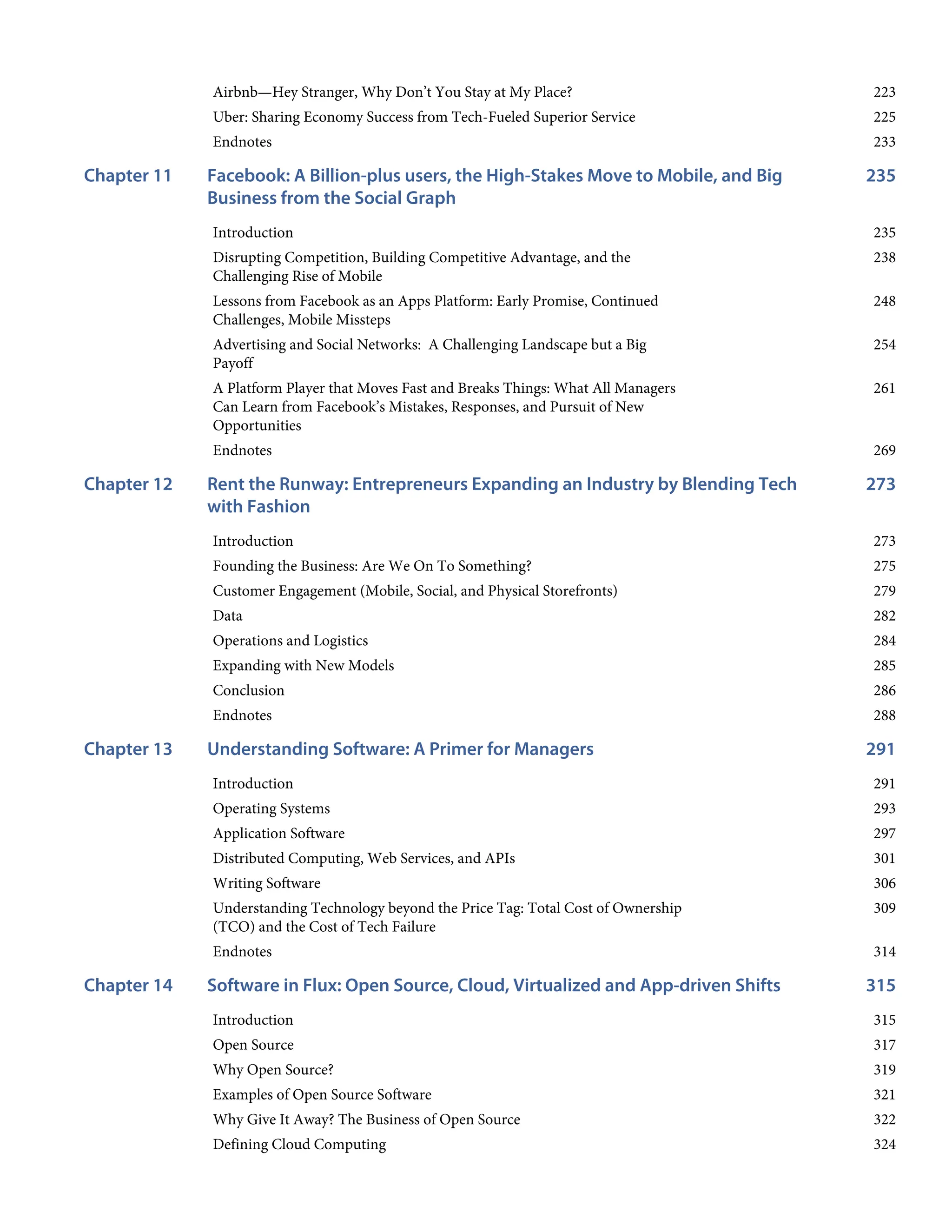
223
225
233
235
Chapter 11
235
238
248
254
261
269
273
Chapter 12
273
275
279
282
284
285
286
288
291
Chapter 13
291
293
297
301
306
309
314
315
Chapter 14
315
317
319
321
322
324
Airbnb—Hey Stranger, Why Don’t You Stay at My Place?
Uber: Sharing Economy Success from Tech-Fueled Superior Service
Endnotes
Facebook: A Billion-plus users, the High-Stakes Move to Mobile, and Big
Business from the Social Graph
Introduction
Disrupting Competition, Building Competitive Advantage, and the
Challenging Rise of Mobile
Lessons from Facebook as an Apps Platform: Early Promise, Continued
Challenges, Mobile Missteps
Advertising and Social Networks: A Challenging Landscape but a Big
Payoff
A Platform Player that Moves Fast and Breaks Things: What All Managers
Can Learn from Facebook’s Mistakes, Responses, and Pursuit of New
Opportunities
Endnotes
Rent the Runway: Entrepreneurs Expanding an Industry by Blending Tech
with Fashion
Introduction
Founding the Business: Are We On To Something?
Customer Engagement (Mobile, Social, and Physical Storefronts)
Data
Operations and Logistics
Expanding with New Models
Conclusion
Endnotes
Understanding Software: A Primer for Managers
Introduction
Operating Systems
Application Software
Distributed Computing, Web Services, and APIs
Writing Software
Understanding Technology beyond the Price Tag: Total Cost of Ownership
(TCO) and the Cost of Tech Failure
Endnotes
Software in Flux: Open Source, Cloud, Virtualized and App-driven Shifts
Introduction
Open Source
Why Open Source?
Examples of Open Source Software
Why Give It Away? The Business of Open Source
Defining Cloud Computing
326
329
331
335
338
339
341
343
345
Chapter 15
345
349
352
356
358
363
370
373
375
Chapter 16
375
375
383
389
397
399
Chapter 17
399
401
407
421
427
429
Chapter 18
429
433
439
440
446
450
Software in the Cloud: Why Buy When You Can Rent?
SaaS: Not without Risks
Understanding Cloud Computing Models: PaaS, IaaS, and Motivations and
Risks
Clouds and Tech Industry Impact
Virtualization: Software That Makes One Computer Act Like Many
Apps and App Stores: Further Disrupting the Software Industry on
Smartphones, Tablets, and Beyond
Make, Buy, or Rent
Endnotes
The Data Asset: Databases, Business Intelligence, Analytics, Big Data, and
Competitive Advantage
Introduction
Data, Information, and Knowledge
Where Does Data Come From?
Data Rich, Information Poor
Data Warehouses, Data Marts, and Technology behind “Big Data”
The Business Intelligence Toolkit
Data Asset in Action: Technology and the Rise of Walmart
Endnotes
A Manager’s Guide to the Internet and Telecommunications
Introduction
Internet 101: Understanding How the Internet Works
Getting Where You’re Going
Last Mile: Faster Speed, Broader Access
Endnotes
Information Security: Barbarians at the Gateway (and Just About Everywhere
Else)
Introduction
Why Is This Happening? Who Is Doing It? And What’s Their Motivation?
Where Are Vulnerabilities? Understanding the Weaknesses
Taking Action
Endnotes
Google in Three Parts: Search, Online Advertising, and an Alphabet of
Opportunity
Introduction
Understanding Search
Understanding the Increase in Online Ad Spending
Search Advertising
Ad Networks—Distribution beyond Search
More Ad Formats and Payment Schemes
451
456
461
464
477
481
Customer Profiling and Behavioral Targeting
Profiling and Privacy
Search Engines, Ad Networks, and Fraud
The Battle Unfolds
Endnotes
Index
© 2014 Cate Jones Photography
About the Author
John Gallaugher is an associate professor of information systems (IS) at Boston Col-
lege’s Carroll School of Management.
As founding faculty for the Boston College TechTrek programs, and the former
colead of the school’s graduate field studies in Europe and Asia, Professor Gallaugher
has had remarkable access studying technology growth and impact worldwide. Profess-
or Gallaugher and his students spend several weeks each year visiting with technology
executives, entrepreneurs, and venture capitalists in San Francisco, Silicon Valley,
Seattle, Boston, New York, and Ghana. Gallaugher and his students were present at the
launch of the iPhone, were at Sequoia Capital the day LinkedIn went public, and are
regularly hosted in master-class sessions at firms from Amazon to Zynga. This unique
opportunity helps provide his teaching and writing with a broad, deep, and continually
refreshed perspective on key industry trends and developments. Gallaugher also works
closely with collegiate entrepreneurs and is coadvisor to the Boston College Venture
Competition, an organization whose affiliated businesses have gone on to gain admit-
tance to elite accelerator programs (Y-Combinator, TechStars, MassChallenge, Sum-
mer@Highland), launch multiple products, and raise millions in capital.
A dedicated teacher and active researcher, Professor Gallaugher has been recog-
nized for excellence and innovation in teaching by several organizations, including Bo-
ston College, BusinessWeek, Entrepreneur Magazine, and the Decision Sciences Insti-
tute. Professor Gallaugher’s research has been published in the Harvard Business
Review, MIS Quarterly, and other leading IS journals. Professor Gallaugher has been a
featured speaker at Apple Inc’s AcademiX educator conference, and was the international keynote speaker at AIBUMA (the African
International Business and Management Conference) in Nairobi Kenya. He has consulted for and taught executive seminars for sev-
eral organizations, including Accenture, Alcoa, Duke Corporate Education, ING, Partners Healthcare, Staples, State Street, the
University of Ulster, and the U.S. Information Agency. His comments on business and technology have appeared in the New York
Times, National Public Radio, BusinessWeek, the Boston Globe, Wired, the Associated Press, Chronicle (WCVB-TV), The Daily Yo-
miuri (Japan), and the Nation (Thailand), among others.
Professor Gallaugher publishes additional content related to his teaching and research at http://gallaugher.com. He is also active
on Twitter at @gallaugher.
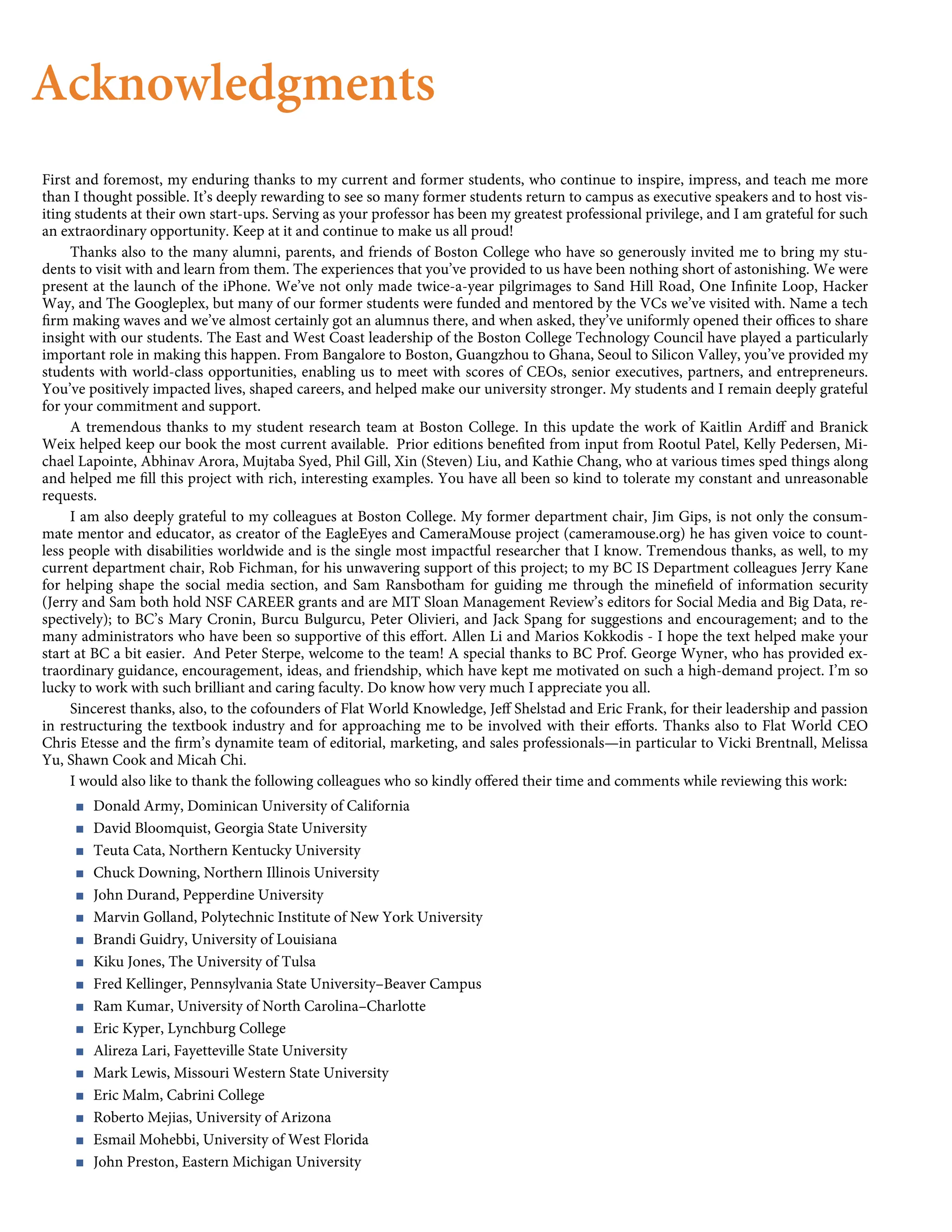
Acknowledgments
First and foremost, my enduring thanks to my current and former students, who continue to inspire, impress, and teach me more
than I thought possible. It’s deeply rewarding to see so many former students return to campus as executive speakers and to host vis-
iting students at their own start-ups. Serving as your professor has been my greatest professional privilege, and I am grateful for such
an extraordinary opportunity. Keep at it and continue to make us all proud!
Thanks also to the many alumni, parents, and friends of Boston College who have so generously invited me to bring my stu-
dents to visit with and learn from them. The experiences that you’ve provided to us have been nothing short of astonishing. We were
present at the launch of the iPhone. We’ve not only made twice-a-year pilgrimages to Sand Hill Road, One Infinite Loop, Hacker
Way, and The Googleplex, but many of our former students were funded and mentored by the VCs we’ve visited with. Name a tech
firm making waves and we’ve almost certainly got an alumnus there, and when asked, they’ve uniformly opened their offices to share
insight with our students. The East and West Coast leadership of the Boston College Technology Council have played a particularly
important role in making this happen. From Bangalore to Boston, Guangzhou to Ghana, Seoul to Silicon Valley, you’ve provided my
students with world-class opportunities, enabling us to meet with scores of CEOs, senior executives, partners, and entrepreneurs.
You’ve positively impacted lives, shaped careers, and helped make our university stronger. My students and I remain deeply grateful
for your commitment and support.
A tremendous thanks to my student research team at Boston College. In this update the work of Kaitlin Ardiff and Branick
Weix helped keep our book the most current available. Prior editions benefited from input from Rootul Patel, Kelly Pedersen, Mi-
chael Lapointe, Abhinav Arora, Mujtaba Syed, Phil Gill, Xin (Steven) Liu, and Kathie Chang, who at various times sped things along
and helped me fill this project with rich, interesting examples. You have all been so kind to tolerate my constant and unreasonable
requests.
I am also deeply grateful to my colleagues at Boston College. My former department chair, Jim Gips, is not only the consum-
mate mentor and educator, as creator of the EagleEyes and CameraMouse project (cameramouse.org) he has given voice to count-
less people with disabilities worldwide and is the single most impactful researcher that I know. Tremendous thanks, as well, to my
current department chair, Rob Fichman, for his unwavering support of this project; to my BC IS Department colleagues Jerry Kane
for helping shape the social media section, and Sam Ransbotham for guiding me through the minefield of information security
(Jerry and Sam both hold NSF CAREER grants and are MIT Sloan Management Review’s editors for Social Media and Big Data, re-
spectively); to BC’s Mary Cronin, Burcu Bulgurcu, Peter Olivieri, and Jack Spang for suggestions and encouragement; and to the
many administrators who have been so supportive of this effort. Allen Li and Marios Kokkodis - I hope the text helped make your
start at BC a bit easier. And Peter Sterpe, welcome to the team! A special thanks to BC Prof. George Wyner, who has provided ex-
traordinary guidance, encouragement, ideas, and friendship, which have kept me motivated on such a high-demand project. I’m so
lucky to work with such brilliant and caring faculty. Do know how very much I appreciate you all.
Sincerest thanks, also, to the cofounders of Flat World Knowledge, Jeff Shelstad and Eric Frank, for their leadership and passion
in restructuring the textbook industry and for approaching me to be involved with their efforts. Thanks also to Flat World CEO
Chris Etesse and the firm’s dynamite team of editorial, marketing, and sales professionals—in particular to Vicki Brentnall, Melissa
Yu, Shawn Cook and Micah Chi.
I would also like to thank the following colleagues who so kindly offered their time and comments while reviewing this work:
< Donald Army, Dominican University of California
< David Bloomquist, Georgia State University
< Teuta Cata, Northern Kentucky University
< Chuck Downing, Northern Illinois University
< John Durand, Pepperdine University
< Marvin Golland, Polytechnic Institute of New York University
< Brandi Guidry, University of Louisiana
< Kiku Jones, The University of Tulsa
< Fred Kellinger, Pennsylvania State University–Beaver Campus
< Ram Kumar, University of North Carolina–Charlotte
< Eric Kyper, Lynchburg College
< Alireza Lari, Fayetteville State University
< Mark Lewis, Missouri Western State University
< Eric Malm, Cabrini College
< Roberto Mejias, University of Arizona
< Esmail Mohebbi, University of West Florida
< John Preston, Eastern Michigan University
< Shu Schiller, Wright State University
< Tod Sedbrook, University of Northern Colorado
< Richard Segall, Arkansas State University
< Ahmad Syamil, Arkansas State University
< Sascha Vitzthum, Illinois Wesleyan University
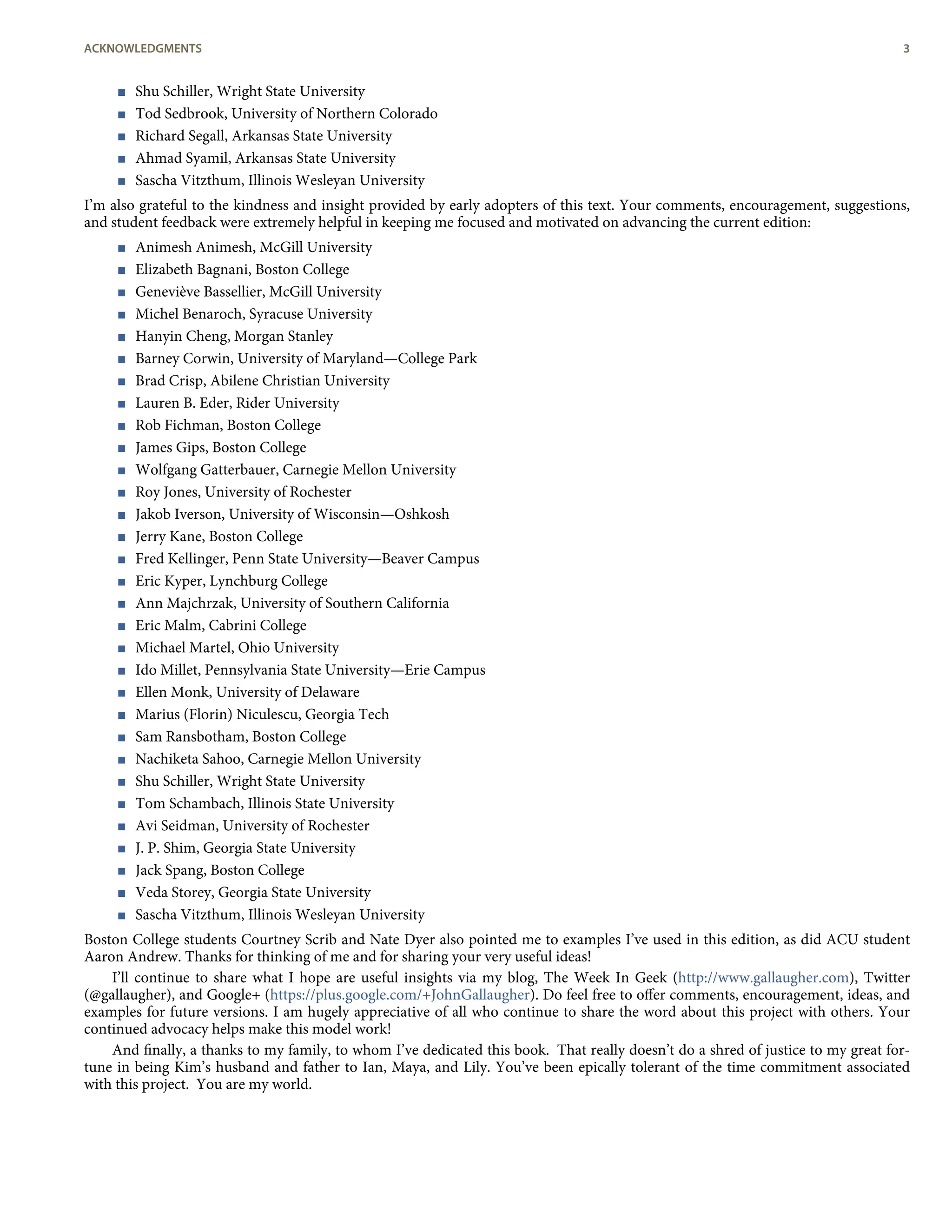
I’m also grateful to the kindness and insight provided by early adopters of this text. Your comments, encouragement, suggestions,
and student feedback were extremely helpful in keeping me focused and motivated on advancing the current edition:
< Animesh Animesh, McGill University
< Elizabeth Bagnani, Boston College
< Geneviève Bassellier, McGill University
< Michel Benaroch, Syracuse University
< Hanyin Cheng, Morgan Stanley
< Barney Corwin, University of Maryland—College Park
< Brad Crisp, Abilene Christian University
< Lauren B. Eder, Rider University
< Rob Fichman, Boston College
< James Gips, Boston College
< Wolfgang Gatterbauer, Carnegie Mellon University
< Roy Jones, University of Rochester
< Jakob Iverson, University of Wisconsin—Oshkosh
< Jerry Kane, Boston College
< Fred Kellinger, Penn State University—Beaver Campus
< Eric Kyper, Lynchburg College
< Ann Majchrzak, University of Southern California
< Eric Malm, Cabrini College
< Michael Martel, Ohio University
< Ido Millet, Pennsylvania State University—Erie Campus
< Ellen Monk, University of Delaware
< Marius (Florin) Niculescu, Georgia Tech
< Sam Ransbotham, Boston College
< Nachiketa Sahoo, Carnegie Mellon University
< Shu Schiller, Wright State University
< Tom Schambach, Illinois State University
< Avi Seidman, University of Rochester
< J. P. Shim, Georgia State University
< Jack Spang, Boston College
< Veda Storey, Georgia State University
< Sascha Vitzthum, Illinois Wesleyan University
Boston College students Courtney Scrib and Nate Dyer also pointed me to examples I’ve used in this edition, as did ACU student
Aaron Andrew. Thanks for thinking of me and for sharing your very useful ideas!
I’ll continue to share what I hope are useful insights via my blog, The Week In Geek (http://www.gallaugher.com), Twitter
(@gallaugher), and Google+ (https://plus.google.com/+JohnGallaugher). Do feel free to offer comments, encouragement, ideas, and
examples for future versions. I am hugely appreciative of all who continue to share the word about this project with others. Your
continued advocacy helps make this model work!
And finally, a thanks to my family, to whom I’ve dedicated this book. That really doesn’t do a shred of justice to my great for-
tune in being Kim’s husband and father to Ian, Maya, and Lily. You’ve been epically tolerant of the time commitment associated
with this project. You are my world.
ACKNOWLEDGMENTS 3
Dedication
For Ian, Maya, Lily, and Kim—zettabytes of love!
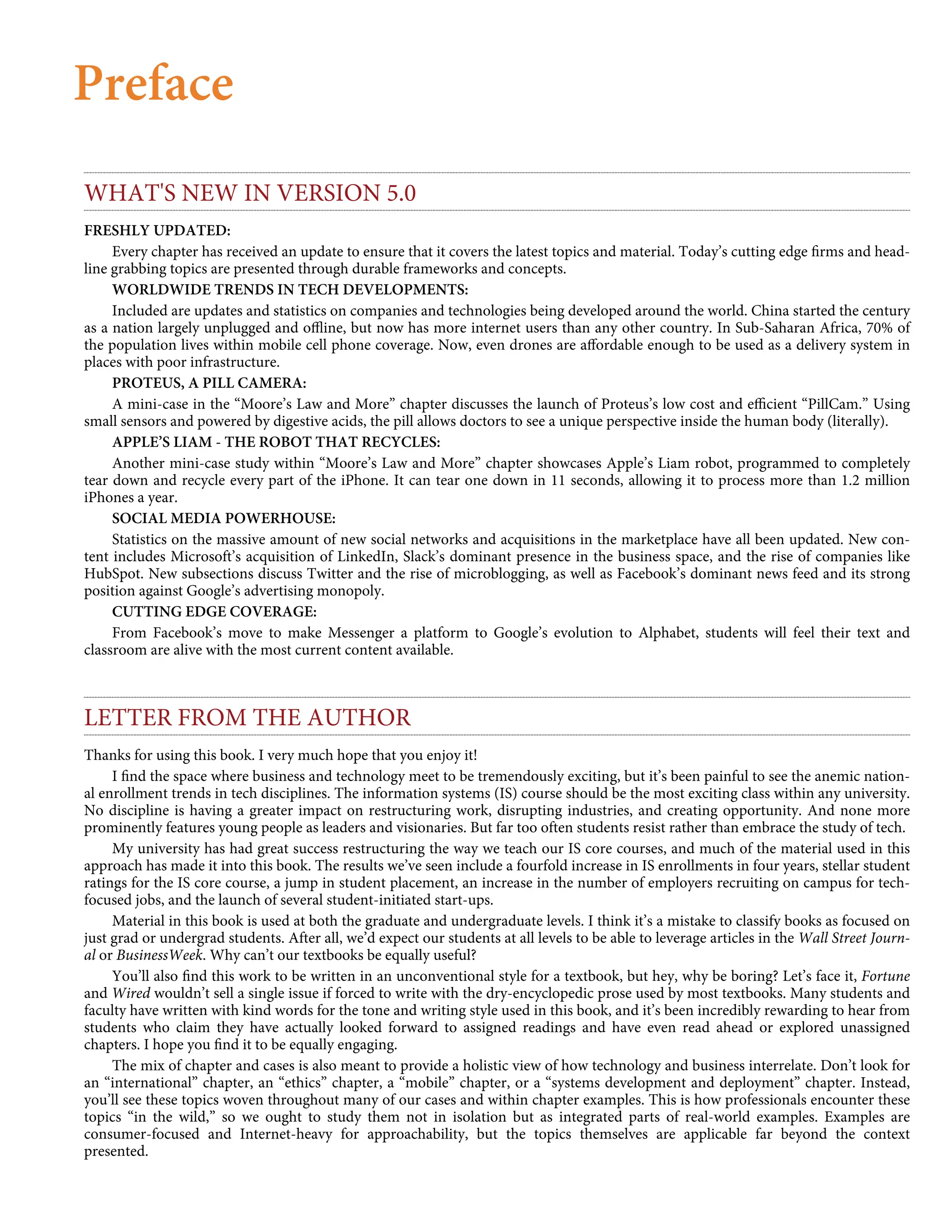
Preface
WHAT'S NEW IN VERSION 5.0
FRESHLY UPDATED:
Every chapter has received an update to ensure that it covers the latest topics and material. Today’s cutting edge firms and head-
line grabbing topics are presented through durable frameworks and concepts.
WORLDWIDE TRENDS IN TECH DEVELOPMENTS:
Included are updates and statistics on companies and technologies being developed around the world. China started the century
as a nation largely unplugged and offline, but now has more internet users than any other country. In Sub-Saharan Africa, 70% of
the population lives within mobile cell phone coverage. Now, even drones are affordable enough to be used as a delivery system in
places with poor infrastructure.
PROTEUS, A PILL CAMERA:
A mini-case in the “Moore’s Law and More” chapter discusses the launch of Proteus’s low cost and efficient “PillCam.” Using
small sensors and powered by digestive acids, the pill allows doctors to see a unique perspective inside the human body (literally).
APPLE’S LIAM - THE ROBOT THAT RECYCLES:
Another mini-case study within “Moore’s Law and More” chapter showcases Apple’s Liam robot, programmed to completely
tear down and recycle every part of the iPhone. It can tear one down in 11 seconds, allowing it to process more than 1.2 million
iPhones a year.
SOCIAL MEDIA POWERHOUSE:
Statistics on the massive amount of new social networks and acquisitions in the marketplace have all been updated. New con-
tent includes Microsoft’s acquisition of LinkedIn, Slack’s dominant presence in the business space, and the rise of companies like
HubSpot. New subsections discuss Twitter and the rise of microblogging, as well as Facebook’s dominant news feed and its strong
position against Google’s advertising monopoly.
CUTTING EDGE COVERAGE:
From Facebook’s move to make Messenger a platform to Google’s evolution to Alphabet, students will feel their text and
classroom are alive with the most current content available.
LETTER FROM THE AUTHOR
Thanks for using this book. I very much hope that you enjoy it!
I find the space where business and technology meet to be tremendously exciting, but it’s been painful to see the anemic nation-
al enrollment trends in tech disciplines. The information systems (IS) course should be the most exciting class within any university.
No discipline is having a greater impact on restructuring work, disrupting industries, and creating opportunity. And none more
prominently features young people as leaders and visionaries. But far too often students resist rather than embrace the study of tech.
My university has had great success restructuring the way we teach our IS core courses, and much of the material used in this
approach has made it into this book. The results we’ve seen include a fourfold increase in IS enrollments in four years, stellar student
ratings for the IS core course, a jump in student placement, an increase in the number of employers recruiting on campus for tech-
focused jobs, and the launch of several student-initiated start-ups.
Material in this book is used at both the graduate and undergraduate levels. I think it’s a mistake to classify books as focused on
just grad or undergrad students. After all, we’d expect our students at all levels to be able to leverage articles in the Wall Street Journ-
al or BusinessWeek. Why can’t our textbooks be equally useful?
You’ll also find this work to be written in an unconventional style for a textbook, but hey, why be boring? Let’s face it, Fortune
and Wired wouldn’t sell a single issue if forced to write with the dry-encyclopedic prose used by most textbooks. Many students and
faculty have written with kind words for the tone and writing style used in this book, and it’s been incredibly rewarding to hear from
students who claim they have actually looked forward to assigned readings and have even read ahead or explored unassigned
chapters. I hope you find it to be equally engaging.
The mix of chapter and cases is also meant to provide a holistic view of how technology and business interrelate. Don’t look for
an “international” chapter, an “ethics” chapter, a “mobile” chapter, or a “systems development and deployment” chapter. Instead,
you’ll see these topics woven throughout many of our cases and within chapter examples. This is how professionals encounter these
topics “in the wild,” so we ought to study them not in isolation but as integrated parts of real-world examples. Examples are
consumer-focused and Internet-heavy for approachability, but the topics themselves are applicable far beyond the context
presented.
Visit https://testbankfan.com
now to explore a rich
collection of testbank or
solution manual and enjoy
exciting offers!
Also note that many chapters are meant to be covered across multiple classes. For example, the chapter about Google is in three
parts, the one about Netflix is in two, and the one on strategy and technology likely covers more than one lecture as well. Faculty
should feel free to pick and choose topics most relevant to their classes, but many will also benefit from the breadth of coverage
provided throughout the book. I’d prefer our students to be armed with a comprehensive understanding of topics rather than merely
a cursory overview of one siloed area.
There’s a lot that’s different about this approach, but a lot that’s worked exceptionally well, too. I hope that you find the material
to be as useful as we have. I also look forward to continually improving this work, and I encourage you to share your ideas with me
via Twitter (@gallaugher), Google+ (https://plus.google.com/+JohnGallaugher), or the Web (http://www.gallaugher.com). And if
you find the material useful, do let others know, as well. I remain extremely grateful for your interest and support!
Best wishes!
Professor John Gallaugher
Carroll School of Management
Boston College
6 INFORMATION SYSTEMS: A MANAGER'S GUIDE TO HARNESSING TECHNOLOGY VERSION 5.0
C H A P T E R 1
Setting the Stage: Technology
and the Modern Enterprise
1. TECH’S TECTONIC SHIFT: RADICALLY CHANGING
BUSINESS LANDSCAPES
L E A R N I N G O B J E C T I V E
1. Appreciate how, in recent years, technology has helped bring about radical changes across in-
dustries and throughout societies.
This book is written for a world that has changed radically in the most recent years of your lifetime.
Consider just a few examples: Uber, the world’s largest “taxi service,” owns no vehicles for hire. Airbnb,
the world’s largest accommodations provider, doesn’t own a single hotel or rental property. Facebook,
the world’s most visited media destination, creates no content. And the world’s most valuable retailer,
China’s Alibaba, owns no product inventory of its own.[1] Change is clearly afoot, and it’s wearing silic-
on sneakers, carrying a smartphone, and is being blown forward by cloud-fueled hurricane tailwinds.
Here are some more examples: At the start of the prior decade, Google barely existed and well-
known strategists dismissed Internet advertising models.[2] By decade’s end, Google brought in more
advertising revenue than any firm, online or off, and had risen to become the most profitable media
company on the planet. Today, billions in advertising dollars flee old media and are pouring into digit-
al efforts, and this shift is reshaping industries and redefining skills needed to reach today’s consumers.
The firm’s ambitions have grown so large that Google has rechristened itself Alphabet (http://abc.xyz),
a holding company with divisions focused on markets as diverse as driverless cars and life extension.
At roughly the same time Google was being hatched, Apple was widely considered a tech industry
has-been, but within ten years and powered by a succession of handheld consumer electronics hits
(iPod, iPhone, iPad) Apple had grown to be the most valuable firm in the United States. The firm has
since posted several of the most profitable quarters of any firm in any industry, ever.[3] If app sales
through iTunes, alone, were considered a separate business, they would constitute a firm larger than
more than half of the companies ranked in the Fortune 500.[4]
The smartphone and app store are the modern accelerant of business growth. It took telephones
seventy-five years to get to 50 million users, but it took Angry Birds just thirty-five days to do the same.
WhatsApp gained 700 million adherents in its six years of existence, a figure Christianity took nineteen
centuries to achieve.[5]
Social media barely warranted a mention a decade ago. Today, Facebook’s user base is larger than
any nation in the world. Mobile is its lynchpin, with more than 1.25 billion users visiting on handheld
devices each month, and roughly two-thirds visiting each day.[6] Firms are harnessing social media for
new product ideas, for millions in sales, and to vet and build trust. But with promise comes peril. When
mobile phones are cameras just a short hop from YouTube, Facebook, Instagram, and Twitter, every
ethical lapse can be captured, every customer service flaw graffiti-tagged on the permanent record that
is the Internet. The service and ethics bar for today’s manager has never been higher. Social media has
also emerged as a catalyst for global change, with Facebook and Twitter playing key organizing roles in
uprisings worldwide. While a status update alone won’t depose a dictator or expunge racism, techno-
logy can capture injustice, broadcast it to the world, disseminate ideas, and rally the far-reaching.
Moore’s Law and other factors that make technology faster and cheaper have thrust computing
and telecommunications into the hands of billions in ways that are both empowering the poor and
poisoning the planet.
IPO
Initial public stock offering,
the first time a firm makes
shares available via a public
stock exchange, also known
as ‘going public.’
China started the century as a nation largely unplugged and offline. But today, China has more In-
ternet users than any other country. Mobile juggernaut WeChat, owned by China’s Tencent, saw four
times more payment transactions over Chinese New Year 2016 than PayPal did in all of 2015; 420 mil-
lion Chinese used WeChat for payment over the holiday—about 100 million more than every man, wo-
man, and child living in the United States.[7] China now tops the United States as the worldwide leader
in iPhone sales.[8] Watch your back, Apple: Chinese handset maker Xiaomi has been jockeying with
Uber as the world’s most valuable startup.[9] And China has spectacularly launched several publicly
traded Internet firms including Baidu, Tencent, and Alibaba—the largest IPO of all time.[10]
The world’s second most populous nation, India, has ridden technology to become a global IT
powerhouse. In two decades, India’s tech sector has grown from almost nothing to a $120 billion in-
dustry, expanding even during the recent global recession.[11] Technology has enabled the once
almost-exclusively-agrarian nation to become a go-to destination for R&D and engineering across sec-
tors as far-flung as aircraft engine design, medical devices, telecom equipment, and micropro-
cessors.[12] India’s TCS (Tata Consulting Services) is the world’s second-largest technology solutions
firm, second in size only to IBM.[13]
Think the United States holds the top ranking in home broadband access? Not even close: the Un-
ited States is ranked thirty-first in download speeds[14] and twenty-sixth in mobile broadband.[15]
Today smartphones are used by 2 billion people worldwide. By the end of this decade that number
will be 4 billion, with 80 percent of adults being smartphone equipped. The most popular brand in In-
dia, Micromax, sells entry-level smartphones priced below $40.[16]
Even in the far reaches of nations in sub-Saharan Africa, fast/cheap tech is becoming an economic
lubricant. Seventy percent of the region’s population lives within range of mobile phone coverage, a
percentage of the population greater than those who have access to reliable and safe water or electricity.
Forty percent of sub-Saharan Africans already have mobile phones.[17] Tech giants including Google,
IBM, and Microsoft now run R&D centers and significant operations in several African nations, tap-
ping into world-class tech talent that’s finally gaining infrastructure for growth.[18] Many nations in
sub-Saharan Africa now rank among the world’s fastest growing economies.[19] And entrepreneurs
with local expertise are increasingly serving local needs and building impactful businesses. Ghanaian
firm Esoko leverages mobile phones to empower the agrarian poor with farming info and commodity
pricing, raising incomes and lowering the chance of exploitation by unscrupulous middlemen. The
firm Sproxil uses text message verification to save lives by fighting drug counterfeiting in developing
nations around the world. Kenya’s M-PESA and Somaliland’s Zaad use text messages to replace cash,
bringing the safety and speed of electronic payment and funds transfer to the unbanked and leveraging
mobile money at rates that far outstrip any nation in the West.[20] Adoption rates are astonishing: 84
percent of adults in Tanzania use mobile phones for money transactions.[21] Mobile money can cut
corruption, too, an effort with broad implications as this tech spreads worldwide. When Afghan police
officers adopted M-PESA and began receiving pay using mobile money, many reportedly thought they
had received a big raise because the officers handing out their pay were no longer able to cheat workers
by skimming cash for themselves.[22]
8 INFORMATION SYSTEMS: A MANAGER'S GUIDE TO HARNESSING TECHNOLOGY VERSION 5.0
Internet of Things
A vision where low-cost
sensors, processors, and
communication are
embedded into a wide array
of products and our
environment, allowing a vast
network to collect data,
analyze input, and
automatically coordinate
collective action.
FIGURE 1.1
Many nations in sub-Saharan Africa are seeing significant tech-fueled growth. Throughout the continent,
technologies substitute for cash, deliver insights to farmers, and help uncover counterfeit pharmaceuticals. This
plant in Accra owned by Ghanaian firm Rlg is the first sub-Saharan PC, tablet, and cell phone assembly facility.
Source: Photograph taken with permission of the Rlg plant.
Fast/cheap computing is also helping create the multi-billion dollar Internet of Things (IoT), putting
smarts in all sorts of products: lamps, watches, thermostats, and door locks. Disney has embedded
smarts in a wristband it uses to replace ticketing at Disney World. GE thinks sensors and computing
will save the planet trillions of dollars through a hyper-efficient, data-driven, collectively orchestrated
set of devices,[23] and has embedded smarts in everything from home air conditioners to high-end air-
craft parts.[24] Think the smartphone market is big? Research firm Gartner says there are already some
5 billion connected IoT devices in use today, with 25 billion on the way by the end of the decade.[25]
Cheap processors and software smarts are also powering the drone revolution with far-reaching
impact. Today’s farmers use drones to regularly survey crops at closer distances and with greater regu-
larity than satellite or plane flight could ever match. A combination of conventional an infrared im-
agery can show irrigation variation, crop success, plant damage, fungal and insect infestations, and
offer other insights to improve crop yields, stave off crises, improve farmer profits, and cut consumer
costs. Today’s agricultural drones can be purchased for less than $1,000, as compared with agricultural
plane flights that cost more than $1,000 an hour.[26] And while Amazon and rivals race to replace UPS
with drone-to-doorstep delivery, Silicon Valley’s Zipline is leading the charge for the humanitarian
community, delivering medical supplies and blood to remote regions of the world (rural Rwanda is up
first), offering lifesaving packages at pizza-delivery speed.[27]
CHAPTER 1 SETTING THE STAGE: TECHNOLOGY AND THE MODERN ENTERPRISE 9
Drones Deliver Medical Supplies in Rwanda
The startup Zipline is one of many organizations working to leverage cheap, accurate drones to quickly and
cost-effectively deliver medical supplies to remote, underserved communities.
The way we conceive of software and the software industry is also changing radically. Apple, Facebook,
Google, IBM, Netflix, and Oracle are among the firms that collectively pay thousands of programmers
to write code that is then given away for free. Today, open source software powers most of the websites
that you visit. And the rise of open source has rewritten the revenue models for the computing industry
and lowered computing costs for start-ups to blue chips worldwide.
Cloud computing and software as a service are turning sophisticated, high-powered computing in-
to a utility available to even the smallest businesses and nonprofits. Amazon Web Services, by far the
world’s biggest provider of cloud computing services, has been adding about as much server capacity
each day as its entire e-commerce parent required ten years earlier.[28]
Three-dimensional printers, which allow designs for fabrication to be shared as easily as an e-mail,
are poised to reshape manufacturing and transportation. Crafts marketplace Etsy is full of artist-cre-
ated and custom-printed products, from jewelry to cookie cutters,[29] and this technology has also been
used to print tools on-demand for the international space station.[30]
FIGURE 1.2
An astronaut shows a tool produced on-demand using a 3D printer on the International Space Station.
Source: NASA
Many organizations today collect and seek insights from massive datasets, which are often referred to
as “Big Data.” Data analytics, business intelligence, and so-called machine-learning are driving
View the video online at: http://www.youtube.com/embed/t30taY9a3ZM?rel=0
10 INFORMATION SYSTEMS: A MANAGER'S GUIDE TO HARNESSING TECHNOLOGY VERSION 5.0
Random documents with unrelated
content Scribd suggests to you:
not necessary to do it on the spot; it might be done at any place where
bricks and fuel are cheap.
INDEX.
A, B, C, D, E, F, G, H, I, J, K, L, M, N, O, P, R, S, T, V, W, Y, Z
African lakes, re-discovery of the, i. 29.
Agriculture, state of, i. 179-189.
Almannagjá, the, ii. 198.
Alpen-glow, the, i. 68.
Althing, re-establishment of the, i. 103;
biennial, 106.
American gift to Iceland, ii. 327.
Amulet with Runes, ii. 118.
Antiquarian Museum, an, ii. 10, 13-23.
Anthropology, i. 122.
Art in Iceland, i. 160.
Arthur’s Seat, view of, from Firth of Forth, i. 270.
Aurora Borealis, the, i. 67.
Bede on Iceland, i. 31.
Berufjörð fisheries, ii. 234.
Berserkir, derivation of, ii. 100.
Black death, the, i. 100.
Blake, C. C., on human remains from Iceland, ii. 214;
on sulphur, 352.
Bogs of Iceland, i. 51.
Books on Iceland criticised, i. 369.
Boxes for travel, ii. 41.
Breiðalsheiði, top of the, ii. 249.
“Brimstone” on the sulphur diggings, ii. 301;
his unfairness, 302.
Broad-Shouldered, the, ii. 265.
Bruce, James, and the Nile sources, i. 22.
Buchan, A., on the climate of Stykkishólm, i. 63.
Bunsen’s division of Iceland rocks, i. 38.
Caithness, shores of, from the sea, i. 275.
Calabrian earthquake, the, i. 48.
Casaubon, Isaac, on Thule, i. 7.
Catholicism in Iceland, i. 100.
Cattle of Iceland, i. 186; ii. 53.
Character of the Icelander, i. 137-141.
Charnock’s, Dr Richard S., note on the Culdees, i. 28;
on Thule, 33.
Christ and Thor, i. 94.
Christian IX. and the Millenary Festival, i. 109.
Chronometry, i. 70.
Clay of Iceland, i. 51.
Cleanliness, i. 136.
Climate of Iceland, i. 55;
effect of Gulf Stream on, 56;
wholesomeness of, 66.
Coal and peat, i. 294.
Cavalcade, a, ii. 39.
Coal in Iceland, i. 377.
Cockney sportsman, a, i. 316.
Cod-fishing, i. 192, 193.
Constable, the head, i. 358.
Coinage, the, i. 215-218.
Commerce, i. 219-224.
Cowie, Dr Robert, on pre-historic remains found in Shetland, i. 300-306.
Culdees, the, note, i. 28, 29.
Danes, the, and home rule in Iceland, i. 105.
Danish Government, the, i. 378-380.
Days, Icelandic names for, i. 73.
Denmark and the annexation of Iceland, i. 99.
Desolate prospect, a, ii. 324.
Diseases, i. 151-155.
Divisions of Iceland, i. 116, 117.
Divorce, an easy method of, i. 151.
Doomsday Book of the North, the, i. 27; ii. 50.
Dress, styles of, i. 147.
Drunkenness in Iceland, i. 359-362.
Duncansbay Head, i. 274, 278.
Eddas, the, i. 95.
Edinburgh, defenceless state of, i. 270.
Education, i. 155-162.
Eider down, the, i. 201, 202.
Eider duck, the, ii. 45, 46, 112.
Emigration, i. 208.
Epitaph, a model, i. 137.
Eyjarbakka-vatn, ii. 321.
Færoe Islands, the, dulness of, i. 299.
Fair Isle, i. 308.
Family, the, i. 148-151.
Farewell to Edinburgh, a, i. 267.
Farm-house, a, i. 145;
a rough, ii. 288.
Finance of Iceland, i. 110-112.
Fish diet for brain-workers, i. 190.
Fisheries, i. 189-198.
Fjörðs, the, popular theory about, i. 49.
Flora of Iceland, i. 175-79.
Fox, the, i. 170.
Foula, the island of, i. 22, 309.
Funeral customs, i. 372.
Gare-fowl, the, ii. 228.
Genesis and geology, i. 35.
Geysir, the, i. 55, 319, ii. 169;
Bunsen on, 177;
Werner and Baring-Gould on, 178;
decline of the, 183;
description of, in eruption, 184-191;
a new Geysir, 222.
Granton, i. 269;
compared with Reykjavik, 269;
the central quay, 269;
farewell to group of friends, 269.
Guide, the pretty, ii. 27;
guides, 29;
a bad, 214.
Gulf Stream, the, i. 56.
Hafnafjörð, ii. 87-89.
Hakon of Norway and the liberty of Iceland, i. 98.
Hay-harvest, the, ii. 245.
Hay-making, i. 148.
Hekla, i. 315;
exaggeration of former travellers, ii. 161;
ascent of, 162;
sayings about, 164.
Hel-viti, gate of, ii. 164.
Herðubreið, view of, from north, ii. 305;
volcano of, 308;
ascent of, given up, 311.
Henchel’s report on the Icelandic sulphur mines, ii. 329-343.
High school, deficiency of education in, ii. 5;
method of teaching, 6;
theological school, 7.
Hindús, faith of the, i. 93.
Historical notes, i. 78.
Hjaltalín, Jón A., on the Danish chronicles, i. 83;
on finance, 110.
Horse, use of, by Icelanders, ii. 33.
Human and other remains in Iceland, paper on, ii. 212-220.
Hydrography, i. 53;
names of rivers and lakes, 54, 55.
Inchkeith, i. 270.
Intermarriage, i. 135.
Iron-ore, presence of, i. 205.
Itinerary from Reykjavik to Hekla and the Geysir, ii. 201-211;
from Berufjörð to Mý-vatn, 271.
Johnston, Mr Keith, on volcanic eruptions, i. 44.
John o’ Groats, i. 275.
Jökulsá River, the, ii. 268;
view of from Herðubreið, 309.
Judicial procedure, i. 120.
Kerguelen on the trade of Iceland, i. 228.
Kincardineshire, coast of. i. 272.
Kirkjubæ, ruins of, i. 298.
Kirkwall visited, i. 282.
Kissing, the custom of, i. 160.
Krísuvík sulphur diggings, the, ii. 133-135;
paper on, by C. W. Vincent, 135-153.
Landnámabók, the, i. 27;
extracts from, 78, 79, ii. 50.
Laug, the, or reeking spring, ii. 51.
Lakes, the, of Iceland, i. 54.
Law, meaning of, i. 271.
Ledge-springs, the, ii. 294.
Leirhnúkr, sulphur springs at, ii. 282.
Lemprière on Thule, i. 10.
Leprosy, prevalence of, i. 153.
Lerwick, i. 281.
Lich-gate, the, i. 349.
Literature on Iceland, i. 235-260;
in Iceland, ii. 2.
Little Hell, ii. 283.
Livingstone familiarly known in Iceland, i. 367.
Lock, A. G., and the sulphur diggings, ii. 297.
“Lord Kilgobbin,” description of moors and bogs in, i. 293.
Macculloch on Palagonite, i. 38.
Magnus, Cathedral of St, i. 282.
Magnusson on human remains in Iceland, ii. 218.
Maori proverb, a, ii. 288.
Maps of Iceland, i. 252.
Marriage, a check to, i. 148;
customs at feast, ii. 314, 315.
Medicine, the study of, ii. 6.
Mela on Thule, i. 7.
Merchant, the general stock kept by, i. 233.
Millenary Festival, the, i. 109.
Model farm, a, ii. 266.
Months, names of the, in Iceland, i. 71.
Moss, Iceland, i. 203, ii. 75.
Mountains of Iceland, altitude of the, i. 41, 42.
Mud-springs, ii. 296.
Mý-vatn, the solfatara of, ii. 279;
sport at, 280.
Napoleon, Prince, his expedition to Iceland, i. 38.
Newspapers in Iceland, ii. 1.
Northmen, character of the, i. 138.
Norwegians, the, peopling of Iceland by, i. 88.
Obsidian, where found, ii. 285.
Old Man of Hoy, the, i. 280.
Orcadian minister, prayer by, i. 279.
Palagonite, the, of Iceland, i. 35-38.
Papæ;, the, i. 27;
Dasent’s remarks on, 28, ii. 310.
Peat and coal, i. 294.
Peewits, ii. 46.
Pentland Skerries, the, i. 276;
Firth, the, 276.
Personal appearance of Icelanders, i. 132, 133.
Physical geography of Iceland, i. 35.
Picture, an Icelandic, described, ii. 16.
Piracy, the practice of, i. 89.
Pliny on Thule, i. 8.
Political geography, i. 113.
Population of Iceland, i. 115, 124-129.
Ponies, export of the, i. 224, ii. 30;
prices of the, 31;
method of riding, 37;
difficulties in shoeing, 39;
method of putting on board, 44.
Postal arrangements, i. 200, 201, 223.
Printing presses, number of the, ii. 2.
Professions, i. 162-169.
Prudentius Aurelius on Thule, i. 3.
Ptolemy on Thule, i. 9.
Radical Road (Arthur’s Seat), i. 270.
Raven, the, ii. 243.
Reformation, the, its effect on the national mind, i. 238, 374, 375.
Reindeer, the, i. 170.
Reykholt Kirk, Inventory of, ii. 70.
Reykir, ii. 157.
Reykjanes, i. 318, 322, 323.
Reykjahlíð Church, ii. 286.
Reykjavik, i. 59;
appearance of, from the sea, 325;
description of, 326-380;
Sunday in, 348, 357;
trades and professions, 363;
riding saddles, ii. 41;
fishermen of, 44;
the pier, 45.
Road-making in Iceland, i. 52.
Roc, the, ii. 228.
Romans, the, their knowledge of Iceland, i. 21;
remains of, 30.
Ronaldshaw, i. 278.
Runic writing, i. 288;
alphabet, explanation of, 288.
Sagas, the, i. 95, 131;
a Saga hero realised, ii. 325.
Salmon fishing, the, i. 194, 197;
salmon ground, ii. 59.
Scandinavian curse, a, ii. 105;
savage punishments by, 106.
Sand pillars, ii. 270.
Schools in Iceland, ii. 4.
Seal, the, ii. 242.
Seneca on Thule, i. 2.
Servius on Thule, i. 2.
Shaffner, Colonel, and Atlantic telegraphy, ii. 73.
Shark, a dead, ii. 237.
Shark-hunting, ii. 236.
Sheep, i. 186.
Shetland, life in, i. 295;
Shetlanders, personal appearance of the, 295.
Sibbald, Sir Robert, on Thule: a part of Great Britain, i. 11.
Simpson, Sir James, his archæological researches, i. 279.
Skálds, the, i. 97;
poetry of, 237.
Skaptárjökull, eruption of the, i. 46.
Sledging, ii. 260.
Smallpox, ravages of the, i. 152.
Smoking, in and out of fashion, i. 362.
Snæ-land, on the meaning of, i. 76.
Snæfell, i. 323, ii. 78, 96.
Snakes, on the absence of, from Iceland, i. 173.
Snuff boxes, the manufacture of, ii. 16.
Society, i. 141-148.
Solan goose, the, i. 317.
Spinning, i. 198.
Stonehenge, a theory concerning, ii. 106.
Stone of Iceland, i. 51.
Stone implements found in Iceland, ii. 20.
Stone weapons, ii. 20.
Store, the, i. 225.
Strabo on Thule, i. 3.
Strokkr, the, ii. 181.
Stromness, museum at, i. 290.
Stykkishólm, climate of, i. 63, ii. 101.
Sulphur, i. 171;
diggings, the, 171;
at Krísuvík, ii. 133, 135;
disused, 292;
mountain, 295;
pure, 295;
commercial value of, 296;
diggings leased by Mr Lock, 297;
importation of, 299;
prospects of trade in, 300.
Sulphur in Iceland, ii. 329;
mines at Krísuvík, 329;
at Mý-vatn, 335;
at Hlíðarnámar, 340;
Theystarreykja mines, 340;
refining of the sulphur, 342;
Sir G. S. Mackenzie on, 344;
Consul Crowe’s report on, 345;
Captain Burton’s notes on Mr Vincent’s paper on, 348;
C. C. Blake on, 352;
leasing contract for, 378;
report of the Althing on, 381;
in Sicily, 390;
on Red Sea, 400;
in Transylvania, 400;
in Andaman Islands, 402.
Sunday in Iceland, i. 348.
Service in church, i. 352, 353, 357.
Swan, song of the, ii. 313.
Taxation, i. 119, 209, 215.
Taylor’s “Etruscan Researches” criticised, ii. 107.
Telegraphy, ii. 73.
Tents for travel, ii. 43.
Theology, the study of, ii. 7.
Things, the, i. 90-92.
Thingvallavatn Lake, ii. 193.
Thor and Christ, i. 94.
Thorvaldsen an Icelander, i. 350, 351.
Thule, of, i. 1;
princess of, and king of, 1;
political and rhetorical, 1, 2;
Strabo, Mela, Pliny, and Ptolemy on, 3-11;
part of Great Britain, 11-23;
as Scandia, 23-25;
as Iceland, 25-32;
etymology of, 32.
Tom Noddy, the, i. 316.
Trades in Iceland, i. 125.
Trout fishing, about, i. 197.
Tyndall, Professor, on Palagonite, i. 37;
on the Mer de Glace, 43;
on active volcanoes, 49.
Vatnajökull, crossing of the, ii. 231;
view of the, 258;
sudden fogs on the, 315.
Vesuvius, eruption of, i. 47.
Virgil on Thule, i. 2.
Volcanic ashes, i. 50.
Wallace, the, of Iceland, ii. 124.
Waterproof for Iceland, note, i. 261.
Watts, Mr, on the Vatnajökull, ii. 232.
Weaving, i. 198.
Weights and measures, the national, i. 215, 218.
Wild oats, story regarding, in Iceland, ii. 296.
Windmill, a, ii. 233.
Yankee traveller, the, i. 356.
Zoological notes and sport, i. 169-175.
END OF VOL. II.
M‘Farlane & Erskine, Printers, Edinburgh.
FOOTNOTES:
[1] From Thjóð old High Germ. Diot, a people, a nation; often found in
composition, as Thjóð-fundr =constituent assembly, Thjóð-rekr = Germ. Diet-rich,
and Thjóð-marr = Germ. Dit-mar (Cleasby).
[2] Akureyri had another paper, the Gángleri, which ceased publication in 1872. It
contained some valuable articles, especially one headed “What am I to pay to the
Thing?” and the answer was apparently not easy, as it occupied seven issues,
beginning with February 7, 1871.
[3] It was here in Henderson’s time, and it was disliked because charged with “a
tendency to introduce the illumination of the German school.” At present, besides the
presses of Reykjavik and Akureyri, there is a third at the Elliðavatn, one hour’s ride
from the capital. It belongs to a certain Hr Benedikt, ex-assessor of the High Court of
Justice, who was removed for the best of reasons. He has no licence to print.
[4] And even England lacks the foundations which encourage specialties in
Germany. What we want is a number of students who are able to devote their time to
pursuits never likely to pay in a publishing sense. Some day, perhaps, one of those
philanthropists who give half-a-million sterling to an hospital or to a church, will
provide the necessary accommodation in the “Temple of Science”—£15,000 per
annum, divided into incomes ranging from £200 to £300, would supply a great
desideratum.
[5] The principal are the red-breasted merganser (Mergus merganser); the rare lap-
wing (Vanellus cristatus); the water-rail (Rallus aquaticus), also uncommon; the
thrush (Turdus eleacus); the willow wren (Motacilla trochilus); and the little regulus
with big feet and bill (Troglodytes borealis), the Pjetur Nonsmad, or Peter Dinner of
Norway, because he is not seen after noon, and the Fugle Kongr, because he rides the
eagle. Curious stories are also told about the wren at Trieste; he appears and
disappears with the thrushes, avoiding the heats of summer: the same is said about the
Abú Hin (the father of Henna) at Damascus. The black-bird (Turdus merula) is
sometimes driven to Iceland by southern gales.
[6] Of local specimens we were shown varieties of the Mó-berg (Palagonite tuff),
especially from the Seljadalr, which feels soft, between chalk and steatite, some white
or dull yellow, acted upon by acids; others brown and black. Palagonite conglomerate
with large pieces of felspar. Blue compact basalt from Kjallarnes, with and without
drusic cavities; hexagonal basalt; reniform pebbles of the same material. Jaspers, red,
yellow, and green, from the north, the latter containing copper. Dolerite or greenstone.
A collection of Hekla lavas, passing from the porous to the highly compact.
Micaceous “glimmer schiefer” studded with garnets. Zeolite and Iceland spar;
silicates of lime. Quartz needles from the Geysir, and other quartzes, uncrystallised
and crystallised into fine hexagons, large and small, often contained in bolides.
Aluminous clays and oxide of iron, some with regular angles and metallic revetments.
Concretions from Laugarnes and the Geysir, the stalks of plants resembling petrified
bones. The Cyprina Gaimardi and Byssomea arctica from the north. Other shells:
Balanus, Mya truncata, Venus Islandica, Lepas, Bulla, and Turbinus. True cannel coal
from Suderoe, to the west; lignites, old and new; pieces of Surtar-brand, flat, and
showing impressions of leaves; large fragments of true pitch-stone resembling, and
others in transition to, obsidian. Hrafntinna (Raven-flint, Gagates Islandicus),
obsidian or Iceland agate, black and liver-brown, like Jews’ pitch or asphalt, from
Mý-vatn and the Hrafnatinnuhraun of Hekla. Henderson (i. 178) mistranslates
Hrafnutinna, “Piedra de Galinazzo, or raven-stone” (for buzzard-stone). Agates,
chalcedonies, and transitional opals, from Múla Sýsla, Tindastoll, and Heimaklettur,
in the Vestmannaeyjar: according to Professor Abel, the south-eastern coast affords
the noble stone, and the islanders believe that about 1821 a Mr Methley (?) carried
home a valuable collection. Professor Árnason kindly gave me a little box of
chalcedonies which looked like onyxes.
[7] The Skýrsla (Report) of the Library gives a total of 387 works, distributed
amongst eight stands of sixteen shelves—they are by no means well filled. Classical
authors occupy two cases on the left of the entrance; on the right are translations of
the Testament, and some elementary works in Arabic and Armenian, Hindostani,
Maharati, and Bengali, all “dead letters” here. At the further end are modern books
printed in Reykjavik. The small collection of Icelandic manuscripts is all on paper,
the more valuable vellum has left the island for “foreign parts.” There are bundles of
ecclesiastical archives, tattered and unbound copies of the defunct “Islendingur,”
which is more quoted in England than in Iceland; and finally, there is a small set of
novelists, Walter Scott (in German), Dickens, and Bulwer, lent to the reading public.
[8] The only remarkabilities are the Bibles and the manuscripts. Among the first
we find the large folio Biblia of 1584—the first entire work—translated from the
German version of Martin Luther by Guðbrand Thorlaksson, Bishop of Hólar, and
there printed. This admirable work, which rivals our “established version,” is not
divided into verses, and is chiefly curious because the mechanical dignitary, who in
1574 imported new types, made his own capitals, plates, and woodcuts. He was
assisted by the Icelander Jón Jónsson, and preceded by John Mathieson, a Swede,
who brought the first printing press about 1520, and who published the “Breviarium
Nidarosiense” in 1521; an ecclesiastical handbook, Luther’s Catechism, and others of
the same kind. These works, especially the Breviarium, are so rare as to be practically
unprocurable. According to my informants, no “Elucidarius” has ever been published
in Iceland. The Rev. Thorwaldr Bjarnason assured me that the oldest Icelandic
manuscript is one of these catechisms, translated, as they all were, from Latin, and
dating from the thirteenth century. The second Biblia (1644), after the Danish version
of Bishop Resinius, is the work of Bishop Thorlak Skurlason of Hólar, who divided it
into verses. The type is black letter, ultra-Gothic Gothic, and the two folios are in the
best condition. There is a copy of the New Testament (1540, Henderson, ii. 265)
translated by Oddr Gottskálksson, with the distinguishing mark (G. T. and cross),
a large and thick duodecimo, with the beginning and the end restored by manuscript
—Icelanders, as a rule, are very skilful in supplying lost pages. Of this book only
three copies are known, the two others are at the deanery of Hruni and in Glasgow.
Another New Testament (1609), reprinted at Hólar by Bishop Guðbrand, whose high-
nosed and fork-bearded face remind us of his kinsman Rustam in far Iran, is a small
stout octavo, with an old binding and metal clasps.
[9] The valuable printed books are the fourth volume of Finn Jónsson’s “Historia
Monastica,” of which only three copies exist in the island; the “Scriptores Rerum
Danicarum” (Jacobus Longebek, 8 vols. folio, Hafniæ, 1772); and the “Crymogea” of
Arngrimr Jónsson, 4 vols. octavo: the latter is so unhappily divided that it is most
difficult to find a passage required. Some of the shelves are filled with presents made
by patriotic Icelanders and liberal publishers, such as The Gentleman’s Magazine till
1771; a few Smithsonian and Patent Office Reports; “Le Plutarch Français;”
“Conversations Lexicons;” the “Allgemeine Deutsch Bibliotek;” the “Bibliothêque
des Romans;” “Chambers’s Information for the People;” “Dictionnaire de Bayle,” and
the “Chronique des Religieux de Saint Denis,” by L. Bellaguet—a curious mixture by
the side of Thackeray, Dickens, and Marryat. The list of local works, so much wanted
by travellers and so rarely found, is eminently defective. Neither the first nor the
second volume of Cleasby was among the number, and although the Latin translation
of the Njála exists, Mr Dasent’s “Burnt Njál” did not appear. Of Englishmen in
Iceland, I found Hooker and Mackenzie, Lord Dufferin, and Symington. Gaimard’s
sumptuous and expensive work, including the folio illustrations, is there: its fate has
been general abuse and unlimited “cribbing.” I was shown in London some
photographs of exploration in the Vatnajökull, which were mere reproductions of the
“Sommet du Snæfells Jökull;” and many a book of travels has similarly enriched
itself.
[10] The oldest form is Frauva, and the later Frú is probably a contracted form of
Fruvu, or of Freyja (Venus), according to the Prose Edda (c. 24), but in the glossary to
the Poetical Edda, it is from Friðr, handsome, whence Friðla, a concubine,
corresponding with the German Frau, but put after as well as before the name. It was
little used before the thirteenth century, and in the fourteenth it was applied to
abbesses and the wives of knights, not of priests. At present, it is given without
distinction. Húsfreyja is = Germ. Hausfrau = Eng. Housewife, always a married
woman. Junfrú is = Germ. Jungfrau, a princess in the thirteenth century, now simply
Mademoiselle. Víf (Weib, a wife) is purely poetical in Icel.: it is supposed to be
originally a weaver (Vefa, vífiðr). Hence the Anglo-Saxon Wîf-mann = woman, not
womb-(Icel. Vömb) man. Herra (= Germ. Herr) was a title given in A.D. 1277 to the
new Norwegian creation of barons (Hersar) and knights: bishops and abbots were
also so styled. After the Reformation it became an integral part of the address of
bishops, as Síra of priests, but only applied like the Latin Don (dominus) to Christian
names. Now it is our Mister or Esquire in writing: in conversation Icelanders have no
equivalent for these words; the person, if not a clerk, is simply addressed by his
Christian name. The old scale of precedence was Konungr, Jarl, Hersir (the baron of
Normandy and Norman England), Höldr (yeoman), and Búandi or Bóndi, = Germ.
Bauer, a tiller of the ground (Cleasby).
[11] From Falda, to fold, hence the Ital. Falda and Faldetta, head-dress. As women
vied in the size of this “stately national head-gear,” it obtained the sarcastic name
Stiku-faldr, “yard-long fald.” In modern poetry, Iceland, with her glaciers, is
represented as a woman with her fald on. Skaut is the “sheet” or veil, which hung
down behind (Cleasby).
[12] Forbes’ sketch of “Helda’s buttons” gives an excellent idea of the article.
[13] M. Gaimard deduces this word from the Germ. Bauer, peasant; evidently an
error. The North of England names, of which twenty to thirty end in -by, e.g., Kirk-by,
derived the suffix from the Danish and Swedish -by, which is = Icel. Bær (Cleasby).
[14] The instrument occurs in the proverb, “Svá eru Flosa ráð sem fari Kefli.”
Flosa plans are a rolling cylinder (Gr. Οἱ δὲ κυλίνδροις ἄλλοτ’ ἐπ’ ἀλλὰ φέρονται),
the metaphor being taken from a mangle (Cleasby).
[15] The latter also has introduced the rude Scotch Posh or fiddle, strung with
“Torren,” the small gut of the sheep (Edmonston).
[16] Thorpe (Edda, preface, part ii., pp. iv., v.) suggests that the name of this
adaptation of Vedic and Iranic artificer-gods, this northern Vulcan and Dædalus, may
be merely an adaptation from the German Wieland, or the Anglo-Saxon Weland, and
notices Sir Walter Scott’s woeful perversion, in “Kenilworth,” of the venerable legend
travestied from the Berkshire tradition. Blackwall tells us that a labyrinth was called
Völundarhús—a wayland house; and Cleasby that Völundr survives in the Fr. Galant,
and the Eng. Gallant.
[17] The day, however, has not come when these weapons can be ranged strictly
according to date, and when a narrow comparison of differences, not of superficial
resemblance, can be made between those discovered in different parts of the world.
[18] It is nothing but the “cross cramponné” of heraldry, and is generally identified
with the mythic “thunderbolt;” hence, probably, the pre-Christian crosses of
Scandinavian inscriptions. Of the sacred cross in the Huaca at Cuzco, we learn that
the Incas did not worship it, beyond holding it in veneration on account of the beauty
of its form, or for some other reason which they could scarcely give expression to
(Garcilasso de la Vega, translated, etc., by Clements R. Markham, C.B., for the
Hakluyt Society, London, 1869). It may be remarked that the pre-Christian cross,
shaped as an ordinary Greek cross, when not connected with the sacred Tan of Egypt,
was the symbol of the four quarters; when surrounded by a circle, it denoted the solar
path from left to right round the world. A later symbol of the same order was the
Hindu Swastika (mystical mark, meeting of four roads, etc.), whose arms, according
to Mr Beal, should always be drawn from left to right, and not, as is sometimes done,
“widdershins,” or in the reverse way. Finally, the crocheted cross (Cruz ansata at four
ends) is the Aryan symbol of the sacred fire lit by Pramatha (Prometheus).
[19] The trip of eight days thus costs £14, but the travellers had potted provisions,
liquor, and other comforts, which may have brought the expense up to £20—£10
each. Allowing £3 for the six days of delay, in or about Reykjavik, till the fortnightly
steamer starts; £6 for coming from and returning to Granton; and £3 for extras; the
total of £22 easily “does” the Geysirs. Of course, those who are not hurried will pay
much less.
[20] The figures have been treated in the Introduction, Sect. VII.
[21] Hross in Icelandic (Germ. Ross, Fr. Rosse) is singular and plural. So Chaucer
makes “hors” plural, and we still say, a troop of horse, like a flock of sheep. So in
Shetland Russa-bairn (stallion, male) is opposed to Hesta-bairn (mare) child. The
Hengist and Horsa of our innocent childhood were derived from the same words.
[22] Nothing easier than to teach the horse meat-eating and fish-eating. Where
little and highly nutritious food is forced by the necessity of saving weight, the habit
is acquired in youth.
[23] In this matter the last few years have seen a wonderful improvement amongst
us; still, I have visited wealthy stables in England where the thermometer stood at 72°
(F.), equal to Boston Hotel, or to an Anglo-Indian London Club. It is difficult to
reform the evil where grooms sleep above these ovens, where hot air saves grooming
coats, and where the vet. requires to make a livelihood. The perfection of horse-
stabling appears to me a modification of the Afghan system—protecting the chest and
body with felts, thick or thin as the season demands, and allowing the head and throat
to be hardened by cold, pure air.
[24] This is a general rule: 65 for an ass, 100 for a pony, and 120-150 for an ox.
The latter are not trained to carry luggage in Iceland, and it is hard to tell the reason
why.
[25] Astraddle was doubtless the earliest form of feminine seat, yet Mr Newton
found at Budrum a statue of Diana sitting her horse sideways.
[26] Information concerning them may be met with in Gosselin (Historia
Fucorum): travellers have paid scant attention to this branch of botany. The wracks
feed man and beast, and serve for fuel, bed stuffing, and other domestic purposes:
consequently some forty-four kinds have been described, especially that impostor, the
Zostera marina, which lies in loose heaps. The most common are the Fucus palmatus,
Sacchurinus esculentus, edulis, fœniculaceus, and digitatus. The first-mentioned is
the Sol, eaten in Ireland and in Scotland, where it is called Dulce: at Oreback
(Eyrarbakka), it sells for 70 fishes per voet (= 80 lbs.). The second, F. saccharinus
(Alga saccharifera), is the Welsh Laver, whose spirally-twisted leaves, six feet long
by one broad, become straight when dry. In the Shetlands the larger fuci in general
are called Tangle, Tang, and Ware, and are extensively used as manure.
[27] Dr Cowie (Shetland, 1st edit., chap. ix., pp. 165-167) gives an excellent
account of “peat-casting.”
[28] Varða, in the plural Vörður, is a beacon, more generally an “homme de
pierre,” a pile of stones to act as landmark or way sign; it is derived from að varða, to
ward, to guard, monere (quod hîc vicus est). Our travellers generally write the word
in the Danish form “Varde.” These piles, like the “ ‘a’úr” (Kakúr) of Syria and
Palestine, are often put up by the shepherd lads, apparently for want of something
else to do.
[29] Kona, of old Kwina and Kuna, is evidently the English Quean (but not
Queen). It is a congener of γυνή;(Sansk. Jani), which the Rev. Wm. Ridley (p. 390,
Anthrop. Journal, July and Oct. 1872) traces through Guni, Gun, Gyn, and Gin, to the
Australian “Jin:” why not take it at once from the Arab. Jinn (Genie), a manner of
devil? For many years, Konungr (A.S., Cynig, our King) was composed of Konr, man
of gentle birth, and Ungr, young; but the Dictionary pronounces this to be a mere
poetical fancy.
[30] The pint was found to contain 3·51 grains of solid matter. The specific gravity
(at 60° F.) was 1000·21, and the components were:
Silica, 1·04 grains.
Protoxide of iron,0·24 ”
Lime, a trace.
Magnesia, 0·2 ”
Soda, 0·84 ”
Sulphuric acid, 0·76 ”
Chlorine, 0·40 ”
Organic matter, 0·30 ”
Total, 3·60 grains.
[31] We have Lax rivers in England. Some books translate Lax “trout” as well as
salmon. This is a mistake, the former is always known as Sílungr or Forelle (Dan.): as
may be expected, there are numerous terms for the fish at different ages and in several
conditions.
[32] This suffixed article, which has died out of so many northern tongues, appears
to be comparatively modern, only once showing in the Voluspa (e.g., Goðin, v. 117).
It is found in Coptic, e.g., Mau-t, the mother, for Ti-mau; and in Wallach (Daco-
Roman): the latter, for instance, says Frate-le (in Italian, Il fratello), and Dinte-le for
Il Dente (dens).
[33] Skarð, common in local names, is the English Shard, a notch, chink, an open
place in a bank, a mountain-pass, the Cumbrian Scarf-gap (Cleasby). Henderson
gives Kampe as the popular name of a col; he probably means Kambi, a comb or
ridge.
[34] Meaning a mane, hair, and still preserved in such names as Fairfax.
[35] The word often occurs in Iceland; it is applied to a lady’s bower or a dungeon,
both being secluded chambers, to a heap of refuse (Cleasby), and to conspicuous
warts and peaks of rock.
[36] At sea-level the compensated aneroid (Casella, 1182) showed 30·05, the
thermometer (F.) 66°. Here it was 27·10 in the open air, with the thermometer at 40°
(F.), and in the pocket 26·90, with the thermometer at 80° (F.). The instrument,
despite compensation, must always be cooled in the shade before use.
[37] “The whole formation of the mountain (Büdös) and the surrounding cones,
the sharp-edged blocks and masses of rock, heaped up one on the other, of which
these consist, the apparently molten surface of the trachyte—all seems plainly to
prove that it was only after the formation of these masses, and when they were in a
rigid state, that a grand upheaval took place here; during which, the powerful gases
from below, raising, and straining, and tearing the masses, piled them up in mighty
domes and mountain-tops, tossing them about till, here and there, they had found
permanent canals leading to the surface of the earth.” (Frederic Fronius, quoted by Mr
Bonar).
[38] It is noticed in the “Mémoires de la S. R. des Antiquaires du Nord” (p. 9, vol.
of 1845-49). The writer assigns it to A.D. 1143, in the days of “Are Frode” (Ari hinn
Fróði).
[39] Múli (pron. mule) is the Germ. Maul, a muzzle, and the Scotch Mull (e.g., of
Galloway), the Shetland and Orkney “Mule.” It means a buttress, with bluff head, a
tongue of high land, bounded on three sides by slopes or precipices, and the word
should be adopted into general geography. The Arabs would call this favourite site for
old towns, “Zahr et Taur”—the bull’s back.
[40] The late Mr Piddington tells us that the Hvalfjörð district is “called by the
neighbouring inhabitants Veðra-Kista, that is, box or chest of winds, which implies
that this inlet is, as it were, the abode of violent storms.” He gives cyclones to
Iceland, where there are none, and he corrects Uno Von Troil (p. 41) who rightly
makes the name “Storm-coast (Veðra-kista) to be given to some places in Iceland.”
[41] The Sel, which often occurs in Icelandic names, is the German Senn-hütte, a
shed, or little farm-house, in a mountain-pasture. The A.S. Sele probably reappears in
our north-country “Shiel,” a small shooting farm. In Norway such huts are called Setr,
or Sætr, the A.S. Sætar: hence Sumur Sætas (dwellers in summer huts) became our
Somerset. Iceland wants the cold arbour (Ceald here-berga = Kaltern herberg of old
Germany), the bare-walled lodge, or “Traveller’s bungalow.”
[42] The North Atlantic Telegraph viâ the Færoe Islands, Iceland, and Greenland.
London: Stanford, 1861.
[43] At the farm-house the mean of three observations taken before setting out, and
after return, gave 29·60, th. (F.) 71°; summit of first ridge, 27·65, th. 87°; top of
mountain, 26·60, th. 77°.
[44] From að stilla, to fix a position.
[45] In the Shetlands called Smora, from Dan. Smör, butter, because it gives an
abundance of cream.
[46] Hooker, ii. 325.
[47] The Mexicans also had a “Fair God,” Quetzel, beautiful as Baldur, and, better
still, averse to human sacrifices. The popular tradition, that some day he would return
from the east and rule the land, made Montezuma recognise him in the blond-haired
Cortez: the great explorer and conqueror, however, did not prove a satisfactory
Quetzel. Of these white gods and foreigners from the east, even in South America, I
have treated fully in my notes to Hans Stade (Hakluyt Soc.), part ii., chap. xv.
[48] The word was taken from Chamounix by De Saussure. It is not, as Petermann
says, the detritus or rubbish heaps from the bottom and sides of the glacier or ice-fall,
but the débris of the rock above it.
[49] This is the popular form of Or-usta, battle.
[50] Melr, a sandy hill, and especially a bare bank of sand and stone, familiar to
Iceland travellers, has been explained in the Introduction (Sect. VII.). Baring-Gould
(p. 284) would derive it from a root signifying to grind; Holmboe from Myldja, to
dig, or from Mold, loose earth. Bakki is a bank or ridge, opposed to Brekka (brink), a
slope, a hill.
[51] This stone, like the diamond, threatens to lose more than half its value, if it be
true that the State of Queretaro in Mexico has lately (1874) yielded “opals of the first
quality, and of all varieties; the milk-opals, fire-opals, girasols or ‘harlequins,’ and the
richest Hungarian or precious opals.”
[52] The word Áss, pl. Asar and Æsir, is explained by Jornandes, “Gothi proceres
suos quasi qui fortunâ vincebant non pares homines sed semideos, i.e. Anses (Ans in
Mæso-Gothic) vocavere.” Suetonius makes Æsar an Etruscan word which meant God
(probably a plural of Kelt. Es). We find forms of it in the Mongolian dialects, and in
the Aryan, Sanskrit (Asura), Keltic, Teutonic (Æsir), German (Anshelm, p. n.), and
even in the English Osborn and Oswald. As appears to correspond with the Semitic
Al, but the word is still involved in mystery.
[53] The Hebrew Esh and the Chaldee Esha (fire) are synonymous with the Aryan
Is, whence Isti, an offering on the hearth, and Estika the place of offering. Hence the
Greek Hestía, fire, hearth, stove, and, with digamma, the Latin Vesta when
worshipped as Genius or Lar familiaris.
[54] Blót (or Forn), a sacrifice of men and beasts, horses and oxen, swine and
sheep, must not be confounded with Blóð, blood. The Blót-steinn or sacrificial stone,
which acted as our gallows, is described as of “oval form and a little pointed at the
top,” which suggests the Moab-god Chemosh, it stood in every Thing-field, a place
adjoining the Hof. I did not remark that the site of the temples always faced south, as
Mallet says. The Öndvegi, or high-seat of the hall, was “on the side of the sun,” i.e.,
south.
[55] He specifies the ruined castle near Videdal (Viðidalr), some 200 perches in
circumference and 20 fathoms (?) high on the north side; another castle near the
parsonage Skaggestad at Laugarnaes; remains of heathen temples at Midfjörð,
Godale, Viðvik, etc.; the ancient place of execution at Hegranaes; pagan burial-
places, like that of Thorleif Jarlaskáld’s in the Oxerá island, which yielded old swords
and helmets; two Bauta-steinn, great standing stones (Menhirs?), on the heaths of
Thingman’s and Threkyllis, “which probably, according to Odin’s regulations, were
monuments to the memory of deceased persons;” the grass-grown mound of
Reykholt, “said to be raised from the ruins of Sturluson’s house;” the Sturlunga Reitr,
or burial-place of his family, and forty small figures of brass representing animals and
other objects found near Flatey: “unfortunately they fell into the hands of people who
did not know their value, consequently they have all been lost” (p. 189).
[56] This popular German expression is evidently the Scandinavian Besse, for Berr
or Bersi = Bär, a bear. Besse, again, has a suspicious likeness to the Yakut “Ese,” the
most respectful term in the language, = grandfather or monseigneur, applied by those
Siberian Mongols to the great white bear, their most formidable foe. Bruin in
Gothland being the “king of the beasts,” to do a thing with Besse’s leave is equivalent
to doing it without leave. The quaint quadruped is much noticed in folk-lore;
“Mishka” is his pet name in Russia; “Berengarius” is derived from the French Dan
Beringer; and Ephraim and Ole Cuffey are well known in the U.S. Persia abounds in
tales about his wearing a turband and riding asses.
[57] It supplied the Hafnafiordite of Forchhammer, leek-green, light, porous, and
friable pumice-tuff, containing the following proportions:
Silica, 35·89
Alumina, 27·36
Protoxide of iron,14·41
Lime, 10·86
Potash, 9·00
Sulphuric acid, 1·55
99·07
Dr W. Lauder Lindsay remarks, “The sp. gr. is usually 2·729; it appears to be a
lime-oligoclase, belonging, therefore, to the Felspathic family of minerals.”
[58] Passengers to Hafnafjörð paid only 2 marks (7d.). The nine days to the north
and back were the cheapest known to me—$9 (=£1) each way, and for living £4, a
total of 13s. per diem, including steward’s fees, and excellent Norwegian ale and
Geneva ad lib. Breakfast of fish and meat at eight to ten A.M.; dinner of ditto and
coffee at two to four P.M.; and supper, a repetition of the two, at eight to nine P.M. Port,
sherry, and Château Yquem = $1 specie (4s. 6d.); champagne, $2; porter, $0·48; and
Norwegian beer, 12sk. (3½d.) per bottle. The cooking was excellent, and plate and
linen equally spotless; the table was laid à la Russe with pleasant little hors d’œuvres
of sardines and smoked salmon, salt meat, ham, and sausage, in fact what Italians
facetiously call “Porcheria.” We mentally re-echo Mr Thackeray’s hope that Great
Britain, who is supposed to rule the waves, will some day devote a little more
attention to her cuisine.
[59] Borg, a castle, a city, or a small dome-shaped height, is a common local term.
“It may be questioned whether these names (Borgarholt, Eld-borg, etc.) are derived
simply from the hill on which they stand (berg, bjarg), or whether such hills took their
names from old fortifications built upon them: the latter is more likely, but no
information is on record, and at present ‘borg’ only conveys the notion of a hill”
(Cleasby). In Chap. I., I have shown that “borg” and “broch” are sons of the same
family.
[60] Captain Graah (loc. cit.) looks upon this as a mere fable: I do not.
[61] Hít is a scrip made of skin, and, metaphorically, a big belly. With a short
vowel, Hitár-dalr means the Vale of the Hot (i.e., volcanic) River, opposed to Kaldá
or Cold Stream. According to Cleasby, the derivation from the Giantess Hít is a
modern fiction not older than the Bárðar Saga: he also, contrary to other authorities,
makes Dominus Bárð a giantess.
[62] The Dictionary gives Göltr, a hog, and Kolla, a deer without horns, a humble
deer, a hind.
[63] Both translations are somewhat too literal: Enni, a forehead, secondarily
means the “brow of a hill,” a steep crag, a fronting precipice.
[64] As the “Berserkir” is becoming a power in novelistic literature, it may be
advisable to give the correct form. The singular nominative is Ber-serkr, the plural
Ber-serkir, and the oblique form Berserkja, e.g., Berserkja-dis, cairn of the Berserkir.
Cleasby (sub voce) shows that the common derivation, taken from Snorri, “berr”
(bare) and “Serkr” (sark or shirt) is inadmissible, and greatly prefers “Berr” (a bear),
whose skins were worn by athletes and champions; perhaps also here we find traces
of that physical metamorphosis in which all the older world believed. The
“Berserksgangr” (furor bersercicus seu athleticus), when these “champions” howled
like wild beasts, gnawed their iron shields, and were proof against fire and steel, may
be compared with the “running amok” of the Malays, and the “bhanging up” of the
Hindu hero—invariably the effect of stimulants. This fact considerably abates our
interest in Eastern tales of “derring-do,” for instance, in the account of the two
sentinels at Delhi, whose calm gallantry, probably produced by opium or hemp, is
noticed in pitying terms by Sir Hope Grant.
[65] For the observations at Stykkishólm, see Introduction, Sect. II.
[66] Henderson (ii. 67) places “Hofstad” on the western side of the peninsula.
[67] Réttir are the big public pens, Dilkar the small folds round the former, and the
Stekkjarvegr is the spring-fold; all are dry stone walls, as on the Libanus.
[68] As the word is written, it can only signify “Lithe (slope) of the panegyric;”
Drápa being a poem in honour of gods, saints, kings, princes, and so forth, as opposed
to the short panegyric “Plockr,” and to the longer “Hroðr,” or “Lof.” The boatman,
however, explained it to mean Slope of Death, i.e., where some battle took place, and
this would be derived from Dráp, slaughter. Both words (says Cleasby) come from
Drepa, to strike. There is also a dispute concerning the formation of certain beds in
this mountain, some holding that they issued from the same crater successively, and
others, simultaneously, from different mouths.
[69] Henderson (ii. 68) places the stone in the swamp, not on the hill-side; Forbes
(219) adds that it was in the centre of the Doom-ring. If so, we did not see it:
moreover, Mr R. M. Smith heard from Hr Thorlacius that we were misled. I cannot
help believing in the shepherd-boy; and there was no mistaking the Doom-ring. For
the most part, the instruments of death stood in the fens where certain classes of
criminals were drowned. On the other hand, the Landnámabók (chap. xii.) says, that
after the profanation of Helgafell (Monticulus Sacer), Thórðr Gellir “forum (Thing) in
superiora linguæ loca ubi nunc est, transportavere ... ibique adhuc conspiciendus est
lapis Thorinus (Thórsteinn), supra quem homines sacrificio destinati, frangebantur;
ibi etiam circulus judicialis existit in quo homines ad victimas condemnabant.”
[70] Compare this Northern effort with the poetical Greek curse at the Akropolis
of Athens: “I entrust the guardianship of this temple to the infernal gods, to Pluto, and
to Ceres, and to Proserpine, and to all the Furies, and to all the gods below. If any one
shall deface this temple, or mutilate it, or remove anything from it, either of himself,
or by means of another, to him may not the land be passable, nor the sea navigable,
but may he be utterly uprooted! May he experience all evils, fever, and ague, and
quartan, and leprosy! And as many ills as man is liable to, may they befall that man
who dares to move anything from this temple!” Perhaps the most picturesque
composition of the kind is the inscription upon the sarcophagus of Eshmunazar, king
of Sidon—at least in the translation of the late Duc de Luynes.
[71] This form of “lynching” is popularly and erroneously supposed to have been
invented upon the Atlantic seaboard of the United States. The Brazilian “Indians”
practised it by way of ceremonial toilette.
[72] Waring and many others suggest that the “Prostrate Stone” lying north-east of
the horse-shoe or elliptical opening of the Stonehenge trilithons, and the three—
formerly five—fallen stones inside the vallum, represent the first or outer circle, like
that of Avebury. It is usually assumed that the “Friar’s Heel,” the single “block lying
farther to the north-east of the “Prostrate Stone,” served for astronomical purposes,
the sun rising over it on the summer solstice, and striking the sacrificial Thorsteinn or
Blótsteinn (4 by 16 feet). The same arrangement is remarked at Stennis. There seems,
however, no reason why both should not have been members of an outermost circle.
Martin (Description of Western Islands, London, 1716) has preserved the popular
tradition that the sun was worshipped in the larger, and the moon in the lesser, ring of
the Orkney ruins. Later writers deny the honour of erecting the circles of Stennis and
Borgar (anciently Broisgar = Brúar-garðr) to the “Northmen,” because such circles
are found only in localities where a Keltic race has ruled, and because “such names as
Stennis and Stonehenge prove that they had existence before the people who so
designated them arrived in the country.” The causa appears to me a non causa,
especially if they were Thingsteads and Doom-rings, which in later days would take
modern and trivial names from their sites or peculiarities of structure. On the other
hand, the absence of tradition concerning the popular use of the buildings, which we
might expect to linger in the minds of men, is a serious objection.
[73] We have retained the word “Flói” in ice-floe. It properly means the deep water
of a bay opposed to the shallow water along shore.
[74] We see in Ireland, Scotland, and the English coast about Bristol, the effect of
these gales: they prevail along the coast of Brittany, become less violent in the Bay of
Biscay and along Portugal, and finally the Mediterranean, as the regular outlines of
the Balearics, Sicily, and Malta prove, ignores them.
[75] The work of Jón Thórðarson and another compiler in the fourteenth century,
who transcribed from old MSS., and bring the history up to A.D. 1395, that is a
century before the Columbian discovery. A facsimile specimen of the vellum
manuscript used by Professor Rafu as the basis of his text is given in the
“Antiquitates Americanæ.”
[76] In June 1862 Mr Shepherd and his party succeeded in mastering the Dránga
Jökull. Upon the summit the barometer marked 26·5° (at sea-level 29 inches, not
degrees), and the thermometer 32° (F.). Glámu (Dict., Glam, Glamr, Glaumr,
glamour) is translated “noisy Jökull,” from the hljóð (Germ. Laut), or the clamour, the
crashing and clashing of ice-slips and torrents.
[77] Dýr is Θήρ, their, deôr, and deer, in Iceland especially applied to the fox,
being the only insular beast of prey (Cleasby).
[78] According to some local authorities, Ísafjörð is the mouth of the
Ísafjarðardjúp. Mr Shepherd (p. 92) lays down that the bay-head and the town are
called Ísafjörð, whilst Ísafjarðardjúp is the name of the whole.
[79] Ísa being the genitive plural of Íss, ice. See page 5, “The Thousandth
Anniversary of the Norwegian Settlement of Iceland,” by Jón A. Hjaltalín, Reykjavik,
1874: the Standard (August 25, 1874) confounds this author with Dr Hjaltalín, “by
far the greatest and most learned Icelander of the day.” Some have erroneously
derived it from Ísa or Ýsa, a coal-fish or haddock, which is here plentiful: this Gadus
carbonarius is known to western Scotland by many names. They are “cuddies” when
six to eight inches long, excellent eating in October; when herring-sized they become
“saythes,” somewhat coarse of flesh; and when full-grown “stane-lochs,” almost unfit
for food.
[80] The Ursus albus maritimus or Thalarctos is called Bamsin and the female
Bingsen: it is well known to be carnivorous, a “lahhám,” as the peasants of the
Libanus term their small brown bears (U. Syriacus): moreover, it rises upon its
haunches to scalp the huntsman, like the Himalayan bear (U. Thibeticus). The two
others common in Norway are the Hesta-biörn or horse-bear (the common brown U.
Arctos), and the Myre or small bear (possibly a variety of the former, like the black
bear of Europe). The latter is valued for its hams, as the paws of the great grizzly (U.
ferox), the most savage of its kind, are prized in the Western States of North America.
[81] It must not be confounded, as some travellers have done, with Eyra, an ear.
Eyri is the modern form of Eyrr, the Shetland Urie, and the Swedish Ör: e.g., Helsing-
ör, our Elsinore. Eyr-byggjar are men who build in Eyris; and, hence, the “Eyrbyggja
Saga.” The feature, like the Holmr, was used for battle-plains; thus Ganga út á eyri, is
to fight a duel (Cleasby).
[82] This common name for such features is one of the Semitic words (Arab.
Karn) which has been naturalised in Aryan speech through Κέρας and Cornu. Another
is “Botn,” flat or low land, e.g., Gulf of Bothnia, in Arab. Batn.
[83] Staðr (plur. Staðir), our “stead,” secondarily means a church establishment,
see, convent, chapel, and so forth. The “church contest,” or struggle, between the
clergy and laity about the ownership and administration of churches and glebes,
which began at the end of the thirteenth century, and was partially settled by the
agreement of A.D. 1296, has diffused this word far and wide through Iceland. Thus the
heathen Fell, Hraun, Hóll, and Melr became Staðar-fell, Staðar-hraun, Staðar-hóll,
and Mell-Staðar. On the other hand, the plural Staðir is frequent in local names of the
pagan time, as Höskulds-Staðir, Alreks-Staðir, etc. (Cleasby).
[84] So the point was called by all on board; the map gives Krossanes (cross naze).
[85] The Lodbrokar Kviða (Lodbrog’s Quoth) or Krákumál, so called from the
“mythical lady” Kraka, was translated (1782) by the Rev. James Johnstone, A. M.,
chaplain to the British Embassy at Copenhagen. It is given by Henderson (ii. 345-
352), who believes—O sancta simplicitas!—that the ruffian, who probably never
existed, himself composed the “warlike and ferocious song.” The word Kviða, or lay,
derives from Kveðja, cognate with the English “quote” and “quoth.”
[86] This common term is explained in Chap. XIII.
[87] I know no reason why we should conserve such veteran blunders as “Hecla”
and “Geyser.” The latter has already been explained. The former, whose full form is
Heklu-fjall, derives from Hekla (akin to Hökull, a priest’s cope), meaning a cowled or
hooded frock, knitted of various colours, and applied to the “Vesuvius of the North,”
from its cap and body vest of snow. Icelanders usually translate it a chasuble, because
its rounded black shoulders bear stripes of white, supposed to resemble the cross
carried to Calvary.
[88] “Kleifar” is a local name in West Iceland, from Kleif, a ridge of cliffs or
shelves in a mountain-side (Cleasby).
[89] Professor Tyndall (loc. cit.) tells us that the “two first gases cannot exist
amicably together. In Iceland they wage incessant war, mutually decompose each
other, and scatter their sulphur over the steaming fields. In this way the true solfataras
of the island are formed.” He derives the vapour of sulphur in nature from the action
of heat upon certain sulphur compounds.
[90] I have denied the existence of this diagonal.—R. F. B.
[91] The Journal shows how great this mistake is.—R.F.B.
[92] The description is prodigiously exaggerated.—R.F.B.
[93] Mr Judd, examining Western Scotland, opines that the felspathic (acid) rocks
have been erupted from the Eocene volcanoes, and the augitic (basic) from those of
the Miocene age. In Iceland, however, both seem to have been discharged by the
Post-tertiary, as well as by the Tertiary epochs.
[94] “He” (Gunnar Hámundarson) “was eulogised by many poets after his death,”
said an Icelander, with unthinking satire. The last poem is the “Gunnarshólmr,” by
Jonas Hallgrímsson, a poet who, being loved of the gods, died young.
[95] The Romans were naked below the knee: the pillars of Trajan and Antonine
show Teutonic captives wearing a dress much resembling that of our peasants and
sailors.
[96] Often written Reykium (for Reykjum), dative plural of second declension. As
has been seen, the word enters into a multitude of Icelandic proper names.
[97] The four higher are (S.E.) Öræfajökull (6426 English feet); (W.) Snæfell
(5964); Eyjafjallajökull (5593) to south, and Herðubreið (5447) to north-east. Stanley
(repeated by Dillon) assigned to Hekla 4300; Sir J. Banks, with a Ramsden’s
Barometer, 5000. Gunnlaugsson gives 5108, but here he is very defective, wanting a
separate and enlarged plan. The direct distance from the summit to the sea is usually
laid down at thirty miles; measured upon the map, the “bee-line” would be twenty-
seven geographical miles.
[98] Rángá (“wrong” or crooked stream) is a name that frequently occurs, and
generally denotes either that the trend is opposed to the general water-shed, or that an
angle has been formed in the bed by earthquakes or eruptions.
[99] The down is applied as a styptic to cuts, the leaves are used in tanning, and
the wood makes ink.
[100] Klaproth remarks that this is the only tree (? the poplar = Pippal) which the
Aryan colonists of Europe remarked, and distinguished by the Sanskrit name. Thus
Bhurrja became the Latin Betula, the Gothic Birkun, the Scandinavian Birki and
Björk, the German Birke, and the English Birch. The name is applied under the form
of Bjarkar to the thirteenth Runic letter = B or P; and it is the first Irish letter, Beith.
[101] Næfr, or birch-bark, was used for thatching: Næfra-maðr, the birch-bark
man, was an outlaw (Cleasby).
[102] Mr Pliny Miles distinctly denies the existence of these fish-lakes, which
Metcalfe observed, and which we clearly saw. There is a Fisksvatnsvegr, which has
been travelled over, and there are reports of a volcano having burst out there about a
century ago.
[103] The highest apparent point shown to us on the south-east was Grænafjall.
Upon the map it is an insignificant north-eastern “mull” of the Tindafjallajökull, but
refraction had added many a cubit to its low stature.
[104] Alluded to in Chap. VI.
[105] Tunga is applied to the Doab of two rivers; Tangi is a land-spit, a point
projecting into the sea or river.
[106] This is the “low trap hill” of former travellers, supposed to be one of the
veins that pierced the elevated diagonal.
[107] Especially M. Dortous de Mavian, whose theory was succeeded by the age
of chemicals, pyrites, and alkalis, and the oxidation of unoxidised minerals, with a
brief deversion in favour of “The Fire,” by Sir Humphrey Davy. Poisson extinguished
it when he remarked that if fed by incandescent gases it would burst the shell, or at
least would be subject to tides, causing daily earthquakes. Happily, also, the term
“earth’s crust” is also becoming obsolete, or rather the solid stratum of 100 miles
overlying a melted nucleus has suddenly grown to 800 (Hopkins). Sir William
Thomson (Proceedings of the Royal Society, xii., p. 103) holds it “extremely
improbable that any crust thinner than 2000 or 2500 miles could maintain its figure
with sufficient rigidity against the tide-generating forces of sun and moon, to allow
the phenomena of the ocean tides, and of precession and nutation, to be as they are
now.” We will hope for more presently.
[108] Cleasby tells us that the end of Árna Saga (the bishop), the sole historical
work of that time, is lost. He opines that a certain “pretty legend,” referring to the
“moving” of founts when defiled with innocent blood, could not have arisen “unless a
change in the place of hot springs had been observed.”
[109] Everywhere we found leaves laminated with silicious deposit, but no trace of
shells, even though we sought them under the turf. The composition of Geysir water
will illustrate Forbes. In 1000 parts of water there are 0·5097 of silica, whereas the
rest, carbonates of soda and ammonia, sulphates of soda, potash, and magnesia,
chloride and sulphide of sodium, and carbonic acid, amount only to 0·4775, Out of
the latter, again, soda represents 0·3009, and sodium 0·2609; silica and soda are
therefore the constituents. The specific gravity is 1000·8 (Faraday).
[110] More exactly the two divisions are each about twenty feet long; the smaller
is twelve and the greater is eighteen feet broad; the extreme depth is thirty feet.
[111] See Barrow’s ground-plan of the Geysirs (p. 177).
[112] In 1859, when I passed over the Rocky Mountains, near the headwaters of
the Missouri and the Yellowstone, the North American Geysirs had not been invented,
nor did we hear a word about them from the backwoodsmen and prairiemen along the
line. In fact, the United States Expeditions which surveyed, photographed, and
described them, began only in 1868.
[113] Baring-Gould makes the bridge seven to eight yards long; far too long for
single planks.
[114] Written Ravnegiá, and other barbarous forms. Gjá also has been corrupted to
Gaia, etc. The word is found in the Hebrew ‫אנ‬, the Greek γᾶια, and the German and
Swiss Gau, a district, a canton; it is preserved in the Scottish Geo or Geow: it is the
Cornish Hor, and the Skaare of the Færoes, supposed to extend under the sea. It
“often denotes a rift, with a tarn or pool at bottom, whence Gil is a rift with running
water;” and it is akin to Gína (χαινω, A.S. Gínan); Gähnen, to yawn (Cleasby). In
Iceland these fosses are split by the hammer of Thor.
[115] This is evidently the Germ. Kuchen and the Eng. Cake: we can trace it back
to the Pers. “Kahk.”
[116] According to Blackwall, the Thingstead in Oldenburg still shows the Doom-
ring of upright stones, and the Blót-steinn in the centre.
[117] The Axewater, so called because Kettlebjörn, the Old, when prospecting for
a residence here, lost his axe. Barrow gives Oxera, which would mean Oxwater.
There has been no change in the Thingvellir since the days of the Norwegian
colonists.
[118] Al-manna, genitive plural from an obsolete Almenn (comp. Alemanni), is a
prefix to some nouns, meaning general, common, universal. The local name of the
great rift near the Althing was given because all the people met upon its eastern flank
(Cleasby).
[119] A large plan, but not very correct, is given by Dufferin (p. 73).
[120] I believe it has been transferred by later antiquaries from the holm to the
mainland; but Cowie (p. 178) still keeps it in the islet.
[121] This Gjá is amazingly exaggerated by Baring-Gould (p. 69); assuming the
human figures at only 5 feet, the depth of the chasm would be 75.
[122] For the code of honour in pagan Iceland, Dasent refers to Kormak’s Saga,
chap. x., where the law of the duello was most punctiliously laid down as the “British
Code of Duel” (London, 1824) by a philanthropic and enterprising Irish gentleman.
Welcome to our website – the ideal destination for book lovers and
knowledge seekers. With a mission to inspire endlessly, we offer a
vast collection of books, ranging from classic literary works to
specialized publications, self-development books, and children's
literature. Each book is a new journey of discovery, expanding
knowledge and enriching the soul of the reade
Our website is not just a platform for buying books, but a bridge
connecting readers to the timeless values of culture and wisdom. With
an elegant, user-friendly interface and an intelligent search system,
we are committed to providing a quick and convenient shopping
experience. Additionally, our special promotions and home delivery
services ensure that you save time and fully enjoy the joy of reading.
Let us accompany you on the journey of exploring knowledge and
personal growth!
ebookluna.com

(Original PDF) Information Systems; A Managers Guide to Harnessing Technology, 5th Edition

  • 1.
    Read Anytime AnywhereEasy Ebook Downloads at ebookluna.com (Original PDF) Information Systems; A Managers Guide to Harnessing Technology, 5th Edition https://ebookluna.com/product/original-pdf-information- systems-a-managers-guide-to-harnessing-technology-5th- edition/ OR CLICK HERE DOWLOAD EBOOK Visit and Get More Ebook Downloads Instantly at https://ebookluna.com

  • 2.
    Instant digital products(PDF, ePub, MOBI) available Download now and explore formats that suit you... (eBook PDF) Information Systems A Manager's Guide to Harnessing Technology Version 7.0 https://ebookluna.com/product/ebook-pdf-information-systems-a- managers-guide-to-harnessing-technology-version-7-0/ ebookluna.com (eBook PDF) Information Systems A Manager's Guide to Harnessing Technology Version 6.0 https://ebookluna.com/product/ebook-pdf-information-systems-a- managers-guide-to-harnessing-technology-version-6-0/ ebookluna.com (eBook PDF) Information Technology for Managers 2nd Edition https://ebookluna.com/product/ebook-pdf-information-technology-for- managers-2nd-edition/ ebookluna.com (eBook PDF) Managing Information Technology: What Managers Need to Know 7th Edition https://ebookluna.com/product/ebook-pdf-managing-information- technology-what-managers-need-to-know-7th-edition/ ebookluna.com
  • 3.
    (eBook PDF) InformationSystems for Managers with Cases Edition 3.1 https://ebookluna.com/product/ebook-pdf-information-systems-for- managers-with-cases-edition-3-1/ ebookluna.com (eBook PDF) Introduction to Information Systems: People, Technology and Processes 3rd Edition https://ebookluna.com/product/ebook-pdf-introduction-to-information- systems-people-technology-and-processes-3rd-edition/ ebookluna.com Information Systems for Managers : With Cases 4.0 4th Edition (eBook PDF) https://ebookluna.com/product/information-systems-for-managers-with- cases-4-0-4th-edition-ebook-pdf/ ebookluna.com (eBook PDF) Biology: A Guide to the Natural World Technology Update 5th Editio https://ebookluna.com/product/ebook-pdf-biology-a-guide-to-the- natural-world-technology-update-5th-editio/ ebookluna.com (eBook PDF) Information Technology Law 5th Edition https://ebookluna.com/product/ebook-pdf-information-technology- law-5th-edition/ ebookluna.com
  • 5.
    Information Systems A Manager’sGuide to Harnessing Technology John Gallaugher Version 5.0
  • 6.
    223 225 233 235 Chapter 11 235 238 248 254 261 269 273 Chapter 12 273 275 279 282 284 285 286 288 291 Chapter13 291 293 297 301 306 309 314 315 Chapter 14 315 317 319 321 322 324 Airbnb—Hey Stranger, Why Don’t You Stay at My Place? Uber: Sharing Economy Success from Tech-Fueled Superior Service Endnotes Facebook: A Billion-plus users, the High-Stakes Move to Mobile, and Big Business from the Social Graph Introduction Disrupting Competition, Building Competitive Advantage, and the Challenging Rise of Mobile Lessons from Facebook as an Apps Platform: Early Promise, Continued Challenges, Mobile Missteps Advertising and Social Networks: A Challenging Landscape but a Big Payoff A Platform Player that Moves Fast and Breaks Things: What All Managers Can Learn from Facebook’s Mistakes, Responses, and Pursuit of New Opportunities Endnotes Rent the Runway: Entrepreneurs Expanding an Industry by Blending Tech with Fashion Introduction Founding the Business: Are We On To Something? Customer Engagement (Mobile, Social, and Physical Storefronts) Data Operations and Logistics Expanding with New Models Conclusion Endnotes Understanding Software: A Primer for Managers Introduction Operating Systems Application Software Distributed Computing, Web Services, and APIs Writing Software Understanding Technology beyond the Price Tag: Total Cost of Ownership (TCO) and the Cost of Tech Failure Endnotes Software in Flux: Open Source, Cloud, Virtualized and App-driven Shifts Introduction Open Source Why Open Source? Examples of Open Source Software Why Give It Away? The Business of Open Source Defining Cloud Computing
  • 7.
    326 329 331 335 338 339 341 343 345 Chapter 15 345 349 352 356 358 363 370 373 375 Chapter 16 375 375 383 389 397 399 Chapter17 399 401 407 421 427 429 Chapter 18 429 433 439 440 446 450 Software in the Cloud: Why Buy When You Can Rent? SaaS: Not without Risks Understanding Cloud Computing Models: PaaS, IaaS, and Motivations and Risks Clouds and Tech Industry Impact Virtualization: Software That Makes One Computer Act Like Many Apps and App Stores: Further Disrupting the Software Industry on Smartphones, Tablets, and Beyond Make, Buy, or Rent Endnotes The Data Asset: Databases, Business Intelligence, Analytics, Big Data, and Competitive Advantage Introduction Data, Information, and Knowledge Where Does Data Come From? Data Rich, Information Poor Data Warehouses, Data Marts, and Technology behind “Big Data” The Business Intelligence Toolkit Data Asset in Action: Technology and the Rise of Walmart Endnotes A Manager’s Guide to the Internet and Telecommunications Introduction Internet 101: Understanding How the Internet Works Getting Where You’re Going Last Mile: Faster Speed, Broader Access Endnotes Information Security: Barbarians at the Gateway (and Just About Everywhere Else) Introduction Why Is This Happening? Who Is Doing It? And What’s Their Motivation? Where Are Vulnerabilities? Understanding the Weaknesses Taking Action Endnotes Google in Three Parts: Search, Online Advertising, and an Alphabet of Opportunity Introduction Understanding Search Understanding the Increase in Online Ad Spending Search Advertising Ad Networks—Distribution beyond Search More Ad Formats and Payment Schemes
  • 8.
    451 456 461 464 477 481 Customer Profiling andBehavioral Targeting Profiling and Privacy Search Engines, Ad Networks, and Fraud The Battle Unfolds Endnotes Index
  • 10.
    © 2014 CateJones Photography About the Author John Gallaugher is an associate professor of information systems (IS) at Boston Col- lege’s Carroll School of Management. As founding faculty for the Boston College TechTrek programs, and the former colead of the school’s graduate field studies in Europe and Asia, Professor Gallaugher has had remarkable access studying technology growth and impact worldwide. Profess- or Gallaugher and his students spend several weeks each year visiting with technology executives, entrepreneurs, and venture capitalists in San Francisco, Silicon Valley, Seattle, Boston, New York, and Ghana. Gallaugher and his students were present at the launch of the iPhone, were at Sequoia Capital the day LinkedIn went public, and are regularly hosted in master-class sessions at firms from Amazon to Zynga. This unique opportunity helps provide his teaching and writing with a broad, deep, and continually refreshed perspective on key industry trends and developments. Gallaugher also works closely with collegiate entrepreneurs and is coadvisor to the Boston College Venture Competition, an organization whose affiliated businesses have gone on to gain admit- tance to elite accelerator programs (Y-Combinator, TechStars, MassChallenge, Sum- mer@Highland), launch multiple products, and raise millions in capital. A dedicated teacher and active researcher, Professor Gallaugher has been recog- nized for excellence and innovation in teaching by several organizations, including Bo- ston College, BusinessWeek, Entrepreneur Magazine, and the Decision Sciences Insti- tute. Professor Gallaugher’s research has been published in the Harvard Business Review, MIS Quarterly, and other leading IS journals. Professor Gallaugher has been a featured speaker at Apple Inc’s AcademiX educator conference, and was the international keynote speaker at AIBUMA (the African International Business and Management Conference) in Nairobi Kenya. He has consulted for and taught executive seminars for sev- eral organizations, including Accenture, Alcoa, Duke Corporate Education, ING, Partners Healthcare, Staples, State Street, the University of Ulster, and the U.S. Information Agency. His comments on business and technology have appeared in the New York Times, National Public Radio, BusinessWeek, the Boston Globe, Wired, the Associated Press, Chronicle (WCVB-TV), The Daily Yo- miuri (Japan), and the Nation (Thailand), among others. Professor Gallaugher publishes additional content related to his teaching and research at http://gallaugher.com. He is also active on Twitter at @gallaugher.
  • 11.
    Acknowledgments First and foremost,my enduring thanks to my current and former students, who continue to inspire, impress, and teach me more than I thought possible. It’s deeply rewarding to see so many former students return to campus as executive speakers and to host vis- iting students at their own start-ups. Serving as your professor has been my greatest professional privilege, and I am grateful for such an extraordinary opportunity. Keep at it and continue to make us all proud! Thanks also to the many alumni, parents, and friends of Boston College who have so generously invited me to bring my stu- dents to visit with and learn from them. The experiences that you’ve provided to us have been nothing short of astonishing. We were present at the launch of the iPhone. We’ve not only made twice-a-year pilgrimages to Sand Hill Road, One Infinite Loop, Hacker Way, and The Googleplex, but many of our former students were funded and mentored by the VCs we’ve visited with. Name a tech firm making waves and we’ve almost certainly got an alumnus there, and when asked, they’ve uniformly opened their offices to share insight with our students. The East and West Coast leadership of the Boston College Technology Council have played a particularly important role in making this happen. From Bangalore to Boston, Guangzhou to Ghana, Seoul to Silicon Valley, you’ve provided my students with world-class opportunities, enabling us to meet with scores of CEOs, senior executives, partners, and entrepreneurs. You’ve positively impacted lives, shaped careers, and helped make our university stronger. My students and I remain deeply grateful for your commitment and support. A tremendous thanks to my student research team at Boston College. In this update the work of Kaitlin Ardiff and Branick Weix helped keep our book the most current available. Prior editions benefited from input from Rootul Patel, Kelly Pedersen, Mi- chael Lapointe, Abhinav Arora, Mujtaba Syed, Phil Gill, Xin (Steven) Liu, and Kathie Chang, who at various times sped things along and helped me fill this project with rich, interesting examples. You have all been so kind to tolerate my constant and unreasonable requests. I am also deeply grateful to my colleagues at Boston College. My former department chair, Jim Gips, is not only the consum- mate mentor and educator, as creator of the EagleEyes and CameraMouse project (cameramouse.org) he has given voice to count- less people with disabilities worldwide and is the single most impactful researcher that I know. Tremendous thanks, as well, to my current department chair, Rob Fichman, for his unwavering support of this project; to my BC IS Department colleagues Jerry Kane for helping shape the social media section, and Sam Ransbotham for guiding me through the minefield of information security (Jerry and Sam both hold NSF CAREER grants and are MIT Sloan Management Review’s editors for Social Media and Big Data, re- spectively); to BC’s Mary Cronin, Burcu Bulgurcu, Peter Olivieri, and Jack Spang for suggestions and encouragement; and to the many administrators who have been so supportive of this effort. Allen Li and Marios Kokkodis - I hope the text helped make your start at BC a bit easier. And Peter Sterpe, welcome to the team! A special thanks to BC Prof. George Wyner, who has provided ex- traordinary guidance, encouragement, ideas, and friendship, which have kept me motivated on such a high-demand project. I’m so lucky to work with such brilliant and caring faculty. Do know how very much I appreciate you all. Sincerest thanks, also, to the cofounders of Flat World Knowledge, Jeff Shelstad and Eric Frank, for their leadership and passion in restructuring the textbook industry and for approaching me to be involved with their efforts. Thanks also to Flat World CEO Chris Etesse and the firm’s dynamite team of editorial, marketing, and sales professionals—in particular to Vicki Brentnall, Melissa Yu, Shawn Cook and Micah Chi. I would also like to thank the following colleagues who so kindly offered their time and comments while reviewing this work: < Donald Army, Dominican University of California < David Bloomquist, Georgia State University < Teuta Cata, Northern Kentucky University < Chuck Downing, Northern Illinois University < John Durand, Pepperdine University < Marvin Golland, Polytechnic Institute of New York University < Brandi Guidry, University of Louisiana < Kiku Jones, The University of Tulsa < Fred Kellinger, Pennsylvania State University–Beaver Campus < Ram Kumar, University of North Carolina–Charlotte < Eric Kyper, Lynchburg College < Alireza Lari, Fayetteville State University < Mark Lewis, Missouri Western State University < Eric Malm, Cabrini College < Roberto Mejias, University of Arizona < Esmail Mohebbi, University of West Florida < John Preston, Eastern Michigan University
  • 12.
    < Shu Schiller,Wright State University < Tod Sedbrook, University of Northern Colorado < Richard Segall, Arkansas State University < Ahmad Syamil, Arkansas State University < Sascha Vitzthum, Illinois Wesleyan University I’m also grateful to the kindness and insight provided by early adopters of this text. Your comments, encouragement, suggestions, and student feedback were extremely helpful in keeping me focused and motivated on advancing the current edition: < Animesh Animesh, McGill University < Elizabeth Bagnani, Boston College < Geneviève Bassellier, McGill University < Michel Benaroch, Syracuse University < Hanyin Cheng, Morgan Stanley < Barney Corwin, University of Maryland—College Park < Brad Crisp, Abilene Christian University < Lauren B. Eder, Rider University < Rob Fichman, Boston College < James Gips, Boston College < Wolfgang Gatterbauer, Carnegie Mellon University < Roy Jones, University of Rochester < Jakob Iverson, University of Wisconsin—Oshkosh < Jerry Kane, Boston College < Fred Kellinger, Penn State University—Beaver Campus < Eric Kyper, Lynchburg College < Ann Majchrzak, University of Southern California < Eric Malm, Cabrini College < Michael Martel, Ohio University < Ido Millet, Pennsylvania State University—Erie Campus < Ellen Monk, University of Delaware < Marius (Florin) Niculescu, Georgia Tech < Sam Ransbotham, Boston College < Nachiketa Sahoo, Carnegie Mellon University < Shu Schiller, Wright State University < Tom Schambach, Illinois State University < Avi Seidman, University of Rochester < J. P. Shim, Georgia State University < Jack Spang, Boston College < Veda Storey, Georgia State University < Sascha Vitzthum, Illinois Wesleyan University Boston College students Courtney Scrib and Nate Dyer also pointed me to examples I’ve used in this edition, as did ACU student Aaron Andrew. Thanks for thinking of me and for sharing your very useful ideas! I’ll continue to share what I hope are useful insights via my blog, The Week In Geek (http://www.gallaugher.com), Twitter (@gallaugher), and Google+ (https://plus.google.com/+JohnGallaugher). Do feel free to offer comments, encouragement, ideas, and examples for future versions. I am hugely appreciative of all who continue to share the word about this project with others. Your continued advocacy helps make this model work! And finally, a thanks to my family, to whom I’ve dedicated this book. That really doesn’t do a shred of justice to my great for- tune in being Kim’s husband and father to Ian, Maya, and Lily. You’ve been epically tolerant of the time commitment associated with this project. You are my world. ACKNOWLEDGMENTS 3
  • 13.
    Dedication For Ian, Maya,Lily, and Kim—zettabytes of love!
  • 14.
    Preface WHAT'S NEW INVERSION 5.0 FRESHLY UPDATED: Every chapter has received an update to ensure that it covers the latest topics and material. Today’s cutting edge firms and head- line grabbing topics are presented through durable frameworks and concepts. WORLDWIDE TRENDS IN TECH DEVELOPMENTS: Included are updates and statistics on companies and technologies being developed around the world. China started the century as a nation largely unplugged and offline, but now has more internet users than any other country. In Sub-Saharan Africa, 70% of the population lives within mobile cell phone coverage. Now, even drones are affordable enough to be used as a delivery system in places with poor infrastructure. PROTEUS, A PILL CAMERA: A mini-case in the “Moore’s Law and More” chapter discusses the launch of Proteus’s low cost and efficient “PillCam.” Using small sensors and powered by digestive acids, the pill allows doctors to see a unique perspective inside the human body (literally). APPLE’S LIAM - THE ROBOT THAT RECYCLES: Another mini-case study within “Moore’s Law and More” chapter showcases Apple’s Liam robot, programmed to completely tear down and recycle every part of the iPhone. It can tear one down in 11 seconds, allowing it to process more than 1.2 million iPhones a year. SOCIAL MEDIA POWERHOUSE: Statistics on the massive amount of new social networks and acquisitions in the marketplace have all been updated. New con- tent includes Microsoft’s acquisition of LinkedIn, Slack’s dominant presence in the business space, and the rise of companies like HubSpot. New subsections discuss Twitter and the rise of microblogging, as well as Facebook’s dominant news feed and its strong position against Google’s advertising monopoly. CUTTING EDGE COVERAGE: From Facebook’s move to make Messenger a platform to Google’s evolution to Alphabet, students will feel their text and classroom are alive with the most current content available. LETTER FROM THE AUTHOR Thanks for using this book. I very much hope that you enjoy it! I find the space where business and technology meet to be tremendously exciting, but it’s been painful to see the anemic nation- al enrollment trends in tech disciplines. The information systems (IS) course should be the most exciting class within any university. No discipline is having a greater impact on restructuring work, disrupting industries, and creating opportunity. And none more prominently features young people as leaders and visionaries. But far too often students resist rather than embrace the study of tech. My university has had great success restructuring the way we teach our IS core courses, and much of the material used in this approach has made it into this book. The results we’ve seen include a fourfold increase in IS enrollments in four years, stellar student ratings for the IS core course, a jump in student placement, an increase in the number of employers recruiting on campus for tech- focused jobs, and the launch of several student-initiated start-ups. Material in this book is used at both the graduate and undergraduate levels. I think it’s a mistake to classify books as focused on just grad or undergrad students. After all, we’d expect our students at all levels to be able to leverage articles in the Wall Street Journ- al or BusinessWeek. Why can’t our textbooks be equally useful? You’ll also find this work to be written in an unconventional style for a textbook, but hey, why be boring? Let’s face it, Fortune and Wired wouldn’t sell a single issue if forced to write with the dry-encyclopedic prose used by most textbooks. Many students and faculty have written with kind words for the tone and writing style used in this book, and it’s been incredibly rewarding to hear from students who claim they have actually looked forward to assigned readings and have even read ahead or explored unassigned chapters. I hope you find it to be equally engaging. The mix of chapter and cases is also meant to provide a holistic view of how technology and business interrelate. Don’t look for an “international” chapter, an “ethics” chapter, a “mobile” chapter, or a “systems development and deployment” chapter. Instead, you’ll see these topics woven throughout many of our cases and within chapter examples. This is how professionals encounter these topics “in the wild,” so we ought to study them not in isolation but as integrated parts of real-world examples. Examples are consumer-focused and Internet-heavy for approachability, but the topics themselves are applicable far beyond the context presented.
  • 15.
    Visit https://testbankfan.com now toexplore a rich collection of testbank or solution manual and enjoy exciting offers!
  • 16.
    Also note thatmany chapters are meant to be covered across multiple classes. For example, the chapter about Google is in three parts, the one about Netflix is in two, and the one on strategy and technology likely covers more than one lecture as well. Faculty should feel free to pick and choose topics most relevant to their classes, but many will also benefit from the breadth of coverage provided throughout the book. I’d prefer our students to be armed with a comprehensive understanding of topics rather than merely a cursory overview of one siloed area. There’s a lot that’s different about this approach, but a lot that’s worked exceptionally well, too. I hope that you find the material to be as useful as we have. I also look forward to continually improving this work, and I encourage you to share your ideas with me via Twitter (@gallaugher), Google+ (https://plus.google.com/+JohnGallaugher), or the Web (http://www.gallaugher.com). And if you find the material useful, do let others know, as well. I remain extremely grateful for your interest and support! Best wishes! Professor John Gallaugher Carroll School of Management Boston College 6 INFORMATION SYSTEMS: A MANAGER'S GUIDE TO HARNESSING TECHNOLOGY VERSION 5.0
  • 17.
    C H AP T E R 1 Setting the Stage: Technology and the Modern Enterprise 1. TECH’S TECTONIC SHIFT: RADICALLY CHANGING BUSINESS LANDSCAPES L E A R N I N G O B J E C T I V E 1. Appreciate how, in recent years, technology has helped bring about radical changes across in- dustries and throughout societies. This book is written for a world that has changed radically in the most recent years of your lifetime. Consider just a few examples: Uber, the world’s largest “taxi service,” owns no vehicles for hire. Airbnb, the world’s largest accommodations provider, doesn’t own a single hotel or rental property. Facebook, the world’s most visited media destination, creates no content. And the world’s most valuable retailer, China’s Alibaba, owns no product inventory of its own.[1] Change is clearly afoot, and it’s wearing silic- on sneakers, carrying a smartphone, and is being blown forward by cloud-fueled hurricane tailwinds. Here are some more examples: At the start of the prior decade, Google barely existed and well- known strategists dismissed Internet advertising models.[2] By decade’s end, Google brought in more advertising revenue than any firm, online or off, and had risen to become the most profitable media company on the planet. Today, billions in advertising dollars flee old media and are pouring into digit- al efforts, and this shift is reshaping industries and redefining skills needed to reach today’s consumers. The firm’s ambitions have grown so large that Google has rechristened itself Alphabet (http://abc.xyz), a holding company with divisions focused on markets as diverse as driverless cars and life extension. At roughly the same time Google was being hatched, Apple was widely considered a tech industry has-been, but within ten years and powered by a succession of handheld consumer electronics hits (iPod, iPhone, iPad) Apple had grown to be the most valuable firm in the United States. The firm has since posted several of the most profitable quarters of any firm in any industry, ever.[3] If app sales through iTunes, alone, were considered a separate business, they would constitute a firm larger than more than half of the companies ranked in the Fortune 500.[4] The smartphone and app store are the modern accelerant of business growth. It took telephones seventy-five years to get to 50 million users, but it took Angry Birds just thirty-five days to do the same. WhatsApp gained 700 million adherents in its six years of existence, a figure Christianity took nineteen centuries to achieve.[5] Social media barely warranted a mention a decade ago. Today, Facebook’s user base is larger than any nation in the world. Mobile is its lynchpin, with more than 1.25 billion users visiting on handheld devices each month, and roughly two-thirds visiting each day.[6] Firms are harnessing social media for new product ideas, for millions in sales, and to vet and build trust. But with promise comes peril. When mobile phones are cameras just a short hop from YouTube, Facebook, Instagram, and Twitter, every ethical lapse can be captured, every customer service flaw graffiti-tagged on the permanent record that is the Internet. The service and ethics bar for today’s manager has never been higher. Social media has also emerged as a catalyst for global change, with Facebook and Twitter playing key organizing roles in uprisings worldwide. While a status update alone won’t depose a dictator or expunge racism, techno- logy can capture injustice, broadcast it to the world, disseminate ideas, and rally the far-reaching. Moore’s Law and other factors that make technology faster and cheaper have thrust computing and telecommunications into the hands of billions in ways that are both empowering the poor and poisoning the planet.
  • 18.
    IPO Initial public stockoffering, the first time a firm makes shares available via a public stock exchange, also known as ‘going public.’ China started the century as a nation largely unplugged and offline. But today, China has more In- ternet users than any other country. Mobile juggernaut WeChat, owned by China’s Tencent, saw four times more payment transactions over Chinese New Year 2016 than PayPal did in all of 2015; 420 mil- lion Chinese used WeChat for payment over the holiday—about 100 million more than every man, wo- man, and child living in the United States.[7] China now tops the United States as the worldwide leader in iPhone sales.[8] Watch your back, Apple: Chinese handset maker Xiaomi has been jockeying with Uber as the world’s most valuable startup.[9] And China has spectacularly launched several publicly traded Internet firms including Baidu, Tencent, and Alibaba—the largest IPO of all time.[10] The world’s second most populous nation, India, has ridden technology to become a global IT powerhouse. In two decades, India’s tech sector has grown from almost nothing to a $120 billion in- dustry, expanding even during the recent global recession.[11] Technology has enabled the once almost-exclusively-agrarian nation to become a go-to destination for R&D and engineering across sec- tors as far-flung as aircraft engine design, medical devices, telecom equipment, and micropro- cessors.[12] India’s TCS (Tata Consulting Services) is the world’s second-largest technology solutions firm, second in size only to IBM.[13] Think the United States holds the top ranking in home broadband access? Not even close: the Un- ited States is ranked thirty-first in download speeds[14] and twenty-sixth in mobile broadband.[15] Today smartphones are used by 2 billion people worldwide. By the end of this decade that number will be 4 billion, with 80 percent of adults being smartphone equipped. The most popular brand in In- dia, Micromax, sells entry-level smartphones priced below $40.[16] Even in the far reaches of nations in sub-Saharan Africa, fast/cheap tech is becoming an economic lubricant. Seventy percent of the region’s population lives within range of mobile phone coverage, a percentage of the population greater than those who have access to reliable and safe water or electricity. Forty percent of sub-Saharan Africans already have mobile phones.[17] Tech giants including Google, IBM, and Microsoft now run R&D centers and significant operations in several African nations, tap- ping into world-class tech talent that’s finally gaining infrastructure for growth.[18] Many nations in sub-Saharan Africa now rank among the world’s fastest growing economies.[19] And entrepreneurs with local expertise are increasingly serving local needs and building impactful businesses. Ghanaian firm Esoko leverages mobile phones to empower the agrarian poor with farming info and commodity pricing, raising incomes and lowering the chance of exploitation by unscrupulous middlemen. The firm Sproxil uses text message verification to save lives by fighting drug counterfeiting in developing nations around the world. Kenya’s M-PESA and Somaliland’s Zaad use text messages to replace cash, bringing the safety and speed of electronic payment and funds transfer to the unbanked and leveraging mobile money at rates that far outstrip any nation in the West.[20] Adoption rates are astonishing: 84 percent of adults in Tanzania use mobile phones for money transactions.[21] Mobile money can cut corruption, too, an effort with broad implications as this tech spreads worldwide. When Afghan police officers adopted M-PESA and began receiving pay using mobile money, many reportedly thought they had received a big raise because the officers handing out their pay were no longer able to cheat workers by skimming cash for themselves.[22] 8 INFORMATION SYSTEMS: A MANAGER'S GUIDE TO HARNESSING TECHNOLOGY VERSION 5.0
  • 19.
    Internet of Things Avision where low-cost sensors, processors, and communication are embedded into a wide array of products and our environment, allowing a vast network to collect data, analyze input, and automatically coordinate collective action. FIGURE 1.1 Many nations in sub-Saharan Africa are seeing significant tech-fueled growth. Throughout the continent, technologies substitute for cash, deliver insights to farmers, and help uncover counterfeit pharmaceuticals. This plant in Accra owned by Ghanaian firm Rlg is the first sub-Saharan PC, tablet, and cell phone assembly facility. Source: Photograph taken with permission of the Rlg plant. Fast/cheap computing is also helping create the multi-billion dollar Internet of Things (IoT), putting smarts in all sorts of products: lamps, watches, thermostats, and door locks. Disney has embedded smarts in a wristband it uses to replace ticketing at Disney World. GE thinks sensors and computing will save the planet trillions of dollars through a hyper-efficient, data-driven, collectively orchestrated set of devices,[23] and has embedded smarts in everything from home air conditioners to high-end air- craft parts.[24] Think the smartphone market is big? Research firm Gartner says there are already some 5 billion connected IoT devices in use today, with 25 billion on the way by the end of the decade.[25] Cheap processors and software smarts are also powering the drone revolution with far-reaching impact. Today’s farmers use drones to regularly survey crops at closer distances and with greater regu- larity than satellite or plane flight could ever match. A combination of conventional an infrared im- agery can show irrigation variation, crop success, plant damage, fungal and insect infestations, and offer other insights to improve crop yields, stave off crises, improve farmer profits, and cut consumer costs. Today’s agricultural drones can be purchased for less than $1,000, as compared with agricultural plane flights that cost more than $1,000 an hour.[26] And while Amazon and rivals race to replace UPS with drone-to-doorstep delivery, Silicon Valley’s Zipline is leading the charge for the humanitarian community, delivering medical supplies and blood to remote regions of the world (rural Rwanda is up first), offering lifesaving packages at pizza-delivery speed.[27] CHAPTER 1 SETTING THE STAGE: TECHNOLOGY AND THE MODERN ENTERPRISE 9
  • 20.
    Drones Deliver MedicalSupplies in Rwanda The startup Zipline is one of many organizations working to leverage cheap, accurate drones to quickly and cost-effectively deliver medical supplies to remote, underserved communities. The way we conceive of software and the software industry is also changing radically. Apple, Facebook, Google, IBM, Netflix, and Oracle are among the firms that collectively pay thousands of programmers to write code that is then given away for free. Today, open source software powers most of the websites that you visit. And the rise of open source has rewritten the revenue models for the computing industry and lowered computing costs for start-ups to blue chips worldwide. Cloud computing and software as a service are turning sophisticated, high-powered computing in- to a utility available to even the smallest businesses and nonprofits. Amazon Web Services, by far the world’s biggest provider of cloud computing services, has been adding about as much server capacity each day as its entire e-commerce parent required ten years earlier.[28] Three-dimensional printers, which allow designs for fabrication to be shared as easily as an e-mail, are poised to reshape manufacturing and transportation. Crafts marketplace Etsy is full of artist-cre- ated and custom-printed products, from jewelry to cookie cutters,[29] and this technology has also been used to print tools on-demand for the international space station.[30] FIGURE 1.2 An astronaut shows a tool produced on-demand using a 3D printer on the International Space Station. Source: NASA Many organizations today collect and seek insights from massive datasets, which are often referred to as “Big Data.” Data analytics, business intelligence, and so-called machine-learning are driving View the video online at: http://www.youtube.com/embed/t30taY9a3ZM?rel=0 10 INFORMATION SYSTEMS: A MANAGER'S GUIDE TO HARNESSING TECHNOLOGY VERSION 5.0
  • 21.
    Random documents withunrelated content Scribd suggests to you:
  • 22.
    not necessary todo it on the spot; it might be done at any place where bricks and fuel are cheap.
  • 23.
    INDEX. A, B, C,D, E, F, G, H, I, J, K, L, M, N, O, P, R, S, T, V, W, Y, Z African lakes, re-discovery of the, i. 29. Agriculture, state of, i. 179-189. Almannagjá, the, ii. 198. Alpen-glow, the, i. 68. Althing, re-establishment of the, i. 103; biennial, 106. American gift to Iceland, ii. 327. Amulet with Runes, ii. 118. Antiquarian Museum, an, ii. 10, 13-23. Anthropology, i. 122. Art in Iceland, i. 160. Arthur’s Seat, view of, from Firth of Forth, i. 270. Aurora Borealis, the, i. 67. Bede on Iceland, i. 31. Berufjörð fisheries, ii. 234. Berserkir, derivation of, ii. 100. Black death, the, i. 100. Blake, C. C., on human remains from Iceland, ii. 214; on sulphur, 352. Bogs of Iceland, i. 51. Books on Iceland criticised, i. 369. Boxes for travel, ii. 41. Breiðalsheiði, top of the, ii. 249. “Brimstone” on the sulphur diggings, ii. 301; his unfairness, 302. Broad-Shouldered, the, ii. 265. Bruce, James, and the Nile sources, i. 22. Buchan, A., on the climate of Stykkishólm, i. 63. Bunsen’s division of Iceland rocks, i. 38. Caithness, shores of, from the sea, i. 275.
  • 24.
    Calabrian earthquake, the,i. 48. Casaubon, Isaac, on Thule, i. 7. Catholicism in Iceland, i. 100. Cattle of Iceland, i. 186; ii. 53. Character of the Icelander, i. 137-141. Charnock’s, Dr Richard S., note on the Culdees, i. 28; on Thule, 33. Christ and Thor, i. 94. Christian IX. and the Millenary Festival, i. 109. Chronometry, i. 70. Clay of Iceland, i. 51. Cleanliness, i. 136. Climate of Iceland, i. 55; effect of Gulf Stream on, 56; wholesomeness of, 66. Coal and peat, i. 294. Cavalcade, a, ii. 39. Coal in Iceland, i. 377. Cockney sportsman, a, i. 316. Cod-fishing, i. 192, 193. Constable, the head, i. 358. Coinage, the, i. 215-218. Commerce, i. 219-224. Cowie, Dr Robert, on pre-historic remains found in Shetland, i. 300-306. Culdees, the, note, i. 28, 29. Danes, the, and home rule in Iceland, i. 105. Danish Government, the, i. 378-380. Days, Icelandic names for, i. 73. Denmark and the annexation of Iceland, i. 99. Desolate prospect, a, ii. 324. Diseases, i. 151-155. Divisions of Iceland, i. 116, 117. Divorce, an easy method of, i. 151. Doomsday Book of the North, the, i. 27; ii. 50. Dress, styles of, i. 147. Drunkenness in Iceland, i. 359-362.
  • 25.
    Duncansbay Head, i.274, 278. Eddas, the, i. 95. Edinburgh, defenceless state of, i. 270. Education, i. 155-162. Eider down, the, i. 201, 202. Eider duck, the, ii. 45, 46, 112. Emigration, i. 208. Epitaph, a model, i. 137. Eyjarbakka-vatn, ii. 321. Færoe Islands, the, dulness of, i. 299. Fair Isle, i. 308. Family, the, i. 148-151. Farewell to Edinburgh, a, i. 267. Farm-house, a, i. 145; a rough, ii. 288. Finance of Iceland, i. 110-112. Fish diet for brain-workers, i. 190. Fisheries, i. 189-198. Fjörðs, the, popular theory about, i. 49. Flora of Iceland, i. 175-79. Fox, the, i. 170. Foula, the island of, i. 22, 309. Funeral customs, i. 372. Gare-fowl, the, ii. 228. Genesis and geology, i. 35. Geysir, the, i. 55, 319, ii. 169; Bunsen on, 177; Werner and Baring-Gould on, 178; decline of the, 183; description of, in eruption, 184-191; a new Geysir, 222. Granton, i. 269; compared with Reykjavik, 269; the central quay, 269;
  • 26.
    farewell to groupof friends, 269. Guide, the pretty, ii. 27; guides, 29; a bad, 214. Gulf Stream, the, i. 56. Hafnafjörð, ii. 87-89. Hakon of Norway and the liberty of Iceland, i. 98. Hay-harvest, the, ii. 245. Hay-making, i. 148. Hekla, i. 315; exaggeration of former travellers, ii. 161; ascent of, 162; sayings about, 164. Hel-viti, gate of, ii. 164. Herðubreið, view of, from north, ii. 305; volcano of, 308; ascent of, given up, 311. Henchel’s report on the Icelandic sulphur mines, ii. 329-343. High school, deficiency of education in, ii. 5; method of teaching, 6; theological school, 7. Hindús, faith of the, i. 93. Historical notes, i. 78. Hjaltalín, Jón A., on the Danish chronicles, i. 83; on finance, 110. Horse, use of, by Icelanders, ii. 33. Human and other remains in Iceland, paper on, ii. 212-220. Hydrography, i. 53; names of rivers and lakes, 54, 55. Inchkeith, i. 270. Intermarriage, i. 135. Iron-ore, presence of, i. 205. Itinerary from Reykjavik to Hekla and the Geysir, ii. 201-211; from Berufjörð to Mý-vatn, 271.
  • 27.
    Johnston, Mr Keith,on volcanic eruptions, i. 44. John o’ Groats, i. 275. Jökulsá River, the, ii. 268; view of from Herðubreið, 309. Judicial procedure, i. 120. Kerguelen on the trade of Iceland, i. 228. Kincardineshire, coast of. i. 272. Kirkjubæ, ruins of, i. 298. Kirkwall visited, i. 282. Kissing, the custom of, i. 160. Krísuvík sulphur diggings, the, ii. 133-135; paper on, by C. W. Vincent, 135-153. Landnámabók, the, i. 27; extracts from, 78, 79, ii. 50. Laug, the, or reeking spring, ii. 51. Lakes, the, of Iceland, i. 54. Law, meaning of, i. 271. Ledge-springs, the, ii. 294. Leirhnúkr, sulphur springs at, ii. 282. Lemprière on Thule, i. 10. Leprosy, prevalence of, i. 153. Lerwick, i. 281. Lich-gate, the, i. 349. Literature on Iceland, i. 235-260; in Iceland, ii. 2. Little Hell, ii. 283. Livingstone familiarly known in Iceland, i. 367. Lock, A. G., and the sulphur diggings, ii. 297. “Lord Kilgobbin,” description of moors and bogs in, i. 293. Macculloch on Palagonite, i. 38. Magnus, Cathedral of St, i. 282. Magnusson on human remains in Iceland, ii. 218. Maori proverb, a, ii. 288. Maps of Iceland, i. 252.
  • 28.
    Marriage, a checkto, i. 148; customs at feast, ii. 314, 315. Medicine, the study of, ii. 6. Mela on Thule, i. 7. Merchant, the general stock kept by, i. 233. Millenary Festival, the, i. 109. Model farm, a, ii. 266. Months, names of the, in Iceland, i. 71. Moss, Iceland, i. 203, ii. 75. Mountains of Iceland, altitude of the, i. 41, 42. Mud-springs, ii. 296. Mý-vatn, the solfatara of, ii. 279; sport at, 280. Napoleon, Prince, his expedition to Iceland, i. 38. Newspapers in Iceland, ii. 1. Northmen, character of the, i. 138. Norwegians, the, peopling of Iceland by, i. 88. Obsidian, where found, ii. 285. Old Man of Hoy, the, i. 280. Orcadian minister, prayer by, i. 279. Palagonite, the, of Iceland, i. 35-38. Papæ;, the, i. 27; Dasent’s remarks on, 28, ii. 310. Peat and coal, i. 294. Peewits, ii. 46. Pentland Skerries, the, i. 276; Firth, the, 276. Personal appearance of Icelanders, i. 132, 133. Physical geography of Iceland, i. 35. Picture, an Icelandic, described, ii. 16. Piracy, the practice of, i. 89. Pliny on Thule, i. 8. Political geography, i. 113. Population of Iceland, i. 115, 124-129.
  • 29.
    Ponies, export ofthe, i. 224, ii. 30; prices of the, 31; method of riding, 37; difficulties in shoeing, 39; method of putting on board, 44. Postal arrangements, i. 200, 201, 223. Printing presses, number of the, ii. 2. Professions, i. 162-169. Prudentius Aurelius on Thule, i. 3. Ptolemy on Thule, i. 9. Radical Road (Arthur’s Seat), i. 270. Raven, the, ii. 243. Reformation, the, its effect on the national mind, i. 238, 374, 375. Reindeer, the, i. 170. Reykholt Kirk, Inventory of, ii. 70. Reykir, ii. 157. Reykjanes, i. 318, 322, 323. Reykjahlíð Church, ii. 286. Reykjavik, i. 59; appearance of, from the sea, 325; description of, 326-380; Sunday in, 348, 357; trades and professions, 363; riding saddles, ii. 41; fishermen of, 44; the pier, 45. Road-making in Iceland, i. 52. Roc, the, ii. 228. Romans, the, their knowledge of Iceland, i. 21; remains of, 30. Ronaldshaw, i. 278. Runic writing, i. 288; alphabet, explanation of, 288. Sagas, the, i. 95, 131; a Saga hero realised, ii. 325.
  • 30.
    Salmon fishing, the,i. 194, 197; salmon ground, ii. 59. Scandinavian curse, a, ii. 105; savage punishments by, 106. Sand pillars, ii. 270. Schools in Iceland, ii. 4. Seal, the, ii. 242. Seneca on Thule, i. 2. Servius on Thule, i. 2. Shaffner, Colonel, and Atlantic telegraphy, ii. 73. Shark, a dead, ii. 237. Shark-hunting, ii. 236. Sheep, i. 186. Shetland, life in, i. 295; Shetlanders, personal appearance of the, 295. Sibbald, Sir Robert, on Thule: a part of Great Britain, i. 11. Simpson, Sir James, his archæological researches, i. 279. Skálds, the, i. 97; poetry of, 237. Skaptárjökull, eruption of the, i. 46. Sledging, ii. 260. Smallpox, ravages of the, i. 152. Smoking, in and out of fashion, i. 362. Snæ-land, on the meaning of, i. 76. Snæfell, i. 323, ii. 78, 96. Snakes, on the absence of, from Iceland, i. 173. Snuff boxes, the manufacture of, ii. 16. Society, i. 141-148. Solan goose, the, i. 317. Spinning, i. 198. Stonehenge, a theory concerning, ii. 106. Stone of Iceland, i. 51. Stone implements found in Iceland, ii. 20. Stone weapons, ii. 20. Store, the, i. 225. Strabo on Thule, i. 3. Strokkr, the, ii. 181.
  • 31.
    Stromness, museum at,i. 290. Stykkishólm, climate of, i. 63, ii. 101. Sulphur, i. 171; diggings, the, 171; at Krísuvík, ii. 133, 135; disused, 292; mountain, 295; pure, 295; commercial value of, 296; diggings leased by Mr Lock, 297; importation of, 299; prospects of trade in, 300. Sulphur in Iceland, ii. 329; mines at Krísuvík, 329; at Mý-vatn, 335; at Hlíðarnámar, 340; Theystarreykja mines, 340; refining of the sulphur, 342; Sir G. S. Mackenzie on, 344; Consul Crowe’s report on, 345; Captain Burton’s notes on Mr Vincent’s paper on, 348; C. C. Blake on, 352; leasing contract for, 378; report of the Althing on, 381; in Sicily, 390; on Red Sea, 400; in Transylvania, 400; in Andaman Islands, 402. Sunday in Iceland, i. 348. Service in church, i. 352, 353, 357. Swan, song of the, ii. 313. Taxation, i. 119, 209, 215. Taylor’s “Etruscan Researches” criticised, ii. 107. Telegraphy, ii. 73. Tents for travel, ii. 43. Theology, the study of, ii. 7.
  • 32.
    Things, the, i.90-92. Thingvallavatn Lake, ii. 193. Thor and Christ, i. 94. Thorvaldsen an Icelander, i. 350, 351. Thule, of, i. 1; princess of, and king of, 1; political and rhetorical, 1, 2; Strabo, Mela, Pliny, and Ptolemy on, 3-11; part of Great Britain, 11-23; as Scandia, 23-25; as Iceland, 25-32; etymology of, 32. Tom Noddy, the, i. 316. Trades in Iceland, i. 125. Trout fishing, about, i. 197. Tyndall, Professor, on Palagonite, i. 37; on the Mer de Glace, 43; on active volcanoes, 49. Vatnajökull, crossing of the, ii. 231; view of the, 258; sudden fogs on the, 315. Vesuvius, eruption of, i. 47. Virgil on Thule, i. 2. Volcanic ashes, i. 50. Wallace, the, of Iceland, ii. 124. Waterproof for Iceland, note, i. 261. Watts, Mr, on the Vatnajökull, ii. 232. Weaving, i. 198. Weights and measures, the national, i. 215, 218. Wild oats, story regarding, in Iceland, ii. 296. Windmill, a, ii. 233. Yankee traveller, the, i. 356. Zoological notes and sport, i. 169-175.
  • 33.
    END OF VOL.II. M‘Farlane & Erskine, Printers, Edinburgh. FOOTNOTES: [1] From Thjóð old High Germ. Diot, a people, a nation; often found in composition, as Thjóð-fundr =constituent assembly, Thjóð-rekr = Germ. Diet-rich, and Thjóð-marr = Germ. Dit-mar (Cleasby). [2] Akureyri had another paper, the Gángleri, which ceased publication in 1872. It contained some valuable articles, especially one headed “What am I to pay to the Thing?” and the answer was apparently not easy, as it occupied seven issues, beginning with February 7, 1871. [3] It was here in Henderson’s time, and it was disliked because charged with “a tendency to introduce the illumination of the German school.” At present, besides the presses of Reykjavik and Akureyri, there is a third at the Elliðavatn, one hour’s ride from the capital. It belongs to a certain Hr Benedikt, ex-assessor of the High Court of Justice, who was removed for the best of reasons. He has no licence to print. [4] And even England lacks the foundations which encourage specialties in Germany. What we want is a number of students who are able to devote their time to pursuits never likely to pay in a publishing sense. Some day, perhaps, one of those philanthropists who give half-a-million sterling to an hospital or to a church, will provide the necessary accommodation in the “Temple of Science”—£15,000 per annum, divided into incomes ranging from £200 to £300, would supply a great desideratum. [5] The principal are the red-breasted merganser (Mergus merganser); the rare lap- wing (Vanellus cristatus); the water-rail (Rallus aquaticus), also uncommon; the thrush (Turdus eleacus); the willow wren (Motacilla trochilus); and the little regulus with big feet and bill (Troglodytes borealis), the Pjetur Nonsmad, or Peter Dinner of Norway, because he is not seen after noon, and the Fugle Kongr, because he rides the eagle. Curious stories are also told about the wren at Trieste; he appears and disappears with the thrushes, avoiding the heats of summer: the same is said about the Abú Hin (the father of Henna) at Damascus. The black-bird (Turdus merula) is sometimes driven to Iceland by southern gales. [6] Of local specimens we were shown varieties of the Mó-berg (Palagonite tuff), especially from the Seljadalr, which feels soft, between chalk and steatite, some white or dull yellow, acted upon by acids; others brown and black. Palagonite conglomerate with large pieces of felspar. Blue compact basalt from Kjallarnes, with and without drusic cavities; hexagonal basalt; reniform pebbles of the same material. Jaspers, red, yellow, and green, from the north, the latter containing copper. Dolerite or greenstone. A collection of Hekla lavas, passing from the porous to the highly compact.
  • 34.
    Micaceous “glimmer schiefer”studded with garnets. Zeolite and Iceland spar; silicates of lime. Quartz needles from the Geysir, and other quartzes, uncrystallised and crystallised into fine hexagons, large and small, often contained in bolides. Aluminous clays and oxide of iron, some with regular angles and metallic revetments. Concretions from Laugarnes and the Geysir, the stalks of plants resembling petrified bones. The Cyprina Gaimardi and Byssomea arctica from the north. Other shells: Balanus, Mya truncata, Venus Islandica, Lepas, Bulla, and Turbinus. True cannel coal from Suderoe, to the west; lignites, old and new; pieces of Surtar-brand, flat, and showing impressions of leaves; large fragments of true pitch-stone resembling, and others in transition to, obsidian. Hrafntinna (Raven-flint, Gagates Islandicus), obsidian or Iceland agate, black and liver-brown, like Jews’ pitch or asphalt, from Mý-vatn and the Hrafnatinnuhraun of Hekla. Henderson (i. 178) mistranslates Hrafnutinna, “Piedra de Galinazzo, or raven-stone” (for buzzard-stone). Agates, chalcedonies, and transitional opals, from Múla Sýsla, Tindastoll, and Heimaklettur, in the Vestmannaeyjar: according to Professor Abel, the south-eastern coast affords the noble stone, and the islanders believe that about 1821 a Mr Methley (?) carried home a valuable collection. Professor Árnason kindly gave me a little box of chalcedonies which looked like onyxes. [7] The Skýrsla (Report) of the Library gives a total of 387 works, distributed amongst eight stands of sixteen shelves—they are by no means well filled. Classical authors occupy two cases on the left of the entrance; on the right are translations of the Testament, and some elementary works in Arabic and Armenian, Hindostani, Maharati, and Bengali, all “dead letters” here. At the further end are modern books printed in Reykjavik. The small collection of Icelandic manuscripts is all on paper, the more valuable vellum has left the island for “foreign parts.” There are bundles of ecclesiastical archives, tattered and unbound copies of the defunct “Islendingur,” which is more quoted in England than in Iceland; and finally, there is a small set of novelists, Walter Scott (in German), Dickens, and Bulwer, lent to the reading public. [8] The only remarkabilities are the Bibles and the manuscripts. Among the first we find the large folio Biblia of 1584—the first entire work—translated from the German version of Martin Luther by Guðbrand Thorlaksson, Bishop of Hólar, and there printed. This admirable work, which rivals our “established version,” is not divided into verses, and is chiefly curious because the mechanical dignitary, who in 1574 imported new types, made his own capitals, plates, and woodcuts. He was assisted by the Icelander Jón Jónsson, and preceded by John Mathieson, a Swede, who brought the first printing press about 1520, and who published the “Breviarium Nidarosiense” in 1521; an ecclesiastical handbook, Luther’s Catechism, and others of the same kind. These works, especially the Breviarium, are so rare as to be practically unprocurable. According to my informants, no “Elucidarius” has ever been published in Iceland. The Rev. Thorwaldr Bjarnason assured me that the oldest Icelandic manuscript is one of these catechisms, translated, as they all were, from Latin, and dating from the thirteenth century. The second Biblia (1644), after the Danish version
  • 35.
    of Bishop Resinius,is the work of Bishop Thorlak Skurlason of Hólar, who divided it into verses. The type is black letter, ultra-Gothic Gothic, and the two folios are in the best condition. There is a copy of the New Testament (1540, Henderson, ii. 265) translated by Oddr Gottskálksson, with the distinguishing mark (G. T. and cross), a large and thick duodecimo, with the beginning and the end restored by manuscript —Icelanders, as a rule, are very skilful in supplying lost pages. Of this book only three copies are known, the two others are at the deanery of Hruni and in Glasgow. Another New Testament (1609), reprinted at Hólar by Bishop Guðbrand, whose high- nosed and fork-bearded face remind us of his kinsman Rustam in far Iran, is a small stout octavo, with an old binding and metal clasps. [9] The valuable printed books are the fourth volume of Finn Jónsson’s “Historia Monastica,” of which only three copies exist in the island; the “Scriptores Rerum Danicarum” (Jacobus Longebek, 8 vols. folio, Hafniæ, 1772); and the “Crymogea” of Arngrimr Jónsson, 4 vols. octavo: the latter is so unhappily divided that it is most difficult to find a passage required. Some of the shelves are filled with presents made by patriotic Icelanders and liberal publishers, such as The Gentleman’s Magazine till 1771; a few Smithsonian and Patent Office Reports; “Le Plutarch Français;” “Conversations Lexicons;” the “Allgemeine Deutsch Bibliotek;” the “Bibliothêque des Romans;” “Chambers’s Information for the People;” “Dictionnaire de Bayle,” and the “Chronique des Religieux de Saint Denis,” by L. Bellaguet—a curious mixture by the side of Thackeray, Dickens, and Marryat. The list of local works, so much wanted by travellers and so rarely found, is eminently defective. Neither the first nor the second volume of Cleasby was among the number, and although the Latin translation of the Njála exists, Mr Dasent’s “Burnt Njál” did not appear. Of Englishmen in Iceland, I found Hooker and Mackenzie, Lord Dufferin, and Symington. Gaimard’s sumptuous and expensive work, including the folio illustrations, is there: its fate has been general abuse and unlimited “cribbing.” I was shown in London some photographs of exploration in the Vatnajökull, which were mere reproductions of the “Sommet du Snæfells Jökull;” and many a book of travels has similarly enriched itself. [10] The oldest form is Frauva, and the later Frú is probably a contracted form of Fruvu, or of Freyja (Venus), according to the Prose Edda (c. 24), but in the glossary to the Poetical Edda, it is from Friðr, handsome, whence Friðla, a concubine, corresponding with the German Frau, but put after as well as before the name. It was little used before the thirteenth century, and in the fourteenth it was applied to abbesses and the wives of knights, not of priests. At present, it is given without distinction. Húsfreyja is = Germ. Hausfrau = Eng. Housewife, always a married woman. Junfrú is = Germ. Jungfrau, a princess in the thirteenth century, now simply Mademoiselle. Víf (Weib, a wife) is purely poetical in Icel.: it is supposed to be originally a weaver (Vefa, vífiðr). Hence the Anglo-Saxon Wîf-mann = woman, not womb-(Icel. Vömb) man. Herra (= Germ. Herr) was a title given in A.D. 1277 to the
  • 36.
    new Norwegian creationof barons (Hersar) and knights: bishops and abbots were also so styled. After the Reformation it became an integral part of the address of bishops, as Síra of priests, but only applied like the Latin Don (dominus) to Christian names. Now it is our Mister or Esquire in writing: in conversation Icelanders have no equivalent for these words; the person, if not a clerk, is simply addressed by his Christian name. The old scale of precedence was Konungr, Jarl, Hersir (the baron of Normandy and Norman England), Höldr (yeoman), and Búandi or Bóndi, = Germ. Bauer, a tiller of the ground (Cleasby). [11] From Falda, to fold, hence the Ital. Falda and Faldetta, head-dress. As women vied in the size of this “stately national head-gear,” it obtained the sarcastic name Stiku-faldr, “yard-long fald.” In modern poetry, Iceland, with her glaciers, is represented as a woman with her fald on. Skaut is the “sheet” or veil, which hung down behind (Cleasby). [12] Forbes’ sketch of “Helda’s buttons” gives an excellent idea of the article. [13] M. Gaimard deduces this word from the Germ. Bauer, peasant; evidently an error. The North of England names, of which twenty to thirty end in -by, e.g., Kirk-by, derived the suffix from the Danish and Swedish -by, which is = Icel. Bær (Cleasby). [14] The instrument occurs in the proverb, “Svá eru Flosa ráð sem fari Kefli.” Flosa plans are a rolling cylinder (Gr. Οἱ δὲ κυλίνδροις ἄλλοτ’ ἐπ’ ἀλλὰ φέρονται), the metaphor being taken from a mangle (Cleasby). [15] The latter also has introduced the rude Scotch Posh or fiddle, strung with “Torren,” the small gut of the sheep (Edmonston). [16] Thorpe (Edda, preface, part ii., pp. iv., v.) suggests that the name of this adaptation of Vedic and Iranic artificer-gods, this northern Vulcan and Dædalus, may be merely an adaptation from the German Wieland, or the Anglo-Saxon Weland, and notices Sir Walter Scott’s woeful perversion, in “Kenilworth,” of the venerable legend travestied from the Berkshire tradition. Blackwall tells us that a labyrinth was called Völundarhús—a wayland house; and Cleasby that Völundr survives in the Fr. Galant, and the Eng. Gallant. [17] The day, however, has not come when these weapons can be ranged strictly according to date, and when a narrow comparison of differences, not of superficial resemblance, can be made between those discovered in different parts of the world. [18] It is nothing but the “cross cramponné” of heraldry, and is generally identified with the mythic “thunderbolt;” hence, probably, the pre-Christian crosses of Scandinavian inscriptions. Of the sacred cross in the Huaca at Cuzco, we learn that the Incas did not worship it, beyond holding it in veneration on account of the beauty of its form, or for some other reason which they could scarcely give expression to (Garcilasso de la Vega, translated, etc., by Clements R. Markham, C.B., for the Hakluyt Society, London, 1869). It may be remarked that the pre-Christian cross, shaped as an ordinary Greek cross, when not connected with the sacred Tan of Egypt,
  • 37.
    was the symbolof the four quarters; when surrounded by a circle, it denoted the solar path from left to right round the world. A later symbol of the same order was the Hindu Swastika (mystical mark, meeting of four roads, etc.), whose arms, according to Mr Beal, should always be drawn from left to right, and not, as is sometimes done, “widdershins,” or in the reverse way. Finally, the crocheted cross (Cruz ansata at four ends) is the Aryan symbol of the sacred fire lit by Pramatha (Prometheus). [19] The trip of eight days thus costs £14, but the travellers had potted provisions, liquor, and other comforts, which may have brought the expense up to £20—£10 each. Allowing £3 for the six days of delay, in or about Reykjavik, till the fortnightly steamer starts; £6 for coming from and returning to Granton; and £3 for extras; the total of £22 easily “does” the Geysirs. Of course, those who are not hurried will pay much less. [20] The figures have been treated in the Introduction, Sect. VII. [21] Hross in Icelandic (Germ. Ross, Fr. Rosse) is singular and plural. So Chaucer makes “hors” plural, and we still say, a troop of horse, like a flock of sheep. So in Shetland Russa-bairn (stallion, male) is opposed to Hesta-bairn (mare) child. The Hengist and Horsa of our innocent childhood were derived from the same words. [22] Nothing easier than to teach the horse meat-eating and fish-eating. Where little and highly nutritious food is forced by the necessity of saving weight, the habit is acquired in youth. [23] In this matter the last few years have seen a wonderful improvement amongst us; still, I have visited wealthy stables in England where the thermometer stood at 72° (F.), equal to Boston Hotel, or to an Anglo-Indian London Club. It is difficult to reform the evil where grooms sleep above these ovens, where hot air saves grooming coats, and where the vet. requires to make a livelihood. The perfection of horse- stabling appears to me a modification of the Afghan system—protecting the chest and body with felts, thick or thin as the season demands, and allowing the head and throat to be hardened by cold, pure air. [24] This is a general rule: 65 for an ass, 100 for a pony, and 120-150 for an ox. The latter are not trained to carry luggage in Iceland, and it is hard to tell the reason why. [25] Astraddle was doubtless the earliest form of feminine seat, yet Mr Newton found at Budrum a statue of Diana sitting her horse sideways. [26] Information concerning them may be met with in Gosselin (Historia Fucorum): travellers have paid scant attention to this branch of botany. The wracks feed man and beast, and serve for fuel, bed stuffing, and other domestic purposes: consequently some forty-four kinds have been described, especially that impostor, the Zostera marina, which lies in loose heaps. The most common are the Fucus palmatus, Sacchurinus esculentus, edulis, fœniculaceus, and digitatus. The first-mentioned is the Sol, eaten in Ireland and in Scotland, where it is called Dulce: at Oreback
  • 38.
    (Eyrarbakka), it sellsfor 70 fishes per voet (= 80 lbs.). The second, F. saccharinus (Alga saccharifera), is the Welsh Laver, whose spirally-twisted leaves, six feet long by one broad, become straight when dry. In the Shetlands the larger fuci in general are called Tangle, Tang, and Ware, and are extensively used as manure. [27] Dr Cowie (Shetland, 1st edit., chap. ix., pp. 165-167) gives an excellent account of “peat-casting.” [28] Varða, in the plural Vörður, is a beacon, more generally an “homme de pierre,” a pile of stones to act as landmark or way sign; it is derived from að varða, to ward, to guard, monere (quod hîc vicus est). Our travellers generally write the word in the Danish form “Varde.” These piles, like the “ ‘a’úr” (Kakúr) of Syria and Palestine, are often put up by the shepherd lads, apparently for want of something else to do. [29] Kona, of old Kwina and Kuna, is evidently the English Quean (but not Queen). It is a congener of γυνή;(Sansk. Jani), which the Rev. Wm. Ridley (p. 390, Anthrop. Journal, July and Oct. 1872) traces through Guni, Gun, Gyn, and Gin, to the Australian “Jin:” why not take it at once from the Arab. Jinn (Genie), a manner of devil? For many years, Konungr (A.S., Cynig, our King) was composed of Konr, man of gentle birth, and Ungr, young; but the Dictionary pronounces this to be a mere poetical fancy. [30] The pint was found to contain 3·51 grains of solid matter. The specific gravity (at 60° F.) was 1000·21, and the components were: Silica, 1·04 grains. Protoxide of iron,0·24 ” Lime, a trace. Magnesia, 0·2 ” Soda, 0·84 ” Sulphuric acid, 0·76 ” Chlorine, 0·40 ” Organic matter, 0·30 ” Total, 3·60 grains. [31] We have Lax rivers in England. Some books translate Lax “trout” as well as salmon. This is a mistake, the former is always known as Sílungr or Forelle (Dan.): as may be expected, there are numerous terms for the fish at different ages and in several conditions. [32] This suffixed article, which has died out of so many northern tongues, appears to be comparatively modern, only once showing in the Voluspa (e.g., Goðin, v. 117). It is found in Coptic, e.g., Mau-t, the mother, for Ti-mau; and in Wallach (Daco- Roman): the latter, for instance, says Frate-le (in Italian, Il fratello), and Dinte-le for Il Dente (dens).
  • 39.
    [33] Skarð, commonin local names, is the English Shard, a notch, chink, an open place in a bank, a mountain-pass, the Cumbrian Scarf-gap (Cleasby). Henderson gives Kampe as the popular name of a col; he probably means Kambi, a comb or ridge. [34] Meaning a mane, hair, and still preserved in such names as Fairfax. [35] The word often occurs in Iceland; it is applied to a lady’s bower or a dungeon, both being secluded chambers, to a heap of refuse (Cleasby), and to conspicuous warts and peaks of rock. [36] At sea-level the compensated aneroid (Casella, 1182) showed 30·05, the thermometer (F.) 66°. Here it was 27·10 in the open air, with the thermometer at 40° (F.), and in the pocket 26·90, with the thermometer at 80° (F.). The instrument, despite compensation, must always be cooled in the shade before use. [37] “The whole formation of the mountain (Büdös) and the surrounding cones, the sharp-edged blocks and masses of rock, heaped up one on the other, of which these consist, the apparently molten surface of the trachyte—all seems plainly to prove that it was only after the formation of these masses, and when they were in a rigid state, that a grand upheaval took place here; during which, the powerful gases from below, raising, and straining, and tearing the masses, piled them up in mighty domes and mountain-tops, tossing them about till, here and there, they had found permanent canals leading to the surface of the earth.” (Frederic Fronius, quoted by Mr Bonar). [38] It is noticed in the “Mémoires de la S. R. des Antiquaires du Nord” (p. 9, vol. of 1845-49). The writer assigns it to A.D. 1143, in the days of “Are Frode” (Ari hinn Fróði). [39] Múli (pron. mule) is the Germ. Maul, a muzzle, and the Scotch Mull (e.g., of Galloway), the Shetland and Orkney “Mule.” It means a buttress, with bluff head, a tongue of high land, bounded on three sides by slopes or precipices, and the word should be adopted into general geography. The Arabs would call this favourite site for old towns, “Zahr et Taur”—the bull’s back. [40] The late Mr Piddington tells us that the Hvalfjörð district is “called by the neighbouring inhabitants Veðra-Kista, that is, box or chest of winds, which implies that this inlet is, as it were, the abode of violent storms.” He gives cyclones to Iceland, where there are none, and he corrects Uno Von Troil (p. 41) who rightly makes the name “Storm-coast (Veðra-kista) to be given to some places in Iceland.” [41] The Sel, which often occurs in Icelandic names, is the German Senn-hütte, a shed, or little farm-house, in a mountain-pasture. The A.S. Sele probably reappears in our north-country “Shiel,” a small shooting farm. In Norway such huts are called Setr, or Sætr, the A.S. Sætar: hence Sumur Sætas (dwellers in summer huts) became our Somerset. Iceland wants the cold arbour (Ceald here-berga = Kaltern herberg of old Germany), the bare-walled lodge, or “Traveller’s bungalow.”
  • 40.
    [42] The NorthAtlantic Telegraph viâ the Færoe Islands, Iceland, and Greenland. London: Stanford, 1861. [43] At the farm-house the mean of three observations taken before setting out, and after return, gave 29·60, th. (F.) 71°; summit of first ridge, 27·65, th. 87°; top of mountain, 26·60, th. 77°. [44] From að stilla, to fix a position. [45] In the Shetlands called Smora, from Dan. Smör, butter, because it gives an abundance of cream. [46] Hooker, ii. 325. [47] The Mexicans also had a “Fair God,” Quetzel, beautiful as Baldur, and, better still, averse to human sacrifices. The popular tradition, that some day he would return from the east and rule the land, made Montezuma recognise him in the blond-haired Cortez: the great explorer and conqueror, however, did not prove a satisfactory Quetzel. Of these white gods and foreigners from the east, even in South America, I have treated fully in my notes to Hans Stade (Hakluyt Soc.), part ii., chap. xv. [48] The word was taken from Chamounix by De Saussure. It is not, as Petermann says, the detritus or rubbish heaps from the bottom and sides of the glacier or ice-fall, but the débris of the rock above it. [49] This is the popular form of Or-usta, battle. [50] Melr, a sandy hill, and especially a bare bank of sand and stone, familiar to Iceland travellers, has been explained in the Introduction (Sect. VII.). Baring-Gould (p. 284) would derive it from a root signifying to grind; Holmboe from Myldja, to dig, or from Mold, loose earth. Bakki is a bank or ridge, opposed to Brekka (brink), a slope, a hill. [51] This stone, like the diamond, threatens to lose more than half its value, if it be true that the State of Queretaro in Mexico has lately (1874) yielded “opals of the first quality, and of all varieties; the milk-opals, fire-opals, girasols or ‘harlequins,’ and the richest Hungarian or precious opals.” [52] The word Áss, pl. Asar and Æsir, is explained by Jornandes, “Gothi proceres suos quasi qui fortunâ vincebant non pares homines sed semideos, i.e. Anses (Ans in Mæso-Gothic) vocavere.” Suetonius makes Æsar an Etruscan word which meant God (probably a plural of Kelt. Es). We find forms of it in the Mongolian dialects, and in the Aryan, Sanskrit (Asura), Keltic, Teutonic (Æsir), German (Anshelm, p. n.), and even in the English Osborn and Oswald. As appears to correspond with the Semitic Al, but the word is still involved in mystery. [53] The Hebrew Esh and the Chaldee Esha (fire) are synonymous with the Aryan Is, whence Isti, an offering on the hearth, and Estika the place of offering. Hence the Greek Hestía, fire, hearth, stove, and, with digamma, the Latin Vesta when worshipped as Genius or Lar familiaris.
  • 41.
    [54] Blót (orForn), a sacrifice of men and beasts, horses and oxen, swine and sheep, must not be confounded with Blóð, blood. The Blót-steinn or sacrificial stone, which acted as our gallows, is described as of “oval form and a little pointed at the top,” which suggests the Moab-god Chemosh, it stood in every Thing-field, a place adjoining the Hof. I did not remark that the site of the temples always faced south, as Mallet says. The Öndvegi, or high-seat of the hall, was “on the side of the sun,” i.e., south. [55] He specifies the ruined castle near Videdal (Viðidalr), some 200 perches in circumference and 20 fathoms (?) high on the north side; another castle near the parsonage Skaggestad at Laugarnaes; remains of heathen temples at Midfjörð, Godale, Viðvik, etc.; the ancient place of execution at Hegranaes; pagan burial- places, like that of Thorleif Jarlaskáld’s in the Oxerá island, which yielded old swords and helmets; two Bauta-steinn, great standing stones (Menhirs?), on the heaths of Thingman’s and Threkyllis, “which probably, according to Odin’s regulations, were monuments to the memory of deceased persons;” the grass-grown mound of Reykholt, “said to be raised from the ruins of Sturluson’s house;” the Sturlunga Reitr, or burial-place of his family, and forty small figures of brass representing animals and other objects found near Flatey: “unfortunately they fell into the hands of people who did not know their value, consequently they have all been lost” (p. 189). [56] This popular German expression is evidently the Scandinavian Besse, for Berr or Bersi = Bär, a bear. Besse, again, has a suspicious likeness to the Yakut “Ese,” the most respectful term in the language, = grandfather or monseigneur, applied by those Siberian Mongols to the great white bear, their most formidable foe. Bruin in Gothland being the “king of the beasts,” to do a thing with Besse’s leave is equivalent to doing it without leave. The quaint quadruped is much noticed in folk-lore; “Mishka” is his pet name in Russia; “Berengarius” is derived from the French Dan Beringer; and Ephraim and Ole Cuffey are well known in the U.S. Persia abounds in tales about his wearing a turband and riding asses. [57] It supplied the Hafnafiordite of Forchhammer, leek-green, light, porous, and friable pumice-tuff, containing the following proportions: Silica, 35·89 Alumina, 27·36 Protoxide of iron,14·41 Lime, 10·86 Potash, 9·00 Sulphuric acid, 1·55 99·07 Dr W. Lauder Lindsay remarks, “The sp. gr. is usually 2·729; it appears to be a lime-oligoclase, belonging, therefore, to the Felspathic family of minerals.”
  • 42.
    [58] Passengers toHafnafjörð paid only 2 marks (7d.). The nine days to the north and back were the cheapest known to me—$9 (=£1) each way, and for living £4, a total of 13s. per diem, including steward’s fees, and excellent Norwegian ale and Geneva ad lib. Breakfast of fish and meat at eight to ten A.M.; dinner of ditto and coffee at two to four P.M.; and supper, a repetition of the two, at eight to nine P.M. Port, sherry, and Château Yquem = $1 specie (4s. 6d.); champagne, $2; porter, $0·48; and Norwegian beer, 12sk. (3½d.) per bottle. The cooking was excellent, and plate and linen equally spotless; the table was laid à la Russe with pleasant little hors d’œuvres of sardines and smoked salmon, salt meat, ham, and sausage, in fact what Italians facetiously call “Porcheria.” We mentally re-echo Mr Thackeray’s hope that Great Britain, who is supposed to rule the waves, will some day devote a little more attention to her cuisine. [59] Borg, a castle, a city, or a small dome-shaped height, is a common local term. “It may be questioned whether these names (Borgarholt, Eld-borg, etc.) are derived simply from the hill on which they stand (berg, bjarg), or whether such hills took their names from old fortifications built upon them: the latter is more likely, but no information is on record, and at present ‘borg’ only conveys the notion of a hill” (Cleasby). In Chap. I., I have shown that “borg” and “broch” are sons of the same family. [60] Captain Graah (loc. cit.) looks upon this as a mere fable: I do not. [61] Hít is a scrip made of skin, and, metaphorically, a big belly. With a short vowel, Hitár-dalr means the Vale of the Hot (i.e., volcanic) River, opposed to Kaldá or Cold Stream. According to Cleasby, the derivation from the Giantess Hít is a modern fiction not older than the Bárðar Saga: he also, contrary to other authorities, makes Dominus Bárð a giantess. [62] The Dictionary gives Göltr, a hog, and Kolla, a deer without horns, a humble deer, a hind. [63] Both translations are somewhat too literal: Enni, a forehead, secondarily means the “brow of a hill,” a steep crag, a fronting precipice. [64] As the “Berserkir” is becoming a power in novelistic literature, it may be advisable to give the correct form. The singular nominative is Ber-serkr, the plural Ber-serkir, and the oblique form Berserkja, e.g., Berserkja-dis, cairn of the Berserkir. Cleasby (sub voce) shows that the common derivation, taken from Snorri, “berr” (bare) and “Serkr” (sark or shirt) is inadmissible, and greatly prefers “Berr” (a bear), whose skins were worn by athletes and champions; perhaps also here we find traces of that physical metamorphosis in which all the older world believed. The “Berserksgangr” (furor bersercicus seu athleticus), when these “champions” howled like wild beasts, gnawed their iron shields, and were proof against fire and steel, may be compared with the “running amok” of the Malays, and the “bhanging up” of the Hindu hero—invariably the effect of stimulants. This fact considerably abates our interest in Eastern tales of “derring-do,” for instance, in the account of the two
  • 43.
    sentinels at Delhi,whose calm gallantry, probably produced by opium or hemp, is noticed in pitying terms by Sir Hope Grant. [65] For the observations at Stykkishólm, see Introduction, Sect. II. [66] Henderson (ii. 67) places “Hofstad” on the western side of the peninsula. [67] Réttir are the big public pens, Dilkar the small folds round the former, and the Stekkjarvegr is the spring-fold; all are dry stone walls, as on the Libanus. [68] As the word is written, it can only signify “Lithe (slope) of the panegyric;” Drápa being a poem in honour of gods, saints, kings, princes, and so forth, as opposed to the short panegyric “Plockr,” and to the longer “Hroðr,” or “Lof.” The boatman, however, explained it to mean Slope of Death, i.e., where some battle took place, and this would be derived from Dráp, slaughter. Both words (says Cleasby) come from Drepa, to strike. There is also a dispute concerning the formation of certain beds in this mountain, some holding that they issued from the same crater successively, and others, simultaneously, from different mouths. [69] Henderson (ii. 68) places the stone in the swamp, not on the hill-side; Forbes (219) adds that it was in the centre of the Doom-ring. If so, we did not see it: moreover, Mr R. M. Smith heard from Hr Thorlacius that we were misled. I cannot help believing in the shepherd-boy; and there was no mistaking the Doom-ring. For the most part, the instruments of death stood in the fens where certain classes of criminals were drowned. On the other hand, the Landnámabók (chap. xii.) says, that after the profanation of Helgafell (Monticulus Sacer), Thórðr Gellir “forum (Thing) in superiora linguæ loca ubi nunc est, transportavere ... ibique adhuc conspiciendus est lapis Thorinus (Thórsteinn), supra quem homines sacrificio destinati, frangebantur; ibi etiam circulus judicialis existit in quo homines ad victimas condemnabant.” [70] Compare this Northern effort with the poetical Greek curse at the Akropolis of Athens: “I entrust the guardianship of this temple to the infernal gods, to Pluto, and to Ceres, and to Proserpine, and to all the Furies, and to all the gods below. If any one shall deface this temple, or mutilate it, or remove anything from it, either of himself, or by means of another, to him may not the land be passable, nor the sea navigable, but may he be utterly uprooted! May he experience all evils, fever, and ague, and quartan, and leprosy! And as many ills as man is liable to, may they befall that man who dares to move anything from this temple!” Perhaps the most picturesque composition of the kind is the inscription upon the sarcophagus of Eshmunazar, king of Sidon—at least in the translation of the late Duc de Luynes. [71] This form of “lynching” is popularly and erroneously supposed to have been invented upon the Atlantic seaboard of the United States. The Brazilian “Indians” practised it by way of ceremonial toilette. [72] Waring and many others suggest that the “Prostrate Stone” lying north-east of the horse-shoe or elliptical opening of the Stonehenge trilithons, and the three— formerly five—fallen stones inside the vallum, represent the first or outer circle, like
  • 44.
    that of Avebury.It is usually assumed that the “Friar’s Heel,” the single “block lying farther to the north-east of the “Prostrate Stone,” served for astronomical purposes, the sun rising over it on the summer solstice, and striking the sacrificial Thorsteinn or Blótsteinn (4 by 16 feet). The same arrangement is remarked at Stennis. There seems, however, no reason why both should not have been members of an outermost circle. Martin (Description of Western Islands, London, 1716) has preserved the popular tradition that the sun was worshipped in the larger, and the moon in the lesser, ring of the Orkney ruins. Later writers deny the honour of erecting the circles of Stennis and Borgar (anciently Broisgar = Brúar-garðr) to the “Northmen,” because such circles are found only in localities where a Keltic race has ruled, and because “such names as Stennis and Stonehenge prove that they had existence before the people who so designated them arrived in the country.” The causa appears to me a non causa, especially if they were Thingsteads and Doom-rings, which in later days would take modern and trivial names from their sites or peculiarities of structure. On the other hand, the absence of tradition concerning the popular use of the buildings, which we might expect to linger in the minds of men, is a serious objection. [73] We have retained the word “Flói” in ice-floe. It properly means the deep water of a bay opposed to the shallow water along shore. [74] We see in Ireland, Scotland, and the English coast about Bristol, the effect of these gales: they prevail along the coast of Brittany, become less violent in the Bay of Biscay and along Portugal, and finally the Mediterranean, as the regular outlines of the Balearics, Sicily, and Malta prove, ignores them. [75] The work of Jón Thórðarson and another compiler in the fourteenth century, who transcribed from old MSS., and bring the history up to A.D. 1395, that is a century before the Columbian discovery. A facsimile specimen of the vellum manuscript used by Professor Rafu as the basis of his text is given in the “Antiquitates Americanæ.” [76] In June 1862 Mr Shepherd and his party succeeded in mastering the Dránga Jökull. Upon the summit the barometer marked 26·5° (at sea-level 29 inches, not degrees), and the thermometer 32° (F.). Glámu (Dict., Glam, Glamr, Glaumr, glamour) is translated “noisy Jökull,” from the hljóð (Germ. Laut), or the clamour, the crashing and clashing of ice-slips and torrents. [77] Dýr is Θήρ, their, deôr, and deer, in Iceland especially applied to the fox, being the only insular beast of prey (Cleasby). [78] According to some local authorities, Ísafjörð is the mouth of the Ísafjarðardjúp. Mr Shepherd (p. 92) lays down that the bay-head and the town are called Ísafjörð, whilst Ísafjarðardjúp is the name of the whole. [79] Ísa being the genitive plural of Íss, ice. See page 5, “The Thousandth Anniversary of the Norwegian Settlement of Iceland,” by Jón A. Hjaltalín, Reykjavik, 1874: the Standard (August 25, 1874) confounds this author with Dr Hjaltalín, “by
  • 45.
    far the greatestand most learned Icelander of the day.” Some have erroneously derived it from Ísa or Ýsa, a coal-fish or haddock, which is here plentiful: this Gadus carbonarius is known to western Scotland by many names. They are “cuddies” when six to eight inches long, excellent eating in October; when herring-sized they become “saythes,” somewhat coarse of flesh; and when full-grown “stane-lochs,” almost unfit for food. [80] The Ursus albus maritimus or Thalarctos is called Bamsin and the female Bingsen: it is well known to be carnivorous, a “lahhám,” as the peasants of the Libanus term their small brown bears (U. Syriacus): moreover, it rises upon its haunches to scalp the huntsman, like the Himalayan bear (U. Thibeticus). The two others common in Norway are the Hesta-biörn or horse-bear (the common brown U. Arctos), and the Myre or small bear (possibly a variety of the former, like the black bear of Europe). The latter is valued for its hams, as the paws of the great grizzly (U. ferox), the most savage of its kind, are prized in the Western States of North America. [81] It must not be confounded, as some travellers have done, with Eyra, an ear. Eyri is the modern form of Eyrr, the Shetland Urie, and the Swedish Ör: e.g., Helsing- ör, our Elsinore. Eyr-byggjar are men who build in Eyris; and, hence, the “Eyrbyggja Saga.” The feature, like the Holmr, was used for battle-plains; thus Ganga út á eyri, is to fight a duel (Cleasby). [82] This common name for such features is one of the Semitic words (Arab. Karn) which has been naturalised in Aryan speech through Κέρας and Cornu. Another is “Botn,” flat or low land, e.g., Gulf of Bothnia, in Arab. Batn. [83] Staðr (plur. Staðir), our “stead,” secondarily means a church establishment, see, convent, chapel, and so forth. The “church contest,” or struggle, between the clergy and laity about the ownership and administration of churches and glebes, which began at the end of the thirteenth century, and was partially settled by the agreement of A.D. 1296, has diffused this word far and wide through Iceland. Thus the heathen Fell, Hraun, Hóll, and Melr became Staðar-fell, Staðar-hraun, Staðar-hóll, and Mell-Staðar. On the other hand, the plural Staðir is frequent in local names of the pagan time, as Höskulds-Staðir, Alreks-Staðir, etc. (Cleasby). [84] So the point was called by all on board; the map gives Krossanes (cross naze). [85] The Lodbrokar Kviða (Lodbrog’s Quoth) or Krákumál, so called from the “mythical lady” Kraka, was translated (1782) by the Rev. James Johnstone, A. M., chaplain to the British Embassy at Copenhagen. It is given by Henderson (ii. 345- 352), who believes—O sancta simplicitas!—that the ruffian, who probably never existed, himself composed the “warlike and ferocious song.” The word Kviða, or lay, derives from Kveðja, cognate with the English “quote” and “quoth.” [86] This common term is explained in Chap. XIII. [87] I know no reason why we should conserve such veteran blunders as “Hecla” and “Geyser.” The latter has already been explained. The former, whose full form is
  • 46.
    Heklu-fjall, derives fromHekla (akin to Hökull, a priest’s cope), meaning a cowled or hooded frock, knitted of various colours, and applied to the “Vesuvius of the North,” from its cap and body vest of snow. Icelanders usually translate it a chasuble, because its rounded black shoulders bear stripes of white, supposed to resemble the cross carried to Calvary. [88] “Kleifar” is a local name in West Iceland, from Kleif, a ridge of cliffs or shelves in a mountain-side (Cleasby). [89] Professor Tyndall (loc. cit.) tells us that the “two first gases cannot exist amicably together. In Iceland they wage incessant war, mutually decompose each other, and scatter their sulphur over the steaming fields. In this way the true solfataras of the island are formed.” He derives the vapour of sulphur in nature from the action of heat upon certain sulphur compounds. [90] I have denied the existence of this diagonal.—R. F. B. [91] The Journal shows how great this mistake is.—R.F.B. [92] The description is prodigiously exaggerated.—R.F.B. [93] Mr Judd, examining Western Scotland, opines that the felspathic (acid) rocks have been erupted from the Eocene volcanoes, and the augitic (basic) from those of the Miocene age. In Iceland, however, both seem to have been discharged by the Post-tertiary, as well as by the Tertiary epochs. [94] “He” (Gunnar Hámundarson) “was eulogised by many poets after his death,” said an Icelander, with unthinking satire. The last poem is the “Gunnarshólmr,” by Jonas Hallgrímsson, a poet who, being loved of the gods, died young. [95] The Romans were naked below the knee: the pillars of Trajan and Antonine show Teutonic captives wearing a dress much resembling that of our peasants and sailors. [96] Often written Reykium (for Reykjum), dative plural of second declension. As has been seen, the word enters into a multitude of Icelandic proper names. [97] The four higher are (S.E.) Öræfajökull (6426 English feet); (W.) Snæfell (5964); Eyjafjallajökull (5593) to south, and Herðubreið (5447) to north-east. Stanley (repeated by Dillon) assigned to Hekla 4300; Sir J. Banks, with a Ramsden’s Barometer, 5000. Gunnlaugsson gives 5108, but here he is very defective, wanting a separate and enlarged plan. The direct distance from the summit to the sea is usually laid down at thirty miles; measured upon the map, the “bee-line” would be twenty- seven geographical miles. [98] Rángá (“wrong” or crooked stream) is a name that frequently occurs, and generally denotes either that the trend is opposed to the general water-shed, or that an angle has been formed in the bed by earthquakes or eruptions. [99] The down is applied as a styptic to cuts, the leaves are used in tanning, and the wood makes ink.
  • 47.
    [100] Klaproth remarksthat this is the only tree (? the poplar = Pippal) which the Aryan colonists of Europe remarked, and distinguished by the Sanskrit name. Thus Bhurrja became the Latin Betula, the Gothic Birkun, the Scandinavian Birki and Björk, the German Birke, and the English Birch. The name is applied under the form of Bjarkar to the thirteenth Runic letter = B or P; and it is the first Irish letter, Beith. [101] Næfr, or birch-bark, was used for thatching: Næfra-maðr, the birch-bark man, was an outlaw (Cleasby). [102] Mr Pliny Miles distinctly denies the existence of these fish-lakes, which Metcalfe observed, and which we clearly saw. There is a Fisksvatnsvegr, which has been travelled over, and there are reports of a volcano having burst out there about a century ago. [103] The highest apparent point shown to us on the south-east was Grænafjall. Upon the map it is an insignificant north-eastern “mull” of the Tindafjallajökull, but refraction had added many a cubit to its low stature. [104] Alluded to in Chap. VI. [105] Tunga is applied to the Doab of two rivers; Tangi is a land-spit, a point projecting into the sea or river. [106] This is the “low trap hill” of former travellers, supposed to be one of the veins that pierced the elevated diagonal. [107] Especially M. Dortous de Mavian, whose theory was succeeded by the age of chemicals, pyrites, and alkalis, and the oxidation of unoxidised minerals, with a brief deversion in favour of “The Fire,” by Sir Humphrey Davy. Poisson extinguished it when he remarked that if fed by incandescent gases it would burst the shell, or at least would be subject to tides, causing daily earthquakes. Happily, also, the term “earth’s crust” is also becoming obsolete, or rather the solid stratum of 100 miles overlying a melted nucleus has suddenly grown to 800 (Hopkins). Sir William Thomson (Proceedings of the Royal Society, xii., p. 103) holds it “extremely improbable that any crust thinner than 2000 or 2500 miles could maintain its figure with sufficient rigidity against the tide-generating forces of sun and moon, to allow the phenomena of the ocean tides, and of precession and nutation, to be as they are now.” We will hope for more presently. [108] Cleasby tells us that the end of Árna Saga (the bishop), the sole historical work of that time, is lost. He opines that a certain “pretty legend,” referring to the “moving” of founts when defiled with innocent blood, could not have arisen “unless a change in the place of hot springs had been observed.” [109] Everywhere we found leaves laminated with silicious deposit, but no trace of shells, even though we sought them under the turf. The composition of Geysir water will illustrate Forbes. In 1000 parts of water there are 0·5097 of silica, whereas the rest, carbonates of soda and ammonia, sulphates of soda, potash, and magnesia, chloride and sulphide of sodium, and carbonic acid, amount only to 0·4775, Out of
  • 48.
    the latter, again,soda represents 0·3009, and sodium 0·2609; silica and soda are therefore the constituents. The specific gravity is 1000·8 (Faraday). [110] More exactly the two divisions are each about twenty feet long; the smaller is twelve and the greater is eighteen feet broad; the extreme depth is thirty feet. [111] See Barrow’s ground-plan of the Geysirs (p. 177). [112] In 1859, when I passed over the Rocky Mountains, near the headwaters of the Missouri and the Yellowstone, the North American Geysirs had not been invented, nor did we hear a word about them from the backwoodsmen and prairiemen along the line. In fact, the United States Expeditions which surveyed, photographed, and described them, began only in 1868. [113] Baring-Gould makes the bridge seven to eight yards long; far too long for single planks. [114] Written Ravnegiá, and other barbarous forms. Gjá also has been corrupted to Gaia, etc. The word is found in the Hebrew ‫אנ‬, the Greek γᾶια, and the German and Swiss Gau, a district, a canton; it is preserved in the Scottish Geo or Geow: it is the Cornish Hor, and the Skaare of the Færoes, supposed to extend under the sea. It “often denotes a rift, with a tarn or pool at bottom, whence Gil is a rift with running water;” and it is akin to Gína (χαινω, A.S. Gínan); Gähnen, to yawn (Cleasby). In Iceland these fosses are split by the hammer of Thor. [115] This is evidently the Germ. Kuchen and the Eng. Cake: we can trace it back to the Pers. “Kahk.” [116] According to Blackwall, the Thingstead in Oldenburg still shows the Doom- ring of upright stones, and the Blót-steinn in the centre. [117] The Axewater, so called because Kettlebjörn, the Old, when prospecting for a residence here, lost his axe. Barrow gives Oxera, which would mean Oxwater. There has been no change in the Thingvellir since the days of the Norwegian colonists. [118] Al-manna, genitive plural from an obsolete Almenn (comp. Alemanni), is a prefix to some nouns, meaning general, common, universal. The local name of the great rift near the Althing was given because all the people met upon its eastern flank (Cleasby). [119] A large plan, but not very correct, is given by Dufferin (p. 73). [120] I believe it has been transferred by later antiquaries from the holm to the mainland; but Cowie (p. 178) still keeps it in the islet. [121] This Gjá is amazingly exaggerated by Baring-Gould (p. 69); assuming the human figures at only 5 feet, the depth of the chasm would be 75. [122] For the code of honour in pagan Iceland, Dasent refers to Kormak’s Saga, chap. x., where the law of the duello was most punctiliously laid down as the “British Code of Duel” (London, 1824) by a philanthropic and enterprising Irish gentleman.
  • 49.
    Welcome to ourwebsite – the ideal destination for book lovers and knowledge seekers. With a mission to inspire endlessly, we offer a vast collection of books, ranging from classic literary works to specialized publications, self-development books, and children's literature. Each book is a new journey of discovery, expanding knowledge and enriching the soul of the reade Our website is not just a platform for buying books, but a bridge connecting readers to the timeless values of culture and wisdom. With an elegant, user-friendly interface and an intelligent search system, we are committed to providing a quick and convenient shopping experience. Additionally, our special promotions and home delivery services ensure that you save time and fully enjoy the joy of reading. Let us accompany you on the journey of exploring knowledge and personal growth! ebookluna.com