(eBook PDF) In Mixed Company: Communicating in Small Groups and Teams 10th Edition
(eBook PDF) In Mixed Company: Communicating in Small Groups and Teams 10th Edition
(eBook PDF) In Mixed Company: Communicating in Small Groups and Teams 10th Edition
(eBook PDF) In Mixed Company: Communicating in Small Groups and Teams 10th Edition
(eBook PDF) In Mixed Company: Communicating in Small Groups and Teams 10th Edition
1.
Quick and EasyEbook Downloads – Start Now at ebookluna.com for Instant Access
(eBook PDF) In Mixed Company: Communicating in
Small Groups and Teams 10th Edition
https://ebookluna.com/product/ebook-pdf-in-mixed-company-
communicating-in-small-groups-and-teams-10th-edition/
OR CLICK BUTTON
DOWLOAD EBOOK
Instantly Access and Download Textbook at https://ebookluna.com
3.
2
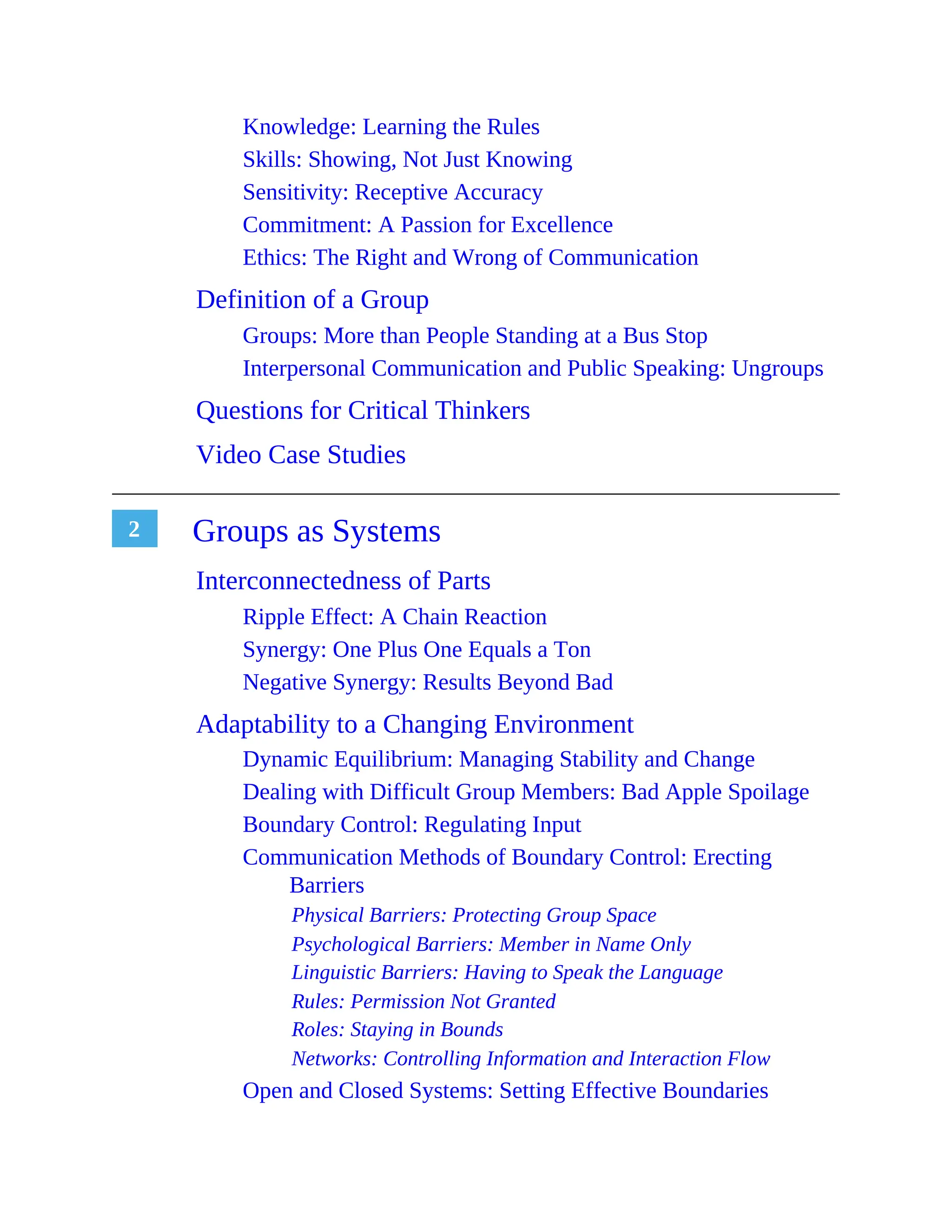
Knowledge: Learning theRules
Skills: Showing, Not Just Knowing
Sensitivity: Receptive Accuracy
Commitment: A Passion for Excellence
Ethics: The Right and Wrong of Communication
Definition of a Group
Groups: More than People Standing at a Bus Stop
Interpersonal Communication and Public Speaking: Ungroups
Questions for Critical Thinkers
Video Case Studies
Groups as Systems
Interconnectedness of Parts
Ripple Effect: A Chain Reaction
Synergy: One Plus One Equals a Ton
Negative Synergy: Results Beyond Bad
Adaptability to a Changing Environment
Dynamic Equilibrium: Managing Stability and Change
Dealing with Difficult Group Members: Bad Apple Spoilage
Boundary Control: Regulating Input
Communication Methods of Boundary Control: Erecting
Barriers
Physical Barriers: Protecting Group Space
Psychological Barriers: Member in Name Only
Linguistic Barriers: Having to Speak the Language
Rules: Permission Not Granted
Roles: Staying in Bounds
Networks: Controlling Information and Interaction Flow
Open and Closed Systems: Setting Effective Boundaries
4.
3
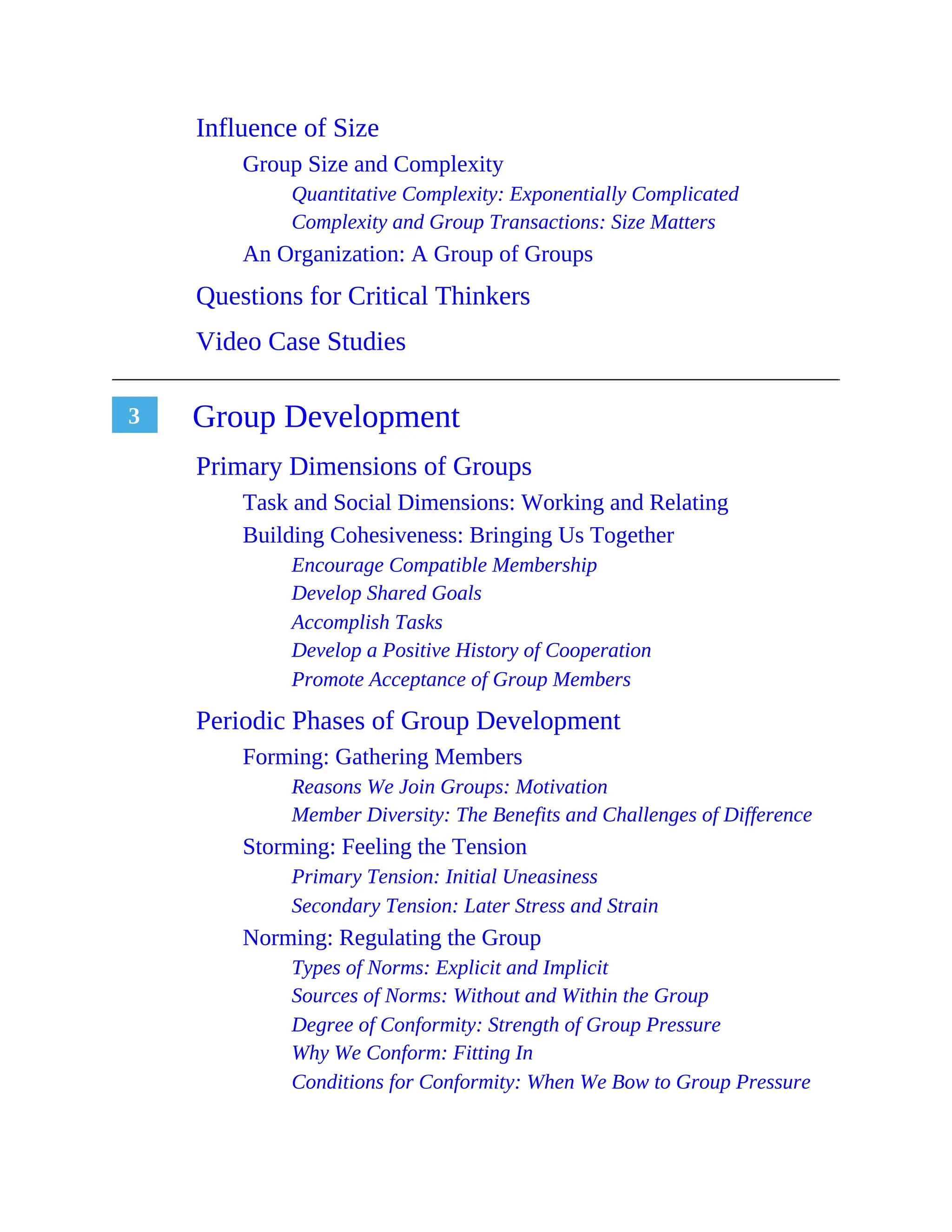
Influence of Size
GroupSize and Complexity
Quantitative Complexity: Exponentially Complicated
Complexity and Group Transactions: Size Matters
An Organization: A Group of Groups
Questions for Critical Thinkers
Video Case Studies
Group Development
Primary Dimensions of Groups
Task and Social Dimensions: Working and Relating
Building Cohesiveness: Bringing Us Together
Encourage Compatible Membership
Develop Shared Goals
Accomplish Tasks
Develop a Positive History of Cooperation
Promote Acceptance of Group Members
Periodic Phases of Group Development
Forming: Gathering Members
Reasons We Join Groups: Motivation
Member Diversity: The Benefits and Challenges of Difference
Storming: Feeling the Tension
Primary Tension: Initial Uneasiness
Secondary Tension: Later Stress and Strain
Norming: Regulating the Group
Types of Norms: Explicit and Implicit
Sources of Norms: Without and Within the Group
Degree of Conformity: Strength of Group Pressure
Why We Conform: Fitting In
Conditions for Conformity: When We Bow to Group Pressure
5.
4
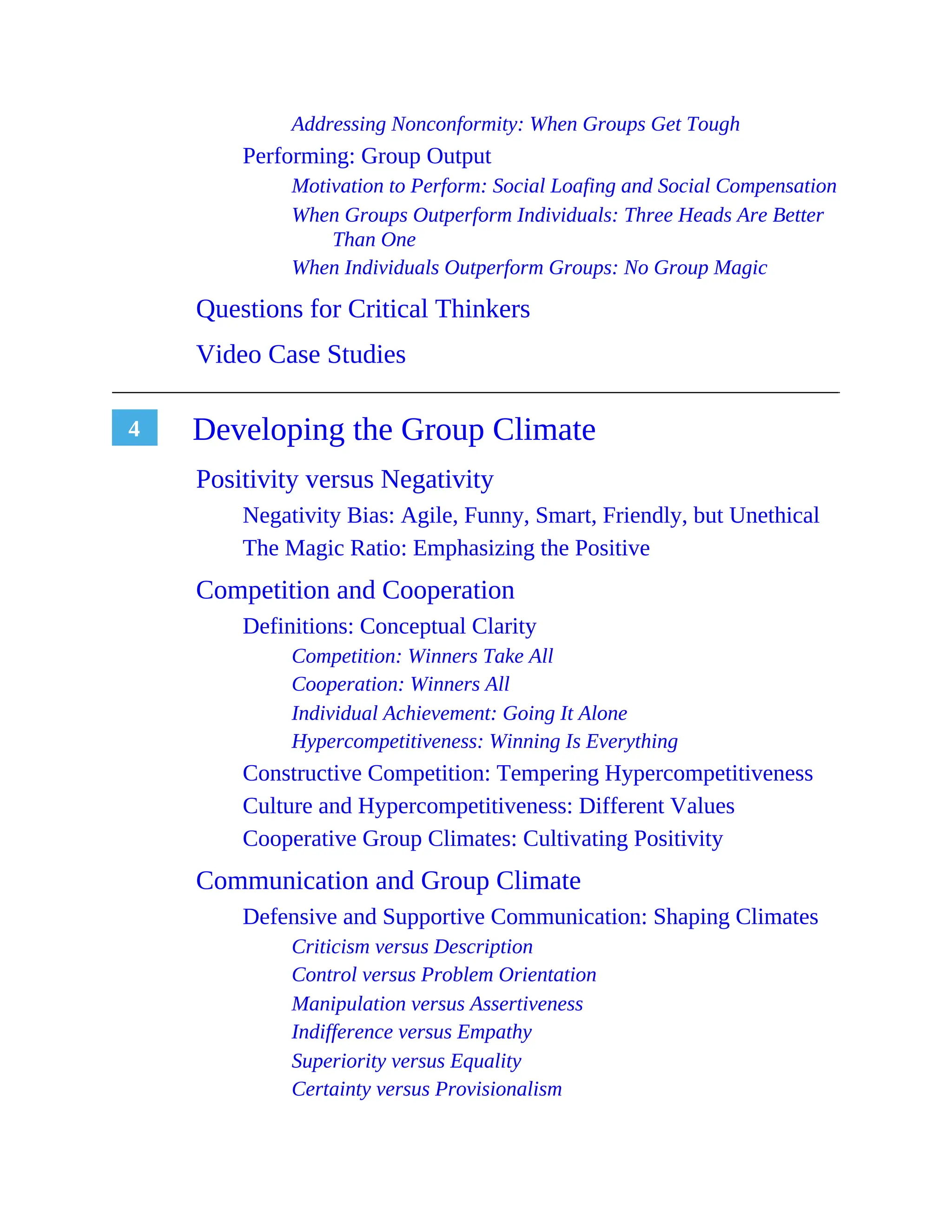
Addressing Nonconformity: WhenGroups Get Tough
Performing: Group Output
Motivation to Perform: Social Loafing and Social Compensation
When Groups Outperform Individuals: Three Heads Are Better
Than One
When Individuals Outperform Groups: No Group Magic
Questions for Critical Thinkers
Video Case Studies
Developing the Group Climate
Positivity versus Negativity
Negativity Bias: Agile, Funny, Smart, Friendly, but Unethical
The Magic Ratio: Emphasizing the Positive
Competition and Cooperation
Definitions: Conceptual Clarity
Competition: Winners Take All
Cooperation: Winners All
Individual Achievement: Going It Alone
Hypercompetitiveness: Winning Is Everything
Constructive Competition: Tempering Hypercompetitiveness
Culture and Hypercompetitiveness: Different Values
Cooperative Group Climates: Cultivating Positivity
Communication and Group Climate
Defensive and Supportive Communication: Shaping Climates
Criticism versus Description
Control versus Problem Orientation
Manipulation versus Assertiveness
Indifference versus Empathy
Superiority versus Equality
Certainty versus Provisionalism
6.
5
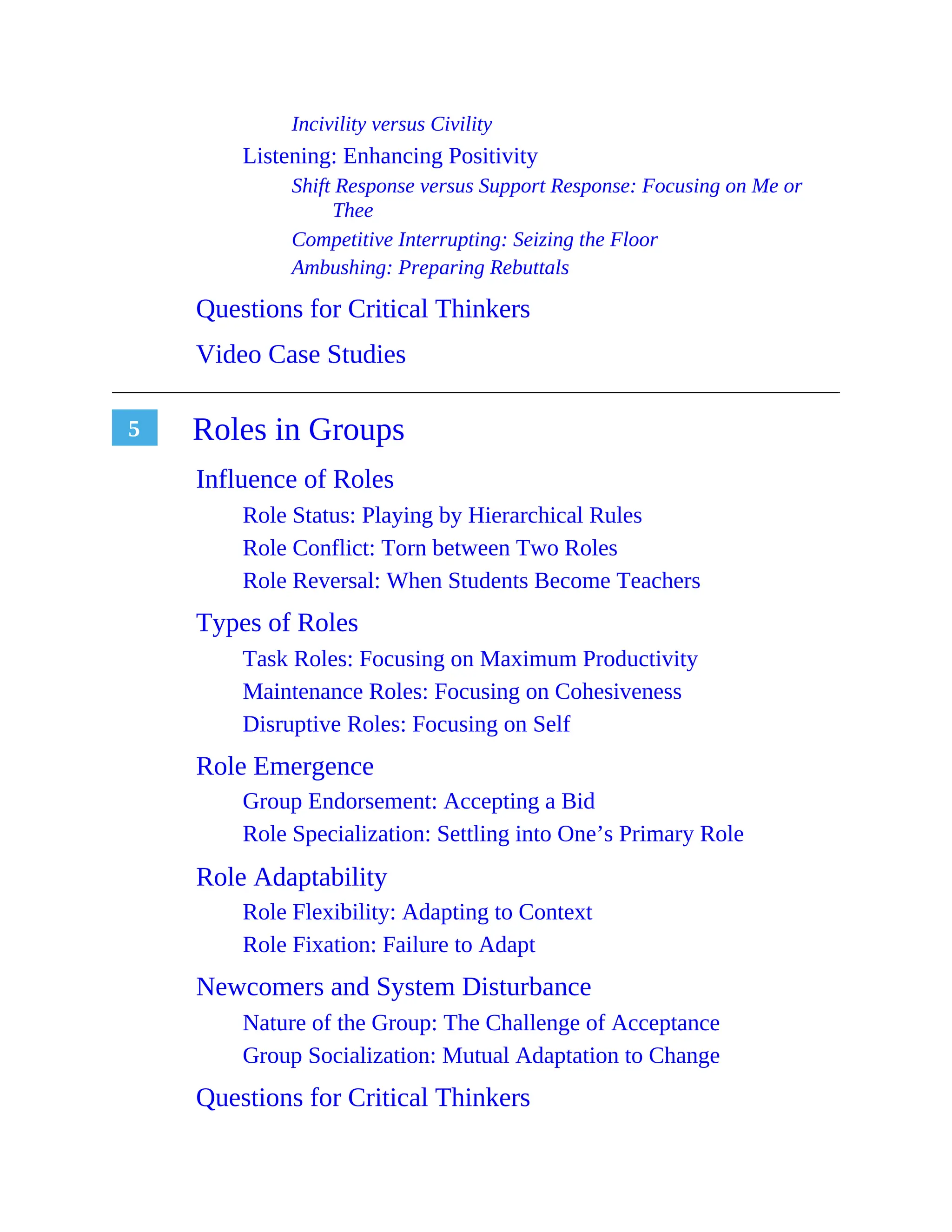
Incivility versus Civility
Listening:Enhancing Positivity
Shift Response versus Support Response: Focusing on Me or
Thee
Competitive Interrupting: Seizing the Floor
Ambushing: Preparing Rebuttals
Questions for Critical Thinkers
Video Case Studies
Roles in Groups
Influence of Roles
Role Status: Playing by Hierarchical Rules
Role Conflict: Torn between Two Roles
Role Reversal: When Students Become Teachers
Types of Roles
Task Roles: Focusing on Maximum Productivity
Maintenance Roles: Focusing on Cohesiveness
Disruptive Roles: Focusing on Self
Role Emergence
Group Endorsement: Accepting a Bid
Role Specialization: Settling into One’s Primary Role
Role Adaptability
Role Flexibility: Adapting to Context
Role Fixation: Failure to Adapt
Newcomers and System Disturbance
Nature of the Group: The Challenge of Acceptance
Group Socialization: Mutual Adaptation to Change
Questions for Critical Thinkers
7.
6
7
Video Case Studies
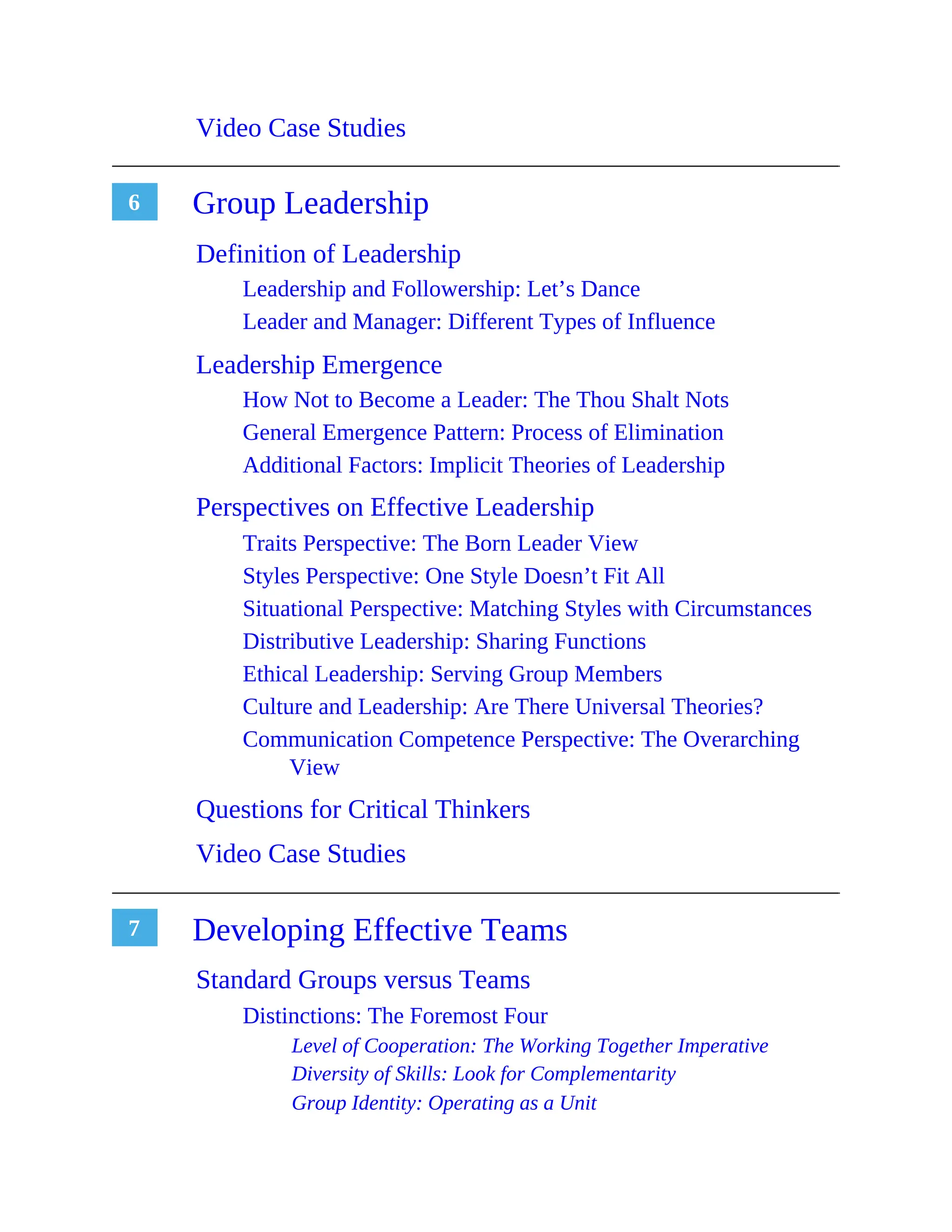
GroupLeadership
Definition of Leadership
Leadership and Followership: Let’s Dance
Leader and Manager: Different Types of Influence
Leadership Emergence
How Not to Become a Leader: The Thou Shalt Nots
General Emergence Pattern: Process of Elimination
Additional Factors: Implicit Theories of Leadership
Perspectives on Effective Leadership
Traits Perspective: The Born Leader View
Styles Perspective: One Style Doesn’t Fit All
Situational Perspective: Matching Styles with Circumstances
Distributive Leadership: Sharing Functions
Ethical Leadership: Serving Group Members
Culture and Leadership: Are There Universal Theories?
Communication Competence Perspective: The Overarching
View
Questions for Critical Thinkers
Video Case Studies
Developing Effective Teams
Standard Groups versus Teams
Distinctions: The Foremost Four
Level of Cooperation: The Working Together Imperative
Diversity of Skills: Look for Complementarity
Group Identity: Operating as a Unit
8.
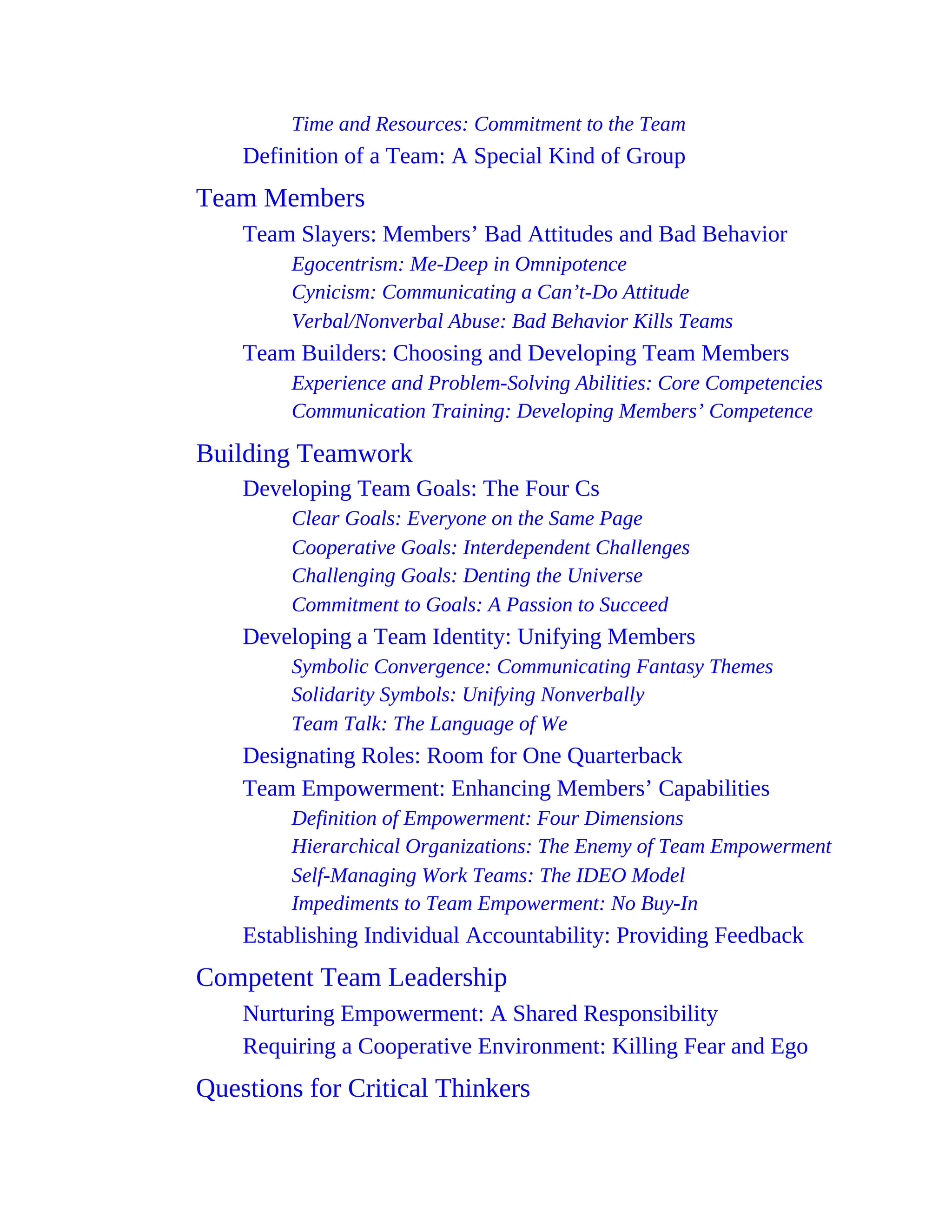
Time and Resources:Commitment to the Team
Definition of a Team: A Special Kind of Group
Team Members
Team Slayers: Members’ Bad Attitudes and Bad Behavior
Egocentrism: Me-Deep in Omnipotence
Cynicism: Communicating a Can’t-Do Attitude
Verbal/Nonverbal Abuse: Bad Behavior Kills Teams
Team Builders: Choosing and Developing Team Members
Experience and Problem-Solving Abilities: Core Competencies
Communication Training: Developing Members’ Competence
Building Teamwork
Developing Team Goals: The Four Cs
Clear Goals: Everyone on the Same Page
Cooperative Goals: Interdependent Challenges
Challenging Goals: Denting the Universe
Commitment to Goals: A Passion to Succeed
Developing a Team Identity: Unifying Members
Symbolic Convergence: Communicating Fantasy Themes
Solidarity Symbols: Unifying Nonverbally
Team Talk: The Language of We
Designating Roles: Room for One Quarterback
Team Empowerment: Enhancing Members’ Capabilities
Definition of Empowerment: Four Dimensions
Hierarchical Organizations: The Enemy of Team Empowerment
Self-Managing Work Teams: The IDEO Model
Impediments to Team Empowerment: No Buy-In
Establishing Individual Accountability: Providing Feedback
Competent Team Leadership
Nurturing Empowerment: A Shared Responsibility
Requiring a Cooperative Environment: Killing Fear and Ego
Questions for Critical Thinkers
9.
8
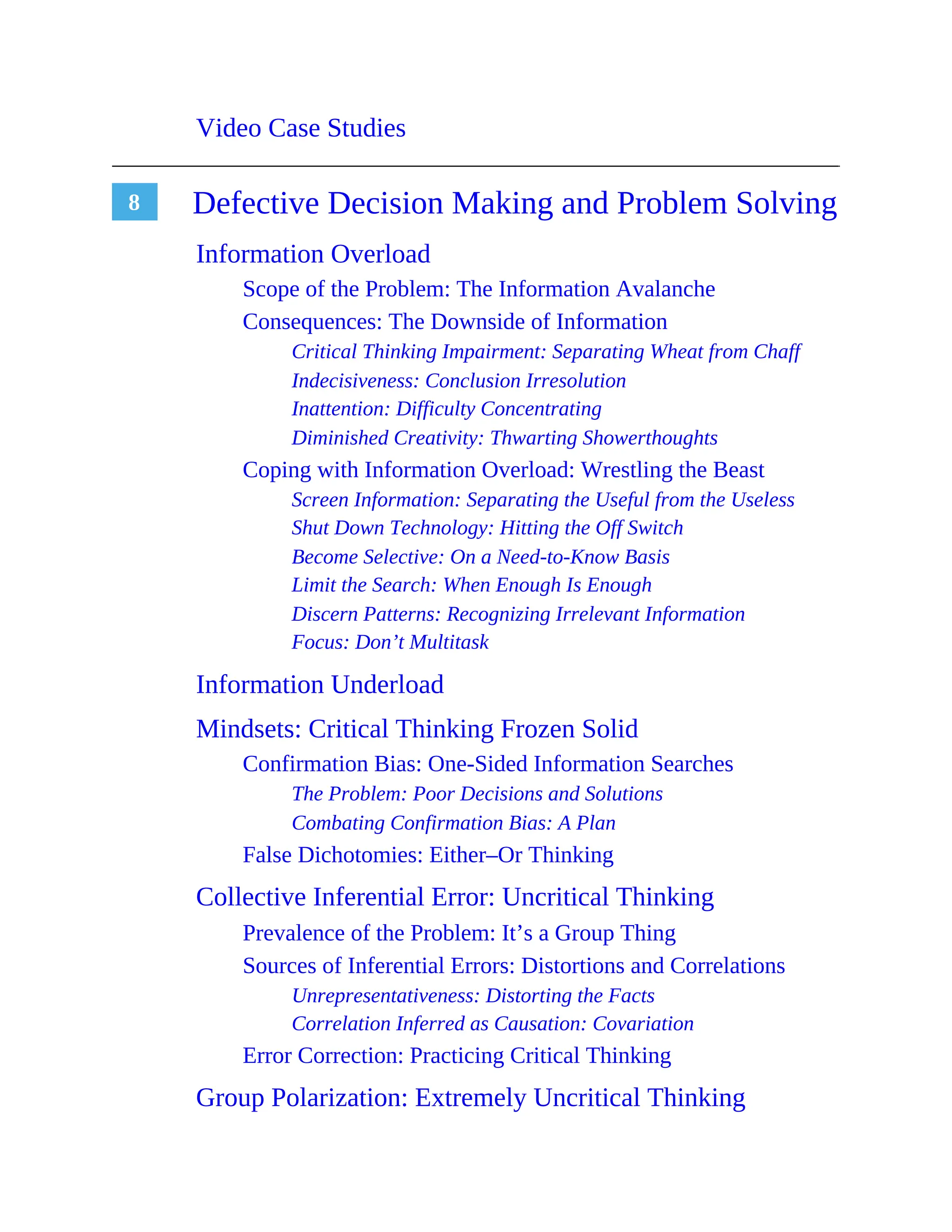
Video Case Studies
DefectiveDecision Making and Problem Solving
Information Overload
Scope of the Problem: The Information Avalanche
Consequences: The Downside of Information
Critical Thinking Impairment: Separating Wheat from Chaff
Indecisiveness: Conclusion Irresolution
Inattention: Difficulty Concentrating
Diminished Creativity: Thwarting Showerthoughts
Coping with Information Overload: Wrestling the Beast
Screen Information: Separating the Useful from the Useless
Shut Down Technology: Hitting the Off Switch
Become Selective: On a Need-to-Know Basis
Limit the Search: When Enough Is Enough
Discern Patterns: Recognizing Irrelevant Information
Focus: Don’t Multitask
Information Underload
Mindsets: Critical Thinking Frozen Solid
Confirmation Bias: One-Sided Information Searches
The Problem: Poor Decisions and Solutions
Combating Confirmation Bias: A Plan
False Dichotomies: Either–Or Thinking
Collective Inferential Error: Uncritical Thinking
Prevalence of the Problem: It’s a Group Thing
Sources of Inferential Errors: Distortions and Correlations
Unrepresentativeness: Distorting the Facts
Correlation Inferred as Causation: Covariation
Error Correction: Practicing Critical Thinking
Group Polarization: Extremely Uncritical Thinking
10.
9
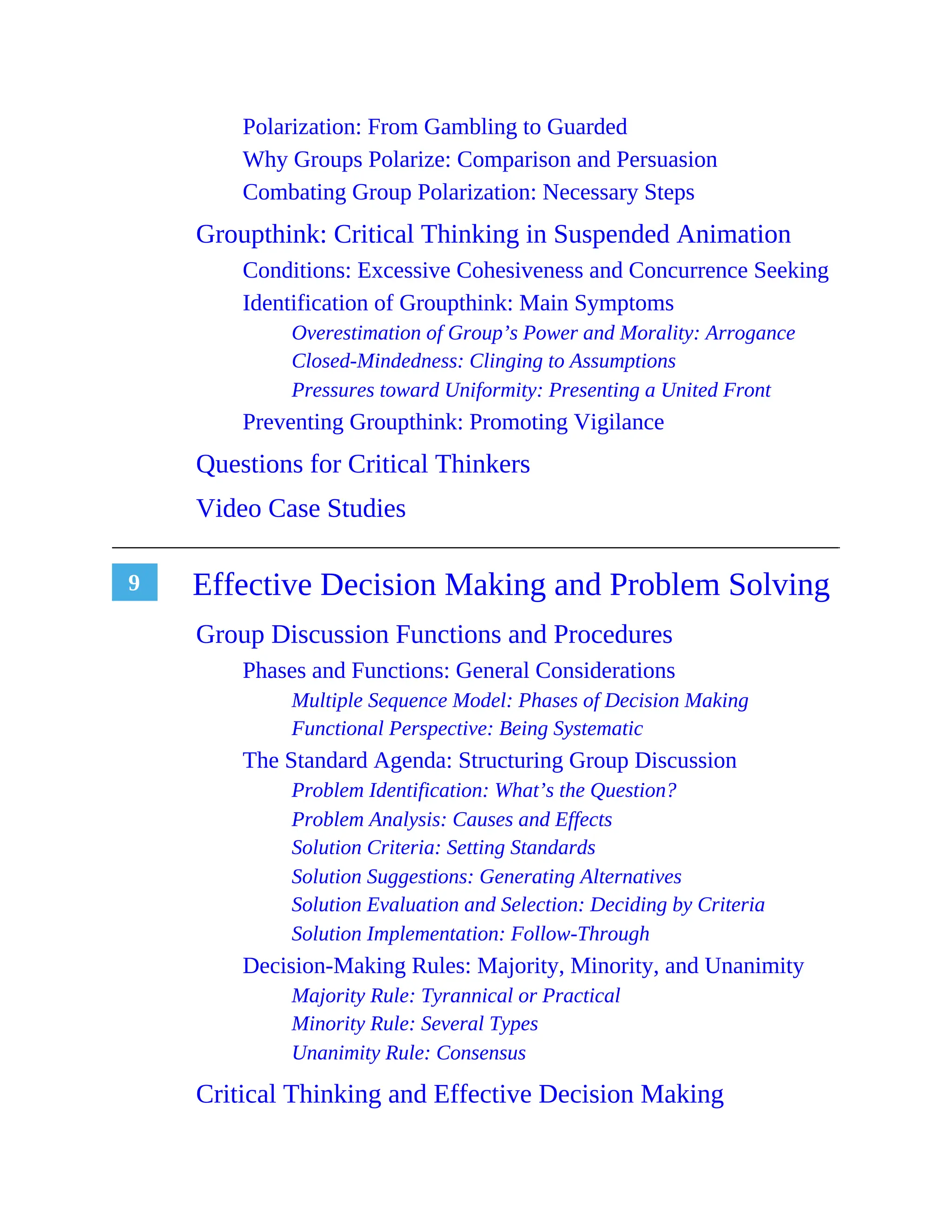
Polarization: From Gamblingto Guarded
Why Groups Polarize: Comparison and Persuasion
Combating Group Polarization: Necessary Steps
Groupthink: Critical Thinking in Suspended Animation
Conditions: Excessive Cohesiveness and Concurrence Seeking
Identification of Groupthink: Main Symptoms
Overestimation of Group’s Power and Morality: Arrogance
Closed-Mindedness: Clinging to Assumptions
Pressures toward Uniformity: Presenting a United Front
Preventing Groupthink: Promoting Vigilance
Questions for Critical Thinkers
Video Case Studies
Effective Decision Making and Problem Solving
Group Discussion Functions and Procedures
Phases and Functions: General Considerations
Multiple Sequence Model: Phases of Decision Making
Functional Perspective: Being Systematic
The Standard Agenda: Structuring Group Discussion
Problem Identification: What’s the Question?
Problem Analysis: Causes and Effects
Solution Criteria: Setting Standards
Solution Suggestions: Generating Alternatives
Solution Evaluation and Selection: Deciding by Criteria
Solution Implementation: Follow-Through
Decision-Making Rules: Majority, Minority, and Unanimity
Majority Rule: Tyrannical or Practical
Minority Rule: Several Types
Unanimity Rule: Consensus
Critical Thinking and Effective Decision Making
11.
10
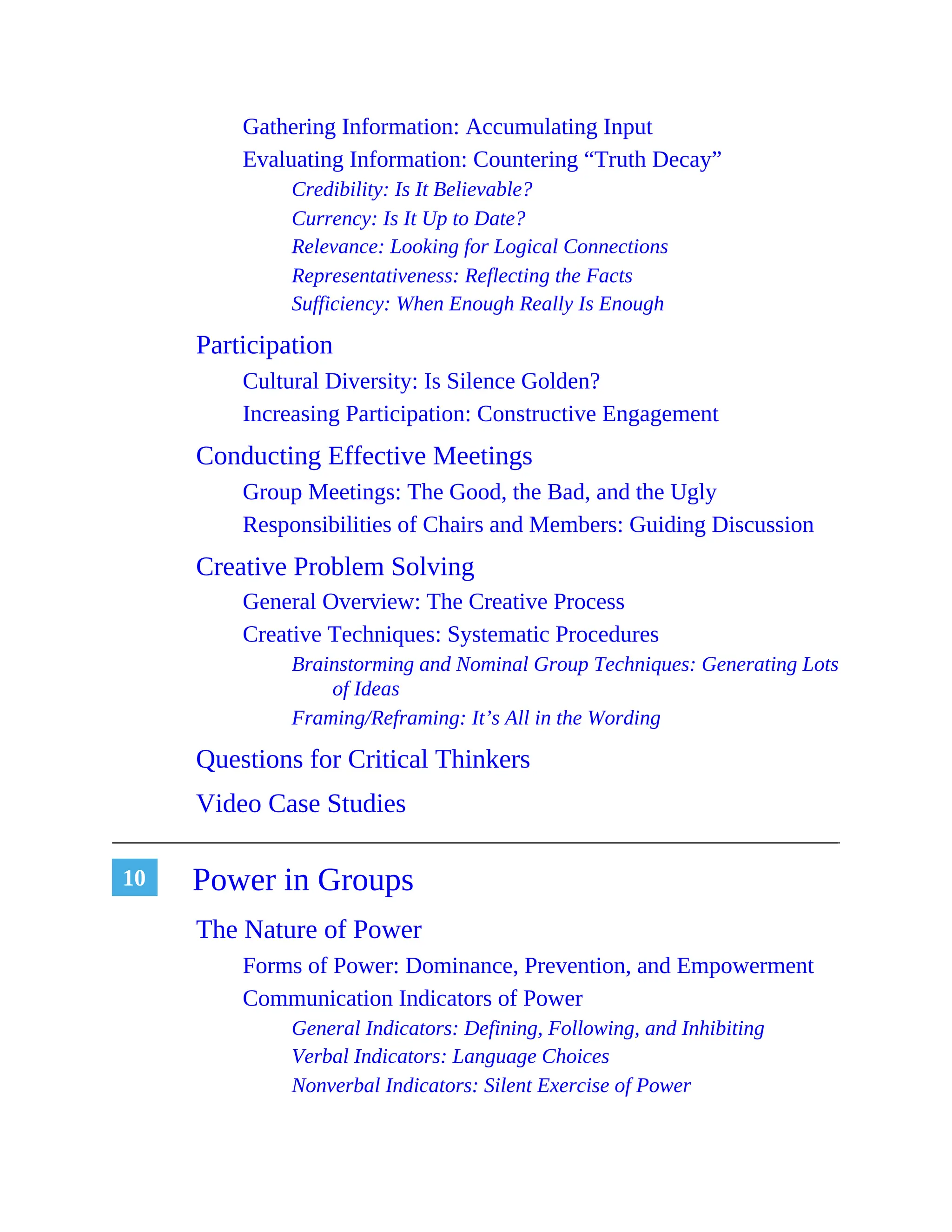
Gathering Information: AccumulatingInput
Evaluating Information: Countering “Truth Decay”
Credibility: Is It Believable?
Currency: Is It Up to Date?
Relevance: Looking for Logical Connections
Representativeness: Reflecting the Facts
Sufficiency: When Enough Really Is Enough
Participation
Cultural Diversity: Is Silence Golden?
Increasing Participation: Constructive Engagement
Conducting Effective Meetings
Group Meetings: The Good, the Bad, and the Ugly
Responsibilities of Chairs and Members: Guiding Discussion
Creative Problem Solving
General Overview: The Creative Process
Creative Techniques: Systematic Procedures
Brainstorming and Nominal Group Techniques: Generating Lots
of Ideas
Framing/Reframing: It’s All in the Wording
Questions for Critical Thinkers
Video Case Studies
Power in Groups
The Nature of Power
Forms of Power: Dominance, Prevention, and Empowerment
Communication Indicators of Power
General Indicators: Defining, Following, and Inhibiting
Verbal Indicators: Language Choices
Nonverbal Indicators: Silent Exercise of Power
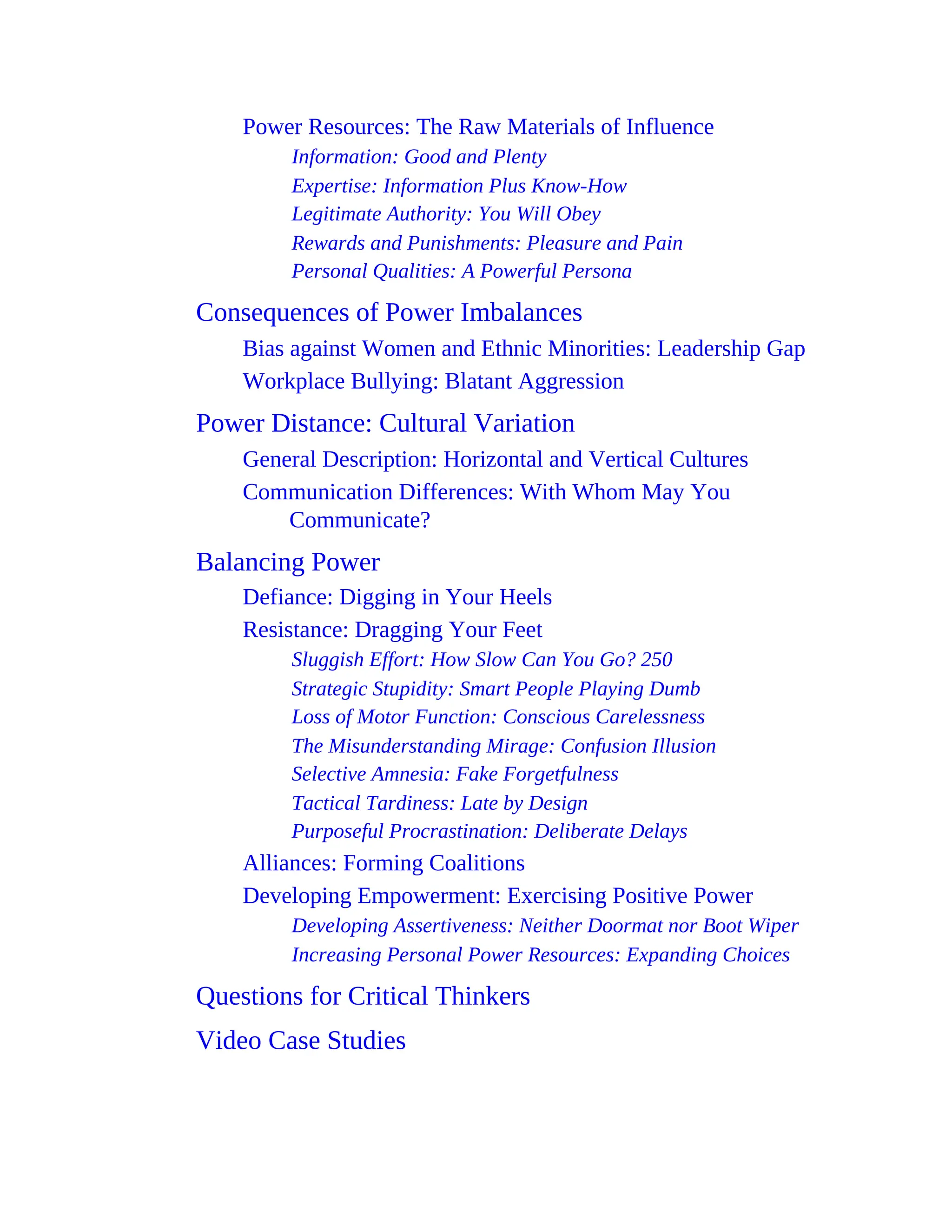
Power Resources: TheRaw Materials of Influence
Information: Good and Plenty
Expertise: Information Plus Know-How
Legitimate Authority: You Will Obey
Rewards and Punishments: Pleasure and Pain
Personal Qualities: A Powerful Persona
Consequences of Power Imbalances
Bias against Women and Ethnic Minorities: Leadership Gap
Workplace Bullying: Blatant Aggression
Power Distance: Cultural Variation
General Description: Horizontal and Vertical Cultures
Communication Differences: With Whom May You
Communicate?
Balancing Power
Defiance: Digging in Your Heels
Resistance: Dragging Your Feet
Sluggish Effort: How Slow Can You Go? 250
Strategic Stupidity: Smart People Playing Dumb
Loss of Motor Function: Conscious Carelessness
The Misunderstanding Mirage: Confusion Illusion
Selective Amnesia: Fake Forgetfulness
Tactical Tardiness: Late by Design
Purposeful Procrastination: Deliberate Delays
Alliances: Forming Coalitions
Developing Empowerment: Exercising Positive Power
Developing Assertiveness: Neither Doormat nor Boot Wiper
Increasing Personal Power Resources: Expanding Choices
Questions for Critical Thinkers
Video Case Studies
14.
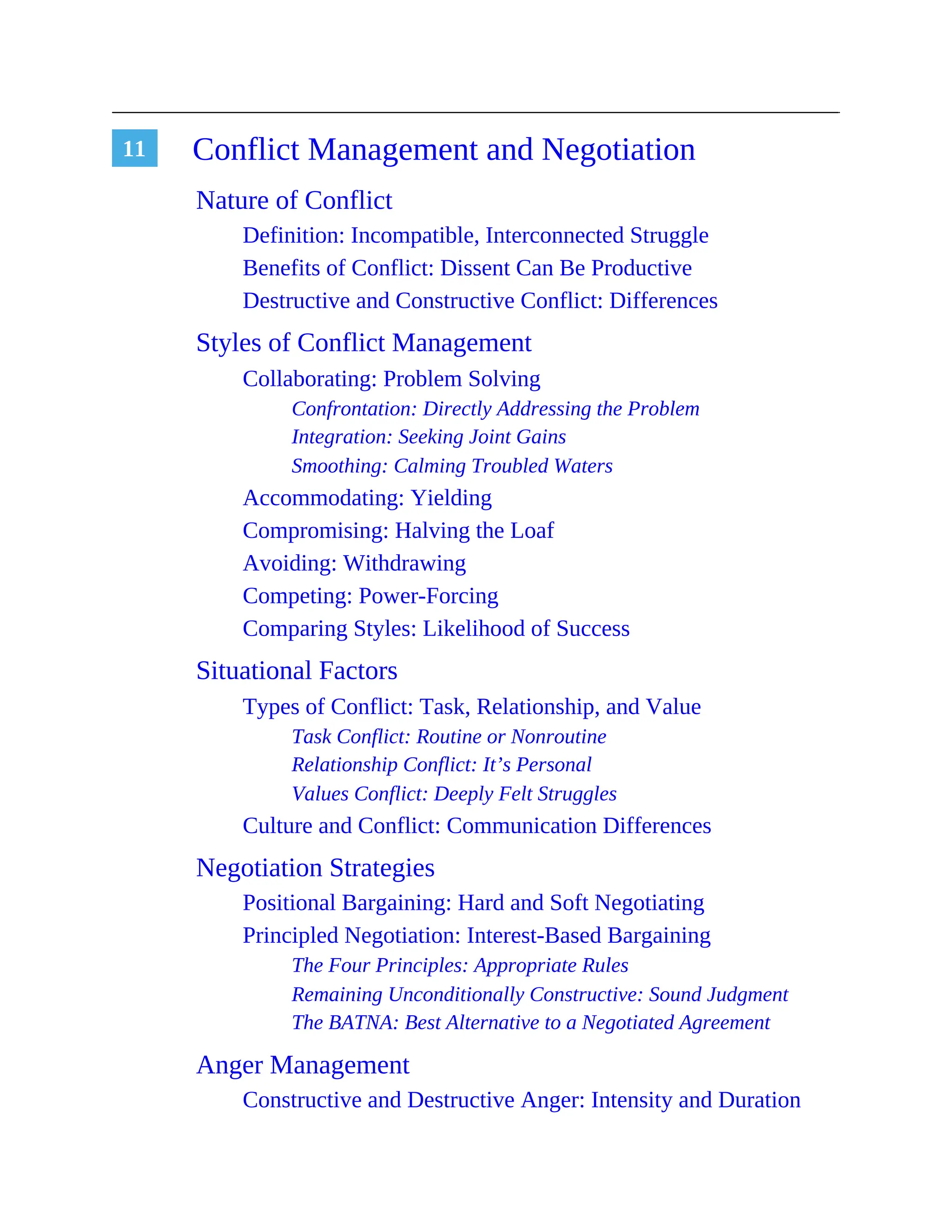
11 Conflict Managementand Negotiation
Nature of Conflict
Definition: Incompatible, Interconnected Struggle
Benefits of Conflict: Dissent Can Be Productive
Destructive and Constructive Conflict: Differences
Styles of Conflict Management
Collaborating: Problem Solving
Confrontation: Directly Addressing the Problem
Integration: Seeking Joint Gains
Smoothing: Calming Troubled Waters
Accommodating: Yielding
Compromising: Halving the Loaf
Avoiding: Withdrawing
Competing: Power-Forcing
Comparing Styles: Likelihood of Success
Situational Factors
Types of Conflict: Task, Relationship, and Value
Task Conflict: Routine or Nonroutine
Relationship Conflict: It’s Personal
Values Conflict: Deeply Felt Struggles
Culture and Conflict: Communication Differences
Negotiation Strategies
Positional Bargaining: Hard and Soft Negotiating
Principled Negotiation: Interest-Based Bargaining
The Four Principles: Appropriate Rules
Remaining Unconditionally Constructive: Sound Judgment
The BATNA: Best Alternative to a Negotiated Agreement
Anger Management
Constructive and Destructive Anger: Intensity and Duration
15.
12
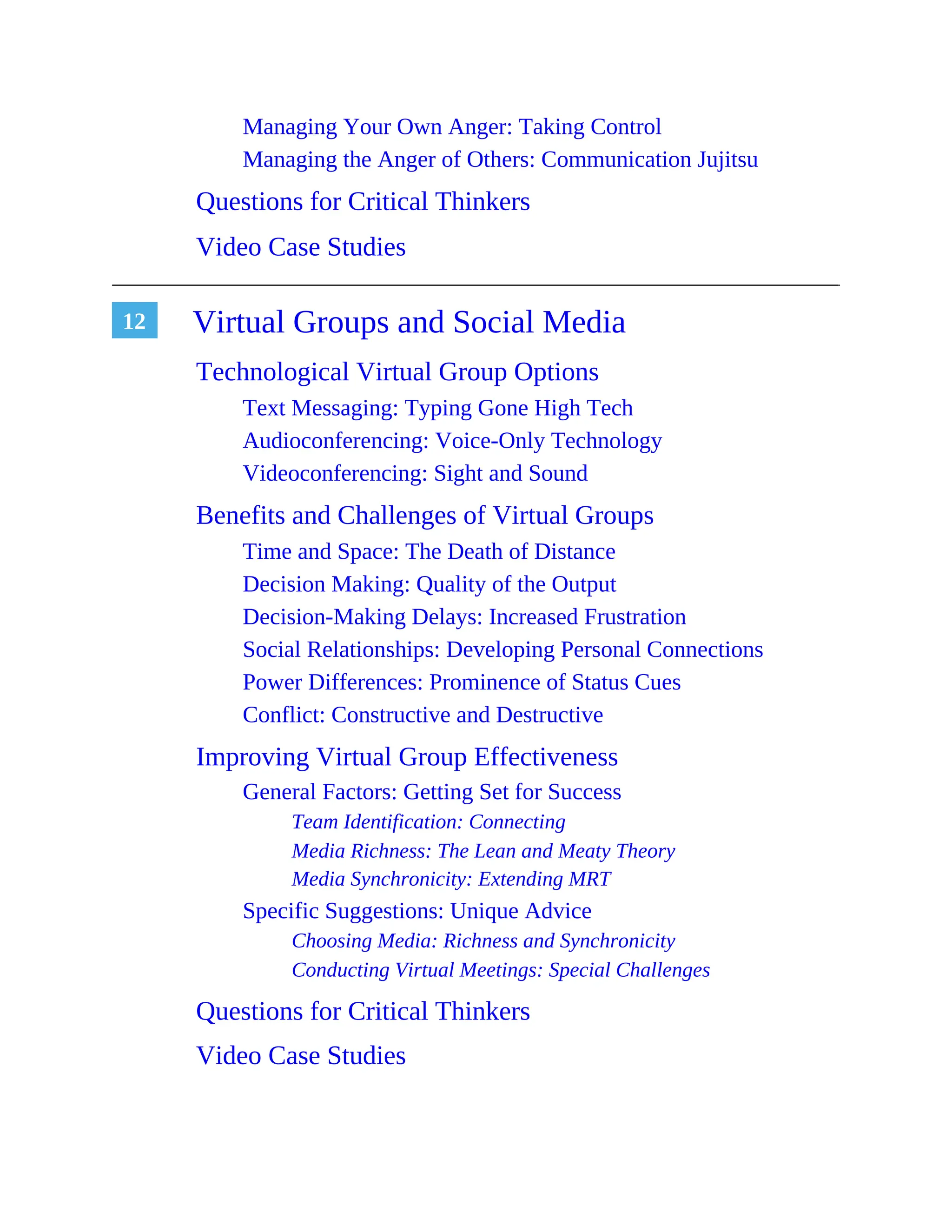
Managing Your OwnAnger: Taking Control
Managing the Anger of Others: Communication Jujitsu
Questions for Critical Thinkers
Video Case Studies
Virtual Groups and Social Media
Technological Virtual Group Options
Text Messaging: Typing Gone High Tech
Audioconferencing: Voice-Only Technology
Videoconferencing: Sight and Sound
Benefits and Challenges of Virtual Groups
Time and Space: The Death of Distance
Decision Making: Quality of the Output
Decision-Making Delays: Increased Frustration
Social Relationships: Developing Personal Connections
Power Differences: Prominence of Status Cues
Conflict: Constructive and Destructive
Improving Virtual Group Effectiveness
General Factors: Getting Set for Success
Team Identification: Connecting
Media Richness: The Lean and Meaty Theory
Media Synchronicity: Extending MRT
Specific Suggestions: Unique Advice
Choosing Media: Richness and Synchronicity
Conducting Virtual Meetings: Special Challenges
Questions for Critical Thinkers
Video Case Studies
16.
Appendix A: GroupOral Presentations
Appendix B: Critical Thinking Revisited: Arguments and
Fallacies
Glossary
References
Index
17.
Preface
I am profoundlygrateful to all who have helped make In Mixed Company
such a resounding success through nine editions. Despite its success,
however, I have become increasingly concerned about the inflated pricing of
In Mixed Company. So much so, that I have proactively changed publishers. I
am thrilled to report that Oxford University Press (OUP), a not-for-
profit publisher of considerable renown, is publishing this tenth edition.
Publishing with OUP, coupled with the decision to significantly condense In
Mixed Company, permits an astounding reduction in price. This edition is
about $90 less expensive than the previous print edition’s list price, and
about $125 less expensive as an e-book.
With each new edition, I find it ever more challenging to make significant
changes that make In Mixed Company an even better textbook for students. I
have also become uncomfortably aware that, as the author, I have grown a bit
too fond of my own words, hesitant to cut much detail from previous editions
and to strive for greater concision. Consequently, I have energetically edited
this new edition.
Even though I have made major edits to refurbish In Mixed Company and
to reduce its price, I have preserved the essence of previous versions. The
central unifying theme, that cooperation in small groups is usually superior
to competition, has been maintained. The communication competence
model continues to guide discussions of key small group concepts and
processes. The model is one of the communication discipline’s unique
contributions to understanding and improving human behavior. It is
thoroughly integrated throughout the text. Systems theory also remains as a
key theoretical component of the text, providing a conceptual framework for
analysis and insights. Finally, the unique focus on power in groups remains.
As social psychologist Dacher Keltner (2016), author of The Power Paradox,
notes, “Power defines the waking life of every human being . . . emerges
instantaneously when humans interact” and “shapes our every interaction,
This ebook isfor the use of anyone anywhere in the United
States and most other parts of the world at no cost and with
almost no restrictions whatsoever. You may copy it, give it away
or re-use it under the terms of the Project Gutenberg License
included with this ebook or online at www.gutenberg.org. If you
are not located in the United States, you will have to check the
laws of the country where you are located before using this
eBook.
Title: The Story Tellers' Magazine, Vol. I, No. 1, June 1913
Author: Various
Editor: Richard Thomas Wyche
Release date: November 7, 2020 [eBook #63669]
Most recently updated: October 18, 2024
Language: English
Credits: Produced by hekula03, Les Galloway and the Online
Distributed Proofreading Team at
https://www.pgdp.net (This
book was produced from images made available by the
HathiTrust Digital Library.)
*** START OF THE PROJECT GUTENBERG EBOOK THE STORY
TELLERS' MAGAZINE, VOL. I, NO. 1, JUNE 1913 ***
24.
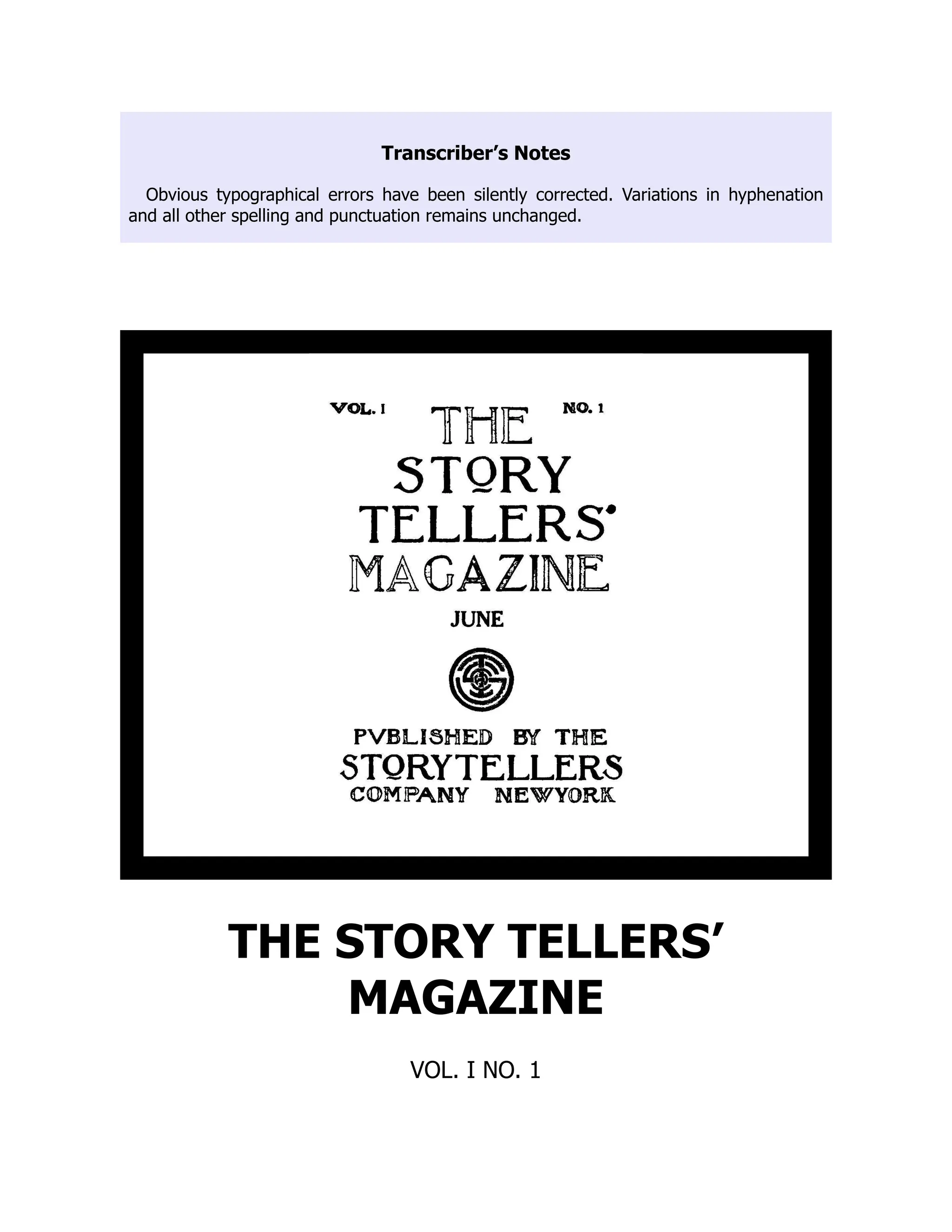
Transcriber’s Notes
Obvious typographicalerrors have been silently corrected. Variations in hyphenation
and all other spelling and punctuation remains unchanged.
THE STORY TELLERS’
MAGAZINE
VOL. I NO. 1
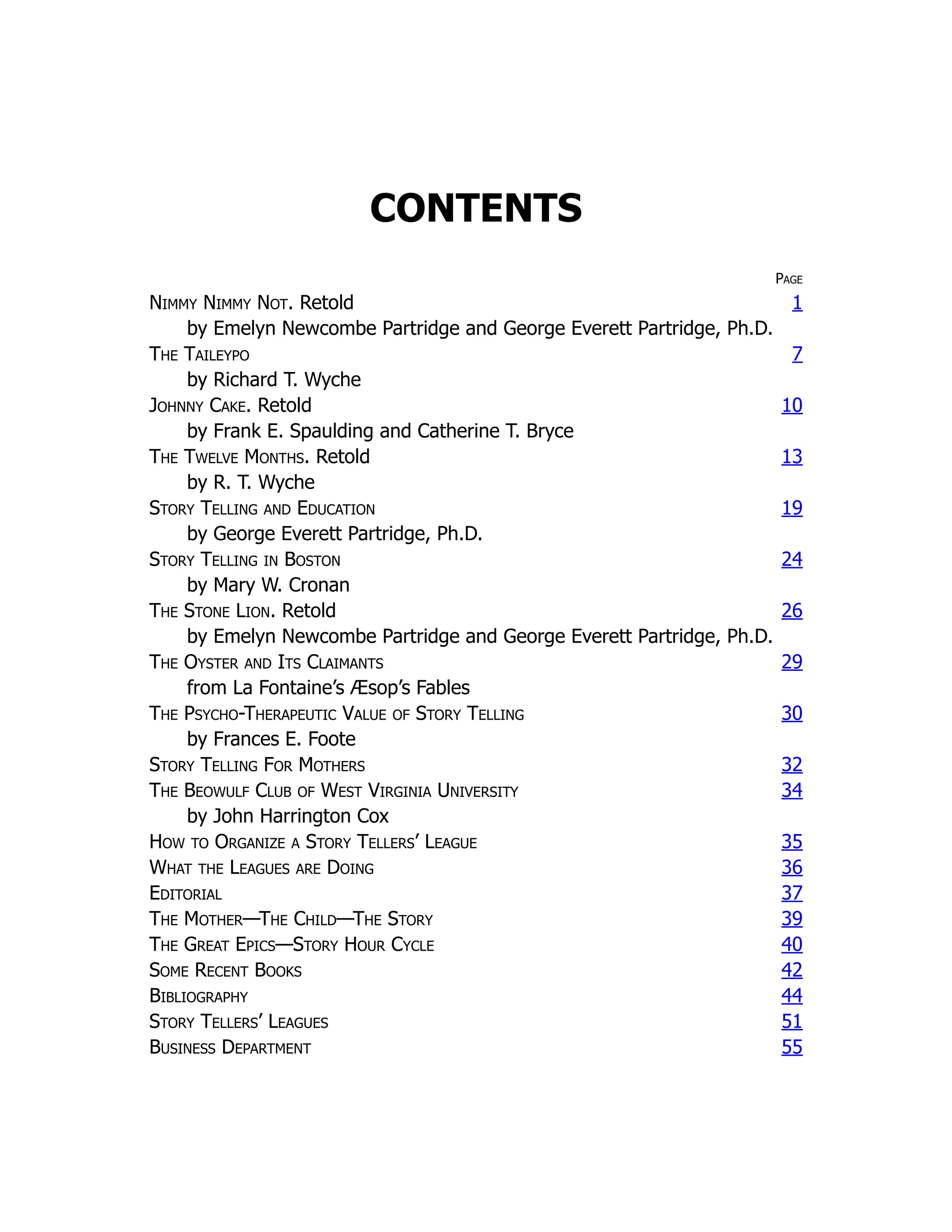
CONTENTS
Page
Nimmy Nimmy Not.Retold 1
by Emelyn Newcombe Partridge and George Everett Partridge, Ph.D.
The Taileypo 7
by Richard T. Wyche
Johnny Cake. Retold 10
by Frank E. Spaulding and Catherine T. Bryce
The Twelve Months. Retold 13
by R. T. Wyche
Story Telling and Education 19
by George Everett Partridge, Ph.D.
Story Telling in Boston 24
by Mary W. Cronan
The Stone Lion. Retold 26
by Emelyn Newcombe Partridge and George Everett Partridge, Ph.D.
The Oyster and Its Claimants 29
from La Fontaine’s Æsop’s Fables
The Psycho-Therapeutic Value of Story Telling 30
by Frances E. Foote
Story Telling For Mothers 32
The Beowulf Club of West Virginia University 34
by John Harrington Cox
How to Organize a Story Tellers’ League 35
What the Leagues are Doing 36
Editorial 37
The Mother—The Child—The Story 39
The Great Epics—Story Hour Cycle 40
Some Recent Books 42
Bibliography 44
Story Tellers’ Leagues 51
Business Department 55
28.
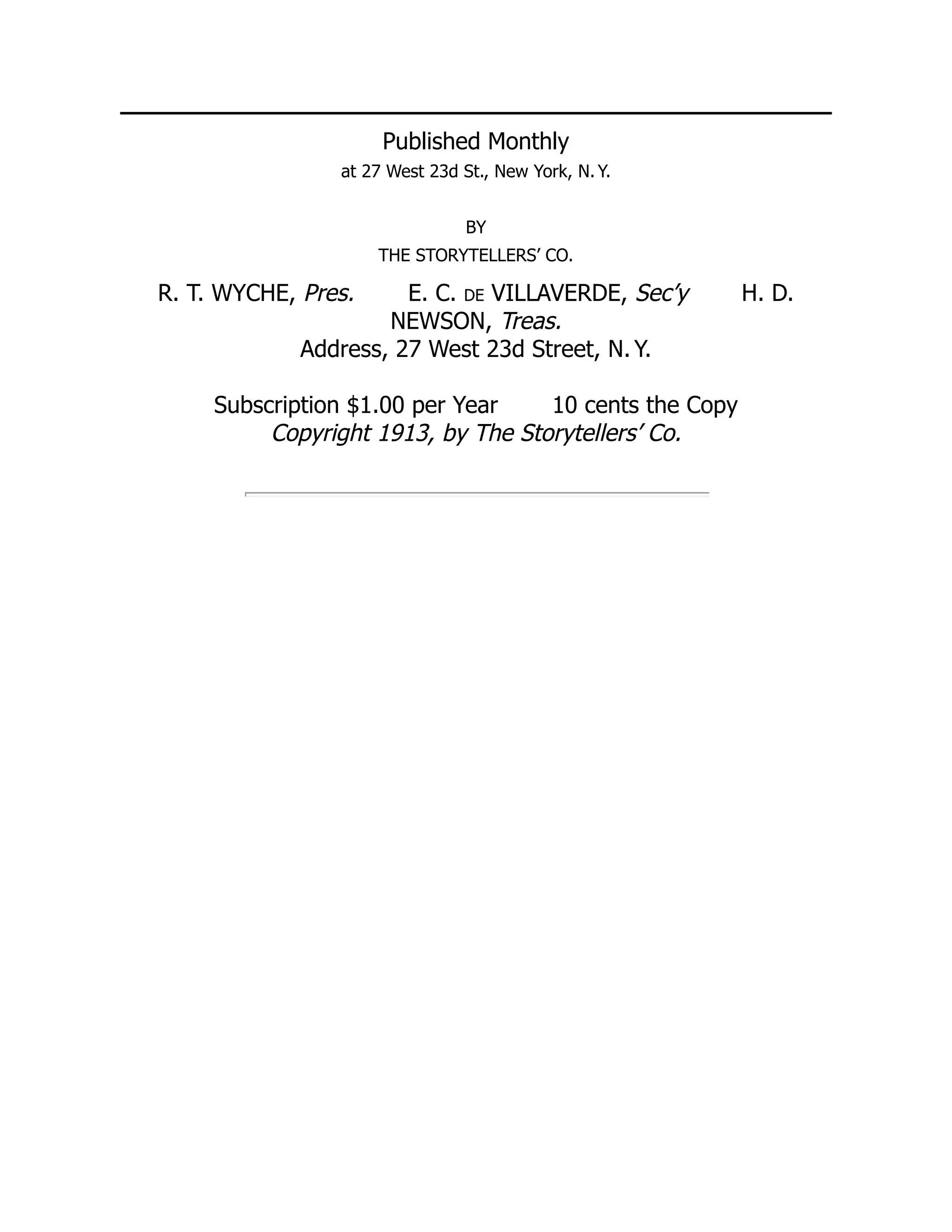
Published Monthly
at 27West 23d St., New York, N. Y.
BY
THE STORYTELLERS’ CO.
R. T. WYCHE, Pres. E. C. de VILLAVERDE, Sec’y H. D.
NEWSON, Treas.
Address, 27 West 23d Street, N. Y.
Subscription $1.00 per Year 10 cents the Copy
Copyright 1913, by The Storytellers’ Co.
29.
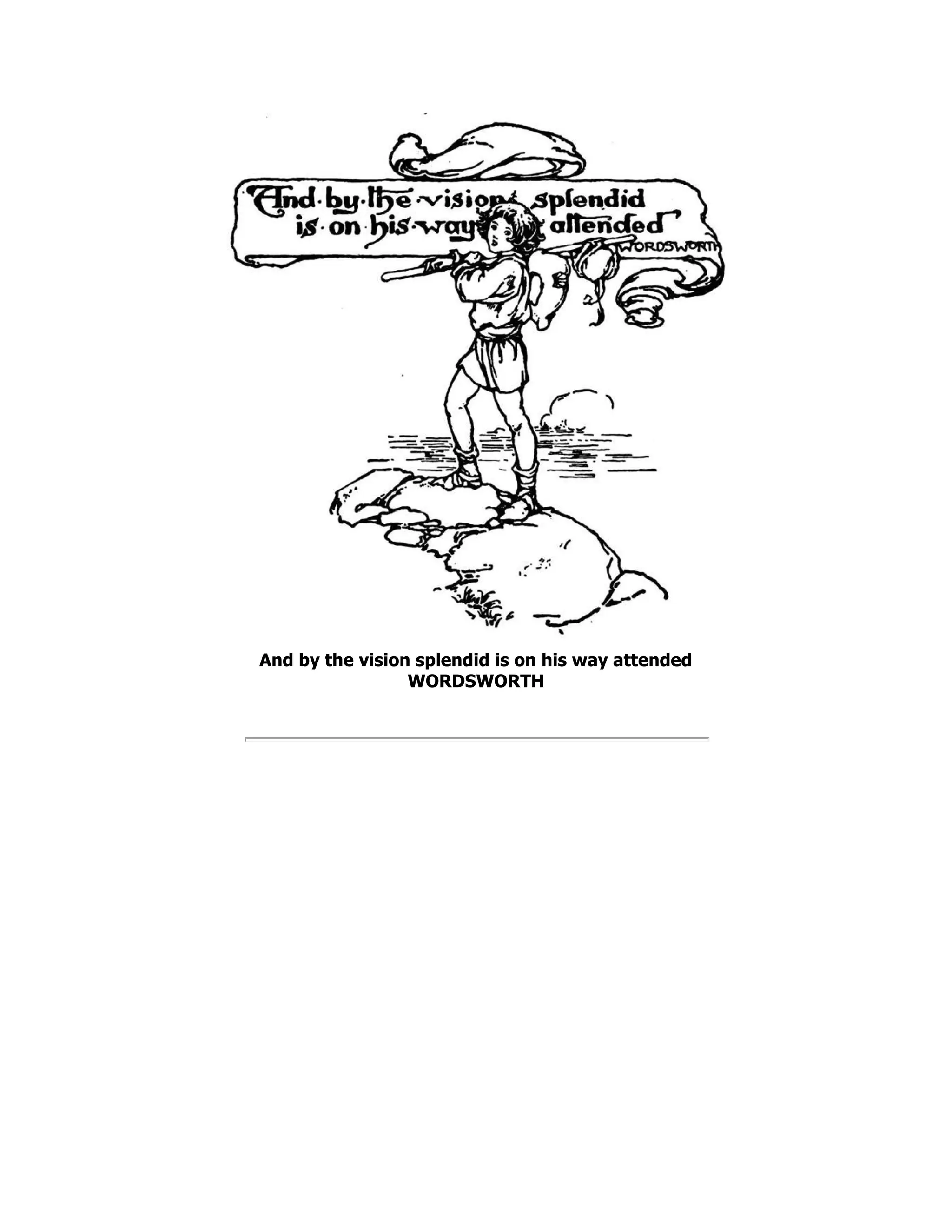
And by thevision splendid is on his way attended
WORDSWORTH
Nimmy Nimmy Not
AnEnglish Fairy-tale
Retold from English Folk and Fairy Tales—Camelot Series
This story is built upon the lines of a perfect dramatic
unit, as set forth by Freytag in his “Technik des Dramas”—
(1) Exposition. Facts preceding the principal interest, i. e.
the girl and her mother, etc. (2) Ascending Action. The
coming of the king. The task. The development of the
plot. (3) The Climax. This is the revelation of the name by
the king, followed by the Supreme Moment which was the
revelation of the proper name to Nimmy Nimmy Not. (4)
Descending Action. The disposal of the villain through his
“shrivelling up” and “flying away.” (5) Conclusion. “Living
happy ever after.”
Joseph Jacobs in his “English Fairy Stories” gives us the
following information in regard to the story: “Unearthed
by Mr. E. Clodd, from the Suffolk Notes and Queries of the
Ipswitch Journal, and re-printed by him in Folk-Lore
Journal vii. 138-43. It has its parallels in Devonshire’s as
“Duffy and the Devil,” in Hunt’s Romances and Drolls of
the West of England, 239-47; in Scotland two variants are
given by Chambers, “In Popular Rhymes of Scotland.” It is
clearly the same as Grimm’s “Rumpelstiltskin” (No. 14).
Mr. Clodd sees in the class of name-guessing stories, a
“survival” of the superstition that to know a man’s name
gives you power over him, for which reason savages
object to tell their names. It may be necessary—to explain
to the little one, that Tom Tit can only be referred to as
“That” because his name is not known until the end.
32.
The version ofthe story here given is republished by
permission from “Story Telling in School and Home,” by
Evelyn Newcombe Partridge and George Everett Partridge,
Ph. D., New York. Sturgis & Walton Co.
The illustrations for the story are reproduced from
“English Fairy Stories,” through the courtesy of the author
Joseph Jacobs and the publishers Messrs. G. P. Putnam’s
Sons, New York.
Once upon a time there was a woman, and she baked five pies.
And when she took them from the oven, she found that they had
baked so long the crusts were too hard to eat. So she said to her
daughter:
“Put you them there pies on the shelf, and by and by they’ll come
again.” She meant, you know, the crust would get soft.
The girl, she took the pies into the pantry, and she put them upon
the shelf in a long even row. She looked at them, and she thought
how good they would taste.
“Well, if them there pies’ll come again,” she said to herself, “I may
as well eat them now.”
So she ate them all, first and last!
Come supper time, the woman said:
“Go you and get one of them there pies, I dare say they’ve come
again by this time.”
The daughter she went into the pantry, and she looked at the
shelf. There were the five pie plates just as she had left them,—
empty! So she went back to her mother and she said:
“Noo, they ain’t come again.”
“Not one of them?” said the mother.
“Noo, not one of them,” says she.
33.
“Well, come againor not come again, I’ll have one for my supper.”
And the old woman went toward the pantry.
“But you can’t have one, if they ain’t come again, mother.”
“But I can,” the woman declared. “I’ll have the best one for my
supper.”
“Best or worst,” the daughter said, “I’ve ate them all! And you
can’t have one ’til they’ve come again!”
Well, the woman, she was so astonished she forgot all about
supper. She carried her spinning to the doorway, and as she span,
she sang a little song about her daughter:
“My daughter has ate five, five pies today,
My daughter has ate five, five pies today!”
Now the king was coming down the road, and he heard the
woman singing, but he could not hear the words. So he stopped in
front of the door and said:
“My good woman, what were you singing?”
Now the old woman did not want anyone to know what a greedy
daughter she had; so she sang instead of that,
“My daughter has spun five, five skeins today.”
“Land sakes alive!” said the king, “I never heard tell of anyone’s
doing that. Now look you here, my good woman. I want a wife, and
I’ll marry your daughter. But look you here. For eleven months of the
year she shall have all the victuals she wants to eat, and all the
clothes she wants to wear, and all the company she likes to keep.
But the twelfth month, she must spin five skeins every day, or off’ll
go her head!”
“All right,” says the woman, for she thought:
34.
“What a grandmarriage this will be. And as for them there five
skeins, by that time he’ll forget all about them.”
So they were married. And for eleven months the girl had all the
victuals she wanted to eat, and she had all the clothes she wanted
to get, and she had all the company she liked to keep. But
sometimes she felt a little uneasy. Sometimes she thought of that
spinning she must do.
The king, he never said one word about the five skeins, so as the
eleven months had nearly passed, the girl thought that he had
forgotten all about it.
But one day, it was the last day of the eleventh month! The king
came to her, and he took her into a little room she had never seen
before. There was nothing in it but a spinning wheel and a little chair
and a small bare table.
“Here, my girl,” says he, “here I’ll put you tomorrow. And I’ll lock
the door. And here you must stay all day long. At night I’ll come, and
if you’ve not spun the five skeins, off’ll go your head!” And away he
went about his business.
Well, the girl was that frightened! She had always been such a
gatless creature that she didn’t even know how to spin! She sat
down on a stool and she began to cry. How she did cry!
However, all of a sudden she heard a knocking, knocking, low
down at the door. She got up and she opened the door. There stood
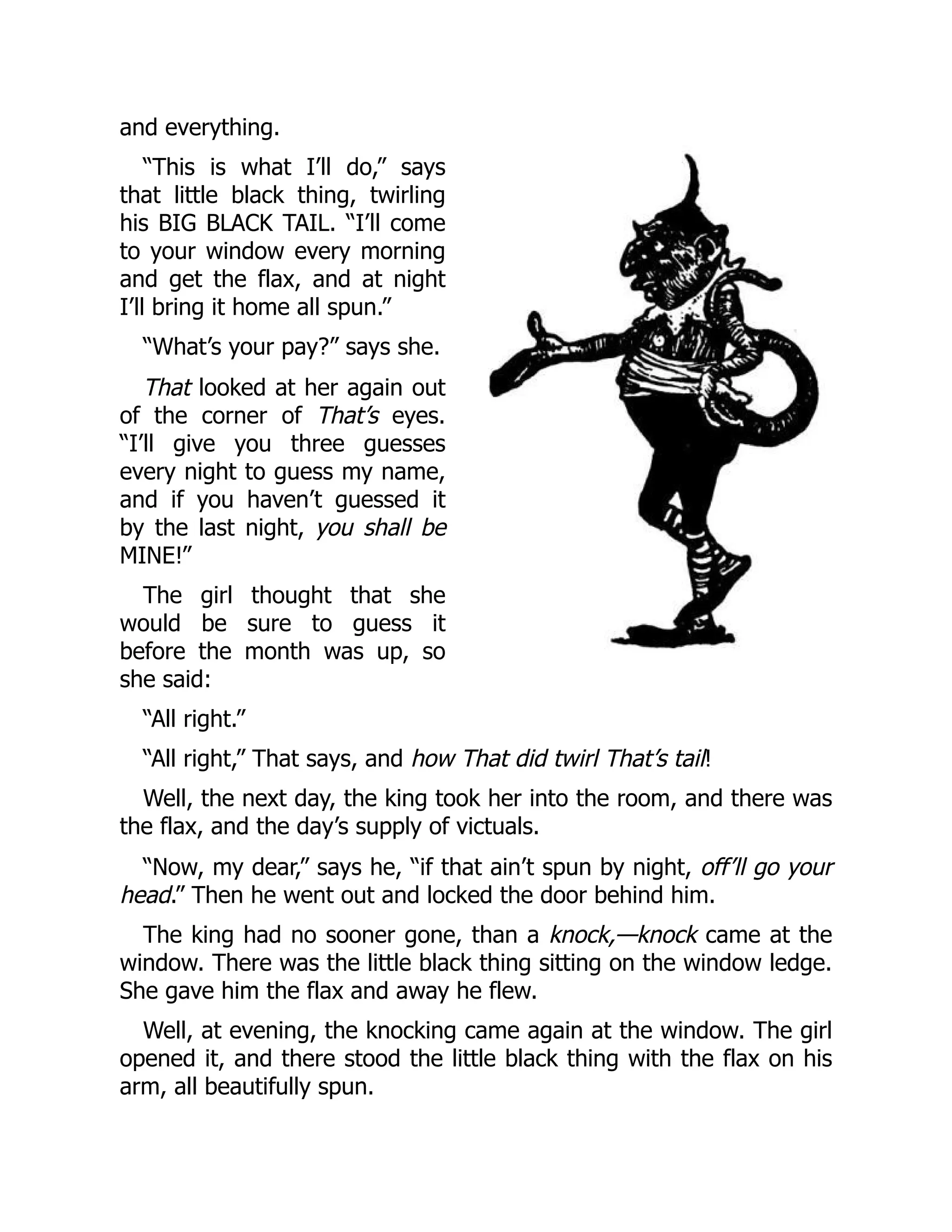
a little black thing, WITH A LONG BLACK TAIL. And That looked up
at her out of the corner of That’s eyes, and That says:
“What are you crying for?”
“What’s that to you?” says she.
“Never you mind, but tell me what you are crying for. Perhaps I
can help you,” the little black thing told her.
“Well, it can’t do any harm, if it doesn’t do any good,” she
thought. So she told him all about the five pies, and the five skeins
35.
and everything.
“This iswhat I’ll do,” says
that little black thing, twirling
his BIG BLACK TAIL. “I’ll come
to your window every morning
and get the flax, and at night
I’ll bring it home all spun.”
“What’s your pay?” says she.
That looked at her again out
of the corner of That’s eyes.
“I’ll give you three guesses
every night to guess my name,
and if you haven’t guessed it
by the last night, you shall be
MINE!”
The girl thought that she
would be sure to guess it
before the month was up, so
she said:
“All right.”
“All right,” That says, and how That did twirl That’s tail!
Well, the next day, the king took her into the room, and there was
the flax, and the day’s supply of victuals.
“Now, my dear,” says he, “if that ain’t spun by night, off’ll go your
head.” Then he went out and locked the door behind him.
The king had no sooner gone, than a knock,—knock came at the
window. There was the little black thing sitting on the window ledge.
She gave him the flax and away he flew.
Well, at evening, the knocking came again at the window. The girl
opened it, and there stood the little black thing with the flax on his
arm, all beautifully spun.
36.
“Here it is,”he said, as he gave it to her. “Now, what’s my name?”
“Is that Bill?” says she.
“Noo, that ain’t,” says he, and he twirled his tail.
“Is that Ned, then?”
“Noo, that ain’t.”
“Well, is that Mark, then?” she asked.
“Noo.” And That twirled That’s tail harder and away That flew.
When the king came in, there were the skeins beautifully spun.
“Well, I see, my dear, that you won’t lose your head tonight.” And
he went away and left her locked in the room.
So every day the flax and the food were brought to the girl. And
every morning the little black imp would knock at the window and
carry away the flax, and every night it would bring back the flax
spun. And every night the girl would try the three times to guess the
imp’s name, but she could never guess the right one.
At last, the last day had come. And that night when the imp
brought back the skeins, he said:
“What, ain’t you guessed my name yet?”
“Is that Nicodemas?” says she.
“Noo, that ain’t,” That says.
“Is that Samuel?”
“Noo, not that neither.” Then That looked at her with That’s eyes
like coals of fire, and That says:
“Woman, there’s only tomorrow night, and THEN YOU’LL BE
MINE!” And away That flew.
Well, the girl she felt that bad. However, she heard the king
coming along the passage. In he came, and when he saw the five
skeins, he said:
37.
“My dear, Idon’t see but you’ll have your skeins ready tomorrow
night as well, so I reckon I shall not have to kill you, and I’ll have
supper in here tonight.”
So they brought the supper in, and the two sat down to the table.
Well, he had eaten but a mouthful, when he began to laugh.
“What are you laughing at?” the girl asked him.
“Well, today when I was out in the forest, I saw the funniest
sight.... I was in a strange part where I had never been before. And
I saw an old chalk pit.... And I heard the queerest humming and
humming coming from the pit. So I got off my hobby and crept over
to the pit without making a bit of a sound. And there I saw the
strangest looking little black thing with a long, black tail. And That
was sitting at a little spinning wheel, and That was spinning so fast
that I could scarcely see the wheel. And while That span, That sang,
“Nimmy, nimmy not,
My name is Tom Tit Tot.”
“And That kept singing it over again and again.”
When the girl heard this, she was so happy that she could almost
have jumped out of her skin for joy, but she didn’t say a word.
Next day, that little black thing looked so maliceful! And when
night came she heard the knock at the window, she opened it, and
the little black thing jumped into the room. He was grinning from ear
to ear, and O! That’s tail was twirling round so fast!
“What’s my name?” That said, as That gave her the skeins.
“Is that Solomon?” said the girl, pretending to be afraid.
“Noo, that ain’t,” That said, and That came further into the room.
“Well, is that Zebedee?” says she again.
38.
“Noo, that ain’t.”And then That laughed, and twirled That’s tail
until you could hardly see That.
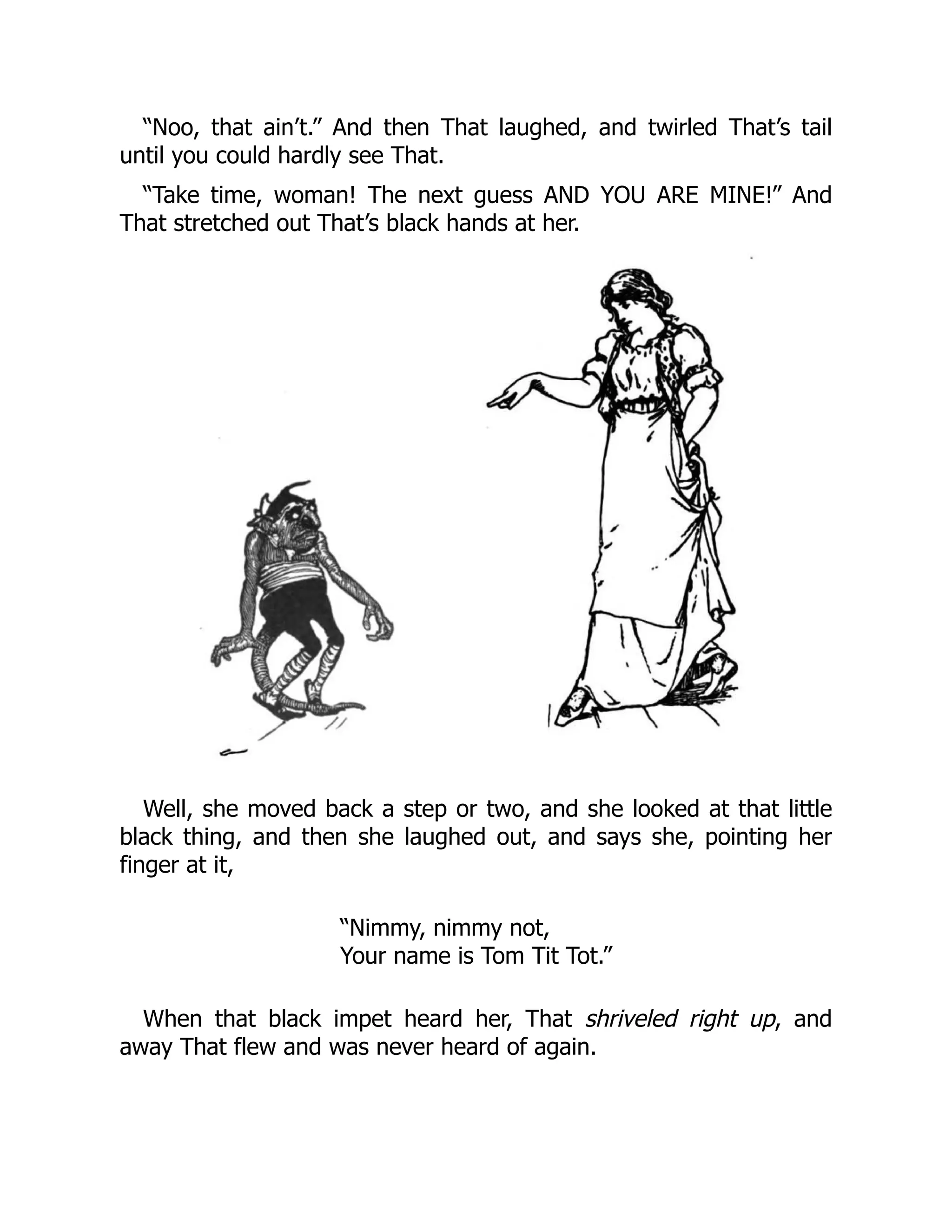
“Take time, woman! The next guess AND YOU ARE MINE!” And
That stretched out That’s black hands at her.
Well, she moved back a step or two, and she looked at that little
black thing, and then she laughed out, and says she, pointing her
finger at it,
“Nimmy, nimmy not,
Your name is Tom Tit Tot.”
When that black impet heard her, That shriveled right up, and
away That flew and was never heard of again.
39.
And the girllived happily ever after, and the king never again
asked her to do any more spinning.
40.
Welcome to ourwebsite – the ideal destination for book lovers and
knowledge seekers. With a mission to inspire endlessly, we offer a
vast collection of books, ranging from classic literary works to
specialized publications, self-development books, and children's
literature. Each book is a new journey of discovery, expanding
knowledge and enriching the soul of the reade
Our website is not just a platform for buying books, but a bridge
connecting readers to the timeless values of culture and wisdom. With
an elegant, user-friendly interface and an intelligent search system,
we are committed to providing a quick and convenient shopping
experience. Additionally, our special promotions and home delivery
services ensure that you save time and fully enjoy the joy of reading.
Let us accompany you on the journey of exploring knowledge and
personal growth!
ebookluna.com







![This ebook is for the use of anyone anywhere in the United
States and most other parts of the world at no cost and with
almost no restrictions whatsoever. You may copy it, give it away
or re-use it under the terms of the Project Gutenberg License
included with this ebook or online at www.gutenberg.org. If you
are not located in the United States, you will have to check the
laws of the country where you are located before using this
eBook.
Title: The Story Tellers' Magazine, Vol. I, No. 1, June 1913
Author: Various
Editor: Richard Thomas Wyche
Release date: November 7, 2020 [eBook #63669]
Most recently updated: October 18, 2024
Language: English
Credits: Produced by hekula03, Les Galloway and the Online
Distributed Proofreading Team at
https://www.pgdp.net (This
book was produced from images made available by the
HathiTrust Digital Library.)
*** START OF THE PROJECT GUTENBERG EBOOK THE STORY
TELLERS' MAGAZINE, VOL. I, NO. 1, JUNE 1913 ***](https://image.slidesharecdn.com/13818-250324052639-5346edef/75/eBook-PDF-In-Mixed-Company-Communicating-in-Small-Groups-and-Teams-10th-Edition-23-2048.jpg)