(eBook PDF) In Mixed Company: Communicating in Small Groups and Teams 10th Edition
(eBook PDF) In Mixed Company: Communicating in Small Groups and Teams 10th Edition
(eBook PDF) In Mixed Company: Communicating in Small Groups and Teams 10th Edition
(eBook PDF) In Mixed Company: Communicating in Small Groups and Teams 10th Edition
(eBook PDF) In Mixed Company: Communicating in Small Groups and Teams 10th Edition
1.
(eBook PDF) InMixed Company: Communicating in
Small Groups and Teams 10th Edition download
https://ebookluna.com/product/ebook-pdf-in-mixed-company-
communicating-in-small-groups-and-teams-10th-edition/
Download full version ebook from https://ebookluna.com
3.
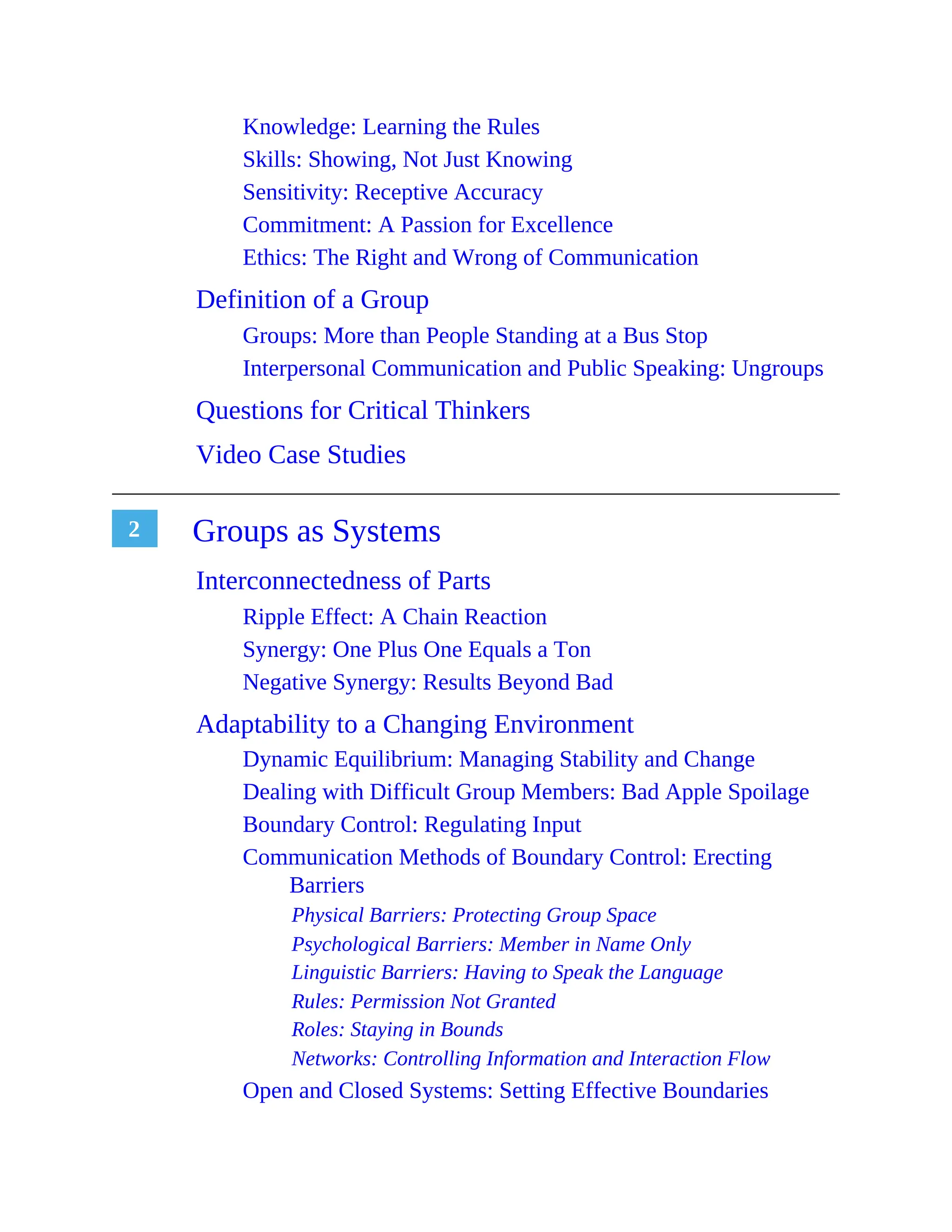
2
Knowledge: Learning theRules
Skills: Showing, Not Just Knowing
Sensitivity: Receptive Accuracy
Commitment: A Passion for Excellence
Ethics: The Right and Wrong of Communication
Definition of a Group
Groups: More than People Standing at a Bus Stop
Interpersonal Communication and Public Speaking: Ungroups
Questions for Critical Thinkers
Video Case Studies
Groups as Systems
Interconnectedness of Parts
Ripple Effect: A Chain Reaction
Synergy: One Plus One Equals a Ton
Negative Synergy: Results Beyond Bad
Adaptability to a Changing Environment
Dynamic Equilibrium: Managing Stability and Change
Dealing with Difficult Group Members: Bad Apple Spoilage
Boundary Control: Regulating Input
Communication Methods of Boundary Control: Erecting
Barriers
Physical Barriers: Protecting Group Space
Psychological Barriers: Member in Name Only
Linguistic Barriers: Having to Speak the Language
Rules: Permission Not Granted
Roles: Staying in Bounds
Networks: Controlling Information and Interaction Flow
Open and Closed Systems: Setting Effective Boundaries
4.
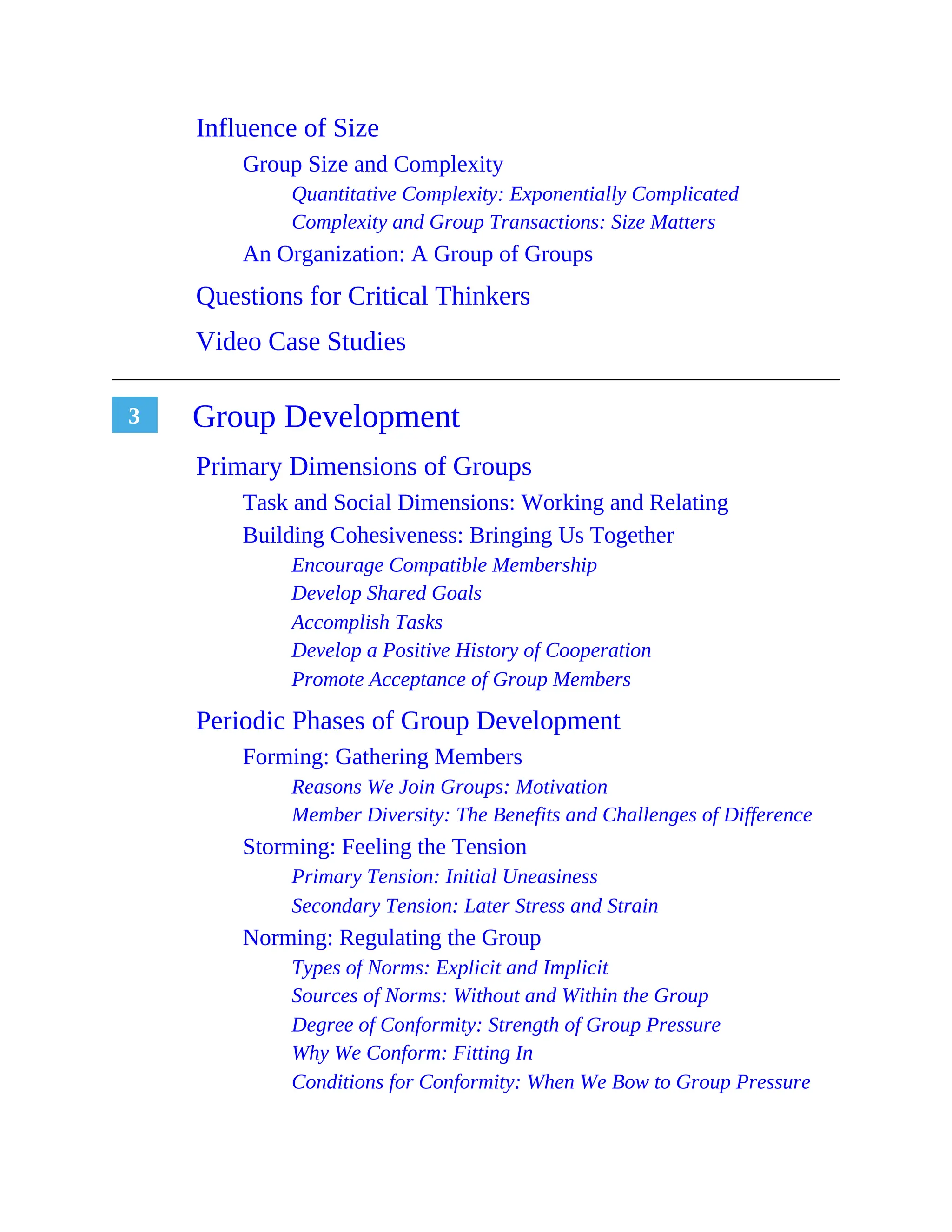
3
Influence of Size
GroupSize and Complexity
Quantitative Complexity: Exponentially Complicated
Complexity and Group Transactions: Size Matters
An Organization: A Group of Groups
Questions for Critical Thinkers
Video Case Studies
Group Development
Primary Dimensions of Groups
Task and Social Dimensions: Working and Relating
Building Cohesiveness: Bringing Us Together
Encourage Compatible Membership
Develop Shared Goals
Accomplish Tasks
Develop a Positive History of Cooperation
Promote Acceptance of Group Members
Periodic Phases of Group Development
Forming: Gathering Members
Reasons We Join Groups: Motivation
Member Diversity: The Benefits and Challenges of Difference
Storming: Feeling the Tension
Primary Tension: Initial Uneasiness
Secondary Tension: Later Stress and Strain
Norming: Regulating the Group
Types of Norms: Explicit and Implicit
Sources of Norms: Without and Within the Group
Degree of Conformity: Strength of Group Pressure
Why We Conform: Fitting In
Conditions for Conformity: When We Bow to Group Pressure
5.
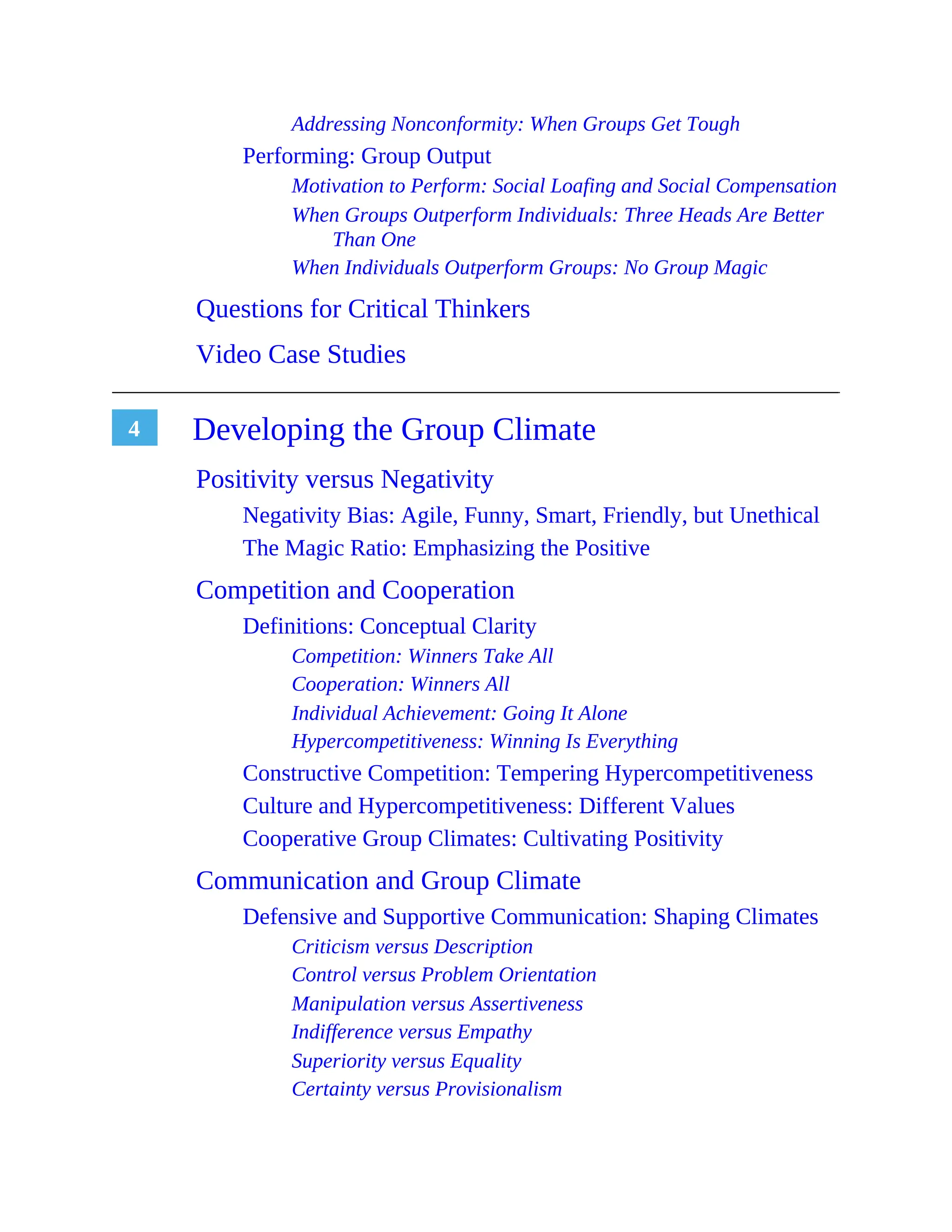
4
Addressing Nonconformity: WhenGroups Get Tough
Performing: Group Output
Motivation to Perform: Social Loafing and Social Compensation
When Groups Outperform Individuals: Three Heads Are Better
Than One
When Individuals Outperform Groups: No Group Magic
Questions for Critical Thinkers
Video Case Studies
Developing the Group Climate
Positivity versus Negativity
Negativity Bias: Agile, Funny, Smart, Friendly, but Unethical
The Magic Ratio: Emphasizing the Positive
Competition and Cooperation
Definitions: Conceptual Clarity
Competition: Winners Take All
Cooperation: Winners All
Individual Achievement: Going It Alone
Hypercompetitiveness: Winning Is Everything
Constructive Competition: Tempering Hypercompetitiveness
Culture and Hypercompetitiveness: Different Values
Cooperative Group Climates: Cultivating Positivity
Communication and Group Climate
Defensive and Supportive Communication: Shaping Climates
Criticism versus Description
Control versus Problem Orientation
Manipulation versus Assertiveness
Indifference versus Empathy
Superiority versus Equality
Certainty versus Provisionalism
6.
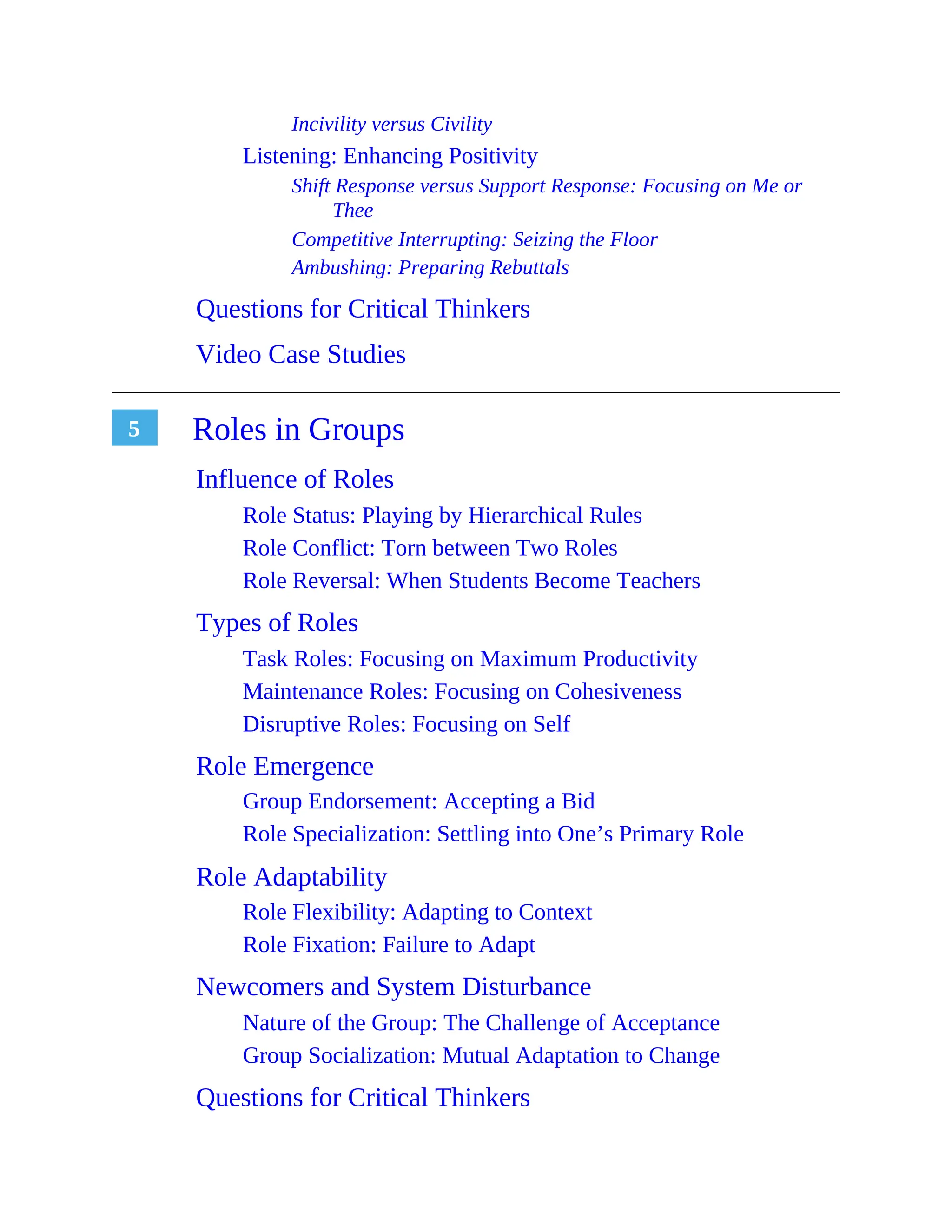
5
Incivility versus Civility
Listening:Enhancing Positivity
Shift Response versus Support Response: Focusing on Me or
Thee
Competitive Interrupting: Seizing the Floor
Ambushing: Preparing Rebuttals
Questions for Critical Thinkers
Video Case Studies
Roles in Groups
Influence of Roles
Role Status: Playing by Hierarchical Rules
Role Conflict: Torn between Two Roles
Role Reversal: When Students Become Teachers
Types of Roles
Task Roles: Focusing on Maximum Productivity
Maintenance Roles: Focusing on Cohesiveness
Disruptive Roles: Focusing on Self
Role Emergence
Group Endorsement: Accepting a Bid
Role Specialization: Settling into One’s Primary Role
Role Adaptability
Role Flexibility: Adapting to Context
Role Fixation: Failure to Adapt
Newcomers and System Disturbance
Nature of the Group: The Challenge of Acceptance
Group Socialization: Mutual Adaptation to Change
Questions for Critical Thinkers
7.
6
7
Video Case Studies
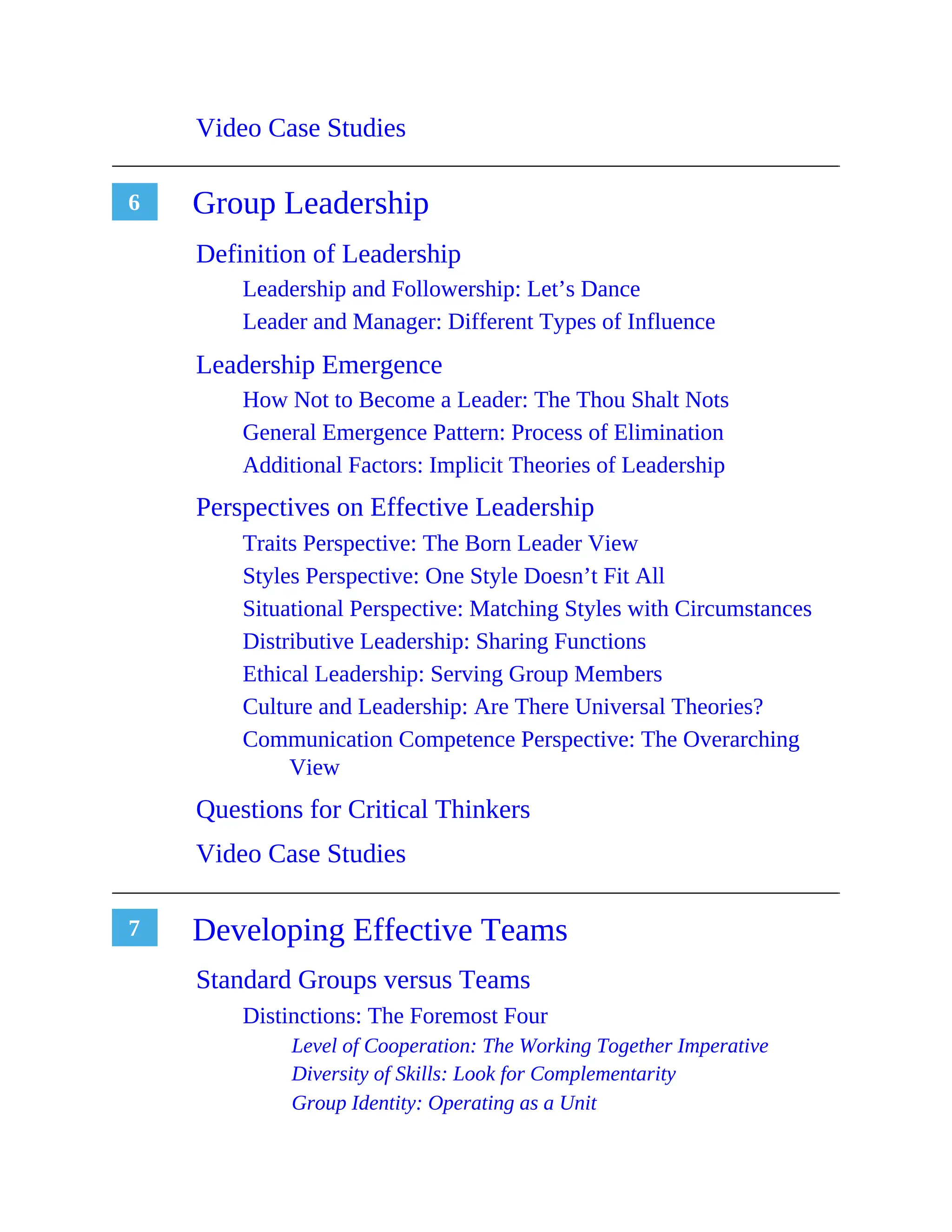
GroupLeadership
Definition of Leadership
Leadership and Followership: Let’s Dance
Leader and Manager: Different Types of Influence
Leadership Emergence
How Not to Become a Leader: The Thou Shalt Nots
General Emergence Pattern: Process of Elimination
Additional Factors: Implicit Theories of Leadership
Perspectives on Effective Leadership
Traits Perspective: The Born Leader View
Styles Perspective: One Style Doesn’t Fit All
Situational Perspective: Matching Styles with Circumstances
Distributive Leadership: Sharing Functions
Ethical Leadership: Serving Group Members
Culture and Leadership: Are There Universal Theories?
Communication Competence Perspective: The Overarching
View
Questions for Critical Thinkers
Video Case Studies
Developing Effective Teams
Standard Groups versus Teams
Distinctions: The Foremost Four
Level of Cooperation: The Working Together Imperative
Diversity of Skills: Look for Complementarity
Group Identity: Operating as a Unit
8.
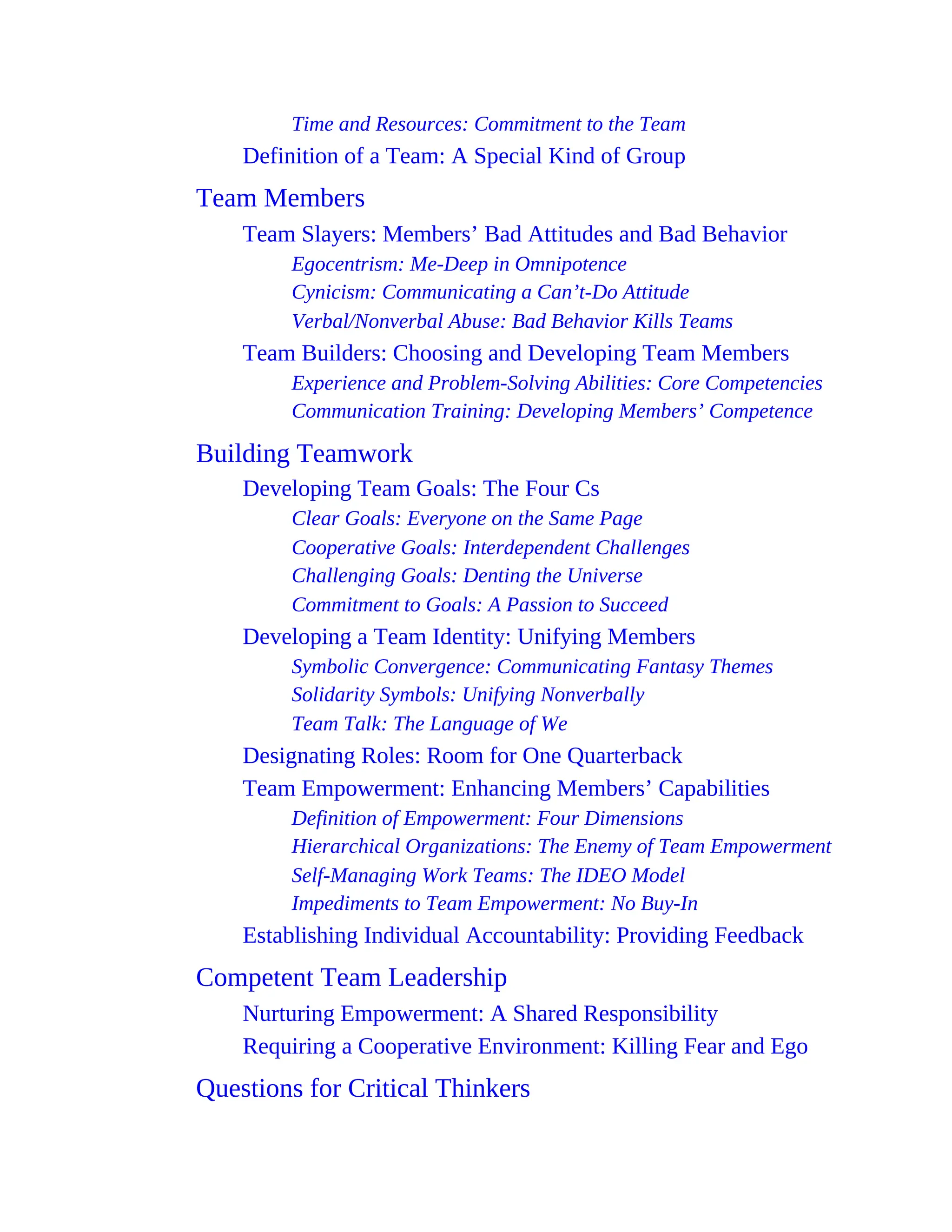
Time and Resources:Commitment to the Team
Definition of a Team: A Special Kind of Group
Team Members
Team Slayers: Members’ Bad Attitudes and Bad Behavior
Egocentrism: Me-Deep in Omnipotence
Cynicism: Communicating a Can’t-Do Attitude
Verbal/Nonverbal Abuse: Bad Behavior Kills Teams
Team Builders: Choosing and Developing Team Members
Experience and Problem-Solving Abilities: Core Competencies
Communication Training: Developing Members’ Competence
Building Teamwork
Developing Team Goals: The Four Cs
Clear Goals: Everyone on the Same Page
Cooperative Goals: Interdependent Challenges
Challenging Goals: Denting the Universe
Commitment to Goals: A Passion to Succeed
Developing a Team Identity: Unifying Members
Symbolic Convergence: Communicating Fantasy Themes
Solidarity Symbols: Unifying Nonverbally
Team Talk: The Language of We
Designating Roles: Room for One Quarterback
Team Empowerment: Enhancing Members’ Capabilities
Definition of Empowerment: Four Dimensions
Hierarchical Organizations: The Enemy of Team Empowerment
Self-Managing Work Teams: The IDEO Model
Impediments to Team Empowerment: No Buy-In
Establishing Individual Accountability: Providing Feedback
Competent Team Leadership
Nurturing Empowerment: A Shared Responsibility
Requiring a Cooperative Environment: Killing Fear and Ego
Questions for Critical Thinkers
9.
8
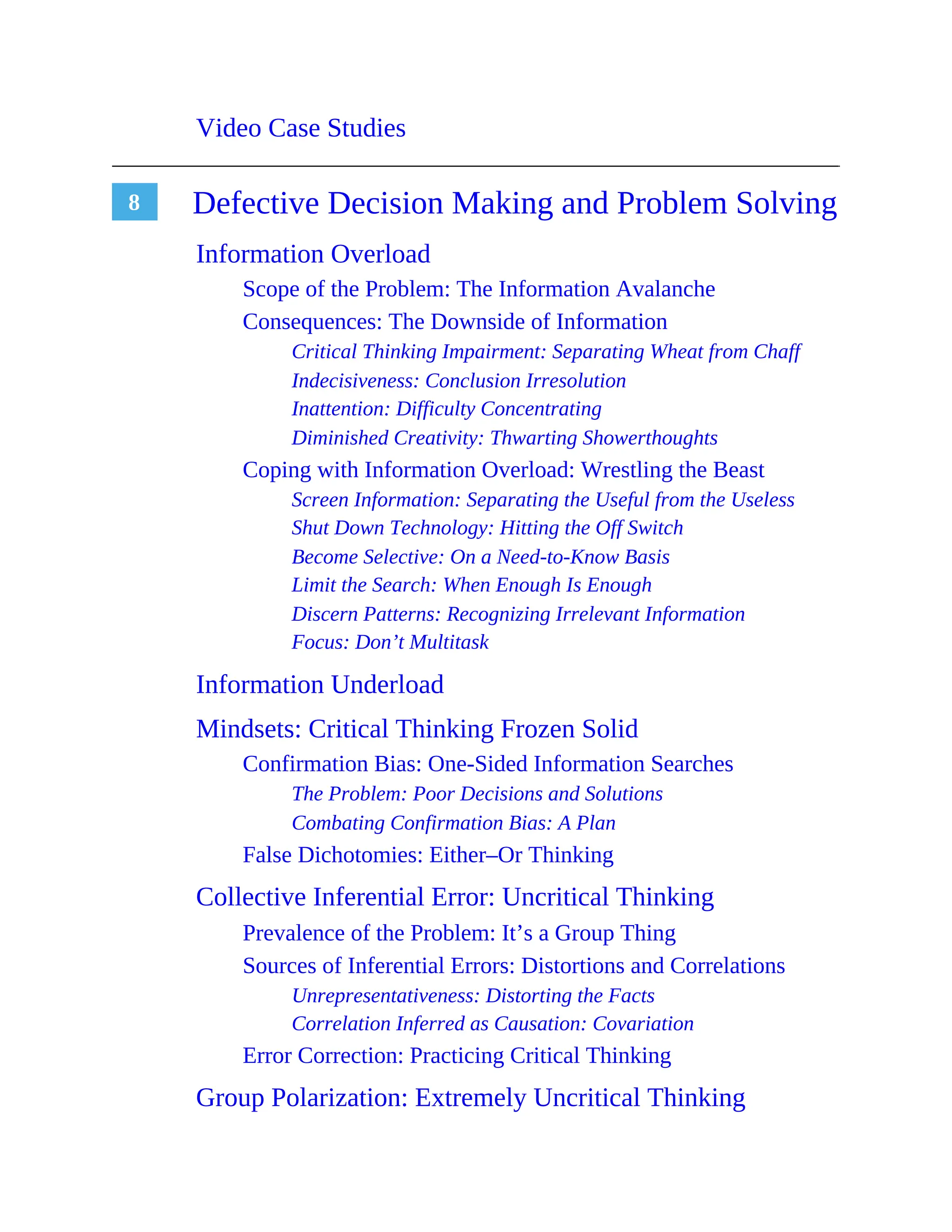
Video Case Studies
DefectiveDecision Making and Problem Solving
Information Overload
Scope of the Problem: The Information Avalanche
Consequences: The Downside of Information
Critical Thinking Impairment: Separating Wheat from Chaff
Indecisiveness: Conclusion Irresolution
Inattention: Difficulty Concentrating
Diminished Creativity: Thwarting Showerthoughts
Coping with Information Overload: Wrestling the Beast
Screen Information: Separating the Useful from the Useless
Shut Down Technology: Hitting the Off Switch
Become Selective: On a Need-to-Know Basis
Limit the Search: When Enough Is Enough
Discern Patterns: Recognizing Irrelevant Information
Focus: Don’t Multitask
Information Underload
Mindsets: Critical Thinking Frozen Solid
Confirmation Bias: One-Sided Information Searches
The Problem: Poor Decisions and Solutions
Combating Confirmation Bias: A Plan
False Dichotomies: Either–Or Thinking
Collective Inferential Error: Uncritical Thinking
Prevalence of the Problem: It’s a Group Thing
Sources of Inferential Errors: Distortions and Correlations
Unrepresentativeness: Distorting the Facts
Correlation Inferred as Causation: Covariation
Error Correction: Practicing Critical Thinking
Group Polarization: Extremely Uncritical Thinking
10.
9
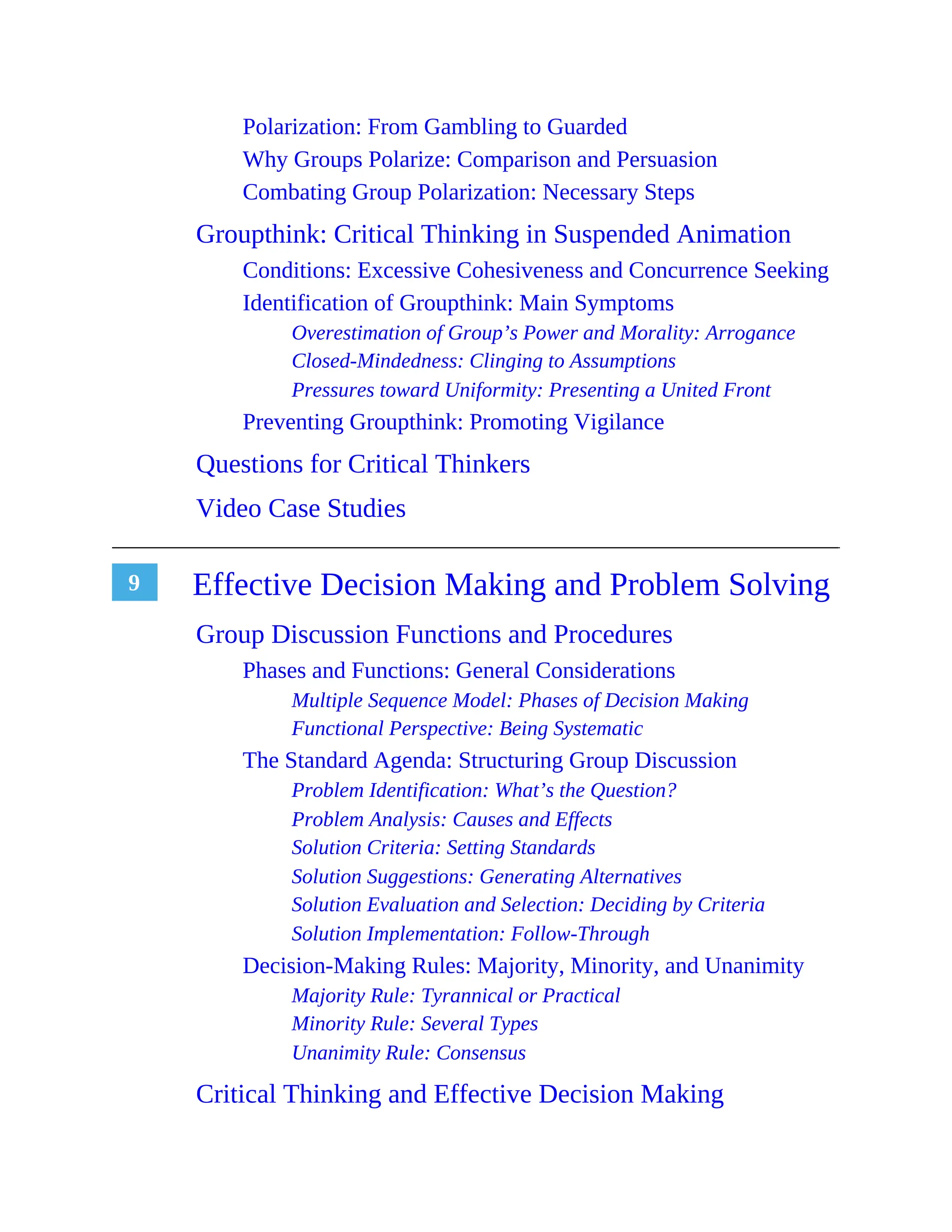
Polarization: From Gamblingto Guarded
Why Groups Polarize: Comparison and Persuasion
Combating Group Polarization: Necessary Steps
Groupthink: Critical Thinking in Suspended Animation
Conditions: Excessive Cohesiveness and Concurrence Seeking
Identification of Groupthink: Main Symptoms
Overestimation of Group’s Power and Morality: Arrogance
Closed-Mindedness: Clinging to Assumptions
Pressures toward Uniformity: Presenting a United Front
Preventing Groupthink: Promoting Vigilance
Questions for Critical Thinkers
Video Case Studies
Effective Decision Making and Problem Solving
Group Discussion Functions and Procedures
Phases and Functions: General Considerations
Multiple Sequence Model: Phases of Decision Making
Functional Perspective: Being Systematic
The Standard Agenda: Structuring Group Discussion
Problem Identification: What’s the Question?
Problem Analysis: Causes and Effects
Solution Criteria: Setting Standards
Solution Suggestions: Generating Alternatives
Solution Evaluation and Selection: Deciding by Criteria
Solution Implementation: Follow-Through
Decision-Making Rules: Majority, Minority, and Unanimity
Majority Rule: Tyrannical or Practical
Minority Rule: Several Types
Unanimity Rule: Consensus
Critical Thinking and Effective Decision Making
11.
10
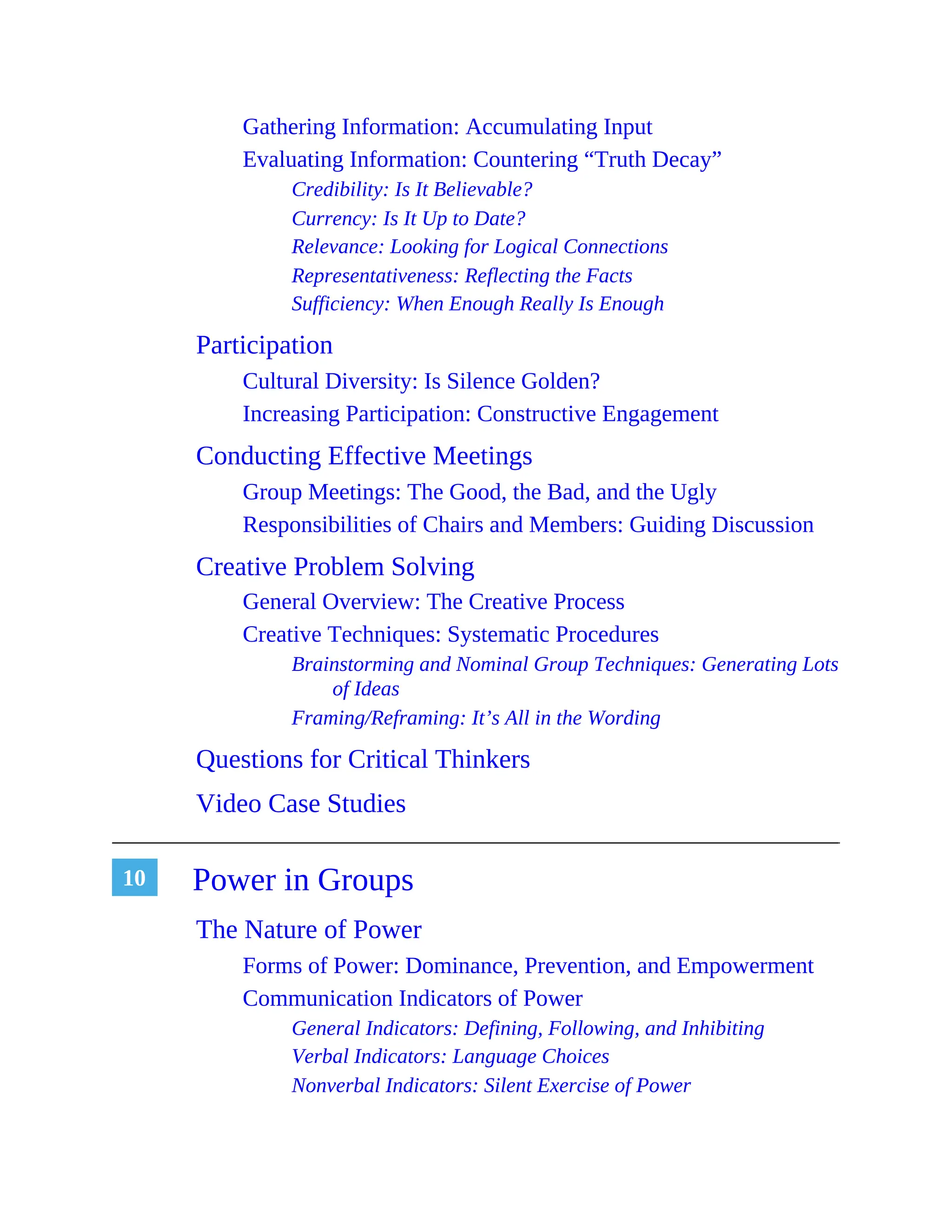
Gathering Information: AccumulatingInput
Evaluating Information: Countering “Truth Decay”
Credibility: Is It Believable?
Currency: Is It Up to Date?
Relevance: Looking for Logical Connections
Representativeness: Reflecting the Facts
Sufficiency: When Enough Really Is Enough
Participation
Cultural Diversity: Is Silence Golden?
Increasing Participation: Constructive Engagement
Conducting Effective Meetings
Group Meetings: The Good, the Bad, and the Ugly
Responsibilities of Chairs and Members: Guiding Discussion
Creative Problem Solving
General Overview: The Creative Process
Creative Techniques: Systematic Procedures
Brainstorming and Nominal Group Techniques: Generating Lots
of Ideas
Framing/Reframing: It’s All in the Wording
Questions for Critical Thinkers
Video Case Studies
Power in Groups
The Nature of Power
Forms of Power: Dominance, Prevention, and Empowerment
Communication Indicators of Power
General Indicators: Defining, Following, and Inhibiting
Verbal Indicators: Language Choices
Nonverbal Indicators: Silent Exercise of Power
12.
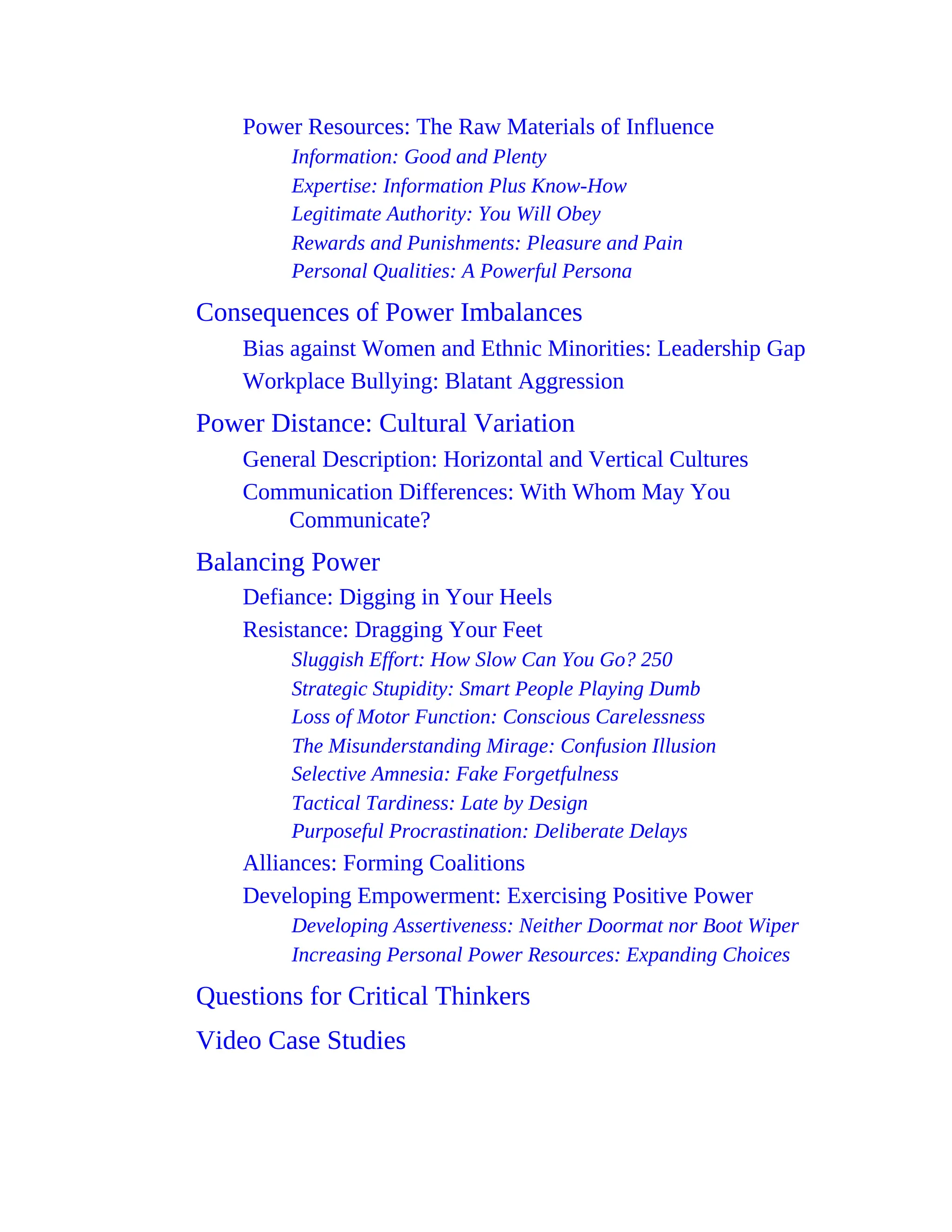
Power Resources: TheRaw Materials of Influence
Information: Good and Plenty
Expertise: Information Plus Know-How
Legitimate Authority: You Will Obey
Rewards and Punishments: Pleasure and Pain
Personal Qualities: A Powerful Persona
Consequences of Power Imbalances
Bias against Women and Ethnic Minorities: Leadership Gap
Workplace Bullying: Blatant Aggression
Power Distance: Cultural Variation
General Description: Horizontal and Vertical Cultures
Communication Differences: With Whom May You
Communicate?
Balancing Power
Defiance: Digging in Your Heels
Resistance: Dragging Your Feet
Sluggish Effort: How Slow Can You Go? 250
Strategic Stupidity: Smart People Playing Dumb
Loss of Motor Function: Conscious Carelessness
The Misunderstanding Mirage: Confusion Illusion
Selective Amnesia: Fake Forgetfulness
Tactical Tardiness: Late by Design
Purposeful Procrastination: Deliberate Delays
Alliances: Forming Coalitions
Developing Empowerment: Exercising Positive Power
Developing Assertiveness: Neither Doormat nor Boot Wiper
Increasing Personal Power Resources: Expanding Choices
Questions for Critical Thinkers
Video Case Studies
13.
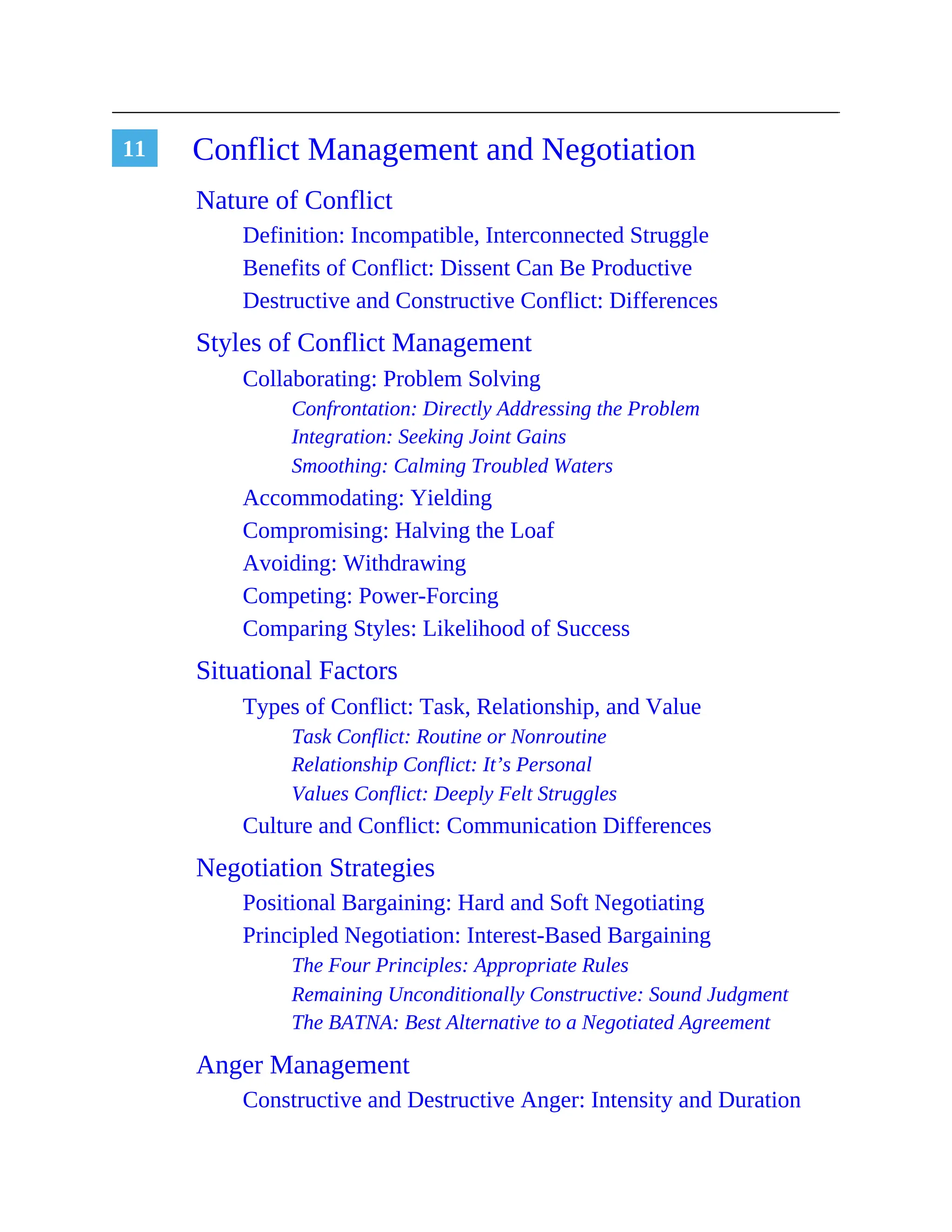
11 Conflict Managementand Negotiation
Nature of Conflict
Definition: Incompatible, Interconnected Struggle
Benefits of Conflict: Dissent Can Be Productive
Destructive and Constructive Conflict: Differences
Styles of Conflict Management
Collaborating: Problem Solving
Confrontation: Directly Addressing the Problem
Integration: Seeking Joint Gains
Smoothing: Calming Troubled Waters
Accommodating: Yielding
Compromising: Halving the Loaf
Avoiding: Withdrawing
Competing: Power-Forcing
Comparing Styles: Likelihood of Success
Situational Factors
Types of Conflict: Task, Relationship, and Value
Task Conflict: Routine or Nonroutine
Relationship Conflict: It’s Personal
Values Conflict: Deeply Felt Struggles
Culture and Conflict: Communication Differences
Negotiation Strategies
Positional Bargaining: Hard and Soft Negotiating
Principled Negotiation: Interest-Based Bargaining
The Four Principles: Appropriate Rules
Remaining Unconditionally Constructive: Sound Judgment
The BATNA: Best Alternative to a Negotiated Agreement
Anger Management
Constructive and Destructive Anger: Intensity and Duration
14.
12
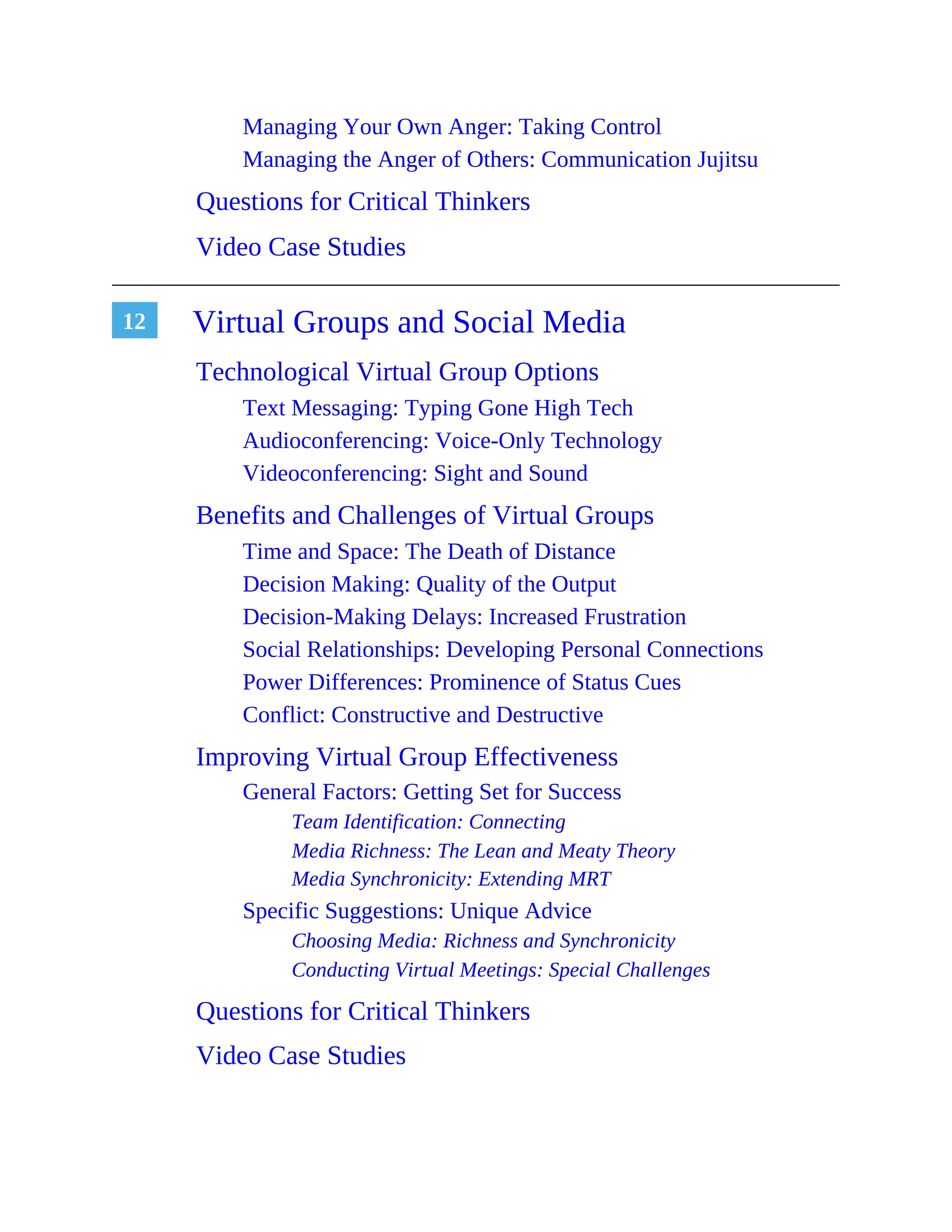
Managing Your OwnAnger: Taking Control
Managing the Anger of Others: Communication Jujitsu
Questions for Critical Thinkers
Video Case Studies
Virtual Groups and Social Media
Technological Virtual Group Options
Text Messaging: Typing Gone High Tech
Audioconferencing: Voice-Only Technology
Videoconferencing: Sight and Sound
Benefits and Challenges of Virtual Groups
Time and Space: The Death of Distance
Decision Making: Quality of the Output
Decision-Making Delays: Increased Frustration
Social Relationships: Developing Personal Connections
Power Differences: Prominence of Status Cues
Conflict: Constructive and Destructive
Improving Virtual Group Effectiveness
General Factors: Getting Set for Success
Team Identification: Connecting
Media Richness: The Lean and Meaty Theory
Media Synchronicity: Extending MRT
Specific Suggestions: Unique Advice
Choosing Media: Richness and Synchronicity
Conducting Virtual Meetings: Special Challenges
Questions for Critical Thinkers
Video Case Studies
15.
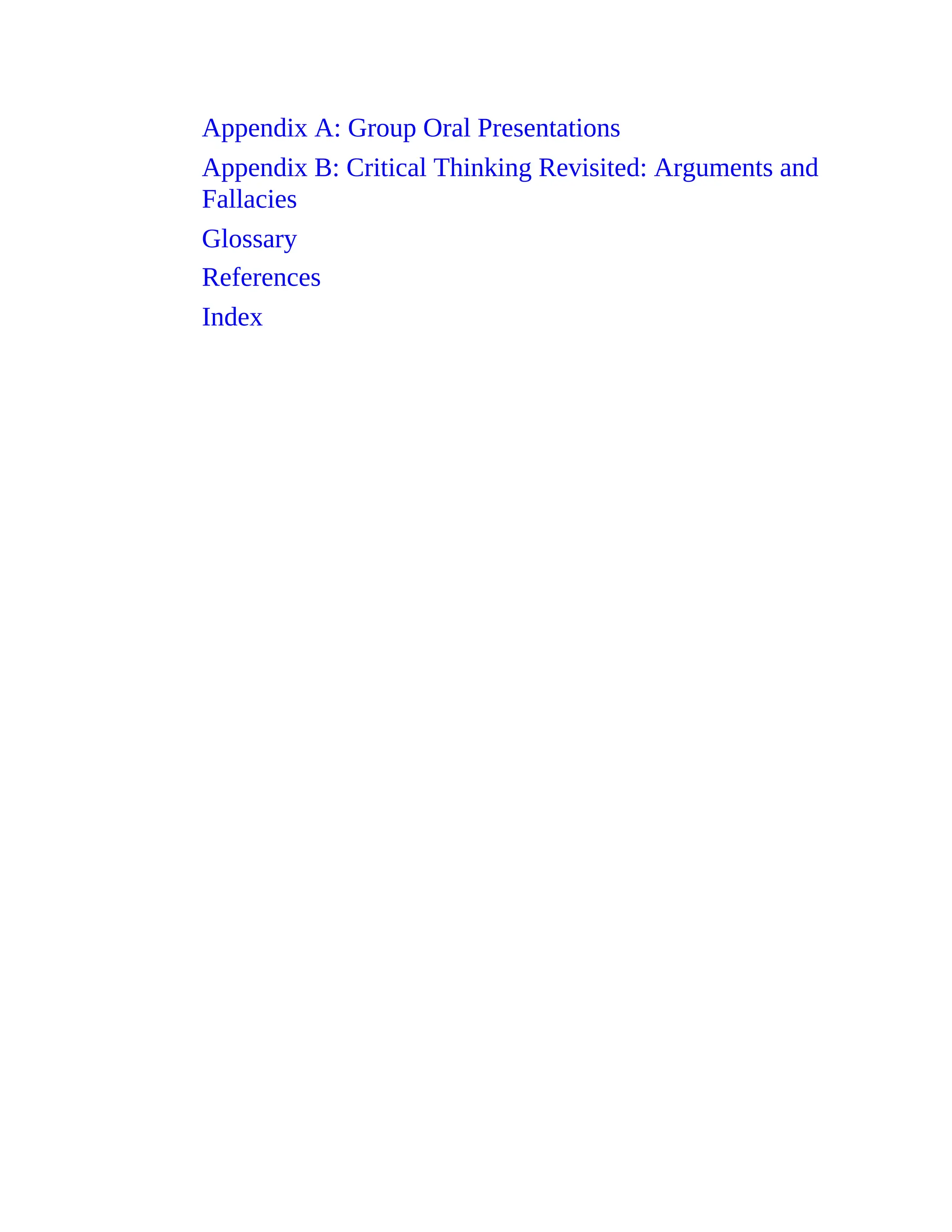
Appendix A: GroupOral Presentations
Appendix B: Critical Thinking Revisited: Arguments and
Fallacies
Glossary
References
Index
16.
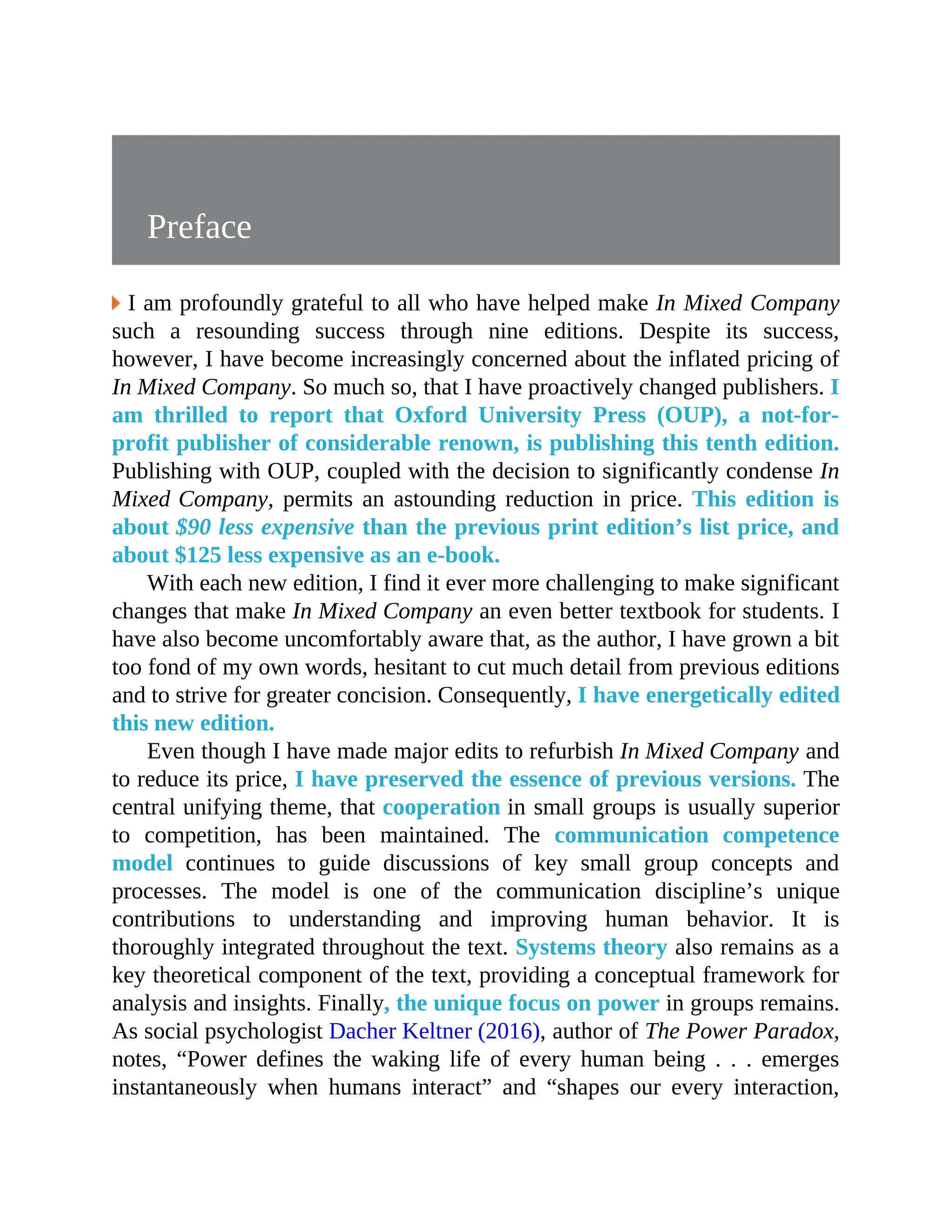
Preface
I am profoundlygrateful to all who have helped make In Mixed Company
such a resounding success through nine editions. Despite its success,
however, I have become increasingly concerned about the inflated pricing of
In Mixed Company. So much so, that I have proactively changed publishers. I
am thrilled to report that Oxford University Press (OUP), a not-for-
profit publisher of considerable renown, is publishing this tenth edition.
Publishing with OUP, coupled with the decision to significantly condense In
Mixed Company, permits an astounding reduction in price. This edition is
about $90 less expensive than the previous print edition’s list price, and
about $125 less expensive as an e-book.
With each new edition, I find it ever more challenging to make significant
changes that make In Mixed Company an even better textbook for students. I
have also become uncomfortably aware that, as the author, I have grown a bit
too fond of my own words, hesitant to cut much detail from previous editions
and to strive for greater concision. Consequently, I have energetically edited
this new edition.
Even though I have made major edits to refurbish In Mixed Company and
to reduce its price, I have preserved the essence of previous versions. The
central unifying theme, that cooperation in small groups is usually superior
to competition, has been maintained. The communication competence
model continues to guide discussions of key small group concepts and
processes. The model is one of the communication discipline’s unique
contributions to understanding and improving human behavior. It is
thoroughly integrated throughout the text. Systems theory also remains as a
key theoretical component of the text, providing a conceptual framework for
analysis and insights. Finally, the unique focus on power in groups remains.
As social psychologist Dacher Keltner (2016), author of The Power Paradox,
notes, “Power defines the waking life of every human being . . . emerges
instantaneously when humans interact” and “shapes our every interaction,
17.
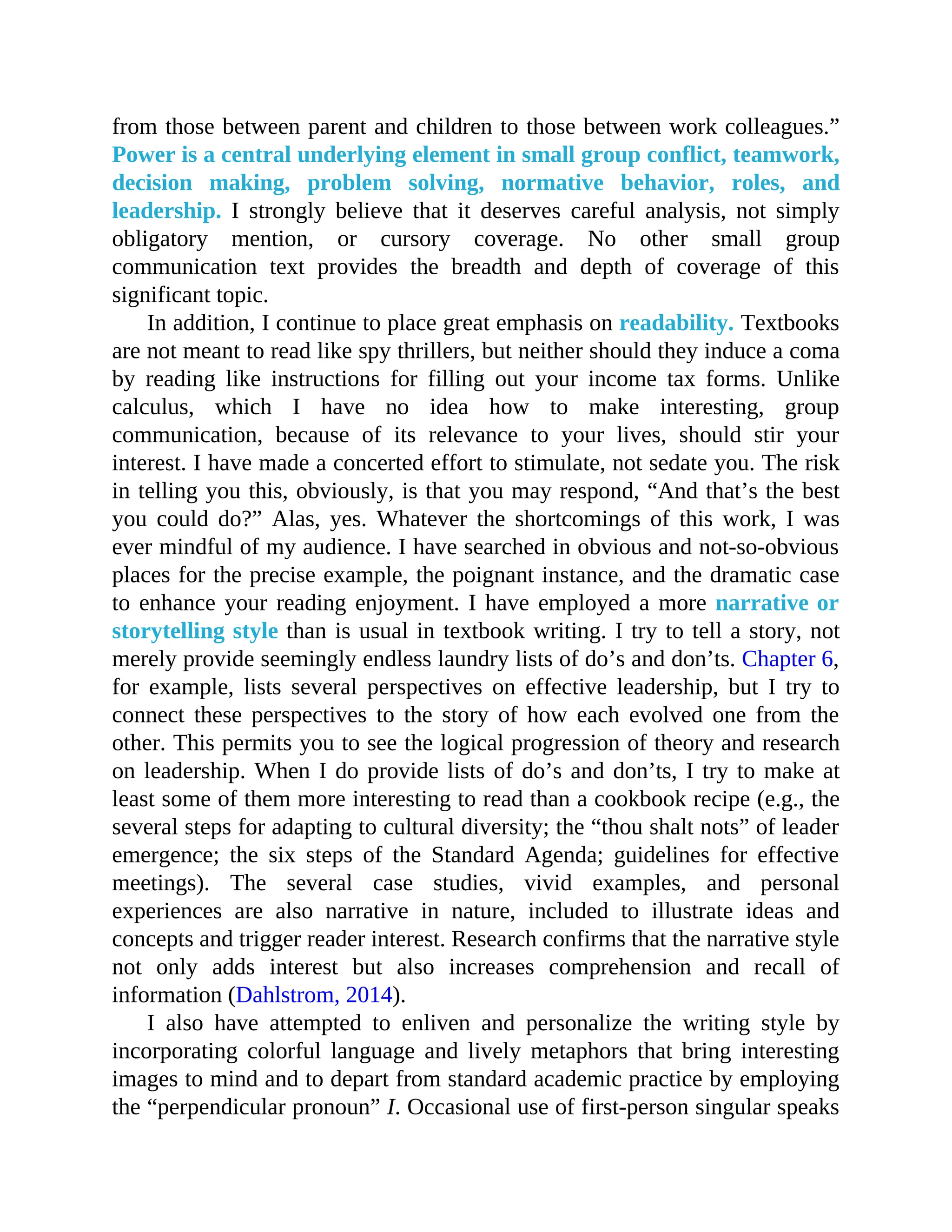
from those betweenparent and children to those between work colleagues.”
Power is a central underlying element in small group conflict, teamwork,
decision making, problem solving, normative behavior, roles, and
leadership. I strongly believe that it deserves careful analysis, not simply
obligatory mention, or cursory coverage. No other small group
communication text provides the breadth and depth of coverage of this
significant topic.
In addition, I continue to place great emphasis on readability. Textbooks
are not meant to read like spy thrillers, but neither should they induce a coma
by reading like instructions for filling out your income tax forms. Unlike
calculus, which I have no idea how to make interesting, group
communication, because of its relevance to your lives, should stir your
interest. I have made a concerted effort to stimulate, not sedate you. The risk
in telling you this, obviously, is that you may respond, “And that’s the best
you could do?” Alas, yes. Whatever the shortcomings of this work, I was
ever mindful of my audience. I have searched in obvious and not-so-obvious
places for the precise example, the poignant instance, and the dramatic case
to enhance your reading enjoyment. I have employed a more narrative or
storytelling style than is usual in textbook writing. I try to tell a story, not
merely provide seemingly endless laundry lists of do’s and don’ts. Chapter 6,
for example, lists several perspectives on effective leadership, but I try to
connect these perspectives to the story of how each evolved one from the
other. This permits you to see the logical progression of theory and research
on leadership. When I do provide lists of do’s and don’ts, I try to make at
least some of them more interesting to read than a cookbook recipe (e.g., the
several steps for adapting to cultural diversity; the “thou shalt nots” of leader
emergence; the six steps of the Standard Agenda; guidelines for effective
meetings). The several case studies, vivid examples, and personal
experiences are also narrative in nature, included to illustrate ideas and
concepts and trigger reader interest. Research confirms that the narrative style
not only adds interest but also increases comprehension and recall of
information (Dahlstrom, 2014).
I also have attempted to enliven and personalize the writing style by
incorporating colorful language and lively metaphors that bring interesting
images to mind and to depart from standard academic practice by employing
the “perpendicular pronoun” I. Occasional use of first-person singular speaks
revelation, is aquestion of the same kind, as whether an ordinary
power exerted itself in such a particular degree and manner, or not.
Or suppose the power exerted in the formation of the world be
considered as miraculous, or rather, be called by that name; the case
will not be different: since it must be acknowledged, that such a
power was exerted. For supposing it acknowledged, that our Savior
spent some years in a course of working miracles:[164] there is no
more presumption, worth mentioning, against his having exerted this
miraculous power, in a certain degree greater, than in a certain
degree less; in one or two more instances, than in one or two fewer;
in this, than in another manner.
It is evident then, that there can be no peculiar presumption, from
the analogy of nature, against supposing a revelation, when man
was first placed upon earth.[165]
Add, that there does not appear the least intimation in history or
tradition, that religion was first reasoned out: but the whole of
history and tradition makes for the other side, that it came into the
world by revelation. Indeed the state of religion, in the first ages of
which we have any account, seems to suppose and imply, that this
was the original of it among mankind.[166] And these reflections
together, without taking in the peculiar authority of Scripture,
amount to real and a very material degree of evidence, that there
was a revelation at the beginning of the world. Now this, as it is a
confirmation of natural religion, and therefore mentioned in the
former part of this treatise;[167] so likewise it has a tendency to
remove any prejudices against a subsequent revelation.
III. But still it may be objected, that there is some peculiar
presumption, from analogy, against miracles; particularly against
revelation, after the settlement and during the continuance of a
course of nature.
Now with regard to this supposed presumption, it is to be
observed in general, that before we can have ground for raising
what can, with any propriety, be called an argument from analogy,
20.
for or againstrevelation considered as something miraculous, we
must be acquainted with a similar or parallel case. But the history of
some other world, seemingly in like circumstances with our own, is
no more than a parallel case: and therefore nothing short of this can
be so. Yet, could we come at a presumptive proof, for or against a
revelation, from being informed, whether such world had one, or
not; such a proof, being drawn from one single instance only, must
be infinitely precarious. More particularly:
First, There is a very strong presumption against common
speculative truths, and against the most ordinary facts, before the
proof[168] of them; which yet is overcome by almost any proof.
There is a presumption of millions to one, against the story of
Cæsar, or of any other man. For suppose a number of common facts
so and so circumstanced, of which we had no kind of proof, should
happen to come into one’s thoughts; every one would, without any
possible doubt, conclude them to be false. And the like may be said
of a single common fact. Hence it appears, that the question of
importance, as to the matter before us, is, concerning the degree of
the peculiar presumption supposed against miracles; not whether
there be any peculiar presumption at all against them. For, if there
be the presumption of millions to one, against the most common
facts; what can a small presumption, additional to this, amount to,
though it be peculiar? It cannot be estimated, and is as nothing. The
only material question is, whether there be any such presumptions
against miracles, as to render them in any sort incredible.
Secondly, If we leave out the consideration of religion, we are in
such total darkness, upon what causes, occasions, reasons, or
circumstances, the present course of nature depends; that there
does not appear any improbability for or against supposing, that five
or six thousand years may have given scope[169] for causes,
occasions, reasons, or circumstances, from whence miraculous
interpositions may have arisen. And from this, joined with the
foregoing observation, it will follow, that there must be a
presumption, beyond all comparison greater, against the particular
21.
common facts justnow instanced in, than against miracles in
general; before any evidence of either.
Thirdly, Take in the consideration of religion, or the moral system
of the world, and then we see distinct particular reasons for
miracles: to afford mankind instruction additional to that of nature,
and to attest the truth of it. This gives a real credibility to the
supposition, that it might be part of the original plan of things, that
there should be miraculous interpositions.
Lastly, Miracles must not be compared to common natural events,
or to events which, though uncommon, are similar to what we daily
experience: but to the extraordinary phenomena of nature. And then
the comparison will be between the presumption against miracles,
and the presumption against such uncommon appearances,
suppose, as comets, and against there being any such powers in
nature as magnetism and electricity, so contrary to the properties of
other bodies not endued with these powers. And before any one can
determine, whether there be any peculiar presumption against
miracles, more than against other extraordinary things; he must
consider, what, upon first hearing, would be the presumption against
the last mentioned appearances and powers, to a person acquainted
only with the daily, monthly, and annual course of nature respecting
this earth, and with those common powers of matter which we every
day see.
Upon all this I conclude; that there certainly is no such
presumption against miracles, as to render them in any wise
incredible: that, on the contrary, our being able to discern reasons
for them, gives a positive credibility to the history of them, in cases
where those reasons hold: and that it is by no means certain, that
there is any peculiar presumption at all, from analogy, even in the
lowest degree, against miracles, as distinguished from other
extraordinary phenomena: though it is not worth while to perplex
the reader with inquiries into the abstract nature of evidence, in
order to determine a question, which, without such inquiries, we
see[170] is of no importance.
22.
CHAPTER III.
OUR INCAPACITYOF JUDGING, WHAT WERE TO BE EXPECTED IN A
REVELATION; AND THE CREDIBILITY, FROM ANALOGY, THAT IT MUST
CONTAIN THINGS LIABLE TO OBJECTIONS.
Besides the objections against the evidence for Christianity, many
are alleged against the scheme of it; against the whole manner in
which it is put and left with the world; as well as against several
particular relations in Scripture: objections drawn from the
deficiencies of revelation: from things in it appearing to men
foolishness;[171] from its containing matters of offence, which have
led, and it must have been foreseen would lead, into strange
enthusiasm and superstition, and be made to serve the purposes of
tyranny and wickedness; from its not being universal; and, which is
a thing of the same kind, from its evidence not being so convincing
and satisfactory as it might have been: for this last is sometimes
turned into a positive argument against its truth.[172]
It would be tedious, indeed impossible, to enumerate the several
particulars comprehended under the objections here referred to;
they being so various, according to the different fancies of men.
There are persons who think it a strong objection against the
authority of Scripture, that it is not composed by rules of art, agreed
upon by critics, for polite and correct writing. And the scorn is
inexpressible, with which some of the prophetic parts of Scripture
are treated: partly through the rashness of interpreters; but very
much also, on account of the hieroglyphical and figurative language,
in which they are left us.
Some of the principal things of this sort shall be particularly
considered in the following chapters. But my design at present is to
observe in general, with respect to this whole way of arguing, that,
upon supposition of a revelation, it is highly credible beforehand,
23.
that we shouldbe incompetent judges of it to a great degree: and
that it would contain many things appearing to us liable to great
objections; in case we judge of it otherwise, than by the analogy of
nature. Therefore, though objections against the evidence of
Christianity are most seriously to be considered, yet objections
against Christianity itself are, in a great measure, frivolous: almost
all objections against it, excepting those which are alleged against
the particular proofs of its coming from God. I express myself with
caution, lest I should be mistaken to vilify reason; which is indeed
the only faculty we have wherewith to judge concerning any thing,
even revelation itself: or be misunderstood to assert, that a
supposed revelation cannot be proved false, from internal
characters. For, it may contain clear immoralities or contradictions;
and either of these would prove it false. Nor will I take upon me to
affirm, that nothing else can possibly render any supposed revelation
incredible. Yet still the observation above, is, I think, true beyond
doubt; that objections against Christianity, as distinguished from
objections against its evidence, are frivolous. To make out this, is the
general design of the present chapter.
With regard to the whole of it, I cannot but particularly wish, that
the proofs might be attended to; rather than the assertions cavilled
at, upon account of any unacceptable consequences, real or
supposed, which may be drawn from them. For, after all, that which
is true, must be admitted, though it should show us the shortness of
our faculties: and that we are in no wise judges of many things, of
which we are apt to think ourselves very competent ones. Nor will
this be any objection with reasonable men; at least upon second
thought it will not be any objection with such, against the justness of
the following observations.
As God governs the world and instructs his creatures, according to
certain laws or rules, in the known course of nature; known by
reason together with experience: so the Scripture informs us of a
scheme of divine Providence, additional to this. It relates, that God
has, by revelation, instructed men in things concerning his
government, which they could not otherwise have known; and
24.
reminded them ofthings, which they might otherwise know; and
attested the truth of the whole by miracles. Now if the natural and
the revealed dispensation of things are both from God, if they
coincide with each other, and together make up one scheme of
Providence; our being incompetent judges of one, must render it
credible, that we may be incompetent judges also of the other. Upon
experience, the acknowledged constitution and course of nature is
found to be greatly different from what, before experience, would
have been expected; and such as, men fancy, there lie great
objections against. This renders it beforehand highly credible, that
they may find the revealed dispensation likewise, if they judge of it
as they do of the constitution of nature, very different from
expectations formed beforehand; and liable, in appearance, to great
objections: objections against the scheme itself, and against the
degrees and manners of the miraculous interpositions by which it
was attested and carried on. Thus, suppose a prince to govern his
dominions in the wisest manner possible, by common known laws;
and that upon some exigencies he should suspend these laws; and
govern, in several instances, in a different manner. If one of his
subjects were not a competent judge beforehand, by what common
rules the government should or would be carried on; it could not be
expected, that the same person would be a competent judge, in
what exigencies, or in what manner, or to what degree, those laws
commonly observed would be suspended or deviated from. If he
were not a judge of the wisdom of the ordinary administration, there
is no reason to think he would be a judge of the wisdom of the
extraordinary. If he thought he had objections against the former;
doubtless, it is highly supposable, he might think also, that he had
objections against the latter. And thus, as we fall into infinite follies
and mistakes, whenever we pretend, otherwise than from
experience and analogy, to judge of the constitution and course of
nature; it is evidently supposable beforehand, that we should fall
into as great, in pretending to judge in like manner concerning
revelation. Nor is there any more ground to expect that this latter
should appear to us clear of objections, than that the former should.
25.
These observations, relatingto the whole of Christianity, are
applicable to inspiration in particular. As we are in no sort judges
beforehand, by what laws or rules, in what degree, or by what
means, it were to have been expected, that God would naturally
instruct us; so upon supposition of his affording us light and
instruction by revelation, additional to what he has afforded us by
reason and experience, we are in no sort judges, by what methods,
and in what proportion, it were to be expected that this supernatural
light and instruction would be afforded us. We know not beforehand,
what degree or kind of natural information it were to be expected
God would afford men, each by his own reason and experience: nor
how far he would enable and effectually dispose them to
communicate it, whatever it should be, to each other; nor whether
the evidence of it would be certain, highly probable, or doubtful; nor
whether it would be given with equal clearness and conviction to all.
Nor could we guess, upon any good ground I mean, whether natural
knowledge, or even the faculty itself, by which we are capable of
attaining it, reason, would be given us at once, or gradually.
In like manner, we are wholly ignorant, what degree of new
knowledge, it were to be expected, God would give mankind by
revelation, upon supposition of his affording one: or how far, or in
what way, he would interpose miraculously, to qualify them, to
whom he should originally make the revelation, for communicating
the knowledge given by it; and to secure their doing it to the age in
which they should live; and to secure its being transmitted to
posterity. We are equally ignorant, whether the evidence of it would
be certain or highly probable, or doubtful:[173] or whether all who
should have any degree of instruction from it, and any degree of
evidence of its truth, would have the same: or whether the scheme
would be revealed at once, or unfolded gradually.[174] Nay we are
not in any sort able to judge, whether it were to have been
expected, that the revelation should have been committed to
writing; or left to be handed down, and consequently corrupted, by
verbal tradition, and at length sunk under it, if mankind so pleased,
26.
and during suchtime as they are permitted, in the degree they
evidently are, to act as they will.
But it may be said, “that a revelation in some of the above-
mentioned circumstances, one, for instance, which was not
committed to writing, and thus secured against danger of corruption,
would not have answered its purpose.” I ask, what purpose? It
would not have answered all the purposes, which it has now
answered, and in the same degree: but it would have answered
others, or the same in different degrees. And which of these were
the purposes of God, and best fell in with his general government,
we could not at all have determined beforehand.
Now since we have no principles of reason, upon which to judge
beforehand, how it were to be expected that revelation should have
been left, or what was most suitable to the divine plan of
government, in any of the forementioned respects; it must be quite
frivolous to object afterwards as to any of them, against its being
left in one way, rather than another: for this would be to object
against things, upon account of their being different from
expectations, which has been shown to be without reason.
Thus we see, that the only question concerning the truth of
Christianity is, whether it be a real revelation; not whether it be
attended with every circumstance which we should have looked for:
and concerning the authority of Scripture, whether it be what it
claims to be; not whether it be a book of such sort, and so
promulged, as weak men are apt to fancy a book containing a divine
revelation should be. Therefore, neither obscurity, nor seeming
inaccuracy of style, nor various readings, nor early disputes about
the authors of particular parts, nor any other things of the like kind,
though they had been much more considerable in degree than they
are, could overthrow the authority of the Scripture: unless the
prophets, apostles, or our Lord, had promised, that the book
containing the divine revelation should be exempt from those things.
Nor indeed can any objections overthrow such a kind of revelation as
the Christian claims to be, (since there are no objections against the
27.
morality of it,[175])but such as can show, that there is no proof of
miracles wrought originally in attestation of it; no appearance of any
thing miraculous in its obtaining in the world; nor any of prophecy,
that is, of events foretold, which human sagacity could not foresee.
If it can be shown, that the proof alleged for all these is absolutely
none at all, then is revelation overturned. But were it allowed, that
the proof of any one or all of them is lower than is allowed; yet,
whilst any proof of them remains, revelation will stand upon much
the same foot it does at present, as to all the purposes of life and
practice, and ought to have the like influence upon our behavior.
From the foregoing observations too, it will follow, and those who
will thoroughly examine into revelation will find it worth remarking,
that there are several ways of arguing, which though just with
regard to other writings, are not applicable to Scripture: at least not
to its prophetic parts. We cannot argue, for instance, that such and
such cannot be the sense or intent of a passage of Scripture, for, if it
had, it would have been expressed more plainly, or represented
under a more apt figure or hieroglyphic. Yet we may justly argue
thus, with respect to common books. And the reason of this
difference is very evident. In Scripture we are not competent judges,
as we are in common books, how plainly it were to have been
expected, that the sense should have been expressed, or under how
apt an image figured. The only question is, what appearance there
is, that this is the sense; and scarce at all, how much more
determinately or accurately it might have been expressed or figured.
[176]
“But is it not self-evident, that internal improbabilities of all kinds
weaken external probable proof?” Doubtless. But to what practical
purpose can this be alleged here, when it has been proved before,
[177] that real internal improbabilities, which rise even to moral
certainty, are overcome by the most ordinary testimony; and when it
now has been made to appear, that we scarce know what are
improbabilities, as to the matter we are here considering: as it will
further appear from what follows.
28.
From the observationsmade above it is manifest, that we are not
in any sort competent judges, what supernatural instruction were to
have been expected; and it is self-evident, that the objections of an
incompetent judgment must be frivolous. Yet it may be proper to go
one step further, and observe, that if men will be regardless of these
things, and pretend to judge of the Scripture by preconceived
expectations; the analogy of nature shows beforehand, not only that
it is highly credible they may, but also probable that they will,
imagine they have strong objections against it, however really
unexceptionable. For so, prior to experience, they would think they
had, against the circumstances, and degrees, and the whole manner
of that instruction, which is afforded by the ordinary course of
nature. Were the instruction which God affords to brute creatures by
instincts and mere propensions, and to mankind by these together
with reason, matter of probable proof, and not of certain
observation: it would be rejected as incredible, in many instances of
it, only upon account of the means by which this instruction is given,
the seeming disproportions, the limitations, necessary conditions,
and circumstances of it. For instance: would it not have been
thought highly improbable, that men should have been so much
more capable of discovering, even to certainty, the general laws of
matter, and the magnitudes, paths, and revolutions, of heavenly
bodies; than the occasions and cures of distempers, and many other
things in which human life seems so much more nearly concerned,
than in astronomy? How capricious and irregular a way of
information would it be said; is that of invention, by means of which
nature instructs us in matters of science, and in many things, upon
which the affairs of the world greatly depend: that a man should, by
this faculty, be made acquainted with a thing in an instant, (when
perhaps he is thinking of something else,) which he has in vain been
searching after, it may be, for years.
So likewise the imperfections attending the only method, by which
nature enables and directs us to communicate our thoughts to each
other, are innumerable. Language is, in its very nature, inadequate,
ambiguous, liable to infinite abuse, even from negligence; and so
29.
liable to itfrom design, that every man can deceive and betray by it.
And, to mention but one instance more; that brutes, without reason,
should act, in many respects, with a sagacity and foresight vastly
greater than what men have in those respects, would be thought
impossible. Yet it is certain they do act with such superior foresight:
whether it be their own, indeed, is another question. From these
things, it is highly credible beforehand, that upon supposition that
God should afford men some additional instruction by revelation, it
would be with circumstances, in manners, degrees, and respects,
against the credibility of which we should be apt to fancy we had
great objections. Nor are the objections against the Scripture, nor
against Christianity in general, at all more or greater, than the
analogy of nature would beforehand—not perhaps give ground to
expect; (for the analogy may not be sufficient, in some cases, to
ground an expectation upon;) but no more nor greater, than analogy
would show it, beforehand, to be supposable and credible, that there
might seem to lie against revelation.
By applying these general observations to a particular objection, it
will be more distinctly seen, how they are applicable to others of the
like kind; and indeed to almost all objections against Christianity, as
distinguished from objections against its evidence. It appears from
Scripture, that, as it was not unusual in the apostolic age, for
persons, upon their conversion to Christianity, to be endued with
miraculous gifts; so, some of those persons exercised these gifts in a
strangely irregular and disorderly manner;[178] and this is made an
objection against their being really miraculous. Now the foregoing
observations quite remove this objection, how considerable soever it
may appear at first sight. For, consider a person endued with any of
these gifts, for instance that of tongues: it is to be supposed, that he
had the same power over this miraculous gift, as he would have had
over it, had it been the effect of habit, of study and use, as it
ordinarily is; or the same power over it, as he had over any other
natural endowment. Consequently, he would use it in the same
manner as he did any other; either regularly, and upon proper
occasions only, or irregularly, and upon improper ones: according to
30.
his sense ofdecency, and his character of prudence.[179] Where
then is the objection? Why, if this miraculous power was indeed
given to the world to propagate Christianity, and attest the truth of
it, we might, it seems, have expected, that other sort of persons
should have been chosen to be invested with it; or that these
should, at the same time, have been endued with prudence; or that
they should have been continually restrained and directed in the
exercise of it: i.e. that God should have miraculously interposed, if at
all, in a different manner, or higher degree. But, from the
observations made above, it is undeniably evident, that we are not
judges in what degrees and manners it were to have been expected
he should miraculously interpose; upon supposition of his doing it in
some degree and manner. Nor, in the natural course of Providence,
are superior gifts of memory, eloquence, knowledge, and other
talents of great influence, conferred only on persons of prudence
and decency, or such as are disposed to make the properest use of
them. Nor is the instruction and admonition naturally afforded us for
the conduct of life, particularly in our education, commonly given in
a manner the most suited to recommend it; but often with
circumstances apt to prejudice us against such instruction.
One might go on to add, there is a great resemblance between
the light of nature and of revelation, in several other respects.
Practical Christianity, or that faith and behavior which renders a man
a Christian, is a plain and obvious thing: like the common rules of
conduct, with respect to ordinary temporal affairs. The more distinct
and particular knowledge of those things, the study of which the
apostle calls going on unto perfection,[180] and of the prophetic
parts of revelation, like many parts of natural and even civil
knowledge, may require very exact thought, and careful
consideration. The hinderances too, of natural, and of supernatural
light and knowledge, have been of the same kind. And as it is owned
the whole scheme of Scripture is not yet understood; so, if it ever
comes to be understood, before the restitution of all things,[181] and
without miraculous interpositions, it must be in the same way as
natural knowledge is come at: by the continuance and progress of
31.
learning and ofliberty;[182] and by particular persons attending to,
comparing, and pursuing, intimations scattered up and down it,
which are overlooked and disregarded by the generality of the world.
For this is the way in which all improvements are made; by
thoughtful men’s tracing on obscure hints, dropped us by nature as
it were, accidentally, or which seem to come into our minds by
chance. Nor is it at all incredible, that a book which has been so long
in the possession of mankind, should contain many truths as yet
undiscovered. For, all the same phenomena, and the same faculties
of investigation, from which such great discoveries in natural
knowledge have been made in the present and last age, were
equally in the possession of mankind, several thousand years before.
And possibly it might be intended, that events, as they come to
pass, should open and ascertain the meaning of several parts of
Scripture.
It may be objected, that this analogy fails in a material respect:
for that natural knowledge is of little or no consequence. But I have
been speaking of the general instruction which nature does or does
not afford us. And besides, some parts of natural knowledge, in the
more common restrained sense of the words, are of the greatest
consequence to the ease and convenience of life. But suppose the
analogy did, as it does not, fail in this respect; yet it might be
abundantly supplied, from the whole constitution and course of
nature: which shows, that God does not dispense his gifts according
to our notions of the advantage and consequence they would be of
to us. And this in general, with his method of dispensing knowledge
in particular, would together make out an analogy full to the point
before us.
But it may be objected still further and more generally; “The
Scripture represents the world as in a state of ruin, and Christianity
as an expedient to recover it, to help in these respects where nature
fails: in particular, to supply the deficiencies of natural light. Is it
credible then, that so many ages should have been let pass, before a
matter of such a sort, of so great and so general importance, was
32.
made known tomankind; and then that it should be made known to
so small a part of them? Is it conceivable, that this supply should be
so very deficient, should have the like obscurity and doubtfulness, be
liable to the like perversions, in short, lie open to all the like
objections, as the light of nature itself?”[183]
Without determining how far this, in fact, is so, I answer; it is by
no means incredible, that it might be so, if the light of nature and of
revelation be from the same hand. Men are naturally liable to
diseases: for which God, in his good providence, has provided
natural remedies.[184] But remedies existing in nature have been
unknown to mankind for many ages; are known but to few now;
probably many valuable ones are not known yet. Great has been and
is the obscurity and difficulty, in the nature and application of them.
Circumstances seem often to make them very improper, where they
are absolutely necessary. It is after long labor and study, and many
unsuccessful endeavors, that they are brought to be as useful as
they are; after high contempt and absolute rejection of the most
useful we have; and after disputes and doubts, which have seemed
to be endless. The best remedies too, when unskilfully, much more
when dishonestly applied, may produce new diseases; and with the
rightest application the success of them is often doubtful. In many
cases they are not effectual: where they are, it is often very slowly:
and the application of them, and the necessary regimen
accompanying it, is not uncommonly so disagreeable, that some will
not submit to them; and satisfy themselves with the excuse, that if
they would, it is not certain whether it would be successful. And
many persons, who labor under diseases, for which there are known
natural remedies, are not so happy as to be always, if ever, in the
way of them. In a word, the remedies which nature has provided for
diseases are neither certain, perfect, nor universal. And indeed the
same principles of arguing, which would lead us to conclude, that
they must be so, would lead us likewise to conclude, that there
could be no occasion for them; i.e. that there could be no diseases
at all. And therefore our experience that there are diseases, shows
that it is credible beforehand, upon supposition nature has provided
33.
remedies for them,that these remedies may be, as by experience
we find they are, neither certain, nor perfect, nor universal; because
it shows, that the principles upon which we should expect the
contrary are fallacious.
And now, what is the just consequence from all these things? Not
that reason is no judge of what is offered to us as being of divine
revelation. For this would be to infer that we are unable to judge of
any thing, because we are unable to judge of all things. Reason can,
and it ought to judge, not only of the meaning, but also of the
morality and the evidence of revelation.
First, It is the province of reason to judge of the morality of the
Scripture; i.e. not whether it contains things different from what we
should have expected from a wise, just, and good Being; (for
objections from hence have been now obviated:) but whether it
contains things plainly contradictory to wisdom, justice, or goodness;
to what the light of nature teaches us of God. And I know nothing of
this sort objected against Scripture, excepting such objections as are
formed upon suppositions, which would equally conclude, that the
constitution of nature is contradictory to wisdom, justice, or
goodness; which most certainly it is not. There are, indeed, some
particular precepts in Scripture, given to particular persons, requiring
actions, which would be immoral and vicious, were it not for such
precepts. But it is easy to see, that all these are of such a kind, as
that the precept changes the whole nature of the case and of the
action; and both constitutes and shows that not to be unjust or
immoral, which, prior to the precept, must have appeared and really
been so: which may well be, since none of these precepts are
contrary to immutable morality. If it were commanded, to cultivate
the principles, and act from the spirit of treachery, ingratitude,
cruelty; the command would not alter the nature of the case or of
the action, in any of these instances. But it is quite otherwise in
precepts, which require only the doing an external action: for
instance, taking away the property, or life of any. For men have no
right, either to life or property, but what arises solely from the grant
of God. When this grant is revoked, they cease to have any right at
34.
all in either:and when this revocation is made known, as surely it is
possible it may be, it must cease to be unjust to deprive them of
either. And though a course of external acts, which without
command would be immoral, must make an immoral habit; yet a few
detached commands have no such natural tendency. I thought
proper to say thus much of the few Scripture precepts, which
require, not vicious actions, but actions which would have been
vicious, but for such precepts; because they are sometimes weakly
urged as immoral, and great weight is laid upon objections drawn
from them.
To me there seems no difficulty at all in these precepts, but what
arises from their being offences: i.e. from their being liable to be
perverted, as indeed they are, by wicked designing men, to serve
the most horrid purposes; and perhaps to mislead the weak and
enthusiastic. And objections from this head are not objections
against revelation; but against the whole notion of religion, as a
trial: and against the general constitution of nature.
Secondly, Reason is able to judge, and must, of the evidence of
revelation, and of the objections urged against that evidence: which
shall be the subject of a following chapter.[185]
The consequence of the foregoing observations is, that the
question upon which the truth of Christianity depends, is scarcely at
all what objections there are against its scheme, since there are
none against the morality of it, but what objections there are against
its evidence; or, what proof there remains of it, after due allowances
are made for the objections against that proof: because it has been
shown, that the objections against Christianity, as distinguished from
objections against its evidence, are frivolous. For surely very little
weight, if any at all, is to be laid upon a way of arguing and
objecting, which, when applied to the general constitution of nature,
experience shows not to be conclusive: and such, I think, is the
whole way of objecting treated of throughout this chapter. It is
resolvable into principles, and goes upon suppositions, which
mislead us to think, that the Author of nature would not act, as we
35.
experience he does;or would act, in such and such cases, as we
experience he does not in like cases. But the unreasonableness of
this way of objecting will appear yet more evidently from hence, that
the chief things thus objected against are justified, as shall be
further shown,[186] by distinct, particular, and full analogies, in the
constitution and course of nature.
It is to be remembered, that, as frivolous as objections of the
foregoing sort against revelation are, yet, when a supposed
revelation is more consistent with itself, and has a more general and
uniform tendency to promote virtue, than, all circumstances
considered, could have been expected from enthusiasm and political
views, this is a presumptive proof of its not proceeding from them,
and so of its truth: because we are competent judges, what might
have been expected from enthusiasm and political views.[187]
CHAPTER IV.
CHRISTIANITY, CONSIDERED AS A SCHEME OR CONSTITUTION,
IMPERFECTLY COMPREHENDED.
As hath been now shown,[188] the analogy of nature renders it
highly credible beforehand, that, supposing a revelation to be made,
it must contain many things very different from what we should have
expected, and such as appear open to great objections: and that this
observation, in good measure, takes off the force of those
objections, or rather precludes them. It may be alleged, that this is a
very partial answer to such objections, or a very unsatisfactory way
of obviating them: because it does not show at all, that the things
objected against can be wise, just, and good; much less, that it is
credible they are so. It will therefore be proper to show this
distinctly; by applying to these objections against the wisdom,
justice, and goodness of Christianity, the answer above[189] given to
36.
the like objectionsagainst the constitution of nature: before we
consider the particular analogies in the latter, to the particular things
objected against in the former. Now that which affords a sufficient
answer to objections against the wisdom, justice, and goodness of
the constitution of nature, is its being a constitution, a system, or
scheme, imperfectly comprehended;[190] a scheme in which means
are made use of to accomplish ends; and which is carried on by
general laws. For from these things it has been proved, not only to
be possible, but also to be credible, that those things which are
objected against may be consistent with wisdom, justice, and
goodness; nay, may be instances of them: and even that the
constitution and government of nature may be perfect in the highest
possible degree. If Christianity then be a scheme, and of the like
kind; it is evident, the like objections against it must admit of the like
answer. And,
I. Christianity is a scheme, quite beyond our comprehension.
The moral government of God is exercised, by gradually
conducting things so in the course of his providence, that every one,
at length and upon the whole, shall receive according to his deserts;
and neither fraud nor violence, but truth and right, shall finally
prevail. Christianity is a particular scheme under this general plan of
Providence, and a part of it, conducive to its completion, with regard
to mankind: consisting itself also of various parts, and a mysterious
economy, which has been carrying on from the time the world came
into its present wretched state, and is still carrying on, for its
recovery, by a divine person, the Messiah; who is to gather together
in one the children of God, that are scattered abroad,[191] and
establish an everlasting kingdom, wherein dwelleth righteousness.
[192] In order to it; after various manifestations of things, relating to
this great and general scheme of Providence, through a succession
of many ages: (For the Spirit of Christ which was in the prophets,
testified beforehand his sufferings, and the glory that should follow:
unto whom it was revealed, that not unto themselves, but unto us
they did minister the things which are now reported unto us by them
37.
that have preachedthe Gospel; which things the angels desire to
look into:[193])—after various dispensations looking forward and
preparatory to, this final salvation: in the fulness of time, when
infinite wisdom thought fit; He, being in the form of God,—made
himself of no reputation, and took upon him the form of a servant,
and was made in the likeness of men: and being found in fashion as
a man, he humbled himself, and became obedient to death, even
the death of the cross. Wherefore God also hath highly exalted him,
and given him a name, which is above every name: that at the name
of Jesus every knee should bow, of things in heaven, and things in
the earth, and things under the earth: and that every tongue should
confess, that Jesus Christ is Lord, to the glory of God the Father.[194]
Parts likewise of this economy are the miraculous mission of the Holy
Ghost, and his ordinary assistances given to good men:[195] the
invisible government, which Christ at present exercises over his
church: that which he himself refers to in these words: In my
Father’s house are many mansions—I go to prepare a place for you:
[196] and his future return to judge the world in righteousness, and
completely re-establish the kingdom of God. For the Father judgeth
no man; but hath committed all judgment unto the Son: that all men
should honor the Son, even as they honor the Father.[197] All power
is given unto him in heaven and in earth.[198] And he must reign, till
he hath put all enemies under his feet. Then cometh the end, when
he shall have delivered up the kingdom to God, even the Father;
when he shall have put down all rule, and all authority and power.
And when all things shall be subdued unto him, then shall the Son
also himself be subject unto him that put all things under him, that
God may be all in all.[199] Surely little need be said to show, that this
system, or scheme of things, is but imperfectly comprehended by us.
The Scripture expressly asserts it to be so. And indeed one cannot
read a passage relating to this great mystery of godliness,[200] but
what immediately runs up into something which shows us our
ignorance in it; as every thing in nature shows us our ignorance in
the constitution of nature. And whoever will seriously consider that
38.
part of theChristian scheme, which is revealed in Scripture, will find
so much more unrevealed, as will convince him, that, to all the
purposes of judging and objecting, we know as little of it, as of the
constitution of nature. Our ignorance, therefore, is as much an
answer to our objections against the perfection of one, as against
the perfection of the other.[201]
II. It is obvious too, that in the Christian dispensation, as much as
in the natural scheme of things, means are made use of to
accomplish ends.
The observation of this furnishes us with the same answer, to
objections against the perfection of Christianity, as to objections of
the like kind, against the constitution of nature. It shows the
credibility, that the things objected against, how foolish[202] soever
they appear to men, may be the very best means of accomplishing
the very best ends. And their appearing foolishness is no
presumption against this, in a scheme so greatly beyond our
comprehension.[203]
III. The credibility, that the Christian dispensation may have been,
all along, carried on by general laws,[204] no less than the course of
nature, may require to be more distinctly made out.
Consider then, upon what ground it is we say, that the whole
common course of nature is carried on according to general fore-
ordained laws. We know indeed several of the general laws of
matter; and a great part of the natural behavior of living agents is
reducible to general laws. But we know in a manner nothing, by
what laws, storms, tempests, earthquakes, famine, pestilence,
become the instruments of destruction to mankind. And the laws by
which persons born into the world at such a time and place are of
such capacities, geniuses, tempers; the laws by which thoughts
come into our mind, in a multitude of cases; and by which
innumerable things happen, of the greatest influence upon the
affairs and state of the world. These laws are so wholly unknown to
us, that we call the events which come to pass by them, accidental;
39.
though all reasonablemen know certainly, that there cannot, in
reality, be any such thing as chance; and conclude that the things
which have this appearance are the result of general laws, and may
be reduced to them. It is but an exceeding little way, and in but a
very few respects, that we can trace up the natural course of things
before us, to general laws. It is only from analogy, that we conclude
the whole of it to be capable of being reduced to them: only from
our seeing that part is so. It is from our finding, that the course of
nature, in some respects and so far, goes on by general laws, that
we conclude this of the rest.
If that be a just ground for such a conclusion, it is a just ground
also, if not to conclude, yet to apprehend, to render it supposable
and credible, which is sufficient for answering objections, that God’s
miraculous interpositions may have been, all along in like manner, by
general laws of wisdom. Thus, that miraculous powers should be
exerted, at such times, upon such occasions, in such degrees and
manners, and with regard to such persons, rather than others; that
the affairs of the world, being permitted to go on in their natural
course so far, should, just at such a point, have a new direction
given them by miraculous interpositions; that these interpositions
should be exactly in such degrees and respects only; all this may
have been by general laws. These laws are indeed unknown to us:
but no more unknown than the laws from whence it is, that some
die as soon as they are born, and others live to extreme old age;
that one man is so superior to another in understanding; with
innumerable more things, which, as was before observed, we cannot
reduce to any laws or rules, though it is taken for granted, they are
as much reducible to general ones, as gravitation. If the revealed
dispensations of Providence, and miraculous interpositions, be by
general laws, as well as God’s ordinary government in the course of
nature, made known by reason and experience; there is no more
reason to expect that every exigence, as it arises, should be
provided for by these general laws or miraculous interpositions, than
that every exigence in nature should be, by the general laws of
nature. Yet there might be wise and good reasons, why miraculous
40.
interpositions should beby general laws; and why these laws should
not be broken in upon, or deviated from, by other miracles.
Upon the whole then, the appearance of deficiencies and
irregularities in nature is owing to its being a scheme but in part
made known, and of such a certain particular kind in other respects.
We see no more reason why the frame and course of nature should
be such a scheme, than why Christianity should. And that the former
is such a scheme, renders it credible, that the latter, upon
supposition of its truth, may be so too. And as it is manifest, that
Christianity is a scheme revealed but in part, and a scheme in which
means are made use of to accomplish ends, like to that of nature: so
the credibility, that it may have been all along carried on by general
laws, no less than the course of nature, has been distinctly proved.
From all this it is beforehand credible that there might, I think
probable that there would, be the like appearance of deficiencies
and irregularities in Christianity, as in nature: i.e. that Christianity
would be liable to the like objections, as the frame of nature. And
these objections are answered by these observations concerning
Christianity; as the like objections against the frame of nature are
answered by the like observations concerning the frame of nature.
The objections against Christianity, considered as a matter of fact,
[205] having, in general, been obviated in the preceding chapter; and
the same, considered as made against the wisdom and goodness of
it, having been obviated in this: the next thing, according to the
method proposed, is to show, that the principal objections, in
particular, against Christianity, may be answered, by particular and
full analogies in nature. And as one of them is made against the
whole scheme of it together, as just now described, I choose to
consider it here, rather than in a distinct chapter by itself.
The thing objected against this scheme of the gospel is, “that it
seems to suppose God was reduced to the necessity of a long series
41.
Welcome to ourwebsite – the ideal destination for book lovers and
knowledge seekers. With a mission to inspire endlessly, we offer a
vast collection of books, ranging from classic literary works to
specialized publications, self-development books, and children's
literature. Each book is a new journey of discovery, expanding
knowledge and enriching the soul of the reade
Our website is not just a platform for buying books, but a bridge
connecting readers to the timeless values of culture and wisdom. With
an elegant, user-friendly interface and an intelligent search system,
we are committed to providing a quick and convenient shopping
experience. Additionally, our special promotions and home delivery
services ensure that you save time and fully enjoy the joy of reading.
Let us accompany you on the journey of exploring knowledge and
personal growth!
ebookluna.com



![revelation, is a question of the same kind, as whether an ordinary
power exerted itself in such a particular degree and manner, or not.
Or suppose the power exerted in the formation of the world be
considered as miraculous, or rather, be called by that name; the case
will not be different: since it must be acknowledged, that such a
power was exerted. For supposing it acknowledged, that our Savior
spent some years in a course of working miracles:[164] there is no
more presumption, worth mentioning, against his having exerted this
miraculous power, in a certain degree greater, than in a certain
degree less; in one or two more instances, than in one or two fewer;
in this, than in another manner.
It is evident then, that there can be no peculiar presumption, from
the analogy of nature, against supposing a revelation, when man
was first placed upon earth.[165]
Add, that there does not appear the least intimation in history or
tradition, that religion was first reasoned out: but the whole of
history and tradition makes for the other side, that it came into the
world by revelation. Indeed the state of religion, in the first ages of
which we have any account, seems to suppose and imply, that this
was the original of it among mankind.[166] And these reflections
together, without taking in the peculiar authority of Scripture,
amount to real and a very material degree of evidence, that there
was a revelation at the beginning of the world. Now this, as it is a
confirmation of natural religion, and therefore mentioned in the
former part of this treatise;[167] so likewise it has a tendency to
remove any prejudices against a subsequent revelation.
III. But still it may be objected, that there is some peculiar
presumption, from analogy, against miracles; particularly against
revelation, after the settlement and during the continuance of a
course of nature.
Now with regard to this supposed presumption, it is to be
observed in general, that before we can have ground for raising
what can, with any propriety, be called an argument from analogy,](https://image.slidesharecdn.com/13818-250606045334-2c48c62d/75/eBook-PDF-In-Mixed-Company-Communicating-in-Small-Groups-and-Teams-10th-Edition-19-2048.jpg)
![for or against revelation considered as something miraculous, we
must be acquainted with a similar or parallel case. But the history of
some other world, seemingly in like circumstances with our own, is
no more than a parallel case: and therefore nothing short of this can
be so. Yet, could we come at a presumptive proof, for or against a
revelation, from being informed, whether such world had one, or
not; such a proof, being drawn from one single instance only, must
be infinitely precarious. More particularly:
First, There is a very strong presumption against common
speculative truths, and against the most ordinary facts, before the
proof[168] of them; which yet is overcome by almost any proof.
There is a presumption of millions to one, against the story of
Cæsar, or of any other man. For suppose a number of common facts
so and so circumstanced, of which we had no kind of proof, should
happen to come into one’s thoughts; every one would, without any
possible doubt, conclude them to be false. And the like may be said
of a single common fact. Hence it appears, that the question of
importance, as to the matter before us, is, concerning the degree of
the peculiar presumption supposed against miracles; not whether
there be any peculiar presumption at all against them. For, if there
be the presumption of millions to one, against the most common
facts; what can a small presumption, additional to this, amount to,
though it be peculiar? It cannot be estimated, and is as nothing. The
only material question is, whether there be any such presumptions
against miracles, as to render them in any sort incredible.
Secondly, If we leave out the consideration of religion, we are in
such total darkness, upon what causes, occasions, reasons, or
circumstances, the present course of nature depends; that there
does not appear any improbability for or against supposing, that five
or six thousand years may have given scope[169] for causes,
occasions, reasons, or circumstances, from whence miraculous
interpositions may have arisen. And from this, joined with the
foregoing observation, it will follow, that there must be a
presumption, beyond all comparison greater, against the particular](https://image.slidesharecdn.com/13818-250606045334-2c48c62d/75/eBook-PDF-In-Mixed-Company-Communicating-in-Small-Groups-and-Teams-10th-Edition-20-2048.jpg)
![common facts just now instanced in, than against miracles in
general; before any evidence of either.
Thirdly, Take in the consideration of religion, or the moral system
of the world, and then we see distinct particular reasons for
miracles: to afford mankind instruction additional to that of nature,
and to attest the truth of it. This gives a real credibility to the
supposition, that it might be part of the original plan of things, that
there should be miraculous interpositions.
Lastly, Miracles must not be compared to common natural events,
or to events which, though uncommon, are similar to what we daily
experience: but to the extraordinary phenomena of nature. And then
the comparison will be between the presumption against miracles,
and the presumption against such uncommon appearances,
suppose, as comets, and against there being any such powers in
nature as magnetism and electricity, so contrary to the properties of
other bodies not endued with these powers. And before any one can
determine, whether there be any peculiar presumption against
miracles, more than against other extraordinary things; he must
consider, what, upon first hearing, would be the presumption against
the last mentioned appearances and powers, to a person acquainted
only with the daily, monthly, and annual course of nature respecting
this earth, and with those common powers of matter which we every
day see.
Upon all this I conclude; that there certainly is no such
presumption against miracles, as to render them in any wise
incredible: that, on the contrary, our being able to discern reasons
for them, gives a positive credibility to the history of them, in cases
where those reasons hold: and that it is by no means certain, that
there is any peculiar presumption at all, from analogy, even in the
lowest degree, against miracles, as distinguished from other
extraordinary phenomena: though it is not worth while to perplex
the reader with inquiries into the abstract nature of evidence, in
order to determine a question, which, without such inquiries, we
see[170] is of no importance.](https://image.slidesharecdn.com/13818-250606045334-2c48c62d/75/eBook-PDF-In-Mixed-Company-Communicating-in-Small-Groups-and-Teams-10th-Edition-21-2048.jpg)
![CHAPTER III.
OUR INCAPACITY OF JUDGING, WHAT WERE TO BE EXPECTED IN A
REVELATION; AND THE CREDIBILITY, FROM ANALOGY, THAT IT MUST
CONTAIN THINGS LIABLE TO OBJECTIONS.
Besides the objections against the evidence for Christianity, many
are alleged against the scheme of it; against the whole manner in
which it is put and left with the world; as well as against several
particular relations in Scripture: objections drawn from the
deficiencies of revelation: from things in it appearing to men
foolishness;[171] from its containing matters of offence, which have
led, and it must have been foreseen would lead, into strange
enthusiasm and superstition, and be made to serve the purposes of
tyranny and wickedness; from its not being universal; and, which is
a thing of the same kind, from its evidence not being so convincing
and satisfactory as it might have been: for this last is sometimes
turned into a positive argument against its truth.[172]
It would be tedious, indeed impossible, to enumerate the several
particulars comprehended under the objections here referred to;
they being so various, according to the different fancies of men.
There are persons who think it a strong objection against the
authority of Scripture, that it is not composed by rules of art, agreed
upon by critics, for polite and correct writing. And the scorn is
inexpressible, with which some of the prophetic parts of Scripture
are treated: partly through the rashness of interpreters; but very
much also, on account of the hieroglyphical and figurative language,
in which they are left us.
Some of the principal things of this sort shall be particularly
considered in the following chapters. But my design at present is to
observe in general, with respect to this whole way of arguing, that,
upon supposition of a revelation, it is highly credible beforehand,](https://image.slidesharecdn.com/13818-250606045334-2c48c62d/75/eBook-PDF-In-Mixed-Company-Communicating-in-Small-Groups-and-Teams-10th-Edition-22-2048.jpg)
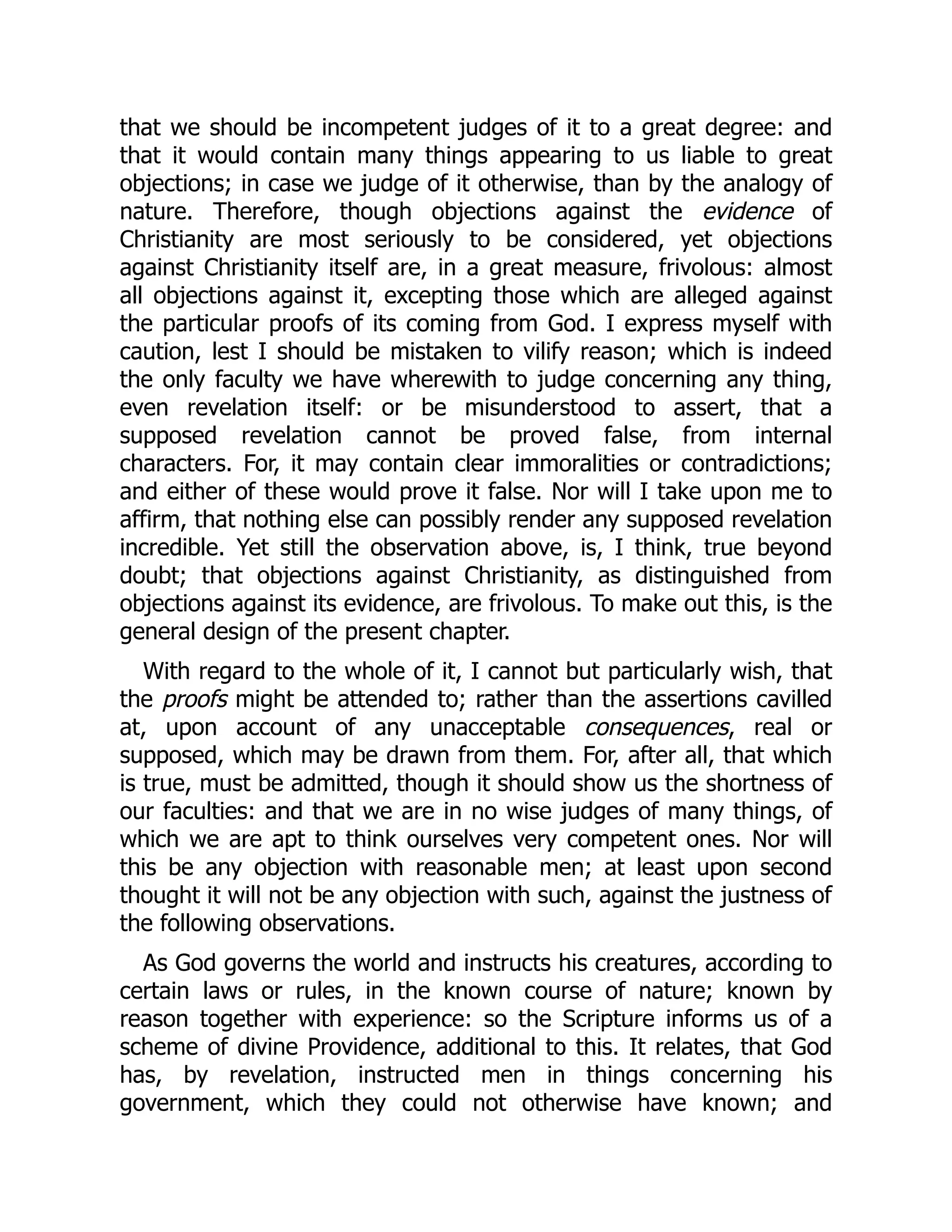
![These observations, relating to the whole of Christianity, are
applicable to inspiration in particular. As we are in no sort judges
beforehand, by what laws or rules, in what degree, or by what
means, it were to have been expected, that God would naturally
instruct us; so upon supposition of his affording us light and
instruction by revelation, additional to what he has afforded us by
reason and experience, we are in no sort judges, by what methods,
and in what proportion, it were to be expected that this supernatural
light and instruction would be afforded us. We know not beforehand,
what degree or kind of natural information it were to be expected
God would afford men, each by his own reason and experience: nor
how far he would enable and effectually dispose them to
communicate it, whatever it should be, to each other; nor whether
the evidence of it would be certain, highly probable, or doubtful; nor
whether it would be given with equal clearness and conviction to all.
Nor could we guess, upon any good ground I mean, whether natural
knowledge, or even the faculty itself, by which we are capable of
attaining it, reason, would be given us at once, or gradually.
In like manner, we are wholly ignorant, what degree of new
knowledge, it were to be expected, God would give mankind by
revelation, upon supposition of his affording one: or how far, or in
what way, he would interpose miraculously, to qualify them, to
whom he should originally make the revelation, for communicating
the knowledge given by it; and to secure their doing it to the age in
which they should live; and to secure its being transmitted to
posterity. We are equally ignorant, whether the evidence of it would
be certain or highly probable, or doubtful:[173] or whether all who
should have any degree of instruction from it, and any degree of
evidence of its truth, would have the same: or whether the scheme
would be revealed at once, or unfolded gradually.[174] Nay we are
not in any sort able to judge, whether it were to have been
expected, that the revelation should have been committed to
writing; or left to be handed down, and consequently corrupted, by
verbal tradition, and at length sunk under it, if mankind so pleased,](https://image.slidesharecdn.com/13818-250606045334-2c48c62d/75/eBook-PDF-In-Mixed-Company-Communicating-in-Small-Groups-and-Teams-10th-Edition-25-2048.jpg)
![morality of it,[175]) but such as can show, that there is no proof of
miracles wrought originally in attestation of it; no appearance of any
thing miraculous in its obtaining in the world; nor any of prophecy,
that is, of events foretold, which human sagacity could not foresee.
If it can be shown, that the proof alleged for all these is absolutely
none at all, then is revelation overturned. But were it allowed, that
the proof of any one or all of them is lower than is allowed; yet,
whilst any proof of them remains, revelation will stand upon much
the same foot it does at present, as to all the purposes of life and
practice, and ought to have the like influence upon our behavior.
From the foregoing observations too, it will follow, and those who
will thoroughly examine into revelation will find it worth remarking,
that there are several ways of arguing, which though just with
regard to other writings, are not applicable to Scripture: at least not
to its prophetic parts. We cannot argue, for instance, that such and
such cannot be the sense or intent of a passage of Scripture, for, if it
had, it would have been expressed more plainly, or represented
under a more apt figure or hieroglyphic. Yet we may justly argue
thus, with respect to common books. And the reason of this
difference is very evident. In Scripture we are not competent judges,
as we are in common books, how plainly it were to have been
expected, that the sense should have been expressed, or under how
apt an image figured. The only question is, what appearance there
is, that this is the sense; and scarce at all, how much more
determinately or accurately it might have been expressed or figured.
[176]
“But is it not self-evident, that internal improbabilities of all kinds
weaken external probable proof?” Doubtless. But to what practical
purpose can this be alleged here, when it has been proved before,
[177] that real internal improbabilities, which rise even to moral
certainty, are overcome by the most ordinary testimony; and when it
now has been made to appear, that we scarce know what are
improbabilities, as to the matter we are here considering: as it will
further appear from what follows.](https://image.slidesharecdn.com/13818-250606045334-2c48c62d/75/eBook-PDF-In-Mixed-Company-Communicating-in-Small-Groups-and-Teams-10th-Edition-27-2048.jpg)
![liable to it from design, that every man can deceive and betray by it.
And, to mention but one instance more; that brutes, without reason,
should act, in many respects, with a sagacity and foresight vastly
greater than what men have in those respects, would be thought
impossible. Yet it is certain they do act with such superior foresight:
whether it be their own, indeed, is another question. From these
things, it is highly credible beforehand, that upon supposition that
God should afford men some additional instruction by revelation, it
would be with circumstances, in manners, degrees, and respects,
against the credibility of which we should be apt to fancy we had
great objections. Nor are the objections against the Scripture, nor
against Christianity in general, at all more or greater, than the
analogy of nature would beforehand—not perhaps give ground to
expect; (for the analogy may not be sufficient, in some cases, to
ground an expectation upon;) but no more nor greater, than analogy
would show it, beforehand, to be supposable and credible, that there
might seem to lie against revelation.
By applying these general observations to a particular objection, it
will be more distinctly seen, how they are applicable to others of the
like kind; and indeed to almost all objections against Christianity, as
distinguished from objections against its evidence. It appears from
Scripture, that, as it was not unusual in the apostolic age, for
persons, upon their conversion to Christianity, to be endued with
miraculous gifts; so, some of those persons exercised these gifts in a
strangely irregular and disorderly manner;[178] and this is made an
objection against their being really miraculous. Now the foregoing
observations quite remove this objection, how considerable soever it
may appear at first sight. For, consider a person endued with any of
these gifts, for instance that of tongues: it is to be supposed, that he
had the same power over this miraculous gift, as he would have had
over it, had it been the effect of habit, of study and use, as it
ordinarily is; or the same power over it, as he had over any other
natural endowment. Consequently, he would use it in the same
manner as he did any other; either regularly, and upon proper
occasions only, or irregularly, and upon improper ones: according to](https://image.slidesharecdn.com/13818-250606045334-2c48c62d/75/eBook-PDF-In-Mixed-Company-Communicating-in-Small-Groups-and-Teams-10th-Edition-29-2048.jpg)
![his sense of decency, and his character of prudence.[179] Where
then is the objection? Why, if this miraculous power was indeed
given to the world to propagate Christianity, and attest the truth of
it, we might, it seems, have expected, that other sort of persons
should have been chosen to be invested with it; or that these
should, at the same time, have been endued with prudence; or that
they should have been continually restrained and directed in the
exercise of it: i.e. that God should have miraculously interposed, if at
all, in a different manner, or higher degree. But, from the
observations made above, it is undeniably evident, that we are not
judges in what degrees and manners it were to have been expected
he should miraculously interpose; upon supposition of his doing it in
some degree and manner. Nor, in the natural course of Providence,
are superior gifts of memory, eloquence, knowledge, and other
talents of great influence, conferred only on persons of prudence
and decency, or such as are disposed to make the properest use of
them. Nor is the instruction and admonition naturally afforded us for
the conduct of life, particularly in our education, commonly given in
a manner the most suited to recommend it; but often with
circumstances apt to prejudice us against such instruction.
One might go on to add, there is a great resemblance between
the light of nature and of revelation, in several other respects.
Practical Christianity, or that faith and behavior which renders a man
a Christian, is a plain and obvious thing: like the common rules of
conduct, with respect to ordinary temporal affairs. The more distinct
and particular knowledge of those things, the study of which the
apostle calls going on unto perfection,[180] and of the prophetic
parts of revelation, like many parts of natural and even civil
knowledge, may require very exact thought, and careful
consideration. The hinderances too, of natural, and of supernatural
light and knowledge, have been of the same kind. And as it is owned
the whole scheme of Scripture is not yet understood; so, if it ever
comes to be understood, before the restitution of all things,[181] and
without miraculous interpositions, it must be in the same way as
natural knowledge is come at: by the continuance and progress of](https://image.slidesharecdn.com/13818-250606045334-2c48c62d/75/eBook-PDF-In-Mixed-Company-Communicating-in-Small-Groups-and-Teams-10th-Edition-30-2048.jpg)
![learning and of liberty;[182] and by particular persons attending to,
comparing, and pursuing, intimations scattered up and down it,
which are overlooked and disregarded by the generality of the world.
For this is the way in which all improvements are made; by
thoughtful men’s tracing on obscure hints, dropped us by nature as
it were, accidentally, or which seem to come into our minds by
chance. Nor is it at all incredible, that a book which has been so long
in the possession of mankind, should contain many truths as yet
undiscovered. For, all the same phenomena, and the same faculties
of investigation, from which such great discoveries in natural
knowledge have been made in the present and last age, were
equally in the possession of mankind, several thousand years before.
And possibly it might be intended, that events, as they come to
pass, should open and ascertain the meaning of several parts of
Scripture.
It may be objected, that this analogy fails in a material respect:
for that natural knowledge is of little or no consequence. But I have
been speaking of the general instruction which nature does or does
not afford us. And besides, some parts of natural knowledge, in the
more common restrained sense of the words, are of the greatest
consequence to the ease and convenience of life. But suppose the
analogy did, as it does not, fail in this respect; yet it might be
abundantly supplied, from the whole constitution and course of
nature: which shows, that God does not dispense his gifts according
to our notions of the advantage and consequence they would be of
to us. And this in general, with his method of dispensing knowledge
in particular, would together make out an analogy full to the point
before us.
But it may be objected still further and more generally; “The
Scripture represents the world as in a state of ruin, and Christianity
as an expedient to recover it, to help in these respects where nature
fails: in particular, to supply the deficiencies of natural light. Is it
credible then, that so many ages should have been let pass, before a
matter of such a sort, of so great and so general importance, was](https://image.slidesharecdn.com/13818-250606045334-2c48c62d/75/eBook-PDF-In-Mixed-Company-Communicating-in-Small-Groups-and-Teams-10th-Edition-31-2048.jpg)
![made known to mankind; and then that it should be made known to
so small a part of them? Is it conceivable, that this supply should be
so very deficient, should have the like obscurity and doubtfulness, be
liable to the like perversions, in short, lie open to all the like
objections, as the light of nature itself?”[183]
Without determining how far this, in fact, is so, I answer; it is by
no means incredible, that it might be so, if the light of nature and of
revelation be from the same hand. Men are naturally liable to
diseases: for which God, in his good providence, has provided
natural remedies.[184] But remedies existing in nature have been
unknown to mankind for many ages; are known but to few now;
probably many valuable ones are not known yet. Great has been and
is the obscurity and difficulty, in the nature and application of them.
Circumstances seem often to make them very improper, where they
are absolutely necessary. It is after long labor and study, and many
unsuccessful endeavors, that they are brought to be as useful as
they are; after high contempt and absolute rejection of the most
useful we have; and after disputes and doubts, which have seemed
to be endless. The best remedies too, when unskilfully, much more
when dishonestly applied, may produce new diseases; and with the
rightest application the success of them is often doubtful. In many
cases they are not effectual: where they are, it is often very slowly:
and the application of them, and the necessary regimen
accompanying it, is not uncommonly so disagreeable, that some will
not submit to them; and satisfy themselves with the excuse, that if
they would, it is not certain whether it would be successful. And
many persons, who labor under diseases, for which there are known
natural remedies, are not so happy as to be always, if ever, in the
way of them. In a word, the remedies which nature has provided for
diseases are neither certain, perfect, nor universal. And indeed the
same principles of arguing, which would lead us to conclude, that
they must be so, would lead us likewise to conclude, that there
could be no occasion for them; i.e. that there could be no diseases
at all. And therefore our experience that there are diseases, shows
that it is credible beforehand, upon supposition nature has provided](https://image.slidesharecdn.com/13818-250606045334-2c48c62d/75/eBook-PDF-In-Mixed-Company-Communicating-in-Small-Groups-and-Teams-10th-Edition-32-2048.jpg)
![all in either: and when this revocation is made known, as surely it is
possible it may be, it must cease to be unjust to deprive them of
either. And though a course of external acts, which without
command would be immoral, must make an immoral habit; yet a few
detached commands have no such natural tendency. I thought
proper to say thus much of the few Scripture precepts, which
require, not vicious actions, but actions which would have been
vicious, but for such precepts; because they are sometimes weakly
urged as immoral, and great weight is laid upon objections drawn
from them.
To me there seems no difficulty at all in these precepts, but what
arises from their being offences: i.e. from their being liable to be
perverted, as indeed they are, by wicked designing men, to serve
the most horrid purposes; and perhaps to mislead the weak and
enthusiastic. And objections from this head are not objections
against revelation; but against the whole notion of religion, as a
trial: and against the general constitution of nature.
Secondly, Reason is able to judge, and must, of the evidence of
revelation, and of the objections urged against that evidence: which
shall be the subject of a following chapter.[185]
The consequence of the foregoing observations is, that the
question upon which the truth of Christianity depends, is scarcely at
all what objections there are against its scheme, since there are
none against the morality of it, but what objections there are against
its evidence; or, what proof there remains of it, after due allowances
are made for the objections against that proof: because it has been
shown, that the objections against Christianity, as distinguished from
objections against its evidence, are frivolous. For surely very little
weight, if any at all, is to be laid upon a way of arguing and
objecting, which, when applied to the general constitution of nature,
experience shows not to be conclusive: and such, I think, is the
whole way of objecting treated of throughout this chapter. It is
resolvable into principles, and goes upon suppositions, which
mislead us to think, that the Author of nature would not act, as we](https://image.slidesharecdn.com/13818-250606045334-2c48c62d/75/eBook-PDF-In-Mixed-Company-Communicating-in-Small-Groups-and-Teams-10th-Edition-34-2048.jpg)
![experience he does; or would act, in such and such cases, as we
experience he does not in like cases. But the unreasonableness of
this way of objecting will appear yet more evidently from hence, that
the chief things thus objected against are justified, as shall be
further shown,[186] by distinct, particular, and full analogies, in the
constitution and course of nature.
It is to be remembered, that, as frivolous as objections of the
foregoing sort against revelation are, yet, when a supposed
revelation is more consistent with itself, and has a more general and
uniform tendency to promote virtue, than, all circumstances
considered, could have been expected from enthusiasm and political
views, this is a presumptive proof of its not proceeding from them,
and so of its truth: because we are competent judges, what might
have been expected from enthusiasm and political views.[187]
CHAPTER IV.
CHRISTIANITY, CONSIDERED AS A SCHEME OR CONSTITUTION,
IMPERFECTLY COMPREHENDED.
As hath been now shown,[188] the analogy of nature renders it
highly credible beforehand, that, supposing a revelation to be made,
it must contain many things very different from what we should have
expected, and such as appear open to great objections: and that this
observation, in good measure, takes off the force of those
objections, or rather precludes them. It may be alleged, that this is a
very partial answer to such objections, or a very unsatisfactory way
of obviating them: because it does not show at all, that the things
objected against can be wise, just, and good; much less, that it is
credible they are so. It will therefore be proper to show this
distinctly; by applying to these objections against the wisdom,
justice, and goodness of Christianity, the answer above[189] given to](https://image.slidesharecdn.com/13818-250606045334-2c48c62d/75/eBook-PDF-In-Mixed-Company-Communicating-in-Small-Groups-and-Teams-10th-Edition-35-2048.jpg)
![the like objections against the constitution of nature: before we
consider the particular analogies in the latter, to the particular things
objected against in the former. Now that which affords a sufficient
answer to objections against the wisdom, justice, and goodness of
the constitution of nature, is its being a constitution, a system, or
scheme, imperfectly comprehended;[190] a scheme in which means
are made use of to accomplish ends; and which is carried on by
general laws. For from these things it has been proved, not only to
be possible, but also to be credible, that those things which are
objected against may be consistent with wisdom, justice, and
goodness; nay, may be instances of them: and even that the
constitution and government of nature may be perfect in the highest
possible degree. If Christianity then be a scheme, and of the like
kind; it is evident, the like objections against it must admit of the like
answer. And,
I. Christianity is a scheme, quite beyond our comprehension.
The moral government of God is exercised, by gradually
conducting things so in the course of his providence, that every one,
at length and upon the whole, shall receive according to his deserts;
and neither fraud nor violence, but truth and right, shall finally
prevail. Christianity is a particular scheme under this general plan of
Providence, and a part of it, conducive to its completion, with regard
to mankind: consisting itself also of various parts, and a mysterious
economy, which has been carrying on from the time the world came
into its present wretched state, and is still carrying on, for its
recovery, by a divine person, the Messiah; who is to gather together
in one the children of God, that are scattered abroad,[191] and
establish an everlasting kingdom, wherein dwelleth righteousness.
[192] In order to it; after various manifestations of things, relating to
this great and general scheme of Providence, through a succession
of many ages: (For the Spirit of Christ which was in the prophets,
testified beforehand his sufferings, and the glory that should follow:
unto whom it was revealed, that not unto themselves, but unto us
they did minister the things which are now reported unto us by them](https://image.slidesharecdn.com/13818-250606045334-2c48c62d/75/eBook-PDF-In-Mixed-Company-Communicating-in-Small-Groups-and-Teams-10th-Edition-36-2048.jpg)
![that have preached the Gospel; which things the angels desire to
look into:[193])—after various dispensations looking forward and
preparatory to, this final salvation: in the fulness of time, when
infinite wisdom thought fit; He, being in the form of God,—made
himself of no reputation, and took upon him the form of a servant,
and was made in the likeness of men: and being found in fashion as
a man, he humbled himself, and became obedient to death, even
the death of the cross. Wherefore God also hath highly exalted him,
and given him a name, which is above every name: that at the name
of Jesus every knee should bow, of things in heaven, and things in
the earth, and things under the earth: and that every tongue should
confess, that Jesus Christ is Lord, to the glory of God the Father.[194]
Parts likewise of this economy are the miraculous mission of the Holy
Ghost, and his ordinary assistances given to good men:[195] the
invisible government, which Christ at present exercises over his
church: that which he himself refers to in these words: In my
Father’s house are many mansions—I go to prepare a place for you:
[196] and his future return to judge the world in righteousness, and
completely re-establish the kingdom of God. For the Father judgeth
no man; but hath committed all judgment unto the Son: that all men
should honor the Son, even as they honor the Father.[197] All power
is given unto him in heaven and in earth.[198] And he must reign, till
he hath put all enemies under his feet. Then cometh the end, when
he shall have delivered up the kingdom to God, even the Father;
when he shall have put down all rule, and all authority and power.
And when all things shall be subdued unto him, then shall the Son
also himself be subject unto him that put all things under him, that
God may be all in all.[199] Surely little need be said to show, that this
system, or scheme of things, is but imperfectly comprehended by us.
The Scripture expressly asserts it to be so. And indeed one cannot
read a passage relating to this great mystery of godliness,[200] but
what immediately runs up into something which shows us our
ignorance in it; as every thing in nature shows us our ignorance in
the constitution of nature. And whoever will seriously consider that](https://image.slidesharecdn.com/13818-250606045334-2c48c62d/75/eBook-PDF-In-Mixed-Company-Communicating-in-Small-Groups-and-Teams-10th-Edition-37-2048.jpg)
![part of the Christian scheme, which is revealed in Scripture, will find
so much more unrevealed, as will convince him, that, to all the
purposes of judging and objecting, we know as little of it, as of the
constitution of nature. Our ignorance, therefore, is as much an
answer to our objections against the perfection of one, as against
the perfection of the other.[201]
II. It is obvious too, that in the Christian dispensation, as much as
in the natural scheme of things, means are made use of to
accomplish ends.
The observation of this furnishes us with the same answer, to
objections against the perfection of Christianity, as to objections of
the like kind, against the constitution of nature. It shows the
credibility, that the things objected against, how foolish[202] soever
they appear to men, may be the very best means of accomplishing
the very best ends. And their appearing foolishness is no
presumption against this, in a scheme so greatly beyond our
comprehension.[203]
III. The credibility, that the Christian dispensation may have been,
all along, carried on by general laws,[204] no less than the course of
nature, may require to be more distinctly made out.
Consider then, upon what ground it is we say, that the whole
common course of nature is carried on according to general fore-
ordained laws. We know indeed several of the general laws of
matter; and a great part of the natural behavior of living agents is
reducible to general laws. But we know in a manner nothing, by
what laws, storms, tempests, earthquakes, famine, pestilence,
become the instruments of destruction to mankind. And the laws by
which persons born into the world at such a time and place are of
such capacities, geniuses, tempers; the laws by which thoughts
come into our mind, in a multitude of cases; and by which
innumerable things happen, of the greatest influence upon the
affairs and state of the world. These laws are so wholly unknown to
us, that we call the events which come to pass by them, accidental;](https://image.slidesharecdn.com/13818-250606045334-2c48c62d/75/eBook-PDF-In-Mixed-Company-Communicating-in-Small-Groups-and-Teams-10th-Edition-38-2048.jpg)
![interpositions should be by general laws; and why these laws should
not be broken in upon, or deviated from, by other miracles.
Upon the whole then, the appearance of deficiencies and
irregularities in nature is owing to its being a scheme but in part
made known, and of such a certain particular kind in other respects.
We see no more reason why the frame and course of nature should
be such a scheme, than why Christianity should. And that the former
is such a scheme, renders it credible, that the latter, upon
supposition of its truth, may be so too. And as it is manifest, that
Christianity is a scheme revealed but in part, and a scheme in which
means are made use of to accomplish ends, like to that of nature: so
the credibility, that it may have been all along carried on by general
laws, no less than the course of nature, has been distinctly proved.
From all this it is beforehand credible that there might, I think
probable that there would, be the like appearance of deficiencies
and irregularities in Christianity, as in nature: i.e. that Christianity
would be liable to the like objections, as the frame of nature. And
these objections are answered by these observations concerning
Christianity; as the like objections against the frame of nature are
answered by the like observations concerning the frame of nature.
The objections against Christianity, considered as a matter of fact,
[205] having, in general, been obviated in the preceding chapter; and
the same, considered as made against the wisdom and goodness of
it, having been obviated in this: the next thing, according to the
method proposed, is to show, that the principal objections, in
particular, against Christianity, may be answered, by particular and
full analogies in nature. And as one of them is made against the
whole scheme of it together, as just now described, I choose to
consider it here, rather than in a distinct chapter by itself.
The thing objected against this scheme of the gospel is, “that it
seems to suppose God was reduced to the necessity of a long series](https://image.slidesharecdn.com/13818-250606045334-2c48c62d/75/eBook-PDF-In-Mixed-Company-Communicating-in-Small-Groups-and-Teams-10th-Edition-40-2048.jpg)