EASTER TRADITIONS 
IN EUROPE
TRADITIONS IN GREECE 
“LAZARAKIA” 
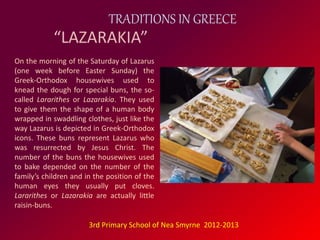
On the morning of the Saturday of Lazarus 
(one week before Easter Sunday) the 
Greek-Orthodox housewives used to 
knead the dough for special buns, the so-called 
Lararithes or Lazarakia. They used 
to give them the shape of a human body 
wrapped in swaddling clothes, just like the 
way Lazarus is depicted in Greek-Orthodox 
icons. These buns represent Lazarus who 
was resurrected by Jesus Christ. The 
number of the buns the housewives used 
to bake depended on the number of the 
family’s children and in the position of the 
human eyes they usually put cloves. 
Lararithes or Lazarakia are actually little 
raisin-buns. 
3rd Primary School of Nea Smyrne 2012-2013
TRADITIONS IN GREECE 
PALM SUNDAY 
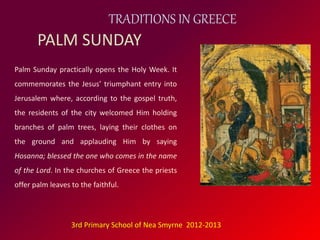
Palm Sunday practically opens the Holy Week. It 
commemorates the Jesus’ triumphant entry into 
Jerusalem where, according to the gospel truth, 
the residents of the city welcomed Him holding 
branches of palm trees, laying their clothes on 
the ground and applauding Him by saying 
Hosanna; blessed the one who comes in the name 
of the Lord. In the churches of Greece the priests 
offer palm leaves to the faithful. 
3rd Primary School of Nea Smyrne 2012-2013
TRADITIONS IN GREECE 
EASTER EGGS 
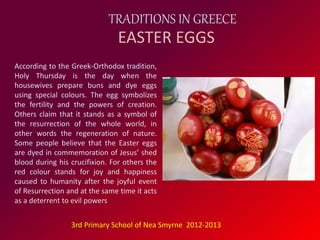
According to the Greek-Orthodox tradition, 
Holy Thursday is the day when the 
housewives prepare buns and dye eggs 
using special colours. The egg symbolizes 
the fertility and the powers of creation. 
Others claim that it stands as a symbol of 
the resurrection of the whole world, in 
other words the regeneration of nature. 
Some people believe that the Easter eggs 
are dyed in commemoration of Jesus’ shed 
blood during his crucifixion. For others the 
red colour stands for joy and happiness 
caused to humanity after the joyful event 
of Resurrection and at the same time it acts 
as a deterrent to evil powers. 
3rd Primary School of Nea Smyrne 2012-2013
TRADITIONS IN GREECE 
“BOTITHES” 
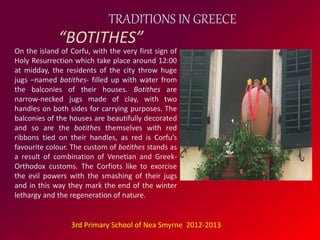
On the island of Corfu, with the very first sign of 
Holy Resurrection which take place around 12:00 
at midday, the residents of the city throw huge 
jugs –named botithes- filled up with water from 
the balconies of their houses. Botithes are 
narrow-necked jugs made of clay, with two 
handles on both sides for carrying purposes. The 
balconies of the houses are beautifully decorated 
and so are the botithes themselves with red 
ribbons tied on their handles, as red is Corfu’s 
favourite colour. The custom of botithes stands as 
a result of combination of Venetian and Greek- 
Orthodox customs. The Corfiots like to exorcise 
the evil powers with the smashing of their jugs 
and in this way they mark the end of the winter 
lethargy and the regeneration of nature. 
3rd Primary School of Nea Smyrne 2012-2013
TRADITIONS IN GREECE 
Orthodox Holy Friday Customs 
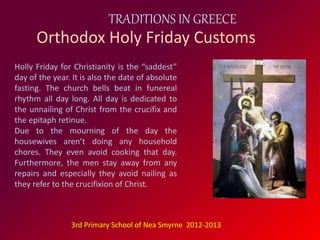
Holly Friday for Christianity is the “saddest” 
day of the year. It is also the date of absolute 
fasting. The church bells beat in funereal 
rhythm all day long. All day is dedicated to 
the unnailing of Christ from the crucifix and 
the epitaph retinue. 
Due to the mourning of the day the 
housewives aren’t doing any household 
chores. They even avoid cooking that day. 
Furthermore, the men stay away from any 
repairs and especially they avoid nailing as 
they refer to the crucifixion of Christ. 
3rd Primary School of Nea Smyrne 2012-2013
TRADITIONS IN GREECE 
Orthodox Holy Friday Customs 
A lot of people eat bread and drinking 
vinegar that day, because when Christ asked 
for water the Roman soldier gave Him 
vinegar. In some areas of Crete, people drink 
the bitter juice that is produced from the 
boiling of snails. In other areas people do 
not eat or drink that day. 
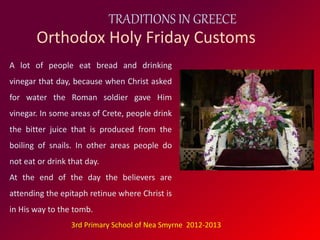
At the end of the day the believers are 
attending the epitaph retinue where Christ is 
in His way to the tomb. 
3rd Primary School of Nea Smyrne 2012-2013
TRADITIONS IN GREECE 
ROCKET FIGHT 
Easter in Chios means rocket fight, a custom 
that has its roots from the time of Turkish 
domination. It is a “war” between the parishes 
of Vrodados, Saint Mark and Virgin Mary 
Erithiani. 
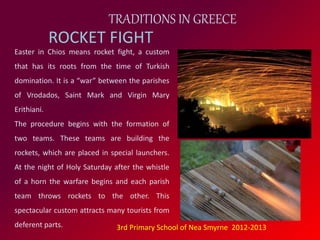
The procedure begins with the formation of 
two teams. These teams are building the 
rockets, which are placed in special launchers. 
At the night of Holy Saturday after the whistle 
of a horn the warfare begins and each parish 
team throws rockets to the other. This 
spectacular custom attracts many tourists from 
deferent parts. 3rd Primary School of Nea Smyrne 2012-2013
TRADITIONS IN GREECE 
JUDA’S BURNING 
Another custom, that place is the burning of 
Judas. This custom takes place every year, as well 
as this year, in different places of the country. 
This custom is a product of folklore tradition. 
Researchers, say that the roots are lost in time. 
The burning of Judas takes place every Holy 
Friday night. 
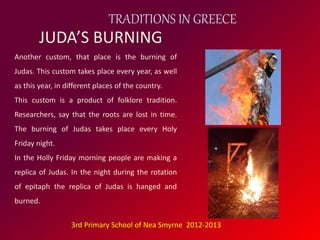
In the Holly Friday morning people are making a 
replica of Judas. In the night during the rotation 
of epitaph the replica of Judas is hanged and 
burned. 
3rd Primary School of Nea Smyrne 2012-2013
TRADITIONS IN GREECE 
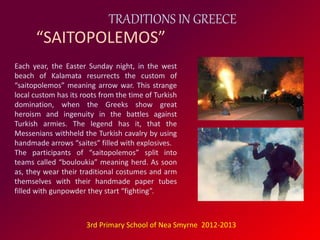
“SAITOPOLEMOS” 
Each year, the Easter Sunday night, in the west 
beach of Kalamata resurrects the custom of 
“saitopolemos” meaning arrow war. This strange 
local custom has its roots from the time of Turkish 
domination, when the Greeks show great 
heroism and ingenuity in the battles against 
Turkish armies. The legend has it, that the 
Messenians withheld the Turkish cavalry by using 
handmade arrows “saites” filled with explosives. 
The participants of “saitopolemos” split into 
teams called “bouloukia” meaning herd. As soon 
as, they wear their traditional costumes and arm 
themselves with their handmade paper tubes 
filled with gunpowder they start “fighting”. 
3rd Primary School of Nea Smyrne 2012-2013
VISIT GREECE TO SEE 
THESE EASTER TRADITIONS 
AND MORE 
3rd Primary School of Nea Smyrne 2012-2013

Easter traditions in greece

  • 1.
  • 2.
    TRADITIONS IN GREECE “LAZARAKIA” On the morning of the Saturday of Lazarus (one week before Easter Sunday) the Greek-Orthodox housewives used to knead the dough for special buns, the so-called Lararithes or Lazarakia. They used to give them the shape of a human body wrapped in swaddling clothes, just like the way Lazarus is depicted in Greek-Orthodox icons. These buns represent Lazarus who was resurrected by Jesus Christ. The number of the buns the housewives used to bake depended on the number of the family’s children and in the position of the human eyes they usually put cloves. Lararithes or Lazarakia are actually little raisin-buns. 3rd Primary School of Nea Smyrne 2012-2013
  • 3.
    TRADITIONS IN GREECE PALM SUNDAY Palm Sunday practically opens the Holy Week. It commemorates the Jesus’ triumphant entry into Jerusalem where, according to the gospel truth, the residents of the city welcomed Him holding branches of palm trees, laying their clothes on the ground and applauding Him by saying Hosanna; blessed the one who comes in the name of the Lord. In the churches of Greece the priests offer palm leaves to the faithful. 3rd Primary School of Nea Smyrne 2012-2013
  • 4.
    TRADITIONS IN GREECE EASTER EGGS According to the Greek-Orthodox tradition, Holy Thursday is the day when the housewives prepare buns and dye eggs using special colours. The egg symbolizes the fertility and the powers of creation. Others claim that it stands as a symbol of the resurrection of the whole world, in other words the regeneration of nature. Some people believe that the Easter eggs are dyed in commemoration of Jesus’ shed blood during his crucifixion. For others the red colour stands for joy and happiness caused to humanity after the joyful event of Resurrection and at the same time it acts as a deterrent to evil powers. 3rd Primary School of Nea Smyrne 2012-2013
  • 5.
    TRADITIONS IN GREECE “BOTITHES” On the island of Corfu, with the very first sign of Holy Resurrection which take place around 12:00 at midday, the residents of the city throw huge jugs –named botithes- filled up with water from the balconies of their houses. Botithes are narrow-necked jugs made of clay, with two handles on both sides for carrying purposes. The balconies of the houses are beautifully decorated and so are the botithes themselves with red ribbons tied on their handles, as red is Corfu’s favourite colour. The custom of botithes stands as a result of combination of Venetian and Greek- Orthodox customs. The Corfiots like to exorcise the evil powers with the smashing of their jugs and in this way they mark the end of the winter lethargy and the regeneration of nature. 3rd Primary School of Nea Smyrne 2012-2013
  • 6.
    TRADITIONS IN GREECE Orthodox Holy Friday Customs Holly Friday for Christianity is the “saddest” day of the year. It is also the date of absolute fasting. The church bells beat in funereal rhythm all day long. All day is dedicated to the unnailing of Christ from the crucifix and the epitaph retinue. Due to the mourning of the day the housewives aren’t doing any household chores. They even avoid cooking that day. Furthermore, the men stay away from any repairs and especially they avoid nailing as they refer to the crucifixion of Christ. 3rd Primary School of Nea Smyrne 2012-2013
  • 7.
    TRADITIONS IN GREECE Orthodox Holy Friday Customs A lot of people eat bread and drinking vinegar that day, because when Christ asked for water the Roman soldier gave Him vinegar. In some areas of Crete, people drink the bitter juice that is produced from the boiling of snails. In other areas people do not eat or drink that day. At the end of the day the believers are attending the epitaph retinue where Christ is in His way to the tomb. 3rd Primary School of Nea Smyrne 2012-2013
  • 8.
    TRADITIONS IN GREECE ROCKET FIGHT Easter in Chios means rocket fight, a custom that has its roots from the time of Turkish domination. It is a “war” between the parishes of Vrodados, Saint Mark and Virgin Mary Erithiani. The procedure begins with the formation of two teams. These teams are building the rockets, which are placed in special launchers. At the night of Holy Saturday after the whistle of a horn the warfare begins and each parish team throws rockets to the other. This spectacular custom attracts many tourists from deferent parts. 3rd Primary School of Nea Smyrne 2012-2013
  • 9.
    TRADITIONS IN GREECE JUDA’S BURNING Another custom, that place is the burning of Judas. This custom takes place every year, as well as this year, in different places of the country. This custom is a product of folklore tradition. Researchers, say that the roots are lost in time. The burning of Judas takes place every Holy Friday night. In the Holly Friday morning people are making a replica of Judas. In the night during the rotation of epitaph the replica of Judas is hanged and burned. 3rd Primary School of Nea Smyrne 2012-2013
  • 10.
    TRADITIONS IN GREECE “SAITOPOLEMOS” Each year, the Easter Sunday night, in the west beach of Kalamata resurrects the custom of “saitopolemos” meaning arrow war. This strange local custom has its roots from the time of Turkish domination, when the Greeks show great heroism and ingenuity in the battles against Turkish armies. The legend has it, that the Messenians withheld the Turkish cavalry by using handmade arrows “saites” filled with explosives. The participants of “saitopolemos” split into teams called “bouloukia” meaning herd. As soon as, they wear their traditional costumes and arm themselves with their handmade paper tubes filled with gunpowder they start “fighting”. 3rd Primary School of Nea Smyrne 2012-2013
  • 11.
    VISIT GREECE TOSEE THESE EASTER TRADITIONS AND MORE 3rd Primary School of Nea Smyrne 2012-2013