Easter in Western
countries
Traditions and believes
Teacher: Roromina
QQ: 1125354132
1
Introduction
4 students will make a short introduction
 What’s your name?
 How old are you?
 Where do you come from?
 What’s your job / major?
 What are your hobbies?
 How many members in your family?
 Why do you want to practice spoken
English?
2
Definition
3
 Easter or Resurrection Sunday is a festival
and holiday celebrating the Resurrection of Jesus
Christ from the dead, described in the New
Testament (Bible) as having occurred three days
after his crucifixion .
 The week before Easter is called Holy Week.
 Eastern Christianity bases its calculations on the Julian
calendar, whose 21 March corresponds, during the 21st
century, to 3 April in the Gregorian calendar, and in
which therefore the celebration of Easter varies
between 4 April and 8 May.
 Customs that have become associated with Easter and
are observed by both Christians and some non-
Christians include egg hunting, the Easter Bunny,
and Easter parades. There are also various traditional
Easter foods that vary regionally.
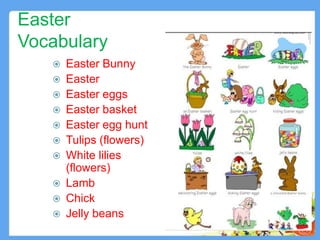
Easter
Vocabulary
 Easter Bunny
 Easter
 Easter eggs
 Easter basket
 Easter egg hunt
 Tulips (flowers)
 White lilies
(flowers)
 Lamb
 Chick
 Jelly beans
4
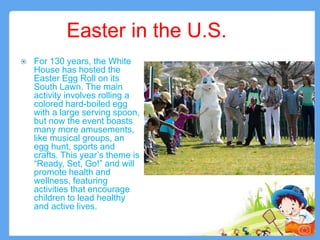
Easter in the U.S.
 For 130 years, the White
House has hosted the
Easter Egg Roll on its
South Lawn. The main
activity involves rolling a
colored hard-boiled egg
with a large serving spoon,
but now the event boasts
many more amusements,
like musical groups, an
egg hunt, sports and
crafts. This year’s theme is
“Ready, Set, Go!” and will
promote health and
wellness, featuring
activities that encourage
children to lead healthy
and active lives.
5
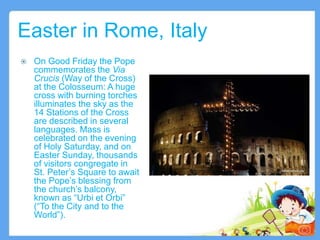
Easter in Rome, Italy
 On Good Friday the Pope
commemorates the Via
Crucis (Way of the Cross)
at the Colosseum: A huge
cross with burning torches
illuminates the sky as the
14 Stations of the Cross
are described in several
languages. Mass is
celebrated on the evening
of Holy Saturday, and on
Easter Sunday, thousands
of visitors congregate in
St. Peter’s Square to await
the Pope’s blessing from
the church’s balcony,
known as “Urbi et Orbi”
(“To the City and to the
World”).
6
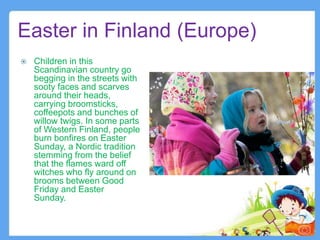
Easter in Finland (Europe)
 Children in this
Scandinavian country go
begging in the streets with
sooty faces and scarves
around their heads,
carrying broomsticks,
coffeepots and bunches of
willow twigs. In some parts
of Western Finland, people
burn bonfires on Easter
Sunday, a Nordic tradition
stemming from the belief
that the flames ward off
witches who fly around on
brooms between Good
Friday and Easter
Sunday.
7
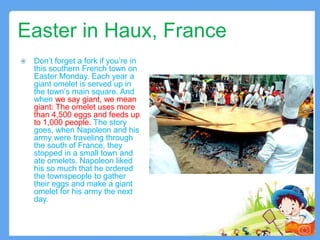
Easter in Haux, France
 Don’t forget a fork if you’re in
this southern French town on
Easter Monday. Each year a
giant omelet is served up in
the town’s main square. And
when we say giant, we mean
giant: The omelet uses more
than 4,500 eggs and feeds up
to 1,000 people. The story
goes, when Napoleon and his
army were traveling through
the south of France, they
stopped in a small town and
ate omelets. Napoleon liked
his so much that he ordered
the townspeople to gather
their eggs and make a giant
omelet for his army the next
day.
8
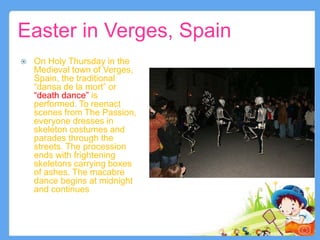
Easter in Verges, Spain
 On Holy Thursday in the
Medieval town of Verges,
Spain, the traditional
“dansa de la mort” or
“death dance” is
performed. To reenact
scenes from The Passion,
everyone dresses in
skeleton costumes and
parades through the
streets. The procession
ends with frightening
skeletons carrying boxes
of ashes. The macabre
dance begins at midnight
and continues for three
hours into the early
morning.
9
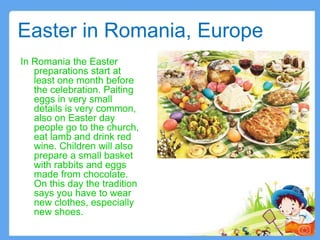
Easter in Romania, Europe
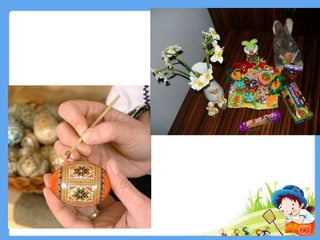
In Romania the Easter
preparations start at
least one month before
the celebration. Paiting
eggs in very small
details is very common,
also on Easter day
people go to the church,
eat lamb and drink red
wine. Children will also
prepare a small basket
with rabbits and eggs
made from chocolate.
On this day the tradition
says you have to wear
new clothes, especially
new shoes.
10
11
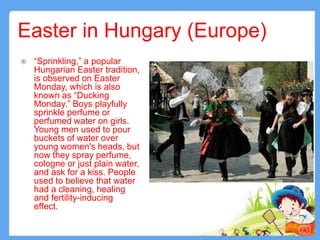
Easter in Hungary (Europe)
 “Sprinkling,” a popular
Hungarian Easter tradition,
is observed on Easter
Monday, which is also
known as “Ducking
Monday.” Boys playfully
sprinkle perfume or
perfumed water on girls.
Young men used to pour
buckets of water over
young women's heads, but
now they spray perfume,
cologne or just plain water,
and ask for a kiss. People
used to believe that water
had a cleaning, healing
and fertility-inducing
effect.
12
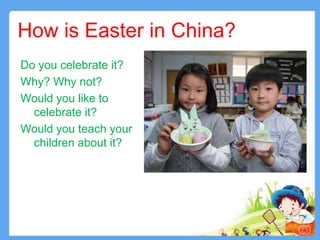
How is Easter in China?
Do you celebrate it?
Why? Why not?
Would you like to
celebrate it?
Would you teach your
children about it?
13
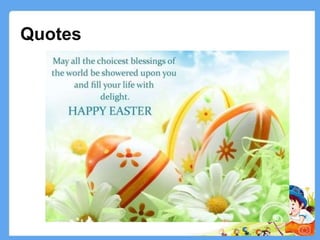
Quotes
14
15
Go to www.wordoor.com and book a
lessons with me!
新注册用户可以享受3天免费互动课,
共6次课程,精选课每次50分钟。
16
17
18
My QQ number is
1125354132

Easter in Western countries Teacher Romina

  • 1.
    Easter in Western countries Traditionsand believes Teacher: Roromina QQ: 1125354132 1
  • 2.
    Introduction 4 students willmake a short introduction  What’s your name?  How old are you?  Where do you come from?  What’s your job / major?  What are your hobbies?  How many members in your family?  Why do you want to practice spoken English? 2
  • 3.
    Definition 3  Easter orResurrection Sunday is a festival and holiday celebrating the Resurrection of Jesus Christ from the dead, described in the New Testament (Bible) as having occurred three days after his crucifixion .  The week before Easter is called Holy Week.  Eastern Christianity bases its calculations on the Julian calendar, whose 21 March corresponds, during the 21st century, to 3 April in the Gregorian calendar, and in which therefore the celebration of Easter varies between 4 April and 8 May.  Customs that have become associated with Easter and are observed by both Christians and some non- Christians include egg hunting, the Easter Bunny, and Easter parades. There are also various traditional Easter foods that vary regionally.
  • 4.
    Easter Vocabulary  Easter Bunny Easter  Easter eggs  Easter basket  Easter egg hunt  Tulips (flowers)  White lilies (flowers)  Lamb  Chick  Jelly beans 4
  • 5.
    Easter in theU.S.  For 130 years, the White House has hosted the Easter Egg Roll on its South Lawn. The main activity involves rolling a colored hard-boiled egg with a large serving spoon, but now the event boasts many more amusements, like musical groups, an egg hunt, sports and crafts. This year’s theme is “Ready, Set, Go!” and will promote health and wellness, featuring activities that encourage children to lead healthy and active lives. 5
  • 6.
    Easter in Rome,Italy  On Good Friday the Pope commemorates the Via Crucis (Way of the Cross) at the Colosseum: A huge cross with burning torches illuminates the sky as the 14 Stations of the Cross are described in several languages. Mass is celebrated on the evening of Holy Saturday, and on Easter Sunday, thousands of visitors congregate in St. Peter’s Square to await the Pope’s blessing from the church’s balcony, known as “Urbi et Orbi” (“To the City and to the World”). 6
  • 7.
    Easter in Finland(Europe)  Children in this Scandinavian country go begging in the streets with sooty faces and scarves around their heads, carrying broomsticks, coffeepots and bunches of willow twigs. In some parts of Western Finland, people burn bonfires on Easter Sunday, a Nordic tradition stemming from the belief that the flames ward off witches who fly around on brooms between Good Friday and Easter Sunday. 7
  • 8.
    Easter in Haux,France  Don’t forget a fork if you’re in this southern French town on Easter Monday. Each year a giant omelet is served up in the town’s main square. And when we say giant, we mean giant: The omelet uses more than 4,500 eggs and feeds up to 1,000 people. The story goes, when Napoleon and his army were traveling through the south of France, they stopped in a small town and ate omelets. Napoleon liked his so much that he ordered the townspeople to gather their eggs and make a giant omelet for his army the next day. 8
  • 9.
    Easter in Verges,Spain  On Holy Thursday in the Medieval town of Verges, Spain, the traditional “dansa de la mort” or “death dance” is performed. To reenact scenes from The Passion, everyone dresses in skeleton costumes and parades through the streets. The procession ends with frightening skeletons carrying boxes of ashes. The macabre dance begins at midnight and continues for three hours into the early morning. 9
  • 10.
    Easter in Romania,Europe In Romania the Easter preparations start at least one month before the celebration. Paiting eggs in very small details is very common, also on Easter day people go to the church, eat lamb and drink red wine. Children will also prepare a small basket with rabbits and eggs made from chocolate. On this day the tradition says you have to wear new clothes, especially new shoes. 10
  • 11.
  • 12.
    Easter in Hungary(Europe)  “Sprinkling,” a popular Hungarian Easter tradition, is observed on Easter Monday, which is also known as “Ducking Monday.” Boys playfully sprinkle perfume or perfumed water on girls. Young men used to pour buckets of water over young women's heads, but now they spray perfume, cologne or just plain water, and ask for a kiss. People used to believe that water had a cleaning, healing and fertility-inducing effect. 12
  • 13.
    How is Easterin China? Do you celebrate it? Why? Why not? Would you like to celebrate it? Would you teach your children about it? 13
  • 14.
  • 15.
  • 16.
    Go to www.wordoor.comand book a lessons with me! 新注册用户可以享受3天免费互动课, 共6次课程,精选课每次50分钟。 16
  • 17.
  • 18.
    18 My QQ numberis 1125354132