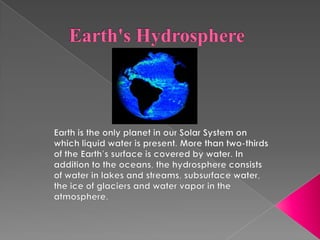
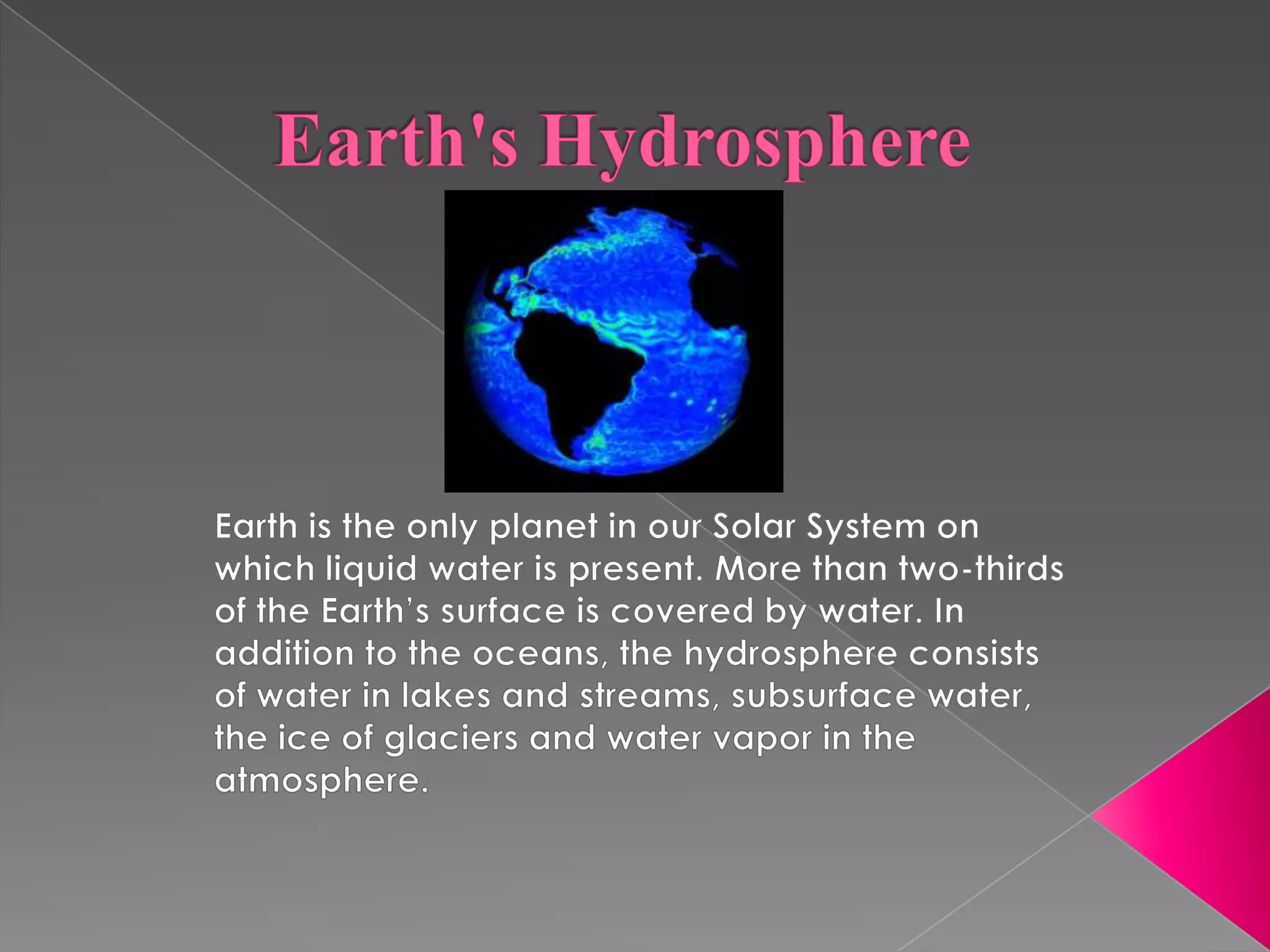
Earth's HydrosphereEarth is the only planet in our Solar System on which liquid water is present. More than two-thirds of the Earth’s surface is covered by water. In addition to the oceans, the hydrosphere consists of water in lakes and streams, subsurface water, the ice of glaciers and water vapor in the atmosphere.
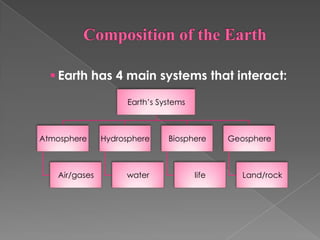
Composition of the EarthEarth has 4 main systems that interact:The Atmosphere
The Hydrosphere
The Biosphere
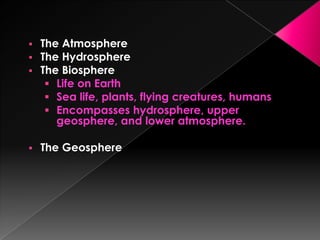
Life on Earth
Sea life, plants, flying creatures, humans
Encompasses hydrosphere, upper geosphere, and lower atmosphere.
The GeosphereInteractions of the hydrosphereIt is important to realize that the hydrosphere interacts with other global systems, including the atmosphere, lithosphere and biosphere.Atmosphere When water is heated (e.g. by energy from the sun), it evaporates and forms water vapor. When water vapor cools again, it condenses to form liquid water which eventually returns to the surface by precipitation e.g. rain or snow. This cycle of water moving through the atmosphere and the energy changes that accompany it, is what drives weather patterns on earth.
Lithosphere In the lithosphere (the ocean and continental crust at the Earth's surface), water is an important weathering agent, which means that it helps to break rock down into rock fragments and then soil. These fragments may then be transported by water to another place, where they are deposited. This is called erosion. These two process, i.e. weathering and erosion, help to shape the earth's surface. You can see this for example in rivers. In the upper streams, rocks are eroded and sediments are transported down the river and deposited on the wide flood plains lower down. On a bigger scale, river valleys in mountains have been carved out by the action of water, and cliffs and caves on rocky beach coastlines are also the result of weathering and erosion by water.
Biosphere In the biosphere, land plants absorb water through their roots and then transport this through their vascular (transport) system to stems and leaves. This water is needed in photosynthesis, the food production process in plants. Transpiration (evaporation of water from the leaf surface) then returns water back to the atmosphere. The Importance of the HydrosphereIt is so easy sometimes to take our hydrosphere for granted and we seldom take the time to really think about the role that this part of the planet plays in keeping us alive. Below are just some of the very important functions of water in the hydrosphere:Water is a part of living cells Each cell in a living organism is made up of almost 75% water, and this allows the cell to function normally. In fact, most of the chemical reactions that occur in life, involve substances that are dissolved in water. Without water, cells would not be able to carry out their normal functions and life could not exist.
Water provides a habitat The hydrosphere provides an important place for many animals and plants to live. Many gases (e.g. CO2, O2), nutrients e.g. nitrate (NO3− ), nitrite (NO2− ) and ammonium (NH4+) ions, as well as other ions (e.g. Ca2+ and Mg2+) are dissolved in water. The presence of these substances is critical for life to exist in water.

Earth's hydrosphere SanDiego

  • 1.
    Earth's HydrosphereEarth isthe only planet in our Solar System on which liquid water is present. More than two-thirds of the Earth’s surface is covered by water. In addition to the oceans, the hydrosphere consists of water in lakes and streams, subsurface water, the ice of glaciers and water vapor in the atmosphere.
  • 2.
    Composition of theEarthEarth has 4 main systems that interact:The Atmosphere
  • 3.
  • 4.
  • 5.
  • 6.
    Sea life, plants,flying creatures, humans
  • 7.
    Encompasses hydrosphere, uppergeosphere, and lower atmosphere.
  • 8.
    The GeosphereInteractions ofthe hydrosphereIt is important to realize that the hydrosphere interacts with other global systems, including the atmosphere, lithosphere and biosphere.Atmosphere When water is heated (e.g. by energy from the sun), it evaporates and forms water vapor. When water vapor cools again, it condenses to form liquid water which eventually returns to the surface by precipitation e.g. rain or snow. This cycle of water moving through the atmosphere and the energy changes that accompany it, is what drives weather patterns on earth.
  • 9.
    Lithosphere In thelithosphere (the ocean and continental crust at the Earth's surface), water is an important weathering agent, which means that it helps to break rock down into rock fragments and then soil. These fragments may then be transported by water to another place, where they are deposited. This is called erosion. These two process, i.e. weathering and erosion, help to shape the earth's surface. You can see this for example in rivers. In the upper streams, rocks are eroded and sediments are transported down the river and deposited on the wide flood plains lower down. On a bigger scale, river valleys in mountains have been carved out by the action of water, and cliffs and caves on rocky beach coastlines are also the result of weathering and erosion by water.
  • 10.
    Biosphere In thebiosphere, land plants absorb water through their roots and then transport this through their vascular (transport) system to stems and leaves. This water is needed in photosynthesis, the food production process in plants. Transpiration (evaporation of water from the leaf surface) then returns water back to the atmosphere. The Importance of the HydrosphereIt is so easy sometimes to take our hydrosphere for granted and we seldom take the time to really think about the role that this part of the planet plays in keeping us alive. Below are just some of the very important functions of water in the hydrosphere:Water is a part of living cells Each cell in a living organism is made up of almost 75% water, and this allows the cell to function normally. In fact, most of the chemical reactions that occur in life, involve substances that are dissolved in water. Without water, cells would not be able to carry out their normal functions and life could not exist.
  • 11.
    Water provides ahabitat The hydrosphere provides an important place for many animals and plants to live. Many gases (e.g. CO2, O2), nutrients e.g. nitrate (NO3− ), nitrite (NO2− ) and ammonium (NH4+) ions, as well as other ions (e.g. Ca2+ and Mg2+) are dissolved in water. The presence of these substances is critical for life to exist in water.