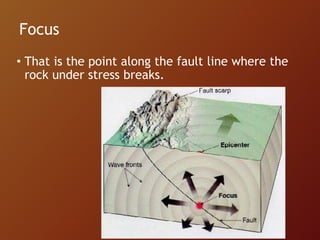
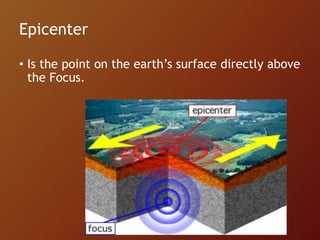
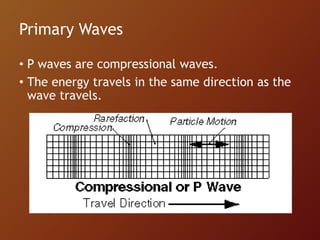
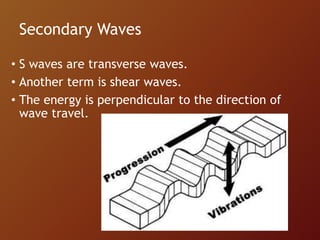
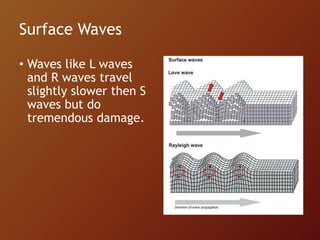
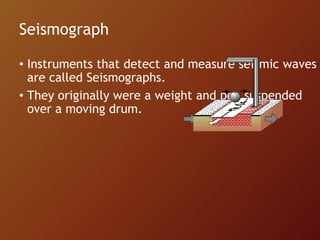
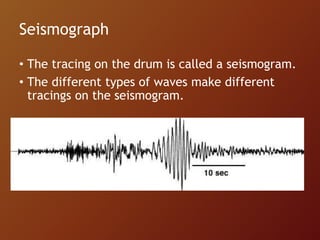
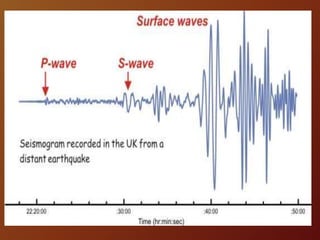
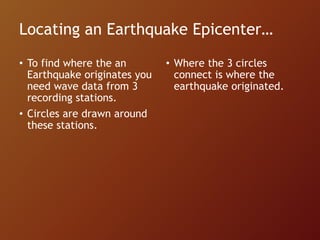
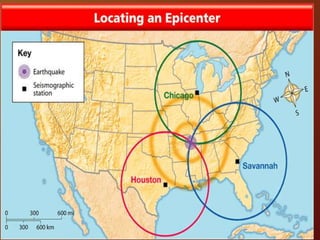
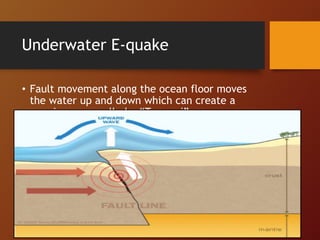
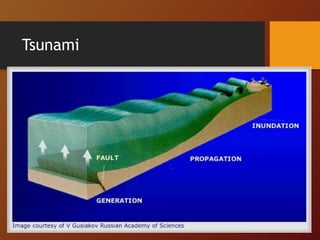
An earthquake occurs when energy is rapidly released along a fault line. The point where the rock breaks is called the focus, and the point directly above it on the earth's surface is the epicenter. Seismic waves carry energy away from the focus, including P waves and S waves. P waves are compressional and can travel through all material, arriving first, while S waves are transverse and can only travel through solids, arriving second. Locating an earthquake's epicenter requires detecting the seismic waves with seismographs at three different recording stations and finding the point where the circles around each station intersect. Underwater earthquakes can create massive tsunamis by displacing large volumes of water.