Earthquake Findings Shelby Kassab
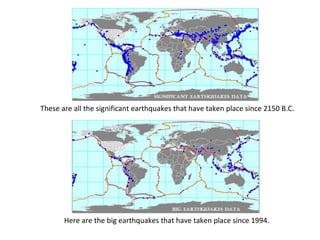
These are all the significant earthquakes that have taken place since 2150 B.C.  Here are the big earthquakes that have taken place since 1994.
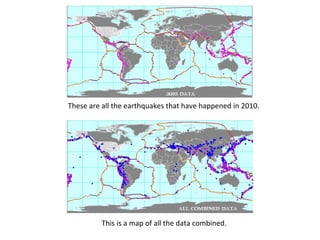
These are all the earthquakes that have happened in 2010. This is a map of all the data combined.
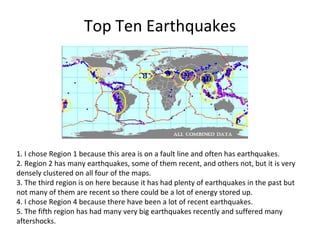
Top Ten Earthquakes 1. I chose Region 1 because this area is on a fault line and often has earthquakes. 2. Region 2 has many earthquakes, some of them recent, and others not, but it is very  densely clustered on all four of the maps.  3. The third region is on here because it has had plenty of earthquakes in the past but  not many of them are recent so there could be a lot of energy stored up. 4. I chose Region 4 because there have been a lot of recent earthquakes. 5. The fifth region has had many very big earthquakes recently and suffered many  aftershocks.
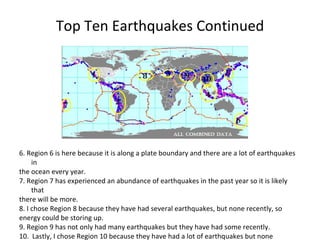
Top Ten Earthquakes Continued 6. Region 6 is here because it is along a plate boundary and there are a lot of earthquakes in the ocean every year. 7. Region 7 has experienced an abundance of earthquakes in the past year so it is likely that there will be more. 8. I chose Region 8 because they have had several earthquakes, but none recently, so energy could be storing up. 9. Region 9 has not only had many earthquakes but they have had some recently. 10.  Lastly, I chose Region 10 because they have had a lot of earthquakes but none recently.
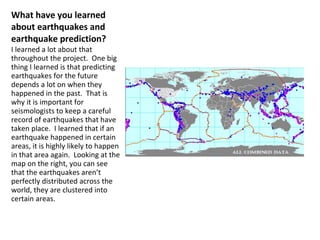
What have you learned about earthquakes and earthquake prediction? I learned a lot about that throughout the project.  One big thing I learned is that predicting earthquakes for the future depends a lot on when they happened in the past.  That is why it is important for seismologists to keep a careful record of earthquakes that have taken place.  I learned that if an earthquake happened in certain areas, it is highly likely to happen in that area again.  Looking at the map on the right, you can see that the earthquakes aren’t perfectly distributed across the world, they are clustered into certain areas.
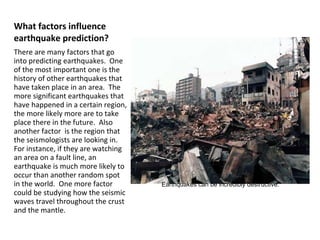
What factors influence earthquake prediction? There are many factors that go into predicting earthquakes.  One of the most important one is the history of other earthquakes that have taken place in an area.  The more significant earthquakes that have happened in a certain region, the more likely more are to take place there in the future.  Also another factor  is the region that the seismologists are looking in.  For instance, if they are watching an area on a fault line, an earthquake is much more likely to occur than another random spot in the world.  One more factor could be studying how the seismic waves travel throughout the crust and the mantle. Earthquakes can be incredibly destructive.
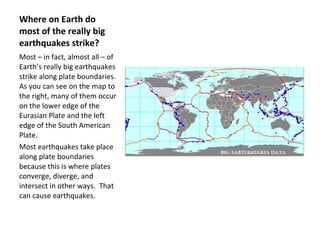
Where on Earth do most of the really big earthquakes strike? Most – in fact, almost all – of Earth’s really big earthquakes strike along plate boundaries.  As you can see on the map to the right, many of them occur on the lower edge of the Eurasian Plate and the left edge of the South American Plate.  Most earthquakes take place along plate boundaries because this is where plates converge, diverge, and intersect in other ways.  That can cause earthquakes.
Citations http://www.anunews.net/blog/wp-content/uploads/2011/03/aa-Japan-earthquake-damage-3-16-11.jpg http://library.thinkquest.org/17701/high/structure/map.html

Earthquake findings

  • 1.
  • 2.
    These are allthe significant earthquakes that have taken place since 2150 B.C. Here are the big earthquakes that have taken place since 1994.
  • 3.
    These are allthe earthquakes that have happened in 2010. This is a map of all the data combined.
  • 4.
    Top Ten Earthquakes1. I chose Region 1 because this area is on a fault line and often has earthquakes. 2. Region 2 has many earthquakes, some of them recent, and others not, but it is very densely clustered on all four of the maps. 3. The third region is on here because it has had plenty of earthquakes in the past but not many of them are recent so there could be a lot of energy stored up. 4. I chose Region 4 because there have been a lot of recent earthquakes. 5. The fifth region has had many very big earthquakes recently and suffered many aftershocks.
  • 5.
    Top Ten EarthquakesContinued 6. Region 6 is here because it is along a plate boundary and there are a lot of earthquakes in the ocean every year. 7. Region 7 has experienced an abundance of earthquakes in the past year so it is likely that there will be more. 8. I chose Region 8 because they have had several earthquakes, but none recently, so energy could be storing up. 9. Region 9 has not only had many earthquakes but they have had some recently. 10. Lastly, I chose Region 10 because they have had a lot of earthquakes but none recently.
  • 6.
    What have youlearned about earthquakes and earthquake prediction? I learned a lot about that throughout the project. One big thing I learned is that predicting earthquakes for the future depends a lot on when they happened in the past. That is why it is important for seismologists to keep a careful record of earthquakes that have taken place. I learned that if an earthquake happened in certain areas, it is highly likely to happen in that area again. Looking at the map on the right, you can see that the earthquakes aren’t perfectly distributed across the world, they are clustered into certain areas.
  • 7.
    What factors influenceearthquake prediction? There are many factors that go into predicting earthquakes. One of the most important one is the history of other earthquakes that have taken place in an area. The more significant earthquakes that have happened in a certain region, the more likely more are to take place there in the future. Also another factor is the region that the seismologists are looking in. For instance, if they are watching an area on a fault line, an earthquake is much more likely to occur than another random spot in the world. One more factor could be studying how the seismic waves travel throughout the crust and the mantle. Earthquakes can be incredibly destructive.
  • 8.
    Where on Earthdo most of the really big earthquakes strike? Most – in fact, almost all – of Earth’s really big earthquakes strike along plate boundaries. As you can see on the map to the right, many of them occur on the lower edge of the Eurasian Plate and the left edge of the South American Plate. Most earthquakes take place along plate boundaries because this is where plates converge, diverge, and intersect in other ways. That can cause earthquakes.
  • 9.