IMPORTANCE OF
GROUNDING IN
POWER SYSTEMS
By
s S TRIPATHY
POWER TRAINING CENTRE ,CHANDAKA
OPTCL
Objective of Earthing
 Prime Object of Earthing is to Provide a Zero
Potential Surface in and around and under the area
where the electrical equipment is installed.
 Earthing is essential at every stage of electricity
generation, transmission and utilization
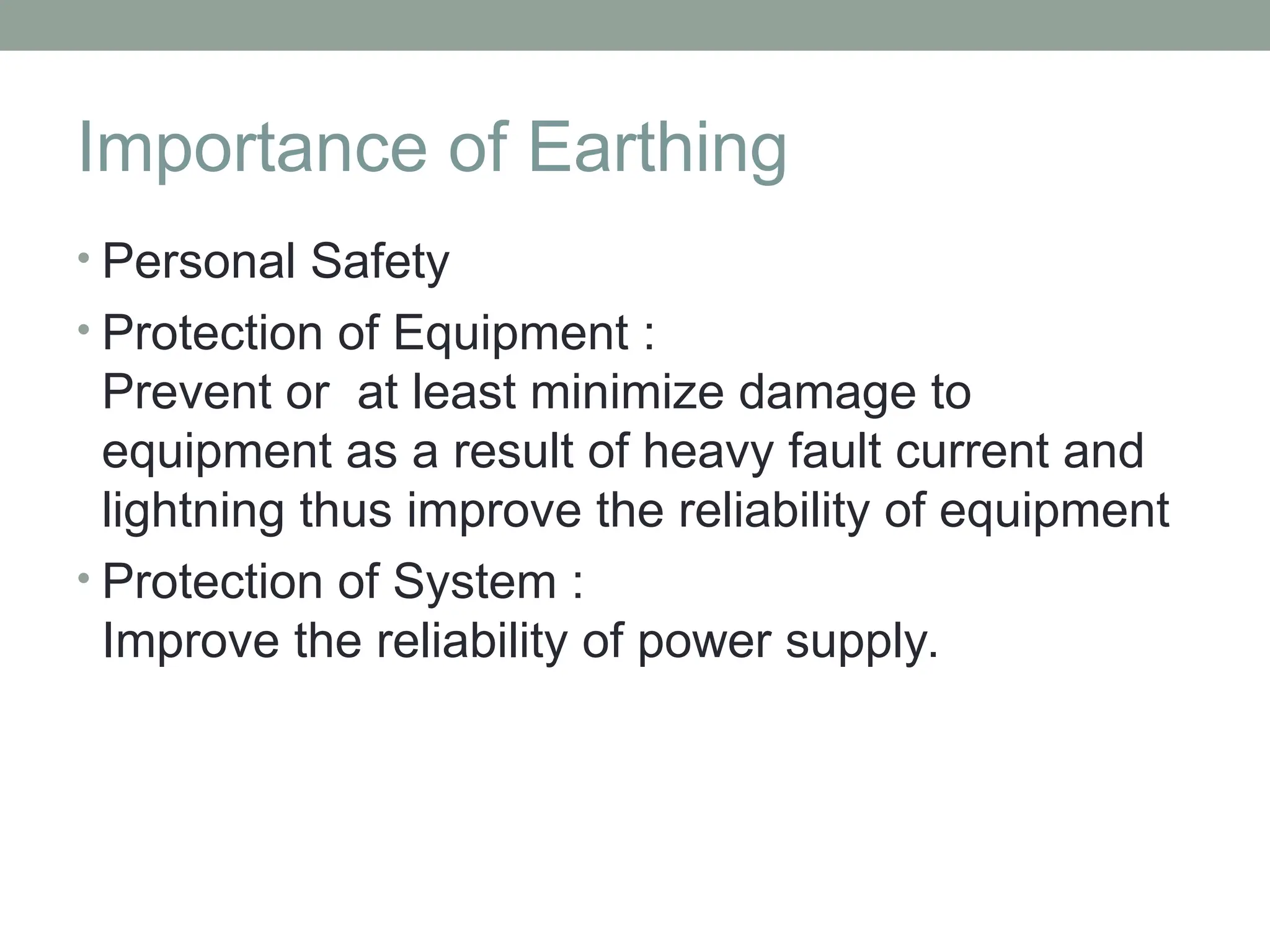
Importance of Earthing
• Personal Safety
• Protection of Equipment :
Prevent or at least minimize damage to
equipment as a result of heavy fault current and
lightning thus improve the reliability of equipment
• Protection of System :
Improve the reliability of power supply.
Earthing Standards
 IS: 3043 : 1966, 1987 reaffirmed 2006 Code of Practice for Earthing.
 Indian Electricity rules 1956 (as amended up to 2000)
 IS: 2309 1989 (reaffirmed 2005) Protection of Buildings and allied Structures
against lightning – Code of Practice.
 IS : 2689: 1989 (reaffirmed March 2010): Guide for Control of Undesirable
static Electricity.
 Manual on Earthing of AC Power Systems : CBIP Publication No.302 : 2007
and 311
 BS: 7430 : 1998, Code of Practice for Earthing.( formerly CP 1013: 1965)
British Standard Institution London 1992
 BS: 6651: 1992, Protection of Structures. Against Lightning.
 IEEE :80 : 2000( Revision of IEEE Std 80: 1986) Guide for Safety in AC
Substation Grounding
 IEEE :142 :2007(Revision of IEEE Std 142 :1991) Grounding of Industrial
and Commercial Power System.
 IEEE 1100 : 2005 (Revision of IEEE Std 1100 : 1999) Powering and
Grounding Electronic Equipment
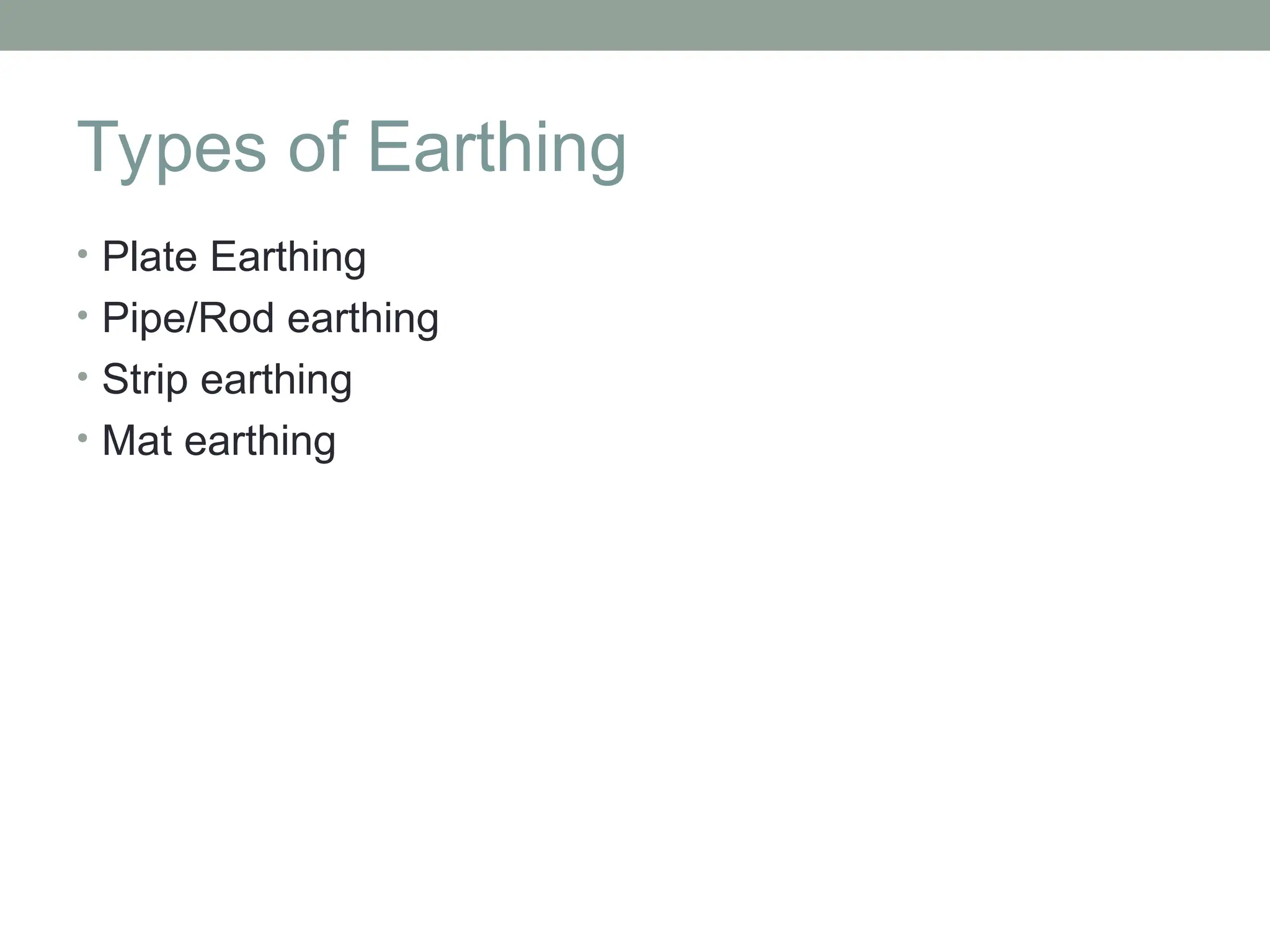
Types of Earthing
Types of Earthing
• Plate Earthing
• Pipe/Rod earthing
• Strip earthing
• Mat earthing
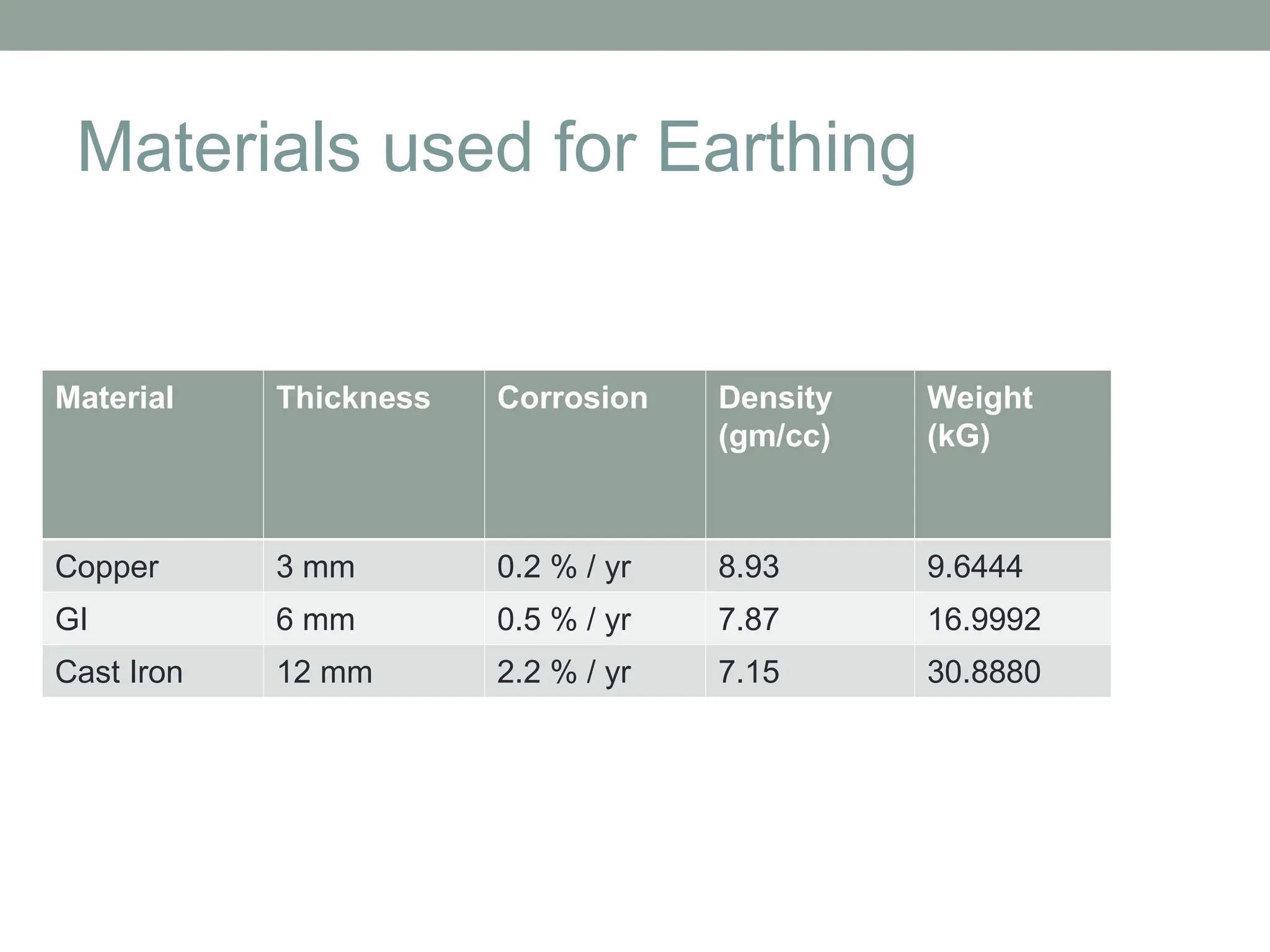
Materials used for Earthing
Material Thickness Corrosion Density
(gm/cc)
Weight
(kG)
Copper 3 mm 0.2 % / yr 8.93 9.6444
GI 6 mm 0.5 % / yr 7.87 16.9992
Cast Iron 12 mm 2.2 % / yr 7.15 30.8880
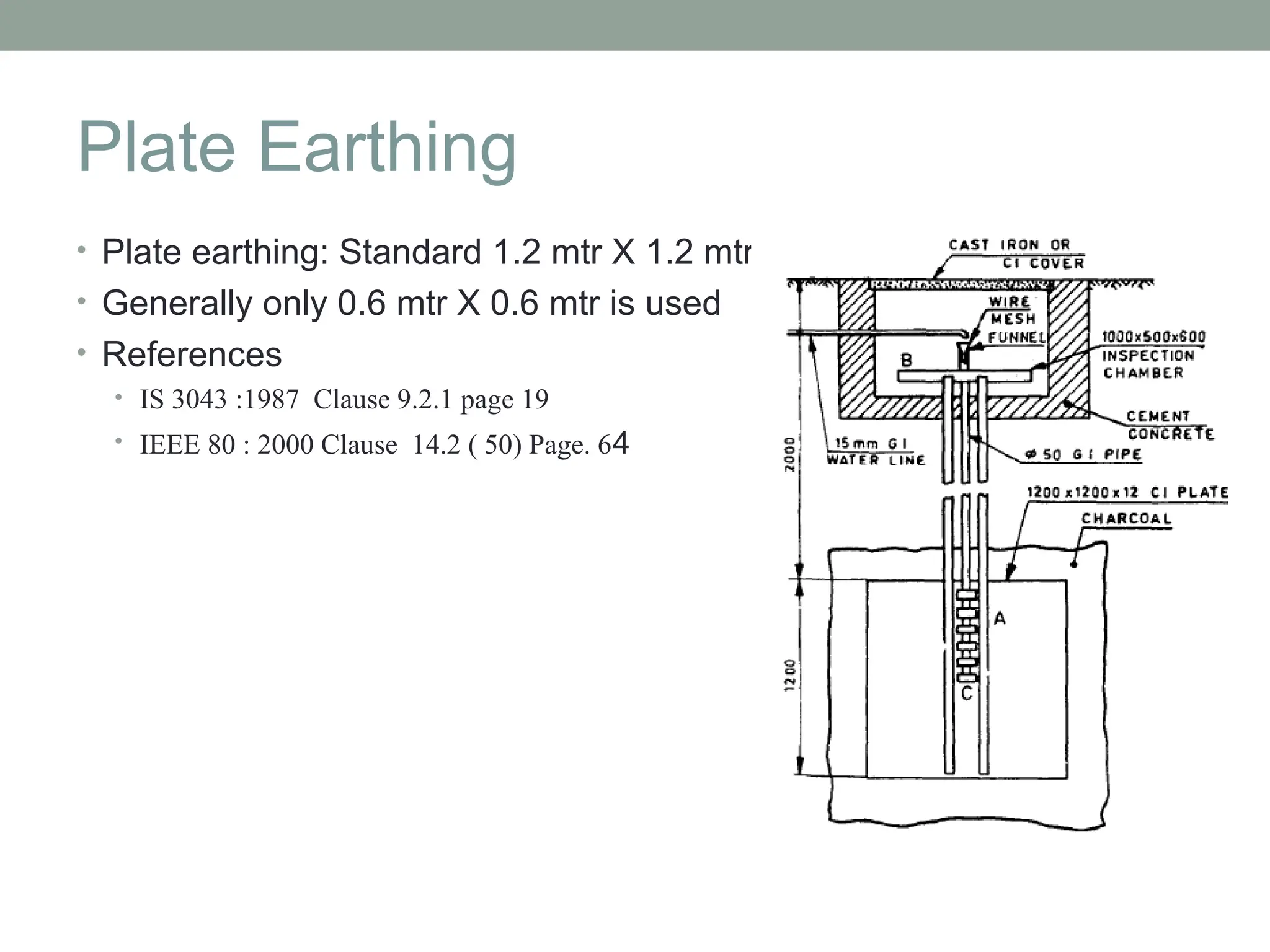
Plate Earthing
• Plate earthing: Standard 1.2 mtr X 1.2 mtr
• Generally only 0.6 mtr X 0.6 mtr is used
• References
• IS 3043 :1987 Clause 9.2.1 page 19
• IEEE 80 : 2000 Clause 14.2 ( 50) Page. 64
Down Conductor
• Down conductor material
• Copper
• Galvanized Iron (GI)
Parameter Copper GI
Minimum Size 25 mm X 3 mm 50 mm X 6 mm
Initial Temperature 40 o
C
Final Temperature 395 o
C 500 o
C
1 Sec Rating (Amp / Sq mm) 205 80
3 Sec Rating (Amp / Sq mm) 118 46
100 µs Rating
= Conductor size X
[(1 Sec rating) / √(100 µs) ]
(25 X 3 X 205) /
√(0.000100)]
= 1537.3 kA
(50 X 6 X 80) /
√(0.000100)]
= 2400 kA
Shape Shall be in the form of strip (flat) in order to
reduce the inductance
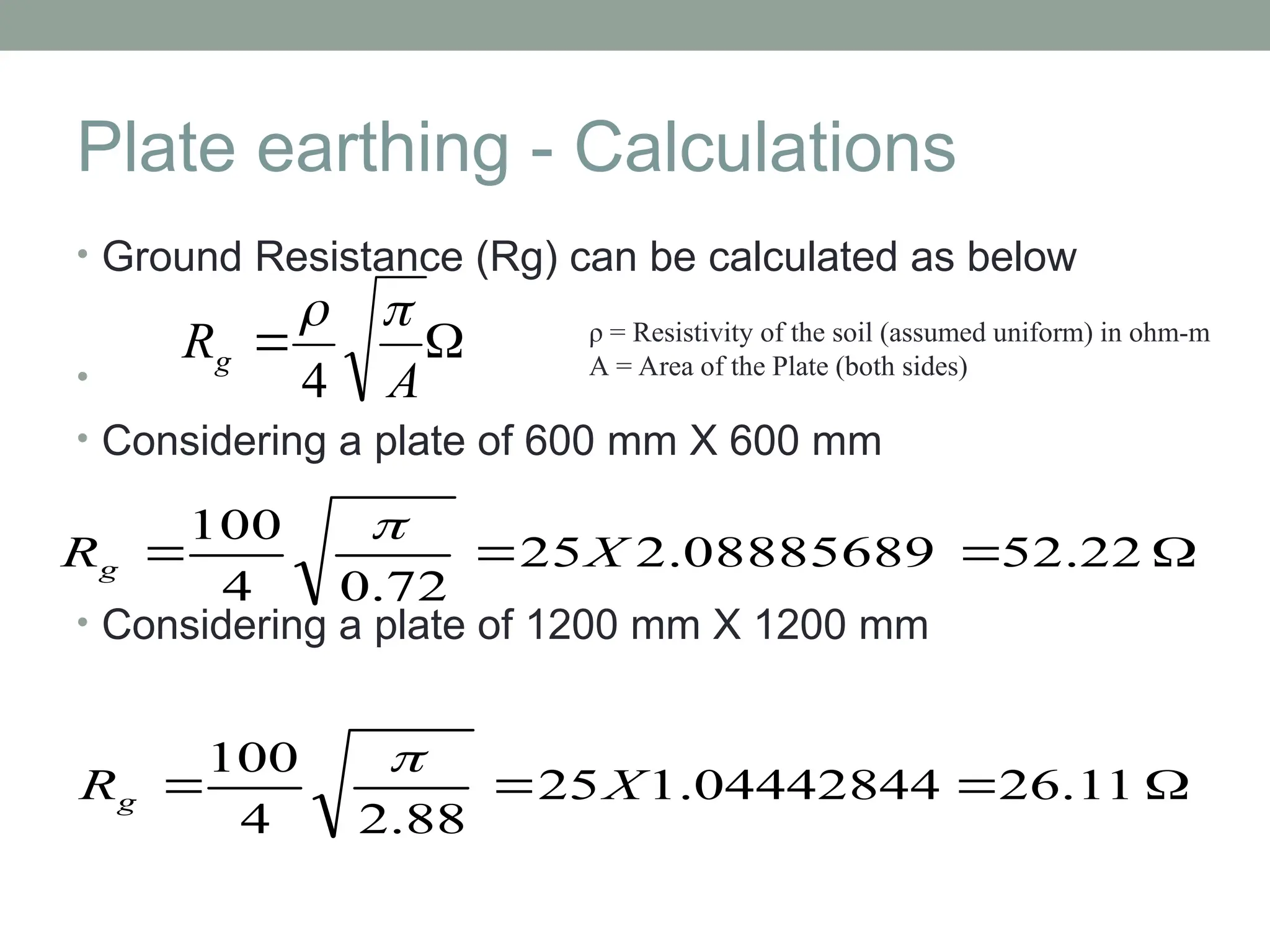
Plate earthing - Calculations
• Ground Resistance (Rg) can be calculated as below
•
• Considering a plate of 600 mm X 600 mm
• Considering a plate of 1200 mm X 1200 mm


A
Rg


4
ρ = Resistivity of the soil (assumed uniform) in ohm-m
A = Area of the Plate (both sides)



 52.22
2.08885689
25
72
.
0
4
100
X
Rg




 26.11
1.04442844
25
88
.
2
4
100
X
Rg

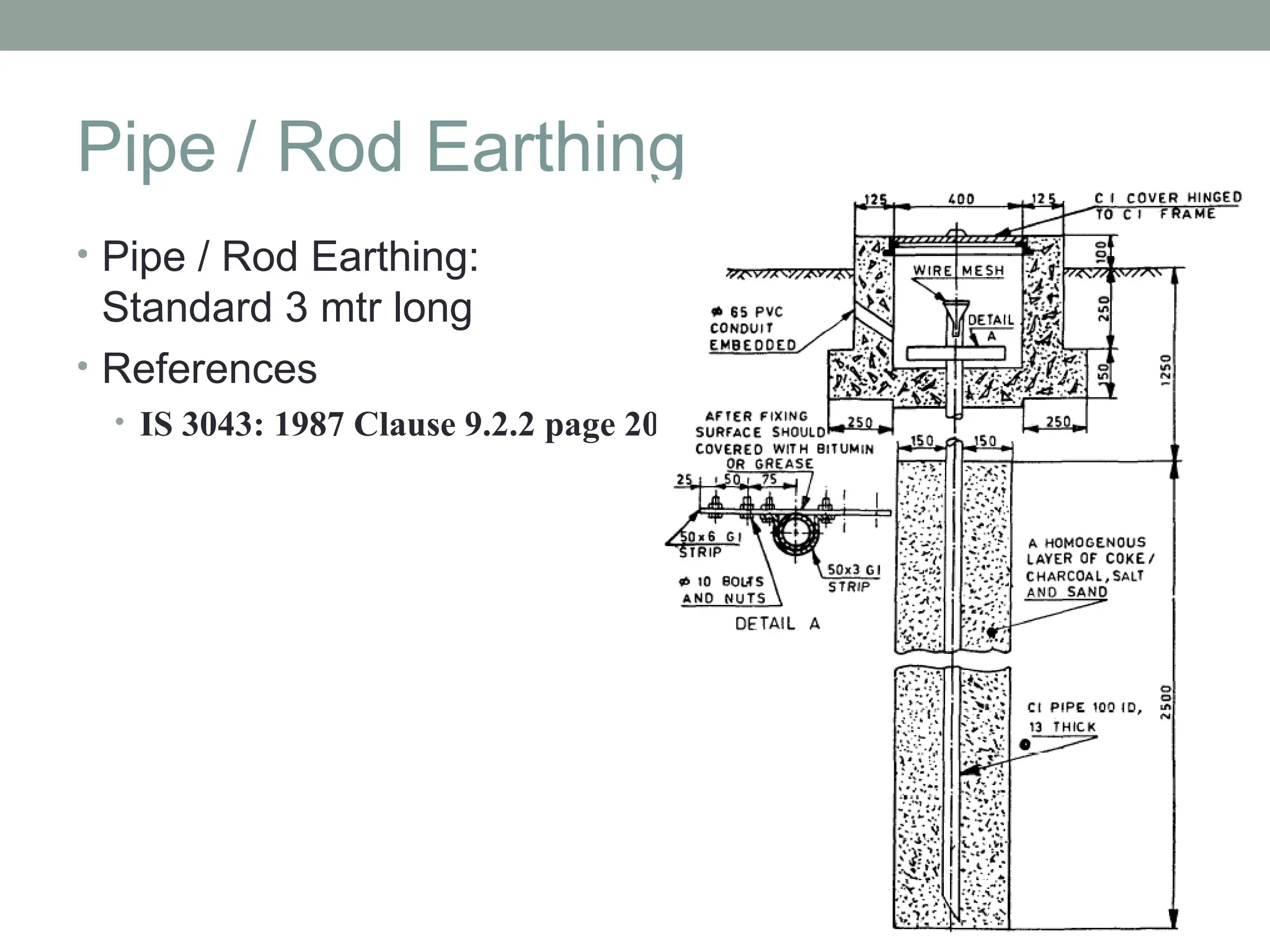
Pipe / Rod Earthing
• Pipe / Rod Earthing:
Standard 3 mtr long
• References
• IS 3043: 1987 Clause 9.2.2 page 20
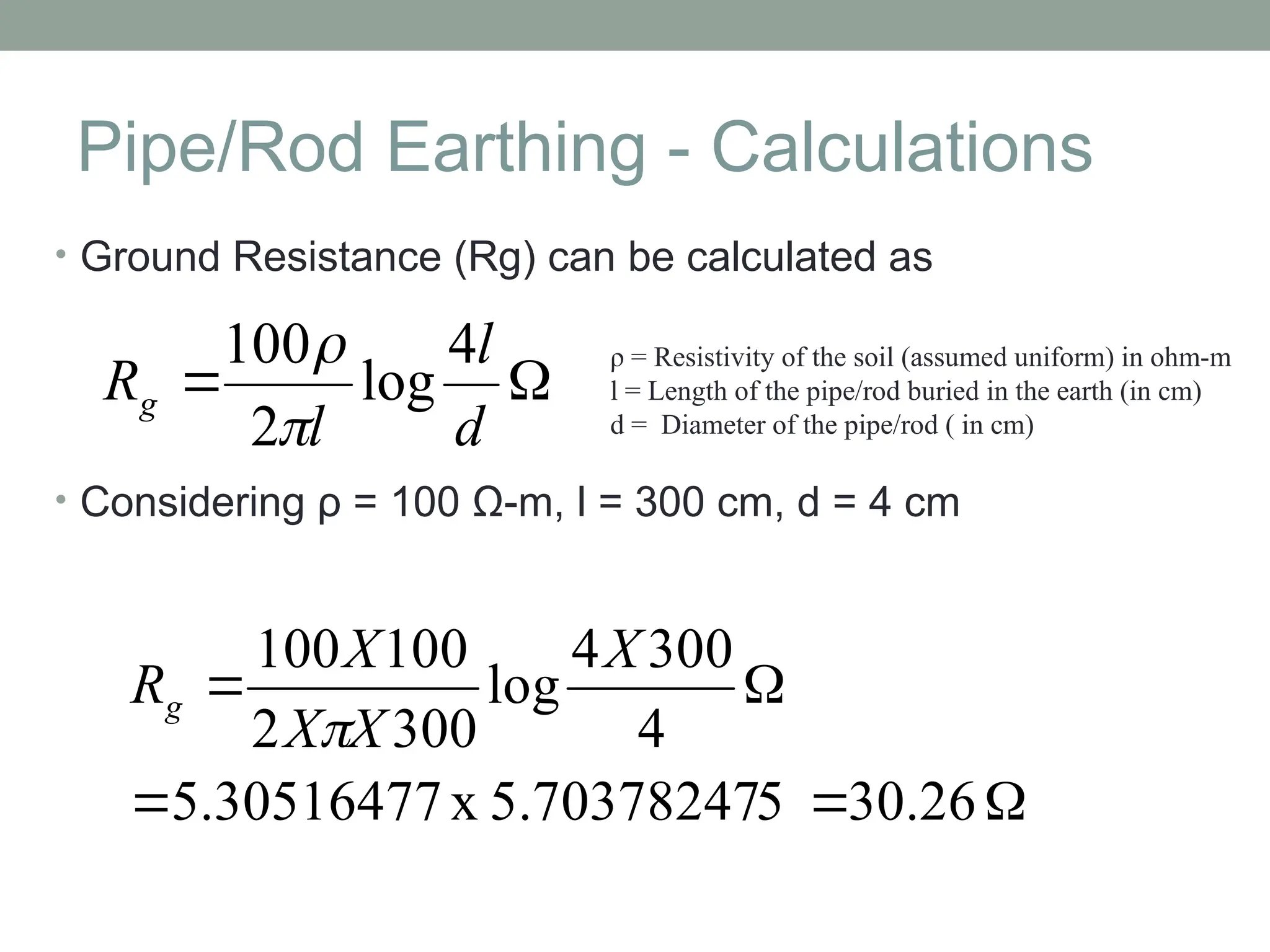
Pipe/Rod Earthing - Calculations
• Ground Resistance (Rg) can be calculated as
• Considering ρ = 100 Ω-m, l = 300 cm, d = 4 cm


d
l
l
Rg
4
log
2
100

 ρ = Resistivity of the soil (assumed uniform) in ohm-m
l = Length of the pipe/rod buried in the earth (in cm)
d = Diameter of the pipe/rod ( in cm)





30.26
5
5.70378247
x
5.30516477
4
300
4
log
300
2
100
100 X
X
X
X
Rg

Pipe/Rod Earthing - Calculations
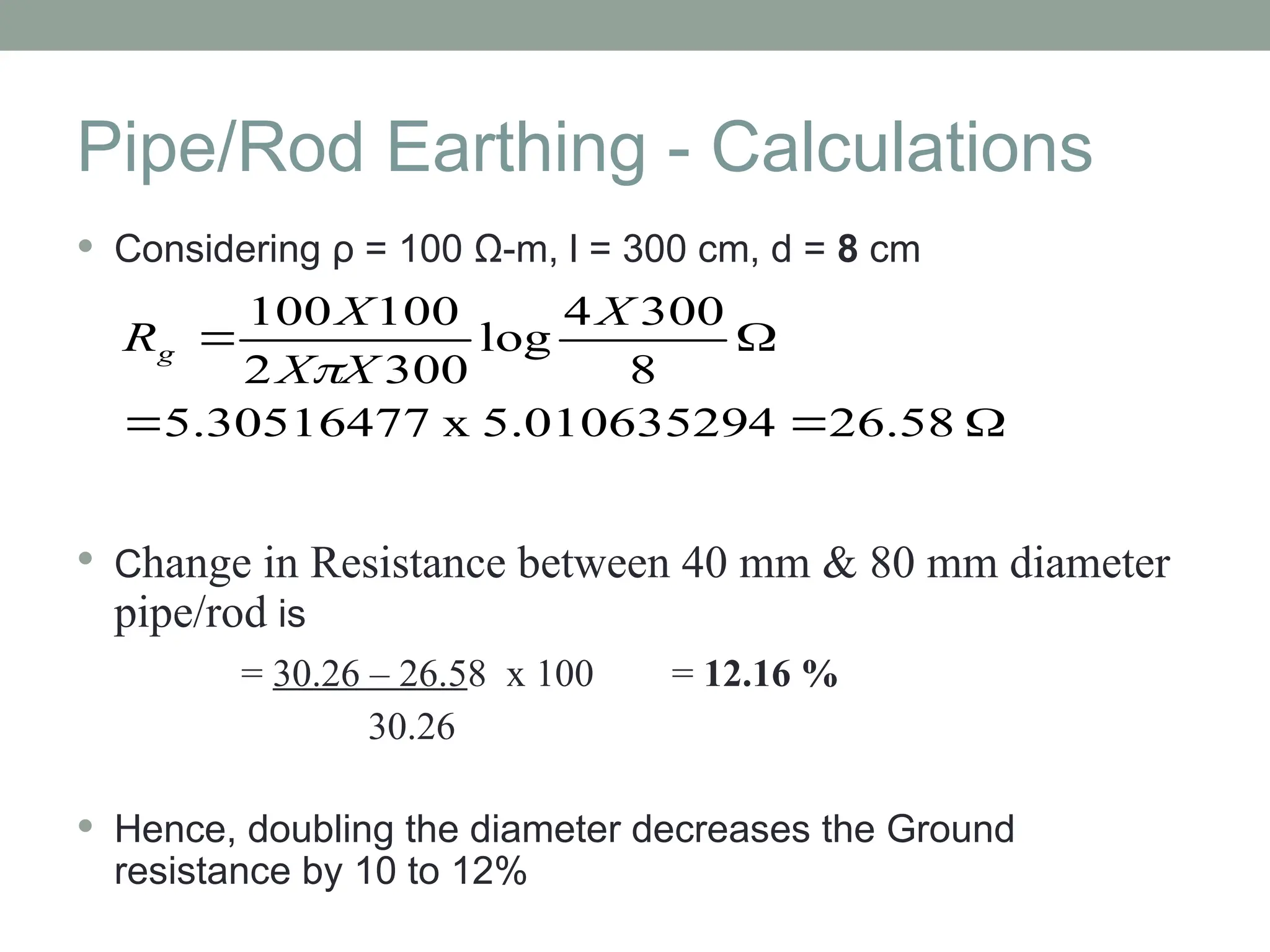
 Considering ρ = 100 Ω-m, l = 300 cm, d = 8 cm
 Change in Resistance between 40 mm & 80 mm diameter
pipe/rod is
= 30.26 – 26.58 x 100 = 12.16 %
30.26
 Hence, doubling the diameter decreases the Ground
resistance by 10 to 12%





26.58
4
5.01063529
x
5.30516477
8
300
4
log
300
2
100
100 X
X
X
X
Rg

Pipe/Rod Earthing - Calculations
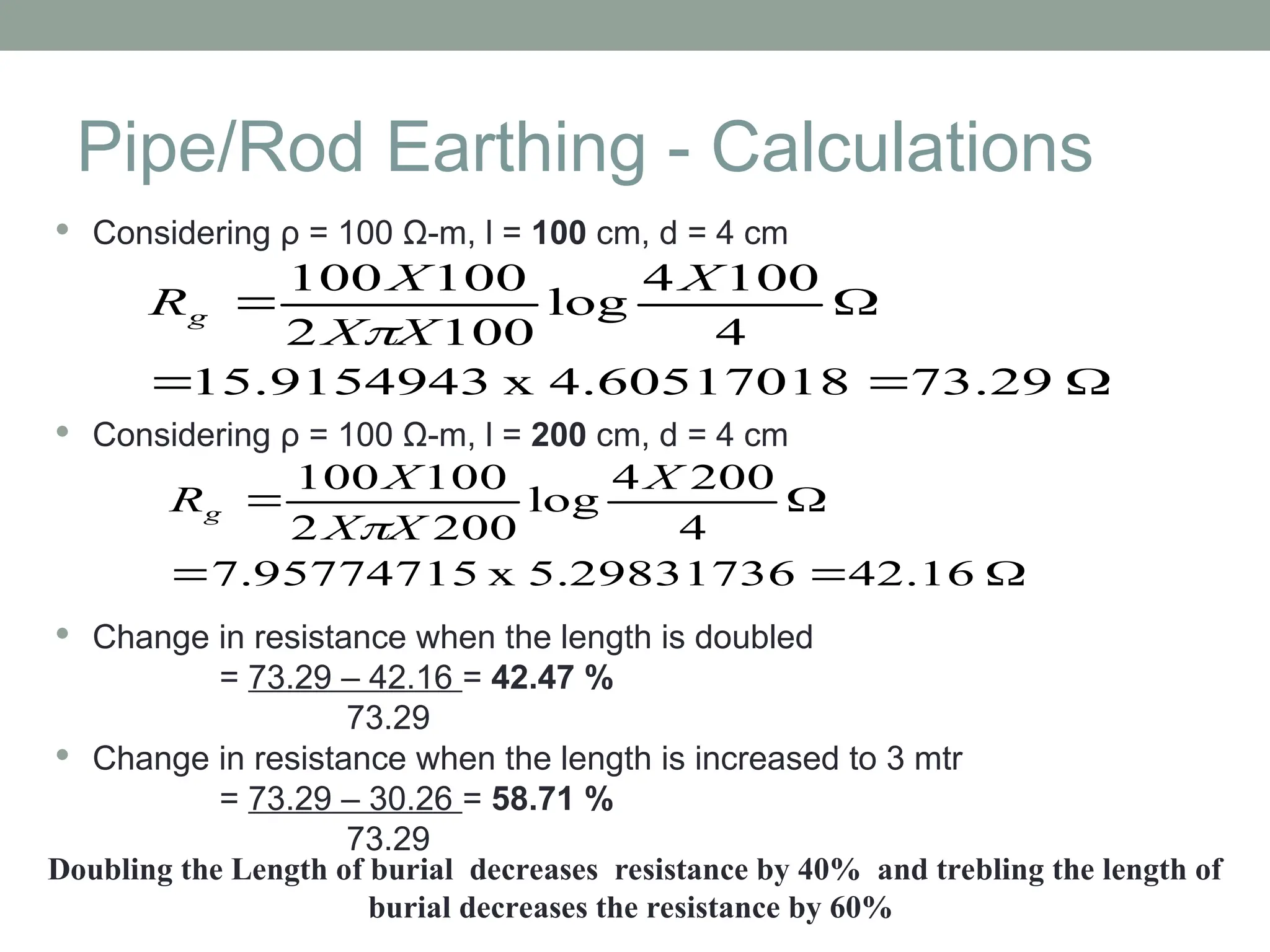
 Considering ρ = 100 Ω-m, l = 100 cm, d = 4 cm
 Considering ρ = 100 Ω-m, l = 200 cm, d = 4 cm
 Change in resistance when the length is doubled
= 73.29 – 42.16 = 42.47 %
73.29
 Change in resistance when the length is increased to 3 mtr
= 73.29 – 30.26 = 58.71 %
73.29





73.29
4.60517018
x
15.9154943
4
100
4
log
100
2
100
100 X
X
X
X
Rg






42.16
5.29831736
x
7.95774715
4
200
4
log
200
2
100
100 X
X
X
X
Rg

Doubling the Length of burial decreases resistance by 40% and trebling the length of
burial decreases the resistance by 60%
Strip Earthing
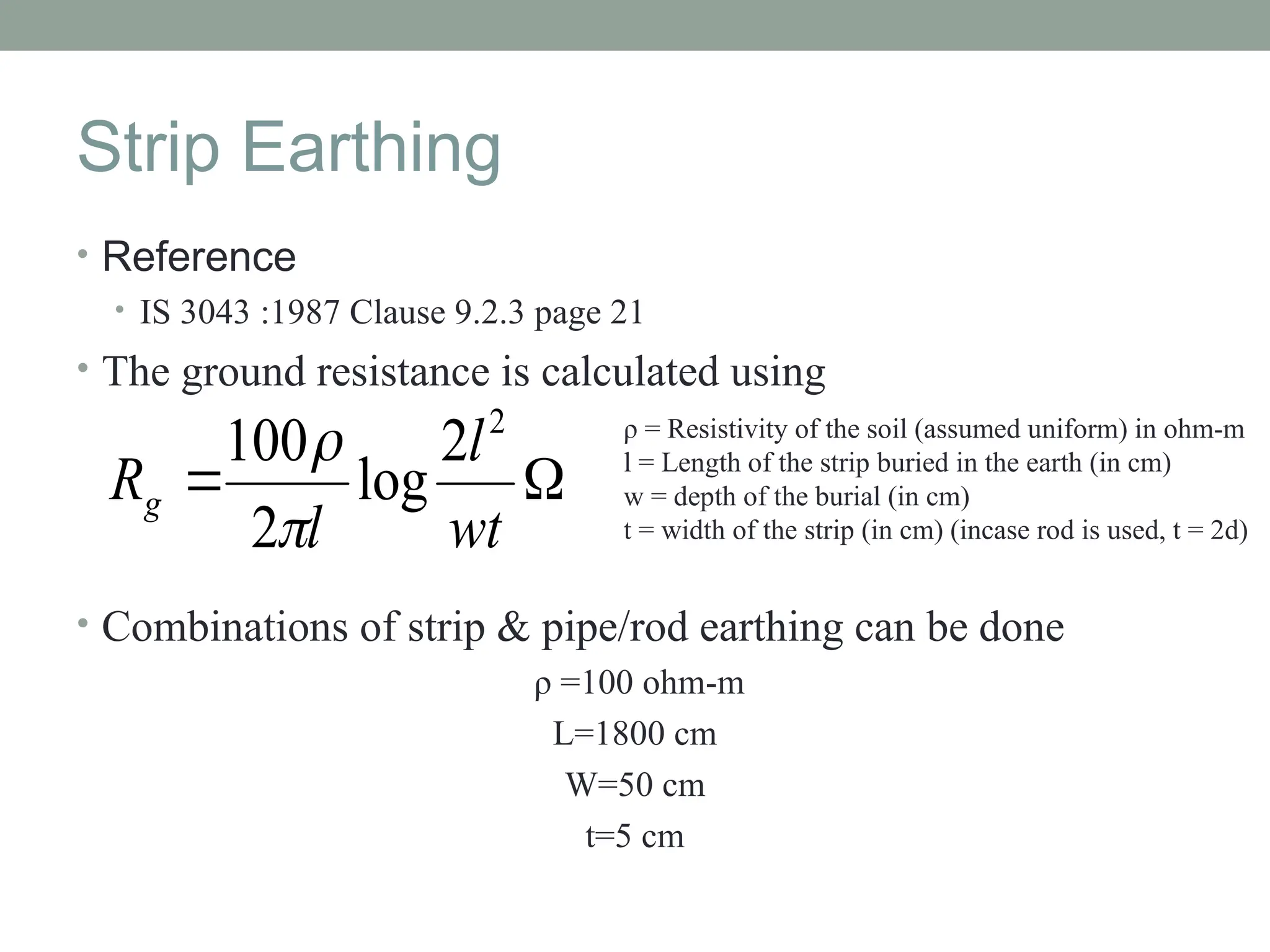
• Reference
• IS 3043 :1987 Clause 9.2.3 page 21
• The ground resistance is calculated using
• Combinations of strip & pipe/rod earthing can be done
ρ =100 ohm-m
L=1800 cm
W=50 cm
t=5 cm


wt
l
l
Rg
2
2
log
2
100

 ρ = Resistivity of the soil (assumed uniform) in ohm-m
l = Length of the strip buried in the earth (in cm)
w = depth of the burial (in cm)
t = width of the strip (in cm) (incase rod is used, t = 2d)
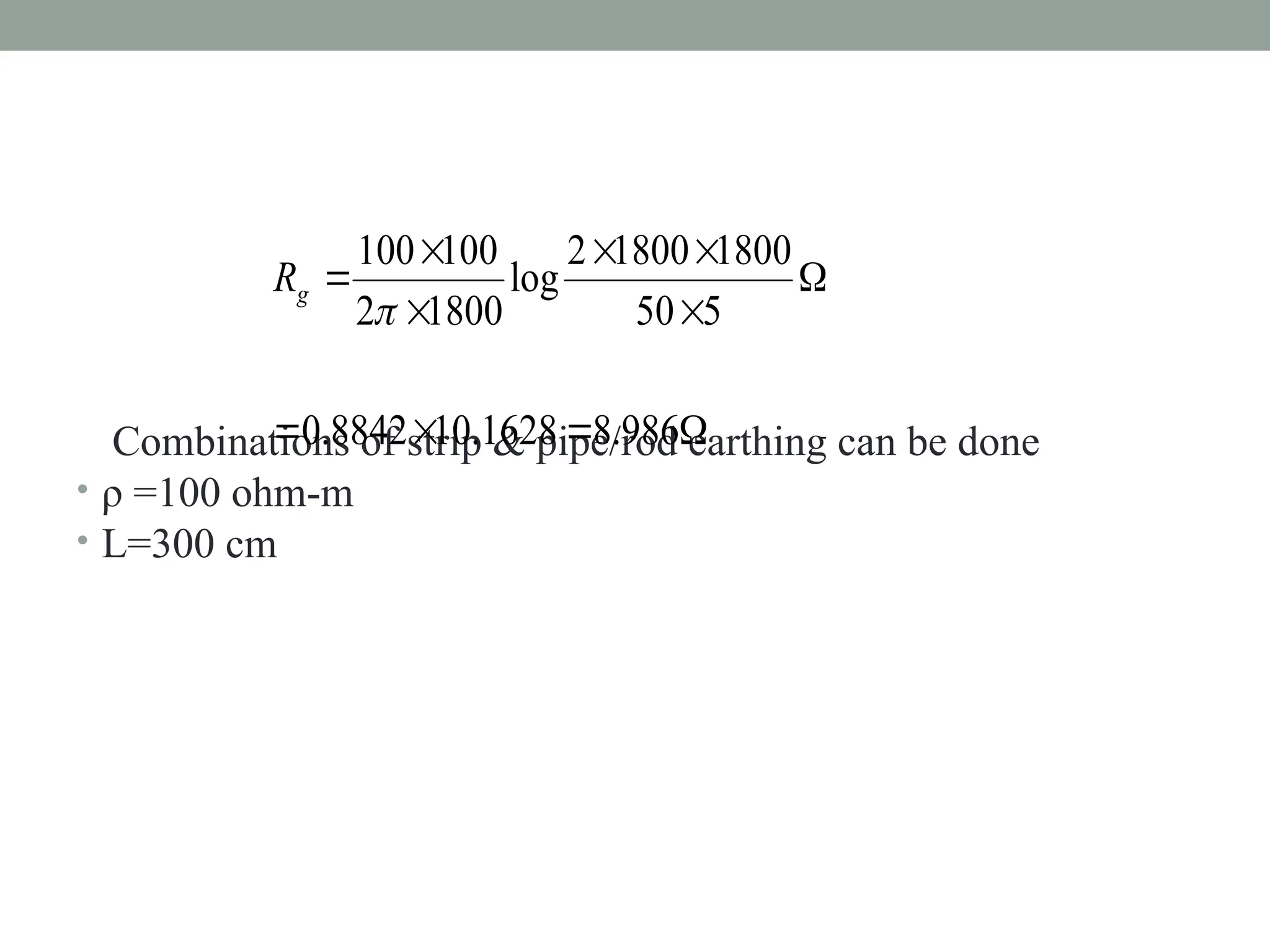
Combinations of strip & pipe/rod earthing can be done
• ρ =100 ohm-m
• L=300 cm











986
.
8
1628
.
10
8842
.
0
5
50
1800
1800
2
log
1800
2
100
100

g
R
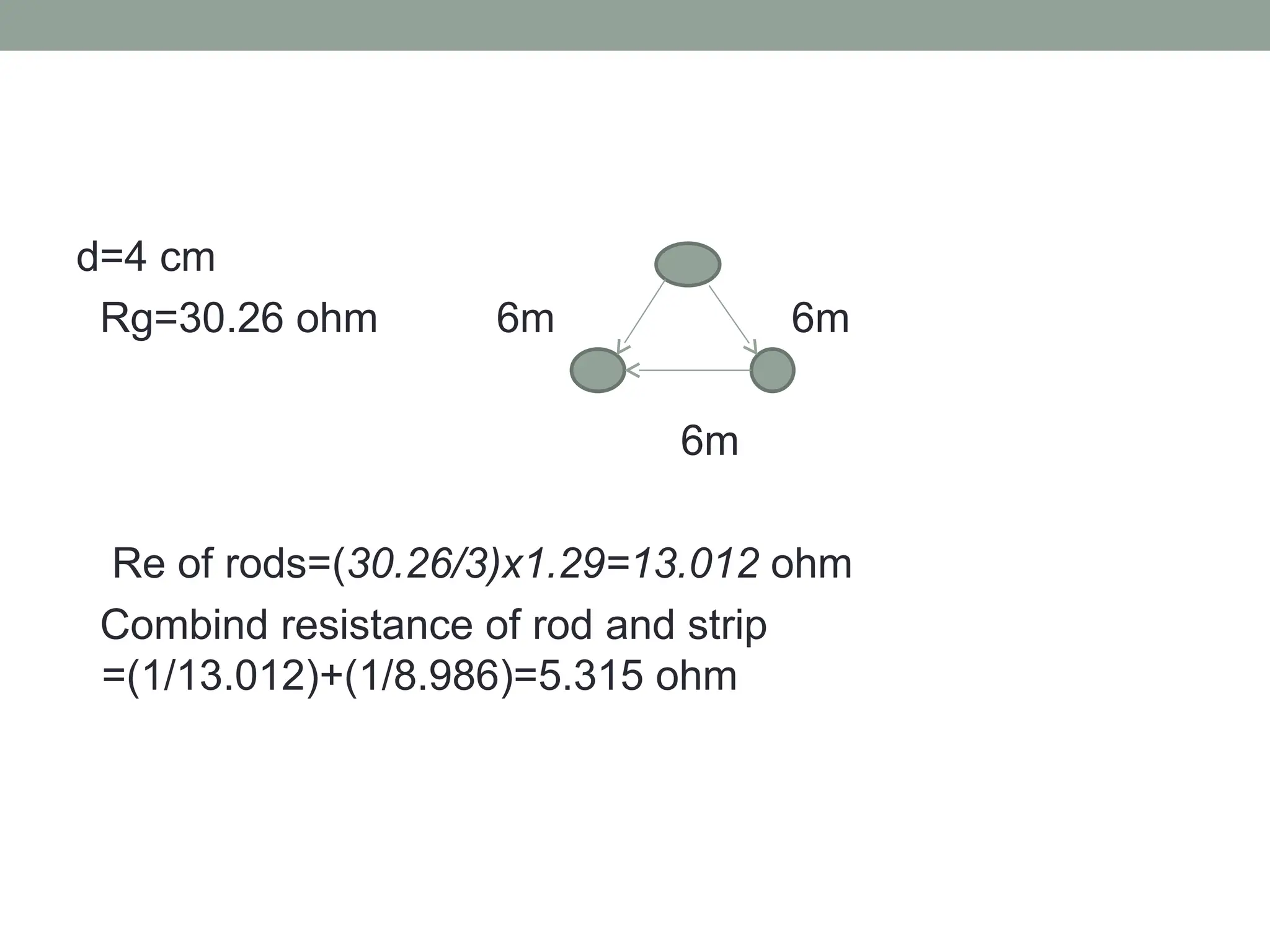
d=4 cm
Rg=30.26 ohm 6m 6m
6m
Re of rods=(30.26/3)x1.29=13.012 ohm
Combind resistance of rod and strip
=(1/13.012)+(1/8.986)=5.315 ohm
Mat earthing
 Is the combination of Strip & Rod earthing
 Reference
 IEEE 80 : 2000 Clause 14.2 ( 51) Page 64 (Laurent & Newmann)
 IEEE 80 : 2000 Clause 14.2 ( 52) Page 65 (Sverak)
 Earth resistance can be calculated using Laurent & Niemann
method as below
(OR)
 Earth resistance can be calculated using Sverak method as below






T
T
g
l
A
l
r
R





4
4
)]
/
20
1
1
1
(
20
1
1
[
A
h
A
l
R
T
g




ρ = Resistivity of the soil (in ohm-m )
A = area of the station (in sq mtr)
lT = Total length of the conductor
(both strips & rods)



lt
A
Rg


443
.
0
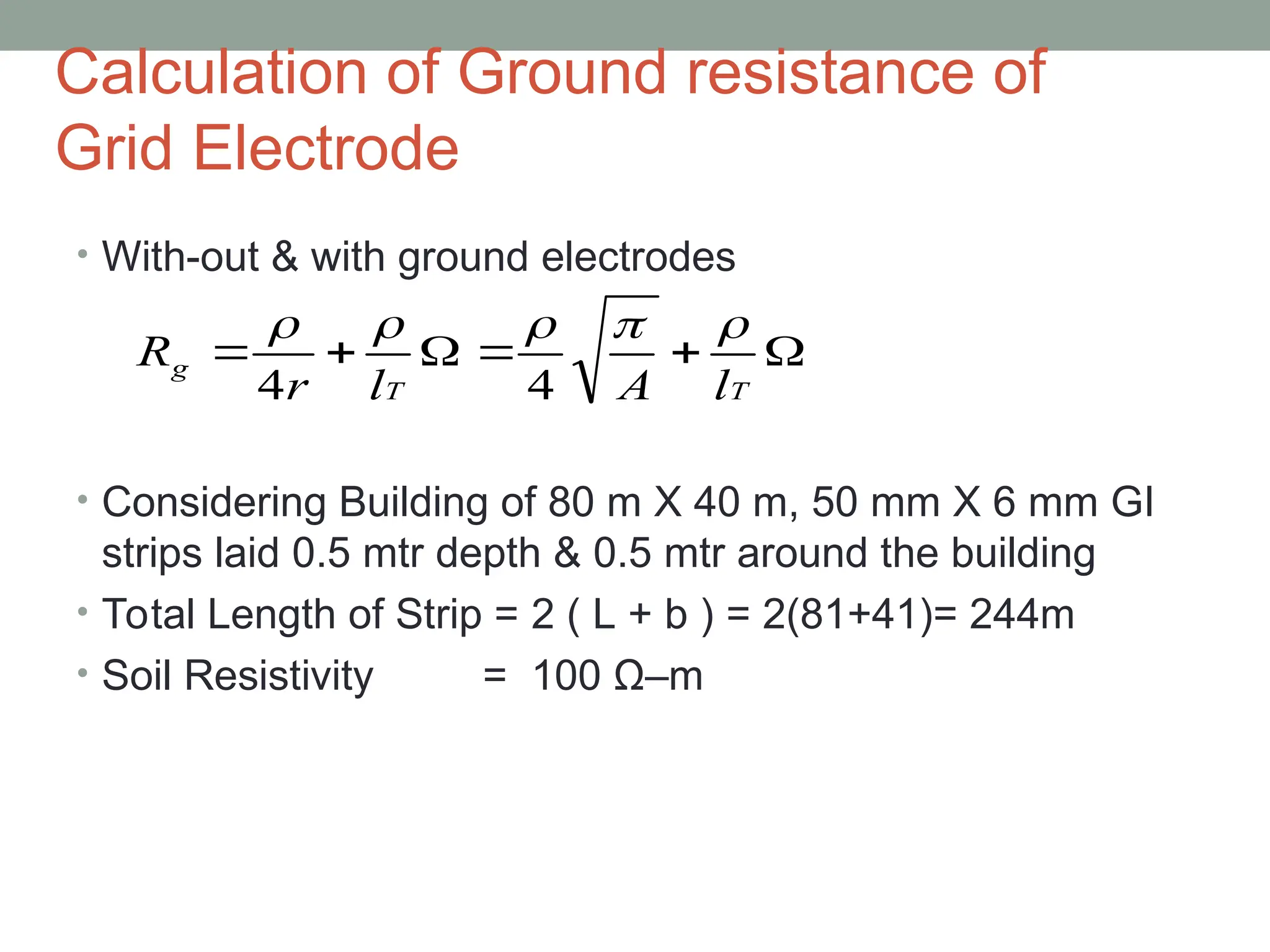
Calculation of Ground resistance of
Grid Electrode
• With-out & with ground electrodes
• Considering Building of 80 m X 40 m, 50 mm X 6 mm GI
strips laid 0.5 mtr depth & 0.5 mtr around the building
• Total Length of Strip = 2 ( L + b ) = 2(81+41)= 244m
• Soil Resistivity = 100 Ω–m






T
T
g
l
A
l
r
R





4
4
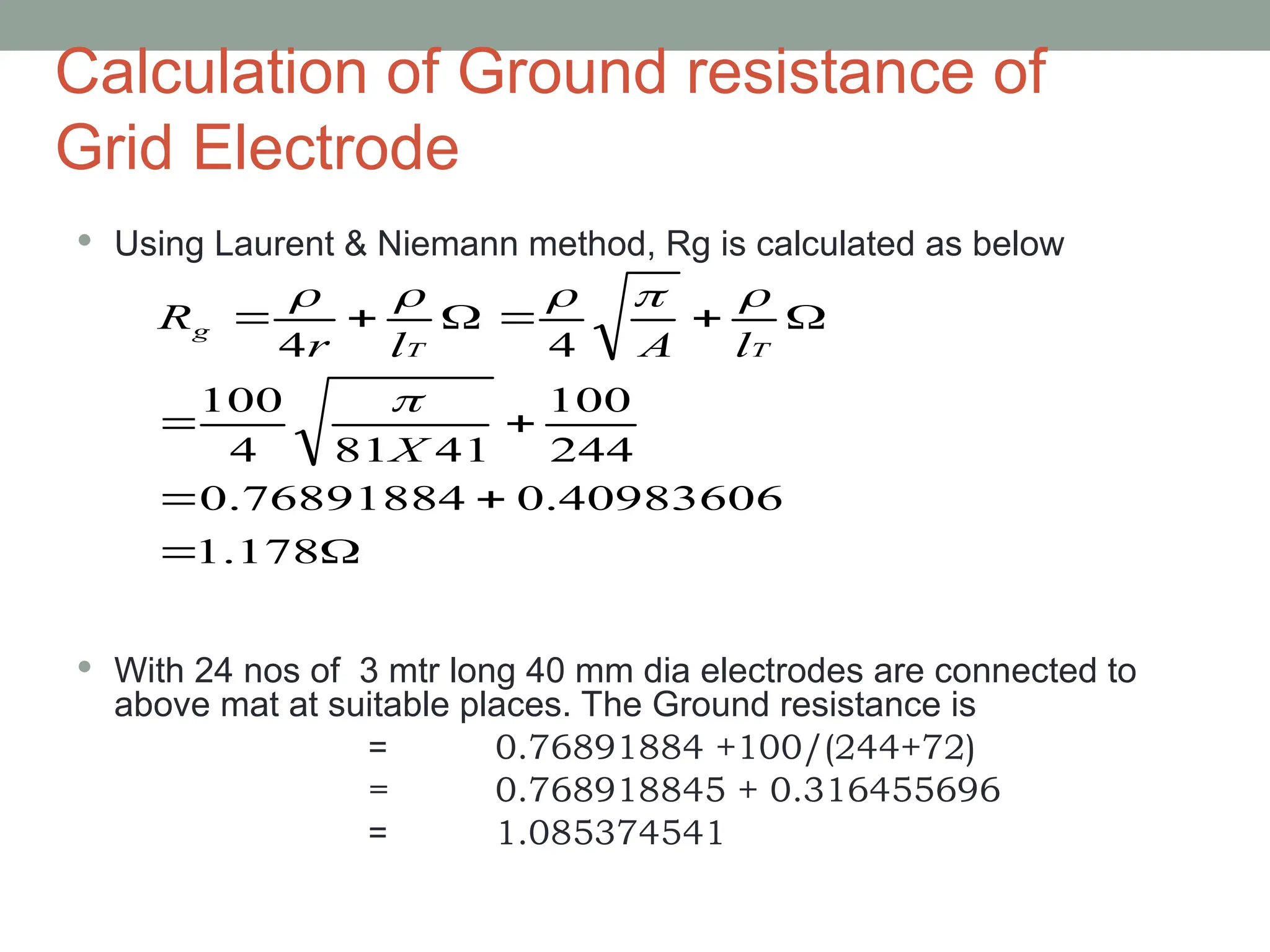
Calculation of Ground resistance of
Grid Electrode
 Using Laurent & Niemann method, Rg is calculated as below
 With 24 nos of 3 mtr long 40 mm dia electrodes are connected to
above mat at suitable places. The Ground resistance is
= 0.76891884 +100/(244+72)
= 0.768918845 + 0.316455696
= 1.085374541












178
.
1
0.40983606
0.76891884
244
100
41
81
4
100
4
4
X
l
A
l
r
R
T
T
g






Calculation of Ground resistance of
Grid Electrode
 Using Sverak method, the earth resistance is calculated as below
 With 24 nos of 3 mtr long 40 mm dia electrodes are connected to
above mat at suitable places. The Ground resistance is
= 100 [ 1/(244+72) + 0.00761540 ]
= 100 [0.010779956]
= 1.0779956













1.1713762
)
0.01171376
(
100
)
0.00761540
0.00409836
(
100
)]
41
81
/
20
5
.
0
1
1
1
(
41
81
20
1
244
1
[
100
)]
/
20
1
1
1
(
20
1
1
[
X
X
X
A
h
A
l
R
T
g 
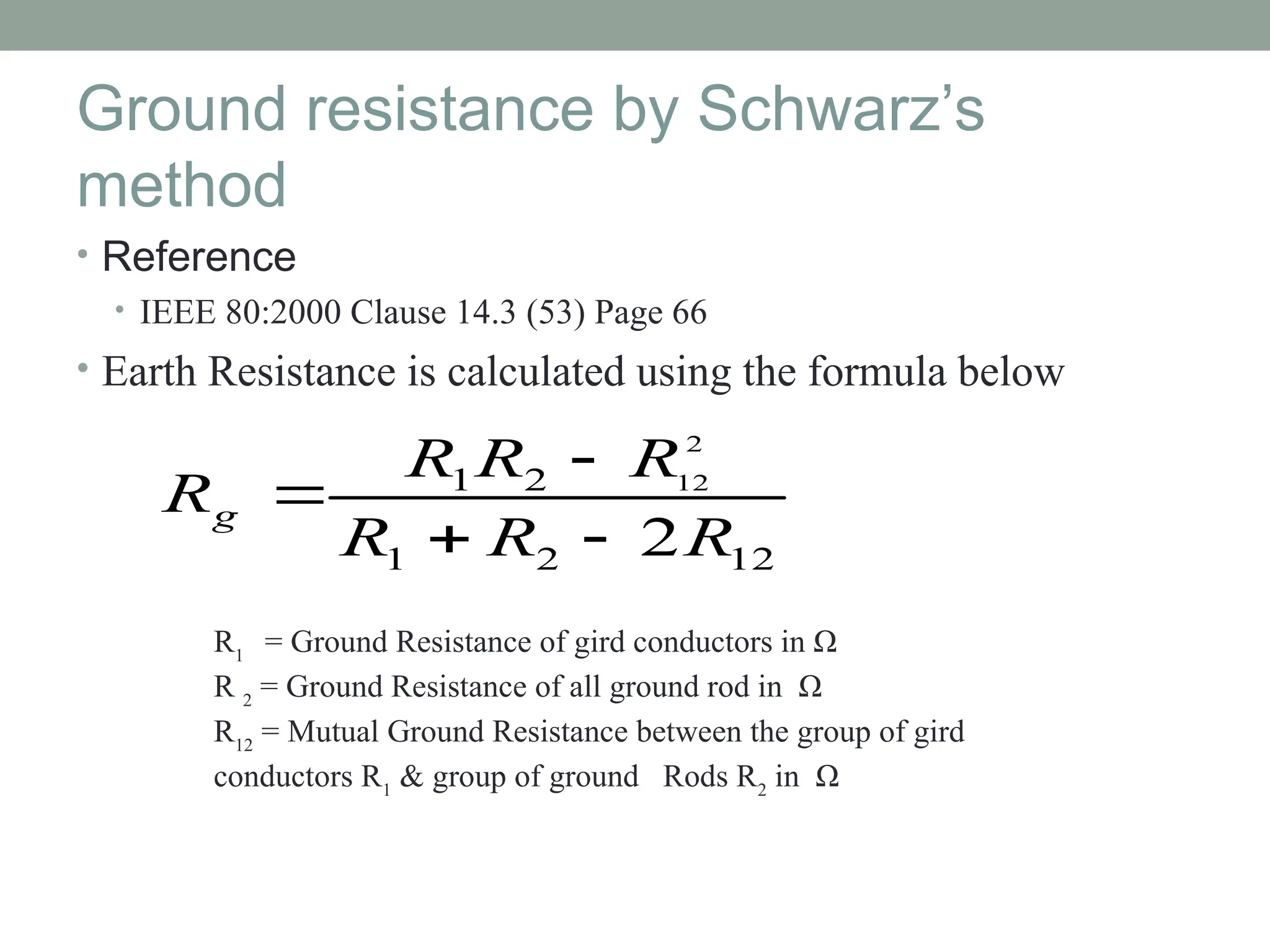
Ground resistance by Schwarz’s
method
• Reference
• IEEE 80:2000 Clause 14.3 (53) Page 66
• Earth Resistance is calculated using the formula below
12
2
1
2
1
2
2
12
R
R
R
R
R
R
Rg




R1
= Ground Resistance of gird conductors in Ω
R 2
= Ground Resistance of all ground rod in Ω
R12
= Mutual Ground Resistance between the group of gird
conductors R1
& group of ground Rods R2
in Ω
Illustration
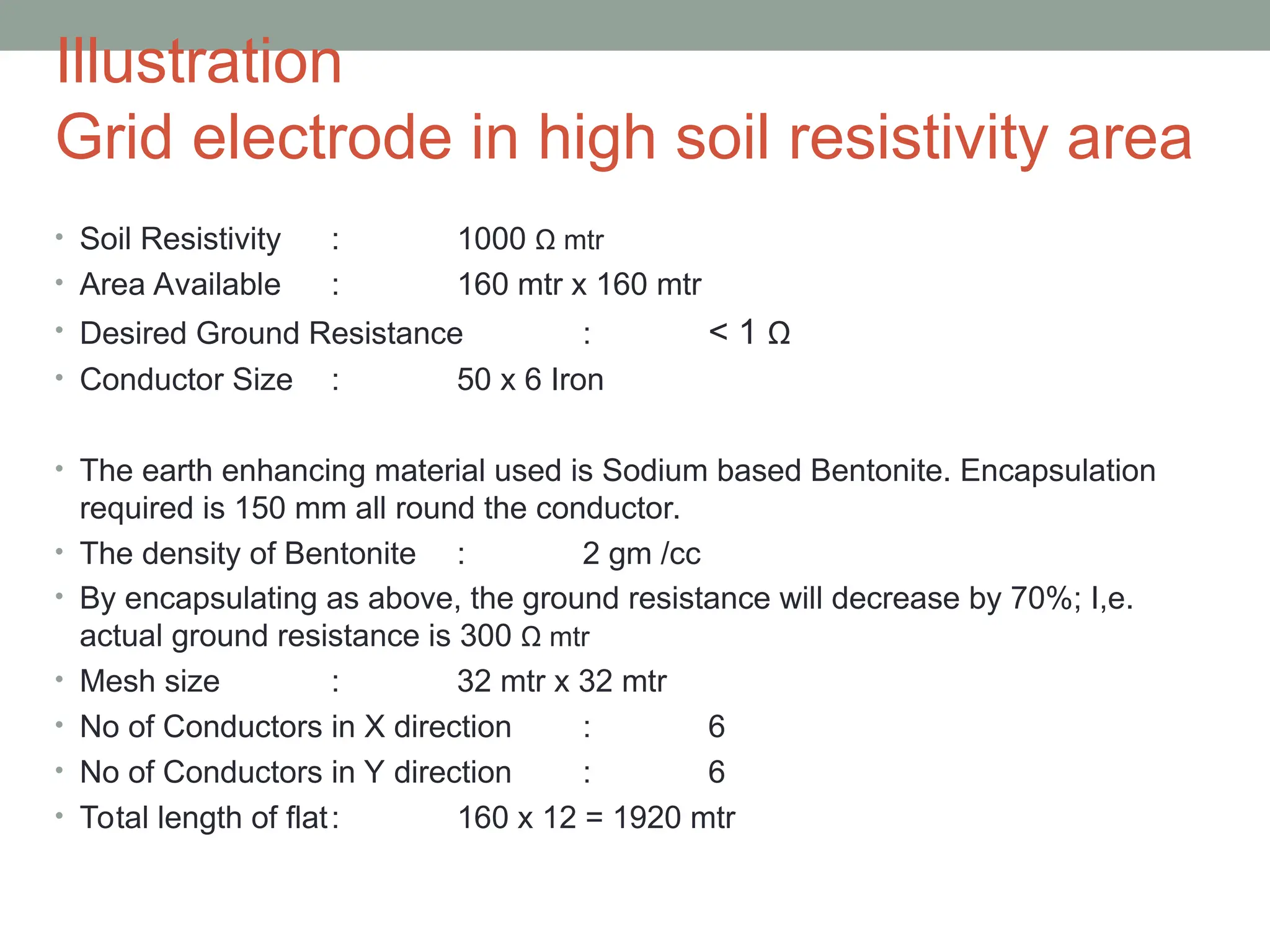
Grid electrode in high soil resistivity area
• Soil Resistivity : 1000 Ω mtr
• Area Available : 160 mtr x 160 mtr
• Desired Ground Resistance : < 1 Ω
• Conductor Size : 50 x 6 Iron
• The earth enhancing material used is Sodium based Bentonite. Encapsulation
required is 150 mm all round the conductor.
• The density of Bentonite : 2 gm /cc
• By encapsulating as above, the ground resistance will decrease by 70%; I,e.
actual ground resistance is 300 Ω mtr
• Mesh size : 32 mtr x 32 mtr
• No of Conductors in X direction : 6
• No of Conductors in Y direction : 6
• Total length of flat: 160 x 12 = 1920 mtr
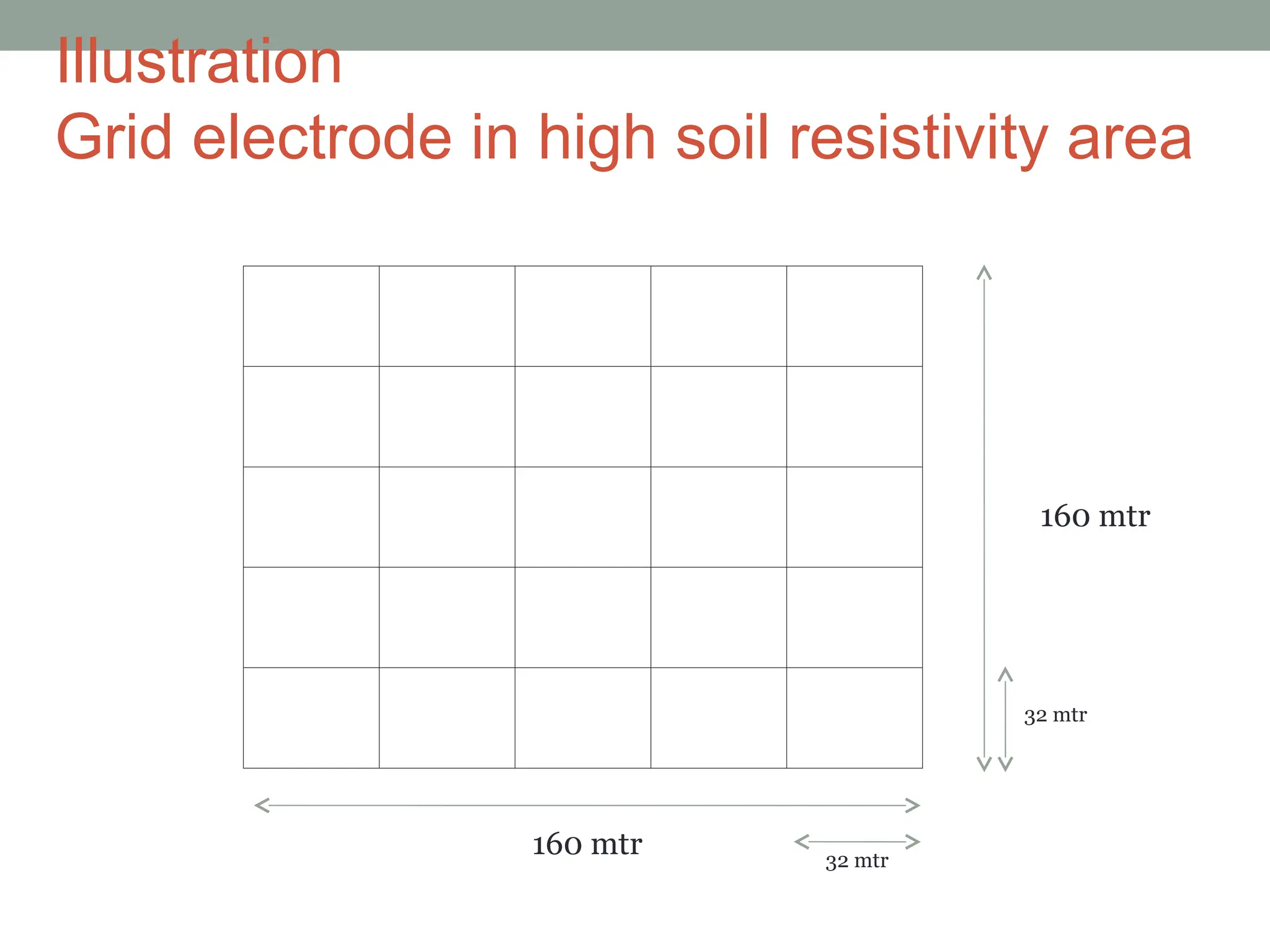
Illustration
Grid electrode in high soil resistivity area
160 mtr
160 mtr
32 mtr
32 mtr
Soil Resistivity Measurement
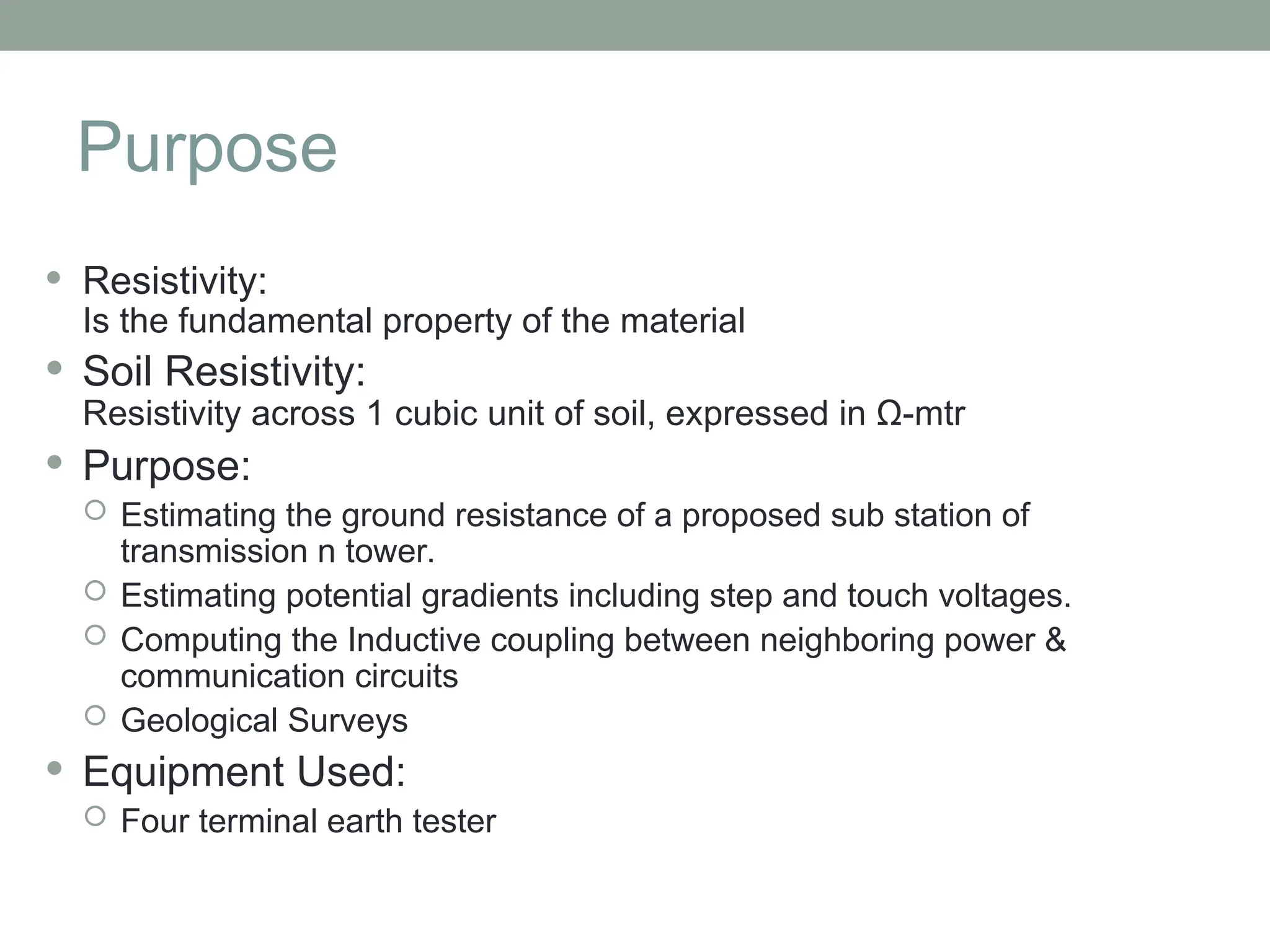
Purpose
 Resistivity:
Is the fundamental property of the material
 Soil Resistivity:
Resistivity across 1 cubic unit of soil, expressed in Ω-mtr
 Purpose:
 Estimating the ground resistance of a proposed sub station of
transmission n tower.
 Estimating potential gradients including step and touch voltages.
 Computing the Inductive coupling between neighboring power &
communication circuits
 Geological Surveys
 Equipment Used:
 Four terminal earth tester
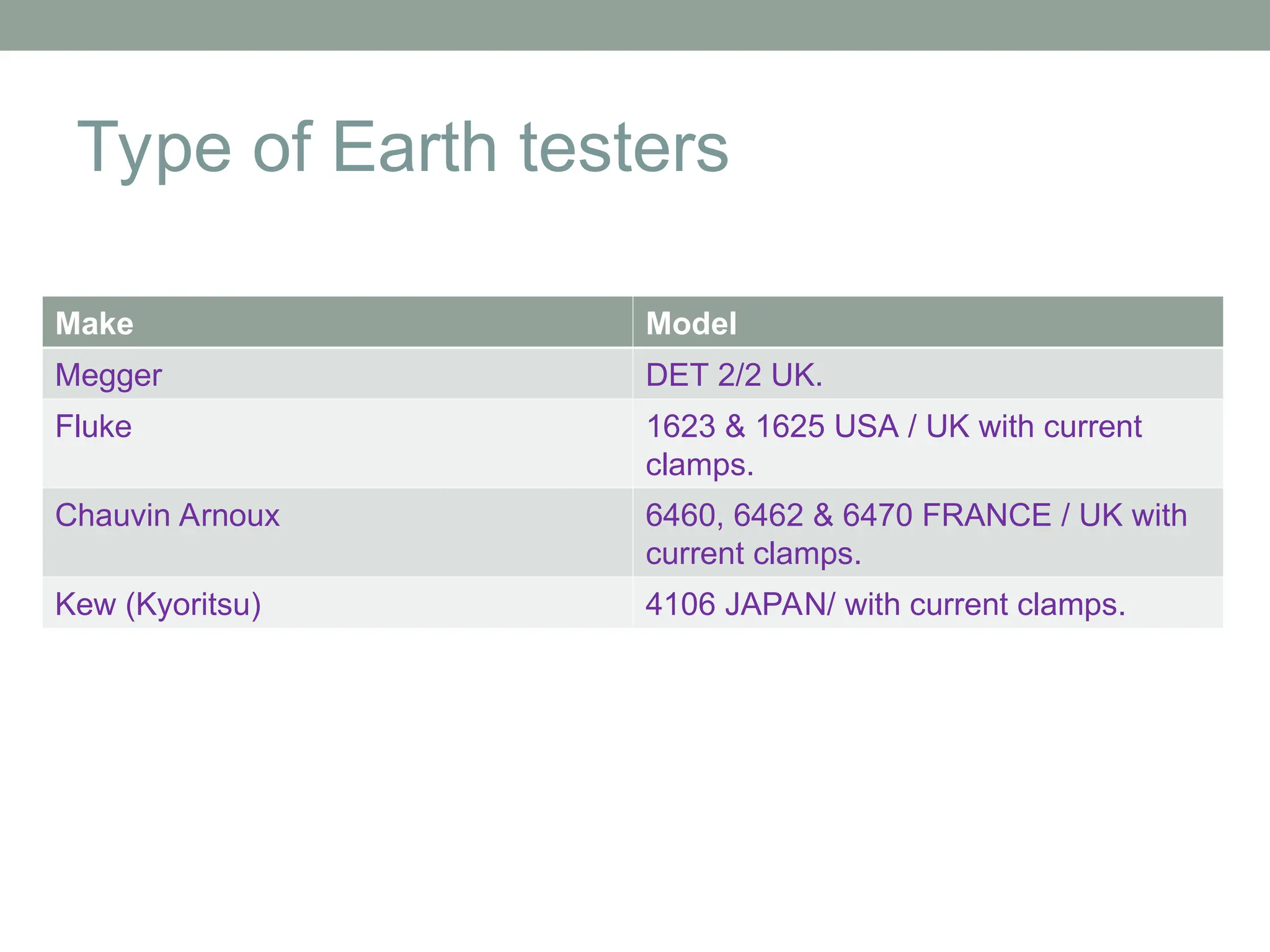
Type of Earth testers
Make Model
Megger DET 2/2 UK.
Fluke 1623 & 1625 USA / UK with current
clamps.
Chauvin Arnoux 6460, 6462 & 6470 FRANCE / UK with
current clamps.
Kew (Kyoritsu) 4106 JAPAN/ with current clamps.
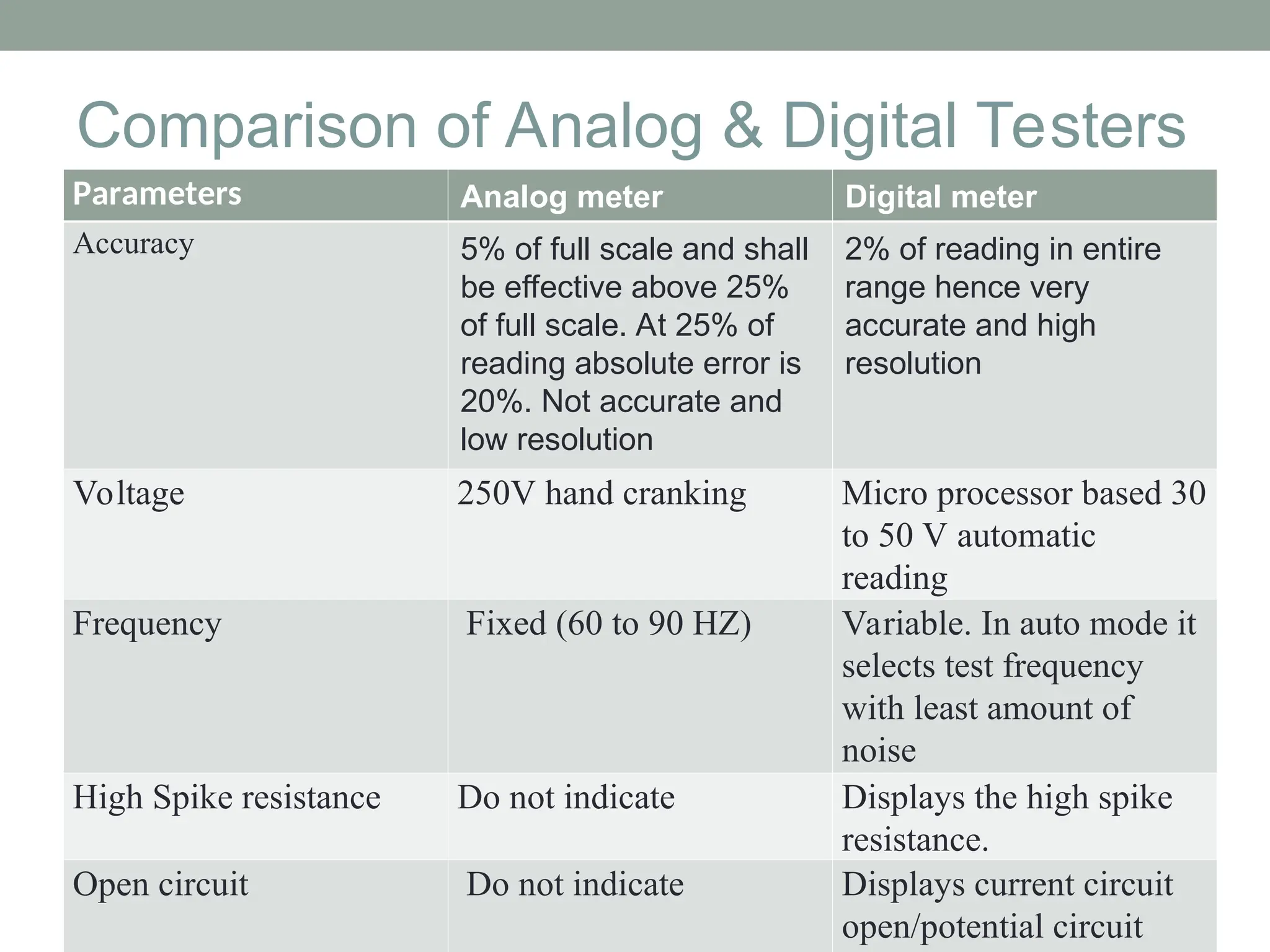
Comparison of Analog & Digital Testers
Parameters Analog meter Digital meter
Accuracy 5% of full scale and shall
be effective above 25%
of full scale. At 25% of
reading absolute error is
20%. Not accurate and
low resolution
2% of reading in entire
range hence very
accurate and high
resolution
Voltage 250V hand cranking Micro processor based 30
to 50 V automatic
reading
Frequency Fixed (60 to 90 HZ) Variable. In auto mode it
selects test frequency
with least amount of
noise
High Spike resistance Do not indicate Displays the high spike
resistance.
Open circuit Do not indicate Displays current circuit
open/potential circuit
Factors Affecting the Soil
Resistivity
• Type of the soil.
• Moisture.
• Dissolved salt in water.
• Temperature.
• Grain size and its distribution.
• Seasonal variation.
• Artificial treatment.
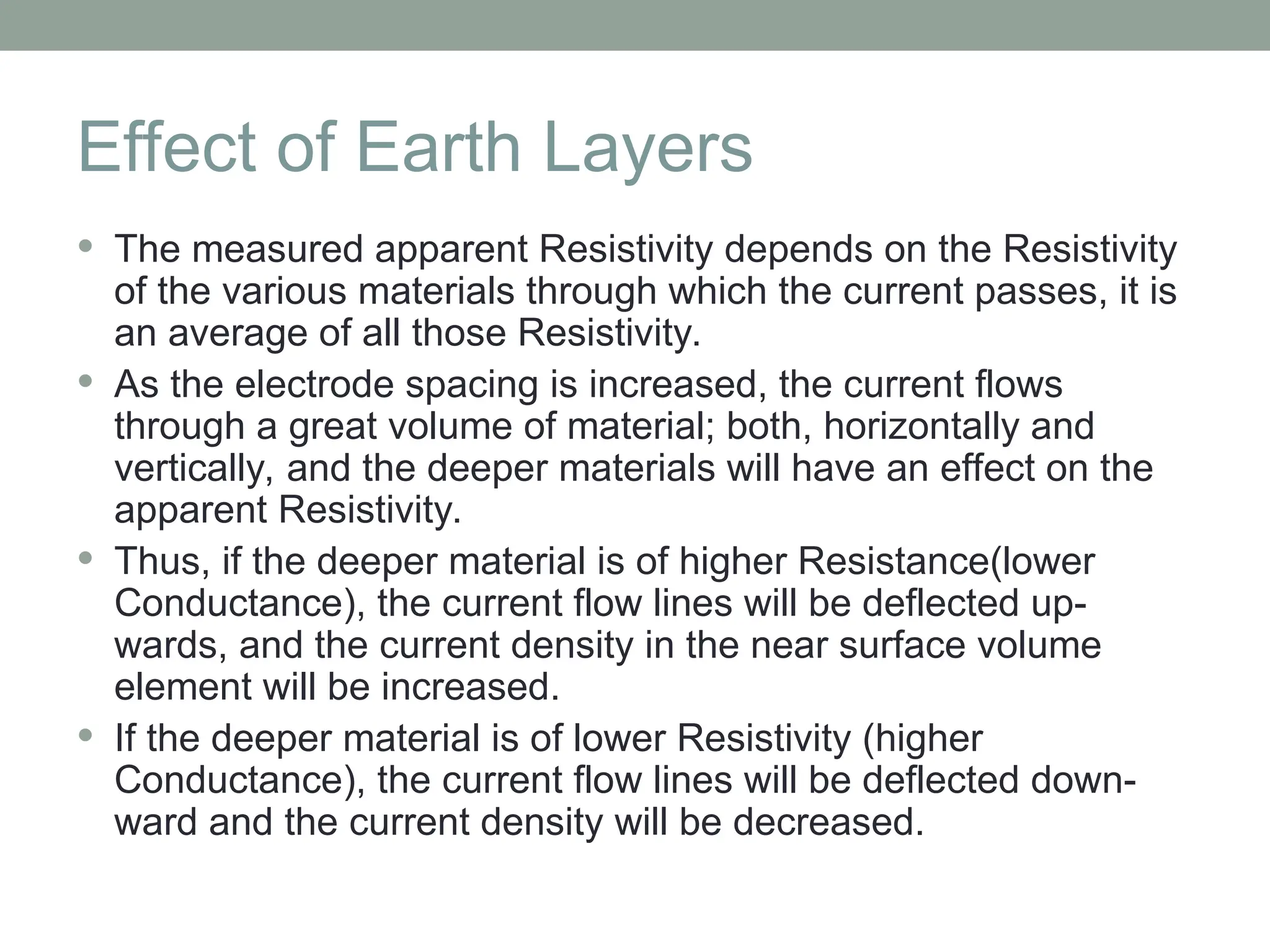
Effect of Earth Layers
 The measured apparent Resistivity depends on the Resistivity
of the various materials through which the current passes, it is
an average of all those Resistivity.
 As the electrode spacing is increased, the current flows
through a great volume of material; both, horizontally and
vertically, and the deeper materials will have an effect on the
apparent Resistivity.
 Thus, if the deeper material is of higher Resistance(lower
Conductance), the current flow lines will be deflected up-
wards, and the current density in the near surface volume
element will be increased.
 If the deeper material is of lower Resistivity (higher
Conductance), the current flow lines will be deflected down-
ward and the current density will be decreased.
Methods of measuring soil
resistivity
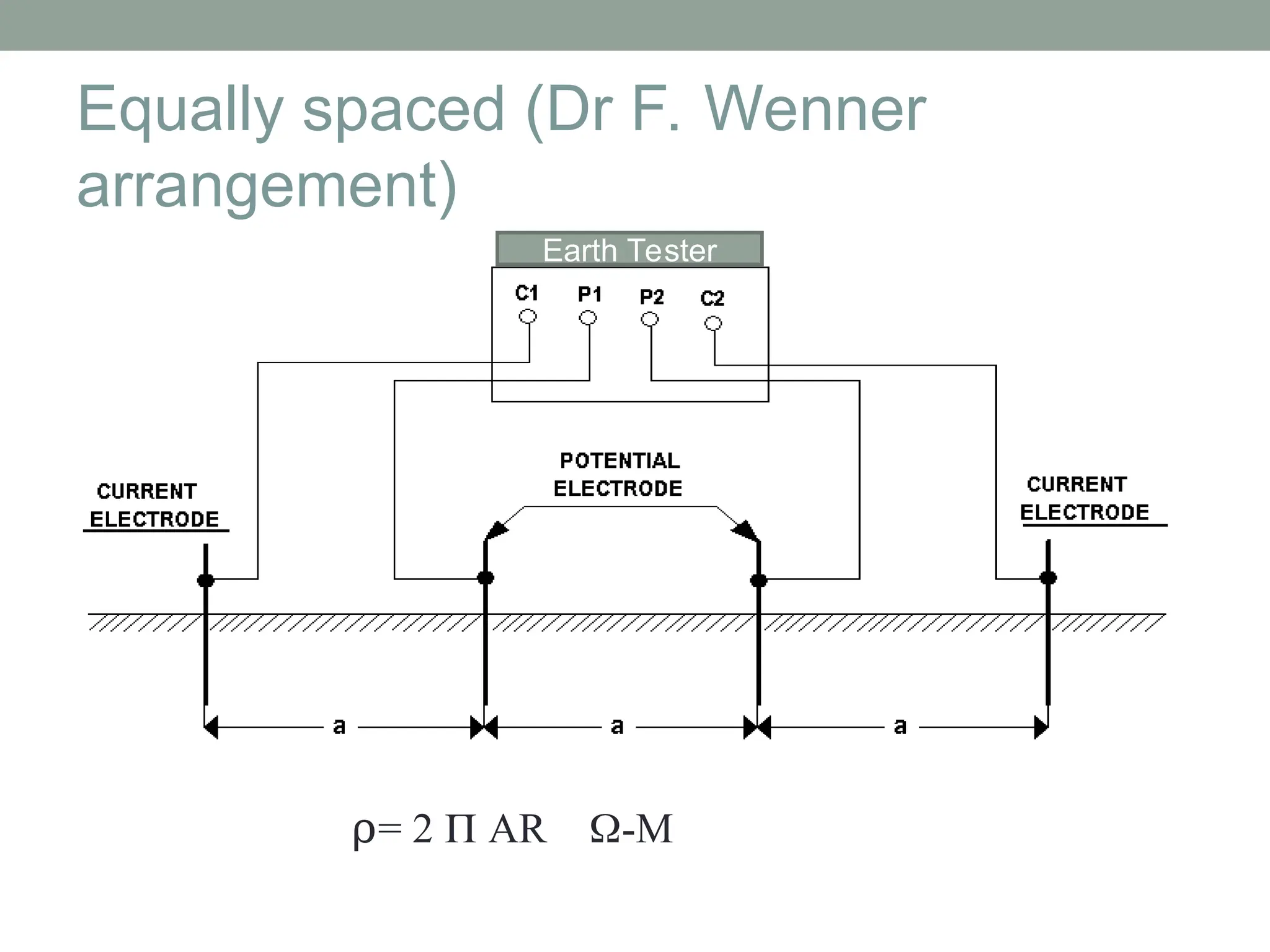
 Equally spaced or Dr F.Wenner arrangement
 Reference
Clause 36 Page 77 to 79 IS3043 : 1987
Clause 7 .2.4 (1) Page 14 & 15 IEEE 81: 1983
Clause 9.2.1 Page 113 &114 CBIP PP No: 302
Page .6 LEM
 Unequally spaced or Schelumberger – Palmer
Arrangement
 Reference
Clause 7 .2.4 (2) Page 15 IEEE 81: 1983
Clause 9.2 Page 116 CBIP PP No: 302
 Central Electrode Method
 Reference
Clause 9.4 Page 124,125 CBIP PP No: 302
Equally spaced (Dr F. Wenner
arrangement)
ρ= 2  AR -M
Earth Tester
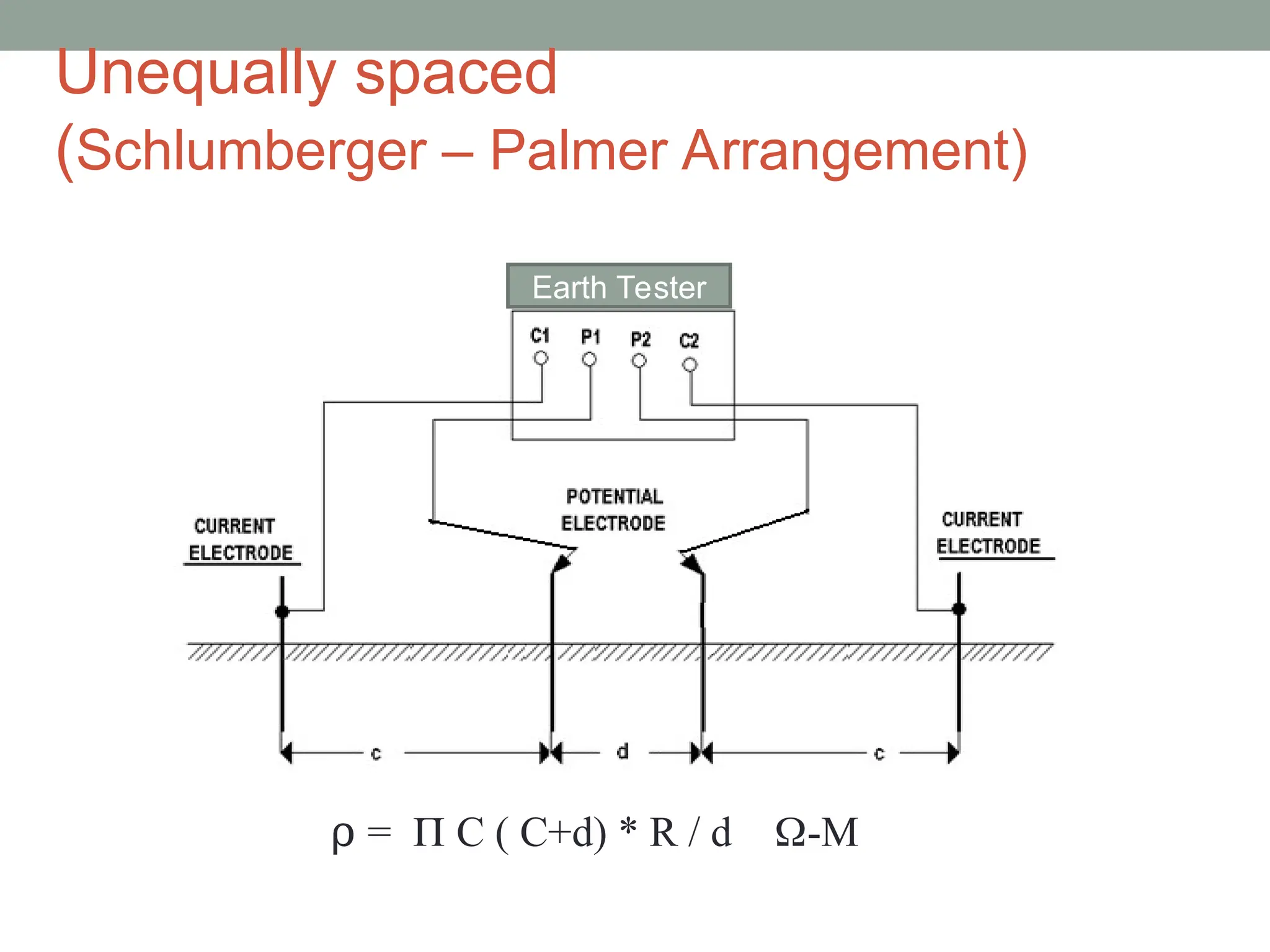
Unequally spaced
(Schlumberger – Palmer Arrangement)
ρ =  C ( C+d) * R / d -M
Earth Tester
Procedure for measuring Soil resistivity
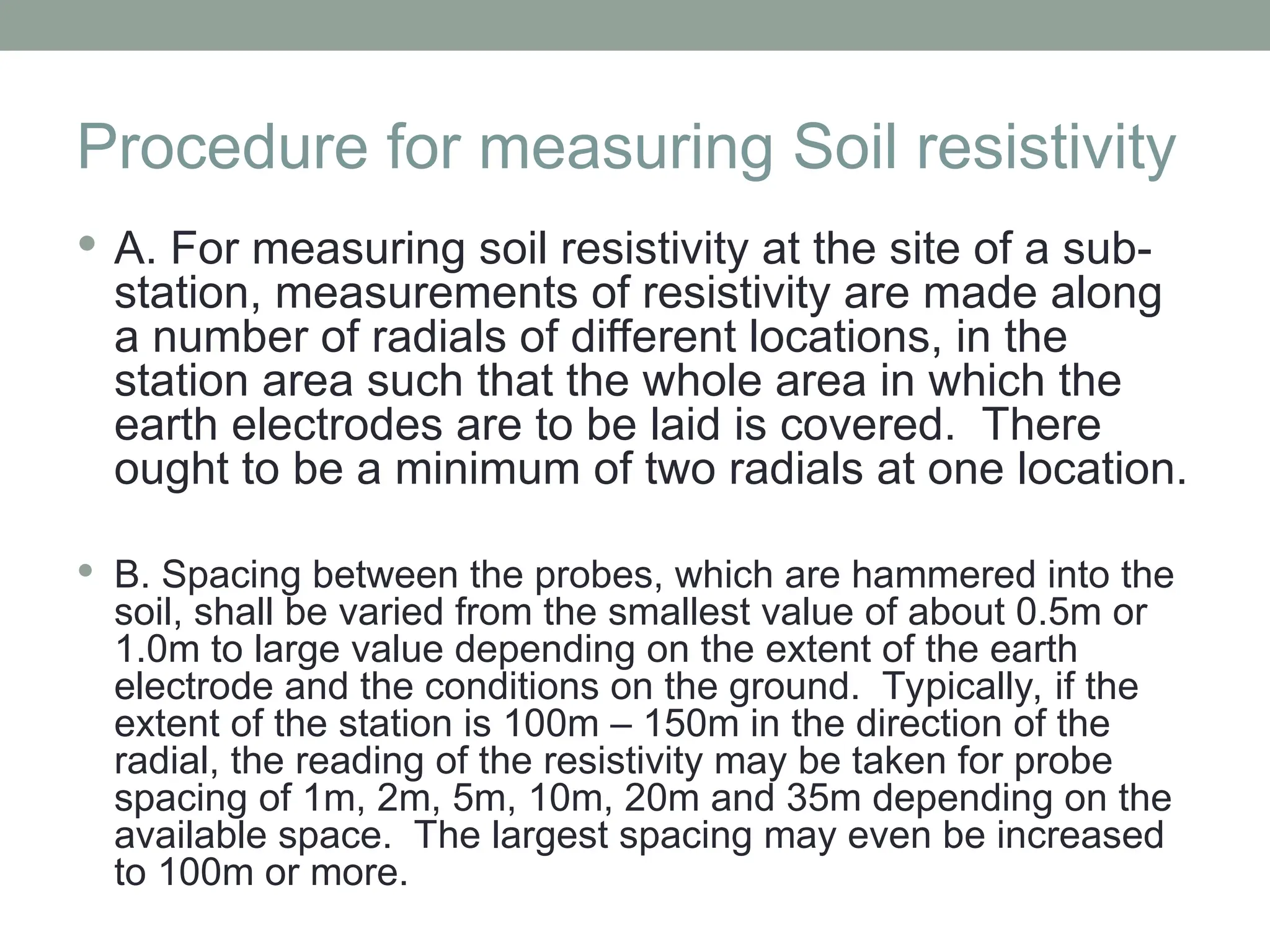
 A. For measuring soil resistivity at the site of a sub-
station, measurements of resistivity are made along
a number of radials of different locations, in the
station area such that the whole area in which the
earth electrodes are to be laid is covered. There
ought to be a minimum of two radials at one location.
 B. Spacing between the probes, which are hammered into the
soil, shall be varied from the smallest value of about 0.5m or
1.0m to large value depending on the extent of the earth
electrode and the conditions on the ground. Typically, if the
extent of the station is 100m – 150m in the direction of the
radial, the reading of the resistivity may be taken for probe
spacing of 1m, 2m, 5m, 10m, 20m and 35m depending on the
available space. The largest spacing may even be increased
to 100m or more.
Procedure for measuring Soil resistivity
 c. In case the resistivity variation is large, at least five
progressively increasing probe spacing are necessary to get
good estimate of deeper layer parameters.
 d. A few spoonfuls of water may be poured around the probe,
which has been hammered into ground, to get good
conductive connection between probe and soil around it.
 e. The soil along the radials shall be free from buried
conductive pipes, etc., and it shall not be recently filled and
therefore not yet compacted.
 f. In case the grid conductors have already been installed,
resistivity measurements except those for small probe spacing
in center of large meshes shall be affected. If soil is
homogenous, measurements may be made outside the grid
Procedure for measuring Soil resistivity
 g. In case the earth at the site of measurement is rocky, it may not be
possible to hammer the probes into ground, if attempt is made to
hammer a probe into ground, cracks may develop around the point of
entry of the probe into ground. This results in high contact resistance in
the current or the potential loop and shall result in erroneous results. A
good digital earth tester shall have an indicator for high current loop
resistance or high contact resistance at potential probes. If cracks
develop around the probe, the hole shall be filled with wet mud and the
probe shall be stood in the mud. In case probes cannot be hammered
into ground, holes shall be drilled into ground and these may be filled
with mud or cement or Bentonite slurry into which the probes are
erected.
 h. Test wires shall be insulated and shall not have joints in between.
These shall be firmly connected to terminals of earth resistance meter
and test electrodes.
 i. As far as possible wires from potential terminals may not run parallel to
and near those from current terminals.
Procedure for measuring Soil resistivity
 j. Test electrode shall be clean and free from rust.
 k. Hammering of electrodes shall not result in loosening of
connection between electrode and its test leads and thereby an
increase of contact resistance between test lead and electrode.
 l. Local soil condition such as surface rock, loose soil, water logging,
roadside, etc., at measurement point shall be recorded in
measurement book for ease of interpretation of measured data.
 m. Resistivity value shall be calculated after each observation. In
case there is an abrupt variation in measured resistivity,
measurement for that probe spacing shall be repeated after altering
the probe location.
 n. Accuracy of earth resistance meter shall be checked before and
after the measurements as per procedure given under:
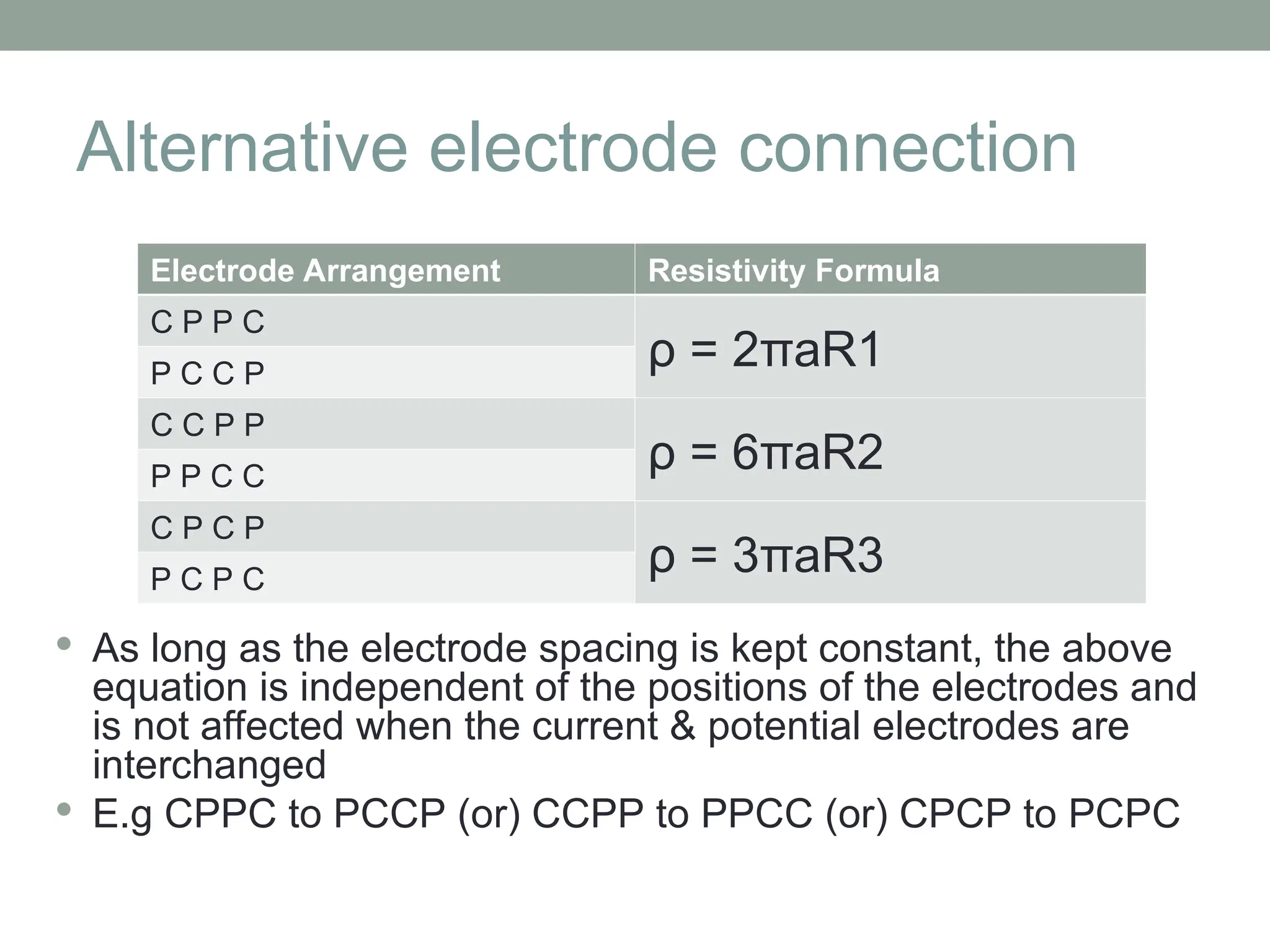
Alternative electrode connection
Electrode Arrangement Resistivity Formula
C P P C
ρ = 2πaR1
P C C P
C C P P
ρ = 6πaR2
P P C C
C P C P
ρ = 3πaR3
P C P C
 As long as the electrode spacing is kept constant, the above
equation is independent of the positions of the electrodes and
is not affected when the current & potential electrodes are
interchanged
 E.g CPPC to PCCP (or) CCPP to PPCC (or) CPCP to PCPC
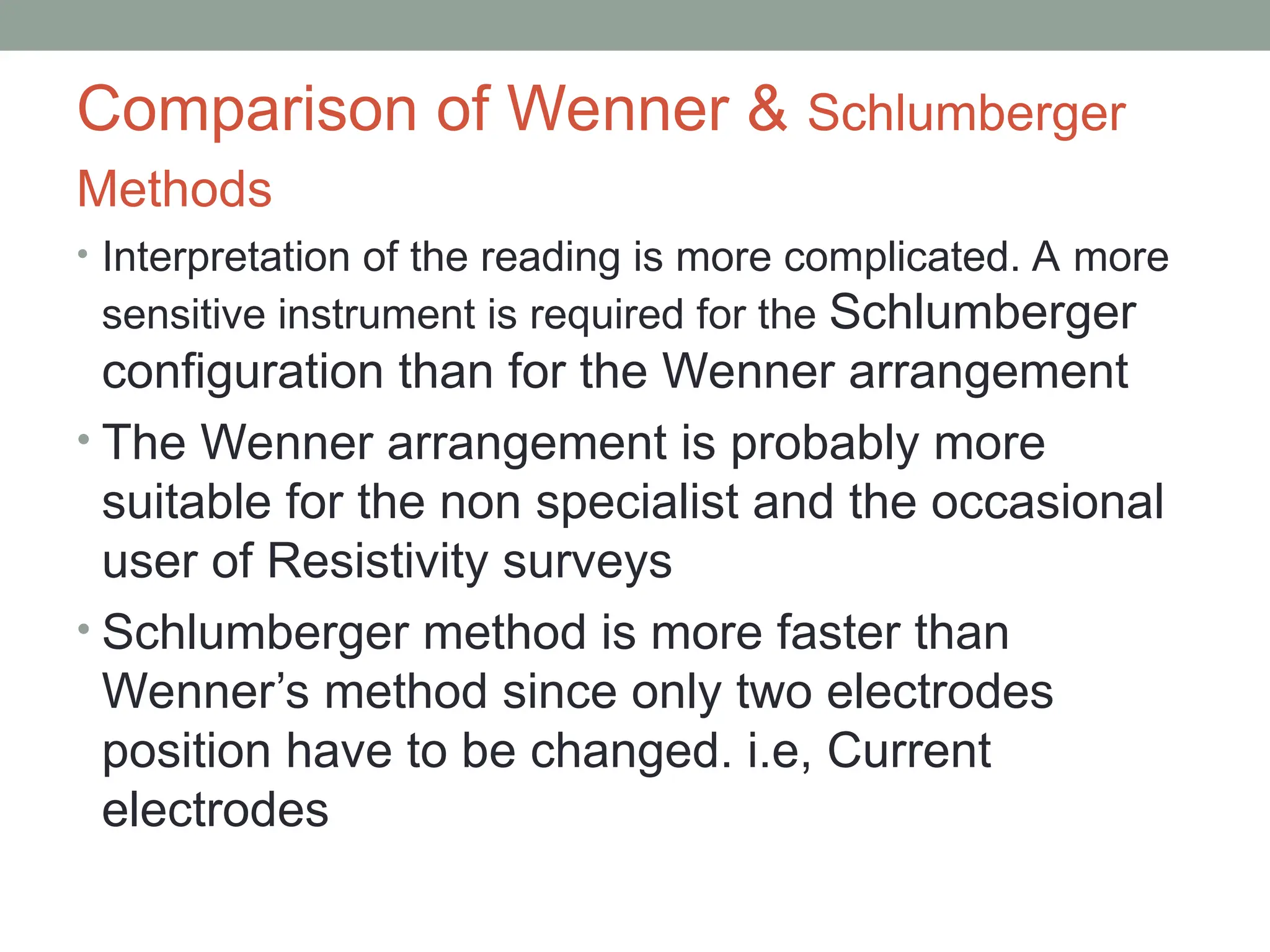
Comparison of Wenner & Schlumberger
Methods
• Interpretation of the reading is more complicated. A more
sensitive instrument is required for the Schlumberger
configuration than for the Wenner arrangement
• The Wenner arrangement is probably more
suitable for the non specialist and the occasional
user of Resistivity surveys
• Schlumberger method is more faster than
Wenner’s method since only two electrodes
position have to be changed. i.e, Current
electrodes
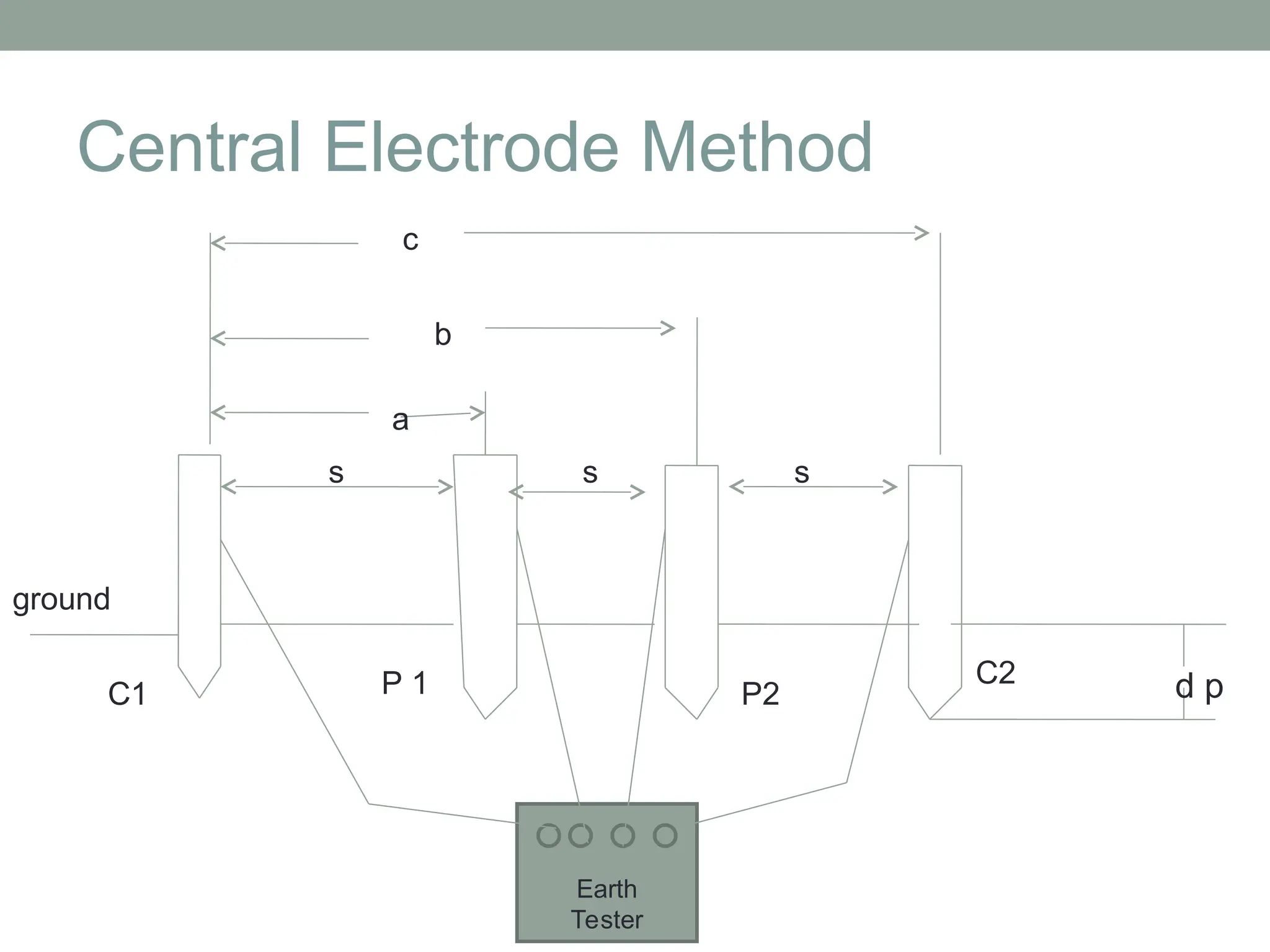
Central Electrode Method
c
b
a
s s s
Earth
Tester
ground
d p
P 1 P2
C2
C1
Central Electrode Method
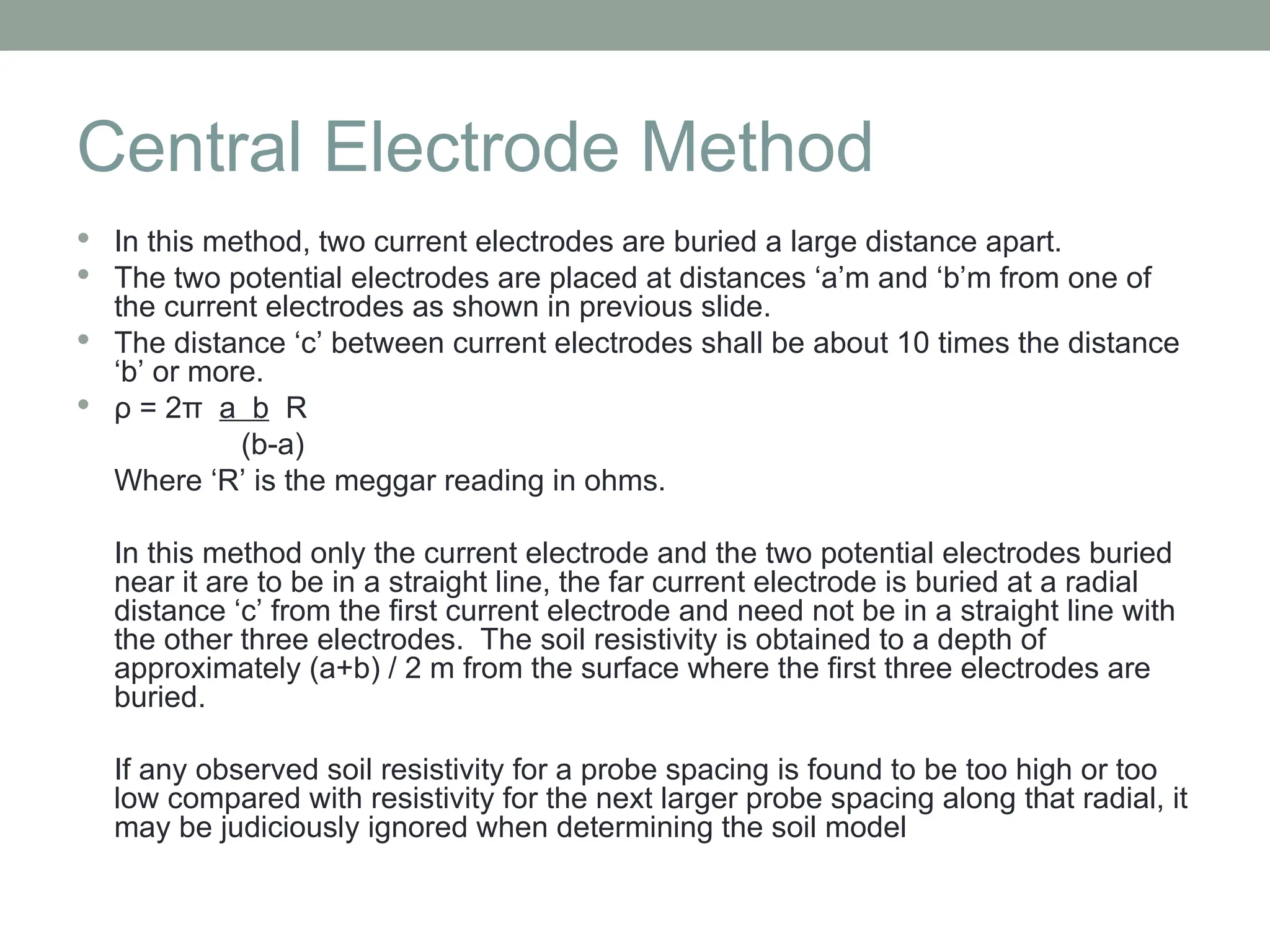
 In this method, two current electrodes are buried a large distance apart.
 The two potential electrodes are placed at distances ‘a’m and ‘b’m from one of
the current electrodes as shown in previous slide.
 The distance ‘c’ between current electrodes shall be about 10 times the distance
‘b’ or more.
 ρ = 2π a b R
(b-a)
Where ‘R’ is the meggar reading in ohms.
In this method only the current electrode and the two potential electrodes buried
near it are to be in a straight line, the far current electrode is buried at a radial
distance ‘c’ from the first current electrode and need not be in a straight line with
the other three electrodes. The soil resistivity is obtained to a depth of
approximately (a+b) / 2 m from the surface where the first three electrodes are
buried.
If any observed soil resistivity for a probe spacing is found to be too high or too
low compared with resistivity for the next larger probe spacing along that radial, it
may be judiciously ignored when determining the soil model
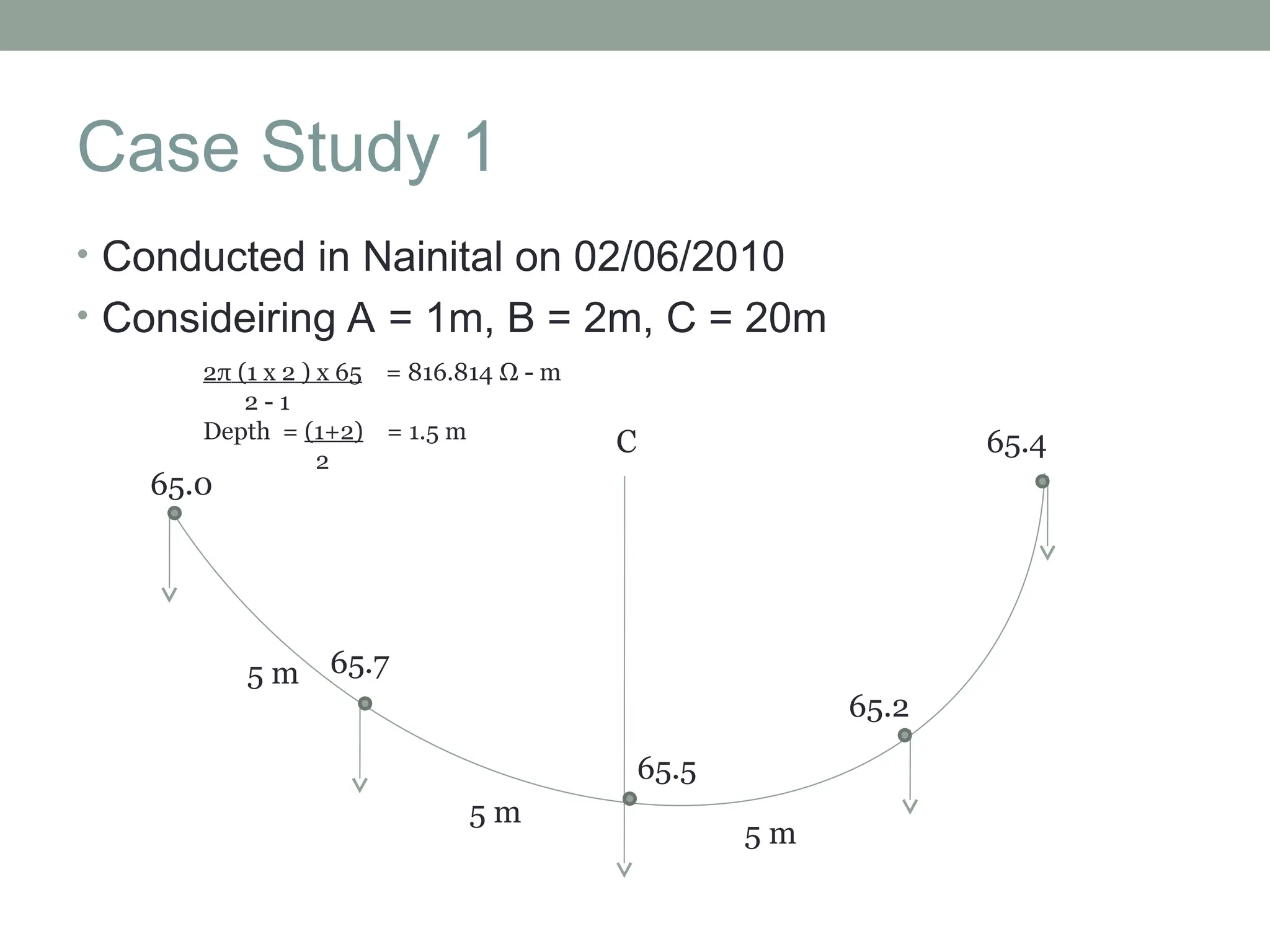
Case Study 1
• Conducted in Nainital on 02/06/2010
• Consideiring A = 1m, B = 2m, C = 20m
5 m
5 m
5 m
65.0
65.7
65.5
65.2
65.4
C
2π (1 x 2 ) x 65 = 816.814 Ω - m
2 - 1
Depth = (1+2) = 1.5 m
2
Measurement of Ground
Resistance
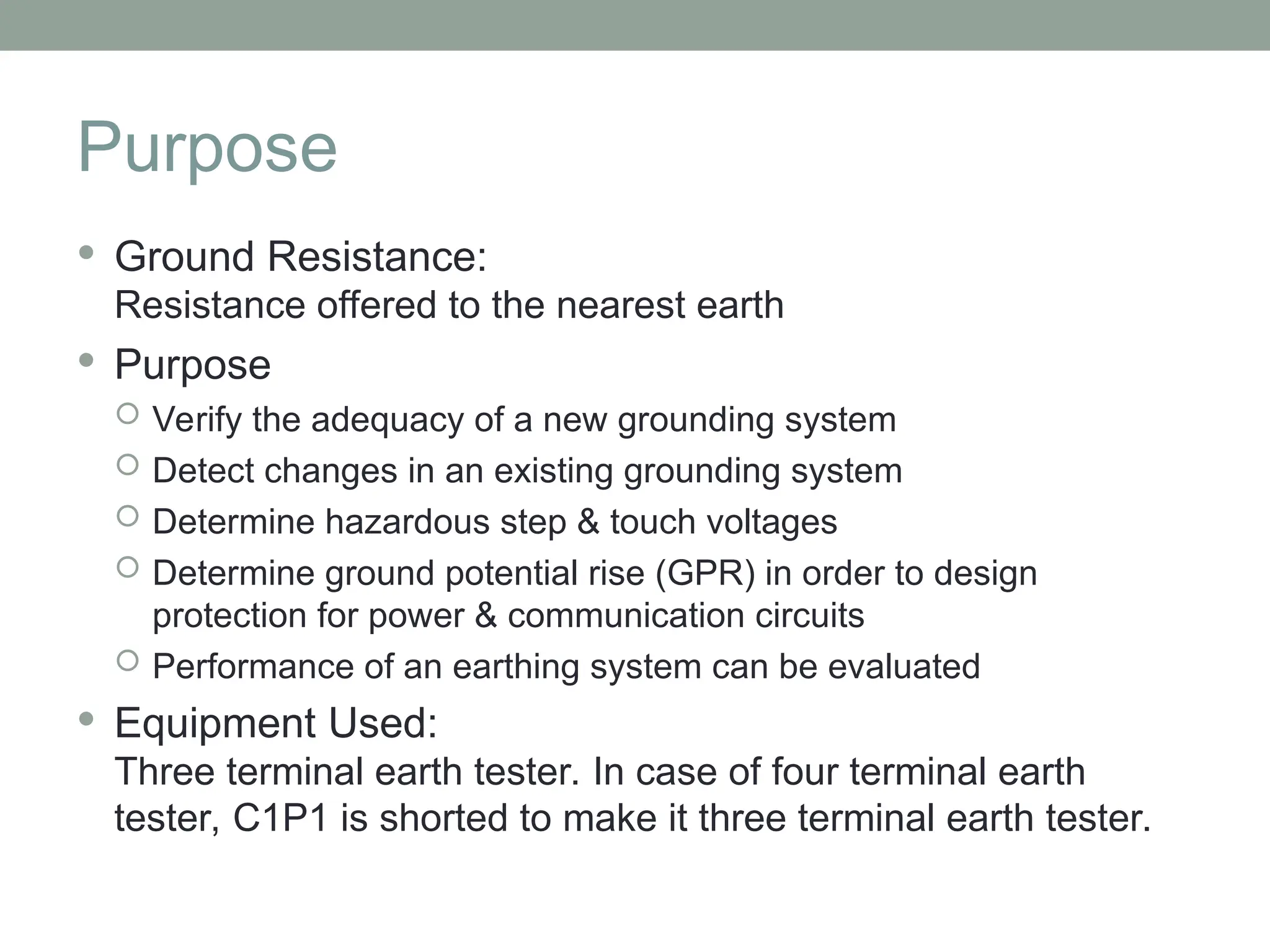
Purpose
 Ground Resistance:
Resistance offered to the nearest earth
 Purpose
 Verify the adequacy of a new grounding system
 Detect changes in an existing grounding system
 Determine hazardous step & touch voltages
 Determine ground potential rise (GPR) in order to design
protection for power & communication circuits
 Performance of an earthing system can be evaluated
 Equipment Used:
Three terminal earth tester. In case of four terminal earth
tester, C1P1 is shorted to make it three terminal earth tester.
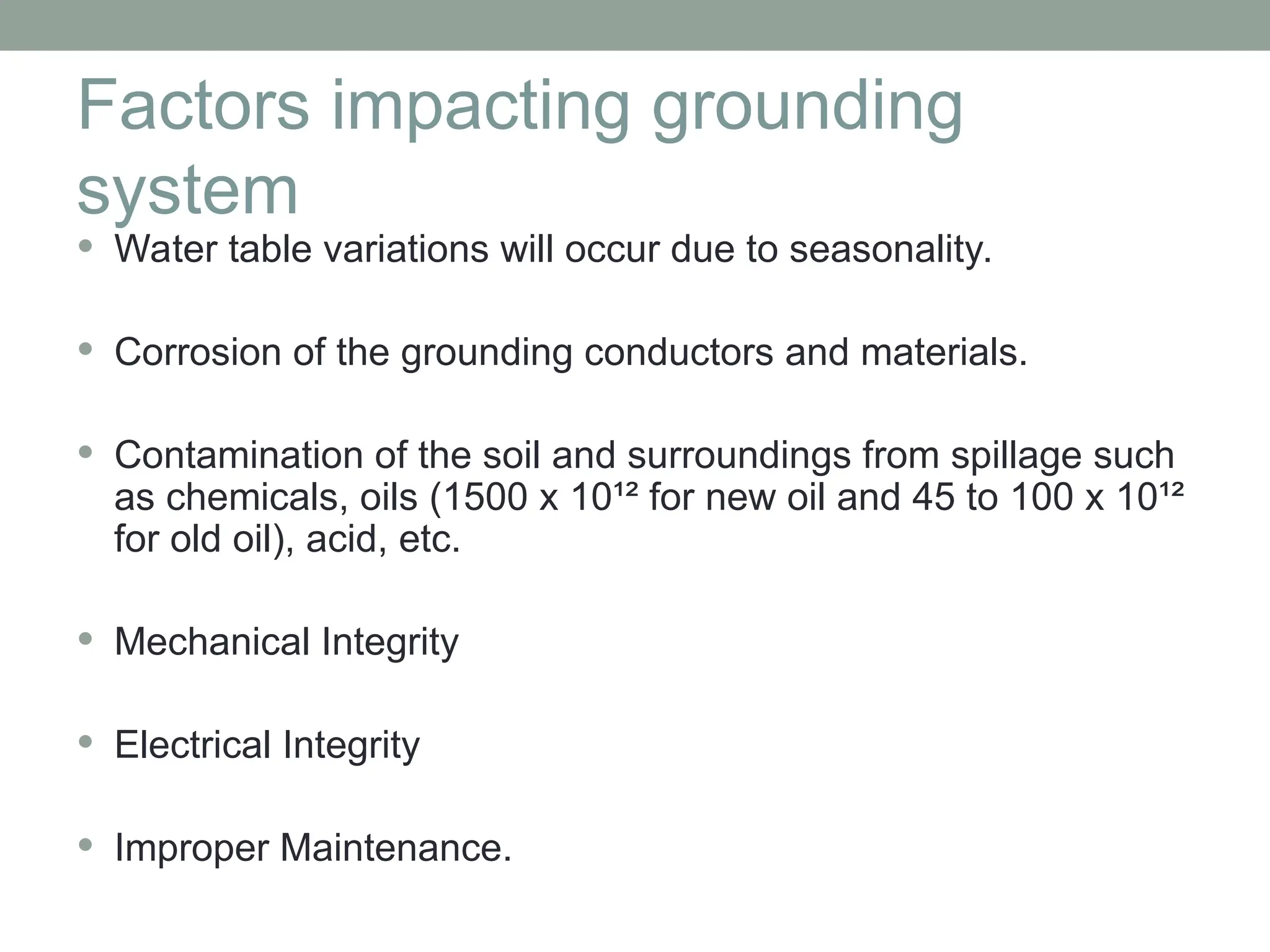
Factors impacting grounding
system
 Water table variations will occur due to seasonality.
 Corrosion of the grounding conductors and materials.
 Contamination of the soil and surroundings from spillage such
as chemicals, oils (1500 x 10¹² for new oil and 45 to 100 x 10¹²
for old oil), acid, etc.
 Mechanical Integrity
 Electrical Integrity
 Improper Maintenance.
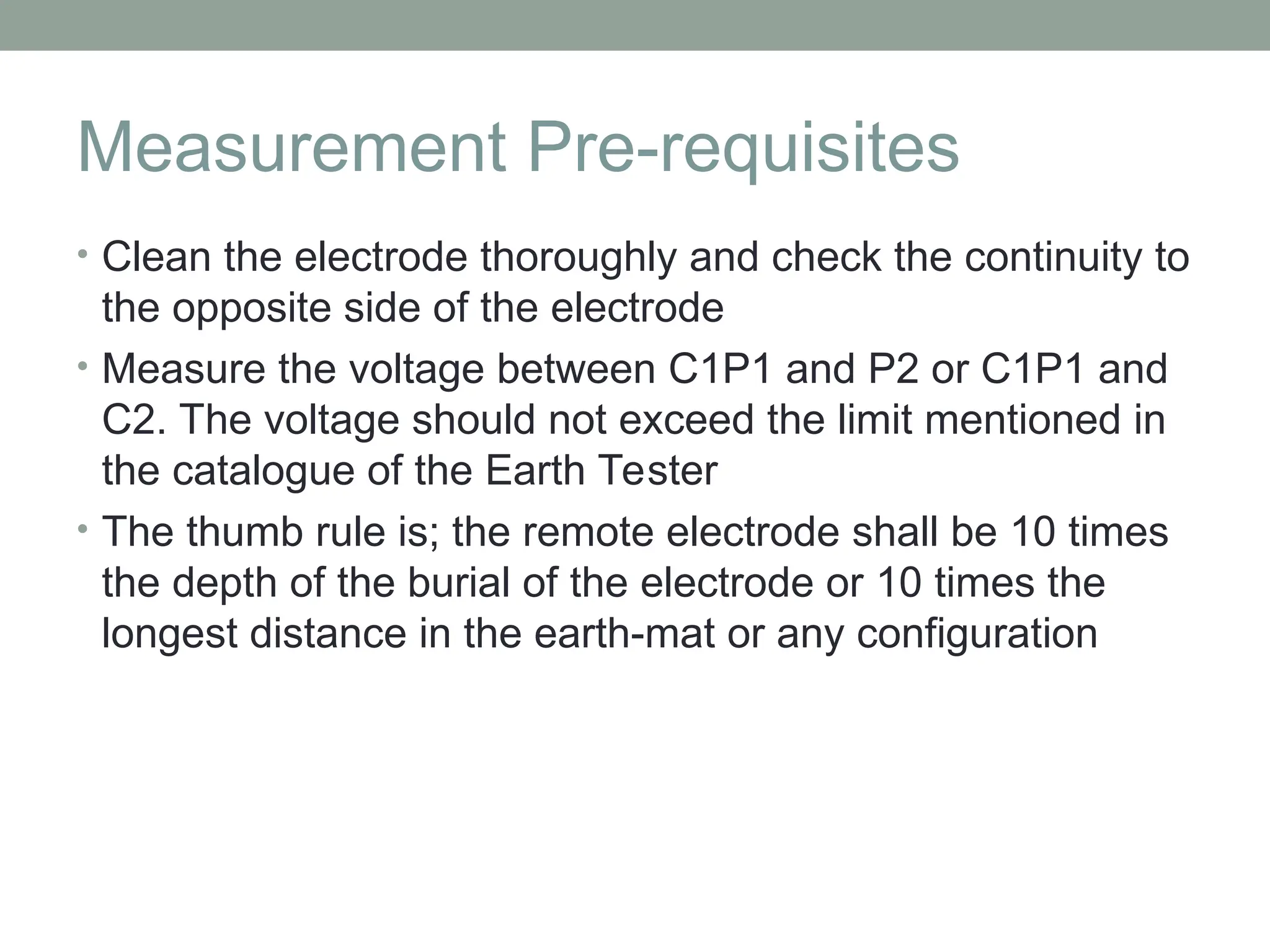
Measurement Pre-requisites
• Clean the electrode thoroughly and check the continuity to
the opposite side of the electrode
• Measure the voltage between C1P1 and P2 or C1P1 and
C2. The voltage should not exceed the limit mentioned in
the catalogue of the Earth Tester
• The thumb rule is; the remote electrode shall be 10 times
the depth of the burial of the electrode or 10 times the
longest distance in the earth-mat or any configuration
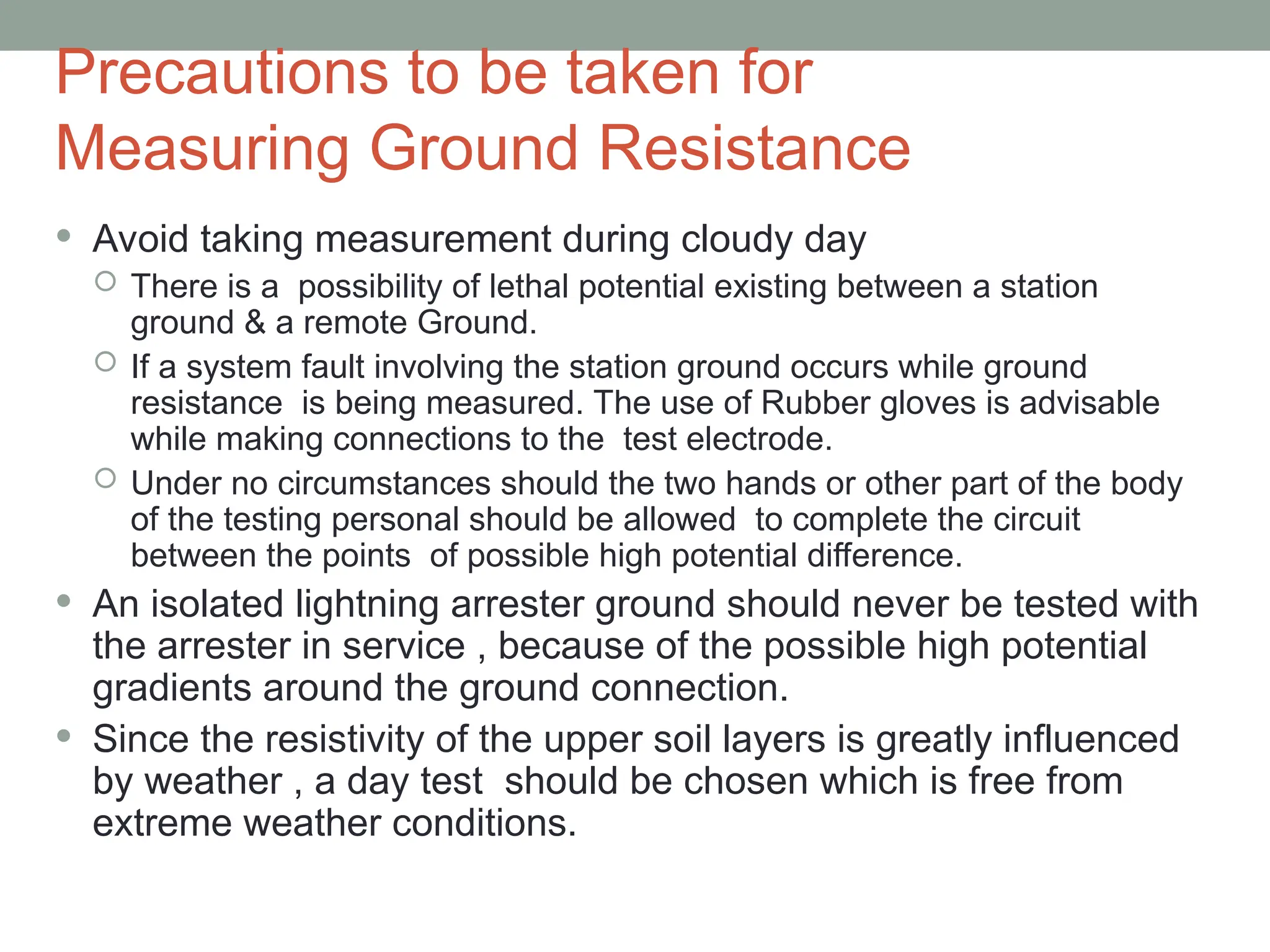
Precautions to be taken for
Measuring Ground Resistance
 Avoid taking measurement during cloudy day
 There is a possibility of lethal potential existing between a station
ground & a remote Ground.
 If a system fault involving the station ground occurs while ground
resistance is being measured. The use of Rubber gloves is advisable
while making connections to the test electrode.
 Under no circumstances should the two hands or other part of the body
of the testing personal should be allowed to complete the circuit
between the points of possible high potential difference.
 An isolated lightning arrester ground should never be tested with
the arrester in service , because of the possible high potential
gradients around the ground connection.
 Since the resistivity of the upper soil layers is greatly influenced
by weather , a day test should be chosen which is free from
extreme weather conditions.
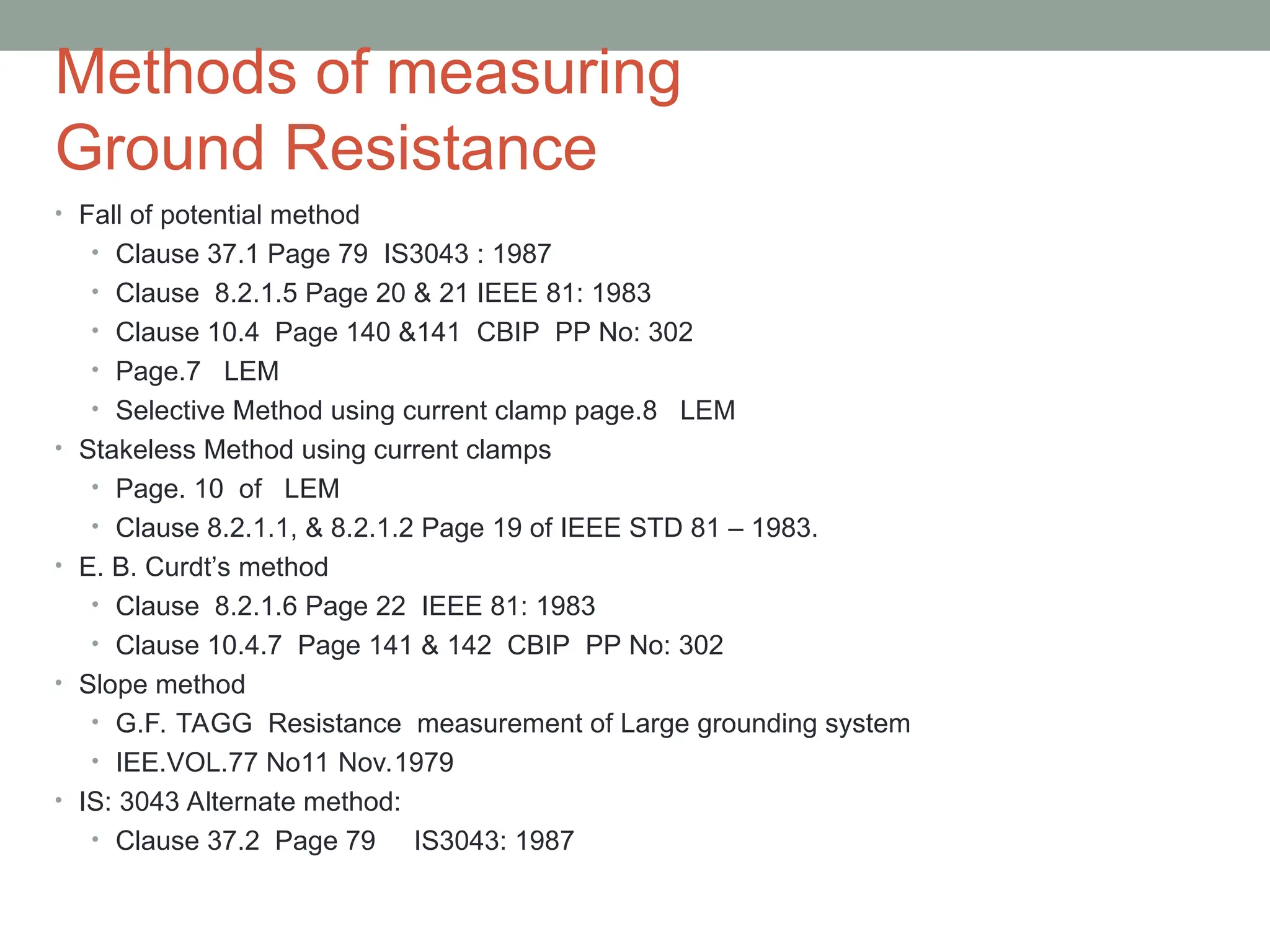
Methods of measuring
Ground Resistance
• Fall of potential method
• Clause 37.1 Page 79 IS3043 : 1987
• Clause 8.2.1.5 Page 20 & 21 IEEE 81: 1983
• Clause 10.4 Page 140 &141 CBIP PP No: 302
• Page.7 LEM
• Selective Method using current clamp page.8 LEM
• Stakeless Method using current clamps
• Page. 10 of LEM
• Clause 8.2.1.1, & 8.2.1.2 Page 19 of IEEE STD 81 – 1983.
• E. B. Curdt’s method
• Clause 8.2.1.6 Page 22 IEEE 81: 1983
• Clause 10.4.7 Page 141 & 142 CBIP PP No: 302
• Slope method
• G.F. TAGG Resistance measurement of Large grounding system
• IEE.VOL.77 No11 Nov.1979
• IS: 3043 Alternate method:
• Clause 37.2 Page 79 IS3043: 1987
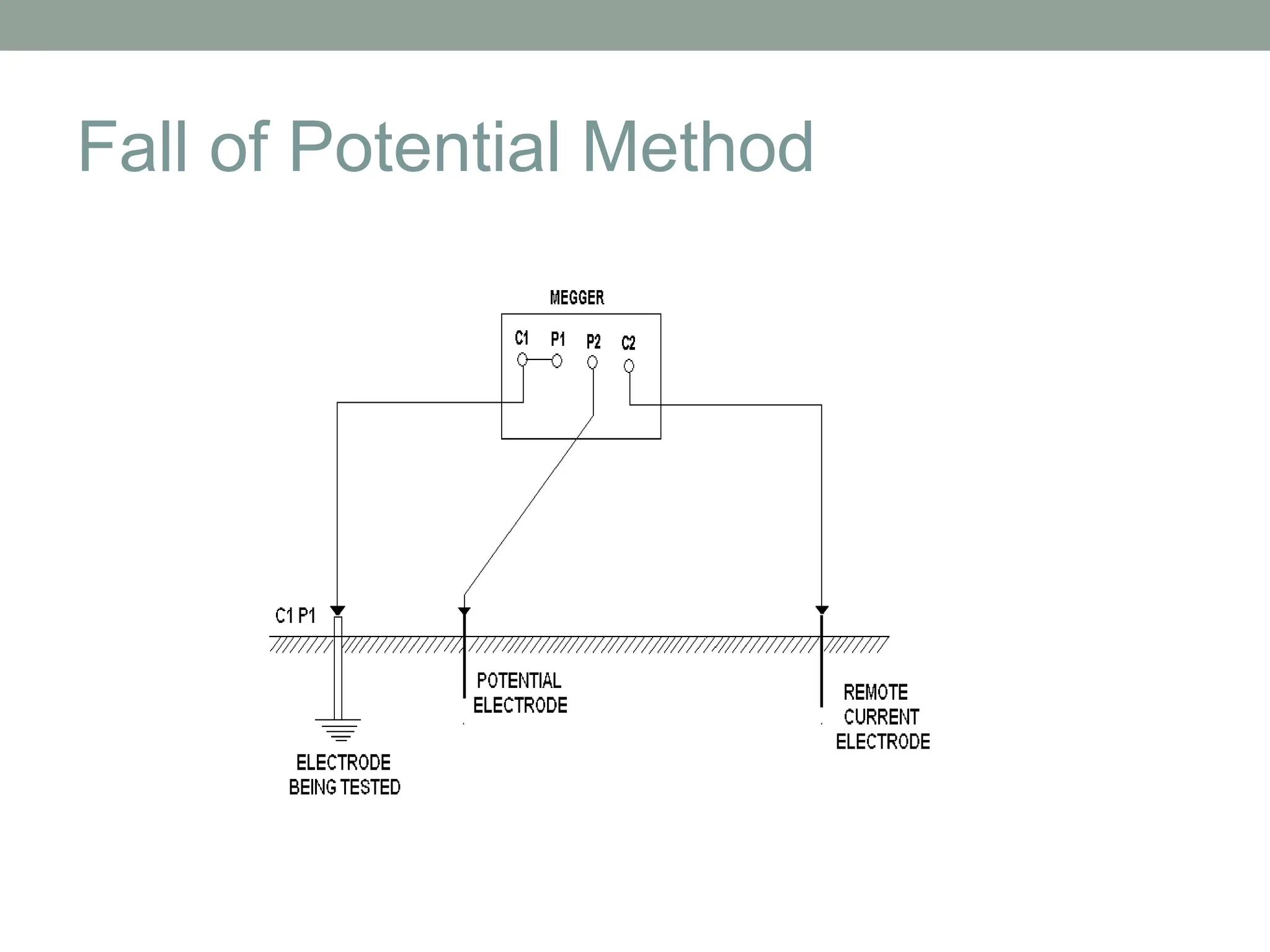
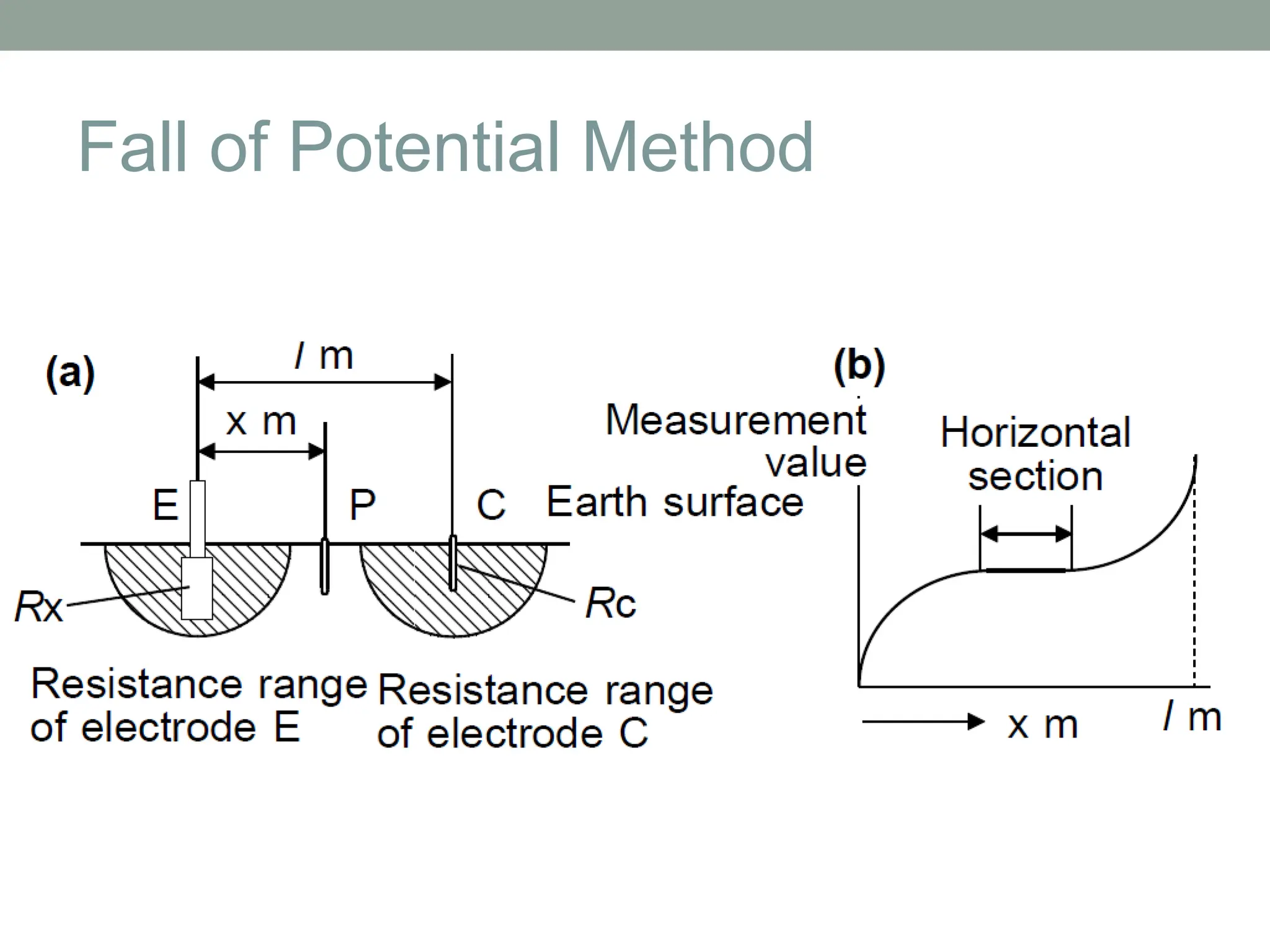
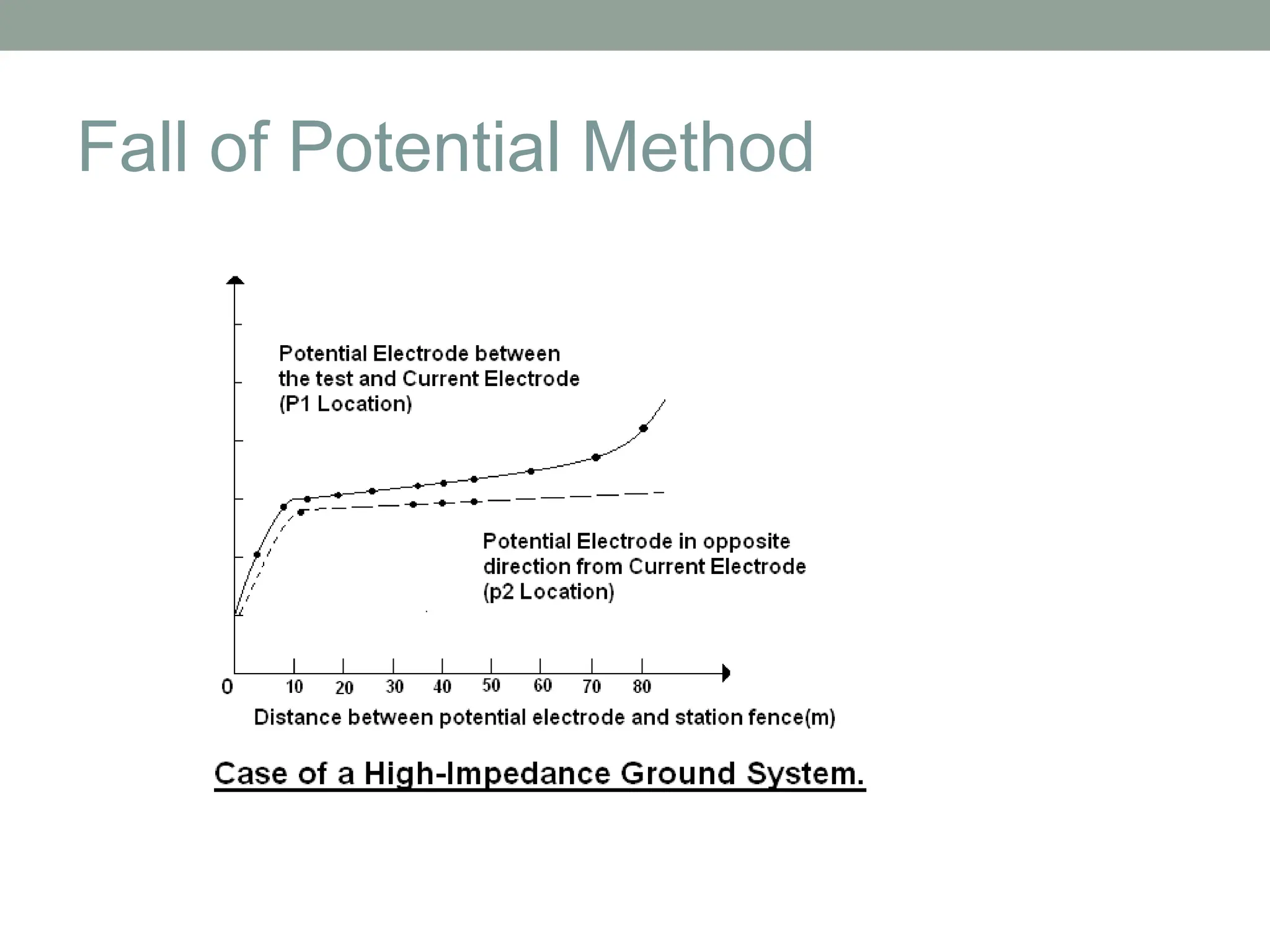
Fall of Potential Method
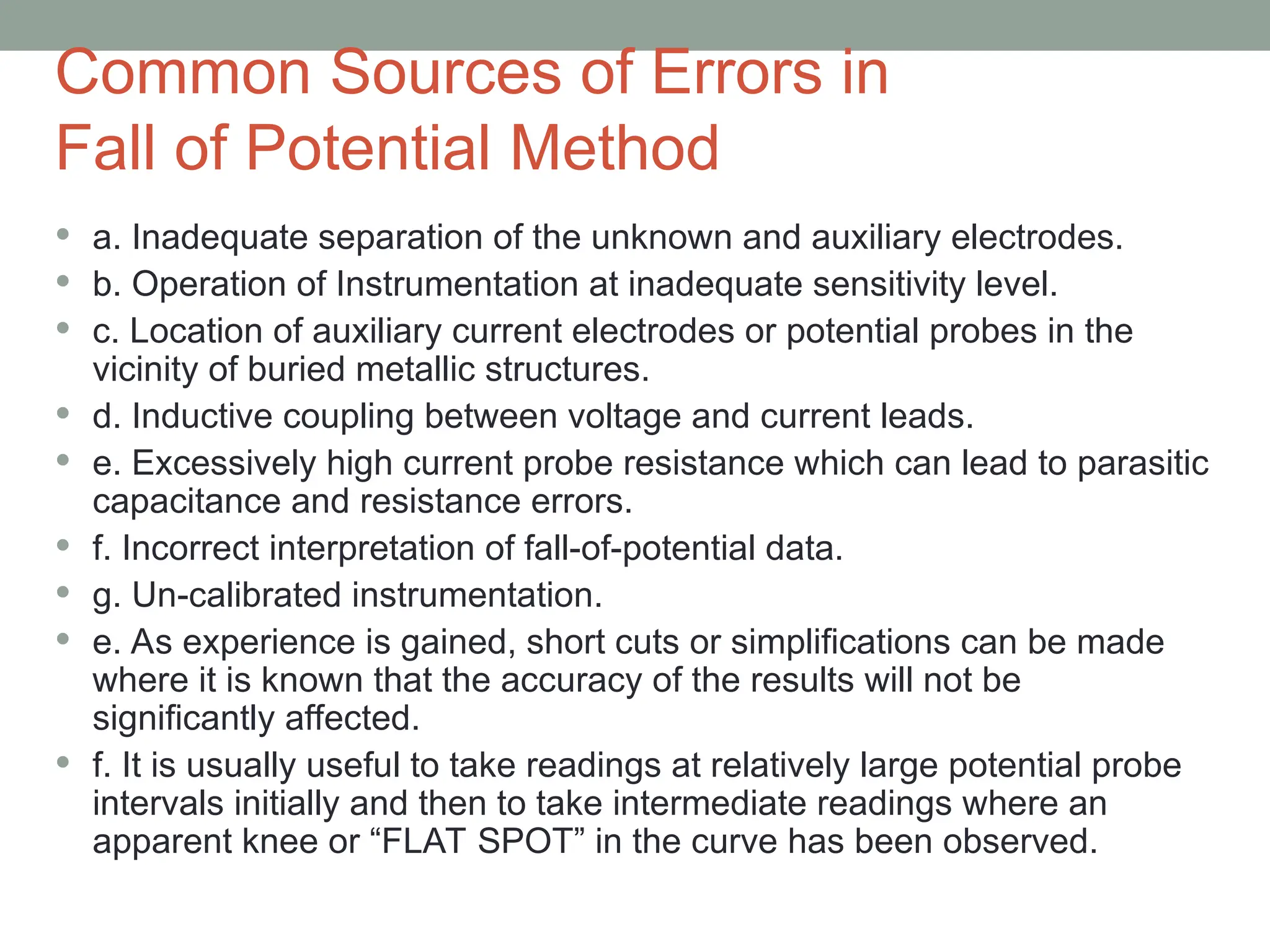
Common Sources of Errors in
Fall of Potential Method
 a. Inadequate separation of the unknown and auxiliary electrodes.
 b. Operation of Instrumentation at inadequate sensitivity level.
 c. Location of auxiliary current electrodes or potential probes in the
vicinity of buried metallic structures.
 d. Inductive coupling between voltage and current leads.
 e. Excessively high current probe resistance which can lead to parasitic
capacitance and resistance errors.
 f. Incorrect interpretation of fall-of-potential data.
 g. Un-calibrated instrumentation.
 e. As experience is gained, short cuts or simplifications can be made
where it is known that the accuracy of the results will not be
significantly affected.
 f. It is usually useful to take readings at relatively large potential probe
intervals initially and then to take intermediate readings where an
apparent knee or “FLAT SPOT” in the curve has been observed.
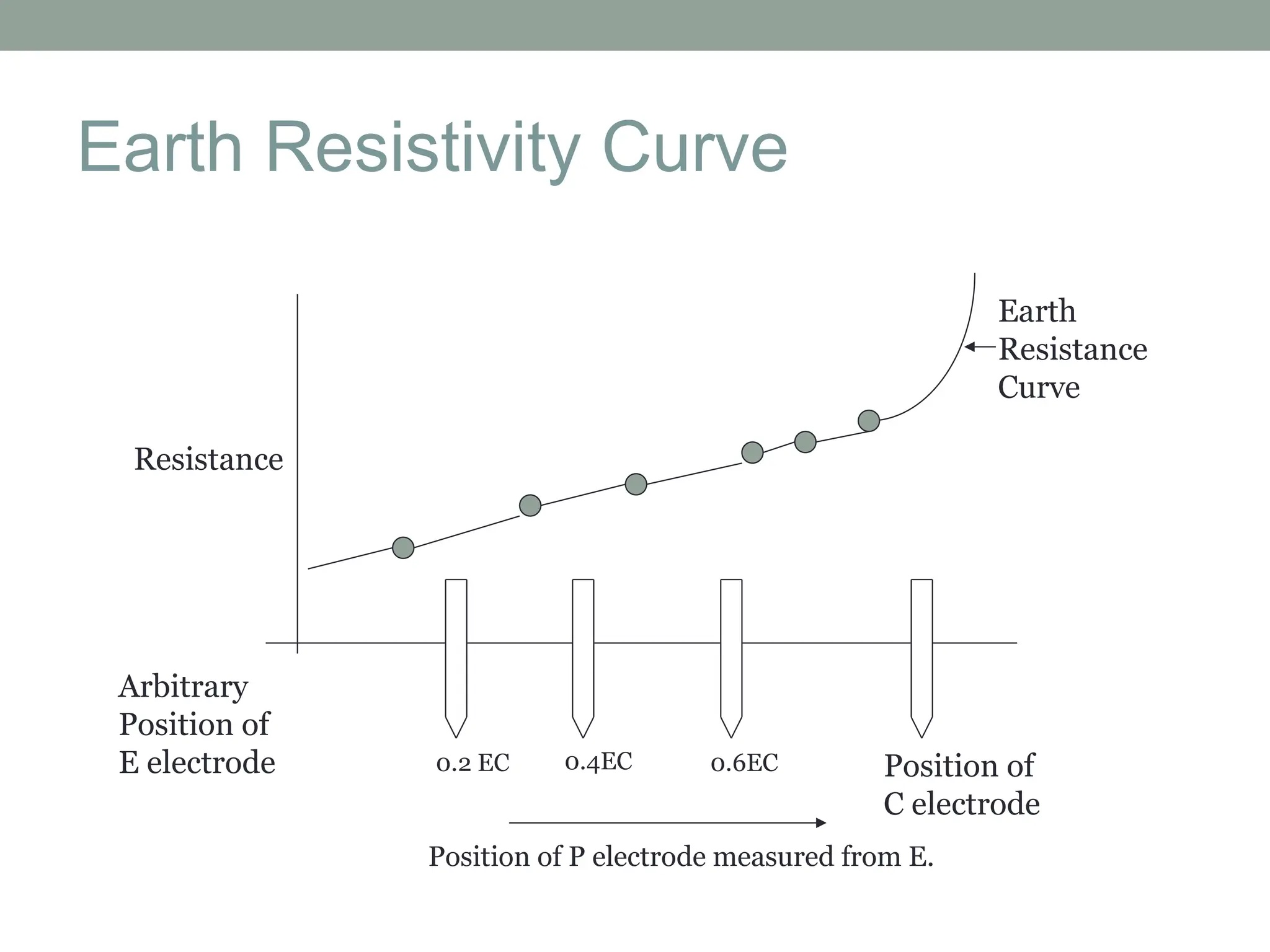
Earth Resistivity Curve
Resistance
Arbitrary
Position of
E electrode 0.2 EC 0.4EC 0.6EC Position of
C electrode
Position of P electrode measured from E.
Earth
Resistance
Curve
Slope Method
• Was established by Dr. G.F. Tagg. The following is the
summary of the paper published in IEE 1970.(Vol. No.
177, No. 11)
• This technique shall be used when testing earth electrode
systems which covers a large area.
• This method is useful when the position of the centre of
the earthing system is either unknown or inaccessible
(e.g. if the system is beneath the floor of a building). This
method yields results of greater accuracy than those
detailed above.
Slope Method - Procedure
The procedure is as follows:
 A) The terminals C1 & P1 on the instruments are connected to the earth electrode.
 B) Connect terminal C2 to a current electrode inserted in the ground 50m more or
away. The distance from the earth electrode to the current electrode is EC.
 c) The potential electrode connected to terminal P2, is inserted at
several positions between the earth and current electrodes, starting
from near the earth electrode. (The electrodes must be in a straight
line). At each position the resistance is measured and the earth
resistance curve is plotted from the results e.g., (as shown in fig) at
least 6 readings are needed. Drawing the curve will show up any
incorrect points which may be either rechecked or ignored
 D) From the curve the equivalent reading to potential electrode position
0.2EC, 0.4EC & 0.6EC can be found. These becomes R1, R2 & R3
respectively.
 E) Calculate the slope co-efficient µ.
Where µ= R3-R2
R2-R1
Slope Method - Procedure
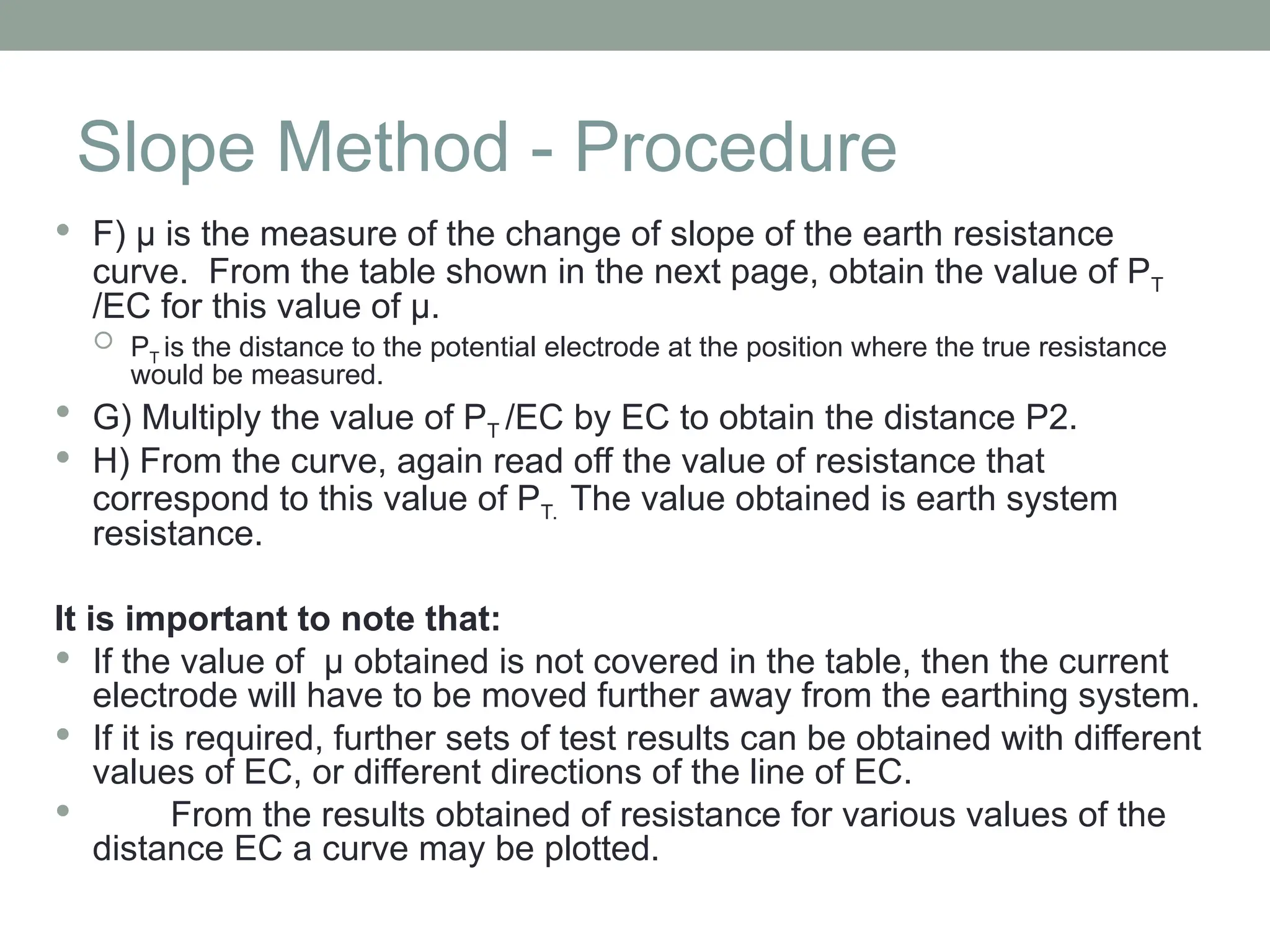
 F) µ is the measure of the change of slope of the earth resistance
curve. From the table shown in the next page, obtain the value of PT
/EC for this value of µ.
 PT is the distance to the potential electrode at the position where the true resistance
would be measured.
 G) Multiply the value of PT /EC by EC to obtain the distance P2.
 H) From the curve, again read off the value of resistance that
correspond to this value of PT. The value obtained is earth system
resistance.
It is important to note that:
 If the value of µ obtained is not covered in the table, then the current
electrode will have to be moved further away from the earthing system.
 If it is required, further sets of test results can be obtained with different
values of EC, or different directions of the line of EC.
 From the results obtained of resistance for various values of the
distance EC a curve may be plotted.
Slope Method
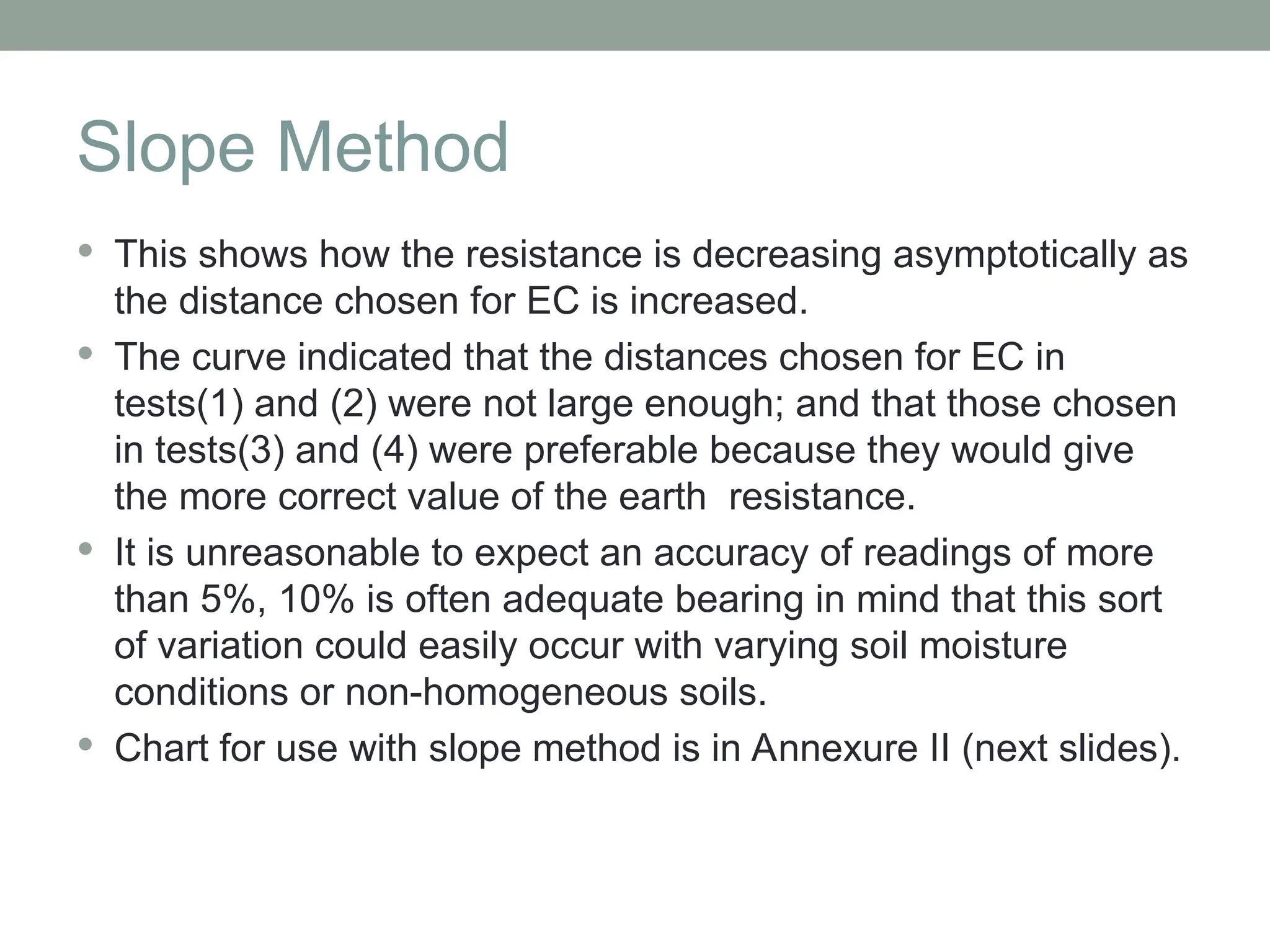
 This shows how the resistance is decreasing asymptotically as
the distance chosen for EC is increased.
 The curve indicated that the distances chosen for EC in
tests(1) and (2) were not large enough; and that those chosen
in tests(3) and (4) were preferable because they would give
the more correct value of the earth resistance.
 It is unreasonable to expect an accuracy of readings of more
than 5%, 10% is often adequate bearing in mind that this sort
of variation could easily occur with varying soil moisture
conditions or non-homogeneous soils.
 Chart for use with slope method is in Annexure II (next slides).
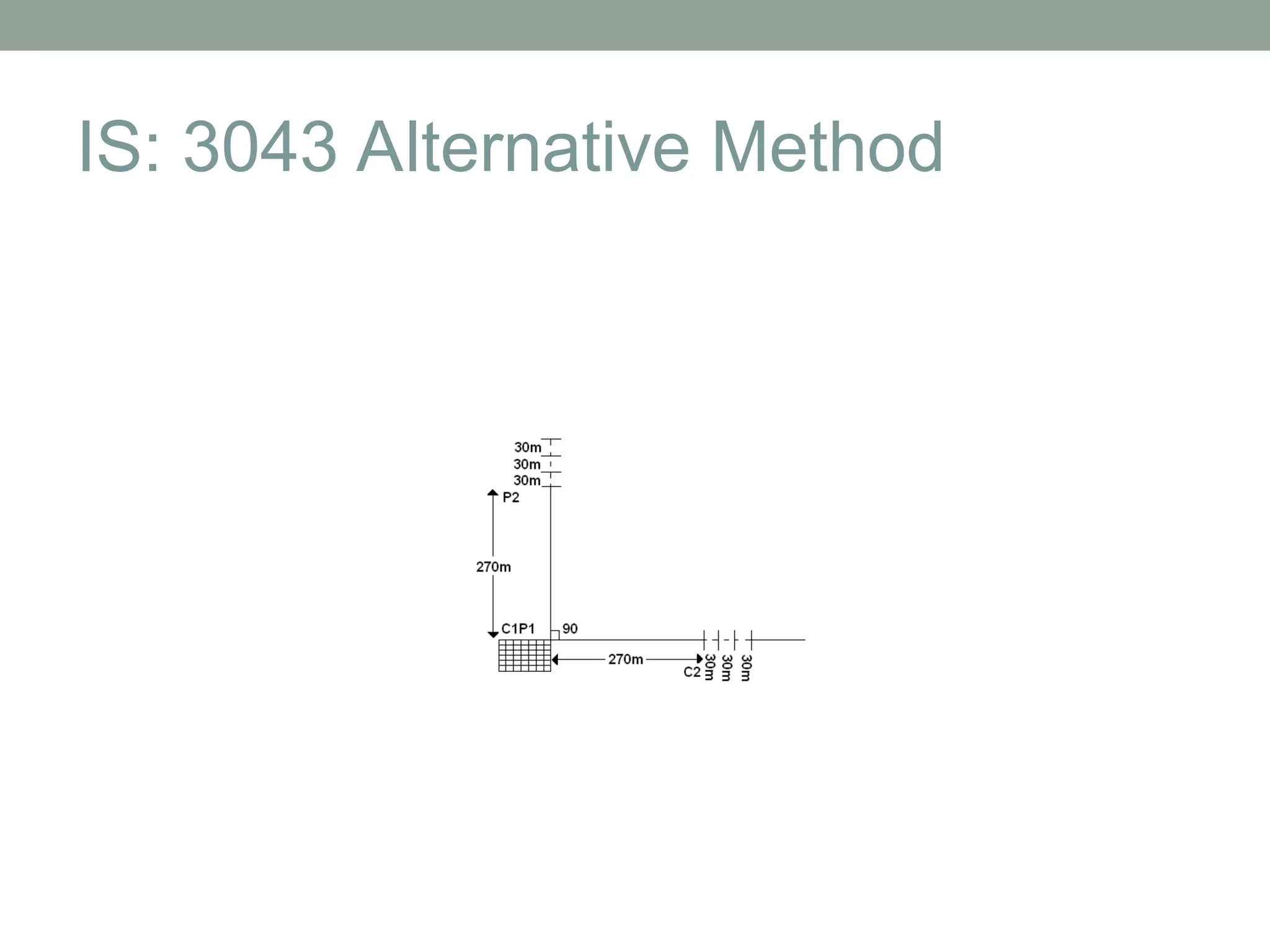
IS: 3043 Alternative Method
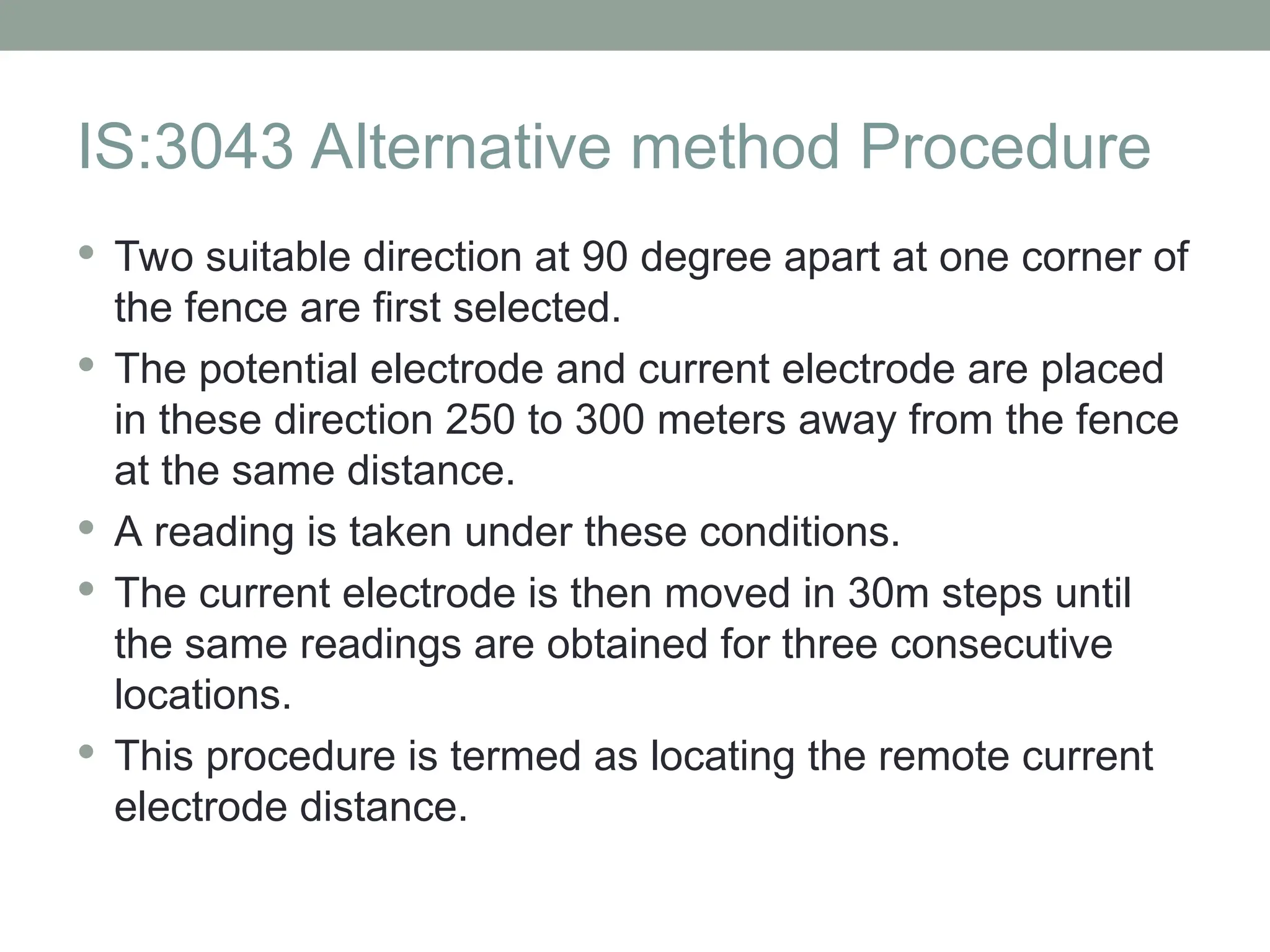
IS:3043 Alternative method Procedure
 Two suitable direction at 90 degree apart at one corner of
the fence are first selected.
 The potential electrode and current electrode are placed
in these direction 250 to 300 meters away from the fence
at the same distance.
 A reading is taken under these conditions.
 The current electrode is then moved in 30m steps until
the same readings are obtained for three consecutive
locations.
 This procedure is termed as locating the remote current
electrode distance.
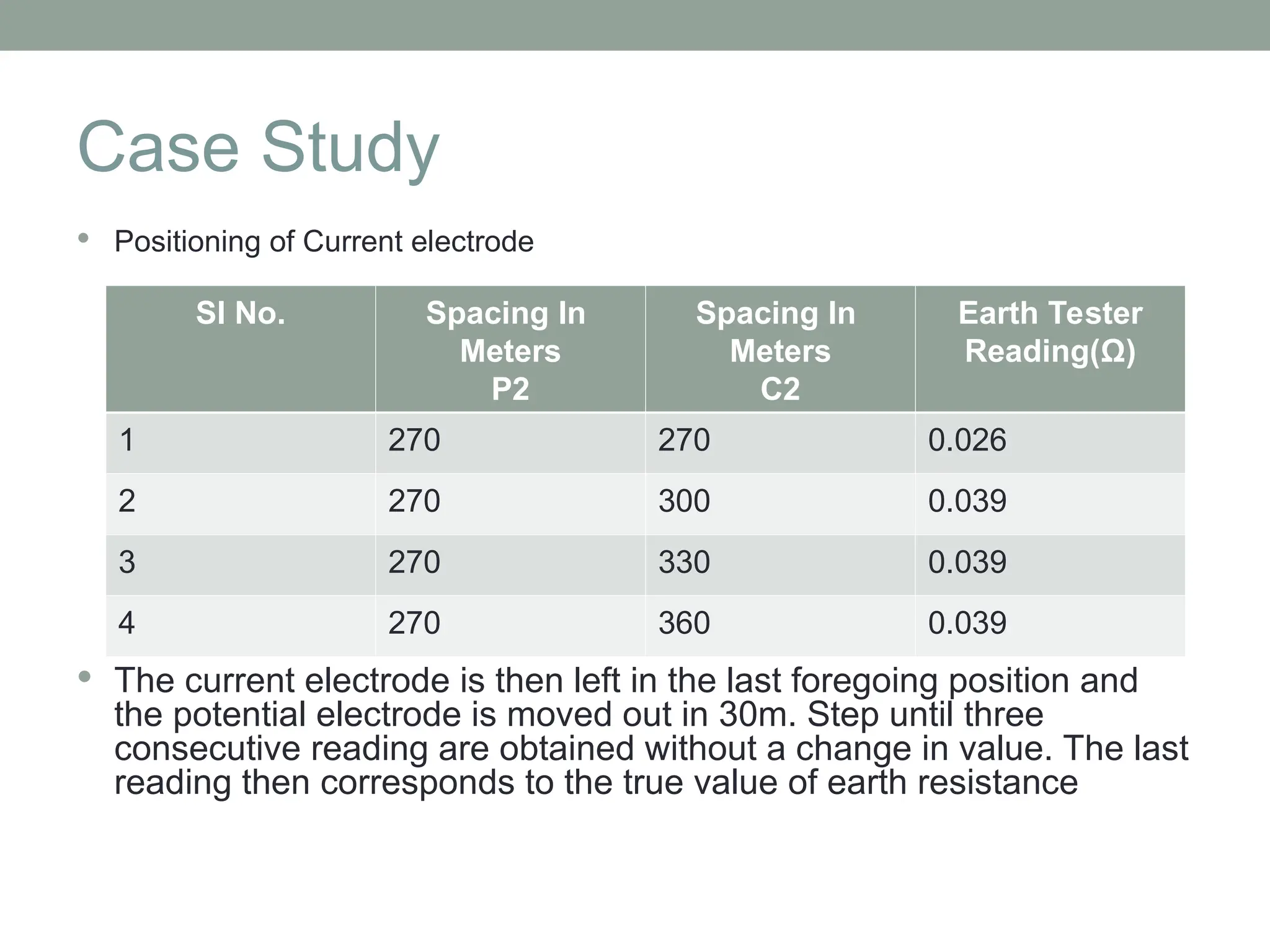
Case Study
 Positioning of Current electrode
 The current electrode is then left in the last foregoing position and
the potential electrode is moved out in 30m. Step until three
consecutive reading are obtained without a change in value. The last
reading then corresponds to the true value of earth resistance
Sl No. Spacing In
Meters
P2
Spacing In
Meters
C2
Earth Tester
Reading(Ω)
1 270 270 0.026
2 270 300 0.039
3 270 330 0.039
4 270 360 0.039
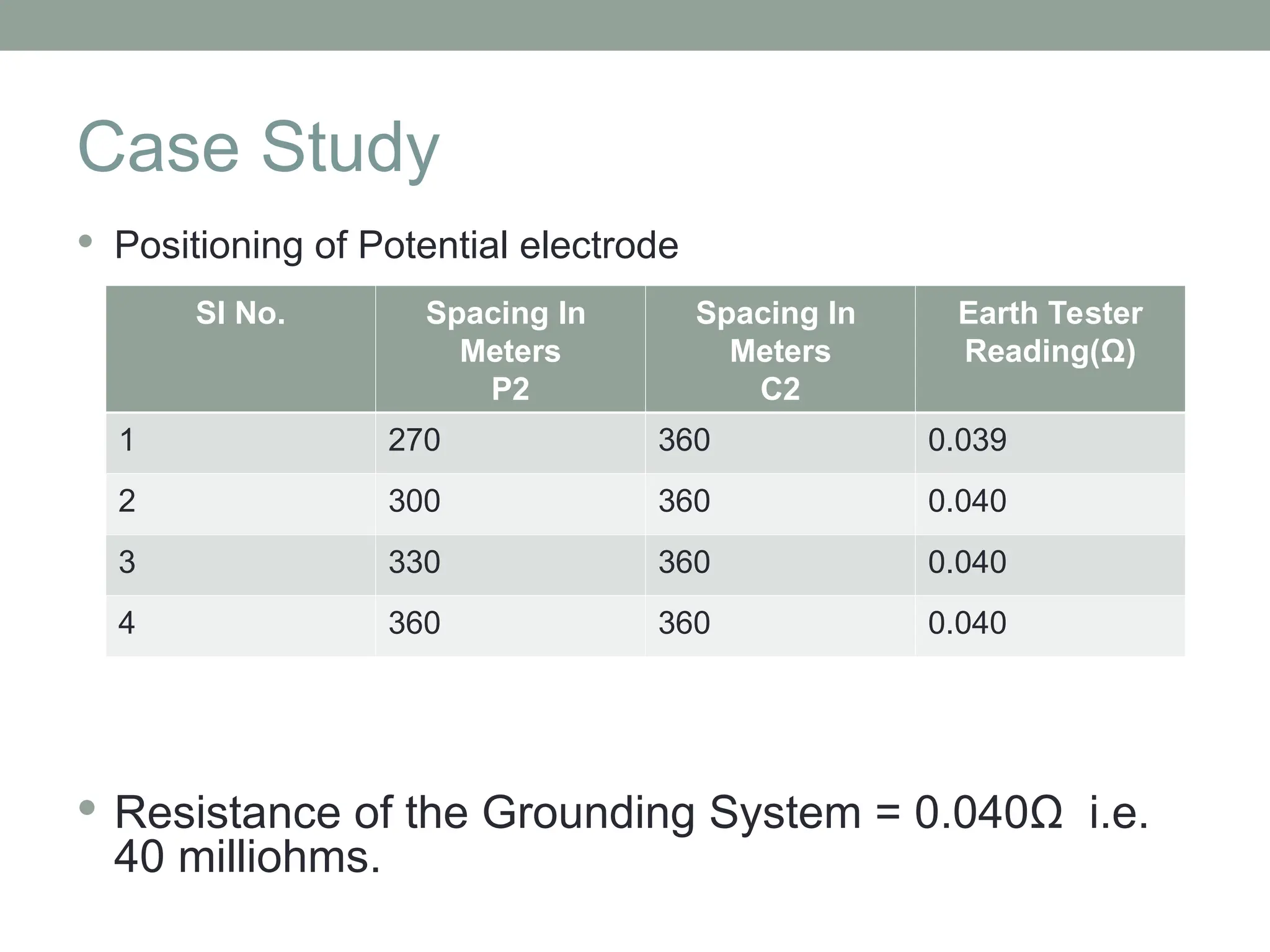
Case Study
 Positioning of Potential electrode
 Resistance of the Grounding System = 0.040Ω i.e.
40 milliohms.
Sl No. Spacing In
Meters
P2
Spacing In
Meters
C2
Earth Tester
Reading(Ω)
1 270 360 0.039
2 300 360 0.040
3 330 360 0.040
4 360 360 0.040
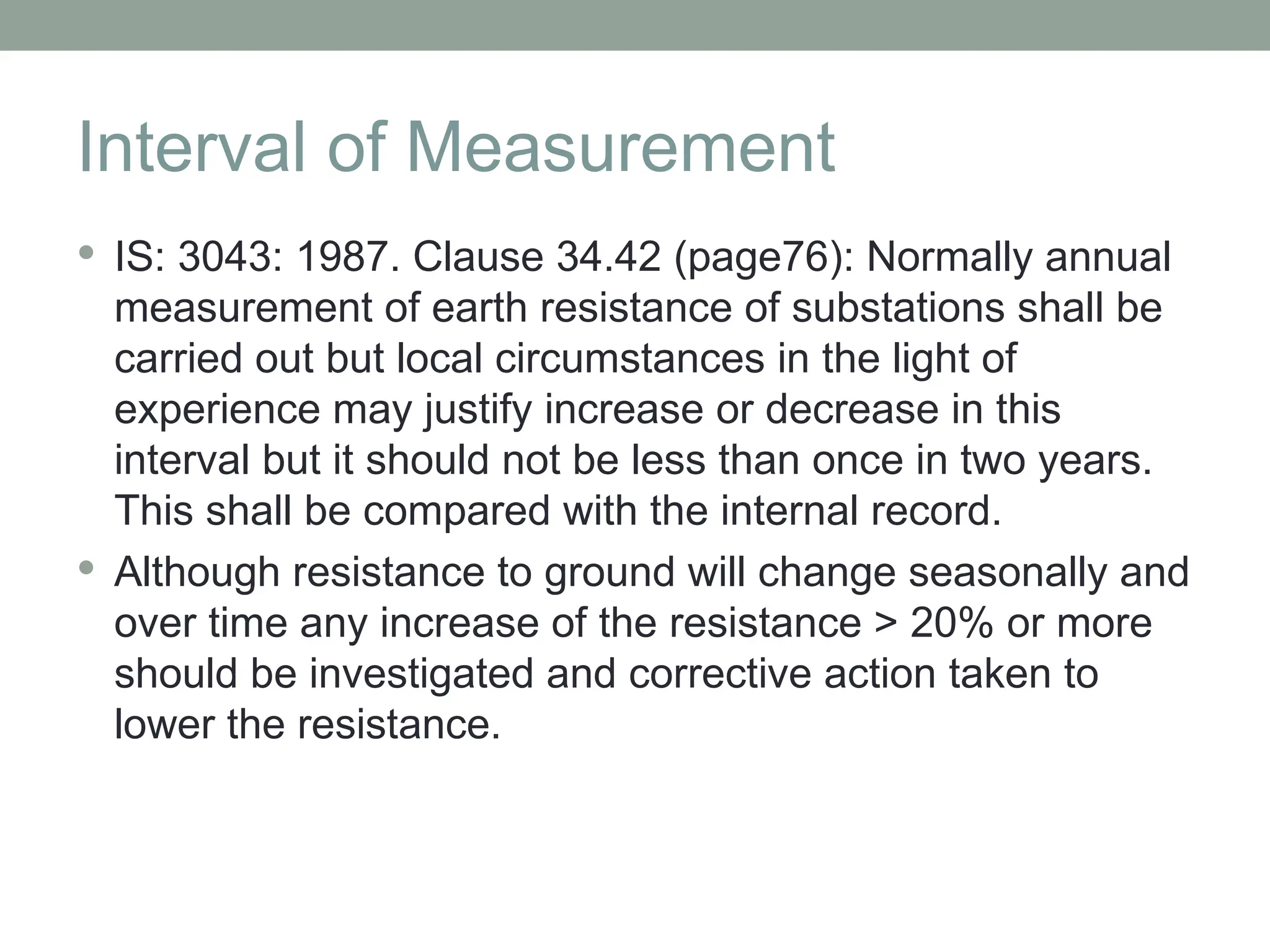
Interval of Measurement
 IS: 3043: 1987. Clause 34.42 (page76): Normally annual
measurement of earth resistance of substations shall be
carried out but local circumstances in the light of
experience may justify increase or decrease in this
interval but it should not be less than once in two years.
This shall be compared with the internal record.
 Although resistance to ground will change seasonally and
over time any increase of the resistance > 20% or more
should be investigated and corrective action taken to
lower the resistance.
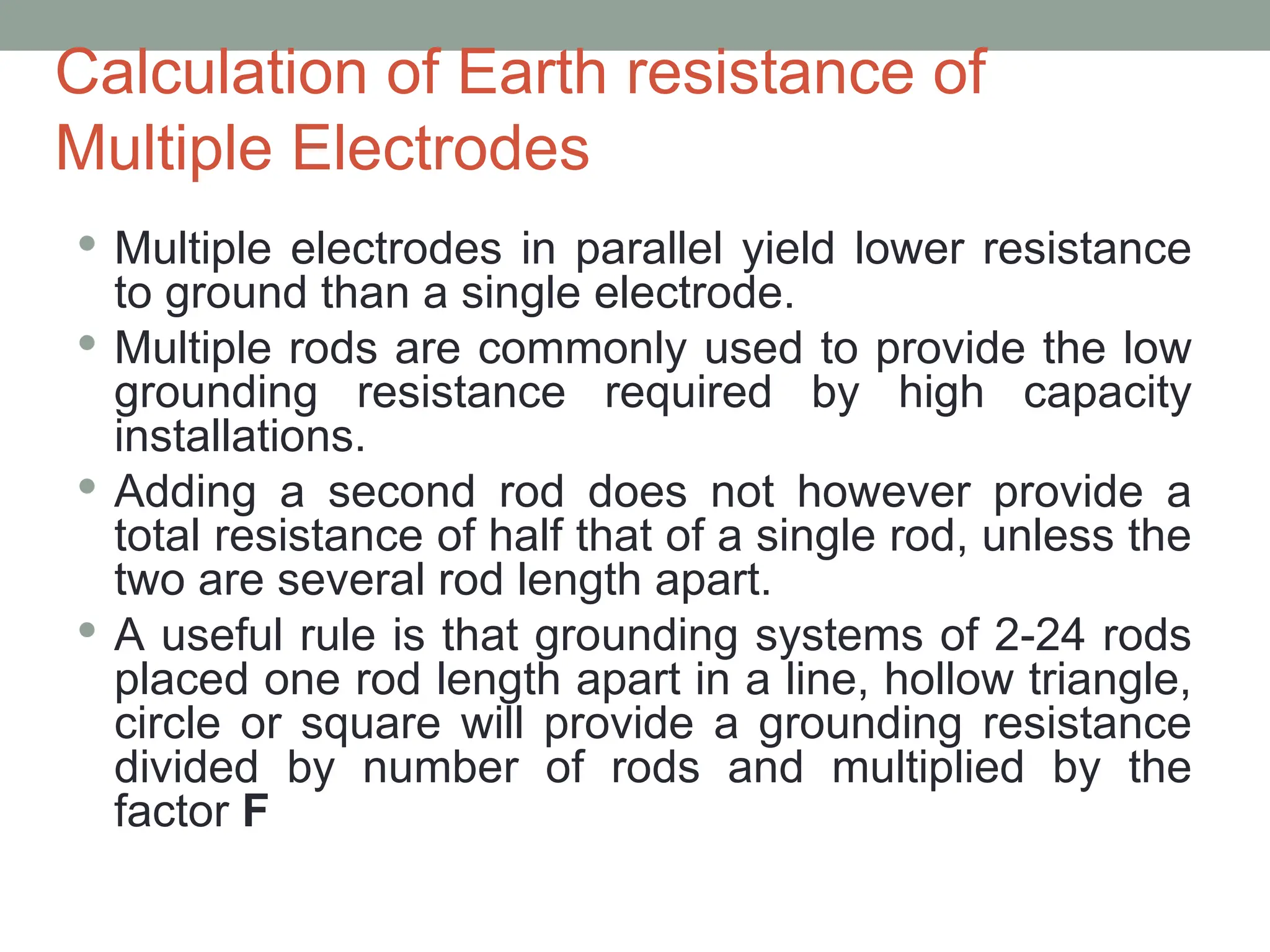
Calculation of Earth resistance of
Multiple Electrodes
 Multiple electrodes in parallel yield lower resistance
to ground than a single electrode.
 Multiple rods are commonly used to provide the low
grounding resistance required by high capacity
installations.
 Adding a second rod does not however provide a
total resistance of half that of a single rod, unless the
two are several rod length apart.
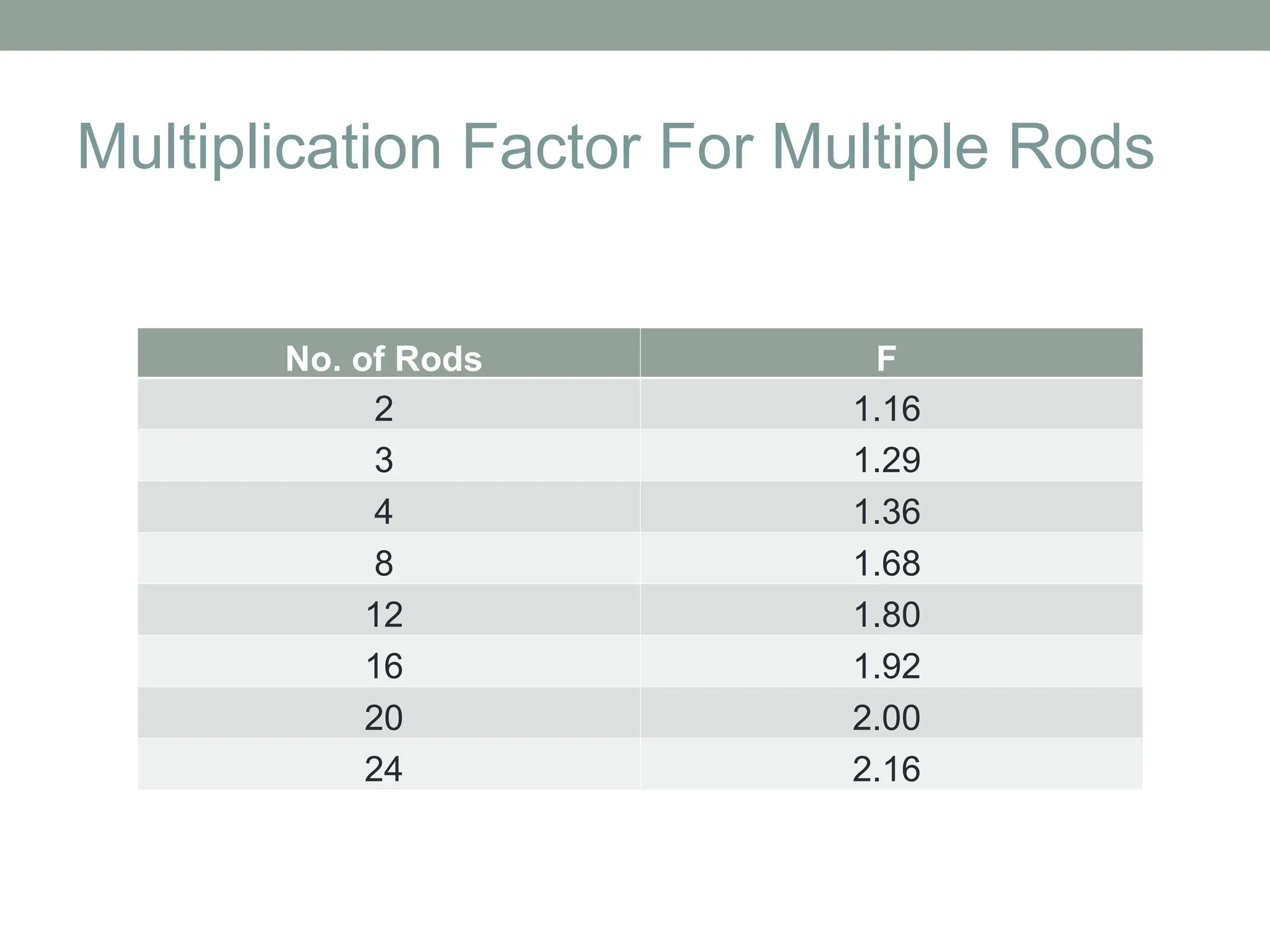
 A useful rule is that grounding systems of 2-24 rods
placed one rod length apart in a line, hollow triangle,
circle or square will provide a grounding resistance
divided by number of rods and multiplied by the
factor F
Multiplication Factor For Multiple Rods
No. of Rods F
2 1.16
3 1.29
4 1.36
8 1.68
12 1.80
16 1.92
20 2.00
24 2.16
Current Carrying Capacity
of Earth Electrode
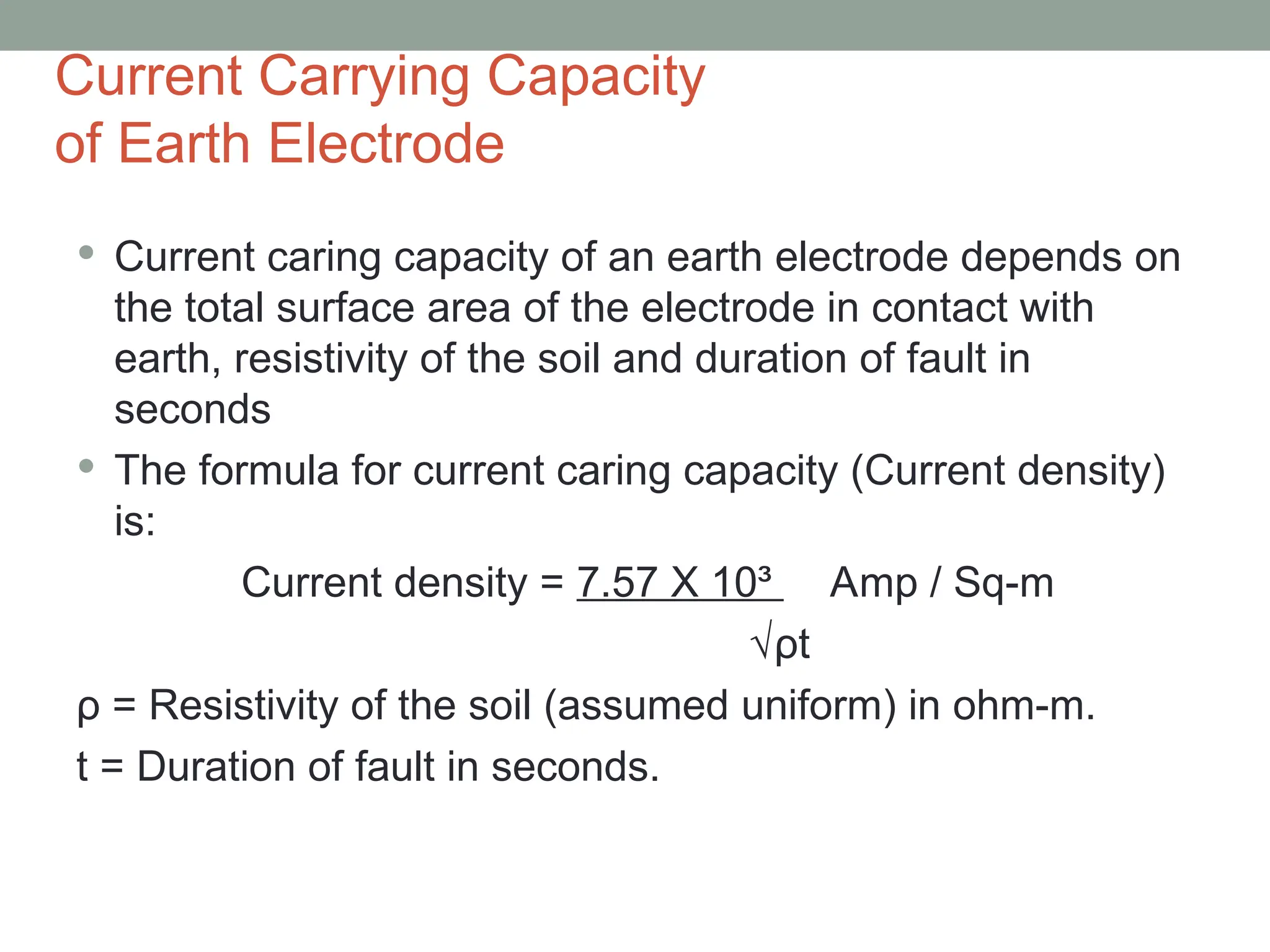
 Current caring capacity of an earth electrode depends on
the total surface area of the electrode in contact with
earth, resistivity of the soil and duration of fault in
seconds
 The formula for current caring capacity (Current density)
is:
Current density = 7.57 X 10³ Amp / Sq-m
√ρt
ρ = Resistivity of the soil (assumed uniform) in ohm-m.
t = Duration of fault in seconds.
Geometry &
Number of Electrodes required
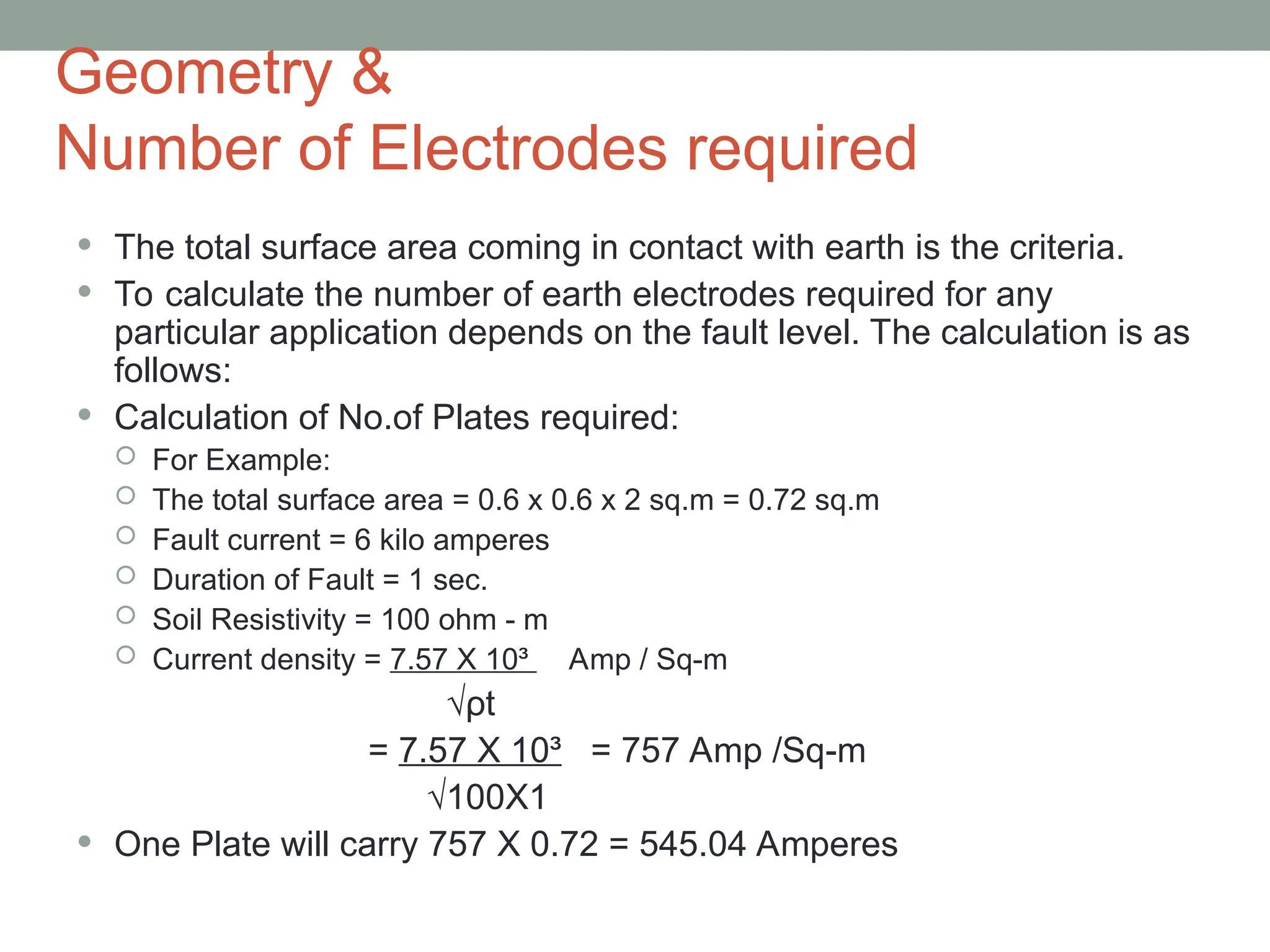
 The total surface area coming in contact with earth is the criteria.
 To calculate the number of earth electrodes required for any
particular application depends on the fault level. The calculation is as
follows:
 Calculation of No.of Plates required:
 For Example:
 The total surface area = 0.6 x 0.6 x 2 sq.m = 0.72 sq.m
 Fault current = 6 kilo amperes
 Duration of Fault = 1 sec.
 Soil Resistivity = 100 ohm - m
 Current density = 7.57 X 10³ Amp / Sq-m
√ρt
= 7.57 X 10³ = 757 Amp /Sq-m
√100X1
 One Plate will carry 757 X 0.72 = 545.04 Amperes
Geometry &
Number of Electrodes required
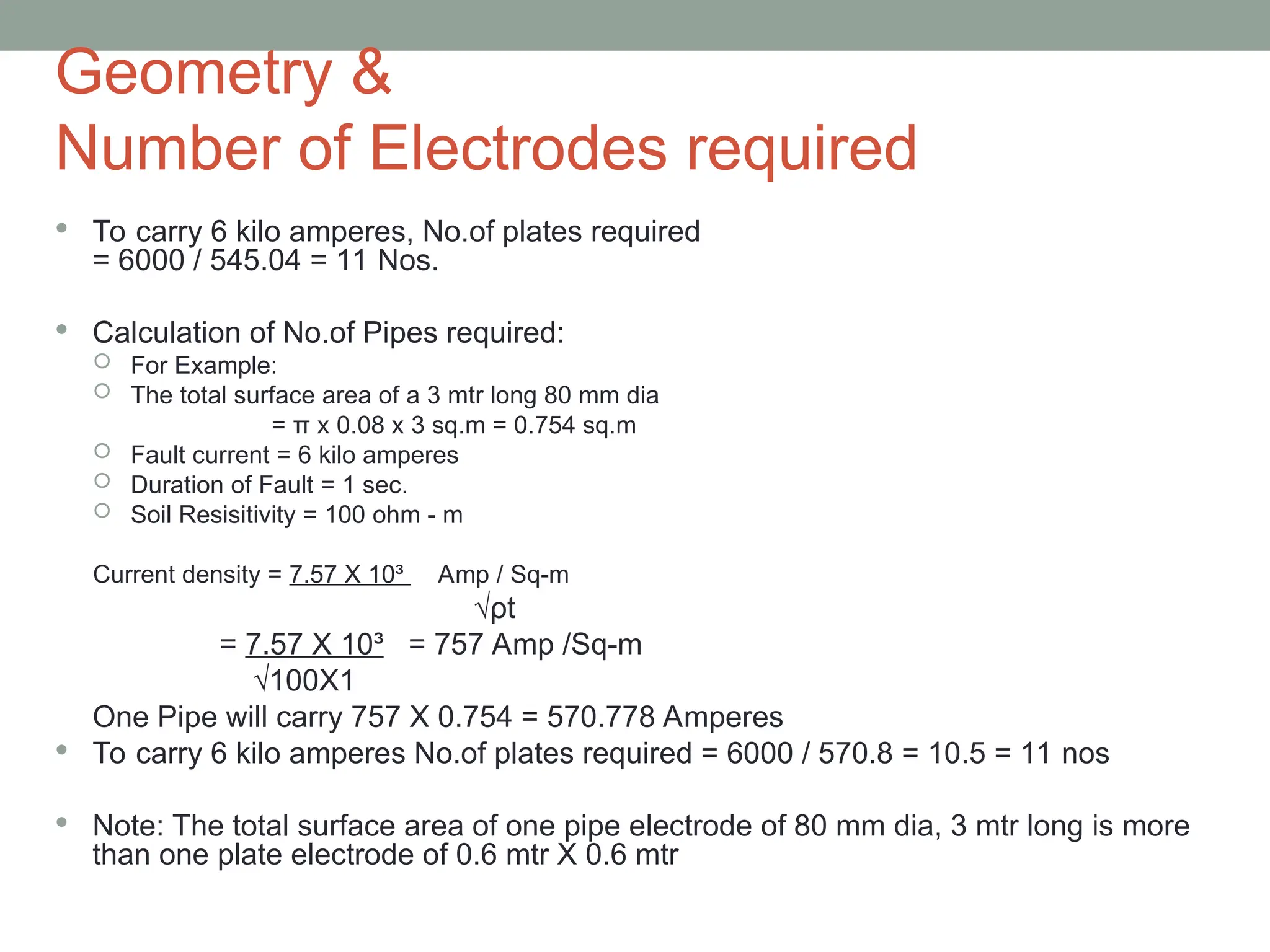
 To carry 6 kilo amperes, No.of plates required
= 6000 / 545.04 = 11 Nos.
 Calculation of No.of Pipes required:
 For Example:
 The total surface area of a 3 mtr long 80 mm dia
= π x 0.08 x 3 sq.m = 0.754 sq.m
 Fault current = 6 kilo amperes
 Duration of Fault = 1 sec.
 Soil Resisitivity = 100 ohm - m
Current density = 7.57 X 10³ Amp / Sq-m
√ρt
= 7.57 X 10³ = 757 Amp /Sq-m
√100X1
One Pipe will carry 757 X 0.754 = 570.778 Amperes
 To carry 6 kilo amperes No.of plates required = 6000 / 570.8 = 10.5 = 11 nos
 Note: The total surface area of one pipe electrode of 80 mm dia, 3 mtr long is more
than one plate electrode of 0.6 mtr X 0.6 mtr
Conductor Sizing
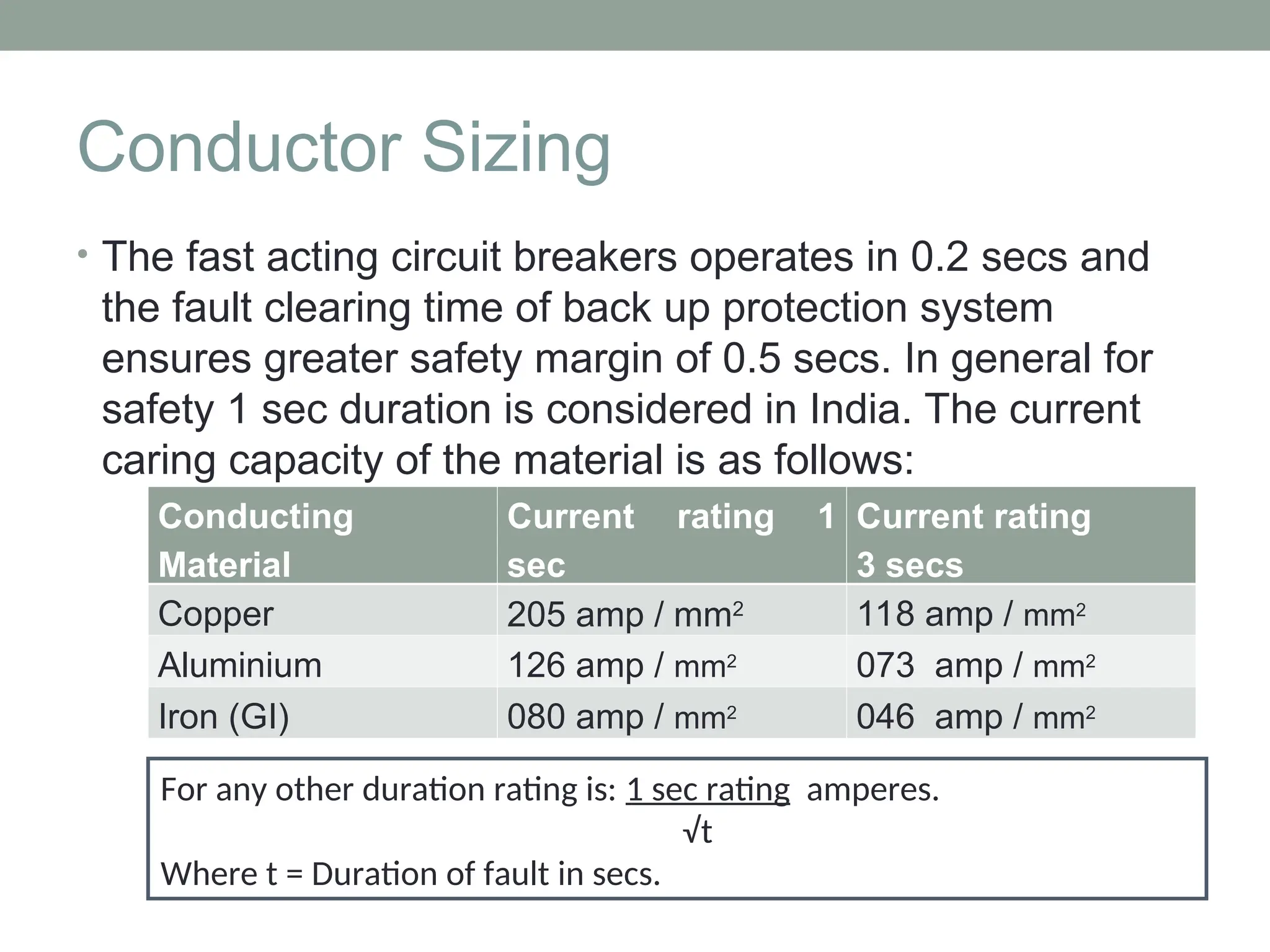
• The fast acting circuit breakers operates in 0.2 secs and
the fault clearing time of back up protection system
ensures greater safety margin of 0.5 secs. In general for
safety 1 sec duration is considered in India. The current
caring capacity of the material is as follows:
Conducting
Material
Current rating 1
sec
Current rating
3 secs
Copper 205 amp / mm2 118 amp / mm2
Aluminium 126 amp / mm2
073 amp / mm2
Iron (GI) 080 amp / mm2
046 amp / mm2
For any other duration rating is: 1 sec rating amperes.
√t
Where t = Duration of fault in secs.
Maximum Accepted Earth
Resistance
•References
•US AID INDIA Book
•Page 92 – Modernisation of power distributions
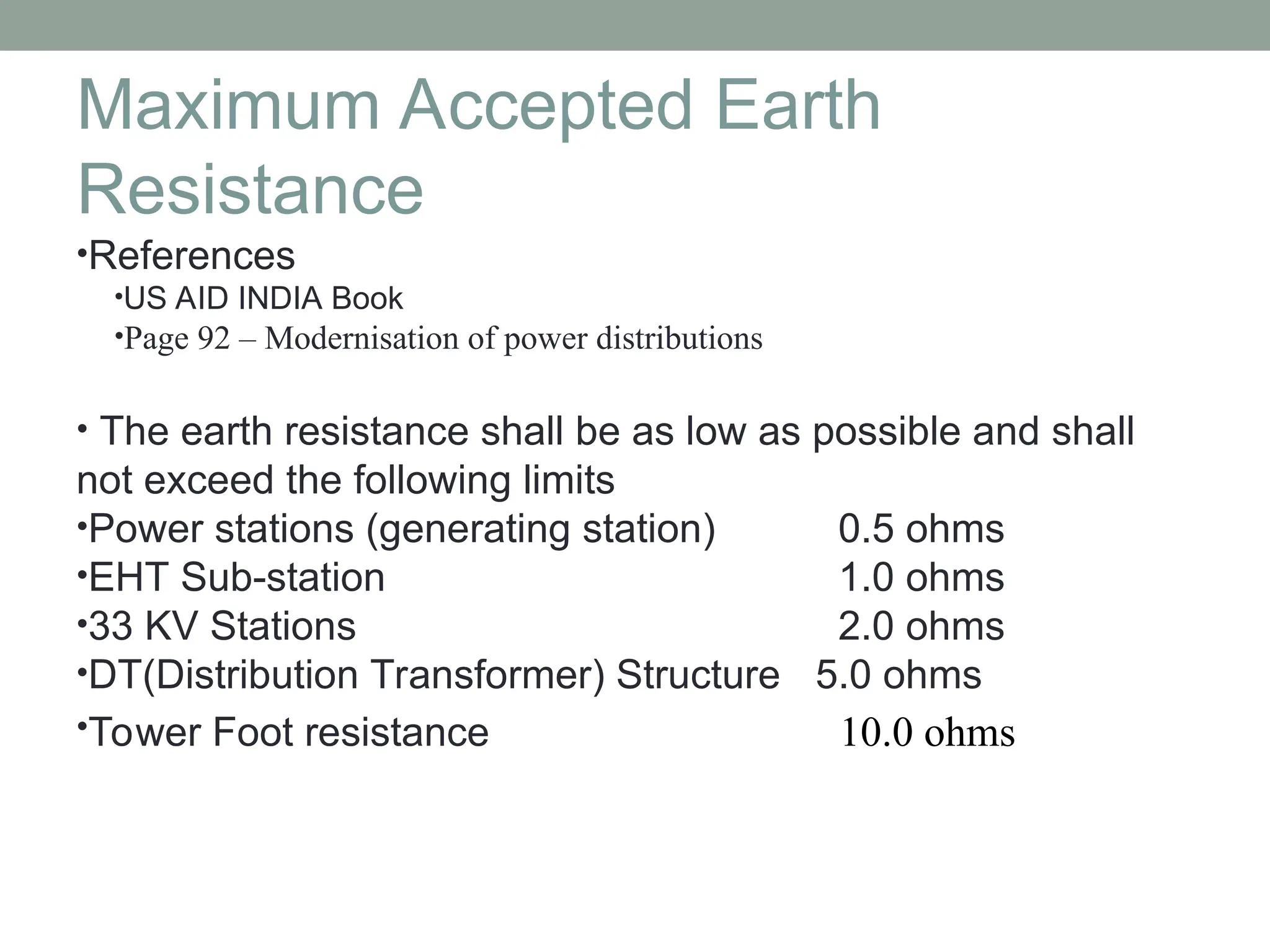
• The earth resistance shall be as low as possible and shall
not exceed the following limits
•Power stations (generating station) 0.5 ohms
•EHT Sub-station 1.0 ohms
•33 KV Stations 2.0 ohms
•DT(Distribution Transformer) Structure 5.0 ohms
•Tower Foot resistance 10.0 ohms
Maximum Accepted Earth
Resistance
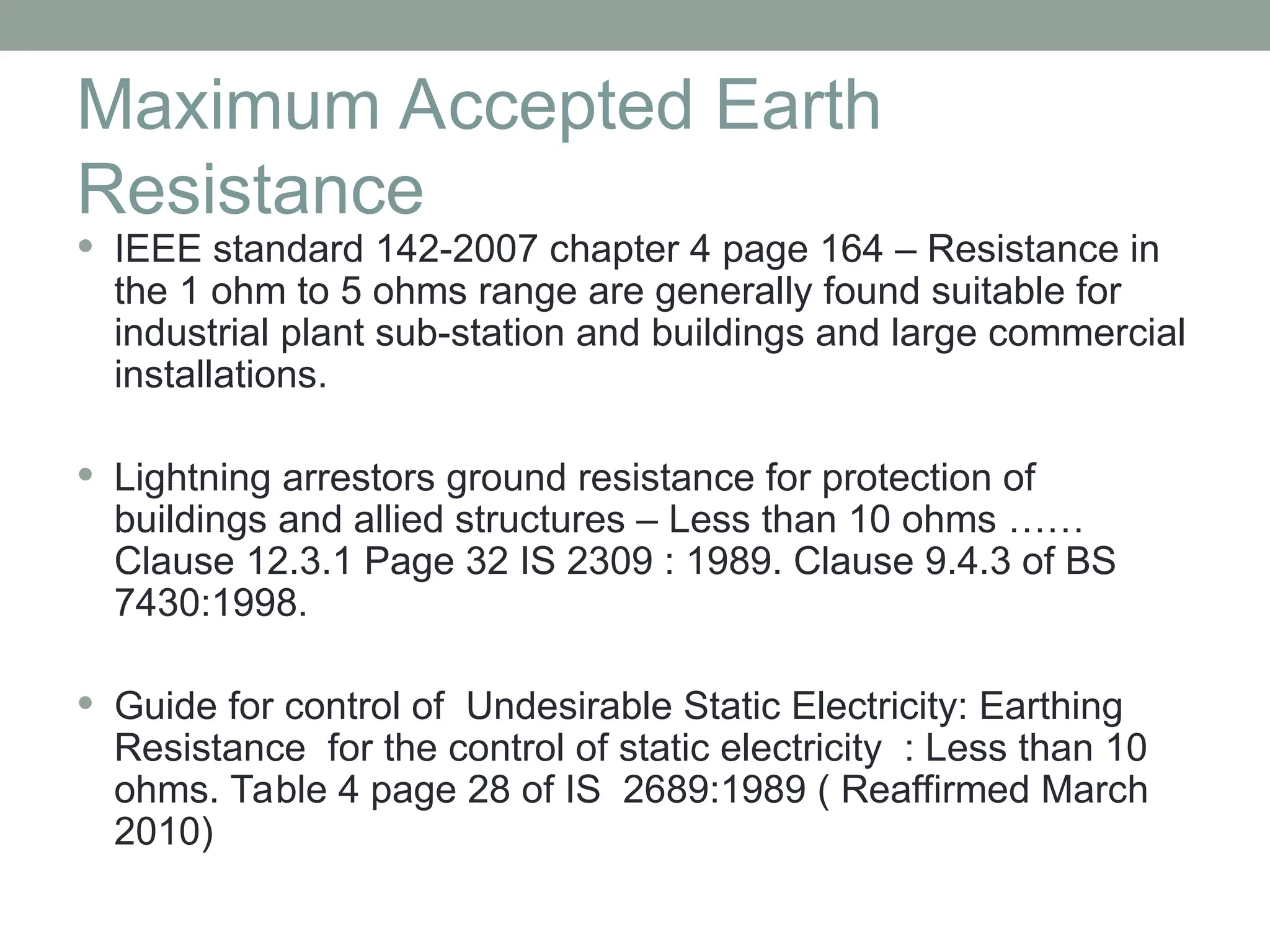
 IEEE standard 142-2007 chapter 4 page 164 – Resistance in
the 1 ohm to 5 ohms range are generally found suitable for
industrial plant sub-station and buildings and large commercial
installations.
 Lightning arrestors ground resistance for protection of
buildings and allied structures – Less than 10 ohms ……
Clause 12.3.1 Page 32 IS 2309 : 1989. Clause 9.4.3 of BS
7430:1998.
 Guide for control of Undesirable Static Electricity: Earthing
Resistance for the control of static electricity : Less than 10
ohms. Table 4 page 28 of IS 2689:1989 ( Reaffirmed March
2010)
Requirement of an
Embedding Material
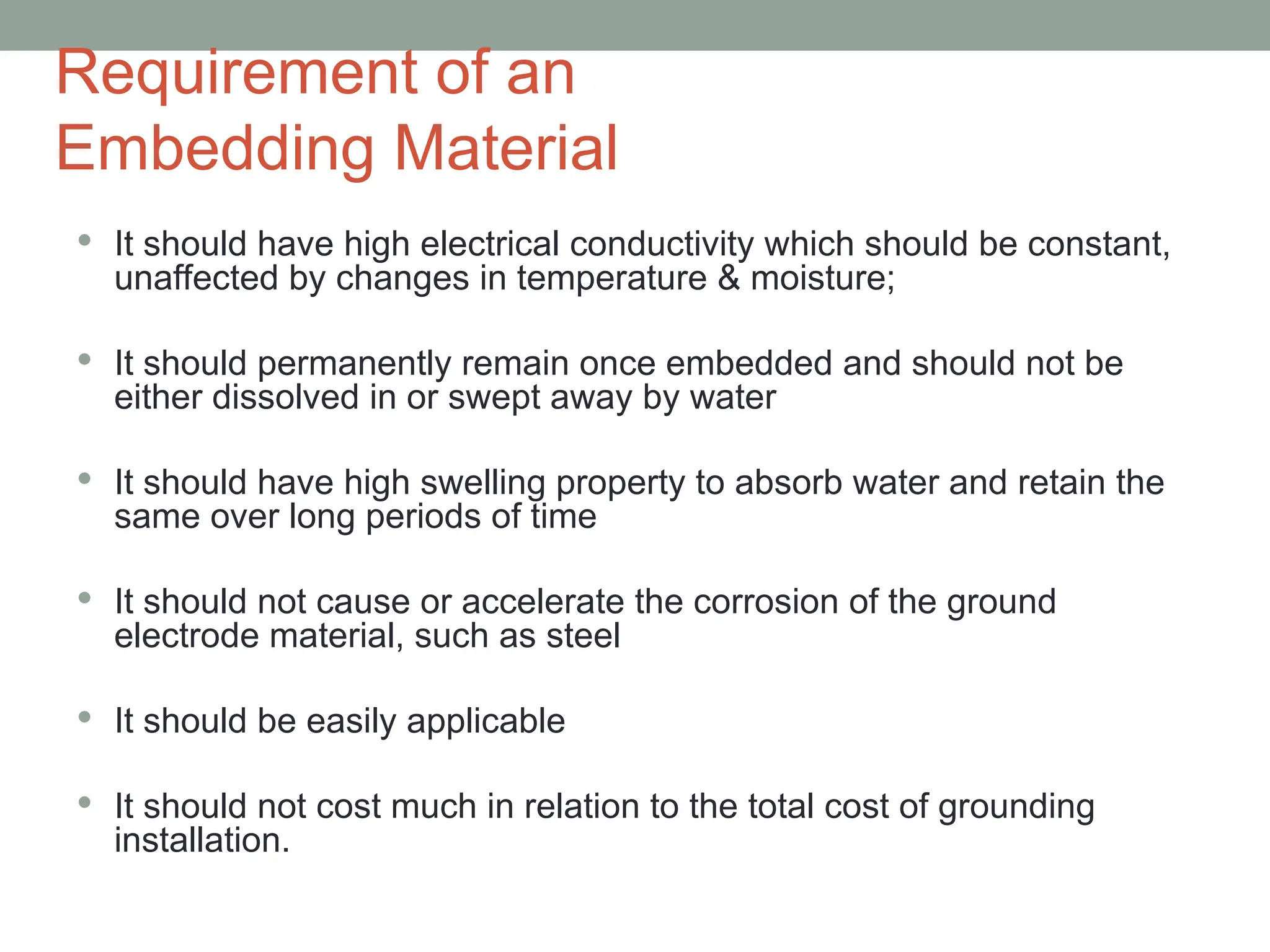
 It should have high electrical conductivity which should be constant,
unaffected by changes in temperature & moisture;
 It should permanently remain once embedded and should not be
either dissolved in or swept away by water
 It should have high swelling property to absorb water and retain the
same over long periods of time
 It should not cause or accelerate the corrosion of the ground
electrode material, such as steel
 It should be easily applicable
 It should not cost much in relation to the total cost of grounding
installation.
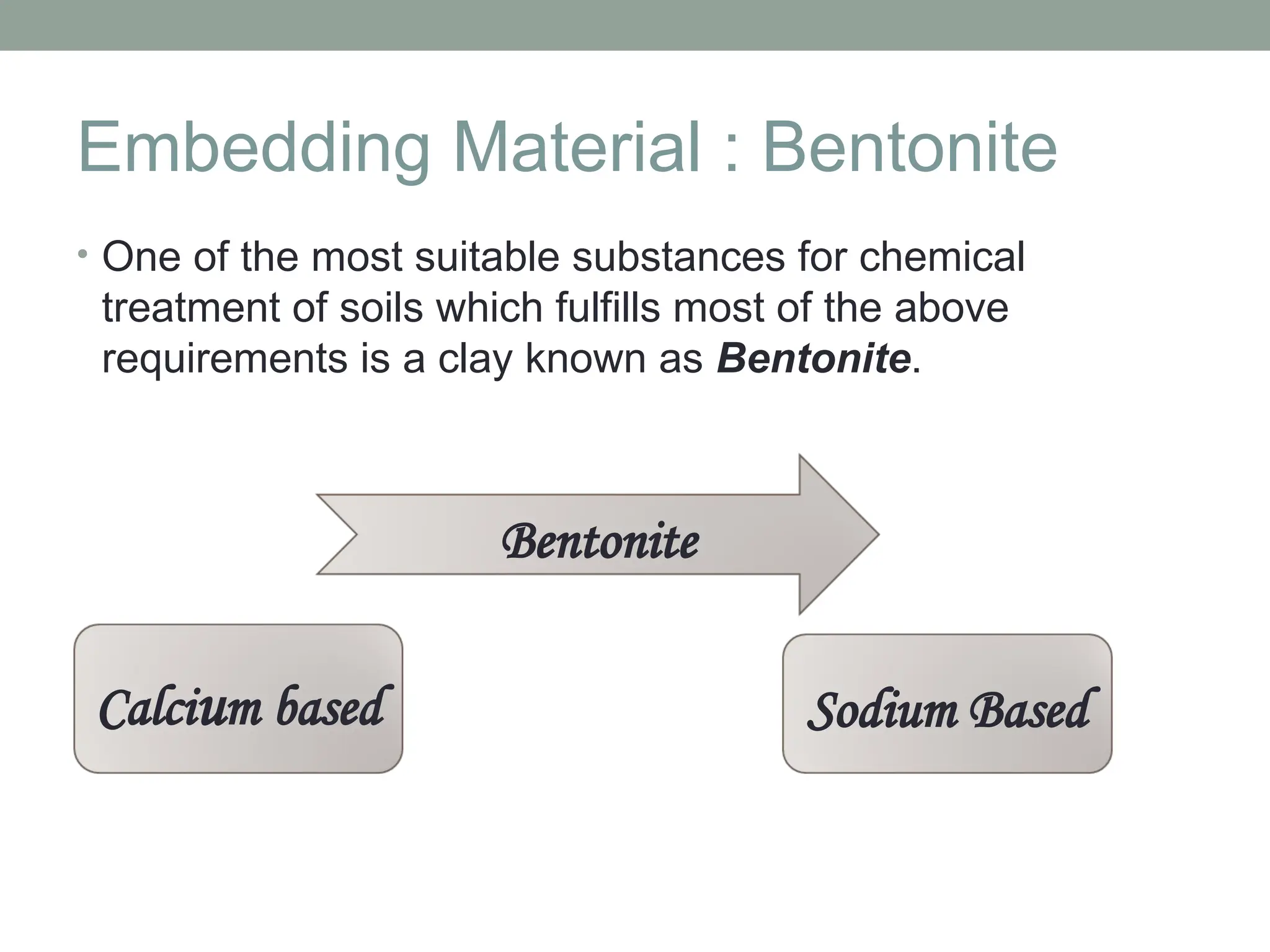
Embedding Material : Bentonite
• One of the most suitable substances for chemical
treatment of soils which fulfills most of the above
requirements is a clay known as Bentonite.
Bentonite
Calcium based Sodium Based
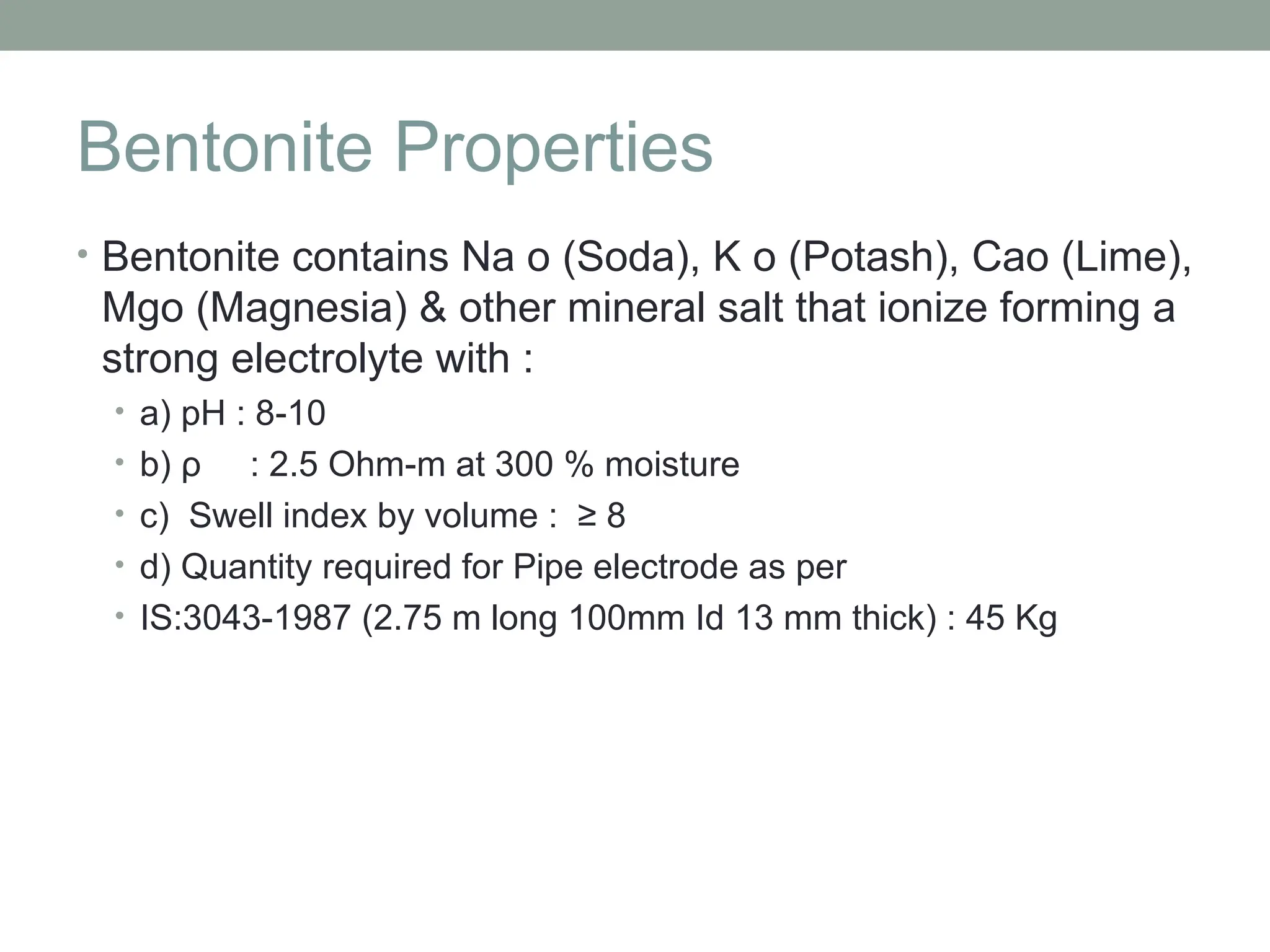
Bentonite Properties
• Bentonite contains Na o (Soda), K o (Potash), Cao (Lime),
Mgo (Magnesia) & other mineral salt that ionize forming a
strong electrolyte with :
• a) pH : 8-10
• b) ρ : 2.5 Ohm-m at 300 % moisture
• c) Swell index by volume : ≥ 8
• d) Quantity required for Pipe electrode as per
• IS:3043-1987 (2.75 m long 100mm Id 13 mm thick) : 45 Kg
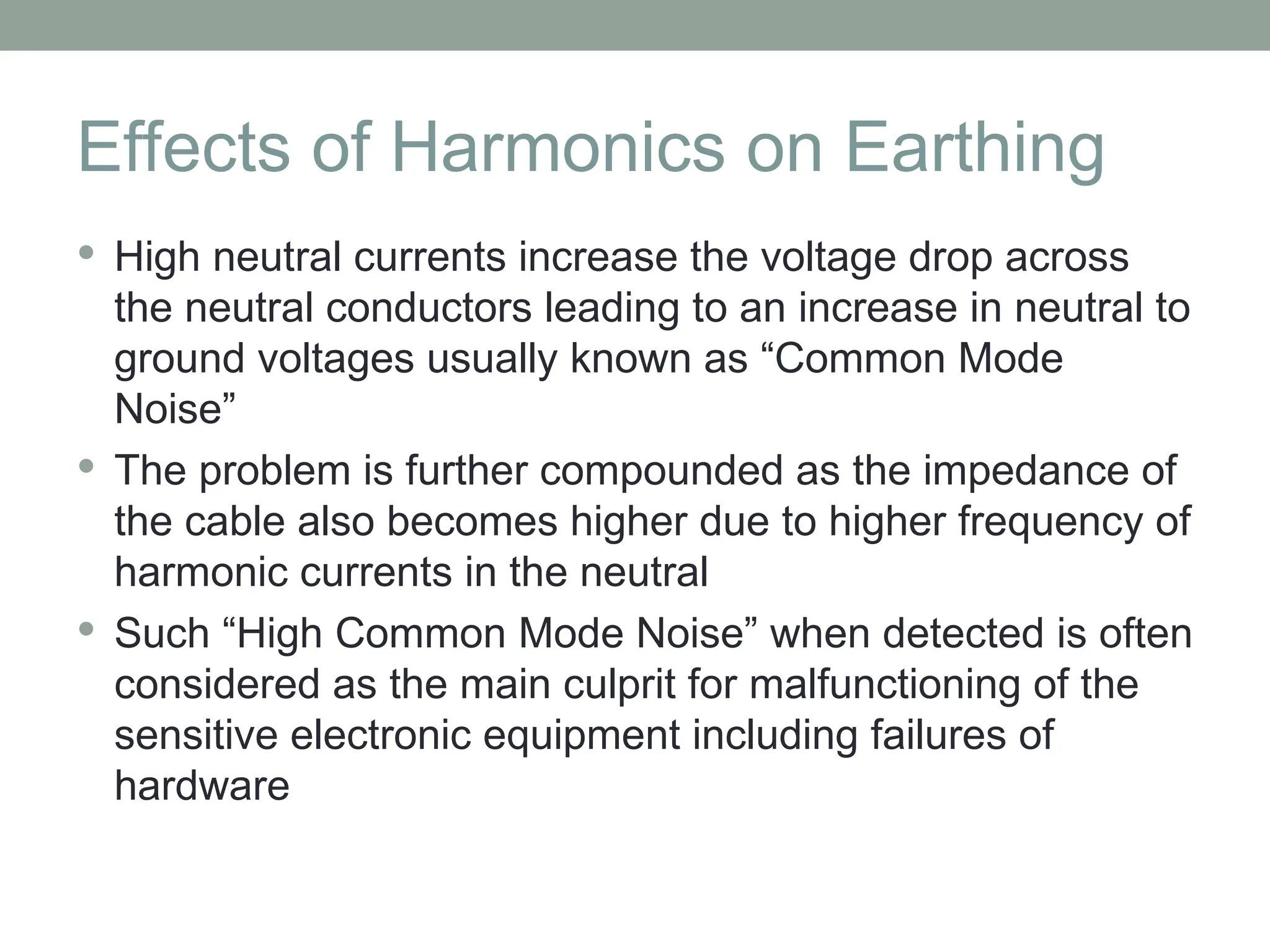
Effects of Harmonics on Earthing
 High neutral currents increase the voltage drop across
the neutral conductors leading to an increase in neutral to
ground voltages usually known as “Common Mode
Noise”
 The problem is further compounded as the impedance of
the cable also becomes higher due to higher frequency of
harmonic currents in the neutral
 Such “High Common Mode Noise” when detected is often
considered as the main culprit for malfunctioning of the
sensitive electronic equipment including failures of
hardware
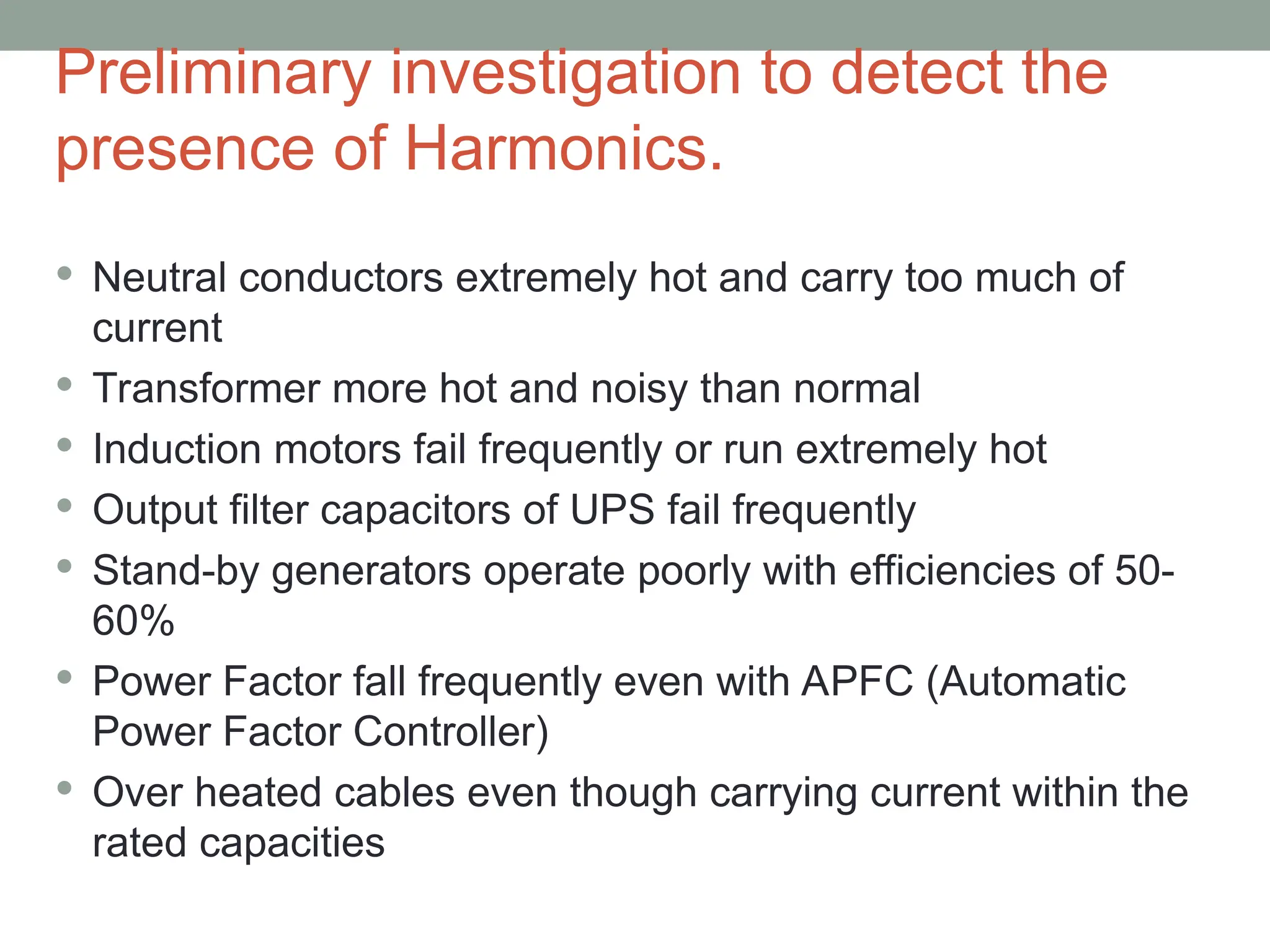
Preliminary investigation to detect the
presence of Harmonics.
 Neutral conductors extremely hot and carry too much of
current
 Transformer more hot and noisy than normal
 Induction motors fail frequently or run extremely hot
 Output filter capacitors of UPS fail frequently
 Stand-by generators operate poorly with efficiencies of 50-
60%
 Power Factor fall frequently even with APFC (Automatic
Power Factor Controller)
 Over heated cables even though carrying current within the
rated capacities
THANKS!

EarthingSystem_PPT sst in optcl substation.ppt

  • 1.
    IMPORTANCE OF GROUNDING IN POWERSYSTEMS By s S TRIPATHY POWER TRAINING CENTRE ,CHANDAKA OPTCL
  • 2.
    Objective of Earthing Prime Object of Earthing is to Provide a Zero Potential Surface in and around and under the area where the electrical equipment is installed.  Earthing is essential at every stage of electricity generation, transmission and utilization
  • 3.
    Importance of Earthing •Personal Safety • Protection of Equipment : Prevent or at least minimize damage to equipment as a result of heavy fault current and lightning thus improve the reliability of equipment • Protection of System : Improve the reliability of power supply.
  • 4.
    Earthing Standards  IS:3043 : 1966, 1987 reaffirmed 2006 Code of Practice for Earthing.  Indian Electricity rules 1956 (as amended up to 2000)  IS: 2309 1989 (reaffirmed 2005) Protection of Buildings and allied Structures against lightning – Code of Practice.  IS : 2689: 1989 (reaffirmed March 2010): Guide for Control of Undesirable static Electricity.  Manual on Earthing of AC Power Systems : CBIP Publication No.302 : 2007 and 311  BS: 7430 : 1998, Code of Practice for Earthing.( formerly CP 1013: 1965) British Standard Institution London 1992  BS: 6651: 1992, Protection of Structures. Against Lightning.  IEEE :80 : 2000( Revision of IEEE Std 80: 1986) Guide for Safety in AC Substation Grounding  IEEE :142 :2007(Revision of IEEE Std 142 :1991) Grounding of Industrial and Commercial Power System.  IEEE 1100 : 2005 (Revision of IEEE Std 1100 : 1999) Powering and Grounding Electronic Equipment
  • 5.
  • 6.
    Types of Earthing •Plate Earthing • Pipe/Rod earthing • Strip earthing • Mat earthing
  • 7.
    Materials used forEarthing Material Thickness Corrosion Density (gm/cc) Weight (kG) Copper 3 mm 0.2 % / yr 8.93 9.6444 GI 6 mm 0.5 % / yr 7.87 16.9992 Cast Iron 12 mm 2.2 % / yr 7.15 30.8880
  • 8.
    Plate Earthing • Plateearthing: Standard 1.2 mtr X 1.2 mtr • Generally only 0.6 mtr X 0.6 mtr is used • References • IS 3043 :1987 Clause 9.2.1 page 19 • IEEE 80 : 2000 Clause 14.2 ( 50) Page. 64
  • 9.
    Down Conductor • Downconductor material • Copper • Galvanized Iron (GI) Parameter Copper GI Minimum Size 25 mm X 3 mm 50 mm X 6 mm Initial Temperature 40 o C Final Temperature 395 o C 500 o C 1 Sec Rating (Amp / Sq mm) 205 80 3 Sec Rating (Amp / Sq mm) 118 46 100 µs Rating = Conductor size X [(1 Sec rating) / √(100 µs) ] (25 X 3 X 205) / √(0.000100)] = 1537.3 kA (50 X 6 X 80) / √(0.000100)] = 2400 kA Shape Shall be in the form of strip (flat) in order to reduce the inductance
  • 10.
    Plate earthing -Calculations • Ground Resistance (Rg) can be calculated as below • • Considering a plate of 600 mm X 600 mm • Considering a plate of 1200 mm X 1200 mm   A Rg   4 ρ = Resistivity of the soil (assumed uniform) in ohm-m A = Area of the Plate (both sides)     52.22 2.08885689 25 72 . 0 4 100 X Rg      26.11 1.04442844 25 88 . 2 4 100 X Rg 
  • 11.
    Pipe / RodEarthing • Pipe / Rod Earthing: Standard 3 mtr long • References • IS 3043: 1987 Clause 9.2.2 page 20
  • 12.
    Pipe/Rod Earthing -Calculations • Ground Resistance (Rg) can be calculated as • Considering ρ = 100 Ω-m, l = 300 cm, d = 4 cm   d l l Rg 4 log 2 100   ρ = Resistivity of the soil (assumed uniform) in ohm-m l = Length of the pipe/rod buried in the earth (in cm) d = Diameter of the pipe/rod ( in cm)      30.26 5 5.70378247 x 5.30516477 4 300 4 log 300 2 100 100 X X X X Rg 
  • 13.
    Pipe/Rod Earthing -Calculations  Considering ρ = 100 Ω-m, l = 300 cm, d = 8 cm  Change in Resistance between 40 mm & 80 mm diameter pipe/rod is = 30.26 – 26.58 x 100 = 12.16 % 30.26  Hence, doubling the diameter decreases the Ground resistance by 10 to 12%      26.58 4 5.01063529 x 5.30516477 8 300 4 log 300 2 100 100 X X X X Rg 
  • 14.
    Pipe/Rod Earthing -Calculations  Considering ρ = 100 Ω-m, l = 100 cm, d = 4 cm  Considering ρ = 100 Ω-m, l = 200 cm, d = 4 cm  Change in resistance when the length is doubled = 73.29 – 42.16 = 42.47 % 73.29  Change in resistance when the length is increased to 3 mtr = 73.29 – 30.26 = 58.71 % 73.29      73.29 4.60517018 x 15.9154943 4 100 4 log 100 2 100 100 X X X X Rg       42.16 5.29831736 x 7.95774715 4 200 4 log 200 2 100 100 X X X X Rg  Doubling the Length of burial decreases resistance by 40% and trebling the length of burial decreases the resistance by 60%
  • 15.
    Strip Earthing • Reference •IS 3043 :1987 Clause 9.2.3 page 21 • The ground resistance is calculated using • Combinations of strip & pipe/rod earthing can be done ρ =100 ohm-m L=1800 cm W=50 cm t=5 cm   wt l l Rg 2 2 log 2 100   ρ = Resistivity of the soil (assumed uniform) in ohm-m l = Length of the strip buried in the earth (in cm) w = depth of the burial (in cm) t = width of the strip (in cm) (incase rod is used, t = 2d)
  • 16.
    Combinations of strip& pipe/rod earthing can be done • ρ =100 ohm-m • L=300 cm            986 . 8 1628 . 10 8842 . 0 5 50 1800 1800 2 log 1800 2 100 100  g R
  • 17.
    d=4 cm Rg=30.26 ohm6m 6m 6m Re of rods=(30.26/3)x1.29=13.012 ohm Combind resistance of rod and strip =(1/13.012)+(1/8.986)=5.315 ohm
  • 18.
    Mat earthing  Isthe combination of Strip & Rod earthing  Reference  IEEE 80 : 2000 Clause 14.2 ( 51) Page 64 (Laurent & Newmann)  IEEE 80 : 2000 Clause 14.2 ( 52) Page 65 (Sverak)  Earth resistance can be calculated using Laurent & Niemann method as below (OR)  Earth resistance can be calculated using Sverak method as below       T T g l A l r R      4 4 )] / 20 1 1 1 ( 20 1 1 [ A h A l R T g     ρ = Resistivity of the soil (in ohm-m ) A = area of the station (in sq mtr) lT = Total length of the conductor (both strips & rods)    lt A Rg   443 . 0
  • 19.
    Calculation of Groundresistance of Grid Electrode • With-out & with ground electrodes • Considering Building of 80 m X 40 m, 50 mm X 6 mm GI strips laid 0.5 mtr depth & 0.5 mtr around the building • Total Length of Strip = 2 ( L + b ) = 2(81+41)= 244m • Soil Resistivity = 100 Ω–m       T T g l A l r R      4 4
  • 20.
    Calculation of Groundresistance of Grid Electrode  Using Laurent & Niemann method, Rg is calculated as below  With 24 nos of 3 mtr long 40 mm dia electrodes are connected to above mat at suitable places. The Ground resistance is = 0.76891884 +100/(244+72) = 0.768918845 + 0.316455696 = 1.085374541             178 . 1 0.40983606 0.76891884 244 100 41 81 4 100 4 4 X l A l r R T T g      
  • 21.
    Calculation of Groundresistance of Grid Electrode  Using Sverak method, the earth resistance is calculated as below  With 24 nos of 3 mtr long 40 mm dia electrodes are connected to above mat at suitable places. The Ground resistance is = 100 [ 1/(244+72) + 0.00761540 ] = 100 [0.010779956] = 1.0779956              1.1713762 ) 0.01171376 ( 100 ) 0.00761540 0.00409836 ( 100 )] 41 81 / 20 5 . 0 1 1 1 ( 41 81 20 1 244 1 [ 100 )] / 20 1 1 1 ( 20 1 1 [ X X X A h A l R T g 
  • 22.
    Ground resistance bySchwarz’s method • Reference • IEEE 80:2000 Clause 14.3 (53) Page 66 • Earth Resistance is calculated using the formula below 12 2 1 2 1 2 2 12 R R R R R R Rg     R1 = Ground Resistance of gird conductors in Ω R 2 = Ground Resistance of all ground rod in Ω R12 = Mutual Ground Resistance between the group of gird conductors R1 & group of ground Rods R2 in Ω
  • 23.
    Illustration Grid electrode inhigh soil resistivity area • Soil Resistivity : 1000 Ω mtr • Area Available : 160 mtr x 160 mtr • Desired Ground Resistance : < 1 Ω • Conductor Size : 50 x 6 Iron • The earth enhancing material used is Sodium based Bentonite. Encapsulation required is 150 mm all round the conductor. • The density of Bentonite : 2 gm /cc • By encapsulating as above, the ground resistance will decrease by 70%; I,e. actual ground resistance is 300 Ω mtr • Mesh size : 32 mtr x 32 mtr • No of Conductors in X direction : 6 • No of Conductors in Y direction : 6 • Total length of flat: 160 x 12 = 1920 mtr
  • 24.
    Illustration Grid electrode inhigh soil resistivity area 160 mtr 160 mtr 32 mtr 32 mtr
  • 25.
  • 26.
    Purpose  Resistivity: Is thefundamental property of the material  Soil Resistivity: Resistivity across 1 cubic unit of soil, expressed in Ω-mtr  Purpose:  Estimating the ground resistance of a proposed sub station of transmission n tower.  Estimating potential gradients including step and touch voltages.  Computing the Inductive coupling between neighboring power & communication circuits  Geological Surveys  Equipment Used:  Four terminal earth tester
  • 27.
    Type of Earthtesters Make Model Megger DET 2/2 UK. Fluke 1623 & 1625 USA / UK with current clamps. Chauvin Arnoux 6460, 6462 & 6470 FRANCE / UK with current clamps. Kew (Kyoritsu) 4106 JAPAN/ with current clamps.
  • 28.
    Comparison of Analog& Digital Testers Parameters Analog meter Digital meter Accuracy 5% of full scale and shall be effective above 25% of full scale. At 25% of reading absolute error is 20%. Not accurate and low resolution 2% of reading in entire range hence very accurate and high resolution Voltage 250V hand cranking Micro processor based 30 to 50 V automatic reading Frequency Fixed (60 to 90 HZ) Variable. In auto mode it selects test frequency with least amount of noise High Spike resistance Do not indicate Displays the high spike resistance. Open circuit Do not indicate Displays current circuit open/potential circuit
  • 29.
    Factors Affecting theSoil Resistivity • Type of the soil. • Moisture. • Dissolved salt in water. • Temperature. • Grain size and its distribution. • Seasonal variation. • Artificial treatment.
  • 30.
    Effect of EarthLayers  The measured apparent Resistivity depends on the Resistivity of the various materials through which the current passes, it is an average of all those Resistivity.  As the electrode spacing is increased, the current flows through a great volume of material; both, horizontally and vertically, and the deeper materials will have an effect on the apparent Resistivity.  Thus, if the deeper material is of higher Resistance(lower Conductance), the current flow lines will be deflected up- wards, and the current density in the near surface volume element will be increased.  If the deeper material is of lower Resistivity (higher Conductance), the current flow lines will be deflected down- ward and the current density will be decreased.
  • 31.
    Methods of measuringsoil resistivity  Equally spaced or Dr F.Wenner arrangement  Reference Clause 36 Page 77 to 79 IS3043 : 1987 Clause 7 .2.4 (1) Page 14 & 15 IEEE 81: 1983 Clause 9.2.1 Page 113 &114 CBIP PP No: 302 Clause 9.2.1 Page 113 &114 CBIP PP No: 302 Page .6 LEM  Unequally spaced or Schelumberger – Palmer Arrangement  Reference Clause 7 .2.4 (2) Page 15 IEEE 81: 1983 Clause 9.2 Page 116 CBIP PP No: 302  Central Electrode Method  Reference Clause 9.4 Page 124,125 CBIP PP No: 302
  • 32.
    Equally spaced (DrF. Wenner arrangement) ρ= 2  AR -M Earth Tester
  • 33.
    Unequally spaced (Schlumberger –Palmer Arrangement) ρ =  C ( C+d) * R / d -M Earth Tester
  • 34.
    Procedure for measuringSoil resistivity  A. For measuring soil resistivity at the site of a sub- station, measurements of resistivity are made along a number of radials of different locations, in the station area such that the whole area in which the earth electrodes are to be laid is covered. There ought to be a minimum of two radials at one location.  B. Spacing between the probes, which are hammered into the soil, shall be varied from the smallest value of about 0.5m or 1.0m to large value depending on the extent of the earth electrode and the conditions on the ground. Typically, if the extent of the station is 100m – 150m in the direction of the radial, the reading of the resistivity may be taken for probe spacing of 1m, 2m, 5m, 10m, 20m and 35m depending on the available space. The largest spacing may even be increased to 100m or more.
  • 35.
    Procedure for measuringSoil resistivity  c. In case the resistivity variation is large, at least five progressively increasing probe spacing are necessary to get good estimate of deeper layer parameters.  d. A few spoonfuls of water may be poured around the probe, which has been hammered into ground, to get good conductive connection between probe and soil around it.  e. The soil along the radials shall be free from buried conductive pipes, etc., and it shall not be recently filled and therefore not yet compacted.  f. In case the grid conductors have already been installed, resistivity measurements except those for small probe spacing in center of large meshes shall be affected. If soil is homogenous, measurements may be made outside the grid
  • 36.
    Procedure for measuringSoil resistivity  g. In case the earth at the site of measurement is rocky, it may not be possible to hammer the probes into ground, if attempt is made to hammer a probe into ground, cracks may develop around the point of entry of the probe into ground. This results in high contact resistance in the current or the potential loop and shall result in erroneous results. A good digital earth tester shall have an indicator for high current loop resistance or high contact resistance at potential probes. If cracks develop around the probe, the hole shall be filled with wet mud and the probe shall be stood in the mud. In case probes cannot be hammered into ground, holes shall be drilled into ground and these may be filled with mud or cement or Bentonite slurry into which the probes are erected.  h. Test wires shall be insulated and shall not have joints in between. These shall be firmly connected to terminals of earth resistance meter and test electrodes.  i. As far as possible wires from potential terminals may not run parallel to and near those from current terminals.
  • 37.
    Procedure for measuringSoil resistivity  j. Test electrode shall be clean and free from rust.  k. Hammering of electrodes shall not result in loosening of connection between electrode and its test leads and thereby an increase of contact resistance between test lead and electrode.  l. Local soil condition such as surface rock, loose soil, water logging, roadside, etc., at measurement point shall be recorded in measurement book for ease of interpretation of measured data.  m. Resistivity value shall be calculated after each observation. In case there is an abrupt variation in measured resistivity, measurement for that probe spacing shall be repeated after altering the probe location.  n. Accuracy of earth resistance meter shall be checked before and after the measurements as per procedure given under:
  • 38.
    Alternative electrode connection ElectrodeArrangement Resistivity Formula C P P C ρ = 2πaR1 P C C P C C P P ρ = 6πaR2 P P C C C P C P ρ = 3πaR3 P C P C  As long as the electrode spacing is kept constant, the above equation is independent of the positions of the electrodes and is not affected when the current & potential electrodes are interchanged  E.g CPPC to PCCP (or) CCPP to PPCC (or) CPCP to PCPC
  • 39.
    Comparison of Wenner& Schlumberger Methods • Interpretation of the reading is more complicated. A more sensitive instrument is required for the Schlumberger configuration than for the Wenner arrangement • The Wenner arrangement is probably more suitable for the non specialist and the occasional user of Resistivity surveys • Schlumberger method is more faster than Wenner’s method since only two electrodes position have to be changed. i.e, Current electrodes
  • 40.
    Central Electrode Method c b a ss s Earth Tester ground d p P 1 P2 C2 C1
  • 41.
    Central Electrode Method In this method, two current electrodes are buried a large distance apart.  The two potential electrodes are placed at distances ‘a’m and ‘b’m from one of the current electrodes as shown in previous slide.  The distance ‘c’ between current electrodes shall be about 10 times the distance ‘b’ or more.  ρ = 2π a b R (b-a) Where ‘R’ is the meggar reading in ohms. In this method only the current electrode and the two potential electrodes buried near it are to be in a straight line, the far current electrode is buried at a radial distance ‘c’ from the first current electrode and need not be in a straight line with the other three electrodes. The soil resistivity is obtained to a depth of approximately (a+b) / 2 m from the surface where the first three electrodes are buried. If any observed soil resistivity for a probe spacing is found to be too high or too low compared with resistivity for the next larger probe spacing along that radial, it may be judiciously ignored when determining the soil model
  • 42.
    Case Study 1 •Conducted in Nainital on 02/06/2010 • Consideiring A = 1m, B = 2m, C = 20m 5 m 5 m 5 m 65.0 65.7 65.5 65.2 65.4 C 2π (1 x 2 ) x 65 = 816.814 Ω - m 2 - 1 Depth = (1+2) = 1.5 m 2
  • 43.
  • 44.
    Purpose  Ground Resistance: Resistanceoffered to the nearest earth  Purpose  Verify the adequacy of a new grounding system  Detect changes in an existing grounding system  Determine hazardous step & touch voltages  Determine ground potential rise (GPR) in order to design protection for power & communication circuits  Performance of an earthing system can be evaluated  Equipment Used: Three terminal earth tester. In case of four terminal earth tester, C1P1 is shorted to make it three terminal earth tester.
  • 45.
    Factors impacting grounding system Water table variations will occur due to seasonality.  Corrosion of the grounding conductors and materials.  Contamination of the soil and surroundings from spillage such as chemicals, oils (1500 x 10¹² for new oil and 45 to 100 x 10¹² for old oil), acid, etc.  Mechanical Integrity  Electrical Integrity  Improper Maintenance.
  • 46.
    Measurement Pre-requisites • Cleanthe electrode thoroughly and check the continuity to the opposite side of the electrode • Measure the voltage between C1P1 and P2 or C1P1 and C2. The voltage should not exceed the limit mentioned in the catalogue of the Earth Tester • The thumb rule is; the remote electrode shall be 10 times the depth of the burial of the electrode or 10 times the longest distance in the earth-mat or any configuration
  • 47.
    Precautions to betaken for Measuring Ground Resistance  Avoid taking measurement during cloudy day  There is a possibility of lethal potential existing between a station ground & a remote Ground.  If a system fault involving the station ground occurs while ground resistance is being measured. The use of Rubber gloves is advisable while making connections to the test electrode.  Under no circumstances should the two hands or other part of the body of the testing personal should be allowed to complete the circuit between the points of possible high potential difference.  An isolated lightning arrester ground should never be tested with the arrester in service , because of the possible high potential gradients around the ground connection.  Since the resistivity of the upper soil layers is greatly influenced by weather , a day test should be chosen which is free from extreme weather conditions.
  • 48.
    Methods of measuring GroundResistance • Fall of potential method • Clause 37.1 Page 79 IS3043 : 1987 • Clause 8.2.1.5 Page 20 & 21 IEEE 81: 1983 • Clause 10.4 Page 140 &141 CBIP PP No: 302 • Page.7 LEM • Selective Method using current clamp page.8 LEM • Stakeless Method using current clamps • Page. 10 of LEM • Clause 8.2.1.1, & 8.2.1.2 Page 19 of IEEE STD 81 – 1983. • E. B. Curdt’s method • Clause 8.2.1.6 Page 22 IEEE 81: 1983 • Clause 10.4.7 Page 141 & 142 CBIP PP No: 302 • Slope method • G.F. TAGG Resistance measurement of Large grounding system • IEE.VOL.77 No11 Nov.1979 • IS: 3043 Alternate method: • Clause 37.2 Page 79 IS3043: 1987
  • 49.
  • 50.
  • 51.
  • 52.
    Common Sources ofErrors in Fall of Potential Method  a. Inadequate separation of the unknown and auxiliary electrodes.  b. Operation of Instrumentation at inadequate sensitivity level.  c. Location of auxiliary current electrodes or potential probes in the vicinity of buried metallic structures.  d. Inductive coupling between voltage and current leads.  e. Excessively high current probe resistance which can lead to parasitic capacitance and resistance errors.  f. Incorrect interpretation of fall-of-potential data.  g. Un-calibrated instrumentation.  e. As experience is gained, short cuts or simplifications can be made where it is known that the accuracy of the results will not be significantly affected.  f. It is usually useful to take readings at relatively large potential probe intervals initially and then to take intermediate readings where an apparent knee or “FLAT SPOT” in the curve has been observed.
  • 53.
    Earth Resistivity Curve Resistance Arbitrary Positionof E electrode 0.2 EC 0.4EC 0.6EC Position of C electrode Position of P electrode measured from E. Earth Resistance Curve
  • 54.
    Slope Method • Wasestablished by Dr. G.F. Tagg. The following is the summary of the paper published in IEE 1970.(Vol. No. 177, No. 11) • This technique shall be used when testing earth electrode systems which covers a large area. • This method is useful when the position of the centre of the earthing system is either unknown or inaccessible (e.g. if the system is beneath the floor of a building). This method yields results of greater accuracy than those detailed above.
  • 55.
    Slope Method -Procedure The procedure is as follows:  A) The terminals C1 & P1 on the instruments are connected to the earth electrode.  B) Connect terminal C2 to a current electrode inserted in the ground 50m more or away. The distance from the earth electrode to the current electrode is EC.  c) The potential electrode connected to terminal P2, is inserted at several positions between the earth and current electrodes, starting from near the earth electrode. (The electrodes must be in a straight line). At each position the resistance is measured and the earth resistance curve is plotted from the results e.g., (as shown in fig) at least 6 readings are needed. Drawing the curve will show up any incorrect points which may be either rechecked or ignored  D) From the curve the equivalent reading to potential electrode position 0.2EC, 0.4EC & 0.6EC can be found. These becomes R1, R2 & R3 respectively.  E) Calculate the slope co-efficient µ. Where µ= R3-R2 R2-R1
  • 56.
    Slope Method -Procedure  F) µ is the measure of the change of slope of the earth resistance curve. From the table shown in the next page, obtain the value of PT /EC for this value of µ.  PT is the distance to the potential electrode at the position where the true resistance would be measured.  G) Multiply the value of PT /EC by EC to obtain the distance P2.  H) From the curve, again read off the value of resistance that correspond to this value of PT. The value obtained is earth system resistance. It is important to note that:  If the value of µ obtained is not covered in the table, then the current electrode will have to be moved further away from the earthing system.  If it is required, further sets of test results can be obtained with different values of EC, or different directions of the line of EC.  From the results obtained of resistance for various values of the distance EC a curve may be plotted.
  • 57.
    Slope Method  Thisshows how the resistance is decreasing asymptotically as the distance chosen for EC is increased.  The curve indicated that the distances chosen for EC in tests(1) and (2) were not large enough; and that those chosen in tests(3) and (4) were preferable because they would give the more correct value of the earth resistance.  It is unreasonable to expect an accuracy of readings of more than 5%, 10% is often adequate bearing in mind that this sort of variation could easily occur with varying soil moisture conditions or non-homogeneous soils.  Chart for use with slope method is in Annexure II (next slides).
  • 58.
  • 59.
    IS:3043 Alternative methodProcedure  Two suitable direction at 90 degree apart at one corner of the fence are first selected.  The potential electrode and current electrode are placed in these direction 250 to 300 meters away from the fence at the same distance.  A reading is taken under these conditions.  The current electrode is then moved in 30m steps until the same readings are obtained for three consecutive locations.  This procedure is termed as locating the remote current electrode distance.
  • 60.
    Case Study  Positioningof Current electrode  The current electrode is then left in the last foregoing position and the potential electrode is moved out in 30m. Step until three consecutive reading are obtained without a change in value. The last reading then corresponds to the true value of earth resistance Sl No. Spacing In Meters P2 Spacing In Meters C2 Earth Tester Reading(Ω) 1 270 270 0.026 2 270 300 0.039 3 270 330 0.039 4 270 360 0.039
  • 61.
    Case Study  Positioningof Potential electrode  Resistance of the Grounding System = 0.040Ω i.e. 40 milliohms. Sl No. Spacing In Meters P2 Spacing In Meters C2 Earth Tester Reading(Ω) 1 270 360 0.039 2 300 360 0.040 3 330 360 0.040 4 360 360 0.040
  • 62.
    Interval of Measurement IS: 3043: 1987. Clause 34.42 (page76): Normally annual measurement of earth resistance of substations shall be carried out but local circumstances in the light of experience may justify increase or decrease in this interval but it should not be less than once in two years. This shall be compared with the internal record.  Although resistance to ground will change seasonally and over time any increase of the resistance > 20% or more should be investigated and corrective action taken to lower the resistance.
  • 63.
    Calculation of Earthresistance of Multiple Electrodes  Multiple electrodes in parallel yield lower resistance to ground than a single electrode.  Multiple rods are commonly used to provide the low grounding resistance required by high capacity installations.  Adding a second rod does not however provide a total resistance of half that of a single rod, unless the two are several rod length apart.  A useful rule is that grounding systems of 2-24 rods placed one rod length apart in a line, hollow triangle, circle or square will provide a grounding resistance divided by number of rods and multiplied by the factor F
  • 64.
    Multiplication Factor ForMultiple Rods No. of Rods F 2 1.16 3 1.29 4 1.36 8 1.68 12 1.80 16 1.92 20 2.00 24 2.16
  • 65.
    Current Carrying Capacity ofEarth Electrode  Current caring capacity of an earth electrode depends on the total surface area of the electrode in contact with earth, resistivity of the soil and duration of fault in seconds  The formula for current caring capacity (Current density) is: Current density = 7.57 X 10³ Amp / Sq-m √ρt ρ = Resistivity of the soil (assumed uniform) in ohm-m. t = Duration of fault in seconds.
  • 66.
    Geometry & Number ofElectrodes required  The total surface area coming in contact with earth is the criteria.  To calculate the number of earth electrodes required for any particular application depends on the fault level. The calculation is as follows:  Calculation of No.of Plates required:  For Example:  The total surface area = 0.6 x 0.6 x 2 sq.m = 0.72 sq.m  Fault current = 6 kilo amperes  Duration of Fault = 1 sec.  Soil Resistivity = 100 ohm - m  Current density = 7.57 X 10³ Amp / Sq-m √ρt = 7.57 X 10³ = 757 Amp /Sq-m √100X1  One Plate will carry 757 X 0.72 = 545.04 Amperes
  • 67.
    Geometry & Number ofElectrodes required  To carry 6 kilo amperes, No.of plates required = 6000 / 545.04 = 11 Nos.  Calculation of No.of Pipes required:  For Example:  The total surface area of a 3 mtr long 80 mm dia = π x 0.08 x 3 sq.m = 0.754 sq.m  Fault current = 6 kilo amperes  Duration of Fault = 1 sec.  Soil Resisitivity = 100 ohm - m Current density = 7.57 X 10³ Amp / Sq-m √ρt = 7.57 X 10³ = 757 Amp /Sq-m √100X1 One Pipe will carry 757 X 0.754 = 570.778 Amperes  To carry 6 kilo amperes No.of plates required = 6000 / 570.8 = 10.5 = 11 nos  Note: The total surface area of one pipe electrode of 80 mm dia, 3 mtr long is more than one plate electrode of 0.6 mtr X 0.6 mtr
  • 68.
    Conductor Sizing • Thefast acting circuit breakers operates in 0.2 secs and the fault clearing time of back up protection system ensures greater safety margin of 0.5 secs. In general for safety 1 sec duration is considered in India. The current caring capacity of the material is as follows: Conducting Material Current rating 1 sec Current rating 3 secs Copper 205 amp / mm2 118 amp / mm2 Aluminium 126 amp / mm2 073 amp / mm2 Iron (GI) 080 amp / mm2 046 amp / mm2 For any other duration rating is: 1 sec rating amperes. √t Where t = Duration of fault in secs.
  • 69.
    Maximum Accepted Earth Resistance •References •USAID INDIA Book •Page 92 – Modernisation of power distributions • The earth resistance shall be as low as possible and shall not exceed the following limits •Power stations (generating station) 0.5 ohms •EHT Sub-station 1.0 ohms •33 KV Stations 2.0 ohms •DT(Distribution Transformer) Structure 5.0 ohms •Tower Foot resistance 10.0 ohms
  • 70.
    Maximum Accepted Earth Resistance IEEE standard 142-2007 chapter 4 page 164 – Resistance in the 1 ohm to 5 ohms range are generally found suitable for industrial plant sub-station and buildings and large commercial installations.  Lightning arrestors ground resistance for protection of buildings and allied structures – Less than 10 ohms …… Clause 12.3.1 Page 32 IS 2309 : 1989. Clause 9.4.3 of BS 7430:1998.  Guide for control of Undesirable Static Electricity: Earthing Resistance for the control of static electricity : Less than 10 ohms. Table 4 page 28 of IS 2689:1989 ( Reaffirmed March 2010)
  • 71.
    Requirement of an EmbeddingMaterial  It should have high electrical conductivity which should be constant, unaffected by changes in temperature & moisture;  It should permanently remain once embedded and should not be either dissolved in or swept away by water  It should have high swelling property to absorb water and retain the same over long periods of time  It should not cause or accelerate the corrosion of the ground electrode material, such as steel  It should be easily applicable  It should not cost much in relation to the total cost of grounding installation.
  • 72.
    Embedding Material :Bentonite • One of the most suitable substances for chemical treatment of soils which fulfills most of the above requirements is a clay known as Bentonite. Bentonite Calcium based Sodium Based
  • 73.
    Bentonite Properties • Bentonitecontains Na o (Soda), K o (Potash), Cao (Lime), Mgo (Magnesia) & other mineral salt that ionize forming a strong electrolyte with : • a) pH : 8-10 • b) ρ : 2.5 Ohm-m at 300 % moisture • c) Swell index by volume : ≥ 8 • d) Quantity required for Pipe electrode as per • IS:3043-1987 (2.75 m long 100mm Id 13 mm thick) : 45 Kg
  • 74.
    Effects of Harmonicson Earthing  High neutral currents increase the voltage drop across the neutral conductors leading to an increase in neutral to ground voltages usually known as “Common Mode Noise”  The problem is further compounded as the impedance of the cable also becomes higher due to higher frequency of harmonic currents in the neutral  Such “High Common Mode Noise” when detected is often considered as the main culprit for malfunctioning of the sensitive electronic equipment including failures of hardware
  • 75.
    Preliminary investigation todetect the presence of Harmonics.  Neutral conductors extremely hot and carry too much of current  Transformer more hot and noisy than normal  Induction motors fail frequently or run extremely hot  Output filter capacitors of UPS fail frequently  Stand-by generators operate poorly with efficiencies of 50- 60%  Power Factor fall frequently even with APFC (Automatic Power Factor Controller)  Over heated cables even though carrying current within the rated capacities
  • 76.