Objectives
explain the originof the solar
system based on the nebular
theory;
identify the proponents of the
nebular theory; and
enumerate the negative
implications of the nebular
theory.
1
At the end
of the
lesson, you
should be
able to:
3
4
describe how planets were
formed based on the nebular
theory;
2
3.
Learn about It!
•According to the Nebular Theory, the solar system
originated from a nebula.
• It is the widely accepted view about the formation of the
solar system some 4.5 billion years ago.
The Nebular Theory
4.
Learn about It!
•A nebula is defined by NASA as
giant cloud of gas and dust in
space.
• This interstellar cloud of dust
contains hydrogen, helium and
other ionized gases.
The Nebular Theory
Dusty discs surrounding
nearby young stars
5.
Learn about It!
•The formation of the solar
system from a nebula
occurs in three major
steps: (1) cloud collapse,
(2) formation of
protoplanetary disk, and
(3) growth of planets.
Major Steps in the Formation of the Solar System
The Solar System
6.
Learn about It!
•Hypothetically, a shockwave from a supernova or the effect
of a passing star may cause a cloud collapse.
• The collapse at the center of the cloud due to gravity occurs
when gas pressure becomes insufficient to support the
mass of the cloud.
• The collapsed cloud of interstellar gas and dust results to a
smaller radius which means it will spin faster.
Step 1: Cloud Collapse
Learn about It!
Step2: Formation of Protoplanetary Disk
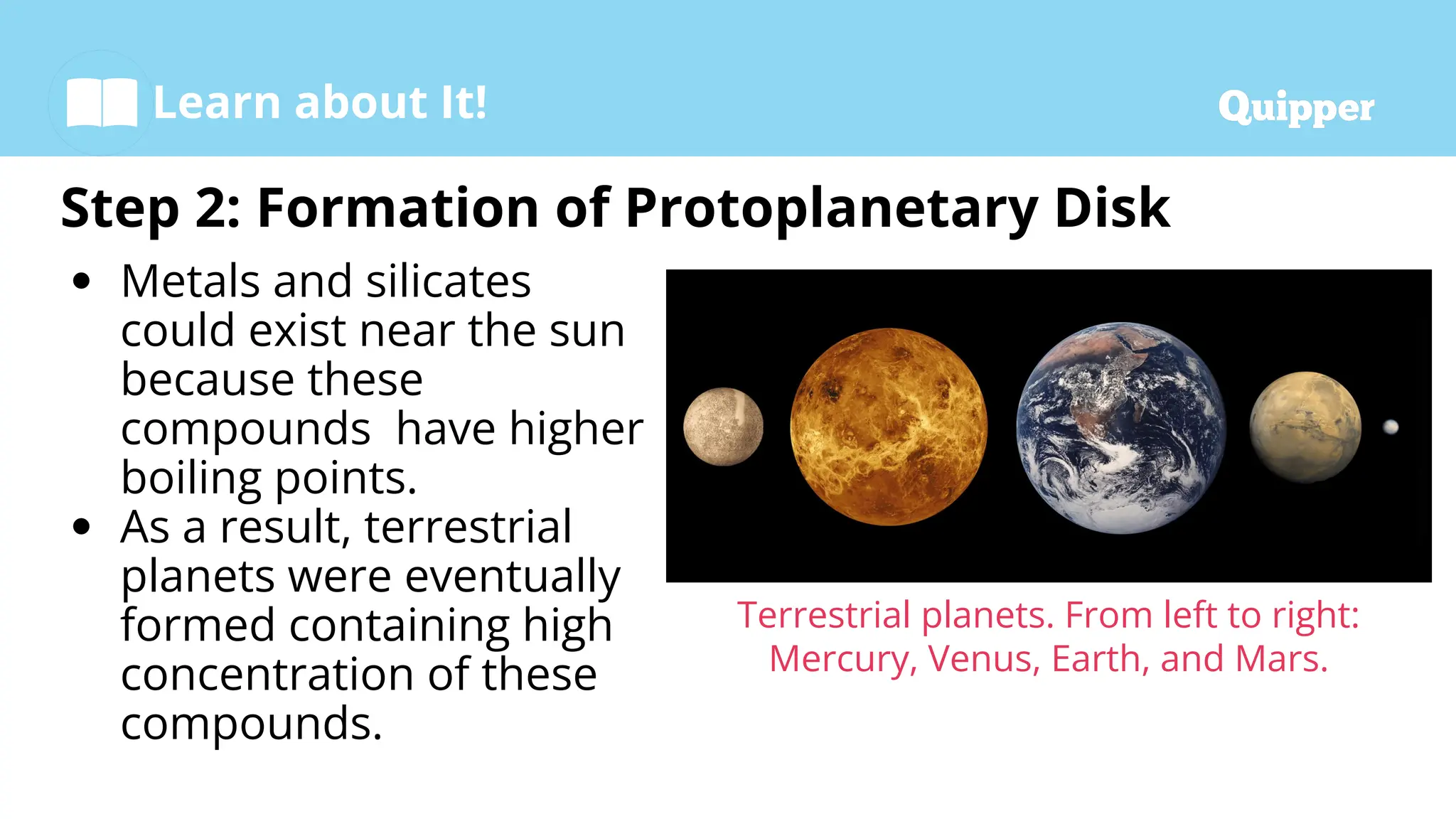
• Metals and silicates
could exist near the sun
because these
compounds have higher
boiling points.
• As a result, terrestrial
planets were eventually
formed containing high
concentration of these
compounds.
Terrestrial planets. From left to right:
Mercury, Venus, Earth, and Mars.
10.
Learn about It!
Step2: Formation of Protoplanetary Disk
• The terrestrial planets
could not grow in huge
diameter because of the
limited reserve of
metallic elements in the
solar nebula.
Terrestrial planets. From left to right:
Mercury, Venus, Earth, and Mars.
11.
Learn about It!
•Dust and grains surrounding the sun eventually formed
clumps. These clumps then accreted forming
planetesimals.
• Planetesimal is a small celestial body that once collide
together, it tend to fused to form the planets of the solar
system.
Step 3: Growth of Planets
12.
Learn about It!
Step3: Growth of Planets
Growth of planets in the nebular theory.
13.
Learn about It!
•Emanuel
Swedenborg
• Immanuel Kant
• Pierre-Simon
Laplace
Proponents of the Nebular Theory
Emmanuel
Swedenborg
(1688–172)
Immanuel
Kant
(1724–1804)
Pierre-Simon
Laplace
(1749–1827)
14.
Learn about It!
•Particles surrounding Saturn repel each other which is
contrary to the assumption that dust particles will be attached
to each other forming a planet.
• It does not follow the law of angular momentum because if
the nebular theory is correct then the sun should be spinning
at a higher rate than the others.
Drawbacks of the Nebular Theory
15.
Learn about It!
•It did not consider Uranus and Venus, which rotates in a
clockwise direction while other planets rotates in a
counterclockwise direction.
Drawbacks of the Nebular Theory
16.
Key Points
Nebular Theory,the solar system originated from a
nebula.
1
Nebula is a giant cloud of gas and dust in space.
2
Nebular theory proposes that the solar system was
formed through three major steps: cloud collapse,
formation of protoplanetary disk and growth of
planets.
3
17.
Key Points
Terrestrial planetsare closer to the sun and have
higher metallic and silicate compounds. Jovian
planets are farther from the sun where the lower
temperature allows gas to condense.
4
Nebular theory was proposed by Emanuel
Swedenborg, Immanuel Kant, and Pierre-Simon
Laplace.
5
The nebular theory is weakened by attributes of
Saturn, the sun, Uranus, and Venus.
6
Challenge Yourself
What shouldbe the composition of the materials in
the core, mantle, and crust based on the nebular
theory?
20.
Bibliography
Rodney Holder andSimon Mitton. 2013. Georges Lemaître: Life, Science and Legacy, Germany: Springer
Science & Business Media.
John Chambers and Jacqueline Mitton. 2013. From Dust to Life: The Origin and Evolution of Our Solar
System, New Jersey: Princeton University Press.
Michael Mark Woolfson. 2012. Time, Space, Stars and Man: The Story of the BigBang, Singapore: World
Scientific.
J. Schombert. 2012. Origin of the Solar System. Accessed March 16, 2017
http://abyss.uoregon.edu/~js/ast121/lectures/lec24.html
D. Darling. 2016. Chamberlin-Moulton planetesimal hypothesis. Accessed March 16,2017
http://www.daviddarling.info/encyclopedia/C/CMplanhypoth.html
21.
Photo Credits
● Slide4: This file, SPHERE images a zoo of dusty discs around young stars by European Southern
Observatory (ESO), is licensed under Creative Commons Attribution 4.0 International via Wikimedia
Commons
● Slide 5: This file, Planets 2013 by Planet User is is licensed under Creative Commons Attribution 3.0
International via Wikimedia Commons





![Nebula Hypothesis And Condensation Theory [Autosaved].pdf](https://cdn.slidesharecdn.com/ss_thumbnails/nebulahypothesisandcondensationtheoryautosaved-250819002919-2a4928c0-thumbnail.jpg?width=640&height=640&fit=bounds)


