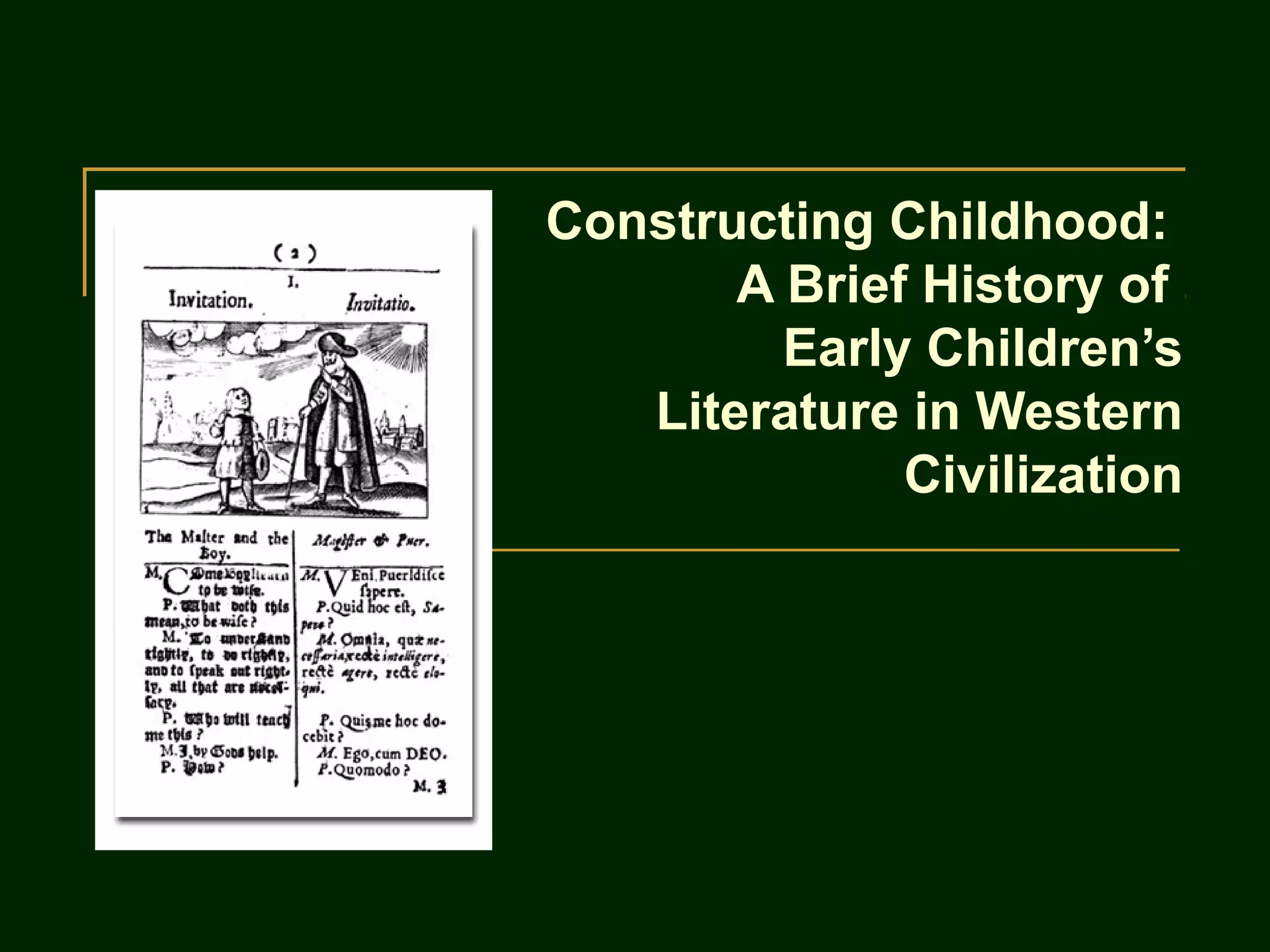
Constructing Childhood:
       A Brief History of
         Early Children’s
   Literature in Western
              Civilization
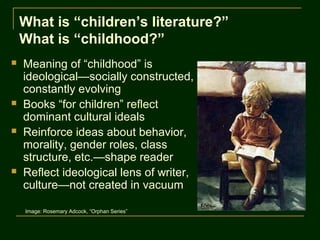
What is “children’s literature?”
    What is “childhood?”
   Meaning of “childhood” is
    ideological—socially constructed,
    constantly evolving
   Books “for children” reflect
    dominant cultural ideals
   Reinforce ideas about behavior,
    morality, gender roles, class
    structure, etc.—shape reader
   Reflect ideological lens of writer,
    culture—not created in vacuum

    Image: Rosemary Adcock, “Orphan Series”
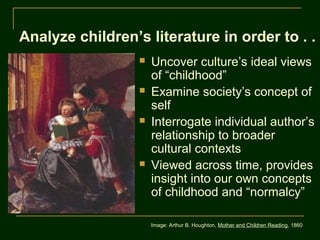
Analyze children’s literature in order to . . .
                     Uncover culture’s ideal views
                      of “childhood”
                     Examine society’s concept of
                      self
                     Interrogate individual author’s
                      relationship to broader
                      cultural contexts
                     Viewed across time, provides
                      insight into our own concepts
                      of childhood and “normalcy”

                      Image: Arthur B. Houghton, Mother and Children Reading, 1860
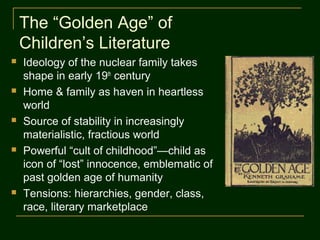
The “Golden Age” of
    Children’s Literature
   Ideology of the nuclear family takes
    shape in early 19th century
   Home & family as haven in heartless
    world
   Source of stability in increasingly
    materialistic, fractious world
   Powerful “cult of childhood”—child as
    icon of “lost” innocence, emblematic of
    past golden age of humanity
   Tensions: hierarchies, gender, class,
    race, literary marketplace
What did “childhood” mean?
Historical Highlights

   400 years ago: children born in state of sin ;
    childhood reading about religious guidance,
    indoctrination
   250-300 years ago: “invention of childhood” as
    modern concept; children’s minds “a blank slate”—fill
    with proper information—logical, didactic texts
   200 years ago: children naturally innocent; moral
    compass to society—imaginative texts
   40 years ago: children need to read about harsh
    realities of life
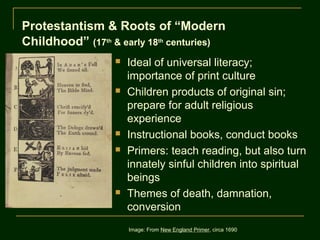
Protestantism & Roots of “Modern
Childhood” (17th & early 18th centuries)
                     Ideal of universal literacy;
                      importance of print culture
                     Children products of original sin;
                      prepare for adult religious
                      experience
                     Instructional books, conduct books
                     Primers: teach reading, but also turn
                      innately sinful children into spiritual
                      beings
                     Themes of death, damnation,
                      conversion
                      Image: From New England Primer, circa 1690
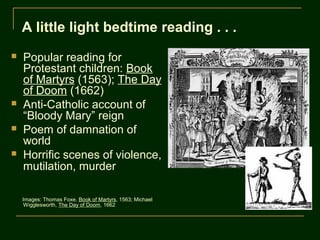
A little light bedtime reading . . .
   Popular reading for
    Protestant children: Book
    of Martyrs (1563); The Day
    of Doom (1662)
   Anti-Catholic account of
    “Bloody Mary” reign
   Poem of damnation of
    world
   Horrific scenes of violence,
    mutilation, murder

    Images: Thomas Foxe, Book of Martyrs, 1563; Michael
     Wigglesworth, The Day of Doom, 1662
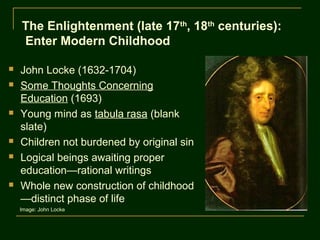
The Enlightenment (late 17th, 18th centuries):
    Enter Modern Childhood

   John Locke (1632-1704)
   Some Thoughts Concerning
    Education (1693)
   Young mind as tabula rasa (blank
    slate)
   Children not burdened by original sin
   Logical beings awaiting proper
    education—rational writings
   Whole new construction of childhood
    —distinct phase of life
    Image: John Locke
18th Century Groundbreakers
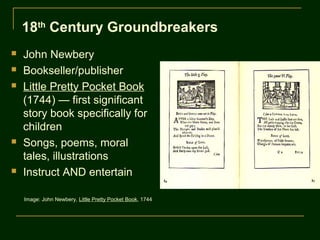
   John Newbery
   Bookseller/publisher
   Little Pretty Pocket Book
    (1744) — first significant
    story book specifically for
    children
   Songs, poems, moral
    tales, illustrations
   Instruct AND entertain

    Image: John Newbery, Little Pretty Pocket Book, 1744
18th Century Groundbreakers

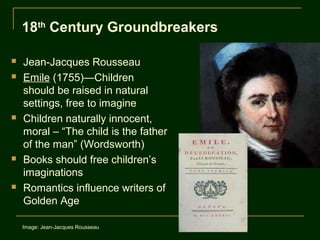
   Jean-Jacques Rousseau
   Emile (1755)—Children
    should be raised in natural
    settings, free to imagine
   Children naturally innocent,
    moral – “The child is the father
    of the man” (Wordsworth)
   Books should free children’s
    imaginations
   Romantics influence writers of
    Golden Age

    Image: Jean-Jacques Rousseau

Early historyofchildrenslit

  • 1.
    Constructing Childhood: A Brief History of Early Children’s Literature in Western Civilization
  • 2.
    What is “children’sliterature?” What is “childhood?”  Meaning of “childhood” is ideological—socially constructed, constantly evolving  Books “for children” reflect dominant cultural ideals  Reinforce ideas about behavior, morality, gender roles, class structure, etc.—shape reader  Reflect ideological lens of writer, culture—not created in vacuum Image: Rosemary Adcock, “Orphan Series”
  • 3.
    Analyze children’s literaturein order to . . .  Uncover culture’s ideal views of “childhood”  Examine society’s concept of self  Interrogate individual author’s relationship to broader cultural contexts  Viewed across time, provides insight into our own concepts of childhood and “normalcy” Image: Arthur B. Houghton, Mother and Children Reading, 1860
  • 4.
    The “Golden Age”of Children’s Literature  Ideology of the nuclear family takes shape in early 19th century  Home & family as haven in heartless world  Source of stability in increasingly materialistic, fractious world  Powerful “cult of childhood”—child as icon of “lost” innocence, emblematic of past golden age of humanity  Tensions: hierarchies, gender, class, race, literary marketplace
  • 5.
    What did “childhood”mean? Historical Highlights  400 years ago: children born in state of sin ; childhood reading about religious guidance, indoctrination  250-300 years ago: “invention of childhood” as modern concept; children’s minds “a blank slate”—fill with proper information—logical, didactic texts  200 years ago: children naturally innocent; moral compass to society—imaginative texts  40 years ago: children need to read about harsh realities of life
  • 6.
    Protestantism & Rootsof “Modern Childhood” (17th & early 18th centuries)  Ideal of universal literacy; importance of print culture  Children products of original sin; prepare for adult religious experience  Instructional books, conduct books  Primers: teach reading, but also turn innately sinful children into spiritual beings  Themes of death, damnation, conversion Image: From New England Primer, circa 1690
  • 7.
    A little lightbedtime reading . . .  Popular reading for Protestant children: Book of Martyrs (1563); The Day of Doom (1662)  Anti-Catholic account of “Bloody Mary” reign  Poem of damnation of world  Horrific scenes of violence, mutilation, murder Images: Thomas Foxe, Book of Martyrs, 1563; Michael Wigglesworth, The Day of Doom, 1662
  • 8.
    The Enlightenment (late17th, 18th centuries): Enter Modern Childhood  John Locke (1632-1704)  Some Thoughts Concerning Education (1693)  Young mind as tabula rasa (blank slate)  Children not burdened by original sin  Logical beings awaiting proper education—rational writings  Whole new construction of childhood —distinct phase of life Image: John Locke
  • 9.
    18th Century Groundbreakers  John Newbery  Bookseller/publisher  Little Pretty Pocket Book (1744) — first significant story book specifically for children  Songs, poems, moral tales, illustrations  Instruct AND entertain Image: John Newbery, Little Pretty Pocket Book, 1744
  • 10.
    18th Century Groundbreakers  Jean-Jacques Rousseau  Emile (1755)—Children should be raised in natural settings, free to imagine  Children naturally innocent, moral – “The child is the father of the man” (Wordsworth)  Books should free children’s imaginations  Romantics influence writers of Golden Age Image: Jean-Jacques Rousseau