LITERATURE AND ENGLISH
       CULTURE

Prepared By:
Edward Valcárcel Melgarejo
Docente de Educación en Idiomas
Universidad Nacional de San
Agustín de Arequipa
CHAPTER 2
          ENGLISH CULTURE

               OBJECTIVES
1.Distinguish the most important
  characteristics of English Art.
2.Determine the most important
  characteristics of British Cuisine.
3. Mention the most outstanding aspects of
   English Music.
4. Identify and lay out the steps which have
   passed the religion in England.
5. Specify and differentiate the different levels
   of British Education System.
6. Analyze and explain the structure and major
   activities undertaken by the universities of
   Oxford and Cambridge.
ENGLISH CULTURE
ENGLISH ART
Its earliest known developed form, one that
continues to the present-day, is arguably the
decorative surface pattern work exemplified by
the Lindisfarne Gospels and the exterior carving
of Anglo-Saxon churches and monuments.
The English have never been averse to
incorporating overseas influences into their arts,
although they can seldom detect such
influences after re-working them for a
generation or so.
It is popularly considered that English landscape
painting typifies English art.
As the population of England grew during the
industrial revolution, a concern for privacy and
smaller gardens becomes more notable in
English art.
English art has often portrayed the coast and
the sea, weather effects have often been
portrayed in English art.
BRITISH CUISINE
TRADITIONAL CUISINE
The Sunday roast is perhaps the most common
feature of British cooking. The Sunday dinner
traditionally    includes     roast    potatoes
accompanying, or usually followed by, a joint of
meat such as beef, chicken, lamb or pork or fish
such as Scottish Farmed Salmon and assorted
vegetables, themselves generally roasted or
boiled. Since its wide-spread availability after
World War II the most popular Christmas roast is
turkey.
At home, the British have many original home-
made desserts such as rhubarb crumble, bread
and butter pudding, spotted dick and trifle.
There is also Christmas pudding.
MUSIC OF ENGLAND
18TH CENTURY As courtly music grew more
elaborate and internationalized, with composers
such as Handel and Mozart, writing operas,
oratorios and symphonic works.
19TH CENTURIES With the Industrial Revolution
came a parallel revolution in English popular
music as people moved from stable agrarian
communities into the growing industrial centres
with the rise of the brass band in the North of
England. Folk Music went through a rapid series
of transformations as different regional idioms
came together and reformed themselves into
the first universally acceptable and commercial
popular music. This change began first in the
alehouses and later in what became known as
the music hall. music hall became the dominant
form of English popular music for over a century
from its birth in the 1850s.
EARLY 20TH CENTURY Operetta and Musical
Comedy were very popular forms in this period.
ENGLISH CHURCH
The Church of England, which was founded by
Henry the VIII, functions as the established
church in England. Other churches which have
started in England include the Methodist church,
the Quakers and the Salvation Army.
Governing and Administration.-
The spiritual head of the church is the
Archbishop of Canterbury, who is the Primate of
All England and Metropolitan. He is also the
focus of unity for the worldwide Anglican
Communion of independent national or regional
churches.
EDUCATION IN ENGLAND is the responsibility of
Department for Education and Skills at national
level and, in the case of publicly funded
compulsory education, of Local Education
Authorities.
The education structures for Wales and
Northern Ireland are broadly similar to the
English system, but there are significant
differences of emphasis in the depth and
breadth of teaching objectives in Scotland.
Traditionally the English system emphasizes
depth of education, whereas the Scottish system
emphasizes breadth.
The structure of the English educational system
COMPULSORY SCHOOLING
PRIMARY EDUCATION Primary education in
England is conducted through Primary or
Infant/First and Junior Schools. Primary schools
take children from ages 4 through to 11 Infant
and First schools are similar to each other taking
children from ages 4 through to 7 or 8 in the
case of First schools.
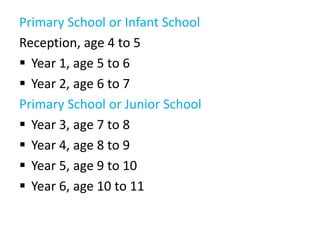
Primary School or Infant School
Reception, age 4 to 5
 Year 1, age 5 to 6
 Year 2, age 6 to 7
Primary School or Junior School
 Year 3, age 7 to 8
 Year 4, age 8 to 9
 Year 5, age 9 to 10
 Year 6, age 10 to 11
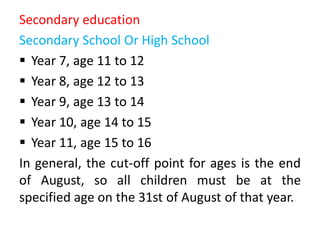
Secondary education
Secondary School Or High School
 Year 7, age 11 to 12
 Year 8, age 12 to 13
 Year 9, age 13 to 14
 Year 10, age 14 to 15
 Year 11, age 15 to 16
In general, the cut-off point for ages is the end
of August, so all children must be at the
specified age on the 31st of August of that year.
FURTHER EDUCATION
Students will typically study in either the Sixth
Form of a School, a Sixth form college, or a
further education college. These courses can
also be studied by adults over 18. This sector is
referred to as Further Education. All 16-18
students are encouraged (this is only mandatory
in some institutions) to study Key Skills in
Communication, Application of Number and
Information Technology.
HIGHER EDUCATION
Students normally enter University from 18
onwards and study for an Academic Degree. Apart
from a single private university, all undergraduate
education is largely state financed (with tuition fees
set at a maximum index-linked £3,000 per year,
repayable after graduation contingent on attaining
a certain level of income, and with the state paying
all fees for students from the poorest backgrounds),
and UK students are generally entitled to student
loans for maintenance. The state does not control
syllabi, but it does influence admission procedures.
The typical first degree offered at British
universities is the Bachelor's degree (typically
three years). Many institutions now offer an
undergraduate Master's degree as a first degree,
typically lasting four years.
POSTGRADUATE EDUCATION
Students who have completed a first degree are
eligible to undertake a postgraduate degree,
which includes:
Master's degree (typically taken in one year)
Doctorate degree (typically taken in three years)
Postgraduate education is not automatically
financed by the State, and so admission is in
practice highly competitive.
UNIVERSITIES IN ENGLAND
THE UNIVERSITY OF OXFORD, located in the city
of Oxford, England, is the oldest university in the
English-speaking world.
Organization
There are 39 colleges within the university, each
with its own internal structure and activities.
The university's formal head is the chancellor,
usually a distinguished politician, elected for life
by the members of Convocation, a body
comprising all members of the university who
hold an M.A. degree.
The vice-chancellor, who holds office for four
years, is the head of the university's executive.
In addition to Convocation, the other bodies
that conduct university business are the Ancient
House of Congregation, which confers degrees;
the Hebdomadal Council, which formulates
university policy; and the Congregation of the
University, which discusses and pronounces on
policies proposed by the Hebdomadal Council.
Governance and Administration.-
The main legislative body of the University is
Congregation, the assembly of all academics
who teach in the University. Another body,
Convocation, encompassing all the graduates of
Oxford, was formerly the main legislative body
of the University, and until 1949 elected the two
Members of Parliament for the University.
Convocation now has very limited functions: the
main one is to elect the (largely symbolic)
Chancellor of the University, most recently in
2003 with the election of Christopher Patten.
Convocation also elects the Professor of Poetry.
The executive body of the University is the
University Council, which consists of the Vice-
Chancellor, Dr. John Hood (succeeding Sir Colin
Lucas), heads of departments and other
members elected by Congregation in addition to
observers from the Student Union. Until 1969,
the statutes also provided for an Ancient House
of Congregation.
THE UNIVERSITY OF CAMBRIDGE (often called
Cambridge University, or just Cambridge),
located in Cambridge, England, is the second-
oldest university in the English-speaking world.
General Information.-
Cambridge is a collegiate university, with its
main functions divided between the central
departments of the university and a number of
colleges. In general, the departments perform
research and provide centralised lectures to
students, while the colleges are responsible for
the domestic arrangements and welfare of
undergraduate students, graduate students,
some of the postdocs and some University staff.
Research and Teaching.-
Cambridge University has research departments
and teaching faculties in most academic
disciplines. Cambridge tends to have a slight bias
towards scientific subjects, but it also has a
number of strong humanities and social science
faculties. Academic staff (and often graduate
students for the larger subjects) teach the
undergraduates in both lectures and personal
supervisions in which a ratio of one teacher to
between one and three students is usually
maintained.

E10 4-ii-(cap 3 y4)

  • 1.
    LITERATURE AND ENGLISH CULTURE Prepared By: Edward Valcárcel Melgarejo Docente de Educación en Idiomas Universidad Nacional de San Agustín de Arequipa
  • 2.
    CHAPTER 2 ENGLISH CULTURE OBJECTIVES 1.Distinguish the most important characteristics of English Art. 2.Determine the most important characteristics of British Cuisine.
  • 3.
    3. Mention themost outstanding aspects of English Music. 4. Identify and lay out the steps which have passed the religion in England. 5. Specify and differentiate the different levels of British Education System. 6. Analyze and explain the structure and major activities undertaken by the universities of Oxford and Cambridge.
  • 4.
  • 5.
    ENGLISH ART Its earliestknown developed form, one that continues to the present-day, is arguably the decorative surface pattern work exemplified by the Lindisfarne Gospels and the exterior carving of Anglo-Saxon churches and monuments. The English have never been averse to incorporating overseas influences into their arts, although they can seldom detect such influences after re-working them for a generation or so.
  • 6.
    It is popularlyconsidered that English landscape painting typifies English art. As the population of England grew during the industrial revolution, a concern for privacy and smaller gardens becomes more notable in English art. English art has often portrayed the coast and the sea, weather effects have often been portrayed in English art.
  • 7.
    BRITISH CUISINE TRADITIONAL CUISINE TheSunday roast is perhaps the most common feature of British cooking. The Sunday dinner traditionally includes roast potatoes accompanying, or usually followed by, a joint of meat such as beef, chicken, lamb or pork or fish such as Scottish Farmed Salmon and assorted vegetables, themselves generally roasted or boiled. Since its wide-spread availability after World War II the most popular Christmas roast is turkey.
  • 8.
    At home, theBritish have many original home- made desserts such as rhubarb crumble, bread and butter pudding, spotted dick and trifle. There is also Christmas pudding. MUSIC OF ENGLAND 18TH CENTURY As courtly music grew more elaborate and internationalized, with composers such as Handel and Mozart, writing operas, oratorios and symphonic works.
  • 9.
    19TH CENTURIES Withthe Industrial Revolution came a parallel revolution in English popular music as people moved from stable agrarian communities into the growing industrial centres with the rise of the brass band in the North of England. Folk Music went through a rapid series of transformations as different regional idioms came together and reformed themselves into the first universally acceptable and commercial popular music. This change began first in the alehouses and later in what became known as the music hall. music hall became the dominant form of English popular music for over a century from its birth in the 1850s.
  • 10.
    EARLY 20TH CENTURYOperetta and Musical Comedy were very popular forms in this period. ENGLISH CHURCH The Church of England, which was founded by Henry the VIII, functions as the established church in England. Other churches which have started in England include the Methodist church, the Quakers and the Salvation Army.
  • 11.
    Governing and Administration.- Thespiritual head of the church is the Archbishop of Canterbury, who is the Primate of All England and Metropolitan. He is also the focus of unity for the worldwide Anglican Communion of independent national or regional churches. EDUCATION IN ENGLAND is the responsibility of Department for Education and Skills at national level and, in the case of publicly funded compulsory education, of Local Education Authorities.
  • 12.
    The education structuresfor Wales and Northern Ireland are broadly similar to the English system, but there are significant differences of emphasis in the depth and breadth of teaching objectives in Scotland. Traditionally the English system emphasizes depth of education, whereas the Scottish system emphasizes breadth. The structure of the English educational system COMPULSORY SCHOOLING
  • 13.
    PRIMARY EDUCATION Primaryeducation in England is conducted through Primary or Infant/First and Junior Schools. Primary schools take children from ages 4 through to 11 Infant and First schools are similar to each other taking children from ages 4 through to 7 or 8 in the case of First schools.
  • 14.
    Primary School orInfant School Reception, age 4 to 5  Year 1, age 5 to 6  Year 2, age 6 to 7 Primary School or Junior School  Year 3, age 7 to 8  Year 4, age 8 to 9  Year 5, age 9 to 10  Year 6, age 10 to 11
  • 15.
    Secondary education Secondary SchoolOr High School  Year 7, age 11 to 12  Year 8, age 12 to 13  Year 9, age 13 to 14  Year 10, age 14 to 15  Year 11, age 15 to 16 In general, the cut-off point for ages is the end of August, so all children must be at the specified age on the 31st of August of that year.
  • 16.
    FURTHER EDUCATION Students willtypically study in either the Sixth Form of a School, a Sixth form college, or a further education college. These courses can also be studied by adults over 18. This sector is referred to as Further Education. All 16-18 students are encouraged (this is only mandatory in some institutions) to study Key Skills in Communication, Application of Number and Information Technology.
  • 17.
    HIGHER EDUCATION Students normallyenter University from 18 onwards and study for an Academic Degree. Apart from a single private university, all undergraduate education is largely state financed (with tuition fees set at a maximum index-linked £3,000 per year, repayable after graduation contingent on attaining a certain level of income, and with the state paying all fees for students from the poorest backgrounds), and UK students are generally entitled to student loans for maintenance. The state does not control syllabi, but it does influence admission procedures.
  • 18.
    The typical firstdegree offered at British universities is the Bachelor's degree (typically three years). Many institutions now offer an undergraduate Master's degree as a first degree, typically lasting four years.
  • 19.
    POSTGRADUATE EDUCATION Students whohave completed a first degree are eligible to undertake a postgraduate degree, which includes: Master's degree (typically taken in one year) Doctorate degree (typically taken in three years) Postgraduate education is not automatically financed by the State, and so admission is in practice highly competitive.
  • 20.
    UNIVERSITIES IN ENGLAND THEUNIVERSITY OF OXFORD, located in the city of Oxford, England, is the oldest university in the English-speaking world. Organization There are 39 colleges within the university, each with its own internal structure and activities. The university's formal head is the chancellor, usually a distinguished politician, elected for life by the members of Convocation, a body comprising all members of the university who hold an M.A. degree.
  • 21.
    The vice-chancellor, whoholds office for four years, is the head of the university's executive. In addition to Convocation, the other bodies that conduct university business are the Ancient House of Congregation, which confers degrees; the Hebdomadal Council, which formulates university policy; and the Congregation of the University, which discusses and pronounces on policies proposed by the Hebdomadal Council.
  • 22.
    Governance and Administration.- Themain legislative body of the University is Congregation, the assembly of all academics who teach in the University. Another body, Convocation, encompassing all the graduates of Oxford, was formerly the main legislative body of the University, and until 1949 elected the two Members of Parliament for the University. Convocation now has very limited functions: the main one is to elect the (largely symbolic) Chancellor of the University, most recently in 2003 with the election of Christopher Patten. Convocation also elects the Professor of Poetry.
  • 23.
    The executive bodyof the University is the University Council, which consists of the Vice- Chancellor, Dr. John Hood (succeeding Sir Colin Lucas), heads of departments and other members elected by Congregation in addition to observers from the Student Union. Until 1969, the statutes also provided for an Ancient House of Congregation.
  • 24.
    THE UNIVERSITY OFCAMBRIDGE (often called Cambridge University, or just Cambridge), located in Cambridge, England, is the second- oldest university in the English-speaking world.
  • 25.
    General Information.- Cambridge isa collegiate university, with its main functions divided between the central departments of the university and a number of colleges. In general, the departments perform research and provide centralised lectures to students, while the colleges are responsible for the domestic arrangements and welfare of undergraduate students, graduate students, some of the postdocs and some University staff.
  • 26.
    Research and Teaching.- CambridgeUniversity has research departments and teaching faculties in most academic disciplines. Cambridge tends to have a slight bias towards scientific subjects, but it also has a number of strong humanities and social science faculties. Academic staff (and often graduate students for the larger subjects) teach the undergraduates in both lectures and personal supervisions in which a ratio of one teacher to between one and three students is usually maintained.