E Business Management Integration of Web
Technologies with Business Models 1st Edition
Michael J. Shaw pdf download
https://ebookfinal.com/download/e-business-management-
integration-of-web-technologies-with-business-models-1st-edition-
michael-j-shaw/
Explore and download more ebooks or textbooks
at ebookfinal.com
We have selected some products that you may be interested in
Click the link to download now or visit ebookfinal.com
for more options!.
Business Network Learning International Business and
Management 1st Edition J. Johanson
https://ebookfinal.com/download/business-network-learning-
international-business-and-management-1st-edition-j-johanson/
Broadband Services Business Models and Technologies for
Community Networks 1st Edition Imrich Chlamtac
https://ebookfinal.com/download/broadband-services-business-models-
and-technologies-for-community-networks-1st-edition-imrich-chlamtac/
E Business Innovation and Process Management 1st Edition
In Lee
https://ebookfinal.com/download/e-business-innovation-and-process-
management-1st-edition-in-lee/
Marketing the e Business Second Edition Routledge E
Business Harris Dennis
https://ebookfinal.com/download/marketing-the-e-business-second-
edition-routledge-e-business-harris-dennis/
Introduction to e Business Management and Strategy 1st
Edition Colin Combe
https://ebookfinal.com/download/introduction-to-e-business-management-
and-strategy-1st-edition-colin-combe/
Unlocking Business Agility with Evidence Based Management
1st Edition Patricia Kong
https://ebookfinal.com/download/unlocking-business-agility-with-
evidence-based-management-1st-edition-patricia-kong/
Linguistic Refactoring of Business Process Models 1st
Edition Fabian Pittke
https://ebookfinal.com/download/linguistic-refactoring-of-business-
process-models-1st-edition-fabian-pittke/
Business Continuity and Risk Management Essentials of
Organizational Resilience Kurt J. Engemann
https://ebookfinal.com/download/business-continuity-and-risk-
management-essentials-of-organizational-resilience-kurt-j-engemann/
E Business and E Commerce Management Strategy
Implementation and Practice 4th Edition Dave Chaffey
https://ebookfinal.com/download/e-business-and-e-commerce-management-
strategy-implementation-and-practice-4th-edition-dave-chaffey/
E Business Management Integration of Web Technologies
with Business Models 1st Edition Michael J. Shaw Digital
Instant Download
Author(s): Michael J. Shaw
ISBN(s): 9781402071782, 0306475480
Edition: 1
File Details: PDF, 10.13 MB
Year: 2002
Language: english
E-BUSINESS MANAGEMENT
This page intentionally left blank
E-BUSINESS MANAGEMENT
Integration of Web Technologies
with Business Models
edited by
Michael J. Shaw
KLUWER ACADEMIC PUBLISHERS
NEW YORK, BOSTON, DORDRECHT, LONDON, MOSCOW
eBook ISBN: 0-306-47548-0
Print ISBN: 1-4020-7178-7
©2002 Kluwer Academic Publishers
New York, Boston, Dordrecht, London, Moscow
Print ©2003 Kluwer Academic Publishers
All rights reserved
No part of this eBook may be reproduced or transmitted in any form or by any means, electronic,
mechanical, recording, or otherwise, without written consent from the Publisher
Created in the United States of America
Visit Kluwer Online at: http://kluweronline.com
and Kluwer's eBookstore at: http://ebooks.kluweronline.com
Dordrecht
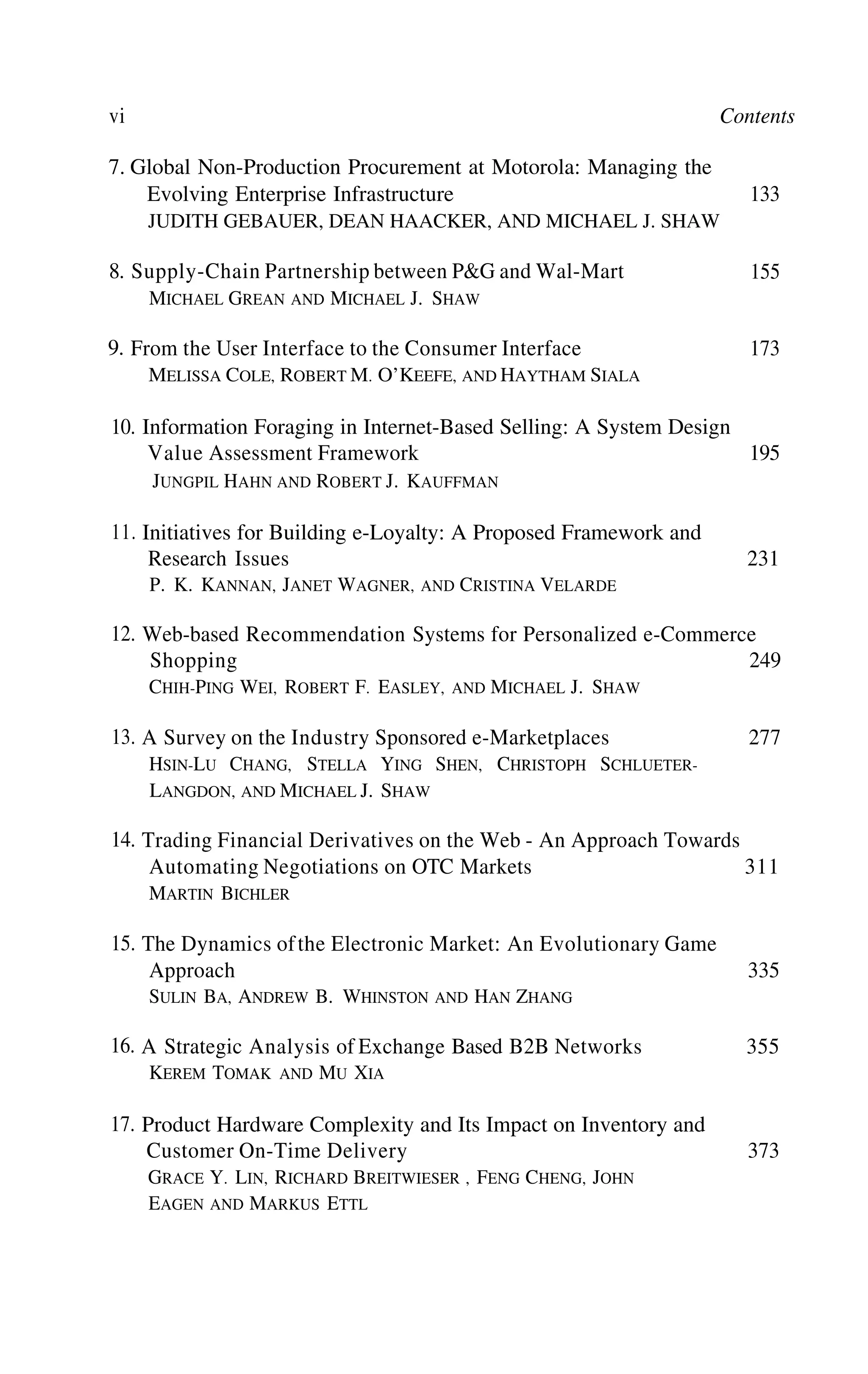
Contents
Contributors
Preface
1. E-Business Management: A Primer
MICHAEL J. SHAW
2. E-Business and Beyond
ROBERT W. BLANNING
3. The Neo-Intermediation
RAVI KALAKOTA AND BENN KONSYNSKI
4. Driving Forces for M-Commerce Success
JASON J. ZHANG, YUFEI YUAN, AND NORM ARCHER
5. e-Business Management Models: Services Perspective from the
Revere Group
TODD MILLER, MATTHEW L. NELSON, STELLA Y. SHEN, AND
MICHAEL J. SHAW
6. Focus on Consumers: P&G’s e-Commerce Strategy
MICHELE GRIBBINS, RICH LAUF, CHANDRASEKAR SUBRAMANIAM,
AND MICHAEL J. SHAW
ix
xiii
109
1
19
27
51
77
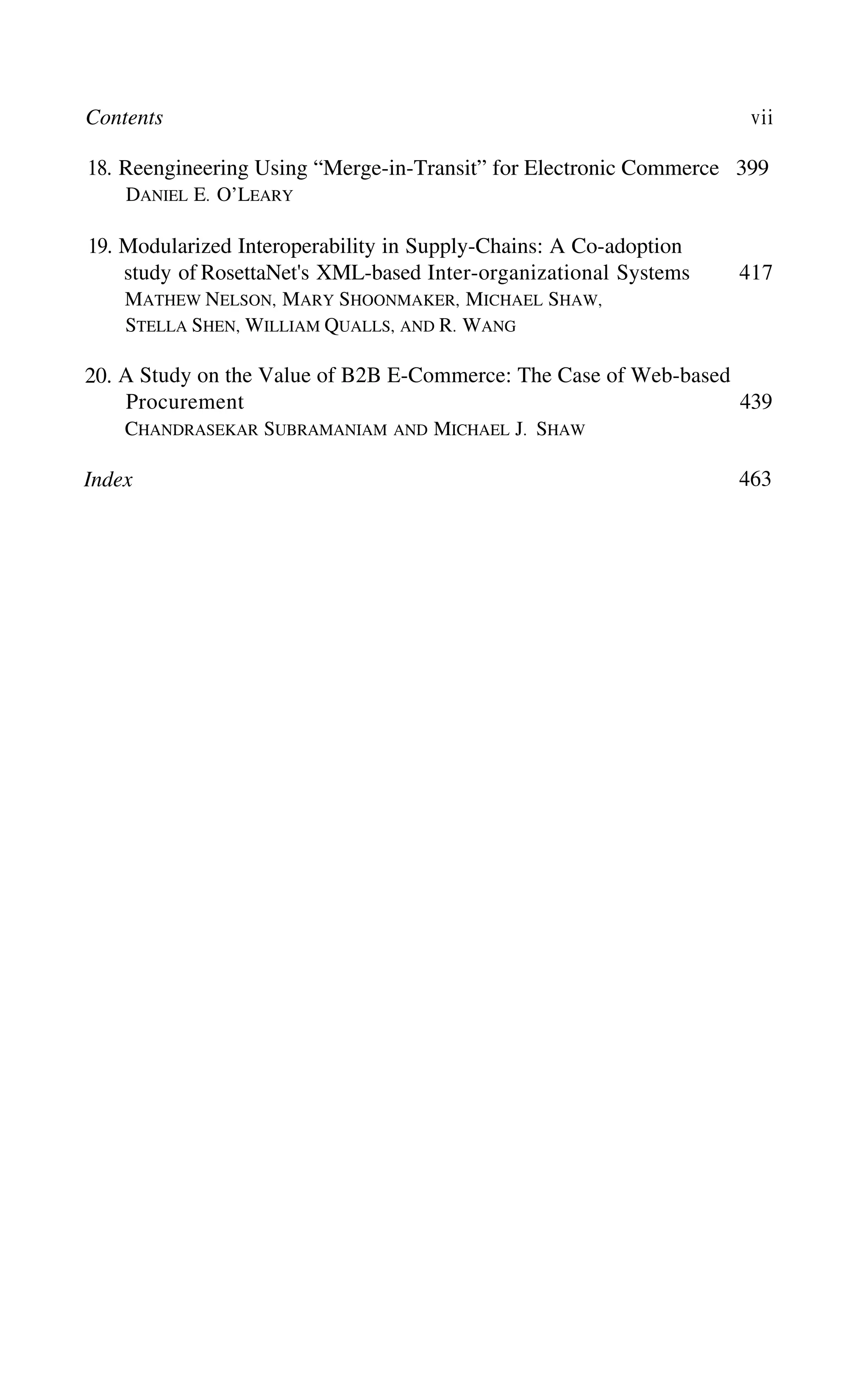
vi Contents
7.
8.
9.
Global Non-Production Procurement at Motorola: Managing the
Evolving Enterprise Infrastructure
JUDITH GEBAUER, DEAN HAACKER, AND MICHAEL J. SHAW
Supply-Chain Partnership between P&G and Wal-Mart
MICHAEL GREAN AND MICHAEL J. SHAW
From the User Interface to the Consumer Interface
MELISSA COLE, ROBERT M. O’KEEFE, AND HAYTHAM SIALA
10.
11.
12.
13.
14.
15.
16.
17.
133
155
173
Information Foraging in Internet-Based Selling: A System Design
Value Assessment Framework 195
JUNGPIL HAHN AND ROBERT J. KAUFFMAN
Initiatives for Building e-Loyalty: A Proposed Framework and
Research Issues 231
P. K. KANNAN, JANET WAGNER, AND CRISTINA VELARDE
Web-based Recommendation Systems for Personalized e-Commerce
Shopping 249
CHIH-PING WEI, ROBERT F. EASLEY, AND MICHAEL J. SHAW
A Survey on the Industry Sponsored e-Marketplaces 277
HSIN-LU CHANG, STELLA YING SHEN, CHRISTOPH SCHLUETER-
LANGDON, AND MICHAEL J. SHAW
Trading Financial Derivatives on the Web - An Approach Towards
Automating Negotiations on OTC Markets 311
MARTIN BICHLER
The Dynamics ofthe Electronic Market: An Evolutionary Game
Approach 335
SULIN BA, ANDREW B. WHINSTON AND HAN ZHANG
A Strategic Analysis of Exchange Based B2B Networks 355
KEREM TOMAK AND MU XIA
Product Hardware Complexity and Its Impact on Inventory and
Customer On-Time Delivery 373
GRACE Y. LIN, RICHARD BREITWIESER , FENG CHENG, JOHN
EAGEN AND MARKUS ETTL
Contents vii
18.
19.
20.
Reengineering Using “Merge-in-Transit” for Electronic Commerce 399
DANIEL E. O’LEARY
Modularized Interoperability in Supply-Chains: A Co-adoption
study of RosettaNet's XML-based Inter-organizational Systems 417
MATHEW NELSON, MARY SHOONMAKER, MICHAEL SHAW,
STELLA SHEN, WILLIAM QUALLS, AND R. WANG
A Study on the Value of B2B E-Commerce: The Case of Web-based
Procurement 439
CHANDRASEKAR SUBRAMANIAM AND MICHAEL J. SHAW
463
Index
This page intentionally left blank
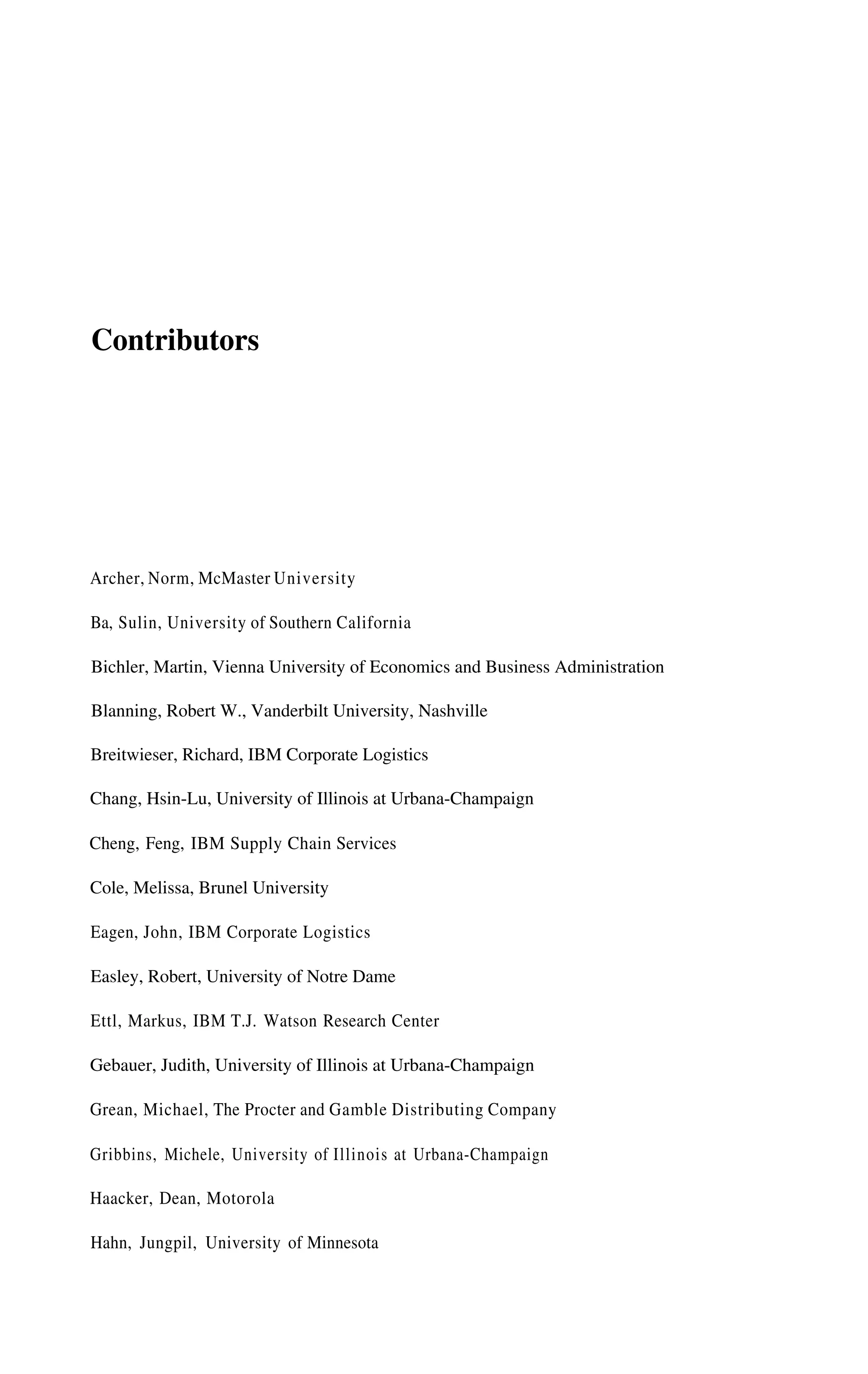
Contributors
Archer, Norm, McMaster University
Ba, Sulin, University of Southern California
Bichler, Martin, Vienna University of Economics and Business Administration
Blanning, Robert W., Vanderbilt University, Nashville
Breitwieser, Richard, IBM Corporate Logistics
Chang, Hsin-Lu, University of Illinois at Urbana-Champaign
Cheng, Feng, IBM Supply Chain Services
Cole, Melissa, Brunel University
Eagen, John, IBM Corporate Logistics
Easley, Robert, University of Notre Dame
Ettl, Markus, IBM T.J. Watson Research Center
Gebauer, Judith, University of Illinois at Urbana-Champaign
Grean, Michael, The Procter and Gamble Distributing Company
Gribbins, Michele, University of Illinois at Urbana-Champaign
Haacker, Dean, Motorola
Hahn, Jungpil, University of Minnesota
x
Kalakota, Ravi, Hsupply.com
Kannan, P. K., University of Maryland, College Park
Kauffman, Robert J., University of Minnesota
Konsynski, Benn, Emory University
Lauf, Rich, The Union Institute and University
Lin, Grace Y., IBM T.J. Watson Research Center
Miller, Todd, The Revere Group
Nelson, Matthew L., University of Illinois at Urbana-Champaign
O’Keefe, Robert M., Brunel University
O’Leary, Daniel E., University of Southern California
Qualls, William, University of Illinois at Urbana-Champaign
Schlueter-Langdon, Christoph, University of Southern California
Shaw, Michael J., University of Illinois at Urbana-Champaign
Shen, Stella Y., University of Illinois at Urbana-Champaign
Shoonmaker, Mary, RosettaNet
Siala, Haytham, Brunel University
Subramaniam, Chandrasekar, University of Illinois at Urbana-Champaign
Tomak, Kerem, University of Texas at Austin
Velarde, Cristina, University of Maryland, College Park
Wagner, Janet, University of Maryland, College Park
Wang, R., University of Illinois at Urbana-Champaign
Wei, Chih-Ping, National Sun Yat-Sen University
Whinston, Andrew, University of Texas at Austin
Xia, Mu, University of Illinois at Urbana-Champaign
Yuan, Yufei, McMaster University
xi
Zhang, Han, University of Texas at Austin
Zhang, Jason J., McMaster University
This page intentionally left blank
Preface
This book contains a collection of articles by leading information systems
researchers on important topics related to the development of e-business.
The goal is to enhance the understanding of the state-of-the-art in e-business,
including the most current and forward-looking research. The book
emphasizes both business practices and academic research made possible by
the recent rapid advances made in the applications of e-business technology.
The book should help graduate students, researchers, and practitioners
understand major e-business developments, how they will transform
businesses, and strategic implications to be drawn.
By illustrating in detail the major e-business developments and research,
the book focuses on addressing e-business management from the perspective
of information systems research. In order to cover the subject matter in
sufficient breadth and depth, the book is organized into the following five
main sections:
e-Business Fundamentals,
e-Business Best Practices,
Marketing, Customer Relations, e-Services, and Personalization,
Formation of New Intermediaries and e-Markets, and
B2B and Supply-Chain Management: New Business Models and
Valuation.
I
II
III
IV
V
The sections are made up of twenty chapters that use a variety of research
approaches and presentation formats, including analysis, case studies,
surveys, economics, modeling, and theory, and shed light on the key ideas
involved in e-business management.
xiv
The organization of the book reflects the major developments in e-
business, research opportunities, and impacts. The chapters on best practices
in Section II follow the e-business fundamentals set out in Section I to
capture successful industry strategies. Sections III, IV, and V then describe
in detail the three driving forces of e-business deployment: improving
customer relations, greater orientation toward e-markets, and a much
stronger emphasis on B2B and supply-chain management. The mixing of
leading academic research and business best practices creates a strong
synergy between emerging theory and applications throughout the chapters
of the book..
The worldwide digital economy is fast evolving. Driven by the wave of
innovations resulting from breakthroughs both in information technology
and in business practices, e-business developments have transformed the role
of each. The transformations are very much ongoing and moving at a
breathtaking pace. The bursting of the Internet bubble made it necessary to
adjust the direction, but the effects have propagated as quickly as ever, and
to a much larger segment of the world economy. The differences between
traditional and e-business enterprises are diminishing rapidly. In that sense,
this book goes beyond just e-business management and is relevant to the
management of most businesses. More and more traditional corporations
have discovered the efficacy of e-business. There is little doubt that the e-
business advances we are witnessing will leave a very noticeable mark on
the history of business. I hope this book, if nothing else, helps document the
evolution of important advances in research and business practices.
Putting this book together has been a stimulating and challenging
experience. The synergy between the applications and theory intrigues me;
the major challenge has been how to keep up with the rapid developments,
while conveying a keen sense of the fundamentals. I was fortunate to have
the opportunity to work with excellent authors from academia and industry.
Chapters 3, 9, 14, 15, and 18 were first published in a special issue I put
together as the guest editor for Information Systems Frontiers. Chapter 17
was published in an earlier book Information-Based Manufacturing, which I
edited. I would like to thank Kluwer Academic Publishers for allowing me to
make this book more complete by including them here.
Michael J. Shaw
University of Illinois at Urbana-Champaign
Chapter 1
E-Business Management: A Primer
Michael J. Shaw
Abstract: Building a successful e-business requires such enterprise capabilities as global
networking, integrated business processes, sharing information with supply-
chain partners, agility in responding to the market, and intelligent decision-
making. At the same time enterprise systems have extended beyond the
traditional business functions and include features to support supply-chain
management, customer relationship management and electronic commerce.
The new focus on e-business is, in part, driven by the adoption of the Web as a
newchannel forproductdistribution, marketing, and interaction with
customers. The integration of the traditional as well as the Web-oriented
functions is the cornerstone of a successful e-business. This paper presents an
e-business framework that, on one hand, builds on the enterprise system but,
on the other, encompasses the new e-business dimensions.
Key words: E-Business Management; Information Systems Research.
1. INTRODUCTION
Building their companies into successful e-businesses has become an
important objective for today’s enterprises. To do so requires such business
capabilities as global networking, process integration, information sharing,
supply-chain agility, and intelligent decision-making. This paper addresses
the strategic and research issues concerning (1) how to implement these
concepts in real enterprises, (2) the most desirable strategy for developing
and managing business systems, and (3) the research framework for
2 Michael J. Shaw
understanding the essential characteristics of e-business systems, how they
evolve, and the direction in which they are moving.
Increasingly, enterprise systems have extended beyond the traditional
business functions and include such new features as supply-chain
management, customer relationship management (CRM), and electronic
commerce. This shifting focus is driven by the adoption of the Web as a new
channel for product distribution, marketing, and interaction with customers.
The integration of traditional as well as Web-oriented functions is the
cornerstone of a successful e-business. At the same time, information
systems have become the nerve center of most enterprise systems. As
enterprise operations increasingly go global, proper coordination between
business, manufacturing, and the global value-adding chain needs special
attention. Information systems can help provide that coordination. What
makes information systems the backbone of business operations is the
emerging global information infrastructure. Through this infrastructure,
enterprise systems can achieve business integration and coordination. That
becomes the foundation of any e-business.
2. THE WEB AS THE ENABLER FOR ENTERPRISE
INTEGRATION
An effective infrastructure is essential in order to coordinate various
business units and processes into an e-business,. The enterprise information
system supports supply-chain processes and process coordination within and
between enterprises. In addition, the infrastructure also includes (1) a global
information network for supporting various electronic services such as
brokerage and contracting, payment and banking, transaction processing, (2)
electronic access to external data, and (3) electronic connections to
customers that support such activities as filling orders and customer service.
Increasingly, the way to integrate these infrastructure components is to use
the Web infrastructure supported by the Internet. Using the Web
infrastructure intranets support intra-organizational business processes;
extranets connect enterprises to their channel partners; and the Internet links
the enterprises to their customers, other institutions and agencies.
Using the Web as the infrastructure not only gives an enterprise a better
means to coordinate with its supply-chain partners, but as important, it
provides a new channel to reach out to customers. With the Web channel
serving as the virtual storefront, there are opportunities for product
marketing, customer relationship management, and product branding. In
1. E-Business Management: A Primer 3
addition, a new kind of consumer process is emerging combining
information aggregation, navigation, and interactive exchanges. On the one
hand, it enables mass customization; on the other, the infrastructure supports
quick response to market demands. Such a new channel requires new
capabilities from the enterprise systems.
The Web provides a new paradigm for supporting enterprise and supply-
chain processes. The paradigm is basically that of a highly flexible network
with interoperable and sharable modules. A Web technology that stands out
as particularly useful for supporting the implementation of such a paradigm
is component technology. The component approach can potentially better
enable companies to integrate the supply chains and their processes among
the supply-chain partners. They not only share product, manufacturing, and
customer information with their partners; increasingly, they are letting the
suppliers adopt parts of their business processes and systems to enhance
coordination. Traditional enterprise systems put the emphasis on process
integration. With this component-based approach, we will likely see more
highly modularized companies, with each unit specialized in its core
competency but always prepared to link up with business partners and their
enterprise system (Baldwin and Clark , 1997). The component concept can
be applied at several different levels: (1) The software and system level,
where software objects and components have been used as the building
blocks to make the functional components portable and inter-operable; (2)
The process and application level, where business processes and
applications, such as order fulfillment, customer services, etc., have been
managed as separate modules, sometimes run at remote sites by applications
service providers (ASPs); (3) The enterprise level, where business units can
be quickly assembled to form virtual enterprises to explore a window of
market opportunities.
3. ORGANIZATION DESIGNS, INFORMATION
SHARING, AND COORDINATION
A distinct feature of an e-business system is its capability to adapt and
react, making the organization more agile. The trend for e-business
The general trend these developments collectively point to is that in an e-
business, there will be increasing use of modularity and the component
model to increase portability, inter-operability, and plug-and-play
functionalities. The paradox is that the enterprise systems will be more
integrated because of the greater use of modularized components.
4 Michael J. Shaw
organizations to shift gradually from hierarchical to networked organizations
is in line with the general trend of the economy. With the increasing use of
information systems in most organizations, organizations are moving toward
flatter and more adaptive structures, sometimes referred to as the market
oriented networked organizations (MNOs). Instead of the command and
control innate to traditional, hierarchical organizations, MNOs require more
coordination; and the coordination is done in a way similar to the way goods
are allocated in the marketplace, through decentralized pricing and
exchanges. A supply-chain network is a type of MNO when the business
units are assembled through market forces. On the other hand, a supply-
chain network may be a type of hierarchical organization if it is totally
vertically integrated. Electronic commerce is moving e-businesses toward
the MNO model. Successfully implementing e-business technology reduces
transaction costs, and, therefore, the boundaries between markets and
internal organizations are shrinking (Williamson, 1986) in favor of more
market orientation.
Web technology overcomes problems of system incompatibility by
encapsulating enterprise systems as object components made accessible by
standardized interfaces, and by defining a protocol for transmitting
documents between these components. This improves e-business
management by (1) reducing production costs through lower procurement
and distribution costs, (2) better utilization of resources through enterprise
specialization, and (3) greater integration of supply-chain activities.
The lack of information sharing is a common cause for supply-chain
related problems. One example is the so-called bullwhip effect, in which a
slight variation in demand at the consumer end gets increasingly amplified
and results in wild swings at the supplier end. The bullwhip effect has four
possible causes: demand-signal processing, batch ordering, price fluctuation
and shortage gaming (Lee et al., 1997). In demand-signal processing, for
example, since data on the quantities sold to consumers is not passed on to
the upstream levels, each tier is forced to predict demand based on its
adjacent downstream order. This results in multiple forecasts, with predicted
errors escalating as the distorted demand information travels upstream.
Meanwhile, supplier's production information (e.g. capacity and lead-time) is
not shared downstream. This leads to a vicious cycle of shortage gaming and
large demand swings. Countermeasures that can overcome this undesirable
phenomenon include consumer direct ordering, sharing point-of-sale
capacity and inventory data, vendor-managed inventory, and continuous
replenishment programs. These solutions boil down to the need for
information sharing and an information infrastructure to support it.
1. E-Business Management: A Primer 5
Information sharing has been used not only for reducing the uncertainties
and smoothing out supply chains, but also for eliminating wasteful activities,
efforts, and resources along the supply chains. Larger corporations have
started to make information sharing across their supply chains a common
practice. In order to sell to Wal-Mart, for example, suppliers must study the
giant’s weekly sales figures, forecast demands for their products, and place
them on the shelf. In other words, information-sharing has gone beyond
simply providing some type of data. It may involve a plan of action based on
the data. This kind of partnership has proven to be mutually beneficial.
Increasingly, the Web has become the conduit for further enhancing this
kind of supply-chain collaboration.
The Web can enhance various types of coordination. It has a special
impact on the coordination mechanisms that require stronger partnerships.
The major risk associated with Web-based EDI is still the lack of security.
Web technology can help move inter-organizational information systems to a
more advanced phase, where technology such as XML will become
standard, so that the information being exchanged can incorporate semantic
structures. The major impact of the Web on coordinating e-businesses, in
terms of forcing change in business models, will be the sharing not only of
information, but also knowledge and decision processes. Eventually, they
can lead to the sharing of business processes between partners, or e-
processes.
The capability of the Web for executing computational models and
algorithms from remote sites makes this type of collaboration much more
possible than before. The component approach just discussed can help
facilitate development. For example, we may see more and more third-party
contract manufacturers emerge as key partners in the supply chains. To
coordinate better through the Web, these contract manufacturers can put
their factory scheduling routines, simulation models, etc. on the Web. Their
customers can run these models from remote sites to determine orders to be
placed in view of the capacity available and the production plans already in
place.
4. MULTI-CHANNEL MANAGEMENT
For most e-businesses, the emerging Web channel for purchasing,
distributing, and marketing has created enormous opportunities for reaching
out to new markets and customers. While there are companies specializing in
Discovering Diverse Content Through
Random Scribd Documents
Thothmes iii. reigned very nearly 54 years. His faithful attendant
Amenemhib, whose prowess had saved his master from the elephant
and the wild horse, lived long enough to record that master’s end.
‘So after many years of victory and power,’ he says, ‘the King
ended his course. He took his flight upwards into heaven and was
joined unto the company of Ra. When the morning broke and the
sky grew bright then was King Amenhotep (may he live for ever!)
seated upon his father’s throne; crowned like Horus, son of Isis, he
took possession of Khemi.’
The magnificent terraced temple of Hatasu formed the
mausoleum of the Thothmes family; but, like his predecessors,
Thothmes the Great has not been suffered to remain undisquieted in
the tomb. It was not far off from Hatasu’s temple that his mummy
also was discovered. The coffin was much injured, and the mummy
itself broken into three pieces—the mutilated remains of this mighty
Pharaoh are lying in the Museum at Boulak.
After the death of their conqueror, the kings of Canaan and the
princes of Mesopotamia threw off the foreign yoke. Amenhotep ii.
overran the country and reduced its inhabitants once more to
subjection. It is recorded of him that he smote down and slew seven
of the Canaanitish chiefs with his battle-axe, and brought them back
with him to Egypt. ‘Six of these enemies,’ says the story, ‘were hung
upon the walls of Thebes, and their hands were hung up in the same
way;’ the other enemy was brought up the river to Nubia, and hung
upon the walls of the town of Napata ‘to show to the people of the
land of the negroes for all time the victories of the king over his
enemies.’ This is the chief event recorded of the reign of Amenhotep
ii., who was succeeded by Thothmes iv.
CHAPTER IX.
The Eighteenth Dynasty—continued.
(Circa 1600-1400 b.c.)
Of the reign of Thothmes iv. there is very little record left
excepting the curious story of his own youth, which was written on a
tablet suspended by his order upon the breast of the Sphinx at
Ghizeh—to the following effect:—‘Thothmes had been practising
spear-throwing in the neighbourhood of Memphis, where he also
slung brazen bolts at a target and hunted lions in the “valley of the
gazelles.”[40] The prince rode in his two-horsed chariot, and his
horses were swifter than the wind. With him were two of his
servants. No man knew them. The hour came when he gave his
servants rest. Thothmes went alone to the little sanctuary between
the outstretched paws of the great image of Horus in the city of the
dead, to present an offering of the seeds of flowers upon the
heights, and to pray to the “great mother Isis” and to other deities.
A great enchantment rested on this place since the beginning of
time even as far as the district of Babylon,[41] the sacred road of the
gods to the western horizon. To the spot where the prince was
standing the inhabitants of Memphis and the surrounding country
were wont to come, to raise their hands in prayer and offer
oblations. It so chanced that on one of these feast days the prince
arrived at this spot about the hour of mid-day, and he laid himself
down to rest in the shade of this great god until sleep overtook him.
The sun was in the zenith when he dreamed, and lo! this great god
spoke to him with his own mouth as a father speaks to his son.
“Behold me, look at me, my son Thothmes! I am thy father
Hormakhu-Ra. The kingdom shall be given thee; thou shalt wear the
white crown and the red crown on the throne of the earth god Seb.
The world shall be thine in its length and its breadth; plenty and
riches shall be thine, the best from the interior of the land, and rich
tributes from all nations. Long years shall be granted thee: my heart
clings to thee.
The sand of this region in which I dwell has covered me up.
Promise me that thou wilt do that which my heart desireth; then
shall I know whether thou indeed art my helper.” The prince awoke
and repeated these words, and understood their meaning; and he
laid them up in his heart, saying to himself—“I see how the people
of this city honour the god with sacrificial gifts without ever thinking
of freeing from sand the noble image of Hormakhu.”
The tablet here breaks off, but no doubt it recorded the fulfilment
by Thothmes of the god’s request.
Amenhotep iii., successor of Thothmes iv., maintained with
vigour the supremacy of Egypt both in the north and in the south.
He must have been no ordinary sportsman if he speared, as he is
said to have done, 102 lions with his own hand in the forest lands of
Mesopotamia. His conquests were principally achieved in the south;
for the sake of gold quite as much as for increase of territory he
carried his arms into the Soudan, and subdued the negro peoples
who dwelt beneath its burning sun. But the chief glory of
Amenhotep iii. was not won by spearing lions in Asia or conquering
negroes in Africa; his name is remembered chiefly through his
architectural achievements at Thebes. He erected a splendid gate-
tower before the great temple at Karnak, and planned the avenue of
sphinxes which connected it with another temple which he began at
Luxor. To the north and south of the great temple he also built two
smaller ones. On the western bank he constructed another and a
magnificent temple.
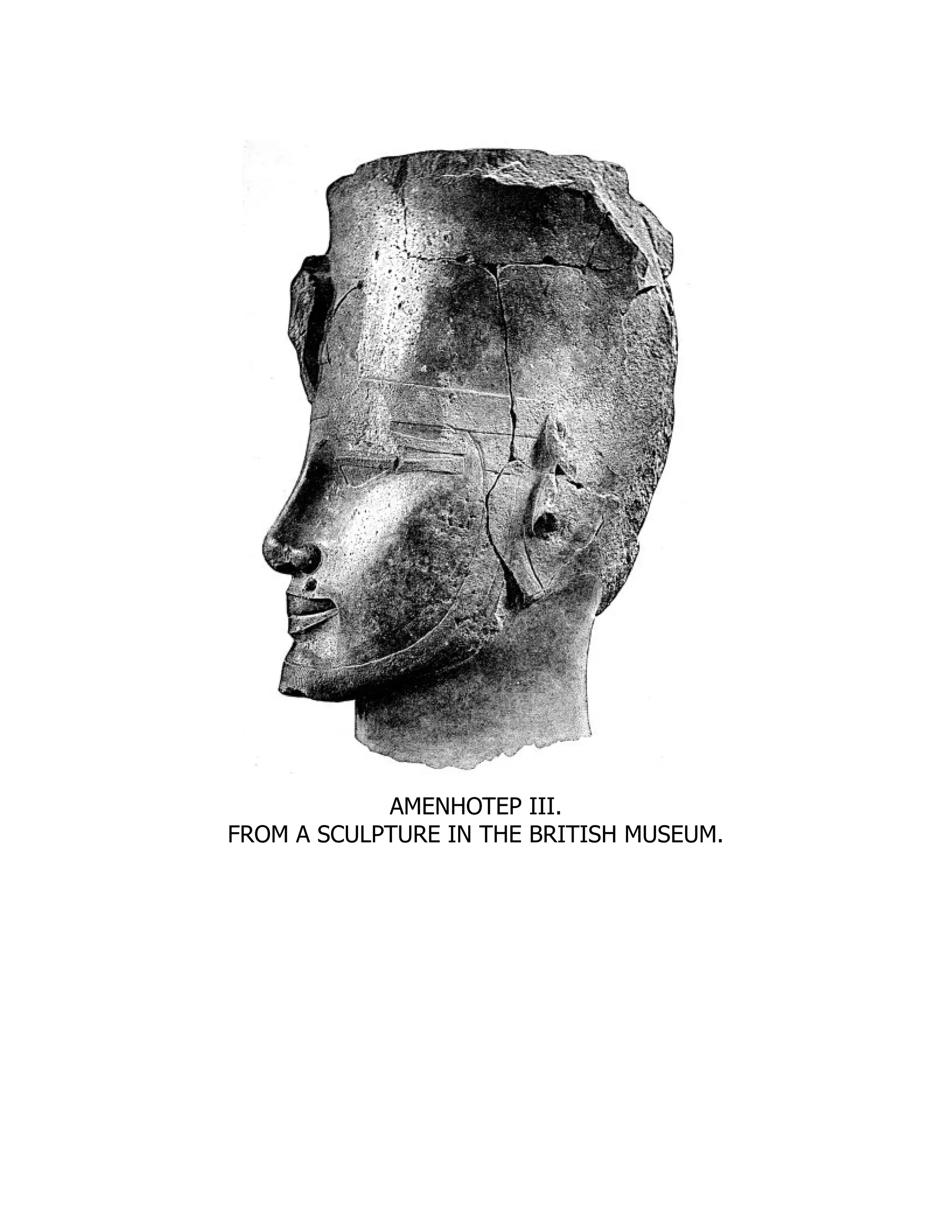
AMENHOTEP III.
FROM A SCULPTURE IN THE BRITISH MUSEUM.
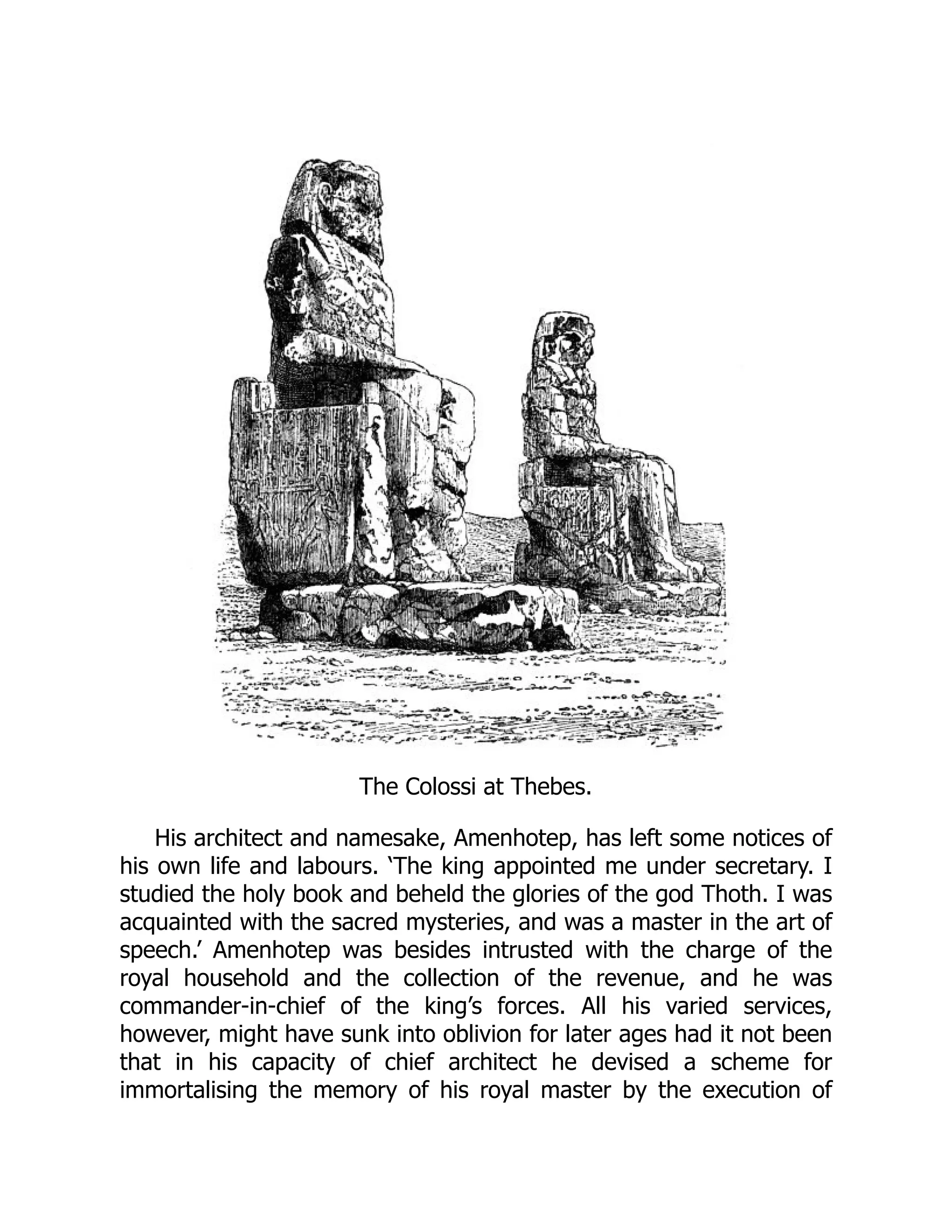
The Colossi at Thebes.
His architect and namesake, Amenhotep, has left some notices of
his own life and labours. ‘The king appointed me under secretary. I
studied the holy book and beheld the glories of the god Thoth. I was
acquainted with the sacred mysteries, and was a master in the art of
speech.’ Amenhotep was besides intrusted with the charge of the
royal household and the collection of the revenue, and he was
commander-in-chief of the king’s forces. All his varied services,
however, might have sunk into oblivion for later ages had it not been
that in his capacity of chief architect he devised a scheme for
immortalising the memory of his royal master by the execution of
two portrait statues ‘in noble hard stone for his great building,’ in
Western Thebes. These colossal statues were about 60 feet high,
and each was cut out of a single block of stone. Amenhotep caused
eight ships to be built to convey them down the river; he tells us
that all the masons under his direction were full of ardour in the
work, and that the safe arrival and landing of the statues at Thebes
was a ‘joyful event.’ ‘Every heart,’ he says, ‘was filled with joy, and
the people shouted in praise of the king.’ They were raised in their
appointed place some little distance in front of the new temple the
king had founded on the western side of the river. And he tells us
that ‘they made the gate-towers look small. They were wonderful for
size and height, and they will last as long as heaven.’
A few scattered ruins only of the temple remain, but these two
battered giants sit there still and keep their watch upon the desert
plain. These were the statues called by Greek fancy the ‘statues of
Memnon,’ who was, they said, the son of Aurora, and came to the
aid of the Greeks at the siege of Troy. One of them was broken in
two during a terrible earthquake that wrought great destruction in
Egypt in a.d. 27. The upper part fell to the ground, and it was after
this event that the statue became vocal, and emitted every morning
at sunrise a musical and melancholy strain. The fact of such a sound
being heard was attested by an immense number of inscriptions left
there by both Greek and Roman travellers. Septimius Severus
afterwards repaired the statue, and from that time the phenomenon
ceased, but has ever since been subject of curious speculation.
As might be supposed from the extent and splendour of his
works, the reign of Amenhotep iii. was not of short duration. We
read of one thirty years’ jubilee that was celebrated amid national
rejoicings. Some of the taxpayers brought, it is said, on that
occasion ‘when the overseer had spoken but one word, more than
the actual amount due, and the king rewarded their devotion by the
presentation of golden chains and collars—the customary badges of
honour.’
The portraits of Egyptian kings and queens bear every sign of
being truthful and characteristic likenesses. The kings of the
Thothmes family are all fine-looking men, their noses straight, their
features well formed; those of the second and third Thothmes being
particularly refined and delicately cut. And Queen Tai-ti, wife of
Amenhotep iii., is unquestionably the most beautiful amongst the
Egyptian queens that we know. But the monarch who reigned next,
or next but one to the last-named sovereign, is of quite peculiar
ugliness; he has a retreating forehead, a very long aquiline nose,
and an extraordinary chin, long and pointed. His figure is thin and
effeminate, his legs feeble and attenuated, and his expression
somewhat idiotic. It is difficult to believe that he could have
belonged to the same family, or even the same nation as the
Thothmes and Amenhoteps, his predecessors, and one is inclined to
conclude with Mr. Villiers Stuart,[42] that a princess must have
unexpectedly succeeded to the throne whose husband was a
foreigner. This idea would agree with the fact that the new sovereign
actually introduced a new form of worship into the country.
The mysterious god of Thebes was worshipped under the name
and figure of the sun, but this was regarded as only one of his
manifestations, who was a being ‘of many names, of holy
transformations, of mysterious forms.’[43] But the new king
worshipped Aten or the sun’s disk, and recognised no other god. He
also adopted the name of Khu-en-aten or ‘Splendour of the Disk.’ It
is hard to understand theological controversies of so very ancient a
date, but it is easy to feel what must have been the indignation
among the priests and people at Thebes, when a royal edict was
issued commanding that the names of Amen and of Mut should be
erased from all the monuments in this, the ancient seat of their
worship. Royal authority, however, proved sufficient to accomplish
this outrage upon the national faith, but the king’s further scheme of
erecting a temple to his god Aten in Thebes itself could not be
carried out, the influence of the rich and powerful priesthood and
the strength of the national feeling were too great.
Khu-en-aten therefore abandoned Thebes altogether, and
migrated with his court to a spot about midway between that city
and Memphis. Here he built an entirely new city and a splendid
temple, with fire altars in honour of Aten. He summoned the masons
of all Egypt to his work, and called together the chief men of the
people, most of whom must have rendered but a sullen and
unwilling obedience. There were courtiers, however, ready to adopt
the royal creed, and to become, some of them at least, its zealous
advocates. Amongst these the foremost was one Meri-ra, who was
promoted to the dignity of chief seer. ‘Be thou chief seer of the disk
of the sun according to thy wish,’ said the king, ‘for thou wast my
servant who wast obedient to the teaching. Thou treasurer of the
chamber of silver and gold! reward the chief seer of Aten—place a
gold chain around his neck, and join it behind—place gold at his
feet, because he was obedient unto the teaching of the king.’
At Tel-el-Amarna, east of the Nile, are still to be seen the ruins of
this great and hastily constructed city, which was about two miles in
length, but very narrow in width. Travellers say that the ground-plan
of the houses may still be traced, and that there are some immense
mounds covered by the drifting sand, where temples and palaces
might be buried. Four miles off are tombs and rock-temples
excavated in the hill-side, but often entirely blocked up by sand.
Wherever the new worship was portrayed, the sun’s disk is
represented above, with long rays reaching downwards, and each
ending in a hand—the sign of divine protection; the hand often holds
the symbol of life before the king.
The family life of Khu-en-aten is depicted more than once. In one
group he is seen with his queen Nefer-tai and their young daughters,
distributing gifts of honour at some festival. One little boy is there
too, but he is too young to take part in the distribution, and is
caressing his mother’s face. Strong affection appears to have united
the royal family, who doubtless felt their position a very isolated one.
The prayers and praises, however, that are recorded as forming part
of the new ritual, are very similar in tone and expression to those
used in the customary worship. Prayer for the reigning sovereigns is
frequent; on one festive occasion we read that the king gave his city
the name of ‘Delight of the Sun’s disk,’ and offered sacrifices with
solemn invocation. ‘Tender love fills my heart for the queen and her
young children. Grant long years of life to Nefer-tai, that she may
keep the king’s hand. Grant long life to the royal daughters, that
they may keep the hand of the queen, their mother, for evermore.’
Nefer-tai appears to have died comparatively young; in one of the
sculptures she is represented ‘with terrible fidelity,’ Mr. Villiers Stuart
says, as apparently in the last stage of wasting disease. Her only son
must have died quite in childhood; he is not represented again, but
the daughters, seven in number, are frequently seen. As Khu-en-
aten died without a male heir, the crown passed to his daughters’
husbands, two if not three of whom reigned in succession. They
soon returned to Thebes, and to the worship of Amen-Ra, but none
of them were ever acknowledged as true-born kings; it is doubtful
whether they were crowned at Thebes. Ai was the last of them, and
a beautiful rose-coloured sarcophagus of granite found in a tomb to
the west of the royal sepulchres bears his cartouche.[44] It is worthy
of notice that he is styled prince, not king. Each of these rulers, in
fact, occupied the throne only in right of his wife,[45] and were
themselves apparently merely officers in high position at Khu-en-
aten’s court—a fact sufficient to account for the coldness with which
the priests of Amen regarded them, in spite of their official return to
the national worship. The government, however, appears to have
been well administered by them, and foreign tributes were duly paid.
A scene is represented on the walls of a tomb at Thebes, in which
the governor of the south (whose tomb it was) is introducing a
negro queen into the presence of Tutankh-amen, one of these
princes. She has come in person to lay tribute and gifts at his feet.
The boats are depicted in which the party have travelled and
brought with them giraffes and leopards from the South, which are
now presented to the king with other offerings, amongst which is a
model of one of the negro dome-shaped huts with palm trees,
around the tops of which giraffes are nibbling. The dark-hued
princess made use of a sort of chariot drawn by oxen; her offerings
are by no means devoid of artistic merit, though they cannot vie, in
this respect, with those presented at the same levée by Asiatic
princes of red complexion, and long curling black hair; they bring
costly works wrought in gold, silver, and precious stones—the
produce of skilled Phœnician art.
None of these kings apparently left any children. The official lists
of sovereigns do not include any names between that of Amenhotep
III. and Horus. It was to Horus that all eyes turned when the direct
succession failed. He was then living in retirement at a city called
Ha-Suten in middle Egypt, but had held high office at court at one
time, and had been promoted to the dignity of ‘guardian,’ and
afterwards of ‘Adon’ or ‘Lord,’ of the land—if indeed he had not been
in some way recognised as heir to the throne itself. Horus was
esteemed and beloved for the uprightness and gentleness of his
character. ‘He took pleasure in justice,’ it is said of him, ‘which he
carried in his heart; he followed the gods Thoth and Ptah in all their
ways, and they were his shield and protectors on earth for
evermore.’ He was especially acceptable to the priesthood on
account of his fervent attachment to the old faith and the national
gods—the god Horus being regarded as his special patron and
guardian. To him was ascribed his elevation to the royal dignity.
‘Horus made his son great, and willed to prolong his life until the day
came when he should receive the office destined for him.’ It is
doubtful whether he was himself of royal descent, but it is certain
that he married a princess of the direct line, and that no one else
was thought of for a moment when the throne became vacant.
There is a long account preserved of his accession, and solemn
reception, and coronation at Thebes. ‘Heaven and earth rejoice
together—the gods invested him with the double crown. Heaven
kept festival, and all the land was glad. The deities rejoiced on high,
and the people of Egypt raised their rapturous songs of praise even
unto heaven; great and small united their voices with one accord. It
was as if Horus, son of Isis, were once more presenting himself after
his triumph over Set.’
The new king was indeed regarded as, in some sense, an
avenger triumphing over evil. One can imagine that even though the
previous rulers had returned to Thebes and its gods, it would have
been hardly possible for their wives, who must have shared their
sovereignty, to indulge in any bitter animosity towards the city in
which they had been brought up, towards the worship which their
father had established there, or towards the names and memory of
their parents. But at the accession of Horus, all restraint was
removed, and the full tide of animosity let loose against the ‘city of
the delight of the sun’s disk.’ City, temples, and tombs were
destroyed, and every vestige and trace of the reign and the religion
of Khu-en-aten effaced as far as possible. The stone was taken to be
employed in the building of Theban temples. Only a few ruins and a
few inscriptions have escaped to tell the traveller of this curious
episode in Egyptian history.
Equal diligence was shown by this sovereign in rebuilding and
beautifying the temples which had long been neglected. The cities of
the gods, we are told in decidedly hyperbolical language, ‘lay as
heaps of rubbish.’ ‘He renewed the temples of the sun-god,’ we read,
‘and Ra rejoiced to see that renewed which had been destroyed in
former times.’ The king also provided for the sacrifices; he appointed
holy persons, singers, and bodyguards for the temples, and assigned
for their use and service arable land, cattle, and all that was required
—that ‘they might sing thus each new morning unto Ra: “Thou hast
made the kingdom great for us in thy son the delight of thy heart,
King Horus. Grant him length of years and victory in all lands, even
as unto Horus, son of Isis.”’
Horus reigned for more than twenty years, and his death was
followed by the accession of a new dynasty—the nineteenth.
CHAPTER X.
The Nineteenth Dynasty (circa 1400-1200 b.c.)
Rameses the Great.
The peace of Egypt was not disturbed, although the direct
succession again failed at the death of Horus. It is more than
doubtful whether the soldier Rameses who now came to the front
was of the royal line at all. He married his son Seti to a princess of
the house of Pharaoh, and associated him with himself in the
government. After a brief reign, of which next to nothing is
recorded, he died, and left the crown to Seti. The wife of this
sovereign was regarded with reverence as the descendant of the
ancient line; and her claim to remembrance in after times was not so
much that she was the wife of Seti, as that she was mother of
Rameses ii., in whose person the direct line was again restored. The
child was associated with his father from a very early age, so that at
any rate the sanction of a true-born Pharaoh might be given,
however nominally, to all that was done.
The reign of Seti i. was not long, but it was full of stirring events,
which are recorded on a wall of the great temple at Karnak. Egypt
had been absorbed in religious and domestic dissensions, and her
claims to supremacy and empire in Asia had been allowed to lapse.
Encouraged by this apparent indifference, the wandering Shasu
tribes had ventured to cross the frontier, and had entered the Delta.
Seti was a man of war, and was no doubt glad at heart to veil the
obscurity of his birth and his doubtful right to the crown in a dazzling
cloud of military triumph and renown. He marched against the
intruding Shasu, and soon discomfited them. ‘The king was against
them as a fierce lion; not one escaped to tell of his strength to the
distant nations,’ it is said. Nevertheless, we find them soon after able
to rally and make a stand upon Phœnician soil with the Phœnicians
as allies. The king, whose horses on this occasion bore the name,
‘Amen gives him strength,’ again attacked and overthrew them;
then, turning upon their allies, he defeated them also, the Egyptian
chariots meeting the Phœnician in furious encounter. Afterwards he
marched upon the Rutennu (Canaanites), and his horses were called
‘big with victory.’ So rapid was his success, that his approach took
the great Syrian stronghold of Kadesh unawares. Herds and flocks
were quietly pasturing under its walls when the Egyptian army
appeared in sight. In hot haste herds and herdsmen fled within the
city walls for shelter; the garrison forthwith made a sally, but Seti
was too strong for them, and the fortress was stormed and
captured.
A more formidable enemy remained. Northwards from Syria
dwelt the powerful nation of the Kheta (or Hittites), who now appear
upon the scene for the first time. Over their well-ordered hosts
likewise Seti claims a victory. ‘As a jackal,’ say the inscriptions, ‘he
rushes through the land and seeks after his prey—he is as a fierce
lion that haunteth the most hidden paths in every land—as a mighty
bull that hath whetted his horns for the strife. He hath smitten down
the Asiatics, and thrown the Kheta to the ground; their princes hath
he slain by the sword.’ It is quite plain, nevertheless, that the
Egyptian monarch was glad enough to conclude a peace on equal
terms with his brave opponents, and to return home again. On his
way he visited the country of Limmanon (Lebanon) to procure cedar
trees for the construction of a vessel to be used in the processions of
Amen-Ra, and for the erection of the masts on the gate-towers of
the temple. The people of that region received him with every mark
of friendliness and respect; they are seen in the pictured story busily
engaged in cutting down the tallest and finest of the trees for the
service of the king.
Seti re-entered Egypt in triumph, laden with rich spoil; he was
greeted with acclamations, and welcomed with peaceful offerings of
fragrant flowers, songs of victory, and shouts of exultation. ‘Thou
hast triumphed over thy foes, and hast quenched the fury of thy
heart. Ra himself has established thy boundaries. His hand has
protected thee when thy battle-axe was raised aloft above the heads
of thine enemies; their kings fell by thy sword.’
No doubt in this blaze of glory and glitter of spoil all remaining
misgivings as to the ‘right divine’ were dispelled and forgotten,
especially as in a succeeding campaign the boy Rameses
accompanied him. From his very birth this boy had been the object
of regard and almost of devotion. He is seen in early infancy
caressed by his mother and the ladies of the court. Later on he
stands by his father’s side doing homage to his ancestors or to the
gods in the temple of Abydos. On state occasions he occupied a
prominent position, and was the central point of interest—the idol of
his parents, and the hope of the nation, who cherished a real and
most effective belief in the divine right of the god-descended race of
their sovereigns. In a small Nubian temple is a sculpture, in which
the youth is represented as returning from his first campaign, and
receiving a loving welcome from his mother. She has noble features,
as became her lineage, and there is a likeness between her and her
son—so that although she is represented as a goddess, the face is
no doubt intended as a portrait. The campaign from which she
welcomes home her son, was against the Libyans, and, not unlikely,
he stood by his father’s side when the chariot, drawn by horses
called ‘Victorious is Amen,’ fell upon the foe. ‘He utterly destroyed
them,’ it is said, ‘as they stood upon the field of battle; they could
not hold their bows, and they remained hidden in their caves like
foxes, for fear of the king.’
Seti again celebrated a triumph, and dedicated his spoil to Amen-
Ra, together with the prisoners, whom he gave to the service of the
temple, both as men and women servants. ‘The kings of the nations
that did not know Egypt,’ so they sang on the occasion, ‘are brought
by Pharaoh. They magnify his mighty deeds, saying: “Hail to thee,
King of Egypt! Mighty is thy name. Happy is the people that is
subject to thy will, but he who oversteppeth thy boundaries shall
appear led in chains as a prisoner. We did not know Egypt; our
fathers had not entered it. Grant us freedom out of thy hand.”’
The events of Seti’s campaigns are sculptured on the north wall
of his Hall of Columns at Karnak. He is spoken of there as taking an
intense and ferocious delight in battle. ‘Dear to him is the fray! his
delight is to dash therein; his heart is satisfied when he beholds
streams of blood gush forth, and strikes off the heads of his
enemies. One moment of the strife of men is more precious to him
than a whole day of pleasure. With one stroke he smiteth down the
foe and spareth none, and whosoever is left alive he carrieth down
into Egypt alive as a prisoner.’ So keen and savage a delight in
bloodshed has confirmed some writers in the idea that Seti came of
some alien race, as it is out of harmony with the mildness and
humanity that characterised the Egyptian character. His name is
considered as probably showing a close connection with the Delta,
where Set was worshipped, chiefly by the foreign settlers; whilst the
name of that god was so hateful in Egyptian eyes that it was
chiselled away from the monuments, both during Seti’s life and after
his death, even though it occurred as part of the royal name, and
the king himself appears frequently to have changed his own
objectionable name for that of Osiris. It may also be noted that the
type of face of the sovereigns of the nineteenth dynasty is different
from that of the preceding kings, and is decidedly of a more Semitic
cast.
Although Seti had reconquered Syria, and possibly the adjacent
lands, it does not seem that the stream of tribute flowed in such
abundance as during the reign of Thothmes the Great. Treasure,
however, was required, and the king resolved to have the valley of
Hammamat thoroughly explored and worked. He went there himself
in the ninth year of his reign, for, as the inscription says, ‘his heart
wished to see the mines whence the gold is brought.’ Water was, of
course, the first necessity as of old in the days of the eleventh
dynasty, and Seti visited the hills in company with those who knew
most about the water-courses. The desolation of the hot waterless
valleys struck the king. After a journey of some miles he is said to
have halted to meditate quietly, and he ‘said within himself, “If the
road be without water the wayfarers must perish; they die of
parching thirst. Where shall I find a place where the burning thirst
may be quenched? Vast is this region, and far does it extend. He
who is here overtaken by thirst will cry out, ‘O this land of perdition!’
Those who come hither will come to perform their obligations
towards me; I must do that which will enable them to live. Thus
shall my name be venerated throughout future generations.”’ When
the king had said thus within himself he went up into the hills to
found there a sanctuary wherein prayer might be offered to the god.
After that it pleased him to assemble workmen to quarry the stone,
and to form a reservoir there amongst the hills for the purpose of
sustaining the fainting by giving him fresh water in the time of the
summer heat. And the water came in great abundance, like the
waters of the Nile at Abu. The king spake and said, ‘The god has
heard my prayer; the water has come forth abundantly out of the
rocks; the road that had no water has been made good under my
reign. The shepherds shall have pasture for their flocks.’
A town was afterwards built at this new centre of industry, and a
temple erected where Seti offered worship ‘to his fathers the gods.’
Guards were appointed to protect the convoyers of the precious
metal, which was largely used by the king in adorning both temples
and statues of the gods. Indeed, all the works ascribed to this reign
are remarkable for their beauty and perfect finish, so that Seti i. can
hardly be looked upon, after all, as nothing more than a man of
blood and a lover of the fray. The chief of his works is a grand Hall
of Columns that he added to the Great Temple at Karnak, founded
so long before by Amenemhat i. It contained 134 immense columns
of massive proportions, but, like his other undertakings, it had to be
left incomplete, as his reign was not of long duration. In one of the
corridors of his beautiful temple at Abydos was found the famous
‘Tablet,’ so invaluable to students of Egyptian history. It contained
the names of 76 royal ancestors of Rameses ii., going back to King
Mena himself; and the young Rameses is seen standing by his father
and offering homage to their memories; on the opposite wall are
inscribed the names of the Egyptian gods and goddesses, and a
beautifully executed bas-relief represents the prince, under his
father’s direction, pouring out in honour of the deities a libation,
which is received into a vessel full of flowers.
The strong affection borne by Seti to his young son was fully
returned, and it was with the most reverent heed that Rameses, on
his accession, carried out and completed all that his father had
begun. In Western Thebes Seti had founded a memorial sanctuary
to his father’s name, which he intended as his own burial-place. But
‘he died,’ says Rameses, ‘and entered the realm of heaven and
united himself with Ra, whilst this his house was being built. The
gates showed a vacant place; all the works of stone and brick had
yet to be raised, and all the writing and painting to be done.’ The
mummy of the king had, it seems, been placed meanwhile in his
temple at Abydos. One morning it happened that, after celebrating a
magnificent festival of Amen-Ra at Thebes, Rameses started at dawn
of day for his new and favourite capital in the Delta.[46] The royal
ships, it is said, threw their brightness on the river. Orders had been
given for the journey down the stream, but on reaching the canal
that led to Abydos the young king gave directions to turn aside
thither that he might ‘behold the face of his father and offer
sacrifice.’ But on arriving, he was much struck by the general
dilapidation of the tombs, and the marks of careless neglect on
every side. ‘Nothing had been built up,’ he said, ‘by the son for the
father, though he should have been careful to preserve it according
to his expectations, since its possessor had taken flight to heaven.
But not one son had renewed the memorial of his father who rested
in the grave.’ On examining his own father’s temple, he found
evidence not only of neglect but of dishonesty. ‘The revenues had
failed, the servants of the temple had taken, without exception,
whatever had come in for themselves.’ Consequently the columns
were not raised on their bases, the statues lay prostrate on the
ground. Rameses forthwith called together the princes, the captains
and the architects, and after their prostrations and flattering
speeches were ended he addressed them. After speaking of the
state of things he had found at Abydos, he went on to say: ‘The
most beautiful thing to behold, the best thing to hear, is a child with
a thankful breast, whose heart beats for his father. When I was but a
little boy I attained to the supremacy. The lord of all himself
nourished and brought me up; he gave over to me the land. I sat on
his lap as a child, and he presented me publicly to the people,
saying, “I will have him crowned king, for my desire is to behold his
glory whilst I am yet alive. Place the royal diadem upon his brow.
May he restore order and set up again that which has fallen into
ruin. May he care for the people, the inhabitants of the land.” Thus
graciously did he speak out of his tender love towards me. Therefore
will I do what is fitting and good for Seti Menephtah.[47] I will renew
his memory. I will not neglect his tomb, as children are accustomed
to do who do not remember their parents. I will complete it because
I am lord of the country. I will take care of it because it is right and
seemly.’ He is answered with profuse flatteries, and is assured that
none but he and Horus, son of Isis, imagine and perform such
things. The king then appoints the following song for his own honour
and in his father’s memory:—
‘Awake, lift up thy face towards heaven; behold the sun, O my
father, thou who hast become like God. Here am I who will make
thy name to live. I myself, I myself am come here to build thy
temple near to that of Unnefer,[48] the eternal king.’
Rameses proceeds to tell of all his gifts and rich endowments,
and then addresses his father thus:—
‘Thou hast entered into the realm of heaven. Thou art in the
company of Ra. Thou art united with the moon and stars. Thou
restest in the deep like those who dwell with Unnefer the eternal
king. When the sun ariseth thou dost behold its splendour: when
he sinketh down to rest, thou art in his train. Thou enterest within
the secret house, and remainest in the company of the gods.
Speak thou to Ra and to Unnefer with a heart full of love, that he
may grant long years and feasts of jubilee unto King Rameses.
Well will it be for thee that I should reign for a long time, for thou
wilt be honoured by a good son who remembers his father.’
In answer to this invocation Seti appears and promises all that
the heart of a king could desire, and more especially the length of
days entreated by his son.
Long life was certainly appointed to King Rameses, who reigned
for 67 years. Whilst still a youth he was summoned to serious
conflict. Not only had the Syrian princes again risen, but the
powerful and civilised nation of the Kheta had prepared to put forth
all its strength against its mighty rival. Their country lay north of
Syria, and their dominion extended eastward over a part of
Mesopotamia, and westward to the coast of Asia Minor. Seti had
encountered them, but although he claimed a great victory, he had
found it advisable immediately afterwards to conclude a treaty and
to return home. Khetasir, king of the Kheta, encouraged perhaps by
the extreme youth of Seti’s successor, had formed a strong
confederacy against Egypt, and placed himself at its head. Besides
his Syrian and Phœnician allies, he had called together the
inhabitants of Mesopotamia on the east, and of the towns on the
sea-coast, including, some have imagined, a contingent from Ilium,
[49] as yet unbesieged of Greek, and unknown in song. The Egyptian
forces reached Kadesh and pitched their camp in its neighbourhood.
The scenes of this campaign are made very real and living to us,
being painted and sculptured in full detail on the walls of the Theban
temples, and its chief episode is immortalised in the heroic poem of
Pentaur. We see the Egyptian camp in the form of a square, with a
temporary wall of enclosure, formed by piled up shields; servants are
resting, asses are wandering about; there too is the lion of Rameses,
the famous beast who accompanied him in his campaigns, and
whose name was Semem-kheftu-ef: ‘Tearer to pieces of his
enemies.’ The king’s tent is seen, and near it is the shrine of the god.
An inscription duly informs us: ‘This is the first legion of Amen, who
bestows victory on King Rameses. Pharaoh is with it. It is pitching its
camp.’
Another picture gives us an important episode. The inscription
tell us: ‘This is the arrival of the spies of Pharaoh. They are bringing
two spies of the Kheta before the king. They are beating them to
make them declare where the king of the Kheta is.’ For the plain fact
was that the Egyptians were very much at a loss. Not long before
two men had come into the camp, professing themselves to be
leaders of the Shasu, who were wishing to desert the cause of the
Kheta and to join the Egyptian army; for the king of the Kheta was
far away, and was remaining in the country of the Khilibu for fear of
the Egyptians. Rameses, it is not unlikely, was flattered by this
tribute to the terror inspired by his very name; at any rate he
believed their story too easily, and set out at once with slender
forces in a north-westerly direction, leaving the main body to follow
more leisurely. But at this juncture the two spies mentioned in the
inscription were captured, and from them was extorted the
confession that the Kheta were not by any means far off, but were at
that moment lying in ambush close at hand, had horses and riders in
great number, and all implements of war, and were ‘more in number
than the sands of the sea.’ Anger swelled high in the breast of the
young king; he called together the leaders and captains, and bitterly
upbraided them for their neglect and carelessness. ‘You have been
telling me every day that the enemy are far away in the country of
the Khilibu, and now, hear what these men say. Bring up our forces
to the attack—they are close at our side.’ But meanwhile the king of
the Kheta had fallen suddenly upon the main body of the Egyptian
army, who were following the advanced guard slowly and in careless
security, and had taken them completely by surprise. They gave way
and fell back upon the road that led to the place where the king was
stationed with his advanced guard. But ‘when Pharaoh saw this he
was wroth; he seized his armour and appeared like unto the god of
war in his hour. He mounted his chariot and rushed forth alone.
None was with him. He rushed upon the foe and cast them down,
and subdued the people before him. Then did the king of the Kheta
lift up his hands in supplication.’
The scene is a favourite one, and is depicted more than once. We
see the orderly masses of the Kheta in contrast to their less regular
and less warlike allies. We see the heroic onslaught of the king, and
the desperate encounter of the chariots on the plain of the Orontes.
The Khetan chariots are beheld overthrown and hurled into the river,
where the horsemen are confusedly struggling. One prince is being
dragged out and held with his head hanging down, and we learn
‘This is the King of Khilibu; his warriors are raising him up after
Pharaoh has thrown him into the water.’
Such was the battle of Kadesh, in which it is evident that the
Egyptian army, after having been brought by bad generalship to the
brink of destruction, was saved from ruin by the desperate valour
and personal prowess of Rameses himself. It is this exploit that is
celebrated by the poet Pentaur two years later in such glowing
poetic hyperbole:—
‘He arose like unto Mentu, the god of war, and put speed to
his horses, and urged on his steeds,—named “Triumph in
Thebes,” and “Mut[50] is content.” None dared follow his headlong
assault. He was alone and none other with him. And lo! he was
encircled by the Khetan host; 2500 chariots were around him, and
countless hosts cut off the way behind. On each chariot three
men stood, and all were massed together man to man.’
The king now speaks:—
‘Not a prince, not a captain was by me. My chiefs and knights
had failed. No man was there to take my part against the foe. O
Amen, my father, I know thee; where art thou? Has ever a father
forgotten his son? Thy precepts, thy will have I ever denied? has
ought I have done been apart from thee? These hosts of the foe,
what are they to thee! Amen can humble the imperious and
proud. To thee I built temples and offered rich gifts. The wealth of
the nations I laid at thy feet. Lo! I am alone, and none other is
with me. I called on my soldiers, and none heard my cry. More to
me is thy power than myriads of men—than thousand times
thousand arrayed for the war. On thee, father Amen, on thee do I
call!
‘In far-off Hermonthis my prayer was heard. He stood by my
side. “Lo! I am come! Rameses Meri-amen,[51] thy prayer has
been heard. I am more to thee than thousand times thousand.
And the brave heart I love—my blessing is his. Nor can ought that
I will of accomplishment fail.”
‘Then I rose up like Mentu and smote down the foe. A terror
seized them and none dared fight. No man could shoot nor grasp
the spear. Headlong they plunged into the stream like the
crocodile. Still stood the King of Kheta to behold King Rameses,
for—“He was alone, none other with him.” Once more did he
attack with all his power, but I rushed upon them like a flame of
fire and slew them where they stood. Each man cried unto his
fellow, saying: “No mortal man is he who is against us. It is Set
the mighty—‘tis the god of war. Whoso draws near him his hand
drops, nor can he grasp the bow or spear.” I called upon my foot
and horse: “Take heart—be firm—behold my victory.” I was alone,
but Amen was beside me.’
The whole poem is too long to be given here, but we learn that
when at length the terror-stricken forces rallied upon seeing the
victory of the king and beholding the multitude of corpses, they
approached with adulation and flattery, extolling the hero to the
skies. No wonder that his reply is stern:—
‘The king spake and said: “O my captains and soldiers who
have not fought! of what profit is all your devotion? Which of you
has done his duty before his king? Who ever did for you what I
did? and now have ye altogether failed me; none stood by to help
me in the battle. Shame upon my horse and foot! shame more
than words can say! As for my horses, they indeed were with me,
and upheld me when I was alone amid the raging foe. Henceforth
shall they eat food before me in my palace for ever.”’
Next day the battle was resumed with fury, and at the close the
Kheta sued for peace, which Rameses, apparently, was glad enough
to grant. Accepting their submission he returned to Egypt ‘joyful and
glad at heart.’
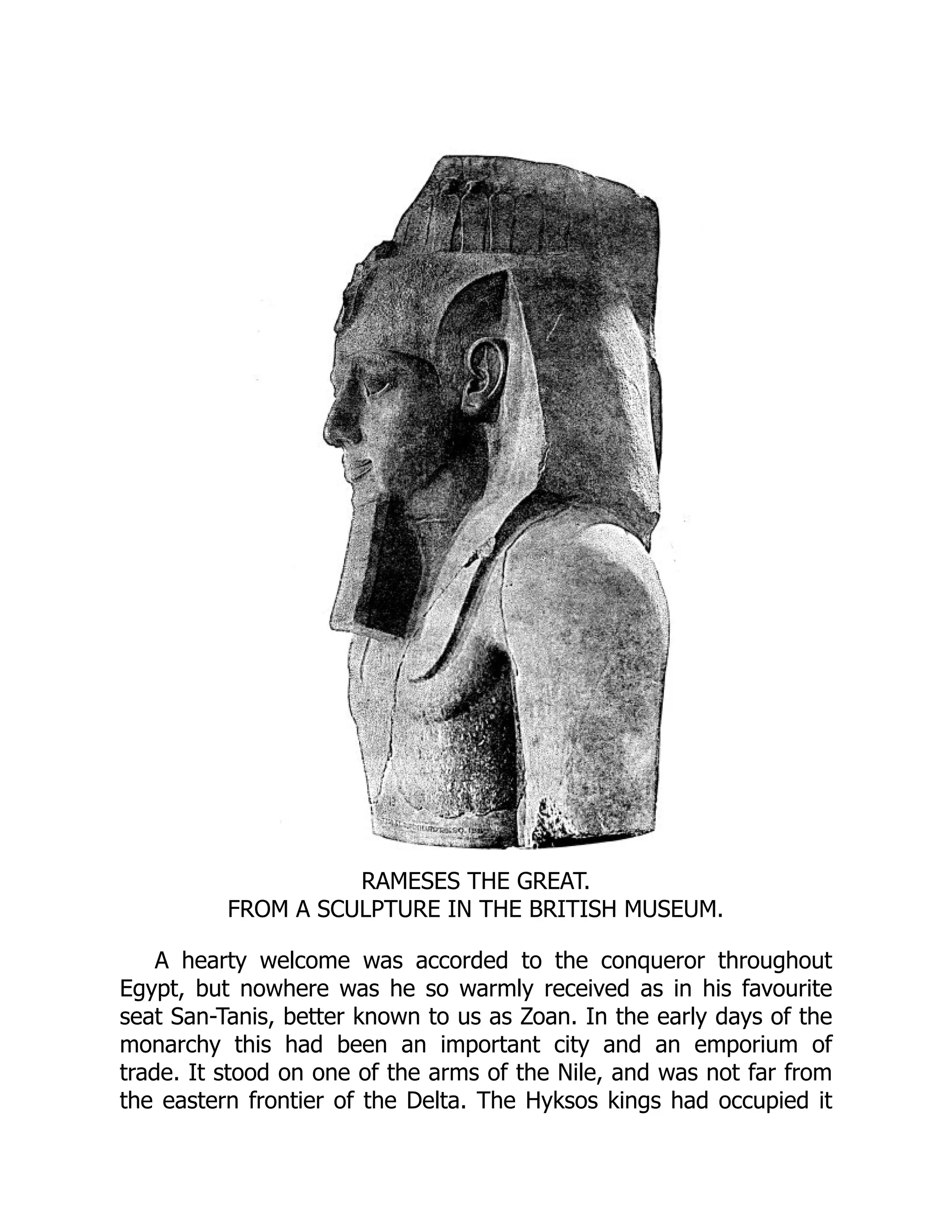
RAMESES THE GREAT.
FROM A SCULPTURE IN THE BRITISH MUSEUM.
A hearty welcome was accorded to the conqueror throughout
Egypt, but nowhere was he so warmly received as in his favourite
seat San-Tanis, better known to us as Zoan. In the early days of the
monarchy this had been an important city and an emporium of
trade. It stood on one of the arms of the Nile, and was not far from
the eastern frontier of the Delta. The Hyksos kings had occupied it
soon after their invasion; they often resided there, and under them it
attained great splendour and importance. After their expulsion it was
neglected, nor did it come again into prominence until the days of
Rameses, who almost rebuilt it, and under whom it became one of
the most magnificent of the great cities of Egypt. It was known as
Pa-Ramessu, the ‘city of Rameses,’ and we are fortunate in
possessing a description of it by an Egyptian writer, written
apparently in prospect of the king’s triumphal entry: ‘I came to the
city of Rameses Meri-amen. Beautiful is she exceedingly. Thebes
itself is not comparable unto her—the secret of happiness is here.
Her meadows are full of all things fair and good, daily producing
abundance of food; the pools are full of fish, and the lakes swarm
with waterfowl; the fields are green with verdure; the melons are
sweet as honey. The barns and threshing-floors are full of wheat and
barley, heaped up even unto heaven; herbs of all kinds abound in
the gardens; there the apple-tree blooms, the vine, the citron, and
the fig-tree. Sweet is the wine like honey. The canal yields salt, the
lake of Paher, natron (soda). The ships come and go daily, and there
is plenty without stint. Gladness dwells in Pa-Ramessu, and happy is
he whose habitation is therein. The lowly ones are like unto the
great. They all unite to say: “Come and let us celebrate the heavenly
and the earthly festivals!” The people of the marsh land bring lilies,
and from Pshenhor come the crimson-tinted flowers of the pools.
The maidens of the “conqueror’s city” are adorned as for a day of
festivity. They stand at the doors, and their hands are filled with
flowers and garlands on the morning of the day when King Rameses
Meri-amen, the war-god upon earth, makes his entry. All flock
together, neighbour with neighbour; each man bringing his petition.
‘Sweet is the wine of the conqueror’s city. Cider and delicious
drinks abound. Sweet song by the women of the school of Memphis
resounds; joy is in every heart. All are as one to celebrate the
praises of this god—even of King Rameses Meri-amen, the war-god
of the world.’
In the early part of his reign, Rameses was engaged in more
than one warlike enterprise, but none ever created so much
excitement, or so fascinated the popular imagination as that of the
first campaign by the Orontes at Kadesh, which was celebrated with
such true poetic licence in Pentaur’s epic song. Never, indeed, were
the records of any sovereign’s life and victories so blazoned abroad
as those of King Rameses; the walls of the temples in Egypt and in
Nubia are covered with inscriptions, paintings, and sculptures
belonging to this reign. One while we see him in what appears most
inglorious warfare—trampling down a crowd of negroes, who are
represented as pigmies, and over whom he is driving his chariot of
war. Some have escaped, and are flying in hot haste towards their
homes, represented by the little huts like bee-hives, such as are still
common in Africa. A little child rushes forward to greet them, but the
mother stands still, holding up her hands in an attitude of despair; a
little farther off another negress is seen with a pot over the fire,
which she is carefully watching that it may be ready for the returning
soldier. She does not yet see the boy who is even at that moment
running up to bring the fatal news. At another time the king is seen
seated upon his throne in state receiving the negro tribute—giraffes,
oxen, ostriches, and several monkeys appear in the drawing. Or he
is receiving prisoners brought in by his generals, whilst Semem-
kheftu-ef, the ‘Tearer to pieces of his enemies,’ is lying quietly at the
foot of the throne.
On the walls of the colossal temple of Abu-simbel in Nubia, is a
whole series of tableaux pertaining to the life of Rameses ii. There is
one striking bas-relief representing three of his sons following him in
a headlong charge upon the battle-field. The three princes speed on,
each in his chariot, side by side, and each of them is attended by a
charioteer, who carries a large shield for their defence. But Rameses
himself is alone, in the forefront. Not even a charioteer stands
beside him. The reins are fastened round his waist, whilst he bends
the bow firmly with his hands. Above his head flies the hawk, the
bird of Ra, ensign of the protection of the god. In another bas-relief,
he is pausing for a moment, and checking his steeds. Semem-
kheftu-ef is running by his side like a dog.
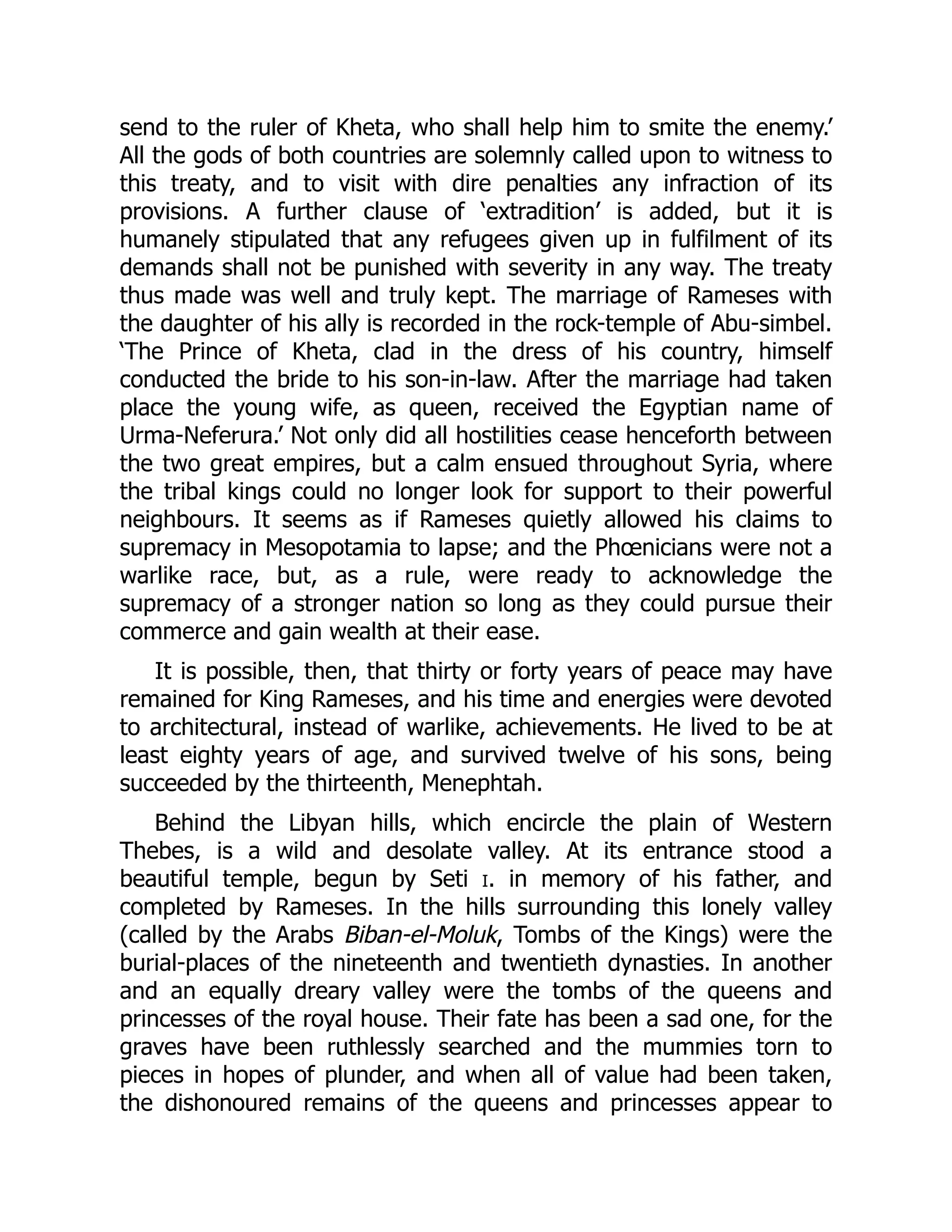
Vincent Brooks-Day & Son, Lith.
HALL IN THE GREAT TEMPLE AT IPSAMBUL.
These are only two illustrations out of the multitude carved with
spirit and fidelity upon the interior of the great temple hewn in the
sandstone rock at Abu-simbel, in Nubia, which, even in its present
condition, excites a wonder that is akin to awe. In front of the
entrance stand four colossal statues of the king seated on his
throne, each of which is 66 feet in height. The face is grandly
represented; a calm, haughty repose marks the features, and the
placid, if not scornful, smile so characteristic of the king rests upon
his lips—accustomed to speak in accents of command from early
childhood and on to extreme old age. Close by is a smaller temple
erected by queen Nefertari, the loved wife of his early manhood, in
honour of her lord. Within its walls we may see family groups
sculptured—the king in the prime of manhood, his beautiful young
wife, and her children. An inscription tells us that—‘To the sovereign
of the two lands, son of the Sun, lord of crowns, Rameses Meri-
amen, his loving lady, queen, and princess Nefertari, has built a
temple at Abu by the waters. Grant him life for evermore!’ In the
great temple, Nefertari is only once depicted; here the children are
grown up, and the sons follow their father to the battle. Rameses
himself is older, the glow and ardour of early years have given way
to the placidity and repose of later life, when his wars and his
victories were over; for, though renowned as a conqueror, the
greater part of his long reign passed by in peace. Nefertari herself
does not seem to have lived long, and Rameses apparently was
married two or three times; his last wife (so far as we can gather)
was a foreign princess, whose hand was the pledge of lasting
friendship and alliance between the two leading nations of the day.
[52]
The proposal came from Khetasir, king of the Kheta. A tacit
respect for each other seems to have prevented a renewal of the
war which had opened with the battle of Kadesh, but Khetasir
wished to go further. Between the two great and civilised nations lay
the seething and restless masses of the Canaanitish tribes. Powerful
kings had ruled ere this in Elam and in Mesopotamia, and might rule
there again. No worse policy could be conceived than that of mutual
rivalry and strife between Egypt and Kheta. An envoy brought to
King Rameses a copy of the proposed treaty written on a silver
tablet, and on its acceptance Khetasir himself came to Egypt and
was received in all state by Rameses at the city of Zoan, where the
treaty was duly ratified, and the King of Egypt received the hand of
the Khetan princess in token of lasting amity and goodwill. ‘Peace
and good brotherhood shall be between us for ever,’ so runs the
treaty; ‘he shall be at peace with me and I with him for ever. The
children’s children of the King of Kheta shall be in good brotherhood
and peace with the children’s children of Rameses Meri-amen, the
great ruler of Egypt. The King of Kheta shall not invade Egypt, nor
the great ruler of Egypt invade Kheta, to carry away anything from
it. If any enemy shall come against the land of Rameses he shall
send to the ruler of Kheta, who shall help him to smite the enemy.’
All the gods of both countries are solemnly called upon to witness to
this treaty, and to visit with dire penalties any infraction of its
provisions. A further clause of ‘extradition’ is added, but it is
humanely stipulated that any refugees given up in fulfilment of its
demands shall not be punished with severity in any way. The treaty
thus made was well and truly kept. The marriage of Rameses with
the daughter of his ally is recorded in the rock-temple of Abu-simbel.
‘The Prince of Kheta, clad in the dress of his country, himself
conducted the bride to his son-in-law. After the marriage had taken
place the young wife, as queen, received the Egyptian name of
Urma-Neferura.’ Not only did all hostilities cease henceforth between
the two great empires, but a calm ensued throughout Syria, where
the tribal kings could no longer look for support to their powerful
neighbours. It seems as if Rameses quietly allowed his claims to
supremacy in Mesopotamia to lapse; and the Phœnicians were not a
warlike race, but, as a rule, were ready to acknowledge the
supremacy of a stronger nation so long as they could pursue their
commerce and gain wealth at their ease.
It is possible, then, that thirty or forty years of peace may have
remained for King Rameses, and his time and energies were devoted
to architectural, instead of warlike, achievements. He lived to be at
least eighty years of age, and survived twelve of his sons, being
succeeded by the thirteenth, Menephtah.
Behind the Libyan hills, which encircle the plain of Western
Thebes, is a wild and desolate valley. At its entrance stood a
beautiful temple, begun by Seti i. in memory of his father, and
completed by Rameses. In the hills surrounding this lonely valley
(called by the Arabs Biban-el-Moluk, Tombs of the Kings) were the
burial-places of the nineteenth and twentieth dynasties. In another
and an equally dreary valley were the tombs of the queens and
princesses of the royal house. Their fate has been a sad one, for the
graves have been ruthlessly searched and the mummies torn to
pieces in hopes of plunder, and when all of value had been taken,
the dishonoured remains of the queens and princesses appear to
have been replaced, without care or ceremony, in their rock-hewn
tombs, and burned in heaps. The fire thus kindled has calcined the
walls of the tombs and sorely damaged the paintings and
inscriptions. A few only have escaped; amongst them is a very
perfectly preserved portrait of Tai-ti, the beautiful wife of Amenhotep
iii.[53]
The care taken in inspecting, and from time to time removing,
the bodies of the kings prevented such wholesale destruction; but
little could Thothmes or Rameses have dreamt of the destiny that
should befall them. Discovered at last in their final hiding-place, their
mummies, together with others of earlier and later date, were
conveyed down the sacred stream, and, by a strange irony of fate,
are now exhibited amongst other curiosities in a museum.
Discovery of Mummies at Deir el Bahari, near Thebes.
CHAPTER XI.
Thebes; its People, Temples, and Tombs—Close of the Nineteenth
Dynasty.
In an inscription on the walls of the rock-temple at Abu-simbel,
Rameses is represented as saying to the god Ptah, ‘I have cared for
the land to create for thee a new Egypt, such as it existed in the
olden times,’ and he specially mentions the splendid sanctuary he
had built for that deity in Memphis. And not at Memphis alone, but
everywhere throughout the land, from the city of Rameses in the
north to the wonderful rock-temples of the south, we can see the
magnificent traces left by the hand of this mighty sovereign. In
Thebes itself, he added a grand court to the temple of Luxor
founded by Amenhotep iii. of the preceding dynasty. This temple
was connected by an avenue of sphinxes with the still more
magnificent ‘great Temple of Amen,’ the foundation of which had
been laid by Amenemhat i., not long after the close of the civil wars,
and before the Hyksos invasion.
Temple and Garden.
However the Egyptian temples might differ in size or splendour,
the idea and plan were alike—so that it has been said, ‘If you have
seen one temple, you have seen all.’ A wall of enclosure surrounded
the precincts, which were adorned with trees, flowers, and artificial
lakes. The temple itself was approached by an avenue of sphinxes.
Before the entrance stood obelisks and colossal statues. On either
side of the gateway rose the pylons—massive towers, broader at the
base than at the summit; they were covered with pictorial and
sculptured representations of the great events of the day, and above
them rose the tall masts of cedar wood, whence floated the gay
streamers on days of festival and rejoicing. Passing through between
the pylons, a vast court was entered, surrounded by columns and
open to the sky. Beyond were halls, the roofs supported on pillars,
and in these the light glimmered but faintly amidst the forest of
majestic columns. Each hall or court was of less size than the one
before it, and the innermost sanctuary was small, dark, and
mysterious in its solemn obscurity. Here was the sacred shrine
(containing some hidden emblem or image of the god), which on
solemn occasions was brought out and carried in procession through
the city or down the river. These shrines or arks are seen depicted in
brightly coloured tints on the bas-reliefs. The sacred bark is standing
on an altar, which is covered by a red cloth. On two lesser altars
stand flowers and vessels for libation or for incense. In the centre of
the boat is the ark itself, a sort of chest partially veiled, in which is
for ever hidden the mystic symbol of the god. In the bark are small
images of men kneeling in adoration, and immense artificial lotus
and papyrus flowers. Tall banners or sun-screens stand behind,
ready to be carried in solemn state in the processions. On the prow
of the boat is the sacred hawk, and behind it a sphinx, emblem of
the king. Underneath are the shafts on which it rests when it is
taken from the altar and borne on the shoulders of the priests. Not
only the mystic shrine itself, but statues or images of the gods were
frequently carried in procession with music, song, and universal
rejoicings—queens and princesses deeming it an honour to take
part, carrying the sistrum or musical instrument used in the service
of the gods. As a rule the people probably were allowed only to
enter the vast outer court, kings and priests alone penetrating to the
interior recesses, where sacrifices were offered and incense
ascended in clouds. Sublimity and mystery were the ideas expressed
in these Egyptian temples,[54] with their vast halls and shrouded
recesses. Comparatively little thought and care were expended on
private residences, which were simple and unpretending. The poor
were content if they had shelter from the heat and a place of
Welcome to our website – the ideal destination for book lovers and
knowledge seekers. With a mission to inspire endlessly, we offer a
vast collection of books, ranging from classic literary works to
specialized publications, self-development books, and children's
literature. Each book is a new journey of discovery, expanding
knowledge and enriching the soul of the reade
Our website is not just a platform for buying books, but a bridge
connecting readers to the timeless values of culture and wisdom. With
an elegant, user-friendly interface and an intelligent search system,
we are committed to providing a quick and convenient shopping
experience. Additionally, our special promotions and home delivery
services ensure that you save time and fully enjoy the joy of reading.
Let us accompany you on the journey of exploring knowledge and
personal growth!
ebookfinal.com

E Business Management Integration of Web Technologies with Business Models 1st Edition Michael J. Shaw


  • 1.
    E Business ManagementIntegration of Web Technologies with Business Models 1st Edition Michael J. Shaw pdf download https://ebookfinal.com/download/e-business-management- integration-of-web-technologies-with-business-models-1st-edition- michael-j-shaw/ Explore and download more ebooks or textbooks at ebookfinal.com
  • 2.
    We have selectedsome products that you may be interested in Click the link to download now or visit ebookfinal.com for more options!. Business Network Learning International Business and Management 1st Edition J. Johanson https://ebookfinal.com/download/business-network-learning- international-business-and-management-1st-edition-j-johanson/ Broadband Services Business Models and Technologies for Community Networks 1st Edition Imrich Chlamtac https://ebookfinal.com/download/broadband-services-business-models- and-technologies-for-community-networks-1st-edition-imrich-chlamtac/ E Business Innovation and Process Management 1st Edition In Lee https://ebookfinal.com/download/e-business-innovation-and-process- management-1st-edition-in-lee/ Marketing the e Business Second Edition Routledge E Business Harris Dennis https://ebookfinal.com/download/marketing-the-e-business-second- edition-routledge-e-business-harris-dennis/
  • 3.
    Introduction to eBusiness Management and Strategy 1st Edition Colin Combe https://ebookfinal.com/download/introduction-to-e-business-management- and-strategy-1st-edition-colin-combe/ Unlocking Business Agility with Evidence Based Management 1st Edition Patricia Kong https://ebookfinal.com/download/unlocking-business-agility-with- evidence-based-management-1st-edition-patricia-kong/ Linguistic Refactoring of Business Process Models 1st Edition Fabian Pittke https://ebookfinal.com/download/linguistic-refactoring-of-business- process-models-1st-edition-fabian-pittke/ Business Continuity and Risk Management Essentials of Organizational Resilience Kurt J. Engemann https://ebookfinal.com/download/business-continuity-and-risk- management-essentials-of-organizational-resilience-kurt-j-engemann/ E Business and E Commerce Management Strategy Implementation and Practice 4th Edition Dave Chaffey https://ebookfinal.com/download/e-business-and-e-commerce-management- strategy-implementation-and-practice-4th-edition-dave-chaffey/
  • 5.
    E Business ManagementIntegration of Web Technologies with Business Models 1st Edition Michael J. Shaw Digital Instant Download Author(s): Michael J. Shaw ISBN(s): 9781402071782, 0306475480 Edition: 1 File Details: PDF, 10.13 MB Year: 2002 Language: english

  • 7.
  • 8.
  • 9.
    E-BUSINESS MANAGEMENT Integration ofWeb Technologies with Business Models edited by Michael J. Shaw KLUWER ACADEMIC PUBLISHERS NEW YORK, BOSTON, DORDRECHT, LONDON, MOSCOW
  • 10.
    eBook ISBN: 0-306-47548-0 PrintISBN: 1-4020-7178-7 ©2002 Kluwer Academic Publishers New York, Boston, Dordrecht, London, Moscow Print ©2003 Kluwer Academic Publishers All rights reserved No part of this eBook may be reproduced or transmitted in any form or by any means, electronic, mechanical, recording, or otherwise, without written consent from the Publisher Created in the United States of America Visit Kluwer Online at: http://kluweronline.com and Kluwer's eBookstore at: http://ebooks.kluweronline.com Dordrecht
  • 11.
    Contents Contributors Preface 1. E-Business Management:A Primer MICHAEL J. SHAW 2. E-Business and Beyond ROBERT W. BLANNING 3. The Neo-Intermediation RAVI KALAKOTA AND BENN KONSYNSKI 4. Driving Forces for M-Commerce Success JASON J. ZHANG, YUFEI YUAN, AND NORM ARCHER 5. e-Business Management Models: Services Perspective from the Revere Group TODD MILLER, MATTHEW L. NELSON, STELLA Y. SHEN, AND MICHAEL J. SHAW 6. Focus on Consumers: P&G’s e-Commerce Strategy MICHELE GRIBBINS, RICH LAUF, CHANDRASEKAR SUBRAMANIAM, AND MICHAEL J. SHAW ix xiii 109 1 19 27 51 77
  • 12.
    vi Contents 7. 8. 9. Global Non-ProductionProcurement at Motorola: Managing the Evolving Enterprise Infrastructure JUDITH GEBAUER, DEAN HAACKER, AND MICHAEL J. SHAW Supply-Chain Partnership between P&G and Wal-Mart MICHAEL GREAN AND MICHAEL J. SHAW From the User Interface to the Consumer Interface MELISSA COLE, ROBERT M. O’KEEFE, AND HAYTHAM SIALA 10. 11. 12. 13. 14. 15. 16. 17. 133 155 173 Information Foraging in Internet-Based Selling: A System Design Value Assessment Framework 195 JUNGPIL HAHN AND ROBERT J. KAUFFMAN Initiatives for Building e-Loyalty: A Proposed Framework and Research Issues 231 P. K. KANNAN, JANET WAGNER, AND CRISTINA VELARDE Web-based Recommendation Systems for Personalized e-Commerce Shopping 249 CHIH-PING WEI, ROBERT F. EASLEY, AND MICHAEL J. SHAW A Survey on the Industry Sponsored e-Marketplaces 277 HSIN-LU CHANG, STELLA YING SHEN, CHRISTOPH SCHLUETER- LANGDON, AND MICHAEL J. SHAW Trading Financial Derivatives on the Web - An Approach Towards Automating Negotiations on OTC Markets 311 MARTIN BICHLER The Dynamics ofthe Electronic Market: An Evolutionary Game Approach 335 SULIN BA, ANDREW B. WHINSTON AND HAN ZHANG A Strategic Analysis of Exchange Based B2B Networks 355 KEREM TOMAK AND MU XIA Product Hardware Complexity and Its Impact on Inventory and Customer On-Time Delivery 373 GRACE Y. LIN, RICHARD BREITWIESER , FENG CHENG, JOHN EAGEN AND MARKUS ETTL
  • 13.
    Contents vii 18. 19. 20. Reengineering Using“Merge-in-Transit” for Electronic Commerce 399 DANIEL E. O’LEARY Modularized Interoperability in Supply-Chains: A Co-adoption study of RosettaNet's XML-based Inter-organizational Systems 417 MATHEW NELSON, MARY SHOONMAKER, MICHAEL SHAW, STELLA SHEN, WILLIAM QUALLS, AND R. WANG A Study on the Value of B2B E-Commerce: The Case of Web-based Procurement 439 CHANDRASEKAR SUBRAMANIAM AND MICHAEL J. SHAW 463 Index
  • 14.
  • 15.
    Contributors Archer, Norm, McMasterUniversity Ba, Sulin, University of Southern California Bichler, Martin, Vienna University of Economics and Business Administration Blanning, Robert W., Vanderbilt University, Nashville Breitwieser, Richard, IBM Corporate Logistics Chang, Hsin-Lu, University of Illinois at Urbana-Champaign Cheng, Feng, IBM Supply Chain Services Cole, Melissa, Brunel University Eagen, John, IBM Corporate Logistics Easley, Robert, University of Notre Dame Ettl, Markus, IBM T.J. Watson Research Center Gebauer, Judith, University of Illinois at Urbana-Champaign Grean, Michael, The Procter and Gamble Distributing Company Gribbins, Michele, University of Illinois at Urbana-Champaign Haacker, Dean, Motorola Hahn, Jungpil, University of Minnesota
  • 16.
    x Kalakota, Ravi, Hsupply.com Kannan,P. K., University of Maryland, College Park Kauffman, Robert J., University of Minnesota Konsynski, Benn, Emory University Lauf, Rich, The Union Institute and University Lin, Grace Y., IBM T.J. Watson Research Center Miller, Todd, The Revere Group Nelson, Matthew L., University of Illinois at Urbana-Champaign O’Keefe, Robert M., Brunel University O’Leary, Daniel E., University of Southern California Qualls, William, University of Illinois at Urbana-Champaign Schlueter-Langdon, Christoph, University of Southern California Shaw, Michael J., University of Illinois at Urbana-Champaign Shen, Stella Y., University of Illinois at Urbana-Champaign Shoonmaker, Mary, RosettaNet Siala, Haytham, Brunel University Subramaniam, Chandrasekar, University of Illinois at Urbana-Champaign Tomak, Kerem, University of Texas at Austin Velarde, Cristina, University of Maryland, College Park Wagner, Janet, University of Maryland, College Park Wang, R., University of Illinois at Urbana-Champaign Wei, Chih-Ping, National Sun Yat-Sen University Whinston, Andrew, University of Texas at Austin Xia, Mu, University of Illinois at Urbana-Champaign Yuan, Yufei, McMaster University
  • 17.
    xi Zhang, Han, Universityof Texas at Austin Zhang, Jason J., McMaster University
  • 18.
  • 19.
    Preface This book containsa collection of articles by leading information systems researchers on important topics related to the development of e-business. The goal is to enhance the understanding of the state-of-the-art in e-business, including the most current and forward-looking research. The book emphasizes both business practices and academic research made possible by the recent rapid advances made in the applications of e-business technology. The book should help graduate students, researchers, and practitioners understand major e-business developments, how they will transform businesses, and strategic implications to be drawn. By illustrating in detail the major e-business developments and research, the book focuses on addressing e-business management from the perspective of information systems research. In order to cover the subject matter in sufficient breadth and depth, the book is organized into the following five main sections: e-Business Fundamentals, e-Business Best Practices, Marketing, Customer Relations, e-Services, and Personalization, Formation of New Intermediaries and e-Markets, and B2B and Supply-Chain Management: New Business Models and Valuation. I II III IV V The sections are made up of twenty chapters that use a variety of research approaches and presentation formats, including analysis, case studies, surveys, economics, modeling, and theory, and shed light on the key ideas involved in e-business management.
  • 20.
    xiv The organization ofthe book reflects the major developments in e- business, research opportunities, and impacts. The chapters on best practices in Section II follow the e-business fundamentals set out in Section I to capture successful industry strategies. Sections III, IV, and V then describe in detail the three driving forces of e-business deployment: improving customer relations, greater orientation toward e-markets, and a much stronger emphasis on B2B and supply-chain management. The mixing of leading academic research and business best practices creates a strong synergy between emerging theory and applications throughout the chapters of the book.. The worldwide digital economy is fast evolving. Driven by the wave of innovations resulting from breakthroughs both in information technology and in business practices, e-business developments have transformed the role of each. The transformations are very much ongoing and moving at a breathtaking pace. The bursting of the Internet bubble made it necessary to adjust the direction, but the effects have propagated as quickly as ever, and to a much larger segment of the world economy. The differences between traditional and e-business enterprises are diminishing rapidly. In that sense, this book goes beyond just e-business management and is relevant to the management of most businesses. More and more traditional corporations have discovered the efficacy of e-business. There is little doubt that the e- business advances we are witnessing will leave a very noticeable mark on the history of business. I hope this book, if nothing else, helps document the evolution of important advances in research and business practices. Putting this book together has been a stimulating and challenging experience. The synergy between the applications and theory intrigues me; the major challenge has been how to keep up with the rapid developments, while conveying a keen sense of the fundamentals. I was fortunate to have the opportunity to work with excellent authors from academia and industry. Chapters 3, 9, 14, 15, and 18 were first published in a special issue I put together as the guest editor for Information Systems Frontiers. Chapter 17 was published in an earlier book Information-Based Manufacturing, which I edited. I would like to thank Kluwer Academic Publishers for allowing me to make this book more complete by including them here. Michael J. Shaw University of Illinois at Urbana-Champaign

  • 21.
    Chapter 1 E-Business Management:A Primer Michael J. Shaw Abstract: Building a successful e-business requires such enterprise capabilities as global networking, integrated business processes, sharing information with supply- chain partners, agility in responding to the market, and intelligent decision- making. At the same time enterprise systems have extended beyond the traditional business functions and include features to support supply-chain management, customer relationship management and electronic commerce. The new focus on e-business is, in part, driven by the adoption of the Web as a newchannel forproductdistribution, marketing, and interaction with customers. The integration of the traditional as well as the Web-oriented functions is the cornerstone of a successful e-business. This paper presents an e-business framework that, on one hand, builds on the enterprise system but, on the other, encompasses the new e-business dimensions. Key words: E-Business Management; Information Systems Research. 1. INTRODUCTION Building their companies into successful e-businesses has become an important objective for today’s enterprises. To do so requires such business capabilities as global networking, process integration, information sharing, supply-chain agility, and intelligent decision-making. This paper addresses the strategic and research issues concerning (1) how to implement these concepts in real enterprises, (2) the most desirable strategy for developing and managing business systems, and (3) the research framework for
  • 22.
    2 Michael J.Shaw understanding the essential characteristics of e-business systems, how they evolve, and the direction in which they are moving. Increasingly, enterprise systems have extended beyond the traditional business functions and include such new features as supply-chain management, customer relationship management (CRM), and electronic commerce. This shifting focus is driven by the adoption of the Web as a new channel for product distribution, marketing, and interaction with customers. The integration of traditional as well as Web-oriented functions is the cornerstone of a successful e-business. At the same time, information systems have become the nerve center of most enterprise systems. As enterprise operations increasingly go global, proper coordination between business, manufacturing, and the global value-adding chain needs special attention. Information systems can help provide that coordination. What makes information systems the backbone of business operations is the emerging global information infrastructure. Through this infrastructure, enterprise systems can achieve business integration and coordination. That becomes the foundation of any e-business. 2. THE WEB AS THE ENABLER FOR ENTERPRISE INTEGRATION An effective infrastructure is essential in order to coordinate various business units and processes into an e-business,. The enterprise information system supports supply-chain processes and process coordination within and between enterprises. In addition, the infrastructure also includes (1) a global information network for supporting various electronic services such as brokerage and contracting, payment and banking, transaction processing, (2) electronic access to external data, and (3) electronic connections to customers that support such activities as filling orders and customer service. Increasingly, the way to integrate these infrastructure components is to use the Web infrastructure supported by the Internet. Using the Web infrastructure intranets support intra-organizational business processes; extranets connect enterprises to their channel partners; and the Internet links the enterprises to their customers, other institutions and agencies. Using the Web as the infrastructure not only gives an enterprise a better means to coordinate with its supply-chain partners, but as important, it provides a new channel to reach out to customers. With the Web channel serving as the virtual storefront, there are opportunities for product marketing, customer relationship management, and product branding. In
  • 23.
    1. E-Business Management:A Primer 3 addition, a new kind of consumer process is emerging combining information aggregation, navigation, and interactive exchanges. On the one hand, it enables mass customization; on the other, the infrastructure supports quick response to market demands. Such a new channel requires new capabilities from the enterprise systems. The Web provides a new paradigm for supporting enterprise and supply- chain processes. The paradigm is basically that of a highly flexible network with interoperable and sharable modules. A Web technology that stands out as particularly useful for supporting the implementation of such a paradigm is component technology. The component approach can potentially better enable companies to integrate the supply chains and their processes among the supply-chain partners. They not only share product, manufacturing, and customer information with their partners; increasingly, they are letting the suppliers adopt parts of their business processes and systems to enhance coordination. Traditional enterprise systems put the emphasis on process integration. With this component-based approach, we will likely see more highly modularized companies, with each unit specialized in its core competency but always prepared to link up with business partners and their enterprise system (Baldwin and Clark , 1997). The component concept can be applied at several different levels: (1) The software and system level, where software objects and components have been used as the building blocks to make the functional components portable and inter-operable; (2) The process and application level, where business processes and applications, such as order fulfillment, customer services, etc., have been managed as separate modules, sometimes run at remote sites by applications service providers (ASPs); (3) The enterprise level, where business units can be quickly assembled to form virtual enterprises to explore a window of market opportunities. 3. ORGANIZATION DESIGNS, INFORMATION SHARING, AND COORDINATION A distinct feature of an e-business system is its capability to adapt and react, making the organization more agile. The trend for e-business The general trend these developments collectively point to is that in an e- business, there will be increasing use of modularity and the component model to increase portability, inter-operability, and plug-and-play functionalities. The paradox is that the enterprise systems will be more integrated because of the greater use of modularized components.
  • 24.
    4 Michael J.Shaw organizations to shift gradually from hierarchical to networked organizations is in line with the general trend of the economy. With the increasing use of information systems in most organizations, organizations are moving toward flatter and more adaptive structures, sometimes referred to as the market oriented networked organizations (MNOs). Instead of the command and control innate to traditional, hierarchical organizations, MNOs require more coordination; and the coordination is done in a way similar to the way goods are allocated in the marketplace, through decentralized pricing and exchanges. A supply-chain network is a type of MNO when the business units are assembled through market forces. On the other hand, a supply- chain network may be a type of hierarchical organization if it is totally vertically integrated. Electronic commerce is moving e-businesses toward the MNO model. Successfully implementing e-business technology reduces transaction costs, and, therefore, the boundaries between markets and internal organizations are shrinking (Williamson, 1986) in favor of more market orientation. Web technology overcomes problems of system incompatibility by encapsulating enterprise systems as object components made accessible by standardized interfaces, and by defining a protocol for transmitting documents between these components. This improves e-business management by (1) reducing production costs through lower procurement and distribution costs, (2) better utilization of resources through enterprise specialization, and (3) greater integration of supply-chain activities. The lack of information sharing is a common cause for supply-chain related problems. One example is the so-called bullwhip effect, in which a slight variation in demand at the consumer end gets increasingly amplified and results in wild swings at the supplier end. The bullwhip effect has four possible causes: demand-signal processing, batch ordering, price fluctuation and shortage gaming (Lee et al., 1997). In demand-signal processing, for example, since data on the quantities sold to consumers is not passed on to the upstream levels, each tier is forced to predict demand based on its adjacent downstream order. This results in multiple forecasts, with predicted errors escalating as the distorted demand information travels upstream. Meanwhile, supplier's production information (e.g. capacity and lead-time) is not shared downstream. This leads to a vicious cycle of shortage gaming and large demand swings. Countermeasures that can overcome this undesirable phenomenon include consumer direct ordering, sharing point-of-sale capacity and inventory data, vendor-managed inventory, and continuous replenishment programs. These solutions boil down to the need for information sharing and an information infrastructure to support it.
  • 25.
    1. E-Business Management:A Primer 5 Information sharing has been used not only for reducing the uncertainties and smoothing out supply chains, but also for eliminating wasteful activities, efforts, and resources along the supply chains. Larger corporations have started to make information sharing across their supply chains a common practice. In order to sell to Wal-Mart, for example, suppliers must study the giant’s weekly sales figures, forecast demands for their products, and place them on the shelf. In other words, information-sharing has gone beyond simply providing some type of data. It may involve a plan of action based on the data. This kind of partnership has proven to be mutually beneficial. Increasingly, the Web has become the conduit for further enhancing this kind of supply-chain collaboration. The Web can enhance various types of coordination. It has a special impact on the coordination mechanisms that require stronger partnerships. The major risk associated with Web-based EDI is still the lack of security. Web technology can help move inter-organizational information systems to a more advanced phase, where technology such as XML will become standard, so that the information being exchanged can incorporate semantic structures. The major impact of the Web on coordinating e-businesses, in terms of forcing change in business models, will be the sharing not only of information, but also knowledge and decision processes. Eventually, they can lead to the sharing of business processes between partners, or e- processes. The capability of the Web for executing computational models and algorithms from remote sites makes this type of collaboration much more possible than before. The component approach just discussed can help facilitate development. For example, we may see more and more third-party contract manufacturers emerge as key partners in the supply chains. To coordinate better through the Web, these contract manufacturers can put their factory scheduling routines, simulation models, etc. on the Web. Their customers can run these models from remote sites to determine orders to be placed in view of the capacity available and the production plans already in place. 4. MULTI-CHANNEL MANAGEMENT For most e-businesses, the emerging Web channel for purchasing, distributing, and marketing has created enormous opportunities for reaching out to new markets and customers. While there are companies specializing in
  • 26.
    Discovering Diverse ContentThrough Random Scribd Documents
  • 27.
    Thothmes iii. reignedvery nearly 54 years. His faithful attendant Amenemhib, whose prowess had saved his master from the elephant and the wild horse, lived long enough to record that master’s end. ‘So after many years of victory and power,’ he says, ‘the King ended his course. He took his flight upwards into heaven and was joined unto the company of Ra. When the morning broke and the sky grew bright then was King Amenhotep (may he live for ever!) seated upon his father’s throne; crowned like Horus, son of Isis, he took possession of Khemi.’ The magnificent terraced temple of Hatasu formed the mausoleum of the Thothmes family; but, like his predecessors, Thothmes the Great has not been suffered to remain undisquieted in the tomb. It was not far off from Hatasu’s temple that his mummy also was discovered. The coffin was much injured, and the mummy itself broken into three pieces—the mutilated remains of this mighty Pharaoh are lying in the Museum at Boulak. After the death of their conqueror, the kings of Canaan and the princes of Mesopotamia threw off the foreign yoke. Amenhotep ii. overran the country and reduced its inhabitants once more to subjection. It is recorded of him that he smote down and slew seven of the Canaanitish chiefs with his battle-axe, and brought them back with him to Egypt. ‘Six of these enemies,’ says the story, ‘were hung upon the walls of Thebes, and their hands were hung up in the same way;’ the other enemy was brought up the river to Nubia, and hung upon the walls of the town of Napata ‘to show to the people of the land of the negroes for all time the victories of the king over his enemies.’ This is the chief event recorded of the reign of Amenhotep ii., who was succeeded by Thothmes iv.
  • 28.
    CHAPTER IX. The EighteenthDynasty—continued. (Circa 1600-1400 b.c.) Of the reign of Thothmes iv. there is very little record left excepting the curious story of his own youth, which was written on a tablet suspended by his order upon the breast of the Sphinx at Ghizeh—to the following effect:—‘Thothmes had been practising spear-throwing in the neighbourhood of Memphis, where he also slung brazen bolts at a target and hunted lions in the “valley of the gazelles.”[40] The prince rode in his two-horsed chariot, and his horses were swifter than the wind. With him were two of his servants. No man knew them. The hour came when he gave his servants rest. Thothmes went alone to the little sanctuary between the outstretched paws of the great image of Horus in the city of the dead, to present an offering of the seeds of flowers upon the heights, and to pray to the “great mother Isis” and to other deities. A great enchantment rested on this place since the beginning of time even as far as the district of Babylon,[41] the sacred road of the gods to the western horizon. To the spot where the prince was standing the inhabitants of Memphis and the surrounding country were wont to come, to raise their hands in prayer and offer oblations. It so chanced that on one of these feast days the prince arrived at this spot about the hour of mid-day, and he laid himself down to rest in the shade of this great god until sleep overtook him. The sun was in the zenith when he dreamed, and lo! this great god spoke to him with his own mouth as a father speaks to his son. “Behold me, look at me, my son Thothmes! I am thy father Hormakhu-Ra. The kingdom shall be given thee; thou shalt wear the white crown and the red crown on the throne of the earth god Seb.
  • 29.
    The world shallbe thine in its length and its breadth; plenty and riches shall be thine, the best from the interior of the land, and rich tributes from all nations. Long years shall be granted thee: my heart clings to thee. The sand of this region in which I dwell has covered me up. Promise me that thou wilt do that which my heart desireth; then shall I know whether thou indeed art my helper.” The prince awoke and repeated these words, and understood their meaning; and he laid them up in his heart, saying to himself—“I see how the people of this city honour the god with sacrificial gifts without ever thinking of freeing from sand the noble image of Hormakhu.” The tablet here breaks off, but no doubt it recorded the fulfilment by Thothmes of the god’s request. Amenhotep iii., successor of Thothmes iv., maintained with vigour the supremacy of Egypt both in the north and in the south. He must have been no ordinary sportsman if he speared, as he is said to have done, 102 lions with his own hand in the forest lands of Mesopotamia. His conquests were principally achieved in the south; for the sake of gold quite as much as for increase of territory he carried his arms into the Soudan, and subdued the negro peoples who dwelt beneath its burning sun. But the chief glory of Amenhotep iii. was not won by spearing lions in Asia or conquering negroes in Africa; his name is remembered chiefly through his architectural achievements at Thebes. He erected a splendid gate- tower before the great temple at Karnak, and planned the avenue of sphinxes which connected it with another temple which he began at Luxor. To the north and south of the great temple he also built two smaller ones. On the western bank he constructed another and a magnificent temple.
  • 30.
    AMENHOTEP III. FROM ASCULPTURE IN THE BRITISH MUSEUM.
  • 31.
    The Colossi atThebes. His architect and namesake, Amenhotep, has left some notices of his own life and labours. ‘The king appointed me under secretary. I studied the holy book and beheld the glories of the god Thoth. I was acquainted with the sacred mysteries, and was a master in the art of speech.’ Amenhotep was besides intrusted with the charge of the royal household and the collection of the revenue, and he was commander-in-chief of the king’s forces. All his varied services, however, might have sunk into oblivion for later ages had it not been that in his capacity of chief architect he devised a scheme for immortalising the memory of his royal master by the execution of
  • 32.
    two portrait statues‘in noble hard stone for his great building,’ in Western Thebes. These colossal statues were about 60 feet high, and each was cut out of a single block of stone. Amenhotep caused eight ships to be built to convey them down the river; he tells us that all the masons under his direction were full of ardour in the work, and that the safe arrival and landing of the statues at Thebes was a ‘joyful event.’ ‘Every heart,’ he says, ‘was filled with joy, and the people shouted in praise of the king.’ They were raised in their appointed place some little distance in front of the new temple the king had founded on the western side of the river. And he tells us that ‘they made the gate-towers look small. They were wonderful for size and height, and they will last as long as heaven.’ A few scattered ruins only of the temple remain, but these two battered giants sit there still and keep their watch upon the desert plain. These were the statues called by Greek fancy the ‘statues of Memnon,’ who was, they said, the son of Aurora, and came to the aid of the Greeks at the siege of Troy. One of them was broken in two during a terrible earthquake that wrought great destruction in Egypt in a.d. 27. The upper part fell to the ground, and it was after this event that the statue became vocal, and emitted every morning at sunrise a musical and melancholy strain. The fact of such a sound being heard was attested by an immense number of inscriptions left there by both Greek and Roman travellers. Septimius Severus afterwards repaired the statue, and from that time the phenomenon ceased, but has ever since been subject of curious speculation. As might be supposed from the extent and splendour of his works, the reign of Amenhotep iii. was not of short duration. We read of one thirty years’ jubilee that was celebrated amid national rejoicings. Some of the taxpayers brought, it is said, on that occasion ‘when the overseer had spoken but one word, more than the actual amount due, and the king rewarded their devotion by the presentation of golden chains and collars—the customary badges of honour.’
  • 33.
    The portraits ofEgyptian kings and queens bear every sign of being truthful and characteristic likenesses. The kings of the Thothmes family are all fine-looking men, their noses straight, their features well formed; those of the second and third Thothmes being particularly refined and delicately cut. And Queen Tai-ti, wife of Amenhotep iii., is unquestionably the most beautiful amongst the Egyptian queens that we know. But the monarch who reigned next, or next but one to the last-named sovereign, is of quite peculiar ugliness; he has a retreating forehead, a very long aquiline nose, and an extraordinary chin, long and pointed. His figure is thin and effeminate, his legs feeble and attenuated, and his expression somewhat idiotic. It is difficult to believe that he could have belonged to the same family, or even the same nation as the Thothmes and Amenhoteps, his predecessors, and one is inclined to conclude with Mr. Villiers Stuart,[42] that a princess must have unexpectedly succeeded to the throne whose husband was a foreigner. This idea would agree with the fact that the new sovereign actually introduced a new form of worship into the country. The mysterious god of Thebes was worshipped under the name and figure of the sun, but this was regarded as only one of his manifestations, who was a being ‘of many names, of holy transformations, of mysterious forms.’[43] But the new king worshipped Aten or the sun’s disk, and recognised no other god. He also adopted the name of Khu-en-aten or ‘Splendour of the Disk.’ It is hard to understand theological controversies of so very ancient a date, but it is easy to feel what must have been the indignation among the priests and people at Thebes, when a royal edict was issued commanding that the names of Amen and of Mut should be erased from all the monuments in this, the ancient seat of their worship. Royal authority, however, proved sufficient to accomplish this outrage upon the national faith, but the king’s further scheme of erecting a temple to his god Aten in Thebes itself could not be carried out, the influence of the rich and powerful priesthood and the strength of the national feeling were too great.
  • 34.
    Khu-en-aten therefore abandonedThebes altogether, and migrated with his court to a spot about midway between that city and Memphis. Here he built an entirely new city and a splendid temple, with fire altars in honour of Aten. He summoned the masons of all Egypt to his work, and called together the chief men of the people, most of whom must have rendered but a sullen and unwilling obedience. There were courtiers, however, ready to adopt the royal creed, and to become, some of them at least, its zealous advocates. Amongst these the foremost was one Meri-ra, who was promoted to the dignity of chief seer. ‘Be thou chief seer of the disk of the sun according to thy wish,’ said the king, ‘for thou wast my servant who wast obedient to the teaching. Thou treasurer of the chamber of silver and gold! reward the chief seer of Aten—place a gold chain around his neck, and join it behind—place gold at his feet, because he was obedient unto the teaching of the king.’ At Tel-el-Amarna, east of the Nile, are still to be seen the ruins of this great and hastily constructed city, which was about two miles in length, but very narrow in width. Travellers say that the ground-plan of the houses may still be traced, and that there are some immense mounds covered by the drifting sand, where temples and palaces might be buried. Four miles off are tombs and rock-temples excavated in the hill-side, but often entirely blocked up by sand. Wherever the new worship was portrayed, the sun’s disk is represented above, with long rays reaching downwards, and each ending in a hand—the sign of divine protection; the hand often holds the symbol of life before the king. The family life of Khu-en-aten is depicted more than once. In one group he is seen with his queen Nefer-tai and their young daughters, distributing gifts of honour at some festival. One little boy is there too, but he is too young to take part in the distribution, and is caressing his mother’s face. Strong affection appears to have united the royal family, who doubtless felt their position a very isolated one. The prayers and praises, however, that are recorded as forming part of the new ritual, are very similar in tone and expression to those used in the customary worship. Prayer for the reigning sovereigns is
  • 35.
    frequent; on onefestive occasion we read that the king gave his city the name of ‘Delight of the Sun’s disk,’ and offered sacrifices with solemn invocation. ‘Tender love fills my heart for the queen and her young children. Grant long years of life to Nefer-tai, that she may keep the king’s hand. Grant long life to the royal daughters, that they may keep the hand of the queen, their mother, for evermore.’ Nefer-tai appears to have died comparatively young; in one of the sculptures she is represented ‘with terrible fidelity,’ Mr. Villiers Stuart says, as apparently in the last stage of wasting disease. Her only son must have died quite in childhood; he is not represented again, but the daughters, seven in number, are frequently seen. As Khu-en- aten died without a male heir, the crown passed to his daughters’ husbands, two if not three of whom reigned in succession. They soon returned to Thebes, and to the worship of Amen-Ra, but none of them were ever acknowledged as true-born kings; it is doubtful whether they were crowned at Thebes. Ai was the last of them, and a beautiful rose-coloured sarcophagus of granite found in a tomb to the west of the royal sepulchres bears his cartouche.[44] It is worthy of notice that he is styled prince, not king. Each of these rulers, in fact, occupied the throne only in right of his wife,[45] and were themselves apparently merely officers in high position at Khu-en- aten’s court—a fact sufficient to account for the coldness with which the priests of Amen regarded them, in spite of their official return to the national worship. The government, however, appears to have been well administered by them, and foreign tributes were duly paid. A scene is represented on the walls of a tomb at Thebes, in which the governor of the south (whose tomb it was) is introducing a negro queen into the presence of Tutankh-amen, one of these princes. She has come in person to lay tribute and gifts at his feet. The boats are depicted in which the party have travelled and brought with them giraffes and leopards from the South, which are now presented to the king with other offerings, amongst which is a model of one of the negro dome-shaped huts with palm trees, around the tops of which giraffes are nibbling. The dark-hued princess made use of a sort of chariot drawn by oxen; her offerings
  • 36.
    are by nomeans devoid of artistic merit, though they cannot vie, in this respect, with those presented at the same levée by Asiatic princes of red complexion, and long curling black hair; they bring costly works wrought in gold, silver, and precious stones—the produce of skilled Phœnician art. None of these kings apparently left any children. The official lists of sovereigns do not include any names between that of Amenhotep III. and Horus. It was to Horus that all eyes turned when the direct succession failed. He was then living in retirement at a city called Ha-Suten in middle Egypt, but had held high office at court at one time, and had been promoted to the dignity of ‘guardian,’ and afterwards of ‘Adon’ or ‘Lord,’ of the land—if indeed he had not been in some way recognised as heir to the throne itself. Horus was esteemed and beloved for the uprightness and gentleness of his character. ‘He took pleasure in justice,’ it is said of him, ‘which he carried in his heart; he followed the gods Thoth and Ptah in all their ways, and they were his shield and protectors on earth for evermore.’ He was especially acceptable to the priesthood on account of his fervent attachment to the old faith and the national gods—the god Horus being regarded as his special patron and guardian. To him was ascribed his elevation to the royal dignity. ‘Horus made his son great, and willed to prolong his life until the day came when he should receive the office destined for him.’ It is doubtful whether he was himself of royal descent, but it is certain that he married a princess of the direct line, and that no one else was thought of for a moment when the throne became vacant. There is a long account preserved of his accession, and solemn reception, and coronation at Thebes. ‘Heaven and earth rejoice together—the gods invested him with the double crown. Heaven kept festival, and all the land was glad. The deities rejoiced on high, and the people of Egypt raised their rapturous songs of praise even unto heaven; great and small united their voices with one accord. It was as if Horus, son of Isis, were once more presenting himself after his triumph over Set.’
  • 37.
    The new kingwas indeed regarded as, in some sense, an avenger triumphing over evil. One can imagine that even though the previous rulers had returned to Thebes and its gods, it would have been hardly possible for their wives, who must have shared their sovereignty, to indulge in any bitter animosity towards the city in which they had been brought up, towards the worship which their father had established there, or towards the names and memory of their parents. But at the accession of Horus, all restraint was removed, and the full tide of animosity let loose against the ‘city of the delight of the sun’s disk.’ City, temples, and tombs were destroyed, and every vestige and trace of the reign and the religion of Khu-en-aten effaced as far as possible. The stone was taken to be employed in the building of Theban temples. Only a few ruins and a few inscriptions have escaped to tell the traveller of this curious episode in Egyptian history. Equal diligence was shown by this sovereign in rebuilding and beautifying the temples which had long been neglected. The cities of the gods, we are told in decidedly hyperbolical language, ‘lay as heaps of rubbish.’ ‘He renewed the temples of the sun-god,’ we read, ‘and Ra rejoiced to see that renewed which had been destroyed in former times.’ The king also provided for the sacrifices; he appointed holy persons, singers, and bodyguards for the temples, and assigned for their use and service arable land, cattle, and all that was required —that ‘they might sing thus each new morning unto Ra: “Thou hast made the kingdom great for us in thy son the delight of thy heart, King Horus. Grant him length of years and victory in all lands, even as unto Horus, son of Isis.”’ Horus reigned for more than twenty years, and his death was followed by the accession of a new dynasty—the nineteenth.
  • 38.
    CHAPTER X. The NineteenthDynasty (circa 1400-1200 b.c.) Rameses the Great. The peace of Egypt was not disturbed, although the direct succession again failed at the death of Horus. It is more than doubtful whether the soldier Rameses who now came to the front was of the royal line at all. He married his son Seti to a princess of the house of Pharaoh, and associated him with himself in the government. After a brief reign, of which next to nothing is recorded, he died, and left the crown to Seti. The wife of this sovereign was regarded with reverence as the descendant of the ancient line; and her claim to remembrance in after times was not so much that she was the wife of Seti, as that she was mother of Rameses ii., in whose person the direct line was again restored. The child was associated with his father from a very early age, so that at any rate the sanction of a true-born Pharaoh might be given, however nominally, to all that was done. The reign of Seti i. was not long, but it was full of stirring events, which are recorded on a wall of the great temple at Karnak. Egypt had been absorbed in religious and domestic dissensions, and her claims to supremacy and empire in Asia had been allowed to lapse. Encouraged by this apparent indifference, the wandering Shasu tribes had ventured to cross the frontier, and had entered the Delta. Seti was a man of war, and was no doubt glad at heart to veil the obscurity of his birth and his doubtful right to the crown in a dazzling cloud of military triumph and renown. He marched against the intruding Shasu, and soon discomfited them. ‘The king was against them as a fierce lion; not one escaped to tell of his strength to the distant nations,’ it is said. Nevertheless, we find them soon after able
  • 39.
    to rally andmake a stand upon Phœnician soil with the Phœnicians as allies. The king, whose horses on this occasion bore the name, ‘Amen gives him strength,’ again attacked and overthrew them; then, turning upon their allies, he defeated them also, the Egyptian chariots meeting the Phœnician in furious encounter. Afterwards he marched upon the Rutennu (Canaanites), and his horses were called ‘big with victory.’ So rapid was his success, that his approach took the great Syrian stronghold of Kadesh unawares. Herds and flocks were quietly pasturing under its walls when the Egyptian army appeared in sight. In hot haste herds and herdsmen fled within the city walls for shelter; the garrison forthwith made a sally, but Seti was too strong for them, and the fortress was stormed and captured. A more formidable enemy remained. Northwards from Syria dwelt the powerful nation of the Kheta (or Hittites), who now appear upon the scene for the first time. Over their well-ordered hosts likewise Seti claims a victory. ‘As a jackal,’ say the inscriptions, ‘he rushes through the land and seeks after his prey—he is as a fierce lion that haunteth the most hidden paths in every land—as a mighty bull that hath whetted his horns for the strife. He hath smitten down the Asiatics, and thrown the Kheta to the ground; their princes hath he slain by the sword.’ It is quite plain, nevertheless, that the Egyptian monarch was glad enough to conclude a peace on equal terms with his brave opponents, and to return home again. On his way he visited the country of Limmanon (Lebanon) to procure cedar trees for the construction of a vessel to be used in the processions of Amen-Ra, and for the erection of the masts on the gate-towers of the temple. The people of that region received him with every mark of friendliness and respect; they are seen in the pictured story busily engaged in cutting down the tallest and finest of the trees for the service of the king. Seti re-entered Egypt in triumph, laden with rich spoil; he was greeted with acclamations, and welcomed with peaceful offerings of fragrant flowers, songs of victory, and shouts of exultation. ‘Thou hast triumphed over thy foes, and hast quenched the fury of thy
  • 40.
    heart. Ra himselfhas established thy boundaries. His hand has protected thee when thy battle-axe was raised aloft above the heads of thine enemies; their kings fell by thy sword.’ No doubt in this blaze of glory and glitter of spoil all remaining misgivings as to the ‘right divine’ were dispelled and forgotten, especially as in a succeeding campaign the boy Rameses accompanied him. From his very birth this boy had been the object of regard and almost of devotion. He is seen in early infancy caressed by his mother and the ladies of the court. Later on he stands by his father’s side doing homage to his ancestors or to the gods in the temple of Abydos. On state occasions he occupied a prominent position, and was the central point of interest—the idol of his parents, and the hope of the nation, who cherished a real and most effective belief in the divine right of the god-descended race of their sovereigns. In a small Nubian temple is a sculpture, in which the youth is represented as returning from his first campaign, and receiving a loving welcome from his mother. She has noble features, as became her lineage, and there is a likeness between her and her son—so that although she is represented as a goddess, the face is no doubt intended as a portrait. The campaign from which she welcomes home her son, was against the Libyans, and, not unlikely, he stood by his father’s side when the chariot, drawn by horses called ‘Victorious is Amen,’ fell upon the foe. ‘He utterly destroyed them,’ it is said, ‘as they stood upon the field of battle; they could not hold their bows, and they remained hidden in their caves like foxes, for fear of the king.’ Seti again celebrated a triumph, and dedicated his spoil to Amen- Ra, together with the prisoners, whom he gave to the service of the temple, both as men and women servants. ‘The kings of the nations that did not know Egypt,’ so they sang on the occasion, ‘are brought by Pharaoh. They magnify his mighty deeds, saying: “Hail to thee, King of Egypt! Mighty is thy name. Happy is the people that is subject to thy will, but he who oversteppeth thy boundaries shall appear led in chains as a prisoner. We did not know Egypt; our fathers had not entered it. Grant us freedom out of thy hand.”’
  • 41.
    The events ofSeti’s campaigns are sculptured on the north wall of his Hall of Columns at Karnak. He is spoken of there as taking an intense and ferocious delight in battle. ‘Dear to him is the fray! his delight is to dash therein; his heart is satisfied when he beholds streams of blood gush forth, and strikes off the heads of his enemies. One moment of the strife of men is more precious to him than a whole day of pleasure. With one stroke he smiteth down the foe and spareth none, and whosoever is left alive he carrieth down into Egypt alive as a prisoner.’ So keen and savage a delight in bloodshed has confirmed some writers in the idea that Seti came of some alien race, as it is out of harmony with the mildness and humanity that characterised the Egyptian character. His name is considered as probably showing a close connection with the Delta, where Set was worshipped, chiefly by the foreign settlers; whilst the name of that god was so hateful in Egyptian eyes that it was chiselled away from the monuments, both during Seti’s life and after his death, even though it occurred as part of the royal name, and the king himself appears frequently to have changed his own objectionable name for that of Osiris. It may also be noted that the type of face of the sovereigns of the nineteenth dynasty is different from that of the preceding kings, and is decidedly of a more Semitic cast. Although Seti had reconquered Syria, and possibly the adjacent lands, it does not seem that the stream of tribute flowed in such abundance as during the reign of Thothmes the Great. Treasure, however, was required, and the king resolved to have the valley of Hammamat thoroughly explored and worked. He went there himself in the ninth year of his reign, for, as the inscription says, ‘his heart wished to see the mines whence the gold is brought.’ Water was, of course, the first necessity as of old in the days of the eleventh dynasty, and Seti visited the hills in company with those who knew most about the water-courses. The desolation of the hot waterless valleys struck the king. After a journey of some miles he is said to have halted to meditate quietly, and he ‘said within himself, “If the road be without water the wayfarers must perish; they die of
  • 42.
    parching thirst. Whereshall I find a place where the burning thirst may be quenched? Vast is this region, and far does it extend. He who is here overtaken by thirst will cry out, ‘O this land of perdition!’ Those who come hither will come to perform their obligations towards me; I must do that which will enable them to live. Thus shall my name be venerated throughout future generations.”’ When the king had said thus within himself he went up into the hills to found there a sanctuary wherein prayer might be offered to the god. After that it pleased him to assemble workmen to quarry the stone, and to form a reservoir there amongst the hills for the purpose of sustaining the fainting by giving him fresh water in the time of the summer heat. And the water came in great abundance, like the waters of the Nile at Abu. The king spake and said, ‘The god has heard my prayer; the water has come forth abundantly out of the rocks; the road that had no water has been made good under my reign. The shepherds shall have pasture for their flocks.’ A town was afterwards built at this new centre of industry, and a temple erected where Seti offered worship ‘to his fathers the gods.’ Guards were appointed to protect the convoyers of the precious metal, which was largely used by the king in adorning both temples and statues of the gods. Indeed, all the works ascribed to this reign are remarkable for their beauty and perfect finish, so that Seti i. can hardly be looked upon, after all, as nothing more than a man of blood and a lover of the fray. The chief of his works is a grand Hall of Columns that he added to the Great Temple at Karnak, founded so long before by Amenemhat i. It contained 134 immense columns of massive proportions, but, like his other undertakings, it had to be left incomplete, as his reign was not of long duration. In one of the corridors of his beautiful temple at Abydos was found the famous ‘Tablet,’ so invaluable to students of Egyptian history. It contained the names of 76 royal ancestors of Rameses ii., going back to King Mena himself; and the young Rameses is seen standing by his father and offering homage to their memories; on the opposite wall are inscribed the names of the Egyptian gods and goddesses, and a beautifully executed bas-relief represents the prince, under his
  • 43.
    father’s direction, pouringout in honour of the deities a libation, which is received into a vessel full of flowers. The strong affection borne by Seti to his young son was fully returned, and it was with the most reverent heed that Rameses, on his accession, carried out and completed all that his father had begun. In Western Thebes Seti had founded a memorial sanctuary to his father’s name, which he intended as his own burial-place. But ‘he died,’ says Rameses, ‘and entered the realm of heaven and united himself with Ra, whilst this his house was being built. The gates showed a vacant place; all the works of stone and brick had yet to be raised, and all the writing and painting to be done.’ The mummy of the king had, it seems, been placed meanwhile in his temple at Abydos. One morning it happened that, after celebrating a magnificent festival of Amen-Ra at Thebes, Rameses started at dawn of day for his new and favourite capital in the Delta.[46] The royal ships, it is said, threw their brightness on the river. Orders had been given for the journey down the stream, but on reaching the canal that led to Abydos the young king gave directions to turn aside thither that he might ‘behold the face of his father and offer sacrifice.’ But on arriving, he was much struck by the general dilapidation of the tombs, and the marks of careless neglect on every side. ‘Nothing had been built up,’ he said, ‘by the son for the father, though he should have been careful to preserve it according to his expectations, since its possessor had taken flight to heaven. But not one son had renewed the memorial of his father who rested in the grave.’ On examining his own father’s temple, he found evidence not only of neglect but of dishonesty. ‘The revenues had failed, the servants of the temple had taken, without exception, whatever had come in for themselves.’ Consequently the columns were not raised on their bases, the statues lay prostrate on the ground. Rameses forthwith called together the princes, the captains and the architects, and after their prostrations and flattering speeches were ended he addressed them. After speaking of the state of things he had found at Abydos, he went on to say: ‘The most beautiful thing to behold, the best thing to hear, is a child with
  • 44.
    a thankful breast,whose heart beats for his father. When I was but a little boy I attained to the supremacy. The lord of all himself nourished and brought me up; he gave over to me the land. I sat on his lap as a child, and he presented me publicly to the people, saying, “I will have him crowned king, for my desire is to behold his glory whilst I am yet alive. Place the royal diadem upon his brow. May he restore order and set up again that which has fallen into ruin. May he care for the people, the inhabitants of the land.” Thus graciously did he speak out of his tender love towards me. Therefore will I do what is fitting and good for Seti Menephtah.[47] I will renew his memory. I will not neglect his tomb, as children are accustomed to do who do not remember their parents. I will complete it because I am lord of the country. I will take care of it because it is right and seemly.’ He is answered with profuse flatteries, and is assured that none but he and Horus, son of Isis, imagine and perform such things. The king then appoints the following song for his own honour and in his father’s memory:— ‘Awake, lift up thy face towards heaven; behold the sun, O my father, thou who hast become like God. Here am I who will make thy name to live. I myself, I myself am come here to build thy temple near to that of Unnefer,[48] the eternal king.’ Rameses proceeds to tell of all his gifts and rich endowments, and then addresses his father thus:— ‘Thou hast entered into the realm of heaven. Thou art in the company of Ra. Thou art united with the moon and stars. Thou restest in the deep like those who dwell with Unnefer the eternal king. When the sun ariseth thou dost behold its splendour: when he sinketh down to rest, thou art in his train. Thou enterest within the secret house, and remainest in the company of the gods. Speak thou to Ra and to Unnefer with a heart full of love, that he may grant long years and feasts of jubilee unto King Rameses. Well will it be for thee that I should reign for a long time, for thou wilt be honoured by a good son who remembers his father.’ In answer to this invocation Seti appears and promises all that the heart of a king could desire, and more especially the length of days entreated by his son.
  • 45.
    Long life wascertainly appointed to King Rameses, who reigned for 67 years. Whilst still a youth he was summoned to serious conflict. Not only had the Syrian princes again risen, but the powerful and civilised nation of the Kheta had prepared to put forth all its strength against its mighty rival. Their country lay north of Syria, and their dominion extended eastward over a part of Mesopotamia, and westward to the coast of Asia Minor. Seti had encountered them, but although he claimed a great victory, he had found it advisable immediately afterwards to conclude a treaty and to return home. Khetasir, king of the Kheta, encouraged perhaps by the extreme youth of Seti’s successor, had formed a strong confederacy against Egypt, and placed himself at its head. Besides his Syrian and Phœnician allies, he had called together the inhabitants of Mesopotamia on the east, and of the towns on the sea-coast, including, some have imagined, a contingent from Ilium, [49] as yet unbesieged of Greek, and unknown in song. The Egyptian forces reached Kadesh and pitched their camp in its neighbourhood. The scenes of this campaign are made very real and living to us, being painted and sculptured in full detail on the walls of the Theban temples, and its chief episode is immortalised in the heroic poem of Pentaur. We see the Egyptian camp in the form of a square, with a temporary wall of enclosure, formed by piled up shields; servants are resting, asses are wandering about; there too is the lion of Rameses, the famous beast who accompanied him in his campaigns, and whose name was Semem-kheftu-ef: ‘Tearer to pieces of his enemies.’ The king’s tent is seen, and near it is the shrine of the god. An inscription duly informs us: ‘This is the first legion of Amen, who bestows victory on King Rameses. Pharaoh is with it. It is pitching its camp.’ Another picture gives us an important episode. The inscription tell us: ‘This is the arrival of the spies of Pharaoh. They are bringing two spies of the Kheta before the king. They are beating them to make them declare where the king of the Kheta is.’ For the plain fact was that the Egyptians were very much at a loss. Not long before
  • 46.
    two men hadcome into the camp, professing themselves to be leaders of the Shasu, who were wishing to desert the cause of the Kheta and to join the Egyptian army; for the king of the Kheta was far away, and was remaining in the country of the Khilibu for fear of the Egyptians. Rameses, it is not unlikely, was flattered by this tribute to the terror inspired by his very name; at any rate he believed their story too easily, and set out at once with slender forces in a north-westerly direction, leaving the main body to follow more leisurely. But at this juncture the two spies mentioned in the inscription were captured, and from them was extorted the confession that the Kheta were not by any means far off, but were at that moment lying in ambush close at hand, had horses and riders in great number, and all implements of war, and were ‘more in number than the sands of the sea.’ Anger swelled high in the breast of the young king; he called together the leaders and captains, and bitterly upbraided them for their neglect and carelessness. ‘You have been telling me every day that the enemy are far away in the country of the Khilibu, and now, hear what these men say. Bring up our forces to the attack—they are close at our side.’ But meanwhile the king of the Kheta had fallen suddenly upon the main body of the Egyptian army, who were following the advanced guard slowly and in careless security, and had taken them completely by surprise. They gave way and fell back upon the road that led to the place where the king was stationed with his advanced guard. But ‘when Pharaoh saw this he was wroth; he seized his armour and appeared like unto the god of war in his hour. He mounted his chariot and rushed forth alone. None was with him. He rushed upon the foe and cast them down, and subdued the people before him. Then did the king of the Kheta lift up his hands in supplication.’ The scene is a favourite one, and is depicted more than once. We see the orderly masses of the Kheta in contrast to their less regular and less warlike allies. We see the heroic onslaught of the king, and the desperate encounter of the chariots on the plain of the Orontes. The Khetan chariots are beheld overthrown and hurled into the river, where the horsemen are confusedly struggling. One prince is being
  • 47.
    dragged out andheld with his head hanging down, and we learn ‘This is the King of Khilibu; his warriors are raising him up after Pharaoh has thrown him into the water.’ Such was the battle of Kadesh, in which it is evident that the Egyptian army, after having been brought by bad generalship to the brink of destruction, was saved from ruin by the desperate valour and personal prowess of Rameses himself. It is this exploit that is celebrated by the poet Pentaur two years later in such glowing poetic hyperbole:— ‘He arose like unto Mentu, the god of war, and put speed to his horses, and urged on his steeds,—named “Triumph in Thebes,” and “Mut[50] is content.” None dared follow his headlong assault. He was alone and none other with him. And lo! he was encircled by the Khetan host; 2500 chariots were around him, and countless hosts cut off the way behind. On each chariot three men stood, and all were massed together man to man.’ The king now speaks:— ‘Not a prince, not a captain was by me. My chiefs and knights had failed. No man was there to take my part against the foe. O Amen, my father, I know thee; where art thou? Has ever a father forgotten his son? Thy precepts, thy will have I ever denied? has ought I have done been apart from thee? These hosts of the foe, what are they to thee! Amen can humble the imperious and proud. To thee I built temples and offered rich gifts. The wealth of the nations I laid at thy feet. Lo! I am alone, and none other is with me. I called on my soldiers, and none heard my cry. More to me is thy power than myriads of men—than thousand times thousand arrayed for the war. On thee, father Amen, on thee do I call! ‘In far-off Hermonthis my prayer was heard. He stood by my side. “Lo! I am come! Rameses Meri-amen,[51] thy prayer has been heard. I am more to thee than thousand times thousand. And the brave heart I love—my blessing is his. Nor can ought that I will of accomplishment fail.” ‘Then I rose up like Mentu and smote down the foe. A terror seized them and none dared fight. No man could shoot nor grasp the spear. Headlong they plunged into the stream like the
  • 48.
    crocodile. Still stoodthe King of Kheta to behold King Rameses, for—“He was alone, none other with him.” Once more did he attack with all his power, but I rushed upon them like a flame of fire and slew them where they stood. Each man cried unto his fellow, saying: “No mortal man is he who is against us. It is Set the mighty—‘tis the god of war. Whoso draws near him his hand drops, nor can he grasp the bow or spear.” I called upon my foot and horse: “Take heart—be firm—behold my victory.” I was alone, but Amen was beside me.’ The whole poem is too long to be given here, but we learn that when at length the terror-stricken forces rallied upon seeing the victory of the king and beholding the multitude of corpses, they approached with adulation and flattery, extolling the hero to the skies. No wonder that his reply is stern:— ‘The king spake and said: “O my captains and soldiers who have not fought! of what profit is all your devotion? Which of you has done his duty before his king? Who ever did for you what I did? and now have ye altogether failed me; none stood by to help me in the battle. Shame upon my horse and foot! shame more than words can say! As for my horses, they indeed were with me, and upheld me when I was alone amid the raging foe. Henceforth shall they eat food before me in my palace for ever.”’ Next day the battle was resumed with fury, and at the close the Kheta sued for peace, which Rameses, apparently, was glad enough to grant. Accepting their submission he returned to Egypt ‘joyful and glad at heart.’
  • 49.
    RAMESES THE GREAT. FROMA SCULPTURE IN THE BRITISH MUSEUM. A hearty welcome was accorded to the conqueror throughout Egypt, but nowhere was he so warmly received as in his favourite seat San-Tanis, better known to us as Zoan. In the early days of the monarchy this had been an important city and an emporium of trade. It stood on one of the arms of the Nile, and was not far from the eastern frontier of the Delta. The Hyksos kings had occupied it
  • 50.
    soon after theirinvasion; they often resided there, and under them it attained great splendour and importance. After their expulsion it was neglected, nor did it come again into prominence until the days of Rameses, who almost rebuilt it, and under whom it became one of the most magnificent of the great cities of Egypt. It was known as Pa-Ramessu, the ‘city of Rameses,’ and we are fortunate in possessing a description of it by an Egyptian writer, written apparently in prospect of the king’s triumphal entry: ‘I came to the city of Rameses Meri-amen. Beautiful is she exceedingly. Thebes itself is not comparable unto her—the secret of happiness is here. Her meadows are full of all things fair and good, daily producing abundance of food; the pools are full of fish, and the lakes swarm with waterfowl; the fields are green with verdure; the melons are sweet as honey. The barns and threshing-floors are full of wheat and barley, heaped up even unto heaven; herbs of all kinds abound in the gardens; there the apple-tree blooms, the vine, the citron, and the fig-tree. Sweet is the wine like honey. The canal yields salt, the lake of Paher, natron (soda). The ships come and go daily, and there is plenty without stint. Gladness dwells in Pa-Ramessu, and happy is he whose habitation is therein. The lowly ones are like unto the great. They all unite to say: “Come and let us celebrate the heavenly and the earthly festivals!” The people of the marsh land bring lilies, and from Pshenhor come the crimson-tinted flowers of the pools. The maidens of the “conqueror’s city” are adorned as for a day of festivity. They stand at the doors, and their hands are filled with flowers and garlands on the morning of the day when King Rameses Meri-amen, the war-god upon earth, makes his entry. All flock together, neighbour with neighbour; each man bringing his petition. ‘Sweet is the wine of the conqueror’s city. Cider and delicious drinks abound. Sweet song by the women of the school of Memphis resounds; joy is in every heart. All are as one to celebrate the praises of this god—even of King Rameses Meri-amen, the war-god of the world.’ In the early part of his reign, Rameses was engaged in more than one warlike enterprise, but none ever created so much
  • 51.
    excitement, or sofascinated the popular imagination as that of the first campaign by the Orontes at Kadesh, which was celebrated with such true poetic licence in Pentaur’s epic song. Never, indeed, were the records of any sovereign’s life and victories so blazoned abroad as those of King Rameses; the walls of the temples in Egypt and in Nubia are covered with inscriptions, paintings, and sculptures belonging to this reign. One while we see him in what appears most inglorious warfare—trampling down a crowd of negroes, who are represented as pigmies, and over whom he is driving his chariot of war. Some have escaped, and are flying in hot haste towards their homes, represented by the little huts like bee-hives, such as are still common in Africa. A little child rushes forward to greet them, but the mother stands still, holding up her hands in an attitude of despair; a little farther off another negress is seen with a pot over the fire, which she is carefully watching that it may be ready for the returning soldier. She does not yet see the boy who is even at that moment running up to bring the fatal news. At another time the king is seen seated upon his throne in state receiving the negro tribute—giraffes, oxen, ostriches, and several monkeys appear in the drawing. Or he is receiving prisoners brought in by his generals, whilst Semem- kheftu-ef, the ‘Tearer to pieces of his enemies,’ is lying quietly at the foot of the throne. On the walls of the colossal temple of Abu-simbel in Nubia, is a whole series of tableaux pertaining to the life of Rameses ii. There is one striking bas-relief representing three of his sons following him in a headlong charge upon the battle-field. The three princes speed on, each in his chariot, side by side, and each of them is attended by a charioteer, who carries a large shield for their defence. But Rameses himself is alone, in the forefront. Not even a charioteer stands beside him. The reins are fastened round his waist, whilst he bends the bow firmly with his hands. Above his head flies the hawk, the bird of Ra, ensign of the protection of the god. In another bas-relief, he is pausing for a moment, and checking his steeds. Semem- kheftu-ef is running by his side like a dog.
  • 52.
    Vincent Brooks-Day &Son, Lith. HALL IN THE GREAT TEMPLE AT IPSAMBUL. These are only two illustrations out of the multitude carved with spirit and fidelity upon the interior of the great temple hewn in the sandstone rock at Abu-simbel, in Nubia, which, even in its present condition, excites a wonder that is akin to awe. In front of the entrance stand four colossal statues of the king seated on his throne, each of which is 66 feet in height. The face is grandly represented; a calm, haughty repose marks the features, and the placid, if not scornful, smile so characteristic of the king rests upon his lips—accustomed to speak in accents of command from early childhood and on to extreme old age. Close by is a smaller temple erected by queen Nefertari, the loved wife of his early manhood, in honour of her lord. Within its walls we may see family groups sculptured—the king in the prime of manhood, his beautiful young
  • 53.
    wife, and herchildren. An inscription tells us that—‘To the sovereign of the two lands, son of the Sun, lord of crowns, Rameses Meri- amen, his loving lady, queen, and princess Nefertari, has built a temple at Abu by the waters. Grant him life for evermore!’ In the great temple, Nefertari is only once depicted; here the children are grown up, and the sons follow their father to the battle. Rameses himself is older, the glow and ardour of early years have given way to the placidity and repose of later life, when his wars and his victories were over; for, though renowned as a conqueror, the greater part of his long reign passed by in peace. Nefertari herself does not seem to have lived long, and Rameses apparently was married two or three times; his last wife (so far as we can gather) was a foreign princess, whose hand was the pledge of lasting friendship and alliance between the two leading nations of the day. [52] The proposal came from Khetasir, king of the Kheta. A tacit respect for each other seems to have prevented a renewal of the war which had opened with the battle of Kadesh, but Khetasir wished to go further. Between the two great and civilised nations lay the seething and restless masses of the Canaanitish tribes. Powerful kings had ruled ere this in Elam and in Mesopotamia, and might rule there again. No worse policy could be conceived than that of mutual rivalry and strife between Egypt and Kheta. An envoy brought to King Rameses a copy of the proposed treaty written on a silver tablet, and on its acceptance Khetasir himself came to Egypt and was received in all state by Rameses at the city of Zoan, where the treaty was duly ratified, and the King of Egypt received the hand of the Khetan princess in token of lasting amity and goodwill. ‘Peace and good brotherhood shall be between us for ever,’ so runs the treaty; ‘he shall be at peace with me and I with him for ever. The children’s children of the King of Kheta shall be in good brotherhood and peace with the children’s children of Rameses Meri-amen, the great ruler of Egypt. The King of Kheta shall not invade Egypt, nor the great ruler of Egypt invade Kheta, to carry away anything from it. If any enemy shall come against the land of Rameses he shall
  • 54.
    send to theruler of Kheta, who shall help him to smite the enemy.’ All the gods of both countries are solemnly called upon to witness to this treaty, and to visit with dire penalties any infraction of its provisions. A further clause of ‘extradition’ is added, but it is humanely stipulated that any refugees given up in fulfilment of its demands shall not be punished with severity in any way. The treaty thus made was well and truly kept. The marriage of Rameses with the daughter of his ally is recorded in the rock-temple of Abu-simbel. ‘The Prince of Kheta, clad in the dress of his country, himself conducted the bride to his son-in-law. After the marriage had taken place the young wife, as queen, received the Egyptian name of Urma-Neferura.’ Not only did all hostilities cease henceforth between the two great empires, but a calm ensued throughout Syria, where the tribal kings could no longer look for support to their powerful neighbours. It seems as if Rameses quietly allowed his claims to supremacy in Mesopotamia to lapse; and the Phœnicians were not a warlike race, but, as a rule, were ready to acknowledge the supremacy of a stronger nation so long as they could pursue their commerce and gain wealth at their ease. It is possible, then, that thirty or forty years of peace may have remained for King Rameses, and his time and energies were devoted to architectural, instead of warlike, achievements. He lived to be at least eighty years of age, and survived twelve of his sons, being succeeded by the thirteenth, Menephtah. Behind the Libyan hills, which encircle the plain of Western Thebes, is a wild and desolate valley. At its entrance stood a beautiful temple, begun by Seti i. in memory of his father, and completed by Rameses. In the hills surrounding this lonely valley (called by the Arabs Biban-el-Moluk, Tombs of the Kings) were the burial-places of the nineteenth and twentieth dynasties. In another and an equally dreary valley were the tombs of the queens and princesses of the royal house. Their fate has been a sad one, for the graves have been ruthlessly searched and the mummies torn to pieces in hopes of plunder, and when all of value had been taken, the dishonoured remains of the queens and princesses appear to
  • 55.
    have been replaced,without care or ceremony, in their rock-hewn tombs, and burned in heaps. The fire thus kindled has calcined the walls of the tombs and sorely damaged the paintings and inscriptions. A few only have escaped; amongst them is a very perfectly preserved portrait of Tai-ti, the beautiful wife of Amenhotep iii.[53] The care taken in inspecting, and from time to time removing, the bodies of the kings prevented such wholesale destruction; but little could Thothmes or Rameses have dreamt of the destiny that should befall them. Discovered at last in their final hiding-place, their mummies, together with others of earlier and later date, were conveyed down the sacred stream, and, by a strange irony of fate, are now exhibited amongst other curiosities in a museum. Discovery of Mummies at Deir el Bahari, near Thebes.
  • 57.
    CHAPTER XI. Thebes; itsPeople, Temples, and Tombs—Close of the Nineteenth Dynasty. In an inscription on the walls of the rock-temple at Abu-simbel, Rameses is represented as saying to the god Ptah, ‘I have cared for the land to create for thee a new Egypt, such as it existed in the olden times,’ and he specially mentions the splendid sanctuary he had built for that deity in Memphis. And not at Memphis alone, but everywhere throughout the land, from the city of Rameses in the north to the wonderful rock-temples of the south, we can see the magnificent traces left by the hand of this mighty sovereign. In Thebes itself, he added a grand court to the temple of Luxor founded by Amenhotep iii. of the preceding dynasty. This temple was connected by an avenue of sphinxes with the still more magnificent ‘great Temple of Amen,’ the foundation of which had been laid by Amenemhat i., not long after the close of the civil wars, and before the Hyksos invasion.
  • 58.
    Temple and Garden. Howeverthe Egyptian temples might differ in size or splendour, the idea and plan were alike—so that it has been said, ‘If you have seen one temple, you have seen all.’ A wall of enclosure surrounded the precincts, which were adorned with trees, flowers, and artificial lakes. The temple itself was approached by an avenue of sphinxes. Before the entrance stood obelisks and colossal statues. On either side of the gateway rose the pylons—massive towers, broader at the base than at the summit; they were covered with pictorial and
  • 59.
    sculptured representations ofthe great events of the day, and above them rose the tall masts of cedar wood, whence floated the gay streamers on days of festival and rejoicing. Passing through between the pylons, a vast court was entered, surrounded by columns and open to the sky. Beyond were halls, the roofs supported on pillars, and in these the light glimmered but faintly amidst the forest of majestic columns. Each hall or court was of less size than the one before it, and the innermost sanctuary was small, dark, and mysterious in its solemn obscurity. Here was the sacred shrine (containing some hidden emblem or image of the god), which on solemn occasions was brought out and carried in procession through the city or down the river. These shrines or arks are seen depicted in brightly coloured tints on the bas-reliefs. The sacred bark is standing on an altar, which is covered by a red cloth. On two lesser altars stand flowers and vessels for libation or for incense. In the centre of the boat is the ark itself, a sort of chest partially veiled, in which is for ever hidden the mystic symbol of the god. In the bark are small images of men kneeling in adoration, and immense artificial lotus and papyrus flowers. Tall banners or sun-screens stand behind, ready to be carried in solemn state in the processions. On the prow of the boat is the sacred hawk, and behind it a sphinx, emblem of the king. Underneath are the shafts on which it rests when it is taken from the altar and borne on the shoulders of the priests. Not only the mystic shrine itself, but statues or images of the gods were frequently carried in procession with music, song, and universal rejoicings—queens and princesses deeming it an honour to take part, carrying the sistrum or musical instrument used in the service of the gods. As a rule the people probably were allowed only to enter the vast outer court, kings and priests alone penetrating to the interior recesses, where sacrifices were offered and incense ascended in clouds. Sublimity and mystery were the ideas expressed in these Egyptian temples,[54] with their vast halls and shrouded recesses. Comparatively little thought and care were expended on private residences, which were simple and unpretending. The poor were content if they had shelter from the heat and a place of
  • 60.
    Welcome to ourwebsite – the ideal destination for book lovers and knowledge seekers. With a mission to inspire endlessly, we offer a vast collection of books, ranging from classic literary works to specialized publications, self-development books, and children's literature. Each book is a new journey of discovery, expanding knowledge and enriching the soul of the reade Our website is not just a platform for buying books, but a bridge connecting readers to the timeless values of culture and wisdom. With an elegant, user-friendly interface and an intelligent search system, we are committed to providing a quick and convenient shopping experience. Additionally, our special promotions and home delivery services ensure that you save time and fully enjoy the joy of reading. Let us accompany you on the journey of exploring knowledge and personal growth! ebookfinal.com