Ireland’s Climate Observation System
                   An Update

                               Ned Dwyer


Informing & Enabling a Climate Resilient Ireland
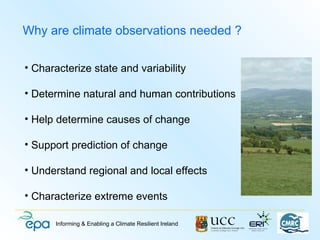
Why are climate observations needed ?

• Characterize state and variability

• Determine natural and human contributions

• Help determine causes of change

• Support prediction of change

• Understand regional and local effects

• Characterize extreme events

      Informing & Enabling a Climate Resilient Ireland
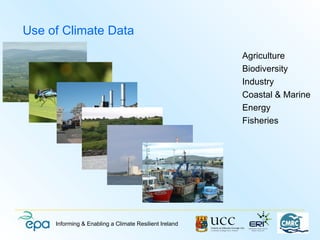
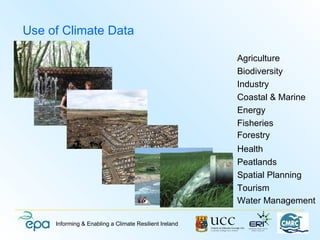
Use of Climate Data
                                                        Agriculture
                                                        Biodiversity
                                                        Industry
                                                        Coastal & Marine
                                                        Energy
                                                        Fisheries


     Informing & Enabling a Climate Resilient Ireland
Use of Climate Data

                                                        Agriculture
                                                        Biodiversity
                                                        Industry
                                                        Coastal & Marine
                                                        Energy
                                                        Fisheries
                                                        Forestry
                                                        Health
                                                        Peatlands
                                                        Spatial Planning
                                                        Tourism
                                                        Water Management

     Informing & Enabling a Climate Resilient Ireland
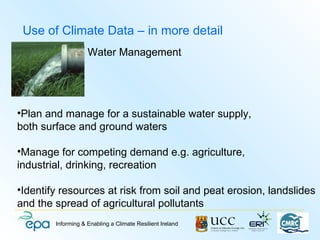
Use of Climate Data – in more detail
                    Water Management


•Plan and manage for a sustainable water supply,
both surface and ground waters

•Manage for competing demand e.g. agriculture,
industrial, drinking, recreation

•Identify resources at risk from soil and peat erosion, landslides
and the spread of agricultural pollutants
        Informing & Enabling a Climate Resilient Ireland
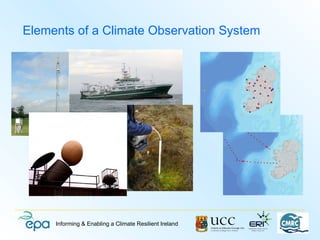
Elements of a Climate Observation System


     Informing & Enabling a Climate Resilient Ireland
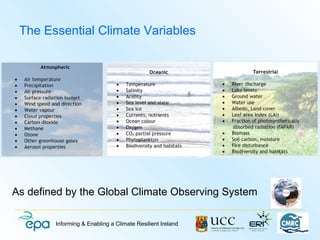
The Essential Climate Variables


As defined by the Global Climate Observing System

        Informing & Enabling a Climate Resilient Ireland
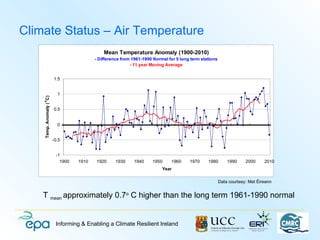
Climate Status – Air Temperature
                                              Mean Temperature Anomaly (1900-2010)
                                          - Difference from 1961-1990 Normal for 5 long term stations
                                                           - 11 year Moving Average


                         1.5


                           1
    Temp. Anomaly ( C)
    o


                         0.5


                           0


                         -0.5


                          -1
                            1900   1910   1920     1930     1940     1950     1960     1970     1980        1990     2000     2010
                                                                          Year

                                                                                                        Data courtesy: Met Éireann


    T mean approximately 0.7o C higher than the long term 1961-1990 normal


                          Informing & Enabling a Climate Resilient Ireland
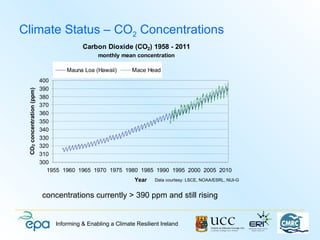
Climate Status – CO2 Concentrations
                                          Carbon Dioxide (CO2) 1958 - 2011
                                                monthly mean concentration

                                    Mauna Loa (Hawaii)       Mace Head
                           400
                           390
 CO2 concentration (ppm)


                           380
                           370
                           360
                           350
                           340
                           330
                           320
                           310
                           300
                             1955 1960 1965 1970 1975 1980 1985 1990 1995 2000 2005 2010
                                                              Year    Data courtesy: LSCE, NOAA/ESRL, NUI-G


                           concentrations currently > 390 ppm and still rising


                                Informing & Enabling a Climate Resilient Ireland
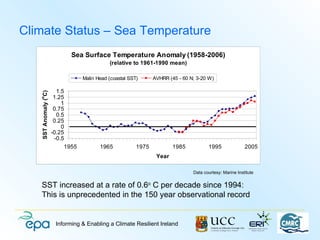
Climate Status – Sea Temperature
                             Sea Surface Temperature Anomaly (1958-2006)
                                             (relative to 1961-1990 mean)

                                  Malin Head (coastal SST)      AVHRR (45 - 60 N; 3-20 W)

                        1.5
   SST Anomaly (oC)


                       1.25
                          1
                       0.75
                        0.5
                       0.25
                          0
                      -0.25
                       -0.5
                           1955          1965            1975           1985           1995               2005
                                                                 Year

                                                                                Data courtesy: Marine Institute


     SST increased at a rate of 0.6o C per decade since 1994:
     This is unprecedented in the 150 year observational record


                       Informing & Enabling a Climate Resilient Ireland
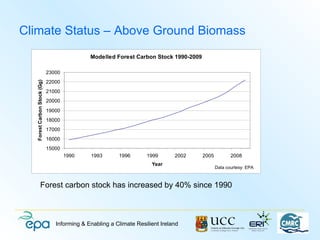
Climate Status – Above Ground Biomass
                                             Modelled Forest Carbon Stock 1990-2009

                             23000
                             22000
  Forest Carbon Stock (Gg)


                             21000
                             20000
                             19000
                             18000
                             17000
                             16000
                             15000
                                     1990    1993       1996       1999       2002    2005          2008
                                                                     Year
                                                                                             Data courtesy: EPA


               Forest carbon stock has increased by 40% since 1990


                                Informing & Enabling a Climate Resilient Ireland
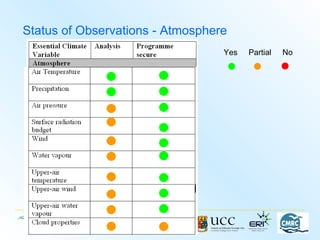
Status of Observations - Atmosphere
                                                        Yes   Partial   No


     Informing & Enabling a Climate Resilient Ireland
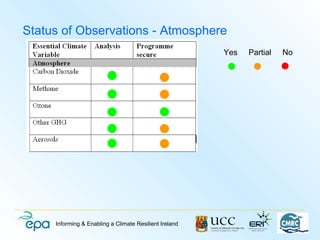
Status of Observations - Atmosphere
                                                        Yes   Partial   No


     Informing & Enabling a Climate Resilient Ireland
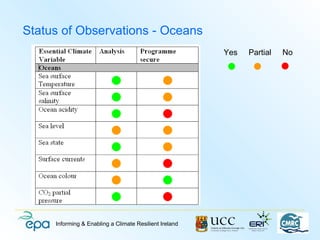
Status of Observations - Oceans
                                                        Yes   Partial   No


     Informing & Enabling a Climate Resilient Ireland
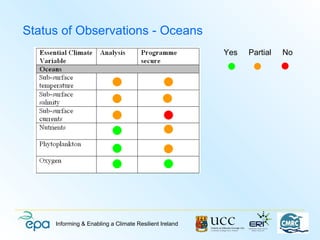
Status of Observations - Oceans
                                                        Yes   Partial   No


     Informing & Enabling a Climate Resilient Ireland
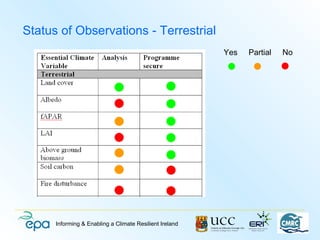
Status of Observations - Terrestrial
                                                         Yes   Partial   No


      Informing & Enabling a Climate Resilient Ireland
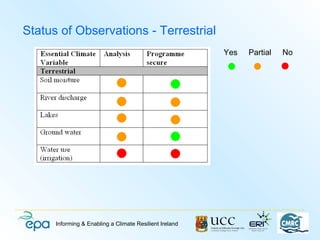
Status of Observations - Terrestrial
                                                         Yes   Partial   No


      Informing & Enabling a Climate Resilient Ireland
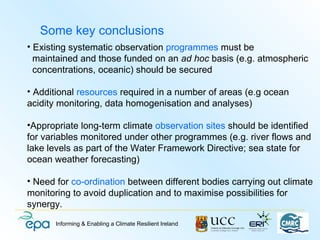
Some key conclusions
• Existing systematic observation programmes must be
  maintained and those funded on an ad hoc basis (e.g. atmospheric
  concentrations, oceanic) should be secured

• Additional resources required in a number of areas (e.g ocean
acidity monitoring, data homogenisation and analyses)

•Appropriate long-term climate observation sites should be identified
for variables monitored under other programmes (e.g. river flows and
lake levels as part of the Water Framework Directive; sea state for
ocean weather forecasting)

• Need for co-ordination between different bodies carrying out climate
monitoring to avoid duplication and to maximise possibilities for
synergy.
       Informing & Enabling a Climate Resilient Ireland
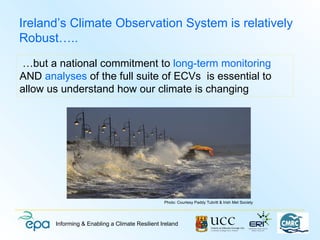
Ireland’s Climate Observation System is relatively
Robust…..
 …but a national commitment to long-term monitoring
AND analyses of the full suite of ECVs is essential to
allow us understand how our climate is changing


                                                 Photo: Courtesy Paddy Tubritt & Irish Met Society


       Informing & Enabling a Climate Resilient Ireland

Ireland's Climate Observation System: an update - Ned Dwyer, UCC

  • 1.
    Ireland’s Climate ObservationSystem An Update Ned Dwyer Informing & Enabling a Climate Resilient Ireland
  • 2.
    Why are climateobservations needed ? • Characterize state and variability • Determine natural and human contributions • Help determine causes of change • Support prediction of change • Understand regional and local effects • Characterize extreme events Informing & Enabling a Climate Resilient Ireland
  • 3.
    Use of ClimateData Agriculture Biodiversity Industry Coastal & Marine Energy Fisheries Informing & Enabling a Climate Resilient Ireland
  • 4.
    Use of ClimateData Agriculture Biodiversity Industry Coastal & Marine Energy Fisheries Forestry Health Peatlands Spatial Planning Tourism Water Management Informing & Enabling a Climate Resilient Ireland
  • 5.
    Use of ClimateData – in more detail Water Management •Plan and manage for a sustainable water supply, both surface and ground waters •Manage for competing demand e.g. agriculture, industrial, drinking, recreation •Identify resources at risk from soil and peat erosion, landslides and the spread of agricultural pollutants Informing & Enabling a Climate Resilient Ireland
  • 6.
    Elements of aClimate Observation System Informing & Enabling a Climate Resilient Ireland
  • 7.
    The Essential ClimateVariables As defined by the Global Climate Observing System Informing & Enabling a Climate Resilient Ireland
  • 8.
    Climate Status –Air Temperature Mean Temperature Anomaly (1900-2010) - Difference from 1961-1990 Normal for 5 long term stations - 11 year Moving Average 1.5 1 Temp. Anomaly ( C) o 0.5 0 -0.5 -1 1900 1910 1920 1930 1940 1950 1960 1970 1980 1990 2000 2010 Year Data courtesy: Met Éireann T mean approximately 0.7o C higher than the long term 1961-1990 normal Informing & Enabling a Climate Resilient Ireland
  • 9.
    Climate Status –CO2 Concentrations Carbon Dioxide (CO2) 1958 - 2011 monthly mean concentration Mauna Loa (Hawaii) Mace Head 400 390 CO2 concentration (ppm) 380 370 360 350 340 330 320 310 300 1955 1960 1965 1970 1975 1980 1985 1990 1995 2000 2005 2010 Year Data courtesy: LSCE, NOAA/ESRL, NUI-G concentrations currently > 390 ppm and still rising Informing & Enabling a Climate Resilient Ireland
  • 10.
    Climate Status –Sea Temperature Sea Surface Temperature Anomaly (1958-2006) (relative to 1961-1990 mean) Malin Head (coastal SST) AVHRR (45 - 60 N; 3-20 W) 1.5 SST Anomaly (oC) 1.25 1 0.75 0.5 0.25 0 -0.25 -0.5 1955 1965 1975 1985 1995 2005 Year Data courtesy: Marine Institute SST increased at a rate of 0.6o C per decade since 1994: This is unprecedented in the 150 year observational record Informing & Enabling a Climate Resilient Ireland
  • 11.
    Climate Status –Above Ground Biomass Modelled Forest Carbon Stock 1990-2009 23000 22000 Forest Carbon Stock (Gg) 21000 20000 19000 18000 17000 16000 15000 1990 1993 1996 1999 2002 2005 2008 Year Data courtesy: EPA Forest carbon stock has increased by 40% since 1990 Informing & Enabling a Climate Resilient Ireland
  • 12.
    Status of Observations- Atmosphere Yes Partial No Informing & Enabling a Climate Resilient Ireland
  • 13.
    Status of Observations- Atmosphere Yes Partial No Informing & Enabling a Climate Resilient Ireland
  • 14.
    Status of Observations- Oceans Yes Partial No Informing & Enabling a Climate Resilient Ireland
  • 15.
    Status of Observations- Oceans Yes Partial No Informing & Enabling a Climate Resilient Ireland
  • 16.
    Status of Observations- Terrestrial Yes Partial No Informing & Enabling a Climate Resilient Ireland
  • 17.
    Status of Observations- Terrestrial Yes Partial No Informing & Enabling a Climate Resilient Ireland
  • 18.
    Some key conclusions •Existing systematic observation programmes must be maintained and those funded on an ad hoc basis (e.g. atmospheric concentrations, oceanic) should be secured • Additional resources required in a number of areas (e.g ocean acidity monitoring, data homogenisation and analyses) •Appropriate long-term climate observation sites should be identified for variables monitored under other programmes (e.g. river flows and lake levels as part of the Water Framework Directive; sea state for ocean weather forecasting) • Need for co-ordination between different bodies carrying out climate monitoring to avoid duplication and to maximise possibilities for synergy. Informing & Enabling a Climate Resilient Ireland
  • 19.
    Ireland’s Climate ObservationSystem is relatively Robust….. …but a national commitment to long-term monitoring AND analyses of the full suite of ECVs is essential to allow us understand how our climate is changing Photo: Courtesy Paddy Tubritt & Irish Met Society Informing & Enabling a Climate Resilient Ireland