The Dust Bowl
By: Natalie Wade
Causes of the Dust
Bowl
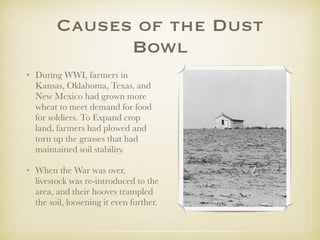
• During WWI, farmers in
Kansas, Oklahoma, Texas, and
New Mexico had grown more
wheat to meet demand for food
for soldiers. To Expand crop
land, farmers had plowed and
torn up the grasses that had
maintained soil stability.
• When the War was over,
livestock was re-introduced to the
area, and their hooves trampled
the soil, loosening it even further.
• In addition, rainfall
accumulation continued to
drop in the plains region,
drying the land.
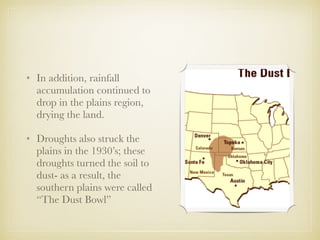
• Droughts also struck the
plains in the 1930’s; these
droughts turned the soil to
dust- as a result, the
southern plains were called
“The Dust Bowl”
Effects of the Dust
Bowl
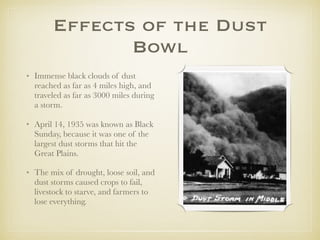
• Immense black clouds of dust
reached as far as 4 miles high, and
traveled as far as 3000 miles during
a storm.
• April 14, 1935 was known as Black
Sunday, because it was one of the
largest dust storms that hit the
Great Plains.
• The mix of drought, loose soil, and
dust storms caused crops to fail,
livestock to starve, and farmers to
lose everything.
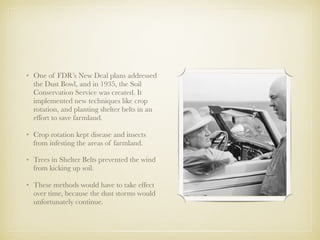
• One of FDR’s New Deal plans addressed
the Dust Bowl, and in 1935, the Soil
Conservation Service was created. It
implemented new techniques like crop
rotation, and planting shelter belts in an
effort to save farmland.
• Crop rotation kept disease and insects
from infesting the areas of farmland.
• Trees in Shelter Belts prevented the wind
from kicking up soil.
• These methods would have to take effect
over time, because the dust storms would
unfortunately continue.
• Many farmers felt like they had no hope, and
were unable to sell any of their crops, so they
were thrown off their land and forced to move
west in search of food and employment.
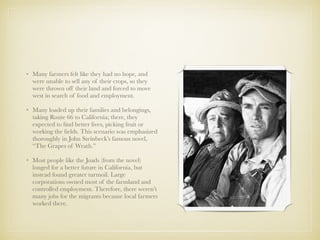
• Many loaded up their families and belongings,
taking Route 66 to California; there, they
expected to find better lives, picking fruit or
working the fields. This scenario was emphasized
thoroughly in John Steinbeck’s famous novel,
“The Grapes of Wrath.”
• Most people like the Joads (from the novel)
longed for a better future in California, but
instead found greater turmoil. Large
corporations owned most of the farmland and
controlled employment. Therefore, there weren’t
many jobs for the migrants because local farmers
worked there.
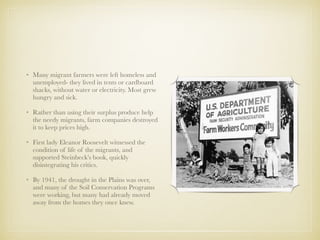
• Many migrant farmers were left homeless and
unemployed- they lived in tents or cardboard
shacks, without water or electricity. Most grew
hungry and sick.
• Rather than using their surplus produce help
the needy migrants, farm companies destroyed
it to keep prices high.
• First lady Eleanor Roosevelt witnessed the
condition of life of the migrants, and
supported Steinbeck’s book, quickly
disintegrating his critics.
• By 1941, the drought in the Plains was over,
and many of the Soil Conservation Programs
were working, but many had already moved
away from the homes they once knew.
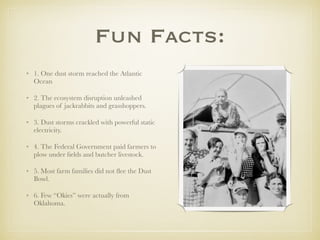
Fun Facts:
• 1. One dust storm reached the Atlantic
Ocean
• 2. The ecosystem disruption unleashed
plagues of jackrabbits and grasshoppers.
• 3. Dust storms crackled with powerful static
electricity.
• 4. The Federal Government paid farmers to
plow under fields and butcher livestock.
• 5. Most farm families did not flee the Dust
Bowl.
• 6. Few “Okies” were actually from
Oklahoma.
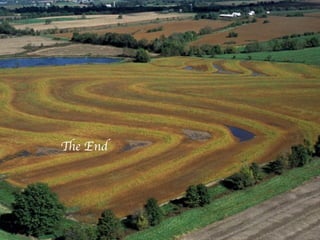
The End

Dust bowl project natalie

  • 1.
    The Dust Bowl By:Natalie Wade
  • 2.
    Causes of theDust Bowl • During WWI, farmers in Kansas, Oklahoma, Texas, and New Mexico had grown more wheat to meet demand for food for soldiers. To Expand crop land, farmers had plowed and torn up the grasses that had maintained soil stability. • When the War was over, livestock was re-introduced to the area, and their hooves trampled the soil, loosening it even further.
  • 3.
    • In addition,rainfall accumulation continued to drop in the plains region, drying the land. • Droughts also struck the plains in the 1930’s; these droughts turned the soil to dust- as a result, the southern plains were called “The Dust Bowl”
  • 4.
    Effects of theDust Bowl • Immense black clouds of dust reached as far as 4 miles high, and traveled as far as 3000 miles during a storm. • April 14, 1935 was known as Black Sunday, because it was one of the largest dust storms that hit the Great Plains. • The mix of drought, loose soil, and dust storms caused crops to fail, livestock to starve, and farmers to lose everything.
  • 5.
    • One ofFDR’s New Deal plans addressed the Dust Bowl, and in 1935, the Soil Conservation Service was created. It implemented new techniques like crop rotation, and planting shelter belts in an effort to save farmland. • Crop rotation kept disease and insects from infesting the areas of farmland. • Trees in Shelter Belts prevented the wind from kicking up soil. • These methods would have to take effect over time, because the dust storms would unfortunately continue.
  • 6.
    • Many farmersfelt like they had no hope, and were unable to sell any of their crops, so they were thrown off their land and forced to move west in search of food and employment. • Many loaded up their families and belongings, taking Route 66 to California; there, they expected to find better lives, picking fruit or working the fields. This scenario was emphasized thoroughly in John Steinbeck’s famous novel, “The Grapes of Wrath.” • Most people like the Joads (from the novel) longed for a better future in California, but instead found greater turmoil. Large corporations owned most of the farmland and controlled employment. Therefore, there weren’t many jobs for the migrants because local farmers worked there.
  • 7.
    • Many migrantfarmers were left homeless and unemployed- they lived in tents or cardboard shacks, without water or electricity. Most grew hungry and sick. • Rather than using their surplus produce help the needy migrants, farm companies destroyed it to keep prices high. • First lady Eleanor Roosevelt witnessed the condition of life of the migrants, and supported Steinbeck’s book, quickly disintegrating his critics. • By 1941, the drought in the Plains was over, and many of the Soil Conservation Programs were working, but many had already moved away from the homes they once knew.
  • 8.
    Fun Facts: • 1.One dust storm reached the Atlantic Ocean • 2. The ecosystem disruption unleashed plagues of jackrabbits and grasshoppers. • 3. Dust storms crackled with powerful static electricity. • 4. The Federal Government paid farmers to plow under fields and butcher livestock. • 5. Most farm families did not flee the Dust Bowl. • 6. Few “Okies” were actually from Oklahoma.
  • 9.