Edmund T. Pratt Jr. School of Engineering at Duke University 2011-2012 dukeng 
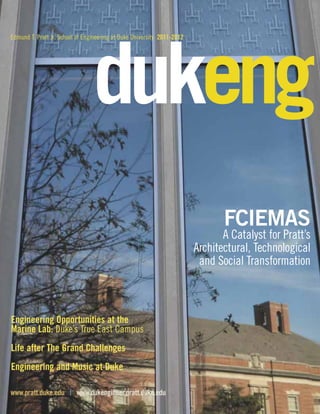
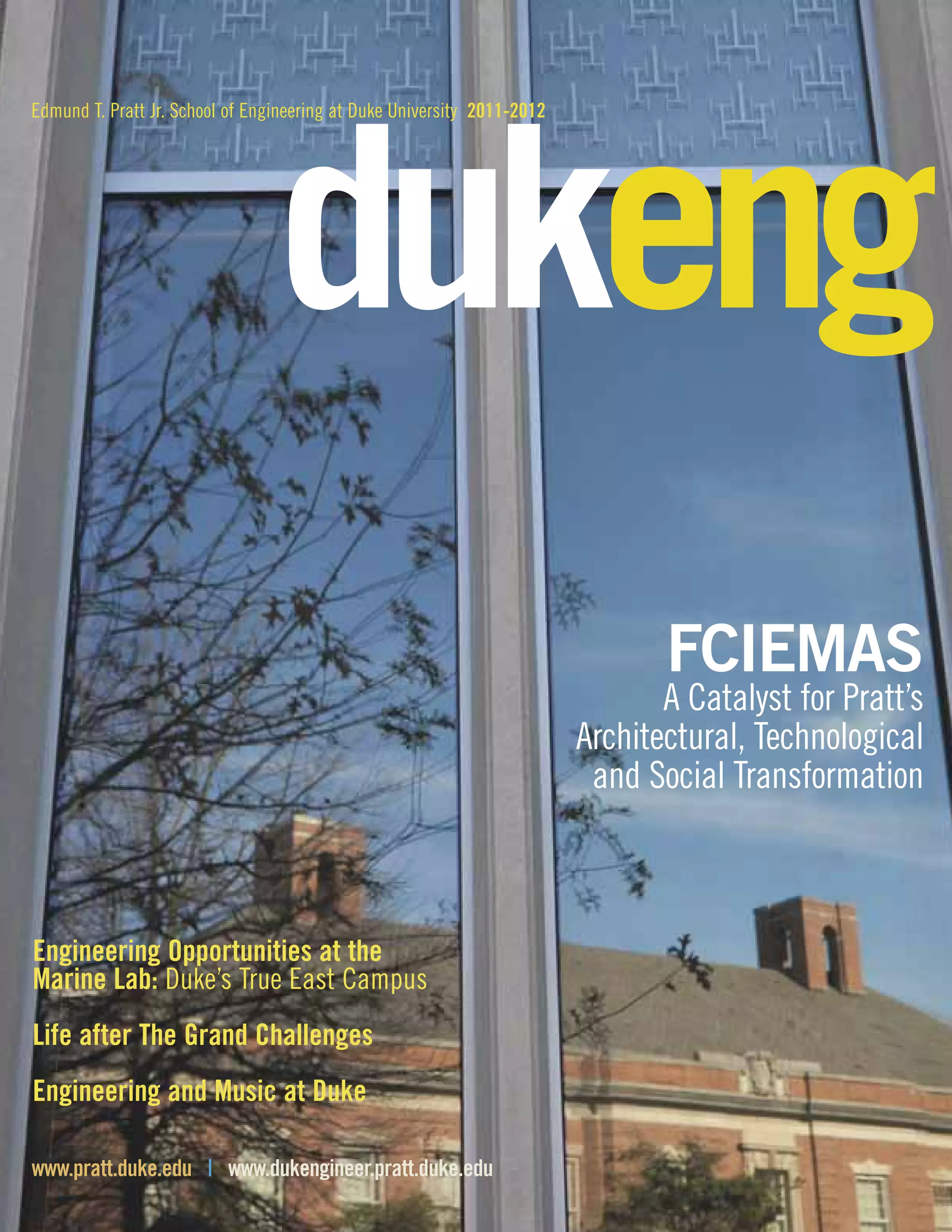
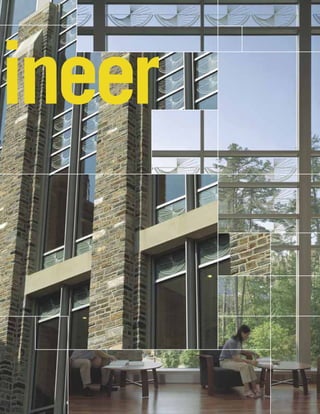
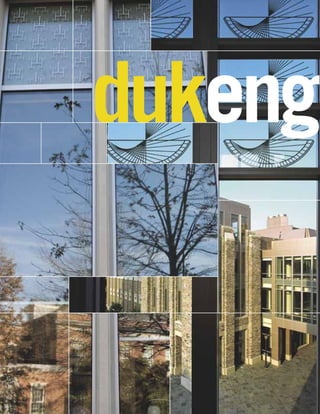
FCIEMAS 
A Catalyst for Pratt’s 
Architectural, Technological 
and Social Transformation 
Engineering Opportunities at the 
Marine Lab: Duke’s True East Campus 
Life after The Grand Challenges 
Engineering and Music at Duke 
www.pratt.duke.edu | www.dukengineer.pratt.duke.edu
ineer
dukengineer Edmund T. Pratt Jr. School of Engineering at Duke University 2011-2012 
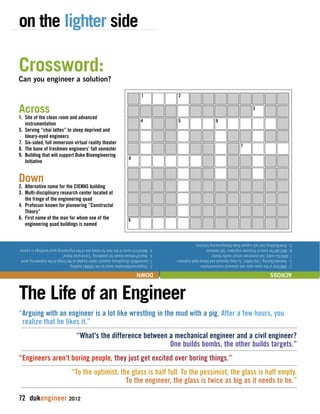
on the lighter side 
Crossword Challange | The Life of an Engineer 
www.pratt.duke.edu 
letters 
2 From the Editor 
3 From the Dean 
4 From the ESG President 
5 From the EGSC President 
education 
6 Engineering & Music at Duke 
8 CE 185: Design Project 
10 Engineering Student Government 
features 
12 Life After The Grand Challenges 
16 Duke’s True East Campus 
20 Engineering Preception Changes 
Year-Year 
22 COVER 
FCIEMAS: A Catalyst for Pratt's 
Architectural, Technological and 
Social Transformation 
research 
26 BME: Soft Matter 
28 BME: Synthetic Biology 
30 ECE: Fluid Cloaking 
32 SMiF Center 
profiles 
36 Motorsports 
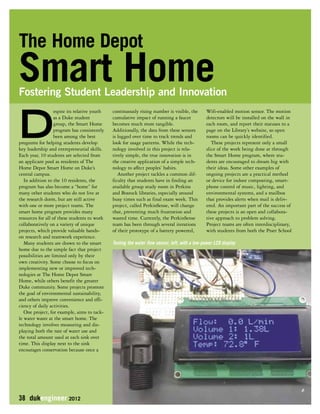
38 Smart Home 
summer stories 
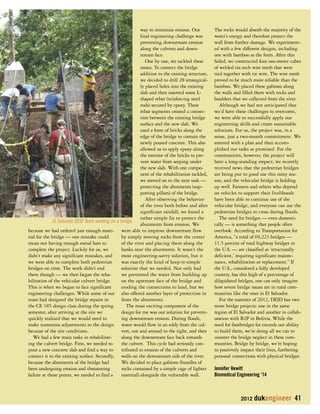
40 Building Bridges to Form Connections 
42 Pratt Fellows 
44 RTI Biologics Internship 
alumni news 
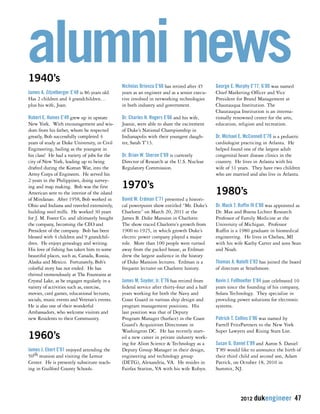
46 Alumni Profile: J. Michael Pearson 
47 Class Notes 
50 In Memory 
development 
54 Letter from EAC President 
55 Annual Fund Statistics 
58 Honor Roll 
Editor 
Tejen Shah 
Associate Editors 
Anirudh Mohan 
Cameron McKay 
Jimmy Zhong 
Lauren Shwisberg 
Tom Mercer 
Wyatt Shields 
DukEngineer Writers 
Jade Brown 
Hersh Desai 
Ajeet Hansra 
Jennifer Hewitt 
Nooshin Kiarashi 
Rachel Lance 
Nathan Li 
Cameron McKay 
Anirudh Mohan 
James Mullally 
Katy Riccione 
Tejen Shah 
Wyatt Shields 
Lauren Shwisberg 
Emily Sloan 
Visakha Suresh 
Suzana Vallejo-Heligon 
Justin Yu 
Jimmy Zhong 
Consulting Editor 
Richard Merritt 
Webmaster 
Meng Kang 
Designer 
Lacey Chylack 
phasefivecreative,inc 
Technical Support 
Mandy Ferguson 
Photographer: Becca Bau p.72
letters From the Editor 
We are proud to bring you the 2011-12 issue of the DukEngineer Magazine, which features the 
2 dukengineer 2012 
experiences and accomplishments of Pratt School of Engineering students, faculty and alumni. 
The cover story this year focuses on Fitzpatrick Center for Interdisciplinary Engineering, Medicine 
and Applied Sciences (FCIEMAS). It has been operational for about seven years, and we wanted to 
reflect on the impact it has had on the Duke community and to explore the architectural innovations incorpo-rated 
in the building that often go unnoticed by passersby. 
We have decided to cover some stories, such as the Grand Challenge Scholar (GCS) program, Smart Home, 
Shared Material’s Instrumentation Facility (SMiF) and the Motorsports club, that we have covered in the past 
but from a slightly different perspective. Over the past two years, the GCS program was mainly written from a 
programming perspective. This year we take a look at the life after the GCS program and see how the program 
has helped recently graduated GC scholars succeed professionally. We also look at the progress and invalu-able 
contributions Smart Home, SMiF and Motorsports have made to different aspects of Pratt community. 
We continue to cover the cutting-edge research of our faculty and graduate students. We profile Gabriel 
Lopez’s research on soft matter that could potentially help develop coating that would prevent bacteria from 
sticking to solid surfaces. We also showcase Yaroslav Urzhumov and David Smith’s research on a fluid cloak 
that helps hide an object from a flowing fluid. Finally, we profile Lingchong You’s research in synthetic biology 
that has wide-ranging applications from diagnosing new cancers to finding new ways of fabricating materials. 
Pratt has evolved significantly over the past few years, and there are exciting new opportunities available to 
engineers who want to dabble in liberal arts. Some of these interdisciplinary opportunities are not as visible on 
campus, and we have two articles in this year’s magazine that showcase these opportunities. The first article 
is related to interesting research opportunities available for engineers at the Duke Marine Lab in Beaufort. The 
second article highlights how music is intertwined with the Pratt curriculum and there are ample opportunities 
for engineers to pursue their passion for music. 
Furthermore, we have continued the recent tradition of featuring students summer experiences related to 
internships, Pratt Fellows research and international services trips. This year we have writers at different 
phases in their careers: from freshmen to seniors, to grad school and beyond. Therefore, we 
have an interesting piece on how perspective of being an engineer changes from year to 
year. The last page of the publication features “The Lighter Side” article that we hope 
will make this issue of DukEngineer magazine entertaining. 
We would like to thank our writers, Pratt faculty, architects at Zimmer Gunsul 
Frasca and all the other members of the Pratt community who helped us throughout 
the process of publishing this magazine. We would also like to thank our advisor, 
Richard Merritt with the Pratt Communications Department for his patience and 
invaluable support. We hope that you will share comments, questions and concerns 
with us through our website at: http://www.dukengineer.pratt.duke.edu. 
Enjoy! 
Tejen Shah 
Editor, DukEngineer Magazine 2011-12 
B.S.E in Biomedical Engineering ‘13
2012 dukengineer 3 
Last spring I had the great pleasure to experience an 
impressive example of engineering in action. One of our 
students, Katrina Wisdom, combined her knowledge of 
the laws of physics with her passion for dance. In her 
presentation, and performance, entitled “Fouette Turns and 
Fourier Series,” she explained and demonstrated the subtle inter-sections 
of engineering and dance. 
At one point, three volunteer dancers were asked perform 
turns in a synchronized fashion. I’m sure you’ve seen these turns. 
On one leg, with eyes fixated on one spot, they spun until their 
heads whipped around to gaze the same spot. Over and over 
again. As they spun faster and faster, a “resonance” made it 
appear that they were spinning even faster and with less effort 
than if they had been dancing alone. Katrina cleverly used art to 
provide an insight into an underlying scientific phenomenon – 
namely oscillations — that an average person could grasp. 
As I think back to that day, I sense a similar metaphorical res-onance 
taking place here at Pratt – instead of three dancers 
working together cooperatively, I see faculty, students and staff 
providing a certain “resonance” that makes this a great place to 
be. Every day, I feel a palpable momentum driving all aspects of 
our mission forward. 
By just about any measure, Pratt is a growing, thriving envi-ronment 
to live, learn and teach. And with the way the future 
looks, I don’t foresee that momentum slowing down. 
Research expenditures have increased dramatically. For U.S. 
News and World Reporting rankings, we reported an increase 
from $74 million to $87.5 million in research expenditures. Our 
actual number is closer to $94 million when we include subcon-tracts. 
This is very close to our longstanding goal of reaching 
$100 million in research, in the league of engineering research 
powerhouses. 
Pratt landed a $20 million endowment for the Duke Coulter 
Translation Partnership and a $13.6 million to fund a regional 
center for soft matter research. 
But what we are really all about here at Pratt is people. What 
the research growth enables us to do is offer richer learning 
opportunities and to more students. 
For example, we graduated 62 new Ph.D.s in the spring, an 
increase of 10 more students than the previous year. 
We launched our new master of engineering program last fall 
with seven distinct degree concentrations spanning all four of 
our departments. The goal is to provide an alternative to the tra-ditional, 
research-focused master of science curriculum and give 
students a competitive edge in their industry careers. Students 
gain business acumen to help them navigate corporate environ-ments 
and better prepare for project management while gaining 
real world, practical research skills. The new degree is driving 
masters growth at Pratt, which rose from 360 to 418 students. 
In another sign that the Duke-Pratt brand is hot, masters appli-cations 
are up nearly 70 percent for next fall. 
This fall, a new bachelors of science degree in energy engi-neering 
is set to launch. It will give students an opportunity to 
pursue a second major in an exciting interdisciplinary subject 
matter that spans all four Pratt departments. We expect to add 
to the Pratt faculty two professors of the practice with industry 
experience in the energy sector. These individuals will support 
both the energy engineering second major, and the energy and 
environment certificate we jointly administer with the Nicholas 
School of the Environment. 
Together with the Trinity College of Arts and Sciences, we are 
developing a Duke-wide undergraduate entrepreneurship pro-gram 
that will include both curricular and extracurricular ele-ments 
such as practicums, startup opportunities, and intern-ships. 
We hope to launch this fall. 
The list goes go on and on. 
As you read the informative and creative stories in this issue 
– all written by Pratt students – I’m sure you’ll get a clear pic-ture 
of how amazingly diverse, creative and dedicated are the 
people who make up the Pratt community. 
Where else could I kick up my heels at a student presentation 
like Katrina’s or the annual E-Ball? Or build Ritz Cracker-Cheez 
Whiz towers, toss bean bags or race in sacks on a gorgeous sum-mer 
day in front of Hudson Hall? We all know it is an awe-some 
responsibility to train – or become — the next generation 
of problem-solvers, but it’s also great to have fun. 
What a great place to be! 
Tom Katsouleas 
Dean, Pratt School of Engineering 
Dear Friends of Pratt, 
From the Dean
From the ESG President 
4 dukengineer 2012 
Greetings from Engineering Student Government, 
2011 has been an outstanding year for Engineering Student Government, thanks 
to the incredible efforts of each one of our members, and the enthusiasm of 
the engineering students. We have seen productive growth of the organization 
and further enhancements to the Pratt student experience. With new leader-ship 
being elected in January, we look forward to another year of serving the 
student body. Be sure to check out information on our events and projects, 
and leave feedback at: http://esg.pratt.duke.edu/. 
In March, ESG hosted the annual E-Ball 
at the top floor of the University 
Tower – the first time in several years that 
it has been off campus. The event saw 
huge demand and all who attended 
enjoyed an unforgettable night bonding 
with classmates and friends alike. E-Social, 
the staple E-Quad happy hour of 
sorts also saw a change from the usual this 
year with the addition of “Super-E-Socials” 
once a month. With plentiful 
food and an emphasis on planned pro-gramming, 
these events brought together 
several engineering clubs and students 
from many all class years. We hope to 
continue to see many underclassmen at 
these events, so as to further solidify the 
Pratt bond that transcends class year. Our 
other E-events, including E-Picnics, E-Oktoberfest, 
and E-Kickball, have been 
hits as always, especially the E-Shirts this 
year: Pratt Bracket and Cheat Shirt. 
A year ago, ESG created the 
Academic Action Committee. This 
group of extremely active students is 
charged with creating positive change in 
the academic environment in Pratt in a 
rapid timeframe. They delivered in a big 
way this year in creating an engineering 
skills course that took place for the first 
time this fall. The fall course is broken 
into four modules each teaching an 
applied engineering skill, and has 
received rave reviews. 
Finally, we have spent some time to 
revise our decades-old constitution to 
bring it up to date with our current goals 
and operations. In this revision, we have 
added a new position on ESG, the indus-try 
relations chair. This ESG member, 
the first of whom will be elected in 
January, will continue our already strong 
efforts in bringing companies to E-Socials 
to provide networking opportunities to 
students. 
ESG looks forward to continuing a 
tradition of making Pratt life in some 
regards more bearable, but in most 
regards flat-out awesome. We invite any 
and all feedback and if you are particular-ly 
interested, run for election for one of 
our positions. I hope to see you at our 
next event! 
Sincerely, 
David Piech 
President, Engineering Student Government
2012 dukengineer 5 
t Duke, we find ourselves surrounded 
by an illustrious faculty whose history of 
groundbreaking research inspires us to 
both follow in their footsteps and blaze 
new trails forward. This sense of ambi-tion 
and drive is reinforced by our peers 
-- hardworking, creative individuals 
truly committed to pursuing their 
goals. We find ourselves in awe of the 
accomplishments of those graduating 
and amazed at how bright each incom-ing 
class is. 
While it is easy to get caught up in 
our academics, whether studying for a 
midterm or submitting a paper to a jour-nal, 
Duke’s Engineering Graduate 
Student Council (EGSC) believes that 
there is more to graduate school than just 
our individual bodies of academic work. 
This principle guides the council’s 
efforts, as we aim to foster positive rela-tionships 
between graduate students, and 
help each other maintain a healthy work-life 
balance during our time in Pratt. 
This year, EGSC has taken on co-sponsorship 
of E-socials, working with 
the undergrads to continue to improve 
Pratt’s popular weekly happy hour and 
make sure it appeals to our graduate 
community. We’re excited to bring offi-cial 
graduate student involvement to the 
Pratt tradition, and believe that events 
like E-Socials give us opportunities to 
interact and get to know one another 
outside of the laboratory and classroom. 
Our goal is to ensure that each social 
event we are involved with brings 
unique value to all members of Pratt, 
whether it is networking with potential 
employers at E-Social or Halloween-themed 
bowling with other graduate 
departments. We believe that the con-nections, 
whether made over beer and 
pizza or a couple of frames, can build 
lasting relationships, and that those 
relationships will make up a valuable 
network down the road. We think that 
leaving campus should not mean leaving 
the Duke community, and that being a 
Blue Devil comes with a lifetime mem-bership. 
The biggest event that EGSC hosted 
this fall was the 
Mahato Memorial 
“Envisioning the 
Invisible” event. 
Held in memory of 
former graduate 
student Abhijit 
Mahato, the event 
included a photog-raphy 
contest to 
celebrate Abhijit’s 
interest in combin-ing 
science and 
visualization, as 
well as a lecture by 
Nickolay Hristov, 
entitled “Pixels, 
Frames and 3D 
Models: Visual 
Storytelling for the Modern Naturalist.” 
The event was a big success, and EGSC 
hopes to continue the program in perpe-tuity. 
The best entries from the contest 
are on display all year in the CIEMAS 
atrium, highlighting the cross-discipli-nary 
interests of our students and faculty. 
EGSC also seeks to help students 
prepare themselves for careers beyond 
graduation, and to give them perspec-tive 
on the work going on across engi-neering. 
For students from all programs 
seeking careers in all fields (industry, 
academia, entrepreneurship, government 
and otherwise), EGSC wants to make 
sure that they have interesting and use-ful 
exposure to as many future opportu-nities 
as possible. This has included 
seminars, bringing industry representa-tives 
to campus to meet with students 
and keeping students informed about 
career fairs and other important events. 
This year, we are also working with the 
faculty and administration to develop a 
vision of the future of Pratt and the 
kind of programming that build our 
already-strong reputation. 
EGSC cannot achieve its goals with-out 
the help of volunteers. Membership 
in EGSC is open, and all students are 
encouraged to attend our monthly meet-ings 
to help us improve the graduate 
experience and to pull off the events 
themselves. Creative thinking enables us 
to stretch our budget and fund new 
activities and all ideas are welcome. 
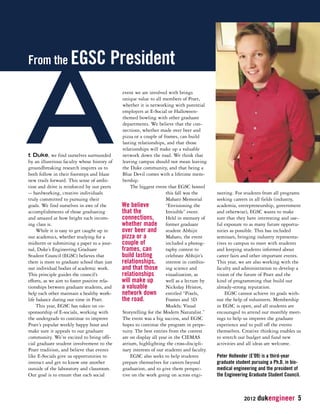
Peter Hollender (E’09) is a third-year 
graduate student pursuing a Ph.D. in bio-medical 
engineering and the president of 
the Engineering Graduate Student Council. 
From the EGSC President A 
We believe 
that the 
connections, 
whether made 
over beer and 
pizza or a 
couple of 
frames, can 
build lasting 
relationships, 
and that those 
relationships 
will make up 
a valuable 
network down 
the road.
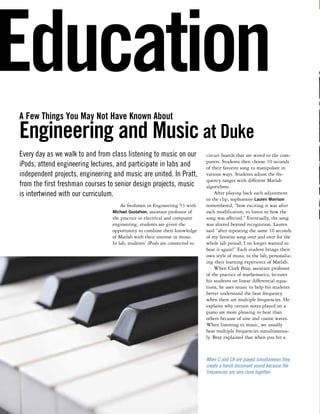
Education 
A Few Things You May Not Have Known About 
Engineering and Music at Duke 
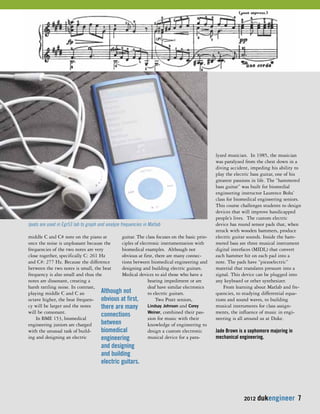
As freshmen in Engineering 53 with 
Michael Gustafson, assistant professor of 
the practice in electrical and computer 
engineering, students are given the 
opportunity to combine their knowledge 
of Matlab with their interest in music. 
In lab, students’ iPods are connected to 
circuit boards that are wired to the com-puters. 
Students then choose 10 seconds 
of their favorite song to manipulate in 
various ways. Students adjust the fre-quency 
ranges with different Matlab 
algorithms. 
After playing back each adjustment 
to the clip, sophomore Lauren Morrison 
remembered, “how exciting it was after 
each modification, to listen to how the 
song was affected.” Eventually, the song 
was altered beyond recognition. Lauren 
said “after repeating the same 10 seconds 
of my favorite song over and over for the 
whole lab period, I no longer wanted to 
hear it again!” Each student brings their 
own style of music to the lab, personaliz-ing 
their learning experience of Matlab. 
When Clark Bray, assistant professor 
of the practice of mathematics, lectures 
his students on linear differential equa-tions, 
he uses music to help his students 
better understand the beat frequency 
when there are multiple frequencies. He 
explains why certain notes played on a 
piano are more pleasing to hear than 
others because of sine and cosine waves. 
When listening to music, we usually 
hear multiple frequencies simultaneous-ly. 
Bray explained that when you hit a 
Every day as we walk to and from class listening to music on our 
iPods, attend engineering lectures, and participate in labs and 
independent projects, engineering and music are united. In Pratt, 
from the first freshman courses to senior design projects, music 
is intertwined with our curriculum. 
When C and C# are played simultaneous they 
create a harsh dissonant sound because the 
frequencies are very close together.
2012 dukengineer 7 
middle C and C# note on the piano at 
once the noise is unpleasant because the 
frequencies of the two notes are very 
close together, specifically C: 261 Hz 
and C#: 277 Hz. Because the difference 
between the two notes is small, the beat 
frequency is also small and thus the 
notes are dissonant, creating a 
harsh rattling noise. In contrast, 
playing middle C and C an 
octave higher, the beat frequen-cy 
will be larger and the notes 
will be consonant. 
In BME 153, biomedical 
engineering juniors are charged 
with the unusual task of build-ing 
and designing an electric 
guitar. The class focuses on the basic prin-ciples 
of electronic instrumentation with 
biomedical examples. Although not 
obvious at first, there are many connec-tions 
between biomedical engineering and 
designing and building electric guitars. 
Medical devices to aid those who have a 
hearing impediment or are 
deaf have similar electronics 
to electric guitars. 
Two Pratt seniors, 
Lindsay Johnson and Corey 
Weiner, combined their pas-sion 
for music with their 
knowledge of engineering to 
design a custom electronic 
musical device for a para-lyzed 
musician. In 1985, the musician 
was paralyzed from the chest down in a 
diving accident, impeding his ability to 
play the electric bass guitar, one of his 
greatest passions in life. The “hammered 
bass guitar” was built for biomedial 
engineering instructor Laurence Bohs’ 
class for biomedical engineering seniors. 
This course challenges students to design 
devices that will improve handicapped 
people’s lives. The custom electric 
device has round sensor pads that, when 
struck with wooden hammers, produce 
electric guitar sounds. Inside the ham-mered 
bass are three musical instrument 
digital interfaces (MIDI,) that convert 
each hammer hit on each pad into a 
note. The pads have “piezoelectric” 
material that translates pressure into a 
signal. This device can be plugged into 
any keyboard or other synthesizer. 
From learning about Matlab and fre-quencies, 
to studying differential equa-tions 
and sound waves, to building 
musical instruments for class assign-ments, 
the influence of music in engi-neering 
is all around us at Duke. 
Jade Brown is a sophomore majoring in 
mechanical engineering. 
Ipods are used in Egr53 lab to graph and analyze frequencies in Matlab 
Although not 
obvious at first, 
there are many 
connections 
between 
biomedical 
engineering 
and designing 
and building 
electric guitars.
T 
From Idea to Implementation 
One student’s experience with CE 185: Engineering Sustainable Design and Construction he Engineering 
properly repair the bridge, locals desper-ately 
Sustainable Design and 
needed assistance. 
Construction course (CE 
Kathryn Latham, a junior civil engineer, 
185) offers students a 
was one of the students who worked on 
unique experience not typically found in 
this culvert bridge design and offered her 
other courses at Duke. According to 
perspective. “In most other engineering 
Associate Professor of the Practice David 
classes, you’re just doing problem sets. 
Schaad, the course is focused on the 
But with this course, you have the oppor-tunity 
design and testing of solutions to com-plex 
to create and implement your 
interdisciplinary design products in a 
design. You learn what it’s like to work 
service-learning context. Design projects 
for a real client.” 
from last semester ranged from stream 
Schaad structured the class so that 
restoration in Beaufort, North Carolina, 
students would have the opportunity to 
to rice-farming in Libya. 
learn about the social and environmental 
One of the projects that attracted the 
impacts of the design projects. 
most attention was a culvert bridge reha-bilitation 
Occasionally, guest speakers would stop 
project in El Salvador. Nine of 
in to lecture on sustainable design. “It 
the 24 students enrolled in CE 185 spent 
was a good balance,” said Latham. 
the semester working on this design. The 
“[Schaad] would float around and help us 
original culvert bridge is 37 years old and 
when we needed it. He would give us 
was used by farmers and other locals to 
advice when we were stuck.” 
transport crops and to reach vital 
While everyone in the class worked 
resources in the rural El Salvador commu-nity. 
on a design for a real-world problem, only 
Due to frequent flooding, the bridge 
about a third of the students went on to 
was in a severely dilapidated state. 
implement the designs they completed in 
Without the means or knowledge to 
class. For Latham, traveling to El Salvador 
to apply the design was the 
best part of the experience. 
However, upon arriving in El 
Salvador, she quickly realized 
that the challenges did not end 
with the completion of the 
design at the end of the course. 
During the semester, effec-tively 
communicating with 
people in such a rural, under-developed 
area proved to be a 
great obstacle for Latham and 
the other students. As a result, 
the students had to make sev-eral 
assumptions during the 
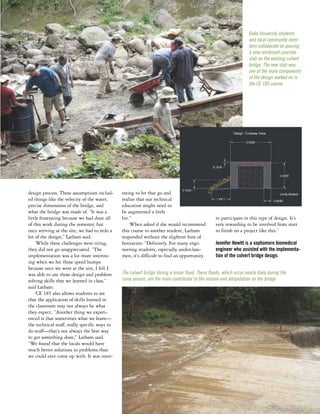
The culvert bridge 
during a minor flood. 
These floods, which 
occur nearly daily 
during the rainy 
season, are the main 
contributor to the 
erosion and dilapida-tion 
on the bridge 
8 dukengineer 2012 education
design process. These assumptions includ-ed 
things like the velocity of the water, 
precise dimensions of the bridge, and 
what the bridge was made of. “It was a 
little frustrating because we had done all 
of this work during the semester, but 
once arriving at the site, we had to redo a 
lot of the design,” Latham said. 
While these challenges were tiring, 
they did not go unappreciated. “The 
implementation was a lot more interest-ing 
when we hit those speed bumps 
because once we were at the site, I felt I 
was able to use those design and problem 
solving skills that we learned in class,” 
said Latham. 
CE 185 also allows students to see 
that the application of skills learned in 
the classroom may not always be what 
they expect. “Another thing we experi-enced 
is that sometimes what we learn— 
the technical stuff, really specific ways to 
do stuff—that’s not always the best way 
to get something done,” Latham said. 
“We found that the locals would have 
much better solutions to problems than 
we could ever come up with. It was inter-esting 
to let that go and 
realize that our technical 
education might need to 
be augmented a little 
bit.” 
When asked if she would recommend 
this course to another student, Latham 
responded without the slightest hint of 
hesitation: “Definitely. For many engi-neering 
students, especially underclass-men, 
it’s difficult to find an opportunity 
Duke University students 
and local community mem-bers 
collaborate on pouring 
a new reinforced concrete 
slab on the existing culvert 
bridge. The new slab was 
one of the main components 
of the design worked on in 
the CE 185 course. 
to participate in this type of design. It’s 
very rewarding to be involved from start 
to finish on a project like this.” 
Jennifer Hewitt is a sophomore biomedical 
engineer who assisted with the implementa-tion 
of the culvert bridge design. 
The culvert bridge during a minor flood. These floods, which occur nearly daily during the 
rainy season, are the main contributor to the erosion and dilapidation on the bridge
The Many Facesof Pratt 
The Engineering Student Government (ESG) is an administrative 
organization run by students to make the four-year Pratt expe-rience 
all the more worthwhile. ESG takes a three-pronged 
approach to changing Pratt life for the better: planning events 
that bring the engineering student body closer together, making 
student-oriented academic policy changes, organizing service 
and outreach initiatives for the Durham community. 
10 dukengineer 2012 
ESG is made up of 11 students, head-ed 
by executive president David Piech, a 
senior. Sitting in a conference room on 
the third floor of CIEMAS, spoke ani-matedly 
about the role of ESG and the 
effect it has both on its members and the 
student body it governs. 
“ESG is really to make the lives of stu-dents 
and their experience here at Pratt 
all the better. We make it fun … we 
help solve some of the problems,” he 
explained. He went on to elaborate 
about the society’s dogma. “We’re a laid-back 
organization … but at the same 
time, we focus on getting things done. 
We want our members to be trained as 
leaders, to set up their own initiatives 
and to get things done.” 
ESG officers are encouraged to take on 
pet projects in areas that interest them, 
from fostering a sense of belonging with-in 
each graduating class to performing 
service in the local community. For 
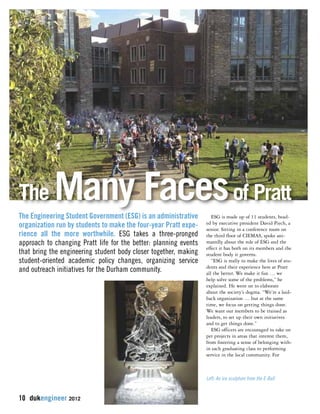
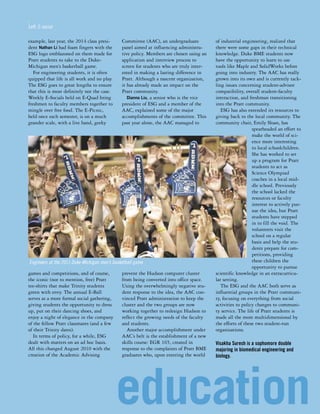
Left: An ice sculpture from the E-Ball
education 
; 
Left: E-social 
example, last year, the 2014 class presi-dent 
Nathan Li had foam fingers with the 
ESG logo emblazoned on them made for 
Pratt students to take to the Duke- 
Michigan men’s basketball game. 
For engineering students, it is often 
quipped that life is all work and no play. 
The ESG goes to great lengths to ensure 
that this is most definitely not the case. 
Weekly E-Socials held on E-Quad bring 
freshmen to faculty members together to 
mingle over free food. The E-Picnic, 
held once each semester, is on a much 
grander scale, with a live band, geeky 
games and competitions, and of course, 
the iconic (not to mention, free) Pratt 
tee-shirts that make Trinity students 
green with envy. The annual E-Ball 
serves as a more formal social gathering, 
giving students the opportunity to dress 
up, put on their dancing shoes, and 
enjoy a night of elegance in the company 
of the fellow Pratt classmates (and a few 
of their Trinity dates). 
In terms of policy, for a while, ESG 
dealt with matters on an ad hoc basis. 
All this changed August 2010 with the 
creation of the Academic Advising 
Committee (AAC), an undergraduate 
panel aimed at influencing administra-tive 
policy. Members are chosen using an 
application and interview process to 
screen for students who are truly inter-ested 
in making a lasting difference in 
Pratt. Although a nascent organization, 
it has already made an impact on the 
Pratt community. 
Dianna Liu, a senior who is the vice 
president of ESG and a member of the 
AAC, explained some of the major 
accomplishments of the committee. This 
past year alone, the AAC managed to 
prevent the Hudson computer cluster 
from being converted into office space. 
Using the overwhelmingly negative stu-dent 
response to the idea, the AAC con-vinced 
Pratt administration to keep the 
cluster and the two groups are now 
working together to redesign Hudson to 
reflect the growing needs of the faculty 
and students. 
Another major accomplishment under 
AAC’s belt is the establishment of a new 
skills course: EGR 165, created in 
response to the complaints of Pratt BME 
graduates who, upon entering the world 
of industrial engineering, realized that 
there were some gaps in their technical 
knowledge. Duke BME students now 
have the opportunity to learn to use 
tools like Maple and SolidWorks before 
going into industry. The AAC has really 
grown into its own and is currently tack-ling 
issues concerning student-advisor 
compatibility, overall student-faculty 
interaction, and freshman transitioning 
into the Pratt community. 
ESG has also extended its resources to 
giving back to the local community. The 
community chair, Emily Sloan, has 
spearheaded an effort to 
make the world of sci-ence 
more interesting 
to local schoolchildren. 
She has worked to set 
up a program for Pratt 
students to act as 
Science Olympiad 
coaches in a local mid-dle 
school. Previously 
the school lacked the 
resources or faculty 
interest to actively pur-sue 
the idea, but Pratt 
students have stepped 
in to fill the void. The 
volunteers visit the 
school on a regular 
basis and help the stu-dents 
prepare for com-petitions, 
providing 
these children the 
opportunity to pursue 
scientific knowledge in an extracurricu-lar 
setting. 
The ESG and the AAC both serve as 
influential groups in the Pratt communi-ty, 
focusing on everything from social 
activities to policy changes to communi-ty 
service. The life of Pratt students is 
made all the more multidimensional by 
the efforts of these two student-run 
organizations. 
Visakha Suresh is a sophomore double 
majoring in biomedical engineering and 
biology. 
Engineers at the 2011 Duke-Michigan men’s basketball game
Features 
Life After 
The Grand Challenges 
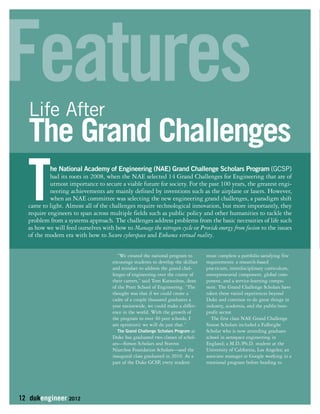
The National Academy of Engineering (NAE) Grand Challenge Scholars Program (GCSP) 
had its roots in 2008, when the NAE selected 14 Grand Challenges for Engineering that are of 
utmost importance to secure a viable future for society. For the past 100 years, the greatest engi-neering 
achievements are mainly defined by inventions such as the airplane or lasers. However, 
when an NAE committee was selecting the new engineering grand challenges, a paradigm shift 
came to light. Almost all of the challenges require technological innovation, but more importantly, they 
require engineers to span across multiple fields such as public policy and other humanities to tackle the 
problem from a systems approach. The challenges address problems from the basic necessities of life such 
as how we will feed ourselves with how to Manage the nitrogen cycle or Provide energy from fusion to the issues 
of the modern era with how to Secure cyberspace and Enhance virtual reality. 
12 dukengineer 2012 
“We created the national program to 
encourage students to develop the skillset 
and mindset to address the grand chal-lenges 
of engineering over the course of 
their careers,” said Tom Katsouleas, dean 
of the Pratt School of Engineering. “The 
thought was that if we could create a 
cadre of a couple thousand graduates a 
year nationwide, we could make a differ-ence 
in the world. With the growth of 
the program to over 40 peer schools, I 
am optimistic we will do just that.” 
The Grand Challenge Scholars Program at 
Duke has graduated two classes of schol-ars— 
Simon Scholars and Stavros 
Niarchos Foundation Scholars—and the 
inaugural class graduated in 2010. As a 
part of the Duke GCSP, every student 
must complete a portfolio satisfying five 
requirements: a research-based 
practicum, interdisciplinary curriculum, 
entrepreneurial component, global com-ponent, 
and a service-learning compo-nent. 
The Grand Challenge Scholars have 
taken these varied experiences beyond 
Duke and continue to do great things in 
industry, academia, and the public/non-profit 
sector. 
The first class NAE Grand Challenge 
Simon Scholars included a Fulbright 
Scholar who is now attending graduate 
school in aerospace engineering in 
England; a M.D./Ph.D. student at the 
University of California, Los Angeles; an 
associate manager at Google working in a 
rotational program before heading to
2012 dukengineer 13 
Harvard Business School for a Masters of 
Business Adminsitration; and a volunteer 
working in India who has now taken a 
position in environmental engineering, 
among many others. 
The second class to graduate, called 
NAE Grand Challenge Stavros Niarchos 
Foundation Scholars, continued achieving 
greatness in the fields of their respective 
challenges. Among their ranks is a Ph.D. 
candidate in biomedical engineering at 
Duke, a business analyst for Capital One, 
a Rhodes Scholar at Oxford, and a mas-ter’s 
student at Stanford studying civil 
and environmental engineering. 
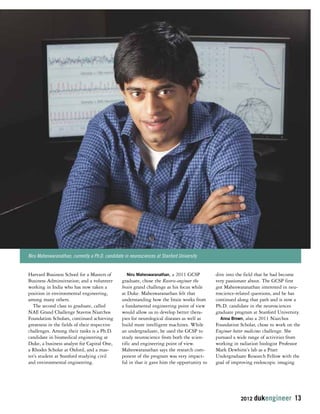
Niru Maheswaranathan, a 2011 GCSP 
graduate, chose the Reverse-engineer the 
brain grand challenge as his focus while 
at Duke. Maheswaranathan felt that 
understanding how the brain works from 
a fundamental engineering point of view 
would allow us to develop better thera-pies 
for neurological diseases as well as 
build more intelligent machines. While 
an undergraduate, he used the GCSP to 
study neuroscience from both the scien-tific 
and engineering point of view. 
Maheswaranathan says the research com-ponent 
of the program was very impact-ful 
in that it gave him the opportunity to 
dive into the field that he had become 
very passionate about. The GCSP first 
got Maheswaranathan interested in neu-roscience- 
related questions, and he has 
continued along that path and is now a 
Ph.D. candidate in the neurosciences 
graduate program at Stanford University. 
Anna Brown, also a 2011 Niarchos 
Foundation Scholar, chose to work on the 
Engineer better medicines challenge. She 
pursued a wide range of activities from 
working in radiation biologist Professor 
Mark Dewhirst’s lab as a Pratt 
Undergraduate Research Fellow with the 
goal of improving endoscopic imaging 
Niru Maheswaranathan, currently a Ph.D. candidate in neurosciences at Stanford University
14 dukengineer 2012 
technology in order to better characterize 
the boundaries of tumors. She travelled 
multiple times across international bor-ders 
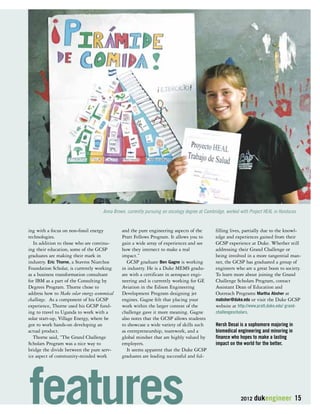
with Project HEAL (Health 
Education and Awareness in Latin 
America) to provide health education ini-tiatives 
to women and children in 
Honduras. 
One powerful sentiment that Brown 
and other scholars have echoed was that 
the GCSP was complementary to the 
things that they were already doing and 
helped unify two very different interests 
such as intensive academic research and 
developing world humanitarian work. 
The GCSP Program integrated well with 
other programs already established at 
Duke such as the Pratt Fellows Program, 
DukeEngage, and Engineers with 
Borders. 
Brown discovered that she enjoyed the 
intellectual environment found in the lab 
due to her GCSP and Pratt Fellows expe-rience 
and is now pursuing a research-based 
masters of philosophy in oncology 
at Cambridge, with funding from Cancer 
Research UK. When she’s done, she 
plans on returning to Duke to attend 
medical school. When Brown attended 
the Grand Challenges Summit conference 
as a student, she noted that people were 
addressing the same grand challenges 
from very different fields and hopes to 
apply this approach towards her work in 
radiation oncology in the future. 
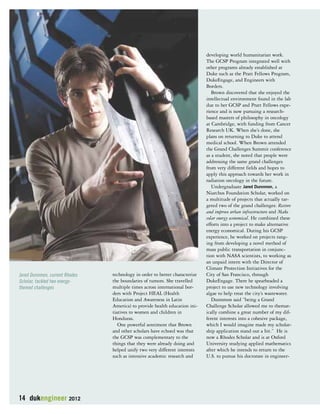
Undergraduate Jared Dunnmon, a 
Niarchos Foundation Scholar, worked on 
a multitude of projects that actually tar-geted 
two of the grand challenges: Restore 
and improve urban infrastructure and Make 
solar energy economical. He combined these 
efforts into a project to make alternative 
energy economical. During his GCSP 
experience, he worked on projects rang-ing 
from developing a novel method of 
mass public transportation in conjunc-tion 
with NASA scientists, to working as 
an unpaid intern with the Director of 
Climate Protection Initiatives for the 
City of San Francisco, through 
DukeEngage. There he spearheaded a 
project to use new technology involving 
algae to help treat the city’s wastewater. 
Dunnmon said “being a Grand 
Challenge Scholar allowed me to themat-ically 
combine a great number of my dif-ferent 
interests into a cohesive package, 
which I would imagine made my scholar-ship 
application stand out a bit.” He is 
now a Rhodes Scholar and is at Oxford 
University studying applied mathematics 
after which he intends to return to the 
U.S. to pursue his doctorate in engineer- 
Jared Dunnmon, current Rhodes 
Scholar, tackled two energy-themed 
challenges
Anna Brown, currently pursuing an oncology degree at Cambridge, worked with Project HEAL in Honduras 
2012 dukengineer 15 
ing with a focus on non-fossil energy 
technologies. 
In addition to those who are continu-ing 
their education, some of the GCSP 
graduates are making their mark in 
industry. Eric Thorne, a Stavros Niarchos 
Foundation Scholar, is currently working 
as a business transformation consultant 
for IBM as a part of the Consulting by 
Degrees Program. Thorne chose to 
address how to Make solar energy economical 
challenge. As a component of his GCSP 
experience, Thorne used his GCSP fund-ing 
to travel to Uganda to work with a 
solar start-up, Village Energy, where he 
got to work hands-on developing an 
actual product. 
Thorne said, “The Grand Challenge 
Scholars Program was a nice way to 
bridge the divide between the pure serv-ice 
aspect of community-minded work 
and the pure engineering aspects of the 
Pratt Fellows Program. It allows you to 
gain a wide array of experiences and see 
how they intersect to make a real 
impact.” 
GCSP graduate Ben Gagne is working 
in industry. He is a Duke MEMS gradu-ate 
with a certificate in aerospace engi-neering 
and is currently working for GE 
Aviation in the Edison Engineering 
Development Program designing jet 
engines. Gagne felt that placing your 
work within the larger context of the 
challenge gave it more meaning. Gagne 
also notes that the GCSP allows students 
to showcase a wide variety of skills such 
as entrepreneurship, teamwork, and a 
global mindset that are highly valued by 
employers. 
It seems apparent that the Duke GCSP 
graduates are leading successful and ful-filling 
lives, partially due to the knowl-edge 
and experiences gained from their 
GCSP experience at Duke. Whether still 
addressing their Grand Challenge or 
being involved in a more tangential man-ner, 
the GCSP has graduated a group of 
engineers who are a great boon to society. 
To learn more about joining the Grand 
Challenge Scholars Program, contact 
Assistant Dean of Education and 
Outreach Programs Martha Absher at 
mabsher@duke.edu or visit the Duke GCSP 
website at http://www.pratt.duke.edu/ grand-challengescholars. 
Hersh Desai is a sophomore majoring in 
biomedical engineering and minoring in 
finance who hopes to make a lasting 
impact on the world for the better. 
features
Duke’s True 
East Campus 
FGenerally, engineering 
homework and lounging 
on the beach aren’t com-patible. 
At the Duke 
University Marine Lab, 
however, there is ample opportunity for 
Pratt students to earn credits and enjoy 
beautiful, coastal North Carolina. 
Located on Pivers Island, the Duke 
University Marine Lab is a fully operable 
satellite campus with classrooms, labora-tory 
space, a library, a dining hall, com-munal 
student spaces, and dormitories. In 
addition to these traditional facilities, the 
Marine Lab has some more unique ameni-ties: 
kayaks and canoes for student use, a 
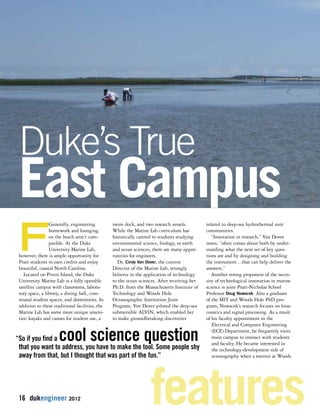
“So if you find a cool science question 
that you want to address, you have to make the tool. Some people shy 
away from that, but I thought that was part of the fun.” 
16 dukengineer 2012 
swim dock, and two research vessels. 
While the Marine Lab curriculum has 
historically catered to students studying 
environmental science, biology, or earth 
and ocean sciences, there are many oppor-tunities 
for engineers. 
Dr. Cindy Van Dover, the current 
Director of the Marine Lab, strongly 
believes in the application of technology 
to the ocean sciences. After receiving her 
Ph.D. from the Massachusetts Institute of 
Technology and Woods Hole 
Oceanographic Institution Joint 
Program, Van Dover piloted the deep-sea 
submersible ALVIN, which enabled her 
to make groundbreaking discoveries 
related to deep-sea hydrothermal vent 
communities. 
“Innovation in research,” Van Dover 
notes, ”often comes about both by under-standing 
what the next set of key ques-tions 
are and by designing and building 
the instrument…that can help deliver the 
answers.” 
Another strong proponent of the neces-sity 
of technological innovation in marine 
science is joint Pratt-Nicholas School 
Professor Doug Nowacek. Also a graduate 
of the MIT and Woods Hole PhD pro-gram, 
Nowacek’s research focuses on bioa-coustics 
and signal processing. As a result 
of his faculty appointment in the 
Electrical and Computer Engineering 
(ECE) Department, he frequently visits 
main campus to interact with students 
and faculty. He became interested in 
the technology-development side of 
oceanography when a mentor at Woods 
features
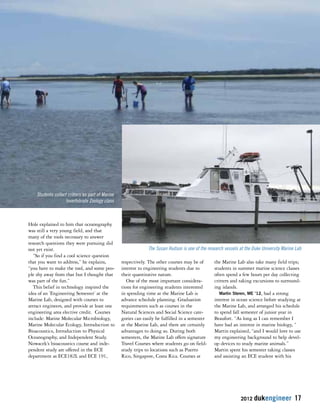
The Susan Hudson is one of the research vessels at the Duke University Marine Lab 
2012 dukengineer 17 
Hole explained to him that oceanography 
was still a very young field, and that 
many of the tools necessary to answer 
research questions they were pursuing did 
not yet exist. 
“So if you find a cool science question 
that you want to address,” he explains, 
“you have to make the tool, and some peo-ple 
shy away from that but I thought that 
was part of the fun.” 
This belief in technology inspired the 
idea of an ‘Engineering Semester’ at the 
Marine Lab, designed with courses to 
attract engineers, and provide at least one 
engineering area elective credit. Courses 
include: Marine Molecular Microbiology, 
Marine Molecular Ecology, Introduction to 
Bioacoustics, Introduction to Physical 
Oceanography, and Independent Study. 
Nowacek’s bioacoustics course and inde-pendent 
study are offered in the ECE 
department as ECE182L and ECE 191, 
respectively. The other courses may be of 
interest to engineering students due to 
their quantitative nature. 
One of the most important considera-tions 
for engineering students interested 
in spending time at the Marine Lab is 
advance schedule planning. Graduation 
requirements such as courses in the 
Natural Sciences and Social Science cate-gories 
can easily be fulfilled in a semester 
at the Marine Lab, and there are certainly 
advantages to doing so. During both 
semesters, the Marine Lab offers signature 
Travel Courses where students go on field-study 
trips to locations such as Puerto 
Rico, Singapore, Costa Rica. Courses at 
the Marine Lab also take many field trips; 
students in summer marine science classes 
often spend a few hours per day collecting 
critters and taking excursions to surround-ing 
islands. 
Martin Steren, ME ’12, had a strong 
interest in ocean science before studying at 
the Marine Lab, and arranged his schedule 
to spend fall semester of junior year in 
Beaufort. “As long as I can remember I 
have had an interest in marine biology, “ 
Martin explained, “and I would love to use 
my engineering background to help devel-op 
devices to study marine animals.” 
Martin spent his semester taking classes 
and assisting an ECE student with his 
Students collect critters as part of Marine 
Invertebrate Zoology class
project in antenna design for whale track-ing 
devices. 
Pratt students have the opportunity to 
perform research within the intimate, 
supportive Marine Lab environment. In 
addition to Nowacek’s electrical engi-neering 
projects, many other Marine Lab 
faculty have engineering-related research 
interests. 
Upon arrival at the Marine Lab, Van 
Dover says engineering students would 
find faculty members who are “keen to 
put their design and analytical skills to 
work to consider a marine research prob-lem 
in a new light.” 
Jim Hench’s research lab in physical 
oceanography has hosted students inter-ested 
in fluid dynamics and complex 
modeling, and features an operable salt-water 
flume for experiments. In addi-tion, 
students with interest in program-ming 
and software development may 
want to look to Dave Johnston. He has 
been a pioneer in digital learning, work-ing 
with the computer science depart-ment 
to develop interactive iPad appli-cations 
to replace textbooks in his 
Marine Mammals and Marine 
Megafauna classes. 
On top of these faculty, Van Dover 
says, “there’s scope for field testing of 
ocean instruments developed on cam-pus.” 
She also mentions the updated 
teleconference capabilities at the Marine 
Lab, noting that it would be easy for 
students on campus to stay connected to 
mentors on Piver’s Island. 
With these mentors, Pratt students 
have been able to earn independent 
study credit, participate in Marine Lab 
research scholarship summer programs, 
and even do research for Pratt Fellows. 
The administration and faculty at the 
Marine Lab is willing to work with stu-dents 
18 dukengineer 2012 
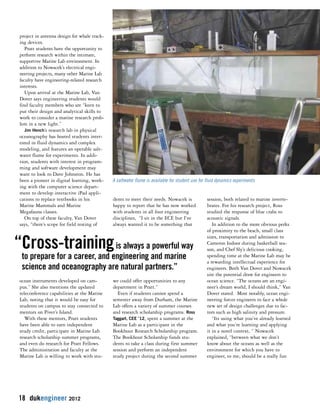
A saltwater flume is available for student use for fluid dynamics experiments 
to meet their needs. Nowacek is 
happy to report that he has now worked 
with students in all four engineering 
disciplines, “I sit in the ECE but I’ve 
always wanted it to be something that 
we could offer opportunities to any 
department in Pratt.” 
Even if students cannot spend a 
semester away from Durham, the Marine 
Lab offers a variety of summer courses 
and research scholarship programs. Ross 
Taggart, CEE ’12, spent a summer at the 
Marine Lab as a participant in the 
Bookhout Research Scholarship program. 
The Bookhout Scholarship funds stu-dents 
to take a class during first summer 
session and perform an independent 
study project during the second summer 
session, both related to marine inverte-brates. 
For his research project, Ross 
studied the response of blue crabs to 
acoustic signals. 
In addition to the more obvious perks 
of proximity to the beach, small class 
sizes, transportation and admission to 
Cameron Indoor during basketball sea-son, 
and Chef Sly’s delicious cooking, 
spending time at the Marine Lab may be 
a rewarding intellectual experience for 
engineers. Both Van Dover and Nowacek 
site the potential draw for engineers to 
ocean science. “The oceans are an engi-neer’s 
dream world, I should think,” Van 
Dover stated. Most notably, ocean engi-neering 
forces engineers to face a whole 
new set of design challenges due to fac-tors 
such as high salinity and pressure. 
“Its using what you’ve already learned 
and what you’re learning and applying 
it in a novel context, “ Nowacek 
explained, “between what we don’t 
know about the oceans as well as the 
environment for which you have to 
engineer, to me, should be a really fun 
“Cross-trainingis always a powerful way 
to prepare for a career, and engineering and marine 
science and oceanography are natural partners.”
2012 dukengineer 19 
challenge for any young engineer.” 
After graduation, engineers with 
marine experience have many education 
options. Van Dover notes that, “cross-training 
Students can relax on the porch of the Repass Center 
is always a powerful way to pre-pare 
for a career, and engineering and 
marine science and oceanography are nat-ural 
partners.” In addition, she notes that 
they may even have an advantage. 
“Students with an undergraduate back-ground 
in engineering who choose to pur-sue 
a graduate degree in marine science or 
oceanography are going to be in demand, 
especially since the future of oceanogra-phy 
is in advanced technologies.” 
Likewise, both Nowacek and Van 
Dover express that industry, especially 
the energy sector, would employ engi-neers 
with marine backgrounds. More 
importantly, the ocean needs motivated 
engineers, in the interest of conservation. 
Nowacek explains, “if we have better 
engineered things, well, we don’t have 
Deepwater Horizon. There’s always 
going to be the push to get into ever 
more difficult and tricky situations, and 
the only way we’re going to guarantee, 
or at least minimize the risk of that is 
to have really well-engineered compo-nents 
and tools.” 
Aside from the energy sector, there are 
companies that design and build ocean 
equipment. The Marine Lab has a con-nection 
with iRobot’s maritime division, 
based in Durham; they bring their new 
equipment for testing in Beaufort. One 
of Nowacek’s ECE students worked on a 
project integrating an acoustic detector 
with a Seaglider to collect continuous 
sound data, participating in a summer 
internship with iRobot, and supple-menting 
with independent study credit. 
Both Ross and Martin note that they 
will continue to pursue their interest in 
marine science after graduation, and 
they believe their time spent in 
Beaufort will help them achieve these 
goals. Martin says that his dream job 
would be to work as an engineer devel-oping 
tools at Woods Hole. He believes 
that the relationships he has developed 
at the Marine Lab will, “prove invalu-able 
to [his] future job search.” 
For students still searching for post-graduation 
options, the Marine Lab may 
expose engineers to a whole new set of 
opportunities. During his summer at the 
Marine Lab, Ross discovered a new pas-sion. 
“My research and studies at the 
Marine Lab sparked my interest in the 
marine environment and aquatic chem-istry 
which will definitely influence my 
choice of career.” 
Interestingly, Nowacek started to seri-ously 
consider marine science after par-ticipating 
in a summer research experi-ence 
in college which gave students 
from small liberal arts colleges the 
opportunity to do research at Duke and 
Davidson. The project he was assigned 
to was in Beaufort at the Marine Lab. 
Pratt students who have spent time at 
the Marine Lab enthusiastically reflect 
on their experiences. In addition to 
interesting research opportunities and 
unique classroom experiences, students 
say that that spending time on the 
island is a lot of fun. Ross speaks posi-tively 
saying, “the Marine Lab was one 
of [his] most memorable experiences at 
Duke”, and encouraging everyone to 
spend at least a summer session there 
because “the Marine Lab has something 
for everyone.” 
Martin echoes this sentiment remi-niscing 
that his semester there was 
“without a doubt [his] favorite semester 
at Duke. I loved all the classes I was in 
and the people there were great.” Even 
after years of working in the field, 
Nowacek expresses content and excite-ment. 
“I love this, you work great 
places. It’s a work hard, play hard thing. 
You work your tail off, and then you 
walk outside and you’re in the ocean.” 
So, the next time your problem sets 
are getting you down, think about plan-ning 
to spend some time at the beach. 
Lauren Shwisberg is senior studying Civil 
and Environmental Engineering with a cer-tificate 
in Marine Science and Conservation 
Leadership. She spent two summers at the 
Duke University Marine Lab. 
features
Engineering Perception 
Changes Year to Year 
Before you can determine how a perspective has 
changed, first you must determine what exactly you 
are looking at. What is constant, but seen from a 
different angle for the first time. In engineering, 
it’s the work. The high workload has been the only 
constant throughout the years. 
As a child, stealthily disassembling the kitchen appliances was 
far more work than playing with Barbies; as an undergrad, calcu-lus 
was far more work than sociology; as a working engineer, 
repeatedly building and testing prototypes was 
far more work than filing papers or answering 
phones. Yet, for some reason, we all still do it. 
Something pushes us toward engineering 
despite the all-nighters and partial differential 
equations. Having fought through undergrad 
and a master’s degree without fully grasping 
the role of an engineer, I am returning to grad-uate 
school for the second time with a com-pletely 
new perspective on the point, the func-tion, 
and the ultimate goal of all this work. 
As undergraduates, students are mainly fol-lowing 
the paths laid out for them. The 
homework assignments are taxing, and while 
calculus and physics are interesting enough, at 
those levels they’re still far too vague to be 
practically usable. It’s not until the upper-level 
courses that these theories actually become specific enough 
to have a place and a purpose in the world. So why do it? Why 
not switch to something simpler? For me, it was because of 
those rare moments when phenomena that seemed mysterious 
suddenly became understandable. When I combined gravity and 
inertia and predicted where that ball would land. When I 
learned about muscle structure, and how contractile force was 
determined. Solving these little mysteries just wasn’t going to 
happen in any other major, and finally understanding these 
answers was more than worth the long nights at the library. 
In graduate school, the perspective shifts dramatically. Yes, 
there are still classes with structured learning regimens and end-less 
theories, but in graduate school there is also research. 
Graduate school was the first place I was ever asked to take a the-ory 
I had learned from a class and apply it to explain something 
new. The work of all that memorization and all those proofs 
suddenly makes sense when, for the first time, you can draw con-clusions 
not found in any textbook. It’s a scary moment, the first 
time you realize there are no more answers in the back of the 
20 dukengineer 2012 
book. The knowledge you have suddenly becomes a lot more 
valuable. 
The working world makes the point of all this effort even 
clearer still. As an engineer for the Navy, I designed and built 
underwater breathing systems. The four other people on the 
project team and I laboriously and painstaking designed, 
machined, tested, and redesigned every single part of something 
that would eventually keep a human being alive. And every sin-gle 
part required some skill I worked hard to learn in engineer-ing 
school. How do you configure the oxygen 
sensors? Circuits class. How do you ensure 
that the gases are properly mixed in the 
breathing loop? Fluid mechanics. Because I 
survived the workload, because I managed to 
power through all the math and the science, I 
made something that lets a person survive 
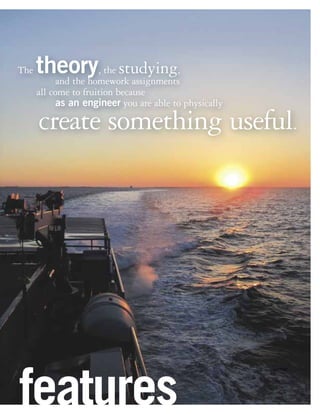
underwater. The theory, the studying, and 
the homework assignments all come to 
fruition because as an engineer you are able to 
physically create something useful. There is 
nothing more satisfying. 
The first time I went through graduate 
school, I got sick. Instead of completing my 
Ph.D. as planned, I ended up dropping with a 
master’s degree to deal with my illness. It 
was one of the greatest regrets of my life, 
until the Navy offered me the chance to go back. For me gradu-ate 
school, and Duke are the fulfillment of a very long-standing 
dream. 
With a Ph.D., I’ll be able to lead my own research, to decide 
what questions I want to try to answer next. Still, sometimes it 
is tempting to lose the perspective I’ve gained over the past few 
years. Today my brain was utterly masticated by a math exam, 
but it is important to remember that there is a purpose to all the 
trauma. There is a model of pulmonary hemodynamics I would 
like to solve, and this class has shown me how. Hopefully, this 
model will be used to create a device that can save lives. While 
all the work and the tedious assignments are difficult, they are 
what will ultimately enable all of us engineers to create some-thing 
amazing. That urge to create is what drives us to become 
engineers in the first place. Perspectives on why we do it may 
change from year to year, but the work is always worth it. 
Rachel Lance is a Ph.D. student in Prof. Craig Henriquez’s lab in 
biomedical engineering.
The theory, the studying, 
and the homework assignments 
all come to fruition because 
as an engineer you are able to physically 
create something useful. 
features caption
COVERSTORY 
FCIEMAS 
A Catalyst for Pratt's Architectural, Technological and Social Transformation 
Seven years later, FCIEMAS has devel-oped 
into a foundation of learning and 
research for both Pratt and the greater sci-ence 
community at Duke University. But 
in addition to the project laboratories, 
research facilities, state-of-the-art clean 
rooms, and “intellectual collision spaces”, 
most passersby have little idea of the 
extensive mechanical systems and architec-tural 
innovations housed within the unas-suming 
Duke stone and brick exterior. 
In this article, we will talk about how 
FCIEMAS as a new facility was integrat-ed 
into Duke’s existing campus aesthetic, 
reflect on the impact FCIEMAS has had 
on the greater Duke community after 
seven years of operation and explore its 
salient features that often go unnoticed. 
The exterior façade of the FCIEMAS 
building incorporates both Duke stone, 
the primary material of West Campus, 
and brick, the material used in Hudson 
Hall. This creates a modern aesthetic, 
sympathetic to both historic West 
Campus and the existing engineering 
buildings. 
D. Bartley Guthrie, AIA, a principal 
22 dukengineer 2012 
at ZGF who served as principal-in-charge 
for the FCIEMAS project 
explained that, “unlike the monochro-matic 
red brick used in Hudson Hall, 
the brick used in the FCIEMAS building 
is a complex palette of different colors 
that is meant to be complementary to 
the native or indigenous stone that was 
quarried in the Duke Forest.” 
This ‘Duke brick’ blend was devel-oped 
after an intense analysis of the 
color palette present in Duke stone. 
Originally developed by the University 
Architect John Pearce, Duke Executive 
Vice President Tallman Trask III, and 
architect César Pelli for another campus 
project, the architects at ZGF made 
minor alterations to the mix for the 
FCIEMAS façade. In addition to materi-al 
similarity, the FCIEMAS building 
structure mimics gothic West Campus 
with tower elements at each corner. 
“The inclusion of tower elements 
marking the corners of the building 
blocks is derivative of the [campus] core 
and careful attention was paid to make 
the tower elements Duke tower ele-ments,” 
Guthrie said. 
Furthermore, Guthrie described that 
The architects at Zimmer Gunsul Frasca (ZGF) in Washington, D.C. 
were faced with a complex task when they were hired to design a 
building to represent the future of Duke’s engineering program. 
Their goal was to create a building that would not only serve as a center 
for advanced technological development, but also as a collaborative 
space for the engineering and scientific community at Duke. In August 
of 2004, when the Fitzpatrick Center for Interdisciplinary Engineering, 
Medicine, and Applied Science (FCIEMAS) was first unveiled it was 
hailed as an environment that would serve as a melting pot for scien-tists 
and students of different backgrounds to collide and collaborate. 
Smart Bridge 
TIMOTHY HURSLEY, ZGF ARCHITECTS LLP
TIMOTHY HURSLEY, ZGF ARCHITECTS LLP 
2012 dukengineer 23 
the main challenge in the development 
of the conceptual design for FCIEMAS 
was, “to build the project in such a way 
that it creates a bridge between the his-toric 
core of campus, and what was con-sidered 
the engineering and research 
domain of campus.” 
This design goal is clearly realized in 
the finished structure; en-route to the 
engineering quadrangle from historic 
West Campus, pedestrians now descend 
down the steps and pass under the 
bridges connecting the east and west 
complexes of the FCIEMAS facility. 
These two bridges are actually “smart 
bridges.” They house an optical fiber sen-sor 
system that can detect microscale 
dimensional changes in the building 
structure, including information on 
stress, strain, and temperature. Fifteen 
separate optical fiber sensors make up the 
optical fiber sensor array. Spaced about a 
meter apart from one another, the sensors 
are capable of detecting changes on the 
order of 1/10,000th percent. A display 
monitor on the third floor bridge allows 
passerby to view the effects of wind, tem-perature, 
and pedestrians. The bridges 
are not the only place where optical fiber 
arrays are installed. One can also find 
them running underneath the main hall-way 
floor, where sensors under certain 
marked tiles feed information to the con-trol 
room, which then wirelessly controls 
a video camera. Using the information 
from the optical sensors, a smart camera 
shifts and focuses to remain gazed on the 
moving pedestrian. 
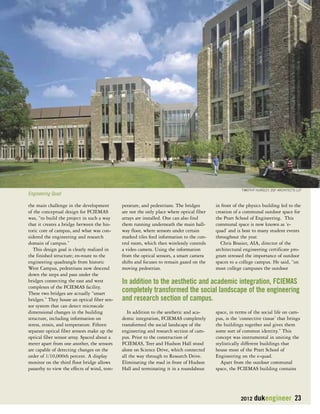
In addition to the aesthetic and aca-demic 
integration, FCIEMAS completely 
transformed the social landscape of the 
engineering and research section of cam-pus. 
Prior to the construction of 
FCIEMAS, Teer and Hudson Hall stood 
alone on Science Drive, which connected 
all the way through to Research Drive. 
Eliminating the road in front of Hudson 
Hall and terminating it in a roundabout 
in front of the physics building led to the 
creation of a communal outdoor space for 
the Pratt School of Engineering. This 
communal space is now known as ‘e-quad’ 
and is host to many student events 
throughout the year. 
Chris Brasier, AIA, director of the 
architectural engineering certificate pro-gram 
stressed the importance of outdoor 
spaces to a college campus. He said, “on 
most college campuses the outdoor 
space, in terms of the social life on cam-pus, 
is the ‘connective tissue’ that brings 
the buildings together and gives them 
some sort of common identity.” This 
concept was instrumental in uniting the 
stylistically different buildings that 
house most of the Pratt School of 
Engineering on the e-quad. 
Apart from the outdoor communal 
space, the FCIEMAS building contains 
Engineering Quad 
In addition to the aesthetic and academic integration, FCIEMAS 
completely transformed the social landscape of the engineering 
and research section of campus.
many unique architectural spaces and 
features, many of which are intended to 
provide space for students and faculty to 
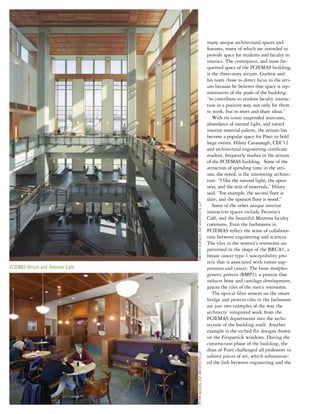
interact. The centerpiece, and most fre-quented 
space of the FCIEMAS building, 
is the three-story atrium. Guthrie and 
his team chose to direct focus to the atri-um 
because he believes that space is rep-resentative 
of the goals of the building: 
“to contribute to student faculty interac-tion 
in a positive way, not only for them 
to work, but to meet and share ideas.” 
With its iconic suspended staircases, 
abundance of natural light, and varied 
interior material palette, the atrium has 
become a popular space for Pratt to hold 
large events. Hilary Cavanaugh, CEE’12 
and architectural engineering certificate 
student, frequently studies in the atrium 
of the FCIEMAS building. Some of the 
attraction of spending time in the atri-um, 
she noted, is the interesting architec-ture. 
“I like the natural light, the open-ness, 
and the mix of materials,” Hilary 
said. “For example, the second floor is 
slate, and the upstairs floor is wood.” 
Some of the other unique interior 
interactive spaces include Twinnie’s 
Café, and the beautiful Mumma faculty 
commons. Even the bathrooms in 
FCIEMAS reflect the sense of collabora-tion 
between engineering and sciences. 
The tiles in the women’s restrooms are 
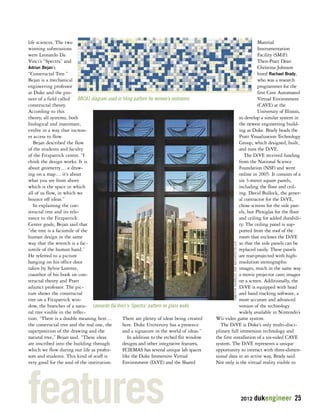
patterned in the shape of the BRCA1, a 
breast cancer type 1 susceptibility pro-tein 
that is associated with tumor sup-pression 
and cancer. The bone morpho-genetic 
protein (BMP1), a protein that 
induces bone and cartilage development, 
graces the tiles of the men’s restrooms. 
The optical fiber sensors on the smart 
bridge and protein tiles in the bathroom 
are just two examples of the way the 
architects’ integrated work from the 
FCIEMAS departments into the archi-tecture 
of the building itself. Another 
example is the etched flit designs drawn 
on the Fitzpatrick windows. During the 
construction phase of the building, the 
dean of Pratt challenged all professors to 
submit pieces of art, which substantiat-ed 
the link between engineering and the 
FCIEMAS Atrium and Twinnies Cafe 
PETER WILSON, ZGF ARCHITECTS LLP TIMOTHY HURSLEY, ZGF ARCHITECTS LLP
2012 dukengineer 25 
life sciences. The two 
winning submissions 
were Leonardo Da 
Vinci’s “Spectra” and 
Adrian Bejan’s 
“Constructal Tree.” 
Bejan is a mechanical 
engineering professor 
at Duke and the pio-neer 
of a field called 
BRCA1 diagram used in tiling pattern for women’s restrooms 
constructal theory. 
According to this 
theory, all systems, both 
biological and inanimate, 
evolve in a way that increas-es 
access to flow. 
Bejan described the flow 
of the students and faculty 
of the Fitzpatrick center. “I 
think the design works. It is 
about geometry… a draw-ing 
on a map… it’s about 
what you see from above 
which is the space in which 
all of us flow, in which we 
bounce off ideas.” 
In explaining the con-structal 
tree and its rele-vance 
to the Fitzpatrick 
Center goals, Bejan said that 
“the tree is a facsimile of the 
human design in the same 
way that the wrench is a fac-simile 
of the human hand.” 
He referred to a picture 
hanging on his office door 
taken by Sylvie Lorente, 
coauthor of his book on con-structal 
theory and Pratt 
adjunct professor. The pic-ture 
shows the constructal 
tree on a Fitzpatrick win-dow, 
Leonardo Da Vinci's ‘Spectra’ pattern on glass walls 
the branches of a natu-ral 
tree visible in the reflec-tion. 
“There is a double meaning here… 
the constructal tree and the real one, the 
superposition of the drawing and the 
natural tree,” Bejan said. “These ideas 
are inscribed into the building through 
which we flow during our life as profes-sors 
and students. This kind of stuff is 
very good for the soul of the institution. 
There are plenty of ideas being created 
here. Duke University has a presence 
and a signature in the world of ideas.” 
In addition to the etched flit window 
designs and other integrative features, 
FCIEMAS has several unique lab spaces 
like the Duke Immersive Virtual 
Environment (DiVE) and the Shared 
Material 
Instrumentation 
Facility (SMiF). 
Then-Pratt Dean 
Christina Johnson 
hired Rachael Brady, 
who was a research 
programmer for the 
first Cave Automated 
Virtual Environment 
(CAVE) at the 
University of Illinois, 
to develop a similar system in 
the newest engineering build-ing 
at Duke. Brady heads the 
Pratt Visualization Technology 
Group, which designed, built, 
and runs the DiVE. 
The DiVE received funding 
from the National Science 
Foundation (NSF) and went 
online in 2005. It consists of a 
six 3-meter square panels, 
including the floor and ceil-ing. 
David Bullock, the gener-al 
contractor for the DiVE, 
chose screens for the side pan-els, 
but Plexiglas for the floor 
and ceiling for added durabili-ty. 
The ceiling panel is sup-ported 
from the roof of the 
room that encloses the DiVE 
so that the side panels can be 
replaced easily. These panels 
are rear-projected with high-resolution 
stereographic 
images, much in the same way 
a movie projector casts images 
on a screen. Additionally, the 
DiVE is equipped with head 
and hand tracking software, a 
more accurate and advanced 
version of the technology 
widely available in Nintendo’s 
TIMOTHY HURSLEY, ZGF ARCHITECTS LLP 
Wii video game system. 
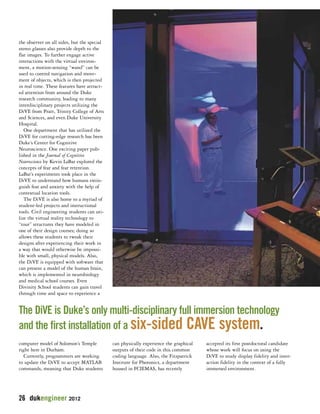
The DiVE is Duke’s only multi-disci-plinary 
full immersion technology and 
the first installation of a six-sided CAVE 
system. The DiVE represents a unique 
opportunity to interact with three-dimen-sional 
data in an active way, Brady said. 
Not only is the virtual reality visible to features
the observer on all sides, but the special 
stereo glasses also provide depth to the 
flat images. To further engage active 
interactions with the virtual environ-ment, 
a motion-sensing “wand” can be 
used to control navigation and move-ment 
of objects, which is then projected 
in real time. These features have attract-ed 
attention from around the Duke 
research community, leading to many 
interdisciplinary projects utilizing the 
DiVE from Pratt, Trinity College of Arts 
and Sciences, and even Duke University 
Hospital. 
One department that has utilized the 
DiVE for cutting-edge research has been 
Duke’s Center for Cognitive 
Neuroscience. One exciting paper pub-lished 
in the Journal of Cognitive 
Neuroscience by Kevin LaBar explored the 
concepts of fear and fear retention. 
LaBar’s experiments took place in the 
DiVE to understand how humans extin-guish 
fear and anxiety with the help of 
contextual location tools. 
The DiVE is also home to a myriad of 
student-led projects and instructional 
tools. Civil engineering students can uti-lize 
the virtual reality technology to 
“tour” structures they have modeled in 
one of their design courses; doing so 
allows these students to tweak their 
designs after experiencing their work in 
a way that would otherwise be impossi-ble 
with small, physical models. Also, 
the DiVE is equipped with software that 
can present a model of the human brain, 
which is implemented in neurobiology 
and medical school courses. Even 
Divinity School students can gain travel 
through time and space to experience a 
The DiVE is Duke’s only multi-disciplinary full immersion technology 
and the first installation of a six-sided CAVE system. 
computer model of Solomon’s Temple 
right here in Durham. 
Currently, programmers are working 
to update the DiVE to accept MATLAB 
commands, meaning that Duke students 
26 dukengineer 2012 
can physically experience the graphical 
outputs of their code in this common 
coding language. Also, the Fitzpatrick 
Institute for Photonics, a department 
housed in FCIEMAS, has recently 
accepted its first postdoctoral candidate 
whose work will focus on using the 
DiVE to study display fidelity and inter-action 
fidelity in the context of a fully 
immersed environment.
2012 dukengineer 27 
With advances in the realm of virtual 
reality also comes the need to promote 
the DiVE as a medium for more studies, 
both in and out of Pratt. Students from 
every department at Duke are encour-aged 
to apply to use the DiVE for their 
projects. Those interested in learning 
more about Duke’s innovative virtual 
reality and visualization research and 
experiencing this technology firsthand 
are encouraged to visit vis.duke.edu or 
attend one of the weekly open houses on 
Thursdays at 4:30 pm. 
In addition to these unique lab spaces, 
the Fitzpatrick Center was also one of 
the first buildings on Duke’s campus to 
achieve LEED (Leadership in Energy and 
Environmental Design) certification, 
awarded by the United States Green 
Building Council. Isabelle Arnold, 
LEED AP BD+C, is an associate at ZGF 
and served as the LEED coordinator on 
the project. While designed with sus-tainability 
in mind, Arnold explained, 
“We did not start the project thinking 
we were going to pursue LEED; LEED 
was a very young system at the time.” 
The decision was made to pursue LEED 
Certification later in the design process. 
However, Arnold noted that there were 
very few changes to the design itself 
once the goal of LEED Certification was 
solidified stating “the pieces were in 
place.” 
To achieve its LEED silver certifica-tion, 
a variety of environmental features 
were implemented. The Fitzpatrick 
Center earned points in five major LEED 
categories: site selection, water efficiency, 
energy and atmosphere, indoor environ-mental 
quality, and materials and 
resources. The most innovative environ-mental 
measure implemented, Arnold 
said, is the economic organization of the 
building program. Laboratory spaces 
with unique air quality or water needs 
were ‘blocked’ together, significantly 
reducing energy consumption. Similarly, 
offices were placed all along the perime-ter 
of the building to receive as much 
daylight as possible. 
Guthrie said that the final product, 
“[FCIEMAS] is really a unique assem-blage 
of different types of program and 
hopefully it’s creating a really exciting 
mix of research and student life.” 
When Bejan was asked if he believed 
that the Fitzpatrick Center had success-fully 
accomplished its goal of creating an 
interactive collision and interaction space 
between intellectuals of different disci-plines, 
Bejan offered a guarded yes, but 
stressed that a great idea transcends bor-ders. 
“I think that people work together, 
as creators of ideas, because they are 
attracted to the idea,” he explained. 
“Collaboration is lot like a lightning 
bolt from the cloud to the church 
steeple. Completely unknown before it 
happens, but striking when it does, and 
memorable when there is impact on the 
ground.” 
Cameron McKay, Jimmy Zhong, Lauren 
Shwisberg and Tejen Shah 
PETER WILSON, ZGF ARCHITECTS LLP
Research 
Cutting Edge Soft Matter 
A look into the field of soft materials research 
28 dukengineer 2012 
Recently, the National Science Foundation funded a massive $13.6 million under-taking 
to establish the Triangle Materials Research Science and Engineering 
Center (MRSEC) in North Carolina. The MRSEC — an intercollegiate collab-oration 
between the schools in the Research Triangle area, namely Duke 
University, North Carolina State University, University of North 
Carolina – Chapel Hill, and North Carolina Central University — will 
focus on advancing the current knowledge in the field of “soft matter” research. A 
team of 20 faculty members from across these four schools has assembled in an effort 
to develop intricate new types of soft matter that exhibit unique functional properties. 
Leading this team of MRSEC investigators is Gabriel Lopez, Ph.D., Pratt professor of 
biomedical engineering and mechanical engineering and materials science. Lopez 
received his Ph.D. from the University of Washington by developing a method for 
changing the surface properties of different materials by coating them with ultrathin 
polymer layers. He continued his research as a postdoc-toral 
fellow at Harvard University, where he studied 
how to control cell growth using micropatterns in sur-face 
chemistry of culture substrates. Lopez came to 
Duke in January 2010 after establishing a biomedical 
engineering program at the University of New Mexico. 
At Duke, Lopez has been focused on conducting 
research in the area of soft matter. “Soft matter,” Lopez 
said “is basically a designation for a class of condensed 
matter that is based on the energy required to deform it. 
If the matter in question deforms easily at ambient con-ditions, 
then it is considered soft matter.” 
Some basic examples of soft matter include rubber, 
polymers, gels, liquid crystals, and suspensions of fine 
particles, many of which we use every day in the form 
of tires, plastic containers, cosmetic supplies, deter-gents, 
and foods. However, it has also become apparent 
that scientists can take advantage of many more of the 
unique properties of soft matter. Lopez believes that “a 
Prof. Gabriel Lopez analyzing new soft materials for the MRSEC
frontier with regard to these materials is 
how we can take advantage of the fact 
that it is possible to design them to 
undergo programmed deformation on 
their own.” 
For example, Lopez seeks to capitalize 
on the fact that many of these materials 
are responsive to small environmental 
changes. 
Recently, Lopez and his research team 
published a paper concerning the cre-ation 
of a soft material coating that is 
able to change its structure with regard 
to slight fluctuations in tempera-ture. 
The premise of his work, 
which was funded by the Office of 
Naval Research, was to develop a 
type of coating that would be able 
to prevent bacteria from sticking 
to solid surfaces, an important 
goal with implications in many 
naval operations. When bacteria 
began to grow on these surfaces, 
slight variations in temperature 
would cause the coating to change 
its chemical structure, and in turn 
the bacteria would no longer be 
able to cling onto that surface. 
This method was shown to be very 
effective for the removal of bacte-ria 
from solid surfaces. 
In collaboration with Xuanhe 
Zhao, assistant professor of mechanical 
engineering and materials science, the 
group is now working on developing a 
new type of soft material coating that 
can change their surface properties in 
response to the applied voltage, instead 
of a change in temperature. Current test-ing 
is taking place at the Duke Marine 
Lab, where the team is hoping that 
applying electric fields to their soft 
material will be able to eliminate 
colonies of bacteria as well as settlements 
of larger organisms such as barnacles. 
(From left to right) Phanindhar Shivapooja, 
Prof. Xuanhe Zhao, and Qiming Wang holding 
a sheet of Kapton for biofilm release 
In another research initiative under 
the MRSEC umbrella, members of the 
Lopez group are synthesizing new 
microparticles from different polymeric 
materials. These particles are known as 
colloids when they are suspended in liq-uids 
and like other colloidal suspensions 
(including milk) they exhibit a milky 
appearance because of the way they scat-ter 
room light. The group is studying 
how these new materials respond to the 
application of acoustic fields with an eye 
toward developing new particulate 
materials for drug delivery, 
ultrasound imaging, medical 
diagnostic tests and three-dimensional 
colloidal assemblies. 
Continued research will only 
provide more insight and more 
knowledge about the properties 
and applications of soft materials, 
and scientists are only beginning 
to discover the benefits and uses 
that the wondrous world of soft 
matter can provide. The efforts of 
Lopez and the MRSEC show that 
inquiries into the field of soft 
matter are able to produce hard, 
tangible results. 
Justin Yu is a freshman majoring in 
Biomedical Engineering. 
Leah Johnson showing a sample 
of colliodal suspensions.
A Natural Analog for 
Synthetic Biology 
L 
ingchong You, Ph.D., joined Duke University 
six years ago as a jointly-appointed assistant professor in 
the Department of Biomedical Engineering and Institute 
for Genome Sciences and Policy, launching his lab in 
synthetic biology research. Synthetic biology is a rela-tively 
30 dukengineer 2012 
new field that combines elements from biology 
and engineering to design and construct new biological 
systems that carry out a desired function. You’s group 
engineers gene regulatory networks and uses such syn-thetic 
systems as tools to quantitatively analyze dynamic 
properties of cellular networks. 
Synthetic biology began as a field largely focused on 
employing the tools of genetic engineering to reconfigure 
metabolic pathways of cells to perform new functions, such 
as the production of therapeutic compounds or the micro-bial 
breakdown of toxins. Synthetic biologists use recombi-nant 
DNA technology to piece together gene networks that 
produce proteins of interest or confer a desired function, in 
the same way that electrical engineers use resistors and 
capacitors to piece together electrical circuits to generate 
desired outputs. 
Over the last ten years, synthetic biology has expanded 
its reach to encompass the use of engineered gene circuits to 
analyze questions in biology. In line with this notion, the 
You group employs the approach of synthetic biology, cou-pled 
with mathematical modeling, to engineer bacterial 
population dynamics, quantify interactions in cellular net-works, 
and address unresolved questions in biology. 
Researchers in the You group have successfully constructed 
a synthetic predator-prey ecosystem consisting of two bacteri-al 
populations. The predator population kills the prey by 
causing production of a killer protein in the prey, while the 
prey population rescues the predators by inducing the pro-duction 
of an antidote protein in the predator. 
Along these same lines, researchers in the You lab have 
also engineered bacterial populations 
that exhibit other ecological characteris-tics, 
including altruistic death, wherein 
the death of some individuals aids in the 
overall survival of the population, and 
the Allee effect wherein a population 
cannot survive below a critical popula-tion 
density. These engineered ecosys-tems 
enable the study of population 
dynamics, within such contexts as 
Katy Riccione 
Over the last ten years, 
synthetic biology 
has expanded its reach to 
encompass the use of 
engineered gene circuits 
to analyze questions in biology.
A microbial swarmbot is a small population of bacterial cells that are autonomously regulated 
by synthetic gene circuits and are encapsulated in microcapsules built from synthetic or natu-ral 
2012 dukengineer 31 
antibiotic resistance and species invasion, 
under a level of control that is not possi-ble 
in natural ecosystems. 
In addition to engineering synthetic 
gene circuits, the You group develops 
mathematical models that function as a 
simplified lens through which one can 
characterize biological networks. Such 
models, coupled with experimental vali-dation, 
are used extensively in the You 
lab to analyze a number of cellular net-works, 
including the aforementioned 
synthetic ecosystems, as well as networks 
that govern cell cycle entry and self-organized 
pattern formation. The group 
has used such an approach to elucidate a 
mode of gene regulation of potential 
importance in mitigating abnormal cell 
growth. They have found that expression 
of E2F, a protein family that controls 
genes essential for cell cycle entry, is 
highest under normal levels of growth 
factors but decreases in the presence of 
higher levels of growth factors (a charac-teristic 
of tumor cells), pointing to a 
potential mechanism that may play a 
role in modulating the development of 
cancer. 
In addition, other members of the You 
lab apply modeling towards studying a 
synthetic circuit that programs self-induced 
pattern formation as a potential 
means of understanding similar processes 
in nature, such as limb bud outgrowth 
and tissue stratification. 
Through their work in engineering 
and analyzing synthetic gene circuits, 
researchers in the You lab have also 
stumbled upon phenomena that chal-lenge 
common notions and assumptions 
in synthetic biology. In designing sys-tems, 
synthetic biologists generally 
polymers. 
assume a simple well-defined interface 
between the gene circuit and the host 
organism. The You group, however, has 
revealed that underlying and frequently 
overlooked parameters within the engi-neered 
system, such as the physical 
amount of the genes in the circuit 
(termed copy number) and how the 
engineered gene circuits affect growth of 
the host organism, can fundamentally 
change the predicted output of the sys-tem. 
Such findings have vast implica-tions 
for the field of synthetic biology, as 
they highlight the importance of under-standing 
how “hidden interactions” 
affect the behavior of the engineered 
gene networks. 
A central theme of the You lab is 
making use of synthetic biological sys-tems 
as analogs of natural systems in 
order to address biological questions and 
better understand the dynamics of cellu-lar 
networks. 
Ongoing projects could lead to new 
ways of fabricating materials, diagnosing 
and treating cancers, and fighting bacte-rial 
infections. In addition to such prac-tical 
applications, You envisions synthet-ic 
biology “likely transforming how 
future students learn biology.” 
It is not too far-fetched to conceive of 
students in an introductory biology 
course fiddling with gene circuits to bet-ter 
understand cells in the same way that 
students in an introductory physics 
course fool around with resistors and 
capacitors to better understand electron-ics, 
You said. On an even grander scale, 
bioengineers like to think of a world 
where organisms are designed to mass-produce 
therapeutic compounds, materi-als, 
and biofuels, making such products 
potentially cheaper and more accessible. 
Katy Riccione is a biomedical engineering 
Ph.D. candidate at Duke University. 
research
Fluid Cloaking 
When most people hear the word cloaking, they 
think of Harry Potter’s invisibility cloak. Real-world 
cloaking, however, is defined as hiding 
an object from a detector or a probe. The idea 
of fluid cloaking was first conceived last year 
by Research Professor Yaroslav Urzhumov and David Smith, the 
William Bejan Professor of Electrical and Computer Engineering. 
A fluid cloak hides an object from a flowing fluid, allowing it to 
flow as if that object didn’t exist. Reversing the perspective, the 
object can move without disturbing the fluid. 
An object moving through a fluid normally 
interacts with it in two different ways. First, 
there is a drag force, which is essentially fric-tion 
in fluids. Second, the object physically 
pushes the fluid as it moves, leaving a void 
An example of an isotropically 
permeable metamaterial. 
which the fluid rushes into. Fluid cloaking eliminates these 
interactions. A submarine that can move without any drag 
essentially shoots through the water like a rocket in free space, 
potentially saving energy and also eliminating wake. Without 
any wake, a submarine can roam completely undetected. 
Cloaking works by taking advantage of artificially engineered 
structures called metamaterials. The metamaterials act like a 
porous mesh case that can alter the flow of fluid. 
“In layman terms, the structure sucks in the water in front 
of it, reroutes the water around it, and 
ejects the water at carefully engineered 
positions,” Urzhumov explains. The fluid 
must be accelerated at key areas so that the 
momentum and pressure of the fluid will 
be preserved as it passes through the cloak. 
32 dukengineer 2012 
In layman terms, the 
structure sucks in the 
water in front of it, 
reroutes the water around 
it, and ejects the water 
at carefully engineered 
positions.
A computer demonstration of a fluid 
cloak redirecting streamlines 
around an object 
2012 dukengineer 33 
Urzhumov continues, “Because 
the streamlines have the same 
velocity in magnitude and direc-tion, 
it’s as if nothing really hap-pened.” 
The idea is similar in theory to 
other forms of cloaking such as 
electromagnetic and acoustic 
cloaking. However, cloaking of 
the fluid flow is revolutionary in 
certain aspects. In the other forms 
of cloaking, handling waves 
comes with innate limitations. 
“The need for wave velocities 
of particles inside that exceed 
the wave velocity outside is 
what limits the operation of 
optical and electromagnetic 
cloaks to only certain wave-lengths. 
It is not possible to 
cover the entire spectrum 
because that would violate 
causality,” Urzhumov says. 
In addition, optical cloaking 
metamaterials are typically reso-nant 
at selected frequencies, 
which leads to unwanted attenu-ation. 
Fluid cloaking has noth-ing 
to do with waves, resonances 
or frequencies; therefore it oper-ates 
with any fluid and any 
structural composition of the 
metamaterial. On the other 
hand, fluid flow cloaking 
requires physically moving a 
tangible substance. This factor 
leads to various complications concerning pressure drop, which 
can be compensated using micropump arrays. These microp-umps 
Urzhumov showing a machine that analyzes 
metamaterial properties 
must use energy; therefore, the question of whether such 
cloaks will be energy efficient remains unclear. 
The properties of cloaks comes from both the metamaterial 
composition and structure. In the case of fluid cloaking, the com-position 
is virtually irrelevant, and only the structure of the meta-material 
unit cell matters. The challenge comes from designing a 
structure that has anisotropic permeability with a gradient. An 
anisotropically permeable, graded structure would allow the cloak 
to work regardless of the fluid’s direction. A gradient is necessary 
because some fluid molecules must travel longer distances than 
the others, which forces acceleration to vary throughout the struc-ture. 
Currently, there is no rigorous mathematical theory for fluid research 
cloaking, so the research focuses 
on computer simulation and 
optimization. 
Urzhumov says, “The way I 
see this, the simplest structure 
would be a unit cell containing 
metal blades oriented perpendi-cular 
to each other so that you 
can independently control the 
permeability in all three direc-tions.” 
By rotating a blade to a 
certain angle with a flow direc-tion, 
the fluid is allowed to flow 
easily in that direction. This will 
allow the structure to be 
anisotropically permeable. 
Urzhumov adds, “Then, different 
thickness of the blades would 
allow different permeability 
magnitudes and create the neces-sary 
gradient… Micropumps 
will be added to ensure pressure 
loss compensation.” 
Conceived earlier this year, 
this innovative technology has 
already attracted a lot of atten-tion 
from the experts. “I don’t 
know if I can see this approach 
scaled up for large ships, but 
realistically I can see this tech-nology 
for highly maneuver-able, 
stealthy unmanned sub-marines,” 
Urzhumov says. 
The defense organizations 
could theoretically use this 
technology to let eavesdropping 
devices roam free in the territorial waters of any country. Also, 
marine experts can use fluid cloaking to observe underwater life 
without disturbing it. 
Urzhumov optimistically predicts, “This technology can be 
applied to small enough objects of any shape and kind. Seeing 
these micropumps as distributed propulsion systems, one can 
also envision aircrafts, ships and submarines doing arbitrary 
maneuvers in water, almost like UFOs in sci-fi movies. Unlike 
conventional aircrafts and ships, they do not have to rely on 
external streams of fluid. Such systems create the desired flow 
themselves.” 
Nathan Li is a Pratt sophomore majoring in biomedical and 
electrical engineering.
SMiF 
Propelling World Class Research at Duke University 
In 2000, a university strategic planning 
committee, which was a collection of top 
administrators working to create initia-tives 
for the university’s future, formed 
the “Materials Working Group” to help 
catalyze nanostructured and bio-inspired 
materials and device research. The group 
realized that there was a lack of equip-ment 
necessary to perform high-level 
research for the fabrication and characteri-zation 
of materials, devices, and nanos-tructures. 
Their solution to the problem 
was the creation of SMIF, Duke’s resource 
for advanced characterization and clean-room 
fabrication, which is available to 
34 dukengineer 2012 
undergraduates, graduate students, facul-ty, 
and non-university researchers alike. 
By 2002, SMIF obtained X-ray diffrac-tion 
and atomic force microscopy capabil-ities, 
originally located in the basement of 
the Levine Science Research Center. A 
year later, a scanning electron microscope 
in the physics building and a small clean-room 
in Hudson Hall were added to the 
SMIF arsenal. However, it was not until 
2007 that SMIF moved into the 12,000 
square foot facility where it currently 
operates. SMIF now has more than 65 
instruments serving the needs of more 
than 500 users across the Pratt School of 
Above: A Duke University researcher using a 
fluorescent microscope in the cleanroom “Bio Bay” 
Engineering, Trinity School of Arts & 
Sciences, the School of Medicine, neigh-boring 
universities, and companies across 
the Research Triangle Park. 
With the constant bustle in SMIF from 
its many users and projects, safety has 
always been an important consideration. 
SMIF director Mark Walters, Ph.D. explains, 
“The safety of students and researchers 
using our facility is our top priority, which 
is evidenced by the safety training and 
safety systems in the facility.” 
For instance, the toxic gas monitoring 
system in SMIF is a $1 million state-of-the- 
art system that can detect the type, 
amount, and location of any gas leak or 
chemical spill and immediately notify 
SMIF staff by wireless communication to 
any locality. There have been no incidents 
of injury since SMIF first opened. 
SMIF now not only offers its capabili-ties 
as a research facility, but also as an 
educational tool. The staff allows profes-sors 
to illustrate concepts from class at no 
charge. Further, several funding agencies, 
such as the LORD Foundation and the 
Donald M. Alstadt Fund, have enabled 
The culture of research at the Pratt School of Engineering 
serves as a model to many research institutions and 
industries across the globe. The high level of innova-tion, 
productivity, and advancement reflects a vibrant 
community of students, faculty and researchers across 
a range of disciplines in science and engineering. However, pioneer-ing 
research requires access to the most advanced equipment. 
That’s where the idea for the Shared Materials Instrumentation 
Facility (SMIF) began. 
Left: A Duke University Post-Doc analyzes an 
image of a microelectromechanical device 
collected on SMIF’s 3D Optical Profiler
Duke University students performing photolithography processing in the SMIF cleanroom 
2012 dukengineer 35 
undergraduates to use the equipment for 
research projects by covering the hourly 
access fees typically billed to its users for 
operational costs. Headlining this idea is 
the SMIF Undergraduate User Program, 
or SUUP, which encourages undergradu-ate 
research and innovation by supplying 
students up to $500 a month. There are 
currently 23 undergraduates participating 
in this program. 
There are many reasons why SMIF 
stands out among other noteworthy 
shared facilities. SMIF owns the only elec-tron 
beam lithography system in North 
Carolina, which is capable of producing 
structures at the nanoscale. It also has a 
$1 million dollar transmission electron 
microscope capable of cryogenic sample 
imaging and 3-D tomography. The SMIF 
cleanroom, which was the first such facili-ty 
in the nation to use a “Bio Bay” for the 
integration of biological materials, 
enabling the creation of novel sensors and 
biomedical devices. 
However, since the user fees of the 
facility only cover operational costs, the 
SMIF relies on external funding for new 
equipment and capabilities. Currently, the 
staff is looking into purchasing atomic 
layer deposition and dip pen lithography 
instruments for the cleanroom and 
focused ion beam and thermogravimetric 
analyzer instruments for characterization 
purposes. Together this equipment carries 
a heavy price tag of well over $1 million. 
Hired in 2002, Walters oversees many 
of the projects inside the facility. Walters 
works closely with a specialized team of 
talented engineers to keep the facility 
operational: Kirk Bryson, Jay Dalton, 
Michelle Gignac, and Tamika Craige. The 
Executive Director of SMIF, Nan Marie 
Jokerst, Ph.D., J.A. Jones Professor of 
Electrical and Computer Engineering, 
along with the advisory committee, leads 
the group by keeping the facility ahead of 
the technological curve. 
“The capabilities of SMIF and its staff 
are here to enable cutting edge research 
for the faculty and students of the Pratt 
School of Engineering and beyond,” 
Walters said. The SMIF staff assists 
researchers by conducting training cours-es, 
providing technical support, and keep-ing 
the facility stocked with chemicals 
and materials. 
Wyatt Shields is a Ph.D. student in Prof. 
Gabriel Lopez’s lab in biomedical 
engineering. 
research
Profiles THE 
Duke Motorsports Team 
Producing a car that can 
go from 0-60 MPH in 
under four seconds is 
often the purview of 
high-power sports car 
manufacturers, but every year, a team of 
dedicated Pratt undergraduate and gradu-ate 
students conceives, designs and fabri-cates 
a high-performance race car capable 
of achieving those results. 
The Duke Motorsports Team enters the 
annual Formula SAE competition organ-ized 
by SAE International (formerly the 
Society for Automotive Engineers), an 
international competition that challenges 
university students to design and con-struct 
a formula race car, competing with 
fellow students in a variety of categories. 
The competition is styled as if a manu-facturing 
firm had requested the teams to 
produce a prototype car for evaluation for 
viability as a production car, with the aim 
of producing a car that excels as a pack-age, 
not merely in speed. The competi-tion 
pits the cars against each other in 
tests of economy, endurance, acceleration, 
autocross, and in skid-pad time trials. 
Furthermore, each team must present 
their car to a panel of judges from the 
automotive industry in three areas: design 
choices, cost report, and a business pres-entation. 
The Duke team competes regularly in a 
field of 120 international teams at the 
FSAE event organized at the Michigan 
36 dukengineer 2012 
International Speedway, the larger of the 
two North American events, with other 
events occurring around the world in 
countries such as Germany, the United 
Kingdom, and Australia. Sponsored by 
some of the most renowned companies in 
the automotive industry, the competition 
awards prizes for excellence in both the 
dynamic and static events, with awards 
also available for the use of environmen-tally 
friendly fuels and innovative design 
concepts, amongst others. 
The team produces a single-seat, open 
wheel race car, custom producing almost 
all of the components, including the car’s 
frame and safety mechanisms, whilst 
heavily modifying other, procured parts in 
order to maximize the car’s performance. 
The manufacturing process occurs 
throughout the academic year, with sub-teams 
developing components to be 
assembled and integrated together for ini-tial 
testing in March. The car itself boasts 
an impressive array of capabilities, weigh-ing 
just under 500 pounds, with the 
capacity to go from 0-60 MPH in under 
four seconds. 
Production costs for the car are estimat-ed 
at approximately $13,000, if manufac-tured 
on a large scale, but the team’s pro-totype 
costs around $30,000 to produce. 
“Finances are always a challenge,” said 
chief engineer Juan Pablo Garcia, “but we 
are thankful for the support of the 
Engineering Student Government, the 
Engineering Alumni Council and our cor-porate 
sponsors.” 
This year, the team is focusing on 
developing a more comprehensive aerody-namics 
package for the car, with the aim 
of breaking into the top 10 at Michigan 
in 2012. Historically, the team’s highest 
position in the competition has been 11th 
overall, but with a strong showing from 
the freshman class, boosting team num-bers 
this year, Garcia is hopeful that the 
team can achieve a higher finish. 
The team itself is comprised of a dedi- 
Gaining Practical Experience 
The Duke Motorsports Team competing at the 2011 FSAE competition at 
Michigan International Speedway.
This year, the team is focusing on developing a more 
comprehensive aerodynamics package for the car, with the aim of 
breaking into the top 10 at Michigan in 2012. 
2012 dukengineer 37 
cated core of approximately 20 students, 
who work on the car throughout the 
week, often into the early hours in order 
to meet strict deadlines. The development 
process is extensive, with every stage of 
the development process requiring signif-icant 
time and effort. 
“The team really allows you to focus on 
what you’re interests are,” Garcia said, 
“You get an exposure to everything, but 
you can work on what you love”. 
Working on the car provides team 
members with extensive practical engi-neering 
skills, with many agreeing that 
they learn concepts and skills well ahead 
of their fellow students. Many students 
progress from the Motorsports team to 
graduate positions in the automotive 
industry, building upon their practical 
knowledge and expertise gained from 
their time in the team. 
The team also integrates itself into the 
Pratt curriculum, by offering a number of 
projects for the ME160 class, the mechan-ical 
engineering capstone. Apart from the 
work and effort the team puts it in, it is 
also great fun, Garcia said. “We like jok-ing 
around, we go out to dinner, you will 
see people always having a good time,” he 
said. 
Ultimately, the team has been one of 
the highlights of Garcia’s four years at 
Duke. “Seeing the car go and realizing 
you did that…no one can ever take that 
away from you. It’s like nothing you’ve 
ever seen before”. 
Ajeet Hansra is a sophomore majoring in 
mechanical engineering. 
The Duke Motorsports Team at the 2011 FSAE competition at Michigan International Speedway. 
The 2011 Car, ‘One Ball’, competing in the 
skid pad event at Michigan International 
Speedway. 
Photo credits: Enrique Pablo Garcia
The Home Depot 
Smart Home 
Fostering Student Leadership and Innovation 
Despite its relative youth 
as a Duke student 
group, the Smart Home 
program has consistently 
been among the best 
programs for helping students develop 
key leadership and entrepreneurial skills. 
Each year, 10 students are selected from 
an applicant pool as residents of The 
Home Depot Smart Home on Duke’s 
central campus. 
In addition to the 10 residents, the 
program has also become a “home” for 
many other students who do not live at 
the research dorm, but are still active 
with one or more project teams. The 
smart home program provides many 
resources for all of these students to work 
collaboratively on a variety of unique 
projects, which provide valuable hands-on 
research and teamwork experience. 
Many students are drawn to the smart 
home due to the simple fact that project 
possibilities are limited only by their 
own creativity. Some choose to focus on 
implementing new or improved tech-nologies 
at The Home Depot Smart 
Home, while others benefit the greater 
Duke community. Some projects promote 
the goal of environmental sustainability, 
and others improve convenience and effi-ciency 
of daily activities. 
One project, for example, aims to tack-le 
water waste at the smart home. The 
technology involves measuring and dis-playing 
both the rate of water use and 
the total amount used at each sink over 
time. This display next to the sink 
encourages conservation because once a 
38 dukengineer 2012 
continuously rising number is visible, the 
cumulative impact of running a faucet 
becomes much more tangible. 
Additionally, the data from these sensors 
is logged over time to track trends and 
look for usage patterns. While the tech-nology 
involved in this project is rela-tively 
simple, the true innovation is in 
the creative application of a simple tech-nology 
to affect peoples’ habits. 
Another project tackles a common dif-ficulty 
that students have in finding an 
available group study room in Perkins 
and Bostock libraries, especially around 
busy times such as final exam week. This 
project, called PerkinSense, will change 
that, preventing much frustration and 
wasted time. Currently, the PerkinSense 
team has been through several iterations 
of their prototype of a battery powered, 
Wifi-enabled motion sensor. The motion 
detectors will be installed on the wall in 
each room, and report their statuses to a 
page on the Library’s website, so open 
rooms can be quickly identified. 
These projects represent only a small 
slice of the work being done at through 
the Smart Home program, where stu-dents 
are encouraged to dream big with 
their ideas. Some other examples of 
ongoing projects are a practical method 
or device for indoor composting, smart-phone 
control of music, lighting, and 
environmental systems, and a mailbox 
that provides alerts when mail is deliv-ered. 
An important part of the success of 
these projects is an open and collabora-tive 
approach to problem solving. 
Project teams are often interdisciplinary, 
with students from both the Pratt School 
Testing the water flow sensor, left, with a low-power LCD display
2012 dukengineer 39 
The Duke Smart Home, located on Duke's Central Campus 
of Engineering and the Trinity College 
of Arts and Sciences. This mentality 
allows for diverse perspectives and areas 
of expertise to be considered, which 
helps to keep the big picture in focus. 
The goal is never just to build gadgets, 
but to promote smart and sustainable 
lifestyles. 
After gaining national recognition in 
2008 for introducing a novel model for 
student engagement, the Smart Home 
Program is still at the forefront of the 
green movement in education. In 2008, 
soon after construction of the house was 
completed, it received LEED Platinum 
certification, and two awards from 
Associated Builders and Contractors. 
The United States Green Building 
Council recognized the program’s educa-tional 
value with a 2009 award for 
Excellence in Green Building Education. 
In 2011, the Smart Home program was 
admitted to the International Green 
Industry Hall of Fame. 
In addition to these accolades, the pro-gram 
has benefitted from regular part-nerships 
with industry. John Deere is 
working with students and staff at Duke 
to develop a new landscaping design in 
accordance with the standards of the 
Sustainable Sites Initiative. The Home 
Depot Smart Home was chosen as one of 
about 150 pilot projects to test these 
new guidelines to quantify sustainable 
design, construction, and maintenance 
practices. Progress on the garden renova-tions 
is nearly complete. One of the 
main features is a sophisticated irrigation 
system, which delivers water based on 
predefined schedules, as well as readings 
from various sensors. The landscaping 
features two new bioswales that aid in 
reducing runoff into the sewer system, 
improvements in accessibility to the gar-den 
area with new terracing and walk-ways, 
and a shed and greenhouse. The 
smart home residents and members of 
Duke’s Community Garden club are 
looking forward to the spring planting 
season. 
Another exciting partnership the 
Smart Home Program has formed is 
with Durham-based Cree, Inc., a leader 
in LED lighting innovation. The smart 
home dorm will soon be retrofit with 
Cree’s products, and the residents of the 
home can provide feedback on their 
experience so the system can be perfected 
for residential applications. At the same 
time, the LED lights reduce the energy 
consumption from lighting by about 60 
percent and last much longer than the 
current compact fluorescent bulbs. The 
installation at the dorm will demonstrate 
how simple changes can be made else-where 
on campus to help Duke achieve 
its goal of carbon neutrality by 2024. 
The Smart Home Program at Duke 
provides incredible opportunities for 
everyone involved. It is truly living up 
to its reputation as more than just a 
dorm or house, but a live-in laboratory 
where students are free to explore and 
influence what it means to live in a 
smart and sustainable way. 
James Mullally, BME ’12, Smart Home Vice 
President and two-year resident 
profile
summerstories 
Building Bridges to Form Connections 
love bridges. What’s not to love? 
Bridges create connections among 
people and places that did not 
exist before, opening countless 
possibilities. 
In the U.S. it is easy to take 
the advantages of bridges for 
granted, but in much of the 
developing world the consistent 
access to schools, work, stores, and med-ical 
care afforded by bridges is a luxury. 
A lack of viable transportation options 
can often adversely affect daily life. One 
country in particular that struggles with 
this issue is El Salvador. During the rainy 
season, which lasts from June to 
November, rivers can drastically flood 
above their banks by up to 15 feet. These 
surges submerge existing paths and, 
more often than not, the Salvadorans 
have no alternate way of crossing flooded 
roads and paths. This leads to absences 
from school for the children and leaves 
adults unable to access their work. In 
more extreme circumstances, the ill can-not 
reach medical care. 
Maria Gibbs, a senior civil engineering 
major, had been traveling to El Salvador 
for several summers and quickly became 
aware of this issue from the local 
Salvadorans with whom she worked. She 
brought the subject back to Duke, and 
developed it into a Duke Engineers for 
International Development (DEID) 
bridge-building project. 
We were fortunate enough to become 
acquainted with Bridges to Prosperity 
(B2P), a non-governmental organization 
whose mission is to eliminate the barri-ers 
to healthcare access, education, and 
economic opportunities caused by 
impassable rivers. With the help of B2P, 
we were able to undertake two bridge 
projects in neighboring rural farming 
40 dukengineer 2012 
communities, La Hacienda Corinto and 
Guadalupe. The communities are just 
outside Zaragoza, which is about 15 
kilometers from the coast and 20 kilo-meters 
from San Salvador, the nation’s 
capital. Then, independently from B2P, 
we also rehabilitated a decrepit vehicu-lar 
culvert bridge in Guadalupe after 
completion of the pedestrian bridges. 
As a team of 10 Duke engineering 
students, we departed for El Salvador in 
May feeling prepared but not knowing 
entirely what to expect. On the first day 
of work, I was handed a shovel and told 
to dig a ditch. “What is this ditch for?” 
I wondered. I began to realize that I had 
no idea what the bridge-building process 
was like, and I started to wonder if any 
What’s DEID? 
Duke Engineers for International Development (DEID) is the new EWB-Duke. DEID was 
formed in the spring of 2011 to provide an alternative to the national Engineers Without 
Borders (EWB-USA) project approval process. But to be clear, the EWB student chapter at 
Duke remains active as an element of ongoing DEID projects. DEID fills a niche for students 
who are passionate to propose and follow through with sustainable design-oriented projects 
aimed at addressing some of the systemic barriers people have to improving their quality of 
life. We’ve worked on projects as diverse as building a playground in Durham and construct-ing 
local-brick water tanks in Uganda. As DEID we now have more flexibility and are open to 
supporting a wide variety of engineering student projects that embody our mission. The best 
way to learn more about DEID is either by exploring our site, or by contacting 
maria.gibbs@duke.edu. 
of us knew what we were doing. We had 
all read through the technical manuals 
that B2P sent us, but everything seemed 
so different now that we were actually 
on the ground. We knew the basics — 
the suspended footbridges consisted of 
four cables strung over two towers on 
opposing sides of the river. Two cables 
would act as handrail cables while the 
other two would be used to support the 
wooden decking. Beyond that, however, 
the details were hazy to me. 
I worried that we wouldn’t have 
enough time to finish or that at some 
point during construction something 
terrible would go wrong that would 
impede the completion of the 
bridges. The community members were 
counting on us, though. After all, we 
had promised them two bridges. 
Although the work didn’t get easier, 
we quickly figured out what we were 
doing. There are a lot of meticulous com-ponents 
that go into building a bridge 
— tedious little tasks that I never would 
have considered. We had to apply water 
sealant to every piece of wood used for 
the decking of the bridge. Then, we indi-vidually 
measured, marked, and drilled 
holes in each piece where the suspender 
reinforcement bars, which connect the 
wood to the cables of the bridge, would 
go through. The reinforcement bars also 
had to be measured individually so we 
could bend them precisely in the correct 
place — otherwise they wouldn’t fit 
through the wood properly! 
The process was even more stressful 
I
2012 dukengineer 41 
because we had ordered just enough mate-rial 
for the bridge — one mistake could 
mean not having enough metal bars to 
complete the project. Luckily for us, we 
didn’t make any significant mistakes, and 
we were able to complete both pedestrian 
bridges on time. The work didn’t end 
there though — we then began the reha-bilitation 
of the vehicular culvert bridge. 
This is when we began to face significant 
engineering challenges. While some of our 
team had designed the bridge repairs in 
the CE 185 design class during the spring 
semester, after arriving at the site we 
quickly realized that we would need to 
make numerous adjustments to the design 
because of the site conditions. 
We had a few main tasks in rehabilitat-ing 
the culvert bridge. First, we needed to 
pour a new concrete slab and find a way to 
connect it to the existing surface. Secondly, 
because the abutments of the bridge had 
been undergoing erosion and threatening 
failure at those points, we needed to find a 
way to minimize erosion. Our 
final engineering challenge was 
preventing downstream erosion 
along the culverts and down-stream 
face. 
One by one, we tackled these 
issues. To connect the bridge 
addition to the existing structure, 
we decided to drill 28 strategical-ly 
placed holes into the existing 
slab and then inserted some L-shaped 
rebar (reinforcing steel 
rods) secured by epoxy. These 
rebar segments created a connec-tion 
between the existing bridge 
surface and the new slab. We 
used a form of bricks along the 
edge of the bridge to contain the 
newly poured concrete. This also 
allowed us to apply epoxy along 
the exterior of the bricks to pre-vent 
water from seeping under 
the new slab. With one compo-nent 
of the rehabilitation tackled, 
we moved on to the next task — 
protecting the abutments (sup-porting 
pillars) of the bridge. 
After observing the behavior 
of the river both before and after 
significant rainfall, we found a 
rather simple fix to protect the 
abutments from erosion. We 
were able to improve downstream flow 
by simply moving rocks from the center 
of the river and placing them along the 
banks near the abutments. It wasn’t the 
most engineering-savvy solution, but it 
was exactly the kind of keep-it-simple 
solution that we needed. Not only had 
we prevented the water from building up 
on the upstream face of the bridge and 
eroding the connections to land, but we 
also offered another layer of protection in 
front the abutments. 
The most exciting component of the 
design for me was our solution for prevent-ing 
downstream erosion. During floods, 
water would flow in an eddy from the cul-vert, 
out and around to the right, and then 
along the downstream face back towards 
the culvert. This cycle had seriously con-tributed 
to erosion of the culverts and 
walls on the downstream side of the river. 
We decided to place gabions (bundles of 
rocks contained by a simple cage of lighter 
material) alongside the vulnerable wall. 
The rocks would absorb the majority of the 
water’s energy and therefore protect the 
wall from further damage. We experiment-ed 
with a few different designs, including 
one with bamboo as the form. After this 
failed, we constructed four one-meter cubes 
of welded six-inch wire mesh that were 
tied together with tie wire. The wire mesh 
proved to be much more reliable than the 
bamboo. We placed these gabions along 
the walls and filled them with rocks and 
boulders that we collected from the river. 
Although we had not anticipated that 
we’d have these challenges to overcome, 
we were able to successfully apply our 
engineering skills and create sustainable 
solutions. For us, the project was, in a 
sense, just a two-month commitment. We 
entered with a plan and then accom-plished 
our tasks as promised. For the 
communities, however, the project will 
have a long-standing impact; we recently 
received news that the pedestrian bridges 
are being put to good use this rainy sea-son, 
and the vehicular bridge is holding 
up well. Farmers and others who depend 
on vehicles to support their livelihoods 
have been able to continue use of the 
vehicular bridge, and everyone can use the 
pedestrian bridges to cross during floods. 
The need for bridges — even domesti-cally 
— is something that people often 
overlook. According to Transportation for 
America, “a total of 69,223 bridges — 
11.5 percent of total highway bridges in 
the U.S. — are classified as ‘structurally 
deficient,’ requiring significant mainte-nance, 
rehabilitation or replacement.” If 
the U.S., considered a fully developed 
country, has this high of a percentage of 
dilapidated bridges, one can only imagine 
how severe bridge issues are in rural com-munities 
like the ones in El Salvador. 
For the summer of 2012, DEID has two 
more bridge projects: one in the same 
region of El Salvador and another in collab-oration 
with B2P in Bolivia. While the 
need for footbridges far exceeds our ability 
to build them, we’re doing all we can to 
counter the bridge neglect in these com-munities. 
Bridge by bridge, we’re hoping 
to positively impact their lives, furthering 
personal connections with physical bridges 
Jennifer Hewitt 
Biomedical Engineering ’14 
El Salvador DEID Team working on a bridge.
Who are the Pratt Fellows? 
They are undergraduate engineering stu-dents 
who have shown an interest in 
undergraduate research. They are dedi-cated 
to expanding the body of knowl-edge 
about a specific topic within their 
major. Pratt Fellows come highly recom-mended 
by their professors. They are, 
quite frankly, some of the best and 
brightest that Pratt has to offer. Not 
only are they conducting research that 
will benefit the whole of society, they are 
personally invested, independently moti-vated 
and always inquisitive. 
Get With the Program 
Students interested in conducting 
research as a Pratt Fellow submit applica-tions 
in the fall of Junior year. Each year, 
professors from each department release 
an extensive list of potential research proj-ects 
for which they are accepting assis-tance 
from undergraduate researchers. 
Applicants to the fellowship program 
select and rank projects from their major 
according to their interest in the subject 
matter. Research topics include cancer 
42 dukengineer 2012 
detection technology, sustainable water 
use, using smartphones, augmenting the 
automobile experience, analyzing targeted 
drug and gene delivery and single cells in 
microfluidic systems. 
Upon being selected and matched with 
a project and advisor, Pratt Fellows are 
charged with completing three course 
credits and one summer of research. 
Although the research projects are inde-pendent, 
collaboration with advisors, 
professors and other scholars is integral 
to the success of the program. Amy Allen, 
a senior Pratt Fellow in the Civil and 
Environmental Engineering department 
said “Pratt Fellows offers students the 
ability to dive into a subject matter 
deeply and guide the path of the project, 
while at the same time getting advice 
and help from a professor who has an 
established background in the subject.” 
It is not uncommon for fellows to col-laborate 
with researchers around the 
world. Katrina Wisdom, a Pratt Fellow in 
the Mechanical Engineering and Material 
Science, is working alongside researchers 
in Australia. She discusses with her advi-sor 
“what kinds of information and 
knowledge we seek, and what hypotheses 
to test. She comes up with the experi-ments 
(with the help of her advisor and 
graduate students) that will be used to 
accomplish these goals and contribute to 
the collaboration.” 
Featured Projects 
Wisdom echoes the thoughts of many 
other Pratt Fellows when she noted, 
“Duke is a renowned research university. 
I wanted to get the chance to take 
advantage of the research resources 
here and contribute to the academic 
community.” 
There is no doubt that Pratt Fellows 
are doing just that. Katrina is develop-ing 
a self-sustained condenser. She 
explained, “Condenser operation is 
reliant on the efficient removal of fluid 
from the condenser surface. It has been 
shown that fluid removal, or de-wetting, 
can occur in a way that is automatic, 
continuous, and independent of gravity 
on especially rough, water-repellent sur-faces.” 
The development of water-repel-lent 
surfaces, like those that already exist 
in nature, is a matter at the forefront of 
material science today. 
As a junior Civil and Environmental 
Engineer, Allen began to notice how 
impressive long-term research positions 
look to potential employers. Unfortunately, 
she was also aware of the limited avail-ability 
of research opportunities for 
undergraduate students. Thus, she 
applied for the fellowship program 
because it gives fellows the opportunity 
“to receive individual instruction from a 
professor in their field, as well as the 
opportunity to contribute to an unex- 
Pratt Fellows: 
Expanding the Scope of Undergraduate Research 
In accordance with its commitment to providing undergraduate engi-neers 
with all of the resources for future success, the Pratt School of 
Engineering developed the Pratt Engineering Undergraduate Fellows 
Program in 1999. Currently in its 12th year, the Pratt Fellows Program 
continues to provide Duke undergraduates with opportunities to con-duct 
meaningful, relevant research in their chosen field. Each year, a 
group of junior engineering students are chosen to collaborate with 
Pratt professors on a variety of research projects, spanning all four 
majors.
summerstories 
2012 dukengineer 43 
plored area of their field.” 
As a Pratt Fellow, Allen is working to 
develop a characterization of a floating 
wind turbine. Offshore wind turbines are 
more effective when located at greater 
depths, in regions with higher wind 
speeds. However, the cost associated 
with anchoring a wind turbine in deep 
water often outweighs the benefits of 
alternative energy that the turbine pro-duces. 
Allen’s research is aimed toward 
developing a mathematical model that 
characterizes the floating motion of a 
platform upon which a wind turbine can 
be placed. In light of new energy tech-nology, 
Allen’s research is filling a seem-ingly 
obvious gap in the existing body of 
knowledge. 
Morgan McLeod applied to the Pratt 
Fellows program because she would have 
the opportunity to work on a project 
that not only contributes to the scientific 
community, but may one day benefit her 
personally. You see, McLeod is at risk for 
developing osteoarthritis later in life; so, 
rather than sitting back, she is delving 
into the causes and progression of the 
disease. 
“My project examines depth-depend-ent 
anisotropy in porcine articular carti-lage 
using Atomic Force Microscopy 
(AFM),” she said. “The composition and 
structure of cartilage varies with depth 
and leads to a unique loading pattern. 
By studying the tissue using atomic 
force microscopy, we are better able to 
approximate the loads experienced by 
chondrocytes (cartilage cells) at different 
depths. This research can potentially be 
useful in assessing the changes in 
mechanical properties throughout the 
progression of arthritis.” 
… And That’s Just the 
Beginning 
Former Pratt Fellows agree that their 
experiences were some of the most valu-able 
in their college career. Many fellows 
have pursued graduate school and medical 
school after graduation, and many hold 
prestigious positions in industry. 
Additionally, fellows have earned a multi-tude 
of prestigious honors including 
Fulbright, Marshall, Churchill and 
Rhodes Scholarships, National Science 
Foundation and Whitaker Fellowships, 
and university recognition and honors, 
including graduation with distinction. 
Wisdom explained the benefits of con-ducting 
research as an undergraduate: 
“Doing research can teach you how to be 
an engineer in a way that classes can’t. It 
teaches you to take a situation, to be cre-ative, 
to make it work, to use patience 
and strategy to debug it when it doesn’t 
work, to synthesize what happens into 
meaningful, easily understandable results, 
and to present your work so that it can 
have maximum impact. This is an impor-tant 
set of skills that can serve a person 
well in nearly any field.” 
The success of the Pratt Fellows 
Program speaks to Pratt’s commitment 
to tailor the undergraduate experience to 
the demands of an ever-changing field, 
and ensure that each student has the 
resources necessary to make the most of 
their time on the E-quad. 
Emily Sloan is a junior majoring in civil 
and environmental engineering with an 
architectural engineering certificate and 
a history minor. 
Amy Allen Katrina Wisdom 
“Doing research can teach you how to be an 
engineer in a way that classes can’t.”
From Heels to Lab Coats 
My Summer Internship in RTI Biologics 
44 dukengineer 2012 
As engineering students, we have all 
been there (except maybe not the skirt 
and high heels). Every year we go to 
career fairs in the hope of getting a sum-mer 
internship to acquire new experi-ences 
and skills that our classes cannot 
offer. We stand in line, hand out 
resumes, and recite perfected five-minute 
spiels about how we are right for the 
job. We answer nerve-racking questions 
in tiny interview rooms and then wait 
(eternally) for callbacks. We bring our 
A-game in hopes of landing 
that perfect job or intern-ship 
that will open doors to 
a new world of challenges 
and possibilities to ulti-mately 
guide us down the 
best path for our professional 
careers. 
It was the summer of 
2008 when I was on my last 
internship hunt. I was a 
junior in the department of 
materials science of engi-neering 
at the University of 
Florida (UF). After a gruel-ing 
process of interviews, I was offered 
an internship position at RTI Biologics, 
Inc. in Alachua, FL. I had toured the 
company, located a mere 10 miles from 
UF’s main campus, once before during 
the summer of my freshman year. Ever 
since, I had been fascinated by their 
technology and facilities. 
RTI Biologics specializes in recovering 
and processing cadaveric tissue to fabri-cate 
devices for bone, cartilage, skin, 
heart valve, and tendon repair. Typically, 
after initial screening, cadaver 
tissue is subjected to the 
patented BioCleanse® sterili-zation, 
which uses a complex 
in tandem combination of 
mechanical and chemical 
processes. Since BioCleanse® 
does not sterilize using exces-sive 
heat or irradiation, it pre-serves 
the structural and 
mechanical integrity of the 
tissue while removing blood 
and lipids while inactivating 
pathogenic microorganisms. 
After the tissue is, what is 
summerstories 
Suzana at Duke 
Freshly printed resumes — check. 
Cheat sheets of prospective companies – check. 
Name tag – check. 
Expensive wool mid-length skirt – check. 
Shoes that will make you cry after taking 20 steps, but will make 
you seem trustworthy, mature, and professional — check! 
Due to the 
nature of the 
company’s size, 
I was able to 
interact with 
personnel from 
all areas and 
catch a glimpse 
of the different 
departments 
within the 
company.
2012 dukengineer 45 
referred to among employees as 
“Biocleased,” it is shaped and arranged 
into a multitude of products: bone-ten-don- 
bone allografts for ACL repair, bone 
screws, putties of demineralized bone 
matrix that serve as bone void fillers, and 
skin grafts for the treatment of burn vic-tims, 
among others. 
During my eight-month internship, I 
had many unique experiences that gave 
me great insight into the inner workings 
of an active biomedical 
engineering company. I 
worked under the sports 
medicine branch on 
research and development 
of new products for the 
regeneration of the patellar 
(kneecap) tendon. Sports 
medicine at RTI Biologics 
functioned as its own enti-ty 
within the 600-employ-ee 
company. We catered to 
small markets and had a 
specialized product line that focused on 
cartilage, ligament, and tendon repair. 
The 30 sports medicine employees 
handled the independent marketing, 
development, research, and production of 
the company’s tissue constructs. Due to 
the nature of the company’s size, I was 
able to interact with personnel from all 
areas and catch a glimpse of the different 
departments within the company. I also 
learned about strategies to propel our 
products forward in the orthopedics mar-ket. 
I interacted with engineers develop-ing 
tools to be used in conjunction with 
the products we were designing and test-ing 
in the labs. Moreover, I sat in meet-ings 
with legal correspondents and 
learned about patents and intellectual 
property laws. 
Not only did I acquire soft skills dur-ing 
my time at RTI Biologics by inter-acting 
with various personnel within the 
company, but my technical expertise was 
greatly advanced. As soon as I arrived, I 
was given a project of my own. As an 
undergrad at UF, I had done research 
alongside a graduate student; however, it 
had never been my sole responsibility to 
design, characterize, and test a tissue 
device. I took the project as a challenge! 
After several months, I successfully 
developed a method to fabricate human 
collagen membranes for patellar tendon 
repair using mechanically unsound ten-dons. 
I characterized their 
mechanical properties and deter-mined 
their water uptake and 
degradation rates. With this 
project, I enjoyed the freedom 
and scientific independence I 
was given. I felt the encourage-ment 
of my team and supervisor 
who provided me with leader-ship 
and support. By end of my 
internship, I had become a more 
confident and qualified engineer. 
My internship was the pivotal 
experience that led me to pursue a doc-toral 
degree in biomedical engineering at 
Duke. It was a crash course on the inter-nal 
operations of a biomedical engineer-ing 
firm with great technologies, robust 
facilities, and most importantly dedicat-ed 
and knowledgeable personnel. It put 
my creativity, technical knowledge, and 
problem solving skills to the test. I must 
thank RTI Biologics and the sports med-icine 
team for such a positive and memo-rable 
experience. 
If you are seeking for your next big 
challenge, my best advice is to print out 
those resumes, dust off that suit, and 
head over to the career fair. This is your 
opportunity to explore new areas and to 
discover your true passions. Take it from 
me, there is a life-changing experience 
waiting for you! 
Suzana Vallejo-Heligon is a Ph.D. 
student in Monty Reichert, Ph.D.’s lab 
Mechanical test of human collagen membranes 
Educational mode l of the knee showing 
the patellar tendon 
It put my 
creativity, 
technical 
knowledge, 
and problem 
solving skills 
to the test.
a spotlight on alumni J. Michael Pearson, E’81 profile 
J. Michael Pearson has truly been a Dukie for life! 
J. Michael Pearson started his Duke journey as an 
undergraduate student double majoring in mechanical 
engineering and materials science and mathematics. He 
describes his years at Duke as one of the best four years 
of his life because of all the wonderful people, the ter-rific 
education, and of course basketball! He met his wife 
Christine S. Pearson at Duke when 
he was a senior and she was a fresh-man 
at Duke’s School of Nursing. 
Pearson recalls how fun and 
memorable it was for every engi-neering 
student at Duke to partici-pate 
in a design contest, where 
they had to throw an egg from the 
top of the red-brick engineering 
building, Hudson Hall, without 
breaking it. He appreciated how 
Duke was wonderful in teaching 
students the balance between work 
and social life. He was very happy 
to learn that there are still lots of 
social activities at Pratt, such as the 
E-socials and the E-lympics, and 
believed these are the things that 
will be remembered the most over 
the years. 
If he had to live his life again, he 
said that he would spend less time at work and more time to 
play. “These are all trade-offs you have to learn, and the early 
years of work are tougher; you need to do well. The quicker 
you learn these trade-offs, the fewer mistakes you will make. 
No one does this for you, you have to control your life your-self, 
Countdown to Craziness 2011-2012 in Cameron 
Indoor Stadium. Valeant Pharmaceuticals has 
been a loyal sponsor of Duke’s basketball. 
make decisions individually, and assume responsibility.” 
Pearson graduated from Duke in 1981 summa cum laude 
and Phi Beta Kappa. He was then offered a job as an engi-neer 
at what was called AT&T Long Lines during that time. 
A year later, looking for more excitement, he went on to the 
school of business at the University of Virginia, where he 
won the Shermet award and earned his MBA in 1984. 
Thereafter, he pursued a career of 23 years at McKinsey and 
Company, a global management consultancy firm, serving as 
46 dukengineer 2012 
a director, member of the board of directors, head of the 
global pharmaceutical practice, and head of McKinsey’s 
mid-Atlantic region. 
When asked how the transition from science and engi-neering 
to business was for him, he answered that Duke had 
provided him the best training for that purpose, teaching 
him logical thinking and problem 
solving. As a CEO, he was required to 
solve complicated problems and to 
come up with creative solutions. 
Engineering is a major that precisely 
teaches you these skills along with 
hard work and discipline, Pearson 
explained. 
In 2008 he left McKinsey and 
joined Valeant Pharmaceuticals 
International Inc., a multinational 
specialty pharmaceutical company 
focusing on neurology and dermatol-ogy 
therapeutic areas, as the chairman 
of the board and chief executive offi-cer. 
At Valeant he has been able to 
make the company a stock-market 
favorite, raising the sales to $2.5 bil-lion 
and acquiring 21 companies in 
less than four years. The Wall Street 
Journal listed Pearson as one of the 
best CEO’s in 2008. 
With his company’s R&D division in Durham and two of 
his children studying at Duke as a freshman and a sopho-more, 
Pearson visits Duke more often now. Keeping his ties 
to his alma mater, he is on Fuqua’s Board of Visitors, spon-sors 
an athletic scholarship for Duke students, and con-tributes 
to Duke basketball financially. He has made a gift 
of $15 million on behalf of his wife to Duke’s School of 
Nursing in recognition of their recent advancements towards 
improved health care. This generous gift has enabled the 
school to name its building after his wife. 
Nooshin Kiarashi is a 3rd year PhD student in Electrical and 
Computer Engineering at Duke University.
alumni news 
2012 dukengineer 47 
1940’s 
James A. Zitzelberger E’48 is 86 years old. 
Has 2 children and 4 grandchildren… 
plus his wife, Joan. 
Robert E. Haines E’49 grew up in upstate 
New York. With encouragement and wis-dom 
from his father, whom he respected 
greatly, Bob successfully completed 4 
years of study at Duke University, in Civil 
Engineering, hailing as the youngest in 
his class! He had a variety of jobs for the 
city of New York, leading up to being 
drafted during the Korean War, into the 
Army Corps of Engineers. He served his 
2 years in the Philippines, doing survey-ing 
and map making. Bob was the first 
American sent to the interior of the island 
of Mindanao. After 1958, Bob worked in 
Ohio and Indiana and traveled extensively, 
building steel mills. He worked 30 years 
for J. M. Foster Co. and ultimately bought 
the company, becoming the CEO and 
President of the company. Bob has been 
blessed with 4 children and 9 grandchil-dren. 
He enjoys genealogy and writing. 
His love of fishing has taken him to some 
beautiful places, such as, Canada, Russia, 
Alaska and Mexico. Fortunately, Bob’s 
colorful story has not ended. He has 
thrived tremendously at The Fountains at 
Crystal Lake, as he engages regularly in a 
variety of activities such as, exercise, 
movies, card games, educational lectures, 
socials, music events and Veteran’s events. 
He is also one of their wonderful 
Ambassadors, who welcome visitors and 
new Residents to their Community. 
1960’s 
James J. Ebert E’61 enjoyed attending the 
50th reunion and visiting the Lemur 
Center. He is presently substitute teach-ing 
in Guilford County Schools. 
Nicholas Brienza E’66 has retired after 45 
years as an engineer and as a senior execu-tive 
involved in networking technologies 
in both industry and government. 
Dr. Charles H. Rogers E’66 and his wife, 
Joanie, were able to share the excitement 
of Duke’s National Championship in 
Indianapolis with their youngest daugh-ter, 
Sarah T’13. 
Dr. Brian W. Sheron E’69 is currently 
Director of Research at the U.S. Nuclear 
Regulatory Commission. 
1970’s 
David W. Erdman E’71 presented a histori-cal 
powerpoint show entitled “Mr. Duke’s 
Charlotte” on March 20, 2011 at the 
James B. Duke Mansion in Charlotte. 
The show traced Charlotte’s growth from 
1900 to 1925, in which growth Duke’s 
electric power company played a major 
role. More than 100 people were turned 
away from the packed house, as Erdman 
drew the largest audience in the history 
of Duke Mansion lectures. Erdman is a 
frequent lecturer on Charlotte history. 
James M. Snyder, Jr. E’76 has retired from 
federal service after thirty-four and a half 
years working for both the Navy and 
Coast Guard in various ship design and 
program management positions. His 
last position was that of Deputy 
Program Manager (Surface) in the Coast 
Guard’s Acquisition Directorate in 
Washington DC. He has recently start-ed 
a new career in private industry work-ing 
for Alion Science & Technology as a 
Deputy Group Manager in their design, 
engineering and technology group 
(DETG), Alexandria, VA. He resides in 
Fairfax Station, VA with his wife Robyn. 
George E. Murphy E’77, G’80 was named 
Chief Marketing Officer and Vice 
President for Brand Management at 
Chautauqua Institution. The 
Chautauqua Institution is an interna-tionally 
renowned center for the arts, 
education, religion and recreation. 
Dr. Michael E. McConnell E’78 is a pediatric 
cardiologist practicing in Atlanta. He 
helped found one of the largest adult 
congenital heart disease clinics in the 
country. He lives in Atlanta with his 
wife of 31 years. They have two children 
who are married and also live in Atlanta. 
1980’s 
Dr. Mack T. Ruffin IV E’80 was appointed as 
Dr. Max and Buena Lichter Research 
Professor of Family Medicine at the 
University of Michigan. Professor 
Ruffin is a 1980 graduate in biomedical 
engineering. He lives in Chelsea, MI 
with his wife Kathy Carter and sons Sean 
and Noah. 
Thomas A. Natelli E’82 has joined the board 
of directors at Strathmore. 
Kevin J. Fellhoelter E’84 just celebrated 10 
years since the founding of his company, 
Solara Technology. They specialize in 
providing power solutions for electronic 
systems. 
Patrick T. Collins E’86 was named by 
Farrell FritzPartners to the New York 
Super Lawyers and Rising Stars List. 
Susan G. Daniel E’89 and Aaron S. Daniel 
T’89 would like to announce the birth of 
their third child and second son, Adam 
Patrick, on October 18, 2010 in 
Summit, NJ.
Dr. Elizabeth C. Tyler-Kabara’s E’89 research 
on building brain-computer interfaces has 
been featured in IEEE press articles and 
many on-line news sites. 
1990’s 
Phillip A. Ayoung-Chee E’90 was recently 
accredited as an International umpire by 
the Badminton World Federation at the 
Sudirman Cup held in Qingdao, China in 
May 2011. There are only four Umpires 
in the United States that are actively 
accredited or certified at an International 
level. The Badminton World Federation 
is the international governing body for 
the sport of Badminton. 
Suzanne E. Galletti E’90 recently moved 
back to the East Coast from Austin, Texas 
and is now the Senior Architect for the 
Johns Hopkins Health System. Suzi is 
responsible for the master planning of 
nearly 6 million square feet in over 30 
buildings at the Hospital’s East Baltimore 
and Bayview campuses. 
Lt. Col. Joseph P. Wedding II E’90 retired 
from the United States Air Force. Lt. 
Col. Wedding had more than 20 years of 
active service and leadership in locations 
across the United States, England, Italy, 
Greenland, Saudi Arabia, and Honduras, 
as well as in Iraq as part of Operation 
Iraqi Freedom. 
William G. Karpovich E’91 was awarded the 
2011 Earnest & Young Entrepreneur of 
the Year Award for Emerging Companies 
in the State of Maryland. He is CEO and 
Co-Founder of Zenoss, Inc., which was 
#42 on the 2010 Inc. 500 list of Fastest 
Growing Companies in U.S. Zenoss was 
also #3 in software. 
Timothy R. Davis E’92 and his wife, Ruth, 
are proud to announce the birth of a baby 
girl, Kira. She was born on August 1, 
2011 in Raleigh, NC at Rex Hospital, and 
weighed 7lb., 5 oz. Kira is their fourth 
child and third girl. Her siblings are tak-ing 
to her quite well and she’s now slowly 
getting used to life on the “outside”! 
48 dukengineer 2012 
Tiberio R. Alfonsi E’93, (Stanford MBA’97) 
is Vice President of Global Online Media 
Sales at Google. He lives in Portola 
Valley, CA, with his wife, Letitia Utley 
Alfonsi (AB’92, Georgetown JD’96), and 
their three children. 
David S. Wasik E’93 was recently appointed 
vice president of operations at HOPE 
International. 
Kevin X. Zhang G’94 was elevated to IEEE 
Fellow recently for his leadership in 
developing Random Satic Access Memory 
for Microprocessor. He is currently an 
Intel Fellow and Director of Advanced 
Design with the responsibilities of direct-ing 
digital, analog/mixed signal, radio-frequency, 
and memory circuits for future 
products at Intel. He lives in Portland, 
Oregon. 
John M. Pearson E’95 has released his sec-ond 
book, Learn Me Gooder – a sequel to 
2006’s Learn Me Good – about life in the 
classroom. He and his wife Tamara are 
both teachers in Dallas ISD. 
Jonathan C. Trachtenberg E’95 and his wife, 
Barbara, would like to announce the birth 
of their first daughter, Sloanne Amanda 
Trachtenberg, born on April 27, 2011. 
They also have a son, Tyler Max 
Trachtenberg. 
Sherry M. Altman E’96 and Matthew L. 
Altman T’96 would like to announce the 
birth of their third child and second 
daughter, Summer Lynn Altman, on May 
1, 2010. Her siblings are Skylar Paige (4) 
and Toby Marin (2). 
Dr. Steven W. Hunter E’97 was recently 
named an IBM fellow. 
Amy Watchorn Kelly E’97 and her husband, 
Michael Olmsted Kelly, would like to 
announce the birth of their first child and 
daughter, Kahlan Elizabeth Kelly, on 
October 5, 2010. 
Todd C. McDevitt E’97 was named to the 
“Most Influential Georgians – Notables 
List” for the second year in a row. 
Jeffrey K. Mills E’97 would like to announce 
the birth of his daughter, Kate Victoria, 
born on June 8, 2011. 
Christopher A. Daniels E’98, B’05 and his 
wife, Sarah Daniels T’00, F’05, are proud 
to announce the birth of a baby boy, 
William Ryan Daniels. He was born on 
April 17, 2011 in Mountain View, and 
weighed 8 lb., 0 oz. Big sister Katie is 
thrilled to welcome her little brother into 
the world! 
Elizabeth S. Bernstein E’99 and Dan 
Bernstein would like to announce the 
birth of their first child and daughter, 
Zoe Laura, on June 19, 2011. 
Margaret Prestwood Chiou E’99 and her 
husband, Frank Chiou T’97, had their 
first child, Alexander McFarlane Chiou, 
on November 2, 2010. 
Brooke S. Davies E’99 and Adam Davies 
would like to announce the birth of their 
first child and son, Liam Alexander 
Davies, on March 28, 2011. 
Karen Elizabeth “Libble” Ginster E’99, B’06 
and her husband, Ben, would like to 
announce the birth of their second son, 
John Cappelen, born on March 20, 2011. 
Matthew H. Lunn E’99, B’05 and Samantha 
Ferres Lunn L’05 would like to announce 
the birth of their daughter, Olivia Grace, 
on November 30, 2010. 
2000’s 
Grant Allen E‘00 is now Vice President of 
ABB Technology Ventures, a corporate 
venture capital group focused on growth-stage 
clean technology investments. He 
is also Managing Director of Keybridge 
Venture Partners, a seed capital fund in 
Washington, D.C. 
Daniel R. S. Kauffman E’00, X’01 and his 
wife Meredith Morgan Kauffman G’04, 
would like to announce the birth of their 
son, Maxwell Taylor Samson Kauffman, 
on January 20, 2011.
alumni news 
2012 dukengineer 49 
Christopher R. Levering E’00 and his wife, 
Christine McCarthy Levering T’00, would 
like to announce the birth of their daugh-ter, 
Alice Keats Levering, on February 18, 
2011. 
Major Paul J. Sebold E’00, a political mili-tary 
affairs strategist and country desk 
officer who championed building partner-ship 
goals in 35 military engagements 
and building air capabilities for 16 
nations while based in U.S. Air Forces in 
Europe at Ramstein Air Base, Germany 
was presented the International Affairs 
Excellence Award for 2010 on May 31, 
2011 by Air Force Secretary, Michael 
Donley after deeming him most effective 
in building, sustaining, expanding and 
guilding international relationships for 
the service. 
Melissa Vass Desnoyers E’01 married Erik 
Desnoyers on May 22, 2010 in 
Milwaukee, Wisconsin amongst family 
and friends. The couple will reside in 
Milwaukee, WI. Melissa also started a 
new position as Clinical Project Manager 
with GE Healthcare in January. 
Nicholas W. Sehn E’01, B’11 and his wife, 
Rhonda Bitting T’01 welcomed their first 
child, Brady Nicholas, into the world on 
July 16, 2011. 
Kent T. Young E’01 and Alexandrea 
(Haskell) Young T’01 are proud to 
announce the birth of their son, West 
David Young, on March 11, 2011 in Los 
Angeles, CA. Big sister Greta Mei is 
thrilled too! 
Lisa Rauenzahn Betz E’02 and her husband, 
Jeremy, would like to announce the birth 
of their first son, Finley Adam Betz, on 
November 12, 2010. 
Stephen R. Embree E’02 and Genevieve G. 
Ricart M’11 are happy to announce their 
marriage on May 30, 2010. They reside 
in Durham. 
Julie Kempton Furt E’02 married Sylvain 
Jean Claude Furt on June 26, 2010. 
Michael W. Wick E’02 and his wife, 
Heather T’04, would like to announce the 
birth of their second child and first 
daughter, Christina Elisabeth Wick, on 
Friday, October 14, 2011 at 6:33 a.m. 
She was 20 inches long and 7 lbs. 9 oz. 
Nathan A. Fredrickson E’03 married G. 
Alise Edwards T’03 on December 18, 
2010. The happy couple currently reside 
in Washington, DC. 
Christine T. Lin E’03 is a part of the cast of 
David Henry Hwang’s new play 
“Chinglish” that is going to Broadway 
this fall. She is very excited about mak-ing 
her Broadway debut and being part of 
the original cast. 
Elizabeth A. Ralston E’03 married Garrick 
Herbst on May 21, 2011. The couple 
will reside in Davenport, Iowa. 
Thomas E. Rose E’05 and a fellow MIT stu-dent, 
Miro Kazakoff, have adapted 
Stewart’s The Daily Show formula to come 
up with a satirical web show, The MBA 
Show, on business schools and MBA’s that 
is bulding a small, but steadily growing, 
cult following. 
Andrew R. Schmidt E’06 has been promoted 
to Project Manager at Mars & Co, a man-agement 
consulting firm specializing in 
business strategy. 
Erik P. Schmidt E’06 and Kathryn R. 
Colahan T’06 got married on August 6, 
2011 in the Duke Chapel. They reside in 
Chicago, IL. 
Christopher H. Lubkert E’06 and Emily 
Goglin T’06 are happy to announce their 
marriage on February 26, 2011 in 
Durham, NC at the Duke Chapel. The 
reception was at the Nasher Museum of 
Art. They currently reside in Cambridge, 
MA. Duke Alumni in the wedding party 
were Sam Abzug, Whitney Arnold, Jessie 
DuPont, Elizabeth Isbey, Becky Logsdon, 
Laura Neely, Dan Ferris, Ross Rickoff, 
Will Rosenthal, and Tripper Sauer. 
Carlos D. Briseno III E’07 and Elizabeth 
Vanderslice Briseno T’07 would like to 
announce the birth of their first child and 
boy, Carlos De La Cruz Briseno IV, on 
July 4, 2011. 
Justin D. Hilliard E’07 and Kelly Rose 
would like to announce their marriage on 
July 16, 2011. The couple currently 
resides in Charlottesville, VA. 
Amit M. Momaya E’07 is graduating from 
Baylor College of Medicine and has 
matched to an Orthopedic Surgery resi-dency 
at UAB. 
Ryan C. Pertz E’07 and Sandy Parran T’07 
are happy to announce their marriage on 
May 28, 2011 in Kailua, Hawaii. They 
moved to Chicago in June. 
Shayla C. Lewis T’04, X’08 married Shawn 
Lewis on September 18, 2010. 
Thomas J. Hadzor E’09 married Sarah E. 
Guthrie on October 1, 2011. The happy 
couple currently reside in Birmingham, 
AL. 
Kalou Cheong X’10 and Edward C. Y. 
Kung G’08 would like to announce the 
birth of their first child and daughter, 
Elizabeth Yijia Kung, on February 18, 
2011. 
Zachary M. Harvanek E’10 and Amanda E. 
Banks T’10 were married on June 12, 
2010. The happy couple currently resides 
in Ann Arbor, MI.
in memory 
Robert H. Creamer E’41, 92, professor 
emeritus of Temple University, died on 
July 25 in Tuscaloosa, AL, where he has 
lived since his retirement in 1982. He 
and his late wife, Beth, formerly resided 
in Haddon Heights, NJ. Born in 
Atlantic City, NJ, he graduated from 
Duke University with a degree in 
mechanical engineering. He was one of 
three students who founded the 
DukEngineer, a publication that has 
continued for 70 years. During World 
War II, he worked as a ballistics engi-neer 
for DuPont, testing gunpowder. 
After the war, he joined the faculty of 
the Temple University Technical 
Institute, and later served as its director. 
Professor Creamer and seven other facul-ty 
members were honored recently as the 
founders of Temple’s College of 
Engineering Technology, which was 
established in 1969. He served as the 
College’s first Associate Dean, and later 
as Acting Dean. In 1983, he received 
the Stauffer Award for Distinguished 
Faculty Service. A member and pro-gram 
evaluator for ABET, Inc., he par-ticipated 
in the accreditation of over 50 
college and university engineering pro-grams 
nationwide. After retirement, he 
held several volunteer positions at the 
University of Alabama’s College of 
Engineering. 
He is the author of Machine Design, 
published by Addison Wesley, which 
remained in print through three editions 
spanning over 25 years. Two children, 
four granddaughters, and a great-grand-son 
survive him. 
Daniel M. Brandon E’42, aged 89, passed 
away on Sunday, July 11 2010, in 
Germantown, Tennessee, after a major 
stroke. He was born on July 28, 1920 
in Ogden, Utah and grew up in 
Charlotte, North Carolina. He attended 
50 dukengineer 2012 
Duke University where he was on the 
boxing team and graduated first in the 
Engineering School in Mechanical 
Engineering in 1942 and Cum Laude in 
the University. He was president of the 
Engineering Student Government, a 
member of Phi Beta Kappa and DES, and 
elected to the ODK Leadership 
Fraternity. He subsequently attended the 
Wharton School of Business. He then 
worked at Westinghouse in Philadelphia 
where he met his future wife, Shirley 
Brandon, doing government research 
including the design of bombsights for 
allied aircraft in World War II. Mr. 
Brandon moved to New Orleans in 1946, 
a city he loved, where he was a long-time 
resident, for over fifty years. He went on 
to become a general manager, officer, and 
board member of several companies in 
the logistics industry, including 
Transway in New Orleans, National Film 
Service in New York, Film Transit in 
Memphis, and Air Dispatch. He served 
as an officer for several industry trade 
organizations including the Louisiana- 
Mississippi Theater Owners, Louisiana 
Motor Transport Service, Governors’ 
Safety Commission, American Trucking 
Association, and the National Film Air 
and Package Carrier Association. He was 
active in several civic organizations, 
including The Variety Club tent 45 in 
New Orleans where he served a term as 
Chief Barker, the Oak Park Civic 
Association where he served a term as 
President, and the New Orleans Masonic 
Lodge. After his retirement, his wife and 
he moved to Germantown, Tennessee in 
1999. Mr. Brandon consistently support-ed 
several charities and gave of his time 
to others, including freely preparing 
income tax returns with organizations, 
offering such assistance to individuals, 
and serving on Hurricane Relief 
Commissions. He loved his family and 
friends and made them a priority in his 
life. 
Dr. John B. Lewis E’47 passed away on 
April 24, 2010. 
Eugene (Gene) A. Madlon E’47 passed away 
on June 17, 2011. Gene was born in 
Ferdinand Indiana. He was the son of 
Edward Madlon and Mary (Remke). 
Gene enlisted in the Navy during World 
War II and was sent to Duke University 
to study Electrical Engineering under 
the V12 Program. He graduated in 
1947 and joined the IBM Corporation. 
Gene worked at IBM locations in 
Owego, NY, Endicott, NY, East Fishkill, 
NY, and completed his forty-two and a 
half years as Project Manager in Armonk 
NY. He was a lifetime member of the 
Institute of Electrical Engineers (IEEE) 
and the Duke Electrical Engineering 
Alumni. Gene and his wife lived in 
LaGrangeville, NY prior to retiring to 
Raleigh in 1989. 
George T. Boswell E’48 passed away on 
April 19, 2007 at the age of 80. 
Craig B. Kunkle E’48 passed away on 
August 15, 2011 at the age of 85. 
Alvin L. Bingham, Jr. E’49, 85, passed away 
December 1, 2011 at his home. Al was 
born in Albany, NY. He was a WWII 
veteran, a graduate of Duke University, 
and a professional Engineer. He was 
retired from the VF Corp. Al enjoyed 
beach vacations with his family, golf 
with the Greensboro Super Seniors, and 
was an avid Duke Basketball fan. 
William Blackiston Wilmer VI E’51 died on 
March 28 at Park Springs in Stone 
Mountain, Ga. He was born on March 12, 
1928, in Baltimore, Md., and grew up in
2012 dukengineer 51 
Chestertown, Md. During the war years, 
he lived with his aunt and uncle, Dr. and 
Mrs. Donald Stam. Bill graduated from 
the McDonogh School in Baltimore. He 
enlisted in the Navy and was sent to 
Duke University in the NROTC. He 
graduated with a degree in electrical 
engineering and was commissioned in 
1951. While at Duke, Bill was president 
of his fraternity, ATO, and was a member 
of ODK and Red Friars. Also, while at 
Duke, Bill met his future wife, Lena 
McArthur Smith of Clover, S.C. They 
were married after graduation. Having 
served three years active duty on a 
destroyer and 22 years in the Naval 
Reserve, Bill retired from the Navy as a 
Commander. Bill worked in engineering 
management for the DuPont Company in 
Aiken, S.C., and at Seaford, Del. In 
Aiken, Bill was an Explorer Scout Leader, 
member of the Board of Directors, 
Executive Committee, and Building 
Committee of the Crippled Children’s 
Society, Vice President of the PTA, 
Chairman of the Savannah River Section 
of the Instrument Society of America, and 
Chairman of the Joint Council of 
Scientific and Engineering Societies. In 
the Naval Reserve, Bill was Commanding 
Officer of a Surface Unit in Wilmington, 
Del., and later, Commanding Officer of a 
Research Unit in Philadelphia. After 30
years with DuPont and the Navy, Bill and 
Mackie returned to her home state of 
South Carolina. They lived at Keowee 
Key near Salem, S.C., where Bill worked 
in real estate sales for the Re/Max 
Company. He took great pleasure in help-ing 
retired couples find their “dream 
homes.” Bill was very active in the Duke 
University Alumna Association. He 
served for many years as a class agent and 
in 2000 was awarded the Distinguished 
Service Award by the Duke University 
School of Engineering. Bill was a member 
of Kiwanis International, serving as presi-dent 
of both the Seaford and Walhalla 
Clubs. He was a Distinguished 
Lieutenant Governor of the Carolinas 
District. He was devoted to the “Terrific 
Kids” Program of Kiwanis and distrib-uted 
awards at the Tamassee School for 
many years. Bill loved his church. He was 
an Elder of the Seaford Presbyterian 
Church and served as a Trustee of the 
Seneca, S.C., Presbyterian Church. Bill’s 
hobbies were woodcarving and sailing. 
He was devoted to his family. Mackie and 
Bill have three children, Frances W. 
Richardson of Atlanta, married to Clinton 
Richardson, and twin sons, William B. 
Wilmer VII of Charlotte, N.C., married 
to the former Kathy Coyle, and Dr. 
Herbert S. Wilmer of Denver, N.C., mar-ried 
to the former Laura Veasey. Bill and 
Mackie have five grandchildren and four 
great-grandchildren. Bill’s sister, Page W. 
Flint, died two years ago. 
William E. Fenner E’51 passed away on 
July 13, 2011 at the age of 83. 
Glenn A. Marlin E’52 passed away on 
September 26, 2010. 
Gerald C. Calleson E’54 passed away on 
June 20, 2010 at the age of 78. 
Roland A. Schmidt E’54 passed away on 
July 4, 2010 at the age of 81. 
Frederick C. Farmer E’55 passed away on 
January 8, 2010. 
David T. Evans E’59 passed away on June 
10, 2011 a the age of 74. 
52 dukengineer 2012 
Edward T. Rude, Jr. E’59 passed away on 
August 20, 2010. In addition to his 
wife, Geraldine, he is survived by, 2 
daughters, 1 son, and 3 grandchildren. 
Upon his death he was Vice President of 
Engineering for Torqmaster 
International in Stamford, CT. He had 
28 inventions after his name. 
William C. Sharp E’61 passed away on July 
9, 2011 at the age of 72. 
William G. Snyder E’70 passed away on 
March 8, 1997 at the age of 66. 
Lindsay A. Rawot E’09 passed away at the 
young age of 23 on February 28, 2010 
from a battle with cancer. 
FRIENDS 
Ethel Dean Vredevoogd Wyngaarden Teer, 
89, died Wednesday afternoon at her 
home. Mrs. Teer was born in 
Grandville, Michigan on June 26, 1922, 
the fifth of 10 children to the late Anna 
Huizenga Vredevoogd and Jacob 
Vredevoogd. Ethel was the first child in 
her family to go to college and she was 
graduated from Calvin College in Grand 
Rapids, Michigan. It was there that she 
met James B. Wyngaarden whom she 
married in 1946. Over a 10-year period, 
they produced four daughters, Patricia, 
Joanna, Marty, and Lisa and a son, James 
Jr. She and her husband lived in Ann 
Arbor, Mich., Boston, Mass. and 
Washington DC before moving to 
Durham in 1956 where Jim had accept-ed 
a position at Duke Medical Center. 
Their early years in Durham were spent 
raising a growing family, returning to 
Michigan every summer for family 
reunions, and developing Jim’s career in 
academic medicine at Duke University. 
In 1963, they took their family to Paris 
for a year when Jim was on sabbatical, 
and traveled extensively across Europe. 
Following their European grand tour, 
they lived in Philadelphia for two years 
before returning to Durham. Their mar-riage 
lasted 31 years. Ethel spent the 
remainder of her life in North Carolina 
where she was well known for her strong 
leadership skills, her boundless energy, 
and lifelong commitment to civic organ-izations, 
many involving her children’s 
lives. She began her career of civic and 
charitable leadership by joining the 
Watts Street School PTA and becoming 
president, organizing the Northgate area 
4th of July parade, being a founding 
member of the Republican Women’s 
Club, joining and becoming president of 
the Duke University Medical School 
Faculty Wives Club, and founding the 
Nearly New Shoppe. Her ability to 
mobilize citizens and friends to make 
Durham a stronger community is recog-nized 
by the many civic organizations 
which she helped launch or in which she 
served. In 1978 she married Nello 
Leguy Teer Jr. They had a very fulfilling 
life together for 18 years, traveling with 
friends across the world, entertaining 
their blended families at their homes in 
Durham and Grandfather Mountain, and 
enjoying each other’s fun loving person-alities. 
Ethel was as avid a Duke fan as 
Nello was for Carolina, feeding a domes-tic 
rivalry that they thoroughly enjoyed. 
During their marriage, they spearheaded 
a donation to Duke University, creating 
the Nello L. Teer Engineering Library in 
honor of Nello’s father. Ethel continued 
her many activities including managing 
the Salvation Army Thrift Store and 
active participation with the Duke 
University Capital Campaign. Prior to 
Nello’s death in 1996 after a long ill-ness, 
they spent many wonderful sum-mers 
with friends and family at 
Grandfather Mountain. Mrs. Teer had 
been in declining health, but lived at 
home, as she wished, supported by many 
lifelong friends, current neighbors, her 
children, her daughter-in-law Elizabeth 
Wyngaarden, and her former husband, 
Jim Wyngaarden. Her family wishes to 
express great appreciation to those who 
showed such devotion and friendship. 
Throughout her life, she blended her 
interest in community issues with her 
family life. Ethel was charismatic, capa-ble, 
beautiful and warm, and her family 
and friends were the center of her long 
and extraordinary life.
If you are a Pratt student, or if you have visited Pratt during the first weekend in April 
or November, you have probably noticed the semi-annual influx of “older” people to 
the engineering quad. Once every fall and spring, the Pratt Board of Visitors arrives on 
campus for two days. We take up the lecture halls and conference rooms. We some-times 
tour classrooms and labs. We have our breakfasts and lunches in the Fitzpatrick 
Center atrium or the Teer lobby. Some of you have presented your research or entrepre-neurship 
projects to us or joined us for lunch or dinner. Most of us are Duke Engineering 
alums, some are parents of Duke students, and all of us are passionate about Duke Engineering. 
The Pratt Board of Visitors is a group of approximately 60 people who have an interest in 
Duke’s Pratt School of Engineering, and are willing to dedicate a significant amount of time to 
the school. Members return to campus for about five days each year to attend BoV meetings, 
but we also spend time between meetings doing committee work and attending Duke events. 
Our mission is to provide strategic guidance to the Dean and the school, and the group is well 
suited to this task. Each member of the Board of Visitors has been quite successful in his/her 
chosen field. Our membership includes CEOs of companies large and small, Managing 
Directors of Private Equity and Venture Capital Firms, and Partners, VPs and Directors from 
industry, medical practices, financial firms, and departments of the government. We come to 
Duke from cities around the country and the world, including Alaska, NYC, Silicon Valley, 
London and Hong Kong. And, in spite of my reference to “older” people, our ages vary con-siderably… 
we have members from the class of 2002 as well as from the class of 1952. 
BoV members have been quite generous to Duke-generous with time, money, advice, and 
sometimes jobs. We are truly interested in helping Pratt, and Pratt students, succeed. 
However, it would be a mistake to assume that our service is purely a selfless act. I believe I 
speak for the entire board in saying that service to Duke is a reward in and of itself. I look for-ward 
to meetings, and I am inspired each time by the exciting things happening at Duke, by 
the energy and accomplishments of the Pratt faculty and staff, and by the dedication and 
insight of my fellow board members. 
Bud Copeland, E’81, a very active member of the BoV, recently described his service. “It is 
a privilege to serve on the Pratt Board of Visitors that includes many successful members from 
industry, government and academia. All have strong ties to Duke, and all are striving to help 
Dean Katsouleas in any way we can, with the overarching focus of continuing and advancing 
Pratt’s excellence in engineering.” Another member, Jeff Spiritos, E’76, agreed, saying, 
“Participating on the Pratt BoV allows us to see the inner workings of Duke and the engineer-ing 
school and to understand and support the Dean’s vision for opportunity, innovation and 
collaboration. The kinetic energy that comes from amalgamation of administration, faculty 
and industry input in our meetings is palpable and gratifying. It is a privilege to be a part of 
the experience.” 
We adapt our BoV organization to the changing needs of the school. We want our commit-tees 
to align with Duke’s and Pratt’s goals, so that we can best address the most current issues 
facing the school. Naturally, we have an Engineering Human Health Committee, because the 
Biomedical Engineering program is such an important part of the engineering school, and we 
want to make sure Duke maintains and increases its strength in this area. But we have also 
established several committees to address Pratt’s new initiatives in areas such as international, 
innovation and entrepreneurship, and energy and the environment. It has been exciting for us 
to be a part of the process that created new programs such as the Energy & Environment 
Certificate and second major. Right now the BoV has a keen focus on entrepreneurship and 
how to encourage that spirit among our students. 
It is an honor to serve as the chair of this active and impressive board. The discussions are 
stimulating, and the dedication to the school is remarkable. My fellow BoV members are 
truly accomplished, interesting people, who have as a common denominator their dedication to 
Duke. While the time commitment is significant, I think we all feel that we get as much or 
more out of the BoV as we give, and we look forward to continued progress and innovation at 
the Pratt School of Engineering. 
2012 dukengineer 53 
Letter 
from 
BoV 
President 
Janis J. Rehlaender E’77 
Chair, Pratt BoV
From the EAC President 
My Fellow Engineering Alumni: 
It is an honor to serve as this year’s Engineering 
Alumni Council (EAC) President. As you may 
know, the EAC represents the broader 
Engineering Alumni Association (EAA) in interac-tions 
with the Pratt School of Engineering. 
Essentially, we are your presence on campus. The 
EAC is composed of engineering alumni mem-bers 
from the EAA, Engineering Student Govern-ment 
leaders, and members of Pratt’s develop-ment 
team. In addition to practicing engineers, 
our volunteer members include doctors, 
lawyers, venture capitalists, and entrepreneurs, 
and represent various classes of graduates. 
Our primary responsibility is to coordinate the 
activities of the EAA in support of the Pratt 
School and its alumni. Among these activities, 
Pratt’s EAC has three major ongoing initiatives: 
Student Projects, Annual Alumni Awards, and 
Alumni Awareness. 
Student Projects 
Pratt students represent the very best and the 
brightest, with a thirst for knowledge and expe-rience, 
and an unending desire to be involved 
with activities that extend beyond the standard 
curriculum. These activities include longstand-ing 
student projects, such as the Motorsports 
SAE formula car, and initiatives of engineering 
student organizations such as ASCE, IEEE, 
NSBE, and SWE. These activities also extend to 
other endeavors, such as AIAA Design Build Fly, 
Innoworks, Engineering World Health, and 
Engineers Without Borders. Each of these 
groups has additional information posted on 
the Pratt website. One common factor in all of 
these activities is that at least some funding 
has been provided by the EAA, through the EAC. 
In some instances, the EAA/EAC represents a 
primary funding source, without which the 
activities may not be possible. 
You, as a member of the EAA, already help 
support these student projects. Your annual EAA 
dues are all directed to the EAC which, in turn, 
applies these dues toward the student projects. 
However, the EAC faces an ever-increasing 
demand for funding assistance from Pratt stu-dents 
as the depth and breadth of these proj-ects 
continually expand. While we are always 
54 dukengineer 2012 
able to provide at least some funding for each 
group, we would like to be able to provide more. 
For active dues payers, we extend the grati-tude 
of the students involved in the projects, 
and hope that you continue to remain active. 
For those who have yet to become dues payers, 
or who may have discontinued your dues for 
some reason, please note that even a few extra 
dues payers each year can make a big differ-ence 
in the student experience, and we hope 
that you will consider helping us in our cause. 
Rest assured that the EAC does not just 
freely distribute these funds. In this regard, the 
EAC has developed a rigorous application 
process for acquiring funding, which requires 
both a formal written proposal before an oral 
presentation to the entire EAC. We have also 
implemented follow-up reporting requirements 
for each funded student project, which requires 
the students to describe how they spent the 
money and the results achieved, and to present 
their projects at the annual engineering alumni 
banquet. The EAC has also been tracking stu-dent 
project team members through graduation, 
with the goal of seeking their support of student 
projects as they join the ranks of our alumni, 
both as alumni dues payers and donors. In case 
you were wondering, yes, you can make an ear-marked 
donation to help fund these student 
projects, and you can pay your EAA dues online 
at www.gifts.duke.edu/pratt. 
In addition, many of these groups/projects 
may benefit from materials and/or knowledge 
and experience that you may be able to provide. 
For example, donations of materials may signif-icantly 
reduce the monetary cost of some proj-ects, 
and may make those funds available for 
other projects. Also, your company may be will-ing 
to sponsor a student project. Please con-tact 
our student projects committee chair, Jason 
Piché (jasonopiche@yahoo.com), if you are 
interested in donating materials or additional 
funds, or may otherwise be able to assist the 
student groups and projects. 
Annual Alumni Awards 
Each year, the EAC determines the recipients of 
the Distinguished Alumnus Award, 
Distinguished Young Alumnus Award and 
Distinguished Service Award, and we celebrate 
the achievements of these award recipients 
each year at the engineering alumni banquet. 
Having attended several of these banquets dur-ing 
my tenure on the EAC, it is always remark-able 
to witness the reactions of these recipients 
as they accept their awards, and hear first 
hand the achievements and accomplishments 
of these individuals that have made them so 
deserving of these distinctions. 
Attending the engineering alumni banquet 
will provide you with the opportunity to person-ally 
interact with these award recipients, as 
well as the students who benefit from your 
participation in the EAA, and to see for your-self 
the results of your support. Accordingly, 
please consider joining us at this year’s ban-quet 
on Saturday, April 14, 2012 at the 
Washington Duke Inn. 
Please note that our EAC Awards Committee 
works very hard each year to identify candidates 
for these awards. However, in order to make 
sure that accomplished and deserving alumni 
and supporters of Pratt are not otherwise over-looked, 
we ask for your help in bringing any 
qualified candidates to our attention by con-tacting 
an EAC member, or by directly nominat-ing 
them online at http://www.pratt.duke.edu/ 
alumni-awards. 
Alumni Awareness 
Hopefully, this letter has provided some useful 
information about the EAC and what we do for 
you, as a member of the EAA, as well as for the 
Engineering students at Pratt. You can rest 
assured that your yearly engineering alumni 
dues are highly valued and are being put to 
good use. Of course, if you wish to become even 
more involved with Pratt, we would certainly 
welcome your participation in the EAC. Please 
contact me or any of the EAC members if you 
may be so interested, and we can provide fur-ther 
information. 
On behalf of the students, we greatly value 
your assistance and extend our sincere grati-tude 
for your ongoing consideration. 
Kevin R. Lyn, PE, Patent Attorney 
E’87, G’89
development 
In my article in the 2011 issue of the DukEngineer you were informed of 
two special development programs initiated by engineering alumni. John 
Chambers E’71, CEO of Cisco Systems, Inc., provided a fabulous match-ing 
gift that successfully helped to create 20 new undergraduate scholar-ships 
for the School. 
In the other program, Fred Fehsenfeld E’73 provided a challenge gift for 
two of our young alumni classes to help increase participation in support of 
the school through the Annual Fund. At the writing of my 2011 article that 
program was still in progress. 
Today we happily inform you that Fred’s challenge gift was 100 percent 
successful! 
The engineering class of 2001, celebrating their 10th reunion, and the engi-neering 
class of 2006, celebrating their fifth reunion, both achieved over 50 
percent participation in the Annual Fund! This marked the first time that 
either class achieved 50 percent participation! Of note is only seven engineer-ing 
classes out of 50 achieved 50 percent participation or better in the 
Annual Fund for the 2010-2011 fiscal year! This is a remarkable achieve-ment. 
One of Fred’s goals from this program was for someone else to take up the 
gauntlet of providing “the challenge” to the young alumni classes to achieve 
50 percent participation. We are exceedingly fortunate that two alumni have 
done so for this fiscal year. They are Ted Kennedy E’52 and Michael Rhodes 
E’87. The challenge has gone out to the following engineering classes—1997 
(celebrating their 15th reunion), 2002 (celebrating 
their 10th reunion), and 2007 (celebrating their 5th 
reunion). We are deeply grateful to both of these 
alumni for stepping up and continuing this wonderful 
program initiated by Fred Fehsenfeld. We look forward 
to sharing the results with you in the next DukEngineer. 
We want to take this moment to thank all of our alumni, parents, and 
friends of the Pratt School of Engineering for supporting the school so gener-ously 
over the years. Your gifts to the Engineering Annual Fund carried the 
School to a new record total in excess of $2.9 million! Our participation rate 
overall remained at 40 percent. In my next article I hope to offer you some 
comparisons of this data with other engineering schools. We compare quite 
favorably thanks to your generosity and support. Thank you for making our 
school one of the top engineering schools in the country! 
2012 dukengineer 55 
Robert W. “Judge” Carr, Jr. E’71 
Senior Associate Dean for Development and Alumni Affairs 
Young Alumni 
Rally to the 
Challenge 
Today we happily inform you that Fred’s challenge gift was 
100 percent successful!
Annual FundCampaign 
2010-11 
Dollars Goal 
CLASS 2010-11 RAISED 2010-11 Participation 2010-11 Participation 2009-10 
HCC $200,000 $279,488 46% 44% 
1961 $35,000 $64,870 49% 42% 
1962 $15,000 $15,701 53% 55% 
1963 $10,000 $10,483 42% 43% 
1964 $23,000 $17,754 43% 43% 
1965 $40,000 $27,795 41% 44% 
1966 $16,000 $19,875 39% 39% 
1967 $55,000 $40,820 55% 53% 
1968 $25,000 $21,909 51% 50% 
1969 $18,000 $17,480 46% 44% 
1970 $16,000 $26,500 37% 48% 
1971 $150,000 $237,424 72% 64% 
1972 $15,000 $17,670 51% 49% 
1973 $60,000 $72,700 44% 42% 
1974 $15,000 $9,782 47% 44% 
1975 $16,500 $23,708 42% 40% 
1976 $45,000 $49,285 45% 41% 
1977 $78,000 $76,895 40% 36% 
1978 $42,000 $46,310 42% 39% 
1979 $34,000 $42,649 39% 42% 
1980 $70,000 $96,156 39% 37% 
1981 $225,000 $276,386 41% 38% 
1982 $43,000 $43,321 39% 36% 
1983 $70,000 $95,571 36% 33% 
1984 $110,000 $112,948 40% 39% 
1985 $50,000 $48,794 43% 41% 
1986 $25,000 $52,415 37% 33% 
1987 $78,000 $57,220 29% 32% 
1988 $28,000 $26,046 36% 38% 
1989 $18,000 $18,861 30% 32% 
1990 $27,000 $29,555 33% 33% 
1991 $16,000 $17,634 33% 35% 
1992 $36,000 $45,898 30% 35% 
1993 $16,000 $15,867 33% 32% 
1994 $30,000 $27,082 28% 29% 
1995 $10,000 $11,625 28% 30% 
1996 $25,000 $29,622 35% 35% 
1997 $16,000 $20,142 28% 27% 
1998 $12,000 $8,346 29% 27% 
1999 $10,000 $9,171 31% 32% 
2000 $15,000 $24,306 29% 34% 
2001 $50,000 $90,498 50% 39% 
2002 $18,500 $16,711 29% 28% 
2003 $5,000 $4,755 23% 25% 
2004 $6,000 $3,325 25% 25% 
2005 $6,000 $8,480 34% 40% 
2006 $8,500 $58,090 52% 33% 
2007 $4,000 $5,603 45% 36% 
2008 $3,000 $4,293 41% 25% 
2009 $9,000 $16,123 40% 29% 
2010 $3,000 $3,656 33% 61% 
2011 $3,000 $2,838 48% n/a 
Alumni $2,315,984 38% 42% 
Parents and Friends $599,565 
TOTAL $2,915,548 
56 dukengineer 2012
$0 
$50,000 
$100,000 
$150,000 
$200,000 
$250,000 
$300,000 
HCC 
1961 
1962 
1963 
1964 
1965 
1966 
1967 
1968 
1969 
1970 
1971 
1972 
1973 
1974 
1975 
1976 
1977 
1978 
1979 
1980 
1981 
1982 
1983 
1984 
1985 
1986 
1987 
1988 
1989 
1990 
1991 
1992 
1993 
1994 
1995 
1996 
1997 
1998 
1999 
2000 
2001 
2002 
2003 
2004 
2005 
2006 
2007 
2008 
2009 
2010 
2011 
0% 
10% 
20% 
30% 
40% 
50% 
60% 
70% 
80% 
HCC 
1961 
1962 
1963 
1964 
1965 
1966 
1967 
1968 
1969 
1970 
1971 
1972 
1973 
1974 
1975 
1976 
1977 
1978 
1979 
1980 
1981 
1982 
1983 
1984 
1985 
1986 
1987 
1988 
1989 
1990 
1991 
1992 
1993 
1994 
1995 
1996 
1997 
1998 
1999 
2000 
2001 
2002 
2003 
2004 
2005 
2006 
2007 
2008 
2009 
2010 
2011 
Annual FundClass Participation 2010-2011 
Annual FundDollars Raised 2010-2011 
2012 dukengineer 57
development 
Pratt School of Engineering Annual Fund Leadership Honor Roll 2010-11 
WILLIAM PRESTON FEW 
ASSOCIATION 
Representing the University’s highest 
level of gift commitment, the William 
Preston Few Association is established 
to recognize gifts (donations to any 
Annual Fund which also includes the 
Engineering Annual Fund) of $5,000 
and above during the 2010-2011 
fiscal year. 
CABINET $50,000 
1952 Theodore C. Kennedy # 
1961 James L. Vincent #* 
1962 William W. McCutchen, Jr. #* 
1971 John T. Chambers #* 
1973 Fred M. Fehsenfeld, Jr. # 
1977 Janis J. Rehlaender #* 
1981 Martha L. Monserrate McDade # 
J. Michael Pearson # 
Jeffrey N. Vinik #* 
1983 Daniel M. Dickinson # 
1984 Kenneth T. Schiciano #* 
Parents and Friends 
Mrs. Gina Dickinson P'15 # 
Mrs. Suzanne W. Fehsenfeld # 
Mrs. and Mrs. Gary L. Greenstein P'13 # 
Irene Lilly McCutchen WC'62 #* 
Herbert H, McDade III T'81 # 
Christine S. Pearson N'84 # 
Mr. James E. Rehlaender P'07, P'10, P'11 #* 
Mrs. Penny Vinik P'13 #* 
PRESIDENT’S EXECUTIVE COUNCIL 
$25,000 
1967 Jerry C. Wilkinson #* 
1973 William J. Hanenberg # 
1981 Darryl W. Copeland, Jr. #* 
1986 Alexander L. Dean, Jr. 
2001 William G. Dollens # 
Parents and Friends 
Mrs. Karen E. Copeland P'13 #* 
Mr. and Mrs. Ronald W. Dollens P'01 # 
Mrs. Sarah Dollens # 
Ms. Lauren E. Fellows P'13 # 
Mr. and Mrs. Charles A. Fisher, Jr. P'13 
Mrs. Patricia L. Hanenberg P'04 # 
Mr. and Mrs. Thomas N. Lawson P'13 
Mr. and Mrs. Jeffrey B. Meehan P'10 # 
Mr. and Mrs. Seymour Sternberg P'08 # 
Mr. and Mrs. Kenneth C. Whitney P'14 
Mrs. Beverly A. Wilkinson P'98, P'00, P'03 #* 
PRESIDENT’S COUNCIL $10,000 
1947 Hunter D. Adams # 
1954 Roland A. Schmidt 
1956 W. John Swartz #* 
58 dukengineer 2012 
1958 Harold L. Yoh, Jr. #* 
1960 James N. Barton #* 
James H. Frey # 
Alan L. Kaganov #* 
1961 Robert A. Garda #* 
1964 John R. Gabriel #* 
1965 Michael S. Walsh, Jr. # 
1966 Thomas E. Harrington #* 
1970 R. Keith Harrison, Jr. #* 
John G. Ordway III 
1976 Robert E. Donaho # 
John T. F. Oxaal 
1978 Herman Cone III # 
Jeffrey D. Ix #* 
1979 Kathleen D. Ix #* 
Jonathan Norton # 
Charles A. Tharnstrom 
1980 James D. Heerwagen # 
Timothy P. Rooney # 
David S. Taylor 
1981 Jeffrey C. Conklin # 
David I. Rowland 
1982 William B. Gex 
Thomas Natelli # 
1983 Eric J. Schiffer 
1984 J. Kelly McGowan 
Katharyn Mountain White 
Andrew M. White 
1985 Michael H. Yoh #* 
1987 Cameron H. Fowler # 
George N. Mattson II 
Michael G. Rhodes # 
1988 Michael A. Harman 
1990 Robert L. Seelig # 
1992 Robert J. Stets, Jr. 
Seth A. Watkins # 
1994 Michael J. Bingle 
1996 James K. Henry, Jr. 
Vinay Jayaram # 
2002 Alyssa F. Benza 
2009 Sahil P. Patel 
Parents and Friends 
Ms. Beverley A Babcock P’14 
Mrs. Elizabeth H. Barton #* 
Mr. and Mrs. D. Theodore Berghorst P’09 # 
Mr. Clarence J. Chandran P’07 #* 
Mrs. Donna M. Cone 
Teri Kaye Conklin T’82 # 
Mr. David Eklund 
Mrs. Jeanine Eklund 
Stephanie E. Elbers-Donaho T’78 # 
Jacqueline Frey WC’64 # 
Mr. Patrick R. Friday P’14 
Mrs. Patricia Gabriel #* 
Annie Lewis J. Garda WC’61 #* 
Mary Susanna Palmer-Harman B’98 
Marilyn Agnes Harrison WC’71 #* 
Mr. and Mrs. Lloyd A. Hascoe P’13 
Mrs. Stephanie H. Henry T’96 
C. Roger Hoffman T’63 and Edith A. 
Hoffman N’64 
Denise L. McCain-Tharnstrom T’80 
Mrs. Mary N. McGowan 
Mrs. Karen M. Natelli P’10 # 
Mrs. Lynn Norton P’13 # 
Mr. Pankaj S. Patel P’09 
Dr. and Mrs. Gregory G. Raleigh P’13 
Ms. Mary M. Rooney P’14 # 
Mrs. Suzanne B. Rowland P’14 
Mrs. Karen Schiffer 
Mrs. Dorothy Swartz #* 
Mrs. Marsha H. Taylor P’10, P’14 
Marion T. R. Watkins T’96,L’99 # 
Kathleen McConnell Williams T’80, P’11 
Mrs. Mary Milus Yoh WC’59 #* 
Mrs. N. G. S. Yoh #* 
WILLIAM PRESTON FEW $5,000 
1944 William C. Dackis #* 
1947 James H. Corrigan, Jr. #* 
1948 Gordon L. Smith, Jr. # 
1949 Joe J. Robnett, Jr. #* 
1959 Clinton W. Kelly III # 
William K. West, Jr. # 
1961 John M. Derrick, Jr. #* 
Thomas L. Engleby II 
Harold D. Vick 
1962 Cleveland C. Kern, Jr. #* 
1963 Charles L. Grossman # 
John C. Orr 
1965 Douglas A. Cotter 
1967 Peter C. Brockett 
Stephen C. Coley # 
George H. Crowell # 
1968 Donald H. Turnbull # 
1971 Curt A. Rawley # 
James L. Stuart # 
1972 Paul R. Scarborough #* 
1973 Ozey K. Horton, Jr. 
1975 Mark E. Baldwin 
Bruce J. Bauer 
David P. McCallie, Jr. 
1976 Philip J. Hawk # 
William A. Hawkins III #* 
Jeffrey I. Spiritos # 
1977 Frederick E. Ehrsam, Jr. #* 
Robert L. Galloway, Jr. # 
David P. Spearman # 
1978 Eric F. Bam # 
Henry K. Holland 
George S. Taylor 
1979 Richard B. Parran, Jr. 
1980 Patricia McHale Anderson 
David R. Hughes 
Andrew L. Kirby 
Christopher M. Relyea # 
Cynthia P. Walden # 
1981 James C. Daues # 
1982 Christopher B. Cook 
1983 Steven C. Rosner # 
Harold L. Yoh III #* 
1984 Julie A. Keenan 
Corell L. Moore 
Frank E. Wierengo 
1985 Stephen R. Bolze # 
Lynn V. Gilbert #* 
David L. Pratt # 
Michael T. Yamamoto 
1986 Peter W. Flur #* 
Jonathan M. Guerster # 
Lawrence J. Lang # 
1987 Suzanne M. Gregory 
1988 David P. Kirchhoff 
1989 Peter J. Perrone 
Robert R. Wahl 
1991 Stacy S. Gardner # 
1994 J. Michael Bollinger, Jr. 
John C. Dries 
Valerie M. Love # 
1997 Christopher H. Young 
2000 Herbert F. Bohnet IV 
Sean E. Delehanty 
2007 Vijay K. Brihmadesam 
2013 Daniel D. Lasowski 
Parents and Friends 
Mrs. Sally P. Baldwin P’07, P’08 
Mrs. Patricia S. Bam P’11 # 
Mrs. Laureen B. Brockett P’09 
Mrs. Mary K. Burwell Scarborough P’08 #* 
Mr. Barry N. Bycoff P’06, P’09 # 
Ms. Karen E. Campbell 
Eric Brian Childs T’01 
Robert P. Cochran T’74 and Mrs. Suzanne 
H. Cochran P’12 # 
Jane Cote’-Cook T’85 
Mrs. Nancy M. Crowell P’05, P’08 # 
Leonardo Cruz G’68 
Kristen L. Dries T’94 
Mr. and Mrs. Ariel Edelsburg P’10 
Dorlisa King Flur T’87 #* 
John S. Gilbert T’85 #* 
Marie C. Grossman WC’63 # 
Mrs. Kimberly S. Guerster # 
Elizabeth D. Hanson WC’61 and Mr. Dale 
S. Hanson #* 
Mr. and Mrs. Charles L. Harrington P’08 
Mrs. Sara A. Hawk P’06 # 
Mrs. Sharon D. Hawkins T’14 #* 
Leigh H. Holt N’84 
Mrs. Alberta A. Kelly P’03 # 
Carol Rogers Kern N’64 #* 
Mrs. Nancy T. Kirby P’12 
Sandra S. Kirchhoff T’89 
Mr. and Mrs. Roger A Krone P’14 
Dr. and Mrs. Juergen Lasowski P’13 
Mr. and Mrs. Donald A. Lewis P’07, P’10 # 
David M. Love T’94 # 
Mrs. Abigail C. Mackenzie P’11 
Colin M. McKinnon T’77 
Patterson Neal McKinnon B’84 
Mr. Thurston R. Moore P’11 
Mr. and Mrs. Bechara C. Nammour P’07, 
P’08, P’10 #
2012 dukengineer 59 
Leslie S. Parran N’79 
Margaret C. Perrone T’89 
Mr. and Mrs. William E. Peterson P’14 
Ms. Julie M. Pratt P’14 # 
Dr. Theodore F. Reiss 
Ms. Nancy Margolis Risman P’14 
Mrs. Carol Rosner # 
Sam B. Rovit T’79 
Mrs. Susan G. Simon # 
Mrs. Patricia A. Spearman P’06, P’08, P’11 
Alexander Franz Stern T’88 
Mrs. Catherine Stuart P’12 # 
Stephen J. Sullivan T’77 and Jean F. 
Sullivan T’77, P’06, P’08, P’12 # 
Judith Rowe Vick N’61 
Mark C. Walden T’81 # 
Anne R. West N’61 # 
Sharon Crutcher Yoh T’83, P’09 #* 
Josefine C. Young 
Elisa Wholey Zachary T’83 and Mr. Louis 
Zachary 
Mr. Kevin X. Zhang G’94 
WASHINGTON DUKE CLUB 
Named after the University’s forefather, 
the Washington Duke club recognizes 
those whose contributions range from 
$1,000 to $4,999 during the 2009-2010 
fiscal year. 
WASHINGTON DUKE CLUB 
FELLOWS $2,500 
1942 Ernest G. Crane, Jr. 
1947 Arthur A. Edwards 
Warren J. Meyer 
1955 John E. Larsen 
Ray M. Olds # 
1956 George J. Evans 
1957 Paul D. Risher 
1958 David Lyman 
1959 Peter J. Denker #* 
R. Eugene Goodson #* 
1960 Edward E. Kaufman 
1961 Ernest D. Taylor, Sr. 
1964 Grant T. Hollett, Jr. # 
1966 Katherine C. Norris 
1967 Robert C. deGroof 
1968 Norman A. Cocke III #* 
Richard N. Wilkerson 
1969 Joseph H. Jarboe # 
James D. Kemp 
Robert C. Marlay 
1970 Alan G. Goedde 
1971 Robert W. Althaus # 
Robert W. “Judge” Carr, Jr. #* 
1972 Gerald R. Whitt 
1974 Robert E. Fraile 
1976 Neal J. Galinko 
Edward T. Stockbridge 
1977 Roger A. Carolin 
1978 B. Jefferson Clark # 
Brenda H. Letzler 
Gregory S. Wolcott 
1979 Douglas A. McGraw # 
1980 Linda Sue Floyd 
Marla J. Franks 
Gerry D. Koumatos 
Jeffrey W. Miller 
1981 Amjad A. Bseisu 
J. Bradford McIlvain 
Caroline S. Schlaseman 
1982 John W. Barton 
James C. Frost 
Blair B. Mohn 
Gunnar W. Zorn III 
1983 David Bennett # 
Farley W. Bolwell 
1984 Laura Bond Barker 
John D. Barker 
Karen B. Callard 
Philip V. Geraffo 
John C. Kefalas 
Page Ives Lemel 
Bridge D. L. McDowell 
Carolyn O. Molthrop 
1985 Imad S. Labban 
Jane Ann S. Labban 
Barry E. Schneirov # 
Ledi S. Trutna 
1987 Richard H. Bevier 
1988 Thomas A. Burger, Jr. # 
Jeffrey M. Yoh #* 
1989 Scott E. Telesz 
1990 Dennis J. Courtney 
Alfred W. Mordecai 
1991 Tanya Shoenfelt Nizialek # 
1992 Mahesh C. Bhumralkar 
Mark B. Williams 
1993 David S. Wasik 
1994 Dennis M. Feenaghty 
1995 Steven A. McClelland 
1997 Bharet Malhotra 
Gregory J. A. Murad 
Malay B. Shah # 
1999 Margaret P. Chiou 
2000 Daniel R. Silver 
Parents and Friends 
Mrs. Marybeth Althaus # 
Mr. and Mrs. Billy C. Anderson P’11 # 
Mrs. Michelle H. Barton 
Ms. Penny A. Bennett P’14 # 
Laura F. Bevier T’87 
Admiral Frank L. Bowman, USN (RET) T’66 
Mrs. Helena S. Carolin 
Marjorie B. Carr D’92 #* 
David Chi T’09 
Frankie Chiou T’97 
Mr. and Mrs. Albert K. Choi P’12 
Charlotte R. Clark T’79 # 
Ms. Carolyn V. Cotton 
Mrs. Charlotte H. Crane 
Dr. Susan A. Cummings P’11 
Dr. Ellen deGroof P’02 
Heather W. Deguire T’98 
Mrs. Charron Denker #* 
Mrs. Blair Evans 
Mrs. Juliana Feenaghty 
Elizabeth Batten Frost T’82 
Mr. and Mrs. Paul A Glantz P’13 
Susan E. Goodson G’62 #* 
Kristen P. Hesby T’95 
Mr. and Mrs. Andrew B. Hopping P’14 
Mrs. Anne C. Jarboe P’04 # 
Mrs. Lucille F. Jones P’66, P’68, P’72, P’81 #* 
Lynne M. Kaufman WC’61 
Lynn Koorbusch T’86 
Nancy Larsen T’85 
Jonathan R. Letzler T’78 
Marianne B. McGraw N’80 
Mrs. Maura McIlvain 
David Charles Molthrop, Jr. T’83 
Victoria Stover Mordecai T’91 
Jason C. Nizialek T’91 # 
Mr. and Mrs. Raymond C. Nolte P’14 
Mrs. Sandra R. Olds # 
Mr. and Mrs. Richard L. Parish III P’07 
Mrs. Patricia M. Risher P’88 
Michael S. Rosenthal T’00 
Guy Willis Schlaseman T’79 
Michelle P. Silver T’00 
Ms. Nancy E. Tate P’08 
Dr. James D. Torosis P’11 
Dr. George A. Truskey and Ms. Anna A. Wu 
P’10 * 
Mr. Mark Trutna 
Dr. and Mrs. Luis Villa P’13 
Dr. and Mrs. Ashok Vora P’11, P’14 
Mrs. Stacey W. Williams 
Julie Suzanne Withers T’78 
Mrs. Suzanne L. Yoh #* 
Pamela M. Zorn T’84 
WASHINGTON DUKE CLUB $1,000 
1938 Roland Russo 
1941 John C. Batten, Jr. 
1942 Robert R. Everett * 
1943 M. Thomas Hatley, Jr. 
Charles A. Mapp 
1944 Guilbert L. Brandon 
1946 Alvin R. Murphy, Jr. # 
1947 Edward L. Koffenberger #* 
Keith D. McGowan, Jr. 
Clifford L. Sayre, Jr. 
1948 Joel E. Martin, Sr. 
Billy B. Olive 
1949 Emmett H. Bradley # 
Joseph E. Carson III 
Leon C. Cheek, Jr. 
Harold M. Jackson II 
1950 Charles E. Callahan 
James M. Foreman, Jr. 
George A. Lillie 
1951 Robert M. Borst * 
Robert E. Fischell 
Charles D. Grov 
Peter L. Kastrinelis 
Charles W. Treat # 
1954 Jerry V. Cox 
1956 James A. Cavenaugh, Jr. # 
R. Reginald Chapman 
Robert Eadie 
William A. Kumpf 
1957 Colin M. Jones 
J. David Peyton 
1958 Leonidas J. Jones II 
1959 C. Thomas Biggs 
Anthony W. Clark 
John D. Roberts # 
Mebane E. Turner, Jr. 
1960 Jon R. Blyth 
William F. Chambers 
Jan L. Mize #* 
1961 Martin G. Buehler 
Joseph M. Hunt III 
John N. Kersey 
Tom E. Leib # 
Bruce G. Leonard 
Peter Moller 
Gerald E. Roberts 
1962 Thomas E. Gallagher 
Peter C. Libby 
Charles T. Paul 
George P. Summers # 
1963 John A. McChesney # 
Paul A. Rauschelbach 
1964 Kenneth D. Kennedy, Jr. # 
James F. Rabenhorst #* 
1965 William F. Cromartie 
George P. Kelley 
1966 H. T. Lyons, Jr. 
Roderick A. MacLeod * 
1967 F. Barry McWilliams 
1968 Kenneth S. Chestnut 
Lee M. Kenna, Jr. # 
Robert C. Phares 
Russell L. Schoudt 
Robert T. Summers # 
1969 John A. Dermon 
James R. Jackson 
Ferol B. Vernon, Jr. 
J. Turner Whitted 
Thomas M. Woodard #* 
1970 Jonathan F. Llewellyn 
1971 Janice K. Anderson 
Truman D. Donoho III 
David W. Erdman 
Ted K. Field 
Donald M. Helfer 
Allen J. Kasden 
Brian H. Kennedy 
John S. Marold 
Douglas S. Perry 
James L. Reese 
Allen F. Suit 
George J. White 
1972 Frank Birinyi 
Edward G. Buckley 
Tedd H. Jett 
Paul Little III 
David H. Moore 
Alan D. Sherwood 
Giles W. Vick III 
1973 Robert R. Ando 
Mark C. Davis 
Glenn D. Jordan, Jr. 
Scott A. McHugh 
Paul A. Vadnais 
1974 Nicholas H. Sherman 
David M. Upham 
1975 Gary E. Beck 
David M. Wheeler, MD, PhD 
1976 Edward Anapol 
J. Thomas McMurray #* 
Audrey McBath Wilson 
1977 G. Robert Graham 
W. Russell Scheirman II 
David B. Stewart 
1978 Francis H. Beam III 
Lisa Schichtel Orton 
Elizabeth D. Peloso #* 
B. Davison Smith, Jr. 
1979 Russell C. Albanese 
J. Theodore Balph 
Cynthia N. Brooks 
Joan Lowe Marks # 
Michael T. Plantamura 
David M. Savard 
Stephen R. Spector 
1980 Karl G. Ohaus 
Jeffrey W. Reedy 
Charles W. Stankiewicz 
James T. Wilds III 
1981 John M. Dealy 
Ted Hendershot 
Richard B. Paulsen 
Richard W. Pekala 
Robert V. Perini 
George S. Plattenburg, Jr. 
Thomas B. Robey
Craig J. Soloff 
Armando A. Tabernilla 
1982 Anne F. Ayanian 
Danal A. Blessis 
Scott W. Burroughs 
Scott D. Greenwald 
John C. Hausman III 
Catherine Louise Iacobo 
Howard I. Levy 
Bruce A. McDermott 
William R. Mendez 
Thomas A. Oetting 
Thomas K. Sawanobori 
Peter T. Tucker 
1983 Ivan L. Blinoff 
Ingar T. Blosfelds 
James A. Cavenaugh III 
Jean Donath Franke 
Allison Haack Glackin 
John T. Meaney 
Elizabeth Sill Owen 
David R. Pitser 
Christopher Waters 
1984 Benjamin C. Bonifant 
Jeffrey S. Ebeling 
Kevin J. Fellhoelter 
Daniel R. Gilmore 
Perry D. Inhofe 
Andrew J. Lawson 
Samuel M. Liang 
Michael J. Podolak 
Michael A. Savitt 
David R. Smith 
1985 Eric T. Chabinsky 
Richard J. Pond 
Brian J. Roach 
Peter W. Waring 
Spencer W. White 
1986 James E. Albright 
Scott J. Arnold 
Sam A. Ghazaleh 
Eric R. Meier # 
Mark A. Potsdam 
William M. Ricci 
Michael L. Rigsby, Jr. 
Dee Murray Stewart 
1987 Marc J. Falleroni 
Steven E. Lawson 
Lisa Miller Willis 
1988 Steven Daknis 
Ruby G. Holder 
James R. Lowry 
Thomas C. Mazzucco, Jr. 
Tracy Anne Nickelsburg 
Leslie S. Prescott 
1989 Thomas W. Lattin, Jr. 
Steven D. Matthesen 
Stephen M. Nickelsburg 
John L. Willis 
1990 Lisa S. Bader 
Steven T. Boycan 
Michael G. Cetta 
Kenneth R. Dugas 
Bruce L. Faulkner 
Paul T. Hertlein 
Christopher B. Johnson 
Richard Nicholas 
Timothy L. Proulx 
Cheryl A. White 
1991 Daniel C. Go II 
Daniel R. King 
Steven H. Lin, M.D. 
David M. Thurber 
1992 Scott D. Booth 
60 dukengineer 200128 
Douglas A. Hardy 
Jaime D. Hobbeheydar 
Jeffrey S. McVeigh 
Elizabeth Ann Mittendorf 
James L. Pratt 
William T. Schlough 
1993 Barry C. Coplin 
Holly M. Espy 
Louis A. Falvo III 
Jeffrey K. Lopez 
William B. Scheessele 
Ann Marie Scott 
David J. Sullivan 
1994 William J. Blanke 
Stefan A. Dyckerhoff 
James A. Grover 
Matthew R. Hafer 
Megan B. Moore 
Alan L. Whitehurst 
1995 Daniel T. Blue III 
1996 Ethan I. Berger 
Thomas M. Brundage 
James D. Campbell III 
Andrew B. Carver 
Geoffrey K. Gavin 
Kathleen M. Young, M.D. 
1997 Sara H. Furber 
Bret A. Rogers 
Anita M. Suchdeo 
Patrick C. Thomasma 
Damon C. Waters 
1998 John A. Brunalli 
Nicholas R. Gelber # 
Amanda H. Gelber # 
Russell M. Glass 
Jessica B. Hindman 
Travis M. Troyer 
Lynda S. Vickers-Smith 
1999 Jonathan A. Feifs 
Anthony Lagnese 
Ann N. Mittelstadt 
Eric Zen-Shah Wang 
2000 Eugene M. Cummings # 
Eren Ergin 
Michael S. Hernandez-Soria 
Arnaud P. Karsenti 
Stacy L. Pineles 
Adam R. Schimel 
Gabriel E. Tsuboyama 
Richard S. Vandermass 
2001 Nathan Day 
Emmett J. Doerr III 
Sarah B. Higgins 
Jeffrey F. Kung 
Lauren Nuechterlein Louis 
David R. Mandel 
Max McMullen 
James L. Ruth 
Brandon H. Stroy 
2002 Nader H. Al Ansari 
Jesse L. Atkinson 
Heather J. Fisher 
Christy Luquire 
Patrick B. Luquire 
John R. Means 
Jason D. Porter 
Stephen T. Thompson 
2003 Charles P. Gelatt 
Kevin M. Grange 
Andy T. Ng 
Colin D. Scott 
Rajendra Tanna 
Amar K. Tanna 
Pratbha Tanna 
2004 Joseph H. Acoraci 
Carol L. Acoraci 
Brandon Jones 
Matthew R. Raubach 
Juanita W. Summers 
2005 John R. Felkins 
Vincent P. Nesline 
Paul S. Nesline 
Kevin Parker 
James M. Perry 
2005 Carol A. Perry 
Andrew D. Portnoy 
2006 Kristen A. Boswell 
Andrew R. Schmidt 
Roman G. Schwarz 
Mika J. Tanimoto-Stroy 
2007 Conlin D. Crow 
Andrew A. Fitzpatrick 
Shaina M. Johnson 
Everett D. Wetchler 
2008 Platt W. Davis III 
Carolyn D. Davis 
Addison W. Ferrell 
Tiffany Hui 
Matthew F. Moschner 
Drew G. Rindner 
Michael T. Schaper 
John H. Weber 
2009 Bonnie L. Bycoff # 
Douglas W. Bycoff 
William G. Gardner 
Thomas B. Hadzor 
Perry B. Haynsworth 
Jonathan J. Klaassen 
Preston S. Porter 
2009 Katharyn F. Rud 
2010 Melissa K. Murphy 
Emily Poplawski 
Ankit Prasad 
Amy M. Wen 
2011 James L. Royce 
Parents and Friends 
Dr. Wahaj Ahmed and Ms. Faryal Adil P’14 
Cynthia Ann Akard T’91 
Mr. and Mrs. Charles R. Allen P’13 
Mrs. Judith Alstadt 
James S. Anderson T’75 
Marisa M. Avansino T’01 
John Zaven Ayanian T’82 
Mr. Jeff Bader 
Ms. Evelyn R. Ballard P’04 
Ms. Marcia R. Barham 
Mrs. Patricia H. Beam P’13 
Mary Golson Biggs WC’62 
Mr. and Mrs. Vladimir Birjiniuk P’11 
Lea K. Blinoff T’82 
David Todd Bolno T’00 
Ms. Catherine J. Boyne P’15 
Mr. Anthony G. Brooks 
Mr. E. R. Bucher III 
Mrs. Marianna D. Burroughs T’83 
Lorne V. Bycoff T’06 
Mr. and Mrs. Richard L. Carlisle 
Jean Bradley Carson WC’54 
Denise Schrier Cetta T’90 
Linda Pak Chabinsky T’85 
Mary D. Chambers G’65 
Mrs. Hope P. Chapman 
Dr. Donato Ciaccia 
Robert A. Clark T’44 
Sue Bevans Clark WC’58 
Mr. Wm. Christopher Clarke 
Mr. and Mrs. Nestor D. Cybriwsky P’14 
Wendy Daknis T’90 
Eugene D. Day, Jr. T’77 and Julia C. Day T’77 
Taylor C. Day T’00 
Mr. and Mrs. Joep Rienus Jan de Koning 
Mrs. Yenii C. Dex and Walter J. Dex, Jr. T’88 
Mrs. Wendy G. Dyckerhoff 
Mrs. Susan H. Ebeling 
John C. Ellsworth T’50 and Betty R. 
Elleworth WC’52 
Mrs. Lynn K. Erdman 
Thomas K. Espy T’94 
Mrs. Kristen Falvo 
Julie M. Ferrell T’09 
William G. Fick, Jr. T’51 
Mr. and Mrs. Gregory S. Finley P’11 
Mr. Robert C. Fisher P’00 
Michael G. France T’03 and Hillary A. 
France T’03 
Robert E. Franke T’83 
William J. Furber III T’97 
Mrs. Mary A. Gallagher 
Mrs. Irene A. Ghazaleh 
Mr. George B. Glackin III P’12, P’14 
Robin C. Glass T’98 
Charlotte Gollobin T’80 
Mr. and Mrs. Steve Greenberg P’13 
Julie Guest T’85 
Allan H. Haack T’56 
Hendrika Hatley WC’46 
Mrs. Terry Hausman 
Steven P. Higgins T’98 
Vincent P. Hindman T’99 
Mr. and Mrs. and Stephen Phillip Hindman 
P’00 P’04 
Dr. Diane Holditch-Davis N’73 
Russell Holloway G’97 and Karla F. 
Holloway L’05 
W. Casper Holroyd, Jr. T’48 # 
Mary Holroyd T’94 
Heidi Hullinger T’04 
Tadashi Ihara G’90 
Nancy R. Inhofe T’81 
Mrs. Mary B. Jackson 
Dr. Kristina M. Johnson #* 
Mr. Samuel F. Jones #* 
Mrs. Barbara B. Jones 
Mrs. Elizabeth N. Jordan 
Rebecca S. Karsenti T’00 
Mrs. Alexis T. Kasden 
Dean Tom Katsouleas 
Barbara T. Kennedy T’73 
Mrs. Sara R. Kennedy # 
Delia Chamberlin Kersey WC’62 
Mr. Jung Hyun Ko P’12 
Dr. and Mrs. Edward F. Kondis P’94 
Ram S. Krishnan G’75 
Nalini R. Krishnan M’09 
Bryan J. Krol M’96 
Mr. and Mrs. Stephen S. Kudenholdt P’14 
Meena E. Lagnese T’99 
Mr. and Mrs. Thomas G. Larson P’13 
Henry Lau G’69 
Mrs. Melissa B. Lawson 
Gary W. Lefelar T’79 and Mrs. Debra A. 
Lefelar P’10 
Mr. and Mrs. John S. Lehigh P’12 
Bettsy Creigh Leib N’62 # 
Mr. Kam Leong 
Angela Lessuise T’00 
Harold L. Lewis T’81 
Dr. Kelly K. Liang 
Patricia C. Libby WC’62 
Trilby Duncan Llewellyn WC’70 
Donald S. Lowe T’46
# James B. Duke Society: This symbol recognizes those engineering alumni and friends who have followed the example and 
generosity of our founder, James B. Duke, by continuing his vision through involvement and cumulative gifts exceeding 
$100,000 to all areas of Duke University. 
* Founders Society: Recognizing engineering benefactors who have distinguished themselves by looking to the future of 
Duke and the School of Engineering, these members have generously established a permanent endowment for the School of 
Engineering to commemorate their loyalty and support in perpetuity. (active from 1980 through 2004) 
200128 dukengineer 61 
Mrs. Suzanne L. Lowry P’05 
Suzanne Turner Lyons WC’66 
Rebecca C. Mandel T’03 
Justin P. Markle T’00 
Steven E. Marks T’78 # 
Mr. and Mrs. Stephen K. Marmaduke P’10 
James C. Martin, Jr. T’02 
Mr. Aleksandar J. Martinovic and Mrs. Diana 
Sacchi-Martinovic P’12 
Elizabeth T. McCachren G’77 
S. Spence McCachren, Jr. M’79 
Kimberly C. McDermott M’91 
Mrs. Kathleen A. McGann 
Mr. John E McGrath P’14 
Melissa Theis McVeigh T’92 
Sara P. McWilliams WC’68 
Ms. Susan B. Meaney P’14 
Stanley Miller GP’99 
Mr. and Mrs. Robert L. Millner P’13, P’14 
Diego Miron B’96 and Patricia F. Miron B’96 # 
Matthew W. Mittelstadt T’99 
Mrs. Dana Moller 
Steven D. Moore T’93, L’96 
Valerie F. Nahmad T’00 
Kristin Iager Nesline N’78 
Marguerite H. Oetting T’82, M’88 
David E. Orton G’79 
Dr. Rodney S. Owen P’14 
Robyn H. Pekala T’81 
Mr. Robert A. Peloso P’05 # 
Kimberly Sue Perini L’81 
Dr. and Ms. Blase J Pignotti P’13 
Daniel A. Pitt T’71 
Elizabeth N. Plattenburg T’82 
Stephanie Present Podolak T’84 
Yuko Porter T’02 
Susan O’Callahan Pratt T’92 
Melanie J. Raubach T’04 
Dorothy Joyce Rauschelbach WC’63 
Mrs. Katherine Reedy 
Yvonne P. Rickabaugh B’89 
Cynthia Karfias Rigsby T’86 
Mrs. Jill G. Robey 
Julie W. Rogers T’97 
Susan C. Ross P’09, P’10 
Mrs. Lisa Ruth 
Mrs. Marcela M. Sanchez 
Kathleen G. Smarkola Scheessele B’95, P’93, P’97 
Mary E. R. Schwarz T’06 
Mr. and Mrs. John B Sganga P’13 
Kathryn E. Sherman T’76 
Mrs. Charlene Sherwood 
Mr. Dong I. Shin and Ms. Jae Kyung Rho P’13 
Annette G. Smith T’80 
Mrs. Patricia M. Stankiewicz 
Robert F. Stevens G’74 
Ravi Subrahmanyan G’85 
Michael T. Traylor T’89 
David B. Tuchler T’80 and Ms. Ellen M. Tuchler P’11 
Ms. Kristina A. Borsy and Mr. Eugen N Turdean P’14 
Mrs. Linda L. Turner 
Margaret R. VanAndel T’78 
Mrs. Stephanie S. Vick 
Mr. Greg Wadsworth 
Mr. and Mrs. Robert G. Wasik P’93 
Patricia S. Wheeler T’76 
Mrs. Nancy A. White P’02 
Jessica F. Whitehurst T’94 
Mr. Mark R. Wiesner 
Catherine L. Wood M’81 
Mrs. Debra A. Woodard #* 
Mr. Christopher Zuehlsdorff 
Pratt School of Engineering Annual Fund 2010-2011 
Listed below and on the following pages are those Engineering Alumni that showed their affinity for the School by supporting 
the 2010-2011 Annual Fund Campaign. We are most grateful to those who donated to the School because they allowed us to 
reach 38% participation. Our goal is to reach a 42% participation rate before any other University program. Please don’t let 
your consecutive giving lapse by missing a year! 
To better recognize our consistent donors, their names are denoted in bold for five years of consecutive giving. For those who 
graduated less than five years ago their names will also be in bold if they have given each year since graduation. Finally, to rec-ognize 
consecutive giving over the years, we are placing the number of years you have supported the School in parenthesis next 
to your name. We will update the list each year to continue recognizing our loyal alumni. 
THANK YOU, THANK YOU, THANK YOU!!! 
Half-Century Club 2010-11 
391 Donors/ 847 Class Roll 
46% Participation 
Class of 1937 
John C. Alberts, Sr. (1) 
Arthur S. Jones, Jr. (16) 
Class of 1938 
George W. Clark, Jr. (21) 
Valentine L. Murphy (21) 
Roland Russo (15) 
Class of 1939 
Edgar E. Cayce (1) 
Class of 1941 
Arthur M. Alpert (4) 
John C. Batten, Jr. (21) 
Robert H. Creamer (21) 
Charles H. Holley (2) 
Walter G. Smith (2) 
Class of 1942 
Donald R. Beeson, Jr. (21) 
Ernest G. Crane, Jr. (21) 
Robert R. Everett (21) 
Murray F. Rose (15) 
Class of 1943 
John Armour (18) 
Charles W. Dodson (21) 
M. Thomas Hatley, Jr. (21) 
Dr. Edward W. Hones, Jr. (1) 
James A. Laros, Jr. (18) 
Kermit R. Lindeberg (16) 
Richard J. Lynch (9) 
Charles A. Mapp (21) 
Vance B. Martin (21) 
Richard E. Nelson (1) 
Donald S. Wall (1) 
William H. Wetmore, Jr. (15) 
Class of 1944 
Alfred M. Alperin (1) 
Charles R. Bayman (5) 
George N. Beer (5) 
Guilbert L. Brandon (21) 
William C. Dackis (21) 
Francis U. Hill, Jr. (11) 
Bruce E. Hogarth (21) 
Martin H. Johnson (2) 
W. Young Johnston (6) 
Harry Kittner (15) 
Robert McKeague (12) 
Robert T. McLaughlin (2) 
James M. Ritter (1) 
Albert C. Roundtree, Jr. (1) 
Robert E. Stroupe (1) 
Claude B. Williams, Jr. (18) 
Class of 1945 
William B. Gum (21) 
Harold Ornoff (21) 
Ralph R. Schneider (17) 
Class of 1946 
Henry A. Bedell, Jr. (7) 
Donald M. Bernard, Jr. (21) 
Richard E. Bisbe (21) 
John J. Geier (1) 
Col. J. Edward Houseworth III (1) 
Ronald L. Hutchinson (21) 
Alvin R. Murphy, Jr. (7) 
Richard D. Schwartz (13) 
Roland Weirauch (1) 
Muriel T. Williams (14) 
Class of 1947 
Hunter D. Adams, Jr. (21) 
John C. Bullard (5) 
Uel L. Carrier (21) 
James H. Corrigan, Jr. (21) 
Harold L. DeHoff (21) 
Arthur A. Edwards (21) 
George F. Epps (1) 
Garnett L. Ferguson, Jr. (21) 
Robert C. Greenwald, Jr. (6) 
Eugene W. Griffin, Jr. (3) 
William T. Henry (21) 
Edward L. Koffenberger (8) 
Israel S. Larkin (8) 
Eugene M. Levin (18) 
Edward M. Linker (21) 
Eugene A. Madlon (21) 
Keith D. McGowan, Jr. (2) 
Warren J. Meyer (21) 
Robert L. Milone (2) 
John W. Mitchell (1) 
Edmund T. Pratt, Jr. (20) 
Clifford L. Sayre, Jr. (21) 
Thomas C. Shuler, Jr. (2) 
Ralph G. Simpson, Jr. (2) 
John W. Vaughan, Sr. (21) 
Class of 1948 
Beryl A. Baker (1) 
James E. Cannon (2) 
Burt Evans (7) 
John L. Knoble, Jr. (21) 
Edwin A. Kucerik (21) 
Joel E. Martin (19) 
Edward P. Nickinson, Jr. (2) 
Billy B. Olive (21) 
Wallace B. Salter (21) 
Gordon L. Smith, Jr. (21) 
Joseph A. Sousa (21) 
William Spilman (12) 
Don G. Virgin (4) 
Michael J. Wagner (2) 
James A. Zitzelberger (21) 
Class of 1949 
Alvin L. Bingham, Jr. (18) 
Emmett H. Bradley (2) 
Richard A. Bugg, Jr. (8) 
Joseph E. Carson III (17) 
Leon C. Cheek, Jr. (5) 
Henry L. Cranford (9) 
Lindell A. Davidson (4) 
C. Leon Gibbs (4) 
Fred W. Goodman (21) 
Walter P. Hardee, Jr. (21) 
Melvin R. Herrmann (21) 
Harold M. Jackson II (20) 
George W. Lipscomb (21) 
W. Wallace McMahon (1) 
Stanley E. Nabow (15) 
Joe J. Robnett, Jr. (21) 
Paul C. Stottlemyer (21) 
Julian M. Warren (9) 
Class of 1950 
Richard K. Best (15) 
Charles E. Callahan (21) 
William A. Elrod (20) 
James M. Foreman, Jr. (21) 
Jack B. Harris (15) 
George A. Lillie (21) 
H. Lavier Michael, Jr. (4) 
Jack A. Pitt (19) 
Harvey H. Stewart, Jr. (21) 
George Trusk (21)
David L. Tubbs (21) 
Hubert L. Wilson, Jr. (21) 
Class of 1951 
Robert M. Borst (8) 
Kenneth F. Cannon, Jr. (21) 
Herbert F. Colenda (6) 
Richard L. Combs (21) 
William E. Fenner (2) 
Harvey E. Fiegel (21) 
Robert E. Fischell (3) 
Edgar C. Fox, Jr. (21) 
Charles D. Grove (2) 
Peter L. Kastrinelis (17) 
Robert A. Kenaston (5) 
Eugene J. Komlosi (19) 
Elwyn H. Lowe (2) 
Arthur W. McConnell (16) 
Nichols J. Melton (7) 
Paul J. Miller (21) 
George L. Otis, Jr. (3) 
Robert C. Ridout (1) 
John D. Rusack (21) 
Wesley H. Shirk, Jr. (21) 
Donald H. Townsend (4) 
Charles W. Treat (21) 
Wesley C. Van Buren (4) 
Robert L. Van Dyck (21) 
Class of 1952 
W. E. Ballard (21) 
Alfred J. Barrett, Jr. (2) 
S. Page Butt, Jr. (21) 
H. William Collins (16) 
Daniel N. Cote (2) 
Hubert V. Davis, Jr. (1) 
Otto W. Dieffenbach, Jr. (1) 
Kenneth R. Johnson (21) 
Theodore C. Kennedy (21) 
Kenneth E. C. Lloyd (17) 
Philip S. McMullan, Jr. (5) 
William D. McRae (21) 
Gerald K. Morton (3) 
Malcolm G. Murray, Jr. (15) 
Peter Petruchik (1) 
Jerry H. Reeves III (14) 
Ralph M. Seeley (1) 
Preston J. Tracey (21) 
Ralph M. Winters, Jr. (8) 
Class of 1953 
Harold D. Bolick (21) 
W. James Chamberlain (1) 
Nicholas R. Huffer (2) 
Charles Sherfy Jones (12) 
E. Fred Kain (2) 
Joseph E. Kennedy, Jr. (3) 
Lincoln D. Kraeuter (9) 
Forrest E. Nelson (4) 
Donald H. Rutter (13) 
F. Williams Sarles (1) 
George G. Scholley (15) 
William V. Wright (21) 
Class of 1954 
Neil G. Andon (1) 
Shem K. Blackley, Jr. (21) 
Robert M. Brown (21) 
Jerry V. Cox (21) 
George H. Dawson (5) 
Marvin C. Decker (17) 
Lewis T. Fitch (21) 
Joseph H. Healey (8) 
Gene L. James (1) 
Alfred E. Kerby (5) 
Lloyd A. Liatti (16) 
John W. Montgomery, Jr. (21) 
Kirvan H. Pierson, Jr. (21) 
Marshall F. Reed, Jr. (5) 
Roland A. Schmidt (1) 
Charles P. Shaw (13) 
P. Dwight Stephenson, Jr. (18) 
Ronald L. Wilson (2) 
Richard T. Wise (2) 
Col. Richard W. Wood (1) 
Class of 1955 
William A. Baxley (2) 
Dan E. Bellinger (1) 
Frederick R. Crawford (5) 
Thomas R. Foard (9) 
Rhett T. George, Jr. (21) 
Edward A. Hamilton (19) 
Burton E. Hannay (20) 
Norman J. Hart (3) 
Oscar T. Hines, Jr. (5) 
Richard J. Kraus (12) 
John E. Larsen (21) 
Michael B. Miller (1) 
Ray M. Olds (13) 
Paul W. Pritchard, Jr. (15) 
W. Shelby Reaves (1) 
William Russell (11) 
John L. Schmitt (23) 
Roddy N. Shingleton (23) 
Charles E. Slater (18) 
John G. Snyder (1) 
Peter P. Van Blarcom (5) 
Col. David L. Wagner (1) 
Donald R. Whitaker (1) 
Gerard E. Woodbury (21) 
Class of 1956 
Baron B. Adams, Jr. (6) 
Richard G. Amos (21) 
William D. Beck, Jr. (2) 
Robert F. Bradley (6) 
Sterling M. Brockwell, Jr. (14) 
James A. Cavenaugh, Jr. (21) 
R. Reginald Chapman (21) 
Robert Eadie, Jr. (3) 
George J. Evans (21) 
Edgar J. Gunter, Jr. (4) 
Herman C. Hambrick, II (21) 
James E. Hardin, Sr. (13) 
George Huling (13) 
Paul D. King, Jr. (2) 
Thomas C. Kirkman, Jr. (15) 
William A. Kumpf (17) 
Richard C. Lee (1) 
Richard D. Manuel (21) 
Joseph Marchese (11) 
Robert S. Martin, Jr. (1) 
Harry W. Merz, Jr. (1) 
62 dukengineer 200128 
Charles H. Pingree (18) 
James F. Proctor (21) 
Commie W. Riggsbee (8) 
Harold D. Scheid (4) 
T. Donald Stiegler (21) 
W. John Swartz (21) 
Thomas E. Tabor (17) 
John C. Williams, III (18) 
Class of 1957 
Andrew J. Acton (2) 
Robert R. Carpenter, Jr. (2) 
Robert C. Clifton (1) 
Carlisle F. Cook, Jr. (1) 
Charles G. Dan, Jr. (1) 
Lawrence D. Decker (21) 
G. Roy Elmore, Jr. (15) 
Ben M. Frizzell, Jr. (8) 
Robert S. Goudy (1) 
Walter E. Greene (21) 
Roger K. Gunsten (18) 
Donald H. Heim (11) 
Colin M. Jones (21) 
Sidney G. Lineker, Jr. (18) 
Joseph W. Little, Jr. (21) 
Thomas F. Lowe (9) 
Donald F. Manning (21) 
Howard P. Meredith, Jr. (21) 
John D. Peyton (21) 
William E. Richardson (17) 
Paul D. Risher (16) 
Edward C. Rodgers (21) 
Reef Ruefer (11) 
Parvin M. Russell, Jr. (6) 
John D. Spanagel (21) 
Roger W. Tatem (1) 
Class of 1958 
Jon C. Bankert, Jr. (12) 
William M. Boyer (7) 
C. Herbert Chittum (9) 
Curtis E. Cobb (11) 
Donald Collins (4) 
Darryl W. Copeland (21) 
William H. Cozart, Jr. (3) 
Robert G. Dawson, Jr. (4) 
Ernest P. Gilbert, Jr. (1) 
Richard L. Goldstein (5) 
James M. Greenhill (6) 
Paul E. Heath, Jr. (12) 
Edward G. Jenkins (21) 
Leonidas J. Jones II (7) 
Kun-Ha Kim (18) 
Robert H. Knight (14) 
Fred R. LePage (3) 
F. Sherwood Lewis (21) 
David Lyman (7) 
Thomas J. McDermott (2) 
David P. Montgomery, Jr. (20) 
George E. Mott III (17) 
Rodney D. Neal (5) 
Robert W. Phillips, Jr. (1) 
James W. Redmond (7) 
Douglas W. Rusta (7) 
Heath E. Valentine (2) 
Gene L. Van Curen (16) 
Donald G. Wasson (1) 
Harold L. Yoh, Jr. (4) 
Class of 1959 
Robert W. Anderson (11) 
C. Leland Bassett (1) 
R. Carroll Beaty (1) 
Michael S. Bender (21) 
William J. Best (21) 
C. Thomas Biggs (5) 
R. Wiley Bourne, Jr. (17) 
Kim C. Cannon (14) 
Anthony W. Clark (16) 
Ralph H. Clinard, Jr. (18) 
Kenneth L. Cornwell (3) 
Joseph A. De Angelis (1) 
Norman W. Dean (20) 
Peter J. Denker (21) 
Donald H. Denton, Jr. (1) 
Archie L. Fitzkee (1) 
Bob Gamble (11) 
James F. Girand (8) 
Raymond E. Goodson (19) 
Ronald L. Helton (1) 
Henry L. Howard (1) 
Charles H. Hutchison (15) 
Clinton W. Kelly III (9) 
H. Richard Kessler (15) 
J. Tate Lanning, Jr. (14) 
David A. Lower (18) 
Richard A. MacEwen (21) 
Robert B. McFarland (14) 
Fred H. McIntyre, Jr. (18) 
Robert L. Millhauser (10) 
Louis M. Mogol (12) 
A. Davis Mullholand, Jr. (12) 
David A. Page (21) 
Stephen M. Prevost (21) 
Gordon D. Pyle (9) 
William A. Reichard (8) 
John D. Roberts (21) 
Lynn A. Smith (21) 
Thomas R. Taylor (18) 
Mebane E. Turner, Jr. (13) 
William K. West, Jr. (14) 
C. Joseph Wine (1) 
Joseph A. Yura (18) 
Class of 1960 
George Bandre III (10) 
James N. Barton (21) 
Thomas R. Bazemore (19) 
Jon R. Blyth (8) 
Jack B. Bowman, Jr. (12) 
C. Ray Caudle (2) 
William F. Chambers (17) 
T. Chandler Cox (2) 
Roger D. Crum (5) 
Rix A. Dieffanbach (1) 
Christopher B. Espy (21) 
F. Paul Fisher (18) 
James H. Frey (21) 
James R. Grube, II (14) 
Howard P. Haines (6) 
Jerry W. Hillard (21) 
Elliott P. Hinely (4) 
John W. Holt (2) 
Alan L. Kaganov (21) 
Edward E. Kaufman (21) 
Walter A. Konefal (18) 
Daniel E. McConnell (2) 
J. Samuel McKnight (21) 
Leland W. Miller (9) 
Jan L. Mize (21) 
Allyn S. Norton, Jr. (3) 
Rudolph W. Oeben (6) 
George E. Shank (5) 
George H. C. Shutt, III (18) 
Philip C. Smith (9) 
Gerald Strickland (21) 
Class of 1961 
40 Donors/ 81 Class Roll 
49% Participation 
Michael P. Bell (20) 
Robert P. Biggers (9) 
Martin G. Buehler (15) 
Ronald E. Busch (18) 
John M. Derrick, Jr. (20) 
James J. Ebert (18) 
Thomas L. Engleby (1) 
Wilson W. Farrell (2) 
Robert A. Garda (21) 
C. Gary Gerst (2) 
Charles F. Gibson (8) 
James D. Hawfield, Jr. (9) 
Larry B. Hester (21) 
Jacob K. Higgs (13) 
Theodore J. Humphrey II (4) 
Joseph M. Hunt, III (17) 
Michael J. Huntley, Jr. (1) 
Jan B. Kane (21) 
John N. Kersey (1) 
Tom E. Leib (21) 
Bruce G. Leonard (21) 
Philip G. Little (1) 
Peter Moller (21) 
William C. Moore (6) 
Henry C. Phillips (1) 
W. Mikell Powell (15) 
L. Russell Ranson, Jr. (7) 
Gerry E. Roberts (21) 
Carl E. Rudiger, Jr. (11) 
Richard P. Seidel (1) 
Ralph F. Spinnler (1) 
Ernest D. Taylor, Sr. (15) 
Harold D. Vick (1) 
James L. Vincent (1) 
James N. Walpole (1) 
William H. Wheater (6) 
James F. Whitmore (2) 
Class of 1962 
31 Donors/ 58 Class Roll 
53% Participation 
Louis B. Bresee (20) 
Robert M. Burch (2) 
Richard W. Burow (20) 
Edwin L. Chesnutt (2) 
Joseph B. Clemmons III (5) 
David M. Dean, Jr. (13) 
Armon Dula (20) 
Thomas E. Gallagher (21) 
James T. Gobbel, Jr. (10) 
Randall C. Herring (21) 
Frederick C. Jacobs (21) 
Cleveland C. Kern, Jr. (2) 
Peter C. Libby (21) 
William W. McCutchen (21) 
James R. McMullen (4) 
William A. Morton (2) 
Tom Paul (17) 
John S. Preston (21) 
W. George Roach (21) 
Robert W. Ross (20) 
development
200128 dukengineer 63 
J. Lee Sammons (21) 
Howard C. Shaffer III (13) 
Bernard M. Stanton, Jr. (13) 
George P. Summers (21) 
John H. Taylor (2) 
William M. P. Taylor (1) 
Robert M. Turner (21) 
Robert Voorhees (12) 
Robert E. Whitmore (7) 
Roger M. Williams (20) 
Class of 1963 
30 Donors/ 71 Class Roll 
42% Participation 
David W. Blumfeldt (2) 
Travis C. Broesche (9) 
Leon W. Couch II (3) 
Don A. Dettmering (18) 
Richard T. DeWitt (13) 
Robert “Sonny” Epps III (21) 
Warner W. Freese (10) 
Charles L. Grossman (21) 
James P. Hamilton (1) 
Robert J. Knorr (2) 
Ted S. Levy (21) 
Peter L. Little (1) 
William J. Lyren (11) 
Steven L. Matthews (10) 
John A. McChesney (6) 
Eugene C. Menne (21) 
Edwin H. Mumford (9) 
Sid Nurkin (21) 
James T. O’Kelley, Jr. (2) 
John C. Orr (6) 
Paul A. Rauschelbach (17) 
C. Frederick Rolle (5) 
James H. Sangston (5) 
Edward W. Snyder (5) 
Roland F. Straten (4) 
Charles E. Stuart (3) 
Wilfred J. Vaudreuil, Jr. (18) 
George J. Wisecarver (8) 
Class of 1964 
32 Donors/ 75 Class Roll 
43% Participation 
Sid E. Atkinson (9) 
Frank Berstein (11) 
Charles R. Bowman (1) 
David A. Coolidge (4) 
Russell G. Eckerson (14) 
John R. Gabriel (4) 
Barry S. Hertslet (2) 
Grant T. Hollett, Jr. (11) 
M. Esat Kadaster (1) 
Kenneth D. Kennedy, Jr. (19) 
James W. Kinsler (8) 
Stuart D. Leland (21) 
Richard C. Linger (3) 
Richard J. Morris (21) 
Michael Nickelsburg (21) 
James F. Rabenhorst (21) 
John H. Roediger (18) 
Stuart I. Rutkin (7) 
Robert A. Sewell (10) 
J. William Springer (21) 
Edward C. Taylor, III (21) 
Thomas N. Taylor (5) 
Douglas A. Thomas (21) 
David W. Trott (2) 
John A. Wanklyn (9) 
Samuel H. Williams, Jr. (5) 
G. Toms Yarger (21) 
Class of 1965 
27 Donors/ 66 Class Roll 
41% Participation 
John A. Abbott, III (21) 
Edward F. Baird (2) 
Nathanael Broker (2) 
Paul F. Brown, Jr. (14) 
Robert C. Campbell (9) 
Douglas A. Cotter (21) 
William F. Cromartie (13) 
Edward W. Fishback, Jr. (1) 
George H. Flowers, III (21) 
Richard A. Frazer (15) 
Thomas A. Furness III (2) 
John B. Goody (15) 
Quincy B. Hocutt (1) 
George P. Kelley (15) 
William Lanier (11) 
Thomas P. Lanning (1) 
James R. Mathewson, Jr. (3) 
John C. McClain (2) 
C. Blake McDowell III (15) 
Walter C. Metz, Jr. (21) 
James M. A. Parsley (19) 
Robert R. Reed (5) 
J. Stephen Simon (21) 
William A. Simpson (16) 
Joel B. Stevens III (2) 
Michael S. Walsh, Jr. (17) 
Richard B. Woods, Jr. (8) 
Class of 1966 
29 Donors/ 74 Class Roll 
39% Participation 
Donald H. Bellman, Jr. (2) 
Jeffrey M. Brick (9) 
Nicholas Brienza (3) 
Charles H. Cruse (6) 
John A. Foltz (5) 
Thomas E. Harrington (3) 
Grady T. Helms, Jr. (6) 
Roger W. Hughes (17) 
Sidney L. Kauffman, Jr. (1) 
H.T. Lyons, Jr. (8) 
Roderick A. MacLeod (21) 
Frank A. Manola (21) 
William L. McClenahan (2) 
Roger B. Midura (21) 
James R. Moreng (1) 
Judith A. Nicholson (7) 
Katherine C. Norris (19) 
R. David G. Pyne (4) 
James A. Reichman (6) 
Randolph K. Repass (7) 
Charles H. Rogers (19) 
Hendrik G. M. Sijthoff (8) 
Rodney O. Stewart (1) 
Chris Stiles (11) 
William L. Thomas III (2) 
Samuel A. Walker, III (21) 
Kenneth E. Wilkes (21) 
Class of 1967 
28 Donors/ 51 Class Roll 
55% Participation 
Thomas Allen (11) 
Donald A. Ashby (2) 
Kenneth C. Behnken (21) 
Robert N. Bright (6) 
Peter C. Brockett (21) 
Lewis M. Brodnax (9) 
Charles G. Browne (15) 
Stephen C. Coley (21) 
John B. Coogler (1) 
George H. Crowell (17) 
J. Harrison Daniel, Jr. (7) 
Robert C. deGroof (18) 
Marshall A. Gallop, Jr. (20) 
Randall A. Henry (1) 
M. Parrish Hirasaki (11) 
Albert S. Kyle (1) 
Nina M. Lord (13) 
Howard P. McJunkin (9) 
F. Barry McWilliams (20) 
Herbert Mumford III (12) 
Thomas Nield (11) 
Lindsay O. Robinson (2) 
Frank M. Slater (17) 
Roger W. Stokes (15) 
D. Bruce Wiesley, Jr. (5) 
Jerry C. Wilkinson (21) 
Class of 1968 
30 Donors/ 59 Class Roll 
51% Participation 
Donald W. Brown, Jr. (21) 
Kenneth S. Chestnut (2) 
Charles W. Churchman (21) 
Norman A. Cocke III (21) 
R. Scott Cross (2) 
Martin E. Falk (21) 
Tom Gunn (11) 
Edwin J. Johnson (1) 
Lee M. Kenna, Jr. (15) 
Harold H. Lane, Jr. (1) 
Samuel P. Lapham (4) 
James E. Lunson, Jr. (21) 
Robert B. MacDuff (17) 
Dennis H. Mathias (15) 
William V. McCrary, Jr. (4) 
Charles N. Moore, Jr. (5) 
Eric R. Myers (21) 
Kenneth T. Page (3) 
Lee D. Petty, Jr. (8) 
Robert C. Phares (21) 
Richard E. Pribyl (19) 
Dan G. Robertson (10) 
Russell L. Schoudt (16) 
Peter M. Stetler (9) 
Robert T. Summers (4) 
Donald H. Turnbull (21) 
Robert P. Weismantel (21) 
Richard N. Wilkerson (14) 
Alan W. Withers (21) 
Class of 1969 
33 Donors/ 72 Class Roll 
46% Participation 
Sharon L. Bonney (19) 
Walter S. Bradley (9) 
Thomas W. Brohard (1) 
Thomas E. Davenport (10) 
John A. Dermon (1) 
H. Richard Emerick (4) 
Thomas L. Farquhar (21) 
John W. Feick (2) 
William G. Fry (21) 
Paul A. Gottlieb (21) 
Ethan D. Grossman (5) 
Michael D. Harper (4) 
Henry T. Harris (14) 
F. Owen Irvine, Jr. (1) 
James R. Jackson (1) 
Joseph H. Jarboe (19) 
James D. Kemp (14) 
Daniel E. Kincaid (10) 
James E. Lenz (19) 
Robert C. Marlay (21) 
Alvin H. Mayo, Jr. (7) 
A. Dean Morgan (5) 
Richard A. Nay (21) 
Robert A. Phelan (9) 
Thomas A. Powers (6) 
Frederic M. Ramsey (7) 
James T. Riley (19) 
Brian W. Sheron (8) 
Ferol B. Vernon, Jr. (21) 
William C. Webb (5) 
Turner Whitted (12) 
Thomas M. Woodard (21) 
Class of 1970 
24 Donors/ 65 Class Roll 
37% Participation 
Jonathan Alper (9) 
Joseph H. Baden (2) 
Hubert V. Bailey (2) 
Walter G. Bashaw (14) 
Kenneth D. Bieber (21) 
James E. Colby (21) 
Allan D. Crane (3) 
David S. Crow (11) 
Edward J. Doyle, Jr. (2) 
Alan G. Goedde (20) 
R. Keith Harrison (12) 
Clifton C. Hickman (2) 
Richard D. Ireland (5) 
Raymond J. Kuhlmeier, Jr. (14) 
Jonathan F. Llewellyn (21) 
Robert E. Milbourne, II (17) 
John G. Ordway III (15) 
Kenneth H. Pugh (2) 
David T. Simmons (2) 
Robert K. Smith (2) 
Richard S. Taylor (21) 
K. Preston White, Jr. (15) 
John D. Zegeer (21) 
Class of 1971 
59 Donors/ 82 Class Roll 
72% Participation 
John C. Aiken (14) 
Robert W. Althaus (21) 
Janice K. Anderson (2) 
R. Scott Bayles (19) 
Marion L. Blount (21) 
Stephen M. Bonwich (16) 
Robert W. Carr, Jr. (21) 
John T. Chambers (15) 
Robert E. Cheney (21) 
William W. Clarkson (1) 
James W. Davis (4) 
Henry R. Derr (21) 
Truman D. Donoho, III (21) 
Arthur L. Downes, Jr. (21) 
David W. Erdman (21) 
Ted K. Field (21) 
Glen M. Gallagher (21) 
Vance D. Gregory, Jr. (18) 
J. Bill Hanson (21) 
John H. Hebrank (3) 
Donald M. Helfer (21) 
Gary E. Herman (1) 
Jack C. Holland (19) 
Michael D. Jones (14) 
Thomas R. Kagarise (1) 
Allen J. Kasden (21) 
John C. Kelley (21) 
Brian H. Kennedy (2) 
Craig A. Keplinger (1) 
Chun H. Lam (21) 
David G. Marcelli (1) 
John S. Marold (21) 
Thomas D. Matlock (19) 
Thomas H. Medlin (21) 
Hunter Moricle (16) 
Douglas L. Morris (1) 
George T. Muller (12) 
Robert F. Olivere (8) 
Michael C. Parrott (21) 
Douglas S. Perry (3) 
William R. B. Potter (21) 
Curt A. Rawley (12) 
James L. Reese (21) 
Peter R. Romeyn (21) 
John H. Rudd (21) 
Charles G. Sandell (14) 
William B. Seith (1) 
Charles M. Skinner (7) 
Jeffrey O. Smith (1) 
Duane Southerland, Jr. (21) 
James L. Stuart (15) 
Allen F. Suit (21) 
David C. Swarts (16) 
Clarence E. Thomas, Jr. (21) 
John L. Waldruff (16) 
Thomas L. Warren (21) 
George J. White (18) 
Robert S. Willig (6) 
Philip S. Wilson (21) 
Class of 1972 
37 Donors/ 72 Class Roll 
51% Participation 
Frank Birinyi (21) 
Edward G. Buckley (21) 
Joseph F. Chudecki, Jr. (17) 
John N. Crowder, Jr. (7) 
Daniel A. Dell’Osa (17) 
Thomas M. Dicicco (14) 
Jack C. Dozier (21) 
Paul S. Follansbee (4) 
Ronnie G. Foltz (18) 
George D. Graham (2) 
Samuel M. Grant (21) 
Donald P. Halsey III (3) 
Joseph A. Harland (15) 
Tedd H. Jett (21) 
Timothy W. Joseph (7) 
Ervin H. Kelman (5) 
Murray A. Korn (1) 
Robert Y. Li (2) 
Paul Little III (21) 
Stephen D. McCullers (21) 
Larry W. Mobley (19) 
David H. Moore (21) 
William D. Needham (13) 
John H. Nicholson III (7) 
Stig. E. Regli (5) 
Royden P. Saffores (4) 
E. John Saleeby (14) 
Paul R. Scarborough (21) 
Alan D. Sherwood (21) 
Darrell V. Tidwell (1) 
Giles W. Vick III (1) 
Henry C. Walters, Jr. (2)
Gerald R. Whitt (2) 
David M. Word (9) 
Class of 1973 
38 Donors/ 86 Class Roll 
44% Participation 
Robert R. Ando (15) 
Joseph C. Bates III (21) 
Henry P. Betz (21) 
Walter J. Bishop (13) 
Robert S. Bogan (17) 
John J. Borgschulte (3) 
Peter A. Bozick (6) 
Robert B. Brower (21) 
George G. Clarke (10) 
William E. Cowart (12) 
D. Jay Cunningham (12) 
Mark A. Dale (21) 
Mark C. Davis (1) 
John G. Dudley (21) 
John F. Dunlap (3) 
Robert B. Eidson (1) 
Fred M. Fehsenfeld, Jr. (21) 
Donald W. Goodman (3) 
William J. Hanenberg (16) 
Edward R. Harback (4) 
Charlotte S. Harman (13) 
Ozey K. Horton, Jr. (21) 
Glenn D. Jordan, Jr. (1) 
Stephen B. Knisley (1) 
Kenneth W. Lumsden (2) 
Scott A. McHugh (15) 
James B. Nicholas (8) 
Donald R. Riekert (1) 
John F. Rodenhauser (1) 
Stephen B. Rogers (21) 
Charles C. Ross (21) 
Blair B. Sanders (9) 
Joseph H. Schmid (3) 
Warren B. Shaw (4) 
James A. Strycharz (21) 
Paul A. Vadnais (2) 
David H. Watts (21) 
Class of 1974 
35 Donors / 75 Class Roll 
47% Participation 
John P. Ankrum (3) 
Dwight S. Aston (19) 
Don W. Baldwin (1) 
Robert K. Bisset (3) 
R. Jack Bowers III (4) 
Clyde R. Butler, Jr. (1) 
James D. Collins (2) 
John M. Cox (1) 
Scott A. Crawford (21) 
John W. B. Curtis (10) 
Joseph G. Fitzsimons III (1) 
Robert E. Fraile (20) 
Robert A. Hyde (13) 
Samuel G. Joseph (6) 
Bruce Klitzman (20) 
James E. Krekorian (19) 
Carl E. Lehman, Jr. (15) 
John M. Logsdon (19) 
Robert B. Lucas (21) 
Ralph A. Marshall (1) 
James F. McAlister, Jr. (21) 
Capers W. McDonald (21) 
Daniel L. Mennis (1) 
Stephen J. Montgomery (1) 
Nicholas H. Sherman (7) 
David E. Thomas (13) 
Philip W. Thor (20) 
D. Mark Upham (4) 
Stephen A. Van Albert (2) 
Philip H. Vorsatz (4) 
J. Erby Wilkinson (7) 
Frank H. Wilmot (1) 
Blake S. Wilson (21) 
Ray L. Wooten (21) 
Class of 1975 
42 Donors/ 100 Class Roll 
42% Participation 
Athanasios Aridgides (5) 
Peggy L. Asplund (15) 
David G. Autrey (2) 
Mark E. Baldwin (16) 
Bruce J. Bauer (1) 
Gary E. Beck (1) 
Stephen D. Boyd (5) 
Montford W. Bryant (14) 
Hugh G. Chilton III (1) 
Wade T. Cooper, Jr. (14) 
Frank J. Coulter, Jr. (21) 
Patricia T. Crisenbery (15) 
Donald J. Ennen (21) 
David A. Ennis (7) 
David B. Epstein (14) 
William C. Fletcher, Jr. (6) 
Michael A. Freeman (12) 
John C. Garvey (4) 
Frank W. Gayle (12) 
Michael L. Halladay (21) 
D. Stephen Harrison (21) 
Gerald C. Hartman (20) 
James E. Higgins (4) 
John A. Hornaday, Jr. (1) 
R. Thomas Hower (3) 
Kent C. Hustvedt (8) 
Christopher R. Long (8) 
David P. McCallie, Jr. (16) 
Martin R. Meyer, Jr. (12) 
Cory D. Rind (12) 
William C. Sando (1) 
Alan K. Schuler (14) 
William L. Shoemaker (21) 
Michael G. Sibert (2) 
Bruce D. Sterrett (21) 
R. Gregory Stortstrom (21) 
David Ullmann (12) 
Peter W. Waxter (10) 
David M. Wheeler (21) 
Class of 1976 
45 Donors/ 99 Class Roll 
45% Participation 
Edward Anapol (21) 
Bruce B. Appleton (15) 
David G. Boyer (1) 
Harry C. Bradley, Jr. (6) 
Gary Brotherson (11) 
Jan W. Cacheris (15) 
Lawrence C. Caldwell (13) 
W. Winn Chatham (2) 
Laurie Conner (11) 
Peter J. Deutch (1) 
Robert E. Donaho (20) 
Neal J. Galinko (21) 
Philip J. Hawk (20) 
William A. Hawkins (14) 
Stuart J. Heyman (21) 
George A. Irwin (1) 
Paul B. Keller (20) 
Dwight T. Kernodle, Jr. (21) 
64 dukengineer 2012 
John Cornelius Lyons (8) 
Kenneth R. Maples (17) 
J. Thomas McMurray (1) 
Gordon E. Melville (14) 
Betsy Miller-Jones (13) 
Stockton Miller-Jones (13) 
DeWitt A. Nunn, Jr. (19) 
Margery F. Overton (20) 
John Oxaal (11) 
Curtis M. Pearson (9) 
Bayard L. Powell (21) 
William B. Scantland (1) 
Rem O. Siekmann (1) 
James M. Snyder, Jr. (21) 
Jeffrey I. Spiritos (4) 
Edward T. Stockbridge (21) 
S. Craig Taborsky (1) 
J. David Trotter (1) 
Max D. Ulrich (2) 
Dennis M. White (9) 
Robert K. Willet (21) 
Audrey M. Wilson (8) 
J. Grafton Withers (1) 
William A. Worrell (10) 
Class of 1977 
48 Donors/ 120 Class Roll 
40% Participation 
M. Scott Albert (7) 
Moses A. Albert (10) 
Steven C. Bartolutti (17) 
John D. Becker (1) 
Jeffrey D. Blauvelt (7) 
Thomas N. Braverman (13) 
Joel R. Buchanan, Jr. (16) 
Philip C. Buescher (8) 
Roger A. Carolin (11) 
Robert T. Crowder (4) 
Doug S. Doores (7) 
Frederick E. Ehrsam, Jr. (21) 
Stephen K. Y. Eng (12) 
Edith W. Fleming (4) 
Robert L. Galloway, Jr. (21) 
George D. Gehrett (6) 
G. Robert Graham (21) 
Stevan I. Himmelstein (2) 
Bruce W. Hoffman (15) 
Keiko Hsu (1) 
Robert T. Hyatt (15) 
Michael C. Keel (14) 
Kenneth B. Keels Jr. (8) 
J. Robert Kohl (1) 
Robert T Kraemer, Jr. (4) 
William H. Lamason II (15) 
Robert G. Leech (21) 
David H. Llewellyn (8) 
Mary Z. Martin (21) 
Steven A. Meador (10) 
John D. Millan (1) 
George E. Murphy (21) 
Richard M. Prevatt III (9) 
Thomas F. Rahlfs (8) 
Janis J. Rehlaender (21) 
Robert B. Rosequist (7) 
W. Russell Scheirman II (8) 
Robert E. Schmid, Jr. (1) 
Glenn W. Severn (1) 
David B. Stewart (5) 
William B. Sutton, Jr. (1) 
Daniel S. Sylvester (3) 
Collier T. Weiner (9) 
Kathleen C. Wilmer (21) 
Frederick W. Worstell II (3) 
Cliff A. Younger (21) 
Class of 1978 
59 Donors/ 139 Class Roll 
42% Participation 
Elise T. Atkins (21) 
Scott B. Baden (1) 
Eric F. Bam (21) 
Francis H. Beam III (6) 
Victoria S. Bell (16) 
Melton C. Bost (3) 
Kathleen S. Bowman (1) 
Jack I. Brooks (2) 
Martin Cala (19) 
Banks J. Clark (16) 
Herman Cone, III (19) 
John K. Dolph (9) 
Jonathan P. Eagle (1) 
Paul T. Edelman (1) 
David S. Enterline (6) 
James B. Ferguson III (3) 
Eric L. Ferraro (1) 
Brian F. Gaston (2) 
Erik R. Gillman (9) 
Ella M. Gipson (8) 
Michael G. Glover (2) 
Dale T. Guidry (18) 
Richard A. Henrikson (10) 
Joseph G. Hitselberger, Jr. (1) 
Lisa G. Hoffman (16) 
Henry Kent Holland (10) 
John G. Hovis (2) 
Alison Ives (20) 
Jeffrey D. Ix (21) 
Joe M. Kellis (1) 
Robert A. Kilpatrick (2) 
Robert A. Kusnetz (2) 
Carolyn C. Leech (21) 
Brenda H. Letzler (6) 
James C. Lordeman (21) 
Rebecca Lula-McLeod (15) 
Michael E. McConnell (3) 
Pamela R. Moore (10) 
David A. Nelson (2) 
F. Wesley Newman, Jr. (9) 
Lisa S. Orton (10) 
Elizabeth D. Peloso (21) 
Nicholas T. Peponis (1) 
Charles Poppe (11) 
Ronald L. Sapio (1) 
Stephen B. Slawson (16) 
B. Davison Smith, Jr. (5) 
Mark R. Smith (2) 
Randall T. Smith (10) 
C. Thomas Stuart, Jr. (16) 
George S. Taylor (16) 
John A. Towers (2) 
Thomas S. Tully (1) 
Jackie Walker (11) 
Shao F. Wang (4) 
Richard D. Willis (12) 
Gregory S. Wolcott (20) 
Richard G. Wolfe (15) 
Class of 1979 
56 Donors/ 144 Class Roll 
39% Participation 
Russell C. Albanese (1) 
Michael W. Alston (14) 
J. Theodore Balph (21) 
Richard A. Beck (21) 
Cynthia N. Brooks (21) 
Carol D. Burk (4) 
Jill S. Cobbs (9) 
David M. Cobosco (6) 
Nancy Deacon-Davis (1) 
Douglas E. Farst (13) 
Betsy J. Frauenthal (14) 
Laura H. Guth (3) 
David H. Hamilton (2) 
Michael L. Hammerle (4) 
Alden Hart (11) 
Karl R. Helfrich (1) 
Andy Hemmendinger (18) 
James D. Huey (5) 
Kathleen D. Ix (21) 
James E. Kemler (21) 
David J. Kusko (21) 
Frederick S. Lancaster (7) 
Donald K. Lee (18) 
Richard S. Livingston (8) 
Michael Lorusso, Jr. (15) 
Joseph M. Luchetski (21) 
Joan L. Marks (21) 
Karen S. Martin (9) 
Patricia W. McDermott (1) 
Douglas A. McGraw (18) 
Scott F. Midkiff (1) 
John Milner, Jr. (21) 
Jay A. Nadel (16) 
Jonathan Norton (12) 
Richard B. Parran, Jr. (14) 
Bradley S. Perkins (4) 
Michael T. Plantamura (2) 
John W. Rathke (2) 
Harry F. Robey III (2) 
Helen K. Rodman (16) 
David M. Savard (19) 
Elizabeth F. Sechrest (14) 
Alvin J. Sill III (21) 
Laurence S. Sloman (8) 
Stephen R. Spector (21) 
Julia L. Stevens (1) 
Charles A. Tharnstrom (2) 
Jonathan D. Truwit (21) 
Barbara A. Vogel (8) 
Howard O. Watkins III (13) 
Bradley G. Watts (21) 
R. Davis Webb, Jr. (21) 
Richard M. West (15) 
Bryan K. Wheelock (8) 
Joan G. Woodward (1) 
Class of 1980 
70 Donors/ 181 Class Roll 
39% Participation 
William R. Abdullah (1) 
Nancy E. Alston (14) 
Patricia M. Anderson (5) 
Katherine Andriole (8) 
Robert H. Banta, Jr. (1) 
Clinton C. Bennett III (16) 
Robert K. Brandt (1) 
Michele M. Carbonell (8) 
Antoinette M. Cecere (15) 
Keith N. Cole (2) 
Robert S. Conway (7) 
David O. Cook (21) 
Frederick P. Fendt (1) 
Pedro C. Fenjves (17) 
Westby G. Fisher (2) 
Lynn T. Flach (9) 
Thomas H. Flournoy (4) 
Linda S. Floyd (19) 
Marla J. Franks (21) 
Linda J. Gabbard (2) 
Anita G. Gieser (1)
development 
2012 dukengineer 65 
John H. Gieser (1) 
David A. Goodwin (1) 
Thomas Gordon, Jr. (3) 
James D. Heerwagen (14) 
Gregory E. Hinshaw (13) 
John G. Holland (4) 
David R. Hughes (7) 
Larry S. Hunt (6) 
David G. Inman (1) 
Bryan K. Jobes (2) 
Barbara Kieker (11) 
Andrew L. Kirby (21) 
Gerry D. Koumatos (1) 
William F. Larson (4) 
Steven T. Maher (1) 
Beverly Marson (11) 
Donald B. McGonigle (17) 
Donald C. Mikush, Jr. (10) 
Jeffrey W. Miller (9) 
Paul R. Moulton (21) 
David Munnikhuysen (13) 
Gregory S. Nizich (1) 
Karl G. Ohaus (19) 
Nancy J. Pelc (12) 
Andrew B. Rabhan (1) 
Jeffrey W. Reedy (16) 
Christopher M. Relyea (21) 
Timothy P. Rooney (21) 
Mack T. Ruffin IV (21) 
Colgate W. Salomon (4) 
Andrew E. Scherer (21) 
Kimberly E. Seegan (1) 
Cheryl J. Sourbeer (5) 
Jonathan B. Sourbeer (5) 
Charles W. Stankiewicz (11) 
Dale R. Stanton-Hoyle (10) 
Lisa F. Stilwell (2) 
Douglas B. Strott (3) 
Joseph M. Szewczak (10) 
David S. Taylor (8) 
Larry D. Vandendriessche (14) 
Alison R. Vuille (2) 
Cynthia P. Walden (14) 
Warren R. Weber (8) 
Marc D. Weinshenker (19) 
James T. Wilds (1) 
Richard E. Williams (15) 
Craig A. Witt (14) 
Kyle S. Witt (14) 
Class of 1981 
72 Donors/175 Class Roll 
41% Participation 
G. Daniel Adams, Jr. (2) 
David L. Alexoff (1) 
Christopher T. Anderson (1) 
Caryn L. Bacon (5) 
Robert H. Braham (2) 
June T. Brennock (2) 
Amjad A. Bseisu (1) 
Joel W. Burdick (4) 
Sara E. Bures (1) 
Jeffrey C. Conklin (1) 
Robert B. Conner (3) 
Vincent J. Constantino (11) 
Darryl W. Copeland, Jr. (16) 
James P. G. Dalton, Jr. (1) 
James C. Daues (7) 
Carlos M. De Castro, III (18) 
John M. Dealy (2) 
David L. Drobeck (6) 
William H. Edinger (16) 
Joseph A. Gorvetzian (3) 
Edward J. Grogan (12) 
Edward F. Hendershot (16) 
Deborah J. Herts (1) 
Robert M. Hullander (1) 
Patrick J. Keegan (21) 
Mark J. Keister (1) 
Cheryl A. Laborde (1) 
Simon Y. C. Lau (6) 
Perry H. Leo (12) 
Alvin F. List III (1) 
Michael W. Lutz (2) 
Linda W. H. Mackie (21) 
Carl E. McCants (12) 
Martha M. McDade (21) 
Eugene D. McGee (1) 
Michael A. McGlockton (5) 
J. Bradford McIlvain (17) 
Nicholas I. Morgan (5) 
Laurent Nicolov (4) 
Laura S. Nystrom (20) 
Richard B. Paulsen (6) 
Keith D. Paulsen (16) 
J. Michael Pearson (3) 
Richard W. Pekala (21) 
Robert V. Perini (5) 
George S. Plattenburg, Jr. (17) 
Edward J. Rapp II (11) 
Louise C. Riddle (9) 
Thomas B. Robey (15) 
James B. Roseborough (1) 
David I. Rowland (8) 
Caroline S. Schlaseman (21) 
Wesley R. Scott (7) 
Janet L. W. Slagle (2) 
John S. Slusser (1) 
Craig J. Soloff (14) 
Marc S. Solomon (6) 
Armando A. Tabernilla (20) 
Robert S. Tepper (1) 
Thomas G. Tilden (5) 
Andrew H. Turtel (5) 
Vestal C. Tutterow (19) 
John Tyson II (2) 
Thomas P. Vail (3) 
Gordon B. Van Dusen (4) 
Jeffrey N. Vinik (21) 
Michael S. Wainer (21) 
Janet M. Weber (4) 
Edward H. Wright (2) 
Class of 1982 
72 Donors/184 Class Roll 
39% Participation 
Anne F. Ayanian (11) 
John W. Barton (17) 
Danal A. Blessis (12) 
John A. Board, Jr. (19) 
Jere J. Brophy (20) 
Scott W. Burroughs (4) 
Carolyn N. Chase (21) 
Kevin R. Cleary (2) 
John L. Conway (12) 
Christopher B. Cook (21) 
Damian M. Craig (1) 
Becky A. Cuthbertson (7) 
Hal A. Davis III (4) 
Scott H. Davis (6) 
Donald W. Doeg (1) 
Jeffrey J. Ericksen (2) 
Kevin E. Flynn (12) 
Elizabeth A. H. Fortino (1) 
James C. Frost (19) 
Edwin M. Geanes (1) 
William B. Gex (10) 
Virginia T. Gibbs (1) 
Nancy D. Glaser (1) 
Scott D. Greenwald (3) 
Bradford S. Grob (2) 
Randolph M. Haldeman (6) 
John C. Hausman III (7) 
Akiko Hayashi (5) 
Steven P. Hayes (21) 
Debra S. Hennelly (1) 
Roger F. Holbert (4) 
Catherine L. Iacobo (8) 
Mark R. Jeffers (14) 
Mark B. Kadonoff (14) 
Dori A. Klass (5) 
Bruce T. Kroeschell (21) 
John D. Lane (1) 
Barbara G. Lemaster (1) 
Peter G. LeRoy (20) 
Howard I. Levy (7) 
Wayne R. Locke (1) 
Joel M. Marks (5) 
Carl J. Martin, Jr. (3) 
Barbara C. McCurdy (12) 
Bruce A. McDermott (1) 
Richard A. McDonnell II (2) 
William R. Mendez (6) 
Blair B. Mohn (7) 
Carroll E. Morris, Jr. (3) 
Thomas A. Natelli (6) 
Charles M. Nobles, Jr. (3) 
Keith S. Novak (1) 
Thomas A. Oetting (2) 
Lisa Z. Olens (17) 
John Ortiz (11) 
Anthony Pines (1) 
Jeffrey R. Rehm (11) 
David S. Rittenhouse (2) 
LeeAnn Robinson (3) 
Susan B. Ross (6) 
Lawrence J. Samuels (1) 
Corey M. Sanborn (1) 
Kenneth G. Sandberg (15) 
Thomas K. Sawanobori (6) 
Mitchell J. Shein (5) 
Gregory N. Stock (2) 
Peter T. Tucker (13) 
Richard K. Winn (2) 
Gunnar W. Zorn, III (20) 
Class of 1983 
70 Donors/ 194 Class Roll 
36% participation 
Jon W. T. Ark (1) 
Lillian P. Baldwin (1) 
Stephen D. Bard (9) 
David M. Bennett (16) 
Ivan L. Blinoff (9) 
Ingar T. Blosfelds (1) 
Farley W. Bolwell (9) 
Robert C. Bourg (16) 
Robert A. Canfield (10) 
James S. Carter (21) 
James A. Cavenaugh III (12) 
Bart R. Combs (1) 
George W. Daly, Jr. (4) 
J. Mark Dennis (9) 
Daniel M Dickinson (17) 
Andrew Ditchik (4) 
Robert J. Ferrall (4) 
Jean D. Franke (3) 
Graziano D. Giglio (12) 
Allison H. Glackin (21) 
Daniel M. Godfrey (2) 
Daniel J. Griffith (21) 
Cheryl H. Hastings (3) 
William H. Hulbert (18) 
Boris I. Ilicic (10) 
Walter R. Johnson III (1) 
Linda G. Kaelin (8) 
Bart R. Kessler (17) 
Mark Kitchens (11) 
David E. Korn (21) 
Anthony J. Lardaro (3) 
Scott J. MacEwen (9) 
Cynthia L. Manieri (21) 
Robert J. McAuliffe (10) 
John M. McDonald, III (19) 
John T. Meaney (9) 
Nicholas J. Naclerio (1) 
Alan K. Novick (7) 
David S. Orlin (10) 
Elizabeth S. Owen (20) 
David R. Pitser (21) 
Andrew E. Pollard (1) 
David A. Rahdert (6) 
Terrence J. Ransbury, Jr. (12) 
Letitia E. Roe (2) 
Steven C. Rosner (6) 
John L. Russell (1) 
Brian J. Savoie (2) 
Eric J. Schiffer (4) 
Allan B. Shang (2) 
Deborah T. Simpson (4) 
Cheryl Smith (12) 
David M. Strickland (21) 
David W. Swearingen (2) 
Elizabeth F. Thornton (11) 
James P. Toomey (3) 
Laura K. Travis (5) 
Christopher M. Waters (1) 
Jeffrey K. Wilkins (4) 
Joseph B. Wood, III (15) 
Harold L. Yoh, III (21) 
Becky P. Zayatz (10) 
Class of 1984 
88 Donors/ 221 Class Roll 
40% participation 
Paul M. Ahearne (1) 
Heather D. Alger (14) 
Bruce J. Andersen (17) 
John D. Barker (10) 
Laura B. Barker (10) 
Kym T. Bean (16) 
Benjamin C. Bonifant (2) 
David A. Bouchard (1) 
K. Monroe Bridges (21) 
Andrew M. Brown (3) 
Robert G. Brown (8) 
David A. Brumbaugh, Jr. (1) 
Marjorie G. Bryen (3) 
Susan F. Bueti (9) 
Laura G. Bulson (5) 
Karen B. Callard (2) 
Robert M. Coleman (16) 
Andrew Cowan (12) 
David W. Craig (2) 
Stephen C. Davis (1) 
Jose B. De Castro (10) 
Thomas F. Dziwulski (8) 
Jeffrey S. Ebeling (21) 
Thomas L. Ellis (3) 
Kevin J. Fellhoelter (15) 
David G. Fernald, Jr. (5) 
Philip V. Geraffo (4) 
Omar Ghattas (5) 
Daniel R. Gilmore (20) 
Leonard Ray Goldfarb (9) 
Gregory D. Graflund (5) 
David J. Gregory (7) 
Moira D. Hathcock (10) 
Antoinette T. Iacobo (5) 
Perry D. Inhofe (1) 
Anne R. Jacobson (21) 
Robert P. Judd, Jr. (1) 
Ron H. Kaspi (7) 
Julie A. Keenan (16) 
John C. Kefalas (2) 
Gregg G. Kowalski (2) 
Liisa T. Kuhn (13) 
Andrew J. Lawson (13) 
Richard B. Lazarus (13) 
Donald H. Leathem, Jr. (21) 
Wah K. Lee (3) 
Page I. Lemel (21) 
Todd E. Lepage (1) 
Samuel M. Liang (19) 
Deborah J. MacKay (2) 
Alain G. Magro (9) 
Wayne B. Mattis (1) 
Bridge D. L. McDowell (7) 
James K. McGowan (1) 
Peter F. McIlveen (3) 
Carolyn O. Molthrop (5) 
Corell L. Moore (13) 
David H. Moore (16) 
Karen M. Morgan (3) 
Nicolette B. Naso (21) 
Sarah D. Norton (8) 
Prayson W. Pate (19) 
Michele K. Peel (1) 
Amy A. Petersen (21) 
Walter M. Petroll (3) 
Dean W. Pletz (4) 
Michael J. Podolak (1) 
Dawn K. Pratt (21) 
Raymond R. Rackley (1) 
Daniel P. Robertson (3) 
Scott H. Robinson (3) 
Charles J. Rogers (20) 
Michael A. Savitt (3) 
Kenneth T. Schiciano (19) 
Phillip A. Scott (14) 
John B. Sibson, Jr. (2) 
Gary J. Smerdon (1) 
David R. Smith (14) 
Scott S. Spencer (1) 
Andrew M. White (5) 
Katharyn M. White (5) 
Frank E. Wierengo (21) 
Christopher T. Wilde (18) 
David M. Wilson (8)
Class of 1985 
96 Donors/ 223 Class Roll 
43% Participation 
Matthew D. Bacchetta (12) 
Belinda A. Bacon (8) 
Peter T. Baker (1) 
Christopher J. Bedell (19) 
Jeffrey D. Behrens (1) 
Paul G. Bernhard (13) 
Matthew I. Bertics (3) 
Stephen R. Bolze (14) 
Susan A. Botyrius (1) 
Audrey V. Brown (7) 
Dale L. Brunelle (4) 
Richard G. Bryan (1) 
Eric T. Chabinsky (2) 
Jeffrey M. Clark (3) 
Karen E. Conover (1) 
Cynthia Cooper (3) 
Marietta J. Costa (4) 
Michael G. D’Antonio (15) 
Aileen M. De Soto (2) 
Sandra K. Donovan (14) 
Kevin A. Dorsey (7) 
Dorothy H. Dowe (3) 
Richard A. Ferguson (9) 
Janet E. Friauf (9) 
Scott P. Gatje (21) 
Stuart M. Gaynes (15) 
Bryan C. Gee (14) 
Jane L. Gerb (12) 
Lynn V. Gilbert (4) 
Charles A. Gove (10) 
Sarah M. Greifenberger (8) 
J. Joseph Handley (7) 
Virginia M. Higley (1) 
Warren S. Hilton (21) 
Juan M. Jimenez (1) 
Tanya J. Johnson (2) 
Craig E. Jones (2) 
Anand D. Kasbekar (14) 
Bennett S. King (7) 
Felix D. Klebe (2) 
Claire K. Koch (12) 
William H. Koch (2) 
Michael A. Korman (10) 
Roman M. Kowalchuk (17) 
Imad S. Labban (9) 
Jane A. S. Labban (9) 
David Lee (6) 
Michael C. Lenz (21) 
Jean G. Levett (21) 
Darren K. Maness (12) 
Marie Y. L. Marchesseault (2) 
Paul M. Matsumura (19) 
Nelson E. Matthews, Jr. (8) 
Marybeth McGinn (12) 
Kevin B. Nace (21) 
James R. O’Connell, Jr. (11) 
Frank J. Oliveri (4) 
Debra M. Parrish (4) 
Loel Z. Payne (7) 
John L. Penvenne (4) 
Timothy D. Pettit (14) 
Phillip R. Pickett (2) 
Sam C. Pointer III (2) 
Richard J. Pond (9) 
David L. Pratt (21) 
Eric M. Queen (1) 
Henry M. Quillian, III ESQ (21) 
James P. Rattray (2) 
Michael T. Renaud (2) 
Brian J. Roach (7) 
David E. Robbins (7) 
Robert E. Robinson, Jr. (9) 
Kevin D. Romer (2) 
Rebecca I. Satkowski (4) 
Barry E. Schneirov (21) 
Jeffrey S. Spear (10) 
Anne P. Sprague (1) 
Mary S. Sullivan (1) 
Hugo R. Toledo (1) 
Ledi S. Trutna (18) 
Beth Urdahl (12) 
Scott K. Walker (2) 
Peter W. Waring (2) 
Brian L. Werbel (2) 
Spencer W. White (13) 
Kemp B. Wills (14) 
Roni H. Wolfe (9) 
Michael T. Yamamoto (13) 
Michael H. Yoh (21) 
Orest B. Zborowski (1) 
Mark R. Zilling (2) 
Class of 1986 
82 Donors/ 221 Class Roll 
37% Participation 
James E. Albright (2) 
Thomas L. Antonino (5) 
Scott J. Arnold (2) 
Jun Asai (19) 
Mark E. Atkinson (2) 
Deborah R. Behrens (1) 
Mark R. Benz (15) 
David A. Blasco (4) 
David P. Boch (21) 
Lewis C. Brewster (1) 
Elizabeth P. Brosnan (12) 
Jacqueline E. Brown (1) 
Glenn A. Butcher (8) 
Heidi A. Cerjan (3) 
Curt A. Cimei (6) 
Elizabeth T. Cleminshaw (8) 
Richard E. Conway, Jr. (2) 
Thomas C. Daily (11) 
Alexander L. Dean, Jr. (11) 
Karen G. Dinicola (2) 
Linda S. Ermides (1) 
Gregory A. Esses (4) 
Jon R. Fahs, Jr. (1) 
Allen H. Farrington (9) 
Peter W. Flur (21) 
Gary W. Geck (2) 
Sam A. Ghazaleh (14) 
Jon K. Gotow (1) 
Richard M. Greenwald (12) 
Julie H. Grill (16) 
Jeffrey W. Grossman (3) 
Jonathan M. Guerster (21) 
Kurt W. Haas (2) 
Robert J. Harward (2) 
Aric J. Keller (1) 
66 dukengineer 2012 
Anita M. Kelsey (1) 
Lisa R. King (7) 
John M. Kuttler (4) 
Lawrence J. Lang (9) 
Kenneth B. Lazarus (8) 
Robert S. LeVine (21) 
Evan J. Levy (1) 
John C. Lindgren (3) 
Ellen E. MacLean (1) 
Jane F. Mashika (6) 
Douglas M. McCracken (1) 
Lucy T. McQuilken (3) 
Eric R. Meier (4) 
Michele H. Miller (21) 
Deborah H. Mooradian (7) 
Mark M. Murray (3) 
Robert C. North (1) 
Amy M. Novak (21) 
Kathleen O. Olsen (2) 
Roberta G. Oyakawa (2) 
Anne C. Pappalardo (2) 
Murry K. Pierce (2) 
Mark A. Potsdam (21) 
William M. Ricci (1) 
Michael Rigsby (11) 
Nancy J. Sampson (2) 
Catherine P. Sarrett (1) 
Judith B. Schmitz (3) 
Robert F. Shuford, Jr. (11) 
Mark W. Sikorski (11) 
Myron W. Smith III (2) 
Dee M. Stewart (17) 
Jim Sweeney (11) 
Elias J. Torre (21) 
Billie S. Walden (2) 
Shelly B. Williams (1) 
Weldon H. Williams II (1) 
Diana S. Winter (5) 
Kristen L. Zakian (1) 
Class of 1987 
57 Donors/ 196 Class Roll 
29% Participation 
Henrick Bacho (8) 
Anna Bampton (16) 
Karen E. Basile (1) 
Richard H. Bevier (5) 
Robert F. Brandenburg III (8) 
Richard C. Brown (15) 
Mark R. Brubaker (2) 
Brenton E. Bunn (11) 
Stephen J. Cahill (8) 
Patricia E. Campbell-Smith (3) 
Robert G. Carter (1) 
David Ciaffa (11) 
William A. Colavecchio (2) 
Anne R. Colevas (1) 
James J. Dean (4) 
Marc J. Falleroni (2) 
Cameron H. Fowler (18) 
Kenneth A. Fox (8) 
Philllip C. Gallagher (1) 
Laura B. Graham-Ford (5) 
Charles A. Grandy (4) 
Suzanne M. Gregory (17) 
Christopher T. Gullo (6) 
Kenneth J. Heater (6) 
Barbara Thompson Isaf (5) 
Bruce D. Johnson (14) 
Will M. Larkin, Jr. (13) 
Steven E. Lawson (5) 
Court V. Lorenzini (1) 
Kevin R. Lyn (5) 
Robert P. Maliff (11) 
George N. Mattson II (2) 
Jeffrey P. McCrea (1) 
Scott I. Merz (12) 
Robert R. Nagle (1) 
Lowell Nelson (11) 
Roger W. Nightingale (21) 
Bradley S. Novak (2) 
John A. Philips III (6) 
Frederic S. Resnic (21) 
Hollace S. Rhodes (9) 
Michael G. Rhodes (7) 
Thomas G. Romary (1) 
Reuben G. Schooler (1) 
Robert S. Shepard (8) 
Craig R. Stiffler (1) 
Bryan R. Stutzman (1) 
Timothy J. Walsh (1) 
John-Kelly C. Warren (4) 
Yaffa Weaver-Brown (12) 
Denise A. Williams (4) 
Lisa M. Willis (17) 
Richard A. Wortman (2) 
Class of 1988 
63 Donors/ 175 Class Roll 
36% Participation 
Gregory J. Alcorn (12) 
Gerard W. Appert (17) 
Richard S. Bloomfeld (11) 
Rebecca R. Board (19) 
Patricia Bolduc (1) 
Thomas A. Burger, Jr. (11) 
Christopher D. Caldwell (12) 
Kevin B. Catlin (12) 
Jackie T. Chan (3) 
Jess T. Clark (12) 
Diane T. Crean (1) 
Steven Daknis (12) 
Christopher J. English (21) 
Kristen A. Fisher (6) 
Randy Geehr (11) 
Deborah P. Gibson (1) 
Thomas A. Godin (9) 
Robert J. Goebel (4) 
Richard S. Goldenson (20) 
Judith S. Gordon (1) 
Michael A. Harman (7) 
Jill W. Hazan (1) 
Richard F. Herbst (9) 
Jennifer S. Hill (10) 
Richard K. Hill (10) 
Ravinder G. Holder (4) 
Salim F. Idriss (1) 
Gregory A. Janicik (6) 
Meredith S. Josephs (8) 
David P. Kirchoff (9) 
Conrad V. Langenhagen (1) 
Sarah E. Levin (21) 
David E. Levine (10) 
Thomas S. Lindsay (11) 
James “J.R.” R. Lowry (17) 
Alan R. Massengale (21) 
Thomas C. Mazzucco, Jr. (2) 
Joan S. McAuliffe (2) 
Margaret A. McDermott (17) 
Christopher M. McDermott (17) 
James T. McDonnell (1) 
Steven P. Monti (18) 
Michael Munley (11) 
David E. Myers (20) 
Tracy A. Nickelsburg (18) 
Leslie S. Prescott (21) 
Randy Redmon (9) 
Tracey F. Reimann (21) 
Bartt H. Richards (14) 
Paul F. Ridgway (17) 
Charles M. Roebuck, III (19) 
William C. Ruotola (6) 
Richard W. Russell (2) 
Joseph A. Saldutti, Jr. (10) 
Gregory L. Slover (6) 
Elizabeth C. Sweet (2) 
Lee J. Tiedrich (1) 
Kenneth R. Velleman (21) 
Eric F. Winakur (14) 
Charles W. Wyble, Jr. (21) 
Jeffrey M. Yoh (21) 
Richard P. Zoellner (21) 
Class of 1989 
53 Donors/ 175 Class Roll 
30% Participation 
Troy G. Arnold III (4) 
Jeffrey G. Bassett (12) 
James F. Dagley (1) 
Babita L. Deitrich (12) 
James M. Drozd (8) 
George Fox, Jr. (14) 
Dwight Galbi (10) 
Giraldo J. Gutierrez (21) 
Tina M. Gutierrez (21) 
Kyung I. Han (4) 
Beth F. Hanson (14) 
William F. Herbert, Jr. (13) 
Laura L. P. Hluck (16) 
Christine L. Hunter (10) 
David A. Igel (21) 
Grant A. Karnes (1) 
Thomas W. Lattin, Jr. (1) 
Edward D. Light (1) 
Benjamin T. Madden (3) 
Tracey I. Marks (4) 
Steven D. Matthesen (2) 
Brian E. Meyer (1) 
Mia K. Nadasky (13) 
Stephen M. Nickelsburg (17) 
Kathryn R. Nightingale (21) 
Sean W. O’Brien (1) 
Richard J. Pattinson (21) 
Joseph A. Paydarfar (2) 
Peter J. Perrone (2) 
Krista B. Ridgway (17) 
Jennifer K. Robinson (20) 
Rodger D. Rochelle (2) 
Brad E. Rosenthal (3) 
Peter J. Schwaller (3) 
Vijay M. Shah (17) 
David S. Slye (3) 
Scott E. Stephenson (2) 
Scott E. Telesz (21) 
Stephen G. Tell (15) 
Elizabeth C. Tyler-Kabara (19) 
Sheila K. Van Nederveen (7) 
Gregory M. Vaudreuil (9) 
Robert R. Wahl, Jr. (9) 
John L. Willis (17) 
development
2012 dukengineer 67 
Class of 1990 
87 Donors/ 262 Class Roll 
33% Participation 
John D. Adkins II (1) 
Jamal Ahmad (10) 
Sean J. Allburn (2) 
Eric W. Anderson (11) 
Lisa S. Bader (4) 
Patricia M. Barr (7) 
Alan H. Baydush (4) 
William E. Beasley, Jr. (4) 
Susan B. Beauchamp (1) 
Torsten Berger (2) 
Katherine Y. Bielefeld (13) 
Matthew R. Bielefeld (10) 
Steven T. Boycan (2) 
Anne E. Brack (13) 
Cheryl S. Brashears (1) 
George Burgin II (1) 
Joseph J. Byrne (1) 
Thomas K. Callaway (16) 
William P. Cerreta (5) 
Michael G. Cetta (16) 
Peter J. Chomyn III (10) 
Kai-l Chung (2) 
Andrew E. Clark (1) 
Gregory J. Clary (9) 
Mark S. Conrad (2) 
Dennis J. Courtney (2) 
Michael P. Dierks (19) 
Jeffrey D. Dinkel (6) 
Shannon Dreyfuss (11) 
Kenneth R. Dugas (21) 
Kenneth J. Dunleavy (8) 
Bruce L. Faulkner (19) 
Christopher V. Forinash (15) 
Elizabeth K. Forinash (15) 
Christopher G. Giusti (2) 
John J. Glushik (7) 
Shawn J. Goodier (13) 
R. Brooks Gronlund (12) 
William A. Gutknecht (8) 
Daniel S. Hamburger (3) 
Robert A. Herstein (1) 
Paul T. Hertlein (15) 
Chris Johnson (11) 
Doug Johnson (11) 
Andrew K. Jones (8) 
Brian A. Jones (3) 
Elizabeth S. Joslin (16) 
Lance M. Kaplan (1) 
Mary M. Kile (12) 
Douglas C. Kley (5) 
Timothy Lawler (3) 
Anthony C. Leung (6) 
Christine C. Lodge (10) 
Brian J. Mangan (9) 
Michael M. Marshall (1) 
Thomas E. McMullen (5) 
Brenda Y. Mirabile (13) 
Alfred W. Mordecai (19) 
Richard E. Nicholas (21) 
Brian E. Nicholson (2) 
Robert H. Owens (18) 
Douglas B. Pfaff (15) 
Timothy L. Proulx (13) 
Henry C. Purdy (2) 
John P. Reddy (21) 
Suzanne G. Schwaller (3) 
Robert L. Seelig (17) 
Brenda C. Shepherd (3) 
John J. Shriver (1) 
Anthony J. Sikorski (13) 
Brian P. Somerday (18) 
James R. Stalder (6) 
Paul A. Steffens (12) 
Samuel J. Stevenson (17) 
Hans-Peter Tandon (3) 
Edward L. Trimble (13) 
Torii P. Turman (2) 
Cheryl D. Vecchio (1) 
Jeffrey L. Warhaftig (1) 
Robert D. Wescott (7) 
Cheryl A. F. White (21) 
John C. Wroton (21) 
Ross M. Younger (1) 
Class of 1991 
58 Donors/ 177 Class Roll 
33% Participation 
Michael J. M. Arichea (15) 
Rob Aung (11) 
Peter F. Biro (4) 
Sandra H. Bonat (1) 
T. Glenn Coleman (4) 
Thomas A. Corpus (16) 
Jonathan L. Danielson (16) 
Darrell D. Drennan (7) 
Khanh A. Duong (1) 
Steven D. Ertel (13) 
Richard L. Feliciano (10) 
Eric J. Felt (6) 
Lahn M. Fendelander (1) 
Eric M. Free (2) 
Alan D. Friedman (9) 
Stacy S. Gardner (20) 
Daniel C. Go II (1) 
Timothy A. Gosnell (11) 
Jon R. Hibschman (13) 
Robert Ari Hirschfeld (13) 
Josefina S. Hobbs (3) 
Stacey W. Johnson (4) 
Edward V. Jolley (3) 
William G. Karpovich (4) 
David S. Kim (1) 
Daniel R. King (1) 
Benjamin H. Le Blanc (12) 
Michael D. Lee (3) 
Steven H. Lin (7) 
Derek S. Liu (9) 
W. Brent Long (2) 
Tanya Shoenfel Nizialek (13) 
Timothy R. Nugent (6) 
Erin M. O’Brien (7) 
Michael S. O’Leary (18) 
John D. Pazienza (13) 
Christopher H. Pencis (17) 
Jennifer Boyd Pencis (17) 
Robert E. Perry (2) 
Joseph C. Peterson, Jr. (1) 
Aurora D. Pryor (4) 
Michael D. Pyle (4) 
Timothy J. Rade (17) 
Brian C. Reed (4) 
Thomas C. Robey (5) 
Paul L. Rodriguez (5) 
Barry S. Safier (12) 
David M. Shepheard (1) 
Sheila F. Steele (20) 
David M. Thurber (5) 
Matthew W. Twiggs (14) 
Meredith C. Upchurch (2) 
William D. Webster (10) 
Kenneth S. Weinberg (10) 
Dixie T. Wells (19) 
Class of 1992 
63 Donors/ 211 Class Roll 
30% Participation 
Derek D. Albert (2) 
Kristy B. Arbogast (19) 
Kristen S. Bernhardt (8) 
Mahesh C. Bhumralkar (12) 
Meesha M. Bond (1) 
Scott D. Booth (14) 
Clifford S. Burns (1) 
Stephen E. Butler (1) 
Christopher A. Casper (1) 
E. Terrence Chavis (3) 
N. Abraham Cohn (12) 
Gregory W. Council (3) 
Timothy Davis (9) 
John J. Devaney, Jr. (3) 
Ahmed M. El-Ramly (6) 
Greg A. Erens (7) 
Susan M. Eugenis (19) 
Tricia G. Gilbert (15) 
John E. Grupp (2) 
Karen M. Guido (2) 
Michael L. Guido (2) 
Jeff B. Hales (1) 
David B. Hanes (16) 
Douglas A. Hardy (14) 
Julie M. Hasenwinkle (15) 
Lisa M. Hibschman (13) 
Jaime D. Hobbeheydar (1) 
James C. Lacefield (12) 
Kemper E. Lewis (13) 
Erik Lorscheider (5) 
Jarvis T. Lowndes (5) 
Mark E. Mason (1) 
Dawn D. Matheson (3) 
Andrew W. McCown (7) 
Jeffrey S. McVeigh (14) 
Elizabeth A. Mittendorf (2) 
Michael J. Mosley (5) 
Julia J. Nakhleh (18) 
Brian J. Nalle (1) 
James L. Pratt (18) 
Anish D. Rajparia (2) 
John P. Rodgers (15) 
Christopher J. Roy (3) 
William T. Schlough (4) 
Elizabeth J. Sciaudone (17) 
Andrew P. Seamons (5) 
Judd W. Staples (6) 
Robert J. Stets, Jr. (19) 
Bradley A. Stewart (8) 
Matthew C. Strauss (19) 
Roderick D. Swift (4) 
Matthew D. Wade (18) 
Seth A. Watkins (18) 
Mark B. Williams (2) 
Scott E. Williams (5) 
Soren D. Windram (3) 
David J. Witzel (5) 
Darren E. Zinner (3) 
Class of 1993 
68 Donors/ 204 Class Roll 
33% Participation 
T. Richard Alfonsi (2) 
Allison C. Bain (8) 
Sridevi V. Basavaraju (2) 
Barbara H. Bodenstein (11) 
Jeffery D. Burkland (2) 
Adam W. Cates (18) 
Julie H. Cochran (12) 
B. Cason Coplin (18) 
Emily A. Crawford (18) 
Britta S. Degenshein (1) 
Rahul V. Deshmukh (1) 
Thomas S. Eppinger (18) 
Holly M. Espy (18) 
Louis A. Falvo III (18) 
Amy N. Fazio (11) 
Nicole M. Finger (13) 
James F. Fox II (12) 
Michael R. Gustafson II (3) 
Jeffrey A. Hancock (14) 
Thomas W. Hash II (14) 
Grant T. Hollett, IV (13) 
Jill M. Hudkins (2) 
Alva S. Huffman III (2) 
Stephen S. Huh (13) 
George W. Jordan III (3) 
Robert I. Kempfe (7) 
Karl W. Kottke (1) 
Michael L. Krachon (13) 
Peter J. Laz, Jr. (7) 
Laura L. Lenderman (18) 
Julie J. Levy (1) 
Gregory P. Lissy (10) 
Jeffrey K. Lopez (1) 
Daniel H. Loughlin (16) 
Brian E. Mackay (3) 
Jay Moller (2) 
Christine M. Nesbit (5) 
Eric C. Nesbit (5) 
Erik N. Oberg (18) 
Stirling E. Olson (10) 
Graham A. Orriss (5) 
Jennifer K. Orriss (5) 
Abraham D. Palmer (18) 
Debra M. Parisi (13) 
Hong S. Park (1) 
Joseph C. Parker (5) 
W. Stephen Poole (2) 
Richard T. Rhee (13) 
Margaret B. Rodgers (15) 
Michael K. Ryan (3) 
Joseph E. Schafstall (13) 
William J. Scheessele (2) 
Ann M. Scott (6) 
Ershela L. Sims (7) 
Lisa O. Singh (4) 
David J. Sullivan (2) 
Samir M. Tamer (13) 
Jon R. Tervo (17) 
Sheila C. Tsai (4) 
Tracy B. Verhoeven (12) 
David S. Wasik (14) 
David T. Wei (9) 
Stephen D. Williams (8) 
Jason N. Workman (18) 
Stewart S. Worrell (4) 
Brain K. Yamanouchi (18) 
Sounil Yu (8) 
Class of 1994 
75 Donors/ 265 Class Roll 
28% Participation 
Stephen C. Abate (14) 
Matthew J. Anderson (16) 
Anthony J. Bellezza (7) 
Michael J. Bingle (13) 
William J. Blanke (1) 
Joseph M. Bollinger (15) 
Roger K. Chang (7) 
Gary W. Chung (2) 
Candace E. Clary (1) 
Brian S. Clise (8) 
Russell B. Copeland (17) 
Eric C. Correll (2) 
James P. Creighton (9) 
Taylor M. Davenport (12) 
Elizabeth A. Debartolo (17) 
Nancy R. Donahue (2) 
Michael J. Donnelly (13) 
Lisa C. Doro (5) 
Rebecca B. Drabenstott (5) 
Richard S. Dreger, Jr. (4) 
John C. Dries (10) 
Stefan A. Dyckerhoff (6) 
Jason L. Ekedahl (17) 
Dennis M. Feenaghty (8) 
Mark A. Golden (17) 
Elizabeth R. Good (6) 
James A. Grover (15) 
Susan H. Guswa (12) 
Halim Habiby (8) 
Matthew R. Hafer (1) 
Dennis J. Hanzlik (9) 
Brian L. Helm (2) 
Steven C. House (8) 
Warren H. James (2) 
Chad R. Johnson (14) 
Wilson Y. Lee (4) 
Joseph A. Levitin (13) 
Valerie M. Love (17) 
M. Jonathan Mathers (3) 
Deanna J. H. Mathews (13) 
Megan B. Moore (4) 
John P. Murnane (6) 
Howard G. Nelson (16) 
Matthew L. Pangaro (2) 
Heidi R. Pellerano (7) 
Malcolm W. Peverley, Jr. (9) 
Julia V. Phillips (17) 
Michael T Prewett (15) 
Christopher M. Prosise (2) 
Michael L. A. Reams (13) 
Andrea R. Roddy (12) 
Christopher R. Salter (2) 
Robert G. Santos (9) 
Gayle H. Schlueter (13) 
Dana F. Schneider (5) 
Pamela M. Senfield (2) 
Danielle W. Shelley (1) 
Mark V. Slominski (2) 
Charles K. Smoak (3) 
James R. Sokolowski (11) 
Andrew T. Vedder (2) 
Dustin M. Waide (1) 
Kristine G. Waide (1) 
Romita L. Wallen (3) 
Alan L. Whitehurst (12) 
Jonathan M. Williams (11) 
Christopher D. Wilson (16) 
Mohamed K. Zanaty (1) 
Class of 1995 
52 Donors/ 183 Class Roll 
28% Participation 
Matthew J. Alinger (15) 
Thomas H. Ayala (5) 
Robert R. Bailey (16) 
Jennifer T. Bhojwani (12) 
Clifford J. Billings (16) 
Jeffrey E. Bischoff (2)
Daniel T. Blue (2) 
David N. Buza (15) 
Michael S. Caines (9) 
Jeffrey A. Chard (13) 
Charles D. Choi (15) 
Allison B. Cleveland (9) 
Monica D. DelCampo (12) 
Mark S. Donnithorne (5) 
Scott W. Dubbeling (16) 
Christopher S. Ennen (4) 
James R. Funk (5) 
Srinivas Ganesh (1) 
Elizabeth J. Gaske (9) 
David J. Genova (8) 
Mark J. Gerhardt (1) 
C. Kristian Hanby (2) 
Roddrick D. Hargrave (2) 
Heather A. B. Harries (16) 
Laura V. Hawkins (9) 
Mohammad B. Ismael (16) 
Michael J. Jurgens (8) 
Benli Kao (13) 
Joseph D. Kays (4) 
Andrew V. Kayes (8) 
Kevin G. Klinedinst (5) 
Mark E. Kraynak (3) 
David A. Landau (6) 
Cristin L. Lawrence (15) 
Steven A. McClelland (14) 
Robert A. McClung (8) 
Joel R. K. Moody (2) 
Naomi A. Oak (16) 
Gregory D. Parker (5) 
Brian T. Racilla (4) 
Marshall A. Robers (11) 
Judge Robinette (4) 
Vineet K. Sarin (11) 
Michael G. Sherman (10) 
Betts S. Slingluff III (2) 
Christopher D. Tapia (6) 
Stephen M. Waite (3) 
H. Davis Ward III (4) 
Judd T. Willmann (1) 
James C. Woodring (1) 
Fair Leah Yeager (16) 
David R. Zalesky (4) 
Class of 1996 
72 Donors/ 204 Class Roll 
35% Participation 
Swati Agarwal (5) 
Sherry M. Altman (4) 
Imron T. Aly (13) 
J. Tucker Bailey (4) 
Gary J. Barnhart (15) 
Ethan I. Berger (15) 
German E. Blomeier (1) 
Thomas M. Brundage (15) 
Frank Bruni (15) 
Eric B. Callaghan (5) 
James D. Campbell, III (13) 
Andrew B. Carver (15) 
Chui-Shan L. Chila (1) 
Todd H. Chitester (3) 
Brian J. Chung (15) 
Angelo B. Cruz (15) 
Leslie L. Dickey (8) 
Rebekah A. Drezek (8) 
Laura B. Feeley (9) 
Shannon M. Frasier (1) 
Sunil N. Gandhi (12) 
Geoff K. Gavin (15) 
Brett W. Goudie (5) 
Robert J. Haley (15) 
Jay D. Helms (5) 
James K. Henry, Jr. (11) 
Keren A. Hilger (1) 
Benjamin M. Holzman (2) 
Catherine N. Hounfodji (6) 
Vinay J. Jayaram (12) 
Jason S. J. Kim (6) 
David L. Leblond (1) 
Jeffrey D. Lewis (15) 
Franklin J. Lin (1) 
Nicole L. Martel (1) 
Mark W. McIntosh (2) 
Allison C. Michaels (7) 
Jeffrey M. Milheizler (15) 
Estela P. Moen (13) 
Damian E. Monteiro (1) 
Amanda M. Montgomery (5) 
Roberto C. Munoz (15) 
Suneel N. Nagda (4) 
Michael T. Nowak (4) 
William R. Overall (12) 
Clement D. Pappas (7) 
Robert J. Parsley (14) 
Daniel J. Paul (4) 
Will J. Peppo (2) 
Nancy W. Pham (2) 
Pascal A. Phares (2) 
Alexander W. Rice (1) 
Evangelos B. Ringas (15) 
Christopher T. Sabatino (13) 
Derek K. Schubert (6) 
Kevin R. Schwall (12) 
Maulin V. Shah (10) 
Scott M. Shimp (15) 
Joshua B. Skudlarick (9) 
Daniel J. Sorin (12) 
Shannon O. Thornton (5) 
Maura G. Tira (15) 
Joshua M. Unger (2) 
James S. Walsh (1) 
Wade Ware (1) 
Daniel P. Weinstein (13) 
Christopher D. Willey (7) 
Eric K. Wong (1) 
Ho-Pu Wu (15) 
Kathleen M. Young (2) 
Class of 1997 
57 Donors/ 207 Class Roll 
28% Participation 
Frank A. Badalamenti (7) 
L. Ross Baker, Jr. (7) 
A. Warren Brackin IV (6) 
Wesley M. Brandon (1) 
Peter C. Carlone (14) 
Alan Y. B. Chang (11) 
Josiah C. Cocks (1) 
Amy E. Croot (14) 
Jeffrey W. Donnithorne (5) 
Steven W. Fass (5) 
James T. Fishburn (3) 
Robert P. Flowers (14) 
Sara H. Furber (1) 
Daniel A. Godrick (11) 
Varish Goyal (2) 
Amara L. Hildebrand (1) 
Elaine Y. Hsieh (2) 
Harris H. Hwang (9) 
Joseph S. Joson (1) 
Sarah L. Kieweg (14) 
68 dukengineer 2012 
Mara E. Kingsley (1) 
Robert C. Kunz (2) 
Morgan B. LaRue (8) 
Melanie J. Licis (8) 
Bharet Malhotra (2) 
Mi-Mi L. McCloskey (14) 
Theron L. Metz (14) 
Jeffrey K. Mills (10) 
Gregory J. A. Murad (3) 
Abigail L. Pachon (10) 
Rebecca L. S. Peterson (14) 
Jason B. Piche (5) 
Richard Z. Polidi (8) 
Bryan S. Rheem (1) 
Heather Y. Rodin (10) 
Martina B. Roediger (7) 
Bret A. Rogers (14) 
Charles W. Saletta (14) 
Jill A. Schreifer (7) 
Stephanie L. Seaman (5) 
Malay B. Shah (4) 
Todd A. Spears (14) 
Anita M. Suchdeo (5) 
Susan R. Sweeney (13) 
Marwan K. S. Tabbara (21) 
Linda M. Thomas (9) 
Patrick C. Thomasma (3) 
Lanette Y. Tyler (2) 
Sanjay K. Vanguri (2) 
Dierdre C. Varness (14) 
Damon C. Waters (10) 
Michael A. Wesley (14) 
Jason A. White (1) 
Christopher H. Young (9) 
Jennifer G. Zawacki (3) 
Naomi L. Zweben (6) 
Class of 1998 
63 Donors/ 217 Class Roll 
29% Participation 
Paul G. Bamert (11) 
Ryan C. Barker (9) 
Jeff M. Berry (1) 
Kevin E. Bonebrake (1) 
Christopher P. Cheng (2) 
Rajeev K. Chopra (1) 
Cheryl E. Chunco (12) 
James D. Congdon (13) 
George J. D’Ambrosio, Jr. (5) 
Damian V. Dolland (2) 
Steven J. Drechsler (11) 
Colton W. Ebersold (1) 
Alexander H. Feng (6) 
Samuel C. Fiechter (2) 
Victor S. Forman (3) 
Amanda H. Gelber (10) 
Nicholas R. Gelber (11) 
Steven I. Geller (11) 
Joseph L. Giacobbe (8) 
Adam M. Giannone (5) 
Russell M. Glass (7) 
Sacha N. Goodson (9) 
Kimberly R. Gordon (12) 
Jeremy M. Gray (3) 
Michael E. Griffith (1) 
Russell S. Groves (10) 
Deborah C. Hartman (6) 
Julianne M. Hartzell (9) 
Daniel J. Higgins (1) 
Jessica R. B. Hindman (6) 
William M. Houston (5) 
Faraz Hussain (3) 
David M. Jordan (14) 
Robert K. Judge (8) 
Teresa C. Kelley (4) 
Brian A. Kilpela (2) 
Julius C. Lai (13) 
Lawrence P. Lai (14) 
Timothy P. Lessek (1) 
Ross Mayo, Jr. (5) 
Patrick M. McLaughlin (8) 
Gerald S. Meyer (11) 
Michelle E. Naggar (3) 
Eliza S. Nevers (9) 
Sean M. O’Connor (3) 
Yung H. Park (13) 
Jennifer J. Peters (5) 
Bradley A. Phelps (6) 
Lucas G. Rugani (11) 
Rastam H. Samsudin (9) 
Mark W. Sessoms (10) 
Pinata H. Sessoms (12) 
Scott A. Skorupa (5) 
Neil N. Snyder, IV (13) 
Frederic T. Tenney (5) 
Travis M. Troyer (12) 
Jonathan B. Tyler (2) 
Jason A. Wiley (1) 
Jonathan A. Wray (5) 
Class of 1999 
57 Donors/186 Class Roll 
31% Participation 
Brigitte M. C. Addimando (3) 
Timothy E. Allen (12) 
Joshua P. Arwood (2) 
Neil S. Berlin (9) 
Sarah S. Bernstein (9) 
Brian R. Bleus (8) 
Jennifer Brownlie (7) 
Margaret P. Chiou (2) 
Kristina S. Crousore (1) 
David M. Cummings (4) 
Richard T. Curtis (12) 
Jason G. Darling (2) 
David E. Dolby (9) 
Harold C. Dunn (1) 
Megan T. Elfers (11) 
Jonathan A. Feifs (2) 
Wei Feng (1) 
Marco G. Fernandez (2) 
Philip M. Garber (1) 
Steven C. Gebhart (2) 
Angela Y. Giuffrida (6) 
Andrew W. Gonce (5) 
Amy M. Goodman (4) 
Kathleen R. Grishman (4) 
Neil A. Hattangadi (2) 
Vladidslav Ivanov (5) 
Jesse N. Krohmer (1) 
Anthony Lagnese (12) 
Jeannie Young Lee (12) 
Kevin M. Lochner (7) 
Keri E. Lorincz (4) 
Matthew H. Lunn (2) 
Kevin B. McGowan (12) 
Ann N. Mittelstadt (10) 
Riley W. Murdock (12) 
Eric B. Oishi (4) 
Laurel B. Passantino (7) 
Jonathan S. Pielop (1) 
William L. Portnoy, Jr. (7) 
Robert E. Ross (12) 
William T. Seddon (1) 
Jason T. Shibata (2) 
Jordan P. Steinberg (9) 
Jason D. Stipanov (1) 
Stefan E. Teichert (3) 
Sarah C. Townsley (12) 
Daniel L. Wang (1) 
Eric Z. Wang (4) 
James G. Warriner (3) 
Steven E. Williams (5) 
Class of 2000 
60 Donors/210 Class Roll 
29% Participation 
Miles D. Alexander (11) 
Grant R. Allen (9) 
Carla W. Benigni (11) 
Herbert F. Bohnet IV (5) 
William N. Camp II (11) 
Matthew A. Cornwell (11) 
Maisha J. Cottman (1) 
Tate L. Crumbley (10) 
Sean E. Delehanty (8) 
E. Keith Donnelly (2) 
William E. Dzurko (3) 
Mehmet E. Ergin (11) 
Michael S. Ferrell (3) 
Aaron Y. Fu (2) 
John M. Gagliardi III (11) 
Geoff W. Habicht (1) 
Michael Hernandez-Soria (11) 
Jeffrey M. Hindman (10) 
Jeremy D. Hoff (3) 
Laura Huang (5) 
Michael G. Kamas (11) 
Arnaud P. Karsenti (4) 
Daniel R. S. Kauffman (2) 
Sarah A. Knutson (5) 
Samuel R. Kuo (4) 
George C. LaVerde (7) 
Alice H. Lee (8) 
Christopher R. Levering (2) 
Roger C. Lin (11) 
Nana H. Little (1) 
Daniel C. Lowrie (9) 
Whitney J. Novak (4) 
Jason L. O’Meara (3) 
Mark L. Palmeri (4) 
Stacy L. Pineles (7) 
Amrith V. Ram (11) 
Isai Ramirez, Jr. (7) 
Jeremy B. Ratz (9) 
Jacquelyn J. Renton (2) 
Adam R. Schimel (1) 
Paul J. Sebold (1) 
Heather D. Seeber (2) 
Daniel R. Silver (11) 
Brian M. Stempel (9) 
Adam G. Stewart (9) 
Benjamin I. Strautin (5) 
Morgan P. Suckow (6) 
Dennis C. Sumera (6) 
Andrew P. Tojek (9) 
Tunc Toker (2) 
Gabriel E. Tsuboyama (4) 
Paul H. Tzur (6) 
Justin L. Van Buren (11) 
Richard S. Vandermass (2) 
Elizabeth A. Vickerman (5) 
Peter A. Weld (1) 
Lauren K. Wisniewski (12) 
Kristin K. Wolfe (2) 
Darcy D. Wong (1)
development 
2012 dukengineer 69 
Thomas B. Worsham (2) 
Victor W. Zhao (2) 
Class of 2001 
92 Donors/183 Class Roll 
50% Participation 
Ingrid L. Abendroth (10) 
Brian C. Alonso (2) 
Albert B. Andres (4) 
Brian R. Appel (1) 
Alexis L. Beatty (4) 
Ashish A. Bhimani (1) 
Christopher T. Blitz (9) 
Michael K. Bredehoeft (1) 
James A. Bryan (8) 
Jonathan L. Caine (10) 
Adam K. Carson (2) 
Ty A. Cashen (2) 
Emmanuel Y. Chang (1) 
Maria L. Chesnut (1) 
Christopher C. Chiou (6) 
Mark R. Contarino (1) 
Stephanie S. Cook (11) 
John N. Day (7) 
Amy de Sa Pereira (2) 
Melissa V. Desnoyers (4) 
Lauren S. Dieterich (8) 
Mark E. Dobossy (1) 
Emmett J. Doerr III (2) 
William G. Dollens (3) 
Justin L. Doull (10) 
Jason B. Dunham (7) 
Kevin Edwards (1) 
Andrew S. Exnicios (2) 
Jessica L. Foley (10) 
Ethan J. Fricklas (2) 
Allison H. Gaskins (9) 
Stephan R. Gaskins (8) 
Maisie L. Gholson (1) 
Erin L. Gonzales (1) 
John F. Hack III (9) 
Bryn D. Harder (8) 
Gregory T. Hasbrouck (10) 
Sarah B. Higgins (10) 
Christopher B. Highley (8) 
I-Wei Hsieh (1) 
Judith Jacobson (2) 
Mark W. Jenkins (4) 
James A. Joseph (2) 
Aydin A. Kadaster (6) 
Alexei S. Kambalov (3) 
Kerry M. Kidwell (10) 
Jin S. Kim (3) 
Paul A. Klenk (10) 
Jennifer Koh (7) 
Rebecca M. Kohl (7) 
Jeffrey F. Kung (2) 
Dwight K. Lee (1) 
Charles S. Lin (3) 
Lauren N. Louis (10) 
David R. Mandel (2) 
David J. Marquard III (2) 
Max A. McMullen (1) 
Thomas M. Meese (10) 
Christopher M. Montgomery (1) 
Mahesh R. Narayanaswamy (1) 
Daniel B. Neill (2) 
Tze-Tzen Ong (1) 
Christopher L. Peretti (2) 
Michael T. Pettes (1) 
Clayton D. Poppe (8) 
James L. Ruth (3) 
Sophia T. Santillan (10) 
Nicole S. Schwartz (10) 
Nicholas W. Sehn (4) 
Harsha Setty (1) 
Amy C. Sharma (10) 
Navin Sharma (9) 
Theodore C. Shih (1) 
Christopher L. Shoemaker (1) 
Harmander Singh (1) 
Eric B. Smiley (1) 
Shanaal S. Smothers (1) 
Jessica M. Stankiewicz (2) 
Lauren S. Stienes (9) 
Brandon H. Stroy (5) 
Christine Tse (1) 
Emily D. Tzur (6) 
Jayaprakash Venkatraman (10) 
Daniel S. Wang (1) 
Ashley A. Weiner (10) 
Michael E. Weissinger (2) 
Daniel K. Whang (1) 
Michael Y. Xia (6) 
Amol R. Yajnik (6) 
Kent T. Young (8) 
Class of 2002 
50 Donors/174 Class Roll 
29% Participation 
Benjamin D. Atkins (5) 
Nader H. Al Ansari (1) 
Benjamin D. Atkins (6) 
Jesse L. Atkinson (9) 
Alyssa F. Benza (2) 
Benjamin S. Borns (2) 
Heather R. Byrd (9) 
Wai L. Chan (4) 
Dennis R. Chen (2) 
John F. Cheng (7) 
Matthew Q. Christensen (1) 
Benjamin R. Colgrove (2) 
Herbert J. Cooper (8) 
Joshua P. Davis (5) 
Sitaramesh Emani (8) 
Jon T. Enberg (1) 
John A. T. Fath (4) 
Adrienne B. Fazio (1) 
Heather J. Fisher (1) 
Charles R. Forton (9) 
Tan Gao (5) 
Marco A. Garcia (5) 
Julie K. Furt (9) 
Christopher M. Grocki (4) 
Jaclyn E. Hanifen (9) 
Susan Jang (5) 
Kathryn A. Klima (6) 
David H. Lake (1) 
Christina M. Luquire (6) 
Patrick B. Luquire (6) 
John Means (9) 
Steven R. Meyers (9) 
Ryan J. Miller (6) 
Deepa Mishra (5) 
Mary E. Nebel (1) 
Clark M. O’Niell (8) 
Sarah A. Park (8) 
Jason D. Porter (2) 
Mark S. Rockwood (1) 
James A. Romes (2) 
Maulin V. Shah (3) 
Stanton A. Stebbins (1) 
Laney S. Stoddard (8) 
Michael J. Tantillo (6) 
Stephen T. Thompson (6) 
Clinton D. Walker (9) 
Michael W. Wick (10) 
Gabriel K. Yuen (8) 
Rami D. Zheman (9) 
Class of 2003 
39 Donors/169 Class Roll 
23% Participation 
Joseph G. Baltz (8) 
Craig R. Brown (8) 
Darin H. Buxbaum (8) 
Ka Y. Chau (5) 
David Y. Chong (6) 
Max D. Cohen (8) 
David S. Dipietro (5) 
Martin A. Elisco (8) 
Margaret A. Fry (3) 
Charles P. Gelatt (6) 
Kevin M. Grange (4) 
Elizabeth A. Herbst (6) 
Saleem Hussain (3) 
Karen C. Hwang (1) 
Robert T. Kazmierski (8) 
Jed J. Kim (1) 
Mark D. Krasniewski (8) 
Gopind N. Kumar (1) 
Christine T. Lin (6) 
Patrick J. Linarducci (8) 
David H. Logan (2) 
Matthew J. Mailloux (8) 
Michael N. Marion (5) 
Paige L. Nelson (1) 
Andy T. Ng (9) 
Rizwan A. Parvez (6) 
Vadim S. Polikov (8) 
Robert A. Prince (1) 
Zachary M. Robertson (6) 
Christopher A. Ross (8) 
Robert W. Schneider (3) 
Elizabeth R. Schwartz (8) 
Colin D. Scott (2) 
Isaac E. Specter (7) 
Amar K. Tanna (8) 
Zachary D. Walton (2) 
Gregory M. Williams (8) 
Fran L. Wu (8) 
Mark W. Younger (1) 
Class of 2004 
56 Donors/224 Class Roll 
25% Participation 
Megan E. Adams (3) 
Andrea C. Albergo (4) 
Jamie M. Alders (1) 
John D. Alexander (7) 
John D. Armbrust (3) 
Michael A. Babcock (1) 
Daniel J. Barrett (3) 
Jason Bhardwaj (4) 
Jonathan J. Bittner (7) 
Thomas E. Burney (3) 
Jason E. Chatterjee (5) 
Udayaditya Chatterjee (4) 
Meredith M. Cheng (1) 
Kengyeh K. Chu (6) 
Hyun O. Chung (3) 
Teresa T. Crowe (6) 
Chelsea Davis (1) 
Christopher J. Dillenbeck (7) 
Allison M. Douglas (6) 
Jonathan D. Drillings (5) 
Joseph T. Elliott (1) 
Eric J. Gardner (2) 
Brett A. Hainline (1) 
Bradley H. Hledik (6) 
Roy J. Hwang (1) 
D. Brandon Jones (7) 
Jeffrey R. Jones (4) 
Huikai Karol (3) 
Beum K. Kim (2) 
Emily A. Kloeblen (7) 
Benjamin J. Kunkel (2) 
Jason B. Laderman (7) 
Kerry B. Marder (5) 
Harry B. Marr, Jr. (2) 
Patrick C. Mathias (3) 
Vito F. Mecca (7) 
Alice H. Meyer (7) 
Thomas C. Meyer (4) 
Colleen M. Nolan (6) 
Shadia A. Oshodi (5) 
Michael R. Parsons (5) 
Daminda M. Rajapaksa (2) 
Scott W. Reid, Jr. (6) 
Georgia A. Richter (4) 
Raul C. Rodriguez (1) 
Christopher J. Sample (7) 
Jeremy H. Snook (4) 
Emanuel S. Stockman (2) 
Russell Swagart (7) 
Paul G. Toomey (1) 
Jeremy M. Tucker (3) 
Andrew R. Tupper (3) 
Stephen T. Wu (4) 
Trevor B. Yates (3) 
Class of 2005 
85 Donors/ 252 Class Roll 
34% Participation 
Meredith W. Allin (6) 
Pasquale Arcese IV (6) 
Varun R. Baba (1) 
Noel Bakhtian (6) 
Justin C. Brower (1) 
Jeffrey D. Burlin (6) 
Jonathan R. Carter (5) 
Dennis S. Casey (4) 
Laura M. Castaing (6) 
Pengyu Cheng (2) 
Stephanie Chi (5) 
Albert P. Chu (1) 
Lauren B. Colgrove (2) 
Patrick R. Crosby (1) 
Michael G. Curcio (6) 
Danielle M. Davidian (2) 
Jeremy R. Davis (6) 
Julius K. Degesys (6) 
Stacey L. Demento (4) 
Brian O. Diekman (1) 
Jonathan A. Donahue (5) 
David R. Dorough (6) 
Andrew F. Dreher (6) 
Michael H. Durbin (6) 
Michael N. Economo (4) 
John R. Felkins (6) 
Thomas J. Fernandez (1) 
James V. Finchum (3) 
Kelly L. Fong (6) 
Diego M. P. B. Fuentes (4) 
Andrew D. Galanopoulos (2) 
Haven R. Garber (6) 
Thomas C. Goltermann, Jr. (6) 
Steven A. Gore (4) 
Robert Groberg (4) 
Michael Guadano (6) 
Twinkle R. Gupta (1) 
Charles T. Hagan IV (5) 
Adam P. Hall (6) 
Megan Hanson (3) 
James D. Heaney (5) 
Brian R. Hirsh (6) 
Vy U. Hoang (4) 
Andrew B. Holbrook (6) 
Eu W. Khoo (1) 
Tushar S. Kirtane (5) 
Richard M. Larrey, Jr. (4) 
Justin Leonard (3) 
Jennifer M. Libling (4) 
Bo Liu (5) 
Vincent C. Mao (5) 
Kyle A. McCarter (6) 
Jeffrey M. McCormick (1) 
Emily J. McDowell (6) 
John R. McDowell IV (2) 
Tiara C. Monroe (1) 
Paul S. Nesline (6) 
Shaun M. Noonan (6) 
Yaw A. Nyame (6) 
Kevin S. Parker (6) 
Nathan M. Partin (6) 
Julianna S. Peacock (6) 
Andrew D. Portnoy (6) 
Michele E Pugh (6) 
Thomas Rawley (2) 
Lauren Y. Rocheleau (6) 
Melanie B. Roller (5) 
Merrill J. Roller (4) 
Thomas E. Rose (6) 
Allison B. Rosen (2) 
Sarah C. Ruffner (4) 
Eric M. Schwartz (1) 
Justin M. Shapiro (2) 
Nathan S. Sherrard (4) 
Gary C. Sing (6) 
Tianlu L. Snook (5) 
Joseph P. Tadduni (4) 
Sean Timpane (2) 
Bering Tsang (3) 
Andrew L. Walls (5) 
Adam L. Weinberger (6) 
Larissa J. West (6) 
Jennifer L. Wilbur (6) 
Class of 2006 
118 Donors/ 227 Class Roll 
52% Participation 
Vineet Agrawal (1) 
Christian Agudelo (1) 
Randall S. Alonso (2) 
Christine N. Armstrong (1)
Terry M. Arnold II (3) 
Alexandru V. Avram (1) 
Gareth T. Barendse (1) 
William C. Bell (1) 
Charles A. Benzyk (3) 
Nasir H. Bhanpuri (4) 
Justin D. Bieber (1) 
Kristen A. Boswell (5) 
Jeffrey D. Boyer (5) 
Omaira C. Brightman (5) 
Joseph M. Bruni (2) 
Lorenna L. Buck (5) 
Katherine E. Bulgrin (5) 
Ashley J. Burns (5) 
Thomas A. Califf (3) 
John C. Champion (5) 
Rachel W. Champion (5) 
Elizabeth V. Chong (2) 
Patrick T. Cleary (5) 
Mark H. Connell (1) 
Michael D. Cote (3) 
David R. Crowe (5) 
Kareem C. Dana (1) 
Bonnie S. Davis (1) 
Robert R. Demason (2) 
Farokh R. Demehri (4) 
Nicholas R. DeVincentis (1) 
Roger M. Diebold (4) 
Brian D. Dieckmann (5) 
Eric W. Dooley (2) 
Joshua M. Dubnow (1) 
Adam L. Durity (4) 
James T. Elkin (5) 
Stephen C. Felkins (5) 
Steven W. Gangstead (5) 
James T. Garnevicus (1) 
Aaron M. Globerman (5) 
Peter I. Golden (2) 
Ryan S. Habbley (5) 
Hunter B. Halten (1) 
Matthew W. Hawk (5) 
Melissa Hawk (5) 
Clare B. Hawthorne (5) 
Erik S. Henkelman (2) 
Brian E. Hilgeford (5) 
Jordan M. Hopkins (1) 
Derek R. Hower (5) 
Evelyn X. Hu (4) 
Richard C. Hulit (1) 
William L. Hwang (5) 
Matthew T. Jacobs (1) 
Matthew M. Johnson (1) 
Carolyn E. Jones (3) 
Rahul Kak (1) 
Daniel M. Kaplan (5) 
Andrew S. Katz (1) 
Raymond T. Kozikowski III (4) 
Anastasios D. Kydoniefs (1) 
Steven S. Lake (1) 
Jonathan S. Lee (1) 
Richard Lee (5) 
Jun Liu (5) 
Jesse W. Longoria (1) 
Christopher H. Lubkert (1) 
Qahir Madhany (1) 
Michael R. Mathis (4) 
Michael W. McGahan (1) 
Matthew K. Mian (1) 
Albert G. Moore III (5) 
John C. Moore (1) 
Christopher R. Morecroft (5) 
Emily M. Mugler (5) 
Thomas C. Musgrave (1) 
Shelby A. Neal (5) 
Devin C. Odom (1) 
Sara K. Oliver (5) 
Courtney L. Olmsted (5) 
Branon C. Painter (5) 
Sidhartha A. Palani (3) 
Marc J. Palmeri (1) 
Jianling K. Png (4) 
Brent G. Powers (4) 
Yupeng Qiu (5) 
Anna L. Rack-Gomer (5) 
Darren P. Rivas (1) 
David J. Rodriguez (1) 
Daniel B. Rosenberg (5) 
Andrew R. Schmidt (5) 
Erik P. Schmidt (2) 
Christopher L. Schumann (1) 
Roman G. Schwarz (1) 
William B. Senner (5) 
Ian K. Shakil (1) 
Sajid Sharif (2) 
Camille A. Smith (1) 
Maria A. Sodini (2) 
Blake E. Sowerby (1) 
Andrew M. Stalnecker (1) 
Peter L. Staver (2) 
Kathryn F. Sullivan (5) 
Mika J. Tanimoto-Story (5) 
Matthew L. Topel (1) 
Kimberly W. Truesdale (1) 
Steven P. Weddle (1) 
Seth H. Weinberg (1) 
Gihan S. Wickramaratne (4) 
Thomas A. J. Williams (1) 
Caroline K. Wray (5) 
Emily S. Wren (5) 
Randy M. Yamada (5) 
Adam J. Zuckerman (3) 
Class of 2007 
90 Donors/ 199 Class Roll 
45% Participation 
Benjamin S. Abram (4) 
Byron Alvarez (4) 
Jonathan M. Arnstein (1) 
Nicole L. Axelrod (4) 
Karthik Balasubramanian (1) 
Aaron T. Baxter (2) 
John B. Borofka (4) 
Elan H. Bresslour (4) 
Vijay K. Brihmadesam (4) 
Robert A. Buechler (1) 
Lisa J. Burton (2) 
Blake H. Byers (1) 
Meredith B. Cantrell (1) 
Aaron L. Carlson (3) 
Dennis J. Cattel (4) 
Keddy A. Chandran (1) 
Vitaly Chibisov (1) 
Stephanie J. Chiu (1) 
Matthew D. Clements (2) 
70 dukengineer 2012 
Steven F. Cocciardi (1) 
Frank S. Coleman (4) 
Meredith L. Condict (3) 
Wade T. Cooper (4) 
William L. Cooper III (2) 
Conlin D. Crow (4) 
Gregory A. Darland (1) 
John M. Dayton (2) 
Nishanth K. Dev (4) 
Frank M. Dreher (4) 
Natalie C. Eagleburger (4) 
Arthur C. Fischer-Zernin (1) 
Claudia Fischmann (4) 
Kelly N. FitzGerald (4) 
Andrew A. Fitzpatrick (3) 
Amanda M. Fuller (3) 
Peter M. Gebhard (4) 
Eric L. Geller (1) 
Andrea W. Gitomer (4) 
Cameron A. Harrison (1) 
Richard C. Harting (4) 
Jeffrey C. Herbert (4) 
Caroline A. Holland (1) 
David Huie (1) 
Eric C. Hung (1) 
Jordan B. Iceton (1) 
Shaina M. Johnston (2) 
Ryan J. Jones (1) 
Bibek Joshi (4) 
John Kang (4) 
Keigo Kawaji (4) 
Turan A. Kayagil (4) 
David P. Kelley (1) 
Jeffrey A. Kessler (4) 
Advait A. Kotecha (2) 
Michael E. Kralovec (2) 
Tobias F. Kraus (4) 
Gregory B. Larkin (4) 
Tzuo-Hann Law (4) 
Brian J. Lewis (4) 
Andrew J. Longenecker (4) 
Aida M. Marino (2) 
Shawn J. Mendonca (4) 
Kristin D. Morgan (2) 
Lu Morrison (4) 
Amy R. Motomura (4) 
Katie M. Myers (4) 
Isaac Nagiel (2) 
Robert W. Ocel (1) 
Patrick L. Parish (1) 
Wayne C. W. Parker III (1) 
Ryan C. Pertz (3) 
Molly M. Rhodes (4) 
Noah Sakimura (4) 
Kalpana S. Sampale (1) 
Emily S. Schmidt (4) 
Todd M. Seaver (1) 
Lenny Slutsky (4) 
Eric M. Spitz (4) 
Michael H. Stanley (1) 
Jason Strasser (4) 
Alissa R. Van Arnam (1) 
Bryan J. Van Dyke (1) 
Elizabeth A. Vasievich (4) 
Everett D. Wetchler (2) 
Rebecca E. Wilusz (4) 
Wendy Young (1) 
Xiaoning Yuan (4) 
Xin Zheng (2) 
Michael D. Zimmerman (2) 
Class of 2008 
90 Donors/ 219 Class Roll 
41% Participation 
Margaret A. Abernathy (1) 
Nii A. Ampa-Sowa (3) 
Timothy D. Antonelli (3) 
Kidus F. Asfaw (1) 
Scott K. Bailey (1) 
Dennis M. Bartlett (1) 
Michael E. Bauer (2) 
Matthew P. Burke (1) 
Corey M. Butler (1) 
Andrew P. Camacho (1) 
Matthew F. Campbell (2) 
Ian L. Cassidy (2) 
Heidi Y. Chang (3) 
Priscilla F. Chyn (3) 
Stephen T. Clark (1) 
David S. Coccarelli (3) 
Elizabeth H. Crabtree (3) 
John A. Crowell (1) 
Clark L. Daniel (1) 
William W. Davis (1) 
Patrick J. Eibl (3) 
Robert L. Fenequito (1) 
Addison W. Ferrell (2) 
Patrick J. Friscia (1) 
Audrey J. Gaskins (1) 
Werapong Goo (3) 
Philip J. Gorman (3) 
Meagan E. Gray (1) 
Brandon R. Guard (1) 
Sara C. Guerrero (3) 
Holly L. Hackman (3) 
Benjamin B. Haynes (1) 
Qinxian He (3) 
Sara A. Hinds (2) 
William A. Hoffman IV (1) 
Yuxuan Hu (3) 
Tiffany Hui (3) 
Alexander Hwang (2) 
Pallavi Kansal (2) 
Ngozi L. Kanu (3) 
John M. Kearney (2) 
Michael A. Keel (2) 
Neha Krishnamohan (3) 
Melissa E. Levy (1) 
Robert S. Linsalata (1) 
Sebastian Liska (1) 
Cristian C. Liu (3) 
Arjun Madan-Mohan (1) 
Justin B. Mahood (3) 
Sydni G. Meyrowitz (2) 
Matthew F. Moschner (3) 
Christopher J. Neufeld (1) 
Eric J. Ojerholm (3) 
Chinyere T. Okoli (3) 
Chin C. Ooi (1) 
Alexandra Papadopoulos (1) 
Christopher M. Parides (1) 
Yasin K. Patterson (1) 
Lee M. Pearson (3) 
John A. B. Pura (1) 
Archana Ramireddy (1) 
Drew G. Rindner (1) 
Matthew T. Rinehart (1) 
Alyx C. Rosen (2) 
Daniel L. Ryan (2) 
Michael T. Schaper (2) 
Eric R. Schuchman (2) 
Jeffrey D. Schwane (3) 
Cameron R. Smith (1) 
Geoffrey L. Southmayd (3) 
Karli A. Spetzler (1) 
John F. Sullivan (3) 
Rick A. Szcodronski (1) 
Ram N. Talwar (2) 
Megan K. Tooley (1) 
Melissa Tsuboyama (1) 
Adam R. Udasin (2) 
Leslie M. Voorhees (3) 
David M. Wagner (3) 
Terence P. Wallace (3) 
Andrew S. Waterman (3) 
Mark D. Weber (2) 
John J. Whitman (1) 
Philip J. Wolfe (2) 
Tianshi Wu (1) 
Yvonne J. Yamanaka (3) 
Timothy D. Zepp (3) 
Edison M. Zhang (1) 
Class of 2009 
110 Donors/ 275 Class Roll 
40% Participation 
Fatema S. Ahmad (1) 
Peter W. Allen (2) 
Tad S. Anderson (1) 
Laura M. Angle (2) 
Jessica L. Barlow (2) 
Benjamin J. Barocas (2) 
John P. Barrett III (1) 
Holly C. Becker (1) 
Daniel A. Beeler (2) 
Alexander C. Berghorst (2) 
Molly R. Bierman (2) 
Elana R. Bobo (2) 
Alexander T. Brehm (2) 
Kevin W. Brightly (1) 
Kevin J. Brown (1) 
Seth P. Brown (1) 
David H. Bryska (1) 
Aidan M. Burke (1) 
Thomas A. Burkland (1) 
Douglas W. Bycoff (2) 
Zachary P. Cancio (1) 
Christal P. Chow (2) 
Matthew A. Cohen (1) 
Kathryn M. Dankovich (1) 
Adam J. Dixon (2) 
Yuanlong Du (2) 
Philip D. Ethier (1) 
Bryan E. Fleming (2) 
William G. Gardner (1) 
Alexander H. Gorham (2) 
Benjamin D. Grant (1) 
Jason P. Greenhut (1) 
Shi Gu (1) 
Xin Gu (2) 
Sani Hadziahmetovic (1) 
Thomas J. Hadzor (2) 
Perry B. Haynsworth (2) 
Antonia R. Helbling (2) 
Christopher M. Henry (1) 
Peter J. Hollender (1) 
Laura A. Hoover (2) 
Andrew Hsiao (2) 
Eric P. Jones (2) 
Henry T. Jue (2) 
Jonathan J. Klaassen (2) 
development
2012 dukengineer 71 
Daniel H. Klein (2) 
Amanda J. Knutson (2) 
Mary Ellen I. Koran (2) 
David W. Kunz (1) 
Brian C. Lake (1) 
Curtis W. Lane (1) 
Aaron Lee (1) 
Daniel D. Lee (1) 
Hui H. Li (2) 
Vincent Y. Ling (2) 
Kassity Y. Liu (2) 
Syrone Liu (1) 
Amanda R. Magli (1) 
Tai T. Mai (1) 
Alex S. Maki-Jokela (2) 
Jenna E. Maloka (2) 
Eric S. Mansfield (2) 
Chloe M. Mawer (2) 
Nicholas S. Menchel (1) 
Irem Mertol (1) 
Nicholas M. Millar (2) 
Daniel W. Mistarz (2) 
David J. Mitteness (2) 
Todd E. Monson (2) 
James C. Montupet (2) 
Justin N. Mullen (2) 
Jessica A. Munn (2) 
Amy E. Munnelly (1) 
Kathleen M. Murphy (2) 
Mhoire L. Murphy (2) 
Pradyumna Nadakuduty (1) 
Adam L. Nelson (2) 
Dana R. Nicholson (2) 
Sahil P. Patel (2) 
Ryan G. Pitera (2) 
Preston S. Porter (1) 
Daniel P. Ravens (1) 
Kristeena L. Ray (1) 
James V. Razick (2) 
Alexander H. Robinson (1) 
Alyssa J. Roessler (2) 
Christopher R. Rowland (2) 
Katharyn F. Rud (2) 
Michael B. Russell (1) 
James L. Schulhof, Jr. (2) 
Raj A. Shah (1) 
James O. Shoetan (1) 
Michael L. Silver (1) 
Christine V. Smith (2) 
Todd H. Stamp (1) 
Scott A. Steinberg (1) 
Caitlin A. Therrien (2) 
Amanda C. Tong (2) 
Ibrahim K. Toukan (2) 
Jessica A. Toy (1) 
John Q. T. Tran (1) 
Anne Vanderschueren (2) 
Christopher M. Wade (1) 
Christine M. Wang (1) 
Yifan Wang (2) 
Daniel C. Wolf (2) 
Geoffrey T. Yih (2) 
Tianhe Zhang (1) 
Jiang Zhu (2) 
Class of 2010 
Senior Class Contribution 
82 Donors/ 245 Class Roll 
33% Participation 
Sandip Agrawal (1) 
Nissar R. Ahmed (1) 
Pongpitch Amatyakul (1) 
Nicholas P. Bobrinskoy (1) 
John M. Burton, Jr. (1) 
Christopher Y. Caughman (1) 
Vyshak Chandra (1) 
Olivia C. Chang (1) 
Jaeho Choi (1) 
Brianne F. Connolly (1) 
Van Q. Dang (1) 
James V. DiMaiolo (1) 
Xuan Ding (1) 
Thomas J. Donnelly IV (1) 
David A. Eitel (1) 
Frederick W. Esch (1) 
Jason H. R. Ethier (1) 
Stephanie R. Everett (1) 
Zachary M. Fernandez (1) 
Stephanie K. Finch (1) 
Andrew D. First (1) 
Thomas C. Gallmeyer (1) 
William R. Gamerota (1) 
Jasdeep S. Garcha (1) 
Douglas M. Giannantonio (1) 
Jordan C. Goldstein (1) 
Jing Guo (1) 
Eric C. Hall (1) 
Daniel F. Hanks (1) 
Blake A. Hechtman (1) 
Douglas M. Helferich (1) 
Katherine M. Henderson (1) 
Pia F. Hoellerbauer (1) 
Ashley L. Holmstrom (1) 
Jason Hsu (1) 
Elizabeth H. Hwang (1) 
Dongwoon Hyun (1) 
Paras P. Jhaveri (1) 
Mathavi Jothimurugesan (1) 
Brian J. Kim (1) 
Nadeem R. Kolia (1) 
Michael J. Kramarz (1) 
Gustavo Lee (1) 
George W. Lefelar (1) 
Jordan A. Lewis (1) 
Jack Li (1) 
Xiao T. Li (1) 
Victor C. Lieu (1) 
Ping Lin (1) 
Genevieve M. Lipp (1) 
Emily A. Liu (1) 
Tim X. Liu (1) 
Jamie N. Lou (1) 
Alexandra K. Lyons-Smith (1) 
Samanthe M. Lyons (1) 
Michael A. McArthur (1) 
Carson C. Moore (1) 
Melissa K. Murphy (1) 
Kevin Nathan (1) 
William G. Patrick (1) 
Leonard Pfeiffer V (1) 
Alaina R. Pleatman (1) 
Emily Poplawski (1) 
Ankit Prasad (1) 
Alex S. Reinstein (1) 
Samuel J. Reiss (1) 
Joseph P. Repp (1) 
Kalen J. Riley (1) 
Nicholas A. Sarnoff (1) 
Daniel L. Shapiro (1) 
Rishabh B. Sinha (1) 
Kevin C. Story (1) 
Thomas B. Sullivan (1) 
Prashant K. Swaminathan (1) 
Michelle A. Torski (1) 
Amy M. Wen (1) 
Peter C. Williams (1) 
Tianyi Wu (1) 
Patrick P. Ye (1) 
Rebecca C. Yu (1) 
Class of 2011 
Senior Class Contribution 
127 Donors/ 262 Class Roll 
48% Participation 
Joseph K. Ahdoot 
Serra L. Aktan 
Michael R. Ansel 
Kathleen C. Apibunyopas 
Jonathan A. Bednarz 
Michael T. Bell 
Rachel L. Belzer 
Joav Birjiniuk 
Nicholas B. Bottenus 
Scott T. Brigeman 
Anna M. Brown 
Kristine E. Brown 
Wesley A. Brown 
Samuel T. Browne 
Adam W. Caccavale 
Stephanie H. Chang 
Bingxin Chen 
Haoyu Chen 
Shame Chikoro 
Hatti Cutcliffe 
Philip A. Danser 
Matthew T. Davis 
Jared A. Dunnmon 
David T. Faurie 
Megan K. Finley 
Christopher R. Finocchi 
Brett K. Forrest 
Jeffrey L. Forte, Jr. 
Benedict J. Gagne 
Elyse L. Glover 
Heidi C. Graham 
Ankur B. Gupta 
Zhichao Han 
Andrew J. Harris 
Justin M. Haseltine 
Emtiaz Hassan 
Joshua R. Hirsch 
Ethan G. Hoch 
Corinne E. Horn 
Jonathan H. Huang 
Robert W. Hyberg 
Sean L. Hyberg 
Fernando X. Iglesia 
John S. Ingalls 
Brandon D. Jones 
Ga-Young Joung 
Magdalena F. G. Kelleher 
Samuel G. Klein 
Samantha M. Klug 
Lauren A. Kottis 
Jeffrey S. Kreutter 
Francesco LaRocca 
Seung Y. Lee 
Tiffany T. Lee 
Charles R. Levergood 
Kwan H. Li 
Edward Liao 
Sabrina G. Liao 
Charlton E. Lin 
Samantha L. Lipman 
Xinlu Liu 
James E. Love, IV 
Trisha K. Lowe 
Laura K. Manson 
Charles R. McCall 
Lyndsey F. Morgan 
Daniel J. Moss 
Maura H. Mulroy 
Dilip B. Nagarkar 
Ralph Nathan 
Alexandra F. Nicoletti 
Anna L. Nikolich 
Nicholas T. X. Ong 
Smauel F. Pancoast IV 
Avishek Panth 
Hannah Park 
Cameron E. Parrish 
Andrew T. Pettit 
Adam W. Pollak 
Tanmay K. Prakash 
Mark W. Pratt 
Erin M. Pytel 
Anita M. Raheja 
Travis J. Rapp 
Trevor G. Reid 
Joseph P. Repp 
John M. Reynolds 
Nicole E. Rothfusz 
Emma V. Rovit 
James L. Royce 
James M. Royston, Jr. 
Hugh S. Runyan 
Adam J. Sapper 
Karthik I. Seetharam 
Christine J. Shim 
Anna K. Sleeter 
Brian R. Solomon 
Tracy K. Spataro 
Alexandra N. Sterling 
Laura A. Struzyna 
Eric N. L. Thorne 
Tian J. Tian 
Justine R. Tiu 
Chen-Ling C. Tsai 
Sarah J. Tuchler 
Richard J. Veerman 
Anjali S. Vora 
Jeremy T. Walch 
Kelly A. Waldman 
Matthew M. Wander 
Oriana X. Wen 
Scott A. Winkleman 
Daniel L. Wong 
Cristina I. Wong-Nomura 
Andrew J. Wood 
Blair B. Woolheater 
James L. Wu 
Benjamin Y. Xie 
Chao Yin 
Ka Zhang 
Scott N. Zhang 
Xinli Zhang 
Roberto M. Zuban 
Marco Zulliger 
2010-11 FACULTY SUPPORT 
Faculty gifts to the 2010-11 Engineering Annual Fund are vital to Duke’s Educational mission. We are 
very grateful for this expression of their faith in the work of the Pratt School of Engineering and Duke 
University. 
This year, 37% of our faculty participated in raising over $12,000 dollars for the school. 
Dr. Roger C. Barr 
Dr. John A. Board, Jr. 
Dr. David J. Brady 
Dr. Rachael Brady 
Dr. Martin A. Brooke 
Dr. F. Hadley Cocks 
Dr. Steven Cummer 
Dr. Linda Franzoni 
Dr. Rhett T. George, Jr. 
Dr. Jeffrey T. Glass 
Dr. Warren M. Grill 
Dr. Michael R. Gustafson II 
Dr. Kenneth C. Hall 
Dr. Heileen Hsu-Kim 
Dr. William T. Joines 
Dr. Nan Marie Jokerst 
Dean Tom Katsouleas 
Mr. Jung S. Kim 
Dr. Josiah Knight 
Dr. Jeffrey Krolik 
Dr. Kam Leong 
Dr. Qing Liu 
Dr. Peter Marinos 
Dr. Hisham Massoud 
Dr. Miguel A. Medina, Jr. 
Prof. Joseph C. Nadeau 
Dr. Kathryn R. Nightingale 
Dr. Roger W. Nightingale 
Dr. Henry Petroski 
Dr. Edward J. Shaughnessy, Jr. 
Dr. Stephen W. Smith 
Dr. Daniel J. Sorin 
Dr. Jingdong Tian 
Dr. George A. Truskey 
Dr. Tuan Vo-Dinh 
Dr. Olaf T. von Ramm 
Dr. Adam P. Wax 
Dr. Mark Wiesner 
Dr. Gary A. Ybarra 
Dr. Pei Zhong
on the lighter side 
Crossword: 
Can you engineer a solution? 
Across 
1. Site of the clean room and advanced 
instrumentation 
5. Serving “chai lattes” to sleep deprived and 
bleary-eyed engineers 
7. Six-sided, full immersion virtual reality theater 
8. The bane of freshmen engineers’ fall semester 
9. Building that will support Duke Bioengineering 
Initiative 
Down 
2. Alternative name for the CIEMAS building 
3. Multi-disciplinary research center located at 
the fringe of the engineering quad 
4. Professor known for pioneering “Constructal 
Theory” 
6. First name of the man for whom one of the 
engineering quad buildings is named 
1 2 
4 5 
6 
3 
7 
1. SMIF/Site of the clean room and advanced instrumentation 
5. Twinnies/Serving “chai lattes” to sleep deprived and bleary-eyed engineers 
7. DIVE/Six-sided, full immersion virtual reality theater 
8. MATLAB/The bane of freshmen engineers’ fall semester 
9. Vinik/Building that will support Duke Bioengineering Initiative 
8 
9 
2. Fitzpatrick/Alternative name for the CIEMAS building 
3. Levine/Multi-disciplinary research center located at the fringe of the engineering quad 
4. Bejan/Professor known for pioneering “constructal theory” 
6. Nello/First name of the man for whom one of the engineering quad buildings is named 
ACROSS DOWN 
The Life of an Engineer 
“Arguing with an engineer is a lot like wrestling in the mud with a pig. After a few hours, you 
realize that he likes it.” 
“What's the difference between a mechanical engineer and a civil engineer? 
72 dukengineer 2012 
One builds bombs, the other builds targets.” 
“Engineers aren't boring people, they just get excited over boring things.” 
“To the optimist, the glass is half full. To the pessimist, the glass is half empty. 
To the engineer, the glass is twice as big as it needs to be.”
dukeng
dukengineer Non-profit Org. 
ineer 
US Postage 
PAID 
Durham, NC 
Permit #60 
Edmund T. Pratt, Jr. School of Engineering at Duke University 
Box 90271 
305 Teer Engineering Building 
Durham, NC 27708-0271 
www.dukengineer.pratt.duke.edu 
www.pratt.duke.edu

Dukengineer2012

  • 1.
    Edmund T. PrattJr. School of Engineering at Duke University 2011-2012 dukeng FCIEMAS A Catalyst for Pratt’s Architectural, Technological and Social Transformation Engineering Opportunities at the Marine Lab: Duke’s True East Campus Life after The Grand Challenges Engineering and Music at Duke www.pratt.duke.edu | www.dukengineer.pratt.duke.edu
  • 2.
  • 3.
    dukengineer Edmund T.Pratt Jr. School of Engineering at Duke University 2011-2012 on the lighter side Crossword Challange | The Life of an Engineer www.pratt.duke.edu letters 2 From the Editor 3 From the Dean 4 From the ESG President 5 From the EGSC President education 6 Engineering & Music at Duke 8 CE 185: Design Project 10 Engineering Student Government features 12 Life After The Grand Challenges 16 Duke’s True East Campus 20 Engineering Preception Changes Year-Year 22 COVER FCIEMAS: A Catalyst for Pratt's Architectural, Technological and Social Transformation research 26 BME: Soft Matter 28 BME: Synthetic Biology 30 ECE: Fluid Cloaking 32 SMiF Center profiles 36 Motorsports 38 Smart Home summer stories 40 Building Bridges to Form Connections 42 Pratt Fellows 44 RTI Biologics Internship alumni news 46 Alumni Profile: J. Michael Pearson 47 Class Notes 50 In Memory development 54 Letter from EAC President 55 Annual Fund Statistics 58 Honor Roll Editor Tejen Shah Associate Editors Anirudh Mohan Cameron McKay Jimmy Zhong Lauren Shwisberg Tom Mercer Wyatt Shields DukEngineer Writers Jade Brown Hersh Desai Ajeet Hansra Jennifer Hewitt Nooshin Kiarashi Rachel Lance Nathan Li Cameron McKay Anirudh Mohan James Mullally Katy Riccione Tejen Shah Wyatt Shields Lauren Shwisberg Emily Sloan Visakha Suresh Suzana Vallejo-Heligon Justin Yu Jimmy Zhong Consulting Editor Richard Merritt Webmaster Meng Kang Designer Lacey Chylack phasefivecreative,inc Technical Support Mandy Ferguson Photographer: Becca Bau p.72
  • 4.
    letters From theEditor We are proud to bring you the 2011-12 issue of the DukEngineer Magazine, which features the 2 dukengineer 2012 experiences and accomplishments of Pratt School of Engineering students, faculty and alumni. The cover story this year focuses on Fitzpatrick Center for Interdisciplinary Engineering, Medicine and Applied Sciences (FCIEMAS). It has been operational for about seven years, and we wanted to reflect on the impact it has had on the Duke community and to explore the architectural innovations incorpo-rated in the building that often go unnoticed by passersby. We have decided to cover some stories, such as the Grand Challenge Scholar (GCS) program, Smart Home, Shared Material’s Instrumentation Facility (SMiF) and the Motorsports club, that we have covered in the past but from a slightly different perspective. Over the past two years, the GCS program was mainly written from a programming perspective. This year we take a look at the life after the GCS program and see how the program has helped recently graduated GC scholars succeed professionally. We also look at the progress and invalu-able contributions Smart Home, SMiF and Motorsports have made to different aspects of Pratt community. We continue to cover the cutting-edge research of our faculty and graduate students. We profile Gabriel Lopez’s research on soft matter that could potentially help develop coating that would prevent bacteria from sticking to solid surfaces. We also showcase Yaroslav Urzhumov and David Smith’s research on a fluid cloak that helps hide an object from a flowing fluid. Finally, we profile Lingchong You’s research in synthetic biology that has wide-ranging applications from diagnosing new cancers to finding new ways of fabricating materials. Pratt has evolved significantly over the past few years, and there are exciting new opportunities available to engineers who want to dabble in liberal arts. Some of these interdisciplinary opportunities are not as visible on campus, and we have two articles in this year’s magazine that showcase these opportunities. The first article is related to interesting research opportunities available for engineers at the Duke Marine Lab in Beaufort. The second article highlights how music is intertwined with the Pratt curriculum and there are ample opportunities for engineers to pursue their passion for music. Furthermore, we have continued the recent tradition of featuring students summer experiences related to internships, Pratt Fellows research and international services trips. This year we have writers at different phases in their careers: from freshmen to seniors, to grad school and beyond. Therefore, we have an interesting piece on how perspective of being an engineer changes from year to year. The last page of the publication features “The Lighter Side” article that we hope will make this issue of DukEngineer magazine entertaining. We would like to thank our writers, Pratt faculty, architects at Zimmer Gunsul Frasca and all the other members of the Pratt community who helped us throughout the process of publishing this magazine. We would also like to thank our advisor, Richard Merritt with the Pratt Communications Department for his patience and invaluable support. We hope that you will share comments, questions and concerns with us through our website at: http://www.dukengineer.pratt.duke.edu. Enjoy! Tejen Shah Editor, DukEngineer Magazine 2011-12 B.S.E in Biomedical Engineering ‘13
  • 5.
    2012 dukengineer 3 Last spring I had the great pleasure to experience an impressive example of engineering in action. One of our students, Katrina Wisdom, combined her knowledge of the laws of physics with her passion for dance. In her presentation, and performance, entitled “Fouette Turns and Fourier Series,” she explained and demonstrated the subtle inter-sections of engineering and dance. At one point, three volunteer dancers were asked perform turns in a synchronized fashion. I’m sure you’ve seen these turns. On one leg, with eyes fixated on one spot, they spun until their heads whipped around to gaze the same spot. Over and over again. As they spun faster and faster, a “resonance” made it appear that they were spinning even faster and with less effort than if they had been dancing alone. Katrina cleverly used art to provide an insight into an underlying scientific phenomenon – namely oscillations — that an average person could grasp. As I think back to that day, I sense a similar metaphorical res-onance taking place here at Pratt – instead of three dancers working together cooperatively, I see faculty, students and staff providing a certain “resonance” that makes this a great place to be. Every day, I feel a palpable momentum driving all aspects of our mission forward. By just about any measure, Pratt is a growing, thriving envi-ronment to live, learn and teach. And with the way the future looks, I don’t foresee that momentum slowing down. Research expenditures have increased dramatically. For U.S. News and World Reporting rankings, we reported an increase from $74 million to $87.5 million in research expenditures. Our actual number is closer to $94 million when we include subcon-tracts. This is very close to our longstanding goal of reaching $100 million in research, in the league of engineering research powerhouses. Pratt landed a $20 million endowment for the Duke Coulter Translation Partnership and a $13.6 million to fund a regional center for soft matter research. But what we are really all about here at Pratt is people. What the research growth enables us to do is offer richer learning opportunities and to more students. For example, we graduated 62 new Ph.D.s in the spring, an increase of 10 more students than the previous year. We launched our new master of engineering program last fall with seven distinct degree concentrations spanning all four of our departments. The goal is to provide an alternative to the tra-ditional, research-focused master of science curriculum and give students a competitive edge in their industry careers. Students gain business acumen to help them navigate corporate environ-ments and better prepare for project management while gaining real world, practical research skills. The new degree is driving masters growth at Pratt, which rose from 360 to 418 students. In another sign that the Duke-Pratt brand is hot, masters appli-cations are up nearly 70 percent for next fall. This fall, a new bachelors of science degree in energy engi-neering is set to launch. It will give students an opportunity to pursue a second major in an exciting interdisciplinary subject matter that spans all four Pratt departments. We expect to add to the Pratt faculty two professors of the practice with industry experience in the energy sector. These individuals will support both the energy engineering second major, and the energy and environment certificate we jointly administer with the Nicholas School of the Environment. Together with the Trinity College of Arts and Sciences, we are developing a Duke-wide undergraduate entrepreneurship pro-gram that will include both curricular and extracurricular ele-ments such as practicums, startup opportunities, and intern-ships. We hope to launch this fall. The list goes go on and on. As you read the informative and creative stories in this issue – all written by Pratt students – I’m sure you’ll get a clear pic-ture of how amazingly diverse, creative and dedicated are the people who make up the Pratt community. Where else could I kick up my heels at a student presentation like Katrina’s or the annual E-Ball? Or build Ritz Cracker-Cheez Whiz towers, toss bean bags or race in sacks on a gorgeous sum-mer day in front of Hudson Hall? We all know it is an awe-some responsibility to train – or become — the next generation of problem-solvers, but it’s also great to have fun. What a great place to be! Tom Katsouleas Dean, Pratt School of Engineering Dear Friends of Pratt, From the Dean
  • 6.
    From the ESGPresident 4 dukengineer 2012 Greetings from Engineering Student Government, 2011 has been an outstanding year for Engineering Student Government, thanks to the incredible efforts of each one of our members, and the enthusiasm of the engineering students. We have seen productive growth of the organization and further enhancements to the Pratt student experience. With new leader-ship being elected in January, we look forward to another year of serving the student body. Be sure to check out information on our events and projects, and leave feedback at: http://esg.pratt.duke.edu/. In March, ESG hosted the annual E-Ball at the top floor of the University Tower – the first time in several years that it has been off campus. The event saw huge demand and all who attended enjoyed an unforgettable night bonding with classmates and friends alike. E-Social, the staple E-Quad happy hour of sorts also saw a change from the usual this year with the addition of “Super-E-Socials” once a month. With plentiful food and an emphasis on planned pro-gramming, these events brought together several engineering clubs and students from many all class years. We hope to continue to see many underclassmen at these events, so as to further solidify the Pratt bond that transcends class year. Our other E-events, including E-Picnics, E-Oktoberfest, and E-Kickball, have been hits as always, especially the E-Shirts this year: Pratt Bracket and Cheat Shirt. A year ago, ESG created the Academic Action Committee. This group of extremely active students is charged with creating positive change in the academic environment in Pratt in a rapid timeframe. They delivered in a big way this year in creating an engineering skills course that took place for the first time this fall. The fall course is broken into four modules each teaching an applied engineering skill, and has received rave reviews. Finally, we have spent some time to revise our decades-old constitution to bring it up to date with our current goals and operations. In this revision, we have added a new position on ESG, the indus-try relations chair. This ESG member, the first of whom will be elected in January, will continue our already strong efforts in bringing companies to E-Socials to provide networking opportunities to students. ESG looks forward to continuing a tradition of making Pratt life in some regards more bearable, but in most regards flat-out awesome. We invite any and all feedback and if you are particular-ly interested, run for election for one of our positions. I hope to see you at our next event! Sincerely, David Piech President, Engineering Student Government
  • 7.
    2012 dukengineer 5 t Duke, we find ourselves surrounded by an illustrious faculty whose history of groundbreaking research inspires us to both follow in their footsteps and blaze new trails forward. This sense of ambi-tion and drive is reinforced by our peers -- hardworking, creative individuals truly committed to pursuing their goals. We find ourselves in awe of the accomplishments of those graduating and amazed at how bright each incom-ing class is. While it is easy to get caught up in our academics, whether studying for a midterm or submitting a paper to a jour-nal, Duke’s Engineering Graduate Student Council (EGSC) believes that there is more to graduate school than just our individual bodies of academic work. This principle guides the council’s efforts, as we aim to foster positive rela-tionships between graduate students, and help each other maintain a healthy work-life balance during our time in Pratt. This year, EGSC has taken on co-sponsorship of E-socials, working with the undergrads to continue to improve Pratt’s popular weekly happy hour and make sure it appeals to our graduate community. We’re excited to bring offi-cial graduate student involvement to the Pratt tradition, and believe that events like E-Socials give us opportunities to interact and get to know one another outside of the laboratory and classroom. Our goal is to ensure that each social event we are involved with brings unique value to all members of Pratt, whether it is networking with potential employers at E-Social or Halloween-themed bowling with other graduate departments. We believe that the con-nections, whether made over beer and pizza or a couple of frames, can build lasting relationships, and that those relationships will make up a valuable network down the road. We think that leaving campus should not mean leaving the Duke community, and that being a Blue Devil comes with a lifetime mem-bership. The biggest event that EGSC hosted this fall was the Mahato Memorial “Envisioning the Invisible” event. Held in memory of former graduate student Abhijit Mahato, the event included a photog-raphy contest to celebrate Abhijit’s interest in combin-ing science and visualization, as well as a lecture by Nickolay Hristov, entitled “Pixels, Frames and 3D Models: Visual Storytelling for the Modern Naturalist.” The event was a big success, and EGSC hopes to continue the program in perpe-tuity. The best entries from the contest are on display all year in the CIEMAS atrium, highlighting the cross-discipli-nary interests of our students and faculty. EGSC also seeks to help students prepare themselves for careers beyond graduation, and to give them perspec-tive on the work going on across engi-neering. For students from all programs seeking careers in all fields (industry, academia, entrepreneurship, government and otherwise), EGSC wants to make sure that they have interesting and use-ful exposure to as many future opportu-nities as possible. This has included seminars, bringing industry representa-tives to campus to meet with students and keeping students informed about career fairs and other important events. This year, we are also working with the faculty and administration to develop a vision of the future of Pratt and the kind of programming that build our already-strong reputation. EGSC cannot achieve its goals with-out the help of volunteers. Membership in EGSC is open, and all students are encouraged to attend our monthly meet-ings to help us improve the graduate experience and to pull off the events themselves. Creative thinking enables us to stretch our budget and fund new activities and all ideas are welcome. Peter Hollender (E’09) is a third-year graduate student pursuing a Ph.D. in bio-medical engineering and the president of the Engineering Graduate Student Council. From the EGSC President A We believe that the connections, whether made over beer and pizza or a couple of frames, can build lasting relationships, and that those relationships will make up a valuable network down the road.
  • 8.
    Education A FewThings You May Not Have Known About Engineering and Music at Duke As freshmen in Engineering 53 with Michael Gustafson, assistant professor of the practice in electrical and computer engineering, students are given the opportunity to combine their knowledge of Matlab with their interest in music. In lab, students’ iPods are connected to circuit boards that are wired to the com-puters. Students then choose 10 seconds of their favorite song to manipulate in various ways. Students adjust the fre-quency ranges with different Matlab algorithms. After playing back each adjustment to the clip, sophomore Lauren Morrison remembered, “how exciting it was after each modification, to listen to how the song was affected.” Eventually, the song was altered beyond recognition. Lauren said “after repeating the same 10 seconds of my favorite song over and over for the whole lab period, I no longer wanted to hear it again!” Each student brings their own style of music to the lab, personaliz-ing their learning experience of Matlab. When Clark Bray, assistant professor of the practice of mathematics, lectures his students on linear differential equa-tions, he uses music to help his students better understand the beat frequency when there are multiple frequencies. He explains why certain notes played on a piano are more pleasing to hear than others because of sine and cosine waves. When listening to music, we usually hear multiple frequencies simultaneous-ly. Bray explained that when you hit a Every day as we walk to and from class listening to music on our iPods, attend engineering lectures, and participate in labs and independent projects, engineering and music are united. In Pratt, from the first freshman courses to senior design projects, music is intertwined with our curriculum. When C and C# are played simultaneous they create a harsh dissonant sound because the frequencies are very close together.
  • 9.
    2012 dukengineer 7 middle C and C# note on the piano at once the noise is unpleasant because the frequencies of the two notes are very close together, specifically C: 261 Hz and C#: 277 Hz. Because the difference between the two notes is small, the beat frequency is also small and thus the notes are dissonant, creating a harsh rattling noise. In contrast, playing middle C and C an octave higher, the beat frequen-cy will be larger and the notes will be consonant. In BME 153, biomedical engineering juniors are charged with the unusual task of build-ing and designing an electric guitar. The class focuses on the basic prin-ciples of electronic instrumentation with biomedical examples. Although not obvious at first, there are many connec-tions between biomedical engineering and designing and building electric guitars. Medical devices to aid those who have a hearing impediment or are deaf have similar electronics to electric guitars. Two Pratt seniors, Lindsay Johnson and Corey Weiner, combined their pas-sion for music with their knowledge of engineering to design a custom electronic musical device for a para-lyzed musician. In 1985, the musician was paralyzed from the chest down in a diving accident, impeding his ability to play the electric bass guitar, one of his greatest passions in life. The “hammered bass guitar” was built for biomedial engineering instructor Laurence Bohs’ class for biomedical engineering seniors. This course challenges students to design devices that will improve handicapped people’s lives. The custom electric device has round sensor pads that, when struck with wooden hammers, produce electric guitar sounds. Inside the ham-mered bass are three musical instrument digital interfaces (MIDI,) that convert each hammer hit on each pad into a note. The pads have “piezoelectric” material that translates pressure into a signal. This device can be plugged into any keyboard or other synthesizer. From learning about Matlab and fre-quencies, to studying differential equa-tions and sound waves, to building musical instruments for class assign-ments, the influence of music in engi-neering is all around us at Duke. Jade Brown is a sophomore majoring in mechanical engineering. Ipods are used in Egr53 lab to graph and analyze frequencies in Matlab Although not obvious at first, there are many connections between biomedical engineering and designing and building electric guitars.
  • 10.
    T From Ideato Implementation One student’s experience with CE 185: Engineering Sustainable Design and Construction he Engineering properly repair the bridge, locals desper-ately Sustainable Design and needed assistance. Construction course (CE Kathryn Latham, a junior civil engineer, 185) offers students a was one of the students who worked on unique experience not typically found in this culvert bridge design and offered her other courses at Duke. According to perspective. “In most other engineering Associate Professor of the Practice David classes, you’re just doing problem sets. Schaad, the course is focused on the But with this course, you have the oppor-tunity design and testing of solutions to com-plex to create and implement your interdisciplinary design products in a design. You learn what it’s like to work service-learning context. Design projects for a real client.” from last semester ranged from stream Schaad structured the class so that restoration in Beaufort, North Carolina, students would have the opportunity to to rice-farming in Libya. learn about the social and environmental One of the projects that attracted the impacts of the design projects. most attention was a culvert bridge reha-bilitation Occasionally, guest speakers would stop project in El Salvador. Nine of in to lecture on sustainable design. “It the 24 students enrolled in CE 185 spent was a good balance,” said Latham. the semester working on this design. The “[Schaad] would float around and help us original culvert bridge is 37 years old and when we needed it. He would give us was used by farmers and other locals to advice when we were stuck.” transport crops and to reach vital While everyone in the class worked resources in the rural El Salvador commu-nity. on a design for a real-world problem, only Due to frequent flooding, the bridge about a third of the students went on to was in a severely dilapidated state. implement the designs they completed in Without the means or knowledge to class. For Latham, traveling to El Salvador to apply the design was the best part of the experience. However, upon arriving in El Salvador, she quickly realized that the challenges did not end with the completion of the design at the end of the course. During the semester, effec-tively communicating with people in such a rural, under-developed area proved to be a great obstacle for Latham and the other students. As a result, the students had to make sev-eral assumptions during the The culvert bridge during a minor flood. These floods, which occur nearly daily during the rainy season, are the main contributor to the erosion and dilapida-tion on the bridge 8 dukengineer 2012 education
  • 11.
    design process. Theseassumptions includ-ed things like the velocity of the water, precise dimensions of the bridge, and what the bridge was made of. “It was a little frustrating because we had done all of this work during the semester, but once arriving at the site, we had to redo a lot of the design,” Latham said. While these challenges were tiring, they did not go unappreciated. “The implementation was a lot more interest-ing when we hit those speed bumps because once we were at the site, I felt I was able to use those design and problem solving skills that we learned in class,” said Latham. CE 185 also allows students to see that the application of skills learned in the classroom may not always be what they expect. “Another thing we experi-enced is that sometimes what we learn— the technical stuff, really specific ways to do stuff—that’s not always the best way to get something done,” Latham said. “We found that the locals would have much better solutions to problems than we could ever come up with. It was inter-esting to let that go and realize that our technical education might need to be augmented a little bit.” When asked if she would recommend this course to another student, Latham responded without the slightest hint of hesitation: “Definitely. For many engi-neering students, especially underclass-men, it’s difficult to find an opportunity Duke University students and local community mem-bers collaborate on pouring a new reinforced concrete slab on the existing culvert bridge. The new slab was one of the main components of the design worked on in the CE 185 course. to participate in this type of design. It’s very rewarding to be involved from start to finish on a project like this.” Jennifer Hewitt is a sophomore biomedical engineer who assisted with the implementa-tion of the culvert bridge design. The culvert bridge during a minor flood. These floods, which occur nearly daily during the rainy season, are the main contributor to the erosion and dilapidation on the bridge
  • 12.
    The Many FacesofPratt The Engineering Student Government (ESG) is an administrative organization run by students to make the four-year Pratt expe-rience all the more worthwhile. ESG takes a three-pronged approach to changing Pratt life for the better: planning events that bring the engineering student body closer together, making student-oriented academic policy changes, organizing service and outreach initiatives for the Durham community. 10 dukengineer 2012 ESG is made up of 11 students, head-ed by executive president David Piech, a senior. Sitting in a conference room on the third floor of CIEMAS, spoke ani-matedly about the role of ESG and the effect it has both on its members and the student body it governs. “ESG is really to make the lives of stu-dents and their experience here at Pratt all the better. We make it fun … we help solve some of the problems,” he explained. He went on to elaborate about the society’s dogma. “We’re a laid-back organization … but at the same time, we focus on getting things done. We want our members to be trained as leaders, to set up their own initiatives and to get things done.” ESG officers are encouraged to take on pet projects in areas that interest them, from fostering a sense of belonging with-in each graduating class to performing service in the local community. For Left: An ice sculpture from the E-Ball
  • 13.
    education ; Left:E-social example, last year, the 2014 class presi-dent Nathan Li had foam fingers with the ESG logo emblazoned on them made for Pratt students to take to the Duke- Michigan men’s basketball game. For engineering students, it is often quipped that life is all work and no play. The ESG goes to great lengths to ensure that this is most definitely not the case. Weekly E-Socials held on E-Quad bring freshmen to faculty members together to mingle over free food. The E-Picnic, held once each semester, is on a much grander scale, with a live band, geeky games and competitions, and of course, the iconic (not to mention, free) Pratt tee-shirts that make Trinity students green with envy. The annual E-Ball serves as a more formal social gathering, giving students the opportunity to dress up, put on their dancing shoes, and enjoy a night of elegance in the company of the fellow Pratt classmates (and a few of their Trinity dates). In terms of policy, for a while, ESG dealt with matters on an ad hoc basis. All this changed August 2010 with the creation of the Academic Advising Committee (AAC), an undergraduate panel aimed at influencing administra-tive policy. Members are chosen using an application and interview process to screen for students who are truly inter-ested in making a lasting difference in Pratt. Although a nascent organization, it has already made an impact on the Pratt community. Dianna Liu, a senior who is the vice president of ESG and a member of the AAC, explained some of the major accomplishments of the committee. This past year alone, the AAC managed to prevent the Hudson computer cluster from being converted into office space. Using the overwhelmingly negative stu-dent response to the idea, the AAC con-vinced Pratt administration to keep the cluster and the two groups are now working together to redesign Hudson to reflect the growing needs of the faculty and students. Another major accomplishment under AAC’s belt is the establishment of a new skills course: EGR 165, created in response to the complaints of Pratt BME graduates who, upon entering the world of industrial engineering, realized that there were some gaps in their technical knowledge. Duke BME students now have the opportunity to learn to use tools like Maple and SolidWorks before going into industry. The AAC has really grown into its own and is currently tack-ling issues concerning student-advisor compatibility, overall student-faculty interaction, and freshman transitioning into the Pratt community. ESG has also extended its resources to giving back to the local community. The community chair, Emily Sloan, has spearheaded an effort to make the world of sci-ence more interesting to local schoolchildren. She has worked to set up a program for Pratt students to act as Science Olympiad coaches in a local mid-dle school. Previously the school lacked the resources or faculty interest to actively pur-sue the idea, but Pratt students have stepped in to fill the void. The volunteers visit the school on a regular basis and help the stu-dents prepare for com-petitions, providing these children the opportunity to pursue scientific knowledge in an extracurricu-lar setting. The ESG and the AAC both serve as influential groups in the Pratt communi-ty, focusing on everything from social activities to policy changes to communi-ty service. The life of Pratt students is made all the more multidimensional by the efforts of these two student-run organizations. Visakha Suresh is a sophomore double majoring in biomedical engineering and biology. Engineers at the 2011 Duke-Michigan men’s basketball game
  • 14.
    Features Life After The Grand Challenges The National Academy of Engineering (NAE) Grand Challenge Scholars Program (GCSP) had its roots in 2008, when the NAE selected 14 Grand Challenges for Engineering that are of utmost importance to secure a viable future for society. For the past 100 years, the greatest engi-neering achievements are mainly defined by inventions such as the airplane or lasers. However, when an NAE committee was selecting the new engineering grand challenges, a paradigm shift came to light. Almost all of the challenges require technological innovation, but more importantly, they require engineers to span across multiple fields such as public policy and other humanities to tackle the problem from a systems approach. The challenges address problems from the basic necessities of life such as how we will feed ourselves with how to Manage the nitrogen cycle or Provide energy from fusion to the issues of the modern era with how to Secure cyberspace and Enhance virtual reality. 12 dukengineer 2012 “We created the national program to encourage students to develop the skillset and mindset to address the grand chal-lenges of engineering over the course of their careers,” said Tom Katsouleas, dean of the Pratt School of Engineering. “The thought was that if we could create a cadre of a couple thousand graduates a year nationwide, we could make a differ-ence in the world. With the growth of the program to over 40 peer schools, I am optimistic we will do just that.” The Grand Challenge Scholars Program at Duke has graduated two classes of schol-ars— Simon Scholars and Stavros Niarchos Foundation Scholars—and the inaugural class graduated in 2010. As a part of the Duke GCSP, every student must complete a portfolio satisfying five requirements: a research-based practicum, interdisciplinary curriculum, entrepreneurial component, global com-ponent, and a service-learning compo-nent. The Grand Challenge Scholars have taken these varied experiences beyond Duke and continue to do great things in industry, academia, and the public/non-profit sector. The first class NAE Grand Challenge Simon Scholars included a Fulbright Scholar who is now attending graduate school in aerospace engineering in England; a M.D./Ph.D. student at the University of California, Los Angeles; an associate manager at Google working in a rotational program before heading to
  • 15.
    2012 dukengineer 13 Harvard Business School for a Masters of Business Adminsitration; and a volunteer working in India who has now taken a position in environmental engineering, among many others. The second class to graduate, called NAE Grand Challenge Stavros Niarchos Foundation Scholars, continued achieving greatness in the fields of their respective challenges. Among their ranks is a Ph.D. candidate in biomedical engineering at Duke, a business analyst for Capital One, a Rhodes Scholar at Oxford, and a mas-ter’s student at Stanford studying civil and environmental engineering. Niru Maheswaranathan, a 2011 GCSP graduate, chose the Reverse-engineer the brain grand challenge as his focus while at Duke. Maheswaranathan felt that understanding how the brain works from a fundamental engineering point of view would allow us to develop better thera-pies for neurological diseases as well as build more intelligent machines. While an undergraduate, he used the GCSP to study neuroscience from both the scien-tific and engineering point of view. Maheswaranathan says the research com-ponent of the program was very impact-ful in that it gave him the opportunity to dive into the field that he had become very passionate about. The GCSP first got Maheswaranathan interested in neu-roscience- related questions, and he has continued along that path and is now a Ph.D. candidate in the neurosciences graduate program at Stanford University. Anna Brown, also a 2011 Niarchos Foundation Scholar, chose to work on the Engineer better medicines challenge. She pursued a wide range of activities from working in radiation biologist Professor Mark Dewhirst’s lab as a Pratt Undergraduate Research Fellow with the goal of improving endoscopic imaging Niru Maheswaranathan, currently a Ph.D. candidate in neurosciences at Stanford University
  • 16.
    14 dukengineer 2012 technology in order to better characterize the boundaries of tumors. She travelled multiple times across international bor-ders with Project HEAL (Health Education and Awareness in Latin America) to provide health education ini-tiatives to women and children in Honduras. One powerful sentiment that Brown and other scholars have echoed was that the GCSP was complementary to the things that they were already doing and helped unify two very different interests such as intensive academic research and developing world humanitarian work. The GCSP Program integrated well with other programs already established at Duke such as the Pratt Fellows Program, DukeEngage, and Engineers with Borders. Brown discovered that she enjoyed the intellectual environment found in the lab due to her GCSP and Pratt Fellows expe-rience and is now pursuing a research-based masters of philosophy in oncology at Cambridge, with funding from Cancer Research UK. When she’s done, she plans on returning to Duke to attend medical school. When Brown attended the Grand Challenges Summit conference as a student, she noted that people were addressing the same grand challenges from very different fields and hopes to apply this approach towards her work in radiation oncology in the future. Undergraduate Jared Dunnmon, a Niarchos Foundation Scholar, worked on a multitude of projects that actually tar-geted two of the grand challenges: Restore and improve urban infrastructure and Make solar energy economical. He combined these efforts into a project to make alternative energy economical. During his GCSP experience, he worked on projects rang-ing from developing a novel method of mass public transportation in conjunc-tion with NASA scientists, to working as an unpaid intern with the Director of Climate Protection Initiatives for the City of San Francisco, through DukeEngage. There he spearheaded a project to use new technology involving algae to help treat the city’s wastewater. Dunnmon said “being a Grand Challenge Scholar allowed me to themat-ically combine a great number of my dif-ferent interests into a cohesive package, which I would imagine made my scholar-ship application stand out a bit.” He is now a Rhodes Scholar and is at Oxford University studying applied mathematics after which he intends to return to the U.S. to pursue his doctorate in engineer- Jared Dunnmon, current Rhodes Scholar, tackled two energy-themed challenges
  • 17.
    Anna Brown, currentlypursuing an oncology degree at Cambridge, worked with Project HEAL in Honduras 2012 dukengineer 15 ing with a focus on non-fossil energy technologies. In addition to those who are continu-ing their education, some of the GCSP graduates are making their mark in industry. Eric Thorne, a Stavros Niarchos Foundation Scholar, is currently working as a business transformation consultant for IBM as a part of the Consulting by Degrees Program. Thorne chose to address how to Make solar energy economical challenge. As a component of his GCSP experience, Thorne used his GCSP fund-ing to travel to Uganda to work with a solar start-up, Village Energy, where he got to work hands-on developing an actual product. Thorne said, “The Grand Challenge Scholars Program was a nice way to bridge the divide between the pure serv-ice aspect of community-minded work and the pure engineering aspects of the Pratt Fellows Program. It allows you to gain a wide array of experiences and see how they intersect to make a real impact.” GCSP graduate Ben Gagne is working in industry. He is a Duke MEMS gradu-ate with a certificate in aerospace engi-neering and is currently working for GE Aviation in the Edison Engineering Development Program designing jet engines. Gagne felt that placing your work within the larger context of the challenge gave it more meaning. Gagne also notes that the GCSP allows students to showcase a wide variety of skills such as entrepreneurship, teamwork, and a global mindset that are highly valued by employers. It seems apparent that the Duke GCSP graduates are leading successful and ful-filling lives, partially due to the knowl-edge and experiences gained from their GCSP experience at Duke. Whether still addressing their Grand Challenge or being involved in a more tangential man-ner, the GCSP has graduated a group of engineers who are a great boon to society. To learn more about joining the Grand Challenge Scholars Program, contact Assistant Dean of Education and Outreach Programs Martha Absher at mabsher@duke.edu or visit the Duke GCSP website at http://www.pratt.duke.edu/ grand-challengescholars. Hersh Desai is a sophomore majoring in biomedical engineering and minoring in finance who hopes to make a lasting impact on the world for the better. features
  • 18.
    Duke’s True EastCampus FGenerally, engineering homework and lounging on the beach aren’t com-patible. At the Duke University Marine Lab, however, there is ample opportunity for Pratt students to earn credits and enjoy beautiful, coastal North Carolina. Located on Pivers Island, the Duke University Marine Lab is a fully operable satellite campus with classrooms, labora-tory space, a library, a dining hall, com-munal student spaces, and dormitories. In addition to these traditional facilities, the Marine Lab has some more unique ameni-ties: kayaks and canoes for student use, a “So if you find a cool science question that you want to address, you have to make the tool. Some people shy away from that, but I thought that was part of the fun.” 16 dukengineer 2012 swim dock, and two research vessels. While the Marine Lab curriculum has historically catered to students studying environmental science, biology, or earth and ocean sciences, there are many oppor-tunities for engineers. Dr. Cindy Van Dover, the current Director of the Marine Lab, strongly believes in the application of technology to the ocean sciences. After receiving her Ph.D. from the Massachusetts Institute of Technology and Woods Hole Oceanographic Institution Joint Program, Van Dover piloted the deep-sea submersible ALVIN, which enabled her to make groundbreaking discoveries related to deep-sea hydrothermal vent communities. “Innovation in research,” Van Dover notes, ”often comes about both by under-standing what the next set of key ques-tions are and by designing and building the instrument…that can help deliver the answers.” Another strong proponent of the neces-sity of technological innovation in marine science is joint Pratt-Nicholas School Professor Doug Nowacek. Also a graduate of the MIT and Woods Hole PhD pro-gram, Nowacek’s research focuses on bioa-coustics and signal processing. As a result of his faculty appointment in the Electrical and Computer Engineering (ECE) Department, he frequently visits main campus to interact with students and faculty. He became interested in the technology-development side of oceanography when a mentor at Woods features
  • 19.
    The Susan Hudsonis one of the research vessels at the Duke University Marine Lab 2012 dukengineer 17 Hole explained to him that oceanography was still a very young field, and that many of the tools necessary to answer research questions they were pursuing did not yet exist. “So if you find a cool science question that you want to address,” he explains, “you have to make the tool, and some peo-ple shy away from that but I thought that was part of the fun.” This belief in technology inspired the idea of an ‘Engineering Semester’ at the Marine Lab, designed with courses to attract engineers, and provide at least one engineering area elective credit. Courses include: Marine Molecular Microbiology, Marine Molecular Ecology, Introduction to Bioacoustics, Introduction to Physical Oceanography, and Independent Study. Nowacek’s bioacoustics course and inde-pendent study are offered in the ECE department as ECE182L and ECE 191, respectively. The other courses may be of interest to engineering students due to their quantitative nature. One of the most important considera-tions for engineering students interested in spending time at the Marine Lab is advance schedule planning. Graduation requirements such as courses in the Natural Sciences and Social Science cate-gories can easily be fulfilled in a semester at the Marine Lab, and there are certainly advantages to doing so. During both semesters, the Marine Lab offers signature Travel Courses where students go on field-study trips to locations such as Puerto Rico, Singapore, Costa Rica. Courses at the Marine Lab also take many field trips; students in summer marine science classes often spend a few hours per day collecting critters and taking excursions to surround-ing islands. Martin Steren, ME ’12, had a strong interest in ocean science before studying at the Marine Lab, and arranged his schedule to spend fall semester of junior year in Beaufort. “As long as I can remember I have had an interest in marine biology, “ Martin explained, “and I would love to use my engineering background to help devel-op devices to study marine animals.” Martin spent his semester taking classes and assisting an ECE student with his Students collect critters as part of Marine Invertebrate Zoology class
  • 20.
    project in antennadesign for whale track-ing devices. Pratt students have the opportunity to perform research within the intimate, supportive Marine Lab environment. In addition to Nowacek’s electrical engi-neering projects, many other Marine Lab faculty have engineering-related research interests. Upon arrival at the Marine Lab, Van Dover says engineering students would find faculty members who are “keen to put their design and analytical skills to work to consider a marine research prob-lem in a new light.” Jim Hench’s research lab in physical oceanography has hosted students inter-ested in fluid dynamics and complex modeling, and features an operable salt-water flume for experiments. In addi-tion, students with interest in program-ming and software development may want to look to Dave Johnston. He has been a pioneer in digital learning, work-ing with the computer science depart-ment to develop interactive iPad appli-cations to replace textbooks in his Marine Mammals and Marine Megafauna classes. On top of these faculty, Van Dover says, “there’s scope for field testing of ocean instruments developed on cam-pus.” She also mentions the updated teleconference capabilities at the Marine Lab, noting that it would be easy for students on campus to stay connected to mentors on Piver’s Island. With these mentors, Pratt students have been able to earn independent study credit, participate in Marine Lab research scholarship summer programs, and even do research for Pratt Fellows. The administration and faculty at the Marine Lab is willing to work with stu-dents 18 dukengineer 2012 A saltwater flume is available for student use for fluid dynamics experiments to meet their needs. Nowacek is happy to report that he has now worked with students in all four engineering disciplines, “I sit in the ECE but I’ve always wanted it to be something that we could offer opportunities to any department in Pratt.” Even if students cannot spend a semester away from Durham, the Marine Lab offers a variety of summer courses and research scholarship programs. Ross Taggart, CEE ’12, spent a summer at the Marine Lab as a participant in the Bookhout Research Scholarship program. The Bookhout Scholarship funds stu-dents to take a class during first summer session and perform an independent study project during the second summer session, both related to marine inverte-brates. For his research project, Ross studied the response of blue crabs to acoustic signals. In addition to the more obvious perks of proximity to the beach, small class sizes, transportation and admission to Cameron Indoor during basketball sea-son, and Chef Sly’s delicious cooking, spending time at the Marine Lab may be a rewarding intellectual experience for engineers. Both Van Dover and Nowacek site the potential draw for engineers to ocean science. “The oceans are an engi-neer’s dream world, I should think,” Van Dover stated. Most notably, ocean engi-neering forces engineers to face a whole new set of design challenges due to fac-tors such as high salinity and pressure. “Its using what you’ve already learned and what you’re learning and applying it in a novel context, “ Nowacek explained, “between what we don’t know about the oceans as well as the environment for which you have to engineer, to me, should be a really fun “Cross-trainingis always a powerful way to prepare for a career, and engineering and marine science and oceanography are natural partners.”
  • 21.
    2012 dukengineer 19 challenge for any young engineer.” After graduation, engineers with marine experience have many education options. Van Dover notes that, “cross-training Students can relax on the porch of the Repass Center is always a powerful way to pre-pare for a career, and engineering and marine science and oceanography are nat-ural partners.” In addition, she notes that they may even have an advantage. “Students with an undergraduate back-ground in engineering who choose to pur-sue a graduate degree in marine science or oceanography are going to be in demand, especially since the future of oceanogra-phy is in advanced technologies.” Likewise, both Nowacek and Van Dover express that industry, especially the energy sector, would employ engi-neers with marine backgrounds. More importantly, the ocean needs motivated engineers, in the interest of conservation. Nowacek explains, “if we have better engineered things, well, we don’t have Deepwater Horizon. There’s always going to be the push to get into ever more difficult and tricky situations, and the only way we’re going to guarantee, or at least minimize the risk of that is to have really well-engineered compo-nents and tools.” Aside from the energy sector, there are companies that design and build ocean equipment. The Marine Lab has a con-nection with iRobot’s maritime division, based in Durham; they bring their new equipment for testing in Beaufort. One of Nowacek’s ECE students worked on a project integrating an acoustic detector with a Seaglider to collect continuous sound data, participating in a summer internship with iRobot, and supple-menting with independent study credit. Both Ross and Martin note that they will continue to pursue their interest in marine science after graduation, and they believe their time spent in Beaufort will help them achieve these goals. Martin says that his dream job would be to work as an engineer devel-oping tools at Woods Hole. He believes that the relationships he has developed at the Marine Lab will, “prove invalu-able to [his] future job search.” For students still searching for post-graduation options, the Marine Lab may expose engineers to a whole new set of opportunities. During his summer at the Marine Lab, Ross discovered a new pas-sion. “My research and studies at the Marine Lab sparked my interest in the marine environment and aquatic chem-istry which will definitely influence my choice of career.” Interestingly, Nowacek started to seri-ously consider marine science after par-ticipating in a summer research experi-ence in college which gave students from small liberal arts colleges the opportunity to do research at Duke and Davidson. The project he was assigned to was in Beaufort at the Marine Lab. Pratt students who have spent time at the Marine Lab enthusiastically reflect on their experiences. In addition to interesting research opportunities and unique classroom experiences, students say that that spending time on the island is a lot of fun. Ross speaks posi-tively saying, “the Marine Lab was one of [his] most memorable experiences at Duke”, and encouraging everyone to spend at least a summer session there because “the Marine Lab has something for everyone.” Martin echoes this sentiment remi-niscing that his semester there was “without a doubt [his] favorite semester at Duke. I loved all the classes I was in and the people there were great.” Even after years of working in the field, Nowacek expresses content and excite-ment. “I love this, you work great places. It’s a work hard, play hard thing. You work your tail off, and then you walk outside and you’re in the ocean.” So, the next time your problem sets are getting you down, think about plan-ning to spend some time at the beach. Lauren Shwisberg is senior studying Civil and Environmental Engineering with a cer-tificate in Marine Science and Conservation Leadership. She spent two summers at the Duke University Marine Lab. features
  • 22.
    Engineering Perception ChangesYear to Year Before you can determine how a perspective has changed, first you must determine what exactly you are looking at. What is constant, but seen from a different angle for the first time. In engineering, it’s the work. The high workload has been the only constant throughout the years. As a child, stealthily disassembling the kitchen appliances was far more work than playing with Barbies; as an undergrad, calcu-lus was far more work than sociology; as a working engineer, repeatedly building and testing prototypes was far more work than filing papers or answering phones. Yet, for some reason, we all still do it. Something pushes us toward engineering despite the all-nighters and partial differential equations. Having fought through undergrad and a master’s degree without fully grasping the role of an engineer, I am returning to grad-uate school for the second time with a com-pletely new perspective on the point, the func-tion, and the ultimate goal of all this work. As undergraduates, students are mainly fol-lowing the paths laid out for them. The homework assignments are taxing, and while calculus and physics are interesting enough, at those levels they’re still far too vague to be practically usable. It’s not until the upper-level courses that these theories actually become specific enough to have a place and a purpose in the world. So why do it? Why not switch to something simpler? For me, it was because of those rare moments when phenomena that seemed mysterious suddenly became understandable. When I combined gravity and inertia and predicted where that ball would land. When I learned about muscle structure, and how contractile force was determined. Solving these little mysteries just wasn’t going to happen in any other major, and finally understanding these answers was more than worth the long nights at the library. In graduate school, the perspective shifts dramatically. Yes, there are still classes with structured learning regimens and end-less theories, but in graduate school there is also research. Graduate school was the first place I was ever asked to take a the-ory I had learned from a class and apply it to explain something new. The work of all that memorization and all those proofs suddenly makes sense when, for the first time, you can draw con-clusions not found in any textbook. It’s a scary moment, the first time you realize there are no more answers in the back of the 20 dukengineer 2012 book. The knowledge you have suddenly becomes a lot more valuable. The working world makes the point of all this effort even clearer still. As an engineer for the Navy, I designed and built underwater breathing systems. The four other people on the project team and I laboriously and painstaking designed, machined, tested, and redesigned every single part of something that would eventually keep a human being alive. And every sin-gle part required some skill I worked hard to learn in engineer-ing school. How do you configure the oxygen sensors? Circuits class. How do you ensure that the gases are properly mixed in the breathing loop? Fluid mechanics. Because I survived the workload, because I managed to power through all the math and the science, I made something that lets a person survive underwater. The theory, the studying, and the homework assignments all come to fruition because as an engineer you are able to physically create something useful. There is nothing more satisfying. The first time I went through graduate school, I got sick. Instead of completing my Ph.D. as planned, I ended up dropping with a master’s degree to deal with my illness. It was one of the greatest regrets of my life, until the Navy offered me the chance to go back. For me gradu-ate school, and Duke are the fulfillment of a very long-standing dream. With a Ph.D., I’ll be able to lead my own research, to decide what questions I want to try to answer next. Still, sometimes it is tempting to lose the perspective I’ve gained over the past few years. Today my brain was utterly masticated by a math exam, but it is important to remember that there is a purpose to all the trauma. There is a model of pulmonary hemodynamics I would like to solve, and this class has shown me how. Hopefully, this model will be used to create a device that can save lives. While all the work and the tedious assignments are difficult, they are what will ultimately enable all of us engineers to create some-thing amazing. That urge to create is what drives us to become engineers in the first place. Perspectives on why we do it may change from year to year, but the work is always worth it. Rachel Lance is a Ph.D. student in Prof. Craig Henriquez’s lab in biomedical engineering.
  • 23.
    The theory, thestudying, and the homework assignments all come to fruition because as an engineer you are able to physically create something useful. features caption
  • 24.
    COVERSTORY FCIEMAS ACatalyst for Pratt's Architectural, Technological and Social Transformation Seven years later, FCIEMAS has devel-oped into a foundation of learning and research for both Pratt and the greater sci-ence community at Duke University. But in addition to the project laboratories, research facilities, state-of-the-art clean rooms, and “intellectual collision spaces”, most passersby have little idea of the extensive mechanical systems and architec-tural innovations housed within the unas-suming Duke stone and brick exterior. In this article, we will talk about how FCIEMAS as a new facility was integrat-ed into Duke’s existing campus aesthetic, reflect on the impact FCIEMAS has had on the greater Duke community after seven years of operation and explore its salient features that often go unnoticed. The exterior façade of the FCIEMAS building incorporates both Duke stone, the primary material of West Campus, and brick, the material used in Hudson Hall. This creates a modern aesthetic, sympathetic to both historic West Campus and the existing engineering buildings. D. Bartley Guthrie, AIA, a principal 22 dukengineer 2012 at ZGF who served as principal-in-charge for the FCIEMAS project explained that, “unlike the monochro-matic red brick used in Hudson Hall, the brick used in the FCIEMAS building is a complex palette of different colors that is meant to be complementary to the native or indigenous stone that was quarried in the Duke Forest.” This ‘Duke brick’ blend was devel-oped after an intense analysis of the color palette present in Duke stone. Originally developed by the University Architect John Pearce, Duke Executive Vice President Tallman Trask III, and architect César Pelli for another campus project, the architects at ZGF made minor alterations to the mix for the FCIEMAS façade. In addition to materi-al similarity, the FCIEMAS building structure mimics gothic West Campus with tower elements at each corner. “The inclusion of tower elements marking the corners of the building blocks is derivative of the [campus] core and careful attention was paid to make the tower elements Duke tower ele-ments,” Guthrie said. Furthermore, Guthrie described that The architects at Zimmer Gunsul Frasca (ZGF) in Washington, D.C. were faced with a complex task when they were hired to design a building to represent the future of Duke’s engineering program. Their goal was to create a building that would not only serve as a center for advanced technological development, but also as a collaborative space for the engineering and scientific community at Duke. In August of 2004, when the Fitzpatrick Center for Interdisciplinary Engineering, Medicine, and Applied Science (FCIEMAS) was first unveiled it was hailed as an environment that would serve as a melting pot for scien-tists and students of different backgrounds to collide and collaborate. Smart Bridge TIMOTHY HURSLEY, ZGF ARCHITECTS LLP
  • 25.
    TIMOTHY HURSLEY, ZGFARCHITECTS LLP 2012 dukengineer 23 the main challenge in the development of the conceptual design for FCIEMAS was, “to build the project in such a way that it creates a bridge between the his-toric core of campus, and what was con-sidered the engineering and research domain of campus.” This design goal is clearly realized in the finished structure; en-route to the engineering quadrangle from historic West Campus, pedestrians now descend down the steps and pass under the bridges connecting the east and west complexes of the FCIEMAS facility. These two bridges are actually “smart bridges.” They house an optical fiber sen-sor system that can detect microscale dimensional changes in the building structure, including information on stress, strain, and temperature. Fifteen separate optical fiber sensors make up the optical fiber sensor array. Spaced about a meter apart from one another, the sensors are capable of detecting changes on the order of 1/10,000th percent. A display monitor on the third floor bridge allows passerby to view the effects of wind, tem-perature, and pedestrians. The bridges are not the only place where optical fiber arrays are installed. One can also find them running underneath the main hall-way floor, where sensors under certain marked tiles feed information to the con-trol room, which then wirelessly controls a video camera. Using the information from the optical sensors, a smart camera shifts and focuses to remain gazed on the moving pedestrian. In addition to the aesthetic and aca-demic integration, FCIEMAS completely transformed the social landscape of the engineering and research section of cam-pus. Prior to the construction of FCIEMAS, Teer and Hudson Hall stood alone on Science Drive, which connected all the way through to Research Drive. Eliminating the road in front of Hudson Hall and terminating it in a roundabout in front of the physics building led to the creation of a communal outdoor space for the Pratt School of Engineering. This communal space is now known as ‘e-quad’ and is host to many student events throughout the year. Chris Brasier, AIA, director of the architectural engineering certificate pro-gram stressed the importance of outdoor spaces to a college campus. He said, “on most college campuses the outdoor space, in terms of the social life on cam-pus, is the ‘connective tissue’ that brings the buildings together and gives them some sort of common identity.” This concept was instrumental in uniting the stylistically different buildings that house most of the Pratt School of Engineering on the e-quad. Apart from the outdoor communal space, the FCIEMAS building contains Engineering Quad In addition to the aesthetic and academic integration, FCIEMAS completely transformed the social landscape of the engineering and research section of campus.
  • 26.
    many unique architecturalspaces and features, many of which are intended to provide space for students and faculty to interact. The centerpiece, and most fre-quented space of the FCIEMAS building, is the three-story atrium. Guthrie and his team chose to direct focus to the atri-um because he believes that space is rep-resentative of the goals of the building: “to contribute to student faculty interac-tion in a positive way, not only for them to work, but to meet and share ideas.” With its iconic suspended staircases, abundance of natural light, and varied interior material palette, the atrium has become a popular space for Pratt to hold large events. Hilary Cavanaugh, CEE’12 and architectural engineering certificate student, frequently studies in the atrium of the FCIEMAS building. Some of the attraction of spending time in the atri-um, she noted, is the interesting architec-ture. “I like the natural light, the open-ness, and the mix of materials,” Hilary said. “For example, the second floor is slate, and the upstairs floor is wood.” Some of the other unique interior interactive spaces include Twinnie’s Café, and the beautiful Mumma faculty commons. Even the bathrooms in FCIEMAS reflect the sense of collabora-tion between engineering and sciences. The tiles in the women’s restrooms are patterned in the shape of the BRCA1, a breast cancer type 1 susceptibility pro-tein that is associated with tumor sup-pression and cancer. The bone morpho-genetic protein (BMP1), a protein that induces bone and cartilage development, graces the tiles of the men’s restrooms. The optical fiber sensors on the smart bridge and protein tiles in the bathroom are just two examples of the way the architects’ integrated work from the FCIEMAS departments into the archi-tecture of the building itself. Another example is the etched flit designs drawn on the Fitzpatrick windows. During the construction phase of the building, the dean of Pratt challenged all professors to submit pieces of art, which substantiat-ed the link between engineering and the FCIEMAS Atrium and Twinnies Cafe PETER WILSON, ZGF ARCHITECTS LLP TIMOTHY HURSLEY, ZGF ARCHITECTS LLP
  • 27.
    2012 dukengineer 25 life sciences. The two winning submissions were Leonardo Da Vinci’s “Spectra” and Adrian Bejan’s “Constructal Tree.” Bejan is a mechanical engineering professor at Duke and the pio-neer of a field called BRCA1 diagram used in tiling pattern for women’s restrooms constructal theory. According to this theory, all systems, both biological and inanimate, evolve in a way that increas-es access to flow. Bejan described the flow of the students and faculty of the Fitzpatrick center. “I think the design works. It is about geometry… a draw-ing on a map… it’s about what you see from above which is the space in which all of us flow, in which we bounce off ideas.” In explaining the con-structal tree and its rele-vance to the Fitzpatrick Center goals, Bejan said that “the tree is a facsimile of the human design in the same way that the wrench is a fac-simile of the human hand.” He referred to a picture hanging on his office door taken by Sylvie Lorente, coauthor of his book on con-structal theory and Pratt adjunct professor. The pic-ture shows the constructal tree on a Fitzpatrick win-dow, Leonardo Da Vinci's ‘Spectra’ pattern on glass walls the branches of a natu-ral tree visible in the reflec-tion. “There is a double meaning here… the constructal tree and the real one, the superposition of the drawing and the natural tree,” Bejan said. “These ideas are inscribed into the building through which we flow during our life as profes-sors and students. This kind of stuff is very good for the soul of the institution. There are plenty of ideas being created here. Duke University has a presence and a signature in the world of ideas.” In addition to the etched flit window designs and other integrative features, FCIEMAS has several unique lab spaces like the Duke Immersive Virtual Environment (DiVE) and the Shared Material Instrumentation Facility (SMiF). Then-Pratt Dean Christina Johnson hired Rachael Brady, who was a research programmer for the first Cave Automated Virtual Environment (CAVE) at the University of Illinois, to develop a similar system in the newest engineering build-ing at Duke. Brady heads the Pratt Visualization Technology Group, which designed, built, and runs the DiVE. The DiVE received funding from the National Science Foundation (NSF) and went online in 2005. It consists of a six 3-meter square panels, including the floor and ceil-ing. David Bullock, the gener-al contractor for the DiVE, chose screens for the side pan-els, but Plexiglas for the floor and ceiling for added durabili-ty. The ceiling panel is sup-ported from the roof of the room that encloses the DiVE so that the side panels can be replaced easily. These panels are rear-projected with high-resolution stereographic images, much in the same way a movie projector casts images on a screen. Additionally, the DiVE is equipped with head and hand tracking software, a more accurate and advanced version of the technology widely available in Nintendo’s TIMOTHY HURSLEY, ZGF ARCHITECTS LLP Wii video game system. The DiVE is Duke’s only multi-disci-plinary full immersion technology and the first installation of a six-sided CAVE system. The DiVE represents a unique opportunity to interact with three-dimen-sional data in an active way, Brady said. Not only is the virtual reality visible to features
  • 28.
    the observer onall sides, but the special stereo glasses also provide depth to the flat images. To further engage active interactions with the virtual environ-ment, a motion-sensing “wand” can be used to control navigation and move-ment of objects, which is then projected in real time. These features have attract-ed attention from around the Duke research community, leading to many interdisciplinary projects utilizing the DiVE from Pratt, Trinity College of Arts and Sciences, and even Duke University Hospital. One department that has utilized the DiVE for cutting-edge research has been Duke’s Center for Cognitive Neuroscience. One exciting paper pub-lished in the Journal of Cognitive Neuroscience by Kevin LaBar explored the concepts of fear and fear retention. LaBar’s experiments took place in the DiVE to understand how humans extin-guish fear and anxiety with the help of contextual location tools. The DiVE is also home to a myriad of student-led projects and instructional tools. Civil engineering students can uti-lize the virtual reality technology to “tour” structures they have modeled in one of their design courses; doing so allows these students to tweak their designs after experiencing their work in a way that would otherwise be impossi-ble with small, physical models. Also, the DiVE is equipped with software that can present a model of the human brain, which is implemented in neurobiology and medical school courses. Even Divinity School students can gain travel through time and space to experience a The DiVE is Duke’s only multi-disciplinary full immersion technology and the first installation of a six-sided CAVE system. computer model of Solomon’s Temple right here in Durham. Currently, programmers are working to update the DiVE to accept MATLAB commands, meaning that Duke students 26 dukengineer 2012 can physically experience the graphical outputs of their code in this common coding language. Also, the Fitzpatrick Institute for Photonics, a department housed in FCIEMAS, has recently accepted its first postdoctoral candidate whose work will focus on using the DiVE to study display fidelity and inter-action fidelity in the context of a fully immersed environment.
  • 29.
    2012 dukengineer 27 With advances in the realm of virtual reality also comes the need to promote the DiVE as a medium for more studies, both in and out of Pratt. Students from every department at Duke are encour-aged to apply to use the DiVE for their projects. Those interested in learning more about Duke’s innovative virtual reality and visualization research and experiencing this technology firsthand are encouraged to visit vis.duke.edu or attend one of the weekly open houses on Thursdays at 4:30 pm. In addition to these unique lab spaces, the Fitzpatrick Center was also one of the first buildings on Duke’s campus to achieve LEED (Leadership in Energy and Environmental Design) certification, awarded by the United States Green Building Council. Isabelle Arnold, LEED AP BD+C, is an associate at ZGF and served as the LEED coordinator on the project. While designed with sus-tainability in mind, Arnold explained, “We did not start the project thinking we were going to pursue LEED; LEED was a very young system at the time.” The decision was made to pursue LEED Certification later in the design process. However, Arnold noted that there were very few changes to the design itself once the goal of LEED Certification was solidified stating “the pieces were in place.” To achieve its LEED silver certifica-tion, a variety of environmental features were implemented. The Fitzpatrick Center earned points in five major LEED categories: site selection, water efficiency, energy and atmosphere, indoor environ-mental quality, and materials and resources. The most innovative environ-mental measure implemented, Arnold said, is the economic organization of the building program. Laboratory spaces with unique air quality or water needs were ‘blocked’ together, significantly reducing energy consumption. Similarly, offices were placed all along the perime-ter of the building to receive as much daylight as possible. Guthrie said that the final product, “[FCIEMAS] is really a unique assem-blage of different types of program and hopefully it’s creating a really exciting mix of research and student life.” When Bejan was asked if he believed that the Fitzpatrick Center had success-fully accomplished its goal of creating an interactive collision and interaction space between intellectuals of different disci-plines, Bejan offered a guarded yes, but stressed that a great idea transcends bor-ders. “I think that people work together, as creators of ideas, because they are attracted to the idea,” he explained. “Collaboration is lot like a lightning bolt from the cloud to the church steeple. Completely unknown before it happens, but striking when it does, and memorable when there is impact on the ground.” Cameron McKay, Jimmy Zhong, Lauren Shwisberg and Tejen Shah PETER WILSON, ZGF ARCHITECTS LLP
  • 30.
    Research Cutting EdgeSoft Matter A look into the field of soft materials research 28 dukengineer 2012 Recently, the National Science Foundation funded a massive $13.6 million under-taking to establish the Triangle Materials Research Science and Engineering Center (MRSEC) in North Carolina. The MRSEC — an intercollegiate collab-oration between the schools in the Research Triangle area, namely Duke University, North Carolina State University, University of North Carolina – Chapel Hill, and North Carolina Central University — will focus on advancing the current knowledge in the field of “soft matter” research. A team of 20 faculty members from across these four schools has assembled in an effort to develop intricate new types of soft matter that exhibit unique functional properties. Leading this team of MRSEC investigators is Gabriel Lopez, Ph.D., Pratt professor of biomedical engineering and mechanical engineering and materials science. Lopez received his Ph.D. from the University of Washington by developing a method for changing the surface properties of different materials by coating them with ultrathin polymer layers. He continued his research as a postdoc-toral fellow at Harvard University, where he studied how to control cell growth using micropatterns in sur-face chemistry of culture substrates. Lopez came to Duke in January 2010 after establishing a biomedical engineering program at the University of New Mexico. At Duke, Lopez has been focused on conducting research in the area of soft matter. “Soft matter,” Lopez said “is basically a designation for a class of condensed matter that is based on the energy required to deform it. If the matter in question deforms easily at ambient con-ditions, then it is considered soft matter.” Some basic examples of soft matter include rubber, polymers, gels, liquid crystals, and suspensions of fine particles, many of which we use every day in the form of tires, plastic containers, cosmetic supplies, deter-gents, and foods. However, it has also become apparent that scientists can take advantage of many more of the unique properties of soft matter. Lopez believes that “a Prof. Gabriel Lopez analyzing new soft materials for the MRSEC
  • 31.
    frontier with regardto these materials is how we can take advantage of the fact that it is possible to design them to undergo programmed deformation on their own.” For example, Lopez seeks to capitalize on the fact that many of these materials are responsive to small environmental changes. Recently, Lopez and his research team published a paper concerning the cre-ation of a soft material coating that is able to change its structure with regard to slight fluctuations in tempera-ture. The premise of his work, which was funded by the Office of Naval Research, was to develop a type of coating that would be able to prevent bacteria from sticking to solid surfaces, an important goal with implications in many naval operations. When bacteria began to grow on these surfaces, slight variations in temperature would cause the coating to change its chemical structure, and in turn the bacteria would no longer be able to cling onto that surface. This method was shown to be very effective for the removal of bacte-ria from solid surfaces. In collaboration with Xuanhe Zhao, assistant professor of mechanical engineering and materials science, the group is now working on developing a new type of soft material coating that can change their surface properties in response to the applied voltage, instead of a change in temperature. Current test-ing is taking place at the Duke Marine Lab, where the team is hoping that applying electric fields to their soft material will be able to eliminate colonies of bacteria as well as settlements of larger organisms such as barnacles. (From left to right) Phanindhar Shivapooja, Prof. Xuanhe Zhao, and Qiming Wang holding a sheet of Kapton for biofilm release In another research initiative under the MRSEC umbrella, members of the Lopez group are synthesizing new microparticles from different polymeric materials. These particles are known as colloids when they are suspended in liq-uids and like other colloidal suspensions (including milk) they exhibit a milky appearance because of the way they scat-ter room light. The group is studying how these new materials respond to the application of acoustic fields with an eye toward developing new particulate materials for drug delivery, ultrasound imaging, medical diagnostic tests and three-dimensional colloidal assemblies. Continued research will only provide more insight and more knowledge about the properties and applications of soft materials, and scientists are only beginning to discover the benefits and uses that the wondrous world of soft matter can provide. The efforts of Lopez and the MRSEC show that inquiries into the field of soft matter are able to produce hard, tangible results. Justin Yu is a freshman majoring in Biomedical Engineering. Leah Johnson showing a sample of colliodal suspensions.
  • 32.
    A Natural Analogfor Synthetic Biology L ingchong You, Ph.D., joined Duke University six years ago as a jointly-appointed assistant professor in the Department of Biomedical Engineering and Institute for Genome Sciences and Policy, launching his lab in synthetic biology research. Synthetic biology is a rela-tively 30 dukengineer 2012 new field that combines elements from biology and engineering to design and construct new biological systems that carry out a desired function. You’s group engineers gene regulatory networks and uses such syn-thetic systems as tools to quantitatively analyze dynamic properties of cellular networks. Synthetic biology began as a field largely focused on employing the tools of genetic engineering to reconfigure metabolic pathways of cells to perform new functions, such as the production of therapeutic compounds or the micro-bial breakdown of toxins. Synthetic biologists use recombi-nant DNA technology to piece together gene networks that produce proteins of interest or confer a desired function, in the same way that electrical engineers use resistors and capacitors to piece together electrical circuits to generate desired outputs. Over the last ten years, synthetic biology has expanded its reach to encompass the use of engineered gene circuits to analyze questions in biology. In line with this notion, the You group employs the approach of synthetic biology, cou-pled with mathematical modeling, to engineer bacterial population dynamics, quantify interactions in cellular net-works, and address unresolved questions in biology. Researchers in the You group have successfully constructed a synthetic predator-prey ecosystem consisting of two bacteri-al populations. The predator population kills the prey by causing production of a killer protein in the prey, while the prey population rescues the predators by inducing the pro-duction of an antidote protein in the predator. Along these same lines, researchers in the You lab have also engineered bacterial populations that exhibit other ecological characteris-tics, including altruistic death, wherein the death of some individuals aids in the overall survival of the population, and the Allee effect wherein a population cannot survive below a critical popula-tion density. These engineered ecosys-tems enable the study of population dynamics, within such contexts as Katy Riccione Over the last ten years, synthetic biology has expanded its reach to encompass the use of engineered gene circuits to analyze questions in biology.
  • 33.
    A microbial swarmbotis a small population of bacterial cells that are autonomously regulated by synthetic gene circuits and are encapsulated in microcapsules built from synthetic or natu-ral 2012 dukengineer 31 antibiotic resistance and species invasion, under a level of control that is not possi-ble in natural ecosystems. In addition to engineering synthetic gene circuits, the You group develops mathematical models that function as a simplified lens through which one can characterize biological networks. Such models, coupled with experimental vali-dation, are used extensively in the You lab to analyze a number of cellular net-works, including the aforementioned synthetic ecosystems, as well as networks that govern cell cycle entry and self-organized pattern formation. The group has used such an approach to elucidate a mode of gene regulation of potential importance in mitigating abnormal cell growth. They have found that expression of E2F, a protein family that controls genes essential for cell cycle entry, is highest under normal levels of growth factors but decreases in the presence of higher levels of growth factors (a charac-teristic of tumor cells), pointing to a potential mechanism that may play a role in modulating the development of cancer. In addition, other members of the You lab apply modeling towards studying a synthetic circuit that programs self-induced pattern formation as a potential means of understanding similar processes in nature, such as limb bud outgrowth and tissue stratification. Through their work in engineering and analyzing synthetic gene circuits, researchers in the You lab have also stumbled upon phenomena that chal-lenge common notions and assumptions in synthetic biology. In designing sys-tems, synthetic biologists generally polymers. assume a simple well-defined interface between the gene circuit and the host organism. The You group, however, has revealed that underlying and frequently overlooked parameters within the engi-neered system, such as the physical amount of the genes in the circuit (termed copy number) and how the engineered gene circuits affect growth of the host organism, can fundamentally change the predicted output of the sys-tem. Such findings have vast implica-tions for the field of synthetic biology, as they highlight the importance of under-standing how “hidden interactions” affect the behavior of the engineered gene networks. A central theme of the You lab is making use of synthetic biological sys-tems as analogs of natural systems in order to address biological questions and better understand the dynamics of cellu-lar networks. Ongoing projects could lead to new ways of fabricating materials, diagnosing and treating cancers, and fighting bacte-rial infections. In addition to such prac-tical applications, You envisions synthet-ic biology “likely transforming how future students learn biology.” It is not too far-fetched to conceive of students in an introductory biology course fiddling with gene circuits to bet-ter understand cells in the same way that students in an introductory physics course fool around with resistors and capacitors to better understand electron-ics, You said. On an even grander scale, bioengineers like to think of a world where organisms are designed to mass-produce therapeutic compounds, materi-als, and biofuels, making such products potentially cheaper and more accessible. Katy Riccione is a biomedical engineering Ph.D. candidate at Duke University. research
  • 34.
    Fluid Cloaking Whenmost people hear the word cloaking, they think of Harry Potter’s invisibility cloak. Real-world cloaking, however, is defined as hiding an object from a detector or a probe. The idea of fluid cloaking was first conceived last year by Research Professor Yaroslav Urzhumov and David Smith, the William Bejan Professor of Electrical and Computer Engineering. A fluid cloak hides an object from a flowing fluid, allowing it to flow as if that object didn’t exist. Reversing the perspective, the object can move without disturbing the fluid. An object moving through a fluid normally interacts with it in two different ways. First, there is a drag force, which is essentially fric-tion in fluids. Second, the object physically pushes the fluid as it moves, leaving a void An example of an isotropically permeable metamaterial. which the fluid rushes into. Fluid cloaking eliminates these interactions. A submarine that can move without any drag essentially shoots through the water like a rocket in free space, potentially saving energy and also eliminating wake. Without any wake, a submarine can roam completely undetected. Cloaking works by taking advantage of artificially engineered structures called metamaterials. The metamaterials act like a porous mesh case that can alter the flow of fluid. “In layman terms, the structure sucks in the water in front of it, reroutes the water around it, and ejects the water at carefully engineered positions,” Urzhumov explains. The fluid must be accelerated at key areas so that the momentum and pressure of the fluid will be preserved as it passes through the cloak. 32 dukengineer 2012 In layman terms, the structure sucks in the water in front of it, reroutes the water around it, and ejects the water at carefully engineered positions.
  • 35.
    A computer demonstrationof a fluid cloak redirecting streamlines around an object 2012 dukengineer 33 Urzhumov continues, “Because the streamlines have the same velocity in magnitude and direc-tion, it’s as if nothing really hap-pened.” The idea is similar in theory to other forms of cloaking such as electromagnetic and acoustic cloaking. However, cloaking of the fluid flow is revolutionary in certain aspects. In the other forms of cloaking, handling waves comes with innate limitations. “The need for wave velocities of particles inside that exceed the wave velocity outside is what limits the operation of optical and electromagnetic cloaks to only certain wave-lengths. It is not possible to cover the entire spectrum because that would violate causality,” Urzhumov says. In addition, optical cloaking metamaterials are typically reso-nant at selected frequencies, which leads to unwanted attenu-ation. Fluid cloaking has noth-ing to do with waves, resonances or frequencies; therefore it oper-ates with any fluid and any structural composition of the metamaterial. On the other hand, fluid flow cloaking requires physically moving a tangible substance. This factor leads to various complications concerning pressure drop, which can be compensated using micropump arrays. These microp-umps Urzhumov showing a machine that analyzes metamaterial properties must use energy; therefore, the question of whether such cloaks will be energy efficient remains unclear. The properties of cloaks comes from both the metamaterial composition and structure. In the case of fluid cloaking, the com-position is virtually irrelevant, and only the structure of the meta-material unit cell matters. The challenge comes from designing a structure that has anisotropic permeability with a gradient. An anisotropically permeable, graded structure would allow the cloak to work regardless of the fluid’s direction. A gradient is necessary because some fluid molecules must travel longer distances than the others, which forces acceleration to vary throughout the struc-ture. Currently, there is no rigorous mathematical theory for fluid research cloaking, so the research focuses on computer simulation and optimization. Urzhumov says, “The way I see this, the simplest structure would be a unit cell containing metal blades oriented perpendi-cular to each other so that you can independently control the permeability in all three direc-tions.” By rotating a blade to a certain angle with a flow direc-tion, the fluid is allowed to flow easily in that direction. This will allow the structure to be anisotropically permeable. Urzhumov adds, “Then, different thickness of the blades would allow different permeability magnitudes and create the neces-sary gradient… Micropumps will be added to ensure pressure loss compensation.” Conceived earlier this year, this innovative technology has already attracted a lot of atten-tion from the experts. “I don’t know if I can see this approach scaled up for large ships, but realistically I can see this tech-nology for highly maneuver-able, stealthy unmanned sub-marines,” Urzhumov says. The defense organizations could theoretically use this technology to let eavesdropping devices roam free in the territorial waters of any country. Also, marine experts can use fluid cloaking to observe underwater life without disturbing it. Urzhumov optimistically predicts, “This technology can be applied to small enough objects of any shape and kind. Seeing these micropumps as distributed propulsion systems, one can also envision aircrafts, ships and submarines doing arbitrary maneuvers in water, almost like UFOs in sci-fi movies. Unlike conventional aircrafts and ships, they do not have to rely on external streams of fluid. Such systems create the desired flow themselves.” Nathan Li is a Pratt sophomore majoring in biomedical and electrical engineering.
  • 36.
    SMiF Propelling WorldClass Research at Duke University In 2000, a university strategic planning committee, which was a collection of top administrators working to create initia-tives for the university’s future, formed the “Materials Working Group” to help catalyze nanostructured and bio-inspired materials and device research. The group realized that there was a lack of equip-ment necessary to perform high-level research for the fabrication and characteri-zation of materials, devices, and nanos-tructures. Their solution to the problem was the creation of SMIF, Duke’s resource for advanced characterization and clean-room fabrication, which is available to 34 dukengineer 2012 undergraduates, graduate students, facul-ty, and non-university researchers alike. By 2002, SMIF obtained X-ray diffrac-tion and atomic force microscopy capabil-ities, originally located in the basement of the Levine Science Research Center. A year later, a scanning electron microscope in the physics building and a small clean-room in Hudson Hall were added to the SMIF arsenal. However, it was not until 2007 that SMIF moved into the 12,000 square foot facility where it currently operates. SMIF now has more than 65 instruments serving the needs of more than 500 users across the Pratt School of Above: A Duke University researcher using a fluorescent microscope in the cleanroom “Bio Bay” Engineering, Trinity School of Arts & Sciences, the School of Medicine, neigh-boring universities, and companies across the Research Triangle Park. With the constant bustle in SMIF from its many users and projects, safety has always been an important consideration. SMIF director Mark Walters, Ph.D. explains, “The safety of students and researchers using our facility is our top priority, which is evidenced by the safety training and safety systems in the facility.” For instance, the toxic gas monitoring system in SMIF is a $1 million state-of-the- art system that can detect the type, amount, and location of any gas leak or chemical spill and immediately notify SMIF staff by wireless communication to any locality. There have been no incidents of injury since SMIF first opened. SMIF now not only offers its capabili-ties as a research facility, but also as an educational tool. The staff allows profes-sors to illustrate concepts from class at no charge. Further, several funding agencies, such as the LORD Foundation and the Donald M. Alstadt Fund, have enabled The culture of research at the Pratt School of Engineering serves as a model to many research institutions and industries across the globe. The high level of innova-tion, productivity, and advancement reflects a vibrant community of students, faculty and researchers across a range of disciplines in science and engineering. However, pioneer-ing research requires access to the most advanced equipment. That’s where the idea for the Shared Materials Instrumentation Facility (SMIF) began. Left: A Duke University Post-Doc analyzes an image of a microelectromechanical device collected on SMIF’s 3D Optical Profiler
  • 37.
    Duke University studentsperforming photolithography processing in the SMIF cleanroom 2012 dukengineer 35 undergraduates to use the equipment for research projects by covering the hourly access fees typically billed to its users for operational costs. Headlining this idea is the SMIF Undergraduate User Program, or SUUP, which encourages undergradu-ate research and innovation by supplying students up to $500 a month. There are currently 23 undergraduates participating in this program. There are many reasons why SMIF stands out among other noteworthy shared facilities. SMIF owns the only elec-tron beam lithography system in North Carolina, which is capable of producing structures at the nanoscale. It also has a $1 million dollar transmission electron microscope capable of cryogenic sample imaging and 3-D tomography. The SMIF cleanroom, which was the first such facili-ty in the nation to use a “Bio Bay” for the integration of biological materials, enabling the creation of novel sensors and biomedical devices. However, since the user fees of the facility only cover operational costs, the SMIF relies on external funding for new equipment and capabilities. Currently, the staff is looking into purchasing atomic layer deposition and dip pen lithography instruments for the cleanroom and focused ion beam and thermogravimetric analyzer instruments for characterization purposes. Together this equipment carries a heavy price tag of well over $1 million. Hired in 2002, Walters oversees many of the projects inside the facility. Walters works closely with a specialized team of talented engineers to keep the facility operational: Kirk Bryson, Jay Dalton, Michelle Gignac, and Tamika Craige. The Executive Director of SMIF, Nan Marie Jokerst, Ph.D., J.A. Jones Professor of Electrical and Computer Engineering, along with the advisory committee, leads the group by keeping the facility ahead of the technological curve. “The capabilities of SMIF and its staff are here to enable cutting edge research for the faculty and students of the Pratt School of Engineering and beyond,” Walters said. The SMIF staff assists researchers by conducting training cours-es, providing technical support, and keep-ing the facility stocked with chemicals and materials. Wyatt Shields is a Ph.D. student in Prof. Gabriel Lopez’s lab in biomedical engineering. research
  • 38.
    Profiles THE DukeMotorsports Team Producing a car that can go from 0-60 MPH in under four seconds is often the purview of high-power sports car manufacturers, but every year, a team of dedicated Pratt undergraduate and gradu-ate students conceives, designs and fabri-cates a high-performance race car capable of achieving those results. The Duke Motorsports Team enters the annual Formula SAE competition organ-ized by SAE International (formerly the Society for Automotive Engineers), an international competition that challenges university students to design and con-struct a formula race car, competing with fellow students in a variety of categories. The competition is styled as if a manu-facturing firm had requested the teams to produce a prototype car for evaluation for viability as a production car, with the aim of producing a car that excels as a pack-age, not merely in speed. The competi-tion pits the cars against each other in tests of economy, endurance, acceleration, autocross, and in skid-pad time trials. Furthermore, each team must present their car to a panel of judges from the automotive industry in three areas: design choices, cost report, and a business pres-entation. The Duke team competes regularly in a field of 120 international teams at the FSAE event organized at the Michigan 36 dukengineer 2012 International Speedway, the larger of the two North American events, with other events occurring around the world in countries such as Germany, the United Kingdom, and Australia. Sponsored by some of the most renowned companies in the automotive industry, the competition awards prizes for excellence in both the dynamic and static events, with awards also available for the use of environmen-tally friendly fuels and innovative design concepts, amongst others. The team produces a single-seat, open wheel race car, custom producing almost all of the components, including the car’s frame and safety mechanisms, whilst heavily modifying other, procured parts in order to maximize the car’s performance. The manufacturing process occurs throughout the academic year, with sub-teams developing components to be assembled and integrated together for ini-tial testing in March. The car itself boasts an impressive array of capabilities, weigh-ing just under 500 pounds, with the capacity to go from 0-60 MPH in under four seconds. Production costs for the car are estimat-ed at approximately $13,000, if manufac-tured on a large scale, but the team’s pro-totype costs around $30,000 to produce. “Finances are always a challenge,” said chief engineer Juan Pablo Garcia, “but we are thankful for the support of the Engineering Student Government, the Engineering Alumni Council and our cor-porate sponsors.” This year, the team is focusing on developing a more comprehensive aerody-namics package for the car, with the aim of breaking into the top 10 at Michigan in 2012. Historically, the team’s highest position in the competition has been 11th overall, but with a strong showing from the freshman class, boosting team num-bers this year, Garcia is hopeful that the team can achieve a higher finish. The team itself is comprised of a dedi- Gaining Practical Experience The Duke Motorsports Team competing at the 2011 FSAE competition at Michigan International Speedway.
  • 39.
    This year, theteam is focusing on developing a more comprehensive aerodynamics package for the car, with the aim of breaking into the top 10 at Michigan in 2012. 2012 dukengineer 37 cated core of approximately 20 students, who work on the car throughout the week, often into the early hours in order to meet strict deadlines. The development process is extensive, with every stage of the development process requiring signif-icant time and effort. “The team really allows you to focus on what you’re interests are,” Garcia said, “You get an exposure to everything, but you can work on what you love”. Working on the car provides team members with extensive practical engi-neering skills, with many agreeing that they learn concepts and skills well ahead of their fellow students. Many students progress from the Motorsports team to graduate positions in the automotive industry, building upon their practical knowledge and expertise gained from their time in the team. The team also integrates itself into the Pratt curriculum, by offering a number of projects for the ME160 class, the mechan-ical engineering capstone. Apart from the work and effort the team puts it in, it is also great fun, Garcia said. “We like jok-ing around, we go out to dinner, you will see people always having a good time,” he said. Ultimately, the team has been one of the highlights of Garcia’s four years at Duke. “Seeing the car go and realizing you did that…no one can ever take that away from you. It’s like nothing you’ve ever seen before”. Ajeet Hansra is a sophomore majoring in mechanical engineering. The Duke Motorsports Team at the 2011 FSAE competition at Michigan International Speedway. The 2011 Car, ‘One Ball’, competing in the skid pad event at Michigan International Speedway. Photo credits: Enrique Pablo Garcia
  • 40.
    The Home Depot Smart Home Fostering Student Leadership and Innovation Despite its relative youth as a Duke student group, the Smart Home program has consistently been among the best programs for helping students develop key leadership and entrepreneurial skills. Each year, 10 students are selected from an applicant pool as residents of The Home Depot Smart Home on Duke’s central campus. In addition to the 10 residents, the program has also become a “home” for many other students who do not live at the research dorm, but are still active with one or more project teams. The smart home program provides many resources for all of these students to work collaboratively on a variety of unique projects, which provide valuable hands-on research and teamwork experience. Many students are drawn to the smart home due to the simple fact that project possibilities are limited only by their own creativity. Some choose to focus on implementing new or improved tech-nologies at The Home Depot Smart Home, while others benefit the greater Duke community. Some projects promote the goal of environmental sustainability, and others improve convenience and effi-ciency of daily activities. One project, for example, aims to tack-le water waste at the smart home. The technology involves measuring and dis-playing both the rate of water use and the total amount used at each sink over time. This display next to the sink encourages conservation because once a 38 dukengineer 2012 continuously rising number is visible, the cumulative impact of running a faucet becomes much more tangible. Additionally, the data from these sensors is logged over time to track trends and look for usage patterns. While the tech-nology involved in this project is rela-tively simple, the true innovation is in the creative application of a simple tech-nology to affect peoples’ habits. Another project tackles a common dif-ficulty that students have in finding an available group study room in Perkins and Bostock libraries, especially around busy times such as final exam week. This project, called PerkinSense, will change that, preventing much frustration and wasted time. Currently, the PerkinSense team has been through several iterations of their prototype of a battery powered, Wifi-enabled motion sensor. The motion detectors will be installed on the wall in each room, and report their statuses to a page on the Library’s website, so open rooms can be quickly identified. These projects represent only a small slice of the work being done at through the Smart Home program, where stu-dents are encouraged to dream big with their ideas. Some other examples of ongoing projects are a practical method or device for indoor composting, smart-phone control of music, lighting, and environmental systems, and a mailbox that provides alerts when mail is deliv-ered. An important part of the success of these projects is an open and collabora-tive approach to problem solving. Project teams are often interdisciplinary, with students from both the Pratt School Testing the water flow sensor, left, with a low-power LCD display
  • 41.
    2012 dukengineer 39 The Duke Smart Home, located on Duke's Central Campus of Engineering and the Trinity College of Arts and Sciences. This mentality allows for diverse perspectives and areas of expertise to be considered, which helps to keep the big picture in focus. The goal is never just to build gadgets, but to promote smart and sustainable lifestyles. After gaining national recognition in 2008 for introducing a novel model for student engagement, the Smart Home Program is still at the forefront of the green movement in education. In 2008, soon after construction of the house was completed, it received LEED Platinum certification, and two awards from Associated Builders and Contractors. The United States Green Building Council recognized the program’s educa-tional value with a 2009 award for Excellence in Green Building Education. In 2011, the Smart Home program was admitted to the International Green Industry Hall of Fame. In addition to these accolades, the pro-gram has benefitted from regular part-nerships with industry. John Deere is working with students and staff at Duke to develop a new landscaping design in accordance with the standards of the Sustainable Sites Initiative. The Home Depot Smart Home was chosen as one of about 150 pilot projects to test these new guidelines to quantify sustainable design, construction, and maintenance practices. Progress on the garden renova-tions is nearly complete. One of the main features is a sophisticated irrigation system, which delivers water based on predefined schedules, as well as readings from various sensors. The landscaping features two new bioswales that aid in reducing runoff into the sewer system, improvements in accessibility to the gar-den area with new terracing and walk-ways, and a shed and greenhouse. The smart home residents and members of Duke’s Community Garden club are looking forward to the spring planting season. Another exciting partnership the Smart Home Program has formed is with Durham-based Cree, Inc., a leader in LED lighting innovation. The smart home dorm will soon be retrofit with Cree’s products, and the residents of the home can provide feedback on their experience so the system can be perfected for residential applications. At the same time, the LED lights reduce the energy consumption from lighting by about 60 percent and last much longer than the current compact fluorescent bulbs. The installation at the dorm will demonstrate how simple changes can be made else-where on campus to help Duke achieve its goal of carbon neutrality by 2024. The Smart Home Program at Duke provides incredible opportunities for everyone involved. It is truly living up to its reputation as more than just a dorm or house, but a live-in laboratory where students are free to explore and influence what it means to live in a smart and sustainable way. James Mullally, BME ’12, Smart Home Vice President and two-year resident profile
  • 42.
    summerstories Building Bridgesto Form Connections love bridges. What’s not to love? Bridges create connections among people and places that did not exist before, opening countless possibilities. In the U.S. it is easy to take the advantages of bridges for granted, but in much of the developing world the consistent access to schools, work, stores, and med-ical care afforded by bridges is a luxury. A lack of viable transportation options can often adversely affect daily life. One country in particular that struggles with this issue is El Salvador. During the rainy season, which lasts from June to November, rivers can drastically flood above their banks by up to 15 feet. These surges submerge existing paths and, more often than not, the Salvadorans have no alternate way of crossing flooded roads and paths. This leads to absences from school for the children and leaves adults unable to access their work. In more extreme circumstances, the ill can-not reach medical care. Maria Gibbs, a senior civil engineering major, had been traveling to El Salvador for several summers and quickly became aware of this issue from the local Salvadorans with whom she worked. She brought the subject back to Duke, and developed it into a Duke Engineers for International Development (DEID) bridge-building project. We were fortunate enough to become acquainted with Bridges to Prosperity (B2P), a non-governmental organization whose mission is to eliminate the barri-ers to healthcare access, education, and economic opportunities caused by impassable rivers. With the help of B2P, we were able to undertake two bridge projects in neighboring rural farming 40 dukengineer 2012 communities, La Hacienda Corinto and Guadalupe. The communities are just outside Zaragoza, which is about 15 kilometers from the coast and 20 kilo-meters from San Salvador, the nation’s capital. Then, independently from B2P, we also rehabilitated a decrepit vehicu-lar culvert bridge in Guadalupe after completion of the pedestrian bridges. As a team of 10 Duke engineering students, we departed for El Salvador in May feeling prepared but not knowing entirely what to expect. On the first day of work, I was handed a shovel and told to dig a ditch. “What is this ditch for?” I wondered. I began to realize that I had no idea what the bridge-building process was like, and I started to wonder if any What’s DEID? Duke Engineers for International Development (DEID) is the new EWB-Duke. DEID was formed in the spring of 2011 to provide an alternative to the national Engineers Without Borders (EWB-USA) project approval process. But to be clear, the EWB student chapter at Duke remains active as an element of ongoing DEID projects. DEID fills a niche for students who are passionate to propose and follow through with sustainable design-oriented projects aimed at addressing some of the systemic barriers people have to improving their quality of life. We’ve worked on projects as diverse as building a playground in Durham and construct-ing local-brick water tanks in Uganda. As DEID we now have more flexibility and are open to supporting a wide variety of engineering student projects that embody our mission. The best way to learn more about DEID is either by exploring our site, or by contacting maria.gibbs@duke.edu. of us knew what we were doing. We had all read through the technical manuals that B2P sent us, but everything seemed so different now that we were actually on the ground. We knew the basics — the suspended footbridges consisted of four cables strung over two towers on opposing sides of the river. Two cables would act as handrail cables while the other two would be used to support the wooden decking. Beyond that, however, the details were hazy to me. I worried that we wouldn’t have enough time to finish or that at some point during construction something terrible would go wrong that would impede the completion of the bridges. The community members were counting on us, though. After all, we had promised them two bridges. Although the work didn’t get easier, we quickly figured out what we were doing. There are a lot of meticulous com-ponents that go into building a bridge — tedious little tasks that I never would have considered. We had to apply water sealant to every piece of wood used for the decking of the bridge. Then, we indi-vidually measured, marked, and drilled holes in each piece where the suspender reinforcement bars, which connect the wood to the cables of the bridge, would go through. The reinforcement bars also had to be measured individually so we could bend them precisely in the correct place — otherwise they wouldn’t fit through the wood properly! The process was even more stressful I
  • 43.
    2012 dukengineer 41 because we had ordered just enough mate-rial for the bridge — one mistake could mean not having enough metal bars to complete the project. Luckily for us, we didn’t make any significant mistakes, and we were able to complete both pedestrian bridges on time. The work didn’t end there though — we then began the reha-bilitation of the vehicular culvert bridge. This is when we began to face significant engineering challenges. While some of our team had designed the bridge repairs in the CE 185 design class during the spring semester, after arriving at the site we quickly realized that we would need to make numerous adjustments to the design because of the site conditions. We had a few main tasks in rehabilitat-ing the culvert bridge. First, we needed to pour a new concrete slab and find a way to connect it to the existing surface. Secondly, because the abutments of the bridge had been undergoing erosion and threatening failure at those points, we needed to find a way to minimize erosion. Our final engineering challenge was preventing downstream erosion along the culverts and down-stream face. One by one, we tackled these issues. To connect the bridge addition to the existing structure, we decided to drill 28 strategical-ly placed holes into the existing slab and then inserted some L-shaped rebar (reinforcing steel rods) secured by epoxy. These rebar segments created a connec-tion between the existing bridge surface and the new slab. We used a form of bricks along the edge of the bridge to contain the newly poured concrete. This also allowed us to apply epoxy along the exterior of the bricks to pre-vent water from seeping under the new slab. With one compo-nent of the rehabilitation tackled, we moved on to the next task — protecting the abutments (sup-porting pillars) of the bridge. After observing the behavior of the river both before and after significant rainfall, we found a rather simple fix to protect the abutments from erosion. We were able to improve downstream flow by simply moving rocks from the center of the river and placing them along the banks near the abutments. It wasn’t the most engineering-savvy solution, but it was exactly the kind of keep-it-simple solution that we needed. Not only had we prevented the water from building up on the upstream face of the bridge and eroding the connections to land, but we also offered another layer of protection in front the abutments. The most exciting component of the design for me was our solution for prevent-ing downstream erosion. During floods, water would flow in an eddy from the cul-vert, out and around to the right, and then along the downstream face back towards the culvert. This cycle had seriously con-tributed to erosion of the culverts and walls on the downstream side of the river. We decided to place gabions (bundles of rocks contained by a simple cage of lighter material) alongside the vulnerable wall. The rocks would absorb the majority of the water’s energy and therefore protect the wall from further damage. We experiment-ed with a few different designs, including one with bamboo as the form. After this failed, we constructed four one-meter cubes of welded six-inch wire mesh that were tied together with tie wire. The wire mesh proved to be much more reliable than the bamboo. We placed these gabions along the walls and filled them with rocks and boulders that we collected from the river. Although we had not anticipated that we’d have these challenges to overcome, we were able to successfully apply our engineering skills and create sustainable solutions. For us, the project was, in a sense, just a two-month commitment. We entered with a plan and then accom-plished our tasks as promised. For the communities, however, the project will have a long-standing impact; we recently received news that the pedestrian bridges are being put to good use this rainy sea-son, and the vehicular bridge is holding up well. Farmers and others who depend on vehicles to support their livelihoods have been able to continue use of the vehicular bridge, and everyone can use the pedestrian bridges to cross during floods. The need for bridges — even domesti-cally — is something that people often overlook. According to Transportation for America, “a total of 69,223 bridges — 11.5 percent of total highway bridges in the U.S. — are classified as ‘structurally deficient,’ requiring significant mainte-nance, rehabilitation or replacement.” If the U.S., considered a fully developed country, has this high of a percentage of dilapidated bridges, one can only imagine how severe bridge issues are in rural com-munities like the ones in El Salvador. For the summer of 2012, DEID has two more bridge projects: one in the same region of El Salvador and another in collab-oration with B2P in Bolivia. While the need for footbridges far exceeds our ability to build them, we’re doing all we can to counter the bridge neglect in these com-munities. Bridge by bridge, we’re hoping to positively impact their lives, furthering personal connections with physical bridges Jennifer Hewitt Biomedical Engineering ’14 El Salvador DEID Team working on a bridge.
  • 44.
    Who are thePratt Fellows? They are undergraduate engineering stu-dents who have shown an interest in undergraduate research. They are dedi-cated to expanding the body of knowl-edge about a specific topic within their major. Pratt Fellows come highly recom-mended by their professors. They are, quite frankly, some of the best and brightest that Pratt has to offer. Not only are they conducting research that will benefit the whole of society, they are personally invested, independently moti-vated and always inquisitive. Get With the Program Students interested in conducting research as a Pratt Fellow submit applica-tions in the fall of Junior year. Each year, professors from each department release an extensive list of potential research proj-ects for which they are accepting assis-tance from undergraduate researchers. Applicants to the fellowship program select and rank projects from their major according to their interest in the subject matter. Research topics include cancer 42 dukengineer 2012 detection technology, sustainable water use, using smartphones, augmenting the automobile experience, analyzing targeted drug and gene delivery and single cells in microfluidic systems. Upon being selected and matched with a project and advisor, Pratt Fellows are charged with completing three course credits and one summer of research. Although the research projects are inde-pendent, collaboration with advisors, professors and other scholars is integral to the success of the program. Amy Allen, a senior Pratt Fellow in the Civil and Environmental Engineering department said “Pratt Fellows offers students the ability to dive into a subject matter deeply and guide the path of the project, while at the same time getting advice and help from a professor who has an established background in the subject.” It is not uncommon for fellows to col-laborate with researchers around the world. Katrina Wisdom, a Pratt Fellow in the Mechanical Engineering and Material Science, is working alongside researchers in Australia. She discusses with her advi-sor “what kinds of information and knowledge we seek, and what hypotheses to test. She comes up with the experi-ments (with the help of her advisor and graduate students) that will be used to accomplish these goals and contribute to the collaboration.” Featured Projects Wisdom echoes the thoughts of many other Pratt Fellows when she noted, “Duke is a renowned research university. I wanted to get the chance to take advantage of the research resources here and contribute to the academic community.” There is no doubt that Pratt Fellows are doing just that. Katrina is develop-ing a self-sustained condenser. She explained, “Condenser operation is reliant on the efficient removal of fluid from the condenser surface. It has been shown that fluid removal, or de-wetting, can occur in a way that is automatic, continuous, and independent of gravity on especially rough, water-repellent sur-faces.” The development of water-repel-lent surfaces, like those that already exist in nature, is a matter at the forefront of material science today. As a junior Civil and Environmental Engineer, Allen began to notice how impressive long-term research positions look to potential employers. Unfortunately, she was also aware of the limited avail-ability of research opportunities for undergraduate students. Thus, she applied for the fellowship program because it gives fellows the opportunity “to receive individual instruction from a professor in their field, as well as the opportunity to contribute to an unex- Pratt Fellows: Expanding the Scope of Undergraduate Research In accordance with its commitment to providing undergraduate engi-neers with all of the resources for future success, the Pratt School of Engineering developed the Pratt Engineering Undergraduate Fellows Program in 1999. Currently in its 12th year, the Pratt Fellows Program continues to provide Duke undergraduates with opportunities to con-duct meaningful, relevant research in their chosen field. Each year, a group of junior engineering students are chosen to collaborate with Pratt professors on a variety of research projects, spanning all four majors.
  • 45.
    summerstories 2012 dukengineer43 plored area of their field.” As a Pratt Fellow, Allen is working to develop a characterization of a floating wind turbine. Offshore wind turbines are more effective when located at greater depths, in regions with higher wind speeds. However, the cost associated with anchoring a wind turbine in deep water often outweighs the benefits of alternative energy that the turbine pro-duces. Allen’s research is aimed toward developing a mathematical model that characterizes the floating motion of a platform upon which a wind turbine can be placed. In light of new energy tech-nology, Allen’s research is filling a seem-ingly obvious gap in the existing body of knowledge. Morgan McLeod applied to the Pratt Fellows program because she would have the opportunity to work on a project that not only contributes to the scientific community, but may one day benefit her personally. You see, McLeod is at risk for developing osteoarthritis later in life; so, rather than sitting back, she is delving into the causes and progression of the disease. “My project examines depth-depend-ent anisotropy in porcine articular carti-lage using Atomic Force Microscopy (AFM),” she said. “The composition and structure of cartilage varies with depth and leads to a unique loading pattern. By studying the tissue using atomic force microscopy, we are better able to approximate the loads experienced by chondrocytes (cartilage cells) at different depths. This research can potentially be useful in assessing the changes in mechanical properties throughout the progression of arthritis.” … And That’s Just the Beginning Former Pratt Fellows agree that their experiences were some of the most valu-able in their college career. Many fellows have pursued graduate school and medical school after graduation, and many hold prestigious positions in industry. Additionally, fellows have earned a multi-tude of prestigious honors including Fulbright, Marshall, Churchill and Rhodes Scholarships, National Science Foundation and Whitaker Fellowships, and university recognition and honors, including graduation with distinction. Wisdom explained the benefits of con-ducting research as an undergraduate: “Doing research can teach you how to be an engineer in a way that classes can’t. It teaches you to take a situation, to be cre-ative, to make it work, to use patience and strategy to debug it when it doesn’t work, to synthesize what happens into meaningful, easily understandable results, and to present your work so that it can have maximum impact. This is an impor-tant set of skills that can serve a person well in nearly any field.” The success of the Pratt Fellows Program speaks to Pratt’s commitment to tailor the undergraduate experience to the demands of an ever-changing field, and ensure that each student has the resources necessary to make the most of their time on the E-quad. Emily Sloan is a junior majoring in civil and environmental engineering with an architectural engineering certificate and a history minor. Amy Allen Katrina Wisdom “Doing research can teach you how to be an engineer in a way that classes can’t.”
  • 46.
    From Heels toLab Coats My Summer Internship in RTI Biologics 44 dukengineer 2012 As engineering students, we have all been there (except maybe not the skirt and high heels). Every year we go to career fairs in the hope of getting a sum-mer internship to acquire new experi-ences and skills that our classes cannot offer. We stand in line, hand out resumes, and recite perfected five-minute spiels about how we are right for the job. We answer nerve-racking questions in tiny interview rooms and then wait (eternally) for callbacks. We bring our A-game in hopes of landing that perfect job or intern-ship that will open doors to a new world of challenges and possibilities to ulti-mately guide us down the best path for our professional careers. It was the summer of 2008 when I was on my last internship hunt. I was a junior in the department of materials science of engi-neering at the University of Florida (UF). After a gruel-ing process of interviews, I was offered an internship position at RTI Biologics, Inc. in Alachua, FL. I had toured the company, located a mere 10 miles from UF’s main campus, once before during the summer of my freshman year. Ever since, I had been fascinated by their technology and facilities. RTI Biologics specializes in recovering and processing cadaveric tissue to fabri-cate devices for bone, cartilage, skin, heart valve, and tendon repair. Typically, after initial screening, cadaver tissue is subjected to the patented BioCleanse® sterili-zation, which uses a complex in tandem combination of mechanical and chemical processes. Since BioCleanse® does not sterilize using exces-sive heat or irradiation, it pre-serves the structural and mechanical integrity of the tissue while removing blood and lipids while inactivating pathogenic microorganisms. After the tissue is, what is summerstories Suzana at Duke Freshly printed resumes — check. Cheat sheets of prospective companies – check. Name tag – check. Expensive wool mid-length skirt – check. Shoes that will make you cry after taking 20 steps, but will make you seem trustworthy, mature, and professional — check! Due to the nature of the company’s size, I was able to interact with personnel from all areas and catch a glimpse of the different departments within the company.
  • 47.
    2012 dukengineer 45 referred to among employees as “Biocleased,” it is shaped and arranged into a multitude of products: bone-ten-don- bone allografts for ACL repair, bone screws, putties of demineralized bone matrix that serve as bone void fillers, and skin grafts for the treatment of burn vic-tims, among others. During my eight-month internship, I had many unique experiences that gave me great insight into the inner workings of an active biomedical engineering company. I worked under the sports medicine branch on research and development of new products for the regeneration of the patellar (kneecap) tendon. Sports medicine at RTI Biologics functioned as its own enti-ty within the 600-employ-ee company. We catered to small markets and had a specialized product line that focused on cartilage, ligament, and tendon repair. The 30 sports medicine employees handled the independent marketing, development, research, and production of the company’s tissue constructs. Due to the nature of the company’s size, I was able to interact with personnel from all areas and catch a glimpse of the different departments within the company. I also learned about strategies to propel our products forward in the orthopedics mar-ket. I interacted with engineers develop-ing tools to be used in conjunction with the products we were designing and test-ing in the labs. Moreover, I sat in meet-ings with legal correspondents and learned about patents and intellectual property laws. Not only did I acquire soft skills dur-ing my time at RTI Biologics by inter-acting with various personnel within the company, but my technical expertise was greatly advanced. As soon as I arrived, I was given a project of my own. As an undergrad at UF, I had done research alongside a graduate student; however, it had never been my sole responsibility to design, characterize, and test a tissue device. I took the project as a challenge! After several months, I successfully developed a method to fabricate human collagen membranes for patellar tendon repair using mechanically unsound ten-dons. I characterized their mechanical properties and deter-mined their water uptake and degradation rates. With this project, I enjoyed the freedom and scientific independence I was given. I felt the encourage-ment of my team and supervisor who provided me with leader-ship and support. By end of my internship, I had become a more confident and qualified engineer. My internship was the pivotal experience that led me to pursue a doc-toral degree in biomedical engineering at Duke. It was a crash course on the inter-nal operations of a biomedical engineer-ing firm with great technologies, robust facilities, and most importantly dedicat-ed and knowledgeable personnel. It put my creativity, technical knowledge, and problem solving skills to the test. I must thank RTI Biologics and the sports med-icine team for such a positive and memo-rable experience. If you are seeking for your next big challenge, my best advice is to print out those resumes, dust off that suit, and head over to the career fair. This is your opportunity to explore new areas and to discover your true passions. Take it from me, there is a life-changing experience waiting for you! Suzana Vallejo-Heligon is a Ph.D. student in Monty Reichert, Ph.D.’s lab Mechanical test of human collagen membranes Educational mode l of the knee showing the patellar tendon It put my creativity, technical knowledge, and problem solving skills to the test.
  • 48.
    a spotlight onalumni J. Michael Pearson, E’81 profile J. Michael Pearson has truly been a Dukie for life! J. Michael Pearson started his Duke journey as an undergraduate student double majoring in mechanical engineering and materials science and mathematics. He describes his years at Duke as one of the best four years of his life because of all the wonderful people, the ter-rific education, and of course basketball! He met his wife Christine S. Pearson at Duke when he was a senior and she was a fresh-man at Duke’s School of Nursing. Pearson recalls how fun and memorable it was for every engi-neering student at Duke to partici-pate in a design contest, where they had to throw an egg from the top of the red-brick engineering building, Hudson Hall, without breaking it. He appreciated how Duke was wonderful in teaching students the balance between work and social life. He was very happy to learn that there are still lots of social activities at Pratt, such as the E-socials and the E-lympics, and believed these are the things that will be remembered the most over the years. If he had to live his life again, he said that he would spend less time at work and more time to play. “These are all trade-offs you have to learn, and the early years of work are tougher; you need to do well. The quicker you learn these trade-offs, the fewer mistakes you will make. No one does this for you, you have to control your life your-self, Countdown to Craziness 2011-2012 in Cameron Indoor Stadium. Valeant Pharmaceuticals has been a loyal sponsor of Duke’s basketball. make decisions individually, and assume responsibility.” Pearson graduated from Duke in 1981 summa cum laude and Phi Beta Kappa. He was then offered a job as an engi-neer at what was called AT&T Long Lines during that time. A year later, looking for more excitement, he went on to the school of business at the University of Virginia, where he won the Shermet award and earned his MBA in 1984. Thereafter, he pursued a career of 23 years at McKinsey and Company, a global management consultancy firm, serving as 46 dukengineer 2012 a director, member of the board of directors, head of the global pharmaceutical practice, and head of McKinsey’s mid-Atlantic region. When asked how the transition from science and engi-neering to business was for him, he answered that Duke had provided him the best training for that purpose, teaching him logical thinking and problem solving. As a CEO, he was required to solve complicated problems and to come up with creative solutions. Engineering is a major that precisely teaches you these skills along with hard work and discipline, Pearson explained. In 2008 he left McKinsey and joined Valeant Pharmaceuticals International Inc., a multinational specialty pharmaceutical company focusing on neurology and dermatol-ogy therapeutic areas, as the chairman of the board and chief executive offi-cer. At Valeant he has been able to make the company a stock-market favorite, raising the sales to $2.5 bil-lion and acquiring 21 companies in less than four years. The Wall Street Journal listed Pearson as one of the best CEO’s in 2008. With his company’s R&D division in Durham and two of his children studying at Duke as a freshman and a sopho-more, Pearson visits Duke more often now. Keeping his ties to his alma mater, he is on Fuqua’s Board of Visitors, spon-sors an athletic scholarship for Duke students, and con-tributes to Duke basketball financially. He has made a gift of $15 million on behalf of his wife to Duke’s School of Nursing in recognition of their recent advancements towards improved health care. This generous gift has enabled the school to name its building after his wife. Nooshin Kiarashi is a 3rd year PhD student in Electrical and Computer Engineering at Duke University.
  • 49.
    alumni news 2012dukengineer 47 1940’s James A. Zitzelberger E’48 is 86 years old. Has 2 children and 4 grandchildren… plus his wife, Joan. Robert E. Haines E’49 grew up in upstate New York. With encouragement and wis-dom from his father, whom he respected greatly, Bob successfully completed 4 years of study at Duke University, in Civil Engineering, hailing as the youngest in his class! He had a variety of jobs for the city of New York, leading up to being drafted during the Korean War, into the Army Corps of Engineers. He served his 2 years in the Philippines, doing survey-ing and map making. Bob was the first American sent to the interior of the island of Mindanao. After 1958, Bob worked in Ohio and Indiana and traveled extensively, building steel mills. He worked 30 years for J. M. Foster Co. and ultimately bought the company, becoming the CEO and President of the company. Bob has been blessed with 4 children and 9 grandchil-dren. He enjoys genealogy and writing. His love of fishing has taken him to some beautiful places, such as, Canada, Russia, Alaska and Mexico. Fortunately, Bob’s colorful story has not ended. He has thrived tremendously at The Fountains at Crystal Lake, as he engages regularly in a variety of activities such as, exercise, movies, card games, educational lectures, socials, music events and Veteran’s events. He is also one of their wonderful Ambassadors, who welcome visitors and new Residents to their Community. 1960’s James J. Ebert E’61 enjoyed attending the 50th reunion and visiting the Lemur Center. He is presently substitute teach-ing in Guilford County Schools. Nicholas Brienza E’66 has retired after 45 years as an engineer and as a senior execu-tive involved in networking technologies in both industry and government. Dr. Charles H. Rogers E’66 and his wife, Joanie, were able to share the excitement of Duke’s National Championship in Indianapolis with their youngest daugh-ter, Sarah T’13. Dr. Brian W. Sheron E’69 is currently Director of Research at the U.S. Nuclear Regulatory Commission. 1970’s David W. Erdman E’71 presented a histori-cal powerpoint show entitled “Mr. Duke’s Charlotte” on March 20, 2011 at the James B. Duke Mansion in Charlotte. The show traced Charlotte’s growth from 1900 to 1925, in which growth Duke’s electric power company played a major role. More than 100 people were turned away from the packed house, as Erdman drew the largest audience in the history of Duke Mansion lectures. Erdman is a frequent lecturer on Charlotte history. James M. Snyder, Jr. E’76 has retired from federal service after thirty-four and a half years working for both the Navy and Coast Guard in various ship design and program management positions. His last position was that of Deputy Program Manager (Surface) in the Coast Guard’s Acquisition Directorate in Washington DC. He has recently start-ed a new career in private industry work-ing for Alion Science & Technology as a Deputy Group Manager in their design, engineering and technology group (DETG), Alexandria, VA. He resides in Fairfax Station, VA with his wife Robyn. George E. Murphy E’77, G’80 was named Chief Marketing Officer and Vice President for Brand Management at Chautauqua Institution. The Chautauqua Institution is an interna-tionally renowned center for the arts, education, religion and recreation. Dr. Michael E. McConnell E’78 is a pediatric cardiologist practicing in Atlanta. He helped found one of the largest adult congenital heart disease clinics in the country. He lives in Atlanta with his wife of 31 years. They have two children who are married and also live in Atlanta. 1980’s Dr. Mack T. Ruffin IV E’80 was appointed as Dr. Max and Buena Lichter Research Professor of Family Medicine at the University of Michigan. Professor Ruffin is a 1980 graduate in biomedical engineering. He lives in Chelsea, MI with his wife Kathy Carter and sons Sean and Noah. Thomas A. Natelli E’82 has joined the board of directors at Strathmore. Kevin J. Fellhoelter E’84 just celebrated 10 years since the founding of his company, Solara Technology. They specialize in providing power solutions for electronic systems. Patrick T. Collins E’86 was named by Farrell FritzPartners to the New York Super Lawyers and Rising Stars List. Susan G. Daniel E’89 and Aaron S. Daniel T’89 would like to announce the birth of their third child and second son, Adam Patrick, on October 18, 2010 in Summit, NJ.
  • 50.
    Dr. Elizabeth C.Tyler-Kabara’s E’89 research on building brain-computer interfaces has been featured in IEEE press articles and many on-line news sites. 1990’s Phillip A. Ayoung-Chee E’90 was recently accredited as an International umpire by the Badminton World Federation at the Sudirman Cup held in Qingdao, China in May 2011. There are only four Umpires in the United States that are actively accredited or certified at an International level. The Badminton World Federation is the international governing body for the sport of Badminton. Suzanne E. Galletti E’90 recently moved back to the East Coast from Austin, Texas and is now the Senior Architect for the Johns Hopkins Health System. Suzi is responsible for the master planning of nearly 6 million square feet in over 30 buildings at the Hospital’s East Baltimore and Bayview campuses. Lt. Col. Joseph P. Wedding II E’90 retired from the United States Air Force. Lt. Col. Wedding had more than 20 years of active service and leadership in locations across the United States, England, Italy, Greenland, Saudi Arabia, and Honduras, as well as in Iraq as part of Operation Iraqi Freedom. William G. Karpovich E’91 was awarded the 2011 Earnest & Young Entrepreneur of the Year Award for Emerging Companies in the State of Maryland. He is CEO and Co-Founder of Zenoss, Inc., which was #42 on the 2010 Inc. 500 list of Fastest Growing Companies in U.S. Zenoss was also #3 in software. Timothy R. Davis E’92 and his wife, Ruth, are proud to announce the birth of a baby girl, Kira. She was born on August 1, 2011 in Raleigh, NC at Rex Hospital, and weighed 7lb., 5 oz. Kira is their fourth child and third girl. Her siblings are tak-ing to her quite well and she’s now slowly getting used to life on the “outside”! 48 dukengineer 2012 Tiberio R. Alfonsi E’93, (Stanford MBA’97) is Vice President of Global Online Media Sales at Google. He lives in Portola Valley, CA, with his wife, Letitia Utley Alfonsi (AB’92, Georgetown JD’96), and their three children. David S. Wasik E’93 was recently appointed vice president of operations at HOPE International. Kevin X. Zhang G’94 was elevated to IEEE Fellow recently for his leadership in developing Random Satic Access Memory for Microprocessor. He is currently an Intel Fellow and Director of Advanced Design with the responsibilities of direct-ing digital, analog/mixed signal, radio-frequency, and memory circuits for future products at Intel. He lives in Portland, Oregon. John M. Pearson E’95 has released his sec-ond book, Learn Me Gooder – a sequel to 2006’s Learn Me Good – about life in the classroom. He and his wife Tamara are both teachers in Dallas ISD. Jonathan C. Trachtenberg E’95 and his wife, Barbara, would like to announce the birth of their first daughter, Sloanne Amanda Trachtenberg, born on April 27, 2011. They also have a son, Tyler Max Trachtenberg. Sherry M. Altman E’96 and Matthew L. Altman T’96 would like to announce the birth of their third child and second daughter, Summer Lynn Altman, on May 1, 2010. Her siblings are Skylar Paige (4) and Toby Marin (2). Dr. Steven W. Hunter E’97 was recently named an IBM fellow. Amy Watchorn Kelly E’97 and her husband, Michael Olmsted Kelly, would like to announce the birth of their first child and daughter, Kahlan Elizabeth Kelly, on October 5, 2010. Todd C. McDevitt E’97 was named to the “Most Influential Georgians – Notables List” for the second year in a row. Jeffrey K. Mills E’97 would like to announce the birth of his daughter, Kate Victoria, born on June 8, 2011. Christopher A. Daniels E’98, B’05 and his wife, Sarah Daniels T’00, F’05, are proud to announce the birth of a baby boy, William Ryan Daniels. He was born on April 17, 2011 in Mountain View, and weighed 8 lb., 0 oz. Big sister Katie is thrilled to welcome her little brother into the world! Elizabeth S. Bernstein E’99 and Dan Bernstein would like to announce the birth of their first child and daughter, Zoe Laura, on June 19, 2011. Margaret Prestwood Chiou E’99 and her husband, Frank Chiou T’97, had their first child, Alexander McFarlane Chiou, on November 2, 2010. Brooke S. Davies E’99 and Adam Davies would like to announce the birth of their first child and son, Liam Alexander Davies, on March 28, 2011. Karen Elizabeth “Libble” Ginster E’99, B’06 and her husband, Ben, would like to announce the birth of their second son, John Cappelen, born on March 20, 2011. Matthew H. Lunn E’99, B’05 and Samantha Ferres Lunn L’05 would like to announce the birth of their daughter, Olivia Grace, on November 30, 2010. 2000’s Grant Allen E‘00 is now Vice President of ABB Technology Ventures, a corporate venture capital group focused on growth-stage clean technology investments. He is also Managing Director of Keybridge Venture Partners, a seed capital fund in Washington, D.C. Daniel R. S. Kauffman E’00, X’01 and his wife Meredith Morgan Kauffman G’04, would like to announce the birth of their son, Maxwell Taylor Samson Kauffman, on January 20, 2011.
  • 51.
    alumni news 2012dukengineer 49 Christopher R. Levering E’00 and his wife, Christine McCarthy Levering T’00, would like to announce the birth of their daugh-ter, Alice Keats Levering, on February 18, 2011. Major Paul J. Sebold E’00, a political mili-tary affairs strategist and country desk officer who championed building partner-ship goals in 35 military engagements and building air capabilities for 16 nations while based in U.S. Air Forces in Europe at Ramstein Air Base, Germany was presented the International Affairs Excellence Award for 2010 on May 31, 2011 by Air Force Secretary, Michael Donley after deeming him most effective in building, sustaining, expanding and guilding international relationships for the service. Melissa Vass Desnoyers E’01 married Erik Desnoyers on May 22, 2010 in Milwaukee, Wisconsin amongst family and friends. The couple will reside in Milwaukee, WI. Melissa also started a new position as Clinical Project Manager with GE Healthcare in January. Nicholas W. Sehn E’01, B’11 and his wife, Rhonda Bitting T’01 welcomed their first child, Brady Nicholas, into the world on July 16, 2011. Kent T. Young E’01 and Alexandrea (Haskell) Young T’01 are proud to announce the birth of their son, West David Young, on March 11, 2011 in Los Angeles, CA. Big sister Greta Mei is thrilled too! Lisa Rauenzahn Betz E’02 and her husband, Jeremy, would like to announce the birth of their first son, Finley Adam Betz, on November 12, 2010. Stephen R. Embree E’02 and Genevieve G. Ricart M’11 are happy to announce their marriage on May 30, 2010. They reside in Durham. Julie Kempton Furt E’02 married Sylvain Jean Claude Furt on June 26, 2010. Michael W. Wick E’02 and his wife, Heather T’04, would like to announce the birth of their second child and first daughter, Christina Elisabeth Wick, on Friday, October 14, 2011 at 6:33 a.m. She was 20 inches long and 7 lbs. 9 oz. Nathan A. Fredrickson E’03 married G. Alise Edwards T’03 on December 18, 2010. The happy couple currently reside in Washington, DC. Christine T. Lin E’03 is a part of the cast of David Henry Hwang’s new play “Chinglish” that is going to Broadway this fall. She is very excited about mak-ing her Broadway debut and being part of the original cast. Elizabeth A. Ralston E’03 married Garrick Herbst on May 21, 2011. The couple will reside in Davenport, Iowa. Thomas E. Rose E’05 and a fellow MIT stu-dent, Miro Kazakoff, have adapted Stewart’s The Daily Show formula to come up with a satirical web show, The MBA Show, on business schools and MBA’s that is bulding a small, but steadily growing, cult following. Andrew R. Schmidt E’06 has been promoted to Project Manager at Mars & Co, a man-agement consulting firm specializing in business strategy. Erik P. Schmidt E’06 and Kathryn R. Colahan T’06 got married on August 6, 2011 in the Duke Chapel. They reside in Chicago, IL. Christopher H. Lubkert E’06 and Emily Goglin T’06 are happy to announce their marriage on February 26, 2011 in Durham, NC at the Duke Chapel. The reception was at the Nasher Museum of Art. They currently reside in Cambridge, MA. Duke Alumni in the wedding party were Sam Abzug, Whitney Arnold, Jessie DuPont, Elizabeth Isbey, Becky Logsdon, Laura Neely, Dan Ferris, Ross Rickoff, Will Rosenthal, and Tripper Sauer. Carlos D. Briseno III E’07 and Elizabeth Vanderslice Briseno T’07 would like to announce the birth of their first child and boy, Carlos De La Cruz Briseno IV, on July 4, 2011. Justin D. Hilliard E’07 and Kelly Rose would like to announce their marriage on July 16, 2011. The couple currently resides in Charlottesville, VA. Amit M. Momaya E’07 is graduating from Baylor College of Medicine and has matched to an Orthopedic Surgery resi-dency at UAB. Ryan C. Pertz E’07 and Sandy Parran T’07 are happy to announce their marriage on May 28, 2011 in Kailua, Hawaii. They moved to Chicago in June. Shayla C. Lewis T’04, X’08 married Shawn Lewis on September 18, 2010. Thomas J. Hadzor E’09 married Sarah E. Guthrie on October 1, 2011. The happy couple currently reside in Birmingham, AL. Kalou Cheong X’10 and Edward C. Y. Kung G’08 would like to announce the birth of their first child and daughter, Elizabeth Yijia Kung, on February 18, 2011. Zachary M. Harvanek E’10 and Amanda E. Banks T’10 were married on June 12, 2010. The happy couple currently resides in Ann Arbor, MI.
  • 52.
    in memory RobertH. Creamer E’41, 92, professor emeritus of Temple University, died on July 25 in Tuscaloosa, AL, where he has lived since his retirement in 1982. He and his late wife, Beth, formerly resided in Haddon Heights, NJ. Born in Atlantic City, NJ, he graduated from Duke University with a degree in mechanical engineering. He was one of three students who founded the DukEngineer, a publication that has continued for 70 years. During World War II, he worked as a ballistics engi-neer for DuPont, testing gunpowder. After the war, he joined the faculty of the Temple University Technical Institute, and later served as its director. Professor Creamer and seven other facul-ty members were honored recently as the founders of Temple’s College of Engineering Technology, which was established in 1969. He served as the College’s first Associate Dean, and later as Acting Dean. In 1983, he received the Stauffer Award for Distinguished Faculty Service. A member and pro-gram evaluator for ABET, Inc., he par-ticipated in the accreditation of over 50 college and university engineering pro-grams nationwide. After retirement, he held several volunteer positions at the University of Alabama’s College of Engineering. He is the author of Machine Design, published by Addison Wesley, which remained in print through three editions spanning over 25 years. Two children, four granddaughters, and a great-grand-son survive him. Daniel M. Brandon E’42, aged 89, passed away on Sunday, July 11 2010, in Germantown, Tennessee, after a major stroke. He was born on July 28, 1920 in Ogden, Utah and grew up in Charlotte, North Carolina. He attended 50 dukengineer 2012 Duke University where he was on the boxing team and graduated first in the Engineering School in Mechanical Engineering in 1942 and Cum Laude in the University. He was president of the Engineering Student Government, a member of Phi Beta Kappa and DES, and elected to the ODK Leadership Fraternity. He subsequently attended the Wharton School of Business. He then worked at Westinghouse in Philadelphia where he met his future wife, Shirley Brandon, doing government research including the design of bombsights for allied aircraft in World War II. Mr. Brandon moved to New Orleans in 1946, a city he loved, where he was a long-time resident, for over fifty years. He went on to become a general manager, officer, and board member of several companies in the logistics industry, including Transway in New Orleans, National Film Service in New York, Film Transit in Memphis, and Air Dispatch. He served as an officer for several industry trade organizations including the Louisiana- Mississippi Theater Owners, Louisiana Motor Transport Service, Governors’ Safety Commission, American Trucking Association, and the National Film Air and Package Carrier Association. He was active in several civic organizations, including The Variety Club tent 45 in New Orleans where he served a term as Chief Barker, the Oak Park Civic Association where he served a term as President, and the New Orleans Masonic Lodge. After his retirement, his wife and he moved to Germantown, Tennessee in 1999. Mr. Brandon consistently support-ed several charities and gave of his time to others, including freely preparing income tax returns with organizations, offering such assistance to individuals, and serving on Hurricane Relief Commissions. He loved his family and friends and made them a priority in his life. Dr. John B. Lewis E’47 passed away on April 24, 2010. Eugene (Gene) A. Madlon E’47 passed away on June 17, 2011. Gene was born in Ferdinand Indiana. He was the son of Edward Madlon and Mary (Remke). Gene enlisted in the Navy during World War II and was sent to Duke University to study Electrical Engineering under the V12 Program. He graduated in 1947 and joined the IBM Corporation. Gene worked at IBM locations in Owego, NY, Endicott, NY, East Fishkill, NY, and completed his forty-two and a half years as Project Manager in Armonk NY. He was a lifetime member of the Institute of Electrical Engineers (IEEE) and the Duke Electrical Engineering Alumni. Gene and his wife lived in LaGrangeville, NY prior to retiring to Raleigh in 1989. George T. Boswell E’48 passed away on April 19, 2007 at the age of 80. Craig B. Kunkle E’48 passed away on August 15, 2011 at the age of 85. Alvin L. Bingham, Jr. E’49, 85, passed away December 1, 2011 at his home. Al was born in Albany, NY. He was a WWII veteran, a graduate of Duke University, and a professional Engineer. He was retired from the VF Corp. Al enjoyed beach vacations with his family, golf with the Greensboro Super Seniors, and was an avid Duke Basketball fan. William Blackiston Wilmer VI E’51 died on March 28 at Park Springs in Stone Mountain, Ga. He was born on March 12, 1928, in Baltimore, Md., and grew up in
  • 53.
    2012 dukengineer 51 Chestertown, Md. During the war years, he lived with his aunt and uncle, Dr. and Mrs. Donald Stam. Bill graduated from the McDonogh School in Baltimore. He enlisted in the Navy and was sent to Duke University in the NROTC. He graduated with a degree in electrical engineering and was commissioned in 1951. While at Duke, Bill was president of his fraternity, ATO, and was a member of ODK and Red Friars. Also, while at Duke, Bill met his future wife, Lena McArthur Smith of Clover, S.C. They were married after graduation. Having served three years active duty on a destroyer and 22 years in the Naval Reserve, Bill retired from the Navy as a Commander. Bill worked in engineering management for the DuPont Company in Aiken, S.C., and at Seaford, Del. In Aiken, Bill was an Explorer Scout Leader, member of the Board of Directors, Executive Committee, and Building Committee of the Crippled Children’s Society, Vice President of the PTA, Chairman of the Savannah River Section of the Instrument Society of America, and Chairman of the Joint Council of Scientific and Engineering Societies. In the Naval Reserve, Bill was Commanding Officer of a Surface Unit in Wilmington, Del., and later, Commanding Officer of a Research Unit in Philadelphia. After 30
  • 54.
    years with DuPontand the Navy, Bill and Mackie returned to her home state of South Carolina. They lived at Keowee Key near Salem, S.C., where Bill worked in real estate sales for the Re/Max Company. He took great pleasure in help-ing retired couples find their “dream homes.” Bill was very active in the Duke University Alumna Association. He served for many years as a class agent and in 2000 was awarded the Distinguished Service Award by the Duke University School of Engineering. Bill was a member of Kiwanis International, serving as presi-dent of both the Seaford and Walhalla Clubs. He was a Distinguished Lieutenant Governor of the Carolinas District. He was devoted to the “Terrific Kids” Program of Kiwanis and distrib-uted awards at the Tamassee School for many years. Bill loved his church. He was an Elder of the Seaford Presbyterian Church and served as a Trustee of the Seneca, S.C., Presbyterian Church. Bill’s hobbies were woodcarving and sailing. He was devoted to his family. Mackie and Bill have three children, Frances W. Richardson of Atlanta, married to Clinton Richardson, and twin sons, William B. Wilmer VII of Charlotte, N.C., married to the former Kathy Coyle, and Dr. Herbert S. Wilmer of Denver, N.C., mar-ried to the former Laura Veasey. Bill and Mackie have five grandchildren and four great-grandchildren. Bill’s sister, Page W. Flint, died two years ago. William E. Fenner E’51 passed away on July 13, 2011 at the age of 83. Glenn A. Marlin E’52 passed away on September 26, 2010. Gerald C. Calleson E’54 passed away on June 20, 2010 at the age of 78. Roland A. Schmidt E’54 passed away on July 4, 2010 at the age of 81. Frederick C. Farmer E’55 passed away on January 8, 2010. David T. Evans E’59 passed away on June 10, 2011 a the age of 74. 52 dukengineer 2012 Edward T. Rude, Jr. E’59 passed away on August 20, 2010. In addition to his wife, Geraldine, he is survived by, 2 daughters, 1 son, and 3 grandchildren. Upon his death he was Vice President of Engineering for Torqmaster International in Stamford, CT. He had 28 inventions after his name. William C. Sharp E’61 passed away on July 9, 2011 at the age of 72. William G. Snyder E’70 passed away on March 8, 1997 at the age of 66. Lindsay A. Rawot E’09 passed away at the young age of 23 on February 28, 2010 from a battle with cancer. FRIENDS Ethel Dean Vredevoogd Wyngaarden Teer, 89, died Wednesday afternoon at her home. Mrs. Teer was born in Grandville, Michigan on June 26, 1922, the fifth of 10 children to the late Anna Huizenga Vredevoogd and Jacob Vredevoogd. Ethel was the first child in her family to go to college and she was graduated from Calvin College in Grand Rapids, Michigan. It was there that she met James B. Wyngaarden whom she married in 1946. Over a 10-year period, they produced four daughters, Patricia, Joanna, Marty, and Lisa and a son, James Jr. She and her husband lived in Ann Arbor, Mich., Boston, Mass. and Washington DC before moving to Durham in 1956 where Jim had accept-ed a position at Duke Medical Center. Their early years in Durham were spent raising a growing family, returning to Michigan every summer for family reunions, and developing Jim’s career in academic medicine at Duke University. In 1963, they took their family to Paris for a year when Jim was on sabbatical, and traveled extensively across Europe. Following their European grand tour, they lived in Philadelphia for two years before returning to Durham. Their mar-riage lasted 31 years. Ethel spent the remainder of her life in North Carolina where she was well known for her strong leadership skills, her boundless energy, and lifelong commitment to civic organ-izations, many involving her children’s lives. She began her career of civic and charitable leadership by joining the Watts Street School PTA and becoming president, organizing the Northgate area 4th of July parade, being a founding member of the Republican Women’s Club, joining and becoming president of the Duke University Medical School Faculty Wives Club, and founding the Nearly New Shoppe. Her ability to mobilize citizens and friends to make Durham a stronger community is recog-nized by the many civic organizations which she helped launch or in which she served. In 1978 she married Nello Leguy Teer Jr. They had a very fulfilling life together for 18 years, traveling with friends across the world, entertaining their blended families at their homes in Durham and Grandfather Mountain, and enjoying each other’s fun loving person-alities. Ethel was as avid a Duke fan as Nello was for Carolina, feeding a domes-tic rivalry that they thoroughly enjoyed. During their marriage, they spearheaded a donation to Duke University, creating the Nello L. Teer Engineering Library in honor of Nello’s father. Ethel continued her many activities including managing the Salvation Army Thrift Store and active participation with the Duke University Capital Campaign. Prior to Nello’s death in 1996 after a long ill-ness, they spent many wonderful sum-mers with friends and family at Grandfather Mountain. Mrs. Teer had been in declining health, but lived at home, as she wished, supported by many lifelong friends, current neighbors, her children, her daughter-in-law Elizabeth Wyngaarden, and her former husband, Jim Wyngaarden. Her family wishes to express great appreciation to those who showed such devotion and friendship. Throughout her life, she blended her interest in community issues with her family life. Ethel was charismatic, capa-ble, beautiful and warm, and her family and friends were the center of her long and extraordinary life.
  • 55.
    If you area Pratt student, or if you have visited Pratt during the first weekend in April or November, you have probably noticed the semi-annual influx of “older” people to the engineering quad. Once every fall and spring, the Pratt Board of Visitors arrives on campus for two days. We take up the lecture halls and conference rooms. We some-times tour classrooms and labs. We have our breakfasts and lunches in the Fitzpatrick Center atrium or the Teer lobby. Some of you have presented your research or entrepre-neurship projects to us or joined us for lunch or dinner. Most of us are Duke Engineering alums, some are parents of Duke students, and all of us are passionate about Duke Engineering. The Pratt Board of Visitors is a group of approximately 60 people who have an interest in Duke’s Pratt School of Engineering, and are willing to dedicate a significant amount of time to the school. Members return to campus for about five days each year to attend BoV meetings, but we also spend time between meetings doing committee work and attending Duke events. Our mission is to provide strategic guidance to the Dean and the school, and the group is well suited to this task. Each member of the Board of Visitors has been quite successful in his/her chosen field. Our membership includes CEOs of companies large and small, Managing Directors of Private Equity and Venture Capital Firms, and Partners, VPs and Directors from industry, medical practices, financial firms, and departments of the government. We come to Duke from cities around the country and the world, including Alaska, NYC, Silicon Valley, London and Hong Kong. And, in spite of my reference to “older” people, our ages vary con-siderably… we have members from the class of 2002 as well as from the class of 1952. BoV members have been quite generous to Duke-generous with time, money, advice, and sometimes jobs. We are truly interested in helping Pratt, and Pratt students, succeed. However, it would be a mistake to assume that our service is purely a selfless act. I believe I speak for the entire board in saying that service to Duke is a reward in and of itself. I look for-ward to meetings, and I am inspired each time by the exciting things happening at Duke, by the energy and accomplishments of the Pratt faculty and staff, and by the dedication and insight of my fellow board members. Bud Copeland, E’81, a very active member of the BoV, recently described his service. “It is a privilege to serve on the Pratt Board of Visitors that includes many successful members from industry, government and academia. All have strong ties to Duke, and all are striving to help Dean Katsouleas in any way we can, with the overarching focus of continuing and advancing Pratt’s excellence in engineering.” Another member, Jeff Spiritos, E’76, agreed, saying, “Participating on the Pratt BoV allows us to see the inner workings of Duke and the engineer-ing school and to understand and support the Dean’s vision for opportunity, innovation and collaboration. The kinetic energy that comes from amalgamation of administration, faculty and industry input in our meetings is palpable and gratifying. It is a privilege to be a part of the experience.” We adapt our BoV organization to the changing needs of the school. We want our commit-tees to align with Duke’s and Pratt’s goals, so that we can best address the most current issues facing the school. Naturally, we have an Engineering Human Health Committee, because the Biomedical Engineering program is such an important part of the engineering school, and we want to make sure Duke maintains and increases its strength in this area. But we have also established several committees to address Pratt’s new initiatives in areas such as international, innovation and entrepreneurship, and energy and the environment. It has been exciting for us to be a part of the process that created new programs such as the Energy & Environment Certificate and second major. Right now the BoV has a keen focus on entrepreneurship and how to encourage that spirit among our students. It is an honor to serve as the chair of this active and impressive board. The discussions are stimulating, and the dedication to the school is remarkable. My fellow BoV members are truly accomplished, interesting people, who have as a common denominator their dedication to Duke. While the time commitment is significant, I think we all feel that we get as much or more out of the BoV as we give, and we look forward to continued progress and innovation at the Pratt School of Engineering. 2012 dukengineer 53 Letter from BoV President Janis J. Rehlaender E’77 Chair, Pratt BoV
  • 56.
    From the EACPresident My Fellow Engineering Alumni: It is an honor to serve as this year’s Engineering Alumni Council (EAC) President. As you may know, the EAC represents the broader Engineering Alumni Association (EAA) in interac-tions with the Pratt School of Engineering. Essentially, we are your presence on campus. The EAC is composed of engineering alumni mem-bers from the EAA, Engineering Student Govern-ment leaders, and members of Pratt’s develop-ment team. In addition to practicing engineers, our volunteer members include doctors, lawyers, venture capitalists, and entrepreneurs, and represent various classes of graduates. Our primary responsibility is to coordinate the activities of the EAA in support of the Pratt School and its alumni. Among these activities, Pratt’s EAC has three major ongoing initiatives: Student Projects, Annual Alumni Awards, and Alumni Awareness. Student Projects Pratt students represent the very best and the brightest, with a thirst for knowledge and expe-rience, and an unending desire to be involved with activities that extend beyond the standard curriculum. These activities include longstand-ing student projects, such as the Motorsports SAE formula car, and initiatives of engineering student organizations such as ASCE, IEEE, NSBE, and SWE. These activities also extend to other endeavors, such as AIAA Design Build Fly, Innoworks, Engineering World Health, and Engineers Without Borders. Each of these groups has additional information posted on the Pratt website. One common factor in all of these activities is that at least some funding has been provided by the EAA, through the EAC. In some instances, the EAA/EAC represents a primary funding source, without which the activities may not be possible. You, as a member of the EAA, already help support these student projects. Your annual EAA dues are all directed to the EAC which, in turn, applies these dues toward the student projects. However, the EAC faces an ever-increasing demand for funding assistance from Pratt stu-dents as the depth and breadth of these proj-ects continually expand. While we are always 54 dukengineer 2012 able to provide at least some funding for each group, we would like to be able to provide more. For active dues payers, we extend the grati-tude of the students involved in the projects, and hope that you continue to remain active. For those who have yet to become dues payers, or who may have discontinued your dues for some reason, please note that even a few extra dues payers each year can make a big differ-ence in the student experience, and we hope that you will consider helping us in our cause. Rest assured that the EAC does not just freely distribute these funds. In this regard, the EAC has developed a rigorous application process for acquiring funding, which requires both a formal written proposal before an oral presentation to the entire EAC. We have also implemented follow-up reporting requirements for each funded student project, which requires the students to describe how they spent the money and the results achieved, and to present their projects at the annual engineering alumni banquet. The EAC has also been tracking stu-dent project team members through graduation, with the goal of seeking their support of student projects as they join the ranks of our alumni, both as alumni dues payers and donors. In case you were wondering, yes, you can make an ear-marked donation to help fund these student projects, and you can pay your EAA dues online at www.gifts.duke.edu/pratt. In addition, many of these groups/projects may benefit from materials and/or knowledge and experience that you may be able to provide. For example, donations of materials may signif-icantly reduce the monetary cost of some proj-ects, and may make those funds available for other projects. Also, your company may be will-ing to sponsor a student project. Please con-tact our student projects committee chair, Jason Piché (jasonopiche@yahoo.com), if you are interested in donating materials or additional funds, or may otherwise be able to assist the student groups and projects. Annual Alumni Awards Each year, the EAC determines the recipients of the Distinguished Alumnus Award, Distinguished Young Alumnus Award and Distinguished Service Award, and we celebrate the achievements of these award recipients each year at the engineering alumni banquet. Having attended several of these banquets dur-ing my tenure on the EAC, it is always remark-able to witness the reactions of these recipients as they accept their awards, and hear first hand the achievements and accomplishments of these individuals that have made them so deserving of these distinctions. Attending the engineering alumni banquet will provide you with the opportunity to person-ally interact with these award recipients, as well as the students who benefit from your participation in the EAA, and to see for your-self the results of your support. Accordingly, please consider joining us at this year’s ban-quet on Saturday, April 14, 2012 at the Washington Duke Inn. Please note that our EAC Awards Committee works very hard each year to identify candidates for these awards. However, in order to make sure that accomplished and deserving alumni and supporters of Pratt are not otherwise over-looked, we ask for your help in bringing any qualified candidates to our attention by con-tacting an EAC member, or by directly nominat-ing them online at http://www.pratt.duke.edu/ alumni-awards. Alumni Awareness Hopefully, this letter has provided some useful information about the EAC and what we do for you, as a member of the EAA, as well as for the Engineering students at Pratt. You can rest assured that your yearly engineering alumni dues are highly valued and are being put to good use. Of course, if you wish to become even more involved with Pratt, we would certainly welcome your participation in the EAC. Please contact me or any of the EAC members if you may be so interested, and we can provide fur-ther information. On behalf of the students, we greatly value your assistance and extend our sincere grati-tude for your ongoing consideration. Kevin R. Lyn, PE, Patent Attorney E’87, G’89
  • 57.
    development In myarticle in the 2011 issue of the DukEngineer you were informed of two special development programs initiated by engineering alumni. John Chambers E’71, CEO of Cisco Systems, Inc., provided a fabulous match-ing gift that successfully helped to create 20 new undergraduate scholar-ships for the School. In the other program, Fred Fehsenfeld E’73 provided a challenge gift for two of our young alumni classes to help increase participation in support of the school through the Annual Fund. At the writing of my 2011 article that program was still in progress. Today we happily inform you that Fred’s challenge gift was 100 percent successful! The engineering class of 2001, celebrating their 10th reunion, and the engi-neering class of 2006, celebrating their fifth reunion, both achieved over 50 percent participation in the Annual Fund! This marked the first time that either class achieved 50 percent participation! Of note is only seven engineer-ing classes out of 50 achieved 50 percent participation or better in the Annual Fund for the 2010-2011 fiscal year! This is a remarkable achieve-ment. One of Fred’s goals from this program was for someone else to take up the gauntlet of providing “the challenge” to the young alumni classes to achieve 50 percent participation. We are exceedingly fortunate that two alumni have done so for this fiscal year. They are Ted Kennedy E’52 and Michael Rhodes E’87. The challenge has gone out to the following engineering classes—1997 (celebrating their 15th reunion), 2002 (celebrating their 10th reunion), and 2007 (celebrating their 5th reunion). We are deeply grateful to both of these alumni for stepping up and continuing this wonderful program initiated by Fred Fehsenfeld. We look forward to sharing the results with you in the next DukEngineer. We want to take this moment to thank all of our alumni, parents, and friends of the Pratt School of Engineering for supporting the school so gener-ously over the years. Your gifts to the Engineering Annual Fund carried the School to a new record total in excess of $2.9 million! Our participation rate overall remained at 40 percent. In my next article I hope to offer you some comparisons of this data with other engineering schools. We compare quite favorably thanks to your generosity and support. Thank you for making our school one of the top engineering schools in the country! 2012 dukengineer 55 Robert W. “Judge” Carr, Jr. E’71 Senior Associate Dean for Development and Alumni Affairs Young Alumni Rally to the Challenge Today we happily inform you that Fred’s challenge gift was 100 percent successful!
  • 58.
    Annual FundCampaign 2010-11 Dollars Goal CLASS 2010-11 RAISED 2010-11 Participation 2010-11 Participation 2009-10 HCC $200,000 $279,488 46% 44% 1961 $35,000 $64,870 49% 42% 1962 $15,000 $15,701 53% 55% 1963 $10,000 $10,483 42% 43% 1964 $23,000 $17,754 43% 43% 1965 $40,000 $27,795 41% 44% 1966 $16,000 $19,875 39% 39% 1967 $55,000 $40,820 55% 53% 1968 $25,000 $21,909 51% 50% 1969 $18,000 $17,480 46% 44% 1970 $16,000 $26,500 37% 48% 1971 $150,000 $237,424 72% 64% 1972 $15,000 $17,670 51% 49% 1973 $60,000 $72,700 44% 42% 1974 $15,000 $9,782 47% 44% 1975 $16,500 $23,708 42% 40% 1976 $45,000 $49,285 45% 41% 1977 $78,000 $76,895 40% 36% 1978 $42,000 $46,310 42% 39% 1979 $34,000 $42,649 39% 42% 1980 $70,000 $96,156 39% 37% 1981 $225,000 $276,386 41% 38% 1982 $43,000 $43,321 39% 36% 1983 $70,000 $95,571 36% 33% 1984 $110,000 $112,948 40% 39% 1985 $50,000 $48,794 43% 41% 1986 $25,000 $52,415 37% 33% 1987 $78,000 $57,220 29% 32% 1988 $28,000 $26,046 36% 38% 1989 $18,000 $18,861 30% 32% 1990 $27,000 $29,555 33% 33% 1991 $16,000 $17,634 33% 35% 1992 $36,000 $45,898 30% 35% 1993 $16,000 $15,867 33% 32% 1994 $30,000 $27,082 28% 29% 1995 $10,000 $11,625 28% 30% 1996 $25,000 $29,622 35% 35% 1997 $16,000 $20,142 28% 27% 1998 $12,000 $8,346 29% 27% 1999 $10,000 $9,171 31% 32% 2000 $15,000 $24,306 29% 34% 2001 $50,000 $90,498 50% 39% 2002 $18,500 $16,711 29% 28% 2003 $5,000 $4,755 23% 25% 2004 $6,000 $3,325 25% 25% 2005 $6,000 $8,480 34% 40% 2006 $8,500 $58,090 52% 33% 2007 $4,000 $5,603 45% 36% 2008 $3,000 $4,293 41% 25% 2009 $9,000 $16,123 40% 29% 2010 $3,000 $3,656 33% 61% 2011 $3,000 $2,838 48% n/a Alumni $2,315,984 38% 42% Parents and Friends $599,565 TOTAL $2,915,548 56 dukengineer 2012
  • 59.
    $0 $50,000 $100,000 $150,000 $200,000 $250,000 $300,000 HCC 1961 1962 1963 1964 1965 1966 1967 1968 1969 1970 1971 1972 1973 1974 1975 1976 1977 1978 1979 1980 1981 1982 1983 1984 1985 1986 1987 1988 1989 1990 1991 1992 1993 1994 1995 1996 1997 1998 1999 2000 2001 2002 2003 2004 2005 2006 2007 2008 2009 2010 2011 0% 10% 20% 30% 40% 50% 60% 70% 80% HCC 1961 1962 1963 1964 1965 1966 1967 1968 1969 1970 1971 1972 1973 1974 1975 1976 1977 1978 1979 1980 1981 1982 1983 1984 1985 1986 1987 1988 1989 1990 1991 1992 1993 1994 1995 1996 1997 1998 1999 2000 2001 2002 2003 2004 2005 2006 2007 2008 2009 2010 2011 Annual FundClass Participation 2010-2011 Annual FundDollars Raised 2010-2011 2012 dukengineer 57
  • 60.
    development Pratt Schoolof Engineering Annual Fund Leadership Honor Roll 2010-11 WILLIAM PRESTON FEW ASSOCIATION Representing the University’s highest level of gift commitment, the William Preston Few Association is established to recognize gifts (donations to any Annual Fund which also includes the Engineering Annual Fund) of $5,000 and above during the 2010-2011 fiscal year. CABINET $50,000 1952 Theodore C. Kennedy # 1961 James L. Vincent #* 1962 William W. McCutchen, Jr. #* 1971 John T. Chambers #* 1973 Fred M. Fehsenfeld, Jr. # 1977 Janis J. Rehlaender #* 1981 Martha L. Monserrate McDade # J. Michael Pearson # Jeffrey N. Vinik #* 1983 Daniel M. Dickinson # 1984 Kenneth T. Schiciano #* Parents and Friends Mrs. Gina Dickinson P'15 # Mrs. Suzanne W. Fehsenfeld # Mrs. and Mrs. Gary L. Greenstein P'13 # Irene Lilly McCutchen WC'62 #* Herbert H, McDade III T'81 # Christine S. Pearson N'84 # Mr. James E. Rehlaender P'07, P'10, P'11 #* Mrs. Penny Vinik P'13 #* PRESIDENT’S EXECUTIVE COUNCIL $25,000 1967 Jerry C. Wilkinson #* 1973 William J. Hanenberg # 1981 Darryl W. Copeland, Jr. #* 1986 Alexander L. Dean, Jr. 2001 William G. Dollens # Parents and Friends Mrs. Karen E. Copeland P'13 #* Mr. and Mrs. Ronald W. Dollens P'01 # Mrs. Sarah Dollens # Ms. Lauren E. Fellows P'13 # Mr. and Mrs. Charles A. Fisher, Jr. P'13 Mrs. Patricia L. Hanenberg P'04 # Mr. and Mrs. Thomas N. Lawson P'13 Mr. and Mrs. Jeffrey B. Meehan P'10 # Mr. and Mrs. Seymour Sternberg P'08 # Mr. and Mrs. Kenneth C. Whitney P'14 Mrs. Beverly A. Wilkinson P'98, P'00, P'03 #* PRESIDENT’S COUNCIL $10,000 1947 Hunter D. Adams # 1954 Roland A. Schmidt 1956 W. John Swartz #* 58 dukengineer 2012 1958 Harold L. Yoh, Jr. #* 1960 James N. Barton #* James H. Frey # Alan L. Kaganov #* 1961 Robert A. Garda #* 1964 John R. Gabriel #* 1965 Michael S. Walsh, Jr. # 1966 Thomas E. Harrington #* 1970 R. Keith Harrison, Jr. #* John G. Ordway III 1976 Robert E. Donaho # John T. F. Oxaal 1978 Herman Cone III # Jeffrey D. Ix #* 1979 Kathleen D. Ix #* Jonathan Norton # Charles A. Tharnstrom 1980 James D. Heerwagen # Timothy P. Rooney # David S. Taylor 1981 Jeffrey C. Conklin # David I. Rowland 1982 William B. Gex Thomas Natelli # 1983 Eric J. Schiffer 1984 J. Kelly McGowan Katharyn Mountain White Andrew M. White 1985 Michael H. Yoh #* 1987 Cameron H. Fowler # George N. Mattson II Michael G. Rhodes # 1988 Michael A. Harman 1990 Robert L. Seelig # 1992 Robert J. Stets, Jr. Seth A. Watkins # 1994 Michael J. Bingle 1996 James K. Henry, Jr. Vinay Jayaram # 2002 Alyssa F. Benza 2009 Sahil P. Patel Parents and Friends Ms. Beverley A Babcock P’14 Mrs. Elizabeth H. Barton #* Mr. and Mrs. D. Theodore Berghorst P’09 # Mr. Clarence J. Chandran P’07 #* Mrs. Donna M. Cone Teri Kaye Conklin T’82 # Mr. David Eklund Mrs. Jeanine Eklund Stephanie E. Elbers-Donaho T’78 # Jacqueline Frey WC’64 # Mr. Patrick R. Friday P’14 Mrs. Patricia Gabriel #* Annie Lewis J. Garda WC’61 #* Mary Susanna Palmer-Harman B’98 Marilyn Agnes Harrison WC’71 #* Mr. and Mrs. Lloyd A. Hascoe P’13 Mrs. Stephanie H. Henry T’96 C. Roger Hoffman T’63 and Edith A. Hoffman N’64 Denise L. McCain-Tharnstrom T’80 Mrs. Mary N. McGowan Mrs. Karen M. Natelli P’10 # Mrs. Lynn Norton P’13 # Mr. Pankaj S. Patel P’09 Dr. and Mrs. Gregory G. Raleigh P’13 Ms. Mary M. Rooney P’14 # Mrs. Suzanne B. Rowland P’14 Mrs. Karen Schiffer Mrs. Dorothy Swartz #* Mrs. Marsha H. Taylor P’10, P’14 Marion T. R. Watkins T’96,L’99 # Kathleen McConnell Williams T’80, P’11 Mrs. Mary Milus Yoh WC’59 #* Mrs. N. G. S. Yoh #* WILLIAM PRESTON FEW $5,000 1944 William C. Dackis #* 1947 James H. Corrigan, Jr. #* 1948 Gordon L. Smith, Jr. # 1949 Joe J. Robnett, Jr. #* 1959 Clinton W. Kelly III # William K. West, Jr. # 1961 John M. Derrick, Jr. #* Thomas L. Engleby II Harold D. Vick 1962 Cleveland C. Kern, Jr. #* 1963 Charles L. Grossman # John C. Orr 1965 Douglas A. Cotter 1967 Peter C. Brockett Stephen C. Coley # George H. Crowell # 1968 Donald H. Turnbull # 1971 Curt A. Rawley # James L. Stuart # 1972 Paul R. Scarborough #* 1973 Ozey K. Horton, Jr. 1975 Mark E. Baldwin Bruce J. Bauer David P. McCallie, Jr. 1976 Philip J. Hawk # William A. Hawkins III #* Jeffrey I. Spiritos # 1977 Frederick E. Ehrsam, Jr. #* Robert L. Galloway, Jr. # David P. Spearman # 1978 Eric F. Bam # Henry K. Holland George S. Taylor 1979 Richard B. Parran, Jr. 1980 Patricia McHale Anderson David R. Hughes Andrew L. Kirby Christopher M. Relyea # Cynthia P. Walden # 1981 James C. Daues # 1982 Christopher B. Cook 1983 Steven C. Rosner # Harold L. Yoh III #* 1984 Julie A. Keenan Corell L. Moore Frank E. Wierengo 1985 Stephen R. Bolze # Lynn V. Gilbert #* David L. Pratt # Michael T. Yamamoto 1986 Peter W. Flur #* Jonathan M. Guerster # Lawrence J. Lang # 1987 Suzanne M. Gregory 1988 David P. Kirchhoff 1989 Peter J. Perrone Robert R. Wahl 1991 Stacy S. Gardner # 1994 J. Michael Bollinger, Jr. John C. Dries Valerie M. Love # 1997 Christopher H. Young 2000 Herbert F. Bohnet IV Sean E. Delehanty 2007 Vijay K. Brihmadesam 2013 Daniel D. Lasowski Parents and Friends Mrs. Sally P. Baldwin P’07, P’08 Mrs. Patricia S. Bam P’11 # Mrs. Laureen B. Brockett P’09 Mrs. Mary K. Burwell Scarborough P’08 #* Mr. Barry N. Bycoff P’06, P’09 # Ms. Karen E. Campbell Eric Brian Childs T’01 Robert P. Cochran T’74 and Mrs. Suzanne H. Cochran P’12 # Jane Cote’-Cook T’85 Mrs. Nancy M. Crowell P’05, P’08 # Leonardo Cruz G’68 Kristen L. Dries T’94 Mr. and Mrs. Ariel Edelsburg P’10 Dorlisa King Flur T’87 #* John S. Gilbert T’85 #* Marie C. Grossman WC’63 # Mrs. Kimberly S. Guerster # Elizabeth D. Hanson WC’61 and Mr. Dale S. Hanson #* Mr. and Mrs. Charles L. Harrington P’08 Mrs. Sara A. Hawk P’06 # Mrs. Sharon D. Hawkins T’14 #* Leigh H. Holt N’84 Mrs. Alberta A. Kelly P’03 # Carol Rogers Kern N’64 #* Mrs. Nancy T. Kirby P’12 Sandra S. Kirchhoff T’89 Mr. and Mrs. Roger A Krone P’14 Dr. and Mrs. Juergen Lasowski P’13 Mr. and Mrs. Donald A. Lewis P’07, P’10 # David M. Love T’94 # Mrs. Abigail C. Mackenzie P’11 Colin M. McKinnon T’77 Patterson Neal McKinnon B’84 Mr. Thurston R. Moore P’11 Mr. and Mrs. Bechara C. Nammour P’07, P’08, P’10 #
  • 61.
    2012 dukengineer 59 Leslie S. Parran N’79 Margaret C. Perrone T’89 Mr. and Mrs. William E. Peterson P’14 Ms. Julie M. Pratt P’14 # Dr. Theodore F. Reiss Ms. Nancy Margolis Risman P’14 Mrs. Carol Rosner # Sam B. Rovit T’79 Mrs. Susan G. Simon # Mrs. Patricia A. Spearman P’06, P’08, P’11 Alexander Franz Stern T’88 Mrs. Catherine Stuart P’12 # Stephen J. Sullivan T’77 and Jean F. Sullivan T’77, P’06, P’08, P’12 # Judith Rowe Vick N’61 Mark C. Walden T’81 # Anne R. West N’61 # Sharon Crutcher Yoh T’83, P’09 #* Josefine C. Young Elisa Wholey Zachary T’83 and Mr. Louis Zachary Mr. Kevin X. Zhang G’94 WASHINGTON DUKE CLUB Named after the University’s forefather, the Washington Duke club recognizes those whose contributions range from $1,000 to $4,999 during the 2009-2010 fiscal year. WASHINGTON DUKE CLUB FELLOWS $2,500 1942 Ernest G. Crane, Jr. 1947 Arthur A. Edwards Warren J. Meyer 1955 John E. Larsen Ray M. Olds # 1956 George J. Evans 1957 Paul D. Risher 1958 David Lyman 1959 Peter J. Denker #* R. Eugene Goodson #* 1960 Edward E. Kaufman 1961 Ernest D. Taylor, Sr. 1964 Grant T. Hollett, Jr. # 1966 Katherine C. Norris 1967 Robert C. deGroof 1968 Norman A. Cocke III #* Richard N. Wilkerson 1969 Joseph H. Jarboe # James D. Kemp Robert C. Marlay 1970 Alan G. Goedde 1971 Robert W. Althaus # Robert W. “Judge” Carr, Jr. #* 1972 Gerald R. Whitt 1974 Robert E. Fraile 1976 Neal J. Galinko Edward T. Stockbridge 1977 Roger A. Carolin 1978 B. Jefferson Clark # Brenda H. Letzler Gregory S. Wolcott 1979 Douglas A. McGraw # 1980 Linda Sue Floyd Marla J. Franks Gerry D. Koumatos Jeffrey W. Miller 1981 Amjad A. Bseisu J. Bradford McIlvain Caroline S. Schlaseman 1982 John W. Barton James C. Frost Blair B. Mohn Gunnar W. Zorn III 1983 David Bennett # Farley W. Bolwell 1984 Laura Bond Barker John D. Barker Karen B. Callard Philip V. Geraffo John C. Kefalas Page Ives Lemel Bridge D. L. McDowell Carolyn O. Molthrop 1985 Imad S. Labban Jane Ann S. Labban Barry E. Schneirov # Ledi S. Trutna 1987 Richard H. Bevier 1988 Thomas A. Burger, Jr. # Jeffrey M. Yoh #* 1989 Scott E. Telesz 1990 Dennis J. Courtney Alfred W. Mordecai 1991 Tanya Shoenfelt Nizialek # 1992 Mahesh C. Bhumralkar Mark B. Williams 1993 David S. Wasik 1994 Dennis M. Feenaghty 1995 Steven A. McClelland 1997 Bharet Malhotra Gregory J. A. Murad Malay B. Shah # 1999 Margaret P. Chiou 2000 Daniel R. Silver Parents and Friends Mrs. Marybeth Althaus # Mr. and Mrs. Billy C. Anderson P’11 # Mrs. Michelle H. Barton Ms. Penny A. Bennett P’14 # Laura F. Bevier T’87 Admiral Frank L. Bowman, USN (RET) T’66 Mrs. Helena S. Carolin Marjorie B. Carr D’92 #* David Chi T’09 Frankie Chiou T’97 Mr. and Mrs. Albert K. Choi P’12 Charlotte R. Clark T’79 # Ms. Carolyn V. Cotton Mrs. Charlotte H. Crane Dr. Susan A. Cummings P’11 Dr. Ellen deGroof P’02 Heather W. Deguire T’98 Mrs. Charron Denker #* Mrs. Blair Evans Mrs. Juliana Feenaghty Elizabeth Batten Frost T’82 Mr. and Mrs. Paul A Glantz P’13 Susan E. Goodson G’62 #* Kristen P. Hesby T’95 Mr. and Mrs. Andrew B. Hopping P’14 Mrs. Anne C. Jarboe P’04 # Mrs. Lucille F. Jones P’66, P’68, P’72, P’81 #* Lynne M. Kaufman WC’61 Lynn Koorbusch T’86 Nancy Larsen T’85 Jonathan R. Letzler T’78 Marianne B. McGraw N’80 Mrs. Maura McIlvain David Charles Molthrop, Jr. T’83 Victoria Stover Mordecai T’91 Jason C. Nizialek T’91 # Mr. and Mrs. Raymond C. Nolte P’14 Mrs. Sandra R. Olds # Mr. and Mrs. Richard L. Parish III P’07 Mrs. Patricia M. Risher P’88 Michael S. Rosenthal T’00 Guy Willis Schlaseman T’79 Michelle P. Silver T’00 Ms. Nancy E. Tate P’08 Dr. James D. Torosis P’11 Dr. George A. Truskey and Ms. Anna A. Wu P’10 * Mr. Mark Trutna Dr. and Mrs. Luis Villa P’13 Dr. and Mrs. Ashok Vora P’11, P’14 Mrs. Stacey W. Williams Julie Suzanne Withers T’78 Mrs. Suzanne L. Yoh #* Pamela M. Zorn T’84 WASHINGTON DUKE CLUB $1,000 1938 Roland Russo 1941 John C. Batten, Jr. 1942 Robert R. Everett * 1943 M. Thomas Hatley, Jr. Charles A. Mapp 1944 Guilbert L. Brandon 1946 Alvin R. Murphy, Jr. # 1947 Edward L. Koffenberger #* Keith D. McGowan, Jr. Clifford L. Sayre, Jr. 1948 Joel E. Martin, Sr. Billy B. Olive 1949 Emmett H. Bradley # Joseph E. Carson III Leon C. Cheek, Jr. Harold M. Jackson II 1950 Charles E. Callahan James M. Foreman, Jr. George A. Lillie 1951 Robert M. Borst * Robert E. Fischell Charles D. Grov Peter L. Kastrinelis Charles W. Treat # 1954 Jerry V. Cox 1956 James A. Cavenaugh, Jr. # R. Reginald Chapman Robert Eadie William A. Kumpf 1957 Colin M. Jones J. David Peyton 1958 Leonidas J. Jones II 1959 C. Thomas Biggs Anthony W. Clark John D. Roberts # Mebane E. Turner, Jr. 1960 Jon R. Blyth William F. Chambers Jan L. Mize #* 1961 Martin G. Buehler Joseph M. Hunt III John N. Kersey Tom E. Leib # Bruce G. Leonard Peter Moller Gerald E. Roberts 1962 Thomas E. Gallagher Peter C. Libby Charles T. Paul George P. Summers # 1963 John A. McChesney # Paul A. Rauschelbach 1964 Kenneth D. Kennedy, Jr. # James F. Rabenhorst #* 1965 William F. Cromartie George P. Kelley 1966 H. T. Lyons, Jr. Roderick A. MacLeod * 1967 F. Barry McWilliams 1968 Kenneth S. Chestnut Lee M. Kenna, Jr. # Robert C. Phares Russell L. Schoudt Robert T. Summers # 1969 John A. Dermon James R. Jackson Ferol B. Vernon, Jr. J. Turner Whitted Thomas M. Woodard #* 1970 Jonathan F. Llewellyn 1971 Janice K. Anderson Truman D. Donoho III David W. Erdman Ted K. Field Donald M. Helfer Allen J. Kasden Brian H. Kennedy John S. Marold Douglas S. Perry James L. Reese Allen F. Suit George J. White 1972 Frank Birinyi Edward G. Buckley Tedd H. Jett Paul Little III David H. Moore Alan D. Sherwood Giles W. Vick III 1973 Robert R. Ando Mark C. Davis Glenn D. Jordan, Jr. Scott A. McHugh Paul A. Vadnais 1974 Nicholas H. Sherman David M. Upham 1975 Gary E. Beck David M. Wheeler, MD, PhD 1976 Edward Anapol J. Thomas McMurray #* Audrey McBath Wilson 1977 G. Robert Graham W. Russell Scheirman II David B. Stewart 1978 Francis H. Beam III Lisa Schichtel Orton Elizabeth D. Peloso #* B. Davison Smith, Jr. 1979 Russell C. Albanese J. Theodore Balph Cynthia N. Brooks Joan Lowe Marks # Michael T. Plantamura David M. Savard Stephen R. Spector 1980 Karl G. Ohaus Jeffrey W. Reedy Charles W. Stankiewicz James T. Wilds III 1981 John M. Dealy Ted Hendershot Richard B. Paulsen Richard W. Pekala Robert V. Perini George S. Plattenburg, Jr. Thomas B. Robey
  • 62.
    Craig J. Soloff Armando A. Tabernilla 1982 Anne F. Ayanian Danal A. Blessis Scott W. Burroughs Scott D. Greenwald John C. Hausman III Catherine Louise Iacobo Howard I. Levy Bruce A. McDermott William R. Mendez Thomas A. Oetting Thomas K. Sawanobori Peter T. Tucker 1983 Ivan L. Blinoff Ingar T. Blosfelds James A. Cavenaugh III Jean Donath Franke Allison Haack Glackin John T. Meaney Elizabeth Sill Owen David R. Pitser Christopher Waters 1984 Benjamin C. Bonifant Jeffrey S. Ebeling Kevin J. Fellhoelter Daniel R. Gilmore Perry D. Inhofe Andrew J. Lawson Samuel M. Liang Michael J. Podolak Michael A. Savitt David R. Smith 1985 Eric T. Chabinsky Richard J. Pond Brian J. Roach Peter W. Waring Spencer W. White 1986 James E. Albright Scott J. Arnold Sam A. Ghazaleh Eric R. Meier # Mark A. Potsdam William M. Ricci Michael L. Rigsby, Jr. Dee Murray Stewart 1987 Marc J. Falleroni Steven E. Lawson Lisa Miller Willis 1988 Steven Daknis Ruby G. Holder James R. Lowry Thomas C. Mazzucco, Jr. Tracy Anne Nickelsburg Leslie S. Prescott 1989 Thomas W. Lattin, Jr. Steven D. Matthesen Stephen M. Nickelsburg John L. Willis 1990 Lisa S. Bader Steven T. Boycan Michael G. Cetta Kenneth R. Dugas Bruce L. Faulkner Paul T. Hertlein Christopher B. Johnson Richard Nicholas Timothy L. Proulx Cheryl A. White 1991 Daniel C. Go II Daniel R. King Steven H. Lin, M.D. David M. Thurber 1992 Scott D. Booth 60 dukengineer 200128 Douglas A. Hardy Jaime D. Hobbeheydar Jeffrey S. McVeigh Elizabeth Ann Mittendorf James L. Pratt William T. Schlough 1993 Barry C. Coplin Holly M. Espy Louis A. Falvo III Jeffrey K. Lopez William B. Scheessele Ann Marie Scott David J. Sullivan 1994 William J. Blanke Stefan A. Dyckerhoff James A. Grover Matthew R. Hafer Megan B. Moore Alan L. Whitehurst 1995 Daniel T. Blue III 1996 Ethan I. Berger Thomas M. Brundage James D. Campbell III Andrew B. Carver Geoffrey K. Gavin Kathleen M. Young, M.D. 1997 Sara H. Furber Bret A. Rogers Anita M. Suchdeo Patrick C. Thomasma Damon C. Waters 1998 John A. Brunalli Nicholas R. Gelber # Amanda H. Gelber # Russell M. Glass Jessica B. Hindman Travis M. Troyer Lynda S. Vickers-Smith 1999 Jonathan A. Feifs Anthony Lagnese Ann N. Mittelstadt Eric Zen-Shah Wang 2000 Eugene M. Cummings # Eren Ergin Michael S. Hernandez-Soria Arnaud P. Karsenti Stacy L. Pineles Adam R. Schimel Gabriel E. Tsuboyama Richard S. Vandermass 2001 Nathan Day Emmett J. Doerr III Sarah B. Higgins Jeffrey F. Kung Lauren Nuechterlein Louis David R. Mandel Max McMullen James L. Ruth Brandon H. Stroy 2002 Nader H. Al Ansari Jesse L. Atkinson Heather J. Fisher Christy Luquire Patrick B. Luquire John R. Means Jason D. Porter Stephen T. Thompson 2003 Charles P. Gelatt Kevin M. Grange Andy T. Ng Colin D. Scott Rajendra Tanna Amar K. Tanna Pratbha Tanna 2004 Joseph H. Acoraci Carol L. Acoraci Brandon Jones Matthew R. Raubach Juanita W. Summers 2005 John R. Felkins Vincent P. Nesline Paul S. Nesline Kevin Parker James M. Perry 2005 Carol A. Perry Andrew D. Portnoy 2006 Kristen A. Boswell Andrew R. Schmidt Roman G. Schwarz Mika J. Tanimoto-Stroy 2007 Conlin D. Crow Andrew A. Fitzpatrick Shaina M. Johnson Everett D. Wetchler 2008 Platt W. Davis III Carolyn D. Davis Addison W. Ferrell Tiffany Hui Matthew F. Moschner Drew G. Rindner Michael T. Schaper John H. Weber 2009 Bonnie L. Bycoff # Douglas W. Bycoff William G. Gardner Thomas B. Hadzor Perry B. Haynsworth Jonathan J. Klaassen Preston S. Porter 2009 Katharyn F. Rud 2010 Melissa K. Murphy Emily Poplawski Ankit Prasad Amy M. Wen 2011 James L. Royce Parents and Friends Dr. Wahaj Ahmed and Ms. Faryal Adil P’14 Cynthia Ann Akard T’91 Mr. and Mrs. Charles R. Allen P’13 Mrs. Judith Alstadt James S. Anderson T’75 Marisa M. Avansino T’01 John Zaven Ayanian T’82 Mr. Jeff Bader Ms. Evelyn R. Ballard P’04 Ms. Marcia R. Barham Mrs. Patricia H. Beam P’13 Mary Golson Biggs WC’62 Mr. and Mrs. Vladimir Birjiniuk P’11 Lea K. Blinoff T’82 David Todd Bolno T’00 Ms. Catherine J. Boyne P’15 Mr. Anthony G. Brooks Mr. E. R. Bucher III Mrs. Marianna D. Burroughs T’83 Lorne V. Bycoff T’06 Mr. and Mrs. Richard L. Carlisle Jean Bradley Carson WC’54 Denise Schrier Cetta T’90 Linda Pak Chabinsky T’85 Mary D. Chambers G’65 Mrs. Hope P. Chapman Dr. Donato Ciaccia Robert A. Clark T’44 Sue Bevans Clark WC’58 Mr. Wm. Christopher Clarke Mr. and Mrs. Nestor D. Cybriwsky P’14 Wendy Daknis T’90 Eugene D. Day, Jr. T’77 and Julia C. Day T’77 Taylor C. Day T’00 Mr. and Mrs. Joep Rienus Jan de Koning Mrs. Yenii C. Dex and Walter J. Dex, Jr. T’88 Mrs. Wendy G. Dyckerhoff Mrs. Susan H. Ebeling John C. Ellsworth T’50 and Betty R. Elleworth WC’52 Mrs. Lynn K. Erdman Thomas K. Espy T’94 Mrs. Kristen Falvo Julie M. Ferrell T’09 William G. Fick, Jr. T’51 Mr. and Mrs. Gregory S. Finley P’11 Mr. Robert C. Fisher P’00 Michael G. France T’03 and Hillary A. France T’03 Robert E. Franke T’83 William J. Furber III T’97 Mrs. Mary A. Gallagher Mrs. Irene A. Ghazaleh Mr. George B. Glackin III P’12, P’14 Robin C. Glass T’98 Charlotte Gollobin T’80 Mr. and Mrs. Steve Greenberg P’13 Julie Guest T’85 Allan H. Haack T’56 Hendrika Hatley WC’46 Mrs. Terry Hausman Steven P. Higgins T’98 Vincent P. Hindman T’99 Mr. and Mrs. and Stephen Phillip Hindman P’00 P’04 Dr. Diane Holditch-Davis N’73 Russell Holloway G’97 and Karla F. Holloway L’05 W. Casper Holroyd, Jr. T’48 # Mary Holroyd T’94 Heidi Hullinger T’04 Tadashi Ihara G’90 Nancy R. Inhofe T’81 Mrs. Mary B. Jackson Dr. Kristina M. Johnson #* Mr. Samuel F. Jones #* Mrs. Barbara B. Jones Mrs. Elizabeth N. Jordan Rebecca S. Karsenti T’00 Mrs. Alexis T. Kasden Dean Tom Katsouleas Barbara T. Kennedy T’73 Mrs. Sara R. Kennedy # Delia Chamberlin Kersey WC’62 Mr. Jung Hyun Ko P’12 Dr. and Mrs. Edward F. Kondis P’94 Ram S. Krishnan G’75 Nalini R. Krishnan M’09 Bryan J. Krol M’96 Mr. and Mrs. Stephen S. Kudenholdt P’14 Meena E. Lagnese T’99 Mr. and Mrs. Thomas G. Larson P’13 Henry Lau G’69 Mrs. Melissa B. Lawson Gary W. Lefelar T’79 and Mrs. Debra A. Lefelar P’10 Mr. and Mrs. John S. Lehigh P’12 Bettsy Creigh Leib N’62 # Mr. Kam Leong Angela Lessuise T’00 Harold L. Lewis T’81 Dr. Kelly K. Liang Patricia C. Libby WC’62 Trilby Duncan Llewellyn WC’70 Donald S. Lowe T’46
  • 63.
    # James B.Duke Society: This symbol recognizes those engineering alumni and friends who have followed the example and generosity of our founder, James B. Duke, by continuing his vision through involvement and cumulative gifts exceeding $100,000 to all areas of Duke University. * Founders Society: Recognizing engineering benefactors who have distinguished themselves by looking to the future of Duke and the School of Engineering, these members have generously established a permanent endowment for the School of Engineering to commemorate their loyalty and support in perpetuity. (active from 1980 through 2004) 200128 dukengineer 61 Mrs. Suzanne L. Lowry P’05 Suzanne Turner Lyons WC’66 Rebecca C. Mandel T’03 Justin P. Markle T’00 Steven E. Marks T’78 # Mr. and Mrs. Stephen K. Marmaduke P’10 James C. Martin, Jr. T’02 Mr. Aleksandar J. Martinovic and Mrs. Diana Sacchi-Martinovic P’12 Elizabeth T. McCachren G’77 S. Spence McCachren, Jr. M’79 Kimberly C. McDermott M’91 Mrs. Kathleen A. McGann Mr. John E McGrath P’14 Melissa Theis McVeigh T’92 Sara P. McWilliams WC’68 Ms. Susan B. Meaney P’14 Stanley Miller GP’99 Mr. and Mrs. Robert L. Millner P’13, P’14 Diego Miron B’96 and Patricia F. Miron B’96 # Matthew W. Mittelstadt T’99 Mrs. Dana Moller Steven D. Moore T’93, L’96 Valerie F. Nahmad T’00 Kristin Iager Nesline N’78 Marguerite H. Oetting T’82, M’88 David E. Orton G’79 Dr. Rodney S. Owen P’14 Robyn H. Pekala T’81 Mr. Robert A. Peloso P’05 # Kimberly Sue Perini L’81 Dr. and Ms. Blase J Pignotti P’13 Daniel A. Pitt T’71 Elizabeth N. Plattenburg T’82 Stephanie Present Podolak T’84 Yuko Porter T’02 Susan O’Callahan Pratt T’92 Melanie J. Raubach T’04 Dorothy Joyce Rauschelbach WC’63 Mrs. Katherine Reedy Yvonne P. Rickabaugh B’89 Cynthia Karfias Rigsby T’86 Mrs. Jill G. Robey Julie W. Rogers T’97 Susan C. Ross P’09, P’10 Mrs. Lisa Ruth Mrs. Marcela M. Sanchez Kathleen G. Smarkola Scheessele B’95, P’93, P’97 Mary E. R. Schwarz T’06 Mr. and Mrs. John B Sganga P’13 Kathryn E. Sherman T’76 Mrs. Charlene Sherwood Mr. Dong I. Shin and Ms. Jae Kyung Rho P’13 Annette G. Smith T’80 Mrs. Patricia M. Stankiewicz Robert F. Stevens G’74 Ravi Subrahmanyan G’85 Michael T. Traylor T’89 David B. Tuchler T’80 and Ms. Ellen M. Tuchler P’11 Ms. Kristina A. Borsy and Mr. Eugen N Turdean P’14 Mrs. Linda L. Turner Margaret R. VanAndel T’78 Mrs. Stephanie S. Vick Mr. Greg Wadsworth Mr. and Mrs. Robert G. Wasik P’93 Patricia S. Wheeler T’76 Mrs. Nancy A. White P’02 Jessica F. Whitehurst T’94 Mr. Mark R. Wiesner Catherine L. Wood M’81 Mrs. Debra A. Woodard #* Mr. Christopher Zuehlsdorff Pratt School of Engineering Annual Fund 2010-2011 Listed below and on the following pages are those Engineering Alumni that showed their affinity for the School by supporting the 2010-2011 Annual Fund Campaign. We are most grateful to those who donated to the School because they allowed us to reach 38% participation. Our goal is to reach a 42% participation rate before any other University program. Please don’t let your consecutive giving lapse by missing a year! To better recognize our consistent donors, their names are denoted in bold for five years of consecutive giving. For those who graduated less than five years ago their names will also be in bold if they have given each year since graduation. Finally, to rec-ognize consecutive giving over the years, we are placing the number of years you have supported the School in parenthesis next to your name. We will update the list each year to continue recognizing our loyal alumni. THANK YOU, THANK YOU, THANK YOU!!! Half-Century Club 2010-11 391 Donors/ 847 Class Roll 46% Participation Class of 1937 John C. Alberts, Sr. (1) Arthur S. Jones, Jr. (16) Class of 1938 George W. Clark, Jr. (21) Valentine L. Murphy (21) Roland Russo (15) Class of 1939 Edgar E. Cayce (1) Class of 1941 Arthur M. Alpert (4) John C. Batten, Jr. (21) Robert H. Creamer (21) Charles H. Holley (2) Walter G. Smith (2) Class of 1942 Donald R. Beeson, Jr. (21) Ernest G. Crane, Jr. (21) Robert R. Everett (21) Murray F. Rose (15) Class of 1943 John Armour (18) Charles W. Dodson (21) M. Thomas Hatley, Jr. (21) Dr. Edward W. Hones, Jr. (1) James A. Laros, Jr. (18) Kermit R. Lindeberg (16) Richard J. Lynch (9) Charles A. Mapp (21) Vance B. Martin (21) Richard E. Nelson (1) Donald S. Wall (1) William H. Wetmore, Jr. (15) Class of 1944 Alfred M. Alperin (1) Charles R. Bayman (5) George N. Beer (5) Guilbert L. Brandon (21) William C. Dackis (21) Francis U. Hill, Jr. (11) Bruce E. Hogarth (21) Martin H. Johnson (2) W. Young Johnston (6) Harry Kittner (15) Robert McKeague (12) Robert T. McLaughlin (2) James M. Ritter (1) Albert C. Roundtree, Jr. (1) Robert E. Stroupe (1) Claude B. Williams, Jr. (18) Class of 1945 William B. Gum (21) Harold Ornoff (21) Ralph R. Schneider (17) Class of 1946 Henry A. Bedell, Jr. (7) Donald M. Bernard, Jr. (21) Richard E. Bisbe (21) John J. Geier (1) Col. J. Edward Houseworth III (1) Ronald L. Hutchinson (21) Alvin R. Murphy, Jr. (7) Richard D. Schwartz (13) Roland Weirauch (1) Muriel T. Williams (14) Class of 1947 Hunter D. Adams, Jr. (21) John C. Bullard (5) Uel L. Carrier (21) James H. Corrigan, Jr. (21) Harold L. DeHoff (21) Arthur A. Edwards (21) George F. Epps (1) Garnett L. Ferguson, Jr. (21) Robert C. Greenwald, Jr. (6) Eugene W. Griffin, Jr. (3) William T. Henry (21) Edward L. Koffenberger (8) Israel S. Larkin (8) Eugene M. Levin (18) Edward M. Linker (21) Eugene A. Madlon (21) Keith D. McGowan, Jr. (2) Warren J. Meyer (21) Robert L. Milone (2) John W. Mitchell (1) Edmund T. Pratt, Jr. (20) Clifford L. Sayre, Jr. (21) Thomas C. Shuler, Jr. (2) Ralph G. Simpson, Jr. (2) John W. Vaughan, Sr. (21) Class of 1948 Beryl A. Baker (1) James E. Cannon (2) Burt Evans (7) John L. Knoble, Jr. (21) Edwin A. Kucerik (21) Joel E. Martin (19) Edward P. Nickinson, Jr. (2) Billy B. Olive (21) Wallace B. Salter (21) Gordon L. Smith, Jr. (21) Joseph A. Sousa (21) William Spilman (12) Don G. Virgin (4) Michael J. Wagner (2) James A. Zitzelberger (21) Class of 1949 Alvin L. Bingham, Jr. (18) Emmett H. Bradley (2) Richard A. Bugg, Jr. (8) Joseph E. Carson III (17) Leon C. Cheek, Jr. (5) Henry L. Cranford (9) Lindell A. Davidson (4) C. Leon Gibbs (4) Fred W. Goodman (21) Walter P. Hardee, Jr. (21) Melvin R. Herrmann (21) Harold M. Jackson II (20) George W. Lipscomb (21) W. Wallace McMahon (1) Stanley E. Nabow (15) Joe J. Robnett, Jr. (21) Paul C. Stottlemyer (21) Julian M. Warren (9) Class of 1950 Richard K. Best (15) Charles E. Callahan (21) William A. Elrod (20) James M. Foreman, Jr. (21) Jack B. Harris (15) George A. Lillie (21) H. Lavier Michael, Jr. (4) Jack A. Pitt (19) Harvey H. Stewart, Jr. (21) George Trusk (21)
  • 64.
    David L. Tubbs(21) Hubert L. Wilson, Jr. (21) Class of 1951 Robert M. Borst (8) Kenneth F. Cannon, Jr. (21) Herbert F. Colenda (6) Richard L. Combs (21) William E. Fenner (2) Harvey E. Fiegel (21) Robert E. Fischell (3) Edgar C. Fox, Jr. (21) Charles D. Grove (2) Peter L. Kastrinelis (17) Robert A. Kenaston (5) Eugene J. Komlosi (19) Elwyn H. Lowe (2) Arthur W. McConnell (16) Nichols J. Melton (7) Paul J. Miller (21) George L. Otis, Jr. (3) Robert C. Ridout (1) John D. Rusack (21) Wesley H. Shirk, Jr. (21) Donald H. Townsend (4) Charles W. Treat (21) Wesley C. Van Buren (4) Robert L. Van Dyck (21) Class of 1952 W. E. Ballard (21) Alfred J. Barrett, Jr. (2) S. Page Butt, Jr. (21) H. William Collins (16) Daniel N. Cote (2) Hubert V. Davis, Jr. (1) Otto W. Dieffenbach, Jr. (1) Kenneth R. Johnson (21) Theodore C. Kennedy (21) Kenneth E. C. Lloyd (17) Philip S. McMullan, Jr. (5) William D. McRae (21) Gerald K. Morton (3) Malcolm G. Murray, Jr. (15) Peter Petruchik (1) Jerry H. Reeves III (14) Ralph M. Seeley (1) Preston J. Tracey (21) Ralph M. Winters, Jr. (8) Class of 1953 Harold D. Bolick (21) W. James Chamberlain (1) Nicholas R. Huffer (2) Charles Sherfy Jones (12) E. Fred Kain (2) Joseph E. Kennedy, Jr. (3) Lincoln D. Kraeuter (9) Forrest E. Nelson (4) Donald H. Rutter (13) F. Williams Sarles (1) George G. Scholley (15) William V. Wright (21) Class of 1954 Neil G. Andon (1) Shem K. Blackley, Jr. (21) Robert M. Brown (21) Jerry V. Cox (21) George H. Dawson (5) Marvin C. Decker (17) Lewis T. Fitch (21) Joseph H. Healey (8) Gene L. James (1) Alfred E. Kerby (5) Lloyd A. Liatti (16) John W. Montgomery, Jr. (21) Kirvan H. Pierson, Jr. (21) Marshall F. Reed, Jr. (5) Roland A. Schmidt (1) Charles P. Shaw (13) P. Dwight Stephenson, Jr. (18) Ronald L. Wilson (2) Richard T. Wise (2) Col. Richard W. Wood (1) Class of 1955 William A. Baxley (2) Dan E. Bellinger (1) Frederick R. Crawford (5) Thomas R. Foard (9) Rhett T. George, Jr. (21) Edward A. Hamilton (19) Burton E. Hannay (20) Norman J. Hart (3) Oscar T. Hines, Jr. (5) Richard J. Kraus (12) John E. Larsen (21) Michael B. Miller (1) Ray M. Olds (13) Paul W. Pritchard, Jr. (15) W. Shelby Reaves (1) William Russell (11) John L. Schmitt (23) Roddy N. Shingleton (23) Charles E. Slater (18) John G. Snyder (1) Peter P. Van Blarcom (5) Col. David L. Wagner (1) Donald R. Whitaker (1) Gerard E. Woodbury (21) Class of 1956 Baron B. Adams, Jr. (6) Richard G. Amos (21) William D. Beck, Jr. (2) Robert F. Bradley (6) Sterling M. Brockwell, Jr. (14) James A. Cavenaugh, Jr. (21) R. Reginald Chapman (21) Robert Eadie, Jr. (3) George J. Evans (21) Edgar J. Gunter, Jr. (4) Herman C. Hambrick, II (21) James E. Hardin, Sr. (13) George Huling (13) Paul D. King, Jr. (2) Thomas C. Kirkman, Jr. (15) William A. Kumpf (17) Richard C. Lee (1) Richard D. Manuel (21) Joseph Marchese (11) Robert S. Martin, Jr. (1) Harry W. Merz, Jr. (1) 62 dukengineer 200128 Charles H. Pingree (18) James F. Proctor (21) Commie W. Riggsbee (8) Harold D. Scheid (4) T. Donald Stiegler (21) W. John Swartz (21) Thomas E. Tabor (17) John C. Williams, III (18) Class of 1957 Andrew J. Acton (2) Robert R. Carpenter, Jr. (2) Robert C. Clifton (1) Carlisle F. Cook, Jr. (1) Charles G. Dan, Jr. (1) Lawrence D. Decker (21) G. Roy Elmore, Jr. (15) Ben M. Frizzell, Jr. (8) Robert S. Goudy (1) Walter E. Greene (21) Roger K. Gunsten (18) Donald H. Heim (11) Colin M. Jones (21) Sidney G. Lineker, Jr. (18) Joseph W. Little, Jr. (21) Thomas F. Lowe (9) Donald F. Manning (21) Howard P. Meredith, Jr. (21) John D. Peyton (21) William E. Richardson (17) Paul D. Risher (16) Edward C. Rodgers (21) Reef Ruefer (11) Parvin M. Russell, Jr. (6) John D. Spanagel (21) Roger W. Tatem (1) Class of 1958 Jon C. Bankert, Jr. (12) William M. Boyer (7) C. Herbert Chittum (9) Curtis E. Cobb (11) Donald Collins (4) Darryl W. Copeland (21) William H. Cozart, Jr. (3) Robert G. Dawson, Jr. (4) Ernest P. Gilbert, Jr. (1) Richard L. Goldstein (5) James M. Greenhill (6) Paul E. Heath, Jr. (12) Edward G. Jenkins (21) Leonidas J. Jones II (7) Kun-Ha Kim (18) Robert H. Knight (14) Fred R. LePage (3) F. Sherwood Lewis (21) David Lyman (7) Thomas J. McDermott (2) David P. Montgomery, Jr. (20) George E. Mott III (17) Rodney D. Neal (5) Robert W. Phillips, Jr. (1) James W. Redmond (7) Douglas W. Rusta (7) Heath E. Valentine (2) Gene L. Van Curen (16) Donald G. Wasson (1) Harold L. Yoh, Jr. (4) Class of 1959 Robert W. Anderson (11) C. Leland Bassett (1) R. Carroll Beaty (1) Michael S. Bender (21) William J. Best (21) C. Thomas Biggs (5) R. Wiley Bourne, Jr. (17) Kim C. Cannon (14) Anthony W. Clark (16) Ralph H. Clinard, Jr. (18) Kenneth L. Cornwell (3) Joseph A. De Angelis (1) Norman W. Dean (20) Peter J. Denker (21) Donald H. Denton, Jr. (1) Archie L. Fitzkee (1) Bob Gamble (11) James F. Girand (8) Raymond E. Goodson (19) Ronald L. Helton (1) Henry L. Howard (1) Charles H. Hutchison (15) Clinton W. Kelly III (9) H. Richard Kessler (15) J. Tate Lanning, Jr. (14) David A. Lower (18) Richard A. MacEwen (21) Robert B. McFarland (14) Fred H. McIntyre, Jr. (18) Robert L. Millhauser (10) Louis M. Mogol (12) A. Davis Mullholand, Jr. (12) David A. Page (21) Stephen M. Prevost (21) Gordon D. Pyle (9) William A. Reichard (8) John D. Roberts (21) Lynn A. Smith (21) Thomas R. Taylor (18) Mebane E. Turner, Jr. (13) William K. West, Jr. (14) C. Joseph Wine (1) Joseph A. Yura (18) Class of 1960 George Bandre III (10) James N. Barton (21) Thomas R. Bazemore (19) Jon R. Blyth (8) Jack B. Bowman, Jr. (12) C. Ray Caudle (2) William F. Chambers (17) T. Chandler Cox (2) Roger D. Crum (5) Rix A. Dieffanbach (1) Christopher B. Espy (21) F. Paul Fisher (18) James H. Frey (21) James R. Grube, II (14) Howard P. Haines (6) Jerry W. Hillard (21) Elliott P. Hinely (4) John W. Holt (2) Alan L. Kaganov (21) Edward E. Kaufman (21) Walter A. Konefal (18) Daniel E. McConnell (2) J. Samuel McKnight (21) Leland W. Miller (9) Jan L. Mize (21) Allyn S. Norton, Jr. (3) Rudolph W. Oeben (6) George E. Shank (5) George H. C. Shutt, III (18) Philip C. Smith (9) Gerald Strickland (21) Class of 1961 40 Donors/ 81 Class Roll 49% Participation Michael P. Bell (20) Robert P. Biggers (9) Martin G. Buehler (15) Ronald E. Busch (18) John M. Derrick, Jr. (20) James J. Ebert (18) Thomas L. Engleby (1) Wilson W. Farrell (2) Robert A. Garda (21) C. Gary Gerst (2) Charles F. Gibson (8) James D. Hawfield, Jr. (9) Larry B. Hester (21) Jacob K. Higgs (13) Theodore J. Humphrey II (4) Joseph M. Hunt, III (17) Michael J. Huntley, Jr. (1) Jan B. Kane (21) John N. Kersey (1) Tom E. Leib (21) Bruce G. Leonard (21) Philip G. Little (1) Peter Moller (21) William C. Moore (6) Henry C. Phillips (1) W. Mikell Powell (15) L. Russell Ranson, Jr. (7) Gerry E. Roberts (21) Carl E. Rudiger, Jr. (11) Richard P. Seidel (1) Ralph F. Spinnler (1) Ernest D. Taylor, Sr. (15) Harold D. Vick (1) James L. Vincent (1) James N. Walpole (1) William H. Wheater (6) James F. Whitmore (2) Class of 1962 31 Donors/ 58 Class Roll 53% Participation Louis B. Bresee (20) Robert M. Burch (2) Richard W. Burow (20) Edwin L. Chesnutt (2) Joseph B. Clemmons III (5) David M. Dean, Jr. (13) Armon Dula (20) Thomas E. Gallagher (21) James T. Gobbel, Jr. (10) Randall C. Herring (21) Frederick C. Jacobs (21) Cleveland C. Kern, Jr. (2) Peter C. Libby (21) William W. McCutchen (21) James R. McMullen (4) William A. Morton (2) Tom Paul (17) John S. Preston (21) W. George Roach (21) Robert W. Ross (20) development
  • 65.
    200128 dukengineer 63 J. Lee Sammons (21) Howard C. Shaffer III (13) Bernard M. Stanton, Jr. (13) George P. Summers (21) John H. Taylor (2) William M. P. Taylor (1) Robert M. Turner (21) Robert Voorhees (12) Robert E. Whitmore (7) Roger M. Williams (20) Class of 1963 30 Donors/ 71 Class Roll 42% Participation David W. Blumfeldt (2) Travis C. Broesche (9) Leon W. Couch II (3) Don A. Dettmering (18) Richard T. DeWitt (13) Robert “Sonny” Epps III (21) Warner W. Freese (10) Charles L. Grossman (21) James P. Hamilton (1) Robert J. Knorr (2) Ted S. Levy (21) Peter L. Little (1) William J. Lyren (11) Steven L. Matthews (10) John A. McChesney (6) Eugene C. Menne (21) Edwin H. Mumford (9) Sid Nurkin (21) James T. O’Kelley, Jr. (2) John C. Orr (6) Paul A. Rauschelbach (17) C. Frederick Rolle (5) James H. Sangston (5) Edward W. Snyder (5) Roland F. Straten (4) Charles E. Stuart (3) Wilfred J. Vaudreuil, Jr. (18) George J. Wisecarver (8) Class of 1964 32 Donors/ 75 Class Roll 43% Participation Sid E. Atkinson (9) Frank Berstein (11) Charles R. Bowman (1) David A. Coolidge (4) Russell G. Eckerson (14) John R. Gabriel (4) Barry S. Hertslet (2) Grant T. Hollett, Jr. (11) M. Esat Kadaster (1) Kenneth D. Kennedy, Jr. (19) James W. Kinsler (8) Stuart D. Leland (21) Richard C. Linger (3) Richard J. Morris (21) Michael Nickelsburg (21) James F. Rabenhorst (21) John H. Roediger (18) Stuart I. Rutkin (7) Robert A. Sewell (10) J. William Springer (21) Edward C. Taylor, III (21) Thomas N. Taylor (5) Douglas A. Thomas (21) David W. Trott (2) John A. Wanklyn (9) Samuel H. Williams, Jr. (5) G. Toms Yarger (21) Class of 1965 27 Donors/ 66 Class Roll 41% Participation John A. Abbott, III (21) Edward F. Baird (2) Nathanael Broker (2) Paul F. Brown, Jr. (14) Robert C. Campbell (9) Douglas A. Cotter (21) William F. Cromartie (13) Edward W. Fishback, Jr. (1) George H. Flowers, III (21) Richard A. Frazer (15) Thomas A. Furness III (2) John B. Goody (15) Quincy B. Hocutt (1) George P. Kelley (15) William Lanier (11) Thomas P. Lanning (1) James R. Mathewson, Jr. (3) John C. McClain (2) C. Blake McDowell III (15) Walter C. Metz, Jr. (21) James M. A. Parsley (19) Robert R. Reed (5) J. Stephen Simon (21) William A. Simpson (16) Joel B. Stevens III (2) Michael S. Walsh, Jr. (17) Richard B. Woods, Jr. (8) Class of 1966 29 Donors/ 74 Class Roll 39% Participation Donald H. Bellman, Jr. (2) Jeffrey M. Brick (9) Nicholas Brienza (3) Charles H. Cruse (6) John A. Foltz (5) Thomas E. Harrington (3) Grady T. Helms, Jr. (6) Roger W. Hughes (17) Sidney L. Kauffman, Jr. (1) H.T. Lyons, Jr. (8) Roderick A. MacLeod (21) Frank A. Manola (21) William L. McClenahan (2) Roger B. Midura (21) James R. Moreng (1) Judith A. Nicholson (7) Katherine C. Norris (19) R. David G. Pyne (4) James A. Reichman (6) Randolph K. Repass (7) Charles H. Rogers (19) Hendrik G. M. Sijthoff (8) Rodney O. Stewart (1) Chris Stiles (11) William L. Thomas III (2) Samuel A. Walker, III (21) Kenneth E. Wilkes (21) Class of 1967 28 Donors/ 51 Class Roll 55% Participation Thomas Allen (11) Donald A. Ashby (2) Kenneth C. Behnken (21) Robert N. Bright (6) Peter C. Brockett (21) Lewis M. Brodnax (9) Charles G. Browne (15) Stephen C. Coley (21) John B. Coogler (1) George H. Crowell (17) J. Harrison Daniel, Jr. (7) Robert C. deGroof (18) Marshall A. Gallop, Jr. (20) Randall A. Henry (1) M. Parrish Hirasaki (11) Albert S. Kyle (1) Nina M. Lord (13) Howard P. McJunkin (9) F. Barry McWilliams (20) Herbert Mumford III (12) Thomas Nield (11) Lindsay O. Robinson (2) Frank M. Slater (17) Roger W. Stokes (15) D. Bruce Wiesley, Jr. (5) Jerry C. Wilkinson (21) Class of 1968 30 Donors/ 59 Class Roll 51% Participation Donald W. Brown, Jr. (21) Kenneth S. Chestnut (2) Charles W. Churchman (21) Norman A. Cocke III (21) R. Scott Cross (2) Martin E. Falk (21) Tom Gunn (11) Edwin J. Johnson (1) Lee M. Kenna, Jr. (15) Harold H. Lane, Jr. (1) Samuel P. Lapham (4) James E. Lunson, Jr. (21) Robert B. MacDuff (17) Dennis H. Mathias (15) William V. McCrary, Jr. (4) Charles N. Moore, Jr. (5) Eric R. Myers (21) Kenneth T. Page (3) Lee D. Petty, Jr. (8) Robert C. Phares (21) Richard E. Pribyl (19) Dan G. Robertson (10) Russell L. Schoudt (16) Peter M. Stetler (9) Robert T. Summers (4) Donald H. Turnbull (21) Robert P. Weismantel (21) Richard N. Wilkerson (14) Alan W. Withers (21) Class of 1969 33 Donors/ 72 Class Roll 46% Participation Sharon L. Bonney (19) Walter S. Bradley (9) Thomas W. Brohard (1) Thomas E. Davenport (10) John A. Dermon (1) H. Richard Emerick (4) Thomas L. Farquhar (21) John W. Feick (2) William G. Fry (21) Paul A. Gottlieb (21) Ethan D. Grossman (5) Michael D. Harper (4) Henry T. Harris (14) F. Owen Irvine, Jr. (1) James R. Jackson (1) Joseph H. Jarboe (19) James D. Kemp (14) Daniel E. Kincaid (10) James E. Lenz (19) Robert C. Marlay (21) Alvin H. Mayo, Jr. (7) A. Dean Morgan (5) Richard A. Nay (21) Robert A. Phelan (9) Thomas A. Powers (6) Frederic M. Ramsey (7) James T. Riley (19) Brian W. Sheron (8) Ferol B. Vernon, Jr. (21) William C. Webb (5) Turner Whitted (12) Thomas M. Woodard (21) Class of 1970 24 Donors/ 65 Class Roll 37% Participation Jonathan Alper (9) Joseph H. Baden (2) Hubert V. Bailey (2) Walter G. Bashaw (14) Kenneth D. Bieber (21) James E. Colby (21) Allan D. Crane (3) David S. Crow (11) Edward J. Doyle, Jr. (2) Alan G. Goedde (20) R. Keith Harrison (12) Clifton C. Hickman (2) Richard D. Ireland (5) Raymond J. Kuhlmeier, Jr. (14) Jonathan F. Llewellyn (21) Robert E. Milbourne, II (17) John G. Ordway III (15) Kenneth H. Pugh (2) David T. Simmons (2) Robert K. Smith (2) Richard S. Taylor (21) K. Preston White, Jr. (15) John D. Zegeer (21) Class of 1971 59 Donors/ 82 Class Roll 72% Participation John C. Aiken (14) Robert W. Althaus (21) Janice K. Anderson (2) R. Scott Bayles (19) Marion L. Blount (21) Stephen M. Bonwich (16) Robert W. Carr, Jr. (21) John T. Chambers (15) Robert E. Cheney (21) William W. Clarkson (1) James W. Davis (4) Henry R. Derr (21) Truman D. Donoho, III (21) Arthur L. Downes, Jr. (21) David W. Erdman (21) Ted K. Field (21) Glen M. Gallagher (21) Vance D. Gregory, Jr. (18) J. Bill Hanson (21) John H. Hebrank (3) Donald M. Helfer (21) Gary E. Herman (1) Jack C. Holland (19) Michael D. Jones (14) Thomas R. Kagarise (1) Allen J. Kasden (21) John C. Kelley (21) Brian H. Kennedy (2) Craig A. Keplinger (1) Chun H. Lam (21) David G. Marcelli (1) John S. Marold (21) Thomas D. Matlock (19) Thomas H. Medlin (21) Hunter Moricle (16) Douglas L. Morris (1) George T. Muller (12) Robert F. Olivere (8) Michael C. Parrott (21) Douglas S. Perry (3) William R. B. Potter (21) Curt A. Rawley (12) James L. Reese (21) Peter R. Romeyn (21) John H. Rudd (21) Charles G. Sandell (14) William B. Seith (1) Charles M. Skinner (7) Jeffrey O. Smith (1) Duane Southerland, Jr. (21) James L. Stuart (15) Allen F. Suit (21) David C. Swarts (16) Clarence E. Thomas, Jr. (21) John L. Waldruff (16) Thomas L. Warren (21) George J. White (18) Robert S. Willig (6) Philip S. Wilson (21) Class of 1972 37 Donors/ 72 Class Roll 51% Participation Frank Birinyi (21) Edward G. Buckley (21) Joseph F. Chudecki, Jr. (17) John N. Crowder, Jr. (7) Daniel A. Dell’Osa (17) Thomas M. Dicicco (14) Jack C. Dozier (21) Paul S. Follansbee (4) Ronnie G. Foltz (18) George D. Graham (2) Samuel M. Grant (21) Donald P. Halsey III (3) Joseph A. Harland (15) Tedd H. Jett (21) Timothy W. Joseph (7) Ervin H. Kelman (5) Murray A. Korn (1) Robert Y. Li (2) Paul Little III (21) Stephen D. McCullers (21) Larry W. Mobley (19) David H. Moore (21) William D. Needham (13) John H. Nicholson III (7) Stig. E. Regli (5) Royden P. Saffores (4) E. John Saleeby (14) Paul R. Scarborough (21) Alan D. Sherwood (21) Darrell V. Tidwell (1) Giles W. Vick III (1) Henry C. Walters, Jr. (2)
  • 66.
    Gerald R. Whitt(2) David M. Word (9) Class of 1973 38 Donors/ 86 Class Roll 44% Participation Robert R. Ando (15) Joseph C. Bates III (21) Henry P. Betz (21) Walter J. Bishop (13) Robert S. Bogan (17) John J. Borgschulte (3) Peter A. Bozick (6) Robert B. Brower (21) George G. Clarke (10) William E. Cowart (12) D. Jay Cunningham (12) Mark A. Dale (21) Mark C. Davis (1) John G. Dudley (21) John F. Dunlap (3) Robert B. Eidson (1) Fred M. Fehsenfeld, Jr. (21) Donald W. Goodman (3) William J. Hanenberg (16) Edward R. Harback (4) Charlotte S. Harman (13) Ozey K. Horton, Jr. (21) Glenn D. Jordan, Jr. (1) Stephen B. Knisley (1) Kenneth W. Lumsden (2) Scott A. McHugh (15) James B. Nicholas (8) Donald R. Riekert (1) John F. Rodenhauser (1) Stephen B. Rogers (21) Charles C. Ross (21) Blair B. Sanders (9) Joseph H. Schmid (3) Warren B. Shaw (4) James A. Strycharz (21) Paul A. Vadnais (2) David H. Watts (21) Class of 1974 35 Donors / 75 Class Roll 47% Participation John P. Ankrum (3) Dwight S. Aston (19) Don W. Baldwin (1) Robert K. Bisset (3) R. Jack Bowers III (4) Clyde R. Butler, Jr. (1) James D. Collins (2) John M. Cox (1) Scott A. Crawford (21) John W. B. Curtis (10) Joseph G. Fitzsimons III (1) Robert E. Fraile (20) Robert A. Hyde (13) Samuel G. Joseph (6) Bruce Klitzman (20) James E. Krekorian (19) Carl E. Lehman, Jr. (15) John M. Logsdon (19) Robert B. Lucas (21) Ralph A. Marshall (1) James F. McAlister, Jr. (21) Capers W. McDonald (21) Daniel L. Mennis (1) Stephen J. Montgomery (1) Nicholas H. Sherman (7) David E. Thomas (13) Philip W. Thor (20) D. Mark Upham (4) Stephen A. Van Albert (2) Philip H. Vorsatz (4) J. Erby Wilkinson (7) Frank H. Wilmot (1) Blake S. Wilson (21) Ray L. Wooten (21) Class of 1975 42 Donors/ 100 Class Roll 42% Participation Athanasios Aridgides (5) Peggy L. Asplund (15) David G. Autrey (2) Mark E. Baldwin (16) Bruce J. Bauer (1) Gary E. Beck (1) Stephen D. Boyd (5) Montford W. Bryant (14) Hugh G. Chilton III (1) Wade T. Cooper, Jr. (14) Frank J. Coulter, Jr. (21) Patricia T. Crisenbery (15) Donald J. Ennen (21) David A. Ennis (7) David B. Epstein (14) William C. Fletcher, Jr. (6) Michael A. Freeman (12) John C. Garvey (4) Frank W. Gayle (12) Michael L. Halladay (21) D. Stephen Harrison (21) Gerald C. Hartman (20) James E. Higgins (4) John A. Hornaday, Jr. (1) R. Thomas Hower (3) Kent C. Hustvedt (8) Christopher R. Long (8) David P. McCallie, Jr. (16) Martin R. Meyer, Jr. (12) Cory D. Rind (12) William C. Sando (1) Alan K. Schuler (14) William L. Shoemaker (21) Michael G. Sibert (2) Bruce D. Sterrett (21) R. Gregory Stortstrom (21) David Ullmann (12) Peter W. Waxter (10) David M. Wheeler (21) Class of 1976 45 Donors/ 99 Class Roll 45% Participation Edward Anapol (21) Bruce B. Appleton (15) David G. Boyer (1) Harry C. Bradley, Jr. (6) Gary Brotherson (11) Jan W. Cacheris (15) Lawrence C. Caldwell (13) W. Winn Chatham (2) Laurie Conner (11) Peter J. Deutch (1) Robert E. Donaho (20) Neal J. Galinko (21) Philip J. Hawk (20) William A. Hawkins (14) Stuart J. Heyman (21) George A. Irwin (1) Paul B. Keller (20) Dwight T. Kernodle, Jr. (21) 64 dukengineer 2012 John Cornelius Lyons (8) Kenneth R. Maples (17) J. Thomas McMurray (1) Gordon E. Melville (14) Betsy Miller-Jones (13) Stockton Miller-Jones (13) DeWitt A. Nunn, Jr. (19) Margery F. Overton (20) John Oxaal (11) Curtis M. Pearson (9) Bayard L. Powell (21) William B. Scantland (1) Rem O. Siekmann (1) James M. Snyder, Jr. (21) Jeffrey I. Spiritos (4) Edward T. Stockbridge (21) S. Craig Taborsky (1) J. David Trotter (1) Max D. Ulrich (2) Dennis M. White (9) Robert K. Willet (21) Audrey M. Wilson (8) J. Grafton Withers (1) William A. Worrell (10) Class of 1977 48 Donors/ 120 Class Roll 40% Participation M. Scott Albert (7) Moses A. Albert (10) Steven C. Bartolutti (17) John D. Becker (1) Jeffrey D. Blauvelt (7) Thomas N. Braverman (13) Joel R. Buchanan, Jr. (16) Philip C. Buescher (8) Roger A. Carolin (11) Robert T. Crowder (4) Doug S. Doores (7) Frederick E. Ehrsam, Jr. (21) Stephen K. Y. Eng (12) Edith W. Fleming (4) Robert L. Galloway, Jr. (21) George D. Gehrett (6) G. Robert Graham (21) Stevan I. Himmelstein (2) Bruce W. Hoffman (15) Keiko Hsu (1) Robert T. Hyatt (15) Michael C. Keel (14) Kenneth B. Keels Jr. (8) J. Robert Kohl (1) Robert T Kraemer, Jr. (4) William H. Lamason II (15) Robert G. Leech (21) David H. Llewellyn (8) Mary Z. Martin (21) Steven A. Meador (10) John D. Millan (1) George E. Murphy (21) Richard M. Prevatt III (9) Thomas F. Rahlfs (8) Janis J. Rehlaender (21) Robert B. Rosequist (7) W. Russell Scheirman II (8) Robert E. Schmid, Jr. (1) Glenn W. Severn (1) David B. Stewart (5) William B. Sutton, Jr. (1) Daniel S. Sylvester (3) Collier T. Weiner (9) Kathleen C. Wilmer (21) Frederick W. Worstell II (3) Cliff A. Younger (21) Class of 1978 59 Donors/ 139 Class Roll 42% Participation Elise T. Atkins (21) Scott B. Baden (1) Eric F. Bam (21) Francis H. Beam III (6) Victoria S. Bell (16) Melton C. Bost (3) Kathleen S. Bowman (1) Jack I. Brooks (2) Martin Cala (19) Banks J. Clark (16) Herman Cone, III (19) John K. Dolph (9) Jonathan P. Eagle (1) Paul T. Edelman (1) David S. Enterline (6) James B. Ferguson III (3) Eric L. Ferraro (1) Brian F. Gaston (2) Erik R. Gillman (9) Ella M. Gipson (8) Michael G. Glover (2) Dale T. Guidry (18) Richard A. Henrikson (10) Joseph G. Hitselberger, Jr. (1) Lisa G. Hoffman (16) Henry Kent Holland (10) John G. Hovis (2) Alison Ives (20) Jeffrey D. Ix (21) Joe M. Kellis (1) Robert A. Kilpatrick (2) Robert A. Kusnetz (2) Carolyn C. Leech (21) Brenda H. Letzler (6) James C. Lordeman (21) Rebecca Lula-McLeod (15) Michael E. McConnell (3) Pamela R. Moore (10) David A. Nelson (2) F. Wesley Newman, Jr. (9) Lisa S. Orton (10) Elizabeth D. Peloso (21) Nicholas T. Peponis (1) Charles Poppe (11) Ronald L. Sapio (1) Stephen B. Slawson (16) B. Davison Smith, Jr. (5) Mark R. Smith (2) Randall T. Smith (10) C. Thomas Stuart, Jr. (16) George S. Taylor (16) John A. Towers (2) Thomas S. Tully (1) Jackie Walker (11) Shao F. Wang (4) Richard D. Willis (12) Gregory S. Wolcott (20) Richard G. Wolfe (15) Class of 1979 56 Donors/ 144 Class Roll 39% Participation Russell C. Albanese (1) Michael W. Alston (14) J. Theodore Balph (21) Richard A. Beck (21) Cynthia N. Brooks (21) Carol D. Burk (4) Jill S. Cobbs (9) David M. Cobosco (6) Nancy Deacon-Davis (1) Douglas E. Farst (13) Betsy J. Frauenthal (14) Laura H. Guth (3) David H. Hamilton (2) Michael L. Hammerle (4) Alden Hart (11) Karl R. Helfrich (1) Andy Hemmendinger (18) James D. Huey (5) Kathleen D. Ix (21) James E. Kemler (21) David J. Kusko (21) Frederick S. Lancaster (7) Donald K. Lee (18) Richard S. Livingston (8) Michael Lorusso, Jr. (15) Joseph M. Luchetski (21) Joan L. Marks (21) Karen S. Martin (9) Patricia W. McDermott (1) Douglas A. McGraw (18) Scott F. Midkiff (1) John Milner, Jr. (21) Jay A. Nadel (16) Jonathan Norton (12) Richard B. Parran, Jr. (14) Bradley S. Perkins (4) Michael T. Plantamura (2) John W. Rathke (2) Harry F. Robey III (2) Helen K. Rodman (16) David M. Savard (19) Elizabeth F. Sechrest (14) Alvin J. Sill III (21) Laurence S. Sloman (8) Stephen R. Spector (21) Julia L. Stevens (1) Charles A. Tharnstrom (2) Jonathan D. Truwit (21) Barbara A. Vogel (8) Howard O. Watkins III (13) Bradley G. Watts (21) R. Davis Webb, Jr. (21) Richard M. West (15) Bryan K. Wheelock (8) Joan G. Woodward (1) Class of 1980 70 Donors/ 181 Class Roll 39% Participation William R. Abdullah (1) Nancy E. Alston (14) Patricia M. Anderson (5) Katherine Andriole (8) Robert H. Banta, Jr. (1) Clinton C. Bennett III (16) Robert K. Brandt (1) Michele M. Carbonell (8) Antoinette M. Cecere (15) Keith N. Cole (2) Robert S. Conway (7) David O. Cook (21) Frederick P. Fendt (1) Pedro C. Fenjves (17) Westby G. Fisher (2) Lynn T. Flach (9) Thomas H. Flournoy (4) Linda S. Floyd (19) Marla J. Franks (21) Linda J. Gabbard (2) Anita G. Gieser (1)
  • 67.
    development 2012 dukengineer65 John H. Gieser (1) David A. Goodwin (1) Thomas Gordon, Jr. (3) James D. Heerwagen (14) Gregory E. Hinshaw (13) John G. Holland (4) David R. Hughes (7) Larry S. Hunt (6) David G. Inman (1) Bryan K. Jobes (2) Barbara Kieker (11) Andrew L. Kirby (21) Gerry D. Koumatos (1) William F. Larson (4) Steven T. Maher (1) Beverly Marson (11) Donald B. McGonigle (17) Donald C. Mikush, Jr. (10) Jeffrey W. Miller (9) Paul R. Moulton (21) David Munnikhuysen (13) Gregory S. Nizich (1) Karl G. Ohaus (19) Nancy J. Pelc (12) Andrew B. Rabhan (1) Jeffrey W. Reedy (16) Christopher M. Relyea (21) Timothy P. Rooney (21) Mack T. Ruffin IV (21) Colgate W. Salomon (4) Andrew E. Scherer (21) Kimberly E. Seegan (1) Cheryl J. Sourbeer (5) Jonathan B. Sourbeer (5) Charles W. Stankiewicz (11) Dale R. Stanton-Hoyle (10) Lisa F. Stilwell (2) Douglas B. Strott (3) Joseph M. Szewczak (10) David S. Taylor (8) Larry D. Vandendriessche (14) Alison R. Vuille (2) Cynthia P. Walden (14) Warren R. Weber (8) Marc D. Weinshenker (19) James T. Wilds (1) Richard E. Williams (15) Craig A. Witt (14) Kyle S. Witt (14) Class of 1981 72 Donors/175 Class Roll 41% Participation G. Daniel Adams, Jr. (2) David L. Alexoff (1) Christopher T. Anderson (1) Caryn L. Bacon (5) Robert H. Braham (2) June T. Brennock (2) Amjad A. Bseisu (1) Joel W. Burdick (4) Sara E. Bures (1) Jeffrey C. Conklin (1) Robert B. Conner (3) Vincent J. Constantino (11) Darryl W. Copeland, Jr. (16) James P. G. Dalton, Jr. (1) James C. Daues (7) Carlos M. De Castro, III (18) John M. Dealy (2) David L. Drobeck (6) William H. Edinger (16) Joseph A. Gorvetzian (3) Edward J. Grogan (12) Edward F. Hendershot (16) Deborah J. Herts (1) Robert M. Hullander (1) Patrick J. Keegan (21) Mark J. Keister (1) Cheryl A. Laborde (1) Simon Y. C. Lau (6) Perry H. Leo (12) Alvin F. List III (1) Michael W. Lutz (2) Linda W. H. Mackie (21) Carl E. McCants (12) Martha M. McDade (21) Eugene D. McGee (1) Michael A. McGlockton (5) J. Bradford McIlvain (17) Nicholas I. Morgan (5) Laurent Nicolov (4) Laura S. Nystrom (20) Richard B. Paulsen (6) Keith D. Paulsen (16) J. Michael Pearson (3) Richard W. Pekala (21) Robert V. Perini (5) George S. Plattenburg, Jr. (17) Edward J. Rapp II (11) Louise C. Riddle (9) Thomas B. Robey (15) James B. Roseborough (1) David I. Rowland (8) Caroline S. Schlaseman (21) Wesley R. Scott (7) Janet L. W. Slagle (2) John S. Slusser (1) Craig J. Soloff (14) Marc S. Solomon (6) Armando A. Tabernilla (20) Robert S. Tepper (1) Thomas G. Tilden (5) Andrew H. Turtel (5) Vestal C. Tutterow (19) John Tyson II (2) Thomas P. Vail (3) Gordon B. Van Dusen (4) Jeffrey N. Vinik (21) Michael S. Wainer (21) Janet M. Weber (4) Edward H. Wright (2) Class of 1982 72 Donors/184 Class Roll 39% Participation Anne F. Ayanian (11) John W. Barton (17) Danal A. Blessis (12) John A. Board, Jr. (19) Jere J. Brophy (20) Scott W. Burroughs (4) Carolyn N. Chase (21) Kevin R. Cleary (2) John L. Conway (12) Christopher B. Cook (21) Damian M. Craig (1) Becky A. Cuthbertson (7) Hal A. Davis III (4) Scott H. Davis (6) Donald W. Doeg (1) Jeffrey J. Ericksen (2) Kevin E. Flynn (12) Elizabeth A. H. Fortino (1) James C. Frost (19) Edwin M. Geanes (1) William B. Gex (10) Virginia T. Gibbs (1) Nancy D. Glaser (1) Scott D. Greenwald (3) Bradford S. Grob (2) Randolph M. Haldeman (6) John C. Hausman III (7) Akiko Hayashi (5) Steven P. Hayes (21) Debra S. Hennelly (1) Roger F. Holbert (4) Catherine L. Iacobo (8) Mark R. Jeffers (14) Mark B. Kadonoff (14) Dori A. Klass (5) Bruce T. Kroeschell (21) John D. Lane (1) Barbara G. Lemaster (1) Peter G. LeRoy (20) Howard I. Levy (7) Wayne R. Locke (1) Joel M. Marks (5) Carl J. Martin, Jr. (3) Barbara C. McCurdy (12) Bruce A. McDermott (1) Richard A. McDonnell II (2) William R. Mendez (6) Blair B. Mohn (7) Carroll E. Morris, Jr. (3) Thomas A. Natelli (6) Charles M. Nobles, Jr. (3) Keith S. Novak (1) Thomas A. Oetting (2) Lisa Z. Olens (17) John Ortiz (11) Anthony Pines (1) Jeffrey R. Rehm (11) David S. Rittenhouse (2) LeeAnn Robinson (3) Susan B. Ross (6) Lawrence J. Samuels (1) Corey M. Sanborn (1) Kenneth G. Sandberg (15) Thomas K. Sawanobori (6) Mitchell J. Shein (5) Gregory N. Stock (2) Peter T. Tucker (13) Richard K. Winn (2) Gunnar W. Zorn, III (20) Class of 1983 70 Donors/ 194 Class Roll 36% participation Jon W. T. Ark (1) Lillian P. Baldwin (1) Stephen D. Bard (9) David M. Bennett (16) Ivan L. Blinoff (9) Ingar T. Blosfelds (1) Farley W. Bolwell (9) Robert C. Bourg (16) Robert A. Canfield (10) James S. Carter (21) James A. Cavenaugh III (12) Bart R. Combs (1) George W. Daly, Jr. (4) J. Mark Dennis (9) Daniel M Dickinson (17) Andrew Ditchik (4) Robert J. Ferrall (4) Jean D. Franke (3) Graziano D. Giglio (12) Allison H. Glackin (21) Daniel M. Godfrey (2) Daniel J. Griffith (21) Cheryl H. Hastings (3) William H. Hulbert (18) Boris I. Ilicic (10) Walter R. Johnson III (1) Linda G. Kaelin (8) Bart R. Kessler (17) Mark Kitchens (11) David E. Korn (21) Anthony J. Lardaro (3) Scott J. MacEwen (9) Cynthia L. Manieri (21) Robert J. McAuliffe (10) John M. McDonald, III (19) John T. Meaney (9) Nicholas J. Naclerio (1) Alan K. Novick (7) David S. Orlin (10) Elizabeth S. Owen (20) David R. Pitser (21) Andrew E. Pollard (1) David A. Rahdert (6) Terrence J. Ransbury, Jr. (12) Letitia E. Roe (2) Steven C. Rosner (6) John L. Russell (1) Brian J. Savoie (2) Eric J. Schiffer (4) Allan B. Shang (2) Deborah T. Simpson (4) Cheryl Smith (12) David M. Strickland (21) David W. Swearingen (2) Elizabeth F. Thornton (11) James P. Toomey (3) Laura K. Travis (5) Christopher M. Waters (1) Jeffrey K. Wilkins (4) Joseph B. Wood, III (15) Harold L. Yoh, III (21) Becky P. Zayatz (10) Class of 1984 88 Donors/ 221 Class Roll 40% participation Paul M. Ahearne (1) Heather D. Alger (14) Bruce J. Andersen (17) John D. Barker (10) Laura B. Barker (10) Kym T. Bean (16) Benjamin C. Bonifant (2) David A. Bouchard (1) K. Monroe Bridges (21) Andrew M. Brown (3) Robert G. Brown (8) David A. Brumbaugh, Jr. (1) Marjorie G. Bryen (3) Susan F. Bueti (9) Laura G. Bulson (5) Karen B. Callard (2) Robert M. Coleman (16) Andrew Cowan (12) David W. Craig (2) Stephen C. Davis (1) Jose B. De Castro (10) Thomas F. Dziwulski (8) Jeffrey S. Ebeling (21) Thomas L. Ellis (3) Kevin J. Fellhoelter (15) David G. Fernald, Jr. (5) Philip V. Geraffo (4) Omar Ghattas (5) Daniel R. Gilmore (20) Leonard Ray Goldfarb (9) Gregory D. Graflund (5) David J. Gregory (7) Moira D. Hathcock (10) Antoinette T. Iacobo (5) Perry D. Inhofe (1) Anne R. Jacobson (21) Robert P. Judd, Jr. (1) Ron H. Kaspi (7) Julie A. Keenan (16) John C. Kefalas (2) Gregg G. Kowalski (2) Liisa T. Kuhn (13) Andrew J. Lawson (13) Richard B. Lazarus (13) Donald H. Leathem, Jr. (21) Wah K. Lee (3) Page I. Lemel (21) Todd E. Lepage (1) Samuel M. Liang (19) Deborah J. MacKay (2) Alain G. Magro (9) Wayne B. Mattis (1) Bridge D. L. McDowell (7) James K. McGowan (1) Peter F. McIlveen (3) Carolyn O. Molthrop (5) Corell L. Moore (13) David H. Moore (16) Karen M. Morgan (3) Nicolette B. Naso (21) Sarah D. Norton (8) Prayson W. Pate (19) Michele K. Peel (1) Amy A. Petersen (21) Walter M. Petroll (3) Dean W. Pletz (4) Michael J. Podolak (1) Dawn K. Pratt (21) Raymond R. Rackley (1) Daniel P. Robertson (3) Scott H. Robinson (3) Charles J. Rogers (20) Michael A. Savitt (3) Kenneth T. Schiciano (19) Phillip A. Scott (14) John B. Sibson, Jr. (2) Gary J. Smerdon (1) David R. Smith (14) Scott S. Spencer (1) Andrew M. White (5) Katharyn M. White (5) Frank E. Wierengo (21) Christopher T. Wilde (18) David M. Wilson (8)
  • 68.
    Class of 1985 96 Donors/ 223 Class Roll 43% Participation Matthew D. Bacchetta (12) Belinda A. Bacon (8) Peter T. Baker (1) Christopher J. Bedell (19) Jeffrey D. Behrens (1) Paul G. Bernhard (13) Matthew I. Bertics (3) Stephen R. Bolze (14) Susan A. Botyrius (1) Audrey V. Brown (7) Dale L. Brunelle (4) Richard G. Bryan (1) Eric T. Chabinsky (2) Jeffrey M. Clark (3) Karen E. Conover (1) Cynthia Cooper (3) Marietta J. Costa (4) Michael G. D’Antonio (15) Aileen M. De Soto (2) Sandra K. Donovan (14) Kevin A. Dorsey (7) Dorothy H. Dowe (3) Richard A. Ferguson (9) Janet E. Friauf (9) Scott P. Gatje (21) Stuart M. Gaynes (15) Bryan C. Gee (14) Jane L. Gerb (12) Lynn V. Gilbert (4) Charles A. Gove (10) Sarah M. Greifenberger (8) J. Joseph Handley (7) Virginia M. Higley (1) Warren S. Hilton (21) Juan M. Jimenez (1) Tanya J. Johnson (2) Craig E. Jones (2) Anand D. Kasbekar (14) Bennett S. King (7) Felix D. Klebe (2) Claire K. Koch (12) William H. Koch (2) Michael A. Korman (10) Roman M. Kowalchuk (17) Imad S. Labban (9) Jane A. S. Labban (9) David Lee (6) Michael C. Lenz (21) Jean G. Levett (21) Darren K. Maness (12) Marie Y. L. Marchesseault (2) Paul M. Matsumura (19) Nelson E. Matthews, Jr. (8) Marybeth McGinn (12) Kevin B. Nace (21) James R. O’Connell, Jr. (11) Frank J. Oliveri (4) Debra M. Parrish (4) Loel Z. Payne (7) John L. Penvenne (4) Timothy D. Pettit (14) Phillip R. Pickett (2) Sam C. Pointer III (2) Richard J. Pond (9) David L. Pratt (21) Eric M. Queen (1) Henry M. Quillian, III ESQ (21) James P. Rattray (2) Michael T. Renaud (2) Brian J. Roach (7) David E. Robbins (7) Robert E. Robinson, Jr. (9) Kevin D. Romer (2) Rebecca I. Satkowski (4) Barry E. Schneirov (21) Jeffrey S. Spear (10) Anne P. Sprague (1) Mary S. Sullivan (1) Hugo R. Toledo (1) Ledi S. Trutna (18) Beth Urdahl (12) Scott K. Walker (2) Peter W. Waring (2) Brian L. Werbel (2) Spencer W. White (13) Kemp B. Wills (14) Roni H. Wolfe (9) Michael T. Yamamoto (13) Michael H. Yoh (21) Orest B. Zborowski (1) Mark R. Zilling (2) Class of 1986 82 Donors/ 221 Class Roll 37% Participation James E. Albright (2) Thomas L. Antonino (5) Scott J. Arnold (2) Jun Asai (19) Mark E. Atkinson (2) Deborah R. Behrens (1) Mark R. Benz (15) David A. Blasco (4) David P. Boch (21) Lewis C. Brewster (1) Elizabeth P. Brosnan (12) Jacqueline E. Brown (1) Glenn A. Butcher (8) Heidi A. Cerjan (3) Curt A. Cimei (6) Elizabeth T. Cleminshaw (8) Richard E. Conway, Jr. (2) Thomas C. Daily (11) Alexander L. Dean, Jr. (11) Karen G. Dinicola (2) Linda S. Ermides (1) Gregory A. Esses (4) Jon R. Fahs, Jr. (1) Allen H. Farrington (9) Peter W. Flur (21) Gary W. Geck (2) Sam A. Ghazaleh (14) Jon K. Gotow (1) Richard M. Greenwald (12) Julie H. Grill (16) Jeffrey W. Grossman (3) Jonathan M. Guerster (21) Kurt W. Haas (2) Robert J. Harward (2) Aric J. Keller (1) 66 dukengineer 2012 Anita M. Kelsey (1) Lisa R. King (7) John M. Kuttler (4) Lawrence J. Lang (9) Kenneth B. Lazarus (8) Robert S. LeVine (21) Evan J. Levy (1) John C. Lindgren (3) Ellen E. MacLean (1) Jane F. Mashika (6) Douglas M. McCracken (1) Lucy T. McQuilken (3) Eric R. Meier (4) Michele H. Miller (21) Deborah H. Mooradian (7) Mark M. Murray (3) Robert C. North (1) Amy M. Novak (21) Kathleen O. Olsen (2) Roberta G. Oyakawa (2) Anne C. Pappalardo (2) Murry K. Pierce (2) Mark A. Potsdam (21) William M. Ricci (1) Michael Rigsby (11) Nancy J. Sampson (2) Catherine P. Sarrett (1) Judith B. Schmitz (3) Robert F. Shuford, Jr. (11) Mark W. Sikorski (11) Myron W. Smith III (2) Dee M. Stewart (17) Jim Sweeney (11) Elias J. Torre (21) Billie S. Walden (2) Shelly B. Williams (1) Weldon H. Williams II (1) Diana S. Winter (5) Kristen L. Zakian (1) Class of 1987 57 Donors/ 196 Class Roll 29% Participation Henrick Bacho (8) Anna Bampton (16) Karen E. Basile (1) Richard H. Bevier (5) Robert F. Brandenburg III (8) Richard C. Brown (15) Mark R. Brubaker (2) Brenton E. Bunn (11) Stephen J. Cahill (8) Patricia E. Campbell-Smith (3) Robert G. Carter (1) David Ciaffa (11) William A. Colavecchio (2) Anne R. Colevas (1) James J. Dean (4) Marc J. Falleroni (2) Cameron H. Fowler (18) Kenneth A. Fox (8) Philllip C. Gallagher (1) Laura B. Graham-Ford (5) Charles A. Grandy (4) Suzanne M. Gregory (17) Christopher T. Gullo (6) Kenneth J. Heater (6) Barbara Thompson Isaf (5) Bruce D. Johnson (14) Will M. Larkin, Jr. (13) Steven E. Lawson (5) Court V. Lorenzini (1) Kevin R. Lyn (5) Robert P. Maliff (11) George N. Mattson II (2) Jeffrey P. McCrea (1) Scott I. Merz (12) Robert R. Nagle (1) Lowell Nelson (11) Roger W. Nightingale (21) Bradley S. Novak (2) John A. Philips III (6) Frederic S. Resnic (21) Hollace S. Rhodes (9) Michael G. Rhodes (7) Thomas G. Romary (1) Reuben G. Schooler (1) Robert S. Shepard (8) Craig R. Stiffler (1) Bryan R. Stutzman (1) Timothy J. Walsh (1) John-Kelly C. Warren (4) Yaffa Weaver-Brown (12) Denise A. Williams (4) Lisa M. Willis (17) Richard A. Wortman (2) Class of 1988 63 Donors/ 175 Class Roll 36% Participation Gregory J. Alcorn (12) Gerard W. Appert (17) Richard S. Bloomfeld (11) Rebecca R. Board (19) Patricia Bolduc (1) Thomas A. Burger, Jr. (11) Christopher D. Caldwell (12) Kevin B. Catlin (12) Jackie T. Chan (3) Jess T. Clark (12) Diane T. Crean (1) Steven Daknis (12) Christopher J. English (21) Kristen A. Fisher (6) Randy Geehr (11) Deborah P. Gibson (1) Thomas A. Godin (9) Robert J. Goebel (4) Richard S. Goldenson (20) Judith S. Gordon (1) Michael A. Harman (7) Jill W. Hazan (1) Richard F. Herbst (9) Jennifer S. Hill (10) Richard K. Hill (10) Ravinder G. Holder (4) Salim F. Idriss (1) Gregory A. Janicik (6) Meredith S. Josephs (8) David P. Kirchoff (9) Conrad V. Langenhagen (1) Sarah E. Levin (21) David E. Levine (10) Thomas S. Lindsay (11) James “J.R.” R. Lowry (17) Alan R. Massengale (21) Thomas C. Mazzucco, Jr. (2) Joan S. McAuliffe (2) Margaret A. McDermott (17) Christopher M. McDermott (17) James T. McDonnell (1) Steven P. Monti (18) Michael Munley (11) David E. Myers (20) Tracy A. Nickelsburg (18) Leslie S. Prescott (21) Randy Redmon (9) Tracey F. Reimann (21) Bartt H. Richards (14) Paul F. Ridgway (17) Charles M. Roebuck, III (19) William C. Ruotola (6) Richard W. Russell (2) Joseph A. Saldutti, Jr. (10) Gregory L. Slover (6) Elizabeth C. Sweet (2) Lee J. Tiedrich (1) Kenneth R. Velleman (21) Eric F. Winakur (14) Charles W. Wyble, Jr. (21) Jeffrey M. Yoh (21) Richard P. Zoellner (21) Class of 1989 53 Donors/ 175 Class Roll 30% Participation Troy G. Arnold III (4) Jeffrey G. Bassett (12) James F. Dagley (1) Babita L. Deitrich (12) James M. Drozd (8) George Fox, Jr. (14) Dwight Galbi (10) Giraldo J. Gutierrez (21) Tina M. Gutierrez (21) Kyung I. Han (4) Beth F. Hanson (14) William F. Herbert, Jr. (13) Laura L. P. Hluck (16) Christine L. Hunter (10) David A. Igel (21) Grant A. Karnes (1) Thomas W. Lattin, Jr. (1) Edward D. Light (1) Benjamin T. Madden (3) Tracey I. Marks (4) Steven D. Matthesen (2) Brian E. Meyer (1) Mia K. Nadasky (13) Stephen M. Nickelsburg (17) Kathryn R. Nightingale (21) Sean W. O’Brien (1) Richard J. Pattinson (21) Joseph A. Paydarfar (2) Peter J. Perrone (2) Krista B. Ridgway (17) Jennifer K. Robinson (20) Rodger D. Rochelle (2) Brad E. Rosenthal (3) Peter J. Schwaller (3) Vijay M. Shah (17) David S. Slye (3) Scott E. Stephenson (2) Scott E. Telesz (21) Stephen G. Tell (15) Elizabeth C. Tyler-Kabara (19) Sheila K. Van Nederveen (7) Gregory M. Vaudreuil (9) Robert R. Wahl, Jr. (9) John L. Willis (17) development
  • 69.
    2012 dukengineer 67 Class of 1990 87 Donors/ 262 Class Roll 33% Participation John D. Adkins II (1) Jamal Ahmad (10) Sean J. Allburn (2) Eric W. Anderson (11) Lisa S. Bader (4) Patricia M. Barr (7) Alan H. Baydush (4) William E. Beasley, Jr. (4) Susan B. Beauchamp (1) Torsten Berger (2) Katherine Y. Bielefeld (13) Matthew R. Bielefeld (10) Steven T. Boycan (2) Anne E. Brack (13) Cheryl S. Brashears (1) George Burgin II (1) Joseph J. Byrne (1) Thomas K. Callaway (16) William P. Cerreta (5) Michael G. Cetta (16) Peter J. Chomyn III (10) Kai-l Chung (2) Andrew E. Clark (1) Gregory J. Clary (9) Mark S. Conrad (2) Dennis J. Courtney (2) Michael P. Dierks (19) Jeffrey D. Dinkel (6) Shannon Dreyfuss (11) Kenneth R. Dugas (21) Kenneth J. Dunleavy (8) Bruce L. Faulkner (19) Christopher V. Forinash (15) Elizabeth K. Forinash (15) Christopher G. Giusti (2) John J. Glushik (7) Shawn J. Goodier (13) R. Brooks Gronlund (12) William A. Gutknecht (8) Daniel S. Hamburger (3) Robert A. Herstein (1) Paul T. Hertlein (15) Chris Johnson (11) Doug Johnson (11) Andrew K. Jones (8) Brian A. Jones (3) Elizabeth S. Joslin (16) Lance M. Kaplan (1) Mary M. Kile (12) Douglas C. Kley (5) Timothy Lawler (3) Anthony C. Leung (6) Christine C. Lodge (10) Brian J. Mangan (9) Michael M. Marshall (1) Thomas E. McMullen (5) Brenda Y. Mirabile (13) Alfred W. Mordecai (19) Richard E. Nicholas (21) Brian E. Nicholson (2) Robert H. Owens (18) Douglas B. Pfaff (15) Timothy L. Proulx (13) Henry C. Purdy (2) John P. Reddy (21) Suzanne G. Schwaller (3) Robert L. Seelig (17) Brenda C. Shepherd (3) John J. Shriver (1) Anthony J. Sikorski (13) Brian P. Somerday (18) James R. Stalder (6) Paul A. Steffens (12) Samuel J. Stevenson (17) Hans-Peter Tandon (3) Edward L. Trimble (13) Torii P. Turman (2) Cheryl D. Vecchio (1) Jeffrey L. Warhaftig (1) Robert D. Wescott (7) Cheryl A. F. White (21) John C. Wroton (21) Ross M. Younger (1) Class of 1991 58 Donors/ 177 Class Roll 33% Participation Michael J. M. Arichea (15) Rob Aung (11) Peter F. Biro (4) Sandra H. Bonat (1) T. Glenn Coleman (4) Thomas A. Corpus (16) Jonathan L. Danielson (16) Darrell D. Drennan (7) Khanh A. Duong (1) Steven D. Ertel (13) Richard L. Feliciano (10) Eric J. Felt (6) Lahn M. Fendelander (1) Eric M. Free (2) Alan D. Friedman (9) Stacy S. Gardner (20) Daniel C. Go II (1) Timothy A. Gosnell (11) Jon R. Hibschman (13) Robert Ari Hirschfeld (13) Josefina S. Hobbs (3) Stacey W. Johnson (4) Edward V. Jolley (3) William G. Karpovich (4) David S. Kim (1) Daniel R. King (1) Benjamin H. Le Blanc (12) Michael D. Lee (3) Steven H. Lin (7) Derek S. Liu (9) W. Brent Long (2) Tanya Shoenfel Nizialek (13) Timothy R. Nugent (6) Erin M. O’Brien (7) Michael S. O’Leary (18) John D. Pazienza (13) Christopher H. Pencis (17) Jennifer Boyd Pencis (17) Robert E. Perry (2) Joseph C. Peterson, Jr. (1) Aurora D. Pryor (4) Michael D. Pyle (4) Timothy J. Rade (17) Brian C. Reed (4) Thomas C. Robey (5) Paul L. Rodriguez (5) Barry S. Safier (12) David M. Shepheard (1) Sheila F. Steele (20) David M. Thurber (5) Matthew W. Twiggs (14) Meredith C. Upchurch (2) William D. Webster (10) Kenneth S. Weinberg (10) Dixie T. Wells (19) Class of 1992 63 Donors/ 211 Class Roll 30% Participation Derek D. Albert (2) Kristy B. Arbogast (19) Kristen S. Bernhardt (8) Mahesh C. Bhumralkar (12) Meesha M. Bond (1) Scott D. Booth (14) Clifford S. Burns (1) Stephen E. Butler (1) Christopher A. Casper (1) E. Terrence Chavis (3) N. Abraham Cohn (12) Gregory W. Council (3) Timothy Davis (9) John J. Devaney, Jr. (3) Ahmed M. El-Ramly (6) Greg A. Erens (7) Susan M. Eugenis (19) Tricia G. Gilbert (15) John E. Grupp (2) Karen M. Guido (2) Michael L. Guido (2) Jeff B. Hales (1) David B. Hanes (16) Douglas A. Hardy (14) Julie M. Hasenwinkle (15) Lisa M. Hibschman (13) Jaime D. Hobbeheydar (1) James C. Lacefield (12) Kemper E. Lewis (13) Erik Lorscheider (5) Jarvis T. Lowndes (5) Mark E. Mason (1) Dawn D. Matheson (3) Andrew W. McCown (7) Jeffrey S. McVeigh (14) Elizabeth A. Mittendorf (2) Michael J. Mosley (5) Julia J. Nakhleh (18) Brian J. Nalle (1) James L. Pratt (18) Anish D. Rajparia (2) John P. Rodgers (15) Christopher J. Roy (3) William T. Schlough (4) Elizabeth J. Sciaudone (17) Andrew P. Seamons (5) Judd W. Staples (6) Robert J. Stets, Jr. (19) Bradley A. Stewart (8) Matthew C. Strauss (19) Roderick D. Swift (4) Matthew D. Wade (18) Seth A. Watkins (18) Mark B. Williams (2) Scott E. Williams (5) Soren D. Windram (3) David J. Witzel (5) Darren E. Zinner (3) Class of 1993 68 Donors/ 204 Class Roll 33% Participation T. Richard Alfonsi (2) Allison C. Bain (8) Sridevi V. Basavaraju (2) Barbara H. Bodenstein (11) Jeffery D. Burkland (2) Adam W. Cates (18) Julie H. Cochran (12) B. Cason Coplin (18) Emily A. Crawford (18) Britta S. Degenshein (1) Rahul V. Deshmukh (1) Thomas S. Eppinger (18) Holly M. Espy (18) Louis A. Falvo III (18) Amy N. Fazio (11) Nicole M. Finger (13) James F. Fox II (12) Michael R. Gustafson II (3) Jeffrey A. Hancock (14) Thomas W. Hash II (14) Grant T. Hollett, IV (13) Jill M. Hudkins (2) Alva S. Huffman III (2) Stephen S. Huh (13) George W. Jordan III (3) Robert I. Kempfe (7) Karl W. Kottke (1) Michael L. Krachon (13) Peter J. Laz, Jr. (7) Laura L. Lenderman (18) Julie J. Levy (1) Gregory P. Lissy (10) Jeffrey K. Lopez (1) Daniel H. Loughlin (16) Brian E. Mackay (3) Jay Moller (2) Christine M. Nesbit (5) Eric C. Nesbit (5) Erik N. Oberg (18) Stirling E. Olson (10) Graham A. Orriss (5) Jennifer K. Orriss (5) Abraham D. Palmer (18) Debra M. Parisi (13) Hong S. Park (1) Joseph C. Parker (5) W. Stephen Poole (2) Richard T. Rhee (13) Margaret B. Rodgers (15) Michael K. Ryan (3) Joseph E. Schafstall (13) William J. Scheessele (2) Ann M. Scott (6) Ershela L. Sims (7) Lisa O. Singh (4) David J. Sullivan (2) Samir M. Tamer (13) Jon R. Tervo (17) Sheila C. Tsai (4) Tracy B. Verhoeven (12) David S. Wasik (14) David T. Wei (9) Stephen D. Williams (8) Jason N. Workman (18) Stewart S. Worrell (4) Brain K. Yamanouchi (18) Sounil Yu (8) Class of 1994 75 Donors/ 265 Class Roll 28% Participation Stephen C. Abate (14) Matthew J. Anderson (16) Anthony J. Bellezza (7) Michael J. Bingle (13) William J. Blanke (1) Joseph M. Bollinger (15) Roger K. Chang (7) Gary W. Chung (2) Candace E. Clary (1) Brian S. Clise (8) Russell B. Copeland (17) Eric C. Correll (2) James P. Creighton (9) Taylor M. Davenport (12) Elizabeth A. Debartolo (17) Nancy R. Donahue (2) Michael J. Donnelly (13) Lisa C. Doro (5) Rebecca B. Drabenstott (5) Richard S. Dreger, Jr. (4) John C. Dries (10) Stefan A. Dyckerhoff (6) Jason L. Ekedahl (17) Dennis M. Feenaghty (8) Mark A. Golden (17) Elizabeth R. Good (6) James A. Grover (15) Susan H. Guswa (12) Halim Habiby (8) Matthew R. Hafer (1) Dennis J. Hanzlik (9) Brian L. Helm (2) Steven C. House (8) Warren H. James (2) Chad R. Johnson (14) Wilson Y. Lee (4) Joseph A. Levitin (13) Valerie M. Love (17) M. Jonathan Mathers (3) Deanna J. H. Mathews (13) Megan B. Moore (4) John P. Murnane (6) Howard G. Nelson (16) Matthew L. Pangaro (2) Heidi R. Pellerano (7) Malcolm W. Peverley, Jr. (9) Julia V. Phillips (17) Michael T Prewett (15) Christopher M. Prosise (2) Michael L. A. Reams (13) Andrea R. Roddy (12) Christopher R. Salter (2) Robert G. Santos (9) Gayle H. Schlueter (13) Dana F. Schneider (5) Pamela M. Senfield (2) Danielle W. Shelley (1) Mark V. Slominski (2) Charles K. Smoak (3) James R. Sokolowski (11) Andrew T. Vedder (2) Dustin M. Waide (1) Kristine G. Waide (1) Romita L. Wallen (3) Alan L. Whitehurst (12) Jonathan M. Williams (11) Christopher D. Wilson (16) Mohamed K. Zanaty (1) Class of 1995 52 Donors/ 183 Class Roll 28% Participation Matthew J. Alinger (15) Thomas H. Ayala (5) Robert R. Bailey (16) Jennifer T. Bhojwani (12) Clifford J. Billings (16) Jeffrey E. Bischoff (2)
  • 70.
    Daniel T. Blue(2) David N. Buza (15) Michael S. Caines (9) Jeffrey A. Chard (13) Charles D. Choi (15) Allison B. Cleveland (9) Monica D. DelCampo (12) Mark S. Donnithorne (5) Scott W. Dubbeling (16) Christopher S. Ennen (4) James R. Funk (5) Srinivas Ganesh (1) Elizabeth J. Gaske (9) David J. Genova (8) Mark J. Gerhardt (1) C. Kristian Hanby (2) Roddrick D. Hargrave (2) Heather A. B. Harries (16) Laura V. Hawkins (9) Mohammad B. Ismael (16) Michael J. Jurgens (8) Benli Kao (13) Joseph D. Kays (4) Andrew V. Kayes (8) Kevin G. Klinedinst (5) Mark E. Kraynak (3) David A. Landau (6) Cristin L. Lawrence (15) Steven A. McClelland (14) Robert A. McClung (8) Joel R. K. Moody (2) Naomi A. Oak (16) Gregory D. Parker (5) Brian T. Racilla (4) Marshall A. Robers (11) Judge Robinette (4) Vineet K. Sarin (11) Michael G. Sherman (10) Betts S. Slingluff III (2) Christopher D. Tapia (6) Stephen M. Waite (3) H. Davis Ward III (4) Judd T. Willmann (1) James C. Woodring (1) Fair Leah Yeager (16) David R. Zalesky (4) Class of 1996 72 Donors/ 204 Class Roll 35% Participation Swati Agarwal (5) Sherry M. Altman (4) Imron T. Aly (13) J. Tucker Bailey (4) Gary J. Barnhart (15) Ethan I. Berger (15) German E. Blomeier (1) Thomas M. Brundage (15) Frank Bruni (15) Eric B. Callaghan (5) James D. Campbell, III (13) Andrew B. Carver (15) Chui-Shan L. Chila (1) Todd H. Chitester (3) Brian J. Chung (15) Angelo B. Cruz (15) Leslie L. Dickey (8) Rebekah A. Drezek (8) Laura B. Feeley (9) Shannon M. Frasier (1) Sunil N. Gandhi (12) Geoff K. Gavin (15) Brett W. Goudie (5) Robert J. Haley (15) Jay D. Helms (5) James K. Henry, Jr. (11) Keren A. Hilger (1) Benjamin M. Holzman (2) Catherine N. Hounfodji (6) Vinay J. Jayaram (12) Jason S. J. Kim (6) David L. Leblond (1) Jeffrey D. Lewis (15) Franklin J. Lin (1) Nicole L. Martel (1) Mark W. McIntosh (2) Allison C. Michaels (7) Jeffrey M. Milheizler (15) Estela P. Moen (13) Damian E. Monteiro (1) Amanda M. Montgomery (5) Roberto C. Munoz (15) Suneel N. Nagda (4) Michael T. Nowak (4) William R. Overall (12) Clement D. Pappas (7) Robert J. Parsley (14) Daniel J. Paul (4) Will J. Peppo (2) Nancy W. Pham (2) Pascal A. Phares (2) Alexander W. Rice (1) Evangelos B. Ringas (15) Christopher T. Sabatino (13) Derek K. Schubert (6) Kevin R. Schwall (12) Maulin V. Shah (10) Scott M. Shimp (15) Joshua B. Skudlarick (9) Daniel J. Sorin (12) Shannon O. Thornton (5) Maura G. Tira (15) Joshua M. Unger (2) James S. Walsh (1) Wade Ware (1) Daniel P. Weinstein (13) Christopher D. Willey (7) Eric K. Wong (1) Ho-Pu Wu (15) Kathleen M. Young (2) Class of 1997 57 Donors/ 207 Class Roll 28% Participation Frank A. Badalamenti (7) L. Ross Baker, Jr. (7) A. Warren Brackin IV (6) Wesley M. Brandon (1) Peter C. Carlone (14) Alan Y. B. Chang (11) Josiah C. Cocks (1) Amy E. Croot (14) Jeffrey W. Donnithorne (5) Steven W. Fass (5) James T. Fishburn (3) Robert P. Flowers (14) Sara H. Furber (1) Daniel A. Godrick (11) Varish Goyal (2) Amara L. Hildebrand (1) Elaine Y. Hsieh (2) Harris H. Hwang (9) Joseph S. Joson (1) Sarah L. Kieweg (14) 68 dukengineer 2012 Mara E. Kingsley (1) Robert C. Kunz (2) Morgan B. LaRue (8) Melanie J. Licis (8) Bharet Malhotra (2) Mi-Mi L. McCloskey (14) Theron L. Metz (14) Jeffrey K. Mills (10) Gregory J. A. Murad (3) Abigail L. Pachon (10) Rebecca L. S. Peterson (14) Jason B. Piche (5) Richard Z. Polidi (8) Bryan S. Rheem (1) Heather Y. Rodin (10) Martina B. Roediger (7) Bret A. Rogers (14) Charles W. Saletta (14) Jill A. Schreifer (7) Stephanie L. Seaman (5) Malay B. Shah (4) Todd A. Spears (14) Anita M. Suchdeo (5) Susan R. Sweeney (13) Marwan K. S. Tabbara (21) Linda M. Thomas (9) Patrick C. Thomasma (3) Lanette Y. Tyler (2) Sanjay K. Vanguri (2) Dierdre C. Varness (14) Damon C. Waters (10) Michael A. Wesley (14) Jason A. White (1) Christopher H. Young (9) Jennifer G. Zawacki (3) Naomi L. Zweben (6) Class of 1998 63 Donors/ 217 Class Roll 29% Participation Paul G. Bamert (11) Ryan C. Barker (9) Jeff M. Berry (1) Kevin E. Bonebrake (1) Christopher P. Cheng (2) Rajeev K. Chopra (1) Cheryl E. Chunco (12) James D. Congdon (13) George J. D’Ambrosio, Jr. (5) Damian V. Dolland (2) Steven J. Drechsler (11) Colton W. Ebersold (1) Alexander H. Feng (6) Samuel C. Fiechter (2) Victor S. Forman (3) Amanda H. Gelber (10) Nicholas R. Gelber (11) Steven I. Geller (11) Joseph L. Giacobbe (8) Adam M. Giannone (5) Russell M. Glass (7) Sacha N. Goodson (9) Kimberly R. Gordon (12) Jeremy M. Gray (3) Michael E. Griffith (1) Russell S. Groves (10) Deborah C. Hartman (6) Julianne M. Hartzell (9) Daniel J. Higgins (1) Jessica R. B. Hindman (6) William M. Houston (5) Faraz Hussain (3) David M. Jordan (14) Robert K. Judge (8) Teresa C. Kelley (4) Brian A. Kilpela (2) Julius C. Lai (13) Lawrence P. Lai (14) Timothy P. Lessek (1) Ross Mayo, Jr. (5) Patrick M. McLaughlin (8) Gerald S. Meyer (11) Michelle E. Naggar (3) Eliza S. Nevers (9) Sean M. O’Connor (3) Yung H. Park (13) Jennifer J. Peters (5) Bradley A. Phelps (6) Lucas G. Rugani (11) Rastam H. Samsudin (9) Mark W. Sessoms (10) Pinata H. Sessoms (12) Scott A. Skorupa (5) Neil N. Snyder, IV (13) Frederic T. Tenney (5) Travis M. Troyer (12) Jonathan B. Tyler (2) Jason A. Wiley (1) Jonathan A. Wray (5) Class of 1999 57 Donors/186 Class Roll 31% Participation Brigitte M. C. Addimando (3) Timothy E. Allen (12) Joshua P. Arwood (2) Neil S. Berlin (9) Sarah S. Bernstein (9) Brian R. Bleus (8) Jennifer Brownlie (7) Margaret P. Chiou (2) Kristina S. Crousore (1) David M. Cummings (4) Richard T. Curtis (12) Jason G. Darling (2) David E. Dolby (9) Harold C. Dunn (1) Megan T. Elfers (11) Jonathan A. Feifs (2) Wei Feng (1) Marco G. Fernandez (2) Philip M. Garber (1) Steven C. Gebhart (2) Angela Y. Giuffrida (6) Andrew W. Gonce (5) Amy M. Goodman (4) Kathleen R. Grishman (4) Neil A. Hattangadi (2) Vladidslav Ivanov (5) Jesse N. Krohmer (1) Anthony Lagnese (12) Jeannie Young Lee (12) Kevin M. Lochner (7) Keri E. Lorincz (4) Matthew H. Lunn (2) Kevin B. McGowan (12) Ann N. Mittelstadt (10) Riley W. Murdock (12) Eric B. Oishi (4) Laurel B. Passantino (7) Jonathan S. Pielop (1) William L. Portnoy, Jr. (7) Robert E. Ross (12) William T. Seddon (1) Jason T. Shibata (2) Jordan P. Steinberg (9) Jason D. Stipanov (1) Stefan E. Teichert (3) Sarah C. Townsley (12) Daniel L. Wang (1) Eric Z. Wang (4) James G. Warriner (3) Steven E. Williams (5) Class of 2000 60 Donors/210 Class Roll 29% Participation Miles D. Alexander (11) Grant R. Allen (9) Carla W. Benigni (11) Herbert F. Bohnet IV (5) William N. Camp II (11) Matthew A. Cornwell (11) Maisha J. Cottman (1) Tate L. Crumbley (10) Sean E. Delehanty (8) E. Keith Donnelly (2) William E. Dzurko (3) Mehmet E. Ergin (11) Michael S. Ferrell (3) Aaron Y. Fu (2) John M. Gagliardi III (11) Geoff W. Habicht (1) Michael Hernandez-Soria (11) Jeffrey M. Hindman (10) Jeremy D. Hoff (3) Laura Huang (5) Michael G. Kamas (11) Arnaud P. Karsenti (4) Daniel R. S. Kauffman (2) Sarah A. Knutson (5) Samuel R. Kuo (4) George C. LaVerde (7) Alice H. Lee (8) Christopher R. Levering (2) Roger C. Lin (11) Nana H. Little (1) Daniel C. Lowrie (9) Whitney J. Novak (4) Jason L. O’Meara (3) Mark L. Palmeri (4) Stacy L. Pineles (7) Amrith V. Ram (11) Isai Ramirez, Jr. (7) Jeremy B. Ratz (9) Jacquelyn J. Renton (2) Adam R. Schimel (1) Paul J. Sebold (1) Heather D. Seeber (2) Daniel R. Silver (11) Brian M. Stempel (9) Adam G. Stewart (9) Benjamin I. Strautin (5) Morgan P. Suckow (6) Dennis C. Sumera (6) Andrew P. Tojek (9) Tunc Toker (2) Gabriel E. Tsuboyama (4) Paul H. Tzur (6) Justin L. Van Buren (11) Richard S. Vandermass (2) Elizabeth A. Vickerman (5) Peter A. Weld (1) Lauren K. Wisniewski (12) Kristin K. Wolfe (2) Darcy D. Wong (1)
  • 71.
    development 2012 dukengineer69 Thomas B. Worsham (2) Victor W. Zhao (2) Class of 2001 92 Donors/183 Class Roll 50% Participation Ingrid L. Abendroth (10) Brian C. Alonso (2) Albert B. Andres (4) Brian R. Appel (1) Alexis L. Beatty (4) Ashish A. Bhimani (1) Christopher T. Blitz (9) Michael K. Bredehoeft (1) James A. Bryan (8) Jonathan L. Caine (10) Adam K. Carson (2) Ty A. Cashen (2) Emmanuel Y. Chang (1) Maria L. Chesnut (1) Christopher C. Chiou (6) Mark R. Contarino (1) Stephanie S. Cook (11) John N. Day (7) Amy de Sa Pereira (2) Melissa V. Desnoyers (4) Lauren S. Dieterich (8) Mark E. Dobossy (1) Emmett J. Doerr III (2) William G. Dollens (3) Justin L. Doull (10) Jason B. Dunham (7) Kevin Edwards (1) Andrew S. Exnicios (2) Jessica L. Foley (10) Ethan J. Fricklas (2) Allison H. Gaskins (9) Stephan R. Gaskins (8) Maisie L. Gholson (1) Erin L. Gonzales (1) John F. Hack III (9) Bryn D. Harder (8) Gregory T. Hasbrouck (10) Sarah B. Higgins (10) Christopher B. Highley (8) I-Wei Hsieh (1) Judith Jacobson (2) Mark W. Jenkins (4) James A. Joseph (2) Aydin A. Kadaster (6) Alexei S. Kambalov (3) Kerry M. Kidwell (10) Jin S. Kim (3) Paul A. Klenk (10) Jennifer Koh (7) Rebecca M. Kohl (7) Jeffrey F. Kung (2) Dwight K. Lee (1) Charles S. Lin (3) Lauren N. Louis (10) David R. Mandel (2) David J. Marquard III (2) Max A. McMullen (1) Thomas M. Meese (10) Christopher M. Montgomery (1) Mahesh R. Narayanaswamy (1) Daniel B. Neill (2) Tze-Tzen Ong (1) Christopher L. Peretti (2) Michael T. Pettes (1) Clayton D. Poppe (8) James L. Ruth (3) Sophia T. Santillan (10) Nicole S. Schwartz (10) Nicholas W. Sehn (4) Harsha Setty (1) Amy C. Sharma (10) Navin Sharma (9) Theodore C. Shih (1) Christopher L. Shoemaker (1) Harmander Singh (1) Eric B. Smiley (1) Shanaal S. Smothers (1) Jessica M. Stankiewicz (2) Lauren S. Stienes (9) Brandon H. Stroy (5) Christine Tse (1) Emily D. Tzur (6) Jayaprakash Venkatraman (10) Daniel S. Wang (1) Ashley A. Weiner (10) Michael E. Weissinger (2) Daniel K. Whang (1) Michael Y. Xia (6) Amol R. Yajnik (6) Kent T. Young (8) Class of 2002 50 Donors/174 Class Roll 29% Participation Benjamin D. Atkins (5) Nader H. Al Ansari (1) Benjamin D. Atkins (6) Jesse L. Atkinson (9) Alyssa F. Benza (2) Benjamin S. Borns (2) Heather R. Byrd (9) Wai L. Chan (4) Dennis R. Chen (2) John F. Cheng (7) Matthew Q. Christensen (1) Benjamin R. Colgrove (2) Herbert J. Cooper (8) Joshua P. Davis (5) Sitaramesh Emani (8) Jon T. Enberg (1) John A. T. Fath (4) Adrienne B. Fazio (1) Heather J. Fisher (1) Charles R. Forton (9) Tan Gao (5) Marco A. Garcia (5) Julie K. Furt (9) Christopher M. Grocki (4) Jaclyn E. Hanifen (9) Susan Jang (5) Kathryn A. Klima (6) David H. Lake (1) Christina M. Luquire (6) Patrick B. Luquire (6) John Means (9) Steven R. Meyers (9) Ryan J. Miller (6) Deepa Mishra (5) Mary E. Nebel (1) Clark M. O’Niell (8) Sarah A. Park (8) Jason D. Porter (2) Mark S. Rockwood (1) James A. Romes (2) Maulin V. Shah (3) Stanton A. Stebbins (1) Laney S. Stoddard (8) Michael J. Tantillo (6) Stephen T. Thompson (6) Clinton D. Walker (9) Michael W. Wick (10) Gabriel K. Yuen (8) Rami D. Zheman (9) Class of 2003 39 Donors/169 Class Roll 23% Participation Joseph G. Baltz (8) Craig R. Brown (8) Darin H. Buxbaum (8) Ka Y. Chau (5) David Y. Chong (6) Max D. Cohen (8) David S. Dipietro (5) Martin A. Elisco (8) Margaret A. Fry (3) Charles P. Gelatt (6) Kevin M. Grange (4) Elizabeth A. Herbst (6) Saleem Hussain (3) Karen C. Hwang (1) Robert T. Kazmierski (8) Jed J. Kim (1) Mark D. Krasniewski (8) Gopind N. Kumar (1) Christine T. Lin (6) Patrick J. Linarducci (8) David H. Logan (2) Matthew J. Mailloux (8) Michael N. Marion (5) Paige L. Nelson (1) Andy T. Ng (9) Rizwan A. Parvez (6) Vadim S. Polikov (8) Robert A. Prince (1) Zachary M. Robertson (6) Christopher A. Ross (8) Robert W. Schneider (3) Elizabeth R. Schwartz (8) Colin D. Scott (2) Isaac E. Specter (7) Amar K. Tanna (8) Zachary D. Walton (2) Gregory M. Williams (8) Fran L. Wu (8) Mark W. Younger (1) Class of 2004 56 Donors/224 Class Roll 25% Participation Megan E. Adams (3) Andrea C. Albergo (4) Jamie M. Alders (1) John D. Alexander (7) John D. Armbrust (3) Michael A. Babcock (1) Daniel J. Barrett (3) Jason Bhardwaj (4) Jonathan J. Bittner (7) Thomas E. Burney (3) Jason E. Chatterjee (5) Udayaditya Chatterjee (4) Meredith M. Cheng (1) Kengyeh K. Chu (6) Hyun O. Chung (3) Teresa T. Crowe (6) Chelsea Davis (1) Christopher J. Dillenbeck (7) Allison M. Douglas (6) Jonathan D. Drillings (5) Joseph T. Elliott (1) Eric J. Gardner (2) Brett A. Hainline (1) Bradley H. Hledik (6) Roy J. Hwang (1) D. Brandon Jones (7) Jeffrey R. Jones (4) Huikai Karol (3) Beum K. Kim (2) Emily A. Kloeblen (7) Benjamin J. Kunkel (2) Jason B. Laderman (7) Kerry B. Marder (5) Harry B. Marr, Jr. (2) Patrick C. Mathias (3) Vito F. Mecca (7) Alice H. Meyer (7) Thomas C. Meyer (4) Colleen M. Nolan (6) Shadia A. Oshodi (5) Michael R. Parsons (5) Daminda M. Rajapaksa (2) Scott W. Reid, Jr. (6) Georgia A. Richter (4) Raul C. Rodriguez (1) Christopher J. Sample (7) Jeremy H. Snook (4) Emanuel S. Stockman (2) Russell Swagart (7) Paul G. Toomey (1) Jeremy M. Tucker (3) Andrew R. Tupper (3) Stephen T. Wu (4) Trevor B. Yates (3) Class of 2005 85 Donors/ 252 Class Roll 34% Participation Meredith W. Allin (6) Pasquale Arcese IV (6) Varun R. Baba (1) Noel Bakhtian (6) Justin C. Brower (1) Jeffrey D. Burlin (6) Jonathan R. Carter (5) Dennis S. Casey (4) Laura M. Castaing (6) Pengyu Cheng (2) Stephanie Chi (5) Albert P. Chu (1) Lauren B. Colgrove (2) Patrick R. Crosby (1) Michael G. Curcio (6) Danielle M. Davidian (2) Jeremy R. Davis (6) Julius K. Degesys (6) Stacey L. Demento (4) Brian O. Diekman (1) Jonathan A. Donahue (5) David R. Dorough (6) Andrew F. Dreher (6) Michael H. Durbin (6) Michael N. Economo (4) John R. Felkins (6) Thomas J. Fernandez (1) James V. Finchum (3) Kelly L. Fong (6) Diego M. P. B. Fuentes (4) Andrew D. Galanopoulos (2) Haven R. Garber (6) Thomas C. Goltermann, Jr. (6) Steven A. Gore (4) Robert Groberg (4) Michael Guadano (6) Twinkle R. Gupta (1) Charles T. Hagan IV (5) Adam P. Hall (6) Megan Hanson (3) James D. Heaney (5) Brian R. Hirsh (6) Vy U. Hoang (4) Andrew B. Holbrook (6) Eu W. Khoo (1) Tushar S. Kirtane (5) Richard M. Larrey, Jr. (4) Justin Leonard (3) Jennifer M. Libling (4) Bo Liu (5) Vincent C. Mao (5) Kyle A. McCarter (6) Jeffrey M. McCormick (1) Emily J. McDowell (6) John R. McDowell IV (2) Tiara C. Monroe (1) Paul S. Nesline (6) Shaun M. Noonan (6) Yaw A. Nyame (6) Kevin S. Parker (6) Nathan M. Partin (6) Julianna S. Peacock (6) Andrew D. Portnoy (6) Michele E Pugh (6) Thomas Rawley (2) Lauren Y. Rocheleau (6) Melanie B. Roller (5) Merrill J. Roller (4) Thomas E. Rose (6) Allison B. Rosen (2) Sarah C. Ruffner (4) Eric M. Schwartz (1) Justin M. Shapiro (2) Nathan S. Sherrard (4) Gary C. Sing (6) Tianlu L. Snook (5) Joseph P. Tadduni (4) Sean Timpane (2) Bering Tsang (3) Andrew L. Walls (5) Adam L. Weinberger (6) Larissa J. West (6) Jennifer L. Wilbur (6) Class of 2006 118 Donors/ 227 Class Roll 52% Participation Vineet Agrawal (1) Christian Agudelo (1) Randall S. Alonso (2) Christine N. Armstrong (1)
  • 72.
    Terry M. ArnoldII (3) Alexandru V. Avram (1) Gareth T. Barendse (1) William C. Bell (1) Charles A. Benzyk (3) Nasir H. Bhanpuri (4) Justin D. Bieber (1) Kristen A. Boswell (5) Jeffrey D. Boyer (5) Omaira C. Brightman (5) Joseph M. Bruni (2) Lorenna L. Buck (5) Katherine E. Bulgrin (5) Ashley J. Burns (5) Thomas A. Califf (3) John C. Champion (5) Rachel W. Champion (5) Elizabeth V. Chong (2) Patrick T. Cleary (5) Mark H. Connell (1) Michael D. Cote (3) David R. Crowe (5) Kareem C. Dana (1) Bonnie S. Davis (1) Robert R. Demason (2) Farokh R. Demehri (4) Nicholas R. DeVincentis (1) Roger M. Diebold (4) Brian D. Dieckmann (5) Eric W. Dooley (2) Joshua M. Dubnow (1) Adam L. Durity (4) James T. Elkin (5) Stephen C. Felkins (5) Steven W. Gangstead (5) James T. Garnevicus (1) Aaron M. Globerman (5) Peter I. Golden (2) Ryan S. Habbley (5) Hunter B. Halten (1) Matthew W. Hawk (5) Melissa Hawk (5) Clare B. Hawthorne (5) Erik S. Henkelman (2) Brian E. Hilgeford (5) Jordan M. Hopkins (1) Derek R. Hower (5) Evelyn X. Hu (4) Richard C. Hulit (1) William L. Hwang (5) Matthew T. Jacobs (1) Matthew M. Johnson (1) Carolyn E. Jones (3) Rahul Kak (1) Daniel M. Kaplan (5) Andrew S. Katz (1) Raymond T. Kozikowski III (4) Anastasios D. Kydoniefs (1) Steven S. Lake (1) Jonathan S. Lee (1) Richard Lee (5) Jun Liu (5) Jesse W. Longoria (1) Christopher H. Lubkert (1) Qahir Madhany (1) Michael R. Mathis (4) Michael W. McGahan (1) Matthew K. Mian (1) Albert G. Moore III (5) John C. Moore (1) Christopher R. Morecroft (5) Emily M. Mugler (5) Thomas C. Musgrave (1) Shelby A. Neal (5) Devin C. Odom (1) Sara K. Oliver (5) Courtney L. Olmsted (5) Branon C. Painter (5) Sidhartha A. Palani (3) Marc J. Palmeri (1) Jianling K. Png (4) Brent G. Powers (4) Yupeng Qiu (5) Anna L. Rack-Gomer (5) Darren P. Rivas (1) David J. Rodriguez (1) Daniel B. Rosenberg (5) Andrew R. Schmidt (5) Erik P. Schmidt (2) Christopher L. Schumann (1) Roman G. Schwarz (1) William B. Senner (5) Ian K. Shakil (1) Sajid Sharif (2) Camille A. Smith (1) Maria A. Sodini (2) Blake E. Sowerby (1) Andrew M. Stalnecker (1) Peter L. Staver (2) Kathryn F. Sullivan (5) Mika J. Tanimoto-Story (5) Matthew L. Topel (1) Kimberly W. Truesdale (1) Steven P. Weddle (1) Seth H. Weinberg (1) Gihan S. Wickramaratne (4) Thomas A. J. Williams (1) Caroline K. Wray (5) Emily S. Wren (5) Randy M. Yamada (5) Adam J. Zuckerman (3) Class of 2007 90 Donors/ 199 Class Roll 45% Participation Benjamin S. Abram (4) Byron Alvarez (4) Jonathan M. Arnstein (1) Nicole L. Axelrod (4) Karthik Balasubramanian (1) Aaron T. Baxter (2) John B. Borofka (4) Elan H. Bresslour (4) Vijay K. Brihmadesam (4) Robert A. Buechler (1) Lisa J. Burton (2) Blake H. Byers (1) Meredith B. Cantrell (1) Aaron L. Carlson (3) Dennis J. Cattel (4) Keddy A. Chandran (1) Vitaly Chibisov (1) Stephanie J. Chiu (1) Matthew D. Clements (2) 70 dukengineer 2012 Steven F. Cocciardi (1) Frank S. Coleman (4) Meredith L. Condict (3) Wade T. Cooper (4) William L. Cooper III (2) Conlin D. Crow (4) Gregory A. Darland (1) John M. Dayton (2) Nishanth K. Dev (4) Frank M. Dreher (4) Natalie C. Eagleburger (4) Arthur C. Fischer-Zernin (1) Claudia Fischmann (4) Kelly N. FitzGerald (4) Andrew A. Fitzpatrick (3) Amanda M. Fuller (3) Peter M. Gebhard (4) Eric L. Geller (1) Andrea W. Gitomer (4) Cameron A. Harrison (1) Richard C. Harting (4) Jeffrey C. Herbert (4) Caroline A. Holland (1) David Huie (1) Eric C. Hung (1) Jordan B. Iceton (1) Shaina M. Johnston (2) Ryan J. Jones (1) Bibek Joshi (4) John Kang (4) Keigo Kawaji (4) Turan A. Kayagil (4) David P. Kelley (1) Jeffrey A. Kessler (4) Advait A. Kotecha (2) Michael E. Kralovec (2) Tobias F. Kraus (4) Gregory B. Larkin (4) Tzuo-Hann Law (4) Brian J. Lewis (4) Andrew J. Longenecker (4) Aida M. Marino (2) Shawn J. Mendonca (4) Kristin D. Morgan (2) Lu Morrison (4) Amy R. Motomura (4) Katie M. Myers (4) Isaac Nagiel (2) Robert W. Ocel (1) Patrick L. Parish (1) Wayne C. W. Parker III (1) Ryan C. Pertz (3) Molly M. Rhodes (4) Noah Sakimura (4) Kalpana S. Sampale (1) Emily S. Schmidt (4) Todd M. Seaver (1) Lenny Slutsky (4) Eric M. Spitz (4) Michael H. Stanley (1) Jason Strasser (4) Alissa R. Van Arnam (1) Bryan J. Van Dyke (1) Elizabeth A. Vasievich (4) Everett D. Wetchler (2) Rebecca E. Wilusz (4) Wendy Young (1) Xiaoning Yuan (4) Xin Zheng (2) Michael D. Zimmerman (2) Class of 2008 90 Donors/ 219 Class Roll 41% Participation Margaret A. Abernathy (1) Nii A. Ampa-Sowa (3) Timothy D. Antonelli (3) Kidus F. Asfaw (1) Scott K. Bailey (1) Dennis M. Bartlett (1) Michael E. Bauer (2) Matthew P. Burke (1) Corey M. Butler (1) Andrew P. Camacho (1) Matthew F. Campbell (2) Ian L. Cassidy (2) Heidi Y. Chang (3) Priscilla F. Chyn (3) Stephen T. Clark (1) David S. Coccarelli (3) Elizabeth H. Crabtree (3) John A. Crowell (1) Clark L. Daniel (1) William W. Davis (1) Patrick J. Eibl (3) Robert L. Fenequito (1) Addison W. Ferrell (2) Patrick J. Friscia (1) Audrey J. Gaskins (1) Werapong Goo (3) Philip J. Gorman (3) Meagan E. Gray (1) Brandon R. Guard (1) Sara C. Guerrero (3) Holly L. Hackman (3) Benjamin B. Haynes (1) Qinxian He (3) Sara A. Hinds (2) William A. Hoffman IV (1) Yuxuan Hu (3) Tiffany Hui (3) Alexander Hwang (2) Pallavi Kansal (2) Ngozi L. Kanu (3) John M. Kearney (2) Michael A. Keel (2) Neha Krishnamohan (3) Melissa E. Levy (1) Robert S. Linsalata (1) Sebastian Liska (1) Cristian C. Liu (3) Arjun Madan-Mohan (1) Justin B. Mahood (3) Sydni G. Meyrowitz (2) Matthew F. Moschner (3) Christopher J. Neufeld (1) Eric J. Ojerholm (3) Chinyere T. Okoli (3) Chin C. Ooi (1) Alexandra Papadopoulos (1) Christopher M. Parides (1) Yasin K. Patterson (1) Lee M. Pearson (3) John A. B. Pura (1) Archana Ramireddy (1) Drew G. Rindner (1) Matthew T. Rinehart (1) Alyx C. Rosen (2) Daniel L. Ryan (2) Michael T. Schaper (2) Eric R. Schuchman (2) Jeffrey D. Schwane (3) Cameron R. Smith (1) Geoffrey L. Southmayd (3) Karli A. Spetzler (1) John F. Sullivan (3) Rick A. Szcodronski (1) Ram N. Talwar (2) Megan K. Tooley (1) Melissa Tsuboyama (1) Adam R. Udasin (2) Leslie M. Voorhees (3) David M. Wagner (3) Terence P. Wallace (3) Andrew S. Waterman (3) Mark D. Weber (2) John J. Whitman (1) Philip J. Wolfe (2) Tianshi Wu (1) Yvonne J. Yamanaka (3) Timothy D. Zepp (3) Edison M. Zhang (1) Class of 2009 110 Donors/ 275 Class Roll 40% Participation Fatema S. Ahmad (1) Peter W. Allen (2) Tad S. Anderson (1) Laura M. Angle (2) Jessica L. Barlow (2) Benjamin J. Barocas (2) John P. Barrett III (1) Holly C. Becker (1) Daniel A. Beeler (2) Alexander C. Berghorst (2) Molly R. Bierman (2) Elana R. Bobo (2) Alexander T. Brehm (2) Kevin W. Brightly (1) Kevin J. Brown (1) Seth P. Brown (1) David H. Bryska (1) Aidan M. Burke (1) Thomas A. Burkland (1) Douglas W. Bycoff (2) Zachary P. Cancio (1) Christal P. Chow (2) Matthew A. Cohen (1) Kathryn M. Dankovich (1) Adam J. Dixon (2) Yuanlong Du (2) Philip D. Ethier (1) Bryan E. Fleming (2) William G. Gardner (1) Alexander H. Gorham (2) Benjamin D. Grant (1) Jason P. Greenhut (1) Shi Gu (1) Xin Gu (2) Sani Hadziahmetovic (1) Thomas J. Hadzor (2) Perry B. Haynsworth (2) Antonia R. Helbling (2) Christopher M. Henry (1) Peter J. Hollender (1) Laura A. Hoover (2) Andrew Hsiao (2) Eric P. Jones (2) Henry T. Jue (2) Jonathan J. Klaassen (2) development
  • 73.
    2012 dukengineer 71 Daniel H. Klein (2) Amanda J. Knutson (2) Mary Ellen I. Koran (2) David W. Kunz (1) Brian C. Lake (1) Curtis W. Lane (1) Aaron Lee (1) Daniel D. Lee (1) Hui H. Li (2) Vincent Y. Ling (2) Kassity Y. Liu (2) Syrone Liu (1) Amanda R. Magli (1) Tai T. Mai (1) Alex S. Maki-Jokela (2) Jenna E. Maloka (2) Eric S. Mansfield (2) Chloe M. Mawer (2) Nicholas S. Menchel (1) Irem Mertol (1) Nicholas M. Millar (2) Daniel W. Mistarz (2) David J. Mitteness (2) Todd E. Monson (2) James C. Montupet (2) Justin N. Mullen (2) Jessica A. Munn (2) Amy E. Munnelly (1) Kathleen M. Murphy (2) Mhoire L. Murphy (2) Pradyumna Nadakuduty (1) Adam L. Nelson (2) Dana R. Nicholson (2) Sahil P. Patel (2) Ryan G. Pitera (2) Preston S. Porter (1) Daniel P. Ravens (1) Kristeena L. Ray (1) James V. Razick (2) Alexander H. Robinson (1) Alyssa J. Roessler (2) Christopher R. Rowland (2) Katharyn F. Rud (2) Michael B. Russell (1) James L. Schulhof, Jr. (2) Raj A. Shah (1) James O. Shoetan (1) Michael L. Silver (1) Christine V. Smith (2) Todd H. Stamp (1) Scott A. Steinberg (1) Caitlin A. Therrien (2) Amanda C. Tong (2) Ibrahim K. Toukan (2) Jessica A. Toy (1) John Q. T. Tran (1) Anne Vanderschueren (2) Christopher M. Wade (1) Christine M. Wang (1) Yifan Wang (2) Daniel C. Wolf (2) Geoffrey T. Yih (2) Tianhe Zhang (1) Jiang Zhu (2) Class of 2010 Senior Class Contribution 82 Donors/ 245 Class Roll 33% Participation Sandip Agrawal (1) Nissar R. Ahmed (1) Pongpitch Amatyakul (1) Nicholas P. Bobrinskoy (1) John M. Burton, Jr. (1) Christopher Y. Caughman (1) Vyshak Chandra (1) Olivia C. Chang (1) Jaeho Choi (1) Brianne F. Connolly (1) Van Q. Dang (1) James V. DiMaiolo (1) Xuan Ding (1) Thomas J. Donnelly IV (1) David A. Eitel (1) Frederick W. Esch (1) Jason H. R. Ethier (1) Stephanie R. Everett (1) Zachary M. Fernandez (1) Stephanie K. Finch (1) Andrew D. First (1) Thomas C. Gallmeyer (1) William R. Gamerota (1) Jasdeep S. Garcha (1) Douglas M. Giannantonio (1) Jordan C. Goldstein (1) Jing Guo (1) Eric C. Hall (1) Daniel F. Hanks (1) Blake A. Hechtman (1) Douglas M. Helferich (1) Katherine M. Henderson (1) Pia F. Hoellerbauer (1) Ashley L. Holmstrom (1) Jason Hsu (1) Elizabeth H. Hwang (1) Dongwoon Hyun (1) Paras P. Jhaveri (1) Mathavi Jothimurugesan (1) Brian J. Kim (1) Nadeem R. Kolia (1) Michael J. Kramarz (1) Gustavo Lee (1) George W. Lefelar (1) Jordan A. Lewis (1) Jack Li (1) Xiao T. Li (1) Victor C. Lieu (1) Ping Lin (1) Genevieve M. Lipp (1) Emily A. Liu (1) Tim X. Liu (1) Jamie N. Lou (1) Alexandra K. Lyons-Smith (1) Samanthe M. Lyons (1) Michael A. McArthur (1) Carson C. Moore (1) Melissa K. Murphy (1) Kevin Nathan (1) William G. Patrick (1) Leonard Pfeiffer V (1) Alaina R. Pleatman (1) Emily Poplawski (1) Ankit Prasad (1) Alex S. Reinstein (1) Samuel J. Reiss (1) Joseph P. Repp (1) Kalen J. Riley (1) Nicholas A. Sarnoff (1) Daniel L. Shapiro (1) Rishabh B. Sinha (1) Kevin C. Story (1) Thomas B. Sullivan (1) Prashant K. Swaminathan (1) Michelle A. Torski (1) Amy M. Wen (1) Peter C. Williams (1) Tianyi Wu (1) Patrick P. Ye (1) Rebecca C. Yu (1) Class of 2011 Senior Class Contribution 127 Donors/ 262 Class Roll 48% Participation Joseph K. Ahdoot Serra L. Aktan Michael R. Ansel Kathleen C. Apibunyopas Jonathan A. Bednarz Michael T. Bell Rachel L. Belzer Joav Birjiniuk Nicholas B. Bottenus Scott T. Brigeman Anna M. Brown Kristine E. Brown Wesley A. Brown Samuel T. Browne Adam W. Caccavale Stephanie H. Chang Bingxin Chen Haoyu Chen Shame Chikoro Hatti Cutcliffe Philip A. Danser Matthew T. Davis Jared A. Dunnmon David T. Faurie Megan K. Finley Christopher R. Finocchi Brett K. Forrest Jeffrey L. Forte, Jr. Benedict J. Gagne Elyse L. Glover Heidi C. Graham Ankur B. Gupta Zhichao Han Andrew J. Harris Justin M. Haseltine Emtiaz Hassan Joshua R. Hirsch Ethan G. Hoch Corinne E. Horn Jonathan H. Huang Robert W. Hyberg Sean L. Hyberg Fernando X. Iglesia John S. Ingalls Brandon D. Jones Ga-Young Joung Magdalena F. G. Kelleher Samuel G. Klein Samantha M. Klug Lauren A. Kottis Jeffrey S. Kreutter Francesco LaRocca Seung Y. Lee Tiffany T. Lee Charles R. Levergood Kwan H. Li Edward Liao Sabrina G. Liao Charlton E. Lin Samantha L. Lipman Xinlu Liu James E. Love, IV Trisha K. Lowe Laura K. Manson Charles R. McCall Lyndsey F. Morgan Daniel J. Moss Maura H. Mulroy Dilip B. Nagarkar Ralph Nathan Alexandra F. Nicoletti Anna L. Nikolich Nicholas T. X. Ong Smauel F. Pancoast IV Avishek Panth Hannah Park Cameron E. Parrish Andrew T. Pettit Adam W. Pollak Tanmay K. Prakash Mark W. Pratt Erin M. Pytel Anita M. Raheja Travis J. Rapp Trevor G. Reid Joseph P. Repp John M. Reynolds Nicole E. Rothfusz Emma V. Rovit James L. Royce James M. Royston, Jr. Hugh S. Runyan Adam J. Sapper Karthik I. Seetharam Christine J. Shim Anna K. Sleeter Brian R. Solomon Tracy K. Spataro Alexandra N. Sterling Laura A. Struzyna Eric N. L. Thorne Tian J. Tian Justine R. Tiu Chen-Ling C. Tsai Sarah J. Tuchler Richard J. Veerman Anjali S. Vora Jeremy T. Walch Kelly A. Waldman Matthew M. Wander Oriana X. Wen Scott A. Winkleman Daniel L. Wong Cristina I. Wong-Nomura Andrew J. Wood Blair B. Woolheater James L. Wu Benjamin Y. Xie Chao Yin Ka Zhang Scott N. Zhang Xinli Zhang Roberto M. Zuban Marco Zulliger 2010-11 FACULTY SUPPORT Faculty gifts to the 2010-11 Engineering Annual Fund are vital to Duke’s Educational mission. We are very grateful for this expression of their faith in the work of the Pratt School of Engineering and Duke University. This year, 37% of our faculty participated in raising over $12,000 dollars for the school. Dr. Roger C. Barr Dr. John A. Board, Jr. Dr. David J. Brady Dr. Rachael Brady Dr. Martin A. Brooke Dr. F. Hadley Cocks Dr. Steven Cummer Dr. Linda Franzoni Dr. Rhett T. George, Jr. Dr. Jeffrey T. Glass Dr. Warren M. Grill Dr. Michael R. Gustafson II Dr. Kenneth C. Hall Dr. Heileen Hsu-Kim Dr. William T. Joines Dr. Nan Marie Jokerst Dean Tom Katsouleas Mr. Jung S. Kim Dr. Josiah Knight Dr. Jeffrey Krolik Dr. Kam Leong Dr. Qing Liu Dr. Peter Marinos Dr. Hisham Massoud Dr. Miguel A. Medina, Jr. Prof. Joseph C. Nadeau Dr. Kathryn R. Nightingale Dr. Roger W. Nightingale Dr. Henry Petroski Dr. Edward J. Shaughnessy, Jr. Dr. Stephen W. Smith Dr. Daniel J. Sorin Dr. Jingdong Tian Dr. George A. Truskey Dr. Tuan Vo-Dinh Dr. Olaf T. von Ramm Dr. Adam P. Wax Dr. Mark Wiesner Dr. Gary A. Ybarra Dr. Pei Zhong
  • 74.
    on the lighterside Crossword: Can you engineer a solution? Across 1. Site of the clean room and advanced instrumentation 5. Serving “chai lattes” to sleep deprived and bleary-eyed engineers 7. Six-sided, full immersion virtual reality theater 8. The bane of freshmen engineers’ fall semester 9. Building that will support Duke Bioengineering Initiative Down 2. Alternative name for the CIEMAS building 3. Multi-disciplinary research center located at the fringe of the engineering quad 4. Professor known for pioneering “Constructal Theory” 6. First name of the man for whom one of the engineering quad buildings is named 1 2 4 5 6 3 7 1. SMIF/Site of the clean room and advanced instrumentation 5. Twinnies/Serving “chai lattes” to sleep deprived and bleary-eyed engineers 7. DIVE/Six-sided, full immersion virtual reality theater 8. MATLAB/The bane of freshmen engineers’ fall semester 9. Vinik/Building that will support Duke Bioengineering Initiative 8 9 2. Fitzpatrick/Alternative name for the CIEMAS building 3. Levine/Multi-disciplinary research center located at the fringe of the engineering quad 4. Bejan/Professor known for pioneering “constructal theory” 6. Nello/First name of the man for whom one of the engineering quad buildings is named ACROSS DOWN The Life of an Engineer “Arguing with an engineer is a lot like wrestling in the mud with a pig. After a few hours, you realize that he likes it.” “What's the difference between a mechanical engineer and a civil engineer? 72 dukengineer 2012 One builds bombs, the other builds targets.” “Engineers aren't boring people, they just get excited over boring things.” “To the optimist, the glass is half full. To the pessimist, the glass is half empty. To the engineer, the glass is twice as big as it needs to be.”
  • 75.
  • 76.
    dukengineer Non-profit Org. ineer US Postage PAID Durham, NC Permit #60 Edmund T. Pratt, Jr. School of Engineering at Duke University Box 90271 305 Teer Engineering Building Durham, NC 27708-0271 www.dukengineer.pratt.duke.edu www.pratt.duke.edu