Bill No. 110 of 2010
                        THE DIRECT TAXES CODE, 2010
                                    —————
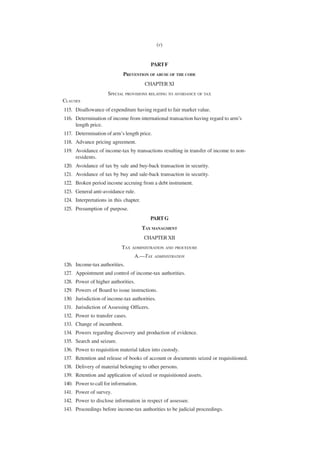
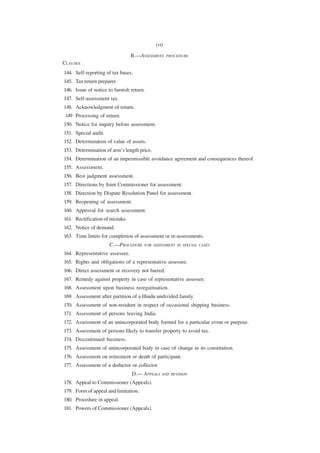
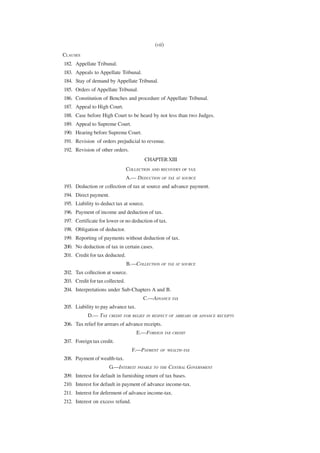
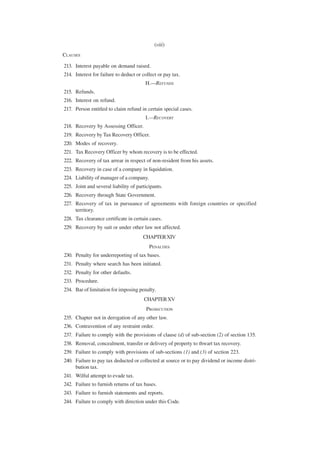
                              ARRANGEMENT OF CLAUSES
                                    —————
                                    CHAPTER I
                                    PRELIMINARY
CLAUSES
  1. Short title, extent and commencement.
                                         PART A
                                       INCOME-TAX
                                       CHAPTER II
                                     BASIS OF CHARGE
  2. Liability to pay, and charge of, income-tax.
  3. Scope of total income.
  4. Residence in India.
  5. Income deemed to accrue in India.
  6. Income deemed to be received in the financial year.
  7. Dividend income.
  8. Total income to include income of any other person.
  9. Income of individual to include income of spouse, minor child and others.
 10. Income not included in the total income.
 11. Persons, entity or funds not liable to income-tax.
                                      CHAPTER III
                               COMPUTATION OF TOTAL INCOME
                                       I.—GENERAL
 12. Computation of total income.
 13. Classification of sources of income.
 14. Computation of income from ordinary sources.
  15 Computation of income from special sources.
 16. Apportionment of income between spouses governed by Portuguese Civil Code.
 17. Avoidance of double taxation.
 18. Expenditure not to be allowed as deduction.
 19. Amount not deductible where tax is not deducted at source.
                                   II.—HEADS OF INCOME
                              A.—Income from employment
 20. Income from employment.
 21. Computation of income from employment.
 22. Scope of gross salary.
 23. Deductions from gross salary.
                          B.—Income from house property
 24. Income from house property.
 25. Computation of income from house property.
 26. Scope of gross rent.
 27. Deductions from gross rent.
(ii)
CLAUSES
 28. Provision for advance rent received.
 29. Provision for arrears of rent received.
                                 C.—Income from business
 30. Income from business.
 31. Business when treated distinct and separate.
 32. Computation of income from business.
 33. Gross earnings.
 34. Determination of business expenditure.
 35. Determination of operating expenditure.
 36. Determination of finance charges.
 37. Determination of capital allowances.
 38. Determination of depreciation.
 39. Determination of initial depreciation.
 40. Determination of terminal allowance.
 41. Deduction for scientific research and development allowance.
 42. Computation of profit on transfer of a business capital asset.
 43. Special provisions relating to business reorganisation.
 44. Meaning of actual cost.
 45. Meaning of written down value and adjusted value of assets.
                                     D.—Capital gains
 46. Capital gains.
 47. Income from certain transfers not to be treated as capital gains.
 48. Financial year of taxability.
 49. Computation of income from transfer of any investment asset.
 50. Full value of consideration.
 51. Deduction for cost of acquisition.
 52. Indexed cost of acquisition or improvement.
 53. Cost of acquisition of an investment asset.
 54. Cost of improvement of an investment asset.
 55. Relief for rollover of investment asset.
                            E.—Income from residuary sources
 56. Income from residuary sources.
 57. Computation of income from residuary sources.
 58. Gross residuary income.
 59. Deductions from gross residuary income.
                                III.—AGGREGATION OF   INCOME

 60. Aggregation of income under a head of income.
 61. Aggregation of income from ordinary sources.
 62. Aggregation of income from special sources.
 63. Determination of total income.
(iii)
CLAUSES
 64. Special provisions relating to business reorganisation or conversion of a company
     into a limited liability partnership.
 65. Aggregation of losses in case of change in constitution of unincorporated body.
 66. Aggregation of losses in the case of certain companies.
 67. Aggregation of loss not to be allowed in the case of filing of return after due date.
                                      IV.—TAX INCENTIVES
 68. Deductions from gross total income from ordinary sources.
 69. Deduction for savings.
 70. Deduction for life insurance.
 71. Deduction for health insurance.
 72. Deduction for education of children.
 73. Limit on deductions under sections 70, 71 and 72.
 74. Deduction of interest on loan taken for house property.
 75. Deduction of interest on loan taken for higher education.
 76. Deduction for medical treatment.
 77. Deduction to a person with disability.
 78. Deduction for medical treatment and maintenance of a dependant person with
     disability.
 79. Deduction of contribution or donations to certain funds or non-profit organisations.
 80. Deduction for rent paid.
 81. Deduction for political contributions.
 82. Deduction of income of Investor Protection Fund.
 83. Deduction of royalty income of authors.
 84. Deduction of royalty on patents.
 85. Deduction of income of co-operative society from banking activities.
 86. Deduction of income of primary co-operative societies.
                V.—MAINTENANCE       OF ACCOUNTS AND OTHER RELATED MATTERS

 87. Maintenance of accounts.
 88. Audit of accounts and reporting of international transaction.
 89. Method of accounting.
                                        CHAPTER IV
           SPECIAL PROVISIONS RELATING TO THE COMPUTATION OF TOTAL INCOME OF
                                  NON -PROFIT ORGANISATIONS

 90. Applicability of this Chapter.
 91. Total income of a non-profit organisation.
 92. Computation of total income of a non-profit organisation.
 93. Gross receipts of a non-profit organisation.
 94. Outgoings of a non-profit organisation.
 95. Modes of investment.
 96. Deemed income of a non-profit organisation.
 97. Use or application of funds or assets for the benefit of interested person.
(iv)
CLAUSES
 98. Registration of a non-profit organisation.
 99. Maintenance of accounts and tax audit.
100. Anonymous donations.
101. Consequences of conversion of a non-profit organisation.
102. Provisions of this Chapter not to apply in certain cases.
103. Interpretations in this chapter.
                                        CHAPTER V
                                COMPUTATION OF BOOK PROFIT
104. Computation of book profit.
105. Preparation of profit and loss account for computing book profit.
106. Tax credit for tax paid on book profit.
107. Application of other provisions of this Code.
                                        CHAPTER VI
      PROVISIONS REATING TO TAX ON   INCOME RECEIVED FROM VENTURE CAPITAL COMPANY
                                    AND VENTURE CAPITAL FUND

108. Tax on income received from venture capital company and venture capital fund.
                                          PART B
                               DIVIDEND DISTRIBUTUION TAX
                                        CHAPTER VII
    SPECIAL PROVISIONS RELATING TO TAX ON DISTRIBUTED PROFITS OF DOMESTICE COMPANIES
109. Tax on distributed profits of domestic companies.
                                          PART C
                                TAX ON DISTRIBUTED INCOME
                                        CHAPTER VIII
                 SPECIAL PROVISIONS RELATING TO TAX ON DISTRIBUTED INCOME
110. Tax on income distributed by mutual fund or life insurer.
                                          PART D
                                    BRANCH PROFITS TAX
                                        CHAPTER IX
                               CHARGE OF BRANCH PROFITS TAX
111. Tax on branch profits.
                                          PART E
                                         WEALTH-TAX
                                        CHAPTER X
                                   CHARGE OF WEALTH TAX
112. Tax on net wealth.
113. Computation of net wealth.
114. Net wealth to include certain assets.
(v)


                                           PART F
                            PREVENTION OF ABUSE OF THE CODE
                                         CHAPTER XI
                     SPECIAL PROVISIONS RELATING TO AVOIDANCE OF TAX
CLAUSES
115. Disallowance of expenditure having regard to fair market value.
116. Determination of income from international transaction having regard to arm’s
     length price.
117. Determination of arm’s length price.
118. Advance pricing agreement.
119. Avoidance of income-tax by transactions resulting in transfer of income to non-
     residents.
120. Avoidance of tax by sale and buy-back transaction in security.
121. Avoidance of tax by buy and sale-back transaction in security.
122. Broken period income accruing from a debt instrument.
123. General anti-avoidance rule.
124. Interpretations in this chapter.
125. Presumption of purpose.
                                           PART G
                                        TAX MANAGMENT
                                        CHAPTER XII
                            TAX ADMINISTRATION AND    PROCEDURE

                                  A.—TAX    ADMINISTRATION

126. Income-tax authorities.
127. Appointment and control of income-tax authorities.
128. Power of higher authorities.
129. Powers of Board to issue instructions.
130. Jurisdiction of income-tax authorities.
131. Jurisdiction of Assessing Officers.
132. Power to transfer cases.
133. Change of incumbent.
134. Powers regarding discovery and production of evidence.
135. Search and seizure.
136. Power to requisition material taken into custody.
137. Retention and release of books of account or documents seized or requisitioned.
138. Delivery of material belonging to other persons.
139. Retention and application of seized or requisitioned assets.
140. Power to call for information.
141. Power of survey.
142. Power to disclose information in respect of assessee.
143. Proceedings before income-tax authorities to be judicial proceedings.
(vi)

                                 B.—ASSESSMENT      PROCEDURE
CLAUSES
144. Self-reporting of tax bases.
145. Tax return preparer.
146. Issue of notice to furnish return.
147. Self-assessment tax.
148. Acknowledgment of return.
149 Processing of return.
150. Notice for inquiry before assessment.
151. Special audit.
152. Determination of value of assets.
153. Determination of arm’s length price.
154. Determination of an impermissible avoidance agreement and consequences thereof.
155. Assessment.
156. Best judgment assessment.
157. Directions by Joint Commissioner for assessment.
158. Direction by Dispute Resolution Panel for assessment.
159. Reopening of assessment.
160. Approval for search assessment.
161. Rectification of mistake.
162. Notice of demand.
163. Time limits for completion of assessment or re-assessments.
                      C.—PROCEDURE    FOR ASSESSMENT IN SPECIAL CASES

164. Representative assessee.
165. Rights and obligations of a representative assessee.
166. Direct assessment or recovery not barred.
167. Remedy against property in case of representative assessee.
168. Assessment upon business reorgainsation.
169. Assessment after partition of a Hindu undivided family.
170. Assessment of non-resident in respect of occasional shipping business.
171. Assessment of persons leaving India.
172. Assessment of an unincorporated body formed for a particular event or purpose.
173. Assessment of persons likely to transfer property to avoid tax.
174. Discontinued business.
175. Assessment of unincorporated body in case of change in its constitution.
176. Assessment on retirement or death of participant.
177. Assessment of a deductor or collector.
                                 D.— APPEALS    AND REVISION

178. Appeal to Commissioner (Appeals).
179. Form of appeal and limitation.
180. Procedure in appeal.
181. Powers of Commissioner (Appeals).
(vii)
CLAUSES
182. Appellate Tribunal.
183. Appeals to Appellate Tribunal.
184. Stay of demand by Appellate Tribunal.
185. Orders of Appellate Tribunal.
186. Constitution of Benches and procedure of Appellate Tribunal.
187. Appeal to High Court.
188. Case before High Court to be heard by not less than two Judges.
189. Appeal to Supreme Court.
190. Hearing before Supreme Court.
191. Revision of orders prejudicial to revenue.
192. Revision of other orders.
                                          CHAPTER XIII
                                 COLLECTION AND RECOVERY OF TAX
                                 A.— DEDUCTION OF TAX AT SOURCE
193. Deduction or collection of tax at source and advance payment.
194. Direct payment.
195. Liability to deduct tax at source.
196. Payment of income and deduction of tax.
197. Certificate for lower or no deduction of tax.
198. Obligation of deductor.
199. Reporting of payments without deduction of tax.
200. No deduction of tax in certain cases.
201. Credit for tax deducted.
                                 B.—COLLECTION OF TAX AT SOURCE
202. Tax collection at source.
203. Credit for tax collected.
204. Interpretations under Sub-Chapters A and B.
                                        C.—ADVANCE TAX
205. Liability to pay advance tax.
           D.— TAX    CREDIT FOR RELIEF IN RESPECT OF ARREARS OR ADVANCE RECEIPTS

206. Tax relief for arrears of advance receipts.
                                     E.—FOREIGN TAX CREDIT
207. Foreign tax credit.
                                   F.—PAYMENT   OF WEALTH-TAX

208. Payment of wealth-tax.
                      G.—INTEREST PAYABLE TO THE CENTRAL GOVERNMENT
209. Interest for default in furnishing return of tax bases.
210. Interest for default in payment of advance income-tax.
211. Interest for deferment of advance income-tax.
212. Interest on excess refund.
(viii)
CLAUSES

213. Interest payable on demand raised.
214. Interest for failure to deduct or collect or pay tax.
                                        H.—REFUNDS
215. Refunds.
216. Interest on refund.
217. Person entitled to claim refund in certain special cases.
                                        I.—RECOVERY
218. Recovery by Assessing Officer.
219. Recovery by Tax Recovery Officer.
220. Modes of recovery.
221. Tax Recovery Officer by whom recovery is to be effected.
222. Recovery of tax arrear in respect of non-resident from his assets.
223. Recovery in case of a company in liquidation.
224. Liability of manager of a company.
225. Joint and several liability of participants.
226. Recovery through State Government.
227. Recovery of tax in pursuance of agreements with foreign countries or specified
     territory.
228. Tax clearance certificate in certain cases.
229. Recovery by suit or under other law not affected.
                                       CHAPTER XIV
                                          PENALTIES
230. Penalty for underreporting of tax bases.
231. Penalty where search has been initiated.
232. Penalty for other defaults.
233. Procedure.
234. Bar of limitation for imposing penalty.
                                        CHAPTER XV
                                         PROSECUTION
235. Chapter not in derogation of any other law.
236. Contravention of any restraint order.
237. Failure to comply with the provisions of clause (d) of sub-section (2) of section 135.
238. Removal, concealment, transfer or delivery of property to thwart tax recovery.
239. Failure to comply with provisions of sub-sections (1) and (3) of section 223.
240. Failure to pay tax deducted or collected at source or to pay dividend or income distri-
     bution tax.
241. Wilful attempt to evade tax.
242. Failure to furnish returns of tax bases.
243. Failure to furnish statements and reports.
244. Failure to comply with direction under this Code.
(ix)
CLAUSES
245. False statement in verification.
246. Falsification of books of account or documents.
247. Abetment of false return.
248. Offences by companies, etc.
249. Proof of entries in records or documents.
250. Presumption as to assets and books of account in certain cases.
251. Presumption as to culpable mental state.
252. Prosecution to be instance of Chief Commissioner or Commissioner.
253. Punishment for second and subsequent offences.
254. Offences to be non-cognizable.
255. Disclosure of information by public servants.
                                        CHAPTER XVI
                        ADVANCE    RULINGS AND DISPUTE RESOULTION

256. Scope of ruling and dispute resolution.
257. Authority for Advance Rulings and Dispute Resolution.
258. Procedure for advance ruling.
259. Income-tax authority or Appellate Tribunal not to proceed in certain cases.
260. Applicability of advance ruling.
261. Advance Ruling to be void in certain circumstances.
262. Procedure for dispute resolution.
263. Stay of demand by the Authority.
264. Power to rectify a mistake.
265. Powers of Authority.
266. Procedure of Authority.
267. Interpretations in this Chapter.
                                        CHAPTER XVII
                                   SETTLEMENT OF CASES
268. Income-tax Settlement Commission.
269. Jurisdiction and powers of Settlement Commission.
270. Vice-Chairperson to act as Chairperson.
271. Power of Chairperson to transfer cases from one Bench to another.
272. Decision to be by majority.
273. Application for settlement of cases.
274. Additional amount of income-tax.
275. Admission of application.
276. Further inquiry into the case.
277. Order of settlement.
278. Payment of tax on settlement.
279. Power of Settlement Commission to order provisional attachment to protect revenue.
280. Revival of proceedings before Assessing Officer.
(x)
CLAUSES
281. Powers of Settlement Commission after admission.
282. Inspection and furnishing of reports.
283. Power of Settlement Commission to grant immunity.
284. Abatement of proceedings before Settlement Commission.
285. Credit for tax paid in case of abatement of proceedings.
286. Recovery of sums due under order of settlement.
287. Order of settlement to be conclusive.
288. Bar on subsequent application.
289. Proceedings to be judicial proceedings.
290. Interpretations in this Chapter.
                                          PART H
                                          GENERAL
                                        CHAPTER XVII
291. Agreement with foreign countries or specified territory.
292. Permanent account number.
293. Tax account number.
294. Mode of acceptance or repayment of certain loans or deposits.
295. Obligation to furnish annual information return.
296. Certain transfers to be void.
297. Provisional attachment to protect revenue in certain cases.
298. Service of notice generally.
299. Authentications of notices and other documents.
300. Notice deemed to be valid in certain circumstances.
301. Service of notice when family is disrupted or unincorporated body is dissolved.
302. Publication of information respecting assessees in certain cases.
303. Appearance by registered valuer in certain matters.
304. Appearance by authorised representative.
305. Rounding off of tax bases and tax.
306. Indemnity.
307. Power to tender immunity from prosecution.
308. Cognizance of offences.
309. Section 360 of the Code of Criminal Procedure, 1973, and the Probation of Offenders
     Act, 1958, not to apply.
310. Return of tax bases not to be invalid on certain grounds.
311. Presumption as to material fund.
312. Bar of suits in civil courts.
313. Power to resind.
(xi)


                                           PART I
                     INTERPRETATIONS AND MISCELLANEOUS PROVISIONS
                                     CHAPTER XVI
                            INTERPRETATIONS AND CONSTRUCTIONS
CLAUSES
314. Interpretations in this Code.
315. Construction.
                                     CHAPTER XX
                                     MISCELLANEOUS
316. Power to make rules.
317. Laying of rules, schemes and notifications before Parliament.
318. Repeal and savings.
319. Power to remove difficulties.
THE FIRST SCHEDULE.
THE SECOND SCHEDULE.
THE THIRD SCHEDULE.
THE FOURTH SCHEDULE.
THE FIFTH SCHEDULE.
THE SIXTH SCHEDULE.
THE SEVENTH SCHEDULE.
THE EIGHTH SCHEDULE.
THE NINTH SCHEDULE.
THE TENTH SCHEDULE.
THE ELEVENTH SCHEDULE.
THE TWELFTH SCHEDULE.
THE THIRTEENTH SCHEDULE.
THE FOURTEENTH SCHEDULE.
THE FIFTEENTH SCHEDULE.
THE SIXTEENTH SCHEDULE.
THE SEVENTEENTH SCHEDULE.
THE EIGHTEENTH SCHEDULE.
THE NINETEENTH SCHEDULE.
THE TWENTIETH SCHEDULE.
THE TWENTY-FIRST SCHEDULE.
THE TWENTY-SECOND SCHEDULE.
TO BE INTRODUCED IN LOK SABHA


                                                                              Bill No. 110 of 2010


                             THE DIRECT TAXES CODE, 2010
                                                     A

                                                    BILL
                     to consolidate and amend the law relating to direct taxes.
           BE it enacted by Parliament in the Sixty-first Year of the Republic of India as follows:—

                                                   CHAPTER I
                                                   PRELIMINARY
           1. (1) This Act may be called the Direct Taxes Code, 2010.                                  Short title,
                                                                                                       extent and
5          (2) It extends to the whole of India.                                                       commencement.

            (3) Save as otherwise provided in this Code, it shall come into force on the 1st day of
     April, 2012.
                                                   PART A
                                              INCOME-TAX
10                                           CHAPTER II
                                            BASIS OF CHARGE
           2. (1) In accordance with the provisions of this Code, every person shall be liable to Liability to
     pay income-tax in respect of his total income of the financial year.                         pay, and
                                                                                                       charge of,
                                                                                                       income-tax.
2

                        (2) Subject to the provisions of this Code, income-tax, including additional income-tax,
                 shall be charged in respect of the total income of a financial year of every person.
                       (3) Where the income-tax referred to in sub-section (2) is to be charged in respect of
                 the income of a period other than the financial year, the income-tax for such period shall be
                 charged accordingly.                                                                              5
                        (4) The income-tax referred to in sub-section (2) shall be charged at the rate specified
                 in the First Schedule in the manner provided therein.
                       (5) In respect of the income chargeable under sub-section (2), income tax shall be
                 deducted or collected at source or paid in advance, in accordance with the provisions of this
                 Code.                                                                                             10
                       (6) The chargeability of income-tax on the income of a financial year under the foregoing
                 provisions shall be determined in accordance with the provisions of this Code as they stand
                 on the 1st day of April of that financial year.
Scope of total         3. (1) Subject to the provisions of this Code, the total income of any financial year of
income.          a person, who is a resident, shall include all income from whatever source derived which—         15
                             (a) accrues, or is deemed to accrue, to him in India during the year;
                             (b) accrues to him outside India during the year;
                             (c) is received, or is deemed to be received, by him, or on his behalf, in India
                       during the year; or
                             (d) is received by him, or on his behalf, outside India during the year.              20
                       (2) Subject to the provisions of this Code, the total income of any financial year of a
                 person, who is a non-resident, shall include all income from whatever source derived which—
                             (a) accrues, or is deemed to accrue, to him in India during the year; or
                             (b) is received, or is deemed to be received, by him, or on his behalf, in India
                       during the year.                                                                            25
                        (3) Any income which accrues to a resident outside India during the year, or is
                 received outside India during the year by, or on behalf of, such resident, shall be included in
                 the total income of the resident, whether or not such income has been charged to tax outside
                 India.
Residence in           4. (1) An individual shall be resident in India in any financial year, if he is in India—   30
India.
                            (a) for a period, or periods, amounting in all to one hundred and eighty-two days
                       or more in that year; or
                             (b) for a period, or periods, amounting in all to—
                                    (i) sixty days or more in that year; and
                                  (ii) three hundred and sixty-five days or more within the four years             35
                             immediately preceding that year.
                       (2) The provisions of clause (b) of sub-section (1) shall not apply in respect of an
                 individual who is—
                             (a) a citizen of India and who leaves India in that year as a member of the crew of
                       an Indian ship; or                                                                          40
                            (b) a citizen of India and who leaves India in that year for the purposes of
                       employment outside India.
                       (3) A company shall be resident in India in any financial year, if—
                             (a) it is an Indian company; or
3

                 (b) its place of effective management, at any time in the year, is in India.
            (4) Every other person shall be resident in India in any financial year, if the place of
     control and management of its affairs, at any time in the year, is situated wholly, or partly, in
     India.

5          5. (1) The income shall be deemed to accrue in India, if it accrues, whether directly or Income
     indirectly, through or from:                                                                   deemed to
                                                                                                         accrue in
                 (a) any business connection in India;                                                   India.

                 (b) any property in India;
                 (c) any asset or source of income in India; or

10               (d) the transfer of a capital asset situated in India.
           (2) Without prejudice to the generality of the provisions of sub-section (1), the
     following income shall be deemed to accrue in India, namely:—
                 (a) income from employment, if it is for–
                         (i) service rendered in India;
15                     (ii) service rendered outside India by a citizen of India and the income is
                 receivable from the Government; or
                       (iii) the rest period, or leave period, which precedes, or succeeds, the
                 period of service rendered in India and forms part of the service contract of
                 employment;
20               (b) any dividend paid by a domestic company outside India;
                  (c) any insurance premium including re-insurance premium accrued from or
           payable by any resident or non-resident in respect of insurance covering any risk in
           India;
                 (d) interest accrued from or payable by any resident or the Government;

25               (e) interest accrued from or payable by any non-resident, if the interest is in
           respect of any debt incurred and used for the purposes of—
                        (i) a business carried on by the non-resident in India; or
                        (ii) earning any income from any source in India;
                 (f) royalty accrued from or payable by any resident or the Government;

30              (g) royalty accrued from or payable by a non-resident, if the royalty is for the
           purposes of—
                        (i) a business carried on by the non-resident in India; or
                        (ii) earning any income from any source in India;
                (h) fees for technical services accrued from or payable by any resident or the
35         Government;
                 (i) fees for technical services accrued from or payable by any non-resident, in
           respect of services utilised for the purposes of—
                        (i) a business carried on by the non-resident in India; or
                        (ii) earning any income from any source in India;

40              (j) transportation charges accrued from or payable by any resident or the
           Government;
4

            (k) transportation charges accrued from or payable by any non-resident, if the
      transportation charges are in respect of the carriage to, or from, a place in India.
        (3) For the purposes of clause (a) of sub-section (1), in the case of a business of
which all the operations are not carried out in India, the income of the business deemed to
accrue in India shall be only such part of the income as is reasonably attributable to the         5
operations carried out in India.
      (4) The income deemed to accrue in India under sub-section (1) shall, in the case of a
non-resident, not include the following, namely:—
           (a) any income accruing through, or from, operations which are confined to the
      purchase of goods in India for the purposes of export out of India;                          10
           (b) interest accrued from or payable by a resident, in respect of any debt incurred
      and used for the purposes of—
                   (i) a business carried on by the resident outside India; or
                  (ii) earning any income from any source outside India;
            (c) royalty accrued from or payable by a resident for the purposes of—                 15
                  (i) a business carried on by the resident outside India; or
                  (ii) earning any income from any source outside India;
            (d) royalty consisting of lump sum consideration accrued from or payment made
      by a resident for the transfer of any rights (including the granting of a licence) in
      respect of computer software supplied by the non-resident manufacturer, along with a         20
      computer or computer-based equipment, under any scheme approved under the Policy
      on Computer Software Export, Software Development and Training, 1986 issued by
      the Government of India;
            (e) fees for technical services accrued from or payable by a resident, in respect of
      services utilised for the purposes of—                                                       25
                  (i) a business carried on by the resident outside India; or
                  (ii) earning any income from any source outside India;
            (f) transportation charges for the carriage by aircraft or ship accrued from or
      payable by any resident, if the transportation charges are in respect of the carriage
      from a place outside India to another place outside India, except where the airport or       30
      port of origin of departure of such carriage is in India;
             (g) income from transfer, outside India, of any share or interest in a foreign
      company unless at any time in twelve months preceeding the transfer, the fair market
      value of the assets in India, owned, directly or indirectly, by the company, represent at
      least fifty per cent. of the fair market value of all assets owned by the company;           35
            (h) interest accrued from or payable by a non-resident as referred to in sub-
      clause (ii) of clause (e) of sub-section (2), if such interest has not been claimed by the
      non-resident as a deduction from his tax bases chargeable in India.
       (5) The provisions of clauses (c) to (k) of sub-section (2) shall be applicable, whether
or not,—                                                                                           40
            (a) the payment is made in India;
            (b) the services are rendered in India;
           (c) the non-resident has a residence or place of business or any business
      connection in India; or
            (d) the income has accrued in India.                                                   45
5

           (6) Where the income of a non-resident, in respect of transfer, outside India, of any
     share or interest in a foreign company, is deemed to accure in India under clause (d) of sub-
     section (1), it shall be computed in accordance with the following formula—
                 AxB
 5                 C
                 Where A           =        Income from the transfer computed in accordance with
                                            provisions of this Code as if the transfer was effected in
                                            India;
                 B                 =        fair market value of the assets in India, owned, directly
10                                          or indirectly, by the company;
                 C                 =        fair market value of all assets owned by the company.
           6. The following income shall be deemed to be received in the financial year, namely:— Income
                                                                                                             deemed to be
                (a) any contribution made by an employer, in the financial year, to the account of received in the
           an employee under a pension fund;                                                       financial year.

15              (b) any contribution made by an employer, in the financial year, to the account of
           an employee in any other fund;
                 (c) the annual accretion, in the financial year, to the balance at the credit of any
           employee in a fund referred to in clause (b) to the extent it exceeds the limit as may be
           prescribed.
20         7. For the purposes of inclusion in the total income of an assessee—                              Dividend
                                                                                                             income.
                 (a) any dividend declared, distributed or paid by a company within the meaning
           of item (a) or item (b) or item (c) or item (d) or item (e) of clause (81) of section 314 shall
           be deemed to be the income of the financial year in which it is so declared, distributed
           or paid, as the case may be;
25                (b) any interim dividend shall be deemed to be the income of the financial year in
           which the amount of such dividend is unconditionally made available by the company
           to the member who is entitled to it.
          8. (1) The total income of any person, being a transferor, shall include the following, Total income
     namely:—                                                                                     to include
                                                                                                             income of any
30              (a) any income accruing to any other person, by virtue of a transfer, whether other person.
           revocable or not, without transfer of the asset from which the income accrues; or
                 (b) any income accruing to any other person, by virtue of a revocable transfer of
           an asset.
           (2) The provisions of clause (b) of sub-section (1) shall not apply in a case where—
35               (a) any income accrues from an asset transferred to any trust, if the transfer is
           not revocable during the life time of the beneficiary of the trust; or
                  (b) any income accrues from an asset transferred to any other person, not being
           a trust, if the transfer is not revocable during the lifetime of such other person.
           (3) In this section,—
40               (a) a transfer shall be deemed to be revocable if—
                      (i) it contains any provision for the re-transfer, directly or indirectly, of the
                 whole or any part of the income or assets to the transferor; or
                       (ii) it, in any way, gives the transferor a right to re-assume power, directly
                 or indirectly, over the whole or any part of the income or assets;
45               (b) a transfer shall include any settlement, trust, covenant, agreement or
           arrangement.
6

Income of                 9. (1) The total income of any individual shall include—
individual to
include income                  (a) all income which accrues, directly or indirectly,—
of spouse, minor
child and others.                     (i) to the spouse, by way of salary, commission, fees or any other form of
                                remuneration, whether in cash or in kind, from a concern in which the individual
                                has a substantial interest;                                                      5
                                      (ii) from assets transferred, directly or indirectly, to the spouse by the
                                individual, otherwise than for adequate consideration, or in connection with an
                                agreement to live apart;
                                      (iii) from assets transferred, directly or indirectly, to the son’s wife by the
                                individual, otherwise than for adequate consideration; or                             10
                                      (iv) from assets transferred, directly or indirectly, to any other person by
                                the individual otherwise than for adequate consideration, to the extent to which
                                the income from such assets is for the immediate or deferred benefit of the
                                spouse or son’s wife;
                                (b) all income which accrues to a minor child (other than a minor child being a 15
                          person with disability or person with severe disability) of the individual, other than
                          income which accrues to the child on account of any—
                                      (i) manual work done by the child; or
                                      (ii) activity involving application of the skill, talent or specialised knowledge
                                and experience of the child;                                                            20
                                (c) all income derived from any converted property or part thereof;
                                (d) all income derived from any converted property which is received by the
                          spouse or minor child upon partition of the Hindu undivided family of which the
                          individual is a member.
                            (2) The provisions of sub-clause (i) of clause (a) of sub-section (1) shall not apply in 25
                    relation to any income accruing to the spouse where the spouse possesses technical or
                    professional qualifications and the income is solely attributable to the application of the
                    technical or professional knowledge and experience of the spouse.
                          (3) The income referred to in sub-clause (i) of clause (a) of sub-section (1) shall,
                    notwithstanding anything contained therein, be included in the total income of the spouse 30
                    whose total income (excluding the income referred to in that sub-clause) is higher.
                          (4) The Board may prescribe the method for determining the income referred to in sub-
                    clause (ii) and sub-clause (iii) of clause (a) of sub-section (1).
                         (5) The income referred to in clause (b) of sub-section (1) shall be included in the total
                    income of—                                                                                      35
                                (a) the parent who is the guardian of the minor child; or
                                (b) the parent whose total income (excluding the income referred to in that
                          clause) is higher, if both the parents are guardians of the child.
                          (6) Where any income referred to in clause (b) of sub-section (1) is once included in
                    the total income of a parent, any such income arising in the succeeding year shall not be 40
                    included in the total income of the other parent, unless the Assessing Officer considers it
                    necessary to do so after giving an opportunity of being heard to the other parent.
                         (7) In this section, “property” includes any interest in property whether movable or
                    immovable, the sale proceeds of such property, in whichever form and where the property, is
                    converted into any other form of property by any method, such other property.               45
7

           10. Subject to the provisions of this Code, the total income of a financial year of a Income not
     person shall not include the income enumerated in the Sixth Schedule.                       included in the
                                                                                                         total income.
            11. The persons, entity or funds enumerated in the Seventh Schedule shall not be Persons,
     liable to income-tax under this Code for any financial year, subject to the fulfillment of entity or funds
                                                                                                not liable to
5    conditions specified in the said Schedule.
                                                                                                         income-tax.


                                                 CHAPTER III
                                         COMPOSITION OF TOTAL INCOME
                                                 I.— GENERAL

          12. (1) The total income of a person shall be computed in accordance with the provisions Computation
10 of this Chapter.                                                                                of total
                                                                                                         income.
           (2) Unless otherwise provided in this Code, reference to any accrual, receipt,
     expenditure, withdrawal, asset or liability shall be construed to be in relation to the financial
     year in respect of which, and the person in respect of whom, the income is computed.
           13.For the purposes of computation of total income of any person for any financial Classification
15 year, income from all sources shall be classified as follows:                              of sources of
                                                                                                         income.
                 A.— Income from ordinary sources.
                 B.— Income from special sources.
         14. The income from any source, other than a special source, shall be computed under             Computation
   the class “income from ordinary sources” and such income shall be classified under the                 of income
                                                                                                          from
20 following heads of income, namely:—                                                                    ordinary
                                                                                                          sources.
                 A.— Income from employment.
                 B.— Income from house property.
                 C.— Income from business.
                 D.— Capital gains.
25               E.— Income from residuary sources.
            15. (1) Every income listed in column (3) of the Table in Part III of the First Schedule     Computation
                                                                                                         of income
     shall be the income from a special source of the person specified in column (2) of the said
                                                                                                         from special
     Table.                                                                                              sources.
         (2) The income from any special source shall be computed under the class “income
30 from special sources” in accordance with the provisions of the Ninth Schedule.
           (3)Notwithstanding anything in sub-section (1), the income referred to therein shall
     not be considered as income from a special source, if such income is attributable to the
     permanent establishment of a non-resident in India.
        16. (1) The income of the husband and wife, governed by the communiao dos bens, Apportionment
35 from ordinary sources under each head of income (other than the head “Income from of income
   employment”) and from special sources shall be apportioned equally between the spouses. between
                                                                                                         spouses
            (2) The income so apportioned under sub-section (1) shall be included separately in          governed by
                                                                                                         Portuguese
     the total income of the spouses.
                                                                                                         Civil Code.
           (3) The income under the head “Income from employment” shall be included in the
40 total income of the spouse who has actually earned it.
            (4) In this section, communiao dos bens refers to the system of community of property
     under the Portuguese Civil Code of 1860 as in force in the State of Goa and in the Union
     territories of Dadra and Nagar Haveli and Daman and Diu.
8

Avoidance of             17. Subject to the provisions of this Code,—
double taxation.
                               (i) any income which is included in the total income of a person for any financial
                         year shall not be so included again in the total income of such person for the same or
                         any other financial year.
                               (ii) any income which is includible in the total income of any person shall not be     5
                         included in the total income of any other person,
                   except where for the purposes of protecting the interests of revenue, it is necessary to do so.
Expenditure not           18. (1) In computing the total income of a person for any financial year, the following
to be allowed as
deduction.         shall not be allowed as a deduction, namely:—
                               (a) any expenditure, attributable to income which is not included in the total 10
                         income under the Sixth Schedule, determined in accordance with such method as may
                         be prescribed;
                                 (b) any expenditure attributable to any income from special sources;
                                 (c) any expenditure which has been allowed as a deduction in any other financial
                         year;                                                                                        15

                              (d) any expenditure incurred for an activity which is an offence or which is not
                         permissible by law;
                                (e) any provision made for any liability, if it remains unascertained by the end of
                         the financial year; and
                               (f) any unexplained expenditure referred to in clause (q) of sub-section (2) of        20
                         section 58.
                        (2) Any amount allowed as a deduction under any provision of this Code shall not be
                   allowed as a deduction under any other provision of this Code.
                         (3) The provisions of this section shall apply notwithstanding anything in any other
                   provisions of this Chapter.                                                                25
Amount not
                         19. (1) Any amount on which tax is deductible at source under Chapter XIII during the
deductible where
tax is not         financial year shall not be allowed as a deduction in computing the total income if,—
deducted at
source.                          (a) the tax has not been deducted during the financial year; or
                               (b) the tax, after such deduction, has not been paid on or before the due date
                         specified in sub-section (1) of section 144.                                         30

                          (2) A deduction shall be allowed in respect of the amount referred to in sub-section (1)
                   in any subsequent financial year, if—
                               (a) tax has been deducted during the financial year, but paid in such subsequent
                         year after the due date specified in sub-section (1) of section 144; or
                                 (b) tax has been deducted and paid in such subsequent financial year.                35
                                                        II. HEADS OF INCOME
                                                   A. - Income from employment
Income from             20. The income of a person from employment shall be computed under the head
employment.        “Income from employment”.

Computation of           21. The income computed under the head “Income from employment” shall be the                 40
income from        gross salary as reduced by the aggregate amount of the deductions referred to in section 23.
employment.
9

            22. The gross salary shall be the amount of salary due, paid, or allowed, whichever is Scope of gross
     earlier, to a person in the financial year by or on behalf of his employer or former employer. salary.
          23. (1) The deductions from the gross salary for computation of income from Deductions
     employment, to the extent included in the gross salary, shall be the following, namely:— from gross
                                                                                                        salary.
5               (a) any sum paid by the employee on account of a tax on employment within the
           meaning of clause (2) of article 276 of the Constitution;
                 (b) any allowance or benefit granted by an employer for journey by an employee
           between his residence and office or any other place of work, to such extent as may be
           prescribed;
10               (c) any allowance or benefit granted by an employer to an employee—
                       (i) to meet expenses wholly, necessarily and exclusively in the performance
                 of the duties of an office or employment of profit, as may be prescribed, to the
                 extent such expenses are actually incurred for that purpose;
                       (ii) to meet personal expenses, considering the place of posting or nature
15               of duties or place of residence, subject to such conditions and limits as may be
                 prescribed;
                (d) any amount of contribution made by an employer, in the financial year, to the
           account of an employee under an approved pension fund notified by the Central
           Government, to the extent it does not exceed ten per cent. of the salary of the employee;
20              (e) any amount of contribution made by an employer, in the financial year, to the
           account of an employee in an approved superannuation fund;
                (f) any amount of contribution by an employer, in the financial year, to an
           account of an employee in an approved provident fund, to the extent it does not
           exceed twelve per cent. of the salary of the employee;
25                (g) any amount of interest credited, in the financial year, on the balance to the
           credit of an employee in an approved fund to the extent it does not exceed the amount
           of interest payable at the rate notified by the Central Government;
                 (h) any allowance provided by an employer to meet the expenditure actually
           incurred on payment of rent in respect of residential accommodation occupied by the
30         employee, to such extent as may be prescribed.
           (2) For the purposes of clauses (d), (f) and (h) of sub-section (1), salary means basic
     salary and includes dearness allowance, if the terms of employment so provide.
                                   B.—Income from house property
       24. (1) The income from letting of any house property owned by any person shall be Income from
                                                                                          house
35 computed under the head “Income from house property”.
                                                                                                        property.
           (2) The income from any house property shall be computed under this head
     notwithstanding that the letting, if any, of the property is in the nature of trade, commerce or
     business.
         (3) The income from any house property owned by two or more persons having
40 definite and ascertainable shares shall be computed separately for each such person in
   respect of his share.
           (4) In a case where the shares of the owners of the house property referred to in sub-
     section (3) are not definite and ascertainable, such persons shall be assessed as an association
     of persons in respect of such property.
45         (5) The provisions of this section shall not apply,-
                 (a) to the house property, or any portion of the house property, which—
10

                                    (i) is used by the person as a hospital, hotel, convention centre or cold
                              storage; and
                                     (ii) forms part of Special Economic Zone,
                        the income from which is computed under the head “income from business”;
                              (b) to a house property which is not ready for use during the financial year.          5
Computation of      25. The income from house property shall be the gross rent as reduced by the aggregate
income from     amount of the deductions referred to in section 27.
house property.

Scope of gross          26. The gross rent in respect of a house property or any part of the property shall be
rent.             the amount of rent received or receivable, directly or indirectly, for the financial year or part
                  thereof, for which such property is let out.                                                      10
Deductions from        27. (1) The deductions for the purposes of computation of income from house property
gross rent.     shall be the following, namely:—
                              (a) the amount of taxes levied by a local authority in respect of such property, to
                        the extent the amount is actually paid by him during the financial year;
                             (b) a sum equal to twenty per cent. of the gross rent determined under section 26, 15
                        towards repair and maintenance of such property;
                              (c) the amount of any interest,—
                                   (i) on loan taken for the purposes of acquisition, construction, repair or
                              renovation of the property; or
                                    (ii) on loan taken for the purpose of repayment of the loan referred to in       20
                              sub-clause (i);
                         (2)The interest referred to in clause (c) of sub-section (1) which pertains to the period
                  prior to the financial year in which the house property has been acquired or constructed shall
                  be allowed as deduction in five equal instalments beginning from such financial year.
                       (3)The interest deductible under sub-section (2) shall be reduced by any part thereof 25
                  which has been allowed as deduction under any other provision of this Code.
Provision for           28. The amount of rent received in advance shall be included in the gross rent of the
advance rent      financial year to which the rent relates.
received.

Provision for          29. (1) The amount of rent received in arrears shall be deemed to be the income from
arrears of rent   house property of the financial year in which such rent is received.                               30
received.
                       (2) The arrears of rent referred to in sub-section (1) shall be included in the total
                  income of the person under the head income from house property, whether the person is the
                  owner of the property in that year or not.
                         (3) A sum equal to twenty per cent. of the arrears of rent referred to in sub-section (1)
                  shall be allowed as deduction towards repair and maintenance of the property.                    35

                                                    C.—Income from business

Income from             30. (1) The income from any business carried on by the assessee at any time during a
business.         financial year shall be computed under the head “Income from business”.
                      (2) The income of distinct and separate business referred to in section 31 shall be
                  computed separately for the purposes of sub-section (1).                                           40
                        (3) Any income from a business after its discontinuance shall be deemed to be the
                  income of the recipient in the year of receipt and shall, accordingly, be computed under the
                  head “Income from business”.
11

            31. (1) A business shall be distinct and separate from another business if there is no Business when
     interlacing or inter-dependence between the businesses.                                       teated distinct
                                                                                                            and separate.
                (2) A business shall be deemed to be distinct and separate from another business, if—
                      (a) the unit of the business is processing, producing, manufacturing or trading
                the same goods as in the other business and such unit is located physically apart from
5               the other unit;
                     (b) the unit of the business is processing, producing or manufacturing the same
                goods as in the other business and utilises raw material or manufacturing process,
                which is different from the raw material or the manufacturing process of the other unit;
                      (c) separate books of account are maintained or capable of being maintained, for
10              the business; or
                       (d) it is a business in respect of which profits are determined under sub-section
                (2) of section 32.
           (3) A speculative business shall be deemed to be distinct and separate from any other
     business including other speculative business.
15          32. (1) The income computed under the head “Income from business” shall be the Computation
     profits from the business.                                                            of income
                                                                                                            from business.
           (2) The profits from the business of the nature specified in column (2) of the Table
     given below shall be computed in accordance with the provisions contained in the Schedule
     specified in the corresponding entry in column (3) of the said Table.

20                                                    TABLE

     Sl.                         Nature of Business                                    Schedule
     No.

          (1)                             (2)                                              (3)

     1.     Business of Insurance                                                Eight Schedule
25 2.       Business of operating a qualifying ship                              Tenth Schedule
     3.     Business of mineral oil or natural gas                               Eleventh Schedule
     4.     Business of developing of a Special Economic Zone                    Twelfth Schedule
            Business specified in Paragraph 1 of the Twelfth Schedule
     5.     Business specified in Paragraph 1 of the Thirteenth Schedule Thirteenth Schedule
30 6        Business listed in column (2) of the Table in the                    Fourteenth Schedule
            Fourteenth Schedule where income is determined on
            presumptive basis

         (3) The profits from any business not referred to in sub-section (2) shall be the gross
   earnings from the business as reduced by the amount of business expenditure incurred by
35 the assessee.
          33. (1) The gross earnings referred to in sub-section (3) of section 32 shall be the Gross earnings.
     aggregate of the following, namely:—
                      (i) the amount of any accrual or receipt from, or in connection with, the business;
                      (ii) the value of any benefit or perquisite, whether convertible into money or not,
40              accrued or received from, or in connection with, the business;
                      (iii) the value of the inventory of the business, as on the close of the financial
                year; and
                            (iv) any amount received from a business after its discontinuance.
12

     (2) The accruals or receipts referred to in sub-section (1) shall, without prejudice to the
generality of the provisions of that sub-section, include the following, namely:—
            (i) the amount of any compensation or other payment, accrued or received, for—
                 (a) termination or modification of terms and conditions relating to
            management of business, any business agreement or any agency; or                        5
                  (b) vesting of the management of any property or business in another
            person or the Government;
            (ii) any consideration, accrued or received under a non-capital agreement;
            (iii) any amount or value of any benefit, whether convertible into money or not,
      accrued to, or received by a person, being a trade, professional or similar association, 10
      in respect of specific services performed for its members;
            (iv) any consideration on sale of a licence, not being business capital assets,
      obtained in connection with the business;
            (v) any consideration on transfer of a right or benefit (by whatever name called)
      accrued or received under any scheme framed by the Government, local authority or a 15
      corporation established under any law for the time being in force;
            (vi) the amount of cash assistance, subsidy or grant (by whatever name called),
      received from any person or the Government for, or in connection with, the business
      other than to meet any portion of the cost of any business capital asset;
            (vii) the amount of any remission, drawback or refund of any tax, duty or cess          20
      (not being a tax under this Code), received or receivable;
            (viii) the amount of remuneration (including salary, bonus and commission) or
      any interest accrued to, or received by, a participant of a unincorporated body from
      such body;
            (ix) any sum received under a keyman insurance policy including the sum 25
      allocated by way of bonus on such policy;
            (x) the amount of profit on transfer, demolitation, destroys or discardment of any
      business capital asset (other than a business capital asset used for scientific research
      and development) computed in accordance with the provisions of section 42;
            (xi) any consideration accrued or received on transfer of carbon credits;               30
            (xii) the amount of any benefit accrued to, or received by, the person, or as the
      case may be, the successor in business, if—
                   (a) it is by way of remission or cessation of any trading liability or statutory
            liability or it is in respect of any loss or expenditure, including a unilateral act by
            way of writing off such liability in his accounts; and                                  35
                 (b) the trading liability or statutory liability or loss or expenditure has been
            allowed as deduction in any financial year;.
           (xiii) the amount of remission or cessation of any liability by way of loan,
      deposit, advance or credit;
             (xiv) the amount recovered from a trade debtor in respect of a bad debt or part of 40
      debt which has been allowed as deduction in any financial year under clause (c) or
      clause (d) or clause (e) of sub-section (3) of section 35;
            (xv) the amount withdrawn from any special reserve created and maintained
      under any provision of this Code or the Income-tax Act, 1961, as its stood before the 43 0f 1961.
      commencement of this Code for which deduction has been allowed, if the amount is 45
      not utilised for the purpose and within the period specified therein;
13

                 (xvi) the amount accrued to, or received by, the person from his employees as
          their contribution to any fund for their welfare;
                 (xvii) the amount accrued or received on sale of any business capital asset used
          for scientific research and development;
5               (xviii) any consideration accrued or received in respect of transfer of any capital
          asset self-generated in the course of the business;
                 (xix) any amount accrued or received on account of the cessation, termination or
          forfeiture in respect of agreement entered in the course of the business;
                (xx) any amount accrued or received, whether as an advance, security deposit or
10        otherwise, from the long term leasing, or transfer of—
                      (a) whole or part of any business asset; or
                      (b) any interest in a business asset;
                (xxi) any amount received as reimbursement of any expenditure incurred;
                (xxii) any interest accrued to, or received by, a person being a financial institution.
15              (xxiii) any payment or aggregate of payments made to a person in a day, in
          respect of an expenditure incurred during the financial year or in respect of a liability
          incurred and allowed as a deduction in any preceding financial year,—
                     (a) which has been made otherwise than by an account payee cheque
                drawn on a bank or by an account payee bank draft;
20                    (b) which exceeds—
                            (i) a xum of thirty fire thousand rupees if the payment is made to
                      transporter for carriage of goods by road; or
                             (ii) a sum of twenty thousand rupees in any other case; and
                     (c) which has not been made in such cases and in such circumstances as
25              may be prescribed.
                (xxiv) any amount standing to the credit of the Fund referred to in section 82,
          if—
                      (a) income-tax has not been paid on such amount in any financial year
                preceding the relevant financial year; and
30                    (b) the amount is shared during the relevant financial year, either wholly or
                in part, with a recognised stock exchange or recognised commodity exchange.
          (3) The gross earnings from business shall not include the following, namely:—
                (a) any dividend;
                (b) any interest other than interest accrued to, or received by, a person being a
35        financial institution;
               (c) any income from letting of house property which is included under the head
          income from hosues propery;
                (d) any income from the transfer of an investment assets.
         34. (1) The amount of business expenditure referred to in sub-section (3) of section             Determination
                                                                                                          of business
40 32 shall be the aggregate of the following amounts, namely:—
                                                                                                          expenditure.
                (a) the operating expenditure referred to in section 35, incurred by the person for
          the purposes of the business carried on during the financial year;
               (b) finance charges referred to in section 36, incurred by the person for the
          purposes of the business carried on during the financial year;
45              (c) capital allowances referred to in section 37, in respect of the business carried
          on by the person during the financial year.
14

                      (2) The provisions for deduction of capital allowances referred to in sub-section (1)
                shall apply, whether or not the person has claimed the deduction in computing the total
                income.

                       (3) The Assessing Officer may restrict the amount of deduction under this section to
                such amount as he considers appropriate having regard to the use of a business asset if such       5
                asset is not exclusively used for the purposes of the business.

Determination         35. (1) The amount of operating expenditure referred to in clause (a) of sub-section (1)
of operating    of section 34 shall be the aggregate of—
expenditure.
                            (a) the amount of expenditure specified in sub-section (2), if—
                                 (i) the expenditure is laid out or expended, wholly and exclusively, for the 10
                            purposes of the business; and
                                  (ii) it fulfills other conditions, if any, specified therein; and
                            (b) the amount of deductions specified in sub-section (3) subject to the fulfillment
                      of the conditions, if any, specified therein.
                    (2) The amount of expenditure referred to in clause (a) of sub-section (1) shall be the 15
                amount of expenditure on, or on account of,—
                            (i) purchase of raw material, stores, spares and consumables, or stock-in-trade;
                            (ii) rent paid for any premises if it is occupied and used by the person;
                            (iii) current repairs to buildings if it is occupied and used by the person;
                           (iv) land revenue, local rates or municipal taxes in respect of premises occupied 20
                      and used by the person is actually paid;
                            (v) current repair of machinery, plant or furniture used by the person;
                            (vi) current maintenance or repairs of computer software or hardware;
                            (vii) salary or wages of employees;
                            (viii) remuneration to any working participant which is in accordance with the 25
                      agreement of the unincorporated body and relates to the period falling after the date of
                      such agreement limited to the extent as may be preseribed;
                            (ix) any premium paid to effect, or to keep in force, an insurance in respect of,—
                                  (a) any premise occupied and used by the person;
                                  (b) any machinery, plant or furniture used by the person;                        30
                                  (c) stocks or stores belonging to the person;
                                  (d) the health of any employee of the person; and
                                  (e) any other asset owned and used by the person;
                             (x) any premium paid by the person, being a federal milk co-operative society, to
                      effect, or to keep in force, an insurance on the life of the cattle owned by a member of 35
                      a co-operative society, being a primary society engaged in supplying milk, raised by its
                      members to such federal milk co-operative society.
                            (xi) welfare of workmen and staff;
                            (xii) power and fuel;
                                                                                                                   40
                            (xiii) freight, clearing and forwarding charge;
15

          (xiv) selling expense in the nature of commission, brokerage, discount, or warranty
     charge;
           (xv) sales promotion including advertisement and publicity;
           (xvi) training of employees;
5          (xvii) conference;
           (xviii) use of hotel or boarding and lodging facilities;
           (xix) conveyance, tour or travel;
           (xx) running or maintenance of motor car or aircraft;
           (xxi) postage and telecommunications;
10         (xxii) audit and such other professional fees;
           (xxiii) legal services;
           (xxiv) entertainment and provision of hospitality;
           (xxv) maintenance of guest-house;
           (xxvi) subscription, including entrance fee, to a club or a trade association or the
15   use of their facilities;
           (xxvii) scientific research and development related to the business;
           (xxviii) salary to an employee engaged in, or the purchase of material used in,
     scientific research and development, within a period of three years immediately
     preceding the commencement of the business;
20         (xxix) contribution by the person, being an employer, to an approved fund
     subject to such limits and conditions, as may be prescribed and to the extent the
     amount is actually paid;
           (xxx) contribution to any fund, referred to in clause (xvi) of sub-section (2) of
     section 33, to the extent,—
25               (a) the amount has been received from his employees as their contribution
           to the fund; and
                 (b) it is actually paid;
            (xxxi) any head office expenditure by a non-resident, as is attributable to his
     business in India, not exceeding an amount equal to one-half per cent. of the total
30   sales, turnover or gross receipts of business in India;
           (xxxii) cost of acquisition of the asset as in the case of the predecessor and cost
     of any improvement made thereto and expenditure incurred wholly and exclusively in
     connection with the transfer of the asset, by the predecessor, if —
                 (a) the person is the successor in the business reorganisation;
35               (b) the asset becomes the property of the person under a scheme of
           business reorganisation; and
                 (c) the asset is sold by the person as a business trading asset;
            (xxxiii) cost of acquisition of the asset as in the case of the transferor or the
     donor, and cost of any improvement made thereto and expenditure incurred wholly
40   and exclusively in connection with the transfer of the asset (including the payment of
     gift tax, if any), by the transferor or the donor, if —
                 (a) the person is the transferee or the donee;
                  (b) the asset becomes the property of the person on the total or partial
           partition of a Hindu undivided family or under a gift or will or an irrevocable
45         trust; and
                 (c) the asset is sold by the person as a business trading asset;
16

            (xxxiv) protecting or safeguarding the goodwill of person, which has necessarily
      to be preserved for the purpose of his business;
           (xxxv) tax (not being a tax under this Code), duty, cess, royalty or fee, by whatever
      name called, under any law for the time being in force, if the amount is actually paid;
              (xxxvi) bonus or commission to employees for services rendered if—                     5
                    (a) the amount would not have been payable to employees as profits or
              dividends had it not been paid as bonus or commission; and
                    (b) the amount is actually paid;
             (xxxvii) encashment of leave to the credit of employees, to the extent the amount
      is actually paid;                                                                        10
             (xxxviii) gratuity to employees on their retirement or on termination of their
      employment, to the extent the amount is actually paid;
           (xxxix) the purposes of a body corporate constituted or established under a
      Central, State or Provincial Act, if—
                    (a) such purposes are authorised by the said Act;                                15
                   (b) such body corporate is notified by the Central Government for the
              purposes of this clause;
             (xl) the amount paid by a public financial institution by way of contribution to
      a credit guarantee fund trust for small industries which is notified by the Central
      Government for the purposes of this clause;                                                 20
            (xli) the actual cost of the licence referred to in clause (iv) of sub-section (2) of
      section 33, in the year in which the consideration on account of sale forms part of
      gross earnings;
            (xlii) the actual cost of the right or benefit referred to in clause (v) of sub-section
      (2) of section 33, in the year in which the consideration transfer forms part of gross 25
      earnings;
            (xliii) the repayment of any advance or security deposit in respect of the long-
      term leasing referred to in clause (xx) of sub-section (2) of section 33, in the year in
      which such repayment is made;
              (xliv) any other operating expenditure not covered under clause (i) to clause 30
      (xliii).
      (3) The amount of deductions referred to in clause (b) of sub-section (1) shall be the
following, namely:—
              (a) the value of inventory of the business, as at the beginning of the financial
      year;                                                                                          35
             (b) loss of inventory, or money, on account of theft, robbery, fraud or
      embezzlement, occurring in the course of the business, if the inventory, or the money,
      is written off in the books of account;
            (c) any amount credited to the provision for bad and doubtful debts account,
      not exceeding one per cent of the aggregate average advances computed in the 40
      prescribed manner if,—
                   (i) the person is a financial institution, or a non-banking finance company
              as may be notified;
                    (ii) the amount is charged to the profit and loss account for the financial
              year in accordance with the prudential norms of the Reserve Bank of India in this 45
              regard; and
                    (iii) the amount of trade debt or part thereof written off as irrecoverable in
              the books of the person is debited to the provision for bad and doubtful debts
              account;
17

                               (d) the debit balance, if any, on the last day of the financial year, in the provision
                         for bad and doubtful debts account made under clause (c), if the balance has been
                         transferred to the profit and loss account of the financial year;
                               (e) trade debt or part thereof, if,—
              5                      (i) the person is other than a person referred to in sub-clause (i) of
                               clause (c); and
                                      (ii) the amount is written off as irrecoverable in the books of the person;
                                (f) payment during the financial year in discharge of any remitted or ceased
                         liability which has been included in the gross earnings of any preceding financial year
              10         under clause (xii) or clause (xiii) of sub-section (2) of section 33.
                         (4) Notwithstanding anything in sub-section (2) or sub-section (3) the amount of
                   operating expenditure shall not include the amount of expenditure, being in the nature of, or
                   on account of, —
                               (a) personal expenses of the person;
              15                (b) capital expenditure including expenditure in respect of which capital allowance
                         is allowable under section 37;
                               (c) finance charges;
                               (d) any unascertained liability of the person;
                               (e) remuneration payable to any participant other than a working participant;
              20              (f) any expenditure incurred by a person on advertisement in any souvenir,
                         brochure, tract, pamphlet or the like published by a political party;
                               (g) any amount of contribution by an employer during the finanical year to an
                         approved superannuation fund on account of an employee to the extent it exceeds one
                         lak rupees;
              25               (h) any tax, interest or penalty payable under this Code or the Income-tax Act,
43 of 1961.              1961 or the Welath Tax Act, 1957 as they stood before the commencement of this Code;
27 of 1957.
                               (i) any amount paid which is eligible for relief of tax under section 207; and
                               (j) any dividend declared or distributed or paid.
                       (5) Any amount of expenditure or deduction referred to in sub-section (1) or sub-
              30 section (2) or under section 36 or under section 37, if it is in excess of the amount or in breach
                 of the condition specified therein, shall not be allowed as deduction under clause (xliv) of
                 sub-section (2) on the ground that it is laid out or expended, wholly and exclusively, for the
                 purposes of business.
                       (6) The deduction in respect of the amount referred to in clauses (iv), (xxx) and clauses
              35 (xxxv) to (xxxviii) of sub-section (2) shall, notwithstanding anything contained in sub-
                 section (1), be allowed in the financial year in which the liability has arisen, if it is paid in the
                 financial year or by the due date of filing return of tax bases of that financial year.
                          (7) If any deduction is not allowed on account of the provisions of sub-section (6),
                   it shall be allowed in the financial year in which the amount is actually paid.
              40         36. (1) The amount of finance charges referred to in clause (b) of sub-section (1) of Determination
                   section 34 shall be—                                                                        of finance
                                                                                                                         charges.
                               (a) the amount of interest paid on any capital borrowed or debt incurred;
                               (b) the amount of interest paid to trade creditors;
                               (c) the amount of interest paid to any participant, which is in accordance with the
              45         agreement of formation of unincorporated body and relates to the period falling after
                         the date of such agreement, limited to the extent as may be prescribed;
                               (d) the amount of any incidental financial charges;
18

                           (e) the proportionate amount of discount or premium payable on any bond or
                      debenture issued by the person, calculated in the manner as may be prescribed.
                      (2) The amount of finance charges referred to in sub-section (1) shall not include—
                             (a) any amount paid in respect of capital borrowed or debt incurred for acquisition
                      of a capital asset (whether capitalised in the books of account or not) for any period—      5
                                 (i) in the case of a new business, prior to the date of commencement of
                            such business; and
                                 (ii) in any other case, prior to the date on which such asset was first put to
                            use;
                            (b) any amount of incidental financial charges for issue of convertible debentures 10
                      or bonds or share capital; and
                            (c) any amount of interest referred to in section 23 of Micro, Small and Medium
                      Enterprises Development Act, 2006.                                                       27 of 2006.
                       (3) The amount of interest on any capital borrowed or debt incurred, which is payable
                to any financial institution, shall be allowed as a deduction, notwithstanding anything in 15
                sub-section (1), in the financial year in which the amount is actually paid or in the
                financial year in which the liability has accrued, whichever is later.
                       (4) Any interest referred to in sub-section (3) which has been converted into a loan or
                borrowing shall not be deemed to have been actually paid for the purposes of that sub-
                section.                                                                                       20
                       (5) In this section, “capital borrowed” shall include recurring subscriptions received
                periodically from shareholders, or subscribers, in a mutual benefit finance company, which
                fulfils such conditions as may be prescribed.
Determination          37. (1) The amount of capital allowances referred to in clause (c) of sub-section (1) of
of capital      section 34 shall be the aggregate of the amount in respect of,—                                    25
allowances.
                            (a) depreciation of business capital assets;
                            (b) initial depreciation of business capital assets;
                            (c) terminal allowance;
                            (d) scientific research and development allowance;
                            (e) deferred revenue expenditure allowance.                                     30
                            (f) deduction of an amount in accordance with such deposit scheme in respect of
                      the person carrying on business of growing and manufacturing tea or coffee or rubber
                      in India, as may be prescribed;
                      (2) The depreciation, initial depreciation or terminal allowance, referred to in sub-
                section (1), shall be allowed in respect of any business capital asset if the asset is,—    35
                             (a) owned, wholly or partly, by the person; and
                            (b) used for the purposes of the business of the person.
                      (3) The condition referred to in clause (a) of sub-section (2) shall not apply in the case
                of a business capital asset being a capital expenditure on any building which is held by the
                person under a lease or other right of occupancy.                                                40
                        (4) A business capital asset shall be deemed to be owned by the person if he is a lessee
                 in terms of a financial lease.
                        (5) The amount of deferred revenue expenditure allowance referred to in clause (e) of
                 sub-section (1) shall be such amount as computed in accordance with the Twenty-second
                 Schedule.                                                                                         45
Determination           38. (1) The amount of depreciation of business capital assets referred to in section 37
of depreciation. shall be the aggregate of the following, namely:—

                              (a) such percentage of the adjusted value of any block of assets as specified in the
                        Fifteenth Schedule, in respect of all the business capital assets forming part of the
                        relevant block of assets specified therein; and                                            50
19

                  (b) “nil”, in respect of any other business capital asset not forming part of any
            block of assets specified in the Fifteenth Schedule.
        (2) The depreciation allowance on assets referred to in section 37 shall, notwithstanding
  the fact that all business capital assets in any block of assets have ceased to exist by reason
5 of being demolished, destroyed, discarded or transferred, be allowed to the person in respect
  of the block of assets, if the adjusted value of the block of assets is greater than zero.
           (3) The deduction under this section in respect of an asset shall be restricted to fifty
     per cent. of the sum referred to in sub-section (1) if —
                  (a) the asset is acquired by the person during the financial year; and
10                (b) is used for the purposes of business for a period of less than one hundred
            and eighty days in the relevant financial year.
           (4) The depreciation in respect of any business capital asset, notwithstanding anything
     contained in any other provision of this Code, shall not be allowed if,—
                 (a) the asset does not form part of any block of assets specified in the Fifteenth
            Schedule; or
15               (b) the expenditure incurred for acquiring the asset has been allowed as a
            deduction under any provision of this Code.
           39. (1) A person shall be allowed, in addition to depreciation, an initial depreciation of Determination
     business capital assets if,—                                                                     of initial
                                                                                                        depreciation.
                   (a) the person is engaged in the business of manufacture or production of any
20          article or thing;
                  (b) the asset is a new asset forming part of the class of assets “Machinery and
            Plant” specified in the Fifteenth Schedule;
                  (c) the asset was not used either within or outside India by any other person
            before its installation by the person;
25               (d) the asset is not installed in any office premises or any residential
            accommodation, including accommodation in the nature of a guest-house;
                  (e) the asset is not in the nature of any office appliances; and
                 (f) the whole of the actual cost of the asset is not allowed as a deduction (whether
            by way of depreciation or otherwise) in computing the income under the head “Income
30          from business” of any financial year.
            (2) The initial depreciation referred to in sub-section (1),—
                  (a) shall be an amount equal to twenty per cent. of the actual cost of the asset;
            and
                  (b) shall be allowed in the financial year in which the asset is used for the first
35          time for the purposes of the business of the person.
           (3) The deduction under this section in respect of such asset shall be restricted to fifty
     per cent. of the sum referred to in sub-section (2), if the asset is used for the purposes of
     business for a period of less than one hundred and eighty days in the relevant financial year.
            40. (1) A person shall be allowed a terminal allowance in respect of a block of assets, Deduction for
40   if,—                                                                                               terminal
                                                                                                        allowance.
                  (a) the block of assets has ceased to exist by reason of being demolished,
            destroyed, discarded or transferred during the financial year; and
                 (b) the percentage specified in the Fifteenth Schedule for computing
            depreciation in respect of the block of assets is zero.
20

                       (2) The terminal allowance referred to in sub-section (1) shall be computed in accordance
                 with the formula—
                               A+B-C
                               Where
                               A = the written down value of the block of asset at the beginning of the financial    5
                       year;
                             B = the actual cost of any asset falling within that block, acquired during the
                       financial year; and
                             C = the amount accrued or received in respect of the assets which are
                       demolished, destroyed, discarded or transferred during the financial year together            10
                       with the value of the carcass or the scrap, if any.
                       (3) The terminal allowance referred to in sub-section (1) shall be treated as “nil”, if the
                 net result of the computation, thereunder, is negative.
Deduction for         41. (1) A company shall be allowed a deduction equal to two hundred per cent. of the
scientific       expenditure (not being expenditure in the nature of cost of any land or building) incurred          15
research and
                 on,—
development
allowance.                   (a) creating and maintaining an in-house facility for scientific research and
                       development; and
                               (b) carrying out scientific research and development in the in-house facility.
                       (2) The deduction under sub-section (1) shall be allowed if,—                                 20
                             (a) the company creates and maintains an in-house facility for carrying out
                       scientific research and development;
                            (b) the research facility is approved by the Central Government on the basis of
                       recommendation of the prescribed authority; and
                            (c) the company enters into an agreement with the prescribed authority for               25
                       cooperation in the research and development facility and for audit of the accounts
                       maintained for such facility.
                       (3) The approval granted to a predecessor shall be deemed to have been granted to
                 the successor if the approval is transferred to the successor as a result of a business
                 reorganisation.                                                                                     30

                       (4) The deduction under this section shall not be allowed to a company in respect of
                 the expenditure referred to in sub-section (1), if the expenditure is incurred in the course of
                 its business in the nature of scientific research and development.
                       (5) The Board may for the purposes of this section, prescribe the nature of business,
                 conditions and manner as may be considered necessary for grant of approval.                         35
Computation            42. (1) The amount of profit, where a business capital asset, which forms part of a
of proft on      block of assets specified in the Fifteenth Schedule, is transferred discarded, destroyed or
transfer of a    destructed shall be computed in accordancewith the formula-
business
capital asset.                 A-(B+C)
                               Where     A=             the amount accrued or received in respect of such asset,     40
                                                        which is transferred, discarded, destroyed or
                                                        destructed during the financial year together with the
                                                        amount of scrap value, if any;
                                         B=             the amount of written down value of such block of
                                                        assets at the beginning of the financial year;               45
21

                            C=             the actual cost of any asset falling within that block of
                                           assets, acquired during the financial year;
                  (2) The profit referred to in sub-section (1) shall be treated as ‘nil’, if the net
           result of the computation, thereunder, is negative.
5                (3) The amount of profit, where a business capital asset other than that referred
           to in sub-section (1) is transferred, discarded, destroyed or destructed, shall be
           computed in accordance with the formula-
                 A-B
                 Where      A=             Amount accrued or received in respect of the asset
10                                         which is transferred, discarded, destroyed or destructed
                                           during the financial year together with the amount of
                                           scrap value, if any;
                            B=             The actual cost of the asset.
           43. (1) The deduction for any capital allowance referred to in section 37 shall, in a case Special provi-
15   where business reorganisation has taken place during the financial year, be allowed in sions relating
     accordance with the provisions of this section.                                                  to business
                                                                                                          reorganisation.
           (2) The amount of deduction allowable to the predecessor shall be determined in
     accordance with the formula-

                 Ax B
20                  C
                 Where
                            A=             the amount of deduction allowable as if the business
                                           reorganisation had not taken place;
                            B=             the number of days comprised in the period beginning
25                                         with the first day of the financial year and ending on the
                                           day immediately preceding the date of business
                                           reorganisation;
                            C=              the total number of days in the financial year in which
                                           the business reorganisation has taken place.
30               (3) The amount of deduction to the successor shall be determined in accordance
           with the formula —

                 Ax B
                    C
                 Where
35                          A=          the amount of deduction allowable as if the business
                                        reorganisation had not taken place;
                         B=             the number of days comprised in the period beginning
                                        with the date of business reorganisation and ending on
                                        the last day of the financial year; and
40                       C=             the total number of days in the financial year in which
                                        the business reorganisation has taken place.
         44. (1) The actual cost of a business capital asset to the person shall be computed in Meaning of
   accordance with the formula–                                                                 actual cost.


                 A-[B+(C x A)]
45                         D
                 Where
                          A=               cost of the business capital asset to the person including
                                           the interest paid on the capital borrowed for acquiring
50                                         the asset if such interest is relatable to the period before
                                           the asset is put to use;
22

                       B=             the amount of additional duty leviable under section 3
                                      of the Customs Tariff Act, 1975 or the amount of duty
                                      of excise, in respect of which a claim of credit has been
                                      made and allowed under the Central Excise Rules, 1944;
                       C=             the amount of subsidy, grant or reimbursement (by           5
                                      whatever name called) received by the assessee, directly
                                      or indirectly, from the Central Government, a State
                                      Government, any authority established under any law
                                      for the time being in force or by any other person in
                                      respect of, or with reference to, any assets including      10
                                      the relevant asset;
                       D=             cost of all the assets in respect of or with reference to
                                      which the amount ‘C’ is so received.
       (2) The Assessing Officer may, notwithstanding anything contained in sub-section
(1), determine, with the prior approval of the Joint Commissioner, the actual cost if -           15

            (a) the assets were business assets at any time before the date of acquisition by
      the person; and
            (b) the Assessing Officer is satisfied that the main purpose of the transfer of the
      assets, directly or indirectly to the person, was the reduction of a liability to income-
      tax (by claiming depreciation with reference to an enhanced cost).                          20

      (3) The actual cost of the business capital asset to the person shall be the deemed
written down value, if —
            (a) the asset is acquired by the person by way of gift or inheritance; or
            (b) the asset is converted by the person into a business capital asset in any
      financial year; or                                                                          25

            (c) the person is transferee holding company or a transferee subsidiary company
      in respect of transfer of the asset by subsidiary comapny or the holding company
      respectively.
     (4) The actual cost of a business capital asset to the person shall, in a case of sale and
buy back transaction of the asset, be the lower of the following, namely:—                        30

            (a) the actual price for which the asset is re-acquired by him; or
            (b) the deemed written down value.
       (5) Where a business capital asset is acquired by the person and subsequently it is
transferred back to the transferor by way of lease, hire or otherwise, the actual cost of the
asset in the hands of the person shall be the written down value of the asset in the hands        35
of the transferor at the beginning of the financial year in which the acquisition of the asset
by the person has taken place.
      (6) Where the person is a non-resident and a business capital asset,having been
acquired by him outside India, is brought by him to India, the actual cost of the asset for the
person shall be the cost of acquisition of the asset by him, as reduced by an amount equal        40
to the amount of depreciation which would have been allowable, had the asset been used
in India for the purpose of the business of the person since the date of such acquisition.
      (7) The actual cost of an asset shall be treated as “nil”, if—
            (a) deduction in respect of the cost of the asset has been allowed or is allowable
      to the person under the Eleventh Schedule or the Twelfth Schedule or the                    45
      Thirteenth Schedule; or
23

                 (b) deduction in respect of the cost of the asset has been allowed or is allowable
           under any of the aforesaid Schedules to any other person and the person has acquired
           or received the asset by any of the “special modes of acquisition”.

           (8) The Board may, for the purposes of determining the actual cost of a business
5    capital asset, prescribe—
                   (a) any other cost which may be included in determining the actual cost; and
                 (b) the method of determining the actual cost in the circumstances which are not
           provided for in this section.

            (9) In this section, deemed written down value of a business asset shall be the actual
10   cost to the person or the previous owner, as the case may be, when he first acquired the asset
     as reduced by the aggregate amount of depreciation that would have been allowable to the
     person or the previous owner, as the case may be, for the preceding financial year as if the
     asset was the only asset in the relevant block of assets.
          45. (1) The written down value of any block of assets at the beginning of the financial         Meaning      of
1 5 year shall be the written down value of the block of assets at the close of the immediately           written down
                                                                                                          value and ad-
    preceding financial year.                                                                             justed value of
                                                                                                          assets.
           (2) The written down value of the block of assets at the close of the immediately
     preceding financial year shall be the adjusted value of the block of assets in the immediately
     preceding financial year as reduced by,—
20               (a) the amount of capital allowance, if any, allowed under section 37 during that
           year; and
                (b) any expenditure incurred for acquiring the asset to the extent allowed as a
           deduction in the financial year under any provision of this Code.
           (3) The adjusted value of any block of assets for any financial year shall be computed
25   in accordance with the formula—

                   (A+B) - (C+D+E)
                   Where
                   A= the written down value of the block of assets at the beginning of the financial
           year;
30                 B = actual cost of any asset falling within the block, acquired during the financial
           year;
                 C = moneys receivable in respect of any asset falling within the block, which is
           sold or discarded or destroyed or destructed during the financial year;
                   D = amount of the scrap value, if any;

35               E = the aggregate of the deemed written down value of the assets transferred by
           any of the modes referred to in sub-section (3) of section 44.
           (4) The adjusted value of anys block of assets under sub-section (3) shall be “nil” if
     the amount (C+D+E) exceeds the amount (A+B).
           (5) The adjusted value of the block of assets, acquired by a successor in a business
40   reorganisation, for the financial year in which the business reorganisation has taken place
     shall be the amount which would have been taken as the adjusted value of the block of
     assets as if the business reorganisation had not taken place.
24

                       (6) The written down value of the block of assets, acquired by a successor in a
                 business reorganization, on the last day of the financial year in which the business
                 reorganisation has taken place shall be determined in accordance with the formula—
                             A - (B + C)
                             Where                                                                                  5
                             A = the adjusted value determined under sub-section (5);
                             B = the amount of deduction allowed to the predecessor under sub-section (2)
                       of section 43 in respect of the block of assets;
                             C = the amount of deduction allowed to the successor under sub-section (3) of
                       section 43 in respect of the block of assets.                                                10

                       (7) Where a block of assets comprises of any asset acquired in any financial year from
                 a country outside India for the purposes of business and there is variation in liability in
                 respect of acquisition of the asset after the date of such acquisition, the adjusted value of
                 the block of assets shall be computed in accordance with the formula—
                             A+(B-C)-D                                                                              15

                             Where
                             A = the adjusted value of such block of assets determined in accordance with
                       sub-section (3);
                            B = the amount of liability of the person, expressed in Indian rupees at the time
                       of making actual payment towards—                                                            20

                                   (a) the whole or a part of the cost of the asset; or
                                   (b) repayment of the whole or a part of the moneys borrowed by him from
                             any person in any foreign currency specifically for the purpose of acquiring the
                             asset;
                             C = the amount of such liability existing at the time of acquisition of the asset;     25

                             D = the whole or any part of the liability met, directly or indirectly, by any other
                       person or authority.
                       (8) The amount of liability of the person, expressed in Indian rupees at the time of
                 making payment as referred to in sub-section (7), shall, in a case where the person has
                 entered into a forward contract, be computed with reference to the rate of exchange specified      30
                 in such forward contract.
                       (9) The Board may prescribe
                             (a) the method of determining the allocation of the written down value or the
                       adjusted written down value of the assets between the different businesses carried on
                       by the person; and                                                                           35

                             (b) the method of determining the written down value or the adjusted written
                       down value of the block of assets in the circumstances which are not provided for in
                       this section.
                         (10) In this section, the deemed written down value shall have the meaning assigned
                 to it in sub-section (10) of section 44.                                                           40

                                                      D. – Capital gains
Capital gains.         46. (1) The income from the transfer of any investment asset shall be computed under
                 the head “Capital gains”.
25

            (2) The income under the head “Capital gains” shall, without prejudice to the generality
     of the foregoing provisions, include the following, namely:—
                  (a) income from the transfer referred to in clause (d) or clause (e) of sub-section
           (1) of section 47, if before the expiry of a period of eight years from the date of transfer
5          of the investment asset,—
                       (i) the parent company, or its nominee, ceases to hold the whole of the
                 share capital of the subsidiary company; or
                        (ii) the investment asset is converted by the transferee into, or treated by
                 it as, its business trading asset;
10               (b) the income from the transfer referred to in clause (f) of sub-section (1) of
           section 47, if any of the conditions laid down in clause (16) or clause (74) of section
           314, as the case may be, is not complied with;
                  (c) the income from the transfer referred to in clause (j) or clause (n) of
           sub-section (1) of section 47, as the case may be, if any of the conditions laid down in
15         the said clauses is not complied with;
                 (d) the amount of withdrawal referred to in sub-section (4) of section 55 to the
           extent deduction has been allowed under sub-section (2) thereof, if the condition laid
           down in the said sub-section (4) is not complied with;
                  (e) the amount of deposit referred to in sub-section (5) of section 55 to the extent
20         deduction has been allowed under sub-section (2) thereof, if the condition laid down
           in the said sub-section (5) is not complied with.
                 (f) the amount of deduction allowed under sub-section (1) of section 55, if any of
           the conditions specified in sub-section (6) of the said section is not complied with.
         47. (1) The income from the following transfers shall not be included in the computation Income from
   of income under the head “Capital gains” , namely:—                                            certain trans-
25
                                                                                                          fers not to be
                (a) distribution of any investment asset on the total or partial partition of a treated as capi-
                                                                                                tal gains.
           Hindu undivided family;
                 (b) gift, or transfer under an irrevocable trust, of any investment asset, other
           than sweat equity share;

30               (c ) transfer of any investment asset under a will;
                 (d) transfer of any investment asset by a company to its subsidiary company, if-
                       (i) the parent company or its nominees hold the whole of the share capital
                 of the subsidiary company,
                        (ii) the subsidiary company is an Indian company; and
35                      (iii) the subsidiary company treats the asset as an investment asset;
                (e) transfer of any investment asset by a subsidiary company to the holding
           company, if—
                       (i) the whole of the share capital of the subsidiary company is held by the
                 holding company or its nominees,

40                      (ii) the holding company is an Indian company, and
                        (iii) the holding company treats the asset as an investment asset;
                (f) transfer of any investment asset by a predecessor to a successor in a scheme
           under a business reorganisation if the successor is an Indian company;
26

     (g) transfer of any investment asset, being shares held in an Indian company, by
an amalgamating foreign company to the amalgamated foreign company, if—
            (i) the transfer is effected under a scheme of amalgamation;
            (ii) the shareholders holding nor less than three-fourths in value of the
      shares of the amalgamating foreign company continue to remain shareholders              5
      of the amalgamated foreign company; and
           (iii) the transfer does not attract tax on capital gains in the country, in
      which such amalgamating company is incorporated;
    (h) transfer of any investment asset being shares held in an Indian company, by           10
a demerged foreign company to the resulting foreign company,
if—
            (i) the transfer is effected under a scheme of demerger;
            (ii) the shareholders holding not less than three-fourths in value of the
      shares of the demerged foreign company continue to remain shareholders of               15
      the resulting foreign company;
           (iii) the transfer does not attract tax on capital gains in the country, in
      which such demerged company is incorporated;
       (i) transfer of any investment asset, by a banking company to a banking
institution, if the transfer is effected under a scheme of amalgamation, sanctioned and       20
brought into force by the Central Government under sub-section (7) of section 45 of
the Banking Regulation Act, 1949;                                                             10 of 1949.

      (j) transfer of any investment asset by a private company or unlisted public
company to a limited liability partnership or any transfer of a share held in the company
by a shareholder as a result of conversion of the company into a limited liability            25
partnership in accordance with the provisions of section 56 or section 57 of the
Limited Liability Partnership Act, 2008, if—                                                  6 of 2009.

           (i) all the assets and liabilities of the company immediately before the
      conversion become the assets and liabilities of the limited liability partnership;
            (ii) all the shareholders of the company immediately before the conversion        30
      become the partners of the limited liability partnership and their capital
      contribution and profit sharing ratio in the limited liability partnership are in the
      same proportion as their shareholding in the company on the date of conversion;
            (iii) the shareholders of the company do not receive any consideration or
      benefit, directly or indirectly, in any form or manner, other than by way of share      35
      in profit and capital contribution in the limited liability partnership;
            (iv) the aggregate of capital contribution by the shareholders of the
      company in the limited liability partnership shall not be less than fifty per cent.
      of the total capital of the limited liability partnership at any time during the
      period of five years from the date of conversion;                                       40

            (v) the total sales, turnover or gross receipts in business of the company
      in any of the three financial years preceding the financial year in which the
      conversion takes place do not exceed sixty lakh rupees;
            (vi) no amount is paid, either directly or indirectly, to any partner out of
      the accumulated profits of the company on the date of conversion, for a period          45
      of three years from the said date;
27

          (k) transfer of shares of an amalgamating company by a shareholder under a
     scheme of business re-organisation, if—
                  (i) the transfer is made in consideration of the allotment to the shareholder
            of shares in the successor amalgamated company; and
5                 (ii) the successor is neither a non-resident nor a foreign company;
           (l) transfer of shares of a predecessor co-operative bank by a shareholder under
     a scheme of business reorganisation, if the transfer is made in consideration of the
     allotment to the shareholder of shares in the successor co-operative bank;
           (m) transfer of shares by the resulting company, in a scheme of demerger, to the
10   shareholders of the demerged company, if the transfer is made in consideration of
     demerger of the undertaking;
            (n) transfer of any investment asset by a sole proprietary concern to a company,
     if —
                  (i) the sole proprietary concern is succeeded by the company in the
15          business carried on by it;
                (ii) all the assets and liabilities of the said concern relating to the business
            immediately before the succession become the assets and liabilities of the
            company;
                  (iii) the shareholding of the sole proprietor in the company is not less
20          than fifty per cent. of the total voting power in the company and continues to
            remain the same for a period of five years from the date of succession;
                   (iv) the sole proprietor does not receive any consideration or benefit,
            directly or indirectly, other than by way of allotment of shares in the company;
           (o) transfer of any bond or global depository receipt by a non-resident to another
25   non-resident, if the transfer is made outside India;
           (p) transfer of any work of art, archaeological, scientific or art collection, book,
     manuscript, drawing, painting, photograph or print, to the Government or a University
     or any public museum or institution of national importance or of renown throughout
     any State or States and notified by the Central Government;
30         (q) transfer by way of conversion of any bonds or debentures, debenture-stock
     or deposit certificates in any form, of a company into shares or debentures of that
     company;
         (r) transfer by way of conversion of foreign exchange convertible bond of a
     company into shares or debentures of that company;
35          (s) transfer of any securities, if—
                  (i) the transfer is effected under a scheme for lending of any securities;
            and
                  (ii) the scheme is framed in accordance with the guidelines issued by the
            Securities and Exchange Board of India or the Reserve Bank of India;
40          (t) transfer of any investment asset, if—
                  (i) the transferor is a company; and
                  (ii) the asset of the company is distributed to its shareholders on its
            liquidation;
           (u) transfer of an investment asset being land of a sick industrial company made
45   under a scheme sanctioned under section 18 of the Sick Industrial Companies (Special
28

                       Provisions) Act, 1985 where such company is being managed by its worker                            1 of 1986.
                       co-operative;
                             (v) transfer of any investment asset in a transaction of reverse mortgage under
                       a scheme notified by the Central Government;
                              (w) transfer of any beneficial interest in a security by a depository.                 5

                       (2) The reference to the provisions of sections 391 to 394 (both inclusive) of the
                 Companies Act, 1956 in cluase (74) of section 314 shall not apply in case of demergers                   1 of 1956.
                 referred to in clause (h) of sub-section (1).
                        (3) The provisions of clause (u) of sub-section (1) shall be applicable in a case where
                 the transfer is made during the period commencing from the financial year in which the said 1 0
                 company has become a sick industrial company under sub-section (1) of section 17 of the
                 Sick Industrial Companies (Special Provisions) Act, 1985 and ending with the financial year     1 of 1986.
                 during which the entire net worth of such company becomes equal to or exceeds the
                 accumulated losses.
                        (4) In clause (i) of sub-section (1), the expressions—“banking company” and “banking 1 5 10 of 2009.
                 institution” shall have the meaning respectively assigned to them in clause (c) of section 5
                 and sub-section (15) of section 45 of the Banking Regulation Act, 1949;                         10 of 1949.

                       (5) In clause (j) of sub-section (1), the expressions “private company” and “public
                 unlisted company” shall have the meaning respectively assigned to them in the Limited
                 Liability Partnership Act, 2008.                                                          2 0 6 of 2009.

                       (6) In clause (w) of sub-section (1), the expressions “depository” and “security” shall
                 have the meaning respectively assigned to them in clauses (e) and (l) of sub-section (1) of
                 section 2 of the Depositories Act, 1996.                                                                 22 of 1986.

Financial year         48. (1) The income from the transfer of an investment asset specified in column (2) of
of taxability.   the Table given below shall be the income of the transferor in the financial year specified in 2 5
                 column (3) of the said Table:
                                                              TABLE
                                                 FINANCIAL YEAR OF TAXABILITY


                 Serial            Nature of transfer                                Financial year
                 number                                                                                             30

                 (1)                       (2)                                             (3)

                 1.    Transfer referred to in clause                       (a) in a case where the investment
                       (d) or clause (e) of sub-section (1)           asset is converted by the transferee into,
                       of section 47                                  or is treated by it as, business trading
                                                                      asset, the financial year in which the     35
                                                                      investment asset is converted or treated
                                                                      as a business trading asset;
                                                                         (b) in a case where the the parent
                                                                      company, or its nominees, cease to hold
                                                                      the whole of the share capital of the subsid- 4 0
                                                                      iary company, the financial year in which
                                                                      the parent company or its nominees so
                                                                      cease to hold the whole of the share
                                                                      capital of the subsidiary company.
29

     (1)             (2)                                                    (3)

     2.    Transfer referred to in clause                 The financial year in which any of the
           (f) of sub-section (1) of section 47           conditions referred to in clause (16) or
                                                          clause (74), as the case may be, of sec.
5                                                         tion 314 is not complied with.
     3.    Transfer referred to in clause                 The financial year in which any of the
           (j) or clause (n) of sub-section               conditions specified in the said clauses
           (1) of section 47                              is not complied with.
     4.    Transfer—                                      The financial year in which the compen-
10            (i) by way of compulsory                    sation, or consideration, as the case may
                   acquisition under any law for the      be, or such compensation or considera-
                   time being in force, or
              (ii) the consideration for which            tion enhanced or further enhanced by
                   was determined or approved by          any court, tribunal or other authority, is
15                 the Central Government or the          received.
                   Reserve Bank of India
     5.    Transfer by way of conversion of               The financial year in which such asset,
           an investment asset into, or its treatment     so converted or treated, is sold or
           as business trading asset                      otherwise transferred.


20   6.    Transfer by way of—                           The financial year in which the asset is
              (i) contribution of the asset, whether transferred or distributed.
                   by way of capital or otherwise, to an
                   unincorporated body, in which the
                   transferor is, or becomes, a partici-
25                 pant; or
               (ii) the distribution of the asset
                    on account of dissolution of an
                    unincorporated body.
     7.    Transfer by way of distribution                The financial year in which the money
30         of money or asset to a participant in          or the asset is distributed.
           an unincorporated body on account of
           his retirement from the body
     8.    Transfer by way of part performance            The financial year in which the posses-
           of a contract, referred to in sub-clause (i)   sion of the immovable property is allowed
35         of clause (267) of section 314                 to be taken or retained.
     9.    Transfer by way of any                         The financial year in which the enjoy-
           transaction enabling the enjoyment             ment of the property is enabled.
           of any immovable property referred
           to in sub-clause (j) of clause (267)
40         of section 314
     10. Transfer by way of slump sale,                   The financial year in which the trans-
         referred to in sub-clause (l) of clause          fer took place.
         (267) of section 314
     11. Transfer by any mode other than                  The financial year in which the trans-
45       the modes referred to in serial                  fer took place.
         numbers 1 to 10.
30

                       (2) Notwithstanding anything in sub-section (1),—
                             (a) any money or asset received under an insurance from an insurer on account
                       of damage or destruction of an insured asset referred to in sub-clause (m) of clause
                       (267) of section 314 shall be deemed to be the income of the recipient of the financial
                       year in which the money or asset is received;                                                   5

                             (b) any money or asset received by the participant on account of his retirement
                       from an unincorporated body referred to in sub-clause (o) of clause (267) of section
                       314 shall be deemed to be the income of the recipient of the financial year in which the
                       money or asset is received;
                              (c ) any money or asset received by the shareholder on account of liquidation            10
                       or dissolution of a company referred to in sub-clause (h) of clause (267) of section 314
                       as reduced by the amount assessed as dividend within the meaning of sub-clause (c)
                       of clause (81) of section 314, shall be deemed to be the income of the recipient of the
                       financial year in which the money or asset is received;
                             (d) any consideration from transfer made by the depository or participant of              15
                       any beneficial interest in a security shall be deemed to be the income of the beneficial
                       owner of the financial year in which such transfer took place;
                             (e) the amount referred to in clause (d) of sub-section (2) of section 46 shall be
                       the income of the financial year in which such amount is withdrawn;
                              (f) the amount referred to in clause (e) of sub-section (2) of section 46 shall be       20
                       the income of the third financial year immediately following the financial year in which
                       the transfer of the original asset is effected.
                             (g) the amount referred to in clause (f) of sub-section (2) of section 46 shall be
                       the income of the financial year in which any condition referred to in sub-section (6)
                       of section 55 is not complied with.                                                             25

                       (3) In clause (d) of sub-section (2), “beneficial owner” shall have the same meaning as
                 assigned to it in clause (a) of sub-section (1) of section 2 of the Depositories Act, 1996 .               22 of 1996.

Computation             49. (1) The income from the transfer of any investment asset during the financial year
of    income     shall be the full value of the consideration accrued or received as a result of the transfer, as
from transfer
of any invest-
                 reduced by the aggregate amount of the deductions referred to in section 51.                          30
ment asset.
                         (2) For the purpose of computation of income from the transfer of an investment
                 asset, being any beneficial interest in respect of securities referred to in clause (d) of sub-
                 section (2) of section 48, the cost of acquisition and the period of holding of such securities
                 shall be determined on the basis of first-in-first-out method.
Full value of           50. (1) The full value of the consideration shall be the amount received by, or accruing       35
consideration.   to, the transferor, or a person referred to in sub-section (2) of section 48, as the case may be,
                 directly or indirectly, as a result of the transfer of the investment asset.
                       (2) Notwithstanding anything in sub-section (1), the full value of the consideration, in
                 the following circumstances, shall be—-
                              (a) the amount of compensation awarded in the first instance or the consideration        40
                       determined or approved in the first instance by the Central Government or the Reserve
                       Bank of India or the amount by which such compensation or consideration is
                       enhanced or further enhanced by any court, tribunal or other authority, as the case
                       may be, if the transfer of the investment asset is by the mode specified in sub-clause
                       (c) of clause (267) of section 314;                                                             45

                              (b) the fair market value of the asset as on the date of the transfer, if the transfer
                       is by the mode specified in sub-clause (d) of clause (267) of section 314;
                              (c) the amount recorded in the books of account of the company or an
31

           unincorporated body as the value of the investment asset, if the transfer of the
           investment asset is by the mode specified in sub-clause (f) of clause (267) of section
           314;
                  (d) the fair market value of the asset as on the date of the transfer, if such transfer
           is by the mode specified in sub-clause (g) of clause (267) of section 314;
5
                  (e) the amount of money, or the fair market value of the asset as on the date of
           distribution of such asset, received by a shareholder from a company under liquidation
           or dissolution, as reduced by the amount of dividend within the meaning of sub-clause
           (c) of clause (81) of section 314, if the transfer is by the mode specified in sub-clause
           (h) of clause (267) of section 314;
10
                  (f) the amount of money, or the fair market value of the asset as on the date of
           distribution of such asset, received by the participant, if the transfer is by the mode
           specified in sub-clause (o) of clause (267) of section 314;
                 (g) the amount of money, or the fair market value of the asset as on the date of the
           receipt of such asset, received under an insurance from an insurer, if the transfer is by
15         the mode specified in sub-clause (m) of clause (267) of section 314;
                 (h) the stamp duty value of the asset, being land or building.
          (3) Where the amount of compensation or consideration referred to in clause (a) of
    sub-section (2) is subsequently reduced by any court, tribunal or other authority, the
    compensation or consideration as so reduced shall be taken to be the full value of
2 0 consideration.

           (4) Where the enhanced compensation or consideration referred to in clause (a) of
     sub-section (2) is received by any person other than the transferor, the said amount shall be
     deemed to be the income of such other person and the provisions of sections 46 to 55 (both
     inclusive) shall accordingly apply.
25
            51. (1) The deductions for the purposes of computation of income from the transfer Deduction for
     of an investment asset shall be the following, namely:—                                   cost       of
                                                                                                            acquisitionetc.
                 (i) the cost of acquisition, if any, of the asset;
                 (ii) the cost of improvement, if any, of the asset; and
                (iii) the amount of expenditure, if any, incurred wholly and exclusively in
30         connection with the transfer of the asset.

           (2) In the case of transfer of an investment asset, being an equity share in a company
     or a unit of an equity oriented fund and such transfer is chargeable to securities transaction
     tax under Chapter VII of the Finance (No.2) Act, 2004,—
                 (a) where the asset is held for a period of more than one year,
35
                       (i) if the income computed after giving effect to sub-section (1) is a
                 positive income, a deduction amounting to hundred per cent. of the income so
                 arrived at shall be allowed;

                      (ii) if the income computed after giving effect to sub-section (1) is a negative
                 income, hundred per cent. of the income so arrived at shall be reduced from such
40               income.
                 (b) where the asset is held for a period of one year or less,
                       (i) if the income computed after giving effect to sub-section (1) is a positive
                 income, a deduction amounting to fifty per cent. of the income so arrived at shall
                 be allowed;
45
32

                                   (ii) if the income computed after giving effect to sub-section (1) is a
                             negative income, fifty per cent. of the income so arrived at shall be reduced from
                             such income.
                       (3) If an investment asset, other than that referred to in sub-section (2) of the section
                 or sub-section (5) of section 53, is transferred at any time after one year from the end of the       5
                 financial year in which the asset is acquired by the person, the deductions for the purposes
                 of computation of income from the transfer of such asset shall be the following, namely:—


                             (i) the indexed cost of acquisition, if any, of the asset;
                             (ii) the indexed cost of improvement, if any, of the asset;
                            (iii) the amount of expenditure, if any, incurred wholly and exclusively in                10
                       connection with the transfer of the asset; and
                             (iv) the amount of relief for rollover of the asset, as determined under section 55.
Indexed cost           52. (1) The indexed cost of acquisition of an investment asset referred to in clause (i)
of acquisition   of sub-section (3) of section 51 shall be the amount determined in accordance with the
or improve-
ment.
                 formula—                                                                                              15

                                 B
                             A x —
                                 C
                             Where
                             A = the cost of acquisition of the asset;
                             B = the Cost Inflation Index for the financial year in which the asset is transferred;    20

                               C = the Cost Inflation Index for the financial year in which the asset was acquired
                       by the person or for the financial year beginning on the 1st day of April 2000, whichever
                       is later.
                       (2) The indexed cost of improvement of an investment asset referred to in clause (ii)
                 of sub-section (3) of section 51 shall be the amount determined in accordance with the                25
                 formula—
                                 B
                             A x —
                                 C
                              Where
                              A = the cost of improvement of the asset;                                                30

                              B = the Cost Inflation Index for the financial year in which the asset is transferred;
                              C= the Cost Inflation Index for the financial year in which the improvement to
                       the asset took place or for the financial year beginning on the 1st day of April 2000,
                       whichever is later.
Cost        of          53. (1) Unless otherwise provided, the cost of acquisition of an investment asset,             35
acquisition of   shall be-
an investment
asset.                       (a) the purchase price of the asset; or
                            (b) at the option of the person, the fair market value of the asset on the 1st day
                       of April, 2000, if the asset was acquired by the person before such date.
                        (2) The cost of acquisition of an investment asset specified in column (2) of the              40
                 Seventeenth Schedule, acquired by the mode specified in column (3) of the said Schedule,
                 shall be the cost specified in column (4) thereof.
33

           (3)The cost of acquisition of an investment asset acquired by a person by any of the
     special modes of acquisition, shall be—
                 (a) the cost at which the asset was acquired by the previous owner; or
                (b) at the option of the person, the fair market value of the asset on the 1st day
 5         of April, 2000, if the asset was acquired by the previous owner or the person before
           such date.
          (4) The cost of acquisition of an investment asset referred to in clause (h) or clause (i)
    or clause (j) of sub-section (2) of section 58 shall be the fair market value or the stamp duty
    values as the case may be, which has been taken into account for the purposes of the said
1 0 clauses.

           (5) The cost of acquisition of an investment asset being an undertaking or division of
     a business transferred by way of a slump sale referred to in sub-clause (l) of clause (267) of
     section 314 shall be the net worth of such undertaking or division.
           (6) The cost of acquisition of an investment asset forming part of a bundle of investment
15   assets acquired by any participant, on distribution of the asset to him on account of his
     retirement from any unincorporated body, shall be the amount determined in accordance
     with the formula—
                 A – (B + C)
                 where,
20               A= the amount payable to the participant as appearing in the books of account
           of the unincorporated body on the date of distribution;
                  B= any amount attributable to the change in the value of the bundle of investment
           asset on account of revaluation of the bundle, if any, up to the date of distribution; and
                 C= the cost of acquisition of any other asset, forming part of the bundle acquired
25         by the participant, on distribution of the asset to him on account of his retirement from
           any unincorporated body if the cost of acquisition has been allowed as a deduction
           under section 51 in any earlier financial year.
           (7) The cost of acquisition of an investment asset shall be “nil ”, in relation to—
                 (a) an investment asset which is self-generated;
30              (b) the asset which is acquired by way of compulsory acquisition and the
           compensation or consideration for such acquisition is enhanced or further enhanced
           by any court, Tribunal or other authority; or
                  (c) the asset where the cost of acquisition to the person or the previous owner,
           if any, cannot be determined or ascertained, for any reason.
35         (8) In sub-section (3), “previous owner” in relation to any investment asset owned by
     a person means the last previous owner of the investment asset, who acquired it by a mode
     of acquisition other than those referred to in clause (237) of section 314.
           54. (1) The cost of improvement of an investment asset shall be any expenditure of a Cost        of
     capital nature incurred in making any additions or alterations to the asset,—              acquisition of
                                                                                                        an investment
40               (a) by the person; or                                                                  asset.

                 (b) by the previous owner, if the asset is acquired by any special mode of
           acquisition.
            (2) The cost of improvement of the investment asset, notwithstanding anything in
     sub-section (1), where the asset became the property of the person or the previous owner
45   before the 1st day of April, 2000, shall be any capital expenditure incurred for any addition or
     alteration to such asset on or after the 1st day of April, 2000.
34

                     (3) The cost of improvement of an investment asset shall, notwithstanding anything
               in sub-section (1), be “nil ” in relation to—
                            (a) an investment asset which is self generated;
                           (b) an investment asset being an undertaking or division transferred by way of
                     a slump sale referred to in sub-clause (l) of clause (267) of section 314; or                   5

                           (c) any investment asset if the cost of improvement cannot be determined or
                     ascertained, for any reason.
                     (4) Any expenditure deductible in computing the income under any other head of
               income shall not be taken into account while computing the cost of improvement.
Relief   for          55. (1) An individual or a Hindu undivided family shall be allowed a deduction, in            10
rollover  of   respect of rollover of any original investment asset referred to in sub-section (3) of section
investment
               51, from the capital gain arising from the transfer of the asset in accordance with the provisions
asset.
               of this section.
                      (2) The deduction referred to in sub-section (1) shall be computed in accordance with
               the formula—                                                                                         15

                                      (B+C+D)
                            A    x    ————
                                         E
                            Where
                           A = the amount of capital gains arising from the transfer of the original investment     20
                     asset;
                            B = the amount invested for purchase or construction of the new asset referred
                     to in sub-section (6) within a period of one year before the date of transfer of original
                     investment asset;
                            C = the amount invested for purchase or construction of the new asset referred
                     to in sub-section (6) by the end of the financial year in which the transfer of the            25
                     original investment asset is effected or six months from the date of transfer, whichever
                     is later;
                           D = the amount deposited in an account in any bank by the end of the financial
                     year in which the transfer of original investment asset is effected for six months from
                     the date of transfer, whichever is later in accordance with the Capital Gains Deposit          30
                     Scheme framed by the Central Government in this behalf;
                           E = the net consideration received as a result of the transfer of the original
                     investment asset.
                     (3) The deduction computed under sub-section (2) shall not exceed the amount of
               capital gains arising from the transfer of the investment assets.                                    35

                      (4) Any amount withdrawn from an account under the Capital Gains Deposit Scheme
               shall be utilised within a period of one month from the end of the month in which the amount
               is withdrawn, for the purposes of purchase or construction of the new asset.
                      (5) The amount deposited in the account under the Capital Gains Deposit Scheme
               shall be utilised for the purposes of purchase or construction of the new asset within a             40
               period of three years from the end of the financial year in which the transfer of the original
               asset is effected.
                     (6) The deduction under this section in respect of capital gain arising from the transfer
               of an investment asset, specified in column (2) of the Table given below, shall be allowed
               with reference to the corresponding new investment asset referred to in column (3) of the            45
               said Table, subject to the fulfilment of conditions specified in column (4) thereof:
35

                                               TABLE
                                           ROLLOVER RELIEF

     Serial Description of the original Description of the new      Conditions
     number investment asset            investment asset
 5   (1)           (2)                           (3)                     (4)

     1.       Agricultural land           One or more pieces of     (1) The original investment
                                          agricultural land.        asset was—
                                                                          (i) an agricultural land
                                                                       during        two years
10                                                                     immediately preceding the
                                                                       financial year in which the
                                                                       asset is transferred; and
                                                                         (ii) acquired at least one
                                                                       year before the beginning
15                                                                     of the financial year in
                                                                       which the transfer of the
                                                                       asset took place.
     2.       Any investment asset        residential house         (2) The new asset shall not
                                                                  be transferred within one year
20                                                                from the end of the financial
                                                                  year in which the new asset is
                                                                  acquired.
                                                                          (i) the assessee does
                                                                       not own more than one
25                                                                     residential house, other
                                                                       than the new investment
                                                                       asset, on the date of
                                                                       transfer of the original
30                                                                     investment asset; and
                                                                          (ii) the original
                                                                       investment asset was
                                                                       acquired at least one year
                                                                       before the beginning of
35                                                                     the financial year in which
                                                                       the transfer of the asset
                                                                       took place.
                                                                          (iii) the new asset shall
                                                                       not be transferred within
40                                                                     one year from the end of
                                                                       the financial year in which
                                                                       the new asset is acquired
                                                                       or constructed.

           (7) In this section, “net consideration” means the full value of consideration received
45   or accruing as a result of the transfer of an investment asset as reduced by any expenditure
     incurred wholly or exclusively in connection with such transfer.
                                  E. — Income from residuary sources
           56. The income of every kind falling under the class ‘Income from ordinary sources’,       Income from
     shall be computed under the head “Income from residuary sources”, if it is required to be        residuary
                                                                                                      sources.
36

                  included in computing the income includible under any of the heads of income specified in
                  items A to D of section 14.
Computation             57. The income computed under the head “Income from residuary sources” shall be
of income         the gross residuary income as reduced by the amount of deductions referred to in
from residuary
sources.          section 59.                                                                                         5

Gross residuary         58. (1) The gross residuary income shall include all accruals, or receipts, in the nature
income.           of income, which do not form part of —
                              (a) income from special sources; and
                              (b) income under any of the heads of income specified in items A to D of
                                                                                                                      10
                        section 14.
                       (2) The gross residuary income shall, in particular and without prejudice to the
                  generality of the provisions of sub-section (1), include the following, namely:—
                              (a) dividends, other than dividends in respect of which dividend distribution
                        tax has been paid under section 109;
                              (b) interest, other than interest accrued to, or received by, financial institutions;   15

                              (c) interest received on compensation or on enhanced compensation;
                              (d) income from the activity of owning and maintaining horses for the purpose
                        of horse race;
                              (e) any amount received from employees as contributions to any fund set up for
                        their welfare, if the income is not included under the head “Income from business”;           20

                               (f) income from machinery, plant or furniture belonging to the person and let on
                        hire, if the income is not included under the head “Income from business”;
                              (g) any amount received under a keyman insurance policy including the sum
                        allocated by way of bonus on such policy, if such income is not included under the
                        heads “Income from employment” or “Income from business”;                                     25

                              (h) the aggregate of any moneys and the value of any specified property, not
                        being an immovable property, received for inadequate consideration or without
                        consideration, by an individual or a Hindu undivided family;
                             (i) the value of any specified property, being an immovable property received
                        without consideration by an individual or a Hindu undivided family;                           30

                               (j) the value of any property being shares of a closely-held company received
                        for inadequate consideration or without consideration, by a firm or a company;
                              (k) the amount of voluntary contribution received by a person, other than an
                        individual or a Hindu undivided family or a non-profit organisation, from any other
                        person;                                                                                       35

                              (l) any amount received, or retained, on account of settlement or breach of any
                        contract, if not included under the head “Income from business”;
                              (m) any payment or aggregate of payments made to a person in a day, otherwise
                        than by an account payee cheque drawn on a bank or account payee bank draft,
                        if—                                                                                           40

                                    (i) the payment or aggregate of payments is in respect of any expenditure
                              referred to in clause (a) of sub-section (1) of section 59;
                                    (ii) the expenditure has been allowed as a deduction in any earlier financial
                              year on the basis of the liability incurred thereon;
37

                 (iii) the payment or aggregate of payments exceeds a sum of twenty
            thousand rupees; and

                 (iv) it has not been incurred in such cases and under such circumstances,
            as may be prescribed;

5          (n) any amount found credited in the books of the person maintained for the
     financial year, if —
                  (i) the person offers no explanation about the nature and source thereof;

                  (ii) the person offers an explanation but fails to substantiate the
            explanation; or

10                (iii) the explanation offered by him is, in the opinion of the Assessing
            Officer, not satisfactory;
           (o) the value of any investment made by the person in the financial year to the
     extent for which —

                  (i) the person offers no explanation about the nature and source of the
15          investments;
                  (ii) the person offers an explanation but fails to substantiate the
            explanation; or
                  (iii) the explanation offered by him is, in the opinion of the Assessing
            Officer, not satisfactory;

20         (p) the value of any money, bullion, jewellery or other valuable article owned by
     the person to the extent for which —
                  (i) the person offers no explanation about the nature and source of
            acquisition of the money, bullion, jewellery or other valuable article;
                  (ii) the person offers an explanation but fails to substantiate the
25          explanation; or

                  (iii) the explanation offered by him is, in the opinion of the Assessing
            Officer, not satisfactory;
            (q) the amount of any expenditure incurred by the person in the financial year,
     if —

30                (i) the person offers no explanation about the source of such expenditure
            or part thereof;

                   (ii) the person offers an explanation but fails to substantiate the explana-
            tion; or
                  (iii) the explanation, if any, offered by him is, in the opinion of the Assess-
35          ing Officer, not satisfactory;
            (r) any amount deemed to be the income under sub-section (5) of section 78;

            (s) any consideration accrued, or received, in respect of transfer of any busi-
     ness asset, which is self-generated, if the consideration is not included under the head
40   ‘‘income from business’’;
            (t) any amount accrued, or received, on account of the cessation, termination or
     forfeiture in respect of any agreement entered into by the person, if the amount is not
     included under the head ‘income from business’;
38

            (u) any amount of attributable income of a controlled foreign company to a
     resident in accordance with the Twentieth Schedule

           (v) any amount received, as advance, security deposit or otherwise, from the
     long term leasing, or transfer of whole or part of, or any interest in, any investment
     asset;                                                                                           5

            (w) amount of any benefit accrued to, or received by, the person, if the amount
     is not included under the head “Income from business” and if—
                  (i) it is by way of remission or cessation of any liability including statu-
           tory liability or in respect of any loss or expenditure; and                              10

                 (ii) such liability or loss or expenditure has been allowed as a deduction in
           any financial year;
           (x) any sum received as family pension;
           (y) any amount including bonus, if any, received or receivable under a life
     insurance policy from as insurer on maturity or otherwise.                                      15

      (3) The amount referred to in clause (h) or clause (i) of sub-section (2) shall not
include any amount received—
           (a) from any relative;
           (b) on the occasion of the marriage of the individual;

           (c) under a will or by way of inheritance;                                                20

           (d) in contemplation of death of the payer;
           (e) from any local authority; or

           (f) from any non-profit organisation.
        (4) In this section,—
             (a) ‘‘relative” shall not include any person referred to in sub-clause (g) of           25
     clause (214) of section 314;

             (b) ‘‘specified property”means—
                     (i) immovable property being land or building or both;
                     (ii) shares and securities;

                    (iii) jewellery;                                                                 30

                    (iv) bullion;
                     (v) archaeological collections;

                    (vi) drawings;
                     (vii) paintings;
                    (viii) sculptures; or                                                            40

                    (ix) any work of art;
           (c) value of any property referred to in clause (h) or clause (i) or clause (j) of sub-
     section (2), as the case may be, shall be—
39

                       (i) the stamp duty value in the case of an immovable property as reduced
                 by the amount of consideration, if any, paid by the person; and

                       (ii) the fair market value in the case of any other property as reduced by
                 the amount of consideration, if any, paid by the person.

 5         (5) The provisions of clause (j) of sub-section (2) shall not apply to any property
     received by way of a transaction not regarded as a transfer under clause (f) or clause (g) or
     clause (h) or clause (l) or clause (m) of sub-section (1) of section 47.
           59. (1) The deductions for the purposes of computation of income from residuary Deductions
     sources shall be the aggregate of—                                                    from gross
                                                                                                               residuary
10               (a) the amount of expenditure specified in sub-section (2), if—                               income.

                       (i) the expenditure (not being in the nature of capital expenditure) is laid
                 out or expended, wholly and exclusively, for the purposes of making or earning
                 the gross residuary income; and
                        (ii) it fulfills all other conditions, if any, specified therein; and
15               (b) the amount of deductions specified in sub-section (3) subject to the fulfilment
           of the conditions, if any, specified therein; and
                 (c) any amount received during the financial year as dividend from a controlled
           foreign company as referred to in clause (u) of sub-section (2) of section 58, to the
           extent such amount has been included in the total income of the assessee in any
20         preceding financial year in accordance with the provisions of the said clause.
           (2) The amount of expenditure referred to in clause (a) of sub-section (1) shall be the
     following, namely:—

                  (a) any reasonable sum paid by way of remuneration or commission for the purpose
           of realising the income referred to in clause (a) or clause (b) of sub-section (2) of section 58;
25               (b) the amount determined, so far as may be, in accordance with the provisions
           of clause (v) of sub-section (2) of section 35 in respect of the income of the nature
           referred to in clause (f) of sub-section (2) of section 58 ;
                 (c) the amount determined, so far as may be, in accordance with the provisions
           of clause (xxx) of sub-section (2) of section 35 in respect of income of the nature
30         referred to in clause (e) of sub-section (2) of section 58;

                 (d) the amount determined, so far as may be, in accordance with the provisions
           of section 37 and subject to the provisions of sub-section (3) of section 34 in respect
           of income of the nature referred to in clause (f) of sub-section (2) of section 58.
           (3) The amount of deduction referred to in clause (b) of sub-section (1) shall be the
35   following, namely:—
                 (a) the amount equal to thirty-three and one-third per cent. of income or fifteen
           thousand rupees, whichever is less, in respect of family pension;

                 (b) the aggregate amount referred to in clause (h) or clause (i) or clause (j) of sub-
           section (2) of section 58 to the extent the aggregate does not exceed fifty thousand
40         rupees; and
                 (c) the repayment of advance or security deposit from long-term leasing in the
           financial year in which such advance or security deposit is re-paid.
                 (d) the amount included in income under clause (y) of sub-section (2) of section
           58 in respect of an insurance policy where—
40

                                 (i) the premium paid or payable for any of the years during the term of the
                           policy does not exceed five per cent. of the capital sum assured; and

                                 (ii) the amount is received only upon completion of original period of
                           contract of the insurance;
                             (e) the amount included in income under clause (y) of sub-section (2) of section 5
                     58, if tax on distributed income in respect of the insurance policy has been paid by the
                     insurer under section 110;
                           (f) The amount of premium paid upto the date of receipts or accruals referred to
                     in clause (y) of sub-section (2) of section 58 in respect of an insurance policy, other
                     than a policy referred to in clause (d) and clause (e) of this sub-section, as reduced by 1 0
                     the amount of premium which has already been allowed as a deduction under this
                     clause in any previous financial year, to the extent such amount has been included as
                     receipts or accruals under clause (y) of sub-section (2) of section 56.

                    (4) In the case of the income referred to in clause (c) of sub-section (2) of section 58,
               the amount of deduction shall be a sum equal to fifty per cent. of such income and no 1 5
               deduction shall be allowed under any other clause of this section.
                      (5) The following amounts shall not be allowed as a deduction, namely:—
                           (a) any amount relating to personal expenses of the person;

                           (b) any amount of tax, interest or penalty paid under this Code or the Income-tax
                     Act, 1961 or the Wealth Tax Act, 1957 as they stood before the commencement of this 2 0 43 of 1961.
                     code; or                                                                                27 of 1957.

                           (c) any payment or aggregate of payments made to a person in a day, otherwise
                     than by an account payee cheque drawn on a bank or account payee bank draft, if—
                                 (i) the payment or aggregate of payments is in respect of any expenditure
                           referred to in clause (a) of sub-section (1) of section 59;                     25

                                 (ii) the payment or aggregate of payments exceeds a sum of twenty thou-
                           sand rupees; and
                                (iii) it has not been incurred in such cases and under such circumstances,
                           as may be prescribed;
                     (6) In this chapter “capital sum assured” in relation to a life insurance policy means 3 0
               the minimum amount assured under the policy on happening of the insured event at any
               time during the term of the policy not taking into account—

                           (i) the value of any premium agreed to be returned; or
                          (ii) any benefit, by way of bonus or otherwise, over and above the sum assured,
                     which is to be received or may be received by any person under the policy.           35
                     Deductions from gross residuary income.
                                                  III. —AGGREGATION OF INCOME
Aggregation          60. (1) Subject to other provisions of this section, the income from each source falling
of income      under a head of income for a financial year shall be aggregated and the income so aggre-
under a head
of income.     gated shall be the income from that head for the financial year.                               40

                     (2) The income from the transfer of each investment asset during the financial year, as
               computed under section 49, shall be aggregated and the net result of such aggregation shall
               be the income from the capital gains, for the financial year.
                     (3) The income from capital gains shall be aggregated with the unabsorbed preceding
41

     year capital loss, if any, and the net result of such aggregation shall be the current income
     under the head “Capital gains”.

         (4) The income under the head “Capital gains” shall be treated as ‘‘nil’’ if the net
   result of aggregation under sub-section (3) is negative and the absolute value of the
 5 net result shall be the amount of ‘‘unabsorbed current capital loss’’, for the financial
   year.
           (5) The income from each business other than speculative business referred to in
     sub-section (3) of section 31 shall be aggregated and the income so aggregated shall be the
     income from the non-speculative business.
10        (6) The income from each speculative business shall be aggregated and the income so
     aggregated shall be the gross income from the speculative business.

           (7) The gross income from the speculative business shall be aggregated with unab-
     sorbed preceding year speculative loss, if any, and the net result of such aggregation shall
     be the income from the speculative business.

15          (8) The aggregate of from the speculative business shall be treated as nil, if the ‘‘nil’’
     result of aggregation in sub-section (7) is negative and the absolute value of the net result of
     aggregation shall be the amount of unabsorbed current speculative loss for the financial
     year.
           (9) The aggregate of income from the speculative business and income from the non-
20   speculative business shall be the income under the head “income from business”.

           (10) The income from the activity of owning and maintaining horses for the purpose of
    horse race shall be aggregated with unabsorbed preceding year horse race loss, and the net
    result of such aggregation shall be the income from activity of owning and maintaining horse
2 5 race and it shall be taken to be ‘‘nil’’, if the net result of such aggregation is negative and the
    absolute value of net result shall be the amount of unabsorbed current horse race loss for the
    financial year.
           (11) The income of every kind referred to in section 58, other than income from
     the activity of owning and maintaining horses for the purpose of horse race, shall be
30   aggregated with income from the activity of owning and maintaining horse race and
     the income so aggregated shall be the income under the head “ income from residuary
     sources”.
           61. (1) The current income from ordinary sources shall be the aggregate of—                    Aggregation
                                                                                                          of income
                 (a) income under the head ‘‘income from employment’’;                                    from
                                                                                                          ordinary
35               (b) income under the head ‘‘income from house property’’;                                sources.

                 (c) income under the head ‘‘income from bussiness’’;

                 (d) income under the head ‘‘capital gains’’, and;
                 (e) income under the head ‘‘income from residuary sources’’.
          (2) The current income from ordinary sources shall be aggregated with the unab-
40   sorbed preceding year loss from the ordinary sources, if any; and the net result of the
     aggregation shall be the gross total income from ordinary sources, for the financial year.

          (3) The gross total income from ordinary sources, for the financial year, shall be treated
    as ‘‘nil’’ if the net result of the aggregation under sub-section (2) is negative; and the
    absolute value of the net result shall be the amount of unabsorbed current loss from ordinary
4 5 sources, for the financial year.
42

Aggregation             62. (1) The income from a special source referred to in Part III of the First Schedule
of income        shall be the current income from the special source for the financial year.
from special
sources.
                        (2) The current income from the special source referred to in sub-section (1) shall be
                 aggregated with the unabsorbed preceding year loss from the special source, if any; and the
                 income so aggregated shall be the gross total income from the special source, for the finan-       5
                 cial year.
                        (3) Where the gross total income from the special source referred to in sub-section (2)
                 is negative, such income shall be treated as ‘‘nil’’and the absolute value of the net result
                 shall be the amount of unabsorbed current loss from the special sourcefor the financial year.
                      (4) The gross total income from special source in respect of each special source              10
                 computed under sub-sections (2) and (3) shall be aggregated and the net result of the
                 aggregation shall be the total income from special sources for the financial year.
                 Aggregation of income from Special Sources.

Determination         63.The total income of a person for any financial year shall be computed in accor-
of total         dance with the formula—                                                                            15
income.
                       (A - B) + C
                             Where

                             A = the gross total income from ordinary sources for the financial year;
                             B =     the aggregate amount of deductions allowed under sub-chapter IV; and
                             C = the total income from special sources for the financial year.                      20

Special                        64. (1) In a business reorganisation, or on conversion of a company into a limited
provisions             liability partnership as referred to in clause (j) of sub-section (1) of section 47—
relating to
business                     (a) the unabsorbed current loss from ordinary sources of the predecessor in
reorganisation
or conversion
                       respect of the financial year in which business reorganisation or such conversion has
of a company           taken place shall be deemed to be the unabsorbed preceding year loss from ordinary           25
into a Limited         sources of the successor in respect of the financial year and the provisions of section
liability              61 shall apply accordingly; and
partnership.
                             (b) the unabsorbed current loss from special source of the predecessor in
                       respect of the financial year in which business reorganisation or such conversion has
                       taken place, shall be deemed to be the unabsorbed preceding year loss from that              30
                       special source of the successor in respect of the financial year, and the provisions of
                       section 62 shall apply accordingly.

                       (2) The provisions of sub-section (1) shall not apply in case of a business
                 reorganisation if the successor in a business reorganisation does not satisfy the test of
                 continuity of business, and—                                                                       35

                            ( a) Where the predecessor is a sole proprietary concern or unincorporated
                       body , and
                             (b) the shareholding of the sole proprietor or the participant, as the case may be,
                       ceases to be less than fifty per cent. of the total value of the shares of the successor
                       company at any time during the period of five years immediately succeeding the               40
                       financial year in which the business reorganisation takes place.

                       (3) In case of the conversion, the provisions of sub-section (1) shall not apply if any
                 of the conditions, specified in clause (j) of sub-section (1) of section 47 are not fulfilled.
                       (4) The total income of the financial year in which, the business reorganisation or the
43

     conversion referred to in sub-section (1) took place, and of all the subsequent financial years
     shall, notwithstanding anything in this Code, be rectified as if the provisions of this section
     had never been given effect to in those financial years, if conditions specified in sub-section
     (2) of this section or clause (j) of sub-section (1) of section 47 are not fulfilled at any time
5    during five financial years immediately succeeding the financial year in which re-organisation
     or conversion took place.

            65. (1) The amount of unabsorbed current loss from ordinary sources calculated under         Aggregation
     sub-section (3) of section 61, for the financial year ending on the date of the retirement, or      of losses in
                                                                                                         case of
     death, of a participant, shall be reduced by the amount in proportion of the share of the           change in
10   retired, or deceased, participant.                                                                  constitution
                                                                                                         of unincorpo-
           (2) The amount so reduced under sub-section (1) shall be the unabsorbed preceding             rated body.
     year loss from ordinary sources, for the financial year beginning on the date immediately
     following the date of retirement, or death, of a participant for the purposes of sub-section (2)
     of section 61.

15          (3) The amount of unabsorbed current loss from the special source calculated under
     sub-section (3) of section 62, for the financial year ending on the date of the retirement, or
     death, of a participant, shall be reduced by the amount in proportion of the share of the
     retired, or deceased, participant.

            (4) The amount so reduced under sub-section (3) shall be the ‘‘unabsorbed preceding
20   year loss from the special source’’, for the financial year beginning on the date immediately
     following the date of retirement, or death, of a participant for the purposes of sub-section
     (2) of section 62.

           (5) The provisions of this section shall apply notwithstanding anything in any other
     provision of this Code.

25          (6) In this Code, any reference to the unabsorbed preceding year loss from ordinary
     sources and unabsorbed preceding year loss from the special source in respect of an unin-
     corporated body where a change has occurred in its constitution due to death, or retirement,
     of its participant, shall be construed as a reference to the amount so reduced under sub-
     section (1) and sub-section (3) respectively.

30         66. (1) Notwithstanding anything in this Chapter a closely-held company shall not be          Aggregation
     allowed to aggregate any unabsorbed preceding year loss from ordinary sources or unab-              of losses in
                                                                                                         the case of
     sorbed preceding year loss from the special source with the income of the financial year            certain
     unless it satisfies the test of continuity of ownership.                                            companies.


            (2) The closely held company shall satisfy the test of continuity of ownership referred
35   to in sub-section (1), if the shares of the company beneficially held by persons, carrying not
     less than fifty-one per cent. of the voting power on the last day of the financial year immedi-
     ately preceding the relevant financial year, are held by the same persons on the last day of
     the relevant financial year.

             (3) For the purposes of calculating the percentage of voting power under sub-section
40   (2),—

                   (a) any change in the voting power in the relevant financial year due to the
             death of a shareholder or on account of transfer of shares by way of gift to any relative
             of the donor shareholder shall be ignored;

             (b) any change in the shareholding of an Indian company, which is a subsidiary of a
44

                    foreign company, as a result of amalgamation or demerger of a foreign company, shall be
                    ignored, if fifty-one per cent. shareholders of the amalgamating or demerged foreign com-
                    pany continue to be the shareholders of the amalgamated or the resulting foreign company.


Aggregation of             67. Notwithstanding anything in this Code, if the return of tax bases for a finan-
loss not to be      cial year is not furnished by the due date and if the amount of unabsorbed current               5
allowed in the
case of filing of   loss from ordinary sources, unabsorbed current capital loss, unabsorbed current specu-
return after due    lative loss, unabsorbed current horse race loss and unabsorbed current loss from
date.               special source of the said financial year exceeds the corresponding amount of the
                    immediately preceding financial year then, such respective excess in that year shall
                    not be taken into account for any of the purposes of this Code for any subsequent               10
                    financial years.

                                                           IV - TAX INCENTIVES

Deductions                 68. (1) A person shall be allowed the deductions specified in this Sub-chapter from
from gross          his ‘‘gross total income from ordinary sources’’, for the financial year.
total income
from ordinary
sources.
                          (2) The aggregate amount of the deductions under this Sub-chapter shall not exceed        15
                    the ‘gross total income from ordinary sources’, for the financial year.

                           (3) Any sum, which qualifies for a deduction under this Sub-chapter in any financial
                    year, shall not qualify for deduction—

                                (a) under any other provision of this Code for the same or any other financial
                                                                                                                    20
                          year; or

                                (b) in the case of any other person.

                          (4) The provisions of sub-section (3) shall apply whether full deduction of the sum       19 of 1925.
                    referred to therein has been allowed or not.
Deduction for             69. (1) A person, being an individual, shall be allowed a deduction for savings in
savings.            respect of the aggregate of the sum referred to in sub-section (2) to the extent of one lakh    25
                    rupees.

                          (2) The sum referred to in sub-section (1) shall be the amount paid or deposited by the
                    person in a financial year as his contribution of any approved fund to an account of the
                    individual, spouse or any child of such individual.—

Deduction                  70. (1) A person, being an individual or a Hindu undivided family, shall be allowed a    30
from life
                    deduction in respect of any sum paid or deposited to effect or keep in force an insurance on
insurance.
                    the life of persons specified in sub-section (3).

                               (2) The insurance referred to in sub-section (1) shall be an insurance where the
                    premium payable for any of the years during the term of the policy shall not exceed five per
                    cent. of the capital sum assured.                                                               35

                          (3) The person referred to in sub-section (1) shall be—

                                (a) the individual,spouse or any child of such individual; and

                                 (b) in case of a Hindu undivided family, any member of such family.

Deduction for                  71. (1) A person, being an individual or a Hindu undivided family, shall be
health insur-
                          allowed a deduction in respect of any sum paid during the financial year to effect,       40
ance.
45

           or to keep in force, an insurance on the health of persons specified in sub-section (2)
           and in addition, in the case of an individual, any contribution made to the Central
           Government Health Scheme.
              (2) The person referred to in sub-section (1) shall be—
5                (a) the individual, spouse, or any dependant child or parents of such
           individual; and
                  (b) in case of a Hindu undivided family, any member of such family.
           (3) The insurance under this section refers to a health insurance scheme framed by
     any insurer which is approved by the Insurance Regulatory and Development Authority.
10        72. (1) A person, being an individual or a Hindu undivided family, shall be allowed a         Deductions for
     deduction in respect of any sum paid during the financial year, if the sum is paid—                education of
                                                                                                        children.
                  (a) as tuition fee to any school, college, university or other educational institu-
           tion situated within India; and
                 (b) for the purpose of full time education of any two children of such individual
15         or Hindu undivided family.
           (2) In this section—
                 (a) tuition fee shall not include any payment towards any development fee or
           donation or any payment of similar nature;
                 (b) full time education shall include education in play school or pre-school.
20          73. The aggregate amount of deductions under sections 70, 71 and 72 shall not exceed        Limit on de-
     fifty thousand rupees.                                                                             ductions under
                                                                                                        sections 70,
                                                                                                        71 and 72.

           74. (1) A person, being an individual or a Hindu undivided family, shall be allowed a        Deduction of
                                                                                                        interest on
    deduction, in respect of any amount paid or payable by way of interest on loan taken for the
                                                                                                        loan taken
    purpose of acquisition, construction, repair or renovation of a house property in the finan-        for house
2 5 cial year in which such property is acquired or constructed or any subsequent financial year,       property.
    subject to the conditions specified in sub-section (2).
           (2) The deduction referred to in sub-section (1) shall be allowed if—
                      (a) the house property is owned by the person and not let out during the
           financial year;
30                   (b) the acquisition or construction of the house property is completed within
           a period of three years from the end of the financial year in which the loan was taken;
           and
                      (c) the person obtains a certificate from the financial institution to whom the
           interest is paid or payable on the loan.
35         (3) The interest referred to in sub-section (1) which pertains to the period prior to the
     financial year in which the house property has been acquired or constructed shall be
     allowed as deduction in five equal instalments beginning from such financial year.
          (4) The interest referred to in sub-section (3) shall be reduced by any part thereof
     which has been allowed as deduction under any other provision of this Code.
40        (5) The amount of deduction under this section shall not exceed one lakh and fifty
     thousand rupees.
46

Deduction of     75. (1) A person, being an individual, shall be allowed a deduction in respect of any amount
interest on      paid by him in the financial year by way of interest on loan taken by him from any financial
loan taken for
higher
                 institution for the purpose of—
education.
                             (a) pursuing his higher education; or
                             (b) higher education of his relatives.                                                5

                       (2) The deduction specified in sub-section (1) shall be allowed in the initial financial
                 year and seven financial years immediately succeeding the initial financial year or until the
                 interest referred to in sub-section (1) is paid by the person in full, whichever is earlier.
                       (3) In this section-
                             (a) “financial institution” means a banking company or any other financial insti-     10
                       tution which the Central Government may, by notification, specify in this behalf;
                              (b) “higher education” means any course of study pursued after passing the
                       senior secondary examination, or its equivalent, conducted by any board, or univer-
                       sity, recognised by the Central or State Government or any authority authorised by
                       the Government so to do;                                                                    15

                             (c) “initial financial year” means the financial year in which the person begins to
                       pay the interest on the loan;
                             (d) “relative” means-
                                    (i) spouse of the individual;
                                    (ii) child of the individual; or                                               20

                                    (iii) a student for whom the individual is the legal guardian.
Deduction for          76. (1) A person, being resident individual or Hindu undivided family, shall be al-
Medical          lowed a deduction in respect of any amount paid during the financial year for medical
treatment,
etc.
                 treatment of the prescribed disease or ailment of any specified person.
                       (2) The amount of deduction under sub-section (1) shall not exceed—                         25

                             (a) sixty thousand rupees, if the amount is paid in respect of any specified
                       person, who is a senior citizen; and
                             (b) forty thousand rupees, in any other case.
                       (3) The deduction under this section shall be reduced by the amount received, if any,
                 under an insurance from an insurer, or reimbursed by an employer, for the medical treatment       30
                 of the specified person.
                        (4) The deduction under this section shall not be allowed unless the person obtains a
                 certificate in such form as may be prescribed from a specialist working in a Government
                 hospital.
                       (5) In this section,—                                                                       35

                             (a) “specified person” means—
                                       (i) the individual;
                                      (ii) spouse of the individual;
                                      (iii) any dependant child of the individual;
                                      (iv) dependant parents of the individual; and                                40

                                      (v) any member of the Hindu undivided family;
47

                 (b) “Government hospital” includes—

                          (i) a dispensary established and run by a department of the Government
                 for the medical treatment of government employees and members of their family;
                         (ii) a hospital maintained by a local authority; and

5                       (iii) any other hospital with which an agreement has been entered into
                 by the Government for the treatment of its employees.

           77. (1) A person, being resident individual, shall be allowed a deduction of an amount Deduction to
     specified in sub-section (2), subject to the conditions specified in sub-section (3).        a person with
                                                                                                       disability.
           (2) The amount of deduction under sub-section (1) shall not exceed—

10               (a) one lakh rupees, if he is a person with severe disability;

                 (b) fifty thousand rupees, if he is a person with disability.
            (3) The deduction under sub-section (1) shall be allowed if the person obtains a
     certificate from a medical authority in such form and manner as may be prescribed and the
     certificate remains valid during the relevant financial year or part thereof.
15         78. (1) A person, being resident individual or Hindu undivided family, shall be allowed Deduction for
     a deduction in respect of —                                                                   medical
                                                                                                       treatment
                 (a) any expenditure incurred during the financial year for the medical treatment, and mainte-
                                                                                                   nance of a
           nursing or training and rehabilitation of a dependant person with disability; or        dependant
                                                                                                       person with
                 (b) any amount paid or deposited during the financial year under a scheme disability.
20         framed by any insurer and approved by the Board in this behalf, for the maintenance of
           a dependant person with disability.
           (2) The amount of deduction under sub-section (1) shall not exceed-

                 (a) one lakh rupees, if the dependant is a person with severe disability; or
                 (b) fifty thousand rupees, if the dependant is a person with disability.
25          (3) The deduction in respect of the amount referred to in clause (b) of sub-section (1)
     shall be allowed, if the scheme referred to therein provides for payment of annuity or lump
     sum amount for the benefit of a dependant person with disability, in the event of the death of
     the individual or the member of the Hindu undivided family in whose name subscription to
     the scheme has been made.

30          (4) The deduction under this section shall be allowed if the person, claiming a deduc-
     tion under this section, obtains a certificate from a medical authority in such form and manner
     as may be prescribed and the certificate remains valid during the relevant financial year or
     part thereof.
           (5) The amount received by the person under the scheme referred to in clause (b) of
35   sub-section (1), upon the dependant person with disability, predeceasing him, shall be
     deemed to be the income of the person for the financial year in which the amount is received
     by him.
           (6) In this section, “dependant” means spouse, any child or parents of the individual,
     or any member of the Hindu undivided family, if—
40              (i) he is mainly dependant on such individual, or Hindu undivided family, for his
           support and maintenance; and
                 (ii) his income in the financial year is less than twenty-four thousand rupees.
48

Deduction of             79. (1) A person shall be allowed a deduction of—
contribution or
donations to                    (a) one hundred and seventy-five per cent. of the amount of money paid by him
certain funds or
non-profit
                         in the financial year as contribution or donation to any person specified in Part I of the
organisations.           Sixteenth Schedule;

                                (b) one hundred and twenty-five per cent. of the amount of money paid by him          5
                         in the financial year as contribution or donation to any person specified in Part II of
                         the Sixteenth Schedule;

                               (c) one hundred per cent. of the amount of money paid by him in the financial
                         year as donation to any person specified in Part III of the Sixteenth Schedule;

                               (d) fifty per cent. of the aggregate of the amount of money actually paid by him       10
                         in the financial year as donation to any person specified in Part IV of the Sixteenth
                         Schedule.

                         (2) The aggregate of the amount of money referred to in clause (d) of sub-section (1)
                   shall be limited to ten per cent. of the gross total income from ordinary sources, if the
                   aggregate exceeds ten per cent. of the gross total income from ordinary sources.                   15

                       (3) The deduction under this section shall not be allowed in respect of any amount of
                   money paid to any person referred to in sub-section (1), if—

                                (a) the amount is laid out or expended during the financial year for any religious
                         activity; or

                                (b) any activity of the donee is intended for, or actually benefits, any particular   20
                         caste, not being the Scheduled Castes or the Scheduled Tribes.

                          (4) The donation to any person specified in Part IV of the Sixteenth Schedule shall be
                   eligible for deduction under sub-section (1), if the donee obtains the approval of the pre-
                   scribed authority in accordance with the procedure and subject to such conditions, as may
                                                                                                                      25
                   be prescribed.

                         (5) The deduction under sub-section (1) shall not be denied to a donor merely on the
                   consideration that, subsequent to the donation, the donee, being a non-profit organisation,
                   has ceased to be so.

Deduction for             80. (1) A person, being an individual and not in receipt of any house rent allowance,
rent paid.         shall be allowed a deduction of any expenditure incurred by him in excess of ten per cent. of      30
                   his gross total income from ordinary sources towards payment of rent in respect of any
                   furnished or unfurnished accommodation occupied by him for his own residence.

                           (2) The deduction referred to in sub-section (1) shall be allowed up to a maximum of
                   two thousand rupees per month and shall be subject to such other conditions as may be
                   prescribed having regard to the area or place in which the accommodation is situated.              35

                             (3) The provisions of this section shall not apply to a person if any residential
                   accommodation is owned by him or by his spouse or minor child in the place where he
                   ordinarily resides or performs duties of his office or employment or carries on his business.

Deduction for            81. (1) A person shall be allowed a deduction in respect of any contribution made by
political con-     him in the financial year to a political party or electoral trust.                                 40
tributions.
                             (2) The deduction under sub-section (1) shall not exceed five per cent. of-

                               (a) the average of the net profit determined in accordance with the provisions of
                         section 349 and section 350 of the Companies Act, 1956 during the three immediately          1 of 1956.
49

                           preceding financial years, in the case of a company; and

                                 (b) the “gross total income from ordinary sources”, in any other case.
                               (3) In this section, the word “contribution”, with its grammatical variation, shall
1 of 1956            have the same meaning as assigned to it under section 293A of the Companies Act, 1956.


                 5         82. (1) A person shall be allowed in the financial year a deduction of the amount            Deduction of
                     specified in sub-section (2), if such amount is included in the gross total income from            income of In-
                                                                                                                        vestor Protec-
                     ordinary sources.
                                                                                                                        tion Fund.
                           (2) The amount referred to in sub-section (1) shall be the contribution received from
                     any recognised stock exchange, or recognised commodity exchange, and the members thereof.

             10            (3) The deduction under sub-section (1) shall be allowed if—
                                 (a) the person is an Investor Protection Fund set up, either jointly or separately,
                           by recognised stock exchanges or recognised commodity exchanges; and

                                 (b) such Investor Protection Fund is notified by the Central Government.
                           83. (1) A person, being resident individual, shall be allowed a deduction of an amount       Deduction of
             15      specified in sub-section (4) in respect of any income referred to in sub-section (3), if such      royalty
                                                                                                                        income of
                     income is included in his gross total income from ordinary sources.                                authors.
                           (2) The deduction under sub-section (1) shall be allowed to a person, if he is an author
                     of any book which is a work of literary, artistic or scientific nature.

                          (3) The income referred to in sub-section (1) shall be any income derived by the author
             20      by way of—
                                 (a) lumpsum consideration for the assignment or grant of any of his interest in
                           the copyright of the book referred to in sub-section (2); or
                                 (b) royalty or copyright fees (whether receivable in lumpsum or otherwise) in
                           respect of the book referred to in sub-section (2).
             25            (4) The amount of deduction under sub-section (1) shall be the amount of income
                     referred to in sub-section (3) to the extent it does not exceed three lakh rupees.
                           (5) In this section, ‘‘books” shall not include brochures, commentaries, diaries, guides,
                     journals, magazines, newspapers, pamphlets, tracts and other publications of similar nature
                     by whatever name called.
             30              84. (1) A person, being resident individual and a patentee, shall be allowed a deduction   Deduction of
                     of an amount specified in sub-section (3) in respect of any income referred to in sub-section      royalty on
                                                                                                                        patents.
                     (2), if such income is included in his ‘gross total income from ordinary sources’.

                      (2) The income referred to in sub-section (1) shall be any income received by the
                person by way of royalty in respect of a patent registered on or after the 1st day of April, 2003
39 of 1970. 3 5 under the Patents Act, 1970.

                      (3) The amount of deduction under sub-section (1) shall be the amount of income
                referred to in sub-section (2) to the extent it does not exceed the amount of royalty allowable
                under the terms and conditions of a licence settled by the Controller under the Patents
39 of 1970.     Act, 1970, if a compulsory licence is granted in respect of any patent under that Actor three
            4 0 lakh rupees, whichever is lower.

                           (4) In of this section,—


            45
50

                              (a) “patent” means a patent (including a patent of addition) granted under the
                        Patents Act, 1970;                                                                             39 of 1970.

                               (b) “patentee” means the person, being the true and first inventor of the inven-
                        tion, whose name is entered on the patent register as the patentee, in accordance with
                        the Patents Act, 1970, and includes every such person, being the true and first inven- 5 39 of 1970.
                        tor of the invention, where more than one person is registered as patentee under that
                        Act in respect of that patent;
                               (c) “patent of addition” shall have the same meaning as assigned to it in clause
                        (q) of sub-section (1) of section 2 of the Patents Act, 1970;                                  39 of 1970.

                               (d) “patented article” and “patented process” shall have the meanings respec- 1 0
                        tively assigned to them in clause (o) of sub-section (1) of section 2 of the Patents Act,
                        1970;                                                                                     39 of 1970.

                              (e) “royalty”, in respect of a patent, means consideration (including any lump
                        sum consideration but excluding any consideration which would be the income of the
                        recipient chargeable under the head “Capital gains” or consideration for sale of prod- 1 5
                        uct manufactured with the use of patented process or of the patented article for
                        commercial use) for—
                                    (i) the transfer of all or any rights (including the granting of a licence) in
                              respect of a patent; or
                                     (ii) the imparting of any information concerning the working of, or the use 2 0
                              of, a patent; or
                                     (iii) the use of any patent;
                               (f) “true and first inventor” shall have the same meaning as assigned to it in
                        clause (y) of sub-section (1) of section 2 of the Patents Act, 1970. Deduction of royalty    39 of 1970.
                        on patents.                                                                               25

Deduction of            85. (1) A person, being a primary co-operative society, shall be allowed a deduction to
income of co-     the extent of profits derived from the business of providing banking, or credit, facility to its
operative soci-
                  members.
ety from bank-
ing activities.         (2) In this section “primary co-operative society” means—
                             (a) a “primary agricultural credit society” within the meaning of Part V of the 3 0
                        Banking Regulation Act, 1949; or                                                         10 of 1949.

                              (b) a “primary co-operative agricultural and rural development bank”, which-
                                     (i) has its area of operation confined to a taluk; and
                                     (ii) is mainly engaged in providing long-term credit for agricultural and
                              rural development activities.                                                    35

Deduction of            86. (1) A person, being a primary co-operative society, shall be allowed a deduction in
income of pri-    respect of the aggregate of the amounts referred to in sub-section (2).
mary Co-op-
erative societ-         (2) The amount referred to in sub-section (1) shall be—
ies.
                               (a) the amount of profits derived from agriculture or agriculture-related activi-
                        ties; and                                                                                40

                              (b) the amount of income derived from any other activity, to the extent it does
                        not exceed one lakh rupees.
                        (3) In this section,—
                              (a) “agriculture-related activities” means the following activities, namely:—
                              (i) purchase of agricultural implements, seeds, livestock or other articles 4 5
51

                intended for agriculture for the purpose of supplying them to its members;
                      (ii) the collective disposal of—
                                (A) agricultural produce grown by its members; or
                                (B) dairy or poultry produce produced by its members; and
5                     (iii) fishing or allied activities, that is to say, the catching, curing, process-
                ing, preserving, storing or marketing of fish or the purchase of material and
                equipment in connection therewith for the purpose of supplying them to its
                members;
                (b) “primary co-operative society” means a co-operative society whose rules
10        and bye-laws restrict the voting rights to individuals engaged in agriculture or agricul-
          ture-related activities.
                         V. - MAINTENANCE OF    ACCOUNTS AND OTHER RELATED MATTERS

           87. (1) Every person shall keep and maintain such books of account and other docu- Maintenance
     ments as may enable the Assessing Officer to compute his total income in accordance with of accounts.
15   the provisions of this Code.
          (2) Every person who has entered into an international transaction shall keep and
     maintain such information and document in respect thereof, as may be prescribed.
          (3) The person referred to in sub-section (1) shall be the following, namely:—
                (a) any person carrying on legal, medical, engineering, architectural profession
20        or profession of accountancy, technical consultancy, interior decoration or any other
          profession as is notified by the Board;
                (b) any other person carrying on business, if—
                      (i) his income from the business exceeds two lakh rupees;
                      (ii) his total turnover or gross receipts, as the case may be, in the business
25              exceeds ten lakh rupees in any one of the three financial years immediately
                preceding the relevant financial year; or
                      (iii) the business is newly set-up in any financial year, his income from the
                business is likely to exceed two lakh rupees or his total turnover or gross re-
                ceipts, as the case may be, in the business is likely to exceed ten lakh rupees,
30              during such financial year.
          (4) The books of account referred to in sub-section (1) shall be the following, namely:—


                (a) a cash book;
                (b) a journal, if the accounts are maintained according to the mercantile system
          of accounting;
35              (c) a ledger;
                (d) register of daily inventory of business trading asset;
               (e) copies of serially numbered bills issued by the person, if the value of the bill
          exceeds two hundred rupees;
                (f) copies or counterfoils of serially numbered receipts issued by the person, if
40        the value of the bill exceeds two hundred rupees;
                (g) original bills or receipts issued to the person in respect of expenditure in-
          curred by him, if the amount of the expenditure exceeds two hundred rupees;
                (h) payment vouchers prepared and signed by the person in respect of expendi-
52

                        ture not exceeding two hundred rupees, if there are no bills or receipts for such
                        expenditure.
                        (5) The bills or receipts issued to any person shall contain the name, address and such
                  other particulars as may be prescribed.
                        (6) The Board may, having regard to the nature of the business carried on by any           5
                  class of persons, prescribe—
                              (a) any other books of account and documents to be kept and maintained;
                              (b) the particulars to be contained in the books of account and documents; and
                              (c) the form and the manner in, and the place at, which the books of account and
                        other documents shall be kept and maintained.                                          10

                       (7) The Board may prescribe the period for which the books of account and other
                  documents required to be kept and maintained under this section shall be retained.
                  Maintenance of accout.
                       (8) The expression "international transaction" referred to in sub-section (2) shall have
                  the meaning assigned ot it in clause (17) of section 124.                                     15

Audit        of         88. (1) Every person, who is required to keep and maintain books of account under
accounts and      section 87 shall get his accounts for the financial year audited—
reporting of
international                 (a) where the person is carrying on any profession, the gross receipts of the
transaction.
                        profession exceed twenty-five lakh rupees in the financial year;
                              (b) where the person is carrying on any business, the total turnover or gross 2 0
                        receipts, as the case may be, of the business exceed one crore rupees in the financial
                        year.
                       (2) The audit of the accounts referred to in sub-section (1) shall be carried out by an
                  accountant and the report of audit obtained before the due date.
                        (3) The report of audit referred to in sub-section (2) shall be obtained in the prescribed 2 5
                  form duly signed and verified by such accountant and setting forth such particulars as may
                  be prescribed.
                       (4) The provisions of sub-section (1) shall not apply to the business where the in-
                  come therefrom is determined under paragraph 1 of the Fourteenth Schedule.
                         (5) A person shall be deemed to have complied with the provisions of sub-section (1), 3 0
                  if the person—
                              (a) gets the accounts of his business audited as required by, or under, any other
                        law for the time being in force, before the due date; and
                              (b) obtains by the due date the report of the audit as required under such other law
                        and a further report by an accountant in the form prescribed under sub-section (3).        35

                         (6) A person referred to in sub-section (2) of section 87 shall furnish a report of the
                  international transaction entered into during the financial year to the Transfer Pricing Of-
                  ficer on or before the due date specified in sub-clause (c) of clause (86) of section 314.
                        (7) The report referred in sub-section (6) shall be obtained from an accountant in such
                  form, duly signed and verified in such manner as may be prescribed.                              40

Method      of          89. (1) The income chargeable under the head “Income from business” or “Income
accounting.       from residuary sources” shall, except as otherwise provided in this section, be computed in
                  accordance with either cash or mercantile system of accounting regularly employed by the
                  person.
                        (2) The Central Government may from time to time notify accounting standards to be         45
                  followed by any class of persons or in respect of any class of income.
53

           (3) The valuation of purchase of goods and inventory for the purposes of determining
     the income chargeable under the head “Income from business” shall be—

                (a) in accordance with the method of accounting regularly employed by the
           person; and

5                (b) further adjusted to include the amount of any tax, duty, cess or fee (by
           whatever name called) actually paid or incurred by the person to bring the goods to
           the place of its location and condition as on the date of its valuation.
           (4) The value of sale of goods for the purposes of determining the income chargeable
     under the head “Income from business” shall be determined—

10              (a) in accordance with the method of accounting regularly employed by the
           person; and
                (b) further adjusted to include the amount of any tax, duty, cess or fee (by
           whatever name called) leviable on the sale of the goods.
            (5) The interest on bad or doubtful debts of any financial institution shall be included
15   in the total income of the financial year in which the interest is credited to the profit and loss
     account of, or is actually received by, the financial institution, whichever is earlier.

            (6) The interest received by a person on compensation or an enhanced compensation
     shall be included in the total income of the financial year in which it is received.
           (7) In this section,—

20               (a) any tax, duty, cess or fee (by whatever name called) under any law for the time
           being in force, shall include all such payment notwithstanding any right arising as a
           consequence to such payment;

                 (b) “bad or doubtful debts” shall be such debts as may be prescribed, having
           regard to the guidelines issued by the Reserve Bank of India or the National Housing
25         Bank, as the case may be, in relation to such debts.
                                              CHAPTER IV
           SPECIAL PROVISIONS RELATING TO THE COMPUTATION OF TOTAL INCOME OF NON-PROFIT
                                              ORGANISATIONS

           90. (1) The provisions of this Chapter shall be applicable to a non-profit organisation, Applicability
30   other than any organisation of public importance, specified in the Seventh Schedule.           of this Chap-
                                                                                                          ter.
           (2) The Central Government may, subject to such conditions as may be considered
     necessary, notify a person as a non-profit organisation of public importance for the purpose
     of the Seventh Schedule.
           (3) The provision of this Chapter other than section 95, section 97, section 98, section
35   99, section 101, section 102 and section 103, shall not apply to a non-profit organization,
     being a public religious trust or institution.
           91. The total income of a non-profit organisation shall be computed in accordance Total income
     with the provisions of this Chapter.                                                    of a non-
                                                                                                          profit
                                                                                                           organisation.
           92. (1) Subject to the provisions of section 8, the total income of any non-profit             Computation
40   organisation in relation to any charitable activity, during the financial year, shall be the gross   of total
                                                                                                          income of a
     receipts as reduced by the amount of outgoings, computed in accordance with the cash                 non-proft
     system of accounting.                                                                                organisation.

           (2)    Notwithstanding anything in sub-section (1), the total income of a non-profit
54

                  organisation, being a company registered under section 25 of the Companies Act, 1956 in
                  relation to any charitable activity, during the financial year, shall be the gross receipts as
                  reduced by the amount of outgoings, computed in accordance with the mercantile system of
                  accounting.
Gross receipts          93. (1) The gross receipts from any charitable activity shall be the aggregate of the       5
of a non-profit   following, namely:—
organisation.
                              (a) the amount of voluntary contributions received;
                              (b) any rent received in respect of a property held by the non-profit organisation
                        consisting of any buildings or lands appurtenant thereto;
                              (c) the amount of income derived from any business carried on by the non-profit       10
                        organisation, if the business is incidental to any charitable activity so carried on;
                               (d) income from transfer of any capital asset computed in accordance with the
                        provisions of sections 46 to 54 (both inclusive) where the asset is not used for the
                        purposes of any charitable activity or any business incidental to such charitable
                                                                                                             15
                        activity;
                               (e) full value of consideration on transfer of any capital asset other than the
                        asset referred to in clause (d);
                              (f) the amount of income received from investment of its funds or assets;
                             (g) the amount of any incoming, realisation, proceeds, or subscription received
                        from any source; and                                                                 20

                              (h) any amount, which was received in the last month of the immediately preced-
                        ing financial year and was deposited in a specified deposit account as referred to in
                        clause (e) of section 94.
                        (2) The gross receipts referred to in sub-section (1) shall not include—
                              (a) any loan taken during the financial year; and                                     25

                             (b) voluntary contributions received with a specific direction that they shall
                        form part of the corpus of the non-profit organisation.
Outgoings of a          94. The amount of outgoings during the financial year for the purpose of computa-
non-profit
                  tion of the total income shall be the aggregate of—
organisation.
                             (a) the amount paid for any expenditure, not being capital expenditure, incurred 3 0
                        wholly and exclusively for earning or obtaining any receipts referred to in section 93;
                              (b) the amount paid for any expenditure, incurred for the purposes of carrying
                        out any charitable activity;

                               (c) the amount paid for any capital expenditure for the purposes of any busi-
                        ness, if the business is incidental to any charitable activity carried on by the non- 3 5
                        profit organisation;
                              (d) any amount applied outside India, if—
                                     (i) the amount is applied for an activity which tends to promote interna-
                              tional welfare in which India is interested; and

                                    (ii) the non-profit organisation is notified by the Central Government in 4 0
                              this behalf;
                              (e) any amount which is received during the last month of the financial year and
                        has been deposited on or before the last day of the financial year in a specified deposit
                        account under such deposit account scheme as may be prescribed; and
55

                 (f) any amount accumulated or set apart for carrying on any charitable activity—
                        (i) to the extent of fifteen per cent. of the total income (before giving effect
                 to the provisions of this clause) or ten per cent. of the gross receipts, whichever
                 is higher; and
                       (ii) invested or deposited in the modes specified in section 95, for a period
5
                 not exceeding three years from the end of the financial year.
           95. (1) The modes of investing or depositing the money referred to in clause (f) of Modes of in-
     section 94 shall be the following, namely:—                                               vestment.

                       (i) deposit in any account with the Post Office Savings Bank;

10                     (ii) deposit in any account with a scheduled bank;
                       (iii) investment in any security issued by the Central Government or a
                 State Government;
                      (iv) investment in debentures issued by any company or corporation,
                 guaranteed by the Central Government or by a State Government;
15                     (v) investment or deposit in any public sector company;
                       (vi) investment in immovable property; or
                        (vii) any other mode of investment or deposit as may be prescribed.
           (2) The funds or the assets of the non-profit organisation (other than any assets
     forming part of its corpus as on the 1st day of June, 1973) shall be invested or held, at any
20   time during the financial year, in any of the modes referred to in sub-section (1).
          96. (1) Any amount referred to in clause (f) of section 94 shall be deemed to be the Deemed in-
     income of the non-profit organisation, if the amount—                                     come of a
                                                                                                           non-profit
                 (a) is not utilised for the purpose for which it was accumulated or set apart organisation.
           during the period specified therein; or
25               (b) ceases to remain invested or deposited in any of the modes specified in
           section 95.
           (2) In this section, the amount shall be deemed to be the income of the financial year–
                 (a) immediately following the expiry of the specified period in a case falling
           under clause (a) of sub-section (1); or

30                (b) in which the amount ceases to remain so invested or deposited in a case
           falling under clause (b) of sub-section (1).
           97. (1) The funds or the assets of the non-profit organisation shall not be used or Use or appli-
     applied, directly or indirectly, for the benefit of an interested person.                 cation    of
                                                                                                           funds or assets
           (2) Without prejudice to sub-section (1), the funds or the assets of the non-profit for the benefit
35   organisation shall be deemed to have been used or applied for the benefit of an interested of interested
                                                                                                person.
     person, if—
                  (a) the funds or the assets of the non-profit organisation are, or continue to be,
           lent to any interested person, for any period during the financial year, without either
           adequate security or adequate interest or both;
40                (b) the land, building or other asset of the non-profit organisation is, or contin-
           ues to be, made available for the use of any interested person, for any period during
           the financial year, without charging adequate rent or other compensation;
                 (c) any amount is paid by way of salary, allowance or otherwise during the
56

                      financial year to any interested person, out of the resources of the non-profit
                      organisation for services rendered by that person to such organisation and the amount
                      so paid is in excess of what may be reasonably paid for such services;
                            (d) the services of the non-profit organisation are made available to any inter-
                      ested person, during the financial year, without adequate remuneration or other com-          5
                      pensation;
                            (e) any share, security or other property is purchased by or on behalf of the
                      non-profit organisation from any interested person, during the financial year, for con-
                      sideration which is more than adequate;
                            (f) any share, security or other property is sold by or on behalf of the non-profit
                      organisation to any interested person, during the financial year, for consideration 1 0
                      which is less than adequate;
                             (g) any fund or asset of the non-profit organisation is diverted during the finan-
                      cial year in favour of any interested person where the fund or the value of the asset, as
                      the case may be, or the aggregate of the funds and the value of the assets so diverted
                      exceeds one thousand rupees; or                                                           15

                            (h) any funds of the non-profit organisation are, or continue to remain, invested
                      for any period during the financial year (not being a period before the 1st day of
                      January, 1971), in any concern in which any interested person has a substantial inter-
                      est and such investment exceeds five per cent. of the capital of that concern.
Registration          98 .(1) A non-profit organisation shall make an application for its registration in the 2 0
of a non-       prescribed form and manner to the Commissioner.
profit
organisation.         (2) The provisions of sub-section (1) shall not apply to any non-profit organization
                which has been granted approval or registration under the Income tax Act, 1961, as it stood         43 of 1961.
                before the commencement of this Code, if the organisation fulfils such conditions as may be
                prescribed.
                       (3)The Commissioner, on receipt of the application for registration of a non-profit 2 5
                organisation made under sub-section (1), shall call for such documents or information as he
                considers necessary in order to satisfy himself about the objects and genuineness of its
                activities and may make such further inquiries as may be required.
                     (4) The Commissioner shall, within a period of six months from the end of the month in
                which the application under sub-section (1) was received, pass an order in writing—         30

                            (a) registering the non-profit organisation if he is satisfied about its objects
                      and the genuineness of its activities; or
                            (b) refusing to register the non-profit organisation if he is not so satisfied, after
                      giving the organisation an opportunity of being heard.
                       (5) The registration granted under sub-section (4) shall be valid from the financial 3 5
                year in which the application under sub-section (1) was made.
                       (6) Where the Commissioner is satisfied that the activities of the non-profit
                organisation are—
                             (i) not genuine; or
                            (ii) not being carried out in accordance with its objects; or                           40

                             (iii) not being carried out in accordance with any other law which is applicable
                      to it or under which it is registered or approved,
                he shall pass an order in writing cancelling the registration or withdrawing the approval,
                as the case may be, granted under this section or the Income tax Act, 1961, as it stood             43 of 1961.
57

     before the commencement of this Code, after giving the organisation an opportunity of
     being heard.
          99. (1) The non-profit organisation shall keep and maintain such books of accounts, in Maintenance
     the manner as may be prescribed.                                                            of accounts
                                                                                                              and tax audit.
5          (2) The non-profit organisation shall maintain separate books of account in respect of
     business incidental to charitable activity.
           (3) The non-profit organisation shall obtain a report of audit in such form as may be
     prescribed, from an accountant before the due date of filing of the return of tax bases, if the
     gross receipts referred to in section 93 in any financial year exceed five lakh rupees.
10         100. (1) Where the total income of a non-profit organisation includes any anonymous A n o n y m o u s
     donation, the income-tax payable shall be the aggregate of—                               donations.

                (a) the amount of income-tax calculated at the rate of thirty per cent. on the
           aggregate of anonymous donations received in excess of the higher of the following,
           namely:—

15                     (i) five per cent. of the total donations received by the non-profit organi-
                 zation; or
                        (ii) one lakh rupees; and
                  (b) the amount of income-tax with which the non-profit organisation would
           have been chargeable had its total income been reduced by the amount of anonymous
20         donations referred to in clause (a).
           (2) The provisions of sub-section (1) shall apply notwithstanding that the anonymous
     donation has been made with a specific direction that it shall form part of the corpus of the
     non-profit organisation.
            (3) No outgoings shall be allowed in respect of any anonymous donation received.
25          (4) In this section, “anonymous donation” means any voluntary contribution, where
     a person receiving such contribution does not maintain a record of the identity indicating the
     name and address of the person making such contribution and such other particulars as may
     be prescribed.
            101. (1) A non-profit organisation shall be liable to income-tax at the rate of thirty per Consequences
30   cent. in respect of its net worth if—                                                             of conversion
                                                                                                              of a non-
                  (a) it converts into any form of organisation which does not qualify as a non- profit
                                                                                                 organisation.
           profit organisation;
                  (b) it merges with any form of organisation which does not qualify as a non-
           profit organisation;

35                (c) it fails to transfer upon dissolution all its assets to any other non-profit
           organisation, within a period of three months from the end of the month in which the
           dissolution takes place.
           (2) In this section—
                 (a) net worth of the non-profit organisation shall be computed as on—
40                     (i) the date of conversion or merger, as the case may be, in a case falling
                 under clause (a) or clause (b) of sub-section (1); and
                        (ii) the date of dissolution in a case falling under clause (c) of sub-section (1);
58

                              (b) “net worth” of the non-profit organisation means the aggregate value of the
                        total assets of the non-profit organisation as reduced by the liabilities of such
                        organisation computed in accordance with such rules of valuation as may be pre-
                        scribed.
Provisions of           102. (1) The provisions of this Chapter shall not apply to any person who—                     5
this Chapter
not to apply                  (a) holds any business under trust, notwithstanding any specific direction that—
in certain
cases.                                 (i) the business shall form part of the corpus of such person; or
                                     (ii) the income from the business shall be applied only for charitable
                              activity;
                              (b) fails to comply with the conditions specified in section 97;                         10

                              (c) ceases to be a non-profit organisation at any time during the financial year,
                        irrespective of registration granted under sub-section (4) of section 98;
                              (d) carries on any business if it is not a business incidental to charitable activity.
                        (2) Without prejudice to sub-section (1), the non-profit organisation which ceases to
                  be so due to conversion, merger or dissolution as referred to in sub-section (1) of section          15
                  101 shall be liable to income-tax in respect of its net worth in accordance with that section.
                        (3) The total income of any person falling under clauses (a), (b), (c) or clause (d) of
                  sub-section (1) shall be computed in accordance with the other provisions of this Code.
Interpretations         103. In this Chapter, unless the context otherwise requires,—
in this
Chapter.                      (a) “business incidental to charitable activity” means a business carried on in          20
                        the course of the actual carrying out of any charitable activity;
                              (b) “charitable activity” means the following activities carried out in India,
                        namely:—
                                        (i) relief of the poor;
                                       (ii) advancement of education;                                                  25

                                       (iii) medical relief;
                                       (iv) preservation of environment (including watersheds, forests and wild-
                              life);
                                    (v) preservation of monuments or places or objects of artistic or historic
                              interest; or                                                                             30

                                    (vi) advancement of any other object of general public utility, not involv-
                              ing the carrying on of any activity in the nature of trade, commerce or business
                              or any activity of rendering any service in relation thereto, for a cess, fee or any
                              other consideration (irrespective of nature of use, application or retention of the
                              income from such activity) and where the gross receipts during the financial             35
                              year from such activity exceed ten lakh rupees;
                             (c) “general public” means the body of people at large sufficiently defined by
                        some common quality of public or impersonal nature;
                              (d) “interested person” in relation to a non-profit organisation means—
                                       (i) the founder of the organisation or the settlor of the trust;                40

                                    (ii) any person whose total contribution to the organisation during         the
                              financial year exceeds fifty thousand rupees;
                                    (iii) a member of the Hindu undivided family if the settlor or founder or
                              person is a Hindu undivided family;
59

                       (iv) any manager, by whatever name called, of the organisation or trustee
                 of the trust;
                       (v) any relative of the settlor, founder, member, trustee or manager; or
                       (vi) any concern in which any of the persons referred to in clauses (i) to (v)
 5               has a substantial interest;
                  (e) “trust” includes legal obligation.
                                             CHAPTER V
                                     COMPUTATION OF BOOK PROFIT
            104. (1) Notwithstanding anything in this Code, where the normal income-tax payable Computation
10   for a financial year by a company is less than the tax on book profit, the book profit shall be of book
     deemed to be the total income of the company for such financial year and it shall be liable to profit.
     income-tax on such total income at the rate specified in Paragraph A of the Second Schedule.
           (2) Subject to the provisions of this Chapter, the book profit referred to in sub-section
     (1) shall be computed in accordance with the formula—
15               A+B-(C+D)
                 Where
                 A= the net profit, as shown in the profit and loss account for the financial year
                 prepared in accordance with the provisions of section 105;
                B = the aggregate of the following amounts, if debited to the profit and loss
20         account:
                       (a) the amount of any tax paid or payable under this Code, and the
                 provision therefor;
                       (b) the amount carried to any reserves, by whatever name called;
                       (c) the amount set aside as provision for meeting unascertained liabilities;
25                     (d) the amount by way of provision for losses of subsidiary companies;
                       (e) the amount of dividends paid or proposed;
                        (f) the amount of depreciation;
                       (g) the amount of deferred tax and the provision therefor;
                       (h) the amount set aside as provision for diminution in the value of any
30               asset;
                        (i) the amount of any expenditure referred to in clause (a) of sub-section
                 (1) of section 18;
                 C = the aggregate of the following amounts:
                       (a) the amount of depreciation debited to the profit and loss account
35               (excluding the depreciation on account of revaluation of assets);
                        (b) the amount withdrawn from the revaluation reserve and credited to the
                 profit and loss account, to the extent it does not exceed the amount of deprecia-
                 tion on account of revaluation of assets referred to in clause (a);
                       (c) the amount withdrawn from any reserve or provision if any such amount
40               is credited to the profit and loss account and such amount has been taken into
                 account for computation of the book profit of any preceding financial year;
                       (d) the amount of profits of a sick industrial company for any financial year
                 comprised in the period commencing from the financial year in which the said
45               company has become a sick industrial company under sub-section (1) of section
                 17 of the Sick Industrial Companies (Special Provisions) Act, 1985 and ending          1 of 1986.
60

                            with the financial year during which the entire net worth of such company
                            becomes equal to or exceeds the accumulated losses;
                                 (e) the amount of any income referred to in section 10 read with the Sixth
                            Schedule, if credited to the profit and loss account;
                                  (f) the amount of deferred tax, if any such amount is credited to the profit 5
                            and loss account;
                            D = the amount of loss brought forward.
                      (3) In sub-section (2), the loss brought forward shall be—
                           (i) nil, if such loss brought forward (excluding depreciation) or unabsorbed
                      depreciation as per books of account, as the case may be is nil; or               10

                           (ii) the amount of loss brought forward (excluding depreciation) or unabsorbed
                      depreciation as per books of account, whichever is less, in any other case.
                      (4) In sub-section (2), the amount of tax shall include—
                            (a) any interest charged or chargeable under this Code;
                            (b) any tax on distributed profits under section 109 ;                            15

                            (c ) any tax on distributed income under section 110;
                            (d) any tax paid on branch profits under section 111; and
                            (e) any tax on wealth under section 112.
                      (5) Every company to which this section applies shall obtain a report in such form as
                may be prescribed from an accountant certifying that the book profit has been computed in 2 0
                accordance with the provisions of this section.
                      (6) In this Chapter—
                            (a) “normal income-tax” means the income-tax payable for a financial year by a
                      company on its total income in accordance with the provisions other than the provi-
                      sions of this Chapter;                                                               25

                             (b) “tax on book profit” means the amount of tax computed on book profit at a
                      rate specified in Paragraph A of the Second Schedule.

Preparation            105. (1) Every company shall, for the purposes of section 104, prepare its profit and
of profit and   loss account for the relevant financial year in accordance with the provisions of Parts II and
loss account
for
                III of Schedule VI to the Companies Act, 1956.                                                 30     1 of 1956.
computing             (2) In this section, the accounting policies, the accounting standards adopted for
book profit.
                preparing such accounts including profit and loss account and the method and rates adopted
                for calculating the depreciation shall, in the case of a company, be the same as have been
                adopted for the purpose of preparing such accounts including profit and loss account laid
                by the company at its annual general meeting in accordance with the provisions of section 3 5
                210 of the Companies Act, 1956.                                                               1 of 1956.

                      (3) Where the company has adopted or adopts the financial year under the Companies
                Act, 1956, which is different from the financial year under this Code—                              1 of 1956.

                            (i) the accounting policies;
                             (ii) the accounting standards adopted for preparing such accounts including 4 0
                      profit and loss account;
                            (iii) the method and rates adopted for calculating the depreciation,
                shall correspond to the accounting policies, accounting standards and the
61

                  method and rates for calculating the depreciation which have been adopted for preparing
                  such accounts including profit and loss account for such financial year or part of such
                  financial year falling within the relevant financial year.
                        106. (1) The credit for tax paid by a company under section 104 shall be allowed to it Tax credit
             5    in accordance with the provisions of this section.                                           for tax paid
                                                                                                                    on book
                        (2) The tax credit of a financial year to be allowed under sub-section (1) shall be the profit.
                  excess of tax on book profit over the normal income-tax.
                        (3) No interest shall be payable on tax credit allowed under sub-section (1).
                        (4) The amount of tax credit determined under sub-section (2) shall be carried forward
             10   and allowed in accordance with the provisions of sub-sections (5) and (6) but such carry
                  forward shall not be allowed beyond the fifteenth financial year immediately succeeding the
                  financial year for which tax credit becomes allowable under sub-section (1).
                        (5) The tax credit shall be allowed for a financial year in which the normal income-tax
                  exceeds the tax on book profit and the credit shall be allowed to the extent of the excess of
             15   the normal income-tax over the tax on book profit, balance of the tax credit, if any, shall be
                  carried forward.
                         (6) If the amount of normal income-tax or the tax on book profit is reduced or increased
                  as a result of any order passed under this Code, the amount of tax credit allowed under this
                  section shall also be varied accordingly.
             20          (7) In the case of conversion of a private company or unlisted public company into a
6 of 2009.        limited liability partnership under the Limited Liability Partnership Act, 2008, the provisions
                  of this section shall not apply to the successor limited liability partnership.
                     (8) In this section, the expressions “private company” and “unlisted public com-
               pany” shall have the meaning respectively assigned to them in the Limited Liability Partner-
6 of 2009. 2 5 ship Act, 2008.

                        107. Save as otherwise provided in this Chapter, all other provisions of this Code shall Application
                  apply to a company referred to in this Chapter.                                                of other
                                                                                                                    provisions of
                                                          CHAPTER VI                                                this Code.

                         PROVISIONS RELATING TO TAX ON INCOME RECEIVED FROM VENTURE CAPITAL COMPANY AND
             30                                       VENTURE CAPITAL FUND

                         108. (1) Notwithstanding anything in this Code, any income received by a person out        Tax on
                  of investments made in a venture capital company or venture capital fund shall be chargeable      income
                                                                                                                    received from
                  to income-tax in the same manner as if it were the income received by such person had he
                                                                                                                    venture
                  made investments directly in the venture capital undertaking.                                     capital
                                                                                                                    company and
             35         (2) The venture capital company, the venture capital fund or the person responsible         venture
                  for making payment of the income on behalf of such company or fund shall furnish, within          capital fund.
                  such time as may be prescribed, to the person receiving such income and to the prescribed
                  income-tax authority, a statement in the prescribed form and manner, giving details of the
                  nature of the income paid during the financial year and such other relevant details as may be
             40   prescribed.
                        (3) The income paid by the venture capital company and the venture capital fund shall
                  be deemed to be of the same nature and in the same proportion in the hands of the person
                  receiving such income as it had been received by, or had accrued to, the venture capital
                  company or the venture capital fund, as the case may be, during the financial year.
             45         (4) The provisions of Part B or Part C of this Code shall not apply to the income paid
                  by a venture capital company or venture capital fund under this section.
62

                                                        PART B
                                              DIVIDEND DISTRIBUTION TAX
                                                     CHAPTER VII
                      SPECIAL PROVISIONS RELATING TO TAX ON DISTRIBUTED PROFITS OF DOMESTIC COMPANIES
Tax on              109. (1) Every domestic company shall be liable to pay tax on any amount of dividend        5
distributed   declared, distributed or paid (whether interim or otherwise) to its shareholders, whether out
profits of
              of current or accumulated profits.
domestic
companies.
                   (2) The tax on the dividend shall be charged at the rate specified in Paragraph B of the
              Second Schedule, on the amount referred to in sub-section (1).
                    (3) The amount referred to in sub-section (1) shall be reduced by the amount of 1 0
              dividend, if any, received by the domestic company during the financial year, if –
                          (i) such dividend is received from its subsidiary; and
                          (ii) the subsidiary has paid tax under this section on such dividend.
                    (4) The domestic company or the principal officer of such company responsible for
              making payment of the dividend, as the case may be, shall be liable to pay the tax on 1 5
              dividend to the credit of the Central Government within a period of fourteen days from the
              date of declaration, distribution or payment of such dividend, whichever is earliest.
                    (5) No deduction under any other provision of this Code shall be allowed to the
              domestic company or a shareholder in respect of the dividend charged to tax or the tax
              thereon.                                                                               20

                     (6) The tax on dividend so paid by the domestic company shall be treated as the final
              payment of tax in respect of the dividend declared, distributed or paid and no further credit
              shall be claimed by the domestic company or by any other person in respect of the tax so
              paid.
                    (7) If the domestic company or, as the case may be, the principal officer of such 2 5
              company responsible for making payment of the dividend does not pay the tax in accordance
              with the provisions of this section, then, it or he shall be deemed to be an assessee in default
              in respect of the tax payable by it or him and the provisions of this Code relating to the
              collection and recovery of tax shall apply.
                    (8) If the domestic company or, as the case may be, the principal officer of such 3 0
              company fails to pay the whole or any part of the tax on dividend referred to in sub-section
              (2), within the time allowed under sub-section (4), then, it or he shall be liable to pay simple
              interest at the rate of one per cent. for every month on the amount of such tax for the period
              beginning on the date immediately after the last date on which such tax was payable and
              ending with the date on which the tax is actually paid.                                          35

                     (9) Notwithstanding that no income-tax is payable by a domestic company on its
              total income computed in accordance with the provisions of Part A of this Code, the tax on
              dividend declared, distributed or paid under sub-section (1) shall be payable by such company.
                    (10) In this section, —                                                                    40

                          (a) a company shall be a subsidiary of another company if such other company
                    holds more than fifty per cent. of nominal value of the equity share capital of the
                    company;
                          (b) "dividend" shall not include any payment referred to in item (e) of sub-
                    clause (I) of clause (81) of section 314.                                          45
63

                                                 PART C
                                      TAX ON DISTRIBUTED INCOME
                                             CHAPTER VIII
                       SPECIAL PROVISIONS RELATING TO TAX ON DISTRIBUTED INCOME
 5         110. (1) Every mutual fund shall be liable to pay tax on any amount of income distributed Tax on
     or paid to the unit holders of equity oriented fund.                                            income
                                                                                                          distributed by
           (2) Every life insurer shall be liable to pay tax on any amount of income, computed in mutual fund or
     the manner prescribed, distributed or paid to the policy holders of an approved equity life insurer.
     oriented life insurance scheme.
10         (3) The tax on the distributed income shall be charged at the rate specified in Paragraph
     C of the Second Schedule, on the amount referred to in sub-sections (1) and (2).
             (4) The mutual fund or the life insurer or the person responsible for making payment
     of the distributed income on its behalf, as the case may be, shall be liable to pay tax to the
     credit of the Central Government within a period of fourteen days from the date of distribution
15   or payment of such income, whichever is earlier.
           (5) No deduction under any other provision of this Code shall be allowed to the mutual
     fund or, as the case may be, the life insurer in respect of the distributed income charged to tax
     or the tax thereon.
            (6) The tax on distributed income so paid by the mutual fund or, as the case may be, the
20   life insurer shall be treated as the final payment of tax in respect of income distributed or paid
     and no further credit shall be claimed by the mutual fund or the life insurer or by any other
     person in respect of the tax so paid.
            (7) If the mutual fund or the life insurer or the person responsible for making payment
     of the distributed income on its behalf, as the case may be, does not pay the tax in accordance
25   with the provisions of this section, then, it or he shall be deemed to be an assessee in default
     in respect of the tax payable by it or him and the provisions of this Code relating to the
     collection and recovery of tax shall apply.
            (8) If the mutual fund or the life insurer or the person responsible for making payment
     of distributed income on its behalf, as the case may be, fails to pay the whole or any part of
30   the tax on distributed income referred to in sub-section (3), within the time allowed under
     sub-section (4), then it or he shall be liable to pay simple interest at the rate of one per cent.
     for every month on the amount of such tax for the period beginning on the date immediately
     after the last date on which such tax was payable and ending with the date on which the tax
     is actually paid.
35         (9) In this section,—
                  (a) “equity oriented fund” means a fund where more than sixty-five per cent. of
           total proceeds of such fund are invested by way of equity shares in domestic compa-
           nies;
                  (b) “approved equity oriented life insurance scheme” means—

40                     (i) a life insurance scheme where more than sixty-five per cent. of the total
                  premia received under such scheme are invested by way of equity shares in
                  domestic companies; and
                         (ii) such scheme is approved by the Board in accordance with such guide-
                  lines as may be prescribed;

45   (c) the percentage of equity share holding of the mutual fund or the life insurance scheme,
     as the case may be, shall be computed with reference to the annual average of the monthly
     averages of the opening and closing figures.
64

                                                             PART D
                                                       BRANCH PROFITS TAX
                                                          CHAPTER IX
                                                 CHARGE OF BRANCH PROFITS TAX
Tax on                  111. (1) Subject to the provisions of this Code, every foreign company shall, in addition     5
branch           to income-tax payable, be liable to branch profits tax in respect of branch profits of a financial
profits.
                 year.
                       (2) The branch profits tax shall be charged in respect of the branch profits of a financial
                 year of every foreign company at the rate specified in Paragraph D of the Second Schedule.
                        (3) The branch profits referred to in sub-section (1) shall be the income attributable,       10
                 directly or indirectly, to the permanent establishment or an immovable property situated in
                 India, included in the total income of the foreign company for the financial year, as reduced
                 by the amount of income-tax payable on such attributable income.
                       (4) The liability to branch profits tax shall be discharged by payment of pre-paid taxes
                 in accordance with the provisions of this Code as if the branch profits tax was income-tax.          15

                        (5) The branch profits tax charged under this section shall be collected after allowing
                 credit for pre-paid taxes, if any, in accordance with the provisions of this Code.

                                                             PART E
                                                           WEALTH-TAX
                                                          CHAPTER X                                                   20

                                                     CHARGE OF WEALTH-TAX
Tax on net              112. (1) Subject to the provisions of this Code, every person, other than a non-profit
wealth.          organisation, shall be liable to pay wealth-tax on the net wealth on the valuation date of a
                 financial year.
                       (2) The wealth-tax shall be charged in respect of the net wealth referred to in sub-           25
                 section (1), on the valuation date of a financial year at the rate specified in Paragraph E of
                 the Second Schedule in the manner provided therein.
                       (3) The liability to wealth-tax shall be discharged by payment of pre-paid taxes in
                 accordance with the provisions of this Code.
                       (4) The wealth-tax charged under this section shall be collected after allowing credit         30
                 for pre-paid taxes, if any, in accordance with the provisions of this Code.
Computation            113. (1) The net wealth of a person referred to in sub-sections (1) and (2) of section
of net wealth.   112 shall be the amount computed in accordance with the formula—
                              A-B
                              Where                                                                                   35

                             A = the aggregate of the value on the valuation date, of all the specified assets,
                       wherever located, belonging to the person referred to in this section, computed in
                       accordance with the provisions of sub-section (5);
                             B = the aggregate of the value on the valuation date, of all the debts, owed by
                                                                                                                      40
                       the person, which have been incurred in relation to the specified assets.
                        (2) The specified assets referred to in sub-section (1) shall be the following, namely:—
                             (a) any building or land appurtenant thereto (hereinafter referred to as “house”),
                       used for any purpose;
                            (b) any farm house situated within twenty-five kilometers from local limits of any
                       municipality or municipal corporation (by whatever name called) or a Cantonment Board;         45

                              (c) any urban land;
65

                               (d) motor car, yacht, boat, helicopter and aircraft other than those used by the
                         assessee in the business of running them on hire or as stock-in-trade;
                                (e) jewellery, bullion, furniture, utensils or any other article made wholly or partly
                         of gold, silver, platinum or any other precious metal or any alloy containing one or
               5         more of such precious metals, other than those used by the assessee as stock-in-
                         trade;
                                (f) archaeological collections, drawings, paintings, sculptures or any other work
                         of art;
                               (g) watch having value in excess of fifty thousand rupees;
              10               (h) cash in hand, in excess of two lakh rupees, of individuals and Hindu undi-
                         vided families;
                               (i) deposit in a bank located outside India, in case of individuals and Hindu
                         undivided families, and in the case of other persons any such deposit not recorded in
                         the books of account;
              15               (j) any interest in a foreign trust or any other body located outside India (whether
                         incorporated or not) other than a foreign company; and
                             (k) any equity or preference shares held by a resident in a controlled foreign
                         company, as referred to in the Twentieth Schedule.
                        (3) The specified assets referred to in sub-section (2) shall not include the following,
              20   namely:—
                                (a ) any one building in the occupation of a Ruler, being a building which
                         immediately before the commencement of the Constitution (Twenty-sixth Amendment)
                         Act, 1971, was his official residence by virtue of a declaration by the Central Govern-
                         ment under paragraph 13 of the Merged States (Taxation Concessions) Order, 1949, or
              25         paragraph 15 of the Part B States (Taxation Concessions) Order, 1950;
                              (b ) jewellery in the possession of any Ruler, not being his personal property,
                         which has been recognised as his heirloom-—
                                     (i) by the Central Government before the commencement of the Wealth-tax
27 of 1957.                    Act, 1957, as it stood before the commencement of this Code; or
              30                    (ii) by the Board at the time of his first assessment to wealth-tax under the
27 of 1957.                    Wealth-tax Act, 1957, as it stood before the commencement of this Code;
                               (c ) the value of the assets located outside India, if the person is a non resident;
                         and
                               (d ) any one house or part of a house or one vacant plot of land not exceeding
              35         five hundred square metres of area belonging to an individual or a Hindu undivided
                         family.
                          (4) The house referred to in clause (a) of sub-section (2) shall not include the follow-
                   ing, namely:—
                              (a) a house meant exclusively for residential purposes allotted by a company to
              40         an employee;
                               (b) any house for residential or commercial purposes which forms part of stock-
                         in-trade;
                               (c) any house which the assessee may occupy for the purposes of              business
                         carried on by him;
              45                (d) any house that has been let-out for a minimum period of three hundred days
                         in the financial year;
66

                              (e) any house in the nature of commercial establishments or complexes.
                         (5) The value of any specified asset, other than cash, referred to in sub-section (2),
                  shall be determined in such manner as may be prescribed.
                        (6) In this Chapter, “valuation date” means the 31st day of March in the financial year.
Net wealth to            114. (1) The specified assets referred to in sub-section (2) of section 113 shall be           5
include           deemed to be belonging to the person, being an individual, and included in computing his
certain assets.
                  net wealth if such assets, as on the valuation date, are held (whether in the form they were
                  transferred or otherwise),—
                              (a) by the spouse of such individual to whom such asset has been transferred
                        by him, directly or indirectly, otherwise than for adequate consideration or in connec- 1 0
                        tion with an agreement to live apart;
                              (b) by a minor child, not being a person with disability or person with severe
                        disability, of such individual;
                               (c) by a person to whom such asset has been transferred by the individual,
                        directly or indirectly, otherwise than for adequate consideration for the immediate or 1 5
                        deferred benefit of the individual or his spouse;
                              (d) by a trust to whom such asset has been transferred by the individual, if the              27 of 1957
                        transfer is revocable during the life time of the beneficiary of the trust;
                              (e) by a person, not being a trust, to whom such asset has been transferred by
                        the individual, if the transfer is revocable during the life time of the person; and 2 0 27 of 1957

                              (f) by a Hindu undivided family by way of any converted property.
                        (2) The provisions of sub-section (1) shall not apply in respect of such specified asset
                  as has been acquired by the minor child out of his income referred to in clause (b) of sub-
                  section (1) of section 9 and which are held by him on the valuation date.
                        (3) In this section,—                                                                          25
                              (a) the asset referred to in clause (b) of sub-section (1) shall be included in the
                        net wealth of—
                                    (i) the parent who is the guardian of the minor child; or
                                    (ii) the parent whose net wealth (excluding the assets referred to in that
                              clause) is higher, if both the parents are guardians of the child;               30

                              (b) a transfer shall be deemed to be revocable if—
                                   (i) it contains any provision for the re-transfer, directly or indirectly, of the
                              whole or any part of the income or asset to the transferor; or
                                    (ii) it, in any way, gives the transferor a right to re-assume power, directly
                              or indirectly, over the whole or any part of the income or asset;                    35

                               (c) the person shall, notwithstanding anything in this Code or in any other law
                        for the time being in force, be deemed to be the owner of a building or part thereof, if
                        he is a member of a co-operative society, company or other association of persons and
                        the building or part thereof is allotted or leased to him under a house building scheme
                        of the society, company or association, as the case may be;                              40

                               (d) the holder of an impartible estate shall be deemed to be the individual owner
                        of all the properties comprised in the estate; and
                               (e) the value of any assets transferred under an irrevocable transfer shall be
                        liable to be included in computing the net wealth of the transferor in the year in which
                        the power to revoke vests in him.                                                        45
67


                                                PART F
                                  PREVENTION OF ABUSE OF THE CODE
                                             CHAPTER XI
                           SPECIAL PROVISIONS RELATING TO AVOIDANCE OF TAX
5          115. (1) A person shall not be allowed a deduction under this Code in respect of so          Disallowance
     much of the expenditure, whether capital or revenue in nature, as is considered by the             of
                                                                                                        expenditure
     Assessing Officer to be excessive or unreasonable if—                                              having regard
                 (a) the payment in respect of the expenditure has been, or is to be, made to any       to fair
                                                                                                        market
           associated person; and                                                                       value.
10               (b) the expenditure is excessive, or unreasonable, having regard to—
                     (i) the fair market value of the goods, services or facilities for which the
                 payment is made;
                        (ii) the legitimate needs of the business of the person; or
                        (iii) the benefit derived by, or accruing to, the person therefrom.
15          116. (1) The amount of any income, or expense, arising from an international transaction    Determination
     shall be determined having regard to the arm’s length price.                                       of income
                                                                                                        from
           (2) The allocation or apportionment of, or any contribution to, any cost or expense          international
     incurred or to be incurred in connection with a benefit, service or facility provided or to be     transaction
                                                                                                        having regard
     provided to any associated enterprise shall be determined having regard to the arm’s length        to arm’s
20   price of such benefit, service or facility, as the case may be, if—                                length price.
                 (a) two or more associated enterprises have entered into a mutual agreement or
           arrangement for the allocation or apportionment of, or any contribution to, such cost
           or expense; and
                 (b) the benefit, service or facility provided to any one or more associated enter-
25         prises involves an international transaction.
           (3) The provisions of this section shall not apply in a case, if the determination under
     sub-section (1), or sub-section (2), has the effect of reducing the income chargeable to tax,
     or increasing the loss computed, on the basis of entries made in the books of account in
     respect of the financial year in which the international transaction was entered.
30         117. (1)The arm’s length price in relation to an international transaction shall be          Determination
     determined in accordance with any of the methods as may be prescribed, being the most              of arm’s
                                                                                                        length price.
     appropriate method.
           (2) The most appropriate method referred to in sub-section (1) shall be determined
     having regard to the nature of transaction, class of transaction, class of associated enterprise
35   or functions performed by such enterprises or such other relevant factors as may be
     prescribed.
           (3) The most appropriate method determined under sub-section (2) shall be applied for
     determination of arm’s length price in such manner as may be prescribed .
           (4) The arm’s length price shall be—
40               (a) the price determined by the most appropriate method, if only one price is
           determined by the method; or
                 (b) the arithmetical mean of the prices determined by the most appropriate method,
           if more than one price is determined by the method.
          (5) The price at which the international transaction has actually been undertaken shall
45   be deemed to be the arm’s length price if the variation between the arm’s length price
68

                 determined under sub-section (4) and the price at which the international transaction has
                 actually been undertaken does not exceed five per cent. of the latter.
                       (6) The income of an associated enterprise shall not be recomputed by reason of
                 determination of arm’s length price in the case of the other associated enterprise.
                      (7) No deduction under Sub-chapter-IV of Chapter III shall be allowed in respect of             5
                 the amount of income by which the total income of the assessee is enhanced after
                 computation of income under this section.
                      (8) The determination of arm’s length price shall be subject to safe harbour rules, as
                 may be prescribed in this behalf.
Advance                 118.(1) The Board, with the approval of the Central Government, may enter into an            10
pricing          advance pricing agreement with any person, specifying the manner in which arm’s length
agreement.       price is to be determined in relation to an international transaction, to be entered into by that
                 person.
                        (2) The manner of determination of arm’s length price referred to in sub-section (1)
                 may be any method including one of the prescribed methods, as referred to in sub-section            15
                 (1) of section 117, with such adjustments or variations, as may be necessary or expedient so
                 to do.
                        (3 ) The arm’s length price of any international transaction, in respect of which the
                 advance pricing agreement has been entered into, notwithstanding anything in this Chapter,
                 shall be determined in accordance with the advance pricing agreement so entered.                    20

                       (4 ) The agreement referred to in sub-section (1) shall be valid for such financial years
                 as specified in the agreement which in no case shall exceed five consecutive financial years.
                       (5) The advance pricing agreement entered into shall be binding—
                              (a) only on the person in whose case the agreement has been entered into;
                            (b) only in respect of the transaction in relation to which the agreement has            25
                       been entered into; and
                             (c) on the Commissioner, and the income-tax authorities subordinate to him,
                       only in respect of the said person and the said transaction.
                      (6 ) The agreement referred to in sub-section (1) shall not be binding, if there is any
                 amendment to the Code having bearing on the agreement so entered.                                   30

                       (7 ) The Board may, by order, declare an agreement to be void ab initio, if it finds that
                 the agreement has been obtained by the person by fraud or misrepresentation of facts.
                        (8) Upon declaring the agreement void ab initio, the provisions of this Code shall,
                 after excluding the period beginning with the date of such agreement and ending with the
                 date of order under sub-section (7 ), apply to the person as if such agreement had never            35
                 been entered into.
                        (9) For the purposes of this section, the Board may, by notification, frame a Scheme
                 for advance pricing agreement in respect of an international transaction.
Avoidance of           119. (1) The total income of a person shall include all income accruing to any non-
income-tax       resident, if—                                                                                       40
by
transactions                 (a) the income accrues by virtue of a transfer of any asset by the person, either
resulting in           alone or in conjunction with associated operations, directly or indirectly, to the non-
transfer of
income to
                       resident;
non-residents.
                              (b) the person —
                                    (i) acquires any rights by virtue of which he has power to enjoy, whether        45
                              forthwith or in the future, such income; or
69

                      (ii) is entitled to receive, or has received, any capital sum, the payment
                 whereof is in any way connected with the transfer or any associated operations;
                 and
                  (c) the income would have been included in the total income of the person, had
 5         the transfer not taken place.
           (2) A person shall be deemed to have the power to enjoy the income of a non-resident,
     if—
                 (a) the income is in fact so dealt with by the person so as to be calculated at some
           point of time and, whether in the form of income or not, to enure for the benefit of the
10         person;
                 (b) the accrual or receipt of the income operates to increase the value to the
           person of any assets held by him or for his benefit;
                  (c) the person receives, or is entitled to receive, at any time any benefit provided,
           or to be provided, out of that income, or out of moneys, which are or shall be available
15         for the purpose by reason of the effect, or successive effects, of the associated opera-
           tions on that income and assets which represent that income;
                 (d) such person has power by means of the exercise of any power of appoint-
           ment or power of revocation or otherwise to obtain for himself, whether with or without
           the consent of any other person, the beneficial enjoyment of the income; or
20                (e) the person is able, in any manner whatsoever and whether directly or indi-
           rectly, to control the application of the income.
           (3) For determining whether a person has power to enjoy the income, regard shall be
     had to—
                 (a) the substantial result and effect of the transfer and any associated opera-
25         tions; and
                  (b) all benefits which may at any time accrue to such person as a result of the
           transfer and any associated operations, irrespective of the nature or form of the ben-
           efits.
           (4) The provisions of this section shall not apply if the person referred to in sub-
30   section (1) shows to the satisfaction of the Assessing Officer that the transfer and all
     associated operations were bona fide commercial transactions and were not designed for the
     purpose of avoiding liability to taxation.
            120. The total income of any person shall include any interest accruing from any              Avoidance of
35   security owned by any other person if—                                                               tax by sale
                                                                                                          and buy-back
                 (a) the person undertakes a transaction relating to sale and buy-back of the             transaction
           security;                                                                                      in security.

                 (b) the interest accrues to the other person as a result of such transaction; and
                  (c) the income would have been included in the total income of the person, had
40         the transfer not taken place.
             121. (1) The transaction relating to buy and sale back of security under section 120         Avoidance of
     shall, in the case of the other person referred to therein, be ignored and no account shall be       tax by buy
                                                                                                          and sale back
     taken of the transaction in computing the income if the interest accruing to the other person        transaction
     is not included in his total income by virtue of the provisions of that section.                     in security.

45          (2) The loss, if any, arising to a person on account of any buy and sale back transaction
     in any security undertaken by him, shall be ignored for the purposes of computing his total
     income, if any other income accruing to the person on such security is not included in his
     total income.
70

                        (3) The loss, referred to in sub-section (2), shall be ignored to the extent such loss
                  does not exceed the amount of any other income referred to therein.
Broken-period           122. The income accruing from a debt instrument, transferred by a person at any time
income            during the financial year, shall not be less than the amount of broken-period income from the
accruing from                                                                                                           5
                  instrument.
a debt
instrument.
General anti-           123. (1) Any arrangement entered into by a person may be declared as an impermissible
avoidance         avoidance arrangement and the consequences, under this Code, of the arrangement may be
rule.
                  determined by—
                               (a) disregarding, combining or recharacterising any step in, or a part or whole
                        of, the impermissible avoidance arrangement;                                           10

                               (b) treating the impermissible avoidance arrangement—
                                     (i) as if it had not been entered into or carried out; or
                                     (ii) in such other manner as in the circumstances of the case, the Commis-
                               sioner deems appropriate for the prevention or diminution of the relevant tax
                                                                                                                15
                               benefit;
                              (c) disregarding any accommodating party or treating any accommodating party
                        and any other party as one and the same person;
                             (d ) deeming persons who are connected persons in relation to each other to be
                        one and the same person;
                               (e) reallocating, amongst the parties to the arrangement—                               20

                                     (i) any accrual, or receipt, of a capital or revenue nature; or
                                     (ii) any expenditure, deduction, relief or rebate; or
                               (f ) recharacterising—
                                     (i) any equity into debt or vice versa;
                                     (ii) any accrual, or receipt, of a capital or revenue nature; or                  25

                                      (iii) any expenditure, deduction, relief or rebate .
                        (2) The provisions of sub-section (1) may be applied in the alternative for, or in
                  addition to, any other basis for determination of tax liability in accordance with such guidelines
                  as may be prescribed.
                      (3) The provisions of this section shall apply subject to such conditions and in the 3 0
                  manner as may be prescribed.
Interpretations          124. In this Chapter,—
in this
Chapter.                      (1) “accommodating party” means a party to an arrangement who, as a direct or
                        indirect result of his participation, derives any amount in connection with the
                        arrangement, which shall—                                                           35

                                     (a) be included in his total income which would have otherwise been
                               included in the total income of another party;
                                     (b) not be included in his total income which would have otherwise been
                               included in the total income of another party;
                                    (c) be treated as a deductible expenditure, or allowable loss, by the party 4 0
                               which would have otherwise constituted a non-deductible expenditure, or non-
                               allowable loss, in the hands of another party; or
                                     (d) result in pre-payment by any other party;
71

                  (2) “arm’s length price” means a price which is applied, or proposed to be applied,
           in a transaction between persons, enterprises or undertakings, other than associated
           enterprises, in uncontrolled, unrelated or independent conditions;
                 (3) “arrangement” means any step in, or a part or whole of, any transaction,
 5         operation, scheme, agreement or understanding, whether enforceable or not, and
           includes any of the above involving the alienation of property;
                 (4) “asset” includes property, or right, of any kind;                                  General anti-
                                                                                                        avoidance
                 (5) “associated enterprise” in relation to another enterprise, means an enterprise—    rule.
                      (a) which participates, directly or indirectly, or through one or more inter-
10               mediaries, in the management or control or capital of the other enterprise; or
                       (b) in respect of which one or more persons who participate, directly or
                 indirectly, or through one or more intermediaries, in its management or control or
                 capital, are the same persons who participate, directly or indirectly, or through
                 one or more intermediaries, in the management or control or capital of the other
15               enterprise,
     and for the purposes of sub-clauses (a) and (b) above, two enterprises, shall be deemed to be
     associated enterprises at any time during the financial year, if they are associated with each
     other by virtue of—
                       (i ) one enterprise holding, directly or indirectly, shares carrying twenty-
20               six per cent. or more of the voting power in the other enterprise;
                       (ii ) any person or enterprise holding, directly or indirectly, shares carry-
                 ing twenty-six per cent. or more of the voting power in each of such enterprises;
                       (iii ) a loan advanced by one enterprise to the other enterprise and the
                 loan constitutes fifty-one per cent. or more of the book value of the total assets
25               of the other enterprise;
                       (iv ) one enterprise guarantees ten per cent. or more of the total borrow-
                 ings of the other enterprise;
                       (v) more than one-half of the board of directors, or members, of the gov-
                 erning board, or one or more executive directors, or executive members, of the
30               governing board of one enterprise, being appointed by the other enterprise;
                       (vi ) more than one-half of the directors, or members, of the governing
                 board, or one or more of the executive directors, or executive members, of the
                 governing board, of each of the two enterprises, being appointed by the same
                 person or persons;
35                      (vii ) the manufacture, or processing, of any goods or articles of, or carry-
                 ing on the business by, one enterprise being wholly dependent on the use of
                 know-how, patents, copyrights, trade marks, brands, licences, franchises, or any
                 other business or commercial rights of similar nature, or any data, documenta-
                 tion, drawing or specification relating to any patent, invention, model, design,
40               secret formula or process, of which the other enterprise is the owner or in respect
                 of which the other enterprise has exclusive rights;
                       (viii) ninety per cent. or more of the raw materials and consumables
                 required for the manufacture, or processing, of goods or articles carried out by
                 one enterprise, being supplied by the other enterprise, or by persons specified
45               by the other enterprise, and the prices and other conditions relating to the
                 supply are influenced by such other enterprise;
                       (ix) the goods or articles manufactured, or processed, by one enterprise,
                 being sold to the other enterprise or to persons specified by the other enterprise,
                 and the prices and other conditions relating thereto are influenced by such other
50               enterprise;
72

             (x) the services provided, directly or indirectly, by one enterprise to
      another enterprise or to persons specified by the other enterprise, and the
      amount payable and the other conditions relating thereto are influenced by
      such other enterprise;
             (xi) one enterprise being controlled by an individual, and the other enter-       5
      prise being also controlled by such individual or his relative, or jointly by such
      individual and his relative;
             (xii ) one enterprise being controlled by a Hindu undivided family, and the
      other enterprise being also controlled by a member of such Hindu undivided
      family or by a relative of a member of such Hindu undivided family or jointly by         10
      such member and his relative;
             (xiii) one enterprise holding ten per cent., or more, interest in another
      enterprise being an unincorporated body;
             (xiv) any specific or distinct location of either of the enterprises as may be
      prescribed; or                                                                          15

             (xv) any other relationship of mutual interest, existing between the two
      enterprises, as may be prescribed;
      (6) “associated operation” in relation to any transfer means an operation of any
kind effected by the transferor in relation to—
             (a) any asset transferred;                                                       20
             (b) any asset representing, directly or indirectly, any asset so transferred;
             (c) the income accruing from any asset so transferred; or
             (d) any asset representing, directly or indirectly, the accumulation of in-
      come accruing from any asset so transferred;
      (7) “associated person” in relation to a person, means—                                 25
             (a) any relative of the person, if the person is an individual;
             (b) any director of the company or any relative of such director, if the
      person is a company;
             (c) any participant in an unincorporated body or any relative of such
      participant, if the person is an unincorporated body;                                   30
             (d) any member of the Hindu undivided family or any relative of such
      member, if the person is a Hindu undivided family;
             (e) any individual who has a substantial interest in the business of the
      person or any relative of such individual;
             (f) a company, unincorporated body or Hindu undivided family having a            35
      substantial interest in the business of the person or any director, participant, or
      member of the company, body or family, or any relative of such director, partici-
      pant or member;
             (g) a company, unincorporated body or Hindu undivided family, whose
      director, participant, or member have a substantial interest in the business of the     40
      person; or family or any relative of such director, participant or member;
             (h) any other person who carries on a business, if—
                     (i) the person being an individual, or any relative of such person,
             has a substantial interest in the business of that other person; or
                     (ii) the person being a company, unincorporated body or Hindu            45
             undivided family, or any director, participant or member of such company,
             body or family, or any relative of such director, participant or member, has
             a substantial interest in the business of that other person;
      (8) “benefit” includes a payment of any kind;
      (9) “broken period income” shall be calculated as if the income from such               50
securities had accrued from day to day and been apportioned accordingly for the
broken period;
73

            (10) “bona fide purpose” shall not include any purpose which—
                  (a) has created rights or obligations that would not normally be created
            between persons dealing at arm’s length; or
                  (b) would result, directly or indirectly, in the misuse, or abuse, of the
 5          provisions of this Code;
            (11) “capital sum” means—
                  (a) any sum paid by way of a loan or repayment of a loan; or
                  (b) any other sum paid otherwise than as income, being a sum which is not
            paid for full consideration in money or money’s worth;
 10         (12) “connected persons” includes associated persons;
            (13) “enterprise” in relation to an international transaction includes—
                   (a) a person who is, or has been, or is likely to be, engaged in any business,
            industrial, commercial, financial, construction, mining, research, investment or any
            other similar activity, whether such activity is carried on directly or through one, or
15          more, of its units, divisions or subsidiaries, wherever located; and
                  (b) the permanent establishment of the person referred to in sub-clause (a);
            (14) “funds” includes—
                  (a) any cash;
                  (b) cash equivalents; and
20                 (c) any right, or obligation, to receive, or pay, the cash or cash equivalent;
             (15) “impermissible avoidance arrangement” means a step in, or a part or whole
      of, an arrangement, whose main purpose is to obtain a tax benefit and it—
                   (a) creates rights, or obligations, which would not normally be created
            between persons dealing at arm’s length;
25                 (b) results, directly or indirectly, in the misuse, or abuse, of the provisions
            of this Code;
                  (c) lacks commercial substance, in whole or in part; or
                  (d) is entered into, or carried out, by means, or in a manner, which would
            not normally be employed for bona fide purposes;
30           (16) “intangible property” includes know-how, patents, goodwill, copyrights,
      trade-marks, brand name, licences, franchises, any business or commercial rights,
      leasehold interest, exploration and exploitation rights, easement rights, air rights, water
      rights, or any other thing that derives its value from its intellectual content instead of
      its physical attributes;
35           (17) “international transaction” means—
                 (a) a transaction between two or more associated enterprises, either or all
            of whom is a non-resident, in the nature of—
                        (i) purchase, sale or lease, of tangible or intangible property;
                         (ii) supply of service;
40                       (iii) lending, or borrowing, money;
                         (iv) any other transaction, which has a bearing on the income, loss
                  or asset of any one or more of the enterprises; or
                         (v) a mutual agreement or arrangement between two or more associ-
                  ated enterprises for the allocation or apportionment of, or any contribu-
45                tion to, any cost or expense incurred, or to be incurred, in connection with
                  a benefit, service or facility provided, or to be provided, to any one or more
                  of the enterprises;
                  (b) a transaction entered into by two or more persons, not being associ-
            ated enterprises, if—
74

                      (i) the transaction is of the nature referred to in sub-clause (a);
                      (ii) there exists a prior agreement in relation to the relevant transac-
              tion between such other person and the associated enterprise or the
              terms of the relevant transaction are determined in substance between
              such other person and the associated enterprise; and                                   5
                      (iii) either, or both, of the associated enterprises is a non-resident;
       (18) “interest” includes dividend;
        (19) “lacks commercial substance”-a step in, or a part or whole of, an arrangement
shall be deemed to be lacking commercial substance, if—
              (a) it does not have a significant effect upon the business risks, or net              10
       cash flows, of any party to the arrangement apart from any effect attributable to
       the tax benefit that would be obtained but for the provisions of section 123;
              (b) the legal substance, or effect, of the arrangement as a whole is incon-
       sistent with, or differs significantly from, the legal form of its individual steps; or
              (c) it includes, or involves—                                                         15
                      (i) round trip financing without regard to,—
                              (A) whether or not the round tripped amounts can be traced
                      to funds transferred to, or received by, any party in connection with
                      the arrangement;
                              (B) the time, or sequence, in which round tripped amounts are         20
                      transferred or received; or
                              (C) the means by, or manner in, which round tripped amounts
                      are transferred or received;
                      (ii) an accommodating or tax indifferent party;
                      (iii) any element that have the effect of offsetting or cancelling            25
              each other; or
                      (iv) a transaction which is conducted through one or more persons and
              disguises the nature, location, source, ownership, or control, of the fund;
       (20) “party” means party to the arrangement;
       (21) “round trip financing” includes financing in which—                                     30

              (a) funds are transferred among the parties to the arrangement; and
              (b) the transfer of the funds would—
                      (i) result, directly or indirectly, in a tax benefit but for the provisions
              of section 123; or
                      (ii) significantly reduce, offset or eliminate any business risk              35
              incurred by any party to the arrangement;
       (22) “safe harbour”, in relation to computation of arm’s length price, means
circumstances in which the income-tax authorities shall accept the transfer price
declared by the assessee;
       (23) “similar security” means security which entitles its holder to the same                 40
rights against the same person as to capital and interest and the same remedies for the
enforcement of those rights, irrespective of any difference in the—
              (a) total nominal amounts of the respective security;
              (b) form in which it is held; or
              (c) manner in which it can be transferred;                                            45
       (24) "substantial interest in the business" a person shall be deemed to have a
substantial interest in the business, if—
              (a) in case where the business is carried on by a company, such person is,
       at any time during the financial year, the beneficial owner of equity shares
       carrying twenty per cent. or more, of the voting power; or                                   50
75

                                   (b) in any other case, such person is, at any time during the financial year,
                            beneficially entitled to twenty per cent. or more, of the profits of such business.
                             (25) “tax benefit” means—
                                   (a) a reduction, avoidance or deferral of tax or other amount payable under
          5                 this Code;
                                   (b) an increase in a refund of tax or other amount under this Code;
                                   (c) a reduction, avoidance or deferral of tax or other amount that would be
                            payable under this Code but for a tax treaty;
                                   (d) an increase in a refund of tax or other amount under this Code as a
          10                result of a tax treaty; or
                                   (e) a reduction in tax bases including increase in loss,
                     in the relevant financial year or any other financial year.
                            (26) “transaction” in relation to an international transaction shall include an
                     arrangement, understanding or action in concert—
          15                       (a) whether or not such arrangement, understanding or action is formal or
                            in writing; or
                                   (b) whether or not such arrangement, understanding or action is intended
                            to be enforceable by legal proceeding;
                            (27) “transaction relating to buy and sale back of security” means a transaction
         20          where a person buys a security, and sells or transfers the same, or similar, security;
                            (28) “transaction relating to sale and buy back of security” means a transaction
                     where a person, being the owner of any security, sells or transfers the security, and
                     buys back or re-acquires the same, or similar, security;
                            (29) “transfer” in relation to any right includes the creation of a right.
         25          125. (1) An arrangement shall be presumed to have been entered into, or carried out,          Presumption
               for the main purpose of obtaining a tax benefit unless the person obtaining the tax benefit         of purpose.
               proves that obtaining the tax benefit was not the main purpose of the arrangement.
                     (2)An arrangement shall be presumed to have been entered into, or carried out, for the
               main purpose of obtaining a tax benefit, if the main purpose of a step in, or part of, the
         30    arrangement is to obtain a tax benefit, notwithstanding the fact that the main purpose of the
               whole arrangement is not to obtain a tax benefit.
                                                            PART G
                                                        TAX MANAGEMENT
                                                         CHAPTER XII
         35                                      TAX ADMINISTRATION AND PROCEDURE
                                                       A. - Tax administration
                           126. There shall be the following classes of income-tax authorities for the purposes    Income-tax
                of this Code, namely:—                                                                             authorities.

                             (a) the Central Board of Direct Taxes constituted under the Central Boards of
54 of 1963. 4 0        Revenue Act, 1963,
                             (b) Chief Commissioners of Income-tax or Director-Generals of Income-tax,
                             (c) Commissioners of Income-tax or Directors of Income-tax or Commissioners of
                       Income-tax (Appeals),
                             (d) Additional Commissioners of Income-tax or Additional Directors of Income-tax,
           45                (e) Joint Commissioners of Income-tax or Joint Directors of Income-tax,
                             (f) Deputy Commissioners of Income-tax or Deputy Directors of Income-tax,
                             (g) Assistant Commissioners of Income-tax or Assistant Directors of Income-tax,
                             (h) Income-tax Officers,
                             (i) Tax Recovery Officers,
           50                (j) Inspectors of Income-tax.
76

Appointment           127. (1) The Central Government may appoint such persons as it thinks fit to be
and control of
                 income-tax authorities.
income-tax
authorities.

                        (2) Without prejudice to the provisions of sub-section (1), and subject to the rules
                 and orders of the Central Government regulating the conditions of service of persons in
                 public services and posts, the Central Government may authorise the Board, or a Director-            5
                 General, a Chief Commissioner or a Director or a Commissioner to appoint income-tax
                 authorities below the rank of an Assistant Commissioner.
                        (3) Subject to the rules and orders of the Central Government regulating the conditions
                 of service of persons in public services and posts, an income-tax authority authorised in this
                 behalf by the Board may appoint such executive or ministerial staff as may be necessary to           10
                 assist it in the execution of its functions.
                       (4) The Board may, by notification, direct that any income-tax authority or authorities
                 specified in the notification shall be subordinate to such other income-tax authority or
                 authorities as may be specified in such notification.
Power of              128. Any income-tax authority, above the rank of Assessing Officer, shall have all the          15
higher
                 powers that an Assessing Officer has under this Code in relation to the making of inquiries
authorities.
                       129. (1) The Board may, from time to time, issue such orders, instructions, directions or
Powers of the    circulars to other income-tax authorities as it may consider expedient or necessary for the
Board to issue
instructions.
                 proper administration of this Code.
                       (2) The Board shall not exercise its powers under sub-section (1) so as to—                    20

                             (a) require any income-tax authority to make a particular assessment or to dispose
                       of a particular case in a particular manner;
                             (b) require the Commissioner of Income-tax (Appeals) to dispose off any matter
                       before it in a particular manner.
                         (3) The Board may, without prejudice to the generality of the provisions of sub-section 2 5
                 (1), if it considers expedient or necessary so to do, issue general or special orders in respect
                 of —
                             (a) any class of tax bases or class of cases, explaining the principles, specifying
                       the guidelines or procedures, whether by way of relaxation of any provision of this
                       Code or otherwise, to be followed by other income-tax authorities in the work relating         30
                       to assessment or collection of revenue including charging of interest or the initiation
                       of proceedings for the imposition of penalties;
                             (b) any case or class of cases, for avoiding genuine hardship, authorising any
                       income-tax authority [other than Commissioner of Income-tax (Appeals)] to admit any
                       application or claim for any exemption, deduction, refund or any other relief under this 3 5
                       Code after the expiry of the period specified by or under this Code for making the
                       application or claim and deal with the same on merits in accordance with law;
                              (c) any case or class of cases, relaxing any requirement or conditions contained
                       in this Code in relation to grant of any relief , on fulfilment of the following conditions,
                       namely:—                                                                                       40

                                    (i) such relaxation is for avoiding genuine hardship;
                                    (ii) the reasons for exercise of power have been specified in the order;
                                    (iii) the default in complying with such requirement or condition was due
                             to circumstances beyond the control of the assessee;
                                    (iv) the assessee has complied with such requirement or condition before          45


                                                                                                                      50
77

                 the completion of assessment of the financial year for which the relief is claimed;
                 and
                 (v) every order issued under this clause is laid before each House of Parliament.
           (4) The orders, instructions, directions and circulars issued by the Board under this
5    section shall be binding on all other income-tax authorities and other persons employed in
     the execution of this Code.
           130. (1) The income-tax authorities shall exercise all or any of the powers and perform     Jurisdiction
                                                                                                       of income-
    all or any of the functions conferred on, or, as the case may be, assigned to such authorities
                                                                                                       tax authori-
    by or under this Code in accordance with such directions as the Board may issue for the            ties.
1 0 exercise of the powers and performance of the functions by all or any of those authorities.

            (2) The directions of the Board under sub-section (1) may authorise any other income-
     tax authority to issue orders in writing for the exercise of the powers and performance of the
     functions by all or any of the other income-tax authorities who are subordinate to it.
          (3) In issuing the directions or orders referred to in sub-sections (1) and (2), the Board
1 5 or other income-tax authority authorised by it may have regard to any one or more of the
    following criteria, namely :—
                       (a) territorial area;
                       (b) persons or classes of persons;
                       (c) incomes or classes of income; and
20                     (d) cases or classes of cases.
           (4) Any income-tax authority, being an authority higher in rank, may, if so directed by
     the Board, exercise the powers and perform the functions of the income-tax authority lower
     in rank and any such direction issued by the Board shall be deemed to be a direction issued
     under sub-section (1).
25         (5) The Board may, by order , authorise any Director General or Director to perform
     such functions of any other income-tax authority as may be assigned to him by the Board.
           (6) The Chief Commissioner, if authorised by the Board, may direct two or more
     Assessing Officers (whether of same rank or not) to exercise and perform the powers and
     functions conferred on or assigned to them concurrently and the Assessing Officer lower in
30   rank shall follow the directions of the Assessing Officer who is higher in rank.
            131. (1) The Assessing Officer who has been vested with jurisdiction over any area,        Jurisdiction of
                                                                                                       Assessing
     by virtue of any direction or order issued under section 130, shall, within the limits of such
                                                                                                       Officers.
     area, have jurisdiction in respect of —
                 (a) any person carrying on a business,—
35                     (i) in a case where the business is carried on in more places than one, the
                 principal place of his business is situate within the area; or
                        (ii) in any other case, the place at which he carries on his business is
                 situate within the area; and
                 (b) any other person residing within the area.
40         (2) Any dispute relating to jurisdiction of an Assessing Officer shall be decided by
     the Chief Commissioner under whom the Assessing Officer is functioning.
78

                       (3) Any dispute relating to jurisdiction of the Assessing Officer where it relates to
                 areas within the jurisdiction of different Chief Commissioners shall be decided by consensus
                 between the Chief Commissioners and if they are not in agreement, by the Board, or by such
                 Chief Commissioner as the Board may direct.
                       (4) No person shall be entitled to question the jurisdiction of an Assessing Officer—        5

                              (a) after the expiry of one month from the date on which he was served with the
                       notice under sub-section (2) of section 150, if the person has furnished a return under
                       sub-section (1) of section 144 or after the completion of assessment, whichever is
                       earlier;
                             (b) after the expiry of the time allowed by the notice under sub-section (1) of        10
                       section 146 or under sub-section (2) of section 159, if no return has been filed.
                        (5) Subject to the provisions of sub-section (4), where an assessee calls in question
                 the jurisdiction of an Assessing Officer, then the Assessing Officer shall, if not satisfied with
                 the correctness of the claim, refer the matter for determination under sub-section (2) before
                 the assessment is made.                                                                           15

                        (6) Every Assessing Officer shall have all the powers conferred by, or under, this Code
                 on an Assessing Officer in respect of the tax bases aceruing or received within the area over
                 which he has been vested with jurisdiction under section 129, notwithstanding anything in
                 this section or in any direction or order issued under section 129.
Power to               132. (1) The Chief Commissioner or, as the case may be, the Commissioner may by an 2 0
transfer         order transfer a case from any Assessing Officer to any other Assessing Officer who are
cases.
                 subordinate to him.
                       (2) The Chief Commissioner may by an order transfer a case from any Assessing
                 Officer subordinate to him to any Assessing Officer subordinate to any other Chief
                 Commissioner, if both the Chief Commissioners are in agreement with such transfer.  25

                       (3) The Board, or the Chief Commissioner as may be authorised by the Board, may by
                 an order transfer a case from any Assessing Officer subordinate to a Chief Commissioner to
                 any Assessing Officer subordinate to any other Chief Commissioner, if the Chief
                 Commissioners are not in agreement with such transfer.
                       (4) Any order under this section shall be passed after giving the person, whose case is 3 0
                 being transferred, as far as possible an opportunity of being heard in the matter and after
                 recording the reasons for such transfer.
                      (5) The provisions of sub-section (4) shall not apply if the case is being transferred
                 from an Assessing Officer to another Assessing Officer located in the same city.
                        (6) The transfer of a case under this section may be made at any stage of the proceedings, 3 5
                 and it shall not be necessary to reissue any notice already issued by the transferor Assessing
                 Officer.
                       (7) In this Chapter, the expression “case” in relation to any person whose name is
                 specified in any order or direction issued under relevant provisions, means all proceedings
                 under this Code in respect of any year which –                                              40

                             (i) may be pending on the date of such order or direction;
                             (ii) may have been completed on or before such date; or
                             (iii) may be commenced after such date.
Change      of         133. (1) The income-tax authority who succeeds another authority as a result of
 incumbent.      change in jurisdiction or for any other reason, shall continue the proceeding from the stage 4 5
                 at which it was left by his predecessor.
79

                         (2) The assessee in such a case may be given, an opportunity of being heard if so
                   requested, before passing any order in his case.

                        134. (1) The prescribed income-tax authorities and the Dispute Resolution Panel             Powers
                                                                                                                    regarding
                 shall, for the purposes of this Code, have the same powers as are vested in a court under the      discovery
5 of 1908.     5 Code of Civil Procedure, 1908, while trying a suit in respect of the following matters, namely:—   and
                                                                                                                    production
                               (a) discovery and inspection;                                                        of evidence.

                             (b) enforcing the attendance of any person, including any officer of a banking
                         company and examining him on oath;

                               (c) compelling the production of books of account and other documents; and

              10               (d) issuing commissions.

                         (2) For the purposes of making any inquiry or investigation, the prescribed income-
                   tax authority shall be vested with the powers referred to in sub-section (1), whether or not
                   any proceedings is pending before it.

                       (3) Any income-tax authority prescribed for the purposes of sub-section (1) or sub-
              15 section (2) may, subject to the rules made in this behalf, impound any books of account or
                 other documents produced before it and retain them in its custody for such period as it
                 thinks fit.

                         (4) Any income-tax authority below the rank of Joint Commissioner shall not,—

                               (a) impound any books of account or other documents without recording his
              20         reasons for so doing; or

                               (b) retain in his custody any such books or documents for a period exceeding
                         thirty days without obtaining the approval of the Chief Commissioner or the
                         Commissioner.

                         135. (1) The Competent Investigating Authority may authorise any Authorised Officer        Search and
                                                                                                                    seizure.
              3 0 to carry out search and seizure, if he has, in consequence of information in his possession,
                  reason to believe that —

                               (a) any person to whom a summons or a notice under sub-section (1) of section
43 of 1961.              131 or sub-section (1) of section 14 of the Income-tax Act, 1961 or under section 37 or
27 of 1957.              sub-section (4) of section 16 of the Wealth-tax Act, 1957, as they stood before the
              35         commencement of this Code, or under sub-section (1) of section 134 or section 146 or
                         section 150 of this Code, was issued, has omitted or failed to furnish the material as
                         required by such summon or notice;

                               (b) any person to whom a summons or notice as aforesaid has been or might be
                         issued will not, or would not, produce or cause to be produced, any material which will
43 of 1961. 4 0          be useful for, or relevant to, any proceeding under the Income-tax Act, 1961or the
27 of 1957.              Wealth-tax Act, 1957, as they stood before the commencement of this Code, or under
                         this Code; or

                                (c) any person is in possession of any material which represents either wholly or
                         partly the tax bases or property which has not been, or would not be, disclosed for the
43 of 1961. 4 5          purposes of the Income-tax Act, 1961, as they stood before the commencement of this
80

      or the Wealth-tax Act, 1957, as they stood before the commencement of this Code, or               27 of 1957.
      this Code (hereinafter in this section referred to as the undisclosed tax bases or property).

     (2) The Authorised Officer shall, in pursuance to an authorisation issued under
sub-section (1), carry out the search and seizure and, for this purpose, have all the
                                                                                                        5
powers to—

            (a) enter and search any building, place, vessel, vehicle or aircraft where he has
      reason to suspect that any material, referred to in sub-section (1), are kept;

            (b) break open the lock of any door, box, locker, safe, almirah or other receptacle
      for exercising the powers conferred by clause (a) where the keys thereof are not
                                                                                                        10
      available;

            (c) search any person who has got out of, or is about to get into, or is in, the
      building, place, vessel, vehicle or aircraft, if the Authorised Officer has reason to
      suspect that such person has concealed on his person any material;

             (d) require any person who is found to be in possession or control of any type
      of material, being books of account or other document, maintained in the form of                  15
      electronic record as defined in clause (t) of sub-section (1) of section 2 of the Information
      Technology Act, 2000, to afford the Authorised Officer the necessary facility to inspect          21 of 2000.
      such material;

            (e) seize any such material, not being stock-in-trade, found as a result of such
      search;                                                                                           20

           (f) place marks of identification on any material, being books of account or other
      documents, or make or cause to be made extracts or copies therefrom;

            (g) make a note or an inventory of any such material including stock-in-trade.

      (3) A Competent Investigating Authority may exercise the powers of search and seizure
conferred under sub-section (1), if he exercises jurisdiction over the person referred to in 2 5
sub-section (1).

      (4) The Competent Investigating Authority may also exercise the powers of search
and seizure conferred under sub-section (1), if —

             (a) the building, place, vessel, vehicle or aircraft, referred to in sub-section (2), is
      located within the area of his jurisdiction irrespective of the fact that he does not have        30
      jurisdiction over the person referred to in sub-section (1); and

            (b) he has reason to believe that any delay in getting the authorisation from the
      Competent Investigating Authority having jurisdiction over such person may be
      prejudicial to the interests of the revenue.

      (5) The Competent Investigating Authority may issue a consequential authorisation 3 5
to any Authorised Officer to exercise the powers under sub-section (2) in respect of any
building, place, vessel, vehicle or aircraft, if he, in consequence of information in his
possession, has reason to suspect that any material in respect of which an authorisation
under sub-section (1) has been issued by the same or any other Competent Investigating
Authority are, or is, kept in any such building, place, vessel, vehicle or aircraft.      40

      (6) The Authorised Officer may requisition the services of any police officer or of any
officer of the Central Government, or of both, to assist him for all or any of the purposes
specified in sub-section (2) and it shall be the duty of every such officer to comply with such
requisition.
81

                          (7) The Authorised Officer may serve an order on the owner or the person, who is in
                   immediate possession or control of any material, that he shall not remove, part with or
                   otherwise deal with it except with his prior permission, where in the opinion of the Authorised
                   Officer—
              5                (a) it is not possible or practicable to take physical possession of such material,
                         not being stock-in-trade, to a safe place due to its volume, weight or other physical
                         characteristics (including its dangerous nature) and such action of the Authorised
                         Officer shall be deemed to be seizure under clause (e) of sub-section (2); or
                               (b) it is not practicable to seize such material [for reasons other than those
              10         mentioned in clause (a)] and such action of the Authorised Officer shall not be deemed
                         to be seizure under clause (e) of sub-section (2).
                        (8) The order under clause (b) of sub-section (7) shall remain in force for a period not
                  exceeding two months from the end of the month in which the order was served and the
                  Authorised Officer may take such steps as may be necessary for ensuring compliance with
              1 5 the order.

                         (9) The Authorised Officer may, during the course of the search or seizure, examine on
                   oath any person who is found to be in possession or control of any material and any
                   statement made by such person during such examination may thereafter be used in evidence
43 of 1961.        in any proceeding under the Income-tax Act, 1961or the Wealth-tax Act, 1957, as they stood
27 of 1957. 0
          2        before the commencement of this Code, or under this Code.

2 of 1974.               (10) The provisions of the Code of Criminal Procedure, 1973, relating to search and
                   seizure shall apply, so far as may be, to search and seizure under this section.
                          (11) For the purposes of this section the Board may prescribe—
                               (a) the procedure to be followed by the Authorised Officer—
             25                      (i) for obtaining ingress into any building, place, vessel, vehicle or aircraft
                               to be searched where free ingress thereto is not available; and
                                      (ii) for ensuring safe custody of any material seized; and
                               (b) any other matter in relation to search and seizure under this section.
                         136. (1) The Competent Investigating Authority may authorise any income-tax                   Power       to
                                                                                                                       requisition
             30    authority (hereinafter referred to as the “Requisitioning Officer”) to require any officer or
                                                                                                                       material taken
                   authority to deliver the material, which have been taken into custody by such officer or            into custody.
                   authority under any other law for the time being in force, to the Requisitioning Officer.
                         (2) The authorisation for requisition under sub-section (1) shall be issued by the
                   Competent Investigating Authority if he has, in consequence of information in his possession,
             35    reasons to believe that —
                               (a) any person to whom a summons or a notice under sub-section (1) of section
43 of 1961.              131 or sub-section (1) of section 142 of the Income-tax Act, 1961or under section 37 or
27 of 1957.              sub-section (4) of section 16 of the Wealth-tax Act, 1957, as they stood before the
                         commencement of this Code, or under sub-section (1) of section 134 or section 146 or
             40          section 150 of this Code was issued, has omitted or failed to produce, or cause to be
                         produced, such material; or
                               (b) any person to whom a summons or notice as aforesaid has been or might be
                         issued will not, or would not, produce or cause to be produced, such material which
82

                         will be useful for, or relevant to, any proceeding under the Income-tax Act, 1961 or the     43 of 1961.
                         Wealth-tax Act, 1957, as they stood before the commencement of this Code, or under           27 of 1957.
                         this Code; or
                                (c) such material represents either wholly or partly tax base or property which
                         has not been, or would not be, disclosed for the purposes of the Income-tax Act, 1961,       5 of 1961.
                                                                                                                      43
                         or the Wealth-tax Act, 1957, as they stood before the commencement of this Code, or          27 of 1957.
                         under this Code.
                          (3) The officer or authority referred to in sub-section (1) shall deliver the material to
                   the Requisitioning Officer either forthwith or when such officer or authority is of the opinion
                   that it is no longer necessary to retain the same in his or its custody.                           10

                         (4) The provisions of sub-sections (1) to (11) of section 135 shall apply to this section.
Retention and            137. (1) The Authorised Officer shall hand over the books of account or documents
release      of
books of ac-
                   seized under section 135, within a period of sixty days from the date on which the last of the
count or docu-     authorisations for search was executed, to the Assessing Officer, if the Authorised Officer
ments seized or    has no jurisdiction over the person from whom the books of account or documents were               15
requisitioned.
                   seized.
                         (2) The Requisitioning Officer shall hand over the books of account or documents
                   delivered under section 136, within a period of sixty days from the date on which books of
                   account or documents were received, to the Assessing Officer, if the Requisitioning Officer
                   has no jurisdiction over the person from whom the books of account or documents were 2 0
                   taken into custody under any other law for the time being in force.
                         (3) The officers, referred to in sub-sections (1) and (2), shall, on an application made
                   by the assessee, allow him to make copies of, or take extracts from, the books of account or
                   documents seized or requisitioned.
                         (4) The Assessing Officers may retain the books of account or documents, seized or 2 5
                   requisitioned, up to a period of thirty days from the date of limitation for compleation of
                   assessment, specified in section 163.
                          (5) The Assessing Officer may retain the books of account or documents seized beyond
                   the period specified in sub-section (4) after obtaining the approval of the Chief Commissioner
                   or the Commissioner.                                                                           30

                         (6) The Chief Commissioner, or the Commissioner, shall not allow the retention of the
                   books of account or documents seized, beyond a period of thirty days from the date on
                   which the proceedings under this Code, for which such books of account or documents are
                   relevant, are completed.
                         (7) The officers, referred to in sub-sections (1) and (2), may, with the approval of the 3 5
                   Chief Commissioner or the Commissioner, return any books of account or documents before
                   completion of assessment or any other relevant proceedings, after retaining a copy or extract
                   of such books of account or documents, if he is satisfied that the return of such books of
                   account or documents shall not adversely affect the interest of revenue.
Delivery    of            138. The Assessing Officer, having jurisdiction over the person in whose case search 4 0
material be-
                   and seizure was carried out under section 135, or requisition was made under section 136,
longing     to
other persons.     shall hand over any material to the Assessing Officer having jurisdiction over another person,
                   if he is satisfied that the material seized, or requisitioned, belongs to the other person.
Retention and            139. (1) The Assessing Officer may recover the amount of any liability, referred to in
application of
                   sub-section (2),—                                                                            45
seized or requi-
sitioned assets.
                               (a) out of the material, other than books of account or documents, (hereinafter
83

                         referred to as “assets”) seized under section 135 or requisitioned under section 136; or
                               (b) by any other mode laid down under this Code.
                         (2) The amount of any liability shall be the aggregate of —
                               (a) the amount of any liability existing under this Code, the Income-tax Act,
43 of 1961. 5            1961, or the Wealth-tax Act, 1957, as they stood before the commencement of this
27 of 1957.              Code, the Gift-tax Act, 1958, the Interest-tax Act, 1974 and the Expenditure-tax Act,
                         1987, till the date of search under section 135 or requisition under section 136;
18 of 1958.
45 of 1974.
                                (b) the amount of any liability under this Code, or under any of the Acts referred
                         to in clause (a), determined after the date of the search, or requisition, and till the date
35 of 1987.
              10         of completion of the assessment in consequence to the search or the requisition;
                              (c) the amount of any liability determined on completion of the assessment in
                         consequence to the search or the requisition; and
                                (d) the amount of any liability under this Code, or under any of the Acts referred
                         to in clause (a), determined after the completion of the assessment in consequence to
              15         the search, or the requisition, and till the date of release of the assets.
                         (3) The Assessing Officer may recover the existing liability referred to in clause (a)
                   of sub-section (2) and release the remaining portion of the asset, if any, within a period of
                   one hundred and twenty days from the date on which the last of the authorisations for
                   search under section 135 was executed, to the person from whose custody the assets were
          20       seized, if —
                               (a) an application is made by the person within a period of thirty days from the
                         end of the month in which the assets were seized;
                                (b) the nature and source of the assets is explained by the person to the
                         satisfaction of the Assessing Officer; and
          25                   (c) the prior approval of the Chief Commissioner or the Commissioner is obtained.
                          (4) The assets, other than money, shall be deemed to be under distraint as if such
                   distraint was effected by the Assessing Officer or, as the case may be, the Tax Recovery
                   Officer and the recovery of any liability out of such assets shall be effected in the manner
                   laid down in the Fifth Schedule.
          30             (5) The Assessing Officer shall release, within the time and subject to such conditions,
                   as may be prescribed, to the person from whose custody the assets were seized, any asset
                   or proceeds thereof, which remains after the liabilities referred to in sub-section (2) are
                   discharged.
                         (6) The Assessing Officer may with the prior approval of the Commissioner release
          35       any seized or requisitioned asset (other than cash) before making assessment in consequence
                   of search or requisition, if the concerned person deposits with the Assessing Officer an
                   amount of money equal to the value of such asset on the date of the release and the amount
                   so deposited shall be deemed to be cash seized or requisitioned for the purposes of this
                   Code.
          40             (7) If the assets consist solely of money, or partly of money and partly of other assets,
                   the Assessing Officer may apply such money in the discharge of the liabilities referred to in
                   sub-section (2) and the assessee shall be discharged of such liability to the extent of the
                   money so applied.
                         140. (1) For the purposes of this Code, the Board may, notwithstanding anything in             Power to call
                   any other law for the time being in force, require—                                                  for inform-
          45
                                                                                                                        ation.
                               (a) any prescribed person to furnish such information within such time and in
                         such form and manner as may be prescribed; and
84

                          (b) any prescribed income-tax authority to call for such information in such form
                     and manner as may be prescribed.
                    (2) Any income-tax authority, not below the rank of an Income-tax Officer, may require
               any person to furnish any information as may be useful for, or relevant to any inquiry or
               proceeding, pending before him under this Code, in such form, manner and within such time         5
               as may be specified by him.
                      (3) In this section, the expression ‘‘person’’ shall include a banking company or any
               officer thereof.
Power     of         141. (1) The prescribed income-tax authority may enter, or authorise any other income-
Survey.        tax authority to enter, any place at which a business is carried out by a person, if —            10
                            (a) he has reason to suspect that the person has not complied with the provisions
                     of this Code; and
                           (b) the place is—
                                 (i) within the limits of the area assigned to him; or
                                 (ii) occupied by any person in respect of whom he exercises jurisdiction. 1 5
                     (2) The income-tax authority, referred to in sub-section (1), shall enter any place of
               business referred to therein only after sunrise and before sunset, or during the hours at
               which such place is open for the conduct of business.
                     (3) On entering the place, the income-tax authority may require any person, who may
               be attending in any manner to the business at the place, to —                             20

                           (a) afford him to inspect the books of account or documents available at the
                     place;
                          (b) afford him to check or verify the cash, stock or other valuable article or thing
                     found there; and
                          (c) furnish any information relevant, or useful, for the proceedings under this        25
                     Code, in respect of the person or any other person.
                     (4) For the purposes of this section, any place at which a business is carried out
               includes a place—
                           (a) which is not the principal place of such business;
                           (b) where any business or activity is being carried out and the tax bases relating    30
                     to such business or activity is not to be included in the total tax bases under any
                     provision of this Code;
                            (c) where any of the books of account, documents, cash, stock-in-trade or
                     valuables, relating to the business of the person or the business or activity referred to
                     in clause (b), are kept; or                                                               35

                           (d) where any of the books of account, documents or other record containing
                     the particulars regarding deduction of tax at source, or collection of tax at source,
                     made, or required to be made, under this Code, are kept.
                     (5) On entering the place, the income-tax authority may —
                           (a) place marks of identification on the books of account, documents or record 4 0
                     inspected by him and take extracts, or copies, therefrom;
                           (b) impound any books of account, documents or record inspected by him, after
                     recording the reasons for doing so;
                           (c) make an inventory of cash, stock or valuables; or
85

                 (d) examine on oath any person if his statement would be useful for, or relevant
           to, any proceeding under this Code.
          (6) The prescribed income-tax authority, for the purpose of verifying the expenditure
     made by the person in connection with any function, ceremony or event, after such function,
 5   ceremony or event, may—
                 (a) require the person by whom such expenditure has been incurred or any
           other person who is likely to possess the information regarding such expenditure, to
           furnish such information which may be useful for, or relevant to, any proceeding
           under this Code; and
10               (b) record the statements of any other person in this behalf.
            (7) The statement made by any person under clause (d) of sub-section (5) and clause
     (b) of sub-section (6) may be used in evidence in any proceeding under this Code.
           (8) The income-tax authority acting under this section shall, on no account, remove or
    cause to be removed from the place wherein he has entered any cash, stock or other valuable
1 5 article or thing.

           (9) The income-tax authority shall not retain any books of account, documents or
     records impounded by him under this section beyond a period of one month without the
     approval of the Commissioner.
           (10) The income-tax authority, other than an Inspector, shall have all the powers under
20   sub-section (1) of section 134 for enforcing compliance, if a person refuses, or evades, to—
                 (a) afford the facility to the income-tax authority to inspect books of account or
           other documents;
                  (b) allow such authority to check or verify any cash, stock or other valuable
           article or thing;
25               (c) furnish any information; or
                 (d) have his statement recorded.
           (11) In this section, the expression “proceeding”, as on the date on which powers
     under this section are exercised, shall mean all proceedings under this Code in respect of
     any year which –
30               (i) may have been completed on or before such date;
                 (ii) may be pending as on such date; or
                 (iii) may be commenced after such date.
            142. (1) No information in respect of any assessee, except as provided in sub-section     Power to
     (2), shall be provided to any person by,—                                                        disclose
                                                                                                      information in
35               (a) the Board;                                                                       respect of
                                                                                                      assessee.
                 (b) any income-tax authority or officer or ministerial staff; or
                  (c) any person, agency or authority engaged in any manner in the administration
           of this Code.
           (2) The Board, or any person specified by it by an order in this behalf, may furnish, or
40   cause to be furnished, any information in respect of an assessee to any other person
     performing any functions under—
                 (a) any law relating to the imposition of any tax, duty or cess, or to dealings in
           foreign currency; or

                 (b) any other law as the Central Government may, if in its opinion it is necessary
86

                        so to do in the public interest, specify by notification in this behalf.

                         (3) The information referred to in sub-section (2) shall be only such information which
                  fulfils the following conditions, namely:—

                              (a) the information is received or obtained by the Board, or any person specified
                        by it by an order under that sub-section, in the performance of its or his functions         5
                        under this Code; and

                              (b) the information is, in the opinion of the person furnishing the information,
                        necessary for the purpose of enabling the other person receiving the information to
                        perform the functions under the laws referred to in that sub-section.

                        (4) The Chief Commissioner or the Commissioner may furnish, or cause to be furnished,        10
                  to any person any information relating to any assessee received or obtained by any income-
                  tax authority in the performance of his functions under this Code, if—

                            (a) the person makes an application to the Chief Commissioner or the
                        Commissioner in the prescribed form; and

                              (b) the Chief Commissioner or the Commissioner is satisfied that it is in the          15
                        public interest so to do.

                        (5) The decision of the Chief Commissioner or the Commissioner under sub-section
                  (4) shall not be called in question in any court of law.

                        (6) The Central Government may, notwithstanding anything in this section or under
                  any other law for the time being in force, direct, by a notified order, that no information shall 2 0
                  be furnished under sub-section (2) or sub-section (4) in respect of such matters relating to
                  such class of assessees, or to such authorities, as may be specified in the order.

Proceedings                 143. (1) Any proceeding under this Code before an income-tax authority shall be
before      in-   deemed to be a judicial proceeding within the meaning of section 193 and section 228 and for
come-tax au-
                  the purposes of section 196 of the Indian Penal Code.                                        2 5 45 of 1860.
thorities to be
judicial pro-
ceedings.               (2) Every income-tax authority shall be deemed to be a civil court for the purposes of
                  section 195, but not for the purposes of Chapter XXVI of the Code of Criminal Procedure,                2 of 1974.
                  1973.


                                                  B. — ASSESSMENT PROCEDURE
Self-reporting          144. (1) Every person shall furnish a return of tax bases on or before the due date to 3 0
of tax bases      the Assessing Officer or such other authority or agency as may be prescribed.

                         (2) The person referred to in sub-section (1) shall-—

                              (a) in relation to income, be the following, namely:—

                                     (i) an individual or Hindu undivided family or an artificial juridical person,
                              if the gross total income from ordinary sources exceeds the threshold limit;          35

                                     (ii) a company;

                                     (iii) an unincorporated body;

                                     (iv) a non-profit organisation;

                                     (v) a co-operative society;
87

                       (vi) a society other than a co-operative society;

                       (vii) a local authority;

                       (viii) a political party;

                       (ix) any person who intends to carry forward the loss or any part thereof
 5               in accordance with the provisions of this Code;

                      (x) any person who derives any income from special sources and such
                 income is chargeable to tax;

                       (xi) any other person liable to pay tax under this Code, and

                       (xii) any class or classes of persons as may be prescribed;
10                (b) in relation to dividend or income distributed, be the following, namely:—

                       (i) a company resident in India which distributes the dividend;

                       (ii) a mutual fund which distributes the income to the unit holders of
                 equity oriented fund;

                      (iii) a life insurer who distributes the income to the policy holders of an
15               approved equity oriented life insurance scheme;

                  (c) in relation to net wealth, be any person, other than a non-profit organisation,
           if the net wealth exceeds the maximum amount which is not chargeable to wealth-tax.

          (3) The return of tax bases referred to in sub-section (1) shall be a return in respect of
    the tax bases of the person referred to in sub-section (2) or the tax bases of any other person
2 0 in respect of which such person is assessable for the relevant financial year.

            (4) The return of tax bases shall be furnished in such form, verified in such manner and
     setting forth such other particulars, as may be prescribed.

            (5) A person may, if he discovers any omission or any wrong statement in the return
    of tax bases furnished by him under sub-section (1) or under section 146, revise such return
2 5 at any time before the expiry of one year from the end of the financial year in which the return
    was due or before the completion of the assessment, whichever is earlier.

           (6) A person may furnish the return for any financial year at any time before the expiry
     of one year from the end of the financial year in which the return was due or before the
     completion of the assessment, whichever is earlier, if—

30               (a) such person has not furnished a return by the due date; and

                 (b) no notice under sub-section (1) of section 146 has been served on him.

           (7) The Assessing Officer may, if he finds that the return has not been furnished by
     any person in the prescribed form and manner or does not contain the particulars as required
     under sub-section (4), intimate to such person the deficiency and allow him an opportunity
35   to remove the deficiency within a period of thirty days from the service of the intimation.

           (8) The Assessing Officer shall treat the return filed by a person as invalid, if the
     deficiency referred to in sub-section (7) is not removed within the time allowed and the
     provisions of the Code shall apply as if the person had failed to furnish the return.
            (9) The return of tax bases of a person specified in column (2) of the Table given below
40   shall be signed and verified by a person specified in column (3) of the said Table:
88

                                         TABLE

Serial   Person furnishing the return            Person required to sign and
number   or tax bases                            verify the return of tax bases
(1)             (2)                                           (3)

 1.      Individual being mentally               (a ) guardian of the individual; or            5
         incapacitated from attending             (b) any other person duly
         to his affairs                           competent to act on his behalf.

 2.      Any other individual                    (a) individual himself; or

                                                  (b) any person duly authorised by a valid
                                                 power of attorney by the individual in this    10
                                                 regard, if the individual is not in India or
                                                 for some other reason it is not possible
                                                 for him to sign the return.
 3.      Hindu undivided family                  (a) Karta of the family; or
                                                  (b) any other adult member of the family      15
                                                 if the Karta is not in India or is mentally
                                                 incapacitated from attending to his affairs.
 4.      Company not being resident              Any person who holds a valid power of
         in India                                attorney from the company to do so.

 5.      (a) Company which is being          Liquidator referred to in clause (g)               20
          wound up by court or otherwise; or of sub-section (1) of section 164.

         (b) Company where any person has
          been appointed as the receiver of
         any assets of the company
 6.      Company whose management has            Principal officer of the company.              25
         been taken over by the Central
         Government or any State
         Government under any law
 7.      Any other company                       (a) Managing director of the company;
                                                 or (b) any director of the company if there    30
                                                 is no managing director or the managing
                                                 director, for any unavoidable reason, is
                                                 not able to sign and verify the return.
 8.      Firm                                    (a) managing partner of the firm; or
                                                 (b) any partner (not being a minor) of the     35
                                                 firm if there is no managing partner or the
                                                 managing partner, for any unavoidable
                                                 reason, is not able to sign and verify the
                                                 return.
 9.      Limited liability partnership           (a) designated partner of the limited          40
                                                 liability partnership; or
                                                 (b) any partner (not being a minor) of the
                                                 limited liability partnership if there is no
89

                                                          designated partner or the designated
                                                          partner, for any unavoidable reason, is not
                                                          able to sign and verify the return.
     10.         Local authority                          Principal officer of the local authority
5    11.          Political party                         Chief executive officer ( whether such
                                                          Chief executive officer is known as
                                                          secretary or by any other designation) of
                                                          the party.
     12.         Any other association of persons         Any member or the principal officer of the
10                                                        association.
     13.          Any other person                         (a) person himself; or
                                                          (b) any person competent to act on his
                                                              behalf.
           (10) Any person who is otherwise not required to furnish a return of tax bases under
15   sub-section (1) may furnish such return before the expiry of one year from the end of the
     financial year to which it pertains and all the provisions of this Code shall, as far as may be,
     apply as if it is a return furnished under that sub-section.
           145.(1) The Board may, without prejudice to the provisions of section 144, frame a tax Tax      return
     return preparer Scheme so as to allow a tax return preparer to prepare and furnish the return preparer.
20   of tax bases of any specified class of persons, in accordance with the Scheme.
           (2) Every tax return preparer shall affix his signature on the return so prepared by him.
          (3) The Scheme framed by the Board under this section may provide for the following,
     namely:—
                 (a) the eligibility criteria for a person to qualify as a tax return preparer;
25               (b) the code of conduct for the tax return preparer;
                 (c) the duties and obligations of the tax return preparer;
                 (d) the period for which the tax return preparer shall be authorised;
                (e) the circumstances under which the authorisation given to a tax return preparer
           may be withdrawn; and
30               (f) any other matter which may be specified by the scheme for the purposes of
           this section.
               (4) In this section—
                 (a) “tax return preparer” means any individual who has been authorised to act as
           a Tax Return Preparer under the Scheme framed under this section;

35              (b) “tax return preparer scheme” means a scheme framed and notified by the
           Board and providing for preparing and furnishing of the return of tax bases through a
           Tax Return Preparer; and
                 (c) “specified class of persons” means a class of persons who are required to
           furnish a return of tax bases under this Code, other than a company or a person whose
40         accounts are required to be audited under section 88.
           146. (1) The Assessing Officer may serve on a person in whose case the time allowed Issue of notice
     under sub-section (1) of section 144 has expired, a notice, within a period of twenty-one to furnish re-
     months from the end of the financial year in which the return was due, requiring such person turn.
     to furnish a return of tax bases for the relevant financial year.
90

                       (2) The person in receipt of notice issued under sub-section (1) shall furnish the
                return within a period of fourteen days from the date of receipt of the notice and the return
                shall be furnished in such form, verified in the manner and setting forth such other particulars,
                as may be prescribed.
Self-assess-          147. (1) The assessee shall be liable to pay before furnishing the return of tax bases,       5
ment tax.
                the aggregate of the following amounts as self-assessment tax, namely:—
                            (a) the amount of tax payable on the basis of the return required to be furnished
                      under this Code for any financial year as reduced by—
                                   (i) the amount of tax, if any, already paid under this Code;
                                   (ii) any tax deducted or collected at source;                                    10

                                   (iii) any relief of tax claimed under section 207; and
                                   (iv) any tax credit under section 106; and
                            (b) the amount of interest payable under any provision of this Code for such
                      financial year.
                      (2) The amount paid as self-assessment tax for any financial year shall first be adjusted     15
                towards the interest payable under any provision of this Code and the balance, if any, shall
                be adjusted towards the tax payable, if the amount of the self-assessment tax paid falls short
                of the self-assessment tax payable under sub-section (1).
                      (3) After an assessment under section 155 or section 156 has been made, any amount
                paid under sub-section (1) shall be deemed to have been paid towards such assessment.               20

                       (4) If any assessee fails to pay the whole or any part of such tax or interest or both in
                accordance with the provisions of sub-section (1), he shall, without prejudice to any other
                consequences that he may incur, be deemed to be an assessee in default in respect of the tax
                or interest or both remaining unpaid and all the provisions of this Code shall apply accordingly.
Acknowledg-            148. On receipt of any return of tax bases for any financial year, the Assessing Officer, 2 5
ment of
                or any other person authorised by the Board in this behalf, shall issue an acknowledgement
return.
                for receipt of the return.
Processing of         149. (1) The Assessing Officer, or any other person authorised by the Board in this
return.
                behalf (hereinafter referred to as the processing authority) shall process the return received
                under section 144 or section 146 in the following manner, namely:—                             30

                           (a) the tax bases shall be computed after making the following adjustments,
                      namely:—
                                   (i) any arithmetical error in the return; or
                                  (ii) an incorrect claim, if such incorrect claim is apparent from the existence
                            of any information in the return;                                                     35

                          (b) the tax and interest, if any, shall be computed on the basis of the tax base
                      computed under clause (a); and
                             (c) the sum payable by, or the amount of refund due to, the assessee shall be
                      determined after adjustment of the tax and interest, if any, computed under clause (b)
                      by any tax deducted at source, any tax collected at source, any advance tax paid, any 4 0
                      relief allowable under section 207, any self-assessment tax paid and any other amount
                      paid otherwise than by way of tax or interest.
91

           (2) The processing authority shall send an intimation to the assessee specifying the
     sum determined to be payable by, or refundable to, him and such other particulars as may be
     prescribed.
          (3) The processing authority shall also send an intimation to the asssessee in a case
 5   where the loss declared in the return by the assessee is adjusted but no tax or interest is
     payable by, or refundable to, him.
            (4) The processing authority shall not send any intimation in respect of any sum
     payable on account of any adjustment made under sub-section (1), if the return is processed
     after the expiry of a period of twelve months from the end of the financial year in which the
10   return is furnished.
            (5) The acknowledgement of the return shall be deemed to be the intimation in a case
     where no sum is payable by, or refundable to, the assessee under clause (c) of sub-section
     (1), and where no adjustment has been made under clause (a) of sub-section (1).
           (6) The Board may, for the purposes of sub-section (1), make a scheme for centralised
15   processing of returns for expeditious determination of the tax payable by, or the refund due
     to, the assessee.
           (7) For the purposes of this section, “an incorrect claim apparent from the existence of
     any information in the return” shall mean a claim, on the basis of an entry, in the return—
                  (i) of an item, which is inconsistent with another entry of the same, or some other
20         item, in such return;
                 (ii) in respect of which information required to be supplied to substantiate such
           entry has not been so furnished; or
                  (iii) in respect of a deduction, where such deduction exceeds the specified
           statutory limit which may have been expressed as monetary amount, percentage, ratio
25         or fraction.
           150. (1) An Assessing Officer may make an assessment on receipt of return under Notice for
     section 144 or section 146, if he considers it necessary or expedient to ensure that the inquiry before
     assessee has not understated his tax bases or computed excessive loss or allowance or assessment.
     underpaid the tax in any manner.
30         (2) For the purposes of making an assessment, the Assessing Officer shall serve on
     any assessee a notice requiring him, on a date to be specified therein—
                (a) to attend his office or to produce, or cause to be produced, evidence, if any,
           on which the assessee may rely in support of the return;
                  (b) to produce, or cause to be produced, such accounts or documents (not
35         relating to a period more than six years prior to the relevant financial year) as the
           Assessing Officer may require; or
                 (c) to furnish in writing, and verified in the prescribed manner, information in such
           form and on such matters (including a statement of all assets and liabilities of the assessee,
           whether included in the accounts or not) as the Assessing Officer may require.

40         (3) The Assessing Officer shall obtain the prior approval of the Joint Commissioner
     before requiring the assessee to furnish the statement of all his assets and liabilities not
     included in the accounts for the relevant financial year.
           (4) The Assessing Officer may make such inquiry, as he considers necessary, for the
     purpose of obtaining full information in respect of tax bases of any person for the relevant
45   financial year.
           (5) No notice under sub-section (2) shall be served on the assessee after the expiry of
     a period of six months from the end of the financial year in which the return is furnished.
92

Special audit .         151. (1)The Assessing Officer may direct the assessee to get his accounts audited by
                  an accountant, if, at any stage of the proceeding, he is of the opinion that, having regard to
                  the nature and complexity of the accounts of the assessee and the interests of revenue, it is
                  necessary to do so.
                        (2)The Assessing Officer shall not issue any direction under sub-section (1) unless           5
                  the assessee has been given an opportunity of being heard and prior approval of the Chief
                  Commissioner or Commissioner has been obtained.
                        (3) The provisions of sub-section (1) shall have effect irrespective of the fact that the
                  accounts of the assessee have been audited under any other law for the time being in force
                                                                                                                      10
                  or otherwise.
                        (4) The accountant shall, for the purposes of sub-section (1), be nominated by the
                  Chief Commissioner or the Commissioner.
                        (5) The accountant shall furnish a report of the audit referred to in sub-section (1) in
                  such form, duly signed and verified by him, and setting forth such particulars as may be
                  prescribed and such other particulars as the Assessing Officer may require.                         15

                       (6) The accountant shall furnish the report referred to in sub-section (5) within the time
                  allowed by the Assessing Officer.
                        (7)The Assessing Officer may extend the time allowed under sub-section (6) by such
                  further period or periods as he thinks fit, for reasons to be recorded in writing.
                        (8) The aggregate of the period allowed under sub-section (6) and the further period          20
                  or periods allowed under sub-section (7) shall not exceed one hundred and eighty days from
                  the date on which the direction under sub-section (1) is received by the assessee.
                        (9) The accountant shall furnish the report referred to in sub-section (5) to the Assessing
                  Officer and a copy of the same to the assessee.
                        (10) The remuneration of the accountant and other expenses of any audit under sub-            25
                  section (1) shall be determined and paid by the Chief Commissioner or the Commissioner in
                  accordance with such rules as may be prescribed.
Determination            152. (1) The Assessing Officer may, for the purposes of assessment, require a Valuation
of value of       Officer to make and report to him an estimate of the value, including fair market value, of any
assets.                                                                                                               30
                  asset, property, investment or expenditure.
                         (2) On a reference made under sub-section (1), the valuation officer shall, for the
                  purpose of estimating the value of the asset, property, investment or expenditure, and subject
                  to the rules in this behalf, have all the powers to—
                              (a) enter any land, building or other place belonging to, or occupied by, the
                        person in connection with whose assessment the reference has been made;                       35

                              (b) require any person in charge of, or in occupation or possession of, the land,
                        building or other place to afford him the necessary facility to survey or inspect the
                        land, building or other place;
                             (c) inspect any asset or property in respect of which the reference has been
                        made;                                                                                         40

                               (d) inspect any books of account, documents or record which may be relevant
                        for the purpose of making the estimate of the value of the asset, property, investment
                        or expenditure, in respect of which the reference has been made;
                             (e) gather any other information relating to the asset, properly investment or
                        expenditure, which may be relevant for the purposes of estimating the value.        45
93

           (3) The valuation officer shall, by order in writing, estimate the value of the asset,
      property, investment or expenditure after taking into account—

                   (a) such evidence as the assessee may produce; and

                  (b) the material in his possession gathered after giving an opportunity of being
 5          heard to the assessee.

             (4)The valuation officer may estimate the value of the asset, property, investment or
      expenditure to the best of his judgment, if the assessee does not co-operate or comply with
      his direction.

            (5)The valuation officer shall furnish a copy of his estimate under sub-section (3) or
 10   sub-section (4), as the case may be, to the Assessing Officer and the assessee within a
      period of six months from the end of the month in which a reference is made under sub-
      section (1).

          (6) The Assessing Officer may, on receipt of the report of the valuation officer, proceed
    to compute the tax bases of the assessee after taking into account the value estimated by the
1 5 valuation officer.

             153. (1) The Assessing Officer may, with the prior approval of the Commissioner, refer Determination
      to the Transfer Pricing Officer, the computation of arm’s length price under section 117 in of arm’s
      relation to any international transaction entered into by the assessee in any financial year, if length price.
      he considers it necessary or expedient to do so.

20           (2) The Transfer Pricing Officer may, upon reference made to him under sub-section
      (1), serve on the assessee a notice requiring him, on a date to be specified therein-—

                  (a) to attend his office or to produce, or cause to be produced, evidence, if any,
            on which the assessee may rely in support of the computation made by him of the
            arm’s length price in relation to the international transaction; or

25                (b) to produce, or cause to be produced, such accounts or documents as the
            Transfer Pricing Officer may require.

            (3) The Transfer Pricing Officer shall determine the arm’s length price in relation to the
      international transaction in accordance with the provisions of section 117 after taking into
      account—

                   (a) such evidence as the assessee may produce; and

30               (b) the material in his possession gathered after giving an opportunity of being
            heard to the assessee.

            (4) The Transfer Pricing Officer may determine the arm’s length price in relation to the
      international transaction to the best of his judgment, if the assessee does not co-operate or
      comply with his direction.

35          (5) The Transfer Pricing Officer shall send a report of his determination under sub-
      section (3) or sub-section (4), as the case may be, to the Assessing Officer and the assessee.

            (6) No determination under sub-section (3) or sub-section (4) shall be made, or report
      of such determination sent as required by sub-section (5), after a period of forty-two months
      from the end of the financial year in which the international transaction is entered into.

40          (7) The Transfer Pricing Officer may, for the purposes of determining the arm’s length price
      under this section, exercise all, or any, of the powers specified in section 134 or section 140.
94

Determination         154. (1) The Commissioner shall, for the purposes of section 123, serve on the assessee
of an           a notice requiring him, on a date to be specified therein to produce, or cause to be produced,
impermissible
avoidance       any evidence or particulars on which the assessee may rely in support of his claim that the
agreement       provisions of section 123 are not applicable to him.
and
consequences          (2) After hearing the evidence and after taking into account such particulars as the       5
thereof.        assessee may produce, the Commissioner shall pass an order declaring an arrangement as
                being an impermissible avoidance agreement or otherwise for the purposes of section 123.
                    (3) Upon declaring an arrangement as an impermissible avoidance agreement, the
                Commissioner shall—
                             (a) issue directions to the Assessing Officer to make such adjustment to the        10
                      total income, or the tax liability, of the assessee; and
                            (b) forward or cause to be forwarded a copy of such order—
                                  (i) to the assessee; and
                                  (ii) to the jurisdictional Commissioner of the other party to the arrange-
                            ment, who shall then proceed under this section against such other party and         15
                            the provisions of this section shall apply accordingly.
                      (4) No order under sub-section (2) shall be issued after a period of twelve months from
                the end of the month in which the notice under sub-section (1) is issued.
Assessment .          155. (1) The Assessing Officer shall, consequent to a notice issued under sub-section
                (2) of section 150, by an order in writing, make an assessment of the tax bases of the           20
                assessee after taking into account—
                            (a) the evidence furnished by the assessee;
                            (b) the report of audit under section 151, if any;
                            (c) the report of the valuation officer, if any;
                            (d) the order of the Transfer Pricing Officer, if any;                               25

                            (e) the direction of the Commissioner under section 154, if any;
                            (f) the direction of the Joint Commissioner under section 157, if any; and
                            (g) the material in his possession, in respect of which an opportunity of being
                      heard has been provided to the assessee.
                      (2) The Assessing Officer shall, on the basis of the assessment, determine the sum 3 0
                payable by, or refundable to, the assessee after adjusting the sum paid by, or refunded to, the
                assessee in pursuance to the intimation issued under sub-section (2) of section 149.
                      (3) Where an assessment has been made under this section—
                            (a) any tax or interest paid by the assessee under sub-section (1) of section 149
                      shall be deemed to have been paid towards such assessment;                              35

                            (b) if no refund is due on assessment or the amount refundable under sub-
                      section (1) of section 149 exceeds the amount refundable on assessment, the whole of
                      the excess amount so refunded shall be deemed to be tax payable by the assessee and
                      the provisions of this Code shall apply accordingly.
                      (4) The Assessing Officer shall, notwithstanding anything in this Code, in the first 4 0
                instance, forward a draft of the proposed order of assessment (hereinafter in this section
                referred to as the draft order) to the eligible assessee if he proposes to make any variation in
                the income or loss returned which is prejudicial to the interests of such assessee.
95

           (5) On receipt of the draft order, the eligible assessee may, within a period of thirty
     days of the receipt by him of the draft order,—
                 (a) file his acceptance of the variations to the Assessing Officer; or
                 (b) file his objections, if any, to such variations to—
5                      (i) the Dispute Resolution Panel; and
                       (ii) the Assessing Officer.
            (6) The Assessing Officer shall complete the assessment on the basis of the draft
     order, if—
                 (a) the eligible assessee intimates to the Assessing Officer the acceptance of
10         the variations; or
                 (b) no objections are received within the period specified in sub-section (5).
           (7) The Assessing Officer shall, notwithstanding anything in section 163, pass the
     assessment order within a period of one month from the end of the month in which-
                 (a) the acceptance is received; or
15               (b) the period of filing of objections under sub-section (5) expires.
           (8) Upon receipt of the directions issued under sub-section (2) of section 158, the
     Assessing Officer shall, in conformity with the directions, complete the assessment within a
     period of one month from the end of the month in which the direction is received
     notwithstanding anything in section 163, without providing any further hearing in the
20   matter.
           (9) In this section, “eligible assessee” means—
                  (a) any person in whose case the variation arises as a consequence of the order
           of the Transfer Pricing Officer passed under sub-section (3) or sub-section (4) of
           section 153;
25               (b) any foreign company;
                  (c) any person in whose case the variation arises as a consequence of the
           directions of the Commissioner under sub-section (3) of section 154; or
                 (d) any class or classes of persons as may be prescribed.
             156. (1)The Assessing Officer shall make the assessment of the tax basis to the best Best
30   of his judgment, if—                                                                         judgment
                                                                                                      assessment.
                 (a) the assessee fails to—
                       (i) furnish the return required under sub-section (1) of section 144 or
                 section 146 or has not furnished a return or under sub-section (6) of section 144;
                       (ii) comply with all the terms of a notice issued under sub-section (2) of
35               section 150;
                       (iii) comply with a direction issued under section 151; or
                       (iv) furnish the return in response to notice under section 159; or
                 (b) the assessee fails to regularly follow the method of accounting provided in
           sub-section (1) of section 89, or the accounting standards notified under sub-section
40         (2) of the that section; or
                (c) he is not satisfied about the correctness or completeness of the accounts of
           the assessee.
           (2)The Assessing Officer shall, in making the assessment under sub-section (1), take
     into account all relevant material which he has gathered or is available on record.
96

                      (3)The Assessing Officer shall, before making the assessment under sub-section (1),
                provide the assessee an opportunity of being heard by serving a notice calling upon the
                assessee to show cause, on a date and time to be specified in the notice, as to why the
                assessment should not be completed to the best of his judgment.

                     (4) It shall not be necessary to give an opportunity under sub-section (3) before the        5
                making of an assessment under this section, in a case where a notice under section 146 has
                been issued.
Directions by         157. (1) A Joint Commissioner may, on a reference being made to him by the Assessing
Joint           Officer or on an application of an assessee or on his own motion, call for and examine the
Commissioner
for             record of any proceeding in which an assessment is pending and if he considers it necessary 1 0
assessment.     or expedient so to do, he may issue such directions as he thinks fit for the guidance of the
                Assessing Officer so as to enable him to complete the assessment.
                      (2) The Joint Commissioner shall not issue any direction which is prejudicial to the
                assessee unless an opportunity of being heard is given to him.

                      (3) Any direction issued under this section shall be binding on the Assessing Officer. 1 5
                       (4) For the purposes of this section, any direction as to the lines on which an
                investigation connected with the assessment should be made, shall not be considered as a
                direction prejudicial to the assessee.
Direction by
                      158. (1) The Dispute Resolution Panel may, in a case where any objection is received
Dispute
                under sub-section (5) of section 155—                                                      20
Resolution
Panel for
assessment.                 (a) call for and examine the record of any proceeding relating to the draft order;
                            (b) make such further inquiry, as it thinks fit; or
                            (c) cause any further inquiry to be made by any income-tax authority and report
                      the result of the same to it.

                      (2) The Dispute Resolution Panel shall, in the case referred to in sub-section (1), issue 2 5
                such directions, as it thinks fit, for the guidance of the Assessing Officer to enable him to
                complete the assessment.
                       (3) The Dispute Resolution Panel shall issue the direction referred to in sub-section
                (2), after considering—
                            (a) the draft order;                                                                 30

                            (b) the objections filed by the eligible assessee;
                            (c) the evidence furnished by the eligible assessee;
                            (d) the report, if any, of the Assessing Officer, valuation officer or Transfer
                      Pricing Officer or any other authority;

                            (e) the records relating to the draft order;                                         35

                            (f) the evidence collected by, or caused to be collected by, it; and
                            (g) the result of any inquiry made by, or caused to be made by, it.

                     (4) The Dispute Resolution Panel may confirm, reduce or enhance the variations
                proposed in the draft order.
                       (5) The Dispute Resolution Panel shall not set aside any proposed variation or issue 4 0
                any direction under sub-section (2) for further inquiry before passing of the assessment
                order.
97

                     (6) If the members of the Dispute Resolution Panel differ in opinion on any issue, then
              it shall be decided according to the opinion of the majority.
                   (7) The direction issued by the Dispute Resolution Panel shall be binding on the
              Assessing Officer.
                    (8) No direction under sub-section (2) shall be issued unless an opportunity of being        5
              heard is given to the eligible assessee or the Assessing Officer on such directions which are
              prejudicial to the interest of the assessee or the revenue, as the case may be.
                    (9) No direction under sub-section (2) shall be issued after a period of nine months
              from the end of the month in which the draft order is forwarded to the eligible assessee.
                     (10) The Board may make rules for the efficient functioning of the Dispute Resolution 1 0
              Panel and for the expeditious disposal of the objections filed under clause (b) of sub-section
              (5) of section 155 by the assessee.
                    (11) In this section, “eligible assessee” shall have the meaning as assigned to it in
              section 155.
Re-opening          159. (1)The Assessing Officer shall, for reasons to be recorded in writing, reopen a 1 5 43 of 1961.
of            case for reassessment, if he has reason to believe that any tax base chargeable to tax has
assessment.
              escaped assessment for the relevant financial year.
                     (2)The Assessing Officer shall, for reopening a case, serve on the assessee a notice
              requiring him to furnish, within a period of thirty days, a return of tax bases for any financial
              year, in such form, verified in the manner and setting forth such other particulars as may be 2 0
              prescribed.
                    (3) The tax bases chargeable to tax shall be deemed to have escaped assessment in the
              following cases, namely:—
                           (a) where the tax base for the relevant financial year exceeds the maximum amount
                    not liable to tax but-                                                                   25

                                (i) the return of tax bases has not been furnished;
                                (ii) no notice has been issued under section 146; and
                                (iii) the time limitation for issuing such notice has expired;
                          (b) where a return of tax bases has been furnished by the assessee, but-
                                                                                                                30
                                (i) no assessment has been made; and
                                (ii) the assessee has understated the tax bases, or has claimed excessive
                          loss, deduction, allowance or relief in the return;
                          (c) where an assessment has been made under section 155 or section 156, but—
                                (i) the tax bases liable to tax has been under-assessed;
                                (ii) the tax bases have been assessed at too low a rate;                        35

                                 (iii) the tax bases have been made the subject of relief to which the asses-
                          see is not entitled to under this Code;
                               (iv) excessive loss or capital allowance or any other allowance under this
                          Code has been computed;
                                (v) the computation or assessment has not been made in accordance with 4 0
                          any order, direction, instruction or circular issued by the Board;
                                (vi) the computation or assessment has not been made by the Assessing
                          Officer in accordance with any order, direction, instruction or circular issued,
98

                 before making of the assessment, by an authority to whom the Assessing
                 Officer is subordinate; or
                        (vii) any objection has been raised by the Comptroller and Auditor Gen-
                 eral of India to the effect that the assessment has not been made in accordance
 5               with the provisions of the Income-tax Act, 1961 or the Wealth-tax Act, 1957 as         43 of 1961.
                 they stood before the commencement of this Code or this Code and such objec-           27 of 1957.
                 tion forms part of the report of the Comptroller and Auditor General of India laid
                 before each House of Parliament;
                 (d) where search and seizure has been carried out under section 135, or material
10         has been obtained in pursuance of a requisition under section 136, in the case of the
           person;
                 (e) where any material which has been seized, or obtained in pursuance of a
           requisition, has a bearing on the determination of the tax bases of a person other than
           the person referred to in clause (d).
15         (4) The notice under sub-section (2) shall be issued—
                (a) for the seven financial years immediately preceding the financial year in
           which the search and seizure has been carried out or the material has been obtained;
           and
                 (b) within a period of seven financial years from the end of the relevant financial
20         year in any other case.
            (5) Notwithstanding anything in sub-section (4), the notice under sub-section (2) for
     any financial year may be issued at any time, if—
                 (a) the reassessment is to be made in consequence of, or to give effect to, any
           finding, or direction, contained in an order passed—
25                    (i) by any authority or court in any proceeding under this Code by way of
                 appeal, reference or revision; or
                       (ii) by a court in any proceeding under any other law for the time being in
                 force; and
                 (b) the period referred to in sub-section (4) for issue of such notice had not
30         expired at the time the order, which was the subject-matter of appeal, reference or
           revision was made.
           (6) No notice under sub-section (2) shall be issued—
                 (a) in a case where an assessment has been made under section 155 or section
           156 or under this section, by an Assessing Officer below the rank of Joint Commis-
35         sioner—
                       (i) within a period of four years from the end of the relevant financial year,
                 unless the Joint Commissioner is satisfied on the reasons recorded by such
                 Assessing Officer that it is a fit case for issue of such notice;
                       (ii) after the expiry of a period of four years from the end of the relevant
40               financial year, unless the Commissioner is so satisfied;
                 (b) in any other case, by an Assessing Officer below the rank of Joint Commis-
           sioner after the expiry of a period of four years from the end of the relevant financial
           year, unless the Joint Commissioner is satisfied on the reasons recorded by such
           Assessing Officer that it is a fit case for issue of such notice.
45          (7) The Commissioner or the Joint Commissioner, being satisfied on the reasons
     recorded by the Assessing Officer regarding fitness of a case for the issue of notice under
     this section, is not required to issue such notice himself.
99

             (8) Any assessment proceeding relating to any financial year falling within the period
      of seven financial years referred to in sub-section (4) shall abate if it is pending on the date
      of the initiation of the search, or on the date of obtaining the material, as the case may be.
            (9) The provisions of this section shall also apply in the case of any other person,
 5    referred to in clause (e) of sub-section (3), as if a search and seizure has been carried out
      under section 135 in his case, if any material which has a bearing on the determination of the
      tax bases of such other person, has been—
                  (a) seized in the course of search and seizure under section 135 in the case of the
            person referred to in clause (d) of sub-section (3); or
 10               (b) obtained in pursuance of the requisition under section 136 in the case of the
            person referred to in clause (d) of sub-section (3).
            (10) On receipt of a return in pursuance of a notice under sub-section (2), or after the
      expiry of time prescribed for furnishing the return in pursuance of such notice, the Assessing
      Officer shall, by an order in writing, make the reassessment of the total income and the
 15   provisions of sections 150 to 158 both inclusive shall apply accordingly.
             (11) In any reassessment made under this section, the tax shall be chargeable at the
      rate or rates at which it would have been charged had the tax bases not escaped assessment.
           (12) The proceedings under this section, excluding the proceedings initiated in
      consequence of the condition specified in clauses (d) and (e) of sub-section (3) shall be
20    dropped, if—
                   (a) the assessee has not impugned any part of the original assessment order for
            the relevant financial year under sections 178 and 192;
                 (b) he establishes that he had been assessed on an amount not lower than what
            he would be rightly liable for, even if the tax base alleged to have escaped assessment
25          had been taken into account; and
                  (c) the original assessment order has not been revised under section 161 or
            section 191.
            (13) For the purposes of this section,—
                  (a) date of initiation of search, or the date of obtaining the material under sub-
30          sections (8) and (9) shall be construed as a reference to the date of receiving the
            material by the Assessing Officer having jurisdiction over such other person;
                   (b) reassessment shall include any other part of the tax bases chargeable to tax
            which has escaped assessment and which comes to the notice of the Assessing
            Officer subsequently in the course of reassessment proceedings, notwithstanding
35          that the reasons recorded for reopening under sub-section (1) do not refer to such part
            of tax bases; and
                 (c) reopening a case for reassessment shall include opening a case for assess-
            ment where return for a tax bases has not been furnished before the issue of notice
            under sub-section (2).
40          160. No order of assessment or reassessment shall be passed by an Assessing Officer Approval for
      without the approval of the Joint Commissioner in a case where—                           search
                                                                                                         assessment.
                 (a) search and seizure has been carried out under section 135, or material has
            been obtained in pursuance of a requisition under section 136, in the case of the
            person;
45                 (b) any material which has been seized, or obtained in pursuance of a requisi-
            tion, has a bearing on the determination of the tax bases of a person other than the
            person referred to in clause (a).
100

Rectification          161. (1) An income-tax authority may amend any order passed, or intimation issued
of mistake.     by it under this Code so as to rectify any mistake apparent on the face of the record.
                      (2) No amendment under this section shall be made after a period of four years from
                the end of the financial year in which the order sought to be amended was passed.
                       (3) The income-tax authority shall not make any amendment, which has the effect of           5
                enhancing an assessment or reducing a refund or otherwise increasing the liability of the
                assessee, unless the authority concerned has given to the assessee an opportunity of being
                heard.
                      (4) The income-tax authority concerned may make an amendment—
                            (a) on its own motion; or                                                               10

                           (b) on the application made to it by the assessee or, as the case may be, by the
                      Assessing Officer.
                      (5) Any application received by an authority for amendment of an order shall be
                decided within a period of six months from the end of the month in which such application is
                received by it.                                                                                     15

                      (6) In a case where the order has been decided in an appeal or revision, the power of
                the authority to amend the order, or intimation, shall be restricted to matters other than those
                decided in appeal or revision.
Notice of              162. (1) Any sum payable in consequence of any order made, or intimation issued,
demand.         under this Code shall be demanded by an income-tax authority by serving upon the assessee 2 0
                a notice of demand in such form and manner as may be prescribed.
                         (2) The intimation issued under sub-section (2) of section 149 shall be deemed to
                be the notice of demand for the purposes of this section.
Time limits            163. (1) The Assessing Officer shall not make,—
for
completion of               (a) any order of assessment under section 155 or section 156 after the expiry of 2 5
assessment or         a period of twenty-one months from the end of the financial year in which the return
re-
                      was due;
assessments.
                            (b) any order of reassessment under section 159 after the expiry of a period of
                      twenty-one months from the end of the financial year—
                                  (i) in which the last of the authorisations was executed in the case of a 3 0
                            person where search and seizure was carried out under section 135 or the mate-
                            rial was obtained in pursuance to a requisition under section 136;
                                  (ii) in which any material belonging to the person referred to in section
                            138 is handed over to the Assessing Officer having jurisdiction over such per-
                            son;                                                                            35

                                   (iii) in which the notice under section 159 is served, in any other case;
                            (c) any order of assessment in pursuance of an order under section 185 or
                      section 187 or section 190 or section 262, setting aside or cancelling an assessment, as
                      the case may be, after the expiry of a period of one year from the end of the financial
                      year in which the order is received by the Commissioner;                                 40

                            (d) any order of assessment in pursuance of an order under section 191 or
                      section 192, after the expiry of a period of one year from the end of the financial year in
                      which the order is passed under that section;
                            (e) any order of assessment, reassessment or recomputation in pursuance of the
                      revival of any proceeding under this Code, after the expiry of a period of one year from 4 5
                      the end of the financial year in which the order of revival of the proceedings is received
                      by the Commissioner.
101

            (2) Notwithstanding anything a reference has been made to the Transfer Prices Officer
     under section 153 in sub-section (1), the Assessing Officer shall, in a case where not make an
     order of assessment or reassessment for such financial year after the expiry of a period of
     thirty-three months from the end of the financial year in which the return was due, or notice
5    under section 159 is served, whichever is later.
           (3) The provisions of sub-sections (1) and (2) shall not apply in respect of assessment,
     re-assessment or recomputation to be made in consequence of, or to give effect to, any
     finding or direction contained in any order—
                 (a) under section, 180, 185, 187, 190, 191, 192 or 262; or
10               (b) of any court in a proceeding otherwise than by way of appeal or reference
           under this Code.
            (4) In computing the period of limitation for the purposes of sub-sections (1) and (2),
     the following period or time shall not be included, namely:—
                 (a) the period commencing from the date on which the application for Advance
15         Pricing Agreement is filed by the assessee and ending with—
                     (i) the date on which the order rejecting the application is received by the
                 Commissioner; or
                       (ii) the date on which the copy of the Advance Pricing Agreement, en-
                 tered under section 118, is received by the Commissioner;
20               (b) the time taken in reopening the whole or any part of the proceeding or in
           giving an opportunity to the assessee to be reheard under section 133;
                 (c) the period during which the assessment proceeding is stayed by an order or
           injunction of any court;
                 (d) the period commencing from the date on which the Assessing Officer directs
25         the assessee to get his accounts audited under section 151 and ending with the last
           date on which the report of such audit is required to be furnished under that section;
                 (e) the period commencing from the first day of the month in which the notice
           under section 154 is served on the assessee and ending with the last day of the month
           in which the order under that section is passed;
30                (f) the period commencing from the date on which an application is made before
           the Authority for Advance Rulings under sub-section (1) of section 258 and ending
           with the date on which the order rejecting the application, or the date on which the
           advance ruling pronounced by it, is received by the Commissioner under sub-section
           (9) or, as the case may be, sub-section (13) of that section;

35
                  (g) the period commencing from the date on which an application is made before
           the Income tax Settlement Commission under sub-section (1) of section 273 and end-
           ing with the date on which the order rejecting the application by it under sub-section
           (1) of section 275 is received by the Commissioner.
           (5) The period of limitation available to the Assessing Officer for making an order of
40   assessment, reassessment or recomputation, shall be extended to sixty days, if the period
     immediately after the exclusion of the time or period specified in sub-section (4) is less than
     sixty days.
                           C. — PROCEDURE    FOR ASSESSMENT IN SPECIAL CASES

            164. (1) For the purposes of this Code, “representative assessee” in respect of an Representative
     assessee means—                                                                           assessee.
45
                 (a) the agent of a non-resident, if the assessee is a non-resident;
102

                             (b) the guardian, or manager, of a minor, lunatic or idiot, if the assessee is a minor,
                       lunatic or idiot;
                             (c) the Court of Wards, the Administrator-General, the Official Trustee, any
                       receiver or manager (including any person, whatever be his designation, who manages
                       property on behalf of the assessee) appointed by, or under, any order of a court, if such        5
                       person receives, or is entitled to receive, income on behalf, or for the benefit, of the
                       assessee;
                              (d) a trustee appointed under an oral trust, or a trust declared by a duly executed
                       instrument in writing whether testamentary or otherwise and who receives or is en-
                       titled to receive, income on behalf, or for the benefit, of any person, if the assessee is      10
                       a trust;
                             (e) the legal representative, or the executor, if the assessee dies;
                             (f) a participant, or the legal representative of the deceased participant, in the
                       case of dissolution of an unincorporated body; and
                             (g) the liquidator appointed under section 448, or section 490, of the Companies
                       Act, 1956 in the case of a company.                                                             15

                       (2) The “agent” in relation to a non-resident includes—
                             (a) any person in India—
                                    (i) who is employed by, or on behalf of, the non-resident;
                                    (ii) who has any business connection with the non-resident;
                                  (iii) from, or through, whom the non-resident is in receipt of any income,           20
                             whether directly or indirectly; or
                                    (iv) who is the trustee of the non-resident; and
                             (b) any other person who has acquired, by means of transfer, a capital asset in
                       India from the non-resident.
                       (3) A broker in India who, in respect of any transaction, does not deal directly with, or       25
                 on behalf of, a non-resident principal but deals with, or through, a non-resident broker shall
                 not be deemed to be an agent under this section in respect of such transaction, if the
                 following conditions are fulfilled, namely:—
                              (a) the transactions are carried on in the ordinary course of business through
                                                                                                                       30
                       the first mentioned broker; and
                             (b) the non-resident broker is carrying on such transactions in the ordinary
                       course of his business and not as a principal.
                       (4) The “executor” in relation to the estate of a deceased person means—
                                    (i) an individual, if such individual is the only executor; or
                                   (ii) an association of persons comprising all the executors, if there are           35
                             more than one executor,
                 and includes an administrator or other person administering such estate.
                      (5) No person shall be treated as an agent of a non-resident unless he has had an
                 opportunity of being heard by the Assessing Officer as to his liability to be treated as such.
Rights and             165. (1) Every representative assessee shall, in his representative capacity, be liable to      40
obligations of   assessment only in respect of the tax bases of the person represented by him (hereinafter in
a
representative   this Sub-chapter referred to as the principal).
assessee.             (2) Subject to sub-section (3), every representative assessee shall be subject to the
                 same duties, responsibilities and liabilities as if the tax bases accrued to, or received or
                 owned by, him.                                                                                        45
103

           (3) The tax on tax bases of the representative assessee shall be levied upon, and
     recovered from, him in the manner, and to the extent, as it would have been leviable upon, and
     recoverable from, the principal.

            (4) Any representative assessee, or any person who apprehends that he may be
 5   assessed as a representative assessee, may retain a sum equal to his estimated liability under
     this Sub-chapter out of the money payable by him to the principal on whose behalf he is
     liable to pay tax.

           (5) The representative assessee, or the person referred to in sub-section (4), in the
    event of disagreement between him and the principal as to the amount to be so retained, may
1 0 apply to the Assessing Officer for a certificate stating the amount to be so retained pending
    final settlement of the liability.

          (6) Upon receipt of the application under sub-section (5), the Assessing Officer
    shall issue, within a period of one month from the date of receipt of the application,
    the certificate stating the amount to be retained by the representative assessee or
1 5 the person.

         (7) The certificate issued under sub-section (6) shall be the warrant for retaining the
     amount specified therein by the representative assessee or the person.

          (8) The amount recoverable from the representative assessee, or the person referred to
    in sub-section (4), at the time of final settlement shall not exceed the amount specified in
2 0 such certificate, except to the extent to which the representative assessee, or the person, may
    have additional assets of the principal at that time.

           (9) Every representative assessee who, as such, pays any sum under this Code, shall
     be entitled to—

                 (a) recover the sum so paid from the principal; or

25               (b) retain an amount equal to the sum so paid out of any moneys that may be in
           his possession, or may come to him, in his representative capacity.

           (10) In the case of a representative assessee referred to in clause (e), (f) or clause (g)
     of sub-section (1) of section 164—

                 (a) any proceeding taken against the principal before his death or its disso-
30         lution or the appointment of the liquidator, shall be deemed to have been taken
           against the representative assessee and may be continued against him from the
           stage at which it stood on the date of the death or dissolution or the appoint-
           ment; and

                 (b) any proceeding which could have been taken against the principal if the
35         principal had survived or existed or the liquidator had not been appointed, may be
           taken against the representative assessee.

            166. Nothing in this Sub-chapter shall prevent —                                            Direct
                                                                                                        assessment or
                 (a) the direct assessment of the principal; or                                         recovery not
                                                                                                        barred.
                 (b) the recovery of any sum payable under this Code from the principal.
40         167. The Assessing Officer shall have the same remedy against all property of any            Remedy
     kind vested in, or under the control or management of, any representative assessee as he           against
                                                                                                        property in
     would have against the property of the principal, in as full and ample a manner, whether the       case of
     demand is raised against the representative assessee or against the principal direct.              representative
                                                                                                        assessee.
104

Assessment              168. (1) The assessment of the predecessor and the successor in a business
upon business     reorganisation shall, in respect of the financial year in which the business reorganisation is
reorganisation.
                  undertaken, be made in the manner provided in this section.

                        (2) The predecessor shall be assessed in respect of the income for the period beginning
                  with the first day of the financial year and ending on the day immediately preceding the date     5
                  of business reorganisation.

                        (3) The successor shall be assessed in respect of the income for the period
                  beginning with the date of business reorganisation and ending on the last day of the
                  financial year.

                        (4) Any proceeding under this Code taken against the predecessor shall be deemed to
                  have been taken against the successor and may be continued against the successor from the         10
                  stage at which it stood on the date of the business reorganisation, if the predecessor does
                  not exist or cannot be found.

                       (5) Any proceeding under this Code may be taken against the successor, which could
                  have been taken against the predecessor if he existed or was found.

Assessment               169. (1) A Hindu undivided family, hitherto assessed as undivided, shall be deemed,        15
after partition   for the purposes of this Code, to continue to be a Hindu undivided family, except where, and
of a Hindu
undivided
                  in so far as, a finding of partition has been given under this section in respect of the Hindu
family.           undivided family.

                        (2) The Assessing Officer shall—

                             (a) make an inquiry into the claim of partition made by, or on behalf of, any 2 0
                        member of a Hindu undivided family, hitherto assessed as undivided, at the time of
                        making the assessment;

                              (b) give notice of the inquiry to all members of the family; and

                               (c) record a finding as to whether there has been a total, or partial, partition of the
                        joint family property and, if there has been such a partition, the date on which it has 2 5
                        taken place.

                        (3) The tax bases of the Hindu undivided family, hitherto assessed as undivided, shall,
                  for the financial year in which the partition took place, be the tax bases in respect of the
                  period up to the date of partition, as if no partition had taken place.

                        (4) Each member, or group of members, of the Hindu undivided family, hitherto 3 0
                  assessed as undivided, shall be jointly and severally liable for tax on the tax bases of any
                  financial year or period, up to the date of partition, and such tax shall be recovered from
                  him, or them, accordingly.

                        (5) For the purposes of this section, the several liability of any member, or group of
                  members, shall be computed according to the portion of the joint family property allotted to 3 5
                  him, or to them, upon the partition.

                         (6) The provisions of this section shall, so far as may be, apply in relation to the levy
                  and collection of any penalty, interest, fine or other sum in respect of any period upto the
                  date of the partition, whether total or partial, of a Hindu undivided family as they apply in
                  relation to the levy and collection of tax in respect of any such period.                        40

                        (7) For the purposes of this Code, no claim of partial partition of a Hindu undivided
                  family shall be inquired into, or recognised as such.

                        (8) In case of a partial partition of a Hindu undivided family—
105

                   (a) the Hindu undivided family shall continue to be assessed under this Code as
            if no partial partition had taken place; and

                  (b) the liability of that Hindu undivided family or its members under this Code,
            before or after the partial partition, shall remain the same.

 5          (9) In this section—

                  (a) “partition” means—
                       (i) where the property admits of a physical division, such division of the
                  property, but a physical division of the income without a physical division of a
                  property producing the income shall not be deemed to be a partition; or
 10                     (ii) where the property does not admit of a physical division, then such
                  division as the property admits of, but a mere severance of status shall not be
                  deemed to be a partition;
                  (b) “partial partition” means a partition which is partial as regards the persons
            constituting the Hindu undivided family, or the properties belonging to the Hindu
 15         undivided family, or both.
             170. (1) Notwithstanding anything in this Code, the assessment of the income of a           Assessment
      non-resident from the business of operation of ships (including an arrangement such as slot        of non-
                                                                                                         resident in
      charter, space charter or joint charter) shall be made in accordance with the provisions of this   respect of
      section.                                                                                           occasional
                                                                                                         shipping
                                                                                                         business.
20          (2) The master of a ship belonging to, or chartered by, a non-resident shall, before the
      departure of the ship, furnish to the Assessing Officer a return of the full amount of
      transportation charges accrued to, or received by, the owner or charterer, since the last
      arrival of the ship in that port.
             (3) The requirement of furnishing the return shall be deemed to have been complied
      with, if—
                  (a) the Assessing Officer is satisfied that—
                        (i) it is not possible for the master of the ship to furnish the return before
25                the departure of the ship from the port; and
                        (ii) the master of the ship has made satisfactory arrangements for furnish-
                  ing the return and payment of tax; and
                  (b) the return is furnished within a period of thirty days of the departure of the
            ship by any person authorised by the master of the ship.
30          (4) On receipt of the return, the Assessing Officer shall—
                  (a) assess the income referred to in sub-section (1) in accordance with serial
            number 7 of the Table under Paragraph 1 of the Fourteenth Schedule, after calling for
            such documents as he deems fit; and
                 (b) determine the sum payable as tax thereon at the rates applicable to the total
35          income of a foreign company.
            (5) The sum determined under sub-section (4) shall be payable by the master of the
      ship or any other person authorised by him.

            (6) A port clearance shall not be granted to the ship until the Commissioner of
      Customs, or other officer duly authorised to grant it, is satisfied that the tax assessable
40    under this section has been duly paid or that satisfactory arrangements have been made
      for the payment.
106

                       (7) Nothing in this section shall prevent the assessment of the income, referred to in
                 sub-section (1), for the relevant financial year of the owner, or charterer, of the ship in
                 accordance with the other provisions of this Code, at his option.

                       (8) Any payment of tax made under this section shall be treated as advance tax, in case
                 an assessment is made as envisaged in sub-section (7).                                                5

Assessment               171. (1) The tax bases of an individual for part of a financial year may be chargeable to
of persons       tax in that financial year, if—
leaving India.
                              (a) it appears to the Assessing Officer that the individual may leave India during
                       the financial year or shortly after its expiry; and

                              (b) has no intention of returning to India.                                              10

                       (2) The part of a financial year, referred to in sub-section (1) shall be the period
                 beginning with the first day of the financial year and ending with the probable date of his
                 departure from India.

                       (3) The Assessing Officer may estimate the tax bases of the individual for part of a
                 financial year if it cannot be readily determined in accordance with this Code.            15

                       (4) For the purposes of making an assessment under sub-section (1), the Assessing
                 Officer may require the individual to furnish the return of tax bases within the time specified
                 therein, which shall not be less than seven days.

                       (5) Notwithstanding anything in this Code, the Assessing Officer may, require the
                 individual to furnish the return of tax bases, within the time specified therein, which shall not 2 0
                 be less than seven days—

                             (a) for the financial year for which the due date for filing of return has not
                       expired; and

                            (b) for such other financial years for which no return of tax bases has been filed
                       which was otherwise required to be filed.                                               25

                       (6) The Assessing Officer shall, upon receipt of the return, or after the expiry of the
                 time allowed for furnishing the return under sub-section (4) or sub-section (5), proceed to
                 make the assessment in accordance with the provisions of this Code in so far as they apply.

                        (7) The tax payable on the tax bases computed under this section shall be in addition
                 to the tax, if any, payable under any other provision of this Code.                          30

Assessment             172. (1) Notwithstanding anything in this Code, where it appears to the Assessing
of an            Officer that an unincorporated body formed for a particular event or purpose in a financial
unincorporated
                 year is likely to be dissolved in the financial year or shortly thereafter, then the Assessing
body formed
for a            Officer may charge to tax in that financial year the tax bases of the unincorporated body for
particular       the period beginning from the first day of the financial year to the likely date of its dissolution. 3 5
event or
purpose.

                       (2) The provisions of section 171 shall apply to any proceeding under this section as
                 they apply in the case of a person leaving India.

Assessment of            173. (1) Notwithstanding anything in this Code, where it appears to the Assessing
persons likely   Officer that any person is likely to charge, sell, transfer, dispose of or otherwise part with any
to transfer
property to
                 of his assets, in any financial year, with a view to avoiding payment of any liability under this 4 0
avoid tax.       Code, then the Assessing Officer may charge to tax in that financial year the tax bases of
                 such person for the period beginning from the first day of the financial year to the date when
                 the Assessing Officer commences proceedings under this section.
107

           (2) The provisions of section 171 shall apply to any proceeding under this section as
     they apply in the case of a person leaving India.

            174. (1) Notwithstanding anything in this Code, where any business is discontinued          Discontinued
     in any financial year, the Assessing Officer may, in his discretion, charge to tax in that         business.
5    financial year the tax bases of such business for the period beginning from the first day of
     the financial year to the date on which the business has been discontinued.

           (2) Any person discontinuing any business shall give to the Assessing Officer notice
     of such discontinuance within a period of fifteen days thereof.

           (3) Any sum received after the discontinuance of business shall be deemed to be the
10   income of the recipient and charged to tax accordingly in the year of receipt, if such sum
     would have been included in the tax bases of the person who carried on the business had
     such sum been received before such discontinuance.

          (4) The Assessing Officer may require the person whose business has been
    discontinued to furnish the return of tax bases, within the time specified therein, which shall
1 5 not be less than a period of seven days.

           (5) The notice for furnishing the return shall be served by the Assessing Officer, in the
     case of discontinuance of the business of—

                 (a) the individual, on him;

                 (b) the unincorporated body, on the participant who was member of the unincor-
20         porated body at the time of discontinuance; and

                 (c) the company, on the principal officer thereof.

           (6) The Assessing Officer shall, upon receipt of the return, or after the expiry of the
     time allowed for furnishing the return under sub-section (4) proceed to make the assessment
     in accordance with the provisions of this Code in so far as they apply.

            (7) The tax payable on the tax bases computed under this section shall be in addition
25   to the tax, if any, payable under any other provision of this Code.

            175. (1) The Assessing Officer shall, in a case where a change has occurred in the          Assessment
     constitution of an unincorporated body, make a single assessment in respect of the entire          of
                                                                                                        unincorporated
     financial year in which the change has occurred.                                                   body in case
                                                                                                        of change in
           (2) In this section, a change in the constitution of an unincorporated body is said to       its
30   have taken place, if—                                                                              constitution.


                 (a) one, or more, of the participants cease to be participants;

                 (b) one, or more, new participants are admitted; or

                 (c) all the participants continue with a change in their respective shares or in the
           shares of some of them.

35        (3) The provisions of this section shall not apply, if the change in constitution is on
     account of the death of a participant or the retirement of all the participants.
108

Assessment            176. (1) The Assessing Officer shall make separate assessments on any two
on              unincorporated bodies, if—
retirement or
death of
participant.                 (a) one unincorporated body succeeds another unincorporated body; and

                            (b) the succession is by virtue of retirement of all participants in the unincorpo-
                      rated body or death of any of the participants.                                                 5


                      (2) The separate assessments shall be made in accordance with the provisions of
                section 168 as if—

                           (a) the unincorporated body, succeeding the other unincorporated body, is the
                      successor; and

                             (b) the unincorporated body being succeeded is the predecessor.                          10


Assessment            177. (1) The Assessing Officer shall assess every return filed under section 198,
of a deductor   section 199 or section 202, as if it were a return of tax bases referred to in section 144, and all
or collector.
                the other provisions of this Code shall, as far as may be, apply accordingly.

                       (2) The Assessing Officer shall, in a case where a person has failed to file the return
                under section 198 or section 199 or section 202, issue a notice to the person requiring him to        15
                furnish the return within the time specified therein and all the other provisions of this Code
                shall, as far as may be, apply as if it were a return of tax bases referred to in section 144.

                                                  D.—APPEALS      AND REVISION


Appeal to              178. (1) An assessee may prefer an appeal to the Commissioner (Appeals) where he is
Commissioner    aggrieved by or an intimation issued or an order passed by any income-tax authority below 2 0
(Appeals).
                the rank of the Commissioner as specified in the Twenty-First Schedule.

                      (2) Without prejudice to sub-section (1), the assessee may prefer an appeal—

                            (i) where an application filed by him under section 161 has not been disposed of
                      by the Assessing Officer within a period of six months from the date of filing of the
                      application; or                                                                        25


                            (ii) where he is required to bear the liability in respect of the tax deductible under
                      section 195 on the income payable to a non-resident under any agreement or other
                      arrangement and—

                                   (a) he claims that no tax was deductible by him on such income payable by
                             him to the non-resident; and                                                    30


                                   (b) has paid the tax on such income to the credit of the Central Government.

Form of              179. (1) Every appeal under section 178 shall be in such form and verified in such
appeal and      manner and accompanied by a fee as may be prescribed.
limitation.
109

            (2) The appeal by an assessee under section 178 shall be preferred within a period of
     thirty days from—
                  (a) the date of service of the notice of demand, if the appeal relates to any order
           or intimation in pursuance of which such notice of demand is issued;

 5               (b) the date on which the period of six months for disposing of the application
           expired, if the appeal relates to not disposing of the application for rectification under
           section 161;
                 (c) the date of payment of the tax to the Central Government, if the appeal is filed
           under clause (ii) of sub-section (2) of section 178; and
10              (d) the date on which the order sought to be appealed against is served, if the
           appeal relates to any other matter.
           (3) The Commissioner (Appeals) may admit an appeal after the expiry of the period
     specified in sub-section (2), if—
                 (a) he is satisfied that the appellant had sufficient cause for not preferring it
15         within that time; and
                 (b) the delay in preferring the appeal does not exceed a period of one year.
           (4) No appeal under this section shall be admitted unless—
                 (a) the assessee has paid the tax due in accordance with the return of tax bases
           furnished;
20              (b) the assessee has paid an amount equal to the amount of advance-tax which
           was payable by him, if no return of tax bases has been filed by the assessee.
            (5) The Commissioner (Appeals) may, on an application made by the assessee, exempt
     him from the operation of the provisions of clause (b) of sub-section (4) for any good and
     sufficient reason to be recorded in writing.
25        180. (1) The Commissioner (Appeals) shall fix a day and place for the hearing of the          Procedure in
     appeal, and shall give notice of the same to the appellant and the Assessing Officer against       appeal.
     whose order the appeal is preferred.
           (2) The following shall have the right to be heard at the hearing of the appeal, namely:—
                 (a) the appellant, either in person or by an authorised representative;
30               (b) the Assessing Officer, either in person or by a representative.
           (3) The Commissioner (Appeals) may adjourn the hearing of the appeal whenever he
     considers it necessary or expedient to do so.
           (4) The Commissioner (Appeals) may, before disposing of any appeal, make such
     further inquiry as he thinks fit.
35         (5) The Commissioner (Appeals) may, during the proceedings before him, direct the
     Assessing Officer to make inquiry and report the result of the same to him on the points
     arising out of any new question of fact or law.
           (6) The Commissioner (Appeals) may, at the hearing of an appeal, allow the appellant
    to go into any ground of appeal not specified in the grounds of appeal, if the Commissioner
4 0 (Appeals) is satisfied that the omission was not wilful or unreasonable.

           (7) The order of the Commissioner (Appeals), disposing of the appeal shall be in
     writing and shall state the points for determination, the decision thereon and the reasons
     therefor.
110

                     (8) Every appeal preferred under section 178 shall be heard and disposed of by the
               Commissioner (Appeals) as expeditiously as possible and endeavour shall be made to dis-
               pose of such appeal within a period of one year from the end of the financial year in which the
               appeal is preferred.
                     (9) On the disposal of the appeal, the Commissioner (Appeals) shall communicate the order    5
               passed by him to the assessee and to the Chief Commissioner or the Commissioner.
Powers of            181.(1) In disposing of an appeal, the Commissioner (Appeals), shall have the follow-
Commissioner   ing powers, namely:—
(Appeals).
                           (a) in an appeal against an order of assessment he may confirm, reduce, enhance        10
                     or annul the assessment;
                           (b) in an appeal against an order imposing a penalty, he may confirm or cancel
                     such order or vary it so as to enhance or reduce the penalty;
                           (c) in any other case, he may determine the issues arising in the appeal and pass
                     such orders thereon, as he thinks fit.                                                       15

                     (2) The Commissioner (Appeals) may consider and decide any matter which was not
               considered by the Assessing Officer.
                     (3) The Commissioner (Appeals) shall not enhance an assessment or a penalty or
               reduce the amount of refund unless the appellant has had an opportunity of showing cause
               against such enhancement or reduction.                                                             20

                     (4) In disposing of an appeal, the Commissioner (Appeals), may consider and decide
               any matter arising out of the proceedings in which the order appealed against was passed,
               notwithstanding that such matter was not raised before him by the appellant.
Appellate             182. (1)The Central Government shall constitute an Appellate Tribunal consisting of
Tribunal.      a President and as many judicial and accountant members, as it thinks fit, to exercise the         25
               powers and discharge the functions conferred on the Appellate Tribunal by this Code.
                     (2) A judicial member shall be a person—
                           (i) who has for at least ten years held a judicial office in the territory of India;

                          (ii) who has been a member of the Indian Legal Service and has held a post in
                     Grade I of that Service, or any equivalent or higher post, for at least three years; or      30

                          (iii) who has for at least ten years been an advocate of a High Court or of two or
                     more such courts in succession.
                     (3) An accountant member shall be a person—

                           (a) who has for at least fifteen years been in the practice of accountancy as a
                     chartered accountant under the Chartered Accountants Act, 1949; or                           3 5 38 of 1949.

                           (b) who has been a member of the Indian Revenue Service and has held the post
                     of Additional Commissioner of Income-tax or any equivalent or higher post for at least
                     three years.
                      (4) The Central Government may appoint one or more judicial or accountant members
               of the Appellate Tribunal to be Vice-President or, as the case may be, Vice-Presidents thereof.    40

                    (5) The Central Government may appoint one of the Vice-Presidents of the Appellate
               Tribunal to be the Senior Vice-President thereof.
                     (6) The Central Government may appoint a person who is, or has been, a Chief Justice
               of a High Court to be the President of the Appellate Tribunal.
                     (7) The Senior Vice-President or a Vice-President shall exercise such of the powers and      45
111

     perform such of the functions of the President as may be delegated to him by the President
     by a general or special order in writing.
           (8) For the purpose of sub-section (2),—

                  (a) in computing the period during which a person has held judicial office in the
 5         territory of India, there shall be included any period, after he has held any judicial
           office, during which the person has been an advocate of a High Court or has held the
           office of a member of a tribunal or any post, under the Union or a State, requiring
           special knowledge of law;
                  (b) in computing the period during which a person has been an advocate of a
10         High Court, there shall be included any period during which the person has held
           judicial office or the office of a member of a tribunal or any post, under the Union or a
           State, requiring special knowledge of law after he became an advocate.
           (9) In this Sub-chapter, “judicial member” means a judicial member referred to in sub-
     section (2) and includes the President.
15          183. (1) An assessee may prefer an appeal to the Appellate Tribunal, where he is           Appeals to
     aggrieved by an order passed by–                                                                  Appellate
                                                                                                       Tribunal.
                 (a) a Commissioner (Appeals) under section 180;
                 (b) a Commissioner under section 98 and section 191;

                 (c) a Commissioner or Commissioner (Appeals) in respect of levy of penalty
20         under Chapter XIV relating to Penalties;
                 (d) an Assessing Officer in consequence of an order of the Commissioner under
           section 191;
                 (e) an Assessing Officer in pursuance of the directions of the Dispute Resolu-
           tion Panel; and

25               (f) the income-tax authorities referred to in clauses (a) to (e) above, under sec-
           tion 161, in respect of the orders mentioned in the said clauses.
           (2) The Commissioner may, if he is not satisfied with the order passed by the Commis-
     sioner (Appeals), direct the Assessing Officer to prefer an appeal to the Appellate Tribunal
     against such order.
30         (3) Notwithstanding anything in sub-sections (1) and (2), no appeal shall lie to the
     Appellate Tribunal against the order of the Commissioner (Appeals) or the Commissioner,
     as the case may be, in the case of a public sector company, irrespective of the fact whether
     the order is prejudicial to the company or the revenue, which shall lie to the Authority as
     referred to in section 257.

35         (4) Every appeal under sub-section (1), or sub-section (2), shall be preferred within a
     period of sixty days from the date on which the order sought to be appealed against is
     communicated to the assessee or to the Commissioner, as the case may be.
           (5) The Assessing Officer or the assessee may, on receipt of notice that an appeal
    against the order of the Commissioner (Appeals) has been preferred under sub-section (1)
3 5 or sub-section (2) by the other party, file a memorandum of cross-objection against any part
    of the order of the Commissioner (Appeals) within a period of thirty days of the receipt of the
    notice.
            (6) The memorandum of cross-objection shall be disposed of by the Appellate Tribu-
     nal as if it were an appeal preferred within the time specified in sub-section (4).
112

                    (7) The Appellate Tribunal may admit an appeal, or a memorandum of cross-objection,
             after the expiry of the period specified in sub-section (4) or sub-section (5), if—
                         (a) it is satisfied that the appellant had sufficient cause for not preferring it
                   within that time; and
                         (b) the delay in filing the appeal does not exceed a period of one year.               5

                   (8) An appeal, or the memorandum of cross-objection, to the Appellate Tribunal shall
             be in such form and be verified in such manner as may be prescribed.
                   (9) The appeal by an assessee shall be accompanied by such fees as may be prescribed.
Stay of            184. (1) An assessee may make an application to the Appellate Tribunal for stay of
deamand by   demand relating to the appeal preferred by him under section 183 and such application shall        10
Appellate
Tribunal.
             be accompanied by such fees as may be prescribed.
                   (2) The Appellate Tribunal may, after giving both the parties to the appeal an oppor-
             tunity of being heard and having considered the merits of the case, pass such orders on the
             stay application as it deems fit.
                   (3) The Appellate Tribunal may grant stay under sub-section (2) for a period not             15
             exceeding one hundred and eighty days from the date of passing of the order for stay and
             the Appellate Tribunal shall dispose of the appeal within the said period of stay specified in
             that order.
                    (4) The Appellate Tribunal may, on an application made by the assessee seeking
             extension of the period of stay, extend the period of stay allowed under sub-section (2), if it    20
             is satisfied that the delay in disposing of the appeal is not attributable to the assessee.
                   (5) The aggregate of the period originally allowed under sub-section (2) and the
             period or periods extended under sub-section (4) shall not, in any case, exceed three hun-
             dred and sixty-five days from the date of passing the order of stay under sub-section (2).
                   (6) The Appellate Tribunal shall dispose of the appeal during the period of stay             25
             allowed under sub-section (2) or the period or periods extended under sub-section (4), and
             where it fails to do so, the stay order shall stand vacated notwithstanding that the delay in
             disposing of the appeal is not attributable to the assessee.
Orders of         185. (1)The Appellate Tribunal may, after giving both the parties to the appeal an
Appellate    opportunity of being heard, pass such orders thereon as it thinks fit.                             30
Tribunal.
                   (2) The Appellate Tribunal may, either suo motu or the mistake on being brought to its
             notice by the assessee or the Assessing Officer at any time within a period of four years from
             the date of the order, with a view to rectifying any mistake apparent on the face of the record,
             amend any order passed by it under sub-section (1).
                   (3) The Appellate Tribunal shall not make an amendment which has the effect of               35
             enhancing an assessment or reducing a refund or otherwise increasing the liability of the
             assessee under sub-section (2) without giving the assessee an opportunity of being heard.
                   (4) Every appeal preferred under section 183 shall be heard and disposed of by the
             Appellate Tribunal as expeditiously as possible and endeavour shall be made to dispose of
             such appeal within a period of two years from the end of the financial year in which the           40
             appeal is preferred.
                   (5) The Appellate Tribunal shall send a copy of any order passed under this section to
             the assessee and to the Commissioner.
                   (6) Subject to the provisions of section 187, the orders passed by the Appellate Tribu-
             nal shall be final.                                                                                45
113

                         186. (1) The powers and functions of the Appellate Tribunal may be exercised and           Constitution
                                                                                                                    of Benches
                   discharged by its Benches constituted by the President of the Appellate Tribunal from            and
                   among the members thereof.                                                                       procedure of
                                                                                                                    Appellate
                        (2) Subject to sub-section (3), a Bench shall consist of one judicial member and one        Tribunal.
               5   accountant member.

                         (3) The Vice-President or any other member of the Appellate Tribunal authorised in
                  this behalf by the Central Government may, sitting alone, dispose of any case allotted to the
                  Bench of which he is a member and which pertains to an assessee, not being a company or
                  a non-resident, whose tax bases as computed by the Assessing Officer does not exceed five
              1 0 lakh rupees.

                         (4) The President may, in the interest of justice and for the disposal of any particular
                   case, constitute a Special Bench consisting of three or more members, one of whom shall
                   necessarily be a judicial member and one an accountant member.

                         (5) The President shall, on a reference received from the Board for the disposal of any
              1 5 particular case, constitute a Special Bench consisting of five members or more, two of whom
                  shall necessarily be judicial members and two accountant members.

                         (6) Where on any point the members of a Bench differ in opinion, it shall be decided
                   according to the opinion of the majority.

                         (7) If the members of a Bench are equally divided in opinion on any point or points,
              2 0 they shall state the point or points on which they differ and make a reference to the President
                  of the Appellate Tribunal who shall either hear himself or refer for hearing on such point or
                  points by one or more of the other members of the Appellate Tribunal and such point or
                  points shall be decided according to the opinion of the majority of the members of the
                  Appellate Tribunal who have heard the case, including those who first heard it.

              25         (8) Subject to the provisions of this Code, the Appellate Tribunal shall have powers to
                   regulate its own procedure and the procedure of Benches thereof in all matters arising out of
                   the exercise of its powers or of the discharge of its functions, including the place at which
                   the Benches shall hold their sittings.

                         (9) The Appellate Tribunal shall, for the purpose of discharging its functions, have all
              30   the powers which are vested in the income-tax authorities under section 134.

                         (10) Any proceeding before the Appellate Tribunal shall be deemed to be a judicial
                   proceeding within the meaning of section 193 and section 228 and for the purpose of section
45 of 1860.        196 of the Indian Penal Code.

                         (11)The Appellate Tribunal shall be deemed to be a civil court for all the purposes of
2 of 1974. 3 5     section 195 and Chapter XXVI of the Code of Criminal Procedure, 1973.

                          187. (1) An appeal shall lie to the High Court from every order passed in appeal by the   Appeal to
                                                                                                                    High Court.
                   Appellate Tribunal, if the High Court is satisfied that the case involves a substantial ques-
                   tion of law.

                        (2) The Chief Commissioner or the Commissioner or an assessee, may file an appeal to
              4 0 the High Court on being aggrieved by any order passed by the Appellate Tribunal and such
                  appeal shall be—
114

                            (a) filed within a period of one hundred and twenty days from the date on which
                      the order appealed against is received by the Chief Commissioner or the Commissioner
                      or the assessee;

                             (b) in the form of a memorandum of appeal precisely stating therein the substan-
                      tial question of law involved.                                                                 5

                      (3) The High Court may admit an appeal after the expiry of the period of one hundred
                and twenty days referred to in sub-section (2), if it is satisfied that there was sufficient cause
                for not filing the appeal within that period.
                       (4) If the High Court is satisfied that a substantial question of law is involved in any
                case, it shall formulate that question.                                                              10

                       (5) The appeal shall be heard only on the question so formulated, and the respondents
                shall, at the hearing of the appeal, be allowed to argue that the case does not involve such
                question.
                        (6) Notwithstanding anything in sub-sections (4) and (5), the High Court may exercise
                its power to hear the appeal on any other substantial question of law not formulated by it, if       15
                it is satisfied that the case involves such question of law.
                     ( 7) The High Court shall decide the question of law so formulated and deliver such
                judgment thereon containing the grounds on which such decision is founded and may
                award such cost as it deems fit.
                      ( 8) The High Court may determine any issue which—                                             20

                             (a) has not been determined by the Appellate Tribunal; or
                            (b) has been wrongly determined by the Appellate Tribunal, by reason of a
                      decision on the question of law referred to in sub-section (1).
                      ( 9) The provisions of the Code of Civil Procedure, 1908, relating to appeals to the High      5 of 1908.
                Court shall, so far as may be, apply in the case of appeals under this section.                      25

                      (10) When the High Court delivers a judgment in an appeal filed before it under sub-
                section (7), effect shall be given to the order passed on the appeal by the Assessing Officer
                on the basis of a certified copy of judgment.
Case before           188. (1) An appeal filed before the High Court shall be heard by a Bench of not less
High Court to
be heard by     than two Judges of the High Court and shall be decided in accordance with the opinion of             30
not less than   such Judges or of the majority, if any, of such Judges.
two Judges.
                      (2) Where there is no such majority, the Judges shall state the point of law upon which
                they differ and the case shall then be heard upon that point only by one or more of the other
                Judges of the High Court and such point shall be decided according to the opinion of the
                majority of the Judges who have heard the case including those who first heard it.                   35

Appeal to              189. An appeal shall lie to the Supreme Court from any judgment of the High Court
Supreme
Court.
                delivered under section 187 which the High Court certified to be a fit case for appeal to the
                Supre Court.
Hearing               190. (1) The provisions of the Code of Civil Procedure, 1908, relating to appeals to the       5 of 1908.
before
Supreme         Supreme Court shall, so far as may be, apply in the case of appeals under section 189 as they        40
Court.          apply in the case of appeals from decrees of a High Court.
115

           (2) The costs of the appeal shall be in the discretion of the Supreme Court.
            (3) Where the judgment of the High Court is varied or reversed in the appeal, effect
     shall be given to the order of the Supreme Court in the manner provided in sub-section (10)
     of section 187.

 5         191. (1) The Commissioner may, for the purposes of revising any order passed in any          Revision of
     proceeding under this Code before any income-tax authority subordinate to him, call for, and       orders
                                                                                                        prejudicial to
     examine, all available records relating thereto.                                                   revenue.

           (2) The Commissioner may, after giving the assessee an opportunity of being heard,
    pass an order (hereinafter referred to as the revision order) as the circumstances of the case
1 0 justify, if he is satisfied that the order sought to be revised is erroneous in so far as it is
    prejudicial to the interests of the revenue.
           (3) The Commissioner may make, or cause to be made, such inquiry as he considers
     necessary for the purposes of passing an order under sub-section (2).

           (4) The revision order passed by the Commissioner under sub-section (2) may have
15   the effect of enhancing or modifying the assessment but shall not be an order cancelling
     the assessment and directing a fresh assessment.

           (5) The power of the Commissioner under sub-section (2) for revising an order shall
     not extend to such order,—

                 (a) against which an appeal is pending before the Commissioner (Appeals);

20               (b) as has been considered and decided in any appeal; or

                (c) as has been considered by, and passed in pursuance of the directions of, the
           Dispute Resolution Panel.

           (6) No order under sub-section (2) shall be made after the expiry of a period of two
     years from the end of the financial year in which the order sought to be revised was passed.

25         (7) In computing the period of limitation under sub-section (6), the following shall not
     be included, namely:—

                 (a) the time taken in giving an opportunity to the assessee to be reheard under
           section 133; or

                 (b) any period during which any proceeding under this section is stayed by an
30         order, or injunction, of any court.

           (8) Without prejudice to the generality of the foregoing provisions, an order passed
     by an income-tax authority shall be deemed to be erroneous in so far as it is prejudicial to the
     interests of the revenue, if—

                 (a) the order is passed without making inquiries or verification which, in the
35         opinion of the Commissioner, should have been made;

                 (b) the order is passed allowing any relief without probing into the claim;

                 (c) the order has not been made in accordance with any order, direction or
           instruction issued by the Board under section 129;

                 (d) the order has not been passed in accordance with any decision, prejudicial
40         to the assessee, rendered by—
116

                                  (i) the Appellate Tribunal, High Court or Supreme Court in the case of the
                            assessee or any other person under this Code, the Income-tax Act, 1961, or the 43 of 1961.
                            Wealth-tax Act, 1957. as stood before the commencement of this Code; or          27 of 1957.

                                  (ii) a court under any other law; or

                            (e) the order has been made following the order of a jurisdictional High Court but    5
                      a special leave petition has been granted by the Supreme Court against the said
                      decision of the High Court subsequent to the passing of the order.

                      (9) An order passed by an income-tax authority shall not be considered to be errone-
                ous in so far as it is prejudicial to the interests of the revenue, if—

                            (a) the order has been made by holding a view sustainable in law; and                 10

                            (b) the Commissioner is not in agreement due to the existence of another view
                      sustainable in law.
                      (10) In this section, “record” shall include all records relating to any proceeding under
                this Code available at the time of examination by the Commissioner.
Revision of            192. (1) The Commissioner may, suo motu or on an application made by the assessee, 1 5
other orders.
                for the purposes of revising any order passed by an authority subordinate to him, other than
                an order to which section 191 applies, call for and examine all available records relating
                thereto.
                       (2) The Commissioner may pass an order, as he considers necessary, which is not
                prejudicial to the assessee.                                                           20

                       (3) The power of the Commissioner under sub-section (2) for revising an order shall
                not extend to such order—
                            (a) against which an appeal has not been filed but the time for filing an appeal
                      before the Commissioner (Appeals) has not expired;
                            (b) against which an appeal is pending before the Commissioner (Appeals);             25

                            (c) as has been considered and decided in any appeal; or
                           (d) as has been considered by, and passed in pursuance of the directions of, the
                      Dispute Resolution Panel.
                      (4) The assessee shall make the application for revision of any order referred to in
                sub-section (1), within a period of one year from the date on which the order sought to be        30
                revised was communicated to him, or the date on which he otherwise came to know of it,
                whichever is earlier.
                      (5) Every application by an assessee for revision under this section shall be accompa-
                nied by such fees as may be prescribed.
                      (6) No order under sub-section (2) shall be made after the expiry of—                       35

                           (a) a period of one year from the end of the financial year in which an application
                      is made by the assessee under sub-section (4); or
                            (b) a period of one year from the date of the order sought to be revised, if the
                      order is revised by the Commissioner suo motu.
117

                                             CHAPTER XIII
                                COLLECTION AND RECOVERY OF TAX
                                   A.—Deduction of tax at source
           193. (1) The tax on any income shall be payable by deduction or collection at source        Deduction or
 5   or by advance payment, as the case may be, in accordance with the provisions of this              collection of
                                                                                                       tax at source
     Chapter, notwithstanding that the regular assessment in respect of such income is to be           and advance
     made in a later financial year.                                                                   payment.

           (2) Nothing in this section shall prejudice the charge of tax on such income under the
     provisions of sub-section (2) of section 2.
10         194. (1) The tax on income shall be payable by the assessee direct if,—                     Direct
                                                                                                       payment.
                (a) there is no provision under this Chapter for deduction or collection of in-
           come-tax at the time of payment; or
                 (b) income-tax has not been deducted or collected in accordance with the provi-
           sions of this Chapter.
15        (2) Any person who is required to deduct or collect any sum in accordance with the
    provisions of this Code does not deduct or collect, or after so deducting or collecting fails
    to pay, or does not pay, the whole or any part of the tax, as required by or under this Code,
    and where the assessee has also failed to pay such tax directly, then, such person shall,
    without prejudice to any other consequences which he may incur, be deemed to be an
2 0 assessee in default within the meaning of section 218 in respect of such tax.

         195. (1) Any person responsible for making a specified payment shall, at the time of          Liability to
     payment, deduct income-tax therefrom at the appropriate rate.                                     deduct tax at
                                                                                                       source.
          (2) The specified payment referred to in sub-section (1), if the deductee is a resident,
    shall be the payment of the nature specified in column (2) of the Third Schedule and the
2 5 appropriate rate, in respect of such specified payment, shall be the rate specified in the
    corresponding entry in column (3) of the said Schedule.
          (3) The specified payment referred to in sub-section (1), if the deductee is a non-
    resident, shall be the payment of the nature specified in column (2) of the Fourth Schedule
    and the appropriate rate, in respect of such specified payment, shall be the rate specified in
3 0 the corresponding entry in column (3) of the said Schedule.

           (4) Without prejudice to sub-section (3), where a rate in respect of such specified
    payment has been provided in the relevant agreement entered into, or adopted by, the
    Central Government under section 291, then appropriate rate referred to in sub-section (1)
    shall be the rate specified in the corresponding entry in column (3) of the Fourth Schedule or
3 5 the rate provided in such agreement whichever is lower.

           (5) Notwithstanding anything in this Code, the appropriate rate referred to in sub-
     section (1) shall, in a case where the deductee has failed to furnish his permanent account
     number to the deductor (except where the deductee is not required to obtain permanent
     account number under section 292), be the higher of following rates, namely:—
40               (a) twenty per cent.; and
                 (b) the rate specified in sub-sections (2), (3) or sub-section (4), as the case may
           be.
           196. (1) For the purposes of section 195, the specified payment shall be deemed to          Payment of
40   have been made, if the payment has been made—                                                     income and
                                                                                                       deduction of
                 (a) in cash;                                                                          tax.

                 (b) by issue of a cheque or draft;
118

                           (c) by credit to any account, whether called suspense account or by any other
                      name; or
                            (d) by any other mode as may be prescribed,
                whichever is earlier.
                     (2) If the payment is wholly or partly in kind, the deductor shall ensure that the tax      5
                deductible in respect of such payment has been paid before making the payment.
                       (3) The deductor may, at the time of making any deduction of tax from the payment
                liable to be taxed under the head “Income from employment” or from the payment in the
                nature of interest, increase or reduce the amount to be deducted from any payment to be
                made to a deductee for the purposes of adjusting any deficiency, or excess, arising out of any   10
                previous deduction or non-deduction during the financial year in respect of such deductee.
                      (4) For the purposes of making any deduction of tax from the payment liable to be taxed
                under the head “Income from employment”, the deductor shall take into account the follow-
                ing particulars, if any, furnished by the deductee in such form and manner as may be pre-
                scribed, namely:—                                                                                15

                            (i) details of payment liable to be taxed under the head “Income from employ-
                      ment” due to or received by the deductee from any other employer during the year and
                      any tax deducted therefrom;
                            (ii) tax relief for arrears or advance receipts under section 206.
                      (5) If the tax payable on any payment is to be borne by the deductor in pursuance of an    20
                agreement or arrangement, then, for the purposes of deduction of tax, the payment shall be
                grossed up to such amount as would, after deduction of tax thereon at the rate referred to in
                sub-section (1) of section 195, be equal to the net amount payable under such agreement or
                arrangement.
Certificate           197. (1) The deductee may make an application, in such form and manner as may be           25
for lower or    prescribed, to the Assessing Officer seeking a certificate for deduction of income-tax at a
no deduction
                lower rate or, as the case may be, no deduction of income-tax from payments to be received
of tax.
                by him.
                       (2) The deductor may make an application, in such form and manner as may be pre-
                scribed, to the Assessing Officer seeking a certificate for deduction of income-tax at a lower   30
                rate or, as the case may be, no deduction of income-tax from payments to be made by him to
                a non-resident deductee.
                       (3) Where the Assessing Officer is satisfied that the total income of the deductee
                justifies deduction of income-tax at a lower rate or no deduction of income-tax, he shall give
                to the deductee or the deductor, as the case may be, such certificate as may be appropriate.     35

                     (4) The deductor shall deduct income-tax at the rates specified in the certificate issued
                under sub-section (3), until—
                      (a) such certificate is cancelled by the Assessing Officer; or
                      (b) the expiry of the validity of the certificate,
                whichever is earlier.                                                                            40

                       (5) The Board may prescribe the circumstances and the cases in which an application
                may be made for the grant of the certificate and the conditions subject to which such
                certificate may be granted and provide for all other matters connected therewith.
Obligation of        198. (1) Every deductor shall pay the sum deducted to the credit of the Central Gov-
deductor.       ernment within such time and manner as may be prescribed.                                        45
119

          (2) Every deductor shall furnish to the deductee a certificate to the effect that tax has
     been deducted within such time and containing such particulars as may be prescribed.
          (3) Every deductor shall deliver, or cause to be delivered, a return of tax deduction in
     such manner as is provided under sub-section (4) of section 199.


 5       199. (1) Every deductor shall deliver, or cause to be delivered, a return in respect of      Reporting of
     payment of interest to residents without deduction of tax.                                       payments
                                                                                                      without
           (2) The deductor referred to in sub-section (1) shall be—                                  deduction of
                                                                                                      tax.
                 (a) any financial institution; or
                 (b) any co-operative society.
10         (3) The Central Government may, by notification , require any deductor to deliver, or
     cause to be delivered, a return in respect of any payment without deduction of tax.
           (4) The Board shall, in respect of the return of tax deduction under section 198 and the
     return under this section, prescribe the following, namely:—
                 (a) the period in respect of which the return is to be furnished;
15               (b) the form of the return and the particulars therein;
                 (c) the manner of verification of the return;
                 (d) the time by, and the medium in, which the return is to be delivered;
                 (e) the income-tax authority, or any other person, authorised to receive the
           return; and
20               (f) any other matter connected therewith.
           200. Notwithstanding anything in section 195, no tax shall be deducted at source,—         No deduction
                                                                                                      of tax in
                 (A) where the payee is a resident, from the following, namely:—                      certain cases.

                       (a) any payment, other than salary, made by an individual or a Hindu
                 undivided family, if the individual or the Hindu undivided family is not liable to
25               get the accounts audited under section 88 for the financial year immediately
                 preceding the financial year in which the payment is made;
                       (b) any interest payable on any security,—
                              (i) of the Central Government or a State Government; or
                             (ii) issued by a company, if such security is in dematerialised form
30                     and is listed on a recognised stock exchange in India;
                       (c) any interest on debenture payable to an individual, if -
                              (i) the debentures are issued by a widely held company;
                             (ii) the debentures are listed in a recognised stock exchange in
                       India; and
35                           (iii) the aggregate amount payable during the financial year does
                       not exceed five thousand rupees;
                        (d) any interest on time deposits (being deposits repayable on the expiry
                 of fixed periods, excluding recurring deposits) payable, if—
                             (i) the time deposits are made with a banking company or a co-
40                     operative bank or a housing-finance public company; and
120

            (ii) the aggregate amount payable by the payer, being a branch of
      the bank or company during the financial year, does not exceed ten
      thousand rupees;
      (e) any other interest payable if the aggregate amount of the payments
during the financial year does not exceed five thousand rupees;                     5

      (f) any interest payable to,—
            (i) any banking company;
            (ii) any co-operative bank;
            (iii) any financial corporation established by or under a Central or
      State or Provincial Act;                                                      10

            (iv) any insurer;
            (v) any mutual fund; or
            (vi) any institution, association or body, or class of institutions,
      associations or bodies, which the Central Government may, for reasons to
      be recorded in writing, notify in this behalf;                                15

      (g) any interest payable by a firm to a partner of the firm;
      (h) any interest payable in respect of deposits under any scheme framed
by the Central Government and notified by it in this behalf;
      (i) any interest payable in respect of deposits (other than time deposits)
with a banking company or a co-operative bank;                                      20

      (j) any interest payable by the Central Government under any provision of 43 of 1961.
this Code or the Income-tax Act, 1961, or the Wealth-tax Act, 1957, as they stood 27 of 1957.
before the commencement of this Code;
      (k) any interest payable on the amount of compensation awarded by the
Motor Accidents Claims Tribunal, if the aggregate of the amounts of such inter-     25
est paid, or credited, during the financial year does not exceed one lakh rupees;
      (l) any amount payable on maturity, or redemption, of a zero coupon bond;
      (m) any payment for carriage of goods by road transport if the payee
furnishes his permanent account number to the payer;
      (n) any payment to a contractor in respect of works contract, service         30
contract, advertising, broadcasting and telecasting, supply of labour for carry-
ing out any works, or service, contract or carriage of goods or passengers by
any mode of transport, other than by railways, if —
           (i) the amount of any payment during the financial year does not
      exceed thirty thousand rupees; and                                            35

           (ii) the aggregate amount of the payments during the financial year
      does not exceed seventy-five thousand rupees;
      (o) any payment of commission or brokerage, if the aggregate amount of
the payments during the financial year does not exceed five thousand rupees;
       (p) any payment of rent, if the aggregate amount of the payments during      40
the financial year does not exceed one lakh eighty thousand rupees;
      (q) any payment of compensation on compulsory acquisition of immov-
able property, if the aggregate amount of the payments during the financial year
does not exceed two lakh rupees;
121

                         (r) any amount payable by way of distribution of income by a mutual
                   fund in respect of a fund, not being an equity oriented fund, to any unitholder,
                   if,—
                               (i) such unitholder is not a company; and
 5                              (ii) the aggregate amount of the payment to the unitholder during
                         the financial year does not exceed ten thousand rupees;
                         (s) any amount payable, by a life insurer to any policy-holder, if,—
                               (i) such policy-holder is not a company;
                               (ii) the policy is other than a policy referred to in clause (d) or
10                       clause (e) of sub-section (3) of section 59; and
                               (iii) the aggregate amount of the payment to the policy-holder dur-
                         ing the financial year does not exceed ten thousand rupees;
                   (B) where the payee is a non-resident, being a foreign institutional investor, on
             any payment made to it as a consideration for sale of securities listed on a recognised
15           stock exchange.
           201. (1) All sums deducted in accordance with the provisions of this Chapter shall, for      Credit for tax
                                                                                                        deducted.
     the purposes of computing total income of a deductee be deemed to be the income received.
           (2) Any deduction made in accordance with the provisions of this Chapter and paid to
     the credit of the Central Government shall be treated as a payment of tax on behalf of the
20   person in respect of whom the deduction was made.
           (3) For the purposes of giving credit in respect of tax deducted, the Board may pre-
     scribe—
                   (a) the procedure for giving credit to the deductee, or any other person;
                   (b) the financial year for which such credit may be given; and

25                 (c) any other matter connected therewith.
                                     B.—Collection of tax at source
            202.(1) Any person, being a seller, lessor or licensor, who is responsible for collecting   Tax collection
     any amount on account of any transaction specified in column (2) of the Table given below,         at source.
     shall collect from the buyer, lessee or licensee, as the case may be, a sum by way of income-
30   tax, equal to the percentage, as specified in the corresponding entry in column (3) of the said
     Table, of such amount:
                                                  TABLE
     Serial               Nature of transaction                                      Percentage
     number
       (1)                     (2)                                                       (3)
35     1.      Sale of alcoholic liquor for human consumption                        Three per cent.
       2.      Sale of tendu leaves                                                  Three per cent.
       3.      Sale of timber obtained under a forest lease or otherwise             Three per cent.
       4.      Sale of any other forest produce not being timber or tendu leaves     Three per cent.
       5.      Sale of scrap                                                         Three per cent.
40     6.      Grant of lease or licence or contract or transfer of any right or
               interest, either in whole or in part, for a parking lot               Three per cent.
       7.      Grant of lease or licence or contract or transfer of any right
               or interest, either in whole or in part, for a toll plaza             Three per cent.
       8.      Grant of lease or licence or contract or transfer of any right or
45             interest, either in whole or in part, for mining or quarrying         Three per cent.
122

                        (2) For the purposes of sub-section (1), the collection of an amount shall be deemed to
                  have been made, if the amount has been received—
                              (a) in cash;
                              (b) by way of a cheque or a draft;
                             (c) by debit to any account, whether called “suspense account” or by any other          5
                        name; or
                              (d) by any other mode as may be prescribed,
                  whichever is earlier.
                        (3) Any person collecting any amount under sub-section (1) shall pay the sum so
                  collected to the credit of the Central Government within such time and manner as may be            10
                  prescribed.
                        (4) Every person responsible for collecting any amount under sub-section (1) shall
                  furnish to the buyer, lessee or licensee referred to in sub-section (1), a certificate of tax
                  collection within such time as may be prescribed .
                        (5) Every person responsible for collecting any amount under sub-section (1) shall           15
                  deliver, or cause to be delivered, a return of tax collection in the manner provided under sub-
                  section sub-section (6).
                       (6) The Board shall in respect of the return of tax collection, prescribe the following
                  namely:—
                              (a) the period in respect of which the return is to be furnished;                      20

                              (b) the form of the return and the particulars therein;
                              (c) the manner of verification of the return;
                              (d) the time by, and the medium in, which the return is to be delivered;
                              (e) the income-tax authority, or any other person, authorised to receive the
                        return; and                                                                                  25

                              (f) any other matter connected therewith.
Credit for tax          203. (1) All sums collected in accordance with the provisions of this Sub-chapter and
collected.        paid to the credit of the Central Government shall be deemed to be a payment of tax on behalf
                  of the person from whom such amount has been collected (in this section referred to as
                  collectee).                                                                                        30

                        (2) For the purpose of giving credit in respect of tax collected, the Board may prescribe—
                              (a) the procedure for giving credit to the collectee, or any other person;
                              (b) the financial year for which such credit may be given; and
                              (c) any other matter connected therewith.
Interpretations         204. (1) In Sub-chapter A—                                                                   35
under Sub-
chapters A                    (a) ‘‘broadcasting and telecasting’’ includes production of programmes for broad-
and B.                  casting or telecasting;
                              (b) ‘‘contract’’ and ‘‘contractor’’ include ‘‘sub-contract’’ and ‘‘sub-contractor’’
                        respectively;
                              (c) ‘‘professional or technical services’’ means services rendered by a person in 4 0
                        the course of carrying on legal, medical, engineering, architectural or accountancy
                        profession, technical consultancy, interior decoration or any other profession as noti-
                        fied by the Board;
123

                 (d) ‘‘service contract’’ includes a contract for job work;
                 (e) ‘‘work’’ includes manufacturing or supplying a product according to the
           requirement or specification of a customer by using material purchased from such
           customer and not from any other person.
 5         (2) In Sub-chapter B—
                 (a) “buyer” means a person who obtains in any sale, by way of auction, tender,
           or any other mode, goods of the nature specified in the Table given in sub-section (1)
           of section 202 or the right to receive any such goods but does not include,—
                       (i) a public sector company, the Central Government, a State Government,
10               an embassy, a high commission, legation, commission, consulate and trade
                 representation of a foreign State, and a club; or
                      (ii) a buyer in the retail sale of such goods, purchased by him for personal
                 consumption;
                  (b) “lessee or licensee” means a person other than a public sector company who
15         is granted a lease or licence or is awarded a contract or is transferred, wholly or partly,
           any right or interest by a lessor or licensor;
                  (c) “lessor or licensor” means a person who grants a lease or licence or enters
           into a contract or otherwise transfers, wholly or partly, any right or interest to a lessee
           or licensee;

20                (d) “scrap” means waste from the manufacture or mechanical working of mate-
           rials which is unusable because of breakage, wear and tear and other reasons;
                 (e) “seller” means,—
                        (i) the Central Government, a State Government or any local authority;
                       (ii) a corporation or authority established by or under a Central, State or
25               Provincial Act;
                        (iii) any company, firm or co-operative society; and
                        (iv) an individual or a Hindu undivided family, if the total sales, gross
                 receipts or turnover from the business carried on by him exceed the monetary
                 limits specified in sub-section (1) of section 88 during the financial year immedi-
30               ately preceding the financial year in which the goods of the nature specified in
                 column (2) of the Table given in sub-section (1) of section 202 against serial
                 numbers 1 to 5 are sold.

                                           C.—Advance Tax
           205. (1) Every assessee shall be liable to pay advance income-tax during any financial        Liability to
     year in respect of his total income of the financial year, if the amount of advance income-tax      pay advance
35
                                                                                                         tax
     payable exceeds ten thousand rupees.
            (2) The amount of advance income-tax payable by an assessee in the financial year
     shall be computed in the following manner, namely:—
                 (a) the assessee shall first estimate his total income and calculate income-tax
40         thereon at the rates in force in the financial year;
                 (b) the income-tax so calculated shall be reduced by –
                       (i) the amount of income-tax which would be deductible or collectible at
                 source during the financial year from any income which is taken into account in
                 estimating the total income;
124

                 (ii) the amount of credit under section 207, allowed to be set-off in the
           financial year; and
           (c) the balance amount of income-tax shall be the advance income-tax payable.
     (3) The advance income-tax, in case of any person other than a company, shall be
payable in three instalments during the financial year on or before the dates specified in 5
column (2) of the Table given below and shall be equal to the amount specified in corre-
sponding entry in column (3) of the said Table:
                                          TABLE
Serial Date of instalment                                         Amount payable
Number in the financial year                                                                      10

 (1)              (2)                                                  (3)

1.       On or before the 15th September.                    Not less than thirty per cent. of
                                                             the advance income-tax.
2.       On or before the 15th December.                     Not less than sixty per cent. of
                                                             the advance income-tax, as 1 5
                                                             reduced by the amount, if any,
                                                             paid in the earlier instalment.
3.       On or before the 15th March.                       The whole amount of the
                                                            advance income-tax as reduced
                                                            by the amount or amounts, if any, 2 0
                                                            paid in the earlier instalment or
                                                            instalments.

      (4) The advance income-tax, in the case of a company, shall be payable in four
instalments during the financial year on or before the dates specified in column (2) of the
Table given below and shall be equal to the amount specified in corresponding entry in 2 5
column (3) of the said Table:
                                          TABLE
Serial Date of instalment                                    Amount payable
Number in the financial year

 (1)              (2)                                                  (3)                        30

1.     On or before the 15th June.                Not less than fifteen per cent. of the ad-
                                                  vance income-tax.
2.     On or before the 15th September.           Not less than forty-five per cent. of the ad-
                                                  vance income-tax, as reduced by the
                                                  amount, if any, paid in the earlier instalment. 3 5
3.     On or before the 15th December.            Not less than seventy-five per cent. of the
                                                  advance income-tax as reduced by the
                                                  amount or amounts, if any, paid in the ear-
                                                  lier instalment or instalments.
4.     On or before the 15th March.               The whole amount of the advance income- 4 0
                                                  tax as reduced by the amount or amounts, if
                                                  any, paid in the earlier instalment or
                                                  instalments.
125

            (5) Any amount of advance income-tax paid after the 15th March but before the expiry
     of the financial year shall be treated as advance income-tax paid during the financial year.
         (6) Every person who is liable to pay advance income-tax shall, of his own volition,
   pay the appropriate percentage of the advance income-tax on or before the due dates.
 5       (7) The assessee may increase or reduce the payment of remaining instalments of the
   advance income-tax in accordance with his estimation of the total income.
        (8) Where in the opinion of the Assessing Officer, any person is liable to pay advance
   income-tax, he may by an order in writing—
                (a) require such person to pay advance income-tax calculated in such manner
10      as may be prescribed; and
               (b) issue to such person a notice of demand under section 162 specifying the
        instalments in which such tax is to be paid.
        (9) The person who has been served with an order under sub-section (8)—
                 (a) may file an estimation, in such form as may be prescribed, to the Assessing
15         Officer, if in his estimation, the advance income-tax payable by him is lower than the
           amount specified in the said order; and
                  (b) pay the advance income-tax in accordance with his estimation on or before
           the due dates specified in this section.
            (10) No order under sub-section (8) shall be passed after the last day of February of
20   the financial year for which the advance tax is due.
                       D.—Tax relief in respect of arrears or advance receipts
         206. (1) The Assessing Officer shall, on an application made to him by any person,             Tax relief for
                                                                                                        arrears or
   grant such relief as may be prescribed, if the person is in receipt in any financial year of any
                                                                                                        advance
   arrears, or advance, of salary or family pension relating to any other financial year.               receipts
25       (2) The relief referred to in sub-section (1) shall not be allowed in respect of any
   compensation received towards retrenchment, voluntary retirement or termination of ser-
   vice.
                                       E.—Foreign tax credit
          207. (1) An assessee, being a resident in India in any financial year, shall be allowed       Foreign tax
                                                                                                        credit.
3 0 a credit in respect of income-tax paid by deduction or otherwise, in any country or other
    specified territory under the law in force in that country or territory, in accordance with the
    provisions of this section.
         (2) An assessee, referred to in sub-section (1), shall be allowed a credit against the
   Indian income-tax payable by him in respect of his income of the financial year,—
35             (a) which has been taxed in any country or other specifried territory with which
         India has an agreement under section 291, in accordance with the agreement entered
         into with such country or specified territory; or
                 (b) which has accrued outside India (but not deemed to be received in India)
           and taxed in a country with which India does not have an agreement under section
40         291, of the amount determined in the following manner, namely:—
                        (i) at the Indian rate of tax or the rate of tax of the other country, which-
                 ever is lower;
                        (ii) at the Indian rate of tax, if both the rates are equal.
           (3) Notwithstanding anything in sub-section (2), the amount of credit of foreign tax
45   referred to therein shall not, in any case, exceed—
                 (a) the Indian income-tax payable in respect of income which is taxed outside
           India; and
                 (b) the Indian income-tax payable on total income of the assessee.
           (4) The Central Government may, for the relief or avoidance of double taxation, pre-
126

                scribe—
                            (a) the method for computing the amount of credit;
                            (b) the manner of claiming credit; and
                            (c) such other particulars as may be considered necessary.
                                                F.—Payment of Wealth-tax                                           5
Payment of            208. The wealth-tax referred to in section 112 shall be payable by the due date of filing
wealth-tax      of the return of tax bases.
                                      G.—Interest payable to the Central Government
Interest for           209. (1) Where an assessee defaults in furnishing the return of tax-bases, he shall be
default in      liable to pay simple interest at the rate of one per cent. per month, in circumstances specified   10
furnishing
retrun of tax
                in sub-section (2) for the period mentioned in sub-section (3) on the amount computed
basis.          under sub-section (4).
                       (2) The circumstances referred to in sub-section (1) shall be –
                             (a) where the return of tax-bases for any financial year under sub-section (1) or
                      sub-section (6) of section 144 or sub-section (1) of section 146 is furnished after the      15
                      due date, or is not furnished;
                             (b) where the return of tax-bases for any financial year is required by a notice
                      under section 159 and no return of tax-bases has been furnished for such year before
                      the issue of such notice; or
                            (c) where the return of tax bases for any financial year is required by a notice       20
                      under section 159 and—
                                  (i) such notice has been issued after the determination of income under
                            sub-section (1) of section 149 or after the completion of an assessment under
                            section 155 or section 156 or section 159; and
                                  (ii) such return has been furnished after the expiry of time allowed under       25
                            such notice or is not furnished.
                      (3) The period referred to in sub-section (1) shall—
                          (a) in a case referred to in clause (a) or clause (b) of sub-section (2), shall
                      commence on the date immediately following the due date and—
                                (i) end on the date of furnishing of the return; or                                30
                                    (ii) end on the date of completion of assessment under section 156 or
                             section 159, where no return has been furnished;
                             (b) in a case referred to in clause (c) of sub-section (2), shall commence on the
                      date immediately following the last date of the time allowed under the notice referred
                      in said clause (c), and—                                                                     35

                                   (i) end on the date of furnishing of the return where the return is furnished
                            after expiry of the time allowed; or
                                   (ii) end on the date of completion of assessment under section 159 where
                            no return has been furnished.
                      (4) The amount referred to in sub-section (1),—                                              40

                          (a) in a case referred to in clause (a) or clause (b) of sub-section (2), shall be
                      computed in accordance with the following formula –
                                   A–B
                                   Where
                            A = the amount of the tax on the total income determined under sub-section (1)         45
                            of section 149 or on assessment made under sub-section (1) of section 155 or
                            sub-section (1) of section 156 or under section 159, as the case may be;
127

                 B = the aggregate of —
                       (i) advance tax paid, if any;
                       (ii) any tax deducted or collected at source;
                       (iii) any relief of tax allowed under section 291 on account of tax paid in a
 5               country or specified territory outside India;
                       (iv) any deduction, from the Indian income-tax payable, allowed under
                 section 207, on account of the tax paid in a country outside India; and
                 (v) any tax credit available for set-off under section 106;
                 (b) in a case referred to in clause (c) of sub-section (2), shall be the amount by
10         which tax determined on reassessment exceeds the tax on the total income determined
           under sub-section (1) of section 149 or on the basis of the earlier assessment, as the
           case may be.
           (5) The interest payable under sub-section (1) shall be reduced by the interest, if any,
     paid under section 147 towards the interest chargeable under this section.
15         (6) The interest payable under this section shall be increased or reduced, in accordance
     with the variation in the amount of tax on which interest was payable under this section, as
     a result of modification in the assessed income on account of any rectification, revision or
     appellate order under this Code.
           (7) The Assessing Officer shall serve on the assessee a notice of demand, in such
20   form as may be prescribed, specifying the sum payable on account of increase in the interest
     referred under sub-section (6) and such notice shall be deemed to be a notice under section
     162 and the provisions of this Code shall apply accordingly.
          (8) The excess interest paid, if any, shall be refunded in a case where the interest is
     reduced under sub-section (6).
25          210. (1) Where an assessee defaults in payment of advance income-tax, he shall be          Interest for
     liable to pay simple interest at the rate of one per cent. per month in the circumstances         default in
                                                                                                       payment of
     specified in sub-section (2) for the period mentioned in sub-section (3) on the amount            advance
     computed under sub-section (4).                                                                   income-tax.

          (2) The circumstances referred to in sub-section (1) shall be the following,
30   namely:—
                (a) where the assessee is liable to pay advance income-tax under section 205
           and has failed to pay such tax; or
                 (b) where the advance income-tax paid by such assessee is less than ninety per
           cent. of the assessed tax.

35         (3) The period referred to in sub-section (1) shall in a case referred to in sub-section
     (2) commence on the 1st day of April next following the financial year and—
                 (a) end on the date of determination of total income under sub-section (1) of
           section 149; or
                   (b) end on the date of assessment, where an assessment has been made under
40         section 155 or section 156 or an assessment under section 159 made for the
           first time.
           (4) The amount referred to in sub-section (1) shall be,—
                 (a) the assessed tax less the advance tax; and
128

             (b) in a case where the assessee has paid self-assessment tax under section 147
      before the date of determination of total income or the date of an assessment referred
      to in clause (b) of sub-section (3), as the case may be,—
                 (i) the assessed tax less the advance tax, for the period up to the date on
            which the self assessment tax is paid; and                                             5

                  (ii) the assessed tax less the advance tax and such self-assessment tax,
            for the period commencing immediately after the date on which such self-
            assessment tax is paid.
      (5) The assessed tax referred to in sub-section (4) shall be calculated in accordance
with the following formula—                                                                       10

            A–B
            Where
            A = the amount of the tax on the total income determined under sub-section (1)
            of section 149, and where an assessment referred to in clause (b) of sub-section
            (3) has been made, the amount of tax on the total income determined on such 1 5
            assessment;
            B = the aggregate of —
            (i) any tax deducted or collected at source;
            (ii) any relief of tax claimed under section 207; and
            (iii) any tax credit available for set-off under section 106.                         20

      (6) Where tax is paid under section 147 or otherwise before the determination of total
income under sub-section (1) of section 149 or completion of an assessment referred to in
clause (b) of sub-section (3), interest shall be calculated—
            (i) in accordance with sub-sections (1) to (5), up to the date on which the tax is
      so paid and reduced by the interest, if any, paid under section 147 towards the interest    25
      chargeable under this section; and
            (ii) thereafter, at the rate specified in sub-section (1) on the amount by which
      the tax so paid together with the advance tax paid falls short of the assessed tax.
      (7) In a case where as a result of reassessment under section 159 (not being an
assessment made for the first time), the amount of tax on total income, as referred to in         30
sub-section (5) is increased then, in addition to the interest under sub-section (1), the
assessee shall be liable to pay simple interest at the rate of one per cent. per month for the
period mentioned in sub-section (8) on the amount computed under sub-section (9).
      (8) The period referred to sub-section (7) shall commence on the day immediately
following the end of the period, as applicable, mentioned in sub-section (3) and end on the       35
date of reassessment under section 159.
      (9) The amount referred to in sub-section (7) shall be the amount by which the tax on
the total income determined on the basis of reassessment under section 159 exceeds the
relevant amount determined in variable A in the formula contained in sub-section (5).
      (10) The interest payable under this section shall be increased or reduced, in accordance   40
with the variation in the amount on which interest was payable under this section, on
account of any rectification, revision or appellate order under this Code.
      (11) The Assessing Officer shall serve on the assessee a notice of demand in such
form as may be prescribed specifying the sum payable on account of increase in the interest
referred to in sub-section (10) and such notice shall be deemed to be a notice under section      45
162 and the provisions of this Code shall apply accordingly.
129

          (12) The excess interest paid, if any, shall be refunded in a case where the interest is
     reduced under sub-section (10).
           211. (1) Where a person other than a company, who is liable to pay advance income-          Interest for
     tax under section 205 has—                                                                        deferment
                                                                                                       of advance
 5                  (a) failed to pay such tax; or                                                     income-tax.

                 (b) paid the tax on or before the dates specified in column (2) of the Table given
           below which is less than the percentage of the advance income-tax payable specified
           in column (3) of the said Table,
     he shall be liable to pay simple interest at the rate of one per cent. per month for the period
10   specified in column (4) of the said Table on the amount of shortfall from the percentages of
     advance income-tax payable as specified in column (5) and the interest payable by such
     person under this section shall be the aggregate of all such amounts.
                                                     TABLE

     Serial Due                       Percentage for         Period          Percentage for
15   number date                      purposes of                            purposes of
                                      ascertaining                           computing
                                      liability                              Interset
     (1)      (2)                     (3)                    (4)                (5)

     1.       15th September.         Thirty per cent.       Three months.   Thirty per cent.
20   2.       15th December.          Sixty per cent.        Three months. Sixty per cent.
     3.       15th March.             One hundred per cent. One month.       One hundred per cent.

          (2) Where a company, which is liable to pay advance income-tax under section 205
     has,—
                    (a) failed to pay such tax; or
25               (b) paid the tax on or before the dates specified in column (2) of the Table given
           below which is less than the percentage of the advance income-tax payable specified
           in column (3) of the said Table,
     it shall be liable to pay simple interest at the rate of one per cent. per month for the period
     specified in column (4) of the said Table on the amount of shortfall from the percentages of
30   advance income-tax payable as specified in column (5) and the interest payable by such
     company under this section shall be the aggregate of all such amounts:
                                                     TABLE

     Serial Due                       Percentage for         Period          Percentage for
     number date                      purposes of                            purposes of
35                                    ascertaining                           computing
                                      liability                              Interset
     (1)      (2)                     (3)                    (4)             (5)

     1.       15th June.              Twelve per cent.       Three months    Fifteen per cent.
     2.       15th September.         Thirty-six per cent.   Three months    Forty-five per cent.
40   3.       15th December.          Seventy-five           Three months    Seventy-five
                                      per cent.                              per cent.
     4.       15th March.             One hundred per cent. One month        One hundred per cent.
130

                       (3) The assessee shall not be liable to pay interest under sub-section (1) or sub-
                 section (2), as the case may be, on any shortfall in the advance income-tax payable where
                 such shortfall is on account of under estimation or failure to estimate,—
                             (a) the amount of capital gains; or
                            (b) income of nature listed at serial number 4 in the Table in Part III of the First      5
                       Schedule.
                        (4) The provisions of sub-section (3) shall apply in a case where the assessee has
                 paid the whole of the amount of tax payable, in respect of the income of nature referred to in
                 that sub-section, in the remaining instalments of advance tax or where no such instalments
                 are due, by the 31st day of March of the financial year.                                            10

Interest on             212. (1) An assessee shall be liable to pay simple interest at the rate of one-half per
excess refund.   cent. per month on the excess amount of refund granted to him in circumstances specified in
                 sub-section (2) for the period mentioned in sub-section (3).
                       (2) The circumstances referred to in sub-section (1) shall be where any refund is
                 granted to the assessee under sub-section (1) of section 149, and—                                  15

                             (a) no refund is due on assesment made under section 155 or section 156 or
                       section 159; or
                             (b) the amount refunded under sub-section (1) of section 149 exceeds the amount
                       refundable on assessment, assessment made under section 155 or section 156 or
                       section 159.                                                                                  20

                       (3) The period referred to in sub-section (1) shall commence from the date of grant of
                 refund and end on the date of regular assessment.
                       (4) The interest chargeable, if any, under sub-section (1) shall be varied in accordance
                 with any rectification, revision or appellate order under this Code.
Interest               213. (1) Any amount, otherwise than by way of advance tax, specified as payable in a          25
payable on       notice of demand under section 162 shall be paid within a period of thirty days of the service
demand raised.   of the notice.
                       (2) The period mentioned in sub-section (1) may be reduced with the prior approval of
                 the Joint Commissioner, if the Assessing Officer has any reason to believe that it will be
                 detrimental to revenue if the period of thirty days is allowed.                                     30

                        (3) If the amount specified in any notice of demand under section 162 is not paid
                 within the period specified therein, then the assessee shall be liable to pay simple interest at
                 the rate of one per cent. per month for the period commencing from the day immediately
                 following the end of the period specified in such notice and ending with the day on which
                 the amount is paid.                                                                                 35

                       (4) The interest payable under this section shall be increased or reduced, in accordance
                 with the variation in the amount on which interest was payable under this section, on
                 account of any rectification, revision or appellate order under this Code.
Interest for            214. (1) Where any person who is required to deduct or collect any tax in accordance
failure to       with the provisions of this Code, does not deduct or collect the whole or any part of the tax,      40
deduct or
                 or after deduction fails to pay the tax, he shall be liable to pay simple interest or collection-
collect or pay
tax.                         (a) at the rate of one per cent. per month on the amount of such tax for the
                       period from the date on which such tax was deductible or collectable to the date on
                       which such tax is deducted or collected, as the case may be; and
                              (b) at the rate of one and one-half per cent. per month on the amount of such tax      45
                       for the period from the date on which such tax was deducted or collected, as the case
                       may be, to the date on which such tax is paid.
131


                                              H.—Refunds
           215. (1) An assessee shall be entitled to a refund of the excess of any amount paid by        Refunds.
     him or on his behalf, or treated as paid by him or on his behalf, for any financial year over the
     amount with which he is liable under this Code.
 5        (2) Every claim for refund shall be made within such time and such form and manner,
     as may be prescribed.
           (3) An assessee shall, in a case where an assessment is set aside or cancelled or an
     order of fresh assessment is directed to be made in an appeal, or any other proceeding under
     this Code, be entitled to the refund only on the making of the fresh assessment.
10         (4) The amount of refund determined under this sub-chapter shall be reduced by the
     amount, if any, remaining payable under this Code by the assessee to whom the refund is
     due, and the balance amount of refund, if any, shall be issued along with an intimation to this
     effect to the assessee.
           (5) In a claim under this Sub-chapter, it shall not be open to the assessee to question
15   the correctness of any assessment or other matter which has become final and conclusive or
     ask for a review of the same, and accordingly the assessee shall not be entitled to any relief
     on such claim except refund of tax paid in excess.
           216. (1) An assessee shall be entitled to receive simple interest at the rate of one-half     Interest on
     per cent. per month on any amount refundable to him under section 215 in respect of any             refund.
20   financial year for the period mentioned in sub-section (2).
           (2) The period referred to in sub-section (1) shall, —
                 (a) in a case where refund is out of any tax paid by way of advance tax or treated
           as so paid under section 201 or collected at source under section 203, commence on
           the 1st day of April next following the financial year and end on the date on which the
25         refund is granted; and
                (b) in any other case, commence from the date on which such amount was paid
           and end on the date on which the refund is granted.
            (3) Notwithstanding anything in sub-section (2), in a case where the return is furnished
     after the due date, the period referred to in sub-section (1) shall commence on the date on
30   which the return is furnished and end on the date on which the refund is granted.
           (4) No interest shall be payable under clause (a) of sub-section (2) if the amount of
     refund is less than ten per cent. of the tax as determined under sub-section (1) of section 149
     or on regular assessment.
           (5) If the proceedings resulting in the refund are delayed for reasons attributable to
35   the assessee, whether wholly or in part, the period of the delay so attributable to him shall be
     excluded from the period for which interest is payable, and where any question arises as to
     the period to be excluded, it shall be decided by the Chief Commissioner or the Commissioner.
           (6) The interest under this section shall be increased or reduced in accordance with
     the variation in the amount on which the interest was payable as a result of any rectification,
40   revision or appellate order under this Code.
          (7) The Assessing Officer shall serve on the assessee a notice of demand in such form
     as may be prescribed specifying the amount of excess interest paid to him where interest is
     reduced under sub-section (6) and such notice shall be deemed to be a notice under section
     162 and the provisions of this Code shall apply accordingly.
45          (8) An assessee shall be entitled to receive simple interest at the rate of one-half per
     cent. per month on the amount of interest receivable by him under this section for the period
132

                 from the date of grant of refund to the date of actual payment of such interest, if such
                 interest is not paid to him along with the refund.
Person                 217. (1) If the income of a person is included in the total income of any other person
entitled to      under the provisions of this Code, then such other person shall be entitled to a refund in
claim refund                                                                                                         5
in certain
                 respect of such income.
special cases.           (2) The legal representative or the trustee or guardian or receiver, as the case may be,
                 of a person shall be entitled to claim or receive refund for the benefit of such person or his
                 estate if such person is unable to claim or receive any refund due to him on account of death,
                 incapacity, insolvency, liquidation or any other similar cause.
                                                         J.—Recovery                                                10

Recovery by             218. (1) Any amount specified as payable in a notice of demand, otherwise than by
Assessing        way of advance tax, shall be paid within thirty days of the service of the notice, to the credit
Officer.
                 of the Central Government in such manner of may be prescribed.
                       (2) Where the Assessing Officer has any reason to believe that it will be detrimental
                 to the interests of revenue, if the period of thirty days referred to in sub-section (1) is 1 5
                 allowed, he may, with the previous approval of the Joint Commissioner reduce such period,
                 as he deems fit.
                       (3) The Assessing Officer may, on an application made by the assessee, before the
                 expiry of a period of thirty days or the period reduced under sub-section (2) or during the
                 pendency of appeal with the Commissioner (Appeals), extend the time for payment, or allow 2 0
                 payment by instalments, subject to such conditions as he may think fit to impose in the
                 circumstances of the case.
                        (4) An assessee shall be deemed to be an assessee in default, if the tax arrear is not
                 paid within the time allowed under sub-section (1) or the period reduced under sub-section
                 (2) or extended under sub-section (3), as the case may be.                                    25

                       (5) Where an assessee defaults in paying anyone of the instalments within the time
                 fixed under sub-section (3), he shall be deemed to be an assessee in default in respect of the
                 whole of the amount then outstanding.
                        (6) The Assessing Officer may, in a case where no certificate has been drawn up under
                 section 219 by the Tax Recovery Officer, recover the amount in respect of which the assessee 3 0
                 is in default, or is deemed to be in default, by anyone or more of the modes provided in
                 section 220.
                      (7) The Tax Recovery Officer vested with the powers to recover the tax arrear on
                 drawing up of a statement of tax arrear under section 219.
Recovery by             219. (1) The Tax Recovery Officer may draw up under his signature a statement of tax 3 5
Tax Recovery     arrears of an assessee referred to in sub-section (4) or sub-section (5) of section 218, in
Officer.         form, as may be prescribed such statement being hereafter in this Chapter and in the Fifth
                 Schedule referred to as “certificate”).
                       (2) The certificate under sub-section (1) shall stand amended from time to time
                 consequent to any proceeding under this Code and the Tax Recovery Officer shall recover 4 0
                 the amount so modified.
                       (3) The Tax Recovery Officer may rectify any mistake apparent on the face of the
                 record.
                        (4) The Tax Recovery Officer shall have the power to extend the time for payment, or
                 allow payment by instalments, subject to such conditions as he may think fit to impose in 4 5
                 the circumstances of the case.
                       (5) The Tax Recovery Officer shall proceed to recover from the assessee the amount
                 specified in the certificate by one or more of the modes referred to in section 220 or in the
                 Fifth Schedule.
133

                         (6) It shall not be open to the assessee to dispute the correctness of any certificate
                  drawn up by the Tax Recovery Officer on any ground whatsoever, but it shall be lawful for
                  the Tax Recovery Officer to cancel the certificate if, for any reason, he thinks it necessary so
                  to do.
              5         220. (1) The Assessing Officer or the Tax Recovery Officer may require the employer
                                                                                                                      Modes of
                  of the assessee to deduct from any payment to the assessee such amount as is sufficient to
                                                                                                                      recovery.
                  meet the tax arrear from the assessee.
                        (2) Upon requisition under sub-section (1), the employer shall comply with the
             10   requisition and shall pay the sum so deducted to the credit of the Central Government in
                  manner such as may be prescribed.
                        (3) Any part of the salary exempt from attachment in execution of a decree of a civil
5 of 1908.        Court under section 60 of the Code of Civil Procedure, 1908, shall be exempt from any
                  requisition made under sub-section (1).
             15          (4) The Assessing Officer or the Tax Recovery Officer may, by notice in writing, require
                  any debtor of the assessee to pay such amount, not exceeding the amount of debt, as is
                  sufficient to meet the tax arrear of the assessee.
                       (5) Upon receipt of the notice under sub-section (4), the debtor shall comply with the
                 requisition and shall pay the sum to the credit of the Central Government in such manner as
             2 0 may be prescribed within the time (not being before the debt becomes due to the assessee)
                 specified in the notice.
                        (6) A copy of the notice issued under sub-section (4) shall be forwarded to the assessee
                 at his last address known to the Assessing Officer or the Tax Recovery Officer and in the
                 case of a joint account to all the joint holders at their last addresses known to the Assessing
             2 5 Officer or the Tax Recovery Officer.

                       (7) It shall not be necessary for any pass book, deposit receipt, policy or any other
                 document to be produced for the purpose of any entry, endorsement or the like being made
                 before payment is made, notwithstanding any rule, practice or requirement to the contrary if
                 the notice under sub-section (4) is issued to a post office, banking company, insurer or any
             3 0 other person.

                        (8) Any claim in respect of any property, in relation to which a notice under sub-
                  section (4) has been issued, arising after the date of the notice, shall be void as against any
                  demand contained in the notice.
                       (9) A person to whom a notice under sub-section (4) has been issued, shall not be
             35 required to pay the amount of tax arrear specified therein, or part thereof, if he objects to it by
                a statement on oath that the sum demanded, or any part thereof, is not due to the assessee
                or that he does not hold any money for, or on account of, the assessee.
                        (10) The person referred to in sub-section (9) shall be personally liable to the Assessing
                 Officer or the Tax Recovery Officer, as the case may be, to the extent of his own liability to the
             4 0 assessee on the date of the notice, or to the extent of the liability of the assessee for any sum
                 due under this Code, whichever is less, if it is discovered that the statement made by him was
                 false in any respect.
                       (11) The Assessing Officer or the Tax Recovery Officer may amend or revoke any
                 notice issued under sub-section (4) or extend the time for making any payment in pursuance
             4 5 of such notice.

                        (12) The Assessing Officer or the Tax Recovery Officer shall grant a receipt for any
                  amount paid in compliance with a notice issued under sub-section (4), and the person so
                  paying shall be fully discharged from his liability to the assessee to the extent of the amount
                  so paid.
134

                        (13) Any person discharging any liability to the assessee after receipt of a notice
                 under sub-section (4) shall be personally liable to the Assessing Officer or the Tax Recovery
                 Officer to the extent of his own liability to the assessee so discharged or to the extent of the
                 liability of the assessee for any sum due under this Code, whichever is less.
                        (14) The debtor to whom a notice under sub-section (4) is sent shall be deemed to be         5
                 an assessee in default, if he fails to make such payment and further proceedings may be
                 initiated against him for the realisation of the amount in the manner provided in this section
                 and the Fifth Schedule.
                        (15) The Assessing Officer or the Tax Recovery Officer may apply to the court, in
                 whose custody there is money belonging to the assessee, for payment to him of the entire           10
                 amount of such money or if it is more than the tax due, an amount sufficient to discharge the
                 tax liability.
                       (16) The Assessing Officer or the Tax Recovery Officer shall effect the recovery of
                 any tax arrear in the same manner as attachment, distraint and sale of any movable property
                 under the Fifth Schedule, if he is so authorised by the Chief Commissioner, or the                 15
                 Commissioner, by general or special order.
                       (17) In this section,—
                             (a) ‘‘debtor’’ in relation to an assessee, means,—
                                   (i) any person from whom money is due, or may become due, to the
                                                                                                                    20
                             assessee; or
                                  (ii) any person who holds, or may subsequently hold, money for, or on
                             account of, the assessee; or
                                  (iii) any person who holds, or may subsequently hold, any money for, or
                             on account of, the assessee jointly with any other person;
                              (b) shares of the joint holders in the account shall be presumed, until the con-      25
                       trary is proved, to be equal.
Tax Recovery           221. (1) The Tax Recovery Officer competent to take action under section 219 shall be
Officer by       the Tax Recovery Officer —
whom
recovery is to               (a) within whose jurisdiction —
be effected.
                                    (i) the assessee carries on his business;                                       30

                                    (ii) the principal place of business of the assessee is situate;
                                    (iii) the assessee resides; or
                                    (iv) any movable or immovable property of the assessee is situate; or
                             (b) who has been assigned jurisdiction under section 130.
                      (2) The Tax Recovery Officer, referred to in sub-section (1), may send a certificate, in      35
                 such manner as may be prescribed, specifying the tax arrear to be recovered, to another Tax
                 Recovery Officer within whose jurisdiction the assessee resides or has property, if the first-
                 mentioned Tax Recovery Officer —
                           (a) is not able to recover the entire amount by sale of the property, movable or
                       immovable, within his jurisdiction; or                                                       40

                              (b) is of the opinion that, for the purpose of expediting, or securing, the recov-
                       ery of the whole, or any part, of the amount under this Chapter, it is necessary so to do.
                      (3) The second-mentioned Tax Recovery Officer shall, on receipt of the certificate,
                 assume jurisdiction for recovery of the amount of tax arrear specified therein and proceed to
                 recover the amount in accordance with the provisions of this Chapter.                              45
135

                        222. The amount of tax arrears due from a non-resident may be recovered from—               Recovery of
                                                                                                                    tax arrear in
                              (a) any asset of the non-resident, wherever located; or                               respect of
                                                                                                                    non-resident
                              (b) any amount payable by any person to the non-resident.                             from his
                                                                                                                    assets.
                      223. (1) The liquidator shall inform the Assessing Officer, who has jurisdiction to           Recovery in
              5 assess the income of the company, of his appointment within a period of thirty days of his          case of a
                                                                                                                    company in
                becoming the liquidator.                                                                            liquidation.
                      (2) The Assessing Officer shall, within a period of three months from the date on which
                he receives the information, intimate to the liquidator the amount which, in his opinion,
                would be sufficient to provide for any tax arrears or any amount which is likely to become
43 of 1961. 1 0 payable thereafter, by the company under this Code or under the Income tax Act, 1961 or the
27 of 1957.     Wealth-tax Act, 1957 as they stood before the commencement of this Code.
                        (3) The liquidator—
                              (a) shall not part with any of the assets of the company, or the properties, in his
                        custody until he has been intimated by the Assessing Officer under sub-section (2);
             15         and
                             (b) on being so intimated, shall set aside an amount equal to the amount inti-
                        mated.
                       (4) Upon receipt of the intimation from the Assessing Officer under sub-section (2),
                 the amount so intimated shall, notwithstanding anything in any other law for the time being
             2 0 in force, be the first charge on the assets of the company remaining after payment of the
                 following dues, namely:—
                              (a) workmen’s dues; and
                              (b) debts due to secured creditors to the extent such debts rank under
1 of 1956.              clause (iii) of the proviso to sub-section (1) of section 529 of the Companies Act, 1956
             25         pari passu with such dues.
                        (5) The liquidator shall be personally liable for the payment of the amount payable by
                  the company, if he—
                              (a) fails to inform in accordance with sub-section (1); or
                              (b) fails to set aside the amount as required by sub-section (3).
             30         (6) The obligations and liabilities attached to the liquidator under this section shall
                  attach to all the liquidators jointly and severally in a case where there are more than one
                  liquidator.
                        (7) The provisions of this section shall prevail over anything to the contrary contained
                  in any other law for the time being in force.
             35         (8) In this section,—
                              (a) “liquidator” in relation to a company shall include a receiver of the assets of
                        the company;
                              (b) “workmen’s” and “workmen’s dues” shall have the meaning respectively
1 of 1956.              assigned to them in section 529 of the Companies Act, 1956.
             40          224. (1) Every person being a manager at any time during the financial year shall be       Liability of
                  jointly and severally liable for the payment of any amount due under this Code in respect of      manager of a
                                                                                                                    company.
                  the company for the financial year, if the amount cannot be recovered from the company.
                        (2) The provisions of sub-section (1) shall not apply, if the manager proves that non-
                 recovery cannot be attributed to any neglect, misfeasance or breach of duty on his part in
             4 5 relation to the affairs of the company.
136

                        (3) The provisions of this section shall prevail over anything to the contrary contained
                 in the Companies Act, 1956.
                      (4) In this section, “manager” shall include a managing director and both shall have
                 the meaning respectively assigned to them in clause (24) and clause (26) of section 2 of the            1 of 1956
                 Companies Act, 1956.                                                                                5

Joint and               225. (1) Every person, being a participant in an unincorporated body at any time
several          during the financial year, or the representative assessee of the deceased participant, shall be
liability of
participants.
                 jointly and severally liable, along with the unincorporated body, for payment of any amount
                 payable by the unincorporated body under this Code and all the provisions of this Code
                 shall apply accordingly.                                                                        10

                       (2) In case of a limited liability partnership, the provisions of sub-section (1) shall not
                 apply, if the partner proves that non-recovery cannot be attributed to any neglect, misfeasance
                 or breach of duty on his part in relation to the affairs of partnership.
                        (3) The provisions of this section shall prevail over anything to the contrary contained
                 in the Limited Liability Partnership Act, 2008.                                                 15      6 of 2009.

Recovery                226 . If the recovery of tax in any area has been entrusted to a State Government under
through State    clause (1) of article 258 of the Constitution, the State Government may direct, with respect to
Government.
                 that area or any part thereof, that tax shall be recovered therein with, and as an addition to,
                 any municipal tax or local rate, by the same person and in the same manner as the municipal
                 tax or local rate is recovered.                                                                 20

Recovery of            227. (1) The Board may forward a certificate to any Tax Recovery Officer for recovery
tax in           of any amount under the corresponding law in force in any country or specified territory
pursuance of
                 outside India from a person having property in India, if such country or territory or any
agreements
with foreign     authority under the Government of that territory or country, has entered into an agreement
countries        with India under sub-sections (1) and (2) or sub-section (4) of section 291, as the case may 2 5
specified        be, for the purposes specified in clause (d) of sub-section (1) of section 291.
territory.
                       (2) On receipt of the certificate under sub-section (1) from the Board, the Tax Recovery
                 Officer shall —
                             (a) proceed to recover the amount specified in the certificate in the manner in
                       which he would proceed to recover the amount specified in a certificate under 3 0
                       section 219; and
                             (b) remit any sum so recovered by him to the Board after deducting his expenses
                       in connection with the recovery proceedings.
                       (3) The Tax Recovery Officer may, in a case where an assessee has property in a
                 specified territory outside India, forward a certificate to the Board for recovery of the tax 3 5
                 arrears from the assessee, if the Central Government or any specified association in India has
                 entered into an agreement with that country or territory under sub-sections (1), (2) or sub-
                 section (4) of section 291, as the case may be, for the purposes specified in clause (d) of sub-
                 section (1) of section 291.
                       (4) On receipt of the certificate under sub-section (3) from the Tax Recovery Officer, 4 0
                 the Board may take such action thereon as it may deem appropriate having regard to the
                 terms of the agreement with such country or a specified territory.
Tax clearance           228. (1) No person shall leave the territory of India unless he furnishes to such
certificate in   authority as may be notified an undertaking to the effect that he has made satisfactory
certain cases.
                 arrangement for discharging his tax liability, if any, in respect of any income or wealth liable 4 5
                 to tax in India.
                       (2) The person referred to in sub-section (1) shall be a person—
                              (a) who is not domiciled in India;
137

                  (b) who has come to India in connection with a business or employment; and
                  (c) who has income derived from any source in India.
           (3) Every person, who is domiciled in India at the time of his departure from India,
     shall—

 5                (a) furnish to the notified authority such particulars as may be prescribed; and
                 (b) obtain a certificate from the notified authority that he has no liability, if in the
           opinion of the Assessing Officer it is necessary for such person to obtain such certifi-
           cate.
           (4) The Central Government may notify the class of persons to whom the provisions of
10   sub-section (1) or sub-section (3) shall not apply.
            (5) The notified authority shall, on receipt of the undertaking or particulars referred to
     in sub-section (1) or sub-section (3), immediately issue to the person a no objection certificate
     for leaving India.
           (6) The owner, or charterer, of any ship, or aircraft, shall be personally liable to pay the
15   whole, or any part, of the amount payable under this Code by any person required to obtain
     a no objection certificate in accordance with the foregoing sub-sections if the person leaves
     India, without the possession of the certificate, in the ship, or aircraft, of the owner or the
     charterer.
           (7) The owner, or charterer, of any ship, or aircraft, shall be deemed to be an assessee
20   in default in respect of the liability created under sub-section (6) and such amount shall be
     recoverable from him in the manner provided in this Chapter as if it were tax arrears.
           (8) The Board may, having regard to the interests of revenue, prescribe:—
                  (a) the circumstances;
                  (b) the form and the manner, in which the undertaking is to be furnished; and
25                (c) any other matter connected therewith.
           (9) In this section, the expressions “owner” and “charterer” include any representative,
     agent or employee authorised by the owner, or charterer, to allow persons to travel by the
     ship or aircraft.
         229. (1) The several modes of recovery specified in this Chapter shall not affect in any           Recovery by
30   way—                                                                                                   suit or under
                                                                                                            other law not
                 (a) any other law for the time being in force relating to the recovery of debts due        Affected.
           to the Government; or
                 (b) the right of the Government to institute a suit for the recovery of the tax
           arrears from the assessee.
35         (2) It shall be lawful for the Assessing Officer, or the Government, to have recourse to
     any such law or suit, notwithstanding that the tax arrears are being recovered from the
     assessee by any mode specified in this Sub-chapter.
                                             CHAPTER - XIV
                                               PENALTIES
40          230. (1) A person shall be liable to a penalty if he has under reported the tax bases for       Penalty for
     any financial year.                                                                                    under
                                                                                                            reporting of
           (2) The penalty referred to in sub-section (1) shall be a sum which shall not be less            tax bases.
     than, but which shall not exceed two times, the amount of tax payable in respect of the
     amount of tax bases under reported for the financial year.
138

      (3) A person shall be considered to have under reported the tax bases, if—
             (a) the tax bases assessed or reassessed, for the first time, is greater than the
      maximum amount not chargeable to tax, if any, where no return of tax bases has been
      filed;
            (b) the tax bases assessed is greater than the tax bases disclosed in the return of     5
      tax bases; or
            (c) the tax bases reassessed is greater than the tax bases assessed immediately
      before the re-assessment.
      (4) The amount of tax bases under reported shall be the aggregate amount of the
addition or disallowance made by the Assessing Officer, the Commissioner or the                    10
Commissioner (Appeals), as the case may be.
      (5) The aggregate amount of the addition or disallowance made by the Assessing
Officer in assessment or re-assessment shall, in a case—
             (a) where no return of tax bases has been filed as required by any provision of
      this Code, be the assessed tax bases as reduced by the maximum amount not charge-            15
      able to tax, if any;
            (b) where the return of tax bases has been filed as required by section 144 or
      section 146, be the amount of tax bases assessed as reduced by the tax bases dis-
      closed in the return so filed;
             (c) where no return of tax bases has been filed under section 144 or in response      20
      to a notice under section 146 and whether or not the return of tax bases has been filed
      in response to a notice under section 159, be the tax bases reassessed as reduced by
      the maximum amount not chargeable to tax, if any; and
            (d) where a return of tax bases has been filed as required by section 144 or in
      response to a notice under section 146 and whether or not the return of the tax bases        25
      has also been filed as required by section 159, be the amount of the tax bases reas-
      sessed as reduced by the tax bases assessed immediately before the reassessment.
      (6) The aggregate amount of the addition or disallowance made by the Commissioner
in revision shall be tax bases assessed consequent to revision as reduced by the tax bases
assessed in the order so revised.                                                                  30
     (7) The aggregate amount of the addition or disallowance made by the Commissioner
(Appeals) in appeal shall be the aggregate of all enhancements made by the Commissioner
(Appeals) in the order under appeal.
      (8) Subject to the provisions of sub-section (10), the aggregate amount of the addition
or disallowance referred to in sub-sections (5) to (7) shall include—                              35

             (a) the amount of any money or the value of bullion, jewellery or other valuable
      article or thing, (hereinafter referred to as “assets”), found in the possession of the
      assessee, or under his control, in the course of search under section 135, if the
      assessee claims that such assets have been acquired by him by utilising (wholly or in
      part) his income for any financial year which has ended before the date of search,           40
      and—
                  (i) the due date for filing the return of tax bases for the financial year has
            expired, but the assessee has not filed such return before such due date; or
                  (ii) the return of tax bases for such financial year has been furnished
            before the date of search, but such income has not been declared therein;              45
            (b) the amount, or value, of assets belonging to the assessee and delivered to
      the requisitioning officer under sub-section (3) of section 136 or handed over to the
      Assessing Officer under section 138, if the assessee claims that such assets have
139

           been acquired by him by utilising (wholly or partly) his income for any financial year
           which has ended before the date of requisition or the date of search, as the case may
           be, during the course of which the assets were seized, and—
                       (i) the due date for filing the return of tax bases for the financial year has
 5               expired, but the assessee has not filed such return; or
                       (ii) the return of tax bases for such financial year has been furnished
                 before the date of requisition or the date of search, as the case may be, but such
                 income has not been declared therein;
                 (c) any tax bases based on any entry in any books of account or other docu-
10         ments or transactions, if the assessee claims that such entry in the books of account or
           other documents or transactions represents his tax bases, wholly or in part, for any
           financial year which has ended before the date of search during the course of which
           the assets were seized, and—
                       (i) the due date for filing the return of tax bases for the financial year has
15               expired, but the assessee has not filed such return; or
                       (ii) the return of tax bases for such financial year has been furnished
                 before the date of search, but such tax bases has not been declared therein;
                 (d) in a case where the source of any receipt, deposit or investment in any
           financial year is claimed to have been added or deducted, as the case may be, in any
20         year prior to the financial year in which such receipt, deposit or investment appears
           (hereinafter referred to as “preceding year”) and no penalty was levied for such pre-
           ceding year, then such amount as is sufficient to cover such receipt, deposit or invest-
           ment.
           (9) For the purposes of clause (d) of sub-section (8), the amount referred to in said
25   clause shall be deemed to be amount of tax bases under reported for the preceding year in the
     following order—
                 (a) the preceding year immediately before the year in which the receipt, deposit
           or investment appears, being the first preceding year, and
                  (b) where the amount added or deducted in the first preceding year is not suffi-
30         cient to cover the receipt, deposit or investment, the year immediately preceding the
           first preceding year and so on.
             (10) The aggregate amount of the addition or disallowance referred to in sub-sections
     (5) to (7) shall not include the following, namely:—
                 (a) the amount relating to addition or disallowance in respect of which the
35         assessee offers an explanation and the Assessing Officer is satisfied that—
                       (i) the explanation is bona fide;
                        (ii) the assessee has disclosed all the facts material to the addition or
                 disallowance; and
                       (iii) the assessee has disclosed all the facts relating to the explanation.
40                (b) the amount relating to addition or disallowance determined on the basis of an
           estimate by the Assessing Officer, if the accounts are correct and complete to the
           satisfaction of the Assessing Officer, but the method employed is such that, in the
           opinion of the Assessing Officer, the income cannot properly be deduced therefrom;
                 (c) the amount relating to addition or disallowance pertaining to any issue,
45         determined on the basis of an estimate by the Assessing Officer, if the assessee—
                       (i) has, on his own, estimated a lower amount of addition or disallowance
                 on the same issue;
140

                                  (ii) has included such amount in the computation of his tax bases; and
                                  (iii) has disclosed all the facts material to the addition or disallowance;
                           and
                            (d) the amount of undisclosed tax bases referred to in section 231.
                      (11) The tax payable in respect of the aggregate amount of the addition or disallowance      5
               shall be the amount of tax calculated on the aggregate amount of the addition or disallowance
               made by the Assessing Officer, the Commissioner or the Comissioner (Appeals), as the case
               may be,—
                            (a) at the applicable rate in the case to which Paragraph A or Paragraph B of Part
                     I of the First Schedule applies; and                                                      10

                           (b) at the rate specified in Part I of the First Schedule or the Second Schedule, as
                     the case may be, in all other cases.
                     (12) No addition or disallowance of an amount shall form the basis for imposition of
               penalty, if—
                            (a) such addition or disallowance has formed the basis of imposition of penalty 1 5
                     in the case of the person for the same or any other financial year; or
                           (b) the amount relates to any addition or disallowance made pursuant to the
                     adjustment under section 149.
                     (13) The penalty referred to in sub-section (1) shall be imposed, by an order in writing,
               by—                                                                                                20

                          (a) the Assessing Officer, if the amount of tax bases under reported is deter-
                     mined in assessment or re-assessment;
                           (b) the Commissioner, if the amount of tax bases under reported is determined in
                     revision of the tax bases by the Commissioner; or
                           (c) the Commissioner (Appeals), if the amount of tax bases under reported is 2 5
                     determined in appeal against an assessment or re-assessment order.
Penalty              231. (1) A person shall be liable to a penalty in respect of the undisclosed tax bases for
where search   the specified financial year, if a search and seizure has been conducted under section 135 in
has been
initiated.
               his case.
                     (2) The person referred to in sub-section (1) shall be liable to a penalty—                  30

                           (a) at the rate of ten per cent. of the undisclosed tax bases for the specified
                     financial year, if such person—
                                 (i) in a statement under sub-section (9) of section 135 in the course of the
                           search, admits the undisclosed tax bases;
                                 (ii) substantiates the manner in which the undisclosed tax bases was 3 5
                           derived; and
                                 (iii) pays the tax, together with interest, if any, in respect of the undis-
                           closed tax bases.
                           (b) at the rate of twenty per cent. of the undisclosed tax bases for the specified
                     financial year, if in a statement under sub-section (9) of section 135 in the course of the 4 0
                     search, such person does not admit the undisclosed tax bases, but declares such tax
                     bases in the return of tax bases for such financial year and pays the tax, together with
                     interest, if any, in respect of such tax bases; or
                           (c) of the sum specified in sub-section (2) of section 230, if in a statement under
                     sub-section (9) of section 135 in the course of the search, such person does not admit 4 5
141

           the undisclosed tax bases and also fails to declare such tax bases in the return of tax
           bases for such financial year.
           (3) The penalty referred to in sub-section (1) shall be imposed, by an order in writing,
     by the Assessing Officer.
 5         (4) In this section—
                    (a) “undisclosed tax bases” means—
                         (i) any tax bases of the specified financial year represented, either wholly
                  or partly, by any money, bullion, jewellery or other valuable article or thing or
10                any entry in the books of account or other document or any transaction, found
                  in the course of a search under section 134, which has—
                              (A) not been recorded on or before the date of search in the books of
                        account or other documents maintained in the normal course relating to
                        the specified financial year; or

15                          (B) otherwise not been disclosed to the Chief Commissioner or the
                        Commissioner before the date of the search; or
                        (ii) any tax bases of the specified financial year represented, either wholly
                  or partly, by any entry in respect of an expense recorded in the books of account
                  or other documents maintained in the normal course relating to the specified
20                financial year which is found to be false and would not have been found to be
                  so, had the search not been conducted;
                     (b) “specified financial year” means the financial year-—
                        (i) which has ended before the date of search, but the due date for filing
                  the return of tax bases for such year has not expired before the date of search
25                and the assessee has not furnished the return of tax bases for the financial year
                  before the said date; or
                        (ii) in which search was conducted.
           232. (1) A person shall be liable to a penalty if he has, without reasonable cause, failed   Penalty for
     to—                                                                                                other
                                                                                                        defaults.
30              (a) keep and maintain any books of account and other documents as required
           by section 87 for any financial year or to retain such books of account and other
           documents in accordance with the rules made thereunder;
                 (b) get his accounts audited in respect of any financial year or obtain and furnish
           a report of such audit as required by section 88;
35               (c) deduct the whole, or any part, of the tax as required by the provisions of Sub-
           chapter A of Chapter XIII;
                 (d) collect the whole, or any part, of the tax as required by the provisions of Sub-
           chapter B of Chapter XIII;
                  (e) pay the whole, or any part, of the tax as required by section 198 or section
40         202;
                  (f) pay any sum as required by notice under section 162;
                 (g) furnish the return of tax bases under section 144 by the end of the financial
           year in which such return is due;
                  (h) comply with the provisions of section 294;
45                (i) furnish the information as required under section 140;
142

                        (j) answer any question put to him by an income-tax authority in the exercise of
                  its powers under this Code;
                       (k) sign any statement made by him in the course of any proceedings under this
                  Code which an income-tax authority may legally require him to sign;
                        (l) attend or produce books of account or documents at the place or time, if he         5
                  is required to attend or to give evidence or produce books of account or other docu-
                  ments, at certain place and time in response to summons issued under sub-section (1)
                  of section 134;
                         (m) furnish in time the return of tax deduction as required under section 198;
                         (n) furnish in time the return of tax collection as required under section 202;       10

                         (o) furnish a certificate to the deductee as required by section 198;
                         (p) furnish a certificate to the buyer, lessee or licensee as required by section
                  202;
                         (q) deduct and pay tax as required by sub-section (2) of section 220;
                        (r) deliver, or cause to be delivered, a return in respect of payment of interest as   15
                  required by sub-section (1) of section 199;
                        (s) deliver, or cause to be delivered, a return in respect of payment as required by
                  sub-section (3) of section 199;
                         (t) comply with the provisions of section 292;
                         (u) comply with the provisions of section 293;                                        20

                        (v) comply with a notice issued under section 146 or section 150 or directions
                  under section 151; or
                         (w) furnish the annual information return as required by section 295.
                  (2) The penalty referred to in sub-section (1) shall be any sum—
                        (a) which shall not be less than fifty thousand rupees but which shall not             25
                  exceed two lakh rupees, in the cases referred to in clause (a) or clause (b) of sub-
                  section (1);
                        (b) which shall not be less than twenty-five per cent. but which shall not exceed
                  the amount, of tax deductible or collectible or payable, as the case may be, in the cases
                  referred to in clauses (c) to (f) of sub-section (1);                                        30

                        (c) equal to five thousand rupees, in the case referred to in clause (g) of sub-
                  section (1);
                        (d) equal to the amount of loan or deposit taken or accepted, or repaid, as the
                  case may be, in the case referred to in clause (h) of sub-section (1);
                        (e) which shall not be less than five thousand rupees but which shall not exceed       35
                  one lakh rupees, in any other case referred to in sub-section (1).
Procedure.          233. (1) The income-tax authority shall, for the purposes of imposing any penalty
             under this Chapter, issue a notice to any assessee requiring him to show cause why the
             penalty should not be imposed on him.
                  (2) The income-tax authority for the purposes of sub-section (1) shall be—                   40

                        (a) the income-tax authority referred to in sub-section (13) of section 230, if the
                  penalty is imposable under the said section;
                         (b) the Assessing Officer, if the penalty is imposable under section 231; and
143

                 (c) the income-tax authority before whom the default has been committed, if the
           penalty is imposable under section 232.
           (3) The notice referred to in sub-section (1) shall be issued—
                  (a) during the pendency of any proceedings under this Code for the relevant
 5         financial year, in respect of penalties referred to in section 230 or section 232;
                  (b) within a period of three years from the end of the financial year in which the
           default is committed, in respect of penalties referred to in section 232.
           (4) No order imposing a penalty under this Chapter shall be made unless the assessee
     has been given an opportunity of being heard.
10          (5) An order imposing a penalty under this Chapter shall be made with the approval
     of the Joint Commissioner, if—
                 (a) the penalty exceeds one lakh rupees and the income-tax authority levying the
           penalty is in the rank of Income-tax Officer; or
                 (b) the penalty exceeds five lakh rupees and the income-tax authority levying the
15         penalty is in the rank of Assistant Commissioner or Deputy Commissioner.
           (6) Every order of penalty issued under this Chapter shall be accompanied by a notice
     of demand in respect of the amount of penalty imposed and such notice of demand shall be
     deemed to be a notice under section 162.
           234. (1) No order imposing a penalty under this Chapter shall be passed after the           Bar of
20   expiry of a period of one year from the end of the financial year in which the notice for         limitation for
                                                                                                       imposing
     imposition of penalty is issued under section 233.                                                penalty
           (2) An order imposing, or dropping the proceedings for imposition of, penalty under
     this Chapter may be revised, or revived, as the case may be, on the basis of assessment of the
     tax bases as revised after giving effect to the order of the Commissioner (Appeals), the
25   Appellate Tribunal, the High Court or the Supreme Court or order of revision under section
     191 or section 192.
           (3) An order revising the penalty under sub-section (2) shall not be passed after the
     expiry of a period of six months from the end of the month in which order of the Commissioner
     (Appeals), the Appellate Tribunal, the Authority for Advance Ruling and Dispute Resolution,
30   the High Court or the Supreme Court is received by the Chief Commissioner or the
     Commissioner or the order of revision under section 191 or section 192 is passed.
           (4) In computing the period of limitation for the purposes of this section, the following
     time or period shall not be included—
                 (a) the time taken in giving an opportunity to the assessee to be re-heard again
35         under section 133;
                 (b) any period during which the immunity granted under section 283 remained in
           force; and
                 (c) any period during which a proceeding under this Chapter for the levy of
           penalty is stayed by an order, or injunction, of any court.
40                                          CHAPTER XV
                                             PROSECUTION
           235. The provisions of this Chapter shall be in addition to, and not in derogation of,      Chapter not
     the provisions of any other law for the time being in force, relating to prosecution for          in derogation
                                                                                                       of any other
     offences thereunder.
                                                                                                       law
144

Contravention            236. Whoever contravenes any order referred to in sub-section (7) of section 139 shall
of any            be punishable with rigorous imprisonment which may extend to two years and with fine, which
restraint order
                  shall not be less than fifty thousand rupees but which may extend to five lakh rupees.
Failure to                237. If a person who is required to afford the authorised officer the necessary facility to
comply with       inspect the books of account or other documents, as required under clause (d) of sub-section           5
the provisions    (2) of section 135, fails to afford such facility to the authorised officer, he shall be punishable
of clause (d)
of sub-section    with rigorous imprisonment for a term which may extend to two years and with fine, which
(2) of section    shall not be less than fifty thousand rupees but which may extend to five lakh rupees.
135.
Removal,                 238. Whoever fraudulently removes, conceals, transfers or delivers to any person,
concealment,      any property or any interest therein, intending thereby to prevent that property or interest          10
transfer or       therein from being taken in execution of a certificate under the provisions of the Fifth
delivery of
property to       Schedule shall be punishable with rigorous imprisonment for a term which may extend to
thwart tax        two years and with fine, which shall not be less than fifty thousand rupees but which may
recovery.         extend to five lakh rupees.

Failure to               239. (1) If a person —                                                                         15
comply with
the provisions                 (a) fails to give the information as required by sub-section (1) of section 223;
of sub-sections
(1) and (3) of
                               (b) fails to set aside the amount as required by sub-section (3) of that section;
section 223.            or
                              (c) parts with any of the assets of the company, or the properties, in his custody
                        in contravention of the provisions of the said sub-section (3), he shall be punishable          20
                        with rigorous imprisonment for a term which shall not be less than six months but
                        which may extend to two years and with fine, which shall not be less than fifty thousand
                        rupees, but which may extend to five lakh rupees.
                       (2) No person shall be punishable for any failure referred to in sub-section (1), if he
                  proves that there was reasonable cause for such failure.                                              25

Failure to pay          240. (1) If a person fails to pay to the credit of the Central Government,—
tax deducted
or collected at               (a) the tax deducted, or collected, at source by him as required by, or under, the
source or to            provisions of Sub-chapter A or Sub-chapter B of Chapter XII;
pay dividend
or income                      (b) the dividend distribution tax under section 109; or
distribution
tax.                           (c) the tax on distributed income under section 110,                                     30

                  he shall be punishable—
                             (i) with rigorous imprisonment for a term which shall not be less than three
                        months but which may extend to seven years; and
                              (ii) with fine to be determined at the rate of three per cent. of the tax for each
                        month of default, for the period commencing from the date on which the amount was               35
                        required to be paid to the credit of the Central Government and ending with the date of
                        payment or the date of conviction, whichever is earlier.
                        (2) No person shall be punishable for any failure referred to in clause (a) of sub-
                  section (1), if he proves that there was reasonable cause for such failure.

Wilful                  241. (1) If a person wilfully attempts in any manner whatsoever to evade any tax,               40
attempt to        penalty or interest chargeable or imposable under this Code, he shall, without prejudice to
evade tax.        any penalty that may be imposable on him under any other provision of this Code, be
                  punishable,—
                              (i) in a case where the amount sought to be evaded exceeds one lakh rupees,
                        with rigorous imprisonment for a term which shall not be less than six months but               45
145

           which may extend to seven years and with fine which shall not be less than fifty
           thousand rupees but which may extend to five lakh rupees;
                  (ii) in any other case, with rigorous imprisonment for a term which shall not be
           less than three months but which may extend to three years and with fine which shall
 5         not be less than twenty-five thousand rupees but which may extend to three lakh
           rupees.
           (2) If a person wilfully attempts in any manner whatsoever to evade the payment of
     any tax, penalty or interest under this Code, he shall, without prejudice to any penalty that
     may be imposable on him under any other provision of this Code, be punishable with
10   rigorous imprisonment for a term which shall not be less than three months but which may
     extend to three years and shall, in the discretion of the court, also be liable to fine.
           (3) For the purposes of this section, a wilful attempt to evade any tax, penalty or
     interest chargeable or imposable under this Code or the payment thereof shall include a case
     where any person—
15               (a) has in his possession, or control, any books of account or other documents,
           relevant to any proceeding under this Code, containing a false entry or statement;
                (b) makes, or causes to be made, any false entry, or statement, in such books of
           account or other documents;
                 (c) wilfully omits, or causes to be omitted, any relevant entry, or statement, in
20         such books of account or other documents; or
                 (d) causes any other circumstance to exist which will have the effect of enabling
           such person to evade any tax, penalty or interest chargeable or imposable under this
           Code, or the payment thereof.
           242 (1) If a person wilfully fails to furnish in due time the return of tax bases—         Failure to
                                                                                                      furnish
25               (a) under sub-section (1) of section 144, or in response to a notice given under     returns of
           section 146; or                                                                            tax bases.

                 (b) in response to a notice given under section 159,
     he shall be punishable—
                 (i) in a case where the amount of tax which would have been evaded, if the failure
30         had not been discovered, exceeds one lakh rupees, with rigorous imprisonment for a
           term which shall not be less than six months but which may extend to seven years and
           with fine which shall not be less than one hundred rupees but which may extend to five
           hundred rupees, for every day during which the default continues;
                  (ii) in any other case, with imprisonment for a term which shall not be less than
35         three months but which may extend to three years and with fine which shall not be less
           than fifty rupees but which may extend to three hundred rupees, for every day during
           which the default continues.
           (2) A person shall not be proceeded against under this section for failure to furnish in
     due time the return of tax bases—
40               (a) under sub-section (1) of section 144, or in response to a notice given under
           section 146, if the return is furnished before the expiry of the financial year in which
           such return is due;
                 (b) in response to a notice given under section 159, if the return is filed before
           the expiry of the period specified in the said notice; or
45                (c) the tax payable by the person on the tax bases determined on assessment or
           re-assessment as reduced by advance tax, or tax collected or deducted at source, does
           not exceed twenty-five thousand rupees.
146

Failure to             243. If a person wilfully fails to produce, or cause to be produced, on or before the
furnish         date specified in any notice served on him under sub-section (2) of section 150, such
statements,
reports etc.
                accounts and documents as are referred to in the notice, he shall be punishable with rigorous
                imprisonment for a term which may extend to one year or with fine equal to a sum calculated
                at a rate which shall not be less than fifty rupees or more than one hundred rupees for every         5
                day during which the default continues, or with both.
Failure to            244. If a person wilfully fails to comply with a direction issued to him under sub-
comply with     section (1) of section 151, he shall be punishable with rigorous imprisonment for a term
direction
                which may extend to one year or with fine equal to a sum calculated at a rate which shall not
under this
Code.           be less than fifty rupees or more than one hundred rupees for every day during which the             10
                default continues, or with both.
False                  245. (1) If a person makes a statement in any verification under this Code or under
statement in    any rule made thereunder, or delivers an account or statement which is false, and which he
verification.   either knows or believes to be false, or does not believe to be true, he shall be punishable,—
                            (i) in a case where the amount of tax which would have been evaded if the                15
                      statement or account had been accepted as true exceeds one lakh rupees, with rigor-
                      ous imprisonment for a term which shall not be less than six months but which may
                      extend to seven years and with fine which shall not be less than fifty thousand rupees
                      but which may extend to five lakh rupees;
                             (ii) in any other case, with rigorous imprisonment for a term which shall not be        20
                      less than three months but which may extend to three years and with fine which shall
                      not be less than twenty-five thousand rupees but which may extend to three lakh
                      rupees.
Falsification          246. (1) If any person (herein referred to as the first person) wilfully and with intent to
of books of     enable any other person (herein referred to as the second person) to evade any tax or                25
account or
                interest or penalty chargeable and imposable under this Code, makes or causes to be made
documents.
                any entry or statement which is false and which the first person either knows to be false or
                does not believe to be true, in any books of account or other document relevant to or useful
                in any proceedings against the first person or the second person, under this Code, the first
                person shall be punishable with rigorous imprisonment for a term which shall not be less             30
                than three months, but which may extend to three years and with fine which shall not be
                less than twenty-five thousand rupees but which may extend to three lakh rupees.
                      (2) For the purposes of establishing the charge under this section, it shall not be
                necessary to prove that the second person has actually evaded any tax, penalty or interest
                chargeable or imposable under this Code.                                                             35

Abetment of            247. (1) If a person abets or induces in any manner another person to make and deliver
false return.   an account or a statement or declaration relating to any tax bases chargeable to tax which is
                false and which he either knows to be false or does not believe to be true or to commit an
                offence under sub-section (1) of section 241, he shall be punishable,—
                             (i) in a case where the amount of tax, penalty or interest which would have been        40
                      evaded, if the declaration, account or statement had been accepted as true, or which
                      is wilfully attempted to be evaded exceeds one lakh rupees, with rigorous imprison-
                      ment for a term which shall not be less than six months but which may extend to seven
                      years and with fine which shall not be less than fifty thousand rupees but which may
                      extend to five lakh rupees;                                                                    45

                             (ii) in any other case, with rigorous imprisonment for a term which shall not be
                      less than three months but which may extend to three years and with fine which shall
                      not be less than twenty-five thousand rupees but which may extend to three lakh
                      rupees.
147

           248. (1) Where an offence under this Code has been committed by a company, every               Offences by
                                                                                                          companies,
     person who, at the time the offence was committed, was in charge of, and was responsible to,
                                                                                                          etc.
     the company for the conduct of the business of the company as well as the company shall be
     deemed to be guilty of the offence and shall be liable to be proceeded against and punished
     accordingly.
 5          (2) Nothing in sub-section (1) shall render any such person liable to any punishment
     if he proves that the offence was committed without his knowledge or that he had exercised
     all due diligence to prevent the commission of such offence.
          (3) Notwithstanding anything in sub-section (1), where an offence under this Code
    has been committed by a company and it is proved that the offence has been committed with
1 0 the consent or connivance of, or is attributable to any neglect on the part of, any director,
    manager, secretary or other officer of the company, such director, manager, secretary or other
    officer shall also be deemed to be guilty of that offence and shall be liable to be proceeded
    against and punished accordingly.
         (4) Where an offence under this Code has been committed by a person, being a
15 company, and the punishment for such offence is imprisonment and fine, then, without
   prejudice to in sub-section (1) or sub-section (3), such company shall be punished with fine
   and every person, referred to in sub-section (1), or the director, manager, secretary or other
   officer of the company referred to in sub-section (3), shall be liable to be proceeded against
   and punished in accordance with the provisions of this Code.
20         (5) In this section—
                 (a) “company” means a body corporate, and includes —
                       (i) an unincorporated body;
                       (ii) a Hindu undivided family;
                 (b) “director”, in relation to —
25                     (i) an unincorporated body, means a participant in the body;
                       (ii) a Hindu undivided family, means an adult member of the family; and
                       (iii) a company, means a whole-time director, or where there is no such
                 director, any other director or manager or officer, who is in charge of the affairs of
                 the company.
30          249. (1) The entries in the records, or other documents, in the custody of an income-         Proof of
     tax authority shall be admitted in evidence in any proceeding for the prosecution of any             entries in
                                                                                                          records or
     person for an offence under this Chapter.                                                            documents.
           (2) The entries referred to in sub-section (1) may be proved by the production of—
                 (a) the records or other documents (containing such entries) in the custody of
35         the income-tax authority; or
                 (b) a copy of the entries certified by that authority under its signature, as true
           copy of the original entries contained in the records or other documents in its custody.
            250. (1) Where during the course of any search made under section 135, any material           Presumption
     has been found in the possession or control of any person and such material is tendered by           as to assets,
                                                                                                          and books of
40   the prosecution in evidence against such person or against such person and the person                account, in
     referred to in section 247 for an offence under this Code, the provisions of section 311 shall,      certain cases.
     so far as may be, apply in relation to such material.
           (2) Where any material taken into custody, from the possession or control of any
     person, is delivered to the requisitioning officer under section 136 and such material is
45   tendered by the prosecution in evidence against such person or against such person and the
148

                 person referred to in section 247 for an offence under this Code, the provisions of section
                 311 shall, so far as may be, apply in relation to such material.
Presumption             251. (1) In any prosecution for any offence under this Code which requires a culpable
as to culpable   mental state on the part of the accused, the court shall presume the existence of such mental
mental state
                 state but it shall be a defence for the accused to prove the fact that he had no such mental             5
                 state with respect to the act charged as an offence in that prosecution.
                       (2) In this section—
                               (a) “culpable mental state” includes intention, motive or knowledge of a fact or
                       belief in, or reason to believe, a fact;
                             (b) a fact is said to be proved only when the court believes it to exist beyond             10
                       reasonable doubt and not merely when its existence is established by a preponder-
                       ance of probability.
Prosecution to        252. (1) A person shall not be proceeded against for an offence under sections 236
be at instance   to 247 (both inclusive) except with the previous sanction of the Commissioner or the
of Chief
                 Commissioner (Appeals), as the case may be.                                                             15
Commissioner
or Commis-              (2) The Chief Commissioner may issue such instructions, or directions, to the income-
sioner.
                 tax authorities referred to in sub-section (1) as he may think fit for the institution of proceedings
                 under this section.
                       (3) The Chief Commissioner may compound, either before or after the institution of
                 proceedings (with permission of the Court), any offence under this Chapter, under the                   20
                 circumstances and for the amount, as may be prescribed.
                        (4) The power of the Board to issue orders, instructions or directions under this Code
                 shall include the power to issue orders, instructions or directions (including instructions or
                 directions to obtain its previous approval) to other income-tax authorities for the proper
                 composition of offences (including an authorisation to file and pursue complaints by one or             25
                 more Inspectors of Income-tax) under this section.
                       (5) An offence in relation to which a punishment has been awarded by a court shall
                 not be compounded.
                       (6) Where any proceeding has been taken against any person under sub-section (1),
                 any statement made or account or other document produced by such person before any                      30
                 income-tax authority, other than an Inspector, shall not be inadmissible as evidence for the
                 purpose of such proceedings merely on the ground that such statement was made or such
                 account or other document was produced in the belief that the offence in respect of which
                 such proceeding was taken would be compounded.
Punishment               253. If any person convicted of an offence under sections 240, 241, 242, 243, 245, 246          35
for second and   and section 247 is again convicted of an offence under any of the aforesaid provisions, he
subsequent
                 shall be punishable for the second and every subsequent offence with rigorous imprisonment
offences.
                 for a term which shall not be less than six months, but which may extend to seven years and
                 with fine.
Offences to be         254. Notwithstanding anything in the Code of Criminal Procedure, 1973, any offence                4 0 2 of 1974.
non-cogni-       punishable under this Chapter shall be deemed to be non-cognizable within the meaning of
zable
                 that Code.
Disclosure of           255. (1) If a public servant furnishes any information or produces any document in
information      contravention of the provisions of section 142, he shall be punishable with imprisonment for
by public        a term which may extend to six months, and with fine.                                                   45
servants.
                       (2) No prosecution shall be instituted under this section except with the previous
                 sanction of the Central Government, which may be accorded only after giving such public
                 servant an opportunity of being heard.
149

                                            CHAPTER XIV
                               ADVANCE RULINGS AND DISPUTE RESOLUTION
            256. An applicant or appellant, specified in column (2) of the Table given below, may         Scope of
     seek a ruling or, as the case may be, a resolution of dispute on matters specified in the            ruling and
                                                                                                          dispute
 5   corresponding entry of column (3) of the said Table:
                                                                                                          resolution.
                                                 TABLE

     Serial      Applicant/Appellant              Scope of ruling and dispute
     number                                       resolution

     (1)             (2)                                          (3)
10   1.     Non-resident.                         A determination in relation to a transaction which
                                                  has been undertaken, or is proposed to be
                                                  undertaken, by the applicant, and such
                                                  determination shall include the determination of
                                                  any question of law, or of fact, specified in the
15                                                application.
     2.    Resident.                              A determination in relation to the tax liability of a
                                                  non-resident arising out of a transaction which
                                                  has been undertaken, or is proposed to be
                                                  undertaken, by the applicant with such non-
20                                                resident, and such determination shall include the
                                                  determination of any question of law, or of fact,
                                                  specified in the application.
     3.    Any class of                            A determination in respect of an issue relating
            residents, as notified by             to computation of tax bases which is pending
25          the Central Government                before any income-tax authority, or the Appellate
           in this behalf.                        Tribunal, and such determination shall include
                                                  the determination of any question of law or of
                                                  fact relating to such computation of tax bases
                                                  specified in the application.
30   4. Public Sector company or                  A resolution of any dispute relating to Company
        Commissioner                              computation of tax bases or any other issue arising
                                                  from—
                                                    (i)   an appellate, penalty or rectification order
                                                          of the Commissioner (Appeals);

35                                                 (ii)   a revision, penalty or rectification order of
                                                          the Commissioner, felt in the case of a
                                                          public sector company.
     5.    Public Sector Company.                 A resolution of any dispute relating to
                                                  computation of tax bases or any other issue arising
40                                                from the order of an Assessing Officer passed in
                                                  pursuance of the direction of the Dispute
                                                  Resolution Panel,
     or any rectification order in relation to such order.

          257. (1) The Central Government shall constitute an Authority for Advance Rulings               Authority
45   and Dispute Resolution (hereinafter referred to as the Authority) for the purposes of                for Advance
                                                                                                          Rulings and
     pronouncing an advance ruling and resolution of disputes.                                            Dispute
                                                                                                          Resolution.
150

                      (2) The Authority shall consist of a Chairperson and such number of Vice-chairpersons,
                legal Members and revenue Members as the Central Government may appoint.
                      (3) A person shall not be qualified for appointment as—
                            (a) the Chairperson unless he has been a Judge of the Supreme Court;
                            (b) the Vice-chairperson unless he has been a Judge of a High Court;                    5

                             (c) a revenue Member unless he is an officer of the Indian Revenue Service and
                      is a Chief Commissioner;
                            (d) a legal Member unless he is an officer of the Indian Legal Service and is an
                      Additional Secretary to the Government of India.
                     (4) The salaries and allowances payable to, and the terms and conditions of service of, 1 0
                the Members shall be such as may be prescribed.
                     (5) The Central Government shall provide to the Authority such officers and staff, as
                may be necessary, for the efficient exercise of the powers of the Authority under this Code.
                      (6) The powers and functions of the Authority may be discharged by its Benches
                constituted by the Chairperson of the Authority from amongst the members thereof.        15
                      (7) A Bench shall consist of the Chairperson or the Vice-chairperson and one legal
                Member and one revenue Member.
                      (8) The principal Bench of the Authority shall be located in National Capital Territory
                of Delhi and other Benches of the Authority shall be located at such places as is deemed fit
                by the Central Government.                                                                    20

                      (9) No proceeding before, or pronouncement of advance ruling or order or direction on
                appeal for resolution of dispute by, the Authority shall be questioned, or shall be invalid, on
                the ground merely of the existence of any vacancy, or defect, in the constitution of the
                Authority.
Procedure for         258. (1) An applicant may make an application for seeking advance ruling, under this 2 5
advance         Chapter, stating the question on which the advance ruling is sought.
ruling.
                      (2) The application shall be made in such form and manner and be accompanied by
                such fees as may be prescribed.
                      (3) An applicant may withdraw an application within a period of thirty days from the
                date of filing of the application.                                                         30

                       (4) On receipt of an application, the Authority shall cause a copy thereof to be forwarded
                to the Commissioner and, if necessary, call upon him to furnish the relevant records.
                      (5) The Authority may, after examining the application and the records called for, by an
                order in writing, either allow or reject the application.
                      (6) No application shall be rejected under sub-section (5) unless an opportunity of 3 5
                being heard has been given to the applicant and reasons for such rejection shall be given in
                the order.
                      (7) The Authority shall not allow the application where the question raised in the
                application—
                           (a) is already pending before any income-tax authority, Appellate Tribunal or 4 0
                      any court;
                            (b) involves determination of fair market value of any property;
                            (c) relates to a transaction or issue which is designed prima facie for the avoid-
                      ance of income-tax.
151

           (8) Notwithstanding anything in sub-section (7), in the case of any person falling
     within the class of persons notified under section 256, the Authority may allow the application
     even if the question raised therein is pending before any income-tax authority or Appellate
     Tribunal.
 5          (9) A copy of every order made under sub-section (5) shall be sent to the applicant and
     to the Commissioner.
            (10) The Authority shall, in a case where an application is allowed under sub-section
     (5), pronounce its advance ruling on the question specified in the application, after examining
     such further material as may be placed before it by the applicant or the Commissioner or
10   obtained by the Authority.
           (11) The Authority shall, before pronouncing its advance ruling, provide an opportunity
     of being heard to the applicant or to the Commissioner.
          (12) The Authority shall pronounce its advance ruling in writing within a period of six
     months of the receipt of the application.
15         (13) A copy of the advance ruling pronounced by the Authority, duly signed by the
     Members and certified in such manner as may be prescribed, shall be sent to the applicant
     and to the Commissioner, as soon as may be, after such pronouncement.
            259. No income-tax authority, or the Appellate Tribunal, shall proceed to decide any       Income-tax
     issue in respect of which an application has been made by a person falling within the class of    authority or
                                                                                                       Appellate
20   persons notified under section 256.
                                                                                                       Tribunal not
                                                                                                       to proceed in
                                                                                                       certain cases.
           260. (1) The advance ruling pronounced by the Authority under section 258 shall be          Applicability
     binding only—                                                                                     of advance
                                                                                                       ruling.
                 (a) on the applicant in whose case the advance ruling has been pronounced;
                (b) in respect of the transaction in relation to which the advance ruling has been
25         pronounced; and
                 (c) on the Commissioner, and the income-tax authorities subordinate to him, in
           respect of the applicant and the said transaction.
           (2) The advance ruling referred to in sub-section (1) shall not be binding, if there is
     a change in law, or fact, on the basis of which the advance ruling has been pronounced.
30           261. (1) The Authority may, by order, declare an advance ruling to be void ab initio if   Advance
     it finds that the ruling has been obtained by the applicant by fraud or misrepresentation of      ruling to be
     facts.                                                                                            void in
                                                                                                       certain
           (2) Upon declaring the ruling to be void ab initio, all the provisions of this Code shall   circum-
                                                                                                       stances.
     apply (after excluding the period beginning with the date of such advance ruling and ending
35   with the date of order under this sub-section) to the applicant as if such advance ruling had
     never been made.
           (3) A copy of the order made under sub-section (1) shall be sent to the applicant and
     the Commissioner.
          262. (1) An appellant may prefer an appeal against the orders referred to in serial          Procedure
40   numbers 4 and 5 of the Table given in section 256 for seeking resolution of a dispute.            for dispute
                                                                                                       resolution.
           (2) Every appeal under sub-section (1) shall be preferred within a period of sixty days
     from the date on which the order sought to be appealed against is communicated to the
     appellant.
         (3) The respondent, on receipt of notice that an appeal against the order of the
45   Commissioner (Appeals) has been preferred under sub-section (1) by the other party, may
152

                file a memorandum of cross objections against any part of the order of the Commissioner
                (Appeals) within a period of thirty days of the receipt of the notice.
                      (4) The memorandum of cross objections shall be disposed of by the Authority as if it
                were an appeal preferred within the time specified in sub-section (2).
                      (5) The Authority may admit an appeal, or a memorandum of cross objections, after             5
                the expiry of the period specified in sub-section (2) or sub-section (3), if—
                            (a) it is satisfied that the appellant had sufficient cause for not preferring it
                      within that time; and
                            (b) the delay in filing the appeal does not exceed a period of one year.
                    (6) The appeal, or the memorandum of cross objections, shall be in such form and               10
                manner and be verified in such manner as may be prescribed.
                     (7) The appeal by the public sector company shall be accompanied by such fees as
                may be prescribed.
                      (8) The Authority may, after giving both the parties to the appeal an opportunity of
                being heard, pass such orders thereon as it thinks fit.                                            15

                      (9) A copy of the order passed by the Authority shall be sent to both the parties.
                      (10) Every appeal preferred under this section shall be heard and disposed of by the
                Authority as expeditiously as possible and endeavour shall be made to dispose of such
                appeal within a period of two years from the end of the financial year in which the appeal is
                preferred.                                                                                         20

                      (11) The order or direction of the Authority in the matter of an appeal shall be final and
                binding on both the parties.
Stay       of          263. (1) A public sector company may make an application to the Authority for stay
demand by the
                of demand relating to the appeal preferred by it under section 256 and such application shall
Authority.
                be accompanied by such fees as may be prescribed.                                                  25

                      (2) The Authority may, after giving both the parties to the appeal an opportunity of
                being heard and having considered the merits of the case, pass such orders on the stay
                application as it deems fit.
                       (3) The Authority may pass an order of stay under sub-section (2) for a period not
                exceeding one hundred and eighty days from the date of passing of the order for stay and           30
                the Authority shall dispose of the appeal within the said period of stay specified in that
                order.
                       (4) The Authority may, on an application made by the public sector company seeking
                extension of the period of stay, extend the period of stay allowed under sub-section (2), if it
                is satisfied that the delay in disposing of the appeal is not attributable to the company.         35

                      (5) The aggregate of the period originally allowed under sub-section (2) and the
                period or periods extended under sub-section (4) shall not, in any case, exceed three hundred
                and sixty-five days from the date of passing the order of stay under sub-section (2).
                      (6) The Authority shall dispose of the appeal during the period of stay allowed
                under sub-section (2) or the period or periods extended under sub-section (4),                     40
                notwithstanding that the delay in disposing of the appeal is not attributable to the company
                and where the Authority fails to do so, the stay order shall stand vacated.
Power to              264. (1) The Authority may, either suo motu or the mistake on being brought to its
rectify a       notice by the public sector company or the Commissioner or the Assessing Officer, with a
mistake.
                view to rectifying any mistake apparent on the face of record, amend any order passed by it        45
                under section 258 or section 262.
153

                         (2) No order under sub-section (1) shall be passed after a period of four years from
                   the date on which order sought to be amended was made.
                         (3) The Authority shall not make an amendment which has the effect of enhancing
                   an assessment or reducing a refund or otherwise increasing the liability of the public sector
              5    company without giving the said company an opportunity of being heard.
                         265. (1) The Authority shall, for the purpose of exercising its powers, have all the Powers of
5 of 1908.         powers of a civil court under the Code of Civil Procedure, 1908 as are referred to in section Authority.
2 of 1974.         134 of this Code.
                          (2) The Authority shall be deemed to be a civil court for the purposes of section 195
              10   of the Code of Criminal Procedure, 1973, but not for the purposes of Chapter XXVI of the said
                   Code.
                         (3) Every proceeding before the Authority shall be deemed to be a judicial proceeding
                   within the meaning of sections 193 and 228 of the Indian Penal Code, and for the purpose of
45 of 1860.        section 196 of the said Code.
              15          266. The Authority shall, subject to the provisions of this Chapter, have power to Procedure of
                   regulate its own procedure in all matters arising out of the exercise of its powers under this Authority.
                   Code.
                         267. In this Chapter, unless the context otherwise requires,—                             Inter
                                                                                                                   pretations in
                               (a) “advance ruling” means a ruling by the Authority on a question raised by the    this Chapter.
             20          applicant under section 258 within the scope as specified under section 256;
                               (b) “appellant” means a public sector company or the Commissioner who prefers
                         an appeal under sub-section (1) of section 262;
                                (c) “applicant” means any person who makes an application under sub-section
                         (1) of section 258;
             25                 (d) “application” means an application made to the Authority under sub-section
                         (1) of section 258;
                               (e) “Authority” means the Authority for Advance Rulings and Dispute Resolu-
                         tion constituted under section 257;
                               (f) “Chairperson” means the Chairperson of the Authority;
             30               (g) “Member” means a Member of the Authority and includes the Chairperson
                         and Vice-chairperson;
                               (h) “Vice-chairperson” means the Vice-chairperson of the Authority.
                                                         CHAPTER XVI
                                                       SETTLEMENT OF CASES
             35          268. (1) The Central Government shall constitute a Commission to be called the Income- Income-tax
                   tax Settlement Commission for the settlement of cases under this Chapter.                    Settlement
                                                                                                                   Commission.
                         (2) The Settlement Commission shall consist of a Chairperson and as many Vice-
                   Chairpersons and other members as the Central Government deems fit and shall function
                   within the Department of the Central Government dealing with direct taxes.
             40          (3) The Chairperson, Vice-Chairperson and other members of the Settlement
                   Commission shall be appointed by the Central Government from amongst the officers of the
                   Indian Revenue Service who have served for at least twenty-eight years in the service,
                   including at least five years in the rank of Commissioner or above.
                         269.(1) The jurisdiction, powers and authority of the Settlement Commission may be Jurisdiction
             45    exercised by Benches thereof.                                                            and powers of
                                                                                                                   Settlement
                                                                                                                   Commission.
154

                       (2) A Bench shall be presided over by the Chairperson or a Vice-Chairperson, as the
                 case may be, and shall consist of two other members.
                       (3) A Bench may function with only two members if—
                              (a) the third member is unable to discharge his functions owing to absence,
                       illness or any other cause; or                                                                 5

                             (b) any vacancy occurs either in the office of the Presiding Officer or in the
                       office of any member of the Bench.
                     (4) The Bench, referred to in sub-section (3), shall be presided over by the senior
                 among the two members if none of such members is the Chairperson or Vice-Chairperson.
                       (5) The Presiding Officer of the Bench, referred to in sub-section (3), may refer a case      10
                 or matter to the Chairperson for transfer to such Bench as the Chairperson may deem fit if at
                 any stage of the hearing of any such case or matter it appears to the Presiding Officer that
                 the case or matter is of such a nature that it ought to be heard of by a Bench consisting of
                 three members.
                      (6) The Bench for which the Chairperson is the Presiding Officer shall be the principal        15
                 Bench and the other Benches shall be known as Additional Benches.
                       (7) The Chairperson may authorise the Vice-Chairperson or other Member appointed
                 to one Bench to also discharge the functions of the Vice-Chairperson or, as the case may be,
                 other member of another Bench.
                      (8) The Chairperson may, for the disposal of any particular case, constitute a Special         20
                 Bench consisting of more than three Members.
                        (9) The principal Bench and the additional Benches shall ordinarily sit at such places
                 as the Central Government may, by notification, specify.
                       (10) The Special Bench shall sit at a place to be fixed by the Chairperson.
Vice-                  270. The Vice-Chairperson or, as the case may be, such one of the Vice-Chairpersons           25
Chairperson      as the Central Government may, by notification, authorise in this behalf, shall act as the
to act as
                 Chairperson –
Chairperson.
                             (a) till the date on which a new Chairperson, appointed in accordance with the
                       provisions of this Chapter, enters upon his office, in case there occurs any vacancy in
                       the office of the Chairperson by reason of his death, resignation or otherwise; or            30

                             (b) till the date on which the Chairperson resumes his duties, in case the Chair-
                       person is unable to discharge his functions owing to absence, illness or any other
                       cause.
Power of              271. (1) The Chairperson may, on the application of the assessee or the Chief
Chairperson      Commissioner or the Commissioner or on his own motion, transfer any case pending before             35
to transfer
cases from
                 one Bench for disposal to another Bench.
one Bench to
                       (2) The case under sub-section (1) shall be transferred by the Chairperson after
another.
                 recording the reasons for doing so.
Decision to be         272. (1) If the members of a Bench differ in opinion on any point, the point shall be
by majority.     decided according to the opinion of the majority, if there is a majority.                           40

                       (2) If the Members of a Bench differ in opinion on any point and they are equally
                 divided, they shall state the point on which they differ and make a reference to the Chairperson.
                       (3) The Chairperson, on receipt of the reference under sub-section (2), shall—
                                    (a) either hear the point himself, or
                                  (b) refer the case for hearing on the point by one or more of the other            45
                              Members.
155

            (4) The point, referred to in sub-section (2), shall be decided according to the opinion
     of the majority of the Members who have heard the case, including those who first heard it.
         273. (1) An assessee may, at any stage of a case relating to him, make an application Application for
                                                                                               settlement of
   to the Settlement Commission in such form and manner as may be prescribed, to have the cases.
 5 case settled.

           (2) The application made under sub-section (1) by an assessee shall contain –
                 (a) a full and true disclosure of his income or wealth which has not been dis-
           closed before the Assessing Officer;
                 (b) the manner in which such income or wealth has been derived;
10              (c) the details of additional amount of income-tax or wealth-tax payable on such
           income or wealth along with the proof of payment of such tax; and
                 (d) such other particulars as may be prescribed.
           (3) The application under sub-section (1) shall not be made unless –
                 (a) the assessee has furnished the return of tax bases which he is or was required
15         to furnish under any of the provisions of this Code; and
                 (b) the additional amount of income-tax payable on the income disclosed in the
           application exceeds,—
                        (i) fifty lakh rupees in a case where proceedings for assessment or re-
                 assessment way financial year have been initiated in consequence of an action
20               under section 135 or section 136, as the case may be;
                        (ii) ten lakh rupees in any other case; and
                 (c) the additional amount of income-tax or wealth-tax payable together with
           interest has been paid on or before the date of making the application and proof of
           such payment is submitted with the application.
25        (4) Every application made under sub-section (1) shall be accompanied by such fees
     as may be prescribed.
           (5) The assessee shall not be allowed to withdraw an application made by him under
     sub-section (1).
           (6) The assessee shall, on the date on which he makes an application under sub-
30   section (1) to the Settlement Commission, also intimate the Assessing Officer in such manner
     as may be prescribed, of having made such application to the Settlement Commission.
            274. The additional amount of tax payable in respect of the income or wealth disclosed Additional
     in the application referred to in clause (c) of sub-section (2) of section 273 shall be calculated amount of
                                                                                                        income-tax.
     in the following manner, namely: -
35               (a) in the case where the income or wealth disclosed in the application relates to
           only one financial year and –
                        (i) the applicant has furnished a return of tax bases of that year—
                              (A) the amounts of the total income returned and the income disclosed
                        in the application shall be aggregated;
40                             (B) the tax shall be calculated on the aggregate income so arrived at
                        as if such aggregate income were the total income;
                               (C) the amount of tax so calculated shall be reduced by the amount
                        of tax calculated on the total income returned for that financial year;
                              (D) the balance amount of tax so determined shall be the additional
156

                                   amount of tax payable in respect of the income disclosed in the application;
                                           (ii) if the applicant has not furnished a return in respect of the total
                             income of that financial year, tax shall be calculated on the income disclosed in
                             the application;
                             (b) in the case where the income disclosed in the application relates to more             5
                      than one financial year,—
                                    (i) the additional amount of income-tax payable in respect of the income
                             disclosed for each of the financial years shall first be calculated in the manner
                             provided under clause (a);
                                    (ii) the additional amount of income-tax so calculated for each of the            10
                             financial years shall be aggregated;
                                    (iii) the aggregate amount of the additional income-tax so computed shall
                             be the additional amount of tax payable in respect of the income disclosed in the
                             application;
                             (c ) in a case where the wealth disclosed in the application relates to,—                15
                                     (i) one financial year the additional amount of tax payable shall be calcu-
                             lated in the manner provided in clause (a); and
                                    (ii) more than one financial year, the additional amount of tax payable
                             shall be calculated in the manner provided in clause (b).
Admission of          275. (1) The Settlement Commission shall, within a period of ten days from the date of          20
application.   the receipt of an application under section 273, issue a notice to the applicant requiring him
               to explain as to why the application made by him may be allowed to be proceeded with.
                      (2) The Settlement Commission shall, on hearing the applicant, within a period of
               twenty days from the date of receipt of the application, by an order in writing, reject or allow
               the application to be proceeded with.                                                                  25
                      (3) The application received under section 273 shall be deemed to have been allowed
               to be proceeded with, if no order has been passed within the period specified in sub-section
               (2).
                      (4) The Settlement Commission shall in respect of an application which has been
               allowed to be proceeded with under sub-section (1) or sub-section (2), call for a report from          30
               the Commissioner within a periof of forty-five days from the date on which the application is
               made.
                      (5) The Commissioner shall furnish the report within a period of forty-five days of the
               receipt of communication from the Settlement Commission under sub-section (4).
                      (6) The Settlement Commission may, on the basis of the report of the Commissioner,              35
               and within a period of fifteen days of the receipt of the report by an order in writing, declare
               the application in question as invalid.
                      (7) The Settlement Commission, before passing the order under sub-section (6), shall–
                             (a) consider the report of the Commissioner, if it is furnished within the time
                      specified in sub-section (5);                                                                   40
                             (b) take into account the nature and circumstances of the case or the complexity
                      of the investigation involved therein; and
                             (c) provide an opportunity of being heard to the applicant and to the Commis-
                      sioner.
                      (8) The Settlement Commission shall send a copy of order under sub-sections (2) and             45
               (6) to the applicant and to the Commissioner.
Further               276. (1) The Settlement Commission may, if the application has not been declared as
inquiry into   invalid under sub-section (6) of section 275, call for the records from the Commissioner.
the case.
                      (2) If the Settlement Commission , on examination of the records made available by the
               Commissioner or on an application made by him, is of the opinion that any further inquiry or           50
157

     investigation in the matter is necessary, it may direct the Commissioner to –
                   (a) make or cause to be made such further inquiry or investigation; and
                   (b) furnish a report on the matters covered by the application and any other
            matter relating to the case.
  5         (3) The Commissioner shall furnish the report required under clause (b) of sub-section
     (2) within a period of one hundred and twenty days from the date of receipt of communication
     from the Settlement Commission.
            (4) If the Commissioner does not furnish his report within the time specified in sub-
     section (3), the Settlement Commission may proceed to pass an order without such report.
 10         277. (1) The Settlement Commission shall, after the application has not been declared          Order of
     as invalid under sub-section (6) of section 275, pass such order in writing as it thinks fit, in      settlement.
     accordance with the provisions of this Code, on the matters covered by the application and
     any other matters relating to the case not covered by the application but referred to in the
     report of the Commissioner under sub-section (5) of section 275 or sub-section (3) of section
 1 5 276.
            (2) The order passed by the Settlement Commission under sub-section (1) shall
     provide –
                   (a) for the terms of settlement including any demand by way of tax, penalty or
            interest, the manner in which any sum due under the settlement shall be paid and all
20          other matters to make the settlement effective; and
                   (b) that the settlement shall be void if it is subsequently found by the Settlement
            Commission that it has been obtained by fraud or misrepresentation of facts.
            (3) The Settlement Commission, before passing any order under sub-section (1),
     shall –
25                 (a) examine the records called for from the Commissioner;
                   (b) examine all the issues arising from the report of the Commissioner received
            under sub-section (5) of section 275 or sub-section (3) of section 276;
                   (c) provide an opportunity to the applicant and to the Commissioner to be heard,
            either in person or through a representative duly authorised in this behalf; and
30                 (d) examine such further evidence as may be placed before it or obtained by it.
            (4) The Settlement Commission shall pass the order under sub-section (1) within a
     period of eighteen months from the end of the month in which the application was made.
            278. (1) The assessee shall pay any sum payable in pursuance of an order under sub-            Payment of tax
     section (1) of section 277 within a period of thirty days of the receipt of a copy of the order.      on settlement.

35          (2) The Settlement Commission may, on an application by the assessee, extend the
     time for payment of additional amount of income-tax or wealth-tax or allow the payment by
     instalments if the assessee furnishes adequate security for such payment.
            (3) The assessee shall, if the tax is not paid within the time specified in sub-section (1),
     be liable to pay simple interest at the rate of fifteen per cent. per annum on the amount
4 0 remaining unpaid from the date of expiry of the period specified under sub-section (1) to the
     date on which the amount is paid irrespective of the fact that the Settlement Commission has
     extended the time for payment of such tax or has allowed payment thereof by instalment.
            (4). The Assessing Officer may, in accordance with the provisions of Chapter XI,-
                   (a) recover the amount of any sum specified in the order under sub-section (1) of
45          section 277, together with any interest payable thereon under sub-section (3); and
                   (b) impose and recover any penalty for default in making payment of such sum.
            279 (1)The Settlement Commission may, during the pendency of any proceeding                    Power of
     before it, by order, attach provisionally any property belonging to the applicant in the              Settlement
                                                                                                           Commission
     manner provided in the Fifth Schedule if it is of the opinion that it is necessary to do so for
                                                                                                           to order
5 0 the purpose of protecting the interests of the revenue.
                                                                                                           provisional
            (2) Every provisional attachment made by the Settlement Commission under                       attachment to
                                                                                                           protect
                                                                                                           revenue
158

                 sub-section (1) shall cease to have effect after the expiry of a period of six months from the
                 date of the order made under sub-section (1).
                         (3) The Settlement Commission may, for reasons to be recorded in writing, extend the
                 period specified under sub-section (2) by such further period or periods as it thinks fit,
                 provided that the total period of extension shall not in any case exceed two years.                  5
                         (4) If a provisional attachment made under section 297 is pending immediately before
                 an application is made under section 273, then such order shall continue to have effect
                 under this section up to the period to which the order made under section 297 would have
                 continued if such application had not been made.
Revival of               280. (1) The order passed by the Settlement Commission under sub-section (1) of             10
proceedings
before           section 277 shall be void if it is subsequently found by the Settlement Commission that it
Assessing        has been obtained by fraud or misrepresentation of facts.
Officer.                 (2) If the order becomes void,—
                                (a) the proceedings before the Assessing Officer with respect to the matters
                         covered by the settlement shall be deemed to have been revived from the stage at            15
                         which the application was admitted by the Settlement Commission; and
                                (b) the Assessing Officer may complete such proceedings at any time before the
                         expiry of twenty-one months from the end of the financial year in which the order
                         becomes void.
Powers of                281. (1) The Settlement Commission shall have all the powers which are vested in an         20
Settlement       income-tax authority under this Code.
Commission
after                    (2) The Settlement Commission shall, after an application has been made under section
admission.       273—
                                (a) and until a report under sub-section (3) of section 276 is made by the Commis-
                         sioner or the time allowed for submission of the report under said section has expired,     25
                         whichever is later, have concurrent jurisdiction with the Assessing Officer; and
                                (b) thereafter until an order of settlement is passed under sub-section (1) of
                         section 277, have exclusive jurisdiction to exercise the powers and perform the func-
                         tions of any income-tax authority under this Code in relation to the case.
                         (3) Notwithstanding anything in sub-section (2) and in the absence of any express           30
                 direction to the contrary by the Settlement Commission, nothing contained in this section
                 shall affect the operation of any other provision of this Code requiring the applicant to pay
                 tax on the basis of self-assessment in relation to the matters before the Settlement Commission.
                         (4) In the absence of any express direction by the Settlement Commission to the
                 contrary, nothing in this Chapter shall affect the operation of the provisions of this Code in      35
                 so far as they relate to any matters other than those before the Settlement Commission.
                         (5) The Settlement Commission shall, subject to the provisions of this Chapter, have
                 powers to regulate its own procedure and the procedure of the Benches thereof in all matters
                 arising out of the exercise of its powers or of the discharge of its functions, including the
                 places at which the Benches shall hold their sittings.                                              40
Inspection               282. (1) No person shall be entitled to inspect, or obtain copies of, any reports made
and furnishing
                 by any income-tax authority to the Settlement Commission; but the Settlement Commission
reports.
                 may, in its discretion, furnish copies thereof to any such person on an application made to
                 it in this behalf and on payment of such fees as may be prescribed.
                         (2) For the purpose of enabling any person whose case is under consideration to             45
                 rebut any evidence brought on record against him in any such report, the Settlement
                 Commission shall, on an application made in this behalf, and on the payment of such fees as
                 may be prescribed, furnish such person with a certified copy of any such report or part
                 thereof relevant for the purpose.
Power of                 283. (1) The Settlement Commission may, subject to such conditions as it may think          50
Settlement
Commission
                 fit to impose, grant to a person who made application under section 273, immunity, with
to grant         respect to the case covered by the settlement, from—
immunity.
159

43 of 1961.                    (a) imposition of any penalty under this Code or under the Income-tax Act, 1961
27 of 1957.              or the Wealth-tax Act, 1957 as they stood immediately before the commencement of
                         this Code; or
                                (b) prosecution for any offence under this Code or under the Income-tax Act,
43 of 1961. 5            1961 or the Wealth-tax Act, 1957 as they stood immediately before the commencement
27 of 1957.              of this Code, instituted after the date of receipt of application under section 273 by the
                         Settlement Commission.
                          (2) The Settlement Commission shall grant immunity under sub-section (1) only if it is
                   satisfied that the person has—
              10               (a) co-operated with the Settlement Commission in the proceedings before it;
                         and
                              (b) made a full and true disclosure of his income, and the manner in which such
                         income has been derived, in the application for settlement.
                      (3) An immunity granted to a person under sub-section (1) shall stand withdrawn, if
              15 such person—
                               (a) fails to pay any sum specified in the order passed under sub-section (1) of
                         section 277 within the time allowed by the Settlement Commission;
                               (b) fails to comply with any other condition subject to which the immunity was
                         granted; or
              20               (c) had, in the course of the settlement proceedings, concealed any particular
                         material to the settlement or given false evidence.
                         (4) The person, in whose case the immunity is withdrawn under sub-section (4),—
                               (a) may be tried—
                                      (i) for the offence with respect to which the immunity was granted;
              25                     (ii) for any other offence of which he appears to be guilty in connection
                               with the settlement;
                              (b) shall become liable to the imposition of any penalty under this Code to which
                         he would have been liable, had the immunity not been granted.
                        284. (1) The proceedings before the Settlement Commission shall abate on the date Abatement of
                                                                                                          proceeding
              3 0 specified in sub-section (2), if—
                                                                                                                        before
                               (a) an application made under section 273,—                                              Settlement
                                                                                                                        Commission.
                                     (i) has not been allowed to be proceeded with or has been rejected under
                               sub-section (2) of section 275; or
                                      (ii) has been declared as invalid under sub-section (6) of section 275; or
              35              (b) an order under sub-section (1) of section 277 has not been passed within the
                         time period specified under sub-section (4) of section 277.
                         (2) The date referred to in sub-section (1) shall be –
                              (a) in respect of sub-clause (i) of clause (a) of the said sub-section, the day on
                         which the application was rejected;
              40               (b) in respect of sub-clause (ii) of clause (a) of the said sub-section , the last day
                         of the month in which the application was declared invalid; and
                               (c) in respect of clause (b), on the date on which the time period specified in sub-
                         section (4) of section 277 expires.
160

                         (3) If a proceeding before the Settlement Commission abates, the Assessing Officer,
                  or, as the case may be, any other income-tax authority before whom the proceeding at the
                  time of making the application was pending, shall dispose of the case in accordance with the
                  provisions of this Code as if no application under section 273 had been made.
                        (4) For the purposes of sub-section (3), the Assessing Officer or, as the case may be,      5
                  other income-tax authority, shall be entitled to use all the material and other information
                  produced by the assessee before the Settlement Commission or the results of the inquiry
                  held or evidence recorded by the Settlement Commission in the course of the proceedings
                  before it, as if such material, information, inquiry and evidence had been produced before
                  the Assessing Officer or other income-tax authority or held or recorded by him in the course      10
                  of the proceedings before him.
                         (5) In a case referred to in sub-section (3), the period commencing from the date of
                  application to the Settlement Commission under section 273 and ending with the date referred
                  to in sub-section (2) shall be excluded from the time limits specified in sections 161 and 163,
                  for the purposes of making a rectification or an assessment or reassessment, and under            15
                  section 216 for the purposes of payment of interest.
Credit for tax          285. In a case where the proceedings before the Settlement Commission abate under
paid in case of
abatement of
                  sub-section (1) of section 284, the Assessing Officer shall allow the credit for the tax and
proceedings.      interest paid,—
                                (a) on or before the date of making the application under section 273; or           20

                                (b) during the pendency of the case before the Settlement Commission.
Recovery of              286. Any sum specified in an order of settlement passed under sub-section (1) of
sums due          section 277 may, subject to such conditions, if any, as may be specified therein, be recovered,
under order       and any penalty for default in making payment of such sum may be imposed and recovered
of
settlement.       in accordance with the provisions of Chapter XIII, by the Assessing Officer having jurisdiction   25
                  over the person who made the application for settlement under section 273.
Order of                 287. Every order of settlement passed under sub-section (1) of section 277 shall be
settlement        conclusive as to the matters stated therein and no matter covered by such order shall be
to be
conclusive.
                  reopened in any proceedings under this Code or under any other law for the time being in
                  force.                                                                                            30
Bar on                   288. (1) A person shall not be entitled to make an application under section 273 in
subsequent
application.
                  relation to any other matter if—
                             (a) an order passed under sub-section (1) of section 277 provides for the
                        imposition of a penalty on that person under section 230; or
                                (b) such person is convicted of any offence under this Code in relation to that     35
                        case.
                        (2) Subject to the provisions of sub-section (1), a person shall be entitled to make
                  application under section 273 only once in the following circumstances, namely:—
                              (a) where search and seizure has been carried out under section 135, or material
                        has been obtained in pursuance to a requisition under section 136, in the case of the       40
                        person; or
                              (b) where any material, seized or obtained in pursuance of a requisition in the
                        case of another person, has a bearing on the determination of the tax bases of the
                        person making application under section 273.
Proceedings             289. Any proceeding under his Chapter before the Settlement Commission shall be a           45
to be judicial    judicial proceeding within the meaning of sections 193 and 228, and for the purposes of
proceedings.
                  section 196 of the Indian Penal Code.                                                             45 of 1860.
161

          290. (1) In this Chapter, unless the context otherwise requires,—                         Interpretations
                                                                                                    in this
                (a) “Bench” means a Bench of the Settlement Commission;                             Chapter.

                (b) “case” means any proceeding under this Code for the assessment or
          reassessment of any person in respect of any financial year or years which may be
 5        pending before the Assessing Officer on the date on which an application under
          sub-section (1) of section 273 is made but does not include,—
                      (i) a proceeding for making fresh assessment in pursuance of an order
                under section 191 or section 192;
                     (ii) an assessment or reassessment proceeding during which prosecution
10              proceedings under Chapter-XV have been initiated;
                (c) “Chairperson” means the Chairperson of the Settlement Commission;
               (d) “Member” means a Member of the Settlement Commission, and includes the
          Chairperson and a Vice-Chairperson;
                (e) “Settlement Commission” means the Income-tax Settlement Commission
15        constituted under section 268;
                (f) “Vice-Chairperson” means a Vice-Chairperson of the Settlement Commission.
          (2) For the purpose of clause (b) of sub-section (1), a proceeding for,—
               (a) prosecution shall be deemed to have been initiated from the date on which a
20        show cause notice for institution of prosecution is issued to any person.;
                 (b) making fresh assessment in pursuance of an order under section 192 shall be
          deemed to have commenced from the date on which the order under section 192,
          setting aside or cancelling an assessment was passed.

                                              PART G
25                                            GENERAL
                                          CHAPTER XVIII

          291. (1) The Central Government may enter into an agreement with the Government of Agreement
     any other country—                                                                      with foreign
                                                                                                    countries or
                (a) for the granting of relief in respect of —                                      specified
                                                                                                    territory.
30                    (i) income or wealth on which income-tax or wealth-tax, as the case may be,
                has been paid both under this Code and under the corresponding law in force in
                that country; or
                      (ii) income-tax or wealth-tax chargeable under this Code and under the
                corresponding law in force in that country to promote mutual economic relations,
35              trade and investment;
                (b) for the avoidance of double taxation of income or wealth under this Code and
          under the corresponding law in force in that country;
                (c) for exchange of information for the prevention of evasion or avoidance of
          income-tax or wealth-tax chargeable under this Code or under the corresponding law in
40        force in that country, or investigation of cases of such evasion or avoidance;
                (d) for recovery of income-tax or wealth-tax under this Code and under the
          corresponding law in force in that country; or
                (e) for carrying out any other purpose of this Code not expressly covered under
45
          clauses (a) to (d) above or the corresponding law in force in that country.
162

                  (2) The Central Government may enter into an agreement with the Government of any
            specified territory outside India for the purposes specified in sub-section (1).
                  (3) The Central Government may, by notification, make such provisions as may be
            necessary for implementing the agreements referred to in sub-sections (1) and (2).
                  (4) Any specified association in India may enter into an agreement with any specified        5
            association in the specified territory outside India for the purposes of sub-section (1) and
            the Central Government may by notification make such provisions as may be necessary for
            adopting and implementing such agreement.
                  (5) A person shall not be entitled to claim relief under the provisions of the agreement
            unless a certificate of his being a resident in the other country or specified territory is        10
            obtained by him from the tax authority of that country or specified territory, in such form as
            may be prescribed.
                   (6) The provisions of this Code shall not be regarded as discriminatory against the
            foreign company merely on the consideration that the liability of the foreign company to pay
            tax is calculated at a rate higher than the rate at which the liability of a domestic company is   15
            calculated.
                    (7) Any term used but not defined in this Code or in the agreement referred to in sub-
            sections (1), (2) or sub-section (4) shall, unless the context otherwise requires, and is not
            inconsistent with the provisions of this Code or the Agreement, have the meaning assigned
            to it in the notification issued by the Central Government.                                        20

                   (8) Where the Central Government has entered into an agreement under sub-section
            (1) or sub-section (2), or has adopted an agreement entered into by the specified association
            under sub-section (4), as the case may be, then the provisions of this Code shall apply in
            relation to the assessee to whom such agreement applies, to the extent they are more beneficial
            to him.                                                                                            25

                  (9) Notwithstanding anything in sub-section (8), the provisions of this Code relating
            to—
                        (a) General Anti-Avoidance Rule under section 123;
                        (b) levy of Branch Profit Tax under section 111; or
                        (c) Control Foreign Company Rules referred to in the Twentieth Schedule,               30

            shall apply to the assessee referred to in sub-section (8), whether or not such provisions are
            beneficial to him.
Permanent         292. (1) Every person who fulfils such conditions and requirements as may be
account     prescribed shall make an application for the allotment of a permanent account number and
number.
            such person shall be allotted a permanent account number.                                          35

                 (2) Any person not required to make an application under sub-section (1), may make
            an application for the allotment of permanent account number and he shall be allotted a
            permanent account number.
                 (3) A permanent account number may, having regard to the nature of transactions as
            may be prescribed, be allotted to any other person, whether or not an application is made by       40
            him.
                (4) Any person who has been allotted a permanent account number shall quote the
            number in such transactions or documents as may be prescribed.
                  (5) In respect of the permanent account number, the Board shall prescribe—
                        (a) the form and the manner in which an application may be made for the allot-         45
                  ment of a permanent account number and the particulars which the application shall
                  contain;
163

                             (b) the income-tax authority, or any other person who shall be authorised to
                       receive the application or allot the permanent account number;
                              (c) the categories of transactions in relation to which permanent account num-
                       ber shall be quoted by every person in the documents pertaining to those transac-
            5          tions;
                            (d) the categories of documents in which the permanent account number shall
                       be quoted by every person;
                            (e) class, or classes, of persons to whom the provisions of this section shall not
                       apply;
           10                (f) the form and the manner in which the person who has not been allotted a
                       permanent account number shall make his declaration in relation to categories of
                       transactions and documents;
                             (g) the manner in which the permanent account number shall be quoted in re-
                       spect of the categories of transactions referred to in clause (c); and
           15                  (h) any other matter connected therewith.
                       293. (1) Every person liable to deduct tax at source, or collect tax at source, shall make Tax account
                 an application for the allotment of a tax account number and such person shall be allotted a number.
                 tax account number.
                       (2) Any person who has been allotted a tax account number shall quote the number in
           20    such transactions or documents as may be prescribed.
                       294. (1) No person shall accept from, or repay to, any other person any loan or deposit     Mode of
                 otherwise than by an account payee cheque or bank draft, if the aggregate amount of such          acceptance or
                                                                                                                   repayment of
                 loan or deposit in a financial year exceeds fifty thousand rupees.                                certain loans
                                                                                                                   or deposits.
                       (2) The provisions of this section shall not apply to any loan or deposit taken or
           25    accepted from, or by —
                               (a) the Government;
                               (b) any banking company, post office savings bank or co-operative bank;
                               (c) any corporation established by a Central, State or Provincial Act;
                               (d) any Government company as defined in section 617 of the Companies Act,
1 of 1956. 3 0         1956;
                             (e) such other institution, association or body, or class of institutions, associa-
                       tions or bodies which the Central Government may, for reasons to be recorded in
                       writing, notify;
                               (f) any person having only agricultural income.
           35          (3) In this section,—
                               (a) “loan or deposit” means a loan or deposit of money;
                               (b) “loan or deposit” in relation to repayment, means—
                                     (i) any loan or deposit of money repayable after a period or notice; and
                                    (ii) in case of a person other than a company, includes a loan or deposit of
           40                  any nature;
                             (c) “aggregate amount of loan or deposit”, in the case of repayment, means any
                       loan or deposit together with interest repaid during a financial year.
164

Obligation to          295. (1) Every person responsible for registering or maintaining books of account or
furnish annual   other documents containing a record of any specified financial transaction, under any law
information
return.          for the time being in force, shall furnish an annual information return, in respect of such
                 specified financial transaction.
                       (2) The person referred to in sub-section (1) shall be—                                      5

                             (a) an assessee;
                             (b) a designated person in the case of an office of the Government;
                             (c) a local authority or other public body or association;
                             (d) the Registrar or Sub-Registrar appointed under section 6 of the Registration
                       Act, 1908;                                                                             10          1 of 1908.

                             (e) the registering authority empowered to register motor vehicles under Chapter
                       IV of the Motor Vehicles Act, 1988;                                                               59 of 1988.

                             (f) the Post Master General as referred to in clause (j) of section 2 of the Indian
                       Post Office Act, 1898;                                                                             6 of 1898.

                             (g) the Collector referred to in clause (c) of section 3 of the Land Acquisition       15
                       Act, 1894;                                                                                         1 of 1894.

                             (h) the recognised stock exchange referred to in clause (f) of section 2 of the
                       Securities Contracts (Regulation) Act, 1956;                                                      42 of 1956.

                            (i) an officer of the Reserve Bank of India, constituted under section 3of the
                       Reserve Bank of India Act, 1934; or                                                 2 0 2 of 1934.

                            (j) a depository referred to in clause (e) of sub-section (1) of section 2 of the
                       Depositories Act, 1996.                                                                           22 of 1996.

                       (3) The annual information return referred to in sub-section (1) shall be furnished to
                 such income-tax authority or any other authority or agency, in such form and manner
                 (including on a floppy, diskette, magnetic cartridge tape, CD-ROM or any computer readable         25
                 media) and within such time as may be prescribed.
                       (4) In this section, “specified financial transaction” means—
                             (a) a transaction of purchase, sale or exchange of goods or property or right or
                       interest in a property;
                             (b) a transaction by way of an investment made or an expenditure incurred;             30

                             (c) a transaction for taking or accepting any loan or deposit; or
                             (d) any other transaction as may be prescribed.
                       (5) The person referred to in sub-section (2) shall furnish the annual information
                 return in respect of the financial transactions referred to in sub-section (4) if the aggregate
                 value of each such transaction in any financial year exceeds the amount as may be prescribed.      35

                       (6) The income-tax authority referred to in sub-section (3) may, if he considers that the
                 annual information return furnished under sub-section (1) is defective, intimate the defect to
                 the person who has furnished such return and give him an opportunity of rectifying the
                 defect within a period of one month from the service of such intimation.
                        (7) The income-tax authority referred to in sub-section (3) shall treat the annual          40
                 information return as invalid if the defect referred to in sub-section (6) is not removed within
                 the time allowed, and the provisions of this Code shall apply as if such person had failed to
                 furnish the annual information return.
                       (8) If a person who is required to furnish an annual information return under sub-
                 section (1) has not furnished the same within the specified time, then, the income-tax authority   45
165

                    referred to in sub-section (3) may serve upon such person a notice requiring him to furnish
                    the return within a period not exceeding sixty days from the date of service of the notice and
                    such person shall furnish the annual information return within the time specified in the
                    notice.
                5          296. (1) If a person creates a charge on, or tranfers, any of his assets in favour of any Certain
                    other person during the pendency of any proceeding under this Code or after the completion transfers to be
                                                                                                                     void.
                    thereof, then, such charge on, or transfer of, any asset by him in favour of the other person,
                    shall be void as against any claim in respect of any sum payable by him under this Code.
                             (2) The charge, or transfer, referred to in sub-section (1) by a person shall not be void,
              10    if it is made—
                               (a) for adequate consideration and without knowledge of the pendency of such
                          proceeding or of any such sum payable by the person;
                                 (b) with the previous permission of the Assessing Officer.
                           (3) This section applies to cases where the amount of tax or other sum payable, or
              15    likely to be payable, under this Code exceeds five thousand rupees and the assets charged
                    or transferred exceeds ten thousand rupees in value.
                          (4) In this section, “asset” shall not include any business trading asset.
                        297.(1) Where during the pendency of any proceeding for the assessment of any tax                 Provisional
                  bases, the Assessing Officer is of the opinion that for the purpose of protecting the interests         attachment to
                                                                                                                          protect
              2 0 of revenue, it is necessary so to do, he may, with the previous approval of the Chief
                                                                                                                          revenue in
                  Commissioner or the Commissioner, by order in writing, attach provisionally any property                certain cases.
                  belonging to the assessee in the manner provided in the Fifth Schedule.
                          (2) Every such order shall cease to have effect after the expiry of a period of six months
                    from the date of the order made under sub-section (1).

              25          (3) The Chief Commissioner or the Commissioner may, for reasons to be recorded
                    in writing, extend the period referred to in sub-section (2) by such further period or
                    periods as he thinks fit, provided that the total period of extension shall in no case exceed
                    two years.
                         298.(1) The service of any notice, summons, requisition, order or any other Service of
              30    communication under this Code (hereinafter in this section referred to as communication) notice
                    may be made by delivering or transmitting a copy thereof, to the person named therein,— generally.
                                 (a) by post or by such courier service as may be approved by the Board;
                               (b) in such manner as provided for the service of summons in the Code of Civil
5 of 1908.                Procedure, 1908;

              35                (c) in the form of any electronic record as provided in Chapter IV of the Informa-
21 of 2000.               tion Technology Act, 2000; or
                                (d) by any other means of transmission of documents , including fax message or
                          electronic mail message, as may be prescribed.
                          (2) The Board may make rules providing for the addresses including the address for
              40    electronic mail or electronic mail message to which the communication referred to in sub-
                    section (1) may be delivered or transmitted to the person named therein.
                           (3) In this section, the expressions “electronic mail” and “electronic mail message”
                    shall have the same meaning as assigned to them in the Explanation to section 66A of the
21 of 2000. 0
          4         Information Technology Act, 2000.
              45          299. (1) A notice or any other document required to be issued, served or given for the          Authentication
                    purposes of this Code by any income-tax authority shall be authenticated in manuscript by             of notices and
                                                                                                                          other
                    that authority.                                                                                       documents.
166

                        (2) Every notice or other document to be issued, served or given for the purposes of
                  this Code by any income-tax authority shall be deemed to be authenticated, if the name and
                  office of a designated income-tax authority is printed, stamped or otherwise written thereon.
                         (3) In this section, a designated income-tax authority shall mean any income-tax
                  authority authorised by the Board to issue, serve or give such notice or other document            5
                  after authentication in the manner as provided in sub-section (2).
Notice                  300. (1) A notice which is required to be served upon a person for the purposes of
deemed to be      assessment under this Code shall be deemed to have been duly served upon him in accordance
valid in
certain
                  with the provisions of this Code, if the person has appeared in any proceeding or co-
circumstances.    operated in any inquiry relating to an assessment.                                                 10

                        (2) The person, referred to in sub-section (1), shall be precluded from taking any
                  objection in any proceeding or inquiry under this Code that the notice was—
                              (a) not served upon him;
                              (b) not served upon him in time; or
                              (c) served upon him in an improper manner.                                             15

                        (3) The provisions of this section shall not apply, if the person has raised the objection
                  before the completion of the assessment.
Service of              301. (1) Any notice under this Code in respect of the tax bases of a Hindu undivided
notice when       family shall, in a case where a finding of total partition has been recorded by the Assessing
family is
disrupted or      Officer under section 169 in respect of any Hindu undivided family, be served on the person        20
unincorporated    who was the last manager of such family.
body is
dissolved.              (2) If the last manager of the Hindu undivided family is dead, then the notice shall be
                  served on all adults who were members of such family immediately before the partition.
                         (3) The notice under this Code, in respect of the tax bases of an unincorporated body,
                  shall, where the unincorporated body is dissolved, may be served on any person who was             25
                  a participant (not being a minor) immediately before its dissolution.
Publication             302. (1) The Central Government may, if it is of the opinion that it is necessary or
of                expedient in the public interest, cause to be published in any manner the name and any other
information
respecting
                  particulars relating to any proceeding, or prosecution, under this Code in respect of—
assessees in
                              (a) any assessee;                                                                      30
certain cases.
                              (b) any participant of an unincorporated body; or
                            (c) any director, managing agent, secretary, treasurer, or manager of the
                        company.
                        (2) No publication under this section shall be made in relation to any penalty imposed
                  under this Code until the time for preferring an appeal to the Commissioner (Appeals) has          35
                  expired without an appeal having been preferred or the appeal, if preferred, has been disposed
                  of.
Appearance              303. (1) Any assessee who is entitled or required to attend before any income-tax
by registered     authority or the Appellate Tribunal, in connection with any matter relating to the valuation
valuer in
certain
                  of any asset, may attend through a registered valuer.                                              40
matters.
                        (2) The provisions of sub-section (1) shall not apply in a case where the assessee is
                  required to attend personally for examination on oath or affirmation under section 134.
Appearance              304. (1) Any assessee who is entitled or required to attend before any income-tax
by authorised     authority or the Appellate Tribunal, in connection with any proceeding under this Code,
representative.
                  may attend through an authorised representative.                                                   45
167

                        (2) The provisions of sub-section (1) shall not apply in a case where the assessee is
                  required to attend personally for examination on oath or affirmation under section 134.
                        (3) In this section, “authorised representative” means a person authorised by the
                  assessee in writing to appear on his behalf, being —
             5               (a) a person related to the assessee in any manner, or a person regularly em-
                        ployed by the assessee;
                             (b) any officer of a scheduled bank with which the assessee maintains a current
                        account or has other regular dealings;
                              (c) any legal practitioner who is entitled to practice in any civil court in India;
            10                (d) an accountant;
                              (e) any person who has passed any accountancy examination recognised in this
                        behalf by the Board; or
                              (f) any person who has acquired such educational qualifications as may be
                        prescribed.
            15          (4) The following persons shall not be qualified to represent an assessee under sub-
                  section (1):—
                              (a) a person who has been dismissed or removed from Government service;
                              (b) a legal practitioner, or an accountant, who is found guilty of misconduct in
                        his professional capacity by any authority entitled to institute disciplinary proceed-
           20           ings against him;
                              (c) a person, not being a legal practitioner or an accountant, who is found guilty
                        of misconduct in connection with any income-tax proceedings by such authority, as
                        may be prescribed.
                        (5) The Chief Commissioner may, by an order in writing, specify the period upto which
           25     the disqualification under sub-section (4) shall continue, having regard to the nature of
                  misconduct and such disqualification shall not exceed a period of six years.
                        (6) A person shall not be allowed to appear as an authorised representative, if he has
                  committed any fraud or misrepresented the facts which resulted in loss to the revenue and
                  that person has been declared as such by an order of the Chief Commissioner.
           30          305. (1) The amount of tax bases computed in accordance with this Code shall be              Rounding off
                  rounded off to the nearest multiple of hundred rupees.                                            of tax bases
                                                                                                                    and tax.
                         (2) Any amount payable or receivable by the assessee under this Code shall be rounded
                  off to the nearest multiple of ten rupees.
                       (3) The method of rounding off under sub-section (1) or sub-section (2), shall be such
           35     as may be prescribed.
                         306. Every person deducting, retaining, or paying any tax in pursuance of this Code in Indemnity.
                  respect of income belonging to another person is hereby indemnified for the deduction,
                  retention, or payment thereof.
                        307. (1) The Central Government may tender immunity to any person from—                     Power to
                                                                                                                    tender
45 of 1860. 4 0               (a) prosecution for any offence under this Code, the Indian Penal Code, or any        immunity
                        other Central Act for the time being in force; and                                          from
                                                                                                                    prosecution.
                              (b) the imposition of any penalty under this Code.
                        (2) The immunity under sub-section (1) shall be granted by the Central Government, if—
                               (a) the person makes a full and true disclosure of the whole circumstances
            40          relating to the concealment of income or evasion of payment of tax on income;
168

                             (b) it is of the opinion that it is necessary or expedient so to do; and
                             (c) the reasons for the opinion are recorded in writing.
                       (3) A tender of immunity made to and accepted by the person concerned, shall, to the
                 extent to which the immunity extends, render him immune from—
                             (a) prosecution for any offence in respect of which the tender was made; or          5

                             (b) the imposition of any penalty under this Code.
                        (4) The immunity granted under this section shall be deemed to have been withdrawn,
                 if the Central Government records a finding to the effect that the person to whom the
                 immunity has been tendered has—
                            (a) wilfully concealed any particular which has the effect of altering the opinion    10
                       formed under sub-section (2);
                             (b) given any false evidence; or
                             (c) not complied with any condition on which the tender was made.
                        (5) The person, whose immunity has been withdrawn under sub-section (4), may be
                 tried for the offence in respect of which the tender of immunity was made or for any other       15
                 offence of which he appears to have been guilty in connection with the same matter and
                 shall become liable to the imposition of any penalty under this Code to which he would
                 otherwise have been liable.
Cognizance of          308. No court inferior to that of a metropolitan magistrate or a magistrate of the First
offences.        Class shall try any offence under this Code.                                                     20

Section 360            309. Nothing contained in section 360 of the Code of Criminal Procedure, 1973, or in       2 of 1974.
of the Code      the Probation of Offenders Act, 1958, shall apply to a person convicted of an offence under      20 of 1958.
of Criminal
                 this Code, unless the person is under eighteen years of age.
Procedure,
1973, and
the
Probation of
Offenders
Act, 1958,
not to apply.
Return of tax          310. No return of tax-bases, assessment, notice, summons or other proceedings,
bases not to     furnished or made or issued or taken or purported to have been furnished or made or issued       25
be invalid on
certain
                 or taken in pursuance of any of the provisions of this Code shall be invalid or shall be
grounds.         deemed to be invalid merely by reason of any mistake, defect or omission in such return of
                 tax-bases, assessment, notice, summons or other proceeding if such return of taxbases,
                 assessment, notice, summons or other proceeding is in substance and effect in conformity
                 with or according to the intent and purpose of this Code.                                        30

Presumption            311. (1) Where any material found in the possession, or control, of any person in the
as to material   course of a search under section 135 or survey under section 141, may, in any proceeding
found.
                 under this Code be presumed that—
                             (a) the material belongs to such person;
                              (b) the contents of the material, being books of account and other documents,       35
                       are true;
                             (c) the signature and every other part of the books of account and other docu-
                       ments which purport to be in the handwriting of any particular person, or which may
                       reasonably be assumed to have been signed by, or to be in the handwriting of, any
                       particular person, are in that person’s handwriting; and                                   40

                             (d) a document which is stamped, executed or attested, was duly stamped and
                       executed or attested by the person by whom it purports to have been so executed or
                       attested.


                                                                                                                  45
169

                          (2) The presumption under sub-section (1) shall also apply to a case, where any
                   material has been delivered to the requisitioning officer in accordance with the provisions of
                   section 136 as if they had been found in the possession or control of the person referred to
                   in section 136.
               5         312. (1) No suit shall be brought in any civil court to set aside or modify any proceeding Bar of suits in
                   taken or order made under this Code.                                                             civil courts.

                         (2) No prosecution, suit or other proceeding shall lie against the Government, or any
                   officer of the Government, for anything in good faith done, or intended to be done, under this
                   Code.
          10         313. Where the Central Government or the Board or an income-tax authority who has Power to
              been conferred upon the power under any provision of this Code to issue any notification or rescind.
              order, or grant any approval or registration in respect of an assessee, shall, for reasons to be
              recorded in writing, have all the powers to rescind such notification, order, approval or
              registration provided that the assessee has been given an opportunity of showing cause
          1 5 against the proposed rescindment.

                                                              PART H
                                INTERPRETATIONS AND MISCELLANEOUS PROVISIONS
                                                           CHAPTER XIX
                                                INTERPRETATIONS AND CONSTRUCTIONS
          20             314. In this Code, unless the context otherwise requires —                                   Interpretations
                                                                                                                      in this Code.
                               (1) “absolute value” means the numerical value without regard to its sign;
                               (2) “accountant” means a chartered accountant within the meaning of the Char-
38 of 1949.              tered Accountants Act, 1949 and includes any person who is entitled to act as an
1 of 1956.               auditor of companies under sub-section (2) of section 226 of the Companies Act, 1956;
          25                    (3) “accrual” in relation to income, expenditure or liability, with its grammatical
                         variations, shall include income, expenditure or liability which has arisen;
                               (4) “accumulated profits” in relation to dividend means—
                                     (a) all profits of the company of three consecutive financial years immedi-
                               ately preceding the financial year in which its undertaking is compulsorily ac-
          30                   quired in the case where the company is in liquidation consequent to such
                               compulsory acquisition by—
                                            (i) the Government; or
                                            (ii) a corporation owned or controlled by the Government under any
                                      law for the time being in force; and
          35                         (b) all profits of the company up to the date of distribution or payment of
                               dividend or upto the date of liquidation, as the case may be, in any other case;
                               (5) “actual cost” in relation to a business capital asset shall be the cost com-
                         puted under section 44;
                               (6)“advance tax” means the advance tax payable in accordance with the provi-
              40         sions of section 205;
                               (7) “advance ruling” shall have the meaning assigned to it in section 267;
                                (8) “agreement” includes any arrangement or understanding or action in con-
                         cert, whether or not such arrangement, understanding or action, is—
                                      (a) in writing;
              45                      (b) formal; or
170

             (c) intended to be enforceable by legal proceedings;
     (9) “agreement of association” means—
             (a) a partnership deed in relation to a firm; or
          (b) an oral, or written, agreement between the participants of any other
     unincorporated body;                                                                   5

     (10) “agreement for non-compete” means an agreement for—
             (a) not carrying out any activity in relation to any business; or
             (b) not sharing any—
                   (i) know-how, patent, copyright, trade mark, licence, franchise or
             any other business or commercial right of similar nature; or                   10

                   (ii) information or technique likely to assist in the trading or manu-
             facture or processing of goods or provision for services;
     (11) “agricultural income” means the following income, namely:—
             (a) any profits and gains derived from cultivation of agricultural land;
             (b) any rent derived from any agricultural land;                               15
             (c) any rent derived from any farm house; and
             (d) any income derived from saplings or seedlings grown in a nursery;
      (12) “agricultural land” means any land situated in India which is used for
agricultural purposes and—
             (a) is assessed to land revenue in India; or                                   20

          (b) is subject to a local rate assessed and collected by officers of the
     Government as such;
     (13) “amalgamated company” means—
             (a) a company with which amalgamating company or companies merge;
     or                                                                                     25

         (b) a company formed as a result of merger of two or more amalgamating
     companies;
     (14) “amalgamating company” means—
             (a) a company which merges with another company; or
             (b) a company which merges with another company to form a new com-             30
     pany;
     (15) “amalgamating co-operative” means—
             (a) a co-operative which merges with another co-operative; or
             (b) every co-operative merging to form a new co-operative;
     (16) “amalgamation” in relation to—                                                    35

         (a) a company means the merger of an amalgamating company or
     companies with an amalgamated company, if —
                    (i) all the assets and liabilities of the amalgamating company
             immediately before the merger (other than the assets transferred, by sale
             or distribution on winding up, to the amalgamated company) become the          40
             assets and liabilities of the amalgamated company;
171

                                   (ii) shareholders holding seventy-five per cent. or more, in value of
                             the shares in the amalgamating company (other than shares already held
                             by the amalgamated company or its nominee or its subsidiary, immediately
                             before the merger), become shareholders of the amalgamated company;
              5              and
                                    (iii) the scheme of amalgamation is in accordance with the provisions
1 of 1956.                   of the Companies Act, 1956; and
                            (b) a co-operative means the merger of an amalgamating co-operative with
                       an amalgamated co-operative, if—
             10                     (i) all the assets and liabilities of the amalgamating co-operative
                             immediately before the merger (other than the assets transferred, by sale
                             or distribution on winding up, to the amalgamated co-operative) become
                             the assets and liabilities of the amalgamated co-operative;
                                   (ii) the members holding seventy-five per cent. or more voting rights
             15              in the amalgamating co-operative become members of the amalgamated
                             co-operative; and
                                    (iii) the shareholders holding seventy-five per cent. or more in value
                             of the shares in the amalgamating co-operative (other than the shares held
                             by the amalgamated co-operative or its nominee or its subsidiary, immedi-
             20              ately before the merger) become shareholders of the amalgamated co-
                             operative; or
                             (c) an unincorporated body or a proprietory concern means the succes-
                       sion of an amalgamating unincorporated body or proprietory concern with an
                       amalgamated company if—
             25                     (i) all the assets and liabilities of such body or concern relating to
                             the business immediately before the succession become the assets and
                             liabilities of the amalgamated company;
                                   (ii) the participants of the body or the proprietor of the concern do
                             not receive any consideration or benefit, directly or indirectly, in any form
             30              or manner, other than by way of allotment of shares in the amalgamated
                             company;
                                   (iii) the aggregate of the shareholding in the amalgamated company
                             of the participants of the body or the proprietor of the concern, upon
                             succession, is not less than fifty per cent. of the total value of the shares
             35              in the company; and
                                    (iv) in the case of an amalgamating unincorporated body, all the
                             participants immediately before the succession become the shareholders
                             of the company in the same proportion in which their capital accounts
                             stood in the books of such body on the date of the succession;
             40         (17) “Appellate Tribunal” means the Appellate Tribunal constituted under sec-
                  tion 182;
                       (18) “Approved Fund” means—
                             (a) a provident fund, superannuation fund or gratuity fund approved in
                       accordance with the provisions of the Nineteenth Schedule;
             45              (b) a pension fund, which has been approved by the Board in accordance
                       with the Scheme framed and prescribed by the Central Government in this
                       behalf;
                             (c) any other fund which has been approved by the Board in accordance
                       with the scheme framed and prescribed by the Central Government in this behalf.
172

      (19) “arm’s length price” shall have the meaning assigned to it in section 124;
      (20) “assessee” means every person—
            (a) who is required to file a return of his tax bases or the tax bases of any
      other person in respect of which such person is assessable for the relevant
      financial year;                                                                       5

            (b) who files a return of his tax bases, notwithstanding the fact that he is
      otherwise not required to do so;
           (c) who is required to furnish any information or document under this
      Code;
              (d) in respect of whom any proceeding under this Code has been initi-         10
      ated;
           (e) by whom any tax, or any other sum of money, is payable under this
      Code;
            (f) to whom, or to any other person in respect of which such person is
      assessable, any amount of refund is payable under this Code;                          15

              (g) who is deemed to be an assessee under any provision of this Code; or
           (h) who is deemed to be an assessee in default under any provision of this
      Code;
      (21) “assessee in default” means—
            (a) an assessee who has failed to fulfill his obligation under this Code and    20
      has consequently failed to make payment of any amount due from him to the
      Central Government; or
            (b) an assessee who is deemed to be assessee in default under any provi-
      sion of this Code;
      (22) “Assessing Officer” means the Income Tax Officer, Assistant Commis-              25
sioner, Assistant Director, Deputy Commissioner, Deputy Director, Joint Commissioner,
Joint Director, Additional Commissioner or Additional Director, who is vested with the
relevant jurisdiction by virtue of direction or order issued under section 130 or any
other provision of this Code;
      (23) “assessment” includes—                                                           30

              (a) reassessment;
              (b) any order giving effect to the directions of an Appellate Authority;
              (c) any order under section 191 or section 192; and
            (d) any order under section 161 rectifying any mistake apparent on the
      face of the record with reference to sub-clause (a) or sub-clause (b) or              35
      sub-clause (c);
      (24) “asset” means—
              (a) a business asset; or
              (b) an investment asset;
    (25) “Assistant Commissioner” means a person appointed to be an Assistant               40
Commissioner of Income-tax under section 127;
173

                         (26) “Assistant Director” means a person appointed to be an Assistant Director
                   of Income-tax under section 127;
                         (27) “associated concern” shall have the meaning assigned to “associated
                   enterprise” in section 124;
              5          (28) “associated enterprise” shall have the meaning assigned to it in section 124;
                         (29) “associated operation” shall have the meaning assigned to it in section 124;
                         (30) “associated person” shall have the meaning assigned to it in section 124;
                         (31) “backward classes” means such classes of citizens, other than the Sched-
                   uled Castes and the Scheduled Tribes, as may be notified, from time to time, by the
          10       Central Government or any State Government;
                         (32) “banking company” means a company to which the Banking Regulation
10 of 1949.        Act, 1949, applies;
                         (33) “block of assets” means a group of business capital assets falling within a
                   class of business capital assets, for which the same percentage of depreciation is
          15       specified;
                        (34) “Board” means the Central Board of Direct Taxes constituted under the
54 of 1963.        Central Boards of Revenue Act, 1963 and notified by the Central Government for the
                   purposes of this Code;
                        (35) “books” or “books of account” includes ledgers, day-books, cash books,
          20       account-books, stock register and other books, kept—
                               (a) in the written form;
                             (b) as data stored in a disc, floppy, tape or any other form of electro-
                         magnetic data storage device; or
                               (c) as print outs of the data stored in any of the form referred to in sub-
          25             clause (b);
                          (36) “broken-period income” means the income for the period commencing from
                   the date on which the debt instrument is acquired by the person or the beginning of
                   the financial year, whichever is later, and ending on the date on which the security is
                   sold, and calculated in such manner as may be prescribed;
          30             (37) “business” includes —
                               (a) any trade, commerce or manufacture; or any adventure or concern of
                         that nature;
                               (b) any profession or vocation;
                         (38) “business asset” means—
          35                   (a) business trading asset; or
                               (b) business capital asset;
                         (39) “business capital asset” means—
                               (a) any capital asset self-generated in the course of business;
                               (b) any intangible capital asset in the nature of—

              40                     (i) goodwill of a business,
                                     (ii) a trade mark or brand name associated with the business,
                                     (iii) a right to manufacture or produce any article or thing,
                                     (iv) right to carry on any business,
174

                      (v) tenancy right in respect of premises occupied by the assessee
                 and used by him for the purposes of his business, or
                      (vi) licence, right or permit (by whatever name called) acquired in
                 connection with, or in the course of, any business;
                 (c) any tangible capital asset in the nature of a building, machinery, plant   5
           or furniture; or
                (d) any other capital asset not being land connected with or used for the
           purposes of any business of the assessee;
           (40) “business connection” in relation to a non-resident shall include a perma-
     nent establishment;                                                                        10

      (41) “business reorganisation” means reorganisation of business of two or more
residents, involving—
                 (a) an amalgamation;
                (b) a merger under a scheme sanctioned and brought into force by the
           Central Government under the Banking Regulation Act, 1949; or             1 5 10 of 1949.

                 (c) a demerger;
           (42) “business trading asset” means stock-in-trade, consumable stores or raw
     materials held for the purposes of business;
          (43) “capital asset” means property of any kind held by an assessee other than
     business trading asset;                                                                    20

          (44) “capital employed in the business” in relation to actual cost means the
     aggregate of the paid-up share capital, debentures and long-term borrowings—
                  (a) in a case where the prescribed expenditure referred to in serial number
           7 of the Table of the Twenty-second Schedule is incurred before the commence-
           ment of the business, as on the last day of the financial year in which the          25
           business of the company commences;
                 (b) in any other case as on the last day of the financial year in which the
           extension of the business is completed, or the new business commences pro-
           duction or operation, in so far as such capital, debentures and long-term bor-
           rowings have been issued or obtained in connection with the extension of the         30
           business or the setting up of the new business of the company;
           (45) “capital gains” means the income as computed under section 46;
           (46) “carbon credit” for trading purposes in respect of its one unit shall mean
     reduction of one ton of carbon dioxide emissions or emissions of its equivalent gases
     which can be traded in market at its prevailing market price, which is validated by the    35
     United Nations Framework on Climate Change.
           (47) “card game and other game of any sort” includes any game show, an
     entertainment programme on television or electronic mode, in which people compete
     to win prizes or any other similar game;
           (48) “Chief Commissioner” means a person appointed to be a Chief Commis-             40
     sioner of Income-tax or Director-General of Income-tax under section 127;
           (49) “child” in relation to an individual, includes a step-child and an adopted
     child of that individual;
         (50) “closely-held company” means a company which is not a widely held
     company;                                                                                   45
175

                             (51) “cold chain facility” means a chain of facilities for storage or transportation
                       of agricultural and forest produce, meat and meat products, poultry, marine and dairy
                       products, products of horticulture, floriculture and apiculture and processed food
                       items under scientifically controlled conditions including refrigeration and other facili-
               5       ties necessary for the preservation of such produce;
                             (52) “Commissioner (Appeals)” means a person appointed to be a Commis-
                       sioner of Income-tax (Appeals) under section 127;
                            (53) “Commissioner” means a person appointed to be a Commissioner of In-
                       come-tax or a Director of Income-tax under section 127;
              10             (54) “company” means—
                                   (a) any Indian company,
                                   (b) any body corporate incorporated by or under the laws of a country
                             outside India, or
                                   (c) any person who is or was assessable or was assessed as a company
11 of 1922.       15         under the Indian Income-tax Act, 1922, or the Income-tax Act, 1961;
43 of 1961.
                            (55) “Competent Investigating Authority” means any income-tax authority not
                       below the rank of Joint Commissioner prescribed as such;
                            (56) “Comptroller and Auditor-General of India” means the Comptroller and
                       Auditor General of India appointed under article 148 of the Constitution;

             20              (57) “computer software” means—
                                   (a) any computer programme recorded on any disc, tape, perforated media
                             or other information storage device; or
                                   (b) any customised electronic data or any product or service of similar
                             nature, as may be notified by the Board;
              25             (58) “Controller of Insurance” shall have the same meaning assigned to it in
4 of 1938.             clause (5B) of section 2 of the Insurance Act, 1938;
                             (59) “converted property” means—
                                   (a) any property having been the separate property of an individual has
                             been converted by the individual into property as belonging to the Hindu undi-
             30              vided family through the act of impressing such separate property with the
                             character of property belonging to the family or throwing it into the common
                             stock of the family; or
                                   (b) any property which has been transferred by the individual, directly or
                             indirectly, to such family otherwise than for adequate consideration;
           35                 (60) “co-operative bank” shall have the same meaning as assigned to it in Part V
10 of 1949.            of the Banking Regulation Act, 1949;
                              (61) “co-operative sector company” means a company in which not less than
                       fifty-one per cent. of the paid up equity share capital is beneficially held by, one or
                       more co-operative societies throughout the financial year;
              40             (62) “co-operative society” means a co-operative society registered under the
2 of 1912.             Co-operative Societies Act, 1912 or under any State or Provincial Act for the time being
                       in force for the registration of co-operative societies;
                              (63) “cost inflation index” in relation to a financial year means such index as the
                       Central Government may specify by notification, having regard to seventy-five per
              45       cent. of the average rise in the consumer price index for non-urban manual employees
                       for the immediately preceding financial year;
176

      (64) “cost of the project” in relation to actual cost means the actual cost of the
fixed assets, being land, buildings (including expenditure on development of land and
buildings), leaseholds, plant, machinery, furniture, fittings and railway sidings, which
are shown in the books of the assessee—
            (a) in a case where the prescribed expenditure referred to in serial            5
      number 7 of the Table of the Twenty-second Schedule is incurred before the
      commencement of the business, as on the last day of the financial year in which
      the business of the assessee commences;
            (b) in any other case, as on the last day of the financial year in which the
      extension of the business is completed, or the new business commences pro-            10
      duction or operation, in so far as such fixed assets have been acquired or
      developed in connection with the extension of the business or the setting up of
      the new business of the assessee;
      (65) “cultivation” includes any process ordinarily employed by a cultivator or
receiver-of-rent in kind to render the produce raised or received by him fit to be taken    15
to market;
      (66) “current income from ordinary sources” means the net result of the aggre-
gation under sub-section (1) of section 61;
      (67) “current income from the special source” means the income referred to in
sub-section (2) of section 62;                                                              20

      (68) “date of setting up of a business” means—
           (a) in the case of business of manufacturing, production or processing of
      goods, the date on which the manufacture, production or processing of the
      goods begins after successful trial run of the plant; or
          (b) in any other case, the date on which it is ready to commence its              25
      commercial operations;
      (69) “debt” includes a loan or borrowing;
      (70) “debt instrument” means a paper or electronic obligation that enables the
borrower to raise funds by promising to repay the lender, or investor, in accordance
with the terms of a contract and includes note, bond, certificate, mortgage, lease, loan,   30
borrowing or other agreement between the borrower and the lender;
    (71) “deduction of tax at source” or “collection of tax at source” with all their
grammatical variations, mean deduction or collection of tax under Chapter XIII;
     (72) “deductor” means a person responsible for making any payment in respect
of which he is liable to deduct tax at source under Sub-chapter A of Chapter-XIII;          35
      (73) “demerged company” means—
             (a) the company whose undertaking is transferred, pursuant to a demerger,
      to a resulting company; or
             (b) the authority or the body constituted or established under a Central,
      State or Provincial Act, or a local authority or a public sector company, which is    40
      split up or reconstructed, to form a resulting company;
      (74)“demerger” means—
            (a) the transfer, pursuant to a scheme of arrangement under sections 391
      to 394 of the Companies Act, 1956, by a demerged company of one or more of its        1 of 1956.
      undertakings to any resulting company, if—                                            45

                   (i) all the assets and liabilities of the undertaking or undertakings
177

                              immediately before the transfer become the assets and liabilities of the
                              resulting company;
                                     (ii) the assets and the liabilities are transferred at values (other than
                              change in the value of assets consequent to their revaluation) appearing
                              in its books of account immediately before the transfer;
              5                     (iii) the resulting company issues, in consideration of the transfer,
                              its equity shares to the shareholders of the demerged company on a
                              proportionate basis;
                                    (iv) the shareholders holding seventy-five per cent. or more, in
                              value of the shares in the demerged company (other than shares already
             10               held by the resulting company or its nominee or its subsidiary, immediately
                              before the transfer), become shareholders of the resulting company or
                              companies, otherwise than as a result of the acquisition of the assets of
                              the demerged company or any undertaking thereof by the resulting
                              company;
             15                      (v) the transfer of the undertaking is on a going concern basis; and
                                    (vi) the transfer is in accordance with such other conditions as may
                              be notified by the Central Government having regard to the necessity to
                              ensure that the transfer is for genuine business purposes; or
                         (b) the splitting up, or the reconstruction, of any authority or a body constituted
             20   or established under a Central, State or Provincial Act, or a local authority or a public
                  sector company to form a resulting company, in accordance with the conditions as
                  may be notified by the Central Government;
                        (75) “Deputy Commissioner” means a person appointed to be a Deputy Com-
                  missioner of Income-tax under section 127;
             25        (76) “Deputy Director” means a person appointed to be a Deputy Director of
                  Income-tax under section 127;
                        (77) “Director” means a person appointed to be a Director of Income-tax under
                  section 127;
                       (78) “Director General” means a person appointed to be a Director General of
             30   Income-tax under section 127;
                        (79) “director”, “manager” and “managing agent”, in relation to a company,
1 of 1956.        have the meanings respectively assigned to them in the Companies Act, 1956;
                        (80) “Dispute Resolution Panel” means a collegium comprising of three Com-
                  missioners of Income-tax constituted by the Board for this purpose;
             35         (81) “dividend” distributed or paid by a company
                        (I) includes—
                              (a) any distribution by a company of accumulated profits, whether capit-
                        alised or not, if such distribution entails the release by the company to its
                        shareholders of all or any part of the assets of the company;
             40               (b) any distribution to its shareholders by a company of debentures, de-
                        benture-stock, or deposit certificates in any form, whether with or without inter-
                        est, and any distribution to shareholders of its preference shares by way of
                        bonus, to the extent to which the company possesses accumulated profits,
                        whether capitalised or not;
             45                (c) any distribution made to the shareholders (other than shareholders not
                        entitled in the event of liquidation to participate in the surplus assets) of a
                        company on its liquidation, to the extent to which the distribution is attributable
178

      to the accumulated profits of the company immediately before its liquidation,
      whether capitalised or not;
             (d) any distribution to its shareholders (other than shareholders not
      entitled in the event of liquidation to participate in the surplus assets) by a
      company on the reduction of its capital, to the extent to which the company          5
      possesses accumulated profits, whether such accumulated profits have been
      capitalised or not; and
           (e) any payment by a closely-held company, to the extent of its
      accumulated profits, if such payment is—
                 (i) by way of advance or loan to a shareholder being the beneficial       10
            owner of equity shares holding not less than ten per cent. of the voting
            power; or
                   (ii) by way of advance or loan to any Hindu undivided family, or a
            firm, or an association of persons, or a body of individuals, or a company
            (in this clause referred to as the said concern), in which such shareholder    15
            is a member or a partner or a shareholder, and in which he has a substan-
            tial interest; or
                  (iii) to any person on behalf, or for the individual benefit, of such
            shareholder;
(II) but does not include:—                                                                20

            (a) any advance or loan made to a shareholder or the said concern by a
      company in the ordinary course of its business, where the lending of money is
      a substantial part of the business of the company;
            (b) any dividend paid by a company which is set off by the company
      against the whole or any part of any sum previously paid by it and treated as a      25
      dividend within the meaning of sub-clause (e), to the extent to which it is so set
      off;
            (c) any payment made by a company on purchase of its own shares from
      a shareholder in accordance with the provisions of section 77A of the Compa-
      nies Act, 1956; and                                                                  3 0 1 of 1956.

            (d) any distribution of shares pursuant to a demerger by the resulting
      company to the shareholders of the demerged company (whether or not there is
      a reduction of capital in the demerged company);
      (82) “dividend distribution tax” means the tax chargeable under section 109;
      (83) “document” includes an electronic record as defined in clause (t) of sub-       35
section (1) of section 2 of the Information Technology Act, 2000;                          21 of 2000.

      (84) “domestic company” means a company resident in India;
      (85) “disaster” shall have the same meaning as assigned to it under clause (d) of
section 2 of the Disaster Management Act, 2005;                                            53 of 2005.

      (86) “due date” means—                                                               40

            (a) in relation to the return of tax bases—
                (i) the 30th June following the financial year if the person is not a
            company and does not derive any income from business; or
                  (ii) the 31st August following the financial year, in all other cases;
            or                                                                             45

            (b) in relation to any other return, such date as may be prescribed;
179

                               (c) in relation to the report required to be furnished under section 88, the
                         31st August following the financial year.
                         (87) “electoral trust” means a trust so approved by the Board in accordance with
                   the scheme made in this regard by the Central Government.

               5         (88) “employer” means a person who controls an individual under an express or
                   implied contract of employment and is obliged to compensate him by way of salary;
                         (89) “equity oriented” in relation to a scheme means the scheme—
                               (a) of a Mutual Fund registered under the Securities and Exchange Board
15 of 1992.              of India Act, 1992 or regulations made thereunder; and
              10              (b) which invests sixty-five per cent. or more of its investible funds in the
                         form of equity shares in domestic companies, computed with reference to the
                         annual average of the monthly averages of the opening and closing figures;
                          (90) “equity shares” shall have the same meaning as assigned to it in section 85
1 of 1956.         of the Companies Act, 1956;

              15         (91) “execution of an authorisation for search or requisition” means —
                                (a) in the case of a search, on the conclusion of the search as recorded in
                         the last panchnama drawn in relation to the person in whose case the authorisation
                         has been issued; or
                               (b) in the case of requisition under section 136, on the date on which all the
             20          books of accounts, other documents or assets are received by the Requisition-
                         ing Officer;
                         (92) “ex-serviceman” means—
                                (a) a person who has served in any rank, whether as combatant or non-
                         combatant, in the armed forces of the Union (but excluding the Assam Rifles,
             25          Defence Security Corps, General Reserve Engineering Force, Lok Sahayak Sena,
                         Jammu and Kashmir Militia and Territorial Army) for a continuous period of not
                         less than six months after attestation and has been released, otherwise than by
                         way of dismissal or discharge on account of misconduct or inefficiency; and
                               (b) in the case of a deceased or incapacitated ex-serviceman, it includes
             30          the spouse, children, father, mother, minor brother, widowed daughter and wid-
                         owed sister, wholly dependant upon such ex-serviceman immediately before his
                         death or incapacitation;
                        (93) “fair market value”, in relation to an asset, means the price determined in
                   such manner as may be prescribed;
             35          (94) “family” in relation to an individual, means —
                               (a) the spouse and children of the individual; and
                               (b) the parents, brothers or sisters of the individual, if mainly dependant
                         on the individual;
                         (95) “family pension” means a regular monthly amount payable by the employer
              40   to a person belonging to the family of an employee in the event of the death of the
                   employee;
                        (96) “farm house” means any building which fulfills the following conditions,
                   namely:—
                               (a) it is situated on, or in the immediate vicinity of an agricultural land;
180

            (b) the building is used exclusively—
                  (i) as a dwelling house, store-house, or other out-building, for agri-
            cultural purpose; or
                  (ii) to carry out any process to render the produce raised or re-
            ceived by the owner fit to be taken to the market; and                          5

      (c) the building is—
                  (i) occupied by the cultivator or the receiver of rent-in-kind; or
                  (ii) owned and occupied by the receiver of rent;
      (97)“fees for technical services” —
            (a) means any consideration (including any lump sum consideration) paid         10
      or payable, directly or indirectly, for—
                  (i) rendering of any managerial, technical or consultancy services;
                  (ii) provision of services of technical or other personnel; or
                  (iii) development and transfer of a design, drawing, plan or soft-
            ware, or such other services; and                                               15

            (b) does not include consideration for any construction, assembly, min-
      ing or like project undertaken by the recipient or consideration which would be
      income of the recipient chargeable under the head “Income from employment”;
      (98) “finance charges” means—
            (a) any interest; or                                                            20

            (b) any incidental financial charges;
      (99) “financial institution” means—
            (a) a banking company or a scheduled bank;
            (b) a non-banking financial company;
            (c) a public financial institution;                                             25
            (d) state financial corporations;
            (e) state industrial investment corporations; or
            (f) a housing finance public company;
      (100) “financial intermediary” means stock broker or sub-broker or such other
intermediary registered under section 12 of the Securities and Exchange Board of            3 0 15 of 1992.
India Act, 1992 or the Depositories Act, 1996;                                                  22 of 1996.

     (101)“financial lease” with its grammatical variations, means a lease transaction
where—
            (a) contract for lease is entered into between two parties for leasing of a
      specific asset;                                                                       35

            (b) such contract is for use and occupation of the asset by the lessee;
            (c) the lease payment is calculated so as to cover the full cost of the asset
      together with the interest charges; and
            (d) the lessee is entitled to own, or has the option to own, the asset at the
      end of the lease period after making the lease payment;                               40
181

                         (102) “financial year” or “year” means—
                              (a) the period beginning with the date of setting up of a business and
                         ending with the 31st day of March following the date of setting up of such
                         business;
              5               (b) the period beginning with the date on which a source of income newly
                         comes into existence and ending with the 31st day of March following the date
                         on which such new source comes into existence;
                               (c) the period beginning with the 1st day of the financial year and ending
                         with the date of discontinuance of the business or dissolution of the unincorpo-
          10             rated body or liquidation of the company, as the case may be;
                               (d) the period beginning with the 1st day of the financial year and ending
                         with the date of retirement or death of a participant of the unincorporated body;
                                (e) the period immediately following the date of retirement, or death, of a
                         participant of the unincorporated body and ending with the date of retirement,
          15             or death, of another participant or the 31st day of March following the date of
                         the retirement, or death, as the case may be; or
                                (f) the period of twelve months commencing from the 1st day of April of
                         the relevant year in any other case;
                         (103) “firm” shall have the meaning assigned to it in the Indian Partnership
9 of 1932.
           20      Act, 1932 and shall include a limited liability partnership as defined in the Limited
6 of 2009.         Liability Partnership Act, 2008;
                         (104) “foreign company” means a company which is not a domestic company;
                          (105) “foreign currency” shall have the same meaning as assigned to it in section
42 of 1999.        2 of the Foreign Exchange Management Act, 1999;

          25              (106) “forward contract” means a contract with an authorised person, as defined
                   in section 2 of the Foreign Exchange Management Act, 1999, for providing a specified
                   sum in a foreign currency on or after a stipulated future date at the rate of exchange
                   specified in the contract;
                         (107) “general public” shall have the same meaning assigned to it in clause (c) of
          30       section 103;
                         (108) “Global Depository Receipts” means any instrument (by whatever name
                   called)-
                                (a) created by the Overseas Depository Bank outside India against issue
                         of foreign currency convertible bonds or ordinary shares, of a domestic company;
          35             and
                               (b) issued to non-residents;
                          (109) “gross total income” for a financial year means the aggregate of the gross
                   total income from ordinary sources and the gross total income from special sources,
                   for that financial year;

              40          (110) “gross total income from ordinary sources” of a financial year means the
                   net result of the aggregation under sub-section (2) or sub-section (3) of section 61, for
                   that financial year;
                          (111) “gross total income from the special source” of a financial year means the
                   net result of the aggregation under sub-section (2) or sub-section (3) of section 62, for
              45   that special source for that financial year;
                         (112) “head office expenditure” means executive and general administration
182

expenditure incurred by the assessee outside India, including expenditure incurred in
respect of—
            (a) rent, rates, taxes, repairs or insurance of any premises outside India
      used for the purposes of the business;
            (b) salary, wages, annuity, pension, fees, bonus, commission, gratuity,         5
      perquisites or profits in lieu of or in addition to salary, whether paid or allowed
      to any employee or other person employed in, or managing the affairs of, any
      office outside India;
             (c) traveling by any employee or other person employed in, or managing
      the affairs of, any office outside India; and                                         10

            (d) such other matters connected with administration as may be prescribed;
      (113) “heavy goods vehicle” shall have the same meaning as assigned to it in
section 2 of the Motor Vehicles Act, 1988;                                                  59 of 1988.

       (114) “horse race” means a horse race upon which wagering or betting is law-
fully made;                                                                                 15
      (115) “hospital” includes a dispensary or a clinic or a nursing home;
      (116) “house property” means—
            (a) any building or land appurtenant thereto; along with facilities and
      services whether in-built or provided separately; or
             (b) any building along with any machinery, plant, furniture or any other       20
      facility or services whether inbuilt or provided separately;
      (117) “housing development company” means any public sector company which
is engaged in providing long-term finance for construction or purchase of houses in
India for residential purposes;
      (118) “housing-finance public company” means a company—                               25

            (a) which is a public company;
            (b) whose main object is carrying on the business of providing long-term
      finance for construction or purchase of houses in India for residential pur-
      poses; and
             (c) which is registered in accordance with the Housing Finance Compa-          30
      nies (NHB) Directions, 1989 given under section 30 and section 31 of the Na-
      tional Housing Bank Act, 1987;                                                        53 of 1987.

      (119) “incidental financial charges” means any fee, commission, brokerage, tax
payable or any other similar expenditure incurred for the purposes of borrowing or
incurring any debt or in respect of any credit facility which has not been utilised;        35

      (120) “income” includes,—
            (a) gross salary referred to in section 22;
            (b) gross rent referred to in section 26;
           (c) the amount of any accrual or receipt from the businesses referred to in
      column (2) of the Table in sub-section (2) of section 32;                             40

            (d) gross earnings from the business referred to in section 32;
            (e) full value of the consideration received or accruing as a result of the
      transfer of any investment asset referred to in section 50;
            (f) gross residuary income referred to in section 58;
183

                                  (g) gross receipts referred to in section 93;
                                  (h) voluntary contributions received by a political party or an electoral
                         trust;
                               (i) any sum deducted at source on payment received, in accordance with
               5         the provisions of Chapter XIII; and
                               (j) income of the nature referred to in column (3) of the Table in Part III of
                         the First Schedule;
                         (121) “income from business” means the profits of the business as computed
                   under section 32;
              10         (122) “income under the head ‘Capital gains’ ” means the income in respect of
                   that head as computed under sub-section (3) or sub-section (4), as the case may be; of
                   section 60;
                         (123) “income under the head ‘Income from business’ ” means the income in
                   respect of that head, as computed under sub-section (9) of section 60;
              15         (124) “income from employment” means the income as computed under
                   section 21;
                         (125) “income under the head ‘Income from employment’ ” means the income in
                   respect of that head, as computed under sub-section (1) of section 60;
                         (126) “income from house property” means the income as computed under
             20    section 25;
                         (127) “income under the head ‘Income from house property’ ” means the income
                   in respect of that head, as computed under sub-section (1) of section 60;
                         (128) “income from residuary sources” means the income as computed under
                   section 55;
             25         (129) “income under the head ‘Income from residuary sources’ ” means the
                   income in respect of the head as computed under sub-section (11) of section 60;
                         (130) “Income-tax Officer” means a person appointed to be an Income-tax
                   Officer under section 127;
                         (131) “India” means—
             30                   (a) the territory of India as referred to in article 1 of the Constitution;
                               (b) its territorial waters, continental shelf, exclusive economic zone or any
                         other maritime zone as defined in the Territorial Waters, Continental Shelf, Exclu-
80 of 1976.              sive Economic Zone and Other Maritime Zones Act, 1976;
                                  (c) the sea-bed and the subsoil underlying the territorial waters; and
             35                   (d) the air space above its territory and territorial waters;
                         (132) “Indian company” means a body corporate which—
                                  (a) is registered or established or constituted by or under—
1 of 1956.                              (i) the Companies Act, 1956;
                                        (ii) a Central, State or Provincial Act;
              40                        (iii) any law relating to companies formerly in force in any part of
                                  India other than the State of Jammu and Kashmir;
                                      (iv) any law for the time being in force in the State of Jammu and
                                  Kashmir; and
                                  (b) has its registered or, as the case may be, principal office in India;
184

      (133) “Indian currency” shall have the same meaning as assigned to it in
section 2 of the Foreign Exchange Management Act, 1999;                                      42 of 1999.

      (134) “Indian income-tax” means income-tax charged in accordance with the
provisions of this Code;
      (135) “Indian rate of tax” means the rate determined by dividing the amount of         5
Indian income-tax after deduction of any relief due under the provisions of this Code
but before deduction of any relief due under section 207, by the total income;
      (136) “Indian ship” shall have the same meaning as assigned to it in clause (18)
of section 3 of the Merchant Shipping Act, 1958;                                                 44 of 1958.

      (137) “infrastructure facility” means the following facilities, namely:—               10

            (a) a road including toll road, a bridge or a rail system;
            (b) a highway project including housing or other activities being an inte-
      gral part of the highway project;
             (c) a water supply project, water treatment system, irrigation project, sani-
      tation and sewerage system or solid waste management system; and                       15

            (d) a port, airport, inland waterway or inland port;
      (138) “Inspector of Income-tax” means a person appointed to be an Inspector
of Income-tax under section 127;
      (139) “insurer” means an Indian insurance company under clause (7A) and any
person referred to in clause (9) of section 2 of the Insurance Act, 1938, which has been     2 0 4 of 1938.
granted a certificate of registration under section 3 of that Act;
      (140) “interest” means any amount payable to any person (including any par-
ticipant), in any manner, in respect of any borrowing or debt incurred or any other
similar right or obligation and includes any service fee or other charges in respect of
the money borrowed or debt incurred or in respect of any credit facility which has not       25
been utilised;
      (141) “investment asset” means,—
            (a) any capital asset which is not a business capital asset;
            (b) any security held by a Foreign Institutional Investor;
            (c) any undertaking or division of a business;                                   30

      (142) “jewellery” in relation to a capital asset, includes—
            (a) ornaments made of gold, silver, platinum or any other precious metal
      or any alloy containing one or more of such precious metals, whether or not
      containing any precious or semi-precious stone, and whether or not worked or
      sewn into any wearing apparel;                                                         35

            (b) precious or semi-precious stones, whether or not set in any furniture,
      utensil or other article, worked or sewn into any wearing apparel;
      (143) “Joint Commissioner” means a person appointed to be a Joint Commis-
sioner of Income-tax or an Additional Commissioner of Income-tax under section 127;
     (144) “Joint Director” means a person appointed to be a Joint Director of               40
Income-tax or an Additional Director of Income-tax under section 127;
      (145) “Keyman insurance policy” means a life insurance policy taken by—
            (a) an employer on the life of an employee or a former employee; or
          (b) a person on the life of another person who is, or was, connected in any
      manner whatsoever with the business of the first-mentioned person;                     45
185

                         (146) “khadi” and “village industries” shall have the meanings respectively
61 of 1956.        assigned to them in the Khadi and Village Industries Commission Act, 1956;
                         (147) “legal representative” shall have the same meaning as assigned to it in
5 of 1908.         clause (11) of section 2 of the Code of Civil Procedure, 1908;

               5
                         (148) “liabilities” in relation to a demerger shall include—
                              (a) the liabilities which arise out of the activities or operations of the
                         undertaking;
                                (b) the loans or borrowings (including debentures) raised, incurred and
                         utilised solely for the activities or operations of the undertaking; and
              10               (c) in cases, other than those referred to in clause (a) or clause (b), so
                         much of the amounts of general or multipurpose borrowings, if any, of the asses-
                         see as they stand in the same proportion which the value of the assets trans-
                         ferred in a demerger bears to the total value of the assets of such assessee
                         immediately before the demerger;
              15         (149) “life insurer” means an insurer who is wholly engaged in the business of
                   providing assurance on the life of human beings;
                        (150) “light goods vehicle or other vehicle” means a vehicle which is not a
                   heavy goods vehicle;
                         (151) “local authority” means—
             20                  (a) a Panchayat as referred to in clause (d) of article 243 of the Constitu-
                         tion;
                               (b) a Municipality as referred to in clause (e) of article 243P of the Consti-
                         tution;
                                (c) a Municipal Committee and a District Board, legally entitled to, or
             25          entrusted by the Government with, the control or management of a municipal or
                         local fund; or
                               (d) a Cantonment Board as defined in section 3 of the Cantonments
41 of 2006.              Act, 2006;
                         (152) “long-term borrowings” means—
             30                 (a) moneys borrowed from the Government, a scheduled bank or a finan-
                         cial institution where the terms of the borrowings provide for the repayment
                         during a period of not less than five years; or
                               (b) moneys borrowed or debt incurred in a foreign country for the pur-
                         chase of plant and machinery outside India, where the terms of the borrowings
             35          provide for the repayment during a period of not less than seven years;
                         (153) “long-term finance” means any loan or advance where the terms under
                   which money is loaned or advanced provide for its repayment along with interest
                   thereon during a period of not less than five years;
                         (154) “long term leasing” means—
              40                 (a) a lease for a term of not less than twelve years; or
                               (b) a lease which provides for the extension of its term by a further term or
                         terms, and the aggregate of the term for which such lease is granted or to be
                         extended is not less than twelve years;
                          (155) “lottery” includes winnings from prizes awarded to any person by draw of
              45   lots or by chance or in any other manner whatsoever, under any scheme or arrangement
                   by whatever name called;
186

      (156) “manufacture”, with its grammatical variations, means a change in a non-
living physical object or article or thing—
            (a) resulting in transformation of the object or article or thing into a new
      and distinct object or article or thing having a different name, character and use;
      or                                                                                      5

            (b) bringing into existence of a new and distinct object or article or thing
      with a different chemical composition or integral structure;
      (157) “material” includes any books of account, document, money, bullion,
jewellery or other valuable article or thing;
        (158) “maximum marginal rate” means the rate of income-tax applicable in relation     10
to the highest slab of income in the case of an individual or Hindu undivided family or
artificial juridical person, as specified in the First Schedule;
      (159) “medical authority” means,—
            (i) the medical authority referred to in clause (p) of section 2 of the Persons
      with Disabilities (Equal Opportunities, Protection of Rights and Full Participation)    15
      Act, 1995; or                                                                           1 of 1996.

           (ii) such other medical authority as may be notified by the Central
      Government for this purpose.
       (160) “mineral” includes a group of associated minerals specified in Part I or
Part II of the Eighteenth Schedule;                                                           20

      (161) “mineral oil” shall have the meaning assigned to it in the Eleventh Schedule;
      (162) “mutual benefit finance company” means a company—
            (a) which carries on, as its principal business, the business of acceptance
      of deposits from its members; and
            (b) which is a Nidhi or Mutual Benefit Society within the meaning of              25
      section 620A of the Companies Act, 1956;                                                1 of 1956.

     (163) “mutual fund” means a mutual fund registered as such under the Securities
and Exchange Board of India Act, 1992;                                                        15 of 1992.

      (164) “NABARD” means the National Bank for Agriculture and Rural
Development established under section 3 of the National Bank for Agriculture and              30
Rural Development Act, 1981;                                                                   61 of 1981.

      (165) “National Housing Bank” means the National Housing Bank established
under section 3 of the National Housing Bank Act, 1987;                                       53 of 1987.

      (166) “net worth” in relation to,—
           (a) a demerged company, mean the aggregate of the paid-up share capital            35
      and general reserves as appearing in the books of account of the demerged
      company immediately before the demerger; and
            (b) an undertaking or division transferred under slump sale, means the
      value determined in such manner as may be prescribed;
     (167) “new investment asset” means the new investment asset within the                   40
meaning of section 55;
      (168) “New Pension System Trust” means the New Pension System Trust
established on the 27th day of February, 2008 under the provisions of the Indian
Trusts Act, 1882;                                                                             2 of 1882.
187

           (169) “non-profit organisation” means an organisation, by whatever name called,
     including a trust, if—

               (i) it is not established for the benefit of any particular caste or religious
           community;

 5                (ii) it does not provide any benefit for the members of any particular caste
           or religious community;

                 (iii) it is established for the benefit of the general public or for the benefit
           of the Scheduled Castes, the Scheduled Tribes, backward classes, women or
           children;

10               (iv) it is established for carrying on charitable activities;

                 (v) it is not established for the benefit of any of its members;

                 (vi) it actually carries on the charitable activities during the financial year;

                 (vii) the actual beneficiaries of its activities are the general public, the
           Scheduled Castes, the Scheduled Tribes, backward classes, or women or chil-
15         dren; and

                 (viii) it is registered as such under section 98;

           (170) “non-resident” means a person who is not a resident;

           (171) “non-resident deductee” means a person who is non-resident in India and
     receives any amount which is liable to deduction of tax at source under Chapter XIII;

20         (172) “notice” means the legal instrumentality by which intimation is provided;

           (173) “notification” means a notification published in the Gazette of India and
25
     the expression “notify” shall be construed accordingly;

           (174) “option” in relation to sweat equity shares means a right but not an
     obligation, granted to an employee to apply for the sweat equity shares at a predeter-
30   mined price;

          (175) “original investment asset” means an investment asset in respect of which
     deduction under section 55 is claimed;

           (176) “Overseas Depository Bank” means a bank authorised by the issuing
     company to issue Global Depository Receipts against issue of Foreign Currency Con-
35   vertible Bonds or ordinary shares of the issuing company;

           (177) “owner” in relation to a house property includes—

                 (a) an individual who transfers otherwise than for adequate consideration
           any house property to his or her spouse, not being a transfer in connection with
           an agreement to live apart, or to a minor child;

40               (b) the holder of an impartible estate;

                 (c) a member of a co-operative society, company or other association of
           persons to whom a building or part thereof is allotted or leased under a house
           building scheme of the society, company or association; and
188

             (d) a person who is allowed to take or retain possession of any building or
      part thereof in part performance of a contract of the nature referred to in section
                                                                                                    4 of 1882.
      53A of the Transfer of Property Act, 1882.
      (178) “paid”—
            (a) in relation to “Income from business” or “Income from residuary 5
      sources”, means incurred or actually paid, according to the method of accounting
      on the basis of which the income under those heads are computed; and
            (b) in all other cases, mean actually paid;
      (179) “participant” means—
            (a) a partner in relation to a firm; or                                            10

            (b) a member in relation to an association of persons or body of individuals;
      (180) “partner” shall have the same meaning as assigned to it in the Indian
Partnership Act, 1932 and shall include—                                                            9 of 1932.

            (a) a partner of a limited liability partnership as defined in the Limited
      Liability Partnership Act, 2008; and                                             15           6 of 2009.

            (b) any person who, being a minor, has been admitted to the benefits of
      partnership;
      (181) “partnership” shall have the same meaning as assigned to it in the Indian
Partnership Act, 1932 and shall include a limited liability partnership as defined in the           9 of 1932.
Limited Liability Partnership Act, 2008;                                                  20        6 of 2009.

      (182) “permanent account number” means a permanent account number allotted
to a person under section 292;
     (183) “permanent establishment” means a fixed place of business through
which the business of a non-resident assessee is wholly or partly carried on and—
            (a) includes—                                                                      25

                   (i) a place of management;
                   (ii) a branch;
                   (iii) an office;
                   (iv) a factory;
                   (v) a workshop;                                                             30
                   (vi) a sales outlet;
                  (vii) a warehouse in relation to a person providing storage facilities
            for others;
                  (viii) a farm, plantation other place where agricultural, forestry,
            plantation or related activities are carried on;                          35

                  (ix) a mine, an oil or gas well, a quarry or any other place of extraction
            of natural resources;
                  (x) a building site or construction, installation or assembly project
            or supervisory activities in connection therewith;
                  (xi) furnishing of services, including consultancy services, by the 4 0
            assessee through employees or other personnel engaged by him for such
            purpose; and
                   (xii) an installation or structure or plant or equipment, used for
189

                 exploration or for exploitation of natural resources; and
                 (b) deemed to include—
                       (i) a person, other than an independent agent being a broker, general
                 commission agent or any other agent of independent status acting in the
 5               ordinary course of his business, acting in India on behalf of an assessee,
                 if such person—
                               (A) has and habitually exercises in India an authority to
                        conclude contracts on behalf of the assessee, unless his activities
                        are limited to the purchase of goods or merchandise for the assessee;
10                           (B) habitually maintains in India a stock of goods or
                        merchandise from which he regularly delivers goods or merchandise
                        on behalf of the assessee; or
                              (C) habitually secures orders in India, mainly or wholly for the
                        non-resident or for that non-resident and other non-residents
15                      controlling, controlled by, or subject to the same common control,
                        as that non-resident;
                        (ii) the person acting in India on behalf of an assessee engaged in
                 the business of insurance, through whom the assessee collects premia in
                 the territory of India or insures risks situated therein;
20                    (iii) a substantial equipment in India which is being used by, for or
                 under any contract with the assessee;
           (184) “person” includes—
                 (a) an individual,
                 (b) a Hindu undivided family,
25               (c) a company,
                 (d) a co-operative society or any other society,
                 (e) a firm,
                  (f) a non-profit organisation,
                 (g) an association of persons,
30               (h) a body of individuals,
                 (i) a local authority,
                (j) every artificial juridical person, not falling within any of the preceding
           sub-clauses;
     whether or not the society, firm or organisation, association, body, local authority or
35   artificial juridical person was formed or established or incorporated with the object of
     deriving income;
            (185) “person having a substantial interest in a concern”, with its grammatical
     variations, means—
                  (a) a person who is the beneficial owner (including the beneficial ownership
40         held by one or more of his relatives, in case the person is an individual) of equity
           shares carrying not less than twenty per cent. of the voting power, at any time
           during the financial year, in a concern being a company; and
                  (b) a person who is, at any time during the financial year, beneficially
           entitled (including the income which is beneficially entitled to one or more of his
45         relative, in case the person is an individual) to not less than twenty per cent. of
190

      the income in any other concern being a Hindu undivided family, or a firm or an
      unincorporated body;
      (186) “person of Indian origin” means any person who or either of whose
parents or any of whose grand parents—
            (i) was born in India, or                                                         5

            (ii) was born in India as defined in the Government of India Act, 1935, in
      case the person or the parent or the grand parent was born before the 15th day
      of August, 1947;
      (187) “person responsible for making specified payment” means—
            (a) an employer who makes the payment which is in the nature of salary; 1 0
             (b) any person who makes the payment of the nature specified in column
      (2) of the Schedule or the Fourth Schedule;
      (188) “person with disability” means a person referred to,—
           (i) in clause (t) of section 2 of the Persons With Disabilities (Equal
      Opportunities, Protection of Rights and Full Participation) Act, 1995; or   1 5 1 of 1996.

            (ii) in clause (j) of section 2 of the National Trust for Welfare of Persons
      with Autism, Cerebral Palsy, Mental Retardation and Multiple Disabilities Act,               44 of 1999.
      1999.
      (189) “person with severe disability” means—
            (i) a person with eighty per cent. or more of one or more disabilities, as 2 0
      referred to in sub-section (4) of section 56 of the Persons With Disabilities
      (Equal Opportunities, Protection of Rights and Full Participation) Act, 1995; or     1 of 1996.

            (ii) a person with severe disability referred to in clause (o) of section 2 of
      the National Trust for Welfare of Persons with Autism, Cerebral Palsy, Mental
      Retardation and Multiple Disabilities Act, 1999;                                     2 5 44 of 1999.

      (190) “personal effect” in relation to a capital asset means any movable property
including wearing apparel and furniture held for personal use by the assessee or any
member of his family dependant on him, but excludes,—
            (a) jewellery;
            (b) archaeological collections;                                                   30

            (c) drawings;
            (d) paintings;
            (e) sculptures; and
            (f) any work of art;
      (191) “perquisite” means,—                                                              35

            (a) the amenity, facility, privilege or service, whether convertible into money
      or not, provided directly or indirectly to an employee by the employer, whether
      by way of reimbursement or otherwise, being—
                 (i) the value of any accommodation computed in such manner as
            may be prescribed;                                                 40

                  (ii) any sum payable to effect an assurance on life or to effect a
            contract for an annuity;
                  (iii) the value of any sweat equity share allotted or transferred, as
            on the date on which the option is exercised by the employee; or
                 (iv) the value of any obligation which, but for payment by the 4 5
            employer, would have been payable by the employee, computed in such
            manner as may be prescribed;
191

                               (b) the value of any amenity, facility, privilege or service, other than those
                         referred to in sub-clause (a) computed in such manner as may be prescribed but
                         does not include,—
                                    (i) the value of any medical treatment provided to an employee or
              5                any member of his family in a hospital maintained by the employer;
                                      (ii) any sum paid by an employer in respect of any expenditure
                               actually incurred by an employee on medical treatment of himself or his
                               family members in any hospital maintained by the Government or any local
                               authority or any other hospital approved by the Government;
              10                     (iii) any sum paid by an employer in respect of any expenditure
                               actually incurred by an employee on medical treatment of himself or his
                               family members with regard to specified diseases, in any hospital approved
                               by the Chief Commissioner in accordance with such guidelines as may be
                               prescrbed;
              15                     (iv) any premium paid or reimbursed by an employer to effect or to
                               keep in force an insurance on the health of an employee under any scheme
                               approved by the Central Government or the Insurance Regulatory and
                               Development Authority;
                                     (v) any sum paid by an employer in respect of any expenditure
              20               actually incurred by an employee on medical treatment of himself or his
                               family members [other than the expenditure on treatment referred to in
                               items (i), (ii) and (iii)] to the extent it does not exceed fifty thousand
                               rupees in a financial year;
                                     (vi) any sum paid by an employer in respect of any expenditure
              25               actually incurred by an employee outside India on medical treatment of
                               himself or his family members (including expenditure incurred on travel
                               and stay abroad) if,—
                                           (A) the expenditure does not exceed the amount permitted by
                                     the Reserve Bank of India; and
              30                           (B) the income from employment excluding the amount of
                                     expenditure referred to in this sub-clause of such employee does
                                     not exceed five lakh rupees in the financial year;
                         (192) “place of effective management” means—
                               (i) the place where the board of directors of the company or its executive
              35         directors, as the case may be, make their decisions; or
                                (ii) in a case where the board of directors routinely approve the commercial
                         and strategic decisions made by the executive directors or officers of the company,
                         the place where such executive directors or officers of the company perform
                         their functions:
              40         (193) “plant” includes ships, aircrafts, vehicles, books, scientific apparatus and
                   surgical equipment but does not include tea bushes, livestock, buildings or furniture
                   and fittings;
                         (194) “political party” means a political party registered and recognised under
43 of 1951.        the Representation of the People Act, 1951;
              45         (195) “predecessor” in relation to a business reorganisation means—
                               (a) the amalgamating company, in the case of amalgamation;
                                (b) the merging company in the case of business reorganisation referred
                         to in sub-clause (b) of clause (41);
                               (c) the demerged company, in the case of demerger; or
192

            (d) the unincorporated body or the proprietary concern, in the case of
      business reorganisation referred to in sub-clause (a) of clause (41);

       (196) “preference shares” means preference shares within the meaning of section
85 of the Companies Act, 1956;                                                                     1 of 1956.

      (197) “pre-paid taxes” means tax paid by way of, —                                      5

             (a) tax deduction at source on payment received;
             (b) tax collection at source on payment made;
             (c) advance-tax;
             (d) self-assessment tax; or
             (e) foreign tax credit;                                                          10

             (f) credit for tax paid on book profit;
      (198) “prescribed” means prescribed by rules made under this Code;
      (199) “primary co-operative agricultural and rural development bank” means a
society having its area of operation confined to a taluk and the principal object of
which is to provide for long-term credit for agricultural and rural development activities;   15

      (200) “principal officer” in relation to a person, being a local authority or any
other public body or a company or an unincorporated body, means—
             (a) the secretary, treasurer, manager or agent of the person, or
             (b) any person connected with the management or administration of the
      person upon whom the Assessing Officer has served a notice of his intention of 2 0
      treating him as the principal officer thereof;
      (201) “private discretionary trust” means any entity, whether incorporated or
not, which fulfills the following conditions, namely:—
             (a) the shares of its beneficiaries are indeterminate or unknown;
             (b) it is not a non-profit organisation; and                                     25

           (c) it is not registered under any law of the Central, State or Provincial
      Government for the regulation of the religious endowments;
      (202)“profits in lieu of or in addition to any salary” includes—
            (a) the amount of any compensation due to or received by an employee
      from his employer or former employer at or in connection with his voluntary             30
      retirement, the termination of his employment, or the modification of the terms
      and conditions relating thereto;
            (b) any sum received under a keyman insurance policy including the sum
      allocated by way of bonus on such policy, if any part of the contribution to the
      policy is made by his employer or former employer; and                                  35

            (c) any amount due to or received, directly or indirectly, by any assessee
      from any person—
                   (i) before his joining any employment with that person; or
                   (ii) after cessation of his employment with that person;
       (203) “public company” shall have the same meaning as assigned to it in section 4 0
3 of the Companies Act, 1956;                                                            1 of 1956.

       (204) “public financial institution” shall have the same meaning assigned to it
in section 4A of the Companies Act, 1956;                                                         1 of 1956.
193

                         (205) “public sector company” means—
                               (a) any corporation established by or under any Central, State or Provincial
                         Act, or
                               (b) a Government company as defined in section 617 of the Companies
1 of 1956.    5          Act, 1956;
                         (206) “public servant” shall have the same meaning as assigned to it in section
45 of 1860.        21 of the Indian Penal Code;
                         (207) “rate of exchange” means the rate of exchange determined or recognised
                   by the Central Government for the conversion of Indian rupee into foreign currency or
              10   vice versa;
                           (208) “rate of tax of the other country” means income-tax or wealth-tax, or as the
                   case may be, and surcharge or cess thereon, if any, actually paid in the other country
                   in accordance with the corresponding laws in force in the said country after deduction
                   of all relief due, but before deduction of any relief due in the said country in respect of
              15   double taxation, divided by the whole amount of the income as assessed in the said
                   country;
                        (209) “rate in force” , in relation to a financial year means the rate of income-tax
                   or wealth-tax, as the case may be, specified for the relevant purpose—
                               (a) in this Code; or
              20               (b) in the relevant agreement entered into by the Central Government
                         under section 291;
                         (210) “re-assessment” means any assessment of tax bases in pursuance of a
                   notice issued under section 159, whether or not—
                               (a) a return of tax bases has been filed before, or after, the issue of the said
              25         notice; or
                               (b) an assessment of the tax bases has been made before the issue of the
                         said notice;
                         (211) “recognised stock exchange” means a recognised stock exchange as
42 of 1956.        referred to in clause (f) of section 2 of the Securities Contracts (Regulation) Act, 1956
              30   and which fulfils such conditions as may be prescribed and notified by the Central
                   Government for this purpose;
                         (212) “recognised commodity exchanges” means a registered association as
74 of 1952.        defined in clause (jj) of section 2 of the Forward Contracts (Regulation) Act, 1952;
                         (213)“registered valuer” means a person registered as such by the Board for
              35   determining the value of any asset in accordance with the procedure as may be
                   prescribed;
                         (214) “relative”, in relation to an individual, means—
                               (a) spouse of the individual;
                               (b) brother or sister of the individual;
              40               (c) brother or sister of the spouse of the individual;
                               (d) brother or sister of either of the parents of the individual;
                               (e) any lineal ascendant or descendant of the individual;
                               (f) any lineal ascendant or descendant of the spouse of the individual;
                               (g) spouse of the persons referred to in sub-clauses (b) to (f); or
194

            (h) any lineal descendant of a brother or sister of either the individual or
      of the spouse of the individual;
      (215) “remission or cessation of any liability” includes the remission or cessation
of any liability—
             (a) by a unilateral act by the assessee by way of writing off such liability     5
      in his account or creating a reserve (by whatever name called); or
            (b) by virtue of there being no transaction with the creditor during the
      period of five years from the end of the financial year in which the last transaction
      took place;
       (216) “Reserve Bank of India” means the Bank constituted under sub-section 1 0
(1) of section 3 of the Reserve Bank of India Act, 1934;                              2 of 1934.

      (217) “resident” means a person who is resident in India within the meaning of
section 4;
    (218) “resident deductee” means a person who is resident and receives any
amount liable to deduction of tax at source under Chapter XIII;               15

      (219) “resulting company” means—
            (a) one or more companies (including a wholly owned subsidiary thereof)
      to which the undertaking of the demerged company is transferred in a demerger,
      and the resulting company in consideration of such transfer of undertaking,
      issues shares to the shareholders of the demerged company; or                  20

            (b) any authority, body, local authority or a company established,
      constituted or formed as a result of demerger;
      (220) “royalty” means consideration (including any lump-sum consideration
but excluding any consideration which would be the income of the recipient chargeable
under the head “Capital gains”) for—                                                  25

            (a) the transfer of all or any rights (including the granting of a licence) in
      respect of a patent, invention, model, design, trade mark, secret formula, process,
      or similar property;
             (b) the imparting of any information concerning the working of, or the use
      of, a patent, invention, model, design, secret formula, process, trade mark, or 3 0
      similar property;
            (c) the use of any patent, invention, model, design, secret formula, process,
      trade mark, or similar property;
          (d) the imparting of any information concerning technical, industrial,
      commercial or scientific knowledge, experience or skill;                   35

            (e) the use or right to use of any industrial, commercial or scientific
      equipment including ship or aircraft but excluding the amount, referred to in
      item numbers 17 and 18 of the Table in the Fourteenth Schedule, which is
      subjected to tax in accordance with the provisions of that Schedule;
            (f) the use or right to use of transmission by satellite, cable, optic fiber or 4 0
      similar technology;
            (g) the transfer of all or any rights (including the granting of a licence) in
      respect of —
                   (i) any copyright of literary, artistic or scientific work;
                  (ii) cinematographic films or work on films, tapes or any other means 4 5
            of reproduction; or
195

                                     (iii) live coverage of any event;
                               (h) the rendering of any services in connection with the activities referred
                        to in sub-clauses (a) to (g);
                        (221) “rural area” means any area not being an urban area;
              5         (222) “safe harbour”, in relation to computation of arm’s length price under
                  section 117, means circumstances in which the income-tax authorities shall accept the
                  transfer price declared by the assessee;
                        (223) “salary” includes,—
                              (a) wages;
             10               (b) remuneration;
                              (c) perquisites;
                              (d) profits in lieu of or in addition to any salary;
                              (e) any advance or arrear of salary;
                              (f) any allowance or benefit granted to an employee—
             15                      (i) to meet his personal expenses at the place where the duties of his
                              office or employment of profit are ordinarily performed by him or where he
                              ordinarily resides;
                                     (ii) to compensate him for the increased cost of living;
                                    (iii) to meet expenses wholly, necessarily and exclusively for the
             20               performance of the duties of an office or employment of profit;
                                    (iv) to remunerate or compensate him for performing duties of a
                              special nature relating to his office or employment of profit; or
                                     (v) which is in the nature of house rent allowance;
                             (g) any allowance, other than the allowances referred to in sub-clause (f),
             25         concession or assistance;
                              (h) any payment received by an employee in respect of any period of leave
                        not availed by him;
                             (i) any contribution made by an employer, in the financial year, to the
                        account of an employee under a pension fund;
             30              (j) any contribution made by an employer, in the financial year, to the
                        account of an employee in any other fund;
                              (k) any amount of interest credited, in the financial year, on the balance to
                        the credit of an employee in a fund referred to in clause (j);
                              (l) any annuity, pension or any commutation thereof;
             35               (m) any gratuity;
                              (n) any fees or commission;
                        (224) “Schedule” means a Schedule to this Code;
                       (225) “scheduled bank” means any bank listed in the Second Schedule to the
2 of 1934.        Reserve Bank of India Act, 1934;
             40         (226) “Scheduled Castes” and “Scheduled Tribes” shall have the meaning
                  respectively assigned to them in clauses (24) and (25) of article 366 of the Constitution;
196

      (227) “scientific research and development” means systemic investigation and
research in a field of technology, natural or applied science (including agriculture,
animal husbandary or fisheries) if—
            (a) it is carried out by the assessee by means of experiment or analysis;
            (b) it is in the nature of—                                                     5

                  (i) basic research, namely, work undertaken for the advancement of
            scientific knowledge without a specific practical application in view;
                   (ii) applied research, namely, work undertaken for the advancement
            of scientific knowledge with a specific practical application in view; or
                  (iii) experimental development, namely, work undertaken for the 1 0
            purpose of achieving technological advancement for the purpose of
            creating new, or improving existing materials, devices, products or
            processes, including incremental improvements thereto; and
            (c) it is not in the nature of—
                  (i) market research or sales promotion;                                   15

                  (ii) quality control or routine testing of materials, devices, products
            or processes;
                  (iii) research in social sciences or humanities;
                  (iv) prospecting, exploring or drilling for, or producing, minerals,
            petroleum or natural gas;                                                  20

                  (v) the commercial production of a new or improved material, device
            or product or the commercial use of a new or improved process;
                  (vi) style changes; or
                  (vii) routine data collection;
      (228) “security” shall have the same meaning as assigned to it in clause (h) of 2 5
section 2 of the Securities Contracts (Regulation) Act, 1956;                             42 of 1956.

      (229) “Securities and Exchange Board of India” means the Board established
under section 3 of the Securities and Exchange Board of India Act, 1992;                         15 of 1992.

       (230) “self-assessment tax” means the tax paid after the financial year but before
filing the return of tax bases;                                                           30

       (231) “senior citizen” means an individual resident in India who attains the age
of sixty-five years or more at any time during the financial year;
       (232) “service” for the purposes of non-compete agreement means service of
any description which is made available to potential users and includes the provision
of services in connection with business of any industrial or commercial nature such as 3 5
accounting, banking, merchant banking, communication, conveying of news or
information, advertising, entertainment, amusement, education, financing, insurance,
chit funds, real estate, construction, transport, storage, processing, supply of electrical
or other energy, boarding and lodging;
      (233) “Sikkimese” means,—                                                             40

             (a) an individual, whose name is recorded in the register maintained under
      the Sikkim Subjects Regulation, 1961 read with the Sikkim Subject Rules, 1961
      (in this clause referred to as the “Register of Sikkim Subjects”), immediately
      before the 26th day of April, 1975;
197

                                (b) an individual, whose name is included in the Register of Sikkim Sub-
                         jects by virtue of the Government of India Order No.26030/36/90-I.C.I., dated the
                         7th August, 1990 and Order of even number dated the 8th April, 1991; or
                               (c) any other individual, whose name does not appear in the Register of
              5          Sikkim Subjects, but it is established beyond doubt that the name of such
                         individual’s father or husband or paternal grandfather or brother from the same
                         father has been recorded in that register;
                          (234) “slump sale” means the sale of any undertaking or division of a business
                   for a lump-sum consideration without values being assigned to the individual assets
              10   and liabilities in such sale, other than the assignment of values to the assets or liabili-
                   ties for the sole purpose of payment of stamp duty, registration fees or other similar
                   taxes or fees;
                        (235) “society” means a society registered under the Societies Registration Act,
21 of 1860.        1860 or under any law corresponding to that Act in force in any part of India;
              15         (236) “sold” includes a transfer by way of exchange or a compulsory acquisition
                   under any law for the time being in force but does not include a transfer, in a scheme of
                   business reorganisation, of any asset by the predecessor to the successor;
                         (237) “special modes of acquisition” means—
                               (a) acquisition of converted property by a Hindu Undivided Family; or
              20               (b) acquisition by any person in any of the following manner,—
                                    (i) upon distribution of any asset on the total or partial partition of a
                               Hindu undivided family;
                                      (ii) by way of a gift;
                                      (iii) under a will;
              25                      (iv) by way of succession, inheritance or devolution;
                                     (v) upon distribution of any asset on the dissolution of an unincor-
                               porated body;
                                      (vi) upon distribution of any asset on the liquidation of a company;
                                      (vii) upon a revocable or an irrevocable settlement to a trust; or
              30                     (viii) under a transaction referred to in clause (d) to clause (h) of
                               sub-section (1) of section 47;
                         (238) “special source”, in its grammatical variation, shall have the meaning
                   assigned to it in section 15.
                         (239) “specified association” means any institution, association or body, whether
              35   incorporated or not, functioning under any law for the time being in force in India or
                   the laws of the specified territory outside India and notified as such by the Central
                   Government;
                         (240) “specified derivative transaction” means any transaction in derivatives,
                   if—
              40               (a) it is carried out electronically on screen-based systems of a recognised
                         stock exchange;
                               (b) it is carried out by a bank or mutual fund or any other person, through
                         a financial intermediary; and
                               (c) it is supported by a time stamped contract note issued by the financial
              45         intermediary to every client indicating in the contract note—
198

                  (i) the unique client identity number allotted under any law for the
            time being in force; and
                  (ii) the permanent account number allotted under this Code;
      (241) “specified knowledge-based industry or service” means—
            (a) information technology software;                                          5

            (b) information technology service;
            (c) entertainment service;
            (d) pharmaceutical industry;
            (e) bio-technology industry; and
           (f) any other industry or service, as may be notified by the Central Gov- 1 0
      ernment;
      (242) “specified territory” means any area outside India and notified as such by
the Central Government;
      (243) “speculative business” means speculative transactions carried on in the
nature of a business;                                                               15

       (244) “speculative transaction” means a transaction in which a contract for the
purchase or sale of any commodity, including stocks and shares, is periodically or
ultimately settled otherwise than by the actual delivery or transfer of the commodity
or scrips other than the following transactions; namely,—
            (a) a specified derivative transaction;                                       20

            (b) a contract in respect of raw materials or merchandise entered into by a
      person in the course of his manufacturing or merchandising business to guard
      against loss through future price fluctuations in respect of his contracts for
      actual delivery of goods manufactured, or merchandise sold by him;
            (c) a contract in respect of stocks and shares entered into by a dealer or 2 5
      investor therein to guard against loss in his holdings of stocks and shares
      through price fluctuations; and
            (d) a contract entered into by a member of a forward market or a stock
      exchange in the course of any transaction in the nature of jobbing or arbitrage
      to guard against loss which may arise in the ordinary course of his business as 3 0
      such member;
       (245) “speed boat” means a motor boat driven by a high speed internal com-
bustion engine capable of propelling the boat at a speed exceeding 24 kilometers per
hour in still water and so designed that when running at such speed, its bow will rise;
      (246) “stamp duty value” means—                                                     35

            (a) the value adopted, or assessed, by any authority of the Central Gov-
      ernment or a State Government for the purposes of payment of stamp duty in
      respect of an immovable property; or
            (b) the value which the stamp valuation authority would have, notwith-
      standing anything in any other law for the time being in force, adopted or 4 0
      assessed, if it were referred to such authority for the purposes of payment of
      stamp duty;
      (247) “State Bank of India” means the State Bank of India constituted under the
State Bank of India Act, 1955;                                                                 23 of 1955.
199

                         (248) “State financial corporation” means a financial corporation established
                   under section 3 or section 3A or an institution notified under section 46 of the State
63 of 1951.        Financial Corporations Act, 1951;
                         (249) “State industrial investment corporation” means a Government company
1 of 1956.    5    within the meaning of section 617 of the Companies Act, 1956, engaged In the busi-
                   ness of providing long-term finance for industrial projects;
                         (250) “State Pooled Finance Entity” means such entity which is set up in accor-
                   dance with the guidelines for the Pooled Finance Development Scheme notified by the
                   Central Government;
              10         (251) “subsidiary” shall have the same meaning as assigned to it in section 4 of
1 of 1956.         the Companies Act, 1956 and includes subsidiary incorporated outside India;
                         (252) “successor” in a “business reorganisation” means—
                              (a) the amalgamated company or amalgamated co-operative, in the case of
                         amalgamation;
              15               (b) the merged company in the case of business reorganisation referred to
                         in sub-clause (b) of clause (41);
                               (c) the resulting company, in the case of demerger;
                         (253) “successor in business” means—
                               (a) a successor in a “business reorganisation”;
              20               (b) a firm which succeeds another firm carrying on a business; and
                               (c) a person who succeeds any other person in a business;
                         (254) “sweat equity share” means—
                               (a) any security underlying any employees stock option granted under
                         any plan, or scheme, of the employer; or
              25               (b) any security issued by a company to its employee or director, at a
                         discount or for consideration other than cash;
                         (255) “tax” means any tax chargeable under the provisions of this Code and
                   includes surcharge or cess, if any;
                        (256) “tax account number” means a number allotted under this Code to a per-
              30   son who is liable to deduct tax at source or collect tax at source under Sub-chapter A or
                   Sub-chapter B of Chapter XIII;
                        (257) “tax arrear” means any amount of tax, interest, penalty, fine or any other
                   sum, due from an assessee under this Code;
                         (258) “tax bases” means—
              35               (a) income or total income, as the case may be, in relation to income-tax;
                               (b) net wealth in relation to wealth-tax;
                                (c) dividend distributed in relation to dividend distribution tax or income
                         distributed in relation to tax on distributed income;
                               (d) branch profits in relation to branch profits tax;
              40               (e) the income or total income, net wealth, or dividend or income distrib-
                         uted referred to in sub-clauses (a) to (c) of any other person in respect of which
                         the assessee is assessable under this Code;
200

       (259) “Tax Recovery Officer” means any Income-tax Officer who may be
authorised by the Chief Commissioner or the Commissioner, by general or special
order in writing—
             (a) to exercise the powers of a Tax Recovery Officer; and
             (b) to exercise or perform such powers and functions, which are conferred     5
       on or assigned to an Assessing Officer, as may be prescribed;
      (260) “test of continuity of business” stands satisfied, in case of a successor,
if he—
            (a) holds at least three-fourths of the book value of fixed assets of the
       predecessor acquired through business reorganisation, continuously for a mini- 1 0
       mum period of five financial years immediately succeeding the financial year in
       which the business reorganisation takes place;
              (b) continues the business of the predecessor for a minimum period of
       five financial years immediately succeeding the financial year in which the busi-
       ness reorganisation takes place; and                                                15

             (c) fulfils such other conditions as may be prescribed to ensure the re-
       vival of the business of the predecessor or to ensure that the business
       reorganisation is for genuine business purpose;
       (261) “threshold limit” means the maximum amount which is not liable to income-
tax;                                                                                       20

      (262) “tonnage income scheme” means a scheme for computation of profits of
business of operating qualifying ships under the provisions of the Tenth Schedule;
      (263) “total income” of a financial year means the total income computed under
section 63 for that financial year;
       (264) “total income from special sources” of a financial year means the net         25
result of the aggregation under sub-section (4) of section 62 for that financial year;
      (265) “total turnover” in relation to a business means the gross sum received or
receivable by the assessee, directly or indirectly, in respect of his world-wide sale of
goods or supply of services, as the case may be, of the business including any tax,
duty, cess or fee (by whatever name called) collected or collectible in respect of the     30
sale or supply;
       (266) “trade debt” means a debt—
             (a) which has been taken into account in computing the income of the
       assessee in any financial year; or
            (b) which is money lent in the ordinary course of banking or money lend- 3 5
       ing which is carried on by the assessee;
       (267) “transfer”, in relation to a capital asset, includes—
             (a) the sale, exchange or relinquishment of the asset;
             (b) the extinguishment of any rights in it;
             (c) its compulsory acquisition under any law for the time being in force;     40

             (d) its conversion into, or its treatment as, stock-in-trade of a business;
             (e) the buy-back of any shares or other specified securities referred to in
       clause (a) of the Explanation to section 77A of the Companies Act, 1956, by the          1 of 1956.
       issuer of such shares or securities;
201

                              (f) any contribution of the asset, whether by way of capital or otherwise, to
                        a company or an unincorporated body, in which the transferor is, or becomes, a
                        shareholder or participant, as the case may be;
                              (g) the distribution of the asset on account of dissolution of an unincor-
             5          porated body;
                             (h) the distribution of the asset on account of liquidation or dissolution of
                        a company;
                              (i) any transaction allowing the possession of an immovable property, to
                        be taken or retained in part performance of a contract of the nature referred to in
4 of 1882.   10         section 53A of the Transfer of Property Act, 1882;
                              (j) any transaction which enables the enjoyment of the asset, being any
                        immovable property, whether by way of becoming a participant in an unincorpo-
                        rated body or acquiring shares in a company or by way of any agreement,
                        arrangement or in any other manner;
             15                 (k) the maturity or redemption of a zero coupon bond;
                                (l) slump sale;
                                (m) any damage to the insured asset or its destruction as a result of—
                                      (i) flood, typhoon, hurricane, cyclone, earthquake or any other con-
                                vulsion of nature;
             20                       (ii) riot or civil disturbance;
                                      (iii) accidental fire or explosion; or
                                     (iv) action by an enemy or action taken in combating an enemy
                                (whether with or without a declaration of war);
                              (n) transfer of securities by a person having beneficial interest in the
             25         securities held by a depository as registered owner;
                             (o) distribution of money or the asset to a participant in an unincorporated
                        body on account of his retirement from the body; and
                                (p) any disposition, settlement, trust, covenent, agreement or arrange-
                        ment.
             30         (268) “Transfer Pricing Officer” means an Additional Commissioner, Joint Com-
                  missioner, Deputy Commissioner or Assistant Commissioner, authorised by the Board
                  to perform all or any of the functions for determining the arm’s length price in respect
                  of an international transaction and for levying any penalty connected thereto, in
                  respect of any person or class of persons;
             35         (269) “transportation charge” includes—
                              (a) any amount paid whether in or out of India to the assessee, or to any
                        person on his behalf, on account of the carriage of passengers, livestock, mail
                        (including courier) or goods from any place or any port in India;
                               (b) any amount received or deemed to be received in India by or on behalf
             40         of the assessee on account of the carriage of passengers, livestock, mail (includ-
                        ing courier) or goods, from any place or any port outside India;
                              (c) any amount paid to, or received or deemed to be received in India by,
                        the assessee or any person on his behalf by way of demurrage charges or
                        handling charges or such other charges; or
             45               (d) any amount paid to, or received or deemed to be received by, the
                        assessee or any person on his behalf for charter, whether or not with crew,
202

      including an arrangement as slot charter, space charter, joint charter or any
      similar arrangement, of ships, aircraft or any other mode of transport, in relation
      to sub-clauses (a) and (b) above;
      (270) “trust” shall have the meaning assigned to it in clause (e) of section 103;
      (271) “unabsorbed current capital loss” means the amount determined under             5
sub-section (4) of section 60.
      (272) “unabsorbed current horse race loss” means the amount determined un-
der sub-section (10) of section 60;
      (273) “unabsorbed current loss from ordinary sources” means the amount de-
termined under sub-section (3) of section 61;                                               10

      (274) “unabsorbed current loss from the special source” means the amount
determined under sub-section (3) of section 62;
      (275) “unabsorbed current speculative loss” means the amount determined
under sub-section (8) of section 60;
      (276) “unabsorbed preceeding year capital loss” means the unabsorbed cur-             15
rent capital loss, for the financial year immediately preceeding the relevant financial
year;
      (277 ) “unabsorbed preceeding year horse race loss” means the unabsorbed
current horse race loss for the financial year immediately preceeding the relevant
financial year;                                                                    20

      (278) “unabsorbed preceeding year loss from ordinary sources” means the
unabsorbed current loss from ordinary sources, for the financial year immediately
preceeding the relevant financial year;
      (279) “unabsorbed preceeding year loss from the special source” means the
unabsorbed current loss from the special source, of the financial year immediately          25
preceeding the relevant financial year;
      (280) “unabsorbed preceeding year speculative loss” means the unabsorbed
current speculative loss for the financial year immediately preceeding the relevant
financial year;
      (281) “undertaking” in relation to demerger includes—                                 30

             (a) any part of an undertaking;
            (b) a unit or division of an undertaking;
            (c) a business activity taken as a whole; or
             (d) individual assets or liabilities or any combination thereof which con-
      stitutes a business activity;                                                         35

      (282) “unincorporated body” means—
            (a) a firm;
            (b) an association of persons; or
            (c) a body of individuals;
       (283) “university” means a university established or incorporated by or under        40
a Central, State or Provincial Act and includes an institution deemed to be a Univer-
sity under section 3 of the University Grants Commission Act, 1956;                              3 of 1956.

      (284) “urban area” means—
           (a) an area within the jurisdiction of a municipality (whether known as a
      municipality, municipal corporation, notified area committee, town area commit- 4 5
203

                         tee, town committee or by any other name) or a cantonment board and which has
                         a population of more than ten thousand according to the last preceding census
                         of which the relevant figures have been published before the first day of the
                         financial year; or
              5                (b) an area within such distance from the local limits of any municipality or
                         cantonment board referred to in sub-clause (a), as the Central Government may
                         having regard to the extent of, and scope for, urbanisation of that area and other
                         relevant considerations, specify in this behalf by notification;
                         (285) “urban development authority” means any authority constituted in India
              10   by, or under, any law enacted for the purpose of—
                               (a) dealing with and satisfying the need for housing accommodation; or
                               (b) planning, development or improvement of cities, towns and villages;
                          (286) “valuation date” in relation to wealth-tax means the 31st day of March of
                   the relevant financial year;
              15         (287) “valuation officer” means a person appointed as a Valuation Officer by the
                   Central Government and includes a regional valuation officer, a district valuation
                   officer and an assistant valuation officer;
                         (288) “value of inventory of the business” as on the—
                                (a) close of the financial year means the value of stock of finished goods,
              20         work-in-progress, raw material, stores and spares or any other inventory remain-
                         ing in stock, as on the close of the said financial year and the value is computed
                         in accordance with the method of accounting regularly employed by the asses-
                         see; and
                               (b) beginning of the financial year shall be—
              25                     (i) nil, if the business has commenced during the financial year; and
                                   (ii) the value of inventory of the business, as on the close of the
                               immediately preceding financial year, in any other case;
                         (289) “value of sweat equity shares” shall be the value of the sweat equity
                   shares on the date on which the option is exercised by the assessee, determined in
              30   accordance with the method as may be prescribed, as reduced by the amount actually
                   paid by, or recovered from, the assessee in respect of such shares;
                         (290) “venture capital company” means a company—
                             (a) which has been granted a certificate of registration as a venture capital
15 of 1992.              company under the Securities and Exchange Board of India Act, 1992; and
              35               (b) which fulfils all other conditions as may be prescribed in this behalf;
                         (291) “venture capital fund” means a fund—
                               (a) which has been granted a certificate of registration as a venture capital
15 of 1992.              fund under the Securities and Exchange Board of India Act, 1992; and
                               (b) which fulfils all other conditions as may be prescribed in this behalf;
              40         (292) “venture capital undertaking” means a domestic company whose shares
                   are not listed in a recognised stock exchange in India and which is engaged in the
                   business of—
                               (a) nano-technology;
                              (b) information technology relating to hardware and software
              45         development;
204

             (c) seed research and development;
             (d) bio-technology;
             (e) research and development of new chemical entities in the pharmaceu-
      tical sector;
             (f) production of bio-fuels;                                                    5

             (g) dairy and poultry;
            (h) building and operating composite hotel cum convention centre with
      seating capacity of more than three thousand;
             (i) development of infrastructural facility; or
             (j) any other business as may be prescribed;                                    10

      (293) “widely held company” means—
             (a) a company owned by the Government or the Reserve Bank of India;
            (b) a company in which not less than forty per cent. of the paid-up share
      capital is held (whether alone or taken together) by the Government or the
      Reserve Bank of India or a corporation owned by that bank;                      15

             (c) a company registered under section 25 of the Companies Act, 1956;               1 of 1956.

             (d) a mutual benefit finance company;
             (e) a co-operative sector company;
             (f) a public company;
             (g) a corporation established by or under a Central, State or Provincial 2 0
      Act;
            (h) a company in which not less than fifty per cent. of the paid up equity
      share capital is held throughout the relevant financial year, by the companies
      (whether alone or taken together) to which this clause applies; or
             (i) a company which is not a private company as defined in section 3 of         25
      the Companies Act, 1956 and the shares in such company, carrying not less               1 of 1956.
      than fifty per cent. of the voting power, have been allotted and were throughout
      the relevant financial year held—
                   (I) by the companies referred to in clauses (a) to (h) (whether alone
             or taken together); or                                                      30

                   (II) by a subsidiary of a company referred to in clauses (a) to (h), if
             the whole of the paid-up share capital of such subsidiary company has
             been held by the parent company or by its nominees throughout the
             financial year;
     (294) “working participant” means an individual who is actively engaged in 3 5
conducting the affairs of the business or profession of the unincorporated body of
which he is a participant;
      (295) “written down value” shall have the meaning assigned to it in section 45;
      (296) “written off” in relation to a debt means recording an appropriate entry in
the account of the debtor so as to reduce the amount of the debt without any recovery 4 0
thereof;
      (297) “zero coupon bond” means a bond—
           (a) issued by any company, fund or scheduled bank in accordance with a
      scheme notified by the Central Government;
205

                       (b) in respect of which no payment and benefit is received or receivable
                 before maturity or redemption from the company, fund or scheduled bank; and
                       (c) which the Central Government may, by notification, specify in this
                 behalf.
5          315. In this Code, unless otherwise stated,—                                                  Construction.

                 (a) a reference to any income, or to the result of any computation, shall be
           construed as a reference to both the negative and positive variation of the income or
           the result, as the case may be;
                 (b) any direction for aggregation of two or more items, which are expressed as
10         amounts, shall be construed also to include a direction for aggregation of negative and
           postive amounts in all their combinations;
                 (c) the value of any variable in a formula shall be deemed to be nil, if the value of
           such variable is indeterminable or unascertainable.
                                             CHAPTER XX
15                                          MISCELLANEOUS
            316. (1) The Board may, subject to the control of the Central Government, by Power to make
     notification, make rules for the whole or any part of India for carrying out the purposes of this rules.
     Code.
           (2) In particular, and without prejudice to the generality of the foregoing power, such
20   rules may provide for all or any of the following matters, namely:—
                 (a) the ascertainment and determination of any class of income;
                   (b) the manner in which and the procedure by which the income shall be arrived
           at, in the case of—
                       (i) agriculture income;
25                     (ii) a person residing outside India;
                       (iii) a person whose total income includes income referred to in section 9;
                (c) the determination of the amount of expenditure allowable under this Code in
           such manner, extent and on such basis and conditions, as appears to the Board to be
           proper and reasonable;
30                (d) the methods by which an estimate of any income liable to tax, or expenditure
           liable to deduction, may be made, if such income or expenditure cannot be definitely
           ascertained, or can be ascertained only with an amount of trouble and expense to the
           assessee which in the opinion of the Board is unreasonable;
                 (e) the form and manner in which any document, application, claim, return or
35         information may be made or furnished and the fees that may be levied in respect of any
           document, application or claim;
                 (f) the class or classes of persons who shall be required to furnish any docu-
           ment, application, claim, return or information in electronic form;
                (g) the form and manner in which a document, application, claim, return or infor-
40         mation may be furnished electronically;
                 (h) the document, statement, receipt, certificate or report which, regardless of
           anything to the contrary contained in this Code, may not be furnished along with the
           return but shall be produced before the Assessing Officer on demand;
206

                              (i) the computer resource or the electronic record to which a document, applica-
                       tion, claim, return or information may be transmitted electronically;
                             (j) the manner in which any document, application, claim, return or information
                       required to be filed under this Code may be verified;
                             (k) the authority, agency or organisation who may receive any application,             5
                       claim, return or information on behalf of the Board or the Department;
                             (l) the procedure to be followed in calculating interest payable by assessees or
                       interest payable by Government to assessees under any provision of this Code, in-
                       cluding the rounding off of the period for which such interest is to be calculated in
                       cases where such period includes a fraction of a month, and specifying the circum-           10
                       stances in which and the extent to which petty amounts of interest payable by assessees
                       may be ignored;
                             (m) the form and manner in which any appeal or cross-objection may be filed
                       under this Code and the manner in which intimation of any such order as is referred to
                       in clause (d) of sub-section (3) of section 184 may be served;                               15

                             (n) the circumstances, the conditions and the manner in which, the Commis-
                       sioner (Appeals) may permit an appellant to produce evidence which he did not
                       produce or which he was not allowed to produce before the Assessing Officer;
                             (o) the fee payable in respect of any appeal, application, reference or ruling;
                              (p) the maintenance of a register of persons referred to in section 304, other than   20
                       legal practitioners or accountants, practicing before income-tax authorities and for the
                       constitution of and the procedure to be followed by the authority referred to in sub-
                       section (4) of that section;
                             (q) the issue of certificate verifying the payment of tax by assessees;
                             (r) the authority to be prescribed for any of the purposes of this Code;               25

                              (s) the procedure for giving effect to the terms of any agreement for the granting
                       of relief in respect of double taxation or for the avoidance of double taxation which
                       may be entered into by the Central Government under this Code; and
                             (t) any other matter which by this Code is to be, or may be, prescribed.
                       (3) Any order made, proceeding initiated or conducted, or liability or obligation            30
                 discharged, in accordance with the rules framed under this section shall be deemed to be
                 duly made, initiated, conducted or discharged, in accordance with the provisions of this
                 Code.
                        (4) The power to make rules conferred by this section shall include the power to give
                 retrospective effect, from a date not earlier than the date of commencement of this Code, to       35
                 the rules or any of them and, unless the contrary is permitted, no retrospective effect shall be
                 given to any rule so as to prejudicially affect the interests of assessees.
Laying of               317. Every rule and scheme made and notification issued under this Code shall be
rules, schemes   laid, as soon as may be after it is made or issued before each House of Parliament, while it is
and
notifications
                 in session, for a total period of thirty days which may be comprised in one session or in two      40
before           or more successive sessions, and if, before the expiry of the session immediately following
Parliament.      the session or the successive sessions aforesaid, both Houses agree in making any
                 modification in the rule, scheme or notification or both Houses agree that the rule, scheme or
                 notification should not be made or issued, the rule, scheme or notification shall thereafter
                 have effect only in such modified form or be of no effect, as the case may be; so, however,        45
                 that any such modification or annulment shall be without prejudice to the validity of anything
                 previously done under that rule, scheme or notification.
207

43 of 1961.              318. (1) The Income-tax Act, 1961 and the Wealth-tax Act, 1957 are hereby repealed.        Repeals    and
27 of 1957.                                                                                                         savings.
43 of 1961.              (2) Notwithstanding the repeal of the Income-tax Act, 1961 and the Wealth-tax Act,
27 of 1957.        1957 (hereinafter referred to as the repealed Income-tax Act or the repealed Wealth-tax Act,
                   respectively),—
              5                 (a) where a return of income or wealth has been filed before the commencement
                         of this Code by any person for any assessment year, proceedings for the assessment
                         of that person for that year may be taken and continued as if this Code had not been
                         enacted;
                                 (b) where a return of income is filed after the commencement of this Code,
              10         otherwise than in pursuance of a notice under section 148 of the repealed Income-tax
                         Act, by any person for the financial year ending on the 31st day of March, 2012, or any
                         earlier year, the assessment of that person for that year shall be made in accordance
                         with the procedure specified in this Code;
                                (c) where a return of wealth is filed after the commencement of this Code, other-
              15         wise than in pursuance of a notice under section 17 of the repealed Wealth-tax Act, by
                         any person for the financial year ending on the 31st day of March, 2012, or any earlier
                         year, the assessment of that person for that year shall be made in accordance with the
                         procedure specified in this Code;
                                (d) any proceeding pending on the commencement of this Code before any
              20         income-tax authority, wealth-tax authority, the Appellate Tribunal, the Authority for
                         Advance Ruling and Dispute Resolution, the Settlement Commission or any court, by
                         way of appeal, reference, application or revision, shall be continued and disposed
                         under the repealed Income-tax Act, or as the case may be, the repealed Wealth-tax Act,
                         as if this Code had not been enacted;
              25              (e) where in respect of any assessment year after the year ending on the 31st day
                         of March, 2001—
                                     (i) a notice under section 148 of the repealed Income-tax Act or under
                               section 17 of the repealed Wealth-tax Act had been issued before the commence-
                               ment of this Code, the proceedings in pursuance of the notice may be continued
              30               and disposed of as if this Code had not been enacted;
                                     (ii) any income or wealth liable to tax has escaped assessment within the
                               meaning of that expression in section 159 and no proceedings under section 147
                               of the repealed Income-tax Act or under section 17 of the repealed Wealth-tax
                               Act in respect of any such income or wealth, as the case may be, are pending at
              35               the commencement of this Code, a notice under section 159 may be issued with
                               respect to that financial year and all the provisions of this Code shall apply
                               accordingly;
                              (f) any proceeding for the imposition of a penalty in respect of any assessment
                         completed before the first day of April, 2012, may be initiated and any such penalty
              40         may be imposed under the repealed Income-tax Act, or as the case may be, the repealed
                         Wealth-tax Act as if this Code had not been enacted;
                                (g) any proceeding for the imposition of a penalty in respect of any assessment
                         for the financial year ending on the 31st day of March, 2011, or any earlier year, which
                         is completed on or after the 1st day of April, 2011, may be initiated and any such
              45         penalty may be imposed under this Code;
                               (h) any election or declaration made, or option exercised, by an assessee under
                         any provision of the repealed Income-tax Act or as the case may be, the repealed
                         Wealth-tax Act and in force immediately before the commencement of this Code shall
                         be deemed to have been an election or declaration made, or option exercised, under the
              50         corresponding provision of this Code;
208

      (i) where, in respect of any assessment completed before the commencement of
this Code, a refund falls due after such commencement, or default is made after such
commencement in the payment of any sum due under such completed assessment,
the provisions of this Code relating to interest payable by the Central Government on
refunds and interest payable by the assessee for default shall apply;                        5

      (j) any sum payable under the repealed Income-tax Act or as the case may be,
the repealed Wealth-tax Act may be recovered under this Code, but without prejudice
to any action already taken for the recovery of such sum under such repealed Acts;
       (k) any agreement entered into under section 90 or section 90A of the repealed
Income-tax Act or under section 44A of the repealed Wealth-tax Act shall, so far as it       10
is not inconsistent with section 291 of this Code, be deemed to have been entered into
under section 291 of this Code and shall continue in force accordingly;
       (l) any appointment made under the provisions of the repealed Income-tax Act,
or as the case may be, the repealed Wealth tax Act shall be deemed to have been made
under the corresponding provisions of this Code and shall continue to remain in force        15
accordingly;
      (m) any order made under any provision of the repealed Income-tax Act or as the
case may be, the repealed Wealth-Tax Act. shall, so far as it is not inconsistent with the
corresponding provisions of this Code, be deemed to have been made under the
corresponding provisions aforesaid and shall continue in force accordingly;                  20

       (n) where the period prescribed for any application, appeal, reference or revi-
sion under the repealed Income-tax Act or as the case may be, the repealed Wealth-tax
Act had expired on or before the commencement of this Code, nothing in this Code
shall be construed as enabling any such application, appeal, reference or revision to
be made under this Code by reason only of the fact that a longer period therefor is          25
prescribed or provision is made for extension of time in suitable cases by the appropri-
ate authority;
       (o) the deduction under section 80-IA, section 80-IB (other than sub-section
(9), section 80-IC, section 80-ID, section 80-IE or section 80JJA or section 80JJAA of
the repealed Income-tax Act shall continue to be allowed under this Code, if the             30
assessee is eligible for such deduction for the assessment year beginning on the 1st
day of April, 2012 subject to the conditions—
            (i) that the amount of profits eligible for deduction under the provisions
      of aforesaid sections are calculated in accordance with the provisions of this
      Code other than the provisions in clauses (d) and (e) of paragraph (5) of the          35
      Thirteenth Schedule relating to capital expenditure, if applicable;
            (ii) that the period for which the deduction is allowed under the provi-
      sions of aforesaid sections shall not include a period for which the deduction
      was otherwise not allowable under the repealed Income-tax Act;
            (iii) that the amount related to capital expenditure if any excluded in (i)      40
      above shall not be allowed as deduction under this Code in computing the
      gross total income; and
            (iv) that the assessee otherwise continues to satisfy the conditions as
      specified in the respective sections in the financial year;
       (p) the deduction under section 80-IAB of the repealed Income-tax Act shall           45
continue to be allowed under this Code, if the assessee, being a developer engaged in
the business of developing, operating and maintaining a Special Economic Zone
notified on or before 31st day of March, 2012 under the Special Economic Zones Act,               28 of 2005
2005, subject to the conditions—
209

                               (i) that the amount of profits eligible for deduction under the provisions of
                         the aforesaid section are calculated in accordance with the provisions of this
                         Code other than the provisions in clauses (d) and (e) of paragraph (4) of the
                         Twelfth Schedule relating to capital expenditure;
              5                 (ii) that the period for which the deduction is allowed under the provi-
                         sions of the aforesaid section shall not include a period for which the deduction
                         was otherwise not allowable under the repealed Income-tax Act;
                                (iii) that the amount related to capital expenditure if any excluded in (i)
                         above shall not be allowed as deduction under this Code in computing the gross
              10         total income; and
                                (iv) that the assessee otherwise continues to satisfy the conditions as
                         specified in the respective section in the financial year;
                         (q) the deduction under section 80LA of the repealed Income-tax Act shall continue
                   to be allowed under this Code, if the assessee commences its business operation in the
              15   Offshore Banking Unit, or unit of an International Financial Services Centre, in the Special
                   Economic Zone on or before the 31st day of March, 2014, subject to the conditions—
                               (i) that the amount of profits eligible for deduction under the provisions of
                         the aforesaid section are calculated in accordance with the provisions of this
                         Code other than the provisions in clauses (d) and (e) of paragraph (4) of the
              20         Thirteenth Schedule relating to capital expenditure;
                               (ii) that the period for which the deduction is allowed under the provi-
                         sions of the aforesaid section shall not include a period for which the deduction
                         was otherwise not allowable under the repealed Income-tax Act;
                                (iii) that the amount related to capital expenditure if any excluded in (i)
              25         above shall not be allowed as deduction under this Code in computing the gross
                         total income; and
                                (iv) that the assessee otherwise continue to satisfy the conditions as
                         specified in the respective section in the financial year;
                          (r) the deduction under section 10AA of the repealed Income-tax Act shall con-
              30   tinue to be allowed under this Code, if the assessee, being an entrepreneur as referred
28 of 2005.        to in clause (j) of section 2 of the Special Economic Zones Act, 2005, begins to manu-
                   facture or produce articles or things or provide any service in the unit in the Special
                   Economic Zone on or before the 31st day of March, 2014, subject to the conditions—
                                 (i) that the amount of profits eligible for deduction under the provisions of
              35          the aforesaid section are calculated in accordance with the provisions of this
                          Code other than the provisions in clauses (d) and (e) of paragraph (4) of the
                          Twelfth Schedule relating to capital expenditure;
                                (ii) that the period for which the deduction is allowed under the provi-
                         sions of the aforesaid section shall not include a period for which the deduction
              40         was otherwise not allowable under the repealed Income-tax Act;
                                (iii) the amount related to capital expenditure if any excluded in (i) above
                         shall not be allowed as deduction under this Code in computing the gross total
                         income; and
                                (iv) that the assessee otherwise continue to satisfy the conditions as
              45         specified in the respective section in the financial year;
                         (s) the deduction under sub-section (9) of section 80-IB of the repealed Income-
                   tax Act shall continue to be allowed under this Code, if the undertaking referred to in
                   the said sub-section also fulfills any of the following, namely:—
                               (A) it is engaged in commercial production of mineral oil in any blocks
              50         licensed under a single contract, which is awarded under the New Exploration
                         Licensing Policy announced by the Government of India vide Resolution No. O-
                         19018/22/95-ONG.DO.DL, dated 10th February, 1999 (hereinafter referred as the
210

                            NELP) or has been awarded in pursuance of any law for the time being in force
                            or has been awarded by the Central or a State Government in any other manner,
                            before the commencement of this Code;
                                   (B) it is engaged in refining of mineral oil and begins such refining on or
                            after the 1st day of October, 1998 but not later than the 31st day of March, 2012;       5

                                   (C) it is engaged in commercial production of natural gas in blocks li-
                            censed under the VIII Round of bidding for award of exploration contracts
                            under the NELP and begins commercial production of natural gas on or after the
                            1st day of April, 2009;
                                   (D) it is engaged in commercial production of natural gas in blocks li- 1 0
                            censed under the IV Round of bidding for award of exploration contracts for
                            Coal Bed Methane blocks and begins commercial production of natural gas on
                            or after the 1st day of April, 2009,
                      subject to the conditions—
                             (i) that the amount of profits eligible for deduction under the provisions of the 1 5
                      aforesaid section are calculated in accordance with the provisions of this Code other
                      than the provisions in clauses (d) and (f) of paragraph 3 of the Eleventh Schedule
                      relating to capital expenditure;
                             (ii) that the period for which the deduction is allowed under the provisions of
                      the aforesaid section shall not include a period for which the deduction was otherwise 2 0
                      not allowable under the repealed Income-tax Act;
                             (iii) that the amount related to capital expenditure if any excluded in (i) above
                      shall not be allowed as deduction under this Code in computing the gross total in-
                      come; and
                             (iv) that the assessee otherwise continue to satisfy the conditions as specified 2 5
                      in the respective section in the financial year.
                      (3) In this section, “assessment year” shall have the same meaning as assigned to it in    43 of 1961.
                the repealed Income-tax Act, 1961 or the repealed Wealth-tax Act, 1957 as the case may be        27 of 1957.
                as they stood prior to their repeal.
Power to           319. (1) If any difficulty arises—                                                         30
remove
                            (i) in protecting the interests of the assessee;
difficulties.
                            (ii) in preventing the loss of revenue;
                             (iii) in applying the provisions of the Income-tax Act, 1961 and the rules, orders           43 of 1961.
                      or notifications issued thereunder as it stood before the commencement of this Code;
                             (iv) in clarifying or declaring the true intent of the rules, orders or notifications   35
                      in their application under this Code; or
                            (v) in giving effect to the provisions of this Code while repealing the Income-tax
                      Act, 1961; or                                                                                       43 of 1961.
                            (vi) in generally giving effect to the provisions of this Code,
                the Central Government may, by order, make such provisions not inconsistent with the 4 0
                provisions of this Code, as it may appear to it to be necessary or expedient for the purpose
                of removing the difficulty.
                      (2) In particular, and without prejudice to the generality of the foregoing power, any
                such order may provide for the adaptations and modifications subject to which the repealed
                Income-tax Act, 1961 shall apply in relation to the assessments for the financial year ending 4 5 43 of 1961.
                on the 31st day of March, 2011, or any earlier year.
                      (3) No order under sub-section (1) shall be made after the expiry of a period of three
                years from the commencement of this Code.
                      (4) Every order made under this section shall be laid, as soon as may be after it is made,
                before each House of Parliament.                                                                     50
THE FIRST SCHEDULE
                [See sections 2(4), 15(1), 62(1), 211(3), 230(11), 314(120)(K) and (158)]
                                          RATES OF   INCOME-TAX

                                                 PART I
5          The liability to income tax, of any person, in respect of his total income of a financial
     year, which does not include income from any special source, shall be the amount of income-
     tax calculated at the rate specified, and in the manner provided, in the following Paragraph
     A to Paragraph F:
                                             Paragraph A
10         (I) In the case of every individual, other than the individual referred to in item (II) of
     this Paragraph, Hindu undivided family or artificial juridical person, not being a case to
     which any other Paragraph of this Part applies,—
                                          Rates of income-tax
     (1) where the total income does not                     Nil;
15   exceed Rs. 2,00,000
     (2) where the total income exceeds                      10 per cent. of the amount by which
     Rs. 2,00,000 but does not exceed                        the total income exceeds Rs.2,00,000;
     Rs. 5,00,000
     (3) where the total income exceeds                      Rs.30,000 plus 20 per cent. of the
20   Rs.5,00,000 but does not exceed                         amount by which the total income
     Rs.10,00,000                                            exceeds Rs.5,00,000 ;
     (4) where the total income exceeds                      Rs.1,30,000 plus 30 per cent. of the
     Rs.10,00,000                                            amount by which the total income
                                                             exceeds Rs.10,00,000;
25         (II) In the case of every individual, being a resident in India, who is of the age of
     sixty-five years or more at any time during the financial year—
                                       Rates of income-tax
     (1) where the total income does not                   Nil;
     exceed Rs. 2,50,000
30   (2) where the total income exceeds                    10 per cent. of the amount by which the
     Rs.2,50,000 but does not                              total income exceeds Rs. 2,50,000
     exceed Rs.5,00,000;
    (3) where the total income exceeds                     Rs. 25,000 plus 20 per cent. of the amount
    Rs. 5,00,000 but does not exceed                       by which the total income exceeds
3 5 Rs. 10,00,000                                          Rs. 5,00,000;
     (4) where the total income exceeds                    Rs. 1,25,000 plus 30 per cent. of the
     Rs.10,00,000                                          amount by which the total income
                                                           exceeds Rs. 10,00,000;
                                             Paragraph B
40         (I) In the case of every co-operative society—
                                          Rates of income-tax
     (1) where the total income does not                   10 per cent. of the total income;
     exceed Rs.10,000


                                                   211
212

(2) where the total income exceeds                    Rs.1,000 plus 20 per cent. of the
Rs.10,000 but does not exceed                         amount by which the total income
Rs. 20,000                                            exceeds Rs. 10,000;
(3) where the total income exceeds                    Rs. 3,000 plus 30 per cent of the
Rs. 20,000                                            amount by which the total income              5
                                                      exceeds Rs. 20,000.
      (II) In the case of every other society—

                                      Rate of income-tax
On the whole of the total income                      30 per cent.

                                        Paragraph C                                                10

In the case of every non-profit organisation,—

                                      Rate of income-tax
(i) when the total income does not                    Nil;
exceed Rs. 1,00,000
(ii) where the total income exceeds                   15 per cent. of the amount by which          15
Rs. 1,00,000                                          the total income exceeds Rs. 1,00,000

                                        Paragraph D
In the case of every unincorporated body,—
                                      Rate of income-tax
On the whole of the total income                      30 per cent.                                 20

                                         Paragraph E
      In the case of a company,—
                                      Rate of income-tax
On the whole of the total income                      30 per cent.

                                           PART II                                                 25

       In the cases to which Paragraph A of Part 1 applies, where the person has, in the
financial year, any net agricultural income exceeding five thousand rupees, in addition to
total income from ordinary sources and the total income exceeds the threshold limit, then,—
             (a) the net agricultural income shall be taken into account, in the manner provided
      in clause (b) [that is to say, as if the net agricultural income were comprised in the total 3 0
      income after the threshold limit but without being liable to tax], only for the purpose
      of charging income-tax in respect of the total income; and
         (b) the income-tax chargeable shall be calculated as follows:
                  (i) the total income and the net agricultural income shall be aggregated
            and the amount of income-tax shall be determined in respect of the aggregate            35
            income at the rates specified in the said Paragraph A, as if such aggregate
            income were the total income;
                  (ii) the net agricultural income shall be increased by the amount of
            threshold limit, and the amount of income-tax shall be determined in respect of
            the net agricultural income as so increased at the rates specified in the said 4 0
            Paragraph A, as if the net agricultural income as so increased were the total
            income;
213

                           (iii) the amount of income-tax determined in accordance with sub-clause
                    (i) shall be reduced by the amount of income-tax determined in accordance with
                    sub-clause (ii) and the sum so arrived at shall be the income-tax in respect of
                    the total income.
5                                                 PART III
           Where, if the total income of a person specified in column (2) of the Table given below
     includes income from any special source specified in the corresponding entry in column (3)
     of the said Table, the liability to income-tax of the person shall be the aggregate of—
                (a) the amount calculated at the rate specified in the corresponding entry in
10         column (4) of the said Table on the income specified in the corresponding entry in
           column (3); and
                  (b) the amount of income-tax calculated in accordance with the provisions of
           Part I and Part II in respect of the balance of his total income, that is, the “total income
           from ordinary sources”:
15                                                 TABLE

     Serial         Person                  Nature of income                             Rate of tax
     Number

     (1)      (2)                           (3)                                          (4)
     (1)      Non-resident                  (a) On investment income by way of-
20                                          (i) interest                                 20 per cent.
                                            (ii) dividends on which distribution tax
                                            has not been paid under section 109.
                                            (iii) Profit distributed by a fund on
                                            which tax on distributed income has
25                                          not been paid under section 110               20 per cent.
                                            (b) On income by way of royalty               20 per cent.
                                            or fees for technical services
                                            (c ) On income by way of                      20 per cent.
                                            insurance including reinsurance.
30   (2) Non-resident sportsperson,         On income by way of—
     who is not a citizen of India          (i) participation in India in any            10 per cent.
                                            game [other than a game the
                                            winnings wherefrom are taxable
                                            under item (ii) or item (iii) of
35                                          serial number 4] or sport;
                                            (ii) advertisement; or                       10 per cent.
                                            (iii) contribution of articles relating      10 per cent.
                                             to any game or sport in newspapers,
                                            magazines or journals in India.
40   (3) Non-resident sports                On income by way of guarantee                10 per cent.
     association or institution             money in relation to any game or
                                            sports played in India.
     (4) Any assessee whether               Income by way of winnings from—              30 per cent.
     resident or non-resident               (i) any lottery or crossword puzzle;
45                                          (ii) race, including horse race (not
                                            being the income from the activity
                                            of owning and maintaining race
                                            horses); or
                                            (iii) card game or any other game
50                                          or gambling or betting
THE SECOND SCHEDULE
       [See Sections 104(1), (6), 109(2), 110(3), 111(2), 112(2), 230(11) and 314(225)]
                                    RATES OF OTHER TAXES
                                   A.—Tax on book profit
       1. The income-tax referred to in sub-section (1) of section 103 shall be calculated        5
at the rate specified hereunder:—
                                         Rate of tax
      On the amount of book profit                                                20 per cent.

                  B.—Tax on distributed profits of a domestic company
      2. The tax referred to in sub-section (2) of section 109 shall be calculated at the rate 1 0
specified hereunder:—
                                         Rate of tax
      On the amount of dividend declared, distributed                             15 per cent.
      or paid by a domestic company
                              C.—Tax on distributed income                                        15

      3. The tax referred to in sub-section (3) of section 110 shall be calculated at the rates
specified hereunder:—
                                         Rates of tax
      On the amount of income distributed by
      (i) a mutual fund to the unit holders of equity                             05 per cent. 2 0
      oriented fund; or
      (ii) life insurer to the policy holders of an
      approved equity oriented life insurance scheme                              05 per cent.

                                 D.—Tax on branch profits
      4. The tax referred to in sub-section (2) of section 111 shall be calculated at the rate 2 5
specified hereunder:—
                                         Rate of tax
      On the branch profits                                                       15 per cent.
                                   E.—Tax on net wealth
      5. The tax referred to in sub-section (2) of section 112 shall be calculated at the rates 3 0
specified and in the manner provided hereunder:—
                                         Rates of tax
            (1) where the net wealth as on the valuation                        NIL
            date does not exceed one crore rupees
            (2) where the net wealth, as on the valuation date         1 per cent. of the         35
            exceeds rupees one crore                                   amount by which
                                                                       the net wealth exceeds
                                                                       one crore rupees


                                             214
THE THIRD SCHEDULE
                               [see sections 195(2) and 314(187)(b)]
                              RATES FOR DEDUCTION OF TAX AT SOURCE
              (Rates for deduction of tax at source in the case of resident deductee)

5    Serial          Nature of payment                                      Rate
     number         (Specified payment)
     (1)                    (2)                                                 (3)
     1.         Income from employment                            The average rate of income-tax
                                                                  on estimated income from
10                                                                employment during the
                                                                  financial year, computed on the
                                                                  basis of the rates specified in
                                                                  Part 1 of the First Schedule
     2.         Payment in respect of —                           2 per cent.
15                   (a) works contract;
                     (b) service contract;
                     (c) broadcasting and telecasting;
                     (d) supply of labour for carrying
                     out any works, or service contract;
20                   (e) advertising; or
                     (f) carriage of goods and passengers
                     by any mode of transport other than
                     by railways.
     3.         Interest.                                         10 per cent.
25   4.         Dividend other than dividend in respect of        10 per cent.
                which dividend distribution tax is paid
     5.         Income distributed by mutual fund on which        10 per cent.
                income distribution tax is not paid,-
                     (i) where the deductee is an Individual      20 per cent.
30                   or a Hindu undivided family;
                     (ii) any other deductee
     6.         Payment made by a life-insurer in respect of
                a life insurance policy other than the policy
                referred to in clause (d) or clause (e) of sub-
35              section (3) of section 59—
                       (i) where the deductee is an Individual    10 per cent.
                       or a Hindu undivided family;
                       (ii) any other deductee                    20 per cent.
     7.         Commission, brokerage, remuneration,              10 per cent.
40              or prize (by whatever name called) for
                rendering any services
     8.         Fees for professional or technical services       10 per cent.
     9.         Payment for royalty or non-compete fee            10 per cent.
     10.        Payment of compensation on compulsory             10 per cent.
45              acquisition of immovable property other
                than agricultural land.
     11.        Rent—
                     (i) for the use of machinery or plant or     2 per cent.
                     equipment;                                   10 per cent.

                                                215
216

(1)               (2)                                           (3)
      (ii) for the use of any land or building       10 per cent.
      (including factory building) or land
      appurtenant to a building (including factory
      building) or furniture or fittings                              5

12.   Winnings from any lottery or crossword        30 per cent.
      puzzle or card game or other game of any sort
13.   Winnings from any horse race.                  30 per cent.
THE FOURTH SCHEDULE
                            [See sections 195(3) and (4), 314(187)(b)]
           (Rates for deduction of tax at source in the case of non-resident deductee)

     Serial         Nature of payment                                    Rate
5    number        (Specified payment)
     (1)                   (2)                                             (3)
     1.        Income from employment                           The average rate of income-tax
                                                                on estimated income from
                                                                employment during the
10                                                              financial year, computed on the
                                                                basis of the rates specified in
                                                                Part 1 of the First Schedule
     2.        Payment by way of —                              20 per cent.
                   (i) interest; or
15                 (ii) dividends on which dividend
                   distribution tax has not been paid
                   under secton 109; or
                   (iii) profit distributed by a fund on
                   which tax on distributed income
20                 has not been paid under section 110.
     3.        Payment by way of royalty or fees for            20 per cent.
               technical services.
     4.        Winnings from lotteries, crossword puzzles,      30 per cent.
               card games or any other game or gambling
25             or betting.
     5.        Winnings from horse races (not related to        30 per cent.
               the activity of owning and maintaining
               race horses).
     6.        Payment to a non-resident sportsperson           10 per cent.
30             (not being a citizen of India) by way of—
                     (i) participation in India in any game or
                     sport (other than winnings referred to at
                     serial numbers 4 and 5);
                     (ii) advertisement; or
35                   (iii) contribution of articles relating to
                     any game or sport in newspapers,
                     magazines or journals in India
     7.        Payment by way of guarantee money to a           10 per cent.
               non-resident sports association or institution
40             in relation to any game or sports played in India
     8.        Any other sum chargeable to tax.                 30 per cent.


                                              217
THE FIFTH SCHEDULE
                              [See sections 139(4), 219(1), (5), 220(14), 16, 238, 279(1) and 297(1)]
                                                 PROCEDURE FOR RECOVERY OF TAX
                                                              PART I
                                                    GENERAL PROVISIONS                                               5

Issue of                1. (1) The Tax Recovery Officer shall, upon assumption of jurisdiction under
notice.           section 219, cause to be served upon the defaulter a notice requiring the defaulter to pay the
                  amount specified in the certificate within a period of fifteen days from the date of service of
                  the notice.
                        (2) The notice under sub-paragraph (1) shall also intimate to the defaulter the steps 1 0
                  which shall be taken to realise the amount under this Schedule, if he defaults to make
                  payment within the time specified therein or within such further time as the Tax Recovery
                  Officer may in his discretion, grant.
When                    2. (1) No step in execution of a certificate shall be taken until the period of fifteen days
certificate       has elapsed since the date of the service of the notice required under paragraph.                  15
may be
executed.               (2) The Tax Recovery Officer may attach the whole or any part of the movable property
                  of the defaulter, as would be liable to attachment in execution of a decree of a civil court,
                  within the said period of fifteen days if—
                               (a) he is satisfied, for reasons to be recorded in writing, that the defaulter is
                        likely to conceal, remove or dispose of the whole or any part of the movable property;      20
                        and
                              (b) the realisation of the amount of the certificate would in consequence be
                        delayed or obstructed.
                         (3) The defaulter whose property has been so attached may furnish security to the
                  satisfaction of the Tax Recovery Officer and on such acceptance of the security by the Tax 2 5
                  Recovery Officer, the attachment shall be cancelled from the date on which the security is
                  accepted.
Mode of                 3. (1) If the amount mentioned in the notice is not paid within the time specified
recovery.         therein, or within such further time as the Tax Recovery Officer may grant in his discretion,
                  the Tax Recovery Officer shall proceed to realise the amount by one or more of the following 3 0
                  modes, namely:—
                              (a) by attachment and sale of the defaulter’s movable property;
                              (b) by attachment and sale of the defaulter’s immovable property;
                              (c) by arrest of the defaulter and his detention in prison in accordance with the
                        provisions of the Code of Criminal Procedure, 1973;                                         3 5 2 of 1974.

                            (d) by appointing a receiver for the management of the defaulter’s movable and
                        immovable properties.
                         (2) The defaulter’s movable or immovable property, referred to in sub-paragraph (1),
                  shall include any property transferred directly, or indirectly, otherwise than for adequate
                  consideration by the defaulter to—                                                                 40

                              (a) his spouse; or
                              (b) minor child.
                        (3) In respect of any arrears due from the defaulter for the period prior to the date of
                  attainment of majority by the minor child, the property shall continue to be included in the
                  defaulter’s movable or immovable property even after the date.                                 45

Interest, costs         4. There shall be recoverable, in the proceedings in execution of every certificate—
and charges
recoverable.
                               (a) such interest upon the amount of tax or penalty or other sum to which the
                        certificate relates as is payable in accordance with section 213, and
                                                                218
219

                              (b) all charges incurred in respect of—
                                   (i) the service of notice upon the defaulter to pay the arrears, and of
                              warrants and other processes, and
                                   (ii) all other proceedings taken for realising the arrears.
             5         5. (1) Where property is sold in execution of a certificate, there shall vest in the Purchaser’s
                  purchaser merely the right, title and interest of the defaulter at the time of the sale, even title.
                  though the property itself be specified.
                       (2) Where immovable property is sold in execution of a certificate, and such sale has
                 become absolute, the purchaser’s right, title and interest shall be deemed to have vested in
             1 0 him from the time when the property is sold, and not from the time when the sale becomes
                 absolute.
                        6. (1) No suit shall be maintained against any person claiming title under a purchase         Suit against
                 certified by the Tax Recovery Officer in the manner laid down in this Schedule, on the               purchaser not
                                                                                                                      maintainable
                 ground that the purchase was made on behalf of the plaintiff or on behalf of some one                on ground of
             1 5 through whom the plaintiff claims.                                                                   purchase being
                                                                                                                      made on
                         (2) Nothing in paragraph (1) shall bar a suit to obtain a declaration that the name of       behalf of
                 any purchaser certified thereunder was inserted in the certificate fraudulently or without           plaintiff.
                 the consent of the real purchaser, or interfere with the right of a third person to proceed
                 against that property, though ostensibly sold to the certified purchaser, on the ground that
             2 0 it is liable to satisfy a claim of such third person against the real owner.

                        7. (1) Whenever assets are realised by sale, or otherwise, in execution of a certificate,     Disposal of
                  the proceeds shall be disposed of in the following manner, namely:—                                 proceeds of
                                                                                                                      execution.
                             (a) they shall first be adjusted towards the amount due under the certificate in
                        execution of which the assets were realised and the costs incurred in the course of
             25         such execution;
                               (b) if there remains a balance after the adjustment referred to in clause (a), the
                        same shall be utilised for satisfaction of any other amount recoverable from the
                        assessee under this Code which may be due on the date on which the assets were
                        realised; and
             30               (c) the balance, if any, remaining after the adjustments under clauses (a) and (b)
                        shall be paid to the defaulter.
                       (2) If the defaulter disputes any adjustment under clause (b) of sub-paragraph (1), the
                  Tax Recovery Officer shall determine the dispute.
                        8. (1) Except as otherwise expressly provided in this Code, every question arising            General bar to
             35   between the Tax Recovery Officer and the defaulter or their representatives, relating to the        jurisdiction of
                                                                                                                      civil courts,
                  execution, discharge or satisfaction of a certificate, or relating to the confirmation or setting   save where
                  aside by an order under this Code of a sale held in execution of such certificate, shall be         fraud alleged.
                  determined, by the order of the Tax Recovery Officer before whom such question arises and
                  not by suit in courts.
             40         (2) Notwithstanding sub-paragraph (1), a suit may be brought in a civil court in
                  respect of any question referred to in that sub-paragraph upon the ground of fraud.
5 of 1908.              9. (1) Any property exempted, under the Code of Civil Procedure, 1908, from attachment Property
                  and sale in execution of a decree of a civil court, shall be exempt from attachment and sale exempt from
                                                                                                               attachment.
                  under this Schedule.
             45         (2) The Tax Recovery Officer’s decision as to what property is so entitled to exemption
                  other than the property exempt under sub-paragraph (1) shall be conclusive.
                        10. (1) Where any claim is preferred to or any objection is made, to the attachment or        Investigation
                 sale of any property in execution of a certificate, on the ground that such property is not          by Tax
                                                                                                                      Recovery
                 liable to such attachment or sale, the Tax Recovery Officer shall proceed to investigate the         Officer.
             5 0 claim or objection.
220

                         (2) No investigation under sub-paragraph (1) shall be made, where the Tax Recovery
                   Officer considers that the claim or objection was designedly or unnecessarily delayed.
                          (3) Where the property to which the claim or objection applies has been advertised
                   for sale, the Tax Recovery Officer ordering the sale, may postpone it pending the investigation
                   of the claim or objection, upon such terms as to security or otherwise as he thinks fit.              5

                         (4) The claimant or objector must adduce evidence—
                               (a) in the case of an immovable property at the date of the service of the notice
                         issued under this Schedule to pay the arrears, or
                              (b) in the case of a movable property, at the date of the attachment, to show that
                         he had some interest in, or was possessed of, the property in question—                 10

                         (5) The Tax Recovery Officer shall make an order releasing the property wholly or to
                   such extent as he thinks fit, from attachment or sale, if he is satisfied or investigation that for
                   the reason stated in the claim or objection, such property—
                              (a) was not, at the said date, in the possession of the defaulter or of some
                         person in trust for him;                                                          15
                               (b) was not in the occupancy of a tenant or other person paying rent to the
                         defaulter; or
                                (c) being in the possession of the defaulter at the said date, it was so in his
                         possession, not on his own account or as his own property, but on account of or in
                         trust for some other person, or partly on his own account and partly on account of              20
                         some other person.
                         (6) The Tax Recovery Officer shall disallow the claim, for reasons to be recorded in
                   writing, if he is satisfied that the property was—
                               (a) at the said date, in the possession of the defaulter as his own property and
                         not on account of any other person;                                                             25

                                (b) in the possession of some other person in trust for the defaulter; or
                                (c) in the occupancy of a tenant or other person paying rent to the defaulter.
                         (7) Where a claim or an objection is preferred, the party against whom an order is
                   made may institute a suit in a civil court to establish his right to the property in disputes;
                   but, subject to the outcome of such suit the order of the Tax Recovery Officer shall be               30
                   conclusive.
Removal of at-           11. Where—
tachment on
satisfaction, or               (a) the amount due, with costs and all charges and expenses resulting from the
cancellation of          attachment of any property or incurred in order to hold a sale, are paid to the Tax
certificate.             Recovery Officer, or                                                                            35

                                (b) the certificate is cancelled,
                   the attachment shall be deemed to be withdrawn and, in the case of immovable property, the
                   withdrawal shall, if the defaulter so desires, be proclaimed at his expense, and a copy of the
                   proclamation shall be affixed in the manner provided in this Schedule.
Officer entitled         12. The attachment and sale of movable and immovable property may be made by 4 0
to attach and      such persons as the Tax Recovery Officer may from time to time direct.
sell.

Defaulting              13. (1) Any deficiency of price which may happen on a resale by reason of the
purchaser          purchaser’s default, and all expenses attending such resale, shall be certified to the Tax
answerable for
loss on resale.
                   Recovery Officer by the officer holding the sale, and shall, at the instance of either the Tax
                   Recovery Officer or the defaulter, be recoverable from the defaulting purchaser under the             45
                   procedure provided in this Schedule.
221

           (2) No application under sub-paragraph (1) shall not be entertained, if it is filed after
     the end of fifteenth day from the date of resale.
           14. (1) The Tax Recovery Officer may, in his discretion, adjourn any sale hereunder to Adjournment
     a specified day and hour; and the officer conducting any such sale may, in his discretion, or stoppage of
                                                                                                  sale.
5    adjourn the sale, after recording his reasons for such adjournment.
           (2) If the sale is made in, or within the precincts of, the office of the Tax Recovery
     Officer, no such adjournment shall be made without the leave of the Tax Recovery Officer.
          (3) Where a sale of immovable property is adjourned under sub-paragraph (1) for a
    longer period than one calendar month, a fresh proclamation of sale under this Schedule
1 0 shall be made unless the defaulter consents to waive it.

           (4) Every sale shall be stopped if, before the lot is knocked down, the arrears and
     costs (including the costs of the sale) are tendered to the officer conducting the sale, or
     proof is given to his satisfaction that the amount of such arrears and costs has been paid to
     the Tax Recovery Officer who ordered the sale.
15         15. (1) Where a notice has been served on a defaulter under paragraph 1, the defaulter,      Private
     or his representative in interest, shall not be competent to mortgage, charge, lease or            alienation to
                                                                                                        be void in
     otherwise deal with any property belonging to him except with the permission of the Tax
                                                                                                        certain cases.
     Recovery Officer, nor shall any civil court issue any process against such property in
     execution of a decree for the payment of money.
20          (2) Where an attachment has been made under this Schedule, any private transfer, or
     delivery, of the property attached or of any interest therein and any payment to the defaulter
     of any debt, dividend or other moneys contrary to such attachment, shall be void as against
     all claims enforceable under the attachment.
           16. No officer or other person having any duty to perform in connection with any sale        Prohibition
25   under this Schedule shall, either directly or indirectly, bid for, acquire or attempt to acquire   against bidding
                                                                                                        or purchase by
     any interest in the property sold.                                                                 officer.
           17. No sale under this Schedule shall take place on —                                        Prohibition
                                                                                                        against sale on
                 (a) a Sunday;                                                                          holidays.

                 (b) other general holiday recognised by the State Government ; or
30               (c) any day which has been notified by the State Government to be a local
           holiday for the area in which the sale is to take place.
           18. Any officer authorised to attach or sell any property or to arrest the defaulter or Assistance by
    charged with any duty to be performed under this Schedule, may apply to the officer-in- police.
    charge of the nearest police station for such assistance as may be necessary in the discharge
3 5 of his duties, and the authority to whom such application is made shall depute a sufficient
    number of police personnel for furnishing such assistance.
           19. A Tax Recovery Officer may, with the previous approval of the Joint Commissioner,        Entrustment
    entrust any of his functions as the Tax Recovery Officer to any other officer lower than him        of certain
                                                                                                        functions by
    in rank (not being lower in rank than an Inspector of Income-tax) and such officer shall, in        Tax Recovery
4 0 relation to the functions so entrusted to him, be deemed to be a Tax Recovery Officer.              Officer.
                                                PART II
                             ATTACHMENT AND SALE OF MOVABLE PROPERTY
                                              Attachment
           20. Except as otherwise provided in this Schedule, when any movable property is to Warrant.
45   be attached, the officer shall be furnished by the Tax Recovery Officer (or other officer
     empowered by him in that behalf) a warrant in writing and signed with his name specifying
     the name of the defaulter and the amount to be realised.
222

Service of copy         21. The officer shall cause a copy of the warrant to be served on the defaulter.
of warrant.
Attachment.             22. If, after service of the copy of the warrant, the amount is not paid forthwith, the
                  officer shall proceed to attach the movable property of the defaulter.
Property in             23. (1) Where the property to be attached is movable property (other than agricultural
defaulter’s       produce) in the possession of the defaulter, the attachment shall be made by actual seizure,          5
possession.
                  and the officer shall keep the property in his own custody or the custody of one of his
                  subordinates and shall be responsible for due custody thereof.
                        (2) The officer referred in sub-paragraph (1) may sell the property seized at once, if—
                               (a) the property seized is subject to speedy and natural decay; or
                              (b) the expense of keeping the seized property in custody is likely to exceed its 1 0
                        value.
Agricultural           24. (1) Where the property to be attached is agricultural produce the attachment shall
produce.          be made by affixing a copy of the warrant of attachment—
                             (a) where such produce is growing crop, on the land on which such crop has
                        grown; or                                                                       15
                              (b) where such produce has been cut or gathered, on the threshing floor or
                        place for treading out grain or the like, or fodder-stack, on or in which it is deposited,
                        in such manner as may be considered necessary.
                        (2) A copy of warrant of attachment, where the property to be attached is agricultural
                  produce, shall also be affixed on the outer door or on some other conspicuous part of the 2 0
                  house in which the defaulter ordinarily resides, or with the leave of the Tax Recovery
                  Officer, on the outer door or on some other conspicuous part of the house in which he—
                               (a) carries on business or personally works for gain; or
                              (b) is known to have last resided or carried on business or personally worked 2 5
                        for gain.
                        (3) Upon affixing the copy of warrant under sub-paragraphs (1) and (2), the produce
                  shall be deemed to have passed into the possession of the Tax Recovery Officer.
Provisions as           25. (1) Where agricultural produce is attached, the Tax Recovery Officer shall make
to agricultural   such arrangements for the custody, watching, tending, cutting and gathering thereof as he 3 0
produce under
attachment.
                  may deem sufficient; and he shall have power to defray the cost of such arrangements.
                         (2) The defaulter may tend, cut, gather and store the produce and do any other act
                  necessary for maturing or preserving it, subject to such conditions as may be imposed by
                  the Tax Recovery Officer in this behalf, either in the order of attachment or in any subsequent
                  order.                                                                                                35

                        (3) If the defaulter fails to do all or any of the acts referred to in sub-paragraph (2), any
                  person appointed by the Tax Recovery Officer in this behalf may, subject to the like
                  conditions, do all or any of such acts, and the costs incurred by such person shall be
                  recoverable from the defaulter as if they were included in the certificate.
                        (4) Any agricultural produce attached as a growing crop shall not be deemed to have 4 0
                  ceased to be under attachment or to require re-attachment merely because it has been
                  severed from the soil.
                         (5) Where an order for the attachment of a growing crop has been made at a considerable
                  time before the crop is likely to be fit to be cut or gathered, the Tax Recovery Officer may
                  suspend the execution of the order for such time as he thinks fit, and may, in his discretion, 4 5
                  make a further order prohibiting the removal of the crop pending the execution of the order
                  of attachment.
                         (6) A growing crop which from its nature does not admit of being stored shall not be
                  attached under this paragraph at any time less than twenty days before the time at which it
                  is likely to be fit to be cut or gathered.                                                            5045
223

                        26. (1) In the case of a debt not secured by a negotiable instrument, a share in a           Debts and
                  corporation or other movable property not in the possession of the defaulter except property       shares.
                  deposited in, or in the custody of, any court, the attachment shall be made by a written order
                  prohibiting,
             5               (a) in the case of the debt the creditor from recovering the debt and the debtor
                        from making payment thereof until the further order of the Tax Recovery Officer;
                              (b) in the case of the share the person in whose name the share may be standing
                        from transferring the same or receiving any dividend thereon;
                             (c) in the case of the other movable property (except as aforesaid) the person in
             10         possession of the same from giving it over to the defaulter.
                         (2) A copy of such order shall be affixed on some conspicuous part of the office of the
                  Tax Recovery Officer, and another copy shall be sent, in the case of the debt, to the debtor,
                  in the case of the share, to the proper officer of the corporation, and in the case of the other
                  movable property (except as aforesaid), to the person in possession of the same.
             15         (3) A debtor prohibited under clause (a) of sub-paragraph (1) may pay the amount of
                  his debt to the Tax Recovery Officer, and such payment shall discharge him as effectually as
                  payment to the party entitled to receive the same.
                       27. (1) The attachment of a decree of a civil court for the payment of money, or for sale Attachment
                 in enforcement of a mortgage or charge, shall be made by the issue to the civil court of a of decree.
             2 0 notice requesting the civil court to stay the execution of the decree unless and until—

                              (a) the Tax Recovery Officer cancels the notice; or
                              (b) the Tax Recovery Officer, or the defaulter, applies to the court receiving such
                        notice to execute the decree.
                         (2) Where a civil court receives an application under clause (b) of sub-paragraph (1),
             25   it shall, on the application of the Tax Recovery Officer, or the defaulter, and subject to the
                  provisions of the Code of Civil Procedure, 1908, proceed to execute the attached decree and
                  apply the net proceeds in satisfaction of the certificate.
                        (3) The Tax Recovery Officer shall be deemed to be the representative of the holder of
                 the attached decree, and to be entitled to execute such attached decree in any manner lawful
             3 0 for the holder thereof.

                        28. Where the property to be attached consists of the share, or interest, of the defaulter   Share in
                  in movable property belonging to him and another as co-owners, the attachment shall be             movable
                                                                                                                     property.
                  made by a notice to the defaulter prohibiting him from transferring the share or interest or
                  charging it in any way.
             35         29. Attachment of the salary or allowances of servants of the Government, or a local Salary of
                  authority, may be made in the manner provided under rule 48 of Order 21 of the First Government
                                                                                                             servants.
5 of 1908.        Schedule to the Code of Civil Procedure, 1908, and the provisions of the said rule shall,
                  for the purposes of this paragraph, apply subject to such modifications as may be
                  necessary.
             40         30. Where the property is a negotiable instrument not deposited in a court or in the Attachment
                  custody of a public officer, the attachment shall be made by actual seizure, and the instrument of negotiable
                                                                                                                  instrument.
                  shall be brought before the Tax Recovery Officer and held subject to his orders.
                        31. (1) Where the property to be attached is in the custody of any court or public           Attachment
                 officer, the attachment shall be made by a notice to such court or officer, requesting that         of property in
                                                                                                                     custody of
             4 5 such property, and any interest or dividend becoming payable thereon, may be held subject           court or public
                 to the further orders of the Tax Recovery Officer by whom the notice is issued.                     officer.
                        (2) Where the property is in the custody of a court, any question of title or priority
                 arising between the Tax Recovery Officer and any other person, not being the defaulter,
                 claiming to be interested in such property by virtue of any assignment, attachment or
             5 0 otherwise, shall be determined by the court.
224

Attachment             32. (1) Where the property to be attached consists of an interest of the defaulter,
of partnership
                 being a partner, in the partnership property, the Tax Recovery Officer may make an order
property.
                 charging the share of such partner in the partnership property and profits with payment of
                 the amount due under the certificate.
                       (2) The Tax Recovery Officer may, by the order referred to in sub-paragraph (1) or any      5
                 subsequent order, appoint a receiver of the share of such partner in the profits, whether
                 already declared or accruing and of any other money which may become due to him in
                 respect of the partnership, and direct accounts and inquiries and make an order for the sale
                 of such interest or such other order as the circumstances of the case may require.
                       (3) The other persons shall be at liberty at any time to redeem the interest charged or, 1 0
                 in the case of a sale being directed, to purchase the same.
Inventory.              33. In the case of attachment of movable property by actual seizure, the officer shall,
                 after attachment of the property, prepare an inventory of all the property attached, specifying
                 in it the place where it is lodged or kept, and shall forward the same to the Tax Recovery
                 Officer and a copy of the inventory shall be delivered by the officer to the defaulter.         15

Attachment             34. The attachment by seizure shall not be excessive, that is to say, the property
not to be        attached shall be as nearly as possible proportionate to the amount specified in the warrant.
excessive.

Seizure               35. Attachment by seizure shall be made after sunrise and before sunset and not
between
                 otherwise.
sunrise and
sunset.

Power to break          36. The officer may break open any inner or outer door or window of any building and 2 0
open doors.
                 enter any building in order to seize any movable property, if the officer has reasonable
                 grounds to believe that such building contains movable property liable to seizure under the
                 warrant and the officer has notified his authority and intention of breaking open if admission
                 is not given provided that before breaking open, he shall give all reasonable opportunity to
                 women to withdraw.                                                                             25
Sale.                  37. The Tax Recovery Officer may direct that any movable property attached under
                 this Schedule or such portion thereof as may seem necessary to satisfy the certificate shall
                 be sold.
Issue of               38. When any sale of movable property is ordered by the Tax Recovery Officer, the
proclamation.
                 Tax Recovery Officer shall issue a proclamation, in the language in use in the district, of the 3 0
                 intended sale, specifying the time and place of sale and whether the sale is subject to
                 confirmation or not.
Proclamation           39. (1) Such proclamation shall be made by beat of drum or other customary mode—
how made.
                             (a) in the case of property attached by actual seizure—
                                   (i) in the village in which the property was seized, or, if the property was 3 5
                             seized in a town or city, then, in the locality in which it was seized; and
                                   (ii) at such other places as the Tax Recovery Officer may direct;
                             (b) in the case of property attached otherwise than by actual seizure, in such
                       places, if any, as the Tax Recovery Officer may direct.
                        (2) A copy of the proclamation shall also be affixed in a conspicuous part of the office   40
                 of the Tax Recovery Officer.
Sale after              40. Except where the property is subject to speedy and natural decay, or when the
fifteen days.
                 expense of keeping it in custody is likely to exceed its value, no sale of movable property
                 under this Schedule shall, without the consent in writing of the defaulter, take place until
                 after the expiry of at least fifteen days calculated from the date on which a copy of the sale    45
                 proclamation was affixed in the office of the Tax Recovery Officer.
225

           41. (1) Where the property to be sold is agricultural produce, the sale shall be held— Sale of
                                                                                                           agricultural
                 (a) if such produce is a growing crop, on or near the land on which such crop produce.
           has grown, or
                 (b) if such produce has been cut or gathered, at or near the threshing floor or
5          place for treading out grain or the like, or fodder-stack, on or in which it is deposited.
           (2) The Tax Recovery Officer may direct the sale to be held at the nearest place of
     public resort, if he is of the opinion that the produce is thereby likely to sell at a greater
     value.
           (3) The sale shall be postponed, where, on the produce being put up for sale—
10                (a) a fair price, in the estimation of the person holding the sale, is not offered for
           it, and
                  (b) the owner of the produce, or a person authorised to act on his behalf,
           applies to have the sale postponed till the next day or, if a market is held at the place
           of sale, the next market day.
15        (4) When the sale has been postponed under sub-paragraph (3), it shall be then
     completed on the date postponed irrespective of any price offered for the produce.
          42. (1) Where the property to be sold is a growing crop and the crop from its nature             Special
    admits of being stored but has not yet been stored, the day of the sale shall be so fixed as           provisions
                                                                                                           relating to
    to admit of the crop being made ready for storing before the arrival of such day, and the sale         growing crops.
2 0 shall not be held until the crop has been cut, or gathered, and is ready for storing.

           (2) Where the crop from its nature does not admit of being stored or can be sold at a
     greater value in an unripe stage, it may be sold before it is cut and gathered, and the
     purchaser shall be entitled to enter on the land, and to do all that is necessary for the
     purpose of tending or cutting or gathering the crop.
25         43. The property shall be sold by public auction in one, or more, lots as the officer may Sale to be by
     consider advisable, and if the amount to be realised by sale is satisfied by the sale of a auction.
     portion of the property, the sale shall be immediately stopped with respect to the remainder
     of the lots.
         44. (1) Where movable property is sold by public auction, the price of each lot shall be Sale by public
30 paid at the time of sale or as soon after as the officer holding the sale directs and in default auction.
   of payment, the property shall forthwith be resold.
            (2) On payment of the purchase-money, the officer holding the sale shall grant a
     certificate specifying the property purchased, the price paid and the name of the purchaser,
     and the sale shall become absolute.
35         (3) Where the movable property to be sold is a share in goods belonging to the
     defaulter and a co-owner, and two or more persons, of whom one is such co-owner,
     respectively, bid the same sum for such property or for any lot, the bidding shall be deemed
     to be the bidding of the co-owner.

            45. No irregularity in publishing, or conducting, the sale of movable property shall           Irregularity
40   vitiate the sale, but any person sustaining substantial injury by reason of such irregularity         not to vitiate
                                                                                                           sale, but any
     at the hand of any other person may institute a suit in a civil court against him for                 person injured
     compensation, or (if such other person is the purchaser) for the recovery of the specific             may sue.
     property and for compensation in default of such recovery.

            46. The Tax Recovery Officer may, notwithstanding anything to the contrary contained           Negotiable
                                                                                                           instruments
45   in this Schedule, authorise the sale of any property, which is a negotiable instrument or a
                                                                                                           and shares in a
     share in a corporation, through a broker instead of directing the sale to be made by public           corporation.
     auction.
226

Order for              47. Where the property attached is current coin or currency notes, the Tax Recovery
payment of       Officer may, at any time during the continuance of the attachment, direct that such coins or
coin or
currency notes   notes shall be credited to the Central Government and the amount so credited shall be dealt
to the           with in the manner specified in paragraph 7.
Assessing
Officer.
                                                            PART III                                               5

                                        ATTACHMENT AND SALE OF      IMMOVABLE PROPERTY

                                                          ATTACHMENT
Attachment.            48. The Attachment of the immovable property of the defaulter shall be made by an
                 order prohibiting the defaulter from transferring, or charging, the property in any way and
                 prohibiting all persons from taking any benefit under such transfer or charge.                    10
Service of             49. A copy of the order of attachment shall be served on the defaulter.
notice of
attachment.

Proclamation           50. The order of attachment shall be proclaimed at some place on, or adjacent to, the
of               property attached by beat of drum, or other customary mode, and a copy of the order shall
attachment.
                 be affixed on a conspicuous part of the property and on the notice board of the office of the
                 Tax Recovery Officer.                                                                         15

Attachment              51. Where any immovable property is attached under this Schedule, the attachment
to relate back   shall relate back to, and take effect from, the date on which the notice to pay the arrears,
from the date
of service of    issued under this Schedule, was served upon the defaulter.
notice.                                                      SALE
Sale and               52. (1) The Tax Recovery Officer may direct that any immovable property which has 2 0
proclamation     been attached, or such portion thereof as may seem necessary to satisfy the certificate,
of sale.
                 shall be sold.
                        (2) Where any immovable property is ordered to be sold, the Tax Recovery Officer
                 shall cause a proclamation of the intended sale to be made in the language in use in the
                 district.                                                                                25

Contents of            53. A proclamation of sale of immovable property shall be drawn up after notice to the
proclamation.    defaulter, and shall state the time and place of sale, and specify as fairly and accurately as
                 possible—
                             (a) the property to be sold;
                             (b) the revenue, if any, assessed upon the property or any part thereof;              30

                             (c) the amount for the recovery of which the sale is ordered;
                             (d) the reserve price, if any, below which the property may not be sold; and
                            (e) any other thing which the Tax Recovery Officer considers it material for a
                       purchaser to know, in order to judge the nature and value of the property.
Mode of                54. (1) Every proclamation for the sale of immovable property shall be made at some         35
making           place on or near such property by beat of drum or other customary mode, and a copy of the
proclamation.
                 proclamation shall be affixed on a conspicuous part of the property and also upon a
                 conspicuous part of the office of the Tax Recovery Officer.
                       (2) Where the Tax Recovery Officer so directs, such proclamation shall also be
                 published in the Official Gazette or in a local newspaper, or in both; and the cost of such       40
                 publication shall be deemed to be costs of the sale.
                        (3) Where the property is divided into lots for the purpose of being sold separately, it
                 shall not be necessary to make a separate proclamation for each lot, unless proper notice of
                 the sale cannot, in the opinion of the Tax Recovery Officer, otherwise be given.
227

            55. No sale of immovable property under this Schedule shall, without the consent in           Time of sale.
     writing of the defaulter, take place until after the expiration of at least thirty days calculated
     from the date on which a copy of the proclamation of sale has been affixed on the property
     or in the office of the Tax Recovery Officer, whichever is later.
5          56. (1) The sale shall be by public auction to the highest bidder and shall be subject Sale to be by
     to confirmation by the Tax Recovery Officer.                                                 auction.

            (2) No sale under this paragraph shall be made, if the amount bid by the highest bidder
     is less than the reserve price, if any, specified under clause (d) of paragraph 53.
          57. (1) On every sale of immovable property, the person declared to be the purchaser            Deposit by
                                                                                                          purchaser and
1 0 shall pay, immediately after such declaration, a deposit of twenty-five per cent. on the
                                                                                                          resale in
    amount of his purchase money, to the officer conducting the sale; and, in default of such             default.
    deposit, the property shall forthwith be resold.
          (2) The full amount of purchase money payable shall be paid by the purchaser to the
     Tax Recovery Officer on or before the fifteenth day from the date of the sale of the property.
15          58. In default of payment within the period mentioned in paragraph 57, the deposit Procedure in
                                                                                                      default of
     may, if the Tax Recovery Officer thinks fit, after defraying the expenses of the sale, be payment.
     forfeited to the Government, and the property shall be resold, and the defaulting purchaser
     shall forfeit all claims to the property or to any part of the sum for which it may subsequently
     be sold.
20         59. (1) Where the sale of a property, for which a reserve price has been specified under Authority to
     clause (d) of paragraph 53, has been postponed for want of a bid of an amount not less than bid.
     such reserve price, it shall be lawful for an Assessing Officer, if so authorised by the Chief
     Commissioner or this Commissioner in this behalf, to bid for the property on behalf of the
     Central Government at any subsequent sale.
25          (2) All persons bidding at the sale shall be required to declare, if they are bidding on
     their own behalf or on behalf of their principles.
          (3) The bid shall be rejected if the person bidding on behalf of his principal fails to
     deposit the authority.
          (4) Where the Assessing Officer referred to in sub-paragraph (1) is declared to be the
30   purchaser of the property at any subsequent sale, nothing contained in paragraph 57 shall
     apply to the case and the amount of the purchase price shall be adjusted towards the
     amount specified in the certificate.
          60. (1) Where immovable property has been sold in execution of a certificate, the               Application to
                                                                                                          set aside sale
    defaulter, or any person whose interests are affected by the sale, may, at any time within a          of immovable
3 5 period of thirty days from the date of the sale, apply to the Tax Recovery Officer to set aside       property on
    the sale, on his depositing—                                                                          deposit.
                  (a) the amount specified in the proclamation of sale as that for the recovery of
           which the sale was ordered, with interest thereon at the rate of one and one-fourth per
           cent. for every month calculated from the date of the proclamation of sale to the date
40         when the deposit is made; and
                  (b) for payment to the purchaser, as penalty, a sum equal to five per cent. of the
           purchase money, but not less than one rupee.
            (2) Where a person makes an application under paragraph 61 for setting aside the sale
     of his immovable property, he shall not, unless he withdraws that application, be entitled to
45   make or prosecute an application under this paragraph.
          61. (1) Where immovable property has been sold in execution of a certificate by such            Application to
                                                                                                          set aside sale of
    Income tax Officer as may be authorised by the Chief Commissioner or the Commissioner in              immovable
    this behalf, the defaulter or any person whose interests are affected by the sale, may at any         property on
    time within thirty days from the date of the sale, apply to the Tax Recovery Officer to set           ground of non-
5 0 aside the sale of the immovable property on the ground—                                               service of
                                                                                                          notice or
                                                                                                          irregularity.
228

                             (a) that notice was not served on the defaulter to pay the arrears as required by
                       this Schedule; or
                             (b) of a material irregularity in publishing, or conducting, the sale.
                       (2) No sale shall be set aside on any ground referred to in sub-paragraph (1) unless
                 the Tax Recovery Officer is satisfied that the applicant has sustained substantial injury by    5
                 reason of the non-service or irregularity.
                        (3) An application made by a defaulter under this paragraph shall be disallowed
                 unless the applicant deposits the amount recoverable from him in the execution of the
                 certificate.
Setting aside          62. At any time within a period of thirty days of the sale, the purchaser may apply to 1 0
sale where       the Tax Recovery Officer to set aside the sale on the ground that the defaulter had no
defaulter has
no saleable
                 saleable interest in the property sold.
interest.

Confirmation           63. (1) Where no application is made for setting aside the sale under paragraphs 60
of sale.         and 61 or where such an application is made and disallowed by the Tax Recovery Officer, the
                 Tax Recovery Officer shall (if the full amount of the purchase money has been paid) make an 1 5
                 order confirming the sale and thereupon, the sale shall become absolute.
                      (2) Where application is made and allowed, and where, in the case of an application
                 made to set aside the sale on deposit of the amount and penalty and charges, the deposit is
                 made within a period of thirty days from the date of the sale, the Tax Recovery Officer shall
                 make an order setting aside the sale.                                                         20

                       (3) No order under sub-paragraph (2) shall be made unless notice of the application
                 has been given to the persons affected thereby.
Return of              64. Where a sale of immovable property is set aside, any money paid or deposited by
purchase         the purchaser on account of the purchase, together with the penalty, if any, deposited for
money in
                 payment to the purchaser, and such interest as the Tax Recovery Officer may allow, shall be 2 5
certain cases.
                 paid to the purchaser.
Sale                   65. Where a sale of immovable property has become absolute, the Tax Recovery
certificate.     Officer shall grant a certificate specifying the property sold, and the name of the person
                 who at the time of sale is declared to be the purchaser and such certificate shall state the
                 date on which the sale became absolute.                                                      30

Postponement            66. (1) Where an order for the sale of immovable property has been made, if the
of sale to       defaulter can satisfy the Tax Recovery Officer that there is reason to believe that the amount
enable           of the certificate may be raised by the mortgage or lease or private sale of such property, or
defaulter to
raise amount     some part thereof, or of any other immovable property of the defaulter, the Tax Recovery
due under        Officer may, on his application, postpone the sale of the property comprised in the order for 3 5
certificate.     sale, on such terms, and for such period as he thinks proper, to enable him to raise the
                 amount.
                       (2) In such case, the Tax Recovery Officer shall grant a certificate to the defaulter,
                 authorising him, within a period to be mentioned therein, and notwithstanding anything
                 contained in this Schedule, to make the proposed mortgage, lease or sale.                       40

                       (3) All moneys payable under the mortgage, lease or sale referred to in sub-paragraph
                 (2) shall be paid to the Tax Recovery Officer and not to the defaulter.
                       (4) No mortgage, lease or sale under this paragraph shall become absolute until it has
                 been confirmed by the Tax Recovery Officer.
Fresh                  67. Every resale of immovable property, in default of payment of the purchase money       45
proclamation     within the period allowed for such payment, shall be made after the issue of a fresh
before resale.
                 proclamation in the manner and for the period hereinbefore provided for the sale.
229

                          68. Where the property sold is a share of undivided immovable property, and two or Bid of co-
                   more persons, of whom one is a co-sharer, respectively, bid the same sum for such property sharer to have
                                                                                                              preference.
                   or for any lot, the bid shall be deemed to be the bid of the co-sharer.
                          69. (1) Without prejudice to the provisions contained in this Part, an Assessing          Acceptance of
              5    Officer, duly authorised by the Chief Commissioner or the Commissioner in this behalf, may       property in
                                                                                                                    satisfaction of
                   accept in satisfaction of the whole or any part of the amount due from the defaulter the         amount due
                   property, the sale of which has been postponed for the reason mentioned in sub-paragraph         from the
                   (1) of paragraph 59, at such price as may be agreed upon between the Assessing Officer and       defaulter.
                   the defaulter.
              10         (2) Where any property is accepted under sub-paragraph (1), the defaulter shall
                   deliver possession of such property to the Assessing Officer and on the date the possession
                   of the property is delivered to the Assessing Officer, the property shall vest in the Central
                   Government and the Central Government shall, where necessary, intimate the concerned
16 of 1908.        Registering Officer appointed under the Registration Act, 1908, accordingly.
          15             (3) Where the price of the property agreed upon under sub-paragraph (1) exceeds the
                   amount due from the defaulter, such excess shall be paid by the Assessing Officer to the
                   defaulter within a period of three months from the date of delivery of possession of the
                   property.
                         (4) Where the Assessing Officer fails to pay the excess amount referred to in sub-
          20       paragraph (3) within the period referred therein, the Central Government shall, for the period
                   commencing on the expiry of such period and ending with the date of payment of the
                   amount remaining unpaid, pay simple interest at one-half per cent for every month or part of
                   a month to the defaulter on such amount.
                         70. (1) No sale of immovable property shall be made under this Part after the expiry of    Time limit for
                   the period of six years from the end of the financial year in which the order giving rise to a   sale of
          25
                                                                                                                    attached
                   demand of any tax, interest, fine, penalty or any other sum, for the recovery of which the       immovable
                   immovable property has been attached, has become final in terms of the provision of sub-         property.
                   Chapter D of Chapter XII.
                        (2) The period of limitation referred to in sub-paragraph (1) shall stand extended by
          30       one year, if the immovable property is required to be re-sold—
                               (a) due to the amount of highest bid being less than the reserve price;
                               (b) under the circumstances mentioned in paragraph 57 or paragraph 58; or
                               (c) due to the sale being set aside under paragraph 61.
                         (3) In computing the period of limitation under sub-paragraph (1), the following
              35   period shall be excluded—
                               (a) the period during which the levy of the aforesaid tax, interest, fine, penalty
                         or any other sum is stayed by an order or injunction of any court;
                             (b) the period during which the proceedings of attachment or sale of the
                         immovable property are stayed by an order or injunction of any court; or
              40               (c) the period commencing from the date of the presentation of any appeal
                         against the order passed by the Tax Recovery Officer under this Schedule and ending
                         on the day the appeal is decided.
                         (4) Where immediately after the exclusion of the period referred in sub-paragraph (3),
                   the period of limitation for the sale of the immovable property is less than 180 days, such
          45       remaining period shall be extended to 180 days and the aforesaid period of limitation shall
                   be deemed to be extended accordingly.
                         (5) Where the sale of immovable property is not made in accordance with the provisions
                   of sub-paragraph (1), the attachment order in relation to the said property shall be deemed
                   to have been vacated on the expiry of the time of limitation specified under this paragraph.
230

                                                             PART IV
                                                     PROCEDURE FOR DISTRAINT
Procedure for            71. Where any distraint and sale of movable property are to be effected by any
distraint.        Assessing Officer or Tax Recovery Officer authorised for the purpose, such distraint and
                  sale shall be made, as far as may be, in the same manner as attachment and sale of any 5
                  movable property attachable by actual seizure, and the provisions of this Schedule relating
                  to attachment and sale shall, so far as may be, apply in respect of such distraint and sale.
                                                              PART V
                                                    APPOINTMENT    OF RECEIVER

Appointment             72. (1) Where the property of a defaulter consists of a business, the Tax Recovery 1 0
of receiver       Officer may attach the business and appoint a person as receiver to manage the business.
for business.
                         (2) The attachment of a business under this paragraph shall be made by an order
                  prohibiting the defaulter from transferring or charging the business in any way and
                  prohibiting all persons from taking any benefit under such transfer or charge, and intimating
                  that the business has been attached under this paragraph.                                     15

                        (3) A copy of the order of attachment shall be served on the defaulter, and another
                  copy shall be affixed on a conspicuous part of the premises in which the business is carried
                  on and on the notice board of the office of the Tax Recovery Officer.
Appointment             73. Where immovable property is attached, the Tax Recovery Officer may, instead of
of receiver for   directing a sale of the property, appoint a person as receiver to manage such property.  20
immovable
property.

Powers of               74. (1) Where any business or other property is attached and taken under management
receiver.         under paragraphs 70 and 73, the receiver shall, subject to the control of the Tax Recovery
                  Officer, have such powers as may be necessary for the proper management of the property
                  and the realisation of the profits, or rents and profits, thereof.
                        (2) The profits or rents and profits of such business or other property, shall, after 2 5
                  defraying the expenses of management, be adjusted towards discharge of the arrears, and
                  the balance, if any, shall be paid to the defaulter.
Withdrawal of            75. The attachment and management under this Part may be withdrawn at any time at
management.       the discretion of the Tax Recovery Officer, or if the arrears are discharged by receipt of such
                  profits and rents or are otherwise paid.                                                        30

                                                             PART VI
                                             ARREST AND DETENTION OF THE DEFAULTER
Notice to               76. (1) No order for the arrest and detention in civil prison of a defaulter shall be made
show cause.       unless the Tax Recovery Officer has issued and served a notice upon the defaulter calling
                  upon him to appear before him on the date specified in the notice and to show cause why he 3 5
                  should not be committed to the civil prison.
                        (2) The provisions of sub-paragraph (1) shall not apply if the Tax Recovery Officer,
                  for reasons recorded in writing, is satisfied—
                              (a) that the defaulter has, with the object or effect of obstructing the execution
                        of the certificate, after the drawing up of the certificate by the Tax Recovery Officer,      40
                        dishonestly transferred, concealed, or removed any part of his property; or
                              (b) that the defaulter has, or has had since the drawing up of the certificate by
                        the Tax Recovery Officer, the means to pay the arrears or some substantial part
                        thereof and refuses or neglects or has refused or neglected to pay the same.
                        (3) Notwithstanding anything in sub-paragraph (1), a warrant for the arrest of the            45
                  defaulter may, be issued by the Tax Recovery Officer, if he is satisfied, by affidavit or
                  otherwise, that the defaulter is likely to abscond, or leave the local limits of the jurisdiction
231

     of the Tax Recovery Officer, with the object, or effect, of delaying the execution of the
     certificate.
        (4) The Tax Recovery Officer may issue a warrant for the arrest of the defaulter if
   appearance is not made in obedience to a notice issued and served under sub-paragraph
 5 (1).

           (5) A warrant of arrest issued by a Tax Recovery Officer under sub-paragraph (3) or
     sub-paragraph (4) may also be executed by any other Tax Recovery Officer within whose
     jurisdiction the defaulter may for the time being be found.
            (6) Every person arrested in pursuance of a warrant of arrest under this paragraph
10   shall be brought before the Tax Recovery Officer issuing the warrant as soon as practicable
     and in any event within twenty-four hours of his arrest (exclusive of the time required for
     the journey).
           (7) The Tax Recovery Officer shall at once release the defaulter if he pays the amount
     entered in the warrant of arrest as due and the costs of the arrest to the officer arresting him.
15         (8) In this paragraph, the karta of a Hindu undivided family shall be deemed to be the
     defaulter if the defaulter is the Hindu undivided family.
           77. The Tax Recovery Officer shall give the defaulter an opportunity of showing Hearing.
     cause why he should not be committed to the civil prison, when the defaulter appears
     before the Tax Recovery Officer in pursuant to the a notice under paragraph 76 or is brought
20   before the Tax Recovery Officer under the said paragraph 76.
           78. Pending the conclusion of the inquiry, the Tax Recovery Officer may, in his Custody
     discretion, order the defaulter to be detained in the custody of such officer as the Tax pending
                                                                                                     hearing.
     Recovery Officer may think fit or release him on his furnishing security to the satisfaction of
     the Tax Recovery Officer for his appearance when required.
25         79. (1) Upon the conclusion of the inquiry, the Tax Recovery Officer may make an Order of
     order for the detention of the defaulter in the civil prison and shall in that event cause him detention.
     to be arrested if he is not already under arrest.
          (2) In order to give the defaulter an opportunity of satisfying the arrears, the Tax
     Recovery Officer may, before making the order of detention—
30               (a) leaves the defaulter in the custody of the officer arresting him, or of any
           other officer, for a specified period not exceeding 15 days; or
                 (b) release him on his furnishing security to the satisfaction of the Tax Recovery
           Officer for his appearance at the expiration of the specified period if the arrears are not
           so satisfied.
35          (3) The Tax Recovery Officer shall direct the release of the defaulter, who is under
     arrest, if he does not make an order of detention under sub-paragraph (1).
           80. (1) Every person detained in the civil prison in execution of a certificate may be so     Detention in
     detained—                                                                                           and release
                                                                                                         from prison.
                 (a) where the certificate is for a demand of an amount exceeding two hundred
40         and fifty rupees, for a period of six months; and
                 (b) in any other case, for a period of six weeks.
           (2) The person so detained shall be released from detention—
                 (a) on the amount mentioned in the warrant for his detention being paid to the
           officer-in-charge of the civil prison, or
45              (b) on the request of the Tax Recovery Officer on any ground other than the
           grounds mentioned in paragraphs 81 and 82.
           (3) A defaulter released from detention under this paragraph shall not, merely by
     reason of his release be discharged from his liability for the arrears but shall not liable to be
232

                 rearrested under the certificate in execution of which he was detained in the civil prison.

Release.               81. (1) The Tax Recovery Officer may order the release of a defaulter who has been
                 arrested in execution of a certificate upon being satisfied that—
                              (a) he has disclosed the whole of his property and has placed it at the disposal
                       of the Tax Recovery Officer; and                                                              5
                             (b) he has not committed any act of bad faith.
                        (2) The Tax Recovery Officer may order the rearrest of the defaulter in execution of the
                 certificate, if he has ground for believing the disclosure made by the defaulter under sub-
                 paragraph (1) to have been untrue.
                      (3) The period of the detention of the defaulter in the civil prison shall not in the 1 0
                 aggregate exceed the period authorised under paragraph 80.
Release on             82. (1) The Tax Recovery Officer may, at any time after a warrant for the arrest of a
ground of        defaulter has been issued, cancel the warrant on the ground of serious illness of the defaulter.
illness.
                       (2) The Tax Recovery Officer may, in a case where a defaulter has been arrested,
                 release him if, in the opinion of the Tax Recovery Officer, he is not in a fit state of health to   15
                 be detained in the civil prison.
                       (3) A defaulter, who has been committed to the civil prison, may be released therefrom
                 by the Tax Recovery Officer on the ground of the existence of any infectious or contagious
                 disease, or on the ground of his suffering from any serious illness.
                       (4) A defaulter released under this paragraph may be rearrested, but the period of his 2 0
                 detention in the civil prison shall not in the aggregate exceed the period authorised under
                 paragraph 80.
Entry into             83. For the purpose of making an arrest under this Schedule—
dwelling
house.                       (a) no dwelling house shall be entered after sunset and before sunrise;
                             (b) no outer door of a dwelling house shall be broken open unless such dwelling 2 5
                       house or a portion thereof is in the occupancy of the defaulter and he or other
                       occupant of the house refuses or in any way prevents access thereto; but, when the
                       person executing any such warrant has duly gained access to any dwelling house, he
                       may break open the door of any room or apartment if he has reason to believe that the
                       defaulter is likely to be found there;                                                30

                             (c) no room, which is in the actual occupancy of a woman who, according to the
                       customs of the country, does not appear in public, shall be entered into unless the
                       officer authorised to make the arrest has given notice to her that she is at liberty to
                       withdraw and has given her reasonable time and facility for withdrawing.
Prohibition            84. The Tax Recovery Officer shall not order the arrest and detention in the civil 3 5
against arrest   prison of—
of women or
minors, etc.                 (a) a woman; or
                             (b) any person who, in his opinion, is a minor or of unsound mind.


                                                            PART VII

                                                         MISCELLANEOUS                                               40

Officers               85. Every Chief Commissioner, the Commissioner, Tax Recovery Officer or other officer
deemed to be     shall while acting in the discharge of his functions under this Schedule, be deemed to be
acting
                 acting judicially within the meaning of the Judicial Officers Protection Act, 1850.         18 of 1850.
judiciadly.
233

           86. Every Chief Commissioner, Commissioner, Tax Recovery Officer or other officer Power to take
     acting under the provisions of this Schedule shall have the powers of a civil court while evidence.
     trying a suit for the purpose of receiving evidence, administering oaths, enforcing the
     attendance of witnesses and compelling the production of documents.
 5         87. No certificate shall cease to be in force by reason of the death of the defaulter.     Continuance
                                                                                                      of certificate.

            88. The proceedings under this Schedule, except arrest and detention, may be Procedure on
     continued against the legal representative of the defaulter, and the provisions of this Schedule death of
                                                                                                        defaulter.
     shall apply as if the legal representative were the defaulter, if the defaulter dies, at any time,
     after the certificate is drawn up by the Tax Recovery Officer.
10         89. (1) An appeal from any original order passed by the Tax Recovery Officer under         Appeals.
     this Schedule, not being an order which is conclusive, shall lie to the Chief Commissioner or
     Commissioner.
           (2) Every appeal under this paragraph may be presented within a period of thirty days
     from the date of the order appealed against.
15         (3) Pending the decision of any appeal, execution of the certificate may be stayed if
     the appellate authority so directs, but not otherwise.
           (4) Where a Chief Commissioner or Commissioner is authorised to exercise powers as
     such in respect of any area, then, notwithstanding anything in sub-paragraph (1), all appeals
     against the orders passed before the date of such authorisation by any Tax Recovery
20   Officer authorised to exercise powers as such in respect of that area, or an area which is
     included in that area, shall lie to such Chief Commissioner or Commissioner.
           90. Any order passed under this Schedule may, after notice to all persons interested, Review.
     be reviewed by the Chief Commissioner, Commissioner, Tax Recovery Officer or other officer
     who made the order, or by his successor in office, on account of any mistake apparent from
25   the record.
           91. A person may be proceeded against under this Schedule, if he has become surety         Recovery
     for the amount due by a defaulter, as if such person were the defaulter.                         from surety.

           92. (1) The sum payable for the subsistence of a defaulter, who is arrested or detained Subsistence
     in the civil prison, from the time of arrest until he is released shall be borne by the Tax allowance.
30   Recovery Officer.
           (2) The sum shall be calculated on the scale fixed by the State Government for the
     subsistence of judgment-debtors arrested in execution of a decree of a civil court.
          (3) The sums payable under this paragraph shall be deemed to be the costs in the
    proceeding but the defaulter shall not be detained in the civil prison or arrested on account
3 5 of any sum so payable.
            93. The Board may prescribe the form to be used for any order, notice, warrant, or Forms.
     certificate to be issued under this Schedule.
          94. (1) The Board may make rules, consistent with the provisions of this Code, for Power to
    regulating the procedure to be followed by Chief Commissioners, Commissioners, Tax make rules.
4 0 Recovery Officers and other officers acting under this Schedule.

          (2) In particular, and without prejudice to the generality of the power conferred by
     sub-paragraph (1), such rules may provide for all, or any of the following matters, namely:—
                 (a) the area within which Chief Commissioners, Commissioners or Tax Recovery
           Officers may exercise jurisdiction;

45               (b) the manner in which any property sold under this Schedule may be delivered;
                 (c) the execution of a document or the endorsement of a negotiable instrument
           or a share in a corporation, by or on behalf of the Tax Recovery Officer, where such
234

                       execution, or endorsement, is required to transfer such negotiable instrument, or
                       share, to a person who has purchased it under a sale under this Schedule;
                             (d) the procedure for dealing with resistance, or obstruction, offered by any
                       person to a purchaser of any immovable property sold under this Schedule, in
                       obtaining possession of the property;                                                        5
                             (e) the fees to be charged for any process issued under this Schedule;
                            (f) the scale of charges to be recovered in respect of any other proceeding taken
                       under this Schedule;
                             (g) recovery of poundage fee;
                             (h) the maintenance and custody, while under attachment, of livestock or other 1 0
                       movable property, the fees to be charged for such maintenance and custody, the sale
                       of such livestock or property, and the disposal of proceeds of such sale;
                             (i) the mode of attachment of business.
Saving                   95. Nothing in this Schedule shall affect any provision of this Code whereunder the
regarding         tax is a first charge upon any asset.                                                      15
charge.

Interpretations        96. In this Schedule, unless the context otherwise requires,—
in this
Schedule.                    (a) “certificate”, except in paragraphs 6, 44, 65 and sub-paragraph (2) of paragraph
                       66, in respect of any assessee means the certificate referred to in sub-section (1) of
                       section 219;
                             (b) “defaulter” means the assessee mentioned in the certificate;                       20
                             (c) “execution” in relation to a certificate means recovery of arrears in pursuance
                       of the certificate;
                             (d) “movable property” includes growing crops;
                             (e) “officer” means a person authorised to make an attachment or sale under
                       this Schedule;                                                                    25

                             (f) “paragraph” means a paragraph contained in this Schedule; and
                            (g) “share in a corporation” includes stock, debenture-stock, debentures or
                       bonds.


                                                                                                                    35


                                                                                                                    40
THE SIXTH SCHEDULE
                                     (See sections 10 and 18 (1) (a))
                              Income not included in the total income
           1. Agricultural income.
 5         2. Subject to the provisions of sub-section (1) of section 9, any sum received by an
     individual as a member of a Hindu undivided family if,—
                 (a) the sum has been paid out of the income of the family; or
                 (b) in the case of any impartible estate, the sum has been paid out of the income
           of the impartible estate belonging to the family.
10        3. Any sum received by a person, being a participant in an unincorporated body,
     towards his share as per the agreement of association, in the total income of such body
     which is separately assessed.
           4. The amount of family pension received by the widow or children or nominated
    heirs, as the case may be, of a member of the armed forces (including para-military forces) of
1 5 the Union, if the death of such member has occurred in the course of operational duties, in
    such circumstances and subject to such conditions, as may be prescribed.
            5. Any income arising to a foreign company, as the Central Government may, by
     notification, specify in this behalf, by way of royalty or fees for technical services received
     in pursuance of an agreement entered into with the Government for providing services in or
20   outside India in projects connected with security of India.
           6. Any income of the European Economic Community, (established by the treaty of
     Rome of 25th March, 1957) derived in India by way of interest, dividends or capital gains
     from investments made out of its funds under such scheme as the Central Government may,
     by notification specify in this behalf.
25         7. Any amount of interest payable—
                 (a) on securities held by the Issue Department of the Central Bank of Ceylon
           constituted under the Ceylon Monetary Law Act, 1949;
                 (b) to a bank incorporated in a country outside India and authorised to perform
           central banking functions in that country, on deposits by it with any scheduled bank,
30         with the approval of the Reserve Bank of India;
                  (c) to the Nordic Investment Bank being a multilateral financial institution
           constituted by the Governments of Denmark, Finland, Iceland, Norway and Sweden,
           on a loan advanced by it to a project approved by the Central Government in terms of
           the Memorandum of Understanding entered into by the Central Government with that
35         Bank on the 25th day of November, 1986;
                (d) to European Investment Bank, on a loan granted by it in pursuance of the
           framework-agreement for financial co-operation entered into on the 25th day of
           November, 1993 by the Central Government with that Bank.
           8. Income accruing to a person, if —
40                (a) the person is a member of a Scheduled Tribe as defined in clause (25) of
           article 366 of the Constitution; and
                 (b) the person resides in—
                       (i) the States of Arunachal Pradesh, Manipur, Mizoram, Nagaland and
                 Tripura,
45                     (ii) any area specified in Part I or Part II of the Table appended to paragraph
                 20 of the Sixth Schedule to the Constitution,
                      (iii) the areas covered by notification No. TAD/R/35/50/109, dated the
                 23rd February, 1951, issued by the Governor of Assam under the proviso to

                                                   235
236

            sub-paragraph (3) of Paragraph 20 of the Sixth Schedule to the Constitution as
                                                                                           81 of 1971.
            it stood immediately before the commencement of the North-Eastern Areas (Re-
            organisation) Act, 1971, or
                  (iv) the Ladakh region of the State of Jammu and Kashmir and the income
            of such person is in the nature of dividend or interest on securities or from any
            source in the States or areas specified in clause (b).                                5

      9. Income accruing from any source in the State of Sikkim or by way of dividend or
interest on securities to a Sikkimese, other than a Sikkimese woman who, on or after the 1st
day of April, 2008, marries an individual who is not a Sikkimese.
       10. Any income, the nature and extent, accruing to a body or authority which is
notified by the Central Government in this behalf if such body or authority—           10

            (a) has been established or constituted or appointed under—
                 (i) a treaty or an agreement entered into by the Central Government with
            two or more countries; or
                  (ii) a convention signed by the Central Government; and
            (b) is not established, constituted or appointed for the purposes of profit; and 1 5
      11. The amount of accumulated balance in the account of an employee participating in
an approved provident fund and any accretion thereto, to the extent provided in paragraph
8 of Part I of the Nineteenth Schedule.                                                    19 of 1925.

        12. Any payment from a provident fund to which the Provident Funds Act, 1925,
applies or from any other provident fund set up by the Central Government and notified by 2 0
it in this behalf.
      13. Any payment from an approved superannuation fund made—
            (a) in lieu of or in commutation of an annuity on his retirement at or after a
      specified age or on his becoming incapacitated prior to such retirement; or
            (b) on the death of a beneficiary.                                                    25

       14. The amount of remuneration received by an individual who is not a citizen of
India, if the following conditions are fulfilled, namely:—
             (a) such individual is an official, by whatever name called, of an embassy, high
      commission, legation, commission, consulate or the trade representation of a foreign
      State, or as a member of the staff of any of these officials, for service in such capacity; 3 0
            (b) the remuneration of the corresponding officials or, as the case may be,
      members of the staff, if any, of the Government resident for similar purposes in the
      country concerned enjoys a similar exemption in that country; and
           (c) the members of the staff are subjects of the country represented and are not
      engaged in any business or profession or employment in India otherwise than as 3 5
      members of such staff.
       15. The amount received by an individual who is not a citizen of India, by way of
remuneration as an employee of a foreign enterprise for services rendered by him during his
stay in India, if the following conditions are fulfilled, namely:—
            (a) the foreign enterprise is not engaged in any trade or business in India;          40

            (b) his stay in India does not exceed in the aggregate a period of ninety days in
      such financial year; and
           (c) such remuneration is not liable to be deducted from the income of the
      employer chargeable under this Code.
      16. The amount received by, or due to, any individual being a non-resident, who is not 4 5
237

                   a citizen of India, by way of remuneration, if the following conditions are fulfilled, namely:—
                               (a) such remuneration is for services rendered in connection with the employment
                         on a foreign ship; and
                               (b) his total stay in India does not exceed in the aggregate a period of ninety
              5          days in the financial year.
                          17. The amount of remuneration received by an individual who is not a citizen of
                   India, if the following conditions are fulfilled, namely:—
                               (a) he is an employee of the Government of a foreign State during his stay in
                         India; and
              10               (b) his stay in India is in connection with his training in any establishment or
                         office of, or in any undertaking owned by,—
                                       (i) the Government;
                                     (ii) any company in which the entire paid-up share capital is held by the
                               Central Government, or any State Government or State Governments, or partly
              15               by the Central Government and partly by one or more State Governments;
                                       (iii) any company which is a subsidiary of a company referred to in item
                               (ii);
                                     (iv) any corporation established by or under a Central, State or Provincial
                               Act; or
14 of 1860. 2 0                      (v) any society registered under the Societies Registration Act, 1860, or
                               under any other corresponding law for the time being in force and wholly
                               financed by the Central Government, or any State Government or State
                               Governments, or partly by the Central Government and partly by one or more
                               State Governments.
              25         18. Any amount received by an assessee under the Bhopal Gas Leak Disaster
21 of 1985.        (Processing of Claims) Act, 1985 in excess of the amount, if any, allowed as a deduction in
                   any financial year on account of any loss or damage caused to him by such disaster.
                         19. Any dividend declared, distributed or paid to a company or a non-resident, in
                   respect of which dividend distribution tax has been paid under section 109.
              30          20. Any income received from an equity oriented fund in respect of which tax on
                   distribution of income has been paid under section 110.
                        21. Any amount of interest received on Gold Deposit Bonds issued under the Gold
                   Deposit Scheme, 1999 notified by the Central Government.
                        22. Any income of a political party which is computed under the heads “Income from
              35   house property” or “Capital gains” or “Income from residuary sources” or any income by
                   way of voluntary contributions received by it from any person, if—
                               (a) the political party keeps and maintains such books of account and other
                         documents as would enable the Assessing Officer to properly deduce its income
                         therefrom;
              40               (b) the political party keeps and maintains a record of such contributions in
                         excess of twenty thousand rupees, along with the name and address of the
                         contributors;
                               (c) the accounts of such political party are audited by an accountant; and
                                (d) the treasurer of such political party or any other person authorised by that
              45         political party in this behalf submits a report under sub-section (3) of section 29C of
43 of 1951.              the Representation of the People Act, 1951 for the financial year.
238

      23. Any amount of interest on deposits in a Non-Resident (External) Account in any
bank in India accruing to an individual, if he—
          (a) is outside India in terms of clause (w) of section 2 of the Foreign Exchange
      Management Act, 1999; or                                                             42 of 1999.

           (b) has been permitted by the Reserve Bank of India to maintain the aforesaid         5
      account.
     24. Any amount of interest payable by a scheduled bank, other than a co-operative
bank, to a non-resident, on deposits in foreign currency where the acceptance of such
deposits by the bank is approved by the Reserve Bank of India.
      25. Any amount received by way of—                                                         10
            (a) daily allowance by any person by reason of his membership of Parliament or
      of any State Legislature or of any Committee thereof;
            (b) an allowance by any person by reason of his membership of Parliament
      under the Members of Parliament (Constituency Allowance) Rules, 1986;
            (c) constituency allowance by any person by reason of his membership of any 1 5
      State Legislature under the Act or rules made by the State concerned.
      26. Any amount received, whether in cash or in kind—
            (a) in pursuance of any award instituted by the Central Government or any
      State Government or instituted by any other body and approved by the Central
      Government in this behalf; or                                                   20

           (b) as a reward from the Central Government or any State Government for such
      purposes as may be approved by the Central Government in this behalf.
      27. Any amount received by way of—
            (a) pension by an individual, who had been in the service of the Central
      Government or State Government and has been awarded “Param Vir Chakra” or “Maha 2 5
      Vir Chakra” or “Vir Chakra” or such other gallantry award as the Central Government
      may, by notification, specify in this behalf;
            (b) family pension by any member of the family of the individual referred to in
      clause (a).
      28. Any sum received as compensation, from the multilateral fund of the Montreal 3 0
Protocol on non-use of Substances that Deplete the Ozone layer under the United Nations
Environment Programme, in accordance with the terms of agreement entered into by the
Government of India.
      29. Any income accruing to an individual outside India, in a financial year from a
source other than a business controlled in or a profession set up in India, if the individual— 3 5
             (a) has been a non-resident in India in nine out of ten financial years preceding
      that financial year; or
            (b) has during the seven financial years preceding that financial year been in
      India for less than seven hundred and thirty days.
      30. Any amount received from the Central Government, a State Government or a local 4 0
authority by an individual or his legal heir, by way of compensation on account of any
disaster, in excess of the amount, if any, allowed as a deduction in any financial year on
account of any loss or damage caused by such disaster, to him or his legal heir.
      31. Any amount of interest on bonds—
            (a) issued by a local authority or by a State Pooled Finance Entity or a public      45
      sector company; and
            (b) specified by the Central Government by notification.
239

                         32. Any amount of capital gain arising on account of the transfer of—
                               (a) agricultural land situated in a rural area;
                               (b) any personal effects; or
                               (c) Gold Deposit Bonds issued under the Gold Deposit Scheme, 1999 notified
              5          by the Central Government.
                         33. Gross rent in respect of any one palace in the occupation of a Ruler, if the annual
                   value of the palace was exempt from income-tax before the commencement of the Constitution
                   (Twenty-sixth Amendment) Act, 1971, by virtue of the provisions of the Merged States
                   (Taxation Concessions) Order, 1949, or the Part B States (Taxation Concessions) Order,
          10       1950, or, as the case may be, the Jammu and Kashmir (Taxation Concessions) Order, 1958.
                        34. Any income and amount thereof notified by the Central Government accruing to
                   any person from any international sporting event held in India, if such event—
                                (a) is approved by the international body regulating the international sport
                         relating to such event; and
          15                   (b) has participation of more than two countries; and
                               (c) is notified by the Central Government,
                   for the purposes of this paragraph.
                         35. Any income of a venture capital company or a venture capital fund from investment
                   in a venture capital undertaking.
          20             36. Any income of a union or an association of such unions, which is computed under
                   the head “Income from house property” or “Income from residuary sources” if—
16 of 1926.                    (a) such union is registered under the Trade Unions Act, 1926; and
                             (b) it is formed primarily for the purpose of regulating the relations between
                         workmen and employer or amongst workmen.
          25              37. Any income received by an individual as a loan, either in lump sum or in instalment,
                   in a transaction of reverse mortgage referred to in clause (v) of sub-section (1) of section 45.
                         38. Any allowance or perquisite paid or allowed outside India by the Government to a
                   citizen of India for rendering service outside India.
                         39. Any payment from New Pension System Trust to an employee having an account
          30       with the Trust under the New Pension Scheme notified by the Central Government.
                        40. Any payment in commutation of pension received under any scheme of any
                   employer, to the extent it does not exceed –
                                (a) in a case where employee receives any gratuity, the commuted value of one-
                         third of the pension which he is normally entitled to receive; and
          35                   (b) in any other case the commuted value of one-half of such pension.
                               41. Any payment received by the employee, from one or more employers, as the
                         cash equivalent of the leave salary in respect of the period of earned leave at his
                         credit at the time of his retirement, to the extent the aggregate of such amount does
                         not exceed the limit as may be prescribed.
          40                  42. Any payment received by the employee, from one or more employers, by
                         way of gratuity—
                               (i) on his retirement; or
                               (ii) on his becoming incapacitated prior to such retirement; or
                               (iii) on termination of his employment; or
              45               (iv) any gratuity received by the family on the death of the employee,
                         to the extent the aggregate of such amount does not exceed the limit as may be
                   prescribed.
240

      43. Any amount received by the employee, from one or more employers, in connection
with termination of his service voluntary retirement or separation under any scheme framed
for this purpose in accordance with such rules as may be prescribed, to the extent the
aggregate of such amount does not exceed the limit as may be prescribed.
      44. Any amount of compensation received by a workman under the Industrial Disputes 5
Act, 1947 or under any other law for the time being in force or under any award or contract 14 of 1947.
of service, at the time of his retrenchment in accordance with the provisions of clause (b) of
section 25F of the said Act or five lakh rupees, whichever is less.
      45. Any amount of scholarship review by a student to meet the cost of education.
      46. Any sum received by any person from an insurer in respect of a life insurance 1 0
policy upon death of the insured person.
      47. Income of a co-operative society from such activities and to such extent as may be
prescribed.
THE SEVENTH SCHEDULE
                                                     (See sections 11 and 90)
                                         Persons, entity or funds not liable to income-tax
7 of 1942.                 1. The Coffee Board constituted under section 4 of the Coffee Act, 1942.
24 of 1947.   5         2. The Rubber Board constituted under sub-section (1) of section 4 of the Rubber
                   Board Act,1947.
29 of 1953.                3. The Tea Board established under section 4 of the Tea Act, 1953.
4 of 1975.                 4. The Tobacco Board constituted under the Tobacco Board Act, 1975.
                           5. The Marine Products Export Development Authority established under section 4 of
13 of 1972. 1 0 the Marine Products Export Development Authority Act,1972.

                         6. The Agricultural and Processed Food Products Export Development Authority
                   established under section 4 of the Agricultural and Processed Food Products Export
2 of 1986.         Development Authority Act, 1985.
                        7. The Spices Board constituted under sub-section (1) of section 3 of the Spices
10 of 1986. 1 5    Board Act, 1986.
45 of 1953.                8. The Coir Board established under section 4 of the Coir Industry Act,1953.
                           9. The Prime Minister’s National Relief Fund.
                           10. The Prime Minister’s Fund (Promotion of Folk Art).
                           11. The Prime Minister’s Aid to Students Fund.
              20           12. The National Foundation for Communal Harmony.
                           13. The Insurance Regulatory and Development Authority.
                           14. A Mutual Fund registered under the Securities and Exchange Board of India Act,
15 of 1992.        1992.
19 of 1925.                15. Any Provident Fund to which the Provident Funds Act, 1925 applies.
              25           16. New Pension System Trust.
                           17. Any approved provident fund.
                           18. Any approved superannuation fund.
                           19. Any approved gratuity fund.
                           20. The Deposit-linked Insurance Fund established under—
46 of 1948.   30                (a) the Coal Mines Provident Funds and Miscellaneous Provisions Act, 1948;
19 of 1952.                    (b) the Employees’ Provident Funds and Miscellaneous Provisions Act, 1952;
                         21. The Employees’ State Insurance Fund set-up under the Employees’ State Insurance
34 of 1948.        Act, 1948.
                         22. Any electoral trust so approved by the Board in accordance with the scheme made
              35  in this regard by the Central Government, if ninety-five per cent. of the aggregate of all
                  voluntary contributions received by it during the financial year and the surplus, if any,
                  brought forward from any preceding financial year is distributed to political parties.
                         23. A corporation established by a Central, State or Provincial Act or any other body,
                  institution or association (being a body, institution or association wholly financed by
              4 0 Government) where such corporation or other body or institution or association has been
                  established or formed for promoting the interests of the members of the Scheduled Castes
                  or the Scheduled Tribes or backward classes or of any two or all of them.
                        24. Any corporation established by the Central or State Government for promoting
                  the interests of the members of a minority community notified as such by the Central
              4 5 Government.

                                                                241
242

      25. Any statutory corporation established for the welfare and economic upliftment of
ex-servicemen, being the citizens of India.
     26. Any co-operative society formed for promoting the interests of the members of the
Scheduled Castes or the Scheduled Tribes or both if —
            (a) the membership of the co-operative society consists of only other co-            5
      operative societies formed for similar purposes; and
            (b) the finances of the society are provided by the Government and such other
      societies.
      27. Panchayat as referred to in clause (d) of article 243 of the Constitution.
      28. Municipality as referred to in clause (e) of article 243P of the Constitution.         10

     29. Municipal Committee and District Board, legally entitled to, or entrusted by the
Government with the control or management of a Municipal or local fund.
      30. Cantonment Board as defined in section 3 of the Cantonments Act, 2006.                 41 of 2006.

     31. Any Regimental Fund or Non-Public Fund established by the armed forces of the
Union for the welfare of the past and present members of such forces or their dependants. 1 5
      32. Any fund set up, on or after, the 1st day of August, 1996, by an insurer under a
pension scheme,—
            (a) to which contribution is made by any person for the purpose of receiving
      pension from such fund; and
           (b) which is approved by the Controller of Insurance or the Insurance Regulatory 2 0
      and Development Authority.
      33. An authority or Board, by whatever name called, established in a State by or under
any State or Provincial Act for the development of khadi or village industries in the State.
      34. Any body or authority (whether or not a body corporate or a corporation sole)
established, constituted or appointed by or under any Central, State or Provincial Act 2 5
which provides for the administration of any one or more of the following, namely:—
            (a) public religious or charitable trusts; or
           (b) endowments (including maths, temples, gurdwaras, wakfs, churches,
      synagogues, agiaries or other places of public religious worship); or
            (c) societies for religious or charitable purposes registered as such under the 3 0
      Societies Registration Act, 1860, or any other law for the time being in force.       21 of 1860.

      35. Any association, authority, body, institution or trust registered under the Central,
State or Provincial Act for the regulation of public religious endowments.
      36. The South Asia Association for Regional Cooperation ‘‘SAARC’’ Fund for Regional
Projects set-up by the Colombo Declaration issued on the 21st day of December, 1991 under 3 5
the Charter of (SAARC) dated the 8th Day of December, 1985.
      37. The Central Electricity Regulatory Commission constituted under sub-section (1)
of section 76 of the Electricity Act, 2003.                                                      36 of 2003.

      38. Any Agricultural Produce Marketing Committee or Board constituted under any
law for the time being in force for the purpose of regulating the marketing of agricultural 4 0
produce.
      39. Any non-profit organisation, being a public religious trust or institution, if—
            (a) it is registered under section 98 of this Code;
            (b) it is registered under a State Act, if any;
            (c) it applies its income wholly for public religious purposes;                      45
243

               (d) it is established for the benefit of the general public;
                 (e) it maintains books of account and obtains an audit report from a accountant
         if its gross receipts in any financial year exceed five lakh rupees;
               (f) its funds or assets are invested or held, at any time during the financial year
5        in the modes specified in section 95; and
               (g) its funds or assets are not used or applied or deemed to have been used or
         applied, directly or indirectly, for the benefit of any interested person.
         40. A non-profit organisation of public importance as notified by the Central
    Government under sub-section (2) of section 90.
THE EIGHTH SCHEDULE
                                     [See section 32(2)]
                     COMPUTATION OF PROFITS OF THE INSURANCE BUSINESS
      1. The profits of the business of life insurance shall be the profit determined in the
Shareholders’ Account (Non-Technical Account) in accordance with the Insurance Act, 5
1938.                                                                                        36 of 2003.

      2. The profits referred to in paragraph 1 shall be—
            (a) increased by the aggregate of the amounts referred to in sub-section (2) of
      section 33 to the extent such amounts are not included in the profits referred to in that
      paragraph and the amounts referred to in sub-section (4) of section 35 and sub- 1 0
      section (2) of section 36 to the extent such amounts have been claimed as deductions
      while computing the said profits; and
            (b) decreased by the amount allowable as deduction under clause (xxx) of sub-
      section (2) of section 35 and finance charges allowable as deduction under sub-
      section (1) of section 36 to the extent such amount has been included under clause 1 5
      (a).
      3. The profits of the business of insurance other than life insurance shall be the
profits disclosed in the annual accounts, copies of which are required to be furnished under
the Insurance Act, 1938, to the Controller of Insurance.                                     4 of 1938.

      4. The profits referred to in paragraph 3 shall be—                                         20

            (a) increased by the aggregate of,—
                  (i) the amounts referred to in sub-section (2) of section 33 to the extent
            such amounts are not included in the profits referred to in that paragraph; and
                  (ii) the amounts referred to in sub-section (4) of section 35 and sub-
            section (2) of section 36 to the extent such amounts have been claimed as a 2 5
            deduction in computing the profits referred to in that paragraph;
            (b) decreased by—
                  (i) the amount allowable as deductions under clause (xxx) of sub-
            section (2) of section 35 to the extent such amount has been included under
            sub-clause (i) of clause (a);                                               30

                  (ii) the amount of finance charges allowable as deduction under sub-
            section (1) of section 36 to the extent such amount has been included under
            sub-clause (ii) of clause (a); and
                  (iii) such amount carried over to a reserve for unexpired risks as may be
            prescribed.                                                                     35

      5. The profits of the branches in India of a person not resident in India and carrying
on any business of insurance, may, in the absence of more reliable data, be deemed to be
that proportion of the world income of such person which corresponds to the proportion
which his premium income derived from India bears to his total premium income.
      6. The profits of the business of insurance determined under paragraphs 1 to 5 shall        40
be aggregated and the profits so aggregated shall be the profit from the business of
insurance.
     7. The profit from the business of insurance shall be aggregated with unabsorbed
preceding year loss from the business of insurance, if any, and the net result of such
aggregation shall be the current profit from the business of insurance for the financial year.    45
       8. The current profit from the business of insurance shall be treated as nil, if the net
result of aggregation in paragraph 7 is negative and the absolute value of the net result of
the aggregation shall be the amount of unabsorbed current loss of the business of insurance
for the financial year.
                                             244
245

                      9. The profits computed under paragraphs 1 to 5 shall be presumed to have been
                  computed—
                             (a) after giving full effect to every loss, allowance or deduction referred to in
                       sub-sections (1) to (3) of section 35, sub-section (1) of section 36 and sections 37 to
              5        40 (both inclusive);
                            (b) after giving full effect to any deduction allowable under Sub-Chapter IV of
                       Chapter III in relation to the profits of the business of insurance.
                        10. The written down value of any business asset used in the business of insurance
                 shall be computed as if the assessee has claimed and has been actually allowed the deduction
             1 0 in respect of depreciation under section 38, initial depreciation under section 39 and terminal
                 allowance under section 40.
                        11. The amount of common costs (including depreciation) attributable to the business
                  of insurance shall be determined in such manner as may be prescribed.
                        12. The successor in a business reorganisation of the business of insurance shall be
             15   allowed a deduction in respect of the unabsorbed current loss of the business of insurance
                  determined in the case of the predecessor for—
                              (a) the financial year immediately preceding the financial year in which the
                       business reorganisation has taken place if the re-organisation is on the first day of
                       the financial year; and
             20              (b) the period beginning with the first day of the financial year and ending on
                       the day immediately preceding the date of business re-organisation, in any other
                       case.
                       13. In this Schedule—
                             (a) “business of life insurance” means life insurance business as defined in
4 of 1938.   25        clause (11) of section 2 of the Insurance Act, 1938;
                             (b) “business of insurance” means—
                                   (i) the business of life insurance; and
                                   (ii) the business of any insurance, not being life insurance;
                             (c) “common costs” means cost or expenditure incurred in the course of carrying
                       on the business of insurance and any other business; and
             30              (d) world income in relation to the business of insurance of a person not resident
                       in India shall be computed in the manner laid down in this Code for the computation
                       of the profits of the business of insurance carried on in India.
THE NINTH SCHEDULE
                                       [See section 15(2)]
                      COMPUTATION OF INCOME FROM SPECIAL SOURCES
      1. The income from any special source shall be computed in accordance with the
provisions of this Schedule.                                                                    5
      2. The income from any special sources shall be the aggregate of—
            (a) any amount by way of accrual or receipt, as the case may be;
            (b) any amount accrued or received as reimbursement of any expenditure in-
      curred by the person; and
            (c) any tax borne by the person by whom the income is payable.                      10
     3. No deduction or allowance or set-off of any loss shall be allowed in computation of
income from the special sources.
       4. The income computed under paragraph 2 shall be presumed to have been computed
after giving full effect to every loss, allowance or deduction under this Code.
      5. The written down value of any business asset used for the purposes of earning          15
income from any special source shall be computed as if the person has claimed and has been
actually allowed the deduction in respect of depreciation under section 38, initial deprecia-
tion under section 39 and terminal allowance under section 40.
      6. The amount of common costs (including depreciation) attributable to the special
source and presumed to have been allowed under paragraph 4 shall be determined in such          20
manner as may be prescribed.


                                            246
THE TENTH SCHEDULE
                                  [See sections 32 (2) and 314 (262))]
                COMPUTATION OF PROFITS OF BUSINESS OF OPERATING A QUALIFYING SHIP
           1. The profits of the business of operating a qualifying ship for a financial year,—

5                (a) shall be computed in accordance with the provisions of this Schedule, at the
           option of the assessee; and
                (b) on exercise of the option, shall be determined in accordance with the for-
           mula—
                        A+B-C
10                      Where
                        A = the total tonnage income of the financial year;
                        B = the aggregate of the amounts referred to in sub-section (2) of section
                  33; and
                        C = the amount of negative profit computed under this Schedule in re-
15                spect of the business of operating a qualifying ship, for the financial year imme-
                  diately preceding the relevant financial year.
           2. The tonnage income of the financial year in respect of each qualifying ship shall be
     the daily tonnage income of the ship multiplied by the number of days during which the ship
     is operated by the company as a qualifying ship.
20         3. The daily tonnage income of a qualifying ship having tonnage referred to in column
     (1) of the Table given below shall be the amount specified in the corresponding entry in
     column (2) of the said Table:
                                                 TABLE

     Serial         Qualifying ship having                Amount of daily tonnage income
25   Number              net tonnage
     (1)                   (2)                                               (3)
     1. up to 1,000 tons                       Rs. 46 for each 100 tons
     2. exceeding 1,000 tons but not more than Rs. 460 plus Rs. 35 for each100 tons exceeding
        10,000 tons                            1,000 tons
30   3. exceeding 10,000 tons but not more           Rs. 3,610 plus Rs. 28 for each 100 tons
        than 25,000 tons                             exceeding 10,000 tons
     4. exceeding 25,000 tons                        Rs.7,810 plus Rs. 19 for each100 tons exceed
                                                     ing 25,000 tons.

            4. The profits of the business of operating a qualifying ship shall be treated as ‘nil’ for
     the financial year if the profits determined under paragraph 1 is negative.
35        5. The profits computed under this Schedule shall be presumed to have been com-
     puted—
                 (a) after giving full effect to every loss, allowance or deduction referred to in
           sections 35 to 40 (both inclusive);
                (b) after giving full effect to any deduction allowable under Sub-Chapter IV of
40         Chapter III in relation to the profits of the business of operating a qualifying ship.
           6. The written down value of any business asset used in the business of operating a
     qualifying ship shall be computed as if the assessee has claimed and has been actually
     allowed the deduction in respect of depreciation under section 38, initial depreciation under
     section 39 and terminal allowance under section 40.

                                                    247
248

      7. The amount of common costs (including depreciation) attributable to the business
of operating a qualifying ship and any other business shall be determined in such manner as
may be prescribed.
      8. The successor in a business reorganisation of the business of operating a qualify-
ing ship shall be allowed a deduction in respect of the negative profit determined in the case
of the predecessor for—                                                                            5

            (a) the financial year immediately preceding the financial year in which the busi-
      ness reorganisation has taken place if the reorganisation is on the first day of the
      financial year; and
            (b) the period beginning with the first day of the financial year and ending on the
      day immediately preceding the date of business reorganisation, in any other case.         10
      9. A company shall continue to be regarded as an operator of a qualifying ship even in
the case of temporary cessation of operation of the ship.
      10. A company shall not be regarded as the operator in respect of a ship if the ship has
been chartered out by it on bareboat charter-cum-demise terms.
      11. A ship shall not be considered as qualifying ship if it temporarily ceases to be a 15
qualifying ship.
      12. The book profit or loss derived from the core shipping activities of a qualifying
shipping company shall be excluded from the book profit of the company for the purposes of
section 104.
        13. The provisions of this Schedule shall not apply to a qualifying shipping company 20
if it is party to any transaction or arrangement which amounts to an abuse of the tonnage
income scheme as provided in this Schedule.
      14. The Board may make rules for the purposes of computation of income from the
business of operating a qualifying ship in respect of the following, namely:—
             (a) method and time for opting into the tonnage income scheme and the period          25
      for, and circumstances under, which the option shall remain in force;
           (b) circumstances under which a company may be excluded from the tonnage
      income scheme;
            (c) such other conditions for applicability of tonnage income scheme having
      regard to the need for generating internal accruals for acquiring new ships and training     30
      of crews;
            (d) limits for charter in of tonnage;
            (e) prevention of abuse of the tonnage income scheme, having regard to the
      need to ensure that no transaction or arrangement results, or but for the rules pre-
      scribed hereunder, would have resulted in a tax advantage being obtained for—        35
                  (i) a person other than a qualifying shipping company; or
                  (ii) a qualifying shipping company in respect of its activities other than its
            business of operating a qualifying ship;
            (f) valuation of goods or services where these are transferred between the busi-
      ness of operating a qualifying ship and any other business carried on by a qualifying        40
      shipping company;
           (g) determination of arm’s length price of the business transactions if the ar-
      rangement of transactions results in abuse of the tonnage income scheme.
249

                  15. In this Schedule, unless the context otherwise requires,—
                       (a) “bareboat charter” means hiring of a ship for a stipulated period on terms
                  which give the charterer possession and control of the ship, including the right to
                  appoint the master and crew;
              5         (b) “bareboat charter-cum-demise” means a bareboat charter where the owner-
                  ship of the ship is intended to be transferred after a specified period to the company
                  to whom it has been chartered;
                        (c) “business of operating qualifying ships” means the core shipping activities
                  and the permitted incidental shipping activities;
          10            (d) “core shipping activities” means—
                              (i) the activities relating to operation of a qualifying ship;
                              (ii) the activities in connection with, or for the execution of, a service
                        contract under which a qualifying shipping company agrees to transport a
                        specified quantity of specified products at a specified rate, between designated
          15            loading and discharging ports over a specified period by a qualifying ship;
                              (iii) on-board or on-shore activities of qualifying ship comprising of fares
                        and food and beverages consumed on board; and
                               (iv) slot charters, space charters, joint charters, feeder services, or con-
                        tainer box leasing, of a qualifying ship;
          20             (e) “permitted incidental shipping activity” means any activity relating to char-
                  tering out of a qualifying ship on bareboat charter terms, maritime consultancy, load-
                  ing or unloading of cargo, ship management or maritime education or recruitment if the
                  aggregate accruals or receipts from all such activity does not exceed one-fourth per
                  cent. of the turnover from the core shipping activities;
          25            (f) “qualifying shipping company” means a company, which fulfils all the
                  following conditions, namely:—
                              (i) it is an Indian company;
                              (ii) the place of effective management of the company is in India;
                              (iii) it owns at least one qualifying ship; and
          30                  (iv) the main object of the company is to carry on the business of operat-
                        ing ships;
                       (g) “qualifying ship” means a ship, which fulfils the following conditions,
                  namely:—
                             (i) it is a seagoing ship or vessel of fifteen net tonnage or more;
          35                 (ii) it is a ship registered or licensed under, or for the purposes of the
44 of 1958.             Merchant Shipping Act, 1958;
                              (iii) a certificate indicating the net tonnage of the ship has been issued
44 of 1958.             under, or for the purposes of, the Merchant Shipping Act, 1958 and is in force;
                              (iv) it is owned or chartered in by the qualifying shipping company wholly,
          40            or partly in an arrangement such as slot charter, space charter, or joint charter;
                        and
                              (v) the ship is not—
                                     (A) a seagoing ship or vessel if the main purpose for which it is used
                              is the provision of goods or services of a kind normally provided on land;
           45                        (B) a fishing vessel as defined in clause (12) of section 3 of the
44 of 1958.                   Merchant Shipping Act, 1958;
250

                 (C) a factory ship including a vessel providing processing services
           in respect of the processing of the fishing produce;
                 (D) a pleasure craft, being a ship primarily used for the purposes of
           sport or recreation;
                 (E) harbour and river ferries;                                           5

                 (F) offshore installations; and
                 (G) used as a fishing vessel for a period of more than thirty days
           during a financial year;
     (h) “seagoing ship” means a ship certified as such by the competent authority of
any country;                                                                          10

     (i) “tonnage” shall mean—
            (i) the tonnage specified on a certificate issued under, or for the purposes
     of, the Merchant Shipping Act, 1958; and                                            44 of 1958.

           (ii) the deemed tonnage in a case where an arrangement has been entered
     into by the qualifying company for purchase of slots, slot charter or sharing of 1 5
     a qualifying ship, calculated in such manner as may be prescribed;
      (j) “tonnage income scheme” means a scheme for computation of profits of the
business of operating qualifying ships under paragraph 1 of this Schedule;
      (k) “total tonnage income” shall mean the aggregate of tonnage income from
operating of all the qualifying ships.                                                   20
THE ELEVENTH SCHEDULE
                          [See sections 32(2) 44(8), 314(161) and 318(2)(s)(i)]
                               COMPUTATION OF PROFITS OF THE BUSINESS OF
                                       MINERAL OIL OR NATURAL GAS

 5         1. The profits of the business of mineral oil or natural gas shall be the gross income
     from the business carried on by the assessee at any time during the financial year as reduced
     by the amount of business expenditure incurred by the assessee, wholly and exclusively, for
     the purposes of the business during the year.
           2. The gross income referred to in paragraph 1 shall be the aggregate of,—
10                 (a) the accruals or receipts derived by the assessee from,—
                         (i) the business of mineral oil or natural gas;
                         (ii) the leasing or transfer of whole of, or part of, or any interest in, any—
                               (A) mineral oil or natural gas rights; and
                               (B) asset used in the business of mineral oil or natural gas; and
15                       (iii) the demolition, destruction, discarding or transferring of any busi-
                   ness capital asset (other than land, goodwill or financial instrument) in respect
                   of which deduction has been allowed, or allowable, under paragraph 3 in any
                   financial year; and
                   (b) the amounts referred to in sub-section (2) of section 33.
20         3. The amount of business expenditure referred to in paragraph 1 shall be the aggre-
     gate of the amount of,-
                   (a) operating expenditure referred to in section 35, incurred by the assessee;
                   (b) finance charges referred to in section 36, incurred by the assessee;
                   (c) expenditure on any license charges, rental fees or other charges, if actually
25         paid;
                   (d) capital expenditure incurred by the assessee;
                   (e) expenditure on infructuous or abortive exploration of any area;
                (f) expenditure referred to in clauses (a) to (e) incurred before the commence-
           ment of the business.
30               (g) payment to Site Restoration Accomulate maintained in State Bank of India in
           accordance with the Schemes may be prescribed.
           4. The profits computed under paragraph 1 shall be presumed to have been com-
     puted,-
                 (a) after giving full effect to every loss, allowance or deduction referred to in
35         sub-sections 35 to 40 (both inclusive);
                (b) after giving full effect to any deduction allowable under Sub-Chapter-IV of
           Chapter III in relation to the profits of the business of mineral oil or natural gas.
           5. The written down value of any business asset used in the business of mineral oil or
     natural gas shall be computed as if the assessee has claimed and has been actually allowed
40   the deduction in respect of depreciation under section 38, initial depreciation under section
     39 and terminal allowance under section 40.
           6. The amount of common costs including depreciation attributable to the business of
     mineral oil or natural gas and any other business shall be determined in such manner as may
     be prescribed.


                                                    251
252

      7. The provisions of this Schedule shall apply to the business referred to in paragraph
1, which fulfils the following conditions, namely:—
            (a) it is not set-up by splitting up, or the reconstruction, of a business already in
      existence;
            (b) it is not set up by the transfer to the business of machinery or plant previ-       5
      ously used for any purpose.
      8. In this Schedule, unless the context otherwise requires,—
           (a) “business of mineral oil or natural gas” means any business consisting of the
      prospecting for or extraction or production of mineral oil or natural gas;
            (b) “mineral oil” means crude oil, being petroleum in its natural state before it is 1 0
      refined or otherwise treated but from which water and foreign substances have been
      extracted;
            (c) “natural gas” means any sub-soil combustible gaseous fossil fuel;
           (d) “oil and gas right” means any reconnaissance permit, technical cooperation
      permit, exploration right, or production right assigned under the Oilfields (Regulation 1 5
      and Development) Act, 1948, or any right or interest therein;                           53 of 1948.

            (e) any machinery or plant which was used outside India by any person other
      than the assessee shall not be regarded as machinery or plant previously used for any
      purpose, if—
                   (i) the machinery or plant was not, at any time prior to the date of the         20
            installation by the assessee, used in India;
                  (ii) the machinery or plant is imported into India from any country outside
            India; and
                   (iii) no deduction on account of depreciation in respect of the machinery
            or plant has been allowed or is allowable under the provisions of this Code, or 2 5
            the Income-tax Act, 1961 as it is stood before the commencement of this Code, in 43 of 1961.
            computing the total income of any person for any period prior to the date of the
            installation of the machinery or plant by the assessee;
            (f) the condition specified in clause (b) of paragraph 7 shall be deemed to have
      been complied with if the total value of the machinery or plant or any part thereof,          30
      previously used for any purpose and transferred to the business referred to in para-
      graph 1, does not exceed twenty per cent. of the total value of the machinery or plant
      used in the business;
             (g) the capital expenditure referred to in clause (d) of paragraph 3 shall not
      include any expenditure incurred on the acquisition of any land including long-term           35
      lease, goodwill or financial instrument.
THE TWELFTH SCHEDULE
                               [See sections 32(2) 44(8) and 318(2)(P) (i)]
        COMPUTATION OF PROFITS OF THE BUSINESS OF DEVELOPING OF A SPECIAL ECONOMIC ZONE
 5         MANUFACTURE OR PRODUCTION OF ARTICLE OR THINGS OR PROVIDING OF ANY SERVICE
                           BY A UNIT ESTABLISHED IN A   SPECIAL ECONOMIC ZONE
          1. The provisions of this Schedule shall apply to the business specified herein
     below—
                   (a) the business of developing a special economic zone; and
10              (b) a unit established in a special economic zone engaged in the business of
           manufacture or production of article or things or providing of any service.
          2. The profits of the specified business under paragraph 1 shall be the gross income
    from such business carried on by the assessee at any time during the financial year as
    reduced by the amount of business expenditure incurred by the assessee, wholly and exclu-
1 5 sively, for the purposes of the business during the year.

           3. The gross income referred to in paragraph 2 shall be the aggregate of—
                   (a) the accruals or receipts derived by the assessee from the specified business;
                  (b) the accruals or receipts derived by the assessee from the demolition, de-
           struction, discarding or transferring of any business capital asset (other than land,
20         goodwill or financial instrument) in respect of which deduction has been allowed, or
           allowable, under paragraph 4 in any financial year; and
                   (c) the amounts referred to in sub-section (2) of section 33.
           4. The amount of business expenditure referred to in paragraph 2 shall be the aggre-
     gate of the amount of—
25                 (a) operating expenditure referred to in section 35, incurred by the assessee;
                   (b) finance charges referred to in section 36, incurred by the assessee;
                   (c) expenditure on any licence charges, rental fees or other charges, if actually
           paid;
                   (d) capital expenditure incurred by the assessee;
30              (e) expenditure referred to in clauses (a) to (d) incurred before the commence-
           ment of specified business.
         5. The profits computed under paragraph 2 shall be presumed to have been
     computed—
                 (a) after giving full effect to every loss, allowance or deduction referred to in
35         sub-sections (1) to (3) of section 35, sub-section (1) of section 36 and sections 37 to
           40 (both inclusive);
                (b) after giving full effect to any deduction allowable under Sub-Chapter-IV of
           Chapter III in relation to the profits of the specified business.
           6. The written down value of any business asset used in the specified business shall
40   be computed as if the assessee has claimed and has been actually allowed the deduction in
     respect of depreciation under section 38, initial depreciation under section 39 and terminal
     allowance under section 40.
           7. The amount of common costs (including depreciation) attributable to the specified
     business shall be determined in such manner as may be prescribed.


                                                   253
254

      8. The provisions of this Schedule shall apply to a specified business, which fulfils the
following conditions, namely:—
            (a) it is not set-up by splitting up, or the reconstruction, of a business already in
      existence; and
            (b) it is not set-up by the transfer to the specified business, of machinery or plant   5
      previously used for any purpose.
      9. In this Schedule, unless the context otherwise requires,—
            (a) any machinery or plant which was used outside India by any person other
      than the assessee shall not be regarded as machinery or plant previously used for any
      purpose, if—                                                                          10

                   (i) the machinery or plant was not, at any time prior to the date of the
            installation by the assessee, used in India;
                  (ii) the machinery or plant is imported into India from any country outside
            India; and
                   (iii) no deduction on account of depreciation in respect of the machinery 1 5
            or plant has been allowed or is allowable under the provisions of this Code, or
            the Income-tax Act, 1961 as it stood before the commencement of this Code, in 43 of 1961.
            computing the total income of any person for any period prior to the date of the
            installation of the machinery or plant by the assessee;
            (b) the condition specified in clause (b) of paragraph 8 shall be deemed to have        20
      been complied with if the total value of the machinery or plant or any part thereof,
      previously used for any purpose and transferred to the specified business does not
      exceed twenty per cent. of the total value of the machinery or plant used in the said
      business;
             (c) the capital expenditure referred to in clause (d) of paragraph 4 shall not 2 5
      include any expenditure incurred on the acquisition of any land including long term
      lease, goodwill or financial instrument.
THE THIRTEENTH SCHEDULE
                         [See sections 32(2) 44(8) and 318(o)(i), (q)(i), (r)(i)]
                            COMPUTATION OF PROFITS OF A SPECIFIED BUSINESS
          1. The provisions of this Schedule shall apply to the following specified businesses
 5   which fulfill such conditions as may be prescribed by the Central Government:—
                 (a) business of generation, transmission or distribution of power;
                  (b) business of developing, or operating and maintaining, any infrastructure
           facility;
                 (c) business of operating and maintaining a hospital in any area, other than the
10         excluded area;
                 (d) business of processing, preservation and packaging of fruits and vegetables;
                 (e) business of laying and operating a cross country natural gas or crude or
           petroleum oil pipeline network for distribution, including storage facilities being an
           integral part of the network;
15               (f) business of setting up and operating a cold chain facility;
                 (g) business of setting up and operating a warehousing facility for storage of
           agricultural produce;
                  (h) business of building and operating, anywhere in India, a new hotel of two-
           star or above category as classified by the Central Government and commences op-
20         eration on or after the 1st day of April, 2010;
                  (i) business of building and operating, anywhere in India, a new hospital with at
           least one hundred beds for patients and commences operation on or after the 1st day
           of April, 2010;
                 (j) business of developing and building a housing project under a scheme for
25         slum re-development or rehabilitation framed by the Central Government or a State
           Government, as the case may be, and notified by the Board in this behalf in accor-
           dance with the guidelines as may be prescribed and commences operation on or after
           the 1st day of April, 2010.
          2. The profits of every specified business shall be computed separately under this
30   Schedule.
           3. The profits of any specified business sh
Direct Tax Code
Direct Tax Code
Direct Tax Code
Direct Tax Code
Direct Tax Code
Direct Tax Code
Direct Tax Code
Direct Tax Code
Direct Tax Code
Direct Tax Code
Direct Tax Code
Direct Tax Code
Direct Tax Code
Direct Tax Code
Direct Tax Code
Direct Tax Code
Direct Tax Code
Direct Tax Code
Direct Tax Code
Direct Tax Code
Direct Tax Code
Direct Tax Code
Direct Tax Code
Direct Tax Code
Direct Tax Code
Direct Tax Code
Direct Tax Code
Direct Tax Code
Direct Tax Code
Direct Tax Code
Direct Tax Code
Direct Tax Code
Direct Tax Code
Direct Tax Code
Direct Tax Code
Direct Tax Code
Direct Tax Code
Direct Tax Code
Direct Tax Code
Direct Tax Code
Direct Tax Code
Direct Tax Code
Direct Tax Code
Direct Tax Code
Direct Tax Code
Direct Tax Code
Direct Tax Code
Direct Tax Code
Direct Tax Code
Direct Tax Code
Direct Tax Code
Direct Tax Code
Direct Tax Code
Direct Tax Code
Direct Tax Code
Direct Tax Code
Direct Tax Code
Direct Tax Code
Direct Tax Code
Direct Tax Code
Direct Tax Code
Direct Tax Code
Direct Tax Code
Direct Tax Code
Direct Tax Code
Direct Tax Code
Direct Tax Code
Direct Tax Code
Direct Tax Code
Direct Tax Code
Direct Tax Code
Direct Tax Code
Direct Tax Code
Direct Tax Code
Direct Tax Code
Direct Tax Code
Direct Tax Code
Direct Tax Code
Direct Tax Code
Direct Tax Code
Direct Tax Code
Direct Tax Code
Direct Tax Code
Direct Tax Code
Direct Tax Code
Direct Tax Code
Direct Tax Code
Direct Tax Code
Direct Tax Code
Direct Tax Code
Direct Tax Code
Direct Tax Code
Direct Tax Code
Direct Tax Code
Direct Tax Code
Direct Tax Code
Direct Tax Code
Direct Tax Code
Direct Tax Code
Direct Tax Code
Direct Tax Code
Direct Tax Code
Direct Tax Code
Direct Tax Code
Direct Tax Code
Direct Tax Code
Direct Tax Code
Direct Tax Code
Direct Tax Code
Direct Tax Code
Direct Tax Code
Direct Tax Code
Direct Tax Code
Direct Tax Code
Direct Tax Code
Direct Tax Code
Direct Tax Code
Direct Tax Code
Direct Tax Code
Direct Tax Code
Direct Tax Code
Direct Tax Code
Direct Tax Code
Direct Tax Code
Direct Tax Code
Direct Tax Code
Direct Tax Code
Direct Tax Code
Direct Tax Code
Direct Tax Code
Direct Tax Code
Direct Tax Code
Direct Tax Code
Direct Tax Code
Direct Tax Code
Direct Tax Code
Direct Tax Code
Direct Tax Code
Direct Tax Code
Direct Tax Code
Direct Tax Code
Direct Tax Code
Direct Tax Code
Direct Tax Code
Direct Tax Code
Direct Tax Code
Direct Tax Code
Direct Tax Code
Direct Tax Code
Direct Tax Code
Direct Tax Code

Direct Tax Code

  • 1.
    Bill No. 110of 2010 THE DIRECT TAXES CODE, 2010 ————— ARRANGEMENT OF CLAUSES ————— CHAPTER I PRELIMINARY CLAUSES 1. Short title, extent and commencement. PART A INCOME-TAX CHAPTER II BASIS OF CHARGE 2. Liability to pay, and charge of, income-tax. 3. Scope of total income. 4. Residence in India. 5. Income deemed to accrue in India. 6. Income deemed to be received in the financial year. 7. Dividend income. 8. Total income to include income of any other person. 9. Income of individual to include income of spouse, minor child and others. 10. Income not included in the total income. 11. Persons, entity or funds not liable to income-tax. CHAPTER III COMPUTATION OF TOTAL INCOME I.—GENERAL 12. Computation of total income. 13. Classification of sources of income. 14. Computation of income from ordinary sources. 15 Computation of income from special sources. 16. Apportionment of income between spouses governed by Portuguese Civil Code. 17. Avoidance of double taxation. 18. Expenditure not to be allowed as deduction. 19. Amount not deductible where tax is not deducted at source. II.—HEADS OF INCOME A.—Income from employment 20. Income from employment. 21. Computation of income from employment. 22. Scope of gross salary. 23. Deductions from gross salary. B.—Income from house property 24. Income from house property. 25. Computation of income from house property. 26. Scope of gross rent. 27. Deductions from gross rent.
  • 2.
    (ii) CLAUSES 28. Provisionfor advance rent received. 29. Provision for arrears of rent received. C.—Income from business 30. Income from business. 31. Business when treated distinct and separate. 32. Computation of income from business. 33. Gross earnings. 34. Determination of business expenditure. 35. Determination of operating expenditure. 36. Determination of finance charges. 37. Determination of capital allowances. 38. Determination of depreciation. 39. Determination of initial depreciation. 40. Determination of terminal allowance. 41. Deduction for scientific research and development allowance. 42. Computation of profit on transfer of a business capital asset. 43. Special provisions relating to business reorganisation. 44. Meaning of actual cost. 45. Meaning of written down value and adjusted value of assets. D.—Capital gains 46. Capital gains. 47. Income from certain transfers not to be treated as capital gains. 48. Financial year of taxability. 49. Computation of income from transfer of any investment asset. 50. Full value of consideration. 51. Deduction for cost of acquisition. 52. Indexed cost of acquisition or improvement. 53. Cost of acquisition of an investment asset. 54. Cost of improvement of an investment asset. 55. Relief for rollover of investment asset. E.—Income from residuary sources 56. Income from residuary sources. 57. Computation of income from residuary sources. 58. Gross residuary income. 59. Deductions from gross residuary income. III.—AGGREGATION OF INCOME 60. Aggregation of income under a head of income. 61. Aggregation of income from ordinary sources. 62. Aggregation of income from special sources. 63. Determination of total income.
  • 3.
    (iii) CLAUSES 64. Specialprovisions relating to business reorganisation or conversion of a company into a limited liability partnership. 65. Aggregation of losses in case of change in constitution of unincorporated body. 66. Aggregation of losses in the case of certain companies. 67. Aggregation of loss not to be allowed in the case of filing of return after due date. IV.—TAX INCENTIVES 68. Deductions from gross total income from ordinary sources. 69. Deduction for savings. 70. Deduction for life insurance. 71. Deduction for health insurance. 72. Deduction for education of children. 73. Limit on deductions under sections 70, 71 and 72. 74. Deduction of interest on loan taken for house property. 75. Deduction of interest on loan taken for higher education. 76. Deduction for medical treatment. 77. Deduction to a person with disability. 78. Deduction for medical treatment and maintenance of a dependant person with disability. 79. Deduction of contribution or donations to certain funds or non-profit organisations. 80. Deduction for rent paid. 81. Deduction for political contributions. 82. Deduction of income of Investor Protection Fund. 83. Deduction of royalty income of authors. 84. Deduction of royalty on patents. 85. Deduction of income of co-operative society from banking activities. 86. Deduction of income of primary co-operative societies. V.—MAINTENANCE OF ACCOUNTS AND OTHER RELATED MATTERS 87. Maintenance of accounts. 88. Audit of accounts and reporting of international transaction. 89. Method of accounting. CHAPTER IV SPECIAL PROVISIONS RELATING TO THE COMPUTATION OF TOTAL INCOME OF NON -PROFIT ORGANISATIONS 90. Applicability of this Chapter. 91. Total income of a non-profit organisation. 92. Computation of total income of a non-profit organisation. 93. Gross receipts of a non-profit organisation. 94. Outgoings of a non-profit organisation. 95. Modes of investment. 96. Deemed income of a non-profit organisation. 97. Use or application of funds or assets for the benefit of interested person.
  • 4.
    (iv) CLAUSES 98. Registrationof a non-profit organisation. 99. Maintenance of accounts and tax audit. 100. Anonymous donations. 101. Consequences of conversion of a non-profit organisation. 102. Provisions of this Chapter not to apply in certain cases. 103. Interpretations in this chapter. CHAPTER V COMPUTATION OF BOOK PROFIT 104. Computation of book profit. 105. Preparation of profit and loss account for computing book profit. 106. Tax credit for tax paid on book profit. 107. Application of other provisions of this Code. CHAPTER VI PROVISIONS REATING TO TAX ON INCOME RECEIVED FROM VENTURE CAPITAL COMPANY AND VENTURE CAPITAL FUND 108. Tax on income received from venture capital company and venture capital fund. PART B DIVIDEND DISTRIBUTUION TAX CHAPTER VII SPECIAL PROVISIONS RELATING TO TAX ON DISTRIBUTED PROFITS OF DOMESTICE COMPANIES 109. Tax on distributed profits of domestic companies. PART C TAX ON DISTRIBUTED INCOME CHAPTER VIII SPECIAL PROVISIONS RELATING TO TAX ON DISTRIBUTED INCOME 110. Tax on income distributed by mutual fund or life insurer. PART D BRANCH PROFITS TAX CHAPTER IX CHARGE OF BRANCH PROFITS TAX 111. Tax on branch profits. PART E WEALTH-TAX CHAPTER X CHARGE OF WEALTH TAX 112. Tax on net wealth. 113. Computation of net wealth. 114. Net wealth to include certain assets.
  • 5.
    (v) PART F PREVENTION OF ABUSE OF THE CODE CHAPTER XI SPECIAL PROVISIONS RELATING TO AVOIDANCE OF TAX CLAUSES 115. Disallowance of expenditure having regard to fair market value. 116. Determination of income from international transaction having regard to arm’s length price. 117. Determination of arm’s length price. 118. Advance pricing agreement. 119. Avoidance of income-tax by transactions resulting in transfer of income to non- residents. 120. Avoidance of tax by sale and buy-back transaction in security. 121. Avoidance of tax by buy and sale-back transaction in security. 122. Broken period income accruing from a debt instrument. 123. General anti-avoidance rule. 124. Interpretations in this chapter. 125. Presumption of purpose. PART G TAX MANAGMENT CHAPTER XII TAX ADMINISTRATION AND PROCEDURE A.—TAX ADMINISTRATION 126. Income-tax authorities. 127. Appointment and control of income-tax authorities. 128. Power of higher authorities. 129. Powers of Board to issue instructions. 130. Jurisdiction of income-tax authorities. 131. Jurisdiction of Assessing Officers. 132. Power to transfer cases. 133. Change of incumbent. 134. Powers regarding discovery and production of evidence. 135. Search and seizure. 136. Power to requisition material taken into custody. 137. Retention and release of books of account or documents seized or requisitioned. 138. Delivery of material belonging to other persons. 139. Retention and application of seized or requisitioned assets. 140. Power to call for information. 141. Power of survey. 142. Power to disclose information in respect of assessee. 143. Proceedings before income-tax authorities to be judicial proceedings.
  • 6.
    (vi) B.—ASSESSMENT PROCEDURE CLAUSES 144. Self-reporting of tax bases. 145. Tax return preparer. 146. Issue of notice to furnish return. 147. Self-assessment tax. 148. Acknowledgment of return. 149 Processing of return. 150. Notice for inquiry before assessment. 151. Special audit. 152. Determination of value of assets. 153. Determination of arm’s length price. 154. Determination of an impermissible avoidance agreement and consequences thereof. 155. Assessment. 156. Best judgment assessment. 157. Directions by Joint Commissioner for assessment. 158. Direction by Dispute Resolution Panel for assessment. 159. Reopening of assessment. 160. Approval for search assessment. 161. Rectification of mistake. 162. Notice of demand. 163. Time limits for completion of assessment or re-assessments. C.—PROCEDURE FOR ASSESSMENT IN SPECIAL CASES 164. Representative assessee. 165. Rights and obligations of a representative assessee. 166. Direct assessment or recovery not barred. 167. Remedy against property in case of representative assessee. 168. Assessment upon business reorgainsation. 169. Assessment after partition of a Hindu undivided family. 170. Assessment of non-resident in respect of occasional shipping business. 171. Assessment of persons leaving India. 172. Assessment of an unincorporated body formed for a particular event or purpose. 173. Assessment of persons likely to transfer property to avoid tax. 174. Discontinued business. 175. Assessment of unincorporated body in case of change in its constitution. 176. Assessment on retirement or death of participant. 177. Assessment of a deductor or collector. D.— APPEALS AND REVISION 178. Appeal to Commissioner (Appeals). 179. Form of appeal and limitation. 180. Procedure in appeal. 181. Powers of Commissioner (Appeals).
  • 7.
    (vii) CLAUSES 182. Appellate Tribunal. 183.Appeals to Appellate Tribunal. 184. Stay of demand by Appellate Tribunal. 185. Orders of Appellate Tribunal. 186. Constitution of Benches and procedure of Appellate Tribunal. 187. Appeal to High Court. 188. Case before High Court to be heard by not less than two Judges. 189. Appeal to Supreme Court. 190. Hearing before Supreme Court. 191. Revision of orders prejudicial to revenue. 192. Revision of other orders. CHAPTER XIII COLLECTION AND RECOVERY OF TAX A.— DEDUCTION OF TAX AT SOURCE 193. Deduction or collection of tax at source and advance payment. 194. Direct payment. 195. Liability to deduct tax at source. 196. Payment of income and deduction of tax. 197. Certificate for lower or no deduction of tax. 198. Obligation of deductor. 199. Reporting of payments without deduction of tax. 200. No deduction of tax in certain cases. 201. Credit for tax deducted. B.—COLLECTION OF TAX AT SOURCE 202. Tax collection at source. 203. Credit for tax collected. 204. Interpretations under Sub-Chapters A and B. C.—ADVANCE TAX 205. Liability to pay advance tax. D.— TAX CREDIT FOR RELIEF IN RESPECT OF ARREARS OR ADVANCE RECEIPTS 206. Tax relief for arrears of advance receipts. E.—FOREIGN TAX CREDIT 207. Foreign tax credit. F.—PAYMENT OF WEALTH-TAX 208. Payment of wealth-tax. G.—INTEREST PAYABLE TO THE CENTRAL GOVERNMENT 209. Interest for default in furnishing return of tax bases. 210. Interest for default in payment of advance income-tax. 211. Interest for deferment of advance income-tax. 212. Interest on excess refund.
  • 8.
    (viii) CLAUSES 213. Interest payableon demand raised. 214. Interest for failure to deduct or collect or pay tax. H.—REFUNDS 215. Refunds. 216. Interest on refund. 217. Person entitled to claim refund in certain special cases. I.—RECOVERY 218. Recovery by Assessing Officer. 219. Recovery by Tax Recovery Officer. 220. Modes of recovery. 221. Tax Recovery Officer by whom recovery is to be effected. 222. Recovery of tax arrear in respect of non-resident from his assets. 223. Recovery in case of a company in liquidation. 224. Liability of manager of a company. 225. Joint and several liability of participants. 226. Recovery through State Government. 227. Recovery of tax in pursuance of agreements with foreign countries or specified territory. 228. Tax clearance certificate in certain cases. 229. Recovery by suit or under other law not affected. CHAPTER XIV PENALTIES 230. Penalty for underreporting of tax bases. 231. Penalty where search has been initiated. 232. Penalty for other defaults. 233. Procedure. 234. Bar of limitation for imposing penalty. CHAPTER XV PROSECUTION 235. Chapter not in derogation of any other law. 236. Contravention of any restraint order. 237. Failure to comply with the provisions of clause (d) of sub-section (2) of section 135. 238. Removal, concealment, transfer or delivery of property to thwart tax recovery. 239. Failure to comply with provisions of sub-sections (1) and (3) of section 223. 240. Failure to pay tax deducted or collected at source or to pay dividend or income distri- bution tax. 241. Wilful attempt to evade tax. 242. Failure to furnish returns of tax bases. 243. Failure to furnish statements and reports. 244. Failure to comply with direction under this Code.
  • 9.
    (ix) CLAUSES 245. False statementin verification. 246. Falsification of books of account or documents. 247. Abetment of false return. 248. Offences by companies, etc. 249. Proof of entries in records or documents. 250. Presumption as to assets and books of account in certain cases. 251. Presumption as to culpable mental state. 252. Prosecution to be instance of Chief Commissioner or Commissioner. 253. Punishment for second and subsequent offences. 254. Offences to be non-cognizable. 255. Disclosure of information by public servants. CHAPTER XVI ADVANCE RULINGS AND DISPUTE RESOULTION 256. Scope of ruling and dispute resolution. 257. Authority for Advance Rulings and Dispute Resolution. 258. Procedure for advance ruling. 259. Income-tax authority or Appellate Tribunal not to proceed in certain cases. 260. Applicability of advance ruling. 261. Advance Ruling to be void in certain circumstances. 262. Procedure for dispute resolution. 263. Stay of demand by the Authority. 264. Power to rectify a mistake. 265. Powers of Authority. 266. Procedure of Authority. 267. Interpretations in this Chapter. CHAPTER XVII SETTLEMENT OF CASES 268. Income-tax Settlement Commission. 269. Jurisdiction and powers of Settlement Commission. 270. Vice-Chairperson to act as Chairperson. 271. Power of Chairperson to transfer cases from one Bench to another. 272. Decision to be by majority. 273. Application for settlement of cases. 274. Additional amount of income-tax. 275. Admission of application. 276. Further inquiry into the case. 277. Order of settlement. 278. Payment of tax on settlement. 279. Power of Settlement Commission to order provisional attachment to protect revenue. 280. Revival of proceedings before Assessing Officer.
  • 10.
    (x) CLAUSES 281. Powers ofSettlement Commission after admission. 282. Inspection and furnishing of reports. 283. Power of Settlement Commission to grant immunity. 284. Abatement of proceedings before Settlement Commission. 285. Credit for tax paid in case of abatement of proceedings. 286. Recovery of sums due under order of settlement. 287. Order of settlement to be conclusive. 288. Bar on subsequent application. 289. Proceedings to be judicial proceedings. 290. Interpretations in this Chapter. PART H GENERAL CHAPTER XVII 291. Agreement with foreign countries or specified territory. 292. Permanent account number. 293. Tax account number. 294. Mode of acceptance or repayment of certain loans or deposits. 295. Obligation to furnish annual information return. 296. Certain transfers to be void. 297. Provisional attachment to protect revenue in certain cases. 298. Service of notice generally. 299. Authentications of notices and other documents. 300. Notice deemed to be valid in certain circumstances. 301. Service of notice when family is disrupted or unincorporated body is dissolved. 302. Publication of information respecting assessees in certain cases. 303. Appearance by registered valuer in certain matters. 304. Appearance by authorised representative. 305. Rounding off of tax bases and tax. 306. Indemnity. 307. Power to tender immunity from prosecution. 308. Cognizance of offences. 309. Section 360 of the Code of Criminal Procedure, 1973, and the Probation of Offenders Act, 1958, not to apply. 310. Return of tax bases not to be invalid on certain grounds. 311. Presumption as to material fund. 312. Bar of suits in civil courts. 313. Power to resind.
  • 11.
    (xi) PART I INTERPRETATIONS AND MISCELLANEOUS PROVISIONS CHAPTER XVI INTERPRETATIONS AND CONSTRUCTIONS CLAUSES 314. Interpretations in this Code. 315. Construction. CHAPTER XX MISCELLANEOUS 316. Power to make rules. 317. Laying of rules, schemes and notifications before Parliament. 318. Repeal and savings. 319. Power to remove difficulties. THE FIRST SCHEDULE. THE SECOND SCHEDULE. THE THIRD SCHEDULE. THE FOURTH SCHEDULE. THE FIFTH SCHEDULE. THE SIXTH SCHEDULE. THE SEVENTH SCHEDULE. THE EIGHTH SCHEDULE. THE NINTH SCHEDULE. THE TENTH SCHEDULE. THE ELEVENTH SCHEDULE. THE TWELFTH SCHEDULE. THE THIRTEENTH SCHEDULE. THE FOURTEENTH SCHEDULE. THE FIFTEENTH SCHEDULE. THE SIXTEENTH SCHEDULE. THE SEVENTEENTH SCHEDULE. THE EIGHTEENTH SCHEDULE. THE NINETEENTH SCHEDULE. THE TWENTIETH SCHEDULE. THE TWENTY-FIRST SCHEDULE. THE TWENTY-SECOND SCHEDULE.
  • 12.
    TO BE INTRODUCEDIN LOK SABHA Bill No. 110 of 2010 THE DIRECT TAXES CODE, 2010 A BILL to consolidate and amend the law relating to direct taxes. BE it enacted by Parliament in the Sixty-first Year of the Republic of India as follows:— CHAPTER I PRELIMINARY 1. (1) This Act may be called the Direct Taxes Code, 2010. Short title, extent and 5 (2) It extends to the whole of India. commencement. (3) Save as otherwise provided in this Code, it shall come into force on the 1st day of April, 2012. PART A INCOME-TAX 10 CHAPTER II BASIS OF CHARGE 2. (1) In accordance with the provisions of this Code, every person shall be liable to Liability to pay income-tax in respect of his total income of the financial year. pay, and charge of, income-tax.
  • 13.
    2 (2) Subject to the provisions of this Code, income-tax, including additional income-tax, shall be charged in respect of the total income of a financial year of every person. (3) Where the income-tax referred to in sub-section (2) is to be charged in respect of the income of a period other than the financial year, the income-tax for such period shall be charged accordingly. 5 (4) The income-tax referred to in sub-section (2) shall be charged at the rate specified in the First Schedule in the manner provided therein. (5) In respect of the income chargeable under sub-section (2), income tax shall be deducted or collected at source or paid in advance, in accordance with the provisions of this Code. 10 (6) The chargeability of income-tax on the income of a financial year under the foregoing provisions shall be determined in accordance with the provisions of this Code as they stand on the 1st day of April of that financial year. Scope of total 3. (1) Subject to the provisions of this Code, the total income of any financial year of income. a person, who is a resident, shall include all income from whatever source derived which— 15 (a) accrues, or is deemed to accrue, to him in India during the year; (b) accrues to him outside India during the year; (c) is received, or is deemed to be received, by him, or on his behalf, in India during the year; or (d) is received by him, or on his behalf, outside India during the year. 20 (2) Subject to the provisions of this Code, the total income of any financial year of a person, who is a non-resident, shall include all income from whatever source derived which— (a) accrues, or is deemed to accrue, to him in India during the year; or (b) is received, or is deemed to be received, by him, or on his behalf, in India during the year. 25 (3) Any income which accrues to a resident outside India during the year, or is received outside India during the year by, or on behalf of, such resident, shall be included in the total income of the resident, whether or not such income has been charged to tax outside India. Residence in 4. (1) An individual shall be resident in India in any financial year, if he is in India— 30 India. (a) for a period, or periods, amounting in all to one hundred and eighty-two days or more in that year; or (b) for a period, or periods, amounting in all to— (i) sixty days or more in that year; and (ii) three hundred and sixty-five days or more within the four years 35 immediately preceding that year. (2) The provisions of clause (b) of sub-section (1) shall not apply in respect of an individual who is— (a) a citizen of India and who leaves India in that year as a member of the crew of an Indian ship; or 40 (b) a citizen of India and who leaves India in that year for the purposes of employment outside India. (3) A company shall be resident in India in any financial year, if— (a) it is an Indian company; or
  • 14.
    3 (b) its place of effective management, at any time in the year, is in India. (4) Every other person shall be resident in India in any financial year, if the place of control and management of its affairs, at any time in the year, is situated wholly, or partly, in India. 5 5. (1) The income shall be deemed to accrue in India, if it accrues, whether directly or Income indirectly, through or from: deemed to accrue in (a) any business connection in India; India. (b) any property in India; (c) any asset or source of income in India; or 10 (d) the transfer of a capital asset situated in India. (2) Without prejudice to the generality of the provisions of sub-section (1), the following income shall be deemed to accrue in India, namely:— (a) income from employment, if it is for– (i) service rendered in India; 15 (ii) service rendered outside India by a citizen of India and the income is receivable from the Government; or (iii) the rest period, or leave period, which precedes, or succeeds, the period of service rendered in India and forms part of the service contract of employment; 20 (b) any dividend paid by a domestic company outside India; (c) any insurance premium including re-insurance premium accrued from or payable by any resident or non-resident in respect of insurance covering any risk in India; (d) interest accrued from or payable by any resident or the Government; 25 (e) interest accrued from or payable by any non-resident, if the interest is in respect of any debt incurred and used for the purposes of— (i) a business carried on by the non-resident in India; or (ii) earning any income from any source in India; (f) royalty accrued from or payable by any resident or the Government; 30 (g) royalty accrued from or payable by a non-resident, if the royalty is for the purposes of— (i) a business carried on by the non-resident in India; or (ii) earning any income from any source in India; (h) fees for technical services accrued from or payable by any resident or the 35 Government; (i) fees for technical services accrued from or payable by any non-resident, in respect of services utilised for the purposes of— (i) a business carried on by the non-resident in India; or (ii) earning any income from any source in India; 40 (j) transportation charges accrued from or payable by any resident or the Government;
  • 15.
    4 (k) transportation charges accrued from or payable by any non-resident, if the transportation charges are in respect of the carriage to, or from, a place in India. (3) For the purposes of clause (a) of sub-section (1), in the case of a business of which all the operations are not carried out in India, the income of the business deemed to accrue in India shall be only such part of the income as is reasonably attributable to the 5 operations carried out in India. (4) The income deemed to accrue in India under sub-section (1) shall, in the case of a non-resident, not include the following, namely:— (a) any income accruing through, or from, operations which are confined to the purchase of goods in India for the purposes of export out of India; 10 (b) interest accrued from or payable by a resident, in respect of any debt incurred and used for the purposes of— (i) a business carried on by the resident outside India; or (ii) earning any income from any source outside India; (c) royalty accrued from or payable by a resident for the purposes of— 15 (i) a business carried on by the resident outside India; or (ii) earning any income from any source outside India; (d) royalty consisting of lump sum consideration accrued from or payment made by a resident for the transfer of any rights (including the granting of a licence) in respect of computer software supplied by the non-resident manufacturer, along with a 20 computer or computer-based equipment, under any scheme approved under the Policy on Computer Software Export, Software Development and Training, 1986 issued by the Government of India; (e) fees for technical services accrued from or payable by a resident, in respect of services utilised for the purposes of— 25 (i) a business carried on by the resident outside India; or (ii) earning any income from any source outside India; (f) transportation charges for the carriage by aircraft or ship accrued from or payable by any resident, if the transportation charges are in respect of the carriage from a place outside India to another place outside India, except where the airport or 30 port of origin of departure of such carriage is in India; (g) income from transfer, outside India, of any share or interest in a foreign company unless at any time in twelve months preceeding the transfer, the fair market value of the assets in India, owned, directly or indirectly, by the company, represent at least fifty per cent. of the fair market value of all assets owned by the company; 35 (h) interest accrued from or payable by a non-resident as referred to in sub- clause (ii) of clause (e) of sub-section (2), if such interest has not been claimed by the non-resident as a deduction from his tax bases chargeable in India. (5) The provisions of clauses (c) to (k) of sub-section (2) shall be applicable, whether or not,— 40 (a) the payment is made in India; (b) the services are rendered in India; (c) the non-resident has a residence or place of business or any business connection in India; or (d) the income has accrued in India. 45
  • 16.
    5 (6) Where the income of a non-resident, in respect of transfer, outside India, of any share or interest in a foreign company, is deemed to accure in India under clause (d) of sub- section (1), it shall be computed in accordance with the following formula— AxB 5 C Where A = Income from the transfer computed in accordance with provisions of this Code as if the transfer was effected in India; B = fair market value of the assets in India, owned, directly 10 or indirectly, by the company; C = fair market value of all assets owned by the company. 6. The following income shall be deemed to be received in the financial year, namely:— Income deemed to be (a) any contribution made by an employer, in the financial year, to the account of received in the an employee under a pension fund; financial year. 15 (b) any contribution made by an employer, in the financial year, to the account of an employee in any other fund; (c) the annual accretion, in the financial year, to the balance at the credit of any employee in a fund referred to in clause (b) to the extent it exceeds the limit as may be prescribed. 20 7. For the purposes of inclusion in the total income of an assessee— Dividend income. (a) any dividend declared, distributed or paid by a company within the meaning of item (a) or item (b) or item (c) or item (d) or item (e) of clause (81) of section 314 shall be deemed to be the income of the financial year in which it is so declared, distributed or paid, as the case may be; 25 (b) any interim dividend shall be deemed to be the income of the financial year in which the amount of such dividend is unconditionally made available by the company to the member who is entitled to it. 8. (1) The total income of any person, being a transferor, shall include the following, Total income namely:— to include income of any 30 (a) any income accruing to any other person, by virtue of a transfer, whether other person. revocable or not, without transfer of the asset from which the income accrues; or (b) any income accruing to any other person, by virtue of a revocable transfer of an asset. (2) The provisions of clause (b) of sub-section (1) shall not apply in a case where— 35 (a) any income accrues from an asset transferred to any trust, if the transfer is not revocable during the life time of the beneficiary of the trust; or (b) any income accrues from an asset transferred to any other person, not being a trust, if the transfer is not revocable during the lifetime of such other person. (3) In this section,— 40 (a) a transfer shall be deemed to be revocable if— (i) it contains any provision for the re-transfer, directly or indirectly, of the whole or any part of the income or assets to the transferor; or (ii) it, in any way, gives the transferor a right to re-assume power, directly or indirectly, over the whole or any part of the income or assets; 45 (b) a transfer shall include any settlement, trust, covenant, agreement or arrangement.
  • 17.
    6 Income of 9. (1) The total income of any individual shall include— individual to include income (a) all income which accrues, directly or indirectly,— of spouse, minor child and others. (i) to the spouse, by way of salary, commission, fees or any other form of remuneration, whether in cash or in kind, from a concern in which the individual has a substantial interest; 5 (ii) from assets transferred, directly or indirectly, to the spouse by the individual, otherwise than for adequate consideration, or in connection with an agreement to live apart; (iii) from assets transferred, directly or indirectly, to the son’s wife by the individual, otherwise than for adequate consideration; or 10 (iv) from assets transferred, directly or indirectly, to any other person by the individual otherwise than for adequate consideration, to the extent to which the income from such assets is for the immediate or deferred benefit of the spouse or son’s wife; (b) all income which accrues to a minor child (other than a minor child being a 15 person with disability or person with severe disability) of the individual, other than income which accrues to the child on account of any— (i) manual work done by the child; or (ii) activity involving application of the skill, talent or specialised knowledge and experience of the child; 20 (c) all income derived from any converted property or part thereof; (d) all income derived from any converted property which is received by the spouse or minor child upon partition of the Hindu undivided family of which the individual is a member. (2) The provisions of sub-clause (i) of clause (a) of sub-section (1) shall not apply in 25 relation to any income accruing to the spouse where the spouse possesses technical or professional qualifications and the income is solely attributable to the application of the technical or professional knowledge and experience of the spouse. (3) The income referred to in sub-clause (i) of clause (a) of sub-section (1) shall, notwithstanding anything contained therein, be included in the total income of the spouse 30 whose total income (excluding the income referred to in that sub-clause) is higher. (4) The Board may prescribe the method for determining the income referred to in sub- clause (ii) and sub-clause (iii) of clause (a) of sub-section (1). (5) The income referred to in clause (b) of sub-section (1) shall be included in the total income of— 35 (a) the parent who is the guardian of the minor child; or (b) the parent whose total income (excluding the income referred to in that clause) is higher, if both the parents are guardians of the child. (6) Where any income referred to in clause (b) of sub-section (1) is once included in the total income of a parent, any such income arising in the succeeding year shall not be 40 included in the total income of the other parent, unless the Assessing Officer considers it necessary to do so after giving an opportunity of being heard to the other parent. (7) In this section, “property” includes any interest in property whether movable or immovable, the sale proceeds of such property, in whichever form and where the property, is converted into any other form of property by any method, such other property. 45
  • 18.
    7 10. Subject to the provisions of this Code, the total income of a financial year of a Income not person shall not include the income enumerated in the Sixth Schedule. included in the total income. 11. The persons, entity or funds enumerated in the Seventh Schedule shall not be Persons, liable to income-tax under this Code for any financial year, subject to the fulfillment of entity or funds not liable to 5 conditions specified in the said Schedule. income-tax. CHAPTER III COMPOSITION OF TOTAL INCOME I.— GENERAL 12. (1) The total income of a person shall be computed in accordance with the provisions Computation 10 of this Chapter. of total income. (2) Unless otherwise provided in this Code, reference to any accrual, receipt, expenditure, withdrawal, asset or liability shall be construed to be in relation to the financial year in respect of which, and the person in respect of whom, the income is computed. 13.For the purposes of computation of total income of any person for any financial Classification 15 year, income from all sources shall be classified as follows: of sources of income. A.— Income from ordinary sources. B.— Income from special sources. 14. The income from any source, other than a special source, shall be computed under Computation the class “income from ordinary sources” and such income shall be classified under the of income from 20 following heads of income, namely:— ordinary sources. A.— Income from employment. B.— Income from house property. C.— Income from business. D.— Capital gains. 25 E.— Income from residuary sources. 15. (1) Every income listed in column (3) of the Table in Part III of the First Schedule Computation of income shall be the income from a special source of the person specified in column (2) of the said from special Table. sources. (2) The income from any special source shall be computed under the class “income 30 from special sources” in accordance with the provisions of the Ninth Schedule. (3)Notwithstanding anything in sub-section (1), the income referred to therein shall not be considered as income from a special source, if such income is attributable to the permanent establishment of a non-resident in India. 16. (1) The income of the husband and wife, governed by the communiao dos bens, Apportionment 35 from ordinary sources under each head of income (other than the head “Income from of income employment”) and from special sources shall be apportioned equally between the spouses. between spouses (2) The income so apportioned under sub-section (1) shall be included separately in governed by Portuguese the total income of the spouses. Civil Code. (3) The income under the head “Income from employment” shall be included in the 40 total income of the spouse who has actually earned it. (4) In this section, communiao dos bens refers to the system of community of property under the Portuguese Civil Code of 1860 as in force in the State of Goa and in the Union territories of Dadra and Nagar Haveli and Daman and Diu.
  • 19.
    8 Avoidance of 17. Subject to the provisions of this Code,— double taxation. (i) any income which is included in the total income of a person for any financial year shall not be so included again in the total income of such person for the same or any other financial year. (ii) any income which is includible in the total income of any person shall not be 5 included in the total income of any other person, except where for the purposes of protecting the interests of revenue, it is necessary to do so. Expenditure not 18. (1) In computing the total income of a person for any financial year, the following to be allowed as deduction. shall not be allowed as a deduction, namely:— (a) any expenditure, attributable to income which is not included in the total 10 income under the Sixth Schedule, determined in accordance with such method as may be prescribed; (b) any expenditure attributable to any income from special sources; (c) any expenditure which has been allowed as a deduction in any other financial year; 15 (d) any expenditure incurred for an activity which is an offence or which is not permissible by law; (e) any provision made for any liability, if it remains unascertained by the end of the financial year; and (f) any unexplained expenditure referred to in clause (q) of sub-section (2) of 20 section 58. (2) Any amount allowed as a deduction under any provision of this Code shall not be allowed as a deduction under any other provision of this Code. (3) The provisions of this section shall apply notwithstanding anything in any other provisions of this Chapter. 25 Amount not 19. (1) Any amount on which tax is deductible at source under Chapter XIII during the deductible where tax is not financial year shall not be allowed as a deduction in computing the total income if,— deducted at source. (a) the tax has not been deducted during the financial year; or (b) the tax, after such deduction, has not been paid on or before the due date specified in sub-section (1) of section 144. 30 (2) A deduction shall be allowed in respect of the amount referred to in sub-section (1) in any subsequent financial year, if— (a) tax has been deducted during the financial year, but paid in such subsequent year after the due date specified in sub-section (1) of section 144; or (b) tax has been deducted and paid in such subsequent financial year. 35 II. HEADS OF INCOME A. - Income from employment Income from 20. The income of a person from employment shall be computed under the head employment. “Income from employment”. Computation of 21. The income computed under the head “Income from employment” shall be the 40 income from gross salary as reduced by the aggregate amount of the deductions referred to in section 23. employment.
  • 20.
    9 22. The gross salary shall be the amount of salary due, paid, or allowed, whichever is Scope of gross earlier, to a person in the financial year by or on behalf of his employer or former employer. salary. 23. (1) The deductions from the gross salary for computation of income from Deductions employment, to the extent included in the gross salary, shall be the following, namely:— from gross salary. 5 (a) any sum paid by the employee on account of a tax on employment within the meaning of clause (2) of article 276 of the Constitution; (b) any allowance or benefit granted by an employer for journey by an employee between his residence and office or any other place of work, to such extent as may be prescribed; 10 (c) any allowance or benefit granted by an employer to an employee— (i) to meet expenses wholly, necessarily and exclusively in the performance of the duties of an office or employment of profit, as may be prescribed, to the extent such expenses are actually incurred for that purpose; (ii) to meet personal expenses, considering the place of posting or nature 15 of duties or place of residence, subject to such conditions and limits as may be prescribed; (d) any amount of contribution made by an employer, in the financial year, to the account of an employee under an approved pension fund notified by the Central Government, to the extent it does not exceed ten per cent. of the salary of the employee; 20 (e) any amount of contribution made by an employer, in the financial year, to the account of an employee in an approved superannuation fund; (f) any amount of contribution by an employer, in the financial year, to an account of an employee in an approved provident fund, to the extent it does not exceed twelve per cent. of the salary of the employee; 25 (g) any amount of interest credited, in the financial year, on the balance to the credit of an employee in an approved fund to the extent it does not exceed the amount of interest payable at the rate notified by the Central Government; (h) any allowance provided by an employer to meet the expenditure actually incurred on payment of rent in respect of residential accommodation occupied by the 30 employee, to such extent as may be prescribed. (2) For the purposes of clauses (d), (f) and (h) of sub-section (1), salary means basic salary and includes dearness allowance, if the terms of employment so provide. B.—Income from house property 24. (1) The income from letting of any house property owned by any person shall be Income from house 35 computed under the head “Income from house property”. property. (2) The income from any house property shall be computed under this head notwithstanding that the letting, if any, of the property is in the nature of trade, commerce or business. (3) The income from any house property owned by two or more persons having 40 definite and ascertainable shares shall be computed separately for each such person in respect of his share. (4) In a case where the shares of the owners of the house property referred to in sub- section (3) are not definite and ascertainable, such persons shall be assessed as an association of persons in respect of such property. 45 (5) The provisions of this section shall not apply,- (a) to the house property, or any portion of the house property, which—
  • 21.
    10 (i) is used by the person as a hospital, hotel, convention centre or cold storage; and (ii) forms part of Special Economic Zone, the income from which is computed under the head “income from business”; (b) to a house property which is not ready for use during the financial year. 5 Computation of 25. The income from house property shall be the gross rent as reduced by the aggregate income from amount of the deductions referred to in section 27. house property. Scope of gross 26. The gross rent in respect of a house property or any part of the property shall be rent. the amount of rent received or receivable, directly or indirectly, for the financial year or part thereof, for which such property is let out. 10 Deductions from 27. (1) The deductions for the purposes of computation of income from house property gross rent. shall be the following, namely:— (a) the amount of taxes levied by a local authority in respect of such property, to the extent the amount is actually paid by him during the financial year; (b) a sum equal to twenty per cent. of the gross rent determined under section 26, 15 towards repair and maintenance of such property; (c) the amount of any interest,— (i) on loan taken for the purposes of acquisition, construction, repair or renovation of the property; or (ii) on loan taken for the purpose of repayment of the loan referred to in 20 sub-clause (i); (2)The interest referred to in clause (c) of sub-section (1) which pertains to the period prior to the financial year in which the house property has been acquired or constructed shall be allowed as deduction in five equal instalments beginning from such financial year. (3)The interest deductible under sub-section (2) shall be reduced by any part thereof 25 which has been allowed as deduction under any other provision of this Code. Provision for 28. The amount of rent received in advance shall be included in the gross rent of the advance rent financial year to which the rent relates. received. Provision for 29. (1) The amount of rent received in arrears shall be deemed to be the income from arrears of rent house property of the financial year in which such rent is received. 30 received. (2) The arrears of rent referred to in sub-section (1) shall be included in the total income of the person under the head income from house property, whether the person is the owner of the property in that year or not. (3) A sum equal to twenty per cent. of the arrears of rent referred to in sub-section (1) shall be allowed as deduction towards repair and maintenance of the property. 35 C.—Income from business Income from 30. (1) The income from any business carried on by the assessee at any time during a business. financial year shall be computed under the head “Income from business”. (2) The income of distinct and separate business referred to in section 31 shall be computed separately for the purposes of sub-section (1). 40 (3) Any income from a business after its discontinuance shall be deemed to be the income of the recipient in the year of receipt and shall, accordingly, be computed under the head “Income from business”.
  • 22.
    11 31. (1) A business shall be distinct and separate from another business if there is no Business when interlacing or inter-dependence between the businesses. teated distinct and separate. (2) A business shall be deemed to be distinct and separate from another business, if— (a) the unit of the business is processing, producing, manufacturing or trading the same goods as in the other business and such unit is located physically apart from 5 the other unit; (b) the unit of the business is processing, producing or manufacturing the same goods as in the other business and utilises raw material or manufacturing process, which is different from the raw material or the manufacturing process of the other unit; (c) separate books of account are maintained or capable of being maintained, for 10 the business; or (d) it is a business in respect of which profits are determined under sub-section (2) of section 32. (3) A speculative business shall be deemed to be distinct and separate from any other business including other speculative business. 15 32. (1) The income computed under the head “Income from business” shall be the Computation profits from the business. of income from business. (2) The profits from the business of the nature specified in column (2) of the Table given below shall be computed in accordance with the provisions contained in the Schedule specified in the corresponding entry in column (3) of the said Table. 20 TABLE Sl. Nature of Business Schedule No. (1) (2) (3) 1. Business of Insurance Eight Schedule 25 2. Business of operating a qualifying ship Tenth Schedule 3. Business of mineral oil or natural gas Eleventh Schedule 4. Business of developing of a Special Economic Zone Twelfth Schedule Business specified in Paragraph 1 of the Twelfth Schedule 5. Business specified in Paragraph 1 of the Thirteenth Schedule Thirteenth Schedule 30 6 Business listed in column (2) of the Table in the Fourteenth Schedule Fourteenth Schedule where income is determined on presumptive basis (3) The profits from any business not referred to in sub-section (2) shall be the gross earnings from the business as reduced by the amount of business expenditure incurred by 35 the assessee. 33. (1) The gross earnings referred to in sub-section (3) of section 32 shall be the Gross earnings. aggregate of the following, namely:— (i) the amount of any accrual or receipt from, or in connection with, the business; (ii) the value of any benefit or perquisite, whether convertible into money or not, 40 accrued or received from, or in connection with, the business; (iii) the value of the inventory of the business, as on the close of the financial year; and (iv) any amount received from a business after its discontinuance.
  • 23.
    12 (2) The accruals or receipts referred to in sub-section (1) shall, without prejudice to the generality of the provisions of that sub-section, include the following, namely:— (i) the amount of any compensation or other payment, accrued or received, for— (a) termination or modification of terms and conditions relating to management of business, any business agreement or any agency; or 5 (b) vesting of the management of any property or business in another person or the Government; (ii) any consideration, accrued or received under a non-capital agreement; (iii) any amount or value of any benefit, whether convertible into money or not, accrued to, or received by a person, being a trade, professional or similar association, 10 in respect of specific services performed for its members; (iv) any consideration on sale of a licence, not being business capital assets, obtained in connection with the business; (v) any consideration on transfer of a right or benefit (by whatever name called) accrued or received under any scheme framed by the Government, local authority or a 15 corporation established under any law for the time being in force; (vi) the amount of cash assistance, subsidy or grant (by whatever name called), received from any person or the Government for, or in connection with, the business other than to meet any portion of the cost of any business capital asset; (vii) the amount of any remission, drawback or refund of any tax, duty or cess 20 (not being a tax under this Code), received or receivable; (viii) the amount of remuneration (including salary, bonus and commission) or any interest accrued to, or received by, a participant of a unincorporated body from such body; (ix) any sum received under a keyman insurance policy including the sum 25 allocated by way of bonus on such policy; (x) the amount of profit on transfer, demolitation, destroys or discardment of any business capital asset (other than a business capital asset used for scientific research and development) computed in accordance with the provisions of section 42; (xi) any consideration accrued or received on transfer of carbon credits; 30 (xii) the amount of any benefit accrued to, or received by, the person, or as the case may be, the successor in business, if— (a) it is by way of remission or cessation of any trading liability or statutory liability or it is in respect of any loss or expenditure, including a unilateral act by way of writing off such liability in his accounts; and 35 (b) the trading liability or statutory liability or loss or expenditure has been allowed as deduction in any financial year;. (xiii) the amount of remission or cessation of any liability by way of loan, deposit, advance or credit; (xiv) the amount recovered from a trade debtor in respect of a bad debt or part of 40 debt which has been allowed as deduction in any financial year under clause (c) or clause (d) or clause (e) of sub-section (3) of section 35; (xv) the amount withdrawn from any special reserve created and maintained under any provision of this Code or the Income-tax Act, 1961, as its stood before the 43 0f 1961. commencement of this Code for which deduction has been allowed, if the amount is 45 not utilised for the purpose and within the period specified therein;
  • 24.
    13 (xvi) the amount accrued to, or received by, the person from his employees as their contribution to any fund for their welfare; (xvii) the amount accrued or received on sale of any business capital asset used for scientific research and development; 5 (xviii) any consideration accrued or received in respect of transfer of any capital asset self-generated in the course of the business; (xix) any amount accrued or received on account of the cessation, termination or forfeiture in respect of agreement entered in the course of the business; (xx) any amount accrued or received, whether as an advance, security deposit or 10 otherwise, from the long term leasing, or transfer of— (a) whole or part of any business asset; or (b) any interest in a business asset; (xxi) any amount received as reimbursement of any expenditure incurred; (xxii) any interest accrued to, or received by, a person being a financial institution. 15 (xxiii) any payment or aggregate of payments made to a person in a day, in respect of an expenditure incurred during the financial year or in respect of a liability incurred and allowed as a deduction in any preceding financial year,— (a) which has been made otherwise than by an account payee cheque drawn on a bank or by an account payee bank draft; 20 (b) which exceeds— (i) a xum of thirty fire thousand rupees if the payment is made to transporter for carriage of goods by road; or (ii) a sum of twenty thousand rupees in any other case; and (c) which has not been made in such cases and in such circumstances as 25 may be prescribed. (xxiv) any amount standing to the credit of the Fund referred to in section 82, if— (a) income-tax has not been paid on such amount in any financial year preceding the relevant financial year; and 30 (b) the amount is shared during the relevant financial year, either wholly or in part, with a recognised stock exchange or recognised commodity exchange. (3) The gross earnings from business shall not include the following, namely:— (a) any dividend; (b) any interest other than interest accrued to, or received by, a person being a 35 financial institution; (c) any income from letting of house property which is included under the head income from hosues propery; (d) any income from the transfer of an investment assets. 34. (1) The amount of business expenditure referred to in sub-section (3) of section Determination of business 40 32 shall be the aggregate of the following amounts, namely:— expenditure. (a) the operating expenditure referred to in section 35, incurred by the person for the purposes of the business carried on during the financial year; (b) finance charges referred to in section 36, incurred by the person for the purposes of the business carried on during the financial year; 45 (c) capital allowances referred to in section 37, in respect of the business carried on by the person during the financial year.
  • 25.
    14 (2) The provisions for deduction of capital allowances referred to in sub-section (1) shall apply, whether or not the person has claimed the deduction in computing the total income. (3) The Assessing Officer may restrict the amount of deduction under this section to such amount as he considers appropriate having regard to the use of a business asset if such 5 asset is not exclusively used for the purposes of the business. Determination 35. (1) The amount of operating expenditure referred to in clause (a) of sub-section (1) of operating of section 34 shall be the aggregate of— expenditure. (a) the amount of expenditure specified in sub-section (2), if— (i) the expenditure is laid out or expended, wholly and exclusively, for the 10 purposes of the business; and (ii) it fulfills other conditions, if any, specified therein; and (b) the amount of deductions specified in sub-section (3) subject to the fulfillment of the conditions, if any, specified therein. (2) The amount of expenditure referred to in clause (a) of sub-section (1) shall be the 15 amount of expenditure on, or on account of,— (i) purchase of raw material, stores, spares and consumables, or stock-in-trade; (ii) rent paid for any premises if it is occupied and used by the person; (iii) current repairs to buildings if it is occupied and used by the person; (iv) land revenue, local rates or municipal taxes in respect of premises occupied 20 and used by the person is actually paid; (v) current repair of machinery, plant or furniture used by the person; (vi) current maintenance or repairs of computer software or hardware; (vii) salary or wages of employees; (viii) remuneration to any working participant which is in accordance with the 25 agreement of the unincorporated body and relates to the period falling after the date of such agreement limited to the extent as may be preseribed; (ix) any premium paid to effect, or to keep in force, an insurance in respect of,— (a) any premise occupied and used by the person; (b) any machinery, plant or furniture used by the person; 30 (c) stocks or stores belonging to the person; (d) the health of any employee of the person; and (e) any other asset owned and used by the person; (x) any premium paid by the person, being a federal milk co-operative society, to effect, or to keep in force, an insurance on the life of the cattle owned by a member of 35 a co-operative society, being a primary society engaged in supplying milk, raised by its members to such federal milk co-operative society. (xi) welfare of workmen and staff; (xii) power and fuel; 40 (xiii) freight, clearing and forwarding charge;
  • 26.
    15 (xiv) selling expense in the nature of commission, brokerage, discount, or warranty charge; (xv) sales promotion including advertisement and publicity; (xvi) training of employees; 5 (xvii) conference; (xviii) use of hotel or boarding and lodging facilities; (xix) conveyance, tour or travel; (xx) running or maintenance of motor car or aircraft; (xxi) postage and telecommunications; 10 (xxii) audit and such other professional fees; (xxiii) legal services; (xxiv) entertainment and provision of hospitality; (xxv) maintenance of guest-house; (xxvi) subscription, including entrance fee, to a club or a trade association or the 15 use of their facilities; (xxvii) scientific research and development related to the business; (xxviii) salary to an employee engaged in, or the purchase of material used in, scientific research and development, within a period of three years immediately preceding the commencement of the business; 20 (xxix) contribution by the person, being an employer, to an approved fund subject to such limits and conditions, as may be prescribed and to the extent the amount is actually paid; (xxx) contribution to any fund, referred to in clause (xvi) of sub-section (2) of section 33, to the extent,— 25 (a) the amount has been received from his employees as their contribution to the fund; and (b) it is actually paid; (xxxi) any head office expenditure by a non-resident, as is attributable to his business in India, not exceeding an amount equal to one-half per cent. of the total 30 sales, turnover or gross receipts of business in India; (xxxii) cost of acquisition of the asset as in the case of the predecessor and cost of any improvement made thereto and expenditure incurred wholly and exclusively in connection with the transfer of the asset, by the predecessor, if — (a) the person is the successor in the business reorganisation; 35 (b) the asset becomes the property of the person under a scheme of business reorganisation; and (c) the asset is sold by the person as a business trading asset; (xxxiii) cost of acquisition of the asset as in the case of the transferor or the donor, and cost of any improvement made thereto and expenditure incurred wholly 40 and exclusively in connection with the transfer of the asset (including the payment of gift tax, if any), by the transferor or the donor, if — (a) the person is the transferee or the donee; (b) the asset becomes the property of the person on the total or partial partition of a Hindu undivided family or under a gift or will or an irrevocable 45 trust; and (c) the asset is sold by the person as a business trading asset;
  • 27.
    16 (xxxiv) protecting or safeguarding the goodwill of person, which has necessarily to be preserved for the purpose of his business; (xxxv) tax (not being a tax under this Code), duty, cess, royalty or fee, by whatever name called, under any law for the time being in force, if the amount is actually paid; (xxxvi) bonus or commission to employees for services rendered if— 5 (a) the amount would not have been payable to employees as profits or dividends had it not been paid as bonus or commission; and (b) the amount is actually paid; (xxxvii) encashment of leave to the credit of employees, to the extent the amount is actually paid; 10 (xxxviii) gratuity to employees on their retirement or on termination of their employment, to the extent the amount is actually paid; (xxxix) the purposes of a body corporate constituted or established under a Central, State or Provincial Act, if— (a) such purposes are authorised by the said Act; 15 (b) such body corporate is notified by the Central Government for the purposes of this clause; (xl) the amount paid by a public financial institution by way of contribution to a credit guarantee fund trust for small industries which is notified by the Central Government for the purposes of this clause; 20 (xli) the actual cost of the licence referred to in clause (iv) of sub-section (2) of section 33, in the year in which the consideration on account of sale forms part of gross earnings; (xlii) the actual cost of the right or benefit referred to in clause (v) of sub-section (2) of section 33, in the year in which the consideration transfer forms part of gross 25 earnings; (xliii) the repayment of any advance or security deposit in respect of the long- term leasing referred to in clause (xx) of sub-section (2) of section 33, in the year in which such repayment is made; (xliv) any other operating expenditure not covered under clause (i) to clause 30 (xliii). (3) The amount of deductions referred to in clause (b) of sub-section (1) shall be the following, namely:— (a) the value of inventory of the business, as at the beginning of the financial year; 35 (b) loss of inventory, or money, on account of theft, robbery, fraud or embezzlement, occurring in the course of the business, if the inventory, or the money, is written off in the books of account; (c) any amount credited to the provision for bad and doubtful debts account, not exceeding one per cent of the aggregate average advances computed in the 40 prescribed manner if,— (i) the person is a financial institution, or a non-banking finance company as may be notified; (ii) the amount is charged to the profit and loss account for the financial year in accordance with the prudential norms of the Reserve Bank of India in this 45 regard; and (iii) the amount of trade debt or part thereof written off as irrecoverable in the books of the person is debited to the provision for bad and doubtful debts account;
  • 28.
    17 (d) the debit balance, if any, on the last day of the financial year, in the provision for bad and doubtful debts account made under clause (c), if the balance has been transferred to the profit and loss account of the financial year; (e) trade debt or part thereof, if,— 5 (i) the person is other than a person referred to in sub-clause (i) of clause (c); and (ii) the amount is written off as irrecoverable in the books of the person; (f) payment during the financial year in discharge of any remitted or ceased liability which has been included in the gross earnings of any preceding financial year 10 under clause (xii) or clause (xiii) of sub-section (2) of section 33. (4) Notwithstanding anything in sub-section (2) or sub-section (3) the amount of operating expenditure shall not include the amount of expenditure, being in the nature of, or on account of, — (a) personal expenses of the person; 15 (b) capital expenditure including expenditure in respect of which capital allowance is allowable under section 37; (c) finance charges; (d) any unascertained liability of the person; (e) remuneration payable to any participant other than a working participant; 20 (f) any expenditure incurred by a person on advertisement in any souvenir, brochure, tract, pamphlet or the like published by a political party; (g) any amount of contribution by an employer during the finanical year to an approved superannuation fund on account of an employee to the extent it exceeds one lak rupees; 25 (h) any tax, interest or penalty payable under this Code or the Income-tax Act, 43 of 1961. 1961 or the Welath Tax Act, 1957 as they stood before the commencement of this Code; 27 of 1957. (i) any amount paid which is eligible for relief of tax under section 207; and (j) any dividend declared or distributed or paid. (5) Any amount of expenditure or deduction referred to in sub-section (1) or sub- 30 section (2) or under section 36 or under section 37, if it is in excess of the amount or in breach of the condition specified therein, shall not be allowed as deduction under clause (xliv) of sub-section (2) on the ground that it is laid out or expended, wholly and exclusively, for the purposes of business. (6) The deduction in respect of the amount referred to in clauses (iv), (xxx) and clauses 35 (xxxv) to (xxxviii) of sub-section (2) shall, notwithstanding anything contained in sub- section (1), be allowed in the financial year in which the liability has arisen, if it is paid in the financial year or by the due date of filing return of tax bases of that financial year. (7) If any deduction is not allowed on account of the provisions of sub-section (6), it shall be allowed in the financial year in which the amount is actually paid. 40 36. (1) The amount of finance charges referred to in clause (b) of sub-section (1) of Determination section 34 shall be— of finance charges. (a) the amount of interest paid on any capital borrowed or debt incurred; (b) the amount of interest paid to trade creditors; (c) the amount of interest paid to any participant, which is in accordance with the 45 agreement of formation of unincorporated body and relates to the period falling after the date of such agreement, limited to the extent as may be prescribed; (d) the amount of any incidental financial charges;
  • 29.
    18 (e) the proportionate amount of discount or premium payable on any bond or debenture issued by the person, calculated in the manner as may be prescribed. (2) The amount of finance charges referred to in sub-section (1) shall not include— (a) any amount paid in respect of capital borrowed or debt incurred for acquisition of a capital asset (whether capitalised in the books of account or not) for any period— 5 (i) in the case of a new business, prior to the date of commencement of such business; and (ii) in any other case, prior to the date on which such asset was first put to use; (b) any amount of incidental financial charges for issue of convertible debentures 10 or bonds or share capital; and (c) any amount of interest referred to in section 23 of Micro, Small and Medium Enterprises Development Act, 2006. 27 of 2006. (3) The amount of interest on any capital borrowed or debt incurred, which is payable to any financial institution, shall be allowed as a deduction, notwithstanding anything in 15 sub-section (1), in the financial year in which the amount is actually paid or in the financial year in which the liability has accrued, whichever is later. (4) Any interest referred to in sub-section (3) which has been converted into a loan or borrowing shall not be deemed to have been actually paid for the purposes of that sub- section. 20 (5) In this section, “capital borrowed” shall include recurring subscriptions received periodically from shareholders, or subscribers, in a mutual benefit finance company, which fulfils such conditions as may be prescribed. Determination 37. (1) The amount of capital allowances referred to in clause (c) of sub-section (1) of of capital section 34 shall be the aggregate of the amount in respect of,— 25 allowances. (a) depreciation of business capital assets; (b) initial depreciation of business capital assets; (c) terminal allowance; (d) scientific research and development allowance; (e) deferred revenue expenditure allowance. 30 (f) deduction of an amount in accordance with such deposit scheme in respect of the person carrying on business of growing and manufacturing tea or coffee or rubber in India, as may be prescribed; (2) The depreciation, initial depreciation or terminal allowance, referred to in sub- section (1), shall be allowed in respect of any business capital asset if the asset is,— 35 (a) owned, wholly or partly, by the person; and (b) used for the purposes of the business of the person. (3) The condition referred to in clause (a) of sub-section (2) shall not apply in the case of a business capital asset being a capital expenditure on any building which is held by the person under a lease or other right of occupancy. 40 (4) A business capital asset shall be deemed to be owned by the person if he is a lessee in terms of a financial lease. (5) The amount of deferred revenue expenditure allowance referred to in clause (e) of sub-section (1) shall be such amount as computed in accordance with the Twenty-second Schedule. 45 Determination 38. (1) The amount of depreciation of business capital assets referred to in section 37 of depreciation. shall be the aggregate of the following, namely:— (a) such percentage of the adjusted value of any block of assets as specified in the Fifteenth Schedule, in respect of all the business capital assets forming part of the relevant block of assets specified therein; and 50
  • 30.
    19 (b) “nil”, in respect of any other business capital asset not forming part of any block of assets specified in the Fifteenth Schedule. (2) The depreciation allowance on assets referred to in section 37 shall, notwithstanding the fact that all business capital assets in any block of assets have ceased to exist by reason 5 of being demolished, destroyed, discarded or transferred, be allowed to the person in respect of the block of assets, if the adjusted value of the block of assets is greater than zero. (3) The deduction under this section in respect of an asset shall be restricted to fifty per cent. of the sum referred to in sub-section (1) if — (a) the asset is acquired by the person during the financial year; and 10 (b) is used for the purposes of business for a period of less than one hundred and eighty days in the relevant financial year. (4) The depreciation in respect of any business capital asset, notwithstanding anything contained in any other provision of this Code, shall not be allowed if,— (a) the asset does not form part of any block of assets specified in the Fifteenth Schedule; or 15 (b) the expenditure incurred for acquiring the asset has been allowed as a deduction under any provision of this Code. 39. (1) A person shall be allowed, in addition to depreciation, an initial depreciation of Determination business capital assets if,— of initial depreciation. (a) the person is engaged in the business of manufacture or production of any 20 article or thing; (b) the asset is a new asset forming part of the class of assets “Machinery and Plant” specified in the Fifteenth Schedule; (c) the asset was not used either within or outside India by any other person before its installation by the person; 25 (d) the asset is not installed in any office premises or any residential accommodation, including accommodation in the nature of a guest-house; (e) the asset is not in the nature of any office appliances; and (f) the whole of the actual cost of the asset is not allowed as a deduction (whether by way of depreciation or otherwise) in computing the income under the head “Income 30 from business” of any financial year. (2) The initial depreciation referred to in sub-section (1),— (a) shall be an amount equal to twenty per cent. of the actual cost of the asset; and (b) shall be allowed in the financial year in which the asset is used for the first 35 time for the purposes of the business of the person. (3) The deduction under this section in respect of such asset shall be restricted to fifty per cent. of the sum referred to in sub-section (2), if the asset is used for the purposes of business for a period of less than one hundred and eighty days in the relevant financial year. 40. (1) A person shall be allowed a terminal allowance in respect of a block of assets, Deduction for 40 if,— terminal allowance. (a) the block of assets has ceased to exist by reason of being demolished, destroyed, discarded or transferred during the financial year; and (b) the percentage specified in the Fifteenth Schedule for computing depreciation in respect of the block of assets is zero.
  • 31.
    20 (2) The terminal allowance referred to in sub-section (1) shall be computed in accordance with the formula— A+B-C Where A = the written down value of the block of asset at the beginning of the financial 5 year; B = the actual cost of any asset falling within that block, acquired during the financial year; and C = the amount accrued or received in respect of the assets which are demolished, destroyed, discarded or transferred during the financial year together 10 with the value of the carcass or the scrap, if any. (3) The terminal allowance referred to in sub-section (1) shall be treated as “nil”, if the net result of the computation, thereunder, is negative. Deduction for 41. (1) A company shall be allowed a deduction equal to two hundred per cent. of the scientific expenditure (not being expenditure in the nature of cost of any land or building) incurred 15 research and on,— development allowance. (a) creating and maintaining an in-house facility for scientific research and development; and (b) carrying out scientific research and development in the in-house facility. (2) The deduction under sub-section (1) shall be allowed if,— 20 (a) the company creates and maintains an in-house facility for carrying out scientific research and development; (b) the research facility is approved by the Central Government on the basis of recommendation of the prescribed authority; and (c) the company enters into an agreement with the prescribed authority for 25 cooperation in the research and development facility and for audit of the accounts maintained for such facility. (3) The approval granted to a predecessor shall be deemed to have been granted to the successor if the approval is transferred to the successor as a result of a business reorganisation. 30 (4) The deduction under this section shall not be allowed to a company in respect of the expenditure referred to in sub-section (1), if the expenditure is incurred in the course of its business in the nature of scientific research and development. (5) The Board may for the purposes of this section, prescribe the nature of business, conditions and manner as may be considered necessary for grant of approval. 35 Computation 42. (1) The amount of profit, where a business capital asset, which forms part of a of proft on block of assets specified in the Fifteenth Schedule, is transferred discarded, destroyed or transfer of a destructed shall be computed in accordancewith the formula- business capital asset. A-(B+C) Where A= the amount accrued or received in respect of such asset, 40 which is transferred, discarded, destroyed or destructed during the financial year together with the amount of scrap value, if any; B= the amount of written down value of such block of assets at the beginning of the financial year; 45
  • 32.
    21 C= the actual cost of any asset falling within that block of assets, acquired during the financial year; (2) The profit referred to in sub-section (1) shall be treated as ‘nil’, if the net result of the computation, thereunder, is negative. 5 (3) The amount of profit, where a business capital asset other than that referred to in sub-section (1) is transferred, discarded, destroyed or destructed, shall be computed in accordance with the formula- A-B Where A= Amount accrued or received in respect of the asset 10 which is transferred, discarded, destroyed or destructed during the financial year together with the amount of scrap value, if any; B= The actual cost of the asset. 43. (1) The deduction for any capital allowance referred to in section 37 shall, in a case Special provi- 15 where business reorganisation has taken place during the financial year, be allowed in sions relating accordance with the provisions of this section. to business reorganisation. (2) The amount of deduction allowable to the predecessor shall be determined in accordance with the formula- Ax B 20 C Where A= the amount of deduction allowable as if the business reorganisation had not taken place; B= the number of days comprised in the period beginning 25 with the first day of the financial year and ending on the day immediately preceding the date of business reorganisation; C= the total number of days in the financial year in which the business reorganisation has taken place. 30 (3) The amount of deduction to the successor shall be determined in accordance with the formula — Ax B C Where 35 A= the amount of deduction allowable as if the business reorganisation had not taken place; B= the number of days comprised in the period beginning with the date of business reorganisation and ending on the last day of the financial year; and 40 C= the total number of days in the financial year in which the business reorganisation has taken place. 44. (1) The actual cost of a business capital asset to the person shall be computed in Meaning of accordance with the formula– actual cost. A-[B+(C x A)] 45 D Where A= cost of the business capital asset to the person including the interest paid on the capital borrowed for acquiring 50 the asset if such interest is relatable to the period before the asset is put to use;
  • 33.
    22 B= the amount of additional duty leviable under section 3 of the Customs Tariff Act, 1975 or the amount of duty of excise, in respect of which a claim of credit has been made and allowed under the Central Excise Rules, 1944; C= the amount of subsidy, grant or reimbursement (by 5 whatever name called) received by the assessee, directly or indirectly, from the Central Government, a State Government, any authority established under any law for the time being in force or by any other person in respect of, or with reference to, any assets including 10 the relevant asset; D= cost of all the assets in respect of or with reference to which the amount ‘C’ is so received. (2) The Assessing Officer may, notwithstanding anything contained in sub-section (1), determine, with the prior approval of the Joint Commissioner, the actual cost if - 15 (a) the assets were business assets at any time before the date of acquisition by the person; and (b) the Assessing Officer is satisfied that the main purpose of the transfer of the assets, directly or indirectly to the person, was the reduction of a liability to income- tax (by claiming depreciation with reference to an enhanced cost). 20 (3) The actual cost of the business capital asset to the person shall be the deemed written down value, if — (a) the asset is acquired by the person by way of gift or inheritance; or (b) the asset is converted by the person into a business capital asset in any financial year; or 25 (c) the person is transferee holding company or a transferee subsidiary company in respect of transfer of the asset by subsidiary comapny or the holding company respectively. (4) The actual cost of a business capital asset to the person shall, in a case of sale and buy back transaction of the asset, be the lower of the following, namely:— 30 (a) the actual price for which the asset is re-acquired by him; or (b) the deemed written down value. (5) Where a business capital asset is acquired by the person and subsequently it is transferred back to the transferor by way of lease, hire or otherwise, the actual cost of the asset in the hands of the person shall be the written down value of the asset in the hands 35 of the transferor at the beginning of the financial year in which the acquisition of the asset by the person has taken place. (6) Where the person is a non-resident and a business capital asset,having been acquired by him outside India, is brought by him to India, the actual cost of the asset for the person shall be the cost of acquisition of the asset by him, as reduced by an amount equal 40 to the amount of depreciation which would have been allowable, had the asset been used in India for the purpose of the business of the person since the date of such acquisition. (7) The actual cost of an asset shall be treated as “nil”, if— (a) deduction in respect of the cost of the asset has been allowed or is allowable to the person under the Eleventh Schedule or the Twelfth Schedule or the 45 Thirteenth Schedule; or
  • 34.
    23 (b) deduction in respect of the cost of the asset has been allowed or is allowable under any of the aforesaid Schedules to any other person and the person has acquired or received the asset by any of the “special modes of acquisition”. (8) The Board may, for the purposes of determining the actual cost of a business 5 capital asset, prescribe— (a) any other cost which may be included in determining the actual cost; and (b) the method of determining the actual cost in the circumstances which are not provided for in this section. (9) In this section, deemed written down value of a business asset shall be the actual 10 cost to the person or the previous owner, as the case may be, when he first acquired the asset as reduced by the aggregate amount of depreciation that would have been allowable to the person or the previous owner, as the case may be, for the preceding financial year as if the asset was the only asset in the relevant block of assets. 45. (1) The written down value of any block of assets at the beginning of the financial Meaning of 1 5 year shall be the written down value of the block of assets at the close of the immediately written down value and ad- preceding financial year. justed value of assets. (2) The written down value of the block of assets at the close of the immediately preceding financial year shall be the adjusted value of the block of assets in the immediately preceding financial year as reduced by,— 20 (a) the amount of capital allowance, if any, allowed under section 37 during that year; and (b) any expenditure incurred for acquiring the asset to the extent allowed as a deduction in the financial year under any provision of this Code. (3) The adjusted value of any block of assets for any financial year shall be computed 25 in accordance with the formula— (A+B) - (C+D+E) Where A= the written down value of the block of assets at the beginning of the financial year; 30 B = actual cost of any asset falling within the block, acquired during the financial year; C = moneys receivable in respect of any asset falling within the block, which is sold or discarded or destroyed or destructed during the financial year; D = amount of the scrap value, if any; 35 E = the aggregate of the deemed written down value of the assets transferred by any of the modes referred to in sub-section (3) of section 44. (4) The adjusted value of anys block of assets under sub-section (3) shall be “nil” if the amount (C+D+E) exceeds the amount (A+B). (5) The adjusted value of the block of assets, acquired by a successor in a business 40 reorganisation, for the financial year in which the business reorganisation has taken place shall be the amount which would have been taken as the adjusted value of the block of assets as if the business reorganisation had not taken place.
  • 35.
    24 (6) The written down value of the block of assets, acquired by a successor in a business reorganization, on the last day of the financial year in which the business reorganisation has taken place shall be determined in accordance with the formula— A - (B + C) Where 5 A = the adjusted value determined under sub-section (5); B = the amount of deduction allowed to the predecessor under sub-section (2) of section 43 in respect of the block of assets; C = the amount of deduction allowed to the successor under sub-section (3) of section 43 in respect of the block of assets. 10 (7) Where a block of assets comprises of any asset acquired in any financial year from a country outside India for the purposes of business and there is variation in liability in respect of acquisition of the asset after the date of such acquisition, the adjusted value of the block of assets shall be computed in accordance with the formula— A+(B-C)-D 15 Where A = the adjusted value of such block of assets determined in accordance with sub-section (3); B = the amount of liability of the person, expressed in Indian rupees at the time of making actual payment towards— 20 (a) the whole or a part of the cost of the asset; or (b) repayment of the whole or a part of the moneys borrowed by him from any person in any foreign currency specifically for the purpose of acquiring the asset; C = the amount of such liability existing at the time of acquisition of the asset; 25 D = the whole or any part of the liability met, directly or indirectly, by any other person or authority. (8) The amount of liability of the person, expressed in Indian rupees at the time of making payment as referred to in sub-section (7), shall, in a case where the person has entered into a forward contract, be computed with reference to the rate of exchange specified 30 in such forward contract. (9) The Board may prescribe (a) the method of determining the allocation of the written down value or the adjusted written down value of the assets between the different businesses carried on by the person; and 35 (b) the method of determining the written down value or the adjusted written down value of the block of assets in the circumstances which are not provided for in this section. (10) In this section, the deemed written down value shall have the meaning assigned to it in sub-section (10) of section 44. 40 D. – Capital gains Capital gains. 46. (1) The income from the transfer of any investment asset shall be computed under the head “Capital gains”.
  • 36.
    25 (2) The income under the head “Capital gains” shall, without prejudice to the generality of the foregoing provisions, include the following, namely:— (a) income from the transfer referred to in clause (d) or clause (e) of sub-section (1) of section 47, if before the expiry of a period of eight years from the date of transfer 5 of the investment asset,— (i) the parent company, or its nominee, ceases to hold the whole of the share capital of the subsidiary company; or (ii) the investment asset is converted by the transferee into, or treated by it as, its business trading asset; 10 (b) the income from the transfer referred to in clause (f) of sub-section (1) of section 47, if any of the conditions laid down in clause (16) or clause (74) of section 314, as the case may be, is not complied with; (c) the income from the transfer referred to in clause (j) or clause (n) of sub-section (1) of section 47, as the case may be, if any of the conditions laid down in 15 the said clauses is not complied with; (d) the amount of withdrawal referred to in sub-section (4) of section 55 to the extent deduction has been allowed under sub-section (2) thereof, if the condition laid down in the said sub-section (4) is not complied with; (e) the amount of deposit referred to in sub-section (5) of section 55 to the extent 20 deduction has been allowed under sub-section (2) thereof, if the condition laid down in the said sub-section (5) is not complied with. (f) the amount of deduction allowed under sub-section (1) of section 55, if any of the conditions specified in sub-section (6) of the said section is not complied with. 47. (1) The income from the following transfers shall not be included in the computation Income from of income under the head “Capital gains” , namely:— certain trans- 25 fers not to be (a) distribution of any investment asset on the total or partial partition of a treated as capi- tal gains. Hindu undivided family; (b) gift, or transfer under an irrevocable trust, of any investment asset, other than sweat equity share; 30 (c ) transfer of any investment asset under a will; (d) transfer of any investment asset by a company to its subsidiary company, if- (i) the parent company or its nominees hold the whole of the share capital of the subsidiary company, (ii) the subsidiary company is an Indian company; and 35 (iii) the subsidiary company treats the asset as an investment asset; (e) transfer of any investment asset by a subsidiary company to the holding company, if— (i) the whole of the share capital of the subsidiary company is held by the holding company or its nominees, 40 (ii) the holding company is an Indian company, and (iii) the holding company treats the asset as an investment asset; (f) transfer of any investment asset by a predecessor to a successor in a scheme under a business reorganisation if the successor is an Indian company;
  • 37.
    26 (g) transfer of any investment asset, being shares held in an Indian company, by an amalgamating foreign company to the amalgamated foreign company, if— (i) the transfer is effected under a scheme of amalgamation; (ii) the shareholders holding nor less than three-fourths in value of the shares of the amalgamating foreign company continue to remain shareholders 5 of the amalgamated foreign company; and (iii) the transfer does not attract tax on capital gains in the country, in which such amalgamating company is incorporated; (h) transfer of any investment asset being shares held in an Indian company, by 10 a demerged foreign company to the resulting foreign company, if— (i) the transfer is effected under a scheme of demerger; (ii) the shareholders holding not less than three-fourths in value of the shares of the demerged foreign company continue to remain shareholders of 15 the resulting foreign company; (iii) the transfer does not attract tax on capital gains in the country, in which such demerged company is incorporated; (i) transfer of any investment asset, by a banking company to a banking institution, if the transfer is effected under a scheme of amalgamation, sanctioned and 20 brought into force by the Central Government under sub-section (7) of section 45 of the Banking Regulation Act, 1949; 10 of 1949. (j) transfer of any investment asset by a private company or unlisted public company to a limited liability partnership or any transfer of a share held in the company by a shareholder as a result of conversion of the company into a limited liability 25 partnership in accordance with the provisions of section 56 or section 57 of the Limited Liability Partnership Act, 2008, if— 6 of 2009. (i) all the assets and liabilities of the company immediately before the conversion become the assets and liabilities of the limited liability partnership; (ii) all the shareholders of the company immediately before the conversion 30 become the partners of the limited liability partnership and their capital contribution and profit sharing ratio in the limited liability partnership are in the same proportion as their shareholding in the company on the date of conversion; (iii) the shareholders of the company do not receive any consideration or benefit, directly or indirectly, in any form or manner, other than by way of share 35 in profit and capital contribution in the limited liability partnership; (iv) the aggregate of capital contribution by the shareholders of the company in the limited liability partnership shall not be less than fifty per cent. of the total capital of the limited liability partnership at any time during the period of five years from the date of conversion; 40 (v) the total sales, turnover or gross receipts in business of the company in any of the three financial years preceding the financial year in which the conversion takes place do not exceed sixty lakh rupees; (vi) no amount is paid, either directly or indirectly, to any partner out of the accumulated profits of the company on the date of conversion, for a period 45 of three years from the said date;
  • 38.
    27 (k) transfer of shares of an amalgamating company by a shareholder under a scheme of business re-organisation, if— (i) the transfer is made in consideration of the allotment to the shareholder of shares in the successor amalgamated company; and 5 (ii) the successor is neither a non-resident nor a foreign company; (l) transfer of shares of a predecessor co-operative bank by a shareholder under a scheme of business reorganisation, if the transfer is made in consideration of the allotment to the shareholder of shares in the successor co-operative bank; (m) transfer of shares by the resulting company, in a scheme of demerger, to the 10 shareholders of the demerged company, if the transfer is made in consideration of demerger of the undertaking; (n) transfer of any investment asset by a sole proprietary concern to a company, if — (i) the sole proprietary concern is succeeded by the company in the 15 business carried on by it; (ii) all the assets and liabilities of the said concern relating to the business immediately before the succession become the assets and liabilities of the company; (iii) the shareholding of the sole proprietor in the company is not less 20 than fifty per cent. of the total voting power in the company and continues to remain the same for a period of five years from the date of succession; (iv) the sole proprietor does not receive any consideration or benefit, directly or indirectly, other than by way of allotment of shares in the company; (o) transfer of any bond or global depository receipt by a non-resident to another 25 non-resident, if the transfer is made outside India; (p) transfer of any work of art, archaeological, scientific or art collection, book, manuscript, drawing, painting, photograph or print, to the Government or a University or any public museum or institution of national importance or of renown throughout any State or States and notified by the Central Government; 30 (q) transfer by way of conversion of any bonds or debentures, debenture-stock or deposit certificates in any form, of a company into shares or debentures of that company; (r) transfer by way of conversion of foreign exchange convertible bond of a company into shares or debentures of that company; 35 (s) transfer of any securities, if— (i) the transfer is effected under a scheme for lending of any securities; and (ii) the scheme is framed in accordance with the guidelines issued by the Securities and Exchange Board of India or the Reserve Bank of India; 40 (t) transfer of any investment asset, if— (i) the transferor is a company; and (ii) the asset of the company is distributed to its shareholders on its liquidation; (u) transfer of an investment asset being land of a sick industrial company made 45 under a scheme sanctioned under section 18 of the Sick Industrial Companies (Special
  • 39.
    28 Provisions) Act, 1985 where such company is being managed by its worker 1 of 1986. co-operative; (v) transfer of any investment asset in a transaction of reverse mortgage under a scheme notified by the Central Government; (w) transfer of any beneficial interest in a security by a depository. 5 (2) The reference to the provisions of sections 391 to 394 (both inclusive) of the Companies Act, 1956 in cluase (74) of section 314 shall not apply in case of demergers 1 of 1956. referred to in clause (h) of sub-section (1). (3) The provisions of clause (u) of sub-section (1) shall be applicable in a case where the transfer is made during the period commencing from the financial year in which the said 1 0 company has become a sick industrial company under sub-section (1) of section 17 of the Sick Industrial Companies (Special Provisions) Act, 1985 and ending with the financial year 1 of 1986. during which the entire net worth of such company becomes equal to or exceeds the accumulated losses. (4) In clause (i) of sub-section (1), the expressions—“banking company” and “banking 1 5 10 of 2009. institution” shall have the meaning respectively assigned to them in clause (c) of section 5 and sub-section (15) of section 45 of the Banking Regulation Act, 1949; 10 of 1949. (5) In clause (j) of sub-section (1), the expressions “private company” and “public unlisted company” shall have the meaning respectively assigned to them in the Limited Liability Partnership Act, 2008. 2 0 6 of 2009. (6) In clause (w) of sub-section (1), the expressions “depository” and “security” shall have the meaning respectively assigned to them in clauses (e) and (l) of sub-section (1) of section 2 of the Depositories Act, 1996. 22 of 1986. Financial year 48. (1) The income from the transfer of an investment asset specified in column (2) of of taxability. the Table given below shall be the income of the transferor in the financial year specified in 2 5 column (3) of the said Table: TABLE FINANCIAL YEAR OF TAXABILITY Serial Nature of transfer Financial year number 30 (1) (2) (3) 1. Transfer referred to in clause (a) in a case where the investment (d) or clause (e) of sub-section (1) asset is converted by the transferee into, of section 47 or is treated by it as, business trading asset, the financial year in which the 35 investment asset is converted or treated as a business trading asset; (b) in a case where the the parent company, or its nominees, cease to hold the whole of the share capital of the subsid- 4 0 iary company, the financial year in which the parent company or its nominees so cease to hold the whole of the share capital of the subsidiary company.
  • 40.
    29 (1) (2) (3) 2. Transfer referred to in clause The financial year in which any of the (f) of sub-section (1) of section 47 conditions referred to in clause (16) or clause (74), as the case may be, of sec. 5 tion 314 is not complied with. 3. Transfer referred to in clause The financial year in which any of the (j) or clause (n) of sub-section conditions specified in the said clauses (1) of section 47 is not complied with. 4. Transfer— The financial year in which the compen- 10 (i) by way of compulsory sation, or consideration, as the case may acquisition under any law for the be, or such compensation or considera- time being in force, or (ii) the consideration for which tion enhanced or further enhanced by was determined or approved by any court, tribunal or other authority, is 15 the Central Government or the received. Reserve Bank of India 5. Transfer by way of conversion of The financial year in which such asset, an investment asset into, or its treatment so converted or treated, is sold or as business trading asset otherwise transferred. 20 6. Transfer by way of— The financial year in which the asset is (i) contribution of the asset, whether transferred or distributed. by way of capital or otherwise, to an unincorporated body, in which the transferor is, or becomes, a partici- 25 pant; or (ii) the distribution of the asset on account of dissolution of an unincorporated body. 7. Transfer by way of distribution The financial year in which the money 30 of money or asset to a participant in or the asset is distributed. an unincorporated body on account of his retirement from the body 8. Transfer by way of part performance The financial year in which the posses- of a contract, referred to in sub-clause (i) sion of the immovable property is allowed 35 of clause (267) of section 314 to be taken or retained. 9. Transfer by way of any The financial year in which the enjoy- transaction enabling the enjoyment ment of the property is enabled. of any immovable property referred to in sub-clause (j) of clause (267) 40 of section 314 10. Transfer by way of slump sale, The financial year in which the trans- referred to in sub-clause (l) of clause fer took place. (267) of section 314 11. Transfer by any mode other than The financial year in which the trans- 45 the modes referred to in serial fer took place. numbers 1 to 10.
  • 41.
    30 (2) Notwithstanding anything in sub-section (1),— (a) any money or asset received under an insurance from an insurer on account of damage or destruction of an insured asset referred to in sub-clause (m) of clause (267) of section 314 shall be deemed to be the income of the recipient of the financial year in which the money or asset is received; 5 (b) any money or asset received by the participant on account of his retirement from an unincorporated body referred to in sub-clause (o) of clause (267) of section 314 shall be deemed to be the income of the recipient of the financial year in which the money or asset is received; (c ) any money or asset received by the shareholder on account of liquidation 10 or dissolution of a company referred to in sub-clause (h) of clause (267) of section 314 as reduced by the amount assessed as dividend within the meaning of sub-clause (c) of clause (81) of section 314, shall be deemed to be the income of the recipient of the financial year in which the money or asset is received; (d) any consideration from transfer made by the depository or participant of 15 any beneficial interest in a security shall be deemed to be the income of the beneficial owner of the financial year in which such transfer took place; (e) the amount referred to in clause (d) of sub-section (2) of section 46 shall be the income of the financial year in which such amount is withdrawn; (f) the amount referred to in clause (e) of sub-section (2) of section 46 shall be 20 the income of the third financial year immediately following the financial year in which the transfer of the original asset is effected. (g) the amount referred to in clause (f) of sub-section (2) of section 46 shall be the income of the financial year in which any condition referred to in sub-section (6) of section 55 is not complied with. 25 (3) In clause (d) of sub-section (2), “beneficial owner” shall have the same meaning as assigned to it in clause (a) of sub-section (1) of section 2 of the Depositories Act, 1996 . 22 of 1996. Computation 49. (1) The income from the transfer of any investment asset during the financial year of income shall be the full value of the consideration accrued or received as a result of the transfer, as from transfer of any invest- reduced by the aggregate amount of the deductions referred to in section 51. 30 ment asset. (2) For the purpose of computation of income from the transfer of an investment asset, being any beneficial interest in respect of securities referred to in clause (d) of sub- section (2) of section 48, the cost of acquisition and the period of holding of such securities shall be determined on the basis of first-in-first-out method. Full value of 50. (1) The full value of the consideration shall be the amount received by, or accruing 35 consideration. to, the transferor, or a person referred to in sub-section (2) of section 48, as the case may be, directly or indirectly, as a result of the transfer of the investment asset. (2) Notwithstanding anything in sub-section (1), the full value of the consideration, in the following circumstances, shall be—- (a) the amount of compensation awarded in the first instance or the consideration 40 determined or approved in the first instance by the Central Government or the Reserve Bank of India or the amount by which such compensation or consideration is enhanced or further enhanced by any court, tribunal or other authority, as the case may be, if the transfer of the investment asset is by the mode specified in sub-clause (c) of clause (267) of section 314; 45 (b) the fair market value of the asset as on the date of the transfer, if the transfer is by the mode specified in sub-clause (d) of clause (267) of section 314; (c) the amount recorded in the books of account of the company or an
  • 42.
    31 unincorporated body as the value of the investment asset, if the transfer of the investment asset is by the mode specified in sub-clause (f) of clause (267) of section 314; (d) the fair market value of the asset as on the date of the transfer, if such transfer is by the mode specified in sub-clause (g) of clause (267) of section 314; 5 (e) the amount of money, or the fair market value of the asset as on the date of distribution of such asset, received by a shareholder from a company under liquidation or dissolution, as reduced by the amount of dividend within the meaning of sub-clause (c) of clause (81) of section 314, if the transfer is by the mode specified in sub-clause (h) of clause (267) of section 314; 10 (f) the amount of money, or the fair market value of the asset as on the date of distribution of such asset, received by the participant, if the transfer is by the mode specified in sub-clause (o) of clause (267) of section 314; (g) the amount of money, or the fair market value of the asset as on the date of the receipt of such asset, received under an insurance from an insurer, if the transfer is by 15 the mode specified in sub-clause (m) of clause (267) of section 314; (h) the stamp duty value of the asset, being land or building. (3) Where the amount of compensation or consideration referred to in clause (a) of sub-section (2) is subsequently reduced by any court, tribunal or other authority, the compensation or consideration as so reduced shall be taken to be the full value of 2 0 consideration. (4) Where the enhanced compensation or consideration referred to in clause (a) of sub-section (2) is received by any person other than the transferor, the said amount shall be deemed to be the income of such other person and the provisions of sections 46 to 55 (both inclusive) shall accordingly apply. 25 51. (1) The deductions for the purposes of computation of income from the transfer Deduction for of an investment asset shall be the following, namely:— cost of acquisitionetc. (i) the cost of acquisition, if any, of the asset; (ii) the cost of improvement, if any, of the asset; and (iii) the amount of expenditure, if any, incurred wholly and exclusively in 30 connection with the transfer of the asset. (2) In the case of transfer of an investment asset, being an equity share in a company or a unit of an equity oriented fund and such transfer is chargeable to securities transaction tax under Chapter VII of the Finance (No.2) Act, 2004,— (a) where the asset is held for a period of more than one year, 35 (i) if the income computed after giving effect to sub-section (1) is a positive income, a deduction amounting to hundred per cent. of the income so arrived at shall be allowed; (ii) if the income computed after giving effect to sub-section (1) is a negative income, hundred per cent. of the income so arrived at shall be reduced from such 40 income. (b) where the asset is held for a period of one year or less, (i) if the income computed after giving effect to sub-section (1) is a positive income, a deduction amounting to fifty per cent. of the income so arrived at shall be allowed; 45
  • 43.
    32 (ii) if the income computed after giving effect to sub-section (1) is a negative income, fifty per cent. of the income so arrived at shall be reduced from such income. (3) If an investment asset, other than that referred to in sub-section (2) of the section or sub-section (5) of section 53, is transferred at any time after one year from the end of the 5 financial year in which the asset is acquired by the person, the deductions for the purposes of computation of income from the transfer of such asset shall be the following, namely:— (i) the indexed cost of acquisition, if any, of the asset; (ii) the indexed cost of improvement, if any, of the asset; (iii) the amount of expenditure, if any, incurred wholly and exclusively in 10 connection with the transfer of the asset; and (iv) the amount of relief for rollover of the asset, as determined under section 55. Indexed cost 52. (1) The indexed cost of acquisition of an investment asset referred to in clause (i) of acquisition of sub-section (3) of section 51 shall be the amount determined in accordance with the or improve- ment. formula— 15 B A x — C Where A = the cost of acquisition of the asset; B = the Cost Inflation Index for the financial year in which the asset is transferred; 20 C = the Cost Inflation Index for the financial year in which the asset was acquired by the person or for the financial year beginning on the 1st day of April 2000, whichever is later. (2) The indexed cost of improvement of an investment asset referred to in clause (ii) of sub-section (3) of section 51 shall be the amount determined in accordance with the 25 formula— B A x — C Where A = the cost of improvement of the asset; 30 B = the Cost Inflation Index for the financial year in which the asset is transferred; C= the Cost Inflation Index for the financial year in which the improvement to the asset took place or for the financial year beginning on the 1st day of April 2000, whichever is later. Cost of 53. (1) Unless otherwise provided, the cost of acquisition of an investment asset, 35 acquisition of shall be- an investment asset. (a) the purchase price of the asset; or (b) at the option of the person, the fair market value of the asset on the 1st day of April, 2000, if the asset was acquired by the person before such date. (2) The cost of acquisition of an investment asset specified in column (2) of the 40 Seventeenth Schedule, acquired by the mode specified in column (3) of the said Schedule, shall be the cost specified in column (4) thereof.
  • 44.
    33 (3)The cost of acquisition of an investment asset acquired by a person by any of the special modes of acquisition, shall be— (a) the cost at which the asset was acquired by the previous owner; or (b) at the option of the person, the fair market value of the asset on the 1st day 5 of April, 2000, if the asset was acquired by the previous owner or the person before such date. (4) The cost of acquisition of an investment asset referred to in clause (h) or clause (i) or clause (j) of sub-section (2) of section 58 shall be the fair market value or the stamp duty values as the case may be, which has been taken into account for the purposes of the said 1 0 clauses. (5) The cost of acquisition of an investment asset being an undertaking or division of a business transferred by way of a slump sale referred to in sub-clause (l) of clause (267) of section 314 shall be the net worth of such undertaking or division. (6) The cost of acquisition of an investment asset forming part of a bundle of investment 15 assets acquired by any participant, on distribution of the asset to him on account of his retirement from any unincorporated body, shall be the amount determined in accordance with the formula— A – (B + C) where, 20 A= the amount payable to the participant as appearing in the books of account of the unincorporated body on the date of distribution; B= any amount attributable to the change in the value of the bundle of investment asset on account of revaluation of the bundle, if any, up to the date of distribution; and C= the cost of acquisition of any other asset, forming part of the bundle acquired 25 by the participant, on distribution of the asset to him on account of his retirement from any unincorporated body if the cost of acquisition has been allowed as a deduction under section 51 in any earlier financial year. (7) The cost of acquisition of an investment asset shall be “nil ”, in relation to— (a) an investment asset which is self-generated; 30 (b) the asset which is acquired by way of compulsory acquisition and the compensation or consideration for such acquisition is enhanced or further enhanced by any court, Tribunal or other authority; or (c) the asset where the cost of acquisition to the person or the previous owner, if any, cannot be determined or ascertained, for any reason. 35 (8) In sub-section (3), “previous owner” in relation to any investment asset owned by a person means the last previous owner of the investment asset, who acquired it by a mode of acquisition other than those referred to in clause (237) of section 314. 54. (1) The cost of improvement of an investment asset shall be any expenditure of a Cost of capital nature incurred in making any additions or alterations to the asset,— acquisition of an investment 40 (a) by the person; or asset. (b) by the previous owner, if the asset is acquired by any special mode of acquisition. (2) The cost of improvement of the investment asset, notwithstanding anything in sub-section (1), where the asset became the property of the person or the previous owner 45 before the 1st day of April, 2000, shall be any capital expenditure incurred for any addition or alteration to such asset on or after the 1st day of April, 2000.
  • 45.
    34 (3) The cost of improvement of an investment asset shall, notwithstanding anything in sub-section (1), be “nil ” in relation to— (a) an investment asset which is self generated; (b) an investment asset being an undertaking or division transferred by way of a slump sale referred to in sub-clause (l) of clause (267) of section 314; or 5 (c) any investment asset if the cost of improvement cannot be determined or ascertained, for any reason. (4) Any expenditure deductible in computing the income under any other head of income shall not be taken into account while computing the cost of improvement. Relief for 55. (1) An individual or a Hindu undivided family shall be allowed a deduction, in 10 rollover of respect of rollover of any original investment asset referred to in sub-section (3) of section investment 51, from the capital gain arising from the transfer of the asset in accordance with the provisions asset. of this section. (2) The deduction referred to in sub-section (1) shall be computed in accordance with the formula— 15 (B+C+D) A x ———— E Where A = the amount of capital gains arising from the transfer of the original investment 20 asset; B = the amount invested for purchase or construction of the new asset referred to in sub-section (6) within a period of one year before the date of transfer of original investment asset; C = the amount invested for purchase or construction of the new asset referred to in sub-section (6) by the end of the financial year in which the transfer of the 25 original investment asset is effected or six months from the date of transfer, whichever is later; D = the amount deposited in an account in any bank by the end of the financial year in which the transfer of original investment asset is effected for six months from the date of transfer, whichever is later in accordance with the Capital Gains Deposit 30 Scheme framed by the Central Government in this behalf; E = the net consideration received as a result of the transfer of the original investment asset. (3) The deduction computed under sub-section (2) shall not exceed the amount of capital gains arising from the transfer of the investment assets. 35 (4) Any amount withdrawn from an account under the Capital Gains Deposit Scheme shall be utilised within a period of one month from the end of the month in which the amount is withdrawn, for the purposes of purchase or construction of the new asset. (5) The amount deposited in the account under the Capital Gains Deposit Scheme shall be utilised for the purposes of purchase or construction of the new asset within a 40 period of three years from the end of the financial year in which the transfer of the original asset is effected. (6) The deduction under this section in respect of capital gain arising from the transfer of an investment asset, specified in column (2) of the Table given below, shall be allowed with reference to the corresponding new investment asset referred to in column (3) of the 45 said Table, subject to the fulfilment of conditions specified in column (4) thereof:
  • 46.
    35 TABLE ROLLOVER RELIEF Serial Description of the original Description of the new Conditions number investment asset investment asset 5 (1) (2) (3) (4) 1. Agricultural land One or more pieces of (1) The original investment agricultural land. asset was— (i) an agricultural land during two years 10 immediately preceding the financial year in which the asset is transferred; and (ii) acquired at least one year before the beginning 15 of the financial year in which the transfer of the asset took place. 2. Any investment asset residential house (2) The new asset shall not be transferred within one year 20 from the end of the financial year in which the new asset is acquired. (i) the assessee does not own more than one 25 residential house, other than the new investment asset, on the date of transfer of the original 30 investment asset; and (ii) the original investment asset was acquired at least one year before the beginning of 35 the financial year in which the transfer of the asset took place. (iii) the new asset shall not be transferred within 40 one year from the end of the financial year in which the new asset is acquired or constructed. (7) In this section, “net consideration” means the full value of consideration received 45 or accruing as a result of the transfer of an investment asset as reduced by any expenditure incurred wholly or exclusively in connection with such transfer. E. — Income from residuary sources 56. The income of every kind falling under the class ‘Income from ordinary sources’, Income from shall be computed under the head “Income from residuary sources”, if it is required to be residuary sources.
  • 47.
    36 included in computing the income includible under any of the heads of income specified in items A to D of section 14. Computation 57. The income computed under the head “Income from residuary sources” shall be of income the gross residuary income as reduced by the amount of deductions referred to in from residuary sources. section 59. 5 Gross residuary 58. (1) The gross residuary income shall include all accruals, or receipts, in the nature income. of income, which do not form part of — (a) income from special sources; and (b) income under any of the heads of income specified in items A to D of 10 section 14. (2) The gross residuary income shall, in particular and without prejudice to the generality of the provisions of sub-section (1), include the following, namely:— (a) dividends, other than dividends in respect of which dividend distribution tax has been paid under section 109; (b) interest, other than interest accrued to, or received by, financial institutions; 15 (c) interest received on compensation or on enhanced compensation; (d) income from the activity of owning and maintaining horses for the purpose of horse race; (e) any amount received from employees as contributions to any fund set up for their welfare, if the income is not included under the head “Income from business”; 20 (f) income from machinery, plant or furniture belonging to the person and let on hire, if the income is not included under the head “Income from business”; (g) any amount received under a keyman insurance policy including the sum allocated by way of bonus on such policy, if such income is not included under the heads “Income from employment” or “Income from business”; 25 (h) the aggregate of any moneys and the value of any specified property, not being an immovable property, received for inadequate consideration or without consideration, by an individual or a Hindu undivided family; (i) the value of any specified property, being an immovable property received without consideration by an individual or a Hindu undivided family; 30 (j) the value of any property being shares of a closely-held company received for inadequate consideration or without consideration, by a firm or a company; (k) the amount of voluntary contribution received by a person, other than an individual or a Hindu undivided family or a non-profit organisation, from any other person; 35 (l) any amount received, or retained, on account of settlement or breach of any contract, if not included under the head “Income from business”; (m) any payment or aggregate of payments made to a person in a day, otherwise than by an account payee cheque drawn on a bank or account payee bank draft, if— 40 (i) the payment or aggregate of payments is in respect of any expenditure referred to in clause (a) of sub-section (1) of section 59; (ii) the expenditure has been allowed as a deduction in any earlier financial year on the basis of the liability incurred thereon;
  • 48.
    37 (iii) the payment or aggregate of payments exceeds a sum of twenty thousand rupees; and (iv) it has not been incurred in such cases and under such circumstances, as may be prescribed; 5 (n) any amount found credited in the books of the person maintained for the financial year, if — (i) the person offers no explanation about the nature and source thereof; (ii) the person offers an explanation but fails to substantiate the explanation; or 10 (iii) the explanation offered by him is, in the opinion of the Assessing Officer, not satisfactory; (o) the value of any investment made by the person in the financial year to the extent for which — (i) the person offers no explanation about the nature and source of the 15 investments; (ii) the person offers an explanation but fails to substantiate the explanation; or (iii) the explanation offered by him is, in the opinion of the Assessing Officer, not satisfactory; 20 (p) the value of any money, bullion, jewellery or other valuable article owned by the person to the extent for which — (i) the person offers no explanation about the nature and source of acquisition of the money, bullion, jewellery or other valuable article; (ii) the person offers an explanation but fails to substantiate the 25 explanation; or (iii) the explanation offered by him is, in the opinion of the Assessing Officer, not satisfactory; (q) the amount of any expenditure incurred by the person in the financial year, if — 30 (i) the person offers no explanation about the source of such expenditure or part thereof; (ii) the person offers an explanation but fails to substantiate the explana- tion; or (iii) the explanation, if any, offered by him is, in the opinion of the Assess- 35 ing Officer, not satisfactory; (r) any amount deemed to be the income under sub-section (5) of section 78; (s) any consideration accrued, or received, in respect of transfer of any busi- ness asset, which is self-generated, if the consideration is not included under the head 40 ‘‘income from business’’; (t) any amount accrued, or received, on account of the cessation, termination or forfeiture in respect of any agreement entered into by the person, if the amount is not included under the head ‘income from business’;
  • 49.
    38 (u) any amount of attributable income of a controlled foreign company to a resident in accordance with the Twentieth Schedule (v) any amount received, as advance, security deposit or otherwise, from the long term leasing, or transfer of whole or part of, or any interest in, any investment asset; 5 (w) amount of any benefit accrued to, or received by, the person, if the amount is not included under the head “Income from business” and if— (i) it is by way of remission or cessation of any liability including statu- tory liability or in respect of any loss or expenditure; and 10 (ii) such liability or loss or expenditure has been allowed as a deduction in any financial year; (x) any sum received as family pension; (y) any amount including bonus, if any, received or receivable under a life insurance policy from as insurer on maturity or otherwise. 15 (3) The amount referred to in clause (h) or clause (i) of sub-section (2) shall not include any amount received— (a) from any relative; (b) on the occasion of the marriage of the individual; (c) under a will or by way of inheritance; 20 (d) in contemplation of death of the payer; (e) from any local authority; or (f) from any non-profit organisation. (4) In this section,— (a) ‘‘relative” shall not include any person referred to in sub-clause (g) of 25 clause (214) of section 314; (b) ‘‘specified property”means— (i) immovable property being land or building or both; (ii) shares and securities; (iii) jewellery; 30 (iv) bullion; (v) archaeological collections; (vi) drawings; (vii) paintings; (viii) sculptures; or 40 (ix) any work of art; (c) value of any property referred to in clause (h) or clause (i) or clause (j) of sub- section (2), as the case may be, shall be—
  • 50.
    39 (i) the stamp duty value in the case of an immovable property as reduced by the amount of consideration, if any, paid by the person; and (ii) the fair market value in the case of any other property as reduced by the amount of consideration, if any, paid by the person. 5 (5) The provisions of clause (j) of sub-section (2) shall not apply to any property received by way of a transaction not regarded as a transfer under clause (f) or clause (g) or clause (h) or clause (l) or clause (m) of sub-section (1) of section 47. 59. (1) The deductions for the purposes of computation of income from residuary Deductions sources shall be the aggregate of— from gross residuary 10 (a) the amount of expenditure specified in sub-section (2), if— income. (i) the expenditure (not being in the nature of capital expenditure) is laid out or expended, wholly and exclusively, for the purposes of making or earning the gross residuary income; and (ii) it fulfills all other conditions, if any, specified therein; and 15 (b) the amount of deductions specified in sub-section (3) subject to the fulfilment of the conditions, if any, specified therein; and (c) any amount received during the financial year as dividend from a controlled foreign company as referred to in clause (u) of sub-section (2) of section 58, to the extent such amount has been included in the total income of the assessee in any 20 preceding financial year in accordance with the provisions of the said clause. (2) The amount of expenditure referred to in clause (a) of sub-section (1) shall be the following, namely:— (a) any reasonable sum paid by way of remuneration or commission for the purpose of realising the income referred to in clause (a) or clause (b) of sub-section (2) of section 58; 25 (b) the amount determined, so far as may be, in accordance with the provisions of clause (v) of sub-section (2) of section 35 in respect of the income of the nature referred to in clause (f) of sub-section (2) of section 58 ; (c) the amount determined, so far as may be, in accordance with the provisions of clause (xxx) of sub-section (2) of section 35 in respect of income of the nature 30 referred to in clause (e) of sub-section (2) of section 58; (d) the amount determined, so far as may be, in accordance with the provisions of section 37 and subject to the provisions of sub-section (3) of section 34 in respect of income of the nature referred to in clause (f) of sub-section (2) of section 58. (3) The amount of deduction referred to in clause (b) of sub-section (1) shall be the 35 following, namely:— (a) the amount equal to thirty-three and one-third per cent. of income or fifteen thousand rupees, whichever is less, in respect of family pension; (b) the aggregate amount referred to in clause (h) or clause (i) or clause (j) of sub- section (2) of section 58 to the extent the aggregate does not exceed fifty thousand 40 rupees; and (c) the repayment of advance or security deposit from long-term leasing in the financial year in which such advance or security deposit is re-paid. (d) the amount included in income under clause (y) of sub-section (2) of section 58 in respect of an insurance policy where—
  • 51.
    40 (i) the premium paid or payable for any of the years during the term of the policy does not exceed five per cent. of the capital sum assured; and (ii) the amount is received only upon completion of original period of contract of the insurance; (e) the amount included in income under clause (y) of sub-section (2) of section 5 58, if tax on distributed income in respect of the insurance policy has been paid by the insurer under section 110; (f) The amount of premium paid upto the date of receipts or accruals referred to in clause (y) of sub-section (2) of section 58 in respect of an insurance policy, other than a policy referred to in clause (d) and clause (e) of this sub-section, as reduced by 1 0 the amount of premium which has already been allowed as a deduction under this clause in any previous financial year, to the extent such amount has been included as receipts or accruals under clause (y) of sub-section (2) of section 56. (4) In the case of the income referred to in clause (c) of sub-section (2) of section 58, the amount of deduction shall be a sum equal to fifty per cent. of such income and no 1 5 deduction shall be allowed under any other clause of this section. (5) The following amounts shall not be allowed as a deduction, namely:— (a) any amount relating to personal expenses of the person; (b) any amount of tax, interest or penalty paid under this Code or the Income-tax Act, 1961 or the Wealth Tax Act, 1957 as they stood before the commencement of this 2 0 43 of 1961. code; or 27 of 1957. (c) any payment or aggregate of payments made to a person in a day, otherwise than by an account payee cheque drawn on a bank or account payee bank draft, if— (i) the payment or aggregate of payments is in respect of any expenditure referred to in clause (a) of sub-section (1) of section 59; 25 (ii) the payment or aggregate of payments exceeds a sum of twenty thou- sand rupees; and (iii) it has not been incurred in such cases and under such circumstances, as may be prescribed; (6) In this chapter “capital sum assured” in relation to a life insurance policy means 3 0 the minimum amount assured under the policy on happening of the insured event at any time during the term of the policy not taking into account— (i) the value of any premium agreed to be returned; or (ii) any benefit, by way of bonus or otherwise, over and above the sum assured, which is to be received or may be received by any person under the policy. 35 Deductions from gross residuary income. III. —AGGREGATION OF INCOME Aggregation 60. (1) Subject to other provisions of this section, the income from each source falling of income under a head of income for a financial year shall be aggregated and the income so aggre- under a head of income. gated shall be the income from that head for the financial year. 40 (2) The income from the transfer of each investment asset during the financial year, as computed under section 49, shall be aggregated and the net result of such aggregation shall be the income from the capital gains, for the financial year. (3) The income from capital gains shall be aggregated with the unabsorbed preceding
  • 52.
    41 year capital loss, if any, and the net result of such aggregation shall be the current income under the head “Capital gains”. (4) The income under the head “Capital gains” shall be treated as ‘‘nil’’ if the net result of aggregation under sub-section (3) is negative and the absolute value of the 5 net result shall be the amount of ‘‘unabsorbed current capital loss’’, for the financial year. (5) The income from each business other than speculative business referred to in sub-section (3) of section 31 shall be aggregated and the income so aggregated shall be the income from the non-speculative business. 10 (6) The income from each speculative business shall be aggregated and the income so aggregated shall be the gross income from the speculative business. (7) The gross income from the speculative business shall be aggregated with unab- sorbed preceding year speculative loss, if any, and the net result of such aggregation shall be the income from the speculative business. 15 (8) The aggregate of from the speculative business shall be treated as nil, if the ‘‘nil’’ result of aggregation in sub-section (7) is negative and the absolute value of the net result of aggregation shall be the amount of unabsorbed current speculative loss for the financial year. (9) The aggregate of income from the speculative business and income from the non- 20 speculative business shall be the income under the head “income from business”. (10) The income from the activity of owning and maintaining horses for the purpose of horse race shall be aggregated with unabsorbed preceding year horse race loss, and the net result of such aggregation shall be the income from activity of owning and maintaining horse 2 5 race and it shall be taken to be ‘‘nil’’, if the net result of such aggregation is negative and the absolute value of net result shall be the amount of unabsorbed current horse race loss for the financial year. (11) The income of every kind referred to in section 58, other than income from the activity of owning and maintaining horses for the purpose of horse race, shall be 30 aggregated with income from the activity of owning and maintaining horse race and the income so aggregated shall be the income under the head “ income from residuary sources”. 61. (1) The current income from ordinary sources shall be the aggregate of— Aggregation of income (a) income under the head ‘‘income from employment’’; from ordinary 35 (b) income under the head ‘‘income from house property’’; sources. (c) income under the head ‘‘income from bussiness’’; (d) income under the head ‘‘capital gains’’, and; (e) income under the head ‘‘income from residuary sources’’. (2) The current income from ordinary sources shall be aggregated with the unab- 40 sorbed preceding year loss from the ordinary sources, if any; and the net result of the aggregation shall be the gross total income from ordinary sources, for the financial year. (3) The gross total income from ordinary sources, for the financial year, shall be treated as ‘‘nil’’ if the net result of the aggregation under sub-section (2) is negative; and the absolute value of the net result shall be the amount of unabsorbed current loss from ordinary 4 5 sources, for the financial year.
  • 53.
    42 Aggregation 62. (1) The income from a special source referred to in Part III of the First Schedule of income shall be the current income from the special source for the financial year. from special sources. (2) The current income from the special source referred to in sub-section (1) shall be aggregated with the unabsorbed preceding year loss from the special source, if any; and the income so aggregated shall be the gross total income from the special source, for the finan- 5 cial year. (3) Where the gross total income from the special source referred to in sub-section (2) is negative, such income shall be treated as ‘‘nil’’and the absolute value of the net result shall be the amount of unabsorbed current loss from the special sourcefor the financial year. (4) The gross total income from special source in respect of each special source 10 computed under sub-sections (2) and (3) shall be aggregated and the net result of the aggregation shall be the total income from special sources for the financial year. Aggregation of income from Special Sources. Determination 63.The total income of a person for any financial year shall be computed in accor- of total dance with the formula— 15 income. (A - B) + C Where A = the gross total income from ordinary sources for the financial year; B = the aggregate amount of deductions allowed under sub-chapter IV; and C = the total income from special sources for the financial year. 20 Special 64. (1) In a business reorganisation, or on conversion of a company into a limited provisions liability partnership as referred to in clause (j) of sub-section (1) of section 47— relating to business (a) the unabsorbed current loss from ordinary sources of the predecessor in reorganisation or conversion respect of the financial year in which business reorganisation or such conversion has of a company taken place shall be deemed to be the unabsorbed preceding year loss from ordinary 25 into a Limited sources of the successor in respect of the financial year and the provisions of section liability 61 shall apply accordingly; and partnership. (b) the unabsorbed current loss from special source of the predecessor in respect of the financial year in which business reorganisation or such conversion has taken place, shall be deemed to be the unabsorbed preceding year loss from that 30 special source of the successor in respect of the financial year, and the provisions of section 62 shall apply accordingly. (2) The provisions of sub-section (1) shall not apply in case of a business reorganisation if the successor in a business reorganisation does not satisfy the test of continuity of business, and— 35 ( a) Where the predecessor is a sole proprietary concern or unincorporated body , and (b) the shareholding of the sole proprietor or the participant, as the case may be, ceases to be less than fifty per cent. of the total value of the shares of the successor company at any time during the period of five years immediately succeeding the 40 financial year in which the business reorganisation takes place. (3) In case of the conversion, the provisions of sub-section (1) shall not apply if any of the conditions, specified in clause (j) of sub-section (1) of section 47 are not fulfilled. (4) The total income of the financial year in which, the business reorganisation or the
  • 54.
    43 conversion referred to in sub-section (1) took place, and of all the subsequent financial years shall, notwithstanding anything in this Code, be rectified as if the provisions of this section had never been given effect to in those financial years, if conditions specified in sub-section (2) of this section or clause (j) of sub-section (1) of section 47 are not fulfilled at any time 5 during five financial years immediately succeeding the financial year in which re-organisation or conversion took place. 65. (1) The amount of unabsorbed current loss from ordinary sources calculated under Aggregation sub-section (3) of section 61, for the financial year ending on the date of the retirement, or of losses in case of death, of a participant, shall be reduced by the amount in proportion of the share of the change in 10 retired, or deceased, participant. constitution of unincorpo- (2) The amount so reduced under sub-section (1) shall be the unabsorbed preceding rated body. year loss from ordinary sources, for the financial year beginning on the date immediately following the date of retirement, or death, of a participant for the purposes of sub-section (2) of section 61. 15 (3) The amount of unabsorbed current loss from the special source calculated under sub-section (3) of section 62, for the financial year ending on the date of the retirement, or death, of a participant, shall be reduced by the amount in proportion of the share of the retired, or deceased, participant. (4) The amount so reduced under sub-section (3) shall be the ‘‘unabsorbed preceding 20 year loss from the special source’’, for the financial year beginning on the date immediately following the date of retirement, or death, of a participant for the purposes of sub-section (2) of section 62. (5) The provisions of this section shall apply notwithstanding anything in any other provision of this Code. 25 (6) In this Code, any reference to the unabsorbed preceding year loss from ordinary sources and unabsorbed preceding year loss from the special source in respect of an unin- corporated body where a change has occurred in its constitution due to death, or retirement, of its participant, shall be construed as a reference to the amount so reduced under sub- section (1) and sub-section (3) respectively. 30 66. (1) Notwithstanding anything in this Chapter a closely-held company shall not be Aggregation allowed to aggregate any unabsorbed preceding year loss from ordinary sources or unab- of losses in the case of sorbed preceding year loss from the special source with the income of the financial year certain unless it satisfies the test of continuity of ownership. companies. (2) The closely held company shall satisfy the test of continuity of ownership referred 35 to in sub-section (1), if the shares of the company beneficially held by persons, carrying not less than fifty-one per cent. of the voting power on the last day of the financial year immedi- ately preceding the relevant financial year, are held by the same persons on the last day of the relevant financial year. (3) For the purposes of calculating the percentage of voting power under sub-section 40 (2),— (a) any change in the voting power in the relevant financial year due to the death of a shareholder or on account of transfer of shares by way of gift to any relative of the donor shareholder shall be ignored; (b) any change in the shareholding of an Indian company, which is a subsidiary of a
  • 55.
    44 foreign company, as a result of amalgamation or demerger of a foreign company, shall be ignored, if fifty-one per cent. shareholders of the amalgamating or demerged foreign com- pany continue to be the shareholders of the amalgamated or the resulting foreign company. Aggregation of 67. Notwithstanding anything in this Code, if the return of tax bases for a finan- loss not to be cial year is not furnished by the due date and if the amount of unabsorbed current 5 allowed in the case of filing of loss from ordinary sources, unabsorbed current capital loss, unabsorbed current specu- return after due lative loss, unabsorbed current horse race loss and unabsorbed current loss from date. special source of the said financial year exceeds the corresponding amount of the immediately preceding financial year then, such respective excess in that year shall not be taken into account for any of the purposes of this Code for any subsequent 10 financial years. IV - TAX INCENTIVES Deductions 68. (1) A person shall be allowed the deductions specified in this Sub-chapter from from gross his ‘‘gross total income from ordinary sources’’, for the financial year. total income from ordinary sources. (2) The aggregate amount of the deductions under this Sub-chapter shall not exceed 15 the ‘gross total income from ordinary sources’, for the financial year. (3) Any sum, which qualifies for a deduction under this Sub-chapter in any financial year, shall not qualify for deduction— (a) under any other provision of this Code for the same or any other financial 20 year; or (b) in the case of any other person. (4) The provisions of sub-section (3) shall apply whether full deduction of the sum 19 of 1925. referred to therein has been allowed or not. Deduction for 69. (1) A person, being an individual, shall be allowed a deduction for savings in savings. respect of the aggregate of the sum referred to in sub-section (2) to the extent of one lakh 25 rupees. (2) The sum referred to in sub-section (1) shall be the amount paid or deposited by the person in a financial year as his contribution of any approved fund to an account of the individual, spouse or any child of such individual.— Deduction 70. (1) A person, being an individual or a Hindu undivided family, shall be allowed a 30 from life deduction in respect of any sum paid or deposited to effect or keep in force an insurance on insurance. the life of persons specified in sub-section (3). (2) The insurance referred to in sub-section (1) shall be an insurance where the premium payable for any of the years during the term of the policy shall not exceed five per cent. of the capital sum assured. 35 (3) The person referred to in sub-section (1) shall be— (a) the individual,spouse or any child of such individual; and (b) in case of a Hindu undivided family, any member of such family. Deduction for 71. (1) A person, being an individual or a Hindu undivided family, shall be health insur- allowed a deduction in respect of any sum paid during the financial year to effect, 40 ance.
  • 56.
    45 or to keep in force, an insurance on the health of persons specified in sub-section (2) and in addition, in the case of an individual, any contribution made to the Central Government Health Scheme. (2) The person referred to in sub-section (1) shall be— 5 (a) the individual, spouse, or any dependant child or parents of such individual; and (b) in case of a Hindu undivided family, any member of such family. (3) The insurance under this section refers to a health insurance scheme framed by any insurer which is approved by the Insurance Regulatory and Development Authority. 10 72. (1) A person, being an individual or a Hindu undivided family, shall be allowed a Deductions for deduction in respect of any sum paid during the financial year, if the sum is paid— education of children. (a) as tuition fee to any school, college, university or other educational institu- tion situated within India; and (b) for the purpose of full time education of any two children of such individual 15 or Hindu undivided family. (2) In this section— (a) tuition fee shall not include any payment towards any development fee or donation or any payment of similar nature; (b) full time education shall include education in play school or pre-school. 20 73. The aggregate amount of deductions under sections 70, 71 and 72 shall not exceed Limit on de- fifty thousand rupees. ductions under sections 70, 71 and 72. 74. (1) A person, being an individual or a Hindu undivided family, shall be allowed a Deduction of interest on deduction, in respect of any amount paid or payable by way of interest on loan taken for the loan taken purpose of acquisition, construction, repair or renovation of a house property in the finan- for house 2 5 cial year in which such property is acquired or constructed or any subsequent financial year, property. subject to the conditions specified in sub-section (2). (2) The deduction referred to in sub-section (1) shall be allowed if— (a) the house property is owned by the person and not let out during the financial year; 30 (b) the acquisition or construction of the house property is completed within a period of three years from the end of the financial year in which the loan was taken; and (c) the person obtains a certificate from the financial institution to whom the interest is paid or payable on the loan. 35 (3) The interest referred to in sub-section (1) which pertains to the period prior to the financial year in which the house property has been acquired or constructed shall be allowed as deduction in five equal instalments beginning from such financial year. (4) The interest referred to in sub-section (3) shall be reduced by any part thereof which has been allowed as deduction under any other provision of this Code. 40 (5) The amount of deduction under this section shall not exceed one lakh and fifty thousand rupees.
  • 57.
    46 Deduction of 75. (1) A person, being an individual, shall be allowed a deduction in respect of any amount interest on paid by him in the financial year by way of interest on loan taken by him from any financial loan taken for higher institution for the purpose of— education. (a) pursuing his higher education; or (b) higher education of his relatives. 5 (2) The deduction specified in sub-section (1) shall be allowed in the initial financial year and seven financial years immediately succeeding the initial financial year or until the interest referred to in sub-section (1) is paid by the person in full, whichever is earlier. (3) In this section- (a) “financial institution” means a banking company or any other financial insti- 10 tution which the Central Government may, by notification, specify in this behalf; (b) “higher education” means any course of study pursued after passing the senior secondary examination, or its equivalent, conducted by any board, or univer- sity, recognised by the Central or State Government or any authority authorised by the Government so to do; 15 (c) “initial financial year” means the financial year in which the person begins to pay the interest on the loan; (d) “relative” means- (i) spouse of the individual; (ii) child of the individual; or 20 (iii) a student for whom the individual is the legal guardian. Deduction for 76. (1) A person, being resident individual or Hindu undivided family, shall be al- Medical lowed a deduction in respect of any amount paid during the financial year for medical treatment, etc. treatment of the prescribed disease or ailment of any specified person. (2) The amount of deduction under sub-section (1) shall not exceed— 25 (a) sixty thousand rupees, if the amount is paid in respect of any specified person, who is a senior citizen; and (b) forty thousand rupees, in any other case. (3) The deduction under this section shall be reduced by the amount received, if any, under an insurance from an insurer, or reimbursed by an employer, for the medical treatment 30 of the specified person. (4) The deduction under this section shall not be allowed unless the person obtains a certificate in such form as may be prescribed from a specialist working in a Government hospital. (5) In this section,— 35 (a) “specified person” means— (i) the individual; (ii) spouse of the individual; (iii) any dependant child of the individual; (iv) dependant parents of the individual; and 40 (v) any member of the Hindu undivided family;
  • 58.
    47 (b) “Government hospital” includes— (i) a dispensary established and run by a department of the Government for the medical treatment of government employees and members of their family; (ii) a hospital maintained by a local authority; and 5 (iii) any other hospital with which an agreement has been entered into by the Government for the treatment of its employees. 77. (1) A person, being resident individual, shall be allowed a deduction of an amount Deduction to specified in sub-section (2), subject to the conditions specified in sub-section (3). a person with disability. (2) The amount of deduction under sub-section (1) shall not exceed— 10 (a) one lakh rupees, if he is a person with severe disability; (b) fifty thousand rupees, if he is a person with disability. (3) The deduction under sub-section (1) shall be allowed if the person obtains a certificate from a medical authority in such form and manner as may be prescribed and the certificate remains valid during the relevant financial year or part thereof. 15 78. (1) A person, being resident individual or Hindu undivided family, shall be allowed Deduction for a deduction in respect of — medical treatment (a) any expenditure incurred during the financial year for the medical treatment, and mainte- nance of a nursing or training and rehabilitation of a dependant person with disability; or dependant person with (b) any amount paid or deposited during the financial year under a scheme disability. 20 framed by any insurer and approved by the Board in this behalf, for the maintenance of a dependant person with disability. (2) The amount of deduction under sub-section (1) shall not exceed- (a) one lakh rupees, if the dependant is a person with severe disability; or (b) fifty thousand rupees, if the dependant is a person with disability. 25 (3) The deduction in respect of the amount referred to in clause (b) of sub-section (1) shall be allowed, if the scheme referred to therein provides for payment of annuity or lump sum amount for the benefit of a dependant person with disability, in the event of the death of the individual or the member of the Hindu undivided family in whose name subscription to the scheme has been made. 30 (4) The deduction under this section shall be allowed if the person, claiming a deduc- tion under this section, obtains a certificate from a medical authority in such form and manner as may be prescribed and the certificate remains valid during the relevant financial year or part thereof. (5) The amount received by the person under the scheme referred to in clause (b) of 35 sub-section (1), upon the dependant person with disability, predeceasing him, shall be deemed to be the income of the person for the financial year in which the amount is received by him. (6) In this section, “dependant” means spouse, any child or parents of the individual, or any member of the Hindu undivided family, if— 40 (i) he is mainly dependant on such individual, or Hindu undivided family, for his support and maintenance; and (ii) his income in the financial year is less than twenty-four thousand rupees.
  • 59.
    48 Deduction of 79. (1) A person shall be allowed a deduction of— contribution or donations to (a) one hundred and seventy-five per cent. of the amount of money paid by him certain funds or non-profit in the financial year as contribution or donation to any person specified in Part I of the organisations. Sixteenth Schedule; (b) one hundred and twenty-five per cent. of the amount of money paid by him 5 in the financial year as contribution or donation to any person specified in Part II of the Sixteenth Schedule; (c) one hundred per cent. of the amount of money paid by him in the financial year as donation to any person specified in Part III of the Sixteenth Schedule; (d) fifty per cent. of the aggregate of the amount of money actually paid by him 10 in the financial year as donation to any person specified in Part IV of the Sixteenth Schedule. (2) The aggregate of the amount of money referred to in clause (d) of sub-section (1) shall be limited to ten per cent. of the gross total income from ordinary sources, if the aggregate exceeds ten per cent. of the gross total income from ordinary sources. 15 (3) The deduction under this section shall not be allowed in respect of any amount of money paid to any person referred to in sub-section (1), if— (a) the amount is laid out or expended during the financial year for any religious activity; or (b) any activity of the donee is intended for, or actually benefits, any particular 20 caste, not being the Scheduled Castes or the Scheduled Tribes. (4) The donation to any person specified in Part IV of the Sixteenth Schedule shall be eligible for deduction under sub-section (1), if the donee obtains the approval of the pre- scribed authority in accordance with the procedure and subject to such conditions, as may 25 be prescribed. (5) The deduction under sub-section (1) shall not be denied to a donor merely on the consideration that, subsequent to the donation, the donee, being a non-profit organisation, has ceased to be so. Deduction for 80. (1) A person, being an individual and not in receipt of any house rent allowance, rent paid. shall be allowed a deduction of any expenditure incurred by him in excess of ten per cent. of 30 his gross total income from ordinary sources towards payment of rent in respect of any furnished or unfurnished accommodation occupied by him for his own residence. (2) The deduction referred to in sub-section (1) shall be allowed up to a maximum of two thousand rupees per month and shall be subject to such other conditions as may be prescribed having regard to the area or place in which the accommodation is situated. 35 (3) The provisions of this section shall not apply to a person if any residential accommodation is owned by him or by his spouse or minor child in the place where he ordinarily resides or performs duties of his office or employment or carries on his business. Deduction for 81. (1) A person shall be allowed a deduction in respect of any contribution made by political con- him in the financial year to a political party or electoral trust. 40 tributions. (2) The deduction under sub-section (1) shall not exceed five per cent. of- (a) the average of the net profit determined in accordance with the provisions of section 349 and section 350 of the Companies Act, 1956 during the three immediately 1 of 1956.
  • 60.
    49 preceding financial years, in the case of a company; and (b) the “gross total income from ordinary sources”, in any other case. (3) In this section, the word “contribution”, with its grammatical variation, shall 1 of 1956 have the same meaning as assigned to it under section 293A of the Companies Act, 1956. 5 82. (1) A person shall be allowed in the financial year a deduction of the amount Deduction of specified in sub-section (2), if such amount is included in the gross total income from income of In- vestor Protec- ordinary sources. tion Fund. (2) The amount referred to in sub-section (1) shall be the contribution received from any recognised stock exchange, or recognised commodity exchange, and the members thereof. 10 (3) The deduction under sub-section (1) shall be allowed if— (a) the person is an Investor Protection Fund set up, either jointly or separately, by recognised stock exchanges or recognised commodity exchanges; and (b) such Investor Protection Fund is notified by the Central Government. 83. (1) A person, being resident individual, shall be allowed a deduction of an amount Deduction of 15 specified in sub-section (4) in respect of any income referred to in sub-section (3), if such royalty income of income is included in his gross total income from ordinary sources. authors. (2) The deduction under sub-section (1) shall be allowed to a person, if he is an author of any book which is a work of literary, artistic or scientific nature. (3) The income referred to in sub-section (1) shall be any income derived by the author 20 by way of— (a) lumpsum consideration for the assignment or grant of any of his interest in the copyright of the book referred to in sub-section (2); or (b) royalty or copyright fees (whether receivable in lumpsum or otherwise) in respect of the book referred to in sub-section (2). 25 (4) The amount of deduction under sub-section (1) shall be the amount of income referred to in sub-section (3) to the extent it does not exceed three lakh rupees. (5) In this section, ‘‘books” shall not include brochures, commentaries, diaries, guides, journals, magazines, newspapers, pamphlets, tracts and other publications of similar nature by whatever name called. 30 84. (1) A person, being resident individual and a patentee, shall be allowed a deduction Deduction of of an amount specified in sub-section (3) in respect of any income referred to in sub-section royalty on patents. (2), if such income is included in his ‘gross total income from ordinary sources’. (2) The income referred to in sub-section (1) shall be any income received by the person by way of royalty in respect of a patent registered on or after the 1st day of April, 2003 39 of 1970. 3 5 under the Patents Act, 1970. (3) The amount of deduction under sub-section (1) shall be the amount of income referred to in sub-section (2) to the extent it does not exceed the amount of royalty allowable under the terms and conditions of a licence settled by the Controller under the Patents 39 of 1970. Act, 1970, if a compulsory licence is granted in respect of any patent under that Actor three 4 0 lakh rupees, whichever is lower. (4) In of this section,— 45
  • 61.
    50 (a) “patent” means a patent (including a patent of addition) granted under the Patents Act, 1970; 39 of 1970. (b) “patentee” means the person, being the true and first inventor of the inven- tion, whose name is entered on the patent register as the patentee, in accordance with the Patents Act, 1970, and includes every such person, being the true and first inven- 5 39 of 1970. tor of the invention, where more than one person is registered as patentee under that Act in respect of that patent; (c) “patent of addition” shall have the same meaning as assigned to it in clause (q) of sub-section (1) of section 2 of the Patents Act, 1970; 39 of 1970. (d) “patented article” and “patented process” shall have the meanings respec- 1 0 tively assigned to them in clause (o) of sub-section (1) of section 2 of the Patents Act, 1970; 39 of 1970. (e) “royalty”, in respect of a patent, means consideration (including any lump sum consideration but excluding any consideration which would be the income of the recipient chargeable under the head “Capital gains” or consideration for sale of prod- 1 5 uct manufactured with the use of patented process or of the patented article for commercial use) for— (i) the transfer of all or any rights (including the granting of a licence) in respect of a patent; or (ii) the imparting of any information concerning the working of, or the use 2 0 of, a patent; or (iii) the use of any patent; (f) “true and first inventor” shall have the same meaning as assigned to it in clause (y) of sub-section (1) of section 2 of the Patents Act, 1970. Deduction of royalty 39 of 1970. on patents. 25 Deduction of 85. (1) A person, being a primary co-operative society, shall be allowed a deduction to income of co- the extent of profits derived from the business of providing banking, or credit, facility to its operative soci- members. ety from bank- ing activities. (2) In this section “primary co-operative society” means— (a) a “primary agricultural credit society” within the meaning of Part V of the 3 0 Banking Regulation Act, 1949; or 10 of 1949. (b) a “primary co-operative agricultural and rural development bank”, which- (i) has its area of operation confined to a taluk; and (ii) is mainly engaged in providing long-term credit for agricultural and rural development activities. 35 Deduction of 86. (1) A person, being a primary co-operative society, shall be allowed a deduction in income of pri- respect of the aggregate of the amounts referred to in sub-section (2). mary Co-op- erative societ- (2) The amount referred to in sub-section (1) shall be— ies. (a) the amount of profits derived from agriculture or agriculture-related activi- ties; and 40 (b) the amount of income derived from any other activity, to the extent it does not exceed one lakh rupees. (3) In this section,— (a) “agriculture-related activities” means the following activities, namely:— (i) purchase of agricultural implements, seeds, livestock or other articles 4 5
  • 62.
    51 intended for agriculture for the purpose of supplying them to its members; (ii) the collective disposal of— (A) agricultural produce grown by its members; or (B) dairy or poultry produce produced by its members; and 5 (iii) fishing or allied activities, that is to say, the catching, curing, process- ing, preserving, storing or marketing of fish or the purchase of material and equipment in connection therewith for the purpose of supplying them to its members; (b) “primary co-operative society” means a co-operative society whose rules 10 and bye-laws restrict the voting rights to individuals engaged in agriculture or agricul- ture-related activities. V. - MAINTENANCE OF ACCOUNTS AND OTHER RELATED MATTERS 87. (1) Every person shall keep and maintain such books of account and other docu- Maintenance ments as may enable the Assessing Officer to compute his total income in accordance with of accounts. 15 the provisions of this Code. (2) Every person who has entered into an international transaction shall keep and maintain such information and document in respect thereof, as may be prescribed. (3) The person referred to in sub-section (1) shall be the following, namely:— (a) any person carrying on legal, medical, engineering, architectural profession 20 or profession of accountancy, technical consultancy, interior decoration or any other profession as is notified by the Board; (b) any other person carrying on business, if— (i) his income from the business exceeds two lakh rupees; (ii) his total turnover or gross receipts, as the case may be, in the business 25 exceeds ten lakh rupees in any one of the three financial years immediately preceding the relevant financial year; or (iii) the business is newly set-up in any financial year, his income from the business is likely to exceed two lakh rupees or his total turnover or gross re- ceipts, as the case may be, in the business is likely to exceed ten lakh rupees, 30 during such financial year. (4) The books of account referred to in sub-section (1) shall be the following, namely:— (a) a cash book; (b) a journal, if the accounts are maintained according to the mercantile system of accounting; 35 (c) a ledger; (d) register of daily inventory of business trading asset; (e) copies of serially numbered bills issued by the person, if the value of the bill exceeds two hundred rupees; (f) copies or counterfoils of serially numbered receipts issued by the person, if 40 the value of the bill exceeds two hundred rupees; (g) original bills or receipts issued to the person in respect of expenditure in- curred by him, if the amount of the expenditure exceeds two hundred rupees; (h) payment vouchers prepared and signed by the person in respect of expendi-
  • 63.
    52 ture not exceeding two hundred rupees, if there are no bills or receipts for such expenditure. (5) The bills or receipts issued to any person shall contain the name, address and such other particulars as may be prescribed. (6) The Board may, having regard to the nature of the business carried on by any 5 class of persons, prescribe— (a) any other books of account and documents to be kept and maintained; (b) the particulars to be contained in the books of account and documents; and (c) the form and the manner in, and the place at, which the books of account and other documents shall be kept and maintained. 10 (7) The Board may prescribe the period for which the books of account and other documents required to be kept and maintained under this section shall be retained. Maintenance of accout. (8) The expression "international transaction" referred to in sub-section (2) shall have the meaning assigned ot it in clause (17) of section 124. 15 Audit of 88. (1) Every person, who is required to keep and maintain books of account under accounts and section 87 shall get his accounts for the financial year audited— reporting of international (a) where the person is carrying on any profession, the gross receipts of the transaction. profession exceed twenty-five lakh rupees in the financial year; (b) where the person is carrying on any business, the total turnover or gross 2 0 receipts, as the case may be, of the business exceed one crore rupees in the financial year. (2) The audit of the accounts referred to in sub-section (1) shall be carried out by an accountant and the report of audit obtained before the due date. (3) The report of audit referred to in sub-section (2) shall be obtained in the prescribed 2 5 form duly signed and verified by such accountant and setting forth such particulars as may be prescribed. (4) The provisions of sub-section (1) shall not apply to the business where the in- come therefrom is determined under paragraph 1 of the Fourteenth Schedule. (5) A person shall be deemed to have complied with the provisions of sub-section (1), 3 0 if the person— (a) gets the accounts of his business audited as required by, or under, any other law for the time being in force, before the due date; and (b) obtains by the due date the report of the audit as required under such other law and a further report by an accountant in the form prescribed under sub-section (3). 35 (6) A person referred to in sub-section (2) of section 87 shall furnish a report of the international transaction entered into during the financial year to the Transfer Pricing Of- ficer on or before the due date specified in sub-clause (c) of clause (86) of section 314. (7) The report referred in sub-section (6) shall be obtained from an accountant in such form, duly signed and verified in such manner as may be prescribed. 40 Method of 89. (1) The income chargeable under the head “Income from business” or “Income accounting. from residuary sources” shall, except as otherwise provided in this section, be computed in accordance with either cash or mercantile system of accounting regularly employed by the person. (2) The Central Government may from time to time notify accounting standards to be 45 followed by any class of persons or in respect of any class of income.
  • 64.
    53 (3) The valuation of purchase of goods and inventory for the purposes of determining the income chargeable under the head “Income from business” shall be— (a) in accordance with the method of accounting regularly employed by the person; and 5 (b) further adjusted to include the amount of any tax, duty, cess or fee (by whatever name called) actually paid or incurred by the person to bring the goods to the place of its location and condition as on the date of its valuation. (4) The value of sale of goods for the purposes of determining the income chargeable under the head “Income from business” shall be determined— 10 (a) in accordance with the method of accounting regularly employed by the person; and (b) further adjusted to include the amount of any tax, duty, cess or fee (by whatever name called) leviable on the sale of the goods. (5) The interest on bad or doubtful debts of any financial institution shall be included 15 in the total income of the financial year in which the interest is credited to the profit and loss account of, or is actually received by, the financial institution, whichever is earlier. (6) The interest received by a person on compensation or an enhanced compensation shall be included in the total income of the financial year in which it is received. (7) In this section,— 20 (a) any tax, duty, cess or fee (by whatever name called) under any law for the time being in force, shall include all such payment notwithstanding any right arising as a consequence to such payment; (b) “bad or doubtful debts” shall be such debts as may be prescribed, having regard to the guidelines issued by the Reserve Bank of India or the National Housing 25 Bank, as the case may be, in relation to such debts. CHAPTER IV SPECIAL PROVISIONS RELATING TO THE COMPUTATION OF TOTAL INCOME OF NON-PROFIT ORGANISATIONS 90. (1) The provisions of this Chapter shall be applicable to a non-profit organisation, Applicability 30 other than any organisation of public importance, specified in the Seventh Schedule. of this Chap- ter. (2) The Central Government may, subject to such conditions as may be considered necessary, notify a person as a non-profit organisation of public importance for the purpose of the Seventh Schedule. (3) The provision of this Chapter other than section 95, section 97, section 98, section 35 99, section 101, section 102 and section 103, shall not apply to a non-profit organization, being a public religious trust or institution. 91. The total income of a non-profit organisation shall be computed in accordance Total income with the provisions of this Chapter. of a non- profit organisation. 92. (1) Subject to the provisions of section 8, the total income of any non-profit Computation 40 organisation in relation to any charitable activity, during the financial year, shall be the gross of total income of a receipts as reduced by the amount of outgoings, computed in accordance with the cash non-proft system of accounting. organisation. (2) Notwithstanding anything in sub-section (1), the total income of a non-profit
  • 65.
    54 organisation, being a company registered under section 25 of the Companies Act, 1956 in relation to any charitable activity, during the financial year, shall be the gross receipts as reduced by the amount of outgoings, computed in accordance with the mercantile system of accounting. Gross receipts 93. (1) The gross receipts from any charitable activity shall be the aggregate of the 5 of a non-profit following, namely:— organisation. (a) the amount of voluntary contributions received; (b) any rent received in respect of a property held by the non-profit organisation consisting of any buildings or lands appurtenant thereto; (c) the amount of income derived from any business carried on by the non-profit 10 organisation, if the business is incidental to any charitable activity so carried on; (d) income from transfer of any capital asset computed in accordance with the provisions of sections 46 to 54 (both inclusive) where the asset is not used for the purposes of any charitable activity or any business incidental to such charitable 15 activity; (e) full value of consideration on transfer of any capital asset other than the asset referred to in clause (d); (f) the amount of income received from investment of its funds or assets; (g) the amount of any incoming, realisation, proceeds, or subscription received from any source; and 20 (h) any amount, which was received in the last month of the immediately preced- ing financial year and was deposited in a specified deposit account as referred to in clause (e) of section 94. (2) The gross receipts referred to in sub-section (1) shall not include— (a) any loan taken during the financial year; and 25 (b) voluntary contributions received with a specific direction that they shall form part of the corpus of the non-profit organisation. Outgoings of a 94. The amount of outgoings during the financial year for the purpose of computa- non-profit tion of the total income shall be the aggregate of— organisation. (a) the amount paid for any expenditure, not being capital expenditure, incurred 3 0 wholly and exclusively for earning or obtaining any receipts referred to in section 93; (b) the amount paid for any expenditure, incurred for the purposes of carrying out any charitable activity; (c) the amount paid for any capital expenditure for the purposes of any busi- ness, if the business is incidental to any charitable activity carried on by the non- 3 5 profit organisation; (d) any amount applied outside India, if— (i) the amount is applied for an activity which tends to promote interna- tional welfare in which India is interested; and (ii) the non-profit organisation is notified by the Central Government in 4 0 this behalf; (e) any amount which is received during the last month of the financial year and has been deposited on or before the last day of the financial year in a specified deposit account under such deposit account scheme as may be prescribed; and
  • 66.
    55 (f) any amount accumulated or set apart for carrying on any charitable activity— (i) to the extent of fifteen per cent. of the total income (before giving effect to the provisions of this clause) or ten per cent. of the gross receipts, whichever is higher; and (ii) invested or deposited in the modes specified in section 95, for a period 5 not exceeding three years from the end of the financial year. 95. (1) The modes of investing or depositing the money referred to in clause (f) of Modes of in- section 94 shall be the following, namely:— vestment. (i) deposit in any account with the Post Office Savings Bank; 10 (ii) deposit in any account with a scheduled bank; (iii) investment in any security issued by the Central Government or a State Government; (iv) investment in debentures issued by any company or corporation, guaranteed by the Central Government or by a State Government; 15 (v) investment or deposit in any public sector company; (vi) investment in immovable property; or (vii) any other mode of investment or deposit as may be prescribed. (2) The funds or the assets of the non-profit organisation (other than any assets forming part of its corpus as on the 1st day of June, 1973) shall be invested or held, at any 20 time during the financial year, in any of the modes referred to in sub-section (1). 96. (1) Any amount referred to in clause (f) of section 94 shall be deemed to be the Deemed in- income of the non-profit organisation, if the amount— come of a non-profit (a) is not utilised for the purpose for which it was accumulated or set apart organisation. during the period specified therein; or 25 (b) ceases to remain invested or deposited in any of the modes specified in section 95. (2) In this section, the amount shall be deemed to be the income of the financial year– (a) immediately following the expiry of the specified period in a case falling under clause (a) of sub-section (1); or 30 (b) in which the amount ceases to remain so invested or deposited in a case falling under clause (b) of sub-section (1). 97. (1) The funds or the assets of the non-profit organisation shall not be used or Use or appli- applied, directly or indirectly, for the benefit of an interested person. cation of funds or assets (2) Without prejudice to sub-section (1), the funds or the assets of the non-profit for the benefit 35 organisation shall be deemed to have been used or applied for the benefit of an interested of interested person. person, if— (a) the funds or the assets of the non-profit organisation are, or continue to be, lent to any interested person, for any period during the financial year, without either adequate security or adequate interest or both; 40 (b) the land, building or other asset of the non-profit organisation is, or contin- ues to be, made available for the use of any interested person, for any period during the financial year, without charging adequate rent or other compensation; (c) any amount is paid by way of salary, allowance or otherwise during the
  • 67.
    56 financial year to any interested person, out of the resources of the non-profit organisation for services rendered by that person to such organisation and the amount so paid is in excess of what may be reasonably paid for such services; (d) the services of the non-profit organisation are made available to any inter- ested person, during the financial year, without adequate remuneration or other com- 5 pensation; (e) any share, security or other property is purchased by or on behalf of the non-profit organisation from any interested person, during the financial year, for con- sideration which is more than adequate; (f) any share, security or other property is sold by or on behalf of the non-profit organisation to any interested person, during the financial year, for consideration 1 0 which is less than adequate; (g) any fund or asset of the non-profit organisation is diverted during the finan- cial year in favour of any interested person where the fund or the value of the asset, as the case may be, or the aggregate of the funds and the value of the assets so diverted exceeds one thousand rupees; or 15 (h) any funds of the non-profit organisation are, or continue to remain, invested for any period during the financial year (not being a period before the 1st day of January, 1971), in any concern in which any interested person has a substantial inter- est and such investment exceeds five per cent. of the capital of that concern. Registration 98 .(1) A non-profit organisation shall make an application for its registration in the 2 0 of a non- prescribed form and manner to the Commissioner. profit organisation. (2) The provisions of sub-section (1) shall not apply to any non-profit organization which has been granted approval or registration under the Income tax Act, 1961, as it stood 43 of 1961. before the commencement of this Code, if the organisation fulfils such conditions as may be prescribed. (3)The Commissioner, on receipt of the application for registration of a non-profit 2 5 organisation made under sub-section (1), shall call for such documents or information as he considers necessary in order to satisfy himself about the objects and genuineness of its activities and may make such further inquiries as may be required. (4) The Commissioner shall, within a period of six months from the end of the month in which the application under sub-section (1) was received, pass an order in writing— 30 (a) registering the non-profit organisation if he is satisfied about its objects and the genuineness of its activities; or (b) refusing to register the non-profit organisation if he is not so satisfied, after giving the organisation an opportunity of being heard. (5) The registration granted under sub-section (4) shall be valid from the financial 3 5 year in which the application under sub-section (1) was made. (6) Where the Commissioner is satisfied that the activities of the non-profit organisation are— (i) not genuine; or (ii) not being carried out in accordance with its objects; or 40 (iii) not being carried out in accordance with any other law which is applicable to it or under which it is registered or approved, he shall pass an order in writing cancelling the registration or withdrawing the approval, as the case may be, granted under this section or the Income tax Act, 1961, as it stood 43 of 1961.
  • 68.
    57 before the commencement of this Code, after giving the organisation an opportunity of being heard. 99. (1) The non-profit organisation shall keep and maintain such books of accounts, in Maintenance the manner as may be prescribed. of accounts and tax audit. 5 (2) The non-profit organisation shall maintain separate books of account in respect of business incidental to charitable activity. (3) The non-profit organisation shall obtain a report of audit in such form as may be prescribed, from an accountant before the due date of filing of the return of tax bases, if the gross receipts referred to in section 93 in any financial year exceed five lakh rupees. 10 100. (1) Where the total income of a non-profit organisation includes any anonymous A n o n y m o u s donation, the income-tax payable shall be the aggregate of— donations. (a) the amount of income-tax calculated at the rate of thirty per cent. on the aggregate of anonymous donations received in excess of the higher of the following, namely:— 15 (i) five per cent. of the total donations received by the non-profit organi- zation; or (ii) one lakh rupees; and (b) the amount of income-tax with which the non-profit organisation would have been chargeable had its total income been reduced by the amount of anonymous 20 donations referred to in clause (a). (2) The provisions of sub-section (1) shall apply notwithstanding that the anonymous donation has been made with a specific direction that it shall form part of the corpus of the non-profit organisation. (3) No outgoings shall be allowed in respect of any anonymous donation received. 25 (4) In this section, “anonymous donation” means any voluntary contribution, where a person receiving such contribution does not maintain a record of the identity indicating the name and address of the person making such contribution and such other particulars as may be prescribed. 101. (1) A non-profit organisation shall be liable to income-tax at the rate of thirty per Consequences 30 cent. in respect of its net worth if— of conversion of a non- (a) it converts into any form of organisation which does not qualify as a non- profit organisation. profit organisation; (b) it merges with any form of organisation which does not qualify as a non- profit organisation; 35 (c) it fails to transfer upon dissolution all its assets to any other non-profit organisation, within a period of three months from the end of the month in which the dissolution takes place. (2) In this section— (a) net worth of the non-profit organisation shall be computed as on— 40 (i) the date of conversion or merger, as the case may be, in a case falling under clause (a) or clause (b) of sub-section (1); and (ii) the date of dissolution in a case falling under clause (c) of sub-section (1);
  • 69.
    58 (b) “net worth” of the non-profit organisation means the aggregate value of the total assets of the non-profit organisation as reduced by the liabilities of such organisation computed in accordance with such rules of valuation as may be pre- scribed. Provisions of 102. (1) The provisions of this Chapter shall not apply to any person who— 5 this Chapter not to apply (a) holds any business under trust, notwithstanding any specific direction that— in certain cases. (i) the business shall form part of the corpus of such person; or (ii) the income from the business shall be applied only for charitable activity; (b) fails to comply with the conditions specified in section 97; 10 (c) ceases to be a non-profit organisation at any time during the financial year, irrespective of registration granted under sub-section (4) of section 98; (d) carries on any business if it is not a business incidental to charitable activity. (2) Without prejudice to sub-section (1), the non-profit organisation which ceases to be so due to conversion, merger or dissolution as referred to in sub-section (1) of section 15 101 shall be liable to income-tax in respect of its net worth in accordance with that section. (3) The total income of any person falling under clauses (a), (b), (c) or clause (d) of sub-section (1) shall be computed in accordance with the other provisions of this Code. Interpretations 103. In this Chapter, unless the context otherwise requires,— in this Chapter. (a) “business incidental to charitable activity” means a business carried on in 20 the course of the actual carrying out of any charitable activity; (b) “charitable activity” means the following activities carried out in India, namely:— (i) relief of the poor; (ii) advancement of education; 25 (iii) medical relief; (iv) preservation of environment (including watersheds, forests and wild- life); (v) preservation of monuments or places or objects of artistic or historic interest; or 30 (vi) advancement of any other object of general public utility, not involv- ing the carrying on of any activity in the nature of trade, commerce or business or any activity of rendering any service in relation thereto, for a cess, fee or any other consideration (irrespective of nature of use, application or retention of the income from such activity) and where the gross receipts during the financial 35 year from such activity exceed ten lakh rupees; (c) “general public” means the body of people at large sufficiently defined by some common quality of public or impersonal nature; (d) “interested person” in relation to a non-profit organisation means— (i) the founder of the organisation or the settlor of the trust; 40 (ii) any person whose total contribution to the organisation during the financial year exceeds fifty thousand rupees; (iii) a member of the Hindu undivided family if the settlor or founder or person is a Hindu undivided family;
  • 70.
    59 (iv) any manager, by whatever name called, of the organisation or trustee of the trust; (v) any relative of the settlor, founder, member, trustee or manager; or (vi) any concern in which any of the persons referred to in clauses (i) to (v) 5 has a substantial interest; (e) “trust” includes legal obligation. CHAPTER V COMPUTATION OF BOOK PROFIT 104. (1) Notwithstanding anything in this Code, where the normal income-tax payable Computation 10 for a financial year by a company is less than the tax on book profit, the book profit shall be of book deemed to be the total income of the company for such financial year and it shall be liable to profit. income-tax on such total income at the rate specified in Paragraph A of the Second Schedule. (2) Subject to the provisions of this Chapter, the book profit referred to in sub-section (1) shall be computed in accordance with the formula— 15 A+B-(C+D) Where A= the net profit, as shown in the profit and loss account for the financial year prepared in accordance with the provisions of section 105; B = the aggregate of the following amounts, if debited to the profit and loss 20 account: (a) the amount of any tax paid or payable under this Code, and the provision therefor; (b) the amount carried to any reserves, by whatever name called; (c) the amount set aside as provision for meeting unascertained liabilities; 25 (d) the amount by way of provision for losses of subsidiary companies; (e) the amount of dividends paid or proposed; (f) the amount of depreciation; (g) the amount of deferred tax and the provision therefor; (h) the amount set aside as provision for diminution in the value of any 30 asset; (i) the amount of any expenditure referred to in clause (a) of sub-section (1) of section 18; C = the aggregate of the following amounts: (a) the amount of depreciation debited to the profit and loss account 35 (excluding the depreciation on account of revaluation of assets); (b) the amount withdrawn from the revaluation reserve and credited to the profit and loss account, to the extent it does not exceed the amount of deprecia- tion on account of revaluation of assets referred to in clause (a); (c) the amount withdrawn from any reserve or provision if any such amount 40 is credited to the profit and loss account and such amount has been taken into account for computation of the book profit of any preceding financial year; (d) the amount of profits of a sick industrial company for any financial year comprised in the period commencing from the financial year in which the said 45 company has become a sick industrial company under sub-section (1) of section 17 of the Sick Industrial Companies (Special Provisions) Act, 1985 and ending 1 of 1986.
  • 71.
    60 with the financial year during which the entire net worth of such company becomes equal to or exceeds the accumulated losses; (e) the amount of any income referred to in section 10 read with the Sixth Schedule, if credited to the profit and loss account; (f) the amount of deferred tax, if any such amount is credited to the profit 5 and loss account; D = the amount of loss brought forward. (3) In sub-section (2), the loss brought forward shall be— (i) nil, if such loss brought forward (excluding depreciation) or unabsorbed depreciation as per books of account, as the case may be is nil; or 10 (ii) the amount of loss brought forward (excluding depreciation) or unabsorbed depreciation as per books of account, whichever is less, in any other case. (4) In sub-section (2), the amount of tax shall include— (a) any interest charged or chargeable under this Code; (b) any tax on distributed profits under section 109 ; 15 (c ) any tax on distributed income under section 110; (d) any tax paid on branch profits under section 111; and (e) any tax on wealth under section 112. (5) Every company to which this section applies shall obtain a report in such form as may be prescribed from an accountant certifying that the book profit has been computed in 2 0 accordance with the provisions of this section. (6) In this Chapter— (a) “normal income-tax” means the income-tax payable for a financial year by a company on its total income in accordance with the provisions other than the provi- sions of this Chapter; 25 (b) “tax on book profit” means the amount of tax computed on book profit at a rate specified in Paragraph A of the Second Schedule. Preparation 105. (1) Every company shall, for the purposes of section 104, prepare its profit and of profit and loss account for the relevant financial year in accordance with the provisions of Parts II and loss account for III of Schedule VI to the Companies Act, 1956. 30 1 of 1956. computing (2) In this section, the accounting policies, the accounting standards adopted for book profit. preparing such accounts including profit and loss account and the method and rates adopted for calculating the depreciation shall, in the case of a company, be the same as have been adopted for the purpose of preparing such accounts including profit and loss account laid by the company at its annual general meeting in accordance with the provisions of section 3 5 210 of the Companies Act, 1956. 1 of 1956. (3) Where the company has adopted or adopts the financial year under the Companies Act, 1956, which is different from the financial year under this Code— 1 of 1956. (i) the accounting policies; (ii) the accounting standards adopted for preparing such accounts including 4 0 profit and loss account; (iii) the method and rates adopted for calculating the depreciation, shall correspond to the accounting policies, accounting standards and the
  • 72.
    61 method and rates for calculating the depreciation which have been adopted for preparing such accounts including profit and loss account for such financial year or part of such financial year falling within the relevant financial year. 106. (1) The credit for tax paid by a company under section 104 shall be allowed to it Tax credit 5 in accordance with the provisions of this section. for tax paid on book (2) The tax credit of a financial year to be allowed under sub-section (1) shall be the profit. excess of tax on book profit over the normal income-tax. (3) No interest shall be payable on tax credit allowed under sub-section (1). (4) The amount of tax credit determined under sub-section (2) shall be carried forward 10 and allowed in accordance with the provisions of sub-sections (5) and (6) but such carry forward shall not be allowed beyond the fifteenth financial year immediately succeeding the financial year for which tax credit becomes allowable under sub-section (1). (5) The tax credit shall be allowed for a financial year in which the normal income-tax exceeds the tax on book profit and the credit shall be allowed to the extent of the excess of 15 the normal income-tax over the tax on book profit, balance of the tax credit, if any, shall be carried forward. (6) If the amount of normal income-tax or the tax on book profit is reduced or increased as a result of any order passed under this Code, the amount of tax credit allowed under this section shall also be varied accordingly. 20 (7) In the case of conversion of a private company or unlisted public company into a 6 of 2009. limited liability partnership under the Limited Liability Partnership Act, 2008, the provisions of this section shall not apply to the successor limited liability partnership. (8) In this section, the expressions “private company” and “unlisted public com- pany” shall have the meaning respectively assigned to them in the Limited Liability Partner- 6 of 2009. 2 5 ship Act, 2008. 107. Save as otherwise provided in this Chapter, all other provisions of this Code shall Application apply to a company referred to in this Chapter. of other provisions of CHAPTER VI this Code. PROVISIONS RELATING TO TAX ON INCOME RECEIVED FROM VENTURE CAPITAL COMPANY AND 30 VENTURE CAPITAL FUND 108. (1) Notwithstanding anything in this Code, any income received by a person out Tax on of investments made in a venture capital company or venture capital fund shall be chargeable income received from to income-tax in the same manner as if it were the income received by such person had he venture made investments directly in the venture capital undertaking. capital company and 35 (2) The venture capital company, the venture capital fund or the person responsible venture for making payment of the income on behalf of such company or fund shall furnish, within capital fund. such time as may be prescribed, to the person receiving such income and to the prescribed income-tax authority, a statement in the prescribed form and manner, giving details of the nature of the income paid during the financial year and such other relevant details as may be 40 prescribed. (3) The income paid by the venture capital company and the venture capital fund shall be deemed to be of the same nature and in the same proportion in the hands of the person receiving such income as it had been received by, or had accrued to, the venture capital company or the venture capital fund, as the case may be, during the financial year. 45 (4) The provisions of Part B or Part C of this Code shall not apply to the income paid by a venture capital company or venture capital fund under this section.
  • 73.
    62 PART B DIVIDEND DISTRIBUTION TAX CHAPTER VII SPECIAL PROVISIONS RELATING TO TAX ON DISTRIBUTED PROFITS OF DOMESTIC COMPANIES Tax on 109. (1) Every domestic company shall be liable to pay tax on any amount of dividend 5 distributed declared, distributed or paid (whether interim or otherwise) to its shareholders, whether out profits of of current or accumulated profits. domestic companies. (2) The tax on the dividend shall be charged at the rate specified in Paragraph B of the Second Schedule, on the amount referred to in sub-section (1). (3) The amount referred to in sub-section (1) shall be reduced by the amount of 1 0 dividend, if any, received by the domestic company during the financial year, if – (i) such dividend is received from its subsidiary; and (ii) the subsidiary has paid tax under this section on such dividend. (4) The domestic company or the principal officer of such company responsible for making payment of the dividend, as the case may be, shall be liable to pay the tax on 1 5 dividend to the credit of the Central Government within a period of fourteen days from the date of declaration, distribution or payment of such dividend, whichever is earliest. (5) No deduction under any other provision of this Code shall be allowed to the domestic company or a shareholder in respect of the dividend charged to tax or the tax thereon. 20 (6) The tax on dividend so paid by the domestic company shall be treated as the final payment of tax in respect of the dividend declared, distributed or paid and no further credit shall be claimed by the domestic company or by any other person in respect of the tax so paid. (7) If the domestic company or, as the case may be, the principal officer of such 2 5 company responsible for making payment of the dividend does not pay the tax in accordance with the provisions of this section, then, it or he shall be deemed to be an assessee in default in respect of the tax payable by it or him and the provisions of this Code relating to the collection and recovery of tax shall apply. (8) If the domestic company or, as the case may be, the principal officer of such 3 0 company fails to pay the whole or any part of the tax on dividend referred to in sub-section (2), within the time allowed under sub-section (4), then, it or he shall be liable to pay simple interest at the rate of one per cent. for every month on the amount of such tax for the period beginning on the date immediately after the last date on which such tax was payable and ending with the date on which the tax is actually paid. 35 (9) Notwithstanding that no income-tax is payable by a domestic company on its total income computed in accordance with the provisions of Part A of this Code, the tax on dividend declared, distributed or paid under sub-section (1) shall be payable by such company. (10) In this section, — 40 (a) a company shall be a subsidiary of another company if such other company holds more than fifty per cent. of nominal value of the equity share capital of the company; (b) "dividend" shall not include any payment referred to in item (e) of sub- clause (I) of clause (81) of section 314. 45
  • 74.
    63 PART C TAX ON DISTRIBUTED INCOME CHAPTER VIII SPECIAL PROVISIONS RELATING TO TAX ON DISTRIBUTED INCOME 5 110. (1) Every mutual fund shall be liable to pay tax on any amount of income distributed Tax on or paid to the unit holders of equity oriented fund. income distributed by (2) Every life insurer shall be liable to pay tax on any amount of income, computed in mutual fund or the manner prescribed, distributed or paid to the policy holders of an approved equity life insurer. oriented life insurance scheme. 10 (3) The tax on the distributed income shall be charged at the rate specified in Paragraph C of the Second Schedule, on the amount referred to in sub-sections (1) and (2). (4) The mutual fund or the life insurer or the person responsible for making payment of the distributed income on its behalf, as the case may be, shall be liable to pay tax to the credit of the Central Government within a period of fourteen days from the date of distribution 15 or payment of such income, whichever is earlier. (5) No deduction under any other provision of this Code shall be allowed to the mutual fund or, as the case may be, the life insurer in respect of the distributed income charged to tax or the tax thereon. (6) The tax on distributed income so paid by the mutual fund or, as the case may be, the 20 life insurer shall be treated as the final payment of tax in respect of income distributed or paid and no further credit shall be claimed by the mutual fund or the life insurer or by any other person in respect of the tax so paid. (7) If the mutual fund or the life insurer or the person responsible for making payment of the distributed income on its behalf, as the case may be, does not pay the tax in accordance 25 with the provisions of this section, then, it or he shall be deemed to be an assessee in default in respect of the tax payable by it or him and the provisions of this Code relating to the collection and recovery of tax shall apply. (8) If the mutual fund or the life insurer or the person responsible for making payment of distributed income on its behalf, as the case may be, fails to pay the whole or any part of 30 the tax on distributed income referred to in sub-section (3), within the time allowed under sub-section (4), then it or he shall be liable to pay simple interest at the rate of one per cent. for every month on the amount of such tax for the period beginning on the date immediately after the last date on which such tax was payable and ending with the date on which the tax is actually paid. 35 (9) In this section,— (a) “equity oriented fund” means a fund where more than sixty-five per cent. of total proceeds of such fund are invested by way of equity shares in domestic compa- nies; (b) “approved equity oriented life insurance scheme” means— 40 (i) a life insurance scheme where more than sixty-five per cent. of the total premia received under such scheme are invested by way of equity shares in domestic companies; and (ii) such scheme is approved by the Board in accordance with such guide- lines as may be prescribed; 45 (c) the percentage of equity share holding of the mutual fund or the life insurance scheme, as the case may be, shall be computed with reference to the annual average of the monthly averages of the opening and closing figures.
  • 75.
    64 PART D BRANCH PROFITS TAX CHAPTER IX CHARGE OF BRANCH PROFITS TAX Tax on 111. (1) Subject to the provisions of this Code, every foreign company shall, in addition 5 branch to income-tax payable, be liable to branch profits tax in respect of branch profits of a financial profits. year. (2) The branch profits tax shall be charged in respect of the branch profits of a financial year of every foreign company at the rate specified in Paragraph D of the Second Schedule. (3) The branch profits referred to in sub-section (1) shall be the income attributable, 10 directly or indirectly, to the permanent establishment or an immovable property situated in India, included in the total income of the foreign company for the financial year, as reduced by the amount of income-tax payable on such attributable income. (4) The liability to branch profits tax shall be discharged by payment of pre-paid taxes in accordance with the provisions of this Code as if the branch profits tax was income-tax. 15 (5) The branch profits tax charged under this section shall be collected after allowing credit for pre-paid taxes, if any, in accordance with the provisions of this Code. PART E WEALTH-TAX CHAPTER X 20 CHARGE OF WEALTH-TAX Tax on net 112. (1) Subject to the provisions of this Code, every person, other than a non-profit wealth. organisation, shall be liable to pay wealth-tax on the net wealth on the valuation date of a financial year. (2) The wealth-tax shall be charged in respect of the net wealth referred to in sub- 25 section (1), on the valuation date of a financial year at the rate specified in Paragraph E of the Second Schedule in the manner provided therein. (3) The liability to wealth-tax shall be discharged by payment of pre-paid taxes in accordance with the provisions of this Code. (4) The wealth-tax charged under this section shall be collected after allowing credit 30 for pre-paid taxes, if any, in accordance with the provisions of this Code. Computation 113. (1) The net wealth of a person referred to in sub-sections (1) and (2) of section of net wealth. 112 shall be the amount computed in accordance with the formula— A-B Where 35 A = the aggregate of the value on the valuation date, of all the specified assets, wherever located, belonging to the person referred to in this section, computed in accordance with the provisions of sub-section (5); B = the aggregate of the value on the valuation date, of all the debts, owed by 40 the person, which have been incurred in relation to the specified assets. (2) The specified assets referred to in sub-section (1) shall be the following, namely:— (a) any building or land appurtenant thereto (hereinafter referred to as “house”), used for any purpose; (b) any farm house situated within twenty-five kilometers from local limits of any municipality or municipal corporation (by whatever name called) or a Cantonment Board; 45 (c) any urban land;
  • 76.
    65 (d) motor car, yacht, boat, helicopter and aircraft other than those used by the assessee in the business of running them on hire or as stock-in-trade; (e) jewellery, bullion, furniture, utensils or any other article made wholly or partly of gold, silver, platinum or any other precious metal or any alloy containing one or 5 more of such precious metals, other than those used by the assessee as stock-in- trade; (f) archaeological collections, drawings, paintings, sculptures or any other work of art; (g) watch having value in excess of fifty thousand rupees; 10 (h) cash in hand, in excess of two lakh rupees, of individuals and Hindu undi- vided families; (i) deposit in a bank located outside India, in case of individuals and Hindu undivided families, and in the case of other persons any such deposit not recorded in the books of account; 15 (j) any interest in a foreign trust or any other body located outside India (whether incorporated or not) other than a foreign company; and (k) any equity or preference shares held by a resident in a controlled foreign company, as referred to in the Twentieth Schedule. (3) The specified assets referred to in sub-section (2) shall not include the following, 20 namely:— (a ) any one building in the occupation of a Ruler, being a building which immediately before the commencement of the Constitution (Twenty-sixth Amendment) Act, 1971, was his official residence by virtue of a declaration by the Central Govern- ment under paragraph 13 of the Merged States (Taxation Concessions) Order, 1949, or 25 paragraph 15 of the Part B States (Taxation Concessions) Order, 1950; (b ) jewellery in the possession of any Ruler, not being his personal property, which has been recognised as his heirloom-— (i) by the Central Government before the commencement of the Wealth-tax 27 of 1957. Act, 1957, as it stood before the commencement of this Code; or 30 (ii) by the Board at the time of his first assessment to wealth-tax under the 27 of 1957. Wealth-tax Act, 1957, as it stood before the commencement of this Code; (c ) the value of the assets located outside India, if the person is a non resident; and (d ) any one house or part of a house or one vacant plot of land not exceeding 35 five hundred square metres of area belonging to an individual or a Hindu undivided family. (4) The house referred to in clause (a) of sub-section (2) shall not include the follow- ing, namely:— (a) a house meant exclusively for residential purposes allotted by a company to 40 an employee; (b) any house for residential or commercial purposes which forms part of stock- in-trade; (c) any house which the assessee may occupy for the purposes of business carried on by him; 45 (d) any house that has been let-out for a minimum period of three hundred days in the financial year;
  • 77.
    66 (e) any house in the nature of commercial establishments or complexes. (5) The value of any specified asset, other than cash, referred to in sub-section (2), shall be determined in such manner as may be prescribed. (6) In this Chapter, “valuation date” means the 31st day of March in the financial year. Net wealth to 114. (1) The specified assets referred to in sub-section (2) of section 113 shall be 5 include deemed to be belonging to the person, being an individual, and included in computing his certain assets. net wealth if such assets, as on the valuation date, are held (whether in the form they were transferred or otherwise),— (a) by the spouse of such individual to whom such asset has been transferred by him, directly or indirectly, otherwise than for adequate consideration or in connec- 1 0 tion with an agreement to live apart; (b) by a minor child, not being a person with disability or person with severe disability, of such individual; (c) by a person to whom such asset has been transferred by the individual, directly or indirectly, otherwise than for adequate consideration for the immediate or 1 5 deferred benefit of the individual or his spouse; (d) by a trust to whom such asset has been transferred by the individual, if the 27 of 1957 transfer is revocable during the life time of the beneficiary of the trust; (e) by a person, not being a trust, to whom such asset has been transferred by the individual, if the transfer is revocable during the life time of the person; and 2 0 27 of 1957 (f) by a Hindu undivided family by way of any converted property. (2) The provisions of sub-section (1) shall not apply in respect of such specified asset as has been acquired by the minor child out of his income referred to in clause (b) of sub- section (1) of section 9 and which are held by him on the valuation date. (3) In this section,— 25 (a) the asset referred to in clause (b) of sub-section (1) shall be included in the net wealth of— (i) the parent who is the guardian of the minor child; or (ii) the parent whose net wealth (excluding the assets referred to in that clause) is higher, if both the parents are guardians of the child; 30 (b) a transfer shall be deemed to be revocable if— (i) it contains any provision for the re-transfer, directly or indirectly, of the whole or any part of the income or asset to the transferor; or (ii) it, in any way, gives the transferor a right to re-assume power, directly or indirectly, over the whole or any part of the income or asset; 35 (c) the person shall, notwithstanding anything in this Code or in any other law for the time being in force, be deemed to be the owner of a building or part thereof, if he is a member of a co-operative society, company or other association of persons and the building or part thereof is allotted or leased to him under a house building scheme of the society, company or association, as the case may be; 40 (d) the holder of an impartible estate shall be deemed to be the individual owner of all the properties comprised in the estate; and (e) the value of any assets transferred under an irrevocable transfer shall be liable to be included in computing the net wealth of the transferor in the year in which the power to revoke vests in him. 45
  • 78.
    67 PART F PREVENTION OF ABUSE OF THE CODE CHAPTER XI SPECIAL PROVISIONS RELATING TO AVOIDANCE OF TAX 5 115. (1) A person shall not be allowed a deduction under this Code in respect of so Disallowance much of the expenditure, whether capital or revenue in nature, as is considered by the of expenditure Assessing Officer to be excessive or unreasonable if— having regard (a) the payment in respect of the expenditure has been, or is to be, made to any to fair market associated person; and value. 10 (b) the expenditure is excessive, or unreasonable, having regard to— (i) the fair market value of the goods, services or facilities for which the payment is made; (ii) the legitimate needs of the business of the person; or (iii) the benefit derived by, or accruing to, the person therefrom. 15 116. (1) The amount of any income, or expense, arising from an international transaction Determination shall be determined having regard to the arm’s length price. of income from (2) The allocation or apportionment of, or any contribution to, any cost or expense international incurred or to be incurred in connection with a benefit, service or facility provided or to be transaction having regard provided to any associated enterprise shall be determined having regard to the arm’s length to arm’s 20 price of such benefit, service or facility, as the case may be, if— length price. (a) two or more associated enterprises have entered into a mutual agreement or arrangement for the allocation or apportionment of, or any contribution to, such cost or expense; and (b) the benefit, service or facility provided to any one or more associated enter- 25 prises involves an international transaction. (3) The provisions of this section shall not apply in a case, if the determination under sub-section (1), or sub-section (2), has the effect of reducing the income chargeable to tax, or increasing the loss computed, on the basis of entries made in the books of account in respect of the financial year in which the international transaction was entered. 30 117. (1)The arm’s length price in relation to an international transaction shall be Determination determined in accordance with any of the methods as may be prescribed, being the most of arm’s length price. appropriate method. (2) The most appropriate method referred to in sub-section (1) shall be determined having regard to the nature of transaction, class of transaction, class of associated enterprise 35 or functions performed by such enterprises or such other relevant factors as may be prescribed. (3) The most appropriate method determined under sub-section (2) shall be applied for determination of arm’s length price in such manner as may be prescribed . (4) The arm’s length price shall be— 40 (a) the price determined by the most appropriate method, if only one price is determined by the method; or (b) the arithmetical mean of the prices determined by the most appropriate method, if more than one price is determined by the method. (5) The price at which the international transaction has actually been undertaken shall 45 be deemed to be the arm’s length price if the variation between the arm’s length price
  • 79.
    68 determined under sub-section (4) and the price at which the international transaction has actually been undertaken does not exceed five per cent. of the latter. (6) The income of an associated enterprise shall not be recomputed by reason of determination of arm’s length price in the case of the other associated enterprise. (7) No deduction under Sub-chapter-IV of Chapter III shall be allowed in respect of 5 the amount of income by which the total income of the assessee is enhanced after computation of income under this section. (8) The determination of arm’s length price shall be subject to safe harbour rules, as may be prescribed in this behalf. Advance 118.(1) The Board, with the approval of the Central Government, may enter into an 10 pricing advance pricing agreement with any person, specifying the manner in which arm’s length agreement. price is to be determined in relation to an international transaction, to be entered into by that person. (2) The manner of determination of arm’s length price referred to in sub-section (1) may be any method including one of the prescribed methods, as referred to in sub-section 15 (1) of section 117, with such adjustments or variations, as may be necessary or expedient so to do. (3 ) The arm’s length price of any international transaction, in respect of which the advance pricing agreement has been entered into, notwithstanding anything in this Chapter, shall be determined in accordance with the advance pricing agreement so entered. 20 (4 ) The agreement referred to in sub-section (1) shall be valid for such financial years as specified in the agreement which in no case shall exceed five consecutive financial years. (5) The advance pricing agreement entered into shall be binding— (a) only on the person in whose case the agreement has been entered into; (b) only in respect of the transaction in relation to which the agreement has 25 been entered into; and (c) on the Commissioner, and the income-tax authorities subordinate to him, only in respect of the said person and the said transaction. (6 ) The agreement referred to in sub-section (1) shall not be binding, if there is any amendment to the Code having bearing on the agreement so entered. 30 (7 ) The Board may, by order, declare an agreement to be void ab initio, if it finds that the agreement has been obtained by the person by fraud or misrepresentation of facts. (8) Upon declaring the agreement void ab initio, the provisions of this Code shall, after excluding the period beginning with the date of such agreement and ending with the date of order under sub-section (7 ), apply to the person as if such agreement had never 35 been entered into. (9) For the purposes of this section, the Board may, by notification, frame a Scheme for advance pricing agreement in respect of an international transaction. Avoidance of 119. (1) The total income of a person shall include all income accruing to any non- income-tax resident, if— 40 by transactions (a) the income accrues by virtue of a transfer of any asset by the person, either resulting in alone or in conjunction with associated operations, directly or indirectly, to the non- transfer of income to resident; non-residents. (b) the person — (i) acquires any rights by virtue of which he has power to enjoy, whether 45 forthwith or in the future, such income; or
  • 80.
    69 (ii) is entitled to receive, or has received, any capital sum, the payment whereof is in any way connected with the transfer or any associated operations; and (c) the income would have been included in the total income of the person, had 5 the transfer not taken place. (2) A person shall be deemed to have the power to enjoy the income of a non-resident, if— (a) the income is in fact so dealt with by the person so as to be calculated at some point of time and, whether in the form of income or not, to enure for the benefit of the 10 person; (b) the accrual or receipt of the income operates to increase the value to the person of any assets held by him or for his benefit; (c) the person receives, or is entitled to receive, at any time any benefit provided, or to be provided, out of that income, or out of moneys, which are or shall be available 15 for the purpose by reason of the effect, or successive effects, of the associated opera- tions on that income and assets which represent that income; (d) such person has power by means of the exercise of any power of appoint- ment or power of revocation or otherwise to obtain for himself, whether with or without the consent of any other person, the beneficial enjoyment of the income; or 20 (e) the person is able, in any manner whatsoever and whether directly or indi- rectly, to control the application of the income. (3) For determining whether a person has power to enjoy the income, regard shall be had to— (a) the substantial result and effect of the transfer and any associated opera- 25 tions; and (b) all benefits which may at any time accrue to such person as a result of the transfer and any associated operations, irrespective of the nature or form of the ben- efits. (4) The provisions of this section shall not apply if the person referred to in sub- 30 section (1) shows to the satisfaction of the Assessing Officer that the transfer and all associated operations were bona fide commercial transactions and were not designed for the purpose of avoiding liability to taxation. 120. The total income of any person shall include any interest accruing from any Avoidance of 35 security owned by any other person if— tax by sale and buy-back (a) the person undertakes a transaction relating to sale and buy-back of the transaction security; in security. (b) the interest accrues to the other person as a result of such transaction; and (c) the income would have been included in the total income of the person, had 40 the transfer not taken place. 121. (1) The transaction relating to buy and sale back of security under section 120 Avoidance of shall, in the case of the other person referred to therein, be ignored and no account shall be tax by buy and sale back taken of the transaction in computing the income if the interest accruing to the other person transaction is not included in his total income by virtue of the provisions of that section. in security. 45 (2) The loss, if any, arising to a person on account of any buy and sale back transaction in any security undertaken by him, shall be ignored for the purposes of computing his total income, if any other income accruing to the person on such security is not included in his total income.
  • 81.
    70 (3) The loss, referred to in sub-section (2), shall be ignored to the extent such loss does not exceed the amount of any other income referred to therein. Broken-period 122. The income accruing from a debt instrument, transferred by a person at any time income during the financial year, shall not be less than the amount of broken-period income from the accruing from 5 instrument. a debt instrument. General anti- 123. (1) Any arrangement entered into by a person may be declared as an impermissible avoidance avoidance arrangement and the consequences, under this Code, of the arrangement may be rule. determined by— (a) disregarding, combining or recharacterising any step in, or a part or whole of, the impermissible avoidance arrangement; 10 (b) treating the impermissible avoidance arrangement— (i) as if it had not been entered into or carried out; or (ii) in such other manner as in the circumstances of the case, the Commis- sioner deems appropriate for the prevention or diminution of the relevant tax 15 benefit; (c) disregarding any accommodating party or treating any accommodating party and any other party as one and the same person; (d ) deeming persons who are connected persons in relation to each other to be one and the same person; (e) reallocating, amongst the parties to the arrangement— 20 (i) any accrual, or receipt, of a capital or revenue nature; or (ii) any expenditure, deduction, relief or rebate; or (f ) recharacterising— (i) any equity into debt or vice versa; (ii) any accrual, or receipt, of a capital or revenue nature; or 25 (iii) any expenditure, deduction, relief or rebate . (2) The provisions of sub-section (1) may be applied in the alternative for, or in addition to, any other basis for determination of tax liability in accordance with such guidelines as may be prescribed. (3) The provisions of this section shall apply subject to such conditions and in the 3 0 manner as may be prescribed. Interpretations 124. In this Chapter,— in this Chapter. (1) “accommodating party” means a party to an arrangement who, as a direct or indirect result of his participation, derives any amount in connection with the arrangement, which shall— 35 (a) be included in his total income which would have otherwise been included in the total income of another party; (b) not be included in his total income which would have otherwise been included in the total income of another party; (c) be treated as a deductible expenditure, or allowable loss, by the party 4 0 which would have otherwise constituted a non-deductible expenditure, or non- allowable loss, in the hands of another party; or (d) result in pre-payment by any other party;
  • 82.
    71 (2) “arm’s length price” means a price which is applied, or proposed to be applied, in a transaction between persons, enterprises or undertakings, other than associated enterprises, in uncontrolled, unrelated or independent conditions; (3) “arrangement” means any step in, or a part or whole of, any transaction, 5 operation, scheme, agreement or understanding, whether enforceable or not, and includes any of the above involving the alienation of property; (4) “asset” includes property, or right, of any kind; General anti- avoidance (5) “associated enterprise” in relation to another enterprise, means an enterprise— rule. (a) which participates, directly or indirectly, or through one or more inter- 10 mediaries, in the management or control or capital of the other enterprise; or (b) in respect of which one or more persons who participate, directly or indirectly, or through one or more intermediaries, in its management or control or capital, are the same persons who participate, directly or indirectly, or through one or more intermediaries, in the management or control or capital of the other 15 enterprise, and for the purposes of sub-clauses (a) and (b) above, two enterprises, shall be deemed to be associated enterprises at any time during the financial year, if they are associated with each other by virtue of— (i ) one enterprise holding, directly or indirectly, shares carrying twenty- 20 six per cent. or more of the voting power in the other enterprise; (ii ) any person or enterprise holding, directly or indirectly, shares carry- ing twenty-six per cent. or more of the voting power in each of such enterprises; (iii ) a loan advanced by one enterprise to the other enterprise and the loan constitutes fifty-one per cent. or more of the book value of the total assets 25 of the other enterprise; (iv ) one enterprise guarantees ten per cent. or more of the total borrow- ings of the other enterprise; (v) more than one-half of the board of directors, or members, of the gov- erning board, or one or more executive directors, or executive members, of the 30 governing board of one enterprise, being appointed by the other enterprise; (vi ) more than one-half of the directors, or members, of the governing board, or one or more of the executive directors, or executive members, of the governing board, of each of the two enterprises, being appointed by the same person or persons; 35 (vii ) the manufacture, or processing, of any goods or articles of, or carry- ing on the business by, one enterprise being wholly dependent on the use of know-how, patents, copyrights, trade marks, brands, licences, franchises, or any other business or commercial rights of similar nature, or any data, documenta- tion, drawing or specification relating to any patent, invention, model, design, 40 secret formula or process, of which the other enterprise is the owner or in respect of which the other enterprise has exclusive rights; (viii) ninety per cent. or more of the raw materials and consumables required for the manufacture, or processing, of goods or articles carried out by one enterprise, being supplied by the other enterprise, or by persons specified 45 by the other enterprise, and the prices and other conditions relating to the supply are influenced by such other enterprise; (ix) the goods or articles manufactured, or processed, by one enterprise, being sold to the other enterprise or to persons specified by the other enterprise, and the prices and other conditions relating thereto are influenced by such other 50 enterprise;
  • 83.
    72 (x) the services provided, directly or indirectly, by one enterprise to another enterprise or to persons specified by the other enterprise, and the amount payable and the other conditions relating thereto are influenced by such other enterprise; (xi) one enterprise being controlled by an individual, and the other enter- 5 prise being also controlled by such individual or his relative, or jointly by such individual and his relative; (xii ) one enterprise being controlled by a Hindu undivided family, and the other enterprise being also controlled by a member of such Hindu undivided family or by a relative of a member of such Hindu undivided family or jointly by 10 such member and his relative; (xiii) one enterprise holding ten per cent., or more, interest in another enterprise being an unincorporated body; (xiv) any specific or distinct location of either of the enterprises as may be prescribed; or 15 (xv) any other relationship of mutual interest, existing between the two enterprises, as may be prescribed; (6) “associated operation” in relation to any transfer means an operation of any kind effected by the transferor in relation to— (a) any asset transferred; 20 (b) any asset representing, directly or indirectly, any asset so transferred; (c) the income accruing from any asset so transferred; or (d) any asset representing, directly or indirectly, the accumulation of in- come accruing from any asset so transferred; (7) “associated person” in relation to a person, means— 25 (a) any relative of the person, if the person is an individual; (b) any director of the company or any relative of such director, if the person is a company; (c) any participant in an unincorporated body or any relative of such participant, if the person is an unincorporated body; 30 (d) any member of the Hindu undivided family or any relative of such member, if the person is a Hindu undivided family; (e) any individual who has a substantial interest in the business of the person or any relative of such individual; (f) a company, unincorporated body or Hindu undivided family having a 35 substantial interest in the business of the person or any director, participant, or member of the company, body or family, or any relative of such director, partici- pant or member; (g) a company, unincorporated body or Hindu undivided family, whose director, participant, or member have a substantial interest in the business of the 40 person; or family or any relative of such director, participant or member; (h) any other person who carries on a business, if— (i) the person being an individual, or any relative of such person, has a substantial interest in the business of that other person; or (ii) the person being a company, unincorporated body or Hindu 45 undivided family, or any director, participant or member of such company, body or family, or any relative of such director, participant or member, has a substantial interest in the business of that other person; (8) “benefit” includes a payment of any kind; (9) “broken period income” shall be calculated as if the income from such 50 securities had accrued from day to day and been apportioned accordingly for the broken period;
  • 84.
    73 (10) “bona fide purpose” shall not include any purpose which— (a) has created rights or obligations that would not normally be created between persons dealing at arm’s length; or (b) would result, directly or indirectly, in the misuse, or abuse, of the 5 provisions of this Code; (11) “capital sum” means— (a) any sum paid by way of a loan or repayment of a loan; or (b) any other sum paid otherwise than as income, being a sum which is not paid for full consideration in money or money’s worth; 10 (12) “connected persons” includes associated persons; (13) “enterprise” in relation to an international transaction includes— (a) a person who is, or has been, or is likely to be, engaged in any business, industrial, commercial, financial, construction, mining, research, investment or any other similar activity, whether such activity is carried on directly or through one, or 15 more, of its units, divisions or subsidiaries, wherever located; and (b) the permanent establishment of the person referred to in sub-clause (a); (14) “funds” includes— (a) any cash; (b) cash equivalents; and 20 (c) any right, or obligation, to receive, or pay, the cash or cash equivalent; (15) “impermissible avoidance arrangement” means a step in, or a part or whole of, an arrangement, whose main purpose is to obtain a tax benefit and it— (a) creates rights, or obligations, which would not normally be created between persons dealing at arm’s length; 25 (b) results, directly or indirectly, in the misuse, or abuse, of the provisions of this Code; (c) lacks commercial substance, in whole or in part; or (d) is entered into, or carried out, by means, or in a manner, which would not normally be employed for bona fide purposes; 30 (16) “intangible property” includes know-how, patents, goodwill, copyrights, trade-marks, brand name, licences, franchises, any business or commercial rights, leasehold interest, exploration and exploitation rights, easement rights, air rights, water rights, or any other thing that derives its value from its intellectual content instead of its physical attributes; 35 (17) “international transaction” means— (a) a transaction between two or more associated enterprises, either or all of whom is a non-resident, in the nature of— (i) purchase, sale or lease, of tangible or intangible property; (ii) supply of service; 40 (iii) lending, or borrowing, money; (iv) any other transaction, which has a bearing on the income, loss or asset of any one or more of the enterprises; or (v) a mutual agreement or arrangement between two or more associ- ated enterprises for the allocation or apportionment of, or any contribu- 45 tion to, any cost or expense incurred, or to be incurred, in connection with a benefit, service or facility provided, or to be provided, to any one or more of the enterprises; (b) a transaction entered into by two or more persons, not being associ- ated enterprises, if—
  • 85.
    74 (i) the transaction is of the nature referred to in sub-clause (a); (ii) there exists a prior agreement in relation to the relevant transac- tion between such other person and the associated enterprise or the terms of the relevant transaction are determined in substance between such other person and the associated enterprise; and 5 (iii) either, or both, of the associated enterprises is a non-resident; (18) “interest” includes dividend; (19) “lacks commercial substance”-a step in, or a part or whole of, an arrangement shall be deemed to be lacking commercial substance, if— (a) it does not have a significant effect upon the business risks, or net 10 cash flows, of any party to the arrangement apart from any effect attributable to the tax benefit that would be obtained but for the provisions of section 123; (b) the legal substance, or effect, of the arrangement as a whole is incon- sistent with, or differs significantly from, the legal form of its individual steps; or (c) it includes, or involves— 15 (i) round trip financing without regard to,— (A) whether or not the round tripped amounts can be traced to funds transferred to, or received by, any party in connection with the arrangement; (B) the time, or sequence, in which round tripped amounts are 20 transferred or received; or (C) the means by, or manner in, which round tripped amounts are transferred or received; (ii) an accommodating or tax indifferent party; (iii) any element that have the effect of offsetting or cancelling 25 each other; or (iv) a transaction which is conducted through one or more persons and disguises the nature, location, source, ownership, or control, of the fund; (20) “party” means party to the arrangement; (21) “round trip financing” includes financing in which— 30 (a) funds are transferred among the parties to the arrangement; and (b) the transfer of the funds would— (i) result, directly or indirectly, in a tax benefit but for the provisions of section 123; or (ii) significantly reduce, offset or eliminate any business risk 35 incurred by any party to the arrangement; (22) “safe harbour”, in relation to computation of arm’s length price, means circumstances in which the income-tax authorities shall accept the transfer price declared by the assessee; (23) “similar security” means security which entitles its holder to the same 40 rights against the same person as to capital and interest and the same remedies for the enforcement of those rights, irrespective of any difference in the— (a) total nominal amounts of the respective security; (b) form in which it is held; or (c) manner in which it can be transferred; 45 (24) "substantial interest in the business" a person shall be deemed to have a substantial interest in the business, if— (a) in case where the business is carried on by a company, such person is, at any time during the financial year, the beneficial owner of equity shares carrying twenty per cent. or more, of the voting power; or 50
  • 86.
    75 (b) in any other case, such person is, at any time during the financial year, beneficially entitled to twenty per cent. or more, of the profits of such business. (25) “tax benefit” means— (a) a reduction, avoidance or deferral of tax or other amount payable under 5 this Code; (b) an increase in a refund of tax or other amount under this Code; (c) a reduction, avoidance or deferral of tax or other amount that would be payable under this Code but for a tax treaty; (d) an increase in a refund of tax or other amount under this Code as a 10 result of a tax treaty; or (e) a reduction in tax bases including increase in loss, in the relevant financial year or any other financial year. (26) “transaction” in relation to an international transaction shall include an arrangement, understanding or action in concert— 15 (a) whether or not such arrangement, understanding or action is formal or in writing; or (b) whether or not such arrangement, understanding or action is intended to be enforceable by legal proceeding; (27) “transaction relating to buy and sale back of security” means a transaction 20 where a person buys a security, and sells or transfers the same, or similar, security; (28) “transaction relating to sale and buy back of security” means a transaction where a person, being the owner of any security, sells or transfers the security, and buys back or re-acquires the same, or similar, security; (29) “transfer” in relation to any right includes the creation of a right. 25 125. (1) An arrangement shall be presumed to have been entered into, or carried out, Presumption for the main purpose of obtaining a tax benefit unless the person obtaining the tax benefit of purpose. proves that obtaining the tax benefit was not the main purpose of the arrangement. (2)An arrangement shall be presumed to have been entered into, or carried out, for the main purpose of obtaining a tax benefit, if the main purpose of a step in, or part of, the 30 arrangement is to obtain a tax benefit, notwithstanding the fact that the main purpose of the whole arrangement is not to obtain a tax benefit. PART G TAX MANAGEMENT CHAPTER XII 35 TAX ADMINISTRATION AND PROCEDURE A. - Tax administration 126. There shall be the following classes of income-tax authorities for the purposes Income-tax of this Code, namely:— authorities. (a) the Central Board of Direct Taxes constituted under the Central Boards of 54 of 1963. 4 0 Revenue Act, 1963, (b) Chief Commissioners of Income-tax or Director-Generals of Income-tax, (c) Commissioners of Income-tax or Directors of Income-tax or Commissioners of Income-tax (Appeals), (d) Additional Commissioners of Income-tax or Additional Directors of Income-tax, 45 (e) Joint Commissioners of Income-tax or Joint Directors of Income-tax, (f) Deputy Commissioners of Income-tax or Deputy Directors of Income-tax, (g) Assistant Commissioners of Income-tax or Assistant Directors of Income-tax, (h) Income-tax Officers, (i) Tax Recovery Officers, 50 (j) Inspectors of Income-tax.
  • 87.
    76 Appointment 127. (1) The Central Government may appoint such persons as it thinks fit to be and control of income-tax authorities. income-tax authorities. (2) Without prejudice to the provisions of sub-section (1), and subject to the rules and orders of the Central Government regulating the conditions of service of persons in public services and posts, the Central Government may authorise the Board, or a Director- 5 General, a Chief Commissioner or a Director or a Commissioner to appoint income-tax authorities below the rank of an Assistant Commissioner. (3) Subject to the rules and orders of the Central Government regulating the conditions of service of persons in public services and posts, an income-tax authority authorised in this behalf by the Board may appoint such executive or ministerial staff as may be necessary to 10 assist it in the execution of its functions. (4) The Board may, by notification, direct that any income-tax authority or authorities specified in the notification shall be subordinate to such other income-tax authority or authorities as may be specified in such notification. Power of 128. Any income-tax authority, above the rank of Assessing Officer, shall have all the 15 higher powers that an Assessing Officer has under this Code in relation to the making of inquiries authorities. 129. (1) The Board may, from time to time, issue such orders, instructions, directions or Powers of the circulars to other income-tax authorities as it may consider expedient or necessary for the Board to issue instructions. proper administration of this Code. (2) The Board shall not exercise its powers under sub-section (1) so as to— 20 (a) require any income-tax authority to make a particular assessment or to dispose of a particular case in a particular manner; (b) require the Commissioner of Income-tax (Appeals) to dispose off any matter before it in a particular manner. (3) The Board may, without prejudice to the generality of the provisions of sub-section 2 5 (1), if it considers expedient or necessary so to do, issue general or special orders in respect of — (a) any class of tax bases or class of cases, explaining the principles, specifying the guidelines or procedures, whether by way of relaxation of any provision of this Code or otherwise, to be followed by other income-tax authorities in the work relating 30 to assessment or collection of revenue including charging of interest or the initiation of proceedings for the imposition of penalties; (b) any case or class of cases, for avoiding genuine hardship, authorising any income-tax authority [other than Commissioner of Income-tax (Appeals)] to admit any application or claim for any exemption, deduction, refund or any other relief under this 3 5 Code after the expiry of the period specified by or under this Code for making the application or claim and deal with the same on merits in accordance with law; (c) any case or class of cases, relaxing any requirement or conditions contained in this Code in relation to grant of any relief , on fulfilment of the following conditions, namely:— 40 (i) such relaxation is for avoiding genuine hardship; (ii) the reasons for exercise of power have been specified in the order; (iii) the default in complying with such requirement or condition was due to circumstances beyond the control of the assessee; (iv) the assessee has complied with such requirement or condition before 45 50
  • 88.
    77 the completion of assessment of the financial year for which the relief is claimed; and (v) every order issued under this clause is laid before each House of Parliament. (4) The orders, instructions, directions and circulars issued by the Board under this 5 section shall be binding on all other income-tax authorities and other persons employed in the execution of this Code. 130. (1) The income-tax authorities shall exercise all or any of the powers and perform Jurisdiction of income- all or any of the functions conferred on, or, as the case may be, assigned to such authorities tax authori- by or under this Code in accordance with such directions as the Board may issue for the ties. 1 0 exercise of the powers and performance of the functions by all or any of those authorities. (2) The directions of the Board under sub-section (1) may authorise any other income- tax authority to issue orders in writing for the exercise of the powers and performance of the functions by all or any of the other income-tax authorities who are subordinate to it. (3) In issuing the directions or orders referred to in sub-sections (1) and (2), the Board 1 5 or other income-tax authority authorised by it may have regard to any one or more of the following criteria, namely :— (a) territorial area; (b) persons or classes of persons; (c) incomes or classes of income; and 20 (d) cases or classes of cases. (4) Any income-tax authority, being an authority higher in rank, may, if so directed by the Board, exercise the powers and perform the functions of the income-tax authority lower in rank and any such direction issued by the Board shall be deemed to be a direction issued under sub-section (1). 25 (5) The Board may, by order , authorise any Director General or Director to perform such functions of any other income-tax authority as may be assigned to him by the Board. (6) The Chief Commissioner, if authorised by the Board, may direct two or more Assessing Officers (whether of same rank or not) to exercise and perform the powers and functions conferred on or assigned to them concurrently and the Assessing Officer lower in 30 rank shall follow the directions of the Assessing Officer who is higher in rank. 131. (1) The Assessing Officer who has been vested with jurisdiction over any area, Jurisdiction of Assessing by virtue of any direction or order issued under section 130, shall, within the limits of such Officers. area, have jurisdiction in respect of — (a) any person carrying on a business,— 35 (i) in a case where the business is carried on in more places than one, the principal place of his business is situate within the area; or (ii) in any other case, the place at which he carries on his business is situate within the area; and (b) any other person residing within the area. 40 (2) Any dispute relating to jurisdiction of an Assessing Officer shall be decided by the Chief Commissioner under whom the Assessing Officer is functioning.
  • 89.
    78 (3) Any dispute relating to jurisdiction of the Assessing Officer where it relates to areas within the jurisdiction of different Chief Commissioners shall be decided by consensus between the Chief Commissioners and if they are not in agreement, by the Board, or by such Chief Commissioner as the Board may direct. (4) No person shall be entitled to question the jurisdiction of an Assessing Officer— 5 (a) after the expiry of one month from the date on which he was served with the notice under sub-section (2) of section 150, if the person has furnished a return under sub-section (1) of section 144 or after the completion of assessment, whichever is earlier; (b) after the expiry of the time allowed by the notice under sub-section (1) of 10 section 146 or under sub-section (2) of section 159, if no return has been filed. (5) Subject to the provisions of sub-section (4), where an assessee calls in question the jurisdiction of an Assessing Officer, then the Assessing Officer shall, if not satisfied with the correctness of the claim, refer the matter for determination under sub-section (2) before the assessment is made. 15 (6) Every Assessing Officer shall have all the powers conferred by, or under, this Code on an Assessing Officer in respect of the tax bases aceruing or received within the area over which he has been vested with jurisdiction under section 129, notwithstanding anything in this section or in any direction or order issued under section 129. Power to 132. (1) The Chief Commissioner or, as the case may be, the Commissioner may by an 2 0 transfer order transfer a case from any Assessing Officer to any other Assessing Officer who are cases. subordinate to him. (2) The Chief Commissioner may by an order transfer a case from any Assessing Officer subordinate to him to any Assessing Officer subordinate to any other Chief Commissioner, if both the Chief Commissioners are in agreement with such transfer. 25 (3) The Board, or the Chief Commissioner as may be authorised by the Board, may by an order transfer a case from any Assessing Officer subordinate to a Chief Commissioner to any Assessing Officer subordinate to any other Chief Commissioner, if the Chief Commissioners are not in agreement with such transfer. (4) Any order under this section shall be passed after giving the person, whose case is 3 0 being transferred, as far as possible an opportunity of being heard in the matter and after recording the reasons for such transfer. (5) The provisions of sub-section (4) shall not apply if the case is being transferred from an Assessing Officer to another Assessing Officer located in the same city. (6) The transfer of a case under this section may be made at any stage of the proceedings, 3 5 and it shall not be necessary to reissue any notice already issued by the transferor Assessing Officer. (7) In this Chapter, the expression “case” in relation to any person whose name is specified in any order or direction issued under relevant provisions, means all proceedings under this Code in respect of any year which – 40 (i) may be pending on the date of such order or direction; (ii) may have been completed on or before such date; or (iii) may be commenced after such date. Change of 133. (1) The income-tax authority who succeeds another authority as a result of incumbent. change in jurisdiction or for any other reason, shall continue the proceeding from the stage 4 5 at which it was left by his predecessor.
  • 90.
    79 (2) The assessee in such a case may be given, an opportunity of being heard if so requested, before passing any order in his case. 134. (1) The prescribed income-tax authorities and the Dispute Resolution Panel Powers regarding shall, for the purposes of this Code, have the same powers as are vested in a court under the discovery 5 of 1908. 5 Code of Civil Procedure, 1908, while trying a suit in respect of the following matters, namely:— and production (a) discovery and inspection; of evidence. (b) enforcing the attendance of any person, including any officer of a banking company and examining him on oath; (c) compelling the production of books of account and other documents; and 10 (d) issuing commissions. (2) For the purposes of making any inquiry or investigation, the prescribed income- tax authority shall be vested with the powers referred to in sub-section (1), whether or not any proceedings is pending before it. (3) Any income-tax authority prescribed for the purposes of sub-section (1) or sub- 15 section (2) may, subject to the rules made in this behalf, impound any books of account or other documents produced before it and retain them in its custody for such period as it thinks fit. (4) Any income-tax authority below the rank of Joint Commissioner shall not,— (a) impound any books of account or other documents without recording his 20 reasons for so doing; or (b) retain in his custody any such books or documents for a period exceeding thirty days without obtaining the approval of the Chief Commissioner or the Commissioner. 135. (1) The Competent Investigating Authority may authorise any Authorised Officer Search and seizure. 3 0 to carry out search and seizure, if he has, in consequence of information in his possession, reason to believe that — (a) any person to whom a summons or a notice under sub-section (1) of section 43 of 1961. 131 or sub-section (1) of section 14 of the Income-tax Act, 1961 or under section 37 or 27 of 1957. sub-section (4) of section 16 of the Wealth-tax Act, 1957, as they stood before the 35 commencement of this Code, or under sub-section (1) of section 134 or section 146 or section 150 of this Code, was issued, has omitted or failed to furnish the material as required by such summon or notice; (b) any person to whom a summons or notice as aforesaid has been or might be issued will not, or would not, produce or cause to be produced, any material which will 43 of 1961. 4 0 be useful for, or relevant to, any proceeding under the Income-tax Act, 1961or the 27 of 1957. Wealth-tax Act, 1957, as they stood before the commencement of this Code, or under this Code; or (c) any person is in possession of any material which represents either wholly or partly the tax bases or property which has not been, or would not be, disclosed for the 43 of 1961. 4 5 purposes of the Income-tax Act, 1961, as they stood before the commencement of this
  • 91.
    80 or the Wealth-tax Act, 1957, as they stood before the commencement of this Code, or 27 of 1957. this Code (hereinafter in this section referred to as the undisclosed tax bases or property). (2) The Authorised Officer shall, in pursuance to an authorisation issued under sub-section (1), carry out the search and seizure and, for this purpose, have all the 5 powers to— (a) enter and search any building, place, vessel, vehicle or aircraft where he has reason to suspect that any material, referred to in sub-section (1), are kept; (b) break open the lock of any door, box, locker, safe, almirah or other receptacle for exercising the powers conferred by clause (a) where the keys thereof are not 10 available; (c) search any person who has got out of, or is about to get into, or is in, the building, place, vessel, vehicle or aircraft, if the Authorised Officer has reason to suspect that such person has concealed on his person any material; (d) require any person who is found to be in possession or control of any type of material, being books of account or other document, maintained in the form of 15 electronic record as defined in clause (t) of sub-section (1) of section 2 of the Information Technology Act, 2000, to afford the Authorised Officer the necessary facility to inspect 21 of 2000. such material; (e) seize any such material, not being stock-in-trade, found as a result of such search; 20 (f) place marks of identification on any material, being books of account or other documents, or make or cause to be made extracts or copies therefrom; (g) make a note or an inventory of any such material including stock-in-trade. (3) A Competent Investigating Authority may exercise the powers of search and seizure conferred under sub-section (1), if he exercises jurisdiction over the person referred to in 2 5 sub-section (1). (4) The Competent Investigating Authority may also exercise the powers of search and seizure conferred under sub-section (1), if — (a) the building, place, vessel, vehicle or aircraft, referred to in sub-section (2), is located within the area of his jurisdiction irrespective of the fact that he does not have 30 jurisdiction over the person referred to in sub-section (1); and (b) he has reason to believe that any delay in getting the authorisation from the Competent Investigating Authority having jurisdiction over such person may be prejudicial to the interests of the revenue. (5) The Competent Investigating Authority may issue a consequential authorisation 3 5 to any Authorised Officer to exercise the powers under sub-section (2) in respect of any building, place, vessel, vehicle or aircraft, if he, in consequence of information in his possession, has reason to suspect that any material in respect of which an authorisation under sub-section (1) has been issued by the same or any other Competent Investigating Authority are, or is, kept in any such building, place, vessel, vehicle or aircraft. 40 (6) The Authorised Officer may requisition the services of any police officer or of any officer of the Central Government, or of both, to assist him for all or any of the purposes specified in sub-section (2) and it shall be the duty of every such officer to comply with such requisition.
  • 92.
    81 (7) The Authorised Officer may serve an order on the owner or the person, who is in immediate possession or control of any material, that he shall not remove, part with or otherwise deal with it except with his prior permission, where in the opinion of the Authorised Officer— 5 (a) it is not possible or practicable to take physical possession of such material, not being stock-in-trade, to a safe place due to its volume, weight or other physical characteristics (including its dangerous nature) and such action of the Authorised Officer shall be deemed to be seizure under clause (e) of sub-section (2); or (b) it is not practicable to seize such material [for reasons other than those 10 mentioned in clause (a)] and such action of the Authorised Officer shall not be deemed to be seizure under clause (e) of sub-section (2). (8) The order under clause (b) of sub-section (7) shall remain in force for a period not exceeding two months from the end of the month in which the order was served and the Authorised Officer may take such steps as may be necessary for ensuring compliance with 1 5 the order. (9) The Authorised Officer may, during the course of the search or seizure, examine on oath any person who is found to be in possession or control of any material and any statement made by such person during such examination may thereafter be used in evidence 43 of 1961. in any proceeding under the Income-tax Act, 1961or the Wealth-tax Act, 1957, as they stood 27 of 1957. 0 2 before the commencement of this Code, or under this Code. 2 of 1974. (10) The provisions of the Code of Criminal Procedure, 1973, relating to search and seizure shall apply, so far as may be, to search and seizure under this section. (11) For the purposes of this section the Board may prescribe— (a) the procedure to be followed by the Authorised Officer— 25 (i) for obtaining ingress into any building, place, vessel, vehicle or aircraft to be searched where free ingress thereto is not available; and (ii) for ensuring safe custody of any material seized; and (b) any other matter in relation to search and seizure under this section. 136. (1) The Competent Investigating Authority may authorise any income-tax Power to requisition 30 authority (hereinafter referred to as the “Requisitioning Officer”) to require any officer or material taken authority to deliver the material, which have been taken into custody by such officer or into custody. authority under any other law for the time being in force, to the Requisitioning Officer. (2) The authorisation for requisition under sub-section (1) shall be issued by the Competent Investigating Authority if he has, in consequence of information in his possession, 35 reasons to believe that — (a) any person to whom a summons or a notice under sub-section (1) of section 43 of 1961. 131 or sub-section (1) of section 142 of the Income-tax Act, 1961or under section 37 or 27 of 1957. sub-section (4) of section 16 of the Wealth-tax Act, 1957, as they stood before the commencement of this Code, or under sub-section (1) of section 134 or section 146 or 40 section 150 of this Code was issued, has omitted or failed to produce, or cause to be produced, such material; or (b) any person to whom a summons or notice as aforesaid has been or might be issued will not, or would not, produce or cause to be produced, such material which
  • 93.
    82 will be useful for, or relevant to, any proceeding under the Income-tax Act, 1961 or the 43 of 1961. Wealth-tax Act, 1957, as they stood before the commencement of this Code, or under 27 of 1957. this Code; or (c) such material represents either wholly or partly tax base or property which has not been, or would not be, disclosed for the purposes of the Income-tax Act, 1961, 5 of 1961. 43 or the Wealth-tax Act, 1957, as they stood before the commencement of this Code, or 27 of 1957. under this Code. (3) The officer or authority referred to in sub-section (1) shall deliver the material to the Requisitioning Officer either forthwith or when such officer or authority is of the opinion that it is no longer necessary to retain the same in his or its custody. 10 (4) The provisions of sub-sections (1) to (11) of section 135 shall apply to this section. Retention and 137. (1) The Authorised Officer shall hand over the books of account or documents release of books of ac- seized under section 135, within a period of sixty days from the date on which the last of the count or docu- authorisations for search was executed, to the Assessing Officer, if the Authorised Officer ments seized or has no jurisdiction over the person from whom the books of account or documents were 15 requisitioned. seized. (2) The Requisitioning Officer shall hand over the books of account or documents delivered under section 136, within a period of sixty days from the date on which books of account or documents were received, to the Assessing Officer, if the Requisitioning Officer has no jurisdiction over the person from whom the books of account or documents were 2 0 taken into custody under any other law for the time being in force. (3) The officers, referred to in sub-sections (1) and (2), shall, on an application made by the assessee, allow him to make copies of, or take extracts from, the books of account or documents seized or requisitioned. (4) The Assessing Officers may retain the books of account or documents, seized or 2 5 requisitioned, up to a period of thirty days from the date of limitation for compleation of assessment, specified in section 163. (5) The Assessing Officer may retain the books of account or documents seized beyond the period specified in sub-section (4) after obtaining the approval of the Chief Commissioner or the Commissioner. 30 (6) The Chief Commissioner, or the Commissioner, shall not allow the retention of the books of account or documents seized, beyond a period of thirty days from the date on which the proceedings under this Code, for which such books of account or documents are relevant, are completed. (7) The officers, referred to in sub-sections (1) and (2), may, with the approval of the 3 5 Chief Commissioner or the Commissioner, return any books of account or documents before completion of assessment or any other relevant proceedings, after retaining a copy or extract of such books of account or documents, if he is satisfied that the return of such books of account or documents shall not adversely affect the interest of revenue. Delivery of 138. The Assessing Officer, having jurisdiction over the person in whose case search 4 0 material be- and seizure was carried out under section 135, or requisition was made under section 136, longing to other persons. shall hand over any material to the Assessing Officer having jurisdiction over another person, if he is satisfied that the material seized, or requisitioned, belongs to the other person. Retention and 139. (1) The Assessing Officer may recover the amount of any liability, referred to in application of sub-section (2),— 45 seized or requi- sitioned assets. (a) out of the material, other than books of account or documents, (hereinafter
  • 94.
    83 referred to as “assets”) seized under section 135 or requisitioned under section 136; or (b) by any other mode laid down under this Code. (2) The amount of any liability shall be the aggregate of — (a) the amount of any liability existing under this Code, the Income-tax Act, 43 of 1961. 5 1961, or the Wealth-tax Act, 1957, as they stood before the commencement of this 27 of 1957. Code, the Gift-tax Act, 1958, the Interest-tax Act, 1974 and the Expenditure-tax Act, 1987, till the date of search under section 135 or requisition under section 136; 18 of 1958. 45 of 1974. (b) the amount of any liability under this Code, or under any of the Acts referred to in clause (a), determined after the date of the search, or requisition, and till the date 35 of 1987. 10 of completion of the assessment in consequence to the search or the requisition; (c) the amount of any liability determined on completion of the assessment in consequence to the search or the requisition; and (d) the amount of any liability under this Code, or under any of the Acts referred to in clause (a), determined after the completion of the assessment in consequence to 15 the search, or the requisition, and till the date of release of the assets. (3) The Assessing Officer may recover the existing liability referred to in clause (a) of sub-section (2) and release the remaining portion of the asset, if any, within a period of one hundred and twenty days from the date on which the last of the authorisations for search under section 135 was executed, to the person from whose custody the assets were 20 seized, if — (a) an application is made by the person within a period of thirty days from the end of the month in which the assets were seized; (b) the nature and source of the assets is explained by the person to the satisfaction of the Assessing Officer; and 25 (c) the prior approval of the Chief Commissioner or the Commissioner is obtained. (4) The assets, other than money, shall be deemed to be under distraint as if such distraint was effected by the Assessing Officer or, as the case may be, the Tax Recovery Officer and the recovery of any liability out of such assets shall be effected in the manner laid down in the Fifth Schedule. 30 (5) The Assessing Officer shall release, within the time and subject to such conditions, as may be prescribed, to the person from whose custody the assets were seized, any asset or proceeds thereof, which remains after the liabilities referred to in sub-section (2) are discharged. (6) The Assessing Officer may with the prior approval of the Commissioner release 35 any seized or requisitioned asset (other than cash) before making assessment in consequence of search or requisition, if the concerned person deposits with the Assessing Officer an amount of money equal to the value of such asset on the date of the release and the amount so deposited shall be deemed to be cash seized or requisitioned for the purposes of this Code. 40 (7) If the assets consist solely of money, or partly of money and partly of other assets, the Assessing Officer may apply such money in the discharge of the liabilities referred to in sub-section (2) and the assessee shall be discharged of such liability to the extent of the money so applied. 140. (1) For the purposes of this Code, the Board may, notwithstanding anything in Power to call any other law for the time being in force, require— for inform- 45 ation. (a) any prescribed person to furnish such information within such time and in such form and manner as may be prescribed; and
  • 95.
    84 (b) any prescribed income-tax authority to call for such information in such form and manner as may be prescribed. (2) Any income-tax authority, not below the rank of an Income-tax Officer, may require any person to furnish any information as may be useful for, or relevant to any inquiry or proceeding, pending before him under this Code, in such form, manner and within such time 5 as may be specified by him. (3) In this section, the expression ‘‘person’’ shall include a banking company or any officer thereof. Power of 141. (1) The prescribed income-tax authority may enter, or authorise any other income- Survey. tax authority to enter, any place at which a business is carried out by a person, if — 10 (a) he has reason to suspect that the person has not complied with the provisions of this Code; and (b) the place is— (i) within the limits of the area assigned to him; or (ii) occupied by any person in respect of whom he exercises jurisdiction. 1 5 (2) The income-tax authority, referred to in sub-section (1), shall enter any place of business referred to therein only after sunrise and before sunset, or during the hours at which such place is open for the conduct of business. (3) On entering the place, the income-tax authority may require any person, who may be attending in any manner to the business at the place, to — 20 (a) afford him to inspect the books of account or documents available at the place; (b) afford him to check or verify the cash, stock or other valuable article or thing found there; and (c) furnish any information relevant, or useful, for the proceedings under this 25 Code, in respect of the person or any other person. (4) For the purposes of this section, any place at which a business is carried out includes a place— (a) which is not the principal place of such business; (b) where any business or activity is being carried out and the tax bases relating 30 to such business or activity is not to be included in the total tax bases under any provision of this Code; (c) where any of the books of account, documents, cash, stock-in-trade or valuables, relating to the business of the person or the business or activity referred to in clause (b), are kept; or 35 (d) where any of the books of account, documents or other record containing the particulars regarding deduction of tax at source, or collection of tax at source, made, or required to be made, under this Code, are kept. (5) On entering the place, the income-tax authority may — (a) place marks of identification on the books of account, documents or record 4 0 inspected by him and take extracts, or copies, therefrom; (b) impound any books of account, documents or record inspected by him, after recording the reasons for doing so; (c) make an inventory of cash, stock or valuables; or
  • 96.
    85 (d) examine on oath any person if his statement would be useful for, or relevant to, any proceeding under this Code. (6) The prescribed income-tax authority, for the purpose of verifying the expenditure made by the person in connection with any function, ceremony or event, after such function, 5 ceremony or event, may— (a) require the person by whom such expenditure has been incurred or any other person who is likely to possess the information regarding such expenditure, to furnish such information which may be useful for, or relevant to, any proceeding under this Code; and 10 (b) record the statements of any other person in this behalf. (7) The statement made by any person under clause (d) of sub-section (5) and clause (b) of sub-section (6) may be used in evidence in any proceeding under this Code. (8) The income-tax authority acting under this section shall, on no account, remove or cause to be removed from the place wherein he has entered any cash, stock or other valuable 1 5 article or thing. (9) The income-tax authority shall not retain any books of account, documents or records impounded by him under this section beyond a period of one month without the approval of the Commissioner. (10) The income-tax authority, other than an Inspector, shall have all the powers under 20 sub-section (1) of section 134 for enforcing compliance, if a person refuses, or evades, to— (a) afford the facility to the income-tax authority to inspect books of account or other documents; (b) allow such authority to check or verify any cash, stock or other valuable article or thing; 25 (c) furnish any information; or (d) have his statement recorded. (11) In this section, the expression “proceeding”, as on the date on which powers under this section are exercised, shall mean all proceedings under this Code in respect of any year which – 30 (i) may have been completed on or before such date; (ii) may be pending as on such date; or (iii) may be commenced after such date. 142. (1) No information in respect of any assessee, except as provided in sub-section Power to (2), shall be provided to any person by,— disclose information in 35 (a) the Board; respect of assessee. (b) any income-tax authority or officer or ministerial staff; or (c) any person, agency or authority engaged in any manner in the administration of this Code. (2) The Board, or any person specified by it by an order in this behalf, may furnish, or 40 cause to be furnished, any information in respect of an assessee to any other person performing any functions under— (a) any law relating to the imposition of any tax, duty or cess, or to dealings in foreign currency; or (b) any other law as the Central Government may, if in its opinion it is necessary
  • 97.
    86 so to do in the public interest, specify by notification in this behalf. (3) The information referred to in sub-section (2) shall be only such information which fulfils the following conditions, namely:— (a) the information is received or obtained by the Board, or any person specified by it by an order under that sub-section, in the performance of its or his functions 5 under this Code; and (b) the information is, in the opinion of the person furnishing the information, necessary for the purpose of enabling the other person receiving the information to perform the functions under the laws referred to in that sub-section. (4) The Chief Commissioner or the Commissioner may furnish, or cause to be furnished, 10 to any person any information relating to any assessee received or obtained by any income- tax authority in the performance of his functions under this Code, if— (a) the person makes an application to the Chief Commissioner or the Commissioner in the prescribed form; and (b) the Chief Commissioner or the Commissioner is satisfied that it is in the 15 public interest so to do. (5) The decision of the Chief Commissioner or the Commissioner under sub-section (4) shall not be called in question in any court of law. (6) The Central Government may, notwithstanding anything in this section or under any other law for the time being in force, direct, by a notified order, that no information shall 2 0 be furnished under sub-section (2) or sub-section (4) in respect of such matters relating to such class of assessees, or to such authorities, as may be specified in the order. Proceedings 143. (1) Any proceeding under this Code before an income-tax authority shall be before in- deemed to be a judicial proceeding within the meaning of section 193 and section 228 and for come-tax au- the purposes of section 196 of the Indian Penal Code. 2 5 45 of 1860. thorities to be judicial pro- ceedings. (2) Every income-tax authority shall be deemed to be a civil court for the purposes of section 195, but not for the purposes of Chapter XXVI of the Code of Criminal Procedure, 2 of 1974. 1973. B. — ASSESSMENT PROCEDURE Self-reporting 144. (1) Every person shall furnish a return of tax bases on or before the due date to 3 0 of tax bases the Assessing Officer or such other authority or agency as may be prescribed. (2) The person referred to in sub-section (1) shall-— (a) in relation to income, be the following, namely:— (i) an individual or Hindu undivided family or an artificial juridical person, if the gross total income from ordinary sources exceeds the threshold limit; 35 (ii) a company; (iii) an unincorporated body; (iv) a non-profit organisation; (v) a co-operative society;
  • 98.
    87 (vi) a society other than a co-operative society; (vii) a local authority; (viii) a political party; (ix) any person who intends to carry forward the loss or any part thereof 5 in accordance with the provisions of this Code; (x) any person who derives any income from special sources and such income is chargeable to tax; (xi) any other person liable to pay tax under this Code, and (xii) any class or classes of persons as may be prescribed; 10 (b) in relation to dividend or income distributed, be the following, namely:— (i) a company resident in India which distributes the dividend; (ii) a mutual fund which distributes the income to the unit holders of equity oriented fund; (iii) a life insurer who distributes the income to the policy holders of an 15 approved equity oriented life insurance scheme; (c) in relation to net wealth, be any person, other than a non-profit organisation, if the net wealth exceeds the maximum amount which is not chargeable to wealth-tax. (3) The return of tax bases referred to in sub-section (1) shall be a return in respect of the tax bases of the person referred to in sub-section (2) or the tax bases of any other person 2 0 in respect of which such person is assessable for the relevant financial year. (4) The return of tax bases shall be furnished in such form, verified in such manner and setting forth such other particulars, as may be prescribed. (5) A person may, if he discovers any omission or any wrong statement in the return of tax bases furnished by him under sub-section (1) or under section 146, revise such return 2 5 at any time before the expiry of one year from the end of the financial year in which the return was due or before the completion of the assessment, whichever is earlier. (6) A person may furnish the return for any financial year at any time before the expiry of one year from the end of the financial year in which the return was due or before the completion of the assessment, whichever is earlier, if— 30 (a) such person has not furnished a return by the due date; and (b) no notice under sub-section (1) of section 146 has been served on him. (7) The Assessing Officer may, if he finds that the return has not been furnished by any person in the prescribed form and manner or does not contain the particulars as required under sub-section (4), intimate to such person the deficiency and allow him an opportunity 35 to remove the deficiency within a period of thirty days from the service of the intimation. (8) The Assessing Officer shall treat the return filed by a person as invalid, if the deficiency referred to in sub-section (7) is not removed within the time allowed and the provisions of the Code shall apply as if the person had failed to furnish the return. (9) The return of tax bases of a person specified in column (2) of the Table given below 40 shall be signed and verified by a person specified in column (3) of the said Table:
  • 99.
    88 TABLE Serial Person furnishing the return Person required to sign and number or tax bases verify the return of tax bases (1) (2) (3) 1. Individual being mentally (a ) guardian of the individual; or 5 incapacitated from attending (b) any other person duly to his affairs competent to act on his behalf. 2. Any other individual (a) individual himself; or (b) any person duly authorised by a valid power of attorney by the individual in this 10 regard, if the individual is not in India or for some other reason it is not possible for him to sign the return. 3. Hindu undivided family (a) Karta of the family; or (b) any other adult member of the family 15 if the Karta is not in India or is mentally incapacitated from attending to his affairs. 4. Company not being resident Any person who holds a valid power of in India attorney from the company to do so. 5. (a) Company which is being Liquidator referred to in clause (g) 20 wound up by court or otherwise; or of sub-section (1) of section 164. (b) Company where any person has been appointed as the receiver of any assets of the company 6. Company whose management has Principal officer of the company. 25 been taken over by the Central Government or any State Government under any law 7. Any other company (a) Managing director of the company; or (b) any director of the company if there 30 is no managing director or the managing director, for any unavoidable reason, is not able to sign and verify the return. 8. Firm (a) managing partner of the firm; or (b) any partner (not being a minor) of the 35 firm if there is no managing partner or the managing partner, for any unavoidable reason, is not able to sign and verify the return. 9. Limited liability partnership (a) designated partner of the limited 40 liability partnership; or (b) any partner (not being a minor) of the limited liability partnership if there is no
  • 100.
    89 designated partner or the designated partner, for any unavoidable reason, is not able to sign and verify the return. 10. Local authority Principal officer of the local authority 5 11. Political party Chief executive officer ( whether such Chief executive officer is known as secretary or by any other designation) of the party. 12. Any other association of persons Any member or the principal officer of the 10 association. 13. Any other person (a) person himself; or (b) any person competent to act on his behalf. (10) Any person who is otherwise not required to furnish a return of tax bases under 15 sub-section (1) may furnish such return before the expiry of one year from the end of the financial year to which it pertains and all the provisions of this Code shall, as far as may be, apply as if it is a return furnished under that sub-section. 145.(1) The Board may, without prejudice to the provisions of section 144, frame a tax Tax return return preparer Scheme so as to allow a tax return preparer to prepare and furnish the return preparer. 20 of tax bases of any specified class of persons, in accordance with the Scheme. (2) Every tax return preparer shall affix his signature on the return so prepared by him. (3) The Scheme framed by the Board under this section may provide for the following, namely:— (a) the eligibility criteria for a person to qualify as a tax return preparer; 25 (b) the code of conduct for the tax return preparer; (c) the duties and obligations of the tax return preparer; (d) the period for which the tax return preparer shall be authorised; (e) the circumstances under which the authorisation given to a tax return preparer may be withdrawn; and 30 (f) any other matter which may be specified by the scheme for the purposes of this section. (4) In this section— (a) “tax return preparer” means any individual who has been authorised to act as a Tax Return Preparer under the Scheme framed under this section; 35 (b) “tax return preparer scheme” means a scheme framed and notified by the Board and providing for preparing and furnishing of the return of tax bases through a Tax Return Preparer; and (c) “specified class of persons” means a class of persons who are required to furnish a return of tax bases under this Code, other than a company or a person whose 40 accounts are required to be audited under section 88. 146. (1) The Assessing Officer may serve on a person in whose case the time allowed Issue of notice under sub-section (1) of section 144 has expired, a notice, within a period of twenty-one to furnish re- months from the end of the financial year in which the return was due, requiring such person turn. to furnish a return of tax bases for the relevant financial year.
  • 101.
    90 (2) The person in receipt of notice issued under sub-section (1) shall furnish the return within a period of fourteen days from the date of receipt of the notice and the return shall be furnished in such form, verified in the manner and setting forth such other particulars, as may be prescribed. Self-assess- 147. (1) The assessee shall be liable to pay before furnishing the return of tax bases, 5 ment tax. the aggregate of the following amounts as self-assessment tax, namely:— (a) the amount of tax payable on the basis of the return required to be furnished under this Code for any financial year as reduced by— (i) the amount of tax, if any, already paid under this Code; (ii) any tax deducted or collected at source; 10 (iii) any relief of tax claimed under section 207; and (iv) any tax credit under section 106; and (b) the amount of interest payable under any provision of this Code for such financial year. (2) The amount paid as self-assessment tax for any financial year shall first be adjusted 15 towards the interest payable under any provision of this Code and the balance, if any, shall be adjusted towards the tax payable, if the amount of the self-assessment tax paid falls short of the self-assessment tax payable under sub-section (1). (3) After an assessment under section 155 or section 156 has been made, any amount paid under sub-section (1) shall be deemed to have been paid towards such assessment. 20 (4) If any assessee fails to pay the whole or any part of such tax or interest or both in accordance with the provisions of sub-section (1), he shall, without prejudice to any other consequences that he may incur, be deemed to be an assessee in default in respect of the tax or interest or both remaining unpaid and all the provisions of this Code shall apply accordingly. Acknowledg- 148. On receipt of any return of tax bases for any financial year, the Assessing Officer, 2 5 ment of or any other person authorised by the Board in this behalf, shall issue an acknowledgement return. for receipt of the return. Processing of 149. (1) The Assessing Officer, or any other person authorised by the Board in this return. behalf (hereinafter referred to as the processing authority) shall process the return received under section 144 or section 146 in the following manner, namely:— 30 (a) the tax bases shall be computed after making the following adjustments, namely:— (i) any arithmetical error in the return; or (ii) an incorrect claim, if such incorrect claim is apparent from the existence of any information in the return; 35 (b) the tax and interest, if any, shall be computed on the basis of the tax base computed under clause (a); and (c) the sum payable by, or the amount of refund due to, the assessee shall be determined after adjustment of the tax and interest, if any, computed under clause (b) by any tax deducted at source, any tax collected at source, any advance tax paid, any 4 0 relief allowable under section 207, any self-assessment tax paid and any other amount paid otherwise than by way of tax or interest.
  • 102.
    91 (2) The processing authority shall send an intimation to the assessee specifying the sum determined to be payable by, or refundable to, him and such other particulars as may be prescribed. (3) The processing authority shall also send an intimation to the asssessee in a case 5 where the loss declared in the return by the assessee is adjusted but no tax or interest is payable by, or refundable to, him. (4) The processing authority shall not send any intimation in respect of any sum payable on account of any adjustment made under sub-section (1), if the return is processed after the expiry of a period of twelve months from the end of the financial year in which the 10 return is furnished. (5) The acknowledgement of the return shall be deemed to be the intimation in a case where no sum is payable by, or refundable to, the assessee under clause (c) of sub-section (1), and where no adjustment has been made under clause (a) of sub-section (1). (6) The Board may, for the purposes of sub-section (1), make a scheme for centralised 15 processing of returns for expeditious determination of the tax payable by, or the refund due to, the assessee. (7) For the purposes of this section, “an incorrect claim apparent from the existence of any information in the return” shall mean a claim, on the basis of an entry, in the return— (i) of an item, which is inconsistent with another entry of the same, or some other 20 item, in such return; (ii) in respect of which information required to be supplied to substantiate such entry has not been so furnished; or (iii) in respect of a deduction, where such deduction exceeds the specified statutory limit which may have been expressed as monetary amount, percentage, ratio 25 or fraction. 150. (1) An Assessing Officer may make an assessment on receipt of return under Notice for section 144 or section 146, if he considers it necessary or expedient to ensure that the inquiry before assessee has not understated his tax bases or computed excessive loss or allowance or assessment. underpaid the tax in any manner. 30 (2) For the purposes of making an assessment, the Assessing Officer shall serve on any assessee a notice requiring him, on a date to be specified therein— (a) to attend his office or to produce, or cause to be produced, evidence, if any, on which the assessee may rely in support of the return; (b) to produce, or cause to be produced, such accounts or documents (not 35 relating to a period more than six years prior to the relevant financial year) as the Assessing Officer may require; or (c) to furnish in writing, and verified in the prescribed manner, information in such form and on such matters (including a statement of all assets and liabilities of the assessee, whether included in the accounts or not) as the Assessing Officer may require. 40 (3) The Assessing Officer shall obtain the prior approval of the Joint Commissioner before requiring the assessee to furnish the statement of all his assets and liabilities not included in the accounts for the relevant financial year. (4) The Assessing Officer may make such inquiry, as he considers necessary, for the purpose of obtaining full information in respect of tax bases of any person for the relevant 45 financial year. (5) No notice under sub-section (2) shall be served on the assessee after the expiry of a period of six months from the end of the financial year in which the return is furnished.
  • 103.
    92 Special audit . 151. (1)The Assessing Officer may direct the assessee to get his accounts audited by an accountant, if, at any stage of the proceeding, he is of the opinion that, having regard to the nature and complexity of the accounts of the assessee and the interests of revenue, it is necessary to do so. (2)The Assessing Officer shall not issue any direction under sub-section (1) unless 5 the assessee has been given an opportunity of being heard and prior approval of the Chief Commissioner or Commissioner has been obtained. (3) The provisions of sub-section (1) shall have effect irrespective of the fact that the accounts of the assessee have been audited under any other law for the time being in force 10 or otherwise. (4) The accountant shall, for the purposes of sub-section (1), be nominated by the Chief Commissioner or the Commissioner. (5) The accountant shall furnish a report of the audit referred to in sub-section (1) in such form, duly signed and verified by him, and setting forth such particulars as may be prescribed and such other particulars as the Assessing Officer may require. 15 (6) The accountant shall furnish the report referred to in sub-section (5) within the time allowed by the Assessing Officer. (7)The Assessing Officer may extend the time allowed under sub-section (6) by such further period or periods as he thinks fit, for reasons to be recorded in writing. (8) The aggregate of the period allowed under sub-section (6) and the further period 20 or periods allowed under sub-section (7) shall not exceed one hundred and eighty days from the date on which the direction under sub-section (1) is received by the assessee. (9) The accountant shall furnish the report referred to in sub-section (5) to the Assessing Officer and a copy of the same to the assessee. (10) The remuneration of the accountant and other expenses of any audit under sub- 25 section (1) shall be determined and paid by the Chief Commissioner or the Commissioner in accordance with such rules as may be prescribed. Determination 152. (1) The Assessing Officer may, for the purposes of assessment, require a Valuation of value of Officer to make and report to him an estimate of the value, including fair market value, of any assets. 30 asset, property, investment or expenditure. (2) On a reference made under sub-section (1), the valuation officer shall, for the purpose of estimating the value of the asset, property, investment or expenditure, and subject to the rules in this behalf, have all the powers to— (a) enter any land, building or other place belonging to, or occupied by, the person in connection with whose assessment the reference has been made; 35 (b) require any person in charge of, or in occupation or possession of, the land, building or other place to afford him the necessary facility to survey or inspect the land, building or other place; (c) inspect any asset or property in respect of which the reference has been made; 40 (d) inspect any books of account, documents or record which may be relevant for the purpose of making the estimate of the value of the asset, property, investment or expenditure, in respect of which the reference has been made; (e) gather any other information relating to the asset, properly investment or expenditure, which may be relevant for the purposes of estimating the value. 45
  • 104.
    93 (3) The valuation officer shall, by order in writing, estimate the value of the asset, property, investment or expenditure after taking into account— (a) such evidence as the assessee may produce; and (b) the material in his possession gathered after giving an opportunity of being 5 heard to the assessee. (4)The valuation officer may estimate the value of the asset, property, investment or expenditure to the best of his judgment, if the assessee does not co-operate or comply with his direction. (5)The valuation officer shall furnish a copy of his estimate under sub-section (3) or 10 sub-section (4), as the case may be, to the Assessing Officer and the assessee within a period of six months from the end of the month in which a reference is made under sub- section (1). (6) The Assessing Officer may, on receipt of the report of the valuation officer, proceed to compute the tax bases of the assessee after taking into account the value estimated by the 1 5 valuation officer. 153. (1) The Assessing Officer may, with the prior approval of the Commissioner, refer Determination to the Transfer Pricing Officer, the computation of arm’s length price under section 117 in of arm’s relation to any international transaction entered into by the assessee in any financial year, if length price. he considers it necessary or expedient to do so. 20 (2) The Transfer Pricing Officer may, upon reference made to him under sub-section (1), serve on the assessee a notice requiring him, on a date to be specified therein-— (a) to attend his office or to produce, or cause to be produced, evidence, if any, on which the assessee may rely in support of the computation made by him of the arm’s length price in relation to the international transaction; or 25 (b) to produce, or cause to be produced, such accounts or documents as the Transfer Pricing Officer may require. (3) The Transfer Pricing Officer shall determine the arm’s length price in relation to the international transaction in accordance with the provisions of section 117 after taking into account— (a) such evidence as the assessee may produce; and 30 (b) the material in his possession gathered after giving an opportunity of being heard to the assessee. (4) The Transfer Pricing Officer may determine the arm’s length price in relation to the international transaction to the best of his judgment, if the assessee does not co-operate or comply with his direction. 35 (5) The Transfer Pricing Officer shall send a report of his determination under sub- section (3) or sub-section (4), as the case may be, to the Assessing Officer and the assessee. (6) No determination under sub-section (3) or sub-section (4) shall be made, or report of such determination sent as required by sub-section (5), after a period of forty-two months from the end of the financial year in which the international transaction is entered into. 40 (7) The Transfer Pricing Officer may, for the purposes of determining the arm’s length price under this section, exercise all, or any, of the powers specified in section 134 or section 140.
  • 105.
    94 Determination 154. (1) The Commissioner shall, for the purposes of section 123, serve on the assessee of an a notice requiring him, on a date to be specified therein to produce, or cause to be produced, impermissible avoidance any evidence or particulars on which the assessee may rely in support of his claim that the agreement provisions of section 123 are not applicable to him. and consequences (2) After hearing the evidence and after taking into account such particulars as the 5 thereof. assessee may produce, the Commissioner shall pass an order declaring an arrangement as being an impermissible avoidance agreement or otherwise for the purposes of section 123. (3) Upon declaring an arrangement as an impermissible avoidance agreement, the Commissioner shall— (a) issue directions to the Assessing Officer to make such adjustment to the 10 total income, or the tax liability, of the assessee; and (b) forward or cause to be forwarded a copy of such order— (i) to the assessee; and (ii) to the jurisdictional Commissioner of the other party to the arrange- ment, who shall then proceed under this section against such other party and 15 the provisions of this section shall apply accordingly. (4) No order under sub-section (2) shall be issued after a period of twelve months from the end of the month in which the notice under sub-section (1) is issued. Assessment . 155. (1) The Assessing Officer shall, consequent to a notice issued under sub-section (2) of section 150, by an order in writing, make an assessment of the tax bases of the 20 assessee after taking into account— (a) the evidence furnished by the assessee; (b) the report of audit under section 151, if any; (c) the report of the valuation officer, if any; (d) the order of the Transfer Pricing Officer, if any; 25 (e) the direction of the Commissioner under section 154, if any; (f) the direction of the Joint Commissioner under section 157, if any; and (g) the material in his possession, in respect of which an opportunity of being heard has been provided to the assessee. (2) The Assessing Officer shall, on the basis of the assessment, determine the sum 3 0 payable by, or refundable to, the assessee after adjusting the sum paid by, or refunded to, the assessee in pursuance to the intimation issued under sub-section (2) of section 149. (3) Where an assessment has been made under this section— (a) any tax or interest paid by the assessee under sub-section (1) of section 149 shall be deemed to have been paid towards such assessment; 35 (b) if no refund is due on assessment or the amount refundable under sub- section (1) of section 149 exceeds the amount refundable on assessment, the whole of the excess amount so refunded shall be deemed to be tax payable by the assessee and the provisions of this Code shall apply accordingly. (4) The Assessing Officer shall, notwithstanding anything in this Code, in the first 4 0 instance, forward a draft of the proposed order of assessment (hereinafter in this section referred to as the draft order) to the eligible assessee if he proposes to make any variation in the income or loss returned which is prejudicial to the interests of such assessee.
  • 106.
    95 (5) On receipt of the draft order, the eligible assessee may, within a period of thirty days of the receipt by him of the draft order,— (a) file his acceptance of the variations to the Assessing Officer; or (b) file his objections, if any, to such variations to— 5 (i) the Dispute Resolution Panel; and (ii) the Assessing Officer. (6) The Assessing Officer shall complete the assessment on the basis of the draft order, if— (a) the eligible assessee intimates to the Assessing Officer the acceptance of 10 the variations; or (b) no objections are received within the period specified in sub-section (5). (7) The Assessing Officer shall, notwithstanding anything in section 163, pass the assessment order within a period of one month from the end of the month in which- (a) the acceptance is received; or 15 (b) the period of filing of objections under sub-section (5) expires. (8) Upon receipt of the directions issued under sub-section (2) of section 158, the Assessing Officer shall, in conformity with the directions, complete the assessment within a period of one month from the end of the month in which the direction is received notwithstanding anything in section 163, without providing any further hearing in the 20 matter. (9) In this section, “eligible assessee” means— (a) any person in whose case the variation arises as a consequence of the order of the Transfer Pricing Officer passed under sub-section (3) or sub-section (4) of section 153; 25 (b) any foreign company; (c) any person in whose case the variation arises as a consequence of the directions of the Commissioner under sub-section (3) of section 154; or (d) any class or classes of persons as may be prescribed. 156. (1)The Assessing Officer shall make the assessment of the tax basis to the best Best 30 of his judgment, if— judgment assessment. (a) the assessee fails to— (i) furnish the return required under sub-section (1) of section 144 or section 146 or has not furnished a return or under sub-section (6) of section 144; (ii) comply with all the terms of a notice issued under sub-section (2) of 35 section 150; (iii) comply with a direction issued under section 151; or (iv) furnish the return in response to notice under section 159; or (b) the assessee fails to regularly follow the method of accounting provided in sub-section (1) of section 89, or the accounting standards notified under sub-section 40 (2) of the that section; or (c) he is not satisfied about the correctness or completeness of the accounts of the assessee. (2)The Assessing Officer shall, in making the assessment under sub-section (1), take into account all relevant material which he has gathered or is available on record.
  • 107.
    96 (3)The Assessing Officer shall, before making the assessment under sub-section (1), provide the assessee an opportunity of being heard by serving a notice calling upon the assessee to show cause, on a date and time to be specified in the notice, as to why the assessment should not be completed to the best of his judgment. (4) It shall not be necessary to give an opportunity under sub-section (3) before the 5 making of an assessment under this section, in a case where a notice under section 146 has been issued. Directions by 157. (1) A Joint Commissioner may, on a reference being made to him by the Assessing Joint Officer or on an application of an assessee or on his own motion, call for and examine the Commissioner for record of any proceeding in which an assessment is pending and if he considers it necessary 1 0 assessment. or expedient so to do, he may issue such directions as he thinks fit for the guidance of the Assessing Officer so as to enable him to complete the assessment. (2) The Joint Commissioner shall not issue any direction which is prejudicial to the assessee unless an opportunity of being heard is given to him. (3) Any direction issued under this section shall be binding on the Assessing Officer. 1 5 (4) For the purposes of this section, any direction as to the lines on which an investigation connected with the assessment should be made, shall not be considered as a direction prejudicial to the assessee. Direction by 158. (1) The Dispute Resolution Panel may, in a case where any objection is received Dispute under sub-section (5) of section 155— 20 Resolution Panel for assessment. (a) call for and examine the record of any proceeding relating to the draft order; (b) make such further inquiry, as it thinks fit; or (c) cause any further inquiry to be made by any income-tax authority and report the result of the same to it. (2) The Dispute Resolution Panel shall, in the case referred to in sub-section (1), issue 2 5 such directions, as it thinks fit, for the guidance of the Assessing Officer to enable him to complete the assessment. (3) The Dispute Resolution Panel shall issue the direction referred to in sub-section (2), after considering— (a) the draft order; 30 (b) the objections filed by the eligible assessee; (c) the evidence furnished by the eligible assessee; (d) the report, if any, of the Assessing Officer, valuation officer or Transfer Pricing Officer or any other authority; (e) the records relating to the draft order; 35 (f) the evidence collected by, or caused to be collected by, it; and (g) the result of any inquiry made by, or caused to be made by, it. (4) The Dispute Resolution Panel may confirm, reduce or enhance the variations proposed in the draft order. (5) The Dispute Resolution Panel shall not set aside any proposed variation or issue 4 0 any direction under sub-section (2) for further inquiry before passing of the assessment order.
  • 108.
    97 (6) If the members of the Dispute Resolution Panel differ in opinion on any issue, then it shall be decided according to the opinion of the majority. (7) The direction issued by the Dispute Resolution Panel shall be binding on the Assessing Officer. (8) No direction under sub-section (2) shall be issued unless an opportunity of being 5 heard is given to the eligible assessee or the Assessing Officer on such directions which are prejudicial to the interest of the assessee or the revenue, as the case may be. (9) No direction under sub-section (2) shall be issued after a period of nine months from the end of the month in which the draft order is forwarded to the eligible assessee. (10) The Board may make rules for the efficient functioning of the Dispute Resolution 1 0 Panel and for the expeditious disposal of the objections filed under clause (b) of sub-section (5) of section 155 by the assessee. (11) In this section, “eligible assessee” shall have the meaning as assigned to it in section 155. Re-opening 159. (1)The Assessing Officer shall, for reasons to be recorded in writing, reopen a 1 5 43 of 1961. of case for reassessment, if he has reason to believe that any tax base chargeable to tax has assessment. escaped assessment for the relevant financial year. (2)The Assessing Officer shall, for reopening a case, serve on the assessee a notice requiring him to furnish, within a period of thirty days, a return of tax bases for any financial year, in such form, verified in the manner and setting forth such other particulars as may be 2 0 prescribed. (3) The tax bases chargeable to tax shall be deemed to have escaped assessment in the following cases, namely:— (a) where the tax base for the relevant financial year exceeds the maximum amount not liable to tax but- 25 (i) the return of tax bases has not been furnished; (ii) no notice has been issued under section 146; and (iii) the time limitation for issuing such notice has expired; (b) where a return of tax bases has been furnished by the assessee, but- 30 (i) no assessment has been made; and (ii) the assessee has understated the tax bases, or has claimed excessive loss, deduction, allowance or relief in the return; (c) where an assessment has been made under section 155 or section 156, but— (i) the tax bases liable to tax has been under-assessed; (ii) the tax bases have been assessed at too low a rate; 35 (iii) the tax bases have been made the subject of relief to which the asses- see is not entitled to under this Code; (iv) excessive loss or capital allowance or any other allowance under this Code has been computed; (v) the computation or assessment has not been made in accordance with 4 0 any order, direction, instruction or circular issued by the Board; (vi) the computation or assessment has not been made by the Assessing Officer in accordance with any order, direction, instruction or circular issued,
  • 109.
    98 before making of the assessment, by an authority to whom the Assessing Officer is subordinate; or (vii) any objection has been raised by the Comptroller and Auditor Gen- eral of India to the effect that the assessment has not been made in accordance 5 with the provisions of the Income-tax Act, 1961 or the Wealth-tax Act, 1957 as 43 of 1961. they stood before the commencement of this Code or this Code and such objec- 27 of 1957. tion forms part of the report of the Comptroller and Auditor General of India laid before each House of Parliament; (d) where search and seizure has been carried out under section 135, or material 10 has been obtained in pursuance of a requisition under section 136, in the case of the person; (e) where any material which has been seized, or obtained in pursuance of a requisition, has a bearing on the determination of the tax bases of a person other than the person referred to in clause (d). 15 (4) The notice under sub-section (2) shall be issued— (a) for the seven financial years immediately preceding the financial year in which the search and seizure has been carried out or the material has been obtained; and (b) within a period of seven financial years from the end of the relevant financial 20 year in any other case. (5) Notwithstanding anything in sub-section (4), the notice under sub-section (2) for any financial year may be issued at any time, if— (a) the reassessment is to be made in consequence of, or to give effect to, any finding, or direction, contained in an order passed— 25 (i) by any authority or court in any proceeding under this Code by way of appeal, reference or revision; or (ii) by a court in any proceeding under any other law for the time being in force; and (b) the period referred to in sub-section (4) for issue of such notice had not 30 expired at the time the order, which was the subject-matter of appeal, reference or revision was made. (6) No notice under sub-section (2) shall be issued— (a) in a case where an assessment has been made under section 155 or section 156 or under this section, by an Assessing Officer below the rank of Joint Commis- 35 sioner— (i) within a period of four years from the end of the relevant financial year, unless the Joint Commissioner is satisfied on the reasons recorded by such Assessing Officer that it is a fit case for issue of such notice; (ii) after the expiry of a period of four years from the end of the relevant 40 financial year, unless the Commissioner is so satisfied; (b) in any other case, by an Assessing Officer below the rank of Joint Commis- sioner after the expiry of a period of four years from the end of the relevant financial year, unless the Joint Commissioner is satisfied on the reasons recorded by such Assessing Officer that it is a fit case for issue of such notice. 45 (7) The Commissioner or the Joint Commissioner, being satisfied on the reasons recorded by the Assessing Officer regarding fitness of a case for the issue of notice under this section, is not required to issue such notice himself.
  • 110.
    99 (8) Any assessment proceeding relating to any financial year falling within the period of seven financial years referred to in sub-section (4) shall abate if it is pending on the date of the initiation of the search, or on the date of obtaining the material, as the case may be. (9) The provisions of this section shall also apply in the case of any other person, 5 referred to in clause (e) of sub-section (3), as if a search and seizure has been carried out under section 135 in his case, if any material which has a bearing on the determination of the tax bases of such other person, has been— (a) seized in the course of search and seizure under section 135 in the case of the person referred to in clause (d) of sub-section (3); or 10 (b) obtained in pursuance of the requisition under section 136 in the case of the person referred to in clause (d) of sub-section (3). (10) On receipt of a return in pursuance of a notice under sub-section (2), or after the expiry of time prescribed for furnishing the return in pursuance of such notice, the Assessing Officer shall, by an order in writing, make the reassessment of the total income and the 15 provisions of sections 150 to 158 both inclusive shall apply accordingly. (11) In any reassessment made under this section, the tax shall be chargeable at the rate or rates at which it would have been charged had the tax bases not escaped assessment. (12) The proceedings under this section, excluding the proceedings initiated in consequence of the condition specified in clauses (d) and (e) of sub-section (3) shall be 20 dropped, if— (a) the assessee has not impugned any part of the original assessment order for the relevant financial year under sections 178 and 192; (b) he establishes that he had been assessed on an amount not lower than what he would be rightly liable for, even if the tax base alleged to have escaped assessment 25 had been taken into account; and (c) the original assessment order has not been revised under section 161 or section 191. (13) For the purposes of this section,— (a) date of initiation of search, or the date of obtaining the material under sub- 30 sections (8) and (9) shall be construed as a reference to the date of receiving the material by the Assessing Officer having jurisdiction over such other person; (b) reassessment shall include any other part of the tax bases chargeable to tax which has escaped assessment and which comes to the notice of the Assessing Officer subsequently in the course of reassessment proceedings, notwithstanding 35 that the reasons recorded for reopening under sub-section (1) do not refer to such part of tax bases; and (c) reopening a case for reassessment shall include opening a case for assess- ment where return for a tax bases has not been furnished before the issue of notice under sub-section (2). 40 160. No order of assessment or reassessment shall be passed by an Assessing Officer Approval for without the approval of the Joint Commissioner in a case where— search assessment. (a) search and seizure has been carried out under section 135, or material has been obtained in pursuance of a requisition under section 136, in the case of the person; 45 (b) any material which has been seized, or obtained in pursuance of a requisi- tion, has a bearing on the determination of the tax bases of a person other than the person referred to in clause (a).
  • 111.
    100 Rectification 161. (1) An income-tax authority may amend any order passed, or intimation issued of mistake. by it under this Code so as to rectify any mistake apparent on the face of the record. (2) No amendment under this section shall be made after a period of four years from the end of the financial year in which the order sought to be amended was passed. (3) The income-tax authority shall not make any amendment, which has the effect of 5 enhancing an assessment or reducing a refund or otherwise increasing the liability of the assessee, unless the authority concerned has given to the assessee an opportunity of being heard. (4) The income-tax authority concerned may make an amendment— (a) on its own motion; or 10 (b) on the application made to it by the assessee or, as the case may be, by the Assessing Officer. (5) Any application received by an authority for amendment of an order shall be decided within a period of six months from the end of the month in which such application is received by it. 15 (6) In a case where the order has been decided in an appeal or revision, the power of the authority to amend the order, or intimation, shall be restricted to matters other than those decided in appeal or revision. Notice of 162. (1) Any sum payable in consequence of any order made, or intimation issued, demand. under this Code shall be demanded by an income-tax authority by serving upon the assessee 2 0 a notice of demand in such form and manner as may be prescribed. (2) The intimation issued under sub-section (2) of section 149 shall be deemed to be the notice of demand for the purposes of this section. Time limits 163. (1) The Assessing Officer shall not make,— for completion of (a) any order of assessment under section 155 or section 156 after the expiry of 2 5 assessment or a period of twenty-one months from the end of the financial year in which the return re- was due; assessments. (b) any order of reassessment under section 159 after the expiry of a period of twenty-one months from the end of the financial year— (i) in which the last of the authorisations was executed in the case of a 3 0 person where search and seizure was carried out under section 135 or the mate- rial was obtained in pursuance to a requisition under section 136; (ii) in which any material belonging to the person referred to in section 138 is handed over to the Assessing Officer having jurisdiction over such per- son; 35 (iii) in which the notice under section 159 is served, in any other case; (c) any order of assessment in pursuance of an order under section 185 or section 187 or section 190 or section 262, setting aside or cancelling an assessment, as the case may be, after the expiry of a period of one year from the end of the financial year in which the order is received by the Commissioner; 40 (d) any order of assessment in pursuance of an order under section 191 or section 192, after the expiry of a period of one year from the end of the financial year in which the order is passed under that section; (e) any order of assessment, reassessment or recomputation in pursuance of the revival of any proceeding under this Code, after the expiry of a period of one year from 4 5 the end of the financial year in which the order of revival of the proceedings is received by the Commissioner.
  • 112.
    101 (2) Notwithstanding anything a reference has been made to the Transfer Prices Officer under section 153 in sub-section (1), the Assessing Officer shall, in a case where not make an order of assessment or reassessment for such financial year after the expiry of a period of thirty-three months from the end of the financial year in which the return was due, or notice 5 under section 159 is served, whichever is later. (3) The provisions of sub-sections (1) and (2) shall not apply in respect of assessment, re-assessment or recomputation to be made in consequence of, or to give effect to, any finding or direction contained in any order— (a) under section, 180, 185, 187, 190, 191, 192 or 262; or 10 (b) of any court in a proceeding otherwise than by way of appeal or reference under this Code. (4) In computing the period of limitation for the purposes of sub-sections (1) and (2), the following period or time shall not be included, namely:— (a) the period commencing from the date on which the application for Advance 15 Pricing Agreement is filed by the assessee and ending with— (i) the date on which the order rejecting the application is received by the Commissioner; or (ii) the date on which the copy of the Advance Pricing Agreement, en- tered under section 118, is received by the Commissioner; 20 (b) the time taken in reopening the whole or any part of the proceeding or in giving an opportunity to the assessee to be reheard under section 133; (c) the period during which the assessment proceeding is stayed by an order or injunction of any court; (d) the period commencing from the date on which the Assessing Officer directs 25 the assessee to get his accounts audited under section 151 and ending with the last date on which the report of such audit is required to be furnished under that section; (e) the period commencing from the first day of the month in which the notice under section 154 is served on the assessee and ending with the last day of the month in which the order under that section is passed; 30 (f) the period commencing from the date on which an application is made before the Authority for Advance Rulings under sub-section (1) of section 258 and ending with the date on which the order rejecting the application, or the date on which the advance ruling pronounced by it, is received by the Commissioner under sub-section (9) or, as the case may be, sub-section (13) of that section; 35 (g) the period commencing from the date on which an application is made before the Income tax Settlement Commission under sub-section (1) of section 273 and end- ing with the date on which the order rejecting the application by it under sub-section (1) of section 275 is received by the Commissioner. (5) The period of limitation available to the Assessing Officer for making an order of 40 assessment, reassessment or recomputation, shall be extended to sixty days, if the period immediately after the exclusion of the time or period specified in sub-section (4) is less than sixty days. C. — PROCEDURE FOR ASSESSMENT IN SPECIAL CASES 164. (1) For the purposes of this Code, “representative assessee” in respect of an Representative assessee means— assessee. 45 (a) the agent of a non-resident, if the assessee is a non-resident;
  • 113.
    102 (b) the guardian, or manager, of a minor, lunatic or idiot, if the assessee is a minor, lunatic or idiot; (c) the Court of Wards, the Administrator-General, the Official Trustee, any receiver or manager (including any person, whatever be his designation, who manages property on behalf of the assessee) appointed by, or under, any order of a court, if such 5 person receives, or is entitled to receive, income on behalf, or for the benefit, of the assessee; (d) a trustee appointed under an oral trust, or a trust declared by a duly executed instrument in writing whether testamentary or otherwise and who receives or is en- titled to receive, income on behalf, or for the benefit, of any person, if the assessee is 10 a trust; (e) the legal representative, or the executor, if the assessee dies; (f) a participant, or the legal representative of the deceased participant, in the case of dissolution of an unincorporated body; and (g) the liquidator appointed under section 448, or section 490, of the Companies Act, 1956 in the case of a company. 15 (2) The “agent” in relation to a non-resident includes— (a) any person in India— (i) who is employed by, or on behalf of, the non-resident; (ii) who has any business connection with the non-resident; (iii) from, or through, whom the non-resident is in receipt of any income, 20 whether directly or indirectly; or (iv) who is the trustee of the non-resident; and (b) any other person who has acquired, by means of transfer, a capital asset in India from the non-resident. (3) A broker in India who, in respect of any transaction, does not deal directly with, or 25 on behalf of, a non-resident principal but deals with, or through, a non-resident broker shall not be deemed to be an agent under this section in respect of such transaction, if the following conditions are fulfilled, namely:— (a) the transactions are carried on in the ordinary course of business through 30 the first mentioned broker; and (b) the non-resident broker is carrying on such transactions in the ordinary course of his business and not as a principal. (4) The “executor” in relation to the estate of a deceased person means— (i) an individual, if such individual is the only executor; or (ii) an association of persons comprising all the executors, if there are 35 more than one executor, and includes an administrator or other person administering such estate. (5) No person shall be treated as an agent of a non-resident unless he has had an opportunity of being heard by the Assessing Officer as to his liability to be treated as such. Rights and 165. (1) Every representative assessee shall, in his representative capacity, be liable to 40 obligations of assessment only in respect of the tax bases of the person represented by him (hereinafter in a representative this Sub-chapter referred to as the principal). assessee. (2) Subject to sub-section (3), every representative assessee shall be subject to the same duties, responsibilities and liabilities as if the tax bases accrued to, or received or owned by, him. 45
  • 114.
    103 (3) The tax on tax bases of the representative assessee shall be levied upon, and recovered from, him in the manner, and to the extent, as it would have been leviable upon, and recoverable from, the principal. (4) Any representative assessee, or any person who apprehends that he may be 5 assessed as a representative assessee, may retain a sum equal to his estimated liability under this Sub-chapter out of the money payable by him to the principal on whose behalf he is liable to pay tax. (5) The representative assessee, or the person referred to in sub-section (4), in the event of disagreement between him and the principal as to the amount to be so retained, may 1 0 apply to the Assessing Officer for a certificate stating the amount to be so retained pending final settlement of the liability. (6) Upon receipt of the application under sub-section (5), the Assessing Officer shall issue, within a period of one month from the date of receipt of the application, the certificate stating the amount to be retained by the representative assessee or 1 5 the person. (7) The certificate issued under sub-section (6) shall be the warrant for retaining the amount specified therein by the representative assessee or the person. (8) The amount recoverable from the representative assessee, or the person referred to in sub-section (4), at the time of final settlement shall not exceed the amount specified in 2 0 such certificate, except to the extent to which the representative assessee, or the person, may have additional assets of the principal at that time. (9) Every representative assessee who, as such, pays any sum under this Code, shall be entitled to— (a) recover the sum so paid from the principal; or 25 (b) retain an amount equal to the sum so paid out of any moneys that may be in his possession, or may come to him, in his representative capacity. (10) In the case of a representative assessee referred to in clause (e), (f) or clause (g) of sub-section (1) of section 164— (a) any proceeding taken against the principal before his death or its disso- 30 lution or the appointment of the liquidator, shall be deemed to have been taken against the representative assessee and may be continued against him from the stage at which it stood on the date of the death or dissolution or the appoint- ment; and (b) any proceeding which could have been taken against the principal if the 35 principal had survived or existed or the liquidator had not been appointed, may be taken against the representative assessee. 166. Nothing in this Sub-chapter shall prevent — Direct assessment or (a) the direct assessment of the principal; or recovery not barred. (b) the recovery of any sum payable under this Code from the principal. 40 167. The Assessing Officer shall have the same remedy against all property of any Remedy kind vested in, or under the control or management of, any representative assessee as he against property in would have against the property of the principal, in as full and ample a manner, whether the case of demand is raised against the representative assessee or against the principal direct. representative assessee.
  • 115.
    104 Assessment 168. (1) The assessment of the predecessor and the successor in a business upon business reorganisation shall, in respect of the financial year in which the business reorganisation is reorganisation. undertaken, be made in the manner provided in this section. (2) The predecessor shall be assessed in respect of the income for the period beginning with the first day of the financial year and ending on the day immediately preceding the date 5 of business reorganisation. (3) The successor shall be assessed in respect of the income for the period beginning with the date of business reorganisation and ending on the last day of the financial year. (4) Any proceeding under this Code taken against the predecessor shall be deemed to have been taken against the successor and may be continued against the successor from the 10 stage at which it stood on the date of the business reorganisation, if the predecessor does not exist or cannot be found. (5) Any proceeding under this Code may be taken against the successor, which could have been taken against the predecessor if he existed or was found. Assessment 169. (1) A Hindu undivided family, hitherto assessed as undivided, shall be deemed, 15 after partition for the purposes of this Code, to continue to be a Hindu undivided family, except where, and of a Hindu undivided in so far as, a finding of partition has been given under this section in respect of the Hindu family. undivided family. (2) The Assessing Officer shall— (a) make an inquiry into the claim of partition made by, or on behalf of, any 2 0 member of a Hindu undivided family, hitherto assessed as undivided, at the time of making the assessment; (b) give notice of the inquiry to all members of the family; and (c) record a finding as to whether there has been a total, or partial, partition of the joint family property and, if there has been such a partition, the date on which it has 2 5 taken place. (3) The tax bases of the Hindu undivided family, hitherto assessed as undivided, shall, for the financial year in which the partition took place, be the tax bases in respect of the period up to the date of partition, as if no partition had taken place. (4) Each member, or group of members, of the Hindu undivided family, hitherto 3 0 assessed as undivided, shall be jointly and severally liable for tax on the tax bases of any financial year or period, up to the date of partition, and such tax shall be recovered from him, or them, accordingly. (5) For the purposes of this section, the several liability of any member, or group of members, shall be computed according to the portion of the joint family property allotted to 3 5 him, or to them, upon the partition. (6) The provisions of this section shall, so far as may be, apply in relation to the levy and collection of any penalty, interest, fine or other sum in respect of any period upto the date of the partition, whether total or partial, of a Hindu undivided family as they apply in relation to the levy and collection of tax in respect of any such period. 40 (7) For the purposes of this Code, no claim of partial partition of a Hindu undivided family shall be inquired into, or recognised as such. (8) In case of a partial partition of a Hindu undivided family—
  • 116.
    105 (a) the Hindu undivided family shall continue to be assessed under this Code as if no partial partition had taken place; and (b) the liability of that Hindu undivided family or its members under this Code, before or after the partial partition, shall remain the same. 5 (9) In this section— (a) “partition” means— (i) where the property admits of a physical division, such division of the property, but a physical division of the income without a physical division of a property producing the income shall not be deemed to be a partition; or 10 (ii) where the property does not admit of a physical division, then such division as the property admits of, but a mere severance of status shall not be deemed to be a partition; (b) “partial partition” means a partition which is partial as regards the persons constituting the Hindu undivided family, or the properties belonging to the Hindu 15 undivided family, or both. 170. (1) Notwithstanding anything in this Code, the assessment of the income of a Assessment non-resident from the business of operation of ships (including an arrangement such as slot of non- resident in charter, space charter or joint charter) shall be made in accordance with the provisions of this respect of section. occasional shipping business. 20 (2) The master of a ship belonging to, or chartered by, a non-resident shall, before the departure of the ship, furnish to the Assessing Officer a return of the full amount of transportation charges accrued to, or received by, the owner or charterer, since the last arrival of the ship in that port. (3) The requirement of furnishing the return shall be deemed to have been complied with, if— (a) the Assessing Officer is satisfied that— (i) it is not possible for the master of the ship to furnish the return before 25 the departure of the ship from the port; and (ii) the master of the ship has made satisfactory arrangements for furnish- ing the return and payment of tax; and (b) the return is furnished within a period of thirty days of the departure of the ship by any person authorised by the master of the ship. 30 (4) On receipt of the return, the Assessing Officer shall— (a) assess the income referred to in sub-section (1) in accordance with serial number 7 of the Table under Paragraph 1 of the Fourteenth Schedule, after calling for such documents as he deems fit; and (b) determine the sum payable as tax thereon at the rates applicable to the total 35 income of a foreign company. (5) The sum determined under sub-section (4) shall be payable by the master of the ship or any other person authorised by him. (6) A port clearance shall not be granted to the ship until the Commissioner of Customs, or other officer duly authorised to grant it, is satisfied that the tax assessable 40 under this section has been duly paid or that satisfactory arrangements have been made for the payment.
  • 117.
    106 (7) Nothing in this section shall prevent the assessment of the income, referred to in sub-section (1), for the relevant financial year of the owner, or charterer, of the ship in accordance with the other provisions of this Code, at his option. (8) Any payment of tax made under this section shall be treated as advance tax, in case an assessment is made as envisaged in sub-section (7). 5 Assessment 171. (1) The tax bases of an individual for part of a financial year may be chargeable to of persons tax in that financial year, if— leaving India. (a) it appears to the Assessing Officer that the individual may leave India during the financial year or shortly after its expiry; and (b) has no intention of returning to India. 10 (2) The part of a financial year, referred to in sub-section (1) shall be the period beginning with the first day of the financial year and ending with the probable date of his departure from India. (3) The Assessing Officer may estimate the tax bases of the individual for part of a financial year if it cannot be readily determined in accordance with this Code. 15 (4) For the purposes of making an assessment under sub-section (1), the Assessing Officer may require the individual to furnish the return of tax bases within the time specified therein, which shall not be less than seven days. (5) Notwithstanding anything in this Code, the Assessing Officer may, require the individual to furnish the return of tax bases, within the time specified therein, which shall not 2 0 be less than seven days— (a) for the financial year for which the due date for filing of return has not expired; and (b) for such other financial years for which no return of tax bases has been filed which was otherwise required to be filed. 25 (6) The Assessing Officer shall, upon receipt of the return, or after the expiry of the time allowed for furnishing the return under sub-section (4) or sub-section (5), proceed to make the assessment in accordance with the provisions of this Code in so far as they apply. (7) The tax payable on the tax bases computed under this section shall be in addition to the tax, if any, payable under any other provision of this Code. 30 Assessment 172. (1) Notwithstanding anything in this Code, where it appears to the Assessing of an Officer that an unincorporated body formed for a particular event or purpose in a financial unincorporated year is likely to be dissolved in the financial year or shortly thereafter, then the Assessing body formed for a Officer may charge to tax in that financial year the tax bases of the unincorporated body for particular the period beginning from the first day of the financial year to the likely date of its dissolution. 3 5 event or purpose. (2) The provisions of section 171 shall apply to any proceeding under this section as they apply in the case of a person leaving India. Assessment of 173. (1) Notwithstanding anything in this Code, where it appears to the Assessing persons likely Officer that any person is likely to charge, sell, transfer, dispose of or otherwise part with any to transfer property to of his assets, in any financial year, with a view to avoiding payment of any liability under this 4 0 avoid tax. Code, then the Assessing Officer may charge to tax in that financial year the tax bases of such person for the period beginning from the first day of the financial year to the date when the Assessing Officer commences proceedings under this section.
  • 118.
    107 (2) The provisions of section 171 shall apply to any proceeding under this section as they apply in the case of a person leaving India. 174. (1) Notwithstanding anything in this Code, where any business is discontinued Discontinued in any financial year, the Assessing Officer may, in his discretion, charge to tax in that business. 5 financial year the tax bases of such business for the period beginning from the first day of the financial year to the date on which the business has been discontinued. (2) Any person discontinuing any business shall give to the Assessing Officer notice of such discontinuance within a period of fifteen days thereof. (3) Any sum received after the discontinuance of business shall be deemed to be the 10 income of the recipient and charged to tax accordingly in the year of receipt, if such sum would have been included in the tax bases of the person who carried on the business had such sum been received before such discontinuance. (4) The Assessing Officer may require the person whose business has been discontinued to furnish the return of tax bases, within the time specified therein, which shall 1 5 not be less than a period of seven days. (5) The notice for furnishing the return shall be served by the Assessing Officer, in the case of discontinuance of the business of— (a) the individual, on him; (b) the unincorporated body, on the participant who was member of the unincor- 20 porated body at the time of discontinuance; and (c) the company, on the principal officer thereof. (6) The Assessing Officer shall, upon receipt of the return, or after the expiry of the time allowed for furnishing the return under sub-section (4) proceed to make the assessment in accordance with the provisions of this Code in so far as they apply. (7) The tax payable on the tax bases computed under this section shall be in addition 25 to the tax, if any, payable under any other provision of this Code. 175. (1) The Assessing Officer shall, in a case where a change has occurred in the Assessment constitution of an unincorporated body, make a single assessment in respect of the entire of unincorporated financial year in which the change has occurred. body in case of change in (2) In this section, a change in the constitution of an unincorporated body is said to its 30 have taken place, if— constitution. (a) one, or more, of the participants cease to be participants; (b) one, or more, new participants are admitted; or (c) all the participants continue with a change in their respective shares or in the shares of some of them. 35 (3) The provisions of this section shall not apply, if the change in constitution is on account of the death of a participant or the retirement of all the participants.
  • 119.
    108 Assessment 176. (1) The Assessing Officer shall make separate assessments on any two on unincorporated bodies, if— retirement or death of participant. (a) one unincorporated body succeeds another unincorporated body; and (b) the succession is by virtue of retirement of all participants in the unincorpo- rated body or death of any of the participants. 5 (2) The separate assessments shall be made in accordance with the provisions of section 168 as if— (a) the unincorporated body, succeeding the other unincorporated body, is the successor; and (b) the unincorporated body being succeeded is the predecessor. 10 Assessment 177. (1) The Assessing Officer shall assess every return filed under section 198, of a deductor section 199 or section 202, as if it were a return of tax bases referred to in section 144, and all or collector. the other provisions of this Code shall, as far as may be, apply accordingly. (2) The Assessing Officer shall, in a case where a person has failed to file the return under section 198 or section 199 or section 202, issue a notice to the person requiring him to 15 furnish the return within the time specified therein and all the other provisions of this Code shall, as far as may be, apply as if it were a return of tax bases referred to in section 144. D.—APPEALS AND REVISION Appeal to 178. (1) An assessee may prefer an appeal to the Commissioner (Appeals) where he is Commissioner aggrieved by or an intimation issued or an order passed by any income-tax authority below 2 0 (Appeals). the rank of the Commissioner as specified in the Twenty-First Schedule. (2) Without prejudice to sub-section (1), the assessee may prefer an appeal— (i) where an application filed by him under section 161 has not been disposed of by the Assessing Officer within a period of six months from the date of filing of the application; or 25 (ii) where he is required to bear the liability in respect of the tax deductible under section 195 on the income payable to a non-resident under any agreement or other arrangement and— (a) he claims that no tax was deductible by him on such income payable by him to the non-resident; and 30 (b) has paid the tax on such income to the credit of the Central Government. Form of 179. (1) Every appeal under section 178 shall be in such form and verified in such appeal and manner and accompanied by a fee as may be prescribed. limitation.
  • 120.
    109 (2) The appeal by an assessee under section 178 shall be preferred within a period of thirty days from— (a) the date of service of the notice of demand, if the appeal relates to any order or intimation in pursuance of which such notice of demand is issued; 5 (b) the date on which the period of six months for disposing of the application expired, if the appeal relates to not disposing of the application for rectification under section 161; (c) the date of payment of the tax to the Central Government, if the appeal is filed under clause (ii) of sub-section (2) of section 178; and 10 (d) the date on which the order sought to be appealed against is served, if the appeal relates to any other matter. (3) The Commissioner (Appeals) may admit an appeal after the expiry of the period specified in sub-section (2), if— (a) he is satisfied that the appellant had sufficient cause for not preferring it 15 within that time; and (b) the delay in preferring the appeal does not exceed a period of one year. (4) No appeal under this section shall be admitted unless— (a) the assessee has paid the tax due in accordance with the return of tax bases furnished; 20 (b) the assessee has paid an amount equal to the amount of advance-tax which was payable by him, if no return of tax bases has been filed by the assessee. (5) The Commissioner (Appeals) may, on an application made by the assessee, exempt him from the operation of the provisions of clause (b) of sub-section (4) for any good and sufficient reason to be recorded in writing. 25 180. (1) The Commissioner (Appeals) shall fix a day and place for the hearing of the Procedure in appeal, and shall give notice of the same to the appellant and the Assessing Officer against appeal. whose order the appeal is preferred. (2) The following shall have the right to be heard at the hearing of the appeal, namely:— (a) the appellant, either in person or by an authorised representative; 30 (b) the Assessing Officer, either in person or by a representative. (3) The Commissioner (Appeals) may adjourn the hearing of the appeal whenever he considers it necessary or expedient to do so. (4) The Commissioner (Appeals) may, before disposing of any appeal, make such further inquiry as he thinks fit. 35 (5) The Commissioner (Appeals) may, during the proceedings before him, direct the Assessing Officer to make inquiry and report the result of the same to him on the points arising out of any new question of fact or law. (6) The Commissioner (Appeals) may, at the hearing of an appeal, allow the appellant to go into any ground of appeal not specified in the grounds of appeal, if the Commissioner 4 0 (Appeals) is satisfied that the omission was not wilful or unreasonable. (7) The order of the Commissioner (Appeals), disposing of the appeal shall be in writing and shall state the points for determination, the decision thereon and the reasons therefor.
  • 121.
    110 (8) Every appeal preferred under section 178 shall be heard and disposed of by the Commissioner (Appeals) as expeditiously as possible and endeavour shall be made to dis- pose of such appeal within a period of one year from the end of the financial year in which the appeal is preferred. (9) On the disposal of the appeal, the Commissioner (Appeals) shall communicate the order 5 passed by him to the assessee and to the Chief Commissioner or the Commissioner. Powers of 181.(1) In disposing of an appeal, the Commissioner (Appeals), shall have the follow- Commissioner ing powers, namely:— (Appeals). (a) in an appeal against an order of assessment he may confirm, reduce, enhance 10 or annul the assessment; (b) in an appeal against an order imposing a penalty, he may confirm or cancel such order or vary it so as to enhance or reduce the penalty; (c) in any other case, he may determine the issues arising in the appeal and pass such orders thereon, as he thinks fit. 15 (2) The Commissioner (Appeals) may consider and decide any matter which was not considered by the Assessing Officer. (3) The Commissioner (Appeals) shall not enhance an assessment or a penalty or reduce the amount of refund unless the appellant has had an opportunity of showing cause against such enhancement or reduction. 20 (4) In disposing of an appeal, the Commissioner (Appeals), may consider and decide any matter arising out of the proceedings in which the order appealed against was passed, notwithstanding that such matter was not raised before him by the appellant. Appellate 182. (1)The Central Government shall constitute an Appellate Tribunal consisting of Tribunal. a President and as many judicial and accountant members, as it thinks fit, to exercise the 25 powers and discharge the functions conferred on the Appellate Tribunal by this Code. (2) A judicial member shall be a person— (i) who has for at least ten years held a judicial office in the territory of India; (ii) who has been a member of the Indian Legal Service and has held a post in Grade I of that Service, or any equivalent or higher post, for at least three years; or 30 (iii) who has for at least ten years been an advocate of a High Court or of two or more such courts in succession. (3) An accountant member shall be a person— (a) who has for at least fifteen years been in the practice of accountancy as a chartered accountant under the Chartered Accountants Act, 1949; or 3 5 38 of 1949. (b) who has been a member of the Indian Revenue Service and has held the post of Additional Commissioner of Income-tax or any equivalent or higher post for at least three years. (4) The Central Government may appoint one or more judicial or accountant members of the Appellate Tribunal to be Vice-President or, as the case may be, Vice-Presidents thereof. 40 (5) The Central Government may appoint one of the Vice-Presidents of the Appellate Tribunal to be the Senior Vice-President thereof. (6) The Central Government may appoint a person who is, or has been, a Chief Justice of a High Court to be the President of the Appellate Tribunal. (7) The Senior Vice-President or a Vice-President shall exercise such of the powers and 45
  • 122.
    111 perform such of the functions of the President as may be delegated to him by the President by a general or special order in writing. (8) For the purpose of sub-section (2),— (a) in computing the period during which a person has held judicial office in the 5 territory of India, there shall be included any period, after he has held any judicial office, during which the person has been an advocate of a High Court or has held the office of a member of a tribunal or any post, under the Union or a State, requiring special knowledge of law; (b) in computing the period during which a person has been an advocate of a 10 High Court, there shall be included any period during which the person has held judicial office or the office of a member of a tribunal or any post, under the Union or a State, requiring special knowledge of law after he became an advocate. (9) In this Sub-chapter, “judicial member” means a judicial member referred to in sub- section (2) and includes the President. 15 183. (1) An assessee may prefer an appeal to the Appellate Tribunal, where he is Appeals to aggrieved by an order passed by– Appellate Tribunal. (a) a Commissioner (Appeals) under section 180; (b) a Commissioner under section 98 and section 191; (c) a Commissioner or Commissioner (Appeals) in respect of levy of penalty 20 under Chapter XIV relating to Penalties; (d) an Assessing Officer in consequence of an order of the Commissioner under section 191; (e) an Assessing Officer in pursuance of the directions of the Dispute Resolu- tion Panel; and 25 (f) the income-tax authorities referred to in clauses (a) to (e) above, under sec- tion 161, in respect of the orders mentioned in the said clauses. (2) The Commissioner may, if he is not satisfied with the order passed by the Commis- sioner (Appeals), direct the Assessing Officer to prefer an appeal to the Appellate Tribunal against such order. 30 (3) Notwithstanding anything in sub-sections (1) and (2), no appeal shall lie to the Appellate Tribunal against the order of the Commissioner (Appeals) or the Commissioner, as the case may be, in the case of a public sector company, irrespective of the fact whether the order is prejudicial to the company or the revenue, which shall lie to the Authority as referred to in section 257. 35 (4) Every appeal under sub-section (1), or sub-section (2), shall be preferred within a period of sixty days from the date on which the order sought to be appealed against is communicated to the assessee or to the Commissioner, as the case may be. (5) The Assessing Officer or the assessee may, on receipt of notice that an appeal against the order of the Commissioner (Appeals) has been preferred under sub-section (1) 3 5 or sub-section (2) by the other party, file a memorandum of cross-objection against any part of the order of the Commissioner (Appeals) within a period of thirty days of the receipt of the notice. (6) The memorandum of cross-objection shall be disposed of by the Appellate Tribu- nal as if it were an appeal preferred within the time specified in sub-section (4).
  • 123.
    112 (7) The Appellate Tribunal may admit an appeal, or a memorandum of cross-objection, after the expiry of the period specified in sub-section (4) or sub-section (5), if— (a) it is satisfied that the appellant had sufficient cause for not preferring it within that time; and (b) the delay in filing the appeal does not exceed a period of one year. 5 (8) An appeal, or the memorandum of cross-objection, to the Appellate Tribunal shall be in such form and be verified in such manner as may be prescribed. (9) The appeal by an assessee shall be accompanied by such fees as may be prescribed. Stay of 184. (1) An assessee may make an application to the Appellate Tribunal for stay of deamand by demand relating to the appeal preferred by him under section 183 and such application shall 10 Appellate Tribunal. be accompanied by such fees as may be prescribed. (2) The Appellate Tribunal may, after giving both the parties to the appeal an oppor- tunity of being heard and having considered the merits of the case, pass such orders on the stay application as it deems fit. (3) The Appellate Tribunal may grant stay under sub-section (2) for a period not 15 exceeding one hundred and eighty days from the date of passing of the order for stay and the Appellate Tribunal shall dispose of the appeal within the said period of stay specified in that order. (4) The Appellate Tribunal may, on an application made by the assessee seeking extension of the period of stay, extend the period of stay allowed under sub-section (2), if it 20 is satisfied that the delay in disposing of the appeal is not attributable to the assessee. (5) The aggregate of the period originally allowed under sub-section (2) and the period or periods extended under sub-section (4) shall not, in any case, exceed three hun- dred and sixty-five days from the date of passing the order of stay under sub-section (2). (6) The Appellate Tribunal shall dispose of the appeal during the period of stay 25 allowed under sub-section (2) or the period or periods extended under sub-section (4), and where it fails to do so, the stay order shall stand vacated notwithstanding that the delay in disposing of the appeal is not attributable to the assessee. Orders of 185. (1)The Appellate Tribunal may, after giving both the parties to the appeal an Appellate opportunity of being heard, pass such orders thereon as it thinks fit. 30 Tribunal. (2) The Appellate Tribunal may, either suo motu or the mistake on being brought to its notice by the assessee or the Assessing Officer at any time within a period of four years from the date of the order, with a view to rectifying any mistake apparent on the face of the record, amend any order passed by it under sub-section (1). (3) The Appellate Tribunal shall not make an amendment which has the effect of 35 enhancing an assessment or reducing a refund or otherwise increasing the liability of the assessee under sub-section (2) without giving the assessee an opportunity of being heard. (4) Every appeal preferred under section 183 shall be heard and disposed of by the Appellate Tribunal as expeditiously as possible and endeavour shall be made to dispose of such appeal within a period of two years from the end of the financial year in which the 40 appeal is preferred. (5) The Appellate Tribunal shall send a copy of any order passed under this section to the assessee and to the Commissioner. (6) Subject to the provisions of section 187, the orders passed by the Appellate Tribu- nal shall be final. 45
  • 124.
    113 186. (1) The powers and functions of the Appellate Tribunal may be exercised and Constitution of Benches discharged by its Benches constituted by the President of the Appellate Tribunal from and among the members thereof. procedure of Appellate (2) Subject to sub-section (3), a Bench shall consist of one judicial member and one Tribunal. 5 accountant member. (3) The Vice-President or any other member of the Appellate Tribunal authorised in this behalf by the Central Government may, sitting alone, dispose of any case allotted to the Bench of which he is a member and which pertains to an assessee, not being a company or a non-resident, whose tax bases as computed by the Assessing Officer does not exceed five 1 0 lakh rupees. (4) The President may, in the interest of justice and for the disposal of any particular case, constitute a Special Bench consisting of three or more members, one of whom shall necessarily be a judicial member and one an accountant member. (5) The President shall, on a reference received from the Board for the disposal of any 1 5 particular case, constitute a Special Bench consisting of five members or more, two of whom shall necessarily be judicial members and two accountant members. (6) Where on any point the members of a Bench differ in opinion, it shall be decided according to the opinion of the majority. (7) If the members of a Bench are equally divided in opinion on any point or points, 2 0 they shall state the point or points on which they differ and make a reference to the President of the Appellate Tribunal who shall either hear himself or refer for hearing on such point or points by one or more of the other members of the Appellate Tribunal and such point or points shall be decided according to the opinion of the majority of the members of the Appellate Tribunal who have heard the case, including those who first heard it. 25 (8) Subject to the provisions of this Code, the Appellate Tribunal shall have powers to regulate its own procedure and the procedure of Benches thereof in all matters arising out of the exercise of its powers or of the discharge of its functions, including the place at which the Benches shall hold their sittings. (9) The Appellate Tribunal shall, for the purpose of discharging its functions, have all 30 the powers which are vested in the income-tax authorities under section 134. (10) Any proceeding before the Appellate Tribunal shall be deemed to be a judicial proceeding within the meaning of section 193 and section 228 and for the purpose of section 45 of 1860. 196 of the Indian Penal Code. (11)The Appellate Tribunal shall be deemed to be a civil court for all the purposes of 2 of 1974. 3 5 section 195 and Chapter XXVI of the Code of Criminal Procedure, 1973. 187. (1) An appeal shall lie to the High Court from every order passed in appeal by the Appeal to High Court. Appellate Tribunal, if the High Court is satisfied that the case involves a substantial ques- tion of law. (2) The Chief Commissioner or the Commissioner or an assessee, may file an appeal to 4 0 the High Court on being aggrieved by any order passed by the Appellate Tribunal and such appeal shall be—
  • 125.
    114 (a) filed within a period of one hundred and twenty days from the date on which the order appealed against is received by the Chief Commissioner or the Commissioner or the assessee; (b) in the form of a memorandum of appeal precisely stating therein the substan- tial question of law involved. 5 (3) The High Court may admit an appeal after the expiry of the period of one hundred and twenty days referred to in sub-section (2), if it is satisfied that there was sufficient cause for not filing the appeal within that period. (4) If the High Court is satisfied that a substantial question of law is involved in any case, it shall formulate that question. 10 (5) The appeal shall be heard only on the question so formulated, and the respondents shall, at the hearing of the appeal, be allowed to argue that the case does not involve such question. (6) Notwithstanding anything in sub-sections (4) and (5), the High Court may exercise its power to hear the appeal on any other substantial question of law not formulated by it, if 15 it is satisfied that the case involves such question of law. ( 7) The High Court shall decide the question of law so formulated and deliver such judgment thereon containing the grounds on which such decision is founded and may award such cost as it deems fit. ( 8) The High Court may determine any issue which— 20 (a) has not been determined by the Appellate Tribunal; or (b) has been wrongly determined by the Appellate Tribunal, by reason of a decision on the question of law referred to in sub-section (1). ( 9) The provisions of the Code of Civil Procedure, 1908, relating to appeals to the High 5 of 1908. Court shall, so far as may be, apply in the case of appeals under this section. 25 (10) When the High Court delivers a judgment in an appeal filed before it under sub- section (7), effect shall be given to the order passed on the appeal by the Assessing Officer on the basis of a certified copy of judgment. Case before 188. (1) An appeal filed before the High Court shall be heard by a Bench of not less High Court to be heard by than two Judges of the High Court and shall be decided in accordance with the opinion of 30 not less than such Judges or of the majority, if any, of such Judges. two Judges. (2) Where there is no such majority, the Judges shall state the point of law upon which they differ and the case shall then be heard upon that point only by one or more of the other Judges of the High Court and such point shall be decided according to the opinion of the majority of the Judges who have heard the case including those who first heard it. 35 Appeal to 189. An appeal shall lie to the Supreme Court from any judgment of the High Court Supreme Court. delivered under section 187 which the High Court certified to be a fit case for appeal to the Supre Court. Hearing 190. (1) The provisions of the Code of Civil Procedure, 1908, relating to appeals to the 5 of 1908. before Supreme Supreme Court shall, so far as may be, apply in the case of appeals under section 189 as they 40 Court. apply in the case of appeals from decrees of a High Court.
  • 126.
    115 (2) The costs of the appeal shall be in the discretion of the Supreme Court. (3) Where the judgment of the High Court is varied or reversed in the appeal, effect shall be given to the order of the Supreme Court in the manner provided in sub-section (10) of section 187. 5 191. (1) The Commissioner may, for the purposes of revising any order passed in any Revision of proceeding under this Code before any income-tax authority subordinate to him, call for, and orders prejudicial to examine, all available records relating thereto. revenue. (2) The Commissioner may, after giving the assessee an opportunity of being heard, pass an order (hereinafter referred to as the revision order) as the circumstances of the case 1 0 justify, if he is satisfied that the order sought to be revised is erroneous in so far as it is prejudicial to the interests of the revenue. (3) The Commissioner may make, or cause to be made, such inquiry as he considers necessary for the purposes of passing an order under sub-section (2). (4) The revision order passed by the Commissioner under sub-section (2) may have 15 the effect of enhancing or modifying the assessment but shall not be an order cancelling the assessment and directing a fresh assessment. (5) The power of the Commissioner under sub-section (2) for revising an order shall not extend to such order,— (a) against which an appeal is pending before the Commissioner (Appeals); 20 (b) as has been considered and decided in any appeal; or (c) as has been considered by, and passed in pursuance of the directions of, the Dispute Resolution Panel. (6) No order under sub-section (2) shall be made after the expiry of a period of two years from the end of the financial year in which the order sought to be revised was passed. 25 (7) In computing the period of limitation under sub-section (6), the following shall not be included, namely:— (a) the time taken in giving an opportunity to the assessee to be reheard under section 133; or (b) any period during which any proceeding under this section is stayed by an 30 order, or injunction, of any court. (8) Without prejudice to the generality of the foregoing provisions, an order passed by an income-tax authority shall be deemed to be erroneous in so far as it is prejudicial to the interests of the revenue, if— (a) the order is passed without making inquiries or verification which, in the 35 opinion of the Commissioner, should have been made; (b) the order is passed allowing any relief without probing into the claim; (c) the order has not been made in accordance with any order, direction or instruction issued by the Board under section 129; (d) the order has not been passed in accordance with any decision, prejudicial 40 to the assessee, rendered by—
  • 127.
    116 (i) the Appellate Tribunal, High Court or Supreme Court in the case of the assessee or any other person under this Code, the Income-tax Act, 1961, or the 43 of 1961. Wealth-tax Act, 1957. as stood before the commencement of this Code; or 27 of 1957. (ii) a court under any other law; or (e) the order has been made following the order of a jurisdictional High Court but 5 a special leave petition has been granted by the Supreme Court against the said decision of the High Court subsequent to the passing of the order. (9) An order passed by an income-tax authority shall not be considered to be errone- ous in so far as it is prejudicial to the interests of the revenue, if— (a) the order has been made by holding a view sustainable in law; and 10 (b) the Commissioner is not in agreement due to the existence of another view sustainable in law. (10) In this section, “record” shall include all records relating to any proceeding under this Code available at the time of examination by the Commissioner. Revision of 192. (1) The Commissioner may, suo motu or on an application made by the assessee, 1 5 other orders. for the purposes of revising any order passed by an authority subordinate to him, other than an order to which section 191 applies, call for and examine all available records relating thereto. (2) The Commissioner may pass an order, as he considers necessary, which is not prejudicial to the assessee. 20 (3) The power of the Commissioner under sub-section (2) for revising an order shall not extend to such order— (a) against which an appeal has not been filed but the time for filing an appeal before the Commissioner (Appeals) has not expired; (b) against which an appeal is pending before the Commissioner (Appeals); 25 (c) as has been considered and decided in any appeal; or (d) as has been considered by, and passed in pursuance of the directions of, the Dispute Resolution Panel. (4) The assessee shall make the application for revision of any order referred to in sub-section (1), within a period of one year from the date on which the order sought to be 30 revised was communicated to him, or the date on which he otherwise came to know of it, whichever is earlier. (5) Every application by an assessee for revision under this section shall be accompa- nied by such fees as may be prescribed. (6) No order under sub-section (2) shall be made after the expiry of— 35 (a) a period of one year from the end of the financial year in which an application is made by the assessee under sub-section (4); or (b) a period of one year from the date of the order sought to be revised, if the order is revised by the Commissioner suo motu.
  • 128.
    117 CHAPTER XIII COLLECTION AND RECOVERY OF TAX A.—Deduction of tax at source 193. (1) The tax on any income shall be payable by deduction or collection at source Deduction or 5 or by advance payment, as the case may be, in accordance with the provisions of this collection of tax at source Chapter, notwithstanding that the regular assessment in respect of such income is to be and advance made in a later financial year. payment. (2) Nothing in this section shall prejudice the charge of tax on such income under the provisions of sub-section (2) of section 2. 10 194. (1) The tax on income shall be payable by the assessee direct if,— Direct payment. (a) there is no provision under this Chapter for deduction or collection of in- come-tax at the time of payment; or (b) income-tax has not been deducted or collected in accordance with the provi- sions of this Chapter. 15 (2) Any person who is required to deduct or collect any sum in accordance with the provisions of this Code does not deduct or collect, or after so deducting or collecting fails to pay, or does not pay, the whole or any part of the tax, as required by or under this Code, and where the assessee has also failed to pay such tax directly, then, such person shall, without prejudice to any other consequences which he may incur, be deemed to be an 2 0 assessee in default within the meaning of section 218 in respect of such tax. 195. (1) Any person responsible for making a specified payment shall, at the time of Liability to payment, deduct income-tax therefrom at the appropriate rate. deduct tax at source. (2) The specified payment referred to in sub-section (1), if the deductee is a resident, shall be the payment of the nature specified in column (2) of the Third Schedule and the 2 5 appropriate rate, in respect of such specified payment, shall be the rate specified in the corresponding entry in column (3) of the said Schedule. (3) The specified payment referred to in sub-section (1), if the deductee is a non- resident, shall be the payment of the nature specified in column (2) of the Fourth Schedule and the appropriate rate, in respect of such specified payment, shall be the rate specified in 3 0 the corresponding entry in column (3) of the said Schedule. (4) Without prejudice to sub-section (3), where a rate in respect of such specified payment has been provided in the relevant agreement entered into, or adopted by, the Central Government under section 291, then appropriate rate referred to in sub-section (1) shall be the rate specified in the corresponding entry in column (3) of the Fourth Schedule or 3 5 the rate provided in such agreement whichever is lower. (5) Notwithstanding anything in this Code, the appropriate rate referred to in sub- section (1) shall, in a case where the deductee has failed to furnish his permanent account number to the deductor (except where the deductee is not required to obtain permanent account number under section 292), be the higher of following rates, namely:— 40 (a) twenty per cent.; and (b) the rate specified in sub-sections (2), (3) or sub-section (4), as the case may be. 196. (1) For the purposes of section 195, the specified payment shall be deemed to Payment of 40 have been made, if the payment has been made— income and deduction of (a) in cash; tax. (b) by issue of a cheque or draft;
  • 129.
    118 (c) by credit to any account, whether called suspense account or by any other name; or (d) by any other mode as may be prescribed, whichever is earlier. (2) If the payment is wholly or partly in kind, the deductor shall ensure that the tax 5 deductible in respect of such payment has been paid before making the payment. (3) The deductor may, at the time of making any deduction of tax from the payment liable to be taxed under the head “Income from employment” or from the payment in the nature of interest, increase or reduce the amount to be deducted from any payment to be made to a deductee for the purposes of adjusting any deficiency, or excess, arising out of any 10 previous deduction or non-deduction during the financial year in respect of such deductee. (4) For the purposes of making any deduction of tax from the payment liable to be taxed under the head “Income from employment”, the deductor shall take into account the follow- ing particulars, if any, furnished by the deductee in such form and manner as may be pre- scribed, namely:— 15 (i) details of payment liable to be taxed under the head “Income from employ- ment” due to or received by the deductee from any other employer during the year and any tax deducted therefrom; (ii) tax relief for arrears or advance receipts under section 206. (5) If the tax payable on any payment is to be borne by the deductor in pursuance of an 20 agreement or arrangement, then, for the purposes of deduction of tax, the payment shall be grossed up to such amount as would, after deduction of tax thereon at the rate referred to in sub-section (1) of section 195, be equal to the net amount payable under such agreement or arrangement. Certificate 197. (1) The deductee may make an application, in such form and manner as may be 25 for lower or prescribed, to the Assessing Officer seeking a certificate for deduction of income-tax at a no deduction lower rate or, as the case may be, no deduction of income-tax from payments to be received of tax. by him. (2) The deductor may make an application, in such form and manner as may be pre- scribed, to the Assessing Officer seeking a certificate for deduction of income-tax at a lower 30 rate or, as the case may be, no deduction of income-tax from payments to be made by him to a non-resident deductee. (3) Where the Assessing Officer is satisfied that the total income of the deductee justifies deduction of income-tax at a lower rate or no deduction of income-tax, he shall give to the deductee or the deductor, as the case may be, such certificate as may be appropriate. 35 (4) The deductor shall deduct income-tax at the rates specified in the certificate issued under sub-section (3), until— (a) such certificate is cancelled by the Assessing Officer; or (b) the expiry of the validity of the certificate, whichever is earlier. 40 (5) The Board may prescribe the circumstances and the cases in which an application may be made for the grant of the certificate and the conditions subject to which such certificate may be granted and provide for all other matters connected therewith. Obligation of 198. (1) Every deductor shall pay the sum deducted to the credit of the Central Gov- deductor. ernment within such time and manner as may be prescribed. 45
  • 130.
    119 (2) Every deductor shall furnish to the deductee a certificate to the effect that tax has been deducted within such time and containing such particulars as may be prescribed. (3) Every deductor shall deliver, or cause to be delivered, a return of tax deduction in such manner as is provided under sub-section (4) of section 199. 5 199. (1) Every deductor shall deliver, or cause to be delivered, a return in respect of Reporting of payment of interest to residents without deduction of tax. payments without (2) The deductor referred to in sub-section (1) shall be— deduction of tax. (a) any financial institution; or (b) any co-operative society. 10 (3) The Central Government may, by notification , require any deductor to deliver, or cause to be delivered, a return in respect of any payment without deduction of tax. (4) The Board shall, in respect of the return of tax deduction under section 198 and the return under this section, prescribe the following, namely:— (a) the period in respect of which the return is to be furnished; 15 (b) the form of the return and the particulars therein; (c) the manner of verification of the return; (d) the time by, and the medium in, which the return is to be delivered; (e) the income-tax authority, or any other person, authorised to receive the return; and 20 (f) any other matter connected therewith. 200. Notwithstanding anything in section 195, no tax shall be deducted at source,— No deduction of tax in (A) where the payee is a resident, from the following, namely:— certain cases. (a) any payment, other than salary, made by an individual or a Hindu undivided family, if the individual or the Hindu undivided family is not liable to 25 get the accounts audited under section 88 for the financial year immediately preceding the financial year in which the payment is made; (b) any interest payable on any security,— (i) of the Central Government or a State Government; or (ii) issued by a company, if such security is in dematerialised form 30 and is listed on a recognised stock exchange in India; (c) any interest on debenture payable to an individual, if - (i) the debentures are issued by a widely held company; (ii) the debentures are listed in a recognised stock exchange in India; and 35 (iii) the aggregate amount payable during the financial year does not exceed five thousand rupees; (d) any interest on time deposits (being deposits repayable on the expiry of fixed periods, excluding recurring deposits) payable, if— (i) the time deposits are made with a banking company or a co- 40 operative bank or a housing-finance public company; and
  • 131.
    120 (ii) the aggregate amount payable by the payer, being a branch of the bank or company during the financial year, does not exceed ten thousand rupees; (e) any other interest payable if the aggregate amount of the payments during the financial year does not exceed five thousand rupees; 5 (f) any interest payable to,— (i) any banking company; (ii) any co-operative bank; (iii) any financial corporation established by or under a Central or State or Provincial Act; 10 (iv) any insurer; (v) any mutual fund; or (vi) any institution, association or body, or class of institutions, associations or bodies, which the Central Government may, for reasons to be recorded in writing, notify in this behalf; 15 (g) any interest payable by a firm to a partner of the firm; (h) any interest payable in respect of deposits under any scheme framed by the Central Government and notified by it in this behalf; (i) any interest payable in respect of deposits (other than time deposits) with a banking company or a co-operative bank; 20 (j) any interest payable by the Central Government under any provision of 43 of 1961. this Code or the Income-tax Act, 1961, or the Wealth-tax Act, 1957, as they stood 27 of 1957. before the commencement of this Code; (k) any interest payable on the amount of compensation awarded by the Motor Accidents Claims Tribunal, if the aggregate of the amounts of such inter- 25 est paid, or credited, during the financial year does not exceed one lakh rupees; (l) any amount payable on maturity, or redemption, of a zero coupon bond; (m) any payment for carriage of goods by road transport if the payee furnishes his permanent account number to the payer; (n) any payment to a contractor in respect of works contract, service 30 contract, advertising, broadcasting and telecasting, supply of labour for carry- ing out any works, or service, contract or carriage of goods or passengers by any mode of transport, other than by railways, if — (i) the amount of any payment during the financial year does not exceed thirty thousand rupees; and 35 (ii) the aggregate amount of the payments during the financial year does not exceed seventy-five thousand rupees; (o) any payment of commission or brokerage, if the aggregate amount of the payments during the financial year does not exceed five thousand rupees; (p) any payment of rent, if the aggregate amount of the payments during 40 the financial year does not exceed one lakh eighty thousand rupees; (q) any payment of compensation on compulsory acquisition of immov- able property, if the aggregate amount of the payments during the financial year does not exceed two lakh rupees;
  • 132.
    121 (r) any amount payable by way of distribution of income by a mutual fund in respect of a fund, not being an equity oriented fund, to any unitholder, if,— (i) such unitholder is not a company; and 5 (ii) the aggregate amount of the payment to the unitholder during the financial year does not exceed ten thousand rupees; (s) any amount payable, by a life insurer to any policy-holder, if,— (i) such policy-holder is not a company; (ii) the policy is other than a policy referred to in clause (d) or 10 clause (e) of sub-section (3) of section 59; and (iii) the aggregate amount of the payment to the policy-holder dur- ing the financial year does not exceed ten thousand rupees; (B) where the payee is a non-resident, being a foreign institutional investor, on any payment made to it as a consideration for sale of securities listed on a recognised 15 stock exchange. 201. (1) All sums deducted in accordance with the provisions of this Chapter shall, for Credit for tax deducted. the purposes of computing total income of a deductee be deemed to be the income received. (2) Any deduction made in accordance with the provisions of this Chapter and paid to the credit of the Central Government shall be treated as a payment of tax on behalf of the 20 person in respect of whom the deduction was made. (3) For the purposes of giving credit in respect of tax deducted, the Board may pre- scribe— (a) the procedure for giving credit to the deductee, or any other person; (b) the financial year for which such credit may be given; and 25 (c) any other matter connected therewith. B.—Collection of tax at source 202.(1) Any person, being a seller, lessor or licensor, who is responsible for collecting Tax collection any amount on account of any transaction specified in column (2) of the Table given below, at source. shall collect from the buyer, lessee or licensee, as the case may be, a sum by way of income- 30 tax, equal to the percentage, as specified in the corresponding entry in column (3) of the said Table, of such amount: TABLE Serial Nature of transaction Percentage number (1) (2) (3) 35 1. Sale of alcoholic liquor for human consumption Three per cent. 2. Sale of tendu leaves Three per cent. 3. Sale of timber obtained under a forest lease or otherwise Three per cent. 4. Sale of any other forest produce not being timber or tendu leaves Three per cent. 5. Sale of scrap Three per cent. 40 6. Grant of lease or licence or contract or transfer of any right or interest, either in whole or in part, for a parking lot Three per cent. 7. Grant of lease or licence or contract or transfer of any right or interest, either in whole or in part, for a toll plaza Three per cent. 8. Grant of lease or licence or contract or transfer of any right or 45 interest, either in whole or in part, for mining or quarrying Three per cent.
  • 133.
    122 (2) For the purposes of sub-section (1), the collection of an amount shall be deemed to have been made, if the amount has been received— (a) in cash; (b) by way of a cheque or a draft; (c) by debit to any account, whether called “suspense account” or by any other 5 name; or (d) by any other mode as may be prescribed, whichever is earlier. (3) Any person collecting any amount under sub-section (1) shall pay the sum so collected to the credit of the Central Government within such time and manner as may be 10 prescribed. (4) Every person responsible for collecting any amount under sub-section (1) shall furnish to the buyer, lessee or licensee referred to in sub-section (1), a certificate of tax collection within such time as may be prescribed . (5) Every person responsible for collecting any amount under sub-section (1) shall 15 deliver, or cause to be delivered, a return of tax collection in the manner provided under sub- section sub-section (6). (6) The Board shall in respect of the return of tax collection, prescribe the following namely:— (a) the period in respect of which the return is to be furnished; 20 (b) the form of the return and the particulars therein; (c) the manner of verification of the return; (d) the time by, and the medium in, which the return is to be delivered; (e) the income-tax authority, or any other person, authorised to receive the return; and 25 (f) any other matter connected therewith. Credit for tax 203. (1) All sums collected in accordance with the provisions of this Sub-chapter and collected. paid to the credit of the Central Government shall be deemed to be a payment of tax on behalf of the person from whom such amount has been collected (in this section referred to as collectee). 30 (2) For the purpose of giving credit in respect of tax collected, the Board may prescribe— (a) the procedure for giving credit to the collectee, or any other person; (b) the financial year for which such credit may be given; and (c) any other matter connected therewith. Interpretations 204. (1) In Sub-chapter A— 35 under Sub- chapters A (a) ‘‘broadcasting and telecasting’’ includes production of programmes for broad- and B. casting or telecasting; (b) ‘‘contract’’ and ‘‘contractor’’ include ‘‘sub-contract’’ and ‘‘sub-contractor’’ respectively; (c) ‘‘professional or technical services’’ means services rendered by a person in 4 0 the course of carrying on legal, medical, engineering, architectural or accountancy profession, technical consultancy, interior decoration or any other profession as noti- fied by the Board;
  • 134.
    123 (d) ‘‘service contract’’ includes a contract for job work; (e) ‘‘work’’ includes manufacturing or supplying a product according to the requirement or specification of a customer by using material purchased from such customer and not from any other person. 5 (2) In Sub-chapter B— (a) “buyer” means a person who obtains in any sale, by way of auction, tender, or any other mode, goods of the nature specified in the Table given in sub-section (1) of section 202 or the right to receive any such goods but does not include,— (i) a public sector company, the Central Government, a State Government, 10 an embassy, a high commission, legation, commission, consulate and trade representation of a foreign State, and a club; or (ii) a buyer in the retail sale of such goods, purchased by him for personal consumption; (b) “lessee or licensee” means a person other than a public sector company who 15 is granted a lease or licence or is awarded a contract or is transferred, wholly or partly, any right or interest by a lessor or licensor; (c) “lessor or licensor” means a person who grants a lease or licence or enters into a contract or otherwise transfers, wholly or partly, any right or interest to a lessee or licensee; 20 (d) “scrap” means waste from the manufacture or mechanical working of mate- rials which is unusable because of breakage, wear and tear and other reasons; (e) “seller” means,— (i) the Central Government, a State Government or any local authority; (ii) a corporation or authority established by or under a Central, State or 25 Provincial Act; (iii) any company, firm or co-operative society; and (iv) an individual or a Hindu undivided family, if the total sales, gross receipts or turnover from the business carried on by him exceed the monetary limits specified in sub-section (1) of section 88 during the financial year immedi- 30 ately preceding the financial year in which the goods of the nature specified in column (2) of the Table given in sub-section (1) of section 202 against serial numbers 1 to 5 are sold. C.—Advance Tax 205. (1) Every assessee shall be liable to pay advance income-tax during any financial Liability to year in respect of his total income of the financial year, if the amount of advance income-tax pay advance 35 tax payable exceeds ten thousand rupees. (2) The amount of advance income-tax payable by an assessee in the financial year shall be computed in the following manner, namely:— (a) the assessee shall first estimate his total income and calculate income-tax 40 thereon at the rates in force in the financial year; (b) the income-tax so calculated shall be reduced by – (i) the amount of income-tax which would be deductible or collectible at source during the financial year from any income which is taken into account in estimating the total income;
  • 135.
    124 (ii) the amount of credit under section 207, allowed to be set-off in the financial year; and (c) the balance amount of income-tax shall be the advance income-tax payable. (3) The advance income-tax, in case of any person other than a company, shall be payable in three instalments during the financial year on or before the dates specified in 5 column (2) of the Table given below and shall be equal to the amount specified in corre- sponding entry in column (3) of the said Table: TABLE Serial Date of instalment Amount payable Number in the financial year 10 (1) (2) (3) 1. On or before the 15th September. Not less than thirty per cent. of the advance income-tax. 2. On or before the 15th December. Not less than sixty per cent. of the advance income-tax, as 1 5 reduced by the amount, if any, paid in the earlier instalment. 3. On or before the 15th March. The whole amount of the advance income-tax as reduced by the amount or amounts, if any, 2 0 paid in the earlier instalment or instalments. (4) The advance income-tax, in the case of a company, shall be payable in four instalments during the financial year on or before the dates specified in column (2) of the Table given below and shall be equal to the amount specified in corresponding entry in 2 5 column (3) of the said Table: TABLE Serial Date of instalment Amount payable Number in the financial year (1) (2) (3) 30 1. On or before the 15th June. Not less than fifteen per cent. of the ad- vance income-tax. 2. On or before the 15th September. Not less than forty-five per cent. of the ad- vance income-tax, as reduced by the amount, if any, paid in the earlier instalment. 3 5 3. On or before the 15th December. Not less than seventy-five per cent. of the advance income-tax as reduced by the amount or amounts, if any, paid in the ear- lier instalment or instalments. 4. On or before the 15th March. The whole amount of the advance income- 4 0 tax as reduced by the amount or amounts, if any, paid in the earlier instalment or instalments.
  • 136.
    125 (5) Any amount of advance income-tax paid after the 15th March but before the expiry of the financial year shall be treated as advance income-tax paid during the financial year. (6) Every person who is liable to pay advance income-tax shall, of his own volition, pay the appropriate percentage of the advance income-tax on or before the due dates. 5 (7) The assessee may increase or reduce the payment of remaining instalments of the advance income-tax in accordance with his estimation of the total income. (8) Where in the opinion of the Assessing Officer, any person is liable to pay advance income-tax, he may by an order in writing— (a) require such person to pay advance income-tax calculated in such manner 10 as may be prescribed; and (b) issue to such person a notice of demand under section 162 specifying the instalments in which such tax is to be paid. (9) The person who has been served with an order under sub-section (8)— (a) may file an estimation, in such form as may be prescribed, to the Assessing 15 Officer, if in his estimation, the advance income-tax payable by him is lower than the amount specified in the said order; and (b) pay the advance income-tax in accordance with his estimation on or before the due dates specified in this section. (10) No order under sub-section (8) shall be passed after the last day of February of 20 the financial year for which the advance tax is due. D.—Tax relief in respect of arrears or advance receipts 206. (1) The Assessing Officer shall, on an application made to him by any person, Tax relief for arrears or grant such relief as may be prescribed, if the person is in receipt in any financial year of any advance arrears, or advance, of salary or family pension relating to any other financial year. receipts 25 (2) The relief referred to in sub-section (1) shall not be allowed in respect of any compensation received towards retrenchment, voluntary retirement or termination of ser- vice. E.—Foreign tax credit 207. (1) An assessee, being a resident in India in any financial year, shall be allowed Foreign tax credit. 3 0 a credit in respect of income-tax paid by deduction or otherwise, in any country or other specified territory under the law in force in that country or territory, in accordance with the provisions of this section. (2) An assessee, referred to in sub-section (1), shall be allowed a credit against the Indian income-tax payable by him in respect of his income of the financial year,— 35 (a) which has been taxed in any country or other specifried territory with which India has an agreement under section 291, in accordance with the agreement entered into with such country or specified territory; or (b) which has accrued outside India (but not deemed to be received in India) and taxed in a country with which India does not have an agreement under section 40 291, of the amount determined in the following manner, namely:— (i) at the Indian rate of tax or the rate of tax of the other country, which- ever is lower; (ii) at the Indian rate of tax, if both the rates are equal. (3) Notwithstanding anything in sub-section (2), the amount of credit of foreign tax 45 referred to therein shall not, in any case, exceed— (a) the Indian income-tax payable in respect of income which is taxed outside India; and (b) the Indian income-tax payable on total income of the assessee. (4) The Central Government may, for the relief or avoidance of double taxation, pre-
  • 137.
    126 scribe— (a) the method for computing the amount of credit; (b) the manner of claiming credit; and (c) such other particulars as may be considered necessary. F.—Payment of Wealth-tax 5 Payment of 208. The wealth-tax referred to in section 112 shall be payable by the due date of filing wealth-tax of the return of tax bases. G.—Interest payable to the Central Government Interest for 209. (1) Where an assessee defaults in furnishing the return of tax-bases, he shall be default in liable to pay simple interest at the rate of one per cent. per month, in circumstances specified 10 furnishing retrun of tax in sub-section (2) for the period mentioned in sub-section (3) on the amount computed basis. under sub-section (4). (2) The circumstances referred to in sub-section (1) shall be – (a) where the return of tax-bases for any financial year under sub-section (1) or sub-section (6) of section 144 or sub-section (1) of section 146 is furnished after the 15 due date, or is not furnished; (b) where the return of tax-bases for any financial year is required by a notice under section 159 and no return of tax-bases has been furnished for such year before the issue of such notice; or (c) where the return of tax bases for any financial year is required by a notice 20 under section 159 and— (i) such notice has been issued after the determination of income under sub-section (1) of section 149 or after the completion of an assessment under section 155 or section 156 or section 159; and (ii) such return has been furnished after the expiry of time allowed under 25 such notice or is not furnished. (3) The period referred to in sub-section (1) shall— (a) in a case referred to in clause (a) or clause (b) of sub-section (2), shall commence on the date immediately following the due date and— (i) end on the date of furnishing of the return; or 30 (ii) end on the date of completion of assessment under section 156 or section 159, where no return has been furnished; (b) in a case referred to in clause (c) of sub-section (2), shall commence on the date immediately following the last date of the time allowed under the notice referred in said clause (c), and— 35 (i) end on the date of furnishing of the return where the return is furnished after expiry of the time allowed; or (ii) end on the date of completion of assessment under section 159 where no return has been furnished. (4) The amount referred to in sub-section (1),— 40 (a) in a case referred to in clause (a) or clause (b) of sub-section (2), shall be computed in accordance with the following formula – A–B Where A = the amount of the tax on the total income determined under sub-section (1) 45 of section 149 or on assessment made under sub-section (1) of section 155 or sub-section (1) of section 156 or under section 159, as the case may be;
  • 138.
    127 B = the aggregate of — (i) advance tax paid, if any; (ii) any tax deducted or collected at source; (iii) any relief of tax allowed under section 291 on account of tax paid in a 5 country or specified territory outside India; (iv) any deduction, from the Indian income-tax payable, allowed under section 207, on account of the tax paid in a country outside India; and (v) any tax credit available for set-off under section 106; (b) in a case referred to in clause (c) of sub-section (2), shall be the amount by 10 which tax determined on reassessment exceeds the tax on the total income determined under sub-section (1) of section 149 or on the basis of the earlier assessment, as the case may be. (5) The interest payable under sub-section (1) shall be reduced by the interest, if any, paid under section 147 towards the interest chargeable under this section. 15 (6) The interest payable under this section shall be increased or reduced, in accordance with the variation in the amount of tax on which interest was payable under this section, as a result of modification in the assessed income on account of any rectification, revision or appellate order under this Code. (7) The Assessing Officer shall serve on the assessee a notice of demand, in such 20 form as may be prescribed, specifying the sum payable on account of increase in the interest referred under sub-section (6) and such notice shall be deemed to be a notice under section 162 and the provisions of this Code shall apply accordingly. (8) The excess interest paid, if any, shall be refunded in a case where the interest is reduced under sub-section (6). 25 210. (1) Where an assessee defaults in payment of advance income-tax, he shall be Interest for liable to pay simple interest at the rate of one per cent. per month in the circumstances default in payment of specified in sub-section (2) for the period mentioned in sub-section (3) on the amount advance computed under sub-section (4). income-tax. (2) The circumstances referred to in sub-section (1) shall be the following, 30 namely:— (a) where the assessee is liable to pay advance income-tax under section 205 and has failed to pay such tax; or (b) where the advance income-tax paid by such assessee is less than ninety per cent. of the assessed tax. 35 (3) The period referred to in sub-section (1) shall in a case referred to in sub-section (2) commence on the 1st day of April next following the financial year and— (a) end on the date of determination of total income under sub-section (1) of section 149; or (b) end on the date of assessment, where an assessment has been made under 40 section 155 or section 156 or an assessment under section 159 made for the first time. (4) The amount referred to in sub-section (1) shall be,— (a) the assessed tax less the advance tax; and
  • 139.
    128 (b) in a case where the assessee has paid self-assessment tax under section 147 before the date of determination of total income or the date of an assessment referred to in clause (b) of sub-section (3), as the case may be,— (i) the assessed tax less the advance tax, for the period up to the date on which the self assessment tax is paid; and 5 (ii) the assessed tax less the advance tax and such self-assessment tax, for the period commencing immediately after the date on which such self- assessment tax is paid. (5) The assessed tax referred to in sub-section (4) shall be calculated in accordance with the following formula— 10 A–B Where A = the amount of the tax on the total income determined under sub-section (1) of section 149, and where an assessment referred to in clause (b) of sub-section (3) has been made, the amount of tax on the total income determined on such 1 5 assessment; B = the aggregate of — (i) any tax deducted or collected at source; (ii) any relief of tax claimed under section 207; and (iii) any tax credit available for set-off under section 106. 20 (6) Where tax is paid under section 147 or otherwise before the determination of total income under sub-section (1) of section 149 or completion of an assessment referred to in clause (b) of sub-section (3), interest shall be calculated— (i) in accordance with sub-sections (1) to (5), up to the date on which the tax is so paid and reduced by the interest, if any, paid under section 147 towards the interest 25 chargeable under this section; and (ii) thereafter, at the rate specified in sub-section (1) on the amount by which the tax so paid together with the advance tax paid falls short of the assessed tax. (7) In a case where as a result of reassessment under section 159 (not being an assessment made for the first time), the amount of tax on total income, as referred to in 30 sub-section (5) is increased then, in addition to the interest under sub-section (1), the assessee shall be liable to pay simple interest at the rate of one per cent. per month for the period mentioned in sub-section (8) on the amount computed under sub-section (9). (8) The period referred to sub-section (7) shall commence on the day immediately following the end of the period, as applicable, mentioned in sub-section (3) and end on the 35 date of reassessment under section 159. (9) The amount referred to in sub-section (7) shall be the amount by which the tax on the total income determined on the basis of reassessment under section 159 exceeds the relevant amount determined in variable A in the formula contained in sub-section (5). (10) The interest payable under this section shall be increased or reduced, in accordance 40 with the variation in the amount on which interest was payable under this section, on account of any rectification, revision or appellate order under this Code. (11) The Assessing Officer shall serve on the assessee a notice of demand in such form as may be prescribed specifying the sum payable on account of increase in the interest referred to in sub-section (10) and such notice shall be deemed to be a notice under section 45 162 and the provisions of this Code shall apply accordingly.
  • 140.
    129 (12) The excess interest paid, if any, shall be refunded in a case where the interest is reduced under sub-section (10). 211. (1) Where a person other than a company, who is liable to pay advance income- Interest for tax under section 205 has— deferment of advance 5 (a) failed to pay such tax; or income-tax. (b) paid the tax on or before the dates specified in column (2) of the Table given below which is less than the percentage of the advance income-tax payable specified in column (3) of the said Table, he shall be liable to pay simple interest at the rate of one per cent. per month for the period 10 specified in column (4) of the said Table on the amount of shortfall from the percentages of advance income-tax payable as specified in column (5) and the interest payable by such person under this section shall be the aggregate of all such amounts. TABLE Serial Due Percentage for Period Percentage for 15 number date purposes of purposes of ascertaining computing liability Interset (1) (2) (3) (4) (5) 1. 15th September. Thirty per cent. Three months. Thirty per cent. 20 2. 15th December. Sixty per cent. Three months. Sixty per cent. 3. 15th March. One hundred per cent. One month. One hundred per cent. (2) Where a company, which is liable to pay advance income-tax under section 205 has,— (a) failed to pay such tax; or 25 (b) paid the tax on or before the dates specified in column (2) of the Table given below which is less than the percentage of the advance income-tax payable specified in column (3) of the said Table, it shall be liable to pay simple interest at the rate of one per cent. per month for the period specified in column (4) of the said Table on the amount of shortfall from the percentages of 30 advance income-tax payable as specified in column (5) and the interest payable by such company under this section shall be the aggregate of all such amounts: TABLE Serial Due Percentage for Period Percentage for number date purposes of purposes of 35 ascertaining computing liability Interset (1) (2) (3) (4) (5) 1. 15th June. Twelve per cent. Three months Fifteen per cent. 2. 15th September. Thirty-six per cent. Three months Forty-five per cent. 40 3. 15th December. Seventy-five Three months Seventy-five per cent. per cent. 4. 15th March. One hundred per cent. One month One hundred per cent.
  • 141.
    130 (3) The assessee shall not be liable to pay interest under sub-section (1) or sub- section (2), as the case may be, on any shortfall in the advance income-tax payable where such shortfall is on account of under estimation or failure to estimate,— (a) the amount of capital gains; or (b) income of nature listed at serial number 4 in the Table in Part III of the First 5 Schedule. (4) The provisions of sub-section (3) shall apply in a case where the assessee has paid the whole of the amount of tax payable, in respect of the income of nature referred to in that sub-section, in the remaining instalments of advance tax or where no such instalments are due, by the 31st day of March of the financial year. 10 Interest on 212. (1) An assessee shall be liable to pay simple interest at the rate of one-half per excess refund. cent. per month on the excess amount of refund granted to him in circumstances specified in sub-section (2) for the period mentioned in sub-section (3). (2) The circumstances referred to in sub-section (1) shall be where any refund is granted to the assessee under sub-section (1) of section 149, and— 15 (a) no refund is due on assesment made under section 155 or section 156 or section 159; or (b) the amount refunded under sub-section (1) of section 149 exceeds the amount refundable on assessment, assessment made under section 155 or section 156 or section 159. 20 (3) The period referred to in sub-section (1) shall commence from the date of grant of refund and end on the date of regular assessment. (4) The interest chargeable, if any, under sub-section (1) shall be varied in accordance with any rectification, revision or appellate order under this Code. Interest 213. (1) Any amount, otherwise than by way of advance tax, specified as payable in a 25 payable on notice of demand under section 162 shall be paid within a period of thirty days of the service demand raised. of the notice. (2) The period mentioned in sub-section (1) may be reduced with the prior approval of the Joint Commissioner, if the Assessing Officer has any reason to believe that it will be detrimental to revenue if the period of thirty days is allowed. 30 (3) If the amount specified in any notice of demand under section 162 is not paid within the period specified therein, then the assessee shall be liable to pay simple interest at the rate of one per cent. per month for the period commencing from the day immediately following the end of the period specified in such notice and ending with the day on which the amount is paid. 35 (4) The interest payable under this section shall be increased or reduced, in accordance with the variation in the amount on which interest was payable under this section, on account of any rectification, revision or appellate order under this Code. Interest for 214. (1) Where any person who is required to deduct or collect any tax in accordance failure to with the provisions of this Code, does not deduct or collect the whole or any part of the tax, 40 deduct or or after deduction fails to pay the tax, he shall be liable to pay simple interest or collection- collect or pay tax. (a) at the rate of one per cent. per month on the amount of such tax for the period from the date on which such tax was deductible or collectable to the date on which such tax is deducted or collected, as the case may be; and (b) at the rate of one and one-half per cent. per month on the amount of such tax 45 for the period from the date on which such tax was deducted or collected, as the case may be, to the date on which such tax is paid.
  • 142.
    131 H.—Refunds 215. (1) An assessee shall be entitled to a refund of the excess of any amount paid by Refunds. him or on his behalf, or treated as paid by him or on his behalf, for any financial year over the amount with which he is liable under this Code. 5 (2) Every claim for refund shall be made within such time and such form and manner, as may be prescribed. (3) An assessee shall, in a case where an assessment is set aside or cancelled or an order of fresh assessment is directed to be made in an appeal, or any other proceeding under this Code, be entitled to the refund only on the making of the fresh assessment. 10 (4) The amount of refund determined under this sub-chapter shall be reduced by the amount, if any, remaining payable under this Code by the assessee to whom the refund is due, and the balance amount of refund, if any, shall be issued along with an intimation to this effect to the assessee. (5) In a claim under this Sub-chapter, it shall not be open to the assessee to question 15 the correctness of any assessment or other matter which has become final and conclusive or ask for a review of the same, and accordingly the assessee shall not be entitled to any relief on such claim except refund of tax paid in excess. 216. (1) An assessee shall be entitled to receive simple interest at the rate of one-half Interest on per cent. per month on any amount refundable to him under section 215 in respect of any refund. 20 financial year for the period mentioned in sub-section (2). (2) The period referred to in sub-section (1) shall, — (a) in a case where refund is out of any tax paid by way of advance tax or treated as so paid under section 201 or collected at source under section 203, commence on the 1st day of April next following the financial year and end on the date on which the 25 refund is granted; and (b) in any other case, commence from the date on which such amount was paid and end on the date on which the refund is granted. (3) Notwithstanding anything in sub-section (2), in a case where the return is furnished after the due date, the period referred to in sub-section (1) shall commence on the date on 30 which the return is furnished and end on the date on which the refund is granted. (4) No interest shall be payable under clause (a) of sub-section (2) if the amount of refund is less than ten per cent. of the tax as determined under sub-section (1) of section 149 or on regular assessment. (5) If the proceedings resulting in the refund are delayed for reasons attributable to 35 the assessee, whether wholly or in part, the period of the delay so attributable to him shall be excluded from the period for which interest is payable, and where any question arises as to the period to be excluded, it shall be decided by the Chief Commissioner or the Commissioner. (6) The interest under this section shall be increased or reduced in accordance with the variation in the amount on which the interest was payable as a result of any rectification, 40 revision or appellate order under this Code. (7) The Assessing Officer shall serve on the assessee a notice of demand in such form as may be prescribed specifying the amount of excess interest paid to him where interest is reduced under sub-section (6) and such notice shall be deemed to be a notice under section 162 and the provisions of this Code shall apply accordingly. 45 (8) An assessee shall be entitled to receive simple interest at the rate of one-half per cent. per month on the amount of interest receivable by him under this section for the period
  • 143.
    132 from the date of grant of refund to the date of actual payment of such interest, if such interest is not paid to him along with the refund. Person 217. (1) If the income of a person is included in the total income of any other person entitled to under the provisions of this Code, then such other person shall be entitled to a refund in claim refund 5 in certain respect of such income. special cases. (2) The legal representative or the trustee or guardian or receiver, as the case may be, of a person shall be entitled to claim or receive refund for the benefit of such person or his estate if such person is unable to claim or receive any refund due to him on account of death, incapacity, insolvency, liquidation or any other similar cause. J.—Recovery 10 Recovery by 218. (1) Any amount specified as payable in a notice of demand, otherwise than by Assessing way of advance tax, shall be paid within thirty days of the service of the notice, to the credit Officer. of the Central Government in such manner of may be prescribed. (2) Where the Assessing Officer has any reason to believe that it will be detrimental to the interests of revenue, if the period of thirty days referred to in sub-section (1) is 1 5 allowed, he may, with the previous approval of the Joint Commissioner reduce such period, as he deems fit. (3) The Assessing Officer may, on an application made by the assessee, before the expiry of a period of thirty days or the period reduced under sub-section (2) or during the pendency of appeal with the Commissioner (Appeals), extend the time for payment, or allow 2 0 payment by instalments, subject to such conditions as he may think fit to impose in the circumstances of the case. (4) An assessee shall be deemed to be an assessee in default, if the tax arrear is not paid within the time allowed under sub-section (1) or the period reduced under sub-section (2) or extended under sub-section (3), as the case may be. 25 (5) Where an assessee defaults in paying anyone of the instalments within the time fixed under sub-section (3), he shall be deemed to be an assessee in default in respect of the whole of the amount then outstanding. (6) The Assessing Officer may, in a case where no certificate has been drawn up under section 219 by the Tax Recovery Officer, recover the amount in respect of which the assessee 3 0 is in default, or is deemed to be in default, by anyone or more of the modes provided in section 220. (7) The Tax Recovery Officer vested with the powers to recover the tax arrear on drawing up of a statement of tax arrear under section 219. Recovery by 219. (1) The Tax Recovery Officer may draw up under his signature a statement of tax 3 5 Tax Recovery arrears of an assessee referred to in sub-section (4) or sub-section (5) of section 218, in Officer. form, as may be prescribed such statement being hereafter in this Chapter and in the Fifth Schedule referred to as “certificate”). (2) The certificate under sub-section (1) shall stand amended from time to time consequent to any proceeding under this Code and the Tax Recovery Officer shall recover 4 0 the amount so modified. (3) The Tax Recovery Officer may rectify any mistake apparent on the face of the record. (4) The Tax Recovery Officer shall have the power to extend the time for payment, or allow payment by instalments, subject to such conditions as he may think fit to impose in 4 5 the circumstances of the case. (5) The Tax Recovery Officer shall proceed to recover from the assessee the amount specified in the certificate by one or more of the modes referred to in section 220 or in the Fifth Schedule.
  • 144.
    133 (6) It shall not be open to the assessee to dispute the correctness of any certificate drawn up by the Tax Recovery Officer on any ground whatsoever, but it shall be lawful for the Tax Recovery Officer to cancel the certificate if, for any reason, he thinks it necessary so to do. 5 220. (1) The Assessing Officer or the Tax Recovery Officer may require the employer Modes of of the assessee to deduct from any payment to the assessee such amount as is sufficient to recovery. meet the tax arrear from the assessee. (2) Upon requisition under sub-section (1), the employer shall comply with the 10 requisition and shall pay the sum so deducted to the credit of the Central Government in manner such as may be prescribed. (3) Any part of the salary exempt from attachment in execution of a decree of a civil 5 of 1908. Court under section 60 of the Code of Civil Procedure, 1908, shall be exempt from any requisition made under sub-section (1). 15 (4) The Assessing Officer or the Tax Recovery Officer may, by notice in writing, require any debtor of the assessee to pay such amount, not exceeding the amount of debt, as is sufficient to meet the tax arrear of the assessee. (5) Upon receipt of the notice under sub-section (4), the debtor shall comply with the requisition and shall pay the sum to the credit of the Central Government in such manner as 2 0 may be prescribed within the time (not being before the debt becomes due to the assessee) specified in the notice. (6) A copy of the notice issued under sub-section (4) shall be forwarded to the assessee at his last address known to the Assessing Officer or the Tax Recovery Officer and in the case of a joint account to all the joint holders at their last addresses known to the Assessing 2 5 Officer or the Tax Recovery Officer. (7) It shall not be necessary for any pass book, deposit receipt, policy or any other document to be produced for the purpose of any entry, endorsement or the like being made before payment is made, notwithstanding any rule, practice or requirement to the contrary if the notice under sub-section (4) is issued to a post office, banking company, insurer or any 3 0 other person. (8) Any claim in respect of any property, in relation to which a notice under sub- section (4) has been issued, arising after the date of the notice, shall be void as against any demand contained in the notice. (9) A person to whom a notice under sub-section (4) has been issued, shall not be 35 required to pay the amount of tax arrear specified therein, or part thereof, if he objects to it by a statement on oath that the sum demanded, or any part thereof, is not due to the assessee or that he does not hold any money for, or on account of, the assessee. (10) The person referred to in sub-section (9) shall be personally liable to the Assessing Officer or the Tax Recovery Officer, as the case may be, to the extent of his own liability to the 4 0 assessee on the date of the notice, or to the extent of the liability of the assessee for any sum due under this Code, whichever is less, if it is discovered that the statement made by him was false in any respect. (11) The Assessing Officer or the Tax Recovery Officer may amend or revoke any notice issued under sub-section (4) or extend the time for making any payment in pursuance 4 5 of such notice. (12) The Assessing Officer or the Tax Recovery Officer shall grant a receipt for any amount paid in compliance with a notice issued under sub-section (4), and the person so paying shall be fully discharged from his liability to the assessee to the extent of the amount so paid.
  • 145.
    134 (13) Any person discharging any liability to the assessee after receipt of a notice under sub-section (4) shall be personally liable to the Assessing Officer or the Tax Recovery Officer to the extent of his own liability to the assessee so discharged or to the extent of the liability of the assessee for any sum due under this Code, whichever is less. (14) The debtor to whom a notice under sub-section (4) is sent shall be deemed to be 5 an assessee in default, if he fails to make such payment and further proceedings may be initiated against him for the realisation of the amount in the manner provided in this section and the Fifth Schedule. (15) The Assessing Officer or the Tax Recovery Officer may apply to the court, in whose custody there is money belonging to the assessee, for payment to him of the entire 10 amount of such money or if it is more than the tax due, an amount sufficient to discharge the tax liability. (16) The Assessing Officer or the Tax Recovery Officer shall effect the recovery of any tax arrear in the same manner as attachment, distraint and sale of any movable property under the Fifth Schedule, if he is so authorised by the Chief Commissioner, or the 15 Commissioner, by general or special order. (17) In this section,— (a) ‘‘debtor’’ in relation to an assessee, means,— (i) any person from whom money is due, or may become due, to the 20 assessee; or (ii) any person who holds, or may subsequently hold, money for, or on account of, the assessee; or (iii) any person who holds, or may subsequently hold, any money for, or on account of, the assessee jointly with any other person; (b) shares of the joint holders in the account shall be presumed, until the con- 25 trary is proved, to be equal. Tax Recovery 221. (1) The Tax Recovery Officer competent to take action under section 219 shall be Officer by the Tax Recovery Officer — whom recovery is to (a) within whose jurisdiction — be effected. (i) the assessee carries on his business; 30 (ii) the principal place of business of the assessee is situate; (iii) the assessee resides; or (iv) any movable or immovable property of the assessee is situate; or (b) who has been assigned jurisdiction under section 130. (2) The Tax Recovery Officer, referred to in sub-section (1), may send a certificate, in 35 such manner as may be prescribed, specifying the tax arrear to be recovered, to another Tax Recovery Officer within whose jurisdiction the assessee resides or has property, if the first- mentioned Tax Recovery Officer — (a) is not able to recover the entire amount by sale of the property, movable or immovable, within his jurisdiction; or 40 (b) is of the opinion that, for the purpose of expediting, or securing, the recov- ery of the whole, or any part, of the amount under this Chapter, it is necessary so to do. (3) The second-mentioned Tax Recovery Officer shall, on receipt of the certificate, assume jurisdiction for recovery of the amount of tax arrear specified therein and proceed to recover the amount in accordance with the provisions of this Chapter. 45
  • 146.
    135 222. The amount of tax arrears due from a non-resident may be recovered from— Recovery of tax arrear in (a) any asset of the non-resident, wherever located; or respect of non-resident (b) any amount payable by any person to the non-resident. from his assets. 223. (1) The liquidator shall inform the Assessing Officer, who has jurisdiction to Recovery in 5 assess the income of the company, of his appointment within a period of thirty days of his case of a company in becoming the liquidator. liquidation. (2) The Assessing Officer shall, within a period of three months from the date on which he receives the information, intimate to the liquidator the amount which, in his opinion, would be sufficient to provide for any tax arrears or any amount which is likely to become 43 of 1961. 1 0 payable thereafter, by the company under this Code or under the Income tax Act, 1961 or the 27 of 1957. Wealth-tax Act, 1957 as they stood before the commencement of this Code. (3) The liquidator— (a) shall not part with any of the assets of the company, or the properties, in his custody until he has been intimated by the Assessing Officer under sub-section (2); 15 and (b) on being so intimated, shall set aside an amount equal to the amount inti- mated. (4) Upon receipt of the intimation from the Assessing Officer under sub-section (2), the amount so intimated shall, notwithstanding anything in any other law for the time being 2 0 in force, be the first charge on the assets of the company remaining after payment of the following dues, namely:— (a) workmen’s dues; and (b) debts due to secured creditors to the extent such debts rank under 1 of 1956. clause (iii) of the proviso to sub-section (1) of section 529 of the Companies Act, 1956 25 pari passu with such dues. (5) The liquidator shall be personally liable for the payment of the amount payable by the company, if he— (a) fails to inform in accordance with sub-section (1); or (b) fails to set aside the amount as required by sub-section (3). 30 (6) The obligations and liabilities attached to the liquidator under this section shall attach to all the liquidators jointly and severally in a case where there are more than one liquidator. (7) The provisions of this section shall prevail over anything to the contrary contained in any other law for the time being in force. 35 (8) In this section,— (a) “liquidator” in relation to a company shall include a receiver of the assets of the company; (b) “workmen’s” and “workmen’s dues” shall have the meaning respectively 1 of 1956. assigned to them in section 529 of the Companies Act, 1956. 40 224. (1) Every person being a manager at any time during the financial year shall be Liability of jointly and severally liable for the payment of any amount due under this Code in respect of manager of a company. the company for the financial year, if the amount cannot be recovered from the company. (2) The provisions of sub-section (1) shall not apply, if the manager proves that non- recovery cannot be attributed to any neglect, misfeasance or breach of duty on his part in 4 5 relation to the affairs of the company.
  • 147.
    136 (3) The provisions of this section shall prevail over anything to the contrary contained in the Companies Act, 1956. (4) In this section, “manager” shall include a managing director and both shall have the meaning respectively assigned to them in clause (24) and clause (26) of section 2 of the 1 of 1956 Companies Act, 1956. 5 Joint and 225. (1) Every person, being a participant in an unincorporated body at any time several during the financial year, or the representative assessee of the deceased participant, shall be liability of participants. jointly and severally liable, along with the unincorporated body, for payment of any amount payable by the unincorporated body under this Code and all the provisions of this Code shall apply accordingly. 10 (2) In case of a limited liability partnership, the provisions of sub-section (1) shall not apply, if the partner proves that non-recovery cannot be attributed to any neglect, misfeasance or breach of duty on his part in relation to the affairs of partnership. (3) The provisions of this section shall prevail over anything to the contrary contained in the Limited Liability Partnership Act, 2008. 15 6 of 2009. Recovery 226 . If the recovery of tax in any area has been entrusted to a State Government under through State clause (1) of article 258 of the Constitution, the State Government may direct, with respect to Government. that area or any part thereof, that tax shall be recovered therein with, and as an addition to, any municipal tax or local rate, by the same person and in the same manner as the municipal tax or local rate is recovered. 20 Recovery of 227. (1) The Board may forward a certificate to any Tax Recovery Officer for recovery tax in of any amount under the corresponding law in force in any country or specified territory pursuance of outside India from a person having property in India, if such country or territory or any agreements with foreign authority under the Government of that territory or country, has entered into an agreement countries with India under sub-sections (1) and (2) or sub-section (4) of section 291, as the case may 2 5 specified be, for the purposes specified in clause (d) of sub-section (1) of section 291. territory. (2) On receipt of the certificate under sub-section (1) from the Board, the Tax Recovery Officer shall — (a) proceed to recover the amount specified in the certificate in the manner in which he would proceed to recover the amount specified in a certificate under 3 0 section 219; and (b) remit any sum so recovered by him to the Board after deducting his expenses in connection with the recovery proceedings. (3) The Tax Recovery Officer may, in a case where an assessee has property in a specified territory outside India, forward a certificate to the Board for recovery of the tax 3 5 arrears from the assessee, if the Central Government or any specified association in India has entered into an agreement with that country or territory under sub-sections (1), (2) or sub- section (4) of section 291, as the case may be, for the purposes specified in clause (d) of sub- section (1) of section 291. (4) On receipt of the certificate under sub-section (3) from the Tax Recovery Officer, 4 0 the Board may take such action thereon as it may deem appropriate having regard to the terms of the agreement with such country or a specified territory. Tax clearance 228. (1) No person shall leave the territory of India unless he furnishes to such certificate in authority as may be notified an undertaking to the effect that he has made satisfactory certain cases. arrangement for discharging his tax liability, if any, in respect of any income or wealth liable 4 5 to tax in India. (2) The person referred to in sub-section (1) shall be a person— (a) who is not domiciled in India;
  • 148.
    137 (b) who has come to India in connection with a business or employment; and (c) who has income derived from any source in India. (3) Every person, who is domiciled in India at the time of his departure from India, shall— 5 (a) furnish to the notified authority such particulars as may be prescribed; and (b) obtain a certificate from the notified authority that he has no liability, if in the opinion of the Assessing Officer it is necessary for such person to obtain such certifi- cate. (4) The Central Government may notify the class of persons to whom the provisions of 10 sub-section (1) or sub-section (3) shall not apply. (5) The notified authority shall, on receipt of the undertaking or particulars referred to in sub-section (1) or sub-section (3), immediately issue to the person a no objection certificate for leaving India. (6) The owner, or charterer, of any ship, or aircraft, shall be personally liable to pay the 15 whole, or any part, of the amount payable under this Code by any person required to obtain a no objection certificate in accordance with the foregoing sub-sections if the person leaves India, without the possession of the certificate, in the ship, or aircraft, of the owner or the charterer. (7) The owner, or charterer, of any ship, or aircraft, shall be deemed to be an assessee 20 in default in respect of the liability created under sub-section (6) and such amount shall be recoverable from him in the manner provided in this Chapter as if it were tax arrears. (8) The Board may, having regard to the interests of revenue, prescribe:— (a) the circumstances; (b) the form and the manner, in which the undertaking is to be furnished; and 25 (c) any other matter connected therewith. (9) In this section, the expressions “owner” and “charterer” include any representative, agent or employee authorised by the owner, or charterer, to allow persons to travel by the ship or aircraft. 229. (1) The several modes of recovery specified in this Chapter shall not affect in any Recovery by 30 way— suit or under other law not (a) any other law for the time being in force relating to the recovery of debts due Affected. to the Government; or (b) the right of the Government to institute a suit for the recovery of the tax arrears from the assessee. 35 (2) It shall be lawful for the Assessing Officer, or the Government, to have recourse to any such law or suit, notwithstanding that the tax arrears are being recovered from the assessee by any mode specified in this Sub-chapter. CHAPTER - XIV PENALTIES 40 230. (1) A person shall be liable to a penalty if he has under reported the tax bases for Penalty for any financial year. under reporting of (2) The penalty referred to in sub-section (1) shall be a sum which shall not be less tax bases. than, but which shall not exceed two times, the amount of tax payable in respect of the amount of tax bases under reported for the financial year.
  • 149.
    138 (3) A person shall be considered to have under reported the tax bases, if— (a) the tax bases assessed or reassessed, for the first time, is greater than the maximum amount not chargeable to tax, if any, where no return of tax bases has been filed; (b) the tax bases assessed is greater than the tax bases disclosed in the return of 5 tax bases; or (c) the tax bases reassessed is greater than the tax bases assessed immediately before the re-assessment. (4) The amount of tax bases under reported shall be the aggregate amount of the addition or disallowance made by the Assessing Officer, the Commissioner or the 10 Commissioner (Appeals), as the case may be. (5) The aggregate amount of the addition or disallowance made by the Assessing Officer in assessment or re-assessment shall, in a case— (a) where no return of tax bases has been filed as required by any provision of this Code, be the assessed tax bases as reduced by the maximum amount not charge- 15 able to tax, if any; (b) where the return of tax bases has been filed as required by section 144 or section 146, be the amount of tax bases assessed as reduced by the tax bases dis- closed in the return so filed; (c) where no return of tax bases has been filed under section 144 or in response 20 to a notice under section 146 and whether or not the return of tax bases has been filed in response to a notice under section 159, be the tax bases reassessed as reduced by the maximum amount not chargeable to tax, if any; and (d) where a return of tax bases has been filed as required by section 144 or in response to a notice under section 146 and whether or not the return of the tax bases 25 has also been filed as required by section 159, be the amount of the tax bases reas- sessed as reduced by the tax bases assessed immediately before the reassessment. (6) The aggregate amount of the addition or disallowance made by the Commissioner in revision shall be tax bases assessed consequent to revision as reduced by the tax bases assessed in the order so revised. 30 (7) The aggregate amount of the addition or disallowance made by the Commissioner (Appeals) in appeal shall be the aggregate of all enhancements made by the Commissioner (Appeals) in the order under appeal. (8) Subject to the provisions of sub-section (10), the aggregate amount of the addition or disallowance referred to in sub-sections (5) to (7) shall include— 35 (a) the amount of any money or the value of bullion, jewellery or other valuable article or thing, (hereinafter referred to as “assets”), found in the possession of the assessee, or under his control, in the course of search under section 135, if the assessee claims that such assets have been acquired by him by utilising (wholly or in part) his income for any financial year which has ended before the date of search, 40 and— (i) the due date for filing the return of tax bases for the financial year has expired, but the assessee has not filed such return before such due date; or (ii) the return of tax bases for such financial year has been furnished before the date of search, but such income has not been declared therein; 45 (b) the amount, or value, of assets belonging to the assessee and delivered to the requisitioning officer under sub-section (3) of section 136 or handed over to the Assessing Officer under section 138, if the assessee claims that such assets have
  • 150.
    139 been acquired by him by utilising (wholly or partly) his income for any financial year which has ended before the date of requisition or the date of search, as the case may be, during the course of which the assets were seized, and— (i) the due date for filing the return of tax bases for the financial year has 5 expired, but the assessee has not filed such return; or (ii) the return of tax bases for such financial year has been furnished before the date of requisition or the date of search, as the case may be, but such income has not been declared therein; (c) any tax bases based on any entry in any books of account or other docu- 10 ments or transactions, if the assessee claims that such entry in the books of account or other documents or transactions represents his tax bases, wholly or in part, for any financial year which has ended before the date of search during the course of which the assets were seized, and— (i) the due date for filing the return of tax bases for the financial year has 15 expired, but the assessee has not filed such return; or (ii) the return of tax bases for such financial year has been furnished before the date of search, but such tax bases has not been declared therein; (d) in a case where the source of any receipt, deposit or investment in any financial year is claimed to have been added or deducted, as the case may be, in any 20 year prior to the financial year in which such receipt, deposit or investment appears (hereinafter referred to as “preceding year”) and no penalty was levied for such pre- ceding year, then such amount as is sufficient to cover such receipt, deposit or invest- ment. (9) For the purposes of clause (d) of sub-section (8), the amount referred to in said 25 clause shall be deemed to be amount of tax bases under reported for the preceding year in the following order— (a) the preceding year immediately before the year in which the receipt, deposit or investment appears, being the first preceding year, and (b) where the amount added or deducted in the first preceding year is not suffi- 30 cient to cover the receipt, deposit or investment, the year immediately preceding the first preceding year and so on. (10) The aggregate amount of the addition or disallowance referred to in sub-sections (5) to (7) shall not include the following, namely:— (a) the amount relating to addition or disallowance in respect of which the 35 assessee offers an explanation and the Assessing Officer is satisfied that— (i) the explanation is bona fide; (ii) the assessee has disclosed all the facts material to the addition or disallowance; and (iii) the assessee has disclosed all the facts relating to the explanation. 40 (b) the amount relating to addition or disallowance determined on the basis of an estimate by the Assessing Officer, if the accounts are correct and complete to the satisfaction of the Assessing Officer, but the method employed is such that, in the opinion of the Assessing Officer, the income cannot properly be deduced therefrom; (c) the amount relating to addition or disallowance pertaining to any issue, 45 determined on the basis of an estimate by the Assessing Officer, if the assessee— (i) has, on his own, estimated a lower amount of addition or disallowance on the same issue;
  • 151.
    140 (ii) has included such amount in the computation of his tax bases; and (iii) has disclosed all the facts material to the addition or disallowance; and (d) the amount of undisclosed tax bases referred to in section 231. (11) The tax payable in respect of the aggregate amount of the addition or disallowance 5 shall be the amount of tax calculated on the aggregate amount of the addition or disallowance made by the Assessing Officer, the Commissioner or the Comissioner (Appeals), as the case may be,— (a) at the applicable rate in the case to which Paragraph A or Paragraph B of Part I of the First Schedule applies; and 10 (b) at the rate specified in Part I of the First Schedule or the Second Schedule, as the case may be, in all other cases. (12) No addition or disallowance of an amount shall form the basis for imposition of penalty, if— (a) such addition or disallowance has formed the basis of imposition of penalty 1 5 in the case of the person for the same or any other financial year; or (b) the amount relates to any addition or disallowance made pursuant to the adjustment under section 149. (13) The penalty referred to in sub-section (1) shall be imposed, by an order in writing, by— 20 (a) the Assessing Officer, if the amount of tax bases under reported is deter- mined in assessment or re-assessment; (b) the Commissioner, if the amount of tax bases under reported is determined in revision of the tax bases by the Commissioner; or (c) the Commissioner (Appeals), if the amount of tax bases under reported is 2 5 determined in appeal against an assessment or re-assessment order. Penalty 231. (1) A person shall be liable to a penalty in respect of the undisclosed tax bases for where search the specified financial year, if a search and seizure has been conducted under section 135 in has been initiated. his case. (2) The person referred to in sub-section (1) shall be liable to a penalty— 30 (a) at the rate of ten per cent. of the undisclosed tax bases for the specified financial year, if such person— (i) in a statement under sub-section (9) of section 135 in the course of the search, admits the undisclosed tax bases; (ii) substantiates the manner in which the undisclosed tax bases was 3 5 derived; and (iii) pays the tax, together with interest, if any, in respect of the undis- closed tax bases. (b) at the rate of twenty per cent. of the undisclosed tax bases for the specified financial year, if in a statement under sub-section (9) of section 135 in the course of the 4 0 search, such person does not admit the undisclosed tax bases, but declares such tax bases in the return of tax bases for such financial year and pays the tax, together with interest, if any, in respect of such tax bases; or (c) of the sum specified in sub-section (2) of section 230, if in a statement under sub-section (9) of section 135 in the course of the search, such person does not admit 4 5
  • 152.
    141 the undisclosed tax bases and also fails to declare such tax bases in the return of tax bases for such financial year. (3) The penalty referred to in sub-section (1) shall be imposed, by an order in writing, by the Assessing Officer. 5 (4) In this section— (a) “undisclosed tax bases” means— (i) any tax bases of the specified financial year represented, either wholly or partly, by any money, bullion, jewellery or other valuable article or thing or 10 any entry in the books of account or other document or any transaction, found in the course of a search under section 134, which has— (A) not been recorded on or before the date of search in the books of account or other documents maintained in the normal course relating to the specified financial year; or 15 (B) otherwise not been disclosed to the Chief Commissioner or the Commissioner before the date of the search; or (ii) any tax bases of the specified financial year represented, either wholly or partly, by any entry in respect of an expense recorded in the books of account or other documents maintained in the normal course relating to the specified 20 financial year which is found to be false and would not have been found to be so, had the search not been conducted; (b) “specified financial year” means the financial year-— (i) which has ended before the date of search, but the due date for filing the return of tax bases for such year has not expired before the date of search 25 and the assessee has not furnished the return of tax bases for the financial year before the said date; or (ii) in which search was conducted. 232. (1) A person shall be liable to a penalty if he has, without reasonable cause, failed Penalty for to— other defaults. 30 (a) keep and maintain any books of account and other documents as required by section 87 for any financial year or to retain such books of account and other documents in accordance with the rules made thereunder; (b) get his accounts audited in respect of any financial year or obtain and furnish a report of such audit as required by section 88; 35 (c) deduct the whole, or any part, of the tax as required by the provisions of Sub- chapter A of Chapter XIII; (d) collect the whole, or any part, of the tax as required by the provisions of Sub- chapter B of Chapter XIII; (e) pay the whole, or any part, of the tax as required by section 198 or section 40 202; (f) pay any sum as required by notice under section 162; (g) furnish the return of tax bases under section 144 by the end of the financial year in which such return is due; (h) comply with the provisions of section 294; 45 (i) furnish the information as required under section 140;
  • 153.
    142 (j) answer any question put to him by an income-tax authority in the exercise of its powers under this Code; (k) sign any statement made by him in the course of any proceedings under this Code which an income-tax authority may legally require him to sign; (l) attend or produce books of account or documents at the place or time, if he 5 is required to attend or to give evidence or produce books of account or other docu- ments, at certain place and time in response to summons issued under sub-section (1) of section 134; (m) furnish in time the return of tax deduction as required under section 198; (n) furnish in time the return of tax collection as required under section 202; 10 (o) furnish a certificate to the deductee as required by section 198; (p) furnish a certificate to the buyer, lessee or licensee as required by section 202; (q) deduct and pay tax as required by sub-section (2) of section 220; (r) deliver, or cause to be delivered, a return in respect of payment of interest as 15 required by sub-section (1) of section 199; (s) deliver, or cause to be delivered, a return in respect of payment as required by sub-section (3) of section 199; (t) comply with the provisions of section 292; (u) comply with the provisions of section 293; 20 (v) comply with a notice issued under section 146 or section 150 or directions under section 151; or (w) furnish the annual information return as required by section 295. (2) The penalty referred to in sub-section (1) shall be any sum— (a) which shall not be less than fifty thousand rupees but which shall not 25 exceed two lakh rupees, in the cases referred to in clause (a) or clause (b) of sub- section (1); (b) which shall not be less than twenty-five per cent. but which shall not exceed the amount, of tax deductible or collectible or payable, as the case may be, in the cases referred to in clauses (c) to (f) of sub-section (1); 30 (c) equal to five thousand rupees, in the case referred to in clause (g) of sub- section (1); (d) equal to the amount of loan or deposit taken or accepted, or repaid, as the case may be, in the case referred to in clause (h) of sub-section (1); (e) which shall not be less than five thousand rupees but which shall not exceed 35 one lakh rupees, in any other case referred to in sub-section (1). Procedure. 233. (1) The income-tax authority shall, for the purposes of imposing any penalty under this Chapter, issue a notice to any assessee requiring him to show cause why the penalty should not be imposed on him. (2) The income-tax authority for the purposes of sub-section (1) shall be— 40 (a) the income-tax authority referred to in sub-section (13) of section 230, if the penalty is imposable under the said section; (b) the Assessing Officer, if the penalty is imposable under section 231; and
  • 154.
    143 (c) the income-tax authority before whom the default has been committed, if the penalty is imposable under section 232. (3) The notice referred to in sub-section (1) shall be issued— (a) during the pendency of any proceedings under this Code for the relevant 5 financial year, in respect of penalties referred to in section 230 or section 232; (b) within a period of three years from the end of the financial year in which the default is committed, in respect of penalties referred to in section 232. (4) No order imposing a penalty under this Chapter shall be made unless the assessee has been given an opportunity of being heard. 10 (5) An order imposing a penalty under this Chapter shall be made with the approval of the Joint Commissioner, if— (a) the penalty exceeds one lakh rupees and the income-tax authority levying the penalty is in the rank of Income-tax Officer; or (b) the penalty exceeds five lakh rupees and the income-tax authority levying the 15 penalty is in the rank of Assistant Commissioner or Deputy Commissioner. (6) Every order of penalty issued under this Chapter shall be accompanied by a notice of demand in respect of the amount of penalty imposed and such notice of demand shall be deemed to be a notice under section 162. 234. (1) No order imposing a penalty under this Chapter shall be passed after the Bar of 20 expiry of a period of one year from the end of the financial year in which the notice for limitation for imposing imposition of penalty is issued under section 233. penalty (2) An order imposing, or dropping the proceedings for imposition of, penalty under this Chapter may be revised, or revived, as the case may be, on the basis of assessment of the tax bases as revised after giving effect to the order of the Commissioner (Appeals), the 25 Appellate Tribunal, the High Court or the Supreme Court or order of revision under section 191 or section 192. (3) An order revising the penalty under sub-section (2) shall not be passed after the expiry of a period of six months from the end of the month in which order of the Commissioner (Appeals), the Appellate Tribunal, the Authority for Advance Ruling and Dispute Resolution, 30 the High Court or the Supreme Court is received by the Chief Commissioner or the Commissioner or the order of revision under section 191 or section 192 is passed. (4) In computing the period of limitation for the purposes of this section, the following time or period shall not be included— (a) the time taken in giving an opportunity to the assessee to be re-heard again 35 under section 133; (b) any period during which the immunity granted under section 283 remained in force; and (c) any period during which a proceeding under this Chapter for the levy of penalty is stayed by an order, or injunction, of any court. 40 CHAPTER XV PROSECUTION 235. The provisions of this Chapter shall be in addition to, and not in derogation of, Chapter not the provisions of any other law for the time being in force, relating to prosecution for in derogation of any other offences thereunder. law
  • 155.
    144 Contravention 236. Whoever contravenes any order referred to in sub-section (7) of section 139 shall of any be punishable with rigorous imprisonment which may extend to two years and with fine, which restraint order shall not be less than fifty thousand rupees but which may extend to five lakh rupees. Failure to 237. If a person who is required to afford the authorised officer the necessary facility to comply with inspect the books of account or other documents, as required under clause (d) of sub-section 5 the provisions (2) of section 135, fails to afford such facility to the authorised officer, he shall be punishable of clause (d) of sub-section with rigorous imprisonment for a term which may extend to two years and with fine, which (2) of section shall not be less than fifty thousand rupees but which may extend to five lakh rupees. 135. Removal, 238. Whoever fraudulently removes, conceals, transfers or delivers to any person, concealment, any property or any interest therein, intending thereby to prevent that property or interest 10 transfer or therein from being taken in execution of a certificate under the provisions of the Fifth delivery of property to Schedule shall be punishable with rigorous imprisonment for a term which may extend to thwart tax two years and with fine, which shall not be less than fifty thousand rupees but which may recovery. extend to five lakh rupees. Failure to 239. (1) If a person — 15 comply with the provisions (a) fails to give the information as required by sub-section (1) of section 223; of sub-sections (1) and (3) of (b) fails to set aside the amount as required by sub-section (3) of that section; section 223. or (c) parts with any of the assets of the company, or the properties, in his custody in contravention of the provisions of the said sub-section (3), he shall be punishable 20 with rigorous imprisonment for a term which shall not be less than six months but which may extend to two years and with fine, which shall not be less than fifty thousand rupees, but which may extend to five lakh rupees. (2) No person shall be punishable for any failure referred to in sub-section (1), if he proves that there was reasonable cause for such failure. 25 Failure to pay 240. (1) If a person fails to pay to the credit of the Central Government,— tax deducted or collected at (a) the tax deducted, or collected, at source by him as required by, or under, the source or to provisions of Sub-chapter A or Sub-chapter B of Chapter XII; pay dividend or income (b) the dividend distribution tax under section 109; or distribution tax. (c) the tax on distributed income under section 110, 30 he shall be punishable— (i) with rigorous imprisonment for a term which shall not be less than three months but which may extend to seven years; and (ii) with fine to be determined at the rate of three per cent. of the tax for each month of default, for the period commencing from the date on which the amount was 35 required to be paid to the credit of the Central Government and ending with the date of payment or the date of conviction, whichever is earlier. (2) No person shall be punishable for any failure referred to in clause (a) of sub- section (1), if he proves that there was reasonable cause for such failure. Wilful 241. (1) If a person wilfully attempts in any manner whatsoever to evade any tax, 40 attempt to penalty or interest chargeable or imposable under this Code, he shall, without prejudice to evade tax. any penalty that may be imposable on him under any other provision of this Code, be punishable,— (i) in a case where the amount sought to be evaded exceeds one lakh rupees, with rigorous imprisonment for a term which shall not be less than six months but 45
  • 156.
    145 which may extend to seven years and with fine which shall not be less than fifty thousand rupees but which may extend to five lakh rupees; (ii) in any other case, with rigorous imprisonment for a term which shall not be less than three months but which may extend to three years and with fine which shall 5 not be less than twenty-five thousand rupees but which may extend to three lakh rupees. (2) If a person wilfully attempts in any manner whatsoever to evade the payment of any tax, penalty or interest under this Code, he shall, without prejudice to any penalty that may be imposable on him under any other provision of this Code, be punishable with 10 rigorous imprisonment for a term which shall not be less than three months but which may extend to three years and shall, in the discretion of the court, also be liable to fine. (3) For the purposes of this section, a wilful attempt to evade any tax, penalty or interest chargeable or imposable under this Code or the payment thereof shall include a case where any person— 15 (a) has in his possession, or control, any books of account or other documents, relevant to any proceeding under this Code, containing a false entry or statement; (b) makes, or causes to be made, any false entry, or statement, in such books of account or other documents; (c) wilfully omits, or causes to be omitted, any relevant entry, or statement, in 20 such books of account or other documents; or (d) causes any other circumstance to exist which will have the effect of enabling such person to evade any tax, penalty or interest chargeable or imposable under this Code, or the payment thereof. 242 (1) If a person wilfully fails to furnish in due time the return of tax bases— Failure to furnish 25 (a) under sub-section (1) of section 144, or in response to a notice given under returns of section 146; or tax bases. (b) in response to a notice given under section 159, he shall be punishable— (i) in a case where the amount of tax which would have been evaded, if the failure 30 had not been discovered, exceeds one lakh rupees, with rigorous imprisonment for a term which shall not be less than six months but which may extend to seven years and with fine which shall not be less than one hundred rupees but which may extend to five hundred rupees, for every day during which the default continues; (ii) in any other case, with imprisonment for a term which shall not be less than 35 three months but which may extend to three years and with fine which shall not be less than fifty rupees but which may extend to three hundred rupees, for every day during which the default continues. (2) A person shall not be proceeded against under this section for failure to furnish in due time the return of tax bases— 40 (a) under sub-section (1) of section 144, or in response to a notice given under section 146, if the return is furnished before the expiry of the financial year in which such return is due; (b) in response to a notice given under section 159, if the return is filed before the expiry of the period specified in the said notice; or 45 (c) the tax payable by the person on the tax bases determined on assessment or re-assessment as reduced by advance tax, or tax collected or deducted at source, does not exceed twenty-five thousand rupees.
  • 157.
    146 Failure to 243. If a person wilfully fails to produce, or cause to be produced, on or before the furnish date specified in any notice served on him under sub-section (2) of section 150, such statements, reports etc. accounts and documents as are referred to in the notice, he shall be punishable with rigorous imprisonment for a term which may extend to one year or with fine equal to a sum calculated at a rate which shall not be less than fifty rupees or more than one hundred rupees for every 5 day during which the default continues, or with both. Failure to 244. If a person wilfully fails to comply with a direction issued to him under sub- comply with section (1) of section 151, he shall be punishable with rigorous imprisonment for a term direction which may extend to one year or with fine equal to a sum calculated at a rate which shall not under this Code. be less than fifty rupees or more than one hundred rupees for every day during which the 10 default continues, or with both. False 245. (1) If a person makes a statement in any verification under this Code or under statement in any rule made thereunder, or delivers an account or statement which is false, and which he verification. either knows or believes to be false, or does not believe to be true, he shall be punishable,— (i) in a case where the amount of tax which would have been evaded if the 15 statement or account had been accepted as true exceeds one lakh rupees, with rigor- ous imprisonment for a term which shall not be less than six months but which may extend to seven years and with fine which shall not be less than fifty thousand rupees but which may extend to five lakh rupees; (ii) in any other case, with rigorous imprisonment for a term which shall not be 20 less than three months but which may extend to three years and with fine which shall not be less than twenty-five thousand rupees but which may extend to three lakh rupees. Falsification 246. (1) If any person (herein referred to as the first person) wilfully and with intent to of books of enable any other person (herein referred to as the second person) to evade any tax or 25 account or interest or penalty chargeable and imposable under this Code, makes or causes to be made documents. any entry or statement which is false and which the first person either knows to be false or does not believe to be true, in any books of account or other document relevant to or useful in any proceedings against the first person or the second person, under this Code, the first person shall be punishable with rigorous imprisonment for a term which shall not be less 30 than three months, but which may extend to three years and with fine which shall not be less than twenty-five thousand rupees but which may extend to three lakh rupees. (2) For the purposes of establishing the charge under this section, it shall not be necessary to prove that the second person has actually evaded any tax, penalty or interest chargeable or imposable under this Code. 35 Abetment of 247. (1) If a person abets or induces in any manner another person to make and deliver false return. an account or a statement or declaration relating to any tax bases chargeable to tax which is false and which he either knows to be false or does not believe to be true or to commit an offence under sub-section (1) of section 241, he shall be punishable,— (i) in a case where the amount of tax, penalty or interest which would have been 40 evaded, if the declaration, account or statement had been accepted as true, or which is wilfully attempted to be evaded exceeds one lakh rupees, with rigorous imprison- ment for a term which shall not be less than six months but which may extend to seven years and with fine which shall not be less than fifty thousand rupees but which may extend to five lakh rupees; 45 (ii) in any other case, with rigorous imprisonment for a term which shall not be less than three months but which may extend to three years and with fine which shall not be less than twenty-five thousand rupees but which may extend to three lakh rupees.
  • 158.
    147 248. (1) Where an offence under this Code has been committed by a company, every Offences by companies, person who, at the time the offence was committed, was in charge of, and was responsible to, etc. the company for the conduct of the business of the company as well as the company shall be deemed to be guilty of the offence and shall be liable to be proceeded against and punished accordingly. 5 (2) Nothing in sub-section (1) shall render any such person liable to any punishment if he proves that the offence was committed without his knowledge or that he had exercised all due diligence to prevent the commission of such offence. (3) Notwithstanding anything in sub-section (1), where an offence under this Code has been committed by a company and it is proved that the offence has been committed with 1 0 the consent or connivance of, or is attributable to any neglect on the part of, any director, manager, secretary or other officer of the company, such director, manager, secretary or other officer shall also be deemed to be guilty of that offence and shall be liable to be proceeded against and punished accordingly. (4) Where an offence under this Code has been committed by a person, being a 15 company, and the punishment for such offence is imprisonment and fine, then, without prejudice to in sub-section (1) or sub-section (3), such company shall be punished with fine and every person, referred to in sub-section (1), or the director, manager, secretary or other officer of the company referred to in sub-section (3), shall be liable to be proceeded against and punished in accordance with the provisions of this Code. 20 (5) In this section— (a) “company” means a body corporate, and includes — (i) an unincorporated body; (ii) a Hindu undivided family; (b) “director”, in relation to — 25 (i) an unincorporated body, means a participant in the body; (ii) a Hindu undivided family, means an adult member of the family; and (iii) a company, means a whole-time director, or where there is no such director, any other director or manager or officer, who is in charge of the affairs of the company. 30 249. (1) The entries in the records, or other documents, in the custody of an income- Proof of tax authority shall be admitted in evidence in any proceeding for the prosecution of any entries in records or person for an offence under this Chapter. documents. (2) The entries referred to in sub-section (1) may be proved by the production of— (a) the records or other documents (containing such entries) in the custody of 35 the income-tax authority; or (b) a copy of the entries certified by that authority under its signature, as true copy of the original entries contained in the records or other documents in its custody. 250. (1) Where during the course of any search made under section 135, any material Presumption has been found in the possession or control of any person and such material is tendered by as to assets, and books of 40 the prosecution in evidence against such person or against such person and the person account, in referred to in section 247 for an offence under this Code, the provisions of section 311 shall, certain cases. so far as may be, apply in relation to such material. (2) Where any material taken into custody, from the possession or control of any person, is delivered to the requisitioning officer under section 136 and such material is 45 tendered by the prosecution in evidence against such person or against such person and the
  • 159.
    148 person referred to in section 247 for an offence under this Code, the provisions of section 311 shall, so far as may be, apply in relation to such material. Presumption 251. (1) In any prosecution for any offence under this Code which requires a culpable as to culpable mental state on the part of the accused, the court shall presume the existence of such mental mental state state but it shall be a defence for the accused to prove the fact that he had no such mental 5 state with respect to the act charged as an offence in that prosecution. (2) In this section— (a) “culpable mental state” includes intention, motive or knowledge of a fact or belief in, or reason to believe, a fact; (b) a fact is said to be proved only when the court believes it to exist beyond 10 reasonable doubt and not merely when its existence is established by a preponder- ance of probability. Prosecution to 252. (1) A person shall not be proceeded against for an offence under sections 236 be at instance to 247 (both inclusive) except with the previous sanction of the Commissioner or the of Chief Commissioner (Appeals), as the case may be. 15 Commissioner or Commis- (2) The Chief Commissioner may issue such instructions, or directions, to the income- sioner. tax authorities referred to in sub-section (1) as he may think fit for the institution of proceedings under this section. (3) The Chief Commissioner may compound, either before or after the institution of proceedings (with permission of the Court), any offence under this Chapter, under the 20 circumstances and for the amount, as may be prescribed. (4) The power of the Board to issue orders, instructions or directions under this Code shall include the power to issue orders, instructions or directions (including instructions or directions to obtain its previous approval) to other income-tax authorities for the proper composition of offences (including an authorisation to file and pursue complaints by one or 25 more Inspectors of Income-tax) under this section. (5) An offence in relation to which a punishment has been awarded by a court shall not be compounded. (6) Where any proceeding has been taken against any person under sub-section (1), any statement made or account or other document produced by such person before any 30 income-tax authority, other than an Inspector, shall not be inadmissible as evidence for the purpose of such proceedings merely on the ground that such statement was made or such account or other document was produced in the belief that the offence in respect of which such proceeding was taken would be compounded. Punishment 253. If any person convicted of an offence under sections 240, 241, 242, 243, 245, 246 35 for second and and section 247 is again convicted of an offence under any of the aforesaid provisions, he subsequent shall be punishable for the second and every subsequent offence with rigorous imprisonment offences. for a term which shall not be less than six months, but which may extend to seven years and with fine. Offences to be 254. Notwithstanding anything in the Code of Criminal Procedure, 1973, any offence 4 0 2 of 1974. non-cogni- punishable under this Chapter shall be deemed to be non-cognizable within the meaning of zable that Code. Disclosure of 255. (1) If a public servant furnishes any information or produces any document in information contravention of the provisions of section 142, he shall be punishable with imprisonment for by public a term which may extend to six months, and with fine. 45 servants. (2) No prosecution shall be instituted under this section except with the previous sanction of the Central Government, which may be accorded only after giving such public servant an opportunity of being heard.
  • 160.
    149 CHAPTER XIV ADVANCE RULINGS AND DISPUTE RESOLUTION 256. An applicant or appellant, specified in column (2) of the Table given below, may Scope of seek a ruling or, as the case may be, a resolution of dispute on matters specified in the ruling and dispute 5 corresponding entry of column (3) of the said Table: resolution. TABLE Serial Applicant/Appellant Scope of ruling and dispute number resolution (1) (2) (3) 10 1. Non-resident. A determination in relation to a transaction which has been undertaken, or is proposed to be undertaken, by the applicant, and such determination shall include the determination of any question of law, or of fact, specified in the 15 application. 2. Resident. A determination in relation to the tax liability of a non-resident arising out of a transaction which has been undertaken, or is proposed to be undertaken, by the applicant with such non- 20 resident, and such determination shall include the determination of any question of law, or of fact, specified in the application. 3. Any class of A determination in respect of an issue relating residents, as notified by to computation of tax bases which is pending 25 the Central Government before any income-tax authority, or the Appellate in this behalf. Tribunal, and such determination shall include the determination of any question of law or of fact relating to such computation of tax bases specified in the application. 30 4. Public Sector company or A resolution of any dispute relating to Company Commissioner computation of tax bases or any other issue arising from— (i) an appellate, penalty or rectification order of the Commissioner (Appeals); 35 (ii) a revision, penalty or rectification order of the Commissioner, felt in the case of a public sector company. 5. Public Sector Company. A resolution of any dispute relating to computation of tax bases or any other issue arising 40 from the order of an Assessing Officer passed in pursuance of the direction of the Dispute Resolution Panel, or any rectification order in relation to such order. 257. (1) The Central Government shall constitute an Authority for Advance Rulings Authority 45 and Dispute Resolution (hereinafter referred to as the Authority) for the purposes of for Advance Rulings and pronouncing an advance ruling and resolution of disputes. Dispute Resolution.
  • 161.
    150 (2) The Authority shall consist of a Chairperson and such number of Vice-chairpersons, legal Members and revenue Members as the Central Government may appoint. (3) A person shall not be qualified for appointment as— (a) the Chairperson unless he has been a Judge of the Supreme Court; (b) the Vice-chairperson unless he has been a Judge of a High Court; 5 (c) a revenue Member unless he is an officer of the Indian Revenue Service and is a Chief Commissioner; (d) a legal Member unless he is an officer of the Indian Legal Service and is an Additional Secretary to the Government of India. (4) The salaries and allowances payable to, and the terms and conditions of service of, 1 0 the Members shall be such as may be prescribed. (5) The Central Government shall provide to the Authority such officers and staff, as may be necessary, for the efficient exercise of the powers of the Authority under this Code. (6) The powers and functions of the Authority may be discharged by its Benches constituted by the Chairperson of the Authority from amongst the members thereof. 15 (7) A Bench shall consist of the Chairperson or the Vice-chairperson and one legal Member and one revenue Member. (8) The principal Bench of the Authority shall be located in National Capital Territory of Delhi and other Benches of the Authority shall be located at such places as is deemed fit by the Central Government. 20 (9) No proceeding before, or pronouncement of advance ruling or order or direction on appeal for resolution of dispute by, the Authority shall be questioned, or shall be invalid, on the ground merely of the existence of any vacancy, or defect, in the constitution of the Authority. Procedure for 258. (1) An applicant may make an application for seeking advance ruling, under this 2 5 advance Chapter, stating the question on which the advance ruling is sought. ruling. (2) The application shall be made in such form and manner and be accompanied by such fees as may be prescribed. (3) An applicant may withdraw an application within a period of thirty days from the date of filing of the application. 30 (4) On receipt of an application, the Authority shall cause a copy thereof to be forwarded to the Commissioner and, if necessary, call upon him to furnish the relevant records. (5) The Authority may, after examining the application and the records called for, by an order in writing, either allow or reject the application. (6) No application shall be rejected under sub-section (5) unless an opportunity of 3 5 being heard has been given to the applicant and reasons for such rejection shall be given in the order. (7) The Authority shall not allow the application where the question raised in the application— (a) is already pending before any income-tax authority, Appellate Tribunal or 4 0 any court; (b) involves determination of fair market value of any property; (c) relates to a transaction or issue which is designed prima facie for the avoid- ance of income-tax.
  • 162.
    151 (8) Notwithstanding anything in sub-section (7), in the case of any person falling within the class of persons notified under section 256, the Authority may allow the application even if the question raised therein is pending before any income-tax authority or Appellate Tribunal. 5 (9) A copy of every order made under sub-section (5) shall be sent to the applicant and to the Commissioner. (10) The Authority shall, in a case where an application is allowed under sub-section (5), pronounce its advance ruling on the question specified in the application, after examining such further material as may be placed before it by the applicant or the Commissioner or 10 obtained by the Authority. (11) The Authority shall, before pronouncing its advance ruling, provide an opportunity of being heard to the applicant or to the Commissioner. (12) The Authority shall pronounce its advance ruling in writing within a period of six months of the receipt of the application. 15 (13) A copy of the advance ruling pronounced by the Authority, duly signed by the Members and certified in such manner as may be prescribed, shall be sent to the applicant and to the Commissioner, as soon as may be, after such pronouncement. 259. No income-tax authority, or the Appellate Tribunal, shall proceed to decide any Income-tax issue in respect of which an application has been made by a person falling within the class of authority or Appellate 20 persons notified under section 256. Tribunal not to proceed in certain cases. 260. (1) The advance ruling pronounced by the Authority under section 258 shall be Applicability binding only— of advance ruling. (a) on the applicant in whose case the advance ruling has been pronounced; (b) in respect of the transaction in relation to which the advance ruling has been 25 pronounced; and (c) on the Commissioner, and the income-tax authorities subordinate to him, in respect of the applicant and the said transaction. (2) The advance ruling referred to in sub-section (1) shall not be binding, if there is a change in law, or fact, on the basis of which the advance ruling has been pronounced. 30 261. (1) The Authority may, by order, declare an advance ruling to be void ab initio if Advance it finds that the ruling has been obtained by the applicant by fraud or misrepresentation of ruling to be facts. void in certain (2) Upon declaring the ruling to be void ab initio, all the provisions of this Code shall circum- stances. apply (after excluding the period beginning with the date of such advance ruling and ending 35 with the date of order under this sub-section) to the applicant as if such advance ruling had never been made. (3) A copy of the order made under sub-section (1) shall be sent to the applicant and the Commissioner. 262. (1) An appellant may prefer an appeal against the orders referred to in serial Procedure 40 numbers 4 and 5 of the Table given in section 256 for seeking resolution of a dispute. for dispute resolution. (2) Every appeal under sub-section (1) shall be preferred within a period of sixty days from the date on which the order sought to be appealed against is communicated to the appellant. (3) The respondent, on receipt of notice that an appeal against the order of the 45 Commissioner (Appeals) has been preferred under sub-section (1) by the other party, may
  • 163.
    152 file a memorandum of cross objections against any part of the order of the Commissioner (Appeals) within a period of thirty days of the receipt of the notice. (4) The memorandum of cross objections shall be disposed of by the Authority as if it were an appeal preferred within the time specified in sub-section (2). (5) The Authority may admit an appeal, or a memorandum of cross objections, after 5 the expiry of the period specified in sub-section (2) or sub-section (3), if— (a) it is satisfied that the appellant had sufficient cause for not preferring it within that time; and (b) the delay in filing the appeal does not exceed a period of one year. (6) The appeal, or the memorandum of cross objections, shall be in such form and 10 manner and be verified in such manner as may be prescribed. (7) The appeal by the public sector company shall be accompanied by such fees as may be prescribed. (8) The Authority may, after giving both the parties to the appeal an opportunity of being heard, pass such orders thereon as it thinks fit. 15 (9) A copy of the order passed by the Authority shall be sent to both the parties. (10) Every appeal preferred under this section shall be heard and disposed of by the Authority as expeditiously as possible and endeavour shall be made to dispose of such appeal within a period of two years from the end of the financial year in which the appeal is preferred. 20 (11) The order or direction of the Authority in the matter of an appeal shall be final and binding on both the parties. Stay of 263. (1) A public sector company may make an application to the Authority for stay demand by the of demand relating to the appeal preferred by it under section 256 and such application shall Authority. be accompanied by such fees as may be prescribed. 25 (2) The Authority may, after giving both the parties to the appeal an opportunity of being heard and having considered the merits of the case, pass such orders on the stay application as it deems fit. (3) The Authority may pass an order of stay under sub-section (2) for a period not exceeding one hundred and eighty days from the date of passing of the order for stay and 30 the Authority shall dispose of the appeal within the said period of stay specified in that order. (4) The Authority may, on an application made by the public sector company seeking extension of the period of stay, extend the period of stay allowed under sub-section (2), if it is satisfied that the delay in disposing of the appeal is not attributable to the company. 35 (5) The aggregate of the period originally allowed under sub-section (2) and the period or periods extended under sub-section (4) shall not, in any case, exceed three hundred and sixty-five days from the date of passing the order of stay under sub-section (2). (6) The Authority shall dispose of the appeal during the period of stay allowed under sub-section (2) or the period or periods extended under sub-section (4), 40 notwithstanding that the delay in disposing of the appeal is not attributable to the company and where the Authority fails to do so, the stay order shall stand vacated. Power to 264. (1) The Authority may, either suo motu or the mistake on being brought to its rectify a notice by the public sector company or the Commissioner or the Assessing Officer, with a mistake. view to rectifying any mistake apparent on the face of record, amend any order passed by it 45 under section 258 or section 262.
  • 164.
    153 (2) No order under sub-section (1) shall be passed after a period of four years from the date on which order sought to be amended was made. (3) The Authority shall not make an amendment which has the effect of enhancing an assessment or reducing a refund or otherwise increasing the liability of the public sector 5 company without giving the said company an opportunity of being heard. 265. (1) The Authority shall, for the purpose of exercising its powers, have all the Powers of 5 of 1908. powers of a civil court under the Code of Civil Procedure, 1908 as are referred to in section Authority. 2 of 1974. 134 of this Code. (2) The Authority shall be deemed to be a civil court for the purposes of section 195 10 of the Code of Criminal Procedure, 1973, but not for the purposes of Chapter XXVI of the said Code. (3) Every proceeding before the Authority shall be deemed to be a judicial proceeding within the meaning of sections 193 and 228 of the Indian Penal Code, and for the purpose of 45 of 1860. section 196 of the said Code. 15 266. The Authority shall, subject to the provisions of this Chapter, have power to Procedure of regulate its own procedure in all matters arising out of the exercise of its powers under this Authority. Code. 267. In this Chapter, unless the context otherwise requires,— Inter pretations in (a) “advance ruling” means a ruling by the Authority on a question raised by the this Chapter. 20 applicant under section 258 within the scope as specified under section 256; (b) “appellant” means a public sector company or the Commissioner who prefers an appeal under sub-section (1) of section 262; (c) “applicant” means any person who makes an application under sub-section (1) of section 258; 25 (d) “application” means an application made to the Authority under sub-section (1) of section 258; (e) “Authority” means the Authority for Advance Rulings and Dispute Resolu- tion constituted under section 257; (f) “Chairperson” means the Chairperson of the Authority; 30 (g) “Member” means a Member of the Authority and includes the Chairperson and Vice-chairperson; (h) “Vice-chairperson” means the Vice-chairperson of the Authority. CHAPTER XVI SETTLEMENT OF CASES 35 268. (1) The Central Government shall constitute a Commission to be called the Income- Income-tax tax Settlement Commission for the settlement of cases under this Chapter. Settlement Commission. (2) The Settlement Commission shall consist of a Chairperson and as many Vice- Chairpersons and other members as the Central Government deems fit and shall function within the Department of the Central Government dealing with direct taxes. 40 (3) The Chairperson, Vice-Chairperson and other members of the Settlement Commission shall be appointed by the Central Government from amongst the officers of the Indian Revenue Service who have served for at least twenty-eight years in the service, including at least five years in the rank of Commissioner or above. 269.(1) The jurisdiction, powers and authority of the Settlement Commission may be Jurisdiction 45 exercised by Benches thereof. and powers of Settlement Commission.
  • 165.
    154 (2) A Bench shall be presided over by the Chairperson or a Vice-Chairperson, as the case may be, and shall consist of two other members. (3) A Bench may function with only two members if— (a) the third member is unable to discharge his functions owing to absence, illness or any other cause; or 5 (b) any vacancy occurs either in the office of the Presiding Officer or in the office of any member of the Bench. (4) The Bench, referred to in sub-section (3), shall be presided over by the senior among the two members if none of such members is the Chairperson or Vice-Chairperson. (5) The Presiding Officer of the Bench, referred to in sub-section (3), may refer a case 10 or matter to the Chairperson for transfer to such Bench as the Chairperson may deem fit if at any stage of the hearing of any such case or matter it appears to the Presiding Officer that the case or matter is of such a nature that it ought to be heard of by a Bench consisting of three members. (6) The Bench for which the Chairperson is the Presiding Officer shall be the principal 15 Bench and the other Benches shall be known as Additional Benches. (7) The Chairperson may authorise the Vice-Chairperson or other Member appointed to one Bench to also discharge the functions of the Vice-Chairperson or, as the case may be, other member of another Bench. (8) The Chairperson may, for the disposal of any particular case, constitute a Special 20 Bench consisting of more than three Members. (9) The principal Bench and the additional Benches shall ordinarily sit at such places as the Central Government may, by notification, specify. (10) The Special Bench shall sit at a place to be fixed by the Chairperson. Vice- 270. The Vice-Chairperson or, as the case may be, such one of the Vice-Chairpersons 25 Chairperson as the Central Government may, by notification, authorise in this behalf, shall act as the to act as Chairperson – Chairperson. (a) till the date on which a new Chairperson, appointed in accordance with the provisions of this Chapter, enters upon his office, in case there occurs any vacancy in the office of the Chairperson by reason of his death, resignation or otherwise; or 30 (b) till the date on which the Chairperson resumes his duties, in case the Chair- person is unable to discharge his functions owing to absence, illness or any other cause. Power of 271. (1) The Chairperson may, on the application of the assessee or the Chief Chairperson Commissioner or the Commissioner or on his own motion, transfer any case pending before 35 to transfer cases from one Bench for disposal to another Bench. one Bench to (2) The case under sub-section (1) shall be transferred by the Chairperson after another. recording the reasons for doing so. Decision to be 272. (1) If the members of a Bench differ in opinion on any point, the point shall be by majority. decided according to the opinion of the majority, if there is a majority. 40 (2) If the Members of a Bench differ in opinion on any point and they are equally divided, they shall state the point on which they differ and make a reference to the Chairperson. (3) The Chairperson, on receipt of the reference under sub-section (2), shall— (a) either hear the point himself, or (b) refer the case for hearing on the point by one or more of the other 45 Members.
  • 166.
    155 (4) The point, referred to in sub-section (2), shall be decided according to the opinion of the majority of the Members who have heard the case, including those who first heard it. 273. (1) An assessee may, at any stage of a case relating to him, make an application Application for settlement of to the Settlement Commission in such form and manner as may be prescribed, to have the cases. 5 case settled. (2) The application made under sub-section (1) by an assessee shall contain – (a) a full and true disclosure of his income or wealth which has not been dis- closed before the Assessing Officer; (b) the manner in which such income or wealth has been derived; 10 (c) the details of additional amount of income-tax or wealth-tax payable on such income or wealth along with the proof of payment of such tax; and (d) such other particulars as may be prescribed. (3) The application under sub-section (1) shall not be made unless – (a) the assessee has furnished the return of tax bases which he is or was required 15 to furnish under any of the provisions of this Code; and (b) the additional amount of income-tax payable on the income disclosed in the application exceeds,— (i) fifty lakh rupees in a case where proceedings for assessment or re- assessment way financial year have been initiated in consequence of an action 20 under section 135 or section 136, as the case may be; (ii) ten lakh rupees in any other case; and (c) the additional amount of income-tax or wealth-tax payable together with interest has been paid on or before the date of making the application and proof of such payment is submitted with the application. 25 (4) Every application made under sub-section (1) shall be accompanied by such fees as may be prescribed. (5) The assessee shall not be allowed to withdraw an application made by him under sub-section (1). (6) The assessee shall, on the date on which he makes an application under sub- 30 section (1) to the Settlement Commission, also intimate the Assessing Officer in such manner as may be prescribed, of having made such application to the Settlement Commission. 274. The additional amount of tax payable in respect of the income or wealth disclosed Additional in the application referred to in clause (c) of sub-section (2) of section 273 shall be calculated amount of income-tax. in the following manner, namely: - 35 (a) in the case where the income or wealth disclosed in the application relates to only one financial year and – (i) the applicant has furnished a return of tax bases of that year— (A) the amounts of the total income returned and the income disclosed in the application shall be aggregated; 40 (B) the tax shall be calculated on the aggregate income so arrived at as if such aggregate income were the total income; (C) the amount of tax so calculated shall be reduced by the amount of tax calculated on the total income returned for that financial year; (D) the balance amount of tax so determined shall be the additional
  • 167.
    156 amount of tax payable in respect of the income disclosed in the application; (ii) if the applicant has not furnished a return in respect of the total income of that financial year, tax shall be calculated on the income disclosed in the application; (b) in the case where the income disclosed in the application relates to more 5 than one financial year,— (i) the additional amount of income-tax payable in respect of the income disclosed for each of the financial years shall first be calculated in the manner provided under clause (a); (ii) the additional amount of income-tax so calculated for each of the 10 financial years shall be aggregated; (iii) the aggregate amount of the additional income-tax so computed shall be the additional amount of tax payable in respect of the income disclosed in the application; (c ) in a case where the wealth disclosed in the application relates to,— 15 (i) one financial year the additional amount of tax payable shall be calcu- lated in the manner provided in clause (a); and (ii) more than one financial year, the additional amount of tax payable shall be calculated in the manner provided in clause (b). Admission of 275. (1) The Settlement Commission shall, within a period of ten days from the date of 20 application. the receipt of an application under section 273, issue a notice to the applicant requiring him to explain as to why the application made by him may be allowed to be proceeded with. (2) The Settlement Commission shall, on hearing the applicant, within a period of twenty days from the date of receipt of the application, by an order in writing, reject or allow the application to be proceeded with. 25 (3) The application received under section 273 shall be deemed to have been allowed to be proceeded with, if no order has been passed within the period specified in sub-section (2). (4) The Settlement Commission shall in respect of an application which has been allowed to be proceeded with under sub-section (1) or sub-section (2), call for a report from 30 the Commissioner within a periof of forty-five days from the date on which the application is made. (5) The Commissioner shall furnish the report within a period of forty-five days of the receipt of communication from the Settlement Commission under sub-section (4). (6) The Settlement Commission may, on the basis of the report of the Commissioner, 35 and within a period of fifteen days of the receipt of the report by an order in writing, declare the application in question as invalid. (7) The Settlement Commission, before passing the order under sub-section (6), shall– (a) consider the report of the Commissioner, if it is furnished within the time specified in sub-section (5); 40 (b) take into account the nature and circumstances of the case or the complexity of the investigation involved therein; and (c) provide an opportunity of being heard to the applicant and to the Commis- sioner. (8) The Settlement Commission shall send a copy of order under sub-sections (2) and 45 (6) to the applicant and to the Commissioner. Further 276. (1) The Settlement Commission may, if the application has not been declared as inquiry into invalid under sub-section (6) of section 275, call for the records from the Commissioner. the case. (2) If the Settlement Commission , on examination of the records made available by the Commissioner or on an application made by him, is of the opinion that any further inquiry or 50
  • 168.
    157 investigation in the matter is necessary, it may direct the Commissioner to – (a) make or cause to be made such further inquiry or investigation; and (b) furnish a report on the matters covered by the application and any other matter relating to the case. 5 (3) The Commissioner shall furnish the report required under clause (b) of sub-section (2) within a period of one hundred and twenty days from the date of receipt of communication from the Settlement Commission. (4) If the Commissioner does not furnish his report within the time specified in sub- section (3), the Settlement Commission may proceed to pass an order without such report. 10 277. (1) The Settlement Commission shall, after the application has not been declared Order of as invalid under sub-section (6) of section 275, pass such order in writing as it thinks fit, in settlement. accordance with the provisions of this Code, on the matters covered by the application and any other matters relating to the case not covered by the application but referred to in the report of the Commissioner under sub-section (5) of section 275 or sub-section (3) of section 1 5 276. (2) The order passed by the Settlement Commission under sub-section (1) shall provide – (a) for the terms of settlement including any demand by way of tax, penalty or interest, the manner in which any sum due under the settlement shall be paid and all 20 other matters to make the settlement effective; and (b) that the settlement shall be void if it is subsequently found by the Settlement Commission that it has been obtained by fraud or misrepresentation of facts. (3) The Settlement Commission, before passing any order under sub-section (1), shall – 25 (a) examine the records called for from the Commissioner; (b) examine all the issues arising from the report of the Commissioner received under sub-section (5) of section 275 or sub-section (3) of section 276; (c) provide an opportunity to the applicant and to the Commissioner to be heard, either in person or through a representative duly authorised in this behalf; and 30 (d) examine such further evidence as may be placed before it or obtained by it. (4) The Settlement Commission shall pass the order under sub-section (1) within a period of eighteen months from the end of the month in which the application was made. 278. (1) The assessee shall pay any sum payable in pursuance of an order under sub- Payment of tax section (1) of section 277 within a period of thirty days of the receipt of a copy of the order. on settlement. 35 (2) The Settlement Commission may, on an application by the assessee, extend the time for payment of additional amount of income-tax or wealth-tax or allow the payment by instalments if the assessee furnishes adequate security for such payment. (3) The assessee shall, if the tax is not paid within the time specified in sub-section (1), be liable to pay simple interest at the rate of fifteen per cent. per annum on the amount 4 0 remaining unpaid from the date of expiry of the period specified under sub-section (1) to the date on which the amount is paid irrespective of the fact that the Settlement Commission has extended the time for payment of such tax or has allowed payment thereof by instalment. (4). The Assessing Officer may, in accordance with the provisions of Chapter XI,- (a) recover the amount of any sum specified in the order under sub-section (1) of 45 section 277, together with any interest payable thereon under sub-section (3); and (b) impose and recover any penalty for default in making payment of such sum. 279 (1)The Settlement Commission may, during the pendency of any proceeding Power of before it, by order, attach provisionally any property belonging to the applicant in the Settlement Commission manner provided in the Fifth Schedule if it is of the opinion that it is necessary to do so for to order 5 0 the purpose of protecting the interests of the revenue. provisional (2) Every provisional attachment made by the Settlement Commission under attachment to protect revenue
  • 169.
    158 sub-section (1) shall cease to have effect after the expiry of a period of six months from the date of the order made under sub-section (1). (3) The Settlement Commission may, for reasons to be recorded in writing, extend the period specified under sub-section (2) by such further period or periods as it thinks fit, provided that the total period of extension shall not in any case exceed two years. 5 (4) If a provisional attachment made under section 297 is pending immediately before an application is made under section 273, then such order shall continue to have effect under this section up to the period to which the order made under section 297 would have continued if such application had not been made. Revival of 280. (1) The order passed by the Settlement Commission under sub-section (1) of 10 proceedings before section 277 shall be void if it is subsequently found by the Settlement Commission that it Assessing has been obtained by fraud or misrepresentation of facts. Officer. (2) If the order becomes void,— (a) the proceedings before the Assessing Officer with respect to the matters covered by the settlement shall be deemed to have been revived from the stage at 15 which the application was admitted by the Settlement Commission; and (b) the Assessing Officer may complete such proceedings at any time before the expiry of twenty-one months from the end of the financial year in which the order becomes void. Powers of 281. (1) The Settlement Commission shall have all the powers which are vested in an 20 Settlement income-tax authority under this Code. Commission after (2) The Settlement Commission shall, after an application has been made under section admission. 273— (a) and until a report under sub-section (3) of section 276 is made by the Commis- sioner or the time allowed for submission of the report under said section has expired, 25 whichever is later, have concurrent jurisdiction with the Assessing Officer; and (b) thereafter until an order of settlement is passed under sub-section (1) of section 277, have exclusive jurisdiction to exercise the powers and perform the func- tions of any income-tax authority under this Code in relation to the case. (3) Notwithstanding anything in sub-section (2) and in the absence of any express 30 direction to the contrary by the Settlement Commission, nothing contained in this section shall affect the operation of any other provision of this Code requiring the applicant to pay tax on the basis of self-assessment in relation to the matters before the Settlement Commission. (4) In the absence of any express direction by the Settlement Commission to the contrary, nothing in this Chapter shall affect the operation of the provisions of this Code in 35 so far as they relate to any matters other than those before the Settlement Commission. (5) The Settlement Commission shall, subject to the provisions of this Chapter, have powers to regulate its own procedure and the procedure of the Benches thereof in all matters arising out of the exercise of its powers or of the discharge of its functions, including the places at which the Benches shall hold their sittings. 40 Inspection 282. (1) No person shall be entitled to inspect, or obtain copies of, any reports made and furnishing by any income-tax authority to the Settlement Commission; but the Settlement Commission reports. may, in its discretion, furnish copies thereof to any such person on an application made to it in this behalf and on payment of such fees as may be prescribed. (2) For the purpose of enabling any person whose case is under consideration to 45 rebut any evidence brought on record against him in any such report, the Settlement Commission shall, on an application made in this behalf, and on the payment of such fees as may be prescribed, furnish such person with a certified copy of any such report or part thereof relevant for the purpose. Power of 283. (1) The Settlement Commission may, subject to such conditions as it may think 50 Settlement Commission fit to impose, grant to a person who made application under section 273, immunity, with to grant respect to the case covered by the settlement, from— immunity.
  • 170.
    159 43 of 1961. (a) imposition of any penalty under this Code or under the Income-tax Act, 1961 27 of 1957. or the Wealth-tax Act, 1957 as they stood immediately before the commencement of this Code; or (b) prosecution for any offence under this Code or under the Income-tax Act, 43 of 1961. 5 1961 or the Wealth-tax Act, 1957 as they stood immediately before the commencement 27 of 1957. of this Code, instituted after the date of receipt of application under section 273 by the Settlement Commission. (2) The Settlement Commission shall grant immunity under sub-section (1) only if it is satisfied that the person has— 10 (a) co-operated with the Settlement Commission in the proceedings before it; and (b) made a full and true disclosure of his income, and the manner in which such income has been derived, in the application for settlement. (3) An immunity granted to a person under sub-section (1) shall stand withdrawn, if 15 such person— (a) fails to pay any sum specified in the order passed under sub-section (1) of section 277 within the time allowed by the Settlement Commission; (b) fails to comply with any other condition subject to which the immunity was granted; or 20 (c) had, in the course of the settlement proceedings, concealed any particular material to the settlement or given false evidence. (4) The person, in whose case the immunity is withdrawn under sub-section (4),— (a) may be tried— (i) for the offence with respect to which the immunity was granted; 25 (ii) for any other offence of which he appears to be guilty in connection with the settlement; (b) shall become liable to the imposition of any penalty under this Code to which he would have been liable, had the immunity not been granted. 284. (1) The proceedings before the Settlement Commission shall abate on the date Abatement of proceeding 3 0 specified in sub-section (2), if— before (a) an application made under section 273,— Settlement Commission. (i) has not been allowed to be proceeded with or has been rejected under sub-section (2) of section 275; or (ii) has been declared as invalid under sub-section (6) of section 275; or 35 (b) an order under sub-section (1) of section 277 has not been passed within the time period specified under sub-section (4) of section 277. (2) The date referred to in sub-section (1) shall be – (a) in respect of sub-clause (i) of clause (a) of the said sub-section, the day on which the application was rejected; 40 (b) in respect of sub-clause (ii) of clause (a) of the said sub-section , the last day of the month in which the application was declared invalid; and (c) in respect of clause (b), on the date on which the time period specified in sub- section (4) of section 277 expires.
  • 171.
    160 (3) If a proceeding before the Settlement Commission abates, the Assessing Officer, or, as the case may be, any other income-tax authority before whom the proceeding at the time of making the application was pending, shall dispose of the case in accordance with the provisions of this Code as if no application under section 273 had been made. (4) For the purposes of sub-section (3), the Assessing Officer or, as the case may be, 5 other income-tax authority, shall be entitled to use all the material and other information produced by the assessee before the Settlement Commission or the results of the inquiry held or evidence recorded by the Settlement Commission in the course of the proceedings before it, as if such material, information, inquiry and evidence had been produced before the Assessing Officer or other income-tax authority or held or recorded by him in the course 10 of the proceedings before him. (5) In a case referred to in sub-section (3), the period commencing from the date of application to the Settlement Commission under section 273 and ending with the date referred to in sub-section (2) shall be excluded from the time limits specified in sections 161 and 163, for the purposes of making a rectification or an assessment or reassessment, and under 15 section 216 for the purposes of payment of interest. Credit for tax 285. In a case where the proceedings before the Settlement Commission abate under paid in case of abatement of sub-section (1) of section 284, the Assessing Officer shall allow the credit for the tax and proceedings. interest paid,— (a) on or before the date of making the application under section 273; or 20 (b) during the pendency of the case before the Settlement Commission. Recovery of 286. Any sum specified in an order of settlement passed under sub-section (1) of sums due section 277 may, subject to such conditions, if any, as may be specified therein, be recovered, under order and any penalty for default in making payment of such sum may be imposed and recovered of settlement. in accordance with the provisions of Chapter XIII, by the Assessing Officer having jurisdiction 25 over the person who made the application for settlement under section 273. Order of 287. Every order of settlement passed under sub-section (1) of section 277 shall be settlement conclusive as to the matters stated therein and no matter covered by such order shall be to be conclusive. reopened in any proceedings under this Code or under any other law for the time being in force. 30 Bar on 288. (1) A person shall not be entitled to make an application under section 273 in subsequent application. relation to any other matter if— (a) an order passed under sub-section (1) of section 277 provides for the imposition of a penalty on that person under section 230; or (b) such person is convicted of any offence under this Code in relation to that 35 case. (2) Subject to the provisions of sub-section (1), a person shall be entitled to make application under section 273 only once in the following circumstances, namely:— (a) where search and seizure has been carried out under section 135, or material has been obtained in pursuance to a requisition under section 136, in the case of the 40 person; or (b) where any material, seized or obtained in pursuance of a requisition in the case of another person, has a bearing on the determination of the tax bases of the person making application under section 273. Proceedings 289. Any proceeding under his Chapter before the Settlement Commission shall be a 45 to be judicial judicial proceeding within the meaning of sections 193 and 228, and for the purposes of proceedings. section 196 of the Indian Penal Code. 45 of 1860.
  • 172.
    161 290. (1) In this Chapter, unless the context otherwise requires,— Interpretations in this (a) “Bench” means a Bench of the Settlement Commission; Chapter. (b) “case” means any proceeding under this Code for the assessment or reassessment of any person in respect of any financial year or years which may be 5 pending before the Assessing Officer on the date on which an application under sub-section (1) of section 273 is made but does not include,— (i) a proceeding for making fresh assessment in pursuance of an order under section 191 or section 192; (ii) an assessment or reassessment proceeding during which prosecution 10 proceedings under Chapter-XV have been initiated; (c) “Chairperson” means the Chairperson of the Settlement Commission; (d) “Member” means a Member of the Settlement Commission, and includes the Chairperson and a Vice-Chairperson; (e) “Settlement Commission” means the Income-tax Settlement Commission 15 constituted under section 268; (f) “Vice-Chairperson” means a Vice-Chairperson of the Settlement Commission. (2) For the purpose of clause (b) of sub-section (1), a proceeding for,— (a) prosecution shall be deemed to have been initiated from the date on which a 20 show cause notice for institution of prosecution is issued to any person.; (b) making fresh assessment in pursuance of an order under section 192 shall be deemed to have commenced from the date on which the order under section 192, setting aside or cancelling an assessment was passed. PART G 25 GENERAL CHAPTER XVIII 291. (1) The Central Government may enter into an agreement with the Government of Agreement any other country— with foreign countries or (a) for the granting of relief in respect of — specified territory. 30 (i) income or wealth on which income-tax or wealth-tax, as the case may be, has been paid both under this Code and under the corresponding law in force in that country; or (ii) income-tax or wealth-tax chargeable under this Code and under the corresponding law in force in that country to promote mutual economic relations, 35 trade and investment; (b) for the avoidance of double taxation of income or wealth under this Code and under the corresponding law in force in that country; (c) for exchange of information for the prevention of evasion or avoidance of income-tax or wealth-tax chargeable under this Code or under the corresponding law in 40 force in that country, or investigation of cases of such evasion or avoidance; (d) for recovery of income-tax or wealth-tax under this Code and under the corresponding law in force in that country; or (e) for carrying out any other purpose of this Code not expressly covered under 45 clauses (a) to (d) above or the corresponding law in force in that country.
  • 173.
    162 (2) The Central Government may enter into an agreement with the Government of any specified territory outside India for the purposes specified in sub-section (1). (3) The Central Government may, by notification, make such provisions as may be necessary for implementing the agreements referred to in sub-sections (1) and (2). (4) Any specified association in India may enter into an agreement with any specified 5 association in the specified territory outside India for the purposes of sub-section (1) and the Central Government may by notification make such provisions as may be necessary for adopting and implementing such agreement. (5) A person shall not be entitled to claim relief under the provisions of the agreement unless a certificate of his being a resident in the other country or specified territory is 10 obtained by him from the tax authority of that country or specified territory, in such form as may be prescribed. (6) The provisions of this Code shall not be regarded as discriminatory against the foreign company merely on the consideration that the liability of the foreign company to pay tax is calculated at a rate higher than the rate at which the liability of a domestic company is 15 calculated. (7) Any term used but not defined in this Code or in the agreement referred to in sub- sections (1), (2) or sub-section (4) shall, unless the context otherwise requires, and is not inconsistent with the provisions of this Code or the Agreement, have the meaning assigned to it in the notification issued by the Central Government. 20 (8) Where the Central Government has entered into an agreement under sub-section (1) or sub-section (2), or has adopted an agreement entered into by the specified association under sub-section (4), as the case may be, then the provisions of this Code shall apply in relation to the assessee to whom such agreement applies, to the extent they are more beneficial to him. 25 (9) Notwithstanding anything in sub-section (8), the provisions of this Code relating to— (a) General Anti-Avoidance Rule under section 123; (b) levy of Branch Profit Tax under section 111; or (c) Control Foreign Company Rules referred to in the Twentieth Schedule, 30 shall apply to the assessee referred to in sub-section (8), whether or not such provisions are beneficial to him. Permanent 292. (1) Every person who fulfils such conditions and requirements as may be account prescribed shall make an application for the allotment of a permanent account number and number. such person shall be allotted a permanent account number. 35 (2) Any person not required to make an application under sub-section (1), may make an application for the allotment of permanent account number and he shall be allotted a permanent account number. (3) A permanent account number may, having regard to the nature of transactions as may be prescribed, be allotted to any other person, whether or not an application is made by 40 him. (4) Any person who has been allotted a permanent account number shall quote the number in such transactions or documents as may be prescribed. (5) In respect of the permanent account number, the Board shall prescribe— (a) the form and the manner in which an application may be made for the allot- 45 ment of a permanent account number and the particulars which the application shall contain;
  • 174.
    163 (b) the income-tax authority, or any other person who shall be authorised to receive the application or allot the permanent account number; (c) the categories of transactions in relation to which permanent account num- ber shall be quoted by every person in the documents pertaining to those transac- 5 tions; (d) the categories of documents in which the permanent account number shall be quoted by every person; (e) class, or classes, of persons to whom the provisions of this section shall not apply; 10 (f) the form and the manner in which the person who has not been allotted a permanent account number shall make his declaration in relation to categories of transactions and documents; (g) the manner in which the permanent account number shall be quoted in re- spect of the categories of transactions referred to in clause (c); and 15 (h) any other matter connected therewith. 293. (1) Every person liable to deduct tax at source, or collect tax at source, shall make Tax account an application for the allotment of a tax account number and such person shall be allotted a number. tax account number. (2) Any person who has been allotted a tax account number shall quote the number in 20 such transactions or documents as may be prescribed. 294. (1) No person shall accept from, or repay to, any other person any loan or deposit Mode of otherwise than by an account payee cheque or bank draft, if the aggregate amount of such acceptance or repayment of loan or deposit in a financial year exceeds fifty thousand rupees. certain loans or deposits. (2) The provisions of this section shall not apply to any loan or deposit taken or 25 accepted from, or by — (a) the Government; (b) any banking company, post office savings bank or co-operative bank; (c) any corporation established by a Central, State or Provincial Act; (d) any Government company as defined in section 617 of the Companies Act, 1 of 1956. 3 0 1956; (e) such other institution, association or body, or class of institutions, associa- tions or bodies which the Central Government may, for reasons to be recorded in writing, notify; (f) any person having only agricultural income. 35 (3) In this section,— (a) “loan or deposit” means a loan or deposit of money; (b) “loan or deposit” in relation to repayment, means— (i) any loan or deposit of money repayable after a period or notice; and (ii) in case of a person other than a company, includes a loan or deposit of 40 any nature; (c) “aggregate amount of loan or deposit”, in the case of repayment, means any loan or deposit together with interest repaid during a financial year.
  • 175.
    164 Obligation to 295. (1) Every person responsible for registering or maintaining books of account or furnish annual other documents containing a record of any specified financial transaction, under any law information return. for the time being in force, shall furnish an annual information return, in respect of such specified financial transaction. (2) The person referred to in sub-section (1) shall be— 5 (a) an assessee; (b) a designated person in the case of an office of the Government; (c) a local authority or other public body or association; (d) the Registrar or Sub-Registrar appointed under section 6 of the Registration Act, 1908; 10 1 of 1908. (e) the registering authority empowered to register motor vehicles under Chapter IV of the Motor Vehicles Act, 1988; 59 of 1988. (f) the Post Master General as referred to in clause (j) of section 2 of the Indian Post Office Act, 1898; 6 of 1898. (g) the Collector referred to in clause (c) of section 3 of the Land Acquisition 15 Act, 1894; 1 of 1894. (h) the recognised stock exchange referred to in clause (f) of section 2 of the Securities Contracts (Regulation) Act, 1956; 42 of 1956. (i) an officer of the Reserve Bank of India, constituted under section 3of the Reserve Bank of India Act, 1934; or 2 0 2 of 1934. (j) a depository referred to in clause (e) of sub-section (1) of section 2 of the Depositories Act, 1996. 22 of 1996. (3) The annual information return referred to in sub-section (1) shall be furnished to such income-tax authority or any other authority or agency, in such form and manner (including on a floppy, diskette, magnetic cartridge tape, CD-ROM or any computer readable 25 media) and within such time as may be prescribed. (4) In this section, “specified financial transaction” means— (a) a transaction of purchase, sale or exchange of goods or property or right or interest in a property; (b) a transaction by way of an investment made or an expenditure incurred; 30 (c) a transaction for taking or accepting any loan or deposit; or (d) any other transaction as may be prescribed. (5) The person referred to in sub-section (2) shall furnish the annual information return in respect of the financial transactions referred to in sub-section (4) if the aggregate value of each such transaction in any financial year exceeds the amount as may be prescribed. 35 (6) The income-tax authority referred to in sub-section (3) may, if he considers that the annual information return furnished under sub-section (1) is defective, intimate the defect to the person who has furnished such return and give him an opportunity of rectifying the defect within a period of one month from the service of such intimation. (7) The income-tax authority referred to in sub-section (3) shall treat the annual 40 information return as invalid if the defect referred to in sub-section (6) is not removed within the time allowed, and the provisions of this Code shall apply as if such person had failed to furnish the annual information return. (8) If a person who is required to furnish an annual information return under sub- section (1) has not furnished the same within the specified time, then, the income-tax authority 45
  • 176.
    165 referred to in sub-section (3) may serve upon such person a notice requiring him to furnish the return within a period not exceeding sixty days from the date of service of the notice and such person shall furnish the annual information return within the time specified in the notice. 5 296. (1) If a person creates a charge on, or tranfers, any of his assets in favour of any Certain other person during the pendency of any proceeding under this Code or after the completion transfers to be void. thereof, then, such charge on, or transfer of, any asset by him in favour of the other person, shall be void as against any claim in respect of any sum payable by him under this Code. (2) The charge, or transfer, referred to in sub-section (1) by a person shall not be void, 10 if it is made— (a) for adequate consideration and without knowledge of the pendency of such proceeding or of any such sum payable by the person; (b) with the previous permission of the Assessing Officer. (3) This section applies to cases where the amount of tax or other sum payable, or 15 likely to be payable, under this Code exceeds five thousand rupees and the assets charged or transferred exceeds ten thousand rupees in value. (4) In this section, “asset” shall not include any business trading asset. 297.(1) Where during the pendency of any proceeding for the assessment of any tax Provisional bases, the Assessing Officer is of the opinion that for the purpose of protecting the interests attachment to protect 2 0 of revenue, it is necessary so to do, he may, with the previous approval of the Chief revenue in Commissioner or the Commissioner, by order in writing, attach provisionally any property certain cases. belonging to the assessee in the manner provided in the Fifth Schedule. (2) Every such order shall cease to have effect after the expiry of a period of six months from the date of the order made under sub-section (1). 25 (3) The Chief Commissioner or the Commissioner may, for reasons to be recorded in writing, extend the period referred to in sub-section (2) by such further period or periods as he thinks fit, provided that the total period of extension shall in no case exceed two years. 298.(1) The service of any notice, summons, requisition, order or any other Service of 30 communication under this Code (hereinafter in this section referred to as communication) notice may be made by delivering or transmitting a copy thereof, to the person named therein,— generally. (a) by post or by such courier service as may be approved by the Board; (b) in such manner as provided for the service of summons in the Code of Civil 5 of 1908. Procedure, 1908; 35 (c) in the form of any electronic record as provided in Chapter IV of the Informa- 21 of 2000. tion Technology Act, 2000; or (d) by any other means of transmission of documents , including fax message or electronic mail message, as may be prescribed. (2) The Board may make rules providing for the addresses including the address for 40 electronic mail or electronic mail message to which the communication referred to in sub- section (1) may be delivered or transmitted to the person named therein. (3) In this section, the expressions “electronic mail” and “electronic mail message” shall have the same meaning as assigned to them in the Explanation to section 66A of the 21 of 2000. 0 4 Information Technology Act, 2000. 45 299. (1) A notice or any other document required to be issued, served or given for the Authentication purposes of this Code by any income-tax authority shall be authenticated in manuscript by of notices and other that authority. documents.
  • 177.
    166 (2) Every notice or other document to be issued, served or given for the purposes of this Code by any income-tax authority shall be deemed to be authenticated, if the name and office of a designated income-tax authority is printed, stamped or otherwise written thereon. (3) In this section, a designated income-tax authority shall mean any income-tax authority authorised by the Board to issue, serve or give such notice or other document 5 after authentication in the manner as provided in sub-section (2). Notice 300. (1) A notice which is required to be served upon a person for the purposes of deemed to be assessment under this Code shall be deemed to have been duly served upon him in accordance valid in certain with the provisions of this Code, if the person has appeared in any proceeding or co- circumstances. operated in any inquiry relating to an assessment. 10 (2) The person, referred to in sub-section (1), shall be precluded from taking any objection in any proceeding or inquiry under this Code that the notice was— (a) not served upon him; (b) not served upon him in time; or (c) served upon him in an improper manner. 15 (3) The provisions of this section shall not apply, if the person has raised the objection before the completion of the assessment. Service of 301. (1) Any notice under this Code in respect of the tax bases of a Hindu undivided notice when family shall, in a case where a finding of total partition has been recorded by the Assessing family is disrupted or Officer under section 169 in respect of any Hindu undivided family, be served on the person 20 unincorporated who was the last manager of such family. body is dissolved. (2) If the last manager of the Hindu undivided family is dead, then the notice shall be served on all adults who were members of such family immediately before the partition. (3) The notice under this Code, in respect of the tax bases of an unincorporated body, shall, where the unincorporated body is dissolved, may be served on any person who was 25 a participant (not being a minor) immediately before its dissolution. Publication 302. (1) The Central Government may, if it is of the opinion that it is necessary or of expedient in the public interest, cause to be published in any manner the name and any other information respecting particulars relating to any proceeding, or prosecution, under this Code in respect of— assessees in (a) any assessee; 30 certain cases. (b) any participant of an unincorporated body; or (c) any director, managing agent, secretary, treasurer, or manager of the company. (2) No publication under this section shall be made in relation to any penalty imposed under this Code until the time for preferring an appeal to the Commissioner (Appeals) has 35 expired without an appeal having been preferred or the appeal, if preferred, has been disposed of. Appearance 303. (1) Any assessee who is entitled or required to attend before any income-tax by registered authority or the Appellate Tribunal, in connection with any matter relating to the valuation valuer in certain of any asset, may attend through a registered valuer. 40 matters. (2) The provisions of sub-section (1) shall not apply in a case where the assessee is required to attend personally for examination on oath or affirmation under section 134. Appearance 304. (1) Any assessee who is entitled or required to attend before any income-tax by authorised authority or the Appellate Tribunal, in connection with any proceeding under this Code, representative. may attend through an authorised representative. 45
  • 178.
    167 (2) The provisions of sub-section (1) shall not apply in a case where the assessee is required to attend personally for examination on oath or affirmation under section 134. (3) In this section, “authorised representative” means a person authorised by the assessee in writing to appear on his behalf, being — 5 (a) a person related to the assessee in any manner, or a person regularly em- ployed by the assessee; (b) any officer of a scheduled bank with which the assessee maintains a current account or has other regular dealings; (c) any legal practitioner who is entitled to practice in any civil court in India; 10 (d) an accountant; (e) any person who has passed any accountancy examination recognised in this behalf by the Board; or (f) any person who has acquired such educational qualifications as may be prescribed. 15 (4) The following persons shall not be qualified to represent an assessee under sub- section (1):— (a) a person who has been dismissed or removed from Government service; (b) a legal practitioner, or an accountant, who is found guilty of misconduct in his professional capacity by any authority entitled to institute disciplinary proceed- 20 ings against him; (c) a person, not being a legal practitioner or an accountant, who is found guilty of misconduct in connection with any income-tax proceedings by such authority, as may be prescribed. (5) The Chief Commissioner may, by an order in writing, specify the period upto which 25 the disqualification under sub-section (4) shall continue, having regard to the nature of misconduct and such disqualification shall not exceed a period of six years. (6) A person shall not be allowed to appear as an authorised representative, if he has committed any fraud or misrepresented the facts which resulted in loss to the revenue and that person has been declared as such by an order of the Chief Commissioner. 30 305. (1) The amount of tax bases computed in accordance with this Code shall be Rounding off rounded off to the nearest multiple of hundred rupees. of tax bases and tax. (2) Any amount payable or receivable by the assessee under this Code shall be rounded off to the nearest multiple of ten rupees. (3) The method of rounding off under sub-section (1) or sub-section (2), shall be such 35 as may be prescribed. 306. Every person deducting, retaining, or paying any tax in pursuance of this Code in Indemnity. respect of income belonging to another person is hereby indemnified for the deduction, retention, or payment thereof. 307. (1) The Central Government may tender immunity to any person from— Power to tender 45 of 1860. 4 0 (a) prosecution for any offence under this Code, the Indian Penal Code, or any immunity other Central Act for the time being in force; and from prosecution. (b) the imposition of any penalty under this Code. (2) The immunity under sub-section (1) shall be granted by the Central Government, if— (a) the person makes a full and true disclosure of the whole circumstances 40 relating to the concealment of income or evasion of payment of tax on income;
  • 179.
    168 (b) it is of the opinion that it is necessary or expedient so to do; and (c) the reasons for the opinion are recorded in writing. (3) A tender of immunity made to and accepted by the person concerned, shall, to the extent to which the immunity extends, render him immune from— (a) prosecution for any offence in respect of which the tender was made; or 5 (b) the imposition of any penalty under this Code. (4) The immunity granted under this section shall be deemed to have been withdrawn, if the Central Government records a finding to the effect that the person to whom the immunity has been tendered has— (a) wilfully concealed any particular which has the effect of altering the opinion 10 formed under sub-section (2); (b) given any false evidence; or (c) not complied with any condition on which the tender was made. (5) The person, whose immunity has been withdrawn under sub-section (4), may be tried for the offence in respect of which the tender of immunity was made or for any other 15 offence of which he appears to have been guilty in connection with the same matter and shall become liable to the imposition of any penalty under this Code to which he would otherwise have been liable. Cognizance of 308. No court inferior to that of a metropolitan magistrate or a magistrate of the First offences. Class shall try any offence under this Code. 20 Section 360 309. Nothing contained in section 360 of the Code of Criminal Procedure, 1973, or in 2 of 1974. of the Code the Probation of Offenders Act, 1958, shall apply to a person convicted of an offence under 20 of 1958. of Criminal this Code, unless the person is under eighteen years of age. Procedure, 1973, and the Probation of Offenders Act, 1958, not to apply. Return of tax 310. No return of tax-bases, assessment, notice, summons or other proceedings, bases not to furnished or made or issued or taken or purported to have been furnished or made or issued 25 be invalid on certain or taken in pursuance of any of the provisions of this Code shall be invalid or shall be grounds. deemed to be invalid merely by reason of any mistake, defect or omission in such return of tax-bases, assessment, notice, summons or other proceeding if such return of taxbases, assessment, notice, summons or other proceeding is in substance and effect in conformity with or according to the intent and purpose of this Code. 30 Presumption 311. (1) Where any material found in the possession, or control, of any person in the as to material course of a search under section 135 or survey under section 141, may, in any proceeding found. under this Code be presumed that— (a) the material belongs to such person; (b) the contents of the material, being books of account and other documents, 35 are true; (c) the signature and every other part of the books of account and other docu- ments which purport to be in the handwriting of any particular person, or which may reasonably be assumed to have been signed by, or to be in the handwriting of, any particular person, are in that person’s handwriting; and 40 (d) a document which is stamped, executed or attested, was duly stamped and executed or attested by the person by whom it purports to have been so executed or attested. 45
  • 180.
    169 (2) The presumption under sub-section (1) shall also apply to a case, where any material has been delivered to the requisitioning officer in accordance with the provisions of section 136 as if they had been found in the possession or control of the person referred to in section 136. 5 312. (1) No suit shall be brought in any civil court to set aside or modify any proceeding Bar of suits in taken or order made under this Code. civil courts. (2) No prosecution, suit or other proceeding shall lie against the Government, or any officer of the Government, for anything in good faith done, or intended to be done, under this Code. 10 313. Where the Central Government or the Board or an income-tax authority who has Power to been conferred upon the power under any provision of this Code to issue any notification or rescind. order, or grant any approval or registration in respect of an assessee, shall, for reasons to be recorded in writing, have all the powers to rescind such notification, order, approval or registration provided that the assessee has been given an opportunity of showing cause 1 5 against the proposed rescindment. PART H INTERPRETATIONS AND MISCELLANEOUS PROVISIONS CHAPTER XIX INTERPRETATIONS AND CONSTRUCTIONS 20 314. In this Code, unless the context otherwise requires — Interpretations in this Code. (1) “absolute value” means the numerical value without regard to its sign; (2) “accountant” means a chartered accountant within the meaning of the Char- 38 of 1949. tered Accountants Act, 1949 and includes any person who is entitled to act as an 1 of 1956. auditor of companies under sub-section (2) of section 226 of the Companies Act, 1956; 25 (3) “accrual” in relation to income, expenditure or liability, with its grammatical variations, shall include income, expenditure or liability which has arisen; (4) “accumulated profits” in relation to dividend means— (a) all profits of the company of three consecutive financial years immedi- ately preceding the financial year in which its undertaking is compulsorily ac- 30 quired in the case where the company is in liquidation consequent to such compulsory acquisition by— (i) the Government; or (ii) a corporation owned or controlled by the Government under any law for the time being in force; and 35 (b) all profits of the company up to the date of distribution or payment of dividend or upto the date of liquidation, as the case may be, in any other case; (5) “actual cost” in relation to a business capital asset shall be the cost com- puted under section 44; (6)“advance tax” means the advance tax payable in accordance with the provi- 40 sions of section 205; (7) “advance ruling” shall have the meaning assigned to it in section 267; (8) “agreement” includes any arrangement or understanding or action in con- cert, whether or not such arrangement, understanding or action, is— (a) in writing; 45 (b) formal; or
  • 181.
    170 (c) intended to be enforceable by legal proceedings; (9) “agreement of association” means— (a) a partnership deed in relation to a firm; or (b) an oral, or written, agreement between the participants of any other unincorporated body; 5 (10) “agreement for non-compete” means an agreement for— (a) not carrying out any activity in relation to any business; or (b) not sharing any— (i) know-how, patent, copyright, trade mark, licence, franchise or any other business or commercial right of similar nature; or 10 (ii) information or technique likely to assist in the trading or manu- facture or processing of goods or provision for services; (11) “agricultural income” means the following income, namely:— (a) any profits and gains derived from cultivation of agricultural land; (b) any rent derived from any agricultural land; 15 (c) any rent derived from any farm house; and (d) any income derived from saplings or seedlings grown in a nursery; (12) “agricultural land” means any land situated in India which is used for agricultural purposes and— (a) is assessed to land revenue in India; or 20 (b) is subject to a local rate assessed and collected by officers of the Government as such; (13) “amalgamated company” means— (a) a company with which amalgamating company or companies merge; or 25 (b) a company formed as a result of merger of two or more amalgamating companies; (14) “amalgamating company” means— (a) a company which merges with another company; or (b) a company which merges with another company to form a new com- 30 pany; (15) “amalgamating co-operative” means— (a) a co-operative which merges with another co-operative; or (b) every co-operative merging to form a new co-operative; (16) “amalgamation” in relation to— 35 (a) a company means the merger of an amalgamating company or companies with an amalgamated company, if — (i) all the assets and liabilities of the amalgamating company immediately before the merger (other than the assets transferred, by sale or distribution on winding up, to the amalgamated company) become the 40 assets and liabilities of the amalgamated company;
  • 182.
    171 (ii) shareholders holding seventy-five per cent. or more, in value of the shares in the amalgamating company (other than shares already held by the amalgamated company or its nominee or its subsidiary, immediately before the merger), become shareholders of the amalgamated company; 5 and (iii) the scheme of amalgamation is in accordance with the provisions 1 of 1956. of the Companies Act, 1956; and (b) a co-operative means the merger of an amalgamating co-operative with an amalgamated co-operative, if— 10 (i) all the assets and liabilities of the amalgamating co-operative immediately before the merger (other than the assets transferred, by sale or distribution on winding up, to the amalgamated co-operative) become the assets and liabilities of the amalgamated co-operative; (ii) the members holding seventy-five per cent. or more voting rights 15 in the amalgamating co-operative become members of the amalgamated co-operative; and (iii) the shareholders holding seventy-five per cent. or more in value of the shares in the amalgamating co-operative (other than the shares held by the amalgamated co-operative or its nominee or its subsidiary, immedi- 20 ately before the merger) become shareholders of the amalgamated co- operative; or (c) an unincorporated body or a proprietory concern means the succes- sion of an amalgamating unincorporated body or proprietory concern with an amalgamated company if— 25 (i) all the assets and liabilities of such body or concern relating to the business immediately before the succession become the assets and liabilities of the amalgamated company; (ii) the participants of the body or the proprietor of the concern do not receive any consideration or benefit, directly or indirectly, in any form 30 or manner, other than by way of allotment of shares in the amalgamated company; (iii) the aggregate of the shareholding in the amalgamated company of the participants of the body or the proprietor of the concern, upon succession, is not less than fifty per cent. of the total value of the shares 35 in the company; and (iv) in the case of an amalgamating unincorporated body, all the participants immediately before the succession become the shareholders of the company in the same proportion in which their capital accounts stood in the books of such body on the date of the succession; 40 (17) “Appellate Tribunal” means the Appellate Tribunal constituted under sec- tion 182; (18) “Approved Fund” means— (a) a provident fund, superannuation fund or gratuity fund approved in accordance with the provisions of the Nineteenth Schedule; 45 (b) a pension fund, which has been approved by the Board in accordance with the Scheme framed and prescribed by the Central Government in this behalf; (c) any other fund which has been approved by the Board in accordance with the scheme framed and prescribed by the Central Government in this behalf.
  • 183.
    172 (19) “arm’s length price” shall have the meaning assigned to it in section 124; (20) “assessee” means every person— (a) who is required to file a return of his tax bases or the tax bases of any other person in respect of which such person is assessable for the relevant financial year; 5 (b) who files a return of his tax bases, notwithstanding the fact that he is otherwise not required to do so; (c) who is required to furnish any information or document under this Code; (d) in respect of whom any proceeding under this Code has been initi- 10 ated; (e) by whom any tax, or any other sum of money, is payable under this Code; (f) to whom, or to any other person in respect of which such person is assessable, any amount of refund is payable under this Code; 15 (g) who is deemed to be an assessee under any provision of this Code; or (h) who is deemed to be an assessee in default under any provision of this Code; (21) “assessee in default” means— (a) an assessee who has failed to fulfill his obligation under this Code and 20 has consequently failed to make payment of any amount due from him to the Central Government; or (b) an assessee who is deemed to be assessee in default under any provi- sion of this Code; (22) “Assessing Officer” means the Income Tax Officer, Assistant Commis- 25 sioner, Assistant Director, Deputy Commissioner, Deputy Director, Joint Commissioner, Joint Director, Additional Commissioner or Additional Director, who is vested with the relevant jurisdiction by virtue of direction or order issued under section 130 or any other provision of this Code; (23) “assessment” includes— 30 (a) reassessment; (b) any order giving effect to the directions of an Appellate Authority; (c) any order under section 191 or section 192; and (d) any order under section 161 rectifying any mistake apparent on the face of the record with reference to sub-clause (a) or sub-clause (b) or 35 sub-clause (c); (24) “asset” means— (a) a business asset; or (b) an investment asset; (25) “Assistant Commissioner” means a person appointed to be an Assistant 40 Commissioner of Income-tax under section 127;
  • 184.
    173 (26) “Assistant Director” means a person appointed to be an Assistant Director of Income-tax under section 127; (27) “associated concern” shall have the meaning assigned to “associated enterprise” in section 124; 5 (28) “associated enterprise” shall have the meaning assigned to it in section 124; (29) “associated operation” shall have the meaning assigned to it in section 124; (30) “associated person” shall have the meaning assigned to it in section 124; (31) “backward classes” means such classes of citizens, other than the Sched- uled Castes and the Scheduled Tribes, as may be notified, from time to time, by the 10 Central Government or any State Government; (32) “banking company” means a company to which the Banking Regulation 10 of 1949. Act, 1949, applies; (33) “block of assets” means a group of business capital assets falling within a class of business capital assets, for which the same percentage of depreciation is 15 specified; (34) “Board” means the Central Board of Direct Taxes constituted under the 54 of 1963. Central Boards of Revenue Act, 1963 and notified by the Central Government for the purposes of this Code; (35) “books” or “books of account” includes ledgers, day-books, cash books, 20 account-books, stock register and other books, kept— (a) in the written form; (b) as data stored in a disc, floppy, tape or any other form of electro- magnetic data storage device; or (c) as print outs of the data stored in any of the form referred to in sub- 25 clause (b); (36) “broken-period income” means the income for the period commencing from the date on which the debt instrument is acquired by the person or the beginning of the financial year, whichever is later, and ending on the date on which the security is sold, and calculated in such manner as may be prescribed; 30 (37) “business” includes — (a) any trade, commerce or manufacture; or any adventure or concern of that nature; (b) any profession or vocation; (38) “business asset” means— 35 (a) business trading asset; or (b) business capital asset; (39) “business capital asset” means— (a) any capital asset self-generated in the course of business; (b) any intangible capital asset in the nature of— 40 (i) goodwill of a business, (ii) a trade mark or brand name associated with the business, (iii) a right to manufacture or produce any article or thing, (iv) right to carry on any business,
  • 185.
    174 (v) tenancy right in respect of premises occupied by the assessee and used by him for the purposes of his business, or (vi) licence, right or permit (by whatever name called) acquired in connection with, or in the course of, any business; (c) any tangible capital asset in the nature of a building, machinery, plant 5 or furniture; or (d) any other capital asset not being land connected with or used for the purposes of any business of the assessee; (40) “business connection” in relation to a non-resident shall include a perma- nent establishment; 10 (41) “business reorganisation” means reorganisation of business of two or more residents, involving— (a) an amalgamation; (b) a merger under a scheme sanctioned and brought into force by the Central Government under the Banking Regulation Act, 1949; or 1 5 10 of 1949. (c) a demerger; (42) “business trading asset” means stock-in-trade, consumable stores or raw materials held for the purposes of business; (43) “capital asset” means property of any kind held by an assessee other than business trading asset; 20 (44) “capital employed in the business” in relation to actual cost means the aggregate of the paid-up share capital, debentures and long-term borrowings— (a) in a case where the prescribed expenditure referred to in serial number 7 of the Table of the Twenty-second Schedule is incurred before the commence- ment of the business, as on the last day of the financial year in which the 25 business of the company commences; (b) in any other case as on the last day of the financial year in which the extension of the business is completed, or the new business commences pro- duction or operation, in so far as such capital, debentures and long-term bor- rowings have been issued or obtained in connection with the extension of the 30 business or the setting up of the new business of the company; (45) “capital gains” means the income as computed under section 46; (46) “carbon credit” for trading purposes in respect of its one unit shall mean reduction of one ton of carbon dioxide emissions or emissions of its equivalent gases which can be traded in market at its prevailing market price, which is validated by the 35 United Nations Framework on Climate Change. (47) “card game and other game of any sort” includes any game show, an entertainment programme on television or electronic mode, in which people compete to win prizes or any other similar game; (48) “Chief Commissioner” means a person appointed to be a Chief Commis- 40 sioner of Income-tax or Director-General of Income-tax under section 127; (49) “child” in relation to an individual, includes a step-child and an adopted child of that individual; (50) “closely-held company” means a company which is not a widely held company; 45
  • 186.
    175 (51) “cold chain facility” means a chain of facilities for storage or transportation of agricultural and forest produce, meat and meat products, poultry, marine and dairy products, products of horticulture, floriculture and apiculture and processed food items under scientifically controlled conditions including refrigeration and other facili- 5 ties necessary for the preservation of such produce; (52) “Commissioner (Appeals)” means a person appointed to be a Commis- sioner of Income-tax (Appeals) under section 127; (53) “Commissioner” means a person appointed to be a Commissioner of In- come-tax or a Director of Income-tax under section 127; 10 (54) “company” means— (a) any Indian company, (b) any body corporate incorporated by or under the laws of a country outside India, or (c) any person who is or was assessable or was assessed as a company 11 of 1922. 15 under the Indian Income-tax Act, 1922, or the Income-tax Act, 1961; 43 of 1961. (55) “Competent Investigating Authority” means any income-tax authority not below the rank of Joint Commissioner prescribed as such; (56) “Comptroller and Auditor-General of India” means the Comptroller and Auditor General of India appointed under article 148 of the Constitution; 20 (57) “computer software” means— (a) any computer programme recorded on any disc, tape, perforated media or other information storage device; or (b) any customised electronic data or any product or service of similar nature, as may be notified by the Board; 25 (58) “Controller of Insurance” shall have the same meaning assigned to it in 4 of 1938. clause (5B) of section 2 of the Insurance Act, 1938; (59) “converted property” means— (a) any property having been the separate property of an individual has been converted by the individual into property as belonging to the Hindu undi- 30 vided family through the act of impressing such separate property with the character of property belonging to the family or throwing it into the common stock of the family; or (b) any property which has been transferred by the individual, directly or indirectly, to such family otherwise than for adequate consideration; 35 (60) “co-operative bank” shall have the same meaning as assigned to it in Part V 10 of 1949. of the Banking Regulation Act, 1949; (61) “co-operative sector company” means a company in which not less than fifty-one per cent. of the paid up equity share capital is beneficially held by, one or more co-operative societies throughout the financial year; 40 (62) “co-operative society” means a co-operative society registered under the 2 of 1912. Co-operative Societies Act, 1912 or under any State or Provincial Act for the time being in force for the registration of co-operative societies; (63) “cost inflation index” in relation to a financial year means such index as the Central Government may specify by notification, having regard to seventy-five per 45 cent. of the average rise in the consumer price index for non-urban manual employees for the immediately preceding financial year;
  • 187.
    176 (64) “cost of the project” in relation to actual cost means the actual cost of the fixed assets, being land, buildings (including expenditure on development of land and buildings), leaseholds, plant, machinery, furniture, fittings and railway sidings, which are shown in the books of the assessee— (a) in a case where the prescribed expenditure referred to in serial 5 number 7 of the Table of the Twenty-second Schedule is incurred before the commencement of the business, as on the last day of the financial year in which the business of the assessee commences; (b) in any other case, as on the last day of the financial year in which the extension of the business is completed, or the new business commences pro- 10 duction or operation, in so far as such fixed assets have been acquired or developed in connection with the extension of the business or the setting up of the new business of the assessee; (65) “cultivation” includes any process ordinarily employed by a cultivator or receiver-of-rent in kind to render the produce raised or received by him fit to be taken 15 to market; (66) “current income from ordinary sources” means the net result of the aggre- gation under sub-section (1) of section 61; (67) “current income from the special source” means the income referred to in sub-section (2) of section 62; 20 (68) “date of setting up of a business” means— (a) in the case of business of manufacturing, production or processing of goods, the date on which the manufacture, production or processing of the goods begins after successful trial run of the plant; or (b) in any other case, the date on which it is ready to commence its 25 commercial operations; (69) “debt” includes a loan or borrowing; (70) “debt instrument” means a paper or electronic obligation that enables the borrower to raise funds by promising to repay the lender, or investor, in accordance with the terms of a contract and includes note, bond, certificate, mortgage, lease, loan, 30 borrowing or other agreement between the borrower and the lender; (71) “deduction of tax at source” or “collection of tax at source” with all their grammatical variations, mean deduction or collection of tax under Chapter XIII; (72) “deductor” means a person responsible for making any payment in respect of which he is liable to deduct tax at source under Sub-chapter A of Chapter-XIII; 35 (73) “demerged company” means— (a) the company whose undertaking is transferred, pursuant to a demerger, to a resulting company; or (b) the authority or the body constituted or established under a Central, State or Provincial Act, or a local authority or a public sector company, which is 40 split up or reconstructed, to form a resulting company; (74)“demerger” means— (a) the transfer, pursuant to a scheme of arrangement under sections 391 to 394 of the Companies Act, 1956, by a demerged company of one or more of its 1 of 1956. undertakings to any resulting company, if— 45 (i) all the assets and liabilities of the undertaking or undertakings
  • 188.
    177 immediately before the transfer become the assets and liabilities of the resulting company; (ii) the assets and the liabilities are transferred at values (other than change in the value of assets consequent to their revaluation) appearing in its books of account immediately before the transfer; 5 (iii) the resulting company issues, in consideration of the transfer, its equity shares to the shareholders of the demerged company on a proportionate basis; (iv) the shareholders holding seventy-five per cent. or more, in value of the shares in the demerged company (other than shares already 10 held by the resulting company or its nominee or its subsidiary, immediately before the transfer), become shareholders of the resulting company or companies, otherwise than as a result of the acquisition of the assets of the demerged company or any undertaking thereof by the resulting company; 15 (v) the transfer of the undertaking is on a going concern basis; and (vi) the transfer is in accordance with such other conditions as may be notified by the Central Government having regard to the necessity to ensure that the transfer is for genuine business purposes; or (b) the splitting up, or the reconstruction, of any authority or a body constituted 20 or established under a Central, State or Provincial Act, or a local authority or a public sector company to form a resulting company, in accordance with the conditions as may be notified by the Central Government; (75) “Deputy Commissioner” means a person appointed to be a Deputy Com- missioner of Income-tax under section 127; 25 (76) “Deputy Director” means a person appointed to be a Deputy Director of Income-tax under section 127; (77) “Director” means a person appointed to be a Director of Income-tax under section 127; (78) “Director General” means a person appointed to be a Director General of 30 Income-tax under section 127; (79) “director”, “manager” and “managing agent”, in relation to a company, 1 of 1956. have the meanings respectively assigned to them in the Companies Act, 1956; (80) “Dispute Resolution Panel” means a collegium comprising of three Com- missioners of Income-tax constituted by the Board for this purpose; 35 (81) “dividend” distributed or paid by a company (I) includes— (a) any distribution by a company of accumulated profits, whether capit- alised or not, if such distribution entails the release by the company to its shareholders of all or any part of the assets of the company; 40 (b) any distribution to its shareholders by a company of debentures, de- benture-stock, or deposit certificates in any form, whether with or without inter- est, and any distribution to shareholders of its preference shares by way of bonus, to the extent to which the company possesses accumulated profits, whether capitalised or not; 45 (c) any distribution made to the shareholders (other than shareholders not entitled in the event of liquidation to participate in the surplus assets) of a company on its liquidation, to the extent to which the distribution is attributable
  • 189.
    178 to the accumulated profits of the company immediately before its liquidation, whether capitalised or not; (d) any distribution to its shareholders (other than shareholders not entitled in the event of liquidation to participate in the surplus assets) by a company on the reduction of its capital, to the extent to which the company 5 possesses accumulated profits, whether such accumulated profits have been capitalised or not; and (e) any payment by a closely-held company, to the extent of its accumulated profits, if such payment is— (i) by way of advance or loan to a shareholder being the beneficial 10 owner of equity shares holding not less than ten per cent. of the voting power; or (ii) by way of advance or loan to any Hindu undivided family, or a firm, or an association of persons, or a body of individuals, or a company (in this clause referred to as the said concern), in which such shareholder 15 is a member or a partner or a shareholder, and in which he has a substan- tial interest; or (iii) to any person on behalf, or for the individual benefit, of such shareholder; (II) but does not include:— 20 (a) any advance or loan made to a shareholder or the said concern by a company in the ordinary course of its business, where the lending of money is a substantial part of the business of the company; (b) any dividend paid by a company which is set off by the company against the whole or any part of any sum previously paid by it and treated as a 25 dividend within the meaning of sub-clause (e), to the extent to which it is so set off; (c) any payment made by a company on purchase of its own shares from a shareholder in accordance with the provisions of section 77A of the Compa- nies Act, 1956; and 3 0 1 of 1956. (d) any distribution of shares pursuant to a demerger by the resulting company to the shareholders of the demerged company (whether or not there is a reduction of capital in the demerged company); (82) “dividend distribution tax” means the tax chargeable under section 109; (83) “document” includes an electronic record as defined in clause (t) of sub- 35 section (1) of section 2 of the Information Technology Act, 2000; 21 of 2000. (84) “domestic company” means a company resident in India; (85) “disaster” shall have the same meaning as assigned to it under clause (d) of section 2 of the Disaster Management Act, 2005; 53 of 2005. (86) “due date” means— 40 (a) in relation to the return of tax bases— (i) the 30th June following the financial year if the person is not a company and does not derive any income from business; or (ii) the 31st August following the financial year, in all other cases; or 45 (b) in relation to any other return, such date as may be prescribed;
  • 190.
    179 (c) in relation to the report required to be furnished under section 88, the 31st August following the financial year. (87) “electoral trust” means a trust so approved by the Board in accordance with the scheme made in this regard by the Central Government. 5 (88) “employer” means a person who controls an individual under an express or implied contract of employment and is obliged to compensate him by way of salary; (89) “equity oriented” in relation to a scheme means the scheme— (a) of a Mutual Fund registered under the Securities and Exchange Board 15 of 1992. of India Act, 1992 or regulations made thereunder; and 10 (b) which invests sixty-five per cent. or more of its investible funds in the form of equity shares in domestic companies, computed with reference to the annual average of the monthly averages of the opening and closing figures; (90) “equity shares” shall have the same meaning as assigned to it in section 85 1 of 1956. of the Companies Act, 1956; 15 (91) “execution of an authorisation for search or requisition” means — (a) in the case of a search, on the conclusion of the search as recorded in the last panchnama drawn in relation to the person in whose case the authorisation has been issued; or (b) in the case of requisition under section 136, on the date on which all the 20 books of accounts, other documents or assets are received by the Requisition- ing Officer; (92) “ex-serviceman” means— (a) a person who has served in any rank, whether as combatant or non- combatant, in the armed forces of the Union (but excluding the Assam Rifles, 25 Defence Security Corps, General Reserve Engineering Force, Lok Sahayak Sena, Jammu and Kashmir Militia and Territorial Army) for a continuous period of not less than six months after attestation and has been released, otherwise than by way of dismissal or discharge on account of misconduct or inefficiency; and (b) in the case of a deceased or incapacitated ex-serviceman, it includes 30 the spouse, children, father, mother, minor brother, widowed daughter and wid- owed sister, wholly dependant upon such ex-serviceman immediately before his death or incapacitation; (93) “fair market value”, in relation to an asset, means the price determined in such manner as may be prescribed; 35 (94) “family” in relation to an individual, means — (a) the spouse and children of the individual; and (b) the parents, brothers or sisters of the individual, if mainly dependant on the individual; (95) “family pension” means a regular monthly amount payable by the employer 40 to a person belonging to the family of an employee in the event of the death of the employee; (96) “farm house” means any building which fulfills the following conditions, namely:— (a) it is situated on, or in the immediate vicinity of an agricultural land;
  • 191.
    180 (b) the building is used exclusively— (i) as a dwelling house, store-house, or other out-building, for agri- cultural purpose; or (ii) to carry out any process to render the produce raised or re- ceived by the owner fit to be taken to the market; and 5 (c) the building is— (i) occupied by the cultivator or the receiver of rent-in-kind; or (ii) owned and occupied by the receiver of rent; (97)“fees for technical services” — (a) means any consideration (including any lump sum consideration) paid 10 or payable, directly or indirectly, for— (i) rendering of any managerial, technical or consultancy services; (ii) provision of services of technical or other personnel; or (iii) development and transfer of a design, drawing, plan or soft- ware, or such other services; and 15 (b) does not include consideration for any construction, assembly, min- ing or like project undertaken by the recipient or consideration which would be income of the recipient chargeable under the head “Income from employment”; (98) “finance charges” means— (a) any interest; or 20 (b) any incidental financial charges; (99) “financial institution” means— (a) a banking company or a scheduled bank; (b) a non-banking financial company; (c) a public financial institution; 25 (d) state financial corporations; (e) state industrial investment corporations; or (f) a housing finance public company; (100) “financial intermediary” means stock broker or sub-broker or such other intermediary registered under section 12 of the Securities and Exchange Board of 3 0 15 of 1992. India Act, 1992 or the Depositories Act, 1996; 22 of 1996. (101)“financial lease” with its grammatical variations, means a lease transaction where— (a) contract for lease is entered into between two parties for leasing of a specific asset; 35 (b) such contract is for use and occupation of the asset by the lessee; (c) the lease payment is calculated so as to cover the full cost of the asset together with the interest charges; and (d) the lessee is entitled to own, or has the option to own, the asset at the end of the lease period after making the lease payment; 40
  • 192.
    181 (102) “financial year” or “year” means— (a) the period beginning with the date of setting up of a business and ending with the 31st day of March following the date of setting up of such business; 5 (b) the period beginning with the date on which a source of income newly comes into existence and ending with the 31st day of March following the date on which such new source comes into existence; (c) the period beginning with the 1st day of the financial year and ending with the date of discontinuance of the business or dissolution of the unincorpo- 10 rated body or liquidation of the company, as the case may be; (d) the period beginning with the 1st day of the financial year and ending with the date of retirement or death of a participant of the unincorporated body; (e) the period immediately following the date of retirement, or death, of a participant of the unincorporated body and ending with the date of retirement, 15 or death, of another participant or the 31st day of March following the date of the retirement, or death, as the case may be; or (f) the period of twelve months commencing from the 1st day of April of the relevant year in any other case; (103) “firm” shall have the meaning assigned to it in the Indian Partnership 9 of 1932. 20 Act, 1932 and shall include a limited liability partnership as defined in the Limited 6 of 2009. Liability Partnership Act, 2008; (104) “foreign company” means a company which is not a domestic company; (105) “foreign currency” shall have the same meaning as assigned to it in section 42 of 1999. 2 of the Foreign Exchange Management Act, 1999; 25 (106) “forward contract” means a contract with an authorised person, as defined in section 2 of the Foreign Exchange Management Act, 1999, for providing a specified sum in a foreign currency on or after a stipulated future date at the rate of exchange specified in the contract; (107) “general public” shall have the same meaning assigned to it in clause (c) of 30 section 103; (108) “Global Depository Receipts” means any instrument (by whatever name called)- (a) created by the Overseas Depository Bank outside India against issue of foreign currency convertible bonds or ordinary shares, of a domestic company; 35 and (b) issued to non-residents; (109) “gross total income” for a financial year means the aggregate of the gross total income from ordinary sources and the gross total income from special sources, for that financial year; 40 (110) “gross total income from ordinary sources” of a financial year means the net result of the aggregation under sub-section (2) or sub-section (3) of section 61, for that financial year; (111) “gross total income from the special source” of a financial year means the net result of the aggregation under sub-section (2) or sub-section (3) of section 62, for 45 that special source for that financial year; (112) “head office expenditure” means executive and general administration
  • 193.
    182 expenditure incurred bythe assessee outside India, including expenditure incurred in respect of— (a) rent, rates, taxes, repairs or insurance of any premises outside India used for the purposes of the business; (b) salary, wages, annuity, pension, fees, bonus, commission, gratuity, 5 perquisites or profits in lieu of or in addition to salary, whether paid or allowed to any employee or other person employed in, or managing the affairs of, any office outside India; (c) traveling by any employee or other person employed in, or managing the affairs of, any office outside India; and 10 (d) such other matters connected with administration as may be prescribed; (113) “heavy goods vehicle” shall have the same meaning as assigned to it in section 2 of the Motor Vehicles Act, 1988; 59 of 1988. (114) “horse race” means a horse race upon which wagering or betting is law- fully made; 15 (115) “hospital” includes a dispensary or a clinic or a nursing home; (116) “house property” means— (a) any building or land appurtenant thereto; along with facilities and services whether in-built or provided separately; or (b) any building along with any machinery, plant, furniture or any other 20 facility or services whether inbuilt or provided separately; (117) “housing development company” means any public sector company which is engaged in providing long-term finance for construction or purchase of houses in India for residential purposes; (118) “housing-finance public company” means a company— 25 (a) which is a public company; (b) whose main object is carrying on the business of providing long-term finance for construction or purchase of houses in India for residential pur- poses; and (c) which is registered in accordance with the Housing Finance Compa- 30 nies (NHB) Directions, 1989 given under section 30 and section 31 of the Na- tional Housing Bank Act, 1987; 53 of 1987. (119) “incidental financial charges” means any fee, commission, brokerage, tax payable or any other similar expenditure incurred for the purposes of borrowing or incurring any debt or in respect of any credit facility which has not been utilised; 35 (120) “income” includes,— (a) gross salary referred to in section 22; (b) gross rent referred to in section 26; (c) the amount of any accrual or receipt from the businesses referred to in column (2) of the Table in sub-section (2) of section 32; 40 (d) gross earnings from the business referred to in section 32; (e) full value of the consideration received or accruing as a result of the transfer of any investment asset referred to in section 50; (f) gross residuary income referred to in section 58;
  • 194.
    183 (g) gross receipts referred to in section 93; (h) voluntary contributions received by a political party or an electoral trust; (i) any sum deducted at source on payment received, in accordance with 5 the provisions of Chapter XIII; and (j) income of the nature referred to in column (3) of the Table in Part III of the First Schedule; (121) “income from business” means the profits of the business as computed under section 32; 10 (122) “income under the head ‘Capital gains’ ” means the income in respect of that head as computed under sub-section (3) or sub-section (4), as the case may be; of section 60; (123) “income under the head ‘Income from business’ ” means the income in respect of that head, as computed under sub-section (9) of section 60; 15 (124) “income from employment” means the income as computed under section 21; (125) “income under the head ‘Income from employment’ ” means the income in respect of that head, as computed under sub-section (1) of section 60; (126) “income from house property” means the income as computed under 20 section 25; (127) “income under the head ‘Income from house property’ ” means the income in respect of that head, as computed under sub-section (1) of section 60; (128) “income from residuary sources” means the income as computed under section 55; 25 (129) “income under the head ‘Income from residuary sources’ ” means the income in respect of the head as computed under sub-section (11) of section 60; (130) “Income-tax Officer” means a person appointed to be an Income-tax Officer under section 127; (131) “India” means— 30 (a) the territory of India as referred to in article 1 of the Constitution; (b) its territorial waters, continental shelf, exclusive economic zone or any other maritime zone as defined in the Territorial Waters, Continental Shelf, Exclu- 80 of 1976. sive Economic Zone and Other Maritime Zones Act, 1976; (c) the sea-bed and the subsoil underlying the territorial waters; and 35 (d) the air space above its territory and territorial waters; (132) “Indian company” means a body corporate which— (a) is registered or established or constituted by or under— 1 of 1956. (i) the Companies Act, 1956; (ii) a Central, State or Provincial Act; 40 (iii) any law relating to companies formerly in force in any part of India other than the State of Jammu and Kashmir; (iv) any law for the time being in force in the State of Jammu and Kashmir; and (b) has its registered or, as the case may be, principal office in India;
  • 195.
    184 (133) “Indian currency” shall have the same meaning as assigned to it in section 2 of the Foreign Exchange Management Act, 1999; 42 of 1999. (134) “Indian income-tax” means income-tax charged in accordance with the provisions of this Code; (135) “Indian rate of tax” means the rate determined by dividing the amount of 5 Indian income-tax after deduction of any relief due under the provisions of this Code but before deduction of any relief due under section 207, by the total income; (136) “Indian ship” shall have the same meaning as assigned to it in clause (18) of section 3 of the Merchant Shipping Act, 1958; 44 of 1958. (137) “infrastructure facility” means the following facilities, namely:— 10 (a) a road including toll road, a bridge or a rail system; (b) a highway project including housing or other activities being an inte- gral part of the highway project; (c) a water supply project, water treatment system, irrigation project, sani- tation and sewerage system or solid waste management system; and 15 (d) a port, airport, inland waterway or inland port; (138) “Inspector of Income-tax” means a person appointed to be an Inspector of Income-tax under section 127; (139) “insurer” means an Indian insurance company under clause (7A) and any person referred to in clause (9) of section 2 of the Insurance Act, 1938, which has been 2 0 4 of 1938. granted a certificate of registration under section 3 of that Act; (140) “interest” means any amount payable to any person (including any par- ticipant), in any manner, in respect of any borrowing or debt incurred or any other similar right or obligation and includes any service fee or other charges in respect of the money borrowed or debt incurred or in respect of any credit facility which has not 25 been utilised; (141) “investment asset” means,— (a) any capital asset which is not a business capital asset; (b) any security held by a Foreign Institutional Investor; (c) any undertaking or division of a business; 30 (142) “jewellery” in relation to a capital asset, includes— (a) ornaments made of gold, silver, platinum or any other precious metal or any alloy containing one or more of such precious metals, whether or not containing any precious or semi-precious stone, and whether or not worked or sewn into any wearing apparel; 35 (b) precious or semi-precious stones, whether or not set in any furniture, utensil or other article, worked or sewn into any wearing apparel; (143) “Joint Commissioner” means a person appointed to be a Joint Commis- sioner of Income-tax or an Additional Commissioner of Income-tax under section 127; (144) “Joint Director” means a person appointed to be a Joint Director of 40 Income-tax or an Additional Director of Income-tax under section 127; (145) “Keyman insurance policy” means a life insurance policy taken by— (a) an employer on the life of an employee or a former employee; or (b) a person on the life of another person who is, or was, connected in any manner whatsoever with the business of the first-mentioned person; 45
  • 196.
    185 (146) “khadi” and “village industries” shall have the meanings respectively 61 of 1956. assigned to them in the Khadi and Village Industries Commission Act, 1956; (147) “legal representative” shall have the same meaning as assigned to it in 5 of 1908. clause (11) of section 2 of the Code of Civil Procedure, 1908; 5 (148) “liabilities” in relation to a demerger shall include— (a) the liabilities which arise out of the activities or operations of the undertaking; (b) the loans or borrowings (including debentures) raised, incurred and utilised solely for the activities or operations of the undertaking; and 10 (c) in cases, other than those referred to in clause (a) or clause (b), so much of the amounts of general or multipurpose borrowings, if any, of the asses- see as they stand in the same proportion which the value of the assets trans- ferred in a demerger bears to the total value of the assets of such assessee immediately before the demerger; 15 (149) “life insurer” means an insurer who is wholly engaged in the business of providing assurance on the life of human beings; (150) “light goods vehicle or other vehicle” means a vehicle which is not a heavy goods vehicle; (151) “local authority” means— 20 (a) a Panchayat as referred to in clause (d) of article 243 of the Constitu- tion; (b) a Municipality as referred to in clause (e) of article 243P of the Consti- tution; (c) a Municipal Committee and a District Board, legally entitled to, or 25 entrusted by the Government with, the control or management of a municipal or local fund; or (d) a Cantonment Board as defined in section 3 of the Cantonments 41 of 2006. Act, 2006; (152) “long-term borrowings” means— 30 (a) moneys borrowed from the Government, a scheduled bank or a finan- cial institution where the terms of the borrowings provide for the repayment during a period of not less than five years; or (b) moneys borrowed or debt incurred in a foreign country for the pur- chase of plant and machinery outside India, where the terms of the borrowings 35 provide for the repayment during a period of not less than seven years; (153) “long-term finance” means any loan or advance where the terms under which money is loaned or advanced provide for its repayment along with interest thereon during a period of not less than five years; (154) “long term leasing” means— 40 (a) a lease for a term of not less than twelve years; or (b) a lease which provides for the extension of its term by a further term or terms, and the aggregate of the term for which such lease is granted or to be extended is not less than twelve years; (155) “lottery” includes winnings from prizes awarded to any person by draw of 45 lots or by chance or in any other manner whatsoever, under any scheme or arrangement by whatever name called;
  • 197.
    186 (156) “manufacture”, with its grammatical variations, means a change in a non- living physical object or article or thing— (a) resulting in transformation of the object or article or thing into a new and distinct object or article or thing having a different name, character and use; or 5 (b) bringing into existence of a new and distinct object or article or thing with a different chemical composition or integral structure; (157) “material” includes any books of account, document, money, bullion, jewellery or other valuable article or thing; (158) “maximum marginal rate” means the rate of income-tax applicable in relation 10 to the highest slab of income in the case of an individual or Hindu undivided family or artificial juridical person, as specified in the First Schedule; (159) “medical authority” means,— (i) the medical authority referred to in clause (p) of section 2 of the Persons with Disabilities (Equal Opportunities, Protection of Rights and Full Participation) 15 Act, 1995; or 1 of 1996. (ii) such other medical authority as may be notified by the Central Government for this purpose. (160) “mineral” includes a group of associated minerals specified in Part I or Part II of the Eighteenth Schedule; 20 (161) “mineral oil” shall have the meaning assigned to it in the Eleventh Schedule; (162) “mutual benefit finance company” means a company— (a) which carries on, as its principal business, the business of acceptance of deposits from its members; and (b) which is a Nidhi or Mutual Benefit Society within the meaning of 25 section 620A of the Companies Act, 1956; 1 of 1956. (163) “mutual fund” means a mutual fund registered as such under the Securities and Exchange Board of India Act, 1992; 15 of 1992. (164) “NABARD” means the National Bank for Agriculture and Rural Development established under section 3 of the National Bank for Agriculture and 30 Rural Development Act, 1981; 61 of 1981. (165) “National Housing Bank” means the National Housing Bank established under section 3 of the National Housing Bank Act, 1987; 53 of 1987. (166) “net worth” in relation to,— (a) a demerged company, mean the aggregate of the paid-up share capital 35 and general reserves as appearing in the books of account of the demerged company immediately before the demerger; and (b) an undertaking or division transferred under slump sale, means the value determined in such manner as may be prescribed; (167) “new investment asset” means the new investment asset within the 40 meaning of section 55; (168) “New Pension System Trust” means the New Pension System Trust established on the 27th day of February, 2008 under the provisions of the Indian Trusts Act, 1882; 2 of 1882.
  • 198.
    187 (169) “non-profit organisation” means an organisation, by whatever name called, including a trust, if— (i) it is not established for the benefit of any particular caste or religious community; 5 (ii) it does not provide any benefit for the members of any particular caste or religious community; (iii) it is established for the benefit of the general public or for the benefit of the Scheduled Castes, the Scheduled Tribes, backward classes, women or children; 10 (iv) it is established for carrying on charitable activities; (v) it is not established for the benefit of any of its members; (vi) it actually carries on the charitable activities during the financial year; (vii) the actual beneficiaries of its activities are the general public, the Scheduled Castes, the Scheduled Tribes, backward classes, or women or chil- 15 dren; and (viii) it is registered as such under section 98; (170) “non-resident” means a person who is not a resident; (171) “non-resident deductee” means a person who is non-resident in India and receives any amount which is liable to deduction of tax at source under Chapter XIII; 20 (172) “notice” means the legal instrumentality by which intimation is provided; (173) “notification” means a notification published in the Gazette of India and 25 the expression “notify” shall be construed accordingly; (174) “option” in relation to sweat equity shares means a right but not an obligation, granted to an employee to apply for the sweat equity shares at a predeter- 30 mined price; (175) “original investment asset” means an investment asset in respect of which deduction under section 55 is claimed; (176) “Overseas Depository Bank” means a bank authorised by the issuing company to issue Global Depository Receipts against issue of Foreign Currency Con- 35 vertible Bonds or ordinary shares of the issuing company; (177) “owner” in relation to a house property includes— (a) an individual who transfers otherwise than for adequate consideration any house property to his or her spouse, not being a transfer in connection with an agreement to live apart, or to a minor child; 40 (b) the holder of an impartible estate; (c) a member of a co-operative society, company or other association of persons to whom a building or part thereof is allotted or leased under a house building scheme of the society, company or association; and
  • 199.
    188 (d) a person who is allowed to take or retain possession of any building or part thereof in part performance of a contract of the nature referred to in section 4 of 1882. 53A of the Transfer of Property Act, 1882. (178) “paid”— (a) in relation to “Income from business” or “Income from residuary 5 sources”, means incurred or actually paid, according to the method of accounting on the basis of which the income under those heads are computed; and (b) in all other cases, mean actually paid; (179) “participant” means— (a) a partner in relation to a firm; or 10 (b) a member in relation to an association of persons or body of individuals; (180) “partner” shall have the same meaning as assigned to it in the Indian Partnership Act, 1932 and shall include— 9 of 1932. (a) a partner of a limited liability partnership as defined in the Limited Liability Partnership Act, 2008; and 15 6 of 2009. (b) any person who, being a minor, has been admitted to the benefits of partnership; (181) “partnership” shall have the same meaning as assigned to it in the Indian Partnership Act, 1932 and shall include a limited liability partnership as defined in the 9 of 1932. Limited Liability Partnership Act, 2008; 20 6 of 2009. (182) “permanent account number” means a permanent account number allotted to a person under section 292; (183) “permanent establishment” means a fixed place of business through which the business of a non-resident assessee is wholly or partly carried on and— (a) includes— 25 (i) a place of management; (ii) a branch; (iii) an office; (iv) a factory; (v) a workshop; 30 (vi) a sales outlet; (vii) a warehouse in relation to a person providing storage facilities for others; (viii) a farm, plantation other place where agricultural, forestry, plantation or related activities are carried on; 35 (ix) a mine, an oil or gas well, a quarry or any other place of extraction of natural resources; (x) a building site or construction, installation or assembly project or supervisory activities in connection therewith; (xi) furnishing of services, including consultancy services, by the 4 0 assessee through employees or other personnel engaged by him for such purpose; and (xii) an installation or structure or plant or equipment, used for
  • 200.
    189 exploration or for exploitation of natural resources; and (b) deemed to include— (i) a person, other than an independent agent being a broker, general commission agent or any other agent of independent status acting in the 5 ordinary course of his business, acting in India on behalf of an assessee, if such person— (A) has and habitually exercises in India an authority to conclude contracts on behalf of the assessee, unless his activities are limited to the purchase of goods or merchandise for the assessee; 10 (B) habitually maintains in India a stock of goods or merchandise from which he regularly delivers goods or merchandise on behalf of the assessee; or (C) habitually secures orders in India, mainly or wholly for the non-resident or for that non-resident and other non-residents 15 controlling, controlled by, or subject to the same common control, as that non-resident; (ii) the person acting in India on behalf of an assessee engaged in the business of insurance, through whom the assessee collects premia in the territory of India or insures risks situated therein; 20 (iii) a substantial equipment in India which is being used by, for or under any contract with the assessee; (184) “person” includes— (a) an individual, (b) a Hindu undivided family, 25 (c) a company, (d) a co-operative society or any other society, (e) a firm, (f) a non-profit organisation, (g) an association of persons, 30 (h) a body of individuals, (i) a local authority, (j) every artificial juridical person, not falling within any of the preceding sub-clauses; whether or not the society, firm or organisation, association, body, local authority or 35 artificial juridical person was formed or established or incorporated with the object of deriving income; (185) “person having a substantial interest in a concern”, with its grammatical variations, means— (a) a person who is the beneficial owner (including the beneficial ownership 40 held by one or more of his relatives, in case the person is an individual) of equity shares carrying not less than twenty per cent. of the voting power, at any time during the financial year, in a concern being a company; and (b) a person who is, at any time during the financial year, beneficially entitled (including the income which is beneficially entitled to one or more of his 45 relative, in case the person is an individual) to not less than twenty per cent. of
  • 201.
    190 the income in any other concern being a Hindu undivided family, or a firm or an unincorporated body; (186) “person of Indian origin” means any person who or either of whose parents or any of whose grand parents— (i) was born in India, or 5 (ii) was born in India as defined in the Government of India Act, 1935, in case the person or the parent or the grand parent was born before the 15th day of August, 1947; (187) “person responsible for making specified payment” means— (a) an employer who makes the payment which is in the nature of salary; 1 0 (b) any person who makes the payment of the nature specified in column (2) of the Schedule or the Fourth Schedule; (188) “person with disability” means a person referred to,— (i) in clause (t) of section 2 of the Persons With Disabilities (Equal Opportunities, Protection of Rights and Full Participation) Act, 1995; or 1 5 1 of 1996. (ii) in clause (j) of section 2 of the National Trust for Welfare of Persons with Autism, Cerebral Palsy, Mental Retardation and Multiple Disabilities Act, 44 of 1999. 1999. (189) “person with severe disability” means— (i) a person with eighty per cent. or more of one or more disabilities, as 2 0 referred to in sub-section (4) of section 56 of the Persons With Disabilities (Equal Opportunities, Protection of Rights and Full Participation) Act, 1995; or 1 of 1996. (ii) a person with severe disability referred to in clause (o) of section 2 of the National Trust for Welfare of Persons with Autism, Cerebral Palsy, Mental Retardation and Multiple Disabilities Act, 1999; 2 5 44 of 1999. (190) “personal effect” in relation to a capital asset means any movable property including wearing apparel and furniture held for personal use by the assessee or any member of his family dependant on him, but excludes,— (a) jewellery; (b) archaeological collections; 30 (c) drawings; (d) paintings; (e) sculptures; and (f) any work of art; (191) “perquisite” means,— 35 (a) the amenity, facility, privilege or service, whether convertible into money or not, provided directly or indirectly to an employee by the employer, whether by way of reimbursement or otherwise, being— (i) the value of any accommodation computed in such manner as may be prescribed; 40 (ii) any sum payable to effect an assurance on life or to effect a contract for an annuity; (iii) the value of any sweat equity share allotted or transferred, as on the date on which the option is exercised by the employee; or (iv) the value of any obligation which, but for payment by the 4 5 employer, would have been payable by the employee, computed in such manner as may be prescribed;
  • 202.
    191 (b) the value of any amenity, facility, privilege or service, other than those referred to in sub-clause (a) computed in such manner as may be prescribed but does not include,— (i) the value of any medical treatment provided to an employee or 5 any member of his family in a hospital maintained by the employer; (ii) any sum paid by an employer in respect of any expenditure actually incurred by an employee on medical treatment of himself or his family members in any hospital maintained by the Government or any local authority or any other hospital approved by the Government; 10 (iii) any sum paid by an employer in respect of any expenditure actually incurred by an employee on medical treatment of himself or his family members with regard to specified diseases, in any hospital approved by the Chief Commissioner in accordance with such guidelines as may be prescrbed; 15 (iv) any premium paid or reimbursed by an employer to effect or to keep in force an insurance on the health of an employee under any scheme approved by the Central Government or the Insurance Regulatory and Development Authority; (v) any sum paid by an employer in respect of any expenditure 20 actually incurred by an employee on medical treatment of himself or his family members [other than the expenditure on treatment referred to in items (i), (ii) and (iii)] to the extent it does not exceed fifty thousand rupees in a financial year; (vi) any sum paid by an employer in respect of any expenditure 25 actually incurred by an employee outside India on medical treatment of himself or his family members (including expenditure incurred on travel and stay abroad) if,— (A) the expenditure does not exceed the amount permitted by the Reserve Bank of India; and 30 (B) the income from employment excluding the amount of expenditure referred to in this sub-clause of such employee does not exceed five lakh rupees in the financial year; (192) “place of effective management” means— (i) the place where the board of directors of the company or its executive 35 directors, as the case may be, make their decisions; or (ii) in a case where the board of directors routinely approve the commercial and strategic decisions made by the executive directors or officers of the company, the place where such executive directors or officers of the company perform their functions: 40 (193) “plant” includes ships, aircrafts, vehicles, books, scientific apparatus and surgical equipment but does not include tea bushes, livestock, buildings or furniture and fittings; (194) “political party” means a political party registered and recognised under 43 of 1951. the Representation of the People Act, 1951; 45 (195) “predecessor” in relation to a business reorganisation means— (a) the amalgamating company, in the case of amalgamation; (b) the merging company in the case of business reorganisation referred to in sub-clause (b) of clause (41); (c) the demerged company, in the case of demerger; or
  • 203.
    192 (d) the unincorporated body or the proprietary concern, in the case of business reorganisation referred to in sub-clause (a) of clause (41); (196) “preference shares” means preference shares within the meaning of section 85 of the Companies Act, 1956; 1 of 1956. (197) “pre-paid taxes” means tax paid by way of, — 5 (a) tax deduction at source on payment received; (b) tax collection at source on payment made; (c) advance-tax; (d) self-assessment tax; or (e) foreign tax credit; 10 (f) credit for tax paid on book profit; (198) “prescribed” means prescribed by rules made under this Code; (199) “primary co-operative agricultural and rural development bank” means a society having its area of operation confined to a taluk and the principal object of which is to provide for long-term credit for agricultural and rural development activities; 15 (200) “principal officer” in relation to a person, being a local authority or any other public body or a company or an unincorporated body, means— (a) the secretary, treasurer, manager or agent of the person, or (b) any person connected with the management or administration of the person upon whom the Assessing Officer has served a notice of his intention of 2 0 treating him as the principal officer thereof; (201) “private discretionary trust” means any entity, whether incorporated or not, which fulfills the following conditions, namely:— (a) the shares of its beneficiaries are indeterminate or unknown; (b) it is not a non-profit organisation; and 25 (c) it is not registered under any law of the Central, State or Provincial Government for the regulation of the religious endowments; (202)“profits in lieu of or in addition to any salary” includes— (a) the amount of any compensation due to or received by an employee from his employer or former employer at or in connection with his voluntary 30 retirement, the termination of his employment, or the modification of the terms and conditions relating thereto; (b) any sum received under a keyman insurance policy including the sum allocated by way of bonus on such policy, if any part of the contribution to the policy is made by his employer or former employer; and 35 (c) any amount due to or received, directly or indirectly, by any assessee from any person— (i) before his joining any employment with that person; or (ii) after cessation of his employment with that person; (203) “public company” shall have the same meaning as assigned to it in section 4 0 3 of the Companies Act, 1956; 1 of 1956. (204) “public financial institution” shall have the same meaning assigned to it in section 4A of the Companies Act, 1956; 1 of 1956.
  • 204.
    193 (205) “public sector company” means— (a) any corporation established by or under any Central, State or Provincial Act, or (b) a Government company as defined in section 617 of the Companies 1 of 1956. 5 Act, 1956; (206) “public servant” shall have the same meaning as assigned to it in section 45 of 1860. 21 of the Indian Penal Code; (207) “rate of exchange” means the rate of exchange determined or recognised by the Central Government for the conversion of Indian rupee into foreign currency or 10 vice versa; (208) “rate of tax of the other country” means income-tax or wealth-tax, or as the case may be, and surcharge or cess thereon, if any, actually paid in the other country in accordance with the corresponding laws in force in the said country after deduction of all relief due, but before deduction of any relief due in the said country in respect of 15 double taxation, divided by the whole amount of the income as assessed in the said country; (209) “rate in force” , in relation to a financial year means the rate of income-tax or wealth-tax, as the case may be, specified for the relevant purpose— (a) in this Code; or 20 (b) in the relevant agreement entered into by the Central Government under section 291; (210) “re-assessment” means any assessment of tax bases in pursuance of a notice issued under section 159, whether or not— (a) a return of tax bases has been filed before, or after, the issue of the said 25 notice; or (b) an assessment of the tax bases has been made before the issue of the said notice; (211) “recognised stock exchange” means a recognised stock exchange as 42 of 1956. referred to in clause (f) of section 2 of the Securities Contracts (Regulation) Act, 1956 30 and which fulfils such conditions as may be prescribed and notified by the Central Government for this purpose; (212) “recognised commodity exchanges” means a registered association as 74 of 1952. defined in clause (jj) of section 2 of the Forward Contracts (Regulation) Act, 1952; (213)“registered valuer” means a person registered as such by the Board for 35 determining the value of any asset in accordance with the procedure as may be prescribed; (214) “relative”, in relation to an individual, means— (a) spouse of the individual; (b) brother or sister of the individual; 40 (c) brother or sister of the spouse of the individual; (d) brother or sister of either of the parents of the individual; (e) any lineal ascendant or descendant of the individual; (f) any lineal ascendant or descendant of the spouse of the individual; (g) spouse of the persons referred to in sub-clauses (b) to (f); or
  • 205.
    194 (h) any lineal descendant of a brother or sister of either the individual or of the spouse of the individual; (215) “remission or cessation of any liability” includes the remission or cessation of any liability— (a) by a unilateral act by the assessee by way of writing off such liability 5 in his account or creating a reserve (by whatever name called); or (b) by virtue of there being no transaction with the creditor during the period of five years from the end of the financial year in which the last transaction took place; (216) “Reserve Bank of India” means the Bank constituted under sub-section 1 0 (1) of section 3 of the Reserve Bank of India Act, 1934; 2 of 1934. (217) “resident” means a person who is resident in India within the meaning of section 4; (218) “resident deductee” means a person who is resident and receives any amount liable to deduction of tax at source under Chapter XIII; 15 (219) “resulting company” means— (a) one or more companies (including a wholly owned subsidiary thereof) to which the undertaking of the demerged company is transferred in a demerger, and the resulting company in consideration of such transfer of undertaking, issues shares to the shareholders of the demerged company; or 20 (b) any authority, body, local authority or a company established, constituted or formed as a result of demerger; (220) “royalty” means consideration (including any lump-sum consideration but excluding any consideration which would be the income of the recipient chargeable under the head “Capital gains”) for— 25 (a) the transfer of all or any rights (including the granting of a licence) in respect of a patent, invention, model, design, trade mark, secret formula, process, or similar property; (b) the imparting of any information concerning the working of, or the use of, a patent, invention, model, design, secret formula, process, trade mark, or 3 0 similar property; (c) the use of any patent, invention, model, design, secret formula, process, trade mark, or similar property; (d) the imparting of any information concerning technical, industrial, commercial or scientific knowledge, experience or skill; 35 (e) the use or right to use of any industrial, commercial or scientific equipment including ship or aircraft but excluding the amount, referred to in item numbers 17 and 18 of the Table in the Fourteenth Schedule, which is subjected to tax in accordance with the provisions of that Schedule; (f) the use or right to use of transmission by satellite, cable, optic fiber or 4 0 similar technology; (g) the transfer of all or any rights (including the granting of a licence) in respect of — (i) any copyright of literary, artistic or scientific work; (ii) cinematographic films or work on films, tapes or any other means 4 5 of reproduction; or
  • 206.
    195 (iii) live coverage of any event; (h) the rendering of any services in connection with the activities referred to in sub-clauses (a) to (g); (221) “rural area” means any area not being an urban area; 5 (222) “safe harbour”, in relation to computation of arm’s length price under section 117, means circumstances in which the income-tax authorities shall accept the transfer price declared by the assessee; (223) “salary” includes,— (a) wages; 10 (b) remuneration; (c) perquisites; (d) profits in lieu of or in addition to any salary; (e) any advance or arrear of salary; (f) any allowance or benefit granted to an employee— 15 (i) to meet his personal expenses at the place where the duties of his office or employment of profit are ordinarily performed by him or where he ordinarily resides; (ii) to compensate him for the increased cost of living; (iii) to meet expenses wholly, necessarily and exclusively for the 20 performance of the duties of an office or employment of profit; (iv) to remunerate or compensate him for performing duties of a special nature relating to his office or employment of profit; or (v) which is in the nature of house rent allowance; (g) any allowance, other than the allowances referred to in sub-clause (f), 25 concession or assistance; (h) any payment received by an employee in respect of any period of leave not availed by him; (i) any contribution made by an employer, in the financial year, to the account of an employee under a pension fund; 30 (j) any contribution made by an employer, in the financial year, to the account of an employee in any other fund; (k) any amount of interest credited, in the financial year, on the balance to the credit of an employee in a fund referred to in clause (j); (l) any annuity, pension or any commutation thereof; 35 (m) any gratuity; (n) any fees or commission; (224) “Schedule” means a Schedule to this Code; (225) “scheduled bank” means any bank listed in the Second Schedule to the 2 of 1934. Reserve Bank of India Act, 1934; 40 (226) “Scheduled Castes” and “Scheduled Tribes” shall have the meaning respectively assigned to them in clauses (24) and (25) of article 366 of the Constitution;
  • 207.
    196 (227) “scientific research and development” means systemic investigation and research in a field of technology, natural or applied science (including agriculture, animal husbandary or fisheries) if— (a) it is carried out by the assessee by means of experiment or analysis; (b) it is in the nature of— 5 (i) basic research, namely, work undertaken for the advancement of scientific knowledge without a specific practical application in view; (ii) applied research, namely, work undertaken for the advancement of scientific knowledge with a specific practical application in view; or (iii) experimental development, namely, work undertaken for the 1 0 purpose of achieving technological advancement for the purpose of creating new, or improving existing materials, devices, products or processes, including incremental improvements thereto; and (c) it is not in the nature of— (i) market research or sales promotion; 15 (ii) quality control or routine testing of materials, devices, products or processes; (iii) research in social sciences or humanities; (iv) prospecting, exploring or drilling for, or producing, minerals, petroleum or natural gas; 20 (v) the commercial production of a new or improved material, device or product or the commercial use of a new or improved process; (vi) style changes; or (vii) routine data collection; (228) “security” shall have the same meaning as assigned to it in clause (h) of 2 5 section 2 of the Securities Contracts (Regulation) Act, 1956; 42 of 1956. (229) “Securities and Exchange Board of India” means the Board established under section 3 of the Securities and Exchange Board of India Act, 1992; 15 of 1992. (230) “self-assessment tax” means the tax paid after the financial year but before filing the return of tax bases; 30 (231) “senior citizen” means an individual resident in India who attains the age of sixty-five years or more at any time during the financial year; (232) “service” for the purposes of non-compete agreement means service of any description which is made available to potential users and includes the provision of services in connection with business of any industrial or commercial nature such as 3 5 accounting, banking, merchant banking, communication, conveying of news or information, advertising, entertainment, amusement, education, financing, insurance, chit funds, real estate, construction, transport, storage, processing, supply of electrical or other energy, boarding and lodging; (233) “Sikkimese” means,— 40 (a) an individual, whose name is recorded in the register maintained under the Sikkim Subjects Regulation, 1961 read with the Sikkim Subject Rules, 1961 (in this clause referred to as the “Register of Sikkim Subjects”), immediately before the 26th day of April, 1975;
  • 208.
    197 (b) an individual, whose name is included in the Register of Sikkim Sub- jects by virtue of the Government of India Order No.26030/36/90-I.C.I., dated the 7th August, 1990 and Order of even number dated the 8th April, 1991; or (c) any other individual, whose name does not appear in the Register of 5 Sikkim Subjects, but it is established beyond doubt that the name of such individual’s father or husband or paternal grandfather or brother from the same father has been recorded in that register; (234) “slump sale” means the sale of any undertaking or division of a business for a lump-sum consideration without values being assigned to the individual assets 10 and liabilities in such sale, other than the assignment of values to the assets or liabili- ties for the sole purpose of payment of stamp duty, registration fees or other similar taxes or fees; (235) “society” means a society registered under the Societies Registration Act, 21 of 1860. 1860 or under any law corresponding to that Act in force in any part of India; 15 (236) “sold” includes a transfer by way of exchange or a compulsory acquisition under any law for the time being in force but does not include a transfer, in a scheme of business reorganisation, of any asset by the predecessor to the successor; (237) “special modes of acquisition” means— (a) acquisition of converted property by a Hindu Undivided Family; or 20 (b) acquisition by any person in any of the following manner,— (i) upon distribution of any asset on the total or partial partition of a Hindu undivided family; (ii) by way of a gift; (iii) under a will; 25 (iv) by way of succession, inheritance or devolution; (v) upon distribution of any asset on the dissolution of an unincor- porated body; (vi) upon distribution of any asset on the liquidation of a company; (vii) upon a revocable or an irrevocable settlement to a trust; or 30 (viii) under a transaction referred to in clause (d) to clause (h) of sub-section (1) of section 47; (238) “special source”, in its grammatical variation, shall have the meaning assigned to it in section 15. (239) “specified association” means any institution, association or body, whether 35 incorporated or not, functioning under any law for the time being in force in India or the laws of the specified territory outside India and notified as such by the Central Government; (240) “specified derivative transaction” means any transaction in derivatives, if— 40 (a) it is carried out electronically on screen-based systems of a recognised stock exchange; (b) it is carried out by a bank or mutual fund or any other person, through a financial intermediary; and (c) it is supported by a time stamped contract note issued by the financial 45 intermediary to every client indicating in the contract note—
  • 209.
    198 (i) the unique client identity number allotted under any law for the time being in force; and (ii) the permanent account number allotted under this Code; (241) “specified knowledge-based industry or service” means— (a) information technology software; 5 (b) information technology service; (c) entertainment service; (d) pharmaceutical industry; (e) bio-technology industry; and (f) any other industry or service, as may be notified by the Central Gov- 1 0 ernment; (242) “specified territory” means any area outside India and notified as such by the Central Government; (243) “speculative business” means speculative transactions carried on in the nature of a business; 15 (244) “speculative transaction” means a transaction in which a contract for the purchase or sale of any commodity, including stocks and shares, is periodically or ultimately settled otherwise than by the actual delivery or transfer of the commodity or scrips other than the following transactions; namely,— (a) a specified derivative transaction; 20 (b) a contract in respect of raw materials or merchandise entered into by a person in the course of his manufacturing or merchandising business to guard against loss through future price fluctuations in respect of his contracts for actual delivery of goods manufactured, or merchandise sold by him; (c) a contract in respect of stocks and shares entered into by a dealer or 2 5 investor therein to guard against loss in his holdings of stocks and shares through price fluctuations; and (d) a contract entered into by a member of a forward market or a stock exchange in the course of any transaction in the nature of jobbing or arbitrage to guard against loss which may arise in the ordinary course of his business as 3 0 such member; (245) “speed boat” means a motor boat driven by a high speed internal com- bustion engine capable of propelling the boat at a speed exceeding 24 kilometers per hour in still water and so designed that when running at such speed, its bow will rise; (246) “stamp duty value” means— 35 (a) the value adopted, or assessed, by any authority of the Central Gov- ernment or a State Government for the purposes of payment of stamp duty in respect of an immovable property; or (b) the value which the stamp valuation authority would have, notwith- standing anything in any other law for the time being in force, adopted or 4 0 assessed, if it were referred to such authority for the purposes of payment of stamp duty; (247) “State Bank of India” means the State Bank of India constituted under the State Bank of India Act, 1955; 23 of 1955.
  • 210.
    199 (248) “State financial corporation” means a financial corporation established under section 3 or section 3A or an institution notified under section 46 of the State 63 of 1951. Financial Corporations Act, 1951; (249) “State industrial investment corporation” means a Government company 1 of 1956. 5 within the meaning of section 617 of the Companies Act, 1956, engaged In the busi- ness of providing long-term finance for industrial projects; (250) “State Pooled Finance Entity” means such entity which is set up in accor- dance with the guidelines for the Pooled Finance Development Scheme notified by the Central Government; 10 (251) “subsidiary” shall have the same meaning as assigned to it in section 4 of 1 of 1956. the Companies Act, 1956 and includes subsidiary incorporated outside India; (252) “successor” in a “business reorganisation” means— (a) the amalgamated company or amalgamated co-operative, in the case of amalgamation; 15 (b) the merged company in the case of business reorganisation referred to in sub-clause (b) of clause (41); (c) the resulting company, in the case of demerger; (253) “successor in business” means— (a) a successor in a “business reorganisation”; 20 (b) a firm which succeeds another firm carrying on a business; and (c) a person who succeeds any other person in a business; (254) “sweat equity share” means— (a) any security underlying any employees stock option granted under any plan, or scheme, of the employer; or 25 (b) any security issued by a company to its employee or director, at a discount or for consideration other than cash; (255) “tax” means any tax chargeable under the provisions of this Code and includes surcharge or cess, if any; (256) “tax account number” means a number allotted under this Code to a per- 30 son who is liable to deduct tax at source or collect tax at source under Sub-chapter A or Sub-chapter B of Chapter XIII; (257) “tax arrear” means any amount of tax, interest, penalty, fine or any other sum, due from an assessee under this Code; (258) “tax bases” means— 35 (a) income or total income, as the case may be, in relation to income-tax; (b) net wealth in relation to wealth-tax; (c) dividend distributed in relation to dividend distribution tax or income distributed in relation to tax on distributed income; (d) branch profits in relation to branch profits tax; 40 (e) the income or total income, net wealth, or dividend or income distrib- uted referred to in sub-clauses (a) to (c) of any other person in respect of which the assessee is assessable under this Code;
  • 211.
    200 (259) “Tax Recovery Officer” means any Income-tax Officer who may be authorised by the Chief Commissioner or the Commissioner, by general or special order in writing— (a) to exercise the powers of a Tax Recovery Officer; and (b) to exercise or perform such powers and functions, which are conferred 5 on or assigned to an Assessing Officer, as may be prescribed; (260) “test of continuity of business” stands satisfied, in case of a successor, if he— (a) holds at least three-fourths of the book value of fixed assets of the predecessor acquired through business reorganisation, continuously for a mini- 1 0 mum period of five financial years immediately succeeding the financial year in which the business reorganisation takes place; (b) continues the business of the predecessor for a minimum period of five financial years immediately succeeding the financial year in which the busi- ness reorganisation takes place; and 15 (c) fulfils such other conditions as may be prescribed to ensure the re- vival of the business of the predecessor or to ensure that the business reorganisation is for genuine business purpose; (261) “threshold limit” means the maximum amount which is not liable to income- tax; 20 (262) “tonnage income scheme” means a scheme for computation of profits of business of operating qualifying ships under the provisions of the Tenth Schedule; (263) “total income” of a financial year means the total income computed under section 63 for that financial year; (264) “total income from special sources” of a financial year means the net 25 result of the aggregation under sub-section (4) of section 62 for that financial year; (265) “total turnover” in relation to a business means the gross sum received or receivable by the assessee, directly or indirectly, in respect of his world-wide sale of goods or supply of services, as the case may be, of the business including any tax, duty, cess or fee (by whatever name called) collected or collectible in respect of the 30 sale or supply; (266) “trade debt” means a debt— (a) which has been taken into account in computing the income of the assessee in any financial year; or (b) which is money lent in the ordinary course of banking or money lend- 3 5 ing which is carried on by the assessee; (267) “transfer”, in relation to a capital asset, includes— (a) the sale, exchange or relinquishment of the asset; (b) the extinguishment of any rights in it; (c) its compulsory acquisition under any law for the time being in force; 40 (d) its conversion into, or its treatment as, stock-in-trade of a business; (e) the buy-back of any shares or other specified securities referred to in clause (a) of the Explanation to section 77A of the Companies Act, 1956, by the 1 of 1956. issuer of such shares or securities;
  • 212.
    201 (f) any contribution of the asset, whether by way of capital or otherwise, to a company or an unincorporated body, in which the transferor is, or becomes, a shareholder or participant, as the case may be; (g) the distribution of the asset on account of dissolution of an unincor- 5 porated body; (h) the distribution of the asset on account of liquidation or dissolution of a company; (i) any transaction allowing the possession of an immovable property, to be taken or retained in part performance of a contract of the nature referred to in 4 of 1882. 10 section 53A of the Transfer of Property Act, 1882; (j) any transaction which enables the enjoyment of the asset, being any immovable property, whether by way of becoming a participant in an unincorpo- rated body or acquiring shares in a company or by way of any agreement, arrangement or in any other manner; 15 (k) the maturity or redemption of a zero coupon bond; (l) slump sale; (m) any damage to the insured asset or its destruction as a result of— (i) flood, typhoon, hurricane, cyclone, earthquake or any other con- vulsion of nature; 20 (ii) riot or civil disturbance; (iii) accidental fire or explosion; or (iv) action by an enemy or action taken in combating an enemy (whether with or without a declaration of war); (n) transfer of securities by a person having beneficial interest in the 25 securities held by a depository as registered owner; (o) distribution of money or the asset to a participant in an unincorporated body on account of his retirement from the body; and (p) any disposition, settlement, trust, covenent, agreement or arrange- ment. 30 (268) “Transfer Pricing Officer” means an Additional Commissioner, Joint Com- missioner, Deputy Commissioner or Assistant Commissioner, authorised by the Board to perform all or any of the functions for determining the arm’s length price in respect of an international transaction and for levying any penalty connected thereto, in respect of any person or class of persons; 35 (269) “transportation charge” includes— (a) any amount paid whether in or out of India to the assessee, or to any person on his behalf, on account of the carriage of passengers, livestock, mail (including courier) or goods from any place or any port in India; (b) any amount received or deemed to be received in India by or on behalf 40 of the assessee on account of the carriage of passengers, livestock, mail (includ- ing courier) or goods, from any place or any port outside India; (c) any amount paid to, or received or deemed to be received in India by, the assessee or any person on his behalf by way of demurrage charges or handling charges or such other charges; or 45 (d) any amount paid to, or received or deemed to be received by, the assessee or any person on his behalf for charter, whether or not with crew,
  • 213.
    202 including an arrangement as slot charter, space charter, joint charter or any similar arrangement, of ships, aircraft or any other mode of transport, in relation to sub-clauses (a) and (b) above; (270) “trust” shall have the meaning assigned to it in clause (e) of section 103; (271) “unabsorbed current capital loss” means the amount determined under 5 sub-section (4) of section 60. (272) “unabsorbed current horse race loss” means the amount determined un- der sub-section (10) of section 60; (273) “unabsorbed current loss from ordinary sources” means the amount de- termined under sub-section (3) of section 61; 10 (274) “unabsorbed current loss from the special source” means the amount determined under sub-section (3) of section 62; (275) “unabsorbed current speculative loss” means the amount determined under sub-section (8) of section 60; (276) “unabsorbed preceeding year capital loss” means the unabsorbed cur- 15 rent capital loss, for the financial year immediately preceeding the relevant financial year; (277 ) “unabsorbed preceeding year horse race loss” means the unabsorbed current horse race loss for the financial year immediately preceeding the relevant financial year; 20 (278) “unabsorbed preceeding year loss from ordinary sources” means the unabsorbed current loss from ordinary sources, for the financial year immediately preceeding the relevant financial year; (279) “unabsorbed preceeding year loss from the special source” means the unabsorbed current loss from the special source, of the financial year immediately 25 preceeding the relevant financial year; (280) “unabsorbed preceeding year speculative loss” means the unabsorbed current speculative loss for the financial year immediately preceeding the relevant financial year; (281) “undertaking” in relation to demerger includes— 30 (a) any part of an undertaking; (b) a unit or division of an undertaking; (c) a business activity taken as a whole; or (d) individual assets or liabilities or any combination thereof which con- stitutes a business activity; 35 (282) “unincorporated body” means— (a) a firm; (b) an association of persons; or (c) a body of individuals; (283) “university” means a university established or incorporated by or under 40 a Central, State or Provincial Act and includes an institution deemed to be a Univer- sity under section 3 of the University Grants Commission Act, 1956; 3 of 1956. (284) “urban area” means— (a) an area within the jurisdiction of a municipality (whether known as a municipality, municipal corporation, notified area committee, town area commit- 4 5
  • 214.
    203 tee, town committee or by any other name) or a cantonment board and which has a population of more than ten thousand according to the last preceding census of which the relevant figures have been published before the first day of the financial year; or 5 (b) an area within such distance from the local limits of any municipality or cantonment board referred to in sub-clause (a), as the Central Government may having regard to the extent of, and scope for, urbanisation of that area and other relevant considerations, specify in this behalf by notification; (285) “urban development authority” means any authority constituted in India 10 by, or under, any law enacted for the purpose of— (a) dealing with and satisfying the need for housing accommodation; or (b) planning, development or improvement of cities, towns and villages; (286) “valuation date” in relation to wealth-tax means the 31st day of March of the relevant financial year; 15 (287) “valuation officer” means a person appointed as a Valuation Officer by the Central Government and includes a regional valuation officer, a district valuation officer and an assistant valuation officer; (288) “value of inventory of the business” as on the— (a) close of the financial year means the value of stock of finished goods, 20 work-in-progress, raw material, stores and spares or any other inventory remain- ing in stock, as on the close of the said financial year and the value is computed in accordance with the method of accounting regularly employed by the asses- see; and (b) beginning of the financial year shall be— 25 (i) nil, if the business has commenced during the financial year; and (ii) the value of inventory of the business, as on the close of the immediately preceding financial year, in any other case; (289) “value of sweat equity shares” shall be the value of the sweat equity shares on the date on which the option is exercised by the assessee, determined in 30 accordance with the method as may be prescribed, as reduced by the amount actually paid by, or recovered from, the assessee in respect of such shares; (290) “venture capital company” means a company— (a) which has been granted a certificate of registration as a venture capital 15 of 1992. company under the Securities and Exchange Board of India Act, 1992; and 35 (b) which fulfils all other conditions as may be prescribed in this behalf; (291) “venture capital fund” means a fund— (a) which has been granted a certificate of registration as a venture capital 15 of 1992. fund under the Securities and Exchange Board of India Act, 1992; and (b) which fulfils all other conditions as may be prescribed in this behalf; 40 (292) “venture capital undertaking” means a domestic company whose shares are not listed in a recognised stock exchange in India and which is engaged in the business of— (a) nano-technology; (b) information technology relating to hardware and software 45 development;
  • 215.
    204 (c) seed research and development; (d) bio-technology; (e) research and development of new chemical entities in the pharmaceu- tical sector; (f) production of bio-fuels; 5 (g) dairy and poultry; (h) building and operating composite hotel cum convention centre with seating capacity of more than three thousand; (i) development of infrastructural facility; or (j) any other business as may be prescribed; 10 (293) “widely held company” means— (a) a company owned by the Government or the Reserve Bank of India; (b) a company in which not less than forty per cent. of the paid-up share capital is held (whether alone or taken together) by the Government or the Reserve Bank of India or a corporation owned by that bank; 15 (c) a company registered under section 25 of the Companies Act, 1956; 1 of 1956. (d) a mutual benefit finance company; (e) a co-operative sector company; (f) a public company; (g) a corporation established by or under a Central, State or Provincial 2 0 Act; (h) a company in which not less than fifty per cent. of the paid up equity share capital is held throughout the relevant financial year, by the companies (whether alone or taken together) to which this clause applies; or (i) a company which is not a private company as defined in section 3 of 25 the Companies Act, 1956 and the shares in such company, carrying not less 1 of 1956. than fifty per cent. of the voting power, have been allotted and were throughout the relevant financial year held— (I) by the companies referred to in clauses (a) to (h) (whether alone or taken together); or 30 (II) by a subsidiary of a company referred to in clauses (a) to (h), if the whole of the paid-up share capital of such subsidiary company has been held by the parent company or by its nominees throughout the financial year; (294) “working participant” means an individual who is actively engaged in 3 5 conducting the affairs of the business or profession of the unincorporated body of which he is a participant; (295) “written down value” shall have the meaning assigned to it in section 45; (296) “written off” in relation to a debt means recording an appropriate entry in the account of the debtor so as to reduce the amount of the debt without any recovery 4 0 thereof; (297) “zero coupon bond” means a bond— (a) issued by any company, fund or scheduled bank in accordance with a scheme notified by the Central Government;
  • 216.
    205 (b) in respect of which no payment and benefit is received or receivable before maturity or redemption from the company, fund or scheduled bank; and (c) which the Central Government may, by notification, specify in this behalf. 5 315. In this Code, unless otherwise stated,— Construction. (a) a reference to any income, or to the result of any computation, shall be construed as a reference to both the negative and positive variation of the income or the result, as the case may be; (b) any direction for aggregation of two or more items, which are expressed as 10 amounts, shall be construed also to include a direction for aggregation of negative and postive amounts in all their combinations; (c) the value of any variable in a formula shall be deemed to be nil, if the value of such variable is indeterminable or unascertainable. CHAPTER XX 15 MISCELLANEOUS 316. (1) The Board may, subject to the control of the Central Government, by Power to make notification, make rules for the whole or any part of India for carrying out the purposes of this rules. Code. (2) In particular, and without prejudice to the generality of the foregoing power, such 20 rules may provide for all or any of the following matters, namely:— (a) the ascertainment and determination of any class of income; (b) the manner in which and the procedure by which the income shall be arrived at, in the case of— (i) agriculture income; 25 (ii) a person residing outside India; (iii) a person whose total income includes income referred to in section 9; (c) the determination of the amount of expenditure allowable under this Code in such manner, extent and on such basis and conditions, as appears to the Board to be proper and reasonable; 30 (d) the methods by which an estimate of any income liable to tax, or expenditure liable to deduction, may be made, if such income or expenditure cannot be definitely ascertained, or can be ascertained only with an amount of trouble and expense to the assessee which in the opinion of the Board is unreasonable; (e) the form and manner in which any document, application, claim, return or 35 information may be made or furnished and the fees that may be levied in respect of any document, application or claim; (f) the class or classes of persons who shall be required to furnish any docu- ment, application, claim, return or information in electronic form; (g) the form and manner in which a document, application, claim, return or infor- 40 mation may be furnished electronically; (h) the document, statement, receipt, certificate or report which, regardless of anything to the contrary contained in this Code, may not be furnished along with the return but shall be produced before the Assessing Officer on demand;
  • 217.
    206 (i) the computer resource or the electronic record to which a document, applica- tion, claim, return or information may be transmitted electronically; (j) the manner in which any document, application, claim, return or information required to be filed under this Code may be verified; (k) the authority, agency or organisation who may receive any application, 5 claim, return or information on behalf of the Board or the Department; (l) the procedure to be followed in calculating interest payable by assessees or interest payable by Government to assessees under any provision of this Code, in- cluding the rounding off of the period for which such interest is to be calculated in cases where such period includes a fraction of a month, and specifying the circum- 10 stances in which and the extent to which petty amounts of interest payable by assessees may be ignored; (m) the form and manner in which any appeal or cross-objection may be filed under this Code and the manner in which intimation of any such order as is referred to in clause (d) of sub-section (3) of section 184 may be served; 15 (n) the circumstances, the conditions and the manner in which, the Commis- sioner (Appeals) may permit an appellant to produce evidence which he did not produce or which he was not allowed to produce before the Assessing Officer; (o) the fee payable in respect of any appeal, application, reference or ruling; (p) the maintenance of a register of persons referred to in section 304, other than 20 legal practitioners or accountants, practicing before income-tax authorities and for the constitution of and the procedure to be followed by the authority referred to in sub- section (4) of that section; (q) the issue of certificate verifying the payment of tax by assessees; (r) the authority to be prescribed for any of the purposes of this Code; 25 (s) the procedure for giving effect to the terms of any agreement for the granting of relief in respect of double taxation or for the avoidance of double taxation which may be entered into by the Central Government under this Code; and (t) any other matter which by this Code is to be, or may be, prescribed. (3) Any order made, proceeding initiated or conducted, or liability or obligation 30 discharged, in accordance with the rules framed under this section shall be deemed to be duly made, initiated, conducted or discharged, in accordance with the provisions of this Code. (4) The power to make rules conferred by this section shall include the power to give retrospective effect, from a date not earlier than the date of commencement of this Code, to 35 the rules or any of them and, unless the contrary is permitted, no retrospective effect shall be given to any rule so as to prejudicially affect the interests of assessees. Laying of 317. Every rule and scheme made and notification issued under this Code shall be rules, schemes laid, as soon as may be after it is made or issued before each House of Parliament, while it is and notifications in session, for a total period of thirty days which may be comprised in one session or in two 40 before or more successive sessions, and if, before the expiry of the session immediately following Parliament. the session or the successive sessions aforesaid, both Houses agree in making any modification in the rule, scheme or notification or both Houses agree that the rule, scheme or notification should not be made or issued, the rule, scheme or notification shall thereafter have effect only in such modified form or be of no effect, as the case may be; so, however, 45 that any such modification or annulment shall be without prejudice to the validity of anything previously done under that rule, scheme or notification.
  • 218.
    207 43 of 1961. 318. (1) The Income-tax Act, 1961 and the Wealth-tax Act, 1957 are hereby repealed. Repeals and 27 of 1957. savings. 43 of 1961. (2) Notwithstanding the repeal of the Income-tax Act, 1961 and the Wealth-tax Act, 27 of 1957. 1957 (hereinafter referred to as the repealed Income-tax Act or the repealed Wealth-tax Act, respectively),— 5 (a) where a return of income or wealth has been filed before the commencement of this Code by any person for any assessment year, proceedings for the assessment of that person for that year may be taken and continued as if this Code had not been enacted; (b) where a return of income is filed after the commencement of this Code, 10 otherwise than in pursuance of a notice under section 148 of the repealed Income-tax Act, by any person for the financial year ending on the 31st day of March, 2012, or any earlier year, the assessment of that person for that year shall be made in accordance with the procedure specified in this Code; (c) where a return of wealth is filed after the commencement of this Code, other- 15 wise than in pursuance of a notice under section 17 of the repealed Wealth-tax Act, by any person for the financial year ending on the 31st day of March, 2012, or any earlier year, the assessment of that person for that year shall be made in accordance with the procedure specified in this Code; (d) any proceeding pending on the commencement of this Code before any 20 income-tax authority, wealth-tax authority, the Appellate Tribunal, the Authority for Advance Ruling and Dispute Resolution, the Settlement Commission or any court, by way of appeal, reference, application or revision, shall be continued and disposed under the repealed Income-tax Act, or as the case may be, the repealed Wealth-tax Act, as if this Code had not been enacted; 25 (e) where in respect of any assessment year after the year ending on the 31st day of March, 2001— (i) a notice under section 148 of the repealed Income-tax Act or under section 17 of the repealed Wealth-tax Act had been issued before the commence- ment of this Code, the proceedings in pursuance of the notice may be continued 30 and disposed of as if this Code had not been enacted; (ii) any income or wealth liable to tax has escaped assessment within the meaning of that expression in section 159 and no proceedings under section 147 of the repealed Income-tax Act or under section 17 of the repealed Wealth-tax Act in respect of any such income or wealth, as the case may be, are pending at 35 the commencement of this Code, a notice under section 159 may be issued with respect to that financial year and all the provisions of this Code shall apply accordingly; (f) any proceeding for the imposition of a penalty in respect of any assessment completed before the first day of April, 2012, may be initiated and any such penalty 40 may be imposed under the repealed Income-tax Act, or as the case may be, the repealed Wealth-tax Act as if this Code had not been enacted; (g) any proceeding for the imposition of a penalty in respect of any assessment for the financial year ending on the 31st day of March, 2011, or any earlier year, which is completed on or after the 1st day of April, 2011, may be initiated and any such 45 penalty may be imposed under this Code; (h) any election or declaration made, or option exercised, by an assessee under any provision of the repealed Income-tax Act or as the case may be, the repealed Wealth-tax Act and in force immediately before the commencement of this Code shall be deemed to have been an election or declaration made, or option exercised, under the 50 corresponding provision of this Code;
  • 219.
    208 (i) where, in respect of any assessment completed before the commencement of this Code, a refund falls due after such commencement, or default is made after such commencement in the payment of any sum due under such completed assessment, the provisions of this Code relating to interest payable by the Central Government on refunds and interest payable by the assessee for default shall apply; 5 (j) any sum payable under the repealed Income-tax Act or as the case may be, the repealed Wealth-tax Act may be recovered under this Code, but without prejudice to any action already taken for the recovery of such sum under such repealed Acts; (k) any agreement entered into under section 90 or section 90A of the repealed Income-tax Act or under section 44A of the repealed Wealth-tax Act shall, so far as it 10 is not inconsistent with section 291 of this Code, be deemed to have been entered into under section 291 of this Code and shall continue in force accordingly; (l) any appointment made under the provisions of the repealed Income-tax Act, or as the case may be, the repealed Wealth tax Act shall be deemed to have been made under the corresponding provisions of this Code and shall continue to remain in force 15 accordingly; (m) any order made under any provision of the repealed Income-tax Act or as the case may be, the repealed Wealth-Tax Act. shall, so far as it is not inconsistent with the corresponding provisions of this Code, be deemed to have been made under the corresponding provisions aforesaid and shall continue in force accordingly; 20 (n) where the period prescribed for any application, appeal, reference or revi- sion under the repealed Income-tax Act or as the case may be, the repealed Wealth-tax Act had expired on or before the commencement of this Code, nothing in this Code shall be construed as enabling any such application, appeal, reference or revision to be made under this Code by reason only of the fact that a longer period therefor is 25 prescribed or provision is made for extension of time in suitable cases by the appropri- ate authority; (o) the deduction under section 80-IA, section 80-IB (other than sub-section (9), section 80-IC, section 80-ID, section 80-IE or section 80JJA or section 80JJAA of the repealed Income-tax Act shall continue to be allowed under this Code, if the 30 assessee is eligible for such deduction for the assessment year beginning on the 1st day of April, 2012 subject to the conditions— (i) that the amount of profits eligible for deduction under the provisions of aforesaid sections are calculated in accordance with the provisions of this Code other than the provisions in clauses (d) and (e) of paragraph (5) of the 35 Thirteenth Schedule relating to capital expenditure, if applicable; (ii) that the period for which the deduction is allowed under the provi- sions of aforesaid sections shall not include a period for which the deduction was otherwise not allowable under the repealed Income-tax Act; (iii) that the amount related to capital expenditure if any excluded in (i) 40 above shall not be allowed as deduction under this Code in computing the gross total income; and (iv) that the assessee otherwise continues to satisfy the conditions as specified in the respective sections in the financial year; (p) the deduction under section 80-IAB of the repealed Income-tax Act shall 45 continue to be allowed under this Code, if the assessee, being a developer engaged in the business of developing, operating and maintaining a Special Economic Zone notified on or before 31st day of March, 2012 under the Special Economic Zones Act, 28 of 2005 2005, subject to the conditions—
  • 220.
    209 (i) that the amount of profits eligible for deduction under the provisions of the aforesaid section are calculated in accordance with the provisions of this Code other than the provisions in clauses (d) and (e) of paragraph (4) of the Twelfth Schedule relating to capital expenditure; 5 (ii) that the period for which the deduction is allowed under the provi- sions of the aforesaid section shall not include a period for which the deduction was otherwise not allowable under the repealed Income-tax Act; (iii) that the amount related to capital expenditure if any excluded in (i) above shall not be allowed as deduction under this Code in computing the gross 10 total income; and (iv) that the assessee otherwise continues to satisfy the conditions as specified in the respective section in the financial year; (q) the deduction under section 80LA of the repealed Income-tax Act shall continue to be allowed under this Code, if the assessee commences its business operation in the 15 Offshore Banking Unit, or unit of an International Financial Services Centre, in the Special Economic Zone on or before the 31st day of March, 2014, subject to the conditions— (i) that the amount of profits eligible for deduction under the provisions of the aforesaid section are calculated in accordance with the provisions of this Code other than the provisions in clauses (d) and (e) of paragraph (4) of the 20 Thirteenth Schedule relating to capital expenditure; (ii) that the period for which the deduction is allowed under the provi- sions of the aforesaid section shall not include a period for which the deduction was otherwise not allowable under the repealed Income-tax Act; (iii) that the amount related to capital expenditure if any excluded in (i) 25 above shall not be allowed as deduction under this Code in computing the gross total income; and (iv) that the assessee otherwise continue to satisfy the conditions as specified in the respective section in the financial year; (r) the deduction under section 10AA of the repealed Income-tax Act shall con- 30 tinue to be allowed under this Code, if the assessee, being an entrepreneur as referred 28 of 2005. to in clause (j) of section 2 of the Special Economic Zones Act, 2005, begins to manu- facture or produce articles or things or provide any service in the unit in the Special Economic Zone on or before the 31st day of March, 2014, subject to the conditions— (i) that the amount of profits eligible for deduction under the provisions of 35 the aforesaid section are calculated in accordance with the provisions of this Code other than the provisions in clauses (d) and (e) of paragraph (4) of the Twelfth Schedule relating to capital expenditure; (ii) that the period for which the deduction is allowed under the provi- sions of the aforesaid section shall not include a period for which the deduction 40 was otherwise not allowable under the repealed Income-tax Act; (iii) the amount related to capital expenditure if any excluded in (i) above shall not be allowed as deduction under this Code in computing the gross total income; and (iv) that the assessee otherwise continue to satisfy the conditions as 45 specified in the respective section in the financial year; (s) the deduction under sub-section (9) of section 80-IB of the repealed Income- tax Act shall continue to be allowed under this Code, if the undertaking referred to in the said sub-section also fulfills any of the following, namely:— (A) it is engaged in commercial production of mineral oil in any blocks 50 licensed under a single contract, which is awarded under the New Exploration Licensing Policy announced by the Government of India vide Resolution No. O- 19018/22/95-ONG.DO.DL, dated 10th February, 1999 (hereinafter referred as the
  • 221.
    210 NELP) or has been awarded in pursuance of any law for the time being in force or has been awarded by the Central or a State Government in any other manner, before the commencement of this Code; (B) it is engaged in refining of mineral oil and begins such refining on or after the 1st day of October, 1998 but not later than the 31st day of March, 2012; 5 (C) it is engaged in commercial production of natural gas in blocks li- censed under the VIII Round of bidding for award of exploration contracts under the NELP and begins commercial production of natural gas on or after the 1st day of April, 2009; (D) it is engaged in commercial production of natural gas in blocks li- 1 0 censed under the IV Round of bidding for award of exploration contracts for Coal Bed Methane blocks and begins commercial production of natural gas on or after the 1st day of April, 2009, subject to the conditions— (i) that the amount of profits eligible for deduction under the provisions of the 1 5 aforesaid section are calculated in accordance with the provisions of this Code other than the provisions in clauses (d) and (f) of paragraph 3 of the Eleventh Schedule relating to capital expenditure; (ii) that the period for which the deduction is allowed under the provisions of the aforesaid section shall not include a period for which the deduction was otherwise 2 0 not allowable under the repealed Income-tax Act; (iii) that the amount related to capital expenditure if any excluded in (i) above shall not be allowed as deduction under this Code in computing the gross total in- come; and (iv) that the assessee otherwise continue to satisfy the conditions as specified 2 5 in the respective section in the financial year. (3) In this section, “assessment year” shall have the same meaning as assigned to it in 43 of 1961. the repealed Income-tax Act, 1961 or the repealed Wealth-tax Act, 1957 as the case may be 27 of 1957. as they stood prior to their repeal. Power to 319. (1) If any difficulty arises— 30 remove (i) in protecting the interests of the assessee; difficulties. (ii) in preventing the loss of revenue; (iii) in applying the provisions of the Income-tax Act, 1961 and the rules, orders 43 of 1961. or notifications issued thereunder as it stood before the commencement of this Code; (iv) in clarifying or declaring the true intent of the rules, orders or notifications 35 in their application under this Code; or (v) in giving effect to the provisions of this Code while repealing the Income-tax Act, 1961; or 43 of 1961. (vi) in generally giving effect to the provisions of this Code, the Central Government may, by order, make such provisions not inconsistent with the 4 0 provisions of this Code, as it may appear to it to be necessary or expedient for the purpose of removing the difficulty. (2) In particular, and without prejudice to the generality of the foregoing power, any such order may provide for the adaptations and modifications subject to which the repealed Income-tax Act, 1961 shall apply in relation to the assessments for the financial year ending 4 5 43 of 1961. on the 31st day of March, 2011, or any earlier year. (3) No order under sub-section (1) shall be made after the expiry of a period of three years from the commencement of this Code. (4) Every order made under this section shall be laid, as soon as may be after it is made, before each House of Parliament. 50
  • 222.
    THE FIRST SCHEDULE [See sections 2(4), 15(1), 62(1), 211(3), 230(11), 314(120)(K) and (158)] RATES OF INCOME-TAX PART I 5 The liability to income tax, of any person, in respect of his total income of a financial year, which does not include income from any special source, shall be the amount of income- tax calculated at the rate specified, and in the manner provided, in the following Paragraph A to Paragraph F: Paragraph A 10 (I) In the case of every individual, other than the individual referred to in item (II) of this Paragraph, Hindu undivided family or artificial juridical person, not being a case to which any other Paragraph of this Part applies,— Rates of income-tax (1) where the total income does not Nil; 15 exceed Rs. 2,00,000 (2) where the total income exceeds 10 per cent. of the amount by which Rs. 2,00,000 but does not exceed the total income exceeds Rs.2,00,000; Rs. 5,00,000 (3) where the total income exceeds Rs.30,000 plus 20 per cent. of the 20 Rs.5,00,000 but does not exceed amount by which the total income Rs.10,00,000 exceeds Rs.5,00,000 ; (4) where the total income exceeds Rs.1,30,000 plus 30 per cent. of the Rs.10,00,000 amount by which the total income exceeds Rs.10,00,000; 25 (II) In the case of every individual, being a resident in India, who is of the age of sixty-five years or more at any time during the financial year— Rates of income-tax (1) where the total income does not Nil; exceed Rs. 2,50,000 30 (2) where the total income exceeds 10 per cent. of the amount by which the Rs.2,50,000 but does not total income exceeds Rs. 2,50,000 exceed Rs.5,00,000; (3) where the total income exceeds Rs. 25,000 plus 20 per cent. of the amount Rs. 5,00,000 but does not exceed by which the total income exceeds 3 5 Rs. 10,00,000 Rs. 5,00,000; (4) where the total income exceeds Rs. 1,25,000 plus 30 per cent. of the Rs.10,00,000 amount by which the total income exceeds Rs. 10,00,000; Paragraph B 40 (I) In the case of every co-operative society— Rates of income-tax (1) where the total income does not 10 per cent. of the total income; exceed Rs.10,000 211
  • 223.
    212 (2) where thetotal income exceeds Rs.1,000 plus 20 per cent. of the Rs.10,000 but does not exceed amount by which the total income Rs. 20,000 exceeds Rs. 10,000; (3) where the total income exceeds Rs. 3,000 plus 30 per cent of the Rs. 20,000 amount by which the total income 5 exceeds Rs. 20,000. (II) In the case of every other society— Rate of income-tax On the whole of the total income 30 per cent. Paragraph C 10 In the case of every non-profit organisation,— Rate of income-tax (i) when the total income does not Nil; exceed Rs. 1,00,000 (ii) where the total income exceeds 15 per cent. of the amount by which 15 Rs. 1,00,000 the total income exceeds Rs. 1,00,000 Paragraph D In the case of every unincorporated body,— Rate of income-tax On the whole of the total income 30 per cent. 20 Paragraph E In the case of a company,— Rate of income-tax On the whole of the total income 30 per cent. PART II 25 In the cases to which Paragraph A of Part 1 applies, where the person has, in the financial year, any net agricultural income exceeding five thousand rupees, in addition to total income from ordinary sources and the total income exceeds the threshold limit, then,— (a) the net agricultural income shall be taken into account, in the manner provided in clause (b) [that is to say, as if the net agricultural income were comprised in the total 3 0 income after the threshold limit but without being liable to tax], only for the purpose of charging income-tax in respect of the total income; and (b) the income-tax chargeable shall be calculated as follows: (i) the total income and the net agricultural income shall be aggregated and the amount of income-tax shall be determined in respect of the aggregate 35 income at the rates specified in the said Paragraph A, as if such aggregate income were the total income; (ii) the net agricultural income shall be increased by the amount of threshold limit, and the amount of income-tax shall be determined in respect of the net agricultural income as so increased at the rates specified in the said 4 0 Paragraph A, as if the net agricultural income as so increased were the total income;
  • 224.
    213 (iii) the amount of income-tax determined in accordance with sub-clause (i) shall be reduced by the amount of income-tax determined in accordance with sub-clause (ii) and the sum so arrived at shall be the income-tax in respect of the total income. 5 PART III Where, if the total income of a person specified in column (2) of the Table given below includes income from any special source specified in the corresponding entry in column (3) of the said Table, the liability to income-tax of the person shall be the aggregate of— (a) the amount calculated at the rate specified in the corresponding entry in 10 column (4) of the said Table on the income specified in the corresponding entry in column (3); and (b) the amount of income-tax calculated in accordance with the provisions of Part I and Part II in respect of the balance of his total income, that is, the “total income from ordinary sources”: 15 TABLE Serial Person Nature of income Rate of tax Number (1) (2) (3) (4) (1) Non-resident (a) On investment income by way of- 20 (i) interest 20 per cent. (ii) dividends on which distribution tax has not been paid under section 109. (iii) Profit distributed by a fund on which tax on distributed income has 25 not been paid under section 110 20 per cent. (b) On income by way of royalty 20 per cent. or fees for technical services (c ) On income by way of 20 per cent. insurance including reinsurance. 30 (2) Non-resident sportsperson, On income by way of— who is not a citizen of India (i) participation in India in any 10 per cent. game [other than a game the winnings wherefrom are taxable under item (ii) or item (iii) of 35 serial number 4] or sport; (ii) advertisement; or 10 per cent. (iii) contribution of articles relating 10 per cent. to any game or sport in newspapers, magazines or journals in India. 40 (3) Non-resident sports On income by way of guarantee 10 per cent. association or institution money in relation to any game or sports played in India. (4) Any assessee whether Income by way of winnings from— 30 per cent. resident or non-resident (i) any lottery or crossword puzzle; 45 (ii) race, including horse race (not being the income from the activity of owning and maintaining race horses); or (iii) card game or any other game 50 or gambling or betting
  • 225.
    THE SECOND SCHEDULE [See Sections 104(1), (6), 109(2), 110(3), 111(2), 112(2), 230(11) and 314(225)] RATES OF OTHER TAXES A.—Tax on book profit 1. The income-tax referred to in sub-section (1) of section 103 shall be calculated 5 at the rate specified hereunder:— Rate of tax On the amount of book profit 20 per cent. B.—Tax on distributed profits of a domestic company 2. The tax referred to in sub-section (2) of section 109 shall be calculated at the rate 1 0 specified hereunder:— Rate of tax On the amount of dividend declared, distributed 15 per cent. or paid by a domestic company C.—Tax on distributed income 15 3. The tax referred to in sub-section (3) of section 110 shall be calculated at the rates specified hereunder:— Rates of tax On the amount of income distributed by (i) a mutual fund to the unit holders of equity 05 per cent. 2 0 oriented fund; or (ii) life insurer to the policy holders of an approved equity oriented life insurance scheme 05 per cent. D.—Tax on branch profits 4. The tax referred to in sub-section (2) of section 111 shall be calculated at the rate 2 5 specified hereunder:— Rate of tax On the branch profits 15 per cent. E.—Tax on net wealth 5. The tax referred to in sub-section (2) of section 112 shall be calculated at the rates 3 0 specified and in the manner provided hereunder:— Rates of tax (1) where the net wealth as on the valuation NIL date does not exceed one crore rupees (2) where the net wealth, as on the valuation date 1 per cent. of the 35 exceeds rupees one crore amount by which the net wealth exceeds one crore rupees 214
  • 226.
    THE THIRD SCHEDULE [see sections 195(2) and 314(187)(b)] RATES FOR DEDUCTION OF TAX AT SOURCE (Rates for deduction of tax at source in the case of resident deductee) 5 Serial Nature of payment Rate number (Specified payment) (1) (2) (3) 1. Income from employment The average rate of income-tax on estimated income from 10 employment during the financial year, computed on the basis of the rates specified in Part 1 of the First Schedule 2. Payment in respect of — 2 per cent. 15 (a) works contract; (b) service contract; (c) broadcasting and telecasting; (d) supply of labour for carrying out any works, or service contract; 20 (e) advertising; or (f) carriage of goods and passengers by any mode of transport other than by railways. 3. Interest. 10 per cent. 25 4. Dividend other than dividend in respect of 10 per cent. which dividend distribution tax is paid 5. Income distributed by mutual fund on which 10 per cent. income distribution tax is not paid,- (i) where the deductee is an Individual 20 per cent. 30 or a Hindu undivided family; (ii) any other deductee 6. Payment made by a life-insurer in respect of a life insurance policy other than the policy referred to in clause (d) or clause (e) of sub- 35 section (3) of section 59— (i) where the deductee is an Individual 10 per cent. or a Hindu undivided family; (ii) any other deductee 20 per cent. 7. Commission, brokerage, remuneration, 10 per cent. 40 or prize (by whatever name called) for rendering any services 8. Fees for professional or technical services 10 per cent. 9. Payment for royalty or non-compete fee 10 per cent. 10. Payment of compensation on compulsory 10 per cent. 45 acquisition of immovable property other than agricultural land. 11. Rent— (i) for the use of machinery or plant or 2 per cent. equipment; 10 per cent. 215
  • 227.
    216 (1) (2) (3) (ii) for the use of any land or building 10 per cent. (including factory building) or land appurtenant to a building (including factory building) or furniture or fittings 5 12. Winnings from any lottery or crossword 30 per cent. puzzle or card game or other game of any sort 13. Winnings from any horse race. 30 per cent.
  • 228.
    THE FOURTH SCHEDULE [See sections 195(3) and (4), 314(187)(b)] (Rates for deduction of tax at source in the case of non-resident deductee) Serial Nature of payment Rate 5 number (Specified payment) (1) (2) (3) 1. Income from employment The average rate of income-tax on estimated income from employment during the 10 financial year, computed on the basis of the rates specified in Part 1 of the First Schedule 2. Payment by way of — 20 per cent. (i) interest; or 15 (ii) dividends on which dividend distribution tax has not been paid under secton 109; or (iii) profit distributed by a fund on which tax on distributed income 20 has not been paid under section 110. 3. Payment by way of royalty or fees for 20 per cent. technical services. 4. Winnings from lotteries, crossword puzzles, 30 per cent. card games or any other game or gambling 25 or betting. 5. Winnings from horse races (not related to 30 per cent. the activity of owning and maintaining race horses). 6. Payment to a non-resident sportsperson 10 per cent. 30 (not being a citizen of India) by way of— (i) participation in India in any game or sport (other than winnings referred to at serial numbers 4 and 5); (ii) advertisement; or 35 (iii) contribution of articles relating to any game or sport in newspapers, magazines or journals in India 7. Payment by way of guarantee money to a 10 per cent. non-resident sports association or institution 40 in relation to any game or sports played in India 8. Any other sum chargeable to tax. 30 per cent. 217
  • 229.
    THE FIFTH SCHEDULE [See sections 139(4), 219(1), (5), 220(14), 16, 238, 279(1) and 297(1)] PROCEDURE FOR RECOVERY OF TAX PART I GENERAL PROVISIONS 5 Issue of 1. (1) The Tax Recovery Officer shall, upon assumption of jurisdiction under notice. section 219, cause to be served upon the defaulter a notice requiring the defaulter to pay the amount specified in the certificate within a period of fifteen days from the date of service of the notice. (2) The notice under sub-paragraph (1) shall also intimate to the defaulter the steps 1 0 which shall be taken to realise the amount under this Schedule, if he defaults to make payment within the time specified therein or within such further time as the Tax Recovery Officer may in his discretion, grant. When 2. (1) No step in execution of a certificate shall be taken until the period of fifteen days certificate has elapsed since the date of the service of the notice required under paragraph. 15 may be executed. (2) The Tax Recovery Officer may attach the whole or any part of the movable property of the defaulter, as would be liable to attachment in execution of a decree of a civil court, within the said period of fifteen days if— (a) he is satisfied, for reasons to be recorded in writing, that the defaulter is likely to conceal, remove or dispose of the whole or any part of the movable property; 20 and (b) the realisation of the amount of the certificate would in consequence be delayed or obstructed. (3) The defaulter whose property has been so attached may furnish security to the satisfaction of the Tax Recovery Officer and on such acceptance of the security by the Tax 2 5 Recovery Officer, the attachment shall be cancelled from the date on which the security is accepted. Mode of 3. (1) If the amount mentioned in the notice is not paid within the time specified recovery. therein, or within such further time as the Tax Recovery Officer may grant in his discretion, the Tax Recovery Officer shall proceed to realise the amount by one or more of the following 3 0 modes, namely:— (a) by attachment and sale of the defaulter’s movable property; (b) by attachment and sale of the defaulter’s immovable property; (c) by arrest of the defaulter and his detention in prison in accordance with the provisions of the Code of Criminal Procedure, 1973; 3 5 2 of 1974. (d) by appointing a receiver for the management of the defaulter’s movable and immovable properties. (2) The defaulter’s movable or immovable property, referred to in sub-paragraph (1), shall include any property transferred directly, or indirectly, otherwise than for adequate consideration by the defaulter to— 40 (a) his spouse; or (b) minor child. (3) In respect of any arrears due from the defaulter for the period prior to the date of attainment of majority by the minor child, the property shall continue to be included in the defaulter’s movable or immovable property even after the date. 45 Interest, costs 4. There shall be recoverable, in the proceedings in execution of every certificate— and charges recoverable. (a) such interest upon the amount of tax or penalty or other sum to which the certificate relates as is payable in accordance with section 213, and 218
  • 230.
    219 (b) all charges incurred in respect of— (i) the service of notice upon the defaulter to pay the arrears, and of warrants and other processes, and (ii) all other proceedings taken for realising the arrears. 5 5. (1) Where property is sold in execution of a certificate, there shall vest in the Purchaser’s purchaser merely the right, title and interest of the defaulter at the time of the sale, even title. though the property itself be specified. (2) Where immovable property is sold in execution of a certificate, and such sale has become absolute, the purchaser’s right, title and interest shall be deemed to have vested in 1 0 him from the time when the property is sold, and not from the time when the sale becomes absolute. 6. (1) No suit shall be maintained against any person claiming title under a purchase Suit against certified by the Tax Recovery Officer in the manner laid down in this Schedule, on the purchaser not maintainable ground that the purchase was made on behalf of the plaintiff or on behalf of some one on ground of 1 5 through whom the plaintiff claims. purchase being made on (2) Nothing in paragraph (1) shall bar a suit to obtain a declaration that the name of behalf of any purchaser certified thereunder was inserted in the certificate fraudulently or without plaintiff. the consent of the real purchaser, or interfere with the right of a third person to proceed against that property, though ostensibly sold to the certified purchaser, on the ground that 2 0 it is liable to satisfy a claim of such third person against the real owner. 7. (1) Whenever assets are realised by sale, or otherwise, in execution of a certificate, Disposal of the proceeds shall be disposed of in the following manner, namely:— proceeds of execution. (a) they shall first be adjusted towards the amount due under the certificate in execution of which the assets were realised and the costs incurred in the course of 25 such execution; (b) if there remains a balance after the adjustment referred to in clause (a), the same shall be utilised for satisfaction of any other amount recoverable from the assessee under this Code which may be due on the date on which the assets were realised; and 30 (c) the balance, if any, remaining after the adjustments under clauses (a) and (b) shall be paid to the defaulter. (2) If the defaulter disputes any adjustment under clause (b) of sub-paragraph (1), the Tax Recovery Officer shall determine the dispute. 8. (1) Except as otherwise expressly provided in this Code, every question arising General bar to 35 between the Tax Recovery Officer and the defaulter or their representatives, relating to the jurisdiction of civil courts, execution, discharge or satisfaction of a certificate, or relating to the confirmation or setting save where aside by an order under this Code of a sale held in execution of such certificate, shall be fraud alleged. determined, by the order of the Tax Recovery Officer before whom such question arises and not by suit in courts. 40 (2) Notwithstanding sub-paragraph (1), a suit may be brought in a civil court in respect of any question referred to in that sub-paragraph upon the ground of fraud. 5 of 1908. 9. (1) Any property exempted, under the Code of Civil Procedure, 1908, from attachment Property and sale in execution of a decree of a civil court, shall be exempt from attachment and sale exempt from attachment. under this Schedule. 45 (2) The Tax Recovery Officer’s decision as to what property is so entitled to exemption other than the property exempt under sub-paragraph (1) shall be conclusive. 10. (1) Where any claim is preferred to or any objection is made, to the attachment or Investigation sale of any property in execution of a certificate, on the ground that such property is not by Tax Recovery liable to such attachment or sale, the Tax Recovery Officer shall proceed to investigate the Officer. 5 0 claim or objection.
  • 231.
    220 (2) No investigation under sub-paragraph (1) shall be made, where the Tax Recovery Officer considers that the claim or objection was designedly or unnecessarily delayed. (3) Where the property to which the claim or objection applies has been advertised for sale, the Tax Recovery Officer ordering the sale, may postpone it pending the investigation of the claim or objection, upon such terms as to security or otherwise as he thinks fit. 5 (4) The claimant or objector must adduce evidence— (a) in the case of an immovable property at the date of the service of the notice issued under this Schedule to pay the arrears, or (b) in the case of a movable property, at the date of the attachment, to show that he had some interest in, or was possessed of, the property in question— 10 (5) The Tax Recovery Officer shall make an order releasing the property wholly or to such extent as he thinks fit, from attachment or sale, if he is satisfied or investigation that for the reason stated in the claim or objection, such property— (a) was not, at the said date, in the possession of the defaulter or of some person in trust for him; 15 (b) was not in the occupancy of a tenant or other person paying rent to the defaulter; or (c) being in the possession of the defaulter at the said date, it was so in his possession, not on his own account or as his own property, but on account of or in trust for some other person, or partly on his own account and partly on account of 20 some other person. (6) The Tax Recovery Officer shall disallow the claim, for reasons to be recorded in writing, if he is satisfied that the property was— (a) at the said date, in the possession of the defaulter as his own property and not on account of any other person; 25 (b) in the possession of some other person in trust for the defaulter; or (c) in the occupancy of a tenant or other person paying rent to the defaulter. (7) Where a claim or an objection is preferred, the party against whom an order is made may institute a suit in a civil court to establish his right to the property in disputes; but, subject to the outcome of such suit the order of the Tax Recovery Officer shall be 30 conclusive. Removal of at- 11. Where— tachment on satisfaction, or (a) the amount due, with costs and all charges and expenses resulting from the cancellation of attachment of any property or incurred in order to hold a sale, are paid to the Tax certificate. Recovery Officer, or 35 (b) the certificate is cancelled, the attachment shall be deemed to be withdrawn and, in the case of immovable property, the withdrawal shall, if the defaulter so desires, be proclaimed at his expense, and a copy of the proclamation shall be affixed in the manner provided in this Schedule. Officer entitled 12. The attachment and sale of movable and immovable property may be made by 4 0 to attach and such persons as the Tax Recovery Officer may from time to time direct. sell. Defaulting 13. (1) Any deficiency of price which may happen on a resale by reason of the purchaser purchaser’s default, and all expenses attending such resale, shall be certified to the Tax answerable for loss on resale. Recovery Officer by the officer holding the sale, and shall, at the instance of either the Tax Recovery Officer or the defaulter, be recoverable from the defaulting purchaser under the 45 procedure provided in this Schedule.
  • 232.
    221 (2) No application under sub-paragraph (1) shall not be entertained, if it is filed after the end of fifteenth day from the date of resale. 14. (1) The Tax Recovery Officer may, in his discretion, adjourn any sale hereunder to Adjournment a specified day and hour; and the officer conducting any such sale may, in his discretion, or stoppage of sale. 5 adjourn the sale, after recording his reasons for such adjournment. (2) If the sale is made in, or within the precincts of, the office of the Tax Recovery Officer, no such adjournment shall be made without the leave of the Tax Recovery Officer. (3) Where a sale of immovable property is adjourned under sub-paragraph (1) for a longer period than one calendar month, a fresh proclamation of sale under this Schedule 1 0 shall be made unless the defaulter consents to waive it. (4) Every sale shall be stopped if, before the lot is knocked down, the arrears and costs (including the costs of the sale) are tendered to the officer conducting the sale, or proof is given to his satisfaction that the amount of such arrears and costs has been paid to the Tax Recovery Officer who ordered the sale. 15 15. (1) Where a notice has been served on a defaulter under paragraph 1, the defaulter, Private or his representative in interest, shall not be competent to mortgage, charge, lease or alienation to be void in otherwise deal with any property belonging to him except with the permission of the Tax certain cases. Recovery Officer, nor shall any civil court issue any process against such property in execution of a decree for the payment of money. 20 (2) Where an attachment has been made under this Schedule, any private transfer, or delivery, of the property attached or of any interest therein and any payment to the defaulter of any debt, dividend or other moneys contrary to such attachment, shall be void as against all claims enforceable under the attachment. 16. No officer or other person having any duty to perform in connection with any sale Prohibition 25 under this Schedule shall, either directly or indirectly, bid for, acquire or attempt to acquire against bidding or purchase by any interest in the property sold. officer. 17. No sale under this Schedule shall take place on — Prohibition against sale on (a) a Sunday; holidays. (b) other general holiday recognised by the State Government ; or 30 (c) any day which has been notified by the State Government to be a local holiday for the area in which the sale is to take place. 18. Any officer authorised to attach or sell any property or to arrest the defaulter or Assistance by charged with any duty to be performed under this Schedule, may apply to the officer-in- police. charge of the nearest police station for such assistance as may be necessary in the discharge 3 5 of his duties, and the authority to whom such application is made shall depute a sufficient number of police personnel for furnishing such assistance. 19. A Tax Recovery Officer may, with the previous approval of the Joint Commissioner, Entrustment entrust any of his functions as the Tax Recovery Officer to any other officer lower than him of certain functions by in rank (not being lower in rank than an Inspector of Income-tax) and such officer shall, in Tax Recovery 4 0 relation to the functions so entrusted to him, be deemed to be a Tax Recovery Officer. Officer. PART II ATTACHMENT AND SALE OF MOVABLE PROPERTY Attachment 20. Except as otherwise provided in this Schedule, when any movable property is to Warrant. 45 be attached, the officer shall be furnished by the Tax Recovery Officer (or other officer empowered by him in that behalf) a warrant in writing and signed with his name specifying the name of the defaulter and the amount to be realised.
  • 233.
    222 Service of copy 21. The officer shall cause a copy of the warrant to be served on the defaulter. of warrant. Attachment. 22. If, after service of the copy of the warrant, the amount is not paid forthwith, the officer shall proceed to attach the movable property of the defaulter. Property in 23. (1) Where the property to be attached is movable property (other than agricultural defaulter’s produce) in the possession of the defaulter, the attachment shall be made by actual seizure, 5 possession. and the officer shall keep the property in his own custody or the custody of one of his subordinates and shall be responsible for due custody thereof. (2) The officer referred in sub-paragraph (1) may sell the property seized at once, if— (a) the property seized is subject to speedy and natural decay; or (b) the expense of keeping the seized property in custody is likely to exceed its 1 0 value. Agricultural 24. (1) Where the property to be attached is agricultural produce the attachment shall produce. be made by affixing a copy of the warrant of attachment— (a) where such produce is growing crop, on the land on which such crop has grown; or 15 (b) where such produce has been cut or gathered, on the threshing floor or place for treading out grain or the like, or fodder-stack, on or in which it is deposited, in such manner as may be considered necessary. (2) A copy of warrant of attachment, where the property to be attached is agricultural produce, shall also be affixed on the outer door or on some other conspicuous part of the 2 0 house in which the defaulter ordinarily resides, or with the leave of the Tax Recovery Officer, on the outer door or on some other conspicuous part of the house in which he— (a) carries on business or personally works for gain; or (b) is known to have last resided or carried on business or personally worked 2 5 for gain. (3) Upon affixing the copy of warrant under sub-paragraphs (1) and (2), the produce shall be deemed to have passed into the possession of the Tax Recovery Officer. Provisions as 25. (1) Where agricultural produce is attached, the Tax Recovery Officer shall make to agricultural such arrangements for the custody, watching, tending, cutting and gathering thereof as he 3 0 produce under attachment. may deem sufficient; and he shall have power to defray the cost of such arrangements. (2) The defaulter may tend, cut, gather and store the produce and do any other act necessary for maturing or preserving it, subject to such conditions as may be imposed by the Tax Recovery Officer in this behalf, either in the order of attachment or in any subsequent order. 35 (3) If the defaulter fails to do all or any of the acts referred to in sub-paragraph (2), any person appointed by the Tax Recovery Officer in this behalf may, subject to the like conditions, do all or any of such acts, and the costs incurred by such person shall be recoverable from the defaulter as if they were included in the certificate. (4) Any agricultural produce attached as a growing crop shall not be deemed to have 4 0 ceased to be under attachment or to require re-attachment merely because it has been severed from the soil. (5) Where an order for the attachment of a growing crop has been made at a considerable time before the crop is likely to be fit to be cut or gathered, the Tax Recovery Officer may suspend the execution of the order for such time as he thinks fit, and may, in his discretion, 4 5 make a further order prohibiting the removal of the crop pending the execution of the order of attachment. (6) A growing crop which from its nature does not admit of being stored shall not be attached under this paragraph at any time less than twenty days before the time at which it is likely to be fit to be cut or gathered. 5045
  • 234.
    223 26. (1) In the case of a debt not secured by a negotiable instrument, a share in a Debts and corporation or other movable property not in the possession of the defaulter except property shares. deposited in, or in the custody of, any court, the attachment shall be made by a written order prohibiting, 5 (a) in the case of the debt the creditor from recovering the debt and the debtor from making payment thereof until the further order of the Tax Recovery Officer; (b) in the case of the share the person in whose name the share may be standing from transferring the same or receiving any dividend thereon; (c) in the case of the other movable property (except as aforesaid) the person in 10 possession of the same from giving it over to the defaulter. (2) A copy of such order shall be affixed on some conspicuous part of the office of the Tax Recovery Officer, and another copy shall be sent, in the case of the debt, to the debtor, in the case of the share, to the proper officer of the corporation, and in the case of the other movable property (except as aforesaid), to the person in possession of the same. 15 (3) A debtor prohibited under clause (a) of sub-paragraph (1) may pay the amount of his debt to the Tax Recovery Officer, and such payment shall discharge him as effectually as payment to the party entitled to receive the same. 27. (1) The attachment of a decree of a civil court for the payment of money, or for sale Attachment in enforcement of a mortgage or charge, shall be made by the issue to the civil court of a of decree. 2 0 notice requesting the civil court to stay the execution of the decree unless and until— (a) the Tax Recovery Officer cancels the notice; or (b) the Tax Recovery Officer, or the defaulter, applies to the court receiving such notice to execute the decree. (2) Where a civil court receives an application under clause (b) of sub-paragraph (1), 25 it shall, on the application of the Tax Recovery Officer, or the defaulter, and subject to the provisions of the Code of Civil Procedure, 1908, proceed to execute the attached decree and apply the net proceeds in satisfaction of the certificate. (3) The Tax Recovery Officer shall be deemed to be the representative of the holder of the attached decree, and to be entitled to execute such attached decree in any manner lawful 3 0 for the holder thereof. 28. Where the property to be attached consists of the share, or interest, of the defaulter Share in in movable property belonging to him and another as co-owners, the attachment shall be movable property. made by a notice to the defaulter prohibiting him from transferring the share or interest or charging it in any way. 35 29. Attachment of the salary or allowances of servants of the Government, or a local Salary of authority, may be made in the manner provided under rule 48 of Order 21 of the First Government servants. 5 of 1908. Schedule to the Code of Civil Procedure, 1908, and the provisions of the said rule shall, for the purposes of this paragraph, apply subject to such modifications as may be necessary. 40 30. Where the property is a negotiable instrument not deposited in a court or in the Attachment custody of a public officer, the attachment shall be made by actual seizure, and the instrument of negotiable instrument. shall be brought before the Tax Recovery Officer and held subject to his orders. 31. (1) Where the property to be attached is in the custody of any court or public Attachment officer, the attachment shall be made by a notice to such court or officer, requesting that of property in custody of 4 5 such property, and any interest or dividend becoming payable thereon, may be held subject court or public to the further orders of the Tax Recovery Officer by whom the notice is issued. officer. (2) Where the property is in the custody of a court, any question of title or priority arising between the Tax Recovery Officer and any other person, not being the defaulter, claiming to be interested in such property by virtue of any assignment, attachment or 5 0 otherwise, shall be determined by the court.
  • 235.
    224 Attachment 32. (1) Where the property to be attached consists of an interest of the defaulter, of partnership being a partner, in the partnership property, the Tax Recovery Officer may make an order property. charging the share of such partner in the partnership property and profits with payment of the amount due under the certificate. (2) The Tax Recovery Officer may, by the order referred to in sub-paragraph (1) or any 5 subsequent order, appoint a receiver of the share of such partner in the profits, whether already declared or accruing and of any other money which may become due to him in respect of the partnership, and direct accounts and inquiries and make an order for the sale of such interest or such other order as the circumstances of the case may require. (3) The other persons shall be at liberty at any time to redeem the interest charged or, 1 0 in the case of a sale being directed, to purchase the same. Inventory. 33. In the case of attachment of movable property by actual seizure, the officer shall, after attachment of the property, prepare an inventory of all the property attached, specifying in it the place where it is lodged or kept, and shall forward the same to the Tax Recovery Officer and a copy of the inventory shall be delivered by the officer to the defaulter. 15 Attachment 34. The attachment by seizure shall not be excessive, that is to say, the property not to be attached shall be as nearly as possible proportionate to the amount specified in the warrant. excessive. Seizure 35. Attachment by seizure shall be made after sunrise and before sunset and not between otherwise. sunrise and sunset. Power to break 36. The officer may break open any inner or outer door or window of any building and 2 0 open doors. enter any building in order to seize any movable property, if the officer has reasonable grounds to believe that such building contains movable property liable to seizure under the warrant and the officer has notified his authority and intention of breaking open if admission is not given provided that before breaking open, he shall give all reasonable opportunity to women to withdraw. 25 Sale. 37. The Tax Recovery Officer may direct that any movable property attached under this Schedule or such portion thereof as may seem necessary to satisfy the certificate shall be sold. Issue of 38. When any sale of movable property is ordered by the Tax Recovery Officer, the proclamation. Tax Recovery Officer shall issue a proclamation, in the language in use in the district, of the 3 0 intended sale, specifying the time and place of sale and whether the sale is subject to confirmation or not. Proclamation 39. (1) Such proclamation shall be made by beat of drum or other customary mode— how made. (a) in the case of property attached by actual seizure— (i) in the village in which the property was seized, or, if the property was 3 5 seized in a town or city, then, in the locality in which it was seized; and (ii) at such other places as the Tax Recovery Officer may direct; (b) in the case of property attached otherwise than by actual seizure, in such places, if any, as the Tax Recovery Officer may direct. (2) A copy of the proclamation shall also be affixed in a conspicuous part of the office 40 of the Tax Recovery Officer. Sale after 40. Except where the property is subject to speedy and natural decay, or when the fifteen days. expense of keeping it in custody is likely to exceed its value, no sale of movable property under this Schedule shall, without the consent in writing of the defaulter, take place until after the expiry of at least fifteen days calculated from the date on which a copy of the sale 45 proclamation was affixed in the office of the Tax Recovery Officer.
  • 236.
    225 41. (1) Where the property to be sold is agricultural produce, the sale shall be held— Sale of agricultural (a) if such produce is a growing crop, on or near the land on which such crop produce. has grown, or (b) if such produce has been cut or gathered, at or near the threshing floor or 5 place for treading out grain or the like, or fodder-stack, on or in which it is deposited. (2) The Tax Recovery Officer may direct the sale to be held at the nearest place of public resort, if he is of the opinion that the produce is thereby likely to sell at a greater value. (3) The sale shall be postponed, where, on the produce being put up for sale— 10 (a) a fair price, in the estimation of the person holding the sale, is not offered for it, and (b) the owner of the produce, or a person authorised to act on his behalf, applies to have the sale postponed till the next day or, if a market is held at the place of sale, the next market day. 15 (4) When the sale has been postponed under sub-paragraph (3), it shall be then completed on the date postponed irrespective of any price offered for the produce. 42. (1) Where the property to be sold is a growing crop and the crop from its nature Special admits of being stored but has not yet been stored, the day of the sale shall be so fixed as provisions relating to to admit of the crop being made ready for storing before the arrival of such day, and the sale growing crops. 2 0 shall not be held until the crop has been cut, or gathered, and is ready for storing. (2) Where the crop from its nature does not admit of being stored or can be sold at a greater value in an unripe stage, it may be sold before it is cut and gathered, and the purchaser shall be entitled to enter on the land, and to do all that is necessary for the purpose of tending or cutting or gathering the crop. 25 43. The property shall be sold by public auction in one, or more, lots as the officer may Sale to be by consider advisable, and if the amount to be realised by sale is satisfied by the sale of a auction. portion of the property, the sale shall be immediately stopped with respect to the remainder of the lots. 44. (1) Where movable property is sold by public auction, the price of each lot shall be Sale by public 30 paid at the time of sale or as soon after as the officer holding the sale directs and in default auction. of payment, the property shall forthwith be resold. (2) On payment of the purchase-money, the officer holding the sale shall grant a certificate specifying the property purchased, the price paid and the name of the purchaser, and the sale shall become absolute. 35 (3) Where the movable property to be sold is a share in goods belonging to the defaulter and a co-owner, and two or more persons, of whom one is such co-owner, respectively, bid the same sum for such property or for any lot, the bidding shall be deemed to be the bidding of the co-owner. 45. No irregularity in publishing, or conducting, the sale of movable property shall Irregularity 40 vitiate the sale, but any person sustaining substantial injury by reason of such irregularity not to vitiate sale, but any at the hand of any other person may institute a suit in a civil court against him for person injured compensation, or (if such other person is the purchaser) for the recovery of the specific may sue. property and for compensation in default of such recovery. 46. The Tax Recovery Officer may, notwithstanding anything to the contrary contained Negotiable instruments 45 in this Schedule, authorise the sale of any property, which is a negotiable instrument or a and shares in a share in a corporation, through a broker instead of directing the sale to be made by public corporation. auction.
  • 237.
    226 Order for 47. Where the property attached is current coin or currency notes, the Tax Recovery payment of Officer may, at any time during the continuance of the attachment, direct that such coins or coin or currency notes notes shall be credited to the Central Government and the amount so credited shall be dealt to the with in the manner specified in paragraph 7. Assessing Officer. PART III 5 ATTACHMENT AND SALE OF IMMOVABLE PROPERTY ATTACHMENT Attachment. 48. The Attachment of the immovable property of the defaulter shall be made by an order prohibiting the defaulter from transferring, or charging, the property in any way and prohibiting all persons from taking any benefit under such transfer or charge. 10 Service of 49. A copy of the order of attachment shall be served on the defaulter. notice of attachment. Proclamation 50. The order of attachment shall be proclaimed at some place on, or adjacent to, the of property attached by beat of drum, or other customary mode, and a copy of the order shall attachment. be affixed on a conspicuous part of the property and on the notice board of the office of the Tax Recovery Officer. 15 Attachment 51. Where any immovable property is attached under this Schedule, the attachment to relate back shall relate back to, and take effect from, the date on which the notice to pay the arrears, from the date of service of issued under this Schedule, was served upon the defaulter. notice. SALE Sale and 52. (1) The Tax Recovery Officer may direct that any immovable property which has 2 0 proclamation been attached, or such portion thereof as may seem necessary to satisfy the certificate, of sale. shall be sold. (2) Where any immovable property is ordered to be sold, the Tax Recovery Officer shall cause a proclamation of the intended sale to be made in the language in use in the district. 25 Contents of 53. A proclamation of sale of immovable property shall be drawn up after notice to the proclamation. defaulter, and shall state the time and place of sale, and specify as fairly and accurately as possible— (a) the property to be sold; (b) the revenue, if any, assessed upon the property or any part thereof; 30 (c) the amount for the recovery of which the sale is ordered; (d) the reserve price, if any, below which the property may not be sold; and (e) any other thing which the Tax Recovery Officer considers it material for a purchaser to know, in order to judge the nature and value of the property. Mode of 54. (1) Every proclamation for the sale of immovable property shall be made at some 35 making place on or near such property by beat of drum or other customary mode, and a copy of the proclamation. proclamation shall be affixed on a conspicuous part of the property and also upon a conspicuous part of the office of the Tax Recovery Officer. (2) Where the Tax Recovery Officer so directs, such proclamation shall also be published in the Official Gazette or in a local newspaper, or in both; and the cost of such 40 publication shall be deemed to be costs of the sale. (3) Where the property is divided into lots for the purpose of being sold separately, it shall not be necessary to make a separate proclamation for each lot, unless proper notice of the sale cannot, in the opinion of the Tax Recovery Officer, otherwise be given.
  • 238.
    227 55. No sale of immovable property under this Schedule shall, without the consent in Time of sale. writing of the defaulter, take place until after the expiration of at least thirty days calculated from the date on which a copy of the proclamation of sale has been affixed on the property or in the office of the Tax Recovery Officer, whichever is later. 5 56. (1) The sale shall be by public auction to the highest bidder and shall be subject Sale to be by to confirmation by the Tax Recovery Officer. auction. (2) No sale under this paragraph shall be made, if the amount bid by the highest bidder is less than the reserve price, if any, specified under clause (d) of paragraph 53. 57. (1) On every sale of immovable property, the person declared to be the purchaser Deposit by purchaser and 1 0 shall pay, immediately after such declaration, a deposit of twenty-five per cent. on the resale in amount of his purchase money, to the officer conducting the sale; and, in default of such default. deposit, the property shall forthwith be resold. (2) The full amount of purchase money payable shall be paid by the purchaser to the Tax Recovery Officer on or before the fifteenth day from the date of the sale of the property. 15 58. In default of payment within the period mentioned in paragraph 57, the deposit Procedure in default of may, if the Tax Recovery Officer thinks fit, after defraying the expenses of the sale, be payment. forfeited to the Government, and the property shall be resold, and the defaulting purchaser shall forfeit all claims to the property or to any part of the sum for which it may subsequently be sold. 20 59. (1) Where the sale of a property, for which a reserve price has been specified under Authority to clause (d) of paragraph 53, has been postponed for want of a bid of an amount not less than bid. such reserve price, it shall be lawful for an Assessing Officer, if so authorised by the Chief Commissioner or this Commissioner in this behalf, to bid for the property on behalf of the Central Government at any subsequent sale. 25 (2) All persons bidding at the sale shall be required to declare, if they are bidding on their own behalf or on behalf of their principles. (3) The bid shall be rejected if the person bidding on behalf of his principal fails to deposit the authority. (4) Where the Assessing Officer referred to in sub-paragraph (1) is declared to be the 30 purchaser of the property at any subsequent sale, nothing contained in paragraph 57 shall apply to the case and the amount of the purchase price shall be adjusted towards the amount specified in the certificate. 60. (1) Where immovable property has been sold in execution of a certificate, the Application to set aside sale defaulter, or any person whose interests are affected by the sale, may, at any time within a of immovable 3 5 period of thirty days from the date of the sale, apply to the Tax Recovery Officer to set aside property on the sale, on his depositing— deposit. (a) the amount specified in the proclamation of sale as that for the recovery of which the sale was ordered, with interest thereon at the rate of one and one-fourth per cent. for every month calculated from the date of the proclamation of sale to the date 40 when the deposit is made; and (b) for payment to the purchaser, as penalty, a sum equal to five per cent. of the purchase money, but not less than one rupee. (2) Where a person makes an application under paragraph 61 for setting aside the sale of his immovable property, he shall not, unless he withdraws that application, be entitled to 45 make or prosecute an application under this paragraph. 61. (1) Where immovable property has been sold in execution of a certificate by such Application to set aside sale of Income tax Officer as may be authorised by the Chief Commissioner or the Commissioner in immovable this behalf, the defaulter or any person whose interests are affected by the sale, may at any property on time within thirty days from the date of the sale, apply to the Tax Recovery Officer to set ground of non- 5 0 aside the sale of the immovable property on the ground— service of notice or irregularity.
  • 239.
    228 (a) that notice was not served on the defaulter to pay the arrears as required by this Schedule; or (b) of a material irregularity in publishing, or conducting, the sale. (2) No sale shall be set aside on any ground referred to in sub-paragraph (1) unless the Tax Recovery Officer is satisfied that the applicant has sustained substantial injury by 5 reason of the non-service or irregularity. (3) An application made by a defaulter under this paragraph shall be disallowed unless the applicant deposits the amount recoverable from him in the execution of the certificate. Setting aside 62. At any time within a period of thirty days of the sale, the purchaser may apply to 1 0 sale where the Tax Recovery Officer to set aside the sale on the ground that the defaulter had no defaulter has no saleable saleable interest in the property sold. interest. Confirmation 63. (1) Where no application is made for setting aside the sale under paragraphs 60 of sale. and 61 or where such an application is made and disallowed by the Tax Recovery Officer, the Tax Recovery Officer shall (if the full amount of the purchase money has been paid) make an 1 5 order confirming the sale and thereupon, the sale shall become absolute. (2) Where application is made and allowed, and where, in the case of an application made to set aside the sale on deposit of the amount and penalty and charges, the deposit is made within a period of thirty days from the date of the sale, the Tax Recovery Officer shall make an order setting aside the sale. 20 (3) No order under sub-paragraph (2) shall be made unless notice of the application has been given to the persons affected thereby. Return of 64. Where a sale of immovable property is set aside, any money paid or deposited by purchase the purchaser on account of the purchase, together with the penalty, if any, deposited for money in payment to the purchaser, and such interest as the Tax Recovery Officer may allow, shall be 2 5 certain cases. paid to the purchaser. Sale 65. Where a sale of immovable property has become absolute, the Tax Recovery certificate. Officer shall grant a certificate specifying the property sold, and the name of the person who at the time of sale is declared to be the purchaser and such certificate shall state the date on which the sale became absolute. 30 Postponement 66. (1) Where an order for the sale of immovable property has been made, if the of sale to defaulter can satisfy the Tax Recovery Officer that there is reason to believe that the amount enable of the certificate may be raised by the mortgage or lease or private sale of such property, or defaulter to raise amount some part thereof, or of any other immovable property of the defaulter, the Tax Recovery due under Officer may, on his application, postpone the sale of the property comprised in the order for 3 5 certificate. sale, on such terms, and for such period as he thinks proper, to enable him to raise the amount. (2) In such case, the Tax Recovery Officer shall grant a certificate to the defaulter, authorising him, within a period to be mentioned therein, and notwithstanding anything contained in this Schedule, to make the proposed mortgage, lease or sale. 40 (3) All moneys payable under the mortgage, lease or sale referred to in sub-paragraph (2) shall be paid to the Tax Recovery Officer and not to the defaulter. (4) No mortgage, lease or sale under this paragraph shall become absolute until it has been confirmed by the Tax Recovery Officer. Fresh 67. Every resale of immovable property, in default of payment of the purchase money 45 proclamation within the period allowed for such payment, shall be made after the issue of a fresh before resale. proclamation in the manner and for the period hereinbefore provided for the sale.
  • 240.
    229 68. Where the property sold is a share of undivided immovable property, and two or Bid of co- more persons, of whom one is a co-sharer, respectively, bid the same sum for such property sharer to have preference. or for any lot, the bid shall be deemed to be the bid of the co-sharer. 69. (1) Without prejudice to the provisions contained in this Part, an Assessing Acceptance of 5 Officer, duly authorised by the Chief Commissioner or the Commissioner in this behalf, may property in satisfaction of accept in satisfaction of the whole or any part of the amount due from the defaulter the amount due property, the sale of which has been postponed for the reason mentioned in sub-paragraph from the (1) of paragraph 59, at such price as may be agreed upon between the Assessing Officer and defaulter. the defaulter. 10 (2) Where any property is accepted under sub-paragraph (1), the defaulter shall deliver possession of such property to the Assessing Officer and on the date the possession of the property is delivered to the Assessing Officer, the property shall vest in the Central Government and the Central Government shall, where necessary, intimate the concerned 16 of 1908. Registering Officer appointed under the Registration Act, 1908, accordingly. 15 (3) Where the price of the property agreed upon under sub-paragraph (1) exceeds the amount due from the defaulter, such excess shall be paid by the Assessing Officer to the defaulter within a period of three months from the date of delivery of possession of the property. (4) Where the Assessing Officer fails to pay the excess amount referred to in sub- 20 paragraph (3) within the period referred therein, the Central Government shall, for the period commencing on the expiry of such period and ending with the date of payment of the amount remaining unpaid, pay simple interest at one-half per cent for every month or part of a month to the defaulter on such amount. 70. (1) No sale of immovable property shall be made under this Part after the expiry of Time limit for the period of six years from the end of the financial year in which the order giving rise to a sale of 25 attached demand of any tax, interest, fine, penalty or any other sum, for the recovery of which the immovable immovable property has been attached, has become final in terms of the provision of sub- property. Chapter D of Chapter XII. (2) The period of limitation referred to in sub-paragraph (1) shall stand extended by 30 one year, if the immovable property is required to be re-sold— (a) due to the amount of highest bid being less than the reserve price; (b) under the circumstances mentioned in paragraph 57 or paragraph 58; or (c) due to the sale being set aside under paragraph 61. (3) In computing the period of limitation under sub-paragraph (1), the following 35 period shall be excluded— (a) the period during which the levy of the aforesaid tax, interest, fine, penalty or any other sum is stayed by an order or injunction of any court; (b) the period during which the proceedings of attachment or sale of the immovable property are stayed by an order or injunction of any court; or 40 (c) the period commencing from the date of the presentation of any appeal against the order passed by the Tax Recovery Officer under this Schedule and ending on the day the appeal is decided. (4) Where immediately after the exclusion of the period referred in sub-paragraph (3), the period of limitation for the sale of the immovable property is less than 180 days, such 45 remaining period shall be extended to 180 days and the aforesaid period of limitation shall be deemed to be extended accordingly. (5) Where the sale of immovable property is not made in accordance with the provisions of sub-paragraph (1), the attachment order in relation to the said property shall be deemed to have been vacated on the expiry of the time of limitation specified under this paragraph.
  • 241.
    230 PART IV PROCEDURE FOR DISTRAINT Procedure for 71. Where any distraint and sale of movable property are to be effected by any distraint. Assessing Officer or Tax Recovery Officer authorised for the purpose, such distraint and sale shall be made, as far as may be, in the same manner as attachment and sale of any 5 movable property attachable by actual seizure, and the provisions of this Schedule relating to attachment and sale shall, so far as may be, apply in respect of such distraint and sale. PART V APPOINTMENT OF RECEIVER Appointment 72. (1) Where the property of a defaulter consists of a business, the Tax Recovery 1 0 of receiver Officer may attach the business and appoint a person as receiver to manage the business. for business. (2) The attachment of a business under this paragraph shall be made by an order prohibiting the defaulter from transferring or charging the business in any way and prohibiting all persons from taking any benefit under such transfer or charge, and intimating that the business has been attached under this paragraph. 15 (3) A copy of the order of attachment shall be served on the defaulter, and another copy shall be affixed on a conspicuous part of the premises in which the business is carried on and on the notice board of the office of the Tax Recovery Officer. Appointment 73. Where immovable property is attached, the Tax Recovery Officer may, instead of of receiver for directing a sale of the property, appoint a person as receiver to manage such property. 20 immovable property. Powers of 74. (1) Where any business or other property is attached and taken under management receiver. under paragraphs 70 and 73, the receiver shall, subject to the control of the Tax Recovery Officer, have such powers as may be necessary for the proper management of the property and the realisation of the profits, or rents and profits, thereof. (2) The profits or rents and profits of such business or other property, shall, after 2 5 defraying the expenses of management, be adjusted towards discharge of the arrears, and the balance, if any, shall be paid to the defaulter. Withdrawal of 75. The attachment and management under this Part may be withdrawn at any time at management. the discretion of the Tax Recovery Officer, or if the arrears are discharged by receipt of such profits and rents or are otherwise paid. 30 PART VI ARREST AND DETENTION OF THE DEFAULTER Notice to 76. (1) No order for the arrest and detention in civil prison of a defaulter shall be made show cause. unless the Tax Recovery Officer has issued and served a notice upon the defaulter calling upon him to appear before him on the date specified in the notice and to show cause why he 3 5 should not be committed to the civil prison. (2) The provisions of sub-paragraph (1) shall not apply if the Tax Recovery Officer, for reasons recorded in writing, is satisfied— (a) that the defaulter has, with the object or effect of obstructing the execution of the certificate, after the drawing up of the certificate by the Tax Recovery Officer, 40 dishonestly transferred, concealed, or removed any part of his property; or (b) that the defaulter has, or has had since the drawing up of the certificate by the Tax Recovery Officer, the means to pay the arrears or some substantial part thereof and refuses or neglects or has refused or neglected to pay the same. (3) Notwithstanding anything in sub-paragraph (1), a warrant for the arrest of the 45 defaulter may, be issued by the Tax Recovery Officer, if he is satisfied, by affidavit or otherwise, that the defaulter is likely to abscond, or leave the local limits of the jurisdiction
  • 242.
    231 of the Tax Recovery Officer, with the object, or effect, of delaying the execution of the certificate. (4) The Tax Recovery Officer may issue a warrant for the arrest of the defaulter if appearance is not made in obedience to a notice issued and served under sub-paragraph 5 (1). (5) A warrant of arrest issued by a Tax Recovery Officer under sub-paragraph (3) or sub-paragraph (4) may also be executed by any other Tax Recovery Officer within whose jurisdiction the defaulter may for the time being be found. (6) Every person arrested in pursuance of a warrant of arrest under this paragraph 10 shall be brought before the Tax Recovery Officer issuing the warrant as soon as practicable and in any event within twenty-four hours of his arrest (exclusive of the time required for the journey). (7) The Tax Recovery Officer shall at once release the defaulter if he pays the amount entered in the warrant of arrest as due and the costs of the arrest to the officer arresting him. 15 (8) In this paragraph, the karta of a Hindu undivided family shall be deemed to be the defaulter if the defaulter is the Hindu undivided family. 77. The Tax Recovery Officer shall give the defaulter an opportunity of showing Hearing. cause why he should not be committed to the civil prison, when the defaulter appears before the Tax Recovery Officer in pursuant to the a notice under paragraph 76 or is brought 20 before the Tax Recovery Officer under the said paragraph 76. 78. Pending the conclusion of the inquiry, the Tax Recovery Officer may, in his Custody discretion, order the defaulter to be detained in the custody of such officer as the Tax pending hearing. Recovery Officer may think fit or release him on his furnishing security to the satisfaction of the Tax Recovery Officer for his appearance when required. 25 79. (1) Upon the conclusion of the inquiry, the Tax Recovery Officer may make an Order of order for the detention of the defaulter in the civil prison and shall in that event cause him detention. to be arrested if he is not already under arrest. (2) In order to give the defaulter an opportunity of satisfying the arrears, the Tax Recovery Officer may, before making the order of detention— 30 (a) leaves the defaulter in the custody of the officer arresting him, or of any other officer, for a specified period not exceeding 15 days; or (b) release him on his furnishing security to the satisfaction of the Tax Recovery Officer for his appearance at the expiration of the specified period if the arrears are not so satisfied. 35 (3) The Tax Recovery Officer shall direct the release of the defaulter, who is under arrest, if he does not make an order of detention under sub-paragraph (1). 80. (1) Every person detained in the civil prison in execution of a certificate may be so Detention in detained— and release from prison. (a) where the certificate is for a demand of an amount exceeding two hundred 40 and fifty rupees, for a period of six months; and (b) in any other case, for a period of six weeks. (2) The person so detained shall be released from detention— (a) on the amount mentioned in the warrant for his detention being paid to the officer-in-charge of the civil prison, or 45 (b) on the request of the Tax Recovery Officer on any ground other than the grounds mentioned in paragraphs 81 and 82. (3) A defaulter released from detention under this paragraph shall not, merely by reason of his release be discharged from his liability for the arrears but shall not liable to be
  • 243.
    232 rearrested under the certificate in execution of which he was detained in the civil prison. Release. 81. (1) The Tax Recovery Officer may order the release of a defaulter who has been arrested in execution of a certificate upon being satisfied that— (a) he has disclosed the whole of his property and has placed it at the disposal of the Tax Recovery Officer; and 5 (b) he has not committed any act of bad faith. (2) The Tax Recovery Officer may order the rearrest of the defaulter in execution of the certificate, if he has ground for believing the disclosure made by the defaulter under sub- paragraph (1) to have been untrue. (3) The period of the detention of the defaulter in the civil prison shall not in the 1 0 aggregate exceed the period authorised under paragraph 80. Release on 82. (1) The Tax Recovery Officer may, at any time after a warrant for the arrest of a ground of defaulter has been issued, cancel the warrant on the ground of serious illness of the defaulter. illness. (2) The Tax Recovery Officer may, in a case where a defaulter has been arrested, release him if, in the opinion of the Tax Recovery Officer, he is not in a fit state of health to 15 be detained in the civil prison. (3) A defaulter, who has been committed to the civil prison, may be released therefrom by the Tax Recovery Officer on the ground of the existence of any infectious or contagious disease, or on the ground of his suffering from any serious illness. (4) A defaulter released under this paragraph may be rearrested, but the period of his 2 0 detention in the civil prison shall not in the aggregate exceed the period authorised under paragraph 80. Entry into 83. For the purpose of making an arrest under this Schedule— dwelling house. (a) no dwelling house shall be entered after sunset and before sunrise; (b) no outer door of a dwelling house shall be broken open unless such dwelling 2 5 house or a portion thereof is in the occupancy of the defaulter and he or other occupant of the house refuses or in any way prevents access thereto; but, when the person executing any such warrant has duly gained access to any dwelling house, he may break open the door of any room or apartment if he has reason to believe that the defaulter is likely to be found there; 30 (c) no room, which is in the actual occupancy of a woman who, according to the customs of the country, does not appear in public, shall be entered into unless the officer authorised to make the arrest has given notice to her that she is at liberty to withdraw and has given her reasonable time and facility for withdrawing. Prohibition 84. The Tax Recovery Officer shall not order the arrest and detention in the civil 3 5 against arrest prison of— of women or minors, etc. (a) a woman; or (b) any person who, in his opinion, is a minor or of unsound mind. PART VII MISCELLANEOUS 40 Officers 85. Every Chief Commissioner, the Commissioner, Tax Recovery Officer or other officer deemed to be shall while acting in the discharge of his functions under this Schedule, be deemed to be acting acting judicially within the meaning of the Judicial Officers Protection Act, 1850. 18 of 1850. judiciadly.
  • 244.
    233 86. Every Chief Commissioner, Commissioner, Tax Recovery Officer or other officer Power to take acting under the provisions of this Schedule shall have the powers of a civil court while evidence. trying a suit for the purpose of receiving evidence, administering oaths, enforcing the attendance of witnesses and compelling the production of documents. 5 87. No certificate shall cease to be in force by reason of the death of the defaulter. Continuance of certificate. 88. The proceedings under this Schedule, except arrest and detention, may be Procedure on continued against the legal representative of the defaulter, and the provisions of this Schedule death of defaulter. shall apply as if the legal representative were the defaulter, if the defaulter dies, at any time, after the certificate is drawn up by the Tax Recovery Officer. 10 89. (1) An appeal from any original order passed by the Tax Recovery Officer under Appeals. this Schedule, not being an order which is conclusive, shall lie to the Chief Commissioner or Commissioner. (2) Every appeal under this paragraph may be presented within a period of thirty days from the date of the order appealed against. 15 (3) Pending the decision of any appeal, execution of the certificate may be stayed if the appellate authority so directs, but not otherwise. (4) Where a Chief Commissioner or Commissioner is authorised to exercise powers as such in respect of any area, then, notwithstanding anything in sub-paragraph (1), all appeals against the orders passed before the date of such authorisation by any Tax Recovery 20 Officer authorised to exercise powers as such in respect of that area, or an area which is included in that area, shall lie to such Chief Commissioner or Commissioner. 90. Any order passed under this Schedule may, after notice to all persons interested, Review. be reviewed by the Chief Commissioner, Commissioner, Tax Recovery Officer or other officer who made the order, or by his successor in office, on account of any mistake apparent from 25 the record. 91. A person may be proceeded against under this Schedule, if he has become surety Recovery for the amount due by a defaulter, as if such person were the defaulter. from surety. 92. (1) The sum payable for the subsistence of a defaulter, who is arrested or detained Subsistence in the civil prison, from the time of arrest until he is released shall be borne by the Tax allowance. 30 Recovery Officer. (2) The sum shall be calculated on the scale fixed by the State Government for the subsistence of judgment-debtors arrested in execution of a decree of a civil court. (3) The sums payable under this paragraph shall be deemed to be the costs in the proceeding but the defaulter shall not be detained in the civil prison or arrested on account 3 5 of any sum so payable. 93. The Board may prescribe the form to be used for any order, notice, warrant, or Forms. certificate to be issued under this Schedule. 94. (1) The Board may make rules, consistent with the provisions of this Code, for Power to regulating the procedure to be followed by Chief Commissioners, Commissioners, Tax make rules. 4 0 Recovery Officers and other officers acting under this Schedule. (2) In particular, and without prejudice to the generality of the power conferred by sub-paragraph (1), such rules may provide for all, or any of the following matters, namely:— (a) the area within which Chief Commissioners, Commissioners or Tax Recovery Officers may exercise jurisdiction; 45 (b) the manner in which any property sold under this Schedule may be delivered; (c) the execution of a document or the endorsement of a negotiable instrument or a share in a corporation, by or on behalf of the Tax Recovery Officer, where such
  • 245.
    234 execution, or endorsement, is required to transfer such negotiable instrument, or share, to a person who has purchased it under a sale under this Schedule; (d) the procedure for dealing with resistance, or obstruction, offered by any person to a purchaser of any immovable property sold under this Schedule, in obtaining possession of the property; 5 (e) the fees to be charged for any process issued under this Schedule; (f) the scale of charges to be recovered in respect of any other proceeding taken under this Schedule; (g) recovery of poundage fee; (h) the maintenance and custody, while under attachment, of livestock or other 1 0 movable property, the fees to be charged for such maintenance and custody, the sale of such livestock or property, and the disposal of proceeds of such sale; (i) the mode of attachment of business. Saving 95. Nothing in this Schedule shall affect any provision of this Code whereunder the regarding tax is a first charge upon any asset. 15 charge. Interpretations 96. In this Schedule, unless the context otherwise requires,— in this Schedule. (a) “certificate”, except in paragraphs 6, 44, 65 and sub-paragraph (2) of paragraph 66, in respect of any assessee means the certificate referred to in sub-section (1) of section 219; (b) “defaulter” means the assessee mentioned in the certificate; 20 (c) “execution” in relation to a certificate means recovery of arrears in pursuance of the certificate; (d) “movable property” includes growing crops; (e) “officer” means a person authorised to make an attachment or sale under this Schedule; 25 (f) “paragraph” means a paragraph contained in this Schedule; and (g) “share in a corporation” includes stock, debenture-stock, debentures or bonds. 35 40
  • 246.
    THE SIXTH SCHEDULE (See sections 10 and 18 (1) (a)) Income not included in the total income 1. Agricultural income. 5 2. Subject to the provisions of sub-section (1) of section 9, any sum received by an individual as a member of a Hindu undivided family if,— (a) the sum has been paid out of the income of the family; or (b) in the case of any impartible estate, the sum has been paid out of the income of the impartible estate belonging to the family. 10 3. Any sum received by a person, being a participant in an unincorporated body, towards his share as per the agreement of association, in the total income of such body which is separately assessed. 4. The amount of family pension received by the widow or children or nominated heirs, as the case may be, of a member of the armed forces (including para-military forces) of 1 5 the Union, if the death of such member has occurred in the course of operational duties, in such circumstances and subject to such conditions, as may be prescribed. 5. Any income arising to a foreign company, as the Central Government may, by notification, specify in this behalf, by way of royalty or fees for technical services received in pursuance of an agreement entered into with the Government for providing services in or 20 outside India in projects connected with security of India. 6. Any income of the European Economic Community, (established by the treaty of Rome of 25th March, 1957) derived in India by way of interest, dividends or capital gains from investments made out of its funds under such scheme as the Central Government may, by notification specify in this behalf. 25 7. Any amount of interest payable— (a) on securities held by the Issue Department of the Central Bank of Ceylon constituted under the Ceylon Monetary Law Act, 1949; (b) to a bank incorporated in a country outside India and authorised to perform central banking functions in that country, on deposits by it with any scheduled bank, 30 with the approval of the Reserve Bank of India; (c) to the Nordic Investment Bank being a multilateral financial institution constituted by the Governments of Denmark, Finland, Iceland, Norway and Sweden, on a loan advanced by it to a project approved by the Central Government in terms of the Memorandum of Understanding entered into by the Central Government with that 35 Bank on the 25th day of November, 1986; (d) to European Investment Bank, on a loan granted by it in pursuance of the framework-agreement for financial co-operation entered into on the 25th day of November, 1993 by the Central Government with that Bank. 8. Income accruing to a person, if — 40 (a) the person is a member of a Scheduled Tribe as defined in clause (25) of article 366 of the Constitution; and (b) the person resides in— (i) the States of Arunachal Pradesh, Manipur, Mizoram, Nagaland and Tripura, 45 (ii) any area specified in Part I or Part II of the Table appended to paragraph 20 of the Sixth Schedule to the Constitution, (iii) the areas covered by notification No. TAD/R/35/50/109, dated the 23rd February, 1951, issued by the Governor of Assam under the proviso to 235
  • 247.
    236 sub-paragraph (3) of Paragraph 20 of the Sixth Schedule to the Constitution as 81 of 1971. it stood immediately before the commencement of the North-Eastern Areas (Re- organisation) Act, 1971, or (iv) the Ladakh region of the State of Jammu and Kashmir and the income of such person is in the nature of dividend or interest on securities or from any source in the States or areas specified in clause (b). 5 9. Income accruing from any source in the State of Sikkim or by way of dividend or interest on securities to a Sikkimese, other than a Sikkimese woman who, on or after the 1st day of April, 2008, marries an individual who is not a Sikkimese. 10. Any income, the nature and extent, accruing to a body or authority which is notified by the Central Government in this behalf if such body or authority— 10 (a) has been established or constituted or appointed under— (i) a treaty or an agreement entered into by the Central Government with two or more countries; or (ii) a convention signed by the Central Government; and (b) is not established, constituted or appointed for the purposes of profit; and 1 5 11. The amount of accumulated balance in the account of an employee participating in an approved provident fund and any accretion thereto, to the extent provided in paragraph 8 of Part I of the Nineteenth Schedule. 19 of 1925. 12. Any payment from a provident fund to which the Provident Funds Act, 1925, applies or from any other provident fund set up by the Central Government and notified by 2 0 it in this behalf. 13. Any payment from an approved superannuation fund made— (a) in lieu of or in commutation of an annuity on his retirement at or after a specified age or on his becoming incapacitated prior to such retirement; or (b) on the death of a beneficiary. 25 14. The amount of remuneration received by an individual who is not a citizen of India, if the following conditions are fulfilled, namely:— (a) such individual is an official, by whatever name called, of an embassy, high commission, legation, commission, consulate or the trade representation of a foreign State, or as a member of the staff of any of these officials, for service in such capacity; 3 0 (b) the remuneration of the corresponding officials or, as the case may be, members of the staff, if any, of the Government resident for similar purposes in the country concerned enjoys a similar exemption in that country; and (c) the members of the staff are subjects of the country represented and are not engaged in any business or profession or employment in India otherwise than as 3 5 members of such staff. 15. The amount received by an individual who is not a citizen of India, by way of remuneration as an employee of a foreign enterprise for services rendered by him during his stay in India, if the following conditions are fulfilled, namely:— (a) the foreign enterprise is not engaged in any trade or business in India; 40 (b) his stay in India does not exceed in the aggregate a period of ninety days in such financial year; and (c) such remuneration is not liable to be deducted from the income of the employer chargeable under this Code. 16. The amount received by, or due to, any individual being a non-resident, who is not 4 5
  • 248.
    237 a citizen of India, by way of remuneration, if the following conditions are fulfilled, namely:— (a) such remuneration is for services rendered in connection with the employment on a foreign ship; and (b) his total stay in India does not exceed in the aggregate a period of ninety 5 days in the financial year. 17. The amount of remuneration received by an individual who is not a citizen of India, if the following conditions are fulfilled, namely:— (a) he is an employee of the Government of a foreign State during his stay in India; and 10 (b) his stay in India is in connection with his training in any establishment or office of, or in any undertaking owned by,— (i) the Government; (ii) any company in which the entire paid-up share capital is held by the Central Government, or any State Government or State Governments, or partly 15 by the Central Government and partly by one or more State Governments; (iii) any company which is a subsidiary of a company referred to in item (ii); (iv) any corporation established by or under a Central, State or Provincial Act; or 14 of 1860. 2 0 (v) any society registered under the Societies Registration Act, 1860, or under any other corresponding law for the time being in force and wholly financed by the Central Government, or any State Government or State Governments, or partly by the Central Government and partly by one or more State Governments. 25 18. Any amount received by an assessee under the Bhopal Gas Leak Disaster 21 of 1985. (Processing of Claims) Act, 1985 in excess of the amount, if any, allowed as a deduction in any financial year on account of any loss or damage caused to him by such disaster. 19. Any dividend declared, distributed or paid to a company or a non-resident, in respect of which dividend distribution tax has been paid under section 109. 30 20. Any income received from an equity oriented fund in respect of which tax on distribution of income has been paid under section 110. 21. Any amount of interest received on Gold Deposit Bonds issued under the Gold Deposit Scheme, 1999 notified by the Central Government. 22. Any income of a political party which is computed under the heads “Income from 35 house property” or “Capital gains” or “Income from residuary sources” or any income by way of voluntary contributions received by it from any person, if— (a) the political party keeps and maintains such books of account and other documents as would enable the Assessing Officer to properly deduce its income therefrom; 40 (b) the political party keeps and maintains a record of such contributions in excess of twenty thousand rupees, along with the name and address of the contributors; (c) the accounts of such political party are audited by an accountant; and (d) the treasurer of such political party or any other person authorised by that 45 political party in this behalf submits a report under sub-section (3) of section 29C of 43 of 1951. the Representation of the People Act, 1951 for the financial year.
  • 249.
    238 23. Any amount of interest on deposits in a Non-Resident (External) Account in any bank in India accruing to an individual, if he— (a) is outside India in terms of clause (w) of section 2 of the Foreign Exchange Management Act, 1999; or 42 of 1999. (b) has been permitted by the Reserve Bank of India to maintain the aforesaid 5 account. 24. Any amount of interest payable by a scheduled bank, other than a co-operative bank, to a non-resident, on deposits in foreign currency where the acceptance of such deposits by the bank is approved by the Reserve Bank of India. 25. Any amount received by way of— 10 (a) daily allowance by any person by reason of his membership of Parliament or of any State Legislature or of any Committee thereof; (b) an allowance by any person by reason of his membership of Parliament under the Members of Parliament (Constituency Allowance) Rules, 1986; (c) constituency allowance by any person by reason of his membership of any 1 5 State Legislature under the Act or rules made by the State concerned. 26. Any amount received, whether in cash or in kind— (a) in pursuance of any award instituted by the Central Government or any State Government or instituted by any other body and approved by the Central Government in this behalf; or 20 (b) as a reward from the Central Government or any State Government for such purposes as may be approved by the Central Government in this behalf. 27. Any amount received by way of— (a) pension by an individual, who had been in the service of the Central Government or State Government and has been awarded “Param Vir Chakra” or “Maha 2 5 Vir Chakra” or “Vir Chakra” or such other gallantry award as the Central Government may, by notification, specify in this behalf; (b) family pension by any member of the family of the individual referred to in clause (a). 28. Any sum received as compensation, from the multilateral fund of the Montreal 3 0 Protocol on non-use of Substances that Deplete the Ozone layer under the United Nations Environment Programme, in accordance with the terms of agreement entered into by the Government of India. 29. Any income accruing to an individual outside India, in a financial year from a source other than a business controlled in or a profession set up in India, if the individual— 3 5 (a) has been a non-resident in India in nine out of ten financial years preceding that financial year; or (b) has during the seven financial years preceding that financial year been in India for less than seven hundred and thirty days. 30. Any amount received from the Central Government, a State Government or a local 4 0 authority by an individual or his legal heir, by way of compensation on account of any disaster, in excess of the amount, if any, allowed as a deduction in any financial year on account of any loss or damage caused by such disaster, to him or his legal heir. 31. Any amount of interest on bonds— (a) issued by a local authority or by a State Pooled Finance Entity or a public 45 sector company; and (b) specified by the Central Government by notification.
  • 250.
    239 32. Any amount of capital gain arising on account of the transfer of— (a) agricultural land situated in a rural area; (b) any personal effects; or (c) Gold Deposit Bonds issued under the Gold Deposit Scheme, 1999 notified 5 by the Central Government. 33. Gross rent in respect of any one palace in the occupation of a Ruler, if the annual value of the palace was exempt from income-tax before the commencement of the Constitution (Twenty-sixth Amendment) Act, 1971, by virtue of the provisions of the Merged States (Taxation Concessions) Order, 1949, or the Part B States (Taxation Concessions) Order, 10 1950, or, as the case may be, the Jammu and Kashmir (Taxation Concessions) Order, 1958. 34. Any income and amount thereof notified by the Central Government accruing to any person from any international sporting event held in India, if such event— (a) is approved by the international body regulating the international sport relating to such event; and 15 (b) has participation of more than two countries; and (c) is notified by the Central Government, for the purposes of this paragraph. 35. Any income of a venture capital company or a venture capital fund from investment in a venture capital undertaking. 20 36. Any income of a union or an association of such unions, which is computed under the head “Income from house property” or “Income from residuary sources” if— 16 of 1926. (a) such union is registered under the Trade Unions Act, 1926; and (b) it is formed primarily for the purpose of regulating the relations between workmen and employer or amongst workmen. 25 37. Any income received by an individual as a loan, either in lump sum or in instalment, in a transaction of reverse mortgage referred to in clause (v) of sub-section (1) of section 45. 38. Any allowance or perquisite paid or allowed outside India by the Government to a citizen of India for rendering service outside India. 39. Any payment from New Pension System Trust to an employee having an account 30 with the Trust under the New Pension Scheme notified by the Central Government. 40. Any payment in commutation of pension received under any scheme of any employer, to the extent it does not exceed – (a) in a case where employee receives any gratuity, the commuted value of one- third of the pension which he is normally entitled to receive; and 35 (b) in any other case the commuted value of one-half of such pension. 41. Any payment received by the employee, from one or more employers, as the cash equivalent of the leave salary in respect of the period of earned leave at his credit at the time of his retirement, to the extent the aggregate of such amount does not exceed the limit as may be prescribed. 40 42. Any payment received by the employee, from one or more employers, by way of gratuity— (i) on his retirement; or (ii) on his becoming incapacitated prior to such retirement; or (iii) on termination of his employment; or 45 (iv) any gratuity received by the family on the death of the employee, to the extent the aggregate of such amount does not exceed the limit as may be prescribed.
  • 251.
    240 43. Any amount received by the employee, from one or more employers, in connection with termination of his service voluntary retirement or separation under any scheme framed for this purpose in accordance with such rules as may be prescribed, to the extent the aggregate of such amount does not exceed the limit as may be prescribed. 44. Any amount of compensation received by a workman under the Industrial Disputes 5 Act, 1947 or under any other law for the time being in force or under any award or contract 14 of 1947. of service, at the time of his retrenchment in accordance with the provisions of clause (b) of section 25F of the said Act or five lakh rupees, whichever is less. 45. Any amount of scholarship review by a student to meet the cost of education. 46. Any sum received by any person from an insurer in respect of a life insurance 1 0 policy upon death of the insured person. 47. Income of a co-operative society from such activities and to such extent as may be prescribed.
  • 252.
    THE SEVENTH SCHEDULE (See sections 11 and 90) Persons, entity or funds not liable to income-tax 7 of 1942. 1. The Coffee Board constituted under section 4 of the Coffee Act, 1942. 24 of 1947. 5 2. The Rubber Board constituted under sub-section (1) of section 4 of the Rubber Board Act,1947. 29 of 1953. 3. The Tea Board established under section 4 of the Tea Act, 1953. 4 of 1975. 4. The Tobacco Board constituted under the Tobacco Board Act, 1975. 5. The Marine Products Export Development Authority established under section 4 of 13 of 1972. 1 0 the Marine Products Export Development Authority Act,1972. 6. The Agricultural and Processed Food Products Export Development Authority established under section 4 of the Agricultural and Processed Food Products Export 2 of 1986. Development Authority Act, 1985. 7. The Spices Board constituted under sub-section (1) of section 3 of the Spices 10 of 1986. 1 5 Board Act, 1986. 45 of 1953. 8. The Coir Board established under section 4 of the Coir Industry Act,1953. 9. The Prime Minister’s National Relief Fund. 10. The Prime Minister’s Fund (Promotion of Folk Art). 11. The Prime Minister’s Aid to Students Fund. 20 12. The National Foundation for Communal Harmony. 13. The Insurance Regulatory and Development Authority. 14. A Mutual Fund registered under the Securities and Exchange Board of India Act, 15 of 1992. 1992. 19 of 1925. 15. Any Provident Fund to which the Provident Funds Act, 1925 applies. 25 16. New Pension System Trust. 17. Any approved provident fund. 18. Any approved superannuation fund. 19. Any approved gratuity fund. 20. The Deposit-linked Insurance Fund established under— 46 of 1948. 30 (a) the Coal Mines Provident Funds and Miscellaneous Provisions Act, 1948; 19 of 1952. (b) the Employees’ Provident Funds and Miscellaneous Provisions Act, 1952; 21. The Employees’ State Insurance Fund set-up under the Employees’ State Insurance 34 of 1948. Act, 1948. 22. Any electoral trust so approved by the Board in accordance with the scheme made 35 in this regard by the Central Government, if ninety-five per cent. of the aggregate of all voluntary contributions received by it during the financial year and the surplus, if any, brought forward from any preceding financial year is distributed to political parties. 23. A corporation established by a Central, State or Provincial Act or any other body, institution or association (being a body, institution or association wholly financed by 4 0 Government) where such corporation or other body or institution or association has been established or formed for promoting the interests of the members of the Scheduled Castes or the Scheduled Tribes or backward classes or of any two or all of them. 24. Any corporation established by the Central or State Government for promoting the interests of the members of a minority community notified as such by the Central 4 5 Government. 241
  • 253.
    242 25. Any statutory corporation established for the welfare and economic upliftment of ex-servicemen, being the citizens of India. 26. Any co-operative society formed for promoting the interests of the members of the Scheduled Castes or the Scheduled Tribes or both if — (a) the membership of the co-operative society consists of only other co- 5 operative societies formed for similar purposes; and (b) the finances of the society are provided by the Government and such other societies. 27. Panchayat as referred to in clause (d) of article 243 of the Constitution. 28. Municipality as referred to in clause (e) of article 243P of the Constitution. 10 29. Municipal Committee and District Board, legally entitled to, or entrusted by the Government with the control or management of a Municipal or local fund. 30. Cantonment Board as defined in section 3 of the Cantonments Act, 2006. 41 of 2006. 31. Any Regimental Fund or Non-Public Fund established by the armed forces of the Union for the welfare of the past and present members of such forces or their dependants. 1 5 32. Any fund set up, on or after, the 1st day of August, 1996, by an insurer under a pension scheme,— (a) to which contribution is made by any person for the purpose of receiving pension from such fund; and (b) which is approved by the Controller of Insurance or the Insurance Regulatory 2 0 and Development Authority. 33. An authority or Board, by whatever name called, established in a State by or under any State or Provincial Act for the development of khadi or village industries in the State. 34. Any body or authority (whether or not a body corporate or a corporation sole) established, constituted or appointed by or under any Central, State or Provincial Act 2 5 which provides for the administration of any one or more of the following, namely:— (a) public religious or charitable trusts; or (b) endowments (including maths, temples, gurdwaras, wakfs, churches, synagogues, agiaries or other places of public religious worship); or (c) societies for religious or charitable purposes registered as such under the 3 0 Societies Registration Act, 1860, or any other law for the time being in force. 21 of 1860. 35. Any association, authority, body, institution or trust registered under the Central, State or Provincial Act for the regulation of public religious endowments. 36. The South Asia Association for Regional Cooperation ‘‘SAARC’’ Fund for Regional Projects set-up by the Colombo Declaration issued on the 21st day of December, 1991 under 3 5 the Charter of (SAARC) dated the 8th Day of December, 1985. 37. The Central Electricity Regulatory Commission constituted under sub-section (1) of section 76 of the Electricity Act, 2003. 36 of 2003. 38. Any Agricultural Produce Marketing Committee or Board constituted under any law for the time being in force for the purpose of regulating the marketing of agricultural 4 0 produce. 39. Any non-profit organisation, being a public religious trust or institution, if— (a) it is registered under section 98 of this Code; (b) it is registered under a State Act, if any; (c) it applies its income wholly for public religious purposes; 45
  • 254.
    243 (d) it is established for the benefit of the general public; (e) it maintains books of account and obtains an audit report from a accountant if its gross receipts in any financial year exceed five lakh rupees; (f) its funds or assets are invested or held, at any time during the financial year 5 in the modes specified in section 95; and (g) its funds or assets are not used or applied or deemed to have been used or applied, directly or indirectly, for the benefit of any interested person. 40. A non-profit organisation of public importance as notified by the Central Government under sub-section (2) of section 90.
  • 255.
    THE EIGHTH SCHEDULE [See section 32(2)] COMPUTATION OF PROFITS OF THE INSURANCE BUSINESS 1. The profits of the business of life insurance shall be the profit determined in the Shareholders’ Account (Non-Technical Account) in accordance with the Insurance Act, 5 1938. 36 of 2003. 2. The profits referred to in paragraph 1 shall be— (a) increased by the aggregate of the amounts referred to in sub-section (2) of section 33 to the extent such amounts are not included in the profits referred to in that paragraph and the amounts referred to in sub-section (4) of section 35 and sub- 1 0 section (2) of section 36 to the extent such amounts have been claimed as deductions while computing the said profits; and (b) decreased by the amount allowable as deduction under clause (xxx) of sub- section (2) of section 35 and finance charges allowable as deduction under sub- section (1) of section 36 to the extent such amount has been included under clause 1 5 (a). 3. The profits of the business of insurance other than life insurance shall be the profits disclosed in the annual accounts, copies of which are required to be furnished under the Insurance Act, 1938, to the Controller of Insurance. 4 of 1938. 4. The profits referred to in paragraph 3 shall be— 20 (a) increased by the aggregate of,— (i) the amounts referred to in sub-section (2) of section 33 to the extent such amounts are not included in the profits referred to in that paragraph; and (ii) the amounts referred to in sub-section (4) of section 35 and sub- section (2) of section 36 to the extent such amounts have been claimed as a 2 5 deduction in computing the profits referred to in that paragraph; (b) decreased by— (i) the amount allowable as deductions under clause (xxx) of sub- section (2) of section 35 to the extent such amount has been included under sub-clause (i) of clause (a); 30 (ii) the amount of finance charges allowable as deduction under sub- section (1) of section 36 to the extent such amount has been included under sub-clause (ii) of clause (a); and (iii) such amount carried over to a reserve for unexpired risks as may be prescribed. 35 5. The profits of the branches in India of a person not resident in India and carrying on any business of insurance, may, in the absence of more reliable data, be deemed to be that proportion of the world income of such person which corresponds to the proportion which his premium income derived from India bears to his total premium income. 6. The profits of the business of insurance determined under paragraphs 1 to 5 shall 40 be aggregated and the profits so aggregated shall be the profit from the business of insurance. 7. The profit from the business of insurance shall be aggregated with unabsorbed preceding year loss from the business of insurance, if any, and the net result of such aggregation shall be the current profit from the business of insurance for the financial year. 45 8. The current profit from the business of insurance shall be treated as nil, if the net result of aggregation in paragraph 7 is negative and the absolute value of the net result of the aggregation shall be the amount of unabsorbed current loss of the business of insurance for the financial year. 244
  • 256.
    245 9. The profits computed under paragraphs 1 to 5 shall be presumed to have been computed— (a) after giving full effect to every loss, allowance or deduction referred to in sub-sections (1) to (3) of section 35, sub-section (1) of section 36 and sections 37 to 5 40 (both inclusive); (b) after giving full effect to any deduction allowable under Sub-Chapter IV of Chapter III in relation to the profits of the business of insurance. 10. The written down value of any business asset used in the business of insurance shall be computed as if the assessee has claimed and has been actually allowed the deduction 1 0 in respect of depreciation under section 38, initial depreciation under section 39 and terminal allowance under section 40. 11. The amount of common costs (including depreciation) attributable to the business of insurance shall be determined in such manner as may be prescribed. 12. The successor in a business reorganisation of the business of insurance shall be 15 allowed a deduction in respect of the unabsorbed current loss of the business of insurance determined in the case of the predecessor for— (a) the financial year immediately preceding the financial year in which the business reorganisation has taken place if the re-organisation is on the first day of the financial year; and 20 (b) the period beginning with the first day of the financial year and ending on the day immediately preceding the date of business re-organisation, in any other case. 13. In this Schedule— (a) “business of life insurance” means life insurance business as defined in 4 of 1938. 25 clause (11) of section 2 of the Insurance Act, 1938; (b) “business of insurance” means— (i) the business of life insurance; and (ii) the business of any insurance, not being life insurance; (c) “common costs” means cost or expenditure incurred in the course of carrying on the business of insurance and any other business; and 30 (d) world income in relation to the business of insurance of a person not resident in India shall be computed in the manner laid down in this Code for the computation of the profits of the business of insurance carried on in India.
  • 257.
    THE NINTH SCHEDULE [See section 15(2)] COMPUTATION OF INCOME FROM SPECIAL SOURCES 1. The income from any special source shall be computed in accordance with the provisions of this Schedule. 5 2. The income from any special sources shall be the aggregate of— (a) any amount by way of accrual or receipt, as the case may be; (b) any amount accrued or received as reimbursement of any expenditure in- curred by the person; and (c) any tax borne by the person by whom the income is payable. 10 3. No deduction or allowance or set-off of any loss shall be allowed in computation of income from the special sources. 4. The income computed under paragraph 2 shall be presumed to have been computed after giving full effect to every loss, allowance or deduction under this Code. 5. The written down value of any business asset used for the purposes of earning 15 income from any special source shall be computed as if the person has claimed and has been actually allowed the deduction in respect of depreciation under section 38, initial deprecia- tion under section 39 and terminal allowance under section 40. 6. The amount of common costs (including depreciation) attributable to the special source and presumed to have been allowed under paragraph 4 shall be determined in such 20 manner as may be prescribed. 246
  • 258.
    THE TENTH SCHEDULE [See sections 32 (2) and 314 (262))] COMPUTATION OF PROFITS OF BUSINESS OF OPERATING A QUALIFYING SHIP 1. The profits of the business of operating a qualifying ship for a financial year,— 5 (a) shall be computed in accordance with the provisions of this Schedule, at the option of the assessee; and (b) on exercise of the option, shall be determined in accordance with the for- mula— A+B-C 10 Where A = the total tonnage income of the financial year; B = the aggregate of the amounts referred to in sub-section (2) of section 33; and C = the amount of negative profit computed under this Schedule in re- 15 spect of the business of operating a qualifying ship, for the financial year imme- diately preceding the relevant financial year. 2. The tonnage income of the financial year in respect of each qualifying ship shall be the daily tonnage income of the ship multiplied by the number of days during which the ship is operated by the company as a qualifying ship. 20 3. The daily tonnage income of a qualifying ship having tonnage referred to in column (1) of the Table given below shall be the amount specified in the corresponding entry in column (2) of the said Table: TABLE Serial Qualifying ship having Amount of daily tonnage income 25 Number net tonnage (1) (2) (3) 1. up to 1,000 tons Rs. 46 for each 100 tons 2. exceeding 1,000 tons but not more than Rs. 460 plus Rs. 35 for each100 tons exceeding 10,000 tons 1,000 tons 30 3. exceeding 10,000 tons but not more Rs. 3,610 plus Rs. 28 for each 100 tons than 25,000 tons exceeding 10,000 tons 4. exceeding 25,000 tons Rs.7,810 plus Rs. 19 for each100 tons exceed ing 25,000 tons. 4. The profits of the business of operating a qualifying ship shall be treated as ‘nil’ for the financial year if the profits determined under paragraph 1 is negative. 35 5. The profits computed under this Schedule shall be presumed to have been com- puted— (a) after giving full effect to every loss, allowance or deduction referred to in sections 35 to 40 (both inclusive); (b) after giving full effect to any deduction allowable under Sub-Chapter IV of 40 Chapter III in relation to the profits of the business of operating a qualifying ship. 6. The written down value of any business asset used in the business of operating a qualifying ship shall be computed as if the assessee has claimed and has been actually allowed the deduction in respect of depreciation under section 38, initial depreciation under section 39 and terminal allowance under section 40. 247
  • 259.
    248 7. The amount of common costs (including depreciation) attributable to the business of operating a qualifying ship and any other business shall be determined in such manner as may be prescribed. 8. The successor in a business reorganisation of the business of operating a qualify- ing ship shall be allowed a deduction in respect of the negative profit determined in the case of the predecessor for— 5 (a) the financial year immediately preceding the financial year in which the busi- ness reorganisation has taken place if the reorganisation is on the first day of the financial year; and (b) the period beginning with the first day of the financial year and ending on the day immediately preceding the date of business reorganisation, in any other case. 10 9. A company shall continue to be regarded as an operator of a qualifying ship even in the case of temporary cessation of operation of the ship. 10. A company shall not be regarded as the operator in respect of a ship if the ship has been chartered out by it on bareboat charter-cum-demise terms. 11. A ship shall not be considered as qualifying ship if it temporarily ceases to be a 15 qualifying ship. 12. The book profit or loss derived from the core shipping activities of a qualifying shipping company shall be excluded from the book profit of the company for the purposes of section 104. 13. The provisions of this Schedule shall not apply to a qualifying shipping company 20 if it is party to any transaction or arrangement which amounts to an abuse of the tonnage income scheme as provided in this Schedule. 14. The Board may make rules for the purposes of computation of income from the business of operating a qualifying ship in respect of the following, namely:— (a) method and time for opting into the tonnage income scheme and the period 25 for, and circumstances under, which the option shall remain in force; (b) circumstances under which a company may be excluded from the tonnage income scheme; (c) such other conditions for applicability of tonnage income scheme having regard to the need for generating internal accruals for acquiring new ships and training 30 of crews; (d) limits for charter in of tonnage; (e) prevention of abuse of the tonnage income scheme, having regard to the need to ensure that no transaction or arrangement results, or but for the rules pre- scribed hereunder, would have resulted in a tax advantage being obtained for— 35 (i) a person other than a qualifying shipping company; or (ii) a qualifying shipping company in respect of its activities other than its business of operating a qualifying ship; (f) valuation of goods or services where these are transferred between the busi- ness of operating a qualifying ship and any other business carried on by a qualifying 40 shipping company; (g) determination of arm’s length price of the business transactions if the ar- rangement of transactions results in abuse of the tonnage income scheme.
  • 260.
    249 15. In this Schedule, unless the context otherwise requires,— (a) “bareboat charter” means hiring of a ship for a stipulated period on terms which give the charterer possession and control of the ship, including the right to appoint the master and crew; 5 (b) “bareboat charter-cum-demise” means a bareboat charter where the owner- ship of the ship is intended to be transferred after a specified period to the company to whom it has been chartered; (c) “business of operating qualifying ships” means the core shipping activities and the permitted incidental shipping activities; 10 (d) “core shipping activities” means— (i) the activities relating to operation of a qualifying ship; (ii) the activities in connection with, or for the execution of, a service contract under which a qualifying shipping company agrees to transport a specified quantity of specified products at a specified rate, between designated 15 loading and discharging ports over a specified period by a qualifying ship; (iii) on-board or on-shore activities of qualifying ship comprising of fares and food and beverages consumed on board; and (iv) slot charters, space charters, joint charters, feeder services, or con- tainer box leasing, of a qualifying ship; 20 (e) “permitted incidental shipping activity” means any activity relating to char- tering out of a qualifying ship on bareboat charter terms, maritime consultancy, load- ing or unloading of cargo, ship management or maritime education or recruitment if the aggregate accruals or receipts from all such activity does not exceed one-fourth per cent. of the turnover from the core shipping activities; 25 (f) “qualifying shipping company” means a company, which fulfils all the following conditions, namely:— (i) it is an Indian company; (ii) the place of effective management of the company is in India; (iii) it owns at least one qualifying ship; and 30 (iv) the main object of the company is to carry on the business of operat- ing ships; (g) “qualifying ship” means a ship, which fulfils the following conditions, namely:— (i) it is a seagoing ship or vessel of fifteen net tonnage or more; 35 (ii) it is a ship registered or licensed under, or for the purposes of the 44 of 1958. Merchant Shipping Act, 1958; (iii) a certificate indicating the net tonnage of the ship has been issued 44 of 1958. under, or for the purposes of, the Merchant Shipping Act, 1958 and is in force; (iv) it is owned or chartered in by the qualifying shipping company wholly, 40 or partly in an arrangement such as slot charter, space charter, or joint charter; and (v) the ship is not— (A) a seagoing ship or vessel if the main purpose for which it is used is the provision of goods or services of a kind normally provided on land; 45 (B) a fishing vessel as defined in clause (12) of section 3 of the 44 of 1958. Merchant Shipping Act, 1958;
  • 261.
    250 (C) a factory ship including a vessel providing processing services in respect of the processing of the fishing produce; (D) a pleasure craft, being a ship primarily used for the purposes of sport or recreation; (E) harbour and river ferries; 5 (F) offshore installations; and (G) used as a fishing vessel for a period of more than thirty days during a financial year; (h) “seagoing ship” means a ship certified as such by the competent authority of any country; 10 (i) “tonnage” shall mean— (i) the tonnage specified on a certificate issued under, or for the purposes of, the Merchant Shipping Act, 1958; and 44 of 1958. (ii) the deemed tonnage in a case where an arrangement has been entered into by the qualifying company for purchase of slots, slot charter or sharing of 1 5 a qualifying ship, calculated in such manner as may be prescribed; (j) “tonnage income scheme” means a scheme for computation of profits of the business of operating qualifying ships under paragraph 1 of this Schedule; (k) “total tonnage income” shall mean the aggregate of tonnage income from operating of all the qualifying ships. 20
  • 262.
    THE ELEVENTH SCHEDULE [See sections 32(2) 44(8), 314(161) and 318(2)(s)(i)] COMPUTATION OF PROFITS OF THE BUSINESS OF MINERAL OIL OR NATURAL GAS 5 1. The profits of the business of mineral oil or natural gas shall be the gross income from the business carried on by the assessee at any time during the financial year as reduced by the amount of business expenditure incurred by the assessee, wholly and exclusively, for the purposes of the business during the year. 2. The gross income referred to in paragraph 1 shall be the aggregate of,— 10 (a) the accruals or receipts derived by the assessee from,— (i) the business of mineral oil or natural gas; (ii) the leasing or transfer of whole of, or part of, or any interest in, any— (A) mineral oil or natural gas rights; and (B) asset used in the business of mineral oil or natural gas; and 15 (iii) the demolition, destruction, discarding or transferring of any busi- ness capital asset (other than land, goodwill or financial instrument) in respect of which deduction has been allowed, or allowable, under paragraph 3 in any financial year; and (b) the amounts referred to in sub-section (2) of section 33. 20 3. The amount of business expenditure referred to in paragraph 1 shall be the aggre- gate of the amount of,- (a) operating expenditure referred to in section 35, incurred by the assessee; (b) finance charges referred to in section 36, incurred by the assessee; (c) expenditure on any license charges, rental fees or other charges, if actually 25 paid; (d) capital expenditure incurred by the assessee; (e) expenditure on infructuous or abortive exploration of any area; (f) expenditure referred to in clauses (a) to (e) incurred before the commence- ment of the business. 30 (g) payment to Site Restoration Accomulate maintained in State Bank of India in accordance with the Schemes may be prescribed. 4. The profits computed under paragraph 1 shall be presumed to have been com- puted,- (a) after giving full effect to every loss, allowance or deduction referred to in 35 sub-sections 35 to 40 (both inclusive); (b) after giving full effect to any deduction allowable under Sub-Chapter-IV of Chapter III in relation to the profits of the business of mineral oil or natural gas. 5. The written down value of any business asset used in the business of mineral oil or natural gas shall be computed as if the assessee has claimed and has been actually allowed 40 the deduction in respect of depreciation under section 38, initial depreciation under section 39 and terminal allowance under section 40. 6. The amount of common costs including depreciation attributable to the business of mineral oil or natural gas and any other business shall be determined in such manner as may be prescribed. 251
  • 263.
    252 7. The provisions of this Schedule shall apply to the business referred to in paragraph 1, which fulfils the following conditions, namely:— (a) it is not set-up by splitting up, or the reconstruction, of a business already in existence; (b) it is not set up by the transfer to the business of machinery or plant previ- 5 ously used for any purpose. 8. In this Schedule, unless the context otherwise requires,— (a) “business of mineral oil or natural gas” means any business consisting of the prospecting for or extraction or production of mineral oil or natural gas; (b) “mineral oil” means crude oil, being petroleum in its natural state before it is 1 0 refined or otherwise treated but from which water and foreign substances have been extracted; (c) “natural gas” means any sub-soil combustible gaseous fossil fuel; (d) “oil and gas right” means any reconnaissance permit, technical cooperation permit, exploration right, or production right assigned under the Oilfields (Regulation 1 5 and Development) Act, 1948, or any right or interest therein; 53 of 1948. (e) any machinery or plant which was used outside India by any person other than the assessee shall not be regarded as machinery or plant previously used for any purpose, if— (i) the machinery or plant was not, at any time prior to the date of the 20 installation by the assessee, used in India; (ii) the machinery or plant is imported into India from any country outside India; and (iii) no deduction on account of depreciation in respect of the machinery or plant has been allowed or is allowable under the provisions of this Code, or 2 5 the Income-tax Act, 1961 as it is stood before the commencement of this Code, in 43 of 1961. computing the total income of any person for any period prior to the date of the installation of the machinery or plant by the assessee; (f) the condition specified in clause (b) of paragraph 7 shall be deemed to have been complied with if the total value of the machinery or plant or any part thereof, 30 previously used for any purpose and transferred to the business referred to in para- graph 1, does not exceed twenty per cent. of the total value of the machinery or plant used in the business; (g) the capital expenditure referred to in clause (d) of paragraph 3 shall not include any expenditure incurred on the acquisition of any land including long-term 35 lease, goodwill or financial instrument.
  • 264.
    THE TWELFTH SCHEDULE [See sections 32(2) 44(8) and 318(2)(P) (i)] COMPUTATION OF PROFITS OF THE BUSINESS OF DEVELOPING OF A SPECIAL ECONOMIC ZONE 5 MANUFACTURE OR PRODUCTION OF ARTICLE OR THINGS OR PROVIDING OF ANY SERVICE BY A UNIT ESTABLISHED IN A SPECIAL ECONOMIC ZONE 1. The provisions of this Schedule shall apply to the business specified herein below— (a) the business of developing a special economic zone; and 10 (b) a unit established in a special economic zone engaged in the business of manufacture or production of article or things or providing of any service. 2. The profits of the specified business under paragraph 1 shall be the gross income from such business carried on by the assessee at any time during the financial year as reduced by the amount of business expenditure incurred by the assessee, wholly and exclu- 1 5 sively, for the purposes of the business during the year. 3. The gross income referred to in paragraph 2 shall be the aggregate of— (a) the accruals or receipts derived by the assessee from the specified business; (b) the accruals or receipts derived by the assessee from the demolition, de- struction, discarding or transferring of any business capital asset (other than land, 20 goodwill or financial instrument) in respect of which deduction has been allowed, or allowable, under paragraph 4 in any financial year; and (c) the amounts referred to in sub-section (2) of section 33. 4. The amount of business expenditure referred to in paragraph 2 shall be the aggre- gate of the amount of— 25 (a) operating expenditure referred to in section 35, incurred by the assessee; (b) finance charges referred to in section 36, incurred by the assessee; (c) expenditure on any licence charges, rental fees or other charges, if actually paid; (d) capital expenditure incurred by the assessee; 30 (e) expenditure referred to in clauses (a) to (d) incurred before the commence- ment of specified business. 5. The profits computed under paragraph 2 shall be presumed to have been computed— (a) after giving full effect to every loss, allowance or deduction referred to in 35 sub-sections (1) to (3) of section 35, sub-section (1) of section 36 and sections 37 to 40 (both inclusive); (b) after giving full effect to any deduction allowable under Sub-Chapter-IV of Chapter III in relation to the profits of the specified business. 6. The written down value of any business asset used in the specified business shall 40 be computed as if the assessee has claimed and has been actually allowed the deduction in respect of depreciation under section 38, initial depreciation under section 39 and terminal allowance under section 40. 7. The amount of common costs (including depreciation) attributable to the specified business shall be determined in such manner as may be prescribed. 253
  • 265.
    254 8. The provisions of this Schedule shall apply to a specified business, which fulfils the following conditions, namely:— (a) it is not set-up by splitting up, or the reconstruction, of a business already in existence; and (b) it is not set-up by the transfer to the specified business, of machinery or plant 5 previously used for any purpose. 9. In this Schedule, unless the context otherwise requires,— (a) any machinery or plant which was used outside India by any person other than the assessee shall not be regarded as machinery or plant previously used for any purpose, if— 10 (i) the machinery or plant was not, at any time prior to the date of the installation by the assessee, used in India; (ii) the machinery or plant is imported into India from any country outside India; and (iii) no deduction on account of depreciation in respect of the machinery 1 5 or plant has been allowed or is allowable under the provisions of this Code, or the Income-tax Act, 1961 as it stood before the commencement of this Code, in 43 of 1961. computing the total income of any person for any period prior to the date of the installation of the machinery or plant by the assessee; (b) the condition specified in clause (b) of paragraph 8 shall be deemed to have 20 been complied with if the total value of the machinery or plant or any part thereof, previously used for any purpose and transferred to the specified business does not exceed twenty per cent. of the total value of the machinery or plant used in the said business; (c) the capital expenditure referred to in clause (d) of paragraph 4 shall not 2 5 include any expenditure incurred on the acquisition of any land including long term lease, goodwill or financial instrument.
  • 266.
    THE THIRTEENTH SCHEDULE [See sections 32(2) 44(8) and 318(o)(i), (q)(i), (r)(i)] COMPUTATION OF PROFITS OF A SPECIFIED BUSINESS 1. The provisions of this Schedule shall apply to the following specified businesses 5 which fulfill such conditions as may be prescribed by the Central Government:— (a) business of generation, transmission or distribution of power; (b) business of developing, or operating and maintaining, any infrastructure facility; (c) business of operating and maintaining a hospital in any area, other than the 10 excluded area; (d) business of processing, preservation and packaging of fruits and vegetables; (e) business of laying and operating a cross country natural gas or crude or petroleum oil pipeline network for distribution, including storage facilities being an integral part of the network; 15 (f) business of setting up and operating a cold chain facility; (g) business of setting up and operating a warehousing facility for storage of agricultural produce; (h) business of building and operating, anywhere in India, a new hotel of two- star or above category as classified by the Central Government and commences op- 20 eration on or after the 1st day of April, 2010; (i) business of building and operating, anywhere in India, a new hospital with at least one hundred beds for patients and commences operation on or after the 1st day of April, 2010; (j) business of developing and building a housing project under a scheme for 25 slum re-development or rehabilitation framed by the Central Government or a State Government, as the case may be, and notified by the Board in this behalf in accor- dance with the guidelines as may be prescribed and commences operation on or after the 1st day of April, 2010. 2. The profits of every specified business shall be computed separately under this 30 Schedule. 3. The profits of any specified business sh