Domain Specific Languages in Erlang Dennis Byrne [email_address] http://notdennisbyrne.blogspot.com/
An Overview ... Erlang is ...  A Domain Specific Language is ...  Internal DSLs External DSLs  A simple DSL implementation Dynamic code loading  A complex DSL implementation erl_scan module erl_parse module erl_eval module
Erlang is ... a functional programming language with native constructs for concurrency and reliability.   Message passing / Actor Model  Dynamic code loading Single Assignment Strict Evaluation  Tail Recursion Created more than 20 years ago  Open sourced in 1998 
A Domain Specific Language is ... a narrowly focussed language dedicated to solving a specific problem very well. Internal DSL Written in the host language Also known as an embedded DSL Common in Ruby and Lisp communities  External DSL Implemented outside of the host language Read and/or interpreted by the host platform Examples: J2EE deployment descriptors, SQL, Regex We will be creating two external DSLs
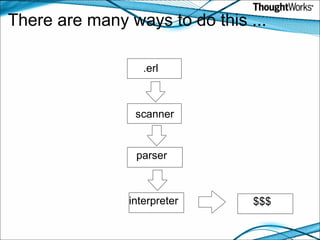
There are many ways to do this ... .erl scanner parser interpreter $$$
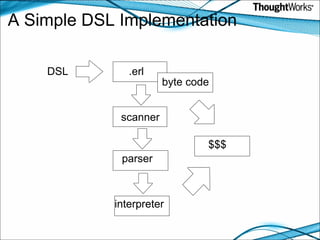
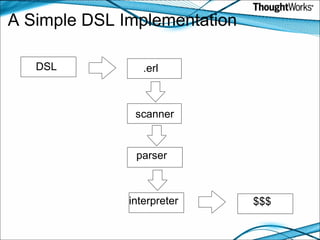
A Simple DSL Implementation .erl scanner parser interpreter DSL $$$ byte code
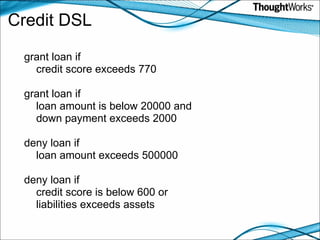
Credit DSL grant loan if      credit score exceeds 770   grant loan if      loan amount is below 20000 and       down payment exceeds 2000   deny loan if       loan amount exceeds 500000   deny loan if      credit score is below 600 or       liabilities exceeds assets     
Credit DSL grant loan if      credit  score  exceeds 770   grant loan if      loan amount is  below  20000  and       down payment exceeds 2000   deny loan if       loan amount exceeds 500000   deny loan if      credit score is below  600 or       liabilities exceeds assets      Return Values Guards Variables Operators 
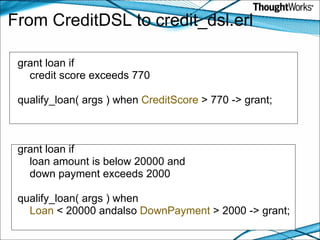
From CreditDSL to credit_dsl.erl grant loan if      credit score exceeds 770   qualify_loan( args ) when  CreditScore  > 770 -> grant;  grant loan if      loan amount is below 20000 and       down payment exceeds 2000 qualify_loan( args ) when       Loan  < 20000 andalso  DownPayment  > 2000 -> grant;
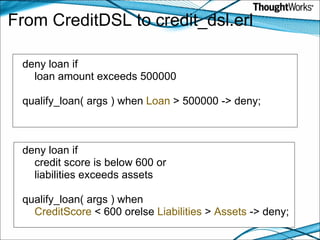
From CreditDSL to credit_dsl.erl deny loan if       loan amount exceeds 500000   qualify_loan( args ) when  Loan  > 500000 -> deny;       deny loan if      credit score is below 600 or       liabilities exceeds assets qualify_loan( args ) when       CreditScore  < 600 orelse  Liabilities  >  Assets  -> deny;  
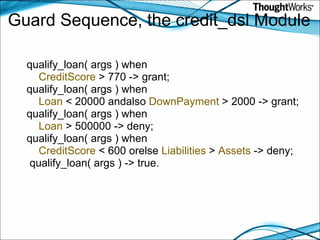
Guard Sequence, the credit_dsl Module qualify_loan( args ) when         CreditScore  > 770 -> grant; qualify_loan( args ) when       Loan  < 20000 andalso  DownPayment  > 2000 -> grant; qualify_loan( args ) when         Loan  > 500000 -> deny; qualify_loan( args ) when       CreditScore  < 600 orelse  Liabilities  >  Assets  -> deny;   qualify_loan( args ) -> true.  
A Contrived Module: loan_processor.erl start() -> spawn( fun() -> loop() end ). loop() ->     receive { Loan ,  CreditScore ,  Down ,  Liabilities ,  Assets } ->          Outcome  = credit_dsl:qualify_loan( Loan ,                                                                 CreditScore ,                                                                  Down ,                                                                 Liabilities ,                                                                 Assets ),        io:format(&quot;loan processed : ~p~n&quot;, [ Outcome ])     end,     loop().
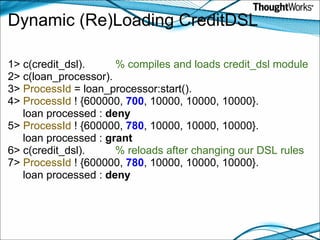
Dynamic (Re)Loading CreditDSL 1> c(credit_dsl).           % compiles and loads credit_dsl module 2> c(loan_processor). 3>  ProcessId  = loan_processor:start(). 4>  ProcessId  ! {600000,  700 , 10000, 10000, 10000}.      loan processed :  deny 5>  ProcessId  ! {600000,  780 , 10000, 10000, 10000}.      loan processed :  grant 6> c(credit_dsl).           % reloads after changing our DSL rules 7>  ProcessId  ! {600000,  780 , 10000, 10000, 10000}.      loan processed :  deny
Dynamic Code Loading Gotchas Erlang can run two and only two versions of a module Code running in a process has a version lifecycle Current Old Dead Keep it simple Try to put reloaded code in a separate module Try to keep reloaded code out of processes Keep business logic separate from infrastructural code Keep concurrent code separate from sequential code 
Modifying loan_processor.erl start() -> spawn( fun() -> loop() end ). loop() ->     receive { Loan ,  CreditScore ,  Down ,  Liabilities ,  Assets } ->          Outcome  = credit_dsl:qualify_loan( Loan ,                                                                 CreditScore  + 100 ,                                                                  Down ,                                                                 Liabilities ,                                                                 Assets ),        io:format(&quot;loan processed : ~p~n&quot;, [ Outcome ])     end,     loop().
A Simple DSL Implementation .erl scanner parser interpreter DSL $$$
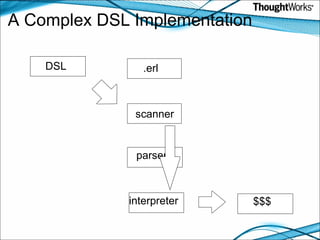
A Complex DSL Implementation parser .erl scanner interpreter DSL $$$
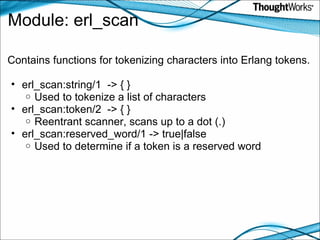
Module: erl_scan Contains functions for tokenizing characters into Erlang tokens. erl_scan:string/1  -> { } Used to tokenize a list of characters erl_scan:token/2  -> { } Reentrant scanner, scans up to a dot (.) erl_scan:reserved_word/1 -> true|false Used to determine if a token is a reserved word
erl_scan:string/1 -> { } > { ok,  Tokens ,  EndLine  } = erl_scan:string( &quot;1 + 1.&quot; ). > erlang:display(  EndLine  ).     1 >erlang:display(  Tokens  ).    [ {integer,1,1},  {'+',1},  {integer,1,1},  {dot,1} ]     > % syntax rules are not applied at this point  > { ok,  Tokens ,  EndLine  } = erl_scan:string( &quot;1 + foo.&quot; ). > erlang:display(  Tokens  ).     [ {integer,1,1},  {'+',1},  {atom,1,foo},  {dot,1} ]   
Module: erl_parse Converts tokens into the abstract form.   erl_parse:parse_exprs/1 -> { }  Parses tokens as a list of expressions erl_parse:abstract/1 -> { } Converts an Erlang term into it's abstract form Inverse of erl_parse:normalise/1  erl_parse:normalise/1 -> Term Converts abstract form into an Erlang term  Inverse of erl_parse:abstract/1   
erl_parse:parse_exprs/1 -> { } erl_parse:parse_exprs/1       > { ok,  Tokens ,  EndLine  } = erl_scan:string( &quot;1 + 1.&quot; ).       > { ok,  Abstract  } = erl_parse:parse_exprs(  Tokens  ).       > erlang:display(  Abstract  ).         [ {op, 1, '+', {integer,1,1}, {integer,1,1} } ]     The infix operator notation of the concrete syntax tree has become converted to an abstract form using postfix operator notation.
Module: erl_parse   erl_parse:parse_exprs/1 applied syntax rules         > { ok,  Tokens , _ } = erl_scan:string( &quot;1 + 1&quot; ).       > { error,  Msg  } = erl_parse:parse_exprs(  Tokens  ).       > erlang:display(  Msg  ).         { 999999, erl_parse, [&quot;syntax error before: &quot;,[] ] }     erl_parse:abstract/1 & normalise/1          > { integer, 0, 1 } = erl_parse:abstract( 1 ).       > 1 = erl_parse:normalise(  {integer, 0, 1} ).
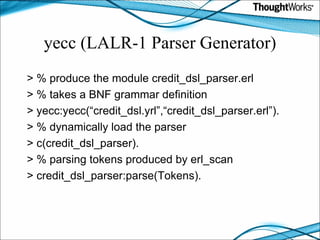
yecc (LALR-1 Parser Generator) > % produce the module credit_dsl_parser.erl > % takes a BNF grammar definition > yecc:yecc(“credit_dsl.yrl”,“credit_dsl_parser.erl”). > % dynamically load the parser > c(credit_dsl_parser). > % parsing tokens produced by erl_scan > credit_dsl_parser:parse(Tokens).
Module: erl_eval erl_eval:expr/2 -> { } Evaluates an expression with a set of bindings Bindings  erl_eval:exprs/2 -> { } Evaluates expressions with a set of bindings Bindings erl_eval:expr_list/2 -> { } Evaluates a list of expressions  erl_eval:new_bindings/0 -> [ ] Used to create a new binding structure  erl_eval:add_binding/3 -> [ ] Used to add a binding to a binding structure  erl_eval:del_binding/2 -> [ ] Used to remove a binding from a binding structure
Happy Path ... erl_eval:exprs/2 -> { } > { _,  Tokens , _ } = erl_scan:string(&quot;1 + 1.&quot;). > { ok,  Abstract  } = erl_parse:parse_exprs(  Tokens  ). > erlang:display(  Abstract  ).      [ {op,1,'+',{integer,1,1},{integer,1,1}} ]. >  Bindings  = erl_eval:new_bindings( ). > { _,  Value , _ } = erl_eval:exprs(  Abstract ,  Bindings  ). > erlang:display(  Value  ).      2
erl_eval:exprs/2 -> { } ... with bindings > { ok,  Tokens , _ } = erl_scan:string( &quot;1 +  X .&quot; ). > { ok,  Abstract  } = erl_parse:parse_exprs(  Tokens  ). > erlang:display(  Abstract  ).    { ok, [{op,1,'+',{integer,1,1},  {var,1,'X'} }] } > Bindings = erl_eval:new_bindings( ). > erlang:display(  Bindings  ).     [ ] >  NewBindings  = erl_eval:add_binding( 'X', 2,  Bindings  ).    [ {'X',2} ] > { _,  Result , _ } = erl_eval:exprs(  Abstract ,  NewBindings  ). > erlang:display(  Result  ).    3
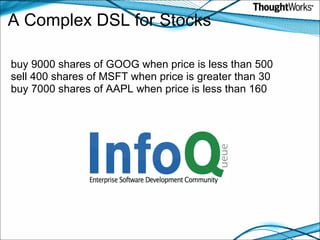
A Complex DSL for Stocks   buy 9000 shares of GOOG when price is less than 500  sell 400 shares of MSFT when price is greater than 30  buy 7000 shares of AAPL when price is less than 160
StocksDSL Example > c(stocks_dsl). % compile and load the module, once   > % convert a collection of rules into a collection of  closures >  Functions  = stocks_dsl:load_biz_rules(&quot;path/to/biz_rules.txt&quot;).   >  MarketData  = [{'GOOG', 498}, {'MSFT', 30}, {'AAPL', 158}]. > dsl:apply_biz_rules( Functions ,  MarketData ).    Order placed: buying 9000 shares of 'GOOG'    Order placed: buying 7000 shares of 'AAPL'
StocksDSL Implementation   load_biz_rules( File ) ->      {ok,  Bin } = file:read_file( File ),       Rules  = string:tokens(erlang:binary_to_list( Bin ), &quot;\n&quot;),      [rule_to_function( Rule ) ||  Rule  <-  Rules ].   rule_to_function( Rule ) ->      {ok, Scanned, _} = erl_scan:string(Rule) ,      [{_,_, Action },{_,_, Quantity },_,_| Tail ] =  Scanned ,      [{_,_, Ticker },_,_,_,{_,_, Operator },_,{_,_, Limit }] =  Tail ,      rule_to_function( Action ,  Quantity ,  Ticker ,  Operator ,  Limit ).
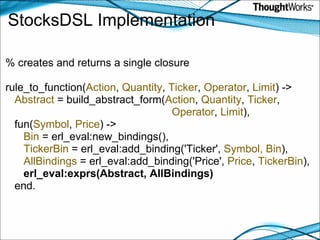
StocksDSL Implementation   % creates and returns a single closure   rule_to_function( Action ,  Quantity ,  Ticker ,  Operator ,  Limit ) ->      Abstract  = build_abstract_form( Action ,  Quantity ,  Ticker ,                                                          Operator ,  Limit ),     fun( Symbol ,  Price ) ->         Bin  = erl_eval:new_bindings(),         TickerBin  = erl_eval:add_binding('Ticker',  Symbol,   Bin ),         AllBindings  = erl_eval:add_binding('Price',  Price ,  TickerBin ),        erl_eval:exprs(Abstract, AllBindings)     end.
Domain Specific Languages in Erlang    Dennis Byrne [email_address] http://notdennisbyrne.blogspot.com/ http://www.infoq.com/articles/erlang-dsl http://erlang.org/ http://martinfowler.com/dslwip/Intro.html

DSLs In Erlang

  • 1.
    Domain Specific Languagesin Erlang Dennis Byrne [email_address] http://notdennisbyrne.blogspot.com/
  • 2.
    An Overview ...Erlang is ... A Domain Specific Language is ...  Internal DSLs External DSLs  A simple DSL implementation Dynamic code loading  A complex DSL implementation erl_scan module erl_parse module erl_eval module
  • 3.
    Erlang is ...a functional programming language with native constructs for concurrency and reliability.   Message passing / Actor Model  Dynamic code loading Single Assignment Strict Evaluation  Tail Recursion Created more than 20 years ago Open sourced in 1998 
  • 4.
    A Domain SpecificLanguage is ... a narrowly focussed language dedicated to solving a specific problem very well. Internal DSL Written in the host language Also known as an embedded DSL Common in Ruby and Lisp communities  External DSL Implemented outside of the host language Read and/or interpreted by the host platform Examples: J2EE deployment descriptors, SQL, Regex We will be creating two external DSLs
  • 5.
    There are manyways to do this ... .erl scanner parser interpreter $$$
  • 6.
    A Simple DSLImplementation .erl scanner parser interpreter DSL $$$ byte code
  • 7.
    Credit DSL grantloan if      credit score exceeds 770   grant loan if      loan amount is below 20000 and       down payment exceeds 2000   deny loan if      loan amount exceeds 500000   deny loan if      credit score is below 600 or       liabilities exceeds assets    
  • 8.
    Credit DSL grantloan if      credit  score  exceeds 770   grant loan if      loan amount is  below  20000  and       down payment exceeds 2000   deny loan if      loan amount exceeds 500000   deny loan if      credit score is below  600 or       liabilities exceeds assets     Return Values Guards Variables Operators 
  • 9.
    From CreditDSL tocredit_dsl.erl grant loan if      credit score exceeds 770   qualify_loan( args ) when CreditScore > 770 -> grant; grant loan if      loan amount is below 20000 and       down payment exceeds 2000 qualify_loan( args ) when      Loan < 20000 andalso DownPayment > 2000 -> grant;
  • 10.
    From CreditDSL tocredit_dsl.erl deny loan if      loan amount exceeds 500000   qualify_loan( args ) when Loan > 500000 -> deny;       deny loan if      credit score is below 600 or       liabilities exceeds assets qualify_loan( args ) when      CreditScore < 600 orelse Liabilities > Assets -> deny;  
  • 11.
    Guard Sequence, thecredit_dsl Module qualify_loan( args ) when       CreditScore > 770 -> grant; qualify_loan( args ) when      Loan < 20000 andalso DownPayment > 2000 -> grant; qualify_loan( args ) when       Loan > 500000 -> deny; qualify_loan( args ) when      CreditScore < 600 orelse Liabilities > Assets -> deny;   qualify_loan( args ) -> true.  
  • 12.
    A Contrived Module:loan_processor.erl start() -> spawn( fun() -> loop() end ). loop() ->     receive { Loan , CreditScore , Down , Liabilities , Assets } ->        Outcome = credit_dsl:qualify_loan( Loan ,                                                                CreditScore ,                                                                 Down ,                                                                Liabilities ,                                                                Assets ),        io:format(&quot;loan processed : ~p~n&quot;, [ Outcome ])     end,     loop().
  • 13.
    Dynamic (Re)Loading CreditDSL1> c(credit_dsl).          % compiles and loads credit_dsl module 2> c(loan_processor). 3> ProcessId = loan_processor:start(). 4> ProcessId ! {600000, 700 , 10000, 10000, 10000}.      loan processed : deny 5> ProcessId ! {600000, 780 , 10000, 10000, 10000}.      loan processed : grant 6> c(credit_dsl).          % reloads after changing our DSL rules 7> ProcessId ! {600000, 780 , 10000, 10000, 10000}.      loan processed : deny
  • 14.
    Dynamic Code LoadingGotchas Erlang can run two and only two versions of a module Code running in a process has a version lifecycle Current Old Dead Keep it simple Try to put reloaded code in a separate module Try to keep reloaded code out of processes Keep business logic separate from infrastructural code Keep concurrent code separate from sequential code 
  • 15.
    Modifying loan_processor.erl start()-> spawn( fun() -> loop() end ). loop() ->     receive { Loan , CreditScore , Down , Liabilities , Assets } ->        Outcome = credit_dsl:qualify_loan( Loan ,                                                                CreditScore + 100 ,                                                                 Down ,                                                                Liabilities ,                                                                Assets ),        io:format(&quot;loan processed : ~p~n&quot;, [ Outcome ])     end,     loop().
  • 16.
    A Simple DSLImplementation .erl scanner parser interpreter DSL $$$
  • 17.
    A Complex DSLImplementation parser .erl scanner interpreter DSL $$$
  • 18.
    Module: erl_scan Containsfunctions for tokenizing characters into Erlang tokens. erl_scan:string/1  -> { } Used to tokenize a list of characters erl_scan:token/2  -> { } Reentrant scanner, scans up to a dot (.) erl_scan:reserved_word/1 -> true|false Used to determine if a token is a reserved word
  • 19.
    erl_scan:string/1 -> {} > { ok, Tokens , EndLine } = erl_scan:string( &quot;1 + 1.&quot; ). > erlang:display( EndLine ).    1 >erlang:display( Tokens ).    [ {integer,1,1},  {'+',1},  {integer,1,1},  {dot,1} ]     > % syntax rules are not applied at this point  > { ok, Tokens , EndLine } = erl_scan:string( &quot;1 + foo.&quot; ). > erlang:display( Tokens ).    [ {integer,1,1},  {'+',1},  {atom,1,foo},  {dot,1} ]   
  • 20.
    Module: erl_parse Convertstokens into the abstract form.   erl_parse:parse_exprs/1 -> { }  Parses tokens as a list of expressions erl_parse:abstract/1 -> { } Converts an Erlang term into it's abstract form Inverse of erl_parse:normalise/1 erl_parse:normalise/1 -> Term Converts abstract form into an Erlang term  Inverse of erl_parse:abstract/1   
  • 21.
    erl_parse:parse_exprs/1 -> {} erl_parse:parse_exprs/1      > { ok, Tokens , EndLine } = erl_scan:string( &quot;1 + 1.&quot; ).      > { ok, Abstract } = erl_parse:parse_exprs( Tokens ).      > erlang:display( Abstract ).         [ {op, 1, '+', {integer,1,1}, {integer,1,1} } ]     The infix operator notation of the concrete syntax tree has become converted to an abstract form using postfix operator notation.
  • 22.
    Module: erl_parse  erl_parse:parse_exprs/1 applied syntax rules        > { ok, Tokens , _ } = erl_scan:string( &quot;1 + 1&quot; ).      > { error, Msg } = erl_parse:parse_exprs( Tokens ).      > erlang:display( Msg ).         { 999999, erl_parse, [&quot;syntax error before: &quot;,[] ] }     erl_parse:abstract/1 & normalise/1         > { integer, 0, 1 } = erl_parse:abstract( 1 ).      > 1 = erl_parse:normalise(  {integer, 0, 1} ).
  • 23.
    yecc (LALR-1 ParserGenerator) > % produce the module credit_dsl_parser.erl > % takes a BNF grammar definition > yecc:yecc(“credit_dsl.yrl”,“credit_dsl_parser.erl”). > % dynamically load the parser > c(credit_dsl_parser). > % parsing tokens produced by erl_scan > credit_dsl_parser:parse(Tokens).
  • 24.
    Module: erl_eval erl_eval:expr/2-> { } Evaluates an expression with a set of bindings Bindings erl_eval:exprs/2 -> { } Evaluates expressions with a set of bindings Bindings erl_eval:expr_list/2 -> { } Evaluates a list of expressions  erl_eval:new_bindings/0 -> [ ] Used to create a new binding structure  erl_eval:add_binding/3 -> [ ] Used to add a binding to a binding structure  erl_eval:del_binding/2 -> [ ] Used to remove a binding from a binding structure
  • 25.
    Happy Path ...erl_eval:exprs/2 -> { } > { _, Tokens , _ } = erl_scan:string(&quot;1 + 1.&quot;). > { ok, Abstract } = erl_parse:parse_exprs( Tokens ). > erlang:display( Abstract ).     [ {op,1,'+',{integer,1,1},{integer,1,1}} ]. > Bindings = erl_eval:new_bindings( ). > { _, Value , _ } = erl_eval:exprs( Abstract , Bindings ). > erlang:display( Value ).     2
  • 26.
    erl_eval:exprs/2 -> {} ... with bindings > { ok, Tokens , _ } = erl_scan:string( &quot;1 + X .&quot; ). > { ok, Abstract } = erl_parse:parse_exprs( Tokens ). > erlang:display( Abstract ).    { ok, [{op,1,'+',{integer,1,1}, {var,1,'X'} }] } > Bindings = erl_eval:new_bindings( ). > erlang:display( Bindings ).    [ ] > NewBindings = erl_eval:add_binding( 'X', 2, Bindings ).    [ {'X',2} ] > { _, Result , _ } = erl_eval:exprs( Abstract , NewBindings ). > erlang:display( Result ).    3
  • 27.
    A Complex DSLfor Stocks   buy 9000 shares of GOOG when price is less than 500  sell 400 shares of MSFT when price is greater than 30  buy 7000 shares of AAPL when price is less than 160
  • 28.
    StocksDSL Example >c(stocks_dsl). % compile and load the module, once   > % convert a collection of rules into a collection of  closures > Functions = stocks_dsl:load_biz_rules(&quot;path/to/biz_rules.txt&quot;).   > MarketData = [{'GOOG', 498}, {'MSFT', 30}, {'AAPL', 158}]. > dsl:apply_biz_rules( Functions , MarketData ).    Order placed: buying 9000 shares of 'GOOG'    Order placed: buying 7000 shares of 'AAPL'
  • 29.
    StocksDSL Implementation  load_biz_rules( File ) ->      {ok, Bin } = file:read_file( File ),      Rules = string:tokens(erlang:binary_to_list( Bin ), &quot;\n&quot;),      [rule_to_function( Rule ) || Rule <- Rules ].   rule_to_function( Rule ) ->      {ok, Scanned, _} = erl_scan:string(Rule) ,      [{_,_, Action },{_,_, Quantity },_,_| Tail ] = Scanned ,      [{_,_, Ticker },_,_,_,{_,_, Operator },_,{_,_, Limit }] = Tail ,      rule_to_function( Action , Quantity , Ticker , Operator , Limit ).
  • 30.
    StocksDSL Implementation  % creates and returns a single closure   rule_to_function( Action , Quantity , Ticker , Operator , Limit ) ->     Abstract = build_abstract_form( Action , Quantity , Ticker ,                                                         Operator , Limit ),     fun( Symbol , Price ) ->        Bin = erl_eval:new_bindings(),        TickerBin = erl_eval:add_binding('Ticker', Symbol, Bin ),        AllBindings = erl_eval:add_binding('Price', Price , TickerBin ),        erl_eval:exprs(Abstract, AllBindings)     end.
  • 31.
    Domain Specific Languagesin Erlang    Dennis Byrne [email_address] http://notdennisbyrne.blogspot.com/ http://www.infoq.com/articles/erlang-dsl http://erlang.org/ http://martinfowler.com/dslwip/Intro.html