Chapter One
Course objectives
This course aims to make the student capable of
understanding and writing different data structures
as:
• Array, ArrayList
• String
• Linked List
• Stack
• Queue
Introduction
What is Data Structures ?
• A collection of basic data types is called data
structure.
• A collection of data elements whose logical
organization reflects a relationship among the
elements.
• Abstract way to organize information.
Classification of data structure
Classification according to structure
1. Linear data structures: In these data structures the
elements form a sequence, such as array, Linked Lists, Stacks
and Queues .
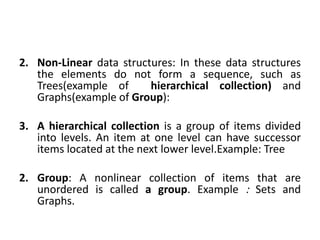
2. Non-Linear data structures: In these data structures
the elements do not form a sequence, such as
Trees(example of hierarchical collection) and
Graphs(example of Group):
3. A hierarchical collection is a group of items divided
into levels. An item at one level can have successor
items located at the next lower level.Example: Tree
2. Group: A nonlinear collection of items that are
unordered is called a group. Example : Sets and
Graphs.
Classification according to Allocation memory
1. Static memory allocation means the program must obtain its
space before the execution and cannot obtain more while
or after execution. Example: Arrays
2. Dynamic memory allocation is the ability for a program to
obtain more memory space at execution time to hold new
nodes and to release space no longer needed .Example :
Array lists, Linked Lists, Stacks, Queues and Trees
The data structures can be viewed in two ways, physically and
logically.
• The physical data structure refers to the physical arrangement
of the data on the memory.
• The logical data structure concerns how the data "seem" to
be arranged and the meanings of the data elements in
relation to one another.
Data Structures Operations
Following the operations that can be performed on the data
structures:
1. Traversing: It is used to access each data item exactly once.
2. Searching: It is used to find out the location of the data item.
3. Inserting: It is used to add a new data item in the given collection
of data items.
4. Deleting: It is used to delete an existing data item from the given
collection of data items.
5. Sorting: It is used to arrange the data items in some order i.e. in
ascending or descending order.
Array Data Structure
An array is :
• Linear data structure: means organize in memory as linear order.
• homogeneous structure: all components in the structure are of the
same data type.
• finite structure : indicates that there is a last element.
• fixed size structure: mean that the size of the array must be known
at compile time.
• contiguously data structure: means that there is a first element, a
second element, and so on.
• The component selection mechanism of an array is direct access,
which means we can access any element directly (by using specific
equation), without first accessing the preceding elements. The
desired element is specified using an index, which gives its relative
position in the collection.
• A one-dimensional array is homogeneous structure, it can be
visualized as a list. Logical structure for one-dimensional array
with 15 elements as shown below:
• Physical structure for one-dimensional array with five
elements will appear in memory as shown below:
We can find out the location of any element by using following
formula:
Loc (ArrayName [k]) = Loc (ArrayName [1]) + (k-LB)* w
where:
Loc (ArrayName [k]): is the address of the kth element of ArrayName.
Loc (ArrayName [1]): is the base address or address of first element of
ArrayName.
W : is the number of bytes taken by one element(element size).
LB : is the lower bound.
Example1 : Suppose we want to find out Loc (A [3]) that store
as the following figure in two case (LB=1 and LB=0), for it, we
have: Base(A)=1000, w = 2 bytes.
in Case LB = 1
After putting these values in the given formula, we get:
LOC(A[3])=1000 + 2 (3 – 1)
= 1000 + 2 (2)
= 1000 + 4
= 1004
If Case LB = 0
After putting these values in the given formula, we get:
LOC(A[3])=1000 + 2 *3
= 1000 + 6
= 1006
Two-dimensional array
• A two-dimensional array is also homogeneous
structure, it can be visualized as a table consisting
of rows and columns.
• The element in a two-dimensional array is
accessed by specifying the row and column
indexes of the item in the array.
• Logical Level for two-dimensional array with 3(0-
2) rows and 4(0-3)column elements will appear
as shown below:
In the computer memory, all elements are stored linearly using
contiguous addresses. Therefore, in order to store a two-
dimensional matrix, two dimensional address space must be
mapped to one-dimensional address space.
There Two methods for arranging Two or
multidimensional arrays in memory:
1. Row-major order
2. Column-major order
For example the physical structure for array with 3X3 elements will appear in memory
as shown below in two methods:
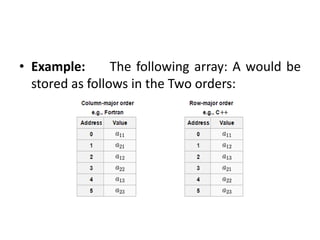
• In row-major order:
consecutive elements of the rows of the array are contiguous
in memory. Used in C/C++, PL/I, Pascal, Python , C# .Net,
Java.
• in column-major order:
consecutive elements of the columns are contiguous.Used in
Fortran, OpenGL , MATLAB
• Example: The following array: A would be
stored as follows in the Two orders:
We can find out the location of any element in array (NXM) by
using following formulas:
1. In case of Row Major Order:
Loc (A [i, j]) = Loc (A [1,1]) +( [i-1]*M+ [ j-1 ]) * w
where
Loc(A[[i,j]) : is the location of the element in the ith row and jth column.
Loc (A [1,1]) : is the base address or address of the first element of the
array A.
w : is the number of bytes required to store single element of the
array A.
M : is the total number of columns in the array.
•
Example: finding the location (address) of element in 2D
Suppose A 3 x 4 (N=3 and M=4) integer array A is show as below and base
address = 1000 and number of bytes=2. find the location of A [3,2]:
2. In case of Column Major Order:
Loc (A [i,j]) = Loc (A [1, 1]) + ([j-1]*N+ [i-1])*w
where
Loc(A[i,j]): is the location of the element in the ith row and jth column.
Loc (A [1,1]): is the base address or address of the first element of the array
A.
w: is the number of bytes required to store single element of the array A.
N: is the total number of rows in the array.
Example: finding the location (address) of element in 2D
Suppose A 3 x 4 (N=3 and M=4) integer array A and base address =1000 and
number of bytes=2. find the location of A [3,2]:
Note: if the value of w not determine, it suppose equal to 1.
Three Dimensional Arrays
In case three Dimensional Arrays, memory-address of the element
A[i,j,K] with dimension (NXMXR) is given by:
where:
R : number of levels
N: number of rows
M: number of column
In case of Row Major Order:
Loc (A [i,j,k]) = Loc (A [1, 1, 1]) + ([k-1]*N*M+ [j-1]*N+ (i-1))*W
In case of Column Major Order:
Loc (A [i,j,k]) = Loc (A [1, 1, 1]) + ([k-1]*N*M+ [i-1]*M+ (j-1))*W
Example : Suppose A3 x 4(N=3, M=3 and R=3) integer array A and base address =1000
and number of bytes(w)=2. find the location of A [3,2,2] by using two method of
arrange matrix in memory:
Loc(A[3,2,2])= 1000+2(3*3*(2-1)+3*(3-1)+2-1)
= 1000 + 2(9+6+1)
= 1032
Loc(A[3,2,2])= 1000+2(3*3*(2-1)+3*(2-1)+3-1)
= 1000 + 2(9+3+2)
= 1028
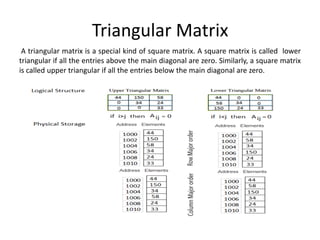
Triangular Matrix
A triangular matrix is a special kind of square matrix. A square matrix is called lower
triangular if all the entries above the main diagonal are zero. Similarly, a square matrix
is called upper triangular if all the entries below the main diagonal are zero.
We can find out the location of a[2,2]by using following formulas:
1. Upper triangular
In case of Row Major Order:
Loc (A [i, j]) = Base(A) + w( ( (i-1)*M - (i-1)*i/2) + (j-1) )
In case of Column Major Order:
Loc (A[ i, j]) = Base(A) + w( (j-1) *j / 2 + ( i-1 ) )
2. Lower triangular
In case of Row Major Order:
Loc (A [i,j]) =Base(A) + w((i-1) * i /2 + ([j-1))
In case of Column Major Order:
Loc (A [i,j]) = Base(A) + w( ( (j-1) *N - (j-1)*j/2 ) +(i-1))
Q: How determine the number of array elements?
Ans.: To determine the number of any array elements by applying the following
equation:
where:
n is dimensions of the array
U : upper bound for dimension i
L: lower bound for dimension i
Example1: Find the number of positions required to store the array: A [5]
=5-0+1=6
Example2: Find the number of positions required to store the matrix: A [5, 6]
(5-0+1)*(6-0+1)=6*7=42
Example3: Find the number of positions required to store the matrix:
A[2..5, 6...8]
= (5-2+1)*(8-6+1) = 4*3 =12
Arrays in Java
• In Java each row of a two-dimensional array is itself a one
dimensional array.
• Arrays of arrays in languages such as Java, Python (multidimensional lists), Visual Basic.NET, Perl,
PHP, JavaScript are implemented as Iliffe vectors and they can also be used to implement jagged
arrays.
• The Iliffe vector for a 2-dimensional array is simply a vector of pointers to vectors of data, i.e., the
Iliffe vector represents the columns of an array where each column element is a pointer to a row
vector.
• In general, an Iliffe vector for an n-dimensional array (where n ≥ 2) consists of a vector (or 1-
dimensional array) of pointers to an (n − 1)-dimensional array. They are often used to avoid the
need for expensive multiplication operations when performing address calculation on an array
element.
• While a 2D array is a 1D array of references to 1D arrays, each of these 1D arrays (rows) can have a
different length, this 2D array is called jagged arrays.
Example to initialize jagged array:
int[][] numArr = { {1,2,3}, {4,5,6,7}, {8,9} };
In the following memory layout of a jagged array numArr.
And jagged arrays can be created with the following code:
int [][]c;
c=new int[2][];
c[0]=new int[5];
c[1]=new int[3];
Example : suppose the following declaration:
int[][]jagged = { {3,5,7,9}, {4,2}, {5,7,8,6}, {6} };
Q: Show output of the following segment?
int count = 0; double sum = 0;
for (int row = 0; row <jagged.length; row++)
if (jagged[row].length > 3){
sum += jagged[row][3];
count++; }
if (count > 0)
System.out.println((double) sum / count);
Q:How to delete and insert an element from array?
Ans.: Insertion and deletion at particular position is complex, it require shifting as in the following
examples.
Insert item to sorted array

cluod.pdf

  • 1.
  • 2.
    Course objectives This courseaims to make the student capable of understanding and writing different data structures as: • Array, ArrayList • String • Linked List • Stack • Queue
  • 3.
    Introduction What is DataStructures ? • A collection of basic data types is called data structure. • A collection of data elements whose logical organization reflects a relationship among the elements. • Abstract way to organize information.
  • 4.
  • 5.
    Classification according tostructure 1. Linear data structures: In these data structures the elements form a sequence, such as array, Linked Lists, Stacks and Queues .
  • 6.
    2. Non-Linear datastructures: In these data structures the elements do not form a sequence, such as Trees(example of hierarchical collection) and Graphs(example of Group): 3. A hierarchical collection is a group of items divided into levels. An item at one level can have successor items located at the next lower level.Example: Tree 2. Group: A nonlinear collection of items that are unordered is called a group. Example : Sets and Graphs.
  • 7.
    Classification according toAllocation memory 1. Static memory allocation means the program must obtain its space before the execution and cannot obtain more while or after execution. Example: Arrays 2. Dynamic memory allocation is the ability for a program to obtain more memory space at execution time to hold new nodes and to release space no longer needed .Example : Array lists, Linked Lists, Stacks, Queues and Trees
  • 8.
    The data structurescan be viewed in two ways, physically and logically. • The physical data structure refers to the physical arrangement of the data on the memory. • The logical data structure concerns how the data "seem" to be arranged and the meanings of the data elements in relation to one another.
  • 9.
    Data Structures Operations Followingthe operations that can be performed on the data structures: 1. Traversing: It is used to access each data item exactly once. 2. Searching: It is used to find out the location of the data item. 3. Inserting: It is used to add a new data item in the given collection of data items. 4. Deleting: It is used to delete an existing data item from the given collection of data items. 5. Sorting: It is used to arrange the data items in some order i.e. in ascending or descending order.
  • 10.
    Array Data Structure Anarray is : • Linear data structure: means organize in memory as linear order. • homogeneous structure: all components in the structure are of the same data type. • finite structure : indicates that there is a last element. • fixed size structure: mean that the size of the array must be known at compile time. • contiguously data structure: means that there is a first element, a second element, and so on. • The component selection mechanism of an array is direct access, which means we can access any element directly (by using specific equation), without first accessing the preceding elements. The desired element is specified using an index, which gives its relative position in the collection.
  • 11.
    • A one-dimensionalarray is homogeneous structure, it can be visualized as a list. Logical structure for one-dimensional array with 15 elements as shown below: • Physical structure for one-dimensional array with five elements will appear in memory as shown below:
  • 13.
    We can findout the location of any element by using following formula: Loc (ArrayName [k]) = Loc (ArrayName [1]) + (k-LB)* w where: Loc (ArrayName [k]): is the address of the kth element of ArrayName. Loc (ArrayName [1]): is the base address or address of first element of ArrayName. W : is the number of bytes taken by one element(element size). LB : is the lower bound.
  • 14.
    Example1 : Supposewe want to find out Loc (A [3]) that store as the following figure in two case (LB=1 and LB=0), for it, we have: Base(A)=1000, w = 2 bytes. in Case LB = 1 After putting these values in the given formula, we get: LOC(A[3])=1000 + 2 (3 – 1) = 1000 + 2 (2) = 1000 + 4 = 1004 If Case LB = 0 After putting these values in the given formula, we get: LOC(A[3])=1000 + 2 *3 = 1000 + 6 = 1006
  • 15.
    Two-dimensional array • Atwo-dimensional array is also homogeneous structure, it can be visualized as a table consisting of rows and columns. • The element in a two-dimensional array is accessed by specifying the row and column indexes of the item in the array. • Logical Level for two-dimensional array with 3(0- 2) rows and 4(0-3)column elements will appear as shown below:
  • 17.
    In the computermemory, all elements are stored linearly using contiguous addresses. Therefore, in order to store a two- dimensional matrix, two dimensional address space must be mapped to one-dimensional address space. There Two methods for arranging Two or multidimensional arrays in memory: 1. Row-major order 2. Column-major order
  • 18.
    For example thephysical structure for array with 3X3 elements will appear in memory as shown below in two methods:
  • 19.
    • In row-majororder: consecutive elements of the rows of the array are contiguous in memory. Used in C/C++, PL/I, Pascal, Python , C# .Net, Java. • in column-major order: consecutive elements of the columns are contiguous.Used in Fortran, OpenGL , MATLAB
  • 20.
    • Example: Thefollowing array: A would be stored as follows in the Two orders:
  • 21.
    We can findout the location of any element in array (NXM) by using following formulas: 1. In case of Row Major Order: Loc (A [i, j]) = Loc (A [1,1]) +( [i-1]*M+ [ j-1 ]) * w where Loc(A[[i,j]) : is the location of the element in the ith row and jth column. Loc (A [1,1]) : is the base address or address of the first element of the array A. w : is the number of bytes required to store single element of the array A. M : is the total number of columns in the array. •
  • 22.
    Example: finding thelocation (address) of element in 2D Suppose A 3 x 4 (N=3 and M=4) integer array A is show as below and base address = 1000 and number of bytes=2. find the location of A [3,2]:
  • 23.
    2. In caseof Column Major Order: Loc (A [i,j]) = Loc (A [1, 1]) + ([j-1]*N+ [i-1])*w where Loc(A[i,j]): is the location of the element in the ith row and jth column. Loc (A [1,1]): is the base address or address of the first element of the array A. w: is the number of bytes required to store single element of the array A. N: is the total number of rows in the array.
  • 24.
    Example: finding thelocation (address) of element in 2D Suppose A 3 x 4 (N=3 and M=4) integer array A and base address =1000 and number of bytes=2. find the location of A [3,2]: Note: if the value of w not determine, it suppose equal to 1.
  • 25.
    Three Dimensional Arrays Incase three Dimensional Arrays, memory-address of the element A[i,j,K] with dimension (NXMXR) is given by: where: R : number of levels N: number of rows M: number of column In case of Row Major Order: Loc (A [i,j,k]) = Loc (A [1, 1, 1]) + ([k-1]*N*M+ [j-1]*N+ (i-1))*W In case of Column Major Order: Loc (A [i,j,k]) = Loc (A [1, 1, 1]) + ([k-1]*N*M+ [i-1]*M+ (j-1))*W
  • 26.
    Example : SupposeA3 x 4(N=3, M=3 and R=3) integer array A and base address =1000 and number of bytes(w)=2. find the location of A [3,2,2] by using two method of arrange matrix in memory: Loc(A[3,2,2])= 1000+2(3*3*(2-1)+3*(3-1)+2-1) = 1000 + 2(9+6+1) = 1032
  • 27.
  • 28.
    Triangular Matrix A triangularmatrix is a special kind of square matrix. A square matrix is called lower triangular if all the entries above the main diagonal are zero. Similarly, a square matrix is called upper triangular if all the entries below the main diagonal are zero.
  • 29.
    We can findout the location of a[2,2]by using following formulas: 1. Upper triangular In case of Row Major Order: Loc (A [i, j]) = Base(A) + w( ( (i-1)*M - (i-1)*i/2) + (j-1) ) In case of Column Major Order: Loc (A[ i, j]) = Base(A) + w( (j-1) *j / 2 + ( i-1 ) )
  • 30.
    2. Lower triangular Incase of Row Major Order: Loc (A [i,j]) =Base(A) + w((i-1) * i /2 + ([j-1)) In case of Column Major Order: Loc (A [i,j]) = Base(A) + w( ( (j-1) *N - (j-1)*j/2 ) +(i-1))
  • 31.
    Q: How determinethe number of array elements? Ans.: To determine the number of any array elements by applying the following equation: where: n is dimensions of the array U : upper bound for dimension i L: lower bound for dimension i Example1: Find the number of positions required to store the array: A [5] =5-0+1=6 Example2: Find the number of positions required to store the matrix: A [5, 6] (5-0+1)*(6-0+1)=6*7=42 Example3: Find the number of positions required to store the matrix: A[2..5, 6...8] = (5-2+1)*(8-6+1) = 4*3 =12
  • 32.
    Arrays in Java •In Java each row of a two-dimensional array is itself a one dimensional array.
  • 33.
    • Arrays ofarrays in languages such as Java, Python (multidimensional lists), Visual Basic.NET, Perl, PHP, JavaScript are implemented as Iliffe vectors and they can also be used to implement jagged arrays. • The Iliffe vector for a 2-dimensional array is simply a vector of pointers to vectors of data, i.e., the Iliffe vector represents the columns of an array where each column element is a pointer to a row vector. • In general, an Iliffe vector for an n-dimensional array (where n ≥ 2) consists of a vector (or 1- dimensional array) of pointers to an (n − 1)-dimensional array. They are often used to avoid the need for expensive multiplication operations when performing address calculation on an array element. • While a 2D array is a 1D array of references to 1D arrays, each of these 1D arrays (rows) can have a different length, this 2D array is called jagged arrays.
  • 34.
    Example to initializejagged array: int[][] numArr = { {1,2,3}, {4,5,6,7}, {8,9} }; In the following memory layout of a jagged array numArr. And jagged arrays can be created with the following code: int [][]c; c=new int[2][]; c[0]=new int[5]; c[1]=new int[3]; Example : suppose the following declaration: int[][]jagged = { {3,5,7,9}, {4,2}, {5,7,8,6}, {6} };
  • 35.
    Q: Show outputof the following segment? int count = 0; double sum = 0; for (int row = 0; row <jagged.length; row++) if (jagged[row].length > 3){ sum += jagged[row][3]; count++; } if (count > 0) System.out.println((double) sum / count); Q:How to delete and insert an element from array? Ans.: Insertion and deletion at particular position is complex, it require shifting as in the following examples.
  • 36.
    Insert item tosorted array