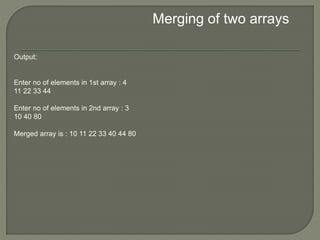
The document discusses arrays in C programming. It defines arrays as a collection of similar data types stored in contiguous memory locations and accessed using indexes. It describes how to declare, initialize, access, and manipulate single and multi-dimensional arrays. It also covers passing arrays to functions, array addressing and calculations, and merging two sorted arrays.
![Declaration of arrays
type arrayName [ arraySize ];
Ex-double balance[10];](https://image.slidesharecdn.com/arrays-230713161414-4b7ded7e/85/arrays-pptx-4-320.jpg)
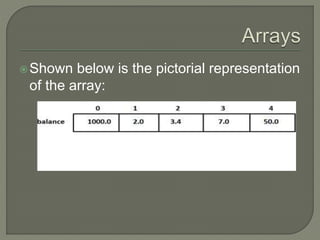
![ Initializing Arrays
Ex-double balance[5] = {1000.0, 2.0, 3.4, 7.0,
50.0};
If you omit the size of the array, an array just
big enough to hold the initialization is created.
Therefore, if you write −
Ex-double balance[] = {1000.0, 2.0, 3.4, 7.0,
50.0};](https://image.slidesharecdn.com/arrays-230713161414-4b7ded7e/85/arrays-pptx-5-320.jpg)
![ Initializing Arrays
Ex-double balance[5] = {1000.0, 2.0, 3.4, 7.0,
50.0};
If you omit the size of the array, an array just
big enough to hold the initialization is created.
Therefore, if you write −
Ex-double balance[] = {1000.0, 2.0, 3.4, 7.0,
50.0};](https://image.slidesharecdn.com/arrays-230713161414-4b7ded7e/85/arrays-pptx-6-320.jpg)
![Initializing Arrays
You will create exactly the same array as
you did in the previous example. Following
is an example to assign a single element
of the array −
Ex-balance[4] = 50.0;](https://image.slidesharecdn.com/arrays-230713161414-4b7ded7e/85/arrays-pptx-7-320.jpg)
![double salary = balance[4];](https://image.slidesharecdn.com/arrays-230713161414-4b7ded7e/85/arrays-pptx-9-320.jpg)
![#include <stdio.h>
int main ()
{
int a[10],i,size;
printf(“nhow many no of elements u want to scan”);
scanf(“%d”,&size);
printf(“nEnter the elements in the array”);
for(i=0;i<size;i++)
{
scanf(“%d”,&a[i]);
} //end for
for(i=0;i<size;i++)
{
printf(“The array is %d”,a[i]); //Displaying Array
} //end for
return 0;
}](https://image.slidesharecdn.com/arrays-230713161414-4b7ded7e/85/arrays-pptx-10-320.jpg)
![type name[size1][size2]...[sizeN];](https://image.slidesharecdn.com/arrays-230713161414-4b7ded7e/85/arrays-pptx-12-320.jpg)
![multidimensional array is the two-dimensional
array
type arrayName [ x ][ y ];](https://image.slidesharecdn.com/arrays-230713161414-4b7ded7e/85/arrays-pptx-13-320.jpg)
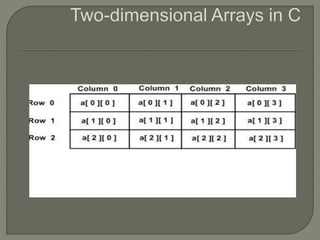
![Initializing Two-Dimensional Arrays
int a[3][4] = { {0, 1, 2, 3} , /* initializers for
{4, 5, 6, 7} ,
{8, 9, 10, 11} /* initializers for row
/* initializers for row indexed by 2 */ };](https://image.slidesharecdn.com/arrays-230713161414-4b7ded7e/85/arrays-pptx-15-320.jpg)
![Accessing Two-Dimensional Array
Elements
int val = a[2][3];](https://image.slidesharecdn.com/arrays-230713161414-4b7ded7e/85/arrays-pptx-16-320.jpg)
![For example, the following declaration
creates a three dimensional integer array −
Ex-int threedim[5][10][4];](https://image.slidesharecdn.com/arrays-230713161414-4b7ded7e/85/arrays-pptx-17-320.jpg)
![void myFunction(int param[10])
{ . . .
//Statement Excution
}
Passing Arrays as Function
Arguments in C](https://image.slidesharecdn.com/arrays-230713161414-4b7ded7e/85/arrays-pptx-18-320.jpg)
![Representation and analysis
Type variable_name[size]
Operations with arrays:
Copy
Delete
Insert
Search
Sort
Merging of sorting arrays.
Introduction to arrays](https://image.slidesharecdn.com/arrays-230713161414-4b7ded7e/85/arrays-pptx-22-320.jpg)
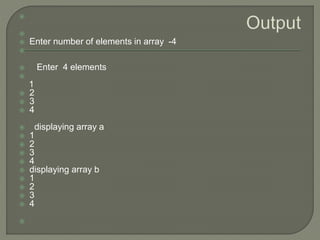
![ #include <stdio.h>
int main()
{
int a[100],b[100] position, c n;
printf("Enter number of elements in arrayn");
scanf("%d", &n);
printf("Enter %d elementsn", n);
for ( c = 0 ; c < n ; c++ )
scanf("%d", &a[c]);
printf("Enter %d elementsn", n);
for( c = 0 ; c < n - 1 ; c++ )
printf("%dn", a[c]);
//Coping the element of array a to b
for( c = 0 ; c < n - 1 ; c++ )
{
b[c]=a[c];
}
}
return 0;
}
Copy operation](https://image.slidesharecdn.com/arrays-230713161414-4b7ded7e/85/arrays-pptx-23-320.jpg)
![ #include <stdio.h>
int main()
{
int array[100], position, i, n;
printf("Enter number of elements in arrayn");
scanf("%d", &n);
printf("Enter %d elementsn", n);
for ( i = 0 ; i < n ; i++ )
scanf("%d", &array[i]);
printf("Enter the location where you wish to delete elementn");
scanf("%d", &position);
for ( i = position ; i < n; i++ )
• {
array[i] = array[i+1];
}
printf("Resultant array isn");
for( i = 0 ; i < n-1 ; i++ )
printf("%dn", array[i]);
return 0;
}
Delete operation](https://image.slidesharecdn.com/arrays-230713161414-4b7ded7e/85/arrays-pptx-25-320.jpg)
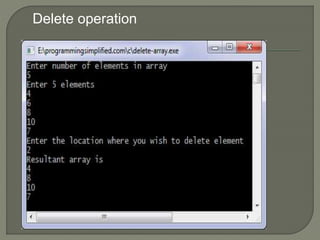
![#include <stdio.h>
int main()
{
int array[100], position, i, n, value;
printf("Enter number of elements in arrayn");
scanf("%d", &n);
printf("Enter %d elementsn", n);
for (i= 0;i< n; i++)
scanf("%d", &array[i]);
printf("Enter the location where you wish to insert an elementn");
scanf("%d", &position);
printf("Enter the value to insertn");
scanf("%d", &value);
for (i = n - 1; i >= position ; i--)
array[i+1] = array[i];
array[position] = value;
printf("Resultant array isn");
for (i= 0; i <= n; i++)
printf("%dn", array[i]);
return 0;
}
Inserting an element](https://image.slidesharecdn.com/arrays-230713161414-4b7ded7e/85/arrays-pptx-27-320.jpg)
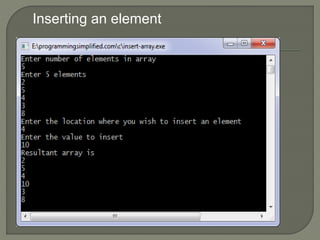
![Int a[10]={5,4,3,2,1}
for(i=0;i<n-1;i++)
{
for(j=0;j<=n-1;j++)
{
if(a[j]>a[j+1])
{
temp=a[i];
a[i]=a[j];
a[j]=temp;
}
}
Sort an array](https://image.slidesharecdn.com/arrays-230713161414-4b7ded7e/85/arrays-pptx-29-320.jpg)
![Reverse array
#include <stdio.h>
int main() {
int array[100], n, i, temp, end;
scanf("%d", &n);
end = n - 1;
for (i = 0; i < n; i++) {
scanf("%d", &array[i]);
}
for (i= 0; < n/2; i++)
{
t emp = array[i];
array[i] = array[end];
array[end] = temp;
end--;
}
printf("Reversed array elements are:n");
for ( i= 0; i < n; i++) {
printf("%dn", array[i]);
}
return 0;
}](https://image.slidesharecdn.com/arrays-230713161414-4b7ded7e/85/arrays-pptx-30-320.jpg)
![Sort element using array
int a[10]={5,4,3,2,1}
for(i=0;i<n;i++)
for(j=i+1;j<n;j++)
{
if(a[i]>a[j])
{
temp=a[i];
a[i]=a[j];
a[j]=temp;
}
}](https://image.slidesharecdn.com/arrays-230713161414-4b7ded7e/85/arrays-pptx-31-320.jpg)
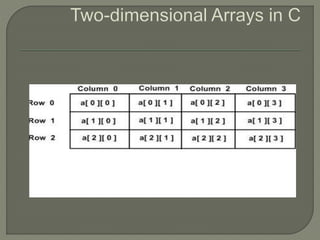
![multidimensional array is the two-dimensional
array
type arrayName [ x ][ y ];](https://image.slidesharecdn.com/arrays-230713161414-4b7ded7e/85/arrays-pptx-33-320.jpg)
![ m-no of rows
n-no of columns
Printf(“n Enter the rows and columns”);
Scanf(%d %d”,&m,&n);
for(i=0;i<m;i++)
{
• for(j=0;j<n;j++)
• {
Printf(“n Enter the value of(%d)(%d)=“,i,j);
Scanf(“%d”,&a[i][j]);
• }](https://image.slidesharecdn.com/arrays-230713161414-4b7ded7e/85/arrays-pptx-35-320.jpg)
![ For(i=0;i<m;i++)
{
• Printf(“n”);
• For(j=0;j<n;j++)
• {
printf(“%d”,&a[i][j]);
• }
}](https://image.slidesharecdn.com/arrays-230713161414-4b7ded7e/85/arrays-pptx-36-320.jpg)
![ int main ()
{ /* an array with 5 rows and 2 columns*/
int a[5][2] = { {0,0}, {1,2}, {2,4}, {3,6},{4,8}};
int i, j;
/* output each array element's value */
for ( i = 0; i < 5; i++ )
{
for ( j = 0; j < 2; j++ )
{
printf("a[%d][%d] = %dn", i,j, a[i][j] );
}
}
return 0;
}](https://image.slidesharecdn.com/arrays-230713161414-4b7ded7e/85/arrays-pptx-37-320.jpg)
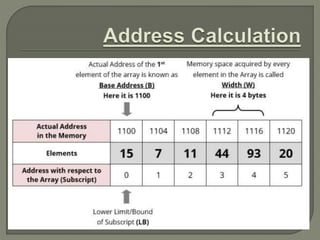
![ Array of an element of an array say “A[ I ]” is
calculated using the following formula:
Address of A [ I ] = B + W * ( I – LB )
Where,
B = Base address
W = Storage Size of one element stored in the
array (in byte)
I = Subscript of element whose address is to be
found
LB = Lower limit / Lower Bound of subscript, if not
specified assume 0 (zero)](https://image.slidesharecdn.com/arrays-230713161414-4b7ded7e/85/arrays-pptx-40-320.jpg)
![ Ex-Given the base address of an
array B[1300…..1900] as 1020 and size of each
element is 2 bytes in the memory. Find the address
of B[1700].
Solution:
The given values are: B = 1020, LB = 1300, W = 2, I
= 1700
Address of A [ I ] = B + W * ( I – LB )
= 1020 + 2 * (1700 – 1300)
= 1020 + 2 * 400
= 1020 + 800
= 1820 [Ans]](https://image.slidesharecdn.com/arrays-230713161414-4b7ded7e/85/arrays-pptx-41-320.jpg)
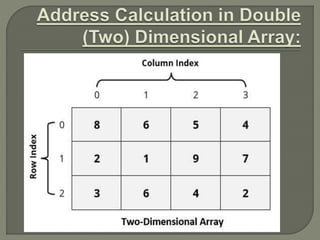
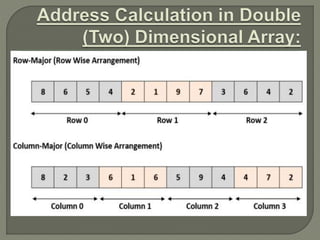
![Address of an element of any array say “A[ I ][ J
]” is calculated in two forms as given:
(1) Row Major System (2) Column Major System](https://image.slidesharecdn.com/arrays-230713161414-4b7ded7e/85/arrays-pptx-45-320.jpg)
![The address of a location in Row Major System is calculated using the
following formula:
Address of A [ I ][ J ] = B + W * [ N * ( I – Lr ) + ( J – Lc )](https://image.slidesharecdn.com/arrays-230713161414-4b7ded7e/85/arrays-pptx-46-320.jpg)
![The address of a location in Row Major System is calculated using the
following formula:
Address of A [ I ][ J ] = B + W * [ N * ( I – Lr ) + ( J – Lc )
B = Base address
I = Row subscript of element whose address is to be found
J = Column subscript of element whose address is to be found
W = Storage Size of one element stored in the array (in byte)
Lr = Lower limit of row/start row index of matrix, if not given
assume 0 (zero)
Lc = Lower limit of column/start column index of matrix, if not
given assume 0 (zero)
M = Number of row of the given matrix
N = Number of column of the given matrix](https://image.slidesharecdn.com/arrays-230713161414-4b7ded7e/85/arrays-pptx-47-320.jpg)
![Address of A [ I ][ J ] Column Major Wise = B + W * [( I – Lr ) + M * ( J
– Lc )]
Column Major System:
The address of a location in Column Major System is calculated using
the following formula:
B = Base address
I = Row subscript of element whose address is to be found
J = Column subscript of element whose address is to be found
W = Storage Size of one element stored in the array (in byte)
Lr = Lower limit of row/start row index of matrix, if not given
assume 0 (zero)
Lc = Lower limit of column/start column index of matrix, if not
given assume 0 (zero)
M = Number of row of the given matrix
N = Number of column of the given matrix](https://image.slidesharecdn.com/arrays-230713161414-4b7ded7e/85/arrays-pptx-48-320.jpg)
![Important : Usually number of rows and columns of a matrix are
given ( like A[20][30] or A[40][60] ) but if it is given as A[Lr- – – –
– Ur, Lc- – – – – Uc]. In this case number of rows and columns
are calculated using the following methods:
Number of rows (M) will be calculated as = (Ur – Lr) + 1
Number of columns (N) will be calculated as = (Uc – Lc) + 1
And rest of the process will remain same as per requirement
(Row Major Wise or Column Major Wise).](https://image.slidesharecdn.com/arrays-230713161414-4b7ded7e/85/arrays-pptx-49-320.jpg)
![Examples:
Q 1. An array X [-15……….10, 15……………40] requires one
byte of storage. If beginning location is 1500 determine the
location of X [15][20].
Solution:
As you see here the number of rows and columns are not given in
the question. So they are calculated as:
Number or rows say M = (Ur – Lr) + 1 = [10 – (- 15)] +1 = 26
Number or columns say N = (Uc – Lc) + 1 = [40 – 15)] +1 = 26](https://image.slidesharecdn.com/arrays-230713161414-4b7ded7e/85/arrays-pptx-50-320.jpg)
![(i) Column Major Wise Calculation of above equation
The given values are: B = 1500, W = 1 byte, I = 15, J =
20, Lr = -15, Lc = 15, M = 26
Address of A [ I ][ J ]
=B + W * [ ( I – Lr ) + M * ( J – Lc ) ]
= 1500 + 1 * [(15 – (-15)) + 26 * (20 – 15)] = 1500 + 1 *
[30 + 26 * 5] = 1500 + 1 * [160] = 1660 [Ans]](https://image.slidesharecdn.com/arrays-230713161414-4b7ded7e/85/arrays-pptx-51-320.jpg)
![= 1500 + 1* [26 * (15 – (-15))) + (20 – 15)]
= 1500 + 1 * [26 * 30 + 5]
= 1500 + 1 * [780 + 5]
= 1500 + 785
= 2285 [Ans]
(ii) Row Major Wise Calculation of above equation
The given values are: B = 1500, W = 1 byte, I = 15, J =
20, Lr = -15, Lc = 15, N = 26
Address of A [ I ][ J ] = B + W * [ N * ( I – Lr ) + ( J – Lc ) ]](https://image.slidesharecdn.com/arrays-230713161414-4b7ded7e/85/arrays-pptx-52-320.jpg)
![Merging of two arrays
int main()
{
int arr1[30], arr2[30], res[60];
int i, j, k, n1, n2;
printf("nEnter no of elements in 1st array :");
scanf("%d", &n1);
for (i = 0; i < n1; i++)
{
scanf("%d", &arr1[i]);
}
printf("nEnter no of elements in 2nd array :");
scanf("%d", &n2);
for (i = 0; i < n2; i++)
{
scanf("%d", &arr2[i]);
}
i = 0;
j = 0;
k = 0;
](https://image.slidesharecdn.com/arrays-230713161414-4b7ded7e/85/arrays-pptx-53-320.jpg)
![Merging of two arrays
// Merging starts
while (i < n1 && j < n2)
{
if (arr1[i] <= arr2[j])
{
res[k] = arr1[i];
i++;
k++;
}
else
{
res[k] = arr2[j];
k++;
j++;
}
}
](https://image.slidesharecdn.com/arrays-230713161414-4b7ded7e/85/arrays-pptx-54-320.jpg)
![Merging of two arrays
/* Some elements in array 'arr1' are still remaining
where as the array 'arr2' is exhausted */
while (i < n1)
{
res[k] = arr1[i];
i++;
k++;
}](https://image.slidesharecdn.com/arrays-230713161414-4b7ded7e/85/arrays-pptx-55-320.jpg)
![Merging of two arrays
/* Some elements in array 'arr2' are still remaining
where as the array 'arr1' is exhausted */
while (j < n2) {
res[k] = arr2[j];
k++;
j++;
}](https://image.slidesharecdn.com/arrays-230713161414-4b7ded7e/85/arrays-pptx-56-320.jpg)
![Merging of two arrays
//Displaying elements of array 'res'
printf("nMerged array is :");
for (i = 0; i < n1 + n2; i++)
printf("%d ", res[i]);
return (0);
}](https://image.slidesharecdn.com/arrays-230713161414-4b7ded7e/85/arrays-pptx-57-320.jpg)
![Merging of two arrays
/* Some elements in array 'arr2' are still remaining
where as the array 'arr2' is exhausted */
while (i < n2)
{
res[k] = arr2[i];
i++;
k++;
}
for(i=0;i<k;i++)
{
printf(“%d”,res[i]);
}](https://image.slidesharecdn.com/arrays-230713161414-4b7ded7e/85/arrays-pptx-58-320.jpg)