Dry Process & Modern Washing Techniques in Garment.pptx
1.
Dry Process &Modern
Washing Techniques in
Garment Finishing
Samiha Islam
Apparel engineering dept
Batch-48
ID-22010401017
2.
Garment Washing
Garment washingmeans treating finished garments (like jeans, shirts, jackets) with required chemicalsor mechanical or physical methods to change their
appearance, feel, or performance.
Two Broad Types of Garment Washing
•
Wet Process → Uses water, chemicals, or enzymes.
Ex: Stone wash, enzyme wash, bleach wash, acid wash.
•
Dry Process → No water bath; mechanical or physical effect.
Ex: Hand sanding, whiskering, grinding, laser fading.
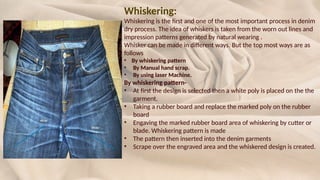
Whiskering:
Whiskering is thefirst and one of the most important process in denim
dry process. The idea of whiskers is taken from the worn out lines and
impression patterns generated by natural wearing .
Whisker can be made in different ways. But the top most ways are as
follows
• By whiskering pattern
• By Manual hand scrap.
• By using laser Machine.
By whiskering pattern-
• At first the design is selected then a white poly is placed on the the
garment.
• Taking a rubber board and replace the marked poly on the rubber
board
• Engaving the marked rubber board area of whiskering by cutter or
blade. Whiskering pattern is made
• The pattern then inserted into the denim garments
• Scrape over the engraved area and the whiskered design is created.
5.
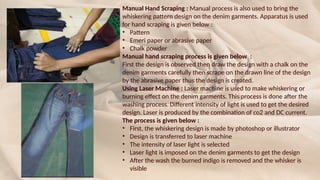
Manual Hand Scraping: Manual process is also used to bring the
whiskering pattern design on the denim garments. Apparatus is used
for hand scraping is given below :
• Pattern
• Emeri paper or abrasive paper
• Chalk powder
Manual hand scraping process is given below :
First the design is observed then draw the design with a chalk on the
denim garments carefully then scrape on the drawn line of the design
by the abrasive paper thus the design is created.
Using Laser Machine : Laser machine is used to make whiskering or
burning effect on the denim garments. This process is done after the
washing process. Different intensity of light is used to get the desired
design. Laser is produced by the combination of co2 and DC current.
The process is given below :
• First, the whiskering design is made by photoshop or illustrator
• Design is transferred to laser machine
• The intensity of laser light is selected
• Laser light is imposed on the denim garments to get the design
• After the wash the burned indigo is removed and the whisker is
visible
6.
Sand Blasting:
Sand blastingis the process of scrubbing off the garment by blowing high-speed air mixed with very fine particles of sand. The
friction from the sand removes the indigo dye and gave a worn-out, vintage, or distressed look.
During the process, denim garments are first gone through with stone washing to get the desired degree of washing. A solution of
sodium hypochlorite or potassium permanganate is often sprayed on the desired area of the garment in order to obtain the same
look. Then it is neutralised, rinsed, softened and dried. Sand blasting is a water free process and, therefore, no drying is required.
Sand Blasting process:
1. The individual garment to be processed is put on a table.
2. An air compressor is started and pressure is maintained at 3–4 kg/cm2
3. The air compressor then stores air in the machine’s cylinder.
4. Aluminum sand or silicon sand [Al2(SiO4)3] is then put in the
chamber of the blasting machine.
5. Sand and compressed air are then sprayed over the garments at
specific points at a 10–200 degrees angle by a hand spray pipe.
6. Sand passes into the machine by a regulating system.
7. The machine is composed of a blasting regulator and a hand
regulator to control the amount of sand and compressed air,
respectively.
8. The angle of sand blowing is important. The higher the blowing
angle, the higher the fading effect is and higher the risk is of fabric
damage.
9. Fading is done on premarked areas.
7.
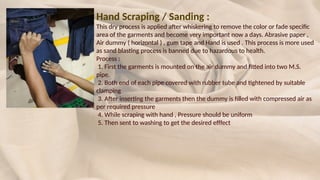
Hand Scraping /Sanding :
This dry process is applied after whiskering to remove the color or fade specific
area of the garments and become very important now a days. Abrasive paper ,
Air dummy ( horizontal ) , gum tape and Hand is used . This process is more used
as sand blasting process is banned due to hazardous to health.
Process :
1. First the garments is mounted on the air dummy and fitted into two M.S.
pipe.
2. Both end of each pipe covered with rubber tube and tightened by suitable
clamping
3. After inserting the garments then the dummy is filled with compressed air as
per required pressure
4. While scraping with hand , Pressure should be uniform
5. Then sent to washing to get the desired efffect
8.
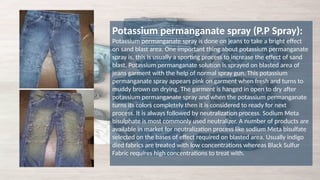
Potassium permanganate spray(P.P Spray):
Potassium permanganate spray is done on jeans to take a bright effect
on sand blast area. One important thing about potassium permanganate
spray is, this is usually a sporting process to increase the effect of sand
blast. Potassium permanganate solution is sprayed on blasted area of
jeans garment with the help of normal spray gun. This potassium
permanganate spray appears pink on garment when fresh and turns to
muddy brown on drying. The garment is hanged in open to dry after
potassium permanganate spray and when the potassium permanganate
turns its colors completely then it is considered to ready for next
process. It is always followed by neutralization process. Sodium Meta
bisulphate is most commonly used neutralizer. A number of products are
available in market for neutralization process like sodium Meta bisulfate
selected on the bases of effect required on blasted area. Usually indigo
died fabrics are treated with low concentrations whereas Black Sulfur
Fabric requires high concentrations to treat with.
9.
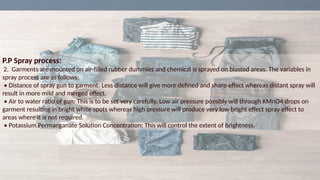
P.P Spray process:
2.Garments are mounted on air-filled rubber dummies and chemical is sprayed on blasted areas. The variables in
spray process are as follows:
• Distance of spray gun to garment: Less distance will give more defined and sharp effect whereas distant spray will
result in more mild and merged effect.
• Air to water ratio of gun: This is to be set very carefully. Low air pressure possibly will through KMnO4 drops on
garment resulting in bright white spots whereas high pressure will produce very low bright effect spray effect to
areas where it is not required.
• Potassium Permanganate Solution Concentration: This will control the extent of brightness.
10.
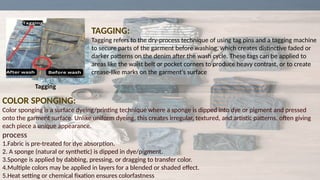
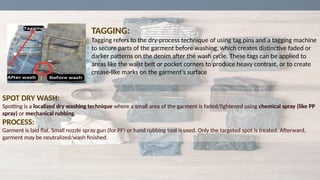
TAGGING:
Tagging refers tothe dry-process technique of using tag pins and a tagging machine
to secure parts of the garment before washing, which creates distinctive faded or
darker patterns on the denim after the wash cycle. These tags can be applied to
areas like the waist belt or pocket corners to produce heavy contrast, or to create
crease-like marks on the garment's surface
COLOR SPONGING:
Color sponging is a surface dyeing/printing technique where a sponge is dipped into dye or pigment and pressed
onto the garment surface. Unlike uniform dyeing, this creates irregular, textured, and artistic patterns, often giving
each piece a unique appearance.
process
1.Fabric is pre-treated for dye absorption.
2. A sponge (natural or synthetic) is dipped in dye/pigment.
3.Sponge is applied by dabbing, pressing, or dragging to transfer color.
4.Multiple colors may be applied in layers for a blended or shaded effect.
5.Heat setting or chemical fixation ensures colorfastness
Tagging
11.
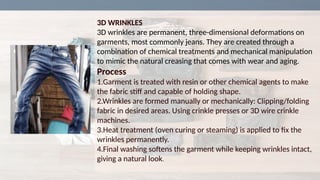
3D WRINKLES
3D wrinklesare permanent, three-dimensional deformations on
garments, most commonly jeans. They are created through a
combination of chemical treatments and mechanical manipulation
to mimic the natural creasing that comes with wear and aging.
Process
1.Garment is treated with resin or other chemical agents to make
the fabric stiff and capable of holding shape.
2.Wrinkles are formed manually or mechanically: Clipping/folding
fabric in desired areas. Using crinkle presses or 3D wire crinkle
machines.
3.Heat treatment (oven curing or steaming) is applied to fix the
wrinkles permanently.
4.Final washing softens the garment while keeping wrinkles intact,
giving a natural look.
12.
TAGGING:
Tagging refers tothe dry-process technique of using tag pins and a tagging machine
to secure parts of the garment before washing, which creates distinctive faded or
darker patterns on the denim after the wash cycle. These tags can be applied to
areas like the waist belt or pocket corners to produce heavy contrast, or to create
crease-like marks on the garment's surface
SPOT DRY WASH:
Spotting is a localized dry washing technique where a small area of the garment is faded/lightened using chemical spray (like PP
spray) or mechanical rubbing.
PROCESS:
Garment is laid flat. Small nozzle spray gun (for PP) or hand rubbing tool is used. Only the targeted spot is treated. Afterward,
garment may be neutralized/wash finished.
13.
RUBBING:
Rubbing is amanual process where a piece of emery paper, abrasive material, or sponge is rubbed on garment
surfaces to make them look slightly faded or highlighted. Rubbing process is done by putting garments on a
dummy or flat table. Sponge, emery paper, or rubberized abrasive is rubbed on the desired area.Fading intensity
depends on pressure and rubbing duration.
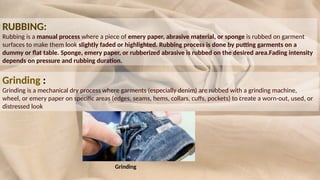
Grinding :
Grinding is a mechanical dry process where garments (especially denim) are rubbed with a grinding machine,
wheel, or emery paper on specific areas (edges, seams, hems, collars, cuffs, pockets) to create a worn-out, used, or
distressed look
Grinding
14.
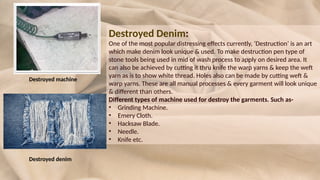
Destroyed Denim:
One ofthe most popular distressing effects currently, ‘Destruction’ is an art
which make denim look unique & used. To make destruction pen type of
stone tools being used in mid of wash process to apply on desired area. It
can also be achieved by cutting it thru knife the warp yarns & keep the weft
yarn as is to show white thread. Holes also can be made by cutting weft &
warp yarns. These are all manual processes & every garment will look unique
& different than others.
Different types of machine used for destroy the garments. Such as-
• Grinding Machine.
• Emery Cloth.
• Hacksaw Blade.
• Needle.
• Knife etc.
Destroyed machine
Destroyed denim
15.
Process of DestroyedDenim:
1. We can make holes in jeans by overdoing different methods. The trick is to make the holes look natural. Grind
away at the fabric slowly. Try not to localize the worn area, spread it with diminishing wear the further we get
from the intended hole.
2. The area around the hole should be worn out as well as bleached to further blend the hole with the surrounding
fabric. “Finish” the edges with a pumice stone or sandpaper dampened in bleach. Also dampening a sponge with
bleach and applying it to the outer edges of the hole will add to the natural worn look.
3. Ripped jeans are a bit different. The rip is not necessarily from wear, and should not look the same as a worn out
hole.
4. It is important that what types of look we want to see on our denim. It is recommend to use a sharp pocket knife.
Be careful, they are very sharp. Rub the blade of the knife perpendicular to the line of the rip that we want.
Continue until we create a slit, and then fray the edges, exposing the threads that are perpendicular to the rip. Do
this until the hole is the size that we want and the edges are fuzzy. A wash and a dry will further mess up the
edge. To some extent this will control further fraying.
5. To reinforce this newly created hole, turn your pants inside out and place an adequately cut piece of fabric around
it and sew it. An iron on will work as well, but the stitching, done either by hand or with a sewing machine, will
make it look much better.
6. It is preferred that not too many holes, 3 to 5 should be enough. The current trend, however, seems to be for
smaller holes
16.
OZONE WASH
Ozone washis a revolutionary laundering process that uses a powerful oxidizing gas called ozone. Ozone laundry
systems create ozone by combining oxygen and electricity. The ozone is then dissolved in the washing water.
When the ozone water comes into contact with organic materials in your laundry, it destroys (or “oxidizes”) them.
That includes bacteria, viruses, mold, or other microorganisms. Ozone also breaks up many inorganic materials,
including soils and greases. This makes it easier for water to remove these contaminants from your laundry and wash
them away
OZONE Wash Process:
• Ozone is generated on-site using an ozone laundry system, which dissolves the gas into cold water.
• The ozone-infused water is used in the wash cycle, where it oxidizes and destroys contaminants like bacteria,
mold, and soils.
• The process operates at cold temperatures, reducing energy consumption.
• After washing, any residual ozone converts back to oxygen, leaving no chemical residues on the fabrics
M O D E R N W A S H I N G T E C H N I Q U E S
17.
Ice Wash (SnowWash/Acid Wash)
Ice wash, also known as snow wash or acid wash, is a denim finishing technique that creates sharp tonal contrasts
and a frosted appearance on garments. It involves tumbling denim with pumice stones soaked in bleaching agents
(e.g., potassium permanganate or sodium hypochlorite) to selectively remove dye from the fabric surface.
Process:
• Pumice stones are soaked in a bleaching solution (e.g., potassium permanganate or sodium hypochlorite) for
1–2 hours.
• The soaked stones are drained to remove excess liquor.
• Denim garments (scoured and dry/damp) are tumbled with the stones in a rotary machine for 10–30 minutes
to achieve the desired contrast.
• After tumbling, garments are treated with reducing agents (e.g., sodium bisulfite) to remove residual
bleaching chemicals.
• Finally, the garments are rinsed, softened, and dried
Ultrasonic wash
Ultrasonic Wash is a cleaning technique that uses high-frequency sound waves (20–40 kHz) to generate cavitation
bubbles in a liquid. When these bubbles implode, they produce intense scrubbing forces that remove dirt and
contaminants from fabrics without mechanical agitation, making it ideal for delicate materials. Process: Immerse
garments in a cleaning solution (water or solvent-based). Ultrasonic transducers generate high-frequency sound
waves, creating cavitation bubbles. Bubbles implode near the fabric, dislodging dirt, oils, and contaminants. Process
lasts 3–6 minutes, optionally with heated solution (135–150°F) for better efficiency. Rinse and dry garments; note
18.
Ultrasonic Wash
Definition: Ultrasonicwash uses high-frequency sound waves (typically 20–40 kHz) to create cavitation bubbles in a
liquid medium, which implode and generate intense scrubbing forces. This method effectively removes
contaminants from fabrics without mechanical agitation, making it suitable for delicate materials.
Process:
Garments are immersed in a tank filled with a cleaning solution (water or solvent-based).
Ultrasonic transducers generate sound waves, creating microscopic cavitation bubbles in the solution.
The bubbles implode near the fabric surface, dislodging dirt, oils, and other contaminants.
The process typically takes 3–6 minutes and may involve heated solutions (135–150°F) for better efficiency.
After cleaning, garments are rinsed and dried. Note: Ultrasonic cleaning does not sterilize fabric
Nano Wash
Definition: Nano wash refers to cleaning processes that utilize nanotechnology, such as nanobubbles or nano-sized
particles, to enhance cleaning efficiency. In garments, it often involves the use of ozone-filled nanobubbles to
penetrate fabrics and remove contaminants at a microscopic level, offering deep cleaning without harsh chemicals
Process:
• Ozone-filled nanobubbles are generated and infused into the washing water.
• The nanobubbles penetrate fabric fibers, where they collapse and release energy, disrupting and removing
contaminants like bacteria, biofilms, and oils.
• The process operates at cold temperatures and requires minimal detergents.
• After washing, any residual ozone auto-decomposes into oxygen, leaving no harmful residue
19.
Plasma Wash
Definition: Plasmawash uses ionized gas (plasma) to clean and modify fabric surfaces. The plasma contains reactive
species (e.g., ions, electrons, UV light) that break down organic contaminants and enhance surface properties, such
as adhesion and hydrophilicity, without wet chemicals.
Process:
Garments are placed in a low-pressure chamber filled with gas (e.g., oxygen, argon).
Electrical energy is applied to ionize the gas, creating plasma.
The reactive plasma species interact with the fabric surface, breaking down contaminants and/or adding
functional groups.
The process is low-temperature and eco-friendly, as it produces minimal waste.
After treatment, garments may exhibit improved dyeability, print adhesion, or antimicrobial properties
Laser fading
Laser Fading in garments, especially denim, uses high-intensity laser beams to selectively remove surface dyes
and fibers, creating a worn, distressed look. Unlike traditional methods such as sandblasting, it reduces water
use, eliminates harmful chemicals, and minimizes manual labor, making it more sustainable and efficient. CO₂
lasers follow digital patterns to achieve precise designs, and garments are washed afterward to remove ash and
complete the finish.
20.
💧 Nano BubbleWashing Technology
Definition: Nano bubble washing uses ozone-filled nanobubbles (extremely small gaseous
cavities) to clean and disinfect fabrics. The nanobubbles exhibit unique properties, such as high
stability and efficient mass transfer, enabling deep penetration into fibers for thorough
cleaning.
Process:
Ozone nanobubbles are generated and dissolved in washing water.
The nanobubble-infused water is used in the wash cycle, where the bubbles collapse and
release oxidative energy, breaking down contaminants like bacteria, viruses, and biofilms.
The process operates at cold temperatures and reduces the need for detergents.
After washing, residual ozone decomposes into oxygen, making the process
environmentally safe
![Sand Blasting:
Sand blasting is the process of scrubbing off the garment by blowing high-speed air mixed with very fine particles of sand. The
friction from the sand removes the indigo dye and gave a worn-out, vintage, or distressed look.
During the process, denim garments are first gone through with stone washing to get the desired degree of washing. A solution of
sodium hypochlorite or potassium permanganate is often sprayed on the desired area of the garment in order to obtain the same
look. Then it is neutralised, rinsed, softened and dried. Sand blasting is a water free process and, therefore, no drying is required.
Sand Blasting process:
1. The individual garment to be processed is put on a table.
2. An air compressor is started and pressure is maintained at 3–4 kg/cm2
3. The air compressor then stores air in the machine’s cylinder.
4. Aluminum sand or silicon sand [Al2(SiO4)3] is then put in the
chamber of the blasting machine.
5. Sand and compressed air are then sprayed over the garments at
specific points at a 10–200 degrees angle by a hand spray pipe.
6. Sand passes into the machine by a regulating system.
7. The machine is composed of a blasting regulator and a hand
regulator to control the amount of sand and compressed air,
respectively.
8. The angle of sand blowing is important. The higher the blowing
angle, the higher the fading effect is and higher the risk is of fabric
damage.
9. Fading is done on premarked areas.](https://image.slidesharecdn.com/dryprocessmodernwashingtechniquesingarment-251203152431-35324f29/85/Dry-Process-Modern-Washing-Techniques-in-Garment-pptx-6-320.jpg)