Derive Value from Excellence…
G -
Drug Development Process
By- Kavita Dargan
Derive Value from Excellence…
Agenda
 Introduction
 Life Cycle of Drug Development
Pre-discovery
Drug discovery
IND Application
Phase 1 to 3 of Clinical Trials
NDA Application
Phase 4 of Clinical Trials
 Stages, Sponsors & Stakeholders involved
 Where does trial take place?
 Questions?
Derive Value from Excellence…
Introduction
 What is Drug?
 Any chemical compound which produces change in the body which has
potential use in diagnosis or treatment of disease. They are selected in
their actions.
 Why are new drug needed?
 Unmet medical need
New diseases
 Low efficacy and side effects of already available drug
Cost of therapy
Patent expiry
Derive Value from Excellence…
Introduction Contd.
 What is Drug Development?
 It is the process of demonstrating a molecule with desired biological
effects, to be safe and effective for the use in humans and preparing it for
commercial-scale manufacture.
 Some facts
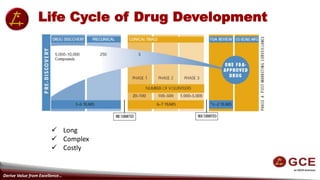
 Costs more than $800 million to discover and develop drug
 Molecule to market – 10 to 15 years
 One out of 10,000 drug candidates reach the market
Derive Value from Excellence…
Life Cycle of Drug Development
 Long
 Complex
 Costly
Derive Value from Excellence…
Pre-discovery
 Basic understanding of the cause of disease is explored.
 After identifying a disease, scientists look for the following
 Unravel the underlying cause of the condition
 Understands how the genes are altered
 How that affects the proteins they encode
 How these proteins interact with each other
 How those affected cells change the specific tissue
 How the disease affects the entire patient
Derive Value from Excellence…
Drug-discovery
 It is a research process that identifies new molecules with
desired biological effects and thus act as new therapeutic drugs.
Process
 It begins long before clinical testing.
 It starts with the identification of a drug then identification of
compound.
 Compounds are then screened in laboratory for their ability to
affect.
 They are also screened to check that they do not interface with
other.
Derive Value from Excellence…
Pre-Clinical
 Evaluate acute and short-term toxicity in animals by
 Giving dose at increasing high levels to induce toxicity
 Determine lethal dose
 Giving dose at normal levels for short and long term
 Assess how drug is absorbed, distributed, metabolized and
excreted in animals.
To see if treatment really works and if it is safe to test on humans.
Derive Value from Excellence…
IND Application
 It stands for Investigational new drug.
In this process, request is submitted to FDA to allow human
exposure to the drug identified.
 Application consists of
 Results of pre-clinical.
 Proposed plans for study in humans
 Regulatory agencies review the specific tests and
documentation.
Derive Value from Excellence…
Phase 1 Clinical Trials
 Small number (20-100) healthy volunteers.
Determines safety and maximum tolerated dose on human.
 Take approx. 1 year.
 Submit update to regulatory agencies.
Derive Value from Excellence…
Phase 2 Clinical Trials
 100-300 patients who have disease.
Determines efficacy.
 Take approx. 2 year.
 Submit update to regulatory agencies.
Derive Value from Excellence…
Phase 3 Clinical Trials
 Large patients (1000 to 3000).
Confirm earlier efficacy results.
Determine long term safety by identifying side effects which
occur when the drug is given to large population over a long
period of time.
 Take approx. 3 year to 6 years.
 Submit update to regulatory agencies.
Derive Value from Excellence…
New Drug Application (NDA)
 If the results of all the previous results are positive, NDA is
submitted.
Application consists of all the information gathered during pre-
clinical to phase 3.
Application also consists of manufacturing and labeling details.
 Can take 2-3 years for FDA to review.
Derive Value from Excellence…
Phase 4 Clinical Trials
 Also called post-marketing trials.
Much larger number of patients use the drug.
Requires to monitor carefully and submit periodic reports,
including side effects to FDA.
Research on new medicine continues even after approval.
Derive Value from Excellence…
Stages in Clinical Trials
Derive Value from Excellence…
Sponsors in Clinical Trials
 Pharmaceutical companies
Medical institutions.
Voluntary groups.
Physicians
 Federal agencies eg National Institutes of Health
Derive Value from Excellence…
Stakeholders in Clinical Trials
Research Institutes
&
Pharma Company
R&D Units
Regulatory
Authorities
Sponsor
Site Management
Organization
(SMO)
Ethics Committee Research Site
Contract
Research
Organization
(CRO)
Scientists
Regulatory Experts
Statistician
Investigator
Safety Manager
Regulatory Manager
Data Manager
Clinical Research Coordinator
Derive Value from Excellence…
Where does trials take place?
Questions

Drug Development Process

  • 1.
    Derive Value fromExcellence… G - Drug Development Process By- Kavita Dargan
  • 2.
    Derive Value fromExcellence… Agenda  Introduction  Life Cycle of Drug Development Pre-discovery Drug discovery IND Application Phase 1 to 3 of Clinical Trials NDA Application Phase 4 of Clinical Trials  Stages, Sponsors & Stakeholders involved  Where does trial take place?  Questions?
  • 3.
    Derive Value fromExcellence… Introduction  What is Drug?  Any chemical compound which produces change in the body which has potential use in diagnosis or treatment of disease. They are selected in their actions.  Why are new drug needed?  Unmet medical need New diseases  Low efficacy and side effects of already available drug Cost of therapy Patent expiry
  • 4.
    Derive Value fromExcellence… Introduction Contd.  What is Drug Development?  It is the process of demonstrating a molecule with desired biological effects, to be safe and effective for the use in humans and preparing it for commercial-scale manufacture.  Some facts  Costs more than $800 million to discover and develop drug  Molecule to market – 10 to 15 years  One out of 10,000 drug candidates reach the market
  • 5.
    Derive Value fromExcellence… Life Cycle of Drug Development  Long  Complex  Costly
  • 6.
    Derive Value fromExcellence… Pre-discovery  Basic understanding of the cause of disease is explored.  After identifying a disease, scientists look for the following  Unravel the underlying cause of the condition  Understands how the genes are altered  How that affects the proteins they encode  How these proteins interact with each other  How those affected cells change the specific tissue  How the disease affects the entire patient
  • 7.
    Derive Value fromExcellence… Drug-discovery  It is a research process that identifies new molecules with desired biological effects and thus act as new therapeutic drugs. Process  It begins long before clinical testing.  It starts with the identification of a drug then identification of compound.  Compounds are then screened in laboratory for their ability to affect.  They are also screened to check that they do not interface with other.
  • 8.
    Derive Value fromExcellence… Pre-Clinical  Evaluate acute and short-term toxicity in animals by  Giving dose at increasing high levels to induce toxicity  Determine lethal dose  Giving dose at normal levels for short and long term  Assess how drug is absorbed, distributed, metabolized and excreted in animals. To see if treatment really works and if it is safe to test on humans.
  • 9.
    Derive Value fromExcellence… IND Application  It stands for Investigational new drug. In this process, request is submitted to FDA to allow human exposure to the drug identified.  Application consists of  Results of pre-clinical.  Proposed plans for study in humans  Regulatory agencies review the specific tests and documentation.
  • 10.
    Derive Value fromExcellence… Phase 1 Clinical Trials  Small number (20-100) healthy volunteers. Determines safety and maximum tolerated dose on human.  Take approx. 1 year.  Submit update to regulatory agencies.
  • 11.
    Derive Value fromExcellence… Phase 2 Clinical Trials  100-300 patients who have disease. Determines efficacy.  Take approx. 2 year.  Submit update to regulatory agencies.
  • 12.
    Derive Value fromExcellence… Phase 3 Clinical Trials  Large patients (1000 to 3000). Confirm earlier efficacy results. Determine long term safety by identifying side effects which occur when the drug is given to large population over a long period of time.  Take approx. 3 year to 6 years.  Submit update to regulatory agencies.
  • 13.
    Derive Value fromExcellence… New Drug Application (NDA)  If the results of all the previous results are positive, NDA is submitted. Application consists of all the information gathered during pre- clinical to phase 3. Application also consists of manufacturing and labeling details.  Can take 2-3 years for FDA to review.
  • 14.
    Derive Value fromExcellence… Phase 4 Clinical Trials  Also called post-marketing trials. Much larger number of patients use the drug. Requires to monitor carefully and submit periodic reports, including side effects to FDA. Research on new medicine continues even after approval.
  • 15.
    Derive Value fromExcellence… Stages in Clinical Trials
  • 16.
    Derive Value fromExcellence… Sponsors in Clinical Trials  Pharmaceutical companies Medical institutions. Voluntary groups. Physicians  Federal agencies eg National Institutes of Health
  • 17.
    Derive Value fromExcellence… Stakeholders in Clinical Trials Research Institutes & Pharma Company R&D Units Regulatory Authorities Sponsor Site Management Organization (SMO) Ethics Committee Research Site Contract Research Organization (CRO) Scientists Regulatory Experts Statistician Investigator Safety Manager Regulatory Manager Data Manager Clinical Research Coordinator
  • 18.
    Derive Value fromExcellence… Where does trials take place?
  • 19.