DRUG DELIVERY
Presented by:
Wasim Nawaj
Ashwini Kumar
Sunil Kumar Patel
Rohan Jena
Department of Chemistry
IIT GUWAHATI 1
Contents
 Introduction
 Conventional and novel drug delivery methods
 Peptide drug delivery system
 liposome drug delivery system
 nanocomposite drug delivery system
 conclusion
2
Introduction
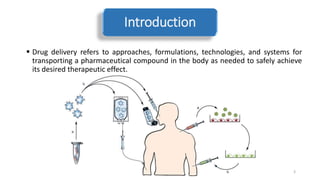
 Drug delivery refers to approaches, formulations, technologies, and systems for
transporting a pharmaceutical compound in the body as needed to safely achieve
its desired therapeutic effect.
3
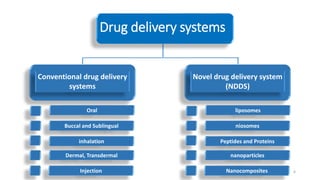
Conventional drug delivery
systems
Drug delivery systems
Novel drug delivery system
(NDDS)
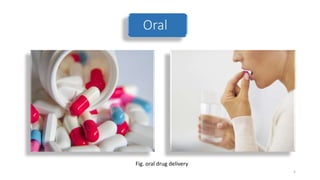
Oral
Buccal and Sublingual
inhalation
Dermal, Transdermal
Injection
liposomes
niosomes
Peptides and Proteins
nanoparticles
Nanocomposites 4
Oral
Fig. oral drug delivery
5
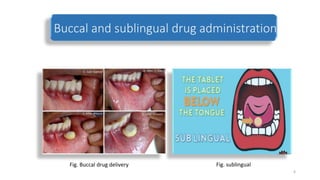
Buccal and sublingual drug administration
Fig. Buccal drug delivery Fig. sublingual
6
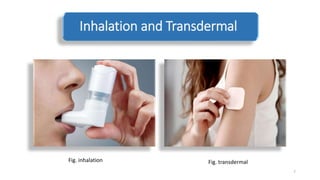
Inhalation and Transdermal
Fig. inhalation Fig. transdermal
7
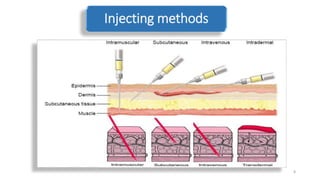
Injecting methods
8
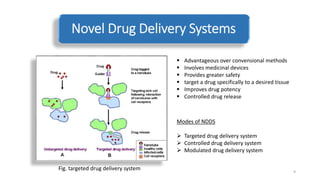
Novel Drug Delivery Systems
 Advantageous over convensional methods
 Involves medicinal devices
 Provides greater safety
 target a drug specifically to a desired tissue
 Improves drug potency
 Controlled drug release
Modes of NDDS
 Targeted drug delivery system
 Controlled drug delivery system
 Modulated drug delivery system
Fig. targeted drug delivery system 9
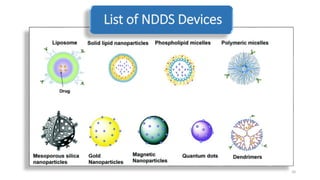
List of NDDS Devices
10
LIPOSOMES
TARGETED DRUG DELIVERY
11
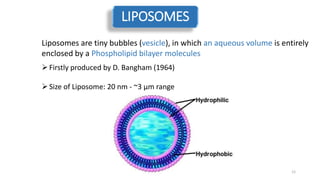
LIPOSOMES
Liposomes are tiny bubbles (vesicle), in which an aqueous volume is entirely
enclosed by a Phospholipid bilayer molecules
Firstly produced by D. Bangham (1964)
Size of Liposome: 20 nm - ~3 µm range
12
MECHANISM OF LIPOSOME
FUNCTIONING
13
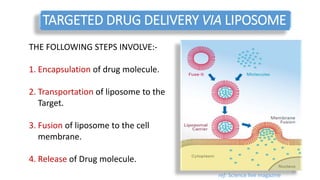
TARGETED DRUG DELIVERY VIA LIPOSOME
THE FOLLOWING STEPS INVOLVE:-
1. Encapsulation of drug molecule.
2. Transportation of liposome to the
Target.
3. Fusion of liposome to the cell
membrane.
4. Release of Drug molecule.
ref: Science live magazine
14
WAYS OF DRUG DELIVERY SYSTEM
1. CONVENTIONAL LIPOSOME
These are first generation of liposomes, consist of cationic, anionic or neutral
phospholipids.
2. STERICALLY-STABILIZED LIPOSOMES

Attachment of hydrophilic polymer (e.g. poly-ethylene glycol, PEG), which
improves the efficacy of encapsulated agents
3. LIGAND-TARGETED LIPOSOMES
Offer a site-specific delivery of drugs to organs in vivo (inside living organisms)
4. THERANAUSTIC LIPOSOMES
A single system consist of nanoparticle, a targeting element, an imaging
component and a therapeutic component
(L. Sercombe, Frontiers in Pharmacology, 6, 2015)
15
FIGURE : Schematic representation of the different types of liposomal drug delivery systems 16
1. Liposomes are biocompatible, completely biodegradable, non-toxic
and flexible.
2. Liposomes have both a lipophilic and aqueous environment making it
useful for delivering hydrophobic, amphipathic, and hydrophilic
medicines.
3. Liposomes with their layers encapsulates the drug and serves as a
protection of the drug from the environment as well as acting as a
sustained release mechanism.
4. Liposomes are also used in gene therapy.
17
ADVANTAGES
PEPTIDE DRUG DELIVERY SYSTEMS
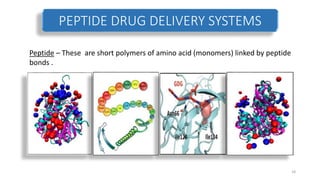
Peptide – These are short polymers of amino acid (monomers) linked by peptide
bonds .
18
Targeted Delivery of Cell Penetrating Peptide
Virus-like Nanoparticles to Skin Cancer Cells
• The main aim of this study was to screen for a cell penetrating peptide (CPP) for
the development of a targeting vector for skin cancer. In this study, we identiied
a CPP with the sequence NRPDSAQFWLHH from aphage displayed peptide
library.
• This CPP targeted the human squamous carcinoma A431 cells through an
interaction with the epidermal growth factor receptor (EGFr).
• Methyl-ß-cyclodextrin (MßCD) and chlorpromazine hydrochloride (CPZ)
inhibited the internalisation of the CPP into the A431 cells, suggesting the
peptide entered the cells via clathrin-dependent endocytosis.
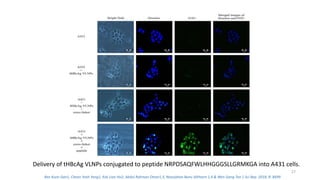
• The CPP displayed on hepatitis B virus-like nanoparticles (VLNPs) via the nanoglue
successfully delivered the nanoparticles into A431 cells. The present study
demonstrated that the novel CPP can serve as a ligand to target and deliver VLNPs
into skin cancer cells. 19
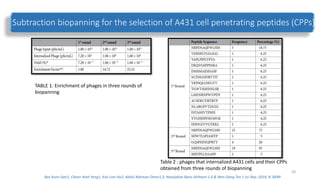
Subtraction biopanning for the selection of A431 cell penetrating peptides (CPPs).
TABLE 1: Enrichment of phages in three rounds of
biopanning
Table 2 : phages that internalized A431 cells and their CPPs
obtained from three rounds of biopanning
20
Bee Koon Gan1, Chean Yeah Yong1, Kok Lian Ho2, Abdul Rahman Omar1,3, Noorjahan Banu Alitheen 1,4 & Wen Siang Tan 1 Sci Rep. 2018; 8: 8499
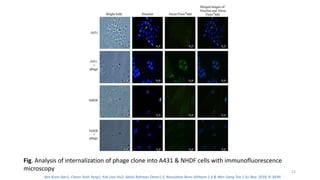
Fig. Analysis of internalization of phage clone into A431 & NHDF cells with immunofluorescence
microscopy 21
Bee Koon Gan1, Chean Yeah Yong1, Kok Lian Ho2, Abdul Rahman Omar1,3, Noorjahan Banu Alitheen 1,4 & Wen Siang Tan 1 Sci Rep. 2018; 8: 8499
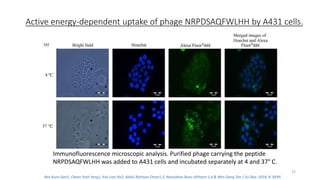
Active energy-dependent uptake of phage NRPDSAQFWLHH by A431 cells.
Immunofluorescence microscopic analysis. Purified phage carrying the peptide
NRPDSAQFWLHH was added to A431 cells and incubated separately at 4 and 37° C.
22
Bee Koon Gan1, Chean Yeah Yong1, Kok Lian Ho2, Abdul Rahman Omar1,3, Noorjahan Banu Alitheen 1,4 & Wen Siang Tan 1 Sci Rep. 2018; 8: 8499
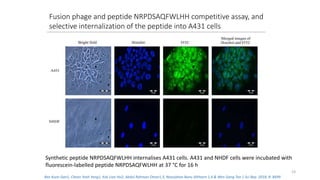
Fusion phage and peptide NRPDSAQFWLHH competitive assay, and
selective internalization of the peptide into A431 cells
Synthetic peptide NRPDSAQFWLHH internalises A431 cells. A431 and NHDF cells were incubated with
fluorescein-labelled peptide NRPDSAQFWLHH at 37 °C for 16 h
23
Bee Koon Gan1, Chean Yeah Yong1, Kok Lian Ho2, Abdul Rahman Omar1,3, Noorjahan Banu Alitheen 1,4 & Wen Siang Tan 1 Sci Rep. 2018; 8: 8499
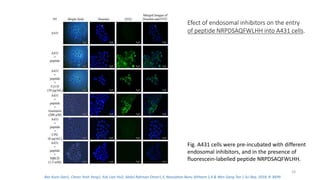
Efect of endosomal inhibitors on the entry
of peptide NRPDSAQFWLHH into A431 cells.
Fig. A431 cells were pre-incubated with different
endosomal inhibitors, and in the presence of
fluorescein-labelled peptide NRPDSAQFWLHH.
24
Bee Koon Gan1, Chean Yeah Yong1, Kok Lian Ho2, Abdul Rahman Omar1,3, Noorjahan Banu Alitheen 1,4 & Wen Siang Tan 1 Sci Rep. 2018; 8: 8499
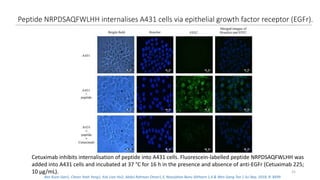
Peptide NRPDSAQFWLHH internalises A431 cells via epithelial growth factor receptor (EGFr).
Cetuximab inhibits internalisation of peptide into A431 cells. Fluorescein-labelled peptide NRPDSAQFWLHH was
added into A431 cells and incubated at 37 °C for 16 h in the presence and absence of anti-EGFr (Cetuximab 225;
10 μg/mL). 25
Bee Koon Gan1, Chean Yeah Yong1, Kok Lian Ho2, Abdul Rahman Omar1,3, Noorjahan Banu Alitheen 1,4 & Wen Siang Tan 1 Sci Rep. 2018; 8: 8499
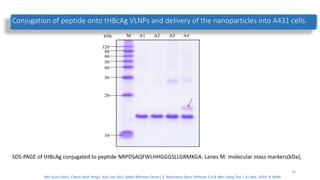
Conjugation of peptide onto tHBcAg VLNPs and delivery of the nanoparticles into A431 cells.
SDS-PAGE of tHBcAg conjugated to peptide NRPDSAQFWLHHGGGSLLGRMKGA. Lanes M: molecular mass markers(kDa),
26
Bee Koon Gan1, Chean Yeah Yong1, Kok Lian Ho2, Abdul Rahman Omar1,3, Noorjahan Banu Alitheen 1,4 & Wen Siang Tan 1 Sci Rep. 2018; 8: 8499
Delivery of tHBcAg VLNPs conjugated to peptide NRPDSAQFWLHHGGGSLLGRMKGA into A431 cells.
27
Bee Koon Gan1, Chean Yeah Yong1, Kok Lian Ho2, Abdul Rahman Omar1,3, Noorjahan Banu Alitheen 1,4 & Wen Siang Tan 1 Sci Rep. 2018; 8: 8499
Nanoscience and drug delivery
- small particles for big problems
28
 Nanocomposites are broad range of materials consisting of two or more components
with at least one component having dimension in the nm range.
 In composite materials, one phase is usually continuous and called the matrix, while the
other phase called the dispersed phase.
 i.e Nano sized particles (metals/semiconductors/dielectrics etc) embedded in different
matrix materials (ceramics/glass/polymers).
Why nanocomposites ?
 Exhibit different (often enhanced) properties than the individual components
 Electrical, magnetic,
 electrochemical,
 catalytic, optical,
 structural, and
 mechanical properties
Nanocomposites
29
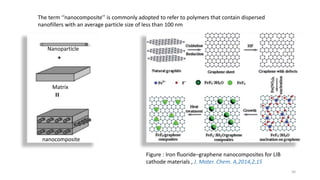
Figure : Iron fluoride–graphene nanocomposites for LIB
cathode materials , J. Mater. Chem. A,2014,2,15
Nanoparticle
Matrix
nanocomposite
The term ‘‘nanocomposite’’ is commonly adopted to refer to polymers that contain dispersed
nanofillers with an average particle size of less than 100 nm
30
Nanoparticle vs Nanocomposite
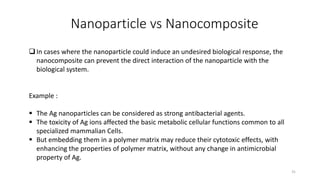
In cases where the nanoparticle could induce an undesired biological response, the
nanocomposite can prevent the direct interaction of the nanoparticle with the
biological system.
Example :
 The Ag nanoparticles can be considered as strong antibacterial agents.
 The toxicity of Ag ions affected the basic metabolic cellular functions common to all
specialized mammalian Cells.
 But embedding them in a polymer matrix may reduce their cytotoxic effects, with
enhancing the properties of polymer matrix, without any change in antimicrobial
property of Ag.
31
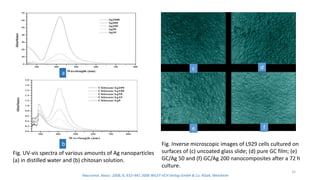
Fig. UV-vis spectra of various amounts of Ag nanoparticles
(a) in distilled water and (b) chitosan solution.
Macromol. Biosci. 2008, 8, 932–941 2008 WILEY-VCH Verlag GmbH & Co. KGaA, Weinheim
32
a
b Fig. Inverse microscopic images of L929 cells cultured on
surfaces of (c) uncoated glass slide; (d) pure GC film; (e)
GC/Ag 50 and (f) GC/Ag 200 nanocomposites after a 72 h
culture.
c d
fe
Hydrogel Nanocomposites
Remotely Controlled Drug Delivery System
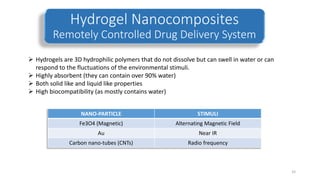
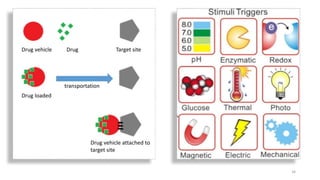
 Hydrogels are 3D hydrophilic polymers that do not dissolve but can swell in water or can
respond to the fluctuations of the environmental stimuli.
 Highly absorbent (they can contain over 90% water)
 Both solid like and liquid like properties
 High biocompatibility (as mostly contains water)
NANO-PARTICLE STIMULI
Fe3O4 (Magnetic) Alternating Magnetic Field
Au Near IR
Carbon nano-tubes (CNTs) Radio frequency
33
Drug vehicle Drug Target site
Drug loaded
transportation
Drug vehicle attached to
target site
34
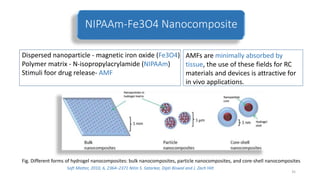
Dispersed nanoparticle - magnetic iron oxide (Fe3O4)
Polymer matrix - N-isopropylacrylamide (NIPAAm)
Stimuli foor drug release- AMF
Fig. Different forms of hydrogel nanocomposites: bulk nanocomposites, particle nanocomposites, and core-shell nanocomposites
Soft Matter, 2010, 6, 2364–2371 Nitin S. Satarkar, Dipti Biswal and J. Zach Hilt
NIPAAm-Fe3O4 Nanocomposite
AMFs are minimally absorbed by
tissue, the use of these fields for RC
materials and devices is attractive for
in vivo applications.
35
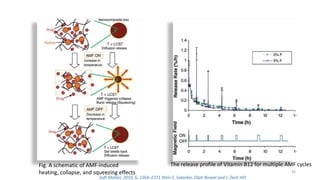
Fig. A schematic of AMF-induced
heating, collapse, and squeezing effects
The release profile of Vitamin B12 for multiple AMF cycles
Soft Matter, 2010, 6, 2364–2371 Nitin S. Satarkar, Dipti Biswal and J. Zach Hilt
36
37
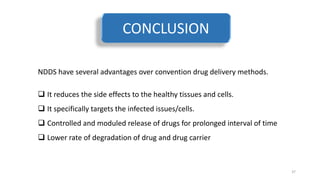
NDDS have several advantages over convention drug delivery methods.
 It reduces the side effects to the healthy tissues and cells.
 It specifically targets the infected issues/cells.
 Controlled and moduled release of drugs for prolonged interval of time
 Lower rate of degradation of drug and drug carrier
CONCLUSION
38

Drug delivery

  • 1.
    DRUG DELIVERY Presented by: WasimNawaj Ashwini Kumar Sunil Kumar Patel Rohan Jena Department of Chemistry IIT GUWAHATI 1
  • 2.
    Contents  Introduction  Conventionaland novel drug delivery methods  Peptide drug delivery system  liposome drug delivery system  nanocomposite drug delivery system  conclusion 2
  • 3.
    Introduction  Drug deliveryrefers to approaches, formulations, technologies, and systems for transporting a pharmaceutical compound in the body as needed to safely achieve its desired therapeutic effect. 3
  • 4.
    Conventional drug delivery systems Drugdelivery systems Novel drug delivery system (NDDS) Oral Buccal and Sublingual inhalation Dermal, Transdermal Injection liposomes niosomes Peptides and Proteins nanoparticles Nanocomposites 4
  • 5.
  • 6.
    Buccal and sublingualdrug administration Fig. Buccal drug delivery Fig. sublingual 6
  • 7.
    Inhalation and Transdermal Fig.inhalation Fig. transdermal 7
  • 8.
  • 9.
    Novel Drug DeliverySystems  Advantageous over convensional methods  Involves medicinal devices  Provides greater safety  target a drug specifically to a desired tissue  Improves drug potency  Controlled drug release Modes of NDDS  Targeted drug delivery system  Controlled drug delivery system  Modulated drug delivery system Fig. targeted drug delivery system 9
  • 10.
    List of NDDSDevices 10
  • 11.
  • 12.
    LIPOSOMES Liposomes are tinybubbles (vesicle), in which an aqueous volume is entirely enclosed by a Phospholipid bilayer molecules Firstly produced by D. Bangham (1964) Size of Liposome: 20 nm - ~3 µm range 12
  • 13.
  • 14.
    TARGETED DRUG DELIVERYVIA LIPOSOME THE FOLLOWING STEPS INVOLVE:- 1. Encapsulation of drug molecule. 2. Transportation of liposome to the Target. 3. Fusion of liposome to the cell membrane. 4. Release of Drug molecule. ref: Science live magazine 14
  • 15.
    WAYS OF DRUGDELIVERY SYSTEM 1. CONVENTIONAL LIPOSOME These are first generation of liposomes, consist of cationic, anionic or neutral phospholipids. 2. STERICALLY-STABILIZED LIPOSOMES Attachment of hydrophilic polymer (e.g. poly-ethylene glycol, PEG), which improves the efficacy of encapsulated agents 3. LIGAND-TARGETED LIPOSOMES Offer a site-specific delivery of drugs to organs in vivo (inside living organisms) 4. THERANAUSTIC LIPOSOMES A single system consist of nanoparticle, a targeting element, an imaging component and a therapeutic component (L. Sercombe, Frontiers in Pharmacology, 6, 2015) 15
  • 16.
    FIGURE : Schematicrepresentation of the different types of liposomal drug delivery systems 16
  • 17.
    1. Liposomes arebiocompatible, completely biodegradable, non-toxic and flexible. 2. Liposomes have both a lipophilic and aqueous environment making it useful for delivering hydrophobic, amphipathic, and hydrophilic medicines. 3. Liposomes with their layers encapsulates the drug and serves as a protection of the drug from the environment as well as acting as a sustained release mechanism. 4. Liposomes are also used in gene therapy. 17 ADVANTAGES
  • 18.
    PEPTIDE DRUG DELIVERYSYSTEMS Peptide – These are short polymers of amino acid (monomers) linked by peptide bonds . 18
  • 19.
    Targeted Delivery ofCell Penetrating Peptide Virus-like Nanoparticles to Skin Cancer Cells • The main aim of this study was to screen for a cell penetrating peptide (CPP) for the development of a targeting vector for skin cancer. In this study, we identiied a CPP with the sequence NRPDSAQFWLHH from aphage displayed peptide library. • This CPP targeted the human squamous carcinoma A431 cells through an interaction with the epidermal growth factor receptor (EGFr). • Methyl-ß-cyclodextrin (MßCD) and chlorpromazine hydrochloride (CPZ) inhibited the internalisation of the CPP into the A431 cells, suggesting the peptide entered the cells via clathrin-dependent endocytosis. • The CPP displayed on hepatitis B virus-like nanoparticles (VLNPs) via the nanoglue successfully delivered the nanoparticles into A431 cells. The present study demonstrated that the novel CPP can serve as a ligand to target and deliver VLNPs into skin cancer cells. 19
  • 20.
    Subtraction biopanning forthe selection of A431 cell penetrating peptides (CPPs). TABLE 1: Enrichment of phages in three rounds of biopanning Table 2 : phages that internalized A431 cells and their CPPs obtained from three rounds of biopanning 20 Bee Koon Gan1, Chean Yeah Yong1, Kok Lian Ho2, Abdul Rahman Omar1,3, Noorjahan Banu Alitheen 1,4 & Wen Siang Tan 1 Sci Rep. 2018; 8: 8499
  • 21.
    Fig. Analysis ofinternalization of phage clone into A431 & NHDF cells with immunofluorescence microscopy 21 Bee Koon Gan1, Chean Yeah Yong1, Kok Lian Ho2, Abdul Rahman Omar1,3, Noorjahan Banu Alitheen 1,4 & Wen Siang Tan 1 Sci Rep. 2018; 8: 8499
  • 22.
    Active energy-dependent uptakeof phage NRPDSAQFWLHH by A431 cells. Immunofluorescence microscopic analysis. Purified phage carrying the peptide NRPDSAQFWLHH was added to A431 cells and incubated separately at 4 and 37° C. 22 Bee Koon Gan1, Chean Yeah Yong1, Kok Lian Ho2, Abdul Rahman Omar1,3, Noorjahan Banu Alitheen 1,4 & Wen Siang Tan 1 Sci Rep. 2018; 8: 8499
  • 23.
    Fusion phage andpeptide NRPDSAQFWLHH competitive assay, and selective internalization of the peptide into A431 cells Synthetic peptide NRPDSAQFWLHH internalises A431 cells. A431 and NHDF cells were incubated with fluorescein-labelled peptide NRPDSAQFWLHH at 37 °C for 16 h 23 Bee Koon Gan1, Chean Yeah Yong1, Kok Lian Ho2, Abdul Rahman Omar1,3, Noorjahan Banu Alitheen 1,4 & Wen Siang Tan 1 Sci Rep. 2018; 8: 8499
  • 24.
    Efect of endosomalinhibitors on the entry of peptide NRPDSAQFWLHH into A431 cells. Fig. A431 cells were pre-incubated with different endosomal inhibitors, and in the presence of fluorescein-labelled peptide NRPDSAQFWLHH. 24 Bee Koon Gan1, Chean Yeah Yong1, Kok Lian Ho2, Abdul Rahman Omar1,3, Noorjahan Banu Alitheen 1,4 & Wen Siang Tan 1 Sci Rep. 2018; 8: 8499
  • 25.
    Peptide NRPDSAQFWLHH internalisesA431 cells via epithelial growth factor receptor (EGFr). Cetuximab inhibits internalisation of peptide into A431 cells. Fluorescein-labelled peptide NRPDSAQFWLHH was added into A431 cells and incubated at 37 °C for 16 h in the presence and absence of anti-EGFr (Cetuximab 225; 10 μg/mL). 25 Bee Koon Gan1, Chean Yeah Yong1, Kok Lian Ho2, Abdul Rahman Omar1,3, Noorjahan Banu Alitheen 1,4 & Wen Siang Tan 1 Sci Rep. 2018; 8: 8499
  • 26.
    Conjugation of peptideonto tHBcAg VLNPs and delivery of the nanoparticles into A431 cells. SDS-PAGE of tHBcAg conjugated to peptide NRPDSAQFWLHHGGGSLLGRMKGA. Lanes M: molecular mass markers(kDa), 26 Bee Koon Gan1, Chean Yeah Yong1, Kok Lian Ho2, Abdul Rahman Omar1,3, Noorjahan Banu Alitheen 1,4 & Wen Siang Tan 1 Sci Rep. 2018; 8: 8499
  • 27.
    Delivery of tHBcAgVLNPs conjugated to peptide NRPDSAQFWLHHGGGSLLGRMKGA into A431 cells. 27 Bee Koon Gan1, Chean Yeah Yong1, Kok Lian Ho2, Abdul Rahman Omar1,3, Noorjahan Banu Alitheen 1,4 & Wen Siang Tan 1 Sci Rep. 2018; 8: 8499
  • 28.
    Nanoscience and drugdelivery - small particles for big problems 28
  • 29.
     Nanocomposites arebroad range of materials consisting of two or more components with at least one component having dimension in the nm range.  In composite materials, one phase is usually continuous and called the matrix, while the other phase called the dispersed phase.  i.e Nano sized particles (metals/semiconductors/dielectrics etc) embedded in different matrix materials (ceramics/glass/polymers). Why nanocomposites ?  Exhibit different (often enhanced) properties than the individual components  Electrical, magnetic,  electrochemical,  catalytic, optical,  structural, and  mechanical properties Nanocomposites 29
  • 30.
    Figure : Ironfluoride–graphene nanocomposites for LIB cathode materials , J. Mater. Chem. A,2014,2,15 Nanoparticle Matrix nanocomposite The term ‘‘nanocomposite’’ is commonly adopted to refer to polymers that contain dispersed nanofillers with an average particle size of less than 100 nm 30
  • 31.
    Nanoparticle vs Nanocomposite Incases where the nanoparticle could induce an undesired biological response, the nanocomposite can prevent the direct interaction of the nanoparticle with the biological system. Example :  The Ag nanoparticles can be considered as strong antibacterial agents.  The toxicity of Ag ions affected the basic metabolic cellular functions common to all specialized mammalian Cells.  But embedding them in a polymer matrix may reduce their cytotoxic effects, with enhancing the properties of polymer matrix, without any change in antimicrobial property of Ag. 31
  • 32.
    Fig. UV-vis spectraof various amounts of Ag nanoparticles (a) in distilled water and (b) chitosan solution. Macromol. Biosci. 2008, 8, 932–941 2008 WILEY-VCH Verlag GmbH & Co. KGaA, Weinheim 32 a b Fig. Inverse microscopic images of L929 cells cultured on surfaces of (c) uncoated glass slide; (d) pure GC film; (e) GC/Ag 50 and (f) GC/Ag 200 nanocomposites after a 72 h culture. c d fe
  • 33.
    Hydrogel Nanocomposites Remotely ControlledDrug Delivery System  Hydrogels are 3D hydrophilic polymers that do not dissolve but can swell in water or can respond to the fluctuations of the environmental stimuli.  Highly absorbent (they can contain over 90% water)  Both solid like and liquid like properties  High biocompatibility (as mostly contains water) NANO-PARTICLE STIMULI Fe3O4 (Magnetic) Alternating Magnetic Field Au Near IR Carbon nano-tubes (CNTs) Radio frequency 33
  • 34.
    Drug vehicle DrugTarget site Drug loaded transportation Drug vehicle attached to target site 34
  • 35.
    Dispersed nanoparticle -magnetic iron oxide (Fe3O4) Polymer matrix - N-isopropylacrylamide (NIPAAm) Stimuli foor drug release- AMF Fig. Different forms of hydrogel nanocomposites: bulk nanocomposites, particle nanocomposites, and core-shell nanocomposites Soft Matter, 2010, 6, 2364–2371 Nitin S. Satarkar, Dipti Biswal and J. Zach Hilt NIPAAm-Fe3O4 Nanocomposite AMFs are minimally absorbed by tissue, the use of these fields for RC materials and devices is attractive for in vivo applications. 35
  • 36.
    Fig. A schematicof AMF-induced heating, collapse, and squeezing effects The release profile of Vitamin B12 for multiple AMF cycles Soft Matter, 2010, 6, 2364–2371 Nitin S. Satarkar, Dipti Biswal and J. Zach Hilt 36
  • 37.
    37 NDDS have severaladvantages over convention drug delivery methods.  It reduces the side effects to the healthy tissues and cells.  It specifically targets the infected issues/cells.  Controlled and moduled release of drugs for prolonged interval of time  Lower rate of degradation of drug and drug carrier CONCLUSION
  • 38.