Medication administration
Medication administration is a core competency for all
nurses in every clinical setting. A key skill required to safely
dispense drugs is the ability to perform accurate dosage
calculations. New technologies such as bar code
administration and smart infusion pumps have helped to
reduce medication errors, however nurses cannot rely
completely on these advances. In this blog series we will
review several drug calculation methods. The first technique
is the universal formula or the “desired over have” method.
Universal Formula
• In the universal formula (or “desired over have method”), the desired
amount (D) is the dose prescribed and the amount on hand (H) or
the amount you “have” is the available dose or concentration. The
quantity (Q) is the form and amount in which the drug is supplied
(i.e. tablet, capsule, liquid). To calculate the dose, take the desired
amount and divide it by the amount on hand, then multiply it by the
quantity, like this:
Oral Dose
Cephalexin (Keflex) 750 mg
P.O. every 12 hours is ordered.
The pharmacy stocks 250 mg
tablets. How many tablets
should be administered per
dose?
Examples
Intravenous (IV) Dose
• An order for digoxin 0.5 mg
IV daily is placed. Digoxin
0.25 mg/mL is available
from the pharmacy. How
many mL will you need to
administer a 0.5 mg dose?
Subcutaneous Dose
• Heparin 7500 units
subcutaneous every 12
hours is ordered. The
pharmacy provides a
heparin vial with a
concentration of 5000
units/mL. How many mL
will you need to administer
7500 units?
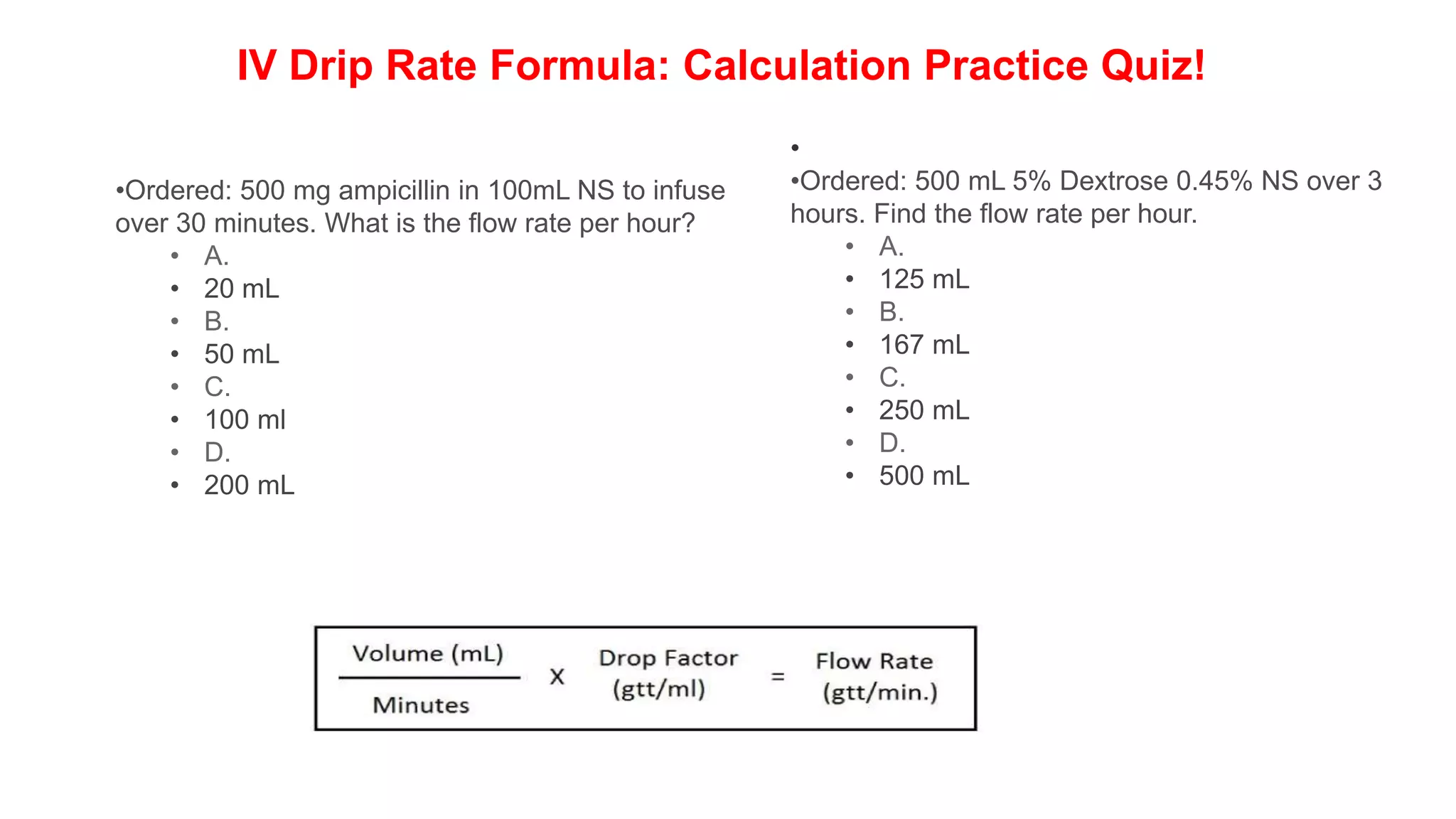
•Ordered: 500 mg ampicillin in 100mL NS to infuse
over 30 minutes. What is the flow rate per hour?
• A.
• 20 mL
• B.
• 50 mL
• C.
• 100 ml
• D.
• 200 mL
•
•Ordered: 500 mL 5% Dextrose 0.45% NS over 3
hours. Find the flow rate per hour.
• A.
• 125 mL
• B.
• 167 mL
• C.
• 250 mL
• D.
• 500 mL
IV Drip Rate Formula: Calculation Practice Quiz!

drug calculation.pptx

  • 1.
    Medication administration Medication administrationis a core competency for all nurses in every clinical setting. A key skill required to safely dispense drugs is the ability to perform accurate dosage calculations. New technologies such as bar code administration and smart infusion pumps have helped to reduce medication errors, however nurses cannot rely completely on these advances. In this blog series we will review several drug calculation methods. The first technique is the universal formula or the “desired over have” method.
  • 2.
    Universal Formula • Inthe universal formula (or “desired over have method”), the desired amount (D) is the dose prescribed and the amount on hand (H) or the amount you “have” is the available dose or concentration. The quantity (Q) is the form and amount in which the drug is supplied (i.e. tablet, capsule, liquid). To calculate the dose, take the desired amount and divide it by the amount on hand, then multiply it by the quantity, like this:
  • 3.
    Oral Dose Cephalexin (Keflex)750 mg P.O. every 12 hours is ordered. The pharmacy stocks 250 mg tablets. How many tablets should be administered per dose? Examples
  • 4.
    Intravenous (IV) Dose •An order for digoxin 0.5 mg IV daily is placed. Digoxin 0.25 mg/mL is available from the pharmacy. How many mL will you need to administer a 0.5 mg dose?
  • 5.
    Subcutaneous Dose • Heparin7500 units subcutaneous every 12 hours is ordered. The pharmacy provides a heparin vial with a concentration of 5000 units/mL. How many mL will you need to administer 7500 units?
  • 6.
    •Ordered: 500 mgampicillin in 100mL NS to infuse over 30 minutes. What is the flow rate per hour? • A. • 20 mL • B. • 50 mL • C. • 100 ml • D. • 200 mL • •Ordered: 500 mL 5% Dextrose 0.45% NS over 3 hours. Find the flow rate per hour. • A. • 125 mL • B. • 167 mL • C. • 250 mL • D. • 500 mL IV Drip Rate Formula: Calculation Practice Quiz!