presents 
Drawing 
faces 
Learn How to Draw a Face 
with Attitude, How to Draw 
Eyes with Impact and How 
to Draw Lips with Structure
Drawing Faces 
How to Draw 
Dynamic Heads 
Depicting features is only the beginning. Putting life into 
a head drawing requires assimilating it with the rest of 
the body, capturing an attitude—and much more. 
by Dan Gheno 
here are many ways to keep your 
figure drawings lively, fresh, 
and dynamic. But there is one 
sure way to destroy an active and 
energetic drawing: by plopping a 
stiffly rendered, ham-fisted head 
T 
on top of an otherwise nicely drawn figure. Too 
many artists, perhaps fearful of their subjects, 
treat the head as if it were nothing more than an 
inventory of features or an empty, blocklike shape, 
void of life, sometimes sitting straight and rigidly 
on its neck, contradicting the underlying gesture 
of the body and looking like a lifeless lollipop. 
This eons-old challenge of how to put more 
life and energy into drawings, paintings, and 
sculptures of the human head is easily answered 
once you get beyond the fear and the seeming 
complexity of the subject. I will outline many 
solutions throughout this article appropriate for 
both the beginner and advanced artist. Some of 
the cures will seem deceptively simple. Others 
will reach beyond the obvious, studying the head 
from all sides, including top and bottom. And just 
about all of them will somehow involve the overall 
figure, with the head serving as the crown of the 
magnificent machine that is the human body. 
Friedrich Karl, Prince of Prussia 
by Adolf Menzel, 1863, gouache over graphite, highlighted with 
white, 115⁄8 x 9. 
Notice how, from behind, the nasolabial furrow obscures some of 
the nose and mouth and seems to unite optically with the cheekbone 
and rim of the eye. This connection helps to push the nose back 
and, along with several other overlapping shapes, reinforces the 
roundness of the underlying egg-shaped head structure. 
This content has been abridged from an original article written by Dan Gheno. This premium has been published by Interweave Press, 201 E. Fourth St., Loveland, CO 80537-5655; (970) 669-7672. Copyright © 2012 by 
Interweave Press, a division of Aspire Media, all rights reserved. The contents of this publication may not be reproduced either in whole or in part without consent of the copyright owner. 
2 www.artistdaily.com
Drawing Faces 
Attitude 
Perhaps the most powerful key to a stronger head is 
the most obvious one, which even advanced artists 
often miss in their obsession to get the features just 
right—that is, give your head attitude. Faces need to 
look somewhere; their eyes need intensity and aim. You 
have probably noticed how the eyes in some Old Master 
paintings and drawings often seem to follow you as you 
move around the room. This dynamic event occurs in 
the viewer’s mind, usually when the artist depicts the 
head in a three-quarter view with the eyes looking off to 
one side, as Leonardo most famously did in his Mona 
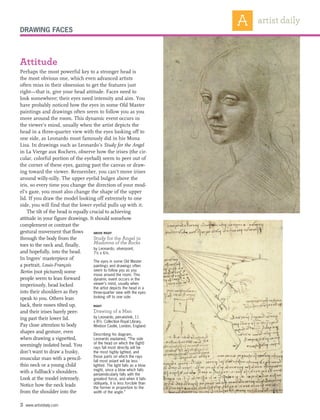
Lisa. In drawings such as Leonardo’s Study for the Angel 
in La Vierge aux Rochers, observe how the irises (the cir-cular, 
colorful portion of the eyeball) seem to peer out of 
the corner of these eyes, gazing past the canvas or draw-ing 
toward the viewer. Remember, you can’t move irises 
around willy-nilly. The upper eyelid bulges above the 
iris, so every time you change the direction of your mod-el’s 
gaze, you must also change the shape of the upper 
lid. If you draw the model looking off extremely to one 
side, you will find that the lower eyelid pulls up with it. 
The tilt of the head is equally crucial to achieving 
attitude in your figure drawings. It should somehow 
complement or contrast the 
gestural movement that flows 
through the body from the 
toes to the neck and, finally, 
and hopefully, into the head. 
In Ingres' masterpiece of 
a portrait, Louis-François 
Bertin (not pictured) some 
people seem to lean forward 
imperiously, head locked 
into their shoulders as they 
speak to you. Others lean 
back, their noses tilted up, 
and their irises barely peer-ing 
past their lower lid. 
Pay close attention to body 
shapes and gesture, even 
when drawing a vignetted, 
seemingly isolated head. You 
don't want to draw a husky, 
muscular man with a pencil-thin 
neck or a young child 
with a fullback's shoulders. 
Look at the model intensely. 
Notice how the neck leads 
from the shoulder into the 
3 www.artistdaily.com 
above right 
Study for the Angel in 
Madonna of the Rocks 
by Leonardo, silverpoint, 
71⁄8 x 6¼. 
The eyes in some Old Master 
paintings and drawings often 
seem to follow you as you 
move around the room. This 
dynamic event occurs in the 
viewer’s mind, usually when 
the artist depicts the head in a 
three-quarter view with the eyes 
looking off to one side. 
right 
Drawing of a Man 
by Leonardo, pen-and-ink, 11 
x 8½. Collection Royal Library, 
Windsor Castle, London, England. 
Describing his diagram, 
Leonardo explained, “The side 
of the head on which the (light) 
rays fall most directly will be 
the most highly lighted, and 
those parts on which the rays 
fall most aslant will be less 
lighted. The light falls as a blow 
might, since a blow which falls 
perpendicularly falls with the 
greatest force, and when it falls 
obliquely, it is less forcible than 
the former in proportion to the 
width of the angle.”
Drawing Faces 
head. It doesn't matter if you are only 
drawing a small snippet of the neck in 
fact, the shorter the line, the more crucial 
the correct angle becomes. If the line 
fragment angles outward or inward a 
little too much, the error will become 
magnified once you imagine the line 
extending outside of the image, inferring 
an implausible body type for the head. 
Body postures and their relationships 
4 www.artistdaily.com 
to the head are numerous, and they 
can be quite evocative of an individual's 
character, psychology, and emotion. 
Getting a Likeness 
It may seem like a waste of time wor-rying 
about whether you’ve captured a 
likeness or not. It’s unlikely the viewer 
will notice that something is missing. 
True, it will not matter in the end to 
the viewer. But I feel it’s imperative 
to always give it a sincere try. The 
pursuit of likeness keeps my concen-tration 
focused, it keeps the entire 
drawing process compelling, and, in 
the end, the struggle leads to a more 
active-looking and vigorous drawing. 
There is no doubt that the individual 
features and the distance between the 
features are essential in getting a like-ness 
and a psychologically animated 
head and figure. I explained several fea-ture- 
measuring techniques in my first 
article for American Artist [“Painting 
Portraits”] in the February 1993 issue. 
It’s useful to draw numerous studies 
of the features—like Jusepe de Ribera 
did in Study of Eyes—cataloguing and 
committing their basic construction 
to memory. At the same time, try to 
be sensitive to the bilateral symmetry 
that underlies the face and its features. 
Use guidelines to line up one side of 
the face with the other. But remember 
this very important caveat: As much as 
you may want them to, features do not 
conform to a simplistic rule of abso-lute 
symmetry. Look closely at any Old 
Master portrait. You will usually find 
that one eye is almost always a little 
bigger or a little farther from the nose 
than the other, one nostril a little taller, 
one side of the mouth a bit lower than 
the other. These artists’ use of subtle 
asymmetry gives their subjects’ heads 
and figures life and a sense of action, 
as if the features are in motion. This 
asymmetry is vitally important from 
the likeness standpoint as well. It’s 
been proven in clinical and psychologi-cal 
studies that when a photo is sliced 
above left 
Drawing of a Woman With Loop Earring 
by Dan Gheno, 2006, graphite with white chalk 
on toned paper, 10 x 8. Collection the artist. 
above right 
My Father Posing for Facial Folds 
by Dan Gheno, 2006, graphite, 12 x 9. 
Collection the artist. 
Facial folds occur at right angles to the direction 
of the muscles underneath, very similar to a 
theater curtain being pulled across the stage by 
a horizontal cord. The zygomatic muscle runs 
from the cheekbone to the corner of the mouth 
and, when contracted, creates dependable 
creases in the face, the most important being 
the jugal furrow (left of A) and the accessory 
jugal furrow (B). Note how the shape of the 
large chewing muscle, called the masseter (C), 
becomes more defined when the chin is pulled in. 
a 
c 
b
Drawing Faces 
in half, with one side reversed and 
pasted next to the other, the viewer 
finds it difficult to recognize the sub-ject 
within the new-found symmetry. 
No matter how enticing your sub-ject’s 
features, the hard truth is that the 
ratio of the head shape and size to the 
body is much more crucial to captur-ing 
a likeness or creating a dynamic 
impression. When looking at your 
model, ask yourself what sort of geo-metric 
shape typifies his or her head. 
Does your model have a triangular head 
tapering toward the bottom, with lots of 
5 www.artistdaily.com 
hair and full cheekbones at the top slid-ing 
into a narrow jaw and smallish chin 
below? Or perhaps your subject has a 
wide, rectangular face with a broad jaw, 
full cheeks, and a flat, closely cropped 
hairdo—or a tall, rectangular head, 
narrow but angular from jaw to top of 
head. Maybe your model’s forms are 
built on soft, circular shapes. Whatever 
your subject’s essential structure, 
you can always distill it into a simple, 
quickly identifiable shape in your mind 
that will guide you through the compli-cated 
process of laying in the drawing. 
Purge Your 
Preconceptions 
After determining the global shape of 
the head, assessing the facial angle is 
the next most important factor in get-ting 
a likeness and keeping your head 
drawing lively. Forensic specialists fre-quently 
use this technique to identify 
decomposed remains, and 19th-cen-tury 
phrenologists used it in a foolish 
attempt to catalogue racial intelligence. 
You can discover the facial angle of 
your subject by drawing a line from the 
ear hole, or external auditory meatus, 
at the base of the skull to the bottom 
of the nasal aperture (Fig. B) and then 
compare that line to one that runs from 
the base of the brow ridge, or glabel-lum, 
to the upper dental arch. Called 
the “muzzle,” this protrusion doesn’t 
project as far forward in humans as it 
does in animals, but it usually juts far-ther 
outward than most beginner—and 
some advanced—artists are willing to 
accept. The real human head is quite 
unlike a Greek statue; it’s very rare that 
all of your subject’s features will line up 
in a straight, stagnant, and vertical for-mation 
from forehead to chin. Unless 
you’re trying to render some sort of 
classical ideal, look for this basic facial 
angle, and then compare it to the usual-ly 
receding angle that leads from the tip 
of the nose to the base of the chin, or 
the angles that radiate off the forehead, 
across the top of the head, and back 
down to the nape of the neck (Fig. A). 
Even if you get all of the big shapes 
of the head correct, you’re not out of 
the woods yet. You need to compare 
the facial size to the overall head size. 
Two Studies of the Head and Shoulder 
of Little Girl (detail) 
by Jean-Antoine Watteau, ca. 1717, red, black, 
and white chalk on buff paper, 9½ x 73⁄8. Collection 
Pierpont Morgan Library, New York, New York. 
Always look closely at the periphery of the face. Study 
how Watteau drew the far eye and eyebrow in this 
drawing. Approach your own head drawings like him, 
finding the subtle overlaps and the delicate forms that 
often lurk behind the horizon of a spherical face.
Drawing Faces 
Quite often, even the most experienced 
artist will make the facial area—the 
space between the mouth and eye-brows— 
too big or too small for the rest 
of the head. Then they wonder why 
the head looks too big or small, even 
though they’ve measured the overall 
head size against the body a thousand 
times, and it adds up correctly every 
try. That’s because we often judge the 
size of the head with our gut; and if the 
features are drawn too large or small, 
the head will seem likewise. Most 
often, artists tend to make the facial 
mass too big, especially on a foreshort-ened 
head or bearded model. Artists 
6 www.artistdaily.com 
are only human. Governed by our spe-cies’ 
psychological focus on the impor-tance 
of the features, we seem eagerly 
predisposed to expect a large facial size. 
Larger Than Life 
Many large-scale drawings have a built-in 
dynamism. Unfortunately, it’s often 
hard to feel good about a face that’s 
drawn larger than life, especially when 
drawing a delicate person. Even if all 
of the features and underlying angles 
are impeccably placed, the face will 
almost always seem “off,” or at least 
surreal, because it is larger than we 
have experienced in real life. Perhaps 
you want to embrace that surrealism 
or want to capture some of the heroic 
power we see in such sculptures as 
Head of Constantine (not pictured). I do 
that a lot myself, as do many artists I 
admire. Perhaps you are doing a mural 
or altarpiece that will be seen at an 
extreme distance. Just be sure you are 
doing it on purpose, not because you 
got carried away. Usually, this prob-lem 
creeps up on you. As one works 
on the features—or any detail of the 
body, such as the hands or feet—one 
can become captivated, and if an artist 
doesn’t step back often to gauge the 
relative size of the subject’s face to the 
rest of the figure, those features will 
tend to grow. Artists then compensate 
by enlarging all the other features, 
then the entire head, until finally the 
rest of the figure must be redrawn at 
a larger size. Then, to add insult to 
injury, the feet may be falling off the 
page or the hand could be cut off awk-wardly 
by the edge of the paper at the 
knuckles, forcing the artist to scrap 
the whole figure, including the head. 
No artist is free from this malady. I 
know myself too well, and to counter-act 
this tendency, I draw lines at the 
top, bottom, and middle of my figures 
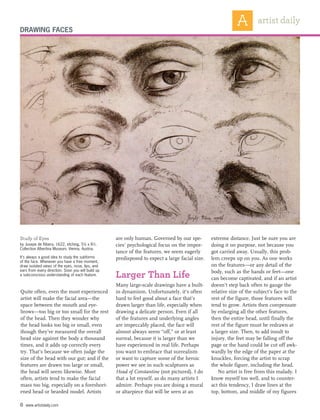
Study of Eyes 
by Jusepe de Ribera, 1622, etching, 57⁄8 x 81⁄2. 
Collection Albertina Museum, Vienna, Austria. 
It’s always a good idea to study the subforms 
of the face. Whenever you have a free moment, 
draw isolated views of the eyes, nose, lips, and 
ears from every direction. Soon you will build up 
a subconscious understanding of each feature.
Drawing Faces 
when I sense my proportions going 
awry. Whether you are a beginner or an 
advanced artist who is continually deal-ing 
with this problem, draw these lines 
near the outset of the drawing process. 
Then, if you find your face or figures 
expanding even a little beyond these 
lines, resolutely and bravely enforce a 
hard-love discipline on yourself. With 
head drawing, this usually means first 
revisiting the size of the nose, since 
all the other features radiate off this 
central point. Indeed, when initially 
laying in the proportions of the face, 
it’s a good strategy to put more work 
into the nose once you start delving 
into the details. Of course, you don’t 
want to spend all your time on the 
7 www.artistdaily.com 
nose. To maintain your objectivity and 
a gestural quality in your drawing, 
always move around the face and figure 
when working on specifics. But once 
the size of the nose is set, compare 
all of the other features to it. Say, for 
instance, you accidentally make the 
nose too big. If you’re vigilant, you will 
likely catch it before its stealthy effect 
cascades throughout the features and 
body with increasing magnitude. 
Purposeful 
Exaggeration 
You might find yourself justifying an 
overly large head size by arguing, “Well, 
some people just have large heads!” 
Think—and look—again. Proportional 
relationships tend to reoccur through-out 
the body. There are no absolute 
rules, but when someone has a seem-ingly 
large head, many of their other 
subform proportions tend to be stocky 
as well. Among adults, our bodies can 
range anywhere between six to eight 
heads tall. If you wander beyond that 
limit, you surely need to take a second 
look at your subject to be sure you are 
not fooling yourself. Like Sargent, you 
may purposely choose to elongate your 
figure by giving your drawing a small 
head—many of his figures are nine or 
10 heads tall and quite plausible. Like 
him, just be sure to equally lengthen 
all the other body subforms. Nothing 
looks sillier or more stilted than a tiny 
pinhead on a hulking body or incon-sistently 
exaggerated body parts. On 
the other hand, don’t fall prey to the 
opposite problem—making a head too 
large—to try to compensate for a heavy 
or muscular body type. Even if you want 
to embellish the muscularity or heavi-ness 
of the body forms, you must pay 
particular attention to the way the full 
neck tucks dramatically into the front of 
the diminutive head on a large, heavy 
model and the way the thick shoulders 
of a muscular model taper gradually 
into the back of the normal-size skull. 
Elements of Head 
Structure 
Light Source: The more you work in 
a representational manner, the more 
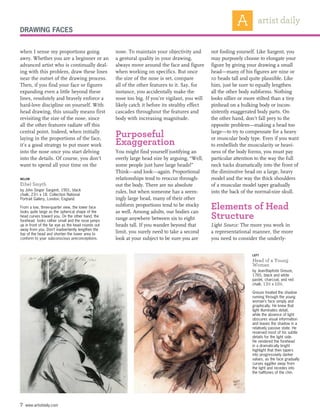
you need to consider the underly-below 
Ethel Smyth 
by John Singer Sargent, 1901, black 
chalk, 231⁄2 x 18. Collection National 
Portrait Gallery, London, England. 
From a low, three-quarter view, the lower face 
looks quite large as the spherical shape of the 
head curves toward you. On the other hand, the 
forehead looks rather small and the nose jumps 
up in front of the far eye as the head rounds out 
away from you. Don’t inadvertently lengthen the 
top of the head and shorten the lower area to 
conform to your subconscious preconceptions. 
left 
Head of a Young 
Woman 
by Jean-Baptiste Greuze, 
1765, black and white 
pastel, charcoal, and red 
chalk, 131⁄2 x 101⁄4. 
Greuze treated the shadow 
running through the young 
woman’s face simply and 
graphically. He knew that 
light illuminates detail, 
while the absence of light 
obscures visual information 
and leaves the shadow in a 
relatively passive state. He 
reserved most of his subtle 
details for the light side. 
He rendered the forehead 
in a dramatically bright 
highlight that then tapers 
into progressively darker 
values, as the face gradually 
curves egglike away from 
the light and recedes into 
the halftones of the chin.
Drawing Faces 
1 
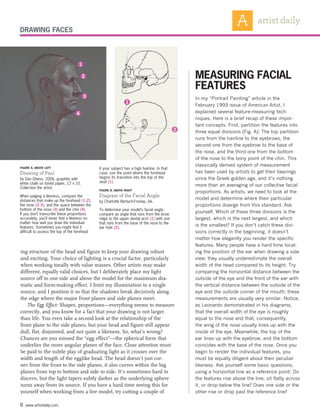
Figure A, above left 
Drawing of Paul 
by Dan Gheno, 2006, graphite with 
white chalk on toned paper, 12 x 10. 
Collection the artist. 
When judging a likeness, compare the 
distances that make up the forehead (1-2), 
the nose (2-3), and the space between the 
bottom of the nose (3) and the chin (4). 
If you don’t transcribe these proportions 
accurately, you’ll never find a likeness no 
matter how well you draw the individual 
features. Sometimes you might find it 
difficult to assess the top of the forehead 
8 www.artistdaily.com 
Measuring Facial 
Features 
In my “Portrait Painting” article in the 
February 1993 issue of American Artist, I 
explained several feature-measuring tech-niques. 
Here is a brief recap of these impor-tant 
concepts: First, partition the features into 
three equal divisions (Fig. A): The top partition 
runs from the hairline to the eyebrows, the 
second one from the eyebrow to the base of 
the nose, and the third one from the bottom 
of the nose to the bony point of the chin. This 
classically derived system of measurement 
has been used by artists to get their bearings 
since the Greek golden age, and it’s nothing 
more than an averaging of our collective facial 
proportions. As artists, we need to look at the 
model and determine where their particular 
proportions diverge from this standard. Ask 
yourself, Which of these three divisions is the 
largest, which is the next largest, and which 
is the smallest? If you don’t catch these divi-sions 
correctly in the beginning, it doesn’t 
matter how elegantly you render the specific 
features. Many people have a hard time locat-ing 
the position of the ear when drawing a side 
view; they usually underestimate the overall 
width of the head compared to its height. Try 
comparing the horizontal distance between the 
outside of the eye and the front of the ear with 
the vertical distance between the outside of the 
eye and the outside corner of the mouth; these 
measurements are usually very similar. Notice, 
as Leonardo demonstrated in his diagrams, 
that the overall width of the eye is roughly 
equal to the nose and that, consequently, 
the wing of the nose usually lines up with the 
inside of the eye. Meanwhile, the top of the 
ear lines up with the eyebrow, and the bottom 
coincides with the base of the nose. Once you 
begin to render the individual features, you 
must be equally diligent about their peculiar 
likeness. Ask yourself some basic questions, 
using a horizontal line as a reference point: Do 
the features rise above the line, sit flatly across 
it, or drop below the line? Does one side or the 
other rise or drop past the reference line? 
1 
if your subject has a high hairline. In that 
case, use the point where the forehead 
begins its transition into the top of the 
skull (1). 
Figure B, above right 
Diagram of the Facial Angle 
by Charlotte Bertuch-Froriep, ink. 
To determine your model’s facial angle, 
compare an angle that runs from the brow 
ridge to the upper dental arch (1) with one 
that runs from the base of the nose to the 
ear hole (2). 
ing structure of the head and figure to keep your drawing robust 
and exciting. Your choice of lighting is a crucial factor, particularly 
when working tonally with value masses. Other artists may make 
different, equally valid choices, but I deliberately place my light 
source off to one side and above the model for the maximum dra-matic 
and form-making effect. I limit my illumination to a single 
source, and I position it so that the shadows break decisively along 
the edge where the major front planes and side planes meet. 
The Egg Effect: Shapes, proportions—everything seems to measure 
correctly, and you know for a fact that your drawing is not larger 
than life. You even take a second look at the relationship of the 
front plane to the side planes, but your head and figure still appear 
dull, flat, disjointed, and not quite a likeness. So, what’s wrong? 
Chances are you missed the “egg effect”—the spherical form that 
underlies the more angular planes of the face. Close attention must 
be paid to the subtle play of graduating light as it crosses over the 
width and length of the egglike head. The head doesn’t just cor-ner 
from the front to the side planes, it also curves within the big 
planes from top to bottom and side to side. It’s sometimes hard to 
discern, but the light tapers subtly darker as the underlying sphere 
turns away from its source. If you have a hard time seeing this for 
yourself when working from a live model, try cutting a couple of 
2 
2 
3 
4
Drawing Faces 
9 www.artistdaily.com 
holes in a piece of paper. Hold 
the paper in front of the model’s 
face, and keep moving it back 
and forth until one hole isolates 
the light of the forehead and the 
other hole isolates the light on 
the chin. When working from 
photos, you can usually dis-cover 
this cascading light effect by turning both the 
photograph and your drawing upside down. 
Necks: If heads are fundamentally egglike, necks are 
basically cylindrical. Try not to disturb their underlying 
shape by overplaying the sterno-cleido-mastoid, those strap-like 
muscles that straddle the throat and support the head. 
Like the subforms of the features, these muscles sit on 
the curving cylinder of the neck and should participate in 
its graduating value changes. Remember also that these 
two muscles are antagonists, an anatomical term that indi-cates 
they work as a team. Immobility occurs if they both 
contract at the same time. This means you can’t render 
both muscles in equal definition, at least if you’re trying to 
show the head in motion. When one of them contracts and 
bulges out, pulling the side of the head toward you, draw 
the other muscle more relaxed and less defined. One more 
warning: When working from life, expect some movement 
in the pose if the model’s neck is twisted to an extreme 
degree. Always anticipate some unconscious movement of 
the head and neck toward a more centralized position. 
While paying heed to its cylindrical character, notice that 
the neck isn’t a telephone pole, shooting perpendicularly 
into the head. Observe how the neck projects diagonally 
from the shoulder into the base of the head, pushing the 
head forward. This dynamic, diagonal relationship is most 
clearly identifiable on a side view, but as you likely know 
from experience, it’s much more difficult to grasp on a 
three-quarter view. You’ll know only too well when you’ve 
missed the neck slant. The head will often seem mashed 
into the neck, and both the head and the neck will seem 
off-center, placed too far over to one side on the shoulder. 
To correct this problem, try concentrating on the throat—or 
trachea—instead of the outside edges of the neck. The under-lying 
projecting angle of the throat is much more apparent 
in this view. Draw upward from the pit of the neck, along 
the forward edge of the throat, until you reach the under 
plane or canopy of the chin, and add the outside lines of the 
neck later. Whatever you do, avoid the static, lollipop look I 
warned you about at the beginning of the article, with both 
the front and back of the neck reaching into the head at the 
same parallel level. The back of the neck intersects the skull 
much higher up than the front of the neck, often aligning 
with the base of the nose when the face is on an even keel. 
Age and Folds: Age and weight play an important role 
in the dynamics of the face—its structure and its emotional 
expression. The older we get, the more our skin drapes, with 
creases occurring at right angles to the shape and action of 
the muscles underneath. The zygomatic muscles, running 
from the cheekbone to the corner of the mouth, have the 
greatest influence on the face, so when they contract, they 
also produce one of the strongest folds, called the nasolabial 
furrow, running from the nose and partially encircling the 
mouth. Seen from behind, as in Menzel’s Friedrich Karl, 
Prince of Prussia, this furrow seems to visually connect 
with the cheekbone and partially eclipses the nose itself. 
I’ve been fascinated by facial folds for most of my life, ever 
since I saw Stephen Roger Peck’s wrinkle chart in his book 
Atlas of Human Anatomy for the Artist (Oxford University 
Press, New York, New York). Using his seminal dia- 
Foreshortening 
Exercise 
If you have a difficult time seeing and drawing the nose 
close to the eye, try this exercise: Find a photo of a fore-shortened 
face; draw it freehand, concentrating on the 
eye-nose relationship; then trace the photo and compare 
the two drawings, noting where you may have inadver-tently 
increased the eye-nose distances in your first draw-ing. 
Keep repeating the exercise with other photos until 
you conquer your habits of distortion. 
Skull From Above 
by Dan Gheno, 2006, graphite, 
4 x 5. Collection the artist. 
Purge your mind of 
preconceptions when drawing 
the head from an odd angle— 
the face is barely visible when 
the head is seen from above.
Drawing Faces 
10 www.artistdaily.com 
gram as a base, I’ve tried to catalogue 
how these furrows interact with and 
telescope into one another when the 
head moves and how they vary among 
different ages and weight types over 
years of personal observation and 
study. Like cloth drapery, facial folds 
follow dependable rules, originating 
at certain bony points and compress-ing 
and stretching at other depend-able 
landmarks. Then of course there are the effects of gravity on 
the face. If your model lies down to one side, the muscles and 
folds of the face will droop downward under the force of gravity. 
Even a wrinkle-free child hanging upside down on monkey bars 
will look quite different than when sitting up straight in a chair. 
If you develop an interest in facial folds, as I have, try not to overdo 
it. Sometimes folds are barely visible when a face is turned into the 
light, and that is especially true for younger people. As you work, 
keep in mind that there are no concave forms on the human figure. 
Don’t cut inward when you draw one furrow meeting another or when 
bone meets flesh. Nothing ages a model faster than when an artist 
tries to emphasize a person’s cheekbones by cutting inward under 
the bone or when drawing what appears to be a dip below the bone. 
Bone Structure: The cheekbone, or zygomatic bone, is just one of 
many bones that compose the skull and serve as the foundation for the 
human head. Buy a skull and fill your sketchbook with skull drawings, 
rendered from all standpoints—the top, back, bottom, and sides. In 
Put Your Head 
in a Box 
Use perspective to better gauge the tilt 
of the head by trying to visualize the 
head encased in a box, as Albrecht Dürer 
illustrated in his notebooks. It’s easier to 
imagine a box tilting in space, with oppo-site 
sides slanting at near parallel angles. 
This helps you remember that if the front 
of the face is angling down, the back of 
the head follows the same slant. If you are 
imagining the head encased within a box, 
you’ll also remember to tilt the top and 
bottom of the head as well. It also helps to 
use perspectival tracking lines to align the 
features as they recede into space. Keep 
in mind that these imaginary perspective 
lines converge downward 
if you are drawing the 
face from below and con-verge 
upward if your eye 
level is above the model. 
Stereometric 
Man 
by Albrecht Dürer, 
111⁄2 x 81⁄8. From 
the artist’s Dresden 
Notebook. 
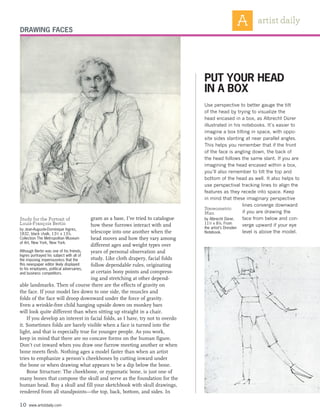
Study for the Portrait of 
Louis-François Bertin 
by Jean-Auguste-Dominique Ingres, 
1832, black chalk, 131⁄2 x 137⁄8. 
Collection The Metropolitan Museum 
of Art, New York, New York. 
Although Bertin was one of his friends, 
Ingres portrayed his subject with all of 
the imposing imperiousness that the 
this newspaper editor likely displayed 
to his employees, political adversaries, 
and business competitors.
Drawing Faces 
fact, take off the skullcap and do some 
drawings from within. You will prob-ably 
learn something new each time 
you sketch the skull, including how 
it reaches its fullest, widest point in 
the back of the cranium at the parietal 
eminences above and behind the ear; 
or how the cranium (or brain mass) 
takes up more than two-thirds of the 
skull—among many other crucial bits 
of information. Don’t worry about 
making the sketches finished, polished 
products. Any scribble will suffice, and 
any amount of time will do, even if it’s 
less than five minutes. The goal is to 
acquaint yourself thoroughly with the 
head’s bony structure so that you can 
attack the living, flesh-covered skull 
with more confidence and instinctual 
11 www.artistdaily.com 
understanding. Money shouldn’t be an 
issue. Many art stores sell inexpensive, 
usable plaster and plastic casts; you can 
always visit a natural-history museum 
to sketch one there; or, if you’re truly 
strapped, you can buy an inexpensive 
model kit from the hobby store. At the 
very least, you can work from an anat-omy 
book borrowed from the library. 
Points of View 
As admirable as doing so may seem, 
don’t concentrate exclusively on the 
front of the face and its features in 
your studies. If you want to impart a 
dynamic look into your figure draw-ing, 
you need to understand all aspects 
of the human head, as seen from all 
points of view. When drawing the 
head from behind, notice how large 
the back of the head looks compared 
to the face. The distance between the 
ear and the periphery of the face and 
nose are usually smaller than you may 
initially estimate. When drawing a 
reclining figure that’s head-first, you’ll 
likely find the features mostly eclipsed 
by the brow ridge and the cranial mass 
above. The nose often extends far 
beyond the nearly invisible dental arch 
in this sort of extreme, foreshortened 
position. Ironically enough, when you 
draw a feet-first, reclining figure, you 
will frequently notice the nose extend-ing 
far above the receding forehead. In 
any of these unusual positions, always 
make a comparative measurement of 
the features against the cranium to 
be sure that you are capturing—or, 
if you want, exaggerating—the cor-rect 
proportional relationships. 
Tilt 
As you know, you can use the fea-tures— 
and contort them into all sorts 
of symbols—to achieve emotion. This 
can get awfully melodramatic and lead 
to a visually flat image. A “simple” 
tip of the head can do so much more 
with almost no twisting of the features. 
Admittedly, this simple task is easier 
said than done. It’s easy enough to see 
that when the head turns upward, the 
ear drops downward, and vice versa. 
But many artists freeze when they 
look at a tilted head, unsure of how 
to use the other basic guidelines that 
help keep the features in their proper 
bilateral position. The answer is to tilt 
your measurement guidelines running 
along with the cant of the head. So, if 
you want to judge the position of the 
mouth as it relates to the iris, draw a 
guideline slanted with the tilt of the 
above left 
Drawing of Daniel (detail) 
by Dan Gheno, 2006, graphite with white chalk 
on toned paper, 11 x 10. Collection the artist. 
The "muzzle" is very small on the human face, 
but it exists nonetheless, growing out of the base 
of the nasal bone and encompassing the pro­jecting 
area of the nose, dental arch, and chin. 
above right 
Drawing of Donna (detail) 
by Dan Gheno, 2006, graphite with 
white chalk on toned paper, 7 x 10. 
It’s important to study and understand the muscles 
of the neck, but don’t let your interest in anatomy 
obscure the neck’s underlying cylindrical form.
Drawing Faces 
head, from the iris to the mouth. If 
you want to measure the position of 
the eye, drag a tilted line up from the 
outside of the wing of the nose toward 
the inside of the eye, and so on. 
A foreshortened arm or leg is diffi-cult 
enough, but the most difficult body 
part—and probably the most dynamic 
of all the head positions—is the view of 
the head from below. Many artists draw 
the facial mass too large in this fore-shortened 
position, usually increasing 
the distance between the nose and the 
eyes and often shortchanging the chin. 
You need to remember the underlying 
egg structure of the head. The chin is 
curving toward you, so it’s much larger 
in this low-level view than you might 
imagine. Conversely, the forehead is 
curving away so the head shrinks visu-ally 
as it rounds out toward the hairline. 
Meanwhile, the nose swings upward off 
the underlying curve of the face, even in 
a straight-on view, and when it is highly 
12 www.artistdaily.com 
foreshortened, the nose often seems 
to jut out in front of the eye in a three-quarter 
view. Foreshortened or not, it’s 
helpful to compare the position of the eye 
to the junction point where the forehead 
dips to meet the nose. The eye is either 
above, alongside, or just below this point. 
The Nobility of 
Head Drawing 
In this article, I’ve tried to stress the 
importance of the head’s dynamic relation 
to the figure. Sometimes, when doing a 
full figure drawing, it’s best to start with 
the body and gradually work up into the 
head, measuring it against the neck; Draw 
some imaginary lines that lead upward, 
off either side of the neck, and ask your-self 
how much head you should draw in 
front of one line and how much in front 
of the other line. But don’t let other art-ists 
chide you for concentrating on the 
head or—heaven forbid—“portrait draw-ing.” 
You can say a lot with an intensely 
observed drawing of a simple, isolated 
face or head. The Mona Lisa or one of 
Rembrandt’s self-portraits say more to 
me about the multilevel, universal human 
condition than any book I’ve ever read. 
You know the power firsthand: How 
many times have you shuddered painfully 
when a friend sarcastically rolled their 
eyes or slightly cocked their mouth to 
one side in derision? On the other hand, 
how wonderfully bracing is it to look into 
a loved one’s dilated eyes and, to borrow 
from a corny song, gaze at their uncon-scious, 
subtle Mona Lisa smile? n 
Modeling a Face 
With Light 
I could write an 8,000-word article on the subject of 
light and shadows—indeed, Leonardo enthusiastically 
filled more than six notebooks dedicated to the subject 
(plus many extensive passages in other notebooks). 
Briefly put, once you find the outside contours of your 
head and features, you need to see the “third line” 
within the limits of your forms—where the light termi-nates 
and the shadow begins. Called “the terminator” 
by astronomers, this line helps establish the inner form 
where the big planes of the head meet and turn crisply. 
Therefore, the light on the eye and the cheek that is 
closer to the light source is almost always brighter than 
the ones that are farther away. As an example, let’s say 
you’re drawing someone with a weak chin, illuminated 
from above by a bright lamp. You may correctly place 
all of the terminator lines, perhaps finding a strong 
shadow shape running down the length of the face from 
forehead to chin, as in the drawing above by Tiepolo. 
But if you make the broad lights on the lower part of 
the face the same bright value as the forehead, the chin 
will not recede and you won’t achieve a likeness or a 
sense of full volume no matter what else you do. 
Study of a Boy With His Hand 
to His Mouth 
by Giovanni Battista Tiepolo, pen and brown ink 
over black chalk, 95⁄8 x 73⁄4. 
Squint your eyes when you look at the model, and 
assess the big value masses as Tiepolo did in this 
strongly graphic drawing. All the details should 
merge into the bigger shapes. None of the details 
in shadow should jump out and appear as light as 
anything in the light shape, and none of the lights 
should look as dark as anything in the shadow.
Drawing Faces 
How to Draw 
Eyes with 
Impact 
by Courtney Jordan 
f the eyes are the windows to 
the soul, then a painter needs 
to get them right when creating 
a portrait. But the “oval, circle, 
dot” anatomy of the eye that we 
all first learned as children is far 
removed from how to give the illusion 
of a real eye in your work. But eyes can 
be one of the most challenging features 
to depict because its forms and colors 
are incredibly subtle and delicate. But 
that's not to say it can't be done. 
Here are a few tips about painting 
the eye that I like to keep in mind. I 
hope these will help guide you when it 
comes time to depict this particular 
13 www.artistdaily.com 
facial feature, so that your 
portrait paintings or draw-ings 
do approach that 
"window to the soul" ideal. 
For starters, it is always 
good to approach paint-ing 
of the eye with its 
basic anatomy in mind. 
There are two lids to the eye, one above 
and one below. The lower lid is the 
one most people tend to forget, so be 
mindful to define it. This will prevent 
the eye from looking like it is hover-ing 
above the face instead of securely 
seated in its socket. 
And it isn’t just the eye that can 
give a the sense of roundness or three-dimensionality 
to a face in a portrait or 
drawing of a person. The cheekbone 
and brow ridge give a sense of the curve 
around the eye as well. Think of the eye 
as almost nesting between these two; 
inset into the anatomy of the face. 
Highlight the upper eyelid and cast 
the lower lid in subtle shadow–that’s 
the way to give it roundness. But be 
careful to approach your color transi-tions 
subtly. Too sharp a contrast will 
undermine the realistic representa-tion 
of your work. Also don’t forget to 
depict the crease where the upper lid 
folds when the eye is open. Otherwise 
the eye will look flat. 
above 
Jusepe de Ribera’s 
Penitent Magdalene 
(detail) is a moving 
example of how emotive 
eyes can be. Notice 
how convincing the eye 
socket and area around 
the eye is painted. 
bottom left 
Van Gogh’s self-portrait 
is an exercise in line, 
but notice how it 
varies in thickness and 
direction, especially 
around the eyes. 
As with most features on the face, 
nothing is really defined with strong, 
unbroken lines. Use varied lines and 
shading to create the peaks and valleys 
that turn the form. 
We all love the idea of bright eyes, 
but that doesn’t mean the eyeball itself 
is pure white. Try a pale grey or beige 
and lighten it up with a bit of skin tone 
color for the eyeball. It’ll look more 
natural that way. 
The facial features of every person 
are so unique, and yet there’s a com-monality 
about them. If you can master 
these intricate features, you put your-self 
in a position of painting anyone 
well, creating compelling, believable 
portraits in due course. n 
I 
This content has been abridged from an original article written by Courtney Jordan. This premium has been published by Interweave Press, 201 E. Fourth St., Loveland, CO 80537-5655; (970) 669-7672. 
Copyright © 2012 by Interweave Press, a division of Aspire Media, all rights reserved. The contents of this publication may not be reproduced either in whole or in part without consent of the copyright owner.
Understanding 
Anatomy: 
Lips by David Jon Kassan 
nderstanding the way the 
muscles of the mouth express 
the emotion of your subject 
is crucial in determining how 
to depict that emotion in your 
drawing. In this article I will 
U 
touch upon the form concepts and muscular 
structure of the mouth and lips so that you can 
have some general guidelines in the back of 
your mind when you draw your next model. 
There are many variables to consider when 
drawing the lips. Everyone’s lips are unique; there 
are different sizes, shapes, and configurations 
that depend on the model’s size, age, ethnicity, 
and even eating habits. Luckily there are some 
common attributes as well, and they are help-ful 
to keep in mind while drawing the mouth. 
Visual Structure 
of the Lips 
The lips are soft, movable, and very flexible. 
They are divided into two main parts, the upper 
lip (labium superioris) and lower lip (labium 
This content has been abridged from an original article written by Jon Kassan. This premium has been published by Interweave Press, 201 E. Fourth St., Loveland, CO 80537-5655; (970) 669-7672. 
Copyright © 2012 by Interweave Press, a division of Aspire Media, all rights reserved. The contents of this publication may not be reproduced either in whole or in part without consent of the copyright owner. 
14 www.artistdaily.com 
Study of Grace (unfinished) 
2008–2009, charcoal and white chalk on toned 
paper, 14 x 11. Collection the artist. Image 
courtesy Henoch Gallery, New York, New York. 
Lips come in a variety of shapes and sizes 
depending on multiple factors including size, 
age, ethnicity, and even eating habits. 
Drawing Faces
Drawing Faces 
g i 
Above: Below: 
15 www.artistdaily.com 
inferioris). In most cases the lower lip tends to be 
somewhat larger than the upper lip and is pillowy in 
its fullness compared to the upper lip. The upper lip 
usually falls into a form shadow because of its inward 
slant, which starts forward at its apex and ramps down 
and backward as its pulls inward, causing a slight over-hang 
over the pillow shape of the lower lip. The lips can 
be broken down further into five distinct shapes. The 
upper lip may be divided into two wings on either side 
of the central beaklike shape. The little vertical inden-tion 
just above the upper lip is called the philtrum. 
The two lips together lay over the cylindrical shape of 
the muzzle of the mouth. Understanding this roundness 
of the overall form helps the artist depict how the center 
of the lips are closer to the viewer (on a straight-on view 
of the model) and thus how the corners of the mouth 
fold away from us in space, as if each side were attached 
to strings that were being pulled tight around a tin can. 
The lips are really the transition point between our 
exterior facial skin and the inner smooth lining (or 
mucosa) of the mouth. This meeting point between 
these two tissues is called the vermilion zone. The name 
vermilion comes from the red color that is characteristic 
of this facial feature; this color is unique to humans and 
comes from the many blood vessels found in the dermis 
and their close proximity to the thin, translucent epider-mis 
that covers them. The skin of the lips are only three 
to five cellular levels thick, compared to other facial-skin 
areas that are as many as 16 layers thick. The ridges 
found in the lips are a result of a highly folded dermis 
that is not found in the skin of any other body parts. 
Muscular Structure 
of the Mouth 
The extreme expressiveness of the mouth is due in part 
to its flexibility and wide range of movement. This range 
is attributable to the muscular structure that controls the 
lips under the surface, a complex web of facial muscles 
that are so interconnected with one another and with the 
Levator labi 
Zygomaticus minor 
Orbicularis oris 
Zygomaticus major 
Buccinator 
Node/Modiolus 
Masseter major 
Platyma-labial portion 
Risorius 
Triangularis/Depressor 
anguli oris 
Platyma 
a 
Philtrum 
Fubercle of the upper 
lip—beak 
Vermilion zone 
Node 
Lobe of the lower lip 
Groove of the lower lip 
Mentolabial furrow 
Pillar of the mouth 
a 
e 
h 
e 
f 
f 
g h 
j 
k 
d 
d 
c 
c 
b 
b 
A. 
B. 
C. 
D. 
E. 
F. 
G. 
H. 
I. 
J. 
K. 
A. 
B. 
C. 
D. 
E. 
F. 
G. 
H.
different facial features that if you were 
to wiggle your nose, your upper lip 
would move from side to side as well. 
The main muscle of the mouth is 
the orbicularis oris. The orbicularis oris 
forms the muzzle by surrounding the 
orifice of the mouth with several differ-ent 
layers of muscle fiber and extends 
from the base of the nose down to the 
top of the chin. The buccinator works 
with the orbicularis oris, stretching 
the circular fibers around the mouth’s 
cavity. It is used when compressing 
the lips and cheeks against the teeth. 
The buccinator starts at the mandible 
(jawbone) and moves deeper than 
the rest of the facial muscles to con-nect 
to the modiolus and the upper 
and lower lips. Laterally flanking each 
angle of the mouth, the modioli act as 
the anchors for many facial muscles. 
These muscles are held together 
by fibrous tissue and are extremely 
important for facial expression. 
16 www.artistdaily.com 
The fibers of the orbicularis oris 
have origins in other facial muscles that 
end and join with the lips’ own muscle 
fibers. Specifically, the three muscles 
that lead into the upper lip are the leva-tor 
labii superioris, the levator labii 
superioris alaeque nasi, and the zygo-maticus 
minor. These three muscles 
control the upper lip region and move 
the lips sideways and raise them. They 
are well connected to the nose, too, 
and are helpful for wiggling the nose 
as well as expressing emotions of grief 
and contempt. The nearby levator labii 
superioris originates at the maxilla. The 
muscle that flanks the mouth on both 
sides and is in control of raising the lip 
high and sideways is the zygomaticus 
major. The lower lip and mouth is con-trolled 
primarily by three muscles: the 
risorius, the triangularis (or depressor 
anguli oris), and the mentalis. These 
muscles are used to pull down the cor-ners 
of the mouth and lower lip. The 
Levator labii superioris 
alaeque nasi 
Zygomaticus minor 
Zygomaticus major 
Orbicularis oris-orbita port 
Node/Modiolus 
Risorius 
Orbicularis oris-outer portio 
Platyma 
Triangularis/Depressor 
anguli oris 
Mentalis 
A. 
B. 
C. 
D. 
E. 
F. 
G. 
H. 
I. 
J. 
K. 
mentalis can even wrinkle the chin. 
Another important muscle is the 
masseter, which starts at the zygo-matic 
arch (cheekbone) and stretches 
down to the ramus of the mandible. 
This muscle controls the opening and 
closing of the mouth as well as the 
pushing out of the chin; it is used to 
express anger and emotional tension. 
The lips are one of the face’s most 
prominent and expressive features. 
They help to visually communicate 
our emotions, and they have many 
functions, including helping us to 
eat and articulate speech and—most 
important—to kiss and be intimate. It 
takes careful attention and observation 
to evaluate each subject’s own unique 
turns, tucks, folds, and roundness of 
the mouth and lips. But the time and 
patience is well worth it; with this prag-matic 
and well-observed structure in 
place, you can infuse your subject with 
an emotive strength. n 
Drawing Faces 
a 
e 
f 
i 
g 
j 
k 
d 
c 
b 
h
Drawing faces

Drawing faces

  • 1.
    presents Drawing faces Learn How to Draw a Face with Attitude, How to Draw Eyes with Impact and How to Draw Lips with Structure
  • 2.
    Drawing Faces Howto Draw Dynamic Heads Depicting features is only the beginning. Putting life into a head drawing requires assimilating it with the rest of the body, capturing an attitude—and much more. by Dan Gheno here are many ways to keep your figure drawings lively, fresh, and dynamic. But there is one sure way to destroy an active and energetic drawing: by plopping a stiffly rendered, ham-fisted head T on top of an otherwise nicely drawn figure. Too many artists, perhaps fearful of their subjects, treat the head as if it were nothing more than an inventory of features or an empty, blocklike shape, void of life, sometimes sitting straight and rigidly on its neck, contradicting the underlying gesture of the body and looking like a lifeless lollipop. This eons-old challenge of how to put more life and energy into drawings, paintings, and sculptures of the human head is easily answered once you get beyond the fear and the seeming complexity of the subject. I will outline many solutions throughout this article appropriate for both the beginner and advanced artist. Some of the cures will seem deceptively simple. Others will reach beyond the obvious, studying the head from all sides, including top and bottom. And just about all of them will somehow involve the overall figure, with the head serving as the crown of the magnificent machine that is the human body. Friedrich Karl, Prince of Prussia by Adolf Menzel, 1863, gouache over graphite, highlighted with white, 115⁄8 x 9. Notice how, from behind, the nasolabial furrow obscures some of the nose and mouth and seems to unite optically with the cheekbone and rim of the eye. This connection helps to push the nose back and, along with several other overlapping shapes, reinforces the roundness of the underlying egg-shaped head structure. This content has been abridged from an original article written by Dan Gheno. This premium has been published by Interweave Press, 201 E. Fourth St., Loveland, CO 80537-5655; (970) 669-7672. Copyright © 2012 by Interweave Press, a division of Aspire Media, all rights reserved. The contents of this publication may not be reproduced either in whole or in part without consent of the copyright owner. 2 www.artistdaily.com
  • 3.
    Drawing Faces Attitude Perhaps the most powerful key to a stronger head is the most obvious one, which even advanced artists often miss in their obsession to get the features just right—that is, give your head attitude. Faces need to look somewhere; their eyes need intensity and aim. You have probably noticed how the eyes in some Old Master paintings and drawings often seem to follow you as you move around the room. This dynamic event occurs in the viewer’s mind, usually when the artist depicts the head in a three-quarter view with the eyes looking off to one side, as Leonardo most famously did in his Mona Lisa. In drawings such as Leonardo’s Study for the Angel in La Vierge aux Rochers, observe how the irises (the cir-cular, colorful portion of the eyeball) seem to peer out of the corner of these eyes, gazing past the canvas or draw-ing toward the viewer. Remember, you can’t move irises around willy-nilly. The upper eyelid bulges above the iris, so every time you change the direction of your mod-el’s gaze, you must also change the shape of the upper lid. If you draw the model looking off extremely to one side, you will find that the lower eyelid pulls up with it. The tilt of the head is equally crucial to achieving attitude in your figure drawings. It should somehow complement or contrast the gestural movement that flows through the body from the toes to the neck and, finally, and hopefully, into the head. In Ingres' masterpiece of a portrait, Louis-François Bertin (not pictured) some people seem to lean forward imperiously, head locked into their shoulders as they speak to you. Others lean back, their noses tilted up, and their irises barely peer-ing past their lower lid. Pay close attention to body shapes and gesture, even when drawing a vignetted, seemingly isolated head. You don't want to draw a husky, muscular man with a pencil-thin neck or a young child with a fullback's shoulders. Look at the model intensely. Notice how the neck leads from the shoulder into the 3 www.artistdaily.com above right Study for the Angel in Madonna of the Rocks by Leonardo, silverpoint, 71⁄8 x 6¼. The eyes in some Old Master paintings and drawings often seem to follow you as you move around the room. This dynamic event occurs in the viewer’s mind, usually when the artist depicts the head in a three-quarter view with the eyes looking off to one side. right Drawing of a Man by Leonardo, pen-and-ink, 11 x 8½. Collection Royal Library, Windsor Castle, London, England. Describing his diagram, Leonardo explained, “The side of the head on which the (light) rays fall most directly will be the most highly lighted, and those parts on which the rays fall most aslant will be less lighted. The light falls as a blow might, since a blow which falls perpendicularly falls with the greatest force, and when it falls obliquely, it is less forcible than the former in proportion to the width of the angle.”
  • 4.
    Drawing Faces head.It doesn't matter if you are only drawing a small snippet of the neck in fact, the shorter the line, the more crucial the correct angle becomes. If the line fragment angles outward or inward a little too much, the error will become magnified once you imagine the line extending outside of the image, inferring an implausible body type for the head. Body postures and their relationships 4 www.artistdaily.com to the head are numerous, and they can be quite evocative of an individual's character, psychology, and emotion. Getting a Likeness It may seem like a waste of time wor-rying about whether you’ve captured a likeness or not. It’s unlikely the viewer will notice that something is missing. True, it will not matter in the end to the viewer. But I feel it’s imperative to always give it a sincere try. The pursuit of likeness keeps my concen-tration focused, it keeps the entire drawing process compelling, and, in the end, the struggle leads to a more active-looking and vigorous drawing. There is no doubt that the individual features and the distance between the features are essential in getting a like-ness and a psychologically animated head and figure. I explained several fea-ture- measuring techniques in my first article for American Artist [“Painting Portraits”] in the February 1993 issue. It’s useful to draw numerous studies of the features—like Jusepe de Ribera did in Study of Eyes—cataloguing and committing their basic construction to memory. At the same time, try to be sensitive to the bilateral symmetry that underlies the face and its features. Use guidelines to line up one side of the face with the other. But remember this very important caveat: As much as you may want them to, features do not conform to a simplistic rule of abso-lute symmetry. Look closely at any Old Master portrait. You will usually find that one eye is almost always a little bigger or a little farther from the nose than the other, one nostril a little taller, one side of the mouth a bit lower than the other. These artists’ use of subtle asymmetry gives their subjects’ heads and figures life and a sense of action, as if the features are in motion. This asymmetry is vitally important from the likeness standpoint as well. It’s been proven in clinical and psychologi-cal studies that when a photo is sliced above left Drawing of a Woman With Loop Earring by Dan Gheno, 2006, graphite with white chalk on toned paper, 10 x 8. Collection the artist. above right My Father Posing for Facial Folds by Dan Gheno, 2006, graphite, 12 x 9. Collection the artist. Facial folds occur at right angles to the direction of the muscles underneath, very similar to a theater curtain being pulled across the stage by a horizontal cord. The zygomatic muscle runs from the cheekbone to the corner of the mouth and, when contracted, creates dependable creases in the face, the most important being the jugal furrow (left of A) and the accessory jugal furrow (B). Note how the shape of the large chewing muscle, called the masseter (C), becomes more defined when the chin is pulled in. a c b
  • 5.
    Drawing Faces inhalf, with one side reversed and pasted next to the other, the viewer finds it difficult to recognize the sub-ject within the new-found symmetry. No matter how enticing your sub-ject’s features, the hard truth is that the ratio of the head shape and size to the body is much more crucial to captur-ing a likeness or creating a dynamic impression. When looking at your model, ask yourself what sort of geo-metric shape typifies his or her head. Does your model have a triangular head tapering toward the bottom, with lots of 5 www.artistdaily.com hair and full cheekbones at the top slid-ing into a narrow jaw and smallish chin below? Or perhaps your subject has a wide, rectangular face with a broad jaw, full cheeks, and a flat, closely cropped hairdo—or a tall, rectangular head, narrow but angular from jaw to top of head. Maybe your model’s forms are built on soft, circular shapes. Whatever your subject’s essential structure, you can always distill it into a simple, quickly identifiable shape in your mind that will guide you through the compli-cated process of laying in the drawing. Purge Your Preconceptions After determining the global shape of the head, assessing the facial angle is the next most important factor in get-ting a likeness and keeping your head drawing lively. Forensic specialists fre-quently use this technique to identify decomposed remains, and 19th-cen-tury phrenologists used it in a foolish attempt to catalogue racial intelligence. You can discover the facial angle of your subject by drawing a line from the ear hole, or external auditory meatus, at the base of the skull to the bottom of the nasal aperture (Fig. B) and then compare that line to one that runs from the base of the brow ridge, or glabel-lum, to the upper dental arch. Called the “muzzle,” this protrusion doesn’t project as far forward in humans as it does in animals, but it usually juts far-ther outward than most beginner—and some advanced—artists are willing to accept. The real human head is quite unlike a Greek statue; it’s very rare that all of your subject’s features will line up in a straight, stagnant, and vertical for-mation from forehead to chin. Unless you’re trying to render some sort of classical ideal, look for this basic facial angle, and then compare it to the usual-ly receding angle that leads from the tip of the nose to the base of the chin, or the angles that radiate off the forehead, across the top of the head, and back down to the nape of the neck (Fig. A). Even if you get all of the big shapes of the head correct, you’re not out of the woods yet. You need to compare the facial size to the overall head size. Two Studies of the Head and Shoulder of Little Girl (detail) by Jean-Antoine Watteau, ca. 1717, red, black, and white chalk on buff paper, 9½ x 73⁄8. Collection Pierpont Morgan Library, New York, New York. Always look closely at the periphery of the face. Study how Watteau drew the far eye and eyebrow in this drawing. Approach your own head drawings like him, finding the subtle overlaps and the delicate forms that often lurk behind the horizon of a spherical face.
  • 6.
    Drawing Faces Quiteoften, even the most experienced artist will make the facial area—the space between the mouth and eye-brows— too big or too small for the rest of the head. Then they wonder why the head looks too big or small, even though they’ve measured the overall head size against the body a thousand times, and it adds up correctly every try. That’s because we often judge the size of the head with our gut; and if the features are drawn too large or small, the head will seem likewise. Most often, artists tend to make the facial mass too big, especially on a foreshort-ened head or bearded model. Artists 6 www.artistdaily.com are only human. Governed by our spe-cies’ psychological focus on the impor-tance of the features, we seem eagerly predisposed to expect a large facial size. Larger Than Life Many large-scale drawings have a built-in dynamism. Unfortunately, it’s often hard to feel good about a face that’s drawn larger than life, especially when drawing a delicate person. Even if all of the features and underlying angles are impeccably placed, the face will almost always seem “off,” or at least surreal, because it is larger than we have experienced in real life. Perhaps you want to embrace that surrealism or want to capture some of the heroic power we see in such sculptures as Head of Constantine (not pictured). I do that a lot myself, as do many artists I admire. Perhaps you are doing a mural or altarpiece that will be seen at an extreme distance. Just be sure you are doing it on purpose, not because you got carried away. Usually, this prob-lem creeps up on you. As one works on the features—or any detail of the body, such as the hands or feet—one can become captivated, and if an artist doesn’t step back often to gauge the relative size of the subject’s face to the rest of the figure, those features will tend to grow. Artists then compensate by enlarging all the other features, then the entire head, until finally the rest of the figure must be redrawn at a larger size. Then, to add insult to injury, the feet may be falling off the page or the hand could be cut off awk-wardly by the edge of the paper at the knuckles, forcing the artist to scrap the whole figure, including the head. No artist is free from this malady. I know myself too well, and to counter-act this tendency, I draw lines at the top, bottom, and middle of my figures Study of Eyes by Jusepe de Ribera, 1622, etching, 57⁄8 x 81⁄2. Collection Albertina Museum, Vienna, Austria. It’s always a good idea to study the subforms of the face. Whenever you have a free moment, draw isolated views of the eyes, nose, lips, and ears from every direction. Soon you will build up a subconscious understanding of each feature.
  • 7.
    Drawing Faces whenI sense my proportions going awry. Whether you are a beginner or an advanced artist who is continually deal-ing with this problem, draw these lines near the outset of the drawing process. Then, if you find your face or figures expanding even a little beyond these lines, resolutely and bravely enforce a hard-love discipline on yourself. With head drawing, this usually means first revisiting the size of the nose, since all the other features radiate off this central point. Indeed, when initially laying in the proportions of the face, it’s a good strategy to put more work into the nose once you start delving into the details. Of course, you don’t want to spend all your time on the 7 www.artistdaily.com nose. To maintain your objectivity and a gestural quality in your drawing, always move around the face and figure when working on specifics. But once the size of the nose is set, compare all of the other features to it. Say, for instance, you accidentally make the nose too big. If you’re vigilant, you will likely catch it before its stealthy effect cascades throughout the features and body with increasing magnitude. Purposeful Exaggeration You might find yourself justifying an overly large head size by arguing, “Well, some people just have large heads!” Think—and look—again. Proportional relationships tend to reoccur through-out the body. There are no absolute rules, but when someone has a seem-ingly large head, many of their other subform proportions tend to be stocky as well. Among adults, our bodies can range anywhere between six to eight heads tall. If you wander beyond that limit, you surely need to take a second look at your subject to be sure you are not fooling yourself. Like Sargent, you may purposely choose to elongate your figure by giving your drawing a small head—many of his figures are nine or 10 heads tall and quite plausible. Like him, just be sure to equally lengthen all the other body subforms. Nothing looks sillier or more stilted than a tiny pinhead on a hulking body or incon-sistently exaggerated body parts. On the other hand, don’t fall prey to the opposite problem—making a head too large—to try to compensate for a heavy or muscular body type. Even if you want to embellish the muscularity or heavi-ness of the body forms, you must pay particular attention to the way the full neck tucks dramatically into the front of the diminutive head on a large, heavy model and the way the thick shoulders of a muscular model taper gradually into the back of the normal-size skull. Elements of Head Structure Light Source: The more you work in a representational manner, the more you need to consider the underly-below Ethel Smyth by John Singer Sargent, 1901, black chalk, 231⁄2 x 18. Collection National Portrait Gallery, London, England. From a low, three-quarter view, the lower face looks quite large as the spherical shape of the head curves toward you. On the other hand, the forehead looks rather small and the nose jumps up in front of the far eye as the head rounds out away from you. Don’t inadvertently lengthen the top of the head and shorten the lower area to conform to your subconscious preconceptions. left Head of a Young Woman by Jean-Baptiste Greuze, 1765, black and white pastel, charcoal, and red chalk, 131⁄2 x 101⁄4. Greuze treated the shadow running through the young woman’s face simply and graphically. He knew that light illuminates detail, while the absence of light obscures visual information and leaves the shadow in a relatively passive state. He reserved most of his subtle details for the light side. He rendered the forehead in a dramatically bright highlight that then tapers into progressively darker values, as the face gradually curves egglike away from the light and recedes into the halftones of the chin.
  • 8.
    Drawing Faces 1 Figure A, above left Drawing of Paul by Dan Gheno, 2006, graphite with white chalk on toned paper, 12 x 10. Collection the artist. When judging a likeness, compare the distances that make up the forehead (1-2), the nose (2-3), and the space between the bottom of the nose (3) and the chin (4). If you don’t transcribe these proportions accurately, you’ll never find a likeness no matter how well you draw the individual features. Sometimes you might find it difficult to assess the top of the forehead 8 www.artistdaily.com Measuring Facial Features In my “Portrait Painting” article in the February 1993 issue of American Artist, I explained several feature-measuring tech-niques. Here is a brief recap of these impor-tant concepts: First, partition the features into three equal divisions (Fig. A): The top partition runs from the hairline to the eyebrows, the second one from the eyebrow to the base of the nose, and the third one from the bottom of the nose to the bony point of the chin. This classically derived system of measurement has been used by artists to get their bearings since the Greek golden age, and it’s nothing more than an averaging of our collective facial proportions. As artists, we need to look at the model and determine where their particular proportions diverge from this standard. Ask yourself, Which of these three divisions is the largest, which is the next largest, and which is the smallest? If you don’t catch these divi-sions correctly in the beginning, it doesn’t matter how elegantly you render the specific features. Many people have a hard time locat-ing the position of the ear when drawing a side view; they usually underestimate the overall width of the head compared to its height. Try comparing the horizontal distance between the outside of the eye and the front of the ear with the vertical distance between the outside of the eye and the outside corner of the mouth; these measurements are usually very similar. Notice, as Leonardo demonstrated in his diagrams, that the overall width of the eye is roughly equal to the nose and that, consequently, the wing of the nose usually lines up with the inside of the eye. Meanwhile, the top of the ear lines up with the eyebrow, and the bottom coincides with the base of the nose. Once you begin to render the individual features, you must be equally diligent about their peculiar likeness. Ask yourself some basic questions, using a horizontal line as a reference point: Do the features rise above the line, sit flatly across it, or drop below the line? Does one side or the other rise or drop past the reference line? 1 if your subject has a high hairline. In that case, use the point where the forehead begins its transition into the top of the skull (1). Figure B, above right Diagram of the Facial Angle by Charlotte Bertuch-Froriep, ink. To determine your model’s facial angle, compare an angle that runs from the brow ridge to the upper dental arch (1) with one that runs from the base of the nose to the ear hole (2). ing structure of the head and figure to keep your drawing robust and exciting. Your choice of lighting is a crucial factor, particularly when working tonally with value masses. Other artists may make different, equally valid choices, but I deliberately place my light source off to one side and above the model for the maximum dra-matic and form-making effect. I limit my illumination to a single source, and I position it so that the shadows break decisively along the edge where the major front planes and side planes meet. The Egg Effect: Shapes, proportions—everything seems to measure correctly, and you know for a fact that your drawing is not larger than life. You even take a second look at the relationship of the front plane to the side planes, but your head and figure still appear dull, flat, disjointed, and not quite a likeness. So, what’s wrong? Chances are you missed the “egg effect”—the spherical form that underlies the more angular planes of the face. Close attention must be paid to the subtle play of graduating light as it crosses over the width and length of the egglike head. The head doesn’t just cor-ner from the front to the side planes, it also curves within the big planes from top to bottom and side to side. It’s sometimes hard to discern, but the light tapers subtly darker as the underlying sphere turns away from its source. If you have a hard time seeing this for yourself when working from a live model, try cutting a couple of 2 2 3 4
  • 9.
    Drawing Faces 9www.artistdaily.com holes in a piece of paper. Hold the paper in front of the model’s face, and keep moving it back and forth until one hole isolates the light of the forehead and the other hole isolates the light on the chin. When working from photos, you can usually dis-cover this cascading light effect by turning both the photograph and your drawing upside down. Necks: If heads are fundamentally egglike, necks are basically cylindrical. Try not to disturb their underlying shape by overplaying the sterno-cleido-mastoid, those strap-like muscles that straddle the throat and support the head. Like the subforms of the features, these muscles sit on the curving cylinder of the neck and should participate in its graduating value changes. Remember also that these two muscles are antagonists, an anatomical term that indi-cates they work as a team. Immobility occurs if they both contract at the same time. This means you can’t render both muscles in equal definition, at least if you’re trying to show the head in motion. When one of them contracts and bulges out, pulling the side of the head toward you, draw the other muscle more relaxed and less defined. One more warning: When working from life, expect some movement in the pose if the model’s neck is twisted to an extreme degree. Always anticipate some unconscious movement of the head and neck toward a more centralized position. While paying heed to its cylindrical character, notice that the neck isn’t a telephone pole, shooting perpendicularly into the head. Observe how the neck projects diagonally from the shoulder into the base of the head, pushing the head forward. This dynamic, diagonal relationship is most clearly identifiable on a side view, but as you likely know from experience, it’s much more difficult to grasp on a three-quarter view. You’ll know only too well when you’ve missed the neck slant. The head will often seem mashed into the neck, and both the head and the neck will seem off-center, placed too far over to one side on the shoulder. To correct this problem, try concentrating on the throat—or trachea—instead of the outside edges of the neck. The under-lying projecting angle of the throat is much more apparent in this view. Draw upward from the pit of the neck, along the forward edge of the throat, until you reach the under plane or canopy of the chin, and add the outside lines of the neck later. Whatever you do, avoid the static, lollipop look I warned you about at the beginning of the article, with both the front and back of the neck reaching into the head at the same parallel level. The back of the neck intersects the skull much higher up than the front of the neck, often aligning with the base of the nose when the face is on an even keel. Age and Folds: Age and weight play an important role in the dynamics of the face—its structure and its emotional expression. The older we get, the more our skin drapes, with creases occurring at right angles to the shape and action of the muscles underneath. The zygomatic muscles, running from the cheekbone to the corner of the mouth, have the greatest influence on the face, so when they contract, they also produce one of the strongest folds, called the nasolabial furrow, running from the nose and partially encircling the mouth. Seen from behind, as in Menzel’s Friedrich Karl, Prince of Prussia, this furrow seems to visually connect with the cheekbone and partially eclipses the nose itself. I’ve been fascinated by facial folds for most of my life, ever since I saw Stephen Roger Peck’s wrinkle chart in his book Atlas of Human Anatomy for the Artist (Oxford University Press, New York, New York). Using his seminal dia- Foreshortening Exercise If you have a difficult time seeing and drawing the nose close to the eye, try this exercise: Find a photo of a fore-shortened face; draw it freehand, concentrating on the eye-nose relationship; then trace the photo and compare the two drawings, noting where you may have inadver-tently increased the eye-nose distances in your first draw-ing. Keep repeating the exercise with other photos until you conquer your habits of distortion. Skull From Above by Dan Gheno, 2006, graphite, 4 x 5. Collection the artist. Purge your mind of preconceptions when drawing the head from an odd angle— the face is barely visible when the head is seen from above.
  • 10.
    Drawing Faces 10www.artistdaily.com gram as a base, I’ve tried to catalogue how these furrows interact with and telescope into one another when the head moves and how they vary among different ages and weight types over years of personal observation and study. Like cloth drapery, facial folds follow dependable rules, originating at certain bony points and compress-ing and stretching at other depend-able landmarks. Then of course there are the effects of gravity on the face. If your model lies down to one side, the muscles and folds of the face will droop downward under the force of gravity. Even a wrinkle-free child hanging upside down on monkey bars will look quite different than when sitting up straight in a chair. If you develop an interest in facial folds, as I have, try not to overdo it. Sometimes folds are barely visible when a face is turned into the light, and that is especially true for younger people. As you work, keep in mind that there are no concave forms on the human figure. Don’t cut inward when you draw one furrow meeting another or when bone meets flesh. Nothing ages a model faster than when an artist tries to emphasize a person’s cheekbones by cutting inward under the bone or when drawing what appears to be a dip below the bone. Bone Structure: The cheekbone, or zygomatic bone, is just one of many bones that compose the skull and serve as the foundation for the human head. Buy a skull and fill your sketchbook with skull drawings, rendered from all standpoints—the top, back, bottom, and sides. In Put Your Head in a Box Use perspective to better gauge the tilt of the head by trying to visualize the head encased in a box, as Albrecht Dürer illustrated in his notebooks. It’s easier to imagine a box tilting in space, with oppo-site sides slanting at near parallel angles. This helps you remember that if the front of the face is angling down, the back of the head follows the same slant. If you are imagining the head encased within a box, you’ll also remember to tilt the top and bottom of the head as well. It also helps to use perspectival tracking lines to align the features as they recede into space. Keep in mind that these imaginary perspective lines converge downward if you are drawing the face from below and con-verge upward if your eye level is above the model. Stereometric Man by Albrecht Dürer, 111⁄2 x 81⁄8. From the artist’s Dresden Notebook. Study for the Portrait of Louis-François Bertin by Jean-Auguste-Dominique Ingres, 1832, black chalk, 131⁄2 x 137⁄8. Collection The Metropolitan Museum of Art, New York, New York. Although Bertin was one of his friends, Ingres portrayed his subject with all of the imposing imperiousness that the this newspaper editor likely displayed to his employees, political adversaries, and business competitors.
  • 11.
    Drawing Faces fact,take off the skullcap and do some drawings from within. You will prob-ably learn something new each time you sketch the skull, including how it reaches its fullest, widest point in the back of the cranium at the parietal eminences above and behind the ear; or how the cranium (or brain mass) takes up more than two-thirds of the skull—among many other crucial bits of information. Don’t worry about making the sketches finished, polished products. Any scribble will suffice, and any amount of time will do, even if it’s less than five minutes. The goal is to acquaint yourself thoroughly with the head’s bony structure so that you can attack the living, flesh-covered skull with more confidence and instinctual 11 www.artistdaily.com understanding. Money shouldn’t be an issue. Many art stores sell inexpensive, usable plaster and plastic casts; you can always visit a natural-history museum to sketch one there; or, if you’re truly strapped, you can buy an inexpensive model kit from the hobby store. At the very least, you can work from an anat-omy book borrowed from the library. Points of View As admirable as doing so may seem, don’t concentrate exclusively on the front of the face and its features in your studies. If you want to impart a dynamic look into your figure draw-ing, you need to understand all aspects of the human head, as seen from all points of view. When drawing the head from behind, notice how large the back of the head looks compared to the face. The distance between the ear and the periphery of the face and nose are usually smaller than you may initially estimate. When drawing a reclining figure that’s head-first, you’ll likely find the features mostly eclipsed by the brow ridge and the cranial mass above. The nose often extends far beyond the nearly invisible dental arch in this sort of extreme, foreshortened position. Ironically enough, when you draw a feet-first, reclining figure, you will frequently notice the nose extend-ing far above the receding forehead. In any of these unusual positions, always make a comparative measurement of the features against the cranium to be sure that you are capturing—or, if you want, exaggerating—the cor-rect proportional relationships. Tilt As you know, you can use the fea-tures— and contort them into all sorts of symbols—to achieve emotion. This can get awfully melodramatic and lead to a visually flat image. A “simple” tip of the head can do so much more with almost no twisting of the features. Admittedly, this simple task is easier said than done. It’s easy enough to see that when the head turns upward, the ear drops downward, and vice versa. But many artists freeze when they look at a tilted head, unsure of how to use the other basic guidelines that help keep the features in their proper bilateral position. The answer is to tilt your measurement guidelines running along with the cant of the head. So, if you want to judge the position of the mouth as it relates to the iris, draw a guideline slanted with the tilt of the above left Drawing of Daniel (detail) by Dan Gheno, 2006, graphite with white chalk on toned paper, 11 x 10. Collection the artist. The "muzzle" is very small on the human face, but it exists nonetheless, growing out of the base of the nasal bone and encompassing the pro­jecting area of the nose, dental arch, and chin. above right Drawing of Donna (detail) by Dan Gheno, 2006, graphite with white chalk on toned paper, 7 x 10. It’s important to study and understand the muscles of the neck, but don’t let your interest in anatomy obscure the neck’s underlying cylindrical form.
  • 12.
    Drawing Faces head,from the iris to the mouth. If you want to measure the position of the eye, drag a tilted line up from the outside of the wing of the nose toward the inside of the eye, and so on. A foreshortened arm or leg is diffi-cult enough, but the most difficult body part—and probably the most dynamic of all the head positions—is the view of the head from below. Many artists draw the facial mass too large in this fore-shortened position, usually increasing the distance between the nose and the eyes and often shortchanging the chin. You need to remember the underlying egg structure of the head. The chin is curving toward you, so it’s much larger in this low-level view than you might imagine. Conversely, the forehead is curving away so the head shrinks visu-ally as it rounds out toward the hairline. Meanwhile, the nose swings upward off the underlying curve of the face, even in a straight-on view, and when it is highly 12 www.artistdaily.com foreshortened, the nose often seems to jut out in front of the eye in a three-quarter view. Foreshortened or not, it’s helpful to compare the position of the eye to the junction point where the forehead dips to meet the nose. The eye is either above, alongside, or just below this point. The Nobility of Head Drawing In this article, I’ve tried to stress the importance of the head’s dynamic relation to the figure. Sometimes, when doing a full figure drawing, it’s best to start with the body and gradually work up into the head, measuring it against the neck; Draw some imaginary lines that lead upward, off either side of the neck, and ask your-self how much head you should draw in front of one line and how much in front of the other line. But don’t let other art-ists chide you for concentrating on the head or—heaven forbid—“portrait draw-ing.” You can say a lot with an intensely observed drawing of a simple, isolated face or head. The Mona Lisa or one of Rembrandt’s self-portraits say more to me about the multilevel, universal human condition than any book I’ve ever read. You know the power firsthand: How many times have you shuddered painfully when a friend sarcastically rolled their eyes or slightly cocked their mouth to one side in derision? On the other hand, how wonderfully bracing is it to look into a loved one’s dilated eyes and, to borrow from a corny song, gaze at their uncon-scious, subtle Mona Lisa smile? n Modeling a Face With Light I could write an 8,000-word article on the subject of light and shadows—indeed, Leonardo enthusiastically filled more than six notebooks dedicated to the subject (plus many extensive passages in other notebooks). Briefly put, once you find the outside contours of your head and features, you need to see the “third line” within the limits of your forms—where the light termi-nates and the shadow begins. Called “the terminator” by astronomers, this line helps establish the inner form where the big planes of the head meet and turn crisply. Therefore, the light on the eye and the cheek that is closer to the light source is almost always brighter than the ones that are farther away. As an example, let’s say you’re drawing someone with a weak chin, illuminated from above by a bright lamp. You may correctly place all of the terminator lines, perhaps finding a strong shadow shape running down the length of the face from forehead to chin, as in the drawing above by Tiepolo. But if you make the broad lights on the lower part of the face the same bright value as the forehead, the chin will not recede and you won’t achieve a likeness or a sense of full volume no matter what else you do. Study of a Boy With His Hand to His Mouth by Giovanni Battista Tiepolo, pen and brown ink over black chalk, 95⁄8 x 73⁄4. Squint your eyes when you look at the model, and assess the big value masses as Tiepolo did in this strongly graphic drawing. All the details should merge into the bigger shapes. None of the details in shadow should jump out and appear as light as anything in the light shape, and none of the lights should look as dark as anything in the shadow.
  • 13.
    Drawing Faces Howto Draw Eyes with Impact by Courtney Jordan f the eyes are the windows to the soul, then a painter needs to get them right when creating a portrait. But the “oval, circle, dot” anatomy of the eye that we all first learned as children is far removed from how to give the illusion of a real eye in your work. But eyes can be one of the most challenging features to depict because its forms and colors are incredibly subtle and delicate. But that's not to say it can't be done. Here are a few tips about painting the eye that I like to keep in mind. I hope these will help guide you when it comes time to depict this particular 13 www.artistdaily.com facial feature, so that your portrait paintings or draw-ings do approach that "window to the soul" ideal. For starters, it is always good to approach paint-ing of the eye with its basic anatomy in mind. There are two lids to the eye, one above and one below. The lower lid is the one most people tend to forget, so be mindful to define it. This will prevent the eye from looking like it is hover-ing above the face instead of securely seated in its socket. And it isn’t just the eye that can give a the sense of roundness or three-dimensionality to a face in a portrait or drawing of a person. The cheekbone and brow ridge give a sense of the curve around the eye as well. Think of the eye as almost nesting between these two; inset into the anatomy of the face. Highlight the upper eyelid and cast the lower lid in subtle shadow–that’s the way to give it roundness. But be careful to approach your color transi-tions subtly. Too sharp a contrast will undermine the realistic representa-tion of your work. Also don’t forget to depict the crease where the upper lid folds when the eye is open. Otherwise the eye will look flat. above Jusepe de Ribera’s Penitent Magdalene (detail) is a moving example of how emotive eyes can be. Notice how convincing the eye socket and area around the eye is painted. bottom left Van Gogh’s self-portrait is an exercise in line, but notice how it varies in thickness and direction, especially around the eyes. As with most features on the face, nothing is really defined with strong, unbroken lines. Use varied lines and shading to create the peaks and valleys that turn the form. We all love the idea of bright eyes, but that doesn’t mean the eyeball itself is pure white. Try a pale grey or beige and lighten it up with a bit of skin tone color for the eyeball. It’ll look more natural that way. The facial features of every person are so unique, and yet there’s a com-monality about them. If you can master these intricate features, you put your-self in a position of painting anyone well, creating compelling, believable portraits in due course. n I This content has been abridged from an original article written by Courtney Jordan. This premium has been published by Interweave Press, 201 E. Fourth St., Loveland, CO 80537-5655; (970) 669-7672. Copyright © 2012 by Interweave Press, a division of Aspire Media, all rights reserved. The contents of this publication may not be reproduced either in whole or in part without consent of the copyright owner.
  • 14.
    Understanding Anatomy: Lipsby David Jon Kassan nderstanding the way the muscles of the mouth express the emotion of your subject is crucial in determining how to depict that emotion in your drawing. In this article I will U touch upon the form concepts and muscular structure of the mouth and lips so that you can have some general guidelines in the back of your mind when you draw your next model. There are many variables to consider when drawing the lips. Everyone’s lips are unique; there are different sizes, shapes, and configurations that depend on the model’s size, age, ethnicity, and even eating habits. Luckily there are some common attributes as well, and they are help-ful to keep in mind while drawing the mouth. Visual Structure of the Lips The lips are soft, movable, and very flexible. They are divided into two main parts, the upper lip (labium superioris) and lower lip (labium This content has been abridged from an original article written by Jon Kassan. This premium has been published by Interweave Press, 201 E. Fourth St., Loveland, CO 80537-5655; (970) 669-7672. Copyright © 2012 by Interweave Press, a division of Aspire Media, all rights reserved. The contents of this publication may not be reproduced either in whole or in part without consent of the copyright owner. 14 www.artistdaily.com Study of Grace (unfinished) 2008–2009, charcoal and white chalk on toned paper, 14 x 11. Collection the artist. Image courtesy Henoch Gallery, New York, New York. Lips come in a variety of shapes and sizes depending on multiple factors including size, age, ethnicity, and even eating habits. Drawing Faces
  • 15.
    Drawing Faces gi Above: Below: 15 www.artistdaily.com inferioris). In most cases the lower lip tends to be somewhat larger than the upper lip and is pillowy in its fullness compared to the upper lip. The upper lip usually falls into a form shadow because of its inward slant, which starts forward at its apex and ramps down and backward as its pulls inward, causing a slight over-hang over the pillow shape of the lower lip. The lips can be broken down further into five distinct shapes. The upper lip may be divided into two wings on either side of the central beaklike shape. The little vertical inden-tion just above the upper lip is called the philtrum. The two lips together lay over the cylindrical shape of the muzzle of the mouth. Understanding this roundness of the overall form helps the artist depict how the center of the lips are closer to the viewer (on a straight-on view of the model) and thus how the corners of the mouth fold away from us in space, as if each side were attached to strings that were being pulled tight around a tin can. The lips are really the transition point between our exterior facial skin and the inner smooth lining (or mucosa) of the mouth. This meeting point between these two tissues is called the vermilion zone. The name vermilion comes from the red color that is characteristic of this facial feature; this color is unique to humans and comes from the many blood vessels found in the dermis and their close proximity to the thin, translucent epider-mis that covers them. The skin of the lips are only three to five cellular levels thick, compared to other facial-skin areas that are as many as 16 layers thick. The ridges found in the lips are a result of a highly folded dermis that is not found in the skin of any other body parts. Muscular Structure of the Mouth The extreme expressiveness of the mouth is due in part to its flexibility and wide range of movement. This range is attributable to the muscular structure that controls the lips under the surface, a complex web of facial muscles that are so interconnected with one another and with the Levator labi Zygomaticus minor Orbicularis oris Zygomaticus major Buccinator Node/Modiolus Masseter major Platyma-labial portion Risorius Triangularis/Depressor anguli oris Platyma a Philtrum Fubercle of the upper lip—beak Vermilion zone Node Lobe of the lower lip Groove of the lower lip Mentolabial furrow Pillar of the mouth a e h e f f g h j k d d c c b b A. B. C. D. E. F. G. H. I. J. K. A. B. C. D. E. F. G. H.
  • 16.
    different facial featuresthat if you were to wiggle your nose, your upper lip would move from side to side as well. The main muscle of the mouth is the orbicularis oris. The orbicularis oris forms the muzzle by surrounding the orifice of the mouth with several differ-ent layers of muscle fiber and extends from the base of the nose down to the top of the chin. The buccinator works with the orbicularis oris, stretching the circular fibers around the mouth’s cavity. It is used when compressing the lips and cheeks against the teeth. The buccinator starts at the mandible (jawbone) and moves deeper than the rest of the facial muscles to con-nect to the modiolus and the upper and lower lips. Laterally flanking each angle of the mouth, the modioli act as the anchors for many facial muscles. These muscles are held together by fibrous tissue and are extremely important for facial expression. 16 www.artistdaily.com The fibers of the orbicularis oris have origins in other facial muscles that end and join with the lips’ own muscle fibers. Specifically, the three muscles that lead into the upper lip are the leva-tor labii superioris, the levator labii superioris alaeque nasi, and the zygo-maticus minor. These three muscles control the upper lip region and move the lips sideways and raise them. They are well connected to the nose, too, and are helpful for wiggling the nose as well as expressing emotions of grief and contempt. The nearby levator labii superioris originates at the maxilla. The muscle that flanks the mouth on both sides and is in control of raising the lip high and sideways is the zygomaticus major. The lower lip and mouth is con-trolled primarily by three muscles: the risorius, the triangularis (or depressor anguli oris), and the mentalis. These muscles are used to pull down the cor-ners of the mouth and lower lip. The Levator labii superioris Levator labii superioris alaeque nasi Zygomaticus minor Zygomaticus major Orbicularis oris-orbita port Node/Modiolus Risorius Orbicularis oris-outer portio Platyma Triangularis/Depressor anguli oris Mentalis A. B. C. D. E. F. G. H. I. J. K. mentalis can even wrinkle the chin. Another important muscle is the masseter, which starts at the zygo-matic arch (cheekbone) and stretches down to the ramus of the mandible. This muscle controls the opening and closing of the mouth as well as the pushing out of the chin; it is used to express anger and emotional tension. The lips are one of the face’s most prominent and expressive features. They help to visually communicate our emotions, and they have many functions, including helping us to eat and articulate speech and—most important—to kiss and be intimate. It takes careful attention and observation to evaluate each subject’s own unique turns, tucks, folds, and roundness of the mouth and lips. But the time and patience is well worth it; with this prag-matic and well-observed structure in place, you can infuse your subject with an emotive strength. n Drawing Faces a e f i g j k d c b h