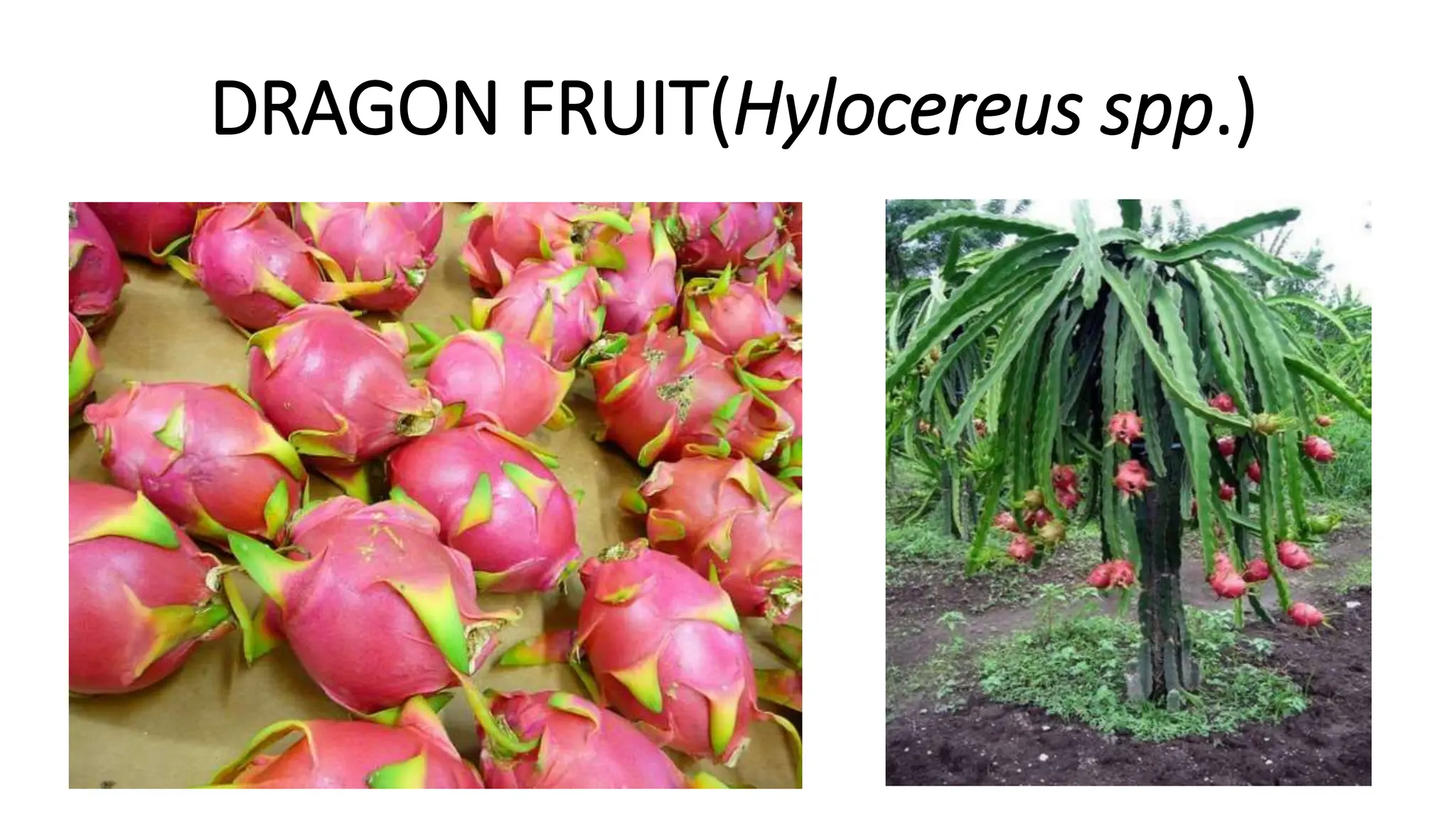
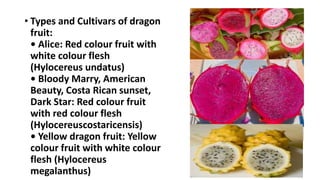
DRAGON FRUIT(Hylocereus spp.)
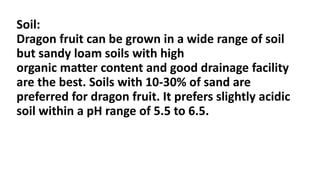
• Types and Cultivars of dragon
fruit:
• Alice: Red colour fruit with
white colour flesh
(Hylocereus undatus)
• Bloody Marry, American
Beauty, Costa Rican sunset,
Dark Star: Red colour fruit
with red colour flesh
(Hylocereuscostaricensis)
• Yellow dragon fruit: Yellow
colour fruit with white colour
flesh (Hylocereus
megalanthus)
Soil:
Dragon fruit can be grown in a wide range of soil
but sandy loam soils with high
organic matter content and good drainage facility
are the best. Soils with 10-30% of sand are
preferred for dragon fruit. It prefers slightly acidic
soil within a pH range of 5.5 to 6.5.
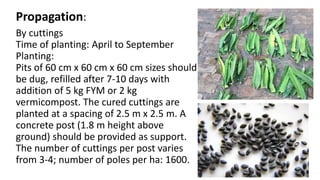
Propagation:
By cuttings
Time of planting: April to September
Planting:
Pits of 60 cm x 60 cm x 60 cm sizes should
be dug, refilled after 7-10 days with
addition of 5 kg FYM or 2 kg
vermicompost. The cured cuttings are
planted at a spacing of 2.5 m x 2.5 m. A
concrete post (1.8 m height above
ground) should be provided as support.
The number of cuttings per post varies
from 3-4; number of poles per ha: 1600.
Manure and fertilizer:
During the first year, Urea, SSP and MOP @ 70:90:40
g/plant should be applied
along with 10 kg of FYM in 2 equal splits i.e., at 3rd and
6th month after planting. From 2nd
year onwards, 15 kg of FYM along with Urea, SSP and
MOP @ 150:150:300 g/plant should
be applied at 3 equal splits i.e., April, July-August and
December.
Cultural Practices:
Training and pruning:
The immature vines should be tied with the supporting post
loosely to avoid snapping
of the matured plant parts. The lateral branches should be
pruned when the vines grow
towards the trellis and 2-3 main vines should be allowed to
grow. Once the vines reach the
trellis free branching is allowed. It is recommended to have a
round/circular metal frame to
maintain the fully grown dragon fruit plant in balance. After
harvesting, only 50 main
branches with one or two secondary branches are allowed
and tertiary and quarterly branches
are removed. Once pruned, the pruning cut ends should be
treated with fungicide.
Irrigation:
Dragon fruits can withstand certain periods of drought,
whereas, they require significantly more water than other
cacti members. However, too much water may result in
bacterial and fungal diseases and lack of soil moisture reduces
the number of flowers, thereby reducing the yield.
Weeding:
Weeding is required in dragon fruit planting sites up to 1 m in
diameter around the planting zone
Plant Protection:
1) Stem rot: Caused by Xanthomonas campestris,
Fusarium oxysporium.
Control measures include pruning of infected parts,
proper nutrition and Copper compound (Copper
oxychloride @ 0.2%) sprays.
2) Anthracnose: Caused by Colletotrichum
gloeosporioides. Fungicidal sprays like
chlorPlant Protection:
othalonil @2 g/ltr of water would be able to
control the disease.
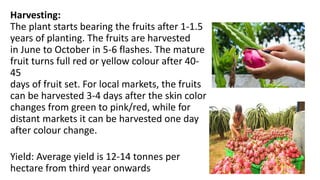
Harvesting:
The plant starts bearing the fruits after 1-1.5
years of planting. The fruits are harvested
in June to October in 5-6 flashes. The mature
fruit turns full red or yellow colour after 40-
45
days of fruit set. For local markets, the fruits
can be harvested 3-4 days after the skin color
changes from green to pink/red, while for
distant markets it can be harvested one day
after colour change.
Yield: Average yield is 12-14 tonnes per
hectare from third year onwards

Dragon fruit ppt.pptx

  • 1.
  • 2.
    • Types andCultivars of dragon fruit: • Alice: Red colour fruit with white colour flesh (Hylocereus undatus) • Bloody Marry, American Beauty, Costa Rican sunset, Dark Star: Red colour fruit with red colour flesh (Hylocereuscostaricensis) • Yellow dragon fruit: Yellow colour fruit with white colour flesh (Hylocereus megalanthus)
  • 3.
    Soil: Dragon fruit canbe grown in a wide range of soil but sandy loam soils with high organic matter content and good drainage facility are the best. Soils with 10-30% of sand are preferred for dragon fruit. It prefers slightly acidic soil within a pH range of 5.5 to 6.5.
  • 4.
    Propagation: By cuttings Time ofplanting: April to September Planting: Pits of 60 cm x 60 cm x 60 cm sizes should be dug, refilled after 7-10 days with addition of 5 kg FYM or 2 kg vermicompost. The cured cuttings are planted at a spacing of 2.5 m x 2.5 m. A concrete post (1.8 m height above ground) should be provided as support. The number of cuttings per post varies from 3-4; number of poles per ha: 1600.
  • 5.
    Manure and fertilizer: Duringthe first year, Urea, SSP and MOP @ 70:90:40 g/plant should be applied along with 10 kg of FYM in 2 equal splits i.e., at 3rd and 6th month after planting. From 2nd year onwards, 15 kg of FYM along with Urea, SSP and MOP @ 150:150:300 g/plant should be applied at 3 equal splits i.e., April, July-August and December.
  • 6.
    Cultural Practices: Training andpruning: The immature vines should be tied with the supporting post loosely to avoid snapping of the matured plant parts. The lateral branches should be pruned when the vines grow towards the trellis and 2-3 main vines should be allowed to grow. Once the vines reach the trellis free branching is allowed. It is recommended to have a round/circular metal frame to maintain the fully grown dragon fruit plant in balance. After harvesting, only 50 main branches with one or two secondary branches are allowed and tertiary and quarterly branches are removed. Once pruned, the pruning cut ends should be treated with fungicide.
  • 7.
    Irrigation: Dragon fruits canwithstand certain periods of drought, whereas, they require significantly more water than other cacti members. However, too much water may result in bacterial and fungal diseases and lack of soil moisture reduces the number of flowers, thereby reducing the yield. Weeding: Weeding is required in dragon fruit planting sites up to 1 m in diameter around the planting zone
  • 8.
    Plant Protection: 1) Stemrot: Caused by Xanthomonas campestris, Fusarium oxysporium. Control measures include pruning of infected parts, proper nutrition and Copper compound (Copper oxychloride @ 0.2%) sprays. 2) Anthracnose: Caused by Colletotrichum gloeosporioides. Fungicidal sprays like chlorPlant Protection: othalonil @2 g/ltr of water would be able to control the disease.
  • 9.
    Harvesting: The plant startsbearing the fruits after 1-1.5 years of planting. The fruits are harvested in June to October in 5-6 flashes. The mature fruit turns full red or yellow colour after 40- 45 days of fruit set. For local markets, the fruits can be harvested 3-4 days after the skin color changes from green to pink/red, while for distant markets it can be harvested one day after colour change. Yield: Average yield is 12-14 tonnes per hectare from third year onwards