Design Thinking by Ramesh Adavi 1
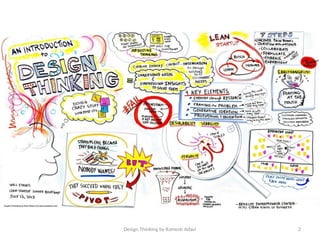
Design Thinking
Design Thinking by Ramesh Adavi 2
Design Thinking by Ramesh Adavi 3
Why Disruptive Innovation?
• There is ‘disruption’ everywhere
– Automobiles = > EV, Autonomous
– Alternate Energy
– WFH
– Digital University
– ……
• India’s Techade
– Best time for ‘startups’
– Education sector needs to step up – must provide new
age skills
WANTED! - “Disruptive Innovation”
4
Design Thinking by Ramesh Adavi 5
What is Design Thinking?
• Design Thinking is a human-centric approach to problem-
solving and solution finding.
• By focusing on the human (user, customer, stakeholders, …)
first, we seek to understand people’s needs and come up with
effective solutions to meet those (unmet) needs.
• It is what we call a solution-based approach to problem-
solving
Design Thinking = Human Centred Innovation
Design Thinking by Ramesh Adavi 6
The Design Thinking Mindset
Design Thinking by Ramesh Adavi 7
Design thinking in action
Aravind Eye Care
• Empathy that led to Inspiration -
– Poverty and remoteness of clientele
• Discuss with consumers – human-centered exploration
• Classical options too expensive
• Ideation – nothing was impossible for Dr V!
– Develop new options
• Manufacture own parts
• Reduce cost to consumer from $200 to $4
• Bus patients to centers – A Telemedicine opportunity !
• Implementation
– 2.3 million patients seen in under a year
– 270,000 surgeries performed
A DESIGN THINKING solution inspired by “plight of the sightless poor, in remote
difficult to access Bharat” - A shining example for thinking about AtmaNirbhar
Bharat
“… translate existing evidence and knowledge into effective action” – www.aravind.org
8
Why design thinking?
• Disruptive Innovation is the need of the hour
– ‘Digital disruption’ - Amazon disrupting retail to
online content disrupting journalism, ….. no industry is exempt.
• The COVID Crisis has further forced “digital disruption” on us
– WFH
– Telemedicine
– Digital Education
• Old, tried & tested methods don’t work any more. We have to challenge
assumptions and explore new pathways and ideas
• We have a “wicked problem” to solve
– No clear solution in a highly VUCA future
– We have no choice but to start from “first principles”
Design Thinking by Ramesh Adavi 9
The 5 components of Design Thinking
Empathis
e
Define
Ideate
Prototype
Test
Agile
Iterations
Design Thinking by Ramesh Adavi 10
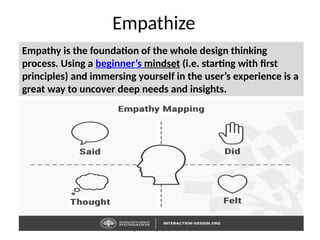
Empathize
Empathy is the foundation of the whole design thinking
process. Using a beginner’s mindset (i.e. starting with first
principles) and immersing yourself in the user’s experience is a
great way to uncover deep needs and insights.
Design Thinking by Ramesh Adavi 11
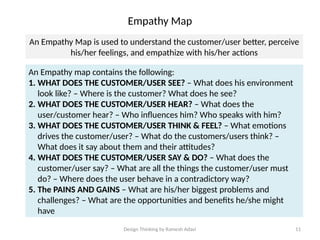
Empathy Map
An Empathy Map is used to understand the customer/user better, perceive
his/her feelings, and empathize with his/her actions
An Empathy map contains the following:
1. WHAT DOES THE CUSTOMER/USER SEE? – What does his environment
look like? – Where is the customer? What does he see?
2. WHAT DOES THE CUSTOMER/USER HEAR? – What does the
user/customer hear? – Who influences him? Who speaks with him?
3. WHAT DOES THE CUSTOMER/USER THINK & FEEL? – What emotions
drives the customer/user? – What do the customers/users think? –
What does it say about them and their attitudes?
4. WHAT DOES THE CUSTOMER/USER SAY & DO? – What does the
customer/user say? – What are all the things the customer/user must
do? – Where does the user behave in a contradictory way?
5. The PAINS AND GAINS – What are his/her biggest problems and
challenges? – What are the opportunities and benefits he/she might
have
Design Thinking by Ramesh Adavi 12
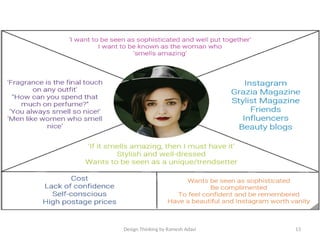
Empathy Map
Design Thinking by Ramesh Adavi 13
Design Thinking by Ramesh Adavi 14
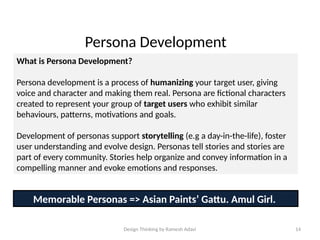
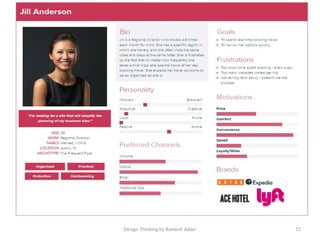
Persona Development
What is Persona Development?
Persona development is a process of humanizing your target user, giving
voice and character and making them real. Persona are fictional characters
created to represent your group of target users who exhibit similar
behaviours, patterns, motivations and goals.
Development of personas support storytelling (e.g a day-in-the-life), foster
user understanding and evolve design. Personas tell stories and stories are
part of every community. Stories help organize and convey information in a
compelling manner and evoke emotions and responses.
Memorable Personas => Asian Paints’ Gattu. Amul Girl.
Design Thinking by Ramesh Adavi 15
Design Thinking by Ramesh Adavi 16
Design Thinking by Ramesh Adavi 17
Design Thinking by Ramesh Adavi 18
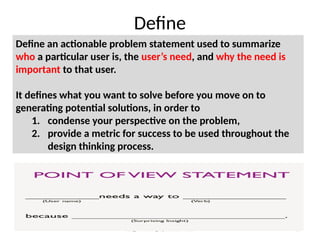
Define
Define an actionable problem statement used to summarize
who a particular user is, the user’s need, and why the need is
important to that user.
It defines what you want to solve before you move on to
generating potential solutions, in order to
1. condense your perspective on the problem,
2. provide a metric for success to be used throughout the
design thinking process.
Design Thinking by Ramesh Adavi 19
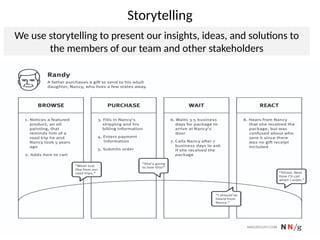
Storytelling
We use storytelling to present our insights, ideas, and solutions to
the members of our team and other stakeholders
Design Thinking by Ramesh Adavi 20
Ideate – How might we…..??
Ideation is often the most exciting stage in a Design Thinking project, because during
Ideation, the aim is to generate a large quantity of ideas that the team can then filter and
cut down into the best, most practical or most innovative ones in order to inspire new
and better design solutions and products.
Relevant Techniques: include Sketching, Brainstorming, Prototyping, ……
Design Thinking by Ramesh Adavi 21
Ideate - Brainstorming
7 Rules of Idea Generation
• Stay focused on the topic
• Go for quantity
• Be visual
• One conversation at a time
• Encourage wild ideas
• Defer judgement
• Build on ideas of others
Design Thinking by Ramesh Adavi 22
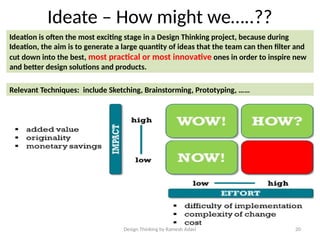
2x2 Matrix
A 2x2 Matrix is used to categorize and prioritize ideas or identify strategic
opportunities and patterns
• Any type of meaningful axis attribute
may be used.
• The 2x2 matrix can also be used to
change the way of thinking from a
100% idea orientation toward the
recognition of unfulfilled user needs
and strategic opportunities.
• The 2x2 matrix is not only used
predominantly in the context of
prioritizing ideas but in all other
phases as well.
What you can do with the tool:
• Determine quickly which ideas should be pursued and which ideas
should be rejected.
• Carry out the prioritization of ideas according to strategic innovations,
market opportunities, and many other categories.
Design Thinking by Ramesh Adavi 23
Prototyping
Prototyping enables Visual Thinking - expression of ideas or thoughts through
images either drawings, pictures, graphs, … It is a very useful tool when we
work in teams.
Why using the Visual Thinking:
1. The human brain thinks better with images, that is, visualizing an image
takes less effort than reading a word, process it and make an idea of what
that word means. The brains processes visual information 60,000 times
faster than text.
2. The images help to describe the relations between objects which we
maybe could not see and that can give the hint to create new ideas and not
obvious solutions which will make us innovate.
3. It is something innate to the human beings, we draw since we are little
and although we are not big artist, we are very capable of making the basic
drawings to represent concepts which in turn will improve the
communication of ideas.
Design Thinking by Ramesh Adavi 24
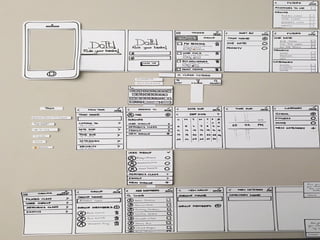
Prototype
A picture is equal to a thousand words.
A prototype is equal to thousand pictures
A prototype in design thinking is “A simulation or sample version of a final
product, which is used for testing prior to launch.” The goal of a prototype is
to test products (and product ideas) before spending lots of time and money
into creating the final version of the sellable product.
Design Thinking by Ramesh Adavi 25
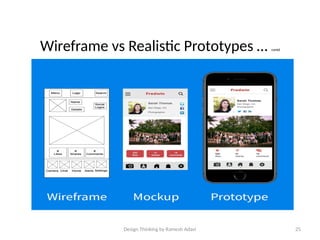
Wireframe vs Realistic Prototypes … contd
26
Test
Stage 5 in the Design Thinking Process: Test. ... Testing, in Design Thinking,
involves generating user feedback as related to the prototypes you have
developed, as well as gaining a deeper understanding of your users
In the DIGITAL WORLD, projects are never really finished.
The Test stage provides feeds back to the Empathise stage.
So, the DESIGN THINKING PROCESS is a “iterative innovation” cycle
Design Thinking by Ramesh Adavi 27
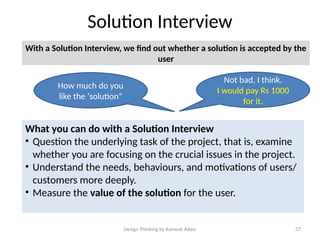
Solution Interview
With a Solution Interview, we find out whether a solution is accepted by the
user
How much do you
like the ‘solution”
Not bad, I think.
I would pay Rs 1000
for it.
What you can do with a Solution Interview
• Question the underlying task of the project, that is, examine
whether you are focusing on the crucial issues in the project.
• Understand the needs, behaviours, and motivations of users/
customers more deeply.
• Measure the value of the solution for the user.
Design Thinking by Ramesh Adavi 28
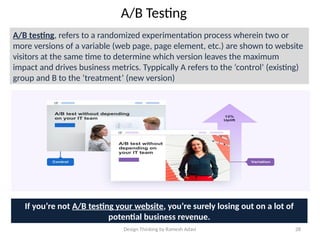
A/B Testing
A/B testing, refers to a randomized experimentation process wherein two or
more versions of a variable (web page, page element, etc.) are shown to website
visitors at the same time to determine which version leaves the maximum
impact and drives business metrics. Typpically A refers to the ‘control’ (existing)
group and B to the ‘treatment’ (new version)
If you’re not A/B testing your website, you’re surely losing out on a lot of
potential business revenue.
Design Thinking by Ramesh Adavi 29
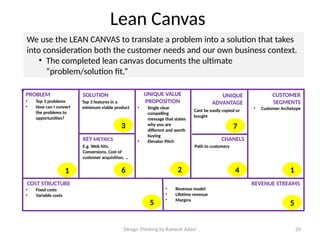
Lean Canvas
We use the LEAN CANVAS to translate a problem into a solution that takes
into consideration both the customer needs and our own business context.
• The completed lean canvas documents the ultimate
“problem/solution fit.”
PROBLEM SOLUTION UNIQUE VALUE
PROPOSITION
UNIQUE
ADVANTAGE
CUSTOMER
SEGMENTS
• Customer Archetype
KEY METRICS CHANELS
COST STRUCTURE REVENUE STREAMS
• Top 3 problems
• How can I convert
the problems to
opportunities?
Top 3 features in a
minimum viable product • Single clear
compelling
message that states
why you are
different and worth
buying
• Elevator Pitch
Cant be easily copied or
bought
E.g. Web hits,
Conversions, Cost of
customer acquisition, …
Path to customers
• Fixed costs
• Variable costs
• Revenue model
• Lifetime revenue
• Margins
1
1 2
3
4
6
7
5 5
Design Thinking by Ramesh Adavi 30
Design Thinking
A new “Institute for Professional Education”
Design Thinking by Ramesh Adavi 31
Why we must re-think Professional
Education?
Higher Education was being disrupted before the COVID crisis:
• Extreme negativity about the work readiness of college
graduates
• Less than 50% of engineering seats filled
• Generic degrees – no relation with degree and work.
• The concept of “seat time = learning” is becoming obsolete
• Teaching has become impersonal – all students in a class of
50 expected to learn in the same way?
• Delinked from the “variety / flexibility” required in real life.
Enter
NEP 2020
Design Thinking by Ramesh Adavi 32
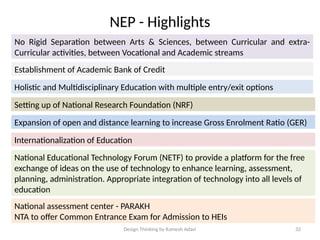
NEP - Highlights
No Rigid Separation between Arts & Sciences, between Curricular and extra-
Curricular activities, between Vocational and Academic streams
Establishment of Academic Bank of Credit
Holistic and Multidisciplinary Education with multiple entry/exit options
Setting up of National Research Foundation (NRF)
Expansion of open and distance learning to increase Gross Enrolment Ratio (GER)
Internationalization of Education
National Educational Technology Forum (NETF) to provide a platform for the free
exchange of ideas on the use of technology to enhance learning, assessment,
planning, administration. Appropriate integration of technology into all levels of
education
National assessment center - PARAKH
NTA to offer Common Entrance Exam for Admission to HEIs
Design Thinking by Ramesh Adavi 33
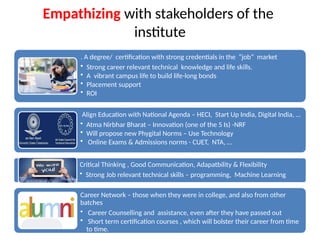
Empathizing with stakeholders of the
institute
. A degree/ certification with strong credentials in the “job” market
• Strong career relevant technical knowledge and life skills.
• A vibrant campus life to build life-long bonds
• Placement support
• ROI
Align Education with National Agenda – HECI, Start Up India, Digital India, …
• Atma Nirbhar Bharat – Innovation (one of the 5 Is) -NRF
• Will propose new Phygital Norms – Use Technology
• Online Exams & Admissions norms - CUET, NTA, …
Critical Thinking , Good Communication, Adapatbility & Flexibility
• Strong Job relevant technical skills – programming, Machine Learning
Career Network – those when they were in college, and also from other
batches
• Career Counselling and assistance, even after they have passed out
• Short term certification courses , which will bolster their career from time
to time.
Design Thinking by Ramesh Adavi 34
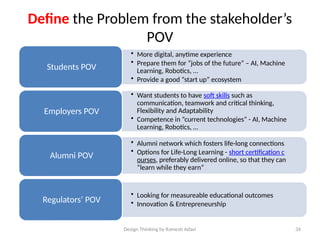
Define the Problem from the stakeholder’s
POV
• More digital, anytime experience
• Prepare them for “jobs of the future” – AI, Machine
Learning, Robotics, …
• Provide a good “start up” ecosystem
Students POV
• Want students to have soft skills such as
communication, teamwork and critical thinking,
Flexibility and Adaptability
• Competence in “current technologies” - AI, Machine
Learning, Robotics, …
Employers POV
• Alumni network which fosters life-long connections
• Options for Life-Long Learning - short certification c
ourses, preferably delivered online, so that they can
“learn while they earn”
Alumni POV
• Looking for measureable educational outcomes
• Innovation & Entrepreneurship
Regulators’ POV
Design Thinking by Ramesh Adavi 35
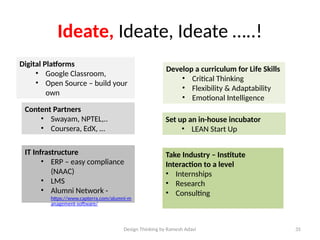
Ideate, Ideate, Ideate …..!
Digital Platforms
• Google Classroom,
• Open Source – build your
own
Content Partners
• Swayam, NPTEL,..
• Coursera, EdX, …
IT Infrastructure
• ERP – easy compliance
(NAAC)
• LMS
• Alumni Network -
https://www.capterra.com/alumni-m
anagement-software/
Develop a curriculum for Life Skills
• Critical Thinking
• Flexibility & Adaptability
• Emotional Intelligence
Set up an in-house incubator
• LEAN Start Up
Take Industry – Institute
Interaction to a level
• Internships
• Research
• Consulting
Design Thinking by Ramesh Adavi 36
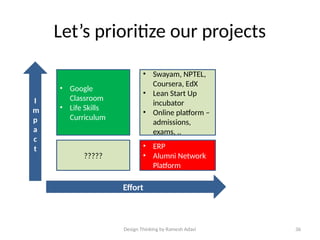
Let’s prioritize our projects
I
m
p
a
c
t
• Google
Classroom
• Life Skills
Curriculum
• Swayam, NPTEL,
Coursera, EdX
• Lean Start Up
incubator
• Online platform –
admissions,
exams, ..
?????
• ERP
• Alumni Network
Platform
Effort
Design Thinking by Ramesh Adavi 37
Prototyping – with student projects
• Create student projects from ideas generated
• Faculty & External Mentors can guide students
• Lean Start Up methodology
• Innovate Systematically
• Lean Start Up and Design Thinking are very
well aligned . Both suggest “agile, iterative”
development

DRAFT - Design Thinking by Ramesh Adavi.pptx

  • 1.
    Design Thinking byRamesh Adavi 1 Design Thinking
  • 2.
    Design Thinking byRamesh Adavi 2
  • 3.
    Design Thinking byRamesh Adavi 3 Why Disruptive Innovation? • There is ‘disruption’ everywhere – Automobiles = > EV, Autonomous – Alternate Energy – WFH – Digital University – …… • India’s Techade – Best time for ‘startups’ – Education sector needs to step up – must provide new age skills
  • 4.
    WANTED! - “DisruptiveInnovation” 4
  • 5.
    Design Thinking byRamesh Adavi 5 What is Design Thinking? • Design Thinking is a human-centric approach to problem- solving and solution finding. • By focusing on the human (user, customer, stakeholders, …) first, we seek to understand people’s needs and come up with effective solutions to meet those (unmet) needs. • It is what we call a solution-based approach to problem- solving Design Thinking = Human Centred Innovation
  • 6.
    Design Thinking byRamesh Adavi 6 The Design Thinking Mindset
  • 7.
    Design Thinking byRamesh Adavi 7 Design thinking in action Aravind Eye Care • Empathy that led to Inspiration - – Poverty and remoteness of clientele • Discuss with consumers – human-centered exploration • Classical options too expensive • Ideation – nothing was impossible for Dr V! – Develop new options • Manufacture own parts • Reduce cost to consumer from $200 to $4 • Bus patients to centers – A Telemedicine opportunity ! • Implementation – 2.3 million patients seen in under a year – 270,000 surgeries performed A DESIGN THINKING solution inspired by “plight of the sightless poor, in remote difficult to access Bharat” - A shining example for thinking about AtmaNirbhar Bharat “… translate existing evidence and knowledge into effective action” – www.aravind.org
  • 8.
    8 Why design thinking? •Disruptive Innovation is the need of the hour – ‘Digital disruption’ - Amazon disrupting retail to online content disrupting journalism, ….. no industry is exempt. • The COVID Crisis has further forced “digital disruption” on us – WFH – Telemedicine – Digital Education • Old, tried & tested methods don’t work any more. We have to challenge assumptions and explore new pathways and ideas • We have a “wicked problem” to solve – No clear solution in a highly VUCA future – We have no choice but to start from “first principles”
  • 9.
    Design Thinking byRamesh Adavi 9 The 5 components of Design Thinking Empathis e Define Ideate Prototype Test Agile Iterations
  • 10.
    Design Thinking byRamesh Adavi 10 Empathize Empathy is the foundation of the whole design thinking process. Using a beginner’s mindset (i.e. starting with first principles) and immersing yourself in the user’s experience is a great way to uncover deep needs and insights.
  • 11.
    Design Thinking byRamesh Adavi 11 Empathy Map An Empathy Map is used to understand the customer/user better, perceive his/her feelings, and empathize with his/her actions An Empathy map contains the following: 1. WHAT DOES THE CUSTOMER/USER SEE? – What does his environment look like? – Where is the customer? What does he see? 2. WHAT DOES THE CUSTOMER/USER HEAR? – What does the user/customer hear? – Who influences him? Who speaks with him? 3. WHAT DOES THE CUSTOMER/USER THINK & FEEL? – What emotions drives the customer/user? – What do the customers/users think? – What does it say about them and their attitudes? 4. WHAT DOES THE CUSTOMER/USER SAY & DO? – What does the customer/user say? – What are all the things the customer/user must do? – Where does the user behave in a contradictory way? 5. The PAINS AND GAINS – What are his/her biggest problems and challenges? – What are the opportunities and benefits he/she might have
  • 12.
    Design Thinking byRamesh Adavi 12 Empathy Map
  • 13.
    Design Thinking byRamesh Adavi 13
  • 14.
    Design Thinking byRamesh Adavi 14 Persona Development What is Persona Development? Persona development is a process of humanizing your target user, giving voice and character and making them real. Persona are fictional characters created to represent your group of target users who exhibit similar behaviours, patterns, motivations and goals. Development of personas support storytelling (e.g a day-in-the-life), foster user understanding and evolve design. Personas tell stories and stories are part of every community. Stories help organize and convey information in a compelling manner and evoke emotions and responses. Memorable Personas => Asian Paints’ Gattu. Amul Girl.
  • 15.
    Design Thinking byRamesh Adavi 15
  • 16.
    Design Thinking byRamesh Adavi 16
  • 17.
    Design Thinking byRamesh Adavi 17
  • 18.
    Design Thinking byRamesh Adavi 18 Define Define an actionable problem statement used to summarize who a particular user is, the user’s need, and why the need is important to that user. It defines what you want to solve before you move on to generating potential solutions, in order to 1. condense your perspective on the problem, 2. provide a metric for success to be used throughout the design thinking process.
  • 19.
    Design Thinking byRamesh Adavi 19 Storytelling We use storytelling to present our insights, ideas, and solutions to the members of our team and other stakeholders
  • 20.
    Design Thinking byRamesh Adavi 20 Ideate – How might we…..?? Ideation is often the most exciting stage in a Design Thinking project, because during Ideation, the aim is to generate a large quantity of ideas that the team can then filter and cut down into the best, most practical or most innovative ones in order to inspire new and better design solutions and products. Relevant Techniques: include Sketching, Brainstorming, Prototyping, ……
  • 21.
    Design Thinking byRamesh Adavi 21 Ideate - Brainstorming 7 Rules of Idea Generation • Stay focused on the topic • Go for quantity • Be visual • One conversation at a time • Encourage wild ideas • Defer judgement • Build on ideas of others
  • 22.
    Design Thinking byRamesh Adavi 22 2x2 Matrix A 2x2 Matrix is used to categorize and prioritize ideas or identify strategic opportunities and patterns • Any type of meaningful axis attribute may be used. • The 2x2 matrix can also be used to change the way of thinking from a 100% idea orientation toward the recognition of unfulfilled user needs and strategic opportunities. • The 2x2 matrix is not only used predominantly in the context of prioritizing ideas but in all other phases as well. What you can do with the tool: • Determine quickly which ideas should be pursued and which ideas should be rejected. • Carry out the prioritization of ideas according to strategic innovations, market opportunities, and many other categories.
  • 23.
    Design Thinking byRamesh Adavi 23 Prototyping Prototyping enables Visual Thinking - expression of ideas or thoughts through images either drawings, pictures, graphs, … It is a very useful tool when we work in teams. Why using the Visual Thinking: 1. The human brain thinks better with images, that is, visualizing an image takes less effort than reading a word, process it and make an idea of what that word means. The brains processes visual information 60,000 times faster than text. 2. The images help to describe the relations between objects which we maybe could not see and that can give the hint to create new ideas and not obvious solutions which will make us innovate. 3. It is something innate to the human beings, we draw since we are little and although we are not big artist, we are very capable of making the basic drawings to represent concepts which in turn will improve the communication of ideas.
  • 24.
    Design Thinking byRamesh Adavi 24 Prototype A picture is equal to a thousand words. A prototype is equal to thousand pictures A prototype in design thinking is “A simulation or sample version of a final product, which is used for testing prior to launch.” The goal of a prototype is to test products (and product ideas) before spending lots of time and money into creating the final version of the sellable product.
  • 25.
    Design Thinking byRamesh Adavi 25 Wireframe vs Realistic Prototypes … contd
  • 26.
    26 Test Stage 5 inthe Design Thinking Process: Test. ... Testing, in Design Thinking, involves generating user feedback as related to the prototypes you have developed, as well as gaining a deeper understanding of your users In the DIGITAL WORLD, projects are never really finished. The Test stage provides feeds back to the Empathise stage. So, the DESIGN THINKING PROCESS is a “iterative innovation” cycle
  • 27.
    Design Thinking byRamesh Adavi 27 Solution Interview With a Solution Interview, we find out whether a solution is accepted by the user How much do you like the ‘solution” Not bad, I think. I would pay Rs 1000 for it. What you can do with a Solution Interview • Question the underlying task of the project, that is, examine whether you are focusing on the crucial issues in the project. • Understand the needs, behaviours, and motivations of users/ customers more deeply. • Measure the value of the solution for the user.
  • 28.
    Design Thinking byRamesh Adavi 28 A/B Testing A/B testing, refers to a randomized experimentation process wherein two or more versions of a variable (web page, page element, etc.) are shown to website visitors at the same time to determine which version leaves the maximum impact and drives business metrics. Typpically A refers to the ‘control’ (existing) group and B to the ‘treatment’ (new version) If you’re not A/B testing your website, you’re surely losing out on a lot of potential business revenue.
  • 29.
    Design Thinking byRamesh Adavi 29 Lean Canvas We use the LEAN CANVAS to translate a problem into a solution that takes into consideration both the customer needs and our own business context. • The completed lean canvas documents the ultimate “problem/solution fit.” PROBLEM SOLUTION UNIQUE VALUE PROPOSITION UNIQUE ADVANTAGE CUSTOMER SEGMENTS • Customer Archetype KEY METRICS CHANELS COST STRUCTURE REVENUE STREAMS • Top 3 problems • How can I convert the problems to opportunities? Top 3 features in a minimum viable product • Single clear compelling message that states why you are different and worth buying • Elevator Pitch Cant be easily copied or bought E.g. Web hits, Conversions, Cost of customer acquisition, … Path to customers • Fixed costs • Variable costs • Revenue model • Lifetime revenue • Margins 1 1 2 3 4 6 7 5 5
  • 30.
    Design Thinking byRamesh Adavi 30 Design Thinking A new “Institute for Professional Education”
  • 31.
    Design Thinking byRamesh Adavi 31 Why we must re-think Professional Education? Higher Education was being disrupted before the COVID crisis: • Extreme negativity about the work readiness of college graduates • Less than 50% of engineering seats filled • Generic degrees – no relation with degree and work. • The concept of “seat time = learning” is becoming obsolete • Teaching has become impersonal – all students in a class of 50 expected to learn in the same way? • Delinked from the “variety / flexibility” required in real life. Enter NEP 2020
  • 32.
    Design Thinking byRamesh Adavi 32 NEP - Highlights No Rigid Separation between Arts & Sciences, between Curricular and extra- Curricular activities, between Vocational and Academic streams Establishment of Academic Bank of Credit Holistic and Multidisciplinary Education with multiple entry/exit options Setting up of National Research Foundation (NRF) Expansion of open and distance learning to increase Gross Enrolment Ratio (GER) Internationalization of Education National Educational Technology Forum (NETF) to provide a platform for the free exchange of ideas on the use of technology to enhance learning, assessment, planning, administration. Appropriate integration of technology into all levels of education National assessment center - PARAKH NTA to offer Common Entrance Exam for Admission to HEIs
  • 33.
    Design Thinking byRamesh Adavi 33 Empathizing with stakeholders of the institute . A degree/ certification with strong credentials in the “job” market • Strong career relevant technical knowledge and life skills. • A vibrant campus life to build life-long bonds • Placement support • ROI Align Education with National Agenda – HECI, Start Up India, Digital India, … • Atma Nirbhar Bharat – Innovation (one of the 5 Is) -NRF • Will propose new Phygital Norms – Use Technology • Online Exams & Admissions norms - CUET, NTA, … Critical Thinking , Good Communication, Adapatbility & Flexibility • Strong Job relevant technical skills – programming, Machine Learning Career Network – those when they were in college, and also from other batches • Career Counselling and assistance, even after they have passed out • Short term certification courses , which will bolster their career from time to time.
  • 34.
    Design Thinking byRamesh Adavi 34 Define the Problem from the stakeholder’s POV • More digital, anytime experience • Prepare them for “jobs of the future” – AI, Machine Learning, Robotics, … • Provide a good “start up” ecosystem Students POV • Want students to have soft skills such as communication, teamwork and critical thinking, Flexibility and Adaptability • Competence in “current technologies” - AI, Machine Learning, Robotics, … Employers POV • Alumni network which fosters life-long connections • Options for Life-Long Learning - short certification c ourses, preferably delivered online, so that they can “learn while they earn” Alumni POV • Looking for measureable educational outcomes • Innovation & Entrepreneurship Regulators’ POV
  • 35.
    Design Thinking byRamesh Adavi 35 Ideate, Ideate, Ideate …..! Digital Platforms • Google Classroom, • Open Source – build your own Content Partners • Swayam, NPTEL,.. • Coursera, EdX, … IT Infrastructure • ERP – easy compliance (NAAC) • LMS • Alumni Network - https://www.capterra.com/alumni-m anagement-software/ Develop a curriculum for Life Skills • Critical Thinking • Flexibility & Adaptability • Emotional Intelligence Set up an in-house incubator • LEAN Start Up Take Industry – Institute Interaction to a level • Internships • Research • Consulting
  • 36.
    Design Thinking byRamesh Adavi 36 Let’s prioritize our projects I m p a c t • Google Classroom • Life Skills Curriculum • Swayam, NPTEL, Coursera, EdX • Lean Start Up incubator • Online platform – admissions, exams, .. ????? • ERP • Alumni Network Platform Effort
  • 37.
    Design Thinking byRamesh Adavi 37 Prototyping – with student projects • Create student projects from ideas generated • Faculty & External Mentors can guide students • Lean Start Up methodology • Innovate Systematically • Lean Start Up and Design Thinking are very well aligned . Both suggest “agile, iterative” development