Customer Relationship Management
(CRM)
5.5 1
What is CRM?
• CRM “is a business strategy that aims to
understand, anticipate and manage the
needs of an organisation’s current and
potential customers” .
• It is a “comprehensive approach which
provides seamless integration of every area
of business that touches the customer-
namely marketing, sales, customer services
and field support through the integration of
people, process and technology”
5.5 2
What is CRM?
• CRM is a shift from traditional marketing
as it focuses on the retention of customers
in addition to the acquisition of new
customers
• “The expression Customer Relationship
Management (CRM) is becoming standard
terminology, replacing what is widely
perceived to be a misleadingly narrow term,
relationship marketing (RM)” .
5.5 3
Definition of CRM
“CRM is concerned with the creation,
development and enhancement of
individualised customer relationships with
carefully targeted customers and customer
groups resulting in maximizing their total
customer life-time value” .
5.5 4
The purpose of CRM
• “The focus of CRM is on creating value for
the customer and the company over the
longer term” .
• When customers value the customer service
that they receive from suppliers, they are
less likely to look to alternative suppliers for
their needs .
• CRM enables organisations to gain
‘competitive advantage’ over competitors that
supply similar products or services
5.5 5
Why is CRM important?
• “Today’s businesses compete with multi-
product offerings created and delivered by
networks, alliances and partnerships of
many kinds. Both retaining customers and
building relationships with other value-
adding allies is critical to corporate
performance” .
• “The adoption of C.R.M. is being fuelled by
a recognition that long-term relationships
with customers are one of the most
important assets of an organisation”
5.5 6
Why did CRM develop?
CRM developed for a number of reasons:
• The 1980’s onwards saw rapid shifts in
business that changed customer power
• Supply exceeded demands for most products
• Sellers had little pricing power
• The only protection available to suppliers of
goods and services was in their
relationships with customers
5.5 7
What does CRM involve?
CRM involves the following :
• Organisations must become customer focused
• Organisations must be prepared to adapt so
that it take customer needs into account and
delivers them
• Market research must be undertaken to assess
customer needs and satisfaction
5.5 8
“Strategically significant customers”
• “Customer relationship management
focuses on strategically significant
markets. Not all customers are equally
important” .
• Therefore, relationships should be built
with customers that are likely to
provide value for services
• Building relationships with customers
that will provide little value could
result in a loss of time, staff and
financial resources
5.5 9
Markers of strategically significant customers
• Strategically significant customers need to satisfy
at least one of three conditions :
1.Customers with high life-time values (i.e.
customers that will repeatedly use the service in
the long-term e.g. Nurses in a hospital library)
2.Customers who serve as benchmarks for other
customers e.g. In a hospital library consultants
who teach on academic courses
3.Customers who inspire change in the supplier
5.5 10
Information Technology and CRM
• Technology plays a pivotal role in CRM (2).
• Technological approaches involving the use of
databases, data mining and one-to-one
marketing can assist organisations to increase
customer value and their own profitability (2)
• This type of technology can be used to keep a
record of customers names and contact details
in addition to their history of buying products
or using services (2)
5.5 11
Information Technology and CRM
•This information can be used to
target customers in a personalised
way and offer them services to meet
their specific needs (2)
•This personalised communication
provides value for the customer and
increases customers loyalty to the
provider (2)
5.5 12
Information Technology and CRM:
Examples
Here are examples of how technology can be used to create
personalised services to increase loyalty in customers:
• Phone calls, emails, mobile phone text messages, or
WAP services (2):
Having access to customers contact details and
their service or purchase preferences through
databases etc can enable organisations to alert
customers to new, similar or alternative services or
products
-
5.5 13
Information Technology and CRM:
Examples
Illustration: When tickets are purchased online
via Lastminute.com, the website retains the
customers details and their purchase history.
The website regularly send emails to previous
customers to inform them of similar upcoming
events or special discounts. This helps to ensure
that customers will continue to purchase tickets
from Lastminute.com in the future.
5.5 14
Information Technology and CRM:
Examples
• Cookies
“A “cookie” is a parcel of text sent by a server to
a web browser and then sent back unchanged
by the browser each time it accesses that
server. HTTP cookies are used for
authenticating, tracking, and maintaining
specific information about users, such as site
preferences and the contents of their electronic
shopping carts” (5).
5.5 15
Information Technology and CRM:
Examples
• Cookies
Illustration: The online store, Amazon, uses
“cookies” to provide a personalised service for
its customers. Amazon requires customers to
register with the service when they purchase
items. When registered customers log in to
Amazon at a later time, they are ‘greeted’ with
a welcome message which uses their name (for
e.g. “Hello John”). In addition, their previous
purchases are highlighted and a list of similar
items that the customer may wish to purchase
are also highlighted.
5.5 16
Information Technology and CRM:
Examples
• Loyalty cards
“the primary role of a retailer loyalty card is to gather data
about customers. This in turn leads to customer
comprehension and cost insights (e.g. customer retention
rates at different spending levels, response rates to offers,
new customer conversion rates, and where money is being
wasted on circulars), followed by appropriate marketing
action and follow-up analysis” (6)
- Illustration: The supermarket chain, Tescos, offers loyalty
cards to its customers. When customers use the loyalty cards
during pay transactions for goods, details of the purchases
are stored in a database which enables Tescos to keep track
of all the purchases that their customers make. At regular
intervals, Tescos sends its customers money saving coupons
by post for the products that the customers have bought in
the past. The aim of this is to encourage customers to
continually return to Tescos to do their shopping
5.5 17
Information Technology and CRM:
Examples
• CRM software- “Front office” solutions
- “Many call centres use CRM software to store
all of their customer's details. When a customer
calls, the system can be used to retrieve and
store information relevant to the customer. By
serving the customer quickly and efficiently,
and also keeping all information on a customer
in one place, a company aims to make cost
savings, and also encourage new customers” (7)
5.5 18
Face-to-face CRM
• CRM can also be carried out in face-to-face interactions
without the use of technology
• Staff members often remember the names and
favourite services/products of regular customers and
use this information to create a personalised service for
them.
• However, face-to-face CRM could prove less useful
when organisations have a large number of customers
as it would be more difficult to remember details about
each of them.
5.5 19
Benefits of CRM
Benefits of CRM include (8):
• reduced costs, because the right things are
being done (ie., effective and efficient
operation)
• increased customer satisfaction, because they
are getting exactly what they want (ie.
meeting and exceeding expectations)
• ensuring that the focus of the organisation is
external
• growth in numbers of customers
5.5 20
Benefits of CRM
Benefits of CRM include (8):
• maximisation of opportunities (eg. increased
services, referrals, etc.)
• increased access to a source of market and
competitor information
• highlighting poor operational processes
• long term profitability and sustainability
5.5 21
Implementing CRM
• When introducing or developing CRM, a strategic
review of the organisation’s current position should
be undertaken (2)
• Organisations need to address four issues (2):
1. What is our core business and how will it evolve in
the future?
2. What form of CRM is appropriate for our business
now and in the future?
3. What IT infrastructure do we have and what do we
need to support the future organisation needs?
4. What vendors and partners do we need to choose?
5.5 22
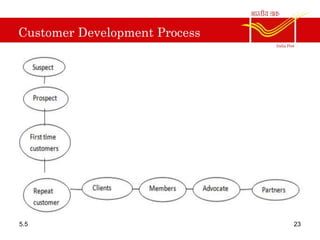
Customer Development Process
5.5 23
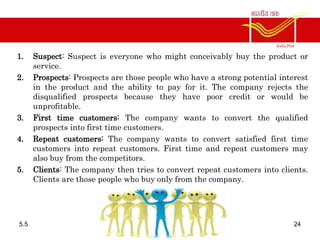
1. Suspect: Suspect is everyone who might conceivably buy the product or
service.
2. Prospects: Prospects are those people who have a strong potential interest
in the product and the ability to pay for it. The company rejects the
disqualified prospects because they have poor credit or would be
unprofitable.
3. First time customers: The company wants to convert the qualified
prospects into first time customers.
4. Repeat customers: The company wants to convert satisfied first time
customers into repeat customers. First time and repeat customers may
also buy from the competitors.
5. Clients: The company then tries to convert repeat customers into clients.
Clients are those people who buy only from the company.
5.5 24
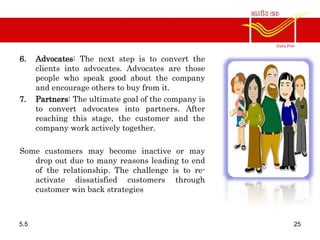
6. Advocates: The next step is to convert the
clients into advocates. Advocates are those
people who speak good about the company
and encourage others to buy from it.
7. Partners: The ultimate goal of the company is
to convert advocates into partners. After
reaching this stage, the customer and the
company work actively together.
Some customers may become inactive or may
drop out due to many reasons leading to end
of the relationship. The challenge is to re-
activate dissatisfied customers through
customer win back strategies
5.5 25
Can you develop a CRM tool for your
customers ?
5.5 26
References
1. Liz Shahnam. What’s really CRM? CRM Today. [Online] [Accessed
November 2008]
2. Adrian Payne. Customer relationship management. Cranfield
University. [Online] [Accessed June 2006, no longer available
online]
3. Francis Buttle. The S.C.O.P.E of Customer Relationship Marketing.
Macquarie Graduate School of Management. [Online] [Accessed
June 2006, no longer available online]
4. Manchester Business School. 2003. Customer Relationship
Management: Where do you start?
5. Wikipedia. HTTP Cookie. Online] [Accessed November 2008]
6. Brian Woolf. What is loyalty? The Wise Marketer. [Online]
[Accessed June 2006, no longer available online]
7. Wikipedia. Customer Relationship Management. [Online] [Accessed
November 2008]
8. BusinessBalls. Customer Relationship Management. [Online]
[Accessed November 2008]
5.5 27
Useful resources
If you wish to learn more about CRM, the following
resources may be of use to you:
1. CRM Guru
2. CRM Knowledge Base
3. CRM Today website
4. InsightExec: Customer Management Community
Additionally, the following article might be useful:
Broady-Preston, J., Felice, J. and Marshall, S.
(2006). Building better customer relationships:
case studies from Malta and the UK. Library
Management 27 (6/7): 430-445.
5.5 28

downloaded material.ppt

  • 1.
  • 2.
    What is CRM? •CRM “is a business strategy that aims to understand, anticipate and manage the needs of an organisation’s current and potential customers” . • It is a “comprehensive approach which provides seamless integration of every area of business that touches the customer- namely marketing, sales, customer services and field support through the integration of people, process and technology” 5.5 2
  • 3.
    What is CRM? •CRM is a shift from traditional marketing as it focuses on the retention of customers in addition to the acquisition of new customers • “The expression Customer Relationship Management (CRM) is becoming standard terminology, replacing what is widely perceived to be a misleadingly narrow term, relationship marketing (RM)” . 5.5 3
  • 4.
    Definition of CRM “CRMis concerned with the creation, development and enhancement of individualised customer relationships with carefully targeted customers and customer groups resulting in maximizing their total customer life-time value” . 5.5 4
  • 5.
    The purpose ofCRM • “The focus of CRM is on creating value for the customer and the company over the longer term” . • When customers value the customer service that they receive from suppliers, they are less likely to look to alternative suppliers for their needs . • CRM enables organisations to gain ‘competitive advantage’ over competitors that supply similar products or services 5.5 5
  • 6.
    Why is CRMimportant? • “Today’s businesses compete with multi- product offerings created and delivered by networks, alliances and partnerships of many kinds. Both retaining customers and building relationships with other value- adding allies is critical to corporate performance” . • “The adoption of C.R.M. is being fuelled by a recognition that long-term relationships with customers are one of the most important assets of an organisation” 5.5 6
  • 7.
    Why did CRMdevelop? CRM developed for a number of reasons: • The 1980’s onwards saw rapid shifts in business that changed customer power • Supply exceeded demands for most products • Sellers had little pricing power • The only protection available to suppliers of goods and services was in their relationships with customers 5.5 7
  • 8.
    What does CRMinvolve? CRM involves the following : • Organisations must become customer focused • Organisations must be prepared to adapt so that it take customer needs into account and delivers them • Market research must be undertaken to assess customer needs and satisfaction 5.5 8
  • 9.
    “Strategically significant customers” •“Customer relationship management focuses on strategically significant markets. Not all customers are equally important” . • Therefore, relationships should be built with customers that are likely to provide value for services • Building relationships with customers that will provide little value could result in a loss of time, staff and financial resources 5.5 9
  • 10.
    Markers of strategicallysignificant customers • Strategically significant customers need to satisfy at least one of three conditions : 1.Customers with high life-time values (i.e. customers that will repeatedly use the service in the long-term e.g. Nurses in a hospital library) 2.Customers who serve as benchmarks for other customers e.g. In a hospital library consultants who teach on academic courses 3.Customers who inspire change in the supplier 5.5 10
  • 11.
    Information Technology andCRM • Technology plays a pivotal role in CRM (2). • Technological approaches involving the use of databases, data mining and one-to-one marketing can assist organisations to increase customer value and their own profitability (2) • This type of technology can be used to keep a record of customers names and contact details in addition to their history of buying products or using services (2) 5.5 11
  • 12.
    Information Technology andCRM •This information can be used to target customers in a personalised way and offer them services to meet their specific needs (2) •This personalised communication provides value for the customer and increases customers loyalty to the provider (2) 5.5 12
  • 13.
    Information Technology andCRM: Examples Here are examples of how technology can be used to create personalised services to increase loyalty in customers: • Phone calls, emails, mobile phone text messages, or WAP services (2): Having access to customers contact details and their service or purchase preferences through databases etc can enable organisations to alert customers to new, similar or alternative services or products - 5.5 13
  • 14.
    Information Technology andCRM: Examples Illustration: When tickets are purchased online via Lastminute.com, the website retains the customers details and their purchase history. The website regularly send emails to previous customers to inform them of similar upcoming events or special discounts. This helps to ensure that customers will continue to purchase tickets from Lastminute.com in the future. 5.5 14
  • 15.
    Information Technology andCRM: Examples • Cookies “A “cookie” is a parcel of text sent by a server to a web browser and then sent back unchanged by the browser each time it accesses that server. HTTP cookies are used for authenticating, tracking, and maintaining specific information about users, such as site preferences and the contents of their electronic shopping carts” (5). 5.5 15
  • 16.
    Information Technology andCRM: Examples • Cookies Illustration: The online store, Amazon, uses “cookies” to provide a personalised service for its customers. Amazon requires customers to register with the service when they purchase items. When registered customers log in to Amazon at a later time, they are ‘greeted’ with a welcome message which uses their name (for e.g. “Hello John”). In addition, their previous purchases are highlighted and a list of similar items that the customer may wish to purchase are also highlighted. 5.5 16
  • 17.
    Information Technology andCRM: Examples • Loyalty cards “the primary role of a retailer loyalty card is to gather data about customers. This in turn leads to customer comprehension and cost insights (e.g. customer retention rates at different spending levels, response rates to offers, new customer conversion rates, and where money is being wasted on circulars), followed by appropriate marketing action and follow-up analysis” (6) - Illustration: The supermarket chain, Tescos, offers loyalty cards to its customers. When customers use the loyalty cards during pay transactions for goods, details of the purchases are stored in a database which enables Tescos to keep track of all the purchases that their customers make. At regular intervals, Tescos sends its customers money saving coupons by post for the products that the customers have bought in the past. The aim of this is to encourage customers to continually return to Tescos to do their shopping 5.5 17
  • 18.
    Information Technology andCRM: Examples • CRM software- “Front office” solutions - “Many call centres use CRM software to store all of their customer's details. When a customer calls, the system can be used to retrieve and store information relevant to the customer. By serving the customer quickly and efficiently, and also keeping all information on a customer in one place, a company aims to make cost savings, and also encourage new customers” (7) 5.5 18
  • 19.
    Face-to-face CRM • CRMcan also be carried out in face-to-face interactions without the use of technology • Staff members often remember the names and favourite services/products of regular customers and use this information to create a personalised service for them. • However, face-to-face CRM could prove less useful when organisations have a large number of customers as it would be more difficult to remember details about each of them. 5.5 19
  • 20.
    Benefits of CRM Benefitsof CRM include (8): • reduced costs, because the right things are being done (ie., effective and efficient operation) • increased customer satisfaction, because they are getting exactly what they want (ie. meeting and exceeding expectations) • ensuring that the focus of the organisation is external • growth in numbers of customers 5.5 20
  • 21.
    Benefits of CRM Benefitsof CRM include (8): • maximisation of opportunities (eg. increased services, referrals, etc.) • increased access to a source of market and competitor information • highlighting poor operational processes • long term profitability and sustainability 5.5 21
  • 22.
    Implementing CRM • Whenintroducing or developing CRM, a strategic review of the organisation’s current position should be undertaken (2) • Organisations need to address four issues (2): 1. What is our core business and how will it evolve in the future? 2. What form of CRM is appropriate for our business now and in the future? 3. What IT infrastructure do we have and what do we need to support the future organisation needs? 4. What vendors and partners do we need to choose? 5.5 22
  • 23.
  • 24.
    1. Suspect: Suspectis everyone who might conceivably buy the product or service. 2. Prospects: Prospects are those people who have a strong potential interest in the product and the ability to pay for it. The company rejects the disqualified prospects because they have poor credit or would be unprofitable. 3. First time customers: The company wants to convert the qualified prospects into first time customers. 4. Repeat customers: The company wants to convert satisfied first time customers into repeat customers. First time and repeat customers may also buy from the competitors. 5. Clients: The company then tries to convert repeat customers into clients. Clients are those people who buy only from the company. 5.5 24
  • 25.
    6. Advocates: Thenext step is to convert the clients into advocates. Advocates are those people who speak good about the company and encourage others to buy from it. 7. Partners: The ultimate goal of the company is to convert advocates into partners. After reaching this stage, the customer and the company work actively together. Some customers may become inactive or may drop out due to many reasons leading to end of the relationship. The challenge is to re- activate dissatisfied customers through customer win back strategies 5.5 25
  • 26.
    Can you developa CRM tool for your customers ? 5.5 26
  • 27.
    References 1. Liz Shahnam.What’s really CRM? CRM Today. [Online] [Accessed November 2008] 2. Adrian Payne. Customer relationship management. Cranfield University. [Online] [Accessed June 2006, no longer available online] 3. Francis Buttle. The S.C.O.P.E of Customer Relationship Marketing. Macquarie Graduate School of Management. [Online] [Accessed June 2006, no longer available online] 4. Manchester Business School. 2003. Customer Relationship Management: Where do you start? 5. Wikipedia. HTTP Cookie. Online] [Accessed November 2008] 6. Brian Woolf. What is loyalty? The Wise Marketer. [Online] [Accessed June 2006, no longer available online] 7. Wikipedia. Customer Relationship Management. [Online] [Accessed November 2008] 8. BusinessBalls. Customer Relationship Management. [Online] [Accessed November 2008] 5.5 27
  • 28.
    Useful resources If youwish to learn more about CRM, the following resources may be of use to you: 1. CRM Guru 2. CRM Knowledge Base 3. CRM Today website 4. InsightExec: Customer Management Community Additionally, the following article might be useful: Broady-Preston, J., Felice, J. and Marshall, S. (2006). Building better customer relationships: case studies from Malta and the UK. Library Management 27 (6/7): 430-445. 5.5 28