Understanding the fundamentals and key benefits of cloud technology.
Cloud
Computing
Introduction
This presentation explores the
fundamental concepts of cloud
computing, including its definition, types
of services, and key benefits.
Basics
01
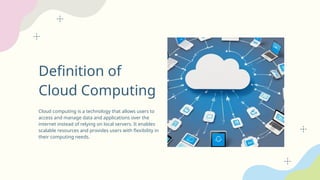
Definition of
Cloud Computing
Cloud computing is a technology that allows users to
access and manage data and applications over the
internet instead of relying on local servers. It enables
scalable resources and provides users with flexibility in
their computing needs.
Types of
Cloud Services
Cloud services are generally categorized into
three main types: IaaS (Infrastructure as a
Service), PaaS (Platform as a Service), and SaaS
(Software as a Service). Each type offers
different levels of control, flexibility, and
management for users and organizations.
Deployment Models
Cloud computing can be deployed in various models: Public,
Private, Hybrid, and Community Clouds. Public clouds are
owned by third-party service providers and offer services
over the internet. Private clouds are dedicated to a single
organization, providing enhanced security. Hybrid clouds
combine both public and private clouds, allowing data and
applications to be shared between them. Community clouds
are shared by several organizations with common concerns,
offering cost advantages while maintaining privacy.
Benefits
02
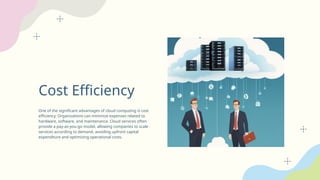
Cost Efficiency
One of the significant advantages of cloud computing is cost
efficiency. Organizations can minimize expenses related to
hardware, software, and maintenance. Cloud services often
provide a pay-as-you-go model, allowing companies to scale
services according to demand, avoiding upfront capital
expenditure and optimizing operational costs.
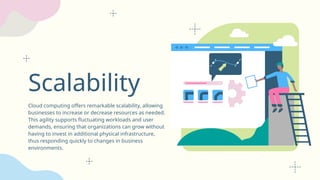
Scalability
Cloud computing offers remarkable scalability, allowing
businesses to increase or decrease resources as needed.
This agility supports fluctuating workloads and user
demands, ensuring that organizations can grow without
having to invest in additional physical infrastructure,
thus responding quickly to changes in business
environments.
Accessibility
Cloud computing enhances accessibility by
allowing users to access data and applications
from any device connected to the internet. This
feature promotes collaboration, as teams can
work together in real-time regardless of their
physical locations, leading to improved
productivity and streamlined workflows.
Conclusions
In conclusion, cloud computing transforms how
organizations manage their IT resources by providing
flexible deployment models, significant cost savings,
enhanced scalability, and improved accessibility.
These benefits empower businesses to adapt and
thrive in demanding and ever-changing markets.
CREDITS: This presentation template was created by Slidesgo,
and includes icons, infographics & images by Freepik
Do you have any questions?
Thank you!

Enscape Crack Latest version Free 2025 + keys

  • 1.
    Understanding the fundamentalsand key benefits of cloud technology. Cloud Computing
  • 2.
    Introduction This presentation exploresthe fundamental concepts of cloud computing, including its definition, types of services, and key benefits.
  • 3.
  • 4.
    Definition of Cloud Computing Cloudcomputing is a technology that allows users to access and manage data and applications over the internet instead of relying on local servers. It enables scalable resources and provides users with flexibility in their computing needs.
  • 5.
    Types of Cloud Services Cloudservices are generally categorized into three main types: IaaS (Infrastructure as a Service), PaaS (Platform as a Service), and SaaS (Software as a Service). Each type offers different levels of control, flexibility, and management for users and organizations.
  • 6.
    Deployment Models Cloud computingcan be deployed in various models: Public, Private, Hybrid, and Community Clouds. Public clouds are owned by third-party service providers and offer services over the internet. Private clouds are dedicated to a single organization, providing enhanced security. Hybrid clouds combine both public and private clouds, allowing data and applications to be shared between them. Community clouds are shared by several organizations with common concerns, offering cost advantages while maintaining privacy.
  • 7.
  • 8.
    Cost Efficiency One ofthe significant advantages of cloud computing is cost efficiency. Organizations can minimize expenses related to hardware, software, and maintenance. Cloud services often provide a pay-as-you-go model, allowing companies to scale services according to demand, avoiding upfront capital expenditure and optimizing operational costs.
  • 9.
    Scalability Cloud computing offersremarkable scalability, allowing businesses to increase or decrease resources as needed. This agility supports fluctuating workloads and user demands, ensuring that organizations can grow without having to invest in additional physical infrastructure, thus responding quickly to changes in business environments.
  • 10.
    Accessibility Cloud computing enhancesaccessibility by allowing users to access data and applications from any device connected to the internet. This feature promotes collaboration, as teams can work together in real-time regardless of their physical locations, leading to improved productivity and streamlined workflows.
  • 11.
    Conclusions In conclusion, cloudcomputing transforms how organizations manage their IT resources by providing flexible deployment models, significant cost savings, enhanced scalability, and improved accessibility. These benefits empower businesses to adapt and thrive in demanding and ever-changing markets.
  • 12.
    CREDITS: This presentationtemplate was created by Slidesgo, and includes icons, infographics & images by Freepik Do you have any questions? Thank you!