A Study on the Financial Performance Evaluation of Punjab National Bank
Submitted in the Partial Fulfillment
of the study of
“Masters of Business Administration”
Guidance/Accepted by- Dr. Shalini Singh
SUBMITTED BY- RAGNEE CHAUHAN
ERP ID- 0181MBA069
DATE- 20 APRIL 2019
CERTIFICATE OF ORIGINALITY
ACKNOWLEDGEMENT
ABSTRACT
1 INTRODUCTION
1.1 EXECUTIVE SUMMARY
1.2 OBJECTIVE OF STUDY
1.3 WHAT IS FINANCIAL PERFORMANCE EVALUATION
1.4 LITRERATURE REVIEW
1.5 RESEARCH GAP
1.6 HYPOTHESIS OF THE STUDY
2 COMPANY PROFILE
2.1 HISTORY
2.2 TIMELINE
2.3 FRAUD CASE
2.4 FINANCIAL PERFORMANCE DATA
2.5 MERGER & ACQUISITION
2.6 LISTING & SHAREHOLDING
2.7 EMPLOYEE
2.8 AWARDS & RECOGNITIONS
3 RESEARCH METHODOLOGY
3.1 NATURE OF STUDY
3.2 NATURE OF DATA
3.3 SOURCES OF THE STUDY
3.4 TENURE OF THE STUDY
3.5 VARIABLES USED FOR THE STUDY
3.6 TOOL USED FOR THE STUDY
3.7 TOOL USED FOR THE ANALYSIS
3.8 LIMITATIONS OF THE STUDY
4 DATA INTERPRETATION
TABLE 1 FINANCIAL HIGHLIGHT
GRAPH.1 DEPOSIT OF PNB
GRAPH.2 TOTAL SHARE CAPITAL
GRAPH.3 TOTAL ASSETS OF PNB
GRAPH.4 NET PROFIT FOR THE YEAR
4.1 RATIO ANALYSIS
TABLE-2 ADVAMCE TO TOTAL ASSETS RATIO OF PNB
TABLE-3 CAPITAL TO DEPOSIT RATIO OF PNB
TABLE-4 CREDIT DEPOSIT RATIO OF PNB
TABLE-5 RETURN ON ASSETS OF PNB
TABLE-6 RETURN ON EQUITY OF PNB
TABLE-7 NET PROFIT MARGIN OF PNB
5 HYPOTHESIS TESTING
5.1 REGRESSION ANALYSIS OF TOTAL ADVANCES & NP OF PNB
5.2 REGRESSION ANALYSIS OF DEPOSIT & NP OF PNB
6 CONCLUDING REMARKS
7 SUGGESTIONS
8 BIBILIOGAPHY
CERTIFICATE OF ORIGINALITY
(To be filled by the student in his/her handwriting)
I_____________________, Enrolment No. ______________
of 2018-2020.
I am a full-time bonafide student of ________________ of Doon Business School, Dehradun. I
hereby certify that this Study report work carried out by me at
_____________________________________________ submitted as the per the requirements of
the program is an original work of mine under the guidance of the industry guide
_______________________________ & internal guide (Faculty)
_______________________________ and is not based on or reproduced from any existing work
of any other person or any earlier work undertaken at any other time or for any other purpose, and
has not been submitted anywhere else at any time.
(Student’s Signature)
Date:
(Internal Guide’s Signature)
Date:
ACKNOWLEDGEMENT
I hereby acknowledge my sincere gratitude to the Doon Business School for giving this
opportunity to undergo MBA BASE course to undertake this project work.
I express my heartfelt thanks to Dr. Shalini Singh for whose guidance made this project an
enlightening educational experience.
I would like to thank Dr. B.P. Pethiya (Director) for giving me the opportunity to associate with
such an esteemed organization and gain practical exposure.
I am very much obliged and indebted to Dr. Shalini Singh for her approval and guidance during
internship and valuable suggestions to take up the project.
ABSTRACT: Banks play an important role in the economic development of a country. They are
the lifeblood of modern commerce and have control over a large part of money supply. A bank is
a financial intermediary that accepts deposits and channels them into lending activities. It plays a
vital role in the marketing of new type of deposits and advances schemes. The operational
efficiency, service quality and managerial effectiveness are the main areas to observe the
performance of a bank. The financial performance of a bank can be measured as the achievement
of the bank in terms of profitability position, service quality, customer satisfaction and other
relevant aspects. The profitability of a bank denotes the efficiency with which a bank deploys its
totalresources tooptimize its net profits and thus serve as an index to thedegree of asset utilization
and managerial effectiveness. At present, the Indian banking system faces a number of difficult
challenges. In such a scenario, the present study is an attempt to measure the financial
performance of the second largest public sector bank of India i.e. Punjab National Bank. This
study is entirely based on secondary data and different ratios have been applied to evaluate the
financial performance of the bank along with regression analysis. The study concluded that the
selected bank has performed well on the sources of growth rate and financial efficiency but
profitability position has been found poor during the study period.
1. INTRODUCTION
What is bank?
A good bank is not only the financial heart of the community but also a helping hand in every
possible manner to improve the economic condition of the society. Banks are a fundamental
component of the financial system and are also active players in financial markets. The essential
role of a bank is to connect those who have capital (investors or depositors), to those who seek
capital (individuals or firms). Banks have control over a large part of the supply of money in
circulation. Through their influence over the volume of bank money, they can influence nature and
character of production in any country. Economic development is a dynamic and continuous
process which highly depends upon the extent of mobilization of resources, investment and
operational efficiency of various segments i.e. trade, industrial development, and agriculture of the
economy. Thus, in a modern economy like India, banks have become a part and parcel of all
economic activities. Banks play a significant role in the economic development of all the Nations
of the world. In fact, Banking is the lifeblood of Modern Commerce. From its original narrow
scope and modest purpose of taking care of other people’s money and lending a part of it, banking
has developed to such an extent that, in countries like England, France and the U.S.A., there is
hardly a Business deal without the assistance of a Bank is sought in one form or another.
1.1 Executive Summary-
This study is undertaken to measure the financial performance of Punjab National Bank. The study
will provide details about the growth of deposits and advances, profitability analysis of PNB. It is
hoped that the result of this study will propose policy measures for the better performance of this
bank in order to achieve the financial goals along with customer satisfaction.
1.2 Objectives of Study -
The main objectives of the study are as follows:
examine the business performance of PNB.
1.3 What is Financial Performance Evaluation: - A Brief Review
Financial Analysis is a process of synthesis and summarization of financial and operative data to
get an insight into the operative activities of a business concern. Financial analysis consists of
comparisons for the same company over periods of time or comparisons of different companies
either in the same industry or in different industries. It may be done for a variety of purposes,
which may range from a simple analysis of the short-term liquidity position of the firm to a
comprehensive assessment of the strengths and weaknesses in various areas. It is helpful in
assessing corporate excellence, operating efficiency, judging credit worthiness, forecasting bond
ratings, predicting bankruptcy and assessing market risk. The financial analysis can be performed
by analysts who work for the firm or by outsiders like investors, creditors, lenders, suppliers,
customers, security analysts, academicians, researchers, environmental protection organizations,
special interest lobbying groups, government and other regulatory bodies.
There are numbers of tools and techniques available for the performance evaluation of a bank like
Data Envelopment Analysis, CAMEL model and ratio analysis, etc. Financial analysis of a bank
can be done mainly with the help of ratio analysis. Ratio analysis enables the management of banks
to identify the causes of the changes in their advances, income, deposits, expenditure, profits and
profitability over the period of time and thus help in pinpointing the direction of action required
for increased deposits, income, advances and reducing the expenditure and for altering the
profitability prospects of the banks in future. To be really helpful and practically useful for the
bankers, the package of ratios should be small in size, simple in calculations, logically consistent
and statistically valid. Over the years, various experts propounded a plethora of ratios for analyzing
the financial position of a bank. The financial analysis of a bank can be done with the help of four
general categories of ratios viz. profitability ratio, liquidity ratio, leverage ratio and activity ratio.
1.4 LITERATURE REVIEW
Literature survey is generally conducted to review the present status of a particular research topic.
It helps the researcher to know the quantum of work already done on the particular topic and the
area not yet touched. Relevant literature is accessed through research reports, articles, books,
journals, magazines and other relevant materials. Some studies related to the evaluation of
financial performance are discussed below: Kumbirai and Webb (2010) investigated the
performance of South Africa’s commercial banking sector for the period 2005- 2009. Financial
ratios were employed to examine the profitability, liquidity and credit quality performance of five
South African based commercial banks. The study concluded that overall bank performance
increased considerably in the first two years and a significant change in trend was noticed at the
onset of the global financial crisis in 2007, reaching its peak during 2008-2009. This resulted in
falling profitability, low liquidity and deteriorating credit quality in the South African Banking
sector. Kumar, B.S. (2008), evaluated the financial performance of Indian private sector banks.
The study revealed that Private sector banks play an important role in the development of Indian
economy. The economic reforms totally have changed the banking sector. RBI permitted new
banks to be started in the private sector as per the recommendation of Narasimhan committee. The
Indian banking industry was dominated by public sector banks, but now the situation has changed.
New generation banks with better technology and professional management have gained a
reasonable position in the banking industry. Koeva, P. (2003), examined the performance of Indian
Banks. The analysis focused on evaluating the behavior and determinants of bank intermediation
costs and profitability during the liberalization period. The results of the study suggested that
ownership pattern had a significant effect on performance indicators and the observed increase in
competition during financial liberalization which has been associated with lower intermediation
costs and profitability of the Indian banks. Almazari (2011) in his study analyzed the financial
performance of seven Jordanian commercial banks for the period 2005-2009. Simple regression
was used to estimate the impact of independent variable i.e. the bank size, asset management, and
operational efficiency on dependent variable represented by return on assets and interest income
size. The study concluded that banks with higher total deposits, credits, assets, and shareholders’
equity did not always have better profitability performance. It was also found that there exists a
positive correlation between financial performance and asset size, asset utilization and operational
efficiency. Regression analysis also confirmed that financial performance is greatly influenced by
these independent factors. Abdulrahman and Al-Sabaawee (2011) in their study tried to assess the
performance of Islamic banks through the use of complex financial analysis based on the use of
two tools using financial ratios and analysis of change and the general trend on the basis of the
base year. The study was conducted to judge the performance of these banks and the efficiency of
management in utilizing financial resources optimally and to achieve economic and social
objectives. The study sample consisted of Iraqi Islamic Bank and Jordan Islamic Bank for the
period 2000-2008. The study found that if Islamic banks want to achieve economic and social
objectives in line with their fundamental base, they should have great decision making, financial
policies future plans strengthen the position of these banks in the society as well as they should
use financial instruments provided by the financial analysis to reach the desired goals. The study
revealed that the top two performing banks were Bank of Baroda and Andhra Bank because of
high capital adequacy and asset quality and the worst performer was United Bank of India because
of management inefficiency, low capital adequacy and poor assets and earning quality.
1.5 Research Gap
Although some studies have been conducted on financial performance analysis of banks,
performance comparison between government and private banks and other financial institutions
but analysis in the case of Punjab National Bank still remains unexplored. The researchers try to
fill this lack of evidence by extending the issue to the specific context of the bank. Therefore, the
main purpose of this study is to evaluate the financial performance of Punjab National Bank by
observing different variables, ratios and measures, the impact of deposits and advances on the
profitability of PNB’s past ten years performance results in order to improve its banking business.
1.6 Hypothesis of the Study
The hypothesis of the study are as follows:
H01: there is no significant impact of total deposit on net profit of Punjab National Bank.
H02: there is no significant impact of total advances on net profit of Punjab National Bank.
1.7 Significance of the Study
The main purpose of this study is to examine the financial performance of Punjab National Bank
for investment and finance and to improve the bank’s operations and technology. Since the study
revolves around one of the popular issues of current business scenario, the following are the
expected significances:
emphasis on undermined ones.
ed researchers to carry out more extensive studies in this particular area.
in particular and,
correct decision making.
2. COMPANY PROFILE
Punjab National Bank (PNB) is an Indian multinational banking and financial services company.
It is a state-owned corporation based in New Delhi, India. The bank was founded in 1894. As of
31 March 2017, the bank has over 80 million customers, 6,937 branches (7,000 as on 2nd oct,
2018) and 10681 ATMs across 764 cities.
PNB has a banking subsidiary in the UK (PNB International Bank, with seven branches in the
UK), as well as branches in Hong Kong, Kowloon, Dubai, and Kabul. It has representative offices
in Almaty (Kazakhstan), Dubai (United Arab Emirates), Shanghai (China), Oslo(Norway),
and Sydney (Australia). In Bhutan it owns 51% of Druk PNB Bank, which has five branches.
In Nepal PNB owns 20% of Everest Bank Limited, which has 50 branches. Lastly, PNB owns 84%
of JSC (SB) PNB Bank in Kazakhstan, which has four branches.
2.1 History-
Punjab National Bank is a PSU working under Central Government of India regulated by RBI Act,
1934 and Banking Regulation Act, 1949. Punjab National Bank was registered on 19 May 1894
under the Indian Companies Act, with its office in Anarkali Bazaar, Lahore, in present-
day Pakistan. The founding board was drawn from different parts of India professing different
faiths and of varying back-ground with, the common objective of creating a truly national bank
that would further the economic interest of the country. PNB's founders included several leaders
of the Swadeshi movement such as Dyal Singh Majithia and Lala Harkishen Lal, Lala Lalchand,
Kali Prosanna Roy, E. C. Jessawala, Prabhu Dayal, Bakshi Jaishi Ram, and Lala Dholan Dass.
Lala Lajpat Rai was actively associated with the management of the Bank in its early years. The
board first met on 23 May 1894. The bank opened for business on 12 April 1895 in Lahore.
PNBhas the distinction of being the first Indian bank to have been started solely with Indian capital
that has survived to the present. (The first entirely Indian bank, Oudh Commercial Bank, was
established in 1881 in Faizabad, but failed in 1958.)
PNB has had the privilege of maintaining accounts of national leaders such as Mahatma
Gandhi, Jawahar Lal Nehru, Lal Bahadur Shastri, Indira Gandhi, as well as the account of the
famous Jalianwala Bagh Committee.
2.2 Timeline-
In 1900 PNB established its first branch outside Lahore in India. Branches
in Karachi and Peshawar followed. The next major event occurred in 1940 when PNB absorbed
Bhagwan (or Bhugwan) Dass Bank, which had its head office in Dehra Dun.
At the Partition of India and the commencement of Pakistani independence, PNB lost its premises
in Lahore, but continued to operate in Pakistan. Partition forced PNB to close 92 offices in West
Pakistan, one-third of its total number of branches, and which held 40% of the total deposits. PNB
still maintained a few caretaker branches. On 31 March 1947, even before Partition, PNB had
decided to leave Lahore and transfer its registered office to India; it received permission from the
Lahore High Court on 20 June 1947, at which time it established a new head office at Under Hill
Road, Civil Lines in New Delhi. Lala Yodh Raj was the Chairman of the Bank.
In 1951, PNB acquired the 39 branches of Bharat Bank (est. 1942). Bharat Bank became Bharat
Nidhi Ltd. In 1960, PNB again shifted its head office, this time from Calcutta to Delhi. In 1961,
PNB acquired Universal Bank of India, which Ramakrishna Jain had established in 1938
in Dalmianagar, Bihar. PNB also amalgamated Indo Commercial Bank (est. 1932 by S. N. N.
Sankaralinga Iyer) in a rescue. In 1963, The Burmese revolutionary government nationalized
PNB's branch in Rangoon (Yangon). This became People's Bank No. 7. After the Indo-Pak war,
in September 1965 the government of Pakistan seized all the offices in Pakistan of Indian banks.
PNB also had one or more branches in East Pakistan(Bangladesh).
The Government of India (GOI) nationalized PNB and 13 other major commercial banks, on 19
July 1969. In 1976 or 1978, PNB opened a branch in London. some ten years later, in 1986,
the Reserve Bank of India required PNB to transfer its London branch to State Bank of India after
the branch was involved in a fraud scandal. That same year, 1986, PNB acquired Hindustan
Commercial Bank (est. 1943) in a rescue. The acquisition added Hindustan's 142 branches to
PNB's network. In 1993, PNB acquired New Bank of India, which the GOI had nationalized in
1980. In 1998 PNB set up a representative office in Almaty, Kazakhstan.
In 2003 PNB took over Nedungadi Bank, the oldest private sector bank in Kerala. At the time of
the merger with PNB, Nedungadi Bank's shares had zero value, with the result that its shareholders
received no payment for their shares. PNB also opened a representative office in London. In 2004,
PNB established a branch in Kabul, Afghanistan, a representative office in Shanghai, and another
in Dubai. PNB also established an alliance with Everest Bank Limited in Nepal that permits
migrants to transfer funds easily between India and Everest Bank's 12 branches in Nepal.
Currently, PNB owns 20% of Everest Bank. Two years later, PNB established PNBIL – Punjab
National Bank (International) – in the UK, with two offices, one in London, and one in Southall.
Since then it has opened more branches, this time in Leicester, Birmingham, Ilford, Wembley, and
Wolverhampton. PNB also opened a branch in Hong Kong. In January 2009, PNB established a
representative office in Oslo, Norway. PNB hopes to upgrade this to a branch in due course. In
January 2010, PNBestablished a subsidiary in Bhutan. PNB owns 51% of Druk PNB Bank, which
has branches in Thimpu, Phuentsholing, and Wangdue. Local investors own the remaining shares.
Then on 1 May, PNB opened its branch in Dubai's financial center. PNB purchased a small
minority stake in Kazakhstan-based JSC Danabank established on 20 October 1992 in Pavlodar.
Within the year PNB increased its ownership till 84% of what has become JSC (SB) PNB, with its
share currently decreased to 49%. The associate in Kazakhstan now called JSC Tengri Bank has
branches in Almaty, Astana, Karaganda, Pavlodar and Shymkent. September 2011: PNB opened
a representative office in Sydney, Australia. December 2012: PNB signed an agreement with US
based life Insurance company Metlife to acquire a 30% stake in MetLife's Indian affiliate MetLife
India Limited. The company would be renamed PNB MetLife India Limited and PNB would sell
MetLife's products in its branches. assets = ₹6,435 billion (US$90 billion) (2015)
2.3 Punjab National Bank Fraud Case, 2018
Punjab National Bank disclosed in February 2018 that it detected fraudulent transactions of up to
$1.77 billion at just one of its branches.[13]
2.4 Financial performance data-
2.5 Mergers and acquisitions
Number
Acquisition
date
Company Location Price
Ref(s
).
1 1951
Bharat Bank
Ltd.
New Delhi, India —
2 1961
Universal Bank
of India
Dalmianagar, Bi
har, India
—
3 1962
Indo-
Commercial
Bank
India —
4 1986
Hindustan
Commercial
Bank
India —
Financial performance Rupees. In millions
Mar2018 Mar2017 Mar2016 Mar2015 Mar2014 Mar2013 Mar2012 Mar2011 Mar2010 Mar2009
TotalAssets 7658301.05 7203305.48 6673904.55 6033335.96 5504199.15 4789477.34 4581923.47 3783252.40 2966327.77 2469186.17
OperatingProfitGrowth 0.00 20.02 0.00 0.00 0.00 0.00 0.00 0.00 6.50 0.00
ReportedNetProfit -125843.30 -125843.30 -125843.30 -125843.30 -125843.30 -125843.30 -125843.30 -125843.30 -125843.30 -125843.30
ROA(%) 0.00 0.19 0.00 0.53 0.65 1.01 1.17 1.31 1.44 1.39
GrossNPA 86620.05 55370.45 55818.33 25694.86 18880.06 13465.79 8719.62 4379.39 3214.41 2767.47
NetNPA 48684.29 32702.10 35422.56 15396.50 9916.99 7236.50 4454.23 2038.63 981.69 263.85
Number
Acquisition
date
Company Location Price
Ref(s
).
5 1993
New Bank of
India
New Delhi, India —
6 2003
Nedungadi
Bank
Kozhikode, Kera
la, India
—
2.6 Listings and shareholding-
PNB's equity shares are listed on Bombay Stock Exchange and the National Stock Exchange of
India.[20][21] It is a constituent of the CNX Nifty at the NSE.
Shareholders (as on 31-Dec-2013) Shareholding
Promoter Group (Govt. of India) 58.87%
Foreign Institutional Investors (FII) 17.51%
Insurance Companies 15.46%
Individual shareholders 04.05%
Banks/Financial Institutions/Mutual Funds/UTI 03.02%
Others 01.09%
Total 100.0%
2.7 Employees-
PNB Head Office
As on 31 March 2015, the bank had 68,290 employees. As of 31 March 2013, it also had 919
employees with disabilities on the same date (1.45%). The average age of bank employees on the
same date was 46 years. The bank reported business of INR 11.65 crores per employee and net
profit of INR 8.06 lakhs per employee during the FY 2012-13. The company incurred INR 5,751
crores towards employee benefit expenses during the same financial year.
2.8 Awards and recognitions
 Punjab National Bank was ranked #717 in the Forbes Global 2000 in May 2013.
 Punjab National Bank was ranked #26 in the Fortune India 500 ranking of 2011.
 PNB was awarded the 'Best Public Sector Bank' by CNBC TV18 in 2012.
 The bank was recognised as the 'most socially responsive bank' by Business
world and PwC in 2012.
 In 2011, it received Golden Peacock Award for "Excellence in Corporate Social
Responsibility" and "National Training Award".
 Initiatives
 The bank incurred INR 3.24 crores on CSR activities like medical camps, farmer trainings,
tree plantations, blood donation camps etc. during the FY 2012-13.
3. Research Methodology
In the present study, an attempt has made to evaluate the financial performance of Punjab National
Bank.
3.1 Nature of the Study:-
The present research is a case study in nature based on the second largest public sector bank of
India i.e. Punjab National Bank.
3.2 Nature of Data: -
The secondary data has been considered for the purpose of financial performance analysis of
Punjab National Bank.
3.3 Sources of Data:-
The data used for the present study has been taken from published annual reports of Punjab
National Bank. Other relevant data source is internet source.
3.4 Tenure of the Study:-
The present study is conducted for the period of ten years ranging from 2008-09 to 2017-18.
3.5 Variables used for the Study:-
The variables used for the study are total deposits, total advances, total assets, capital and net profit.
3.6 Tools used for the Study:-
Ratios, descriptive statistics and regression analysis have been considered for the analysis purpose.
3.7 Tools used for Analysis:-
different ratios are used to analyze the financial performance of Punjab National bank which are
as follows:
Advances to Assets Ratio (AAR) = Advances / Total Assets Capital to Deposits Ratio (CDR) =
Capital / Deposit Credit Deposit Ratio (CDR) = Advances / Total Deposit Return on Total Asset
(ROA) = Net Profit / Total Asset*100 Return on Net worth (RONW) = Net Profit / Net Worth *
100 Net Profit Margin = Net Profit / Total Deposits * 100
3.8 Limitations of Study
The study suffers from certain limitations and some of these are mentioned below so that finding
of the study can be understood in a proper perspective. The limitations of the study are as follows:
applied to the entire banking sector.
-08 to 2017-18).
a which has been collected from published annual
reports of banks and various relevant internet sources. The data obtained through reports is subject
to window dressing and may not show the actual position of the Bank.
4. DATA ANALYSIS AND INTERPRETATION
The present study is concerned about the evaluation of financial performance of Punjab National
Bank from 2011-12 to 2015-16 which has been carried out with the help of different ratios and
regression analysis. The main variables and their trends are given below:
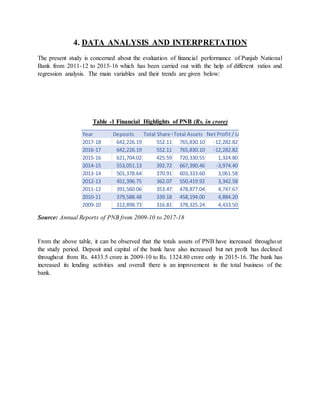
Table -1 Financial Highlights of PNB (Rs. in crore)
Source: Annual Reports of PNB from 2009-10 to 2017-18
From the above table, it can be observed that the totals assets of PNB have increased throughout
the study period. Deposit and capital of the bank have also increased but net profit has declined
throughout from Rs. 4433.5 crore in 2009-10 to Rs. 1324.80 crore only in 2015-16. The bank has
increased its lending activities and overall there is an improvement in the total business of the
bank.
Year Deposits Total Share CapitalTotal Assets Net Profit / Loss for The Year
2017-18 642,226.19 552.11 765,830.10 -12,282.82
2016-17 642,226.19 552.11 765,830.10 -12,282.82
2015-16 621,704.02 425.59 720,330.55 1,324.80
2014-15 553,051.13 392.72 667,390.46 -3,974.40
2013-14 501,378.64 370.91 603,333.60 3,061.58
2012-13 451,396.75 362.07 550,419.92 3,342.58
2011-12 391,560.06 353.47 478,877.04 4,747.67
2010-11 379,588.48 339.18 458,194.00 4,884.20
2009-10 312,898.73 316.81 378,325.24 4,433.50
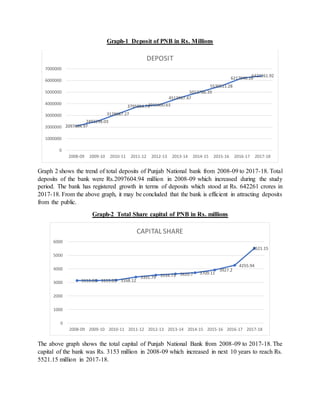
Graph-1 Deposit of PNB in Rs. Millions
Graph 2 shows the trend of total deposits of Punjab National bank from 2008-09 to 2017-18. Total
deposits of the bank were Rs.2097604.94 million in 2008-09 which increased during the study
period. The bank has registered growth in terms of deposits which stood at Rs. 642261 crores in
2017-18. From the above graph, it may be concluded that the bank is efficient in attracting deposits
from the public.
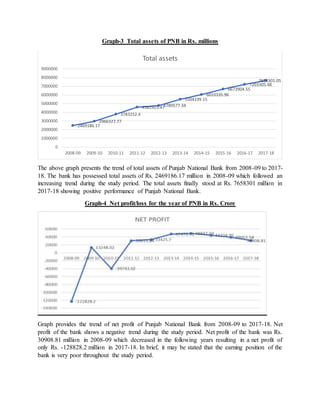
Graph-2 Total Share capital of PNB in Rs. millions
The above graph shows the total capital of Punjab National Bank from 2008-09 to 2017-18. The
capital of the bank was Rs. 3153 million in 2008-09 which increased in next 10 years to reach Rs.
5521.15 million in 2017-18.
2097604.97
2493298.03
3128987.27
3795884.793915600.63
4513967.47
5013786.39
5530511.28
6217040.16
6422261.92
0
1000000
2000000
3000000
4000000
5000000
6000000
7000000
2008-09 2009-10 2010-11 2011-12 2012-13 2013-14 2014-15 2015-16 2016-17 2017-18
DEPOSIT
3153.03 3153.03 3168.12
3391.79 3534.73 3620.7 3709.11
3927.2
4255.94
5521.15
0
1000
2000
3000
4000
5000
6000
2008-09 2009-10 2010-11 2011-12 2012-13 2013-14 2014-15 2015-16 2016-17 2017-18
CAPITAL SHARE
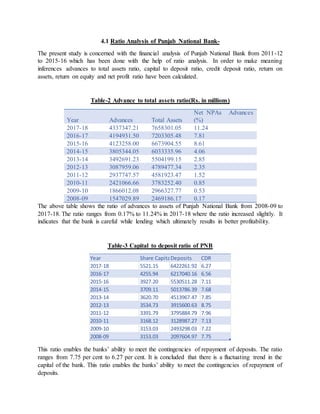
Graph-3 Total assets of PNB in Rs. millions
The above graph presents the trend of total assets of Punjab National Bank from 2008-09 to 2017-
18. The bank has possessed total assets of Rs. 2469186.17 million in 2008-09 which followed an
increasing trend during the study period. The total assets finally stood at Rs. 7658301 million in
2017-18 showing positive performance of Punjab National Bank.
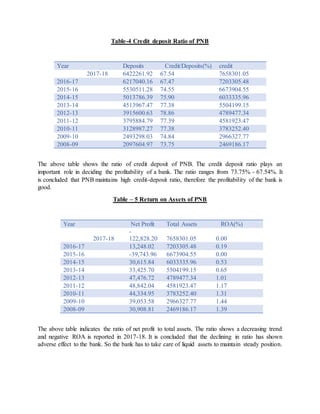
Graph-4 Net profit/loss for the year of PNB in Rs. Crore
Graph provides the trend of net profit of Punjab National Bank from 2008-09 to 2017-18. Net
profit of the bank shows a negative trend during the study period. Net profit of the bank was Rs.
30908.81 million in 2008-09 which decreased in the following years resulting in a net profit of
only Rs. -128828.2 million in 2017-18. In brief, it may be stated that the earning position of the
bank is very poor throughout the study period.
2469186.17
2966327.77
3783252.4
4581923.474789577.34
5504199.15
6033335.96
6673904.55
7203305.48
7658301.05
0
1000000
2000000
3000000
4000000
5000000
6000000
7000000
8000000
9000000
2008-09 2009-10 2010-11 2011-12 2012-13 2013-14 2014-15 2015-16 2016-17 2017-18
Total assets
4.1 Ratio Analysis of Punjab National Bank-
The present study is concerned with the financial analysis of Punjab National Bank from 2011-12
to 2015-16 which has been done with the help of ratio analysis. In order to make meaning
inferences advances to total assets ratio, capital to deposit ratio, credit deposit ratio, return on
assets, return on equity and net profit ratio have been calculated.
Table-2 Advance to total assets ratio(Rs. in millions)
Year Advances Total Assets
Net NPAs Advances
(%)
2017-18 4337347.21 7658301.05 11.24
2016-17 4194931.50 7203305.48 7.81
2015-16 4123258.00 6673904.55 8.61
2014-15 3805344.05 6033335.96 4.06
2013-14 3492691.23 5504199.15 2.85
2012-13 3087959.06 4789477.34 2.35
2011-12 2937747.57 4581923.47 1.52
2010-11 2421066.66 3783252.40 0.85
2009-10 1866012.08 2966327.77 0.53
2008-09 1547029.89 2469186.17 0.17
The above table shows the ratio of advances to assets of Punjab National Bank from 2008-09 to
2017-18. The ratio ranges from 0.17% to 11.24% in 2017-18 where the ratio increased slightly. It
indicates that the bank is careful while lending which ultimately results in better profitability.
Table-3 Capital to deposit ratio of PNB
This ratio enables the banks’ ability to meet the contingencies of repayment of deposits. The ratio
ranges from 7.75 per cent to 6.27 per cent. It is concluded that there is a fluctuating trend in the
capital of the bank. This ratio enables the banks’ ability to meet the contingencies of repayment of
deposits.
Year Share CapitalDeposits CDR
2017-18 5521.15 6422261.92 6.27
2016-17 4255.94 6217040.16 6.56
2015-16 3927.20 5530511.28 7.11
2014-15 3709.11 5013786.39 7.68
2013-14 3620.70 4513967.47 7.85
2012-13 3534.73 3915600.63 8.75
2011-12 3391.79 3795884.79 7.96
2010-11 3168.12 3128987.27 7.13
2009-10 3153.03 2493298.03 7.22
2008-09 3153.03 2097604.97 7.75
Table-4 Credit deposit Ratio of PNB
Year Deposits Credit/Deposits(%) credit
2017-18 6422261.92 67.54 7658301.05
2016-17 6217040.16 67.47 7203305.48
2015-16 5530511.28 74.55 6673904.55
2014-15 5013786.39 75.90 6033335.96
2013-14 4513967.47 77.38 5504199.15
2012-13 3915600.63 78.86 4789477.34
2011-12 3795884.79 77.39 4581923.47
2010-11 3128987.27 77.38 3783252.40
2009-10 2493298.03 74.84 2966327.77
2008-09 2097604.97 73.75 2469186.17
The above table shows the ratio of credit deposit of PNB. The credit deposit ratio plays an
important role in deciding the profitability of a bank. The ratio ranges from 73.75% - 67.54%. It
is concluded that PNB maintains high credit-deposit ratio, therefore the profitability of the bank is
good.
Table – 5 Return on Assets of PNB
Year Net Profit Total Assets ROA(%)
2017-18
-
122,828.20 7658301.05 0.00
2016-17 13,248.02 7203305.48 0.19
2015-16 -39,743.96 6673904.55 0.00
2014-15 30,615.84 6033335.96 0.53
2013-14 33,425.70 5504199.15 0.65
2012-13 47,476.72 4789477.34 1.01
2011-12 48,842.04 4581923.47 1.17
2010-11 44,334.95 3783252.40 1.31
2009-10 39,053.58 2966327.77 1.44
2008-09 30,908.81 2469186.17 1.39
The above table indicates the ratio of net profit to total assets. The ratio shows a decreasing trend
and negative ROA is reported in 2017-18. It is concluded that the declining in ratio has shown
adverse effect to the bank. So the bank has to take care of liquid assets to maintain steady position.
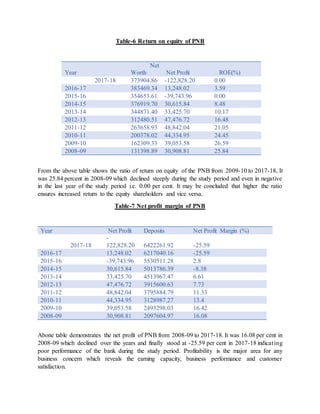
Table-6 Return on equity of PNB
Year
Net
Worth Net Profit ROE(%)
2017-18 373904.86 -122,828.20 0.00
2016-17 383469.34 13,248.02 3.59
2015-16 354653.61 -39,743.96 0.00
2014-15 376919.70 30,615.84 8.48
2013-14 344871.40 33,425.70 10.17
2012-13 312480.51 47,476.72 16.48
2011-12 263658.93 48,842.04 21.05
2010-11 200378.02 44,334.95 24.45
2009-10 162309.33 39,053.58 26.59
2008-09 131398.89 30,908.81 25.84
From the above table shows the ratio of return on equity of the PNB from 2009-10 to 2017-18, It
was 25.84 percent in 2008-09 which declined steeply during the study period and even in negative
in the last year of the study period i.e. 0.00 per cent. It may be concluded that higher the ratio
ensures increased return to the equity shareholders and vice versa.
Table-7 Net profit margin of PNB
Year Net Profit Deposits Net Profit Margin (%)
2017-18
-
122,828.20 6422261.92 -25.59
2016-17 13,248.02 6217040.16 -25.59
2015-16 -39,743.96 5530511.28 2.8
2014-15 30,615.84 5013786.39 -8.38
2013-14 33,425.70 4513967.47 6.61
2012-13 47,476.72 3915600.63 7.73
2011-12 48,842.04 3795884.79 11.33
2010-11 44,334.95 3128987.27 13.4
2009-10 39,053.58 2493298.03 16.42
2008-09 30,908.81 2097604.97 16.08
Abone table demonstrates the net profit of PNB from 2008-09 to 2017-18. It was 16.08 per cent in
2008-09 which declined over the years and finally stood at -25.59 per cent in 2017-18 indicating
poor performance of the bank during the study period. Profitability is the major area for any
business concern which reveals the earning capacity, business performance and customer
satisfaction.
5. Hypothesis Testing
The present study is primarily concerned with the issue of financial performance and its evaluation
of Punjab National Bank. The secondary data considered for the study consists of selected
variables collected for the ten-year period from 2008-09 to 2017-18. The analysis and
interpretation are based on the following hypotheses:
H01: there is no significant impact of deposits on the net profit of Punjab National Bank.
To find the impact of utilized funds on net profit among Maharatna companies, regression is used
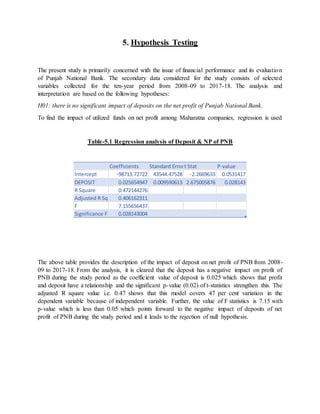
Table-5.1 Regression analysis of Deposit & NP of PNB
The above table provides the description of the impact of deposit on net profit of PNB from 2008-
09 to 2017-18. From the analysis, it is cleared that the deposit has a negative impact on profit of
PNB during the study period as the coefficient value of deposit is 0.025 which shows that profit
and deposit have a relationship and the significant p-value (0.02) of t-statistics strengthen this. The
adjusted R square value i.e. 0.47 shows that this model covers 47 per cent variation in the
dependent variable because of independent variable. Further, the value of F statistics is 7.15 with
p-value which is less than 0.05 which points forward to the negative impact of deposits of net
profit of PNB during the study period and it leads to the rejection of null hypothesis.
Coefficients Standard Errort Stat P-value
Intercept -98713.72722 43544.47528 -2.2669633 0.0531417
DEPOSIT 0.025654947 0.009590613 2.675005876 0.028143
R Square 0.472144276
Adjusted R Square0.406162311
F 7.155656437
Significance F 0.028143004
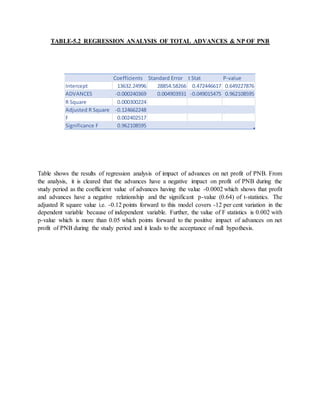
TABLE-5.2 REGRESSION ANALYSIS OF TOTAL ADVANCES & NP OF PNB
Table shows the results of regression analysis of impact of advances on net profit of PNB. From
the analysis, it is cleared that the advances have a negative impact on profit of PNB during the
study period as the coefficient value of advances having the value -0.0002 which shows that profit
and advances have a negative relationship and the significant p-value (0.64) of t-statistics. The
adjusted R square value i.e. -0.12 points forward to this model covers -12 per cent variation in the
dependent variable because of independent variable. Further, the value of F statistics is 0.002 with
p-value which is more than 0.05 which points forward to the positive impact of advances on net
profit of PNB during the study period and it leads to the acceptance of null hypothesis.
Coefficients Standard Error t Stat P-value
Intercept 13632.24996 28854.58266 0.472446617 0.649227876
ADVANCES -0.000240369 0.004903931 -0.049015475 0.962108595
R Square 0.000300224
Adjusted R Square -0.124662248
F 0.002402517
Significance F 0.962108595
6. CONCLUDING REMARKS
The present study aimed to measure the financial performance of Punjab National Bank from
2009-10 to 2017-18 Punjab National Bank is a major public sector bank of India which plays an
important role in the development of Indian financial system. The financial viability of the banking
system is certainly essential; not only to instill public confidence but also to make banks capable
of discharging their social responsibilities.The financial performance of the bank is analyzed using
different parameters. The Punjab National Bank of India is in a position to follow the rules of the
Government for the social and economic development of the country. The bank has performed
well on the sources of growth rate and financial efficiency during the study period. It plays a vital
role in marketing of new type of deposits and advances schemes. However, the bank earning at
least a nominal profit, have to serve the economy through extension of advances and safeguard the
interest of its investors by providing the expected return on their investment in bank. Therefore,
the bank has to re-orient its strategies in the light of own strengths and the kind of market in which
it is likely to operate on. Since the banking sector reforms have been set in motion, the profitability
became the buzzword and the prime mover of the financial strength and performance of bank. The
present study examines the impact on the financial performance of Punjab National Bank which
was taken as a sample for the purpose of analysis of financial performance. Net profit was taken
as dependent variables while total deposits and total advances were taken as independent variables.
Results showed that the profitability of the bank was strongly and negatively influenced by the
deposits and advances. On the practical dimension, this study is helpful for bankers and managers
in their decision making to improve the financial performance and formulate policies that will
promote effective financial system. The study also recommends measures that could be adopted
by bank to ensure soundness in its operations. The expected contributions of this study to the
management in the field of banking can be said to be that: this study may help decision makers to
pay more attention on the major banking activities that may help in increasing the financial
performance position and ranking of the bank as compared to other banks. The financia l
information of this study will also help the management in setting up plans and financial strategies.
From an academic point of view, this research provides a new perspective in evaluating the
financial performance of leading commercial banks as well as the finding of this study can be
added to the present literature and it can help researchers in their future studies.
7.Suggestions
Based on the analysis and interpretation, there are some of the general suggestions may be offered
for the better performance of Punjab National Bank itself.
proportion.
-interest income.
without much documentation. The bank must provide loans against shares.
ith the customers and more contribution from the employee of the bank should
be cooperative.
time in the daytime. It will help in facing the competition more effectively.
properly disclose the features of the product and services to the customers.
es which help them
in efficient working.
8.Bibliography
 PNB annual report(www.pnbindia.in)
 www.acekp.in
 www.moneycontrol.com
 www.wikipedia.in
 Financial management 7th edition (Prasanna Chandra)
 www.rbi.org.in

Doon business school pnb

  • 1.
    A Study onthe Financial Performance Evaluation of Punjab National Bank Submitted in the Partial Fulfillment of the study of “Masters of Business Administration” Guidance/Accepted by- Dr. Shalini Singh SUBMITTED BY- RAGNEE CHAUHAN ERP ID- 0181MBA069 DATE- 20 APRIL 2019
  • 2.
    CERTIFICATE OF ORIGINALITY ACKNOWLEDGEMENT ABSTRACT 1INTRODUCTION 1.1 EXECUTIVE SUMMARY 1.2 OBJECTIVE OF STUDY 1.3 WHAT IS FINANCIAL PERFORMANCE EVALUATION 1.4 LITRERATURE REVIEW 1.5 RESEARCH GAP 1.6 HYPOTHESIS OF THE STUDY 2 COMPANY PROFILE 2.1 HISTORY 2.2 TIMELINE 2.3 FRAUD CASE 2.4 FINANCIAL PERFORMANCE DATA 2.5 MERGER & ACQUISITION 2.6 LISTING & SHAREHOLDING 2.7 EMPLOYEE 2.8 AWARDS & RECOGNITIONS 3 RESEARCH METHODOLOGY 3.1 NATURE OF STUDY 3.2 NATURE OF DATA 3.3 SOURCES OF THE STUDY 3.4 TENURE OF THE STUDY 3.5 VARIABLES USED FOR THE STUDY 3.6 TOOL USED FOR THE STUDY 3.7 TOOL USED FOR THE ANALYSIS 3.8 LIMITATIONS OF THE STUDY 4 DATA INTERPRETATION TABLE 1 FINANCIAL HIGHLIGHT GRAPH.1 DEPOSIT OF PNB GRAPH.2 TOTAL SHARE CAPITAL GRAPH.3 TOTAL ASSETS OF PNB GRAPH.4 NET PROFIT FOR THE YEAR 4.1 RATIO ANALYSIS TABLE-2 ADVAMCE TO TOTAL ASSETS RATIO OF PNB TABLE-3 CAPITAL TO DEPOSIT RATIO OF PNB TABLE-4 CREDIT DEPOSIT RATIO OF PNB TABLE-5 RETURN ON ASSETS OF PNB TABLE-6 RETURN ON EQUITY OF PNB TABLE-7 NET PROFIT MARGIN OF PNB 5 HYPOTHESIS TESTING 5.1 REGRESSION ANALYSIS OF TOTAL ADVANCES & NP OF PNB 5.2 REGRESSION ANALYSIS OF DEPOSIT & NP OF PNB 6 CONCLUDING REMARKS 7 SUGGESTIONS 8 BIBILIOGAPHY
  • 3.
    CERTIFICATE OF ORIGINALITY (Tobe filled by the student in his/her handwriting) I_____________________, Enrolment No. ______________ of 2018-2020. I am a full-time bonafide student of ________________ of Doon Business School, Dehradun. I hereby certify that this Study report work carried out by me at _____________________________________________ submitted as the per the requirements of the program is an original work of mine under the guidance of the industry guide _______________________________ & internal guide (Faculty) _______________________________ and is not based on or reproduced from any existing work of any other person or any earlier work undertaken at any other time or for any other purpose, and has not been submitted anywhere else at any time. (Student’s Signature) Date: (Internal Guide’s Signature) Date:
  • 4.
    ACKNOWLEDGEMENT I hereby acknowledgemy sincere gratitude to the Doon Business School for giving this opportunity to undergo MBA BASE course to undertake this project work. I express my heartfelt thanks to Dr. Shalini Singh for whose guidance made this project an enlightening educational experience. I would like to thank Dr. B.P. Pethiya (Director) for giving me the opportunity to associate with such an esteemed organization and gain practical exposure. I am very much obliged and indebted to Dr. Shalini Singh for her approval and guidance during internship and valuable suggestions to take up the project.
  • 5.
    ABSTRACT: Banks playan important role in the economic development of a country. They are the lifeblood of modern commerce and have control over a large part of money supply. A bank is a financial intermediary that accepts deposits and channels them into lending activities. It plays a vital role in the marketing of new type of deposits and advances schemes. The operational efficiency, service quality and managerial effectiveness are the main areas to observe the performance of a bank. The financial performance of a bank can be measured as the achievement of the bank in terms of profitability position, service quality, customer satisfaction and other relevant aspects. The profitability of a bank denotes the efficiency with which a bank deploys its totalresources tooptimize its net profits and thus serve as an index to thedegree of asset utilization and managerial effectiveness. At present, the Indian banking system faces a number of difficult challenges. In such a scenario, the present study is an attempt to measure the financial performance of the second largest public sector bank of India i.e. Punjab National Bank. This study is entirely based on secondary data and different ratios have been applied to evaluate the financial performance of the bank along with regression analysis. The study concluded that the selected bank has performed well on the sources of growth rate and financial efficiency but profitability position has been found poor during the study period. 1. INTRODUCTION What is bank? A good bank is not only the financial heart of the community but also a helping hand in every possible manner to improve the economic condition of the society. Banks are a fundamental component of the financial system and are also active players in financial markets. The essential role of a bank is to connect those who have capital (investors or depositors), to those who seek capital (individuals or firms). Banks have control over a large part of the supply of money in circulation. Through their influence over the volume of bank money, they can influence nature and character of production in any country. Economic development is a dynamic and continuous process which highly depends upon the extent of mobilization of resources, investment and operational efficiency of various segments i.e. trade, industrial development, and agriculture of the economy. Thus, in a modern economy like India, banks have become a part and parcel of all economic activities. Banks play a significant role in the economic development of all the Nations of the world. In fact, Banking is the lifeblood of Modern Commerce. From its original narrow scope and modest purpose of taking care of other people’s money and lending a part of it, banking has developed to such an extent that, in countries like England, France and the U.S.A., there is hardly a Business deal without the assistance of a Bank is sought in one form or another.
  • 6.
    1.1 Executive Summary- Thisstudy is undertaken to measure the financial performance of Punjab National Bank. The study will provide details about the growth of deposits and advances, profitability analysis of PNB. It is hoped that the result of this study will propose policy measures for the better performance of this bank in order to achieve the financial goals along with customer satisfaction. 1.2 Objectives of Study - The main objectives of the study are as follows: examine the business performance of PNB. 1.3 What is Financial Performance Evaluation: - A Brief Review Financial Analysis is a process of synthesis and summarization of financial and operative data to get an insight into the operative activities of a business concern. Financial analysis consists of comparisons for the same company over periods of time or comparisons of different companies either in the same industry or in different industries. It may be done for a variety of purposes, which may range from a simple analysis of the short-term liquidity position of the firm to a comprehensive assessment of the strengths and weaknesses in various areas. It is helpful in assessing corporate excellence, operating efficiency, judging credit worthiness, forecasting bond ratings, predicting bankruptcy and assessing market risk. The financial analysis can be performed by analysts who work for the firm or by outsiders like investors, creditors, lenders, suppliers, customers, security analysts, academicians, researchers, environmental protection organizations, special interest lobbying groups, government and other regulatory bodies. There are numbers of tools and techniques available for the performance evaluation of a bank like Data Envelopment Analysis, CAMEL model and ratio analysis, etc. Financial analysis of a bank can be done mainly with the help of ratio analysis. Ratio analysis enables the management of banks to identify the causes of the changes in their advances, income, deposits, expenditure, profits and profitability over the period of time and thus help in pinpointing the direction of action required for increased deposits, income, advances and reducing the expenditure and for altering the profitability prospects of the banks in future. To be really helpful and practically useful for the bankers, the package of ratios should be small in size, simple in calculations, logically consistent and statistically valid. Over the years, various experts propounded a plethora of ratios for analyzing the financial position of a bank. The financial analysis of a bank can be done with the help of four general categories of ratios viz. profitability ratio, liquidity ratio, leverage ratio and activity ratio.
  • 7.
    1.4 LITERATURE REVIEW Literaturesurvey is generally conducted to review the present status of a particular research topic. It helps the researcher to know the quantum of work already done on the particular topic and the area not yet touched. Relevant literature is accessed through research reports, articles, books, journals, magazines and other relevant materials. Some studies related to the evaluation of financial performance are discussed below: Kumbirai and Webb (2010) investigated the performance of South Africa’s commercial banking sector for the period 2005- 2009. Financial ratios were employed to examine the profitability, liquidity and credit quality performance of five South African based commercial banks. The study concluded that overall bank performance increased considerably in the first two years and a significant change in trend was noticed at the onset of the global financial crisis in 2007, reaching its peak during 2008-2009. This resulted in falling profitability, low liquidity and deteriorating credit quality in the South African Banking sector. Kumar, B.S. (2008), evaluated the financial performance of Indian private sector banks. The study revealed that Private sector banks play an important role in the development of Indian economy. The economic reforms totally have changed the banking sector. RBI permitted new banks to be started in the private sector as per the recommendation of Narasimhan committee. The Indian banking industry was dominated by public sector banks, but now the situation has changed. New generation banks with better technology and professional management have gained a reasonable position in the banking industry. Koeva, P. (2003), examined the performance of Indian Banks. The analysis focused on evaluating the behavior and determinants of bank intermediation costs and profitability during the liberalization period. The results of the study suggested that ownership pattern had a significant effect on performance indicators and the observed increase in competition during financial liberalization which has been associated with lower intermediation costs and profitability of the Indian banks. Almazari (2011) in his study analyzed the financial performance of seven Jordanian commercial banks for the period 2005-2009. Simple regression was used to estimate the impact of independent variable i.e. the bank size, asset management, and operational efficiency on dependent variable represented by return on assets and interest income size. The study concluded that banks with higher total deposits, credits, assets, and shareholders’ equity did not always have better profitability performance. It was also found that there exists a positive correlation between financial performance and asset size, asset utilization and operational efficiency. Regression analysis also confirmed that financial performance is greatly influenced by these independent factors. Abdulrahman and Al-Sabaawee (2011) in their study tried to assess the performance of Islamic banks through the use of complex financial analysis based on the use of two tools using financial ratios and analysis of change and the general trend on the basis of the base year. The study was conducted to judge the performance of these banks and the efficiency of management in utilizing financial resources optimally and to achieve economic and social objectives. The study sample consisted of Iraqi Islamic Bank and Jordan Islamic Bank for the period 2000-2008. The study found that if Islamic banks want to achieve economic and social objectives in line with their fundamental base, they should have great decision making, financial policies future plans strengthen the position of these banks in the society as well as they should use financial instruments provided by the financial analysis to reach the desired goals. The study revealed that the top two performing banks were Bank of Baroda and Andhra Bank because of high capital adequacy and asset quality and the worst performer was United Bank of India because of management inefficiency, low capital adequacy and poor assets and earning quality.
  • 8.
    1.5 Research Gap Althoughsome studies have been conducted on financial performance analysis of banks, performance comparison between government and private banks and other financial institutions but analysis in the case of Punjab National Bank still remains unexplored. The researchers try to fill this lack of evidence by extending the issue to the specific context of the bank. Therefore, the main purpose of this study is to evaluate the financial performance of Punjab National Bank by observing different variables, ratios and measures, the impact of deposits and advances on the profitability of PNB’s past ten years performance results in order to improve its banking business. 1.6 Hypothesis of the Study The hypothesis of the study are as follows: H01: there is no significant impact of total deposit on net profit of Punjab National Bank. H02: there is no significant impact of total advances on net profit of Punjab National Bank. 1.7 Significance of the Study The main purpose of this study is to examine the financial performance of Punjab National Bank for investment and finance and to improve the bank’s operations and technology. Since the study revolves around one of the popular issues of current business scenario, the following are the expected significances: emphasis on undermined ones. ed researchers to carry out more extensive studies in this particular area. in particular and, correct decision making.
  • 9.
    2. COMPANY PROFILE PunjabNational Bank (PNB) is an Indian multinational banking and financial services company. It is a state-owned corporation based in New Delhi, India. The bank was founded in 1894. As of 31 March 2017, the bank has over 80 million customers, 6,937 branches (7,000 as on 2nd oct, 2018) and 10681 ATMs across 764 cities. PNB has a banking subsidiary in the UK (PNB International Bank, with seven branches in the UK), as well as branches in Hong Kong, Kowloon, Dubai, and Kabul. It has representative offices in Almaty (Kazakhstan), Dubai (United Arab Emirates), Shanghai (China), Oslo(Norway), and Sydney (Australia). In Bhutan it owns 51% of Druk PNB Bank, which has five branches. In Nepal PNB owns 20% of Everest Bank Limited, which has 50 branches. Lastly, PNB owns 84% of JSC (SB) PNB Bank in Kazakhstan, which has four branches. 2.1 History- Punjab National Bank is a PSU working under Central Government of India regulated by RBI Act, 1934 and Banking Regulation Act, 1949. Punjab National Bank was registered on 19 May 1894 under the Indian Companies Act, with its office in Anarkali Bazaar, Lahore, in present- day Pakistan. The founding board was drawn from different parts of India professing different faiths and of varying back-ground with, the common objective of creating a truly national bank that would further the economic interest of the country. PNB's founders included several leaders of the Swadeshi movement such as Dyal Singh Majithia and Lala Harkishen Lal, Lala Lalchand, Kali Prosanna Roy, E. C. Jessawala, Prabhu Dayal, Bakshi Jaishi Ram, and Lala Dholan Dass. Lala Lajpat Rai was actively associated with the management of the Bank in its early years. The board first met on 23 May 1894. The bank opened for business on 12 April 1895 in Lahore. PNBhas the distinction of being the first Indian bank to have been started solely with Indian capital that has survived to the present. (The first entirely Indian bank, Oudh Commercial Bank, was established in 1881 in Faizabad, but failed in 1958.) PNB has had the privilege of maintaining accounts of national leaders such as Mahatma Gandhi, Jawahar Lal Nehru, Lal Bahadur Shastri, Indira Gandhi, as well as the account of the famous Jalianwala Bagh Committee. 2.2 Timeline- In 1900 PNB established its first branch outside Lahore in India. Branches in Karachi and Peshawar followed. The next major event occurred in 1940 when PNB absorbed Bhagwan (or Bhugwan) Dass Bank, which had its head office in Dehra Dun. At the Partition of India and the commencement of Pakistani independence, PNB lost its premises in Lahore, but continued to operate in Pakistan. Partition forced PNB to close 92 offices in West Pakistan, one-third of its total number of branches, and which held 40% of the total deposits. PNB
  • 10.
    still maintained afew caretaker branches. On 31 March 1947, even before Partition, PNB had decided to leave Lahore and transfer its registered office to India; it received permission from the Lahore High Court on 20 June 1947, at which time it established a new head office at Under Hill Road, Civil Lines in New Delhi. Lala Yodh Raj was the Chairman of the Bank. In 1951, PNB acquired the 39 branches of Bharat Bank (est. 1942). Bharat Bank became Bharat Nidhi Ltd. In 1960, PNB again shifted its head office, this time from Calcutta to Delhi. In 1961, PNB acquired Universal Bank of India, which Ramakrishna Jain had established in 1938 in Dalmianagar, Bihar. PNB also amalgamated Indo Commercial Bank (est. 1932 by S. N. N. Sankaralinga Iyer) in a rescue. In 1963, The Burmese revolutionary government nationalized PNB's branch in Rangoon (Yangon). This became People's Bank No. 7. After the Indo-Pak war, in September 1965 the government of Pakistan seized all the offices in Pakistan of Indian banks. PNB also had one or more branches in East Pakistan(Bangladesh). The Government of India (GOI) nationalized PNB and 13 other major commercial banks, on 19 July 1969. In 1976 or 1978, PNB opened a branch in London. some ten years later, in 1986, the Reserve Bank of India required PNB to transfer its London branch to State Bank of India after the branch was involved in a fraud scandal. That same year, 1986, PNB acquired Hindustan Commercial Bank (est. 1943) in a rescue. The acquisition added Hindustan's 142 branches to PNB's network. In 1993, PNB acquired New Bank of India, which the GOI had nationalized in 1980. In 1998 PNB set up a representative office in Almaty, Kazakhstan. In 2003 PNB took over Nedungadi Bank, the oldest private sector bank in Kerala. At the time of the merger with PNB, Nedungadi Bank's shares had zero value, with the result that its shareholders received no payment for their shares. PNB also opened a representative office in London. In 2004, PNB established a branch in Kabul, Afghanistan, a representative office in Shanghai, and another in Dubai. PNB also established an alliance with Everest Bank Limited in Nepal that permits migrants to transfer funds easily between India and Everest Bank's 12 branches in Nepal. Currently, PNB owns 20% of Everest Bank. Two years later, PNB established PNBIL – Punjab National Bank (International) – in the UK, with two offices, one in London, and one in Southall. Since then it has opened more branches, this time in Leicester, Birmingham, Ilford, Wembley, and Wolverhampton. PNB also opened a branch in Hong Kong. In January 2009, PNB established a representative office in Oslo, Norway. PNB hopes to upgrade this to a branch in due course. In January 2010, PNBestablished a subsidiary in Bhutan. PNB owns 51% of Druk PNB Bank, which has branches in Thimpu, Phuentsholing, and Wangdue. Local investors own the remaining shares. Then on 1 May, PNB opened its branch in Dubai's financial center. PNB purchased a small minority stake in Kazakhstan-based JSC Danabank established on 20 October 1992 in Pavlodar. Within the year PNB increased its ownership till 84% of what has become JSC (SB) PNB, with its share currently decreased to 49%. The associate in Kazakhstan now called JSC Tengri Bank has branches in Almaty, Astana, Karaganda, Pavlodar and Shymkent. September 2011: PNB opened a representative office in Sydney, Australia. December 2012: PNB signed an agreement with US based life Insurance company Metlife to acquire a 30% stake in MetLife's Indian affiliate MetLife India Limited. The company would be renamed PNB MetLife India Limited and PNB would sell MetLife's products in its branches. assets = ₹6,435 billion (US$90 billion) (2015)
  • 11.
    2.3 Punjab NationalBank Fraud Case, 2018 Punjab National Bank disclosed in February 2018 that it detected fraudulent transactions of up to $1.77 billion at just one of its branches.[13] 2.4 Financial performance data- 2.5 Mergers and acquisitions Number Acquisition date Company Location Price Ref(s ). 1 1951 Bharat Bank Ltd. New Delhi, India — 2 1961 Universal Bank of India Dalmianagar, Bi har, India — 3 1962 Indo- Commercial Bank India — 4 1986 Hindustan Commercial Bank India — Financial performance Rupees. In millions Mar2018 Mar2017 Mar2016 Mar2015 Mar2014 Mar2013 Mar2012 Mar2011 Mar2010 Mar2009 TotalAssets 7658301.05 7203305.48 6673904.55 6033335.96 5504199.15 4789477.34 4581923.47 3783252.40 2966327.77 2469186.17 OperatingProfitGrowth 0.00 20.02 0.00 0.00 0.00 0.00 0.00 0.00 6.50 0.00 ReportedNetProfit -125843.30 -125843.30 -125843.30 -125843.30 -125843.30 -125843.30 -125843.30 -125843.30 -125843.30 -125843.30 ROA(%) 0.00 0.19 0.00 0.53 0.65 1.01 1.17 1.31 1.44 1.39 GrossNPA 86620.05 55370.45 55818.33 25694.86 18880.06 13465.79 8719.62 4379.39 3214.41 2767.47 NetNPA 48684.29 32702.10 35422.56 15396.50 9916.99 7236.50 4454.23 2038.63 981.69 263.85
  • 12.
    Number Acquisition date Company Location Price Ref(s ). 51993 New Bank of India New Delhi, India — 6 2003 Nedungadi Bank Kozhikode, Kera la, India — 2.6 Listings and shareholding- PNB's equity shares are listed on Bombay Stock Exchange and the National Stock Exchange of India.[20][21] It is a constituent of the CNX Nifty at the NSE. Shareholders (as on 31-Dec-2013) Shareholding Promoter Group (Govt. of India) 58.87% Foreign Institutional Investors (FII) 17.51% Insurance Companies 15.46% Individual shareholders 04.05% Banks/Financial Institutions/Mutual Funds/UTI 03.02% Others 01.09% Total 100.0% 2.7 Employees- PNB Head Office As on 31 March 2015, the bank had 68,290 employees. As of 31 March 2013, it also had 919 employees with disabilities on the same date (1.45%). The average age of bank employees on the same date was 46 years. The bank reported business of INR 11.65 crores per employee and net profit of INR 8.06 lakhs per employee during the FY 2012-13. The company incurred INR 5,751 crores towards employee benefit expenses during the same financial year.
  • 13.
    2.8 Awards andrecognitions  Punjab National Bank was ranked #717 in the Forbes Global 2000 in May 2013.  Punjab National Bank was ranked #26 in the Fortune India 500 ranking of 2011.  PNB was awarded the 'Best Public Sector Bank' by CNBC TV18 in 2012.  The bank was recognised as the 'most socially responsive bank' by Business world and PwC in 2012.  In 2011, it received Golden Peacock Award for "Excellence in Corporate Social Responsibility" and "National Training Award".  Initiatives  The bank incurred INR 3.24 crores on CSR activities like medical camps, farmer trainings, tree plantations, blood donation camps etc. during the FY 2012-13.
  • 14.
    3. Research Methodology Inthe present study, an attempt has made to evaluate the financial performance of Punjab National Bank. 3.1 Nature of the Study:- The present research is a case study in nature based on the second largest public sector bank of India i.e. Punjab National Bank. 3.2 Nature of Data: - The secondary data has been considered for the purpose of financial performance analysis of Punjab National Bank. 3.3 Sources of Data:- The data used for the present study has been taken from published annual reports of Punjab National Bank. Other relevant data source is internet source. 3.4 Tenure of the Study:- The present study is conducted for the period of ten years ranging from 2008-09 to 2017-18. 3.5 Variables used for the Study:- The variables used for the study are total deposits, total advances, total assets, capital and net profit. 3.6 Tools used for the Study:- Ratios, descriptive statistics and regression analysis have been considered for the analysis purpose. 3.7 Tools used for Analysis:- different ratios are used to analyze the financial performance of Punjab National bank which are as follows: Advances to Assets Ratio (AAR) = Advances / Total Assets Capital to Deposits Ratio (CDR) = Capital / Deposit Credit Deposit Ratio (CDR) = Advances / Total Deposit Return on Total Asset (ROA) = Net Profit / Total Asset*100 Return on Net worth (RONW) = Net Profit / Net Worth * 100 Net Profit Margin = Net Profit / Total Deposits * 100
  • 15.
    3.8 Limitations ofStudy The study suffers from certain limitations and some of these are mentioned below so that finding of the study can be understood in a proper perspective. The limitations of the study are as follows: applied to the entire banking sector. -08 to 2017-18). a which has been collected from published annual reports of banks and various relevant internet sources. The data obtained through reports is subject to window dressing and may not show the actual position of the Bank.
  • 16.
    4. DATA ANALYSISAND INTERPRETATION The present study is concerned about the evaluation of financial performance of Punjab National Bank from 2011-12 to 2015-16 which has been carried out with the help of different ratios and regression analysis. The main variables and their trends are given below: Table -1 Financial Highlights of PNB (Rs. in crore) Source: Annual Reports of PNB from 2009-10 to 2017-18 From the above table, it can be observed that the totals assets of PNB have increased throughout the study period. Deposit and capital of the bank have also increased but net profit has declined throughout from Rs. 4433.5 crore in 2009-10 to Rs. 1324.80 crore only in 2015-16. The bank has increased its lending activities and overall there is an improvement in the total business of the bank. Year Deposits Total Share CapitalTotal Assets Net Profit / Loss for The Year 2017-18 642,226.19 552.11 765,830.10 -12,282.82 2016-17 642,226.19 552.11 765,830.10 -12,282.82 2015-16 621,704.02 425.59 720,330.55 1,324.80 2014-15 553,051.13 392.72 667,390.46 -3,974.40 2013-14 501,378.64 370.91 603,333.60 3,061.58 2012-13 451,396.75 362.07 550,419.92 3,342.58 2011-12 391,560.06 353.47 478,877.04 4,747.67 2010-11 379,588.48 339.18 458,194.00 4,884.20 2009-10 312,898.73 316.81 378,325.24 4,433.50
  • 17.
    Graph-1 Deposit ofPNB in Rs. Millions Graph 2 shows the trend of total deposits of Punjab National bank from 2008-09 to 2017-18. Total deposits of the bank were Rs.2097604.94 million in 2008-09 which increased during the study period. The bank has registered growth in terms of deposits which stood at Rs. 642261 crores in 2017-18. From the above graph, it may be concluded that the bank is efficient in attracting deposits from the public. Graph-2 Total Share capital of PNB in Rs. millions The above graph shows the total capital of Punjab National Bank from 2008-09 to 2017-18. The capital of the bank was Rs. 3153 million in 2008-09 which increased in next 10 years to reach Rs. 5521.15 million in 2017-18. 2097604.97 2493298.03 3128987.27 3795884.793915600.63 4513967.47 5013786.39 5530511.28 6217040.16 6422261.92 0 1000000 2000000 3000000 4000000 5000000 6000000 7000000 2008-09 2009-10 2010-11 2011-12 2012-13 2013-14 2014-15 2015-16 2016-17 2017-18 DEPOSIT 3153.03 3153.03 3168.12 3391.79 3534.73 3620.7 3709.11 3927.2 4255.94 5521.15 0 1000 2000 3000 4000 5000 6000 2008-09 2009-10 2010-11 2011-12 2012-13 2013-14 2014-15 2015-16 2016-17 2017-18 CAPITAL SHARE
  • 18.
    Graph-3 Total assetsof PNB in Rs. millions The above graph presents the trend of total assets of Punjab National Bank from 2008-09 to 2017- 18. The bank has possessed total assets of Rs. 2469186.17 million in 2008-09 which followed an increasing trend during the study period. The total assets finally stood at Rs. 7658301 million in 2017-18 showing positive performance of Punjab National Bank. Graph-4 Net profit/loss for the year of PNB in Rs. Crore Graph provides the trend of net profit of Punjab National Bank from 2008-09 to 2017-18. Net profit of the bank shows a negative trend during the study period. Net profit of the bank was Rs. 30908.81 million in 2008-09 which decreased in the following years resulting in a net profit of only Rs. -128828.2 million in 2017-18. In brief, it may be stated that the earning position of the bank is very poor throughout the study period. 2469186.17 2966327.77 3783252.4 4581923.474789577.34 5504199.15 6033335.96 6673904.55 7203305.48 7658301.05 0 1000000 2000000 3000000 4000000 5000000 6000000 7000000 8000000 9000000 2008-09 2009-10 2010-11 2011-12 2012-13 2013-14 2014-15 2015-16 2016-17 2017-18 Total assets
  • 19.
    4.1 Ratio Analysisof Punjab National Bank- The present study is concerned with the financial analysis of Punjab National Bank from 2011-12 to 2015-16 which has been done with the help of ratio analysis. In order to make meaning inferences advances to total assets ratio, capital to deposit ratio, credit deposit ratio, return on assets, return on equity and net profit ratio have been calculated. Table-2 Advance to total assets ratio(Rs. in millions) Year Advances Total Assets Net NPAs Advances (%) 2017-18 4337347.21 7658301.05 11.24 2016-17 4194931.50 7203305.48 7.81 2015-16 4123258.00 6673904.55 8.61 2014-15 3805344.05 6033335.96 4.06 2013-14 3492691.23 5504199.15 2.85 2012-13 3087959.06 4789477.34 2.35 2011-12 2937747.57 4581923.47 1.52 2010-11 2421066.66 3783252.40 0.85 2009-10 1866012.08 2966327.77 0.53 2008-09 1547029.89 2469186.17 0.17 The above table shows the ratio of advances to assets of Punjab National Bank from 2008-09 to 2017-18. The ratio ranges from 0.17% to 11.24% in 2017-18 where the ratio increased slightly. It indicates that the bank is careful while lending which ultimately results in better profitability. Table-3 Capital to deposit ratio of PNB This ratio enables the banks’ ability to meet the contingencies of repayment of deposits. The ratio ranges from 7.75 per cent to 6.27 per cent. It is concluded that there is a fluctuating trend in the capital of the bank. This ratio enables the banks’ ability to meet the contingencies of repayment of deposits. Year Share CapitalDeposits CDR 2017-18 5521.15 6422261.92 6.27 2016-17 4255.94 6217040.16 6.56 2015-16 3927.20 5530511.28 7.11 2014-15 3709.11 5013786.39 7.68 2013-14 3620.70 4513967.47 7.85 2012-13 3534.73 3915600.63 8.75 2011-12 3391.79 3795884.79 7.96 2010-11 3168.12 3128987.27 7.13 2009-10 3153.03 2493298.03 7.22 2008-09 3153.03 2097604.97 7.75
  • 20.
    Table-4 Credit depositRatio of PNB Year Deposits Credit/Deposits(%) credit 2017-18 6422261.92 67.54 7658301.05 2016-17 6217040.16 67.47 7203305.48 2015-16 5530511.28 74.55 6673904.55 2014-15 5013786.39 75.90 6033335.96 2013-14 4513967.47 77.38 5504199.15 2012-13 3915600.63 78.86 4789477.34 2011-12 3795884.79 77.39 4581923.47 2010-11 3128987.27 77.38 3783252.40 2009-10 2493298.03 74.84 2966327.77 2008-09 2097604.97 73.75 2469186.17 The above table shows the ratio of credit deposit of PNB. The credit deposit ratio plays an important role in deciding the profitability of a bank. The ratio ranges from 73.75% - 67.54%. It is concluded that PNB maintains high credit-deposit ratio, therefore the profitability of the bank is good. Table – 5 Return on Assets of PNB Year Net Profit Total Assets ROA(%) 2017-18 - 122,828.20 7658301.05 0.00 2016-17 13,248.02 7203305.48 0.19 2015-16 -39,743.96 6673904.55 0.00 2014-15 30,615.84 6033335.96 0.53 2013-14 33,425.70 5504199.15 0.65 2012-13 47,476.72 4789477.34 1.01 2011-12 48,842.04 4581923.47 1.17 2010-11 44,334.95 3783252.40 1.31 2009-10 39,053.58 2966327.77 1.44 2008-09 30,908.81 2469186.17 1.39 The above table indicates the ratio of net profit to total assets. The ratio shows a decreasing trend and negative ROA is reported in 2017-18. It is concluded that the declining in ratio has shown adverse effect to the bank. So the bank has to take care of liquid assets to maintain steady position.
  • 21.
    Table-6 Return onequity of PNB Year Net Worth Net Profit ROE(%) 2017-18 373904.86 -122,828.20 0.00 2016-17 383469.34 13,248.02 3.59 2015-16 354653.61 -39,743.96 0.00 2014-15 376919.70 30,615.84 8.48 2013-14 344871.40 33,425.70 10.17 2012-13 312480.51 47,476.72 16.48 2011-12 263658.93 48,842.04 21.05 2010-11 200378.02 44,334.95 24.45 2009-10 162309.33 39,053.58 26.59 2008-09 131398.89 30,908.81 25.84 From the above table shows the ratio of return on equity of the PNB from 2009-10 to 2017-18, It was 25.84 percent in 2008-09 which declined steeply during the study period and even in negative in the last year of the study period i.e. 0.00 per cent. It may be concluded that higher the ratio ensures increased return to the equity shareholders and vice versa. Table-7 Net profit margin of PNB Year Net Profit Deposits Net Profit Margin (%) 2017-18 - 122,828.20 6422261.92 -25.59 2016-17 13,248.02 6217040.16 -25.59 2015-16 -39,743.96 5530511.28 2.8 2014-15 30,615.84 5013786.39 -8.38 2013-14 33,425.70 4513967.47 6.61 2012-13 47,476.72 3915600.63 7.73 2011-12 48,842.04 3795884.79 11.33 2010-11 44,334.95 3128987.27 13.4 2009-10 39,053.58 2493298.03 16.42 2008-09 30,908.81 2097604.97 16.08 Abone table demonstrates the net profit of PNB from 2008-09 to 2017-18. It was 16.08 per cent in 2008-09 which declined over the years and finally stood at -25.59 per cent in 2017-18 indicating poor performance of the bank during the study period. Profitability is the major area for any business concern which reveals the earning capacity, business performance and customer satisfaction.
  • 22.
    5. Hypothesis Testing Thepresent study is primarily concerned with the issue of financial performance and its evaluation of Punjab National Bank. The secondary data considered for the study consists of selected variables collected for the ten-year period from 2008-09 to 2017-18. The analysis and interpretation are based on the following hypotheses: H01: there is no significant impact of deposits on the net profit of Punjab National Bank. To find the impact of utilized funds on net profit among Maharatna companies, regression is used Table-5.1 Regression analysis of Deposit & NP of PNB The above table provides the description of the impact of deposit on net profit of PNB from 2008- 09 to 2017-18. From the analysis, it is cleared that the deposit has a negative impact on profit of PNB during the study period as the coefficient value of deposit is 0.025 which shows that profit and deposit have a relationship and the significant p-value (0.02) of t-statistics strengthen this. The adjusted R square value i.e. 0.47 shows that this model covers 47 per cent variation in the dependent variable because of independent variable. Further, the value of F statistics is 7.15 with p-value which is less than 0.05 which points forward to the negative impact of deposits of net profit of PNB during the study period and it leads to the rejection of null hypothesis. Coefficients Standard Errort Stat P-value Intercept -98713.72722 43544.47528 -2.2669633 0.0531417 DEPOSIT 0.025654947 0.009590613 2.675005876 0.028143 R Square 0.472144276 Adjusted R Square0.406162311 F 7.155656437 Significance F 0.028143004
  • 23.
    TABLE-5.2 REGRESSION ANALYSISOF TOTAL ADVANCES & NP OF PNB Table shows the results of regression analysis of impact of advances on net profit of PNB. From the analysis, it is cleared that the advances have a negative impact on profit of PNB during the study period as the coefficient value of advances having the value -0.0002 which shows that profit and advances have a negative relationship and the significant p-value (0.64) of t-statistics. The adjusted R square value i.e. -0.12 points forward to this model covers -12 per cent variation in the dependent variable because of independent variable. Further, the value of F statistics is 0.002 with p-value which is more than 0.05 which points forward to the positive impact of advances on net profit of PNB during the study period and it leads to the acceptance of null hypothesis. Coefficients Standard Error t Stat P-value Intercept 13632.24996 28854.58266 0.472446617 0.649227876 ADVANCES -0.000240369 0.004903931 -0.049015475 0.962108595 R Square 0.000300224 Adjusted R Square -0.124662248 F 0.002402517 Significance F 0.962108595
  • 24.
    6. CONCLUDING REMARKS Thepresent study aimed to measure the financial performance of Punjab National Bank from 2009-10 to 2017-18 Punjab National Bank is a major public sector bank of India which plays an important role in the development of Indian financial system. The financial viability of the banking system is certainly essential; not only to instill public confidence but also to make banks capable of discharging their social responsibilities.The financial performance of the bank is analyzed using different parameters. The Punjab National Bank of India is in a position to follow the rules of the Government for the social and economic development of the country. The bank has performed well on the sources of growth rate and financial efficiency during the study period. It plays a vital role in marketing of new type of deposits and advances schemes. However, the bank earning at least a nominal profit, have to serve the economy through extension of advances and safeguard the interest of its investors by providing the expected return on their investment in bank. Therefore, the bank has to re-orient its strategies in the light of own strengths and the kind of market in which it is likely to operate on. Since the banking sector reforms have been set in motion, the profitability became the buzzword and the prime mover of the financial strength and performance of bank. The present study examines the impact on the financial performance of Punjab National Bank which was taken as a sample for the purpose of analysis of financial performance. Net profit was taken as dependent variables while total deposits and total advances were taken as independent variables. Results showed that the profitability of the bank was strongly and negatively influenced by the deposits and advances. On the practical dimension, this study is helpful for bankers and managers in their decision making to improve the financial performance and formulate policies that will promote effective financial system. The study also recommends measures that could be adopted by bank to ensure soundness in its operations. The expected contributions of this study to the management in the field of banking can be said to be that: this study may help decision makers to pay more attention on the major banking activities that may help in increasing the financial performance position and ranking of the bank as compared to other banks. The financia l information of this study will also help the management in setting up plans and financial strategies. From an academic point of view, this research provides a new perspective in evaluating the financial performance of leading commercial banks as well as the finding of this study can be added to the present literature and it can help researchers in their future studies.
  • 25.
    7.Suggestions Based on theanalysis and interpretation, there are some of the general suggestions may be offered for the better performance of Punjab National Bank itself. proportion. -interest income. without much documentation. The bank must provide loans against shares. ith the customers and more contribution from the employee of the bank should be cooperative. time in the daytime. It will help in facing the competition more effectively. properly disclose the features of the product and services to the customers. es which help them in efficient working. 8.Bibliography  PNB annual report(www.pnbindia.in)  www.acekp.in  www.moneycontrol.com  www.wikipedia.in  Financial management 7th edition (Prasanna Chandra)  www.rbi.org.in