DOING GOOD
BETTER IN THE
WORLD
Jennifer Klein
International Education Consultant
Twitter: @KleinJenK
Lesson 1:
Good Intentions ≠
Doing Good.
$2 Billionmarket for global volunteer experiences in
2008
1.6 million volunteers/year.
Source: Tourism Research and Marketing (TRAM). 2008. “Volunteer tourism: a global analysis”
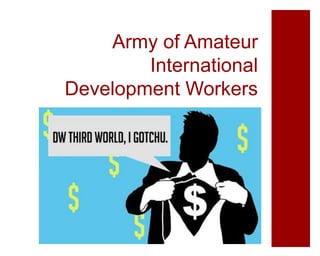
Army of Amateur
International
Development Workers
There are limited resources for
doing good.
Let’s use them
effectively.
Lesson 2:
Identify the need.
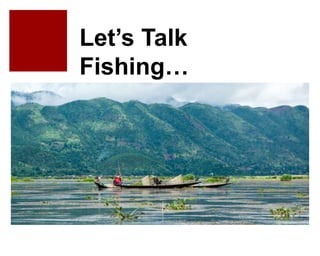
Let’s Talk
Fishing…
Giving Stuff ≠
Sustainable Solution.
Culture of
Dependence
vs.
Empowerment,
Livelihoods, and
Sustainability
The need in many cases
may be the development
of systems:
• Education
• Health
• Infrastructure
• Social protection
• Land ownership
• Environmental protections
Lesson 3:
Use research/data to do the
most helpful and efficient
intervention.
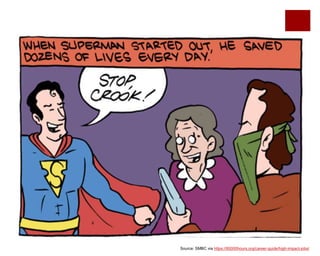
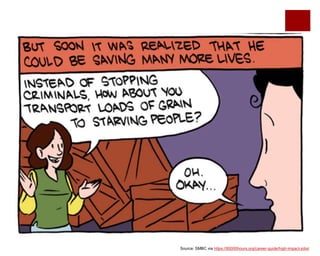
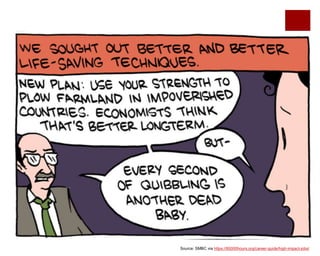
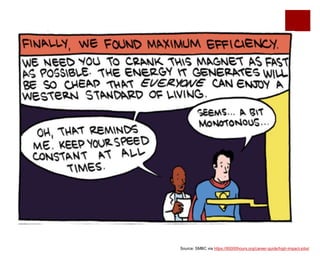
Source: SMBC via https://80000hours.org/career-guide/high-impact-jobs/
People want to
follow their hearts
and don’t want to
take time to do the
research…
Bad people in our world
are exploiting the
empathy of good
people…
…and producing terrible
consequences.
Lesson 4:
Volunteering Free Labor
can help. Sometimes.
[And sometimes not.]
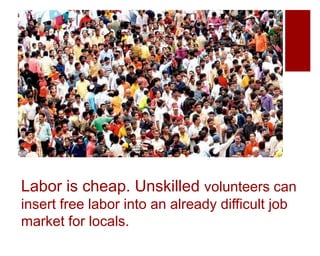
Labor is cheap. Unskilled volunteers can
insert free labor into an already difficult job
market for locals.
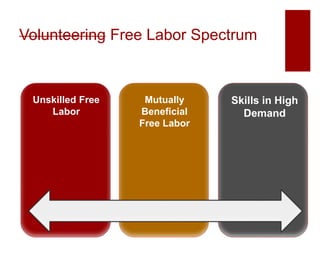
Volunteering Free Labor Spectrum
Unskilled Free
Labor
Mutually
Beneficial
Free Labor
Skills in High
Demand
Unskilled Free Labor
What it looks like:
 Volunteers pay to travel to a country to see the
country; meet locals; and do activities that locals
already have the skills to do.
 Short Term
 Volunteers may have no local language skills.
 Driven by volunteer interests rather than by
community needs.
Unskilled Free Labor
Examples:
Flying to other countries and distributing
stuff (toys, books, etc.).
Volunteering with children
Building schools/health
clinics/libraries/houses
Unskilled Free Labor
Examples:
Building Stuff.
If you wouldn’t be qualified to do it at
home, you shouldn’t travel abroad to do
it.
Staffing
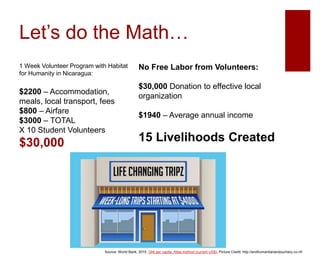
Let’s do the Math…
1 Week Volunteer Program with Habitat
for Humanity in Nicaragua:
$2200 – Accommodation,
meals, local transport, fees
$800 – Airfare
$3000 – TOTAL
X 10 Student Volunteers
$30,000
No Free Labor from Volunteers:
$30,000 Donation to effective local
organization
$1940 – Average annual income
15 Livelihoods Created
Source: World Bank, 2015. GNI per capita, Atlas method (current US$); Picture Credit: http://endhumanitariandouchery.co.nf/
WHO IS SHORT
TERM,
UNSKILLED
VOLUNTEERING
BENEFITTING?
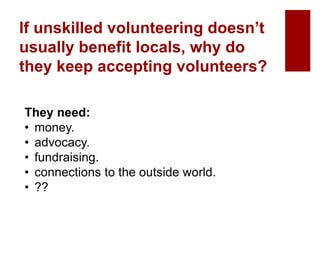
If unskilled volunteering doesn’t
usually benefit locals, why do
they keep accepting volunteers?
They need:
• money.
• advocacy.
• fundraising.
• connections to the outside world.
• ??
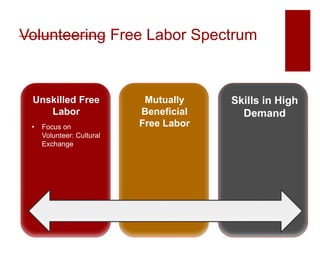
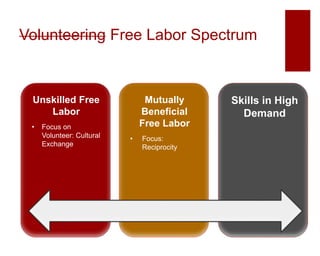
Volunteering Free Labor Spectrum
Unskilled Free
Labor
• Focus on
Volunteer: Cultural
Exchange
Mutually
Beneficial
Free Labor
Skills in High
Demand
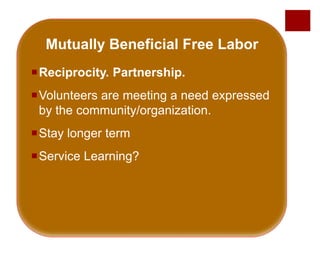
Mutually Beneficial Free Labor
Reciprocity. Partnership.
Volunteers are meeting a need expressed
by the community/organization.
Stay longer term
Service Learning?
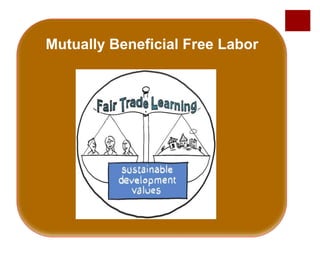
Mutually Beneficial Free Labor
Screening
Volunteer
Organizations/
Placements
Volunteering Free Labor Spectrum
Unskilled Free
Labor
• Focus on
Volunteer: Cultural
Exchange
Mutually
Beneficial
Free Labor
• Focus:
Reciprocity
Skills in High
Demand
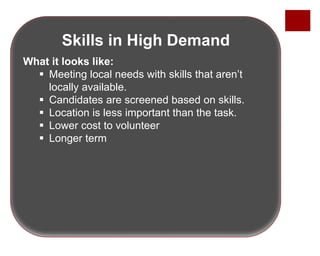
Skills in High Demand
What it looks like:
 Meeting local needs with skills that aren’t
locally available.
 Candidates are screened based on skills.
 Location is less important than the task.
 Lower cost to volunteer
 Longer term
Skills in High Demand
Examples:
Skills in High Demand
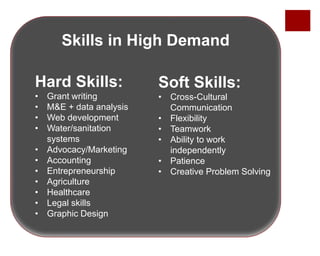
Hard Skills:
• Grant writing
• M&E + data analysis
• Web development
• Water/sanitation
systems
• Advocacy/Marketing
• Accounting
• Entrepreneurship
• Agriculture
• Healthcare
• Legal skills
• Graphic Design
Soft Skills:
• Cross-Cultural
Communication
• Flexibility
• Teamwork
• Ability to work
independently
• Patience
• Creative Problem Solving
Success
=
We don’t need you
anymore.
Work yourself out of a
job.
What if I don’t have the
skills yet?
Volunteer locally. Find an organization,
internship or job that helps you develop the
required skills here.
Document proof that you have the skills.
Find a mentor.
OR….
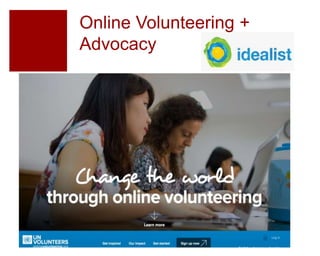
Online Volunteering +
Advocacy
Homework Assignment:
1. Would you volunteer abroad if you could
not post photos to social media?
2. Do you want to do good or feel good?
3. What do you hope to gain from
volunteering personally and professionally?
4. What impact can you realistically have
given your skills and time constraints?
Lesson 5:
Travel Responsibly
for Poverty Reduction
and Job Creation
190 182
286
182
400
0
50
100
150
200
250
300
350
400
450
Global Youth Travel Market Official development finance (ODA)
to all developing countries
2009 2014 2020
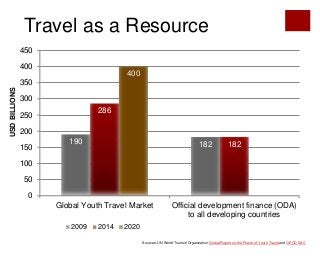
Travel as a Resource
Sources: UN World Tourism Organization Global Report on the Power of Youth Travel and OECD DAC
USDBILLIONS
Sustainable Development
Target 8.9
By 2030 devise and implement
policies to promote sustainable
tourism which creates jobs,
promotes local culture and
products.
+ Goals 12.2 and 14.7 (for coastal and maritime tourism).
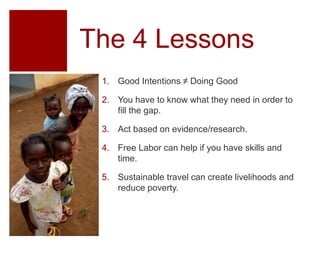
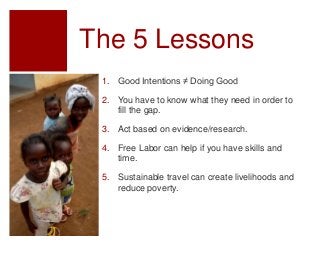
The 5 Lessons
1. Good Intentions ≠ Doing Good
2. You have to know what they need in order to
fill the gap.
3. Act based on evidence/research.
4. Free Labor can help if you have skills and
time.
5. Sustainable travel can create livelihoods and
reduce poverty.
5 Lessons
+
Good Intentions
+
Time, Resources and Skills
=
Better Volunteering.
Better Travel.
Better Work.
Doing good better.

Doing Good Better

  • 1.
    DOING GOOD BETTER INTHE WORLD Jennifer Klein International Education Consultant Twitter: @KleinJenK
  • 2.
  • 3.
    $2 Billionmarket forglobal volunteer experiences in 2008 1.6 million volunteers/year. Source: Tourism Research and Marketing (TRAM). 2008. “Volunteer tourism: a global analysis”
  • 4.
  • 5.
    There are limitedresources for doing good. Let’s use them effectively.
  • 6.
  • 7.
  • 8.
  • 9.
  • 10.
    The need inmany cases may be the development of systems: • Education • Health • Infrastructure • Social protection • Land ownership • Environmental protections
  • 11.
    Lesson 3: Use research/datato do the most helpful and efficient intervention.
  • 12.
    Source: SMBC viahttps://80000hours.org/career-guide/high-impact-jobs/
  • 13.
    Source: SMBC viahttps://80000hours.org/career-guide/high-impact-jobs/
  • 14.
    Source: SMBC viahttps://80000hours.org/career-guide/high-impact-jobs/
  • 15.
    Source: SMBC viahttps://80000hours.org/career-guide/high-impact-jobs/
  • 16.
    People want to followtheir hearts and don’t want to take time to do the research…
  • 17.
    Bad people inour world are exploiting the empathy of good people… …and producing terrible consequences.
  • 18.
    Lesson 4: Volunteering FreeLabor can help. Sometimes. [And sometimes not.]
  • 19.
    Labor is cheap.Unskilled volunteers can insert free labor into an already difficult job market for locals.
  • 20.
    Volunteering Free LaborSpectrum Unskilled Free Labor Mutually Beneficial Free Labor Skills in High Demand
  • 21.
    Unskilled Free Labor Whatit looks like:  Volunteers pay to travel to a country to see the country; meet locals; and do activities that locals already have the skills to do.  Short Term  Volunteers may have no local language skills.  Driven by volunteer interests rather than by community needs.
  • 22.
    Unskilled Free Labor Examples: Flyingto other countries and distributing stuff (toys, books, etc.). Volunteering with children Building schools/health clinics/libraries/houses
  • 23.
    Unskilled Free Labor Examples: BuildingStuff. If you wouldn’t be qualified to do it at home, you shouldn’t travel abroad to do it. Staffing
  • 24.
    Let’s do theMath… 1 Week Volunteer Program with Habitat for Humanity in Nicaragua: $2200 – Accommodation, meals, local transport, fees $800 – Airfare $3000 – TOTAL X 10 Student Volunteers $30,000 No Free Labor from Volunteers: $30,000 Donation to effective local organization $1940 – Average annual income 15 Livelihoods Created Source: World Bank, 2015. GNI per capita, Atlas method (current US$); Picture Credit: http://endhumanitariandouchery.co.nf/
  • 25.
  • 26.
    If unskilled volunteeringdoesn’t usually benefit locals, why do they keep accepting volunteers? They need: • money. • advocacy. • fundraising. • connections to the outside world. • ??
  • 27.
    Volunteering Free LaborSpectrum Unskilled Free Labor • Focus on Volunteer: Cultural Exchange Mutually Beneficial Free Labor Skills in High Demand
  • 28.
    Mutually Beneficial FreeLabor Reciprocity. Partnership. Volunteers are meeting a need expressed by the community/organization. Stay longer term Service Learning?
  • 29.
  • 30.
  • 31.
    Volunteering Free LaborSpectrum Unskilled Free Labor • Focus on Volunteer: Cultural Exchange Mutually Beneficial Free Labor • Focus: Reciprocity Skills in High Demand
  • 32.
    Skills in HighDemand What it looks like:  Meeting local needs with skills that aren’t locally available.  Candidates are screened based on skills.  Location is less important than the task.  Lower cost to volunteer  Longer term
  • 33.
    Skills in HighDemand Examples:
  • 34.
    Skills in HighDemand Hard Skills: • Grant writing • M&E + data analysis • Web development • Water/sanitation systems • Advocacy/Marketing • Accounting • Entrepreneurship • Agriculture • Healthcare • Legal skills • Graphic Design Soft Skills: • Cross-Cultural Communication • Flexibility • Teamwork • Ability to work independently • Patience • Creative Problem Solving
  • 35.
    Success = We don’t needyou anymore. Work yourself out of a job.
  • 36.
    What if Idon’t have the skills yet? Volunteer locally. Find an organization, internship or job that helps you develop the required skills here. Document proof that you have the skills. Find a mentor. OR….
  • 37.
  • 38.
    Homework Assignment: 1. Wouldyou volunteer abroad if you could not post photos to social media? 2. Do you want to do good or feel good? 3. What do you hope to gain from volunteering personally and professionally? 4. What impact can you realistically have given your skills and time constraints?
  • 39.
    Lesson 5: Travel Responsibly forPoverty Reduction and Job Creation
  • 41.
    190 182 286 182 400 0 50 100 150 200 250 300 350 400 450 Global YouthTravel Market Official development finance (ODA) to all developing countries 2009 2014 2020 Travel as a Resource Sources: UN World Tourism Organization Global Report on the Power of Youth Travel and OECD DAC USDBILLIONS
  • 43.
    Sustainable Development Target 8.9 By2030 devise and implement policies to promote sustainable tourism which creates jobs, promotes local culture and products. + Goals 12.2 and 14.7 (for coastal and maritime tourism).
  • 45.
    The 5 Lessons 1.Good Intentions ≠ Doing Good 2. You have to know what they need in order to fill the gap. 3. Act based on evidence/research. 4. Free Labor can help if you have skills and time. 5. Sustainable travel can create livelihoods and reduce poverty.
  • 46.
    5 Lessons + Good Intentions + Time,Resources and Skills = Better Volunteering. Better Travel. Better Work. Doing good better.

Editor's Notes

  • #2 Good Afternoon everyone! I’m thrilled to be here today and to have a chance to speak on this broad topic – Doing Good Better in the World. I’ve been nervous about this talk because I’m scared that all of you are going to be listening to my comments and thinking – “WOW- This woman is so critical. She’s a bad person!” But, hear me out and know that my comments are grounded in my background in the field of international development, which is poverty reduction in low and middle income countries as well as research on Effective Altruism – which is a movement to use the limited resources in this world to do good in the most efficient way. My comments are also grounded in my years of living, working, and travelling in low and middle income countries, which is an interest that I’m guessing many of you share.
  • #3 Volunteer work = helping. Mission work = helping. Donating stuff = helping. “I started an NGO to help people!!!” does not = helping. Service Learning may or may not be helping. You can’t assume that because it is called helping that it is actually doing good.
  • #7 [not about what you think they need; want to do; what you have to give them..]
  • #8 I’m sure you’ve all heard the old saying, “Give a man a fish and you’ll feed him for a day. Teach a man to fish and you’ll feed him for a lifetime.” … But what if he already knows how to fish, but you never asked what he needed and so didn’t know that it was actually that he needed a fishing pole to be able to do it… or maybe it was that he ran out of bait? … or maybe the real root of the problem of why he doesn’t have fish is because the new factory down river was polluting the water and they couldn’t eat the fish anymore…. Maybe advocacy is what the real need is… We have to find out what people actually NEED to know how to help.
  • #12 People want give something tangible and get warm fuzzies and immediate thank yous. They want to see the results of their work in a tangible form and get instant gratification… but Haiti really doesn’t need your old t-shirts and you won’t save the world on your 1 week volunteer trip. Development is a long term process where each person contributes a piece to a greater puzzle… it takes months and years.
  • #13 The trouble is that this kind of process of using data and research to do the most efficient development intervention takes time and research, and many people are more interested in following their heart and acting spur of the moment than they are doing lots of research.
  • #14 The trouble is that this kind of process of using data and research to do the most efficient development intervention takes time and research, and many people are more interested in following their heart and acting spur of the moment than they are doing lots of research.
  • #15 The trouble is that this kind of process of using data and research to do the most efficient development intervention takes time and research, and many people are more interested in following their heart and acting spur of the moment than they are doing lots of research.
  • #16 The trouble is that this kind of process of using data and research to do the most efficient development intervention takes time and research, and many people are more interested in following their heart and acting spur of the moment than they are doing lots of research.
  • #22 Greg Mortenson “Three Cups of Tea”’s schools in Pakistan and Afghanistan were vacant because no one could pay the teachers or furnish supplies. Health Clinics don’t treat patients, health care workers do and you have to pay their salaries. Building stuff is complicated. There are years worth of research on how to do it better, and this certainly doesn’t involve unskilled tourists doing it themselves.
  • #23 Books, toys, sporting goods, food, candy, etc. Short Term Teaching
  • #24 Greg Mortenson “Three Cups of Tea”’s schools in Pakistan and Afghanistan were vacant because no one could pay the teachers or furnish supplies. Health Clinics don’t treat patients, health care workers do and you have to pay their salaries. Building stuff is complicated. There are years worth of research on how to do it better, and this certainly doesn’t involve unskilled tourists doing it themselves. MAINTENANCE
  • #29 Exchange free labor/skills for learning, a work experience for your resume, or free room/board.
  • #33 https://www.peacecorps.gov/volunteer/is-peace-corps-right-for-me/peace-corps-response/
  • #34 https://www.peacecorps.gov/volunteer/is-peace-corps-right-for-me/peace-corps-response/
  • #38 When I looked on Idealist for remote volunteering requests, there were over 2000… You’ll have to screen the positions carefully to be sure the organizations are actually doing good and are legit… and develop/document some skills!!
  • #41 The United Nations 70th General Assembly has designated 2017 as the International Year of Sustainable Tourism for Development
  • #42 The Global Youth Travel Market in 2009 was $190 BILLION, and has been steadily rising despite the economic downturn and ebola. In 2014, it was worth $286 Billion. The official development finance to ALL developing countries in 2009 was less than the youth travel figure at 181, and it barely rose to 182 in 2014. Furthermore…. Youth travel expenditures are projected to rise to $400 Billion by 2020… twice the aid budget. This means that you are a HUGE MARKET. The market is oriented toward giving students what they want…