
SUBNNATTIONALS
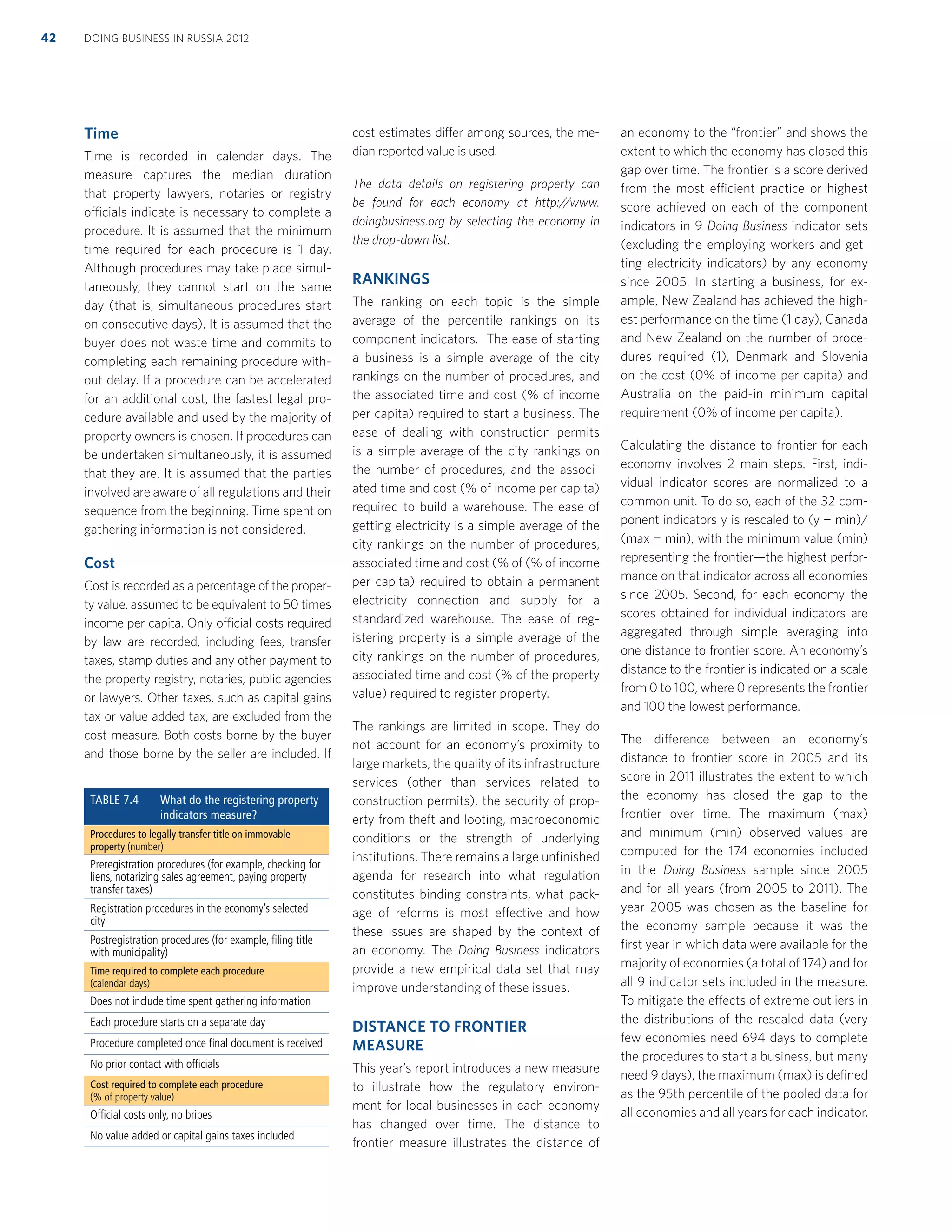
2012
CO M PA R I N G R E G U L AT I O N F O R D O M E S T I C F I R M S I N 3 0 C I T I E S A N D W I T H 1 8 3 E CO N O M I E S
Doing Business
in Russia 2012
© 2012 The International Bank for Reconstruction and Development / The World Bank
1818 H Street NW
Washington, DC 20433
Telephone 202-473-1000
Internet www.worldbank.org
All rights reserved.
1 2 3 4 08 07 06 05
A copublication of The World Bank and the International Finance Corporation.
This volume is a product of the staff of the World Bank Group. The findings, interpretations, and
conclusions expressed in this volume do not necessarily reflect the views of the Executive Directors
of The World Bank or the governments they represent. The World Bank does not guarantee the
accuracy of the data included in this work.
Rights and Permissions
The material in this publication is copyrighted. Copying and/or transmitting portions or all of
this work without permission may be a violation of applicable law. The World Bank encourages
dissemination of its work and will normally grant permission to reproduce portions of the work
promptly.
For permission to photocopy or reprint any part of this work, please send a request with complete
information to the Copyright Clearance Center, Inc., 222 Rosewood Drive, Danvers, MA 01923, USA;
telephone: 978-750-8400; fax: 978-750-4470; Internet: www.copyright.com.
All other queries on rights and licenses, including subsidiary rights, should be addressed to the Office
of the Publisher, The World Bank, 1818 H Street NW, Washington, DC 20433, USA; fax: 202-522-
2422; e-mail: pubrights@worldbank.org.
Doing Business in Russia 2012 and other subnational and regional Doing Business studies can be
downloaded at no charge at www.doingbusiness.org/subnational.
Copies of the Doing Business global reports: Doing Business 2012: Doing Business in a More Transparent
World; Doing Business 2011: Making a Difference for Entrepreneurs; Doing Business 2010: Reforming
through Difficult Times; Doing Business 2009; Doing Business 2008; Doing Business 2007: How to
Reform; Doing Business in 2006: Creating Jobs; Doing Business in 2005: Removing Obstacles to Growth;
DoingBusiness in 2004: Understanding Regulations may be obtained at www.doingbusiness.org.
2012
SSUUBBNNAATTIIOONNAALLSS
A COPUBLICATION OF THE WORLD BANK AND THE INTERNATIONAL FINANCE CORPORATION
Doing Business
in Russia 2012
CO M PA R I N G R EG U L AT I O N FO R D O M E ST I C F I R M S I N 3 0 C I T I E S A N D W I T H 1 8 3 ECO N O M I E S
DOING BUSINESS 2012ii
THE DOING BUSINESS WEBSITE
Doing Business in Russia 2012 report
http://www.doingbusiness.org/russia
Current features
News on the Doing Business project
http://www.doingbusiness.org
Doing Business reforms
Short reform summaries
http://www.doingbusiness.org/Reforms
Methodology and research
The methodology and research papers underlying
Doing Business
http://www.doingbusiness.org/Methodology
http://www.doingbusiness.org/Research
Download reports
Access to Doing Business reports as well as
subnational and regional reports, reform case studies
and customized economy and regional profiles
http://www.doingbusiness.org/Reports
Subnational and regional projects
Differences in business regulations at the
subnational and regional level
http://www.doingbusiness.org/Subnational-Reports
Law library
Online collection of laws and regulations relating to
business and gender issues
http://www.doingbusiness.org/Law-library
http://wbl.worldbank.org
Business Planet
Interactive map on the ease of doing business
http://rru.worldbank.org/businessplanet
Doing Business in Russia 2012 is the second sub-
national report in the Doing Business series in
Russia. In 2009, quantitative indicators on busi-
ness regulations were published for 10 cities:
Irkutsk, Kazan, Moscow, Perm, Petrozavodsk,
Rostov-on-Don, Saint Petersburg, Tomsk, Tver,
and Voronezh. This year, Doing Business in Rus-
sia in 2012 documents improvements in the 10
cities previously measured and expands the
analysis to 20 new cities across the nation:
Kaliningrad, Kaluga, Kemerovo, Khabarovsk,
Kirov, Murmansk, Novosibirsk, Omsk, Samara,
Saransk, Stavropol, Surgut, Ulyanovsk, Vladika-
vkaz, Vladivostok, Volgograd, Vyborg, Yakutsk,
Yaroslavl, and Yekaterinburg. Data for Moscow
is taken from the annual Doing Business report.
The selection criteria include the level of urban-
ization, population, economic activity, political
and geographical diversity, and other factors.
The cities were selected by the Ministry of Eco-
nomic Development of the Russian Federation.
Comparisons with other economies are based
on Doing Business 2012—Doing Business in a
more transparent world—the ninth in a series of
annual reports published by The World Bank
and International Finance Corporation. The in-
dicators in Doing Business in Russia 2012 are also
comparable with more than 352 cities from 54
economies benchmarked in other subnational
Doing Business studies. All data and reports are
available at http://subnational.doingbusiness.
org and www.doingbusiness.org.
Doing Business investigates the regulations that
enhance business activity and those that con-
strain it. Regulations affecting 4 stages of the
life of a business are measured at the subna-
tional level in Russia: starting a business, deal-
ing with construction permits, getting electric-
ity, and registering property. These indicators
were selected because they cover areas of local
jurisdiction or practice. The indicators are used
to analyze economic outcomes and identify
what reforms have worked, where and why. The
data in Doing Business in Russia 2012 are current
as of November 2011.
Contents
1 Executive summary
7 About Doing Business and Doing Business in Russia 2012
14 Starting a business
19 Dealing with construction permits
25 Getting electricity
31 Registering property
37 Data notes
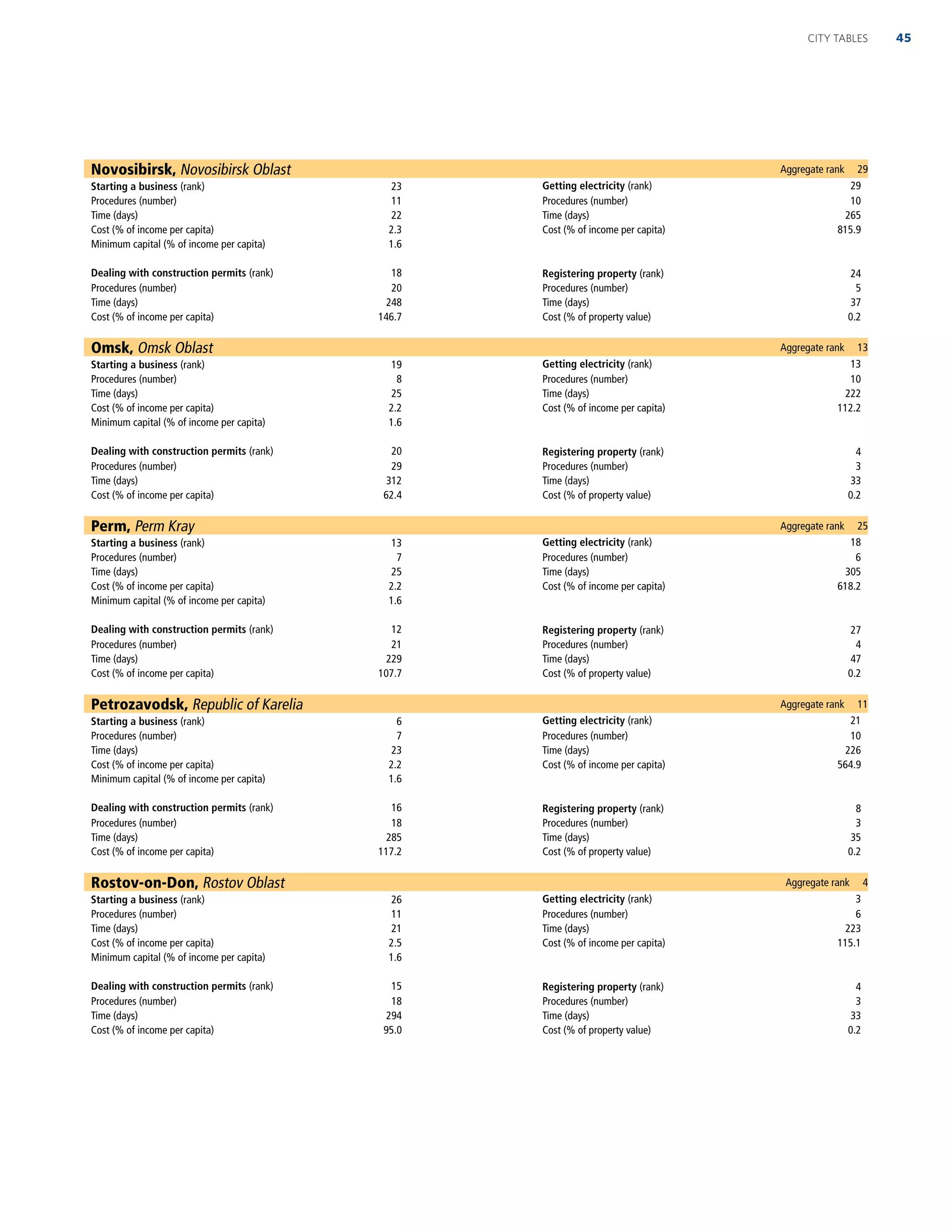
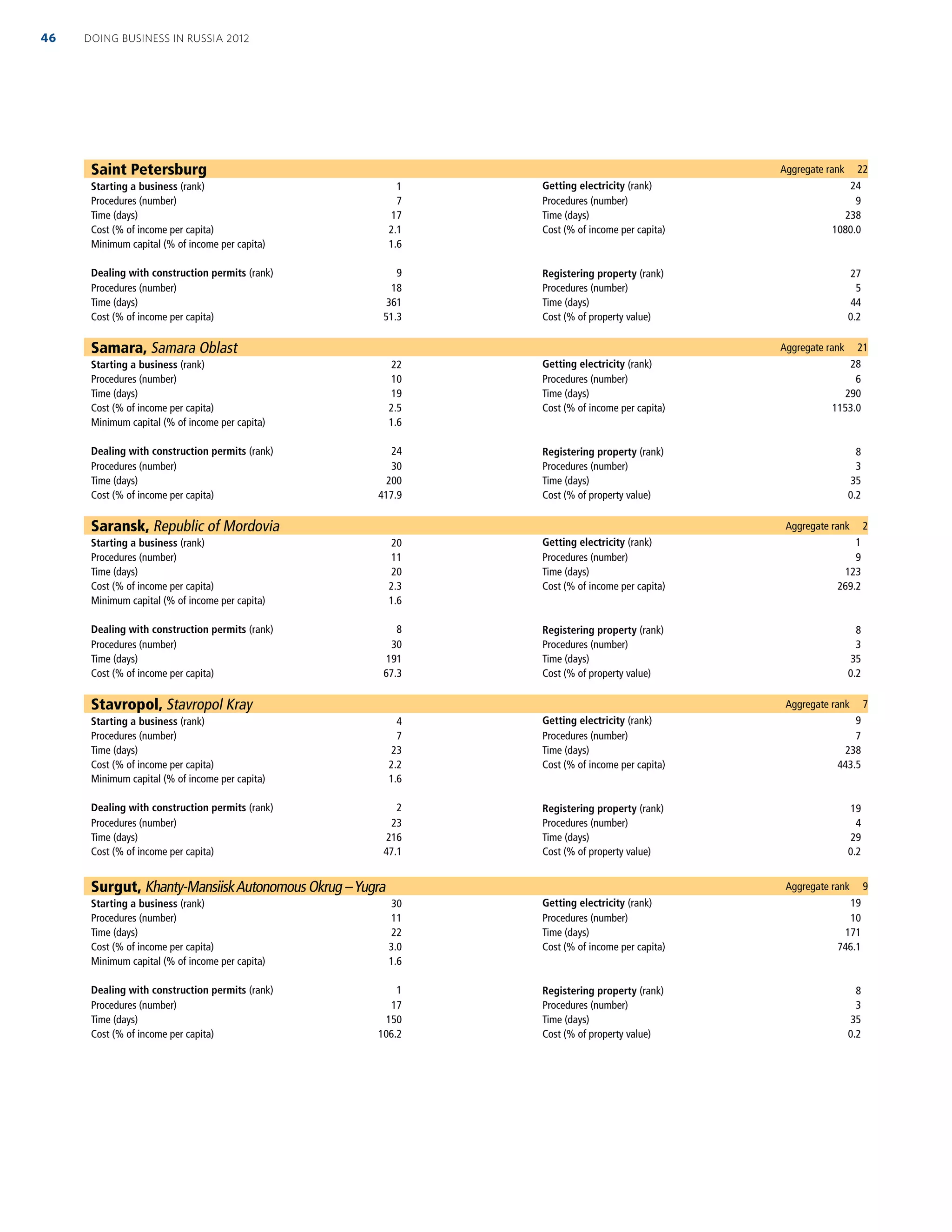
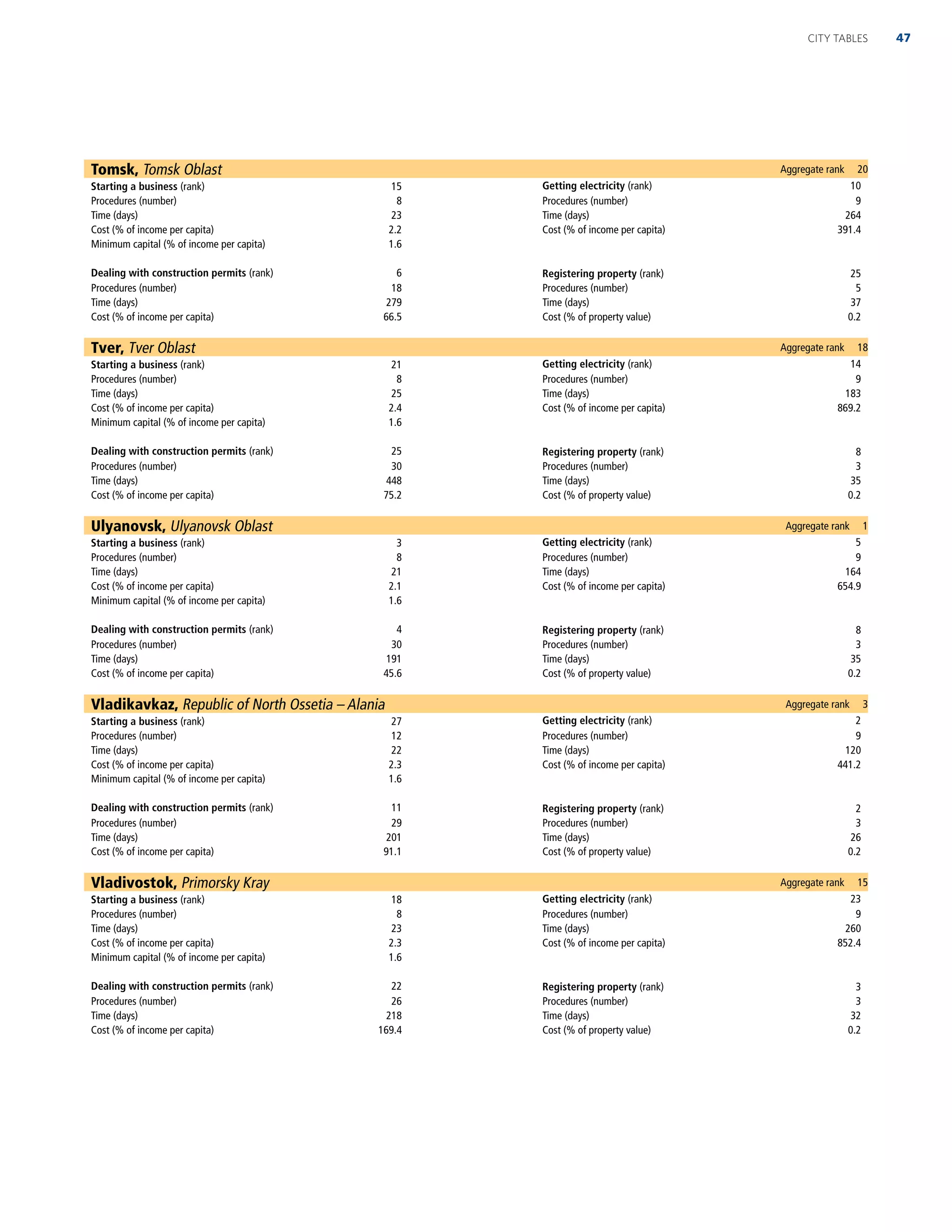
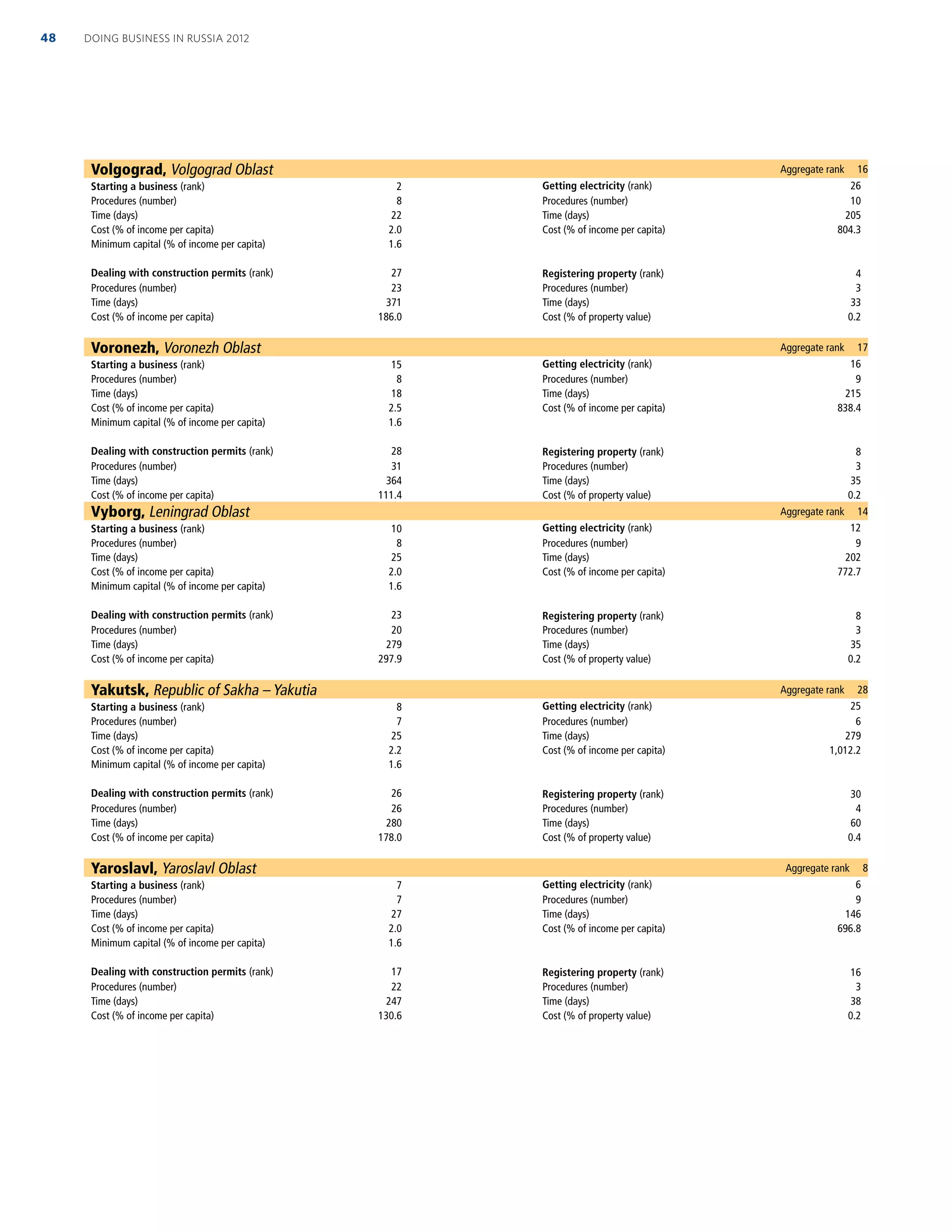
43 City tables
50 Doing Business indicators
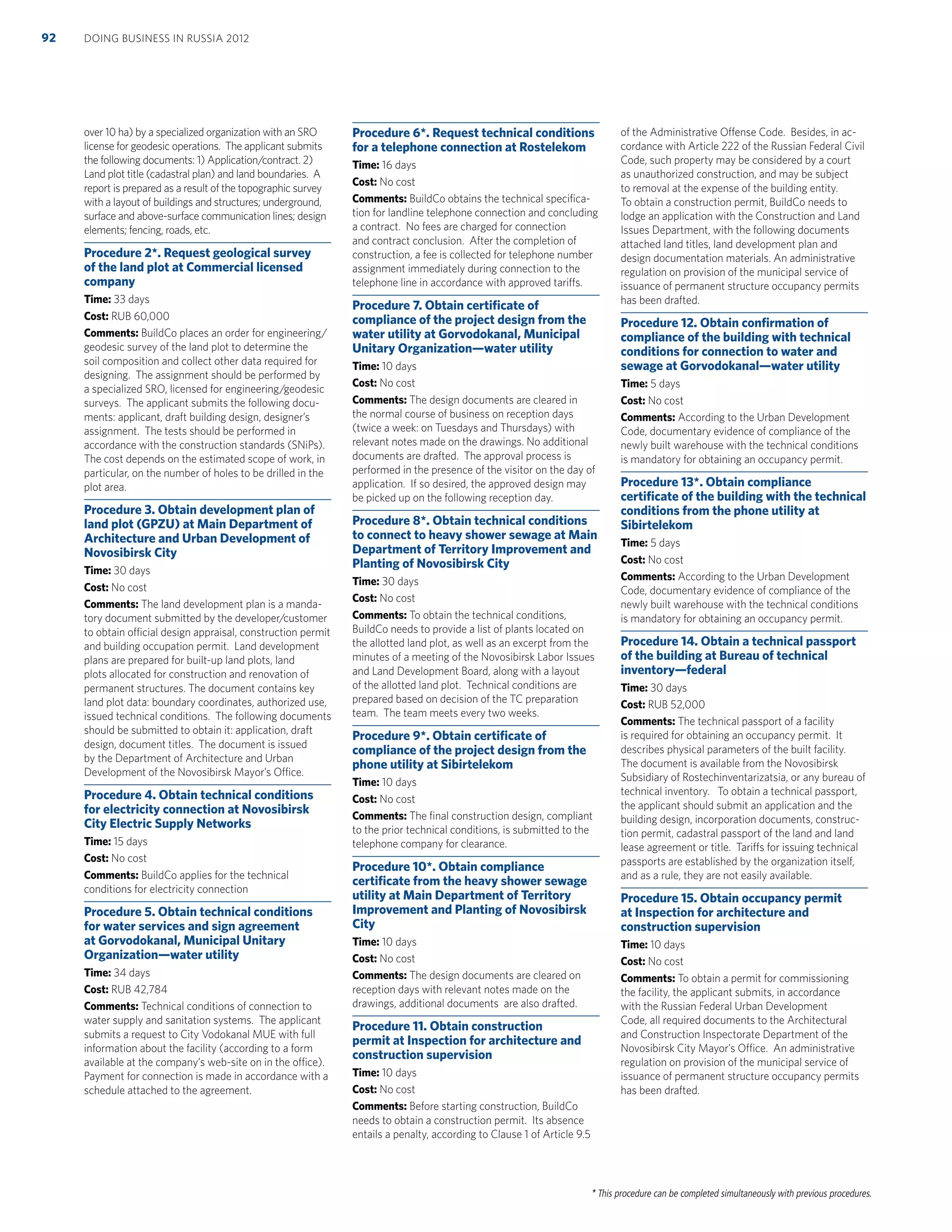
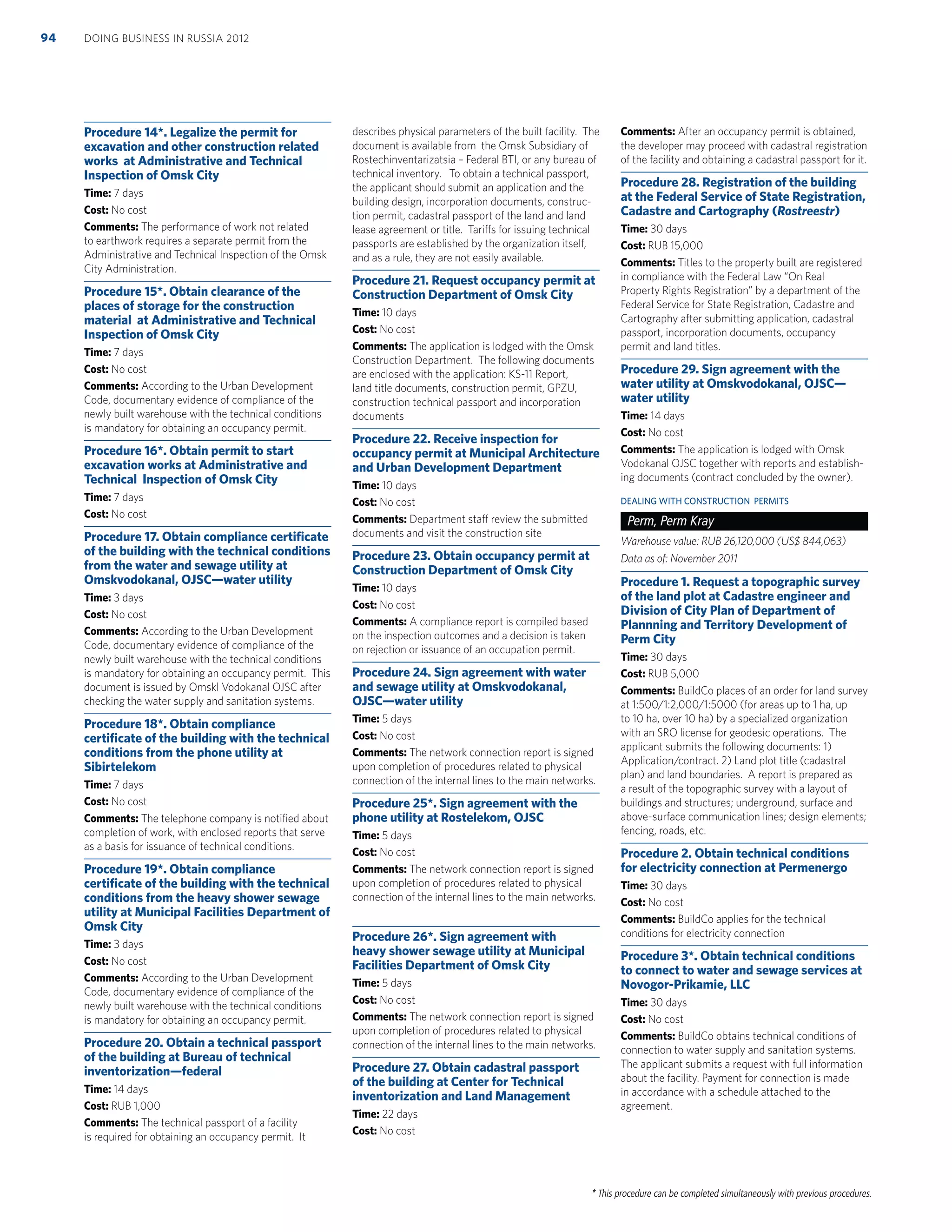
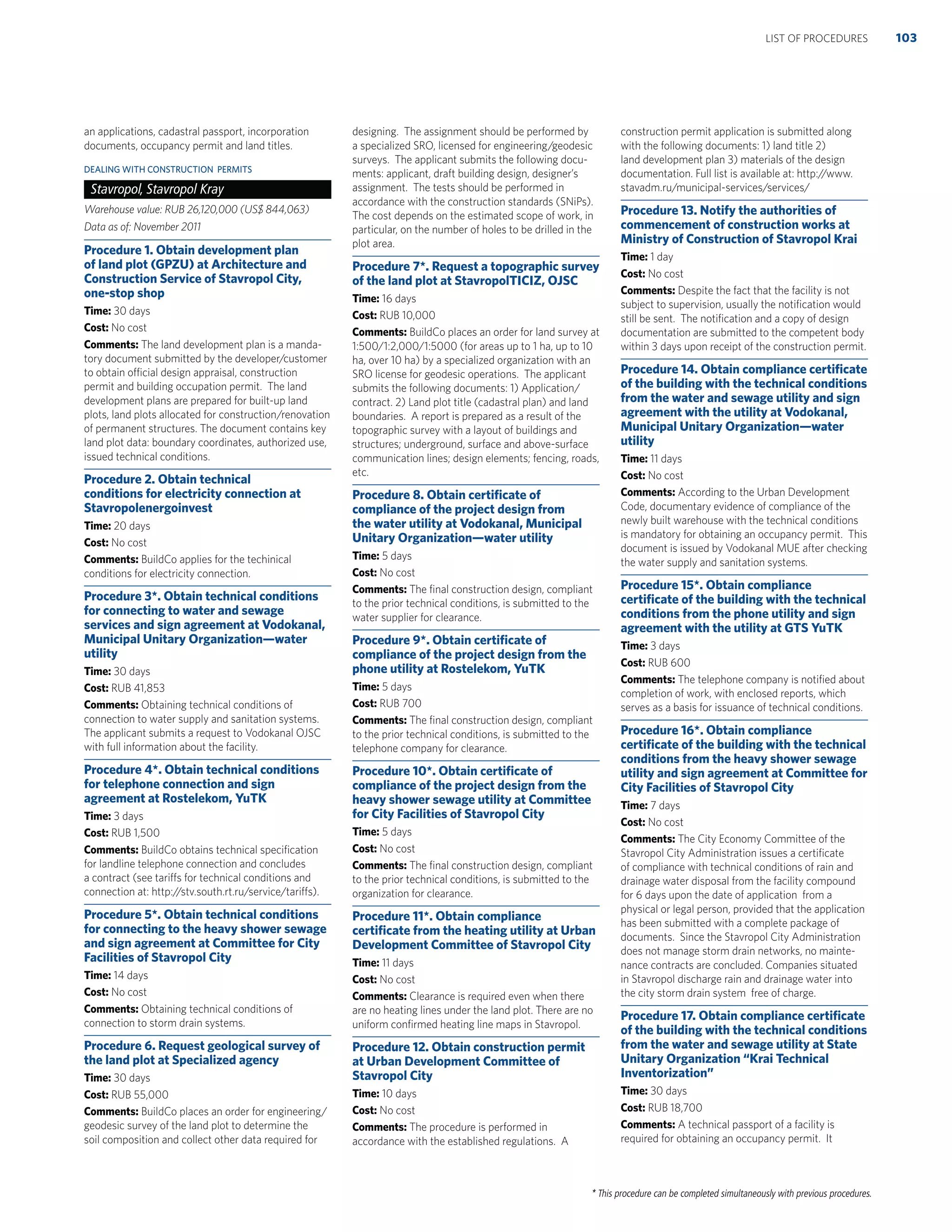
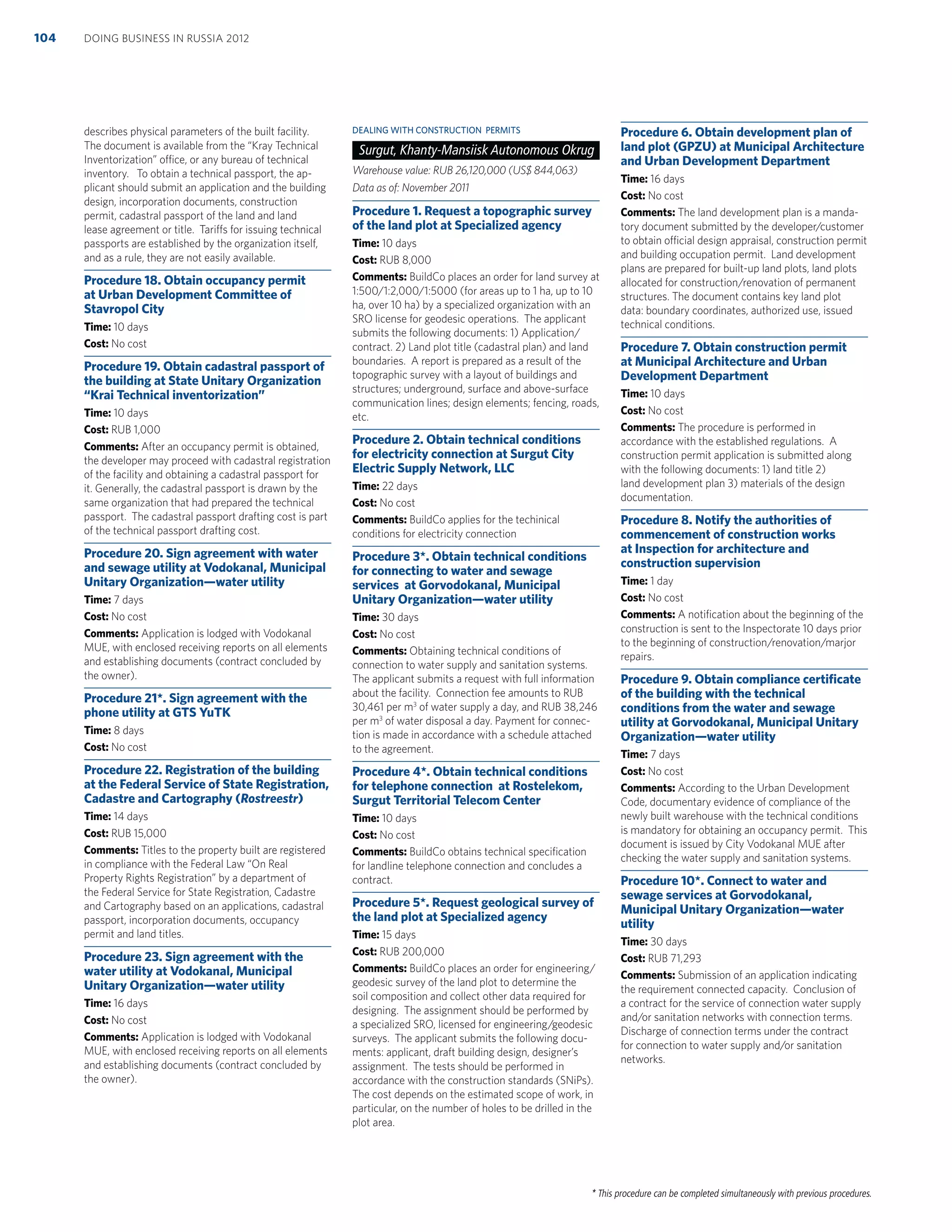
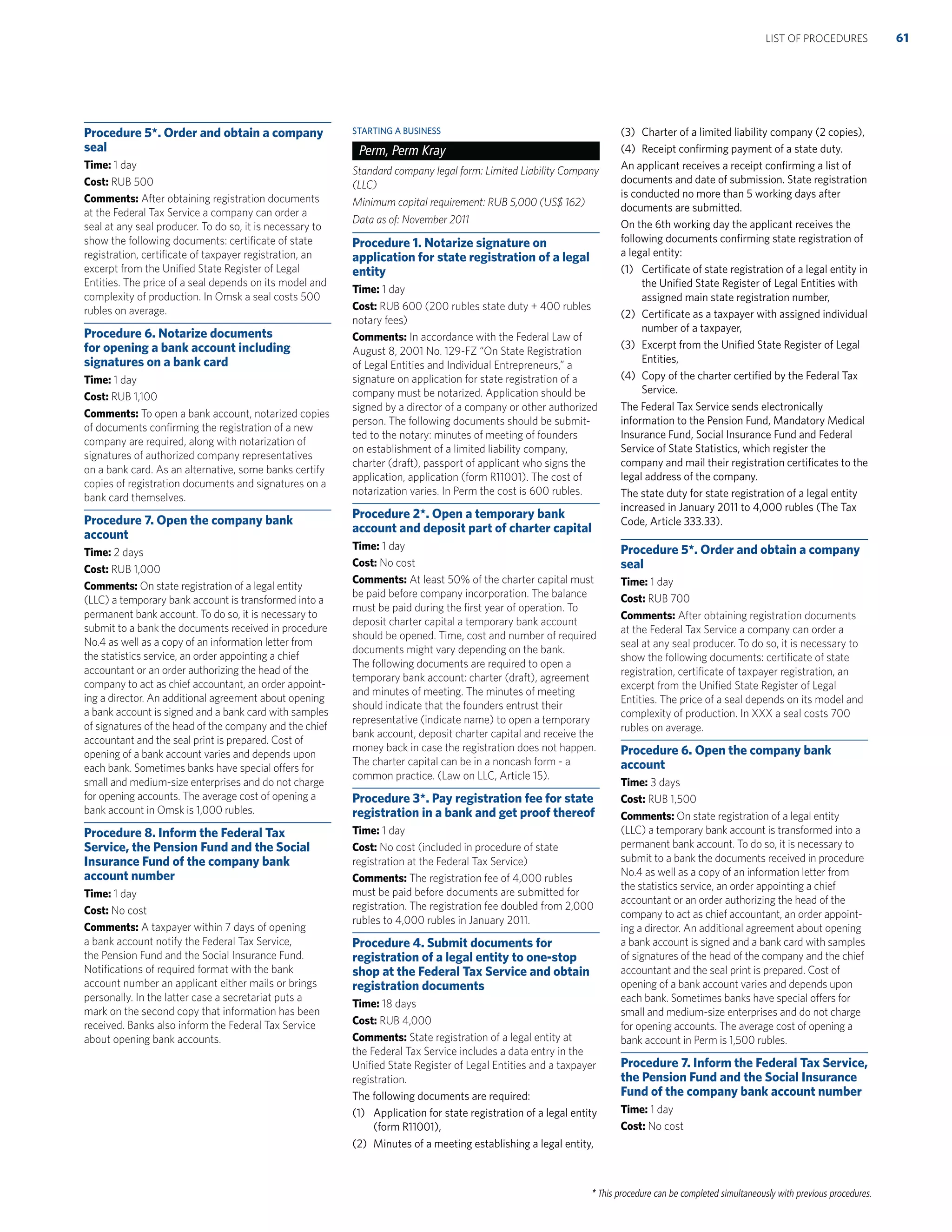
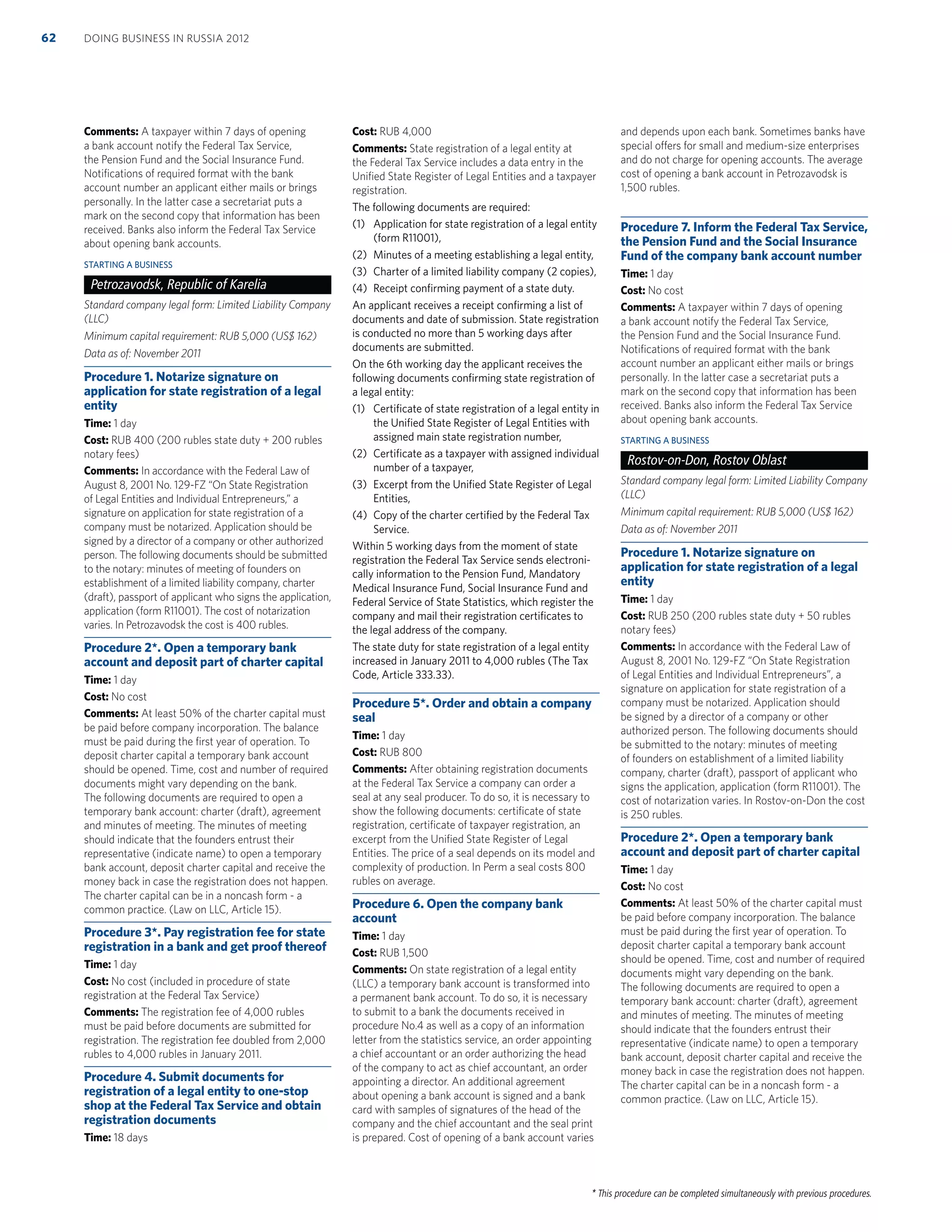
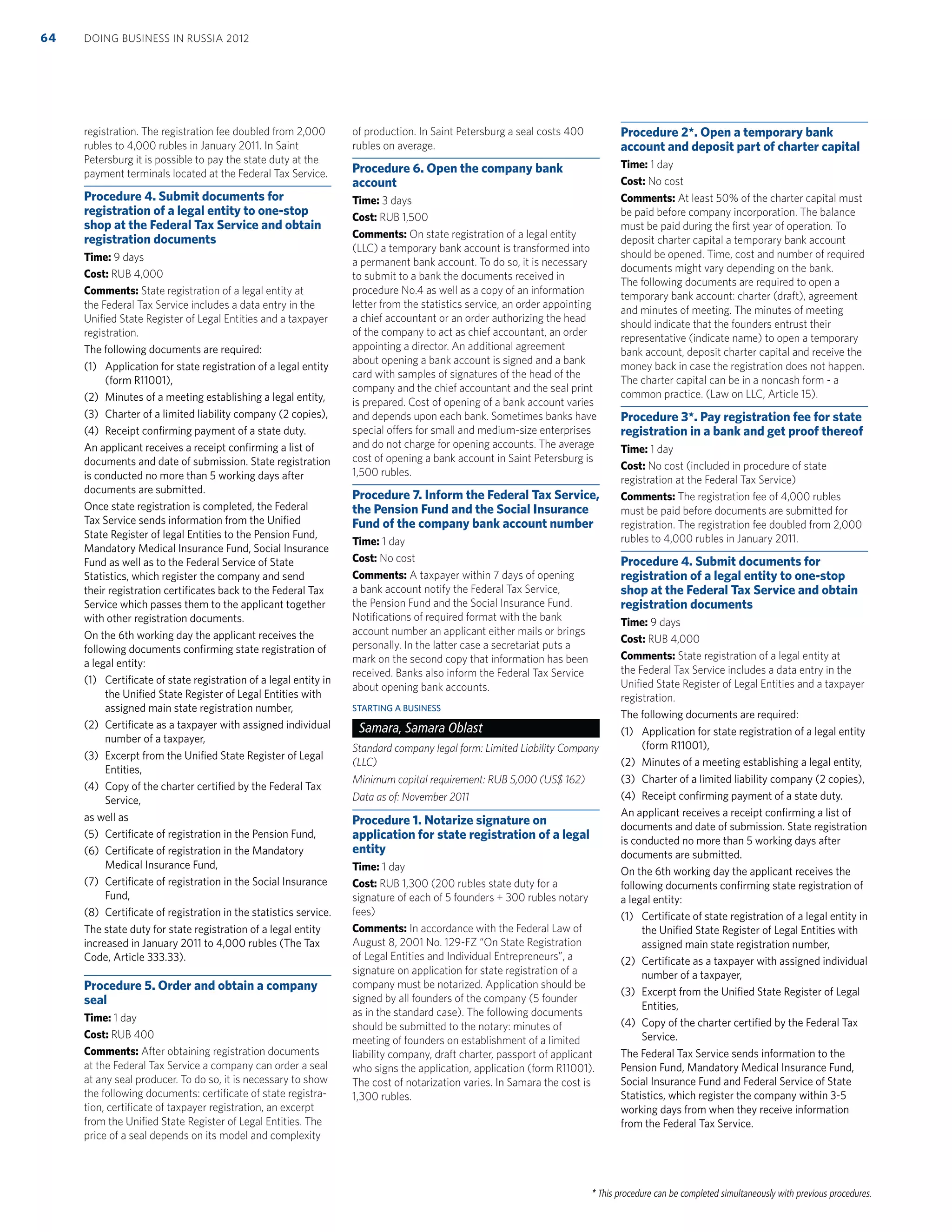
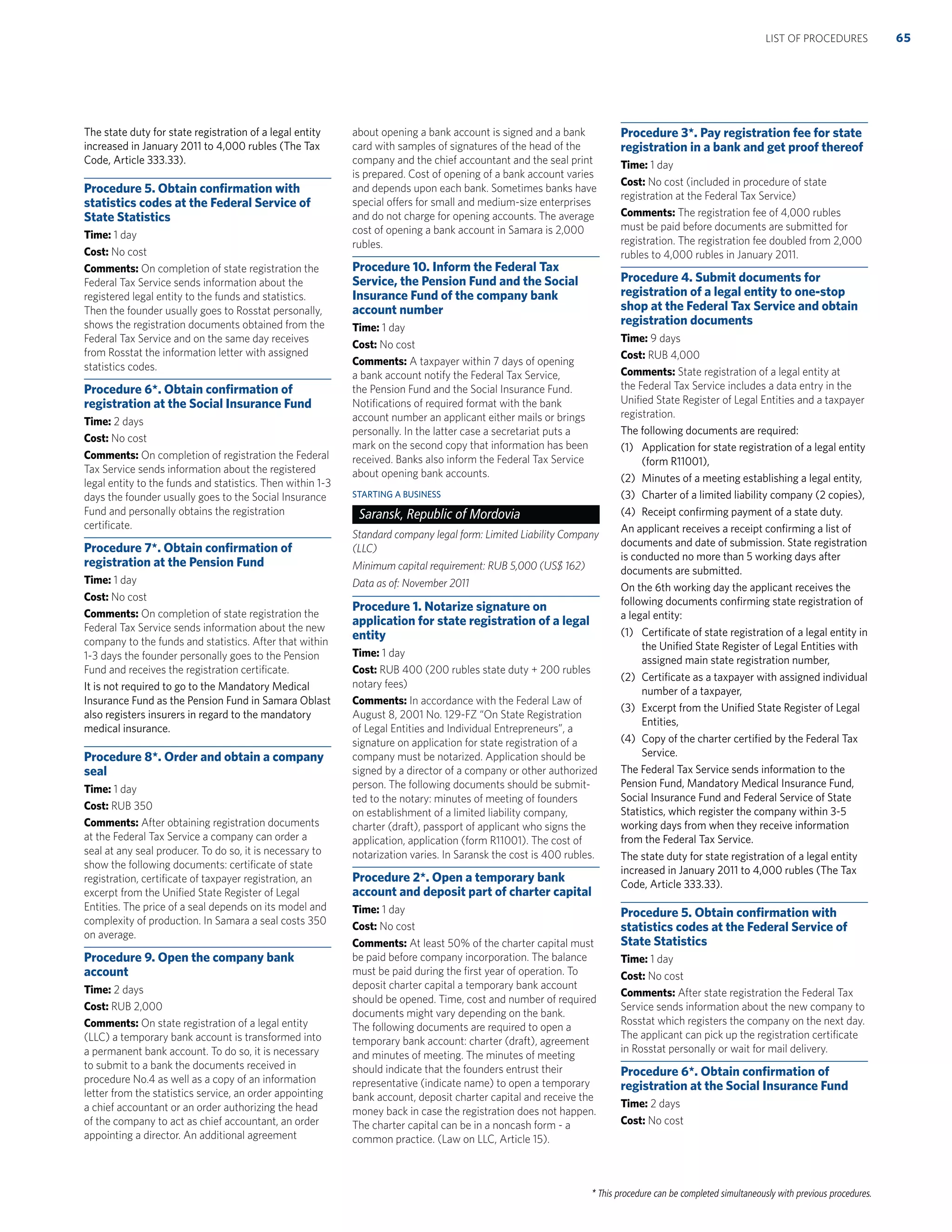
52 List of procedures
52 Starting a business
77 Dealing with construction permits
121 Getting electricity
138 Registering property
147 Acknowledgments
SUBNATIONALS
2012
1
Executive summary
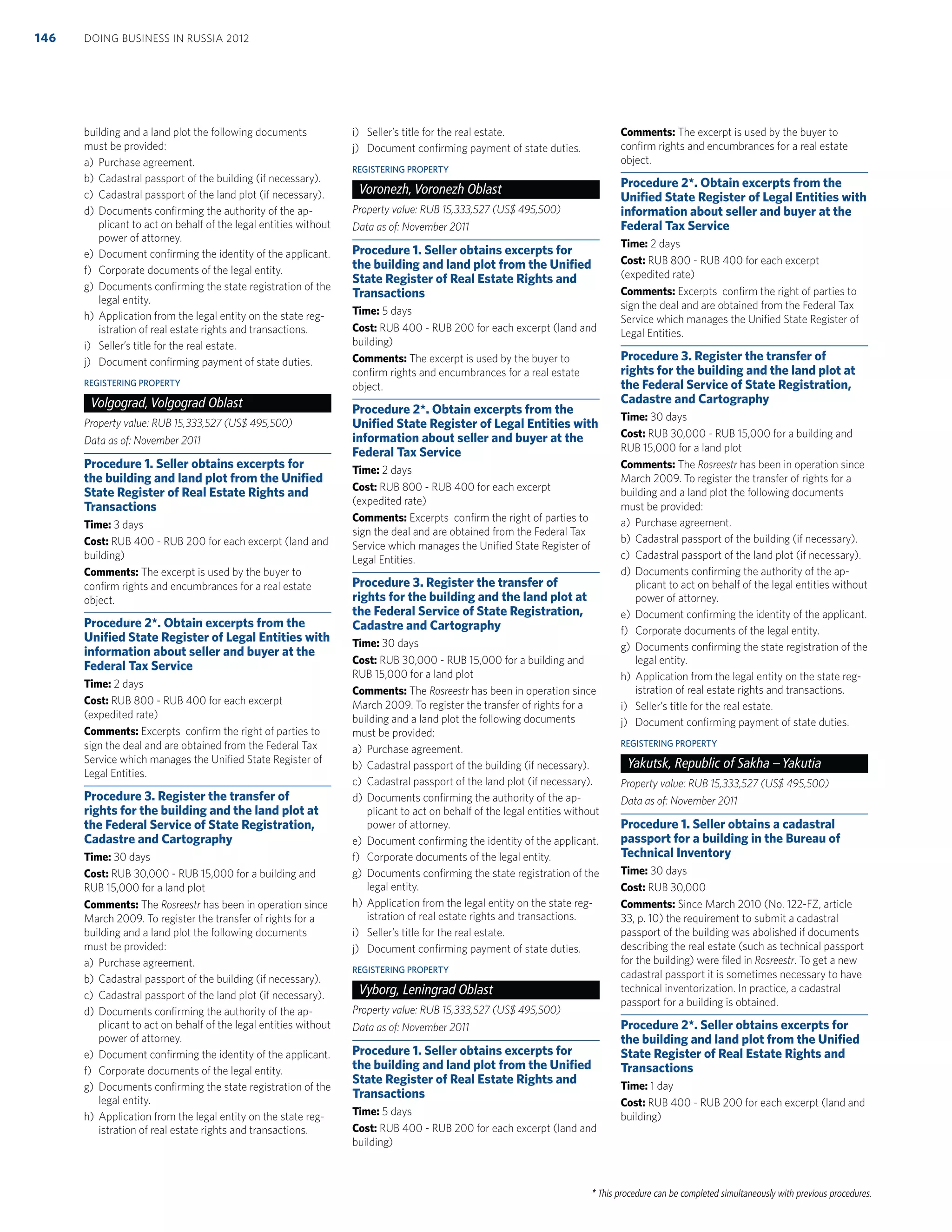
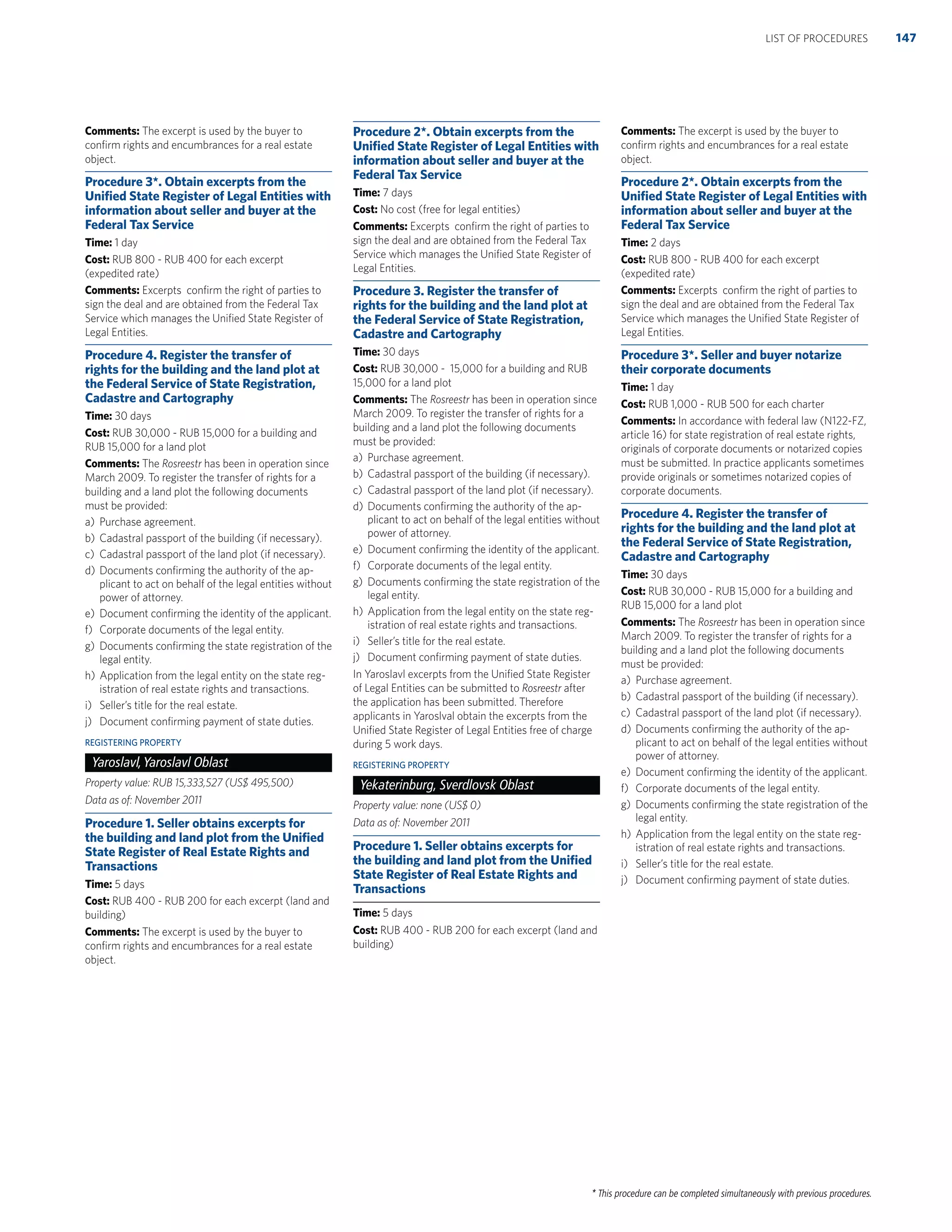
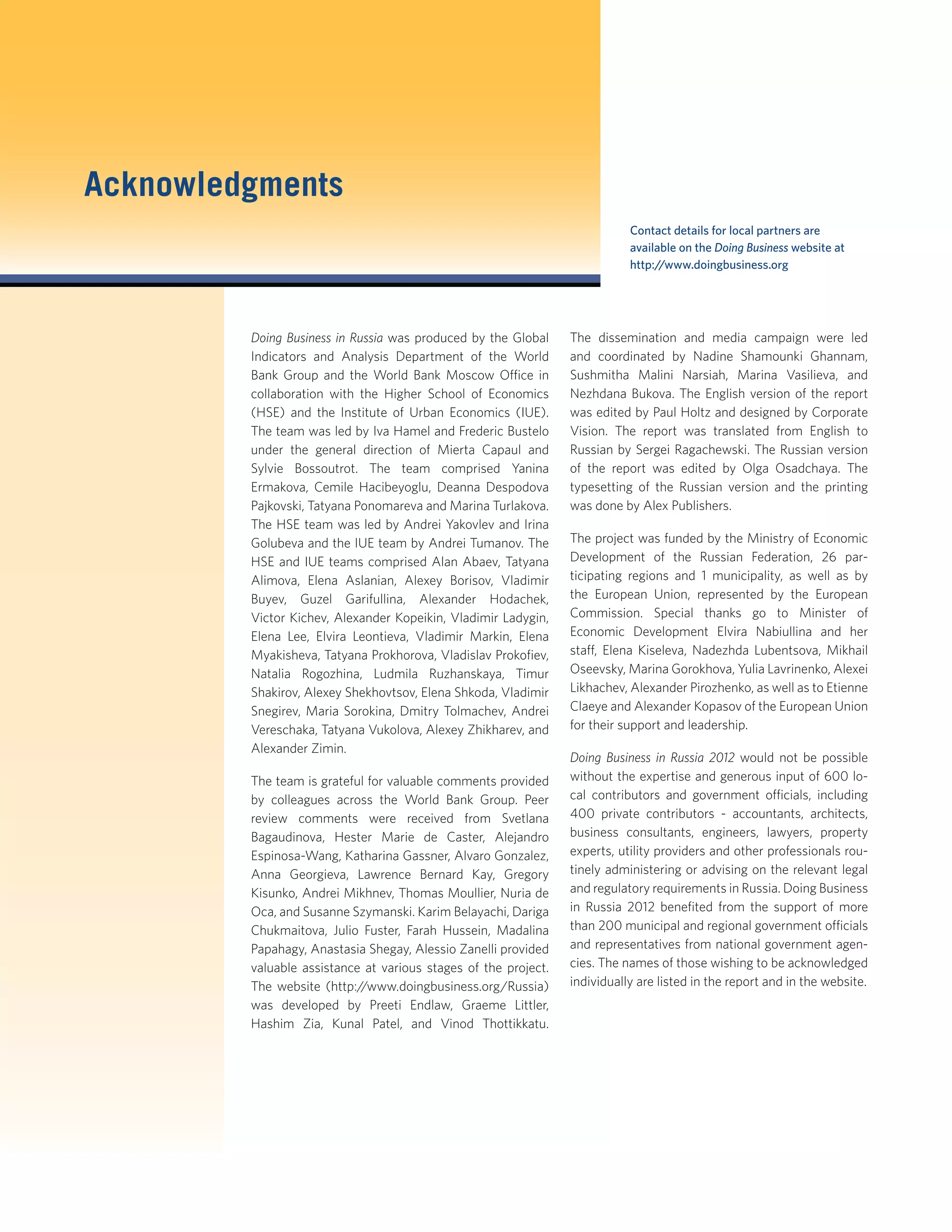
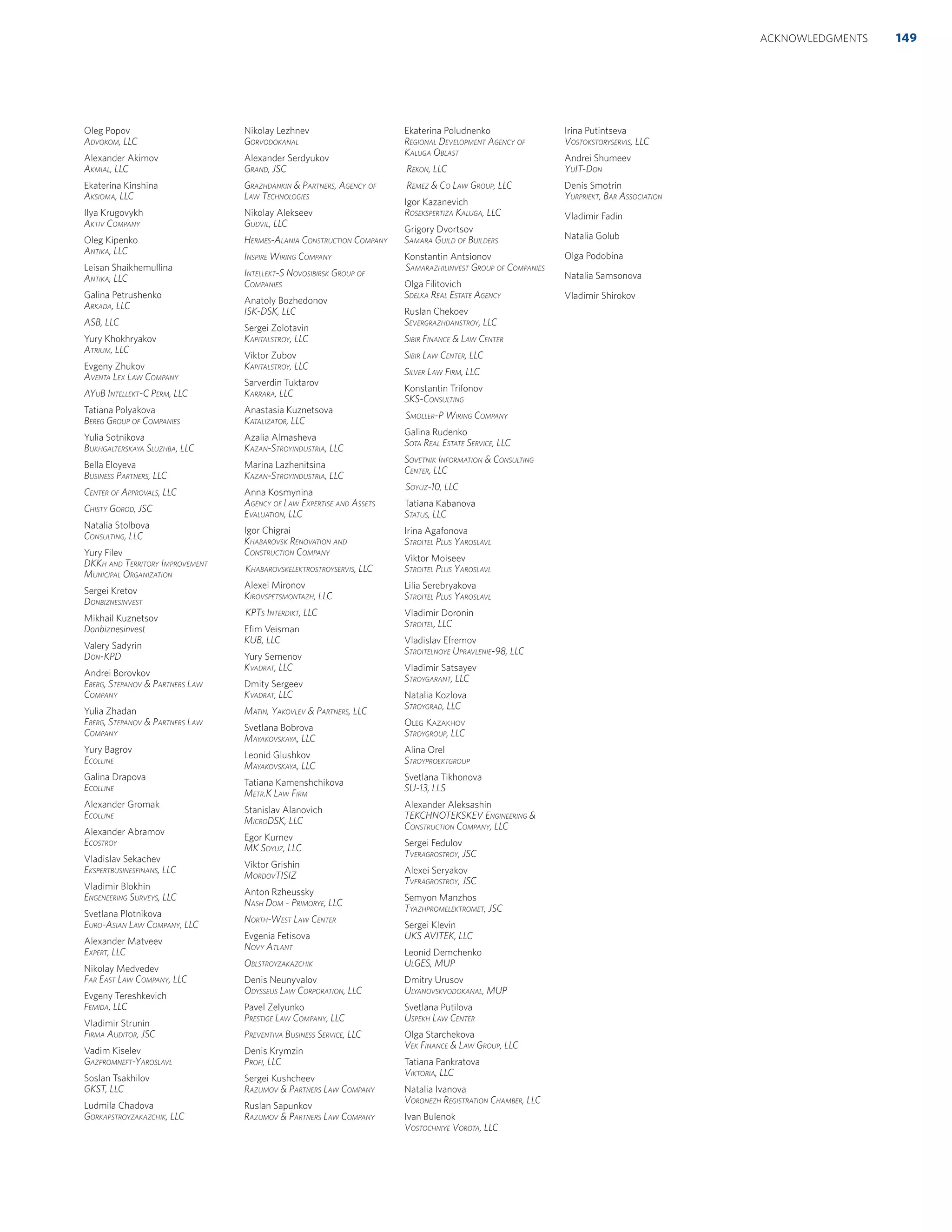
The Russian Federation is a vast country
of great capacity. Over the past decade its
GDP has grown by an annual average of
4.9%,1
doubling real disposable income and
enabling the emergence of a middle class.
This growth has been fueled primarily by rev-
enues from commodity producers. Russia’s
emerging economy depends on oil and gas
commodities, which in 2011 accounted for
about half of federal revenue and nearly two-
thirds of exports.2
Despite the abundance of natural resources,
Russia has not grown at the same pace as
other large emerging economies. Over the
past 20 years, China’s GDP has increased
10% a year on average and India’s by 6%.3
The global financial crisis of 2008/09 drew
attention to the fragility of growth based on
natural resources. Weak competition, poor
investment and lack of innovation constrain
growth.4
According to the World Bank’s Enterprise
Surveys, in 2009 Russian managers spent
20% of their time dealing with government
regulations—more than twice as much as
their peers in the 10 EU emerging countries.5
According to the World Economic Forum
2011–12 rankings, Russia is in the bottom
decile on the burden of government regula-
tion, with its weak institutional framework
cited as a key obstacle to growth. Even when
laws and regulations do not obstruct firms’
entry and exit, application and enforcement
of rules often remain inconsistent.
Russia has significant differences between
regions. More than 80% of the population
lives in the Western part of the country,6
and
nearly 73% live in cities.7
Economic activity
is also highly concentrated. In 2010 Moscow
had the country’s highest gross regional
product—more than five times that of Saint
Petersburg, which was second. Muscovites
had an income per capita of about 730,000
rubles ($25,000), many times that in other
regions and two and a half times national
income per capita ($9,900).8
Much of the difference in regional eco-
nomic performance is caused by natural
resources. For example, in Omsk Oblast
just over two-thirds of goods and services
are produced by the oil and coal industries.9
But Novosibirsk, for instance, has a legacy
of scientific research. Kaluga Oblast has at-
tracted significant foreign direct investment
in recent years, particularly from foreign car
manufacturers.
Promoting small and medium-size firms as
an engine of growth, employment and rev-
enue diversification has become a focus of
government policy.10
In 2010 the government
invested 600 million euros ($777 million)
in start-up grants, micro loans, support for
youth entrepreneurship, and business train-
ing, and 140,000 jobs were created.11
Still,
small and medium-size firms account for
20% of employment in Russia, less than in
Brazil (25%), Turkey (35%) or USA (42%).12
The government aims to remove structural
barriers to growth to further boost small
and medium-size enterprises. The strategy
for economic development through 2020
emphasizes increasing competition, creating
an economic environment that encour-
ages long-term investment and promoting
investment.13
In 2011 the government com-
mitted to making Russia one of the most
inviting places to do business, and a national
initiative has been created to spearhead
improvements in the investment climate
for all businesses—domestic and foreign.14
The investment climate agenda includes
comprehensive policy reforms ranging from
easing doing business to simplifying regula-
tion, privatization, improving competition
and supporting innovation.
WHAT DOES DOING BUSINESS IN
RUSSIA 2012 MEASURE?
Doing Business tracks business regulations
that affect small and medium-size domestic
limited liability companies.15
Moscow rep-
resents Russia in the annual Doing Business
publication, which compares 183 economies
worldwide. But entrepreneurs in Russia
face different local practices depending on
where they establish their businesses. Doing
Business in Russia 2009 was the first sub-
national project to go beyond Moscow and
capture regional regulatory differences in 10
cities on 4 Doing Business topics: starting a
business, dealing with construction permits,
registering property, and trading across
borders.
This report updates the information from
2008 and tracks the progress in implemen-
tation of business reforms on 3 topics—
starting a business, dealing with construc-
tion permits, and registering property. It also
measures a new indicator—getting electric-
ity—and expands the analysis to cover 20
additional cities. The summary results are
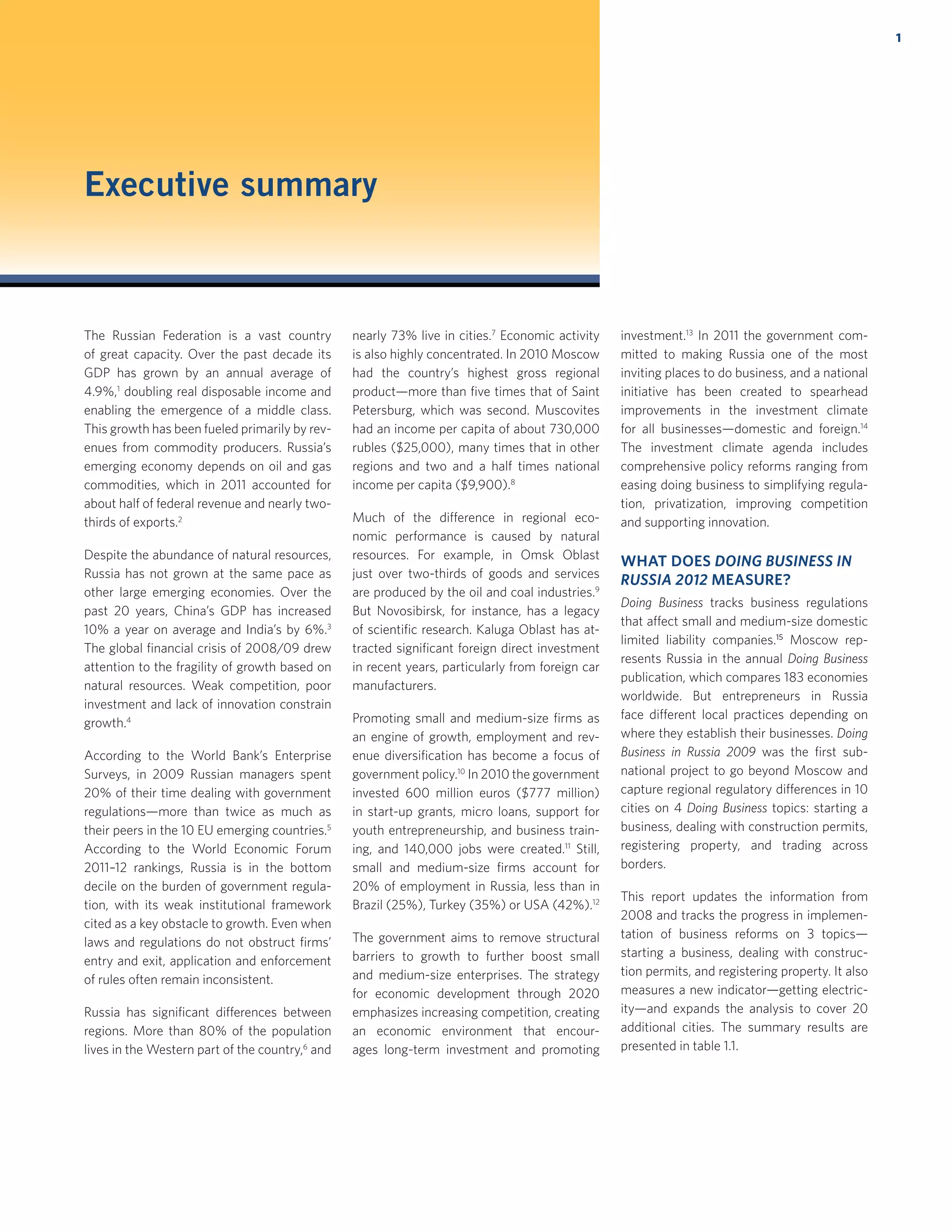
presented in table 1.1.
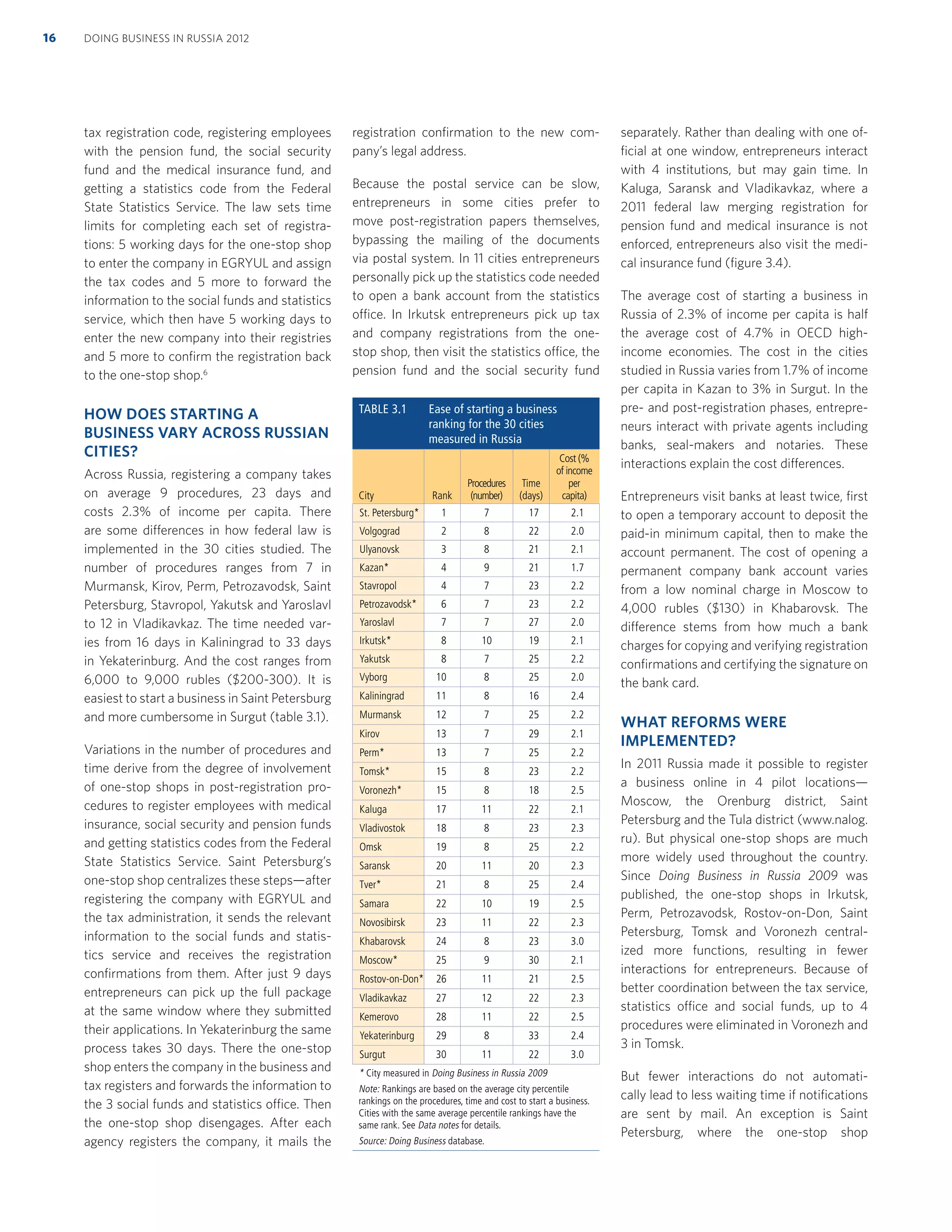
TABLE 1.1 Doing Business in Russia 2012—where is it easier?
City Region
Agreggate
rank
Ease of
starting a
business
Ease of
dealing with
construction
permits
Ease of
getting
electricity
Ease of
registering
property
Ulyanovsk Ulyanovsk Oblast 1 3 4 5 8
Saransk Republic of Mordovia 2 20 8 1 8
Vladikavkaz
Republic of
North Ossetia– Alania 3 27 11 2 2
Rostov-on-Don Rostov Oblast 4 26 15 3 4
Kazan Republic of Tatarstan 5 4 14 17 4
Kaluga Kaluga Oblast 6 17 9 15 1
Stavropol Stavropol Kray 7 4 2 9 19
Yaroslavl Yaroslavl Oblast 8 7 17 6 16
Surgut
Khanty-Mansiisk
Autonomous Okrug – Yugra 9 30 1 19 8
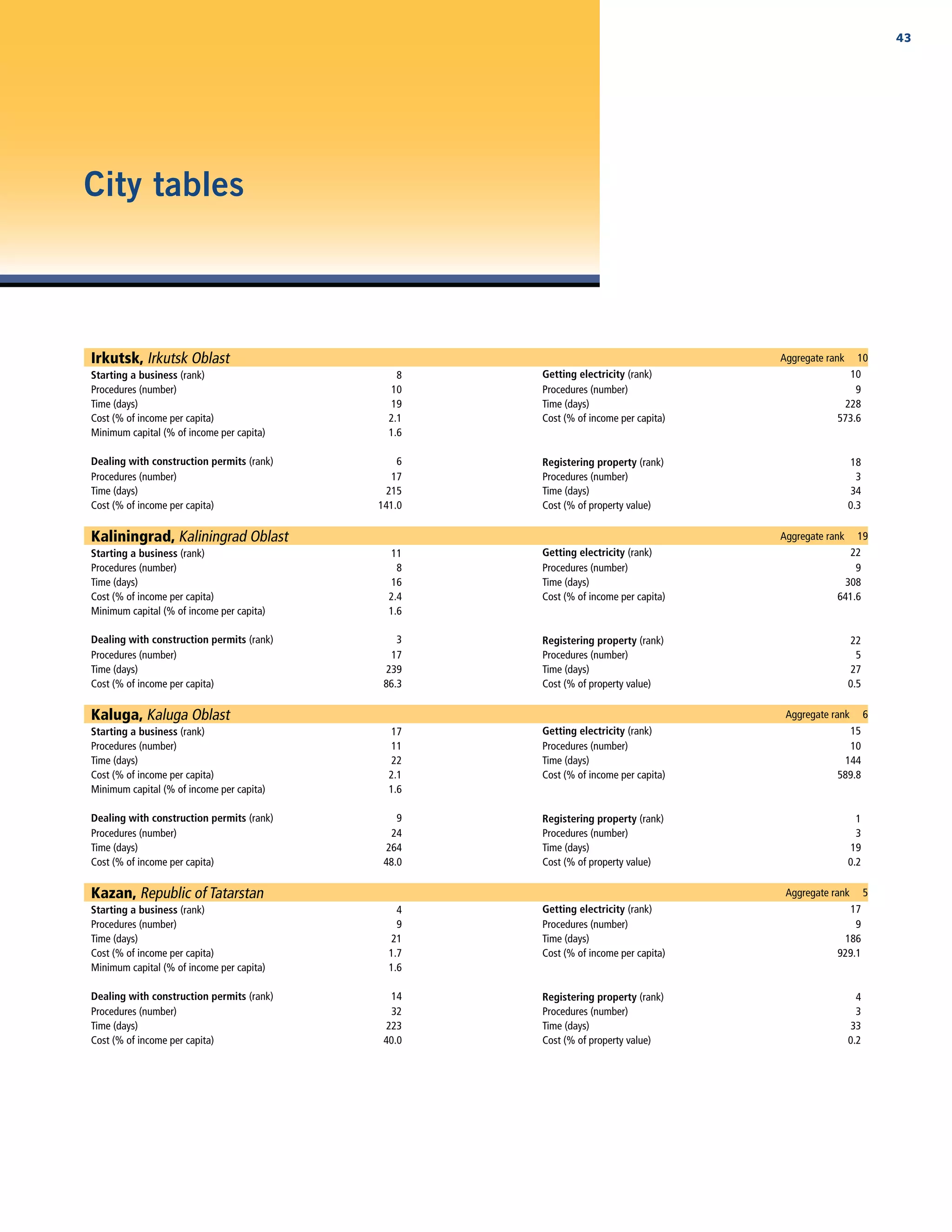
Irkutsk Irkutsk Oblast 10 8 6 10 18
Petrozavodsk Republic of Karelia 11 6 16 21 8
Kirov Kirov Oblast 12 13 5 4 20
Omsk Omsk Oblast 13 19 20 13 4
Vyborg Leningrad Oblast 14 10 23 12 8
Vladivostok Primorsky Kray 15 18 22 23 3
Volgograd Volgograd Oblast 16 2 27 26 4
Voronezh Voronezh Oblast 17 15 28 16 8
Tver Tver Oblast 18 21 25 14 8
Kaliningrad Kaliningrad Oblast 19 11 3 22 22
Tomsk Tomsk Oblast 20 15 6 10 25
Samara Samara Oblast 21 22 24 28 8
St. Petersburg St. Petersburg 22 1 9 24 27
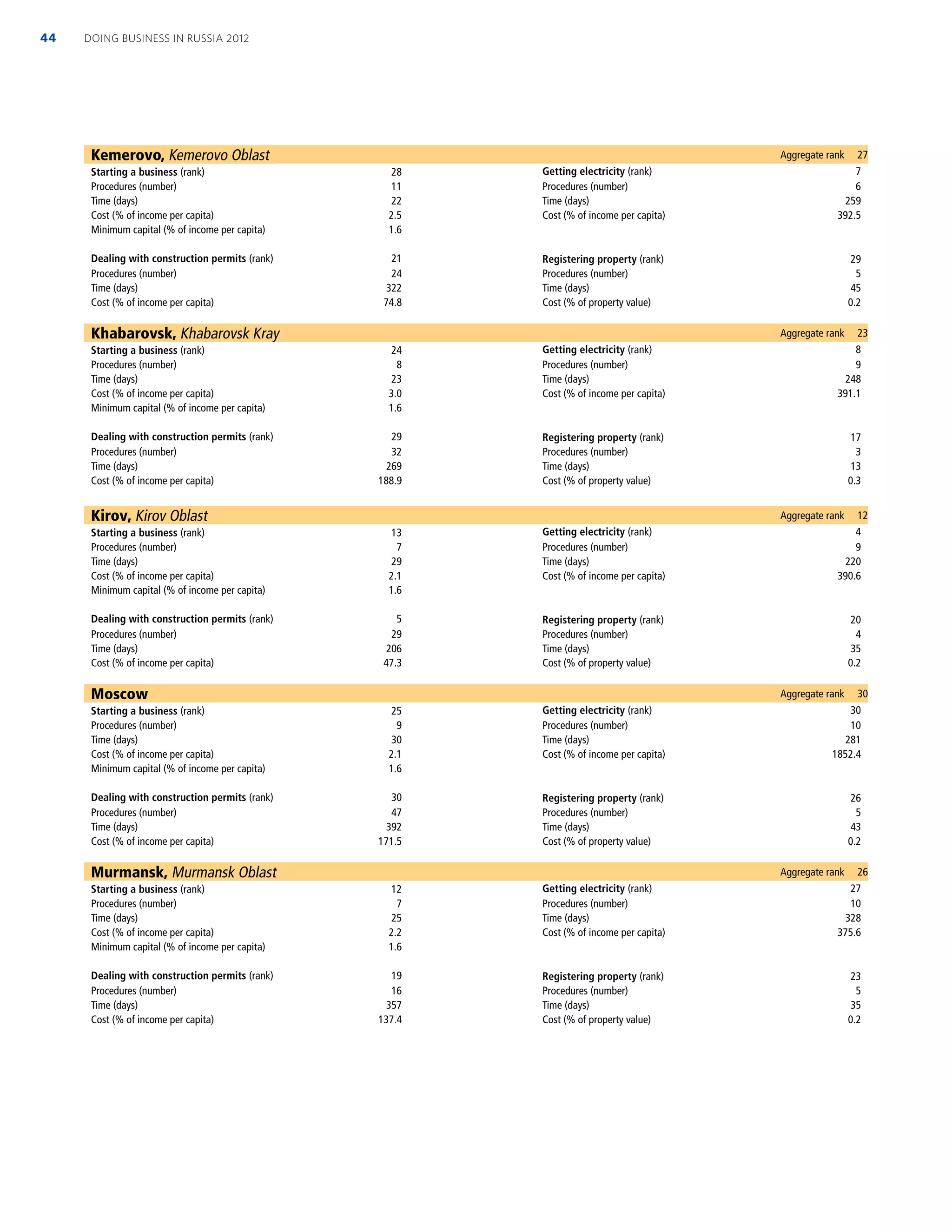
Khabarovsk Khabarovsk Kray 23 24 29 8 17
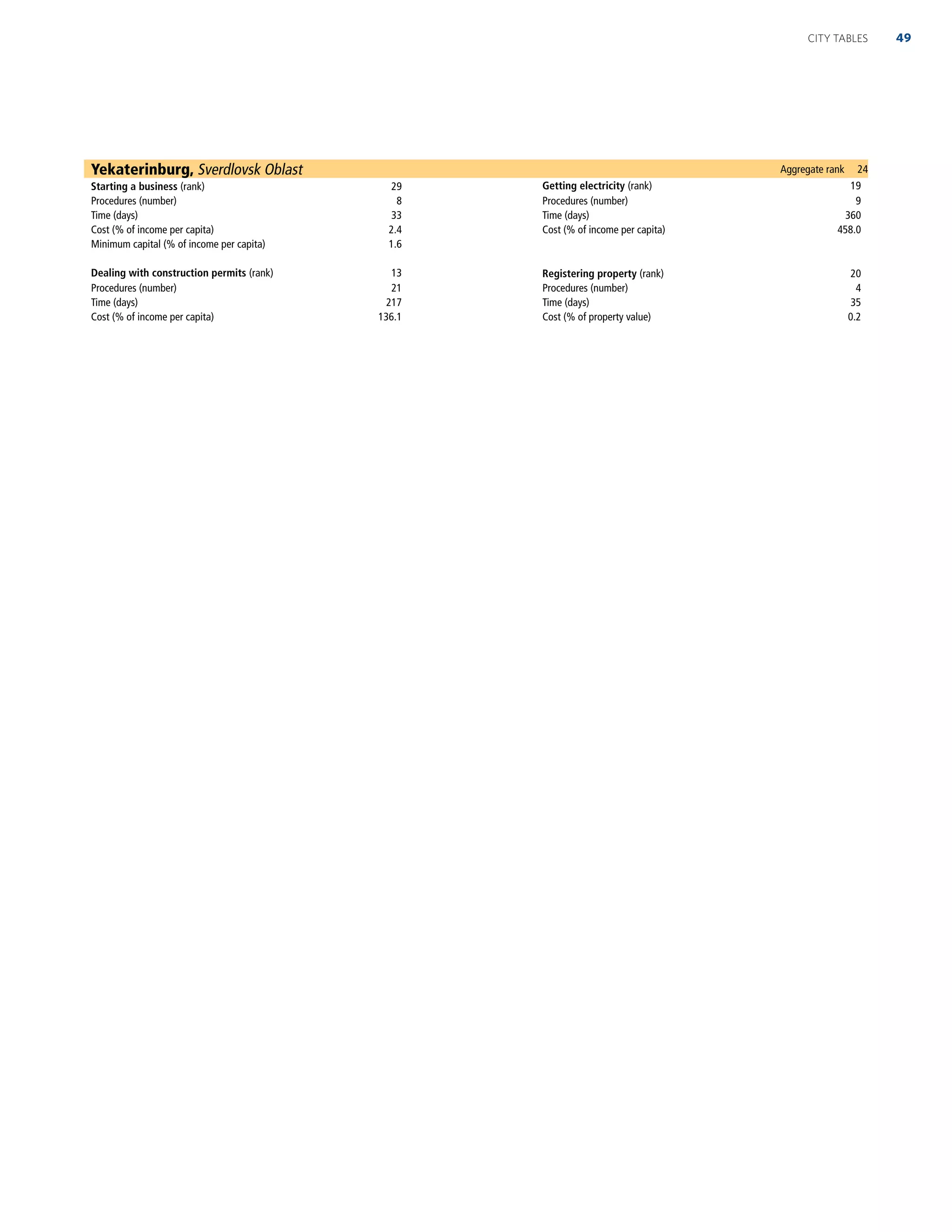
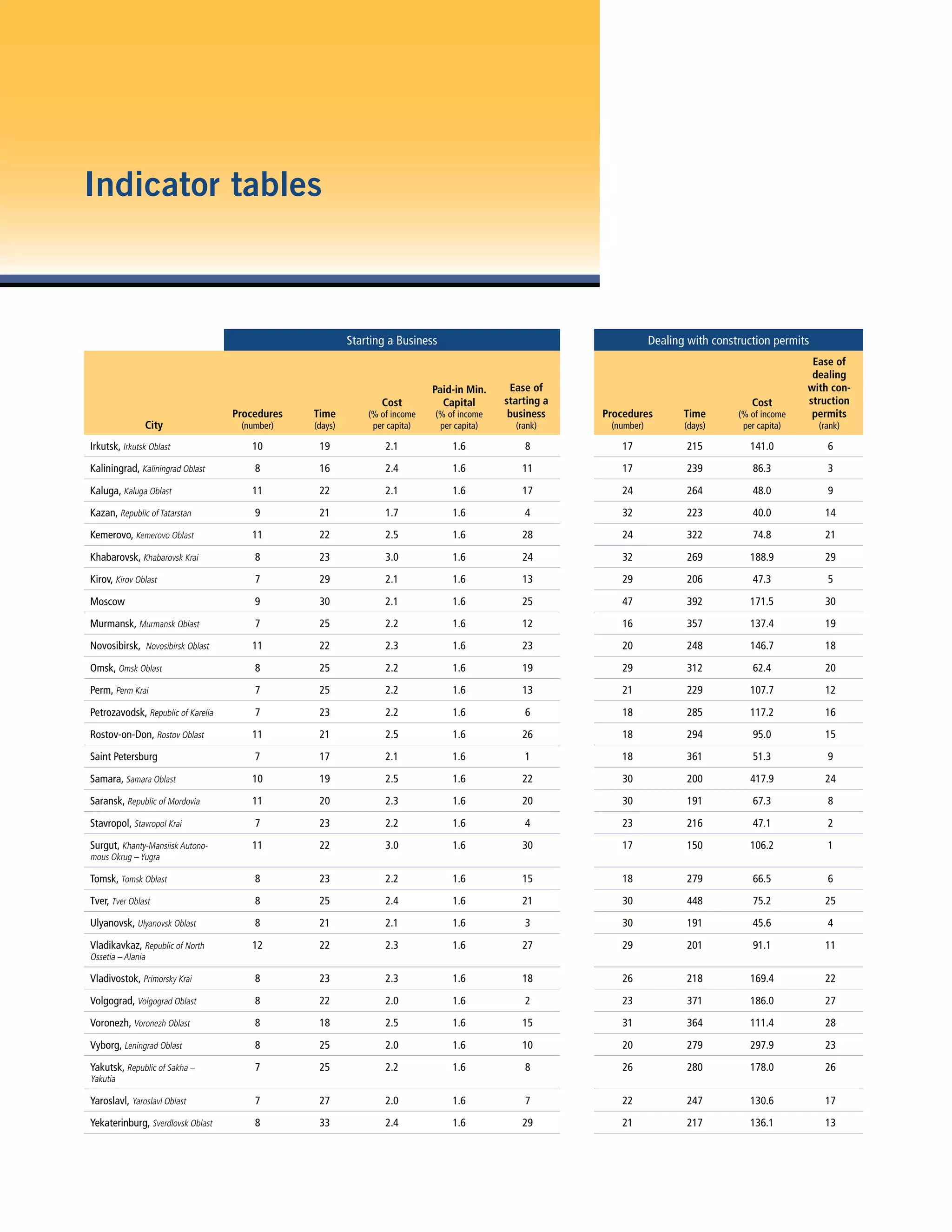
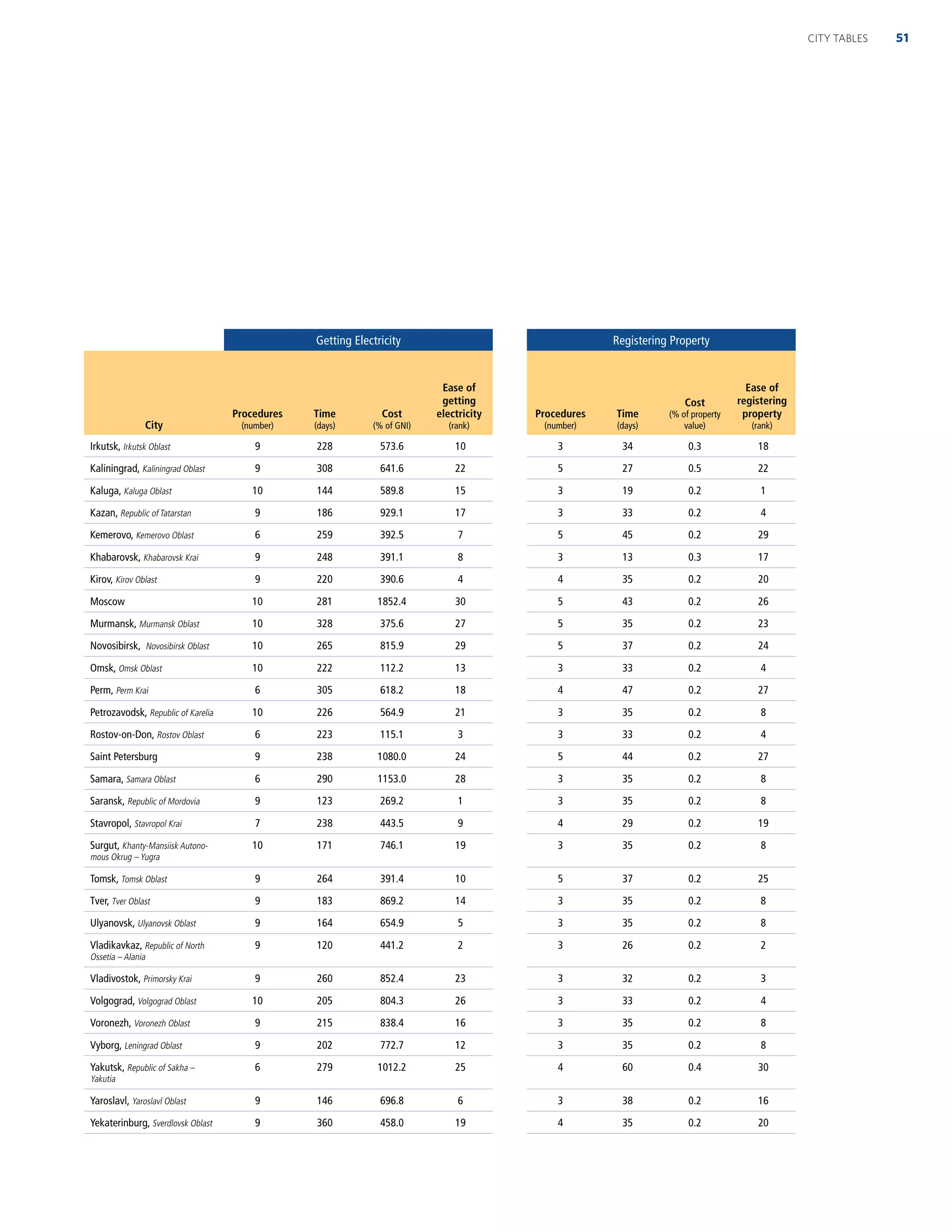
Yekaterinburg Sverdlovsk Oblast 24 29 13 19 20
Perm Perm Kray 25 13 12 18 27
Murmansk Murmansk Oblast 26 12 19 27 23
Kemerovo Kemerovo Oblast 27 28 21 7 29
Yakutsk Republic of Sakha – Yakutia 28 8 26 25 30
Novosibirsk Novosibirsk Oblast 29 23 18 29 24
Moscow Moscow 30 25 30 30 26
Note: The aggregate rank is based on the starting a business, dealing with construction permits, getting electricity and registering
property indicators. See Data notes for details.
Source: Doing Business database.
Some observations should be made. First,
this year’s aggregate ranking should not
be compared to the one in Doing Business
in Russia 2009 for various reasons. The
new aggregate ranking includes getting
electricity, while the old ranking included
trading across borders. Some changes can
also be attributed to recent updates to the
dealing with construction permits indicator
methodology.16
In addition, 20 new cities
were added.
Second, consistent performers stay at the
top—Kazan, for example, was already doing
well on the areas of starting a business and
registering property in 2009 and continues
to be among the top performers on these
indicators, despite the addition of 20 new
cities. Irkutsk remained ranked in the top
third of cities measured for starting a busi-
ness and dealing with construction permits,
thanks to continuous reforms.
Third, no city does equally well in all areas.
For example, Rostov-on-Don ranks well
on getting electricity and registering prop-
erty, but lags behind on starting a business.
Kaliningrad ranks third on the ease of deal-
ing with construction permits, but in the
bottom third on getting electricity and reg-
istering property. Saint Petersburg climbed
to the top of the classification on starting
a business due to reforms, but lags in
other areas. These results can guide policy
makers on areas where improvements are
possible without major legislative changes.
Cities can share experiences and learn from
each other.
Finally, the demand for business services is
usually lower in smaller cities than in large
business centers. That can lead to bottle-
necks and higher costs for services in large
cities, but these also benefit from economies
of scale and might have more resources to
invest in administrative modernization.
RUSSIA FROM A GLOBAL
PERSPECTIVE
From a global perspective Russia, rep-
resented by Moscow, ranks 120 of 183
economies on the ease of doing business
across 10 indicators according to Doing
Business in 2012: Doing Business in a More
Transparent World. While Russia does well
on some indicators, especially enforcing
contracts and registering property, it lags
on others, including those measured by
this report.
Over the past 7 years, 163 economies have
made regulation more business-friendly.
Russia is among the 30 economies that
improved the most. Since 2005 it has
made 15 improvements across 9 indicators
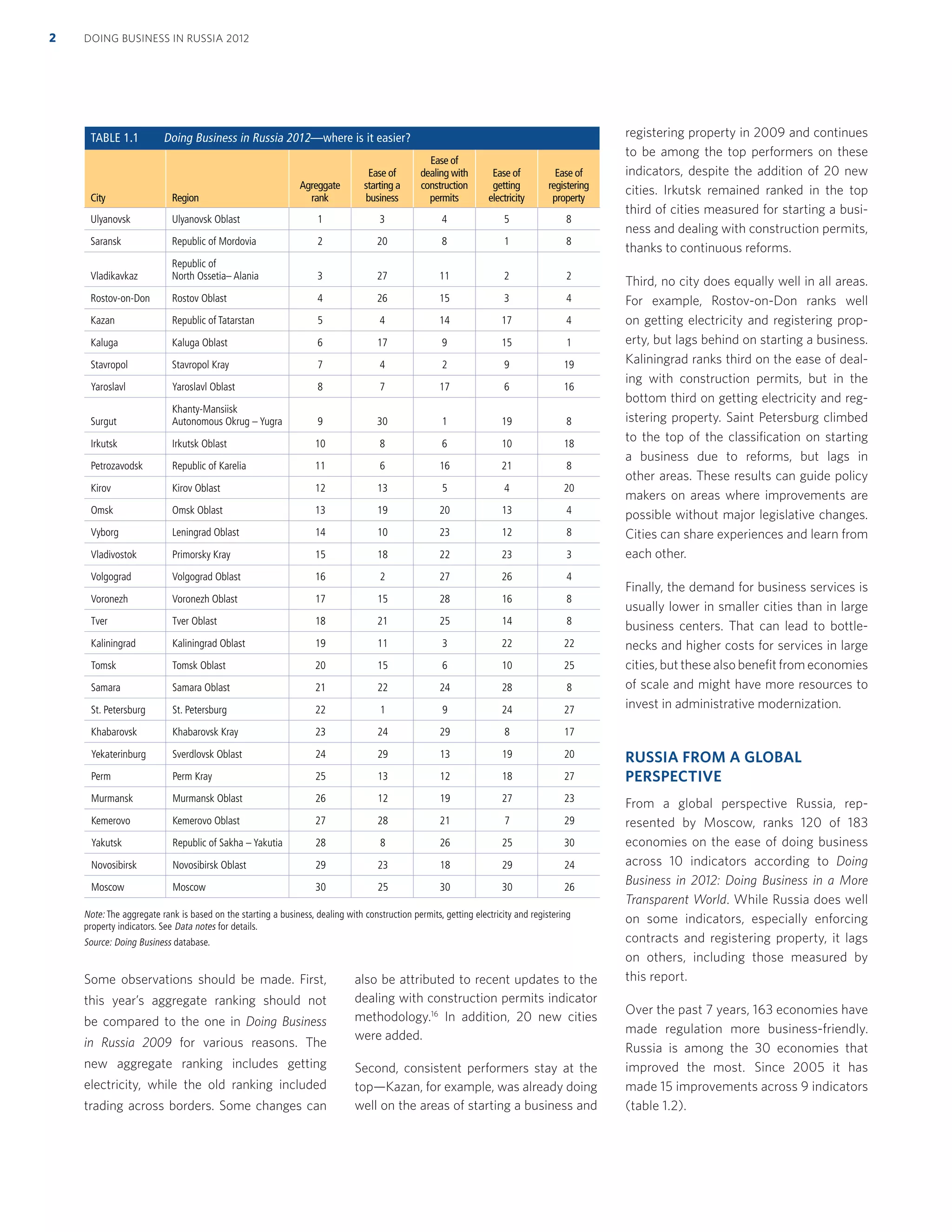
(table 1.2).
DOING BUSINESS IN RUSSIA 20122
TABLE 1.2 Russia reformed in 9 of 10 areas covered by Doing Business over the last 7 years
Indicator
DB
2012
DB
2011
DB
2010
DB
2009
DB
2008
DB
2007
DB
2006 Total
Starting a business 1 1 2
Dealing with construction permits 1 1
Getting electricity 1 1
Registering property 1 1 2
Getting credit 1 1 2
Protecting investors -
Paying taxes 1 1 2
Trading across borders 1 1 2
Enforcing contracts 1 1
Resolving insolvency 1 1 2
Total 4 2 3 - 1 2 3 15
Note: Getting electricity reforms are recorded for the first time in Doing Business 2012.
Source: Doing Business database.
Policy makers increasingly recognize the
importance of measuring improvements
in their countries over time and assess-
ing how much they have narrowed the
gap with the regulatory systems of top-
performing economies, such as Singapore
or New Zealand. Comparing Russia’s
performance between 2005 and 2011
on each indicator shows how far it has
moved toward the most efficient global
practices and regulations on each area
covered by Doing Business. The pace of
change varies widely across the areas
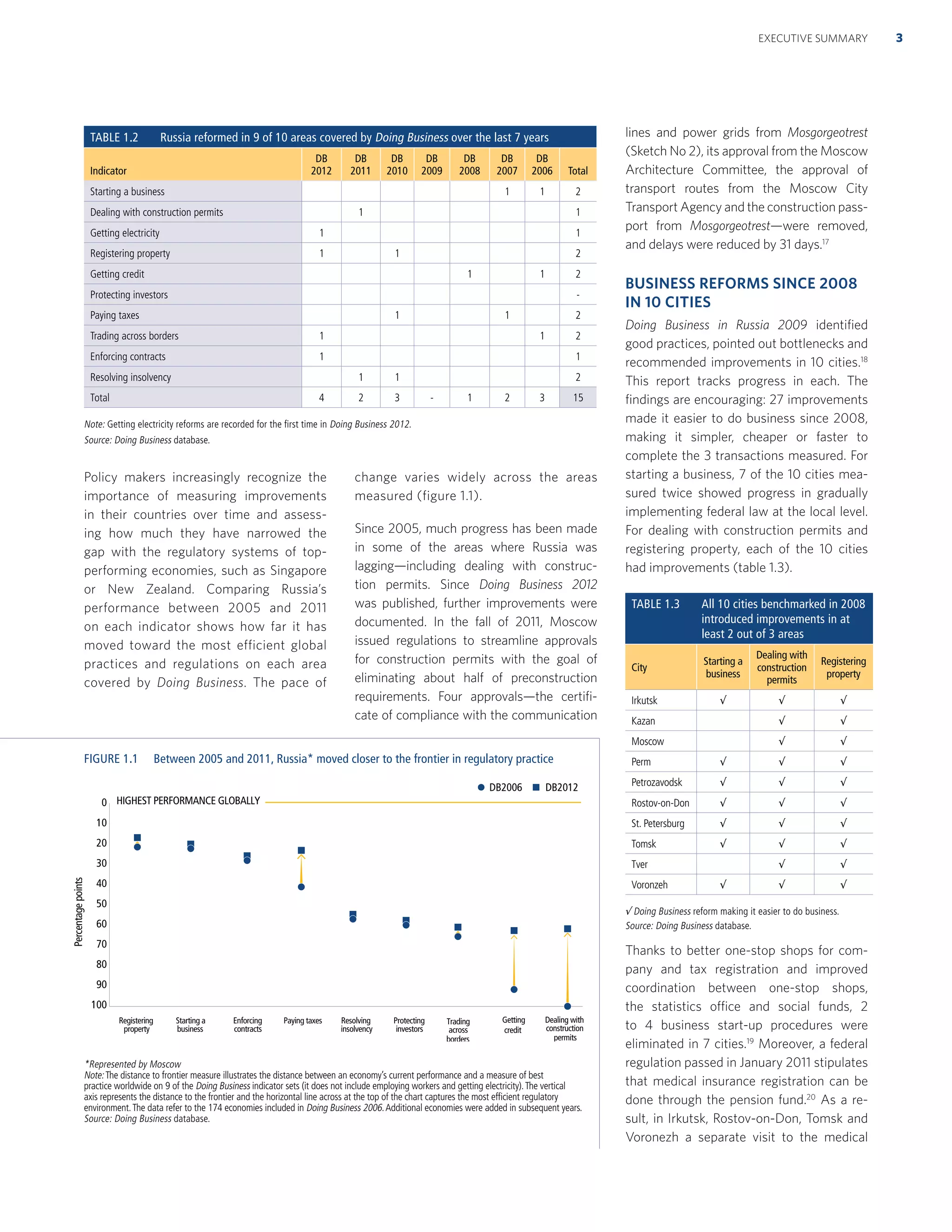
measured (figure 1.1).
Since 2005, much progress has been made
in some of the areas where Russia was
lagging—including dealing with construc-
tion permits. Since Doing Business 2012
was published, further improvements were
documented. In the fall of 2011, Moscow
issued regulations to streamline approvals
for construction permits with the goal of
eliminating about half of preconstruction
requirements. Four approvals—the certifi-
cate of compliance with the communication
lines and power grids from Mosgorgeotrest
(Sketch No 2), its approval from the Moscow
Architecture Committee, the approval of
transport routes from the Moscow City
Transport Agency and the construction pass-
port from Mosgorgeotrest—were removed,
and delays were reduced by 31 days.17
BUSINESS REFORMS SINCE 2008
IN 10 CITIES
Doing Business in Russia 2009 identified
good practices, pointed out bottlenecks and
recommended improvements in 10 cities.18
This report tracks progress in each. The
findings are encouraging: 27 improvements
made it easier to do business since 2008,
making it simpler, cheaper or faster to
complete the 3 transactions measured. For
starting a business, 7 of the 10 cities mea-
sured twice showed progress in gradually
implementing federal law at the local level.
For dealing with construction permits and
registering property, each of the 10 cities
had improvements (table 1.3).
TABLE 1.3 All 10 cities benchmarked in 2008
introduced improvements in at
least 2 out of 3 areas
City
Starting a
business
Dealing with
construction
permits
Registering
property
Irkutsk 3 3 3
Kazan 3 3
Moscow 3 3
Perm 3 3 3
Petrozavodsk 3 3 3
Rostov-on-Don 3 3 3
St. Petersburg 3 3 3
Tomsk 3 3 3
Tver 3 3
Voronzeh 3 3 3
3 Doing Business reform making it easier to do business.
Source: Doing Business database.
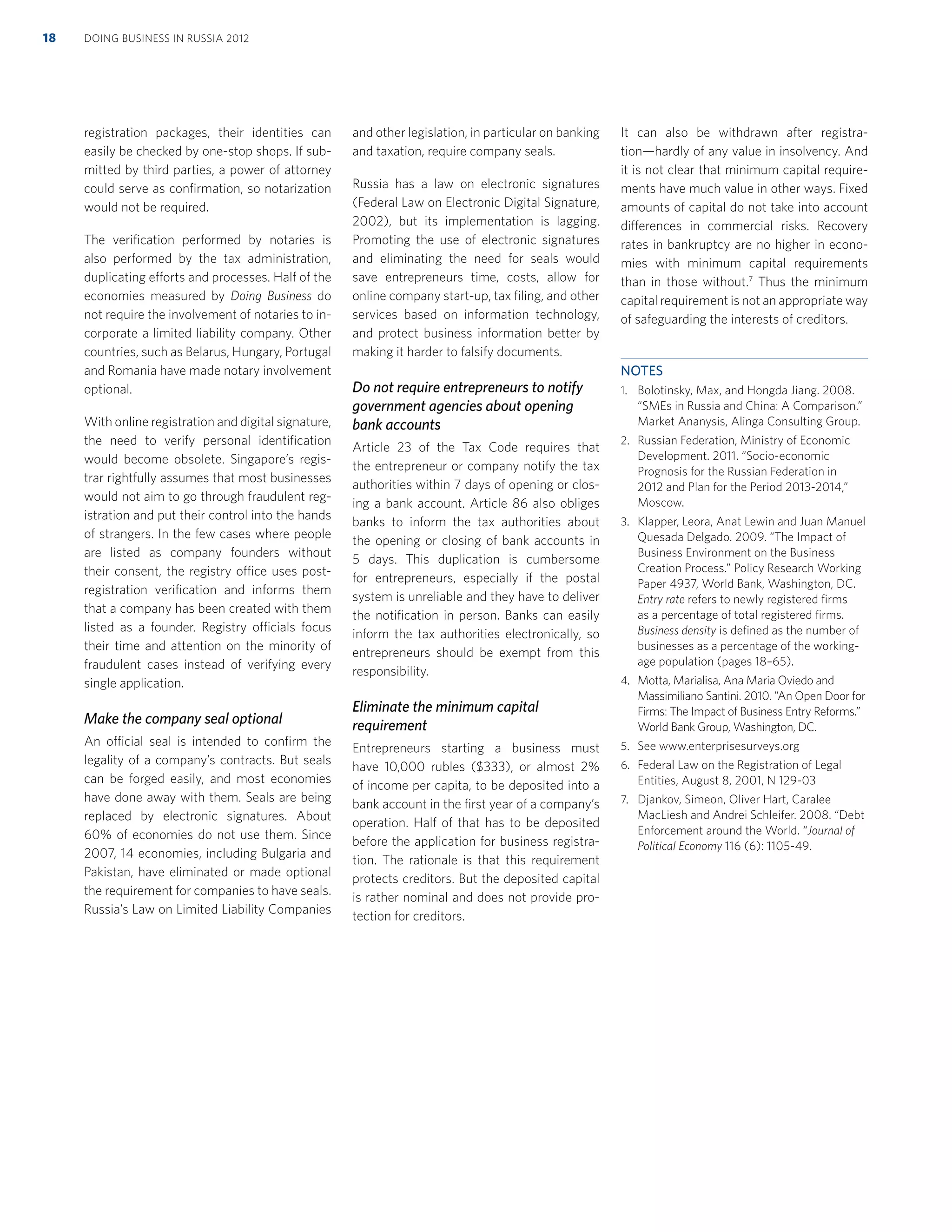
Thanks to better one-stop shops for com-
pany and tax registration and improved
coordination between one-stop shops,
the statistics office and social funds, 2
to 4 business start-up procedures were
eliminated in 7 cities.19
Moreover, a federal
regulation passed in January 2011 stipulates
that medical insurance registration can be
done through the pension fund.20
As a re-
sult, in Irkutsk, Rostov-on-Don, Tomsk and
Voronezh a separate visit to the medical
Registering
property
Starting a
business
Enforcing
contracts
Paying taxes Resolving
insolvency
Protecting
investors
Trading
across
borders
Getting
credit
Dealing with
construction
permits
HIGHEST PERFORMANCE GLOBALLY0
10
20
30
40
50
60
70
80
90
100
DB2006 DB2012
Percentagepoints
FIGURE 1.1 Between 2005 and 2011, Russia* moved closer to the frontier in regulatory practice
*Represented by Moscow
Note: The distance to frontier measure illustrates the distance between an economy’s current performance and a measure of best
practice worldwide on 9 of the Doing Business indicator sets (it does not include employing workers and getting electricity).The vertical
axis represents the distance to the frontier and the horizontal line across at the top of the chart captures the most efficient regulatory
environment.The data refer to the 174 economies included in Doing Business 2006.Additional economies were added in subsequent years.
Source: Doing Business database.
3EXECUTIVE SUMMARY
fund office is no longer required. These ar-
rangements are working especially well in
Saint Petersburg, where the one-stop shop
consolidates the reception of notifications,
saving entrepreneurs 5 days.
But in other cities, fewer personal visits do
not automatically translate into time sav-
ings for entrepreneurs because registration
notifications take time to arrive by mail. This
is why in some cities, like Novosibirsk, entre-
preneurs prefer to go through 11 procedures
in 22 days—the 10th fastest time in Russia—
rather than wait. In addition to physical one-
stop shops, some cities allow businesses to
register online. And a 2006 regulation that
banks should not request notarized copies of
incorporation and registration documents for
opening a company bank account eliminated
the practice of notarizing registration notifi-
cations in most cities.21
Significant changes have taken place in
Russia’s construction regulations since
2008.The2004FederalUrbanDevelopment
Code led to improvements across Russian
cities. Four years ago, the average number of
procedures needed to deal with construction
permits across the 10 cities measured was
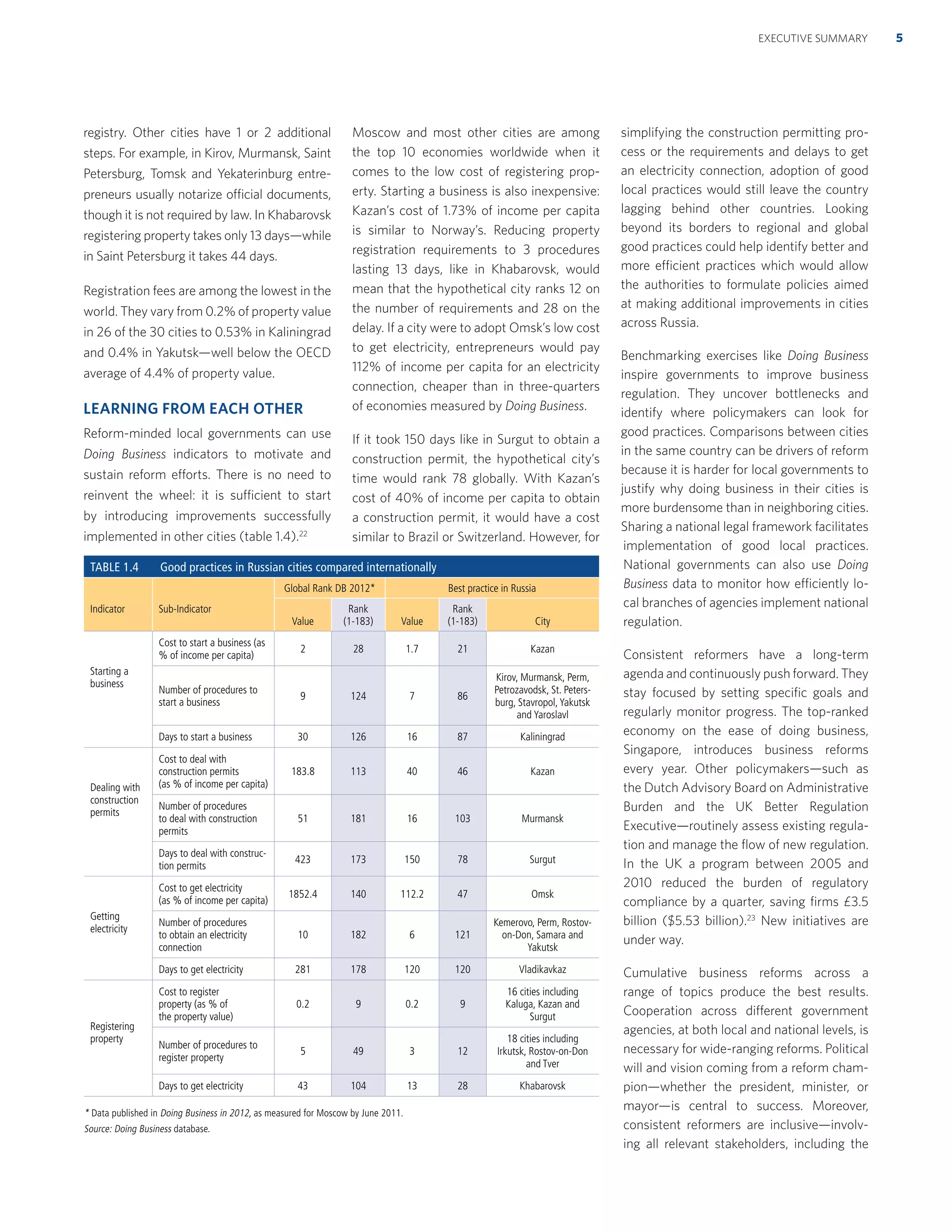
35. Today it is 25. The average time dropped
by almost 40%, from 520 days in 2008 to
269 in 2011. In Moscow it took almost 2
years to complete the paperwork to obtain a
construction permit in 2008—today it takes
392 days(figure 1.2).
Property registration has been streamlined
across Russia since 2008. A 2008 law
created the Federal Service of Registration,
Cadastre and Cartography Rosreestr, unifying
management of ownership registration and
land cadastre. Since 2009 cadastral infor-
mation on buildings is being transferred to
the property registry Rosreestr. The database
combining the cadastre and the register of
property rights can facilitate planning and
local development. It makes procedures
simpler for entrepreneurs wanting to register
property because all information can be
found in one place.
COMPARING REGULATIONS IN
30 CITIES
Starting a business
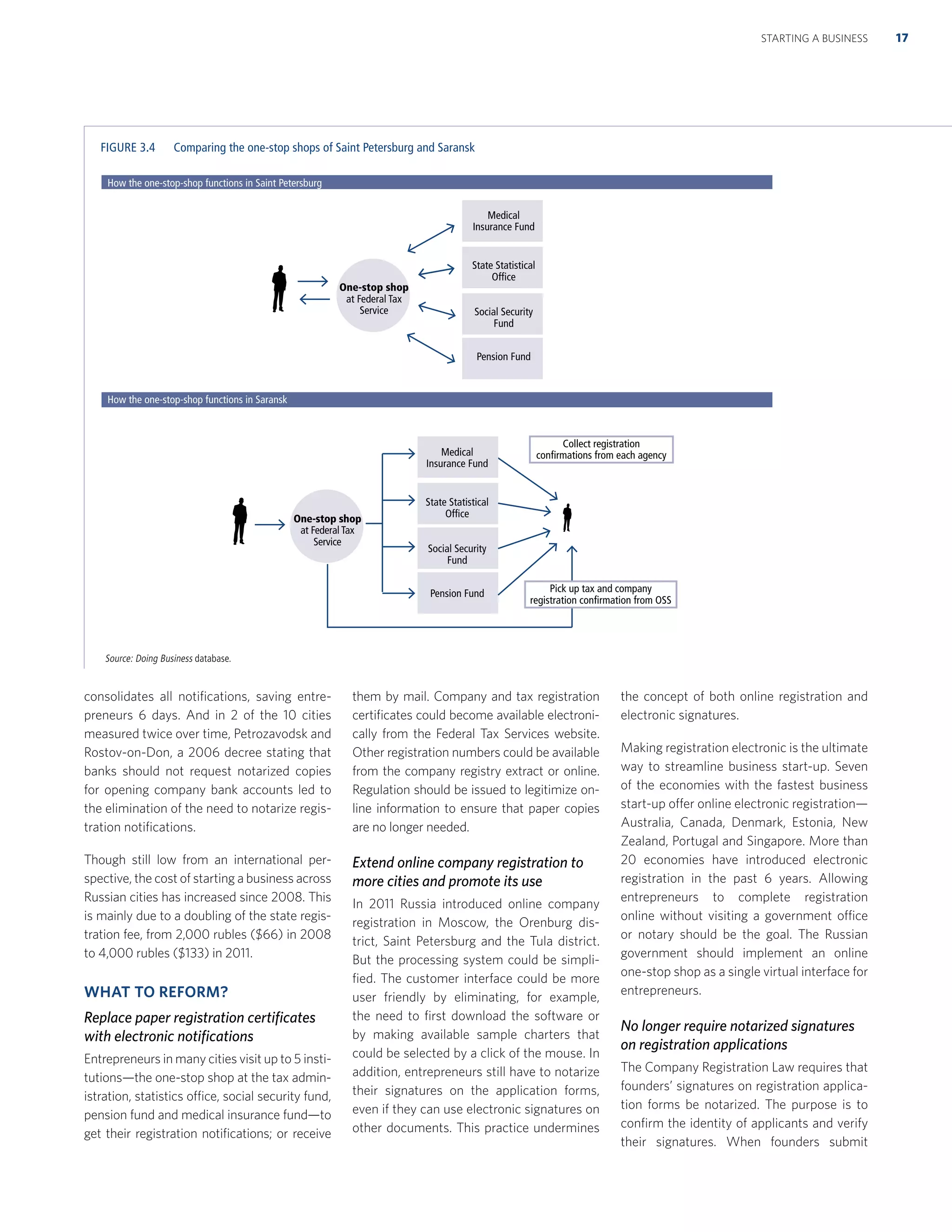
Starting a business takes on average 9 proce-
dures, 23 days and costs 2.3% of income per
capita in the 30 cities studied. It is easiest to
start a business in Saint Petersburg and more
cumbersome in Surgut. After registering at
one-stop shops, entrepreneurs can either
pick up in person the necessary certificates
from the medical, social security and pen-
sion funds, as well as the statistics office, or
wait for them by mail.
Depending on the option most com-
monly chosen, the number of interactions
ranges from 7 in Kirov, Murmansk, Perm,
Petrozavodsk, Saint Petersburg, Stavropol,
Yakutsk and Yaroslavl to 12 in Vladikavkaz.
The time needed varies from 16 days in
Kaliningrad to 33 in Yekaterinburg. The
average start-up cost of 2.3% of income per
capita places Russia among the 30 cheapest
economies to start a business. The cost varies
from 1.7% of income per capita in Kazan to
3% in Khabarovsk and Surgut. Because the
registration fee is regulated by federal law, lo-
cal variations are due to different fees charged
by banks, notaries and seal makers.
Dealing with construction permits
To comply with requirements for building
a warehouse and connecting it to utilities,
16 steps are needed in Murmansk and 20
in Novosibirsk—but 47 in Moscow. The
variations, due to regulatory differences, are
most marked during the preconstruction
phase, with 6 steps in Murmansk, Surgut,
and Yekaterinburg, but 21 requirements in
Moscow and 18 in Voronezh. As a result of
the different complexities of the construction
permitting systems across cities, there is also
considerablevariationinthetimeittakes,from
about 5 months in Surgut to a year or more in
Moscow, Tver and Voronezh. The variation
in costs across cities is due to the varying
costs of connecting to utilities and conducting
topographic and geodesic surveys.
Getting electricity
To get electricity, Russian entrepreneurs
must complete 6 to 10 steps that take from
4 months in Saransk and Vladikavkaz to 1
year in Yekaterinburg. Design approval is
a particularly complicated stage. It might
involve several trips to public agencies and
last from 30 days in Surgut to 120 days in
Murmansk and Petrozavodsk. In Kemerovo,
Perm, Rostov-on-Don, Samara, Stavropol
and Yakutsk, utilities complete the connec-
tion design, its approvals and external con-
nection works in-house.
In other cities customers hire electrical
design firms and contractors. Connecting
a building to electricity costs an average
of 661.5% of income per capita, more than
in Brazil (130%), Turkey (624%) or China
(641%), but less than in Nigeria (1,056%) or
Vietnam (1,343%). Connection costs consist
of fees charged by distribution utilities and
fees charged by private firms for connection
design and works. In Omsk the cost is 112%
of income per capita, while in Samara and
Moscow it is far more expensive at 1,153%
and 1,852% of income per capita ($114,259
and $183,575), respectively.
Registering property
Registering property is easy and cheap in
Russia. Russian entrepreneurs carry out on
average 4 procedures over 35 days, paying
0.23% of property value to transfer property
titles, similar to the OECD average of 5 pro-
cedures and 31 days. Of the 30 cities studied,
18 require only 3 procedures to verify proper
ownership, check buyer and seller informa-
tion and register transfers at the property
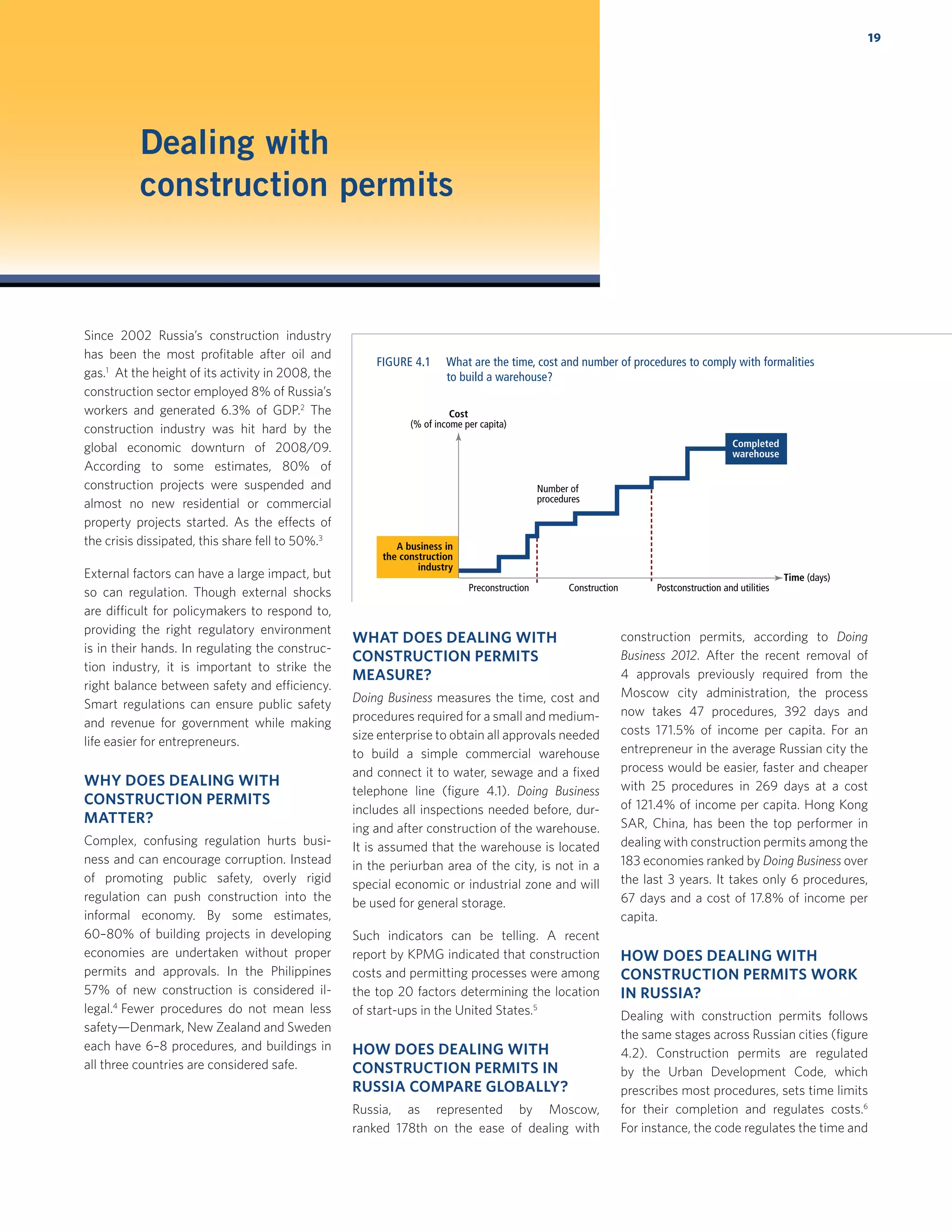
FIGURE 1.2 Moscow made dealing with
construction permits more
efficient since 2008—but
still faces challenges
Procedures and time to deal with
construction permits
DB09 DB12
Time (days)Procedures
392
47
61
632
Source: Doing Business database.
DOING BUSINESS IN RUSSIA 20124
registry. Other cities have 1 or 2 additional
steps. For example, in Kirov, Murmansk, Saint
Petersburg, Tomsk and Yekaterinburg entre-
preneurs usually notarize official documents,
though it is not required by law. In Khabarovsk
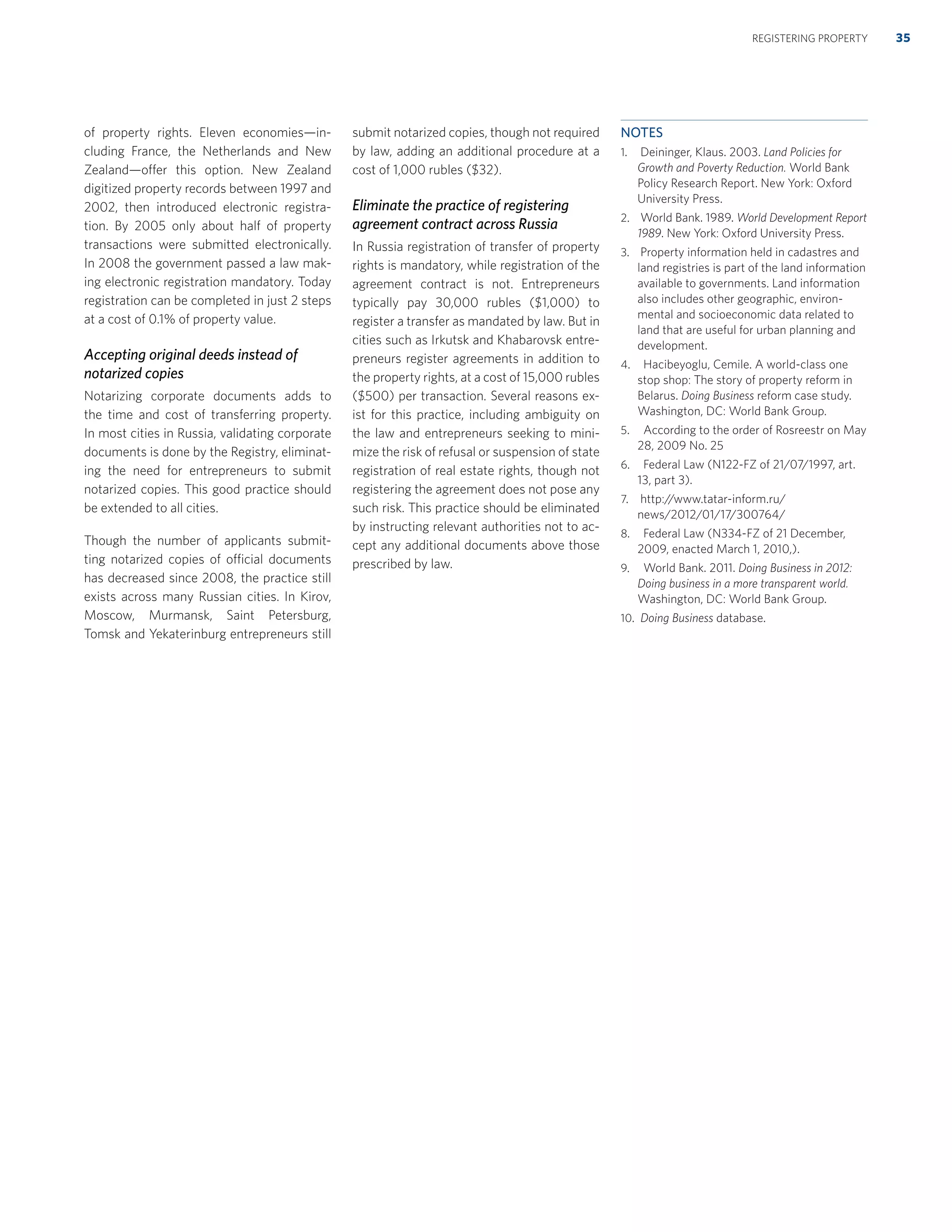
registering property takes only 13 days—while
in Saint Petersburg it takes 44 days.
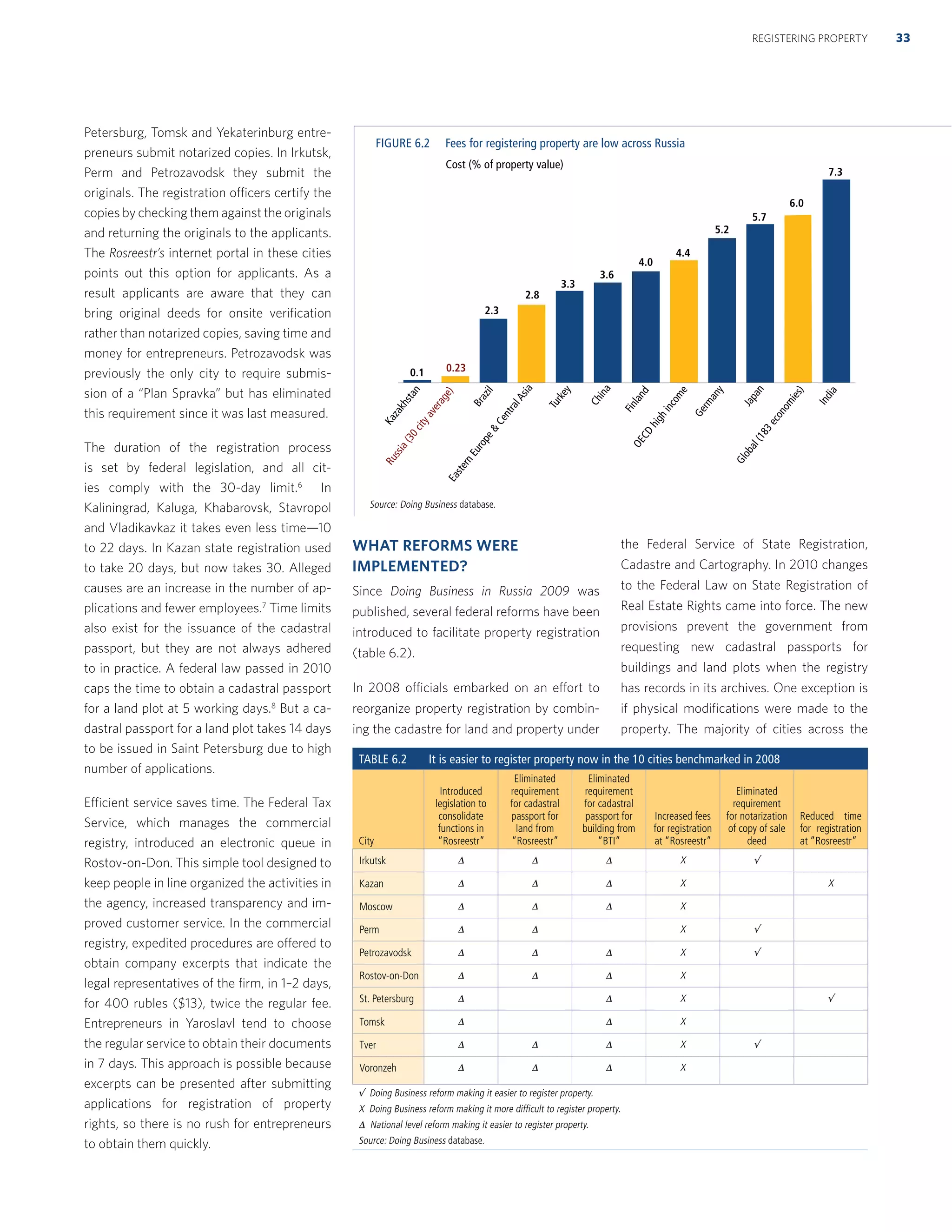
Registration fees are among the lowest in the
world. They vary from 0.2% of property value
in 26 of the 30 cities to 0.53% in Kaliningrad
and 0.4% in Yakutsk—well below the OECD
average of 4.4% of property value.
LEARNING FROM EACH OTHER
Reform-minded local governments can use
Doing Business indicators to motivate and
sustain reform efforts. There is no need to
reinvent the wheel: it is sufficient to start
by introducing improvements successfully
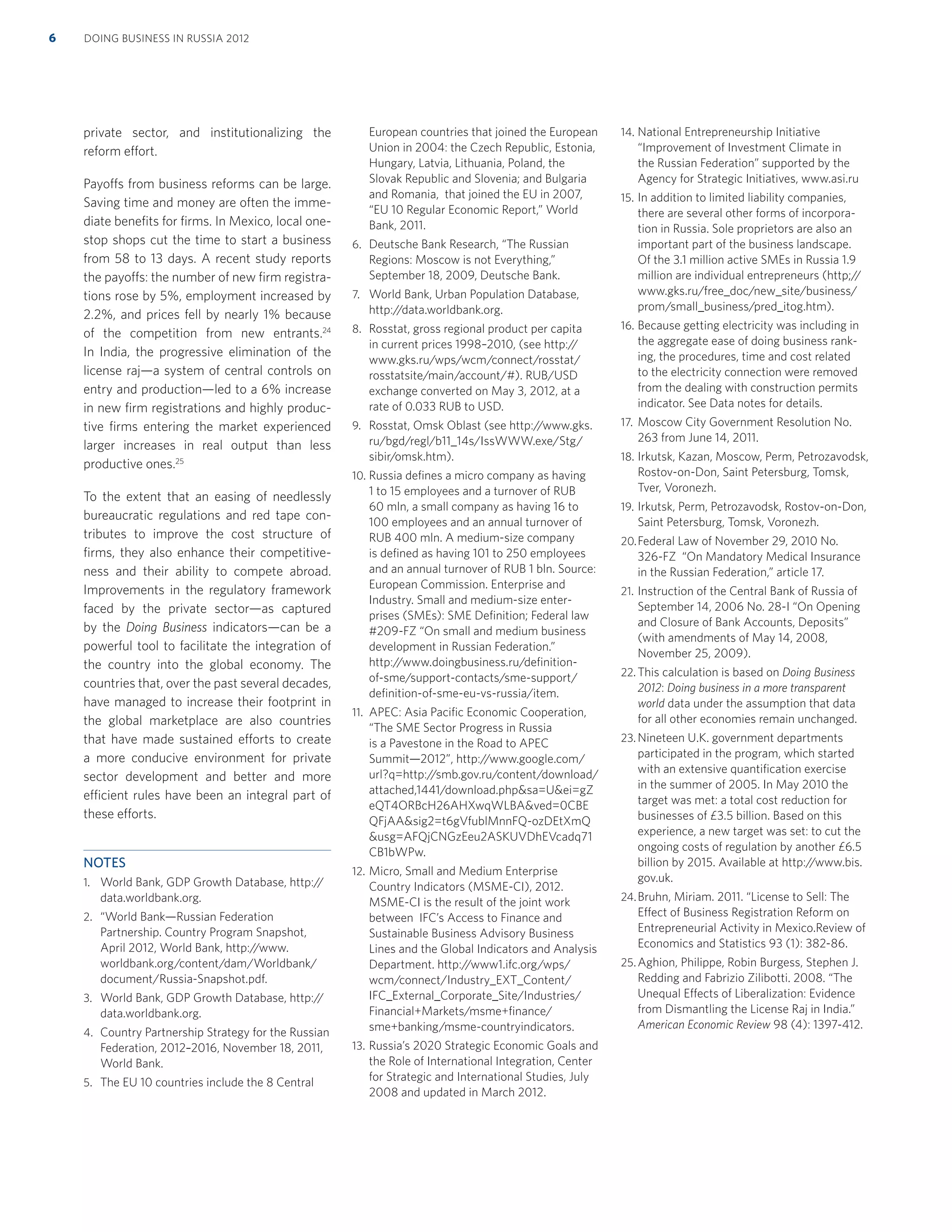
implemented in other cities (table 1.4).22
Moscow and most other cities are among
the top 10 economies worldwide when it
comes to the low cost of registering prop-
erty. Starting a business is also inexpensive:
Kazan’s cost of 1.73% of income per capita
is similar to Norway’s. Reducing property
registration requirements to 3 procedures
lasting 13 days, like in Khabarovsk, would
mean that the hypothetical city ranks 12 on
the number of requirements and 28 on the
delay. If a city were to adopt Omsk’s low cost
to get electricity, entrepreneurs would pay
112% of income per capita for an electricity
connection, cheaper than in three-quarters
of economies measured by Doing Business.
If it took 150 days like in Surgut to obtain a
construction permit, the hypothetical city’s
time would rank 78 globally. With Kazan’s
cost of 40% of income per capita to obtain
a construction permit, it would have a cost
similar to Brazil or Switzerland. However, for
simplifying the construction permitting pro-
cess or the requirements and delays to get
an electricity connection, adoption of good
local practices would still leave the country
lagging behind other countries. Looking
beyond its borders to regional and global
good practices could help identify better and
more efficient practices which would allow
the authorities to formulate policies aimed
at making additional improvements in cities
across Russia.
Benchmarking exercises like Doing Business
inspire governments to improve business
regulation. They uncover bottlenecks and
identify where policymakers can look for
good practices. Comparisons between cities
in the same country can be drivers of reform
because it is harder for local governments to
justify why doing business in their cities is
more burdensome than in neighboring cities.
Sharing a national legal framework facilitates
implementation of good local practices.
National governments can also use Doing
Business data to monitor how efficiently lo-
cal branches of agencies implement national
regulation.
Consistent reformers have a long-term
agenda and continuously push forward. They
stay focused by setting specific goals and
regularly monitor progress. The top-ranked
economy on the ease of doing business,
Singapore, introduces business reforms
every year. Other policymakers—such as
the Dutch Advisory Board on Administrative
Burden and the UK Better Regulation
Executive—routinely assess existing regula-
tion and manage the flow of new regulation.
In the UK a program between 2005 and
2010 reduced the burden of regulatory
compliance by a quarter, saving firms £3.5
billion ($5.53 billion).23
New initiatives are
under way.
Cumulative business reforms across a
range of topics produce the best results.
Cooperation across different government
agencies, at both local and national levels, is
necessary for wide-ranging reforms. Political
will and vision coming from a reform cham-
pion—whether the president, minister, or
mayor—is central to success. Moreover,
consistent reformers are inclusive—involv-
ing all relevant stakeholders, including the
TABLE 1.4 Good practices in Russian cities compared internationally
Indicator Sub-Indicator
Global Rank DB 2012* Best practice in Russia
Value
Rank
(1-183) Value
Rank
(1-183) City
Starting a
business
Cost to start a business (as
% of income per capita)
2 28 1.7 21 Kazan
Number of procedures to
start a business
9 124 7 86
Kirov, Murmansk, Perm,
Petrozavodsk, St. Peters-
burg, Stavropol,Yakutsk
and Yaroslavl
Days to start a business 30 126 16 87 Kaliningrad
Dealing with
construction
permits
Cost to deal with
construction permits
(as % of income per capita)
183.8 113 40 46 Kazan
Number of procedures
to deal with construction
permits
51 181 16 103 Murmansk
Days to deal with construc-
tion permits
423 173 150 78 Surgut
Getting
electricity
Cost to get electricity
(as % of income per capita)
1852.4 140 112.2 47 Omsk
Number of procedures
to obtain an electricity
connection
10 182 6 121
Kemerovo, Perm, Rostov-
on-Don, Samara and
Yakutsk
Days to get electricity 281 178 120 120 Vladikavkaz
Registering
property
Cost to register
property (as % of
the property value)
0.2 9 0.2 9
16 cities including
Kaluga, Kazan and
Surgut
Number of procedures to
register property
5 49 3 12
18 cities including
Irkutsk, Rostov-on-Don
and Tver
Days to get electricity 43 104 13 28 Khabarovsk
* Data published in Doing Business in 2012, as measured for Moscow by June 2011.
Source: Doing Business database.
5EXECUTIVE SUMMARY
private sector, and institutionalizing the
reform effort.
Payoffs from business reforms can be large.
Saving time and money are often the imme-
diate benefits for firms. In Mexico, local one-
stop shops cut the time to start a business
from 58 to 13 days. A recent study reports
the payoffs: the number of new firm registra-
tions rose by 5%, employment increased by
2.2%, and prices fell by nearly 1% because
of the competition from new entrants.24
In India, the progressive elimination of the
license raj—a system of central controls on
entry and production—led to a 6% increase
in new firm registrations and highly produc-
tive firms entering the market experienced
larger increases in real output than less
productive ones.25
To the extent that an easing of needlessly
bureaucratic regulations and red tape con-
tributes to improve the cost structure of
firms, they also enhance their competitive-
ness and their ability to compete abroad.
Improvements in the regulatory framework
faced by the private sector—as captured
by the Doing Business indicators—can be a
powerful tool to facilitate the integration of
the country into the global economy. The
countries that, over the past several decades,
have managed to increase their footprint in
the global marketplace are also countries
that have made sustained efforts to create
a more conducive environment for private
sector development and better and more
efficient rules have been an integral part of
these efforts.
NOTES
1. World Bank, GDP Growth Database, http://
data.worldbank.org.
2. “World Bank—Russian Federation
Partnership. Country Program Snapshot,
April 2012, World Bank, http://www.
worldbank.org/content/dam/Worldbank/
document/Russia-Snapshot.pdf.
3. World Bank, GDP Growth Database, http://
data.worldbank.org.
4. Country Partnership Strategy for the Russian
Federation, 2012–2016, November 18, 2011,
World Bank.
5. The EU 10 countries include the 8 Central
European countries that joined the European
Union in 2004: the Czech Republic, Estonia,
Hungary, Latvia, Lithuania, Poland, the
Slovak Republic and Slovenia; and Bulgaria
and Romania, that joined the EU in 2007,
“EU 10 Regular Economic Report,” World
Bank, 2011.
6. Deutsche Bank Research, “The Russian
Regions: Moscow is not Everything,”
September 18, 2009, Deutsche Bank.
7. World Bank, Urban Population Database,
http://data.worldbank.org.
8. Rosstat, gross regional product per capita
in current prices 1998–2010, (see http://
www.gks.ru/wps/wcm/connect/rosstat/
rosstatsite/main/account/#). RUB/USD
exchange converted on May 3, 2012, at a
rate of 0.033 RUB to USD.
9. Rosstat, Omsk Oblast (see http://www.gks.
ru/bgd/regl/b11_14s/IssWWW.exe/Stg/
sibir/omsk.htm).
10. Russia defines a micro company as having
1 to 15 employees and a turnover of RUB
60 mln, a small company as having 16 to
100 employees and an annual turnover of
RUB 400 mln. A medium-size company
is defined as having 101 to 250 employees
and an annual turnover of RUB 1 bln. Source:
European Commission. Enterprise and
Industry. Small and medium-size enter-
prises (SMEs): SME Definition; Federal law
#209-FZ “On small and medium business
development in Russian Federation.”
http://www.doingbusiness.ru/definition-
of-sme/support-contacts/sme-support/
definition-of-sme-eu-vs-russia/item.
11. APEC: Asia Pacific Economic Cooperation,
“The SME Sector Progress in Russia
is a Pavestone in the Road to APEC
Summit—2012”, http://www.google.com/
url?q=http://smb.gov.ru/content/download/
attached,1441/download.php&sa=U&ei=gZ
eQT4ORBcH26AHXwqWLBA&ved=0CBE
QFjAA&sig2=t6gVfublMnnFQ-ozDEtXmQ
&usg=AFQjCNGzEeu2ASKUVDhEVcadq71
CB1bWPw.
12. Micro, Small and Medium Enterprise
Country Indicators (MSME-CI), 2012.
MSME-CI is the result of the joint work
between IFC’s Access to Finance and
Sustainable Business Advisory Business
Lines and the Global Indicators and Analysis
Department. http://www1.ifc.org/wps/
wcm/connect/Industry_EXT_Content/
IFC_External_Corporate_Site/Industries/
Financial+Markets/msme+finance/
sme+banking/msme-countryindicators.
13. Russia’s 2020 Strategic Economic Goals and
the Role of International Integration, Center
for Strategic and International Studies, July
2008 and updated in March 2012.
14. National Entrepreneurship Initiative
“Improvement of Investment Climate in
the Russian Federation” supported by the
Agency for Strategic Initiatives, www.asi.ru
15. In addition to limited liability companies,
there are several other forms of incorpora-
tion in Russia. Sole proprietors are also an
important part of the business landscape.
Of the 3.1 million active SMEs in Russia 1.9
million are individual entrepreneurs (http;//
www.gks.ru/free_doc/new_site/business/
prom/small_business/pred_itog.htm).
16. Because getting electricity was including in
the aggregate ease of doing business rank-
ing, the procedures, time and cost related
to the electricity connection were removed
from the dealing with construction permits
indicator. See Data notes for details.
17. Moscow City Government Resolution No.
263 from June 14, 2011.
18. Irkutsk, Kazan, Moscow, Perm, Petrozavodsk,
Rostov-on-Don, Saint Petersburg, Tomsk,
Tver, Voronezh.
19. Irkutsk, Perm, Petrozavodsk, Rostov-on-Don,
Saint Petersburg, Tomsk, Voronezh.
20.Federal Law of November 29, 2010 No.
326-FZ “On Mandatory Medical Insurance
in the Russian Federation,” article 17.
21. Instruction of the Central Bank of Russia of
September 14, 2006 No. 28-I “On Opening
and Closure of Bank Accounts, Deposits”
(with amendments of May 14, 2008,
November 25, 2009).
22. This calculation is based on Doing Business
2012: Doing business in a more transparent
world data under the assumption that data
for all other economies remain unchanged.
23. Nineteen U.K. government departments
participated in the program, which started
with an extensive quantification exercise
in the summer of 2005. In May 2010 the
target was met: a total cost reduction for
businesses of £3.5 billion. Based on this
experience, a new target was set: to cut the
ongoing costs of regulation by another £6.5
billion by 2015. Available at http://www.bis.
gov.uk.
24.Bruhn, Miriam. 2011. “License to Sell: The
Effect of Business Registration Reform on
Entrepreneurial Activity in Mexico.Review of
Economics and Statistics 93 (1): 382-86.
25.Aghion, Philippe, Robin Burgess, Stephen J.
Redding and Fabrizio Zilibotti. 2008. “The
Unequal Effects of Liberalization: Evidence
from Dismantling the License Raj in India.”
American Economic Review 98 (4): 1397-412.
DOING BUSINESS IN RUSSIA 20126
About Doing Business and
Doing Business in Russia 2012
A vibrant private sector—with firms mak-
ing investments, creating jobs and raising
productivity—promotes growth and expands
opportunities for poor people. To foster a
vibrant private sector, governments around
the world have implemented wide-ranging
reforms, including price liberalization and
macroeconomic stabilization programs. But
governments committed to the economic
health of their country and opportunities for
their citizens focus on more than macroeco-
nomic conditions. They also pay attention to
laws, regulations and institutional arrange-
ments that shape daily economic activity.
Until 10 years ago there were no globally
available indicator sets for monitoring such
microeconomic factors and analyzing their
relevance. The first efforts, in the 1980s,
drew on perceptions data from expert or
business surveys that often capture onetime
experiences of businesses. Such surveys can
be useful gauges of economic and policy
conditions. But few perception surveys pro-
vided indicators with annually updated
global coverage.
The Doing Business project takes a different
approach from perception surveys. It looks
at domestic, mainly small and medium-size
companies, and measures the regula-
tions applied to them in life cycles. Based
on standardized case studies, it presents
quantitative indicators on regulation that
can be compared across 183 economies
and over time. This approach complements
perception surveys in exploring the major
constraints for businesses, as experienced
by businesses and in the regulations applied
to them.
Regulations are under the control of poli-
cymakers—and policymakers intending to
change the experiences of businesses often
start by changing regulations that affect
them. Doing Business goes beyond identifying
problems and points to regulations that may
need reform. And its quantitative measures
enable research on how regulations affect
firm behavior and economic outcomes.
The first Doing Business report, published in
2003, covered 5 indicators and 133 econo-
mies. This year’s report covers 11 indicators
and 183 economies. Ten topics are included
in the aggregate rankings on the ease of do-
ing business. The project has benefited from
feedback from governments, academics,
practitioners and reviewers.1
The initial goal
remains: to provide an objective basis for
understanding and improving the regulatory
environment for business.
WHAT DOES DOING BUSINESS IN
RUSSIA 2012 COVER?
Doing Business in Russia 2012 provides
quantitative measures of national and local
regulations for 4 Doing Business indicators:
starting a business, dealing with construc-
tion permits, getting electricity and register-
ing property as they apply to domestic small
and medium-size enterprises.
A fundamental premise of Doing Business is
that economic activity requires good rules.
These include rules that establish and clarify
property rights and reduce the costs of re-
solving disputes, rules that increase the pre-
dictability of economic interactions and rules
that provide contractual partners with core
protections against abuse. The goal: regula-
tions designed efficient and simple in their
implementation to all who need to use them.
Accordingly, some Doing Business indicators
give a higher score for more regulation, such
as stricter disclosure requirements in related-
party transactions. Some give a higher score
for a simplified way of implementing existing
regulation, such as completing business
start-up formalities in a one-stop shop.
Doing Business in Russia 2012 encompasses
time and motion indicators that measure the
efficiency and complexity of achieving a regu-
latory goal, such as granting the legal identity
of a business. Cost estimates are recorded
from official fee schedules where applicable.
A regulatory process such as starting a busi-
ness or registering property is broken down
into clearly defined steps and procedures.
Doing Business builds on Hernando de Soto’s
pioneering work in applying the time and mo-
tion approach first used by Frederick Taylor to
revolutionize the production of the Model T
Ford. De Soto used the approach in the 1980s
to show the obstacles to setting up a garment
factory on the outskirts of Lima, Peru. 2
WHAT DOING BUSINESS IN RUSSIA
2012 DOES NOT COVER
Just as important as knowing what Doing
Business in Russia 2012 does is to know what
it does not.
Limited in scope
Doing Business in Russia 2012 focuses on
4 topics with the goal of measuring the
regulation and red tape that affect small and
medium-size firms. Accordingly, the report
does not:
Measure all 11 indicators covered in the
global Doing Business report. The report
covers 4 areas of regulation that are the
provenance of local governments and
where local differences exist: starting a
business, dealing with construction per-
mits, getting electricity and registering
property.
Measure all aspects of the business
environment that matter to firms or
investors—or all factors that affect
7
competitiveness. It does not, for example,
measure security, macroeconomic stabil-
ity, corruption, labor skills, institutional
strength or all aspects of infrastructure
quality. Nor does it focus on regulations
specific to foreign investment.
Cover all regulations, or regulatory goals,
in any city. As economies and technology
advance, more areas of economic activ-
ity are being regulated. For example, the
European Union’s body of laws has ex-
panded to 14,500 rule sets. Doing Business
in Russia 2012 measures just 4 phases of
a company’s life cycle. The indicator sets
also do not cover all aspects of regulation
in the particular area. For example, the
indicator on starting a business does not
cover all aspects of commercial legislation.
Based on standardized case
scenarios
The indicators in Doing Business in Russia 2012
are based on standardized case scenarios
with specific assumptions, such as that the
business is located in one of the 30 Russian
cities measured by the report. Economic indi-
cators commonly make limiting assumptions
of this kind. Inflation statistics, for example,
are often based on prices of consumer goods
in a few urban areas. Such assumptions allow
global coverage and enhance comparability,
but they come at the expense of generality.
In areas where regulation is complex and
highly differentiated, the standardized case
used to construct each indicator in the
report needs to be carefully defined. Where
relevant, the standardized case assumes
a limited liability company. This choice is
partly empirical: limited liability companies
are the most prevalent business form in
most economies. The choice also reflects a
focus of Doing Business: expanding oppor-
tunities for entrepreneurship. Investors are
encouraged to venture into business when
potential losses are limited to their capital
participation.
Focused on the formal sector
In constructing the indicators, Doing Business
in Russia 2012 assumes that entrepreneurs
are knowledgeable about all regulations and
comply with them. In practice, entrepreneurs
may spend considerable time finding out
where to go and what documents to submit.
Or they may avoid legally required proce-
dures—for example, by not registering for
social security.
Where regulation is onerous, informality is
higher. Informality comes at a cost: firms
in the informal sector typically grow more
slowly, have poorer access to credit and
employ fewer workers—and their workers
remain outside the protections of labor law.3
All this may be even more so for female-
owned businesses.4
Informal firms are
also less likely to pay taxes. Doing Business
measures one set of factors that help ex-
plain the occurrence of informality and give
policy makers insights into potential areas of
reform. Gaining a fuller understanding of the
broader business environment, and a broad-
er perspective on policy challenges, requires
combining insights from Doing Business with
data from other sources, such as the World
Bank Enterprise Surveys.5
WHY THIS FOCUS 
Doing Business functions as a kind of cho-
lesterol test for the regulatory environment
for domestic businesses. A cholesterol test
does not tell us everything about the state of
our health. But it does measure something
important for our health. And it puts us on
watch to change behaviors in ways that will
improve not only our cholesterol rating but
also our overall health.
One way to test whether Doing Business
serves as a proxy for the broader business
environment and for competitiveness
is to look at correlations between Doing
Business rankings and other major economic
benchmarks. Closest to Doing Business in
what it measures are the indicators on
product market regulation compiled by the
Organization for Economic Co-operation and
Development (OECD). These indicators are
designed to help assess the extent to which
the regulatory environment promotes or
inhibits competition. They include measures
of the extent of price controls, the licensing
and permit system, the simplicity of rules
and procedures, administrative burdens and
legal and regulatory barriers, the prevalence
of discriminatory procedures, and the de-
gree of government control over business
enterprises. The rankings on these indica-
tors—for the 39 economies covered, several
of them large emerging markets—are highly
correlated with those on the ease of doing
business, with a correlation of 0.72.
Similarly, there is a high correlation (0.82)
between rankings on the ease of doing
business and those on the World Economic
Forum’s Global Competitiveness Index, a
much broader measure capturing such fac-
tors as macroeconomic stability, aspects
of human capital, the soundness of public
institutions and the sophistication of the
business community. Economies that do well
on Doing Business indicators tend to do well
on the OECD market regulation indicators
and the Global Competitiveness Index and
vice versa.6
A bigger question is whether the issues on
which Doing Business focuses matter for
advancing development and reducing pov-
erty. The World Bank study Voices of the Poor
asked 60,000 poor people around the world
how they thought they might escape pover-
ty.7
The answers were unequivocal: women
and men alike pin their hopes on income
from their businesses or wages. Enabling
growth—and ensuring that poor people
can participate in its benefits—requires an
environment where new entrants with drive
and good ideas, regardless of their gender or
ethnic origin, can get started in business and
good firms can invest and grow, generating
jobs.
Small and medium-size enterprises are
key drivers of competition, growth and job
creation, particularly in developing econo-
mies. But in these economies up to 80% of
economic activity takes place in the informal
sector. Excessive bureaucracy and regulation
may prevent firms from entering the formal
sector. Even firms in the formal sector might
not have equal access to transparent rules
and regulations, affecting their ability to
compete, innovate and grow.
Where regulation is burdensome and com-
petition limited, firms’ success tends to de-
pend more on whom their owners know than
on what they can do. But where regulation
is transparent, efficient and implemented in
a simple way, it becomes easier for aspiring
entrepreneurs, regardless of their connec-
tions, to operate under the rule of law and
DOING BUSINESS IN RUSSIA 20128
to benefit from the opportunities and protec-
tions that it provides.
In this sense Doing Business values good rules
as a key to social inclusion. It also provides a
basis for studying effects of regulations and
their application. For example, Doing Business
2004 found that faster contract enforcement
was associated with perceptions of greater
judicial fairness—suggesting that justice
delayed is justice denied.8
DOING BUSINESS IN RUSSIA 2012
AS A BENCHMARKING EXERCISE
Doing Business in Russia 2012, in capturing
key dimensions of regulatory regimes, can be
useful for benchmarking. Any benchmark-
ing—for individuals, firms or economies—is
necessarily partial: it is valid and useful if it
helps sharpen judgment, less so if it substi-
tutes for judgment.
Doing Business in Russia 2012 provides 2 takes
on the data it collects: it presents “absolute”
indicators for each city for each of the 4
regulatory topics it addresses and provides
rankings of cities by indicator. Judgment is
required in interpreting these measures for
any city and in determining a sensible, politi-
cally feasible path for reform.
Reviewing the Doing Business rankings in iso-
lation may show unexpected results. Some
cities might rank unexpectedly high on some
indicators. And some cities that have had
rapid growth or attracted a lot of investment
might rank lower than others that appear
less dynamic.
But for reform-minded local governments,
how much the regulatory environment for
local entrepreneurs improves matters more
than their relative ranking. As cities develop,
they strengthen and add to regulations to
protect investor and property rights. They
also find more efficient ways to implement
existing regulations and cut outdated ones.
One finding of Doing Business is that dynamic
and growing economies continually reform
and update their regulations and their way
of implementing them—while many poor
economies still work with regulatory sys-
tems dating to the late 1800s.
WHAT RESEARCH SHOWS ON
THE EFFECTS OF BUSINESS
REGULATION
Nine years of Doing Business data, together
with other datasets, have enabled a growing
body of research on how specific areas of
business regulation—and reforms—relate
to social and economic outcomes. Some
873 articles have been published in peer-
reviewed academic journals, and about
2,332 working papers are available through
Google Scholar.9
Much attention has been given to exploring
links to microeconomic outcomes, such
as firm creation and employment. Recent
research focuses on how business regula-
tions affect the behavior of firms by creating
incentives (or disincentives) to register and
operate formally, create jobs, innovate and
raise productivity.10
Many studies have also
looked at the role played by courts, credit
bureaus and insolvency and collateral laws
in providing incentives for creditors and
investors to increase access to credit. The
literature has produced a range of findings.
Lower costs for business registration
encourage entrepreneurship and enhance
firm productivity. Economies with efficient
business registration have a higher entry
rate by new firms as well as greater busi-
ness density.11
Economies where registering
a new business takes less time see more
businesses register in industries with the
greatest potential for growth, such as those
with higher global demand or new technol-
ogy.12
Reforms making it easier to start a
business tend to have a significantly positive
effect on investment in product market in-
dustries such as transport, communications
and utilities, which are often sheltered from
competition.13
There is also evidence that
more efficient business entry regulations im-
prove firm productivity and macroeconomic
performance.14
Simpler business registration translates
into greater employment opportunities in
the formal sector. Reducing start-up costs
for new firms resulted in higher take-up rates
for education, higher rates of job creation
for highly skilled labor and higher average
productivity because new firms are often set
up by highly skilled workers.15
Lowering entry
costs can boost legal certainty: businesses
entering the formal sector gain access to the
legal system, to the benefit of themselves
and their customers and suppliers.16
Assessing the impact of policy reforms
poses challenges. While correlations
across economies can appear strong, it is
difficult to isolate the effect of regulations
given all the other factors that vary at the
economy level. Such correlations usually
do not show whether a specific outcome is
caused by a specific regulation or whether
it coincides with factors such as a more
positive economic situation. So how is it
possible to know whether things would have
been different without a specific reform?
Some studies have been able to test this by
investigating variations in an economy over
time. Other studies have investigated policy
changes that affected only certain firms or
groups. Several economy-specific impact
studies have concluded that simpler entry
regulations encourage the establishment of
more firms:
In Mexico one study found that a program
that simplified municipal licensing led to a
5% increase in the number of registered
businesses and a 2.2% increase in wage
employment, while competition from
new entrants lowered prices by 0.6% and
the income of incumbent businesses by
3.2%.17 Other research found that the
same licensing reform led to a 4% in-
crease in start-ups and that the program
was more effective in municipalities with
less corruption and lower costs for other
registration procedures.18
In India the progressive elimination of the
“license raj” led to a 6% increase in new
firm registrations, and highly produc-
tive firms entering the market saw larger
increases in real output than did less pro-
ductive firms.19 Simpler entry regulation
and labor market flexibility were found
to be complementary. States with more
flexible employment regulations saw a
25% larger decrease in informal firms
and 17.8% larger gains in real output than
did states with less flexible labor regula-
tions.20 The licensing reform also led to
a productivity improvement of 22% for
firms affected by it.21
9ABOUT DOING BUSINESS AND DOING BUSINESS IN RUSSIA 2012
In Colombia new firm registrations in-
creased by 5.2% after the creation of a
one-stop shop for businesses.22
In Portugal the introduction of a one-stop
shop for businesses led to a 17% increase
in firm registrations and 7 new jobs for
every 100,000 inhabitants compared with
economies that did not implement the
reform.23
A sound regulatory environment leads
to stronger trade performance. Efforts to
streamline the institutional environment for
trade (such as by making customs more ef-
ficient) have benefits for trade.24
One study
found that an inefficient trade environment
was among the main factors in poor trade
performance in Sub-Saharan economies.25
Another study identified government’s
ability to formulate and implement sound
policies and regulations that promote private
sector development, customs efficiency,
infrastructure quality and access to finance
as important factors in improving trade.26
The same study found that economies with
more constrained access to foreign markets
benefit more from improvements in the
investment climate than those with easier
access.
Research also shows that an economy’s
ability to enforce contracts is an important
determinant of its comparative advantage
in the global economy. Among compa-
rable economies, those with good contract
enforcement tend to produce and export
more customized products than those with
poor contract enforcement.27
Another study
shows that in many developing economies,
production of high-quality output is a pre-
condition for firms to become exporters:
institutional reforms that lower the cost of
high-quality production increase the posi-
tive effect that facilitating trade can have on
income.28
Removing barriers to trade should
be accompanied by other reforms—such as
making labor markets more flexible—to raise
productivity and growth.29
Regulations and institutions that form part
of financial market infrastructure—includ-
ing courts, credit information systems, and
collateral, creditor and insolvency laws—
help ease access to credit. The World Bank’s
Enterprise Surveys show that access to
credit is a major constraint to businesses.30
Good credit information systems and strong
collateral laws can help alleviate financing
constraints. In 12 transition economies found
that strengthening collateral laws increased
the supply of bank loans by 13.7%.31
Creditor
rights and the existence of credit registries,
public or private, are both associated with a
higher ratio of private credit to GDP.32
And
sharing more information through credit
bureaus is associated with higher bank prof-
itability and lower bank risk.33
Economy-specific research assessed the
effect of efficient debt recovery and exit
processes in determining conditions of credit
and in ensuring that less productive firms are
restructured or exit the market:
The establishment of specialized debt
recovery tribunals in India sped up the
resolution of debt recovery claims and
allowed lenders to seize more collateral
on defaulting loans. It also increased the
probability of repayment by 28% and
lowered interest rates on loans by 1–2 per-
centage points.34
Following a broad bankruptcy reform in
Brazil in 2005 that, among other things,
improved the protection of creditors, the
cost of debt fell by 22% and the level of
credit rose by 39%.35
Improving insolvency regimes that stream-
lined mechanisms for reorganization
reduced the number of liquidations by
8.4% in Belgium and by 13.6% in Colombia
because more viable firms opted for re-
organization.36
In Colombia the new law
better distinguished viable and nonviable
firms, making survival more likely for finan-
cially distressed but viable firms.
HOW GOVERNMENTS USE
DOING BUSINESS
Quantitative data and benchmarking can be
useful in stimulating debate about policy, by
exposing potential challenges and identify-
ing where policy makers might look for les-
sons and good practices. For governments,
a common first reaction is to doubt the
quality and relevance of Doing Business data.
Yet the debate typically proceeds to a deeper
discussion exploring the relevance of the
data to the economy and areas where reform
might make sense.
Most reformers start out by seeking ex-
amples, and Doing Business helps in this
effort (boxes 2.1 and 2.2). For example, Saudi
Arabia used the company law of France
as a model of for revising its own. Many
economies in Africa look to Mauritius—the
region’s strongest performer on Doing
Business indicators—as a source of good
practices for reform of business regulation.
In the words of Luis Guillermo Plata, the
former minister of commerce, industry and
tourism of Colombia:
It’s not like baking a cake where you follow
the recipe. No. We are all different. But we
can take certain things, certain key lessons,
and apply those lessons and see how they
work in our environment.
Over the past 9 years there has been much
activity by governments in reforming regula-
tion. Most reforms related to Doing Business
topics were nested in broader programs
aimed at enhancing economic competitive-
ness. In structuring their reform programs for
the business environment, governments use
BOX 2.1 How economies have used Doing
Business in regulatory reform
To ensure coordination of efforts across
agencies, economies such as Colombia,
Rwanda and Sierra Leone have formed regu-
latory reform committees reporting directly
to the president that use Doing Business indi-
cators as one input to inform their programs
for improving business environments. More
than 20 other economies have formed such
committees at the interministerial level, in-
cluding India, Malaysia, Taiwan (China) and
Vietnam in East and South Asia; the Arab
Republic of Egypt, Morocco, Saudi Arabia,
the Syrian Arab Republic, the United Arab
Emirates and the Republic of Yemen in the
Middle East and North Africa; Georgia,
Kazakhstan, the Kyrgyz Republic, Moldova
and Tajikistan in Eastern Europe and Central
Asia; Kenya, Liberia, Malawi and Zambia in
Sub-Saharan Africa; and Guatemala, Mexico
and Peru in Latin America. Governments
have reported more than 300 regulatory
reforms that have been informed by Doing
Business since 2003.
DOING BUSINESS IN RUSSIA 201210
multiple data sources and indicators. And
reformers respond to many stakeholders and
interest groups, all of whom bring important
issues and concerns to the reform debate.
World Bank Group dialogue with govern-
ments on the investment climate is designed
to encourage critical use of the data, sharpen
judgment, avoid a narrow focus on improving
Doing Business rankings and encourage
broadly based reforms that enhance the in-
vestment climate. The World Bank Group
uses a vast range of indicators and analytics
in this policy dialogue, including its Global
Poverty Monitoring Indicators, Logistics
Performance Indicators and many others. All
indicators are available to the public at
http://data.worldbank.org.
METHODOLOGY AND DATA
Doing Business in Russia 2012 covers 30 cities.
The data are based on national and local laws
and regulations as well as administrative
requirements. (For a detailed explanation of
the Doing Business in Russia 2012 methodol-
ogy, see data notes).
Information sources for the data
Most of the indicators are based on laws and
regulations. In addition, most of the cost in-
dicators are backed by official fee schedules.
Doing Business in Russia in 2012 respondents
both fill out written surveys and provide
references to the relevant laws, regulations
and fee schedules, aiding data checking and
quality assurance.
For some indicators part of the cost compo-
nent (where fee schedules are lacking) and
the time component are based on actual
practices rather than laws on the books. This
approach introduces a degree of subjectiv-
ity. Thus the Doing Business approach has
been to work with legal practitioners or
professionals who regularly conduct the
transactions involved. Following the stan-
dard methodological approach for time and
motion studies, Doing Business breaks down
each process or transaction, such as start-
ing and legally operating a business, into
separate steps to ensure a better estimate
of time. The time estimate for each step is
given by practitioners with significant and
routine experience in the transaction.
The Doing Business approach to data col-
lection contrasts with that of enterprise or
firm surveys, which often capture one-time
perceptions and experiences of businesses.
A corporate lawyer registering 100–150
businesses a year will be more familiar with
the process than an entrepreneur, who will
register a business once or maybe twice. A
bankruptcy judge deciding dozens of cases
a year will have more insight into bankruptcy
than a company that undergoes the process.
Development of the methodology
The methodology for calculating each in-
dicator is transparent, objective and easily
replicable. Leading academics collaborate
in the development of the indicators, ensur-
ing academic rigor. Eight of the background
papers underlying the indicators have been
published in leading economic journals.
Doing Business uses a simple averaging ap-
proach for weighting sub-indicators and
calculating rankings. Other approaches
were explored, including using principal
components and unobserved components.
The principal components and unobserved
components approaches yielded results
nearly identical to those of simple averaging.
The tests show that each set of indicators
provide sufficiently broad coverage across
topics. So the simple averaging approach is
used.
Improvements to the methodology
The methodology has undergone continual
improvement over the years. Changes have
been made mainly in response to sugges-
tions from client economies. In accordance
with the Doing Business methodology, these
changes have been incorporated into Doing
Business in Russia 2012.
For starting a business, for example, the
minimum capital requirement can be an
obstacle for potential entrepreneurs. Initially,
Doing Business measured the required mini-
mum capital regardless of whether it had to
be paid up front. In many economies only
part of the minimum capital has to be paid
up front. To reflect the actual potential bar-
rier to entry, the paid-in minimum capital has
been used since 2004.
This year’s report removes procedures
related to getting an electricity connection
from dealing with construction permits indi-
cators. This has been done to avoid double
counting because the Doing Business report
includes an 11th indicator this year—getting
electricity.37
Doing Business in Russia 2012 has
reflected the removal of procedures related
to getting an electricity connection from
dealing with construction permits to allow
for international comparability.
All changes in methodology are explained in
the data notes section of this report as well
as on the Doing Business website. In addition,
data time series for each indicator and city
are available on the website. The website
also makes available all original datasets
used for background papers.
Information on data corrections is pro-
vided in the data notes and on the website.
A transparent complaint procedure allows
BOX 2.2 How regional economic forums use
Doing Business
The Asia-Pacific Economic Cooperation
(APEC) organization uses Doing Business
to identify potential areas of regulatory re-
form, champion economies that can help
others improve and set measurable targets.
In 2009 APEC launched the Ease of Doing
Business Action Plan with the goal of mak-
ing it 25% cheaper, faster and easier to do
business in the region by 2015. The action
plan sets specific targets, such as making it
25% faster to start a business by reducing
the average time by 1 week.
Drawing on a firm survey, planners iden-
tified 5 priority areas: starting a business,
getting credit, enforcing contracts, trad-
ing across borders and dealing with con-
struction permits. APEC economies then
selected 6 “champion economies” for the
priority areas: New Zealand and the United
States (starting a business), Japan (getting
credit), the Republic of Korea (enforcing
contracts), Singapore (trading across bor-
ders) and Hong Kong SAR, China (dealing
with construction permits). In 2010 and
2011 several of the champion economies
organized workshops to develop programs
to build capacity in their areas of expertise.
Source: APEC (Asia-Pacific Economic
Cooperation). 2010. “APEC Ease of Doing
Business Action Plan (2010-2015).” http://
aimp.apec.org/
11ABOUT DOING BUSINESS AND DOING BUSINESS IN RUSSIA 2012
anyone to challenge the data. If errors are
confirmed after a data verification process,
they are quickly corrected.
NOTES
1. This has included a review by the World
Bank Independent Evaluation Group
(2008) as well as ongoing input from the
International Tax Dialogue.
2. De Soto, Hernando. 2000. The Mystery of
Capital: Why Capitalism Triumphs in the West
and Fails Everywhere Else. New York: Basic
Books.
3. Schneider, Friedrich. 2005. “The Informal
Sector in 145 Countries.” University Linz,
Department of Economics.
4. Amin, Mohammad. 2011. “Labor
Productivity, Firm-Size and Gender: The
Case of Informal Firms in Argentina
and Peru.” Enterprise Note 22. World
Bank Group, Enterprise Analysis Unit,
Washington, DC.
5. http://www.enterprisesurveys.org
6. The World Economic Forum’s Global
Competitiveness Report uses part of
the Doing Business datasets on starting a
business, employing workers, protecting
investors and getting credit (legal rights).
7. Narayan, Deepa, Robert Chambers, Meer
Kaul Shah and Patti Petesh. 2000. Voices of
the Poor: Crying Out for Change. Washington,
DC: World Bank.
8. World Bank. 2003. Doing Business in 2004:
Understanding Regulation. Washington, DC:
World Bank Group.
9. According to searches on Google Scholar
(http://scholar.google.com) and the Social
Science Citation Index.
10. Djankov, Simeon, Rafael La Porta, Florencio
López-de-Silanes and Andrei Shleifer.
2002. “The Regulation of Entry.” Quarterly
Journal of Economics 117 (1): 1–37; Alesina,
Alberto, Silvia Ardagna, Giuseppe Nicoletti
and Fabio Schiantarelli. 2005. “Regulation
and Investment.” Journal of the European
Economic Association 3 (4): 791–825; Perotti,
Enrico, and Paolo Volpin. 2005. “The
Political Economy of Entry: Lobbying and
Financial Development.” Paper presented
at the American Finance Association 2005
Philadelphia Meetings; Klapper, Leora, Luc
Laeven and Raghuram Rajan. 2006. “Entry
Regulation as a Barrier to Entrepreneurship.”
Journal of Financial Economics 82 (3):
591–629; Fisman, Raymond, and Virginia
Sarria-Allende. 2010. “Regulation of
Entry and the Distortion of Industrial
Organization.” Journal of Applied Economics
13 (1): 91–120; Antunes, Antonio, and Tiago
Cavalcanti. 2007. “Start Up Costs, Limited
Enforcement, and the Hidden Economy.”
European Economic Review 51 (1): 203–24;
Barseghyan, Levon. 2008. “Entry Costs and
Cross-Country Differences in Productivity
and Output.” Journal of Economic Growth 13
(2): 145–67; Eifert, Benjamin. 2009. “Do
Regulatory Reforms Stimulate Investment
and Growth? Evidence from the Doing
Business Data, 2003–07.” Working Paper
159, Center for Global Development,
Washington, DC; Klapper, Leora, Anat Lewin
and Juan Manuel Quesada Delgado. 2009.
“The Impact of the Business Environment
on the Business Creation Process.” Policy
Research Working Paper 4937. World Bank,
Washington, DC; Djankov, Simeon, Caroline
Freund and Cong S. Pham. 2010. “Trading on
Time.” Review of Economics and Statistics 92
(1): 166–73; Klapper, Leora, and Inessa Love.
2011. “The Impact of Business Environment
Reforms on New Firm Registration.” Policy
Research Working Paper 5493. World Bank,
Washington, DC; Chari, Anusha. 2011.
“Identifying the Aggregate Productivity
Effects of Entry and Size Restrictions: An
Empirical Analysis of License Reform in
India.” American Economic Journal: Economic
Policy 3: 66–96; Bruhn, Miriam. 2011.
“License to Sell: The Effect of Business
Registration Reform on Entrepreneurial
Activity in Mexico.” Review of Economics and
Statistics 93 (1): 382–86.
11. Klapper, Lewin, and Quesada Delgado.
2009. Entry rate refers to newly registered
firms as a percentage of total registered
firms. Business density is defined as the total
number of businesses as a percentage of the
working-age population (ages 18-65).
12. Ciccone, Antonio, and Elias Papaioannou.
2007. “Red Tape and Delayed Entry.” Journal
of the European Economic Association 5
(2-3):444-58.
13. Alesina, Alberto, Silvia Ardagna, Giuseppe
Nicoletti and Fabio Schiantarelli. 2005.
“Regulation and Investment.” Journal of
the European Economic Association 3 (4):
791-825.
14. Loayza, Norman, Ana Maria Oviedo
and Luis Serven. 2005. “Regulation and
Macroeconomic Performance.” Policy
Research Working Paper 346. World Bank,
Washington, DC; Barseghyan, Levon. 2008.
“Entry Costs and Cross-Country Differences
in Productivity and Output.” Journal of
Economic Growth 13 (2): 145-67.
15. Dulleck, Uwe, Paul Frijters and R. Winter-
Ebmer. 2006. “Reducing Start-up Costs
for New Firms: The Double Dividend on
the Labor Market.” Scandinavian Journal of
Economics 108: 317–37; Calderon, César,
Alberto Chong and Gianmarco Leon. 2007.
“Institutional Enforcement, Labor-Market
Rigidities, and Economic Performance.”
Emerging Markets Review 8 (1): 38–49;
Micco, Alejandro, and Carmen Pagés. 2006.
“The Economic Effects of Employment
Protection: Evidence from International
Industry-Level Data.” IZA Discussion Paper
2433. Institute for the Study of Labor. Bonn,
Germany.
16. Masatlioglu, Yusufcan, and Jamele Rigolini.
2008. “Informality Traps.” B.E. Journal of
Economic Analysis & Policy 8 (1); Djankov,
Simeon. 2009. “The Regulation of Entry: A
Survey.” The World Bank Research Observer
24 (2): 183–203.
17. Bruhn, Miriam. 2011. “License to Sell: The
Effect of Business Registration Reform on
Entrepreneurial Activity in Mexico.” Review
of Economics and Statistics 93 (1): 382–86.
18. Kaplan, David, Eduardo Piedra and Enrique
Seira. 2007. “Entry Regulation and Business
Start-Ups: Evidence from Mexico.” Policy
Research Working Paper 4322. World Bank,
Washington, DC.
19. Aghion, Philippe, Robin Burgess, Stephen
Redding and Fabrizio Zilibotti. 2008. “The
Unequal Effects of Liberalization: Evidence
from Dismantling the License Raj in India.”
American Economic Review 98 (4): 1397–412.
20.Sharma, Siddharth. 2009. “Entry Regulation,
Labor Laws and Informality: Evidence from
India.” Enterprise Survey Working Paper
.World Bank Group, Enterprise Analysis Unit,
Washington, DC.
21. Chari, Anusha. 2011. “Identifying the
Aggregate Productivity Effects of Entry and
Size Restrictions: An Empirical Analysis of
License Reform in India.” American Economic
Journal: Economic Policy 3: 66–96.
22. Cardenas, Mauricio, and Sandra Rozo. 2009.
“Firm Informality in Colombia: Problems
and Solutions.” Desarrollo y Sociedad, no. 63:
211–43.
23. Branstetter, Lee G., Francisco Lima, Lowell J.
Taylor and Ana Venâncio. 2010. “Do Entry
Regulations Deter Entrepreneurship and Job
Creation? Evidence from Recent Reforms
in Portugal.” NBER Working Paper 16473,
National Bureau of Economic Research,
Cambridge, MA.
24.Djankov, Simeon, Caroline Freund and Cong
S. Pham. 2010. “Trading on Time.” Review of
Economics and Statistics 92 (1): 166–73.
25.Iwanow, Thomasz, and Colin Kirkpatrick.
2009. “Trade Facilitation and Manufacturing
Exports: Is Africa Different?” World
Development 37 (6): 1039–50.
26.Seker, Murat. 2011. “Trade Policies,
Investment Climate, and Exports.” MPRA
Paper 29905. University Library of Munich,
Germany.
27. Nunn, Nathan. 2007. “Relationship-
Specificity, Incomplete Contracts, and
the Pattern of Trade.” Quarterly Journal of
Economics 122 (2): 569–600.
28.Rauch, James. 2010. “Development through
Synergistic Reforms.” Journal of Development
DOING BUSINESS IN RUSSIA 201212
Economics 93 (2): 153–61.
29.Chang, Roberto, Linda Kaltani and
Norman Loayza. 2009. “Openness Can
Be Good for Growth: The Role of Policy
Complementarities.” Journal of Development
Economics 90: 33–49; Cunat, Alejandro,
and Marc J. Melitz. 2007. “Volatility,
Labor Market Flexibility, and the Pattern of
Comparative Advantage.” NBER Working
Paper 13062, National Bureau of Economic
Research, Cambridge, MA.
30.http://enterprisesurveys.org
31. Haselmann, Rainer, Katharina Pistor and
Vikrant Vig. 2010. “How Law Affects
Lending.” Review of Financial Studies 23
(2): 549–80. The countries studied were
Bulgaria, Croatia, the Czech Republic,
Estonia, Hungary, Latvia, Lithuania, Poland,
Romania, the Slovak Republic, Slovenia and
Ukraine.
32. Djankov, Simeon, Caralee McLiesh and
Andrei Shleifer. 2007. “Private Credit in 129
Countries.” Journal of Financial Economics
84 (2): 299–329; Houston, Joel, Chen
Lin, Ping Lin and Yue Ma. 2010. “Creditor
Rights, Information Sharing, and Bank Risk
Taking.” Journal of Financial Economics 96 (3):
485–512.
33. Ibid.
34.Visaria, Sujata. 2009. “Legal Reform and
Loan Repayment: The Microeconomic
Impact of Debt Recovery Tribunals in India.”
American Economic Journal: Applied Economics
1 (3): 59–81.
35.Funchal, Bruno. 2008. “The Effects of
the 2005 Bankruptcy Reform in Brazil.”
Economics Letters 101: 84–86.
36.Dewaelheyns, Nico, and Cynthia Van Hulle.
2008. “Legal Reform and Aggregate Small
and Micro Business Bankruptcy Rates:
Evidence from the 1997 Belgian Bankruptcy
Code.” Small Business Economics 31 (4):
409–24; Giné, Xavier, and Inessa Love.
2010. “Do Reorganization Costs Matter
for Efficiency? Evidence from a Bankruptcy
Reform in Colombia.” Journal of Law and
Economics 53 (4): 833–64.
37. Data from previous years on dealing with
construction permits have been adjusted
to reflect this change. They are available on
the Doing Business website under “historical
data” (http://www.doingbusiness.org).
13ABOUT DOING BUSINESS AND DOING BUSINESS IN RUSSIA 2012
Boosting the growth of small and medium-
size enterprises has become a policy priority
for Russia. The government has proposed
measures to encourage 60-70% of the popu-
lation to become involved in entrepreneurial
activity by 2020.1
The Ministry of Economic
Development recently projected that the
share of small and medium-size enterprises
in GDP would reach 50% in 5–7 years.2
Support programs for small and medium-
size firms have become a pillar in promoting
industry diversification and innovation.
WHY DOES STARTING A BUSINESS
MATTER?
Formal incorporation has many ben-
efits. Legal entities outlive their founders.
Resources can be pooled as several share-
holders join together. Limited liability com-
panies cap the financial liability of company
owners to their investments, so personal as-
sets are not put at risk. And companies have
access to services and institutions—from
courts to banks—as well as to new custom-
ers and markets. A recent study using data
collected from company registries in 100
countries over 8 years found that simple
business start-up is critical for fostering for-
mal entrepreneurship. Countries with smart
business registration have a higher entry rate
as well as greater business density.3
Evidence from time series and country stud-
ies shows that reforms to ease business
entry increase the number of new firms and
sustain gains in economic performance, in-
cluding in employment and productivity.4
In
Russia, World Bank Enterprise Surveys from
27 of the cities studied by this report show
a correlation between the cost of starting a
business and sales and productivity growth.
The difference between a city with an aver-
age cost of 2.4% of income per capita to start
a business and one with 2.0% is associated
with an increase in productivity of about 8%
for small and medium-size firms. This change
in cost is not correlated with any changes in
productivity among large firms (figure 3.1).5
Lower costs to start a business can facilitate
firm entry and raise competition which is
conducive to greater productivity. Stronger
competition might have a stronger impact
on small and medium size firms, since most
firms start small, especially in the short run.
WHAT DOES STARTING A
BUSINESS MEASURE?
Doing Business measures the procedures,
time and cost for small and medium-size
limited liability companies to start and
operate formally (figure 3.2). These require-
ments include obtaining needed licenses and
permits and completing required notifica-
tions, verifications and inscriptions for the
company and employees. The report also
records the paid-in minimum capital that
companies must deposit before registration.
To make the data comparable across 183
economies, Doing Business uses a standard-
ized business that is 100% domestically
owned, has a start-up capital equivalent to
10 times income per capita, engages in
Entrepreneur
Time (days)
Preregistration Postregistration
$
Cost
(% of income per capita)
Number of
procedures
Paid-in
minimum
capital
Registration,
incorporation
Formal
operation
Note: Productivity data obtained from the partial sample of
firms of the World Bank Enterprise Surveys from 2011-12
(75% of the overall sample). The cost to start a business
is obtained from Doing Business in Russia 2012; the
analysis covers 27 of the 30 cities measured (all but Surgut,
Petrozavodsk and Vladikavkaz). The significant correlation
is found after controlling for other potential explanations of
the correlation such as firms’ sector of activity, age, initial
conditions, and the rate of growth of each city. See Data
notes for details.
Source: Doing Business database.
FIGURE 3.2 The starting a business indicator measures the time, cost, paid-in minimum capital and number
of procedures to get a local limited liability company up and running
Starting a business
FIGURE 3.1 Lower-start up costs are correlated
with an 8% increase in productivity
for small and medium-size
businesses across Russian cities
Higher cost to start a business
Lower cost to start a business
LargeSMETotal
17
20
14
13
ProductivityGrowth
12
14
general industrial or commercial activities
and has between 10 and 50 employees.
HOW DOES RUSSIA COMPARE
GLOBALLY?
Governments are aware of the importance of
reforms to business entry: the Doing Business
database shows that simplifying business
registration has been among the most com-
mon reforms introduced by governments
since the report was introduced in 2004. But
practices vary greatly. In New Zealand, the
top global performer, an entrepreneur can
register a business online in 15 minutes for
$118.
Countries elsewhere have been learning
from the best performers. In Eastern Europe,
Belarus and the former Yugoslav Republic
of Macedonia have been top reformers for
several years, with company registration
taking 3 days in FYR Macedonia and 5 days
in Belarus, putting them among the top 10
economies on the ease of starting a busi-
ness. At the other end of the spectrum, in
India—ranked 166—it takes 12 procedures,
29 days, and 47% of income per capita to
register a company. The gap between the top
performers and economies still working on
refining their business start-up procedures is
shrinking thanks to 48 economies reforming
on average each year, as recorded by Doing
Business since 2006.
Moscow represents Russia in the annual
Doing Business publication. The start-up
process takes 9 procedures over 30 days
and costs 2% of income per capita—
among the cheapest in the world (figure
3.3). It ranks ahead of India, Indonesia,
China, Brazil and Nigeria, but behind
Vietnam, Turkey, and many high income
OECD economies.
HOW DOES STARTING A
BUSINESS WORK IN RUSSIA?
The 2001 law “On Registration of Legal
Entities and Sole Proprietors” governs busi-
ness start-up. Together with Canada, Russia
is one of few countries around the globe with
a single national database of registered com-
panies valid throughout the whole country.
In addition, Russian companies do not need
to reserve a commercial name because their
unique registration number is sufficient.
Under this unified framework, company
and tax registration were combined and the
Federal Tax Service became the main coun-
terpart in charge of business start-up. The
law stipulates the establishment of one-stop
shops to centralize the following procedures:
entering the new business into the Unified
State Register of Legal Entities (EGRYUL),
registering it with the tax authorities to
obtain a taxpayer identification number and
0
5
10
15
20
0
3
6
9
12
15
ChinaBrazilIndiaVietnamRussia
(represented
by Moscow)
IndonesiaTurkeyEU 10
emerging
BelarusCanada
Procedures Cost (% of income per capita)
Cost(%ofincomepercapita)
Procedures(number)
1 0.4
5
1.3
5
4.7
9
10.6
13
5.4
14
3.5
6
11.2
8
17.9
12
46.8
9
2.0
Note: The EU 10 countries include the eight Central European countries that joined the EU in 2004: the Czech Republic, Estonia, Hungary, Latvia, Lithuania, Poland, the Slovak
Republic and Slovenia; and Bulgaria and Romania that joined the EU in 2007.
Source: Doing Business database.
15STARTING A BUSINESS
FIGURE 3.3 Starting a business is inexpensive in Russia, but involves many procedures
tax registration code, registering employees
with the pension fund, the social security
fund and the medical insurance fund, and
getting a statistics code from the Federal
State Statistics Service. The law sets time
limits for completing each set of registra-
tions: 5 working days for the one-stop shop
to enter the company in EGRYUL and assign
the tax codes and 5 more to forward the
information to the social funds and statistics
service, which then have 5 working days to
enter the new company into their registries
and 5 more to confirm the registration back
to the one-stop shop.6
HOW DOES STARTING A
BUSINESS VARY ACROSS RUSSIAN
CITIES?
Across Russia, registering a company takes
on average 9 procedures, 23 days and
costs 2.3% of income per capita. There
are some differences in how federal law is
implemented in the 30 cities studied. The
number of procedures ranges from 7 in
Murmansk, Kirov, Perm, Petrozavodsk, Saint
Petersburg, Stavropol, Yakutsk and Yaroslavl
to 12 in Vladikavkaz. The time needed var-
ies from 16 days in Kaliningrad to 33 days
in Yekaterinburg. And the cost ranges from
6,000 to 9,000 rubles ($200-300). It is
easiest to start a business in Saint Petersburg
and more cumbersome in Surgut (table 3.1).
Variations in the number of procedures and
time derive from the degree of involvement
of one-stop shops in post-registration pro-
cedures to register employees with medical
insurance, social security and pension funds
and getting statistics codes from the Federal
State Statistics Service. Saint Petersburg’s
one-stop shop centralizes these steps—after
registering the company with EGRYUL and
the tax administration, it sends the relevant
information to the social funds and statis-
tics service and receives the registration
confirmations from them. After just 9 days
entrepreneurs can pick up the full package
at the same window where they submitted
their applications. In Yekaterinburg the same
process takes 30 days. There the one-stop
shop enters the company in the business and
tax registers and forwards the information to
the 3 social funds and statistics office. Then
the one-stop shop disengages. After each
agency registers the company, it mails the
registration confirmation to the new com-
pany’s legal address.
Because the postal service can be slow,
entrepreneurs in some cities prefer to
move post-registration papers themselves,
bypassing the mailing of the documents
via postal system. In 11 cities entrepreneurs
personally pick up the statistics code needed
to open a bank account from the statistics
office. In Irkutsk entrepreneurs pick up tax
and company registrations from the one-
stop shop, then visit the statistics office, the
pension fund and the social security fund
separately. Rather than dealing with one of-
ficial at one window, entrepreneurs interact
with 4 institutions, but may gain time. In
Kaluga, Saransk and Vladikavkaz, where a
2011 federal law merging registration for
pension fund and medical insurance is not
enforced, entrepreneurs also visit the medi-
cal insurance fund (figure 3.4).
The average cost of starting a business in
Russia of 2.3% of income per capita is half
the average cost of 4.7% in OECD high-
income economies. The cost in the cities
studied in Russia varies from 1.7% of income
per capita in Kazan to 3% in Surgut. In the
pre- and post-registration phases, entrepre-
neurs interact with private agents including
banks, seal-makers and notaries. These
interactions explain the cost differences.
Entrepreneurs visit banks at least twice, first
to open a temporary account to deposit the
paid-in minimum capital, then to make the
account permanent. The cost of opening a
permanent company bank account varies
from a low nominal charge in Moscow to
4,000 rubles ($130) in Khabarovsk. The
difference stems from how much a bank
charges for copying and verifying registration
confirmations and certifying the signature on
the bank card.
WHAT REFORMS WERE
IMPLEMENTED?
In 2011 Russia made it possible to register
a business online in 4 pilot locations—
Moscow, the Orenburg district, Saint
Petersburg and the Tula district (www.nalog.
ru). But physical one-stop shops are much
more widely used throughout the country.
Since Doing Business in Russia 2009 was
published, the one-stop shops in Irkutsk,
Perm, Petrozavodsk, Rostov-on-Don, Saint
Petersburg, Tomsk and Voronezh central-
ized more functions, resulting in fewer
interactions for entrepreneurs. Because of
better coordination between the tax service,
statistics office and social funds, up to 4
procedures were eliminated in Voronezh and
3 in Tomsk.
But fewer interactions do not automati-
cally lead to less waiting time if notifications
are sent by mail. An exception is Saint
Petersburg, where the one-stop shop
TABLE 3.1 Ease of starting a business
ranking for the 30 cities
measured in Russia
City Rank
Procedures
(number)
Time
(days)
Cost (%
of income
per
capita)
St. Petersburg* 1 7 17 2.1
Volgograd 2 8 22 2.0
Ulyanovsk 3 8 21 2.1
Kazan* 4 9 21 1.7
Stavropol 4 7 23 2.2
Petrozavodsk* 6 7 23 2.2
Yaroslavl 7 7 27 2.0
Irkutsk* 8 10 19 2.1
Yakutsk 8 7 25 2.2
Vyborg 10 8 25 2.0
Kaliningrad 11 8 16 2.4
Murmansk 12 7 25 2.2
Kirov 13 7 29 2.1
Perm* 13 7 25 2.2
Tomsk* 15 8 23 2.2
Voronezh* 15 8 18 2.5
Kaluga 17 11 22 2.1
Vladivostok 18 8 23 2.3
Omsk 19 8 25 2.2
Saransk 20 11 20 2.3
Tver* 21 8 25 2.4
Samara 22 10 19 2.5
Novosibirsk 23 11 22 2.3
Khabarovsk 24 8 23 3.0
Moscow* 25 9 30 2.1
Rostov-on-Don* 26 11 21 2.5
Vladikavkaz 27 12 22 2.3
Kemerovo 28 11 22 2.5
Yekaterinburg 29 8 33 2.4
Surgut 30 11 22 3.0
* City measured in Doing Business in Russia 2009
Note: Rankings are based on the average city percentile
rankings on the procedures, time and cost to start a business.
Cities with the same average percentile rankings have the
same rank. See Data notes for details.
Source: Doing Business database.
DOING BUSINESS IN RUSSIA 201216
consolidates all notifications, saving entre-
preneurs 6 days. And in 2 of the 10 cities
measured twice over time, Petrozavodsk and
Rostov-on-Don, a 2006 decree stating that
banks should not request notarized copies
for opening company bank accounts led to
the elimination of the need to notarize regis-
tration notifications.
Though still low from an international per-
spective, the cost of starting a business across
Russian cities has increased since 2008. This
is mainly due to a doubling of the state regis-
tration fee, from 2,000 rubles ($66) in 2008
to 4,000 rubles ($133) in 2011.
WHAT TO REFORM?
Replace paper registration certificates
with electronic notifications
Entrepreneurs in many cities visit up to 5 insti-
tutions—the one-stop shop at the tax admin-
istration, statistics office, social security fund,
pension fund and medical insurance fund—to
get their registration notifications; or receive
them by mail. Company and tax registration
certificates could become available electroni-
cally from the Federal Tax Services website.
Other registration numbers could be available
from the company registry extract or online.
Regulation should be issued to legitimize on-
line information to ensure that paper copies
are no longer needed.
Extend online company registration to
more cities and promote its use
In 2011 Russia introduced online company
registration in Moscow, the Orenburg dis-
trict, Saint Petersburg and the Tula district.
But the processing system could be simpli-
fied. The customer interface could be more
user friendly by eliminating, for example,
the need to first download the software or
by making available sample charters that
could be selected by a click of the mouse. In
addition, entrepreneurs still have to notarize
their signatures on the application forms,
even if they can use electronic signatures on
other documents. This practice undermines
the concept of both online registration and
electronic signatures.
Making registration electronic is the ultimate
way to streamline business start-up. Seven
of the economies with the fastest business
start-up offer online electronic registration—
Australia, Canada, Denmark, Estonia, New
Zealand, Portugal and Singapore. More than
20 economies have introduced electronic
registration in the past 6 years. Allowing
entrepreneurs to complete registration
online without visiting a government office
or notary should be the goal. The Russian
government should implement an online
one-stop shop as a single virtual interface for
entrepreneurs.
No longer require notarized signatures
on registration applications
The Company Registration Law requires that
founders’ signatures on registration applica-
tion forms be notarized. The purpose is to
confirm the identity of applicants and verify
their signatures. When founders submit
Source: Doing Business database.
How the one-stop-shop functions in Saint Petersburg
How the one-stop-shop functions in Saransk
One-stop shop
at Federal Tax
Service
One-stop shop
at Federal Tax
Service
Medical
Insurance Fund
State Statistical
Office
Social Security
Fund
Pension Fund
Medical
Insurance Fund
State Statistical
Office
Social Security
Fund
Pension Fund
Collect registration
confirmations from each agency
Pick up tax and company
registration confirmation from OSS
17STARTING A BUSINESS
FIGURE 3.4 Comparing the one-stop shops of Saint Petersburg and Saransk
registration packages, their identities can
easily be checked by one-stop shops. If sub-
mitted by third parties, a power of attorney
could serve as confirmation, so notarization
would not be required.
The verification performed by notaries is
also performed by the tax administration,
duplicating efforts and processes. Half of the
economies measured by Doing Business do
not require the involvement of notaries to in-
corporate a limited liability company. Other
countries, such as Belarus, Hungary, Portugal
and Romania have made notary involvement
optional.
With online registration and digital signature,
the need to verify personal identification
would become obsolete. Singapore’s regis-
trar rightfully assumes that most businesses
would not aim to go through fraudulent reg-
istration and put their control into the hands
of strangers. In the few cases where people
are listed as company founders without
their consent, the registry office uses post-
registration verification and informs them
that a company has been created with them
listed as a founder. Registry officials focus
their time and attention on the minority of
fraudulent cases instead of verifying every
single application.
Make the company seal optional
An official seal is intended to confirm the
legality of a company’s contracts. But seals
can be forged easily, and most economies
have done away with them. Seals are being
replaced by electronic signatures. About
60% of economies do not use them. Since
2007, 14 economies, including Bulgaria and
Pakistan, have eliminated or made optional
the requirement for companies to have seals.
Russia’s Law on Limited Liability Companies
and other legislation, in particular on banking
and taxation, require company seals.
Russia has a law on electronic signatures
(Federal Law on Electronic Digital Signature,
2002), but its implementation is lagging.
Promoting the use of electronic signatures
and eliminating the need for seals would
save entrepreneurs time, costs, allow for
online company start-up, tax filing, and other
services based on information technology,
and protect business information better by
making it harder to falsify documents.
Do not require entrepreneurs to notify
government agencies about opening
bank accounts
Article 23 of the Tax Code requires that
the entrepreneur or company notify the tax
authorities within 7 days of opening or clos-
ing a bank account. Article 86 also obliges
banks to inform the tax authorities about
the opening or closing of bank accounts in
5 days. This duplication is cumbersome
for entrepreneurs, especially if the postal
system is unreliable and they have to deliver
the notification in person. Banks can easily
inform the tax authorities electronically, so
entrepreneurs should be exempt from this
responsibility.
Eliminate the minimum capital
requirement
Entrepreneurs starting a business must
have 10,000 rubles ($333), or almost 2%
of income per capita, to be deposited into a
bank account in the first year of a company’s
operation. Half of that has to be deposited
before the application for business registra-
tion. The rationale is that this requirement
protects creditors. But the deposited capital
is rather nominal and does not provide pro-
tection for creditors.
It can also be withdrawn after registra-
tion—hardly of any value in insolvency. And
it is not clear that minimum capital require-
ments have much value in other ways. Fixed
amounts of capital do not take into account
differences in commercial risks. Recovery
rates in bankruptcy are no higher in econo-
mies with minimum capital requirements
than in those without.7
Thus the minimum
capital requirement is not an appropriate way
of safeguarding the interests of creditors.
NOTES
1. Bolotinsky, Max, and Hongda Jiang. 2008.
“SMEs in Russia and China: A Comparison.”
Market Ananysis, Alinga Consulting Group.
2. Russian Federation, Ministry of Economic
Development. 2011. “Socio-economic
Prognosis for the Russian Federation in
2012 and Plan for the Period 2013-2014,”
Moscow.
3. Klapper, Leora, Anat Lewin and Juan Manuel
Quesada Delgado. 2009. “The Impact of
Business Environment on the Business
Creation Process.” Policy Research Working
Paper 4937, World Bank, Washington, DC.
Entry rate refers to newly registered firms
as a percentage of total registered firms.
Business density is defined as the number of
businesses as a percentage of the working-
age population (pages 18–65).
4. Motta, Marialisa, Ana Maria Oviedo and
Massimiliano Santini. 2010. “An Open Door for
Firms: The Impact of Business Entry Reforms.”
World Bank Group, Washington, DC.
5. See www.enterprisesurveys.org
6. Federal Law on the Registration of Legal
Entities, August 8, 2001, N 129-03
7. Djankov, Simeon, Oliver Hart, Caralee
MacLiesh and Andrei Schleifer. 2008. “Debt
Enforcement around the World. “Journal of
Political Economy 116 (6): 1105-49.
DOING BUSINESS IN RUSSIA 201218
19
Dealing with
construction permits
Since 2002 Russia’s construction industry
has been the most profitable after oil and
gas.1
At the height of its activity in 2008, the
construction sector employed 8% of Russia’s
workers and generated 6.3% of GDP.2
The
construction industry was hit hard by the
global economic downturn of 2008/09.
According to some estimates, 80% of
construction projects were suspended and
almost no new residential or commercial
property projects started. As the effects of
the crisis dissipated, this share fell to 50%.3
External factors can have a large impact, but
so can regulation. Though external shocks
are difficult for policymakers to respond to,
providing the right regulatory environment
is in their hands. In regulating the construc-
tion industry, it is important to strike the
right balance between safety and efficiency.
Smart regulations can ensure public safety
and revenue for government while making
life easier for entrepreneurs.
WHY DOES DEALING WITH
CONSTRUCTION PERMITS
MATTER?
Complex, confusing regulation hurts busi-
ness and can encourage corruption. Instead
of promoting public safety, overly rigid
regulation can push construction into the
informal economy. By some estimates,
60–80% of building projects in developing
economies are undertaken without proper
permits and approvals. In the Philippines
57% of new construction is considered il-
legal.4
Fewer procedures do not mean less
safety—Denmark, New Zealand and Sweden
each have 6–8 procedures, and buildings in
all three countries are considered safe.
WHAT DOES DEALING WITH
CONSTRUCTION PERMITS
MEASURE?
Doing Business measures the time, cost and
procedures required for a small and medium-
size enterprise to obtain all approvals needed
to build a simple commercial warehouse
and connect it to water, sewage and a fixed
telephone line (figure 4.1). Doing Business
includes all inspections needed before, dur-
ing and after construction of the warehouse.
It is assumed that the warehouse is located
in the periurban area of the city, is not in a
special economic or industrial zone and will
be used for general storage.
Such indicators can be telling. A recent
report by KPMG indicated that construction
costs and permitting processes were among
the top 20 factors determining the location
of start-ups in the United States.5
HOW DOES DEALING WITH
CONSTRUCTION PERMITS IN
RUSSIA COMPARE GLOBALLY?
Russia, as represented by Moscow,
ranked 178th on the ease of dealing with
construction permits, according to Doing
Business 2012. After the recent removal of
4 approvals previously required from the
Moscow city administration, the process
now takes 47 procedures, 392 days and
costs 171.5% of income per capita. For an
entrepreneur in the average Russian city the
process would be easier, faster and cheaper
with 25 procedures in 269 days at a cost
of 121.4% of income per capita. Hong Kong
SAR, China, has been the top performer in
dealing with construction permits among the
183 economies ranked by Doing Business over
the last 3 years. It takes only 6 procedures,
67 days and a cost of 17.8% of income per
capita.
HOW DOES DEALING WITH
CONSTRUCTION PERMITS WORK
IN RUSSIA?
Dealing with construction permits follows
the same stages across Russian cities (figure
4.2). Construction permits are regulated
by the Urban Development Code, which
prescribes most procedures, sets time limits
for their completion and regulates costs.6
For instance, the code regulates the time and
A business in
the construction
industry
Completed
warehouse
Cost
(% of income per capita)
Number of
procedures
Time (days)
Preconstruction Postconstruction and utilitiesConstruction
FIGURE 4.1 What are the time, cost and number of procedures to comply with formalities
to build a warehouse?
cost of obtaining the 2 most critical docu-
ments: building and occupancy permits. In
addition, federal law caps the time required
to register a newly constructed building.7
But
these laws are not implemented universally
across cities and significant differences ex-
ist. In some cases, practice at the local level
might show additional requirements.
HOW DOES DEALING WITH
CONSTRUCTION PERMITS VARY
ACROSS RUSSIAN CITIES?
In Surgut it is easy to obtain a construction
permit, while in Moscow it is most cumber-
some. Globally, Surgut would rank 96 out
of 183 economies as measured by Doing
Business. In Surgut the construction process
takes 150 days—very close to the OECD
average of 152 (table 4.1).
The number of procedures varies widely,
from 16 in Murmansk to 47 in Moscow.
Of these, 11 of the average 25 procedures
are required before construction, 4 during
construction and 10 postconstruction. In
comparison, OECD high-income coun-
tries manage the entire process with 14
procedures. There are 3 explanations for
additional requirements in some cities.
First, in some cases city regulations are not
up-to-date with federal laws. This explains
antiquated requirements in some cities that
predated the introduction of the federal
Urban Development Code in 2004. Another
reason is the lack of modern zoning rules in
some cities. In such cases developers have
to do additional analysis to determine what
can be built where. Finally, there are different
local practices—even though not required
by federal legislation, builders choose to go
through certain procedures to “guarantee”
trouble-free construction and postconstruc-
tion. Builders report that despite knowing
that their projects are not subject to certain
procedures, city authorities continue issuing
them, and builders choose to obtain them
as a precaution, preferring “being safe than
sorry.” Until October 2011, such was the case
in Moscow, when the authorities issued a
document verifying that communication
lines and power grids are in accordance
with the technical conditions from the utility
company.
Article 51 of the Urban Development Code
outlines the requirements to obtain a con-
struction permit: conduct geodesic and topo-
graphic surveys of the land plot to document
what can or cannot be built on the land plot,
obtain a land development plan (GPZU)8
and technical conditions for utility con-
nections.9
During preconstruction all cities
follow similar steps, yet in some the process
is simpler. Murmansk, Perm, Petrozavodsk,
Rostov-on-Don, Surgut and Yekaterinburg
require only 6 procedures. Moscow is the
city with most preconstruction approvals
—23—including from the Ministry of Civil
Defense, Ministry of Emergencies and Natural
Disaster Management, State Inspection of
Road Safety, Fire Department, Department
FIGURE 4.2 Construction permitting follows roughly the same stages across Russia
Preconstruction
procedures
Approval of land development plan
Obtaining technical conditions/preparing project
design/conducting engineering surveys
Approval/clearances of technical conditions with utilities
Obtaining construction permit and other approvals and clearances
During construction procedures
Notification of authorities of commencement
of construction works/inspections
Postconstruction
procedures
Obtaining documents confirming compliance with technical
conditions, signing utility agreements
Obtaining occupancy permit
Technical inventorization and entry into the cadastre
State registration
Source: Doing Business database.
TABLE 4.1 Ease of dealing with construction
permits ranking for the 30 cities
measured in Russia
City Rank
Procedures
(number) Time(days)
Cost (%
of income
per
capita)
Surgut 1 17 150 106.2
Stavropol 2 23 216 47.1
Kaliningrad 3 17 239 86.3
Ulyanovsk 4 30 191 45.6
Kirov 5 29 206 47.3
Irkutsk* 6 17 215 141.0
Tomsk* 6 18 279 66.5
Saransk 8 30 191 67.3
Kaluga 9 24 264 48.0
St. Petersburg* 9 18 361 51.3
Vladikavkaz 11 29 201 91.1
Perm* 12 21 229 107.7
Yekaterinburg 13 21 217 136.1
Kazan* 14 32 223 40.0
Rostov-on-Don* 15 18 294 95.0
Petrozavodsk* 16 18 285 117.2
Yaroslavl 17 22 247 130.6
Novosibirsk 18 20 248 146.7
Murmansk 19 16 357 137.4
Omsk 20 29 312 62.4
Kemerovo 21 24 322 74.8
Vladivostok 22 26 218 169.4
Vyborg 23 20 279 297.9
Samara 24 30 200 417.9
Tver* 25 30 448 75.2
Yakutsk 26 26 280 178.0
Volgograd 27 23 371 186.0
Voronezh* 28 31 364 111.4
Khabarovsk 29 32 269 188.9
Moscow* 30 47 392 171.5
* City measured in Doing Business in Russia 2009
Note: Rankings are based on the average percentile rankings
on the procedures, time, and cost to deal with construction
permits. Cities with the same average percentile rankings have
the same rank. See Data notes for details.
Source: Doing Business database.
DOING BUSINESS IN RUSSIA 201220
of Nature Management and Environment
Protection, and Prefect’s Office. The city
administrations of Khabarovsk and Moscow
require clearances from the fire department
and traffic police, while Tver and Voronezh
require clearances from the Department of
Culture confirming the absence of historic
monuments on the land plot. Surgut requires
a confirmation that the construction project
has been added to the city archive. Kazan,
Moscow and Tver have mandatory clearances
from the Department of Comprehensive City
Improvement to ensure that projects are in
line with pollution and environmental safety
norms and standards.
The Urban Development Code takes a risk-
based approach during construction. Permit
applications for smaller, less risky projects
are treated differently than larger, more
complex buildings. Project documentation
for buildings below 2 stories and a surface
of 1,500 square meters or less do not require
government review.10
The hypothetical ware-
house studied by Doing Business falls under
this category, yet the rule is not applied
evenly across the 30 cities measured—only
9 follow this rule (figure 4.3). In the others,
builders still undergo several steps dur-
ing construction, including notifying the
city’s building authority of the beginning of
construction, various inspections, and noti-
fication after completion of construction. In
Perm and Yekaterinburg this stage involves
8 procedures. In Samara, Saransk, Ulyanovsk
and Vladikavkaz, 9. In Moscow, 18.
Once construction is complete, building
companies typically obtain clearances from
utilities certifying a project’s compliance
with technical conditions, sign connection
agreements with utilities, obtain an oc-
cupancy permit and register the building.11
Procedures at this stage vary from 4 in
Yekaterinburg to 15 in Tver. In Yekaterinburg
the technical inventorization of the newly-
built warehouse, the occupancy permit, the
technical passport and the building registra-
tion are all that is needed for the builder
to use the warehouse. The construction
authorities in Kaluga, Samara, Vyborg and
11 others require approvals from utilities
(typically 2 or 3), certifying that the project
complies with the technical conditions is-
sued before construction, in order to issue
the occupancy permit. In some cities such
as Moscow, Kazan, Khabarovsk or Tver, the
state acceptance commission convenes to
check compliance with various municipal
requirements, including from the prefecture,
sanitary services and environmental agency.
It takes on average 269 days to obtain a
construction permit, ranging from 150 days
in Surgut to 448 in Tver. Russia’s average
is slightly above that of Eastern Europe and
Central Asia (238 days). Among the 30 cit-
ies measured, the time varies from about 5
months in Stavropol and Yekaterinburg—as
fast as in Luxembourg or Switzerland—to more
than one year in Moscow, Tver and Voronezh.
Times for the 3 most critical documents for
construction—the land development plan,
building permit and occupancy permit—are
regulated by the Urban Development Code
at 30, 10 and 10 days, respectively. Though
cities can issue these documents faster, they
usually stay close to these deadlines. But in
Moscow authorities take 120 days to issue
land development plans. This delay is partly
due to the absence of a master city plan,
up-to-date zoning rules and very high urban
density. Thus city officials do not have clear
rules on where commercial or residential
buildings can be erected, and need extra
time to review each application and take
decisions case by case.
The federal law sets a cap of 30 days to reg-
ister the ownership rights of the new build-
ings. Cities rarely violate these limits. Irkutsk,
Petrozavodsk, Surgut and Tomsk register
the ownership rights of new buildings even
faster—within 17 days. Because most of the
federally imposed time limits are complied
with, time variations between cities can
mostly be attributed to the time required to
obtain other approvals required by local au-
thorities. In Moscow, Tver and Voronezh the
FIGURE 4.3 Construction requirements vary across cities
Number of procedures
Before construction
During construction
After construction and
connection to utilities
0 10 20 30 40 50
Moscow
Khabarovsk
Kazan
Voronezh
Tver
Saransk
Samara
Ulyanovsk
Omsk
Kirov
Vladikavkaz
Yakutsk
Vladivostok
Kemerovo
Kaluga
Volgograd
Stavropol
Yaroslavl
Yekaterinburg
Perm
Vyborg
Novosibirsk
St. Petersburg
Tomsk
Rostov-on-Don
Petrozavodsk
Irkutsk
Kaliningrad
Surgut
Murmansk 16
17
17
17
18
18
18
18
20
20
21
21
22
23
23
24
24
26
26
29
29
29
30
30
30
30
31
32
32
47
Source: Doing Business database.
DEALING WITH CONSTRUCTION PERMITS 21
time required can be close to 400 days. In
Surgut, where only standard technical utility
conditions, the land development plan, and
topographic and geodesic surveys need ap-
proval, obtaining a construction permit takes
just 150 days.
The cost of construction approvals and
certificates is prescribed by the Urban
Development Code. For instance, obtaining
a development plan of a land plot, building
permit and occupancy permits free of charge
in every city. It costs 15,000 rubles ($500)
to register a new warehouse with the state
registration authority across the country.
The variations in cost across cities are due
to utility connections, topographic and geo-
desic surveys and technical inventorization.
Connections to water and sewerage are
most expensive, showing a wide variation
across cities. Rostov-on-Don has the low-
est fees, charging 32,125 rubles ($1,036) to
connect a warehouse to water and sewerage,
while in Irkutsk it costs almost 7 times as
much—244,300 rubles ($7,881).
Topographic and geodesic surveys are con-
ducted by private companies. Prices average
30,000 rubles ($1,000) for a topographic
survey and 100,000 rubles ($3,226) for a
geodesic survey per land plot. Private agen-
cies set prices based on the land plot, loca-
tion, soil type and number of holes dug dur-
ing the survey, as well as on market demand,
which varies city by city. Prices for geodesic
surveys range from 7,000 rubles ($226)
in Kazan to 313,000 rubles ($10,097) in
Volgograd. Technical inventorization is
cheapest in Kemerovo at 15,000 rubles
($500), while in Volgograd it is 6 times more
expensive (91,000 rubles or $2,935).
WHAT REFORMS WERE
IMPLEMENTED?
Doing Business in Russia 2009 identified
good practices, pointed out bottlenecks
and provided recommendations. Significant
changes have since occurred in the country’s
construction regulation (table 4.2). In the 10
cities measured then, the average number
of procedures was 35. Today this average
is 25. The average time also dropped, from
520 days in 2008 to 309 in 2011. In Moscow
it took almost 2 years to complete the
paperwork to obtain a construction permit
in 2008. Today it takes 392 days. These
improvements are the result of several
legislative and administrative reforms at the
regional and federal level.
The gradual implementation of the Urban
Development Code across the country is the
most important single cause of the improve-
ments. The 10 cities adopted regulations to
harmonize regional rules with the provisions
of the federal code and/or eliminated old pro-
visions. The biggest change is the removal of
requirements—11 on average—which is also
the main driver of the reduction in time. The
largest impact is felt during preconstruction
with Tomsk and Voronezh removing 13 and
14 procedures.
In 2008, 8 cities required clearances from
the Fire Department, 5 required clearances
from the Department of Comprehensive
City Improvement, as well as approvals from
the City Transport Agencies, and 2 required
approvals from the City Illumination Office.
Today clearance from Sanitary Service is
only required in 2 cities, while clearance
from the Fire Department is required only
in one. Irkutsk, Perm, Petrozavodsk, Rostov-
on-Don, Tomsk and Tver complied with
Article 49 of the Urban Development Code,
which exempts warehouses below 1,500
square meters from third-party review. This
measure eliminated inspections—in Irkutsk
6 procedures were eliminated by stopping
bimonthly inspections during and after
construction.
Another driver of reform was the enforce-
ment of the time limits and cost ceilings
set by the Urban Development Code. This
success was possible due to the increased
involvement of the public prosecutor’s office
at the federal level, which closely monitors
agencies and penalizes those that do not
comply with statutory time limits. In 2008
it took 300 days to issue a development plan
of a land plot in Voronezh—today it takes 10
days. A construction permit took 120 days to
be issued in Petrozavodsk and 60 in Irkutsk.
Today it takes 14 days in Petrozavodsk and
7 in Irkutsk. The same applies to costs. For
instance, obtaining a building permit, oc-
cupancy permit and land development plan
have been officially free of charge since
2004. The 2009 study, however, revealed
that some cities charged for these proce-
dures. Today this procedure is free in the 30
cities studied by this report.
Moscow introduced a one-stop shop to deal
with procedures related to land use for con-
struction and reduced the processing time for
issuance of land development plans from 180
to 120 days.12
The city government recently
introduced more measures to streamline ap-
provals for construction permits. One of the
city’s objectives is to eliminate up to half of the
23 procedures required before construction.
As of October 2011, it is no longer necessary
to certify compliance with the communica-
tion lines and power grids (Sketch No 2) at
Mosgorgeotrest and have it approved by the
Moscow Architecture Committee, get the ap-
proval on transport routes from the Moscow
City Transport Agency, nor obtain the con-
struction passport from Mosgorgeotrest. As
a result, the number of requirements dropped
from 51 to 47, the time by 1 month (from
423 to 392 days) and the cost by 12.28% of
income per capita.
WHAT TO REFORM?
Consolidate approvals for technical and
design conditions
Many agencies review construction de-
signs—15 in Moscow, 13 in Voronezh, 10 in
Kazan. Several options could consolidate the
process. One would be to identify the rel-
evance of each approval. Another would be to
TABLE 4.2 It is easier to deal with
construction permits now in the
10 cities benchmarked in 2008
City
Reduced
time for
processing
permit
applications
Streamlined
procedures
Adopted
new
building
regulations
Introduced
risk-based
approvals
Irkutsk 3 3 3 3
Kazan 3 3 3 3
Moscow 3 3 3
Perm 3 3 3
Petrozavodsk 3 3 3 3
Rostov-on-Don 3 3 3
St. Petersburg 3 3 3 3
Tomsk 3 3 3 3
Tver 3 3 3 3
Voronezh 3 3 3
3 Doing Business reform making it easier to deal with
construction permits
Source: Doing Business database.
DOING BUSINESS IN RUSSIA 201222
create approval panels with participation of all
involved agencies. Such panels would examine
technical conditions and project designs.
Agencies can also be put in one location to
improve coordination amongst themselves.
Twenty-six economies, including Canada,
Hong Kong SAR (China), Mexico, Morocco
and Singapore have one-stop shops for
building clearances; 15 were created in the
past 7 years. Hong Kong SAR (China) is a
successful example—in 2009 the govern-
ment merged 8 procedures involving 6
agencies and 2 private utilities in a one-stop
shop. Today only 6 procedures are needed to
obtain a construction permit (Box 4.1).
Update or complete city master plans
and zoning rules
Many cities lack good master zoning plans.
This is the case in Kazan and Moscow, which
have the longest construction processing
times and procedure lists. Without zoning
requirements, new property has to be re-
viewed by all clearance agencies.
In cities with updated master plans, such as
Petrozavodsk and Surgut, fewer clearances
are needed for construction permits. Building
authorities in most EU countries verify that
projects comply with zoning requirements.
France, for instance, does not require prelim-
inary zoning permits because there is a right
to build in areas allowed by zoning plans and
construction applicants can access relevant
zoning information to determine if projects
meet zoning conditions.
Enhance alignment with the Urban
Development Code
Despite being in place since 2004, the fed-
eral Urban Development Code is not evenly
implemented across the country, especially
in big cities such as Moscow. Russian au-
thorities could make efforts to ensure a
stronger alignment of regional codes with
the provisions of the national code. These
efforts can be hampered by local regulations
that, at times, are not consistent with the
federal legislation.
Increase the use of certified private
professionals
Russian building controls used to rely
exclusively on the public sector. As part of
reform, the federal government has started
empowering private professionals who can
be held accountable for acceptable stan-
dards of care. Amendments to the Urban
Development Code (articles 49 and 50)
introduced private third-party reviews for
plan checks. These amendments represent a
genuine effort to move closer to international
good practice.
Extending third-party reviews to building
inspections, not just plan reviews, would
expedite several procedures conducted
before and during construction, including
issuance of building permits and inspections.
To proceed to this step, Russian authorities
DEALING WITH CONSTRUCTION PERMITS 23
BOX 4.1 HONG KONG’S “BE THE SMART REGULATOR PROGRAM”*
In Hong Kong SAR (China) a working group (WG) was established by the local government
in 2007, comprising the Economic Analysis and Business Facilitation Unit, the Development
Bureau and the Buildings Department, Lands Department, Fire Services Department, Drainage
Services Department, Highways Department and Water Supplies Department to re-engineer
and streamline the relevant licensing procedures in response to the survey findings of the World
Bank. The WG’s recommendations which did not require drastic procedural changes were imple-
mented that same year. Other reforms identified by the WG were long term in nature, requiring
cross-departmental process re-engineering and organizational change.
The following reforms were implemented in 2008, consolidating 8 procedures in 2 steps:
1. SETTING-UP OF ONE-STOP CENTRE
The WG set up a One-Stop Centre for Warehouse Construction Permits (OSC) where build-
ing license applications to 6 government departments and 2 private utilities (i.e. telephone line
and electricity supply) are collected and joint inspections for two-storey warehouse projects as
a pilot program are coordinated. All these departments and private utilities work together on the
OSC under the supervision of the Efficiency Unit (EU).
2. BEFORE CONSTRUCTION
Property developers can now use Form OSC-1 to submit to the One-Stop Centre in one-go
all applications relating to building plans approval and consent for commencement of building
works from the Buildings Department, technical audit of water supply connection works by the
Water Supplies Department, and road excavation permit from both the Police and Highways
Department. This new arrangement simplifies the submission process by combining the follow-
ing 5 procedures–
- Obtain building plans approval
- Apply and pay for technical audit of water supply connection works
- Apply, pay and receive road excavation work permission from Highways Department
- Notify and obtain approval from traffic police
- Obtain building consent from Buildings Department
3.AFTER CONSTRUCTION
When the necessary construction works are completed, the developer can now submit the
postconstruction applications under a covering checklist (Form OSC-2) to the One-Stop Centre
for the technical audit from the Drainage Services Department, water supply certificates from
the Water Supplies Department, occupation permit from the Buildings Department, certificate
of compliance from the Lands Department, certificate for fire service installations from the Fire
Services Department, and connection of electricity and telephone line from the respective utility
companies. This one-stop service eliminates the need for the developer to contact individual
government departments and private utility companies for reporting completion of works, issu-
ance of certificates and inspections.
Upon receipt of the applications, the One-Stop Centre will coordinate, according to the infor-
mation provided in the application form, with the relevant authorities to conduct a single joint
inspection in one day. This greatly alleviates the effort of developers in receiving inspections and
shortens the total processing time.
4.TRACKING OF APPLICATIONS
To facilitate answering enquiries from applicants, the One-Stop Centre has established a
mechanism to monitor the progress of each application, making the whole application process
more transparent and convenient to the property developers.
* http://www.gov.hk/en/theme/bf/pdf/pamphlet.pdf
need to ensure that a successful and robust
private certification system is in place. This
body should be independent of municipal,
regional and federal governments.
Most economies with well-developed con-
struction industries have some collaboration
with licensed private building professionals to
reduce public controls. Austria and Germany
use qualified private individuals or engineer-
ing firms for plan reviews and inspections to
increase efficiency. Austria, Australia, Canada,
Germany, Japan, New Zealand, Singapore and
the United Kingdom do not restrict the use
of private services to check on building plans
and technical reviews of construction permit
applications; they allow private professionals
to conduct inspections.
By delegating such tasks to private profes-
sionals, city administrations save resources
and time for entrepreneurs. Using a risk-
based approach, approvals of simple, low-
risk buildings are outsourced to private
professionals who carry responsibility for
projects. In Germany the state of Bavaria
introduced a risk-based approach in 1994,
agreeing that the building authorities were
only to review high-risk projects. Architects
of low-risk projects assumed liability for con-
struction. Builders saved 154 million euros
and building authorities reduced 270 staff,
and in a few years the approach spread to
the rest of Germany.13
Create an electronic platform for
approving technical conditions from
utilities
Builders in Russia have to obtain techni-
cal conditions from electricity providers,
street lighting providers, water services
providers, sewerage providers, telecom-
munications providers, and heat providers.
Multifunctional centers that are in place in
some cities are meant to facilitate the issu-
ance of technical conditions for various utili-
ties. But they hardly improve the efficiency of
the process. Builders prefer to go directly to
utilities, which are considered likely to offer
better conditions.
One solution is to create an electronic plat-
form where applicants for building permits
can apply for all technical conditions simulta-
neously by submitting one online form along
with final drawings. Once this infrastructure
is created, it could be used to issue other
documents such as building and occupancy
permits. In September 2010 a federal or-
dinance set a timetable for the provision of
electronic services for 74 public services. In
conjunction with the law on electronic sig-
nature signed by the State Duma in March
2011, this ordinance also creates a legal
framework to automate government services
with a focus on permits and licenses.
Establish a risk-based system for
technical reviews, inspections and
conformity assessment
The risk-based approach of defining simple
projects at an early stage could save time and
concentrate resources on complex projects
that pose a higher threat to public safety. It
would also eliminate the need for preapproval
of projects by environmental, transport, fire
and sanitary services. While Russian legisla-
tion takes a risk-based approach during con-
struction—eliminating the need for low-risk
projects to undergo state supervision and
inspections—this practice could be further
expanded to preconstruction.
Builders in Russia submit an average of
11 documents and approvals to obtain a
construction permit. Not all projects have
the same social, cultural, economic and envi-
ronmental risks. Simple buildings involve low
risk and should require less documentation.
Russian authorities could consider adopting
a risk-based classification of buildings, pos-
sibly building on European Standard EN 1990
(Annex B. 3.1). This approach would allow a
meaningful risk categorization for buildings
while providing a structured, operational ap-
proach to implement it.
Efficient governments have legislation that
differentiates construction permitting based
on risk and location. Eighty-six economies
have adopted this practice, 13 in the past 7
years. Colombia, Singapore and the United
Kingdom are among the countries that have
improved risk-based approvals, eliminat-
ing the need for preapprovals by multiple
agencies. In 2006 the Republic of Korea
introduced a fast track for small construction
projects. Between 2004 and 2009 applica-
tions for building permits in Seoul jumped
from 1,521 to 3,895.14
NOTES
1. Russian Federation Federal State Statistics
Service database.
2. Russian Federation Federal State Statistics
Service. “Construction in Russia 2010.”
3. Vladimir Yakovlev and Nikolaj Koshman,
“Russia’s Construction Industry: Current
Status and Perspectives for Improvement,”
July 23, 2009.
4. World Bank. 2011. Doing Business 2012: Doing
Business in a More Transparent World. World
Bank Group: Washington, DC.
5. KPMG. 2009. “Competitive Alternatives:
KPMG’s Guide to International Business
Location.” http://www.competitivealterna-
tives.com.
6. “Urban Development Code of the Russian
Federation”, Federal Law No. 190, December
29, 2004.
7. Federal Law on State Registration of Real
Estate Rights and Transactions, Federal Law
No. 122, July 21, 1997, as amended.
8. Gradostroitelnij plan zemel’nogo uchastka
(GPZU; development plan of a land plot) is a
document providing information on the type
and characteristics of construction projects
that can be built on the land plot according
to the city’s zoning requirements. The docu-
ment has detailed information of the land
plot including the land plot’s boundaries; its
interaction with the city’s cultural heritage
structures; the requirements for connection
to various utilities; etc. A more detailed
description can be found in Article 44 of the
Urban Development Code.
9. Technical parameters of the project such
as volume of water required, the point of
connection for telephone line, etc.
10. According to the Federal Law of 28.11.2011
No: 337-FZ, state expertise, or “review”, is
not a requirement for self-standing construc-
tion objects no taller than 2 stories and of a
total surface of 1,500 square meters.
11. Article 55 of the Urban Development Code
outlines procedural and documentation re-
quirements for obtainment of the occupancy
permit.
12. Doing Business database.
13. World Bank. 2011. Doing Business 2012:
Doing business in a more transparent world.
Washington, DC: World Bank Group.
14. Ibid.
DOING BUSINESS IN RUSSIA 201224
25
In 2011 Russian utilities connected to the
electricity grid twice as many applicants as
they did in 2008.1
But electricity connections
remain a concern. A 2010 survey of more
than 5,000 managers in 40 regions found
that 14% reported that it is almost impos-
sible to obtain a new electricity connection,
and 30% reported that it is associated with
difficulties.2
WHY DOES GETTING ELECTRICITY
MATTER?
Infrastructure services—particularly elec-
tricity—are a concern for businesses around
the world. World Bank Enterprise Surveys in
109 economies show that managers con-
sider lack of electricity among the biggest
constraints to their businesses (figure 5.1).
Poor electricity supply undermines firms’
productivity and investments.3
Eliminating
electricity outages in Eastern Europe and
Central Asia would increase GDP by 0.5%.4
Obtaining a new connection—the process
measured by the getting electricity indica-
tor—represents only a small part of electricity
services (figure 5.2). Yet the indicator offers
information on a number of issues for which
data were previously unavailable, comple-
menting other indicators such as electricity
outages. Analysis of 140 economies suggests
that the getting electricity indicator is a use-
ful proxy for the broader performance of the
electricity sector.5
Longer delays and higher
costs of getting an electricity connection are
associated with lower electrification rates.
Additional connection procedures are more
likely in economies with weak electricity sup-
plies because of high losses in transmission
and distribution systems.
Electricity services are highly regulated. The
connection process is governed by laws and
regulations covering quality, safety, technical
standards and procurement practices. In
many economies electricity connections are
under the control of distribution utilities that
often retain monopolistic positions—even in
otherwise liberalized electricity markets—so
businesses have little choice.6
The getting
electricity indicator provides insights into
regulatory aspects of electricity connections
and assesses how such regulations and insti-
tutions affect businesses.
WHAT DOES GETTING
ELECTRICITY MEASURE?
Doing Business measures the procedures,
time and cost for a small or medium-size
enterprise to get a new electricity con-
nection for a standardized warehouse
with specific electricity needs (figure 5.3).
These procedures include applications
and contracts with electricity utilities,
FIGURE 5.2 Doing Business measures the connection process at the level of distribution utilities
Distribution
Customer
Generation Transmission
New connections
Network operation and maintenance
Metering and billing
Getting electricity
FIGURE 5.1 Firms consider electricity one of their biggest constraints
Share of managers identifying issue as the most serious obstacle to their business operation (%)
Note: The data sample comprises 109 economies.
Source: World Bank Enterprise Surveys (2006–10 data).
Access to finance
Electricity
Informal sector pratices
Tax rates
Political instability
Corruption
Inadequately
educated worfkorce
Access to
finance
15.9%
Electricity
14.5%
Informal
sector
practices
11%Tax
rates
10.7%
Crime, theft & disorder
Access to land
Tax administration
Licenses & permits
Transport
Customs & trade regulations
Labor regulations
Courts
necessary inspections, clearances from
the distribution utility and other agencies
and external and final connection works.
To make the data comparable across cities,
several assumptions about the warehouse
and the electricity connections are used.
The location of the warehouse is assumed
to be within city limits, the subscribed
capacity of the connection 140 kilovolt
amperes (kVA) and the length of the con-
nection 150 meters.
HOW DOES GETTING
ELECTRICITY IN RUSSIA COMPARE
GLOBALLY?
In the 30 Russian cities studied, obtaining an
electricity connection for a small and medium-
size business takes, on average, 9 procedures,
230 days and costs 662% of income per
capita. Compared with Brazil, China, and
India, Russian cities have, on average, more
procedures, higher costs and slower process-
ing. The connection takes 34 days in Brazil, 67
in India, 70 in Turkey, 108 in Indonesia, 142 in
Vietnam, 145 in China and 260 in Nigeria. In
OECD economies procedures between a util-
ity and other public agencies are streamlined
and utilities usually have enough capacity
to accommodate additional demand with a
simple network extension. Russian small busi-
nesses wait almost 7 months longer than their
competitors in Germany, where it takes 17
days to obtain an electricity connection—and
spend 72 times more than Australians, where
it costs 9% of income per capita.
Getting an electricity connection is easiest
in Saransk, where it takes 9 procedures and
123 days at a cost of 269% of income per
capita (table 5.1). The factors driving Saransk’s
performance are shorter delays and lower
connection tariffs. Globally, it would rank 154th
among 183 economies, similar to the Czech
Republic.
HOW DOES GETTING
ELECTRICITY WORK IN RUSSIA?
Across Russian cities, the electricity con-
nection process follows the same overall
stages (figure 5.4). The customer submits
documents to the distribution utility that
operates in the city where the warehouse
is located. The utility issues a contract and
conditions with the technical specifications of
the connection. The design of the connection
can then be prepared in accordance with the
technical specifications. After the connection
design has been approved by several agen-
cies—including the distribution utility and
the energy inspectorate—connection works
begin. Connection design and approval, as
well as connection works, are often conducted
by private firms and contractors, although
in some cities distribution utilities complete
these tasks. Inspections and documentation
on technical requirements follow the works.
Electricity starts flowing once the customer
signs the supply contract.
When the Unified Energy System, a state-
owned vertically integrated monopoly servic-
ing all Russia, was restructured in 2006-08,
the electricity sector was unbundled into gen-
eration, transmission and distribution. IDGC
Holding is the largest distribution entity, with
subsidiaries in 69 of 83 regions in Russia.7
Other distribution utilities serve the other
regions. The boundaries where a distribution
utility operates do not necessarily correspond
to the borders of a city or region. Independent
retail electric suppliers participate in the con-
nection process at the stage of preparation
and signing of contracts for electricity supply.
Distribution utilities are governed by federal
regulations on electricity connections.8
These
regulations provide step-by-step descriptions
of how to obtain a connection, specifying the
responsibilities of distribution utilities and
customers. They list documents required for
a connection application and prohibit distribu-
tion utilities from requesting additional
FIGURE 5.3 The getting electricity indicator measures the time, cost and number of procedures required
to obtain a new electricity connection
Electricity is
flowing
Cost
(% of income per capital)
Number of
Procedures
Time
(days)Pre connection
works
Post connectionConnection
works
Entrepreneur
TABLE 5.1 Ease of getting electricity ranking
for the 30 cities measured in Russia
City Rank
Procedures
(number)
Time
(days)
Cost
(% of
income
per
capita)
Saransk 1 9 123 269.2
Vladikavkaz 2 9 120 441.2
Rostov-on-Don 3 6 223 115.1
Kirov 4 9 220 390.6
Ulyanovsk 5 9 164 654.9
Yaroslavl 6 9 146 696.8
Kemerovo 7 6 259 392.5
Khabarovsk 8 9 248 391.1
Stavropol 9 7 238 443.5
Irkutsk 10 9 228 573.6
Tomsk 10 9 264 391.4
Vyborg 12 9 202 772.7
Omsk 13 10 222 112.2
Tver 14 9 183 869.2
Kaluga 15 10 144 589.8
Voronezh 16 9 215 838.4
Kazan 17 9 186 929.1
Perm 18 6 305 618.2
Surgut 19 10 171 746.1
Yekaterinburg 19 9 360 458.0
Petrozavodsk 21 10 226 564.9
Kaliningrad 22 9 308 641.6
Vladivostok 23 9 260 852.4
St. Petersburg 24 9 238 1080.0
Yakutsk 25 6 279 1012.2
Volgograd 26 10 205 804.3
Murmansk 27 10 328 375.6
Samara 28 6 290 1153.0
Novosibirsk 29 10 265 815.9
Moscow 30 10 281 1852.4
Note: Rankings are the simple average of the city’s percentile
rankings on the procedures, time and cost to get an electricity
connection. Cities with the same average percentile rankings
have the same rank. See Data notes for details.
Source: Doing Business database.
DOING BUSINESS IN RUSSIA 201226
information. In addition, many distribution
utilities provide guidance on their websites or
in their offices.
Time limits for issuing technical specifica-
tions and completing connections are also
regulated at the federal level. If distribution
utilities do not comply with the time limits, ap-
plicants can file a complaint with the Federal
Antimonopoly Service,which can issue warn-
ings, monetary penalties or legal action. For
example, in 2012 the Moscow United Electric
Grid Company was issued a warning regard-
ing 20 cases where the Federal Antimonopoly
Service found that the utility was not meeting
its obligations in a timely fashion and impos-
ing excessive requirements on customers.9
Despite these efforts, much remains to be
done to improve regulations on electricity
connections. In addition, federal regulations
are implemented and interpreted unevenly
across regions and cities.
HOW DOES GETTING
ELECTRICITY VARY ACROSS
RUSSIAN CITIES?
Differences in procedures among cities depend
on whether most of the connection process is
conducted by the distribution utility or if private
third parties hired by customers are involved.
The process involves less steps in Kemerovo,
Perm, Rostov-on-Don, Samara, Stavropol and
Yakutsk with 6-7 procedures. The predominant
practice in these cities is for the distribution
utility to prepare the connection design, ob-
tain approvals of the design from the energy
inspectorate, the department of architecture
and construction and others, undertake the
external connection works and prepare part
of the inspection documentation (stages 2,
3 and partially 4 in figure 5.4). In other cities
the number of procedures increases to 9-10
because customers hire private design firms
and electrical contractors directly. Cities where
utilities are in charge of the design, approvals
and connection works have fewer procedures,
but they sometimes have longer delays—on
average it takes about 2 months longer (figure
5.5).
Less common procedures add to the complex-
ity of the connection process in a few of the
citiesstudied.InKaluga,Murmansk,Stavropol,
Surgut and Volgograd the distribution utility
also visits the construction site when prepar-
ing technical conditions. It is common for ap-
plicants or their representatives to be present
during this visit. In other cities the distribution
utility prepares the connection specifications
by using maps of the electricity network. Only
in complicated cases is a site visit organized.
In Omsk and Petrozavodsk the power retail
company inspects the connection when
preparing the supply contract (in addition to
the 3 common inspections of the connection
works by the distribution utility, the energy
inspectorate and the check of the meter by the
distribution utility or power retail company).
In Moscow and Novosibirsk a customer pro-
file must be submitted by the applicant to a
special department of the distribution utility.10
The profile is required to obtain a document
describing the division of ownership and
responsibilities for the maintenance of the
electricity connection by the distribution utility
and customers.
The design including approvals is the longest
stage in the connection process (figure 5.6).
Across the cities studied, this procedure lasts
an average of 74 days. It is fastest in Surgut at 1
month—while in Murmansk and Petrozavodsk
it takes 4 months. External connection works
take an average of 34 days, and together all
1. Obtain technical
conditions and sign a
connection contract
2 Prepare design of
the connection and
obtain approvals of
the design
3.Complete external
connection works
4. Inspections of
works and meter
5. Conclude a
supply contract
FIGURE 5.4 The connection process follows the same overall stages across cities
FIGURE 5.5 Fewer procedures, but longer delays in some cities
100 150 200 250 300 350 400
0
400
800
1200
1600
2000
Costas%ofGNIpercapita
EXPENSIVE
AND FAST
EXPENSIVE
AND SLOW
CHEAP
AND FAST
CHEAP
AND SLOW
Cities with 9-10 procedures
Moscow
Samara
Yakutsk
St. Petersburg
Cities with 6-7 procedures
Vladivostok
Novosibirsk
Kaliningrad
Murmansk
Perm
Ekaterinburg
Kazan
Voroneg
Volgograd
Vyborg
Tver
Surgut
Ulyanovsk
Yaroslavl
Kaluga
Vladikavkaz
Saransk
Irkutsk
Petrozavodsk
Kirov
Stavropol
Khabarovsk
Tomsk
Kemerovo
Rostov on Don
Omsk
Time
27GETTING ELECTRICITY
Source: World Bank Enterprise Surveys (2006–10 data).
the inspections of completed works including
inspections by the distribution utility, energy
inspectorate, and a separate check and sealing
of the meter, take 40 days. Project approvals
from several public agencies are common
in most economies in Eastern Europe and
Central Asia, but not elsewhere in the world.
The cost of connecting to electricity consists
of fees paid to distribution utilities and, where
applicable, private design firms and electrical
contractors. Fees paid to distribution utilities
are set by regional energy commissions and
based on a federal methodology. The fees vary
based on the amount of the requested load,
voltage at the point of connection, location
and other factors.
If a local distribution utility determines that
the network is too saturated to connect a new
customer, regulated fee schedules do not ap-
ply. In such situations utilities calculate costs
on a case by case basis. In Murmansk, Surgut,
Yekaterinburg and Vladivostok it is difficult to
obtain the regulated fee schedules because
they are often not used. Instead, utilities
extensively use the case by case approach to
determine connection costs even for relatively
average loads like the 140 kVA load assumed
in the Doing Business case study. Case by case
costs are reviewed by regional energy com-
missions for each connection. This approach
reduces the possibility of overcharging cus-
tomers but delays connections.
In addition, connection costs vary depending
on the type of connection works required in a
particular city and location.11
If the network is
saturated, more extensive external connection
works—including an expansion of the distribu-
tion network—may be required. The resulting
capital investments (such as the installation of
a distribution transformer) can substantially
increase costs for new customers. Among
the 30 cities studied, an expansion of the
distribution network with installation of a new
transformer is the most likely scenario in 19.12
As a result of these variations, connection
costs equal 112% of income per capita in
Omsk, compared with 1,852% in Moscow and
1,153% in Samara (figure 5.7).13
WHAT REFORMS WERE
IMPLEMENTED?
In 2008 distribution utilities connected only
15% of the load requested during the year.14
In response to this problem, the Russian gov-
ernment introduced amendments to federal
legislation on electricity connections.15
Several
of these amendments targeted companies
requesting loads below 100 kilowatts and
residential customers with loads below 15
kilowatts.16
After the enactment of the new
legislation, such requests could no longer be
denied because of insufficient capacity of
the electricity grid. In an effort to reduce the
burden of inspections, the energy inspector-
ate stopped checking completed connection
works in such cases.
Other federal reforms affected a broader set of
customers. For example, to ease the burden of
high connection fees, it is now possible to pay
in installments. In March 2011 new amend-
ments introduced mandatory templates for
connection contracts between utilities and
customers.17
These templates reduce opportu-
nities for excessive or even illegal connection
conditions. In addition, utilities are required
to disclose certain statistical information on
DOING BUSINESS IN RUSSIA 201228
Note: The graph includes 24 cities where customers hire
private firms to complete the design. In the other 6 cities,
utilities conduct design, approvals and connection works.
Therefore, connection durations cannot be estimated
separately.
Source: Doing Business database.
FIGURE 5.6 Connection design and approvals
take the most time
Average time for each type of
activity (as % of total time)
Application and
technical conditions
12%
Design and
its approvals
33%
Connection works
15%
Inspections
17%
Supply
contract
7%
Other
procedures
16%
35
38
47
70
88
90
Costs
0 500 1000 1500 2000
Moscow
Samara
St. Petersburg
Yakutsk
Kazan
Tver
Vladivostok
Voroneg
Novosibirsk
Volgograd
Vyborg
Surgut
Yaroslavl
Russia Average
Ulyanovsk
Kaliningrad
Perm
Kaluga
Petrozavodsk
Irkutsk
Ekaterinburg
Stavropol
Vladikavkaz
Kemerovo
Tomsk
Khabarovsk
Kirov
Murmansk
Saransk
Rostov on Don
Omsk
Connection fee
charged by a utility
Costs charged by
private contractors
Other costs (various inspections
and sealing of a meter)
105.6
114.3
273
375.2
391
391
391
405.5
425.4
443.2
461.2
571
581.1
589.6
618.3
628.6
654.9
693.2
746.1
769.6
805.9
809.4
838.6
852.9
869.1
929
1014
1078.7
1152.9
661
1850
FIGURE 5.7 Getting an electricity connection is cheapest in Omsk and most expensive in Moscow
and Samara
Cost as % of income per capita
Source: Doing Business database.
electricity connections, including the number
of submitted and completed applications.
Federal reforms are not evenly implemented
across cities. For example, in 2008 the
connection design and approval stage was
simplified by eliminating the requirement to
have the design approved by the energy in-
spectorate.18
Yet in Irkutsk, Novosibirsk, Omsk
and Yekaterinburg this approval is still required
today. Another reform not enforced in all cities
is a 2009 amendment that defines the divi-
sion of responsibilities for connection works
between distribution utilities and customers.19
Under this amendment, customers complete
works within the borders of their property
and utilities are responsible for works beyond
the property lines. But in most of the cities
studied, utilities do not strictly follow this
regulation. Customers often have to hire firms
to complete the design and works required to
lay cable outside their property lines.
For connection fees, reforms present a serious
challenge. Because the condition of the elec-
trical network across Russia has required large
investments, connection costs have been high
partly to help fund these investments. To rem-
edy this situation, the government amended
the methodology for calculating connection
costs in 2011. It is now prohibited to include
investment expenses for the development of
an existing network in connection fees.20
As
a result, the connection fee, for example in
Moscow, dropped from 4,125% of income per
capita to 1,852%.
WHAT TO REFORM?
Make design approval less complex
The most complex, time-consuming proce-
dure in getting an electricity connection is
obtaining approvals of the connection design
from all relevant agencies, including the distri-
bution utility, the department of architecture
and construction, the energy inspectorate in
some cases, the retail electric supplier and in
many cases other organizations, like the water
and gas utilities and the telephone company.21
Customers may have to visit more than 10
agencies to complete this process. There is
ample room for streamlining this process.
Simplify inspection and documentation
after connection works are completed
After connection works are completed,
customers must comply with 3–5 additional
steps before supply contracts can be signed
and electricity can start flowing. The inspec-
tion by the distribution utility is followed by
an inspection from the energy inspectorate
for customers requesting loads above 100
kilowatts.22
After that, the applicant visits the
utility to collect several documents, including
one describing the division of ownership and
responsibilities for the maintenance of the
electricity connection between the distribu-
tion utility and the customer. Finally, a separate
procedure is required to check and seal the
meter. Moreover, some cities have additional
requirements. In Omsk and Petrozavodsk an
additional inspection by a power company
is required before electricity is turned on. By
contrast, in Australia, once the electrical
contractor finishes works, there is only one
more step before electricity starts flowing—an
inspection by the utility.
Inspection and documentation have already
been simplified for customers requesting
loads below 100 kilowatts by eliminating the
inspection by the energy inspectorate. Further
review and streamlining of this process would
reduce its complexity for customers request-
ing higher loads.
Make case by case connection fees more
transparent
Connection costs should be transparent to
allow customers to understand what they are
paying for. When utilities allocate the costs for
new connections between prospective and
existing customers by charging connection
fees and distribution charges, respectively,
they also balance considerations of economic
efficiency and fairness. But it is often difficult
to distinguish between capital works needed
to connect customers and those needed for
projected growth or to improve the safety and
reliability of distribution networks. New cus-
tomers might end up paying for investments
in networks rather than just connection costs.
In some of the Russian cities studied, con-
nection fees are available on websites or in
offices of distribution utilities and regulators.
For customers requesting less than 15 kilo-
watts, a federally regulated tariff of up to 550
rubles ($19) applies across Russian cities. For
customers requesting larger loads, connec-
tion fee schedules are set by regional energy
commissions in charge of tariff regulation.
Based on these fee schedules, customers can
calculate and understand the costs charged
by distribution utilities. But for loads above
100 kilowatts, distribution utilities can decide
that networks are too saturated to connect
new customers. In such situations utilities
calculate costs based on each case.
Though it is difficult to ensure that customers
are charged fairly when costs are estimated
on a case by case basis, some countries find
inventive ways to facilitate adequate charging.
For example, in the United Kingdom, where
connection costs are also estimated on a case
by case basis, utilities publish booklets with
the most common connection schemes and
associated costs of materials and works.23
This
approach gives customers an idea of the cost
range that will apply to their connections.
NOTES
1. Ministry of Economic Development, note on
the completed work and planned activities in
the area of electricity connections, 2011.
2. Opora Russia. 2011. “Business Environment
in Russia: Opora Index 2010-2011.”
3. Calderon, César, and Luis Servén. 2003.
“The Output Cost of Latin America’s
Infrastructure Gap.” In The Limits of
Stabilization: Infrastructure, Public Deficits,
and Growth in Latin America, ed., William R.
Easterly and Luis Servén. Washington, DC:
World Bank. Dollar, David, Mary Hallward-
Driemeier and Taye Mengistae. 2005.
“Investment Climate and International
Integration.” Policy Research Working
Paper 3323, World Bank, Washington, DC.
Reinikka, Ritva, and Jakob Svensson. 1999.
“Confronting Competition: Investment
Response and Constraints in Uganda.”
Policy Research Working Paper 2242, World
Bank, Washington, DC. Eifert, Benjamin.
2007. “Infrastructure and Market Structure
in Least-Developed Countries.” University
of California at Berkeley, Department of
Economics. Iimi, Atsushi. 2008. “Effects of
Improving Infrastructure Quality on Business
Costs: Evidence from Firm-Level Data.”
Policy Research Working Paper 4581, World
Bank, Washington, DC.
4. Iimi, Atsushi. 2008. “Effects of Improving
Infrastructure Quality on Business Costs:
Evidence from Firm-Level Data.” Policy
Research Working Paper 4581, World Bank,
Washington, DC.
5. Geginat, Carolin, and Rita Ramalho. 2010.
“Connecting Businesses to the Electrical
Grid in 140 Economies.” Paper pre-
sented at the International Conference on
Infrastructure Economics and Development,
Toulouse, January 14–15.
29GETTING ELECTRICITY
6. In many economies connection works and
designs are conducted by private design
firms and electrical contractors rather than
distribution utilities. But even in these cases
issuing connection specifications, turning on
electricity and other tasks can be completed
only by utilities.
7. http://www.holding-mrsk.ru/eng/about/
Key-facts
8. Federal Decree N861 from December 2004
with amendments through March 2011
9. Federal Antimonopoly Service. 2012 News.
http://www.fas.gov.ru/fas-news/fas-
news_32197.html
10. As this report went to print, the Moscow
United Electric Grid Company issued an
internal order that eliminates the require-
ment for customers to submit the profiles.
Instead, departments in the utility share the
information internally.
11. Doing Business distinguishes between 2
cases: connecting to low-voltage or to
medium-voltage networks. The first case
involves laying low-voltage underground
cables or installing low-voltage overhead
wires from the metering point to the
closest connection point on the network.
The second case usually occurs when the
capacity of the utility’s low-voltage network
cannot accommodate the power demands
of customers. This case involves installing
a distribution transformer and connecting it
between a customer’s installation and the
utility’s medium-voltage network.
12. Ekaterinburg, Irkutsk, Kazan, Kemerovo,
Khabarovsk, Kirov, Novosibirsk, Samara,
Saransk, Stavropol, Surgut, Tomsk, Tver,
Ulyanovsk, Vladikavkaz, Vladivostok,
Volgograd, Voroneg and Yakutsk.
13. In Samara costs are paid only to distribu-
tion utilities, while in Moscow and Omsk
total costs consist of connection fees paid
to distribution utilities and charges paid to
electrical contractors and design firms.
14. Ministry of Economic Development of
Russian Federation. 2009. “New Process
of Connection to Electrical Network.”
http://www.mrsk-volgi.ru/ru/klientam/
tehnologicheskoe_prisoedinenie/
noviy_poryadok_tehnologicheskogo_
prisoedineniya_k_elektricheskim_setyam
15. Decree N861 from December 2004 with
amendments through April 2009.
16. These reforms do not apply to the case
study.
17. Decree N861 from December 2004 with
amendments through March 2011.
18. Decree N 182 of the Ministry of Natural
Resources and Ecology of the Russian
Federation from August 2008.
19. Decree N861 with amendments through
April 2009.
20.Methodology for calculation of electricity
connection tariffs with amendments through
November 2010.
21. In cities where utilities are in charge of
approving designs, customers do not have to
visit public agencies to obtain the approvals.
Still, the time required to complete this step
delays the connection process.
22. For loads below 100 kilowatts the energy
inspectorate does not check connection
works.
23. http://www.ukpowernetworks.co.uk/
products-services/networks/pdf/UKPN_
CCCM_and_CS_MB-PXM_v3_1_280311.pdf
DOING BUSINESS IN RUSSIA 201230
31
Russia’s transition to a market-oriented
economy had wide-reaching effects, includ-
ing repercussions on land rights and prop-
erty ownership. Since the Soviet Union was
dissolved, Russia created the institutions
needed to transition from a state-owned to a
private property system. New laws rejected
the state monopoly over land in 1990, and
in 1993 the constitution granted the right to
private property ownership. The 2001 Land
Code provided a legal framework for prop-
erty ownership and unified titles to land and
buildings, setting the ground for an efficient
land market and a system of property rights.
WHY DOES REGISTERING
PROPERTY MATTER?
Registered property rights are needed to
support investment, productivity and growth.1
Land and buildings account for between half
and three-quarters of wealth in most econo-
mies, so having an accurate land information
system matters.2
Smoothly run, up-to-date
land information systems have many benefits.
Entrepreneurs with formal land titles have a
better chance of getting credit when using
their property as collateral. Efficient property
registration systems also can raise tax rev-
enues. Timely land information also allows
governments to map out needs in cities and
plan the provision of services and infrastruc-
ture.3
Tools such as cadastres and survey
maps can be used in city planning to avoid or
mitigate environmental or climate risks.
WHAT DOES REGISTERING
PROPERTY MEASURE?
Doing Business records the procedures,
time and costs needed for a business to
purchase a property from another busi-
ness and to transfer the property title to
the buyer’s name. The process starts by
obtaining the needed documents—such as
an encumbrance’s certificate or copy of the
seller’s title—and conducting due diligence
if required. The transaction is considered
complete when it is opposable to third par-
ties and when the buyer can use the property
as collateral for a bank loan or resell it (figure
6.1). Every procedure required by law or
necessary in practice is included, whether it
is the responsibility of the seller or the buyer
and even if it must be completed by a third
party on their behalf.
HOW DOES REGISTERING
PROPERTY IN RUSSIA COMPARE
GLOBALLY?
The ease of registering property varies greatly
among economies. Globally, it is easiest to
register property in Norway or the United Arab
Emirates, where only 1 procedure is required,
it takes 3 days or fewer and the cost does not
exceed 3% of income per capita. Regionally,
in Eastern Europe and Central Asia, Belarus
faced similar challenges as Russia in its
transition to a market-oriented economy. It
overhauled its Soviet-style system and unified
and computerized information on rights to land
and buildings under one agency that became
responsible for registering real estate transac-
tions. Entrepreneurs can now register property
with only 2 procedures and in 10 days.4
Moscow represents Russia in the annual
Doing Business publication. It ranks 45 among
183 economies, ahead of Brazil (114), India
(97) and Japan (58) and not far behind China
(40). It takes an entrepreneur 5 procedures,
43 days and costs 0.2% of property value—
one of the lowest amounts in the world—to
transfer a property title in Moscow. Compared
with EU countries, Russia ranks ahead of
Germany (77) and the United Kingdom (68).
Russia could look to its neighbors for good
practices in property registration. Azerbaijan
ranks 9, Kazakhstan 29 and Lithuania 7.
HOW DOES REGISTERING
PROPERTY WORK IN RUSSIA?
Threeorganizationsusedtomanageproperty
information in Russia. Cadastral information
on land was held by different regional land
committees based on whether it was urban
Registering property
FIGURE 6.1 The registering property indicator measures the time, cost and number of procedures
required to transfer property between 2 local companies
Seller with property
registered and no
title disputes
Buyer can use
the property,
resell it or use
it as collateral
Cost
(% of property value)
Procedures
Time
(days)Preregistration
Land & 2-story warehouse
PostregistrationRegistration
or rural. Cadastral information on buildings
was managed by the Bureaus of Technical
Inventory. Information on property owner-
ship was managed by the Federal Registry
Service and its predecessors. A 2008 law
created the Federal Service of Registration,
Cadastre and Cartography Rosreestr, unifying
management of ownership registration and
land cadastre. Since 2009 cadastral infor-
mation on buildings is being gradually trans-
ferred to the property registry Rosreestr.5
The
database combining the cadastre and regis-
try of property rights can facilitate planning
and local development. It makes procedures
simpler for entrepreneurs wanting to register
property because all information can be
found in one place.
HOW DOES REGISTERING
PROPERTY VARY ACROSS
RUSSIAN CITIES?
Entrepreneurs seeking to register property
in Russian cities face similar requirements
established by federal regulation. The
streamlined process in most of the 30 cit-
ies studied is efficient and affordable by
international standards. But there are local
variations due to how national legislation is
interpreted and enforced. Among the cities
measured, it is easiest to register property in
Kaluga—where it takes 3 procedures, 19 days
and 0.2% of property value—and longest in
Yakutsk—where it takes 4 procedures, 60
days and 0.4% of property value (table 6.1).
Several observations emerge when comparing
these results with those from 2008. Some
cities, like Perm and Tomsk, dropped relative to
their peers. Others moved up. Some of these
changes are due to the study’s addition of 20
cities, some of which have competitive prop-
erty registration systems. In addition, all 10 cit-
ies previously measured reduced the number
of procedures and the time required to register
property, while costs increased slightly. For ex-
ample, Moscow and Saint Petersburg each cut
1 procedure, Rostov-on-Don cut 2 procedures
and reduced delay by almost half, and Tver cut
3 procedures and 13 days.
Despite business reforms across the board,
there were differences in the gains of one
location relative to its peers. For example, Tver
dropped from 1 in 2008 to 8 now. Rostov-
on-Don jumped from the bottom to 4 of 30
cities. And because many cities have the
same number of procedures and identical
costs, they share the same rankings.
Across the cities measured, it would take an
entrepreneur an average of 4 procedures, 35
days and 0.23% of property value to register
property. Russia has one of the world’s lowest
fees as a percentage of property value—much
less than in EU or Eastern European and
Central Asian economies, where it is 4.8%
and 2.8%, respectively. In neighboring econo-
mies such as China, Finland and Japan trans-
fer costs range between 3.6% and 5.7% of
property value. In the region, only Kazakhstan
has a cheaper property transfer fee, at just
0.1% of property value (figure 6.2).
The low cost in Russia is partly due to the
fact that entrepreneurs pay a fixed fee to
register property, a good practice captured
by Doing Business in 15 economies like New
Zealand and the Slovak Republic, as op-
posed to a percentage of the property value.
Because this cost structure does not penal-
ize higher property values, it can encourage
sellers to declare the real market value of
their properties.
In 27 of the 30 cities studied, almost all the
cost corresponds to the official registration
fee of 30,000 rubles ($1,000) for land and
building, prescribed by federal law. In Irkutsk
and Khabarovsk, entrepreneurs pay an ad-
ditional 15,000 rubles ($500) because they
also register the sale-purchase agreement.
The registration of the agreement contract is
not required by law because registration of
the transfer rights is sufficient to ensure an
owner’s rights to property. Other fees stem
from notarization practices in cities like Kirov,
where it costs 500 rubles ($17) to notarize
each charter, one for the buyer and one for
the seller. In 5 cities entrepreneurs typically
obtain a cadastral passport on the building,
and its cost varies from 600 rubles ($20)
in Novosibirsk to 49,500 rubles ($1,650)
in Kaliningrad. The variance arises from
entrepreneurs in cities like Kaliningrad and
Yakutsk carrying out a technical inventory of
their buildings to mitigate risk.
Despite a common regulatory framework
for property registration, the number of pro-
cedures varies due to local practices. All 30
cities studied share 3 requirements: verifying
ownership and encumbrances at the Federal
Service of State Registration, Cadastre and
Cartography, obtaining excerpts from the
commercial registry about the companies
of the buyer and seller, and registering the
transfer of rights for the building and the
land plot.
Twelve cities have 1 or 2 other requirements.
For example, in some cities it is common for
entrepreneurs to have to submit cadastral
passports for land, buildings or both. Though
notarization of official documents is not a
legal obligation, in Kirov, Murmansk, Saint
DOING BUSINESS IN RUSSIA 201232
TABLE 6.1 Ease of registering property
ranking for the 30 cities measured
in Russia
City Rank Procedures Time
Cost
(% of
property
value)
Kaluga 1 3 19 0.2
Vladikavkaz 2 3 26 0.2
Vladivostok 3 3 32 0.2
Kazan* 4 3 33 0.2
Omsk 4 3 33 0.2
Rostov-on-Don* 4 3 33 0.2
Volgograd 4 3 33 0.2
Petrozavodsk* 8 3 35 0.2
Samara 8 3 35 0.2
Saransk 8 3 35 0.2
Surgut 8 3 35 0.2
Tver* 8 3 35 0.2
Ulyanovsk 8 3 35 0.2
Voronezh* 8 3 35 0.2
Vyborg 8 3 35 0.2
Yaroslavl 16 3 38 0.2
Khabarovsk 17 3 13 0.3
Irkutsk* 18 3 34 0.3
Stavropol 19 4 29 0.2
Kirov 20 4 35 0.2
Yekaterinburg 20 4 35 0.2
Kaliningrad 22 5 27 0.5
Murmansk 23 5 35 0.2
Novosibirsk 24 5 37 0.2
Tomsk* 25 5 37 0.2
Moscow* 26 5 43 0.2
Perm* 27 4 47 0.2
St. Petersburg* 27 5 44 0.2
Kemerovo 29 5 45 0.2
Yakutsk 30 4 60 0.4
* City measured in Doing Business in Russia 2009
Note: Rankings are based on the average percentile rankings
on the procedures, time, and cost to register property. Cities
with the same average percentile rankings have the same rank.
See data notes for details.
Source: Doing Business database.
Petersburg, Tomsk and Yekaterinburg entre-
preneurs submit notarized copies. In Irkutsk,
Perm and Petrozavodsk they submit the
originals. The registration officers certify the
copies by checking them against the originals
and returning the originals to the applicants.
The Rosreestr’s internet portal in these cities
points out this option for applicants. As a
result applicants are aware that they can
bring original deeds for onsite verification
rather than notarized copies, saving time and
money for entrepreneurs. Petrozavodsk was
previously the only city to require submis-
sion of a “Plan Spravka” but has eliminated
this requirement since it was last measured.
The duration of the registration process
is set by federal legislation, and all cit-
ies comply with the 30-day limit.6
In
Kaliningrad, Kaluga, Khabarovsk, Stavropol
and Vladikavkaz it takes even less time—10
to 22 days. In Kazan state registration used
to take 20 days, but now takes 30. Alleged
causes are an increase in the number of ap-
plications and fewer employees.7
Time limits
also exist for the issuance of the cadastral
passport, but they are not always adhered
to in practice. A federal law passed in 2010
caps the time to obtain a cadastral passport
for a land plot at 5 working days.8
But a ca-
dastral passport for a land plot takes 14 days
to be issued in Saint Petersburg due to high
number of applications.
Efficient service saves time. The Federal Tax
Service, which manages the commercial
registry, introduced an electronic queue in
Rostov-on-Don. This simple tool designed to
keep people in line organized the activities in
the agency, increased transparency and im-
proved customer service. In the commercial
registry, expedited procedures are offered to
obtain company excerpts that indicate the
legal representatives of the firm, in 1–2 days,
for 400 rubles ($13), twice the regular fee.
Entrepreneurs in Yaroslavl tend to choose
the regular service to obtain their documents
in 7 days. This approach is possible because
excerpts can be presented after submitting
applications for registration of property
rights, so there is no rush for entrepreneurs
to obtain them quickly.
WHAT REFORMS WERE
IMPLEMENTED?
Since Doing Business in Russia 2009 was
published, several federal reforms have been
introduced to facilitate property registration
(table 6.2).
In 2008 officials embarked on an effort to
reorganize property registration by combin-
ing the cadastre for land and property under
the Federal Service of State Registration,
Cadastre and Cartography. In 2010 changes
to the Federal Law on State Registration of
Real Estate Rights came into force. The new
provisions prevent the government from
requesting new cadastral passports for
buildings and land plots when the registry
has records in its archives. One exception is
if physical modifications were made to the
property. The majority of cities across the
33REGISTERING PROPERTY
FIGURE 6.2 Fees for registering property are low across Russia
Cost (% of property value)
India
Global(183economies)
Japan
Germany
OECD
highincome
Finland
China
Turkey
EasternEurope&
CentralAsia
Brazil
Russia(30cityaverage)
Kazakhstan
7.3
6.0
5.7
5.2
4.4
4.0
3.6
3.3
2.8
2.3
0.230.1
Source: Doing Business database.
TABLE 6.2 It is easier to register property now in the 10 cities benchmarked in 2008
City
Introduced
legislation to
consolidate
functions in
“Rosreestr”
Eliminated
requirement
for cadastral
passport for
land from
“Rosreestr”
Eliminated
requirement
for cadastral
passport for
building from
“BTI”
Increased fees
for registration
at “Rosreestr”
Eliminated
requirement
for notarization
of copy of sale
deed
Reduced time
for registration
at “Rosreestr”
Irkutsk 6 6 6 X 3
Kazan 6 6 6 X X
Moscow 6 6 6 X
Perm 6 6 X 3
Petrozavodsk 6 6 6 X 3
Rostov-on-Don 6 6 6 X
St. Petersburg 6 6 X 3
Tomsk 6 6 X
Tver 6 6 6 X 3
Voronzeh 6 6 6 X
3 Doing Business reform making it easier to register property.
X Doing Business reform making it more difficult to register property.
6 National level reform making it easier to register property.
Source: Doing Business database.
Russian Federation have complied with this
new Federal Law. However, in Kaliningrad,
Kemerovo, Moscow, Novosibirsk, Perm
and Yakutsk entrepreneurs still submit
the cadastral passport for buildings. And
in Kaliningrad, Kemerovo, Murmansk,
Novosibirsk, Saint Petersburg, Stavropol
and Tomsk, it is still common practice for
entrepreneurs to choose to submit cadas-
tral passports on land. Parties do not want
to jeopardize approval due to potential
inconsistencies between the information
contained in the documents about the
property and the actual property itself, and
therefore choose to submit these cadastral
passports to minimize risk. It is faster to
register property in Russia than in 2008.
For the 10 cities measured in Doing Business
in Russia 2009, the average time to register
property dropped from 61 days in 2008 to 38
today (figure 6.3). Saint Petersburg had the
largest reduction, of 73 days from 117 to 44
days, after speeding registration at Rosreestr,
followed by Kazan which cut time by more
than half to 33 days by unifying cadastral and
registration functions at Rosreestr.
Across the country, the fixed registration
fee at Rosreestr doubled from 7,500 rubles
($250) to 15,000 ($500) in 2010, which is
paid on both the land plot and the building,
totaling 30,000 rubles ($1,000).
WHAT TO REFORM?
Expedite registration at the Rosreestr
and offer fast-track procedures for
property registration
Russian law sets 30 days as the time limit
for property registration. In some cities, like
Kaluga, it takes 14 or fewer days. But in
most cities it takes 30 days to register the
transfer. Agencies should better plan staff-
ing resources based on assessments of
transaction volumes and staff productivity
to complete registration of property rights in
less time.
Another option is to offer expedited pro-
cedures for higher fees. The Commercial
Registry already offers expedited procedures
to issue company excerpts in 1 day for 400
rubles ($14) instead of 7 days—half the
usual fee. Among the 183 economies studied
by the global Doing Business, 15 offered
expedited procedures in 2010/11. This helps
people who need speedier registration and
are willing to pay for it – and allows a registry
to prioritize its work and pay for additional
resources to enable expedited registration.
Azerbaijan, Bulgaria and Serbia introduced
fast-track options for property registrations
over the past 6 years.9
In Lithuania property
can be registered in 10 business days, or in 3
by paying 30% more, 2 by paying 50% more,
or 1 for 100% more. In Moldova property can
be registered in 10 days (for $38), 3 ($111)
or 1 ($185). Hungary introduced a fast-track
procedure that reduced registration time at
the land registry to 9–19 days for a higher fee
($72 compared with $30 for regular service,
which takes 30-60 days).10
Continue integrating land and building
cadastres and registries in Rosreestr
across regions
Efficient property registration systems
centralize activities in one-stop shops or link
relevant agencies electronically, minimizing
interactions between agencies and entre-
preneurs. Azerbaijan, Belarus, Kazakhstan
and the Kyrgyz Republic created one-stop
shops for property transfers by unifying their
land and building registries. As a result, the
average time to transfer property in these 5
economies fell from 78 days to 14 days.
Though Russia has combined the functions
of multiple agencies responsible for land
cadastral and real estate rights into one
agency, the Rosreestr continues to centralize
all information in all regions. To strengthen
connectivity between agencies, the country
should continue to work on a unified data-
base for records to allow for easier, quicker
access to vital information to ensure title se-
curity. Connecting with the bureaus of tech-
nical inventory for information on buildings
can facilitate the property transfer process
until the full unification is complete. Linking
the Rosreesrt and Commercial Registry could
also eliminate the need for entrepreneurs to
undertake a separate procedure to obtain
company excerpts.
Introduce and promote electronic
submission of registration for transfer of
real estate rights
Russia has an electronic system to man-
age property ownership information, a tool
used to ease and expedite registration in
108 economies. Computerized systems at
cadastres or registries improve access to
information and allow making information
available online.
The Rosreestr could promote electronic
submission of state registration for transfer
DOING BUSINESS IN RUSSIA 201234
FIGURE 6.3 Property registration is faster in the 10 cities studied in 2008
Time to register property (days)
Note: Only the 10 cities measured in Doing Business in Russia 2009 are included in this figure.
Source: Doing Business database.
0 20 40 60 80 100 120
Tomsk
Tver
Perm
Irkutsk
Moscow
Petrozavodsk
Voronezh
Rostov-on-Don
Kazan
St. Petersburg
DB2012
DB2009
117
80
61
56
52
52
51
51
48
47
44
33
33
35
35
43
34
47
35
37
of property rights. Eleven economies—in-
cluding France, the Netherlands and New
Zealand—offer this option. New Zealand
digitized property records between 1997 and
2002, then introduced electronic registra-
tion. By 2005 only about half of property
transactions were submitted electronically.
In 2008 the government passed a law mak-
ing electronic registration mandatory. Today
registration can be completed in just 2 steps
at a cost of 0.1% of property value.
Accepting original deeds instead of
notarized copies
Notarizing corporate documents adds to
the time and cost of transferring property.
In most cities in Russia, validating corporate
documents is done by the Registry, eliminat-
ing the need for entrepreneurs to submit
notarized copies. This good practice should
be extended to all cities.
Though the number of applicants submit-
ting notarized copies of official documents
has decreased since 2008, the practice still
exists across many Russian cities. In Kirov,
Moscow, Murmansk, Saint Petersburg,
Tomsk and Yekaterinburg entrepreneurs still
submit notarized copies, though not required
by law, adding an additional procedure at a
cost of 1,000 rubles ($32).
Eliminate the practice of registering
agreement contract across Russia
In Russia registration of transfer of property
rights is mandatory, while registration of the
agreement contract is not. Entrepreneurs
typically pay 30,000 rubles ($1,000) to
register a transfer as mandated by law. But in
cities such as Irkutsk and Khabarovsk entre-
preneurs register agreements in addition to
the property rights, at a cost of 15,000 rubles
($500) per transaction. Several reasons ex-
ist for this practice, including ambiguity on
the law and entrepreneurs seeking to mini-
mize the risk of refusal or suspension of state
registration of real estate rights, though not
registering the agreement does not pose any
such risk. This practice should be eliminated
by instructing relevant authorities not to ac-
cept any additional documents above those
prescribed by law.
NOTES
1. Deininger, Klaus. 2003. Land Policies for
Growth and Poverty Reduction. World Bank
Policy Research Report. New York: Oxford
University Press.
2. World Bank. 1989. World Development Report
1989. New York: Oxford University Press.
3. Property information held in cadastres and
land registries is part of the land information
available to governments. Land information
also includes other geographic, environ-
mental and socioeconomic data related to
land that are useful for urban planning and
development.
4. Hacibeyoglu, Cemile. A world-class one
stop shop: The story of property reform in
Belarus. Doing Business reform case study.
Washington, DC: World Bank Group.
5. According to the order of Rosreestr on May
28, 2009 No. 25
6. Federal Law (N122-FZ of 21/07/1997, art.
13, part 3).
7. http://www.tatar-inform.ru/
news/2012/01/17/300764/
8. Federal Law (N334-FZ of 21 December,
2009, enacted March 1, 2010,).
9. World Bank. 2011. Doing Business in 2012:
Doing business in a more transparent world.
Washington, DC: World Bank Group.
10. Doing Business database.
35REGISTERING PROPERTY
The indicators presented and analyzed in
Doing Business in Russia 2012 measure busi-
ness regulation and the protection of prop-
erty rights—and their effect on businesses,
especially small and medium-size domestic
firms. The indicators document the degree of
regulation, such as the number of procedures
to start a business or to register and transfer
commercial property. They also gauge the
time and cost of achieving a regulatory goal or
complying with regulation, such as the time
and cost to enforce a contract.
In this report, Doing Business indicators have
been measured for 30 cities in Russia. Ten
of these cities were benchmarked in Doing
Business in Russia 2009. The data presented in
this report for Moscow and other economies
are based on the global report Doing Business
2012—Doing Business in a more transparent
world. The data for all sets of indicators in
Doing Business in Russia 2012 are current as
of November 2011. The data for all sets of
indicators taken from Doing Business 2012 are
current as of June 2011.
METHODOLOGY
The Doing Business in Russia 2012 data is
collected in a standardized way. To start, the
Doing Business team, with academic advis-
ers, designs a questionnaire. The question-
naire uses a simple business case to ensure
comparability across countries and over
time—with assumptions about the legal
form of the business, its size, its location
and the nature of its operations. Then the
questionnaire is customized to the particular
case of Russia.
Questionnaires are administered through lo-
cal experts, including lawyers, business con-
sultants, construction firms, engineers, local
and national-level government officials and
other professionals routinely administering
or advising on legal and regulatory require-
ments. These experts have several rounds of
interaction with the Doing Business in Russia
2012 team, through face-to-face interviews,
conference calls and written correspon-
dence. The data from questionnaires are
subjected to numerous tests for robustness,
which lead to revisions or expansions of
the information collected. For example, the
preliminary findings are presented to the
local governments through right of reply
consultations with administrators and other
local government officials.
The Doing Business methodology offers
several advantages. It is transparent, us-
ing factual information about what laws
and regulations say and allowing multiple
interactions with local respondents to clarify
potential misinterpretations of questions.
Having representative samples of respon-
dents is not an issue: Doing Business is not
a statistical survey, and the texts of relevant
laws and regulations are collected and an-
swers checked for accuracy. The methodol-
ogy is inexpensive and easily replicable, so
data can be collected in a large sample of
economies. Because standard assumptions
are used in the data collection, comparisons
and benchmarks are valid across economies.
Finally, the data not only highlight the extent
of specific regulatory obstacles to Doing
Business but also identify their source and
point to what might be reformed.
LIMITS TO WHAT IS MEASURED
The Doing Business methodology has four
limitations that should be considered when
interpreting the data. First, the data often
focus on a specific business form—a limited
liability company of a specified size—and may
not be representative of the regulation on
other businesses, for example, sole propri-
etorships. Second, transactions described in
a standardized case study refer to a specific
set of issues and may not represent the full
set of issues a business encounters. Third,
the measures of time involve an element of
judgment by the expert respondents. When
sources indicate different estimates, the time
indicators reported in Doing Business represent
the median values of several responses given
under the assumptions of the standardized
case.
Finally, the methodology assumes that a busi-
ness has full information on what is required
and does not waste time when completing
procedures. In practice, completing a proce-
dure may take longer if the business lacks in-
formation or is unable to follow up promptly.
Alternatively, the business may choose to
disregard some burdensome procedures.
For both reasons the time delays reported in
Doing Business in Russia 2012 would differ from
the perceptions of entrepreneurs reported in
Data notes
ECONOMY CHARACTERISTICS
Gross national income (GNI) per capita
Doing Business in Russia 2012 reports
2010 income per capita as published in
the World Bank’s World Development
Indicators 2011. Income is calculated
using the Atlas method (current US$).
For cost indicators expressed as a per-
centage of income per capita, 2010 GNI
in U.S. dollars is used as the denomina-
tor. Russia’s GNI per capita in 2010 =
US$9,910.
Exchange rate
The exchange rate used in this report
is: 1 US$ = 30.945 RUB.
Region and income group
Doing Business uses the World Bank
regional and income group classifica-
tions available at http://www.worldbank.
org/data/countryclass
the World Bank Enterprise Surveys or other
perception surveys.
CHANGES IN WHAT IS MEASURED
The methodology for the dealing with con-
struction permits indicator was updated this
year. The global Doing Business report now
includes getting electricity indicators in its
overall analysis of the ease of doing business.
For this reason, the procedures, time and
cost related to obtaining an electricity con-
nection were removed from the dealing with
construction permits indicator. In line with
Doing Business methodology and to allow for
international and subnational comparabil-
ity, Doing Business in Russia 2012 has also
removed procedures, time, and cost related
to getting an electricity connection from the
dealing with construction permits indicator.
STARTING A BUSINESS
Doing Business in Russia 2012 records all
procedures that are officially required for an
entrepreneur to start up and formally oper-
ate a commercial business. These include
obtaining all necessary licenses and permits
and completing any required notifications,
verifications or inscriptions for the company
and employees with relevant authorities. The
ranking on the ease of starting a business is
the simple average of the percentile rankings
on its component indicators (figure 7.1).
After a study of laws, regulations and publicly
available information on business entry, a
detailed list of procedures is developed, along
with the time and cost of complying with each
procedure under normal circumstances and
the paid-in minimum capital requirements if
applicable. Subsequently, local incorporation
lawyers, notaries and government officials
complete and verify the data.
Information is also collected on the sequence
in which procedures are to be completed
and whether procedures may be carried
out simultaneously. It is assumed that any
required information is readily available and
that all agencies involved in the start-up pro-
cess function without corruption. If answers
by local experts differ, inquiries continue until
the data are reconciled.
To make the data comparable across coun-
tries, several assumptions about the business
and the procedures are used.
Assumptions about the business
The business:
Is a limited liability company. If there is
more than one type of limited liability
company in the country, the limited liabil-
ity form most popular among domestic
firms is chosen. Information on the most
popular form is obtained from incorpora-
tion lawyers or the statistical office.
Operates in the commercial district of the
selected city.
Is 100% domestically owned and has 5
owners, none of whom is a legal entity.
Has start-up capital of 10 times income
per capita at the end of 2010, paid in cash.
Performs general commercial activities,
such as the production or sale of products
or services to the public. The business
does not perform foreign trade activities
and does not handle products subject to
a special tax regime, for example, liquor
or tobacco. It is not using heavily polluting
production processes.
Leases the commercial plant and offices
and is not a proprietor of real estate.
Does not qualify for investment incentives
or any special benefits.
Has at least 10 and up to 50 employees 1
month after the commencement of opera-
tions, all of them nationals.
Has a turnover of at least 100 times in-
come per capita.
Has a company deed 10 pages long.
Procedures
A procedure is defined as any interaction of
the company founder with external parties
(for example, government agencies, lawyers,
auditors or notaries). Interactions between
company founders or company officers and
employees are not counted as procedures.
Procedures that must be completed in the
same building but in different offices are
counted as separate procedures. If found-
ers have to visit the same office several
times for different sequential procedures,
each is counted separately. The founders
are assumed to complete all procedures
themselves, without middlemen, facilitators,
accountants or lawyers, unless the use of
such a third party is mandated by law. If
the services of professionals are required,
procedures conducted by such profession-
als on behalf of the company are counted
separately. Each electronic procedure is
counted separately. If 2 procedures can be
completed through the same website but re-
quire separate filings, they are counted as 2
procedures. Both pre- and post incorporation
procedures that are officially required for an
entrepreneur to formally operate a business
are recorded (table 7.1).
TABLE 7.1 What do the starting a business
indicators measure?
Procedures to legally start and operate a company
(number)
Preregistration (for example, name verification or
reservation, notarization)
Registration in the economy’s selected city
Postregistration (for example, social security
registration, company seal)
Time required to complete each procedure
(calendar days)
Does not include time spent gathering information
Each procedure starts on a separate day
Procedure completed once final document is received
No prior contact with officials
Cost required to complete each procedure
(% of income per capita)
Official costs only, no bribes
No professional fees unless services required by law
Paid-in minimum capital (% of income per capita)
Funds deposited in a bank or with a notary before
registration (or within 3 months)
37DATA NOTES
FIGURE 7.1 Starting a business: getting a local
limited liability company up and
running
Rankings are based on 4 indicators
25%
Time
25%
Cost
25%
Procedures
25%
Paid-in
minimum
capital
Funds deposited in a
bank or with a notary
before registration (or
within 3 months), as %
of income per capita
Procedure is
completed when
final document
is received
As % of income
per capita, no
bribes included
Preregistration,
registration and
postregistration
(in calendar days)
Procedures required for official correspon-
dence or transactions with public agencies are
also included. For example, if a company seal
or stamp is required on official documents,
such as tax declarations, obtaining the seal
or stamp is counted. Similarly, if a company
must open a bank account before registering
for sales tax or value added tax, this transac-
tion is included as a procedure. Shortcuts are
counted only if they fulfill 4 criteria: they are
legal, they are available to the general public,
they are used by the majority of companies,
and avoiding them causes substantial delays.
Only procedures required of all businesses
are covered. Industry-specific procedures
are excluded. For example, procedures to
comply with environmental regulations are
included only when they apply to all busi-
nesses conducting general commercial or
industrial activities. Procedures that the
company undergoes to connect to electric-
ity, water, gas and waste disposal services
are not included.
Time
Time is recorded in calendar days. The
measure captures the median duration that
incorporation lawyers indicate is necessary
to complete a procedure with minimum
follow-up with government agencies and
no extra payments. It is assumed that the
minimum time required for each procedure
is 1 day. Although procedures may take place
simultaneously, they cannot start on the
same day (that is, simultaneous procedures
start on consecutive days). A procedure is
considered completed once the company has
received the final document, such as the com-
pany registration certificate or tax number. If
a procedure can be accelerated for an ad-
ditional cost, the fastest procedure is chosen.
It is assumed that the entrepreneur does not
waste time and commits to completing each
remaining procedure without delay. The time
that the entrepreneur spends on gathering
information is ignored. It is assumed that the
entrepreneur is aware of all entry regulations
and their sequence from the beginning but has
had no prior contact with any of the officials.
Cost
Cost is recorded as a percentage of the
economy’s income per capita. It includes all
official fees and fees for legal or professional
services if such services are required by law.
Fees for purchasing and legalizing company
books are included if these transactions are
required by law. The company law, the com-
mercial code and specific regulations and fee
schedules are used as sources for calculat-
ing costs. In the absence of fee schedules,
a government officer’s estimate is taken
as an official source. In the absence of a
government officer’s estimate, estimates of
incorporation lawyers are used. If several
incorporation lawyers provide different esti-
mates, the median reported value is applied.
In all cases the cost excludes bribes.
Paid-in minimum capital
The paid-in minimum capital requirement
reflects the amount that the entrepreneur
needs to deposit in a bank or with a notary
before registration and up to 3 months fol-
lowing incorporation and is recorded as a
percentage of the economy’s income per
capita. The amount is typically specified in
the commercial code or the company law.
Many countries have a minimum capital re-
quirement but allow businesses to pay only a
part of it before registration, with the rest to
be paid after the first year of operation.
The data details on starting a business can
be found for each economy at http://www.
doingbusiness.org by selecting the economy
in the drop-down list. This methodology was
developed in Djankov, Simeon, Rafael la Porta,
Florencio López-de-Silanes and Andrei Schleifer.
2002. ¨The Regulation of Entry.¨ Quarterly
Journal of Economics 117(1):1-37, and is ad-
opted here with minor change.
DEALING WITH CONSTRUCTION
PERMITS
Doing Business in Russia 2012 records all proce-
dures required for a business in the construc-
tion industry to build a standardized ware-
house. These procedures include submitting
all relevant project-specific documents (for
example, building plans and site maps) to
the authorities; obtaining all necessary clear-
ances, licenses, permits and certificates; com-
pleting all required notifications; and receiving
all necessary inspections. Doing Business in
Russia 2012 also records procedures for ob-
taining connections for water, sewerage, and
a fixed telephone landline. Procedures neces-
sary to register the property so that it can be
used as collateral or transferred to another
entity are also counted. The survey divides the
process of building a warehouse into distinct
procedures and calculates the time and cost
of completing each procedure. The ranking on
the ease of dealing with construction permits
is the simple average of the percentile rank-
ings on its component indicators (figure 7.2).
Information is collected from experts in
construction licensing, including architects,
construction lawyers, construction firms,
utility service providers and public officials
who deal with building regulations, including
approvals and inspections. To make the data
comparable across economies, several as-
sumptions about the business, the warehouse
project and the utility connections are used.
Assumptions about the
construction company
The business (BuildCo):
Is a limited liability company.
Operates in the selected city.
Is 100% domestically and privately
owned.
Has 5 owners, none of whom is a legal
entity.
Is fully licensed and insured to carry out
construction projects, such as building
warehouses.
Has 60 builders and other employees,
all of them nationals with the technical
expertise and professional experience
DOING BUSINESS IN RUSSIA 201238
Procedure is completed when final document is
received; construction permits, inspections and
utility connections included
As % of income
per capita, no
bribes included
Days to build a
warehouse in the
selected city
33.3%
Time
33.3%
Cost
33.3%
Procedures
FIGURE 7.2 Dealing with construction permits:
building a warehouse
Rankings are based on 3 indicators
necessary to obtain construction permits
and approvals.
Has at least 1 employee who is a licensed
architect and registered with the local as-
sociation of architects.
Has paid all taxes and taken out all nec-
essary insurance applicable to its general
business activity (for example, accidental
insurance for construction workers and
third-person liability insurance).
Owns the land on which the warehouse is
built.
Assumptions about the warehouse
The warehouse:
Will be used for general storage activities,
such as storage of books or stationery. The
warehouse will not be used for any goods
requiring special conditions, such as food,
chemicals or pharmaceuticals.
Has 2 stories, both above ground, with
a total surface of approximately 1,300.6
square meters (14,000 square feet). Each
floor is 3 meters (9 feet, 10 inches) high.
Has road access and is located in the
periurban area of the selected city (that is,
on the fringes of the city but still within its
official limits).
Is not located in a special economic or in-
dustrial zone. The zoning requirements for
warehouses are met by building in an area
where similar warehouses can be found.
Is located on a land plot of 10,000 square
feet (929 square meters) that is 100%
owned by BuildCo and is registered in the
cadastre and land registry.
Is a new construction (there was no previ-
ous construction on the land).
Has complete architectural and technical
plans prepared by a licensed architect.
Will include all technical equipment
required to make the warehouse fully
operational.
Will take 30 weeks to construct (exclud-
ing all delays due to administrative and
regulatory requirements).
Assumptions about the utility
connections
The water and sewerage connection:
Is 10 meters (32 feet, 10 inches) from the
existing water source and sewer tap.
Does not require water for fire protection
reasons; a fire extinguishing system (dry
system) will be used instead. If a wet fire
protection system is required by law, it is
assumed that the water demand specified
below also covers the water needed for
fire protection.
Has an average water use of 662 liters (175
gallons) a day and an average wastewater
flow of 568 liters (150 gallons) a day.
Has a peak water use of 1,325 liters (350
gallons) a day and a peak wastewater flow
of 1,136 liters (300 gallons) a day.
Will have a constant level of water de-
mand and wastewater flow throughout
the year.
The telephone connection:
Is 10 meters (32 feet, 10 inches) from the
main telephone network.
Is a fixed telephone landline.
Procedures
A procedure is any interaction of the com-
pany’s employees or managers with external
parties, including government agencies,
notaries, the land registry, the cadastre, util-
ity companies, public and private inspectors
and technical experts apart from in-house
architects and engineers. Interactions
between company employees, such as
development of the warehouse plans and
inspections conducted by employees, are
not counted as procedures. Procedures
that the company undergoes to connect to
water, sewerage and telephone services are
included. All procedures that are legally or
in practice required for building a warehouse
are counted, even if they may be avoided in
exceptional cases (table 7.2).
Time
Time is recorded in calendar days. The mea-
sure captures the median duration that local
experts indicate is necessary to complete the
procedure in practice. It is assumed that the
minimum time required for each procedure
is 1 day. Although procedures may take place
simultaneously, they cannot start on the
same day (that is, simultaneous procedures
start on consecutive days). If a procedure
can be accelerated legally for an additional
cost, the fastest procedure is chosen. It is as-
sumed that BuildCo does not waste time and
commits to completing each remaining pro-
cedure without delay. The time that BuildCo
spends on gathering information is ignored.
It is assumed that BuildCo is aware of all
building requirements and their sequence
from the beginning.
Cost
Cost is recorded as a percentage of the
economy’s income per capita. Only official
costs are recorded. All the fees associated
with completing the procedures to legally
build a warehouse are recorded, includ-
ing those associated with obtaining land
use approvals and preconstruction design
clearances; receiving inspection before,
during and after construction; getting utility
connections; and registering the warehouse
property. Nonrecurring taxes required for the
completion of the warehouse project are also
recorded. The building code, information from
local experts and specific regulations and fee
schedules are used as sources for costs. If
several local partners provide different esti-
mates, the median reported value is used.
The data details on dealing with construction
permits can be found for each economy at
http://www.doingbusiness.org by selecting the
economy in the drop-down list.
TABLE 7.2 What do the dealing with
construction permits indicators
measure?
Procedures to legally build a warehouse (number)
Submitting all relevant documents and obtain-
ing all necessary clearances, licenses, permits and
certificates
Completing all required notifications and receiving
all necessary inspections
Obtaining utility connections for water, sewerage
and a fixed telephone landline
Registering the warehouse after its completion (if
required for use as collateral or for transfer of the
warehouse)
Time required to complete each procedure
(calendar days)
Does not include time spent gathering information
Each procedure starts on a separate day
Procedure completed once final document is received
No prior contact with officials
Cost required to complete each procedure
(% of income per capita)
Official costs only, no bribes
39DATA NOTES
GETTING ELECTRICITY
Doing Business in Russia 2012 records all
procedures required for a business to obtain
a permanent electricity connection and
supply for a standardized warehouse. These
procedures include applications and con-
tracts with electricity utilities, all necessary
inspections and clearances from the utility
and other agencies and the external and final
connection works. The survey divides the
process of getting an electricity connection
into distinct procedures and calculates the
time and cost of completing each procedure.
The ranking on the ease of getting electricity
is the simple average of the percentile rank-
ings on its component indicators (figure 7.3).
Data are collected from the electricity dis-
tribution utility, then completed and verified
by electricity regulatory agencies and inde-
pendent professionals such as electrical en-
gineers, electrical contractors and construc-
tion companies. The electricity distribution
utility surveyed is the one serving the area
(or areas) where warehouses are located. If
there is a choice of distribution utilities, the
one serving the largest number of customers
is selected. To make the data comparable
across economies, several assumptions about
the warehouse and the electricity connection
are used.
Assumptions about the warehouse
The warehouse:
Is owned by a local entrepreneur.
Is located in the selected city.
Is located within the city’s official limits
and in an area where other warehouses
are located (a nonresidential area).
Is not located in a special economic or
investment zone; that is, the electricity
connection is not eligible for subsidization
or faster service under a special invest-
ment promotion regime. If several options
for location are available, the warehouse
is located where electricity is most easily
available.
Has road access. The connection works
involve the crossing of a road (for excava-
tion, overhead lines and the like), but they
are all carried out on public land; that is,
there is no crossing onto another owner’s
private property.
Is located in an area with no physical con-
straints. For example, the property is not
near a railway.
Is used for storage of refrigerated goods.
Is a new construction (that is, there was
no previous construction on the land
where it is located). It is being connected
to electricity for the first time.
Has 2 stories, both above ground, with
a total surface area of approximately
1,300.6 square meters (14,000 square
feet). The plot of land on which it is built is
929 square meters (10,000 square feet).
Assumptions about the electricity
connection
The electricity connection:
Is a permanent one.
Is a 3-phase, 4-wire Y, 140-kilovolt-
ampere (kVA) (subscribed capacity)
connection.
Is 150 meters long. The connection is to
either the low-voltage or the medium-
voltage distribution network and either
overhead or underground, whichever is
more common in the economy and in the
area where the warehouse is located. The
length of any connection in the customer’s
private domain is negligible.
Involves the installation of only one
electricity meter. The monthly electricity
consumption will be 0.07 gigawatt-hour
(GWh). The internal electrical wiring has
already been completed.
Procedures
A procedure is defined as any interaction
of the company’s employees or its main
electrician or electrical engineer (that is,
the one who may have done the internal
wiring) with external parties such as the
electricity distribution utility, electric-
ity supply utilities, government agencies,
electrical contractors and electrical firms.
Interactions between company employees
and steps related to the internal electrical
wiring, such as the design and execution of
the internal electrical installation plans, are
not counted as procedures. Procedures that
must be completed with the same utility
but with different departments are counted
as separate procedures (table 7.3).
The company’s employees are assumed to
complete all procedures themselves unless
the use of a third party is mandated (for
example, if only an electrician registered with
the utility is allowed to submit an applica-
tion). If the company can, but is not required
to, request the services of professionals
(such as a private firm rather than the utility
for the external works), these procedures are
recorded if they are commonly done. For all
procedures, only the most likely cases (for
example, more than 50% of the time the
utility has the material) and those followed
in practice for connecting a warehouse to
electricity are counted.
TABLE 7.3 What do the getting electricity
indicators measure?
Procedures to obtain an electricity connection (number)
Submitting all relevant documents and obtaining all
necessary clearances and permits
Completing all required notifications and receiving
all necessary inspections
Obtaining external installation works and possibly
purchasing material for these works
Concluding any necessary supply contract and
obtaining final supply
Time required to complete each procedure
(calendar days)
Is at least 1 calendar day
Each procedure starts on a separate day
Does not include time spent gathering information
Reflects the time spent in practice, with little follow-
up and no prior contact with officials
Cost required to complete each procedure
(% of income per capita)
Official costs only, no bribes
Value added tax excluded
DOING BUSINESS IN RUSSIA 201240
FIGURE 7.3 Getting electricity: obtaining an
electricity connection
Rankings are based on 3 indicators
Steps to file an application, prepare a design,
complete works, obtain approvals, go
through inspections, install a meter and
sign a supply contract
As % of income
per capita, no
bribes included
Days to obtain
an electricity
connection in the
selected city
33.3%
Time
33.3%
Cost
33.3%
Procedures
Time
Time is recorded in calendar days. The
measure captures the median duration that
the electricity utility and experts indicate is
necessary in practice, rather than required by
law, to complete a procedure with minimum
follow-up and no extra payments. It is also
assumed that the minimum time required for
each procedure is 1 day. Although procedures
may take place simultaneously, they cannot
start on the same day (that is, simultaneous
procedures start on consecutive days). It is as-
sumed that the company does not waste time
and commits to completing each remaining
procedure without delay. The time that the
company spends on gathering information
is ignored. It is assumed that the company
is aware of all electricity connection require-
ments and their sequence from the beginning.
Cost
Cost is recorded as a percentage of the
economy’s income per capita. Costs are
recorded exclusive of value added tax. All
the fees and costs associated with complet-
ing the procedures to connect a warehouse
to electricity are recorded, including those
related to obtaining clearances from govern-
ment agencies, applying for the connection,
receiving inspections of both the site and the
internal wiring, purchasing material, getting
the actual connection works and paying
a security deposit. Information from local
experts and specific regulations and fee
schedules are used as sources for costs. If
several local partners provide different esti-
mates, the median reported value is used. In
all cases the cost excludes bribes.
REGISTERING PROPERTY
Doing Business in Russia 2012 records the
full sequence of procedures necessary for
a business (buyer) to purchase a property
from another business (seller) and to trans-
fer the property title to the buyer’s name
so that the buyer can use the property for
expanding its business, as collateral in taking
new loans or, if necessary, sell to another
business. The process starts with obtaining
the necessary documents, such as a copy of
the seller’s title if necessary, and conducting
due diligence if required. The transaction is
considered complete when it is opposable
to third parties and when the buyer can use
the property, use it as collateral for a bank
loan or resell it. The ranking on the ease of
registering property is the simple average
of the percentile rankings on its component
indicators (figure 7.4).
Every procedure required by law or neces-
sary in practice is included, whether it is the
responsibility of the seller or the buyer or
must be completed by a third party on their
behalf. Local property lawyers, notaries and
property registries provide information on
procedures as well as the time and cost to
complete each of them.
To make the data comparable across econo-
mies, several assumptions about the parties
to the transaction, the property and the
procedures are used.
Assumptions about the parties
The parties (buyer and seller):
Are limited liability companies.
Are located in the periurban area of the
selected city.
Are 100% domestically and privately
owned.
Have 50 employees each, all of whom are
nationals.
Perform general commercial activities.
Assumptions about the property
The property:
Has a value of 50 times income per capita.
The sale price equals the value.
Is fully owned by the seller.
Has no mortgages attached and has been
under the same ownership for the past 10
years.
Is registered in the land registry or cadas-
tre, or both, and is free of title disputes.
Is located in a periurban commercial zone,
and no rezoning is required.
Consists of land and a building. The land
area is 557.4 square meters (6,000 square
feet). A 2-story warehouse of 929 square
meters (10,000 square feet) is located on
the land. The warehouse is 10 years old, is in
good condition and complies with all safety
standards, building codes and other legal
requirements. The property of land and
building will be transferred in its entirety.
Will not be subject to renovations or ad-
ditional building following the purchase.
Has no trees, natural water sources, natu-
ral reserves or historical monuments of
any kind.
Will not be used for special purposes, and
no special permits, such as for residential
use, industrial plants, waste storage or
certain types of agricultural activities, are
required.
Has no occupants (legal or illegal), and no
other party holds a legal interest in it.
Procedures
A procedure is defined as any interaction
of the buyer or the seller, their agents (if an
agent is legally or in practice required) or the
property with external parties, including gov-
ernment agencies, inspectors, notaries and
lawyers. Interactions between company of-
ficers and employees are not considered. All
procedures that are legally or in practice re-
quired for registering property are recorded,
even if they may be avoided in exceptional
cases. It is assumed that the buyer follows
the fastest legal option available and used by
the majority of property owners. Although
the buyer may use lawyers or other profes-
sionals where necessary in the registration
process, it is assumed that it does not em-
ploy an outside facilitator in the registration
process unless legally or in practice required
to do so (table 7.4).
Steps to check encumbrances, obtain clearance
certificates, prepare deed and transfer title so
that the property can be occupied,
sold or used as collateral
As % of property
value, no bribes
included
Days to transfer
property in the
selected city
33.3%
Time
33.3%
Cost
33.3%
Procedures
FIGURE 7.4 Registering property: transfer of
property between 2 local companies
Rankings are based on 3 indicators
41DATA NOTES
Time
Time is recorded in calendar days. The
measure captures the median duration
that property lawyers, notaries or registry
officials indicate is necessary to complete a
procedure. It is assumed that the minimum
time required for each procedure is 1 day.
Although procedures may take place simul-
taneously, they cannot start on the same
day (that is, simultaneous procedures start
on consecutive days). It is assumed that the
buyer does not waste time and commits to
completing each remaining procedure with-
out delay. If a procedure can be accelerated
for an additional cost, the fastest legal pro-
cedure available and used by the majority of
property owners is chosen. If procedures can
be undertaken simultaneously, it is assumed
that they are. It is assumed that the parties
involved are aware of all regulations and their
sequence from the beginning. Time spent on
gathering information is not considered.
Cost
Cost is recorded as a percentage of the proper-
ty value, assumed to be equivalent to 50 times
income per capita. Only official costs required
by law are recorded, including fees, transfer
taxes, stamp duties and any other payment to
the property registry, notaries, public agencies
or lawyers. Other taxes, such as capital gains
tax or value added tax, are excluded from the
cost measure. Both costs borne by the buyer
and those borne by the seller are included. If
cost estimates differ among sources, the me-
dian reported value is used.
The data details on registering property can
be found for each economy at http://www.
doingbusiness.org by selecting the economy in
the drop-down list.
RANKINGS
The ranking on each topic is the simple
average of the percentile rankings on its
component indicators. The ease of starting
a business is a simple average of the city
rankings on the number of procedures, and
the associated time and cost (% of income
per capita) required to start a business. The
ease of dealing with construction permits
is a simple average of the city rankings on
the number of procedures, and the associ-
ated time and cost (% of income per capita)
required to build a warehouse. The ease of
getting electricity is a simple average of the
city rankings on the number of procedures,
associated time and cost (% of (% of income
per capita) required to obtain a permanent
electricity connection and supply for a
standardized warehouse. The ease of reg-
istering property is a simple average of the
city rankings on the number of procedures,
associated time and cost (% of the property
value) required to register property.
The rankings are limited in scope. They do
not account for an economy’s proximity to
large markets, the quality of its infrastructure
services (other than services related to
construction permits), the security of prop-
erty from theft and looting, macroeconomic
conditions or the strength of underlying
institutions. There remains a large unfinished
agenda for research into what regulation
constitutes binding constraints, what pack-
age of reforms is most effective and how
these issues are shaped by the context of
an economy. The Doing Business indicators
provide a new empirical data set that may
improve understanding of these issues.
DISTANCE TO FRONTIER
MEASURE
This year’s report introduces a new measure
to illustrate how the regulatory environ-
ment for local businesses in each economy
has changed over time. The distance to
frontier measure illustrates the distance of
an economy to the “frontier” and shows the
extent to which the economy has closed this
gap over time. The frontier is a score derived
from the most efficient practice or highest
score achieved on each of the component
indicators in 9 Doing Business indicator sets
(excluding the employing workers and get-
ting electricity indicators) by any economy
since 2005. In starting a business, for ex-
ample, New Zealand has achieved the high-
est performance on the time (1 day), Canada
and New Zealand on the number of proce-
dures required (1), Denmark and Slovenia
on the cost (0% of income per capita) and
Australia on the paid-in minimum capital
requirement (0% of income per capita).
Calculating the distance to frontier for each
economy involves 2 main steps. First, indi-
vidual indicator scores are normalized to a
common unit. To do so, each of the 32 com-
ponent indicators y is rescaled to (y − min)/
(max − min), with the minimum value (min)
representing the frontier—the highest perfor-
mance on that indicator across all economies
since 2005. Second, for each economy the
scores obtained for individual indicators are
aggregated through simple averaging into
one distance to frontier score. An economy’s
distance to the frontier is indicated on a scale
from 0 to 100, where 0 represents the frontier
and 100 the lowest performance.
The difference between an economy’s
distance to frontier score in 2005 and its
score in 2011 illustrates the extent to which
the economy has closed the gap to the
frontier over time. The maximum (max)
and minimum (min) observed values are
computed for the 174 economies included
in the Doing Business sample since 2005
and for all years (from 2005 to 2011). The
year 2005 was chosen as the baseline for
the economy sample because it was the
first year in which data were available for the
majority of economies (a total of 174) and for
all 9 indicator sets included in the measure.
To mitigate the effects of extreme outliers in
the distributions of the rescaled data (very
few economies need 694 days to complete
the procedures to start a business, but many
need 9 days), the maximum (max) is defined
as the 95th percentile of the pooled data for
all economies and all years for each indicator.
TABLE 7.4 What do the registering property
indicators measure?
Procedures to legally transfer title on immovable
property (number)
Preregistration procedures (for example, checking for
liens, notarizing sales agreement, paying property
transfer taxes)
Registration procedures in the economy’s selected
city
Postregistration procedures (for example, filing title
with municipality)
Time required to complete each procedure
(calendar days)
Does not include time spent gathering information
Each procedure starts on a separate day
Procedure completed once final document is received
No prior contact with officials
Cost required to complete each procedure
(% of property value)
Official costs only, no bribes
No value added or capital gains taxes included
DOING BUSINESS IN RUSSIA 201242
City tables
Irkutsk, Irkutsk Oblast Aggregate rank 10
Starting a business (rank) 8 Getting electricity (rank) 10
Procedures (number) 10 Procedures (number) 9
Time (days) 19 Time (days) 228
Cost (% of income per capita) 2.1 Cost (% of income per capita) 573.6
Minimum capital (% of income per capita) 1.6
Dealing with construction permits (rank) 6 Registering property (rank) 18
Procedures (number) 17 Procedures (number) 3
Time (days) 215 Time (days) 34
Cost (% of income per capita) 141.0 Cost (% of property value) 0.3
Kaliningrad, Kaliningrad Oblast Aggregate rank 19
Starting a business (rank) 11 Getting electricity (rank) 22
Procedures (number) 8 Procedures (number) 9
Time (days) 16 Time (days) 308
Cost (% of income per capita) 2.4 Cost (% of income per capita) 641.6
Minimum capital (% of income per capita) 1.6
Dealing with construction permits (rank) 3 Registering property (rank) 22
Procedures (number) 17 Procedures (number) 5
Time (days) 239 Time (days) 27
Cost (% of income per capita) 86.3 Cost (% of property value) 0.5
Kaluga, Kaluga Oblast Aggregate rank 6
Starting a business (rank) 17 Getting electricity (rank) 15
Procedures (number) 11 Procedures (number) 10
Time (days) 22 Time (days) 144
Cost (% of income per capita) 2.1 Cost (% of income per capita) 589.8
Minimum capital (% of income per capita) 1.6
Dealing with construction permits (rank) 9 Registering property (rank) 1
Procedures (number) 24 Procedures (number) 3
Time (days) 264 Time (days) 19
Cost (% of income per capita) 48.0 Cost (% of property value) 0.2
Kazan, Republic of Tatarstan Aggregate rank 5
Starting a business (rank) 4 Getting electricity (rank) 17
Procedures (number) 9 Procedures (number) 9
Time (days) 21 Time (days) 186
Cost (% of income per capita) 1.7 Cost (% of income per capita) 929.1
Minimum capital (% of income per capita) 1.6
Dealing with construction permits (rank) 14 Registering property (rank) 4
Procedures (number) 32 Procedures (number) 3
Time (days) 223 Time (days) 33
Cost (% of income per capita) 40.0 Cost (% of property value) 0.2
43
Kemerovo, Kemerovo Oblast Aggregate rank 27
Starting a business (rank) 28 Getting electricity (rank) 7
Procedures (number) 11 Procedures (number) 6
Time (days) 22 Time (days) 259
Cost (% of income per capita) 2.5 Cost (% of income per capita) 392.5
Minimum capital (% of income per capita) 1.6
Dealing with construction permits (rank) 21 Registering property (rank) 29
Procedures (number) 24 Procedures (number) 5
Time (days) 322 Time (days) 45
Cost (% of income per capita) 74.8 Cost (% of property value) 0.2
Khabarovsk, Khabarovsk Kray Aggregate rank 23
Starting a business (rank) 24 Getting electricity (rank) 8
Procedures (number) 8 Procedures (number) 9
Time (days) 23 Time (days) 248
Cost (% of income per capita) 3.0 Cost (% of income per capita) 391.1
Minimum capital (% of income per capita) 1.6
Dealing with construction permits (rank) 29 Registering property (rank) 17
Procedures (number) 32 Procedures (number) 3
Time (days) 269 Time (days) 13
Cost (% of income per capita) 188.9 Cost (% of property value) 0.3
Kirov, Kirov Oblast Aggregate rank 12
Starting a business (rank) 13 Getting electricity (rank) 4
Procedures (number) 7 Procedures (number) 9
Time (days) 29 Time (days) 220
Cost (% of income per capita) 2.1 Cost (% of income per capita) 390.6
Minimum capital (% of income per capita) 1.6
Dealing with construction permits (rank) 5 Registering property (rank) 20
Procedures (number) 29 Procedures (number) 4
Time (days) 206 Time (days) 35
Cost (% of income per capita) 47.3 Cost (% of property value) 0.2
Moscow Aggregate rank 30
Starting a business (rank) 25 Getting electricity (rank) 30
Procedures (number) 9 Procedures (number) 10
Time (days) 30 Time (days) 281
Cost (% of income per capita) 2.1 Cost (% of income per capita) 1852.4
Minimum capital (% of income per capita) 1.6
Dealing with construction permits (rank) 30 Registering property (rank) 26
Procedures (number) 47 Procedures (number) 5
Time (days) 392 Time (days) 43
Cost (% of income per capita) 171.5 Cost (% of property value) 0.2
Murmansk, Murmansk Oblast Aggregate rank 26
Starting a business (rank) 12 Getting electricity (rank) 27
Procedures (number) 7 Procedures (number) 10
Time (days) 25 Time (days) 328
Cost (% of income per capita) 2.2 Cost (% of income per capita) 375.6
Minimum capital (% of income per capita) 1.6
Dealing with construction permits (rank) 19 Registering property (rank) 23
Procedures (number) 16 Procedures (number) 5
Time (days) 357 Time (days) 35
Cost (% of income per capita) 137.4 Cost (% of property value) 0.2
DOING BUSINESS IN RUSSIA 201244
Novosibirsk, Novosibirsk Oblast Aggregate rank 29
Starting a business (rank) 23 Getting electricity (rank) 29
Procedures (number) 11 Procedures (number) 10
Time (days) 22 Time (days) 265
Cost (% of income per capita) 2.3 Cost (% of income per capita) 815.9
Minimum capital (% of income per capita) 1.6
Dealing with construction permits (rank) 18 Registering property (rank) 24
Procedures (number) 20 Procedures (number) 5
Time (days) 248 Time (days) 37
Cost (% of income per capita) 146.7 Cost (% of property value) 0.2
Omsk, Omsk Oblast Aggregate rank 13
Starting a business (rank) 19 Getting electricity (rank) 13
Procedures (number) 8 Procedures (number) 10
Time (days) 25 Time (days) 222
Cost (% of income per capita) 2.2 Cost (% of income per capita) 112.2
Minimum capital (% of income per capita) 1.6
Dealing with construction permits (rank) 20 Registering property (rank) 4
Procedures (number) 29 Procedures (number) 3
Time (days) 312 Time (days) 33
Cost (% of income per capita) 62.4 Cost (% of property value) 0.2
Perm, Perm Kray Aggregate rank 25
Starting a business (rank) 13 Getting electricity (rank) 18
Procedures (number) 7 Procedures (number) 6
Time (days) 25 Time (days) 305
Cost (% of income per capita) 2.2 Cost (% of income per capita) 618.2
Minimum capital (% of income per capita) 1.6
Dealing with construction permits (rank) 12 Registering property (rank) 27
Procedures (number) 21 Procedures (number) 4
Time (days) 229 Time (days) 47
Cost (% of income per capita) 107.7 Cost (% of property value) 0.2
Petrozavodsk, Republic of Karelia Aggregate rank 11
Starting a business (rank) 6 Getting electricity (rank) 21
Procedures (number) 7 Procedures (number) 10
Time (days) 23 Time (days) 226
Cost (% of income per capita) 2.2 Cost (% of income per capita) 564.9
Minimum capital (% of income per capita) 1.6
Dealing with construction permits (rank) 16 Registering property (rank) 8
Procedures (number) 18 Procedures (number) 3
Time (days) 285 Time (days) 35
Cost (% of income per capita) 117.2 Cost (% of property value) 0.2
Rostov-on-Don, Rostov Oblast Aggregate rank 4
Starting a business (rank) 26 Getting electricity (rank) 3
Procedures (number) 11 Procedures (number) 6
Time (days) 21 Time (days) 223
Cost (% of income per capita) 2.5 Cost (% of income per capita) 115.1
Minimum capital (% of income per capita) 1.6
Dealing with construction permits (rank) 15 Registering property (rank) 4
Procedures (number) 18 Procedures (number) 3
Time (days) 294 Time (days) 33
Cost (% of income per capita) 95.0 Cost (% of property value) 0.2
45CITY TABLES
Saint Petersburg Aggregate rank 22
Starting a business (rank) 1 Getting electricity (rank) 24
Procedures (number) 7 Procedures (number) 9
Time (days) 17 Time (days) 238
Cost (% of income per capita) 2.1 Cost (% of income per capita) 1080.0
Minimum capital (% of income per capita) 1.6
Dealing with construction permits (rank) 9 Registering property (rank) 27
Procedures (number) 18 Procedures (number) 5
Time (days) 361 Time (days) 44
Cost (% of income per capita) 51.3 Cost (% of property value) 0.2
Samara, Samara Oblast Aggregate rank 21
Starting a business (rank) 22 Getting electricity (rank) 28
Procedures (number) 10 Procedures (number) 6
Time (days) 19 Time (days) 290
Cost (% of income per capita) 2.5 Cost (% of income per capita) 1153.0
Minimum capital (% of income per capita) 1.6
Dealing with construction permits (rank) 24 Registering property (rank) 8
Procedures (number) 30 Procedures (number) 3
Time (days) 200 Time (days) 35
Cost (% of income per capita) 417.9 Cost (% of property value) 0.2
Saransk, Republic of Mordovia Aggregate rank 2
Starting a business (rank) 20 Getting electricity (rank) 1
Procedures (number) 11 Procedures (number) 9
Time (days) 20 Time (days) 123
Cost (% of income per capita) 2.3 Cost (% of income per capita) 269.2
Minimum capital (% of income per capita) 1.6
Dealing with construction permits (rank) 8 Registering property (rank) 8
Procedures (number) 30 Procedures (number) 3
Time (days) 191 Time (days) 35
Cost (% of income per capita) 67.3 Cost (% of property value) 0.2
Stavropol, Stavropol Kray Aggregate rank 7
Starting a business (rank) 4 Getting electricity (rank) 9
Procedures (number) 7 Procedures (number) 7
Time (days) 23 Time (days) 238
Cost (% of income per capita) 2.2 Cost (% of income per capita) 443.5
Minimum capital (% of income per capita) 1.6
Dealing with construction permits (rank) 2 Registering property (rank) 19
Procedures (number) 23 Procedures (number) 4
Time (days) 216 Time (days) 29
Cost (% of income per capita) 47.1 Cost (% of property value) 0.2
Surgut, Khanty-MansiiskAutonomous Okrug –Yugra Aggregate rank 9
Starting a business (rank) 30 Getting electricity (rank) 19
Procedures (number) 11 Procedures (number) 10
Time (days) 22 Time (days) 171
Cost (% of income per capita) 3.0 Cost (% of income per capita) 746.1
Minimum capital (% of income per capita) 1.6
Dealing with construction permits (rank) 1 Registering property (rank) 8
Procedures (number) 17 Procedures (number) 3
Time (days) 150 Time (days) 35
Cost (% of income per capita) 106.2 Cost (% of property value) 0.2
DOING BUSINESS IN RUSSIA 201246
Tomsk, Tomsk Oblast Aggregate rank 20
Starting a business (rank) 15 Getting electricity (rank) 10
Procedures (number) 8 Procedures (number) 9
Time (days) 23 Time (days) 264
Cost (% of income per capita) 2.2 Cost (% of income per capita) 391.4
Minimum capital (% of income per capita) 1.6
Dealing with construction permits (rank) 6 Registering property (rank) 25
Procedures (number) 18 Procedures (number) 5
Time (days) 279 Time (days) 37
Cost (% of income per capita) 66.5 Cost (% of property value) 0.2
Tver, Tver Oblast Aggregate rank 18
Starting a business (rank) 21 Getting electricity (rank) 14
Procedures (number) 8 Procedures (number) 9
Time (days) 25 Time (days) 183
Cost (% of income per capita) 2.4 Cost (% of income per capita) 869.2
Minimum capital (% of income per capita) 1.6
Dealing with construction permits (rank) 25 Registering property (rank) 8
Procedures (number) 30 Procedures (number) 3
Time (days) 448 Time (days) 35
Cost (% of income per capita) 75.2 Cost (% of property value) 0.2
Ulyanovsk, Ulyanovsk Oblast Aggregate rank 1
Starting a business (rank) 3 Getting electricity (rank) 5
Procedures (number) 8 Procedures (number) 9
Time (days) 21 Time (days) 164
Cost (% of income per capita) 2.1 Cost (% of income per capita) 654.9
Minimum capital (% of income per capita) 1.6
Dealing with construction permits (rank) 4 Registering property (rank) 8
Procedures (number) 30 Procedures (number) 3
Time (days) 191 Time (days) 35
Cost (% of income per capita) 45.6 Cost (% of property value) 0.2
Vladikavkaz, Republic of North Ossetia – Alania Aggregate rank 3
Starting a business (rank) 27 Getting electricity (rank) 2
Procedures (number) 12 Procedures (number) 9
Time (days) 22 Time (days) 120
Cost (% of income per capita) 2.3 Cost (% of income per capita) 441.2
Minimum capital (% of income per capita) 1.6
Dealing with construction permits (rank) 11 Registering property (rank) 2
Procedures (number) 29 Procedures (number) 3
Time (days) 201 Time (days) 26
Cost (% of income per capita) 91.1 Cost (% of property value) 0.2
Vladivostok, Primorsky Kray Aggregate rank 15
Starting a business (rank) 18 Getting electricity (rank) 23
Procedures (number) 8 Procedures (number) 9
Time (days) 23 Time (days) 260
Cost (% of income per capita) 2.3 Cost (% of income per capita) 852.4
Minimum capital (% of income per capita) 1.6
Dealing with construction permits (rank) 22 Registering property (rank) 3
Procedures (number) 26 Procedures (number) 3
Time (days) 218 Time (days) 32
Cost (% of income per capita) 169.4 Cost (% of property value) 0.2
47CITY TABLES
Volgograd, Volgograd Oblast Aggregate rank 16
Starting a business (rank) 2 Getting electricity (rank) 26
Procedures (number) 8 Procedures (number) 10
Time (days) 22 Time (days) 205
Cost (% of income per capita) 2.0 Cost (% of income per capita) 804.3
Minimum capital (% of income per capita) 1.6
Dealing with construction permits (rank) 27 Registering property (rank) 4
Procedures (number) 23 Procedures (number) 3
Time (days) 371 Time (days) 33
Cost (% of income per capita) 186.0 Cost (% of property value) 0.2
Voronezh, Voronezh Oblast Aggregate rank 17
Starting a business (rank) 15 Getting electricity (rank) 16
Procedures (number) 8 Procedures (number) 9
Time (days) 18 Time (days) 215
Cost (% of income per capita) 2.5 Cost (% of income per capita) 838.4
Minimum capital (% of income per capita) 1.6
Dealing with construction permits (rank) 28 Registering property (rank) 8
Procedures (number) 31 Procedures (number) 3
Time (days) 364 Time (days) 35
Cost (% of income per capita) 111.4 Cost (% of property value) 0.2
Vyborg, Leningrad Oblast Aggregate rank 14
Starting a business (rank) 10 Getting electricity (rank) 12
Procedures (number) 8 Procedures (number) 9
Time (days) 25 Time (days) 202
Cost (% of income per capita) 2.0 Cost (% of income per capita) 772.7
Minimum capital (% of income per capita) 1.6
Dealing with construction permits (rank) 23 Registering property (rank) 8
Procedures (number) 20 Procedures (number) 3
Time (days) 279 Time (days) 35
Cost (% of income per capita) 297.9 Cost (% of property value) 0.2
Yakutsk, Republic of Sakha – Yakutia Aggregate rank 28
Starting a business (rank) 8 Getting electricity (rank) 25
Procedures (number) 7 Procedures (number) 6
Time (days) 25 Time (days) 279
Cost (% of income per capita) 2.2 Cost (% of income per capita) 1,012.2
Minimum capital (% of income per capita) 1.6
Dealing with construction permits (rank) 26 Registering property (rank) 30
Procedures (number) 26 Procedures (number) 4
Time (days) 280 Time (days) 60
Cost (% of income per capita) 178.0 Cost (% of property value) 0.4
Yaroslavl, Yaroslavl Oblast Aggregate rank 8
Starting a business (rank) 7 Getting electricity (rank) 6
Procedures (number) 7 Procedures (number) 9
Time (days) 27 Time (days) 146
Cost (% of income per capita) 2.0 Cost (% of income per capita) 696.8
Minimum capital (% of income per capita) 1.6
Dealing with construction permits (rank) 17 Registering property (rank) 16
Procedures (number) 22 Procedures (number) 3
Time (days) 247 Time (days) 38
Cost (% of income per capita) 130.6 Cost (% of property value) 0.2
DOING BUSINESS IN RUSSIA 201248
Yekaterinburg, Sverdlovsk Oblast Aggregate rank 24
Starting a business (rank) 29 Getting electricity (rank) 19
Procedures (number) 8 Procedures (number) 9
Time (days) 33 Time (days) 360
Cost (% of income per capita) 2.4 Cost (% of income per capita) 458.0
Minimum capital (% of income per capita) 1.6
Dealing with construction permits (rank) 13 Registering property (rank) 20
Procedures (number) 21 Procedures (number) 4
Time (days) 217 Time (days) 35
Cost (% of income per capita) 136.1 Cost (% of property value) 0.2
49CITY TABLES
Indicator tables
Starting a Business Dealing with construction permits
City
Procedures
(number)
Time
(days)
Cost
(% of income
per capita)
Paid-in Min.
Capital
(% of income
per capita)
Ease of
starting a
business
(rank)
Procedures
(number)
Time
(days)
Cost
(% of income
per capita)
Ease of
dealing
with con-
struction
permits
(rank)
Irkutsk, Irkutsk Oblast 10 19 2.1 1.6 8 17 215 141.0 6
Kaliningrad, Kaliningrad Oblast 8 16 2.4 1.6 11 17 239 86.3 3
Kaluga, Kaluga Oblast 11 22 2.1 1.6 17 24 264 48.0 9
Kazan, Republic of Tatarstan 9 21 1.7 1.6 4 32 223 40.0 14
Kemerovo, Kemerovo Oblast 11 22 2.5 1.6 28 24 322 74.8 21
Khabarovsk, Khabarovsk Krai 8 23 3.0 1.6 24 32 269 188.9 29
Kirov, Kirov Oblast 7 29 2.1 1.6 13 29 206 47.3 5
Moscow 9 30 2.1 1.6 25 47 392 171.5 30
Murmansk, Murmansk Oblast 7 25 2.2 1.6 12 16 357 137.4 19
Novosibirsk, Novosibirsk Oblast 11 22 2.3 1.6 23 20 248 146.7 18
Omsk, Omsk Oblast 8 25 2.2 1.6 19 29 312 62.4 20
Perm, Perm Krai 7 25 2.2 1.6 13 21 229 107.7 12
Petrozavodsk, Republic of Karelia 7 23 2.2 1.6 6 18 285 117.2 16
Rostov-on-Don, Rostov Oblast 11 21 2.5 1.6 26 18 294 95.0 15
Saint Petersburg 7 17 2.1 1.6 1 18 361 51.3 9
Samara, Samara Oblast 10 19 2.5 1.6 22 30 200 417.9 24
Saransk, Republic of Mordovia 11 20 2.3 1.6 20 30 191 67.3 8
Stavropol, Stavropol Krai 7 23 2.2 1.6 4 23 216 47.1 2
Surgut, Khanty-Mansiisk Autono-
mous Okrug – Yugra
11 22 3.0 1.6 30 17 150 106.2 1
Tomsk, Tomsk Oblast 8 23 2.2 1.6 15 18 279 66.5 6
Tver, Tver Oblast 8 25 2.4 1.6 21 30 448 75.2 25
Ulyanovsk, Ulyanovsk Oblast 8 21 2.1 1.6 3 30 191 45.6 4
Vladikavkaz, Republic of North
Ossetia – Alania
12 22 2.3 1.6 27 29 201 91.1 11
Vladivostok, Primorsky Krai 8 23 2.3 1.6 18 26 218 169.4 22
Volgograd, Volgograd Oblast 8 22 2.0 1.6 2 23 371 186.0 27
Voronezh, Voronezh Oblast 8 18 2.5 1.6 15 31 364 111.4 28
Vyborg, Leningrad Oblast 8 25 2.0 1.6 10 20 279 297.9 23
Yakutsk, Republic of Sakha –
Yakutia
7 25 2.2 1.6 8 26 280 178.0 26
Yaroslavl, Yaroslavl Oblast 7 27 2.0 1.6 7 22 247 130.6 17
Yekaterinburg, Sverdlovsk Oblast 8 33 2.4 1.6 29 21 217 136.1 13
Getting Electricity Registering Property
City
Procedures
(number)
Time
(days)
Cost
(% of GNI)
Ease of
getting
electricity
(rank)
Procedures
(number)
Time
(days)
Cost
(% of property
value)
Ease of
registering
property
(rank)
Irkutsk, Irkutsk Oblast 9 228 573.6 10 3 34 0.3 18
Kaliningrad, Kaliningrad Oblast 9 308 641.6 22 5 27 0.5 22
Kaluga, Kaluga Oblast 10 144 589.8 15 3 19 0.2 1
Kazan, Republic of Tatarstan 9 186 929.1 17 3 33 0.2 4
Kemerovo, Kemerovo Oblast 6 259 392.5 7 5 45 0.2 29
Khabarovsk, Khabarovsk Krai 9 248 391.1 8 3 13 0.3 17
Kirov, Kirov Oblast 9 220 390.6 4 4 35 0.2 20
Moscow 10 281 1852.4 30 5 43 0.2 26
Murmansk, Murmansk Oblast 10 328 375.6 27 5 35 0.2 23
Novosibirsk, Novosibirsk Oblast 10 265 815.9 29 5 37 0.2 24
Omsk, Omsk Oblast 10 222 112.2 13 3 33 0.2 4
Perm, Perm Krai 6 305 618.2 18 4 47 0.2 27
Petrozavodsk, Republic of Karelia 10 226 564.9 21 3 35 0.2 8
Rostov-on-Don, Rostov Oblast 6 223 115.1 3 3 33 0.2 4
Saint Petersburg 9 238 1080.0 24 5 44 0.2 27
Samara, Samara Oblast 6 290 1153.0 28 3 35 0.2 8
Saransk, Republic of Mordovia 9 123 269.2 1 3 35 0.2 8
Stavropol, Stavropol Krai 7 238 443.5 9 4 29 0.2 19
Surgut, Khanty-Mansiisk Autono-
mous Okrug – Yugra
10 171 746.1 19 3 35 0.2 8
Tomsk, Tomsk Oblast 9 264 391.4 10 5 37 0.2 25
Tver, Tver Oblast 9 183 869.2 14 3 35 0.2 8
Ulyanovsk, Ulyanovsk Oblast 9 164 654.9 5 3 35 0.2 8
Vladikavkaz, Republic of North
Ossetia – Alania
9 120 441.2 2 3 26 0.2 2
Vladivostok, Primorsky Krai 9 260 852.4 23 3 32 0.2 3
Volgograd, Volgograd Oblast 10 205 804.3 26 3 33 0.2 4
Voronezh, Voronezh Oblast 9 215 838.4 16 3 35 0.2 8
Vyborg, Leningrad Oblast 9 202 772.7 12 3 35 0.2 8
Yakutsk, Republic of Sakha –
Yakutia
6 279 1012.2 25 4 60 0.4 30
Yaroslavl, Yaroslavl Oblast 9 146 696.8 6 3 38 0.2 16
Yekaterinburg, Sverdlovsk Oblast 9 360 458.0 19 4 35 0.2 20
51CITY TABLES
* This procedure can be completed simultaneously with previous procedures.
LIST OF PROCEDURES
STARTING A BUSINESS
Irkutsk, Irkutsk Oblast
Standard company legal form: Limited Liability Company
(LLC)
Minimum capital requirement: 5,000 (US$ 162)
Data as of: November 2011
Procedure 1. Notarize signature on
application for state registration of a legal
entity
Time: 1 day
Cost: RUB 500 (200 rubles state duty + 300 rubles
notary fees)
Comments: In accordance with the Federal Law of
August 8, 2001 No. 129-FZ “On State Registration
of Legal Entities and Individual Entrepreneurs,” a
signature on application for state registration of a
company must be notarized. Application should be
signed by a director of a company or other authorized
person. The following documents should be submit-
ted to the notary: minutes of meeting of founders
on establishment of a limited liability company,
charter (draft), passport of applicant who signs the
application, application (form R11001). The cost of
notarization varies. In Irkutsk the cost is 500 rubles.
Procedure 2*. Open a temporary bank
account and deposit part of charter capital
Time: 2 days
Cost: No cost
Comments: At least 50% of the charter capital must
be paid before company incorporation. The balance
must be paid during the first year of operation. To
deposit charter capital a temporary bank account
should be opened. Time, cost and number of required
documents might vary depending on the bank.
The following documents are required to open a
temporary bank account: charter (draft), agreement
and minutes of meeting. The minutes of meeting
should indicate that the founders entrust their
representative (indicate name) to open a temporary
bank account, deposit charter capital and receive the
money back in case the registration does not happen.
The charter capital can be in a noncash form — a
common practice. (Law on LLC, Article 15).
Procedure 3*. Pay registration fee for state
registration in a bank and get proof thereof
Time: 1 day
Cost: No cost (included in procedure of state
registration at the Federal Tax Service)
Comments: The registration fee of 4,000 rubles
must be paid before documents are submitted for
registration. The registration fee doubled from 2,000
rubles to 4,000 rubles in January 2011.
Procedure 4. Submit documents for
registration of a legal entity to one-stop
shop at the Federal Tax Service and obtain
registration documents
Time: 8 days
Cost: RUB 4,000
Comments: State registration of a legal entity at
the Federal Tax Service includes a data entry in the
Unified State Register of Legal Entities and a taxpayer
registration.
The following documents are required:
(1) Application for state registration of a legal entity
(form R11001),
(2) Minutes of a meeting establishing a legal entity,
(3) Charter of a limited liability company (2 copies),
(4) Receipt confirming payment of a state duty.
An applicant receives a receipt confirming a list of
documents and date of submission. State registration
is conducted no more than 5 working days after
documents are submitted.
On the 6th working day the applicant receives the
following documents confirming state registration of
a legal entity:
(1) Certificate of state registration of a legal entity in
the Unified State Register of Legal Entities with
assigned main state registration number,
(2) Certificate as a taxpayer with assigned individual
number of a taxpayer,
(3) Excerpt from the Unified State Register of Legal
Entities,
(4) Copy of the charter certified by the Federal Tax
Service.
The Federal Tax Service sends information to the
Pension Fund, Social Insurance Fund and Federal
Service of State Statistics, which register the
company within 5 working days from when they
receive information from the Federal Tax Service.
The state duty for state registration of a legal entity
increased in January 2011 to 4,000 rubles (The Tax
Code, Article 333.33).
Procedure 5. Obtain confirmation with
statistics codes at the Federal Service of
State Statistics
Time: 1 day
Cost: No cost
Comments: On the day after state registration the
Federal Tax Service sends information about the
company to the Federal Service of State Statistics for
registration. The Federal Service of State Statistics
sends their registration certificate by registered mail
to the legal address of the company or a company
representative picks it up personally. In the latter case
the procedure takes 1-2 days.
Procedure 6. Obtain confirmation of
registration at the Pension Fund
Time: 1 day
Cost: No cost
Comments: The Pension Fund registers the company
within 5 days from the date of receipt of information
from the Unified State Register of Legal Entities from
the Federal Tax Service. The company can personally
pick up the registration certificate at the Pension Fund
or wait for mail delivery to its legal address.
Procedure 7*. Obtain confirmation of
registration at the Social Insurance Fund
Time: 1 day
Cost: No cost
Comments: Within 4 work days upon the date of
receipt of information from the Federal Tax Service,
the Social Insurance Fund registers the company as
an insurer and issues the registration documents to
the company representative in person or mails them.
Procedure 8*. Order and obtain a
company seal
Time: 1 day
Cost: RUB 400
Comments: After obtaining registration documents
at the Federal Tax Service a company can order a
seal at any seal producer. To do so, it is necessary to
show the following documents: certificate of state
registration, certificate of taxpayer registration, an
excerpt from the Unified State Register of Legal
Entities. The price of a seal depends on its model and
complexity of production. In Irkutsk a seal costs 400
rubles on average.
Procedure 9*. Open the company bank
account
Time: 3 days
Cost: RUB 1,500
Comments: On state registration of a legal entity
(LLC) a temporary bank account is transformed into
a permanent bank account. To do so, it is necessary
to submit to a bank the documents received in
procedure No.4 as well as a copy of an information
letter from the statistics service, an order appointing
a chief accountant or an order authorizing the head
of the company to act as chief accountant, an order
appointing a director. An additional agreement
about opening a bank account is signed and a bank
card with samples of signatures of the head of the
company and the chief accountant and the seal print
is prepared. Cost of opening of a bank account varies
and depends upon each bank. Sometimes banks have
special offers for small and medium-size enterprises
and do not charge for opening accounts. The average
cost of opening a bank account in Irkutsk is1,500
rubles.
Procedure 10. Inform the Federal Tax
Service, the Pension Fund and the Social
Insurance Fund of the company bank
account number
Time: 1 day
Cost: No cost
Comments: A taxpayer within 7 days of opening
a bank account notify the Federal Tax Service,
the Pension Fund and the Social Insurance Fund.
Notifications of required format with the bank
account number an applicant either mails or brings
personally. In the latter case a secretariat puts a
mark on the second copy that information has been
received. Banks also inform the Federal Tax Service
about opening bank accounts.
STARTING A BUSINESS
Kaliningrad, Kaliningrad Oblast
Standard company legal form: Limited Liability Company
(LLC)
Minimum capital requirement: RUB 5,000 (US$ 162)
Data as of: November 2011
Procedure 1. Notarize signature on
application for state registration of a legal
entity
Time: 1 day
Cost: RUB 250 (200 rubles state duty + 50 rubles
notary fees)
Comments: In accordance with the Federal Law of
August 8, 2001 No. 129-FZ “On State Registration
of Legal Entities and Individual Entrepreneurs”, a
signature on application for state registration of a
company must be notarized. Application should
be signed by a director of a company or other
authorized person. The following documents should
be submitted to the notary: minutes of meeting
of founders on establishment of a limited liability
DOING BUSINESS IN RUSSIA 201252
* This procedure can be completed simultaneously with previous procedures.
company, charter (draft), passport of applicant who
signs the application, application (form R11001). The
cost of notarization varies. In Kaliningrad the cost is
250 rubles.
Procedure 2*. Open a temporary bank
account and deposit part of charter capital
Time: 1 day
Cost: No cost
Comments: At least 50% of the charter capital must
be paid before company incorporation. The balance
must be paid during the first year of operation. To
deposit charter capital a temporary bank account
should be opened. Time, cost and number of required
documents might vary depending on the bank.
The following documents are required to open a
temporary bank account: charter (draft), agreement
and minutes of meeting. The minutes of meeting
should indicate that the founders entrust their
representative (indicate name) to open a temporary
bank account, deposit charter capital and receive the
money back in case the registration does not happen.
The charter capital can be in a noncash form—a
common practice. (Law on LLC, Article 15).
Procedure 3*. Pay registration fee for state
registration in a bank and get proof thereof
Time: 1 day
Cost: No cost (included in procedure of state
registration at the Federal Tax Service)
Comments: The registration fee of 4,000 rubles
must be paid before documents are submitted for
registration. The registration fee doubled from 2,000
rubles to 4,000 rubles in January 2011.
Procedure 4. Submit documents for
registration of a legal entity to one-stop
shop at the Federal Tax Service and obtain
registration documents
Time: 8 days
Cost: RUB 4,000
Comments: State registration of a legal entity at
the Federal Tax Service includes a data entry in the
Unified State Register of Legal Entities and a taxpayer
registration.
The following documents are required:
(1) Application for state registration of a legal entity
(form R11001),
(2) Minutes of a meeting establishing a legal entity,
(3) Charter of a limited liability company (2 copies),
(4) Receipt confirming payment of a state duty.
An applicant receives a receipt confirming a list of
documents and date of submission. State registration
is conducted no more than 5 working days after
documents are submitted.
Once state registration is completed, the Federal
Tax Service sends information about the legal entity
from the Unified State Register of Legal Entities to
the Pension Fund, Mandatory Medical Insurance
Fund and Social Insurance Fund. They register the
company and send their registration certificates back
to the Federal Tax Service which passes them to the
applicant together with other registration documents.
On the 6th working day the applicant receives the
following documents confirming state registration of
a legal entity:
(1) Certificate of state registration of a legal entity in
the Unified State Register of Legal Entities with
assigned main state registration number,
(2) Certificate as a taxpayer with assigned individual
number of a taxpayer,
(3) Excerpt from the Unified State Register of Legal
Entities,
(4) Copy of the charter certified by the Federal Tax
Service,
as well as
(5) Certificate of registration in the Pension Fund
(6) Certificate of registration in the Mandatory
Medical Insurance Fund
(7) Certificate of registration in Social Insurance
Fund.
The state duty for state registration of a legal entity
increased in January 2011 to 4,000 rubles (The Tax
Code, Article 333.33).
Procedure 5. Obtain confirmation with
statistics codes at the Federal Service of
State Statistics
Time: 1 day
Cost: No cost
Comments: After receipt of registration documents
at the Federal Tax Service a director of the company
or an authorized representative personally goes to
Rosstat with a certificate of state registration. On the
same day Rosstat registers the company and issues
their registration certificate.
Procedure 6. Order and obtain a company
seal
Time: 1 day
Cost: RUB 700
Comments: After obtaining registration documents
at the Federal Tax Service a company can order a
seal at any seal producer. To do so, it is necessary to
show the following documents: certificate of state
registration, certificate of taxpayer registration, an
excerpt from the Unified State Register of Legal
Entities. The price of a seal depends on its model and
complexity of production. In Kaliningrad a seal costs
700 rubles on average.
Procedure 7. Open the company bank
account
Time: 2 days
Cost: RUB 2,400
Comments: On state registration of a legal entity
(LLC) a temporary bank account is transformed into
a permanent bank account. To do so, it is necessary
to submit to a bank the documents received in
procedure No.4 as well as a copy of an information
letter from the statistics service, an order appointing
a chief accountant or an order authorizing the head
of the company to act as chief accountant, an order
appointing a director. An additional agreement
about opening a bank account is signed and a bank
card with samples of signatures of the head of the
company and the chief accountant and the seal print
is prepared. Cost of opening of a bank account varies
and depends upon each bank. Sometimes banks have
special offers for small and medium-size enterprises
and do not charge for opening accounts. The average
cost of opening a bank account in Kaliningrad is
2,400 rubles.
Procedure 8. Inform the Federal Tax
Service, the Pension Fund and the Social
Insurance Fund of the company bank
account number
Time: 1 day
Cost: No cost
Comments: A taxpayer within 7 days of opening
a bank account notify the Federal Tax Service,
the Pension Fund and the Social Insurance Fund.
Notifications of required format with the bank
account number an applicant either mails or brings
personally. In the latter case a secretariat puts a
mark on the second copy that information has been
received. Banks also inform the Federal Tax Service
about opening bank accounts.
STARTING A BUSINESS
Kaluga, Kaluga Oblast
Standard company legal form: Limited Liability Company
(LLC)
Minimum capital requirement: RUB 5,000 (US$ 162)
Data as of: November 2011
Procedure 1. Notarize signature on
application for state registration of a legal
entity
Time: 1 day
Cost: RUB 550 (200 rubles state duty + 350 rubles
notary fees)
Comments: In accordance with the Federal Law of
August 8, 2001 No. 129-FZ “On State Registration
of Legal Entities and Individual Entrepreneurs,” a
signature on application for state registration of a
company must be notarized. Application should be
signed by a director of a company or other authorized
person. The following documents should be submit-
ted to the notary: minutes of meeting of founders
on establishment of a limited liability company,
charter (draft), passport of applicant who signs the
application, application (form R11001). The cost of
notarization varies. In Kaluga the cost is 550 rubles.
Procedure 2*. Open a temporary bank
account and deposit part of charter capital
Time: 1 day
Cost: No cost
Comments: At least 50% of the charter capital must
be paid before company incorporation. The balance
must be paid during the first year of operation. To
deposit charter capital a temporary bank account
should be opened. Time, cost and number of required
documents might vary depending on the bank.
The following documents are required to open a
temporary bank account: charter (draft), agreement
and minutes of meeting. The minutes of meeting
should indicate that the founders entrust their
representative (indicate name) to open a temporary
bank account, deposit charter capital and receive the
money back in case the registration does not happen.
The charter capital can be in a noncash form—a
common practice. (Law on LLC, Article 15).
Procedure 3*. Pay registration fee for state
registration in a bank and get proof thereof
Time: 1 day
Cost: No cost (included in procedure of state
registration at the Federal Tax Service)
Comments: The registration fee of 4,000 rubles
must be paid before documents are submitted for
53LIST OF PROCEDURES
* This procedure can be completed simultaneously with previous procedures.
registration. The registration fee doubled from 2,000
rubles to 4,000 rubles in January 2011.
Procedure 4. Submit documents for
registration of a legal entity to one-stop
shop at the Federal Tax Service and obtain
registration documents
Time: 9 days
Cost: RUB 4,000
Comments: State registration of a legal entity at
the Federal Tax Service includes a data entry in the
Unified State Register of Legal Entities and a taxpayer
registration.
The following documents are required:
(1) Application for state registration of a legal entity
(form R11001),
(2) Minutes of a meeting establishing a legal entity,
(3) Charter of a limited liability company (2 copies),
(4) Receipt confirming payment of a state duty.
An applicant receives a receipt confirming a list of
documents and date of submission. State registration
is conducted no more than 5 working days after
documents are submitted.
On the 6th working day the applicant receives the
following documents confirming state registration of
a legal entity:
(1) Certificate of state registration of a legal entity in
the Unified State Register of Legal Entities with
assigned main state registration number,
(2) Certificate as a taxpayer with assigned individual
number of a taxpayer,
(3) Excerpt from the Unified State Register of Legal
Entities,
(4) Copy of the charter certified by the Federal Tax
Service.
The Federal Tax Service sends information to the
Pension Fund, Mandatory Medical Insurance Fund,
Social Insurance Fund and Federal Service of State
Statistics, which register the company within 3-5
working days from when they receive information
from the Federal Tax Service.
The state duty for state registration of a legal entity
increased in January 2011 to 4,000 rubles (The Tax
Code, Article 333.33).
Procedure 5. Obtain confirmation with
statistics codes at the Federal Service of
State Statistics
Time: 1 day
Cost: No cost
Comments: The Federal Tax Service sends
information about the registered legal entity to the
Federal Service of State Statistics. Then a director of
the company or an authorized representative goes
to Rosstat with certificates of state registration,
taxpayer registration and an excerpt from the Unified
State Registry of Legal Entities. On the same day the
applicant receives the information letter confirmation
of registration) with assigned statistics codes from
Rosstat.
Procedure 6*. Obtain confirmation of
registration at the Social Insurance Fund
Time: 5 days
Cost: No cost
Comments: The Federal Tax service within 3-5
days after state registration electronically sends
information from the Unified State Register of Legal
Entities to the Social Insurance Fund for registration.
Then within no more than 3 days after receipt of the
information the Social Insurance Fund registers the
company as an insurer. The actual time is 1 day. The
company may wait for mail delivery of the registration
certificate (about 2 weeks) though in practice
entrepreneurs prefers to personally pick it up at the
Social Insurance Fund.
Procedure 7*. Obtain confirmation of
registration at the Pension Fund
Time: 5 days
Cost: No cost
Comments: The Federal Tax Service within 3-5
working days after of state registration electronically
sends information from the Unified State Register
of Legal Entities to the Pension Fund for registration.
Within no more than 3 days after receipt of this
information the Pension Fund registers the company.
The actual registration time is 1 day. The company
can wait for the registration certificate to be mailed
(about 2 weeks) but in practice entrepreneurs prefer
to personally pick it up at the Pension Fund.
Procedure 8*. Obtain confirmation of
registration at the Mandatory Medical
Insurance Fund
Time: 7 days
Cost: No cost
Comments: The Federal Tax Service within 5 working
days from the date of state registration electronically
sends information from the Unified State Register of
Legal Entities to the Mandatory Medical Insurance
Fund for the further registration. The actual time of
registration is 1 day. The company is assigned a reg-
istration number which is included in the registration
certificate. A representative of the company picks up
this certificate at the Mandatory Medical Insurance
Fund personally.
Procedure 9*. Order and obtain a company
seal
Time: 1 day
Cost: RUB 1,000
Comments: After obtaining registration documents
at the Federal Tax Service a company can order a
seal at any seal producer. To do so, it is necessary to
show the following documents: certificate of state
registration, certificate of taxpayer registration, an
excerpt from the Unified State Register of Legal
Entities. The price of a seal depends on its model and
complexity of production. In Kaluga a seal costs 1,000
rubles on average.
Procedure 10*. Open the company bank
account
Time: 1 day
Cost: RUB 1,000
Comments: On state registration of a legal entity
(LLC) a temporary bank account is transformed into
a permanent bank account. To do so, it is necessary
to submit to a bank the documents received in
procedure No.4 as well as a copy of an information
letter from the statistics service, an order appointing
a chief accountant or an order authorizing the head
of the company to act as chief accountant, an order
appointing a director. An additional agreement
about opening a bank account is signed and a bank
card with samples of signatures of the head of the
company and the chief accountant and the seal print
is prepared. Cost of opening of a bank account varies
and depends upon each bank. Sometimes banks have
special offers for small and medium-size enterprises
and do not charge for opening accounts. The average
cost of opening a bank account in Kaluga is 1,000
rubles.
Procedure 11*. Inform the Federal Tax
Service, the Pension Fund and the Social
Insurance Fund of the company bank
account number
Time: 1 day
Cost: No cost
Comments: A taxpayer within 7 days of opening
a bank account notify the Federal Tax Service,
the Pension Fund and the Social Insurance Fund.
Notifications of required format with the bank
account number an applicant either mails or brings
personally. In the latter case a secretariat puts a
mark on the second copy that information has been
received. Banks also inform the Federal Tax Service
about opening bank accounts.
STARTING A BUSINESS
Kazan, Republic of Tatarstan
Standard company legal form: Limited Liability Company
(LLC)
Minimum capital requirement: RUB 5,000 (US$ 162)
Data as of: November 2011
Procedure 1. Notarize signature on
application for state registration of a legal
entity
Time: 1 day
Cost: RUB 400 (200 rubles state duty + 200 rubles
notary fees)
Comments: In accordance with the Federal Law of
August 8, 2001 No. 129-FZ “On State Registration
of Legal Entities and Individual Entrepreneurs,” a
signature on application for state registration of a
company must be notarized. Application should be
signed by a director of a company or other authorized
person. The following documents should be submit-
ted to the notary: minutes of meeting of founders
on establishment of a limited liability company,
charter (draft), passport of applicant who signs the
application, application (form R11001). The cost of
notarization varies. In Kazan the cost is 400 rubles.
Procedure 2*. Open a temporary bank
account and deposit part of charter capital
Time: 1 day
Cost: No cost
Comments: At least 50% of the charter capital must
be paid before company incorporation. The balance
must be paid during the first year of operation. To
deposit charter capital a temporary bank account
should be opened. Time, cost and number of required
documents might vary depending on the bank.
The following documents are required to open a
temporary bank account: charter (draft), agreement
and minutes of meeting. The minutes of meeting
should indicate that the founders entrust their
representative (indicate name) to open a temporary
bank account, deposit charter capital and receive the
money back in case the registration does not happen.
The charter capital can be in a noncash form—a
common practice. (Law on LLC, Article 15).
Procedure 3*. Pay registration fee for state
registration in a bank and get proof thereof
Time: 1 day
Cost: No cost (included in procedure of state
registration at the Federal Tax Service)
DOING BUSINESS IN RUSSIA 201254
* This procedure can be completed simultaneously with previous procedures.
Comments: The registration fee of 4,000 rubles
must be paid before documents are submitted for
registration. The registration fee doubled from 2,000
rubles to 4,000 rubles in January 2011.
Procedure 4. Submit documents for
registration of a legal entity to one-stop
shop at the Federal Tax Service and obtain
registration documents
Time: 18 days
Cost: RUB 4,000
Comments: State registration of a legal entity at
the Federal Tax Service includes a data entry in the
Unified State Register of Legal Entities and a taxpayer
registration.
The following documents are required:
(1) Application for state registration of a legal entity
(form R11001),
(2) Minutes of a meeting establishing a legal entity,
(3) Charter of a limited liability company (2 copies),
(4) Receipt confirming payment of a state duty.
An applicant receives a receipt confirming a list of
documents and date of submission. State registration
is conducted no more than 5 working days after
documents are submitted.
On the 6th working day the applicant receives the
following documents confirming state registration of
a legal entity:
(1) Certificate of state registration of a legal entity in
the Unified State Register of Legal Entities with
assigned main state registration number,
(2) Certificate as a taxpayer with assigned individual
number of a taxpayer,
(3) Excerpt from the Unified State Register of Legal
Entities,
(4) Copy of the charter certified by the Federal Tax
Service.
The Federal Tax Service sends electronically
information to the Pension Fund, Mandatory Medical
Insurance Fund, Social Insurance Fund and Federal
Service of State Statistics, which register the company
and mail their registration certificates to the legal
address of the company.
The state duty for state registration of a legal entity
increased in January 2011 to 4,000 rubles (The Tax
Code, Article 333.33).
Procedure 5*. Inspection of a legal address
by the Federal Tax Service
Time: 1 day
Cost: No cost
Comments: The Federal Tax Service sometimes
sends an inspector to confirm the legal address of the
company provided for state registration.
Procedure 6*. Obtain confirmation with
statistics codes at the Federal Service of
State Statistics
Time: 1 day
Cost: No cost
Comments: After receipt of registration documents
at the Federal Tax Service a director of the company
or an authorized representative personally goes to
Rosstat with a certificate of state registration. On the
same day Rosstat registers the company and issues
their registration certificate.
Procedure 7*. Order and obtain a company
seal
Time: 1 day
Cost: RUB 500
Comments: After obtaining registration documents
at the Federal Tax Service a company can order a
seal at any seal producer. To do so, it is necessary to
show the following documents: certificate of state
registration, certificate of taxpayer registration, an
excerpt from the Unified State Register of Legal
Entities. The price of a seal depends on its model and
complexity of production. In Kazan a seal costs 500
rubles on average.
Procedure 8*. Open the company bank
account
Time: 1 day
Cost: RUB 400
Comments: On state registration of a legal entity
(LLC) a temporary bank account is transformed into
a permanent bank account. To do so, it is necessary
to submit to a bank the documents received in
procedure No.4 as well as a copy of an information
letter from the statistics service, an order appointing
a chief accountant or an order authorizing the head
of the company to act as chief accountant, an order
appointing a director. An additional agreement
about opening a bank account is signed and a bank
card with samples of signatures of the head of the
company and the chief accountant and the seal print
is prepared. Cost of opening of a bank account varies
and depends upon each bank. Sometimes banks have
special offers for small and medium-size enterprises
and do not charge for opening accounts. The average
cost of opening a bank account in Kazan is 400
rubles.
Procedure 9*. Inform the Federal Tax
Service, the Pension Fund and the Social
Insurance Fund of the company bank
account number
Time: 1 day
Cost: No cost
Comments: A taxpayer within 7 days of opening
a bank account notify the Federal Tax Service,
the Pension Fund and the Social Insurance Fund.
Notifications of required format with the bank
account number an applicant either mails or brings
personally. In the latter case a secretariat puts a
mark on the second copy that information has been
received. Banks also inform the Federal Tax Service
about opening bank accounts.
STARTING A BUSINESS
Kemerovo, Kemerovo Oblast
Standard company legal form: Limited Liability Company
(LLC)
Minimum capital requirement: RUB 5,000 (US$ 162)
Data as of: November 2011
Procedure 1. Notarize signature on
application for state registration of a legal
entity
Time: 1 day
Cost: RUB 500 (200 rubles state duty + 300 rubles
notary fees)
Comments: In accordance with the Federal Law of
August 8, 2001 No. 129-FZ “On State Registration
of Legal Entities and Individual Entrepreneurs,” a
signature on application for state registration of a
company must be notarized. Application should
be signed by a director of a company or other
authorized person. The following documents should
be submitted to the notary: minutes of meeting
of founders on establishment of a limited liability
company, charter (draft), passport of applicant who
signs the application, application (form R11001). The
cost of notarization varies. In Kemerovo the cost is
550 rubles.
Procedure 2*. Open a temporary bank
account and deposit part of charter capital
Time: 1 day
Cost: No cost
Comments: At least 50% of the charter capital must
be paid before company incorporation. The balance
must be paid during the first year of operation. To
deposit charter capital a temporary bank account
should be opened. Time, cost and number of required
documents might vary depending on the bank. The
following documents are required to open a tempo-
rary bank account: charter (draft), agreement and
minutes of meeting. The minutes of meeting should
indicate that the founders entrust their representative
(indicate name) to open a temporary bank account,
deposit charter capital and receive the money back
in case the registration does not happen. The charter
capital can be in a noncash form - a common practice.
(Law on LLC, Article 15).
Procedure 3*. Pay registration fee for state
registration in a bank and get proof thereof
Time: 1 day
Cost: No cost (included in procedure of state registra-
tion at the Federal Tax Service)
Comments: The registration fee of 4,000 rubles
must be paid before documents are submitted for
registration. The registration fee doubled from 2,000
rubles to 4,000 rubles in January 2011.
Procedure 4. Submit documents for
registration of a legal entity to one-stop
shop at the Federal Tax Service and obtain
registration documents
Time: 8 days
Cost: RUB 4,000
Comments: State registration of a legal entity at
the Federal Tax Service includes a data entry in the
Unified State Register of Legal Entities and a taxpayer
registration.
The following documents are required:
(1) Application for state registration of a legal entity
(form R11001),
(2) Minutes of a meeting establishing a legal entity,
(3) Charter of a limited liability company (2 copies),
(4) Receipt confirming payment of a state duty.
An applicant receives a receipt confirming a list of
documents and date of submission. State registration
is conducted no more than 5 working days after
documents are submitted.
On the 6th working day the applicant receives the
following documents confirming state registration of
a legal entity:
(1) Certificate of state registration of a legal entity in
the Unified State Register of Legal Entities with
assigned main state registration number,
(2) Certificate as a taxpayer with assigned individual
number of a taxpayer,
(3) Excerpt from the Unified State Register of Legal
Entities,
55LIST OF PROCEDURES
* This procedure can be completed simultaneously with previous procedures.
(4) Copy of the charter certified by the Federal Tax
Service.
The Federal Tax Service sends information to the
Pension Fund, Mandatory Medical Insurance Fund,
Social Insurance Fund and Federal Service of State
Statistics, which register the company within 3-5
working days from when they receive information
from the Federal Tax Service.
The state duty for state registration of a legal entity
increased in January 2011 to 4,000 rubles (The Tax
Code, Article 333.33).
Procedure 5. Obtain confirmation with
statistics codes at the Federal Service of
State Statistics
Time: 1 day
Cost: No cost
Comments: After receipt of registration documents at
the Federal Tax Service the applicant can immediately
go to Rosstat to pick up the registration certificate
with assigned statistic codes or wait for mail delivery.
More often applicants prefer to personally pick up the
registration certificate at Rosstat.
Procedure 6*. Obtain confirmation of
registration at the Social Insurance Fund
Time: 5 days
Cost: No cost
Comments: Within 5 days after state registration the
Federal Tax Service sends information about the new
company to the Social Insurance Fund for registration.
The registration certificate can be mailed by Social
Insurance Fund to the legal address of the company
but in practice entrepreneurs prefers to personally
pick up the registration certificate at Social Insurance
Fund to avoid delays and losing the letter during mail
delivery.
Procedure 7*. Obtain confirmation of
registration at the Pension Fund
Time: 5 days
Cost: No cost
Comments: Within 5 days after state registration
the Federal Tax Service sends information about the
new company to the Pension Fund for registration.
Registration certificates can be mailed to the legal
address of the company but in practice entrepreneurs
prefer to personally pick them up to avoid delays and
losing the letter during mail delivery.
The registration certificate from the Mandatory
Medical Insurance Fund is usually received in mail
within 2 weeks after completion of registration at the
Federal Tax Service.
Since January 1, 2011 the Pension Fund has
performed the function of the Mandatory Medical
Insurance Fund on registration (in accordance with
the federal law “On Mandatory Medical Insurance in
the Russian Federation” of November 29, 2010 No
326-FZ, Article 17).
Procedure 8*. Order and obtain a company
seal
Time: 1 day
Cost: RUB 550
Comments: After obtaining registration documents
at the Federal Tax Service a company can order a
seal at any seal producer. To do so, it is necessary to
show the following documents: certificate of state
registration, certificate of taxpayer registration, an
excerpt from the Unified State Register of Legal
Entities. The price of a seal depends on its model and
complexity of production. In Kemerovo a seal costs
550 on average.
Procedure 9. Notarize documents
for opening a bank account including
signatures on a bank card
Time: 1 day
Cost: RUB 1,200
Comments: To open a bank account, notarized copies
of documents confirming the registration of a new
company are required, along with notarization of
signatures of authorized company representatives
on a bank card. As an alternative, some banks certify
copies of registration documents and signatures on a
bank card themselves.
Procedure 10. Open the company bank
account
Time: 2 days
Cost: RUB 1,300
Comments: On state registration of a legal entity
(LLC) a temporary bank account is transformed into
a permanent bank account. To do so, it is necessary
to submit to a bank the documents received in
procedure No.4 as well as a copy of an information
letter from the statistics service, an order appointing
a chief accountant or an order authorizing the head
of the company to act as chief accountant, an order
appointing a director. An additional agreement
about opening a bank account is signed and a bank
card with samples of signatures of the head of the
company and the chief accountant and the seal print
is prepared. Cost of opening of a bank account varies
and depends upon each bank. Sometimes banks have
special offers for small and medium-size enterprises
and do not charge for opening accounts. The average
cost of opening a bank account in Kemerovo is 1,300
rubles.
Procedure 11. Inform the Federal Tax
Service, the Pension Fund and the Social
Insurance Fund of the company bank
account number
Time: 1 day
Cost: No cost
Comments: A taxpayer within 7 days of opening
a bank account notify the Federal Tax Service,
the Pension Fund and the Social Insurance Fund.
Notifications of required format with the bank
account number an applicant either mails or brings
personally. In the latter case a secretariat puts a
mark on the second copy that information has been
received. Banks also inform the Federal Tax Service
about opening bank accounts.
STARTING A BUSINESS
Khabarovsk, Khabarovsk Kray
Standard company legal form: Limited Liability Company
(LLC)
Minimum capital requirement: RUB 5,000 (US$ 162)
Data as of: November 2011
Procedure 1. Notarize signature on
application for state registration of a legal
entity
Time: 1 day
Cost: RUB 500 (200 rubles state duty + 300 rubles
notary fees)
Comments: In accordance with the Federal Law of
August 8, 2001 No. 129-FZ “On State Registration
of Legal Entities and Individual Entrepreneurs”, a
signature on application for state registration of a
company must be notarized. Application should
be signed by a director of a company or other
authorized person. The following documents should
be submitted to the notary: minutes of meeting
of founders on establishment of a limited liability
company, charter (draft), passport of applicant who
signs the application, application (form R11001). The
cost of notarization varies. In Khabarovsk the cost is
500 rubles.
Procedure 2*. Open a temporary bank
account and deposit part of charter capital
Time: 1 day
Cost: No cost
Comments: At least 50% of the charter capital must
be paid before company incorporation. The balance
must be paid during the first year of operation. To
deposit charter capital a temporary bank account
should be opened. Time, cost and number of required
documents might vary depending on the bank. The
following documents are required to open a tempo-
rary bank account: charter (draft), agreement and
minutes of meeting. The minutes of meeting should
indicate that the founders entrust their representative
(indicate name) to open a temporary bank account,
deposit charter capital and receive the money back
in case the registration does not happen. The charter
capital can be in a noncash form - a common practice.
(Law on LLC, Article 15).
Procedure 3*. Pay registration fee for state
registration in a bank and get proof thereof
Time: 1 day
Cost: No cost (included in procedure of state registra-
tion at the Federal Tax Service)
Comments: The registration fee of 4,000 rubles
must be paid before documents are submitted for
registration. The registration fee doubled from 2,000
rubles to 4,000 rubles in January 2011.
Procedure 4. Submit documents for
registration of a legal entity to one-stop
shop at the Federal Tax Service and obtain
registration documents
Time: 20 days
Cost: RUB 4,000
Comments: State registration of a legal entity at
the Federal Tax Service includes a data entry in the
Unified State Register of Legal Entities and a taxpayer
registration.
The following documents are required:
(1) Application for state registration of a legal entity
(form R11001),
(2) Minutes of a meeting establishing a legal entity,
(3) Charter of a limited liability company (2 copies),
(4) Receipt confirming payment of a state duty.
An applicant receives a receipt confirming a list of
documents and date of submission. State registration
is conducted no more than 5 working days after
documents are submitted.
On the 6th working day the applicant receives the
following documents confirming state registration of
a legal entity:
(1) Certificate of state registration of a legal entity in
the Unified State Register of Legal Entities with
assigned main state registration number,
(2) Certificate as a taxpayer with assigned individual
number of a taxpayer,
DOING BUSINESS IN RUSSIA 201256
* This procedure can be completed simultaneously with previous procedures.
(3) Excerpt from the Unified State Register of Legal
Entities,
(4) Copy of the charter certified by the Federal Tax
Service.
The Federal Tax Service electronically sends
information to the Pension Fund, Social Insurance
Fund, Mandatory Medical Insurance Fund and
Federal Service of State Statistics, which register
the company within 5 days from when they receive
information from the Federal Tax Service.
The state duty for state registration of a legal entity
increased in January 2011 to 4,000 rubles (The Tax
Code, Article 333.33).
Procedure 5*. Obtain confirmation with
statistics codes at the Federal Service of
State Statistics
Time: 5 days
Cost: No cost
Comments: The Federal Tax Service within 5 working
days after state registration sends information
about the legal entity to the Federal Service of State
Statistics which registers the new company. Then the
applicant can personally go to Rosstat and pick up the
registration certificate with assigned statistics codes.
Procedure 6*. Order and obtain a company
seal
Time: 2 days
Cost: RUB 550
Comments: After obtaining registration documents
at the Federal Tax Service a company can order a
seal at any seal producer. To do so, it is necessary to
show the following documents: certificate of state
registration, certificate of taxpayer registration, an
excerpt from the Unified State Register of Legal
Entities. The price of a seal depends on its model and
complexity of production. In Khabarovsk a seal costs
550 on average.
Procedure 7*. Open the company bank
account
Time: 2 days
Cost: RUB 4,000 (3,000 rubles commission for
opening bank account + 300 rubles for the card +
700 rubles for certification of copies)
Comments: On state registration of a legal entity
(LLC) a temporary bank account is transformed into
a permanent bank account. To do so, it is necessary
to submit to a bank the documents received in
procedure No.4 as well as a copy of an information
letter from the statistics service, an order appointing
a chief accountant or an order authorizing the head
of the company to act as chief accountant, an order
appointing a director. An additional agreement
about opening a bank account is signed and a bank
card with samples of signatures of the head of the
company and the chief accountant and the seal print
is prepared. Cost of opening of a bank account varies
and depends upon each bank. Sometimes banks have
special offers for small and medium-size enterprises
and do not charge for opening accounts. The average
cost of opening a bank account in Khabarovsk is
4,000 rubles.
Procedure 8*. Inform the Federal Tax
Service, the Pension Fund and the Social
Insurance Fund of the company bank
account number
Time: 1 day
Cost: No cost
Comments: A taxpayer within 7 days of opening
a bank account notify the Federal Tax Service,
the Pension Fund and the Social Insurance Fund.
Notifications of required format with the bank
account number an applicant either mails or brings
personally. In the latter case a secretariat puts a
mark on the second copy that information has been
received. Banks also inform the Federal Tax Service
about opening bank accounts.
STARTING A BUSINESS
Kirov, Kirov Oblast
Standard company legal form: Limited Liability Company
(LLC)
Minimum capital requirement: RUB 5,000 (US$ 162)
Data as of: November 2011
Procedure 1. Notarize signature on
application for state registration of a legal
entity
Time: 1 day
Cost: RUB 550 (200 rubles state duty + 350 rubles
notary fees)
Comments: In accordance with the Federal Law of
August 8, 2001 No. 129-FZ “On State Registration
of Legal Entities and Individual Entrepreneurs”, a
signature on application for state registration of a
company must be notarized. Application should be
signed by a director of a company or other authorized
person. The following documents should be submit-
ted to the notary: minutes of meeting of founders
on establishment of a limited liability company,
charter (draft), passport of applicant who signs the
application, application (form R11001). The cost of
notarization varies. In Kirov the cost is 550 rubles.
Procedure 2*. Open a temporary bank
account and deposit part of charter capital
Time: 2 days
Cost: No cost
Comments: At least 50% of the charter capital must
be paid before company incorporation. The balance
must be paid during the first year of operation. To
deposit charter capital a temporary bank account
should be opened. Time, cost and number of required
documents might vary depending on the bank.
The following documents are required to open a
temporary bank account: charter (draft), agreement
and minutes of meeting. The minutes of meeting
should indicate that the founders entrust their
representative (indicate name) to open a temporary
bank account, deposit charter capital and receive the
money back in case the registration does not happen.
The charter capital can be in a noncash form - a
common practice. (Law on LLC, Article 15).
Procedure 3*. Pay registration fee for state
registration in a bank and get proof thereof
Time: 1 day
Cost: No cost (included in procedure of state registra-
tion at the Federal Tax Service)
Comments: The registration fee of 4,000 rubles
must be paid before documents are submitted for
registration. The registration fee doubled from 2,000
rubles to 4,000 rubles in January 2011.
Procedure 4. Submit documents for
registration of a legal entity to one-stop
shop at the Federal Tax Service and obtain
registration documents
Time: 23 days
Cost: RUB 4,000
Comments: State registration of a legal entity at
the Federal Tax Service includes a data entry in the
Unified State Register of Legal Entities and a taxpayer
registration.
The following documents are required:
(1) Application for state registration of a legal entity
(form R11001),
(2) Minutes of a meeting establishing a legal entity,
(3) Charter of a limited liability company (2 copies),
(4) Receipt confirming payment of a state duty.
An applicant receives a receipt confirming a list of
documents and date of submission. State registration
is conducted no more than 5 working days after
documents are submitted.
On the 6th working day the applicant receives the
following documents confirming state registration of
a legal entity:
(1) Certificate of state registration of a legal entity in
the Unified State Register of Legal Entities with
assigned main state registration number,
(2) Certificate as a taxpayer with assigned individual
number of a taxpayer,
(3) Excerpt from the Unified State Register of Legal
Entities,
(4) Copy of the charter certified by the Federal Tax
Service.
Within no more than 5 working days from the
moment of state registration the Federal Tax Service
sends information from the Unified State Register
of Legal Entities to the Pension Fund, Mandatory
Medical Insurance Fund, Social Insurance Fund and
Federal Service of State Statistics, which register
the company within 3 days from when they receive
information from the Federal Tax Service and mail
their registration certificates to the legal address of
the company.
The state duty for state registration of a legal entity
increased in January 2011 to 4,000 rubles (The Tax
Code, Article 333.33).
Procedure 5*. Order and obtain a company
seal
Time: 1 day
Cost: RUB 1,000
Comments: After obtaining registration documents
at the Federal Tax Service a company can order a
seal at any seal producer. To do so, it is necessary to
show the following documents: certificate of state
registration, certificate of taxpayer registration, an
excerpt from the Unified State Register of Legal
Entities. The price of a seal depends on its model and
complexity of production. In Kirov a seal costs 1,000
rubles on average.
Procedure 6. Open the company bank
account
Time: 2 days
Cost: RUB 1,000
Comments: On state registration of a legal entity
(LLC) a temporary bank account is transformed into
a permanent bank account. To do so, it is necessary
to submit to a bank the documents received in
procedure No.4 as well as a copy of an information
letter from the statistics service, an order appointing
a chief accountant or an order authorizing the head
of the company to act as chief accountant, an order
appointing a director. An additional agreement
about opening a bank account is signed and a bank
card with samples of signatures of the head of the
company and the chief accountant and the seal print
is prepared. Cost of opening of a bank account varies
57LIST OF PROCEDURES
* This procedure can be completed simultaneously with previous procedures.
and depends upon each bank. Sometimes banks have
special offers for small and medium-size enterprises
and do not charge for opening accounts. The average
cost of opening a bank account in Kirov is 1,000
rubles.
Procedure 7. Inform the Federal Tax Service,
the Pension Fund and the Social Insurance
Fund of the company bank account number
Time: 1 day
Cost: No cost
Comments: A taxpayer within 7 days of opening
a bank account notify the Federal Tax Service,
the Pension Fund and the Social Insurance Fund.
Notifications of required format with the bank
account number an applicant either mails or brings
personally. In the latter case a secretariat puts a
mark on the second copy that information has been
received. Banks also inform the Federal Tax Service
about opening bank accounts.
STARTING A BUSINESS
Moscow
Standard company legal form: Limited Liability Company
(LLC)
Minimum capital requirement: RUB 5,000 (US$ 162)
Data as of: November 2011
Procedure 1. Notarize registration
application and agreement on
establishment of a company
Time: 1 day
Cost: RUB 200 (RUB 200 per copy)
Comments: Copy of the agreement of establishment
of a company and the filled out and signed registra-
tion application must also be notarized.
Procedure 2. Deposit capital in the bank
and get proof thereof
Time: 1 day
Cost: No cost
Comments: At least 50% of the charter capital shall
be paid before company incorporation. The balance
must be paid in the first year of operation. In order
to open a bank account the following documents
are required: (i) application form, notarized copy
of the charter; (ii) notarized copy of the decision of
establishment of the limited liability company; and
(iii) notarized copy of the foundation agreement. The
deposit of the capital requires opening an accumula-
tive bank account for the name of the entity which is
not created yet. Depending on the bank, opening an
account may take more than 1 day mostly because of
bank’s client acceptance procedures.
Procedure 3. Pay registration fee
Time: 1 day
Cost: No cost
Comments: The registration fee must be paid for
the registration of the legal entity with the State
Tax Inspectorate. Many applicants use Sberbank
for paying the registration fee as the tax authorities
are familiar will the payment order issued by the
Sberbank and in case of the payment order issued by
any other banks may request some additional confir-
mation that the payment was actually completed. The
registration fee of RUR 4,000 shall be transferred to
the account of the State Tax Inspectorate.
Procedure 4. Register with the unified
register at the Federal Tax Service on the
local level, to obtain the single number
of state registration and the number of
tax registration (identification number of
taxpayer, INN)
Time: 18 days
Cost: RUB 4,000
Comments: Documents required for registration:
- Decision of the founders meeting;
- Charter (2 copies);
- Registration Application, notarized;
- Payment receipt.
The tax authorities sometimes implement a number
of requirements, and failure to comply may lead to
the rejection of the application. In addition, recently
the tax authorities stopped issuing the original of
the Charter (Articles of Association) which is filed
for state registration. Only a certified copy is issued.
As a result, if the company has to file the copy of
the Charter with any other state authorities, another
copy of the Charter has to be requested by the tax
authorities every time. The copy is usually issued
within 5 working days and requires a payment of RUR
200 or RUR 400.
Procedure 5. Notarize Bank Signature Card
Time: 1 day
Cost: RUB 1,200 RUB 400 (signatures and bank card)
+ RUR 800 (notary fees)
Comments: For a limited liability company with 50
employees, generally the General director and Chief
accountant have a signature right.
Required documents:
- Registration certificate, notarized must be original
document ;
- Taxpayer Identification Number (INN) certificate,
notarized must be original document;
- Charter, originals or notarized copies notarized;
- Documents confirming authority of the signatories
(decision on the founders on appointment/election
of the Director etc.), notarized.
- Signature card with the print of the seal - notarized
Procedure 6. Make a seal in a private
company in order to open a bank account
Time: 1 day
Cost: RUB 928
Comments: The company need to make a company
seal before it opens a bank account.
Procedure 7. Open the company bank
account
Time: 5 days
Cost: No cost nominal
Comments: Banks may require documents related
to the founders of the newly established company
and investigate the founder’s history and its financial
status. Requirements in terms of client acceptance
procedure vary depending on the bank. The bank
finally provides the entrepreneur with a confirmation
letter that contains details about the bank account.
The entrepreneur needs this information to inform
the Federal Tax Service about the opening of a bank
account through the required notification.
Procedure 8. Inform Federal Tax Service of
the company bank account number
Time: 1 day
Cost: No cost
Comments: The representative of the newly founded
company has to submit a notification (a standard
form) in person or by mail to the Federal Tax Service
giving notice of the opening of the bank account.
In addition, banks have the obligation to notify the
Pension Fund and the Social Insurance Fund of the
opening of the bank account of a new legal entity.
Procedure 9. Register the company with
Moscow Center of Quotation of Work
Places
Time: 1 day
Cost: No cost
Comments: All companies and individual entre-
preneurs employing personnel are required to be
registered with the Moscow Center of Quotation of
Work Places having its local departments in each
district of Moscow irrespective of whether such
companies are obliged to comply with the quotas (if
the staff represents more than 100 persons) or not.
STARTING A BUSINESS
Murmansk, Murmansk Oblast
Standard company legal form: Limited Liability Company
(LLC)
Minimum capital requirement: RUB 5,000 (US$ 162)
Data as of: November 2011
Procedure 1. Notarize signature on
application for state registration of a legal
entity
Time: 1 day
Cost: RUB 450 (200 rubles state duty + 250 rubles
notary fees)
Comments: In accordance with the Federal Law of
August 8, 2001 No. 129-FZ “On State Registration
of Legal Entities and Individual Entrepreneurs”, a
signature on application for state registration of a
company must be notarized. Application should
be signed by a director of a company or other
authorized person. The following documents should
be submitted to the notary: minutes of meeting
of founders on establishment of a limited liability
company, charter (draft), passport of applicant who
signs the application, application (form R11001). The
cost of notarization varies. In Murmansk the cost is
450 rubles.
Procedure 2*. Open a temporary bank
account and deposit part of charter capital
Time: 1 day
Cost: No cost
Comments: At least 50% of the charter capital must
be paid before company incorporation. The balance
must be paid during the first year of operation. To
deposit charter capital a temporary bank account
should be opened. Time, cost and number of required
documents might vary depending on the bank.
The following documents are required to open a
temporary bank account: charter (draft), agreement
and minutes of meeting. The minutes of meeting
should indicate that the founders entrust their
representative (indicate name) to open a temporary
bank account, deposit charter capital and receive the
money back in case the registration does not happen.
DOING BUSINESS IN RUSSIA 201258
* This procedure can be completed simultaneously with previous procedures.
The charter capital can be in a noncash form - a
common practice. (Law on LLC, Article 15).
Procedure 3*. Pay registration fee for state
registration in a bank and get proof thereof
Time: 1 day
Cost: No cost (included in procedure of state registra-
tion at the Federal Tax Service)
Comments: The registration fee of 4,000 rubles
must be paid before documents are submitted for
registration. The registration fee doubled from 2,000
rubles to 4,000 rubles in January 2011.
Procedure 4. Submit documents for
registration of a legal entity to one-stop
shop at the Federal Tax Service and obtain
registration documents
Time: 20 days
Cost: RUB 4,000
Comments: State registration of a legal entity at
the Federal Tax Service includes a data entry in the
Unified State Register of Legal Entities and a taxpayer
registration.
The following documents are required:
(1) Application for state registration of a legal entity
(form R11001),
(2) Minutes of a meeting establishing a legal entity,
(3) Charter of a limited liability company (2 copies),
(4) Receipt confirming payment of a state duty.
An applicant receives a receipt confirming a list of
documents and date of submission. State registration
is conducted no more than 5 working days after
documents are submitted.
On the 6th working day the applicant receives the
following documents confirming state registration of
a legal entity:
(1) Certificate of state registration of a legal entity in
the Unified State Register of Legal Entities with
assigned main state registration number,
(2) Certificate as a taxpayer with assigned individual
number of a taxpayer,
(3) Excerpt from the Unified State Register of Legal
Entities,
(4) Copy of the charter certified by the Federal Tax
Service.
The Federal Tax Service sends information from the
Unified State Register of Legal Entities to the Pension
Fund, Mandatory Medical Insurance Fund, Social
Insurance Fund and Federal Service of State Statistics,
which register the company within 5 working days
from when they receive information from the Federal
Tax Service and mail their registration certificates to
the legal address of the company.
The state duty for state registration of a legal entity
increased in January 2011 to 4,000 rubles (The Tax
Code, Article 333.33).
Procedure 5*. Order and obtain a company
seal
Time: 1 day
Cost: RUB 800
Comments: After obtaining registration documents
at the Federal Tax Service a company can order a
seal at any seal producer. To do so, it is necessary to
show the following documents: certificate of state
registration, certificate of taxpayer registration, an
excerpt from the Unified State Register of Legal
Entities. The price of a seal depends on its model and
complexity of production. In Murmansk a seal costs
800 rubles on average.
Procedure 6. Open the company bank
account
Time: 1 day
Cost: RUB 1,500
Comments: On state registration of a legal entity
(LLC) a temporary bank account is transformed into
a permanent bank account. To do so, it is necessary
to submit to a bank the documents received in
procedure No.4 as well as a copy of an information
letter from the statistics service, an order appointing
a chief accountant or an order authorizing the head
of the company to act as chief accountant, an order
appointing a director. An additional agreement
about opening a bank account is signed and a bank
card with samples of signatures of the head of the
company and the chief accountant and the seal print
is prepared. Cost of opening of a bank account varies
and depends upon each bank. Sometimes banks have
special offers for small and medium-size enterprises
and do not charge for opening accounts. The average
cost of opening a bank account in Murmansk is 1,500
rubles.
Procedure 7. Inform the Federal Tax Service,
the Pension Fund and the Social Insurance
Fund of the company bank account number
Time: 1 day
Cost: No cost
Comments: A taxpayer within 7 days of opening
a bank account notify the Federal Tax Service,
the Pension Fund and the Social Insurance Fund.
Notifications of required format with the bank
account number an applicant either mails or brings
personally. In the latter case a secretariat puts a
mark on the second copy that information has been
received. Banks also inform the Federal Tax Service
about opening bank accounts.
STARTING A BUSINESS
Novosibirsk, Novosibirsk Oblast
Standard company legal form: Limited Liability Company
(LLC)
Minimum capital requirement: RUB 5,000 (US$ 162)
Data as of: November 2011
Procedure 1. Notarize signature on
application for state registration of a legal
entity
Time: 1 day
Cost: RUB 500 (200 rubles state duty + 300 rubles
notary fees)
Comments: In accordance with the Federal Law of
August 8, 2001 No. 129-FZ “On State Registration
of Legal Entities and Individual Entrepreneurs”, a
signature on application for state registration of a
company must be notarized. Application should
be signed by a director of a company or other
authorized person. The following documents should
be submitted to the notary: minutes of meeting
of founders on establishment of a limited liability
company, charter (draft), passport of applicant who
signs the application, application (form R11001). The
cost of notarization varies. In Novosibirsk the cost is
500 rubles.
Procedure 2*. Open a temporary bank
account and deposit part of charter capital
Time: 1 day
Cost: No cost
Comments: At least 50% of the charter capital must
be paid before company incorporation. The balance
must be paid during the first year of operation. To
deposit charter capital a temporary bank account
should be opened. Time, cost and number of required
documents might vary depending on the bank.
The following documents are required to open a
temporary bank account: charter (draft), agreement
and minutes of meeting. The minutes of meeting
should indicate that the founders entrust their
representative (indicate name) to open a temporary
bank account, deposit charter capital and receive the
money back in case the registration does not happen.
The charter capital can be in a noncash form - a
common practice. (Law on LLC, Article 15).
Procedure 3*. Pay registration fee for state
registration in a bank and get proof thereof
Time: 1 day
Cost: No cost (included in procedure of state registra-
tion at the Federal Tax Service)
Comments: The registration fee of 4,000 rubles
must be paid before documents are submitted for
registration. The registration fee doubled from 2,000
rubles to 4,000 rubles in January 2011.
Procedure 4. Submit documents for
registration of a legal entity to one-stop
shop at the Federal Tax Service and obtain
registration documents
Time: 9 days
Cost: RUB 4,000
Comments: State registration of a legal entity at
the Federal Tax Service includes a data entry in the
Unified State Register of Legal Entities and a taxpayer
registration.
The following documents are required:
(1) Application for state registration of a legal entity
(form R11001),
(2) Minutes of a meeting establishing a legal entity,
(3) Charter of a limited liability company (2 copies),
(4) Receipt confirming payment of a state duty.
An applicant receives a receipt confirming a list of
documents and date of submission. State registration
is conducted no more than 5 working days after
documents are submitted.
On the 6th working day the applicant receives the
following documents confirming state registration of
a legal entity:
(1) Certificate of state registration of a legal entity in
the Unified State Register of Legal Entities with
assigned main state registration number,
(2) Certificate as a taxpayer with assigned individual
number of a taxpayer,
(3) Excerpt from the Unified State Register of Legal
Entities,
(4) Copy of the charter certified by the Federal Tax
Service.
The Federal Tax Service sends information to the
Pension Fund, Mandatory Medical Insurance Fund,
Social Insurance Fund and Federal Service of State
Statistics which register the company.
59LIST OF PROCEDURES
* This procedure can be completed simultaneously with previous procedures.
The state duty for state registration of a legal entity
increased in January 2011 to 4,000 rubles (The Tax
Code, Article 333.33).
Procedure 5. Obtain confirmation with
statistics codes at the Federal Service of
State Statistics
Time: 1 day
Cost: No cost
Comments: After receipt of registration documents at
the Federal Tax Service the applicant can immediately
go to Rosstat, show the registration documents
and obtain the statistics registration with assigned
statistics codes or wait for mail delivery. Applicants
prefer to pick up the registration certificates in
Rosstat personally.
Procedure 6*. Obtain confirmation of
registration at the Social Insurance Fund
Time: 5 days
Cost: No cost
Comments: The Federal Tax Service electronically
sends information about the new company to the
Social Insurance Fund on the day of the state
registration. Then Social Insurance Fund within 5 days
registers the company. Social Insurance Fund mails
the registration certificate if the company doesn’t pick
it up personally.
Procedure 7*. Obtain confirmation of
registration at the Pension Fund
Time: 5 days
Cost: No cost
Comments: On the day of state registration the
Federal Tax Service electronically sends information
about the new company to the Pension Fund. Then
the Pension Fund within 5 days registers the company
and mails the registration certificate if the company
has not picked it up personally.
Since January 1, 2011 the Pension Fund has performed
the function of the Mandatory Medical Insurance
Fund on registration (in accordance with the federal
law “On Mandatory Medical Insurance in the Russian
Federation” of November 29, 2010 No 326-FZ,
Article 17).
Procedure 8*. Order and obtain a company
seal
Time: 1 day
Cost: RUB 500
Comments: After obtaining registration documents
at the Federal Tax Service a company can order a
seal at any seal producer. To do so, it is necessary to
show the following documents: certificate of state
registration, certificate of taxpayer registration, an
excerpt from the Unified State Register of Legal
Entities. The price of a seal depends on its model and
complexity of production. In Novosibirsk a seal costs
500 rubles on average.
Procedure 9. Notarize documents
for opening a bank account including
signatures on a bank card
Time: 1 day
Cost: RUB 1,020
Comments: To open a bank account, notarized copies
of documents confirming the registration of a new
company are required, along with notarization of
signatures of authorized company representatives
on a bank card. As an alternative, some banks certify
copies of registration documents and signatures on a
bank card themselves.
Procedure 10. Open the company bank
account
Time: 1 day
Cost: RUB 1,000
Comments: On state registration of a legal entity
(LLC) a temporary bank account is transformed into a
permanent bank account. To do so, it is necessary to
submit to a bank the documents received in procedure
No.4 as well as a copy of an information letter from
the statistics service, an order appointing a chief
accountant or an order authorizing the head of the
company to act as chief accountant, an order appoint-
ing a director. An additional agreement about opening
a bank account is signed and a bank card with samples
of signatures of the head of the company and the chief
accountant and the seal print is prepared. Cost of
opening of a bank account varies and depends upon
each bank. Sometimes banks have special offers for
small and medium-size enterprises and do not charge
for opening accounts. The average cost of opening a
bank account in Novosibirsk is 1,000 rubles.
Procedure 11. Inform the Federal Tax
Service, the Pension Fund and the Social
Insurance Fund of the company bank
account number
Time: 1 day
Cost: No cost
Comments: A taxpayer within 7 days of opening
a bank account notify the Federal Tax Service,
the Pension Fund and the Social Insurance Fund.
Notifications of required format with the bank
account number an applicant either mails or brings
personally. In the latter case a secretariat puts a
mark on the second copy that information has been
received. Banks also inform the Federal Tax Service
about opening bank accounts.
STARTING A BUSINESS
Omsk, Omsk Oblast
Standard company legal form: Limited Liability Company
(LLC)
Minimum capital requirement: RUB 5,000 (US$ 162)
Data as of: November 2011
Procedure 1. Notarize signature on
application for state registration of a legal
entity
Time: 1 day
Cost: RUB 300 (200 rubles state duty + 100 rubles
notary fees)
Comments: In accordance with the Federal Law of
August 8, 2001 No. 129-FZ “On State Registration
of Legal Entities and Individual Entrepreneurs,” a
signature on application for state registration of a
company must be notarized. Application should be
signed by a director of a company or other authorized
person. The following documents should be submit-
ted to the notary: minutes of meeting of founders
on establishment of a limited liability company,
charter (draft), passport of applicant who signs the
application, application (form R11001). The cost of
notarization varies. In Omsk the cost is 300 rubles.
Procedure 2*. Open a temporary bank
account and deposit part of charter capital
Time: 1 day
Cost: No cost
Comments: At least 50% of the charter capital must
be paid before company incorporation. The balance
must be paid during the first year of operation. To
deposit charter capital a temporary bank account
should be opened. Time, cost and number of required
documents might vary depending on the bank.
The following documents are required to open a
temporary bank account: charter (draft), agreement
and minutes of meeting. The minutes of meeting
should indicate that the founders entrust their
representative (indicate name) to open a temporary
bank account, deposit charter capital and receive the
money back in case the registration does not happen.
The charter capital can be in a noncash form - a
common practice. (Law on LLC, Article 15).
Procedure 3*. Pay registration fee for state
registration in a bank and get proof thereof
Time: 1 day
Cost: No cost (included in procedure of state
registration at the Federal Tax Service)
Comments: The registration fee of 4,000 rubles
must be paid before documents are submitted for
registration. The registration fee doubled from 2,000
rubles to 4,000 rubles in January 2011.
Procedure 4. Submit documents for
registration of a legal entity to one-stop
shop at the Federal Tax Service and obtain
registration documents
Time: 18 days
Cost: RUB 4,000
Comments: State registration of a legal entity at
the Federal Tax Service includes a data entry in the
Unified State Register of Legal Entities and a taxpayer
registration.
The following documents are required:
(1) Application for state registration of a legal entity
(form R11001),
(2) Minutes of a meeting establishing a legal entity,
(3) Charter of a limited liability company (2 copies),
(4) Receipt confirming payment of a state duty.
An applicant receives a receipt confirming a list of
documents and date of submission. State registration
is conducted no more than 5 working days after
documents are submitted.
On the 6th working day the applicant receives the
following documents confirming state registration of
a legal entity:
(1) Certificate of state registration of a legal entity in
the Unified State Register of Legal Entities with
assigned main state registration number,
(2) Certificate as a taxpayer with assigned individual
number of a taxpayer,
(3) Excerpt from the Unified State Register of Legal
Entities,
(4) Copy of the charter certified by the Federal Tax
Service.
The Federal Tax Service sends electronically
information to the Pension Fund, Mandatory Medical
Insurance Fund, Social Insurance Fund and Federal
Service of State Statistics, which register the
company within 3-5 days from when they receive
information from the Federal Tax Service and mail
their registration certificates to the legal address of
the company.
The state duty for state registration of a legal entity
increased in January 2011 to 4,000 rubles (The Tax
Code, Article 333.33).
DOING BUSINESS IN RUSSIA 201260
* This procedure can be completed simultaneously with previous procedures.
Procedure 5*. Order and obtain a company
seal
Time: 1 day
Cost: RUB 500
Comments: After obtaining registration documents
at the Federal Tax Service a company can order a
seal at any seal producer. To do so, it is necessary to
show the following documents: certificate of state
registration, certificate of taxpayer registration, an
excerpt from the Unified State Register of Legal
Entities. The price of a seal depends on its model and
complexity of production. In Omsk a seal costs 500
rubles on average.
Procedure 6. Notarize documents
for opening a bank account including
signatures on a bank card
Time: 1 day
Cost: RUB 1,100
Comments: To open a bank account, notarized copies
of documents confirming the registration of a new
company are required, along with notarization of
signatures of authorized company representatives
on a bank card. As an alternative, some banks certify
copies of registration documents and signatures on a
bank card themselves.
Procedure 7. Open the company bank
account
Time: 2 days
Cost: RUB 1,000
Comments: On state registration of a legal entity
(LLC) a temporary bank account is transformed into a
permanent bank account. To do so, it is necessary to
submit to a bank the documents received in procedure
No.4 as well as a copy of an information letter from
the statistics service, an order appointing a chief
accountant or an order authorizing the head of the
company to act as chief accountant, an order appoint-
ing a director. An additional agreement about opening
a bank account is signed and a bank card with samples
of signatures of the head of the company and the chief
accountant and the seal print is prepared. Cost of
opening of a bank account varies and depends upon
each bank. Sometimes banks have special offers for
small and medium-size enterprises and do not charge
for opening accounts. The average cost of opening a
bank account in Omsk is 1,000 rubles.
Procedure 8. Inform the Federal Tax
Service, the Pension Fund and the Social
Insurance Fund of the company bank
account number
Time: 1 day
Cost: No cost
Comments: A taxpayer within 7 days of opening
a bank account notify the Federal Tax Service,
the Pension Fund and the Social Insurance Fund.
Notifications of required format with the bank
account number an applicant either mails or brings
personally. In the latter case a secretariat puts a
mark on the second copy that information has been
received. Banks also inform the Federal Tax Service
about opening bank accounts.
STARTING A BUSINESS
Perm, Perm Kray
Standard company legal form: Limited Liability Company
(LLC)
Minimum capital requirement: RUB 5,000 (US$ 162)
Data as of: November 2011
Procedure 1. Notarize signature on
application for state registration of a legal
entity
Time: 1 day
Cost: RUB 600 (200 rubles state duty + 400 rubles
notary fees)
Comments: In accordance with the Federal Law of
August 8, 2001 No. 129-FZ “On State Registration
of Legal Entities and Individual Entrepreneurs,” a
signature on application for state registration of a
company must be notarized. Application should be
signed by a director of a company or other authorized
person. The following documents should be submit-
ted to the notary: minutes of meeting of founders
on establishment of a limited liability company,
charter (draft), passport of applicant who signs the
application, application (form R11001). The cost of
notarization varies. In Perm the cost is 600 rubles.
Procedure 2*. Open a temporary bank
account and deposit part of charter capital
Time: 1 day
Cost: No cost
Comments: At least 50% of the charter capital must
be paid before company incorporation. The balance
must be paid during the first year of operation. To
deposit charter capital a temporary bank account
should be opened. Time, cost and number of required
documents might vary depending on the bank.
The following documents are required to open a
temporary bank account: charter (draft), agreement
and minutes of meeting. The minutes of meeting
should indicate that the founders entrust their
representative (indicate name) to open a temporary
bank account, deposit charter capital and receive the
money back in case the registration does not happen.
The charter capital can be in a noncash form - a
common practice. (Law on LLC, Article 15).
Procedure 3*. Pay registration fee for state
registration in a bank and get proof thereof
Time: 1 day
Cost: No cost (included in procedure of state
registration at the Federal Tax Service)
Comments: The registration fee of 4,000 rubles
must be paid before documents are submitted for
registration. The registration fee doubled from 2,000
rubles to 4,000 rubles in January 2011.
Procedure 4. Submit documents for
registration of a legal entity to one-stop
shop at the Federal Tax Service and obtain
registration documents
Time: 18 days
Cost: RUB 4,000
Comments: State registration of a legal entity at
the Federal Tax Service includes a data entry in the
Unified State Register of Legal Entities and a taxpayer
registration.
The following documents are required:
(1) Application for state registration of a legal entity
(form R11001),
(2) Minutes of a meeting establishing a legal entity,
(3) Charter of a limited liability company (2 copies),
(4) Receipt confirming payment of a state duty.
An applicant receives a receipt confirming a list of
documents and date of submission. State registration
is conducted no more than 5 working days after
documents are submitted.
On the 6th working day the applicant receives the
following documents confirming state registration of
a legal entity:
(1) Certificate of state registration of a legal entity in
the Unified State Register of Legal Entities with
assigned main state registration number,
(2) Certificate as a taxpayer with assigned individual
number of a taxpayer,
(3) Excerpt from the Unified State Register of Legal
Entities,
(4) Copy of the charter certified by the Federal Tax
Service.
The Federal Tax Service sends electronically
information to the Pension Fund, Mandatory Medical
Insurance Fund, Social Insurance Fund and Federal
Service of State Statistics, which register the
company and mail their registration certificates to the
legal address of the company.
The state duty for state registration of a legal entity
increased in January 2011 to 4,000 rubles (The Tax
Code, Article 333.33).
Procedure 5*. Order and obtain a company
seal
Time: 1 day
Cost: RUB 700
Comments: After obtaining registration documents
at the Federal Tax Service a company can order a
seal at any seal producer. To do so, it is necessary to
show the following documents: certificate of state
registration, certificate of taxpayer registration, an
excerpt from the Unified State Register of Legal
Entities. The price of a seal depends on its model and
complexity of production. In XXX a seal costs 700
rubles on average.
Procedure 6. Open the company bank
account
Time: 3 days
Cost: RUB 1,500
Comments: On state registration of a legal entity
(LLC) a temporary bank account is transformed into a
permanent bank account. To do so, it is necessary to
submit to a bank the documents received in procedure
No.4 as well as a copy of an information letter from
the statistics service, an order appointing a chief
accountant or an order authorizing the head of the
company to act as chief accountant, an order appoint-
ing a director. An additional agreement about opening
a bank account is signed and a bank card with samples
of signatures of the head of the company and the chief
accountant and the seal print is prepared. Cost of
opening of a bank account varies and depends upon
each bank. Sometimes banks have special offers for
small and medium-size enterprises and do not charge
for opening accounts. The average cost of opening a
bank account in Perm is 1,500 rubles.
Procedure 7. Inform the Federal Tax Service,
the Pension Fund and the Social Insurance
Fund of the company bank account number
Time: 1 day
Cost: No cost
61LIST OF PROCEDURES
* This procedure can be completed simultaneously with previous procedures.
Comments: A taxpayer within 7 days of opening
a bank account notify the Federal Tax Service,
the Pension Fund and the Social Insurance Fund.
Notifications of required format with the bank
account number an applicant either mails or brings
personally. In the latter case a secretariat puts a
mark on the second copy that information has been
received. Banks also inform the Federal Tax Service
about opening bank accounts.
STARTING A BUSINESS
Petrozavodsk, Republic of Karelia
Standard company legal form: Limited Liability Company
(LLC)
Minimum capital requirement: RUB 5,000 (US$ 162)
Data as of: November 2011
Procedure 1. Notarize signature on
application for state registration of a legal
entity
Time: 1 day
Cost: RUB 400 (200 rubles state duty + 200 rubles
notary fees)
Comments: In accordance with the Federal Law of
August 8, 2001 No. 129-FZ “On State Registration
of Legal Entities and Individual Entrepreneurs,” a
signature on application for state registration of a
company must be notarized. Application should be
signed by a director of a company or other authorized
person. The following documents should be submitted
to the notary: minutes of meeting of founders on
establishment of a limited liability company, charter
(draft), passport of applicant who signs the application,
application (form R11001). The cost of notarization
varies. In Petrozavodsk the cost is 400 rubles.
Procedure 2*. Open a temporary bank
account and deposit part of charter capital
Time: 1 day
Cost: No cost
Comments: At least 50% of the charter capital must
be paid before company incorporation. The balance
must be paid during the first year of operation. To
deposit charter capital a temporary bank account
should be opened. Time, cost and number of required
documents might vary depending on the bank.
The following documents are required to open a
temporary bank account: charter (draft), agreement
and minutes of meeting. The minutes of meeting
should indicate that the founders entrust their
representative (indicate name) to open a temporary
bank account, deposit charter capital and receive the
money back in case the registration does not happen.
The charter capital can be in a noncash form - a
common practice. (Law on LLC, Article 15).
Procedure 3*. Pay registration fee for state
registration in a bank and get proof thereof
Time: 1 day
Cost: No cost (included in procedure of state
registration at the Federal Tax Service)
Comments: The registration fee of 4,000 rubles
must be paid before documents are submitted for
registration. The registration fee doubled from 2,000
rubles to 4,000 rubles in January 2011.
Procedure 4. Submit documents for
registration of a legal entity to one-stop
shop at the Federal Tax Service and obtain
registration documents
Time: 18 days
Cost: RUB 4,000
Comments: State registration of a legal entity at
the Federal Tax Service includes a data entry in the
Unified State Register of Legal Entities and a taxpayer
registration.
The following documents are required:
(1) Application for state registration of a legal entity
(form R11001),
(2) Minutes of a meeting establishing a legal entity,
(3) Charter of a limited liability company (2 copies),
(4) Receipt confirming payment of a state duty.
An applicant receives a receipt confirming a list of
documents and date of submission. State registration
is conducted no more than 5 working days after
documents are submitted.
On the 6th working day the applicant receives the
following documents confirming state registration of
a legal entity:
(1) Certificate of state registration of a legal entity in
the Unified State Register of Legal Entities with
assigned main state registration number,
(2) Certificate as a taxpayer with assigned individual
number of a taxpayer,
(3) Excerpt from the Unified State Register of Legal
Entities,
(4) Copy of the charter certified by the Federal Tax
Service.
Within 5 working days from the moment of state
registration the Federal Tax Service sends electroni-
cally information to the Pension Fund, Mandatory
Medical Insurance Fund, Social Insurance Fund and
Federal Service of State Statistics, which register the
company and mail their registration certificates to
the legal address of the company.
The state duty for state registration of a legal entity
increased in January 2011 to 4,000 rubles (The Tax
Code, Article 333.33).
Procedure 5*. Order and obtain a company
seal
Time: 1 day
Cost: RUB 800
Comments: After obtaining registration documents
at the Federal Tax Service a company can order a
seal at any seal producer. To do so, it is necessary to
show the following documents: certificate of state
registration, certificate of taxpayer registration, an
excerpt from the Unified State Register of Legal
Entities. The price of a seal depends on its model and
complexity of production. In Perm a seal costs 800
rubles on average.
Procedure 6. Open the company bank
account
Time: 1 day
Cost: RUB 1,500
Comments: On state registration of a legal entity
(LLC) a temporary bank account is transformed into
a permanent bank account. To do so, it is necessary
to submit to a bank the documents received in
procedure No.4 as well as a copy of an information
letter from the statistics service, an order appointing
a chief accountant or an order authorizing the head
of the company to act as chief accountant, an order
appointing a director. An additional agreement
about opening a bank account is signed and a bank
card with samples of signatures of the head of the
company and the chief accountant and the seal print
is prepared. Cost of opening of a bank account varies
and depends upon each bank. Sometimes banks have
special offers for small and medium-size enterprises
and do not charge for opening accounts. The average
cost of opening a bank account in Petrozavodsk is
1,500 rubles.
Procedure 7. Inform the Federal Tax Service,
the Pension Fund and the Social Insurance
Fund of the company bank account number
Time: 1 day
Cost: No cost
Comments: A taxpayer within 7 days of opening
a bank account notify the Federal Tax Service,
the Pension Fund and the Social Insurance Fund.
Notifications of required format with the bank
account number an applicant either mails or brings
personally. In the latter case a secretariat puts a
mark on the second copy that information has been
received. Banks also inform the Federal Tax Service
about opening bank accounts.
STARTING A BUSINESS
Rostov-on-Don, Rostov Oblast
Standard company legal form: Limited Liability Company
(LLC)
Minimum capital requirement: RUB 5,000 (US$ 162)
Data as of: November 2011
Procedure 1. Notarize signature on
application for state registration of a legal
entity
Time: 1 day
Cost: RUB 250 (200 rubles state duty + 50 rubles
notary fees)
Comments: In accordance with the Federal Law of
August 8, 2001 No. 129-FZ “On State Registration
of Legal Entities and Individual Entrepreneurs”, a
signature on application for state registration of a
company must be notarized. Application should
be signed by a director of a company or other
authorized person. The following documents should
be submitted to the notary: minutes of meeting
of founders on establishment of a limited liability
company, charter (draft), passport of applicant who
signs the application, application (form R11001). The
cost of notarization varies. In Rostov-on-Don the cost
is 250 rubles.
Procedure 2*. Open a temporary bank
account and deposit part of charter capital
Time: 1 day
Cost: No cost
Comments: At least 50% of the charter capital must
be paid before company incorporation. The balance
must be paid during the first year of operation. To
deposit charter capital a temporary bank account
should be opened. Time, cost and number of required
documents might vary depending on the bank.
The following documents are required to open a
temporary bank account: charter (draft), agreement
and minutes of meeting. The minutes of meeting
should indicate that the founders entrust their
representative (indicate name) to open a temporary
bank account, deposit charter capital and receive the
money back in case the registration does not happen.
The charter capital can be in a noncash form - a
common practice. (Law on LLC, Article 15).
DOING BUSINESS IN RUSSIA 201262
* This procedure can be completed simultaneously with previous procedures.
Procedure 3*. Pay registration fee for state
registration in a bank and get proof thereof
Time: 1 day
Cost: No cost (included in procedure of state registra-
tion at the Federal Tax Service)
Comments: The registration fee of 4,000 rubles
must be paid before documents are submitted for
registration. The registration fee doubled from 2,000
rubles to 4,000 rubles in January 2011.
Procedure 4. Submit documents for
registration of a legal entity to one-stop
shop at the Federal Tax Service and obtain
registration documents
Time: 8 days
Cost: RUB 4,000
Comments: State registration of a legal entity at
the Federal Tax Service includes a data entry in the
Unified State Register of Legal Entities and a taxpayer
registration.
The following documents are required:
(1) Application for state registration of a legal entity
(form R11001),
(2) Minutes of a meeting establishing a legal entity,
(3) Charter of a limited liability company (2 copies),
(4) Receipt confirming payment of a state duty.
An applicant receives a receipt confirming a list of
documents and date of submission.
At the end of the registration period an applicant
receives the following documents confirming state
registration of a legal entity:
(1) Certificate of state registration of a legal entity in
the Unified State Register of Legal Entities with
assigned main state registration number,
(2) Certificate as a taxpayer with assigned individual
number of a taxpayer,
(3) Excerpt from the Unified State Register of Legal
Entities,
(4) Copy of the charter certified by the Federal Tax
Service.
The Federal Tax Service sends information to the
Pension Fund, Mandatory Medical Insurance Fund,
Social Insurance Fund and Federal Service of State
Statistics, which register the company within 3-5
working days from when they receive information
from the Federal Tax Service.
The state duty for state registration of a legal entity
increased in January 2011 to 4,000 rubles (The Tax
Code, Article 333.33).
Procedure 5. Obtain confirmation with
statistics codes at the Federal Service of
State Statistics
Time: 7 days
Cost: No cost
Comments: Within 3-5 working days after state
registration the Federal Tax Service sends information
about the new company to Rosstat for registration.
Then the registration certificate with assigned
statistics codes can be mailed to the legal address of
the new company but in practice entrepreneurs prefer
to pick up the registration certificates in Rosstat
personally in order to avoid delays and losing the
letter during mail delivery.
Procedure 6*. Obtain confirmation of
registration at the Social Insurance Fund
Time: 1 day
Cost: No cost
Comments: On completion of state registration at
the Federal Tax Service the applicant can personally
go to the Social Insurance Fund, show the registration
documents obtained at the Federal Tax Service and
receive the registration certificate.
Procedure 7*. Obtain confirmation of
registration at the Pension Fund
Time: 1 day
Cost: No cost
Comments: On completion of state registration of the
new company at the Federal Tax Service the applicant
can personally go to the Pension Fund, show docu-
ments of state registration obtained at the Federal Tax
Service and receive the certificate of registration at
the Pension Fund.
Procedure 8*. Order and obtain a company
seal
Time: 2 days
Cost: RUB 525
Comments: After obtaining registration documents
at the Federal Tax Service a company can order a
seal at any seal producer. To do so, it is necessary to
show the following documents: certificate of state
registration, certificate of taxpayer registration, an
excerpt from the Unified State Register of Legal
Entities. The price of a seal depends on its model and
complexity of production. In Rostov-on-Don a seal
costs 525 on average.
Procedure 9. Notarize documents
for opening a bank account including
signatures on a bank card
Time: 1 day
Cost: RUB 1,200
Comments: To open a bank account, notarized copies
of documents confirming the registration of a new
company are required, along with notarization of
signatures of authorized company representatives
on a bank card. As an alternative, some banks certify
copies of registration documents and signatures on a
bank card themselves.
Procedure 10. Open the company bank
account
Time: 1 day
Cost: RUB 1,750
Comments: On state registration of a legal entity
(LLC) a temporary bank account is transformed into
a permanent bank account. To do so, it is necessary
to submit to a bank the documents received in
procedure No.4 as well as a copy of an information
letter from the statistics service, an order appointing
a chief accountant or an order authorizing the head
of the company to act as chief accountant, an order
appointing a director. An additional agreement
about opening a bank account is signed and a bank
card with samples of signatures of the head of the
company and the chief accountant and the seal print
is prepared. Cost of opening of a bank account varies
and depends upon each bank. Sometimes banks have
special offers for small and medium-size enterprises
and do not charge for opening accounts. The average
cost of opening a bank account in Rostov-on-Don is
1,750 rubles.
Procedure 11. Inform the Federal Tax
Service, the Pension Fund and the Social
Insurance Fund of the company bank
account number
Time: 1 day
Cost: No cost
Comments: A taxpayer within 7 days of opening
a bank account notify the Federal Tax Service,
the Pension Fund and the Social Insurance Fund.
Notifications of required format with the bank
account number an applicant either mails or brings
personally. In the latter case a secretariat puts a
mark on the second copy that information has been
received. Banks also inform the Federal Tax Service
about opening bank accounts.
STARTING A BUSINESS
Saint-Petersburg
Standard company legal form: Limited Liability Company
(LLC)
Minimum capital requirement: RUB 5,000 (US$ 162)
Data as of: November 2011
Procedure 1. Notarize signature on
application for state registration of a legal
entity
Time: 1 day
Cost: RUB 400 (200 rubles state duty + 200 rubles
notary fees)
Comments: In accordance with the Federal Law of
August 8, 2001 No. 129-FZ “On State Registration
of Legal Entities and Individual Entrepreneurs”, a
signature on application for state registration of a
company must be notarized. Application should
be signed by a director of a company or other
authorized person. The following documents should
be submitted to the notary: minutes of meeting
of founders on establishment of a limited liability
company, charter (draft), passport of applicant who
signs the application, application (form R11001). The
cost of notarization varies. In Saint Petersburg the
cost is 400 rubles.
Procedure 2*. Open a temporary bank
account and deposit part of charter capital
Time: 1 day
Cost: No cost
Comments: At least 50% of the charter capital must
be paid before company incorporation. The balance
must be paid during the first year of operation. To
deposit charter capital a temporary bank account
should be opened. Time, cost and number of required
documents might vary depending on the bank.
The following documents are required to open a
temporary bank account: charter (draft), agreement
and minutes of meeting. The minutes of meeting
should indicate that the founders entrust their
representative (indicate name) to open a temporary
bank account, deposit charter capital and receive the
money back in case the registration does not happen.
The charter capital can be in a noncash form - a
common practice. (Law on LLC, Article 15).
Procedure 3*. Pay registration fee for state
registration in a bank and get proof thereof
Time: 1 day
Cost: No cost (included in procedure of state registra-
tion at the Federal Tax Service)
Comments: The registration fee of 4,000 rubles
must be paid before documents are submitted for
63LIST OF PROCEDURES
* This procedure can be completed simultaneously with previous procedures.
registration. The registration fee doubled from 2,000
rubles to 4,000 rubles in January 2011. In Saint
Petersburg it is possible to pay the state duty at the
payment terminals located at the Federal Tax Service.
Procedure 4. Submit documents for
registration of a legal entity to one-stop
shop at the Federal Tax Service and obtain
registration documents
Time: 9 days
Cost: RUB 4,000
Comments: State registration of a legal entity at
the Federal Tax Service includes a data entry in the
Unified State Register of Legal Entities and a taxpayer
registration.
The following documents are required:
(1) Application for state registration of a legal entity
(form R11001),
(2) Minutes of a meeting establishing a legal entity,
(3) Charter of a limited liability company (2 copies),
(4) Receipt confirming payment of a state duty.
An applicant receives a receipt confirming a list of
documents and date of submission. State registration
is conducted no more than 5 working days after
documents are submitted.
Once state registration is completed, the Federal
Tax Service sends information from the Unified
State Register of legal Entities to the Pension Fund,
Mandatory Medical Insurance Fund, Social Insurance
Fund as well as to the Federal Service of State
Statistics, which register the company and send
their registration certificates back to the Federal Tax
Service which passes them to the applicant together
with other registration documents.
On the 6th working day the applicant receives the
following documents confirming state registration of
a legal entity:
(1) Certificate of state registration of a legal entity in
the Unified State Register of Legal Entities with
assigned main state registration number,
(2) Certificate as a taxpayer with assigned individual
number of a taxpayer,
(3) Excerpt from the Unified State Register of Legal
Entities,
(4) Copy of the charter certified by the Federal Tax
Service,
as well as
(5) Certificate of registration in the Pension Fund,
(6) Certificate of registration in the Mandatory
Medical Insurance Fund,
(7) Certificate of registration in the Social Insurance
Fund,
(8) Certificate of registration in the statistics service.
The state duty for state registration of a legal entity
increased in January 2011 to 4,000 rubles (The Tax
Code, Article 333.33).
Procedure 5. Order and obtain a company
seal
Time: 1 day
Cost: RUB 400
Comments: After obtaining registration documents
at the Federal Tax Service a company can order a seal
at any seal producer. To do so, it is necessary to show
the following documents: certificate of state registra-
tion, certificate of taxpayer registration, an excerpt
from the Unified State Register of Legal Entities. The
price of a seal depends on its model and complexity
of production. In Saint Petersburg a seal costs 400
rubles on average.
Procedure 6. Open the company bank
account
Time: 3 days
Cost: RUB 1,500
Comments: On state registration of a legal entity
(LLC) a temporary bank account is transformed into
a permanent bank account. To do so, it is necessary
to submit to a bank the documents received in
procedure No.4 as well as a copy of an information
letter from the statistics service, an order appointing
a chief accountant or an order authorizing the head
of the company to act as chief accountant, an order
appointing a director. An additional agreement
about opening a bank account is signed and a bank
card with samples of signatures of the head of the
company and the chief accountant and the seal print
is prepared. Cost of opening of a bank account varies
and depends upon each bank. Sometimes banks have
special offers for small and medium-size enterprises
and do not charge for opening accounts. The average
cost of opening a bank account in Saint Petersburg is
1,500 rubles.
Procedure 7. Inform the Federal Tax Service,
the Pension Fund and the Social Insurance
Fund of the company bank account number
Time: 1 day
Cost: No cost
Comments: A taxpayer within 7 days of opening
a bank account notify the Federal Tax Service,
the Pension Fund and the Social Insurance Fund.
Notifications of required format with the bank
account number an applicant either mails or brings
personally. In the latter case a secretariat puts a
mark on the second copy that information has been
received. Banks also inform the Federal Tax Service
about opening bank accounts.
STARTING A BUSINESS
Samara, Samara Oblast
Standard company legal form: Limited Liability Company
(LLC)
Minimum capital requirement: RUB 5,000 (US$ 162)
Data as of: November 2011
Procedure 1. Notarize signature on
application for state registration of a legal
entity
Time: 1 day
Cost: RUB 1,300 (200 rubles state duty for a
signature of each of 5 founders + 300 rubles notary
fees)
Comments: In accordance with the Federal Law of
August 8, 2001 No. 129-FZ “On State Registration
of Legal Entities and Individual Entrepreneurs”, a
signature on application for state registration of a
company must be notarized. Application should be
signed by all founders of the company (5 founder
as in the standard case). The following documents
should be submitted to the notary: minutes of
meeting of founders on establishment of a limited
liability company, draft charter, passport of applicant
who signs the application, application (form R11001).
The cost of notarization varies. In Samara the cost is
1,300 rubles.
Procedure 2*. Open a temporary bank
account and deposit part of charter capital
Time: 1 day
Cost: No cost
Comments: At least 50% of the charter capital must
be paid before company incorporation. The balance
must be paid during the first year of operation. To
deposit charter capital a temporary bank account
should be opened. Time, cost and number of required
documents might vary depending on the bank.
The following documents are required to open a
temporary bank account: charter (draft), agreement
and minutes of meeting. The minutes of meeting
should indicate that the founders entrust their
representative (indicate name) to open a temporary
bank account, deposit charter capital and receive the
money back in case the registration does not happen.
The charter capital can be in a noncash form - a
common practice. (Law on LLC, Article 15).
Procedure 3*. Pay registration fee for state
registration in a bank and get proof thereof
Time: 1 day
Cost: No cost (included in procedure of state
registration at the Federal Tax Service)
Comments: The registration fee of 4,000 rubles
must be paid before documents are submitted for
registration. The registration fee doubled from 2,000
rubles to 4,000 rubles in January 2011.
Procedure 4. Submit documents for
registration of a legal entity to one-stop
shop at the Federal Tax Service and obtain
registration documents
Time: 9 days
Cost: RUB 4,000
Comments: State registration of a legal entity at
the Federal Tax Service includes a data entry in the
Unified State Register of Legal Entities and a taxpayer
registration.
The following documents are required:
(1) Application for state registration of a legal entity
(form R11001),
(2) Minutes of a meeting establishing a legal entity,
(3) Charter of a limited liability company (2 copies),
(4) Receipt confirming payment of a state duty.
An applicant receives a receipt confirming a list of
documents and date of submission. State registration
is conducted no more than 5 working days after
documents are submitted.
On the 6th working day the applicant receives the
following documents confirming state registration of
a legal entity:
(1) Certificate of state registration of a legal entity in
the Unified State Register of Legal Entities with
assigned main state registration number,
(2) Certificate as a taxpayer with assigned individual
number of a taxpayer,
(3) Excerpt from the Unified State Register of Legal
Entities,
(4) Copy of the charter certified by the Federal Tax
Service.
The Federal Tax Service sends information to the
Pension Fund, Mandatory Medical Insurance Fund,
Social Insurance Fund and Federal Service of State
Statistics, which register the company within 3-5
working days from when they receive information
from the Federal Tax Service.
DOING BUSINESS IN RUSSIA 201264
* This procedure can be completed simultaneously with previous procedures.
The state duty for state registration of a legal entity
increased in January 2011 to 4,000 rubles (The Tax
Code, Article 333.33).
Procedure 5. Obtain confirmation with
statistics codes at the Federal Service of
State Statistics
Time: 1 day
Cost: No cost
Comments: On completion of state registration the
Federal Tax Service sends information about the
registered legal entity to the funds and statistics.
Then the founder usually goes to Rosstat personally,
shows the registration documents obtained from the
Federal Tax Service and on the same day receives
from Rosstat the information letter with assigned
statistics codes.
Procedure 6*. Obtain confirmation of
registration at the Social Insurance Fund
Time: 2 days
Cost: No cost
Comments: On completion of registration the Federal
Tax Service sends information about the registered
legal entity to the funds and statistics. Then within 1-3
days the founder usually goes to the Social Insurance
Fund and personally obtains the registration
certificate.
Procedure 7*. Obtain confirmation of
registration at the Pension Fund
Time: 1 day
Cost: No cost
Comments: On completion of state registration the
Federal Tax Service sends information about the new
company to the funds and statistics. After that within
1-3 days the founder personally goes to the Pension
Fund and receives the registration certificate.
It is not required to go to the Mandatory Medical
Insurance Fund as the Pension Fund in Samara Oblast
also registers insurers in regard to the mandatory
medical insurance.
Procedure 8*. Order and obtain a company
seal
Time: 1 day
Cost: RUB 350
Comments: After obtaining registration documents
at the Federal Tax Service a company can order a
seal at any seal producer. To do so, it is necessary to
show the following documents: certificate of state
registration, certificate of taxpayer registration, an
excerpt from the Unified State Register of Legal
Entities. The price of a seal depends on its model and
complexity of production. In Samara a seal costs 350
on average.
Procedure 9. Open the company bank
account
Time: 2 days
Cost: RUB 2,000
Comments: On state registration of a legal entity
(LLC) a temporary bank account is transformed into
a permanent bank account. To do so, it is necessary
to submit to a bank the documents received in
procedure No.4 as well as a copy of an information
letter from the statistics service, an order appointing
a chief accountant or an order authorizing the head
of the company to act as chief accountant, an order
appointing a director. An additional agreement
about opening a bank account is signed and a bank
card with samples of signatures of the head of the
company and the chief accountant and the seal print
is prepared. Cost of opening of a bank account varies
and depends upon each bank. Sometimes banks have
special offers for small and medium-size enterprises
and do not charge for opening accounts. The average
cost of opening a bank account in Samara is 2,000
rubles.
Procedure 10. Inform the Federal Tax
Service, the Pension Fund and the Social
Insurance Fund of the company bank
account number
Time: 1 day
Cost: No cost
Comments: A taxpayer within 7 days of opening
a bank account notify the Federal Tax Service,
the Pension Fund and the Social Insurance Fund.
Notifications of required format with the bank
account number an applicant either mails or brings
personally. In the latter case a secretariat puts a
mark on the second copy that information has been
received. Banks also inform the Federal Tax Service
about opening bank accounts.
STARTING A BUSINESS
Saransk, Republic of Mordovia
Standard company legal form: Limited Liability Company
(LLC)
Minimum capital requirement: RUB 5,000 (US$ 162)
Data as of: November 2011
Procedure 1. Notarize signature on
application for state registration of a legal
entity
Time: 1 day
Cost: RUB 400 (200 rubles state duty + 200 rubles
notary fees)
Comments: In accordance with the Federal Law of
August 8, 2001 No. 129-FZ “On State Registration
of Legal Entities and Individual Entrepreneurs”, a
signature on application for state registration of a
company must be notarized. Application should be
signed by a director of a company or other authorized
person. The following documents should be submit-
ted to the notary: minutes of meeting of founders
on establishment of a limited liability company,
charter (draft), passport of applicant who signs the
application, application (form R11001). The cost of
notarization varies. In Saransk the cost is 400 rubles.
Procedure 2*. Open a temporary bank
account and deposit part of charter capital
Time: 1 day
Cost: No cost
Comments: At least 50% of the charter capital must
be paid before company incorporation. The balance
must be paid during the first year of operation. To
deposit charter capital a temporary bank account
should be opened. Time, cost and number of required
documents might vary depending on the bank.
The following documents are required to open a
temporary bank account: charter (draft), agreement
and minutes of meeting. The minutes of meeting
should indicate that the founders entrust their
representative (indicate name) to open a temporary
bank account, deposit charter capital and receive the
money back in case the registration does not happen.
The charter capital can be in a noncash form - a
common practice. (Law on LLC, Article 15).
Procedure 3*. Pay registration fee for state
registration in a bank and get proof thereof
Time: 1 day
Cost: No cost (included in procedure of state
registration at the Federal Tax Service)
Comments: The registration fee of 4,000 rubles
must be paid before documents are submitted for
registration. The registration fee doubled from 2,000
rubles to 4,000 rubles in January 2011.
Procedure 4. Submit documents for
registration of a legal entity to one-stop
shop at the Federal Tax Service and obtain
registration documents
Time: 9 days
Cost: RUB 4,000
Comments: State registration of a legal entity at
the Federal Tax Service includes a data entry in the
Unified State Register of Legal Entities and a taxpayer
registration.
The following documents are required:
(1) Application for state registration of a legal entity
(form R11001),
(2) Minutes of a meeting establishing a legal entity,
(3) Charter of a limited liability company (2 copies),
(4) Receipt confirming payment of a state duty.
An applicant receives a receipt confirming a list of
documents and date of submission. State registration
is conducted no more than 5 working days after
documents are submitted.
On the 6th working day the applicant receives the
following documents confirming state registration of
a legal entity:
(1) Certificate of state registration of a legal entity in
the Unified State Register of Legal Entities with
assigned main state registration number,
(2) Certificate as a taxpayer with assigned individual
number of a taxpayer,
(3) Excerpt from the Unified State Register of Legal
Entities,
(4) Copy of the charter certified by the Federal Tax
Service.
The Federal Tax Service sends information to the
Pension Fund, Mandatory Medical Insurance Fund,
Social Insurance Fund and Federal Service of State
Statistics, which register the company within 3-5
working days from when they receive information
from the Federal Tax Service.
The state duty for state registration of a legal entity
increased in January 2011 to 4,000 rubles (The Tax
Code, Article 333.33).
Procedure 5. Obtain confirmation with
statistics codes at the Federal Service of
State Statistics
Time: 1 day
Cost: No cost
Comments: After state registration the Federal Tax
Service sends information about the new company to
Rosstat which registers the company on the next day.
The applicant can pick up the registration certificate
in Rosstat personally or wait for mail delivery.
Procedure 6*. Obtain confirmation of
registration at the Social Insurance Fund
Time: 2 days
Cost: No cost
65LIST OF PROCEDURES
* This procedure can be completed simultaneously with previous procedures.
Comments: On completion of state registration the
Federal Tax Service sends information about the new
company to the Social Insurance Fund which registers
the company within 1-2 days. Then the applicant can
personally pick up the registration certificate at Social
Insurance Fund or wait for mail delivery.
Procedure 7*. Obtain confirmation of
registration at the Pension Fund
Time: 2 days
Cost: No cost
Comments: On completion of state registration the
Federal Tax Service sends information about the new
company to the Pension Fund which registers the
company within 1-2 days. Then the applicant can
personally receive the registration certificate at the
Pension Fund or wait for mail delivery.
Procedure 8*. Obtain confirmation of
registration at the Mandatory Medical
Insurance Fund
Time: 2 days
Cost: No cost
Comments: On completion of state registration the
Federal Tax Service sends information about the
new company to the Mandatory Medical Insurance
Fund which registers the company during 1-2 days.
After that an applicant can pick up the registration
certificate personally or wait for mail delivery.
Procedure 9*. Order and obtain a company
seal
Time: 2 days
Cost: RUB 550
Comments: After obtaining registration documents
at the Federal Tax Service a company can order a
seal at any seal producer. To do so, it is necessary to
show the following documents: certificate of state
registration, certificate of taxpayer registration, an
excerpt from the Unified State Register of Legal
Entities. The price of a seal depends on its model and
complexity of production. In Saransk a seal costs 550
rubles on average.
Procedure 10. Open the company bank
account
Time: 1 day
Cost: RUB 2,200
Comments: On state registration of a legal entity
(LLC) a temporary bank account is transformed into
a permanent bank account. To do so, it is necessary
to submit to a bank the documents received in
procedure No.4 as well as a copy of an information
letter from the statistics service, an order appointing
a chief accountant or an order authorizing the head
of the company to act as chief accountant, an order
appointing a director. An additional agreement
about opening a bank account is signed and a bank
card with samples of signatures of the head of the
company and the chief accountant and the seal print
is prepared. Cost of opening of a bank account varies
and depends upon each bank. Sometimes banks have
special offers for small and medium-size enterprises
and do not charge for opening accounts. The average
cost of opening a bank account in Saransk is 2,200
rubles.
Procedure 11. Inform the Federal Tax
Service, the Pension Fund and the Social
Insurance Fund of the company bank
account number
Time: 1 day
Cost: No cost
Comments: A taxpayer within 7 days of opening
a bank account notify the Federal Tax Service,
the Pension Fund and the Social Insurance Fund.
Notifications of required format with the bank
account number an applicant either mails or brings
personally. In the latter case a secretariat puts a
mark on the second copy that information has been
received. Banks also inform the Federal Tax Service
about opening bank accounts.
STARTING A BUSINESS
Stavropol, Stavropol Kray
Standard company legal form: Limited Liability Company
(LLC)
Minimum capital requirement: RUB 5,000 (US$ 162)
Data as of: November 2011
Procedure 1. Notarize signature on
application for state registration of a legal
entity
Time: 1 day
Cost: RUB 500 (200 rubles state duty + 300 rubles
notary fees)
Comments: In accordance with the Federal Law of
August 8, 2001 No. 129-FZ “On State Registration
of Legal Entities and Individual Entrepreneurs”, a
signature on application for state registration of a
company must be notarized. Application should
be signed by a director of a company or other
authorized person. The following documents should
be submitted to the notary: minutes of meeting
of founders on establishment of a limited liability
company, charter (draft), passport of applicant who
signs the application, application (form R11001). The
cost of notarization varies. In Stavropol the cost is
500 rubles.
Procedure 2*. Open a temporary bank
account and deposit part of charter capital
Time: 1 day
Cost: No cost
Comments: At least 50% of the charter capital must
be paid before company incorporation. The balance
must be paid during the first year of operation. To
deposit charter capital a temporary bank account
should be opened. Time, cost and number of required
documents might vary depending on the bank.
The following documents are required to open a
temporary bank account: charter (draft), agreement
and minutes of meeting. The minutes of meeting
should indicate that the founders entrust their
representative (indicate name) to open a temporary
bank account, deposit charter capital and receive the
money back in case the registration does not happen.
The charter capital can be in a noncash form - a
common practice. (Law on LLC, Article 15).
Procedure 3*. Pay registration fee for state
registration in a bank and get proof thereof
Time: 1 day
Cost: No cost (included in procedure of state
registration at the Federal Tax Service)
Comments: The registration fee of 4,000 rubles
must be paid before documents are submitted for
registration. The registration fee doubled from 2,000
rubles to 4,000 rubles in January 2011.
Procedure 4. Submit documents for
registration of a legal entity to one-stop
shop at the Federal Tax Service and obtain
registration documents
Time: 18 days
Cost: RUB 4,000
Comments: State registration of a legal entity at
the Federal Tax Service includes a data entry in the
Unified State Register of Legal Entities and a taxpayer
registration.
The following documents are required:
(1) Application for state registration of a legal entity
(form R11001),
(2) Minutes of a meeting establishing a legal entity,
(3) Charter of a limited liability company (2 copies),
(4) Receipt confirming payment of a state duty.
An applicant receives a receipt confirming a list of
documents and date of submission. State registration
is conducted no more than 5 working days after
documents are submitted.
On the 6th working day the applicant receives the
following documents confirming state registration of
a legal entity:
(1) Certificate of state registration of a legal entity in
the Unified State Register of Legal Entities with
assigned main state registration number,
(2) Certificate as a taxpayer with assigned individual
number of a taxpayer,
(3) Excerpt from the Unified State Register of Legal
Entities,
(4) Copy of the charter certified by the Federal Tax
Service.
Within 5 working days from the moment of state
registration the Federal Tax Service sends information
from the Unified State Register of Legal Entities to the
Pension Fund, Mandatory Medical Insurance Fund,
Social Insurance Fund and Federal Service of State
Statistics, which register the company within 3 days
from when they receive information from the Federal
Tax Service and mail their registration certificates to
the legal address of the company.
The state duty for state registration of a legal entity
increased in January 2011 to 4,000 rubles (The Tax
Code, Article 333.33).
Procedure 5*. Order and obtain a company
seal
Time: 1 day
Cost: RUB 600
Comments: After obtaining registration documents
at the Federal Tax Service a company can order a
seal at any seal producer. To do so, it is necessary to
show the following documents: certificate of state
registration, certificate of taxpayer registration, an
excerpt from the Unified State Register of Legal
Entities. The price of a seal depends on its model and
complexity of production. In Stavropol a seal costs
600 rubles on average.
Procedure 6. Open the company bank
account
Time: 1 day
Cost: RUB 1,500
Comments: On state registration of a legal entity
(LLC) a temporary bank account is transformed into
a permanent bank account. To do so, it is necessary
to submit to a bank the documents received in
procedure No.4 as well as a copy of an information
DOING BUSINESS IN RUSSIA 201266
* This procedure can be completed simultaneously with previous procedures.
letter from the statistics service, an order appointing
a chief accountant or an order authorizing the head
of the company to act as chief accountant, an order
appointing a director. An additional agreement
about opening a bank account is signed and a bank
card with samples of signatures of the head of the
company and the chief accountant and the seal print
is prepared. Cost of opening of a bank account varies
and depends upon each bank. Sometimes banks have
special offers for small and medium-size enterprises
and do not charge for opening accounts. The average
cost of opening a bank account in Stavropol is 1,500
rubles.
Procedure 7. Inform the Federal Tax Service,
the Pension Fund and the Social Insurance
Fund of the company bank account number
Time: 1 day
Cost: No cost
Comments: A taxpayer within 7 days of opening
a bank account notify the Federal Tax Service,
the Pension Fund and the Social Insurance Fund.
Notifications of required format with the bank
account number an applicant either mails or brings
personally. In the latter case a secretariat puts a
mark on the second copy that information has been
received. Banks also inform the Federal Tax Service
about opening bank accounts.
STARTING A BUSINESS
Surgut, Khanty-Mansiisk Autonomous
Okrug –Yugra
Standard company legal form: Limited Liability Company
(LLC)
Minimum capital requirement: RUB 5,000 (US$ 162)
Data as of: November 2011
Procedure 1. Notarize signature on
application for state registration of a legal
entity
Time: 1 day
Cost: RUB 1,000
Comments: In accordance with the Federal Law of
August 8, 2001 No. 129-FZ “On State Registration
of Legal Entities and Individual Entrepreneurs”, a
signature on application for state registration of a
company must be notarized. Application should be
signed by a director of a company or other authorized
person. The following documents should be submit-
ted to the notary: minutes of meeting of founders
on establishment of a limited liability company,
charter (draft), passport of applicant who signs the
application, application (form R11001). The cost of
notarization varies. In Surgut the cost is 1,000 rubles.
Procedure 2*. Open a temporary bank
account and deposit part of charter capital
Time: 1 day
Cost: No cost
Comments: At least 50% of the charter capital must
be paid before company incorporation. The balance
must be paid during the first year of operation. To
deposit charter capital a temporary bank account
should be opened. Time, cost and number of required
documents might vary depending on the bank.
The following documents are required to open a
temporary bank account: charter (draft), agreement
and minutes of meeting. The minutes of meeting
should indicate that the founders entrust their
representative (indicate name) to open a temporary
bank account, deposit charter capital and receive the
money back in case the registration does not happen.
The charter capital can be in a noncash form - a
common practice. (Law on LLC, Article 15).
Procedure 3*. Pay registration fee for state
registration in a bank and get proof thereof
Time: 1 day
Cost: No cost (included in procedure of state
registration at the Federal Tax Service)
Comments: The registration fee of 4,000 rubles
must be paid before documents are submitted for
registration. The registration fee doubled from 2,000
rubles to 4,000 rubles in January 2011.
Procedure 4. Submit documents for
registration of a legal entity to one-stop
shop at the Federal Tax Service and obtain
registration documents
Time: 8 days
Cost: RUB 4,000
Comments: State registration of a legal entity at
the Federal Tax Service includes a data entry in the
Unified State Register of Legal Entities and a taxpayer
registration.
The following documents are required:
(1) Application for state registration of a legal entity
(form R11001),
(2) Minutes of a meeting establishing a legal entity,
(3) Charter of a limited liability company (2 copies),
(4) Receipt confirming payment of a state duty.
An applicant receives a receipt confirming a list of
documents and date of submission. State registration
is conducted no more than 5 working days after
documents are submitted.
On the 6th working day the applicant receives the
following documents confirming state registration of
a legal entity:
(1) Certificate of state registration of a legal entity in
the Unified State Register of Legal Entities with
assigned main state registration number,
(2) Certificate as a taxpayer with assigned individual
number of a taxpayer,
(3) Excerpt from the Unified State Register of Legal
Entities,
(4) Copy of the charter certified by the Federal Tax
Service.
The Federal Tax Service sends information to the
Pension Fund, Mandatory Medical Insurance Fund,
Social Insurance Fund and Federal Service of State
Statistics, which register the company within 3-5
working days from when they receive information
from the Federal Tax Service.
The state duty for state registration of a legal entity
increased in January 2011 to 4,000 rubles (The Tax
Code, Article 333.33).
Procedure 5. Obtain confirmation with
statistics codes at the Federal Service of
State Statistics
Time: 5 days
Cost: No cost
Comments: Within 5 days from after state registra-
tion the Federal Tax Service sends information about
the new company to the Federal Service of State
Statistics for registration. The Rosstat registration
certificate can be mailed to the legal address of the
company but in practice entrepreneurs prefer to pick
up the registration certificate personally to avoid
delays and losing the letter during mail delivery.
Procedure 6*. Obtain confirmation of
registration at the Social Insurance Fund
Time: 3 days
Cost: No cost
Comments: Within 5 days after state registration the
Federal Tax Service sends information about the new
company to the Social Insurance Fund for registration.
The registration certificate can be mailed by Social
Insurance Fund to the legal address of the company
however in practice entrepreneurs prefers personally
pick up the registration certificate at Social Insurance
Fund to avoid delays and losing the letter during mail
delivery.
Procedure 7*. Obtain confirmation of
registration at the Pension Fund
Time: 5 days
Cost: No cost
Comments: Within 5 days after state registration
the Federal Tax Service sends information about the
new company to the Pension Fund for registration.
The Pension Fund can mail the registration certificate
to the legal address of the company but in practice
entrepreneurs prefer to personally pick up registration
certificates at the Pension Fund to avoid delays and
losing the letter during mail delivery.
Since January 1, 2011 the Pension Fund has performed
the function of the Mandatory Medical Insurance
Fund on registration (in accordance with the federal
law “On Mandatory Medical Insurance in the Russian
Federation” of November 29, 2010 No 326-FZ,
Article 17).
Procedure 8*. Order and obtain a company
seal
Time: 2 days
Cost: RUB 1,500
Comments: After obtaining registration documents
at the Federal Tax Service a company can order a
seal at any seal producer. To do so, it is necessary to
show the following documents: certificate of state
registration, certificate of taxpayer registration, an
excerpt from the Unified State Register of Legal
Entities. The price of a seal depends on its model and
complexity of production. In Surgut a seal costs 1,500
rubles on average.
Procedure 9. Notarize documents
for opening a bank account including
signatures on a bank card
Time: 1 day
Cost: RUB 1,200
Comments: To open a bank account, notarized copies
of documents confirming the registration of a new
company are required, along with notarization of
signatures of authorized company representatives
on a bank card. As an alternative, some banks certify
copies of registration documents and signatures on a
bank card themselves.
Procedure 10. Open the company bank
account
Time: 2 days
Cost: RUB 1,500
Comments: On state registration of a legal entity
(LLC) a temporary bank account is transformed into
a permanent bank account. To do so, it is necessary
to submit to a bank the documents received in
procedure No.4 as well as a copy of an information
letter from the statistics service, an order appointing
a chief accountant or an order authorizing the head
67LIST OF PROCEDURES
* This procedure can be completed simultaneously with previous procedures.
of the company to act as chief accountant, an order
appointing a director. An additional agreement
about opening a bank account is signed and a bank
card with samples of signatures of the head of the
company and the chief accountant and the seal
print is prepared. Cost of opening of a bank account
varies and depends upon each bank. Sometimes
banks have special offers for small and medium-size
enterprises and do not charge for opening accounts.
The average cost of opening a bank account in
Surgut is1,500 rubles.
Procedure 11. Inform the Federal Tax
Service, the Pension Fund and the Social
Insurance Fund of the company bank
account number
Time: 1 day
Cost: No cost
Comments: A taxpayer within 7 days of opening
a bank account notify the Federal Tax Service,
the Pension Fund and the Social Insurance Fund.
Notifications of required format with the bank
account number an applicant either mails or brings
personally. In the latter case a secretariat puts a
mark on the second copy that information has been
received. Banks also inform the Federal Tax Service
about opening bank accounts.
STARTING A BUSINESS
Tomsk, Tomsk Oblast
Standard company legal form: Limited Liability Company
(LLC)
Minimum capital requirement: RUB 5,000 (US$ 162)
Data as of: November 2011
Procedure 1. Notarize signature on
application for state registration of a legal
entity
Time: 1 day
Cost: RUB 250 (200 rubles state duty + 50 rubles
notary fees)
Comments: In accordance with the Federal Law of
August 8, 2001 No. 129-FZ “On State Registration
of Legal Entities and Individual Entrepreneurs”, a
signature on application for state registration of a
company must be notarized. Application should be
signed by a director of a company or other authorized
person. The following documents should be submit-
ted to the notary: minutes of meeting of founders
on establishment of a limited liability company,
charter (draft), passport of applicant who signs the
application, application (form R11001). The cost of
notarization varies. In Tomsk the cost is 250 rubles.
Procedure 2*. Open a temporary bank
account and deposit part of charter capital
Time: 2 days
Cost: No cost
Comments: At least 50% of the charter capital must
be paid before company incorporation. The balance
must be paid during the first year of operation. To
deposit charter capital a temporary bank account
should be opened. Time, cost and number of required
documents might vary depending on the bank.
The following documents are required to open a
temporary bank account: charter (draft), agreement
and minutes of meeting. The minutes of meeting
should indicate that the founders entrust their
representative (indicate name) to open a temporary
bank account, deposit charter capital and receive the
money back in case the registration does not happen.
The charter capital can be in a noncash form - a
common practice. (Law on LLC, Article 15).
Procedure 3*. Pay registration fee for state
registration in a bank and get proof thereof
Time: 1 day
Cost: No cost (included in procedure of state
registration at the Federal Tax Service)
Comments: The registration fee of 4,000 rubles
must be paid before documents are submitted for
registration. The registration fee doubled from 2,000
rubles to 4,000 rubles in January 2011.
Procedure 4. Submit documents for
registration of a legal entity to one-stop
shop at the Federal Tax Service and obtain
registration documents
Time: 20 days
Cost: RUB 4,000
Comments: State registration of a legal entity at
the Federal Tax Service includes a data entry in the
Unified State Register of Legal Entities and a taxpayer
registration.
The following documents are required:
(1) Application for state registration of a legal entity
(form R11001),
(2) Minutes of a meeting establishing a legal entity,
(3) Charter of a limited liability company (2 copies),
(4) Receipt confirming payment of a state duty.
An applicant receives a receipt confirming a list of
documents and date of submission. State registration
is conducted no more than 5 working days after
documents are submitted.
At the end of the registration period the applicant
receives the following documents confirming state
registration of a legal entity:
(1) Certificate of state registration of a legal entity in
the Unified State Register of Legal Entities with
assigned main state registration number,
(2) Certificate as a taxpayer with assigned individual
number of a taxpayer,
(3) Excerpt from the Unified State Register of Legal
Entities,
(4) Copy of the charter certified by the Federal Tax
Service.
Within no more than 5 working days from the
moment of state registration the Federal Tax Service
sends information to the Pension Fund, Mandatory
Medical Insurance Fund, Social Insurance Fund and
Federal Service of State Statistics, which register the
company within 3-5 working days from when they
receive information from the Federal Tax Service.
The state duty for state registration of a legal entity
increased in January 2011 to 4,000 rubles (The Tax
Code, Article 333.33).
Procedure 5*. Obtain confirmation with
statistics codes at the Federal Service of
State Statistics
Time: 5 days
Cost: No cost
Comments: Certificate of statistics registration can
be obtained after the Federal Tax Service completes
the registration process and sends information about
the new company to the funds and statistics. The
Federal Tax Service sends this information only on
Tuesdays and Thursdays, therefore if a new company
is registered on Friday the Rosstat registration can
only be obtained on Wednesday.
Procedure 6*. Order and obtain a company
seal
Time: 1 day
Cost: RUB 525
Comments: After obtaining registration documents
at the Federal Tax Service a company can order a
seal at any seal producer. To do so, it is necessary to
show the following documents: certificate of state
registration, certificate of taxpayer registration, an
excerpt from the Unified State Register of Legal
Entities. The price of a seal depends on its model and
complexity of production. In Tomsk a seal costs 525
rubles on average.
Procedure 7*. Open the company bank
account
Time: 3 days
Cost: RUB 2,000
Comments: On state registration of a legal entity
(LLC) a temporary bank account is transformed into
a permanent bank account. To do so, it is necessary
to submit to a bank the documents received in
procedure No.4 as well as a copy of an information
letter from the statistics service, an order appointing
a chief accountant or an order authorizing the head
of the company to act as chief accountant, an order
appointing a director. An additional agreement
about opening a bank account is signed and a bank
card with samples of signatures of the head of the
company and the chief accountant and the seal print
is prepared. Cost of opening of a bank account varies
and depends upon each bank. Sometimes banks have
special offers for small and medium-size enterprises
and do not charge for opening accounts. The average
cost of opening a bank account in Tomsk is 2,000
rubles.
Procedure 8*. Inform the Federal Tax
Service, the Pension Fund and the Social
Insurance Fund of the company bank
account number
Time: 1 day
Cost: No cost
Comments: A taxpayer within 7 days of opening
a bank account notify the Federal Tax Service,
the Pension Fund and the Social Insurance Fund.
Notifications of required format with the bank
account number an applicant either mails or brings
personally. In the latter case a secretariat puts a
mark on the second copy that information has been
received. Banks also inform the Federal Tax Service
about opening bank accounts.
STARTING A BUSINESS
Tver, Tver Oblast
Standard company legal form: Limited Liability Company
(LLC)
Minimum capital requirement: RUB 5,000 (US$ 162)
Data as of: November 2011
Procedure 1. Notarize signature on
application for state registration of a legal
entity
Time: 1 day
Cost: RUB 400 (200 rubles state duty + 200 rubles
notary fees)
Comments: In accordance with the Federal Law of
August 8, 2001 No. 129-FZ “On State Registration
of Legal Entities and Individual Entrepreneurs”, a
signature on application for state registration of a
DOING BUSINESS IN RUSSIA 201268
* This procedure can be completed simultaneously with previous procedures.
company must be notarized. Application should be
signed by a director of a company or other authorized
person. The following documents should be submit-
ted to the notary: minutes of meeting of founders
on establishment of a limited liability company,
charter (draft), passport of applicant who signs the
application, application (form R11001). The cost of
notarization varies. In Tver the cost is 400 rubles.
Procedure 2*. Open a temporary bank
account and deposit part of charter capital
Time: 1 day
Cost: No cost
Comments: At least 50% of the charter capital must
be paid before company incorporation. The balance
must be paid during the first year of operation. To
deposit charter capital a temporary bank account
should be opened. Time, cost and number of required
documents might vary depending on the bank.
The following documents are required to open a
temporary bank account: charter (draft), agreement
and minutes of meeting. The minutes of meeting
should indicate that the founders entrust their
representative (indicate name) to open a temporary
bank account, deposit charter capital and receive the
money back in case the registration does not happen.
The charter capital can be in a noncash form - a
common practice. (Law on LLC, Article 15).
Procedure 3*. Pay registration fee for state
registration in a bank and get proof thereof
Time: 1 day
Cost: No cost (included in procedure of state
registration at the Federal Tax Service)
Comments: The registration fee of 4,000 rubles
must be paid before documents are submitted for
registration. The registration fee doubled from 2,000
rubles to 4,000 rubles in January 2011.
Procedure 4. Submit documents for
registration of a legal entity to one-stop
shop at the Federal Tax Service and obtain
registration documents
Time: 22 days
Cost: RUB 4,000
Comments: State registration of a legal entity at
the Federal Tax Service includes a data entry in the
Unified State Register of Legal Entities and a taxpayer
registration.
The following documents are required:
(1) Application for state registration of a legal entity
(form R11001),
(2) Minutes of a meeting establishing a legal entity,
(3) Charter of a limited liability company (2 copies),
(4) Receipt confirming payment of a state duty.
An applicant receives a receipt confirming a list of
documents and date of submission. State registration
is conducted no more than 5 working days after
documents are submitted.
On the 6th working day the applicant receives the
following documents confirming state registration of
a legal entity:
(1) Certificate of state registration of a legal entity in
the Unified State Register of Legal Entities with
assigned main state registration number,
(2) Certificate as a taxpayer with assigned individual
number of a taxpayer,
(3) Excerpt from the Unified State Register of Legal
Entities,
(4) Copy of the charter certified by the Federal Tax
Service.
The Federal Tax Service sends electronically informa-
tion from the Unified State Register of Legal Entities
to the Pension Fund, Mandatory Medical Insurance
Fund, Social Insurance Fund and Federal Service of
State Statistics, which register the company and mail
their registration certificates to the legal address of
the company.
The state duty for state registration of a legal entity
increased in January 2011 to 4,000 rubles (The Tax
Code, Article 333.33).
Procedure 5*. Obtain confirmation with
statistics codes at the Federal Service of
State Statistics
Time: 1 day
Cost: RUB 550
Comments: A representative of a new company
personally applies to Tverstat and attaches copies of
registration documents, charter, minutes of founders
meeting. Then s/he obtains a payment document,
pays in a bank, goes back to Tverstat and immediately
receives the information letter (confirmation of
registration). Since 2012 Rosstat will only issue
registration certificates with assigned statistics codes
free of charge.
Procedure 6*. Order and obtain a company
seal
Time: 1 day
Cost: RUB 500
Comments: After obtaining registration documents
at the Federal Tax Service a company can order a
seal at any seal producer. To do so, it is necessary to
show the following documents: certificate of state
registration, certificate of taxpayer registration, an
excerpt from the Unified State Register of Legal
Entities. The price of a seal depends on its model and
complexity of production. In Tver a seal costs 500
rubles on average.
Procedure 7*. Open the company bank
account
Time: 1 day
Cost: RUB 1,800
Comments: On state registration of a legal entity
(LLC) a temporary bank account is transformed into
a permanent bank account. To do so, it is necessary
to submit to a bank the documents received in
procedure No.4 as well as a copy of an information
letter from the statistics service, an order appointing
a chief accountant or an order authorizing the head
of the company to act as chief accountant, an order
appointing a director. An additional agreement
about opening a bank account is signed and a bank
card with samples of signatures of the head of the
company and the chief accountant and the seal print
is prepared. Cost of opening of a bank account varies
and depends upon each bank. Sometimes banks have
special offers for small and medium-size enterprises
and do not charge for opening accounts. The average
cost of opening a bank account in Tver is 1,800 rubles.
Procedure 8*. Inform the Federal Tax
Service, the Pension Fund and the Social
Insurance Fund of the company bank
account number
Time: 1 day
Cost: No cost
Comments: A taxpayer within 7 days of opening
a bank account notify the Federal Tax Service,
the Pension Fund and the Social Insurance Fund.
Notifications of required format with the bank
account number an applicant either mails or brings
personally. In the latter case a secretariat puts a
mark on the second copy that information has been
received. Banks also inform the Federal Tax Service
about opening bank accounts.
STARTING A BUSINESS
Ulyanovsk, Ulyanovsk Oblast
Standard company legal form: Limited Liability Company
(LLC)
Minimum capital requirement: RUB 5,000 (US$ 162)
Data as of: November 2011
Procedure 1*. Notarize signature on
application for state registration of a legal
entity
Time: 1 day
Cost: RUB 500 (200 rubles state duty + 300 rubles
notary fees)
Comments: In accordance with the Federal Law of
August 8, 2001 No. 129-FZ “On State Registration
of Legal Entities and Individual Entrepreneurs”, a
signature on application for state registration of a
company must be notarized. Application should be
signed by a director of a company or other authorized
person. The following documents should be submitted
to the notary: minutes of meeting of founders on
establishment of a limited liability company, charter
(draft), passport of applicant who signs the application,
application (form R11001). The cost of notarization
varies. In Ulyanovsk the cost is 500 rubles.
Procedure 2. Open a temporary bank
account and deposit part of charter capital
Time: 1 day
Cost: No cost
Comments: At least 50% of the charter capital must
be paid before company incorporation. The balance
must be paid during the first year of operation. To
deposit charter capital a temporary bank account
should be opened. Time, cost and number of required
documents might vary depending on the bank.
The following documents are required to open a
temporary bank account: charter (draft), agreement
and minutes of meeting. The minutes of meeting
should indicate that the founders entrust their
representative (indicate name) to open a temporary
bank account, deposit charter capital and receive the
money back in case the registration does not happen.
The charter capital can be in a noncash form - a
common practice. (Law on LLC, Article 15).
Procedure 3*. Pay registration fee for state
registration in a bank and get proof thereof
Time: 1 day
Cost: No cost (included in procedure of state
registration at the Federal Tax Service)
Comments: The registration fee of 4,000 rubles
must be paid before documents are submitted for
registration. The registration fee doubled from 2,000
rubles to 4,000 rubles in January 2011.
Procedure 4. Submit documents for
registration of a legal entity to one-stop
shop at the Federal Tax Service and obtain
registration documents
Time: 18 days
69LIST OF PROCEDURES
* This procedure can be completed simultaneously with previous procedures.
Cost: RUB 4,000
Comments: State registration of a legal entity at
the Federal Tax Service includes a data entry in the
Unified State Register of Legal Entities and a taxpayer
registration.
The following documents are required:
(1) Application for state registration of a legal entity
(form R11001),
(2) Minutes of a meeting establishing a legal entity,
(3) Charter of a limited liability company (2 copies),
(4) Receipt confirming payment of a state duty.
An applicant receives a receipt confirming a list of
documents and date of submission. State registration
is conducted no more than 5 working days after
documents are submitted.
On the 6th working day the applicant receives the
following documents confirming state registration of
a legal entity:
(1) Certificate of state registration of a legal entity in
the Unified State Register of Legal Entities with
assigned main state registration number,
(2) Certificate as a taxpayer with assigned individual
number of a taxpayer,
(3) Excerpt from the Unified State Register of Legal
Entities,
(4) Copy of the charter certified by the Federal Tax
Service.
The Federal Tax Service sends electronically
information to the Pension Fund, Mandatory Medical
Insurance Fund, Social Insurance Fund and Federal
Service of State Statistics, which register the
company and mail their registration certificates to the
legal address of the company.
The state duty for state registration of a legal entity
increased in January 2011 to 4,000 rubles (The Tax
Code, Article 333.33).
Procedure 5*. Obtain confirmation with
statistics codes at the Federal Service of
State Statistics
Time: 1 day
Cost: No cost
Comments: After state registration the Federal Tax
Service within the one-stop shop sends information
about the new company to the funds and statistics.
Then the founder personally goes to Rosstat and
on the same day receives an information letter with
assigned statistics codes.
Procedure 6*. Order and obtain a company
seal
Time: 1 day
Cost: RUB 800
Comments: After obtaining registration documents
at the Federal Tax Service a company can order a
seal at any seal producer. To do so, it is necessary to
show the following documents: certificate of state
registration, certificate of taxpayer registration, an
excerpt from the Unified State Register of Legal
Entities. The price of a seal depends on its model and
complexity of production. In Ulyanovsk a seal costs
800 rubles on average.
Procedure 7*. Open the company bank
account
Time: 3 days
Cost: RUB 1,100
Comments: On state registration of a legal entity
(LLC) a temporary bank account is transformed into
a permanent bank account. To do so, it is necessary
to submit to a bank the documents received in
procedure No.4 as well as a copy of an information
letter from the statistics service, an order appointing
a chief accountant or an order authorizing the head
of the company to act as chief accountant, an order
appointing a director. An additional agreement
about opening a bank account is signed and a bank
card with samples of signatures of the head of the
company and the chief accountant and the seal print
is prepared. Cost of opening of a bank account varies
and depends upon each bank. Sometimes banks have
special offers for small and medium-size enterprises
and do not charge for opening accounts. The average
cost of opening a bank account in Ulyanovsk is 1,100
rubles.
Procedure 8*. Inform the Federal Tax
Service, the Pension Fund and the Social
Insurance Fund of the company bank
account number
Time: 1 day
Cost: No cost
Comments: A taxpayer within 7 days of opening
a bank account notify the Federal Tax Service,
the Pension Fund and the Social Insurance Fund.
Notifications of required format with the bank
account number an applicant either mails or brings
personally. In the latter case a secretariat puts a
mark on the second copy that information has been
received. Banks also inform the Federal Tax Service
about opening bank accounts.
STARTING A BUSINESS
Vladikavkaz, Republic of North
Ossetia – Alania
Standard company legal form: Limited Liability Company
(LLC)
Minimum capital requirement: RUB 5,000 (US$ 162)
Data as of: November 2011
Procedure 1. Notarize signature on
application for state registration of a legal
entity
Time: 1 day
Cost: RUB 200
Comments: In accordance with the Federal Law of
August 8, 2001 No. 129-FZ “On State Registration
of Legal Entities and Individual Entrepreneurs”, a
signature on application for state registration of a
company must be notarized. Application should
be signed by a director of a company or other
authorized person. The following documents should
be submitted to the notary: minutes of meeting
of founders on establishment of a limited liability
company, charter (draft), passport of applicant who
signs the application, application (form R11001). The
cost of notarization varies. In Vladikavkaz the cost is
200 rubles.
Procedure 2*. Open a temporary bank
account and deposit part of charter capital
Time: 1 day
Cost: No cost
Comments: At least 50% of the charter capital must
be paid before company incorporation. The balance
must be paid during the first year of operation. To
deposit charter capital a temporary bank account
should be opened. Time, cost and number of required
documents might vary depending on the bank.
The following documents are required to open a
temporary bank account: charter (draft), agreement
and minutes of meeting. The minutes of meeting
should indicate that the founders entrust their
representative (indicate name) to open a temporary
bank account, deposit charter capital and receive the
money back in case the registration does not happen.
The charter capital can be in a noncash form - a
common practice. (Law on LLC, Article 15).
Procedure 3*. Pay registration fee for state
registration in a bank and get proof thereof
Time: 1 day
Cost: No cost (included in procedure of state
registration at the Federal Tax Service)
Comments: The registration fee of 4,000 rubles
must be paid before documents are submitted for
registration. The registration fee doubled from 2,000
rubles to 4,000 rubles in January 2011.
Procedure 4. Submit documents for
registration of a legal entity to one-stop
shop at the Federal Tax Service and obtain
registration documents
Time: 10 days
Cost: RUB 4,000
Comments: State registration of a legal entity at
the Federal Tax Service includes a data entry in the
Unified State Register of Legal Entities and a taxpayer
registration.
The following documents are required:
(1) Application for state registration of a legal entity
(form R11001),
(2) Minutes of a meeting establishing a legal entity,
(3) Charter of a limited liability company (2 copies),
(4) Receipt confirming payment of a state duty.
An applicant receives a receipt confirming a list of
documents and date of submission. State registration
is conducted no more than 5 working days after
documents are submitted.
At the end of the registration period an applicant
receives the following documents confirming state
registration of a legal entity:
(1) Certificate of state registration of a legal entity in
the Unified State Register of Legal Entities with
assigned main state registration number,
(2) Certificate as a taxpayer with assigned individual
number of a taxpayer,
(3) Excerpt from the Unified State Register of Legal
Entities,
(4) Copy of the charter certified by the Federal Tax
Service.
The Federal Tax Service sends information to the
Pension Fund, Mandatory Medical Insurance Fund,
Social Insurance Fund and Federal Service of State
Statistics, which register the company within 3-5
working days from when they receive information
from the Federal Tax Service.
The state duty for state registration of a legal entity
increased in January 2011 to 4,000 rubles (The Tax
Code, Article 333.33).
Procedure 5. Obtain confirmation with
statistics codes at the Federal Service of
State Statistics
Time: 4 days
Cost: No cost
Comments: Within 3-5 working days after state
registration the Federal Tax Service sends information
about the new company to the Federal Service of
DOING BUSINESS IN RUSSIA 201270
* This procedure can be completed simultaneously with previous procedures.
State Statistics for registration. Then the information
letter with assigned statistics codes can be mailed
to the legal address of the new company but in
practice entrepreneurs prefer to personally obtain the
information letter at Rosstat in order to avoid delays
and losing the letter during mail delivery.
Procedure 6*. Obtain confirmation of
registration at the Social Insurance Fund
Time: 1 day
Cost: No cost
Comments: It is envisaged that the Federal Tax
Service operates a one-stop shop and sends informa-
tion about the registered legal entity to the funds
and statistics and then receives their registration
certificates and passes all certificates to the applicant
together with the registration documents issued by
the Federal Tax Service. But in practice on completion
of state registration at the Federal Tax Service the
founder personally goes to the Social Insurance
Fund and on the same day receives the registration
certificate.
Procedure 7*. Obtain confirmation of
registration at the Pension Fund
Time: 1 day
Cost: No cost
Comments: It is envisaged that the Federal Tax
Service operates a one-stop shop and sends informa-
tion about the registered legal entity to the funds
and statistics and then receives their registration
certificates and passes all certificates to the applicant
together with the registration documents issued by
the Federal Tax Service. But in practice on completion
of state registration at the Federal Tax Service the
founder personally goes to the Pension Fund and on
the same day receives the registration certificate.
Procedure 8*. Obtain confirmation of
registration at the Mandatory Medical
Insurance Fund
Time: 1 day
Cost: No cost
Comments: It is envisaged that the Federal Tax
Service operates a one-stop shop and sends
information about the registered legal entity to the
funds and statistics and then receive their registration
certificates and passes all certificates to the applicant
together with the registration documents issued by
the Federal Tax Service. But in practice on completion
of state registration at the Federal Tax Service the
founder personally goes to the Mandatory Medical
Insurance Fund and on the same day receives the
registration certificate.
Procedure 9*. Order and obtain a company
seal
Time: 2 days
Cost: RUB 600
Comments: After obtaining registration documents
at the Federal Tax Service a company can order a
seal at any seal producer. To do so, it is necessary to
show the following documents: certificate of state
registration, certificate of taxpayer registration, an
excerpt from the Unified State Register of Legal
Entities. The price of a seal depends on its model and
complexity of production. In Vladikavkaz a seal costs
500 rubles on average.
Procedure 10. Notarize documents
for opening a bank account including
signatures on a bank card
Time: 1 day
Cost: RUB 700
Comments: To open a bank account, notarized copies
of documents confirming the registration of a new
company are required, along with notarization of
signatures of authorized company representatives
on a bank card. As an alternative, some banks certify
copies of registration documents and signatures on a
bank card themselves.
Procedure 11. Open the company bank
account
Time: 1 day
Cost: RUB 1,500
Comments: On state registration of a legal entity
(LLC) a temporary bank account is transformed into
a permanent bank account. To do so, it is necessary
to submit to a bank the documents received in
procedure No.4 as well as a copy of an information
letter from the statistics service, an order appointing
a chief accountant or an order authorizing the head
of the company to act as chief accountant, an order
appointing a director. An additional agreement
about opening a bank account is signed and a bank
card with samples of signatures of the head of the
company and the chief accountant and the seal print
is prepared. Cost of opening of a bank account varies
and depends upon each bank. Sometimes banks have
special offers for small and medium-size enterprises
and do not charge for opening accounts. The average
cost of opening a bank account in Vladikavkaz is
1,500 rubles.
Procedure 12. Inform the Federal Tax
Service, the Pension Fund and the Social
Insurance Fund of the company bank
account number
Time: 1 day
Cost: No cost
Comments: A taxpayer within 7 days of opening
a bank account notify the Federal Tax Service,
the Pension Fund and the Social Insurance Fund.
Notifications of required format with the bank
account number an applicant either mails or brings
personally. In the latter case a secretariat puts a
mark on the second copy that information has been
received. Banks also inform the Federal Tax Service
about opening bank accounts.
STARTING A BUSINESS
Vladivostok, Primorsky Krai
Standard company legal form: Limited Liability Company
(LLC)
Minimum capital requirement: RUB 5,000 (US$ 162)
Data as of: November 2011
Procedure 1. Notarize signature on
application for state registration of a legal
entity
Time: 1 day
Cost: RUB 500 (200 rubles state duty + 300 rubles
notary fees)
Comments: In accordance with the Federal Law of
August 8, 2001 No. 129-FZ “On State Registration
of Legal Entities and Individual Entrepreneurs”, a
signature on application for state registration of a
company must be notarized. Application should
be signed by a director of a company or other
authorized person. The following documents should
be submitted to the notary: minutes of meeting
of founders on establishment of a limited liability
company, charter (draft), passport of applicant who
signs the application, application (form R11001). The
cost of notarization varies. In Vladivostok the cost is
500 rubles.
Procedure 2*. Open a temporary bank
account and deposit part of charter capital
Time: 1 day
Cost: No cost
Comments: At least 50% of the charter capital must
be paid before company incorporation. The balance
must be paid during the first year of operation. To
deposit charter capital a temporary bank account
should be opened. Time, cost and number of required
documents might vary depending on the bank.
The following documents are required to open a
temporary bank account: charter (draft), agreement
and minutes of meeting. The minutes of meeting
should indicate that the founders entrust their
representative (indicate name) to open a temporary
bank account, deposit charter capital and receive the
money back in case the registration does not happen.
The charter capital can be in a noncash form - a
common practice. (Law on LLC, Article 15).
Procedure 3*. Pay registration fee for state
registration in a bank and get proof thereof
Time: 1 day
Cost: No cost (included in procedure of state
registration at the Federal Tax Service)
Comments: The registration fee of 4,000 rubles
must be paid before documents are submitted for
registration. The registration fee doubled from 2,000
rubles to 4,000 rubles in January 2011.
Procedure 4. Submit documents for
registration of a legal entity to one-stop
shop at the Federal Tax Service and obtain
registration documents
Time: 20 days
Cost: RUB 4,000
Comments: State registration of a legal entity at
the Federal Tax Service includes a data entry in the
Unified State Register of Legal Entities and a taxpayer
registration.
The following documents are required:
(1) Application for state registration of a legal entity
(form R11001),
(2) Minutes of a meeting establishing a legal entity,
(3) Charter of a limited liability company (2 copies),
(4) Receipt confirming payment of a state duty.
An applicant receives a receipt confirming a list of
documents and date of submission. State registration
is conducted no more than 5 working days after
documents are submitted.
On the 6th working day the applicant receives the
following documents confirming state registration of
a legal entity:
(1) Certificate of state registration of a legal entity in
the Unified State Register of Legal Entities with
assigned main state registration number,
(2) Certificate as a taxpayer with assigned individual
number of a taxpayer,
(3) Excerpt from the Unified State Register of Legal
Entities,
71LIST OF PROCEDURES
* This procedure can be completed simultaneously with previous procedures.
(4) Copy of the charter certified by the Federal Tax
Service.
The Federal Tax Service sends electronically
information to the Pension Fund, Mandatory Medical
Insurance Fund, Social Insurance Fund and Federal
Service of State Statistics, which register the
company within 5 working days from when they
receive information from the Federal Tax Service and
mail registration certificates to the legal address of
the company.
The state duty for state registration of a legal entity
increased in January 2011 to 4,000 rubles (The Tax
Code, Article 333.33).
Procedure 5*. Obtain confirmation with
statistics codes at the Federal Service of
State Statistics
Time: 2 days
Cost: No cost
Comments: The Federal Tax Service within no more
than 5 working days after state registration sends
information about the legal entity to the Federal
Service of State Statistics which registers the new
company. Then the applicant can personally pick up
the registration certificate with assigned statistic
codes.
Procedure 6*. Order and obtain a company
seal
Time: 1 day
Cost: RUB 350
Comments: After obtaining registration documents
at the Federal Tax Service a company can order a
seal at any seal producer. To do so, it is necessary to
show the following documents: certificate of state
registration, certificate of taxpayer registration, an
excerpt from the Unified State Register of Legal
Entities. The price of a seal depends on its model and
complexity of production. In Vladivostok a seal costs
350 on average.
Procedure 7*. Open the company bank
account
Time: 2 days
Cost: RUB 2,200
Comments: On state registration of a legal entity
(LLC) a temporary bank account is transformed into
a permanent bank account. To do so, it is necessary
to submit to a bank the documents received in
procedure No.4 as well as a copy of an information
letter from the statistics service, an order appointing
a chief accountant or an order authorizing the head
of the company to act as chief accountant, an order
appointing a director. An additional agreement
about opening a bank account is signed and a bank
card with samples of signatures of the head of the
company and the chief accountant and the seal print
is prepared. Cost of opening of a bank account varies
and depends upon each bank. Sometimes banks have
special offers for small and medium-size enterprises
and do not charge for opening accounts. The average
cost of opening a bank account in Vladivostok is
2,200 rubles.
Procedure 8*. Inform the Federal Tax
Service, the Pension Fund and the Social
Insurance Fund of the company bank
account number
Time: 1 day
Cost: No cost
Comments: A taxpayer within 7 days of opening
a bank account notify the Federal Tax Service,
the Pension Fund and the Social Insurance Fund.
Notifications of required format with the bank
account number an applicant either mails or brings
personally. In the latter case a secretariat puts a
mark on the second copy that information has been
received. Banks also inform the Federal Tax Service
about opening bank accounts.
STARTING A BUSINESS
Volgograd, Volgograd Oblast
Standard company legal form: Limited Liability Company
(LLC)
Minimum capital requirement: RUB 5,000 (US$ 162)
Data as of: November 2011
Procedure 1. Notarize signature on
application for state registration of a legal
entity
Time: 1 day
Cost: RUB 200
Comments: In accordance with the Federal Law of
August 8, 2001 No. 129-FZ “On State Registration
of Legal Entities and Individual Entrepreneurs”, a
signature on application for state registration of a
company must be notarized. Application should
be signed by a director of a company or other
authorized person. The following documents should
be submitted to the notary: minutes of meeting
of founders on establishment of a limited liability
company, charter (draft), passport of applicant who
signs the application, application (form R11001). The
cost of notarization varies. In Volgograd the cost is
200 rubles.
Procedure 2*. Open a temporary bank
account and deposit part of charter capital
Time: 1 day
Cost: No cost
Comments: At least 50% of the charter capital must
be paid before company incorporation. The balance
must be paid during the first year of operation. To
deposit charter capital a temporary bank account
should be opened. Time, cost and number of required
documents might vary depending on the bank.
The following documents are required to open a
temporary bank account: charter (draft), agreement
and minutes of meeting. The minutes of meeting
should indicate that the founders entrust their
representative (indicate name) to open a temporary
bank account, deposit charter capital and receive the
money back in case the registration does not happen.
The charter capital can be in a noncash form - a
common practice. (Law on LLC, Article 15).
Procedure 3*. Pay registration fee for state
registration in a bank and get proof thereof
Time: 1 day
Cost: No cost (included in procedure of state
registration at the Federal Tax Service)
Comments: The registration fee of 4,000 rubles
must be paid before documents are submitted for
registration. The registration fee doubled from 2,000
rubles to 4,000 rubles in January 2011.
Procedure 4. Submit documents for
registration of a legal entity to one-stop
shop at the Federal Tax Service and obtain
registration documents
Time: 19 days
Cost: RUB 4,000
Comments: State registration of a legal entity at
the Federal Tax Service includes a data entry in the
Unified State Register of Legal Entities and a taxpayer
registration.
The following documents are required:
(1) Application for state registration of a legal entity
(form R11001),
(2) Minutes of a meeting establishing a legal entity,
(3) Charter of a limited liability company (2 copies),
(4) Receipt confirming payment of a state duty.
An applicant receives a receipt confirming a list of
documents and date of submission. State registration
is conducted no more than 5 working days after
documents are submitted.
On the 6th working day the applicant receives the
following documents confirming state registration of
a legal entity:
(1) Certificate of state registration of a legal entity in
the Unified State Register of Legal Entities with
assigned main state registration number,
(2) Certificate as a taxpayer with assigned individual
number of a taxpayer,
(3) Excerpt from the Unified State Register of Legal
Entities,
(4) Copy of the charter certified by the Federal Tax
Service.
Within mo more than 5 working days from the
moment of state registration the Federal Tax Service
sends information from the Unified State Register
of Legal Entities to the Pension Fund, Mandatory
Medical Insurance Fund, Social Insurance Fund and
Federal Service of State Statistics, which register the
company and mail their registration certificates to
the legal address of the company.
The state duty for state registration of a legal entity
increased in January 2011 to 4,000 rubles (The Tax
Code, Article 333.33).
Procedure 5*. Obtain confirmation with
statistics codes at the Federal Service of
State Statistics
Time: 2 days
Cost: No cost
Comments: After receipt of documents of state
registration at the Federal Tax Service a director of
the company or his authorized representative goes
to Rosstat and shows the registration certificate.
Within 2 days the company is registered by Rosstat
and obtains the registration certificate with assigned
statistics codes.
Procedure 6*. Order and obtain a company
seal
Time: 2 days
Cost: RUB 500
Comments: After obtaining registration documents
at the Federal Tax Service a company can order a
seal at any seal producer. To do so, it is necessary to
show the following documents: certificate of state
registration, certificate of taxpayer registration, an
excerpt from the Unified State Register of Legal
DOING BUSINESS IN RUSSIA 201272
* This procedure can be completed simultaneously with previous procedures.
Entities. The price of a seal depends on its model and
complexity of production. In Volgograd a seal costs
500 rubles on average.
Procedure 7*. Open the company bank
account
Time: 1 day
Cost: RUB 1,300
Comments: On state registration of a legal entity
(LLC) a temporary bank account is transformed into
a permanent bank account. To do so, it is necessary
to submit to a bank the documents received in
procedure No.4 as well as a copy of an information
letter from the statistics service, an order appointing
a chief accountant or an order authorizing the head
of the company to act as chief accountant, an order
appointing a director. An additional agreement
about opening a bank account is signed and a bank
card with samples of signatures of the head of the
company and the chief accountant and the seal print
is prepared. Cost of opening of a bank account varies
and depends upon each bank. Sometimes banks have
special offers for small and medium-size enterprises
and do not charge for opening accounts. The average
cost of opening a bank account in Volgograd is 1,300
rubles.
Procedure 8*. Inform the Federal Tax
Service, the Pension Fund and the Social
Insurance Fund of the company bank
account number
Time: 1 day
Cost: No cost
Comments: A taxpayer within 7 days of opening
a bank account notify the Federal Tax Service,
the Pension Fund and the Social Insurance Fund.
Notifications of required format with the bank
account number an applicant either mails or brings
personally. In the latter case a secretariat puts a
mark on the second copy that information has been
received. Banks also inform the Federal Tax Service
about opening bank accounts.
STARTING A BUSINESS
Voronezh, Voronezh Oblast
Standard company legal form: Limited Liability Company
(LLC)
Minimum capital requirement: RUB 5,000 (US$ 162)
Data as of: November 2011
Procedure 1. Notarize signature on
application for state registration of a legal
entity
Time: 1 day
Cost: RUB 1,000 (200 rubles state duty for a
signature of each of 5 founders)
Comments: In accordance with the Federal Law of
August 8, 2001 No. 129-FZ “On State Registration
of Legal Entities and Individual Entrepreneurs”, a
signature on application for state registration of a
company must be notarized. Application should be
signed by all founders of the company (5 founder
as in the standard case). The following documents
should be submitted to the notary: minutes of meet-
ing of founders on establishment of a limited liability
company, charter (draft), passport of applicant who
signs the application, application (form R11001). The
cost of notarization varies. In Voronezh the cost is
1,000 rubles.
Procedure 2*. Open a temporary bank
account and deposit part of charter capital
Time: 1 day
Cost: No cost
Comments: At least 50% of the charter capital must
be paid before company incorporation. The balance
must be paid during the first year of operation. To
deposit charter capital a temporary bank account
should be opened. Time, cost and number of required
documents might vary depending on the bank.
The following documents are required to open a
temporary bank account: charter (draft), agreement
and minutes of meeting. The minutes of meeting
should indicate that the founders entrust their
representative (indicate name) to open a temporary
bank account, deposit charter capital and receive the
money back in case the registration does not happen.
The charter capital can be in a noncash form - a
common practice. (Law on LLC, Article 15).
Procedure 3*. Pay registration fee for state
registration in a bank and get proof thereof
Time: 1 day
Cost: No cost (included in procedure of state registra-
tion at the Federal Tax Service)
Comments: The registration fee of 4,000 rubles
must be paid before documents are submitted for
registration. The registration fee doubled from 2,000
rubles to 4,000 rubles in January 2011.
Procedure 4. Submit documents for
registration of a legal entity to one-stop
shop at the Federal Tax Service and obtain
registration documents
Time: 10 days
Cost: RUB 4,000
Comments: State registration of a legal entity at
the Federal Tax Service includes a data entry in the
Unified State Register of Legal Entities and a taxpayer
registration.
The following documents are required:
(1) Application for state registration of a legal entity
(form R11001),
(2) Minutes of a meeting establishing a legal entity,
(3) Charter of a limited liability company (2 copies),
(4) Receipt confirming payment of a state duty.
An applicant receives a receipt confirming a list of
documents and date of submission. State registration
is conducted no more than 5 working days after
documents are submitted.
Once state registration is completed, the Federal
Tax Service sends information from the Unified
State Register of Legal Entities to the Pension Fund,
Mandatory Medical Insurance Fund and Social
Insurance Fund. The funds register the company and
send their registration certificates back to the Federal
Tax Service which passes them to the applicant
together with other registration documents.
Registration information from the Pension Fund is
included in the Unified State Register of Legal Entities
and the registration certificate is mailed to the legal
address of the company.
On the 8th working day the applicant receives the
following documents confirming state registration of
a legal entity:
(1) Certificate of state registration of a legal entity in
the Unified State Register of Legal Entities with
assigned main state registration number,
(2) Certificate as a taxpayer with assigned individual
number of a taxpayer,
(3) Excerpt from the Unified State Register of Legal
Entities,
(4) Copy of the charter certified by the Federal Tax
Service,
as well as
(5) Certificate of registration in the Pension Fund
(6) Certificate of registration in the Mandatory
Medical Insurance Fund
(7) Certificate of registration in the Social Insurance
Fund.
The state duty for state registration of a legal entity
increased in January 2011 to 4,000 rubles (The Tax
Code, Article 333.33).
Procedure 5. Obtain confirmation with
statistics codes at the Federal Service of
State Statistics
Time: 2 days
Cost: No cost
Comments: After completion of state registration at
the Federal Tax Service the applicant goes to Rosstat
and shows documents of state registration obtained
at the Federal Tax Service. On the next day the
applicant can pick up the registration certificate with
assigned statistics codes at Rosstat. Since October
1, 2011 Rosstat doesn’t issue information letters, only
registration certificates. The registration certificates
are issued free of charge.
Procedure 6. Order and obtain a company
seal
Time: 1 day
Cost: RUB 800
Comments: After obtaining registration documents
at the Federal Tax Service a company can order a
seal at any seal producer. To do so, it is necessary to
show the following documents: certificate of state
registration, certificate of taxpayer registration, an
excerpt from the Unified State Register of Legal
Entities. The price of a seal depends on its model and
complexity of production. In Voronezh a seal costs
800 rubles on average.
Procedure 7. Open the company bank
account
Time: 1 day
Cost: RUB 2,000
Comments: On state registration of a legal entity
(LLC) a temporary bank account is transformed into
a permanent bank account. To do so, it is necessary
to submit to a bank the documents received in
procedure No.4 as well as a copy of an information
letter from the statistics service, an order appointing
a chief accountant or an order authorizing the head
of the company to act as chief accountant, an order
appointing a director. An additional agreement
about opening a bank account is signed and a bank
card with samples of signatures of the head of the
company and the chief accountant and the seal print
is prepared. Cost of opening of a bank account varies
and depends upon each bank. Sometimes banks have
special offers for small and medium-size enterprises
and do not charge for opening accounts. The average
cost of opening a bank account in Voronezh is 2,000
rubles.
73LIST OF PROCEDURES
* This procedure can be completed simultaneously with previous procedures.
Procedure 8. Inform the Federal Tax
Service, the Pension Fund and the Social
Insurance Fund of the company bank
account number
Time: 1 day
Cost: No cost
Comments: A taxpayer within 7 days of opening
a bank account notify the Federal Tax Service,
the Pension Fund and the Social Insurance Fund.
Notifications of required format with the bank
account number an applicant either mails or brings
personally. In the latter case a secretariat puts a
mark on the second copy that information has been
received. Banks also inform the Federal Tax Service
about opening bank accounts.
STARTING A BUSINESS
Vyborg, Leningrad Oblast
Standard company legal form: Limited Liability Company
(LLC)
Minimum capital requirement: RUB 5,000 (US$ 162)
Data as of: November 2011
Procedure 1. Notarize signature on
application for state registration of a legal
entity
Time: 1 day
Cost: RUB 450 (200 rubles state duty + 250 rubles
notary fees)
Comments: In accordance with the Federal Law of
August 8, 2001 No. 129-FZ “On State Registration
of Legal Entities and Individual Entrepreneurs”, a
signature on application for state registration of a
company must be notarized. Application should be
signed by a director of a company or other authorized
person. The following documents should be submit-
ted to the notary: minutes of meeting of founders
on establishment of a limited liability company,
charter (draft), passport of applicant who signs the
application, application (form R11001). The cost of
notarization varies. In Vyborg the cost is 450 rubles.
Procedure 2*. Open a temporary bank
account and deposit part of charter capital
Time: 1 day
Cost: No cost
Comments: At least 50% of the charter capital must
be paid before company incorporation. The balance
must be paid during the first year of operation. To
deposit charter capital a temporary bank account
should be opened. Time, cost and number of required
documents might vary depending on the bank.
The following documents are required to open a
temporary bank account: charter (draft), agreement
and minutes of meeting. The minutes of meeting
should indicate that the founders entrust their
representative (indicate name) to open a temporary
bank account, deposit charter capital and receive the
money back in case the registration does not happen.
The charter capital can be in a noncash form - a
common practice. (Law on LLC, Article 15).
Procedure 3*. Pay registration fee for state
registration in a bank and get proof thereof
Time: 1 day
Cost: No cost (included in procedure of state
registration at the Federal Tax Service)
Comments: The registration fee of 4,000 rubles
must be paid before documents are submitted for
registration. The registration fee doubled from 2,000
rubles to 4,000 rubles in January 2011.
Procedure 4. Submit documents for
registration of a legal entity to one-stop
shop at the Federal Tax Service and obtain
registration documents
Time: 22 days
Cost: RUB 4,000
Comments: State registration of a legal entity at
the Federal Tax Service includes a data entry in the
Unified State Register of Legal Entities and a taxpayer
registration.
The following documents are required:
(1) Application for state registration of a legal entity
(form R11001),
(2) Minutes of a meeting establishing a legal entity,
(3) Charter of a limited liability company (2 copies),
(4) Receipt confirming payment of a state duty.
An applicant receives a receipt confirming a list of
documents and date of submission. State registration
is conducted no more than 5 working days after
documents are submitted.
On the 6th working day the applicant receives the
following documents confirming state registration of
a legal entity:
(1) Certificate of state registration of a legal entity in
the Unified State Register of Legal Entities with
assigned main state registration number,
(2) Certificate as a taxpayer with assigned individual
number of a taxpayer,
(3) Excerpt from the Unified State Register of Legal
Entities,
(4) Copy of the charter certified by the Federal Tax
Service.
Within no more than 5 working days from the
moment of state registration the Federal Tax Service
sends information from the Unified State Register
of Legal Entities to the Pension Fund, Mandatory
Medical Insurance Fund, Social Insurance Fund and
Federal Service of State Statistics, which register the
company and mail their registration certificates to
the legal address of the company.
The state duty for state registration of a legal entity
increased in January 2011 to 4,000 rubles (The Tax
Code, Article 333.33).
Procedure 5*. Obtain confirmation with
statistics codes at the Federal Service of
State Statistics
Time: 2 days
Cost: RUB 300 (cost of a round trip to Saint
Petersburg)
Comments: After receipt of documents of state
registration at the Federal Tax Service a director of the
company or his authorized representative goes to the
Federal Service of State Statistics (in Saint Petersburg,
39 Professor Popov Str.) and shows the certificate
of state registration. Within 2 days the company is
registered by Rosstat and obtains the registration
certificate with assigned statistics codes.
Procedure 6*. Order and obtain a company
seal
Time: 1 day
Cost: RUB 500
Comments: After obtaining registration documents
at the Federal Tax Service a company can order a
seal at any seal producer. To do so, it is necessary to
show the following documents: certificate of state
registration, certificate of taxpayer registration, an
excerpt from the Unified State Register of Legal
Entities. The price of a seal depends on its model and
complexity of production. In Vyborg a seal costs 500
rubles on average.
Procedure 7*. Open the company bank
account
Time: 2 days
Cost: RUB 900
Comments: On state registration of a legal entity
(LLC) a temporary bank account is transformed into
a permanent bank account. To do so, it is necessary
to submit to a bank the documents received in
procedure No.4 as well as a copy of an information
letter from the statistics service, an order appointing
a chief accountant or an order authorizing the head
of the company to act as chief accountant, an order
appointing a director. An additional agreement
about opening a bank account is signed and a bank
card with samples of signatures of the head of the
company and the chief accountant and the seal print
is prepared. Cost of opening of a bank account varies
and depends upon each bank. Sometimes banks have
special offers for small and medium-size enterprises
and do not charge for opening accounts. The average
cost of opening a bank account in Vyborg is 900
rubles.
Procedure 8*. Inform the Federal Tax
Service, the Pension Fund and the Social
Insurance Fund of the company bank
account number
Time: 1 day
Cost: No cost
Comments: A taxpayer within 7 days of opening
a bank account notify the Federal Tax Service,
the Pension Fund and the Social Insurance Fund.
Notifications of required format with the bank
account number an applicant either mails or brings
personally. In the latter case a secretariat puts a
mark on the second copy that information has been
received. Banks also inform the Federal Tax Service
about opening bank accounts.
STARTING A BUSINESS
Yakutsk, Republic of Sakha –Yakutia
Standard company legal form: Limited Liability Company
(LLC)
Minimum capital requirement: RUB 5,000 (US$ 162)
Data as of: November 2011
Procedure 1. Notarize signature on
application for state registration of a legal
entity
Time: 1 day
Cost: RUB 300 (200 rubles state duty + 100 rubles
notary fees)
Comments: In accordance with the Federal Law of
August 8, 2001 No. 129-FZ “On State Registration
of Legal Entities and Individual Entrepreneurs”, a
signature on application for state registration of a
company must be notarized. Application should be
signed by a director of a company or other authorized
person. The following documents should be submit-
ted to the notary: minutes of meeting of founders
on establishment of a limited liability company,
charter (draft), passport of applicant who signs the
application, application (form R11001). The cost of
notarization varies. In Yakutsk the cost is 300 rubles.
DOING BUSINESS IN RUSSIA 201274
* This procedure can be completed simultaneously with previous procedures.
Procedure 2*. Open a temporary bank
account and deposit part of charter capital
Time: 1 day
Cost: RUB 500
Comments: At least 50% of the charter capital must
be paid before company incorporation. The balance
must be paid during the first year of operation. To
deposit charter capital a temporary bank account
should be opened. Time, cost and number of required
documents might vary depending on the bank.
The following documents are required to open a
temporary bank account: charter (draft), agreement
and minutes of meeting. The minutes of meeting
should indicate that the founders entrust their
representative (indicate name) to open a temporary
bank account, deposit charter capital and receive the
money back in case the registration does not happen.
The charter capital can be in a noncash form - a
common practice. (Law on LLC, Article 15).
Procedure 3*. Pay registration fee for state
registration in a bank and get proof thereof
Time: 1 day
Cost: No cost (included in procedure of state registra-
tion at the Federal Tax Service)
Comments: The registration fee of 4,000 rubles
must be paid before documents are submitted for
registration. The registration fee doubled from 2,000
rubles to 4,000 rubles in January 2011.
Procedure 4. Submit documents for
registration of a legal entity to one-stop
shop at the Federal Tax Service and obtain
registration documents
Time: 20 days
Cost: RUB 4,000
Comments: State registration of a legal entity at
the Federal Tax Service includes a data entry in the
Unified State Register of Legal Entities and a taxpayer
registration.
The following documents are required:
(1) Application for state registration of a legal entity
(form R11001),
(2) Minutes of a meeting establishing a legal entity,
(3) Charter of a limited liability company (2 copies),
(4) Receipt confirming payment of a state duty.
An applicant receives a receipt confirming a list of
documents and date of submission. State registration
is conducted no more than 5 working days after
documents are submitted.
At the end of the registration period the applicant
receives the following documents confirming state
registration of a legal entity:
(1) Certificate of state registration of a legal entity in
the Unified State Register of Legal Entities with
assigned main state registration number,
(2) Certificate as a taxpayer with assigned individual
number of a taxpayer,
(3) Excerpt from the Unified State Register of Legal
Entities,
(4) Copy of the charter certified by the Federal Tax
Service.
The Federal Tax Service sends electronically
information to the Pension Fund, Mandatory Medical
Insurance Fund, Social Insurance Fund and Federal
Service of State Statistics, which register the
company within 5 working days from when they
receive information from the Federal Tax Service and
mail their registration certificates to the legal address
of the company.
The state duty for state registration of a legal entity
increased in January 2011 to 4,000 rubles (The Tax
Code, Article 333.33).
Procedure 5*. Order and obtain a company
seal
Time: 1 day
Cost: RUB 600
Comments: After obtaining registration documents
at the Federal Tax Service a company can order a
seal at any seal producer. To do so, it is necessary to
show the following documents: certificate of state
registration, certificate of taxpayer registration, an
excerpt from the Unified State Register of Legal
Entities. The price of a seal depends on its model and
complexity of production. In Yakutsk a seal costs 600
rubles on average.
Procedure 6. Open the company bank
account
Time: 1 day
Cost: RUB 1,200
Comments: On state registration of a legal entity
(LLC) a temporary bank account is transformed into
a permanent bank account. To do so, it is necessary
to submit to a bank the documents received in
procedure No.4 as well as a copy of an information
letter from the statistics service, an order appointing
a chief accountant or an order authorizing the head
of the company to act as chief accountant, an order
appointing a director. An additional agreement
about opening a bank account is signed and a bank
card with samples of signatures of the head of the
company and the chief accountant and the seal print
is prepared. Cost of opening of a bank account varies
and depends upon each bank. Sometimes banks have
special offers for small and medium-size enterprises
and do not charge for opening accounts. The average
cost of opening a bank account in Yakutsk is 1200
rubles.
Procedure 7. Inform the Federal Tax Service,
the Pension Fund and the Social Insurance
Fund of the company bank account number
Time: 1 day
Cost: No cost
Comments: A taxpayer within 7 days of opening
a bank account notify the Federal Tax Service,
the Pension Fund and the Social Insurance Fund.
Notifications of required format with the bank
account number an applicant either mails or brings
personally. In the latter case a secretariat puts a
mark on the second copy that information has been
received. Banks also inform the Federal Tax Service
about opening bank accounts.
STARTING A BUSINESS
Yaroslavl,Yaroslavl Oblast
Standard company legal form: Limited Liability Company
(LLC)
Minimum capital requirement: RUB 5,000 (US$ 162)
Data as of: November 2011
Procedure 1. Notarize signature on
application for state registration of a legal
entity
Time: 1 day
Cost: RUB 400 (200 rubles state duty + 200 rubles
notary fees)
Comments: In accordance with the Federal Law of
August 8, 2001 No. 129-FZ “On State Registration
of Legal Entities and Individual Entrepreneurs”, a
signature on application for state registration of a
company must be notarized. Application should
be signed by a director of a company or other
authorized person. The following documents should
be submitted to the notary: minutes of meeting
of founders on establishment of a limited liability
company, charter (draft), passport of applicant who
signs the application, application (form R11001). The
cost of notarization varies. In Yaroslavl the cost is
400 rubles.
Procedure 2*. Open a temporary bank
account and deposit part of charter capital
Time: 1 day
Cost: No cost
Comments: At least 50% of the charter capital must
be paid before company incorporation. The balance
must be paid during the first year of operation. To
deposit charter capital a temporary bank account
should be opened. Time, cost and number of required
documents might vary depending on the bank.
The following documents are required to open a
temporary bank account: charter (draft), agreement
and minutes of meeting. The minutes of meeting
should indicate that the founders entrust their
representative (indicate name) to open a temporary
bank account, deposit charter capital and receive the
money back in case the registration does not happen.
The charter capital can be in a noncash form - a
common practice. (Law on LLC, Article 15).
Procedure 3*. Pay registration fee for state
registration in a bank and get proof thereof
Time: 1 day
Cost: No cost (included in procedure of state registra-
tion at the Federal Tax Service)
Comments: The registration fee of 4,000 rubles
must be paid before documents are submitted for
registration. The registration fee doubled from 2,000
rubles to 4,000 rubles in January 2011.
Procedure 4. Submit documents for
registration of a legal entity to one-stop
shop at the Federal Tax Service and obtain
registration documents
Time: 20 days
Cost: RUB 4,000
Comments: State registration of a legal entity at
the Federal Tax Service includes a data entry in the
Unified State Register of Legal Entities and a taxpayer
registration.
The following documents are required:
(1) Application for state registration of a legal entity
(form R11001),
(2) Minutes of a meeting establishing a legal entity,
(3) Charter of a limited liability company (2 copies),
(4) Receipt confirming payment of a state duty.
An applicant receives a receipt confirming a list of
documents and date of submission. State registration
is conducted no more than 5 working days after
documents are submitted.
On the 6th working day the applicant receives the
following documents confirming state registration of
a legal entity:
75LIST OF PROCEDURES
* This procedure can be completed simultaneously with previous procedures.
(1) Certificate of state registration of a legal entity in
the Unified State Register of Legal Entities with
assigned main state registration number,
(2) Certificate as a taxpayer with assigned individual
number of a taxpayer,
(3) Excerpt from the Unified State Register of Legal
Entities,
(4) Copy of the charter certified by the Federal Tax
Service.
The Federal Tax Service sends information from
the Unified State Register of Legal Entities to the
Pension Fund, Mandatory Medical Insurance Fund,
Social Insurance Fund and Federal Service of State
Statistics, which register the company within 5 days
from when they receive information from the Federal
Tax Service and mail their registration certificates to
the legal address of the company.
The state duty for state registration of a legal entity
increased in January 2011 to 4,000 rubles (The Tax
Code, Article 333.33).
Procedure 5*. Order and obtain a company
seal
Time: 1 day
Cost: RUB 600
Comments: After obtaining registration documents
at the Federal Tax Service a company can order a
seal at any seal producer. To do so, it is necessary to
show the following documents: certificate of state
registration, certificate of taxpayer registration, an
excerpt from the Unified State Register of Legal
Entities. The price of a seal depends on its model and
complexity of production. In Yaroslavl a seal costs
600 rubles on average.
Procedure 6. Open the company bank
account
Time: 3 days
Cost: RUB 1,100
Comments: On state registration of a legal entity
(LLC) a temporary bank account is transformed into
a permanent bank account. To do so, it is necessary
to submit to a bank the documents received in
procedure No.4 as well as a copy of an information
letter from the statistics service, an order appointing
a chief accountant or an order authorizing the head
of the company to act as chief accountant, an order
appointing a director. An additional agreement
about opening a bank account is signed and a bank
card with samples of signatures of the head of the
company and the chief accountant and the seal print
is prepared. Cost of opening of a bank account varies
and depends upon each bank. Sometimes banks have
special offers for small and medium-size enterprises
and do not charge for opening accounts. The average
cost of opening a bank account in Yaroslavl is 1100
rubles.
Procedure 7. Inform the Federal Tax Service,
the Pension Fund and the Social Insurance
Fund of the company bank account number
Time: 1 day
Cost: No cost
Comments: A taxpayer within 7 days of opening
a bank account notify the Federal Tax Service,
the Pension Fund and the Social Insurance Fund.
Notifications of required format with the bank
account number an applicant either mails or brings
personally. In the latter case a secretariat puts a
mark on the second copy that information has been
received. Banks also inform the Federal Tax Service
about opening bank accounts.
STARTING A BUSINESS
Yekaterinburg, Sverdlovsk Oblast
Standard company legal form: Limited Liability Company
(LLC)
Minimum capital requirement: RUB 5,000 (US$ 162)
Data as of: November 2011
Procedure 1. Notarize signature on
application for state registration of a legal
entity
Time: 1 day
Cost: RUB 300 (200 rubles state duty + 100 rubles
notary fees)
Comments: In accordance with the Federal Law of
August 8, 2001 No. 129-FZ “On State Registration
of Legal Entities and Individual Entrepreneurs”, a
signature on application for state registration of a
company must be notarized. Application should
be signed by a director of a company or other
authorized person. The following documents should
be submitted to the notary: minutes of meeting
of founders on establishment of a limited liability
company, charter (draft), passport of applicant who
signs the application, application (form R11001). The
cost of notarization varies. In Yekaterinburg the cost
is 300 rubles.
Procedure 2*. Open a temporary bank
account and deposit part of charter capital
Time: 1 day
Cost: No cost
Comments: At least 50% of the charter capital must
be paid before company incorporation. The balance
must be paid during the first year of operation. To
deposit charter capital a temporary bank account
should be opened. Time, cost and number of required
documents might vary depending on the bank.
The following documents are required to open a
temporary bank account: charter (draft), agreement
and minutes of meeting. The minutes of meeting
should indicate that the founders entrust their
representative (indicate name) to open a temporary
bank account, deposit charter capital and receive the
money back in case the registration does not happen.
The charter capital can be in a noncash form - a
common practice. (Law on LLC, Article 15).
Procedure 3*. Pay registration fee for state
registration in a bank and get proof thereof
Time: 1 day
Cost: No cost (included in procedure of state
registration at the Federal Tax Service)
Comments: The registration fee of 4,000 rubles
must be paid before documents are submitted for
registration. The registration fee doubled from 2,000
rubles to 4,000 rubles in January 2011.
Procedure 4. Submit documents for
registration of a legal entity to one-stop
shop at the Federal Tax Service and obtain
registration documents
Time: 30 days
Cost: RUB 4,000
Comments: State registration of a legal entity at
the Federal Tax Service includes a data entry in the
Unified State Register of Legal Entities and a taxpayer
registration.
The following documents are required:
(1) Application for state registration of a legal entity
(form R11001),
(2) Minutes of a meeting establishing a legal entity,
(3) Charter of a limited liability company (2 copies),
(4) Receipt confirming payment of a state duty.
An applicant receives a receipt confirming a list of
documents and date of submission. State registration
is conducted no more than 5 working days after
documents are submitted.
On the 6th working day the applicant receives the
following documents confirming state registration of
a legal entity:
(1) Certificate of state registration of a legal entity in
the Unified State Register of Legal Entities with
assigned main state registration number,
(2) Certificate as a taxpayer with assigned individual
number of a taxpayer,
(3) Excerpt from the Unified State Register of Legal
Entities,
(4) Copy of the charter certified by the Federal Tax
Service.
Within no more than 5 working days from the
moment of state registration the Federal Tax Service
sends information from the Unified State Register
of Legal Entities to the Pension Fund, Mandatory
Medical Insurance Fund, Social Insurance Fund and
Federal Service of State Statistics, which register the
company and mail their registration certificates to the
legal address of the company.
The state duty for state registration of a legal entity
increased in January 2011 to 4,000 rubles (The Tax
Code, Article 333.33).
Procedure 5*. Obtain confirmation with
statistics codes at the Federal Service of
State Statistics
Time: 1 day
Cost: No cost
Comments: After receipt of registration documents
at the Federal Tax Service a director of the company
or an authorized representative personally goes to
Rosstat with a certificate of state registration. On the
same day Rosstat registers the company and issues
their registration certificate.
Procedure 6*. Order and obtain a company
seal
Time: 1 day
Cost: RUB 500
Comments: After obtaining registration documents
at the Federal Tax Service a company can order a
seal at any seal producer. To do so, it is necessary to
show the following documents: certificate of state
registration, certificate of taxpayer registration, an
excerpt from the Unified State Register of Legal
Entities. The price of a seal depends on its model and
complexity of production. In Yekaterinburg a seal
costs 500 rubles on average.
Procedure 7*. Open the company bank
account
Time: 2 days
DOING BUSINESS IN RUSSIA 201276
* This procedure can be completed simultaneously with previous procedures.
Cost: RUB 2.500
Comments: On state registration of a legal entity
(LLC) a temporary bank account is transformed into
a permanent bank account. To do so, it is necessary
to submit to a bank the documents received in
procedure No.4 as well as a copy of an information
letter from the statistics service, an order appointing
a chief accountant or an order authorizing the head
of the company to act as chief accountant, an order
appointing a director. An additional agreement
about opening a bank account is signed and a bank
card with samples of signatures of the head of the
company and the chief accountant and the seal print
is prepared. Cost of opening of a bank account varies
and depends upon each bank. Sometimes banks have
special offers for small and medium-size enterprises
and do not charge for opening accounts. The average
cost of opening a bank account in Yekaterinburg is
2500 rubles.
Procedure 8*. Inform the Federal Tax
Service, the Pension Fund and the Social
Insurance Fund of the company bank
account number
Time: 1 day
Cost: No cost
Comments: A taxpayer within 7 days of opening
a bank account notify the Federal Tax Service,
the Pension Fund and the Social Insurance Fund.
Notifications of required format with the bank
account number an applicant either mails or brings
personally. In the latter case a secretariat puts a
mark on the second copy that information has been
received. Banks also inform the Federal Tax Service
about opening bank accounts.
LIST OF PROCEDURES
DEALING WITH CONSTRUCTION
PERMITS
Irkutsk, Irkutsk Oblast
Warehouse value: RUB 26,120,000 (US$ 844,063)
Data as of: November 2011
Procedure 1. Request a topographic survey
of the land plot at Licensed company
Time: 30 days
Cost: RUB 50,000
Comments: BuildCo’s representatives place an order
for land survey at 1:500 (for an area up to 1 ha) by
a specialized organization with an SRO license for
geodesic operations. The applicant submits the
following documents: 1) Application/contract. 2)
Land plot title (cadastral plan) and land boundaries.
Procedure 2*. Obtain technical conditions
for electricity connection at Irkutsk Electric
Supply Network Company
Time: 25 days
Cost: No cost
Comments: BuildCo applies for the technical
conditions for electricity connection
Procedure 3*. Obtain technical conditions
to connect to water and sewage services at
Urban Development Policy Committee of
Irkutsk City
Time: 21 days
Cost: No cost
Comments: BuildCo obtains the technical conditions
of connection to water supply and sanitation systems.
The applicant submits a request with full information
about the facility. Connection fee is based on the
Vodokanal tariffs. Payment for connection is made
in accordance with a schedule attached to the
agreement.
Procedure 4*. Obtain technical conditions
for heavy shower sewage services at
Production Department of Water and
Sewage Facilities, Municipal Unitary
Organization
Time: 30 days
Cost: No cost
Comments: BuildCo obtains the technical conditions
of connection to storm drain systems. Technical
conditions of storm drain systems are not mandatory.
However, many would go and get these technical
conditions. For that purpose, they would submit an
application with the land title.
Procedure 5*. Obtain technical conditions
for telephone connection at any service
provider
Time: 14 days
Cost: No cost
Comments: BuildCo obtains the technical specifica-
tion for landline telephone connection and concluding
a contract with any service provider. The applicant
submits the following document package: applica-
tion, official documents for the land plot (cadastral
passport, resolution of the city mayor authorizing the
design, draft design and design estimates). No fees
are charged for connection and contract conclu-
sion. After the completion of construction, a fee is
collected for telephone number assignment in the
process of connection to the telephone line.
Procedure 6*. Request geological survey
of the land plot at any organization
with permission from a self-regulating
organization
Time: 30 days
Cost: RUB 75,000 [based on the warehouse size, 3
borings are required at RUB 25,000 each]
Comments: BuildCo places an order for engineering/
geodesic survey of the land plot to determine the
soil composition and collect other data required for
designing. The assignment should be performed by
a specialized SRO, licensed for engineering/geodesic
surveys. The applicant submits the following docu-
ments: Application, draft building design, designer’s
assignment. The tests should be performed in
accordance with the construction standards (SNiPs).
The cost depends on the estimated scope of work, in
particular, on the number of holes to be drilled in the
plot area.
Procedure 7. Obtain development plan
of land plot (GPZU) at Architecture and
Urban Development Department of Urban
Development Policy Committee of Irkutsk
City
Time: 30 days
Cost: No cost
Comments: In accordance with the Urban
Development Code, a land development plan is a
document that contains key land plot information:
boundary coordinates, authorized use and technical
conditions. The document is required for obtaining a
construction permit. The document issuance time and
costs are established at the federal level and requires
submission of the following documents: application,
all technical conditions and land titles. The document
is issued by the Department of Architecture and
Urban Development.
Procedure 8. Obtain construction permit
at Architecture and Urban Development
Department of Urban Development Policy
Committee of Irkutsk City
Time: 7 days
Cost: No cost
Comments: Construction permits are issued by
the Committee for Urban Development Policy. The
list of documents, time and costs are regulated by
the Russian Federal UDC and the Irkutsk Service
Rendering Rules. No technical specification approvals
of the project are required for a construction permit.
Procedure 9. Request compliance certificate
of the building with the technical conditions
from the water utility at Vodokanal,
Municipal Unitary Organization—water
utility
Time: 18 days
Cost: No cost
Comments: To connect to water supply and
sanitation systems, BuildCo lodges an inquiry with
the Irkutsk Vodokanal Municipal Unitary Enterprise
with enclosed application, work completion reports,
equipment certificates, commissioning reports and
acceptance reports. If the submitted documents
are in full order (a field visit is made to a residential
building in progress; however, they may choose not
to go to a warehouse), and connection is technically
available (it is, as the technical conditions have been
already obtained), the organization issues a certificate
of compliance with the technical conditions.
Procedure 10. Receive inspection from
the water utility at Vodokanal, Municipal
Unitary Organization—water utility
Time: 1 day
Cost: No cost
Comments: Prior to connection, a survey should
be held for compliance with technical conditions of
connection to water supply and sanitation systems.
Procedure 11. Obtain compliance certificate
of the building with the technical conditions
from the water utility at Vodokanal,
Municipal Unitary Organization—water
utility
Time: 45 days
Cost: No cost
Comments: BuildCo obtains a certificate of
compliance with technical conditions based on test
outcomes.
Procedure 12. Connect to water services
at Vodokanal, Municipal Unitary
Organization—water utility
Time: 6 days
Cost: RUB 244,300 [water supply connection Cost:
RUB 106,446; sanitation system connection Cost:
RUB 137,854.]
Comments: BuildCo obtains the technical conditions
of connection to water supply and sanitation systems.
The applicant submits a request with full information
about the facility. Connection fee is based on the
77LIST OF PROCEDURES
* This procedure can be completed simultaneously with previous procedures.
Vodokanal tariffs. Payment for connection is made
in accordance with a schedule attached to the
agreement.
Procedure 13. Obtain compliance certificate
of the building with the technical conditions
from the phone utility at any service
provider (who issued technical conditions)
Time: 3 days
Cost: No cost
Comments: BuildCo obtains a certificate of compli-
ance with technical conditions. The procedure is free
of charge.
Procedure 14. Request and connect to
telephone services at any service provider
(who issued technical conditions)
Time: 3 days
Cost: RUB 3,000
Comments: The telephone number is assigned at the
time of conclusion of a contract for connection to a
telephone network, and is chargeable according to the
provider tariffs.
Procedure 15. Obtain occupancy permit
at Architecture and Urban Development
Department of Urban Development Policy
Committee of Irkutsk City
Time: 7 days
Cost: No cost
Comments: The facility occupancy permit is issued
in accordance with the requirements of the UDC and
the service regulation.
Procedure 16. Obtain cadastral passport
of the building at Bureau of technical
inventorization
Time: 30 days
Cost: RUB 30,000
Comments: The facility cadastral passport is required
for further registration of property interests in the
FRS. At the same time, a technical passport is made;
it shows the actual parameters of the newly built
property.
Procedure 17. Registration of the building
at the Federal Service of State Registration,
Cadastre and Cartography (Rostreestr)
Time: 30 days
Cost: RUB 30,000
Comments: Property titles for the new building are
registered in compliance with the Federal Law “On
Real Property Rights Registration” by the Irkutsk
Oblast Department of the Federal Service for State
Registration, Cadastre and Cartography after submit-
ting the application, cadastral passport, incorporation
documents, occupancy permit and land titles.
DEALING WITH CONSTRUCTION PERMITS
Kaliningrad, Kaliningrad Oblast
Warehouse value: RUB 26,120,000 (US$ 844,063)
Data as of: November 2011
Procedure 1. Request a topographic survey
of the land plot at any licensed organization
Time: 17 days
Cost: RUB 16,000
Comments: An application is lodged with a
company with a SRO license for this type of work.
The applicant provides the following documents: 1)
application or contract; 2) legal documents for the
land plot (cadastral plan) and plot borderes. The
company staff perform site work and develop a
layout/topographic plan. Installed communication
lines are checked during the inspection. The
applicant receives an approved plan and topographic
survey report.
Procedure 2. Obtain development plan of
land plot (GPZU) at Architecture and Urban
Development Committee of Kaliningrad
City
Time: 30 days
Cost: No cost
Comments: The procedure is governed by the
Administrative regulation of the Principal City
Architect’s Department of the Committee for
Architecture and Urban Development of the
Kaliningrad Mayor’s Office on provision of the
municipal service of land development plan issuance.
BuildCo’s representative files an application with the
Committee for Architecture and Urban Development
of the Kaliningrad Mayor’s Office in conformity with
the Guidelines “On the Procedure of Completing the
Land Development Plan Form”, submitting the fol-
lowing documents: power of attorney; copies of titles
to the land plot and permanent structure/property;
technical passport of permanent structures situated
on the land plot; cadastral layout of the land plot with
a list of coordinates; topographic survey of the land
plot with surface and underground communications
at 1:500 and valid for no longer than 2 years; technical
conditions for connection of the permanent structure
to engineering/technical support networks—for
property under construction/renovation.
Procedure 3. Obtain technical conditions
to connect to electricity at Yantarenergo,
OJSC
Time: 30 days
Cost: No cost
Comments: BuildCo applies for the technical
conditions for electricity connection.
Procedure 4. Obtain technical conditions to
connect to water and sewage at Municipal
Unitary Organization Vodokanal—water
utility
Time: 14 days
Cost: RUB 32,167 [RUB 0 for technical conditions and
contract conclusion. RUB 32,167 (tariffs: water supply:
RUB 694,000 per m3/hour; water disposal: RUB
635,000 per m3/hour)]
Comments: The applicant applies to Vodokanal
and submits the following documents: 1)notarized
copies of incorporation documents (certificate of
state registration and articles of association); 2)
documents confirming the signee’s authority (power
of attorney, ID); 3) copies of land title documents (for
the title holder); 4) information about the boundaries
of the land plot, where a permanent structure is
planned to be built, or where a permanent structure
subject to renovation is located; 5) information about
the authorized use of the land plot (an authoriza-
tion letter from the Kaliningrad Committee for
Architecture and Urban Development); 6) informa-
tion about the utmost parameters of the authorized
construction/renovation of permanent structures
related to the land plot; 7) situational facility plan
with residential area positioning; 8) topographic
survey with facility setting, at 1:500, with all surface
and underground communications and structures
and color-marked boundaries of the territory. General
layout of the company/organization internal lines at
1:500 (in the event of construction/renovation of a
building location on the compound of a company/
organization with a different owner); 9) estimated
balance of water consumption and disposal in the
connected facility (m3
/day) with an indication of the
water use purposes (potable, utilities, industrial),
including fire-fighting. The estimate should be made
by a license design organization and provided on
the designer’s official stationary; 10) information
about the composition of drain water planned for
discharging into the sewerage; 11) information about
sub-subscribers; 12) copies of the water supply and/
or sanitation specifications that had been issued
earlier (if available). If the technical conditions are
collected by an authorized agent, a duly documented
customer’s power of attorney should be filed.
Procedure 5*. Obtain technical conditions
to connect to heavy shower sewage at
Gidrotekhnik, Municipal Unitary Enterprise
Time: 14 days
Cost: RUB 5,186
Comments: A representative of the customer lodges
with Gidrotechnik Municipal Unitary Enterprise an
application and document package (land title, topo-
graphic survey at 1:500 and authorization document).
After the land plot survey by Gidrotechnik staff,
a hydrologic land survey certificate and technical
conditions are issued.
Procedure 6*. Obtain technical conditions
to connect to fixed telephone line.
Conclude agreement at Rostelekom, OJSC,
Kaliningrad Division
Time: 30 days
Cost: RUB 5,200 [technical conditions: RUB 2,700;
Number: RUB 2,500]
Comments: The applicant applies to Rostelecom
OJSC or another telephone company and submits
the following documents: application, general layout
with the land plot plan, consolidated network diagram
(master layout), land title, legal entity establishing
documents, document confirming the authority the
of the CEO.
Procedure 7. Obtain certificate of
compliance of the project design from
the water utility at Municipal Unitary
Organization Vodokanal—water utility
Time: 30 days
Cost: No cost
Comments: To obtain design clearance, the applicant
applies submits the following documents: operating
design and a free-form application.
Procedure 8*. Obtain certificate of
compliance of the project design from the
phone utility at Rostelekom, OJSC
Time: 30 days
Cost: No cost
Comments: To obtain design clearance, the applicant
applies to Rostelecom OJSC or another telephone
company and submits the following documents:
application, design documentation, Land plot title
documentation, legal entity establishing documents,
document confirming the authority the of the CEO.
DOING BUSINESS IN RUSSIA 201278
* This procedure can be completed simultaneously with previous procedures.
Procedure 9. Request geological survey
of the land plot at Commercial enterprise
with a permission from the self-regulating
organization for engineering geological
surveys
Time: 12 days
Cost: RUB 70,000
Comments: A representative of the customer
contacts any SRO-authorized company for the
conduct of engineering/geodesic surveys. The
customer provides the following documents: applica-
tion, building draft design and designer assignment.
The work is based on the soil composition and other
collected data, as required for the designed. The cost
is RUB 60-80 thousand for soil engineering/geodesic
surveys, borings and laboratory test outcomes (RUB
15-20 thousand per boring).
Procedure 10. Obtain construction permit
at Architecture and Urban Development
Committee of Kaliningrad City
Time: 10 days
Cost: No cost
Comments: It is a municipal service provided in
accordance with the Administrative Regulation of
the Committee of Architecture and Construction
of the Kaliningrad City Administration on provision
of the municipal service of construction permit
issuance. The applicant lodges a construction
permit application with the following attachments:
1) land titles; 2) land development plan; 3) design
documentation materials: 3.1) explanatory note; 3.2)
land plot layout in line with the land development
plan, with marked permanent structure are, access
roads and paths, public servitude and archeological
heritage area boundaries; 3.3) land plot arrangement
layout confirming location of the linear object
within the red lines, approved by the area planning
documents, as applicable to linear objects; 3.4)
diagrams showing architectural decisions; 3.5)
information about engineering equipment, aggregate
plan of engineering/technical support with points
of connection of the designed permanent structure
to engineering/technical support lines; 3.6) project
of organization of construction/renovation of a
permanent structure; 3.7) project of organization of
demolition or dismantling of permanent structures,
or their parts; 4) positive conclusion of the State
Expertise on the design documentation (as applied
to the design documentation of projects stipulated in
Article 49 of the Russian Federal Urban Development
Code); 5) permit for deviation from the utmost
parameters of the authorized construction/renovation
(if the person concerned has been issued such a
permit); 6) notarized written consent of all owners of
the permanent structure in the event of the structure
renovation.
Procedure 11. Obtain confirmation of
compliance of the building with technical
conditions for connection to water and
sewage at Municipal Unitary Organization
Vodokanal—water utility
Time: 9 days
Cost: No cost
Comments: The applicant submits a request to
Vodokanal for a municipal service provision along
with the construction project title, construction
project address, numbers of the Vodokanal technical
conditions and a power of attorney. Based on the
inspection outcomes, a report of connection to
Vodokanal engineering and technical systems is
compiled.
Procedure 12*. Obtain confirmation of
compliance of building with technical
conditions for telephone connection at
Rostelekom, OJSC, Kaliningrad Division
Time: 2 days
Cost: No cost
Procedure 13. Obtain a technical passport
of the building at Kaliningrad Division of
the Federal State Unitary Organization
“Rostechinventarizatsia—Federal BTI”—
bureau of technical inventory
Time: 15 days
Cost: RUB 55,000
Comments: The applicant applies to the Kaliningrad
Office of Rostechinventarizatsia – Federal BTI and
submits a package of documents together with the
application for inventory and issuance of a technical
passport. The following documents must be enclosed:
organization establishing documents (articles of
association, (a copy of) state registration certificate,
(a copy of) tax registration certificate, excerpt from
the Uniform Register of Legal Entities (issued no
later than 3 months prior to the submission), land
title documents: property interests registration
certificate, commissioning permit, occupancy permit,
completed project acceptance report issued by an
acceptance commission, order for approval of the
acceptance commission report, certificate of state
registration of the land title (copies bearing official
seals of the organization), document confirming the
authority of the CEO to sign a service contract with
Rostechinventarizatsia – Federal BTI, list of items
subject to technical inventory.
Procedure 14. Obtain occupancy permit
at Architecture and Urban Development
Committee of Kaliningrad City
Time: 10 days
Cost: No cost
Comments: The applicant submits an occupancy
permit with enclosed documents according to the list
established by the regulation on provision of the mu-
nicipal service of occupancy permit issuance. These
documents include: 1) land title; 2) land development
plan; 3) construction permit; 4) permanent structure
acceptance report (in case of construction, renova-
tion, major repairs under a contract); 5) document
confirming compliance of the newly built permanent
structure with technical regulations and signed by the
person in charge of the construction; 6) document
confirming compliance of the newly built permanent
structure with technical regulations and signed by
the person in charge of the construction (or the
developer or customer in the event of construction,
renovation, major repairs under a contract), except
for construction/renovation/major repair of individual
residential buildings; 7) documents confirming
compliance of the newly built, renovated or repaired
permanent structure with technical conditions, and
signed by officials of the organizations in charge of
engineering/technical network maintenance (if any);
8) diagram of the newly built, renovated or repaired
permanent structure with location of engineering/
technical support networks within the land area,
and planned land layout, signed by the person in
charge of the construction (and the developer or
customer in the event of construction/renovation/
major repairs under a contract); 9) conclusion of a
public construction supervisory agency (if there are
provisions for public construction supervision) about
compliance of the facility with technical regulations
and design documentation.
Procedure 15. Obtain cadastral passport
of the building at Kaliningrad Division of
the Federal State Unitary Organization
“Rostechinventarizatsia—Federal BTI”—
bureau of technical inventory
Time: 15 days
Cost: RUB 3,000
Comments: The applicant submits a package
of documents to the Kaliningrad Office of
Rostechinventarizatsia – Federal BTI.
Procedure 16. Registration of the building
at the Federal Service of State Registration,
Cadastre and Cartography (Rostreestr)
Time: 10 days
Cost: RUB 15,000
Comments: The applicant applies to the Municipal
Unitary Enterprise and submits the following docu-
ments: documents confirming capacity of the legal
entity and its representative’s authority; state fee pay-
ment voucher; construction permit, the developer’s
title/authorization documents for the land where the
construction project has been accomplished; facility
occupancy permit; cadastral passport of the newly
established property.
Procedure 17. Sign agreement with water
utility at Municipal Unitary Organization
Vodokanal—water utility
Time: 18 days
Cost: RUB 63,196
Comments: The following documents should be
provided for conclusion of an agreement with legal
entities – building owners: 1) application for conclu-
sion of an agreement for water supply and drain/
pollutant collection; 2) certificate of official registra-
tion of the title; 3) certificate of official registration of
the enterprise; 4) certificate of tax registration (INN/
KPP); 5) articles of association of the enterprise; 6)
minutes of an incorporation meeting about the CEO
appointment or an order of the CEO appointment;
7) banking information; 8) order of appointment of a
contact person for the contract (full name, position,
contact telephone number); 9) water supply and
sanitation balance, or an estimate; 10) diagram of
distribution of operating responsibilities for water and
sewage lines (in a standalone building).
DEALING WITH CONSTRUCTION PERMITS
Kaluga, Kaluga Oblast
Warehouse value: RUB 26,120,000 (US$ 844,063)
Data as of: November 2011
Procedure 1. Obtain development plan of
land plot (GPZU) at Architecture and Urban
Development Department
Time: 30 days
Cost: No cost
Comments: The land development plan is a manda-
tory document submitted by the developer/customer
to obtain official design appraisal, construction permit
and building occupation permit. Development plans
are drawn for land plots designated for construc-
tion and renovation of permanent structures. The
document contains key land plot data: boundary
coordinates, authorized use and specifications. The
79LIST OF PROCEDURES
* This procedure can be completed simultaneously with previous procedures.
following documents should be submitted to obtain
it: a) documents proving the applicant’s rights to the
land plot; b) topographic/geodesic materials from
the boundary-setting file with the land delimitation
and current encumbrances; c) X and Y coordinate
catalog; c) documents certifying cadastral registration
of the land plot. The document is issued by the
Department of Architecture and Urban Development
in accordance with the established municipal service
rendering rules.
Procedure 2*. Obtain technical conditions
to connect to water and sewage at
Centrtelekom
Time: 30 days
Cost: RUB 62,974
Comments: BuildCo obtains the conditions of
connection to water supply and sanitation systems.
The applicant submits a request to Kaluga Oblast
Vodokanal OJSC with full information about the facil-
ity. Connection fee is based on the Vodokanal tariffs
and amounts to RUB 28,870 per m3
of water supply
a day, and RUB 21,760 per m3
of water disposal a day.
Payment for connection is made in accordance with a
schedule attached to the agreement.
Procedure 3*. Obtain technical conditions
to connect to heavy shower sewage at
Kalugaspetsavtodor
Time: 30 days
Cost: No cost
Comments: BuildCo obtains the technical conditions
of connection to the storm drain system and conclud-
ing a contract. No fees are charged for connection and
contract conclusion .
Procedure 4. Request a topographic survey
of the land plot at Kaluga Engineering and
Construction Survey Organization (TISIZ)
Time: 16 days
Cost: RUB 20,000
Comments: BuildCo places an order for land survey at
1:500/1:2,000/1:5000 (for areas up to 1 ha, up to 10 ha,
over 10 ha) by a specialized organization with an SRO
license for geodesic operations. The applicant submits
the following documents: 1) Application/contract. 2)
Land plot title (cadastral plan) and land boundaries. A
report is prepared as a result of the topographic survey
with a layout of buildings and structures; underground,
surface and above-surface communication lines; design
elements; fencing, roads, etc.
Procedure 5*. Request geological survey
of the land plot at Kaluga Engineering and
Construction Survey Organization (TISIZ)
Time: 21 days
Cost: RUB 30,000
Comments: BuildCo places an order for engineering/
geodesic survey of the land plot to determine the
soil composition and collect other data required for
designing. The assignment should be performed by
a specialized SRO, licensed for engineering/geodesic
surveys. The applicant submits the following docu-
ments: applicant, draft building design, designer’s
assignment. The tests should be performed in
accordance with the construction standards (SNiPs).
The cost depends on the estimated scope of work, in
particular, on the number of holes to be drilled in the
plot area.
Procedure 6. Obtain technical conditions
for electricity connection at MRSK Center
and Privolzhme, OJSC, Kalugaenergo
Division
Time: 30 days
Cost: No cost
Comments: BuildCo applies for the technical
conditions for electricity connection
Procedure 7. Obtain certificate of
compliance of the project design from the
water utility at Kaluga Oblast Vodokanal—
water utility
Time: 25 days
Cost: RUB 8,000
Comments: The final construction design, compliant
to the prior technical conditions, is submitted to the
water supplier for clearance.
Procedure 8. Obtain certificate of
compliance of the project design from the
phone utility at Centrtelekom
Time: 7 days
Cost: RUB 2,000
Comments: The final construction design, compliant
to the prior technical conditions, is submitted to the
telephone company for clearance.
Procedure 9. Obtain certificate of
compliance of the project design from
the heavy shower sewage utility at
Kalugaspetsavtodor
Time: 17 days
Cost: No cost
Comments: The final construction design, compliant
to the prior technical conditions, is submitted to the
organization for clearance.
Procedure 10. Obtain clearance of project
documentation from the Traffic Police at
GIBDD Division in Kaluga City—traffic
police
Time: 11 days
Cost: No cost
Comments: The final construction design is submit-
ted to the road police for clearance.
Procedure 11. Obtain construction permit
at Architecture and Urban Development
Department
Time: 10 days
Cost: No cost
Comments: Before starting construction, BuildCo
needs to obtain a construction permit. Its absence
entails a penalty, according to Clause 1 of Article 9.5
of the Administrative Offense Code. Besides, in ac-
cordance with Article 222 of the Russian Federal Civil
Code, such property may be considered by a court
as unauthorized construction, and may be subject
to removal at the expense of the building entity. To
obtain a construction permit, BuildCo needs to lodge
an application with the Construction and Land Issues
Department, with the following documents attached
land titles, land development plan and design
documentation materials. The construction permit
issuance procedure is governed by the administrative
regulation on the municipal service of issuance of
permits for construction/renovation/major repair of
permanent structures.
Procedure 12. Receive inspection during
construction works at Rostekhnadzor
Time: 1 day
Cost: No cost
Comments: Rostechnadzor staff inspect lifting
mechanisms used in the construction process (if any).
Procedure 13*. Obtain confirmation of
compliance of the building with technical
conditions for connection to water and
sewage at Kaluga Oblast Vodokanal—water
utility
Time: 21 days
Cost: No cost
Comments: According to the Urban Development
Code, documentary evidence of compliance of the
newly built warehouse with the technical conditions
is mandatory for obtaining an occupancy permit.
This document is issued by Kaluga Oblast Vodokanal
LLC after checking the water supply and sanitation
systems.
Procedure 14*. Obtain compliance
certificate from the phone utility confirming
the building’s compliance with the technical
conditions at Centrtelekom, OJSC
Time: 11 days
Cost: No cost
Comments: The telephone company is notified about
completion of work, with enclosed reports, that
serves as a basis for issuance of technical conditions.
Procedure 15*. Obtain clearance on the
compliance of the construction with the at
Kalugaspetsavtodor
Time: 11 days
Cost: No cost
Comments: According to the Urban Development
Code, documentary evidence of compliance of the
newly built warehouse with the technical conditions
is mandatory for obtaining an occupancy permit
Procedure 16*. Obtain a technical passport
of the building at Bureau of technical
inventorization
Time: 30 days
Cost: RUB 9,300
Comments: Technical passport of a facility is
required for obtaining an occupancy permit. It
describes physical parameters of the built facility.
The document is available from BTI Public Enterprise,
or any bureau of technical inventory. To obtain a
technical passport, the applicant should submit an
application and the building design, incorporation
documents, construction permit, cadastral passport
of the land and land lease agreement or title. Tariffs
for issuing technical passports are established by the
organization itself, and as a rule, they are not easily
available.
Procedure 17. Request occupancy permit
at Architecture and Urban Development
Department
Time: 21 days
Cost: No cost
Comments: To obtain a permit for commissioning
the facility, the applicant submits, in accordance with
the Russian Federal Urban Development Code, all
required documents to the Kaluga City Department of
Construction and Land Issues.
DOING BUSINESS IN RUSSIA 201280
* This procedure can be completed simultaneously with previous procedures.
Procedure 18. Receive inspection for
occupancy permit at Architecture and
Urban Development Department
Time: 1 day
Cost: No cost
Comments: Upon receipt of an application and
documents for a facility occupancy permit, the staff
of the Kaluga City Construction and Land Issues
Department make an inspection and decide, whether
to issue the permit or reject the application.
Procedure 19. Obtain occupancy permit
at Architecture and Urban Development
Department
Time: 10 days
Cost: No cost
Comments: A decision to reject or issue an
occupancy permit is issued to the applicant in 10 days
upon application by the Department of Construction
and Land Issues of the city of Kaluga.
Procedure 20. Sign agreement with water
and sewage utility at Kaluga Oblast
Vodokanal—water utility
Time: 14 days
Cost: No cost
Comments: The network connection report is signed
upon completion of procedures related to physical
connection of the internal lines to the main networks.
Procedure 21*. Sign agreement with the
phone utility at Centrtelekom, OJSC
Time: 7 days
Cost: No cost
Comments: The network connection report is signed
upon completion of procedures related to physical
connection of the internal lines to the main networks.
Procedure 22*. Sign agreement
with heavy shower sewage utility at
Kalugaspetsavtodor
Time: 10 days
Cost: No cost
Comments: The network connection report is signed
upon completion of procedures related to physical
connection of the internal lines to the main networks.
Procedure 23*. Obtain cadastral passport
of the building at Bureau of technical
inventorization
Time: 5 days
Cost: No cost
Comments: After an occupancy permit is obtained,
BuildCo may proceed with cadastral registration of
the facility and obtaining a cadastral passport for
it. Generally, the cadastral passport is drawn by the
same organization that had prepared the technical
passport. The cadastral passport drafting cost is part
of the technical passport drafting cost.
Procedure 24. Registration of the building
at the Federal Service of State Registration,
Cadastre and Cartography (Rostreestr)
Time: 30 days
Cost: RUB 15,000
Comments: Property titles for the new building are
registered in compliance with the Federal Law “On
Real Property Rights Registration” by a department
of the Federal Service for State Registration, Cadastre
and Cartography after submitting applications,
cadastral passport, incorporation documents,
occupancy permit and land titles.
DEALING WITH CONSTRUCTION PERMITS
Kazan, Republic of Tatarstan
Warehouse value: RUB 26,120,000 (US$ 844,063)
Data as of: November 2011
Procedure 1. Request a topographic survey
of the land plot at any specialialized
organization
Time: 10 days
Cost: RUB 15,000
Comments: BuildCo places of an order for land survey
at 1:500/1:2,000/1:5000 (for areas up to 1 ha, up to
10 ha, over 10 ha) by a specialized organization with
an SRO license for geodesic operations. The applicant
submits the following documents: 1) Application/
contract. 2) Land plot title (cadastral plan) and land
boundaries.
Procedure 2*. Obtain clearance on
compliance with the city zoning rules
at Center of Architecture and Urban
Development
Time: 21 days
Cost: No cost
Comments: The development plan should be
approved by the Principal Architect. Urban
development regulations pertaining to real property
use and construction-related changes apply to all
areas and each land plot. These regulations include:
authorized real property uses (the owners may opt for
the acceptable use and change them depending on
the market situation; in specially reserved situations
it is subject to certain conditions and clearances for
criteria of non-damaging adjacent properties); land
area and linear dimension (width, length) margins
(minimum/maximum); margins of the construction
authorized on the land plots; minimal building setback
from the land plot boundary; maximum indicators;
height of the buildings/number of stories; plot
development rate (ratio of the land area covered by
buildings to the total land area); land use rate (ratio
of the total surface area of all existing buildings and
that of potential buildings to the total land area); car
parking indicators; other indicators and requirements.
Procedure 3. Obtain technical conditions
for electricity connection at Kazan Electric
Supply Network
Time: 30 days
Cost: No cost
Comments: BuildCo applies for technical conditions
for electricity connection
Procedure 4*. Obtain technical
conditions for water and sewage services
at Vodokanal—Municipal Unitary
Organization—water utility
Time: 22 days
Cost: No cost
Comments: BuildCo obtains technical conditions of
connection to water supply and sanitation systems.
The applicant submits the following document
package: application, land title (cadastral passport,
draft design and design estimates). The connection
is paid for at the time of the contract execution. To be
paid for at the time of connection.
Procedure 5*. Request technical conditions
for a telephone connection at GTS or TVT
Time: 22 days
Cost: No cost
Comments: BuildCo obtains technical specification
for landline telephone connection and concluding
a contract. No fees are charged for connection
and contract conclusion. After the completion of
construction, a fee is collected for telephone number
assignment immediately during connection to the
telephone line.
Procedure 6*. Request geological survey of
the land plot at KazTISIZ, OJSC
Time: 30 days
Cost: RUB 7,500
Comments: BuildCo places an order for engineering/
geodesic survey of the land plot to determine the
soil composition and collect other data required for
designing. The assignment should be performed by
a specialized SRO, licensed for engineering/geodesic
surveys. The applicant submits the following docu-
ments: applicant, draft building design, designer’s
assignment. The tests should be performed in
accordance with the construction standards (SNiPs).
The cost depends on the estimated scope of work,
in particular, on the number of holes to be drilled in
the plot area. In our case, there will be 5-7 holes, 10
meters deep.
Procedure 7*. Request inspection from
the state expertise at State Expertize—for
construction
Time: 1 day
Cost: No cost
Comments: BuildCo lodges an application with the
State Expertise of the Republic of Tatarstan with a
copy of the development design operating documents
to obtain an assignment for environmental study.
Procedure 8*. Laboratory works by
Rospotrebnadzor—the Consumer
Protection Agency at Center for Hygiene
and Epidemiology
Time: 18 days
Cost: RUB 18,000
Comments: Laboratory surveys environmental
conditions at the land plot.
Procedure 9*. Obtain clearance of allocation
of land plot at Center for Development of
Initial Documentation, Municipal Unitary
Organization
Time: 2 days
Cost: No cost
Comments: The laboratory testing outcomes are sent
to the State Expertise of the Republic of Tatarstan for
a conclusion on the possibility to build a warehouse
on the given land plot. Then the document is
submitted for the GPZU issuance along with the other
documents.
Procedure 10*. Obtain development plan of
land plot (GPZU) at Architecture and Urban
Development Department
Time: 30 days
Cost: No cost
Comments: The following documents are required
to obtain the GPZU: application, draft design,
81LIST OF PROCEDURES
* This procedure can be completed simultaneously with previous procedures.
all technical conditions, land titles, conclusion
of GosExpertiza conclusion and design approval
certificate.
Procedure 11*. Obtain technical conditions
to connect to heavy shower sewage at GTS
or TVT
Time: 14 days
Cost: No cost
Comments: Compound landscaping plan and storm
drain diagram should be provided.
Procedure 12. Obtain certificate of
compliance of the project design from
the water utility at FBUZ Hygiene and
Epidemiology Center
Time: 14 days
Cost: No cost
Comments: The final construction design, compliant
to the prior technical conditions, is submitted to the
water supplier for clearance.
Procedure 13*. Obtain certificate of
compliance of the project design from
the phone utility at State Expertize—for
construction
Time: 14 days
Cost: No cost
Comments: The final construction design, compliant
to the prior technical conditions, is submitted to the
telephone company for clearance.
Procedure 14*. Obtain certificate of
compliance of the project design from the
heavy shower sewage utility at Architecture
and Urban Development Department
Time: 14 days
Cost: No cost
Comments: The final construction design, compliant
to the prior technical conditions, is submitted to the
Department for clearance.
Procedure 15. Obtain construction permit at
Fire Department
Time: 10 days
Cost: No cost
Comments: Before starting construction, BuildCo
needs to obtain a construction permit. Its absence
entails a penalty, according to Clause 1 of Article 9.5
of the Administrative Offense Code. Construction
permits are issued by the Municipal Establishment
“Urban Permit Department of the Executive
Committee of the Kazan City Municipality”.
Procedure 16. Notify the authorities of
commencement of construction works at
Rospotrebnadzor
Time: 1 day
Cost: No cost
Comments: BuildCo should send a notification about
the construction beginning date 10 days in advance.
The following construction-related documents should
be enclosed with the notification: construction permit,
schedule, list of responsible persons. Based on the
notification, the State Construction Control develops
construction inspection schedules, and share them
with BuildCo.
Procedure 17. Receive inspection during
construction works at GIBDD—traffic police
Time: 1 day
Cost: No cost
Comments: 5 inspections take place according to the
approved inspection agenda based on the construc-
tion schedule.
Procedure 18. Receive inspection during
construction works at Department of
Outdoor Territory Improvement
Time: 1 day
Cost: No cost
Comments: 5 inspections take place according to the
approved inspection agenda based on the construc-
tion schedule.
Procedure 19. Receive inspection during
construction works at State Construction
Supervision Agency
Time: 1 day
Cost: No cost
Comments: 5 inspections take place according to the
approved inspection agenda based on the construc-
tion schedule.
Procedure 20. Receive inspection during
construction works at State Construction
Supervision Agency
Time: 1 day
Cost: No cost
Comments: 5 inspections take place according to the
approved inspection agenda based on the construc-
tion schedule.
Procedure 21. Receive inspection during
construction works at Municipal Unitary
Organization Vodokanal—water utility
Time: 1 day
Cost: No cost
Comments: 5 inspections take place according to the
approved inspection agenda based on the construc-
tion schedule.
Procedure 22. Notify the authorities of end
of construction works at TVT
Time: 1 day
Cost: No cost
Comments: BuildCo submits of a construction
completion notification to Gosstroynadzor of the
Republic of Tatarstan.
Procedure 23. Obtain confirmation of
compliance of the building with technical
conditions for connection to water and
sewage at Department of External Territory
Improvement
Time: 7 days
Cost: No cost
Comments: According to the Urban Development
Code, documentary evidence of compliance of the
newly built warehouse with the technical conditions is
mandatory for obtaining an occupancy permit.
Procedure 24*. Obtain compliance certificate
of the building with the heavy shower sewage
utility at Department for Urban Development
Permissions of Kazan City
Time: 7 days
Cost: No cost
Comments: According to the Urban Development
Code, documentary evidence of compliance of the
newly built warehouse with the technical conditions is
mandatory for obtaining an occupancy permit.
Procedure 25*. Obtain compliance
certificate of the building with the phone
utility at Gosstroynadzor—construction
supervision
Time: 7 days
Cost: No cost
Comments: The telephone company is notified about
completion of work, with enclosed reports that serves
as a basis for issuance of technical conditions.
Procedure 26. Connect to water services at
Gosstroynadzor—construction supervision
Time: 29 days
Cost: RUB 37,137
Comments: The network connection report is signed
upon completion of procedures related to physical
connection of the internal lines to the main networks.
The contract amount is paid in full.
Procedure 27*. Request and connect to
telephone services at Gosstroynadzor—
construction supervision
Time: 10 days
Cost: No cost
Procedure 28. Obtain clearance from the
Construction Supervision Authority at
Gosstroynadzor—construction supervision
Time: 3 days
Cost: No cost
Comments: Based on inspection outcomes and
certificates of the warehouse compliance with
the technical conditions of network maintenance
companies, the Public Construction Control Agency
issues its conclusion, which is required for obtaining
an occupancy permit.
Procedure 29. Obtain a technical passport
of the building at Gosstroynadzor—
construction supervision
Time: 30 days
Cost: RUB 30,000
Comments: The technical passport of a facility
is required for obtaining an occupancy permit. It
describes physical parameters of the built facility. The
document is available from the Municipal Enterprise
of Technical Inventory and Real Property Evaluation,
the Kazan Subsidiary of Rostechinventarizatsia –
Federal BTI, or any bureau of technical inventory.
Procedure 30. Obtain occupancy permit at
Gosstroynadzor—construction supervision
Time: 15 days
Cost: No cost
Comments: The occupancy permit application is sub-
mitted with the following documents attached: land
title, GPZU, construction permit, report of completed
construction acceptance by the developer, documents
certifying the facility compliance with technical condi-
tions, diagram with the facility positioning within the
land plot area. The process is governed by a relevant
regulation. The accepted project and declared design
information are compared.
Procedure 31. Obtain cadastral passport
of the building at Municipal Unitary
Organization Vodokanal—water utility
Time: 21 days
DOING BUSINESS IN RUSSIA 201282
* This procedure can be completed simultaneously with previous procedures.
Cost: No cost
Comments: After an occupancy permit is obtained,
the developer may proceed with obtaining a cadastral
passport for it in the Oblast Department of the
Federal Service for State Registration, Cadastre and
Cartography.
Procedure 32. Registration of the building
at the Federal Service of State Registration,
Cadastre and Cartography (Rostreestr)
at Department of External Territory
Improvement
Time: 24 days
Cost: RUB 15,000
Comments: Property tfor the new building are reg-
istered in compliance with the Federal Law “On Real
Property Rights Registration” by a department of the
Federal Service for State Registration, Cadastre and
Cartography after submitting application cadastral
passport, incorporation documents, occupancy
permit and land titles.
DEALING WITH CONSTRUCTION PERMITS
Kemerovo, Kemerovo Oblast
Warehouse value: RUB 26,120,000 (US$ 844,063)
Data as of: November 2011
Procedure 1. Obtain development plan of
land plot (GPZU) at Architecture and Urban
Development Department
Time: 18 days
Cost: No cost
Comments: The land development plan is a manda-
tory document submitted by the developer/customer
to obtain official design appraisal, construction permit
and building occupation permit. Development plans
are drawn for land plots designated for construction
and renovation of permanent structures. The
document contains key land plot data: boundary
coordinates, authorized use and technical conditions.
Procedure 2. Obtain technical conditions
for electricity connection at North Kuzbass
Energy Company, OJSC
Time: 30 days
Cost: No cost
Comments: BuildCo applies for technical conditions
for electricity connection.
Procedure 3. Obtain technical conditions
for connecting to water and sewage
services and sign agreement at North
Kuzbass Energy Company, OJSC
Time: 27 days
Cost: RUB 53,004 [water supply: RUB 37,100;
sanitation: RUB 15,904. Tariffs: water supply: RUB
28,000 per m3
/day; sanitation: RUB 14,000 per
m3
/day. Cited from: http://www.skek/ru/contents/
assets/files/documents/openinfo/teplovodo/form-
zayavka-water-2010.pdf]
Comments: BuildCo Obtains the technical conditions
of connection to water supply and sanitation systems.
The applicant submits a request to SKEK with full
information about the facility. Payment for connec-
tion is made in accordance with a schedule attached
to the agreement.
Procedure 4*. Obtain technical conditions
for telephone connection and sign
agreement at Rostelekom
Time: 3 days
Cost: RUB 7,740
Comments: BuildCo obtains the technical specifica-
tion for landline telephone connection and concluding
a contract. No fees are charged for connection
and contract conclusion. After the completion of
construction, a fee is collected for telephone number
assignment immediately during connection to the
telephone line in accordance with approved tariffs.
The tariffs are available at: http://kem.sibirtelecom.
sibnet.ru/?id=125
Procedure 5*. Obtain technical conditions
for connecting to the heavy shower sewage
and sign agreement at Committee on
Road Facilities, Territorial Improvement,
Transport and Communication
Time: 7 days
Cost: No cost
Comments: BuildCo obtains the technical conditions
of connection to storm drain systems.
Procedure 6*. Request a topographic
survey of the land plot at Arkhproekt, LLC
Time: 27 days
Cost: RUB 43,000
Comments: BuildCo places an order for land survey at
1:500/1:2,000/1:5000 (for areas up to 1 ha, up to 10
ha, over 10 ha) by a specialized organization with an
SRO license for geodesic operations. The applicant
submits the following documents: 1) Application/
contract. 2) Land plot title (cadastral plan) and land
boundaries. A report is prepared as a result of the
topographic survey with a layout of buildings and
structures; underground, surface and above-surface
communication lines; design elements; fencing, roads,
etc.
Procedure 7*. Request geological survey of
the land plot at Geotekhnika, LLC
Time: 30 days
Cost: RUB 93,000
Comments: BuildCo places an order for engineering/
geodesic survey of the land plot to determine the
soil composition and collect other data required for
designing. The assignment should be performed by
a specialized SRO, licensed for engineering/geodesic
surveys. The applicant submits the following docu-
ments: applicant, draft building design, designer’s
assignment. The tests should be performed in
accordance with the construction standards (SNiPs).
The cost depends on the estimated scope of work, in
particular, on the number of holes to be drilled in the
plot area.
Procedure 8. Obtain certificate of
compliance of the project design from
the water utility at North Kuzbass Energy
Company, OJSC
Time: 14 days
Cost: No cost
Comments: The final construction design, compliant
to the prior technical conditions, is submitted to the
water supplier for clearance.
Procedure 9*. Obtain certificate of
compliance of the project design from the
phone utility at Rostelekom
Time: 5 days
Cost: RUB 2,510
Comments: The final construction design, compliant
to the prior technical conditions, is submitted to the
telephone company for clearance.
Procedure 10*. Obtain certificate of
compliance of the project design from the
heavy shower sewage utility at Committee
on Road Facilities, Territorial Improvement,
Transport and Communication
Time: 14 days
Cost: No cost
Comments: The final construction design, compliant
to the prior technical conditions, is submitted to the
organization for clearance.
Procedure 11*. Obtain clearance of project
documentation from the Traffic Police at
GIBDD Division in Kemerovo City—traffic
police
Time: 75 days
Cost: No cost
Procedure 12. Obtain construction permit at
City Administration
Time: 14 days
Cost: No cost
Comments: The procedure is performed in
accordance with the established regulations. A
construction permit application is submitted along
with the following documents: 1) land title 2)
land development plan 3) materials of the design
documentation.
Procedure 13. Notify the authorities of
commencement of construction works
at Inspection of the State Construction
Supervision of Kemerovo Oblast
Time: 1 day
Cost: No cost
Comments: Only a notification is required to make
sure that the inspectors would not be unaware about
the construction in progress.
Procedure 14. Obtain certificate of
compliance of the building with technical
conditions received from the water utility at
North Kuzbass Energy Company, OJSC
Time: 45 days
Cost: No cost
Comments: According to the Urban Development
Code, documentary evidence of compliance of the
newly built warehouse with the technical conditions
is mandatory for obtaining an occupancy permit.
Procedure 15*. Obtain certificate of
compliance of the building with technical
conditions received from the phone utility
at Rostelekom
Time: 8 days
Cost: RUB 250
Comments: The telephone company is notified about
completion of work, with enclosed reports, which
serves as a basis for issuance of technical conditions.
83LIST OF PROCEDURES
* This procedure can be completed simultaneously with previous procedures.
Procedure 16*. Obtain certificate of
compliance of the building with technical
conditions received from the heavy
shower sewage utility at Committee on
Road Facilities, Territorial Improvement,
Transport and Communication
Time: 10 days
Cost: No cost
Comments: According to the Urban Development
Code, documentary evidence of compliance of the
newly built warehouse with the technical conditions
is mandatory for obtaining an occupancy permit.
Procedure 17. Obtain occupancy permit at
City Administration
Time: 17 days
Cost: No cost
Comments: In order to obtain a permit for
commissioning the facility, the applicant submits,
in accordance with the Russian Federal Urban
Development Code, all required documents to the
Committee for Construction Control of the Kemerovo
City Administration.
Procedure 18. Sign agreement with water
and sewage utility at North Kuzbass Energy
Company, OJSC
Time: 11 days
Cost: No cost
Comments: The network connection report is signed
upon completion of procedures related to physical
connection of the internal lines to the main networks.
Procedure 19*. Sign agreement with the
phone utility at Rostelekom
Time: 7 days
Cost: No cost
Comments: The network connection report is signed
upon completion of procedures related to physical
connection of the internal lines to the main networks.
Procedure 20*. Sign agreement with heavy
shower sewage utility at Committee on
Road Facilities, Territorial Improvement,
Transport and Communication
Time: 7 days
Cost: No cost
Comments: The network connection report is signed
upon completion of procedures related to physical
connection of the internal lines to the main networks.
Procedure 21*. Obtain a technical passport
of the building at Bureau of technical
inventory—federal
Time: 36 days
Cost: RUB 15,000
Comments: After an occupancy permit is obtained,
the developer may proceed with cadastral registration
of the facility and obtaining a cadastral passport for it.
Procedure 22*. Receive inspection from the
electricity utility at Rostekhnadzor
Time: 13 days
Cost: No cost
Procedure 23. Registration of the building
at the Federal Service of State Registration,
Cadastre and Cartography (Rostreestr)
at Federal Agency on State Registration,
Cadastre and Cartography (Rosreestr)
Time: 35 days
Cost: RUB 15,000
Comments: The title to the property is registered in
compliance with the Federal Law “On Real Property
Rights Registration” after submitting based on an
applications, cadastral passport, incorporation
documents, occupancy permit and land titles.
Procedure 24. Sign agreement with the
water utility at North Kuzbass Energy
Company, OJSC
Time: 11 days
Cost: No cost
Comments: An application is lodged with SKEK,
with enclosed receiving reports on all elements and
establishing documents (contract concluded by the
owner).
DEALING WITH CONSTRUCTION PERMITS
Khabarovsk, Khabarovsk Kray
Warehouse value: RUB 26,120,000 (US$ 844,063)
Data as of: November 2011
Procedure 1. Request a topographic survey
of the land plot at any organization
Time: 45 days
Cost: RUB 60,000
Comments: BuildCo places an order for land survey at
1:500/1:2,000/1:5000 (for areas up to 1 ha, up to 10
ha, over 10 ha) by a specialized organization with an
SRO license for geodesic operations. The applicant
submits the following documents: 1) Application/
contract. 2) Land plot title (cadastral plan) and land
boundaries. A report is prepared as a result of the
topographic survey with a layout of buildings and
structures; underground, surface and above-surface
communication lines; design elements; fencing, roads,
etc. If the land has been surveyed, the topographic
survey report is available in the archives of the
Department of Architecture.
Procedure 2*. Request geological survey of
the land plot at any organization
Time: 21 days
Cost: RUB 318,000 [estimated 5 borings, 12 meters
each, total: 60 meters. Cost: RUB 5,300 per meter,
total: RUB 318,000.]
Comments: BuildCo places an order for engineering/
geodesic survey of the land plot to determine the
soil composition and collect other data required for
designing. The assignment should be performed by
a specialized SRO, licensed for engineering/geodesic
surveys. The applicant submits the following docu-
ments: applicant, draft building design, designer’s
assignment. The tests should be performed in
accordance with the construction standards (SNiPs).
The cost depends on the estimated scope of work,
in particular, on the number of holes to be drilled in
the plot area. In our case, there will be 5-7 holes, 12
meters deep each. Generally, the same company
would offer topographic surveys as well.
Procedure 3*. Obtain technical conditions
for water and sewage systems and
sign agreement at Municipal Unitary
Organization Vodokanal—water utility
Time: 30 days
Cost: RUB 116,050 [estimate is based on the tariff of
RUB 53,882 per cubic meter of water a day and RUB
39,309 per cubic meter of sanitation a day]
Comments: BuildCo obtains the technical conditions
of connection to water supply and sanitation systems.
The applicant submits a request to Vodokanal OJSC
with full information about the facility (according to a
form available at the company’s web-site on in the of-
fice). Payment for connection is made in accordance
with a schedule attached to the agreement.
Procedure 4*. Obtain technical conditions
to connect to heavy shower sewage at
Territory Improvement Department of
Khabarovsk Municipality
Time: 14 days
Cost: No cost
Comments: BuildCo obtains the technical condi-
tions of connection to the storm drain system and
concluding a contract. An application is filed with the
Khabarovsk Landscaping Department, In response,
they send technical conditions that include both con-
nection to storm drain and landscaping requirements
to the adjacent area: building access, pathways, etc.
Procedure 5. Obtain development plan
of land plot (GPZU) at Department of
Architecture, Construction and Land Use of
Khabarovsk City
Time: 30 days
Cost: No cost
Comments: The land development plan is a manda-
tory document submitted by the developer/customer
to obtain official design appraisal, construction permit
and building occupation permit. Development plans
are drawn for land plots designated for construction
and renovation of permanent structures. The
document contains key land plot data: boundary
coordinates, authorized use, issued technical condi-
tions. The following documents should be submitted
to obtain it: application, draft design, document
titles. The document is issued by the Department of
Architecture and Land Use.
Procedure 6. Obtain technical conditions
for electricity connection at Khabarovsk
City Electrical Network, OJSC
Time: 16 days
Cost: No cost
Comments: BuildCo applies for the technical
conditions for electricity connection
Procedure 7. Obtain certificate of
compliance of the project design from
the water utility at Municipal Unitary
Organization Vodokanal—water utility
Time: 14 days
Cost: No cost
Comments: The final construction design, compliant
to the prior technical conditions, is submitted to the
water supplier for clearance.
Procedure 8*. Obtain certificate of
compliance of the project design from the
heavy shower sewage utility at Territory
Improvement Department of Khabarovsk
Municipality
Time: 7 days
Cost: No cost
Comments: The final construction design, compliant
to the prior technical conditions, is submitted to the
Landscaping Department for clearance.
Procedure 9*. Obtain clearance of project
documentation from the Traffic Police at
GIBDD—traffic police
Time: 10 days
DOING BUSINESS IN RUSSIA 201284
* This procedure can be completed simultaneously with previous procedures.
Cost: No cost
Comments: The final construction design is submit-
ted to the road police for clearance.
Procedure 10*. Obtain certificate of
compliance from fire department at State
Fire Supervision Division in a district
Time: 4 days
Cost: No cost
Comments: The final construction design is submit-
ted to the fire department for clearance.
Procedure 11. Obtain certificate of
compliance from Architecture department
at Department of Architecture,
Construction and Land Use of Khabarovsk
City
Time: 14 days
Cost: No cost
Comments: The construction design with all
clearances is submitted to the Architecture Unit
of the Department of Architecture and Urbank
Development, where it is inspected by experts and
signed by the Principal City Architect.
Procedure 12. Obtain construction permit at
Department of Architecture, Construction
and Land Use of Khabarovsk City
Time: 10 days
Cost: No cost
Comments: Before starting construction, BuildCo
needs to obtain a construction permit. Its absence
entails a penalty, according to Clause 1 of Article
9.5 of the Administrative Offense Code. Besides, in
accordance with Article 222 of the Russian Federal
Civil Code, such property may be considered by a
court as unauthorized construction, and may be
subject to removal at the expense of the building
entity. To obtain a construction permit, the applicant
needs to lodge an application with the Department
of Architecture, Construction and Land Use, with the
following documents attached: land titles, explanatory
note, land plot layout diagrams (2 types), information
about engineering equipment, combined engineering
network layout, construction plan with clearances.
Procedure 13. Register with the inspection
authorities at Inspection of the State
Architecture and Construction Supervision
of Khabarovsk Krai Government
Time: 1 day
Cost: No cost
Comments: BuildCo should send a notification about
the construction beginning date 10 days in advance.
The following construction-related documents
should be enclosed with the notification: construc-
tion permit, schedule, list of responsible persons.
For properties not subject ot public review and
construction control (as in our case), the procedure is
not mandatory, though customers sometimes would
carry it out.
Procedure 14. Receive inspection during
construction works at Inspection of the
State Architecture and Construction
Supervision of Khabarovsk Krai
Government
Time: 1 day
Cost: No cost
Comments: Construction progress inspections take
place on average, once a month
Procedure 15. Receive inspection during
construction works at Inspection of the
State Architecture and Construction
Supervision of Khabarovsk Krai
Government
Time: 1 day
Cost: No cost
Comments: Construction progress inspections take
place on average once a month.
Procedure 16. Receive inspection during
construction works at Inspection of the
State Architecture and Construction
Supervision of Khabarovsk Krai
Government
Time: 1 day
Cost: No cost
Comments: Construction progress inspections take
place on average once a month.
Procedure 17. Receive inspection during
construction works at Inspection of the
State Architecture and Construction
Supervision of Khabarovsk Krai
Government
Time: 1 day
Cost: No cost
Comments: Construction progress inspections take
place on average once a month.
Procedure 18. Receive inspection during
construction works at Inspection of the
State Architecture and Construction
Supervision of Khabarovsk Krai
Government
Time: 1 day
Cost: No cost
Comments: Construction progress inspections take
place on average once a month.
Procedure 19. Receive inspection during
construction works at Inspection of the
State Architecture and Construction
Supervision of Khabarovsk Krai
Government
Time: 1 day
Cost: No cost
Comments: Construction progress inspections take
place on average once a month.
Procedure 20. Receive inspection during
construction works at Inspection of the
State Architecture and Construction
Supervision of Khabarovsk Krai
Government
Time: 1 day
Cost: No cost
Comments: Construction progress inspections take
place on average once a month.
Procedure 21. Obtain confirmation of
compliance of the building with technical
conditions for connection to water and
sewage at Municipal Unitary Organization
Vodokanal—water utility
Time: 22 days
Cost: No cost
Comments: According to the Urban Development
Code, documentary evidence of compliance of the
newly built warehouse with the technical conditions
is mandatory for obtaining an occupancy permit. This
document is issued by Vodokanal MUE after checking
the water supply and sanitation systems.
Procedure 22*. Obtain certificate of
compliance of the project design from the
heavy shower sewage utility at Territory
Improvement Department of Khabarovsk
Municipality
Time: 17 days
Cost: No cost
Comments: According to the Urban Development
Code, documentary evidence of compliance of the
newly built warehouse with the technical conditions
is mandatory for obtaining an occupancy permit. This
document is issued by the Landscaping Department
after checking the storm drain connection and
landscaping work.
Procedure 23*. Sign agreement with the
phone utility at Rostelekom, Vostoktelekom
or other company
Time: 14 days
Cost: RUB 34,400
Comments: To connect to telephone network, one
needs to apply to a fixed communication provider
(such as Vostoktelecom or Rostelecom) with incorpo-
ration documents and a cover letter. Upon contract
execution, payment is made in accordance with the
established tariffs.
Procedure 24*. Obtain a technical passport
of the building at Khabarovsk Krai State
Unitary Organization of Technical Inventory
and Real Estate Appraisal or federal bureau
of technical inventory
Time: 30 days
Cost: RUB 35,000
Comments: The technical passport is required for
obtaining an occupancy permit. It describes physical
parameters of the built facility. The document is
available from the Khabarovsk Kray State Unitary
Enterprise of Technical Inventory and Real Property
Evaluation, Subsidiary of Rostechinventarizatsia –
Federal BTI, or any bureau of technical inventory. To
obtain a technical passport, the applicant should
submit an application and the building design, incor-
poration documents, construction permit, cadastral
passport of the land and land lease agreement or title.
Tariffs for issuing technical passports are established
by the organization itself and ,as a rule, they are not
easily available.
Procedure 25. Request occupancy permit at
Department of Architecture, Construction
and Land Use of Khabarovsk City
Time: 3 days
Cost: No cost
Comments: The occupancy permit application is sub-
mitted with the following documents attached: land
title, GPZU, construction permit, report of completed
construction acceptance by the developer, documents
certifying the facility compliance with technical condi-
tions, diagram with the facility positioning within the
land plot area. The document samples are available
at the web-site of the Department of Architecture
and Urban Development.
Procedure 26. Receive inspection
from the Department of Architecture
and Construction at Department of
85LIST OF PROCEDURES
* This procedure can be completed simultaneously with previous procedures.
Architecture, Construction and Land Use of
Khabarovsk City
Time: 3 days
Cost: No cost
Comments: After submission of a commissioning
application, an inspector of the Department of
Architecture and Urban Development visits the
project to inspect all elements of the project and work
reports. After this, the inspector issues a conclusion
about the facility readiness for commissioning.
Procedure 27. Obtain occupancy permit at
Department of Architecture, Construction
and Land Use of Khabarovsk City
Time: 4 days
Cost: No cost
Comments: Based on the Inspection conclusion, an
occupancy permit is prepared by the Department of
Architecture and Urban Development.
Procedure 28. Connect to water and sewage
services at Gorvodokanal, Municipal
Unitary Organization—water utility
Time: 30 days
Cost: No cost
Comments: The network connection report is signed
upon completion of procedures related to physical
connection of the internal lines to the main networks.
Procedure 29. Sign agreement with
heavy shower sewage utility at Territory
Improvement Department of Khabarovsk
Municipality
Time: 30 days
Cost: No cost
Comments: The network connection report is signed
upon completion of procedures related to physical
connection of the internal lines to the main networks.
Procedure 30. Obtain cadastral passport
of the building at Khabarovsk Krai State
Unitary Organization of Technical Inventory
and Real Estate Appraisal or federal bureau
of technical inventory
Time: 14 days
Cost: RUB 1,000
Comments: After an occupancy permit is obtained,
the developer may proceed with cadastral registration
of the facility and obtaining a cadastral passport for
it. Generally, the cadastral passport is prepared by
the same organization that prepared the technical
passport. The cadastral passport drafting cost is part
of the technical passport drafting cost.
Procedure 31. Registration of the building
at the Federal Service of State Registration,
Cadastre and Cartography (Rostreestr)
Time: 10 days
Cost: RUB 15,000
Comments: Title to the property is registered in
compliance with the Federal Law “On Real Property
Rights Registration” by a department of the Federal
Service for State Registration, Cadastre and
Cartography after submitting an application, cadastral
passport, incorporation documents, occupancy
permit and land titles.
Procedure 32. Sign agreement with water
utility at Vodokanal—Municipal Unitary
Organization—water utility
Time: 5 days
Cost: No cost
Comments: Resource supply contract (subscriber
agreement) may be concluded only by the facility title
holder, subject to physical connection to the network.
DEALING WITH CONSTRUCTION PERMITS
Kirov, Kirov Oblast
Warehouse value: RUB 26,120,000 (US$ 844,063)
Data as of: November 2011
Procedure 1. Request a topographic survey
of the land plot at MOA Arkhitektura
Time: 14 days
Cost: RUB 12,000
Comments: The procedure is performed, when there
are no records of a topographic survey in the Kirov
City Urban Development Support System (ISOGD),
maintained by the Municipal Budget Department
“Architektura”. In that case, it may be performed by a
specialized organization with SRO access. The price
is established in the contract. Placement of an order
for land survey at 1:500/1:2,000/1:5000 (for areas
up to 1 ha, up to 10 ha, over 10 ha) by a specialized
organization with an SRO license for geodesic
operations. The applicant submits the following
documents: 1) Application/contract. 2) Land plot title
(cadastral plan) and land boundaries.
Procedure 2. Obtain technical conditions
for electricity connection at Kirovenergo
Time: 30 days
Cost: No cost
Comments: BuildCo applies for the technical
conditions for electricity connection
Procedure 3*. Obtain technical conditions
for water and sewage systems and sign
agreement at KKS, OJSC
Time: 30 days
Cost: RUB 69,205
Comments: BuildCo obtains the technical conditions
of connection to water supply and sanitation systems.
The applicant submits the following document
package: application, land title, cadastral passport,
draft design and design estimates.
Procedure 4*. Request technical conditions
for a telephone connection at Rostelekom,
OJSC
Time: 21 days
Cost: No cost
Comments: BuildCo obtains the technical specifica-
tion for landline telephone connection and concludes
a contract. No fees are charged for connection
and contract conclusion. After the completion of
construction, a fee is collected for telephone number
assignment immediately during connection to the
telephone line.
Procedure 5*. Obtain technical conditions
to connect to heavy shower sewage at
Department for Road Facilities, Municipal
Unitary Organization
Time: 21 days
Cost: RUB 1,100
Comments: BuildCo obtains the technical condi-
tions of connection to the storm drain system and
concludes a contract. No fees are charged for
connection and contract conclusion; there is a fee for
technical conditions only.
Procedure 6*. Request geological survey of
the land plot at Spetsstroyproekt, CJSC
Time: 22 days
Cost: RUB 12,000
Comments: BuildCo places an order for engineering/
geodesic survey of the land plot to determine the
soil composition and collect other data required for
designing. The assignment should be performed by a
specialized SRO, licensed for engineering/geodesic sur-
veys. The applicant submits the following documents:
applicant, draft building design, designer’s assignment.
The tests should be performed in accordance with the
construction standards (SNiPs). The cost depends
on the estimated scope of work, in particular, on the
number of holes to be drilled in the plot area. In our
case, there will be 5-7 holes, 10 meters deep.
Procedure 7. Obtain development plan of
land plot (GPZU) at Architecture and Urban
Development Department
Time: 30 days
Cost: No cost
Comments: The list of attachments, application
format, review procedure and time limits are set forth
in the administrative regulation on the municipal
service “Issuance of an development plan of a land
plot” situated on the territory of the Kirov City
Municipality are posted at the official web-site of the
Kirov City Administration. No public review conclu-
sion may be required, though. The development plan
is prepared by Architektura MBD. The Department
of Architecture and Urban Development issues the
development plan and an order for approval of the
land development plan.
Procedure 8. Obtain certificate of
compliance of the project design from the
water utility at KKS, OJSC
Time: 14 days
Cost: No cost
Comments: The final construction design, compliant
to the prior technical conditions, is submitted to the
water supplier for clearance.
Procedure 9*. Obtain certificate of
compliance of the project design from the
phone utility at Rostelekom
Time: 14 days
Cost: No cost
Comments: The final construction design, compliant
to the prior technical conditions, is submitted to the
telephone company for clearance.
Procedure 10*. Obtain certificate of
compliance of the project design from the
heavy shower sewage utility at Department
for Road Facilities, Municipal Unitary
Organization
Time: 14 days
Cost: RUB 2,200
Procedure 11. Obtain construction permit
at Architecture and Urban Development
Department of Kirov City
Time: 10 days
DOING BUSINESS IN RUSSIA 201286
* This procedure can be completed simultaneously with previous procedures.
Cost: No cost
Comments: The application is lodged with the
multi-functional center. The list of documents,
application format, procedure and time limits are set
forth in the administrative regulation on the municipal
service “Issuance of permits for construction of
permanent structures on the territory of the Kirov City
Municipality”, posted at the official web-site of the Kirov
City Administration in the Municipal Services section.
Procedure 12. Notify the authorities of
commencement of construction works at
Gosstroynadzor—construction supervision
Time: 1 day
Cost: No cost
Comments: The developer should send a notification
about the construction beginning date 10 days in ad-
vance. The following construction-related documents
should be enclosed with the notification: construction
permit, schedule, list of responsible persons. Based
on the notification, the State Construction Control
would develop construction inspection schedules,
and share them with the developer.
Procedure 13. Receive inspection during
construction works at Gosstroynadzor—
construction supervision
Time: 1 day
Cost: No cost
Comments: In accordance with the approved
inspection agenda, based on the construction work
plan. Approximate number of inspections: 6
Procedure 14. Receive inspection during
construction works at Gosstroynadzor—
construction supervision
Time: 1 day
Cost: No cost
Comments: In accordance with the approved
inspection agenda, based on the construction work
plan. Approximate number of inspections: 6
Procedure 15. Receive inspection during
construction works at Gosstroynadzor—
construction supervision
Time: 1 day
Cost: No cost
Comments: In accordance with the approved
inspection agenda, based on the construction work
plan. Approximate number of inspections: 6
Procedure 16. Receive inspection during
construction works at Gosstroynadzor—
construction supervision
Time: 1 day
Cost: No cost
Comments: In accordance with the approved
inspection agenda, based on the construction work
plan. Approximate number of inspections: 6
Procedure 17. Receive inspection during
construction works at Gosstroynadzor—
construction supervision
Time: 1 day
Cost: No cost
Comments: In accordance with the approved
inspection agenda, based on the construction work
plan. Approximate number of inspections: 6
Procedure 18. Receive inspection during
construction works at Gosstroynadzor—
construction supervision
Time: 1 day
Cost: No cost
Comments: In accordance with the approved
inspection agenda, based on the construction work
plan. Approximate number of inspections: 6
Procedure 19. Notify the authorities of end
of construction works at Gosstroynadzor—
construction supervision
Time: 1 day
Cost: No cost
Comments: BuildCo submits the of a construction
completion notification to Gosstroynadzor
Procedure 20. Obtain confirmation of
compliance of the building with technical
conditions for connection to water and
sewage at KKS, OJSC
Time: 10 days
Cost: No cost
Comments: According to the Urban Development
Code, documentary evidence of compliance of the
newly built warehouse with the technical conditions
is mandatory for obtaining an occupancy permit. This
document is issued by KKC OJSC after checking the
water supply and sanitation systems.
Procedure 21*. Obtain compliance
certificate of the building with the technical
conditions from the phone utility at
Rostelekom
Time: 10 days
Cost: No cost
Comments: The telephone company is notified about
completion of work, with enclosed reports that serves
as a basis for issuance of technical conditions.
Procedure 22*. Obtain compliance
certificate of the building with the technical
conditions from the heaby shower sewage
utility at Department for Road Facilities,
Municipal Unitary Organization
Time: 10 days
Cost: No cost
Comments: According to the Urban Development
Code, documentary evidence of compliance of the
newly built warehouse with the technical conditions,
is mandatory for obtaining an occupancy permit
Procedure 23. Sign agreement with water
and sewage utility at KKS, OJSC
Time: 1 day
Cost: RUB 550
Comments: This is a legal act of recognition and
confirmation of fulfillment of all binding regulatory
requirements.
Procedure 24*. Sign agreement with the
phone utility at Rostelekom
Time: 1 day
Cost: RUB 5,100
Comments: This is a legal act of recognition and
confirmation of fulfillment of all binding regulatory
requirements.
Procedure 25*. Sign agreement with heavy
shower sewage utility at Department
for Road Facilities, Municipal Unitary
Organization
Time: 1 day
Cost: No cost
Comments: This is a legal act of recognition and
confirmation of fulfillment of all binding regulatory
requirements.
Procedure 26. Obtain a technical
passport of the building at Federal State
Organization “Land Cadastre Chamber”
Time: 30 days
Cost: RUB 28,000
Comments: The technical passport of a facility
is required for obtaining an occupancy permit. It
describes physical parameters of the built facility.
The document is available from the Kirov Subsidiary
of Rostechinventarizatsia – Federal Bureau of
Technical Inventory (BTI SUE), or any bureau of
technical inventory.
Procedure 27. Obtain occupancy permit
at Architecture and Urban Development
Department of Kirov City
Time: 10 days
Cost: No cost
Comments: The application is lodged with the
multi-functional center. The list of documents,
application format, procedure and time limits are
set forth in the administrative regulation on the
municipal service “Issuance of permits for occupancy
of permanent structures on the territory of the Kirov
City Municipality, posted at the official web-site
of the Kirov City Administration in the Municipal
Services section.
Procedure 28. Obtain cadastral passport of
the building at Federal State Organization
“Land Cadastre Chamber”
Time: 21 days
Cost: No cost [part of the technical passport cost]
Comments: After an occupancy permit is obtained,
the developer may proceed with obtaining a
cadastral passport for it in the Kirov Subsidiary of
Rostechinventarizatsia - Federal Bureau of Technical
Inventory”, or BTI.
Procedure 29. Registration of the building
at the Federal Service of State Registration,
Cadastre and Cartography (Rostreestr)
Time: 21 days
Cost: RUB 15,000
Comments: Titles to the property built are registered
in compliance with the Federal Law “On Real
Property Rights Registration” by a department of the
Federal Service for State Registration, Cadastre and
Cartography after submitting application, cadastral
passport, incorporation documents, occupancy
permit and land titles.
87LIST OF PROCEDURES
* This procedure can be completed simultaneously with previous procedures.
DEALING WITH CONSTRUCTION PERMITS
Moscow
Warehouse value: RUB 26,120,000 (US$ 844,063)
Data as of: November 2011
Procedure 1. Request and obtain the
development plan of land plot at the
Moscow Architecture and City Planning
Committee
Time: 120 days
Cost: No cost
Comments: The Moscow Architecture and City
Planning Committee ( MoskomArchitektura) A one
stop shop has been implemented in order to deal
with all procedures related to the Land. The applicant
does not have to go to each agency in order to obtain
documents. The applicant applies for the copy devel-
opment plan of the land plot at Moskomarchitecture
which will deal with all the steps.
The legal time limit is 1 month but in practice this
takes on average 6 months according to private
sector contributors.
Procedure 2*. Request and obtain Act of
Moscow Geological—Geodesic Department
Time: 45 days
Cost: RUB 39,000
Comments: The applicant obtains a geodesic map of
the plot with all communication lines indicated and
analyzed.
As of January 1, 2009, the fee for obtaining a
geodesic map of the plot from the Moscow
Geological –Geodesic Department has increased from
RUB 36,700 to RUB 39,000.
Procedure 3*. Request and obtain
an engineering ecological survey—
Mosgorgeotrest or any other licensed
entity
Time: 45 days
Cost: RUB 100,000
Comments: This is one of the pieces of information
needed for project design – information about
conditions of your land plot – geological, geodesic and
ecological.
There are 5 types of mandatory engineering surveys.
All or a few of them are requested depending on the
land plot and surrounding territory conditions.
In our case there could be 2-3 types of surveys.
Mosgorgeotrest does these surveys. Private
licensed companies also can do these surveys but
they are requested to get the results ‘stamped’ by
Mosgorgeotrest.
Procedure 4*. Request and obtain
sanitary and epidemiological
certificate—Rospotrebnadzor
Time: 30 days
Cost: No cost
Procedure 5*. Request and obtain technical
conditions from water services and sewage
Time: 30 days
Cost: RUB 21,300
Comments: The technical conditions are defined by
the Moscow water and the sewage company.
Under Government Regulation No. 83 dated 13
February 2006, (1) a list of technical conditions must
be prepared by the local government when preparing
the city development plan of the land plot; (2) if
the city development plan of the land plot does not
contain this information, the technical conditions as
well as the information on payment for connection
to such services must be provided by the respective
agency within 14 business days after receiving the
request, however in practice it takes longer.
According to the fee schedule of Moscow State
Unitary Enterprise “Vodokanal” for 2009, the fee for
obtaining the technical conditions has been increased
from RUB 17,673 to RUB 21,300.
Procedure 6*. Request and obtain technical
conditions to connect to electricity with
MOESK
Time: 30 days
Cost: No cost
Comments: Technical conditions are determined by
the electricity company MOESK.
Under Government Regulation No. 83 dated 13
February 2006, (1) a list of technical conditions must
be prepared by the local government when preparing
the city development plan of the land plot; (2) if
the city development plan of the land plot does not
contain this information, the technical conditions as
well as the information on payment for connection
to such services must be provided by the respective
agency within 14 business days after receiving the
request, however in practice it takes longer.
Under Government Regulation No. 83 dated 13
February 2006, (1) a list of technical conditions must
be prepared by the local government when preparing
the city development plan of the land plot; (2) if
the city development plan of the land plot does not
contain this information, the technical conditions as
well as the information on payment for connection
to such services must be provided by the respective
agency within 14 business days after receiving the
request, however in practice it takes longer.
Procedure 7*. Request and obtain technical
conditions to connect to telephone line
from Moscow City Telephone Service
(MGTS)
Time: 30 days
Cost: RUB 5,000
Comments: Technical conditions are set by the
district telephone network services, which are either
branches of the Moscow City Telephone Service
(MGTS) or private operators.
Procedure 8*. Request and obtain technical
conditions for heavy shower sewage
Time: 30 days
Cost: RUB 10,000
Comments: These technical conditions are also
required for the project design.
Procedure 9*. Request and obtain technical
conditions to install radio from the Moscow
Broadcasting Network
Time: 30 days
Cost: RUB 4,500
Comments: These technical conditions are also
required for the project design and needed by law
for civil security. It is supposed to be used for public
announcements (likein case of force majeure).
Procedure 10*. Request and obtain approval
from Moscomarchitectura on engineering
supply of the facility
Time: 14 days
Cost: RUB 4,500
Procedure 11. Request and obtain Extract
from Minutes of Meeting and Decision
of the ‘Reglament’ Commission by the
Chief Architect of Moscow on approval
of architectural design (facades, profiles,
color) and the certificate of approval of
architectural design
Time: 30 days
Cost: No cost
Procedure 12. Request and obtain Extract
from Minutes of Meeting and Decision
of the ‘Reglament’ Commission by the
Chief Architect of Moscow on approval
of architectural design (facades, profiles,
color) and the certificate of approval of
architectural design
Time: 30 days
Cost: No cost
Comments: The decision on construction is a
prerequisite for beginning to collect all design
documents. By law, obtaining the decision should
not take more than 30 days. However, the deadline
is never respected, and this procedure takes 60 days
on average.
Procedure 13*. Request and obtain the
approval of conditions for designs by
Department of Preparation of Project
Approvals
Time: 14 days
Cost: RUB 12,100
Comments: The seal of the Department
of Preparation of Project Approvals of
MoskomArchitektura is placed on the cover page of
the conditions list.
Procedure 14*. Request and obtain approval
of conditions for designs by the Ministry
of Civil Defense, Emergencies and Natural
Disaster Management (MChS)
Time: 14 days
Cost: RUB 14,728
Comments: MChS specifies whether a shelter for civil
defense must be constructed on the site.
Procedure 15*. Request and obtain approval
of conditions for designs with Sanitary
Services (Rospotrebnadzor)
Time: 30 days
Cost: RUB 13,800
Comments: The Sanitary Services (Rospotrebnadzor)
analyze the drawings and designs according to
sanitary norms and conditions.
Procedure 16*. Request and obtain the
approval from State Inspection of Road
Safety (GIBBD)
Time: 30 days
Cost: RUB 8,837
Comments: The State Inspectorate of Road Safety
(GIBBD) analyzes the drawings and designs according
to its norms and conditions.
DOING BUSINESS IN RUSSIA 201288
* This procedure can be completed simultaneously with previous procedures.
Procedure 17*. Request and obtain
the approval from Department of
Comprehensive Well-Being of City
Time: 30 days
Cost: RUB 4,600
Comments: The Department of Comprehensive
Well-Being of the city analyzes the drawings and
designs according to its norms and conditions.
Procedure 18*. Request and obtain approval
for project design from Department of
Nature Management and Environment
Protection of Moscow
Time: 21 days
Cost: RUB 29,455
Comments: The Department of Nature Use analyzes
the drawings and designs according to its norms and
conditions.
Procedure 19*. Request and obtain approval
of Volumes of «Outline of Construction
Arrangement» and “GenPlan” from
GenPlan Institute
Time: 30 days
Cost: RUB 30,000
Procedure 20*. Request and obtain
approval of conditions for designs by Local
Government (uprava)
Time: 7 days
Cost: No cost
Comments: The seal of the local government is
placed on the cover page of the conditions list.
Procedure 21*. Request and obtain approval
of conditions for designs by Prefect’s Office
Time: 14 days
Cost: No cost
Comments: The seal of the local government is
placed on the cover page of the conditions list.
Procedure 22. Request and obtain approval
on project by Moscow State Expertise
Time: 45 days
Cost: RUB 59,500
Comments: The Moscow State Expertise relies on
internal expertise. In accordance with the Moscow
Government regulation “Regulation of the document
preparation by the “Moscow State Expertise” No.
670, dated 29 July 2008 should be no more than 60
days and is conducted regardless of project size. In
practice, this takes about 45 days. The fee for issuing
project approval is calculated according to a formula
based on the square meters.
According to the article 49 of the City Planning
Code, this approval on project by the Moscow State
Expertise is not needed for a two-story warehouse
with a total surface up to 1,500 m2 with non-
residential or production purposes if they are not
considered dangerous, technically difficult or unique.
Yet, in practice, this approval is often required.
Procedure 23. Request and obtain
Permission for construction
Time: 10 days
Cost: No cost
Comments: To obtain the building permit,
BuildCo must submit the following documents to
the Moscow State Committee of Construction
Supervision:
- An application form.
- Documents confirming title to the land.
- Town (planning) plan of land.
- Relevant project documentation.
After reforms in 2006, the statutory time line of
issuing the permit fell from 30 days to 10.
This is free of charge.
Procedure 24. Request and obtain an
opening order of production of works from
the Union of Administrative Technical
Inspections (UATI)
Time: 1 day
Cost: RUB 30,000
Procedure 25. Inform the Moscow District
Municipality about the work schedule,
get a stamp and leave a copy of the work
schedule
Time: 1 day
Cost: No cost
Procedure 26. Inform the Department
of Nature Management about the work
schedule, get a stamp and leave a copy of
the work schedule
Time: 1 day
Cost: No cost
Procedure 27. Inform the Traffic Police
about the work schedule, get a stamp and
leave a copy of the work schedule
Time: 1 day
Cost: No cost
Procedure 28. Inform the Fire Department
about the work schedule, get a stamp and
leave a copy of the work schedule
Time: 1 day
Cost: No cost
Procedure 29. Inform the Rospotrebnadzor
about the work schedule, get a stamp and
leave a copy of the work schedule
Time: 1 day
Cost: No cost
Procedure 30. Receive inspection from the
Moscow Committee of State Construction
Supervision during foundation works
Time: 1 day
Cost: No cost
Comments: Construction activities are not inter-
rupted during inspections. These inspections need
not be requested.
The first inspection takes place during foundation
construction.
Procedure 31*. Receive inspection from
from the Moscow Committee of State
Construction Supervision during structure
works
Time: 1 day
Cost: No cost
Comments: Construction activities are not inter-
rupted during inspections. These inspections need
not be requested.
The second inspection takes place during structure
construction.
Procedure 32*. Receive inspection from the
Moscow Committee of State Construction
Supervision during engineering works
Time: 1 day
Cost: No cost
Comments: Construction activities are not inter-
rupted during inspections. These inspections need
not be requested. The third inspection takes place
during engineering work
Procedure 33*. Order and receive results
of laboratory tests of foundation pits
from Mosgorgeotrest for the acceptance
commission
Time: 1 day
Cost: RUB 10,000
Comments: During the construction phase of an
approved project, the building company has to obtain
results of laboratory tests which are then required by
the acceptance commission.
Procedure 34*. Receive an inspection from
the Mosgorgeotrest to make sure that
the building has been built where it was
planned to be
Time: 1 day
Cost: RUB 50,000
Procedure 35*. Receive inspection by Union
of Administrative Technical Inspections
(UATI)—I
Time: 1 day
Cost: No cost
Comments: Construction activities are not inter-
rupted during inspections. These inspections need
not be requested.
The first inspection takes place during foundation
construction.
Procedure 36*. Receive inspection by Union
of Administrative Technical Inspections
(UATI)—II
Time: 1 day
Cost: No cost
Comments: Construction activities are not inter-
rupted during inspections. These inspections need
not be requested.
The second inspection takes place during structure
construction.
Procedure 37*. Receive inspection by Union
of Administrative Technical Inspections
(UATI)—III
Time: 1 day
Cost: No cost
Comments: Construction activities are not inter-
rupted during inspections. These inspections need
not be requested. The third inspection takes place
during engineering work
Procedure 38*. Receive inspection by Union
of Administrative Technical Inspections
(UATI)—IV
Time: 1 day
Cost: No cost
Comments: Construction activities are not
interrupted during inspections. These inspections
need not be requested and take place at least once
a month during the construction cycle. The Union of
Administrative Technical Inspections (UATI) inspects
89LIST OF PROCEDURES
* This procedure can be completed simultaneously with previous procedures.
whether the construction boundaries have remained
the same.
Procedure 39*. Receive inspection by Union
of Administrative Technical Inspections
(UATI)—V
Time: 1 day
Cost: No cost
Comments: Construction activities are not
interrupted during inspections. These inspections
need not be requested and take place at least once
a month during the construction cycle. The UATI
inspects whether the construction boundaries have
remained the same.
Procedure 40*. Receive inspection by Union
of Administrative Technical Inspections
(UATI)—VI
Time: 1 day
Cost: No cost
Comments: Construction activities are not
interrupted during inspections. These inspections
need not be requested and take place at least once
a month during the construction cycle. The UATI
inspects whether the construction boundaries have
remained the same.
Procedure 41*. Receive inspection by Union
of Administrative Technical Inspections
(UATI)—VII
Time: 1 day
Cost: No cost
Comments: Construction activities are not
interrupted during inspections. These inspections
need not be requested and take place at least once
a month during the construction cycle. The UATI
inspects whether the construction boundaries have
remained the same.
Procedure 42. Connect to water services
Time: 30 days
Cost: No cost
Comments: Construction activities are not
interrupted during inspections. These inspections
need not be requested and take place at least once
a month during the construction cycle. The UATI
inspects whether the construction boundaries have
remained the same.
Procedure 43*. Request and connect to
telephone services
Time: 10 days
Cost: RUB 8,640
Comments: According to Decree # 312, as of
February 27, 2009 by Moscow City Telephone
Network Company the cost of connection works is
now RUB 8,640 and done in 10 days.
Procedure 44*. Request and obtain Extract
from Minutes of Meeting and Decision
of the ‘Reglament’ Commission by the
Chief Architect of Moscow on approval
of architectural design (facades, profiles,
color) and the certificate of approval of
architectural design
Time: 60 days
Cost: No cost
Comments: BuildCo files application forms with
the Moscow State Committee of Construction
Supervision in order to convene the Approval
Commission. The commission includes
representatives from different backgrounds, such as
ecology, the prefecture, the local government, the
sanitary services, the company, and the designer.
After the commission has convened, BuildCo collects
the signatures of all its members.
The time line established by Government of Moscow
Resolution No. 530, dated November 7, 2001, for the
relevant authorities to appoint representatives to the
Approval Commission is 10 days. The time required
for approval of the building depends on the state of
the building (whether it is ready to be occupied or
not) and on the inspection results. In practice, this
takes on average 60 days. The most difficult part is to
convene the commission members and gather their
signatures for approval.
Procedure 45. Request and receive the
Disposition on operation of building
(Occupancy Permit)
Time: 10 days
Cost: No cost
Comments: Obtaining an occupancy permit takes
10 days.
Procedure 46. Obtain a technical passport
of the building
Time: 30 days
Cost: RUB 55,000
Procedure 47. Register the building after
completion in Rosreestr
Time: 30 days
Cost: RUB 15,000
Comments: According to the Russian Federation Civil
Code, the right to own and “create” immovable things,
including buildings, is subject to state registration
at the Unified State Register of rights to immovable
assets and associated transactions.
To complete the registration, BuildCo must submit
an application, the real property plan, and approval
of the building, confirming the fact that real property
has been created. The state registration must be
processed within a month of the application date.
Payment of a duty is required for registration. The
amount of the duty is determined by the local
authorities. The maximum duty is established by the
Russian government at RUB 7,500 for legal persons.
The state duty for building registration is RUB 15,000
(for legal entities).
DEALING WITH CONSTRUCTION PERMITS
Murmansk, Murmansk Oblast
Warehouse value: RUB 26,120,000 (US$ 844,063)
Data as of: November 2011
Procedure 1. Obtain development plan of
land plot (GPZU) at Urban Development
and Territorial Development Committee of
Murmansk City
Time: 30 days
Cost: No cost
Comments: The land development plan is a manda-
tory document submitted by the developer/customer
to obtain official design appraisal, construction permit
and building occupation permit. Land development
plans are prepared for built-up land plots, land
plots allocated for construction and renovation of
permanent structures. It is prepared as part of land
planning documentation (or sometimes as a separate
document) with information about the land plot
boundaries and authorized use; it is required for
development of design documents for construction,
construction permit and occupancy permits. The
development plan regulates and establishes what
and where can be built on the land plot area. A land
development plan is developed for a separate land
plot that has been registered by the State, with estab-
lished development rules in the Land Use Regulations,
and subject to availability of a duly approved planning
and border-setting project.
Procedure 2. Request a topographic
survey of the land plot at Murmansk
Land Surveying Enterprise, OJSC,
with permission from a self-regulating
organization
Time: 25 days
Cost: RUB 139,350 [RUB 92,900-185,800. Estimate
based on the cost of RUB 10,000-20,000 per 100 m2
]
Comments: Placement of an order for land survey at
1:500/1:2,000/1:5000 (for areas up to 1 ha, up to 10
ha, over 10 ha) by a specialized organization with an
SRO license for geodesic operations. The applicant
submits the following documents: 1) Application/
contract. 2) Land plot title (cadastral plan) and land
boundaries.
Procedure 3*. Request geological survey of
the land plot at Arctic Marine Engineering
and Geological Expeditions, OJSC (OAO
AMIGE)
Time: 60 days
Cost: RUB 100,000
Comments: BuildCo places an order for engineering/
geodesic survey of the land plot to determine the
soil composition and collect other data required for
designing. The assignment should be performed by
a specialized SRO, licensed for engineering/geodesic
surveys. The applicant submits the following docu-
ments: applicant, draft building design, designer’s
assignment. The tests should be performed in
accordance with the construction standards (SNiPs).
The cost depends on the estimated scope of work, in
particular, on the number of holes to be drilled in the
plot area.
Procedure 4. Obtain technical conditions
for electricity connection at Kolenergo,
OJSC
Time: 45 days
Cost: No cost
Comments: BuildCo applies for the technical
conditions for electricity connection.
Procedure 5. Obtain technical conditions
for water, sewage and heavy shower
sewage systems and sign agreement at
Murmanskvodokanal, OJSC
Time: 30 days
Cost: RUB 131,889 [1.325 x RUB 99,161,44 per m3 +
RUB 500 for technical related with contract drafting]
Comments: BuildCo obtains the technical condi-
tions of connection to water supply and sanitation
systems from Murmansk Vodokanal OJSC. The
applicant submits the following document package:
application, land title (a copy of the Murmansk
Oblast Administration on land allocation, for the
owner – a copy of state property registration, for
leaser: copy of lease agreement with a note of state
registration); information about the boundaries of
the land plot where they plan to build or renovate
DOING BUSINESS IN RUSSIA 201290
* This procedure can be completed simultaneously with previous procedures.
a permanent structure (a copy of duly approved
boundary plan of the land plot); facility general layout
and a topographic map of the land plot at 1:500 with
all existing surface and underground communications
and structures (approved by relevant maintenance
organizations). Within 15 days upon receipt of the
application and document package, Murmansk
Vodokanal issues technical conditions of connection
to water supply and sanitation systems. When
necessary, the term is extended for up to 30 days.
Connection fees are based on the tariffs of Murmansk
Vodokanal OJSC and amount to RUB 99,161.44 per
cubic meter. The connection is paid for at the time of
the contract execution. The agreement drafting costs
are RUB 500.
Procedure 6*. Request technical conditions
for a telephone connection at North-West
Telekom, OJSC
Time: 14 days
Cost: No cost [after the connstruction is completed,
the cost of connection of one number will be RUB
2,500 + contract drafting Cost: RUB 500]
Comments: BuildCo obtains the technical specifica-
tion for landline telephone connection and concludes
a contract with North-Western Telecom OJSC. In
principle, telephone connections with the requested
parameters may be offered by other service providers;
however, North-Western Telecom is the largest player
on this market. The applicant submits documents
and makes payment at the time of execution of the
connection contract. The contract drafting cost is
RUB 500.
Procedure 7. Obtain construction permit
at Urban Development and Territorial
Development Committee of Murmansk City
Time: 10 days
Cost: No cost
Comments: Before starting construction, BuildCo
needs to obtain a construction permit. Its absence
entails a penalty, according to Clause 1 of Article
9.5 of the Administrative Offense Code. Besides, in
accordance with Article 222 of the Russian Federal
Civil Code, such property may be considered by a
court as unauthorized construction, and may be
subject to removal at the expense of the building
entity. The developer should, within ten days upon
receipt of a construction permit, provide to the
Committee for Urban and Territorial Development
of the Murmansk City Administration information
about the area, height and number of stories of the
planned permanent structure, engineering/technical
support networks, one copy of engineering survey
report and one copy of all design documentation
sections, as stipulated in Clauses 2, 8-10 and 11.1
of Part 2 of Article 48 of the Russian Federal UDC
for publishing in the municipal urban development
support system (Part 18, Article 51). PS: Failure to
fulfill the requirements of Clause 18 of Article 51
would later on constitute grounds for rejection of an
occupancy permit application by a local authority
(Part 7 of Article 55 of the Russian Federal UDC).
Construction permits are issued by the Committee
for Urban Planning, Architecture and Territorial
Development of the Murmansk City Administration.
By resolution of the Murmansk City Administration
No. 1828 of 05.10.2011, this procedure is governed
by the administrative regulation on the municipal
service “Construction permit issuance”, rendered by
the Urban and Territorial Development Department
of the Murmansk City Administration Officially, the
document issuance time limits are followed; however,
in reality the document may be picked up only on the
following working day, as it is prepared by the close of
business time.
Procedure 8. Obtain compliance certificate
of the building with the technical
conditions from the water utility at
Murmanskvodokanal, OJSC
Time: 3 days
Cost: No cost
Comments: After the construction of the water
supply and sanitation lines, these are (separately)
demostrated to the Vodokanal inspectors. The
construction design (pre-approved by Vodokanal)
and as-built documentation (fact of work accom-
plished) are also provided. If the design and as-built
documentation meet the requirements, Vodokanal
issues a certificate of compliance with technical
conditions, which serves as a pre-requisite document
for issuance of an occupancy permit.
Procedure 9*. Obtain compliance certificate
of the building with the technical conditions
from the phone utility at North-West
Telekom, OJSC
Time: 30 days
Cost: No cost
Procedure 10. Obtain a technical
passport of the building at State Unitary
Organization of Technical Inventory of
Murmansk Oblast
Time: 30 days
Cost: RUB 35,000
Comments: The technical passport shows the actual
parameters of the newly built property. The docu-
ment may be obtained from the Murmansk Oblast
Public Unitary Enterprise for Technical Inventory. To
obtain the passport, the applicant provides an ap-
plication along with the building design, incorporation
documents, mailing address, construction permit,
cadastral land certificate and land lease agreement or
title. The technical passport issuance tariffs are set
by the agency itself, and this information is not, as a
rule, easily available.
Procedure 11. Obtain occupancy permit
at Urban Development and Territorial
Development Committee of Murmansk City
Time: 10 days
Cost: No cost
Comments: The occupancy permit application is sub-
mitted with the following documents attached: land
title, GPZU, construction permit, report of completed
construction acceptance by the developer, documents
certifying the facility compliance with technical condi-
tions, diagram with the facility positioning within the
land plot area. Facility occupancy permit is drawn in
line with the requirements of the UDC and Permit
Issuance Regulation, adopted in Murmansk.
Procedure 12. Connect to water, sewage
and heavy shower sewage services at
Murmanskvodokanal, OJSC
Time: 30 days
Cost: No cost
Comments: This is a legal act of recognition and
confirmation of fulfillment of all binding regulatory
requirements
Procedure 13*. Sign agreement with the
phone utility at North-West Telekom, OJSC
Time: 1 day
Cost: No cost
Comments: This is a legal act of recognition and
confirmation of fulfillment of all requirements
imposed by the telephone company.
Procedure 14. Obtain cadastral passport
of the building at Federal Service of State
Registration, Cadastre and Catrography
Time: 20 days
Cost: No cost
Comments: After an occupancy permit is obtained,
the developer may proceed with obtaining a cadastral
passport for it in the Murmansk Oblast Department
of the Federal Service for State Registration, Cadastre
and Cartography.
Procedure 15. Registration of the building
at the Federal Service of State Registration,
Cadastre and Cartography (Rostreestr)
at Federal Service of State Registration,
Cadastre and Catrography
Time: 30 days
Cost: RUB 15,000
Comments: Titles to the property built are registered
in compliance with the Federal Law “On Real
Property Rights Registration” by the Murmansk
Oblast Department of the Federal Service for State
Registration, Cadastre and Cartography after submit-
ting application, cadastral passport, incorporation
documents, occupancy permit and land titles.
Procedure 16. Sign agreement with water
utility at Murmanskvodokanal, OJSC
Time: 30 days
Cost: No cost
Comments: The connection to water supply networks
is performed after issuance of a title to the newly built
property. The applicant and officials of Murmansk
Vodokanal OJSC conclude a contract and sign an
act establishing a boundary between internal and
external networks. The customer shall send lodge
with Murmansk Vodokanal: 1) notarized copies
of establishing documents, as well documents
confirming the signee’s authority ; 2) land titles; 3)
facility layout with position in the residential area;
4) site topographic plan at 1:500 (with all surface
and underground communications and structures),
cleared by maintenance organizations; 5) water
consumption and disposal balance of facility being
connected, listing all water usage types, including
fire-fighting; 6) information about sub-subscribers.
Murmansk Vodokanal shall, in 30 days upon receipt
of an application.
DEALING WITH CONSTRUCTION PERMITS
Novosibirsk, Novosibirsk Oblast
Warehouse value: RUB 26,120,000 (US$ 844,063)
Data as of: November 2011
Procedure 1. Request a topographic survey
of the land plot at Design organization
with permission from a self-regulating
organization
Time: 25 days
Cost: RUB 70,000
Comments: BuildCo places an order for land survey at
1:500/1:2,000/1:5000 (for areas up to 1 ha, up to 10 ha,
91LIST OF PROCEDURES
* This procedure can be completed simultaneously with previous procedures.
over 10 ha) by a specialized organization with an SRO
license for geodesic operations. The applicant submits
the following documents: 1) Application/contract. 2)
Land plot title (cadastral plan) and land boundaries. A
report is prepared as a result of the topographic survey
with a layout of buildings and structures; underground,
surface and above-surface communication lines; design
elements; fencing, roads, etc.
Procedure 2*. Request geological survey
of the land plot at Commercial licensed
company
Time: 33 days
Cost: RUB 60,000
Comments: BuildCo places an order for engineering/
geodesic survey of the land plot to determine the
soil composition and collect other data required for
designing. The assignment should be performed by
a specialized SRO, licensed for engineering/geodesic
surveys. The applicant submits the following docu-
ments: applicant, draft building design, designer’s
assignment. The tests should be performed in
accordance with the construction standards (SNiPs).
The cost depends on the estimated scope of work, in
particular, on the number of holes to be drilled in the
plot area.
Procedure 3. Obtain development plan of
land plot (GPZU) at Main Department of
Architecture and Urban Development of
Novosibirsk City
Time: 30 days
Cost: No cost
Comments: The land development plan is a manda-
tory document submitted by the developer/customer
to obtain official design appraisal, construction permit
and building occupation permit. Land development
plans are prepared for built-up land plots, land
plots allocated for construction and renovation of
permanent structures. The document contains key
land plot data: boundary coordinates, authorized use,
issued technical conditions. The following documents
should be submitted to obtain it: application, draft
design, document titles. The document is issued
by the Department of Architecture and Urban
Development of the Novosibirsk Mayor’s Office.
Procedure 4. Obtain technical conditions
for electricity connection at Novosibirsk
City Electric Supply Networks
Time: 15 days
Cost: No cost
Comments: BuildCo applies for the technical
conditions for electricity connection
Procedure 5. Obtain technical conditions
for water services and sign agreement
at Gorvodokanal, Municipal Unitary
Organization—water utility
Time: 34 days
Cost: RUB 42,784
Comments: Technical conditions of connection to
water supply and sanitation systems. The applicant
submits a request to City Vodokanal MUE with full
information about the facility (according to a form
available at the company’s web-site on in the office).
Payment for connection is made in accordance with a
schedule attached to the agreement.
Procedure 6*. Request technical conditions
for a telephone connection at Rostelekom
Time: 16 days
Cost: No cost
Comments: BuildCo obtains the technical specifica-
tion for landline telephone connection and concluding
a contract. No fees are charged for connection
and contract conclusion. After the completion of
construction, a fee is collected for telephone number
assignment immediately during connection to the
telephone line in accordance with approved tariffs.
Procedure 7. Obtain certificate of
compliance of the project design from the
water utility at Gorvodokanal, Municipal
Unitary Organization—water utility
Time: 10 days
Cost: No cost
Comments: The design documents are cleared in
the normal course of business on reception days
(twice a week: on Tuesdays and Thursdays) with
relevant notes made on the drawings. No additional
documents are drafted. The approval process is
performed in the presence of the visitor on the day of
application. If so desired, the approved design may
be picked up on the following reception day.
Procedure 8*. Obtain technical conditions
to connect to heavy shower sewage at Main
Department of Territory Improvement and
Planting of Novosibirsk City
Time: 30 days
Cost: No cost
Comments: To obtain the technical conditions,
BuildCo needs to provide a list of plants located on
the allotted land plot, as well as an excerpt from the
minutes of a meeting of the Novosibirsk Labor Issues
and Land Development Board, along with a layout
of the allotted land plot. Technical conditions are
prepared based on decision of the TC preparation
team. The team meets every two weeks.
Procedure 9*. Obtain certificate of
compliance of the project design from the
phone utility at Sibirtelekom
Time: 10 days
Cost: No cost
Comments: The final construction design, compliant
to the prior technical conditions, is submitted to the
telephone company for clearance.
Procedure 10*. Obtain compliance
certificate from the heavy shower sewage
utility at Main Department of Territory
Improvement and Planting of Novosibirsk
City
Time: 10 days
Cost: No cost
Comments: The design documents are cleared on
reception days with relevant notes made on the
drawings, additional documents are also drafted.
Procedure 11. Obtain construction
permit at Inspection for architecture and
construction supervision
Time: 10 days
Cost: No cost
Comments: Before starting construction, BuildCo
needs to obtain a construction permit. Its absence
entails a penalty, according to Clause 1 of Article 9.5
of the Administrative Offense Code. Besides, in ac-
cordance with Article 222 of the Russian Federal Civil
Code, such property may be considered by a court
as unauthorized construction, and may be subject
to removal at the expense of the building entity.
To obtain a construction permit, BuildCo needs to
lodge an application with the Construction and Land
Issues Department, with the following documents
attached land titles, land development plan and
design documentation materials. An administrative
regulation on provision of the municipal service of
issuance of permanent structure occupancy permits
has been drafted.
Procedure 12. Obtain confirmation of
compliance of the building with technical
conditions for connection to water and
sewage at Gorvodokanal—water utility
Time: 5 days
Cost: No cost
Comments: According to the Urban Development
Code, documentary evidence of compliance of the
newly built warehouse with the technical conditions
is mandatory for obtaining an occupancy permit.
Procedure 13*. Obtain compliance
certificate of the building with the technical
conditions from the phone utility at
Sibirtelekom
Time: 5 days
Cost: No cost
Comments: According to the Urban Development
Code, documentary evidence of compliance of the
newly built warehouse with the technical conditions
is mandatory for obtaining an occupancy permit.
Procedure 14. Obtain a technical passport
of the building at Bureau of technical
inventory—federal
Time: 30 days
Cost: RUB 52,000
Comments: The technical passport of a facility
is required for obtaining an occupancy permit. It
describes physical parameters of the built facility.
The document is available from the Novosibirsk
Subsidiary of Rostechinventarizatsia, or any bureau of
technical inventory. To obtain a technical passport,
the applicant should submit an application and the
building design, incorporation documents, construc-
tion permit, cadastral passport of the land and land
lease agreement or title. Tariffs for issuing technical
passports are established by the organization itself,
and as a rule, they are not easily available.
Procedure 15. Obtain occupancy permit
at Inspection for architecture and
construction supervision
Time: 10 days
Cost: No cost
Comments: To obtain a permit for commissioning
the facility, the applicant submits, in accordance
with the Russian Federal Urban Development
Code, all required documents to the Architectural
and Construction Inspectorate Department of the
Novosibirsk City Mayor’s Office. An administrative
regulation on provision of the municipal service of
issuance of permanent structure occupancy permits
has been drafted.
DOING BUSINESS IN RUSSIA 201292
* This procedure can be completed simultaneously with previous procedures.
Procedure 16. Connect to water and sewage
services at Gorvodokanal—water utility
Time: 18 days
Cost: RUB 185,000
Comments: The network connection report is signed
upon completion of procedures related to physical
connection of the internal lines to the main networks.
Procedure 17*. Connect to telephone
services at Sibirtelekom
Time: 5 days
Cost: RUB 25,000
Comments: The network connection report is signed
upon completion of procedures related to physical
connection of the internal lines to the main networks.
Procedure 18*. Obtain cadastral passport
of the building at Bureau of technical
inventory—federal
Time: 13 days
Cost: No cost [cadastral passport drafting cost is part
of the technical passport drafting cost]
Comments: After an occupancy permit is obtained,
the developer may proceed with cadastral registration
of the facility and obtaining a cadastral passport for it.
Generally, the cadastral passport is prepared by the
same organization that had prepared the technical
passport. The cadastral passport drafting cost is part
of the technical passport drafting cost.
Procedure 19. Registration of the building
at the Federal Service of State Registration,
Cadastre and Cartography (Rostreestr)
Time: 30 days
Cost: RUB 15,000
Comments: Titles to the property built are registered
in compliance with the Federal Law “On Real
Property Rights Registration” by a department of
the Federal Service for State Registration, Cadastre
and Cartography based after submitting application,
cadastral passport, incorporation documents,
occupancy permit and land titles.
Procedure 20*. Sign agreement with water
utility at Gorvodokanal—water utility
Time: 10 days
Cost: No cost
Comments: Application is lodged with City
Vodokanal MUE together with reports and establish-
ing documents (contract concluded by the owner).
DEALING WITH CONSTRUCTION PERMITS
Omsk, Omsk Oblast
Warehouse value: RUB 26,120,000 (US$ 844,063)
Data as of: November 2011
Procedure 1. Request a topographic survey
of the land plot at Omskarkhhitektura
Municipal Organization
Time: 19 days
Cost: RUB 10,000
Comments: A report is prepared as a result of the topo-
graphic survey with a layout of buildings and structures;
underground, surface and above-surface communication
lines; design elements; fencing, roads, etc.
Procedure 2. Request geological survey of
the land plot at Geoecology, LLC
Time: 30 days
Cost: RUB 85,000
Comments: The survey is required for forecasting
possible changes in the geologic conditions in
the process of the facility interaction with the
environment.
Procedure 3. Obtain development plan of
land plot (GPZU) at Municipal Architecture
and Urban Development Department
Time: 30 days
Cost: No cost
Comments: The application is lodged upon collection
of technical conditions and land title registration
Procedure 4*. Obtain technical conditions
for water services and sign agreement at
Omskvodokanal, OJSC—water utility
Time: 30 days
Cost: RUB 62,262
Comments: To obtain technical conditions of connec-
tion to water supply and sanitation systems, BuildCo
needs to lodge an application Omsk Vodokanal
OJSC; the specifications may be picked up within one
month.
Procedure 5. Obtain technical conditions
for electricity connection at Omskelectro,
Municipal Unitary Organization
Time: 30 days
Cost: No cost
Comments: Apply for technical conditions for
electricity connection.
Procedure 6*. Obtain technical conditions
for phone services and sign agreement at
Sibirtelekom
Time: 30 days
Cost: RUB 1,500 [technical conditions are free of
charge; number cost is RUB 1,500]
Comments: Obtaining technical specification for
landline telephone connection and concluding
a contract. No fees are charged for connection
and contract conclusion. After the completion of
construction, a fee is collected for telephone number
assignment immediately during connection to the
telephone line in accordance with approved tariffs.
Procedure 7. Obtain technical conditions
to connect to heavy shower sewage at
Municipal Facilities Department of Omsk
City
Time: 30 days
Cost: RUB 1,500 [technical conditions are free of
charge; number cost is RUB 1,500]
Comments: Obtaining technical conditions of
connection to storm drain systems.
Procedure 8. Conduct Laboratory works at
the Rospotrebnadzor (Russian Consumer
Agency’s) Laboratory at Hygiene Center in
Omsk Oblast
Time: 14 days
Cost: RUB 15,000
Comments: Occupational conditions, level of
lighting, radioactivity, water quality, level of noise
and air exchange should be analyzed and surveyed.
Developers prefer to perform these tasks, as in future,
when the warehouse will be in operation, it may be
inspected by RosPotrebNadzor, and violations will
entail a order to close down the warehouse.
Procedure 9. Obtain certificate of
compliance of the project design from the
water utility at Omskvodokanal, OJSC—
water utility
Time: 1 day
Cost: No cost
Comments: The final construction design, compliant
to the prior technical conditions, is submitted to the
water supplier for clearance.
Procedure 10. Obtain certificate of
compliance of the project design from the
phone utility at Rostelekom
Time: 4 days
Cost: No cost
Comments: The final construction design, compliant
to the prior technical conditions, is submitted to the
telephone company for clearance.
Procedure 11. Obtain certificate of
compliance of the project design from the
heavy shower sewage utility at Municipal
Facilities Department of Omsk City
Time: 3 days
Cost: No cost
Comments: The final construction design, compliant
to the prior technical conditions, is submitted to the
organization for clearance.
Procedure 12. Obtain construction permit
at Municipal Architecture and Urban
Development Department
Time: 10 days
Cost: No cost
Comments: The procedure is performed in
accordance with the established regulations. A
construction permit application is submitted along
with the following documents: 1) land title 2)
land development plan 3) materials of the design
documentation.
Procedure 13. Obtain permit to start
excavation works at Administrative and
Technical Inspection of Omsk City
Time: 14 days
Cost: No cost
Comments: BuildCo should start working on
getting permissions, on average, 2 months ahead
of the scheduled earthwork commencement date.
The following documents are submitted to the
Inspectorate for obtaining a warrant for earthwork:
1) application in conformity with Article 251 of the
Landscaping Regulation, including a guarantee to
restore landscape and keep to the requirements of
the Landscaping Regulation.; 2) operating design/
documents cleared by a competent structural units
of the Omsk City Administration, as authorized by
the Mayor of the City of Omsk; 3) work schedule; 4)
transportation diagram after a road section is closed;
5) clearance from a competent structural units of
the Omsk City Administration, as authorized by the
Mayor of the City of Omsk of an open method of
earthwork on street lanes and congested roads; 6)
order or articles of association for legal entities and
individual entrepreneurs; 7) power of attorney to the
name of an employee in charge – for legal entities and
individual entrepreneurs; 8) letter addressed to the
Head of the Administrative and Technical Inspection
of the Omsk City Administration.
93LIST OF PROCEDURES
* This procedure can be completed simultaneously with previous procedures.
Procedure 14*. Legalize the permit for
excavation and other construction related
works at Administrative and Technical
Inspection of Omsk City
Time: 7 days
Cost: No cost
Comments: The performance of work not related
to earthwork requires a separate permit from the
Administrative and Technical Inspection of the Omsk
City Administration.
Procedure 15*. Obtain clearance of the
places of storage for the construction
material at Administrative and Technical
Inspection of Omsk City
Time: 7 days
Cost: No cost
Comments: According to the Urban Development
Code, documentary evidence of compliance of the
newly built warehouse with the technical conditions
is mandatory for obtaining an occupancy permit.
Procedure 16*. Obtain permit to start
excavation works at Administrative and
Technical Inspection of Omsk City
Time: 7 days
Cost: No cost
Procedure 17. Obtain compliance certificate
of the building with the technical conditions
from the water and sewage utility at
Omskvodokanal, OJSC—water utility
Time: 3 days
Cost: No cost
Comments: According to the Urban Development
Code, documentary evidence of compliance of the
newly built warehouse with the technical conditions
is mandatory for obtaining an occupancy permit. This
document is issued by Omskl Vodokanal OJSC after
checking the water supply and sanitation systems.
Procedure 18*. Obtain compliance
certificate of the building with the technical
conditions from the phone utility at
Sibirtelekom
Time: 7 days
Cost: No cost
Comments: The telephone company is notified about
completion of work, with enclosed reports that serve
as a basis for issuance of technical conditions.
Procedure 19*. Obtain compliance
certificate of the building with the technical
conditions from the heavy shower sewage
utility at Municipal Facilities Department of
Omsk City
Time: 3 days
Cost: No cost
Comments: According to the Urban Development
Code, documentary evidence of compliance of the
newly built warehouse with the technical conditions
is mandatory for obtaining an occupancy permit.
Procedure 20. Obtain a technical passport
of the building at Bureau of technical
inventorization—federal
Time: 14 days
Cost: RUB 1,000
Comments: The technical passport of a facility
is required for obtaining an occupancy permit. It
describes physical parameters of the built facility. The
document is available from the Omsk Subsidiary of
Rostechinventarizatsia – Federal BTI, or any bureau of
technical inventory. To obtain a technical passport,
the applicant should submit an application and the
building design, incorporation documents, construc-
tion permit, cadastral passport of the land and land
lease agreement or title. Tariffs for issuing technical
passports are established by the organization itself,
and as a rule, they are not easily available.
Procedure 21. Request occupancy permit at
Construction Department of Omsk City
Time: 10 days
Cost: No cost
Comments: The application is lodged with the Omsk
Construction Department. The following documents
are enclosed with the application: KS-11 Report,
land title documents, construction permit, GPZU,
construction technical passport and incorporation
documents
Procedure 22. Receive inspection for
occupancy permit at Municipal Architecture
and Urban Development Department
Time: 10 days
Cost: No cost
Comments: Department staff review the submitted
documents and visit the construction site
Procedure 23. Obtain occupancy permit at
Construction Department of Omsk City
Time: 10 days
Cost: No cost
Comments: A compliance report is compiled based
on the inspection outcomes and a decision is taken
on rejection or issuance of an occupation permit.
Procedure 24. Sign agreement with water
and sewage utility at Omskvodokanal,
OJSC—water utility
Time: 5 days
Cost: No cost
Comments: The network connection report is signed
upon completion of procedures related to physical
connection of the internal lines to the main networks.
Procedure 25*. Sign agreement with the
phone utility at Rostelekom, OJSC
Time: 5 days
Cost: No cost
Comments: The network connection report is signed
upon completion of procedures related to physical
connection of the internal lines to the main networks.
Procedure 26*. Sign agreement with
heavy shower sewage utility at Municipal
Facilities Department of Omsk City
Time: 5 days
Cost: No cost
Comments: The network connection report is signed
upon completion of procedures related to physical
connection of the internal lines to the main networks.
Procedure 27. Obtain cadastral passport
of the building at Center for Technical
inventorization and Land Management
Time: 22 days
Cost: No cost
Comments: After an occupancy permit is obtained,
the developer may proceed with cadastral registration
of the facility and obtaining a cadastral passport for it.
Procedure 28. Registration of the building
at the Federal Service of State Registration,
Cadastre and Cartography (Rostreestr)
Time: 30 days
Cost: RUB 15,000
Comments: Titles to the property built are registered
in compliance with the Federal Law “On Real
Property Rights Registration” by a department of the
Federal Service for State Registration, Cadastre and
Cartography after submitting application, cadastral
passport, incorporation documents, occupancy
permit and land titles.
Procedure 29. Sign agreement with the
water utility at Omskvodokanal, OJSC—
water utility
Time: 14 days
Cost: No cost
Comments: The application is lodged with Omsk
Vodokanal OJSC together with reports and establish-
ing documents (contract concluded by the owner).
DEALING WITH CONSTRUCTION PERMITS
Perm, Perm Kray
Warehouse value: RUB 26,120,000 (US$ 844,063)
Data as of: November 2011
Procedure 1. Request a topographic survey
of the land plot at Cadastre engineer and
Division of City Plan of Department of
Plannning and Territory Development of
Perm City
Time: 30 days
Cost: RUB 5,000
Comments: BuildCo places of an order for land survey
at 1:500/1:2,000/1:5000 (for areas up to 1 ha, up
to 10 ha, over 10 ha) by a specialized organization
with an SRO license for geodesic operations. The
applicant submits the following documents: 1)
Application/contract. 2) Land plot title (cadastral
plan) and land boundaries. A report is prepared as
a result of the topographic survey with a layout of
buildings and structures; underground, surface and
above-surface communication lines; design elements;
fencing, roads, etc.
Procedure 2. Obtain technical conditions
for electricity connection at Permenergo
Time: 30 days
Cost: No cost
Comments: BuildCo applies for the technical
conditions for electricity connection
Procedure 3*. Obtain technical conditions
to connect to water and sewage services at
Novogor-Prikamie, LLC
Time: 30 days
Cost: No cost
Comments: BuildCo obtains technical conditions of
connection to water supply and sanitation systems.
The applicant submits a request with full information
about the facility. Payment for connection is made
in accordance with a schedule attached to the
agreement.
DOING BUSINESS IN RUSSIA 201294
* This procedure can be completed simultaneously with previous procedures.
Procedure 4*. Obtain technical
conditions for telephone connection at
Uralsvyazinform, OJSC
Time: 14 days
Cost: No cost
Comments: BuildCo obtains the technical specifica-
tion for landline telephone connection and concluding
a contract. No fees are charged for connection
and contract conclusion. After the completion of
construction, a fee is collected for telephone number
assignment immediately during connection to the
telephone line in accordance with approved tariffs.
Procedure 5*. Request geological survey of
the land plot at Specialized agency
Time: 50 days
Cost: RUB 165,000 [RUB 55,000 per boring]
Comments: BuildCo placesan order for engineering/
geodesic survey of the land plot to determine the
soil composition and collect other data required for
designing. The assignment should be performed by
a specialized SRO, licensed for engineering/geodesic
surveys. The applicant submits the following docu-
ments: applicant, draft building design, designer’s
assignment. The tests should be performed in
accordance with the construction standards (SNiPs).
The cost depends on the estimated scope of work, in
particular, on the number of holes to be drilled in the
plot area.
Procedure 6. Obtain development plan of
land plot (GPZU) at Planning and Territory
Development Department of Perm City
Time: 14 days
Cost: No cost
Comments: The land development plan is a manda-
tory document submitted by the developer/customer
to obtain official design appraisal, construction permit
and building occupation permit. Land development
plans are prepared for built-up land plots, land
plots allocated for construction and renovation of
permanent structures. The document contains key
land plot data: boundary coordinates, authorized use,
issued technical conditions. The following documents
should be submitted to obtain it: application, draft
design, document titles.
Procedure 7. Obtain construction permit
at Planning and Territory Development
Department of Perm City
Time: 10 days
Cost: No cost
Comments: The procedure is performed in
accordance with the established regulations. A
construction permit application is submitted along
with the following documents: 1) land title 2)
land development plan 3) materials of the design
documentation.
Procedure 8. Notify the authorities of
commencement of construction works at
Gosstroynadzor of Perm Krai—construction
supervision
Time: 1 day
Cost: No cost
Comments: Before the beginning of construction
(renovation/major repairs), the developer should
submit a notification about the beginning of
construction.
Procedure 9. Receive inspection during
construction works at Gosstroynadzor of
Perm Krai—construction supervision
Time: 1 day
Cost: No cost
Comments: The outcomes of the construction
control are recorded in as-built documentation. One
inspection takes place every month.
Procedure 10. Receive inspection during
construction works at Gosstroynadzor of
Perm Krai—construction supervision
Time: 1 day
Cost: No cost
Comments: The outcomes of the construction
control are recorded in as-built documentation. One
inspection takes place every month.
Procedure 11. Receive inspection during
construction works at Gosstroynadzor of
Perm Krai—construction supervision
Time: 1 day
Cost: No cost
Comments: The outcomes of the construction
control are recorded in as-built documentation. One
inspection takes place every month.
Procedure 12. Receive inspection during
construction works at Gosstroynadzor of
Perm Krai—construction supervision
Time: 1 day
Cost: No cost
Comments: The outcomes of the construction
control are recorded in as-built documentation. One
inspection takes place every month.
Procedure 13. Receive inspection during
construction works at Gosstroynadzor of
Perm Krai—construction supervision
Time: 1 day
Cost: No cost
Comments: The outcomes of the construction
control are recorded in as-built documentation. One
inspection takes place every month.
Procedure 14. Receive inspection during
construction works at Gosstroynadzor of
Perm Krai—construction supervision
Time: 1 day
Cost: No cost
Comments: The outcomes of the construction
control are recorded in as-built documentation. One
inspection takes place every month.
Procedure 15. Receive inspection during
construction works at Gosstroynadzor of
Perm Krai—construction supervision
Time: 1 day
Cost: No cost
Comments: The outcomes of the construction
control are recorded in as-built documentation. One
inspection takes place every month.
Procedure 16. Connect to water services at
Novogor-Prikamie, LLC
Time: 35 days
Cost: RUB 102,650
Comments: BuildCo submits an application indicating
the requirement connected capacity.
Procedure 17. Request and connect to
telephone services at Rostelekom, JSC,
Uralsvyazinform
Time: 14 days
Cost: RUB 3,500
Comments: To connect to telephone network,
BuildCo needs to apply to a fixed communication
provider with incorporation documents and a cover
letter. Upon contract execution, payment is made in
accordance with the established tariffs.
Procedure 18. Obtain a technical passport
of the building at Bureau of technical
inventorization—federal
Time: 20 days
Cost: RUB 39,000 [RUB 39,000 - 20 days (standard
time), RUB 78,000 - 10 days, RUB 117,000 - 5 days]
Comments: The technical passport of a facility
is required for obtaining an occupancy permit. It
describes physical parameters of the built facility.
The document is available from the State Unitary
Enterprise for Technical Inventory of Real Property
in the Yaroslavl Oblast, or any bureau of technical
inventory. To obtain a technical passport, the ap-
plicant should submit an application and the building
design, incorporation documents, construction
permit, cadastral passport of the land and land
lease agreement or title. Tariffs for issuing technical
passports are established by the organization itself,
and as a rule, they are not easily available.
Procedure 19. Obtain occupancy permit
at Planning and Territory Development
Department of Perm City
Time: 10 days
Cost: No cost
Comments: To obtain a permit for commissioning
the facility, the applicant submits, in accordance with
the Russian Federal Urban Development Code, all
required documents to the Perm City Department of
Area Planning and Architecture and Development.
Procedure 20. Obtain cadastral passport
of the building at Bureau of technical
inventorization—federal
Time: 14 days
Cost: No cost
Comments: After an occupancy permit is obtained,
the developer may proceed with cadastral registration
of the facility and obtaining a cadastral passport for
it. Generally, the cadastral passport is drawn by the
same organization that had prepared the technical
passport. The cadastral passport drafting cost is part
of the technical passport drafting cost.
Procedure 21. Registration of the building
at the Federal Service of State Registration,
Cadastre and Cartography (Rostreestr)
Time: 21 days
Cost: RUB 15,000
Comments: Titles to the property built are registered
in compliance with the Federal Law “On Real
Property Rights Registration” by a department of the
Federal Service for State Registration, Cadastre and
Cartography after submitting application, cadastral
passport, incorporation documents, occupancy
permit and land titles.
95LIST OF PROCEDURES
* This procedure can be completed simultaneously with previous procedures.
DEALING WITH CONSTRUCTION PERMITS
Petrozavodsk, Republic of Karelia
Warehouse value: RUB 26,120,000 (US$ 844,063)
Data as of: November 2011
Procedure 1. Obtain development plan of
land plot (GPZU) at Architecture and Urban
Development Department of Petrozavodsk
City
Time: 30 days
Cost: No cost
Comments: The land development plan is a manda-
tory document submitted by the developer/customer
to obtain official design appraisal, construction permit
and building occupation permit. Land development
plans are prepared for built-up land plots, land
plots allocated for construction and renovation of
permanent structures. A land development plan
is developed for a separate land plot that has been
registered by the State, with established development
rules in the Land Use Regulations, and subject to
availability of a duly approved planning and border-
setting project.
Procedure 2*. Request a topographic survey
of the land plot at Petrozavodsk Urban
Development Bureau, Municipal Unitary
Organization
Time: 35 days
Cost: RUB 92,900 [estimated RUB 10,000-15,000
per 100 m2]
Comments: BuildCo places an order for land survey at
1:500/1:2,000/1:5000 (for areas up to 1 ha, up to 10
ha, over 10 ha) by a specialized organization with an
SRO license for geodesic operations. The applicant
submits the following documents: 1) Application/
contract. 2) Land plot title (cadastral plan) and land
boundaries.
Procedure 3*. Request geological survey
of the land plot at Petrozavodsk Urban
Development Bureau, Municipal Unitary
Organization
Time: 45 days
Cost: RUB 80,000 [4 borings in total, 10 meters each,
RUB 2,000 per meter boned including laboratory
water study]
Comments: BuildCo places an order for engineering/
geodesic survey of the land plot to determine the
soil composition and collect other data required for
designing. The assignment should be performed by
a specialized SRO, licensed for engineering/geodesic
surveys. The applicant submits the following docu-
ments: applicant, draft building design, designer’s
assignment. The tests should be performed in
accordance with the construction standards (SNiPs).
The cost depends on the estimated scope of work, in
particular, on the number of holes to be drilled in the
plot area.
Procedure 4. Obtain technical conditions
for electricity connection at Petrozavodsk
Communal Systems, OJSC
Time: 15 days
Cost: No cost
Comments: BuildCo applies for the technical
conditions for electricity connection
Procedure 5*. Obtain technical conditions
for water, sewage and heavy shower
sewage systems and sign agreement at
Petrozavodsk Communal Systems, OJSC
Time: 30 days
Cost: RUB 31,742
Procedure 6*. Obtain technical conditions
for telephone connection and sign
agreement at Svyazservice, LLC
Time: 14 days
Cost: RUB 500
Comments: BuildCo obtains technical specification
for landline telephone connection and concluding
a contract with SvyazService OJSC. In principle,
telephone connections with the requested parameters
may be offered by other service providers; however,
SvyazService is the largest player on this market. The
applicant submits documents and makes payment at
the time of execution of the connection contract. The
contract drafting cost is RUB 500.
Procedure 7. Obtain construction permit
at Architecture and Urban Development
Department of Petrozavodsk City
Time: 14 days
Cost: No cost
Comments: Before starting construction, BuildCo
needs to obtain a construction permit. Its absence
entails a penalty, according to Clause 1 of Article 9.5
of the Administrative Offense Code. Construction
permits are issued by the Committee for Urban
Planning, Architecture and Land Use of the
Petrozavodsk Administration. The list of documents,
time and costs are regulated by the Russian Federal
UDC. Officially, the document issuance time limits
are followed; however, in reality the document may be
picked up only on the following working day, as it is
prepared by the close of business time.
Procedure 8. Notify the authorities of
commencement of construction works
at Inspection for architecture and
construction supervision
Time: 1 day
Cost: No cost
Comments: Before starting construction work,
BuildCo should notify the Inspectorate of the State
Architectural and Construction Supervision of the
Ministry of Construction of the Republic of Karelia
about the construction work beginning date (10 days
prior to the scheduled beginning of the construction
work). The notification should be submitted along
with construction documentation, construction per-
mit, work schedule and a list of responsible persons.
Based on the notification, the Inspectorate of the
State Architectural and Construction Supervision
of the Ministry of Construction of the Republic of
Karelia develops schedules of construction progress
inspections and shares them with the developer.
Procedure 9. Obtain compliance certificate
of the building with the water, sewage
and heavy shower sewage utility at
Petrozavodsk Communal Systems, OJSC
Time: 3 days
Cost: No cost
Comments: After construction the water supply and
sanitation lines these are separately examined by
the Vodokanal inspectors. The construction design
(pre-approved by Petrozavodsk Municipal Systems
OJSC) and as-built documentation (fact of work
accomplished) are also provided. If the design and
as-built documentation meet the requirements,
Petrozavodsk Municipal Systems OJSC issues a
certificate of compliance with technical conditions,
which serves as a pre-requisite document for
issuance of an occupancy permit.
Procedure 10*. Obtain compliance
certificate of the building with the phone
utility at Svyazservice, LLC
Time: 30 days
Cost: No cost
Comments: The telephone company is notified about
completion of work, with enclosed reports, that
serves as a basis for issuance of technical conditions.
Procedure 11. Request occupancy permit
at Architecture and Urban Development
Department of Petrozavodsk City
Time: 10 days
Cost: No cost
Comments: The application is lodged with
the Department of Architecture and Urban
Developmentof the Petrozavodsk City District
Administration.
Procedure 12. Obtain a technical passport
of the building at Bureau of technical
inventorization—state unitary enterprise
Time: 30 days
Cost: RUB 35,000
Comments: The technical passport shows the actual
parameters of the newly built property. The docu-
ment may be obtained from the Petrozavodsk Bureau
of Technical Inventory (BTI). To obtain the passport,
the applicant provides an application along with the
building design, incorporation documents, mailing ad-
dress, construction permit, cadastral land certificate,
land lease agreement or title. The technical passport
issuance tariffs are set by the agency itself, and this
information is not, as a rule, easily available.
Procedure 13. Obtain occupancy permit
at Architecture and Urban Development
Department of Petrozavodsk City
Time: 10 days
Cost: No cost
Comments: The occupancy permit application is sub-
mitted with the following documents attached: land
title, GPZU, construction permit, report of completed
construction acceptance by the developer, documents
certifying the facility compliance with technical condi-
tions, diagram with the facility positioning within the
land plot area. Facility occupancy permit is prepared
according to the requirements of the UDC and Permit
Issuance Regulation, adopted in Petrozavodsk.
Procedure 14. Sign agreement with the
water, sewage and heavy shower sewage
utility at Petrozavodsk Communal Systems,
OJSC
Time: 30 days
Cost: RUB 104,264
Comments: This is a legal act of recognition and
confirmation of fulfillment of all binding regulatory
requirements
DOING BUSINESS IN RUSSIA 201296
* This procedure can be completed simultaneously with previous procedures.
Procedure 15. Sign agreement with the
phone utility at Svyazservice, LLC
Time: 1 day
Cost: No cost
Comments: This is a legal act of recognition and
confirmation of fulfillment of all binding regulatory
requirements.
Procedure 16. Obtain cadastral passport
of the building at Bureau of technical
inventorization—state unitary enterprise
Time: 20 days
Cost: No cost
Comments: After an occupancy permit is obtained,
the developer may proceed with obtaining a cadastral
passport for it in the State Unitary Enterprise
“Petrozavodsk Bureau of Technical Inventory (BTI)”.
Procedure 17. Registration of the building
at the Federal Service of State Registration,
Cadastre and Cartography (Rostreestr)
Time: 30 days
Cost: RUB 15,000
Comments: Titles to the property built are registered
in compliance with the Federal Law “On Real
Property Rights Registration” by the Republic of
Karelia Department of the Federal Service for State
Registration, Cadastre and Cartography after submit-
ting application, cadastral passport, incorporation
documents, occupancy permit and land titles.
Procedure 18. Sign agreement with the
water utility at Petrozavodsk Communal
Systems, OJSC
Time: 30 days
Cost: No cost
Comments: Connection to water supply networks is
performed after issuance of a title to the newly built
property. The applicant and Petrozavodsk Vodokanal
OJSC conclude a contract and sign an act establishing
a boundary between internal and external networks.
DEALING WITH CONSTRUCTION PERMITS
Rostov-on-Don, Rostov Oblast
Warehouse value: RUB 26,120,000 (US$ 844,063)
Data as of: November 2011
Procedure 1. Request a topographic
survey of the land plot at Any commercial
organization with corresponding
permission from a self-regulating
organization
Time: 35 days
Cost: RUB 77,450 [estimated RUB 10,000-20,000
per 100 m2 of the land plot]
Comments: Placement of an order for land survey at
1:500/1:2,000/1:5000 (for areas up to 1 ha, up to 10
ha, over 10 ha) by a specialized organization with an
SRO license for geodesic operations. The applicant
submits the following documents: 1) Application/
contract. 2) Land plot title (cadastral plan) and land
boundaries. A report is prepared as a result of the
topographic survey with a layout of buildings and
structures; underground, surface and above-surface
communication lines; design elements; fencing, roads,
etc.
Procedure 2. Obtain technical conditions
for electricity connection at Rostovenergo
Time: 30 days
Cost: No cost
Comments: Apply for technical conditions for
electricity connection
Procedure 3*. Obtain technical conditions
for water and sewage services at
Vodokanal, OJSC—water utility
Time: 30 days
Cost: No cost
Comments: Obtaining technical conditions of con-
nection to water supply and sanitation systems. The
applicant submits the following document package
to Rostov-on-Don City Vodokanal OJSC: application,
legal documents for the land plot (cadastral passport,
draft designa nd design estimates). Connection fee
is basedin on the Vodokanal tariffs. Payment for
connection is made in accordance with a schedule
attached to the agreement.
Procedure 4*. Obtain technical conditions
for telephone connection at Komstar-
Regions, Rostelekom or other companies
Time: 14 days
Cost: No cost
Comments: Obtaining technical specification for
landline telephone connection and concluding a
contract with Komstar-Regions OJSC. In principle,
telephone connections with the requested parameters
may be offered by other service providers; however,
Komstar-Regions is the largest player on this market.
The applicant submits the following document
package: application, official documents for the land
plot (cadastral passport, resolution of the city mayor
authorizing the design, draft design and design
estimates). No fees are charged for connection and
contract conclusion.
Procedure 5*. Request geological survey
of the land plot at Any commercial
organization with corresponding
permission from a self-regulating
organization
Time: 60 days
Cost: RUB 150,000 [cost estimate for 5-7 borings,
10 meters each (including water analysis), RUB
2,000-3,000 per boring per meter]
Comments: Placement of an order for engineering/
geodesic survey of the land plot to determine the
soil composition and collect other data required for
designing. The assignment should be performed
by a specialized SRO, licensed for engineering/
geodesic surveys. The applicant submits the
following documents: applicant, draft building
design, designer’s assignment. The tests should
be performed in accordance with the construction
standards (SNiPs). The cost depends on the
estimated scope of work, in particular, on the
number of holes to be drilled in the plot area. In our
case, there will be 5-7 holes, 10 meters deep. The
prices of GidroSpetzFundamentStroy OJSC are RUB
2,000-3,000 per meter of the plot area.
Procedure 6. Obtain development plan of
land plot (GPZU) at Architecture and Urban
Development Department of Rostov-on-
Don City, Municipal Organization
Time: 30 days
Cost: No cost
Comments: In accordance with the Urban
Development Code, a land development plan is a
document that contains key land plot information:
boundary coordinates, authorized use and technical
conditions. The document is required for obtaining
a construction permit. The document issuance time
and costs are established at the federal level and
requires submission of the following documents:
application, draft design, all technical conditions
and land titles. The document is issued by the
Department of Architecture and Urban Development.
Procedure 7. Obtain construction permit
at Architecture and Urban Development
Department of Rostov-on-Don City,
Municipal Organization
Time: 14 days
Cost: No cost
Comments: Construction permits are issued by the
Department of Architecture and Urban Development.
The list of documents, time and costs are regu-
lated by the Russian Federal UDF. From the formal
standpoint, the document issuance time is complied
with; however, in reality it can be obtained on the
following working day only, as it is prepared by the
close of business time.
Procedure 8. Obtain compliance certificate
of the building with the water and sewage
utility at Rostov-on-Don Vodokanal,
OJSC—water utility
Time: 7 days
Cost: No cost
Comments: As required by the UDC, in order to
obtain an occupational permit, the developer should
provide a confirmation of the facility compliance
with the technical conditions. For that purpose, the
developer should send a letter to the agency that
issued the specification and receives a certificate
of compliance with the technical conditions. This
procedure is free of charge.
Procedure 9. Request connection to the
water and sewage utility at Rostov-on-Don
Vodokanal, OJSC—water utility
Time: 4 days
Cost: No cost
Comments: To connect to water supply and sanita-
tion systems, the applicant lodges an inquiry with
Rostov-on-Don City Vodokanal OJSC with enclosed
application, work completion reports, equipment
certificates, commissioning reports and acceptance
reports.
Procedure 10. Connect to water services at
Rostov-on-Don Vodokanal, OJSC—water
utility
Time: 28 days
Cost: RUB 32,125
Comments: Connection to water supply networks
is performed after issuance of a title to the newly
built property. The applicant and Rostov-on-Don
Vodokanal OJSC conclude a contract and sign an
act establishing a boundary between internal and
external networks.
Procedure 11. Obtain compliance certificate
of the building with the phone utility at
Komstar-Regions, Rostelekom or other
companies
Time: 3 days
Cost: No cost
Comments: As required by the UDC, in order to
obtain an occupational permit, the developer should
provide a confirmation of the facility compliance
with the technical conditions. For that purpose, the
developer should send a letter to the agency that
issued the specification and receives a certificate
97LIST OF PROCEDURES
* This procedure can be completed simultaneously with previous procedures.
of compliance with the technical conditions. This
procedure is free of charge.
Procedure 12*. Request and connect to
telephone services at Komstar-Regions,
Rostelekom or other companies
Time: 1 day
Cost: RUB 4,800
Comments: Telephone number is assigned at the
time of conclusion of a contract for connection to a
telephone network, and is chargeable according to
the provider tariffs. In 2011, the charge per number in
Komstar-Regions OJSC was RUB 4,800.
Procedure 13*. Sign agreement with
the phone utility at Komstar-Regions,
Rostelekom or other companies
Time: 14 days
Cost: No cost
Comments: A work acceptance report is signed upon
completion of the work by the telephone company
staff and the line testing
Procedure 14*. Conclude agreement on
connection services from the phone utility
Time: 1 day
Cost: No cost
Comments: After all documents pertaining to
telephone connection are signed, the parties execute
a service contract. This procedure may be run only
upon acquisition of a title to the completed project.
Procedure 15. Obtain a technical passport
of the building at Bureau of technical
inventory—federal and municipal
Time: 30 days
Cost: RUB 12,000
Comments: Technical passport of a facility is required
for obtaining an occupancy permit. It describes
physical parameters of the built facility. The docu-
ment is available from the Municipal Enterprise of
Technical Inventory and Real Property Evaluation, the
Rostov Subsidiary of Rostechinventarizatsia – Federal
BTI, or any bureau of technical inventory. To obtain
a technical passport, the applicant should submit an
application and the building design, incorporation
documents, mailing address, construction permit,
cadastral passport of the land and land lease agree-
ment or title. Tariffs for issuing technical passports
are established by the organization itself, and as a
rule, they are not easily available. There is a legal way
of expediting the procedure to pick up the technical
passport in 5 days instead of the standard 30.
Procedure 16. Obtain occupancy permit
at Architecture and Urban Development
Department of Rostov-on-Don City,
Municipal Organization
Time: 10 days
Cost: No cost
Comments: Facility occupancy permit is drawn in line
with the requirements of the UDC and the Rostov-on-
Don local regulation on permit issuance.
Procedure 17. Obtain cadastral passport
of the building at Federal Service of State
Registration, Cadastre and Cartography
(Rosreestr)
Time: 25 days
Cost: No cost
Comments: After an occupancy permit is obtained,
the developer may proceed with obtaining a cadastral
passport for it in the Oblast Department of the
Federal Service for State Registration, Cadastre and
Cartography.
Procedure 18. Registration of the building
at the Federal Service of State Registration,
Cadastre and Cartography (Rostreestr)
Time: 32 days
Cost: RUB 15,000
Comments: Titles to the property built are registered
in compliance with the Federal Law “On Real Property
Rights Registration” by the Rostov Oblast Department
of the Federal Service for State Registration, Cadastre
and Cartography based on an applications, cadastral
passport, incorporation documents, occupancy
permit and land titles.
DEALING WITH CONSTRUCTION PERMITS
Saint-Petersburg
Warehouse value: RUB 26,120,000 (US$ 844,063)
Data as of: November 2011
Procedure 1. Request a topographic survey
of the land plot at Urban Development
and Architecture Committee of Saint
Petersburg
Time: 30 days
Cost: RUB 4,645 [estimate based on RUB 50,0000
per 10,000 m2]
Comments: Placement of an order for land survey at
1:500/1:2,000/1:5000 (for areas up to 1 ha, up to 10
ha, over 10 ha) by a specialized organization with an
SRO license for geodesic operations. The applicant
submits the following documents: 1) Application/
contract. 2) Land plot title (cadastral plan) and land
boundaries. A report is prepared as a result of the
topographic survey with a layout of buildings and
structures; underground, surface and above-surface
communication lines; design elements; fencing, roads,
etc.
Procedure 2. Obtain technical conditions
to connect to water and sewage services
at Committee on Energy and Engeneering
Facilities of Saint Petersburg
Time: 30 days
Cost: No cost
Comments: Obtaining technical conditions of
connection to water supply and sanitation systems.
The applicant submits a request with full information
about the facility to the Saint-Petersburg Committee
for Energy and Engineering Support. Connection
fees are determined on case by case basis and this
information is not publicly available.
Procedure 3*. Obtain compliance certificate
from water and sewage utility at Committee
on Energy and Engeneering Facilities of
Saint Petersburg
Time: 30 days
Cost: No cost
Comments: Final construction design, compliant
to the prior technical conditions, is cleared with
the Saint-Petersburg Committee for Energy and
Engineering Support.
Procedure 4. Obtain technical conditions
for electricity connection at Lenenergo,
OJSC—electicity supply provider
Time: 30 days
Cost: No cost
Comments: Apply for technical conditions for
electricity connection
Procedure 5*. Obtain technical conditions
for telephone connection at North-West
Telekom, OJSC
Time: 30 days
Cost: RUB 4,000
Comments: Obtaining technical specification for
landline telephone connection and concluding
a contract. No fees are charged for connection
and contract conclusion. After the completion of
construction, a fee is collected for telephone number
assignment immediately during connection to the
telephone line in accordance with approved tariffs.
Procedure 6. Request geological survey of
the land plot at GGS of Urban Development
and Architecture Committee of Saint
Petersburg
Time: 60 days
Cost: RUB 50,000
Comments: Placement of an order for engineering/
geodesic survey of the land plot to determine the
soil composition and collect other data required for
designing. The applicant submits the following docu-
ments: applicant, draft building design, designer’s
assignment. The tests should be performed in
accordance with the construction standards (SNiPs).
The cost depends on the estimated scope of work, in
particular, on the number of holes to be drilled in the
plot area.
Procedure 7. Obtain development plan of
land plot (GPZU) at Urban Development
and Architecture Committee of Saint
Petersburg
Time: 30 days
Cost: No cost
Comments: Land development plan is a mandatory
document submitted by the developer/customer to
obtain official design appraisal, construction permit
and building occupation permit. Development plans
are drawn for land plots designated for construction
and renovation of permanent structures. A land
development plan is developed for a separate land
plot that has been registered by the State, with estab-
lished development rules in the Land Use Regulations,
and subject to availability of a duly approved planning
and border-setting project. The process is governed
by the procedure of interaction of the structural
units of the Committee for Urban Development and
Architecture and the State Establishment “Center
for Information Support of Urban Development
Activities” in preparation, approval, registration and
issuance of land development plots.
Procedure 8. Obtain construction permit at
Service for State Construction Supervision
and Expertise of Saint Petersburg
Time: 10 days
Cost: No cost
Comments: Before starting construction, BuildCo
needs to obtain a construction permit. Its absence
entails a penalty, according to Clause 1 of Article
9.5 of the Administrative Offense Code. Besides, in
DOING BUSINESS IN RUSSIA 201298
* This procedure can be completed simultaneously with previous procedures.
accordance with Article 222 of the Russian Federal
Civil Code, such property may be considered by a
court as unauthorized construction, and may be
subject to removal at the expense of the building
entity. To obtain a construction permit, BuildCo
needs to lodge an application with the Department
of Architecture, Construction and Land Use, with
the following documents attached: land titles,
explanatory note, land plot layout diagrams (2 types),
information about engineering equipment, combined
engineering network layout, construction plan with
clearances.
Procedure 9. Notify the authorities of
commencement of construction works at
Service for State Construction Supervision
and Expertise of Saint Petersburg
Time: 1 day
Cost: No cost
Comments: The construction company should inform
the Saint-Petersburg State Construction Supervision
and Expertise Service about the beginning of
construction work.
Procedure 10*. Request connection to the
water and sewage utility at State Unitary
Organization Saint Petersburg
Vodokanal—water utility
Time: 7 days
Cost: No cost
Comments: Submitted only after technical conditions
are cleared and the required consumption volume is
identified.
Procedure 11. Receive inspection from the
water utility at State Unitary Organization
Saint Petersburg Vodokanal—water utility
Time: 30 days
Cost: No cost
Comments: Conclusion is issued after verification
of compliance of the application with technical
specification. After construction the water supply and
sanitation lines, they are (separately) demonstrated
to the Vodokanal inspectors. The construction
design (pre-approved by Petrozavodsk Municipal
Systems OJSC) and as-built documentation (fact of
work accomplished) are also provided. If the design
and as-built documentation meet the requirements,
Petrozavodsk Municipal Systems OJSC issues a
certificate of compliance with technical conditions,
which serves as a pre-requisite document for contract
conclusion.
Procedure 12. Sign agreement with
water and sewage utility at State Unitary
Organization Saint Petersburg Vodokanal—
water utility
Time: 10 days
Cost: No cost
Comments: The contract terms and conditions
depend on water consumption volume. The contract
is concluded for 1 year with optional extension.
Procedure 13*. Obtain approval of the
Sanitary-epidemological station for the
use of drinking water at Saint Petersburg
Hygiene and Epidemiology Center
Time: 14 days
Cost: RUB 5,000
Comments: Permit is mandatory, as there will be peo-
ple working in the building. The term “industrial-use
water” does not apply to property. The permit is
issued on the basis of laboratory studies.
Procedure 14. Connect to water services
at State Unitary Organization Saint
Petersburg Vodokanal—water utility
Time: 21 days
Cost: RUB 75,293
Comments: Done on the basis of a water supply
and sanitation contract. Connection tariffs are
determined on case by case basis and there is no
information available for public.
Procedure 15. Request and connect to
telephone services at North-West Telekom,
OJSC
Time: 30 days
Cost: RUB 200
Comments: To connect to telephone network,
BuildCo needs to apply to a fixed communication
provider with incorporation documents and a cover
letter. Upon contract execution, payment is made in
accordance with the established tariffs.
Procedure 16. Obtain occupancy permit at
Service for State Construction Supervision
and Expertise of Saint Petersburg
Time: 10 days
Cost: No cost
Comments: For an occupancy permit, BuildCo
needs to lodge documents with the Saint Petersburg
Public Construction Supervision and Review Service;
documents may be picked up in 10 days.
Procedure 17. Obtain cadastral passport
of the building at Federal Service of State
Registration, Cadastre and Cartography
(Rosreestr)
Time: 25 days
Cost: RUB 3,200
Comments: After an occupancy permit is obtained,
the developer may proceed with cadastral registration
of the facility and obtaining a cadastral passport for
it. Generally, the cadastral passport is drawn by the
same organization that had prepared the technical
passport. The cadastral passport drafting cost is part
of the technical passport drafting cost.
Procedure 18. Registration of the building
at the Federal Service of State Registration,
Cadastre and Cartography (Rostreestr)
Time: 30 days
Cost: RUB 15,000
Comments: This is a legal act of recognition and
confirmation by the State of the emergence, limita-
tion/encumbrance, assignment or cessation of rights
to real property. State registation is the only evidence
of registered interests.
DEALING WITH CONSTRUCTION PERMITS
Samara, Samara Oblast
Warehouse value: RUB 26,120,000 (US$ 844,063)
Data as of: November 2011
Procedure 1. Request a topographic survey
of the land plot at Gorzhilproekt Municipal
Organization
Time: 7 days
Cost: RUB 30,000
Comments: BuildCo places an order for land survey at
1:500/1:2,000/1:5000 (for areas up to 1 ha, up to 10
ha, over 10 ha) by a specialized organization with an
SRO license for geodesic operations. The applicant
submits the following documents: 1) Application/
contract. 2) Land plot title (cadastral plan) and land
boundaries.
Procedure 2. Obtain technical conditions
for electricity connection at Samara City
Electric Supply Networks, CJSC
Time: 30 days
Cost: No cost
Comments: BuildCo applies for the techinical
conditions for electricity connection
Procedure 3*. Obtain technical
conditions for connecting to water and
sewage services and sign agreement at
Samaradovokanal, Municipal Unitary
Organization—water utility
Time: 14 days
Cost: RUB 166,133 [connection tariffs: water supply:
RUB 103,085 with max consumption, sanitation: RUB
63,048.]
Comments: Obtaining technical conditions of con-
nection to water supply and sanitation systems. The
applicant submits the following document package:
application, land title documents (cadastral passport,
draft design and design estimates). Payment for
connection is made in accordance with a schedule
attached to the agreement.
Procedure 4*. Obtain technical conditions
for telephone connection and sign
agreement at Volgatelekom
Time: 10 days
Cost: RUB 4,900 [technical conditions are issued
free of charge. Connection cost (the first number
allocation cost is urban settlements)]
Comments: BuildCo obtains technical specification
for landline telephone connection and concludes a
contract.
Procedure 5*. Obtain technical conditions
for connecting to the heavy shower sewage
and sign agreement at Samara Municipal
Territory Improvement and Ecology
Department
Time: 20 days
Cost: No cost
Comments: Obtaining technical conditions of
connection to the storm drain system and concluding
a contract.
Procedure 6*. Request geological survey of
the land plot at SamaraTICIZ, LLC
Time: 30 days
Cost: RUB 15,000
Comments: BuildCo places an order for engineering/
geodesic survey of the land plot to determine the
soil composition and collect other data required for
designing. The assignment should be performed by
a specialized SRO, licensed for engineering/geodesic
surveys. The applicant submits the following docu-
ments: applicant, draft building design, designer’s
assignment. The tests should be performed in
accordance with the construction standards (SNiPs).
The cost depends on the estimated scope of work,
in particular, on the number of holes to be drilled in
99LIST OF PROCEDURES
* This procedure can be completed simultaneously with previous procedures.
the plot area. In our case, there will be 5-7 holes, 10
meters deep.
Procedure 7. Obtain development plan
of land plot (GPZU) at Construction and
Architecture Department of Samara City
Time: 30 days
Cost: No cost
Comments: The land development plan is a manda-
tory document submitted by the developer/customer
to obtain official design appraisal, construction permit
and building occupation permit. The following docu-
ments should be submitted to obtain it: draft design,
all technical conditions, land titles. The document is
issued by the Samara Department of Construction
and Architecture.
Procedure 8. Obtain certificate of
compliance of the project design from
the water utility at Samaradovokanal,
Municipal Unitary Organization—water
utility
Time: 14 days
Cost: No cost
Comments: The final construction design, compliant
to the prior technical conditions, is submitted to the
water supplier for clearance.
Procedure 9*. Obtain certificate of
compliance of the project design from the
phone utility at Volgatelekom
Time: 14 days
Cost: No cost
Comments: The final construction design, compliant
to the prior technical conditions, is submitted to the
telephone company for clearance.
Procedure 10*. Obtain certificate of
compliance of the project design from the
heavy shower sewage utility at Samara
Municipal Territory Improvement and
Ecology Department
Time: 14 days
Cost: No cost
Comments: The final construction design, compliant
to the prior technical conditions, is submitted to the
organization for clearance.
Procedure 11. Obtain construction permit at
Construction and Architecture Department
of Samara City
Time: 10 days
Cost: No cost
Comments: Before starting construction, BuildCo
needs to obtain a construction permit. Its absence
entails a penalty, according to Clause 1 of Article 9.5
of the Administrative Offense Code. Construction
permits are issued by the Samara City Department
of Construction and Architecture. The list of docu-
ments, time and costs are regulated by the Russian
Federal UDC.
Procedure 12. Notify the authorities of
commencement of construction works at
Gosstroynadzor—construction supervision
Time: 1 day
Cost: No cost
Comments: The developer should send a notification
about the construction beginning date 10 days in ad-
vance. The following construction-related documents
should be enclosed with the notification: construction
permit, schedule, list of responsible persons. Based
on the notification, the State Construction Control
would develop construction inspection schedules,
and share them with the developer.
Procedure 13. Receive inspection during
construction works at Gosstroynadzor—
construction supervision
Time: 1 day
Cost: No cost
Comments: In accordance with the approved
inspection agenda, based on the construction work
plan. Approximate number of inspections: 7 (1 – pit
excavation, 2 – foundation pouring, etc.)
Procedure 14. Receive inspection during
construction works at Gosstroynadzor—
construction supervision
Time: 1 day
Cost: No cost
Comments: In accordance with the approved
inspection agenda, based on the construction work
plan. Approximate number of inspections: 7 (1 – pit
excavation, 2 – foundation pouring, etc.)
Procedure 15. Receive inspection during
construction works at Gosstroynadzor—
construction supervision
Time: 1 day
Cost: No cost
Comments: In accordance with the approved
inspection agenda, based on the construction work
plan. Approximate number of inspections: 7 (1 – pit
excavation, 2 – foundation pouring, etc.)
Procedure 16. Receive inspection during
construction works at Gosstroynadzor—
construction supervision
Time: 1 day
Cost: No cost
Comments: In accordance with the approved
inspection agenda, based on the construction work
plan. Approximate number of inspections: 7 (1 – pit
excavation, 2 – foundation pouring, etc.)
Procedure 17. Receive inspection during
construction works at Gosstroynadzor—
construction supervision
Time: 1 day
Cost: No cost
Comments: In accordance with the approved
inspection agenda, based on the construction work
plan. Approximate number of inspections: 7 (1 – pit
excavation, 2 – foundation pouring, etc.)
Procedure 18. Receive inspection during
construction works at Gosstroynadzor—
construction supervision
Time: 1 day
Cost: No cost
Comments: In accordance with the approved
inspection agenda, based on the construction work
plan. Approximate number of inspections: 7 (1 – pit
excavation, 2 – foundation pouring, etc.)
Procedure 19. Receive inspection during
construction works at Gosstroynadzor—
construction supervision
Time: 1 day
Cost: No cost
Comments: In accordance with the approved
inspection agenda, based on the construction work
plan. Approximate number of inspections: 7 (1 – pit
excavation, 2 – foundation pouring, etc.)
Procedure 20. Notify the authorities of end
of construction works at Gosstroynadzor—
construction supervision
Time: 1 day
Cost: No cost
Comments: Submission of a construction completion
notification to Gosstroynadzor
Procedure 21. Obtain certificate of
compliance of construction with technical
conditions at Samaradovokanal, Municipal
Unitary Organization—water utility
Time: 7 days
Cost: No cost
Comments: According to the Urban Development
Code, documentary evidence of compliance of the
newly built warehouse with the technical conditions
is mandatory for obtaining an occupancy permit.
It requires an as-built survey. The conclusion is
issued after verifying the application compliance
with the technical conditions. An operating design
(pre-approved by Vodokanal) an as-built documenta-
tion (fact of work accomplished) are provided. If the
design and as-built documentation are compliant,
Vodokanal issues a certificate of compliance with
technical conditions required for obtaining an
occupancy permit for a newly built property.
Procedure 22*. Obtain compliance
certificate of the building with the technical
conditions from the phone utility at
Volgatelekom
Time: 7 days
Cost: No cost
Comments: The telephone company is notified about
completion of work, with enclosed reports, which
serves as a basis for issuance of technical conditions.
Procedure 23*. Obtain compliance
certificate of the building with the technical
conditions from the heavy shower sewage
utility at Samara Municipal Territory
Improvement and Ecology Department
Time: 7 days
Cost: No cost
Comments: Document confirming the newly built
warehouse with technical conditions of connection to
storm drain system.
Procedure 24. Sign agreement with water
and sewage utility at Samaradovokanal,
Municipal Unitary Organization—water
utility
Time: 1 day
Cost: RUB 1,020,550 [RUB 550 for drafting connec-
tion documents. Payment of the remaining amount:
RUB 1,020,000]
Comments: This is a legal act of recognition and
confirmation of fulfillment of all binding regulatory
requirements. It is paid for at the time of connection
contract execution.
Procedure 25*. Sign agreement with the
phone utility at Volgatelekom
Time: 1 day
Cost: RUB 4,900
DOING BUSINESS IN RUSSIA 2012100
* This procedure can be completed simultaneously with previous procedures.
Comments: This is a legal act of recognition and
confirmation of fulfillment of all binding regulatory
requirements.
Procedure 26*. Sign agreement with heavy
shower sewage utility at Samara Municipal
Territory Improvement and Ecology
Department
Time: 1 day
Cost: No cost
Comments: This is a legal act of recognition and
confirmation of fulfillment of all binding regulatory
requirements.
Procedure 27. Obtain a technical passport
of the building at Bureau of technical
inventorization—federal
Time: 30 days
Cost: RUB 25,000
Comments: Technical passport of a facility is required
for obtaining an occupancy permit. It describes
physical parameters of the built facility. The
document is available from the Municipal Enterprise
of Technical Inventory and Real Property Evaluation,
Rostechinventarizatsia – Federal BTI, or any bureau of
technical inventory.
Procedure 28. Obtain occupancy permit at
Construction and Architecture Department
of Samara City
Time: 10 days
Cost: No cost
Comments: Occupancy permit application is submit-
ted with the following documents attached: land
title, GPZU, construction permit, report of completed
construction acceptance by the developer, documents
certifying the facility compliance with technical condi-
tions, diagram with the facility positioning within the
land plot area. Facility occupancy permit is drawn in
line with the requirements of the UDC.
Procedure 29. Obtain cadastral passport
of the building at Bureau of technical
inventorization—federal
Time: 21 days
Cost: No cost [part of the technical passport drafting
cost]
Comments: After an occupancy permit is obtained,
the developer may proceed with cadastral registration
of the facility and obtaining a cadastral passport for
it. Generally, the cadastral passport is drawn by the
same organization that had prepared the technical
passport. The cadastral passport drafting cost is part
of the technical passport drafting cost.
Procedure 30. Registration of the building
at the Federal Service of State Registration,
Cadastre and Cartography (Rostreestr)
Time: 21 days
Cost: RUB 15,000
Comments: Titles to the property built are registered
in compliance with the Federal Law “On Real
Property Rights Registration” by a department of
the Federal Service for State Registration, Cadastre
and Cartography based on an applications, cadastral
passport, incorporation documents, occupancy
permit and land titles.
DEALING WITH CONSTRUCTION PERMITS
Saransk, Republic of Mordovia
Warehouse value: RUB 26,120,000 (US$ 844,063)
Data as of: November 2011
Procedure 1. Request a topographic survey
of the land plot at Cadastre Municipal
Organizatioin
Time: 7 days
Cost: RUB 20,000
Comments: BuildCo places an order for land survey at
1:500/1:2,000/1:5000 (for areas up to 1 ha, up to 10
ha, over 10 ha) by a specialized organization with an
SRO license for geodesic operations. The applicant
submits the following documents: 1) Application/
contract. 2) Land plot title (cadastral plan) and land
boundaries
Procedure 2. Obtain technical conditions
for electricity connection at ZAO—TF Watt
Time: 15 days
Cost: No cost
Comments: BuildCo applies for the techinical
conditions for electricity connection.
Procedure 3*. Obtain technical
conditions for connecting to water and
sewage services and sign agreement at
Gorvodokanal, Municipal Organization—
water utility
Time: 14 days
Cost: RUB 45,326
Comments: Obtaining technical conditions of con-
nection to water supply and sanitation systems. The
applicant submits the following document package:
application, land title documents (cadastral passport,
draft design and design estimates). Payment for
connection is made in accordance with a schedule
attached to the agreement.
Procedure 4*. Obtain technical conditions
for telephone connection and sign
agreement at Volgatelekom
Time: 14 days
Cost: No cost
Comments: BuildCo obtains technical specification
for landline telephone connection and concludes a
contract.
Procedure 5*. Obtain technical conditions
for connecting to the heavy shower sewage
and sign agreement at Department
of Communal Facilities and Territory
Improvement, Municipal Organization
Time: 20 days
Cost: RUB 1,500
Comments: Obtaining technical conditions of
connection to the storm drain system and concluding
a contract.
Procedure 6*. Request geological survey of
the land plot at MordovTICIZ, OJSC
Time: 21 days
Cost: RUB 15,000
Comments: BuildCo places an order for engineering/
geodesic survey of the land plot to determine the
soil composition and collect other data required for
designing. The assignment should be performed
by a specialized SRO, licensed for engineering/
geodesic surveys. The applicant submits the
following documents: applicant, draft building
design, designer’s assignment. The tests should
be performed in accordance with the construction
standards (SNiPs). The cost depends on the
estimated scope of work, in particular, on the number
of holes to be drilled in the plot area. In our case,
there will be 5-7 holes, 10 meters deep.
Procedure 7. Obtain development plan of
land plot (GPZU) at Architecture and Urban
Development Department
Time: 30 days
Cost: No cost
Comments: The following documents are required to
obtain it: application, draft design, all technical condi-
tions and land titles. The document is issued by the
Department of Architecture and Urban Development.
The process is performed in accordance with the
Saransk City administrative regulation on provision of
the municipal service of issuance of documents about
approval of land development plan.
Procedure 8. Obtain certificate of
compliance of the project design from the
water utility at Gorvodokanal, Municipal
Organization—water utility
Time: 10 days
Cost: No cost
Comments: The final construction design, compliant
to the prior technical conditions, is submitted to the
water supplier for clearance.
Procedure 9*. Obtain certificate of
compliance of the project design from the
phone utility at Volgatelekom
Time: 10 days
Cost: No cost
Comments: The final construction design, compliant
to the prior technical conditions, is submitted to the
telephone company for clearance.
Procedure 10*. Obtain certificate of
compliance of the project design from the
heavy shower sewage utility at Department
of Communal Facilities and Territory
Improvement, Municipal Organization
Time: 10 days
Cost: No cost
Comments: The final construction design, compliant
to the prior technical conditions, is submitted to the
organization for clearance.
Procedure 11. Obtain construction permit
at Architecture and Urban Development
Department of Saransk City
Time: 10 days
Cost: No cost
Comments: Before starting construction, BuildCo
needs to obtain a construction permit. Its absence
entails a penalty, according to Clause 1 of Article 9.5
of the Administrative Offense Code. Construction
permits are issued by the Saransk City Department
of Construction and Architecture. The list of docu-
ments, time and costs are regulated by the Russian
Federal UDC.
Procedure 12. Notify the authorities of
commencement of construction works at
Gosstroynadzor—construction supervision
Time: 1 day
Cost: No cost
101LIST OF PROCEDURES
* This procedure can be completed simultaneously with previous procedures.
Comments: The developer should send a notification
about the construction beginning date 10 days in ad-
vance. The following construction-related documents
should be enclosed with the notification: construction
permit, schedule, list of responsible persons. Based
on the notification, the State Construction Control
would develop construction inspection schedules,
and share them with the developer.
Procedure 13. Receive inspection during
construction works at Gosstroynadzor—
construction supervision
Time: 1 day
Cost: No cost
Comments: In accordance with the approved
inspection agenda, based on the construction work
plan. Approximate number of inspections: 7 (1 – pit
excavation, 2 – foundation pouring, etc.).
Procedure 14. Receive inspection during
construction works at Gosstroynadzor—
construction supervision
Time: 1 day
Cost: No cost
Comments: In accordance with the approved
inspection agenda, based on the construction work
plan. Approximate number of inspections: 7 (1 – pit
excavation, 2 – foundation pouring, etc.).
Procedure 15. Receive inspection during
construction works at Gosstroynadzor—
construction supervision
Time: 1 day
Cost: No cost
Comments: In accordance with the approved
inspection agenda, based on the construction work
plan. Approximate number of inspections: 7 (1 – pit
excavation, 2 – foundation pouring, etc.).
Procedure 16. Receive inspection during
construction works at Gosstroynadzor—
construction supervision
Time: 1 day
Cost: No cost
Comments: In accordance with the approved
inspection agenda, based on the construction work
plan. Approximate number of inspections: 7 (1 – pit
excavation, 2 – foundation pouring, etc..
Procedure 17. Receive inspection during
construction works at Gosstroynadzor—
construction supervision
Time: 1 day
Cost: No cost
Comments: In accordance with the approved
inspection agenda, based on the construction work
plan. Approximate number of inspections: 7 (1 – pit
excavation, 2 – foundation pouring, etc.).
Procedure 18. Receive inspection during
construction works at Gosstroynadzor—
construction supervision
Time: 1 day
Cost: No cost
Comments: In accordance with the approved
inspection agenda, based on the construction work
plan. Approximate number of inspections: 7 (1 – pit
excavation, 2 – foundation pouring, etc.).
Procedure 19. Receive inspection during
construction works at Gosstroynadzor—
construction supervision
Time: 1 day
Cost: No cost
Comments: In accordance with the approved
inspection agenda, based on the construction work
plan. Approximate number of inspections: 7 (1 – pit
excavation, 2 – foundation pouring, etc.).
Procedure 20. Notify the authorities of end
of construction works at Gosstroynadzor—
construction supervision
Time: 1 day
Cost: No cost
Comments: Submission of a construction completion
notification to Gosstroynadzor.
Procedure 21. Obtain compliance certificate
of the building with the technical conditions
from the water and sewage utility at
Gorvodokanal, Municipal Organization—
water utility
Time: 10 days
Cost: No cost
Comments: According to the Urban Development
Code, documentary evidence of compliance of the
newly built warehouse with the technical conditions
is mandatory for obtaining an occupancy permit.
The applicant concludes a contract for technological
connection of the facility to water supply and
sanitation systems. To conclude the contact, the
applicant submits the following document package:
application, title establishing documents, copies of
state registration of land property, land plot location
(general layout and topographic survey report),
cadastral number of the land plot and facility design.
Procedure 22*. Obtain compliance
certificate of the building with the technical
conditions from the phone utility at
Volgatelekom
Time: 10 days
Cost: No cost
Comments: The telephone company is notified about
completion of work, with enclosed reports, which
serves as a basis for issuance of technical conditions.
Procedure 23*. Obtain compliance
certificate of the building with the technical
conditions from the heavy shower sewage
utility at Department of Communal
Facilities and Territory Improvement,
Municipal Organization
Time: 10 days
Cost: No cost
Comments: Document confirming the newly built
warehouse with technical conditions of connection to
storm drain system.
Procedure 24. Sign agreement with water
and sewage utility at Gorvodokanal,
Municipal Organization—water utility
Time: 4 days
Cost: RUB 77,960
Comments: This is a legal act of recognition and
confirmation of fulfillment of all binding regulatory
requirements. It is paid for at the time of connection
contract execution.
Procedure 25*. Sign agreement with the
phone utility at Volgatelekom
Time: 1 day
Cost: RUB 4,900
Comments: This is a legal act of recognition and
confirmation of fulfillment of all binding regulatory
requirements.
Procedure 26*. Sign agreement with heavy
shower sewage utility at Department
of Communal Facilities and Territory
Improvement, Municipal Organization
Time: 1 day
Cost: No cost
Comments: This is a legal act of recognition and
confirmation of fulfillment of all binding regulatory
requirements.
Procedure 27. Obtain a technical passport
of the building at Bureau of technical
inventorization—federal
Time: 30 days
Cost: RUB 26,762
Comments: A technical passport of a facility is
required for obtaining an occupancy permit. It
describes physical parameters of the built facility.
See Resolution of the Government of the Russian
Federation No. 921 dated December 4, 2,000 “On
State Technical Registration and Technical Inventory
of Permanent Structures in the Russian Federation”.
Procedure 28. Obtain occupancy permit
at Urban Development and Architecture
Department of Saransk
Time: 10 days
Cost: No cost
Comments: Occupancy permit application is submit-
ted with the following documents attached: land
title, GPZU, construction permit, report of completed
construction acceptance by the developer, documents
certifying the facility compliance with technical condi-
tions, diagram with the facility positioning within the
land plot area. The process is governed by a relevant
regulation. The accepted project and declared design
information are compared.
Procedure 29. Obtain cadastral passport
of the building at Bureau of technical
inventorization—federal
Time: 21 days
Cost: No cost [part of the technical passport drafting
cost]
Comments: After an occupancy permit is obtained,
the developer may proceed with obtaining a cadastral
passport for it in the same agency that had prepared
the technical passport. Its cost is part of the technical
passport drafting cost.
Procedure 30. Registration of the building
at the Federal Service of State Registration,
Cadastre and Cartography (Rostreestr)
Time: 21 days
Cost: RUB 15,000
Comments: Titles to the property built are registered
in compliance with the Federal Law “On Real Property
Rights Registration” and the administrative regulation
by a department of the Federal Service for State
Registration, Cadastre and Cartography based on
DOING BUSINESS IN RUSSIA 2012102
* This procedure can be completed simultaneously with previous procedures.
an applications, cadastral passport, incorporation
documents, occupancy permit and land titles.
DEALING WITH CONSTRUCTION PERMITS
Stavropol, Stavropol Kray
Warehouse value: RUB 26,120,000 (US$ 844,063)
Data as of: November 2011
Procedure 1. Obtain development plan
of land plot (GPZU) at Architecture and
Construction Service of Stavropol City,
one-stop shop
Time: 30 days
Cost: No cost
Comments: The land development plan is a manda-
tory document submitted by the developer/customer
to obtain official design appraisal, construction
permit and building occupation permit. The land
development plans are prepared for built-up land
plots, land plots allocated for construction/renovation
of permanent structures. The document contains key
land plot data: boundary coordinates, authorized use,
issued technical conditions.
Procedure 2. Obtain technical
conditions for electricity connection at
Stavropolenergoinvest
Time: 20 days
Cost: No cost
Comments: BuildCo applies for the techinical
conditions for electricity connection.
Procedure 3*. Obtain technical conditions
for connecting to water and sewage
services and sign agreement at Vodokanal,
Municipal Unitary Organization—water
utility
Time: 30 days
Cost: RUB 41,853
Comments: Obtaining technical conditions of
connection to water supply and sanitation systems.
The applicant submits a request to Vodokanal OJSC
with full information about the facility.
Procedure 4*. Obtain technical conditions
for telephone connection and sign
agreement at Rostelekom, YuTK
Time: 3 days
Cost: RUB 1,500
Comments: BuildCo obtains technical specification
for landline telephone connection and concludes
a contract (see tariffs for technical conditions and
connection at: http://stv.south.rt.ru/service/tariffs).
Procedure 5*. Obtain technical conditions
for connecting to the heavy shower sewage
and sign agreement at Committee for City
Facilities of Stavropol City
Time: 14 days
Cost: No cost
Comments: Obtaining technical conditions of
connection to storm drain systems.
Procedure 6. Request geological survey of
the land plot at Specialized agency
Time: 30 days
Cost: RUB 55,000
Comments: BuildCo places an order for engineering/
geodesic survey of the land plot to determine the
soil composition and collect other data required for
designing. The assignment should be performed by
a specialized SRO, licensed for engineering/geodesic
surveys. The applicant submits the following docu-
ments: applicant, draft building design, designer’s
assignment. The tests should be performed in
accordance with the construction standards (SNiPs).
The cost depends on the estimated scope of work, in
particular, on the number of holes to be drilled in the
plot area.
Procedure 7*. Request a topographic survey
of the land plot at StavropolTICIZ, OJSC
Time: 16 days
Cost: RUB 10,000
Comments: BuildCo places an order for land survey at
1:500/1:2,000/1:5000 (for areas up to 1 ha, up to 10
ha, over 10 ha) by a specialized organization with an
SRO license for geodesic operations. The applicant
submits the following documents: 1) Application/
contract. 2) Land plot title (cadastral plan) and land
boundaries. A report is prepared as a result of the
topographic survey with a layout of buildings and
structures; underground, surface and above-surface
communication lines; design elements; fencing, roads,
etc.
Procedure 8. Obtain certificate of
compliance of the project design from
the water utility at Vodokanal, Municipal
Unitary Organization—water utility
Time: 5 days
Cost: No cost
Comments: The final construction design, compliant
to the prior technical conditions, is submitted to the
water supplier for clearance.
Procedure 9*. Obtain certificate of
compliance of the project design from the
phone utility at Rostelekom, YuTK
Time: 5 days
Cost: RUB 700
Comments: The final construction design, compliant
to the prior technical conditions, is submitted to the
telephone company for clearance.
Procedure 10*. Obtain certificate of
compliance of the project design from the
heavy shower sewage utility at Committee
for City Facilities of Stavropol City
Time: 5 days
Cost: No cost
Comments: The final construction design, compliant
to the prior technical conditions, is submitted to the
organization for clearance.
Procedure 11*. Obtain compliance
certificate from the heating utility at Urban
Development Committee of Stavropol City
Time: 11 days
Cost: No cost
Comments: Clearance is required even when there
are no heating lines under the land plot. There are no
uniform confirmed heating line maps in Stavropol.
Procedure 12. Obtain construction permit
at Urban Development Committee of
Stavropol City
Time: 10 days
Cost: No cost
Comments: The procedure is performed in
accordance with the established regulations. A
construction permit application is submitted along
with the following documents: 1) land title 2)
land development plan 3) materials of the design
documentation. Full list is available at: http://www.
stavadm.ru/municipal-services/services/
Procedure 13. Notify the authorities of
commencement of construction works at
Ministry of Construction of Stavropol Krai
Time: 1 day
Cost: No cost
Comments: Despite the fact that the facility is not
subject to supervision, usually the notification would
still be sent. The notification and a copy of design
documentation are submitted to the competent body
within 3 days upon receipt of the construction permit.
Procedure 14. Obtain compliance certificate
of the building with the technical conditions
from the water and sewage utility and sign
agreement with the utility at Vodokanal,
Municipal Unitary Organization—water
utility
Time: 11 days
Cost: No cost
Comments: According to the Urban Development
Code, documentary evidence of compliance of the
newly built warehouse with the technical conditions
is mandatory for obtaining an occupancy permit. This
document is issued by Vodokanal MUE after checking
the water supply and sanitation systems.
Procedure 15*. Obtain compliance
certificate of the building with the technical
conditions from the phone utility and sign
agreement with the utility at GTS YuTK
Time: 3 days
Cost: RUB 600
Comments: The telephone company is notified about
completion of work, with enclosed reports, which
serves as a basis for issuance of technical conditions.
Procedure 16*. Obtain compliance
certificate of the building with the technical
conditions from the heavy shower sewage
utility and sign agreement at Committee for
City Facilities of Stavropol City
Time: 7 days
Cost: No cost
Comments: The City Economy Committee of the
Stavropol City Administration issues a certificate
of compliance with technical conditions of rain and
drainage water disposal from the facility compound
for 6 days upon the date of application from a
physical or legal person, provided that the application
has been submitted with a complete package of
documents. Since the Stavropol City Administration
does not manage storm drain networks, no mainte-
nance contracts are concluded. Companies situated
in Stavropol discharge rain and drainage water into
the city storm drain system free of charge.
Procedure 17. Obtain compliance certificate
of the building with the technical conditions
from the water and sewage utility at State
Unitary Organization “Krai Technical
Inventorization”
Time: 30 days
Cost: RUB 18,700
Comments: A technical passport of a facility is
required for obtaining an occupancy permit. It
103LIST OF PROCEDURES
* This procedure can be completed simultaneously with previous procedures.
describes physical parameters of the built facility.
The document is available from the “Kray Technical
Inventorization” office, or any bureau of technical
inventory. To obtain a technical passport, the ap-
plicant should submit an application and the building
design, incorporation documents, construction
permit, cadastral passport of the land and land
lease agreement or title. Tariffs for issuing technical
passports are established by the organization itself,
and as a rule, they are not easily available.
Procedure 18. Obtain occupancy permit
at Urban Development Committee of
Stavropol City
Time: 10 days
Cost: No cost
Procedure 19. Obtain cadastral passport of
the building at State Unitary Organization
“Krai Technical inventorization”
Time: 10 days
Cost: RUB 1,000
Comments: After an occupancy permit is obtained,
the developer may proceed with cadastral registration
of the facility and obtaining a cadastral passport for
it. Generally, the cadastral passport is drawn by the
same organization that had prepared the technical
passport. The cadastral passport drafting cost is part
of the technical passport drafting cost.
Procedure 20. Sign agreement with water
and sewage utility at Vodokanal, Municipal
Unitary Organization—water utility
Time: 7 days
Cost: No cost
Comments: Application is lodged with Vodokanal
MUE, with enclosed receiving reports on all elements
and establishing documents (contract concluded by
the owner).
Procedure 21*. Sign agreement with the
phone utility at GTS YuTK
Time: 8 days
Cost: No cost
Procedure 22. Registration of the building
at the Federal Service of State Registration,
Cadastre and Cartography (Rostreestr)
Time: 14 days
Cost: RUB 15,000
Comments: Titles to the property built are registered
in compliance with the Federal Law “On Real
Property Rights Registration” by a department of
the Federal Service for State Registration, Cadastre
and Cartography based on an applications, cadastral
passport, incorporation documents, occupancy
permit and land titles.
Procedure 23. Sign agreement with the
water utility at Vodokanal, Municipal
Unitary Organization—water utility
Time: 16 days
Cost: No cost
Comments: Application is lodged with Vodokanal
MUE, with enclosed receiving reports on all elements
and establishing documents (contract concluded by
the owner).
DEALING WITH CONSTRUCTION PERMITS
Surgut, Khanty-Mansiisk Autonomous Okrug
Warehouse value: RUB 26,120,000 (US$ 844,063)
Data as of: November 2011
Procedure 1. Request a topographic survey
of the land plot at Specialized agency
Time: 10 days
Cost: RUB 8,000
Comments: BuildCo places an order for land survey at
1:500/1:2,000/1:5000 (for areas up to 1 ha, up to 10
ha, over 10 ha) by a specialized organization with an
SRO license for geodesic operations. The applicant
submits the following documents: 1) Application/
contract. 2) Land plot title (cadastral plan) and land
boundaries. A report is prepared as a result of the
topographic survey with a layout of buildings and
structures; underground, surface and above-surface
communication lines; design elements; fencing, roads,
etc.
Procedure 2. Obtain technical conditions
for electricity connection at Surgut City
Electric Supply Network, LLC
Time: 22 days
Cost: No cost
Comments: BuildCo applies for the techinical
conditions for electricity connection
Procedure 3*. Obtain technical conditions
for connecting to water and sewage
services at Gorvodokanal, Municipal
Unitary Organization—water utility
Time: 30 days
Cost: No cost
Comments: Obtaining technical conditions of
connection to water supply and sanitation systems.
The applicant submits a request with full information
about the facility. Connection fee amounts to RUB
30,461 per m3
of water supply a day, and RUB 38,246
per m3
of water disposal a day. Payment for connec-
tion is made in accordance with a schedule attached
to the agreement.
Procedure 4*. Obtain technical conditions
for telephone connection at Rostelekom,
Surgut Territorial Telecom Center
Time: 10 days
Cost: No cost
Comments: BuildCo obtains technical specification
for landline telephone connection and concludes a
contract.
Procedure 5*. Request geological survey of
the land plot at Specialized agency
Time: 15 days
Cost: RUB 200,000
Comments: BuildCo places an order for engineering/
geodesic survey of the land plot to determine the
soil composition and collect other data required for
designing. The assignment should be performed by
a specialized SRO, licensed for engineering/geodesic
surveys. The applicant submits the following docu-
ments: applicant, draft building design, designer’s
assignment. The tests should be performed in
accordance with the construction standards (SNiPs).
The cost depends on the estimated scope of work, in
particular, on the number of holes to be drilled in the
plot area.
Procedure 6. Obtain development plan of
land plot (GPZU) at Municipal Architecture
and Urban Development Department
Time: 16 days
Cost: No cost
Comments: The land development plan is a manda-
tory document submitted by the developer/customer
to obtain official design appraisal, construction permit
and building occupation permit. Land development
plans are prepared for built-up land plots, land plots
allocated for construction/renovation of permanent
structures. The document contains key land plot
data: boundary coordinates, authorized use, issued
technical conditions.
Procedure 7. Obtain construction permit
at Municipal Architecture and Urban
Development Department
Time: 10 days
Cost: No cost
Comments: The procedure is performed in
accordance with the established regulations. A
construction permit application is submitted along
with the following documents: 1) land title 2)
land development plan 3) materials of the design
documentation.
Procedure 8. Notify the authorities of
commencement of construction works
at Inspection for architecture and
construction supervision
Time: 1 day
Cost: No cost
Comments: A notification about the beginning of the
construction is sent to the Inspectorate 10 days prior
to the beginning of construction/renovation/marjor
repairs.
Procedure 9. Obtain compliance certificate
of the building with the technical
conditions from the water and sewage
utility at Gorvodokanal, Municipal Unitary
Organization—water utility
Time: 7 days
Cost: No cost
Comments: According to the Urban Development
Code, documentary evidence of compliance of the
newly built warehouse with the technical conditions
is mandatory for obtaining an occupancy permit. This
document is issued by City Vodokanal MUE after
checking the water supply and sanitation systems.
Procedure 10*. Connect to water and
sewage services at Gorvodokanal,
Municipal Unitary Organization—water
utility
Time: 30 days
Cost: RUB 71,293
Comments: Submission of an application indicating
the requirement connected capacity. Conclusion of
a contract for the service of connection water supply
and/or sanitation networks with connection terms.
Discharge of connection terms under the contract
for connection to water supply and/or sanitation
networks.
DOING BUSINESS IN RUSSIA 2012104
* This procedure can be completed simultaneously with previous procedures.
Procedure 11*. Obtain compliance
certificate of the building with the technical
conditions from the phone utility at
Rostelekom, Surgut Territorial Telecom
Center
Time: 5 days
Cost: No cost
Comments: The telephone company is notified about
completion of work, with enclosed reports, which
serves as a basis for issuance of technical conditions.
Procedure 12*. Connect to telephone
services at Rostelekom, Surgut Territorial
Telecom Center
Time: 10 days
Cost: RUB 4,500
Comments: To connect to telephone network,
BuildCo needs to apply to a fixed communication
provider with incorporation documents and a cover
letter. Upon contract execution, payment is made in
accordance with the established tariffs.
Procedure 13*. Obtain a technical passport
of the building at Bureau of technical
inventorization—municipal
Time: 10 days
Cost: RUB 7,000
Comments: A technical passport of a facility is
required for obtaining an occupancy permit. It
describes physical parameters of the built facility.
The document is available from the Surgut BTI MUE,
or any bureau of technical inventory. To obtain a
technical passport, the applicant should submit an
application and the building design, incorporation
documents, construction permit, cadastral passport
of the land and land lease agreement or title. Tariffs
for issuing technical passports are established by the
organization itself, and as a rule, they are not easily
available.
Procedure 14*. Obtain certificate
confirming that a copy of the design has
been delivered to the Urban Development
Archives
Time: 5 days
Cost: No cost
Comments: To obtain an occupancy permit, BuildCo
needs to provide a certificate stating that a copy of
the design has been delivered to the urban develop-
ment archives.
Procedure 15. Obtain occupancy permit
at Municipal Architecture and Urban
Development Department
Time: 10 days
Cost: No cost
Comments: BuildCo must submit the following
documents: 1) occupancy permit application; 2)
land ownership documents: lease agreement or
land title; 3) title to buildings and structures (for
renovations); 4) copy of the construction permit; 5)
facility commissioning certificate (for construction/
renovation/major repairs under a contract) indicating
the facility capacity and productivity; 6) conclusion
of public construction supervision agencies (for
facilities with design documents subject to public
review in accordance with Article 49 of the Urban
Development Code) (Building 21, 30 Let Pobedy
Street); 7) documentary evidence of compliance of
the completed project parameters with the design
documentation (certificate issued by BTI Municipal
Unitary Enterprise of the city of Surgut (6 Dzerzhinsky
Street), or RosTechInventarizatsia Federal State
Unitary Enterprise). 8) documentary evidence of the
completed project compliance with the requirements
of the technical regulations signed by the prime
contractor and customer; 9) layout (geodesic survey)
reflecting the location of the completed project and
engineering systems within the land plot area, signed
by the customer and prime contractor; 10) certificates
issued by operating agencies about compliance with
technical requirements and operating readiness of the
engineering networks: power supply, heating, water
supply, water sanitation, gas supply; 11) certificate
issued by the Federal Public Unitary Enterprise
“West-Siberian Zonal R&D Institute for Standard
and Pilot Design of Residential and Public Buildings”
stating that the design had been filed in the Urban
Development Archive. 12) certificate issued by the
Urban Development Cadastre Unit of the Department
of Architecture and Urban Development (Office 317)
regarding delivery of the geodesic survey; 13) land
development plan.
Procedure 16. Obtain cadastral passport
of the building at Bureau of technical
inventorization—municipal
Time: 20 days
Cost: RUB 20,000
Comments: After an occupancy permit is obtained,
the developer may proceed with cadastral registration
of the facility and obtaining a cadastral passport for
it. Generally, the cadastral passport is drawn by the
same organization that had prepared the technical
passport. The cadastral passport drafting cost is part
of the technical passport drafting cost.
Procedure 17. Registration of the building
at the Federal Service of State Registration,
Cadastre and Cartography (Rostreestr)
Time: 21 days
Cost: RUB 15,000
Comments: Titles to the property built are registered
in compliance with the Federal Law “On Real
Property Rights Registration” by a department of
the Federal Service for State Registration, Cadastre
and Cartography based on an applications, cadastral
passport, incorporation documents, occupancy
permit and land titles.
DEALING WITH CONSTRUCTION PERMITS
Tomsk, Tomsk Oblast
Warehouse value: RUB 26,120,000 (US$ 844,063)
Data as of: November 2011
Procedure 1. Request a topographic survey
of the land plot at Commercial organization
with permission from a self-regulating
organization
Time: 11 days
Cost: RUB 55,000
Comments: BuildCo places an order for land survey at
1:500/1:2,000/1:5000 (for areas up to 1 ha, up to 10
ha, over 10 ha) by a specialized organization with an
SRO license for geodesic operations. The applicant
submits the following documents: 1) Application/
contract. 2) Land plot title (cadastral plan) and land
boundaries
Procedure 2*. Request geological survey of
the land plot at Commercial organization
with permission from a self-regulating
organization
Time: 23 days
Cost: RUB 25,000
Comments: BuildCo places an order for engineering/
geodesic survey of the land plot to determine the
soil composition and collect other data required for
designing. The assignment should be performed by
a specialized SRO, licensed for engineering/geodesic
surveys. The applicant submits the following docu-
ments: applicant, draft building design, designer’s
assignment. The tests should be performed in
accordance with the construction standards (SNiPs).
The cost depends on the estimated scope of work, in
particular, on the number of holes to be drilled in the
plot area.
Procedure 3. Obtain technical conditions
for electricity connection at Gorseti,
LLC—electricity utility
Time: 15 days
Cost: No cost
Comments: BuildCo applies for the techinical
conditions for electricity connection
Procedure 4. Obtain technical conditions
for connecting to water and sewage
services and sign agreement at Veola Voda
Tomsk, LLC—water utility
Time: 30 days
Cost: No cost
Comments: Obtaining technical conditions of
connection to water supply and sanitation systems.
The applicant submits a request to Veola Water
Tomsk OJSC with full information about the facility.
Connection fee is based on the Vodokanal tariffs .
Payment for connection is made in accordance with a
schedule attached to the agreement.
Procedure 5*. Obtain technical conditions
for telephone connection and sign
agreement at Sibirtelekom, OJSC
Time: 20 days
Cost: No cost
Comments: BuildCo obtains technical specification
for landline telephone connection and concludes a
contract.
Procedure 6. Obtain development plan of
land plot (GPZU) at Main Department of
Architecture and Urban Development of
Tomsk City
Time: 30 days
Cost: No cost
Comments: The land development plan is a manda-
tory document submitted by the developer/customer
to obtain official design appraisal, construction permit
and building occupation permit. Development plans
are drawn for land plots designated for construction
and renovation of permanent structures. The
document contains key land plot data: boundary
coordinates, authorized use and technical conditions.
In accordance with Clause 17 of Article 17 of the
UDC, it should be issued by the local self-government
agencies free of charge, within 30 days. The process
is carried out in accordance with the prescribed
procedure.
105LIST OF PROCEDURES
* This procedure can be completed simultaneously with previous procedures.
Procedure 7. Obtain certificate of
compliance of the project design from
the water utility at Veola Voda Tomsk,
LLC—water utility
Time: 6 days
Cost: No cost
Comments: The final construction design, compliant
to the prior technical conditions, is submitted to the
water supplier for clearance.
Procedure 8*. Obtain certificate of
compliance of the project design from the
phone utility at Sibirtelekom, OJSC
Time: 10 days
Cost: No cost
Comments: The final construction design, compliant
to the prior technical conditions, is submitted to the
telephone company for clearance.
Procedure 9. Obtain construction permit at
Architecture and Construction Inspection
Department of Tomsk City
Time: 10 days
Cost: No cost
Comments: The procedure is performed in
accordance with the established regulations. A
construction permit application is submitted along
with the following documents: 1) land title 2)
land development plan 3) materials of the design
documentation.
Procedure 10. Obtain compliance certificate
of the building with the water and sewage
utility at Veola Voda Tomsk, LLC—water
utility
Time: 5 days
Cost: No cost
Comments: According to the Urban Development
Code, documentary evidence of compliance of the
newly built warehouse with the technical conditions
is mandatory for obtaining an occupancy permit. This
document is issued by Vodokanal after checking the
water supply and sanitation systems.
Procedure 11*. Obtain compliance
certificate of the building with the phone
utility at Rostelekom
Time: 5 days
Cost: No cost
Comments: The telephone company is notified about
completion of work, with enclosed reports, which
serves as a basis for issuance of technical conditions.
Procedure 12. Obtain a technical passport
of the building at Bureau of technical
inventorization
Time: 30 days
Cost: RUB 35,000
Comments: A technical passport of a facility is
required for obtaining an occupancy permit. It
describes physical parameters of the built facility.
The document is available from the Tomsk Subsidiary
of Rostechinventarizatsia BTI, or any bureau of
technical inventory. To obtain a technical passport,
the applicant should submit an application and the
building design, incorporation documents, construc-
tion permit, cadastral passport of the land and land
lease agreement or title.
Procedure 13. Obtain occupancy permit at
Architecture and Construction Inspection
Department of Tomsk City
Time: 10 days
Cost: No cost
Comments: To obtain a permit for commissioning
the facility, the applicant submits, in accordance
with the Russian Federal Urban Development Code,
all required documents to the Main Department of
Architecture and Urban Development of the Mayor’s
Office.
Procedure 14. Connect to water and sewage
services at Veola Voda Tomsk, LLC—water
utility
Time: 30 days
Cost: RUB 62,802
Comments: Network connection report is signed
upon completion of procedures related to physical
connection of the internal lines to the main networks.
Procedure 15. Connect to telephone
services at Rostelekom
Time: 30 days
Cost: RUB 11,000
Comments: Network connection report is signed
upon completion of procedures related to physical
connection of the internal lines to the main networks.
Procedure 16. Obtain cadastral passport
of the building at Bureau of technical
inventorization—federal
Time: 13 days
Cost: No cost
Comments: After an occupancy permit is obtained,
the developer may proceed with cadastral registration
of the facility and obtaining a cadastral passport for
it. The cadastral passport is drawn on the basis of the
technical passport data.
Procedure 17. Registration of the building
at the Federal Service of State Registration,
Cadastre and Cartography (Rostreestr)
Time: 30 days
Cost: RUB 15,000
Comments: Titles to the property built are registered
in compliance with the Federal Law “On Real
Property Rights Registration” by a department of
the Federal Service for State Registration, Cadastre
and Cartography based on an applications, cadastral
passport, incorporation documents, occupancy
permit and land titles.
Procedure 18. Sign agreement with the
water utility at Veola Voda Tomsk, LLC—
water utility
Time: 10 days
Cost: No cost
Comments: Application is lodged with Veola Water
Tomsk LLC, with enclosed receiving reports on all
elements and establishing documents (contract
concluded by the owner).
DEALING WITH CONSTRUCTION PERMITS
Tver, Tver Oblast
Warehouse value: RUB 26,120,000 (US$ 844,063)
Data as of: November 2011
Procedure 1. Obtain clerance from the
Committee on Protection of Historical
Buildings at Commettee on State Protection
of Cultural Heritage in Tver Oblast
Time: 30 days
Cost: No cost
Comments: To obtain a GPZU, BuildCo needs to get
a certificate stating that the facility is not situated in a
cultural/historic protected area
Procedure 2. Obtain technical conditions for
connecting to water and sewage services
and sign agreement at Tvervodokanal,
OJSC
Time: 40 days
Cost: No cost
Comments: Obtaining technical conditions of con-
nection to water supply and sanitation systems. The
applicant submits a request to Tver Vodokanal LLC
with full information about the facility. Connection
fee is based on the Vodokanal tariffs and amounts to
RUB 20,000 per m3 of water supply a day, and RUB
20,000 per m3 of water disposal a day. Payment for
connection is made in accordance with a schedule
attached to the agreement.
Procedure 3*. Obtain technical conditions
for telephone connection and sign
agreement at Centrtelekom, OJSC
Time: 25 days
Cost: No cost
Comments: BuildCo obtains technical specification
for landline telephone connection and concludes a
contract.
Procedure 4*. Obtain technical conditions
for heavy shower sewage services at MUP
ZHEK
Time: 30 days
Cost: No cost
Comments: Obtaining technical conditions of
connection to the storm drain system and concluding
a contract.
Procedure 5. Request a topographic survey
of the land plot at Commercial organization
with permission from a self-regulating
organization
Time: 22 days
Cost: RUB 3,252
Comments: BuildCo places an order for land survey at
1:500/1:2,000/1:5000 (for areas up to 1 ha, up to 10 ha,
over 10 ha) by a specialized organization with an SRO
license for geodesic operations. The applicant submits
the following documents: 1) Application/contract. 2)
Land plot title (cadastral plan) and land boundaries. A
report is prepared as a result of the topographic survey
with a layout of buildings and structures; underground,
surface and above-surface communication lines; design
elements; fencing, roads, etc.
Procedure 6*. Request geological survey of
the land plot at Design institutes
Time: 38 days
DOING BUSINESS IN RUSSIA 2012106
* This procedure can be completed simultaneously with previous procedures.
Cost: RUB 100,000 [5 borings, RUB 20,000 each]
Comments: BuildCo places an order for engineering/
geodesic survey of the land plot to determine the
soil composition and collect other data required for
designing. The assignment should be performed by
a specialized SRO, licensed for engineering/geodesic
surveys. The applicant submits the following docu-
ments: applicant, draft building design, designer’s
assignment. The tests should be performed in
accordance with the construction standards (SNiPs).
The cost depends on the estimated scope of work, in
particular, on the number of holes to be drilled in the
plot area.
Procedure 7. Obtain development plan of
land plot (GPZU) at Municipal Architecture
and Urban Development Department
Time: 30 days
Cost: No cost
Comments: The land development plan is a manda-
tory document submitted by the developer/customer
to obtain official design appraisal, construction permit
and building occupation permit. Development plans
are drawn for land plots designated for construction
and renovation of permanent structures. The
document contains key land plot data: boundary
coordinates, authorized use and technical conditions.
The document is issued by the Department of
Architecture and Urban Development.
Procedure 8. Obtain certificate of
compliance of the project design from the
water utility at Tvervodokanal, OJSC
Time: 7 days
Cost: RUB 1,250
Comments: The final construction design, compliant
to the prior technical conditions, is submitted to the
water supplier for clearance.
Procedure 9. Request connection to the
electricity utility at Tverenergo—MRSK
Center, OJSC
Time: 30 days
Cost: No cost
Procedure 10*. Obtain certificate of
compliance of the project design from the
phone utility at Centrtelekom
Time: 2 days
Cost: RUB 50
Comments: The final construction design, compliant
to the prior technical conditions, is submitted to the
telephone company for clearance.
Procedure 11*. Obtain certificate of
compliance of the project design from the
heavy shower sewage utility at MUP ZHEK
Time: 2 days
Cost: RUB 3,000
Comments: The final construction design, compliant
to the prior technical conditions, is submitted to the
organization for clearance.
Procedure 12*. Obtain clearance of the
city’s Communical Services department
on the location of the building at
Administration of a district
Time: 1 day
Cost: No cost
Comments: The final construction design, compliant
to the prior technical conditions, is cleared with
the utilities of the distrcit, where the warehouse
construction is planned.
Procedure 13*. Obtain clearance from the
organization providing heating services at
“Gazprom Mezhregiongaz Tver”, LLC
Time: 1 day
Cost: No cost
Comments: The final construction design should be
cleared with the gas supplier to ensure that all current
gas lines in the neighborhood are taken into account.
Procedure 14*. Obtain clerance from the
Architechtural Committee at Architecture
Department of Tver City
Time: 1 day
Cost: No cost
Comments: To obtain a construction permit, BuildCo
needs to provide a draft construction design cleared
by the city Architecture Department
Procedure 15. Obtain construction permit at
Architecture Department of Tver City
Time: 26 days
Cost: No cost
Comments: Before starting construction, BuildCo
to obtain a construction permit. Its absence entails
a penalty, according to Clause 1 of Article 9.5 of the
Administrative Offense Code. Besides, in accordance
with Article 222 of the Russian Federal Civil Code,
such property may be considered by a court as
unauthorized construction, and may be subject to
removal at the expense of the building entity. To
obtain a construction permit, BuildCo to lodge an
application with the Construction and Land Issues
Department, with all previously collected documents
Procedure 16. Sign agreement on water
supply at Tvervodokanal, OJSC—clients
division
Time: 1 day
Cost: No cost
Comments: In order to make a connection to the
water supply system, the supplier needs to check
the metering station. For that, transportation should
be provided to take an expert from Tver Vodokanal
Subscriber Unit to the site.
Procedure 17. Sign agreement on clerance
of water at Tvervodokanal, OJSC—water
supply workshop
Time: 14 days
Cost: RUB 1,000
Comments: In order to make a connection to the
water supply system, the supplier needs to flush the
internal lines. The procedure is performed without
an advance application by the Water Transportation
Shop of Tver Vodokanal, which representative should
be taken to the site. The procedure cannot be
generally merged with the metering station checkup
procedure, as it is performed by a different unit of Tver
Vodokanal.
Procedure 18. Obtain conclusion of
the bacteriology analysis of water at
Rospotrebnadzor
Time: 7 days
Cost: RUB 500
Comments: Baceriologig water tests should be
performed to connect to water supply netwrok; the test
outcomes should be provided to Tver Vodokanal LLC.
Procedure 19. Obtain certificate of
compliance for the building from the water
and sewage utility at Tvervodokanal, OJSC
Time: 14 days
Cost: RUB 3,000
Comments: According to the Urban Development
Code, documentary evidence of compliance of the
newly built warehouse with the technical conditions
is mandatory for obtaining an occupancy permit.
This document is issued by Tver Vodokanal LLC after
checking the water supply and sanitation systems.
Procedure 20. Obtain certificate of
compliance of the building from the
phone utility at Gorproekt by Tver City
Administration, Municipal Unitary
Organization
Time: 14 days
Cost: RUB 1,000
Comments: Post-construction survey report should
be available before obtaining a document confirming
the warehouse compliance with technical conditions
of connection to the telephone network and storm
drain.
Procedure 21. Obtain compliance certificate
of the building with the phone utility at
Centrtelekom, OJSC and other commercial
companies
Time: 7 days
Cost: No cost
Comments: According to the Urban Development
Code, documentary evidence of compliance of the
newly built warehouse with the technical conditions
is mandatory for obtaining an occupancy permit. It
requires an as-built survey.
Procedure 22. Obtain compliance certificate
of the building with the water utility at MUP
ZHEK
Time: 11 days
Cost: RUB 1,000
Comments: According to the Urban Development
Code, documentary evidence of compliance of the
newly built warehouse with the technical conditions
is mandatory for obtaining an occupancy permit. It
requires an as-built survey.
Procedure 23. Obtain a technical passport
of the building at Bureau of technical
inventorization—regional and municipal
Time: 17 days
Cost: RUB 50,000
Comments: In accordance with the UDC, obtaining an
occupancy permit requires provision of a certificate
describing the newly built property. The certificate
(which is mostly the technical passport) is issued
by Tver Oblast BTI SUE, or any bureau of technical
inventory. To obtain the certificate, the applicant
submits an application and building design, incorpora-
tion documents, construction permit, land cadastral
passport, lease agreement or title. Certificate
issuance tariffs are established by the organization
itself, and, as a rule, are not easily available.
Procedure 24. Request occupancy permit at
Inspection for architecture and construction
supervision
Time: 11 days
Cost: No cost
107LIST OF PROCEDURES
* This procedure can be completed simultaneously with previous procedures.
Comments: To obtain a permit for commissioning
the facility, the applicant submits, in accordance
with the Russian Federal Urban Development Code,
all required documents to the Architectural and
Construction Control Inspectorate of the Tver City
Administration.
Procedure 25. Obtain occupancy permit
at Municipal Architecture and Urban
Development Department
Time: 35 days
Cost: No cost
Procedure 26. Sign agreement with water
and sewage utility at Tvervodokanal,
OJSC—technical division
Time: 11 days
Cost: RUB 43,558
Comments: Network connection report is signed
upon completion of procedures related to physical
connection of the internal lines to the main networks.
Procedure 27. Sign agreement with the
phone utility at Centrtelekom, OJSC
Time: 7 days
Cost: RUB 8,000
Comments: Network connection report is signed
upon completion of procedures related to physical
connection of the internal lines to the main networks.
Procedure 28. Obtain a technical passport
of the building at Federal Service on State
Registration, Cadastre and Cartography
(Rosreestr), Land Cadastre Chamber
Time: 45 days
Cost: No cost [payment has been made during the
step of obtaining a BTI certificate]
Comments: After an occupancy permit is obtained,
the developer may proceed with cadastral registration
of the facility and obtaining a cadastral passport for
it. Generally, the cadastral passport is drawn by the
same organization that had prepared the certificate of
the parameters of the newly built property.
Procedure 29. Registration of the building
at the Federal Service of State Registration,
Cadastre and Cartography (Rostreestr)
Time: 30 days
Cost: RUB 15,000
Comments: Titles to the property built are registered
in compliance with the Federal Law “On Real
Property Rights Registration” by a department of
the Federal Service for State Registration, Cadastre
and Cartography based on an applications, cadastral
passport, incorporation documents, occupancy
permit and land titles.
Procedure 30. Sign agreement with the
water utility at Tvervodokanal, LLC—water
utility
Time: 22 days
Cost: No cost
Comments: Application is lodged with Tver
Vodokanal LLC, with enclosed receiving reports on
all elements and establishing documents (contract
concluded by the owner).
DEALING WITH CONSTRUCTION PERMITS
Ulyanovsk, Ulyanovsk Oblast
Warehouse value: RUB 26,120,000 (US$ 844,063)
Data as of: November 2011
Procedure 1. Request a topographic survey
of the land plot at Oil and Gas Design
Company, LLC
Time: 7 days
Cost: RUB 20,000
Comments: BuildCo places an order for land survey at
1:500/1:2,000/1:5000 (for areas up to 1 ha, up to 10
ha, over 10 ha) by a specialized organization with an
SRO license for geodesic operations. The applicant
submits the following documents: 1) Application/
contract. 2) Land plot title (cadastral plan) and land
boundaries.
Procedure 2. Obtain technical conditions
for electricity connection at Ulyanovsk
Network Company, OJSC
Time: 15 days
Cost: No cost
Comments: BuildCo applies for the techinical
conditions for electricity connection
Procedure 3*. Obtain technical
conditions for connecting to water and
sewage services and sign agreement at
Ulyanovsk Vodokanal, Municipal Unitary
Organization—water utility
Time: 14 days
Cost: RUB 54,255
Comments: Obtaining technical conditions of con-
nection to water supply and sanitation systems. The
applicant submits the following document package:
application, land title documents (cadastral passport,
draft design and design estimates). Payment for
connection is made in accordance with a schedule
attached to the agreement.
Procedure 4*. Obtain technical conditions
for telephone connection and sign
agreement at Volgatelekom
Time: 15 days
Cost: No cost
Comments: BuildCo obtains technical specification
for landline telephone connection and concludes a
contract.
Procedure 5*. Obtain technical conditions
for connecting to the heavy shower sewage
and sign agreement at Department
of Communal Facilities and Territory
Improvement, Municipal Organization
Time: 20 days
Cost: No cost
Comments: Obtaining technical conditions of
connection to the storm drain system and concluding
a contract.
Procedure 6*. Request geological survey of
the land plot at UlyanovskTICIZ, OJSC
Time: 21 days
Cost: RUB 15,000
Comments: BuildCo places an order for engineering/
geodesic survey of the land plot to determine the
soil composition and collect other data required for
designing. The assignment should be performed by
a specialized SRO, licensed for engineering/geodesic
surveys. The applicant submits the following docu-
ments: applicant, draft building design, designer’s
assignment. The tests should be performed in
accordance with the construction standards (SNiPs).
The cost depends on the estimated scope of work,
in particular, on the number of holes to be drilled in
the plot area. In our case, there will be 5-7 holes, 10
meters deep.
Procedure 7. Obtain development plan of
land plot (GPZU) at Architecture and Urban
Development Committee of Ulyanovsk City
Time: 30 days
Cost: No cost
Comments: The land development plan is a manda-
tory document submitted by the developer/customer
to obtain official design appraisal, construction permit
and building occupation permit. Land development
plans are prepared for built-up land plots, land plots
allocated for construction/renovation of permanent
structures. A land development plan is developed for
a separate land plot that has been registered by the
State, with established development rules in the Land
Use Regulations, and subject to availability of a duly
approved planning and border-setting project. The
following documents should be submitted to obtain
it: application, draft design, all technical conditions
and document titles.
Procedure 8. Obtain certificate of
compliance of the project design from
the water utility at Ulyanovsk Vodokanal,
Municipal Unitary Organization—water
utility
Time: 10 days
Cost: No cost
Comments: The final construction design, compliant
to the prior technical conditions, is submitted to the
water supplier for clearance.
Procedure 9*. Obtain certificate of
compliance of the project design from the
phone utility at Volgatelekom
Time: 10 days
Cost: No cost
Comments: The final construction design, compliant
to the prior technical conditions, is submitted to the
telephone company for clearance.
Procedure 10*. Obtain certificate of
compliance of the project design from the
heavy shower sewage utility at Department
of Communal Facilities and Territory
Improvement, Municipal Organization
Time: 10 days
Cost: No cost
Comments: The final construction design, compliant
to the prior technical conditions, is submitted to the
organization for clearance.
Procedure 11. Obtain construction permit
at Architecture and Urban Development
Committee of Ulyanovsk City
Time: 10 days
Cost: No cost
Comments: Before starting construction, BuildCo
needs to obtain a construction permit. Its absence
entails a penalty, according to Clause 1 of Article 9.5
of the Administrative Offense Code. Construction
permits are issued by the Committee for Construction
and Architecture of the Ulyanovsk Mayor’s Office.
DOING BUSINESS IN RUSSIA 2012108
* This procedure can be completed simultaneously with previous procedures.
The list of documents, time and costs are regulated
by the Russian Federal UDC.
Procedure 12. Notify the authorities of
commencement of construction works at
Gosstroynadzor—construction supervision
Time: 1 day
Cost: No cost
Comments: The developer should send a notification
about the construction beginning date 10 days in ad-
vance. The following construction-related documents
should be enclosed with the notification: construction
permit, schedule, list of responsible persons. Based
on the notification, the State Construction Control
would develop construction inspection schedules, and
share them with the developer.
Procedure 13. Receive inspection during
construction works at Gosstroynadzor—
construction supervision
Time: 1 day
Cost: No cost
Comments: In accordance with the approved
inspection agenda, based on the construction work
plan. Approximate number of inspections: 7 (1 – pit
excavation, 2 – foundation pouring, etc.)
Procedure 14. Receive inspection during
construction works at Gosstroynadzor—
construction supervision
Time: 1 day
Cost: No cost
Comments: In accordance with the approved
inspection agenda, based on the construction work
plan. Approximate number of inspections: 7 (1 – pit
excavation, 2 – foundation pouring, etc.)
Procedure 15. Receive inspection during
construction works at Gosstroynadzor—
construction supervision
Time: 1 day
Cost: No cost
Comments: In accordance with the approved
inspection agenda, based on the construction work
plan. Approximate number of inspections: 7 (1 – pit
excavation, 2 – foundation pouring, etc.)
Procedure 16. Receive inspection during
construction works at Gosstroynadzor—
construction supervision
Time: 1 day
Cost: No cost
Comments: In accordance with the approved
inspection agenda, based on the construction work
plan. Approximate number of inspections: 7 (1 – pit
excavation, 2 – foundation pouring, etc.)
Procedure 17. Receive inspection during
construction works at Gosstroynadzor—
construction supervision
Time: 1 day
Cost: No cost
Comments: In accordance with the approved
inspection agenda, based on the construction work
plan. Approximate number of inspections: 7 (1 – pit
excavation, 2 – foundation pouring, etc.)
Procedure 18. Receive inspection during
construction works at Gosstroynadzor—
construction supervision
Time: 1 day
Cost: No cost
Comments: In accordance with the approved
inspection agenda, based on the construction work
plan. Approximate number of inspections: 7 (1 – pit
excavation, 2 – foundation pouring, etc.)
Procedure 19. Receive inspection during
construction works at Gosstroynadzor—
construction supervision
Time: 1 day
Cost: No cost
Comments: In accordance with the approved
inspection agenda, based on the construction work
plan. Approximate number of inspections: 7 (1 – pit
excavation, 2 – foundation pouring, etc.)
Procedure 20. Notify the authorities of end
of construction works at Gosstroynadzor—
construction supervision
Time: 1 day
Cost: No cost
Comments: Submission of a construction completion
notification to Gosstroynadzor
Procedure 21. Obtain compliance certificate
of the building with the technical conditions
from the water and sewage utility at
Ulyanovsk Vodokanal, Municipal Unitary
Organization—water utility
Time: 10 days
Cost: No cost
Comments: According to the Urban Development
Code, documentary evidence of compliance of the
newly built warehouse with the technical conditions
is mandatory for obtaining an occupancy permit.
It requires an as-built survey. The conclusion is
issued after verifying the application compliance
with the technical conditions. An operating design
(pre-approved by Vodokanal) an as-built documenta-
tion (fact of work accomplished) are provided. If the
design and as-built documentation are compliant,
Vodokanal issues a certificate of compliance with
technical conditions required for obtaining an
occupancy permit for a newly built property.
Procedure 22*. Obtain compliance
certificate of the building with the technical
conditions from the phone utility at
Volgatelekom
Time: 10 days
Cost: No cost
Comments: The telephone company is notified about
completion of work, with enclosed reports, which
serves as a basis for issuance of technical conditions.
Procedure 23*. Obtain compliance
certificate of the building with the technical
conditions from the heavy shower sewage
utility at Department of Communal
Facilities and Territory Improvement,
Municipal Organization
Time: 10 days
Cost: No cost
Comments: Document confirming the newly built
warehouse with technical conditions of connection to
storm drain system.
Procedure 24. Sign agreement with water
and sewage utility at Ulyanovsk Vodokanal,
Municipal Unitary Organization—water
utility
Time: 4 days
Cost: RUB 550 [drafting of connection documents]
Comments: This is a legal act of recognition and
confirmation of fulfillment of all binding regulatory
requirements. It is paid for at the time of connection
contract execution.
Procedure 25*. Sign agreement with the
phone utility at Volgatelekom
Time: 1 day
Cost: RUB 4,900
Comments: This is a legal act of recognition and
confirmation of fulfillment of all binding regulatory
requirements
Procedure 26*. Sign agreement with heavy
shower sewage utility at Department
of Communal Facilities and Territory
Improvement, Municipal Organization
Time: 1 day
Cost: No cost
Comments: This is a legal act of recognition and
confirmation of fulfillment of all binding regulatory
requirements
Procedure 27. Obtain a technical passport
of the building at Bureau of technical
inventorization—federal
Time: 30 days
Cost: RUB 30,000
Comments: A technical passport of a facility is
required for obtaining an occupancy permit. It
describes physical parameters of the built facility. The
document is available from the Municipal Enterprise
of Technical Inventory and Real Property Evaluation,
the Ulyanovsk Subsidiary of Rostechinventarizatsia –
Federal BTI, or any bureau of technical inventory.
Procedure 28. Obtain occupancy permit
at Architecture and Urban Development
Committee of Ulyanovsk City
Time: 10 days
Cost: No cost
Comments: Occupancy permit application is submit-
ted with the following documents attached: land
title, GPZU, construction permit, report of completed
construction acceptance by the developer, documents
certifying the facility compliance with technical
conditions, diagram with the facility positioning
within the land plot area. Facility occupancy permit
is drawn in line with the requirements of the UDC
and the administrative regulations of the Committee
for Architecture and Urban Development of the
Ulyanovsk City Mayor’s Office on the provision of the
municipal service of issuance of an occupancy permit.
Procedure 29. Obtain cadastral passport
of the building at Bureau of technical
inventorization—federal
Time: 21 days
Cost: No cost [part of the technical passport cost]
Comments: After an occupancy permit is obtained,
the developer may proceed with obtaining a cadastral
passport for it in the Oblast Department of the
Federal Service for State Registration, Cadastre and
Cartography.
109LIST OF PROCEDURES
* This procedure can be completed simultaneously with previous procedures.
Procedure 30. Registration of the building
at the Federal Service of State Registration,
Cadastre and Cartography (Rostreestr)
Time: 21 days
Cost: RUB 15,000
Comments: Titles to the property built are registered
in compliance with the Federal Law “On Real
Property Rights Registration” by a department of
the Federal Service for State Registration, Cadastre
and Cartography based on an applications, cadastral
passport, incorporation documents, occupancy
permit and land titles.
DEALING WITH CONSTRUCTION PERMITS
Vladikavkaz,Republic of NorthOssetia –Alania
Warehouse value: RUB 26,120,000 (US$ 844,063)
Data as of: November 2011
Procedure 1. Obtain development plan of
land plot (GPZU) at Architecture and Urban
Development Department of Vladikavkaz
City
Time: 23 days
Cost: No cost
Comments: The land development plan is a manda-
tory document submitted by the developer/customer
to obtain official design appraisal, construction permit
and building occupation permit. Development plans
are drawn for land plots designated for construction
and renovation of permanent structures. The
document contains key land plot data: boundary
coordinates, authorized use and specifications. In
accordance with Clause 17 of Article 17 of the UDC,
it should be issued by the local self-government
agencies free of charge, within 30 days. The process
is carried out in accordance with the prescribed
procedure.
Procedure 2. Request a topographic
survey of the land plot at any organization
with permission from a self-regulating
organization
Time: 25 days
Cost: RUB 20,000
Comments: BuildCo places an order for land survey at
1:500/1:2,000/1:5000 (for areas up to 1 ha, up to 10
ha, over 10 ha) by a specialized organization with an
SRO license for geodesic operations. The applicant
submits the following documents: 1) Application/
contract. 2) Land plot title (cadastral plan) and land
boundaries. A report is prepared as a result of the
topographic survey with a layout of buildings and
structures; underground, surface and above-surface
communication lines; design elements; fencing, roads,
etc.
Procedure 3*. Request geological survey
of the land plot at any organization
with permission from a self-regulating
organization
Time: 30 days
Cost: RUB 100,000
Comments: BuildCo places an order for engineering/
geodesic survey of the land plot to determine the
soil composition and collect other data required for
designing. The assignment should be performed by
a specialized SRO, licensed for engineering/geodesic
surveys. The applicant submits the following docu-
ments: applicant, draft building design, designer’s
assignment. The tests should be performed in
accordance with the construction standards (SNiPs).
The cost depends on the estimated scope of work, in
particular, on the number of holes to be drilled in the
plot area.
Procedure 4. Obtain technical
conditions for electricity connection at
Vladikavkazenergo
Time: 23 days
Cost: No cost
Comments: BuildCo applies for the techinical
conditions for electricity connection
Procedure 5*. Obtain technical conditions
for water services and sign agreement at
Vodokanal—water utility
Time: 30 days
Cost: RUB 67,300
Comments: Obtaining technical conditions of
connection to water supply and sanitation systems.
The applicant submits a request to Vodokanal MUE
with full information about the facility. Connection
fee is based on the Vodokanal tariffs and amounts to
RUB 26,177.55 per m3 of water a day. Payment for
connection is made in accordance with a schedule
attached to the agreement.
Procedure 6*. Obtain technical conditions
for connecting to heavy shower
sewage services and sign agreement at
Vladvodostok
Time: 30 days
Cost: RUB 21,649
Comments: Obtaining technical conditions of con-
nection to water supply and sanitation systems. The
applicant submits a request to Vladvodostok MUE
with full information about the facility. Connection
fee is based on the Vladvodostok tariffs and amounts
to RUB 19,056.78 per m3 of water supply a day,
and RUB 19,056.78 per m3 of water disposal a day.
Payment for connection is made in accordance with a
schedule attached to the agreement.
Procedure 7*. Obtain technical conditions
for telephone connection and sign
agreement at YuTK - South Telecom, OJSC
Time: 30 days
Cost: RUB 5,000
Comments: BuildCo obtains technical specification
for landline telephone connection and concludes
a contract. The application is filed with enclosed
development plan and title documents
Procedure 8*. Obtain technical conditions
for connecting to the heavy shower sewage
and sign agreement at Vladikavkaz Rain
Sewage, Municipal Unitary Organization
Time: 30 days
Cost: RUB 30,000
Procedure 9. Obtain certificate of
compliance of the project design from
the water utility at Vodokanal, Municipal
Unitary Organization—water utility
Time: 14 days
Cost: No cost
Comments: The final construction design, compliant
to the prior technical conditions, is submitted to the
water supplier for clearance.
Procedure 10*. Obtain certificate of
compliance of project design with the
technical conditions from the sewage utility
at Vladvodostok
Time: 14 days
Cost: No cost
Comments: The final construction design, compliant
to the prior technical conditions, is submitted to the
organization for clearance.
Procedure 11*. Obtain certificate of
compliance of the project design from the
heavy shower sewage utility at Vladikavkaz
Rain Sewage, Municipal Unitary
Organization
Time: 14 days
Cost: No cost
Comments: The final construction design, compliant
to the prior technical conditions, is submitted to the
organization for clearance.
Procedure 12. Obtain construction permit
at City Administration represented by the
Architecture Department
Time: 10 days
Cost: No cost
Comments: The procedure is performed in
accordance with the established regulations. A
construction permit application is submitted along
with the following documents: 1) land title 2)
land development plan 3) materials of the design
documentation.
Procedure 13. Notify the authorities of
commencement of construction works at
Inspection for construction supervision
Time: 1 day
Cost: No cost
Comments: A notification about the beginning of
construction work is filed with enclosed construction
permit, design documentation and construction
schedule.
Procedure 14. Notify authorities of
commencement of construction works
at Architecture and Urban Development
Department of Vladikavkaz City
Time: 1 day
Cost: No cost
Comments: A notification about the beginning of
construction work is filed with enclosed construction
permit, design documentation and construction
schedule.
Procedure 15. Receive inspection during
construction works at Vladikavkaz City
Administration
Time: 1 day
Cost: No cost
Comments: The construction process is monitored
by construction control agencies; construction
progress documents, concealed work reports and
work acceptance reports are inspected. Inspection
frequency: once a month
Procedure 16. Receive inspection during
construction works at Vladikavkaz City
Administration
Time: 1 day
Cost: No cost
DOING BUSINESS IN RUSSIA 2012110
* This procedure can be completed simultaneously with previous procedures.
Comments: The construction process is monitored
by construction control agencies; construction
progress documents, concealed work reports and
work acceptance reports are inspected. Inspection
frequency: once a month
Procedure 17. Receive inspection during
construction works at Vladikavkaz City
Administration
Time: 1 day
Cost: No cost
Comments: The construction process is monitored
by construction control agencies; construction
progress documents, concealed work reports and
work acceptance reports are inspected. Inspection
frequency: once a month
Procedure 18. Receive inspection during
construction works at Vladikavkaz City
Administration
Time: 1 day
Cost: No cost
Comments: The construction process is monitored
by construction control agencies; construction
progress documents, concealed work reports and
work acceptance reports are inspected. Inspection
frequency: once a month
Procedure 19. Receive inspection during
construction works at Vladikavkaz City
Administration
Time: 1 day
Cost: No cost
Comments: The construction process is monitored
by construction control agencies; construction
progress documents, concealed work reports and
work acceptance reports are inspected. Inspection
frequency: once a month
Procedure 20. Receive inspection during
construction works at Vladikavkaz City
Administration
Time: 1 day
Cost: No cost
Comments: The construction process is monitored
by construction control agencies; construction
progress documents, concealed work reports and
work acceptance reports are inspected. Inspection
frequency: once a month
Procedure 21. Receive inspection during
construction works at Vladikavkaz City
Administration
Time: 1 day
Cost: No cost
Comments: The construction process is monitored
by construction control agencies; construction
progress documents, concealed work reports and
work acceptance reports are inspected. Inspection
frequency: once a month
Procedure 22. Conduct inspection during
construction works at Vodokanal, Municipal
Unitary Organization—water utility
Time: 11 days
Cost: No cost
Comments: According to the Urban Development
Code, documentary evidence of compliance of the
newly built warehouse with the technical conditions
is mandatory for obtaining an occupancy permit. This
document is issued by Vodokanal MUE after checking
the water supply and sanitation systems.
Procedure 23*. Conduct inspection during
construction works at Vladvodostok
Time: 11 days
Cost: No cost
Comments: According to the Urban Development
Code, documentary evidence of compliance of the
newly built warehouse with the technical conditions
is mandatory for obtaining an occupancy permit.
This document is issued by Vladivodostok MUE after
checking the water supply and sanitation systems.
Procedure 24*. Conduct inspection during
construction works at YuTK—South
Telecom, OJSC
Time: 3 days
Cost: RUB 5,000
Comments: The telephone company is notified about
completion of work, with enclosed reports, which
serves as a basis for issuance of technical conditions.
Procedure 25*. Conduct inspection during
construction works at Vladikavkaz Rain
Sewage, Municipal Unitary Organization
Time: 7 days
Cost: No cost
Comments: According to the Urban Development
Code, documentary evidence of compliance of the
newly built warehouse with the technical conditions
is mandatory for obtaining an occupancy permit
Procedure 26. Obtain occupancy permit
at Architecture and Urban Development
Department of Vladikavkaz City
Time: 14 days
Cost: No cost
Comments: To obtain a permit for commissioning
the facility, the applicant submits, in accordance
with the Russian Federal Urban Development
Code, all required documents to the Department of
Architecture and Urban Development.
Procedure 27. Obtain a technical passport
of the building at Bureau of technical
inventorization
Time: 14 days
Cost: RUB 15,000
Comments: After an occupancy permit is obtained,
the developer may proceed with cadastral registration
of the facility and obtaining a cadastral passport for it.
Procedure 28. Registration of the building
at the Federal Service of State Registration,
Cadastre and Cartography (Rostreestr)
Time: 25 days
Cost: RUB 15,000
Comments: Titles to the property built are registered
in compliance with the Federal Law “On Real
Property Rights Registration” by a department of
the Federal Service for State Registration, Cadastre
and Cartography based on an applications, cadastral
passport, incorporation documents, occupancy
permit and land titles.
Procedure 29. Sign agreement with the
water utility at Vodokanal, Municipal
Unitary Organization—water utility
Time: 13 days
Cost: RUB 300
Comments: Application is lodged with Vodokanal
MUE, with enclosed receiving reports on all elements
and establishing documents (contract concluded by
the owner).
DEALING WITH CONSTRUCTION PERMITS
Vladivostok, Primorsky Krai
Warehouse value: RUB 26,120,000 (US$ 844,063)
Data as of: November 2011
Procedure 1. Request a topographic
survey of the land plot at any organization
with permission from a self-regulating
organization
Time: 20 days
Cost: RUB 50,000
Comments: Application is lodged with a company
licensed for this type of work. Terms of reference
and land plot titles are attached. The contractor’s
staff come out, perform site work and develop a
topographic plan/diagram. The customer receives
approved topographic plan and report. A copy is
sent to the Architecture Department.
Procedure 2*. Request geological survey
of the land plot at any organization
with permission from a self-regulating
organization
Time: 20 days
Cost: RUB 290,000
Comments: The soil properties of the land allocated
for the building foundation, are identified. An ap-
plication is lodged with a special licensed company,
documents for land are attached, and a standard
assignment is filed. As a rule, it is ordered along
with topographic survey from the same company.
Borings are made in the section, where they examine
soil, after which they issue a conclusion about its
appropriateness for the foundation.
Procedure 3*. Obtain development plan of
land plot (GPZU) at Urban Development
and Architecture Department of
Vladivostok
Time: 30 days
Cost: No cost
Comments: Application is submitted with land titles,
all technical conditions, explanatory note describing
design documentation, diagrams with architectural
concepts and network layouts.
Procedure 4. Obtain technical conditions
for electricity connection at Vladivostok
enterprise of Electricity Grids—electricity
utility
Time: 30 days
Cost: No cost
Comments: BuildCo applies for the techinical
conditions for electricity connection.
Procedure 5*. Obtain technical
conditions for connecting to water and
sewage services and sign agreement
at Primvodokanal, Krai State Unitary
Organization—water utility
Time: 14 days
Cost: RUB 61,961
Comments: Application for issuance of technical
conditions is submitted with enclosed incorporation
documents (notarized copies), documents confirming
111LIST OF PROCEDURES
* This procedure can be completed simultaneously with previous procedures.
the signee’s authority, land titles, situational plan at
1:2,000, topographic map of the plot at 1:500, master
layout of the facility with its positioning , copy of
the design explanatory note. Technical connection
contract may be picked up immediately; one can
determine the capacity within one year and pick up
the technical connection contract later.
Procedure 6*. Obtain technical conditions
for telephone connection and sign
agreement at Rostelekom, OJSC—
Vostoktelekom, New Telephone Company,
Beeline
Time: 14 days
Cost: RUB 22,500
Comments: The application for technical conditions
is submitted to any network company in accordance
with a standard form indicating the characteristics,
design concepts of the building in progress, number
capacity, signee’s authorization documents and
documents of the legal entity. technical conditions
are issued free of charge, only technical installation of
the network is charged at about RUB 20,000-25,000.
The work could be performed by the customer itself,
subject to license availability.
Procedure 7*. Obtain technical conditions
from the City Facility Services at Territory
Improvement Department of Vladivostok
Municipality
Time: 30 days
Cost: No cost
Comments: Application is submitted with draft
design, land titles and legal entity’s documents.
Procedure 8. Obtain certificate of
compliance of the project design from the
water utility at Primvodokanal, Krai State
Unitary Organization—water utility
Time: 14 days
Cost: No cost
Comments: Design documentation and technical
conditions are lodged with the water supplier.
Procedure 9. Obtain certificate of
compliance of the project design from
the phone utility at Rostelekom, OJSC—
Vostoktelekom, New Telephone Company,
Beeline
Time: 3 days
Cost: No cost
Comments: Design documentation and technical
conditions are lodged with the telephone company.
Procedure 10. Obtain certificate of
compliance of the project design from the
heavy shower sewage utility at Territory
Improvement Department of Vladivostok
Municipality
Time: 20 days
Cost: No cost
Comments: Design documentation and technical
conditions are lodged with the landscaping depart-
ment on special days and in special reception hours;
the documents are checked, signed and stamped.
Procedure 11. Obtain construction permit
at Urban Development and Architecture
Department of Vladivostok
Time: 10 days
Cost: No cost
Comments: Land plot title documentation, GPZU,
documents of the legal entity, full design documenta-
tion, construction permit, occupancy permit, land
survey and power of attorney are lodged with the BTI;
a standard application is filed, the facility is measured;
and technical and cadastral passports are prepared
simultaneously.
Procedure 12. Notify the authorities of
commencement of construction works at
Gosstroynadzor—construction supervision
Time: 1 day
Cost: No cost
Comments: A notification is filed, no later than 7 days
prior to the construction beginning with enclosed
copies of the construction permit, explanatory note
and construction schedule .
Procedure 13. Receive inspection during
construction works at Gosstroynadzor—
construction supervision
Time: 1 day
Cost: No cost
Comments: The construction process is monitored by
construction control agencies; construction progress
documents, concealed work reports and work ac-
ceptance reports are inspected. The procedure is not
mandatory; however, if there is a warning, the project
is placed under control. The board (commission)
convenes every two months.
Procedure 14. Receive inspection during
construction works at Gosstroynadzor—
construction supervision
Time: 1 day
Cost: No cost
Comments: The construction process is monitored by
construction control agencies; construction progress
documents, concealed work reports and work ac-
ceptance reports are inspected. The procedure is not
mandatory; however, if there is a warning, the project
is placed under control. The board (commission)
convenes every two months.
Procedure 15. Receive inspection during
construction works at Gosstroynadzor—
construction supervision
Time: 1 day
Cost: No cost
Comments: The construction process is monitored by
construction control agencies; construction progress
documents, concealed work reports and work ac-
ceptance reports are inspected. The procedure is not
mandatory; however, if there is a warning, the project
is placed under control. The board (commission)
convenes every two months.
Procedure 16. Receive inspection during
construction works at Gosstroynadzor—
construction supervision
Time: 1 day
Cost: No cost
Comments: The construction process is monitored by
construction control agencies; construction progress
documents, concealed work reports and work ac-
ceptance reports are inspected. The procedure is not
mandatory; however, if there is a warning, the project
is placed under control. The board (commission)
convenes every two months.
Procedure 17. Receive inspection from the
water utility at Primvodokanal, Krai State
Unitary Organization—water utility
Time: 14 days
Cost: No cost
Procedure 18. Receive inspection from the
water utility at Primvodokanal, Krai State
Unitary Organization—water utility
Time: 1 day
Cost: No cost
Comments: An inspector of Vodokanal makes a
field visit to inspect the system elements, compile
work certificates, run tests and prepare an inspection
certificate.
Procedure 19. Obtain clearance for
connection from the water utility at
Primvodokanal, Krai State Unitary
Organization—water utility
Time: 7 days
Cost: No cost
Comments: Based on the inspection report, BuildCo
receives a signed and stamped permit for connection
to water supply networks.
Procedure 20. Obtain compliance
certificate of the building with the
technical conditions from the phone utility
at Organization which issued technical
conditions
Time: 7 days
Cost: No cost
Comments: The telephone company is notified about
completion of work, with enclosed reports, which
serves as a basis for issuance of technical conditions.
Procedure 21. Obtain compliance certificate
of the building with the technical conditions
from the heavy shower sewage utility at
Territory Improvement Department of
Vladivostok Municipality
Time: 14 days
Cost: No cost
Comments: The Department is informed about the
completion of work with enclosed reports and techni-
cal conditions; a compliance certificate is issued.
Procedure 22. Obtain a technical
passport of the building at Primorsk
Krai State Unitary Organization of
Technical inventorization and Real Estate
Appraisal or federal bureau of technical
inventorization
Time: 30 days
Cost: RUB 80,000
Comments: Land plot title documentation, GPZU,
documents of the legal entity, full design documenta-
tion, construction permit, occupancy permit, land
survey and power of attorney are lodged with the BTI;
a standard application is filed, the facility is measured;
and technical and cadastral passports are prepared
simultaneously.
Procedure 23. Obtain occupancy permit
at Urban Development and Architecture
Department of Vladivostok
Time: 10 days
Cost: No cost
DOING BUSINESS IN RUSSIA 2012112
* This procedure can be completed simultaneously with previous procedures.
Comments: Application is lodged in accordance with
the established form, with a list of documents – in
strict compliance with the UDC. The application is
glued on a file folder, the file is delivered to the “single
window”, and the permit may be picked up in 10 days.
Procedure 24. Registration of the building
at the Federal Service of State Registration,
Cadastre and Cartography (Rostreestr)
Time: 10 days
Cost: RUB 15,000
Comments: In order to register the building, BuildCo
must submit company establishing documents,
cadastral registration, and state fee payment voucher.
Procedure 25. Sign agreement with the
water utility at Primvodokanal, Krai State
Unitary Organization—water utility
Time: 7 days
Cost: No cost
Procedure 26. Sign agreement with the
phone utility at New Telephone Company
(NTK), Vostoktelekom, Interdaltelekom
and others
Time: 1 day
Cost: No cost
DEALING WITH CONSTRUCTION PERMITS
Volgograd, Volgograd Oblast
Warehouse value: RUB 26,120,000 (US$ 844,063)
Data as of: November 2011
Procedure 1. Request a topographic
survey of the land plot at any organization
with permission from a self-regulating
organization
Time: 30 days
Cost: RUB 10,000
Comments: BuildCo places an order for land survey at
1:500/1:2,000/1:5000 (for areas up to 1 ha, up to 10
ha, over 10 ha) by a specialized organization with an
SRO license for geodesic operations. The applicant
submits the following documents: 1) Application/
contract. 2) Land plot title (cadastral plan) and land
boundaries.
Procedure 2*. Request geological survey
of the land plot at any organization
with permission from a self-regulating
organization
Time: 30 days
Cost: RUB 313,000
Comments: BuildCo places an order for engineering/
geodesic survey of the land plot to determine the
soil composition and collect other data required for
designing. The assignment should be performed by
a specialized SRO, licensed for engineering/geodesic
surveys. The applicant submits the following docu-
ments: applicant, draft building design, designer’s
assignment. The tests should be performed in
accordance with the construction standards (SNiPs).
The cost depends on the estimated scope of work, in
particular, on the number of holes to be drilled in the
plot area.
Procedure 3. Obtain development plan
of land plot (GPZU) at Architecture
Committee of Volgograd City
Time: 51 days
Cost: RUB 30,000
Comments: The land development plan is a manda-
tory document submitted by the developer/customer
to obtain official design appraisal, construction permit
and building occupation permit. Development plans
are drawn for land plots designated for construction
and renovation of permanent structures. The
document contains key land plot data: boundary
coordinates, authorized use and specifications. Draft
design, specifications, incorporation documents and
land lease agreement are required for its issuance.
Though the UDC stipulates that the local authorities
should prepare and approve GPZUs free of charge,
in reality the Volgograd Administration requires
that applicants submit prepared GPZUs, which are
subsequently approved.
Procedure 4. Obtain technical conditions
for electricity connection at Volgograd
Interdistrict Electric Supply Network,
Municipal Unitary Organization
Time: 30 days
Cost: No cost
Comments: BuildCo applies for the techinical
conditions for electricity connection.
Procedure 5*. Obtain technical
conditions for connecting to water and
sewage services and sign agreement at
Volgograd Vodokanal, Municipal Unitary
Organization—water utility
Time: 25 days
Cost: RUB 3,000
Comments: BuildCo obtains the technical conditions
of connection to water supply and sanitation systems.
The applicant submits a request to Volgograd City
Vodokanal MUE with full information about the
facility. Connection fee is based on the Vodokanal
tariffs and amounts to RUB 15,150.70 per m3 of
water supply a day, and RUB 15,846.72 per m3 of
water disposal a day. Payment for connection is
made in accordance with a schedule attached to the
agreement.
Procedure 6*. Obtain technical conditions
for telephone connection and sign
agreement at YuTK - South Telecom, OJSC
Time: 20 days
Cost: No cost
Comments: BuildCo obtains technical specification
for landline telephone connection and concludes a
contract.
Procedure 7*. Obtain technical conditions
for connecting to the heavy shower sewage
and sign agreement at Municipal Facilities
Department of Volgograd City
Time: 21 days
Cost: No cost
Comments: BuildCo obtains the technical conditions
of connection to storm drain systems.
Procedure 8. Obtain certificate of
compliance of the project design from
the water utility at Volgograd Vodokanal,
Municipal Unitary Organization—water
utility
Time: 30 days
Cost: RUB 3,000
Comments: The final construction design, compliant
to the prior technical conditions, is submitted to the
water supplier for clearance.
Procedure 9*. Obtain certificate of
compliance of the project design from the
heavy shower sewage utility at Municipal
Facilities Department of Volgograd City
Time: 14 days
Cost: No cost
Comments: The final construction design, compliant
to the prior technical conditions, is submitted to the
organization for clearance.
Procedure 10. Obtain construction permit
at Urban Development and Architecture
Committee of Volgograd City
Time: 18 days
Cost: No cost
Comments: The procedure is performed in
accordance with the established regulations. A
construction permit application is submitted along
with the following documents: 1) land title 2)
land development plan 3) materials of the design
documentation.
Procedure 11. Receive Laboratory results
from Consumer Protection Agency at
Rospotrebnadzor
Time: 50 days
Cost: RUB 100,000
Procedure 12. Obtain permit for
construction works on external wiring at
Volgograd Housing and Public Utilities,
Municipal Organization, Division for
Territory Improvement
Time: 10 days
Cost: No cost
Comments: To perform earthwork for engineering
systems, BuildCo needs to obtain an appropriate
permit from the administration or housing and
utilities agency of the relevant district.
Procedure 13. Obtain a technical passport
of the building at Bureau of technical
inventorization—municipal
Time: 30 days
Cost: RUB 91,000
Comments: A technical passport of a facility is
required for obtaining an occupancy permit. It
describes physical parameters of the built facility.
The document is available from the Bureau of
Technical Inventory Center, or any bureau of technical
inventory. To obtain a technical passport, the ap-
plicant should submit an application and the building
design, incorporation documents, construction
permit, cadastral passport of the land and land
lease agreement or title. Tariffs for issuing technical
passports are established by the organization itself,
and as a rule, they are not easily available.
Procedure 14. Obtain compliance certificate
of the building with the technical conditions
from the water and sewage utility at
Volgograd Vodokanal, Municipal Unitary
Organization—water utility
Time: 10 days
Cost: No cost
Comments: According to the Urban Development
Code, documentary evidence of compliance of the
113LIST OF PROCEDURES
* This procedure can be completed simultaneously with previous procedures.
newly built warehouse with the technical conditions
is mandatory for obtaining an occupancy permit. This
document is issued by Volgograd City Vodokanal
MUE after checking the water supply and sanitation
systems.
Procedure 15*. Obtain compliance
certificate of the building with the technical
conditions from the phone utility at YuTK—
South Telecom, OJSC
Time: 10 days
Cost: RUB 600
Comments: The telephone company is notified about
completion of work, with enclosed reports, which
serves as a basis for issuance of technical conditions.
Procedure 16*. Obtain compliance
certificate of the building with the technical
conditions from the heavy shower sewage
utility at Municipal Facilities Department of
Volgograd City
Time: 10 days
Cost: No cost
Comments: According to the Urban Development
Code, documentary evidence of compliance of the
newly built warehouse with the technical conditions
is mandatory for obtaining an occupancy permit.
Procedure 17. Obtain occupancy permit
at Urban Development and Architecture
Committee of Volgograd City
Time: 10 days
Cost: No cost
Comments: To obtain a permit for commissioning
the facility, the applicant submits, in accordance
with the Russian Federal Urban Development Code,
all required documents to the Committee for Urban
Development and Architecture of the Volgograd City
Administration.
Procedure 18. Sign agreement with water
and sewage utility at Volgograd Vodokanal,
Municipal Unitary Organization—water
utility
Time: 10 days
Cost: No cost
Comments: Network connection report is signed
upon completion of procedures related to physical
connection of the internal lines to the main networks.
Procedure 19*. Sign agreement with the
phone utility at YuTK—South Telecom,
OJSC
Time: 10 days
Cost: RUB 4,800
Comments: Network connection report is signed
upon completion of procedures related to physical
connection of the internal lines to the main networks.
Procedure 20*. Sign agreement with
heavy shower sewage utility at Municipal
Facilities Department of Volgograd City
Time: 10 days
Cost: No cost
Comments: Network connection report is signed
upon completion of procedures related to physical
connection of the internal lines to the main networks.
Procedure 21. Obtain cadastral passport
of the building at Bureau of technical
inventorization
Time: 27 days
Cost: No cost [included into the technical passport
cost]
Comments: After an occupancy permit is obtained,
the developer may proceed with cadastral registration
of the facility and obtaining a cadastral passport for
it. Generally, the cadastral passport is drawn by the
same organization that had prepared the technical
passport. The cadastral passport drafting cost is part
of the technical passport drafting cost.
Procedure 22. Registration of the building
at the Federal Service of State Registration,
Cadastre and Cartography (Rostreestr)
Time: 30 days
Cost: RUB 15,000
Comments: Titles to the property built are registered
in compliance with the Federal Law “On Real
Property Rights Registration” by a department of
the Federal Service for State Registration, Cadastre
and Cartography based on an applications, cadastral
passport, incorporation documents, occupancy
permit and land titles.
Procedure 23. Sign agreement with the
water utility at Volgograd Vodokanal,
Municipal Unitary Organization—water
utility
Time: 30 days
Cost: No cost
Comments: Application is lodged with City
Vodokanal MUE, with enclosed receiving reports on
all elements and establishing documents (contract
concluded by the owner).
DEALING WITH CONSTRUCTION PERMITS
Voronezh, Voronezh Oblast
Warehouse value: RUB 26,120,000 (US$ 844,063)
Data as of: November 2011
Procedure 1. Obtain technical passport
at State Unitary Organization
“Voronezholbtechinventorization”
Time: 30 days
Cost: RUB 1,000 [RUB 1,000; expedited: RUB 2,000]
Comments: To obtain a GPZU, BuildCo needs to
provide a certificate stating that there are no buildings
and structures on the land plot
Procedure 2*. Request a topographic survey
of the land plot at Design organization
with permission from a self-regulating
organization
Time: 20 days
Cost: RUB 25,000
Comments: BuildCo places an order for land survey at
1:500/1:2,000/1:5000 (for areas up to 1 ha, up to 10 ha,
over 10 ha) by a specialized organization with an SRO
license for geodesic operations. The applicant submits
the following documents: 1) Application/contract. 2)
Land plot title (cadastral plan) and land boundaries. A
report is prepared as a result of the topographic survey
with a layout of buildings and structures; underground,
surface and above-surface communication lines; design
elements; fencing, roads, etc.
Procedure 3*. Request geological survey of
the land plot at Geologia, LLC
Time: 30 days
Cost: RUB 30,000
Comments: BuildCo places an order for engineering/
geodesic survey of the land plot to determine the
soil composition and collect other data required for
designing. The assignment should be performed by
a specialized SRO, licensed for engineering/geodesic
surveys. The applicant submits the following docu-
ments: applicant, draft building design, designer’s
assignment. The tests should be performed in
accordance with the construction standards (SNiPs).
The cost depends on the estimated scope of work, in
particular, on the number of holes to be drilled in the
plot area.
Procedure 4*. Obtain expect conclusion
cerifying absence of historic buildings on
the land plot at Inspection for Monuments
Protection
Time: 18 days
Cost: RUB 5,200
Comments: The inspectorate prepares an expert
conclusion that there are no objects listed in the
Uniform Cultural Heritage Register (register of
historic and cultural monuments) within the land plot
perimeter. This conclusion is required for obtianing
the GPZU.
Procedure 5. Obtain clearance from the
Department of Culture at Department of
Culture of Voronezh City
Time: 10 days
Cost: No cost
Comments: Based on the expert conclusion of the
Monument Protection Inspectorate, the Voronezh
Oblast Department of Culture issues a certificate
required issuance of a land development plan
(GPZU).
Procedure 6. Obtain drawings of the land
development plan at Chief Architect Office
of Voronezh City
Time: 60 days
Cost: RUB 25,000
Comments: As specified in the list of documents
required for issuance of a construction permit,
the applicant should obtain a drawing of the land
development plan. Although the Department of
Urban Development and Architecture is listed as
one of possible providers, in fact the Department of
Architecture and Urban Development would only
accept documents drafted by the Department. The
time largely depends on the workload of the limited
professional staff.
Procedure 7. Obtain technical conditions for
electricity connection at Voronezh Network
Company, OJSC
Time: 18 days
Cost: No cost
Comments: BuildCo applies for the techinical
conditions for electricity connection.
Procedure 8*. Obtain technical
conditions for connecting to water and
sewage services and sign agreement at
Voronezh Vodokanal, Municipal Unitary
Organization—water utility
Time: 18 days
DOING BUSINESS IN RUSSIA 2012114
* This procedure can be completed simultaneously with previous procedures.
Cost: RUB 115,212 [for connection: RUB 23 x 662 x
6 months = RUB 91,356, sanitation: RUB 7 x 587 x 6
months - RUB 23,856. Payment may be broken down
to 2 installments]
Comments: Obtaining technical conditions of
connection to water supply and sanitation systems.
The applicant submits a request to Voronezh
Vodokanal MUE with full information about the facil-
ity (according to a form available at the company’s
web-site on in the office). Connection fee is based
on the Vodokanal tariffs. Payment for connection is
made in accordance with a schedule attached to the
agreement.
Procedure 9*. Obtain technical conditions
for telephone connection and sign
agreement at Rostelekom, OJSC;
Voronezhsvyazinform, OJSC
Time: 17 days
Cost: No cost
Comments: BuildCo obtains the technical specifica-
tion for landline telephone connection and concludes
a contract.
Procedure 10*. Obtain technical conditions
for connecting to the heavy shower sewage
and sign agreement at Gorkomkhoz,
Municipal Unitary Organization
Time: 6 days
Cost: No cost
Comments: BuildCo obtains the technical conditions
of connection to storm drain systems. The applicant
submits a request to Gorkomkhoz MUE with full
information about the facility. No fee is charged for
connection, thought the developer should, as a rule,
perform partial upgrade of the network. The scope of
work is determined on a case-by-case basis.
Procedure 11. Obtain development plan
of land plot (GPZU) at Municipal Urban
Development and Architecture Department
Time: 10 days
Cost: No cost
Comments: The land development plan is a manda-
tory document submitted by the developer/customer
to obtain official design appraisal, construction permit
and building occupation permit. Development plans
are drawn for land plots designated for construc-
tion and renovation of permanent structures. The
document contains key land plot data: boundary
coordinates, authorized use and technical conditions.
All documents that have been collected earlier, are
required.
Procedure 12. Obtain certificate of
compliance of the project design from
the water utility at Voronezh Vodokanal,
Municipal Unitary Organization—water
utility
Time: 3 days
Cost: No cost
Comments: The final construction design, compliant
to the prior technical conditions, is submitted to the
organization for clearance. Once a week officials
of network companies come to the Department of
Urban Development and Architecture to receive
visitors, inter alia, for construction design clearance.
Questions, if any, are resolved by the technical
department of the relevant organization on the case-
by-case basis; if there are no questions, the designed
is approved in the presence of the visitor.
Procedure 13*. Obtain certificate of
compliance of the project design from
the phone utility at Rostelekom, JSC,
Voronezhsvyaz
Time: 3 days
Cost: No cost
Comments: The final construction design, compliant
to the prior technical conditions, is submitted to the
organization for clearance. Once a week officials
of network companies come to the Department of
Urban Development and Architecture to receive
visitors, inter alia, for construction design clearance.
Questions, if any, are resolved by the technical
department of the relevant organization on the case-
by-case basis; if there are no questions, the designed
is approved in the presence of the visitor.
Procedure 14*. Obtain certificate of
compliance of the project design from
the heavy shower sewage utility at Heavy
shower sewage utility
Time: 3 days
Cost: No cost
Comments: The final construction design, compliant
to the prior technical conditions, is submitted to the
organization for clearance. Once a week officials
of network companies come to the Department of
Urban Development and Architecture to receive
visitors, inter alia, for construction design clearance.
Questions, if any, are resolved by the technical
department of the relevant organization on the case-
by-case basis; if there are no questions, the designed
is approved in the presence of the visitor.
Procedure 15. Obtain clearance from
Consumer Protection Agency at
Rospotrebnadzor
Time: 18 days
Cost: RUB 6,800
Comments: RosPotrebNadzor checks for compliance
with sanitary, environmental, noise, soil contamina-
tion standards and issues a clearance. The clearance
is required for all construction permits in Voronezh
Procedure 16. Obtain clearance of project
design communication lines at Division of
Undergroud Communications of Office of
Chief Architect of Urban Development and
Architecture Department
Time: 1 day
Cost: No cost
Comments: In addition to clearance from the techni-
cal specification entities, one should collect approvals
from the Underground Communications Unit of the
Department of Architecture and Urban Development
under the Principal Architect’s Office.
Procedure 17. Obtain clerance of
project design from the Department of
Architecture at Office of Chief Architect
of Department of Urban Development and
Architecture
Time: 35 days
Cost: No cost
Comments: Building façade and façade color scheme
clearance with the Principal City Artist. The artist
receives visitors no more than for 3 hours, once
a week, with appointments made in advance; the
reception may be often terminated earlier than the
established time. As a result, the applicant may have
to come there several times before he/she can be
received by the Principal Artist. Upon his clearance,
the Principal Artist will forward the materials to the
Principal Architect for approval.
Procedure 18. Obtain construction permit
at Municipal Urban Development and
Architecture Department
Time: 30 days
Cost: No cost
Comments: Before starting construction, BuildCo
needs to obtain a construction permit. Its absence
entails a penalty, according to Clause 1 of Article
9.5 of the Administrative Offense Code. Besides, in
accordance with Article 222 of the Russian Federal
Civil Code, such property may be considered by a
court as unauthorized construction, and may be
subject to removal at the expense of the building
entity. To obtain a construction permit, BuildCo to
lodge an application with the Construction and Land
Issues Department, with the following documents
attached land titles, land development plan and
design documentation materials. The construction
permit issuance procedure is governed by the
municipal regulation on provision of the municipal
service of development and issuance of permits
for construction, renovation and major repairs of
permanent structures.
Procedure 19. Request connection
to the water and sewage utility at
Voronezh Vodokanal, Municipal Unitary
Organization—water utility
Time: 1 day
Cost: No cost
Procedure 20. Receive inspection from
the water utility at Voronezh Vodokanal,
Municipal Unitary Organization—water
utility
Time: 14 days
Cost: No cost
Procedure 21. Connect to water and sewage
services at Voronezh Vodokanal, Municipal
Unitary Organization—water utility
Time: 2 days
Cost: RUB 67,500
Procedure 22. Obtain compliance certificate
of the building with the water utility at
Voronezh Vodokanal, Municipal Unitary
Organization—water utility
Time: 10 days
Cost: No cost
Comments: According to the Urban Development
Code, documentary evidence of compliance of the
newly built warehouse with the technical conditions
is mandatory for obtaining an occupancy permit.
This document is issued by Voronezh Vodokanal
MUE after checking the water supply and sanitation
systems.
Procedure 23. Connect to telephone
services at Rostelekom, OJSC
Time: 7 days
Cost: RUB 1,000
Comments: Network connection report is signed
upon completion of procedures related to physical
connection of the internal lines to the main networks.
115LIST OF PROCEDURES
* This procedure can be completed simultaneously with previous procedures.
Procedure 24*. Obtain compliance
certificate of the building with the phone
utility at Rostelekom, OJSC
Time: 7 days
Cost: No cost
Comments: The telephone company is notified about
completion of work, with enclosed reports, which
serves as a basis for issuance of technical conditions.
Procedure 25. Connect to sewage services
at Gorkomkhoz, Municipal Unitary
Organization
Time: 10 days
Cost: No cost
Procedure 26*. Obtain compliance
certificate of the building with the heavy
shower sewage utility at Gorkomkhoz,
Municipal Unitary Organization
Time: 14 days
Cost: No cost
Comments: Gorkomkhoz MUE is notified about the
work completion with attached certificates, based
on which a certificate of compliance with technical
conditions is issued.
Procedure 27. Obtain a technical
passport of the building at
State Unitary Organization
“Voronezholbtechinventorization”
Time: 30 days
Cost: RUB 50,000
Comments: A technical passport of a facility is
required for obtaining an occupancy permit. It
describes physical parameters of the built
facility. The document is available from
Voronezhobltechinventarizatsia, or any bureau of
technical inventory. To obtain a technical passport,
the applicant should submit an application and the
building design, incorporation documents, construc-
tion permit, cadastral passport of the land and land
lease agreement or title. Tariffs for issuing technical
passports are established by the organization itself,
and as a rule, they are not easily available.
Procedure 28. Obtain occupancy permit
at Municipal Urban Development and
Architecture Department
Time: 10 days
Cost: No cost
Comments: To obtain a permit for commissioning
the facility, the applicant submits, in accordance with
the Russian Federal Urban Development Code, all re-
quired documents to the Voronezh City Department
of Architecture and Urban Development.
Procedure 29. Obtain cadastral passport of
the building at State Unitary Organization
“Voronezholbtechinventorization”
Time: 10 days
Cost: No cost [Included into the technical passport
cost]
Comments: After an occupancy permit is obtained,
the developer may proceed with cadastral registration
of the facility and obtaining a cadastral passport for
it. Generally, the cadastral passport is drawn by the
same organization that had prepared the technical
passport. The cadastral passport drafting cost is part
of the technical passport drafting cost.
Procedure 30. Registration of the building
at the Federal Service of State Registration,
Cadastre and Cartography (Rostreestr)
Time: 30 days
Cost: RUB 15,000
Comments: Titles to the property built are registered
in compliance with the Federal Law “On Real
Property Rights Registration” by a department of
the Federal Service for State Registration, Cadastre
and Cartography based on an applications, cadastral
passport, incorporation documents, occupancy
permit and land titles.
Procedure 31. Sign agreement with the
water utility at Voronezh Vodokanal,
Municipal Unitary Organization—water
utility
Time: 14 days
Cost: No cost
Comments: Application is lodged with Voronezh
Vodokanal MUE, with enclosed receiving reports on
all elements and establishing documents (contract
concluded by the owner).
DEALING WITH CONSTRUCTION PERMITS
Vyborg, Leningrad Oblast
Warehouse value: RUB 26,120,000 (US$ 844,063)
Data as of: November 2011
Procedure 1. Obtain development plan
of land plot (GPZU) at Committee on
Management of Municipal Property and
Urban Development of Vyborg Municipal
Raion of Leningrad Oblast
Time: 30 days
Cost: No cost
Comments: The land development plan is a manda-
tory document submitted by the developer/customer
to obtain official design appraisal, construction permit
and building occupation permit. Land development
plans are prepared for built-up land plots, land plots
allocated for construction/renovation of permanent
structures. A land development plan is developed for
a separate land plot that has been registered by the
State, with established development rules in the Land
Use Regulations, and subject to availability of a duly
approved planning and border-setting project.
Procedure 2*. Request a topographic survey
of the land plot at Karta, LLC, geodesic
company with permission from a self-
regulating organization
Time: 35 days
Cost: RUB 65,030
Comments: BuildCo places an order for land survey at
1:500/1:2,000/1:5000 (for areas up to 1 ha, up to 10
ha, over 10 ha) by a specialized organization with an
SRO license for geodesic operations. The applicant
submits the following documents: 1) Application/
contract. 2) Land plot title (cadastral plan) and land
boundaries.
Procedure 3*. Request geological survey
of the land plot at Oblgasteplostroy, LLC
(member of a self-regulating organization)
Time: 60 days
Cost: RUB 750,000 [3 borings]
Comments: BuildCo places an order for engineering/
geodesic survey of the land plot to determine the
soil composition and collect other data required for
designing. The assignment should be performed by
a specialized SRO, licensed for engineering/geodesic
surveys. The applicant submits the following docu-
ments: applicant, draft building design, designer’s
assignment. The tests should be performed in
accordance with the construction standards (SNiPs).
The cost depends on the estimated scope of work, in
particular, on the number of holes to be drilled in the
plot area.
Procedure 4. Obtain technical conditions
for electricity connection at Vyborg City
Electricity Systems—electricity utility
Time: 30 days
Cost: No cost
Comments: BuildCo applies for the techinical
conditions for electricity connection.
Procedure 5*. Obtain technical conditions
for connecting to water and sewage
services and sign agreement at Vyborg
Vodokanal, OJSC—water utility
Time: 2 days
Cost: No cost
Comments: BuildCo obtains the technical conditions
of connection to water supply and sanitation systems.
The applicant lodges with Vodokanal the following
document package with Vodokanal: application for
technical conditions of the facility connection to
water supply and sanitation network; copies of land
title; information about the boundaries of the land
plot, where permanent structure construction or
renovation is planned (copy of duly approved land
plot boundary plan); facility layout and land plot
topographical layout at 1:500, with all existing surface
and underground communications and structures
(cleared by maintenance organizations).
Procedure 6*. Obtain technical conditions
for telephone connection and sign
agreement at Rostelekom, OJSC
Time: 14 days
Cost: No cost
Procedure 7*. Obtain technical conditions
for connecting to the heavy shower sewage
and sign agreement at Vyborg Vodokanal
OJSC—water utility, Vyborg Municipality
Time: 14 days
Cost: RUB 19,050
Comments: BuildCo obtains the technical conditions
of connection to water supply and sanitation systems.
The applicant submits the following document
package to Vyborg Vodokanal MUE application and
legal documents for the land plot (cadastral passport,
draft designa nd design estimates). Connection fee is
based on the Vyborg District tariffs.
Procedure 8*. Obtain construction permit
at Committee on Management of Municipal
Property of Vyborg City, Committee
of State Construction Supervision and
State Expertise of Leningrad Oblast via
autonomous organization “Department of
State Expertize of Leningrad Oblast”
Time: 10 days
Cost: No cost
Comments: The project construction permit is
a basis for architectural plan implementation,
issued to the customer/developer by executive
authorities of Russian Federal constituents, or by
DOING BUSINESS IN RUSSIA 2012116
* This procedure can be completed simultaneously with previous procedures.
local self-government agencies. One should compile
a package of documents required for the permit.
Application for construction permit should be lodged.
Construction permits are issued by the Architecture
and Urban Development Unit of the Vyborg
Municipal Unitary Enterprise. The list of documents,
time and cost are regulated by the Russian Federal
Urban Development Code. Officially, the document
issuance time is followed, though in reality it can be
picked up on the following day only, as the document
is prepared by the close of business time.
Procedure 9. Notify the authorities of
commencement of construction works
at Committee for State Construction
Supervision and State Expertise of
Leningrad Oblast, Department of State
Expertise of Leningrad Oblast
Time: 1 day
Cost: No cost
Comments: The construction company should inform
about the beginning of construction work. Before
starting construction work, the developer should
notify the Leningrad Oblast State Expertise about the
construction work beginning date, 10 days prior to
the scheduled beginning of the construction work.
The notification should be submitted along with
construction documentation, construction permit,
work schedule and a list of responsible persons.
Procedure 10. Obtain compliance certificate
of the building with the technical conditions
from the water and sewage utility at Vyborg
Vodokanal OJSC—water utility
Time: 30 days
Cost: No cost
Comments: As required by the UDC, in order to
obtain an occupational permit, the developer should
provide a confirmation of the facility compliance
with the technical conditions. For that purpose, the
developer should send a letter to the agency that
issued the specification and receives a certificate of
compliance with the technical conditions.
Procedure 11. Obtain compliance certificate
of the building with the technical conditions
from the phone utility at Rostelekom, OJSC
Time: 30 days
Cost: No cost
Procedure 12. Obtain compliance certificate
of the building with the technical conditions
from the heavy shower sewage utility at
Vyborg Vodokanal OJSC—water utility
Time: 3 days
Cost: No cost
Comments: The developer should provide a confirma-
tion of compliance of the newly built property with
the technical conditions. For that purpose, the
developer sends a letter to the organization that
issued the specifications and obtains an certificate of
compliance with technical conditions.
Procedure 13. Obtain a technical passport
of the building at Bureau of technical
inventorization—regional and municipal
Time: 30 days
Cost: RUB 35,000
Comments: The technical passport shows the actual
parameters of the newly built property. To obtain the
certificate, the applicant provides an application along
with the building design, incorporation documents,
mailing address, construction permit, cadastral land
certificate and land lease agreement or title. The
technical passport issuance tariffs are set by the
agency itself, and this information is not, as a rule,
easily available.
Procedure 14. Obtain occupancy permit
at Committee on Management of
Municipal Property of Vyborg, Division of
Architecture and Urban Development of
KUMIG of Vyborg City
Time: 10 days
Cost: No cost
Comments: Occupancy permit application is submit-
ted with the following documents attached: land
title, GPZU, construction permit, report of completed
construction acceptance by the developer, documents
certifying the facility compliance with technical
conditions, diagram with the facility positioning
within the land plot area.
Procedure 15. Sign agreement with water
and sewage utility at Vyborg Vodokanal
OJSC—water utility
Time: 1 day
Cost: RUB 29,532
Comments: This is a legal act of recognition and
confirmation of fulfillment of all binding regulatory
requirements.
Procedure 16. Sign agreement with the
phone utility at Rostelekom, OJSC
Time: 1 day
Cost: No cost
Comments: This is a legal act of recognition and
confirmation of fulfillment of all binding regulatory
requirements.
Procedure 17. Sign agreement with heavy
shower sewage utility at Vyborg Vodokanal
OJSC—water utility
Time: 1 day
Cost: No cost
Comments: This is a legal act of recognition and
confirmation of fulfillment of all binding regulatory
requirements.
Procedure 18. Obtain cadastral passport
of the building at Bureau of technical
inventorization—regional and municipal
Time: 20 days
Cost: No cost [part of the cost of obtaining a
technical passport ]
Comments: After an occupancy permit is obtained,
the developer may proceed with cadastral registration
of the facility and obtaining a cadastral passport for
it. Generally, the cadastral passport is drawn by the
same organization that had prepared the technical
passport. The cadastral passport drafting cost is part
of the technical passport drafting cost.
Procedure 19. Registration of the building
at the Federal Service of State Registration,
Cadastre and Cartography (Rostreestr)
Time: 30 days
Cost: RUB 15,000
Comments: Titles to the property built are registered
in compliance with the Federal Law “On Real
Property Rights Registration” by the Leningrad
Oblast Department of the Federal Service for State
Registration, Cadastre and Cartography based on
an applications, cadastral passport, incorporation
documents, occupancy permit and land titles.
Procedure 20. Sign agreement with the
water utility at Vyborg Vodokanal OJSC—
water utility
Time: 30 days
Cost: No cost
Comments: Connection to water supply networks is
performed after issuance of a title to the newly built
property. The applicant and Vyborg Vodokanal OJSC
conclude a contract and sign an act establishing a
boundary between internal and external networks.
DEALING WITH CONSTRUCTION PERMITS
Yakutsk, Republic of Sakha –Yakutia
Warehouse value: RUB 26,120,000 (US$ 844,063)
Data as of: November 2011
Procedure 1. Request a topographic
survey of the land plot at any organization
with permission from a self-regulating
organization
Time: 18 days
Cost: RUB 116,000 [average Cost: RUB 15,000 per
100 m2]
Comments: Application for topographic survey is
lodged with one of licensed companies; an expert
visit for approval purposes is requested. All approvals
and clearances are handled by the contractor, the
customer receives an approved topographic report
already. The applicant shall provide the following
documents: 1) application or contract; 2) legal
documents for the land plot (cadastral plan) and plot
boundaries. A report is prepared as a result of the
topographic survey with a layout of buildings and
structures; underground, surface and above-surface
communication lines; design elements; fencing, roads,
etc.
Procedure 2. Request geological survey
of the land plot at any organization
with permission from a self-regulating
organization
Time: 14 days
Cost: RUB 300,000
Comments: BuildCo places an order for engineering/
geodesic survey of the land plot to determine the
soil composition and collect other data required for
designing. The assignment should be performed by
a specialized SRO, licensed for engineering/geodesic
surveys. The applicant submits the following docu-
ments: applicant, draft building design, designer’s
assignment. The tests should be performed in
accordance with the construction standards (SNiPs).
The cost depends on the estimated scope of work, in
particular, on the number of holes to be drilled in the
plot area.
Procedure 3. Obtain development plan of
land plot (GPZU) at Municipal Architecture
and Urban Development Department
Time: 32 days
Cost: No cost
Comments: The land development plan is a manda-
tory document submitted by the developer/customer
to obtain official design appraisal, construction permit
and building occupation permit. The procedure
is governed by the administrative regulation of
117LIST OF PROCEDURES
* This procedure can be completed simultaneously with previous procedures.
the municipal function “Land Development Plan
Issuance”. Development plans are drawn for land
plots designated for construction and renovation
of permanent structures. A land development plan
is developed for a separate land plot that has been
registered by the State, with established development
rules in the Land Use Regulations, and subject to
availability of a duly approved planning and border-
setting project.
Procedure 4. Obtain technical conditions
for electricity connection and sign
agreement at Yakutskenergo
Time: 30 days
Cost: No cost
Comments: BuildCo applies for the techinical
conditions for electricity connection.
Procedure 5*. Obtain technical conditions
for water and sewage services and sign
agreement at Vodokanal, OJSC—water
utility
Time: 30 days
Cost: RUB 54,380 [estimate based on the following
tariffs: water supply: RUB 31,386 per m3 of water,
sanitation: RUB 11,262 per m3 x 24 working days +
1,136 x 11,262 x 24 working days]
Comments: Application is lodged with the water
supplier with attached consumption estimates and
properties, and the land titles. Technical conditions of
design and technical connection contract are provided
based on document review. Water supply tariff: RUB
31,386 (w/o VAT) per m3/day; water disposal tariff:
RUB 11,262 (w/o VAT) per m3/day.
Procedure 6*. Obtain technical conditions
for telephone connection and sign
agreement at Rostelekom
Time: 30 days
Cost: No cost
Comments: Application for technical conditions is
lodged with a telephone company with a descrip-
tion of the required technical characteristics. The
organization’s incorporation documents are provided.
Payment is made according to the established tariffs
at the time when the contract is concluded.
Procedure 7*. Obtain technical conditions
from the City Facility Services at Service for
City Facilities Management
Time: 25 days
Cost: No cost
Comments: Application is lodged for technical condi-
tions of storm drain, roads and passages (depending
on the design specifics).
Procedure 8. Obtain certificate of
compliance of the project design from the
water utility at Vodokanal, OJSC—water
utility
Time: 30 days
Cost: No cost
Comments: According to the Urban Development
Code, documentary evidence of compliance of the
newly built warehouse with the technical conditions
is mandatory for obtaining an occupancy permit. The
applicant submits technical conditions and design to
the water supplier with a cover letter requesting to
review the design.
Procedure 9. Obtain construction permit
at Municipal Architecture and Urban
Development Department
Time: 10 days
Cost: No cost
Comments: Application is prepared, documents are
filed and listed: GPZU (copy), collected technical
conditions, land titles, draft design, design documents
and estimates, designer license. The file folder is
then submitted to the Architecture Department; a
response should be received in 10 days (it could be
sent to the “single window”, but they would often
reject it). Single window is a novelty in utility service.
It could be used for submission of documents, but
that would extend the processing time, and the
service is rarely used.
Procedure 10. Notify the authorities of
commencement of construction works at
Inspection for architecture supervision
Time: 1 day
Cost: No cost
Comments: A notification about the beginning of
construction work is filed 10 days in advance, with
enclosed permit for construction, design documents,
construction schedule and plan of work. Although
our project is not subject to review, construction
contractors would always send a notification about
the beginning of construction.
Procedure 11. Receive inspection during
construction from Architecture Supervision
Time: 1 day
Cost: No cost
Comments: Inspections are usually conducted every
two months.
Procedure 12. Receive inspection during
construction from Architecture Supervision
Time: 1 day
Cost: No cost
Comments: Inspections are usually conducted every
two months.
Procedure 13. Receive inspection during
construction from Architecture Supervision
Time: 1 day
Cost: No cost
Comments: Inspections are usually conducted every
two months.
Procedure 14. Receive inspection during
construction from Architecture Supervision
Time: 1 day
Cost: No cost
Comments: Inspections are usually conducted every
two months.
Procedure 15. Request connection to the
water and sewage utility at Vodokanal,
OJSC—water utility
Time: 1 day
Cost: No cost
Comments: The water supplier is informed about the
completion of construction, and a request is lodged
for network acceptance.
Procedure 16. Receive inspection from the
water utility at Vodokanal, OJSC—water
utility
Time: 1 day
Cost: No cost
Comments: Vodokanal expert checks the newly
built water supply and sanitation systems with the
technical conditions and tests the system elements
for readiness to connection,
Procedure 17. Obtain compliance certificate
of the building with the technical conditions
from the water and sewage utility at
Vodokanal, OJSC—water utility
Time: 10 days
Cost: No cost
Comments: A compliance report is compiled based
on the inspection outcomes, then it is registered,
cleared and attached to the package of documents for
occupation permit request.
Procedure 18. Request connection to the
heavy shower and sewage utility at Service
for City Facilities Management
Time: 1 day
Cost: No cost
Comments: A work completion notification is filed,
along with a request for a conclusion about the
project readiness in terms of technical conditions of
storm drain systems, roads, etc.
Procedure 19. Receive inspection from the
City Facilities Management at Service for
City Facilities Management
Time: 1 day
Cost: No cost
Comments: An expert visits the site and checks the
storm drain readiness and other technical conditions
on amenities. A certificate of the facility readiness is
issued based on the inspection outcomes.
Procedure 20. Obtain compliance
certificate of the building with the
technical conditions from the City Facilities
Management at Service for City Facilities
Management
Time: 12 days
Cost: No cost
Comments: Based on a report of an expert of the
municipal maintenance service, a certificate of
compliance with technical conditions is prepared.
Procedure 21. Obtain a technical passport
of the building at Bureau of technical
inventorization—federal or regional
Time: 30 days
Cost: RUB 45,500
Comments: Technical and cadastral passports are
usually obtained at the same time, as the project is
not complicated, and technical measurements are not
required during the construction. An application is
submitted to Rostechinventarizatsia, or the Regional
Center for Technical Inventory, on their form, signed
by the company CEO and accounting supervisor.
The following documents should be enclosed with
the application: land title documents, title holder’s
incorporation documents, document proving the
CEO authority to sign the contract, a copy of the
development master plan, construction permit,
design documentation, company card with address,
DOING BUSINESS IN RUSSIA 2012118
* This procedure can be completed simultaneously with previous procedures.
banking information and other data, topographic
survey, power of attorney to the name of the person
who represents the organization. They would come
to the site, make measurements and prepare the
document.
Procedure 22. Obtain occupancy permit
at Municipal Architecture and Urban
Development Department
Time: 45 days
Cost: No cost
Comments: Application is submitted with all
documents enclosed: GPZU; construction permit;
photo of the building façade; commissioning reports
confirming compliance with water, power supply,
landscaping specifications; land title; engineering/
technical support network layout. A list of documents
is attached; the documents are numbered and bound.
A conclusion is provided in 30 days. All observed
deficiencies, if any, are mitigated and “no-comment’
reports are compiled. The procedure is governed by
the Regulation of the Yakutsk Okrug Administration
No. 37-P, dated 26.03.2010 “On Approval of the
Administrative Regulation on Provision of the
Municipal Service of Occupancy Permit Issuance”.
Procedure 23. Sign agreement with water
and sewage utility at Vodokanal JSC—water
utility
Time: 14 days
Cost: No cost
Comments: Application is submitted with enclosed
report of the design compliance with the technical
conditions and with the technical conditions attached
as well. Connection report is signed.
Procedure 24. Registration of the building
at the Federal Service of State Registration,
Cadastre and Cartography (Rostreestr)
Time: 10 days
Cost: RUB 15,000
Comments: Application is lodged with Rosreestr with
enclosed cadastral passport, occupancy permit, land
titles, document certifying the signee’s authority and
passport.
Procedure 25. Sign agreement with the
water utility at Vodokanal JSC—water
utility
Time: 14 days
Cost: No cost
Comments: The following documents are lodged with
Vodokanal OJSC: connection report, commissioning
permit; after that the Contract Department drafts a
water supply contract.
Procedure 26*. Sign agreement with the
phone utility at Rostelekom
Time: 7 days
Cost: RUB 15,000
Comments: Application for connection is filed with an
indication of the required quantity of numbers; techni-
cal conditions, internal wiring layout are attached,
a contract is signed and an installation profession
comes out to perform work on connection to the line.
The connection cost is set forth in the price list for
legal entities, posted at: http://www.telecom.sakha.
ru/organizations/local_tariffs.
DEALING WITH CONSTRUCTION PERMITS
Yaroslavl,Yaroslavl Oblast
Warehouse value: RUB 26,120,000 (US$ 844,063)
Data as of: November 2011
Procedure 1. Request a topographic survey
of the land plot at commercial organizations
Time: 32 days
Cost: RUB 30,000
Comments: BuildCo places an order for land survey at
1:500/1:2,000/1:5000 (for areas up to 1 ha, up to 10
ha, over 10 ha) by a specialized organization with an
SRO license for geodesic operations. The applicant
submits the following documents: 1) Application/
contract. 2) Land plot title (cadastral plan) and land
boundaries. A report is prepared as a result of the
topographic survey with a layout of buildings and
structures; underground, surface and above-surface
communication lines; design elements; fencing, roads,
etc.
Procedure 2*. Request geological survey of
the land plot at commercial organizations
Time: 42 days
Cost: RUB 160,000
Comments: BuildCo places an order for engineering/
geodesic survey of the land plot to determine the
soil composition and collect other data required for
designing. The assignment should be performed by
a specialized SRO, licensed for engineering/geodesic
surveys. The applicant submits the following docu-
ments: applicant, draft building design, designer’s
assignment. The tests should be performed in
accordance with the construction standards (SNiPs).
The cost depends on the estimated scope of work, in
particular, on the number of holes to be drilled in the
plot area.
Procedure 3. Obtain technical conditions for
electricity connection at Yargorelektroset,
OJSC
Time: 22 days
Cost: No cost
Comments: BuildCo applies for the techinical
conditions for electricity connection.
Procedure 4*. Obtain technical
conditions for connecting to water and
sewage services and sign agreement at
Yaroslavlvodokanal, OJSC—water utility
Time: 26 days
Cost: RUB 94,655
Comments: The applicant submits a request to
Yaroslavl Vodokanal OJSC with full information about
the facility. Connection fee is based on the Vodokanal
tariffs.
Procedure 5*. Obtain technical conditions
for telephone connection and sign
agreement at Centrtelekom, OJSC
Time: 25 days
Cost: No cost
Comments: BuildCo obtains technical specification
for landline telephone connection and concludes a
contract.
Procedure 6*. Obtain technical conditions
for connecting to the heavy shower sewage
and sign agreement at Department of
Municipal Facilities of Yaroslavl City
Time: 22 days
Cost: No cost
Comments: BuildCo obtains the technical conditions
of connection to storm drain systems.
Procedure 7. Obtain development plan
of land plot (GPZU) at Department of
Architecture and Territorial Development
of Yaroslavl City
Time: 30 days
Cost: No cost
Comments: The land development plan is a manda-
tory document submitted by the developer/customer
to obtain official design appraisal, construction permit
and building occupation permit. Development plans
are drawn for land plots designated for construction
and renovation of permanent structures. The
document contains key land plot data: boundary
coordinates, authorized use and technical conditions.
The following documents should be attached to the
standard form application (Page 13, Annex 1 to the
Resolution of the Yaroslavl Mayor’s Office No. 4198
of December 4, 2009): 1) land titles, 2) cadastral
excerpt for the land plot with flip angle coordinates.
In accordance with Clause 17 of Article 17 of the
UDC, it should be issued by the local self-government
agencies free of charge, within 30 days. The process
is carried out in accordance with the prescribed
procedure.
Procedure 8. Obtain certificate of
compliance of the project design from
the water utility at Yaroslavlvodokanal,
OJSC—water utility
Time: 10 days
Cost: No cost
Comments: The final construction design, compliant
to the prior technical conditions, is submitted to the
water supplier for clearance.
Procedure 9*. Obtain certificate of
compliance of the project design from the
phone utility at Rostelekom, OJSC
Time: 10 days
Cost: No cost
Comments: The final construction design, compliant
to the prior technical conditions, is submitted to the
telephone company for clearance.
Procedure 10*. Obtain certificate of
compliance of the project design from the
heavy shower sewage utility at Department
of Municipal Facilities of Yaroslavl City
Time: 7 days
Cost: No cost
Comments: The final construction design, compliant
to the prior technical conditions, is submitted to the
organization for clearance.
Procedure 11. Obtain construction permit at
Architecture Department of Yaroslavl City
Administration
Time: 10 days
Cost: No cost
Comments: The procedure is performed in
accordance with the established regulations. A
119LIST OF PROCEDURES
* This procedure can be completed simultaneously with previous procedures.
construction permit application is submitted along
with the following documents: 1) land title 2)
land development plan 3) materials of the design
documentation.
Procedure 12. Request connection
to the water and sewage utility at
Yaroslavlvodokanal, OJSC—water utility
Time: 11 days
Cost: RUB 41,000 [water metering station inspection
+ network flushing and disinfection + water analysis
for composition and radiologic tests]
Procedure 13. Receive inspection from
the water utility at Yaroslavlvodokanal,
OJSC—water utility
Time: 9 days
Cost: No cost
Comments: Officials of Yaroslavl Vodokanal OJSC
check the network readiness for connection and in
feed.
Procedure 14. Connect to water and sewage
at Yaroslavlvodokanal, OJSC—water utility
Time: 2 days
Cost: RUB 20,000
Comments: The network connection report is signed
upon completion of procedures related to physical
connection of the internal lines to the main networks.
Procedure 15. Obtain compliance certificate
of the building with the technical conditions
from the water and sewage utility at
Yaroslavlvodokanal, OJSC—water utility
Time: 3 days
Cost: No cost
Comments: According to the Urban Development
Code, documentary evidence of compliance of the
newly built warehouse with the technical conditions
is mandatory for obtaining an occupancy permit.
This document is issued by Yaroslavl Vodokanal
OJSC after checking the water supply and sanitation
systems.
Procedure 16. Obtain compliance certificate
of the building with the technical conditions
from the phone utility and sign agreement
with the utility at Rostelekom, OJSC
Time: 3 days
Cost: RUB 4,000
Comments: The telephone company is notified about
completion of work, with enclosed reports, which
serves as a basis for issuance of technical conditions.
Procedure 17. Obtain compliance certificate
of the building with the technical conditions
from the heavy shower sewage utility and
sign agreement at Department of Municipal
Facilities of Yaroslavl City and territorial
administration
Time: 7 days
Cost: RUB 1,000
Comments: According to the Urban Development
Code, documentary evidence of compliance of the
newly built warehouse with the technical conditions
is mandatory for obtaining an occupancy permit.
Procedure 18. Obtain a technical
passport of the building at State Unitary
Organization of Technical Inventory and
Real Estate Appraisal of Yaroslavl Oblast
Time: 30 days
Cost: RUB 35,000
Comments: A technical passport of a facility is
required for obtaining an occupancy permit. It
describes physical parameters of the built facility.
The document is available from the State Unitary
Enterprise for Technical Inventory of Real Property
in the Yaroslavl Oblast, or any bureau of technical
inventory. To obtain a technical passport, the ap-
plicant should submit an application and the building
design, incorporation documents, construction
permit, cadastral passport of the land and land
lease agreement or title. Tariffs for issuing technical
passports are established by the organization itself,
and as a rule, they are not easily available.
Procedure 19. Obtain occupancy permit at
Department of Architecture and Territorial
Development of Yaroslavl City
Time: 9 days
Cost: No cost
Comments: To obtain a permit for commissioning
the facility, the applicant submits, in accordance
with the Russian Federal Urban Development Code,
all required documents to the City Department of
Architecture and Area Development.
Procedure 20. Obtain cadastral passport of
the building at State Unitary Organization
of Technical Inventory and Real Estate
Appraisal of Yaroslavl Oblast
Time: 8 days
Cost: No cost
Comments: After an occupancy permit is obtained,
the developer may proceed with cadastral registration
of the facility and obtaining a cadastral passport for
it. Generally, the cadastral passport is drawn by the
same organization that had prepared the technical
passport. The cadastral passport drafting cost is part
of the technical passport drafting cost.
Procedure 21. Registration of the building
at the Federal Service of State Registration,
Cadastre and Cartography (Rostreestr)
Time: 30 days
Cost: RUB 15,000
Comments: Titles to the property built are registered
in compliance with the Federal Law “On Real
Property Rights Registration” by a department of
the Federal Service for State Registration, Cadastre
and Cartography based on an applications, cadastral
passport, incorporation documents, occupancy
permit and land titles.
Procedure 22. Sign agreement with the
water utility at Yaroslavlvodokanal, OJSC—
water utility
Time: 14 days
Cost: No cost
Comments: Application is lodged with Yaroslavl
Vodokanal OJSC, with enclosed receiving reports on
all elements and establishing documents (contract
concluded by the owner).
DEALING WITH CONSTRUCTION PERMITS
Yekaterinburg, Sverdlovsk Oblast
Warehouse value: RUB 26,120,000 (US$ 844,063)
Data as of: November 2011
Procedure 1. Request topographic survey at
any specialized organization
Time: 22 days
Cost: RUB 3,716
Comments: BuildCo places an order for land survey at
1:500/1:2,000/1:5000 (for areas up to 1 ha, up to 10
ha, over 10 ha) by a specialized organization with an
SRO license for geodesic operations. The applicant
submits the following documents: 1) Application/
contract. 2) Land plot title (cadastral plan) and land
boundaries. A report is prepared as a result of the
topographic survey with a layout of buildings and
structures; underground, surface and above-surface
communication lines; design elements; fencing, roads,
etc.
Procedure 2. Obtain technical conditions
for electricity connection at Yekaterinburg
Electricity Supply Network Company (JSC
EESK), the Regional Energy Commission of
Sverdlovsk Oblast
Time: 68 days
Cost: No cost
Comments: BuildCo applies for the techinical
conditions for electricity connection.
Procedure 3*. Obtain technical conditions
and conclude agreement for connection to
water and sewage services at Municipal
Unitary Organization Vodokanal—water
utility
Time: 30 days
Cost: No cost
Comments: Obtaining technical conditions of
connection to water supply and sanitation systems.
The applicant submits a request to Vodokanal MUE
with full information about the facility (see www.
vodokanalekb.ru). Connection fee is based on the
Vodokanal tariffs and amounts to RUB 108,232.23 per
m3 of water supply a day, and RUB 108,232.23 per
m3 of water disposal a day. Payment for connection
is made in accordance with a schedule attached to
the agreement.
Procedure 4*. Request technical
conditions for a telephone connection at
Uralsvyazinform
Time: 30 days
Cost: No cost
Comments: BuildCo obtains technical specification
for landline telephone connection and concludes a
contract.
Procedure 5*. Request engineering and
geological survey at Any specialized
organization
Time: 25 days
Cost: RUB 200,000
Comments: BuildCo places an order for engineering/
geodesic survey of the land plot to determine the
soil composition and collect other data required for
designing. The assignment should be performed by a
specialized SRO, licensed for engineering/geodesic sur-
veys. The applicant submits the following documents:
applicant, draft building design, designer’s assignment.
DOING BUSINESS IN RUSSIA 2012120
* This procedure can be completed simultaneously with previous procedures.
The tests should be performed in accordance with the
construction standards (SNiPs). The cost depends
on the estimated scope of work, in particular, on the
number of holes to be drilled in the plot area.
Procedure 6. Obtain development plan
of land plot (GPZU) at Department of
Architecture, Urban Development and Land
Relations Regulation of Yekaterinburg City
Time: 10 days
Cost: No cost
Comments: The land development plan is a manda-
tory document submitted by the developer/customer
to obtain official design appraisal, construction permit
and building occupation permit. Development plans
are drawn for land plots designated for construction
and renovation of permanent structures. The
document contains key land plot data: boundary
coordinates, authorized use and specifications. In
accordance with Clause 17 of Article 17 of the UDC,
it should be issued by the local self-government
agencies free of charge, within 30 days.
Procedure 7. Obtain construction
permit at Department of Architecture,
Urban Development and Land Relations
Regulation of Yekaterinburg City
Time: 10 days
Cost: No cost
Comments: The procedure is performed in
accordance with the established regulations. A
construction permit application is submitted along
with the following documents: 1) land title 2)
land development plan 3) materials of the design
documentation.
Procedure 8. Notify the authorities of
commencement of construction works
at Gosarkhstroycontrol—construction
supervision
Time: 10 days
Cost: No cost
Comments: The developer should send a notification
about the construction beginning date 10 days in ad-
vance. The following construction-related documents
should be enclosed with the notification: construction
permit, schedule, list of responsible persons.
Procedure 9. Receive inspection
during construction works at
Gosarkhstroycontrol—construction
supervision
Time: 1 day
Cost: No cost
Comments: The Inspectorate visits the construction
site twice a month to inspect the log books.
Procedure 10. Receive inspection
during construction works at
Gosarkhstroycontrol—construction
supervision
Time: 1 day
Cost: No cost
Comments: The Inspectorate visits the construction
site twice a month to inspect the log books.
Procedure 11. Receive inspection
during construction works at
Gosarkhstroycontrol—construction
supervision
Time: 1 day
Cost: No cost
Comments: The Inspectorate visits the construction
site twice a month to inspect the log books.
Procedure 12. Receive inspection
during construction works at
Gosarkhstroycontrol—construction
supervision
Time: 1 day
Cost: No cost
Comments: The Inspectorate visits the construction
site twice a month to inspect the log books.
Procedure 13. Receive inspection
during construction works at
Gosarkhstroycontrol—construction
supervision
Time: 1 day
Cost: No cost
Comments: The Inspectorate visits the construction
site twice a month to inspect the log books.
Procedure 14. Receive inspection
during construction works at
Gosarkhstroycontrol—construction
supervision
Time: 1 day
Cost: No cost
Comments: The Inspectorate visits the construction
site twice a month to inspect the log books.
Procedure 15. Receive inspection
during construction works at
Gosarkhstroycontrol—construction
supervision
Time: 1 day
Cost: No cost
Comments: The Inspectorate visits the construction
site twice a month to inspect the log books.
Procedure 16*. Connect to water and
sewage at Municipal Unitary Organization
Vodokanal—water utility
Time: 30 days
Cost: RUB 190,531
Procedure 17*. Connect to telephone
services at Uralsvyazinform
Time: 20 days
Cost: RUB 3,000
Procedure 18. Obtain a technical passport
of the building at Bureau of technical
inventorization
Time: 10 days
Cost: RUB 4,000
Comments: A technical passport of a facility is
required for obtaining an occupancy permit. It
describes physical parameters of the built facility.
The document is available from the Yekaterinburg
Bureau of Technical Inventory MUE, or any bureau of
technical inventory. To obtain a technical passport,
the applicant should submit an application and the
building design, incorporation documents, construc-
tion permit, cadastral passport of the land and land
lease agreement or title. Tariffs for issuing technical
passports are established by the organization itself,
and as a rule, they are not easily available.
Procedure 19. Obtain occupancy permit
at Department of Architecture, Urban
Development and Land Relations
Regulation of Yekaterinburg City
Time: 10 days
Cost: No cost
Comments: To obtain a permit for commissioning
the facility, the applicant submits, in accordance
with the Russian Federal Urban Development Code,
all required documents to the City Department of
Architecture and Area Development.
Procedure 20. Obtain cadastral passport
of the building at Bureau of technical
inventorization
Time: 10 days
Cost: RUB 1,000
Comments: After an occupancy permit is obtained,
the developer may proceed with cadastral registration
of the facility and obtaining a cadastral passport for
it. Generally, the cadastral passport is drawn by the
same organization that had prepared the technical
passport. The cadastral passport drafting cost is part
of the technical passport drafting cost.
Procedure 21. Registration of new building
at Rosreestr at Registration chamber
Time: 30 days
Cost: RUB 15,000
Comments: Titles to the property built are registered
in compliance with the Federal Law “On Real
Property Rights Registration” by a department of
the Federal Service for State Registration, Cadastre
and Cartography based on an applications, cadastral
passport, incorporation documents, occupancy permit
and land titles.
LIST OF PROCEDURES
GETTING ELECTRICITY
Irkutsk, Irkutsk Oblast
Data as of: November 2011
Procedure 1. Submit an application for an
electricity connection to the utility and
await technical conditions and a contract
for a connection
Time: 25 days
Cost: RUB 752,360 - [5,374 RUB*140 kW according
to the decree of Tariff Committee of Irkutsk Oblast
No. 4 from 04.04.2011]
Comments: The following documents are required for
a submission with an application for a connection:
1. Filled out application template for an electricity
connection
2. Copy of the document confirming the ownership of
the construction site and land plot
3. Map specifying location of electrical installations
4. Table with load calculations
Once technical conditions are ready, the utility noti-
fies the customer and a connection contract is signed.
Procedure 2. Prepare design of the
connection and obtain approvals
Time: 80 days
Cost: RUB 47,500 - Cost of the connection design
121LIST OF PROCEDURES
* This procedure can be completed simultaneously with previous procedures.
Comments: Once the technical conditions are ready
a customer hires a design company which prepares
design of the connection. After preparation of the
project the design company approves the design at
the utility, Department of Architecture and other
organizations.
Procedure 3. Obtain excavation or right of
way permits to lay cables across a road
Time: 19 days
Cost: No cost
Comments: Since it is assumed that the connection
crosses a road ,before connection works can start it
is required to obtain a permit for laying cables across
a road.
Procedure 4. Complete connection works
according to technical conditions
Time: 37 days
Cost: RUB 951,180 - Cost of materials and labor
(installation of a transformer and laying of 150 meters
of medium voltage cable)
Comments: The customer hires an electrical
contractor to complete connection works accord-
ing to technical conditions. After the works are
completed the electrical contractor prepares technical
documents which specify tests and characteristics of
the electrical installation.
Procedure 5. Receive an inspection of the
completed works from the utility and obtain
compliance documents
Time: 12 days
Cost: No cost
Comments: The distribution utility inspects the
completed works and issues a document certifying
that the works were completed according to technical
conditions.
Procedure 6. Receive an inspection of
the completed works from the Energy
Inspectorate and obtain compliance
documents
Time: 18 days
Cost: No cost
Comments: Energy Inspectorate inspects completed
works and checks technical documentation prepared
by the electrical contractor. After the inspection the
Energy Inspectorate issues a permit for operation.
The following documents are required for preparation
of the operation permit:
– approved connection design
– technical documentation prepared by the electrical
contractor
– information on the customer’s plan for operation
and maintenance of electrical installation
Procedure 7. Obtain a document
describing the division of ownership and
responsibilities for maintenance of the
connection and await physical connection
Time: 17 days
Cost: No cost
Comments: The distribution utility prepares a
document describing the division of ownership and
responsibilities for maintenance of the connection
and carries out activities related to the physical
connection of equipment. At this stage the customer
is required to sign several technical documents.
Procedure 8. Receive an inspection and seal
the meter
Time: 8 days
Cost: RUB 8,000 - Cost of the meter inspection
Comments: The utility inspects and seals the meter.
Procedure 9*. Conclude a supply contract
and await supply of electricity
Time: 19 days
Cost: No cost
Comments: After all inspections are completed the
customer submits documents required for conclusion
of an electricity supply contract. After the contract
is signed the supply utility sends an order to the
distribution utility to turn on the electricity.
GETTING ELECTRICITY
Kaliningrad, Kaliningrad Oblast
Data as of: November 2011
Procedure 1. Submit an application for an
electricity connection to the utility and
await technical conditions and a contract
for a connection
Time: 30 days
Cost: RUB 1,582,700 [11,305 RUB*140 kW according
to the decree from 28.01.2011 ɝ. No. 04-01ɷ/11]
Comments: The following documents are required for
a submission with an application for a connection:
1. Filled out application template for an electricity
connection
2. Copy of the document confirming the ownership of
the construction site and land plot
3. Map specifying location of electrical installations
4. Table with load calculations
Once technical conditions are ready, the utility noti-
fies the customer and a connection contract is signed.
Procedure 2. Prepare design of the
connection and obtain approvals
Time: 90 days
Cost: RUB 45,000 - Cost of the connection design
Comments: Once the technical conditions are ready
a customer hires a design company which prepares
design of the connection. After preparation of the
project the design company approves the design at
the utility, Department of Architecture and other
organizations.
Procedure 3. Obtain excavation or right of
way permits to lay cables across a road
Time: 35 days
Cost: No cost
Comments: Since it is assumed that the connection
crosses a road, before connection works can start it
is required to obtain a permit for laying cables across
a road.
Procedure 4. Complete connection works
according to technical conditions
Time: 30 days
Cost: RUB 300,000 - Cost of materials and labor (the
connection involves laying 150 meters of low voltage
cable)
Comments: The customer hires an electrical
contractor to complete connection works accord-
ing to technical conditions. After the works are
completed the electrical contractor prepares technical
documents which specify tests and characteristics of
the electrical installation.
Procedure 5. Receive an inspection of the
completed works from the utility and obtain
compliance documents
Time: 3 days
Cost: No cost
Comments: The distribution utility inspects the
completed works and issues a document certifying
that the works were completed according to technical
conditions.
Procedure 6. Receive an inspection of
the completed works from the Energy
Inspectorate and obtain compliance
documents
Time: 30 days
Cost: No cost
Comments: Energy Inspectorate inspects completed
works and checks technical documentation prepared
by the electrical contractor. After the inspection the
Energy inspectorate issues a permit for operation.
The following documents are required for preparation
of the operation permit:
– approved connection design
– technical documentation prepared by the electrical
contractor
– information on the customer’s plan for operation
and maintenance of electrical installation
Procedure 7. Obtain a document
describing the division of ownership and
responsibilities for maintenance of the
connection and await physical connection
Time: 30 days
Cost: No cost
Comments: The distribution utility prepares a
document describing the division of ownership and
responsibilities for maintenance of the connection
and carries out activities related to the physical
connection of equipment. At this stage the customer
is required to sign several technical documents.
Procedure 8. Receive an inspection and seal
the meter
Time: 30 days
Cost: RUB 40,000 - Cost of the meter inspection
Comments: The supply utility inspects and seals the
meter.
Procedure 9. Conclude a supply contract
and await supply of electricity
Time: 30 days
Cost: No cost
Comments: After all inspections are completed the
customer submits documents required for conclusion
of an electricity supply contract. After the contract
is signed the supply utility sends an order to the
distribution utility to turn on the electricity.
GETTING ELECTRICITY
Kaluga, Kaluga Oblast
Data as of: November 2011
Procedure 1. Submit an application for an
electricity connection to the utility and
await technical conditions and a contract
for a connection
Time: 30 days
DOING BUSINESS IN RUSSIA 2012122
* This procedure can be completed simultaneously with previous procedures.
Cost: RUB 1,550,500 [11,075 RUB*140 kW according
to the decree of the Ministry of Competition Policy
and Tariffs of Kaluga region from December 25, 2010
N 362]
Comments: The following documents are required for
a submission with an application for a connection:
1. Filled out application template for an electricity
connection
2. Copy of the document confirming the ownership
of the construction site and land plot
3. Map specifying location of electrical installations
4. Table with load calculations
Once technical conditions are ready, the utility noti-
fies the customer and a connection contract is signed.
Procedure 2*. External site inspection
required for preparation of technical
conditions
Time: 7 days
Cost: No cost
Comments: The utility inspects the construction
site. It is not required for a customer to be present
during the inspection but in practice a customer
or his representative is usually present during the
inspection.
Procedure 3. Prepare design of the
connection and obtain approvals
Time: 34 days
Cost: RUB 32,500 - Cost of the connection design
and required approvals
Comments: Once the technical conditions are ready
a customer hires a design company which prepares
design of the connection. After preparation of the
project the design company approves the design at
the utility, Department of Architecture and other
organizations.
Procedure 4. Obtain excavation or right of
way permits to lay cables across a road
Time: 5 days
Cost: No cost
Comments: Since it is assumed that the connection
crosses a road ,before connection works can start it
is required to obtain a permit for laying cables across
a road.
Procedure 5. Complete connection works
according to technical conditions
Time: 14 days
Cost: RUB 225,000 - Cost of materials and labor (the
connection involves laying 150 meters of low voltage
cable)
Comments: The customer hires an electrical
contractor to complete connection works accord-
ing to technical conditions. After the works are
completed the electrical contractor prepares technical
documents which specify tests and characteristics of
the electrical installation.
Procedure 6. Receive an inspection of the
completed works from the utility and obtain
compliance documents
Time: 6 days
Cost: No cost
Comments: The distribution utility inspects the
completed works and issues a document certifying
that the works were completed according to technical
conditions.
Procedure 7*. Receive an inspection of
the completed works from the Energy
Inspectorate and obtain compliance
documents
Time: 7 days
Cost: No cost
Comments: Energy Inspectorate inspects completed
works and checks technical documentation prepared
by the electrical contractor. After the inspection the
Energy inspectorate issues a permit for operation.
The following documents are required for preparation
of the operation permit:
– approved connection design
– technical documentation prepared by the electrical
contractor
– information on the customer’s plan for operation
and maintenance of electrical installation
Procedure 8. Receive an inspection and seal
the meter
Time: 7 days
Cost: RUB 662 - Cost of the meter inspection
Comments: The utility inspects and seals the meter.
Procedure 9. Obtain a document
describing the division of ownership and
responsibilities for maintenance of the
connection and await physical connection
Time: 16 days
Cost: No cost
Comments: The distribution utility prepares a
document describing the division of ownership and
responsibilities for maintenance of the connection
and carries out activities related to the physical
connection of equipment. At this stage the customer
is required to sign several technical documents.
Procedure 10. Conclude a supply contract
and await supply of electricity
Time: 30 days
Cost: No cost
Comments: After all inspections are completed the
customer submits documents required for conclusion
of an electricity supply contract. After the contract
is signed the supply utility sends an order to the
distribution utility to turn on the electricity.
GETTING ELECTRICITY
Kazan, Republic of Tatarstan
Data as of: November 2011
Procedure 1. Submit an application for an
electricity connection to the utility and
await technical conditions and a contract
for a connection
Time: 30 days
Cost: RUB 1,736,280 [12,402 RUB*140 kW according
to the decree of Tariff Committee of Republic of
Tatarstan No. 6-1 from 01.02.2010]
Comments: The following documents are required for
a submission with an application for a connection:
1. Filled out application template for an electricity
connection
2. Copy of the document confirming the ownership
of the construction site and land plot
3. Map specifying location of electrical installations
4. Table with load calculations
Once technical conditions are ready, the utility noti-
fies the customer and a connection contract is signed.
Procedure 2. Prepare design of the
connection and obtain approvals
Time: 60 days
Cost: RUB 62,500 - Cost of the connection design
Comments: Once the technical conditions are ready
a customer hires a design company which prepares
design of the connection. After preparation of the
project the design company approves the design at
the utility, Department of Architecture and other
organizations.
Procedure 3. Obtain excavation or right of
way permits to lay cables across a road
Time: 21 days
Cost: No cost
Comments: Since it is assumed that the connection
crosses a road ,before connection works can start it
is required to obtain a permit for laying cables across
a road.
Procedure 4. Complete connection works
according to technical conditions
Time: 24 days
Cost: RUB 1,050,000 - Cost of materials and labor
(installation of a transformer and laying of 150 meters
of medium voltage cable)
Comments: The customer hires an electrical
contractor to complete connection works accord-
ing to technical conditions. After the works are
completed the electrical contractor prepares technical
documents which specify tests and characteristics of
the electrical installation.
Procedure 5. Receive an inspection of the
completed works from the utility and obtain
compliance documents
Time: 9 days
Cost: No cost
Comments: The distribution utility inspects the
completed works and issues a document certifying
that the works were completed according to technical
conditions.
Procedure 6. Receive an inspection of
the completed works from the Energy
Inspectorate and obtain compliance
documents
Time: 7 days
Cost: No cost
Comments: Energy Inspectorate inspects completed
works and checks technical documentation prepared
by the electrical contractor. After the inspection the
Energy inspectorate issues a permit for operation.
The following documents are required for preparation
of the operation permit:
– approved connection design
– technical documentation prepared by the electrical
contractor
– information on the customer’s plan for operation
and maintenance of electrical installation
Procedure 7. Obtain a document
describing the division of ownership and
responsibilities for maintenance of the
connection and await physical connection
Time: 18 days
Cost: No cost
Comments: The distribution utility prepares a
document describing the division of ownership and
123LIST OF PROCEDURES
* This procedure can be completed simultaneously with previous procedures.
responsibilities for maintenance of the connection
and carries out activities related to the physical
connection of equipment. At this stage the customer
is required to sign several technical documents.
Procedure 8. Receive an inspection and seal
the meter
Time: 7 days
Cost: RUB 420 - Cost of the meter inspection
Comments: The utility inspects and seals the meter.
Procedure 9. Conclude a supply contract
and await supply of electricity
Time: 10 days
Cost: No cost
Comments: After all inspections are completed the
customer submits documents required for conclusion
of an electricity supply contract. After the contract
is signed the supply utility sends an order to the
distribution utility to turn on the electricity.
GETTING ELECTRICITY
Kemerovo, Kemerovo Oblast
Data as of: November 2011
Procedure 1. Submit an application for an
electricity connection to the utility and
await technical conditions and a contract
for a connection
Time: 30 days
Cost: RUB 1,203,707 [8,597.91 RUB*140 kW accord-
ing to the decree of Regional Energy Committee of
Kemerovo Region from February 7, 2011 N 5]
Comments: The following documents are required for
a submission with an application for a connection:
1. Filled out application template for an electricity
connection
2. Copy of the document confirming the ownership of
the construction site and land plot
3. Map specifying location of electrical installations
4. Table with load calculations
Once technical conditions are ready, the utility noti-
fies the customer and a connection contract is signed.
Procedure 2. Prepare design, obtain design
approvals and complete connection works
according to technical conditions
Time: 186 days
Cost: No cost
Comments: After the connection contract is signed,
the utility prepares a design of the connection,
approves it at several organizations and receives
permits (for example, for laying cables across a
road) required for connection works. Then the utility
completes all connection works according to the
technical conditions and inspects the works. After
the works are completed, the utility issues technical
documentation on the connection.
Procedure 3. Obtain a document
describing the division of ownership and
responsibilities for maintenance of the
connection and await physical connection
Time: 18 days
Cost: No cost
Comments: The distribution utility prepares a
document describing the division of ownership and
responsibilities for maintenance of the connection
and carries out activities related to the physical
connection of equipment. At this stage the customer
is required to sign several technical documents.
Procedure 4. Receive an inspection of
the completed works from the Energy
Inspectorate and obtain compliance
documents
Time: 11 days
Cost: No cost
Comments: Energy Inspectorate inspects completed
works and checks technical documentation prepared
by the utility. After the inspection the Energy
inspectorate issues a permit for operation.
The following documents are required for preparation
of the operation permit:
– approved connection design
– technical documentation prepared by the electrical
contractor
– information on the customer’s plan for operation
and maintenance of electrical installation
Procedure 5. Receive an inspection and seal
the meter
Time: 7 days
Cost: No cost
Comments: The utility inspects and seals the meter.
Procedure 6. Conclude a supply contract
and await supply of electricity
Time: 7 days
Cost: No cost
Comments: After all inspections are completed the
customer submits documents required for conclusion
of an electricity supply contract. After the contract
is signed the supply utility sends an order to the
distribution utility to turn on the electricity.
GETTING ELECTRICITY
Khabarovsk, Khabarovsk Kray
Data as of: November 2011
Procedure 1. Submit an application for an
electricity connection to the utility and
await technical conditions and a contract
for a connection
Time: 16 days
Cost: RUB 899,284 [6,423.46 RUB*140 kW accord-
ing to the decree 29/1 from August 24, 2011 N 29/1]
Comments: The following documents are required for
a submission with an application for a connection:
1. Filled out application template for an electricity
connection
2. Copy of the document confirming the ownership of
the construction site and land plot
3. Map specifying location of electrical installations
4. Table with load calculations
Once technical conditions are ready, the utility noti-
fies the customer and a connection contract is signed.
Procedure 2. Prepare design of the
connection and obtain approvals
Time: 90 days
Cost: RUB 50,000 - Cost of the connection design
Comments: Once the technical conditions are ready
a customer hires a design company which prepares
design of the connection. After preparation of the
project the design company approves the design at
the utility, Department of Architecture and other
organizations.
Procedure 3. Obtain excavation or right of
way permits to lay cables across a road
Time: 21 days
Cost: No cost
Comments: Since it is assumed that the connection
crosses a road ,before connection works can start it
is required to obtain a permit for laying cables across
a road.
Procedure 4. Complete connection works
according to technical conditions
Time: 53 days
Cost: RUB 250,000 - Cost of materials and labor
(installation of a transformer and laying of 150 meters
of medium voltage cable)
Comments: The customer hires an electrical
contractor to complete connection works accord-
ing to technical conditions. After the works are
completed the electrical contractor prepares technical
documents which specify tests and characteristics of
the electrical installation.
Procedure 5. Receive an inspection of the
completed works from the utility and obtain
compliance documents
Time: 15 days
Cost: No cost
Comments: The distribution utility inspects the
completed works and issues a document certifying
that the works were completed according to technical
conditions.
Procedure 6. Receive an inspection of
the completed works from the Energy
Inspectorate and obtain compliance
documents
Time: 12 days
Cost: No cost
Comments: Energy Inspectorate inspects completed
works and checks technical documentation prepared
by the electrical contractor. After the inspection the
Energy inspectorate issues a permit for operation.
The following documents are required for preparation
of the operation permit:
– approved connection design
– technical documentation prepared by the electrical
contractor
– information on the customer’s plan for operation
and maintenance of electrical installation.
Procedure 7. Obtain a document
describing the division of ownership and
responsibilities for maintenance of the
connection and await physical connection
Time: 10 days
Cost: No cost
Comments: The distribution utility prepares a
document describing the division of ownership and
responsibilities for maintenance of the connection
and carries out activities related to the physical
connection of equipment. At this stage the customer
is required to sign several technical documents.
Procedure 8. Receive an inspection and seal
the meter
Time: 11 days
Cost: No cost
Comments: The utility inspects and seals the meter.
DOING BUSINESS IN RUSSIA 2012124
* This procedure can be completed simultaneously with previous procedures.
Procedure 9*. Conclude a supply contract
and await supply of electricity
Time: 30 days
Cost: No cost
Comments: After all inspections are completed the
customer submits documents required for conclusion
of an electricity supply contract. After the contract
is signed the supply utility sends an order to the
distribution utility to turn on the electricity.
GETTING ELECTRICITY
Kirov, Kirov Oblast
Data as of: November 2011
Procedure 1. Submit an application for an
electricity connection to the utility and
await technical conditions and a contract
for a connection
Time: 30 days
Cost: RUB 137,957 [985.41 RUB*140 kW according
to the decree of Regional Tariff Committee of Kirov
region from December 28, 2010 No. 48/5]
Comments: The following documents are required for
a submission with an application for a connection:
1. Filled out application template for an electricity
connection
2. Copy of the document confirming the ownership
of the construction site and land plot
3. Map specifying location of electrical installations
4. Table with load calculations
Once technical conditions are ready, the utility noti-
fies the customer and a connection contract is signed.
Procedure 2. Prepare design of the
connection and obtain approvals
Time: 91 days
Cost: RUB 60,000 - Cost of the connection design
Comments: Once the technical conditions are ready
a customer hires a design company which prepares
design of the connection. After preparation of the
project the design company approves the design at
the utility, Department of Architecture and other
organizations.
Procedure 3. Obtain excavation or right of
way permits to lay cables across a road
Time: 9 days
Cost: No cost
Comments: Since it is assumed that the connection
crosses a road ,before connection works can start it
is required to obtain a permit for laying cables across
a road.
Procedure 4. Complete connection works
according to technical conditions
Time: 30 days
Cost: RUB 1,000,000 - Cost of materials and labor
(installation of a transformer and laying of 150 meters
of medium voltage cable)
Comments: The customer hires an electrical
contractor to complete connection works accord-
ing to technical conditions. After the works are
completed the electrical contractor prepares technical
documents which specify tests and characteristics of
the electrical installation.
Procedure 5. Receive an inspection of the
completed works from the utility and obtain
compliance documents
Time: 7 days
Cost: No cost
Comments: The distribution utility inspects the
completed works and issues a document certifying
that the works were completed according to technical
conditions.
Procedure 6. Receive an inspection of
the completed works from the Energy
Inspectorate and obtain compliance
documents
Time: 7 days
Cost: No cost
Comments: Energy Inspectorate inspects completed
works and checks technical documentation prepared
by the electrical contractor. After the inspection the
Energy inspectorate issues a permit for operation.
The following documents are required for preparation
of the operation permit:
– approved connection design
– technical documentation prepared by the electrical
contractor
– information on the customer’s plan for operation
and maintenance of electrical installation
Procedure 7. Obtain a document
describing the division of ownership and
responsibilities for maintenance of the
connection and await physical connection
Time: 33 days
Cost: No cost
Comments: The distribution utility prepares a
document describing the division of ownership and
responsibilities for maintenance of the connection
and carries out activities related to the physical
connection of equipment. At this stage the customer
is required to sign several technical documents.
Procedure 8. Receive an inspection and seal
the meter
Time: 3 days
Cost: No cost
Comments: The utility inspects and seals the meter.
Procedure 9. Conclude a supply contract
and await supply of electricity
Time: 10 days
Cost: No cost
Comments: After all inspections are completed the
customer submits documents required for conclusion
of an electricity supply contract. After the contract
is signed the supply utility sends an order to the
distribution utility to turn on the electricity.
GETTING ELECTRICITY
Moscow
Data as of: November 2011
Procedure 1. Submit an application for an
electricity connection to the utility and
await technical conditions and a contract
for a connection
Time: 30 days
Cost: RUB 2,330,832
Comments: The following documents are required for
a submission with an application for a connection:
1. Filled out application template for an electricity
connection
2. Copy of the document confirming the ownership
of the construction site and land plot
3. Map specifying location of electrical installations
4. Table with load calculations
Once technical conditions are ready, the utility noti-
fies the customer and a connection contract is signed.
Procedure 2. Prepare design of the
connection and obtain approvals
Time: 90 days
Cost: RUB 240,000 - Cost of the connection design
Comments: Once the technical conditions are ready
a customer hires a design company which prepares
design of the connection. After preparation of the
project the design company approves the design at
the utility, Department of Architecture and other
organizations.
Procedure 3. Obtain excavation or right of
way permits to lay cables across a road
Time: 30 days
Cost: No cost
Comments: Since it is assumed that the connection
crosses a road ,before connection works can start it
is required to obtain a permit for laying cables across
a road.
Procedure 4. Complete connection works
according to technical conditions
Time: 37 days
Cost: RUB 3,100,000 - Cost of materials and labor
(the connection involves laying 150 meters of low
voltage cable or installation of a transformer and
laying of 150 meters of medium voltage cable)
Comments: The customer hires an electrical
contractor to complete connection works accord-
ing to technical conditions. After the works are
completed the electrical contractor prepares technical
documents which specify tests and characteristics of
the electrical installation.
Procedure 5. Receive an inspection of the
completed works from the utility and obtain
compliance documents
Time: 14 days
Cost: No cost
Comments: The distribution utility inspects the
completed works and issues a document certifying
that the works were completed according to technical
conditions.
Procedure 6. Receive an inspection and seal
the meter
Time: 12 days
Cost: RUB 10,000 - Cost of the meter inspection
Comments: Energosbyt inspects and seals the meter.
Procedure 7. Receive a customer profile
from the distribution utility
Time: 3 days
Cost: No cost
Comments: To obtain a customer profile form the
customer visits the distribution utility. This profile is
required for the preparation of a document describing
the division of ownership and responsibilities for
maintenance of the connection.
Procedure 8. Receive an inspection of
the completed works from the Energy
Inspectorate and obtain compliance
documents
Time: 30 days
Cost: No cost
125LIST OF PROCEDURES
* This procedure can be completed simultaneously with previous procedures.
Comments: Energy Inspectorate inspects completed
works and checks technical documentation prepared
by the electrical contractor. After the inspection the
Energy inspectorate issues a permit for operation.
The following documents are required for preparation
of the operation permit:
– approved connection design
– technical documentation prepared by the electrical
contractor
– information on the customer’s plan for operation
and maintenance of electrical installation
Procedure 9. Obtain a document
describing the division of ownership and
responsibilities for maintenance of the
connection and await physical connection
Time: 14 days
Cost: No cost
Comments: The distribution utility prepares a
document describing the division of ownership and
responsibilities for maintenance of the connection
and carries out activities related to the physical
connection of equipment. At this stage the customer
is required to sign several technical documents.
Procedure 10. Conclude a supply contract
and await supply of electricity
Time: 21 days
Cost: No cost
Comments: After all inspections are completed the
customer submits documents required for conclusion
of an electricity supply contract. After the contract
is signed the supply utility sends an order to the
distribution utility to turn on the electricity.
GETTING ELECTRICITY
Murmansk, Murmansk Oblast
Data as of: November 2011
Procedure 1. Submit an application for an
electricity connection to the utility and
await an approved estimate of connection
costs, technical conditions and a contract
for a connection
Time: 45 days
Cost: RUB 570,500 - Average cost of an electricity
connection for the assumed connection
Comments: The following documents are required for
a submission with an application for a connection:
1. Filled out application template for an electricity
connection
2. Copy of the document confirming the ownership of
the construction site and land plot
3. Map specifying location of electrical installations
4. Table with load calculations
For the assumed load (140 kW) the cost of connec-
tion is calculated on a case by case basis and ap-
proved at the Regional Energy Commission. Once the
cost is approved and technical conditions are ready,
the utility notifies the customer and a connection
contract is signed.
Procedure 2*. External site inspection
required for preparation of technical
conditions
Time: 1 day
Cost: No cost
Comments: The utility inspects the construction
site. It is not required for a customer to be present
during the inspection but in practice a customer
or his representative is usually present during the
inspection.
Procedure 3. Prepare design of the
connection and obtain approvals
Time: 120 days
Cost: RUB 255,000 - Cost of the connection design
Comments: Once the technical conditions are ready
a customer hires a design company which prepares
design of the connection. After preparation of the
project the design company approves the design at
the utility, Department of Architecture and Planning
of Murmansk, Committee on the Development of
City Property and other organizations.
Procedure 4. Obtain excavation or right of
way permits to lay cables across a road
Time: 30 days
Cost: No cost
Comments: Since it is assumed that the connection
crosses a road ,before connection works can start it
is required to obtain a permit for laying cables across
a road.
Procedure 5. Complete connection works
according to technical conditions
Time: 30 days
Cost: RUB 325,000 - Cost of materials and labor (the
connection involves laying 150 meters of low voltage
cable)
Comments: The customer hires an electrical
contractor to complete connection works accord-
ing to technical conditions. After the works are
completed the electrical contractor prepares technical
documents which specify tests and characteristics of
the electrical installation.
Procedure 6. Receive an inspection of the
completed works from the utility and obtain
compliance documents
Time: 12 days
Cost: No cost
Comments: The distribution utility inspects the
completed works and issues a document certifying
that the works were completed according to technical
conditions.
Procedure 7. Receive an inspection of
the completed works from the Energy
Inspectorate and obtain compliance
documents
Time: 35 days
Cost: No cost
Comments: Energy Inspectorate inspects completed
works and checks technical documentation prepared
by the electrical contractor. After the inspection the
Energy inspectorate issues a permit for operation.
The following documents are required for preparation
of the operation permit:
– approved connection design
– technical documentation prepared by the electrical
contractor
– information on the customer’s plan for operation
and maintenance of electrical installation
Procedure 8. Obtain a document
describing the division of ownership and
responsibilities for maintenance of the
connection and await physical connection
Time: 25 days
Cost: No cost
Comments: The distribution utility prepares a
document describing the division of ownership and
responsibilities for maintenance of the connection
and carries out activities related to the physical
connection of equipment. At this stage the customer
is required to sign several technical documents.
Procedure 9. Receive an inspection and seal
the meter
Time: 30 days
Cost: RUB 1,237 - Cost of the meter inspection
Comments: The utility inspects and seals the meter.
Procedure 10*. Conclude a supply contract
and await supply of electricity
Time: 30 days
Cost: No cost
Comments: After all inspections are completed the
customer submits documents required for conclusion
of an electricity supply contract. After the contract
is signed the supply utility sends an order to the
distribution utility to turn on the electricity.
GETTING ELECTRICITY
Novosibirsk, Novosibirsk Oblast
Data as of: November 2011
Procedure 1. Submit an application for an
electricity connection to the utility and
await technical conditions and a contract
for a connection
Time: 15 days
Cost: RUB 1,302,000 [ 9,300 RUB*140 kW according
to the decree of the Tariff Department of Novosibirsk
region from April 20, 2011 No. 44]
Comments: The following documents are required for
a submission with an application for a connection:
1. Filled out application template for an electricity
connection
2. Copy of the document confirming the ownership of
the construction site and land plot
3. Map specifying location of electrical installations
4. Table with load calculations
Once technical conditions are ready, the utility noti-
fies the customer and a connection contract is signed.
Procedure 2. Prepare design of the
connection and obtain approvals
Time: 82 days
Cost: RUB 200,000 - Cost of the connection design
and required approvals
Comments: Once the technical conditions are ready
a customer hires a design company which prepares
design of the connection. After preparation of the
project the design company approves the design at
the utility, Department of Architecture, electricity
supply company and other organizations.
Procedure 3. Obtain excavation or right of
way permits to lay cables across a road
Time: 6 days
DOING BUSINESS IN RUSSIA 2012126
* This procedure can be completed simultaneously with previous procedures.
Cost: No cost
Comments: Since it is assumed that the connection
crosses a road ,before connection works can start it
is required to obtain a permit for laying cables across
a road.
Procedure 4. Complete connection works
according to technical conditions
Time: 75 days
Cost: RUB 950,000 - Cost of materials and labor
(installation of a transformer and laying of 150 meters
of medium voltage cable)
Comments: The customer hires an electrical
contractor to complete connection works accord-
ing to technical conditions. After the works are
completed the electrical contractor prepares technical
documents which specify tests and characteristics of
the electrical installation.
Procedure 5. Receive an inspection of the
completed works from the utility and obtain
compliance documents
Time: 7 days
Cost: No cost
Comments: The distribution utility inspects the
completed works and issues a document certifying
that the works were completed according to technical
conditions.
Procedure 6*. Receive an inspection of
the completed works from the Energy
Inspectorate and obtain compliance
documents
Time: 30 days
Cost: RUB 50,000 - Cost of the inspection and
permit for operation
Comments: Energy Inspectorate inspects completed
works and checks technical documentation prepared
by the electrical contractor. After the inspection the
Energy inspectorate issues a permit for operation.
The following documents are required for preparation
of the operation permit:
– approved connection design
– technical documentation prepared by the electrical
contractor
– information on the customer’s plan for operation
and maintenance of electrical installation
Procedure 7. Receive a customer profile
from the distribution utility
Time: 3 days
Cost: No cost
Comments: To obtain a customer profile form the
customer visits the distribution utility. This profile is
required for the preparation of a document describing
the division of ownership and responsibilities for
maintenance of the connection.
Procedure 8. Obtain a document
describing the division of ownership and
responsibilities for maintenance of the
connection and await physical connection
Time: 35 days
Cost: No cost
Comments: The distribution utility prepares a
document describing the division of ownership and
responsibilities for maintenance of the connection
and carries out activities related to the physical
connection of equipment. At this stage the customer
is required to sign several technical documents.
Procedure 9. Receive an inspection and seal
the meter
Time: 8 days
Cost: No cost
Comments: The utility inspects and seals the meter.
Procedure 10*. Conclude a supply contract
and await supply of electricity
Time: 17 days
Cost: No cost
Comments: After all inspections are completed the
customer submits documents required for conclusion
of an electricity supply contract. After the contract
is signed the supply utility sends an order to the
distribution utility to turn on the electricity.
GETTING ELECTRICITY
Omsk, Omsk Oblast
Data as of: November 2011
Procedure 1. Submit an application for an
electricity connection to the utility and
await technical conditions and a contract
for a connection
Time: 30 days
Cost: RUB 14,288 [102.06 RUB*140 kW according to
the decree from April 26, 2011 N 79/20]
Comments: The following documents are required for
a submission with an application for a connection:
1. Filled out application template for an electricity
connection
2. Copy of the document confirming the ownership of
the construction site and land plot
3. Map specifying location of electrical installations
4. Table with load calculations
Once technical conditions are ready, the utility noti-
fies the customer and a connection contract is signed.
Procedure 2. Prepare design of the
connection and obtain approvals
Time: 90 days
Cost: RUB 41,625 - Cost of the connection design
Comments: Once the technical conditions are ready
a customer hires a design company which prepares
design of the connection. After preparation of the
project the design company approves the design at
the utility, Department of Architecture and other
organizations.
Procedure 3. Obtain excavation or right of
way permits to lay cables across a road
Time: 7 days
Cost: No cost
Comments: Since it is assumed that the connection
crosses a road ,before connection works can start it
is required to obtain a permit for laying cables across
a road.
Procedure 4. Complete connection works
according to technical conditions
Time: 11 days
Cost: RUB 258,000 - Cost of materials and labor (the
connection involves laying 150 meters of low voltage
cable)
Comments: The customer hires an electrical
contractor to complete connection works accord-
ing to technical conditions. After the works are
completed the electrical contractor prepares technical
documents which specify tests and characteristics of
the electrical installation.
Procedure 5. Receive an inspection of the
completed works from the utility and obtain
compliance documents
Time: 18 days
Cost: No cost
Comments: The distribution utility inspects the
completed works and issues a document certifying
that the works were completed according to technical
conditions.
Procedure 6. Receive an inspection of
the completed works from the Energy
Inspectorate and obtain compliance
documents
Time: 21 days
Cost: RUB 18,250 - Cost of the inspection and permit
for operation
Comments: Energy Inspectorate inspects completed
works and checks technical documentation prepared
by the electrical contractor. After the inspection the
Energy inspectorate issues a permit for operation.
The following documents are required for preparation
of the operation permit:
– approved connection design
– technical documentation prepared by the electrical
contractor
– information on the customer’s plan for operation
and maintenance of electrical installation
Procedure 7. Obtain a document
describing the division of ownership and
responsibilities for maintenance of the
connection and await physical connection
Time: 22 days
Cost: No cost
Comments: The distribution utility prepares a
document describing the division of ownership and
responsibilities for maintenance of the connection
and carries out activities related to the physical
connection of equipment. At this stage the customer
is required to sign several technical documents.
Procedure 8. Receive an inspection and seal
the meter
Time: 14 days
Cost: RUB 1,400 - Cost of the meter inspection
Comments: The utility inspects and seals the meter.
Procedure 9. Conclude a supply contract
and await supply of electricity
Time: 9 days
Cost: No cost
Comments: After all inspections are completed the
customer submits documents required for conclusion
of an electricity supply contract. After the contract
is signed the supply utility sends an order to the
distribution utility to turn on the electricity.
127LIST OF PROCEDURES
* This procedure can be completed simultaneously with previous procedures.
Procedure 10*. Inspection of the electricity
connection by the Audit and Technical
Department
Time: 1 day
Cost: RUB 10,600 - Cost of the inspection
Comments: In order to conclude a supply contract it
is required to receive an inspection from the Audit and
Technical Department. The inspector checks whether
the electrical equipment is ready for a turn on.
GETTING ELECTRICITY
Perm, Perm Kray
Data as of: November 2011
Procedure 1. Submit an application for an
electricity connection to the utility and
await technical conditions and a contract
for a connection
Time: 30 days
Cost: RUB 1,895,989 [10,338 RUB*140 kW*1.31
according to the decree of the Regional Energy
Committee of Perm region from 28.12.2010 N 97]
Comments: The following documents are required for
a submission with an application for a connection:
1. Filled out application template for an electricity
connection
2. Copy of the document confirming the ownership of
the construction site and land plot
3. Map specifying location of electrical installations
4. Table with load calculations
Once technical conditions are ready, the utility noti-
fies the customer and a connection contract is signed.
Procedure 2. Prepare design, obtain design
approvals and complete connection works
according to technical conditions
Time: 215 days
Cost: No cost
Comments: After the connection contract is signed,
the utility prepares a design of the connection,
approves it at several organizations and receives
permits (for example, for laying cables across a
road) required for connection works. Then the utility
completes all connection works according to the
technical conditions and inspects the works. After
the works are completed, the utility issues technical
documentation on the connection.
Procedure 3. Obtain a document
describing the division of ownership and
responsibilities for maintenance of the
connection and await physical connection
Time: 10 days
Cost: No cost
Comments: The distribution utility prepares a
document describing the division of ownership and
responsibilities for maintenance of the connection
and carries out activities related to the physical
connection of equipment. At this stage the customer
is required to sign several technical documents.
Procedure 4. Receive an inspection of the
completed works from the Energy Inspec-
torate and obtain compliance documents
Time: 30 days
Cost: No cost
Comments: Energy Inspectorate inspects completed
works and checks technical documentation prepared
by the utility. After the inspection the Energy
inspectorate issues a permit for operation.
The following documents are required for preparation
of the operation permit:
– approved connection design
– technical documentation prepared by the electrical
contractor
– information on the customer’s plan for operation
and maintenance of electrical installation
Procedure 5. Receive an inspection and seal
the meter
Time: 2 days
Cost: No cost
Comments: The utility inspects and seals the meter.
Procedure 6. Conclude a supply contract
and await supply of electricity
Time: 18 days
Cost: No cost
Comments: After all inspections are completed the
customer submits documents required for conclusion
of an electricity supply contract. After the contract
is signed the supply utility sends an order to the
distribution utility to turn on the electricity.
GETTING ELECTRICITY
Petrozavodsk, Republic of Karelia
Data as of: November 2011
Procedure 1. Submit an application for an
electricity connection to the utility and
await technical conditions and a contract
for a connection
Time: 15 days
Cost: RUB 1,206,940 [8,621 RUB*140 kW according
to the decree of the Regional Energy Committee of
the Republic of Karelia from 05.05.2006 N 34]
Comments: The following documents are required for
a submission with an application for a connection:
1. Filled out application template for an electricity
connection
2. Copy of the document confirming the ownership of
the construction site and land plot
3. Map specifying location of electrical installations
4. Table with load calculations
Once technical conditions are ready, the utility noti-
fies the customer and a connection contract is signed.
Procedure 2. Prepare design of the
connection and obtain approvals
Time: 120 days
Cost: RUB 275,000 - Cost of the connection design
Comments: Once the technical conditions are ready
a customer hires a design company which prepares
design of the connection. After preparation of the
project the design company approves the design at
the utility, Department of Architecture and other
organizations.
Procedure 3. Obtain excavation or right of
way permits to lay cables across a road
Time: 23 days
Cost: No cost
Comments: Since it is assumed that the connection
crosses a road ,before connection works can start it
is required to obtain a permit for laying cables across
a road.
Procedure 4. Complete connection works
according to technical conditions
Time: 15 days
Cost: RUB 250,000 - Cost of materials and labor (the
connection involves laying 150 meters of low voltage
cable)
Comments: The customer hires an electrical
contractor to complete connection works accord-
ing to technical conditions. After the works are
completed the electrical contractor prepares technical
documents which specify tests and characteristics of
the electrical installation.
Procedure 5. Receive an inspection of the
completed works from the utility and obtain
compliance documents
Time: 10 days
Cost: No cost
Comments: The distribution utility inspects the
completed works and issues a document certifying
that the works were completed according to technical
conditions.
Procedure 6. Receive an inspection of
the completed works from the Energy
Inspectorate and obtain compliance
documents
Time: 3 days
Cost: No cost
Comments: Energy Inspectorate inspects completed
works and checks technical documentation prepared
by the electrical contractor. After the inspection the
Energy inspectorate issues a permit for operation.
The following documents are required for preparation
of the operation permit:
– approved connection design
– technical documentation prepared by the electrical
contractor
– information on the customer’s plan for operation
and maintenance of electrical installation.
Procedure 7. Obtain a document
describing the division of ownership and
responsibilities for maintenance of the
connection and await physical connection
Time: 20 days
Cost: No cost
Comments: The distribution utility prepares a
document describing the division of ownership and
responsibilities for maintenance of the connection
and carries out activities related to the physical
connection of equipment. At this stage the customer
is required to sign several technical documents.
Procedure 8. Receive an inspection and seal
the meter
Time: 15 days
Cost: RUB 552 - Cost of the meter inspection
Comments: The supply utility inspects and seals the
meter.
Procedure 9. Conclude a supply contract
and await supply of electricity
Time: 5 days
Cost: No cost
Comments: After all inspections are completed the
customer submits documents required for conclusion
of an electricity supply contract. After the contract
DOING BUSINESS IN RUSSIA 2012128
* This procedure can be completed simultaneously with previous procedures.
is signed the supply utility sends an order to the
distribution utility to turn on the electricity.
Procedure 10*. Inspection of the electricity
connection by the Audit and Technical
Department
Time: 2 days
Cost: No cost
Comments: In order to conclude a supply contract it
is required to receive an inspection from the Audit and
Technical Department. The inspector checks whether
the electrical equipment is ready for a turn on.
GETTING ELECTRICITY
Rostov-on-Don, Rostov Oblast
Data as of: November 2011
Procedure 1. Submit an application for an
electricity connection to the utility and
await technical conditions and a contract
for a connection
Time: 30 days
Cost: RUB 351,398 [Average of option 1 - low voltage
connection - 1.25 (location coefficient)* 397 248.
86 RUB (item C1)*0.140 MW + 291,225* 0.150 km
(item C3) + 50,000-100,000 RUB (average design
cost) and option 2 - medium voltage connection with
installation/reconstruction of a transformer - 1.25
(location coefficient)*397,248.86 RUB (item
C1)*0.140 MW + 291 225* 0.150 km (item C3) +
163,640 RUB (item C4)) + 150,000-200,000 RUB
(average cost of the design including installation/
reconstruction of a transformer) according to the
decree of Regional Tariff Committee from 28.12.2010
No. 20/13 and 20/12]
Comments: The following documents are required for
a submission with an application for a connection:
1. Filled out application template for an electricity
connection
2. Copy of the document confirming the ownership of
the construction site and land plot
3. Map specifying location of electrical installations
4. Table with load calculations
Once technical conditions are ready, the utility noti-
fies the customer and a connection contract is signed.
Procedure 2. Prepare design, obtain design
approvals and complete connection works
according to technical conditions
Time: 145 days
Cost: No cost
Comments: After the connection contract is signed,
the utility prepares a design of the connection,
approves it at several organizations and receives
permits (for example, for laying cables across a
road) required for connection works. Then the utility
completes all connection works according to the
technical conditions and inspects the works. After
the works are completed, the utility issues technical
documentation on the connection.
Procedure 3. Obtain a document
describing the division of ownership and
responsibilities for maintenance of the
connection and await physical connection
Time: 15 days
Cost: No cost
Comments: The distribution utility prepares a
document describing the division of ownership and
responsibilities for maintenance of the connection
and carries out activities related to the physical
connection of equipment. At this stage the customer
is required to sign several technical documents.
Procedure 4. Receive an inspection of
the completed works from the Energy
Inspectorate and obtain compliance
documents
Time: 15 days
Cost: No cost
Comments: Energy Inspectorate inspects completed
works and checks technical documentation prepared
by the utility. After the inspection the Energy
inspectorate issues a permit for operation.
The following documents are required for preparation
of the operation permit:
– approved connection design
– technical documentation prepared by the electrical
contractor
– information on the customer’s plan for operation
and maintenance of electrical installation
Procedure 5. Receive an inspection and seal
the meter
Time: 5 days
Cost: RUB 1,500 - Cost of the meter inspection
Comments: The supply utility inspects and seals the
meter.
Procedure 6. Conclude a supply contract
and await supply of electricity
Time: 13 days
Cost: No cost
Comments: After all inspections are completed the
customer submits documents required for conclusion
of an electricity supply contract. After the contract
is signed the supply utility sends an order to the
distribution utility to turn on the electricity.
GETTING ELECTRICITY
Saint-Petersburg
Data as of: November 2011
Procedure 1. Submit an application for an
electricity connection to the utility and
await technical conditions and a contract
for a connection
Time: 30 days
Cost: RUB 2,644,180 [18,887 RUB*140 kW according
to the decree of the Committee on Tariffs of Saint-
Petersburg No. 384 from 29.12.2010]
Comments: The following documents are required for
a submission with an application for a connection:
1. Filled out application template for an electricity
connection
2. Copy of the document confirming the ownership of
the construction site and land plot
3. Map specifying location of electrical installations
4. Table with load calculations
Once technical conditions are ready, the utility noti-
fies the customer and a connection contract is signed.
Procedure 2. Prepare design of the
connection and obtain approvals
Time: 60 days
Cost: RUB 262,500 - Cost of the connection design
Comments: Once the technical conditions are ready
a customer hires a design company which prepares
design of the connection. After preparation of the
project the design company approves the design at
the utility, Department of Architecture , electricity
supply company and other organizations.
Procedure 3. Obtain excavation or right of
way permits to lay cables across a road
Time: 33 days
Cost: No cost
Comments: Since it is assumed that the connection
crosses a road ,before connection works can start it
is required to obtain a permit for laying cables across
a road.
Procedure 4. Complete connection works
according to technical conditions
Time: 30 days
Cost: RUB 400,000 - Cost of materials and labor (the
connection involves laying 150 meters of low voltage
cable)
Comments: The customer hires an electrical
contractor to complete connection works accord-
ing to technical conditions. After the works are
completed the electrical contractor prepares technical
documents which specify tests and characteristics of
the electrical installation.
Procedure 5. Receive an inspection of the
completed works from the utility and obtain
compliance documents
Time: 7 days
Cost: No cost
Comments: The distribution utility inspects the
completed works and issues a document certifying
that the works were completed according to technical
conditions.
Procedure 6*. Receive an inspection of
the completed works from the Energy
Inspectorate and obtain compliance
documents
Time: 23 days
Cost: No cost
Comments: Energy Inspectorate inspects completed
works and checks technical documentation prepared
by the electrical contractor. After the inspection the
Energy inspectorate issues a permit for operation.
The following documents are required for preparation
of the operation permit:
– approved connection design
– technical documentation prepared by the electrical
contractor
– information on the customer’s plan for operation
and maintenance of electrical installation
Procedure 7. Obtain a document
describing the division of ownership and
responsibilities for maintenance of the
connection and await physical connection
Time: 30 days
Cost: No cost
Comments: The distribution utility prepares a
document describing the division of ownership and
responsibilities for maintenance of the connection
and carries out activities related to the physical
connection of equipment. At this stage the customer
is required to sign several technical documents.
Procedure 8. Receive an inspection and seal
the meter
Time: 21 days
129LIST OF PROCEDURES
* This procedure can be completed simultaneously with previous procedures.
Cost: RUB 5,500 - Cost of the meter inspection
Comments: The supply utility inspects and seals the
meter.
Procedure 9*. Conclude a supply contract
and await supply of electricity
Time: 30 days
Cost: No cost
Comments: After all inspections are completed the
customer submits documents required for conclusion
of an electricity supply contract. After the contract
is signed the supply utility sends an order to the
distribution utility to turn on the electricity.
GETTING ELECTRICITY
Samara, Samara Oblast
Data as of: November 2011
Procedure 1. Submit an application for an
electricity connection to the utility and
await technical conditions and a contract
for a connection
Time: 30 days
Cost: RUB 3,534,860 [25,249 RUB*140 kW
according to the decree of Department of Regulation
and Oversight of Electricity Sector of Samara Region
from 28.01.2011 No. 6]
Comments: The following documents are required for
a submission with an application for a connection:
1. Filled out application template for an electricity
connection
2. Copy of the document confirming the ownership of
the construction site and land plot
3. Map specifying location of electrical installations
4. Table with load calculations
Once technical conditions are ready, the utility noti-
fies the customer and a connection contract is signed.
Procedure 2. Prepare design, obtain design
approvals and complete connection works
according to technical conditions
Time: 170 days
Cost: No cost
Comments: After the connection contract is signed,
the utility prepares a design of the connection,
approves it at several organizations and receives
permits (for example, for laying cables across a
road) required for connection works. Then the utility
completes all connection works according to the
technical conditions and inspects the works. After
the works are completed, the utility issues technical
documentation on the connection.
Procedure 3. Obtain a document
describing the division of ownership and
responsibilities for maintenance of the
connection and await physical connection
Time: 40 days
Cost: No cost
Comments: The distribution utility prepares a
document describing the division of ownership and
responsibilities for maintenance of the connection
and carries out activities related to the physical
connection of equipment. At this stage the customer
is required to sign several technical documents.
Procedure 4. Receive an inspection of
the completed works from the Energy
Inspectorate and obtain compliance
documents
Time: 10 days
Cost: No cost
Comments: Energy Inspectorate inspects completed
works and checks technical documentation prepared
by the utility. After the inspection the Energy
inspectorate issues a permit for operation.
The following documents are required for preparation
of the operation permit:
– approved connection design
– technical documentation prepared by the electrical
contractor
– information on the customer’s plan for operation
and maintenance of electrical installation
Procedure 5. Receive an inspection and seal
the meter
Time: 30 days
Cost: RUB 940 - Cost of the meter inspection
Comments: The supply utility inspects and seals the
meter.
Procedure 6. Conclude a supply contract
and await supply of electricity
Time: 10 days
Cost: No cost
Comments: After all inspections are completed the
customer submits documents required for conclusion
of an electricity supply contract. After the contract
is signed the supply utility sends an order to the
distribution utility to turn on the electricity.
GETTING ELECTRICITY
Saransk, Republic of Mordovia
Data as of: November 2011
Procedure 1. Submit an application for an
electricity connection to the utility and
await technical conditions and a contract
for a connection
Time: 15 days
Cost: RUB 22,932 [70.2 RUB*140 kW + 93.6 RUB
*140 kW according to the decree No. 71 from
28.12.10]
Comments: The following documents are required for
a submission with an application for a connection:
1. Filled out application template for an electricity
connection
2. Copy of the document confirming the ownership of
the construction site and land plot
3. Map specifying location of electrical installations
4. Table with load calculations
Once technical conditions are ready, the utility noti-
fies the customer and a connection contract is signed.
Procedure 2. Prepare design of the
connection and obtain approvals
Time: 35 days
Cost: RUB 62,500 - Cost of the connection design
Comments: Once the technical conditions are ready
a customer hires a design company which prepares
design of the connection. After preparation of the
project the design company approves the design at
the utility, Department of Architecture and other
organizations.
Procedure 3. Obtain excavation or right of
way permits to lay cables across a road
Time: 7 days
Cost: No cost
Comments: Since it is assumed that the connection
crosses a road ,before connection works can start it
is required to obtain a permit for laying cables across
a road.
Procedure 4. Complete connection works
according to technical conditions
Time: 30 days
Cost: RUB 740,000 - Cost of materials and labor
(installation of a transformer and laying of 150 meters
of medium voltage cable)
Comments: The customer hires an electrical
contractor to complete connection works accord-
ing to technical conditions. After the works are
completed the electrical contractor prepares technical
documents which specify tests and characteristics of
the electrical installation.
Procedure 5. Receive an inspection of the
completed works from the utility and obtain
compliance documents
Time: 10 days
Cost: No cost
Comments: The distribution utility inspects the
completed works and issues a document certifying
that the works were completed according to technical
conditions.
Procedure 6. Receive an inspection of
the completed works from the Energy
Inspectorate and obtain compliance
documents
Time: 7 days
Cost: No cost
Comments: Energy Inspectorate inspects completed
works and checks technical documentation prepared
by the electrical contractor. After the inspection the
Energy inspectorate issues a permit for operation.
The following documents are required for preparation
of the operation permit:
– approved connection design
– technical documentation prepared by the electrical
contractor
– information on the customer’s plan for operation
and maintenance of electrical installation
Procedure 7. Obtain a document
describing the division of ownership and
responsibilities for maintenance of the
connection and await physical connection
Time: 9 days
Cost: No cost
Comments: The distribution utility prepares a
document describing the division of ownership and
responsibilities for maintenance of the connection
and carries out activities related to the physical
connection of equipment. At this stage the customer
is required to sign several technical documents.
Procedure 8. Conclude a supply contract
Time: 7 days
Cost: No cost
Comments: The customer submits the following
documents to conclude a contract for supply of
electricity:
1. Application for conclusion of a supply contract
2. Document certifying that the connection works
were completed according to technical conditions
3. Document describing the division of ownership and
responsibilities for maintenance of the connection
4. Copy of technical conditions
5. Permission to operate the installed electrical
equipment
DOING BUSINESS IN RUSSIA 2012130
* This procedure can be completed simultaneously with previous procedures.
6. Copy of a document certifying ownership of
property
7. Copy of legal entity registration certificate
8. Copy of a document certifying registration at the
Tax Authority
9. Copy of a document with statistical/classification
codes assigned to the legal entity
10.If using a bank account for electricity payments,
copy of a document with details of the account
11. Copy of a passport
12.Information on the planned electricity consump-
tion (monthly for every user) on a provided form.
Procedure 9. Receive an inspection, seal the
meter and electricity starts flowing
Time: 3 days
Cost: No cost
Comments: After the supply contract is signed, the
supply utility sends a request to the distribution utility
to turn on electricity. The installed meter is inspected
and sealed and electricity starts flowing.
GETTING ELECTRICITY
Stavropol, Stavropol Kray
Data as of: November 2011
Procedure 1. Submit an application for an
electricity connection to the utility and
await technical conditions and a contract
for a connection
Time: 20 days
Cost: RUB 1,358,473 [9,703 RUB*140kW according
to the decree of the Regional Tariff Committee of
Stavropol Region from April 28, 2011 N 28/3]
Comments: The following documents are required for
a submission with an application for a connection:
1. Filled out application template for an electricity
connection
2. Copy of the document confirming the ownership
of the construction site and land plot
3. Map specifying location of electrical installations
4. Table with load calculations
Once technical conditions are ready, the utility noti-
fies the customer and a connection contract is signed.
Procedure 2. External site inspection
required for preparation of technical
conditions
Time: 10 days
Cost: No cost
Comments: The utility inspects the construction
site. It is not required for a customer to be present
during the inspection but in practice a customer
or his representative is usually present during the
inspection.
Procedure 3. Prepare design, obtain design
approvals and complete connection works
according to technical conditions
Time: 150 days
Cost: No cost
Comments: After the connection contract is signed,
the utility prepares a design of the connection,
approves it at several organizations and receives
permits (for example, for laying cables across a
road) required for connection works. Then the utility
completes all connection works according to the
technical conditions and inspects the works. After
the works are completed, the utility issues technical
documentation on the connection.
Procedure 4. Receive an inspection and seal
the meter
Time: 7 days
Cost: RUB 1,482 - Cost of the meter inspection
Comments: The utility inspects and seals the meter.
Procedure 5. Obtain a document
describing the division of ownership and
responsibilities for maintenance of the
connection and await physical connection
Time: 10 days
Cost: No cost
Comments: The distribution utility prepares a
document describing the division of ownership and
responsibilities for maintenance of the connection
and carries out activities related to the physical
connection of equipment. At this stage the customer
is required to sign several technical documents.
Procedure 6. Receive an inspection of
the completed works from the Energy
Inspectorate and obtain compliance
documents
Time: 11 days
Cost: No cost
Comments: Energy Inspectorate inspects completed
works and checks technical documentation prepared
by the utility. After the inspection the Energy
inspectorate issues a permit for operation.
The following documents are required for preparation
of the operation permit:
– approved connection design
– technical documentation prepared by the electrical
contractor
– information on the customer’s plan for operation
and maintenance of electrical installation
Procedure 7. Conclude a supply contract
and await supply of electricity
Time: 30 days
Cost: No cost
Comments: After all inspections are completed the
customer submits documents required for conclusion
of an electricity supply contract. After the contract
is signed the supply utility sends an order to the
distribution utility to turn on the electricity.
GETTING ELECTRICITY
Surgut, Khanty-Mansiisk Autonomous
Okrug –Yugra
Data as of: November 2011
Procedure 1. Submit an application for an
electricity connection to the utility and
await an approved estimate of connection
costs, technical conditions and a contract
for a connection
Time: 22 days
Cost: RUB 1,055,600 - Average cost of an electricity
connection for the assumed connection
Comments: The following documents are required for
a submission with an application for a connection:
1. Filled out application template for an electricity
connection
2. Copy of the document confirming the ownership
of the construction site and land plot
3. Map specifying location of electrical installations
4. Table with load calculations
For the assumed load (140 kW) the cost of connec-
tion is calculated on a case by case basis and ap-
proved at the Regional Energy Commission. Once the
cost is approved and technical conditions are ready,
the utility notifies the customer and a connection
contract is signed.
Procedure 2. External site inspection
required for preparation of technical
conditions
Time: 10 days
Cost: No cost
Comments: The utility inspects the construction
site. It is not required for a customer to be present
during the inspection but in practice a customer
or his representative is usually present during the
inspection.
Procedure 3. Prepare design of the
connection and obtain approvals
Time: 30 days
Cost: RUB 82,500 - Cost of the connection design
Comments: Once the technical conditions are ready
a customer hires a design company which prepares
design of the connection. After preparation of the
project the design company approves the design at
the utility, Department of Architecture and other
organizations.
Procedure 4. Obtain excavation or right of
way permits to lay cables across a road
Time: 14 days
Cost: No cost
Comments: Since it is assumed that the connection
crosses a road, before connection works can start it
is required to obtain a permit for laying cables across
a road.
Procedure 5. Complete connection works
according to technical conditions
Time: 30 days
Cost: RUB 1,150,000 - Cost of materials and labor
(installation of a transformer and laying of 150 meters
of medium voltage cable)
Comments: The customer hires an electrical
contractor to complete connection works accord-
ing to technical conditions. After the works are
completed the electrical contractor prepares technical
documents which specify tests and characteristics of
the electrical installation.
Procedure 6. Receive an inspection of the
completed works from the utility and obtain
compliance documents
Time: 15 days
Cost: No cost
Comments: The distribution utility inspects the
completed works and issues a document certifying
that the works were completed according to technical
conditions.
Procedure 7. Receive an inspection of
the completed works from the Energy
Inspectorate and obtain compliance
documents
Time: 30 days
Cost: No cost
131LIST OF PROCEDURES
* This procedure can be completed simultaneously with previous procedures.
Comments: Energy Inspectorate inspects completed
works and checks technical documentation prepared
by the electrical contractor. After the inspection the
Energy inspectorate issues a permit for operation.
The following documents are required for preparation
of the operation permit:
– approved connection design
– technical documentation prepared by the electrical
contractor
– information on the customer’s plan for operation
and maintenance of electrical installation
Procedure 8. Obtain a document
describing the division of ownership and
responsibilities for maintenance of the
connection and await physical connection
Time: 8 days
Cost: No cost
Comments: The distribution utility prepares a
document describing the division of ownership and
responsibilities for maintenance of the connection
and carries out activities related to the physical
connection of equipment. At this stage the customer
is required to sign several technical documents.
Procedure 9. Receive an inspection and seal
the meter
Time: 5 days
Cost: No cost
Comments: The utility inspects and seals the meter.
Procedure 10. Conclude a supply contract
and await supply of electricity
Time: 7 days
Cost: No cost
Comments: After all inspections are completed the
customer submits documents required for conclusion
of an electricity supply contract. After the contract
is signed the supply utility sends an order to the
distribution utility to turn on the electricity.
GETTING ELECTRICITY
Tomsk, Tomsk Oblast
Data as of: November 2011
Procedure 1. Submit an application for an
electricity connection to the utility and
await technical conditions and a contract
for a connection
Time: 15 days
Cost: RUB 74,340 [531 RUB*140 kW according to the
decree of the Tariff Regulation Department of Tomsk
Oblast from March 4, 2011 N 11/49]
Comments: The following documents are required for
a submission with an application for a connection:
1. Filled out application template for an electricity
connection
2. Copy of the document confirming the ownership of
the construction site and land plot
3. Map specifying location of electrical installations
4. Table with load calculations
Once technical conditions are ready, the utility
notifies the customer and a connection contract
is signed.
Procedure 2. Prepare design of the
connection and obtain approvals
Time: 85 days
Cost: RUB 125,000 - Cost of the connection design
Comments: Once the technical conditions are ready
a customer hires a design company which prepares
design of the connection. After preparation of the
project the design company approves the design at
the utility, Department of City Property, electricity
supply company and other organizations.
Procedure 3. Obtain excavation or right of
way permits to lay cables across a road
Time: 30 days
Cost: No cost
Comments: Since it is assumed that the connection
crosses a road ,before connection works can start it
is required to obtain a permit for laying cables across
a road.
Procedure 4. Complete connection works
according to technical conditions
Time: 40 days
Cost: RUB 1,000,000 - Cost of materials and labor
(installation of a transformer and laying of 150 meters
of medium voltage cable)
Comments: The customer hires an electrical
contractor to complete connection works accord-
ing to technical conditions. After the works are
completed the electrical contractor prepares technical
documents which specify tests and characteristics of
the electrical installation.
Procedure 5. Receive an inspection of the
completed works from the utility and obtain
compliance documents
Time: 15 days
Cost: No cost
Comments: The distribution utility inspects the
completed works and issues a document certifying
that the works were completed according to technical
conditions.
Procedure 6. Receive an inspection of
the completed works from the Energy
Inspectorate and obtain compliance
documents
Time: 23 days
Cost: No cost
Comments: Energy Inspectorate inspects completed
works and checks technical documentation prepared
by the electrical contractor. After the inspection the
Energy inspectorate issues a permit for operation.
The following documents are required for preparation
of the operation permit:
– approved connection design
– technical documentation prepared by the electrical
contractor
– information on the customer’s plan for operation
and maintenance of electrical installation
Procedure 7. Obtain a document
describing the division of ownership and
responsibilities for maintenance of the
connection and await physical connection
Time: 26 days
Cost: No cost
Comments: The distribution utility prepares a
document describing the division of ownership and
responsibilities for maintenance of the connection
and carries out activities related to the physical
connection of equipment. At this stage the customer
is required to sign several technical documents.
Procedure 8. Receive an inspection and seal
the meter
Time: 30 days
Cost: RUB 1,059 - Cost of the meter inspection
Comments: The supply utility inspects and seals the
meter.
Procedure 9*. Conclude a supply contract
and await supply of electricity
Time: 7 days
Cost: No cost
Comments: After all inspections are completed the
customer submits documents required for conclusion
of an electricity supply contract. After the contract
is signed the supply utility sends an order to the
distribution utility to turn on the electricity.
GETTING ELECTRICITY
Tver, Tver Oblast
Data as of: November 2011
Procedure 1. Submit an application for an
electricity connection to the utility and
await technical conditions and a contract
for a connection
Time: 30 days
Cost: RUB 1,851,500 [13,225 RUB*140 kW according
to the decree of the Regional Energy Committee of
Tver Region No. 565 of October 24, 2011]
Comments: The following documents are required for
a submission with an application for a connection:
1. Filled out application template for an electricity
connection
2. Copy of the document confirming the ownership of
the construction site and land plot
3. Map specifying location of electrical installations
4. Table with load calculations
Once technical conditions are ready, the utility noti-
fies the customer and a connection contract is signed.
Procedure 2. Prepare design of the
connection and obtain approvals
Time: 38 days
Cost: RUB 112,500 - Cost of the connection design
Comments: Once the technical conditions are ready
a customer hires a design company which prepares
design of the connection. After preparation of the
project the design company approves the design at
the utility, Department of Architecture and other
organizations.
Procedure 3. Obtain excavation or right of
way permits to lay cables across a road
Time: 14 days
Cost: No cost
Comments: Since it is assumed that the connection
crosses a road ,before connection works can start it
is required to obtain a permit for laying cables across
a road.
Procedure 4. Complete connection works
according to technical conditions
Time: 14 days
Cost: RUB 700,000 - Cost of materials and labor
(installation of a transformer and laying of 150 meters
of medium voltage cable)
Comments: The customer hires an electrical
contractor to complete connection works accord-
ing to technical conditions. After the works are
DOING BUSINESS IN RUSSIA 2012132
* This procedure can be completed simultaneously with previous procedures.
completed the electrical contractor prepares technical
documents which specify tests and characteristics of
the electrical installation.
Procedure 5. Receive an inspection of the
completed works from the utility and obtain
compliance documents
Time: 3 days
Cost: No cost
Comments: The distribution utility inspects the
completed works and issues a document certifying
that the works were completed according to technical
conditions.
Procedure 6*. Receive an inspection of
the completed works from the Energy
Inspectorate and obtain compliance
documents
Time: 30 days
Cost: No cost
Comments: Energy Inspectorate inspects completed
works and checks technical documentation prepared
by the electrical contractor. After the inspection the
Energy inspectorate issues a permit for operation.
The following documents are required for preparation
of the operation permit:
- approved connection design
- technical documentation prepared by the electrical
contractor
- information on the customer’s plan for operation
and maintenance of electrical installation
Procedure 7. Obtain a document
describing the division of ownership and
responsibilities for maintenance of the
connection and await physical connection
Time: 16 days
Cost: No cost
Comments: The distribution utility prepares a
document describing the division of ownership and
responsibilities for maintenance of the connection
and carries out activities related to the physical
connection of equipment. At this stage the customer
is required to sign several technical documents.
Procedure 8. Receive an inspection and seal
the meter
Time: 30 days
Cost: RUB 1,500 - Cost of the meter inspection
Comments: The supply utility inspects and seals the
meter.
Procedure 9. Conclude a supply contract
and await supply of electricity
Time: 10 days
Cost: No cost
Comments: After all inspections are completed the
customer submits documents required for conclusion
of an electricity supply contract. After the contract
is signed the supply utility sends an order to the
distribution utility to turn on the electricity.
GETTING ELECTRICITY
Ulyanovsk, Ulyanovsk Oblast
Data as of: November 2011
Procedure 1. Submit an application for an
electricity connection to the utility and
await technical conditions and a contract
for a connection
Time: 15 days
Cost: RUB 995,960 [- 7,114 RUB*/140 kW according
to tariff schedule of Ulyanovsk Electrical Network
Company]
Comments: The following documents are required for
a submission with an application for a connection:
1. Filled out application template for an electricity
connection
2. Copy of the document confirming the ownership
of the construction site and land plot
3. Map specifying location of electrical installations
4. Table with load calculations
Once technical conditions are ready, the utility noti-
fies the customer and a connection contract is signed.
Procedure 2. Prepare design of the
connection and obtain approvals
Time: 45 days
Cost: RUB 62,500 - Cost of the connection design
Comments: Once the technical conditions are ready
a customer hires a design company which prepares
design of the connection. After preparation of the
project the design company approves the design at
the utility, Department of Architecture and other
organizations.
Procedure 3. Obtain excavation or right of
way permits to lay cables across a road
Time: 18 days
Cost: No cost
Comments: Since it is assumed that the connection
crosses a road ,before connection works can start it
is required to obtain a permit for laying cables across
a road.
Procedure 4. Complete connection works
according to technical conditions
Time: 24 days
Cost: RUB 950,000 - Cost of materials and labor
(installation of a transformer and laying of 150 meters
of medium voltage cable)
Comments: The customer hires an electrical
contractor to complete connection works accord-
ing to technical conditions. After the works are
completed the electrical contractor prepares technical
documents which specify tests and characteristics of
the electrical installation.
Procedure 5. Receive an inspection of the
completed works from the utility and obtain
compliance documents
Time: 10 days
Cost: No cost
Comments: The distribution utility inspects the
completed works and issues a document certifying
that the works were completed according to technical
conditions.
Procedure 6. Receive an inspection of
the completed works from the Energy
Inspectorate and obtain compliance
documents
Time: 5 days
Cost: No cost
Comments: Energy Inspectorate inspects completed
works and checks technical documentation prepared
by the electrical contractor. After the inspection the
Energy inspectorate issues a permit for operation.
The following documents are required for preparation
of the operation permit:
– approved connection design
– technical documentation prepared by the electrical
contractor
– information on the customer’s plan for operation
and maintenance of electrical installation
Procedure 7. Obtain a document
describing the division of ownership and
responsibilities for maintenance of the
connection and await physical connection
Time: 30 days
Cost: No cost
Comments: The distribution utility prepares a
document describing the division of ownership and
responsibilities for maintenance of the connection
and carries out activities related to the physical
connection of equipment. At this stage the customer
is required to sign several technical documents.
Procedure 8. Receive an inspection and seal
the meter
Time: 7 days
Cost: No cost
Comments: The utility inspects and seals the meter.
Procedure 9. Conclude a supply contract
and await supply of electricity
Time: 10 days
Cost: No cost
Comments: After all inspections are completed the
customer submits documents required for conclusion
of an electricity supply contract. After the contract
is signed the supply utility sends an order to the
distribution utility to turn on the electricity.
GETTING ELECTRICITY
Vladikavkaz, Republic of North Ossetia –Alania
Data as of: November 2011
Procedure 1. Submit an application for an
electricity connection to the utility and
await technical conditions and a contract
for a connection
Time: 23 days
Cost: RUB 567,832 [4,055.94 RUB*140kW according
to the decree from March 24, 2008 N 272]
Comments: The following documents are required for
a submission with an application for a connection:
1. Filled out application template for an electricity
connection
2. Copy of the document confirming the ownership
of the construction site and land plot
3. Map specifying location of electrical installations
4. Table with load calculations
Once technical conditions are ready, the utility noti-
fies the customer and a connection contract is signed.
133LIST OF PROCEDURES
* This procedure can be completed simultaneously with previous procedures.
Procedure 2. Prepare design of the
connection and obtain approvals
Time: 37 days
Cost: RUB 35,000 - Cost of the connection design
Comments: Once the technical conditions are ready
a customer hires a design company which prepares
design of the connection. After preparation of the
project the design company approves the design at
the utility, Department of Architecture and other
organizations.
Procedure 3. Obtain excavation or right of
way permits to lay cables across a road
Time: 3 days
Cost: No cost
Comments: Since it is assumed that the connection
crosses a road ,before connection works can start it
is required to obtain a permit for laying cables across
a road.
Procedure 4. Complete connection works
according to technical conditions
Time: 30 days
Cost: RUB 750,000 - Cost of materials and labor
(installation of a transformer and laying of 150 meters
of medium voltage cable)
Comments: The customer hires an electrical
contractor to complete connection works accord-
ing to technical conditions. After the works are
completed the electrical contractor prepares technical
documents which specify tests and characteristics of
the electrical installation.
Procedure 5. Receive an inspection of the
completed works from the utility and obtain
compliance documents
Time: 7 days
Cost: No cost
Comments: The distribution utility inspects the
completed works and issues a document certifying
that the works were completed according to technical
conditions.
Procedure 6*. Receive an inspection of
the completed works from the Energy
Inspectorate and obtain compliance
documents
Time: 7 days
Cost: No cost
Comments: Energy Inspectorate inspects completed
works and checks technical documentation prepared
by the electrical contractor. After the inspection the
Energy inspectorate issues a permit for operation.
The following documents are required for preparation
of the operation permit:
– approved connection design
– technical documentation prepared by the electrical
contractor
– information on the customer’s plan for operation
and maintenance of electrical installation
Procedure 7. Obtain a document
describing the division of ownership and
responsibilities for maintenance of the
connection and await physical connection
Time: 11 days
Cost: No cost
Comments: The distribution utility prepares a
document describing the division of ownership and
responsibilities for maintenance of the connection
and carries out activities related to the physical
connection of equipment. At this stage the customer
is required to sign several technical documents.
Procedure 8. Receive an inspection and seal
the meter
Time: 3 days
Cost: RUB 300 - Cost of the meter inspection
Comments: The utility inspects and seals the meter.
Procedure 9*. Conclude a supply contract
and await supply of electricity
Time: 7 days
Cost: No cost
Comments: After all inspections are completed the
customer submits documents required for conclusion
of an electricity supply contract. After the contract
is signed the supply utility sends an order to the
distribution utility to turn on the electricity.
GETTING ELECTRICITY
Vladivostok, Primorsky Krai
Data as of: November 2011
Procedure 1. Submit an application for an
electricity connection to the utility and
await an approved estimate of connection
costs, technical conditions and a contract
for a connection
Time: 30 days
Cost: RUB 541,128 - Average cost of an electricity
connection for the assumed connection
Comments: The following documents are required for
a submission with an application for a connection:
1. Filled out application template for an electricity
connection
2. Copy of the document confirming the ownership of
the construction site and land plot
3. Map specifying location of electrical installations
4. Table with load calculations
For the assumed load (140 kW) the cost of connec-
tion is calculated on a case by case basis and ap-
proved at the Regional Energy Commission. Once the
cost is approved and technical conditions are ready,
the utility notifies the customer and a connection
contract is signed.
Procedure 2. Prepare design of the
connection and obtain approvals
Time: 110 days
Cost: RUB 225,000 - Cost of the connection design
Comments: Once the technical conditions are ready
a customer hires a design company which prepares
design of the connection. After preparation of the
project the design company approves the design at
the utility, Department of Architecture and other
organizations.
Procedure 3. Obtain excavation or right of
way permits to lay cables across a road
Time: 7 days
Cost: No cost
Comments: Since it is assumed that the connection
crosses a road ,before connection works can start it
is required to obtain a permit for laying cables across
a road.
Procedure 4. Complete connection works
according to technical conditions
Time: 60 days
Cost: RUB 1,848,000 - Cost of materials and labor
(installation of a transformer and laying of 150 meters
of medium voltage cable)
Comments: The customer hires an electrical
contractor to complete connection works accord-
ing to technical conditions. After the works are
completed the electrical contractor prepares technical
documents which specify tests and characteristics of
the electrical installation.
Procedure 5. Receive an inspection of the
completed works from the utility and obtain
compliance documents
Time: 6 days
Cost: No cost
Comments: The distribution utility inspects the
completed works and issues a document certifying
that the works were completed according to technical
conditions.
Procedure 6. Receive an inspection of
the completed works from the Energy
Inspectorate and obtain compliance
documents
Time: 8 days
Cost: No cost
Comments: Energy Inspectorate inspects completed
works and checks technical documentation prepared
by the electrical contractor. After the inspection the
Energy inspectorate issues a permit for operation.
The following documents are required for preparation
of the operation permit:
– approved connection design
– technical documentation prepared by the electrical
contractor
– information on the customer’s plan for operation
and maintenance of electrical installation
Procedure 7. Receive an inspection and seal
the meter
Time: 6 days
Cost: No cost
Comments: The supply utility inspects and seals the
meter.
Procedure 8. Obtain a document
describing the division of ownership and
responsibilities for maintenance of the
connection and await physical connection
Time: 17 days
Cost: No cost
Comments: The distribution utility prepares a
document describing the division of ownership and
responsibilities for maintenance of the connection
and carries out activities related to the physical
connection of equipment. At this stage the customer
is required to sign several technical documents.
Procedure 9. Conclude a supply contract
and await supply of electricity
Time: 16 days
Cost: No cost
Comments: After all inspections are completed the
customer submits documents required for conclusion
of an electricity supply contract. After the contract
DOING BUSINESS IN RUSSIA 2012134
* This procedure can be completed simultaneously with previous procedures.
is signed the supply utility sends an order to the
distribution utility to turn on the electricity.
GETTING ELECTRICITY
Volgograd, Volgograd Oblast
Data as of: November 2011
Procedure 1. Submit an application for an
electricity connection to the utility and
await technical conditions and a contract
for a connection
Time: 30 days
Cost: RUB 888,462 [6,346.16 RUB*140 kW accord-
ing to the Decree of Volgograd Region No 34/5 from
December 17, 2010 No. 34/3]
Comments: The following documents are required for
a submission with an application for a connection:
1. Filled out application template for an electricity
connection
2. Copy of the document confirming the ownership of
the construction site and land plot
3. Map specifying location of electrical installations
4. Table with load calculations
Once technical conditions are ready, the utility noti-
fies the customer and a connection contract is signed.
Procedure 2*. External site inspection
required for preparation of technical
conditions
Time: 14 days
Cost: No cost
Comments: The utility inspects the construction
site. It is not required for a customer to be present
during the inspection but in practice a customer
or his representative is usually present during the
inspection.
Procedure 3. Prepare design of the
connection and obtain approvals
Time: 76 days
Cost: RUB 225,000 - Cost of the connection design
Comments: Once the technical conditions are ready
a customer hires a design company which prepares
design of the connection. After preparation of the
project the design company approves the design at
the utility, Department of Architecture and other
organizations.
Procedure 4. Obtain excavation or right of
way permits to lay cables across a road
Time: 7 days
Cost: No cost
Comments: Since it is assumed that the connection
crosses a road ,before connection works can start it
is required to obtain a permit for laying cables across
a road.
Procedure 5. Complete connection works
according to technical conditions
Time: 45 days
Cost: RUB 1,350,000 - Cost of materials and labor
(installation of a transformer and laying of 150 meters
of medium voltage cable)
Comments: The customer hires an electrical
contractor to complete connection works accord-
ing to technical conditions. After the works are
completed the electrical contractor prepares technical
documents which specify tests and characteristics of
the electrical installation.
Procedure 6. Receive an inspection of the
completed works from the utility and obtain
compliance documents
Time: 10 days
Cost: No cost
Comments: The distribution utility inspects the
completed works and issues a document certifying
that the works were completed according to technical
conditions.
Procedure 7. Receive an inspection of
the completed works from the Energy
Inspectorate and obtain compliance
documents
Time: 10 days
Cost: No cost
Comments: Energy Inspectorate inspects completed
works and checks technical documentation prepared
by the electrical contractor. After the inspection the
Energy inspectorate issues a permit for operation.
The following documents are required for preparation
of the operation permit:
– approved connection design
– technical documentation prepared by the electrical
contractor
– information on the customer’s plan for operation
and maintenance of electrical installation
Procedure 8. Obtain a document
describing the division of ownership and
responsibilities for maintenance of the
connection and await physical connection
Time: 10 days
Cost: No cost
Comments: The distribution utility prepares a
document describing the division of ownership and
responsibilities for maintenance of the connection
and carries out activities related to the physical
connection of equipment. At this stage the customer
is required to sign several technical documents.
Procedure 9. Receive an inspection and seal
the meter
Time: 7 days
Cost: RUB 3,000 - Cost of the meter inspection
Comments: The utility inspects and seals the meter.
Procedure 10. Conclude a supply contract
and await supply of electricity
Time: 10 days
Cost: No cost
Comments: After all inspections are completed the
customer submits documents required for conclusion
of an electricity supply contract. After the contract
is signed the supply utility sends an order to the
distribution utility to turn on the electricity.
GETTING ELECTRICITY
Voronezh, Voronezh Oblast
Data as of: November 2011
Procedure 1. Submit an application for an
electricity connection to the utility and
await technical conditions and a contract
for a connection
Time: 18 days
Cost: RUB 1,596,140 [11,401 RUB*140 kW according
to the decree of the Department of Tariff Regulation
of Voronezh region from March 18, 2011 N 10/6]
*This procedure can be completed simultaenously
with previous procedures.
Comments: The following documents are required for
a submission with an application for a connection:
1. Filled out application template for an electricity
connection
2. Copy of the document confirming the ownership of
the construction site and land plot
3. Map specifying location of electrical installations
4. Table with load calculations
Once technical conditions are ready, the utility noti-
fies the customer and a connection contract is signed.
Procedure 2. Prepare design of the
connection and obtain approvals
Time: 50 days
Cost: RUB 72,500 - Cost of the connection design
Comments: Once the technical conditions are ready
a customer hires a design company which prepares
design of the connection. After preparation of the
project the design company approves the design at
the utility, Department of Architecture and other
organizations.
Procedure 3. Obtain excavation or right of
way permits to lay cables across a road
Time: 19 days
Cost: No cost
Comments: Since it is assumed that the connection
crosses a road ,before connection works can start it
is required to obtain a permit for laying cables across
a road.
Procedure 4. Complete connection works
according to technical conditions
Time: 30 days
Cost: RUB 900,000 - Cost of materials and labor
(installation of a transformer and laying of 150 meters
of medium voltage cable)
Comments: The customer hires an electrical
contractor to complete connection works accord-
ing to technical conditions. After the works are
completed the electrical contractor prepares technical
documents which specify tests and characteristics of
the electrical installation.
Procedure 5. Receive an inspection of the
completed works from the utility and obtain
compliance documents
Time: 7 days
Cost: No cost
Comments: The distribution utility inspects the
completed works and issues a document certifying
that the works were completed according to technical
conditions.
Procedure 6. Receive an inspection of
the completed works from the Energy
Inspectorate and obtain compliance
documents
Time: 30 days
Cost: No cost
Comments: Energy Inspectorate inspects completed
works and checks technical documentation prepared
by the electrical contractor. After the inspection the
Energy inspectorate issues a permit for operation.
The following documents are required for preparation
of the operation permit:
– approved connection design
135LIST OF PROCEDURES
* This procedure can be completed simultaneously with previous procedures.
– technical documentation prepared by the electrical
contractor
– information on the customer’s plan for operation
and maintenance of electrical installation
Procedure 7. Obtain a document
describing the division of ownership and
responsibilities for maintenance of the
connection and await physical connection
Time: 28 days
Cost: No cost
Comments: The distribution utility prepares a
document describing the division of ownership and
responsibilities for maintenance of the connection
and carries out activities related to the physical
connection of equipment. At this stage the customer
is required to sign several technical documents.
Procedure 8. Receive an inspection and seal
the meter
Time: 19 days
Cost: RUB 2,500 - Cost of the meter inspection
Comments: The utility inspects and seals the meter.
Procedure 9. Conclude a supply contract
and await supply of electricity
Time: 14 days
Cost: No cost
Comments: After all inspections are completed the
customer submits documents required for conclusion
of an electricity supply contract. After the contract
is signed the supply utility sends an order to the
distribution utility to turn on the electricity.
GETTING ELECTRICITY
Vyborg, Leningrad Oblast
Data as of: November 2011
Procedure 1. Submit an application for an
electricity connection to the utility and
await technical conditions and a contract
for a connection
Time: 30 days
Cost: RUB 2,069,760 [14,784 RUB*140 kW
according to the decree of the Tariff Committee from
February 25, 2011 No. 21]
Comments: The following documents are required for
a submission with an application for a connection:
1. Filled out application template for an electricity
connection
2. Copy of the document confirming the ownership of
the construction site and land plot
3. Map specifying location of electrical installations
4. Table with load calculations
Once technical conditions are ready, the utility noti-
fies the customer and a connection contract is signed.
Procedure 2. Prepare design of the
connection and obtain approvals
Time: 70 days
Cost: RUB 40,000 - Cost of the connection design
Comments: Once the technical conditions are ready
a customer hires a design company which prepares
design of the connection. After preparation of the
project the design company approves the design
at the utility, electricity supply company and other
organizations.
Procedure 3. Obtain excavation or right of
way permits to lay cables across a road
Time: 30 days
Cost: No cost
Comments: Since it is assumed that the connection
crosses a road ,before connection works can start it
is required to obtain a permit for laying cables across
a road.
Procedure 4. Complete connection works
according to technical conditions
Time: 20 days
Cost: RUB 250,000 - Cost of materials and labor (the
connection involves laying 150 meters of low voltage
cable)
Comments: The customer hires an electrical
contractor to complete connection works accord-
ing to technical conditions. After the works are
completed the electrical contractor prepares technical
documents which specify tests and characteristics of
the electrical installation.
Procedure 5. Receive an inspection of the
completed works from the utility and obtain
compliance documents
Time: 7 days
Cost: No cost
Comments: The distribution utility inspects the
completed works and issues a document certifying
that the works were completed according to technical
conditions.
Procedure 6*. Receive an inspection of
the completed works from the Energy
Inspectorate and obtain compliance
documents
Time: 10 days
Cost: No cost
Comments: Energy Inspectorate inspects completed
works and checks technical documentation prepared
by the electrical contractor. After the inspection the
Energy inspectorate issues a permit for operation.
The following documents are required for preparation
of the operation permit:
– approved connection design
– technical documentation prepared by the electrical
contractor
– information on the customer’s plan for operation
and maintenance of electrical installation
Procedure 7. Obtain a document
describing the division of ownership and
responsibilities for maintenance of the
connection and await physical connection
Time: 19 days
Cost: No cost
Comments: The distribution utility prepares a
document describing the division of ownership and
responsibilities for maintenance of the connection
and carries out activities related to the physical
connection of equipment. At this stage the customer
is required to sign several technical documents.
Procedure 8. Receive an inspection and seal
the meter
Time: 5 days
Cost: RUB 10,000 - Cost of the meter inspection
Comments: The supply utility inspects and seals the
meter.
Procedure 9*. Conclude a supply contract
and await supply of electricity
Time: 21 days
Cost: No cost
Comments: After all inspections are completed the
customer submits documents required for conclusion
of an electricity supply contract. After the contract
is signed the supply utility sends an order to the
distribution utility to turn on the electricity.
GETTING ELECTRICITY
Yakutsk, Republic of Sakha –Yakutia
Data as of: November 2011
Procedure 1. Submit an application for an
electricity connection to the utility and
await technical conditions and a contract
for a connection
Time: 30 days
Cost: RUB 3,104,024 [22,171.6 RUB*140 kW accord-
ing to the decree of the Regional Energy Committee
of Republic of Sakha (Yakutia) from August 16, 2011
N 78]
Comments: The following documents are required for
a submission with an application for a connection:
Filled out application template for an electricity
connection
Copy of the document confirming the ownership of
the construction site and land plot
Map specifying location of electrical installations
Table with load calculations
Once technical conditions are ready, the utility
notifies the customer and a connection contract is
signed.
Procedure 2. Prepare design, obtain design
approvals and complete connection works
according to technical conditions
Time: 211 days
Cost: No cost
Comments: After the connection contract is signed,
the utility prepares a design of the connection,
approves it at several organizations and receives
permits (for example, for laying cables across a
road) required for connection works. Then the utility
completes all connection works according to the
technical conditions and inspects the works. After
the works are completed, the utility issues technical
documentation on the connection.
Procedure 3. Obtain a document
describing the division of ownership and
responsibilities for maintenance of the
connection and await physical connection
Time: 18 days
Cost: No cost
Comments: The distribution utility prepares a
document describing the division of ownership and
responsibilities for maintenance of the connection
and carries out activities related to the physical
connection of equipment. At this stage the customer
is required to sign several technical documents.
Procedure 4. Receive an inspection of
the completed works from the Energy
Inspectorate and obtain compliance
documents
Time: 10 days
Cost: No cost
DOING BUSINESS IN RUSSIA 2012136
* This procedure can be completed simultaneously with previous procedures.
Comments: Energy Inspectorate inspects completed
works and checks technical documentation prepared
by the utility. After the inspection the Energy
inspectorate issues a permit for operation.
The following documents are required for preparation
of the operation permit:
– approved connection design
– technical documentation prepared by the electrical
contractor
– information on the customer’s plan for operation
and maintenance of electrical installation
Procedure 5. Receive an inspection and seal
the meter
Time: 5 days
Cost: No cost
Comments: The supply utility inspects and seals the
meter.
Procedure 6. Conclude a supply contract
and await supply of electricity
Time: 5 days
Cost: No cost
Comments: After all inspections are completed the
customer submits documents required for conclusion
of an electricity supply contract. After the contract
is signed the supply utility sends an order to the
distribution utility to turn on the electricity.
GETTING ELECTRICITY
Yaroslavl,Yaroslavl Oblast
Data as of: November 2011
Procedure 1. Submit an application for an
electricity connection to the utility and
await technical conditions and a contract
for a connection
Time: 22 days
Cost: RUB 1,610,000 [140 kW * 11,500 RUB
according to the decree of the Department of Fuels,
Energy and Regulation of Tariffs of Yaroslavl Oblast
from 14.02.2011 No. 7]
Comments: The following documents are required for
a submission with an application for a connection:
1. Filled out application template for an electricity
connection
2. Copy of the document confirming the ownership
of the construction site and land plot
3. Map specifying location of electrical installations
4. Table with load calculations
Once technical conditions are ready, the utility noti-
fies the customer and a connection contract is signed.
Procedure 2. Prepare design of the
connection and obtain approvals
Time: 58 days
Cost: RUB 80,000 - Cost of the connection design
Comments: Once the technical conditions are ready
a customer hires a design company which prepares
design of the connection. After preparation of the
project the design company approves the design at
the utility, Department of Architecture and other
organizations.
Procedure 3. Obtain excavation or right of
way permits to lay cables across a road
Time: 7 days
Cost: No cost
Comments: Since it is assumed that the connection
crosses a road ,before connection works can start it
is required to obtain a permit for laying cables across
a road.
Procedure 4. Complete connection works
according to technical conditions
Time: 20 days
Cost: RUB 435,000 - Cost of materials and labor (the
connection involves laying 150 meters of low voltage
cable)
Comments: The customer hires an electrical
contractor to complete connection works accord-
ing to technical conditions. After the works are
completed the electrical contractor prepares technical
documents which specify tests and characteristics of
the electrical installation.
Procedure 5. Receive an inspection of the
completed works from the utility and obtain
compliance documents
Time: 10 days
Cost: No cost
Comments: The distribution utility inspects the
completed works and issues a document certifying
that the works were completed according to technical
conditions.
Procedure 6. Receive an inspection of
the completed works from the Energy
Inspectorate and obtain compliance
documents
Time: 9 days
Cost: No cost
Comments: Energy Inspectorate inspects completed
works and checks technical documentation prepared
by the electrical contractor. After the inspection the
Energy inspectorate issues a permit for operation.
The following documents are required for preparation
of the operation permit:
– approved connection design
– technical documentation prepared by the electrical
contractor
– information on the customer’s plan for operation
and maintenance of electrical installation
Procedure 7. Obtain a document
describing the division of ownership and
responsibilities for maintenance of the
connection and await physical connection
Time: 6 days
Cost: No cost
Comments: The distribution utility prepares a
document describing the division of ownership and
responsibilities for maintenance of the connection
and carries out activities related to the physical
connection of equipment. At this stage the customer
is required to sign several technical documents.
Procedure 8. Receive an inspection and seal
the meter
Time: 2 days
Cost: RUB 11,872 - Cost of the meter inspection
Comments: The utility inspects and seals the meter.
* This procedure can be completed simultaneously
with previous procedures.
Procedure 9. Conclude a supply contract
and await supply of electricity
Time: 12 days
Cost: No cost
Comments: After all inspections are completed the
customer submits documents required for conclusion
of an electricity supply contract. After the contract
is signed the supply utility sends an order to the
distribution utility to turn on the electricity.
GETTING ELECTRICITY
Yekaterinburg, Sverdlovsk Oblast
Data as of: November 2011
Procedure 1. Submit an application for an
electricity connection to the utility and
await an approved estimate of connection
costs, technical conditions and a contract
for a connection
Time: 68 days
Cost: RUB 570,000 - Average cost of an electricity
connection for the assumed connection
Comments: The following documents are required for
a submission with an application for a connection:
1. Filled out application template for an electricity
connection
2. Copy of the document confirming the ownership
of the construction site and land plot
3. Map specifying location of electrical installations
4. Table with load calculations
For the assumed load (140 kW) the cost of connec-
tion is calculated on a case by case basis and ap-
proved at the Regional Energy Commission. Once the
cost is approved and technical conditions are ready,
the utility notifies the customer and a connection
contract is signed.
Procedure 2. Prepare design of the
connection and obtain approvals
Time: 134 days
Cost: RUB 145,000 - Cost of the connection design
Comments: Once the technical conditions are ready
a customer hires a design company which prepares
design of the connection. After preparation of the
project the design company approves the design at
the utility, Department of Architecture and other
organizations.
Procedure 3. Obtain excavation or right of
way permits to lay cables across a road
Time: 30 days
Cost: No cost
Comments: Since it is assumed that the connection
crosses a road ,before connection works can start it
is required to obtain a permit for laying cables across
a road.
Procedure 4. Complete connection works
according to technical conditions
Time: 90 days
Cost: RUB 689,444 - Cost of materials and labor
(installation of a transformer and laying of 150 meters
of medium voltage cable)
Comments: The customer hires an electrical
contractor to complete connection works accord-
ing to technical conditions. After the works are
completed the electrical contractor prepares technical
documents which specify tests and characteristics of
the electrical installation.
Procedure 5. Receive an inspection of the
completed works from the utility and obtain
compliance documents
137LIST OF PROCEDURES
* This procedure can be completed simultaneously with previous procedures.
Time: 4 days
Cost: No cost
Comments: The distribution utility inspects the
completed works and issues a document certifying
that the works were completed according to technical
conditions.
Procedure 6*. Receive an inspection of
the completed works from the Energy
Inspectorate and obtain compliance
documents
Time: 15 days
Cost: No cost
Comments: Energy Inspectorate inspects completed
works and checks technical documentation prepared
by the electrical contractor. After the inspection the
Energy inspectorate issues a permit for operation.
The following documents are required for preparation
of the operation permit:
– approved connection design
– technical documentation prepared by the electrical
contractor
– information on the customer’s plan for operation
and maintenance of electrical installation
Procedure 7. Obtain a document
describing the division of ownership and
responsibilities for maintenance of the
connection and await physical connection
Time: 10 days
Cost: No cost
Comments: The distribution utility prepares a
document describing the division of ownership and
responsibilities for maintenance of the connection
and carries out activities related to the physical
connection of equipment. At this stage the customer
is required to sign several technical documents.
Procedure 8. Receive an inspection and seal
the meter
Time: 2 days
Cost: No cost
Comments: The utility inspects and seals the meter.
Procedure 9. Conclude a supply contract
and await supply of electricity
Time: 10 days
Cost: No cost
Comments: After all inspections are completed the
customer submits documents required for conclusion
of an electricity supply contract. After the contract
is signed the supply utility sends an order to the
distribution utility to turn on the electricity.
LIST OF PROCEDURES
REGISTERING PROPERTY
Irkutsk, Irkutsk Oblast
Property value: RUB 15,333,527 (US$ 495,500)
Data as of: November 2011
Procedure 1. Seller obtains excerpts for
the building and land plot from the Unified
State Register of Real Estate Rights and
Transactions
Time: 4 days
Cost: RUB 400 - RUB 200 for each excerpt (land and
building)
Comments: The excerpt is used by the buyer to
confirm rights and encumbrances for a real estate
object.
Procedure 2*. Obtain excerpts from the
Unified State Register of Legal Entities with
information about seller and buyer at the
Federal Tax Service
Time: 1 day
Cost: RUB 800 - RUB 400 for each excerpt
(expedited rate)
Comments: Excerpts confirm the right of parties to
sign the deal and are obtained from the Federal Tax
Service which manages the Unified State Register of
Legal Entities.
Procedure 3. Register the transfer of
rights for the building and the land plot at
the Federal Service of State Registration,
Cadastre and Cartography
Time: 30 days
Cost: RUB 45,000 - RUB 15,000 for a building, and
RUB 15,000 for a land plot, and RUB 15,000 for a real
estate agreement
Comments: The Rosreestr has been in operation since
March 2009. To register the transfer of rights for a
building and a land plot the following documents
must be provided:
a) Purchase agreement.
b) Cadastral passport of the building (if necessary).
c) Cadastral passport of the land plot (if necessary).
d) Documents confirming the authority of the ap-
plicant to act on behalf of the legal entities without
power of attorney.
e) Document confirming the identity of the applicant.
f) Corporate documents of the legal entity.
g) Documents confirming the state registration of the
legal entity.
h) Application from the legal entity on the state reg-
istration of real estate rights and transactions
i) Seller’s title for the real estate.
j) Document confirming payment of state duties.
In practice, in addition to registration fees for the
building and the land plot, the agreement is also
registered with a cost of 15,000 rubles.
REGISTERING PROPERTY
Kaliningrad, Kaliningrad Oblast
Property value: RUB 15,333,527 (US$ 495,500)
Data as of: November 2011
Procedure 1. Seller obtains a cadastral
passport for a building in the Bureau of
Technical Inventory
Time: 15 days
Cost: RUB 49,500
Comments: Since March 2010 (No. 122-FZ, article
33, p. 10) the requirement to submit a cadastral
passport of the building was abolished if documents
describing the real estate (such as technical passport
for the building) were filed in Rosreestr. To get a new
cadastral passport it is sometimes necessary to have
technical inventorization. In practice, a cadastral
passport for a building is obtained.
Procedure 2*. Seller obtains a cadastral
passport for the land plot at the Federal
Service of State Registration, Cadastre and
Cartography (Rosreestr)
Time: 5 days
Cost: RUB 600
Comments: Since March 1, 2010 (No. 122-FZ, article
19, p. 1) a request to submit a cadastral passport
of the land plot was abolished in case if a cadastral
passport of the land plot has been filed in Rosreestr,
but it is still done in practice.
Procedure 3*. Seller obtains excerpts for
the building and land plot from the Unified
State Register of Real Estate Rights and
Transactions
Time: 4 days
Cost: RUB 400 - RUB 200 for each excerpt (land and
building)
Comments: The excerpt is used by the buyer to
confirm rights and encumbrances for a real estate
object.
Procedure 4*. Obtain excerpts from the
Unified State Register of Legal Entities with
information about seller and buyer at the
Federal Tax Service
Time: 1 day
Cost: RUB 800 - RUB 400 for each excerpt
(expedited rate)
Comments: Excerpts confirm the right of parties to
sign the deal and are obtained from the Federal Tax
Service which manages the Unified State Register of
Legal Entities.
Procedure 5. Register the transfer of
rights for the building and the land plot at
the Federal Service of State Registration,
Cadastre and Cartography
Time: 12 days
Cost: RUB 30,000 - RUB 15,000 for a building and
RUB 15,000 for a land plot
Comments: The Rosreestr has been in operation since
March 2009. To register the transfer of rights for a
building and a land plot the following documents
must be provided:
a) Purchase agreement.
b) Cadastral passport of the building (if necessary).
c) Cadastral passport of the land plot (if necessary).
d) Documents confirming the authority of the ap-
plicant to act on behalf of the legal entities without
power of attorney.
e) Document confirming the identity of the applicant.
f) Corporate documents of the legal entity.
g) Documents confirming the state registration of the
legal entity.
h) Application from the legal entity on the state reg-
istration of real estate rights and transactions.
i) Seller’s title for the real estate.
j) Document confirming payment of state duties.
REGISTERING PROPERTY
Kaluga, Kaluga Oblast
Property value: RUB 15,333,527 (US$ 495,500)
Data as of: November 2011
Procedure 1. Seller obtains excerpts for
the building and land plot from the Unified
State Register of Real Estate Rights and
Transactions
Time: 5 days
Cost: RUB 400 - RUB 200 for each excerpt (land and
building)
DOING BUSINESS IN RUSSIA 2012138
* This procedure can be completed simultaneously with previous procedures.
Comments: The excerpt is used by the buyer to
confirm rights and encumbrances for a real estate
object.
Procedure 2*. Obtain excerpts from the
Unified State Register of Legal Entities with
information about seller and buyer at the
Federal Tax Service
Time: 2 days
Cost: RUB 800 - RUB 400 for each excerpt
(expedited rate)
Comments: Excerpts confirm the right of parties to
sign the deal and are obtained from the Federal Tax
Service which manages the Unified State Register of
Legal Entities.
Procedure 3. Register the transfer of
rights for the building and the land plot at
the Federal Service of State Registration,
Cadastre and Cartography
Time: 14 days
Cost: RUB 30,000 - RUB 15,000 for a building and
RUB 15,000 for a land plot
Comments: The Rosreestr has been in operation since
March 2009. To register the transfer of rights for a
building and a land plot the following documents
must be provided:
a) Purchase agreement.
b) Cadastral passport of the building (if necessary).
c) Cadastral passport of the land plot (if necessary).
d) Documents confirming the authority of the ap-
plicant to act on behalf of the legal entities without
power of attorney.
e) Document confirming the identity of the applicant.
f) Corporate documents of the legal entity.
g) Documents confirming the state registration of the
legal entity.
h) Application from the legal entity on the state reg-
istration of real estate rights and transactions.
i) Seller’s title for the real estate.
j) Document confirming payment of state duties.
REGISTERING PROPERTY
Kazan, Republic of Tatarstan
Property value: RUB 15,333,527 (US$ 495,500)
Data as of: November 2011
Procedure 1. Seller obtains excerpts for
the building and land plot from the Unified
State Register of Real Estate Rights and
Transactions
Time: 3 days
Cost: RUB 400 - RUB 200 for each excerpt (land and
building)
Comments: The excerpt is used by the buyer to
confirm rights and encumbrances for a real estate
object.
Procedure 2*. Obtain excerpts from the
Unified State Register of Legal Entities with
information about seller and buyer at the
Federal Tax Service
Time: 2 days
Cost: RUB 800 - RUB 400 for each excerpt
(expedited rate)
Comments: Excerpts confirm the right of parties to
sign the deal and are obtained from the Federal Tax
Service which manages the Unified State Register of
Legal Entities.
Procedure 3. Register the transfer of
rights for the building and the land plot at
the Federal Service of State Registration,
Cadastre and Cartography
Time: 30 days
Cost: RUB 30,000 - RUB 15,000 for a building and
RUB 15,000 for a land plot
Comments: The Rosreestr has been in operation since
March 2009. To register the transfer of rights for a
building and a land plot the following documents
must be provided:
a) Purchase agreement.
b) Cadastral passport of the building (if necessary).
c) Cadastral passport of the land plot (if necessary).
d) Documents confirming the authority of the ap-
plicant to act on behalf of the legal entities without
power of attorney.
e) Document confirming the identity of the applicant.
f) Corporate documents of the legal entity.
g) Documents confirming the state registration of the
legal entity.
h) Application from the legal entity on the state reg-
istration of real estate rights and transactions.
i) Seller’s title for the real estate.
j) Document confirming payment of state duties.
REGISTERING PROPERTY
Kemerovo, Kemerovo Oblast
Property value: RUB 15,333,527 (US$ 495,500)
Data as of: November 2011
Procedure 1. Seller obtains a cadastral
passport for a building in the Bureau of
Technical Inventory
Time: 14 days
Cost: RUB 900
Procedure 2*. Seller obtains a cadastral
passport for the land plot at the Federal
Service of State Registration, Cadastre and
Cartography (Rosreestr)
Time: 14 days
Cost: RUB 600
Procedure 3*. Seller obtains excerpts for
the building and land plot from the Unified
State Register of Real Estate Rights and
Transactions
Time: 1 day
Cost: RUB 400 - RUB 200 for each excerpt (land and
building)
Comments: The excerpt is used by the buyer to
confirm rights and encumbrances for a real estate
object.
Procedure 4*. Obtain excerpts from the
Unified State Register of Legal Entities with
information about seller and buyer at the
Federal Tax Service
Time: 2 days
Cost: RUB 800 - RUB 400 for each excerpt
(expedited rate)
Comments: Excerpts confirm the right of parties to
sign the deal and are obtained from the Federal Tax
Service which manages the Unified State Register of
Legal Entities.
Procedure 5. Register the transfer of
rights for the building and the land plot at
the Federal Service of State Registration,
Cadastre and Cartography
Time: 30 days
Cost: RUB 30,000 - RUB 15,000 for a building and
RUB 15,000 for a land plot
Comments: The Rosreestr has been in operation since
March 2009. To register the transfer of rights for a
building and a land plot the following documents
must be provided:
a) Purchase agreement.
b) Cadastral passport of the building (if necessary).
c) Cadastral passport of the land plot (if necessary).
d) Documents confirming the authority of the ap-
plicant to act on behalf of the legal entities without
power of attorney.
e) Document confirming the identity of the applicant.
f) Corporate documents of the legal entity.
g) Documents confirming the state registration of the
legal entity.
h) Application from the legal entity on the state reg-
istration of real estate rights and transactions.
i) Seller’s title for the real estate.
j) Document confirming payment of state duties.
REGISTERING PROPERTY
Khabarovsk, Khabarovsk Kray
Property value: RUB 15,333,527 (US$ 495,500)
Data as of: November 2011
Procedure 1. Seller obtains excerpts for
the building and land plot from the Unified
State Register of Real Estate Rights and
Transactions
Time: 3 days
Cost: RUB 400 - RUB 200 for each excerpt (land and
building)
Comments: The excerpt is used by the buyer to
confirm rights and encumbrances for a real estate
object.
Procedure 2*. Obtain excerpts from the
Unified State Register of Legal Entities with
information about seller and buyer at the
Federal Tax Service
Time: 1 day
Cost: RUB 800 - RUB 400 for each excerpt
(expedited rate)
Comments: Excerpts confirm the right of parties to
sign the deal and are obtained from the Federal Tax
Service which manages the Unified State Register of
Legal Entities.
Procedure 3. Register the transfer of
rights for the building and the land plot at
the Federal Service of State Registration,
Cadastre and Cartography
Time: 10 days
Cost: RUB 45,000 - RUB 15,000 for a building, and
RUB 15,000 for a land plot, and RUB 15,000 for a real
estate agreement
Comments: The Rosreestr has been in operation since
March 2009. To register the transfer of rights for a
building and a land plot the following documents
must be provided:
a) Purchase agreement.
b) Cadastral passport of the building (if necessary).
139LIST OF PROCEDURES
* This procedure can be completed simultaneously with previous procedures.
c) Cadastral passport of the land plot (if necessary).
d) Documents confirming the authority of the ap-
plicant to act on behalf of the legal entities without
power of attorney.
e) Document confirming the identity of the applicant.
f) Corporate documents of the legal entity.
g) Documents confirming the state registration of the
legal entity.
h) Application from the legal entity on the state reg-
istration of real estate rights and transactions.
i) Seller’s title for the real estate.
j) Document confirming payment of state duties.
k) In practice, in addition to registration fees for the
building and the land plot, the agreement is also
registered with a cost of 15,000 rubles.
REGISTERING PROPERTY
Kirov, Kirov Oblast
Property value: RUB 15,333,527 (US$ 495,500)
Data as of: November 2011
Procedure 1. Seller obtains excerpts for
the building and land plot from the Unified
State Register of Real Estate Rights and
Transactions
Time: 5 days
Cost: RUB 400 - RUB 200 for each excerpt (land and
building)
Comments: The excerpt is used by the buyer to
confirm rights and encumbrances for a real estate
object.
Procedure 2*. Obtain excerpts from the
Unified State Register of Legal Entities with
information about seller and buyer at the
Federal Tax Service
Time: 2 days
Cost: RUB 800 - RUB 400 for each excerpt
(expedited rate)
Comments: Excerpts confirm the right of parties to
sign the deal and are obtained from the Federal Tax
Service which manages the Unified State Register of
Legal Entities.
Procedure 3*. Seller and buyer notarize
their corporate documents
Time: 1 day
Cost: RUB 1,000 - RUB 500 for each charter
Comments: In accordance with federal law (N122-FZ,
article 16) for state registration of real estate rights,
originals of corporate documents or notarized copies
must be submitted. In practice applicants sometimes
provide originals or sometimes notarized copies of
corporate documents.
Procedure 4. Register the transfer of
rights for the building and the land plot at
the Federal Service of State Registration,
Cadastre and Cartography
Time: 30 days
Cost: RUB 30,000 - RUB 15,000 for a building and
RUB 15,000 for a land plot
Comments: The Rosreestr has been in operation since
March 2009. To register the transfer of rights for a
building and a land plot the following documents
must be provided:
a) Purchase agreement.
b) Cadastral passport of the building (if necessary).
c) Cadastral passport of the land plot (if necessary).
d) Documents confirming the authority of the ap-
plicant to act on behalf of the legal entities without
power of attorney.
e) Document confirming the identity of the applicant.
f) Corporate documents of the legal entity.
g) Documents confirming the state registration of the
legal entity.
h) Application from the legal entity on the state reg-
istration of real estate rights and transactions.
i) Seller’s title for the real estate.
j) Document confirming payment of state duties.
REGISTERING PROPERTY
Moscow
Property value: RUB 15,333,527 (US$ 495,500)
Data as of: November 2011
Procedure 1 Seller obtains the cadastral
passport at the Bureau of Technical
Inventory (BTI)
Time: 11 days
Cost: RUB 1,000
Comments: The seller should obtain technical
inventory document for the building –the cadastral
passport – from the local bureau of technical
inventory. As of May 13, 2008 per the changes in the
Federal Law No. 66-FZ, inventory documents and
cadastral maps were replaced by cadastral passports.
The only technical inventory document obtained
from the bureau of technical inventory is a cadastral
passport. This document replaces the previously
required three documents: extract from the technical
passport, floor plan and explanation of the floor plan.
The documentation shall include:
k) Application (standard form).
l) The document certifying rights of the seller
m)to the property (must be in possession of
n) the seller).
o) A letter of guarantee (with respect to
p) payments for BTI services).
q) An official document confirming applicant’s
r) authority to act on behalf of a legal entity
s) (i.e. power of attorney and passport of
t) the applicant).
u) A document showing the legal boundaries
v) of the property (i.e. to ensure that there are
w) no unauthorized alterations or modifications).
Under Clause 28 of the New Competition Law (dated
26 July 2006) the buyer must obtain preliminary
approval of the Federal Antimonopoly Service (the
FAS) for an acquisition of real estate property if
the book value of the real estate property being
acquired exceeds 20% of the book value of fixed and
intangible assets of the seller, provided that (i) the
aggregate value of assets of the buyer, according to
its latest financial statements and the seller (group
of the seller) exceeds three billion rubles (currently
approximately US$83 mln); or (ii) their aggregate
proceeds from the sale of products (works, services)
for the last calendar year exceeds six billion rubles
(currently approximately US$167 mln) and, at the
same time, the value of assets as per the latest
financial statements of the seller exceeds one
hundred fifty million rubles (currently approximately
US$4.2 mln); or (iii) either the buyer or the seller is
included in the register of business entities as having
a market share of a particular product (work or
service) of more than 35%.
The FAS must be notified about the purchase of real
estate property by the buyer if the aggregate assets
value, according to the latest financial statements of
the buyer and the seller, or their aggregate proceeds
from the sale of products (works, services) for the
calendar year preceding the year of acquisition of real
estate property or other actions, exceeds two hundred
million rubles (currently approximately US$5.6 mln);
and, at the same time, the aggregate assets’ value
according to the latest financial statements of the
seller (group of the seller) exceeds thirty million
rubles (currently approximately US$0.8 mln)
The antimonopoly permission is not necessary for
the state registration of the transfer of title to the
property in Procedure 6, but its absence may lead to
recognizing the transaction as void.
NOTE: Due to the recent changes in the Russian
antimonopoly legislation, such would normally apply
to major transactions and would not be necessary
for small and medium transactions such as the one
described in this case study. It would take about one
month and cost the equivalent of 100
minimum wages.
The documentation shall include:
a) Application (standard form)
b) Other documents specified in the
governmental regulations
Procedure 2: Seller obtains the extracts
from the Unified State Register of Real
Estate Property
Time: 7 days
Cost: RUB 600
Comments: A non-encumbrance certificate on the
property must be obtained from the Unified State
Register of Real Estate Property maintained by the
State Registration Department of Rights to the Real
Estate Property. The cost of the extract is RUB 100 for
individuals and RUB 300 for legal entities.
Procedure 3: Obtain an extract from the
Unified State Register of Legal Entities
containing the information about the seller
Time: 7 days
Cost: RUB 400
Comments: Legal entities must obtain extracts from
the Unified State Register of Legal Entities. Although
Russian legislation does not establish the term
of validity for the extracts, in practice most state
authorities accept the extracts issued not earlier than
30 days before their submission to the respective
state authority
Procedure 4: Notarization of corporate
documents by seller and buyer
Time: 2 days
Cost: RUB 500
Comments: The seller should obtain notarized copies
of the certificate on state registration of ownership
title on the building as well as the certificate of own-
ership. The buyer and seller should obtain notarized
copies of the certificate of LLC state registration, the
charter, the foundation agreement, the certificate on
individual taxpayer numbers, and the informational
letter of State Committee on Statistics. Notarization
costs about 500 RUR for each document (RUB 10
per page) with a state notary, whatever rates are
established by a private notary.
The documentation shall include:
a) Certificate on state registration of ownership
DOING BUSINESS IN RUSSIA 2012140
* This procedure can be completed simultaneously with previous procedures.
title to the building and certificate on state
registration of ownership title to the land plot
(Obtained in Procedure 3).
b) Certificate of LLC state registration, the
charter, the foundation agreement, the
certificate on individual number of a taxpayer,
and the informational letter of state commi
tee on statistics (must be in possession of the
buyer and seller).
Procedure 5: Apply for state registration of
title transfer in the Unified State Register
of Rights to Real Estate
Time: 30 days
Cost: RUB 30,000
Comments: Starting from 30 December 2008, state
registration is carried out by the Federal Service
of State Registration, Cadastre and Cartography
(Rosreestr) and its departments in the constituent
territories of the Russian Federation where the
respective real estate property is located.
In addition to the documents obtained in accordance
with procedures 1-3, duly authorized representatives
of the seller and the buyer must submit to the
Moscow department of Rosreestr:
a) Applications (standard form);
b) Payment order(s) confirming payment of the state
registration duty by the buyer;
c) Title documents and ownership certificates of the
seller in respect of each property;
d) Corporate approvals of the sale and purchase
transaction (if necessary in accordance with the
Russian law and corporate documents of the
parties);
e) 3 originals of the executed sale and purchase
agreement.
State registration of the title transfer will include the
following actions of Rosreestr:
a) Receipt of the documents from the parties;
b) Legal due diligence of the documents and of the
validity of the transaction;
c) Determination of absence of contradictions
between rights to be state registered and rights
that have already been registered well as any
other grounds for refusal or suspension of state
registration;
d) Making of entries in the Unified State Register of
Rights to Real Estate and Transactions Therewith;
and
e) Placing of registration stamps on the sale and
purchase agreement and issue of ownership
certificates.
The statutory term of state registration of any right
and transaction is one month from date of the
application and documents submission to Rosreestr.
Departments of Rosreestr in different regions may
issue orders establishing shorter terms of state
registration of rights and transactions with certain
property. In Moscow the term of state registration of
title transfer is one month for non-residential property
and 12 days for residential property.
REGISTERING PROPERTY
Murmansk, Murmansk Oblast
Property value: RUB 15,333,527 (US$ 495,500)
Data as of: November 2011
Procedure 1. Seller obtains a cadastral
passport for the land plot at the Federal
Service of State Registration, Cadastre and
Cartography (Rosreestr)
Time: 5 days
Cost: RUB 600
Comments: Since March 1, 2010 (No. 122-FZ, article
19, p. 1) a request to submit a cadastral passport
of the land plot was abolished in case if a cadastral
passport of the land plot has been filed in Rosreestr,
but it is still done in practice.
Procedure 2*. Seller obtains excerpts for
the building and land plot from the Unified
State Register of Real Estate Rights and
Transactions
Time: 1 day
Cost: RUB 400 - RUB 200 for each excerpt (land and
building)
Comments: The excerpt is used by the buyer to
confirm rights and encumbrances for a real estate
object.
Procedure 3*. Obtain excerpts from the
Unified State Register of Legal Entities with
information about seller and buyer at the
Federal Tax Service
Time: 2 days
Cost: RUB 800 - RUB 400 for each excerpt
(expedited rate)
Comments: Excerpts confirm the right of parties to
sign the deal and are obtained from the Federal Tax
Service which manages the Unified State Register of
Legal Entities.
Procedure 4*. Seller and buyer notarize
their corporate documents
Time: 1 day
Cost: RUB 1,000 - RUB 500 for each charter
Comments: In accordance with federal law (N122-FZ,
article 16) for state registration of real estate rights,
originals of corporate documents or notarized copies
must be submitted. In practice applicants sometimes
provide originals or sometimes notarized copies of
corporate documents.
Procedure 5. Register the transfer of
rights for the building and the land plot at
the Federal Service of State Registration,
Cadastre and Cartography
Time: 30 days
Cost: RUB 30,000 - RUB 15,000 for a building and
RUB 15,000 for a land plot
Comments: The Rosreestr has been in operation since
March 2009. To register the transfer of rights for a
building and a land plot the following documents
must be provided:
a) Purchase agreement.
b) Cadastral passport of the building (if necessary).
c) Cadastral passport of the land plot (if necessary).
d) Documents confirming the authority of the ap-
plicant to act on behalf of the legal entities without
power of attorney.
e) Document confirming the identity of the applicant.
f) Corporate documents of the legal entity.
g) Documents confirming the state registration of the
legal entity.
h) Application from the legal entity on the state reg-
istration of real estate rights and transactions.
i) Seller’s title for the real estate.
j) Document confirming payment of state duties.
REGISTERING PROPERTY
Novosibirsk, Novosibirsk Oblast
Property value: RUB 15,333,527 (US$ 495,500)
Data as of: November 2011
Procedure 1. Seller obtains a cadastral
passport for a building in the Bureau of
Technical Inventory
Time: 3 days
Cost: RUB 600
Comments: Since March 2010 (No. 122-FZ, article
33, p. 10) the requirement to submit a cadastral
passport of the building was abolished if documents
describing the real estate (such as technical passport
for the building) were filed in Rosreestr. To get a new
cadastral passport it is sometimes necessary to have
technical inventorization. In practice, a cadastral
passport for a building is obtained.
Procedure 2*. Seller obtains a cadastral
passport for the land plot at the Federal
Service of State Registration, Cadastre and
Cartography (Rostreestr)
Time: 3 days
Cost: RUB 600
Comments: Since March 1, 2010 (No. 122-FZ, article
19, p. 1) a request to submit a cadastral passport
of the land plot was abolished in case if a cadastral
passport of the land plot has been filed in Rosreestr,
but it is still done in practice.
Procedure 3*. Seller obtains excerpts for
the building and land plot from the Unified
State Register of Real Estate Rights and
Transactions
Time: 5 days
Cost: RUB 400 - RUB 200 for each excerpt (land and
building)
Comments: The excerpt is used by the buyer to
confirm rights and encumbrances for a real estate
object.
Procedure 4*. Obtain excerpts from the
Unified State Register of Legal Entities with
information about seller and buyer at the
Federal Tax Service
Time: 1 day
Cost: RUB 800 - RUB 400 for each excerpt
(expedited rate)
Comments: Excerpts confirm the right of parties to
sign the deal and are obtained from the Federal Tax
Service which manages the Unified State Register of
Legal Entities.
Procedure 5. Register the transfer of
rights for the building and the land plot at
the Federal Service of State Registration,
Cadastre and Cartography
Time: 30 days
Cost: RUB 30,000 - RUB 15,000 for a building and
RUB 15,000 for a land plot
141LIST OF PROCEDURES
* This procedure can be completed simultaneously with previous procedures.
Comments: The Rosreestr has been in operation since
March 2009. To register the transfer of rights for a
building and a land plot the following documents
must be provided:
a) Purchase agreement.
b) Cadastral passport of the building (if necessary).
c) Cadastral passport of the land plot (if necessary).
d) Documents confirming the authority of the ap-
plicant to act on behalf of the legal entities without
power of attorney.
e) Document confirming the identity of the applicant.
f) Corporate documents of the legal entity.
g) Documents confirming the state registration of the
legal entity.
h) Application from the legal entity on the state reg-
istration of real estate rights and transactions.
i) Seller’s title for the real estate.
j) Document confirming payment of state duties.
REGISTERING PROPERTY
Omsk, Omsk Oblast
Property value: RUB 15,333,527 (US$ 495,500)
Data as of: November 2011
Procedure 1. Seller obtains excerpts for
the building and land plot from the Unified
State Register of Real Estate Rights and
Transactions
Time: 3 days
Cost: RUB 400 - RUB 200 for each excerpt (land and
building)
Comments: The excerpt is used by the buyer to
confirm rights and encumbrances for a real estate
object.
Procedure 2*. Obtain excerpts from the
Unified State Register of Legal Entities with
information about seller and buyer at the
Federal Tax Service
Time: 2 days
Cost: RUB 800 - RUB 400 for each excerpt
(expedited rate)
Comments: Excerpts confirm the right of parties to
sign the deal and are obtained from the Federal Tax
Service which manages the Unified State Register of
Legal Entities.
Procedure 3. Register the transfer of
rights for the building and the land plot at
the Federal Service of State Registration,
Cadastre and Cartography
Time: 30 days
Cost: RUB 30,000 - RUB 15,000 for a building and
RUB 15,000 for a land plot
Comments: The Rosreestr has been in operation since
March 2009. To register the transfer of rights for a
building and a land plot the following documents
must be provided:
a) Purchase agreement.
b) Cadastral passport of the building (if necessary).
c) Cadastral passport of the land plot (if necessary).
d) Documents confirming the authority of the ap-
plicant to act on behalf of the legal entities without
power of attorney.
e) Document confirming the identity of the applicant.
f) Corporate documents of the legal entity.
g) Documents confirming the state registration of the
legal entity.
h) Application from the legal entity on the state reg-
istration of real estate rights and transactions.
i) Seller’s title for the real estate.
j) Document confirming payment of state duties.
REGISTERING PROPERTY
Perm, Perm Kray
Property value: RUB 15,333,527 (US$ 495,500)
Data as of: November 2011
Procedure 1. Seller obtains a cadastral
passport for a building in the Bureau of
Technical Inventory
Time: 14 days
Cost: RUB 6,500
Procedure 2. Seller obtains excerpts for
the building and land plot from the Unified
State Register of Real Estate Rights and
Transactions
Time: 3 days
Cost: RUB 400 - RUB 200 for each excerpt (land and
building)
Comments: The excerpt is used by the buyer to
confirm rights and encumbrances for a real estate
object.
Procedure 3*. Obtain excerpts from the
Unified State Register of Legal Entities with
information about seller and buyer at the
Federal Tax Service
Time: 1 day
Cost: RUB 800 - RUB 400 for each excerpt
(expedited rate)
Comments: Excerpts confirm the right of parties to
sign the deal and are obtained from the Federal Tax
Service which manages the Unified State Register of
Legal Entities.
Procedure 4. Register the transfer of
rights for the building and the land plot at
the Federal Service of State Registration,
Cadastre and Cartography
Time: 30 days
Cost: RUB 30,000 - RUB 15,000 for a building and
RUB 15,000 for a land plot
Comments: The Rosreestr has been in operation since
March 2009. To register the transfer of rights for a
building and a land plot the following documents
must be provided:
a) Purchase agreement.
b) Cadastral passport of the building (if necessary).
c) Cadastral passport of the land plot (if necessary).
d) Documents confirming the authority of the ap-
plicant to act on behalf of the legal entities without
power of attorney.
e) Document confirming the identity of the applicant.
f) Corporate documents of the legal entity.
g) Documents confirming the state registration of the
legal entity.
h) Application from the legal entity on the state reg-
istration of real estate rights and transactions.
i) Seller’s title for the real estate.
j) Document confirming payment of state duties.
REGISTERING PROPERTY
Petrozavodsk, Republic of Karelia
Property value: RUB 15,333,527 (US$ 495,500)
Data as of: November 2011
Procedure 1. Seller obtains excerpts for
the building and land plot from the Unified
State Register of Real Estate Rights and
Transactions
Time: 5 days
Cost: RUB 400 - RUB 200 for each excerpt (land and
building)
Comments: The excerpt is used by the buyer to confirm
rights and encumbrances for a real estate object.
Procedure 2*. Obtain excerpts from the
Unified State Register of Legal Entities with
information about seller and buyer at the
Federal Tax Service
Time: 2 days
Cost: RUB 800 - RUB 400 for each excerpt
(expedited rate)
Comments: Excerpts confirm the right of parties to
sign the deal and are obtained from the Federal Tax
Service which manages the Unified State Register of
Legal Entities.
Procedure 3. Register the transfer of
rights for the building and the land plot at
the Federal Service of State Registration,
Cadastre and Cartography
Time: 30 days
Cost: RUB 30,000 - RUB 15,000 for a building and
RUB 15,000 for a land plot
Comments: The Rosreestr has been in operation since
March 2009. To register the transfer of rights for a
building and a land plot the following documents
must be provided:
a) Purchase agreement.
b) Cadastral passport of the building (if necessary).
c) Cadastral passport of the land plot (if necessary).
d) Documents confirming the authority of the ap-
plicant to act on behalf of the legal entities without
power of attorney.
e) Document confirming the identity of the applicant.
f) Corporate documents of the legal entity.
g) Documents confirming the state registration of the
legal entity.
h) Application from the legal entity on the state reg-
istration of real estate rights and transactions.
i) Seller’s title for the real estate.
j) Document confirming payment of state duties.
REGISTERING PROPERTY
Rostov-on-Don, Rostov Oblast
Property value: RUB 15,333,527 (US$ 495,500)
Data as of: November 2011
Procedure 1. Seller obtains excerpts for
the building and land plot from the Unified
State Register of Real Estate Rights and
Transactions
Time: 2 days
Cost: RUB 400 - RUB 200 for each excerpt (land and
building)
Comments: The excerpt is used by the buyer to
confirm rights and encumbrances for a real estate
object.
Procedure 2*. Obtain excerpts from the
Unified State Register of Legal Entities with
information about seller and buyer at the
Federal Tax Service
Time: 2 days
DOING BUSINESS IN RUSSIA 2012142
* This procedure can be completed simultaneously with previous procedures.
Cost: RUB 800 - RUB 400 for each excerpt
(expedited rate)
Comments: Excerpts confirm the right of parties to
sign the deal and are obtained from the Federal Tax
Service which manages the Unified State Register of
Legal Entities.
Procedure 3. Register the transfer of
rights for the building and the land plot at
the Federal Service of State Registration,
Cadastre and Cartography
Time: 30 days
Cost: RUB 30,000 - RUB 15,000 for a building and
RUB 15,000 for a land plot
Comments: The Rosreestr has been in operation since
March 2009. To register the transfer of rights for a
building and a land plot the following documents
must be provided:
a) Purchase agreement.
b) Cadastral passport of the building (if necessary).
c) Cadastral passport of the land plot (if necessary).
d) Documents confirming the authority of the ap-
plicant to act on behalf of the legal entities without
power of attorney.
e) Document confirming the identity of the applicant.
f) Corporate documents of the legal entity.
g) Documents confirming the state registration of the
legal entity.
h) Application from the legal entity on the state reg-
istration of real estate rights and transactions.
i) Seller’s title for the real estate.
j) Document confirming payment of state duties.
REGISTERING PROPERTY
Saint-Petersburg
Property value: RUB 15,333,527 (US$ 495,500)
Data as of: November 2011
Procedure 1. Seller obtains a cadastral
passport for the land plot at the Federal
Service of State Registration, Cadastre and
Cartography (Rosreestr)
Time: 14 days
Cost: RUB 600
Comments: Since March 1, 2010 (No. 122-FZ, article
19, p. 1) a request to submit a cadastral passport
of the land plot was abolished in case if a cadastral
passport of the land plot has been filed in Rosreestr,
but it is still done in practice.
Procedure 2*. Seller obtains excerpts for
the building and land plot from the Unified
State Register of Real Estate Rights and
Transactions
Time: 1 day
Cost: RUB 400 - RUB 200 for each excerpt (land and
building)
Comments: The excerpt is used by the buyer to
confirm rights and encumbrances for a real estate
object.
Procedure 3*. Obtain excerpts from the
Unified State Register of Legal Entities with
information about seller and buyer at the
Federal Tax Service
Time: 1 day
Cost: RUB 800 - RUB 400 for each excerpt
(expedited rate; regular cost RUB 200 and 5 days)
Comments: Excerpts confirm the right of parties to
sign the deal and are obtained from the Federal Tax
Service which manages the Unified State Register of
Legal Entities.
Procedure 4*. Seller and buyer notarize
their corporate documents
Time: 1 day
Cost: RUB 1,000 - RUB 500 for each charter
Comments: In accordance with federal law (N122-FZ,
article 16) for state registration of real estate rights,
originals of corporate documents or notarized copies
must be submitted. In practice applicants sometimes
provide originals or sometimes notarized copies of
corporate documents.
Procedure 5. Register the transfer of
rights for the building and the land plot at
the Federal Service of State Registration,
Cadastre and Cartography
Time: 30 days
Cost: RUB 30,000 - RUB 15,000 for a building and
RUB 15,000 for a land plot
Comments: The Rosreestr has been in operation since
March 2009. To register the transfer of rights for a
building and a land plot the following documents
must be provided:
a) Purchase agreement.
b) Cadastral passport of the building (if necessary).
c) Cadastral passport of the land plot (if necessary).
d) Documents confirming the authority of the ap-
plicant to act on behalf of the legal entities without
power of attorney.
e) Document confirming the identity of the applicant.
f) Corporate documents of the legal entity.
g) Documents confirming the state registration of the
legal entity.
h) Application from the legal entity on the state reg-
istration of real estate rights and transactions.
i) Seller’s title for the real estate.
j) Document confirming payment of state duties.
REGISTERING PROPERTY
Samara, Samara Oblast
Property value: RUB 15,333,527 (US$ 495,500)
Data as of: November 2011
Procedure 1. Seller obtains excerpts for
the building and land plot from the Unified
State Register of Real Estate Rights and
Transactions
Time: 5 days
Cost: RUB 400 - RUB 200 for each excerpt (land and
building)
Comments: The excerpt is used by the buyer to
confirm rights and encumbrances for a real estate
object.
Procedure 2*. Obtain excerpts from the
Unified State Register of Legal Entities with
information about seller and buyer at the
Federal Tax Service
Time: 2 days
Cost: RUB 800 - RUB 400 for each excerpt
(expedited rate)
Comments: Excerpts confirm the right of parties to
sign the deal and are obtained from the Federal Tax
Service which manages the Unified State Register of
Legal Entities.
Procedure 3. Register the transfer of
rights for the building and the land plot at
the Federal Service of State Registration,
Cadastre and Cartography
Time: 30 days
Cost: RUB 30,000 - RUB 15,000 for a building and
RUB 15,000 for a land plot
Comments: The Rosreestr has been in operation since
March 2009. To register the transfer of rights for a
building and a land plot the following documents
must be provided:
a) Purchase agreement.
b) Cadastral passport of the building (if necessary).
c) Cadastral passport of the land plot (if necessary).
d) Documents confirming the authority of the ap-
plicant to act on behalf of the legal entities without
power of attorney.
e) Document confirming the identity of the applicant.
f) Corporate documents of the legal entity.
g) Documents confirming the state registration of the
legal entity.
h) Application from the legal entity on the state reg-
istration of real estate rights and transactions.
i) Seller’s title for the real estate.
j) Document confirming payment of state duties.
REGISTERING PROPERTY
Saransk, Republic of Mordovia
Property value: RUB 15,333,527 (US$ 495,500)
Data as of: November 2011
Procedure 1. Seller obtains excerpts for
the building and land plot from the Unified
State Register of Real Estate Rights and
Transactions
Time: 5 days
Cost: RUB 400 - RUB 200 for each excerpt (land and
building)
Comments: The excerpt is used by the buyer to
confirm rights and encumbrances for a real estate
object.
Procedure 2*. Obtain excerpts from the
Unified State Register of Legal Entities with
information about seller and buyer at the
Federal Tax Service
Time: 2 days
Cost: RUB 800 - RUB 400 for each excerpt
(expedited rate)
Comments: Excerpts confirm the right of parties to
sign the deal and are obtained from the Federal Tax
Service which manages the Unified State Register of
Legal Entities.
Procedure 3. Register the transfer of
rights for the building and the land plot at
the Federal Service of State Registration,
Cadastre and Cartography
Time: 30 days
Cost: RUB 30,000 - RUB 15,000 for a building and
RUB 15,000 for a land plot
Comments: The Rosreestr has been in operation since
March 2009. To register the transfer of rights for a
building and a land plot the following documents
must be provided:
a) Purchase agreement.
b) Cadastral passport of the building (if necessary).
c) Cadastral passport of the land plot (if necessary).
143LIST OF PROCEDURES
* This procedure can be completed simultaneously with previous procedures.
d) Documents confirming the authority of the ap-
plicant to act on behalf of the legal entities without
power of attorney.
e) Document confirming the identity of the applicant.
f) Corporate documents of the legal entity.
g) Documents confirming the state registration of the
legal entity.
h) Application from the legal entity on the state reg-
istration of real estate rights and transactions.
i) Seller’s title for the real estate.
j) Document confirming payment of state duties.
REGISTERING PROPERTY
Stavropol, Stavropol Kray
Property value: RUB 15,333,527 (US$ 495,500)
Data as of: November 2011
Procedure 1. Seller obtains a cadastral
passport for the land plot at the Federal
Service of State Registration, Cadastre and
Cartography (Rosreestr)
Time: 1 day
Cost: RUB 400
Procedure 2*. Seller obtains excerpts for
the building and land plot from the Unified
State Register of Real Estate Rights and
Transactions
Time: 14 days
Cost: RUB 600
Comments: The excerpt is used by the buyer to
confirm rights and encumbrances for a real estate
object.
Procedure 3*. Obtain excerpts from the
Unified State Register of Legal Entities with
information about seller and buyer at the
Federal Tax Service
Time: 2 days
Cost: RUB 800 - RUB 400 for each excerpt
(expedited rate)
Comments: Excerpts confirm the right of parties to
sign the deal and are obtained from the Federal Tax
Service which manages the Unified State Register of
Legal Entities.
Procedure 4. Register the transfer of
rights for the building and the land plot at
the Federal Service of State Registration,
Cadastre and Cartography
Time: 14 days
Cost: RUB 30,000 - RUB 15,000 for a building and
RUB 15,000 for a land plot
Comments: The Rosreestr has been in operation since
March 2009. To register the transfer of rights for a
building and a land plot the following documents
must be provided:
a) Purchase agreement.
b) Cadastral passport of the building (if necessary).
c) Cadastral passport of the land plot (if necessary).
d) Documents confirming the authority of the ap-
plicant to act on behalf of the legal entities without
power of attorney.
e) Document confirming the identity of the applicant.
f) Corporate documents of the legal entity.
g) Documents confirming the state registration of the
legal entity.
h) Application from the legal entity on the state reg-
istration of real estate rights and transactions.
i) Seller’s title for the real estate.
j) Document confirming payment of state duties.
REGISTERING PROPERTY
Surgut, Khanty-Mansiisk Autonomous
Okrug –Yugra
Property value: RUB 15,333,527 (US$ 495,500)
Data as of: November 2011
Procedure 1. Seller obtains excerpts for
the building and land plot from the Unified
State Register of Real Estate Rights and
Transactions
Time: 5 days
Cost: RUB 400 - RUB 200 for each excerpt (land and
building)
Comments: The excerpt is used by the buyer to
confirm rights and encumbrances for a real estate
object.
Procedure 2*. Obtain excerpts from the
Unified State Register of Legal Entities with
information about seller and buyer at the
Federal Tax Service
Time: 1 day
Cost: RUB 800 - RUB 400 for each excerpt
(expedited rate)
Comments: Excerpts confirm the right of parties to
sign the deal and are obtained from the Federal Tax
Service which manages the Unified State Register of
Legal Entities.
Procedure 3. Register the transfer of
rights for the building and the land plot at
the Federal Service of State Registration,
Cadastre and Cartography
Time: 30 days
Cost: RUB 30,000 - RUB 15,000 for a building and
RUB 15,000 for a land plot
Comments: The Rosreestr has been in operation since
March 2009. To register the transfer of rights for a
building and a land plot the following documents
must be provided:
a) Purchase agreement.
b) Cadastral passport of the building (if necessary).
c) Cadastral passport of the land plot (if necessary).
d) Documents confirming the authority of the ap-
plicant to act on behalf of the legal entities without
power of attorney.
e) Document confirming the identity of the applicant.
f) Corporate documents of the legal entity.
g) Documents confirming the state registration of the
legal entity.
h) Application from the legal entity on the state reg-
istration of real estate rights and transactions.
i) Seller’s title for the real estate.
j) Document confirming payment of state duties.
REGISTERING PROPERTY
Tomsk, Tomsk Oblast
Property value: RUB 15,333,527 (US$ 495,500)
Data as of: November 2011
Procedure 1. Seller obtains a cadastral
passport for the land plot at the Federal
Service of State Registration, Cadastre and
Cartography (Rosreestr)
Time: 3 days
Cost: RUB 600
Comments: Since March 1, 2010 (No. 122-FZ, article
19, p. 1) a request to submit a cadastral passport
of the land plot was abolished in case if a cadastral
passport of the land plot has been filed in Rosreestr,
but it is still done in practice.
Procedure 2*. Seller obtains excerpts for
the building and land plot from the Unified
State Register of Real Estate Rights and
Transactions
Time: 5 days
Cost: RUB 400 - RUB 200 for each excerpt (land and
building)
Comments: The excerpt is used by the buyer to
confirm rights and encumbrances for a real estate
object.
Procedure 3*. Obtain excerpts from the
Unified State Register of Legal Entities with
information about seller and buyer at the
Federal Tax Service
Time: 5 days
Cost: RUB 800 - RUB 400 for each excerpt
(expedited rate)
Comments: Excerpts confirm the right of parties to
sign the deal and are obtained from the Federal Tax
Service which manages the Unified State Register of
Legal Entities.
Procedure 4*. Seller and buyer notarize
their corporate documents
Time: 1 day
Cost: RUB 1,000 - RUB 500 for each charter
Comments: In accordance with federal law (N122-FZ,
article 16) for state registration of real estate rights,
originals of corporate documents or notarized copies
must be submitted. In practice applicants sometimes
provide originals or sometimes notarized copies of
corporate documents.
Procedure 5. Register the transfer of
rights for the building and the land plot at
the Federal Service of State Registration,
Cadastre and Cartography
Time: 30 days
Cost: RUB 30,000 - RUB 15,000 for a building and
RUB 15,000 for a land plot
Comments: The Rosreestr has been in operation since
March 2009. To register the transfer of rights for a
building and a land plot the following documents
must be provided:
a) Purchase agreement.
b) Cadastral passport of the building (if necessary).
c) Cadastral passport of the land plot (if necessary).
d) Documents confirming the authority of the ap-
plicant to act on behalf of the legal entities without
power of attorney.
e) Document confirming the identity of the applicant.
f) Corporate documents of the legal entity.
g) Documents confirming the state registration of the
legal entity.
h) Application from the legal entity on the state reg-
DOING BUSINESS IN RUSSIA 2012144
* This procedure can be completed simultaneously with previous procedures.
istration of real estate rights and transactions.
i) Seller’s title for the real estate.
j) Document confirming payment of state duties.
REGISTERING PROPERTY
Tver, Tver Oblast
Property value: RUB 15,333,527 (US$ 495,500)
Data as of: November 2011
Procedure 1. Seller obtains excerpts for
the building and land plot from the Unified
State Register of Real Estate Rights and
Transactions
Time: 5 days
Cost: RUB 400 - RUB 200 for each excerpt (land and
building)
Comments: The excerpt is used by the buyer to
confirm rights and encumbrances for a real estate
object.
Procedure 2*. Obtain excerpts from the
Unified State Register of Legal Entities with
information about seller and buyer at the
Federal Tax Service
Time: 3 days
Cost: RUB 800 - RUB 400 for each excerpt
(expedited rate)
Comments: Excerpts confirm the right of parties to
sign the deal and are obtained from the Federal Tax
Service which manages the Unified State Register of
Legal Entities.
Procedure 3. Register the transfer of
rights for the building and the land plot at
the Federal Service of State Registration,
Cadastre and Cartography
Time: 30 days
Cost: RUB 30,000 - RUB 15,000 for a building and
RUB 15,000 for a land plot
Comments: The Rosreestr has been in operation since
March 2009. To register the transfer of rights for a
building and a land plot the following documents
must be provided:
a) Purchase agreement.
b) Cadastral passport of the building (if necessary).
c) Cadastral passport of the land plot (if necessary).
d) Documents confirming the authority of the ap-
plicant to act on behalf of the legal entities without
power of attorney.
e) Document confirming the identity of the applicant.
f) Corporate documents of the legal entity.
g) Documents confirming the state registration of the
legal entity.
h) Application from the legal entity on the state reg-
istration of real estate rights and transactions.
i) Seller’s title for the real estate.
j) Document confirming payment of state duties.
REGISTERING PROPERTY
Ulyanovsk, Ulyanovsk Oblast
Property value: RUB 15,333,527 (US$ 495,500)
Data as of: November 2011
Procedure 1. Seller obtains excerpts for
the building and land plot from the Unified
State Register of Real Estate Rights and
Transactions
Time: 5 days
Cost: RUB 400 - RUB 200 for each excerpt (land and
building)
Comments: The excerpt is used by the buyer to
confirm rights and encumbrances for a real estate
object.
Procedure 2*. Obtain excerpts from the
Unified State Register of Legal Entities with
information about seller and buyer at the
Federal Tax Service
Time: 2 days
Cost: RUB 800 - RUB 400 for each excerpt
(expedited rate)
Comments: Excerpts confirm the right of parties to
sign the deal and are obtained from the Federal Tax
Service which manages the Unified State Register of
Legal Entities.
Procedure 3. Register the transfer of
rights for the building and the land plot at
the Federal Service of State Registration,
Cadastre and Cartography
Time: 30 days
Cost: RUB 30,000 - RUB 15,000 for a building and
RUB 15,000 for a land plot
Comments: The Rosreestr has been in operation since
March 2009. To register the transfer of rights for a
building and a land plot the following documents
must be provided:
a) Purchase agreement.
b) Cadastral passport of the building (if necessary).
c) Cadastral passport of the land plot (if necessary).
d) Documents confirming the authority of the ap-
plicant to act on behalf of the legal entities without
power of attorney.
e) Document confirming the identity of the applicant.
f) Corporate documents of the legal entity.
g) Documents confirming the state registration of the
legal entity.
h) Application from the legal entity on the state reg-
istration of real estate rights and transactions.
i) Seller’s title for the real estate.
j) Document confirming payment of state duties.
REGISTERING PROPERTY
Vladikavkaz, Republic of
North Ossetia – Alania
Property value: RUB 15,333,527 (US$ 495,500)
Data as of: November 2011
Procedure 1. Seller obtains excerpts for
the building and land plot from the Unified
State Register of Real Estate Rights and
Transactions
Time: 3 days
Cost: RUB 400 - RUB 200 for each excerpt (land and
building)
Comments: The excerpt is used by the buyer to
confirm rights and encumbrances for a real estate
object.
Procedure 2*. Obtain excerpts from the
Unified State Register of Legal Entities with
information about seller and buyer at the
Federal Tax Service
Time: 3 days
Cost: RUB 800 - RUB 400 for each excerpt
(expedited rate)
Comments: Excerpts confirm the right of parties to
sign the deal and are obtained from the Federal Tax
Service which manages the Unified State Register of
Legal Entities.
Procedure 3. Register the transfer of
rights for the building and the land plot at
the Federal Service of State Registration,
Cadastre and Cartography
Time: 22 days
Cost: RUB 30,000 - RUB 15,000 for a building and
RUB 15,000 for a land plot
Comments: The Rosreestr has been in operation since
March 2009. To register the transfer of rights for a
building and a land plot the following documents
must be provided:
a) Purchase agreement.
b) Cadastral passport of the building (if necessary).
c) Cadastral passport of the land plot (if necessary).
d) Documents confirming the authority of the ap-
plicant to act on behalf of the legal entities without
power of attorney.
e) Document confirming the identity of the applicant.
f) Corporate documents of the legal entity.
g) Documents confirming the state registration of the
legal entity.
h) Application from the legal entity on the state reg-
istration of real estate rights and transactions.
i) Seller’s title for the real estate.
j) Document confirming payment of state duties.
Registration is usually completed within 14-30 days.
REGISTERING PROPERTY
Vladivostok, Primorsky Krai
Property value: RUB 15,333,527 (US$ 495,500)
Data as of: November 2011
Procedure 1. Seller obtains excerpts for
the building and land plot from the Unified
State Register of Real Estate Rights and
Transactions
Time: 1 day
Cost: RUB 400 - RUB 200 for each excerpt (land and
building)
Comments: The excerpt is used by the buyer to
confirm rights and encumbrances for a real estate
object.
Procedure 2*. Obtain excerpts from the
Unified State Register of Legal Entities with
information about seller and buyer at the
Federal Tax Service
Time: 1 day
Cost: RUB 800 - RUB 400 for each excerpt
(expedited rate)
Comments: Excerpts confirm the right of parties to
sign the deal and are obtained from the Federal Tax
Service which manages the Unified State Register of
Legal Entities.
Procedure 3. Register the transfer of
rights for the building and the land plot at
the Federal Service of State Registration,
Cadastre and Cartography
Time: 30 days
Cost: RUB 30,000 - RUB 15,000 for a building and
RUB 15,000 for a land plot
Comments: The Rosreestr has been in operation since
March 2009. To register the transfer of rights for a
145LIST OF PROCEDURES
* This procedure can be completed simultaneously with previous procedures.
building and a land plot the following documents
must be provided:
a) Purchase agreement.
b) Cadastral passport of the building (if necessary).
c) Cadastral passport of the land plot (if necessary).
d) Documents confirming the authority of the ap-
plicant to act on behalf of the legal entities without
power of attorney.
e) Document confirming the identity of the applicant.
f) Corporate documents of the legal entity.
g) Documents confirming the state registration of the
legal entity.
h) Application from the legal entity on the state reg-
istration of real estate rights and transactions.
i) Seller’s title for the real estate.
j) Document confirming payment of state duties.
REGISTERING PROPERTY
Volgograd, Volgograd Oblast
Property value: RUB 15,333,527 (US$ 495,500)
Data as of: November 2011
Procedure 1. Seller obtains excerpts for
the building and land plot from the Unified
State Register of Real Estate Rights and
Transactions
Time: 3 days
Cost: RUB 400 - RUB 200 for each excerpt (land and
building)
Comments: The excerpt is used by the buyer to
confirm rights and encumbrances for a real estate
object.
Procedure 2*. Obtain excerpts from the
Unified State Register of Legal Entities with
information about seller and buyer at the
Federal Tax Service
Time: 2 days
Cost: RUB 800 - RUB 400 for each excerpt
(expedited rate)
Comments: Excerpts confirm the right of parties to
sign the deal and are obtained from the Federal Tax
Service which manages the Unified State Register of
Legal Entities.
Procedure 3. Register the transfer of
rights for the building and the land plot at
the Federal Service of State Registration,
Cadastre and Cartography
Time: 30 days
Cost: RUB 30,000 - RUB 15,000 for a building and
RUB 15,000 for a land plot
Comments: The Rosreestr has been in operation since
March 2009. To register the transfer of rights for a
building and a land plot the following documents
must be provided:
a) Purchase agreement.
b) Cadastral passport of the building (if necessary).
c) Cadastral passport of the land plot (if necessary).
d) Documents confirming the authority of the ap-
plicant to act on behalf of the legal entities without
power of attorney.
e) Document confirming the identity of the applicant.
f) Corporate documents of the legal entity.
g) Documents confirming the state registration of the
legal entity.
h) Application from the legal entity on the state reg-
istration of real estate rights and transactions.
i) Seller’s title for the real estate.
j) Document confirming payment of state duties.
REGISTERING PROPERTY
Voronezh, Voronezh Oblast
Property value: RUB 15,333,527 (US$ 495,500)
Data as of: November 2011
Procedure 1. Seller obtains excerpts for
the building and land plot from the Unified
State Register of Real Estate Rights and
Transactions
Time: 5 days
Cost: RUB 400 - RUB 200 for each excerpt (land and
building)
Comments: The excerpt is used by the buyer to
confirm rights and encumbrances for a real estate
object.
Procedure 2*. Obtain excerpts from the
Unified State Register of Legal Entities with
information about seller and buyer at the
Federal Tax Service
Time: 2 days
Cost: RUB 800 - RUB 400 for each excerpt
(expedited rate)
Comments: Excerpts confirm the right of parties to
sign the deal and are obtained from the Federal Tax
Service which manages the Unified State Register of
Legal Entities.
Procedure 3. Register the transfer of
rights for the building and the land plot at
the Federal Service of State Registration,
Cadastre and Cartography
Time: 30 days
Cost: RUB 30,000 - RUB 15,000 for a building and
RUB 15,000 for a land plot
Comments: The Rosreestr has been in operation since
March 2009. To register the transfer of rights for a
building and a land plot the following documents
must be provided:
a) Purchase agreement.
b) Cadastral passport of the building (if necessary).
c) Cadastral passport of the land plot (if necessary).
d) Documents confirming the authority of the ap-
plicant to act on behalf of the legal entities without
power of attorney.
e) Document confirming the identity of the applicant.
f) Corporate documents of the legal entity.
g) Documents confirming the state registration of the
legal entity.
h) Application from the legal entity on the state reg-
istration of real estate rights and transactions.
i) Seller’s title for the real estate.
j) Document confirming payment of state duties.
REGISTERING PROPERTY
Vyborg, Leningrad Oblast
Property value: RUB 15,333,527 (US$ 495,500)
Data as of: November 2011
Procedure 1. Seller obtains excerpts for
the building and land plot from the Unified
State Register of Real Estate Rights and
Transactions
Time: 5 days
Cost: RUB 400 - RUB 200 for each excerpt (land and
building)
Comments: The excerpt is used by the buyer to
confirm rights and encumbrances for a real estate
object.
Procedure 2*. Obtain excerpts from the
Unified State Register of Legal Entities with
information about seller and buyer at the
Federal Tax Service
Time: 2 days
Cost: RUB 800 - RUB 400 for each excerpt
(expedited rate)
Comments: Excerpts confirm the right of parties to
sign the deal and are obtained from the Federal Tax
Service which manages the Unified State Register of
Legal Entities.
Procedure 3. Register the transfer of
rights for the building and the land plot at
the Federal Service of State Registration,
Cadastre and Cartography
Time: 30 days
Cost: RUB 30,000 - RUB 15,000 for a building and
RUB 15,000 for a land plot
Comments: The Rosreestr has been in operation since
March 2009. To register the transfer of rights for a
building and a land plot the following documents
must be provided:
a) Purchase agreement.
b) Cadastral passport of the building (if necessary).
c) Cadastral passport of the land plot (if necessary).
d) Documents confirming the authority of the ap-
plicant to act on behalf of the legal entities without
power of attorney.
e) Document confirming the identity of the applicant.
f) Corporate documents of the legal entity.
g) Documents confirming the state registration of the
legal entity.
h) Application from the legal entity on the state reg-
istration of real estate rights and transactions.
i) Seller’s title for the real estate.
j) Document confirming payment of state duties.
REGISTERING PROPERTY
Yakutsk, Republic of Sakha –Yakutia
Property value: RUB 15,333,527 (US$ 495,500)
Data as of: November 2011
Procedure 1. Seller obtains a cadastral
passport for a building in the Bureau of
Technical Inventory
Time: 30 days
Cost: RUB 30,000
Comments: Since March 2010 (No. 122-FZ, article
33, p. 10) the requirement to submit a cadastral
passport of the building was abolished if documents
describing the real estate (such as technical passport
for the building) were filed in Rosreestr. To get a new
cadastral passport it is sometimes necessary to have
technical inventorization. In practice, a cadastral
passport for a building is obtained.
Procedure 2*. Seller obtains excerpts for
the building and land plot from the Unified
State Register of Real Estate Rights and
Transactions
Time: 1 day
Cost: RUB 400 - RUB 200 for each excerpt (land and
building)
DOING BUSINESS IN RUSSIA 2012146
* This procedure can be completed simultaneously with previous procedures.
Comments: The excerpt is used by the buyer to
confirm rights and encumbrances for a real estate
object.
Procedure 3*. Obtain excerpts from the
Unified State Register of Legal Entities with
information about seller and buyer at the
Federal Tax Service
Time: 1 day
Cost: RUB 800 - RUB 400 for each excerpt
(expedited rate)
Comments: Excerpts confirm the right of parties to
sign the deal and are obtained from the Federal Tax
Service which manages the Unified State Register of
Legal Entities.
Procedure 4. Register the transfer of
rights for the building and the land plot at
the Federal Service of State Registration,
Cadastre and Cartography
Time: 30 days
Cost: RUB 30,000 - RUB 15,000 for a building and
RUB 15,000 for a land plot
Comments: The Rosreestr has been in operation since
March 2009. To register the transfer of rights for a
building and a land plot the following documents
must be provided:
a) Purchase agreement.
b) Cadastral passport of the building (if necessary).
c) Cadastral passport of the land plot (if necessary).
d) Documents confirming the authority of the ap-
plicant to act on behalf of the legal entities without
power of attorney.
e) Document confirming the identity of the applicant.
f) Corporate documents of the legal entity.
g) Documents confirming the state registration of the
legal entity.
h) Application from the legal entity on the state reg-
istration of real estate rights and transactions.
i) Seller’s title for the real estate.
j) Document confirming payment of state duties.
REGISTERING PROPERTY
Yaroslavl,Yaroslavl Oblast
Property value: RUB 15,333,527 (US$ 495,500)
Data as of: November 2011
Procedure 1. Seller obtains excerpts for
the building and land plot from the Unified
State Register of Real Estate Rights and
Transactions
Time: 5 days
Cost: RUB 400 - RUB 200 for each excerpt (land and
building)
Comments: The excerpt is used by the buyer to
confirm rights and encumbrances for a real estate
object.
Procedure 2*. Obtain excerpts from the
Unified State Register of Legal Entities with
information about seller and buyer at the
Federal Tax Service
Time: 7 days
Cost: No cost (free for legal entities)
Comments: Excerpts confirm the right of parties to
sign the deal and are obtained from the Federal Tax
Service which manages the Unified State Register of
Legal Entities.
Procedure 3. Register the transfer of
rights for the building and the land plot at
the Federal Service of State Registration,
Cadastre and Cartography
Time: 30 days
Cost: RUB 30,000 - 15,000 for a building and RUB
15,000 for a land plot
Comments: The Rosreestr has been in operation since
March 2009. To register the transfer of rights for a
building and a land plot the following documents
must be provided:
a) Purchase agreement.
b) Cadastral passport of the building (if necessary).
c) Cadastral passport of the land plot (if necessary).
d) Documents confirming the authority of the ap-
plicant to act on behalf of the legal entities without
power of attorney.
e) Document confirming the identity of the applicant.
f) Corporate documents of the legal entity.
g) Documents confirming the state registration of the
legal entity.
h) Application from the legal entity on the state reg-
istration of real estate rights and transactions.
i) Seller’s title for the real estate.
j) Document confirming payment of state duties.
In Yaroslavl excerpts from the Unified State Register
of Legal Entities can be submitted to Rosreestr after
the application has been submitted. Therefore
applicants in Yaroslval obtain the excerpts from the
Unified State Register of Legal Entities free of charge
during 5 work days.
REGISTERING PROPERTY
Yekaterinburg, Sverdlovsk Oblast
Property value: none (US$ 0)
Data as of: November 2011
Procedure 1. Seller obtains excerpts for
the building and land plot from the Unified
State Register of Real Estate Rights and
Transactions
Time: 5 days
Cost: RUB 400 - RUB 200 for each excerpt (land and
building)
Comments: The excerpt is used by the buyer to
confirm rights and encumbrances for a real estate
object.
Procedure 2*. Obtain excerpts from the
Unified State Register of Legal Entities with
information about seller and buyer at the
Federal Tax Service
Time: 2 days
Cost: RUB 800 - RUB 400 for each excerpt
(expedited rate)
Comments: Excerpts confirm the right of parties to
sign the deal and are obtained from the Federal Tax
Service which manages the Unified State Register of
Legal Entities.
Procedure 3*. Seller and buyer notarize
their corporate documents
Time: 1 day
Cost: RUB 1,000 - RUB 500 for each charter
Comments: In accordance with federal law (N122-FZ,
article 16) for state registration of real estate rights,
originals of corporate documents or notarized copies
must be submitted. In practice applicants sometimes
provide originals or sometimes notarized copies of
corporate documents.
Procedure 4. Register the transfer of
rights for the building and the land plot at
the Federal Service of State Registration,
Cadastre and Cartography
Time: 30 days
Cost: RUB 30,000 - RUB 15,000 for a building and
RUB 15,000 for a land plot
Comments: The Rosreestr has been in operation since
March 2009. To register the transfer of rights for a
building and a land plot the following documents
must be provided:
a) Purchase agreement.
b) Cadastral passport of the building (if necessary).
c) Cadastral passport of the land plot (if necessary).
d) Documents confirming the authority of the ap-
plicant to act on behalf of the legal entities without
power of attorney.
e) Document confirming the identity of the applicant.
f) Corporate documents of the legal entity.
g) Documents confirming the state registration of the
legal entity.
h) Application from the legal entity on the state reg-
istration of real estate rights and transactions.
i) Seller’s title for the real estate.
j) Document confirming payment of state duties.
147LIST OF PROCEDURES
Acknowledgments
Doing Business in Russia was produced by the Global
Indicators and Analysis Department of the World
Bank Group and the World Bank Moscow Office in
collaboration with the Higher School of Economics
(HSE) and the Institute of Urban Economics (IUE).
The team was led by Iva Hamel and Frederic Bustelo
under the general direction of Mierta Capaul and
Sylvie Bossoutrot. The team comprised Yanina
Ermakova, Cemile Hacibeyoglu, Deanna Despodova
Pajkovski, Tatyana Ponomareva and Marina Turlakova.
The HSE team was led by Andrei Yakovlev and Irina
Golubeva and the IUE team by Andrei Tumanov. The
HSE and IUE teams comprised Alan Abaev, Tatyana
Alimova, Elena Aslanian, Alexey Borisov, Vladimir
Buyev, Guzel Garifullina, Alexander Hodachek,
Victor Kichev, Alexander Kopeikin, Vladimir Ladygin,
Elena Lee, Elvira Leontieva, Vladimir Markin, Elena
Myakisheva, Tatyana Prokhorova, Vladislav Prokofiev,
Natalia Rogozhina, Ludmila Ruzhanskaya, Timur
Shakirov, Alexey Shekhovtsov, Elena Shkoda, Vladimir
Snegirev, Maria Sorokina, Dmitry Tolmachev, Andrei
Vereschaka, Tatyana Vukolova, Alexey Zhikharev, and
Alexander Zimin.
The team is grateful for valuable comments provided
by colleagues across the World Bank Group. Peer
review comments were received from Svetlana
Bagaudinova, Hester Marie de Caster, Alejandro
Espinosa-Wang, Katharina Gassner, Alvaro Gonzalez,
Anna Georgieva, Lawrence Bernard Kay, Gregory
Kisunko, Andrei Mikhnev, Thomas Moullier, Nuria de
Oca, and Susanne Szymanski. Karim Belayachi, Dariga
Chukmaitova, Julio Fuster, Farah Hussein, Madalina
Papahagy, Anastasia Shegay, Alessio Zanelli provided
valuable assistance at various stages of the project.
The website (http://www.doingbusiness.org/Russia)
was developed by Preeti Endlaw, Graeme Littler,
Hashim Zia, Kunal Patel, and Vinod Thottikkatu.
The dissemination and media campaign were led
and coordinated by Nadine Shamounki Ghannam,
Sushmitha Malini Narsiah, Marina Vasilieva, and
Nezhdana Bukova. The English version of the report
was edited by Paul Holtz and designed by Corporate
Vision. The report was translated from English to
Russian by Sergei Ragachewski. The Russian version
of the report was edited by Olga Osadchaya. The
typesetting of the Russian version and the printing
was done by Alex Publishers.
The project was funded by the Ministry of Economic
Development of the Russian Federation, 26 par-
ticipating regions and 1 municipality, as well as by
the European Union, represented by the European
Commission. Special thanks go to Minister of
Economic Development Elvira Nabiullina and her
staff, Elena Kiseleva, Nadezhda Lubentsova, Mikhail
Oseevsky, Marina Gorokhova, Yulia Lavrinenko, Alexei
Likhachev, Alexander Pirozhenko, as well as to Etienne
Claeye and Alexander Kopasov of the European Union
for their support and leadership.
Doing Business in Russia 2012 would not be possible
without the expertise and generous input of 600 lo-
cal contributors and government officials, including
400 private contributors - accountants, architects,
business consultants, engineers, lawyers, property
experts, utility providers and other professionals rou-
tinely administering or advising on the relevant legal
and regulatory requirements in Russia. Doing Business
in Russia 2012 benefited from the support of more
than 200 municipal and regional government officials
and representatives from national government agen-
cies. The names of those wishing to be acknowledged
individually are listed in the report and in the website.
Contact details for local partners are
available on the Doing Business website at
http://www.doingbusiness.org
Oleg Popov 
ADVOKOM, LLC
Alexander Akimov
AKMIAL, LLC
Ekaterina Kinshina
AKSIOMA, LLC
Ilya Krugovykh
AKTIV COMPANY
Oleg Kipenko 
ANTIKA, LLC
Leisan Shaikhemullina
ANTIKA, LLC
Galina Petrushenko
ARKADA, LLC
ASB, LLC
Yury Khokhryakov
ATRIUM, LLC
Evgeny Zhukov
AVENTA LEX LAW COMPANY
AYUB INTELLEKT-C PERM, LLC
Tatiana Polyakova
BEREG GROUP OF COMPANIES
Yulia Sotnikova
BUKHGALTERSKAYA SLUZHBA, LLC
Bella Eloyeva 
BUSINESS PARTNERS, LLC
CENTER OF APPROVALS, LLC
CHISTY GOROD, JSC
Natalia Stolbova
CONSULTING, LLC
Yury Filev 
DKKH AND TERRITORY IMPROVEMENT
MUNICIPAL ORGANIZATION
Sergei Kretov 
DONBIZNESINVEST
Mikhail Kuznetsov
Donbiznesinvest
Valery Sadyrin
DON-KPD
Andrei Borovkov
EBERG, STEPANOV & PARTNERS LAW
COMPANY
Yulia Zhadan 
EBERG, STEPANOV & PARTNERS LAW
COMPANY
Yury Bagrov
ECOLLINE
Galina Drapova
ECOLLINE
Alexander Gromak
ECOLLINE
Alexander Abramov
ECOSTROY
Vladislav Sekachev
EKSPERTBUSINESFINANS, LLC
Vladimir Blokhin
ENGENEERING SURVEYS, LLC
Svetlana Plotnikova
EURO-ASIAN LAW COMPANY, LLC
Alexander Matveev
EXPERT, LLC
Nikolay Medvedev
FAR EAST LAW COMPANY, LLC
Evgeny Tereshkevich
FEMIDA, LLC
Vladimir Strunin
FIRMA AUDITOR, JSC
Vadim Kiselev 
GAZPROMNEFT-YAROSLAVL
Soslan Tsakhilov
GKST, LLC
Ludmila Chadova
GORKAPSTROYZAKAZCHIK, LLC
Nikolay Lezhnev
GORVODOKANAL
Alexander Serdyukov
GRAND, JSC
GRAZHDANKIN & PARTNERS, AGENCY OF
LAW TECHNOLOGIES
Nikolay Alekseev 
GUDVIL, LLC
HERMES-ALANIA CONSTRUCTION COMPANY
INSPIRE WIRING COMPANY
INTELLEKT-S NOVOSIBIRSK GROUP OF
COMPANIES
Anatoly Bozhedonov 
ISK-DSK, LLC
Sergei Zolotavin 
KAPITALSTROY, LLC
Viktor Zubov 
KAPITALSTROY, LLC
Sarverdin Tuktarov 
KARRARA, LLC
Anastasia Kuznetsova 
KATALIZATOR, LLC
Azalia Almasheva 
KAZAN-STROYINDUSTRIA, LLC
Marina Lazhenitsina 
KAZAN-STROYINDUSTRIA, LLC
Anna Kosmynina
AGENCY OF LAW EXPERTISE AND ASSETS
EVALUATION, LLC
Igor Chigrai 
KHABAROVSK RENOVATION AND
CONSTRUCTION COMPANY
 KHABAROVSKELEKTROSTROYSERVIS, LLC
Alexei Mironov 
KIROVSPETSMONTAZH, LLC
 KPTS INTERDIKT, LLC
Efim Veisman 
KUB, LLC
Yury Semenov 
KVADRAT, LLC
Dmity Sergeev 
KVADRAT, LLC
MATIN, YAKOVLEV & PARTNERS, LLC
Svetlana Bobrova 
MAYAKOVSKAYA, LLC
Leonid Glushkov 
MAYAKOVSKAYA, LLC
Tatiana Kamenshchikova
METR.K LAW FIRM
Stanislav Alanovich 
MICRODSK, LLC
Egor Kurnev 
MK SOYUZ, LLC
Viktor Grishin 
MORDOVTISIZ
Anton Rzheussky 
NASH DOM - PRIMORYE, LLC
NORTH-WEST LAW CENTER
Evgenia Fetisova 
NOVY ATLANT
OBLSTROYZAKAZCHIK
Denis Neunyvalov 
ODYSSEUS LAW CORPORATION, LLC
Pavel Zelyunko 
PRESTIGE LAW COMPANY, LLC
PREVENTIVA BUSINESS SERVICE, LLC
Denis Krymzin 
PROFI, LLC
Sergei Kushcheev 
RAZUMOV & PARTNERS LAW COMPANY
Ruslan Sapunkov 
RAZUMOV & PARTNERS LAW COMPANY
Ekaterina Poludnenko 
REGIONAL DEVELOPMENT AGENCY OF
KALUGA OBLAST
  REKON, LLC
  REMEZ & CO LAW GROUP, LLC
Igor Kazanevich 
ROSEKSPERTIZA KALUGA, LLC
Grigory Dvortsov 
SAMARA GUILD OF BUILDERS
Konstantin Antsionov
 SAMARAZHILINVEST GROUP OF COMPANIES
Olga Filitovich 
SDELKA REAL ESTATE AGENCY
Ruslan Chekoev 
SEVERGRAZHDANSTROY, LLC
SIBIR FINANCE & LAW CENTER
SIBIR LAW CENTER, LLC
SILVER LAW FIRM, LLC
Konstantin Trifonov 
SKS-CONSULTING
 SMOLLER-P WIRING COMPANY
Galina Rudenko 
SOTA REAL ESTATE SERVICE, LLC
SOVETNIK INFORMATION & CONSULTING
CENTER, LLC
 SOYUZ-10, LLC
Tatiana Kabanova 
STATUS, LLC
Irina Agafonova 
STROITEL PLUS YAROSLAVL
Viktor Moiseev 
STROITEL PLUS YAROSLAVL
Lilia Serebryakova 
STROITEL PLUS YAROSLAVL
Vladimir Doronin 
STROITEL, LLC
Vladislav Efremov 
STROITELNOYE UPRAVLENIE-98, LLC
Vladimir Satsayev 
STROYGARANT, LLC
Natalia Kozlova 
STROYGRAD, LLC
OLEG KAZAKHOV
STROYGROUP, LLC
Alina Orel 
STROYPROEKTGROUP
Svetlana Tikhonova 
SU-13, LLS
Alexander Aleksashin 
TEKCHNOTEKSKEV ENGINEERING &
CONSTRUCTION COMPANY, LLC
Sergei Fedulov 
TVERAGROSTROY, JSC
Alexei Seryakov 
TVERAGROSTROY, JSC
Semyon Manzhos 
TYAZHPROMELEKTROMET, JSC
Sergei Klevin 
UKS AVITEK, LLC
Leonid Demchenko 
ULGES, MUP
Dmitry Urusov 
ULYANOVSKVODOKANAL, MUP
Svetlana Putilova 
USPEKH LAW CENTER
Olga Starchekova 
VEK FINANCE & LAW GROUP, LLC
Tatiana Pankratova 
VIKTORIA, LLC
Natalia Ivanova 
VORONEZH REGISTRATION CHAMBER, LLC
Ivan Bulenok 
VOSTOCHNIYE VOROTA, LLC
Irina Putintseva 
VOSTOKSTORYSERVIS, LLC
Andrei Shumeev 
YUIT-DON
Denis Smotrin 
YURPRIEKT, BAR ASSOCIATION
Vladimir Fadin 
Natalia Golub 
Olga Podobina 
Natalia Samsonova 
Vladimir Shirokov
 
149ACKNOWLEDGMENTS
WWW.DOINGBUSINESS.ORG/RUSSIA

Doing Business in Russia 2012: Subnational

  • 1.
    SUBNNATTIONALS 2012 CO M PAR I N G R E G U L AT I O N F O R D O M E S T I C F I R M S I N 3 0 C I T I E S A N D W I T H 1 8 3 E CO N O M I E S Doing Business in Russia 2012
  • 2.
    © 2012 TheInternational Bank for Reconstruction and Development / The World Bank 1818 H Street NW Washington, DC 20433 Telephone 202-473-1000 Internet www.worldbank.org All rights reserved. 1 2 3 4 08 07 06 05 A copublication of The World Bank and the International Finance Corporation. This volume is a product of the staff of the World Bank Group. The findings, interpretations, and conclusions expressed in this volume do not necessarily reflect the views of the Executive Directors of The World Bank or the governments they represent. The World Bank does not guarantee the accuracy of the data included in this work. Rights and Permissions The material in this publication is copyrighted. Copying and/or transmitting portions or all of this work without permission may be a violation of applicable law. The World Bank encourages dissemination of its work and will normally grant permission to reproduce portions of the work promptly. For permission to photocopy or reprint any part of this work, please send a request with complete information to the Copyright Clearance Center, Inc., 222 Rosewood Drive, Danvers, MA 01923, USA; telephone: 978-750-8400; fax: 978-750-4470; Internet: www.copyright.com. All other queries on rights and licenses, including subsidiary rights, should be addressed to the Office of the Publisher, The World Bank, 1818 H Street NW, Washington, DC 20433, USA; fax: 202-522- 2422; e-mail: pubrights@worldbank.org. Doing Business in Russia 2012 and other subnational and regional Doing Business studies can be downloaded at no charge at www.doingbusiness.org/subnational. Copies of the Doing Business global reports: Doing Business 2012: Doing Business in a More Transparent World; Doing Business 2011: Making a Difference for Entrepreneurs; Doing Business 2010: Reforming through Difficult Times; Doing Business 2009; Doing Business 2008; Doing Business 2007: How to Reform; Doing Business in 2006: Creating Jobs; Doing Business in 2005: Removing Obstacles to Growth; DoingBusiness in 2004: Understanding Regulations may be obtained at www.doingbusiness.org.
  • 3.
    2012 SSUUBBNNAATTIIOONNAALLSS A COPUBLICATION OFTHE WORLD BANK AND THE INTERNATIONAL FINANCE CORPORATION Doing Business in Russia 2012 CO M PA R I N G R EG U L AT I O N FO R D O M E ST I C F I R M S I N 3 0 C I T I E S A N D W I T H 1 8 3 ECO N O M I E S
  • 4.
    DOING BUSINESS 2012ii THEDOING BUSINESS WEBSITE Doing Business in Russia 2012 report http://www.doingbusiness.org/russia Current features News on the Doing Business project http://www.doingbusiness.org Doing Business reforms Short reform summaries http://www.doingbusiness.org/Reforms Methodology and research The methodology and research papers underlying Doing Business http://www.doingbusiness.org/Methodology http://www.doingbusiness.org/Research Download reports Access to Doing Business reports as well as subnational and regional reports, reform case studies and customized economy and regional profiles http://www.doingbusiness.org/Reports Subnational and regional projects Differences in business regulations at the subnational and regional level http://www.doingbusiness.org/Subnational-Reports Law library Online collection of laws and regulations relating to business and gender issues http://www.doingbusiness.org/Law-library http://wbl.worldbank.org Business Planet Interactive map on the ease of doing business http://rru.worldbank.org/businessplanet
  • 5.
    Doing Business inRussia 2012 is the second sub- national report in the Doing Business series in Russia. In 2009, quantitative indicators on busi- ness regulations were published for 10 cities: Irkutsk, Kazan, Moscow, Perm, Petrozavodsk, Rostov-on-Don, Saint Petersburg, Tomsk, Tver, and Voronezh. This year, Doing Business in Rus- sia in 2012 documents improvements in the 10 cities previously measured and expands the analysis to 20 new cities across the nation: Kaliningrad, Kaluga, Kemerovo, Khabarovsk, Kirov, Murmansk, Novosibirsk, Omsk, Samara, Saransk, Stavropol, Surgut, Ulyanovsk, Vladika- vkaz, Vladivostok, Volgograd, Vyborg, Yakutsk, Yaroslavl, and Yekaterinburg. Data for Moscow is taken from the annual Doing Business report. The selection criteria include the level of urban- ization, population, economic activity, political and geographical diversity, and other factors. The cities were selected by the Ministry of Eco- nomic Development of the Russian Federation. Comparisons with other economies are based on Doing Business 2012—Doing Business in a more transparent world—the ninth in a series of annual reports published by The World Bank and International Finance Corporation. The in- dicators in Doing Business in Russia 2012 are also comparable with more than 352 cities from 54 economies benchmarked in other subnational Doing Business studies. All data and reports are available at http://subnational.doingbusiness. org and www.doingbusiness.org. Doing Business investigates the regulations that enhance business activity and those that con- strain it. Regulations affecting 4 stages of the life of a business are measured at the subna- tional level in Russia: starting a business, deal- ing with construction permits, getting electric- ity, and registering property. These indicators were selected because they cover areas of local jurisdiction or practice. The indicators are used to analyze economic outcomes and identify what reforms have worked, where and why. The data in Doing Business in Russia 2012 are current as of November 2011. Contents 1 Executive summary 7 About Doing Business and Doing Business in Russia 2012 14 Starting a business 19 Dealing with construction permits 25 Getting electricity 31 Registering property 37 Data notes 43 City tables 50 Doing Business indicators 52 List of procedures 52 Starting a business 77 Dealing with construction permits 121 Getting electricity 138 Registering property 147 Acknowledgments SUBNATIONALS 2012
  • 7.
    1 Executive summary The RussianFederation is a vast country of great capacity. Over the past decade its GDP has grown by an annual average of 4.9%,1 doubling real disposable income and enabling the emergence of a middle class. This growth has been fueled primarily by rev- enues from commodity producers. Russia’s emerging economy depends on oil and gas commodities, which in 2011 accounted for about half of federal revenue and nearly two- thirds of exports.2 Despite the abundance of natural resources, Russia has not grown at the same pace as other large emerging economies. Over the past 20 years, China’s GDP has increased 10% a year on average and India’s by 6%.3 The global financial crisis of 2008/09 drew attention to the fragility of growth based on natural resources. Weak competition, poor investment and lack of innovation constrain growth.4 According to the World Bank’s Enterprise Surveys, in 2009 Russian managers spent 20% of their time dealing with government regulations—more than twice as much as their peers in the 10 EU emerging countries.5 According to the World Economic Forum 2011–12 rankings, Russia is in the bottom decile on the burden of government regula- tion, with its weak institutional framework cited as a key obstacle to growth. Even when laws and regulations do not obstruct firms’ entry and exit, application and enforcement of rules often remain inconsistent. Russia has significant differences between regions. More than 80% of the population lives in the Western part of the country,6 and nearly 73% live in cities.7 Economic activity is also highly concentrated. In 2010 Moscow had the country’s highest gross regional product—more than five times that of Saint Petersburg, which was second. Muscovites had an income per capita of about 730,000 rubles ($25,000), many times that in other regions and two and a half times national income per capita ($9,900).8 Much of the difference in regional eco- nomic performance is caused by natural resources. For example, in Omsk Oblast just over two-thirds of goods and services are produced by the oil and coal industries.9 But Novosibirsk, for instance, has a legacy of scientific research. Kaluga Oblast has at- tracted significant foreign direct investment in recent years, particularly from foreign car manufacturers. Promoting small and medium-size firms as an engine of growth, employment and rev- enue diversification has become a focus of government policy.10 In 2010 the government invested 600 million euros ($777 million) in start-up grants, micro loans, support for youth entrepreneurship, and business train- ing, and 140,000 jobs were created.11 Still, small and medium-size firms account for 20% of employment in Russia, less than in Brazil (25%), Turkey (35%) or USA (42%).12 The government aims to remove structural barriers to growth to further boost small and medium-size enterprises. The strategy for economic development through 2020 emphasizes increasing competition, creating an economic environment that encour- ages long-term investment and promoting investment.13 In 2011 the government com- mitted to making Russia one of the most inviting places to do business, and a national initiative has been created to spearhead improvements in the investment climate for all businesses—domestic and foreign.14 The investment climate agenda includes comprehensive policy reforms ranging from easing doing business to simplifying regula- tion, privatization, improving competition and supporting innovation. WHAT DOES DOING BUSINESS IN RUSSIA 2012 MEASURE? Doing Business tracks business regulations that affect small and medium-size domestic limited liability companies.15 Moscow rep- resents Russia in the annual Doing Business publication, which compares 183 economies worldwide. But entrepreneurs in Russia face different local practices depending on where they establish their businesses. Doing Business in Russia 2009 was the first sub- national project to go beyond Moscow and capture regional regulatory differences in 10 cities on 4 Doing Business topics: starting a business, dealing with construction permits, registering property, and trading across borders. This report updates the information from 2008 and tracks the progress in implemen- tation of business reforms on 3 topics— starting a business, dealing with construc- tion permits, and registering property. It also measures a new indicator—getting electric- ity—and expands the analysis to cover 20 additional cities. The summary results are presented in table 1.1.
  • 8.
    TABLE 1.1 DoingBusiness in Russia 2012—where is it easier? City Region Agreggate rank Ease of starting a business Ease of dealing with construction permits Ease of getting electricity Ease of registering property Ulyanovsk Ulyanovsk Oblast 1 3 4 5 8 Saransk Republic of Mordovia 2 20 8 1 8 Vladikavkaz Republic of North Ossetia– Alania 3 27 11 2 2 Rostov-on-Don Rostov Oblast 4 26 15 3 4 Kazan Republic of Tatarstan 5 4 14 17 4 Kaluga Kaluga Oblast 6 17 9 15 1 Stavropol Stavropol Kray 7 4 2 9 19 Yaroslavl Yaroslavl Oblast 8 7 17 6 16 Surgut Khanty-Mansiisk Autonomous Okrug – Yugra 9 30 1 19 8 Irkutsk Irkutsk Oblast 10 8 6 10 18 Petrozavodsk Republic of Karelia 11 6 16 21 8 Kirov Kirov Oblast 12 13 5 4 20 Omsk Omsk Oblast 13 19 20 13 4 Vyborg Leningrad Oblast 14 10 23 12 8 Vladivostok Primorsky Kray 15 18 22 23 3 Volgograd Volgograd Oblast 16 2 27 26 4 Voronezh Voronezh Oblast 17 15 28 16 8 Tver Tver Oblast 18 21 25 14 8 Kaliningrad Kaliningrad Oblast 19 11 3 22 22 Tomsk Tomsk Oblast 20 15 6 10 25 Samara Samara Oblast 21 22 24 28 8 St. Petersburg St. Petersburg 22 1 9 24 27 Khabarovsk Khabarovsk Kray 23 24 29 8 17 Yekaterinburg Sverdlovsk Oblast 24 29 13 19 20 Perm Perm Kray 25 13 12 18 27 Murmansk Murmansk Oblast 26 12 19 27 23 Kemerovo Kemerovo Oblast 27 28 21 7 29 Yakutsk Republic of Sakha – Yakutia 28 8 26 25 30 Novosibirsk Novosibirsk Oblast 29 23 18 29 24 Moscow Moscow 30 25 30 30 26 Note: The aggregate rank is based on the starting a business, dealing with construction permits, getting electricity and registering property indicators. See Data notes for details. Source: Doing Business database. Some observations should be made. First, this year’s aggregate ranking should not be compared to the one in Doing Business in Russia 2009 for various reasons. The new aggregate ranking includes getting electricity, while the old ranking included trading across borders. Some changes can also be attributed to recent updates to the dealing with construction permits indicator methodology.16 In addition, 20 new cities were added. Second, consistent performers stay at the top—Kazan, for example, was already doing well on the areas of starting a business and registering property in 2009 and continues to be among the top performers on these indicators, despite the addition of 20 new cities. Irkutsk remained ranked in the top third of cities measured for starting a busi- ness and dealing with construction permits, thanks to continuous reforms. Third, no city does equally well in all areas. For example, Rostov-on-Don ranks well on getting electricity and registering prop- erty, but lags behind on starting a business. Kaliningrad ranks third on the ease of deal- ing with construction permits, but in the bottom third on getting electricity and reg- istering property. Saint Petersburg climbed to the top of the classification on starting a business due to reforms, but lags in other areas. These results can guide policy makers on areas where improvements are possible without major legislative changes. Cities can share experiences and learn from each other. Finally, the demand for business services is usually lower in smaller cities than in large business centers. That can lead to bottle- necks and higher costs for services in large cities, but these also benefit from economies of scale and might have more resources to invest in administrative modernization. RUSSIA FROM A GLOBAL PERSPECTIVE From a global perspective Russia, rep- resented by Moscow, ranks 120 of 183 economies on the ease of doing business across 10 indicators according to Doing Business in 2012: Doing Business in a More Transparent World. While Russia does well on some indicators, especially enforcing contracts and registering property, it lags on others, including those measured by this report. Over the past 7 years, 163 economies have made regulation more business-friendly. Russia is among the 30 economies that improved the most. Since 2005 it has made 15 improvements across 9 indicators (table 1.2). DOING BUSINESS IN RUSSIA 20122
  • 9.
    TABLE 1.2 Russiareformed in 9 of 10 areas covered by Doing Business over the last 7 years Indicator DB 2012 DB 2011 DB 2010 DB 2009 DB 2008 DB 2007 DB 2006 Total Starting a business 1 1 2 Dealing with construction permits 1 1 Getting electricity 1 1 Registering property 1 1 2 Getting credit 1 1 2 Protecting investors - Paying taxes 1 1 2 Trading across borders 1 1 2 Enforcing contracts 1 1 Resolving insolvency 1 1 2 Total 4 2 3 - 1 2 3 15 Note: Getting electricity reforms are recorded for the first time in Doing Business 2012. Source: Doing Business database. Policy makers increasingly recognize the importance of measuring improvements in their countries over time and assess- ing how much they have narrowed the gap with the regulatory systems of top- performing economies, such as Singapore or New Zealand. Comparing Russia’s performance between 2005 and 2011 on each indicator shows how far it has moved toward the most efficient global practices and regulations on each area covered by Doing Business. The pace of change varies widely across the areas measured (figure 1.1). Since 2005, much progress has been made in some of the areas where Russia was lagging—including dealing with construc- tion permits. Since Doing Business 2012 was published, further improvements were documented. In the fall of 2011, Moscow issued regulations to streamline approvals for construction permits with the goal of eliminating about half of preconstruction requirements. Four approvals—the certifi- cate of compliance with the communication lines and power grids from Mosgorgeotrest (Sketch No 2), its approval from the Moscow Architecture Committee, the approval of transport routes from the Moscow City Transport Agency and the construction pass- port from Mosgorgeotrest—were removed, and delays were reduced by 31 days.17 BUSINESS REFORMS SINCE 2008 IN 10 CITIES Doing Business in Russia 2009 identified good practices, pointed out bottlenecks and recommended improvements in 10 cities.18 This report tracks progress in each. The findings are encouraging: 27 improvements made it easier to do business since 2008, making it simpler, cheaper or faster to complete the 3 transactions measured. For starting a business, 7 of the 10 cities mea- sured twice showed progress in gradually implementing federal law at the local level. For dealing with construction permits and registering property, each of the 10 cities had improvements (table 1.3). TABLE 1.3 All 10 cities benchmarked in 2008 introduced improvements in at least 2 out of 3 areas City Starting a business Dealing with construction permits Registering property Irkutsk 3 3 3 Kazan 3 3 Moscow 3 3 Perm 3 3 3 Petrozavodsk 3 3 3 Rostov-on-Don 3 3 3 St. Petersburg 3 3 3 Tomsk 3 3 3 Tver 3 3 Voronzeh 3 3 3 3 Doing Business reform making it easier to do business. Source: Doing Business database. Thanks to better one-stop shops for com- pany and tax registration and improved coordination between one-stop shops, the statistics office and social funds, 2 to 4 business start-up procedures were eliminated in 7 cities.19 Moreover, a federal regulation passed in January 2011 stipulates that medical insurance registration can be done through the pension fund.20 As a re- sult, in Irkutsk, Rostov-on-Don, Tomsk and Voronezh a separate visit to the medical Registering property Starting a business Enforcing contracts Paying taxes Resolving insolvency Protecting investors Trading across borders Getting credit Dealing with construction permits HIGHEST PERFORMANCE GLOBALLY0 10 20 30 40 50 60 70 80 90 100 DB2006 DB2012 Percentagepoints FIGURE 1.1 Between 2005 and 2011, Russia* moved closer to the frontier in regulatory practice *Represented by Moscow Note: The distance to frontier measure illustrates the distance between an economy’s current performance and a measure of best practice worldwide on 9 of the Doing Business indicator sets (it does not include employing workers and getting electricity).The vertical axis represents the distance to the frontier and the horizontal line across at the top of the chart captures the most efficient regulatory environment.The data refer to the 174 economies included in Doing Business 2006.Additional economies were added in subsequent years. Source: Doing Business database. 3EXECUTIVE SUMMARY
  • 10.
    fund office isno longer required. These ar- rangements are working especially well in Saint Petersburg, where the one-stop shop consolidates the reception of notifications, saving entrepreneurs 5 days. But in other cities, fewer personal visits do not automatically translate into time sav- ings for entrepreneurs because registration notifications take time to arrive by mail. This is why in some cities, like Novosibirsk, entre- preneurs prefer to go through 11 procedures in 22 days—the 10th fastest time in Russia— rather than wait. In addition to physical one- stop shops, some cities allow businesses to register online. And a 2006 regulation that banks should not request notarized copies of incorporation and registration documents for opening a company bank account eliminated the practice of notarizing registration notifi- cations in most cities.21 Significant changes have taken place in Russia’s construction regulations since 2008.The2004FederalUrbanDevelopment Code led to improvements across Russian cities. Four years ago, the average number of procedures needed to deal with construction permits across the 10 cities measured was 35. Today it is 25. The average time dropped by almost 40%, from 520 days in 2008 to 269 in 2011. In Moscow it took almost 2 years to complete the paperwork to obtain a construction permit in 2008—today it takes 392 days(figure 1.2). Property registration has been streamlined across Russia since 2008. A 2008 law created the Federal Service of Registration, Cadastre and Cartography Rosreestr, unifying management of ownership registration and land cadastre. Since 2009 cadastral infor- mation on buildings is being transferred to the property registry Rosreestr. The database combining the cadastre and the register of property rights can facilitate planning and local development. It makes procedures simpler for entrepreneurs wanting to register property because all information can be found in one place. COMPARING REGULATIONS IN 30 CITIES Starting a business Starting a business takes on average 9 proce- dures, 23 days and costs 2.3% of income per capita in the 30 cities studied. It is easiest to start a business in Saint Petersburg and more cumbersome in Surgut. After registering at one-stop shops, entrepreneurs can either pick up in person the necessary certificates from the medical, social security and pen- sion funds, as well as the statistics office, or wait for them by mail. Depending on the option most com- monly chosen, the number of interactions ranges from 7 in Kirov, Murmansk, Perm, Petrozavodsk, Saint Petersburg, Stavropol, Yakutsk and Yaroslavl to 12 in Vladikavkaz. The time needed varies from 16 days in Kaliningrad to 33 in Yekaterinburg. The average start-up cost of 2.3% of income per capita places Russia among the 30 cheapest economies to start a business. The cost varies from 1.7% of income per capita in Kazan to 3% in Khabarovsk and Surgut. Because the registration fee is regulated by federal law, lo- cal variations are due to different fees charged by banks, notaries and seal makers. Dealing with construction permits To comply with requirements for building a warehouse and connecting it to utilities, 16 steps are needed in Murmansk and 20 in Novosibirsk—but 47 in Moscow. The variations, due to regulatory differences, are most marked during the preconstruction phase, with 6 steps in Murmansk, Surgut, and Yekaterinburg, but 21 requirements in Moscow and 18 in Voronezh. As a result of the different complexities of the construction permitting systems across cities, there is also considerablevariationinthetimeittakes,from about 5 months in Surgut to a year or more in Moscow, Tver and Voronezh. The variation in costs across cities is due to the varying costs of connecting to utilities and conducting topographic and geodesic surveys. Getting electricity To get electricity, Russian entrepreneurs must complete 6 to 10 steps that take from 4 months in Saransk and Vladikavkaz to 1 year in Yekaterinburg. Design approval is a particularly complicated stage. It might involve several trips to public agencies and last from 30 days in Surgut to 120 days in Murmansk and Petrozavodsk. In Kemerovo, Perm, Rostov-on-Don, Samara, Stavropol and Yakutsk, utilities complete the connec- tion design, its approvals and external con- nection works in-house. In other cities customers hire electrical design firms and contractors. Connecting a building to electricity costs an average of 661.5% of income per capita, more than in Brazil (130%), Turkey (624%) or China (641%), but less than in Nigeria (1,056%) or Vietnam (1,343%). Connection costs consist of fees charged by distribution utilities and fees charged by private firms for connection design and works. In Omsk the cost is 112% of income per capita, while in Samara and Moscow it is far more expensive at 1,153% and 1,852% of income per capita ($114,259 and $183,575), respectively. Registering property Registering property is easy and cheap in Russia. Russian entrepreneurs carry out on average 4 procedures over 35 days, paying 0.23% of property value to transfer property titles, similar to the OECD average of 5 pro- cedures and 31 days. Of the 30 cities studied, 18 require only 3 procedures to verify proper ownership, check buyer and seller informa- tion and register transfers at the property FIGURE 1.2 Moscow made dealing with construction permits more efficient since 2008—but still faces challenges Procedures and time to deal with construction permits DB09 DB12 Time (days)Procedures 392 47 61 632 Source: Doing Business database. DOING BUSINESS IN RUSSIA 20124
  • 11.
    registry. Other citieshave 1 or 2 additional steps. For example, in Kirov, Murmansk, Saint Petersburg, Tomsk and Yekaterinburg entre- preneurs usually notarize official documents, though it is not required by law. In Khabarovsk registering property takes only 13 days—while in Saint Petersburg it takes 44 days. Registration fees are among the lowest in the world. They vary from 0.2% of property value in 26 of the 30 cities to 0.53% in Kaliningrad and 0.4% in Yakutsk—well below the OECD average of 4.4% of property value. LEARNING FROM EACH OTHER Reform-minded local governments can use Doing Business indicators to motivate and sustain reform efforts. There is no need to reinvent the wheel: it is sufficient to start by introducing improvements successfully implemented in other cities (table 1.4).22 Moscow and most other cities are among the top 10 economies worldwide when it comes to the low cost of registering prop- erty. Starting a business is also inexpensive: Kazan’s cost of 1.73% of income per capita is similar to Norway’s. Reducing property registration requirements to 3 procedures lasting 13 days, like in Khabarovsk, would mean that the hypothetical city ranks 12 on the number of requirements and 28 on the delay. If a city were to adopt Omsk’s low cost to get electricity, entrepreneurs would pay 112% of income per capita for an electricity connection, cheaper than in three-quarters of economies measured by Doing Business. If it took 150 days like in Surgut to obtain a construction permit, the hypothetical city’s time would rank 78 globally. With Kazan’s cost of 40% of income per capita to obtain a construction permit, it would have a cost similar to Brazil or Switzerland. However, for simplifying the construction permitting pro- cess or the requirements and delays to get an electricity connection, adoption of good local practices would still leave the country lagging behind other countries. Looking beyond its borders to regional and global good practices could help identify better and more efficient practices which would allow the authorities to formulate policies aimed at making additional improvements in cities across Russia. Benchmarking exercises like Doing Business inspire governments to improve business regulation. They uncover bottlenecks and identify where policymakers can look for good practices. Comparisons between cities in the same country can be drivers of reform because it is harder for local governments to justify why doing business in their cities is more burdensome than in neighboring cities. Sharing a national legal framework facilitates implementation of good local practices. National governments can also use Doing Business data to monitor how efficiently lo- cal branches of agencies implement national regulation. Consistent reformers have a long-term agenda and continuously push forward. They stay focused by setting specific goals and regularly monitor progress. The top-ranked economy on the ease of doing business, Singapore, introduces business reforms every year. Other policymakers—such as the Dutch Advisory Board on Administrative Burden and the UK Better Regulation Executive—routinely assess existing regula- tion and manage the flow of new regulation. In the UK a program between 2005 and 2010 reduced the burden of regulatory compliance by a quarter, saving firms £3.5 billion ($5.53 billion).23 New initiatives are under way. Cumulative business reforms across a range of topics produce the best results. Cooperation across different government agencies, at both local and national levels, is necessary for wide-ranging reforms. Political will and vision coming from a reform cham- pion—whether the president, minister, or mayor—is central to success. Moreover, consistent reformers are inclusive—involv- ing all relevant stakeholders, including the TABLE 1.4 Good practices in Russian cities compared internationally Indicator Sub-Indicator Global Rank DB 2012* Best practice in Russia Value Rank (1-183) Value Rank (1-183) City Starting a business Cost to start a business (as % of income per capita) 2 28 1.7 21 Kazan Number of procedures to start a business 9 124 7 86 Kirov, Murmansk, Perm, Petrozavodsk, St. Peters- burg, Stavropol,Yakutsk and Yaroslavl Days to start a business 30 126 16 87 Kaliningrad Dealing with construction permits Cost to deal with construction permits (as % of income per capita) 183.8 113 40 46 Kazan Number of procedures to deal with construction permits 51 181 16 103 Murmansk Days to deal with construc- tion permits 423 173 150 78 Surgut Getting electricity Cost to get electricity (as % of income per capita) 1852.4 140 112.2 47 Omsk Number of procedures to obtain an electricity connection 10 182 6 121 Kemerovo, Perm, Rostov- on-Don, Samara and Yakutsk Days to get electricity 281 178 120 120 Vladikavkaz Registering property Cost to register property (as % of the property value) 0.2 9 0.2 9 16 cities including Kaluga, Kazan and Surgut Number of procedures to register property 5 49 3 12 18 cities including Irkutsk, Rostov-on-Don and Tver Days to get electricity 43 104 13 28 Khabarovsk * Data published in Doing Business in 2012, as measured for Moscow by June 2011. Source: Doing Business database. 5EXECUTIVE SUMMARY
  • 12.
    private sector, andinstitutionalizing the reform effort. Payoffs from business reforms can be large. Saving time and money are often the imme- diate benefits for firms. In Mexico, local one- stop shops cut the time to start a business from 58 to 13 days. A recent study reports the payoffs: the number of new firm registra- tions rose by 5%, employment increased by 2.2%, and prices fell by nearly 1% because of the competition from new entrants.24 In India, the progressive elimination of the license raj—a system of central controls on entry and production—led to a 6% increase in new firm registrations and highly produc- tive firms entering the market experienced larger increases in real output than less productive ones.25 To the extent that an easing of needlessly bureaucratic regulations and red tape con- tributes to improve the cost structure of firms, they also enhance their competitive- ness and their ability to compete abroad. Improvements in the regulatory framework faced by the private sector—as captured by the Doing Business indicators—can be a powerful tool to facilitate the integration of the country into the global economy. The countries that, over the past several decades, have managed to increase their footprint in the global marketplace are also countries that have made sustained efforts to create a more conducive environment for private sector development and better and more efficient rules have been an integral part of these efforts. NOTES 1. World Bank, GDP Growth Database, http:// data.worldbank.org. 2. “World Bank—Russian Federation Partnership. Country Program Snapshot, April 2012, World Bank, http://www. worldbank.org/content/dam/Worldbank/ document/Russia-Snapshot.pdf. 3. World Bank, GDP Growth Database, http:// data.worldbank.org. 4. Country Partnership Strategy for the Russian Federation, 2012–2016, November 18, 2011, World Bank. 5. The EU 10 countries include the 8 Central European countries that joined the European Union in 2004: the Czech Republic, Estonia, Hungary, Latvia, Lithuania, Poland, the Slovak Republic and Slovenia; and Bulgaria and Romania, that joined the EU in 2007, “EU 10 Regular Economic Report,” World Bank, 2011. 6. Deutsche Bank Research, “The Russian Regions: Moscow is not Everything,” September 18, 2009, Deutsche Bank. 7. World Bank, Urban Population Database, http://data.worldbank.org. 8. Rosstat, gross regional product per capita in current prices 1998–2010, (see http:// www.gks.ru/wps/wcm/connect/rosstat/ rosstatsite/main/account/#). RUB/USD exchange converted on May 3, 2012, at a rate of 0.033 RUB to USD. 9. Rosstat, Omsk Oblast (see http://www.gks. ru/bgd/regl/b11_14s/IssWWW.exe/Stg/ sibir/omsk.htm). 10. Russia defines a micro company as having 1 to 15 employees and a turnover of RUB 60 mln, a small company as having 16 to 100 employees and an annual turnover of RUB 400 mln. A medium-size company is defined as having 101 to 250 employees and an annual turnover of RUB 1 bln. Source: European Commission. Enterprise and Industry. Small and medium-size enter- prises (SMEs): SME Definition; Federal law #209-FZ “On small and medium business development in Russian Federation.” http://www.doingbusiness.ru/definition- of-sme/support-contacts/sme-support/ definition-of-sme-eu-vs-russia/item. 11. APEC: Asia Pacific Economic Cooperation, “The SME Sector Progress in Russia is a Pavestone in the Road to APEC Summit—2012”, http://www.google.com/ url?q=http://smb.gov.ru/content/download/ attached,1441/download.php&sa=U&ei=gZ eQT4ORBcH26AHXwqWLBA&ved=0CBE QFjAA&sig2=t6gVfublMnnFQ-ozDEtXmQ &usg=AFQjCNGzEeu2ASKUVDhEVcadq71 CB1bWPw. 12. Micro, Small and Medium Enterprise Country Indicators (MSME-CI), 2012. MSME-CI is the result of the joint work between IFC’s Access to Finance and Sustainable Business Advisory Business Lines and the Global Indicators and Analysis Department. http://www1.ifc.org/wps/ wcm/connect/Industry_EXT_Content/ IFC_External_Corporate_Site/Industries/ Financial+Markets/msme+finance/ sme+banking/msme-countryindicators. 13. Russia’s 2020 Strategic Economic Goals and the Role of International Integration, Center for Strategic and International Studies, July 2008 and updated in March 2012. 14. National Entrepreneurship Initiative “Improvement of Investment Climate in the Russian Federation” supported by the Agency for Strategic Initiatives, www.asi.ru 15. In addition to limited liability companies, there are several other forms of incorpora- tion in Russia. Sole proprietors are also an important part of the business landscape. Of the 3.1 million active SMEs in Russia 1.9 million are individual entrepreneurs (http;// www.gks.ru/free_doc/new_site/business/ prom/small_business/pred_itog.htm). 16. Because getting electricity was including in the aggregate ease of doing business rank- ing, the procedures, time and cost related to the electricity connection were removed from the dealing with construction permits indicator. See Data notes for details. 17. Moscow City Government Resolution No. 263 from June 14, 2011. 18. Irkutsk, Kazan, Moscow, Perm, Petrozavodsk, Rostov-on-Don, Saint Petersburg, Tomsk, Tver, Voronezh. 19. Irkutsk, Perm, Petrozavodsk, Rostov-on-Don, Saint Petersburg, Tomsk, Voronezh. 20.Federal Law of November 29, 2010 No. 326-FZ “On Mandatory Medical Insurance in the Russian Federation,” article 17. 21. Instruction of the Central Bank of Russia of September 14, 2006 No. 28-I “On Opening and Closure of Bank Accounts, Deposits” (with amendments of May 14, 2008, November 25, 2009). 22. This calculation is based on Doing Business 2012: Doing business in a more transparent world data under the assumption that data for all other economies remain unchanged. 23. Nineteen U.K. government departments participated in the program, which started with an extensive quantification exercise in the summer of 2005. In May 2010 the target was met: a total cost reduction for businesses of £3.5 billion. Based on this experience, a new target was set: to cut the ongoing costs of regulation by another £6.5 billion by 2015. Available at http://www.bis. gov.uk. 24.Bruhn, Miriam. 2011. “License to Sell: The Effect of Business Registration Reform on Entrepreneurial Activity in Mexico.Review of Economics and Statistics 93 (1): 382-86. 25.Aghion, Philippe, Robin Burgess, Stephen J. Redding and Fabrizio Zilibotti. 2008. “The Unequal Effects of Liberalization: Evidence from Dismantling the License Raj in India.” American Economic Review 98 (4): 1397-412. DOING BUSINESS IN RUSSIA 20126
  • 13.
    About Doing Businessand Doing Business in Russia 2012 A vibrant private sector—with firms mak- ing investments, creating jobs and raising productivity—promotes growth and expands opportunities for poor people. To foster a vibrant private sector, governments around the world have implemented wide-ranging reforms, including price liberalization and macroeconomic stabilization programs. But governments committed to the economic health of their country and opportunities for their citizens focus on more than macroeco- nomic conditions. They also pay attention to laws, regulations and institutional arrange- ments that shape daily economic activity. Until 10 years ago there were no globally available indicator sets for monitoring such microeconomic factors and analyzing their relevance. The first efforts, in the 1980s, drew on perceptions data from expert or business surveys that often capture onetime experiences of businesses. Such surveys can be useful gauges of economic and policy conditions. But few perception surveys pro- vided indicators with annually updated global coverage. The Doing Business project takes a different approach from perception surveys. It looks at domestic, mainly small and medium-size companies, and measures the regula- tions applied to them in life cycles. Based on standardized case studies, it presents quantitative indicators on regulation that can be compared across 183 economies and over time. This approach complements perception surveys in exploring the major constraints for businesses, as experienced by businesses and in the regulations applied to them. Regulations are under the control of poli- cymakers—and policymakers intending to change the experiences of businesses often start by changing regulations that affect them. Doing Business goes beyond identifying problems and points to regulations that may need reform. And its quantitative measures enable research on how regulations affect firm behavior and economic outcomes. The first Doing Business report, published in 2003, covered 5 indicators and 133 econo- mies. This year’s report covers 11 indicators and 183 economies. Ten topics are included in the aggregate rankings on the ease of do- ing business. The project has benefited from feedback from governments, academics, practitioners and reviewers.1 The initial goal remains: to provide an objective basis for understanding and improving the regulatory environment for business. WHAT DOES DOING BUSINESS IN RUSSIA 2012 COVER? Doing Business in Russia 2012 provides quantitative measures of national and local regulations for 4 Doing Business indicators: starting a business, dealing with construc- tion permits, getting electricity and register- ing property as they apply to domestic small and medium-size enterprises. A fundamental premise of Doing Business is that economic activity requires good rules. These include rules that establish and clarify property rights and reduce the costs of re- solving disputes, rules that increase the pre- dictability of economic interactions and rules that provide contractual partners with core protections against abuse. The goal: regula- tions designed efficient and simple in their implementation to all who need to use them. Accordingly, some Doing Business indicators give a higher score for more regulation, such as stricter disclosure requirements in related- party transactions. Some give a higher score for a simplified way of implementing existing regulation, such as completing business start-up formalities in a one-stop shop. Doing Business in Russia 2012 encompasses time and motion indicators that measure the efficiency and complexity of achieving a regu- latory goal, such as granting the legal identity of a business. Cost estimates are recorded from official fee schedules where applicable. A regulatory process such as starting a busi- ness or registering property is broken down into clearly defined steps and procedures. Doing Business builds on Hernando de Soto’s pioneering work in applying the time and mo- tion approach first used by Frederick Taylor to revolutionize the production of the Model T Ford. De Soto used the approach in the 1980s to show the obstacles to setting up a garment factory on the outskirts of Lima, Peru. 2 WHAT DOING BUSINESS IN RUSSIA 2012 DOES NOT COVER Just as important as knowing what Doing Business in Russia 2012 does is to know what it does not. Limited in scope Doing Business in Russia 2012 focuses on 4 topics with the goal of measuring the regulation and red tape that affect small and medium-size firms. Accordingly, the report does not: Measure all 11 indicators covered in the global Doing Business report. The report covers 4 areas of regulation that are the provenance of local governments and where local differences exist: starting a business, dealing with construction per- mits, getting electricity and registering property. Measure all aspects of the business environment that matter to firms or investors—or all factors that affect 7
  • 14.
    competitiveness. It doesnot, for example, measure security, macroeconomic stabil- ity, corruption, labor skills, institutional strength or all aspects of infrastructure quality. Nor does it focus on regulations specific to foreign investment. Cover all regulations, or regulatory goals, in any city. As economies and technology advance, more areas of economic activ- ity are being regulated. For example, the European Union’s body of laws has ex- panded to 14,500 rule sets. Doing Business in Russia 2012 measures just 4 phases of a company’s life cycle. The indicator sets also do not cover all aspects of regulation in the particular area. For example, the indicator on starting a business does not cover all aspects of commercial legislation. Based on standardized case scenarios The indicators in Doing Business in Russia 2012 are based on standardized case scenarios with specific assumptions, such as that the business is located in one of the 30 Russian cities measured by the report. Economic indi- cators commonly make limiting assumptions of this kind. Inflation statistics, for example, are often based on prices of consumer goods in a few urban areas. Such assumptions allow global coverage and enhance comparability, but they come at the expense of generality. In areas where regulation is complex and highly differentiated, the standardized case used to construct each indicator in the report needs to be carefully defined. Where relevant, the standardized case assumes a limited liability company. This choice is partly empirical: limited liability companies are the most prevalent business form in most economies. The choice also reflects a focus of Doing Business: expanding oppor- tunities for entrepreneurship. Investors are encouraged to venture into business when potential losses are limited to their capital participation. Focused on the formal sector In constructing the indicators, Doing Business in Russia 2012 assumes that entrepreneurs are knowledgeable about all regulations and comply with them. In practice, entrepreneurs may spend considerable time finding out where to go and what documents to submit. Or they may avoid legally required proce- dures—for example, by not registering for social security. Where regulation is onerous, informality is higher. Informality comes at a cost: firms in the informal sector typically grow more slowly, have poorer access to credit and employ fewer workers—and their workers remain outside the protections of labor law.3 All this may be even more so for female- owned businesses.4 Informal firms are also less likely to pay taxes. Doing Business measures one set of factors that help ex- plain the occurrence of informality and give policy makers insights into potential areas of reform. Gaining a fuller understanding of the broader business environment, and a broad- er perspective on policy challenges, requires combining insights from Doing Business with data from other sources, such as the World Bank Enterprise Surveys.5 WHY THIS FOCUS  Doing Business functions as a kind of cho- lesterol test for the regulatory environment for domestic businesses. A cholesterol test does not tell us everything about the state of our health. But it does measure something important for our health. And it puts us on watch to change behaviors in ways that will improve not only our cholesterol rating but also our overall health. One way to test whether Doing Business serves as a proxy for the broader business environment and for competitiveness is to look at correlations between Doing Business rankings and other major economic benchmarks. Closest to Doing Business in what it measures are the indicators on product market regulation compiled by the Organization for Economic Co-operation and Development (OECD). These indicators are designed to help assess the extent to which the regulatory environment promotes or inhibits competition. They include measures of the extent of price controls, the licensing and permit system, the simplicity of rules and procedures, administrative burdens and legal and regulatory barriers, the prevalence of discriminatory procedures, and the de- gree of government control over business enterprises. The rankings on these indica- tors—for the 39 economies covered, several of them large emerging markets—are highly correlated with those on the ease of doing business, with a correlation of 0.72. Similarly, there is a high correlation (0.82) between rankings on the ease of doing business and those on the World Economic Forum’s Global Competitiveness Index, a much broader measure capturing such fac- tors as macroeconomic stability, aspects of human capital, the soundness of public institutions and the sophistication of the business community. Economies that do well on Doing Business indicators tend to do well on the OECD market regulation indicators and the Global Competitiveness Index and vice versa.6 A bigger question is whether the issues on which Doing Business focuses matter for advancing development and reducing pov- erty. The World Bank study Voices of the Poor asked 60,000 poor people around the world how they thought they might escape pover- ty.7 The answers were unequivocal: women and men alike pin their hopes on income from their businesses or wages. Enabling growth—and ensuring that poor people can participate in its benefits—requires an environment where new entrants with drive and good ideas, regardless of their gender or ethnic origin, can get started in business and good firms can invest and grow, generating jobs. Small and medium-size enterprises are key drivers of competition, growth and job creation, particularly in developing econo- mies. But in these economies up to 80% of economic activity takes place in the informal sector. Excessive bureaucracy and regulation may prevent firms from entering the formal sector. Even firms in the formal sector might not have equal access to transparent rules and regulations, affecting their ability to compete, innovate and grow. Where regulation is burdensome and com- petition limited, firms’ success tends to de- pend more on whom their owners know than on what they can do. But where regulation is transparent, efficient and implemented in a simple way, it becomes easier for aspiring entrepreneurs, regardless of their connec- tions, to operate under the rule of law and DOING BUSINESS IN RUSSIA 20128
  • 15.
    to benefit fromthe opportunities and protec- tions that it provides. In this sense Doing Business values good rules as a key to social inclusion. It also provides a basis for studying effects of regulations and their application. For example, Doing Business 2004 found that faster contract enforcement was associated with perceptions of greater judicial fairness—suggesting that justice delayed is justice denied.8 DOING BUSINESS IN RUSSIA 2012 AS A BENCHMARKING EXERCISE Doing Business in Russia 2012, in capturing key dimensions of regulatory regimes, can be useful for benchmarking. Any benchmark- ing—for individuals, firms or economies—is necessarily partial: it is valid and useful if it helps sharpen judgment, less so if it substi- tutes for judgment. Doing Business in Russia 2012 provides 2 takes on the data it collects: it presents “absolute” indicators for each city for each of the 4 regulatory topics it addresses and provides rankings of cities by indicator. Judgment is required in interpreting these measures for any city and in determining a sensible, politi- cally feasible path for reform. Reviewing the Doing Business rankings in iso- lation may show unexpected results. Some cities might rank unexpectedly high on some indicators. And some cities that have had rapid growth or attracted a lot of investment might rank lower than others that appear less dynamic. But for reform-minded local governments, how much the regulatory environment for local entrepreneurs improves matters more than their relative ranking. As cities develop, they strengthen and add to regulations to protect investor and property rights. They also find more efficient ways to implement existing regulations and cut outdated ones. One finding of Doing Business is that dynamic and growing economies continually reform and update their regulations and their way of implementing them—while many poor economies still work with regulatory sys- tems dating to the late 1800s. WHAT RESEARCH SHOWS ON THE EFFECTS OF BUSINESS REGULATION Nine years of Doing Business data, together with other datasets, have enabled a growing body of research on how specific areas of business regulation—and reforms—relate to social and economic outcomes. Some 873 articles have been published in peer- reviewed academic journals, and about 2,332 working papers are available through Google Scholar.9 Much attention has been given to exploring links to microeconomic outcomes, such as firm creation and employment. Recent research focuses on how business regula- tions affect the behavior of firms by creating incentives (or disincentives) to register and operate formally, create jobs, innovate and raise productivity.10 Many studies have also looked at the role played by courts, credit bureaus and insolvency and collateral laws in providing incentives for creditors and investors to increase access to credit. The literature has produced a range of findings. Lower costs for business registration encourage entrepreneurship and enhance firm productivity. Economies with efficient business registration have a higher entry rate by new firms as well as greater busi- ness density.11 Economies where registering a new business takes less time see more businesses register in industries with the greatest potential for growth, such as those with higher global demand or new technol- ogy.12 Reforms making it easier to start a business tend to have a significantly positive effect on investment in product market in- dustries such as transport, communications and utilities, which are often sheltered from competition.13 There is also evidence that more efficient business entry regulations im- prove firm productivity and macroeconomic performance.14 Simpler business registration translates into greater employment opportunities in the formal sector. Reducing start-up costs for new firms resulted in higher take-up rates for education, higher rates of job creation for highly skilled labor and higher average productivity because new firms are often set up by highly skilled workers.15 Lowering entry costs can boost legal certainty: businesses entering the formal sector gain access to the legal system, to the benefit of themselves and their customers and suppliers.16 Assessing the impact of policy reforms poses challenges. While correlations across economies can appear strong, it is difficult to isolate the effect of regulations given all the other factors that vary at the economy level. Such correlations usually do not show whether a specific outcome is caused by a specific regulation or whether it coincides with factors such as a more positive economic situation. So how is it possible to know whether things would have been different without a specific reform? Some studies have been able to test this by investigating variations in an economy over time. Other studies have investigated policy changes that affected only certain firms or groups. Several economy-specific impact studies have concluded that simpler entry regulations encourage the establishment of more firms: In Mexico one study found that a program that simplified municipal licensing led to a 5% increase in the number of registered businesses and a 2.2% increase in wage employment, while competition from new entrants lowered prices by 0.6% and the income of incumbent businesses by 3.2%.17 Other research found that the same licensing reform led to a 4% in- crease in start-ups and that the program was more effective in municipalities with less corruption and lower costs for other registration procedures.18 In India the progressive elimination of the “license raj” led to a 6% increase in new firm registrations, and highly produc- tive firms entering the market saw larger increases in real output than did less pro- ductive firms.19 Simpler entry regulation and labor market flexibility were found to be complementary. States with more flexible employment regulations saw a 25% larger decrease in informal firms and 17.8% larger gains in real output than did states with less flexible labor regula- tions.20 The licensing reform also led to a productivity improvement of 22% for firms affected by it.21 9ABOUT DOING BUSINESS AND DOING BUSINESS IN RUSSIA 2012
  • 16.
    In Colombia newfirm registrations in- creased by 5.2% after the creation of a one-stop shop for businesses.22 In Portugal the introduction of a one-stop shop for businesses led to a 17% increase in firm registrations and 7 new jobs for every 100,000 inhabitants compared with economies that did not implement the reform.23 A sound regulatory environment leads to stronger trade performance. Efforts to streamline the institutional environment for trade (such as by making customs more ef- ficient) have benefits for trade.24 One study found that an inefficient trade environment was among the main factors in poor trade performance in Sub-Saharan economies.25 Another study identified government’s ability to formulate and implement sound policies and regulations that promote private sector development, customs efficiency, infrastructure quality and access to finance as important factors in improving trade.26 The same study found that economies with more constrained access to foreign markets benefit more from improvements in the investment climate than those with easier access. Research also shows that an economy’s ability to enforce contracts is an important determinant of its comparative advantage in the global economy. Among compa- rable economies, those with good contract enforcement tend to produce and export more customized products than those with poor contract enforcement.27 Another study shows that in many developing economies, production of high-quality output is a pre- condition for firms to become exporters: institutional reforms that lower the cost of high-quality production increase the posi- tive effect that facilitating trade can have on income.28 Removing barriers to trade should be accompanied by other reforms—such as making labor markets more flexible—to raise productivity and growth.29 Regulations and institutions that form part of financial market infrastructure—includ- ing courts, credit information systems, and collateral, creditor and insolvency laws— help ease access to credit. The World Bank’s Enterprise Surveys show that access to credit is a major constraint to businesses.30 Good credit information systems and strong collateral laws can help alleviate financing constraints. In 12 transition economies found that strengthening collateral laws increased the supply of bank loans by 13.7%.31 Creditor rights and the existence of credit registries, public or private, are both associated with a higher ratio of private credit to GDP.32 And sharing more information through credit bureaus is associated with higher bank prof- itability and lower bank risk.33 Economy-specific research assessed the effect of efficient debt recovery and exit processes in determining conditions of credit and in ensuring that less productive firms are restructured or exit the market: The establishment of specialized debt recovery tribunals in India sped up the resolution of debt recovery claims and allowed lenders to seize more collateral on defaulting loans. It also increased the probability of repayment by 28% and lowered interest rates on loans by 1–2 per- centage points.34 Following a broad bankruptcy reform in Brazil in 2005 that, among other things, improved the protection of creditors, the cost of debt fell by 22% and the level of credit rose by 39%.35 Improving insolvency regimes that stream- lined mechanisms for reorganization reduced the number of liquidations by 8.4% in Belgium and by 13.6% in Colombia because more viable firms opted for re- organization.36 In Colombia the new law better distinguished viable and nonviable firms, making survival more likely for finan- cially distressed but viable firms. HOW GOVERNMENTS USE DOING BUSINESS Quantitative data and benchmarking can be useful in stimulating debate about policy, by exposing potential challenges and identify- ing where policy makers might look for les- sons and good practices. For governments, a common first reaction is to doubt the quality and relevance of Doing Business data. Yet the debate typically proceeds to a deeper discussion exploring the relevance of the data to the economy and areas where reform might make sense. Most reformers start out by seeking ex- amples, and Doing Business helps in this effort (boxes 2.1 and 2.2). For example, Saudi Arabia used the company law of France as a model of for revising its own. Many economies in Africa look to Mauritius—the region’s strongest performer on Doing Business indicators—as a source of good practices for reform of business regulation. In the words of Luis Guillermo Plata, the former minister of commerce, industry and tourism of Colombia: It’s not like baking a cake where you follow the recipe. No. We are all different. But we can take certain things, certain key lessons, and apply those lessons and see how they work in our environment. Over the past 9 years there has been much activity by governments in reforming regula- tion. Most reforms related to Doing Business topics were nested in broader programs aimed at enhancing economic competitive- ness. In structuring their reform programs for the business environment, governments use BOX 2.1 How economies have used Doing Business in regulatory reform To ensure coordination of efforts across agencies, economies such as Colombia, Rwanda and Sierra Leone have formed regu- latory reform committees reporting directly to the president that use Doing Business indi- cators as one input to inform their programs for improving business environments. More than 20 other economies have formed such committees at the interministerial level, in- cluding India, Malaysia, Taiwan (China) and Vietnam in East and South Asia; the Arab Republic of Egypt, Morocco, Saudi Arabia, the Syrian Arab Republic, the United Arab Emirates and the Republic of Yemen in the Middle East and North Africa; Georgia, Kazakhstan, the Kyrgyz Republic, Moldova and Tajikistan in Eastern Europe and Central Asia; Kenya, Liberia, Malawi and Zambia in Sub-Saharan Africa; and Guatemala, Mexico and Peru in Latin America. Governments have reported more than 300 regulatory reforms that have been informed by Doing Business since 2003. DOING BUSINESS IN RUSSIA 201210
  • 17.
    multiple data sourcesand indicators. And reformers respond to many stakeholders and interest groups, all of whom bring important issues and concerns to the reform debate. World Bank Group dialogue with govern- ments on the investment climate is designed to encourage critical use of the data, sharpen judgment, avoid a narrow focus on improving Doing Business rankings and encourage broadly based reforms that enhance the in- vestment climate. The World Bank Group uses a vast range of indicators and analytics in this policy dialogue, including its Global Poverty Monitoring Indicators, Logistics Performance Indicators and many others. All indicators are available to the public at http://data.worldbank.org. METHODOLOGY AND DATA Doing Business in Russia 2012 covers 30 cities. The data are based on national and local laws and regulations as well as administrative requirements. (For a detailed explanation of the Doing Business in Russia 2012 methodol- ogy, see data notes). Information sources for the data Most of the indicators are based on laws and regulations. In addition, most of the cost in- dicators are backed by official fee schedules. Doing Business in Russia in 2012 respondents both fill out written surveys and provide references to the relevant laws, regulations and fee schedules, aiding data checking and quality assurance. For some indicators part of the cost compo- nent (where fee schedules are lacking) and the time component are based on actual practices rather than laws on the books. This approach introduces a degree of subjectiv- ity. Thus the Doing Business approach has been to work with legal practitioners or professionals who regularly conduct the transactions involved. Following the stan- dard methodological approach for time and motion studies, Doing Business breaks down each process or transaction, such as start- ing and legally operating a business, into separate steps to ensure a better estimate of time. The time estimate for each step is given by practitioners with significant and routine experience in the transaction. The Doing Business approach to data col- lection contrasts with that of enterprise or firm surveys, which often capture one-time perceptions and experiences of businesses. A corporate lawyer registering 100–150 businesses a year will be more familiar with the process than an entrepreneur, who will register a business once or maybe twice. A bankruptcy judge deciding dozens of cases a year will have more insight into bankruptcy than a company that undergoes the process. Development of the methodology The methodology for calculating each in- dicator is transparent, objective and easily replicable. Leading academics collaborate in the development of the indicators, ensur- ing academic rigor. Eight of the background papers underlying the indicators have been published in leading economic journals. Doing Business uses a simple averaging ap- proach for weighting sub-indicators and calculating rankings. Other approaches were explored, including using principal components and unobserved components. The principal components and unobserved components approaches yielded results nearly identical to those of simple averaging. The tests show that each set of indicators provide sufficiently broad coverage across topics. So the simple averaging approach is used. Improvements to the methodology The methodology has undergone continual improvement over the years. Changes have been made mainly in response to sugges- tions from client economies. In accordance with the Doing Business methodology, these changes have been incorporated into Doing Business in Russia 2012. For starting a business, for example, the minimum capital requirement can be an obstacle for potential entrepreneurs. Initially, Doing Business measured the required mini- mum capital regardless of whether it had to be paid up front. In many economies only part of the minimum capital has to be paid up front. To reflect the actual potential bar- rier to entry, the paid-in minimum capital has been used since 2004. This year’s report removes procedures related to getting an electricity connection from dealing with construction permits indi- cators. This has been done to avoid double counting because the Doing Business report includes an 11th indicator this year—getting electricity.37 Doing Business in Russia 2012 has reflected the removal of procedures related to getting an electricity connection from dealing with construction permits to allow for international comparability. All changes in methodology are explained in the data notes section of this report as well as on the Doing Business website. In addition, data time series for each indicator and city are available on the website. The website also makes available all original datasets used for background papers. Information on data corrections is pro- vided in the data notes and on the website. A transparent complaint procedure allows BOX 2.2 How regional economic forums use Doing Business The Asia-Pacific Economic Cooperation (APEC) organization uses Doing Business to identify potential areas of regulatory re- form, champion economies that can help others improve and set measurable targets. In 2009 APEC launched the Ease of Doing Business Action Plan with the goal of mak- ing it 25% cheaper, faster and easier to do business in the region by 2015. The action plan sets specific targets, such as making it 25% faster to start a business by reducing the average time by 1 week. Drawing on a firm survey, planners iden- tified 5 priority areas: starting a business, getting credit, enforcing contracts, trad- ing across borders and dealing with con- struction permits. APEC economies then selected 6 “champion economies” for the priority areas: New Zealand and the United States (starting a business), Japan (getting credit), the Republic of Korea (enforcing contracts), Singapore (trading across bor- ders) and Hong Kong SAR, China (dealing with construction permits). In 2010 and 2011 several of the champion economies organized workshops to develop programs to build capacity in their areas of expertise. Source: APEC (Asia-Pacific Economic Cooperation). 2010. “APEC Ease of Doing Business Action Plan (2010-2015).” http:// aimp.apec.org/ 11ABOUT DOING BUSINESS AND DOING BUSINESS IN RUSSIA 2012
  • 18.
    anyone to challengethe data. If errors are confirmed after a data verification process, they are quickly corrected. NOTES 1. This has included a review by the World Bank Independent Evaluation Group (2008) as well as ongoing input from the International Tax Dialogue. 2. De Soto, Hernando. 2000. The Mystery of Capital: Why Capitalism Triumphs in the West and Fails Everywhere Else. New York: Basic Books. 3. Schneider, Friedrich. 2005. “The Informal Sector in 145 Countries.” University Linz, Department of Economics. 4. Amin, Mohammad. 2011. “Labor Productivity, Firm-Size and Gender: The Case of Informal Firms in Argentina and Peru.” Enterprise Note 22. World Bank Group, Enterprise Analysis Unit, Washington, DC. 5. http://www.enterprisesurveys.org 6. The World Economic Forum’s Global Competitiveness Report uses part of the Doing Business datasets on starting a business, employing workers, protecting investors and getting credit (legal rights). 7. Narayan, Deepa, Robert Chambers, Meer Kaul Shah and Patti Petesh. 2000. Voices of the Poor: Crying Out for Change. Washington, DC: World Bank. 8. World Bank. 2003. Doing Business in 2004: Understanding Regulation. Washington, DC: World Bank Group. 9. According to searches on Google Scholar (http://scholar.google.com) and the Social Science Citation Index. 10. Djankov, Simeon, Rafael La Porta, Florencio López-de-Silanes and Andrei Shleifer. 2002. “The Regulation of Entry.” Quarterly Journal of Economics 117 (1): 1–37; Alesina, Alberto, Silvia Ardagna, Giuseppe Nicoletti and Fabio Schiantarelli. 2005. “Regulation and Investment.” Journal of the European Economic Association 3 (4): 791–825; Perotti, Enrico, and Paolo Volpin. 2005. “The Political Economy of Entry: Lobbying and Financial Development.” Paper presented at the American Finance Association 2005 Philadelphia Meetings; Klapper, Leora, Luc Laeven and Raghuram Rajan. 2006. “Entry Regulation as a Barrier to Entrepreneurship.” Journal of Financial Economics 82 (3): 591–629; Fisman, Raymond, and Virginia Sarria-Allende. 2010. “Regulation of Entry and the Distortion of Industrial Organization.” Journal of Applied Economics 13 (1): 91–120; Antunes, Antonio, and Tiago Cavalcanti. 2007. “Start Up Costs, Limited Enforcement, and the Hidden Economy.” European Economic Review 51 (1): 203–24; Barseghyan, Levon. 2008. “Entry Costs and Cross-Country Differences in Productivity and Output.” Journal of Economic Growth 13 (2): 145–67; Eifert, Benjamin. 2009. “Do Regulatory Reforms Stimulate Investment and Growth? Evidence from the Doing Business Data, 2003–07.” Working Paper 159, Center for Global Development, Washington, DC; Klapper, Leora, Anat Lewin and Juan Manuel Quesada Delgado. 2009. “The Impact of the Business Environment on the Business Creation Process.” Policy Research Working Paper 4937. World Bank, Washington, DC; Djankov, Simeon, Caroline Freund and Cong S. Pham. 2010. “Trading on Time.” Review of Economics and Statistics 92 (1): 166–73; Klapper, Leora, and Inessa Love. 2011. “The Impact of Business Environment Reforms on New Firm Registration.” Policy Research Working Paper 5493. World Bank, Washington, DC; Chari, Anusha. 2011. “Identifying the Aggregate Productivity Effects of Entry and Size Restrictions: An Empirical Analysis of License Reform in India.” American Economic Journal: Economic Policy 3: 66–96; Bruhn, Miriam. 2011. “License to Sell: The Effect of Business Registration Reform on Entrepreneurial Activity in Mexico.” Review of Economics and Statistics 93 (1): 382–86. 11. Klapper, Lewin, and Quesada Delgado. 2009. Entry rate refers to newly registered firms as a percentage of total registered firms. Business density is defined as the total number of businesses as a percentage of the working-age population (ages 18-65). 12. Ciccone, Antonio, and Elias Papaioannou. 2007. “Red Tape and Delayed Entry.” Journal of the European Economic Association 5 (2-3):444-58. 13. Alesina, Alberto, Silvia Ardagna, Giuseppe Nicoletti and Fabio Schiantarelli. 2005. “Regulation and Investment.” Journal of the European Economic Association 3 (4): 791-825. 14. Loayza, Norman, Ana Maria Oviedo and Luis Serven. 2005. “Regulation and Macroeconomic Performance.” Policy Research Working Paper 346. World Bank, Washington, DC; Barseghyan, Levon. 2008. “Entry Costs and Cross-Country Differences in Productivity and Output.” Journal of Economic Growth 13 (2): 145-67. 15. Dulleck, Uwe, Paul Frijters and R. Winter- Ebmer. 2006. “Reducing Start-up Costs for New Firms: The Double Dividend on the Labor Market.” Scandinavian Journal of Economics 108: 317–37; Calderon, César, Alberto Chong and Gianmarco Leon. 2007. “Institutional Enforcement, Labor-Market Rigidities, and Economic Performance.” Emerging Markets Review 8 (1): 38–49; Micco, Alejandro, and Carmen Pagés. 2006. “The Economic Effects of Employment Protection: Evidence from International Industry-Level Data.” IZA Discussion Paper 2433. Institute for the Study of Labor. Bonn, Germany. 16. Masatlioglu, Yusufcan, and Jamele Rigolini. 2008. “Informality Traps.” B.E. Journal of Economic Analysis & Policy 8 (1); Djankov, Simeon. 2009. “The Regulation of Entry: A Survey.” The World Bank Research Observer 24 (2): 183–203. 17. Bruhn, Miriam. 2011. “License to Sell: The Effect of Business Registration Reform on Entrepreneurial Activity in Mexico.” Review of Economics and Statistics 93 (1): 382–86. 18. Kaplan, David, Eduardo Piedra and Enrique Seira. 2007. “Entry Regulation and Business Start-Ups: Evidence from Mexico.” Policy Research Working Paper 4322. World Bank, Washington, DC. 19. Aghion, Philippe, Robin Burgess, Stephen Redding and Fabrizio Zilibotti. 2008. “The Unequal Effects of Liberalization: Evidence from Dismantling the License Raj in India.” American Economic Review 98 (4): 1397–412. 20.Sharma, Siddharth. 2009. “Entry Regulation, Labor Laws and Informality: Evidence from India.” Enterprise Survey Working Paper .World Bank Group, Enterprise Analysis Unit, Washington, DC. 21. Chari, Anusha. 2011. “Identifying the Aggregate Productivity Effects of Entry and Size Restrictions: An Empirical Analysis of License Reform in India.” American Economic Journal: Economic Policy 3: 66–96. 22. Cardenas, Mauricio, and Sandra Rozo. 2009. “Firm Informality in Colombia: Problems and Solutions.” Desarrollo y Sociedad, no. 63: 211–43. 23. Branstetter, Lee G., Francisco Lima, Lowell J. Taylor and Ana Venâncio. 2010. “Do Entry Regulations Deter Entrepreneurship and Job Creation? Evidence from Recent Reforms in Portugal.” NBER Working Paper 16473, National Bureau of Economic Research, Cambridge, MA. 24.Djankov, Simeon, Caroline Freund and Cong S. Pham. 2010. “Trading on Time.” Review of Economics and Statistics 92 (1): 166–73. 25.Iwanow, Thomasz, and Colin Kirkpatrick. 2009. “Trade Facilitation and Manufacturing Exports: Is Africa Different?” World Development 37 (6): 1039–50. 26.Seker, Murat. 2011. “Trade Policies, Investment Climate, and Exports.” MPRA Paper 29905. University Library of Munich, Germany. 27. Nunn, Nathan. 2007. “Relationship- Specificity, Incomplete Contracts, and the Pattern of Trade.” Quarterly Journal of Economics 122 (2): 569–600. 28.Rauch, James. 2010. “Development through Synergistic Reforms.” Journal of Development DOING BUSINESS IN RUSSIA 201212
  • 19.
    Economics 93 (2):153–61. 29.Chang, Roberto, Linda Kaltani and Norman Loayza. 2009. “Openness Can Be Good for Growth: The Role of Policy Complementarities.” Journal of Development Economics 90: 33–49; Cunat, Alejandro, and Marc J. Melitz. 2007. “Volatility, Labor Market Flexibility, and the Pattern of Comparative Advantage.” NBER Working Paper 13062, National Bureau of Economic Research, Cambridge, MA. 30.http://enterprisesurveys.org 31. Haselmann, Rainer, Katharina Pistor and Vikrant Vig. 2010. “How Law Affects Lending.” Review of Financial Studies 23 (2): 549–80. The countries studied were Bulgaria, Croatia, the Czech Republic, Estonia, Hungary, Latvia, Lithuania, Poland, Romania, the Slovak Republic, Slovenia and Ukraine. 32. Djankov, Simeon, Caralee McLiesh and Andrei Shleifer. 2007. “Private Credit in 129 Countries.” Journal of Financial Economics 84 (2): 299–329; Houston, Joel, Chen Lin, Ping Lin and Yue Ma. 2010. “Creditor Rights, Information Sharing, and Bank Risk Taking.” Journal of Financial Economics 96 (3): 485–512. 33. Ibid. 34.Visaria, Sujata. 2009. “Legal Reform and Loan Repayment: The Microeconomic Impact of Debt Recovery Tribunals in India.” American Economic Journal: Applied Economics 1 (3): 59–81. 35.Funchal, Bruno. 2008. “The Effects of the 2005 Bankruptcy Reform in Brazil.” Economics Letters 101: 84–86. 36.Dewaelheyns, Nico, and Cynthia Van Hulle. 2008. “Legal Reform and Aggregate Small and Micro Business Bankruptcy Rates: Evidence from the 1997 Belgian Bankruptcy Code.” Small Business Economics 31 (4): 409–24; Giné, Xavier, and Inessa Love. 2010. “Do Reorganization Costs Matter for Efficiency? Evidence from a Bankruptcy Reform in Colombia.” Journal of Law and Economics 53 (4): 833–64. 37. Data from previous years on dealing with construction permits have been adjusted to reflect this change. They are available on the Doing Business website under “historical data” (http://www.doingbusiness.org). 13ABOUT DOING BUSINESS AND DOING BUSINESS IN RUSSIA 2012
  • 20.
    Boosting the growthof small and medium- size enterprises has become a policy priority for Russia. The government has proposed measures to encourage 60-70% of the popu- lation to become involved in entrepreneurial activity by 2020.1 The Ministry of Economic Development recently projected that the share of small and medium-size enterprises in GDP would reach 50% in 5–7 years.2 Support programs for small and medium- size firms have become a pillar in promoting industry diversification and innovation. WHY DOES STARTING A BUSINESS MATTER? Formal incorporation has many ben- efits. Legal entities outlive their founders. Resources can be pooled as several share- holders join together. Limited liability com- panies cap the financial liability of company owners to their investments, so personal as- sets are not put at risk. And companies have access to services and institutions—from courts to banks—as well as to new custom- ers and markets. A recent study using data collected from company registries in 100 countries over 8 years found that simple business start-up is critical for fostering for- mal entrepreneurship. Countries with smart business registration have a higher entry rate as well as greater business density.3 Evidence from time series and country stud- ies shows that reforms to ease business entry increase the number of new firms and sustain gains in economic performance, in- cluding in employment and productivity.4 In Russia, World Bank Enterprise Surveys from 27 of the cities studied by this report show a correlation between the cost of starting a business and sales and productivity growth. The difference between a city with an aver- age cost of 2.4% of income per capita to start a business and one with 2.0% is associated with an increase in productivity of about 8% for small and medium-size firms. This change in cost is not correlated with any changes in productivity among large firms (figure 3.1).5 Lower costs to start a business can facilitate firm entry and raise competition which is conducive to greater productivity. Stronger competition might have a stronger impact on small and medium size firms, since most firms start small, especially in the short run. WHAT DOES STARTING A BUSINESS MEASURE? Doing Business measures the procedures, time and cost for small and medium-size limited liability companies to start and operate formally (figure 3.2). These require- ments include obtaining needed licenses and permits and completing required notifica- tions, verifications and inscriptions for the company and employees. The report also records the paid-in minimum capital that companies must deposit before registration. To make the data comparable across 183 economies, Doing Business uses a standard- ized business that is 100% domestically owned, has a start-up capital equivalent to 10 times income per capita, engages in Entrepreneur Time (days) Preregistration Postregistration $ Cost (% of income per capita) Number of procedures Paid-in minimum capital Registration, incorporation Formal operation Note: Productivity data obtained from the partial sample of firms of the World Bank Enterprise Surveys from 2011-12 (75% of the overall sample). The cost to start a business is obtained from Doing Business in Russia 2012; the analysis covers 27 of the 30 cities measured (all but Surgut, Petrozavodsk and Vladikavkaz). The significant correlation is found after controlling for other potential explanations of the correlation such as firms’ sector of activity, age, initial conditions, and the rate of growth of each city. See Data notes for details. Source: Doing Business database. FIGURE 3.2 The starting a business indicator measures the time, cost, paid-in minimum capital and number of procedures to get a local limited liability company up and running Starting a business FIGURE 3.1 Lower-start up costs are correlated with an 8% increase in productivity for small and medium-size businesses across Russian cities Higher cost to start a business Lower cost to start a business LargeSMETotal 17 20 14 13 ProductivityGrowth 12 14
  • 21.
    general industrial orcommercial activities and has between 10 and 50 employees. HOW DOES RUSSIA COMPARE GLOBALLY? Governments are aware of the importance of reforms to business entry: the Doing Business database shows that simplifying business registration has been among the most com- mon reforms introduced by governments since the report was introduced in 2004. But practices vary greatly. In New Zealand, the top global performer, an entrepreneur can register a business online in 15 minutes for $118. Countries elsewhere have been learning from the best performers. In Eastern Europe, Belarus and the former Yugoslav Republic of Macedonia have been top reformers for several years, with company registration taking 3 days in FYR Macedonia and 5 days in Belarus, putting them among the top 10 economies on the ease of starting a busi- ness. At the other end of the spectrum, in India—ranked 166—it takes 12 procedures, 29 days, and 47% of income per capita to register a company. The gap between the top performers and economies still working on refining their business start-up procedures is shrinking thanks to 48 economies reforming on average each year, as recorded by Doing Business since 2006. Moscow represents Russia in the annual Doing Business publication. The start-up process takes 9 procedures over 30 days and costs 2% of income per capita— among the cheapest in the world (figure 3.3). It ranks ahead of India, Indonesia, China, Brazil and Nigeria, but behind Vietnam, Turkey, and many high income OECD economies. HOW DOES STARTING A BUSINESS WORK IN RUSSIA? The 2001 law “On Registration of Legal Entities and Sole Proprietors” governs busi- ness start-up. Together with Canada, Russia is one of few countries around the globe with a single national database of registered com- panies valid throughout the whole country. In addition, Russian companies do not need to reserve a commercial name because their unique registration number is sufficient. Under this unified framework, company and tax registration were combined and the Federal Tax Service became the main coun- terpart in charge of business start-up. The law stipulates the establishment of one-stop shops to centralize the following procedures: entering the new business into the Unified State Register of Legal Entities (EGRYUL), registering it with the tax authorities to obtain a taxpayer identification number and 0 5 10 15 20 0 3 6 9 12 15 ChinaBrazilIndiaVietnamRussia (represented by Moscow) IndonesiaTurkeyEU 10 emerging BelarusCanada Procedures Cost (% of income per capita) Cost(%ofincomepercapita) Procedures(number) 1 0.4 5 1.3 5 4.7 9 10.6 13 5.4 14 3.5 6 11.2 8 17.9 12 46.8 9 2.0 Note: The EU 10 countries include the eight Central European countries that joined the EU in 2004: the Czech Republic, Estonia, Hungary, Latvia, Lithuania, Poland, the Slovak Republic and Slovenia; and Bulgaria and Romania that joined the EU in 2007. Source: Doing Business database. 15STARTING A BUSINESS FIGURE 3.3 Starting a business is inexpensive in Russia, but involves many procedures
  • 22.
    tax registration code,registering employees with the pension fund, the social security fund and the medical insurance fund, and getting a statistics code from the Federal State Statistics Service. The law sets time limits for completing each set of registra- tions: 5 working days for the one-stop shop to enter the company in EGRYUL and assign the tax codes and 5 more to forward the information to the social funds and statistics service, which then have 5 working days to enter the new company into their registries and 5 more to confirm the registration back to the one-stop shop.6 HOW DOES STARTING A BUSINESS VARY ACROSS RUSSIAN CITIES? Across Russia, registering a company takes on average 9 procedures, 23 days and costs 2.3% of income per capita. There are some differences in how federal law is implemented in the 30 cities studied. The number of procedures ranges from 7 in Murmansk, Kirov, Perm, Petrozavodsk, Saint Petersburg, Stavropol, Yakutsk and Yaroslavl to 12 in Vladikavkaz. The time needed var- ies from 16 days in Kaliningrad to 33 days in Yekaterinburg. And the cost ranges from 6,000 to 9,000 rubles ($200-300). It is easiest to start a business in Saint Petersburg and more cumbersome in Surgut (table 3.1). Variations in the number of procedures and time derive from the degree of involvement of one-stop shops in post-registration pro- cedures to register employees with medical insurance, social security and pension funds and getting statistics codes from the Federal State Statistics Service. Saint Petersburg’s one-stop shop centralizes these steps—after registering the company with EGRYUL and the tax administration, it sends the relevant information to the social funds and statis- tics service and receives the registration confirmations from them. After just 9 days entrepreneurs can pick up the full package at the same window where they submitted their applications. In Yekaterinburg the same process takes 30 days. There the one-stop shop enters the company in the business and tax registers and forwards the information to the 3 social funds and statistics office. Then the one-stop shop disengages. After each agency registers the company, it mails the registration confirmation to the new com- pany’s legal address. Because the postal service can be slow, entrepreneurs in some cities prefer to move post-registration papers themselves, bypassing the mailing of the documents via postal system. In 11 cities entrepreneurs personally pick up the statistics code needed to open a bank account from the statistics office. In Irkutsk entrepreneurs pick up tax and company registrations from the one- stop shop, then visit the statistics office, the pension fund and the social security fund separately. Rather than dealing with one of- ficial at one window, entrepreneurs interact with 4 institutions, but may gain time. In Kaluga, Saransk and Vladikavkaz, where a 2011 federal law merging registration for pension fund and medical insurance is not enforced, entrepreneurs also visit the medi- cal insurance fund (figure 3.4). The average cost of starting a business in Russia of 2.3% of income per capita is half the average cost of 4.7% in OECD high- income economies. The cost in the cities studied in Russia varies from 1.7% of income per capita in Kazan to 3% in Surgut. In the pre- and post-registration phases, entrepre- neurs interact with private agents including banks, seal-makers and notaries. These interactions explain the cost differences. Entrepreneurs visit banks at least twice, first to open a temporary account to deposit the paid-in minimum capital, then to make the account permanent. The cost of opening a permanent company bank account varies from a low nominal charge in Moscow to 4,000 rubles ($130) in Khabarovsk. The difference stems from how much a bank charges for copying and verifying registration confirmations and certifying the signature on the bank card. WHAT REFORMS WERE IMPLEMENTED? In 2011 Russia made it possible to register a business online in 4 pilot locations— Moscow, the Orenburg district, Saint Petersburg and the Tula district (www.nalog. ru). But physical one-stop shops are much more widely used throughout the country. Since Doing Business in Russia 2009 was published, the one-stop shops in Irkutsk, Perm, Petrozavodsk, Rostov-on-Don, Saint Petersburg, Tomsk and Voronezh central- ized more functions, resulting in fewer interactions for entrepreneurs. Because of better coordination between the tax service, statistics office and social funds, up to 4 procedures were eliminated in Voronezh and 3 in Tomsk. But fewer interactions do not automati- cally lead to less waiting time if notifications are sent by mail. An exception is Saint Petersburg, where the one-stop shop TABLE 3.1 Ease of starting a business ranking for the 30 cities measured in Russia City Rank Procedures (number) Time (days) Cost (% of income per capita) St. Petersburg* 1 7 17 2.1 Volgograd 2 8 22 2.0 Ulyanovsk 3 8 21 2.1 Kazan* 4 9 21 1.7 Stavropol 4 7 23 2.2 Petrozavodsk* 6 7 23 2.2 Yaroslavl 7 7 27 2.0 Irkutsk* 8 10 19 2.1 Yakutsk 8 7 25 2.2 Vyborg 10 8 25 2.0 Kaliningrad 11 8 16 2.4 Murmansk 12 7 25 2.2 Kirov 13 7 29 2.1 Perm* 13 7 25 2.2 Tomsk* 15 8 23 2.2 Voronezh* 15 8 18 2.5 Kaluga 17 11 22 2.1 Vladivostok 18 8 23 2.3 Omsk 19 8 25 2.2 Saransk 20 11 20 2.3 Tver* 21 8 25 2.4 Samara 22 10 19 2.5 Novosibirsk 23 11 22 2.3 Khabarovsk 24 8 23 3.0 Moscow* 25 9 30 2.1 Rostov-on-Don* 26 11 21 2.5 Vladikavkaz 27 12 22 2.3 Kemerovo 28 11 22 2.5 Yekaterinburg 29 8 33 2.4 Surgut 30 11 22 3.0 * City measured in Doing Business in Russia 2009 Note: Rankings are based on the average city percentile rankings on the procedures, time and cost to start a business. Cities with the same average percentile rankings have the same rank. See Data notes for details. Source: Doing Business database. DOING BUSINESS IN RUSSIA 201216
  • 23.
    consolidates all notifications,saving entre- preneurs 6 days. And in 2 of the 10 cities measured twice over time, Petrozavodsk and Rostov-on-Don, a 2006 decree stating that banks should not request notarized copies for opening company bank accounts led to the elimination of the need to notarize regis- tration notifications. Though still low from an international per- spective, the cost of starting a business across Russian cities has increased since 2008. This is mainly due to a doubling of the state regis- tration fee, from 2,000 rubles ($66) in 2008 to 4,000 rubles ($133) in 2011. WHAT TO REFORM? Replace paper registration certificates with electronic notifications Entrepreneurs in many cities visit up to 5 insti- tutions—the one-stop shop at the tax admin- istration, statistics office, social security fund, pension fund and medical insurance fund—to get their registration notifications; or receive them by mail. Company and tax registration certificates could become available electroni- cally from the Federal Tax Services website. Other registration numbers could be available from the company registry extract or online. Regulation should be issued to legitimize on- line information to ensure that paper copies are no longer needed. Extend online company registration to more cities and promote its use In 2011 Russia introduced online company registration in Moscow, the Orenburg dis- trict, Saint Petersburg and the Tula district. But the processing system could be simpli- fied. The customer interface could be more user friendly by eliminating, for example, the need to first download the software or by making available sample charters that could be selected by a click of the mouse. In addition, entrepreneurs still have to notarize their signatures on the application forms, even if they can use electronic signatures on other documents. This practice undermines the concept of both online registration and electronic signatures. Making registration electronic is the ultimate way to streamline business start-up. Seven of the economies with the fastest business start-up offer online electronic registration— Australia, Canada, Denmark, Estonia, New Zealand, Portugal and Singapore. More than 20 economies have introduced electronic registration in the past 6 years. Allowing entrepreneurs to complete registration online without visiting a government office or notary should be the goal. The Russian government should implement an online one-stop shop as a single virtual interface for entrepreneurs. No longer require notarized signatures on registration applications The Company Registration Law requires that founders’ signatures on registration applica- tion forms be notarized. The purpose is to confirm the identity of applicants and verify their signatures. When founders submit Source: Doing Business database. How the one-stop-shop functions in Saint Petersburg How the one-stop-shop functions in Saransk One-stop shop at Federal Tax Service One-stop shop at Federal Tax Service Medical Insurance Fund State Statistical Office Social Security Fund Pension Fund Medical Insurance Fund State Statistical Office Social Security Fund Pension Fund Collect registration confirmations from each agency Pick up tax and company registration confirmation from OSS 17STARTING A BUSINESS FIGURE 3.4 Comparing the one-stop shops of Saint Petersburg and Saransk
  • 24.
    registration packages, theiridentities can easily be checked by one-stop shops. If sub- mitted by third parties, a power of attorney could serve as confirmation, so notarization would not be required. The verification performed by notaries is also performed by the tax administration, duplicating efforts and processes. Half of the economies measured by Doing Business do not require the involvement of notaries to in- corporate a limited liability company. Other countries, such as Belarus, Hungary, Portugal and Romania have made notary involvement optional. With online registration and digital signature, the need to verify personal identification would become obsolete. Singapore’s regis- trar rightfully assumes that most businesses would not aim to go through fraudulent reg- istration and put their control into the hands of strangers. In the few cases where people are listed as company founders without their consent, the registry office uses post- registration verification and informs them that a company has been created with them listed as a founder. Registry officials focus their time and attention on the minority of fraudulent cases instead of verifying every single application. Make the company seal optional An official seal is intended to confirm the legality of a company’s contracts. But seals can be forged easily, and most economies have done away with them. Seals are being replaced by electronic signatures. About 60% of economies do not use them. Since 2007, 14 economies, including Bulgaria and Pakistan, have eliminated or made optional the requirement for companies to have seals. Russia’s Law on Limited Liability Companies and other legislation, in particular on banking and taxation, require company seals. Russia has a law on electronic signatures (Federal Law on Electronic Digital Signature, 2002), but its implementation is lagging. Promoting the use of electronic signatures and eliminating the need for seals would save entrepreneurs time, costs, allow for online company start-up, tax filing, and other services based on information technology, and protect business information better by making it harder to falsify documents. Do not require entrepreneurs to notify government agencies about opening bank accounts Article 23 of the Tax Code requires that the entrepreneur or company notify the tax authorities within 7 days of opening or clos- ing a bank account. Article 86 also obliges banks to inform the tax authorities about the opening or closing of bank accounts in 5 days. This duplication is cumbersome for entrepreneurs, especially if the postal system is unreliable and they have to deliver the notification in person. Banks can easily inform the tax authorities electronically, so entrepreneurs should be exempt from this responsibility. Eliminate the minimum capital requirement Entrepreneurs starting a business must have 10,000 rubles ($333), or almost 2% of income per capita, to be deposited into a bank account in the first year of a company’s operation. Half of that has to be deposited before the application for business registra- tion. The rationale is that this requirement protects creditors. But the deposited capital is rather nominal and does not provide pro- tection for creditors. It can also be withdrawn after registra- tion—hardly of any value in insolvency. And it is not clear that minimum capital require- ments have much value in other ways. Fixed amounts of capital do not take into account differences in commercial risks. Recovery rates in bankruptcy are no higher in econo- mies with minimum capital requirements than in those without.7 Thus the minimum capital requirement is not an appropriate way of safeguarding the interests of creditors. NOTES 1. Bolotinsky, Max, and Hongda Jiang. 2008. “SMEs in Russia and China: A Comparison.” Market Ananysis, Alinga Consulting Group. 2. Russian Federation, Ministry of Economic Development. 2011. “Socio-economic Prognosis for the Russian Federation in 2012 and Plan for the Period 2013-2014,” Moscow. 3. Klapper, Leora, Anat Lewin and Juan Manuel Quesada Delgado. 2009. “The Impact of Business Environment on the Business Creation Process.” Policy Research Working Paper 4937, World Bank, Washington, DC. Entry rate refers to newly registered firms as a percentage of total registered firms. Business density is defined as the number of businesses as a percentage of the working- age population (pages 18–65). 4. Motta, Marialisa, Ana Maria Oviedo and Massimiliano Santini. 2010. “An Open Door for Firms: The Impact of Business Entry Reforms.” World Bank Group, Washington, DC. 5. See www.enterprisesurveys.org 6. Federal Law on the Registration of Legal Entities, August 8, 2001, N 129-03 7. Djankov, Simeon, Oliver Hart, Caralee MacLiesh and Andrei Schleifer. 2008. “Debt Enforcement around the World. “Journal of Political Economy 116 (6): 1105-49. DOING BUSINESS IN RUSSIA 201218
  • 25.
    19 Dealing with construction permits Since2002 Russia’s construction industry has been the most profitable after oil and gas.1 At the height of its activity in 2008, the construction sector employed 8% of Russia’s workers and generated 6.3% of GDP.2 The construction industry was hit hard by the global economic downturn of 2008/09. According to some estimates, 80% of construction projects were suspended and almost no new residential or commercial property projects started. As the effects of the crisis dissipated, this share fell to 50%.3 External factors can have a large impact, but so can regulation. Though external shocks are difficult for policymakers to respond to, providing the right regulatory environment is in their hands. In regulating the construc- tion industry, it is important to strike the right balance between safety and efficiency. Smart regulations can ensure public safety and revenue for government while making life easier for entrepreneurs. WHY DOES DEALING WITH CONSTRUCTION PERMITS MATTER? Complex, confusing regulation hurts busi- ness and can encourage corruption. Instead of promoting public safety, overly rigid regulation can push construction into the informal economy. By some estimates, 60–80% of building projects in developing economies are undertaken without proper permits and approvals. In the Philippines 57% of new construction is considered il- legal.4 Fewer procedures do not mean less safety—Denmark, New Zealand and Sweden each have 6–8 procedures, and buildings in all three countries are considered safe. WHAT DOES DEALING WITH CONSTRUCTION PERMITS MEASURE? Doing Business measures the time, cost and procedures required for a small and medium- size enterprise to obtain all approvals needed to build a simple commercial warehouse and connect it to water, sewage and a fixed telephone line (figure 4.1). Doing Business includes all inspections needed before, dur- ing and after construction of the warehouse. It is assumed that the warehouse is located in the periurban area of the city, is not in a special economic or industrial zone and will be used for general storage. Such indicators can be telling. A recent report by KPMG indicated that construction costs and permitting processes were among the top 20 factors determining the location of start-ups in the United States.5 HOW DOES DEALING WITH CONSTRUCTION PERMITS IN RUSSIA COMPARE GLOBALLY? Russia, as represented by Moscow, ranked 178th on the ease of dealing with construction permits, according to Doing Business 2012. After the recent removal of 4 approvals previously required from the Moscow city administration, the process now takes 47 procedures, 392 days and costs 171.5% of income per capita. For an entrepreneur in the average Russian city the process would be easier, faster and cheaper with 25 procedures in 269 days at a cost of 121.4% of income per capita. Hong Kong SAR, China, has been the top performer in dealing with construction permits among the 183 economies ranked by Doing Business over the last 3 years. It takes only 6 procedures, 67 days and a cost of 17.8% of income per capita. HOW DOES DEALING WITH CONSTRUCTION PERMITS WORK IN RUSSIA? Dealing with construction permits follows the same stages across Russian cities (figure 4.2). Construction permits are regulated by the Urban Development Code, which prescribes most procedures, sets time limits for their completion and regulates costs.6 For instance, the code regulates the time and A business in the construction industry Completed warehouse Cost (% of income per capita) Number of procedures Time (days) Preconstruction Postconstruction and utilitiesConstruction FIGURE 4.1 What are the time, cost and number of procedures to comply with formalities to build a warehouse?
  • 26.
    cost of obtainingthe 2 most critical docu- ments: building and occupancy permits. In addition, federal law caps the time required to register a newly constructed building.7 But these laws are not implemented universally across cities and significant differences ex- ist. In some cases, practice at the local level might show additional requirements. HOW DOES DEALING WITH CONSTRUCTION PERMITS VARY ACROSS RUSSIAN CITIES? In Surgut it is easy to obtain a construction permit, while in Moscow it is most cumber- some. Globally, Surgut would rank 96 out of 183 economies as measured by Doing Business. In Surgut the construction process takes 150 days—very close to the OECD average of 152 (table 4.1). The number of procedures varies widely, from 16 in Murmansk to 47 in Moscow. Of these, 11 of the average 25 procedures are required before construction, 4 during construction and 10 postconstruction. In comparison, OECD high-income coun- tries manage the entire process with 14 procedures. There are 3 explanations for additional requirements in some cities. First, in some cases city regulations are not up-to-date with federal laws. This explains antiquated requirements in some cities that predated the introduction of the federal Urban Development Code in 2004. Another reason is the lack of modern zoning rules in some cities. In such cases developers have to do additional analysis to determine what can be built where. Finally, there are different local practices—even though not required by federal legislation, builders choose to go through certain procedures to “guarantee” trouble-free construction and postconstruc- tion. Builders report that despite knowing that their projects are not subject to certain procedures, city authorities continue issuing them, and builders choose to obtain them as a precaution, preferring “being safe than sorry.” Until October 2011, such was the case in Moscow, when the authorities issued a document verifying that communication lines and power grids are in accordance with the technical conditions from the utility company. Article 51 of the Urban Development Code outlines the requirements to obtain a con- struction permit: conduct geodesic and topo- graphic surveys of the land plot to document what can or cannot be built on the land plot, obtain a land development plan (GPZU)8 and technical conditions for utility con- nections.9 During preconstruction all cities follow similar steps, yet in some the process is simpler. Murmansk, Perm, Petrozavodsk, Rostov-on-Don, Surgut and Yekaterinburg require only 6 procedures. Moscow is the city with most preconstruction approvals —23—including from the Ministry of Civil Defense, Ministry of Emergencies and Natural Disaster Management, State Inspection of Road Safety, Fire Department, Department FIGURE 4.2 Construction permitting follows roughly the same stages across Russia Preconstruction procedures Approval of land development plan Obtaining technical conditions/preparing project design/conducting engineering surveys Approval/clearances of technical conditions with utilities Obtaining construction permit and other approvals and clearances During construction procedures Notification of authorities of commencement of construction works/inspections Postconstruction procedures Obtaining documents confirming compliance with technical conditions, signing utility agreements Obtaining occupancy permit Technical inventorization and entry into the cadastre State registration Source: Doing Business database. TABLE 4.1 Ease of dealing with construction permits ranking for the 30 cities measured in Russia City Rank Procedures (number) Time(days) Cost (% of income per capita) Surgut 1 17 150 106.2 Stavropol 2 23 216 47.1 Kaliningrad 3 17 239 86.3 Ulyanovsk 4 30 191 45.6 Kirov 5 29 206 47.3 Irkutsk* 6 17 215 141.0 Tomsk* 6 18 279 66.5 Saransk 8 30 191 67.3 Kaluga 9 24 264 48.0 St. Petersburg* 9 18 361 51.3 Vladikavkaz 11 29 201 91.1 Perm* 12 21 229 107.7 Yekaterinburg 13 21 217 136.1 Kazan* 14 32 223 40.0 Rostov-on-Don* 15 18 294 95.0 Petrozavodsk* 16 18 285 117.2 Yaroslavl 17 22 247 130.6 Novosibirsk 18 20 248 146.7 Murmansk 19 16 357 137.4 Omsk 20 29 312 62.4 Kemerovo 21 24 322 74.8 Vladivostok 22 26 218 169.4 Vyborg 23 20 279 297.9 Samara 24 30 200 417.9 Tver* 25 30 448 75.2 Yakutsk 26 26 280 178.0 Volgograd 27 23 371 186.0 Voronezh* 28 31 364 111.4 Khabarovsk 29 32 269 188.9 Moscow* 30 47 392 171.5 * City measured in Doing Business in Russia 2009 Note: Rankings are based on the average percentile rankings on the procedures, time, and cost to deal with construction permits. Cities with the same average percentile rankings have the same rank. See Data notes for details. Source: Doing Business database. DOING BUSINESS IN RUSSIA 201220
  • 27.
    of Nature Managementand Environment Protection, and Prefect’s Office. The city administrations of Khabarovsk and Moscow require clearances from the fire department and traffic police, while Tver and Voronezh require clearances from the Department of Culture confirming the absence of historic monuments on the land plot. Surgut requires a confirmation that the construction project has been added to the city archive. Kazan, Moscow and Tver have mandatory clearances from the Department of Comprehensive City Improvement to ensure that projects are in line with pollution and environmental safety norms and standards. The Urban Development Code takes a risk- based approach during construction. Permit applications for smaller, less risky projects are treated differently than larger, more complex buildings. Project documentation for buildings below 2 stories and a surface of 1,500 square meters or less do not require government review.10 The hypothetical ware- house studied by Doing Business falls under this category, yet the rule is not applied evenly across the 30 cities measured—only 9 follow this rule (figure 4.3). In the others, builders still undergo several steps dur- ing construction, including notifying the city’s building authority of the beginning of construction, various inspections, and noti- fication after completion of construction. In Perm and Yekaterinburg this stage involves 8 procedures. In Samara, Saransk, Ulyanovsk and Vladikavkaz, 9. In Moscow, 18. Once construction is complete, building companies typically obtain clearances from utilities certifying a project’s compliance with technical conditions, sign connection agreements with utilities, obtain an oc- cupancy permit and register the building.11 Procedures at this stage vary from 4 in Yekaterinburg to 15 in Tver. In Yekaterinburg the technical inventorization of the newly- built warehouse, the occupancy permit, the technical passport and the building registra- tion are all that is needed for the builder to use the warehouse. The construction authorities in Kaluga, Samara, Vyborg and 11 others require approvals from utilities (typically 2 or 3), certifying that the project complies with the technical conditions is- sued before construction, in order to issue the occupancy permit. In some cities such as Moscow, Kazan, Khabarovsk or Tver, the state acceptance commission convenes to check compliance with various municipal requirements, including from the prefecture, sanitary services and environmental agency. It takes on average 269 days to obtain a construction permit, ranging from 150 days in Surgut to 448 in Tver. Russia’s average is slightly above that of Eastern Europe and Central Asia (238 days). Among the 30 cit- ies measured, the time varies from about 5 months in Stavropol and Yekaterinburg—as fast as in Luxembourg or Switzerland—to more than one year in Moscow, Tver and Voronezh. Times for the 3 most critical documents for construction—the land development plan, building permit and occupancy permit—are regulated by the Urban Development Code at 30, 10 and 10 days, respectively. Though cities can issue these documents faster, they usually stay close to these deadlines. But in Moscow authorities take 120 days to issue land development plans. This delay is partly due to the absence of a master city plan, up-to-date zoning rules and very high urban density. Thus city officials do not have clear rules on where commercial or residential buildings can be erected, and need extra time to review each application and take decisions case by case. The federal law sets a cap of 30 days to reg- ister the ownership rights of the new build- ings. Cities rarely violate these limits. Irkutsk, Petrozavodsk, Surgut and Tomsk register the ownership rights of new buildings even faster—within 17 days. Because most of the federally imposed time limits are complied with, time variations between cities can mostly be attributed to the time required to obtain other approvals required by local au- thorities. In Moscow, Tver and Voronezh the FIGURE 4.3 Construction requirements vary across cities Number of procedures Before construction During construction After construction and connection to utilities 0 10 20 30 40 50 Moscow Khabarovsk Kazan Voronezh Tver Saransk Samara Ulyanovsk Omsk Kirov Vladikavkaz Yakutsk Vladivostok Kemerovo Kaluga Volgograd Stavropol Yaroslavl Yekaterinburg Perm Vyborg Novosibirsk St. Petersburg Tomsk Rostov-on-Don Petrozavodsk Irkutsk Kaliningrad Surgut Murmansk 16 17 17 17 18 18 18 18 20 20 21 21 22 23 23 24 24 26 26 29 29 29 30 30 30 30 31 32 32 47 Source: Doing Business database. DEALING WITH CONSTRUCTION PERMITS 21
  • 28.
    time required canbe close to 400 days. In Surgut, where only standard technical utility conditions, the land development plan, and topographic and geodesic surveys need ap- proval, obtaining a construction permit takes just 150 days. The cost of construction approvals and certificates is prescribed by the Urban Development Code. For instance, obtaining a development plan of a land plot, building permit and occupancy permits free of charge in every city. It costs 15,000 rubles ($500) to register a new warehouse with the state registration authority across the country. The variations in cost across cities are due to utility connections, topographic and geo- desic surveys and technical inventorization. Connections to water and sewerage are most expensive, showing a wide variation across cities. Rostov-on-Don has the low- est fees, charging 32,125 rubles ($1,036) to connect a warehouse to water and sewerage, while in Irkutsk it costs almost 7 times as much—244,300 rubles ($7,881). Topographic and geodesic surveys are con- ducted by private companies. Prices average 30,000 rubles ($1,000) for a topographic survey and 100,000 rubles ($3,226) for a geodesic survey per land plot. Private agen- cies set prices based on the land plot, loca- tion, soil type and number of holes dug dur- ing the survey, as well as on market demand, which varies city by city. Prices for geodesic surveys range from 7,000 rubles ($226) in Kazan to 313,000 rubles ($10,097) in Volgograd. Technical inventorization is cheapest in Kemerovo at 15,000 rubles ($500), while in Volgograd it is 6 times more expensive (91,000 rubles or $2,935). WHAT REFORMS WERE IMPLEMENTED? Doing Business in Russia 2009 identified good practices, pointed out bottlenecks and provided recommendations. Significant changes have since occurred in the country’s construction regulation (table 4.2). In the 10 cities measured then, the average number of procedures was 35. Today this average is 25. The average time also dropped, from 520 days in 2008 to 309 in 2011. In Moscow it took almost 2 years to complete the paperwork to obtain a construction permit in 2008. Today it takes 392 days. These improvements are the result of several legislative and administrative reforms at the regional and federal level. The gradual implementation of the Urban Development Code across the country is the most important single cause of the improve- ments. The 10 cities adopted regulations to harmonize regional rules with the provisions of the federal code and/or eliminated old pro- visions. The biggest change is the removal of requirements—11 on average—which is also the main driver of the reduction in time. The largest impact is felt during preconstruction with Tomsk and Voronezh removing 13 and 14 procedures. In 2008, 8 cities required clearances from the Fire Department, 5 required clearances from the Department of Comprehensive City Improvement, as well as approvals from the City Transport Agencies, and 2 required approvals from the City Illumination Office. Today clearance from Sanitary Service is only required in 2 cities, while clearance from the Fire Department is required only in one. Irkutsk, Perm, Petrozavodsk, Rostov- on-Don, Tomsk and Tver complied with Article 49 of the Urban Development Code, which exempts warehouses below 1,500 square meters from third-party review. This measure eliminated inspections—in Irkutsk 6 procedures were eliminated by stopping bimonthly inspections during and after construction. Another driver of reform was the enforce- ment of the time limits and cost ceilings set by the Urban Development Code. This success was possible due to the increased involvement of the public prosecutor’s office at the federal level, which closely monitors agencies and penalizes those that do not comply with statutory time limits. In 2008 it took 300 days to issue a development plan of a land plot in Voronezh—today it takes 10 days. A construction permit took 120 days to be issued in Petrozavodsk and 60 in Irkutsk. Today it takes 14 days in Petrozavodsk and 7 in Irkutsk. The same applies to costs. For instance, obtaining a building permit, oc- cupancy permit and land development plan have been officially free of charge since 2004. The 2009 study, however, revealed that some cities charged for these proce- dures. Today this procedure is free in the 30 cities studied by this report. Moscow introduced a one-stop shop to deal with procedures related to land use for con- struction and reduced the processing time for issuance of land development plans from 180 to 120 days.12 The city government recently introduced more measures to streamline ap- provals for construction permits. One of the city’s objectives is to eliminate up to half of the 23 procedures required before construction. As of October 2011, it is no longer necessary to certify compliance with the communica- tion lines and power grids (Sketch No 2) at Mosgorgeotrest and have it approved by the Moscow Architecture Committee, get the ap- proval on transport routes from the Moscow City Transport Agency, nor obtain the con- struction passport from Mosgorgeotrest. As a result, the number of requirements dropped from 51 to 47, the time by 1 month (from 423 to 392 days) and the cost by 12.28% of income per capita. WHAT TO REFORM? Consolidate approvals for technical and design conditions Many agencies review construction de- signs—15 in Moscow, 13 in Voronezh, 10 in Kazan. Several options could consolidate the process. One would be to identify the rel- evance of each approval. Another would be to TABLE 4.2 It is easier to deal with construction permits now in the 10 cities benchmarked in 2008 City Reduced time for processing permit applications Streamlined procedures Adopted new building regulations Introduced risk-based approvals Irkutsk 3 3 3 3 Kazan 3 3 3 3 Moscow 3 3 3 Perm 3 3 3 Petrozavodsk 3 3 3 3 Rostov-on-Don 3 3 3 St. Petersburg 3 3 3 3 Tomsk 3 3 3 3 Tver 3 3 3 3 Voronezh 3 3 3 3 Doing Business reform making it easier to deal with construction permits Source: Doing Business database. DOING BUSINESS IN RUSSIA 201222
  • 29.
    create approval panelswith participation of all involved agencies. Such panels would examine technical conditions and project designs. Agencies can also be put in one location to improve coordination amongst themselves. Twenty-six economies, including Canada, Hong Kong SAR (China), Mexico, Morocco and Singapore have one-stop shops for building clearances; 15 were created in the past 7 years. Hong Kong SAR (China) is a successful example—in 2009 the govern- ment merged 8 procedures involving 6 agencies and 2 private utilities in a one-stop shop. Today only 6 procedures are needed to obtain a construction permit (Box 4.1). Update or complete city master plans and zoning rules Many cities lack good master zoning plans. This is the case in Kazan and Moscow, which have the longest construction processing times and procedure lists. Without zoning requirements, new property has to be re- viewed by all clearance agencies. In cities with updated master plans, such as Petrozavodsk and Surgut, fewer clearances are needed for construction permits. Building authorities in most EU countries verify that projects comply with zoning requirements. France, for instance, does not require prelim- inary zoning permits because there is a right to build in areas allowed by zoning plans and construction applicants can access relevant zoning information to determine if projects meet zoning conditions. Enhance alignment with the Urban Development Code Despite being in place since 2004, the fed- eral Urban Development Code is not evenly implemented across the country, especially in big cities such as Moscow. Russian au- thorities could make efforts to ensure a stronger alignment of regional codes with the provisions of the national code. These efforts can be hampered by local regulations that, at times, are not consistent with the federal legislation. Increase the use of certified private professionals Russian building controls used to rely exclusively on the public sector. As part of reform, the federal government has started empowering private professionals who can be held accountable for acceptable stan- dards of care. Amendments to the Urban Development Code (articles 49 and 50) introduced private third-party reviews for plan checks. These amendments represent a genuine effort to move closer to international good practice. Extending third-party reviews to building inspections, not just plan reviews, would expedite several procedures conducted before and during construction, including issuance of building permits and inspections. To proceed to this step, Russian authorities DEALING WITH CONSTRUCTION PERMITS 23 BOX 4.1 HONG KONG’S “BE THE SMART REGULATOR PROGRAM”* In Hong Kong SAR (China) a working group (WG) was established by the local government in 2007, comprising the Economic Analysis and Business Facilitation Unit, the Development Bureau and the Buildings Department, Lands Department, Fire Services Department, Drainage Services Department, Highways Department and Water Supplies Department to re-engineer and streamline the relevant licensing procedures in response to the survey findings of the World Bank. The WG’s recommendations which did not require drastic procedural changes were imple- mented that same year. Other reforms identified by the WG were long term in nature, requiring cross-departmental process re-engineering and organizational change. The following reforms were implemented in 2008, consolidating 8 procedures in 2 steps: 1. SETTING-UP OF ONE-STOP CENTRE The WG set up a One-Stop Centre for Warehouse Construction Permits (OSC) where build- ing license applications to 6 government departments and 2 private utilities (i.e. telephone line and electricity supply) are collected and joint inspections for two-storey warehouse projects as a pilot program are coordinated. All these departments and private utilities work together on the OSC under the supervision of the Efficiency Unit (EU). 2. BEFORE CONSTRUCTION Property developers can now use Form OSC-1 to submit to the One-Stop Centre in one-go all applications relating to building plans approval and consent for commencement of building works from the Buildings Department, technical audit of water supply connection works by the Water Supplies Department, and road excavation permit from both the Police and Highways Department. This new arrangement simplifies the submission process by combining the follow- ing 5 procedures– - Obtain building plans approval - Apply and pay for technical audit of water supply connection works - Apply, pay and receive road excavation work permission from Highways Department - Notify and obtain approval from traffic police - Obtain building consent from Buildings Department 3.AFTER CONSTRUCTION When the necessary construction works are completed, the developer can now submit the postconstruction applications under a covering checklist (Form OSC-2) to the One-Stop Centre for the technical audit from the Drainage Services Department, water supply certificates from the Water Supplies Department, occupation permit from the Buildings Department, certificate of compliance from the Lands Department, certificate for fire service installations from the Fire Services Department, and connection of electricity and telephone line from the respective utility companies. This one-stop service eliminates the need for the developer to contact individual government departments and private utility companies for reporting completion of works, issu- ance of certificates and inspections. Upon receipt of the applications, the One-Stop Centre will coordinate, according to the infor- mation provided in the application form, with the relevant authorities to conduct a single joint inspection in one day. This greatly alleviates the effort of developers in receiving inspections and shortens the total processing time. 4.TRACKING OF APPLICATIONS To facilitate answering enquiries from applicants, the One-Stop Centre has established a mechanism to monitor the progress of each application, making the whole application process more transparent and convenient to the property developers. * http://www.gov.hk/en/theme/bf/pdf/pamphlet.pdf
  • 30.
    need to ensurethat a successful and robust private certification system is in place. This body should be independent of municipal, regional and federal governments. Most economies with well-developed con- struction industries have some collaboration with licensed private building professionals to reduce public controls. Austria and Germany use qualified private individuals or engineer- ing firms for plan reviews and inspections to increase efficiency. Austria, Australia, Canada, Germany, Japan, New Zealand, Singapore and the United Kingdom do not restrict the use of private services to check on building plans and technical reviews of construction permit applications; they allow private professionals to conduct inspections. By delegating such tasks to private profes- sionals, city administrations save resources and time for entrepreneurs. Using a risk- based approach, approvals of simple, low- risk buildings are outsourced to private professionals who carry responsibility for projects. In Germany the state of Bavaria introduced a risk-based approach in 1994, agreeing that the building authorities were only to review high-risk projects. Architects of low-risk projects assumed liability for con- struction. Builders saved 154 million euros and building authorities reduced 270 staff, and in a few years the approach spread to the rest of Germany.13 Create an electronic platform for approving technical conditions from utilities Builders in Russia have to obtain techni- cal conditions from electricity providers, street lighting providers, water services providers, sewerage providers, telecom- munications providers, and heat providers. Multifunctional centers that are in place in some cities are meant to facilitate the issu- ance of technical conditions for various utili- ties. But they hardly improve the efficiency of the process. Builders prefer to go directly to utilities, which are considered likely to offer better conditions. One solution is to create an electronic plat- form where applicants for building permits can apply for all technical conditions simulta- neously by submitting one online form along with final drawings. Once this infrastructure is created, it could be used to issue other documents such as building and occupancy permits. In September 2010 a federal or- dinance set a timetable for the provision of electronic services for 74 public services. In conjunction with the law on electronic sig- nature signed by the State Duma in March 2011, this ordinance also creates a legal framework to automate government services with a focus on permits and licenses. Establish a risk-based system for technical reviews, inspections and conformity assessment The risk-based approach of defining simple projects at an early stage could save time and concentrate resources on complex projects that pose a higher threat to public safety. It would also eliminate the need for preapproval of projects by environmental, transport, fire and sanitary services. While Russian legisla- tion takes a risk-based approach during con- struction—eliminating the need for low-risk projects to undergo state supervision and inspections—this practice could be further expanded to preconstruction. Builders in Russia submit an average of 11 documents and approvals to obtain a construction permit. Not all projects have the same social, cultural, economic and envi- ronmental risks. Simple buildings involve low risk and should require less documentation. Russian authorities could consider adopting a risk-based classification of buildings, pos- sibly building on European Standard EN 1990 (Annex B. 3.1). This approach would allow a meaningful risk categorization for buildings while providing a structured, operational ap- proach to implement it. Efficient governments have legislation that differentiates construction permitting based on risk and location. Eighty-six economies have adopted this practice, 13 in the past 7 years. Colombia, Singapore and the United Kingdom are among the countries that have improved risk-based approvals, eliminat- ing the need for preapprovals by multiple agencies. In 2006 the Republic of Korea introduced a fast track for small construction projects. Between 2004 and 2009 applica- tions for building permits in Seoul jumped from 1,521 to 3,895.14 NOTES 1. Russian Federation Federal State Statistics Service database. 2. Russian Federation Federal State Statistics Service. “Construction in Russia 2010.” 3. Vladimir Yakovlev and Nikolaj Koshman, “Russia’s Construction Industry: Current Status and Perspectives for Improvement,” July 23, 2009. 4. World Bank. 2011. Doing Business 2012: Doing Business in a More Transparent World. World Bank Group: Washington, DC. 5. KPMG. 2009. “Competitive Alternatives: KPMG’s Guide to International Business Location.” http://www.competitivealterna- tives.com. 6. “Urban Development Code of the Russian Federation”, Federal Law No. 190, December 29, 2004. 7. Federal Law on State Registration of Real Estate Rights and Transactions, Federal Law No. 122, July 21, 1997, as amended. 8. Gradostroitelnij plan zemel’nogo uchastka (GPZU; development plan of a land plot) is a document providing information on the type and characteristics of construction projects that can be built on the land plot according to the city’s zoning requirements. The docu- ment has detailed information of the land plot including the land plot’s boundaries; its interaction with the city’s cultural heritage structures; the requirements for connection to various utilities; etc. A more detailed description can be found in Article 44 of the Urban Development Code. 9. Technical parameters of the project such as volume of water required, the point of connection for telephone line, etc. 10. According to the Federal Law of 28.11.2011 No: 337-FZ, state expertise, or “review”, is not a requirement for self-standing construc- tion objects no taller than 2 stories and of a total surface of 1,500 square meters. 11. Article 55 of the Urban Development Code outlines procedural and documentation re- quirements for obtainment of the occupancy permit. 12. Doing Business database. 13. World Bank. 2011. Doing Business 2012: Doing business in a more transparent world. Washington, DC: World Bank Group. 14. Ibid. DOING BUSINESS IN RUSSIA 201224
  • 31.
    25 In 2011 Russianutilities connected to the electricity grid twice as many applicants as they did in 2008.1 But electricity connections remain a concern. A 2010 survey of more than 5,000 managers in 40 regions found that 14% reported that it is almost impos- sible to obtain a new electricity connection, and 30% reported that it is associated with difficulties.2 WHY DOES GETTING ELECTRICITY MATTER? Infrastructure services—particularly elec- tricity—are a concern for businesses around the world. World Bank Enterprise Surveys in 109 economies show that managers con- sider lack of electricity among the biggest constraints to their businesses (figure 5.1). Poor electricity supply undermines firms’ productivity and investments.3 Eliminating electricity outages in Eastern Europe and Central Asia would increase GDP by 0.5%.4 Obtaining a new connection—the process measured by the getting electricity indica- tor—represents only a small part of electricity services (figure 5.2). Yet the indicator offers information on a number of issues for which data were previously unavailable, comple- menting other indicators such as electricity outages. Analysis of 140 economies suggests that the getting electricity indicator is a use- ful proxy for the broader performance of the electricity sector.5 Longer delays and higher costs of getting an electricity connection are associated with lower electrification rates. Additional connection procedures are more likely in economies with weak electricity sup- plies because of high losses in transmission and distribution systems. Electricity services are highly regulated. The connection process is governed by laws and regulations covering quality, safety, technical standards and procurement practices. In many economies electricity connections are under the control of distribution utilities that often retain monopolistic positions—even in otherwise liberalized electricity markets—so businesses have little choice.6 The getting electricity indicator provides insights into regulatory aspects of electricity connections and assesses how such regulations and insti- tutions affect businesses. WHAT DOES GETTING ELECTRICITY MEASURE? Doing Business measures the procedures, time and cost for a small or medium-size enterprise to get a new electricity con- nection for a standardized warehouse with specific electricity needs (figure 5.3). These procedures include applications and contracts with electricity utilities, FIGURE 5.2 Doing Business measures the connection process at the level of distribution utilities Distribution Customer Generation Transmission New connections Network operation and maintenance Metering and billing Getting electricity FIGURE 5.1 Firms consider electricity one of their biggest constraints Share of managers identifying issue as the most serious obstacle to their business operation (%) Note: The data sample comprises 109 economies. Source: World Bank Enterprise Surveys (2006–10 data). Access to finance Electricity Informal sector pratices Tax rates Political instability Corruption Inadequately educated worfkorce Access to finance 15.9% Electricity 14.5% Informal sector practices 11%Tax rates 10.7% Crime, theft & disorder Access to land Tax administration Licenses & permits Transport Customs & trade regulations Labor regulations Courts
  • 32.
    necessary inspections, clearancesfrom the distribution utility and other agencies and external and final connection works. To make the data comparable across cities, several assumptions about the warehouse and the electricity connections are used. The location of the warehouse is assumed to be within city limits, the subscribed capacity of the connection 140 kilovolt amperes (kVA) and the length of the con- nection 150 meters. HOW DOES GETTING ELECTRICITY IN RUSSIA COMPARE GLOBALLY? In the 30 Russian cities studied, obtaining an electricity connection for a small and medium- size business takes, on average, 9 procedures, 230 days and costs 662% of income per capita. Compared with Brazil, China, and India, Russian cities have, on average, more procedures, higher costs and slower process- ing. The connection takes 34 days in Brazil, 67 in India, 70 in Turkey, 108 in Indonesia, 142 in Vietnam, 145 in China and 260 in Nigeria. In OECD economies procedures between a util- ity and other public agencies are streamlined and utilities usually have enough capacity to accommodate additional demand with a simple network extension. Russian small busi- nesses wait almost 7 months longer than their competitors in Germany, where it takes 17 days to obtain an electricity connection—and spend 72 times more than Australians, where it costs 9% of income per capita. Getting an electricity connection is easiest in Saransk, where it takes 9 procedures and 123 days at a cost of 269% of income per capita (table 5.1). The factors driving Saransk’s performance are shorter delays and lower connection tariffs. Globally, it would rank 154th among 183 economies, similar to the Czech Republic. HOW DOES GETTING ELECTRICITY WORK IN RUSSIA? Across Russian cities, the electricity con- nection process follows the same overall stages (figure 5.4). The customer submits documents to the distribution utility that operates in the city where the warehouse is located. The utility issues a contract and conditions with the technical specifications of the connection. The design of the connection can then be prepared in accordance with the technical specifications. After the connection design has been approved by several agen- cies—including the distribution utility and the energy inspectorate—connection works begin. Connection design and approval, as well as connection works, are often conducted by private firms and contractors, although in some cities distribution utilities complete these tasks. Inspections and documentation on technical requirements follow the works. Electricity starts flowing once the customer signs the supply contract. When the Unified Energy System, a state- owned vertically integrated monopoly servic- ing all Russia, was restructured in 2006-08, the electricity sector was unbundled into gen- eration, transmission and distribution. IDGC Holding is the largest distribution entity, with subsidiaries in 69 of 83 regions in Russia.7 Other distribution utilities serve the other regions. The boundaries where a distribution utility operates do not necessarily correspond to the borders of a city or region. Independent retail electric suppliers participate in the con- nection process at the stage of preparation and signing of contracts for electricity supply. Distribution utilities are governed by federal regulations on electricity connections.8 These regulations provide step-by-step descriptions of how to obtain a connection, specifying the responsibilities of distribution utilities and customers. They list documents required for a connection application and prohibit distribu- tion utilities from requesting additional FIGURE 5.3 The getting electricity indicator measures the time, cost and number of procedures required to obtain a new electricity connection Electricity is flowing Cost (% of income per capital) Number of Procedures Time (days)Pre connection works Post connectionConnection works Entrepreneur TABLE 5.1 Ease of getting electricity ranking for the 30 cities measured in Russia City Rank Procedures (number) Time (days) Cost (% of income per capita) Saransk 1 9 123 269.2 Vladikavkaz 2 9 120 441.2 Rostov-on-Don 3 6 223 115.1 Kirov 4 9 220 390.6 Ulyanovsk 5 9 164 654.9 Yaroslavl 6 9 146 696.8 Kemerovo 7 6 259 392.5 Khabarovsk 8 9 248 391.1 Stavropol 9 7 238 443.5 Irkutsk 10 9 228 573.6 Tomsk 10 9 264 391.4 Vyborg 12 9 202 772.7 Omsk 13 10 222 112.2 Tver 14 9 183 869.2 Kaluga 15 10 144 589.8 Voronezh 16 9 215 838.4 Kazan 17 9 186 929.1 Perm 18 6 305 618.2 Surgut 19 10 171 746.1 Yekaterinburg 19 9 360 458.0 Petrozavodsk 21 10 226 564.9 Kaliningrad 22 9 308 641.6 Vladivostok 23 9 260 852.4 St. Petersburg 24 9 238 1080.0 Yakutsk 25 6 279 1012.2 Volgograd 26 10 205 804.3 Murmansk 27 10 328 375.6 Samara 28 6 290 1153.0 Novosibirsk 29 10 265 815.9 Moscow 30 10 281 1852.4 Note: Rankings are the simple average of the city’s percentile rankings on the procedures, time and cost to get an electricity connection. Cities with the same average percentile rankings have the same rank. See Data notes for details. Source: Doing Business database. DOING BUSINESS IN RUSSIA 201226
  • 33.
    information. In addition,many distribution utilities provide guidance on their websites or in their offices. Time limits for issuing technical specifica- tions and completing connections are also regulated at the federal level. If distribution utilities do not comply with the time limits, ap- plicants can file a complaint with the Federal Antimonopoly Service,which can issue warn- ings, monetary penalties or legal action. For example, in 2012 the Moscow United Electric Grid Company was issued a warning regard- ing 20 cases where the Federal Antimonopoly Service found that the utility was not meeting its obligations in a timely fashion and impos- ing excessive requirements on customers.9 Despite these efforts, much remains to be done to improve regulations on electricity connections. In addition, federal regulations are implemented and interpreted unevenly across regions and cities. HOW DOES GETTING ELECTRICITY VARY ACROSS RUSSIAN CITIES? Differences in procedures among cities depend on whether most of the connection process is conducted by the distribution utility or if private third parties hired by customers are involved. The process involves less steps in Kemerovo, Perm, Rostov-on-Don, Samara, Stavropol and Yakutsk with 6-7 procedures. The predominant practice in these cities is for the distribution utility to prepare the connection design, ob- tain approvals of the design from the energy inspectorate, the department of architecture and construction and others, undertake the external connection works and prepare part of the inspection documentation (stages 2, 3 and partially 4 in figure 5.4). In other cities the number of procedures increases to 9-10 because customers hire private design firms and electrical contractors directly. Cities where utilities are in charge of the design, approvals and connection works have fewer procedures, but they sometimes have longer delays—on average it takes about 2 months longer (figure 5.5). Less common procedures add to the complex- ity of the connection process in a few of the citiesstudied.InKaluga,Murmansk,Stavropol, Surgut and Volgograd the distribution utility also visits the construction site when prepar- ing technical conditions. It is common for ap- plicants or their representatives to be present during this visit. In other cities the distribution utility prepares the connection specifications by using maps of the electricity network. Only in complicated cases is a site visit organized. In Omsk and Petrozavodsk the power retail company inspects the connection when preparing the supply contract (in addition to the 3 common inspections of the connection works by the distribution utility, the energy inspectorate and the check of the meter by the distribution utility or power retail company). In Moscow and Novosibirsk a customer pro- file must be submitted by the applicant to a special department of the distribution utility.10 The profile is required to obtain a document describing the division of ownership and responsibilities for the maintenance of the electricity connection by the distribution utility and customers. The design including approvals is the longest stage in the connection process (figure 5.6). Across the cities studied, this procedure lasts an average of 74 days. It is fastest in Surgut at 1 month—while in Murmansk and Petrozavodsk it takes 4 months. External connection works take an average of 34 days, and together all 1. Obtain technical conditions and sign a connection contract 2 Prepare design of the connection and obtain approvals of the design 3.Complete external connection works 4. Inspections of works and meter 5. Conclude a supply contract FIGURE 5.4 The connection process follows the same overall stages across cities FIGURE 5.5 Fewer procedures, but longer delays in some cities 100 150 200 250 300 350 400 0 400 800 1200 1600 2000 Costas%ofGNIpercapita EXPENSIVE AND FAST EXPENSIVE AND SLOW CHEAP AND FAST CHEAP AND SLOW Cities with 9-10 procedures Moscow Samara Yakutsk St. Petersburg Cities with 6-7 procedures Vladivostok Novosibirsk Kaliningrad Murmansk Perm Ekaterinburg Kazan Voroneg Volgograd Vyborg Tver Surgut Ulyanovsk Yaroslavl Kaluga Vladikavkaz Saransk Irkutsk Petrozavodsk Kirov Stavropol Khabarovsk Tomsk Kemerovo Rostov on Don Omsk Time 27GETTING ELECTRICITY Source: World Bank Enterprise Surveys (2006–10 data).
  • 34.
    the inspections ofcompleted works including inspections by the distribution utility, energy inspectorate, and a separate check and sealing of the meter, take 40 days. Project approvals from several public agencies are common in most economies in Eastern Europe and Central Asia, but not elsewhere in the world. The cost of connecting to electricity consists of fees paid to distribution utilities and, where applicable, private design firms and electrical contractors. Fees paid to distribution utilities are set by regional energy commissions and based on a federal methodology. The fees vary based on the amount of the requested load, voltage at the point of connection, location and other factors. If a local distribution utility determines that the network is too saturated to connect a new customer, regulated fee schedules do not ap- ply. In such situations utilities calculate costs on a case by case basis. In Murmansk, Surgut, Yekaterinburg and Vladivostok it is difficult to obtain the regulated fee schedules because they are often not used. Instead, utilities extensively use the case by case approach to determine connection costs even for relatively average loads like the 140 kVA load assumed in the Doing Business case study. Case by case costs are reviewed by regional energy com- missions for each connection. This approach reduces the possibility of overcharging cus- tomers but delays connections. In addition, connection costs vary depending on the type of connection works required in a particular city and location.11 If the network is saturated, more extensive external connection works—including an expansion of the distribu- tion network—may be required. The resulting capital investments (such as the installation of a distribution transformer) can substantially increase costs for new customers. Among the 30 cities studied, an expansion of the distribution network with installation of a new transformer is the most likely scenario in 19.12 As a result of these variations, connection costs equal 112% of income per capita in Omsk, compared with 1,852% in Moscow and 1,153% in Samara (figure 5.7).13 WHAT REFORMS WERE IMPLEMENTED? In 2008 distribution utilities connected only 15% of the load requested during the year.14 In response to this problem, the Russian gov- ernment introduced amendments to federal legislation on electricity connections.15 Several of these amendments targeted companies requesting loads below 100 kilowatts and residential customers with loads below 15 kilowatts.16 After the enactment of the new legislation, such requests could no longer be denied because of insufficient capacity of the electricity grid. In an effort to reduce the burden of inspections, the energy inspector- ate stopped checking completed connection works in such cases. Other federal reforms affected a broader set of customers. For example, to ease the burden of high connection fees, it is now possible to pay in installments. In March 2011 new amend- ments introduced mandatory templates for connection contracts between utilities and customers.17 These templates reduce opportu- nities for excessive or even illegal connection conditions. In addition, utilities are required to disclose certain statistical information on DOING BUSINESS IN RUSSIA 201228 Note: The graph includes 24 cities where customers hire private firms to complete the design. In the other 6 cities, utilities conduct design, approvals and connection works. Therefore, connection durations cannot be estimated separately. Source: Doing Business database. FIGURE 5.6 Connection design and approvals take the most time Average time for each type of activity (as % of total time) Application and technical conditions 12% Design and its approvals 33% Connection works 15% Inspections 17% Supply contract 7% Other procedures 16% 35 38 47 70 88 90 Costs 0 500 1000 1500 2000 Moscow Samara St. Petersburg Yakutsk Kazan Tver Vladivostok Voroneg Novosibirsk Volgograd Vyborg Surgut Yaroslavl Russia Average Ulyanovsk Kaliningrad Perm Kaluga Petrozavodsk Irkutsk Ekaterinburg Stavropol Vladikavkaz Kemerovo Tomsk Khabarovsk Kirov Murmansk Saransk Rostov on Don Omsk Connection fee charged by a utility Costs charged by private contractors Other costs (various inspections and sealing of a meter) 105.6 114.3 273 375.2 391 391 391 405.5 425.4 443.2 461.2 571 581.1 589.6 618.3 628.6 654.9 693.2 746.1 769.6 805.9 809.4 838.6 852.9 869.1 929 1014 1078.7 1152.9 661 1850 FIGURE 5.7 Getting an electricity connection is cheapest in Omsk and most expensive in Moscow and Samara Cost as % of income per capita Source: Doing Business database.
  • 35.
    electricity connections, includingthe number of submitted and completed applications. Federal reforms are not evenly implemented across cities. For example, in 2008 the connection design and approval stage was simplified by eliminating the requirement to have the design approved by the energy in- spectorate.18 Yet in Irkutsk, Novosibirsk, Omsk and Yekaterinburg this approval is still required today. Another reform not enforced in all cities is a 2009 amendment that defines the divi- sion of responsibilities for connection works between distribution utilities and customers.19 Under this amendment, customers complete works within the borders of their property and utilities are responsible for works beyond the property lines. But in most of the cities studied, utilities do not strictly follow this regulation. Customers often have to hire firms to complete the design and works required to lay cable outside their property lines. For connection fees, reforms present a serious challenge. Because the condition of the elec- trical network across Russia has required large investments, connection costs have been high partly to help fund these investments. To rem- edy this situation, the government amended the methodology for calculating connection costs in 2011. It is now prohibited to include investment expenses for the development of an existing network in connection fees.20 As a result, the connection fee, for example in Moscow, dropped from 4,125% of income per capita to 1,852%. WHAT TO REFORM? Make design approval less complex The most complex, time-consuming proce- dure in getting an electricity connection is obtaining approvals of the connection design from all relevant agencies, including the distri- bution utility, the department of architecture and construction, the energy inspectorate in some cases, the retail electric supplier and in many cases other organizations, like the water and gas utilities and the telephone company.21 Customers may have to visit more than 10 agencies to complete this process. There is ample room for streamlining this process. Simplify inspection and documentation after connection works are completed After connection works are completed, customers must comply with 3–5 additional steps before supply contracts can be signed and electricity can start flowing. The inspec- tion by the distribution utility is followed by an inspection from the energy inspectorate for customers requesting loads above 100 kilowatts.22 After that, the applicant visits the utility to collect several documents, including one describing the division of ownership and responsibilities for the maintenance of the electricity connection between the distribu- tion utility and the customer. Finally, a separate procedure is required to check and seal the meter. Moreover, some cities have additional requirements. In Omsk and Petrozavodsk an additional inspection by a power company is required before electricity is turned on. By contrast, in Australia, once the electrical contractor finishes works, there is only one more step before electricity starts flowing—an inspection by the utility. Inspection and documentation have already been simplified for customers requesting loads below 100 kilowatts by eliminating the inspection by the energy inspectorate. Further review and streamlining of this process would reduce its complexity for customers request- ing higher loads. Make case by case connection fees more transparent Connection costs should be transparent to allow customers to understand what they are paying for. When utilities allocate the costs for new connections between prospective and existing customers by charging connection fees and distribution charges, respectively, they also balance considerations of economic efficiency and fairness. But it is often difficult to distinguish between capital works needed to connect customers and those needed for projected growth or to improve the safety and reliability of distribution networks. New cus- tomers might end up paying for investments in networks rather than just connection costs. In some of the Russian cities studied, con- nection fees are available on websites or in offices of distribution utilities and regulators. For customers requesting less than 15 kilo- watts, a federally regulated tariff of up to 550 rubles ($19) applies across Russian cities. For customers requesting larger loads, connec- tion fee schedules are set by regional energy commissions in charge of tariff regulation. Based on these fee schedules, customers can calculate and understand the costs charged by distribution utilities. But for loads above 100 kilowatts, distribution utilities can decide that networks are too saturated to connect new customers. In such situations utilities calculate costs based on each case. Though it is difficult to ensure that customers are charged fairly when costs are estimated on a case by case basis, some countries find inventive ways to facilitate adequate charging. For example, in the United Kingdom, where connection costs are also estimated on a case by case basis, utilities publish booklets with the most common connection schemes and associated costs of materials and works.23 This approach gives customers an idea of the cost range that will apply to their connections. NOTES 1. Ministry of Economic Development, note on the completed work and planned activities in the area of electricity connections, 2011. 2. Opora Russia. 2011. “Business Environment in Russia: Opora Index 2010-2011.” 3. Calderon, César, and Luis Servén. 2003. “The Output Cost of Latin America’s Infrastructure Gap.” In The Limits of Stabilization: Infrastructure, Public Deficits, and Growth in Latin America, ed., William R. Easterly and Luis Servén. Washington, DC: World Bank. Dollar, David, Mary Hallward- Driemeier and Taye Mengistae. 2005. “Investment Climate and International Integration.” Policy Research Working Paper 3323, World Bank, Washington, DC. Reinikka, Ritva, and Jakob Svensson. 1999. “Confronting Competition: Investment Response and Constraints in Uganda.” Policy Research Working Paper 2242, World Bank, Washington, DC. Eifert, Benjamin. 2007. “Infrastructure and Market Structure in Least-Developed Countries.” University of California at Berkeley, Department of Economics. Iimi, Atsushi. 2008. “Effects of Improving Infrastructure Quality on Business Costs: Evidence from Firm-Level Data.” Policy Research Working Paper 4581, World Bank, Washington, DC. 4. Iimi, Atsushi. 2008. “Effects of Improving Infrastructure Quality on Business Costs: Evidence from Firm-Level Data.” Policy Research Working Paper 4581, World Bank, Washington, DC. 5. Geginat, Carolin, and Rita Ramalho. 2010. “Connecting Businesses to the Electrical Grid in 140 Economies.” Paper pre- sented at the International Conference on Infrastructure Economics and Development, Toulouse, January 14–15. 29GETTING ELECTRICITY
  • 36.
    6. In manyeconomies connection works and designs are conducted by private design firms and electrical contractors rather than distribution utilities. But even in these cases issuing connection specifications, turning on electricity and other tasks can be completed only by utilities. 7. http://www.holding-mrsk.ru/eng/about/ Key-facts 8. Federal Decree N861 from December 2004 with amendments through March 2011 9. Federal Antimonopoly Service. 2012 News. http://www.fas.gov.ru/fas-news/fas- news_32197.html 10. As this report went to print, the Moscow United Electric Grid Company issued an internal order that eliminates the require- ment for customers to submit the profiles. Instead, departments in the utility share the information internally. 11. Doing Business distinguishes between 2 cases: connecting to low-voltage or to medium-voltage networks. The first case involves laying low-voltage underground cables or installing low-voltage overhead wires from the metering point to the closest connection point on the network. The second case usually occurs when the capacity of the utility’s low-voltage network cannot accommodate the power demands of customers. This case involves installing a distribution transformer and connecting it between a customer’s installation and the utility’s medium-voltage network. 12. Ekaterinburg, Irkutsk, Kazan, Kemerovo, Khabarovsk, Kirov, Novosibirsk, Samara, Saransk, Stavropol, Surgut, Tomsk, Tver, Ulyanovsk, Vladikavkaz, Vladivostok, Volgograd, Voroneg and Yakutsk. 13. In Samara costs are paid only to distribu- tion utilities, while in Moscow and Omsk total costs consist of connection fees paid to distribution utilities and charges paid to electrical contractors and design firms. 14. Ministry of Economic Development of Russian Federation. 2009. “New Process of Connection to Electrical Network.” http://www.mrsk-volgi.ru/ru/klientam/ tehnologicheskoe_prisoedinenie/ noviy_poryadok_tehnologicheskogo_ prisoedineniya_k_elektricheskim_setyam 15. Decree N861 from December 2004 with amendments through April 2009. 16. These reforms do not apply to the case study. 17. Decree N861 from December 2004 with amendments through March 2011. 18. Decree N 182 of the Ministry of Natural Resources and Ecology of the Russian Federation from August 2008. 19. Decree N861 with amendments through April 2009. 20.Methodology for calculation of electricity connection tariffs with amendments through November 2010. 21. In cities where utilities are in charge of approving designs, customers do not have to visit public agencies to obtain the approvals. Still, the time required to complete this step delays the connection process. 22. For loads below 100 kilowatts the energy inspectorate does not check connection works. 23. http://www.ukpowernetworks.co.uk/ products-services/networks/pdf/UKPN_ CCCM_and_CS_MB-PXM_v3_1_280311.pdf DOING BUSINESS IN RUSSIA 201230
  • 37.
    31 Russia’s transition toa market-oriented economy had wide-reaching effects, includ- ing repercussions on land rights and prop- erty ownership. Since the Soviet Union was dissolved, Russia created the institutions needed to transition from a state-owned to a private property system. New laws rejected the state monopoly over land in 1990, and in 1993 the constitution granted the right to private property ownership. The 2001 Land Code provided a legal framework for prop- erty ownership and unified titles to land and buildings, setting the ground for an efficient land market and a system of property rights. WHY DOES REGISTERING PROPERTY MATTER? Registered property rights are needed to support investment, productivity and growth.1 Land and buildings account for between half and three-quarters of wealth in most econo- mies, so having an accurate land information system matters.2 Smoothly run, up-to-date land information systems have many benefits. Entrepreneurs with formal land titles have a better chance of getting credit when using their property as collateral. Efficient property registration systems also can raise tax rev- enues. Timely land information also allows governments to map out needs in cities and plan the provision of services and infrastruc- ture.3 Tools such as cadastres and survey maps can be used in city planning to avoid or mitigate environmental or climate risks. WHAT DOES REGISTERING PROPERTY MEASURE? Doing Business records the procedures, time and costs needed for a business to purchase a property from another busi- ness and to transfer the property title to the buyer’s name. The process starts by obtaining the needed documents—such as an encumbrance’s certificate or copy of the seller’s title—and conducting due diligence if required. The transaction is considered complete when it is opposable to third par- ties and when the buyer can use the property as collateral for a bank loan or resell it (figure 6.1). Every procedure required by law or necessary in practice is included, whether it is the responsibility of the seller or the buyer and even if it must be completed by a third party on their behalf. HOW DOES REGISTERING PROPERTY IN RUSSIA COMPARE GLOBALLY? The ease of registering property varies greatly among economies. Globally, it is easiest to register property in Norway or the United Arab Emirates, where only 1 procedure is required, it takes 3 days or fewer and the cost does not exceed 3% of income per capita. Regionally, in Eastern Europe and Central Asia, Belarus faced similar challenges as Russia in its transition to a market-oriented economy. It overhauled its Soviet-style system and unified and computerized information on rights to land and buildings under one agency that became responsible for registering real estate transac- tions. Entrepreneurs can now register property with only 2 procedures and in 10 days.4 Moscow represents Russia in the annual Doing Business publication. It ranks 45 among 183 economies, ahead of Brazil (114), India (97) and Japan (58) and not far behind China (40). It takes an entrepreneur 5 procedures, 43 days and costs 0.2% of property value— one of the lowest amounts in the world—to transfer a property title in Moscow. Compared with EU countries, Russia ranks ahead of Germany (77) and the United Kingdom (68). Russia could look to its neighbors for good practices in property registration. Azerbaijan ranks 9, Kazakhstan 29 and Lithuania 7. HOW DOES REGISTERING PROPERTY WORK IN RUSSIA? Threeorganizationsusedtomanageproperty information in Russia. Cadastral information on land was held by different regional land committees based on whether it was urban Registering property FIGURE 6.1 The registering property indicator measures the time, cost and number of procedures required to transfer property between 2 local companies Seller with property registered and no title disputes Buyer can use the property, resell it or use it as collateral Cost (% of property value) Procedures Time (days)Preregistration Land & 2-story warehouse PostregistrationRegistration
  • 38.
    or rural. Cadastralinformation on buildings was managed by the Bureaus of Technical Inventory. Information on property owner- ship was managed by the Federal Registry Service and its predecessors. A 2008 law created the Federal Service of Registration, Cadastre and Cartography Rosreestr, unifying management of ownership registration and land cadastre. Since 2009 cadastral infor- mation on buildings is being gradually trans- ferred to the property registry Rosreestr.5 The database combining the cadastre and regis- try of property rights can facilitate planning and local development. It makes procedures simpler for entrepreneurs wanting to register property because all information can be found in one place. HOW DOES REGISTERING PROPERTY VARY ACROSS RUSSIAN CITIES? Entrepreneurs seeking to register property in Russian cities face similar requirements established by federal regulation. The streamlined process in most of the 30 cit- ies studied is efficient and affordable by international standards. But there are local variations due to how national legislation is interpreted and enforced. Among the cities measured, it is easiest to register property in Kaluga—where it takes 3 procedures, 19 days and 0.2% of property value—and longest in Yakutsk—where it takes 4 procedures, 60 days and 0.4% of property value (table 6.1). Several observations emerge when comparing these results with those from 2008. Some cities, like Perm and Tomsk, dropped relative to their peers. Others moved up. Some of these changes are due to the study’s addition of 20 cities, some of which have competitive prop- erty registration systems. In addition, all 10 cit- ies previously measured reduced the number of procedures and the time required to register property, while costs increased slightly. For ex- ample, Moscow and Saint Petersburg each cut 1 procedure, Rostov-on-Don cut 2 procedures and reduced delay by almost half, and Tver cut 3 procedures and 13 days. Despite business reforms across the board, there were differences in the gains of one location relative to its peers. For example, Tver dropped from 1 in 2008 to 8 now. Rostov- on-Don jumped from the bottom to 4 of 30 cities. And because many cities have the same number of procedures and identical costs, they share the same rankings. Across the cities measured, it would take an entrepreneur an average of 4 procedures, 35 days and 0.23% of property value to register property. Russia has one of the world’s lowest fees as a percentage of property value—much less than in EU or Eastern European and Central Asian economies, where it is 4.8% and 2.8%, respectively. In neighboring econo- mies such as China, Finland and Japan trans- fer costs range between 3.6% and 5.7% of property value. In the region, only Kazakhstan has a cheaper property transfer fee, at just 0.1% of property value (figure 6.2). The low cost in Russia is partly due to the fact that entrepreneurs pay a fixed fee to register property, a good practice captured by Doing Business in 15 economies like New Zealand and the Slovak Republic, as op- posed to a percentage of the property value. Because this cost structure does not penal- ize higher property values, it can encourage sellers to declare the real market value of their properties. In 27 of the 30 cities studied, almost all the cost corresponds to the official registration fee of 30,000 rubles ($1,000) for land and building, prescribed by federal law. In Irkutsk and Khabarovsk, entrepreneurs pay an ad- ditional 15,000 rubles ($500) because they also register the sale-purchase agreement. The registration of the agreement contract is not required by law because registration of the transfer rights is sufficient to ensure an owner’s rights to property. Other fees stem from notarization practices in cities like Kirov, where it costs 500 rubles ($17) to notarize each charter, one for the buyer and one for the seller. In 5 cities entrepreneurs typically obtain a cadastral passport on the building, and its cost varies from 600 rubles ($20) in Novosibirsk to 49,500 rubles ($1,650) in Kaliningrad. The variance arises from entrepreneurs in cities like Kaliningrad and Yakutsk carrying out a technical inventory of their buildings to mitigate risk. Despite a common regulatory framework for property registration, the number of pro- cedures varies due to local practices. All 30 cities studied share 3 requirements: verifying ownership and encumbrances at the Federal Service of State Registration, Cadastre and Cartography, obtaining excerpts from the commercial registry about the companies of the buyer and seller, and registering the transfer of rights for the building and the land plot. Twelve cities have 1 or 2 other requirements. For example, in some cities it is common for entrepreneurs to have to submit cadastral passports for land, buildings or both. Though notarization of official documents is not a legal obligation, in Kirov, Murmansk, Saint DOING BUSINESS IN RUSSIA 201232 TABLE 6.1 Ease of registering property ranking for the 30 cities measured in Russia City Rank Procedures Time Cost (% of property value) Kaluga 1 3 19 0.2 Vladikavkaz 2 3 26 0.2 Vladivostok 3 3 32 0.2 Kazan* 4 3 33 0.2 Omsk 4 3 33 0.2 Rostov-on-Don* 4 3 33 0.2 Volgograd 4 3 33 0.2 Petrozavodsk* 8 3 35 0.2 Samara 8 3 35 0.2 Saransk 8 3 35 0.2 Surgut 8 3 35 0.2 Tver* 8 3 35 0.2 Ulyanovsk 8 3 35 0.2 Voronezh* 8 3 35 0.2 Vyborg 8 3 35 0.2 Yaroslavl 16 3 38 0.2 Khabarovsk 17 3 13 0.3 Irkutsk* 18 3 34 0.3 Stavropol 19 4 29 0.2 Kirov 20 4 35 0.2 Yekaterinburg 20 4 35 0.2 Kaliningrad 22 5 27 0.5 Murmansk 23 5 35 0.2 Novosibirsk 24 5 37 0.2 Tomsk* 25 5 37 0.2 Moscow* 26 5 43 0.2 Perm* 27 4 47 0.2 St. Petersburg* 27 5 44 0.2 Kemerovo 29 5 45 0.2 Yakutsk 30 4 60 0.4 * City measured in Doing Business in Russia 2009 Note: Rankings are based on the average percentile rankings on the procedures, time, and cost to register property. Cities with the same average percentile rankings have the same rank. See data notes for details. Source: Doing Business database.
  • 39.
    Petersburg, Tomsk andYekaterinburg entre- preneurs submit notarized copies. In Irkutsk, Perm and Petrozavodsk they submit the originals. The registration officers certify the copies by checking them against the originals and returning the originals to the applicants. The Rosreestr’s internet portal in these cities points out this option for applicants. As a result applicants are aware that they can bring original deeds for onsite verification rather than notarized copies, saving time and money for entrepreneurs. Petrozavodsk was previously the only city to require submis- sion of a “Plan Spravka” but has eliminated this requirement since it was last measured. The duration of the registration process is set by federal legislation, and all cit- ies comply with the 30-day limit.6 In Kaliningrad, Kaluga, Khabarovsk, Stavropol and Vladikavkaz it takes even less time—10 to 22 days. In Kazan state registration used to take 20 days, but now takes 30. Alleged causes are an increase in the number of ap- plications and fewer employees.7 Time limits also exist for the issuance of the cadastral passport, but they are not always adhered to in practice. A federal law passed in 2010 caps the time to obtain a cadastral passport for a land plot at 5 working days.8 But a ca- dastral passport for a land plot takes 14 days to be issued in Saint Petersburg due to high number of applications. Efficient service saves time. The Federal Tax Service, which manages the commercial registry, introduced an electronic queue in Rostov-on-Don. This simple tool designed to keep people in line organized the activities in the agency, increased transparency and im- proved customer service. In the commercial registry, expedited procedures are offered to obtain company excerpts that indicate the legal representatives of the firm, in 1–2 days, for 400 rubles ($13), twice the regular fee. Entrepreneurs in Yaroslavl tend to choose the regular service to obtain their documents in 7 days. This approach is possible because excerpts can be presented after submitting applications for registration of property rights, so there is no rush for entrepreneurs to obtain them quickly. WHAT REFORMS WERE IMPLEMENTED? Since Doing Business in Russia 2009 was published, several federal reforms have been introduced to facilitate property registration (table 6.2). In 2008 officials embarked on an effort to reorganize property registration by combin- ing the cadastre for land and property under the Federal Service of State Registration, Cadastre and Cartography. In 2010 changes to the Federal Law on State Registration of Real Estate Rights came into force. The new provisions prevent the government from requesting new cadastral passports for buildings and land plots when the registry has records in its archives. One exception is if physical modifications were made to the property. The majority of cities across the 33REGISTERING PROPERTY FIGURE 6.2 Fees for registering property are low across Russia Cost (% of property value) India Global(183economies) Japan Germany OECD highincome Finland China Turkey EasternEurope& CentralAsia Brazil Russia(30cityaverage) Kazakhstan 7.3 6.0 5.7 5.2 4.4 4.0 3.6 3.3 2.8 2.3 0.230.1 Source: Doing Business database. TABLE 6.2 It is easier to register property now in the 10 cities benchmarked in 2008 City Introduced legislation to consolidate functions in “Rosreestr” Eliminated requirement for cadastral passport for land from “Rosreestr” Eliminated requirement for cadastral passport for building from “BTI” Increased fees for registration at “Rosreestr” Eliminated requirement for notarization of copy of sale deed Reduced time for registration at “Rosreestr” Irkutsk 6 6 6 X 3 Kazan 6 6 6 X X Moscow 6 6 6 X Perm 6 6 X 3 Petrozavodsk 6 6 6 X 3 Rostov-on-Don 6 6 6 X St. Petersburg 6 6 X 3 Tomsk 6 6 X Tver 6 6 6 X 3 Voronzeh 6 6 6 X 3 Doing Business reform making it easier to register property. X Doing Business reform making it more difficult to register property. 6 National level reform making it easier to register property. Source: Doing Business database.
  • 40.
    Russian Federation havecomplied with this new Federal Law. However, in Kaliningrad, Kemerovo, Moscow, Novosibirsk, Perm and Yakutsk entrepreneurs still submit the cadastral passport for buildings. And in Kaliningrad, Kemerovo, Murmansk, Novosibirsk, Saint Petersburg, Stavropol and Tomsk, it is still common practice for entrepreneurs to choose to submit cadas- tral passports on land. Parties do not want to jeopardize approval due to potential inconsistencies between the information contained in the documents about the property and the actual property itself, and therefore choose to submit these cadastral passports to minimize risk. It is faster to register property in Russia than in 2008. For the 10 cities measured in Doing Business in Russia 2009, the average time to register property dropped from 61 days in 2008 to 38 today (figure 6.3). Saint Petersburg had the largest reduction, of 73 days from 117 to 44 days, after speeding registration at Rosreestr, followed by Kazan which cut time by more than half to 33 days by unifying cadastral and registration functions at Rosreestr. Across the country, the fixed registration fee at Rosreestr doubled from 7,500 rubles ($250) to 15,000 ($500) in 2010, which is paid on both the land plot and the building, totaling 30,000 rubles ($1,000). WHAT TO REFORM? Expedite registration at the Rosreestr and offer fast-track procedures for property registration Russian law sets 30 days as the time limit for property registration. In some cities, like Kaluga, it takes 14 or fewer days. But in most cities it takes 30 days to register the transfer. Agencies should better plan staff- ing resources based on assessments of transaction volumes and staff productivity to complete registration of property rights in less time. Another option is to offer expedited pro- cedures for higher fees. The Commercial Registry already offers expedited procedures to issue company excerpts in 1 day for 400 rubles ($14) instead of 7 days—half the usual fee. Among the 183 economies studied by the global Doing Business, 15 offered expedited procedures in 2010/11. This helps people who need speedier registration and are willing to pay for it – and allows a registry to prioritize its work and pay for additional resources to enable expedited registration. Azerbaijan, Bulgaria and Serbia introduced fast-track options for property registrations over the past 6 years.9 In Lithuania property can be registered in 10 business days, or in 3 by paying 30% more, 2 by paying 50% more, or 1 for 100% more. In Moldova property can be registered in 10 days (for $38), 3 ($111) or 1 ($185). Hungary introduced a fast-track procedure that reduced registration time at the land registry to 9–19 days for a higher fee ($72 compared with $30 for regular service, which takes 30-60 days).10 Continue integrating land and building cadastres and registries in Rosreestr across regions Efficient property registration systems centralize activities in one-stop shops or link relevant agencies electronically, minimizing interactions between agencies and entre- preneurs. Azerbaijan, Belarus, Kazakhstan and the Kyrgyz Republic created one-stop shops for property transfers by unifying their land and building registries. As a result, the average time to transfer property in these 5 economies fell from 78 days to 14 days. Though Russia has combined the functions of multiple agencies responsible for land cadastral and real estate rights into one agency, the Rosreestr continues to centralize all information in all regions. To strengthen connectivity between agencies, the country should continue to work on a unified data- base for records to allow for easier, quicker access to vital information to ensure title se- curity. Connecting with the bureaus of tech- nical inventory for information on buildings can facilitate the property transfer process until the full unification is complete. Linking the Rosreesrt and Commercial Registry could also eliminate the need for entrepreneurs to undertake a separate procedure to obtain company excerpts. Introduce and promote electronic submission of registration for transfer of real estate rights Russia has an electronic system to man- age property ownership information, a tool used to ease and expedite registration in 108 economies. Computerized systems at cadastres or registries improve access to information and allow making information available online. The Rosreestr could promote electronic submission of state registration for transfer DOING BUSINESS IN RUSSIA 201234 FIGURE 6.3 Property registration is faster in the 10 cities studied in 2008 Time to register property (days) Note: Only the 10 cities measured in Doing Business in Russia 2009 are included in this figure. Source: Doing Business database. 0 20 40 60 80 100 120 Tomsk Tver Perm Irkutsk Moscow Petrozavodsk Voronezh Rostov-on-Don Kazan St. Petersburg DB2012 DB2009 117 80 61 56 52 52 51 51 48 47 44 33 33 35 35 43 34 47 35 37
  • 41.
    of property rights.Eleven economies—in- cluding France, the Netherlands and New Zealand—offer this option. New Zealand digitized property records between 1997 and 2002, then introduced electronic registra- tion. By 2005 only about half of property transactions were submitted electronically. In 2008 the government passed a law mak- ing electronic registration mandatory. Today registration can be completed in just 2 steps at a cost of 0.1% of property value. Accepting original deeds instead of notarized copies Notarizing corporate documents adds to the time and cost of transferring property. In most cities in Russia, validating corporate documents is done by the Registry, eliminat- ing the need for entrepreneurs to submit notarized copies. This good practice should be extended to all cities. Though the number of applicants submit- ting notarized copies of official documents has decreased since 2008, the practice still exists across many Russian cities. In Kirov, Moscow, Murmansk, Saint Petersburg, Tomsk and Yekaterinburg entrepreneurs still submit notarized copies, though not required by law, adding an additional procedure at a cost of 1,000 rubles ($32). Eliminate the practice of registering agreement contract across Russia In Russia registration of transfer of property rights is mandatory, while registration of the agreement contract is not. Entrepreneurs typically pay 30,000 rubles ($1,000) to register a transfer as mandated by law. But in cities such as Irkutsk and Khabarovsk entre- preneurs register agreements in addition to the property rights, at a cost of 15,000 rubles ($500) per transaction. Several reasons ex- ist for this practice, including ambiguity on the law and entrepreneurs seeking to mini- mize the risk of refusal or suspension of state registration of real estate rights, though not registering the agreement does not pose any such risk. This practice should be eliminated by instructing relevant authorities not to ac- cept any additional documents above those prescribed by law. NOTES 1. Deininger, Klaus. 2003. Land Policies for Growth and Poverty Reduction. World Bank Policy Research Report. New York: Oxford University Press. 2. World Bank. 1989. World Development Report 1989. New York: Oxford University Press. 3. Property information held in cadastres and land registries is part of the land information available to governments. Land information also includes other geographic, environ- mental and socioeconomic data related to land that are useful for urban planning and development. 4. Hacibeyoglu, Cemile. A world-class one stop shop: The story of property reform in Belarus. Doing Business reform case study. Washington, DC: World Bank Group. 5. According to the order of Rosreestr on May 28, 2009 No. 25 6. Federal Law (N122-FZ of 21/07/1997, art. 13, part 3). 7. http://www.tatar-inform.ru/ news/2012/01/17/300764/ 8. Federal Law (N334-FZ of 21 December, 2009, enacted March 1, 2010,). 9. World Bank. 2011. Doing Business in 2012: Doing business in a more transparent world. Washington, DC: World Bank Group. 10. Doing Business database. 35REGISTERING PROPERTY
  • 42.
    The indicators presentedand analyzed in Doing Business in Russia 2012 measure busi- ness regulation and the protection of prop- erty rights—and their effect on businesses, especially small and medium-size domestic firms. The indicators document the degree of regulation, such as the number of procedures to start a business or to register and transfer commercial property. They also gauge the time and cost of achieving a regulatory goal or complying with regulation, such as the time and cost to enforce a contract. In this report, Doing Business indicators have been measured for 30 cities in Russia. Ten of these cities were benchmarked in Doing Business in Russia 2009. The data presented in this report for Moscow and other economies are based on the global report Doing Business 2012—Doing Business in a more transparent world. The data for all sets of indicators in Doing Business in Russia 2012 are current as of November 2011. The data for all sets of indicators taken from Doing Business 2012 are current as of June 2011. METHODOLOGY The Doing Business in Russia 2012 data is collected in a standardized way. To start, the Doing Business team, with academic advis- ers, designs a questionnaire. The question- naire uses a simple business case to ensure comparability across countries and over time—with assumptions about the legal form of the business, its size, its location and the nature of its operations. Then the questionnaire is customized to the particular case of Russia. Questionnaires are administered through lo- cal experts, including lawyers, business con- sultants, construction firms, engineers, local and national-level government officials and other professionals routinely administering or advising on legal and regulatory require- ments. These experts have several rounds of interaction with the Doing Business in Russia 2012 team, through face-to-face interviews, conference calls and written correspon- dence. The data from questionnaires are subjected to numerous tests for robustness, which lead to revisions or expansions of the information collected. For example, the preliminary findings are presented to the local governments through right of reply consultations with administrators and other local government officials. The Doing Business methodology offers several advantages. It is transparent, us- ing factual information about what laws and regulations say and allowing multiple interactions with local respondents to clarify potential misinterpretations of questions. Having representative samples of respon- dents is not an issue: Doing Business is not a statistical survey, and the texts of relevant laws and regulations are collected and an- swers checked for accuracy. The methodol- ogy is inexpensive and easily replicable, so data can be collected in a large sample of economies. Because standard assumptions are used in the data collection, comparisons and benchmarks are valid across economies. Finally, the data not only highlight the extent of specific regulatory obstacles to Doing Business but also identify their source and point to what might be reformed. LIMITS TO WHAT IS MEASURED The Doing Business methodology has four limitations that should be considered when interpreting the data. First, the data often focus on a specific business form—a limited liability company of a specified size—and may not be representative of the regulation on other businesses, for example, sole propri- etorships. Second, transactions described in a standardized case study refer to a specific set of issues and may not represent the full set of issues a business encounters. Third, the measures of time involve an element of judgment by the expert respondents. When sources indicate different estimates, the time indicators reported in Doing Business represent the median values of several responses given under the assumptions of the standardized case. Finally, the methodology assumes that a busi- ness has full information on what is required and does not waste time when completing procedures. In practice, completing a proce- dure may take longer if the business lacks in- formation or is unable to follow up promptly. Alternatively, the business may choose to disregard some burdensome procedures. For both reasons the time delays reported in Doing Business in Russia 2012 would differ from the perceptions of entrepreneurs reported in Data notes ECONOMY CHARACTERISTICS Gross national income (GNI) per capita Doing Business in Russia 2012 reports 2010 income per capita as published in the World Bank’s World Development Indicators 2011. Income is calculated using the Atlas method (current US$). For cost indicators expressed as a per- centage of income per capita, 2010 GNI in U.S. dollars is used as the denomina- tor. Russia’s GNI per capita in 2010 = US$9,910. Exchange rate The exchange rate used in this report is: 1 US$ = 30.945 RUB. Region and income group Doing Business uses the World Bank regional and income group classifica- tions available at http://www.worldbank. org/data/countryclass
  • 43.
    the World BankEnterprise Surveys or other perception surveys. CHANGES IN WHAT IS MEASURED The methodology for the dealing with con- struction permits indicator was updated this year. The global Doing Business report now includes getting electricity indicators in its overall analysis of the ease of doing business. For this reason, the procedures, time and cost related to obtaining an electricity con- nection were removed from the dealing with construction permits indicator. In line with Doing Business methodology and to allow for international and subnational comparabil- ity, Doing Business in Russia 2012 has also removed procedures, time, and cost related to getting an electricity connection from the dealing with construction permits indicator. STARTING A BUSINESS Doing Business in Russia 2012 records all procedures that are officially required for an entrepreneur to start up and formally oper- ate a commercial business. These include obtaining all necessary licenses and permits and completing any required notifications, verifications or inscriptions for the company and employees with relevant authorities. The ranking on the ease of starting a business is the simple average of the percentile rankings on its component indicators (figure 7.1). After a study of laws, regulations and publicly available information on business entry, a detailed list of procedures is developed, along with the time and cost of complying with each procedure under normal circumstances and the paid-in minimum capital requirements if applicable. Subsequently, local incorporation lawyers, notaries and government officials complete and verify the data. Information is also collected on the sequence in which procedures are to be completed and whether procedures may be carried out simultaneously. It is assumed that any required information is readily available and that all agencies involved in the start-up pro- cess function without corruption. If answers by local experts differ, inquiries continue until the data are reconciled. To make the data comparable across coun- tries, several assumptions about the business and the procedures are used. Assumptions about the business The business: Is a limited liability company. If there is more than one type of limited liability company in the country, the limited liabil- ity form most popular among domestic firms is chosen. Information on the most popular form is obtained from incorpora- tion lawyers or the statistical office. Operates in the commercial district of the selected city. Is 100% domestically owned and has 5 owners, none of whom is a legal entity. Has start-up capital of 10 times income per capita at the end of 2010, paid in cash. Performs general commercial activities, such as the production or sale of products or services to the public. The business does not perform foreign trade activities and does not handle products subject to a special tax regime, for example, liquor or tobacco. It is not using heavily polluting production processes. Leases the commercial plant and offices and is not a proprietor of real estate. Does not qualify for investment incentives or any special benefits. Has at least 10 and up to 50 employees 1 month after the commencement of opera- tions, all of them nationals. Has a turnover of at least 100 times in- come per capita. Has a company deed 10 pages long. Procedures A procedure is defined as any interaction of the company founder with external parties (for example, government agencies, lawyers, auditors or notaries). Interactions between company founders or company officers and employees are not counted as procedures. Procedures that must be completed in the same building but in different offices are counted as separate procedures. If found- ers have to visit the same office several times for different sequential procedures, each is counted separately. The founders are assumed to complete all procedures themselves, without middlemen, facilitators, accountants or lawyers, unless the use of such a third party is mandated by law. If the services of professionals are required, procedures conducted by such profession- als on behalf of the company are counted separately. Each electronic procedure is counted separately. If 2 procedures can be completed through the same website but re- quire separate filings, they are counted as 2 procedures. Both pre- and post incorporation procedures that are officially required for an entrepreneur to formally operate a business are recorded (table 7.1). TABLE 7.1 What do the starting a business indicators measure? Procedures to legally start and operate a company (number) Preregistration (for example, name verification or reservation, notarization) Registration in the economy’s selected city Postregistration (for example, social security registration, company seal) Time required to complete each procedure (calendar days) Does not include time spent gathering information Each procedure starts on a separate day Procedure completed once final document is received No prior contact with officials Cost required to complete each procedure (% of income per capita) Official costs only, no bribes No professional fees unless services required by law Paid-in minimum capital (% of income per capita) Funds deposited in a bank or with a notary before registration (or within 3 months) 37DATA NOTES FIGURE 7.1 Starting a business: getting a local limited liability company up and running Rankings are based on 4 indicators 25% Time 25% Cost 25% Procedures 25% Paid-in minimum capital Funds deposited in a bank or with a notary before registration (or within 3 months), as % of income per capita Procedure is completed when final document is received As % of income per capita, no bribes included Preregistration, registration and postregistration (in calendar days)
  • 44.
    Procedures required forofficial correspon- dence or transactions with public agencies are also included. For example, if a company seal or stamp is required on official documents, such as tax declarations, obtaining the seal or stamp is counted. Similarly, if a company must open a bank account before registering for sales tax or value added tax, this transac- tion is included as a procedure. Shortcuts are counted only if they fulfill 4 criteria: they are legal, they are available to the general public, they are used by the majority of companies, and avoiding them causes substantial delays. Only procedures required of all businesses are covered. Industry-specific procedures are excluded. For example, procedures to comply with environmental regulations are included only when they apply to all busi- nesses conducting general commercial or industrial activities. Procedures that the company undergoes to connect to electric- ity, water, gas and waste disposal services are not included. Time Time is recorded in calendar days. The measure captures the median duration that incorporation lawyers indicate is necessary to complete a procedure with minimum follow-up with government agencies and no extra payments. It is assumed that the minimum time required for each procedure is 1 day. Although procedures may take place simultaneously, they cannot start on the same day (that is, simultaneous procedures start on consecutive days). A procedure is considered completed once the company has received the final document, such as the com- pany registration certificate or tax number. If a procedure can be accelerated for an ad- ditional cost, the fastest procedure is chosen. It is assumed that the entrepreneur does not waste time and commits to completing each remaining procedure without delay. The time that the entrepreneur spends on gathering information is ignored. It is assumed that the entrepreneur is aware of all entry regulations and their sequence from the beginning but has had no prior contact with any of the officials. Cost Cost is recorded as a percentage of the economy’s income per capita. It includes all official fees and fees for legal or professional services if such services are required by law. Fees for purchasing and legalizing company books are included if these transactions are required by law. The company law, the com- mercial code and specific regulations and fee schedules are used as sources for calculat- ing costs. In the absence of fee schedules, a government officer’s estimate is taken as an official source. In the absence of a government officer’s estimate, estimates of incorporation lawyers are used. If several incorporation lawyers provide different esti- mates, the median reported value is applied. In all cases the cost excludes bribes. Paid-in minimum capital The paid-in minimum capital requirement reflects the amount that the entrepreneur needs to deposit in a bank or with a notary before registration and up to 3 months fol- lowing incorporation and is recorded as a percentage of the economy’s income per capita. The amount is typically specified in the commercial code or the company law. Many countries have a minimum capital re- quirement but allow businesses to pay only a part of it before registration, with the rest to be paid after the first year of operation. The data details on starting a business can be found for each economy at http://www. doingbusiness.org by selecting the economy in the drop-down list. This methodology was developed in Djankov, Simeon, Rafael la Porta, Florencio López-de-Silanes and Andrei Schleifer. 2002. ¨The Regulation of Entry.¨ Quarterly Journal of Economics 117(1):1-37, and is ad- opted here with minor change. DEALING WITH CONSTRUCTION PERMITS Doing Business in Russia 2012 records all proce- dures required for a business in the construc- tion industry to build a standardized ware- house. These procedures include submitting all relevant project-specific documents (for example, building plans and site maps) to the authorities; obtaining all necessary clear- ances, licenses, permits and certificates; com- pleting all required notifications; and receiving all necessary inspections. Doing Business in Russia 2012 also records procedures for ob- taining connections for water, sewerage, and a fixed telephone landline. Procedures neces- sary to register the property so that it can be used as collateral or transferred to another entity are also counted. The survey divides the process of building a warehouse into distinct procedures and calculates the time and cost of completing each procedure. The ranking on the ease of dealing with construction permits is the simple average of the percentile rank- ings on its component indicators (figure 7.2). Information is collected from experts in construction licensing, including architects, construction lawyers, construction firms, utility service providers and public officials who deal with building regulations, including approvals and inspections. To make the data comparable across economies, several as- sumptions about the business, the warehouse project and the utility connections are used. Assumptions about the construction company The business (BuildCo): Is a limited liability company. Operates in the selected city. Is 100% domestically and privately owned. Has 5 owners, none of whom is a legal entity. Is fully licensed and insured to carry out construction projects, such as building warehouses. Has 60 builders and other employees, all of them nationals with the technical expertise and professional experience DOING BUSINESS IN RUSSIA 201238 Procedure is completed when final document is received; construction permits, inspections and utility connections included As % of income per capita, no bribes included Days to build a warehouse in the selected city 33.3% Time 33.3% Cost 33.3% Procedures FIGURE 7.2 Dealing with construction permits: building a warehouse Rankings are based on 3 indicators
  • 45.
    necessary to obtainconstruction permits and approvals. Has at least 1 employee who is a licensed architect and registered with the local as- sociation of architects. Has paid all taxes and taken out all nec- essary insurance applicable to its general business activity (for example, accidental insurance for construction workers and third-person liability insurance). Owns the land on which the warehouse is built. Assumptions about the warehouse The warehouse: Will be used for general storage activities, such as storage of books or stationery. The warehouse will not be used for any goods requiring special conditions, such as food, chemicals or pharmaceuticals. Has 2 stories, both above ground, with a total surface of approximately 1,300.6 square meters (14,000 square feet). Each floor is 3 meters (9 feet, 10 inches) high. Has road access and is located in the periurban area of the selected city (that is, on the fringes of the city but still within its official limits). Is not located in a special economic or in- dustrial zone. The zoning requirements for warehouses are met by building in an area where similar warehouses can be found. Is located on a land plot of 10,000 square feet (929 square meters) that is 100% owned by BuildCo and is registered in the cadastre and land registry. Is a new construction (there was no previ- ous construction on the land). Has complete architectural and technical plans prepared by a licensed architect. Will include all technical equipment required to make the warehouse fully operational. Will take 30 weeks to construct (exclud- ing all delays due to administrative and regulatory requirements). Assumptions about the utility connections The water and sewerage connection: Is 10 meters (32 feet, 10 inches) from the existing water source and sewer tap. Does not require water for fire protection reasons; a fire extinguishing system (dry system) will be used instead. If a wet fire protection system is required by law, it is assumed that the water demand specified below also covers the water needed for fire protection. Has an average water use of 662 liters (175 gallons) a day and an average wastewater flow of 568 liters (150 gallons) a day. Has a peak water use of 1,325 liters (350 gallons) a day and a peak wastewater flow of 1,136 liters (300 gallons) a day. Will have a constant level of water de- mand and wastewater flow throughout the year. The telephone connection: Is 10 meters (32 feet, 10 inches) from the main telephone network. Is a fixed telephone landline. Procedures A procedure is any interaction of the com- pany’s employees or managers with external parties, including government agencies, notaries, the land registry, the cadastre, util- ity companies, public and private inspectors and technical experts apart from in-house architects and engineers. Interactions between company employees, such as development of the warehouse plans and inspections conducted by employees, are not counted as procedures. Procedures that the company undergoes to connect to water, sewerage and telephone services are included. All procedures that are legally or in practice required for building a warehouse are counted, even if they may be avoided in exceptional cases (table 7.2). Time Time is recorded in calendar days. The mea- sure captures the median duration that local experts indicate is necessary to complete the procedure in practice. It is assumed that the minimum time required for each procedure is 1 day. Although procedures may take place simultaneously, they cannot start on the same day (that is, simultaneous procedures start on consecutive days). If a procedure can be accelerated legally for an additional cost, the fastest procedure is chosen. It is as- sumed that BuildCo does not waste time and commits to completing each remaining pro- cedure without delay. The time that BuildCo spends on gathering information is ignored. It is assumed that BuildCo is aware of all building requirements and their sequence from the beginning. Cost Cost is recorded as a percentage of the economy’s income per capita. Only official costs are recorded. All the fees associated with completing the procedures to legally build a warehouse are recorded, includ- ing those associated with obtaining land use approvals and preconstruction design clearances; receiving inspection before, during and after construction; getting utility connections; and registering the warehouse property. Nonrecurring taxes required for the completion of the warehouse project are also recorded. The building code, information from local experts and specific regulations and fee schedules are used as sources for costs. If several local partners provide different esti- mates, the median reported value is used. The data details on dealing with construction permits can be found for each economy at http://www.doingbusiness.org by selecting the economy in the drop-down list. TABLE 7.2 What do the dealing with construction permits indicators measure? Procedures to legally build a warehouse (number) Submitting all relevant documents and obtain- ing all necessary clearances, licenses, permits and certificates Completing all required notifications and receiving all necessary inspections Obtaining utility connections for water, sewerage and a fixed telephone landline Registering the warehouse after its completion (if required for use as collateral or for transfer of the warehouse) Time required to complete each procedure (calendar days) Does not include time spent gathering information Each procedure starts on a separate day Procedure completed once final document is received No prior contact with officials Cost required to complete each procedure (% of income per capita) Official costs only, no bribes 39DATA NOTES
  • 46.
    GETTING ELECTRICITY Doing Businessin Russia 2012 records all procedures required for a business to obtain a permanent electricity connection and supply for a standardized warehouse. These procedures include applications and con- tracts with electricity utilities, all necessary inspections and clearances from the utility and other agencies and the external and final connection works. The survey divides the process of getting an electricity connection into distinct procedures and calculates the time and cost of completing each procedure. The ranking on the ease of getting electricity is the simple average of the percentile rank- ings on its component indicators (figure 7.3). Data are collected from the electricity dis- tribution utility, then completed and verified by electricity regulatory agencies and inde- pendent professionals such as electrical en- gineers, electrical contractors and construc- tion companies. The electricity distribution utility surveyed is the one serving the area (or areas) where warehouses are located. If there is a choice of distribution utilities, the one serving the largest number of customers is selected. To make the data comparable across economies, several assumptions about the warehouse and the electricity connection are used. Assumptions about the warehouse The warehouse: Is owned by a local entrepreneur. Is located in the selected city. Is located within the city’s official limits and in an area where other warehouses are located (a nonresidential area). Is not located in a special economic or investment zone; that is, the electricity connection is not eligible for subsidization or faster service under a special invest- ment promotion regime. If several options for location are available, the warehouse is located where electricity is most easily available. Has road access. The connection works involve the crossing of a road (for excava- tion, overhead lines and the like), but they are all carried out on public land; that is, there is no crossing onto another owner’s private property. Is located in an area with no physical con- straints. For example, the property is not near a railway. Is used for storage of refrigerated goods. Is a new construction (that is, there was no previous construction on the land where it is located). It is being connected to electricity for the first time. Has 2 stories, both above ground, with a total surface area of approximately 1,300.6 square meters (14,000 square feet). The plot of land on which it is built is 929 square meters (10,000 square feet). Assumptions about the electricity connection The electricity connection: Is a permanent one. Is a 3-phase, 4-wire Y, 140-kilovolt- ampere (kVA) (subscribed capacity) connection. Is 150 meters long. The connection is to either the low-voltage or the medium- voltage distribution network and either overhead or underground, whichever is more common in the economy and in the area where the warehouse is located. The length of any connection in the customer’s private domain is negligible. Involves the installation of only one electricity meter. The monthly electricity consumption will be 0.07 gigawatt-hour (GWh). The internal electrical wiring has already been completed. Procedures A procedure is defined as any interaction of the company’s employees or its main electrician or electrical engineer (that is, the one who may have done the internal wiring) with external parties such as the electricity distribution utility, electric- ity supply utilities, government agencies, electrical contractors and electrical firms. Interactions between company employees and steps related to the internal electrical wiring, such as the design and execution of the internal electrical installation plans, are not counted as procedures. Procedures that must be completed with the same utility but with different departments are counted as separate procedures (table 7.3). The company’s employees are assumed to complete all procedures themselves unless the use of a third party is mandated (for example, if only an electrician registered with the utility is allowed to submit an applica- tion). If the company can, but is not required to, request the services of professionals (such as a private firm rather than the utility for the external works), these procedures are recorded if they are commonly done. For all procedures, only the most likely cases (for example, more than 50% of the time the utility has the material) and those followed in practice for connecting a warehouse to electricity are counted. TABLE 7.3 What do the getting electricity indicators measure? Procedures to obtain an electricity connection (number) Submitting all relevant documents and obtaining all necessary clearances and permits Completing all required notifications and receiving all necessary inspections Obtaining external installation works and possibly purchasing material for these works Concluding any necessary supply contract and obtaining final supply Time required to complete each procedure (calendar days) Is at least 1 calendar day Each procedure starts on a separate day Does not include time spent gathering information Reflects the time spent in practice, with little follow- up and no prior contact with officials Cost required to complete each procedure (% of income per capita) Official costs only, no bribes Value added tax excluded DOING BUSINESS IN RUSSIA 201240 FIGURE 7.3 Getting electricity: obtaining an electricity connection Rankings are based on 3 indicators Steps to file an application, prepare a design, complete works, obtain approvals, go through inspections, install a meter and sign a supply contract As % of income per capita, no bribes included Days to obtain an electricity connection in the selected city 33.3% Time 33.3% Cost 33.3% Procedures
  • 47.
    Time Time is recordedin calendar days. The measure captures the median duration that the electricity utility and experts indicate is necessary in practice, rather than required by law, to complete a procedure with minimum follow-up and no extra payments. It is also assumed that the minimum time required for each procedure is 1 day. Although procedures may take place simultaneously, they cannot start on the same day (that is, simultaneous procedures start on consecutive days). It is as- sumed that the company does not waste time and commits to completing each remaining procedure without delay. The time that the company spends on gathering information is ignored. It is assumed that the company is aware of all electricity connection require- ments and their sequence from the beginning. Cost Cost is recorded as a percentage of the economy’s income per capita. Costs are recorded exclusive of value added tax. All the fees and costs associated with complet- ing the procedures to connect a warehouse to electricity are recorded, including those related to obtaining clearances from govern- ment agencies, applying for the connection, receiving inspections of both the site and the internal wiring, purchasing material, getting the actual connection works and paying a security deposit. Information from local experts and specific regulations and fee schedules are used as sources for costs. If several local partners provide different esti- mates, the median reported value is used. In all cases the cost excludes bribes. REGISTERING PROPERTY Doing Business in Russia 2012 records the full sequence of procedures necessary for a business (buyer) to purchase a property from another business (seller) and to trans- fer the property title to the buyer’s name so that the buyer can use the property for expanding its business, as collateral in taking new loans or, if necessary, sell to another business. The process starts with obtaining the necessary documents, such as a copy of the seller’s title if necessary, and conducting due diligence if required. The transaction is considered complete when it is opposable to third parties and when the buyer can use the property, use it as collateral for a bank loan or resell it. The ranking on the ease of registering property is the simple average of the percentile rankings on its component indicators (figure 7.4). Every procedure required by law or neces- sary in practice is included, whether it is the responsibility of the seller or the buyer or must be completed by a third party on their behalf. Local property lawyers, notaries and property registries provide information on procedures as well as the time and cost to complete each of them. To make the data comparable across econo- mies, several assumptions about the parties to the transaction, the property and the procedures are used. Assumptions about the parties The parties (buyer and seller): Are limited liability companies. Are located in the periurban area of the selected city. Are 100% domestically and privately owned. Have 50 employees each, all of whom are nationals. Perform general commercial activities. Assumptions about the property The property: Has a value of 50 times income per capita. The sale price equals the value. Is fully owned by the seller. Has no mortgages attached and has been under the same ownership for the past 10 years. Is registered in the land registry or cadas- tre, or both, and is free of title disputes. Is located in a periurban commercial zone, and no rezoning is required. Consists of land and a building. The land area is 557.4 square meters (6,000 square feet). A 2-story warehouse of 929 square meters (10,000 square feet) is located on the land. The warehouse is 10 years old, is in good condition and complies with all safety standards, building codes and other legal requirements. The property of land and building will be transferred in its entirety. Will not be subject to renovations or ad- ditional building following the purchase. Has no trees, natural water sources, natu- ral reserves or historical monuments of any kind. Will not be used for special purposes, and no special permits, such as for residential use, industrial plants, waste storage or certain types of agricultural activities, are required. Has no occupants (legal or illegal), and no other party holds a legal interest in it. Procedures A procedure is defined as any interaction of the buyer or the seller, their agents (if an agent is legally or in practice required) or the property with external parties, including gov- ernment agencies, inspectors, notaries and lawyers. Interactions between company of- ficers and employees are not considered. All procedures that are legally or in practice re- quired for registering property are recorded, even if they may be avoided in exceptional cases. It is assumed that the buyer follows the fastest legal option available and used by the majority of property owners. Although the buyer may use lawyers or other profes- sionals where necessary in the registration process, it is assumed that it does not em- ploy an outside facilitator in the registration process unless legally or in practice required to do so (table 7.4). Steps to check encumbrances, obtain clearance certificates, prepare deed and transfer title so that the property can be occupied, sold or used as collateral As % of property value, no bribes included Days to transfer property in the selected city 33.3% Time 33.3% Cost 33.3% Procedures FIGURE 7.4 Registering property: transfer of property between 2 local companies Rankings are based on 3 indicators 41DATA NOTES
  • 48.
    Time Time is recordedin calendar days. The measure captures the median duration that property lawyers, notaries or registry officials indicate is necessary to complete a procedure. It is assumed that the minimum time required for each procedure is 1 day. Although procedures may take place simul- taneously, they cannot start on the same day (that is, simultaneous procedures start on consecutive days). It is assumed that the buyer does not waste time and commits to completing each remaining procedure with- out delay. If a procedure can be accelerated for an additional cost, the fastest legal pro- cedure available and used by the majority of property owners is chosen. If procedures can be undertaken simultaneously, it is assumed that they are. It is assumed that the parties involved are aware of all regulations and their sequence from the beginning. Time spent on gathering information is not considered. Cost Cost is recorded as a percentage of the proper- ty value, assumed to be equivalent to 50 times income per capita. Only official costs required by law are recorded, including fees, transfer taxes, stamp duties and any other payment to the property registry, notaries, public agencies or lawyers. Other taxes, such as capital gains tax or value added tax, are excluded from the cost measure. Both costs borne by the buyer and those borne by the seller are included. If cost estimates differ among sources, the me- dian reported value is used. The data details on registering property can be found for each economy at http://www. doingbusiness.org by selecting the economy in the drop-down list. RANKINGS The ranking on each topic is the simple average of the percentile rankings on its component indicators. The ease of starting a business is a simple average of the city rankings on the number of procedures, and the associated time and cost (% of income per capita) required to start a business. The ease of dealing with construction permits is a simple average of the city rankings on the number of procedures, and the associ- ated time and cost (% of income per capita) required to build a warehouse. The ease of getting electricity is a simple average of the city rankings on the number of procedures, associated time and cost (% of (% of income per capita) required to obtain a permanent electricity connection and supply for a standardized warehouse. The ease of reg- istering property is a simple average of the city rankings on the number of procedures, associated time and cost (% of the property value) required to register property. The rankings are limited in scope. They do not account for an economy’s proximity to large markets, the quality of its infrastructure services (other than services related to construction permits), the security of prop- erty from theft and looting, macroeconomic conditions or the strength of underlying institutions. There remains a large unfinished agenda for research into what regulation constitutes binding constraints, what pack- age of reforms is most effective and how these issues are shaped by the context of an economy. The Doing Business indicators provide a new empirical data set that may improve understanding of these issues. DISTANCE TO FRONTIER MEASURE This year’s report introduces a new measure to illustrate how the regulatory environ- ment for local businesses in each economy has changed over time. The distance to frontier measure illustrates the distance of an economy to the “frontier” and shows the extent to which the economy has closed this gap over time. The frontier is a score derived from the most efficient practice or highest score achieved on each of the component indicators in 9 Doing Business indicator sets (excluding the employing workers and get- ting electricity indicators) by any economy since 2005. In starting a business, for ex- ample, New Zealand has achieved the high- est performance on the time (1 day), Canada and New Zealand on the number of proce- dures required (1), Denmark and Slovenia on the cost (0% of income per capita) and Australia on the paid-in minimum capital requirement (0% of income per capita). Calculating the distance to frontier for each economy involves 2 main steps. First, indi- vidual indicator scores are normalized to a common unit. To do so, each of the 32 com- ponent indicators y is rescaled to (y − min)/ (max − min), with the minimum value (min) representing the frontier—the highest perfor- mance on that indicator across all economies since 2005. Second, for each economy the scores obtained for individual indicators are aggregated through simple averaging into one distance to frontier score. An economy’s distance to the frontier is indicated on a scale from 0 to 100, where 0 represents the frontier and 100 the lowest performance. The difference between an economy’s distance to frontier score in 2005 and its score in 2011 illustrates the extent to which the economy has closed the gap to the frontier over time. The maximum (max) and minimum (min) observed values are computed for the 174 economies included in the Doing Business sample since 2005 and for all years (from 2005 to 2011). The year 2005 was chosen as the baseline for the economy sample because it was the first year in which data were available for the majority of economies (a total of 174) and for all 9 indicator sets included in the measure. To mitigate the effects of extreme outliers in the distributions of the rescaled data (very few economies need 694 days to complete the procedures to start a business, but many need 9 days), the maximum (max) is defined as the 95th percentile of the pooled data for all economies and all years for each indicator. TABLE 7.4 What do the registering property indicators measure? Procedures to legally transfer title on immovable property (number) Preregistration procedures (for example, checking for liens, notarizing sales agreement, paying property transfer taxes) Registration procedures in the economy’s selected city Postregistration procedures (for example, filing title with municipality) Time required to complete each procedure (calendar days) Does not include time spent gathering information Each procedure starts on a separate day Procedure completed once final document is received No prior contact with officials Cost required to complete each procedure (% of property value) Official costs only, no bribes No value added or capital gains taxes included DOING BUSINESS IN RUSSIA 201242
  • 49.
    City tables Irkutsk, IrkutskOblast Aggregate rank 10 Starting a business (rank) 8 Getting electricity (rank) 10 Procedures (number) 10 Procedures (number) 9 Time (days) 19 Time (days) 228 Cost (% of income per capita) 2.1 Cost (% of income per capita) 573.6 Minimum capital (% of income per capita) 1.6 Dealing with construction permits (rank) 6 Registering property (rank) 18 Procedures (number) 17 Procedures (number) 3 Time (days) 215 Time (days) 34 Cost (% of income per capita) 141.0 Cost (% of property value) 0.3 Kaliningrad, Kaliningrad Oblast Aggregate rank 19 Starting a business (rank) 11 Getting electricity (rank) 22 Procedures (number) 8 Procedures (number) 9 Time (days) 16 Time (days) 308 Cost (% of income per capita) 2.4 Cost (% of income per capita) 641.6 Minimum capital (% of income per capita) 1.6 Dealing with construction permits (rank) 3 Registering property (rank) 22 Procedures (number) 17 Procedures (number) 5 Time (days) 239 Time (days) 27 Cost (% of income per capita) 86.3 Cost (% of property value) 0.5 Kaluga, Kaluga Oblast Aggregate rank 6 Starting a business (rank) 17 Getting electricity (rank) 15 Procedures (number) 11 Procedures (number) 10 Time (days) 22 Time (days) 144 Cost (% of income per capita) 2.1 Cost (% of income per capita) 589.8 Minimum capital (% of income per capita) 1.6 Dealing with construction permits (rank) 9 Registering property (rank) 1 Procedures (number) 24 Procedures (number) 3 Time (days) 264 Time (days) 19 Cost (% of income per capita) 48.0 Cost (% of property value) 0.2 Kazan, Republic of Tatarstan Aggregate rank 5 Starting a business (rank) 4 Getting electricity (rank) 17 Procedures (number) 9 Procedures (number) 9 Time (days) 21 Time (days) 186 Cost (% of income per capita) 1.7 Cost (% of income per capita) 929.1 Minimum capital (% of income per capita) 1.6 Dealing with construction permits (rank) 14 Registering property (rank) 4 Procedures (number) 32 Procedures (number) 3 Time (days) 223 Time (days) 33 Cost (% of income per capita) 40.0 Cost (% of property value) 0.2 43
  • 50.
    Kemerovo, Kemerovo OblastAggregate rank 27 Starting a business (rank) 28 Getting electricity (rank) 7 Procedures (number) 11 Procedures (number) 6 Time (days) 22 Time (days) 259 Cost (% of income per capita) 2.5 Cost (% of income per capita) 392.5 Minimum capital (% of income per capita) 1.6 Dealing with construction permits (rank) 21 Registering property (rank) 29 Procedures (number) 24 Procedures (number) 5 Time (days) 322 Time (days) 45 Cost (% of income per capita) 74.8 Cost (% of property value) 0.2 Khabarovsk, Khabarovsk Kray Aggregate rank 23 Starting a business (rank) 24 Getting electricity (rank) 8 Procedures (number) 8 Procedures (number) 9 Time (days) 23 Time (days) 248 Cost (% of income per capita) 3.0 Cost (% of income per capita) 391.1 Minimum capital (% of income per capita) 1.6 Dealing with construction permits (rank) 29 Registering property (rank) 17 Procedures (number) 32 Procedures (number) 3 Time (days) 269 Time (days) 13 Cost (% of income per capita) 188.9 Cost (% of property value) 0.3 Kirov, Kirov Oblast Aggregate rank 12 Starting a business (rank) 13 Getting electricity (rank) 4 Procedures (number) 7 Procedures (number) 9 Time (days) 29 Time (days) 220 Cost (% of income per capita) 2.1 Cost (% of income per capita) 390.6 Minimum capital (% of income per capita) 1.6 Dealing with construction permits (rank) 5 Registering property (rank) 20 Procedures (number) 29 Procedures (number) 4 Time (days) 206 Time (days) 35 Cost (% of income per capita) 47.3 Cost (% of property value) 0.2 Moscow Aggregate rank 30 Starting a business (rank) 25 Getting electricity (rank) 30 Procedures (number) 9 Procedures (number) 10 Time (days) 30 Time (days) 281 Cost (% of income per capita) 2.1 Cost (% of income per capita) 1852.4 Minimum capital (% of income per capita) 1.6 Dealing with construction permits (rank) 30 Registering property (rank) 26 Procedures (number) 47 Procedures (number) 5 Time (days) 392 Time (days) 43 Cost (% of income per capita) 171.5 Cost (% of property value) 0.2 Murmansk, Murmansk Oblast Aggregate rank 26 Starting a business (rank) 12 Getting electricity (rank) 27 Procedures (number) 7 Procedures (number) 10 Time (days) 25 Time (days) 328 Cost (% of income per capita) 2.2 Cost (% of income per capita) 375.6 Minimum capital (% of income per capita) 1.6 Dealing with construction permits (rank) 19 Registering property (rank) 23 Procedures (number) 16 Procedures (number) 5 Time (days) 357 Time (days) 35 Cost (% of income per capita) 137.4 Cost (% of property value) 0.2 DOING BUSINESS IN RUSSIA 201244
  • 51.
    Novosibirsk, Novosibirsk OblastAggregate rank 29 Starting a business (rank) 23 Getting electricity (rank) 29 Procedures (number) 11 Procedures (number) 10 Time (days) 22 Time (days) 265 Cost (% of income per capita) 2.3 Cost (% of income per capita) 815.9 Minimum capital (% of income per capita) 1.6 Dealing with construction permits (rank) 18 Registering property (rank) 24 Procedures (number) 20 Procedures (number) 5 Time (days) 248 Time (days) 37 Cost (% of income per capita) 146.7 Cost (% of property value) 0.2 Omsk, Omsk Oblast Aggregate rank 13 Starting a business (rank) 19 Getting electricity (rank) 13 Procedures (number) 8 Procedures (number) 10 Time (days) 25 Time (days) 222 Cost (% of income per capita) 2.2 Cost (% of income per capita) 112.2 Minimum capital (% of income per capita) 1.6 Dealing with construction permits (rank) 20 Registering property (rank) 4 Procedures (number) 29 Procedures (number) 3 Time (days) 312 Time (days) 33 Cost (% of income per capita) 62.4 Cost (% of property value) 0.2 Perm, Perm Kray Aggregate rank 25 Starting a business (rank) 13 Getting electricity (rank) 18 Procedures (number) 7 Procedures (number) 6 Time (days) 25 Time (days) 305 Cost (% of income per capita) 2.2 Cost (% of income per capita) 618.2 Minimum capital (% of income per capita) 1.6 Dealing with construction permits (rank) 12 Registering property (rank) 27 Procedures (number) 21 Procedures (number) 4 Time (days) 229 Time (days) 47 Cost (% of income per capita) 107.7 Cost (% of property value) 0.2 Petrozavodsk, Republic of Karelia Aggregate rank 11 Starting a business (rank) 6 Getting electricity (rank) 21 Procedures (number) 7 Procedures (number) 10 Time (days) 23 Time (days) 226 Cost (% of income per capita) 2.2 Cost (% of income per capita) 564.9 Minimum capital (% of income per capita) 1.6 Dealing with construction permits (rank) 16 Registering property (rank) 8 Procedures (number) 18 Procedures (number) 3 Time (days) 285 Time (days) 35 Cost (% of income per capita) 117.2 Cost (% of property value) 0.2 Rostov-on-Don, Rostov Oblast Aggregate rank 4 Starting a business (rank) 26 Getting electricity (rank) 3 Procedures (number) 11 Procedures (number) 6 Time (days) 21 Time (days) 223 Cost (% of income per capita) 2.5 Cost (% of income per capita) 115.1 Minimum capital (% of income per capita) 1.6 Dealing with construction permits (rank) 15 Registering property (rank) 4 Procedures (number) 18 Procedures (number) 3 Time (days) 294 Time (days) 33 Cost (% of income per capita) 95.0 Cost (% of property value) 0.2 45CITY TABLES
  • 52.
    Saint Petersburg Aggregaterank 22 Starting a business (rank) 1 Getting electricity (rank) 24 Procedures (number) 7 Procedures (number) 9 Time (days) 17 Time (days) 238 Cost (% of income per capita) 2.1 Cost (% of income per capita) 1080.0 Minimum capital (% of income per capita) 1.6 Dealing with construction permits (rank) 9 Registering property (rank) 27 Procedures (number) 18 Procedures (number) 5 Time (days) 361 Time (days) 44 Cost (% of income per capita) 51.3 Cost (% of property value) 0.2 Samara, Samara Oblast Aggregate rank 21 Starting a business (rank) 22 Getting electricity (rank) 28 Procedures (number) 10 Procedures (number) 6 Time (days) 19 Time (days) 290 Cost (% of income per capita) 2.5 Cost (% of income per capita) 1153.0 Minimum capital (% of income per capita) 1.6 Dealing with construction permits (rank) 24 Registering property (rank) 8 Procedures (number) 30 Procedures (number) 3 Time (days) 200 Time (days) 35 Cost (% of income per capita) 417.9 Cost (% of property value) 0.2 Saransk, Republic of Mordovia Aggregate rank 2 Starting a business (rank) 20 Getting electricity (rank) 1 Procedures (number) 11 Procedures (number) 9 Time (days) 20 Time (days) 123 Cost (% of income per capita) 2.3 Cost (% of income per capita) 269.2 Minimum capital (% of income per capita) 1.6 Dealing with construction permits (rank) 8 Registering property (rank) 8 Procedures (number) 30 Procedures (number) 3 Time (days) 191 Time (days) 35 Cost (% of income per capita) 67.3 Cost (% of property value) 0.2 Stavropol, Stavropol Kray Aggregate rank 7 Starting a business (rank) 4 Getting electricity (rank) 9 Procedures (number) 7 Procedures (number) 7 Time (days) 23 Time (days) 238 Cost (% of income per capita) 2.2 Cost (% of income per capita) 443.5 Minimum capital (% of income per capita) 1.6 Dealing with construction permits (rank) 2 Registering property (rank) 19 Procedures (number) 23 Procedures (number) 4 Time (days) 216 Time (days) 29 Cost (% of income per capita) 47.1 Cost (% of property value) 0.2 Surgut, Khanty-MansiiskAutonomous Okrug –Yugra Aggregate rank 9 Starting a business (rank) 30 Getting electricity (rank) 19 Procedures (number) 11 Procedures (number) 10 Time (days) 22 Time (days) 171 Cost (% of income per capita) 3.0 Cost (% of income per capita) 746.1 Minimum capital (% of income per capita) 1.6 Dealing with construction permits (rank) 1 Registering property (rank) 8 Procedures (number) 17 Procedures (number) 3 Time (days) 150 Time (days) 35 Cost (% of income per capita) 106.2 Cost (% of property value) 0.2 DOING BUSINESS IN RUSSIA 201246
  • 53.
    Tomsk, Tomsk OblastAggregate rank 20 Starting a business (rank) 15 Getting electricity (rank) 10 Procedures (number) 8 Procedures (number) 9 Time (days) 23 Time (days) 264 Cost (% of income per capita) 2.2 Cost (% of income per capita) 391.4 Minimum capital (% of income per capita) 1.6 Dealing with construction permits (rank) 6 Registering property (rank) 25 Procedures (number) 18 Procedures (number) 5 Time (days) 279 Time (days) 37 Cost (% of income per capita) 66.5 Cost (% of property value) 0.2 Tver, Tver Oblast Aggregate rank 18 Starting a business (rank) 21 Getting electricity (rank) 14 Procedures (number) 8 Procedures (number) 9 Time (days) 25 Time (days) 183 Cost (% of income per capita) 2.4 Cost (% of income per capita) 869.2 Minimum capital (% of income per capita) 1.6 Dealing with construction permits (rank) 25 Registering property (rank) 8 Procedures (number) 30 Procedures (number) 3 Time (days) 448 Time (days) 35 Cost (% of income per capita) 75.2 Cost (% of property value) 0.2 Ulyanovsk, Ulyanovsk Oblast Aggregate rank 1 Starting a business (rank) 3 Getting electricity (rank) 5 Procedures (number) 8 Procedures (number) 9 Time (days) 21 Time (days) 164 Cost (% of income per capita) 2.1 Cost (% of income per capita) 654.9 Minimum capital (% of income per capita) 1.6 Dealing with construction permits (rank) 4 Registering property (rank) 8 Procedures (number) 30 Procedures (number) 3 Time (days) 191 Time (days) 35 Cost (% of income per capita) 45.6 Cost (% of property value) 0.2 Vladikavkaz, Republic of North Ossetia – Alania Aggregate rank 3 Starting a business (rank) 27 Getting electricity (rank) 2 Procedures (number) 12 Procedures (number) 9 Time (days) 22 Time (days) 120 Cost (% of income per capita) 2.3 Cost (% of income per capita) 441.2 Minimum capital (% of income per capita) 1.6 Dealing with construction permits (rank) 11 Registering property (rank) 2 Procedures (number) 29 Procedures (number) 3 Time (days) 201 Time (days) 26 Cost (% of income per capita) 91.1 Cost (% of property value) 0.2 Vladivostok, Primorsky Kray Aggregate rank 15 Starting a business (rank) 18 Getting electricity (rank) 23 Procedures (number) 8 Procedures (number) 9 Time (days) 23 Time (days) 260 Cost (% of income per capita) 2.3 Cost (% of income per capita) 852.4 Minimum capital (% of income per capita) 1.6 Dealing with construction permits (rank) 22 Registering property (rank) 3 Procedures (number) 26 Procedures (number) 3 Time (days) 218 Time (days) 32 Cost (% of income per capita) 169.4 Cost (% of property value) 0.2 47CITY TABLES
  • 54.
    Volgograd, Volgograd OblastAggregate rank 16 Starting a business (rank) 2 Getting electricity (rank) 26 Procedures (number) 8 Procedures (number) 10 Time (days) 22 Time (days) 205 Cost (% of income per capita) 2.0 Cost (% of income per capita) 804.3 Minimum capital (% of income per capita) 1.6 Dealing with construction permits (rank) 27 Registering property (rank) 4 Procedures (number) 23 Procedures (number) 3 Time (days) 371 Time (days) 33 Cost (% of income per capita) 186.0 Cost (% of property value) 0.2 Voronezh, Voronezh Oblast Aggregate rank 17 Starting a business (rank) 15 Getting electricity (rank) 16 Procedures (number) 8 Procedures (number) 9 Time (days) 18 Time (days) 215 Cost (% of income per capita) 2.5 Cost (% of income per capita) 838.4 Minimum capital (% of income per capita) 1.6 Dealing with construction permits (rank) 28 Registering property (rank) 8 Procedures (number) 31 Procedures (number) 3 Time (days) 364 Time (days) 35 Cost (% of income per capita) 111.4 Cost (% of property value) 0.2 Vyborg, Leningrad Oblast Aggregate rank 14 Starting a business (rank) 10 Getting electricity (rank) 12 Procedures (number) 8 Procedures (number) 9 Time (days) 25 Time (days) 202 Cost (% of income per capita) 2.0 Cost (% of income per capita) 772.7 Minimum capital (% of income per capita) 1.6 Dealing with construction permits (rank) 23 Registering property (rank) 8 Procedures (number) 20 Procedures (number) 3 Time (days) 279 Time (days) 35 Cost (% of income per capita) 297.9 Cost (% of property value) 0.2 Yakutsk, Republic of Sakha – Yakutia Aggregate rank 28 Starting a business (rank) 8 Getting electricity (rank) 25 Procedures (number) 7 Procedures (number) 6 Time (days) 25 Time (days) 279 Cost (% of income per capita) 2.2 Cost (% of income per capita) 1,012.2 Minimum capital (% of income per capita) 1.6 Dealing with construction permits (rank) 26 Registering property (rank) 30 Procedures (number) 26 Procedures (number) 4 Time (days) 280 Time (days) 60 Cost (% of income per capita) 178.0 Cost (% of property value) 0.4 Yaroslavl, Yaroslavl Oblast Aggregate rank 8 Starting a business (rank) 7 Getting electricity (rank) 6 Procedures (number) 7 Procedures (number) 9 Time (days) 27 Time (days) 146 Cost (% of income per capita) 2.0 Cost (% of income per capita) 696.8 Minimum capital (% of income per capita) 1.6 Dealing with construction permits (rank) 17 Registering property (rank) 16 Procedures (number) 22 Procedures (number) 3 Time (days) 247 Time (days) 38 Cost (% of income per capita) 130.6 Cost (% of property value) 0.2 DOING BUSINESS IN RUSSIA 201248
  • 55.
    Yekaterinburg, Sverdlovsk OblastAggregate rank 24 Starting a business (rank) 29 Getting electricity (rank) 19 Procedures (number) 8 Procedures (number) 9 Time (days) 33 Time (days) 360 Cost (% of income per capita) 2.4 Cost (% of income per capita) 458.0 Minimum capital (% of income per capita) 1.6 Dealing with construction permits (rank) 13 Registering property (rank) 20 Procedures (number) 21 Procedures (number) 4 Time (days) 217 Time (days) 35 Cost (% of income per capita) 136.1 Cost (% of property value) 0.2 49CITY TABLES
  • 56.
    Indicator tables Starting aBusiness Dealing with construction permits City Procedures (number) Time (days) Cost (% of income per capita) Paid-in Min. Capital (% of income per capita) Ease of starting a business (rank) Procedures (number) Time (days) Cost (% of income per capita) Ease of dealing with con- struction permits (rank) Irkutsk, Irkutsk Oblast 10 19 2.1 1.6 8 17 215 141.0 6 Kaliningrad, Kaliningrad Oblast 8 16 2.4 1.6 11 17 239 86.3 3 Kaluga, Kaluga Oblast 11 22 2.1 1.6 17 24 264 48.0 9 Kazan, Republic of Tatarstan 9 21 1.7 1.6 4 32 223 40.0 14 Kemerovo, Kemerovo Oblast 11 22 2.5 1.6 28 24 322 74.8 21 Khabarovsk, Khabarovsk Krai 8 23 3.0 1.6 24 32 269 188.9 29 Kirov, Kirov Oblast 7 29 2.1 1.6 13 29 206 47.3 5 Moscow 9 30 2.1 1.6 25 47 392 171.5 30 Murmansk, Murmansk Oblast 7 25 2.2 1.6 12 16 357 137.4 19 Novosibirsk, Novosibirsk Oblast 11 22 2.3 1.6 23 20 248 146.7 18 Omsk, Omsk Oblast 8 25 2.2 1.6 19 29 312 62.4 20 Perm, Perm Krai 7 25 2.2 1.6 13 21 229 107.7 12 Petrozavodsk, Republic of Karelia 7 23 2.2 1.6 6 18 285 117.2 16 Rostov-on-Don, Rostov Oblast 11 21 2.5 1.6 26 18 294 95.0 15 Saint Petersburg 7 17 2.1 1.6 1 18 361 51.3 9 Samara, Samara Oblast 10 19 2.5 1.6 22 30 200 417.9 24 Saransk, Republic of Mordovia 11 20 2.3 1.6 20 30 191 67.3 8 Stavropol, Stavropol Krai 7 23 2.2 1.6 4 23 216 47.1 2 Surgut, Khanty-Mansiisk Autono- mous Okrug – Yugra 11 22 3.0 1.6 30 17 150 106.2 1 Tomsk, Tomsk Oblast 8 23 2.2 1.6 15 18 279 66.5 6 Tver, Tver Oblast 8 25 2.4 1.6 21 30 448 75.2 25 Ulyanovsk, Ulyanovsk Oblast 8 21 2.1 1.6 3 30 191 45.6 4 Vladikavkaz, Republic of North Ossetia – Alania 12 22 2.3 1.6 27 29 201 91.1 11 Vladivostok, Primorsky Krai 8 23 2.3 1.6 18 26 218 169.4 22 Volgograd, Volgograd Oblast 8 22 2.0 1.6 2 23 371 186.0 27 Voronezh, Voronezh Oblast 8 18 2.5 1.6 15 31 364 111.4 28 Vyborg, Leningrad Oblast 8 25 2.0 1.6 10 20 279 297.9 23 Yakutsk, Republic of Sakha – Yakutia 7 25 2.2 1.6 8 26 280 178.0 26 Yaroslavl, Yaroslavl Oblast 7 27 2.0 1.6 7 22 247 130.6 17 Yekaterinburg, Sverdlovsk Oblast 8 33 2.4 1.6 29 21 217 136.1 13
  • 57.
    Getting Electricity RegisteringProperty City Procedures (number) Time (days) Cost (% of GNI) Ease of getting electricity (rank) Procedures (number) Time (days) Cost (% of property value) Ease of registering property (rank) Irkutsk, Irkutsk Oblast 9 228 573.6 10 3 34 0.3 18 Kaliningrad, Kaliningrad Oblast 9 308 641.6 22 5 27 0.5 22 Kaluga, Kaluga Oblast 10 144 589.8 15 3 19 0.2 1 Kazan, Republic of Tatarstan 9 186 929.1 17 3 33 0.2 4 Kemerovo, Kemerovo Oblast 6 259 392.5 7 5 45 0.2 29 Khabarovsk, Khabarovsk Krai 9 248 391.1 8 3 13 0.3 17 Kirov, Kirov Oblast 9 220 390.6 4 4 35 0.2 20 Moscow 10 281 1852.4 30 5 43 0.2 26 Murmansk, Murmansk Oblast 10 328 375.6 27 5 35 0.2 23 Novosibirsk, Novosibirsk Oblast 10 265 815.9 29 5 37 0.2 24 Omsk, Omsk Oblast 10 222 112.2 13 3 33 0.2 4 Perm, Perm Krai 6 305 618.2 18 4 47 0.2 27 Petrozavodsk, Republic of Karelia 10 226 564.9 21 3 35 0.2 8 Rostov-on-Don, Rostov Oblast 6 223 115.1 3 3 33 0.2 4 Saint Petersburg 9 238 1080.0 24 5 44 0.2 27 Samara, Samara Oblast 6 290 1153.0 28 3 35 0.2 8 Saransk, Republic of Mordovia 9 123 269.2 1 3 35 0.2 8 Stavropol, Stavropol Krai 7 238 443.5 9 4 29 0.2 19 Surgut, Khanty-Mansiisk Autono- mous Okrug – Yugra 10 171 746.1 19 3 35 0.2 8 Tomsk, Tomsk Oblast 9 264 391.4 10 5 37 0.2 25 Tver, Tver Oblast 9 183 869.2 14 3 35 0.2 8 Ulyanovsk, Ulyanovsk Oblast 9 164 654.9 5 3 35 0.2 8 Vladikavkaz, Republic of North Ossetia – Alania 9 120 441.2 2 3 26 0.2 2 Vladivostok, Primorsky Krai 9 260 852.4 23 3 32 0.2 3 Volgograd, Volgograd Oblast 10 205 804.3 26 3 33 0.2 4 Voronezh, Voronezh Oblast 9 215 838.4 16 3 35 0.2 8 Vyborg, Leningrad Oblast 9 202 772.7 12 3 35 0.2 8 Yakutsk, Republic of Sakha – Yakutia 6 279 1012.2 25 4 60 0.4 30 Yaroslavl, Yaroslavl Oblast 9 146 696.8 6 3 38 0.2 16 Yekaterinburg, Sverdlovsk Oblast 9 360 458.0 19 4 35 0.2 20 51CITY TABLES
  • 58.
    * This procedurecan be completed simultaneously with previous procedures. LIST OF PROCEDURES STARTING A BUSINESS Irkutsk, Irkutsk Oblast Standard company legal form: Limited Liability Company (LLC) Minimum capital requirement: 5,000 (US$ 162) Data as of: November 2011 Procedure 1. Notarize signature on application for state registration of a legal entity Time: 1 day Cost: RUB 500 (200 rubles state duty + 300 rubles notary fees) Comments: In accordance with the Federal Law of August 8, 2001 No. 129-FZ “On State Registration of Legal Entities and Individual Entrepreneurs,” a signature on application for state registration of a company must be notarized. Application should be signed by a director of a company or other authorized person. The following documents should be submit- ted to the notary: minutes of meeting of founders on establishment of a limited liability company, charter (draft), passport of applicant who signs the application, application (form R11001). The cost of notarization varies. In Irkutsk the cost is 500 rubles. Procedure 2*. Open a temporary bank account and deposit part of charter capital Time: 2 days Cost: No cost Comments: At least 50% of the charter capital must be paid before company incorporation. The balance must be paid during the first year of operation. To deposit charter capital a temporary bank account should be opened. Time, cost and number of required documents might vary depending on the bank. The following documents are required to open a temporary bank account: charter (draft), agreement and minutes of meeting. The minutes of meeting should indicate that the founders entrust their representative (indicate name) to open a temporary bank account, deposit charter capital and receive the money back in case the registration does not happen. The charter capital can be in a noncash form — a common practice. (Law on LLC, Article 15). Procedure 3*. Pay registration fee for state registration in a bank and get proof thereof Time: 1 day Cost: No cost (included in procedure of state registration at the Federal Tax Service) Comments: The registration fee of 4,000 rubles must be paid before documents are submitted for registration. The registration fee doubled from 2,000 rubles to 4,000 rubles in January 2011. Procedure 4. Submit documents for registration of a legal entity to one-stop shop at the Federal Tax Service and obtain registration documents Time: 8 days Cost: RUB 4,000 Comments: State registration of a legal entity at the Federal Tax Service includes a data entry in the Unified State Register of Legal Entities and a taxpayer registration. The following documents are required: (1) Application for state registration of a legal entity (form R11001), (2) Minutes of a meeting establishing a legal entity, (3) Charter of a limited liability company (2 copies), (4) Receipt confirming payment of a state duty. An applicant receives a receipt confirming a list of documents and date of submission. State registration is conducted no more than 5 working days after documents are submitted. On the 6th working day the applicant receives the following documents confirming state registration of a legal entity: (1) Certificate of state registration of a legal entity in the Unified State Register of Legal Entities with assigned main state registration number, (2) Certificate as a taxpayer with assigned individual number of a taxpayer, (3) Excerpt from the Unified State Register of Legal Entities, (4) Copy of the charter certified by the Federal Tax Service. The Federal Tax Service sends information to the Pension Fund, Social Insurance Fund and Federal Service of State Statistics, which register the company within 5 working days from when they receive information from the Federal Tax Service. The state duty for state registration of a legal entity increased in January 2011 to 4,000 rubles (The Tax Code, Article 333.33). Procedure 5. Obtain confirmation with statistics codes at the Federal Service of State Statistics Time: 1 day Cost: No cost Comments: On the day after state registration the Federal Tax Service sends information about the company to the Federal Service of State Statistics for registration. The Federal Service of State Statistics sends their registration certificate by registered mail to the legal address of the company or a company representative picks it up personally. In the latter case the procedure takes 1-2 days. Procedure 6. Obtain confirmation of registration at the Pension Fund Time: 1 day Cost: No cost Comments: The Pension Fund registers the company within 5 days from the date of receipt of information from the Unified State Register of Legal Entities from the Federal Tax Service. The company can personally pick up the registration certificate at the Pension Fund or wait for mail delivery to its legal address. Procedure 7*. Obtain confirmation of registration at the Social Insurance Fund Time: 1 day Cost: No cost Comments: Within 4 work days upon the date of receipt of information from the Federal Tax Service, the Social Insurance Fund registers the company as an insurer and issues the registration documents to the company representative in person or mails them. Procedure 8*. Order and obtain a company seal Time: 1 day Cost: RUB 400 Comments: After obtaining registration documents at the Federal Tax Service a company can order a seal at any seal producer. To do so, it is necessary to show the following documents: certificate of state registration, certificate of taxpayer registration, an excerpt from the Unified State Register of Legal Entities. The price of a seal depends on its model and complexity of production. In Irkutsk a seal costs 400 rubles on average. Procedure 9*. Open the company bank account Time: 3 days Cost: RUB 1,500 Comments: On state registration of a legal entity (LLC) a temporary bank account is transformed into a permanent bank account. To do so, it is necessary to submit to a bank the documents received in procedure No.4 as well as a copy of an information letter from the statistics service, an order appointing a chief accountant or an order authorizing the head of the company to act as chief accountant, an order appointing a director. An additional agreement about opening a bank account is signed and a bank card with samples of signatures of the head of the company and the chief accountant and the seal print is prepared. Cost of opening of a bank account varies and depends upon each bank. Sometimes banks have special offers for small and medium-size enterprises and do not charge for opening accounts. The average cost of opening a bank account in Irkutsk is1,500 rubles. Procedure 10. Inform the Federal Tax Service, the Pension Fund and the Social Insurance Fund of the company bank account number Time: 1 day Cost: No cost Comments: A taxpayer within 7 days of opening a bank account notify the Federal Tax Service, the Pension Fund and the Social Insurance Fund. Notifications of required format with the bank account number an applicant either mails or brings personally. In the latter case a secretariat puts a mark on the second copy that information has been received. Banks also inform the Federal Tax Service about opening bank accounts. STARTING A BUSINESS Kaliningrad, Kaliningrad Oblast Standard company legal form: Limited Liability Company (LLC) Minimum capital requirement: RUB 5,000 (US$ 162) Data as of: November 2011 Procedure 1. Notarize signature on application for state registration of a legal entity Time: 1 day Cost: RUB 250 (200 rubles state duty + 50 rubles notary fees) Comments: In accordance with the Federal Law of August 8, 2001 No. 129-FZ “On State Registration of Legal Entities and Individual Entrepreneurs”, a signature on application for state registration of a company must be notarized. Application should be signed by a director of a company or other authorized person. The following documents should be submitted to the notary: minutes of meeting of founders on establishment of a limited liability DOING BUSINESS IN RUSSIA 201252
  • 59.
    * This procedurecan be completed simultaneously with previous procedures. company, charter (draft), passport of applicant who signs the application, application (form R11001). The cost of notarization varies. In Kaliningrad the cost is 250 rubles. Procedure 2*. Open a temporary bank account and deposit part of charter capital Time: 1 day Cost: No cost Comments: At least 50% of the charter capital must be paid before company incorporation. The balance must be paid during the first year of operation. To deposit charter capital a temporary bank account should be opened. Time, cost and number of required documents might vary depending on the bank. The following documents are required to open a temporary bank account: charter (draft), agreement and minutes of meeting. The minutes of meeting should indicate that the founders entrust their representative (indicate name) to open a temporary bank account, deposit charter capital and receive the money back in case the registration does not happen. The charter capital can be in a noncash form—a common practice. (Law on LLC, Article 15). Procedure 3*. Pay registration fee for state registration in a bank and get proof thereof Time: 1 day Cost: No cost (included in procedure of state registration at the Federal Tax Service) Comments: The registration fee of 4,000 rubles must be paid before documents are submitted for registration. The registration fee doubled from 2,000 rubles to 4,000 rubles in January 2011. Procedure 4. Submit documents for registration of a legal entity to one-stop shop at the Federal Tax Service and obtain registration documents Time: 8 days Cost: RUB 4,000 Comments: State registration of a legal entity at the Federal Tax Service includes a data entry in the Unified State Register of Legal Entities and a taxpayer registration. The following documents are required: (1) Application for state registration of a legal entity (form R11001), (2) Minutes of a meeting establishing a legal entity, (3) Charter of a limited liability company (2 copies), (4) Receipt confirming payment of a state duty. An applicant receives a receipt confirming a list of documents and date of submission. State registration is conducted no more than 5 working days after documents are submitted. Once state registration is completed, the Federal Tax Service sends information about the legal entity from the Unified State Register of Legal Entities to the Pension Fund, Mandatory Medical Insurance Fund and Social Insurance Fund. They register the company and send their registration certificates back to the Federal Tax Service which passes them to the applicant together with other registration documents. On the 6th working day the applicant receives the following documents confirming state registration of a legal entity: (1) Certificate of state registration of a legal entity in the Unified State Register of Legal Entities with assigned main state registration number, (2) Certificate as a taxpayer with assigned individual number of a taxpayer, (3) Excerpt from the Unified State Register of Legal Entities, (4) Copy of the charter certified by the Federal Tax Service, as well as (5) Certificate of registration in the Pension Fund (6) Certificate of registration in the Mandatory Medical Insurance Fund (7) Certificate of registration in Social Insurance Fund. The state duty for state registration of a legal entity increased in January 2011 to 4,000 rubles (The Tax Code, Article 333.33). Procedure 5. Obtain confirmation with statistics codes at the Federal Service of State Statistics Time: 1 day Cost: No cost Comments: After receipt of registration documents at the Federal Tax Service a director of the company or an authorized representative personally goes to Rosstat with a certificate of state registration. On the same day Rosstat registers the company and issues their registration certificate. Procedure 6. Order and obtain a company seal Time: 1 day Cost: RUB 700 Comments: After obtaining registration documents at the Federal Tax Service a company can order a seal at any seal producer. To do so, it is necessary to show the following documents: certificate of state registration, certificate of taxpayer registration, an excerpt from the Unified State Register of Legal Entities. The price of a seal depends on its model and complexity of production. In Kaliningrad a seal costs 700 rubles on average. Procedure 7. Open the company bank account Time: 2 days Cost: RUB 2,400 Comments: On state registration of a legal entity (LLC) a temporary bank account is transformed into a permanent bank account. To do so, it is necessary to submit to a bank the documents received in procedure No.4 as well as a copy of an information letter from the statistics service, an order appointing a chief accountant or an order authorizing the head of the company to act as chief accountant, an order appointing a director. An additional agreement about opening a bank account is signed and a bank card with samples of signatures of the head of the company and the chief accountant and the seal print is prepared. Cost of opening of a bank account varies and depends upon each bank. Sometimes banks have special offers for small and medium-size enterprises and do not charge for opening accounts. The average cost of opening a bank account in Kaliningrad is 2,400 rubles. Procedure 8. Inform the Federal Tax Service, the Pension Fund and the Social Insurance Fund of the company bank account number Time: 1 day Cost: No cost Comments: A taxpayer within 7 days of opening a bank account notify the Federal Tax Service, the Pension Fund and the Social Insurance Fund. Notifications of required format with the bank account number an applicant either mails or brings personally. In the latter case a secretariat puts a mark on the second copy that information has been received. Banks also inform the Federal Tax Service about opening bank accounts. STARTING A BUSINESS Kaluga, Kaluga Oblast Standard company legal form: Limited Liability Company (LLC) Minimum capital requirement: RUB 5,000 (US$ 162) Data as of: November 2011 Procedure 1. Notarize signature on application for state registration of a legal entity Time: 1 day Cost: RUB 550 (200 rubles state duty + 350 rubles notary fees) Comments: In accordance with the Federal Law of August 8, 2001 No. 129-FZ “On State Registration of Legal Entities and Individual Entrepreneurs,” a signature on application for state registration of a company must be notarized. Application should be signed by a director of a company or other authorized person. The following documents should be submit- ted to the notary: minutes of meeting of founders on establishment of a limited liability company, charter (draft), passport of applicant who signs the application, application (form R11001). The cost of notarization varies. In Kaluga the cost is 550 rubles. Procedure 2*. Open a temporary bank account and deposit part of charter capital Time: 1 day Cost: No cost Comments: At least 50% of the charter capital must be paid before company incorporation. The balance must be paid during the first year of operation. To deposit charter capital a temporary bank account should be opened. Time, cost and number of required documents might vary depending on the bank. The following documents are required to open a temporary bank account: charter (draft), agreement and minutes of meeting. The minutes of meeting should indicate that the founders entrust their representative (indicate name) to open a temporary bank account, deposit charter capital and receive the money back in case the registration does not happen. The charter capital can be in a noncash form—a common practice. (Law on LLC, Article 15). Procedure 3*. Pay registration fee for state registration in a bank and get proof thereof Time: 1 day Cost: No cost (included in procedure of state registration at the Federal Tax Service) Comments: The registration fee of 4,000 rubles must be paid before documents are submitted for 53LIST OF PROCEDURES
  • 60.
    * This procedurecan be completed simultaneously with previous procedures. registration. The registration fee doubled from 2,000 rubles to 4,000 rubles in January 2011. Procedure 4. Submit documents for registration of a legal entity to one-stop shop at the Federal Tax Service and obtain registration documents Time: 9 days Cost: RUB 4,000 Comments: State registration of a legal entity at the Federal Tax Service includes a data entry in the Unified State Register of Legal Entities and a taxpayer registration. The following documents are required: (1) Application for state registration of a legal entity (form R11001), (2) Minutes of a meeting establishing a legal entity, (3) Charter of a limited liability company (2 copies), (4) Receipt confirming payment of a state duty. An applicant receives a receipt confirming a list of documents and date of submission. State registration is conducted no more than 5 working days after documents are submitted. On the 6th working day the applicant receives the following documents confirming state registration of a legal entity: (1) Certificate of state registration of a legal entity in the Unified State Register of Legal Entities with assigned main state registration number, (2) Certificate as a taxpayer with assigned individual number of a taxpayer, (3) Excerpt from the Unified State Register of Legal Entities, (4) Copy of the charter certified by the Federal Tax Service. The Federal Tax Service sends information to the Pension Fund, Mandatory Medical Insurance Fund, Social Insurance Fund and Federal Service of State Statistics, which register the company within 3-5 working days from when they receive information from the Federal Tax Service. The state duty for state registration of a legal entity increased in January 2011 to 4,000 rubles (The Tax Code, Article 333.33). Procedure 5. Obtain confirmation with statistics codes at the Federal Service of State Statistics Time: 1 day Cost: No cost Comments: The Federal Tax Service sends information about the registered legal entity to the Federal Service of State Statistics. Then a director of the company or an authorized representative goes to Rosstat with certificates of state registration, taxpayer registration and an excerpt from the Unified State Registry of Legal Entities. On the same day the applicant receives the information letter confirmation of registration) with assigned statistics codes from Rosstat. Procedure 6*. Obtain confirmation of registration at the Social Insurance Fund Time: 5 days Cost: No cost Comments: The Federal Tax service within 3-5 days after state registration electronically sends information from the Unified State Register of Legal Entities to the Social Insurance Fund for registration. Then within no more than 3 days after receipt of the information the Social Insurance Fund registers the company as an insurer. The actual time is 1 day. The company may wait for mail delivery of the registration certificate (about 2 weeks) though in practice entrepreneurs prefers to personally pick it up at the Social Insurance Fund. Procedure 7*. Obtain confirmation of registration at the Pension Fund Time: 5 days Cost: No cost Comments: The Federal Tax Service within 3-5 working days after of state registration electronically sends information from the Unified State Register of Legal Entities to the Pension Fund for registration. Within no more than 3 days after receipt of this information the Pension Fund registers the company. The actual registration time is 1 day. The company can wait for the registration certificate to be mailed (about 2 weeks) but in practice entrepreneurs prefer to personally pick it up at the Pension Fund. Procedure 8*. Obtain confirmation of registration at the Mandatory Medical Insurance Fund Time: 7 days Cost: No cost Comments: The Federal Tax Service within 5 working days from the date of state registration electronically sends information from the Unified State Register of Legal Entities to the Mandatory Medical Insurance Fund for the further registration. The actual time of registration is 1 day. The company is assigned a reg- istration number which is included in the registration certificate. A representative of the company picks up this certificate at the Mandatory Medical Insurance Fund personally. Procedure 9*. Order and obtain a company seal Time: 1 day Cost: RUB 1,000 Comments: After obtaining registration documents at the Federal Tax Service a company can order a seal at any seal producer. To do so, it is necessary to show the following documents: certificate of state registration, certificate of taxpayer registration, an excerpt from the Unified State Register of Legal Entities. The price of a seal depends on its model and complexity of production. In Kaluga a seal costs 1,000 rubles on average. Procedure 10*. Open the company bank account Time: 1 day Cost: RUB 1,000 Comments: On state registration of a legal entity (LLC) a temporary bank account is transformed into a permanent bank account. To do so, it is necessary to submit to a bank the documents received in procedure No.4 as well as a copy of an information letter from the statistics service, an order appointing a chief accountant or an order authorizing the head of the company to act as chief accountant, an order appointing a director. An additional agreement about opening a bank account is signed and a bank card with samples of signatures of the head of the company and the chief accountant and the seal print is prepared. Cost of opening of a bank account varies and depends upon each bank. Sometimes banks have special offers for small and medium-size enterprises and do not charge for opening accounts. The average cost of opening a bank account in Kaluga is 1,000 rubles. Procedure 11*. Inform the Federal Tax Service, the Pension Fund and the Social Insurance Fund of the company bank account number Time: 1 day Cost: No cost Comments: A taxpayer within 7 days of opening a bank account notify the Federal Tax Service, the Pension Fund and the Social Insurance Fund. Notifications of required format with the bank account number an applicant either mails or brings personally. In the latter case a secretariat puts a mark on the second copy that information has been received. Banks also inform the Federal Tax Service about opening bank accounts. STARTING A BUSINESS Kazan, Republic of Tatarstan Standard company legal form: Limited Liability Company (LLC) Minimum capital requirement: RUB 5,000 (US$ 162) Data as of: November 2011 Procedure 1. Notarize signature on application for state registration of a legal entity Time: 1 day Cost: RUB 400 (200 rubles state duty + 200 rubles notary fees) Comments: In accordance with the Federal Law of August 8, 2001 No. 129-FZ “On State Registration of Legal Entities and Individual Entrepreneurs,” a signature on application for state registration of a company must be notarized. Application should be signed by a director of a company or other authorized person. The following documents should be submit- ted to the notary: minutes of meeting of founders on establishment of a limited liability company, charter (draft), passport of applicant who signs the application, application (form R11001). The cost of notarization varies. In Kazan the cost is 400 rubles. Procedure 2*. Open a temporary bank account and deposit part of charter capital Time: 1 day Cost: No cost Comments: At least 50% of the charter capital must be paid before company incorporation. The balance must be paid during the first year of operation. To deposit charter capital a temporary bank account should be opened. Time, cost and number of required documents might vary depending on the bank. The following documents are required to open a temporary bank account: charter (draft), agreement and minutes of meeting. The minutes of meeting should indicate that the founders entrust their representative (indicate name) to open a temporary bank account, deposit charter capital and receive the money back in case the registration does not happen. The charter capital can be in a noncash form—a common practice. (Law on LLC, Article 15). Procedure 3*. Pay registration fee for state registration in a bank and get proof thereof Time: 1 day Cost: No cost (included in procedure of state registration at the Federal Tax Service) DOING BUSINESS IN RUSSIA 201254
  • 61.
    * This procedurecan be completed simultaneously with previous procedures. Comments: The registration fee of 4,000 rubles must be paid before documents are submitted for registration. The registration fee doubled from 2,000 rubles to 4,000 rubles in January 2011. Procedure 4. Submit documents for registration of a legal entity to one-stop shop at the Federal Tax Service and obtain registration documents Time: 18 days Cost: RUB 4,000 Comments: State registration of a legal entity at the Federal Tax Service includes a data entry in the Unified State Register of Legal Entities and a taxpayer registration. The following documents are required: (1) Application for state registration of a legal entity (form R11001), (2) Minutes of a meeting establishing a legal entity, (3) Charter of a limited liability company (2 copies), (4) Receipt confirming payment of a state duty. An applicant receives a receipt confirming a list of documents and date of submission. State registration is conducted no more than 5 working days after documents are submitted. On the 6th working day the applicant receives the following documents confirming state registration of a legal entity: (1) Certificate of state registration of a legal entity in the Unified State Register of Legal Entities with assigned main state registration number, (2) Certificate as a taxpayer with assigned individual number of a taxpayer, (3) Excerpt from the Unified State Register of Legal Entities, (4) Copy of the charter certified by the Federal Tax Service. The Federal Tax Service sends electronically information to the Pension Fund, Mandatory Medical Insurance Fund, Social Insurance Fund and Federal Service of State Statistics, which register the company and mail their registration certificates to the legal address of the company. The state duty for state registration of a legal entity increased in January 2011 to 4,000 rubles (The Tax Code, Article 333.33). Procedure 5*. Inspection of a legal address by the Federal Tax Service Time: 1 day Cost: No cost Comments: The Federal Tax Service sometimes sends an inspector to confirm the legal address of the company provided for state registration. Procedure 6*. Obtain confirmation with statistics codes at the Federal Service of State Statistics Time: 1 day Cost: No cost Comments: After receipt of registration documents at the Federal Tax Service a director of the company or an authorized representative personally goes to Rosstat with a certificate of state registration. On the same day Rosstat registers the company and issues their registration certificate. Procedure 7*. Order and obtain a company seal Time: 1 day Cost: RUB 500 Comments: After obtaining registration documents at the Federal Tax Service a company can order a seal at any seal producer. To do so, it is necessary to show the following documents: certificate of state registration, certificate of taxpayer registration, an excerpt from the Unified State Register of Legal Entities. The price of a seal depends on its model and complexity of production. In Kazan a seal costs 500 rubles on average. Procedure 8*. Open the company bank account Time: 1 day Cost: RUB 400 Comments: On state registration of a legal entity (LLC) a temporary bank account is transformed into a permanent bank account. To do so, it is necessary to submit to a bank the documents received in procedure No.4 as well as a copy of an information letter from the statistics service, an order appointing a chief accountant or an order authorizing the head of the company to act as chief accountant, an order appointing a director. An additional agreement about opening a bank account is signed and a bank card with samples of signatures of the head of the company and the chief accountant and the seal print is prepared. Cost of opening of a bank account varies and depends upon each bank. Sometimes banks have special offers for small and medium-size enterprises and do not charge for opening accounts. The average cost of opening a bank account in Kazan is 400 rubles. Procedure 9*. Inform the Federal Tax Service, the Pension Fund and the Social Insurance Fund of the company bank account number Time: 1 day Cost: No cost Comments: A taxpayer within 7 days of opening a bank account notify the Federal Tax Service, the Pension Fund and the Social Insurance Fund. Notifications of required format with the bank account number an applicant either mails or brings personally. In the latter case a secretariat puts a mark on the second copy that information has been received. Banks also inform the Federal Tax Service about opening bank accounts. STARTING A BUSINESS Kemerovo, Kemerovo Oblast Standard company legal form: Limited Liability Company (LLC) Minimum capital requirement: RUB 5,000 (US$ 162) Data as of: November 2011 Procedure 1. Notarize signature on application for state registration of a legal entity Time: 1 day Cost: RUB 500 (200 rubles state duty + 300 rubles notary fees) Comments: In accordance with the Federal Law of August 8, 2001 No. 129-FZ “On State Registration of Legal Entities and Individual Entrepreneurs,” a signature on application for state registration of a company must be notarized. Application should be signed by a director of a company or other authorized person. The following documents should be submitted to the notary: minutes of meeting of founders on establishment of a limited liability company, charter (draft), passport of applicant who signs the application, application (form R11001). The cost of notarization varies. In Kemerovo the cost is 550 rubles. Procedure 2*. Open a temporary bank account and deposit part of charter capital Time: 1 day Cost: No cost Comments: At least 50% of the charter capital must be paid before company incorporation. The balance must be paid during the first year of operation. To deposit charter capital a temporary bank account should be opened. Time, cost and number of required documents might vary depending on the bank. The following documents are required to open a tempo- rary bank account: charter (draft), agreement and minutes of meeting. The minutes of meeting should indicate that the founders entrust their representative (indicate name) to open a temporary bank account, deposit charter capital and receive the money back in case the registration does not happen. The charter capital can be in a noncash form - a common practice. (Law on LLC, Article 15). Procedure 3*. Pay registration fee for state registration in a bank and get proof thereof Time: 1 day Cost: No cost (included in procedure of state registra- tion at the Federal Tax Service) Comments: The registration fee of 4,000 rubles must be paid before documents are submitted for registration. The registration fee doubled from 2,000 rubles to 4,000 rubles in January 2011. Procedure 4. Submit documents for registration of a legal entity to one-stop shop at the Federal Tax Service and obtain registration documents Time: 8 days Cost: RUB 4,000 Comments: State registration of a legal entity at the Federal Tax Service includes a data entry in the Unified State Register of Legal Entities and a taxpayer registration. The following documents are required: (1) Application for state registration of a legal entity (form R11001), (2) Minutes of a meeting establishing a legal entity, (3) Charter of a limited liability company (2 copies), (4) Receipt confirming payment of a state duty. An applicant receives a receipt confirming a list of documents and date of submission. State registration is conducted no more than 5 working days after documents are submitted. On the 6th working day the applicant receives the following documents confirming state registration of a legal entity: (1) Certificate of state registration of a legal entity in the Unified State Register of Legal Entities with assigned main state registration number, (2) Certificate as a taxpayer with assigned individual number of a taxpayer, (3) Excerpt from the Unified State Register of Legal Entities, 55LIST OF PROCEDURES
  • 62.
    * This procedurecan be completed simultaneously with previous procedures. (4) Copy of the charter certified by the Federal Tax Service. The Federal Tax Service sends information to the Pension Fund, Mandatory Medical Insurance Fund, Social Insurance Fund and Federal Service of State Statistics, which register the company within 3-5 working days from when they receive information from the Federal Tax Service. The state duty for state registration of a legal entity increased in January 2011 to 4,000 rubles (The Tax Code, Article 333.33). Procedure 5. Obtain confirmation with statistics codes at the Federal Service of State Statistics Time: 1 day Cost: No cost Comments: After receipt of registration documents at the Federal Tax Service the applicant can immediately go to Rosstat to pick up the registration certificate with assigned statistic codes or wait for mail delivery. More often applicants prefer to personally pick up the registration certificate at Rosstat. Procedure 6*. Obtain confirmation of registration at the Social Insurance Fund Time: 5 days Cost: No cost Comments: Within 5 days after state registration the Federal Tax Service sends information about the new company to the Social Insurance Fund for registration. The registration certificate can be mailed by Social Insurance Fund to the legal address of the company but in practice entrepreneurs prefers to personally pick up the registration certificate at Social Insurance Fund to avoid delays and losing the letter during mail delivery. Procedure 7*. Obtain confirmation of registration at the Pension Fund Time: 5 days Cost: No cost Comments: Within 5 days after state registration the Federal Tax Service sends information about the new company to the Pension Fund for registration. Registration certificates can be mailed to the legal address of the company but in practice entrepreneurs prefer to personally pick them up to avoid delays and losing the letter during mail delivery. The registration certificate from the Mandatory Medical Insurance Fund is usually received in mail within 2 weeks after completion of registration at the Federal Tax Service. Since January 1, 2011 the Pension Fund has performed the function of the Mandatory Medical Insurance Fund on registration (in accordance with the federal law “On Mandatory Medical Insurance in the Russian Federation” of November 29, 2010 No 326-FZ, Article 17). Procedure 8*. Order and obtain a company seal Time: 1 day Cost: RUB 550 Comments: After obtaining registration documents at the Federal Tax Service a company can order a seal at any seal producer. To do so, it is necessary to show the following documents: certificate of state registration, certificate of taxpayer registration, an excerpt from the Unified State Register of Legal Entities. The price of a seal depends on its model and complexity of production. In Kemerovo a seal costs 550 on average. Procedure 9. Notarize documents for opening a bank account including signatures on a bank card Time: 1 day Cost: RUB 1,200 Comments: To open a bank account, notarized copies of documents confirming the registration of a new company are required, along with notarization of signatures of authorized company representatives on a bank card. As an alternative, some banks certify copies of registration documents and signatures on a bank card themselves. Procedure 10. Open the company bank account Time: 2 days Cost: RUB 1,300 Comments: On state registration of a legal entity (LLC) a temporary bank account is transformed into a permanent bank account. To do so, it is necessary to submit to a bank the documents received in procedure No.4 as well as a copy of an information letter from the statistics service, an order appointing a chief accountant or an order authorizing the head of the company to act as chief accountant, an order appointing a director. An additional agreement about opening a bank account is signed and a bank card with samples of signatures of the head of the company and the chief accountant and the seal print is prepared. Cost of opening of a bank account varies and depends upon each bank. Sometimes banks have special offers for small and medium-size enterprises and do not charge for opening accounts. The average cost of opening a bank account in Kemerovo is 1,300 rubles. Procedure 11. Inform the Federal Tax Service, the Pension Fund and the Social Insurance Fund of the company bank account number Time: 1 day Cost: No cost Comments: A taxpayer within 7 days of opening a bank account notify the Federal Tax Service, the Pension Fund and the Social Insurance Fund. Notifications of required format with the bank account number an applicant either mails or brings personally. In the latter case a secretariat puts a mark on the second copy that information has been received. Banks also inform the Federal Tax Service about opening bank accounts. STARTING A BUSINESS Khabarovsk, Khabarovsk Kray Standard company legal form: Limited Liability Company (LLC) Minimum capital requirement: RUB 5,000 (US$ 162) Data as of: November 2011 Procedure 1. Notarize signature on application for state registration of a legal entity Time: 1 day Cost: RUB 500 (200 rubles state duty + 300 rubles notary fees) Comments: In accordance with the Federal Law of August 8, 2001 No. 129-FZ “On State Registration of Legal Entities and Individual Entrepreneurs”, a signature on application for state registration of a company must be notarized. Application should be signed by a director of a company or other authorized person. The following documents should be submitted to the notary: minutes of meeting of founders on establishment of a limited liability company, charter (draft), passport of applicant who signs the application, application (form R11001). The cost of notarization varies. In Khabarovsk the cost is 500 rubles. Procedure 2*. Open a temporary bank account and deposit part of charter capital Time: 1 day Cost: No cost Comments: At least 50% of the charter capital must be paid before company incorporation. The balance must be paid during the first year of operation. To deposit charter capital a temporary bank account should be opened. Time, cost and number of required documents might vary depending on the bank. The following documents are required to open a tempo- rary bank account: charter (draft), agreement and minutes of meeting. The minutes of meeting should indicate that the founders entrust their representative (indicate name) to open a temporary bank account, deposit charter capital and receive the money back in case the registration does not happen. The charter capital can be in a noncash form - a common practice. (Law on LLC, Article 15). Procedure 3*. Pay registration fee for state registration in a bank and get proof thereof Time: 1 day Cost: No cost (included in procedure of state registra- tion at the Federal Tax Service) Comments: The registration fee of 4,000 rubles must be paid before documents are submitted for registration. The registration fee doubled from 2,000 rubles to 4,000 rubles in January 2011. Procedure 4. Submit documents for registration of a legal entity to one-stop shop at the Federal Tax Service and obtain registration documents Time: 20 days Cost: RUB 4,000 Comments: State registration of a legal entity at the Federal Tax Service includes a data entry in the Unified State Register of Legal Entities and a taxpayer registration. The following documents are required: (1) Application for state registration of a legal entity (form R11001), (2) Minutes of a meeting establishing a legal entity, (3) Charter of a limited liability company (2 copies), (4) Receipt confirming payment of a state duty. An applicant receives a receipt confirming a list of documents and date of submission. State registration is conducted no more than 5 working days after documents are submitted. On the 6th working day the applicant receives the following documents confirming state registration of a legal entity: (1) Certificate of state registration of a legal entity in the Unified State Register of Legal Entities with assigned main state registration number, (2) Certificate as a taxpayer with assigned individual number of a taxpayer, DOING BUSINESS IN RUSSIA 201256
  • 63.
    * This procedurecan be completed simultaneously with previous procedures. (3) Excerpt from the Unified State Register of Legal Entities, (4) Copy of the charter certified by the Federal Tax Service. The Federal Tax Service electronically sends information to the Pension Fund, Social Insurance Fund, Mandatory Medical Insurance Fund and Federal Service of State Statistics, which register the company within 5 days from when they receive information from the Federal Tax Service. The state duty for state registration of a legal entity increased in January 2011 to 4,000 rubles (The Tax Code, Article 333.33). Procedure 5*. Obtain confirmation with statistics codes at the Federal Service of State Statistics Time: 5 days Cost: No cost Comments: The Federal Tax Service within 5 working days after state registration sends information about the legal entity to the Federal Service of State Statistics which registers the new company. Then the applicant can personally go to Rosstat and pick up the registration certificate with assigned statistics codes. Procedure 6*. Order and obtain a company seal Time: 2 days Cost: RUB 550 Comments: After obtaining registration documents at the Federal Tax Service a company can order a seal at any seal producer. To do so, it is necessary to show the following documents: certificate of state registration, certificate of taxpayer registration, an excerpt from the Unified State Register of Legal Entities. The price of a seal depends on its model and complexity of production. In Khabarovsk a seal costs 550 on average. Procedure 7*. Open the company bank account Time: 2 days Cost: RUB 4,000 (3,000 rubles commission for opening bank account + 300 rubles for the card + 700 rubles for certification of copies) Comments: On state registration of a legal entity (LLC) a temporary bank account is transformed into a permanent bank account. To do so, it is necessary to submit to a bank the documents received in procedure No.4 as well as a copy of an information letter from the statistics service, an order appointing a chief accountant or an order authorizing the head of the company to act as chief accountant, an order appointing a director. An additional agreement about opening a bank account is signed and a bank card with samples of signatures of the head of the company and the chief accountant and the seal print is prepared. Cost of opening of a bank account varies and depends upon each bank. Sometimes banks have special offers for small and medium-size enterprises and do not charge for opening accounts. The average cost of opening a bank account in Khabarovsk is 4,000 rubles. Procedure 8*. Inform the Federal Tax Service, the Pension Fund and the Social Insurance Fund of the company bank account number Time: 1 day Cost: No cost Comments: A taxpayer within 7 days of opening a bank account notify the Federal Tax Service, the Pension Fund and the Social Insurance Fund. Notifications of required format with the bank account number an applicant either mails or brings personally. In the latter case a secretariat puts a mark on the second copy that information has been received. Banks also inform the Federal Tax Service about opening bank accounts. STARTING A BUSINESS Kirov, Kirov Oblast Standard company legal form: Limited Liability Company (LLC) Minimum capital requirement: RUB 5,000 (US$ 162) Data as of: November 2011 Procedure 1. Notarize signature on application for state registration of a legal entity Time: 1 day Cost: RUB 550 (200 rubles state duty + 350 rubles notary fees) Comments: In accordance with the Federal Law of August 8, 2001 No. 129-FZ “On State Registration of Legal Entities and Individual Entrepreneurs”, a signature on application for state registration of a company must be notarized. Application should be signed by a director of a company or other authorized person. The following documents should be submit- ted to the notary: minutes of meeting of founders on establishment of a limited liability company, charter (draft), passport of applicant who signs the application, application (form R11001). The cost of notarization varies. In Kirov the cost is 550 rubles. Procedure 2*. Open a temporary bank account and deposit part of charter capital Time: 2 days Cost: No cost Comments: At least 50% of the charter capital must be paid before company incorporation. The balance must be paid during the first year of operation. To deposit charter capital a temporary bank account should be opened. Time, cost and number of required documents might vary depending on the bank. The following documents are required to open a temporary bank account: charter (draft), agreement and minutes of meeting. The minutes of meeting should indicate that the founders entrust their representative (indicate name) to open a temporary bank account, deposit charter capital and receive the money back in case the registration does not happen. The charter capital can be in a noncash form - a common practice. (Law on LLC, Article 15). Procedure 3*. Pay registration fee for state registration in a bank and get proof thereof Time: 1 day Cost: No cost (included in procedure of state registra- tion at the Federal Tax Service) Comments: The registration fee of 4,000 rubles must be paid before documents are submitted for registration. The registration fee doubled from 2,000 rubles to 4,000 rubles in January 2011. Procedure 4. Submit documents for registration of a legal entity to one-stop shop at the Federal Tax Service and obtain registration documents Time: 23 days Cost: RUB 4,000 Comments: State registration of a legal entity at the Federal Tax Service includes a data entry in the Unified State Register of Legal Entities and a taxpayer registration. The following documents are required: (1) Application for state registration of a legal entity (form R11001), (2) Minutes of a meeting establishing a legal entity, (3) Charter of a limited liability company (2 copies), (4) Receipt confirming payment of a state duty. An applicant receives a receipt confirming a list of documents and date of submission. State registration is conducted no more than 5 working days after documents are submitted. On the 6th working day the applicant receives the following documents confirming state registration of a legal entity: (1) Certificate of state registration of a legal entity in the Unified State Register of Legal Entities with assigned main state registration number, (2) Certificate as a taxpayer with assigned individual number of a taxpayer, (3) Excerpt from the Unified State Register of Legal Entities, (4) Copy of the charter certified by the Federal Tax Service. Within no more than 5 working days from the moment of state registration the Federal Tax Service sends information from the Unified State Register of Legal Entities to the Pension Fund, Mandatory Medical Insurance Fund, Social Insurance Fund and Federal Service of State Statistics, which register the company within 3 days from when they receive information from the Federal Tax Service and mail their registration certificates to the legal address of the company. The state duty for state registration of a legal entity increased in January 2011 to 4,000 rubles (The Tax Code, Article 333.33). Procedure 5*. Order and obtain a company seal Time: 1 day Cost: RUB 1,000 Comments: After obtaining registration documents at the Federal Tax Service a company can order a seal at any seal producer. To do so, it is necessary to show the following documents: certificate of state registration, certificate of taxpayer registration, an excerpt from the Unified State Register of Legal Entities. The price of a seal depends on its model and complexity of production. In Kirov a seal costs 1,000 rubles on average. Procedure 6. Open the company bank account Time: 2 days Cost: RUB 1,000 Comments: On state registration of a legal entity (LLC) a temporary bank account is transformed into a permanent bank account. To do so, it is necessary to submit to a bank the documents received in procedure No.4 as well as a copy of an information letter from the statistics service, an order appointing a chief accountant or an order authorizing the head of the company to act as chief accountant, an order appointing a director. An additional agreement about opening a bank account is signed and a bank card with samples of signatures of the head of the company and the chief accountant and the seal print is prepared. Cost of opening of a bank account varies 57LIST OF PROCEDURES
  • 64.
    * This procedurecan be completed simultaneously with previous procedures. and depends upon each bank. Sometimes banks have special offers for small and medium-size enterprises and do not charge for opening accounts. The average cost of opening a bank account in Kirov is 1,000 rubles. Procedure 7. Inform the Federal Tax Service, the Pension Fund and the Social Insurance Fund of the company bank account number Time: 1 day Cost: No cost Comments: A taxpayer within 7 days of opening a bank account notify the Federal Tax Service, the Pension Fund and the Social Insurance Fund. Notifications of required format with the bank account number an applicant either mails or brings personally. In the latter case a secretariat puts a mark on the second copy that information has been received. Banks also inform the Federal Tax Service about opening bank accounts. STARTING A BUSINESS Moscow Standard company legal form: Limited Liability Company (LLC) Minimum capital requirement: RUB 5,000 (US$ 162) Data as of: November 2011 Procedure 1. Notarize registration application and agreement on establishment of a company Time: 1 day Cost: RUB 200 (RUB 200 per copy) Comments: Copy of the agreement of establishment of a company and the filled out and signed registra- tion application must also be notarized. Procedure 2. Deposit capital in the bank and get proof thereof Time: 1 day Cost: No cost Comments: At least 50% of the charter capital shall be paid before company incorporation. The balance must be paid in the first year of operation. In order to open a bank account the following documents are required: (i) application form, notarized copy of the charter; (ii) notarized copy of the decision of establishment of the limited liability company; and (iii) notarized copy of the foundation agreement. The deposit of the capital requires opening an accumula- tive bank account for the name of the entity which is not created yet. Depending on the bank, opening an account may take more than 1 day mostly because of bank’s client acceptance procedures. Procedure 3. Pay registration fee Time: 1 day Cost: No cost Comments: The registration fee must be paid for the registration of the legal entity with the State Tax Inspectorate. Many applicants use Sberbank for paying the registration fee as the tax authorities are familiar will the payment order issued by the Sberbank and in case of the payment order issued by any other banks may request some additional confir- mation that the payment was actually completed. The registration fee of RUR 4,000 shall be transferred to the account of the State Tax Inspectorate. Procedure 4. Register with the unified register at the Federal Tax Service on the local level, to obtain the single number of state registration and the number of tax registration (identification number of taxpayer, INN) Time: 18 days Cost: RUB 4,000 Comments: Documents required for registration: - Decision of the founders meeting; - Charter (2 copies); - Registration Application, notarized; - Payment receipt. The tax authorities sometimes implement a number of requirements, and failure to comply may lead to the rejection of the application. In addition, recently the tax authorities stopped issuing the original of the Charter (Articles of Association) which is filed for state registration. Only a certified copy is issued. As a result, if the company has to file the copy of the Charter with any other state authorities, another copy of the Charter has to be requested by the tax authorities every time. The copy is usually issued within 5 working days and requires a payment of RUR 200 or RUR 400. Procedure 5. Notarize Bank Signature Card Time: 1 day Cost: RUB 1,200 RUB 400 (signatures and bank card) + RUR 800 (notary fees) Comments: For a limited liability company with 50 employees, generally the General director and Chief accountant have a signature right. Required documents: - Registration certificate, notarized must be original document ; - Taxpayer Identification Number (INN) certificate, notarized must be original document; - Charter, originals or notarized copies notarized; - Documents confirming authority of the signatories (decision on the founders on appointment/election of the Director etc.), notarized. - Signature card with the print of the seal - notarized Procedure 6. Make a seal in a private company in order to open a bank account Time: 1 day Cost: RUB 928 Comments: The company need to make a company seal before it opens a bank account. Procedure 7. Open the company bank account Time: 5 days Cost: No cost nominal Comments: Banks may require documents related to the founders of the newly established company and investigate the founder’s history and its financial status. Requirements in terms of client acceptance procedure vary depending on the bank. The bank finally provides the entrepreneur with a confirmation letter that contains details about the bank account. The entrepreneur needs this information to inform the Federal Tax Service about the opening of a bank account through the required notification. Procedure 8. Inform Federal Tax Service of the company bank account number Time: 1 day Cost: No cost Comments: The representative of the newly founded company has to submit a notification (a standard form) in person or by mail to the Federal Tax Service giving notice of the opening of the bank account. In addition, banks have the obligation to notify the Pension Fund and the Social Insurance Fund of the opening of the bank account of a new legal entity. Procedure 9. Register the company with Moscow Center of Quotation of Work Places Time: 1 day Cost: No cost Comments: All companies and individual entre- preneurs employing personnel are required to be registered with the Moscow Center of Quotation of Work Places having its local departments in each district of Moscow irrespective of whether such companies are obliged to comply with the quotas (if the staff represents more than 100 persons) or not. STARTING A BUSINESS Murmansk, Murmansk Oblast Standard company legal form: Limited Liability Company (LLC) Minimum capital requirement: RUB 5,000 (US$ 162) Data as of: November 2011 Procedure 1. Notarize signature on application for state registration of a legal entity Time: 1 day Cost: RUB 450 (200 rubles state duty + 250 rubles notary fees) Comments: In accordance with the Federal Law of August 8, 2001 No. 129-FZ “On State Registration of Legal Entities and Individual Entrepreneurs”, a signature on application for state registration of a company must be notarized. Application should be signed by a director of a company or other authorized person. The following documents should be submitted to the notary: minutes of meeting of founders on establishment of a limited liability company, charter (draft), passport of applicant who signs the application, application (form R11001). The cost of notarization varies. In Murmansk the cost is 450 rubles. Procedure 2*. Open a temporary bank account and deposit part of charter capital Time: 1 day Cost: No cost Comments: At least 50% of the charter capital must be paid before company incorporation. The balance must be paid during the first year of operation. To deposit charter capital a temporary bank account should be opened. Time, cost and number of required documents might vary depending on the bank. The following documents are required to open a temporary bank account: charter (draft), agreement and minutes of meeting. The minutes of meeting should indicate that the founders entrust their representative (indicate name) to open a temporary bank account, deposit charter capital and receive the money back in case the registration does not happen. DOING BUSINESS IN RUSSIA 201258
  • 65.
    * This procedurecan be completed simultaneously with previous procedures. The charter capital can be in a noncash form - a common practice. (Law on LLC, Article 15). Procedure 3*. Pay registration fee for state registration in a bank and get proof thereof Time: 1 day Cost: No cost (included in procedure of state registra- tion at the Federal Tax Service) Comments: The registration fee of 4,000 rubles must be paid before documents are submitted for registration. The registration fee doubled from 2,000 rubles to 4,000 rubles in January 2011. Procedure 4. Submit documents for registration of a legal entity to one-stop shop at the Federal Tax Service and obtain registration documents Time: 20 days Cost: RUB 4,000 Comments: State registration of a legal entity at the Federal Tax Service includes a data entry in the Unified State Register of Legal Entities and a taxpayer registration. The following documents are required: (1) Application for state registration of a legal entity (form R11001), (2) Minutes of a meeting establishing a legal entity, (3) Charter of a limited liability company (2 copies), (4) Receipt confirming payment of a state duty. An applicant receives a receipt confirming a list of documents and date of submission. State registration is conducted no more than 5 working days after documents are submitted. On the 6th working day the applicant receives the following documents confirming state registration of a legal entity: (1) Certificate of state registration of a legal entity in the Unified State Register of Legal Entities with assigned main state registration number, (2) Certificate as a taxpayer with assigned individual number of a taxpayer, (3) Excerpt from the Unified State Register of Legal Entities, (4) Copy of the charter certified by the Federal Tax Service. The Federal Tax Service sends information from the Unified State Register of Legal Entities to the Pension Fund, Mandatory Medical Insurance Fund, Social Insurance Fund and Federal Service of State Statistics, which register the company within 5 working days from when they receive information from the Federal Tax Service and mail their registration certificates to the legal address of the company. The state duty for state registration of a legal entity increased in January 2011 to 4,000 rubles (The Tax Code, Article 333.33). Procedure 5*. Order and obtain a company seal Time: 1 day Cost: RUB 800 Comments: After obtaining registration documents at the Federal Tax Service a company can order a seal at any seal producer. To do so, it is necessary to show the following documents: certificate of state registration, certificate of taxpayer registration, an excerpt from the Unified State Register of Legal Entities. The price of a seal depends on its model and complexity of production. In Murmansk a seal costs 800 rubles on average. Procedure 6. Open the company bank account Time: 1 day Cost: RUB 1,500 Comments: On state registration of a legal entity (LLC) a temporary bank account is transformed into a permanent bank account. To do so, it is necessary to submit to a bank the documents received in procedure No.4 as well as a copy of an information letter from the statistics service, an order appointing a chief accountant or an order authorizing the head of the company to act as chief accountant, an order appointing a director. An additional agreement about opening a bank account is signed and a bank card with samples of signatures of the head of the company and the chief accountant and the seal print is prepared. Cost of opening of a bank account varies and depends upon each bank. Sometimes banks have special offers for small and medium-size enterprises and do not charge for opening accounts. The average cost of opening a bank account in Murmansk is 1,500 rubles. Procedure 7. Inform the Federal Tax Service, the Pension Fund and the Social Insurance Fund of the company bank account number Time: 1 day Cost: No cost Comments: A taxpayer within 7 days of opening a bank account notify the Federal Tax Service, the Pension Fund and the Social Insurance Fund. Notifications of required format with the bank account number an applicant either mails or brings personally. In the latter case a secretariat puts a mark on the second copy that information has been received. Banks also inform the Federal Tax Service about opening bank accounts. STARTING A BUSINESS Novosibirsk, Novosibirsk Oblast Standard company legal form: Limited Liability Company (LLC) Minimum capital requirement: RUB 5,000 (US$ 162) Data as of: November 2011 Procedure 1. Notarize signature on application for state registration of a legal entity Time: 1 day Cost: RUB 500 (200 rubles state duty + 300 rubles notary fees) Comments: In accordance with the Federal Law of August 8, 2001 No. 129-FZ “On State Registration of Legal Entities and Individual Entrepreneurs”, a signature on application for state registration of a company must be notarized. Application should be signed by a director of a company or other authorized person. The following documents should be submitted to the notary: minutes of meeting of founders on establishment of a limited liability company, charter (draft), passport of applicant who signs the application, application (form R11001). The cost of notarization varies. In Novosibirsk the cost is 500 rubles. Procedure 2*. Open a temporary bank account and deposit part of charter capital Time: 1 day Cost: No cost Comments: At least 50% of the charter capital must be paid before company incorporation. The balance must be paid during the first year of operation. To deposit charter capital a temporary bank account should be opened. Time, cost and number of required documents might vary depending on the bank. The following documents are required to open a temporary bank account: charter (draft), agreement and minutes of meeting. The minutes of meeting should indicate that the founders entrust their representative (indicate name) to open a temporary bank account, deposit charter capital and receive the money back in case the registration does not happen. The charter capital can be in a noncash form - a common practice. (Law on LLC, Article 15). Procedure 3*. Pay registration fee for state registration in a bank and get proof thereof Time: 1 day Cost: No cost (included in procedure of state registra- tion at the Federal Tax Service) Comments: The registration fee of 4,000 rubles must be paid before documents are submitted for registration. The registration fee doubled from 2,000 rubles to 4,000 rubles in January 2011. Procedure 4. Submit documents for registration of a legal entity to one-stop shop at the Federal Tax Service and obtain registration documents Time: 9 days Cost: RUB 4,000 Comments: State registration of a legal entity at the Federal Tax Service includes a data entry in the Unified State Register of Legal Entities and a taxpayer registration. The following documents are required: (1) Application for state registration of a legal entity (form R11001), (2) Minutes of a meeting establishing a legal entity, (3) Charter of a limited liability company (2 copies), (4) Receipt confirming payment of a state duty. An applicant receives a receipt confirming a list of documents and date of submission. State registration is conducted no more than 5 working days after documents are submitted. On the 6th working day the applicant receives the following documents confirming state registration of a legal entity: (1) Certificate of state registration of a legal entity in the Unified State Register of Legal Entities with assigned main state registration number, (2) Certificate as a taxpayer with assigned individual number of a taxpayer, (3) Excerpt from the Unified State Register of Legal Entities, (4) Copy of the charter certified by the Federal Tax Service. The Federal Tax Service sends information to the Pension Fund, Mandatory Medical Insurance Fund, Social Insurance Fund and Federal Service of State Statistics which register the company. 59LIST OF PROCEDURES
  • 66.
    * This procedurecan be completed simultaneously with previous procedures. The state duty for state registration of a legal entity increased in January 2011 to 4,000 rubles (The Tax Code, Article 333.33). Procedure 5. Obtain confirmation with statistics codes at the Federal Service of State Statistics Time: 1 day Cost: No cost Comments: After receipt of registration documents at the Federal Tax Service the applicant can immediately go to Rosstat, show the registration documents and obtain the statistics registration with assigned statistics codes or wait for mail delivery. Applicants prefer to pick up the registration certificates in Rosstat personally. Procedure 6*. Obtain confirmation of registration at the Social Insurance Fund Time: 5 days Cost: No cost Comments: The Federal Tax Service electronically sends information about the new company to the Social Insurance Fund on the day of the state registration. Then Social Insurance Fund within 5 days registers the company. Social Insurance Fund mails the registration certificate if the company doesn’t pick it up personally. Procedure 7*. Obtain confirmation of registration at the Pension Fund Time: 5 days Cost: No cost Comments: On the day of state registration the Federal Tax Service electronically sends information about the new company to the Pension Fund. Then the Pension Fund within 5 days registers the company and mails the registration certificate if the company has not picked it up personally. Since January 1, 2011 the Pension Fund has performed the function of the Mandatory Medical Insurance Fund on registration (in accordance with the federal law “On Mandatory Medical Insurance in the Russian Federation” of November 29, 2010 No 326-FZ, Article 17). Procedure 8*. Order and obtain a company seal Time: 1 day Cost: RUB 500 Comments: After obtaining registration documents at the Federal Tax Service a company can order a seal at any seal producer. To do so, it is necessary to show the following documents: certificate of state registration, certificate of taxpayer registration, an excerpt from the Unified State Register of Legal Entities. The price of a seal depends on its model and complexity of production. In Novosibirsk a seal costs 500 rubles on average. Procedure 9. Notarize documents for opening a bank account including signatures on a bank card Time: 1 day Cost: RUB 1,020 Comments: To open a bank account, notarized copies of documents confirming the registration of a new company are required, along with notarization of signatures of authorized company representatives on a bank card. As an alternative, some banks certify copies of registration documents and signatures on a bank card themselves. Procedure 10. Open the company bank account Time: 1 day Cost: RUB 1,000 Comments: On state registration of a legal entity (LLC) a temporary bank account is transformed into a permanent bank account. To do so, it is necessary to submit to a bank the documents received in procedure No.4 as well as a copy of an information letter from the statistics service, an order appointing a chief accountant or an order authorizing the head of the company to act as chief accountant, an order appoint- ing a director. An additional agreement about opening a bank account is signed and a bank card with samples of signatures of the head of the company and the chief accountant and the seal print is prepared. Cost of opening of a bank account varies and depends upon each bank. Sometimes banks have special offers for small and medium-size enterprises and do not charge for opening accounts. The average cost of opening a bank account in Novosibirsk is 1,000 rubles. Procedure 11. Inform the Federal Tax Service, the Pension Fund and the Social Insurance Fund of the company bank account number Time: 1 day Cost: No cost Comments: A taxpayer within 7 days of opening a bank account notify the Federal Tax Service, the Pension Fund and the Social Insurance Fund. Notifications of required format with the bank account number an applicant either mails or brings personally. In the latter case a secretariat puts a mark on the second copy that information has been received. Banks also inform the Federal Tax Service about opening bank accounts. STARTING A BUSINESS Omsk, Omsk Oblast Standard company legal form: Limited Liability Company (LLC) Minimum capital requirement: RUB 5,000 (US$ 162) Data as of: November 2011 Procedure 1. Notarize signature on application for state registration of a legal entity Time: 1 day Cost: RUB 300 (200 rubles state duty + 100 rubles notary fees) Comments: In accordance with the Federal Law of August 8, 2001 No. 129-FZ “On State Registration of Legal Entities and Individual Entrepreneurs,” a signature on application for state registration of a company must be notarized. Application should be signed by a director of a company or other authorized person. The following documents should be submit- ted to the notary: minutes of meeting of founders on establishment of a limited liability company, charter (draft), passport of applicant who signs the application, application (form R11001). The cost of notarization varies. In Omsk the cost is 300 rubles. Procedure 2*. Open a temporary bank account and deposit part of charter capital Time: 1 day Cost: No cost Comments: At least 50% of the charter capital must be paid before company incorporation. The balance must be paid during the first year of operation. To deposit charter capital a temporary bank account should be opened. Time, cost and number of required documents might vary depending on the bank. The following documents are required to open a temporary bank account: charter (draft), agreement and minutes of meeting. The minutes of meeting should indicate that the founders entrust their representative (indicate name) to open a temporary bank account, deposit charter capital and receive the money back in case the registration does not happen. The charter capital can be in a noncash form - a common practice. (Law on LLC, Article 15). Procedure 3*. Pay registration fee for state registration in a bank and get proof thereof Time: 1 day Cost: No cost (included in procedure of state registration at the Federal Tax Service) Comments: The registration fee of 4,000 rubles must be paid before documents are submitted for registration. The registration fee doubled from 2,000 rubles to 4,000 rubles in January 2011. Procedure 4. Submit documents for registration of a legal entity to one-stop shop at the Federal Tax Service and obtain registration documents Time: 18 days Cost: RUB 4,000 Comments: State registration of a legal entity at the Federal Tax Service includes a data entry in the Unified State Register of Legal Entities and a taxpayer registration. The following documents are required: (1) Application for state registration of a legal entity (form R11001), (2) Minutes of a meeting establishing a legal entity, (3) Charter of a limited liability company (2 copies), (4) Receipt confirming payment of a state duty. An applicant receives a receipt confirming a list of documents and date of submission. State registration is conducted no more than 5 working days after documents are submitted. On the 6th working day the applicant receives the following documents confirming state registration of a legal entity: (1) Certificate of state registration of a legal entity in the Unified State Register of Legal Entities with assigned main state registration number, (2) Certificate as a taxpayer with assigned individual number of a taxpayer, (3) Excerpt from the Unified State Register of Legal Entities, (4) Copy of the charter certified by the Federal Tax Service. The Federal Tax Service sends electronically information to the Pension Fund, Mandatory Medical Insurance Fund, Social Insurance Fund and Federal Service of State Statistics, which register the company within 3-5 days from when they receive information from the Federal Tax Service and mail their registration certificates to the legal address of the company. The state duty for state registration of a legal entity increased in January 2011 to 4,000 rubles (The Tax Code, Article 333.33). DOING BUSINESS IN RUSSIA 201260
  • 67.
    * This procedurecan be completed simultaneously with previous procedures. Procedure 5*. Order and obtain a company seal Time: 1 day Cost: RUB 500 Comments: After obtaining registration documents at the Federal Tax Service a company can order a seal at any seal producer. To do so, it is necessary to show the following documents: certificate of state registration, certificate of taxpayer registration, an excerpt from the Unified State Register of Legal Entities. The price of a seal depends on its model and complexity of production. In Omsk a seal costs 500 rubles on average. Procedure 6. Notarize documents for opening a bank account including signatures on a bank card Time: 1 day Cost: RUB 1,100 Comments: To open a bank account, notarized copies of documents confirming the registration of a new company are required, along with notarization of signatures of authorized company representatives on a bank card. As an alternative, some banks certify copies of registration documents and signatures on a bank card themselves. Procedure 7. Open the company bank account Time: 2 days Cost: RUB 1,000 Comments: On state registration of a legal entity (LLC) a temporary bank account is transformed into a permanent bank account. To do so, it is necessary to submit to a bank the documents received in procedure No.4 as well as a copy of an information letter from the statistics service, an order appointing a chief accountant or an order authorizing the head of the company to act as chief accountant, an order appoint- ing a director. An additional agreement about opening a bank account is signed and a bank card with samples of signatures of the head of the company and the chief accountant and the seal print is prepared. Cost of opening of a bank account varies and depends upon each bank. Sometimes banks have special offers for small and medium-size enterprises and do not charge for opening accounts. The average cost of opening a bank account in Omsk is 1,000 rubles. Procedure 8. Inform the Federal Tax Service, the Pension Fund and the Social Insurance Fund of the company bank account number Time: 1 day Cost: No cost Comments: A taxpayer within 7 days of opening a bank account notify the Federal Tax Service, the Pension Fund and the Social Insurance Fund. Notifications of required format with the bank account number an applicant either mails or brings personally. In the latter case a secretariat puts a mark on the second copy that information has been received. Banks also inform the Federal Tax Service about opening bank accounts. STARTING A BUSINESS Perm, Perm Kray Standard company legal form: Limited Liability Company (LLC) Minimum capital requirement: RUB 5,000 (US$ 162) Data as of: November 2011 Procedure 1. Notarize signature on application for state registration of a legal entity Time: 1 day Cost: RUB 600 (200 rubles state duty + 400 rubles notary fees) Comments: In accordance with the Federal Law of August 8, 2001 No. 129-FZ “On State Registration of Legal Entities and Individual Entrepreneurs,” a signature on application for state registration of a company must be notarized. Application should be signed by a director of a company or other authorized person. The following documents should be submit- ted to the notary: minutes of meeting of founders on establishment of a limited liability company, charter (draft), passport of applicant who signs the application, application (form R11001). The cost of notarization varies. In Perm the cost is 600 rubles. Procedure 2*. Open a temporary bank account and deposit part of charter capital Time: 1 day Cost: No cost Comments: At least 50% of the charter capital must be paid before company incorporation. The balance must be paid during the first year of operation. To deposit charter capital a temporary bank account should be opened. Time, cost and number of required documents might vary depending on the bank. The following documents are required to open a temporary bank account: charter (draft), agreement and minutes of meeting. The minutes of meeting should indicate that the founders entrust their representative (indicate name) to open a temporary bank account, deposit charter capital and receive the money back in case the registration does not happen. The charter capital can be in a noncash form - a common practice. (Law on LLC, Article 15). Procedure 3*. Pay registration fee for state registration in a bank and get proof thereof Time: 1 day Cost: No cost (included in procedure of state registration at the Federal Tax Service) Comments: The registration fee of 4,000 rubles must be paid before documents are submitted for registration. The registration fee doubled from 2,000 rubles to 4,000 rubles in January 2011. Procedure 4. Submit documents for registration of a legal entity to one-stop shop at the Federal Tax Service and obtain registration documents Time: 18 days Cost: RUB 4,000 Comments: State registration of a legal entity at the Federal Tax Service includes a data entry in the Unified State Register of Legal Entities and a taxpayer registration. The following documents are required: (1) Application for state registration of a legal entity (form R11001), (2) Minutes of a meeting establishing a legal entity, (3) Charter of a limited liability company (2 copies), (4) Receipt confirming payment of a state duty. An applicant receives a receipt confirming a list of documents and date of submission. State registration is conducted no more than 5 working days after documents are submitted. On the 6th working day the applicant receives the following documents confirming state registration of a legal entity: (1) Certificate of state registration of a legal entity in the Unified State Register of Legal Entities with assigned main state registration number, (2) Certificate as a taxpayer with assigned individual number of a taxpayer, (3) Excerpt from the Unified State Register of Legal Entities, (4) Copy of the charter certified by the Federal Tax Service. The Federal Tax Service sends electronically information to the Pension Fund, Mandatory Medical Insurance Fund, Social Insurance Fund and Federal Service of State Statistics, which register the company and mail their registration certificates to the legal address of the company. The state duty for state registration of a legal entity increased in January 2011 to 4,000 rubles (The Tax Code, Article 333.33). Procedure 5*. Order and obtain a company seal Time: 1 day Cost: RUB 700 Comments: After obtaining registration documents at the Federal Tax Service a company can order a seal at any seal producer. To do so, it is necessary to show the following documents: certificate of state registration, certificate of taxpayer registration, an excerpt from the Unified State Register of Legal Entities. The price of a seal depends on its model and complexity of production. In XXX a seal costs 700 rubles on average. Procedure 6. Open the company bank account Time: 3 days Cost: RUB 1,500 Comments: On state registration of a legal entity (LLC) a temporary bank account is transformed into a permanent bank account. To do so, it is necessary to submit to a bank the documents received in procedure No.4 as well as a copy of an information letter from the statistics service, an order appointing a chief accountant or an order authorizing the head of the company to act as chief accountant, an order appoint- ing a director. An additional agreement about opening a bank account is signed and a bank card with samples of signatures of the head of the company and the chief accountant and the seal print is prepared. Cost of opening of a bank account varies and depends upon each bank. Sometimes banks have special offers for small and medium-size enterprises and do not charge for opening accounts. The average cost of opening a bank account in Perm is 1,500 rubles. Procedure 7. Inform the Federal Tax Service, the Pension Fund and the Social Insurance Fund of the company bank account number Time: 1 day Cost: No cost 61LIST OF PROCEDURES
  • 68.
    * This procedurecan be completed simultaneously with previous procedures. Comments: A taxpayer within 7 days of opening a bank account notify the Federal Tax Service, the Pension Fund and the Social Insurance Fund. Notifications of required format with the bank account number an applicant either mails or brings personally. In the latter case a secretariat puts a mark on the second copy that information has been received. Banks also inform the Federal Tax Service about opening bank accounts. STARTING A BUSINESS Petrozavodsk, Republic of Karelia Standard company legal form: Limited Liability Company (LLC) Minimum capital requirement: RUB 5,000 (US$ 162) Data as of: November 2011 Procedure 1. Notarize signature on application for state registration of a legal entity Time: 1 day Cost: RUB 400 (200 rubles state duty + 200 rubles notary fees) Comments: In accordance with the Federal Law of August 8, 2001 No. 129-FZ “On State Registration of Legal Entities and Individual Entrepreneurs,” a signature on application for state registration of a company must be notarized. Application should be signed by a director of a company or other authorized person. The following documents should be submitted to the notary: minutes of meeting of founders on establishment of a limited liability company, charter (draft), passport of applicant who signs the application, application (form R11001). The cost of notarization varies. In Petrozavodsk the cost is 400 rubles. Procedure 2*. Open a temporary bank account and deposit part of charter capital Time: 1 day Cost: No cost Comments: At least 50% of the charter capital must be paid before company incorporation. The balance must be paid during the first year of operation. To deposit charter capital a temporary bank account should be opened. Time, cost and number of required documents might vary depending on the bank. The following documents are required to open a temporary bank account: charter (draft), agreement and minutes of meeting. The minutes of meeting should indicate that the founders entrust their representative (indicate name) to open a temporary bank account, deposit charter capital and receive the money back in case the registration does not happen. The charter capital can be in a noncash form - a common practice. (Law on LLC, Article 15). Procedure 3*. Pay registration fee for state registration in a bank and get proof thereof Time: 1 day Cost: No cost (included in procedure of state registration at the Federal Tax Service) Comments: The registration fee of 4,000 rubles must be paid before documents are submitted for registration. The registration fee doubled from 2,000 rubles to 4,000 rubles in January 2011. Procedure 4. Submit documents for registration of a legal entity to one-stop shop at the Federal Tax Service and obtain registration documents Time: 18 days Cost: RUB 4,000 Comments: State registration of a legal entity at the Federal Tax Service includes a data entry in the Unified State Register of Legal Entities and a taxpayer registration. The following documents are required: (1) Application for state registration of a legal entity (form R11001), (2) Minutes of a meeting establishing a legal entity, (3) Charter of a limited liability company (2 copies), (4) Receipt confirming payment of a state duty. An applicant receives a receipt confirming a list of documents and date of submission. State registration is conducted no more than 5 working days after documents are submitted. On the 6th working day the applicant receives the following documents confirming state registration of a legal entity: (1) Certificate of state registration of a legal entity in the Unified State Register of Legal Entities with assigned main state registration number, (2) Certificate as a taxpayer with assigned individual number of a taxpayer, (3) Excerpt from the Unified State Register of Legal Entities, (4) Copy of the charter certified by the Federal Tax Service. Within 5 working days from the moment of state registration the Federal Tax Service sends electroni- cally information to the Pension Fund, Mandatory Medical Insurance Fund, Social Insurance Fund and Federal Service of State Statistics, which register the company and mail their registration certificates to the legal address of the company. The state duty for state registration of a legal entity increased in January 2011 to 4,000 rubles (The Tax Code, Article 333.33). Procedure 5*. Order and obtain a company seal Time: 1 day Cost: RUB 800 Comments: After obtaining registration documents at the Federal Tax Service a company can order a seal at any seal producer. To do so, it is necessary to show the following documents: certificate of state registration, certificate of taxpayer registration, an excerpt from the Unified State Register of Legal Entities. The price of a seal depends on its model and complexity of production. In Perm a seal costs 800 rubles on average. Procedure 6. Open the company bank account Time: 1 day Cost: RUB 1,500 Comments: On state registration of a legal entity (LLC) a temporary bank account is transformed into a permanent bank account. To do so, it is necessary to submit to a bank the documents received in procedure No.4 as well as a copy of an information letter from the statistics service, an order appointing a chief accountant or an order authorizing the head of the company to act as chief accountant, an order appointing a director. An additional agreement about opening a bank account is signed and a bank card with samples of signatures of the head of the company and the chief accountant and the seal print is prepared. Cost of opening of a bank account varies and depends upon each bank. Sometimes banks have special offers for small and medium-size enterprises and do not charge for opening accounts. The average cost of opening a bank account in Petrozavodsk is 1,500 rubles. Procedure 7. Inform the Federal Tax Service, the Pension Fund and the Social Insurance Fund of the company bank account number Time: 1 day Cost: No cost Comments: A taxpayer within 7 days of opening a bank account notify the Federal Tax Service, the Pension Fund and the Social Insurance Fund. Notifications of required format with the bank account number an applicant either mails or brings personally. In the latter case a secretariat puts a mark on the second copy that information has been received. Banks also inform the Federal Tax Service about opening bank accounts. STARTING A BUSINESS Rostov-on-Don, Rostov Oblast Standard company legal form: Limited Liability Company (LLC) Minimum capital requirement: RUB 5,000 (US$ 162) Data as of: November 2011 Procedure 1. Notarize signature on application for state registration of a legal entity Time: 1 day Cost: RUB 250 (200 rubles state duty + 50 rubles notary fees) Comments: In accordance with the Federal Law of August 8, 2001 No. 129-FZ “On State Registration of Legal Entities and Individual Entrepreneurs”, a signature on application for state registration of a company must be notarized. Application should be signed by a director of a company or other authorized person. The following documents should be submitted to the notary: minutes of meeting of founders on establishment of a limited liability company, charter (draft), passport of applicant who signs the application, application (form R11001). The cost of notarization varies. In Rostov-on-Don the cost is 250 rubles. Procedure 2*. Open a temporary bank account and deposit part of charter capital Time: 1 day Cost: No cost Comments: At least 50% of the charter capital must be paid before company incorporation. The balance must be paid during the first year of operation. To deposit charter capital a temporary bank account should be opened. Time, cost and number of required documents might vary depending on the bank. The following documents are required to open a temporary bank account: charter (draft), agreement and minutes of meeting. The minutes of meeting should indicate that the founders entrust their representative (indicate name) to open a temporary bank account, deposit charter capital and receive the money back in case the registration does not happen. The charter capital can be in a noncash form - a common practice. (Law on LLC, Article 15). DOING BUSINESS IN RUSSIA 201262
  • 69.
    * This procedurecan be completed simultaneously with previous procedures. Procedure 3*. Pay registration fee for state registration in a bank and get proof thereof Time: 1 day Cost: No cost (included in procedure of state registra- tion at the Federal Tax Service) Comments: The registration fee of 4,000 rubles must be paid before documents are submitted for registration. The registration fee doubled from 2,000 rubles to 4,000 rubles in January 2011. Procedure 4. Submit documents for registration of a legal entity to one-stop shop at the Federal Tax Service and obtain registration documents Time: 8 days Cost: RUB 4,000 Comments: State registration of a legal entity at the Federal Tax Service includes a data entry in the Unified State Register of Legal Entities and a taxpayer registration. The following documents are required: (1) Application for state registration of a legal entity (form R11001), (2) Minutes of a meeting establishing a legal entity, (3) Charter of a limited liability company (2 copies), (4) Receipt confirming payment of a state duty. An applicant receives a receipt confirming a list of documents and date of submission. At the end of the registration period an applicant receives the following documents confirming state registration of a legal entity: (1) Certificate of state registration of a legal entity in the Unified State Register of Legal Entities with assigned main state registration number, (2) Certificate as a taxpayer with assigned individual number of a taxpayer, (3) Excerpt from the Unified State Register of Legal Entities, (4) Copy of the charter certified by the Federal Tax Service. The Federal Tax Service sends information to the Pension Fund, Mandatory Medical Insurance Fund, Social Insurance Fund and Federal Service of State Statistics, which register the company within 3-5 working days from when they receive information from the Federal Tax Service. The state duty for state registration of a legal entity increased in January 2011 to 4,000 rubles (The Tax Code, Article 333.33). Procedure 5. Obtain confirmation with statistics codes at the Federal Service of State Statistics Time: 7 days Cost: No cost Comments: Within 3-5 working days after state registration the Federal Tax Service sends information about the new company to Rosstat for registration. Then the registration certificate with assigned statistics codes can be mailed to the legal address of the new company but in practice entrepreneurs prefer to pick up the registration certificates in Rosstat personally in order to avoid delays and losing the letter during mail delivery. Procedure 6*. Obtain confirmation of registration at the Social Insurance Fund Time: 1 day Cost: No cost Comments: On completion of state registration at the Federal Tax Service the applicant can personally go to the Social Insurance Fund, show the registration documents obtained at the Federal Tax Service and receive the registration certificate. Procedure 7*. Obtain confirmation of registration at the Pension Fund Time: 1 day Cost: No cost Comments: On completion of state registration of the new company at the Federal Tax Service the applicant can personally go to the Pension Fund, show docu- ments of state registration obtained at the Federal Tax Service and receive the certificate of registration at the Pension Fund. Procedure 8*. Order and obtain a company seal Time: 2 days Cost: RUB 525 Comments: After obtaining registration documents at the Federal Tax Service a company can order a seal at any seal producer. To do so, it is necessary to show the following documents: certificate of state registration, certificate of taxpayer registration, an excerpt from the Unified State Register of Legal Entities. The price of a seal depends on its model and complexity of production. In Rostov-on-Don a seal costs 525 on average. Procedure 9. Notarize documents for opening a bank account including signatures on a bank card Time: 1 day Cost: RUB 1,200 Comments: To open a bank account, notarized copies of documents confirming the registration of a new company are required, along with notarization of signatures of authorized company representatives on a bank card. As an alternative, some banks certify copies of registration documents and signatures on a bank card themselves. Procedure 10. Open the company bank account Time: 1 day Cost: RUB 1,750 Comments: On state registration of a legal entity (LLC) a temporary bank account is transformed into a permanent bank account. To do so, it is necessary to submit to a bank the documents received in procedure No.4 as well as a copy of an information letter from the statistics service, an order appointing a chief accountant or an order authorizing the head of the company to act as chief accountant, an order appointing a director. An additional agreement about opening a bank account is signed and a bank card with samples of signatures of the head of the company and the chief accountant and the seal print is prepared. Cost of opening of a bank account varies and depends upon each bank. Sometimes banks have special offers for small and medium-size enterprises and do not charge for opening accounts. The average cost of opening a bank account in Rostov-on-Don is 1,750 rubles. Procedure 11. Inform the Federal Tax Service, the Pension Fund and the Social Insurance Fund of the company bank account number Time: 1 day Cost: No cost Comments: A taxpayer within 7 days of opening a bank account notify the Federal Tax Service, the Pension Fund and the Social Insurance Fund. Notifications of required format with the bank account number an applicant either mails or brings personally. In the latter case a secretariat puts a mark on the second copy that information has been received. Banks also inform the Federal Tax Service about opening bank accounts. STARTING A BUSINESS Saint-Petersburg Standard company legal form: Limited Liability Company (LLC) Minimum capital requirement: RUB 5,000 (US$ 162) Data as of: November 2011 Procedure 1. Notarize signature on application for state registration of a legal entity Time: 1 day Cost: RUB 400 (200 rubles state duty + 200 rubles notary fees) Comments: In accordance with the Federal Law of August 8, 2001 No. 129-FZ “On State Registration of Legal Entities and Individual Entrepreneurs”, a signature on application for state registration of a company must be notarized. Application should be signed by a director of a company or other authorized person. The following documents should be submitted to the notary: minutes of meeting of founders on establishment of a limited liability company, charter (draft), passport of applicant who signs the application, application (form R11001). The cost of notarization varies. In Saint Petersburg the cost is 400 rubles. Procedure 2*. Open a temporary bank account and deposit part of charter capital Time: 1 day Cost: No cost Comments: At least 50% of the charter capital must be paid before company incorporation. The balance must be paid during the first year of operation. To deposit charter capital a temporary bank account should be opened. Time, cost and number of required documents might vary depending on the bank. The following documents are required to open a temporary bank account: charter (draft), agreement and minutes of meeting. The minutes of meeting should indicate that the founders entrust their representative (indicate name) to open a temporary bank account, deposit charter capital and receive the money back in case the registration does not happen. The charter capital can be in a noncash form - a common practice. (Law on LLC, Article 15). Procedure 3*. Pay registration fee for state registration in a bank and get proof thereof Time: 1 day Cost: No cost (included in procedure of state registra- tion at the Federal Tax Service) Comments: The registration fee of 4,000 rubles must be paid before documents are submitted for 63LIST OF PROCEDURES
  • 70.
    * This procedurecan be completed simultaneously with previous procedures. registration. The registration fee doubled from 2,000 rubles to 4,000 rubles in January 2011. In Saint Petersburg it is possible to pay the state duty at the payment terminals located at the Federal Tax Service. Procedure 4. Submit documents for registration of a legal entity to one-stop shop at the Federal Tax Service and obtain registration documents Time: 9 days Cost: RUB 4,000 Comments: State registration of a legal entity at the Federal Tax Service includes a data entry in the Unified State Register of Legal Entities and a taxpayer registration. The following documents are required: (1) Application for state registration of a legal entity (form R11001), (2) Minutes of a meeting establishing a legal entity, (3) Charter of a limited liability company (2 copies), (4) Receipt confirming payment of a state duty. An applicant receives a receipt confirming a list of documents and date of submission. State registration is conducted no more than 5 working days after documents are submitted. Once state registration is completed, the Federal Tax Service sends information from the Unified State Register of legal Entities to the Pension Fund, Mandatory Medical Insurance Fund, Social Insurance Fund as well as to the Federal Service of State Statistics, which register the company and send their registration certificates back to the Federal Tax Service which passes them to the applicant together with other registration documents. On the 6th working day the applicant receives the following documents confirming state registration of a legal entity: (1) Certificate of state registration of a legal entity in the Unified State Register of Legal Entities with assigned main state registration number, (2) Certificate as a taxpayer with assigned individual number of a taxpayer, (3) Excerpt from the Unified State Register of Legal Entities, (4) Copy of the charter certified by the Federal Tax Service, as well as (5) Certificate of registration in the Pension Fund, (6) Certificate of registration in the Mandatory Medical Insurance Fund, (7) Certificate of registration in the Social Insurance Fund, (8) Certificate of registration in the statistics service. The state duty for state registration of a legal entity increased in January 2011 to 4,000 rubles (The Tax Code, Article 333.33). Procedure 5. Order and obtain a company seal Time: 1 day Cost: RUB 400 Comments: After obtaining registration documents at the Federal Tax Service a company can order a seal at any seal producer. To do so, it is necessary to show the following documents: certificate of state registra- tion, certificate of taxpayer registration, an excerpt from the Unified State Register of Legal Entities. The price of a seal depends on its model and complexity of production. In Saint Petersburg a seal costs 400 rubles on average. Procedure 6. Open the company bank account Time: 3 days Cost: RUB 1,500 Comments: On state registration of a legal entity (LLC) a temporary bank account is transformed into a permanent bank account. To do so, it is necessary to submit to a bank the documents received in procedure No.4 as well as a copy of an information letter from the statistics service, an order appointing a chief accountant or an order authorizing the head of the company to act as chief accountant, an order appointing a director. An additional agreement about opening a bank account is signed and a bank card with samples of signatures of the head of the company and the chief accountant and the seal print is prepared. Cost of opening of a bank account varies and depends upon each bank. Sometimes banks have special offers for small and medium-size enterprises and do not charge for opening accounts. The average cost of opening a bank account in Saint Petersburg is 1,500 rubles. Procedure 7. Inform the Federal Tax Service, the Pension Fund and the Social Insurance Fund of the company bank account number Time: 1 day Cost: No cost Comments: A taxpayer within 7 days of opening a bank account notify the Federal Tax Service, the Pension Fund and the Social Insurance Fund. Notifications of required format with the bank account number an applicant either mails or brings personally. In the latter case a secretariat puts a mark on the second copy that information has been received. Banks also inform the Federal Tax Service about opening bank accounts. STARTING A BUSINESS Samara, Samara Oblast Standard company legal form: Limited Liability Company (LLC) Minimum capital requirement: RUB 5,000 (US$ 162) Data as of: November 2011 Procedure 1. Notarize signature on application for state registration of a legal entity Time: 1 day Cost: RUB 1,300 (200 rubles state duty for a signature of each of 5 founders + 300 rubles notary fees) Comments: In accordance with the Federal Law of August 8, 2001 No. 129-FZ “On State Registration of Legal Entities and Individual Entrepreneurs”, a signature on application for state registration of a company must be notarized. Application should be signed by all founders of the company (5 founder as in the standard case). The following documents should be submitted to the notary: minutes of meeting of founders on establishment of a limited liability company, draft charter, passport of applicant who signs the application, application (form R11001). The cost of notarization varies. In Samara the cost is 1,300 rubles. Procedure 2*. Open a temporary bank account and deposit part of charter capital Time: 1 day Cost: No cost Comments: At least 50% of the charter capital must be paid before company incorporation. The balance must be paid during the first year of operation. To deposit charter capital a temporary bank account should be opened. Time, cost and number of required documents might vary depending on the bank. The following documents are required to open a temporary bank account: charter (draft), agreement and minutes of meeting. The minutes of meeting should indicate that the founders entrust their representative (indicate name) to open a temporary bank account, deposit charter capital and receive the money back in case the registration does not happen. The charter capital can be in a noncash form - a common practice. (Law on LLC, Article 15). Procedure 3*. Pay registration fee for state registration in a bank and get proof thereof Time: 1 day Cost: No cost (included in procedure of state registration at the Federal Tax Service) Comments: The registration fee of 4,000 rubles must be paid before documents are submitted for registration. The registration fee doubled from 2,000 rubles to 4,000 rubles in January 2011. Procedure 4. Submit documents for registration of a legal entity to one-stop shop at the Federal Tax Service and obtain registration documents Time: 9 days Cost: RUB 4,000 Comments: State registration of a legal entity at the Federal Tax Service includes a data entry in the Unified State Register of Legal Entities and a taxpayer registration. The following documents are required: (1) Application for state registration of a legal entity (form R11001), (2) Minutes of a meeting establishing a legal entity, (3) Charter of a limited liability company (2 copies), (4) Receipt confirming payment of a state duty. An applicant receives a receipt confirming a list of documents and date of submission. State registration is conducted no more than 5 working days after documents are submitted. On the 6th working day the applicant receives the following documents confirming state registration of a legal entity: (1) Certificate of state registration of a legal entity in the Unified State Register of Legal Entities with assigned main state registration number, (2) Certificate as a taxpayer with assigned individual number of a taxpayer, (3) Excerpt from the Unified State Register of Legal Entities, (4) Copy of the charter certified by the Federal Tax Service. The Federal Tax Service sends information to the Pension Fund, Mandatory Medical Insurance Fund, Social Insurance Fund and Federal Service of State Statistics, which register the company within 3-5 working days from when they receive information from the Federal Tax Service. DOING BUSINESS IN RUSSIA 201264
  • 71.
    * This procedurecan be completed simultaneously with previous procedures. The state duty for state registration of a legal entity increased in January 2011 to 4,000 rubles (The Tax Code, Article 333.33). Procedure 5. Obtain confirmation with statistics codes at the Federal Service of State Statistics Time: 1 day Cost: No cost Comments: On completion of state registration the Federal Tax Service sends information about the registered legal entity to the funds and statistics. Then the founder usually goes to Rosstat personally, shows the registration documents obtained from the Federal Tax Service and on the same day receives from Rosstat the information letter with assigned statistics codes. Procedure 6*. Obtain confirmation of registration at the Social Insurance Fund Time: 2 days Cost: No cost Comments: On completion of registration the Federal Tax Service sends information about the registered legal entity to the funds and statistics. Then within 1-3 days the founder usually goes to the Social Insurance Fund and personally obtains the registration certificate. Procedure 7*. Obtain confirmation of registration at the Pension Fund Time: 1 day Cost: No cost Comments: On completion of state registration the Federal Tax Service sends information about the new company to the funds and statistics. After that within 1-3 days the founder personally goes to the Pension Fund and receives the registration certificate. It is not required to go to the Mandatory Medical Insurance Fund as the Pension Fund in Samara Oblast also registers insurers in regard to the mandatory medical insurance. Procedure 8*. Order and obtain a company seal Time: 1 day Cost: RUB 350 Comments: After obtaining registration documents at the Federal Tax Service a company can order a seal at any seal producer. To do so, it is necessary to show the following documents: certificate of state registration, certificate of taxpayer registration, an excerpt from the Unified State Register of Legal Entities. The price of a seal depends on its model and complexity of production. In Samara a seal costs 350 on average. Procedure 9. Open the company bank account Time: 2 days Cost: RUB 2,000 Comments: On state registration of a legal entity (LLC) a temporary bank account is transformed into a permanent bank account. To do so, it is necessary to submit to a bank the documents received in procedure No.4 as well as a copy of an information letter from the statistics service, an order appointing a chief accountant or an order authorizing the head of the company to act as chief accountant, an order appointing a director. An additional agreement about opening a bank account is signed and a bank card with samples of signatures of the head of the company and the chief accountant and the seal print is prepared. Cost of opening of a bank account varies and depends upon each bank. Sometimes banks have special offers for small and medium-size enterprises and do not charge for opening accounts. The average cost of opening a bank account in Samara is 2,000 rubles. Procedure 10. Inform the Federal Tax Service, the Pension Fund and the Social Insurance Fund of the company bank account number Time: 1 day Cost: No cost Comments: A taxpayer within 7 days of opening a bank account notify the Federal Tax Service, the Pension Fund and the Social Insurance Fund. Notifications of required format with the bank account number an applicant either mails or brings personally. In the latter case a secretariat puts a mark on the second copy that information has been received. Banks also inform the Federal Tax Service about opening bank accounts. STARTING A BUSINESS Saransk, Republic of Mordovia Standard company legal form: Limited Liability Company (LLC) Minimum capital requirement: RUB 5,000 (US$ 162) Data as of: November 2011 Procedure 1. Notarize signature on application for state registration of a legal entity Time: 1 day Cost: RUB 400 (200 rubles state duty + 200 rubles notary fees) Comments: In accordance with the Federal Law of August 8, 2001 No. 129-FZ “On State Registration of Legal Entities and Individual Entrepreneurs”, a signature on application for state registration of a company must be notarized. Application should be signed by a director of a company or other authorized person. The following documents should be submit- ted to the notary: minutes of meeting of founders on establishment of a limited liability company, charter (draft), passport of applicant who signs the application, application (form R11001). The cost of notarization varies. In Saransk the cost is 400 rubles. Procedure 2*. Open a temporary bank account and deposit part of charter capital Time: 1 day Cost: No cost Comments: At least 50% of the charter capital must be paid before company incorporation. The balance must be paid during the first year of operation. To deposit charter capital a temporary bank account should be opened. Time, cost and number of required documents might vary depending on the bank. The following documents are required to open a temporary bank account: charter (draft), agreement and minutes of meeting. The minutes of meeting should indicate that the founders entrust their representative (indicate name) to open a temporary bank account, deposit charter capital and receive the money back in case the registration does not happen. The charter capital can be in a noncash form - a common practice. (Law on LLC, Article 15). Procedure 3*. Pay registration fee for state registration in a bank and get proof thereof Time: 1 day Cost: No cost (included in procedure of state registration at the Federal Tax Service) Comments: The registration fee of 4,000 rubles must be paid before documents are submitted for registration. The registration fee doubled from 2,000 rubles to 4,000 rubles in January 2011. Procedure 4. Submit documents for registration of a legal entity to one-stop shop at the Federal Tax Service and obtain registration documents Time: 9 days Cost: RUB 4,000 Comments: State registration of a legal entity at the Federal Tax Service includes a data entry in the Unified State Register of Legal Entities and a taxpayer registration. The following documents are required: (1) Application for state registration of a legal entity (form R11001), (2) Minutes of a meeting establishing a legal entity, (3) Charter of a limited liability company (2 copies), (4) Receipt confirming payment of a state duty. An applicant receives a receipt confirming a list of documents and date of submission. State registration is conducted no more than 5 working days after documents are submitted. On the 6th working day the applicant receives the following documents confirming state registration of a legal entity: (1) Certificate of state registration of a legal entity in the Unified State Register of Legal Entities with assigned main state registration number, (2) Certificate as a taxpayer with assigned individual number of a taxpayer, (3) Excerpt from the Unified State Register of Legal Entities, (4) Copy of the charter certified by the Federal Tax Service. The Federal Tax Service sends information to the Pension Fund, Mandatory Medical Insurance Fund, Social Insurance Fund and Federal Service of State Statistics, which register the company within 3-5 working days from when they receive information from the Federal Tax Service. The state duty for state registration of a legal entity increased in January 2011 to 4,000 rubles (The Tax Code, Article 333.33). Procedure 5. Obtain confirmation with statistics codes at the Federal Service of State Statistics Time: 1 day Cost: No cost Comments: After state registration the Federal Tax Service sends information about the new company to Rosstat which registers the company on the next day. The applicant can pick up the registration certificate in Rosstat personally or wait for mail delivery. Procedure 6*. Obtain confirmation of registration at the Social Insurance Fund Time: 2 days Cost: No cost 65LIST OF PROCEDURES
  • 72.
    * This procedurecan be completed simultaneously with previous procedures. Comments: On completion of state registration the Federal Tax Service sends information about the new company to the Social Insurance Fund which registers the company within 1-2 days. Then the applicant can personally pick up the registration certificate at Social Insurance Fund or wait for mail delivery. Procedure 7*. Obtain confirmation of registration at the Pension Fund Time: 2 days Cost: No cost Comments: On completion of state registration the Federal Tax Service sends information about the new company to the Pension Fund which registers the company within 1-2 days. Then the applicant can personally receive the registration certificate at the Pension Fund or wait for mail delivery. Procedure 8*. Obtain confirmation of registration at the Mandatory Medical Insurance Fund Time: 2 days Cost: No cost Comments: On completion of state registration the Federal Tax Service sends information about the new company to the Mandatory Medical Insurance Fund which registers the company during 1-2 days. After that an applicant can pick up the registration certificate personally or wait for mail delivery. Procedure 9*. Order and obtain a company seal Time: 2 days Cost: RUB 550 Comments: After obtaining registration documents at the Federal Tax Service a company can order a seal at any seal producer. To do so, it is necessary to show the following documents: certificate of state registration, certificate of taxpayer registration, an excerpt from the Unified State Register of Legal Entities. The price of a seal depends on its model and complexity of production. In Saransk a seal costs 550 rubles on average. Procedure 10. Open the company bank account Time: 1 day Cost: RUB 2,200 Comments: On state registration of a legal entity (LLC) a temporary bank account is transformed into a permanent bank account. To do so, it is necessary to submit to a bank the documents received in procedure No.4 as well as a copy of an information letter from the statistics service, an order appointing a chief accountant or an order authorizing the head of the company to act as chief accountant, an order appointing a director. An additional agreement about opening a bank account is signed and a bank card with samples of signatures of the head of the company and the chief accountant and the seal print is prepared. Cost of opening of a bank account varies and depends upon each bank. Sometimes banks have special offers for small and medium-size enterprises and do not charge for opening accounts. The average cost of opening a bank account in Saransk is 2,200 rubles. Procedure 11. Inform the Federal Tax Service, the Pension Fund and the Social Insurance Fund of the company bank account number Time: 1 day Cost: No cost Comments: A taxpayer within 7 days of opening a bank account notify the Federal Tax Service, the Pension Fund and the Social Insurance Fund. Notifications of required format with the bank account number an applicant either mails or brings personally. In the latter case a secretariat puts a mark on the second copy that information has been received. Banks also inform the Federal Tax Service about opening bank accounts. STARTING A BUSINESS Stavropol, Stavropol Kray Standard company legal form: Limited Liability Company (LLC) Minimum capital requirement: RUB 5,000 (US$ 162) Data as of: November 2011 Procedure 1. Notarize signature on application for state registration of a legal entity Time: 1 day Cost: RUB 500 (200 rubles state duty + 300 rubles notary fees) Comments: In accordance with the Federal Law of August 8, 2001 No. 129-FZ “On State Registration of Legal Entities and Individual Entrepreneurs”, a signature on application for state registration of a company must be notarized. Application should be signed by a director of a company or other authorized person. The following documents should be submitted to the notary: minutes of meeting of founders on establishment of a limited liability company, charter (draft), passport of applicant who signs the application, application (form R11001). The cost of notarization varies. In Stavropol the cost is 500 rubles. Procedure 2*. Open a temporary bank account and deposit part of charter capital Time: 1 day Cost: No cost Comments: At least 50% of the charter capital must be paid before company incorporation. The balance must be paid during the first year of operation. To deposit charter capital a temporary bank account should be opened. Time, cost and number of required documents might vary depending on the bank. The following documents are required to open a temporary bank account: charter (draft), agreement and minutes of meeting. The minutes of meeting should indicate that the founders entrust their representative (indicate name) to open a temporary bank account, deposit charter capital and receive the money back in case the registration does not happen. The charter capital can be in a noncash form - a common practice. (Law on LLC, Article 15). Procedure 3*. Pay registration fee for state registration in a bank and get proof thereof Time: 1 day Cost: No cost (included in procedure of state registration at the Federal Tax Service) Comments: The registration fee of 4,000 rubles must be paid before documents are submitted for registration. The registration fee doubled from 2,000 rubles to 4,000 rubles in January 2011. Procedure 4. Submit documents for registration of a legal entity to one-stop shop at the Federal Tax Service and obtain registration documents Time: 18 days Cost: RUB 4,000 Comments: State registration of a legal entity at the Federal Tax Service includes a data entry in the Unified State Register of Legal Entities and a taxpayer registration. The following documents are required: (1) Application for state registration of a legal entity (form R11001), (2) Minutes of a meeting establishing a legal entity, (3) Charter of a limited liability company (2 copies), (4) Receipt confirming payment of a state duty. An applicant receives a receipt confirming a list of documents and date of submission. State registration is conducted no more than 5 working days after documents are submitted. On the 6th working day the applicant receives the following documents confirming state registration of a legal entity: (1) Certificate of state registration of a legal entity in the Unified State Register of Legal Entities with assigned main state registration number, (2) Certificate as a taxpayer with assigned individual number of a taxpayer, (3) Excerpt from the Unified State Register of Legal Entities, (4) Copy of the charter certified by the Federal Tax Service. Within 5 working days from the moment of state registration the Federal Tax Service sends information from the Unified State Register of Legal Entities to the Pension Fund, Mandatory Medical Insurance Fund, Social Insurance Fund and Federal Service of State Statistics, which register the company within 3 days from when they receive information from the Federal Tax Service and mail their registration certificates to the legal address of the company. The state duty for state registration of a legal entity increased in January 2011 to 4,000 rubles (The Tax Code, Article 333.33). Procedure 5*. Order and obtain a company seal Time: 1 day Cost: RUB 600 Comments: After obtaining registration documents at the Federal Tax Service a company can order a seal at any seal producer. To do so, it is necessary to show the following documents: certificate of state registration, certificate of taxpayer registration, an excerpt from the Unified State Register of Legal Entities. The price of a seal depends on its model and complexity of production. In Stavropol a seal costs 600 rubles on average. Procedure 6. Open the company bank account Time: 1 day Cost: RUB 1,500 Comments: On state registration of a legal entity (LLC) a temporary bank account is transformed into a permanent bank account. To do so, it is necessary to submit to a bank the documents received in procedure No.4 as well as a copy of an information DOING BUSINESS IN RUSSIA 201266
  • 73.
    * This procedurecan be completed simultaneously with previous procedures. letter from the statistics service, an order appointing a chief accountant or an order authorizing the head of the company to act as chief accountant, an order appointing a director. An additional agreement about opening a bank account is signed and a bank card with samples of signatures of the head of the company and the chief accountant and the seal print is prepared. Cost of opening of a bank account varies and depends upon each bank. Sometimes banks have special offers for small and medium-size enterprises and do not charge for opening accounts. The average cost of opening a bank account in Stavropol is 1,500 rubles. Procedure 7. Inform the Federal Tax Service, the Pension Fund and the Social Insurance Fund of the company bank account number Time: 1 day Cost: No cost Comments: A taxpayer within 7 days of opening a bank account notify the Federal Tax Service, the Pension Fund and the Social Insurance Fund. Notifications of required format with the bank account number an applicant either mails or brings personally. In the latter case a secretariat puts a mark on the second copy that information has been received. Banks also inform the Federal Tax Service about opening bank accounts. STARTING A BUSINESS Surgut, Khanty-Mansiisk Autonomous Okrug –Yugra Standard company legal form: Limited Liability Company (LLC) Minimum capital requirement: RUB 5,000 (US$ 162) Data as of: November 2011 Procedure 1. Notarize signature on application for state registration of a legal entity Time: 1 day Cost: RUB 1,000 Comments: In accordance with the Federal Law of August 8, 2001 No. 129-FZ “On State Registration of Legal Entities and Individual Entrepreneurs”, a signature on application for state registration of a company must be notarized. Application should be signed by a director of a company or other authorized person. The following documents should be submit- ted to the notary: minutes of meeting of founders on establishment of a limited liability company, charter (draft), passport of applicant who signs the application, application (form R11001). The cost of notarization varies. In Surgut the cost is 1,000 rubles. Procedure 2*. Open a temporary bank account and deposit part of charter capital Time: 1 day Cost: No cost Comments: At least 50% of the charter capital must be paid before company incorporation. The balance must be paid during the first year of operation. To deposit charter capital a temporary bank account should be opened. Time, cost and number of required documents might vary depending on the bank. The following documents are required to open a temporary bank account: charter (draft), agreement and minutes of meeting. The minutes of meeting should indicate that the founders entrust their representative (indicate name) to open a temporary bank account, deposit charter capital and receive the money back in case the registration does not happen. The charter capital can be in a noncash form - a common practice. (Law on LLC, Article 15). Procedure 3*. Pay registration fee for state registration in a bank and get proof thereof Time: 1 day Cost: No cost (included in procedure of state registration at the Federal Tax Service) Comments: The registration fee of 4,000 rubles must be paid before documents are submitted for registration. The registration fee doubled from 2,000 rubles to 4,000 rubles in January 2011. Procedure 4. Submit documents for registration of a legal entity to one-stop shop at the Federal Tax Service and obtain registration documents Time: 8 days Cost: RUB 4,000 Comments: State registration of a legal entity at the Federal Tax Service includes a data entry in the Unified State Register of Legal Entities and a taxpayer registration. The following documents are required: (1) Application for state registration of a legal entity (form R11001), (2) Minutes of a meeting establishing a legal entity, (3) Charter of a limited liability company (2 copies), (4) Receipt confirming payment of a state duty. An applicant receives a receipt confirming a list of documents and date of submission. State registration is conducted no more than 5 working days after documents are submitted. On the 6th working day the applicant receives the following documents confirming state registration of a legal entity: (1) Certificate of state registration of a legal entity in the Unified State Register of Legal Entities with assigned main state registration number, (2) Certificate as a taxpayer with assigned individual number of a taxpayer, (3) Excerpt from the Unified State Register of Legal Entities, (4) Copy of the charter certified by the Federal Tax Service. The Federal Tax Service sends information to the Pension Fund, Mandatory Medical Insurance Fund, Social Insurance Fund and Federal Service of State Statistics, which register the company within 3-5 working days from when they receive information from the Federal Tax Service. The state duty for state registration of a legal entity increased in January 2011 to 4,000 rubles (The Tax Code, Article 333.33). Procedure 5. Obtain confirmation with statistics codes at the Federal Service of State Statistics Time: 5 days Cost: No cost Comments: Within 5 days from after state registra- tion the Federal Tax Service sends information about the new company to the Federal Service of State Statistics for registration. The Rosstat registration certificate can be mailed to the legal address of the company but in practice entrepreneurs prefer to pick up the registration certificate personally to avoid delays and losing the letter during mail delivery. Procedure 6*. Obtain confirmation of registration at the Social Insurance Fund Time: 3 days Cost: No cost Comments: Within 5 days after state registration the Federal Tax Service sends information about the new company to the Social Insurance Fund for registration. The registration certificate can be mailed by Social Insurance Fund to the legal address of the company however in practice entrepreneurs prefers personally pick up the registration certificate at Social Insurance Fund to avoid delays and losing the letter during mail delivery. Procedure 7*. Obtain confirmation of registration at the Pension Fund Time: 5 days Cost: No cost Comments: Within 5 days after state registration the Federal Tax Service sends information about the new company to the Pension Fund for registration. The Pension Fund can mail the registration certificate to the legal address of the company but in practice entrepreneurs prefer to personally pick up registration certificates at the Pension Fund to avoid delays and losing the letter during mail delivery. Since January 1, 2011 the Pension Fund has performed the function of the Mandatory Medical Insurance Fund on registration (in accordance with the federal law “On Mandatory Medical Insurance in the Russian Federation” of November 29, 2010 No 326-FZ, Article 17). Procedure 8*. Order and obtain a company seal Time: 2 days Cost: RUB 1,500 Comments: After obtaining registration documents at the Federal Tax Service a company can order a seal at any seal producer. To do so, it is necessary to show the following documents: certificate of state registration, certificate of taxpayer registration, an excerpt from the Unified State Register of Legal Entities. The price of a seal depends on its model and complexity of production. In Surgut a seal costs 1,500 rubles on average. Procedure 9. Notarize documents for opening a bank account including signatures on a bank card Time: 1 day Cost: RUB 1,200 Comments: To open a bank account, notarized copies of documents confirming the registration of a new company are required, along with notarization of signatures of authorized company representatives on a bank card. As an alternative, some banks certify copies of registration documents and signatures on a bank card themselves. Procedure 10. Open the company bank account Time: 2 days Cost: RUB 1,500 Comments: On state registration of a legal entity (LLC) a temporary bank account is transformed into a permanent bank account. To do so, it is necessary to submit to a bank the documents received in procedure No.4 as well as a copy of an information letter from the statistics service, an order appointing a chief accountant or an order authorizing the head 67LIST OF PROCEDURES
  • 74.
    * This procedurecan be completed simultaneously with previous procedures. of the company to act as chief accountant, an order appointing a director. An additional agreement about opening a bank account is signed and a bank card with samples of signatures of the head of the company and the chief accountant and the seal print is prepared. Cost of opening of a bank account varies and depends upon each bank. Sometimes banks have special offers for small and medium-size enterprises and do not charge for opening accounts. The average cost of opening a bank account in Surgut is1,500 rubles. Procedure 11. Inform the Federal Tax Service, the Pension Fund and the Social Insurance Fund of the company bank account number Time: 1 day Cost: No cost Comments: A taxpayer within 7 days of opening a bank account notify the Federal Tax Service, the Pension Fund and the Social Insurance Fund. Notifications of required format with the bank account number an applicant either mails or brings personally. In the latter case a secretariat puts a mark on the second copy that information has been received. Banks also inform the Federal Tax Service about opening bank accounts. STARTING A BUSINESS Tomsk, Tomsk Oblast Standard company legal form: Limited Liability Company (LLC) Minimum capital requirement: RUB 5,000 (US$ 162) Data as of: November 2011 Procedure 1. Notarize signature on application for state registration of a legal entity Time: 1 day Cost: RUB 250 (200 rubles state duty + 50 rubles notary fees) Comments: In accordance with the Federal Law of August 8, 2001 No. 129-FZ “On State Registration of Legal Entities and Individual Entrepreneurs”, a signature on application for state registration of a company must be notarized. Application should be signed by a director of a company or other authorized person. The following documents should be submit- ted to the notary: minutes of meeting of founders on establishment of a limited liability company, charter (draft), passport of applicant who signs the application, application (form R11001). The cost of notarization varies. In Tomsk the cost is 250 rubles. Procedure 2*. Open a temporary bank account and deposit part of charter capital Time: 2 days Cost: No cost Comments: At least 50% of the charter capital must be paid before company incorporation. The balance must be paid during the first year of operation. To deposit charter capital a temporary bank account should be opened. Time, cost and number of required documents might vary depending on the bank. The following documents are required to open a temporary bank account: charter (draft), agreement and minutes of meeting. The minutes of meeting should indicate that the founders entrust their representative (indicate name) to open a temporary bank account, deposit charter capital and receive the money back in case the registration does not happen. The charter capital can be in a noncash form - a common practice. (Law on LLC, Article 15). Procedure 3*. Pay registration fee for state registration in a bank and get proof thereof Time: 1 day Cost: No cost (included in procedure of state registration at the Federal Tax Service) Comments: The registration fee of 4,000 rubles must be paid before documents are submitted for registration. The registration fee doubled from 2,000 rubles to 4,000 rubles in January 2011. Procedure 4. Submit documents for registration of a legal entity to one-stop shop at the Federal Tax Service and obtain registration documents Time: 20 days Cost: RUB 4,000 Comments: State registration of a legal entity at the Federal Tax Service includes a data entry in the Unified State Register of Legal Entities and a taxpayer registration. The following documents are required: (1) Application for state registration of a legal entity (form R11001), (2) Minutes of a meeting establishing a legal entity, (3) Charter of a limited liability company (2 copies), (4) Receipt confirming payment of a state duty. An applicant receives a receipt confirming a list of documents and date of submission. State registration is conducted no more than 5 working days after documents are submitted. At the end of the registration period the applicant receives the following documents confirming state registration of a legal entity: (1) Certificate of state registration of a legal entity in the Unified State Register of Legal Entities with assigned main state registration number, (2) Certificate as a taxpayer with assigned individual number of a taxpayer, (3) Excerpt from the Unified State Register of Legal Entities, (4) Copy of the charter certified by the Federal Tax Service. Within no more than 5 working days from the moment of state registration the Federal Tax Service sends information to the Pension Fund, Mandatory Medical Insurance Fund, Social Insurance Fund and Federal Service of State Statistics, which register the company within 3-5 working days from when they receive information from the Federal Tax Service. The state duty for state registration of a legal entity increased in January 2011 to 4,000 rubles (The Tax Code, Article 333.33). Procedure 5*. Obtain confirmation with statistics codes at the Federal Service of State Statistics Time: 5 days Cost: No cost Comments: Certificate of statistics registration can be obtained after the Federal Tax Service completes the registration process and sends information about the new company to the funds and statistics. The Federal Tax Service sends this information only on Tuesdays and Thursdays, therefore if a new company is registered on Friday the Rosstat registration can only be obtained on Wednesday. Procedure 6*. Order and obtain a company seal Time: 1 day Cost: RUB 525 Comments: After obtaining registration documents at the Federal Tax Service a company can order a seal at any seal producer. To do so, it is necessary to show the following documents: certificate of state registration, certificate of taxpayer registration, an excerpt from the Unified State Register of Legal Entities. The price of a seal depends on its model and complexity of production. In Tomsk a seal costs 525 rubles on average. Procedure 7*. Open the company bank account Time: 3 days Cost: RUB 2,000 Comments: On state registration of a legal entity (LLC) a temporary bank account is transformed into a permanent bank account. To do so, it is necessary to submit to a bank the documents received in procedure No.4 as well as a copy of an information letter from the statistics service, an order appointing a chief accountant or an order authorizing the head of the company to act as chief accountant, an order appointing a director. An additional agreement about opening a bank account is signed and a bank card with samples of signatures of the head of the company and the chief accountant and the seal print is prepared. Cost of opening of a bank account varies and depends upon each bank. Sometimes banks have special offers for small and medium-size enterprises and do not charge for opening accounts. The average cost of opening a bank account in Tomsk is 2,000 rubles. Procedure 8*. Inform the Federal Tax Service, the Pension Fund and the Social Insurance Fund of the company bank account number Time: 1 day Cost: No cost Comments: A taxpayer within 7 days of opening a bank account notify the Federal Tax Service, the Pension Fund and the Social Insurance Fund. Notifications of required format with the bank account number an applicant either mails or brings personally. In the latter case a secretariat puts a mark on the second copy that information has been received. Banks also inform the Federal Tax Service about opening bank accounts. STARTING A BUSINESS Tver, Tver Oblast Standard company legal form: Limited Liability Company (LLC) Minimum capital requirement: RUB 5,000 (US$ 162) Data as of: November 2011 Procedure 1. Notarize signature on application for state registration of a legal entity Time: 1 day Cost: RUB 400 (200 rubles state duty + 200 rubles notary fees) Comments: In accordance with the Federal Law of August 8, 2001 No. 129-FZ “On State Registration of Legal Entities and Individual Entrepreneurs”, a signature on application for state registration of a DOING BUSINESS IN RUSSIA 201268
  • 75.
    * This procedurecan be completed simultaneously with previous procedures. company must be notarized. Application should be signed by a director of a company or other authorized person. The following documents should be submit- ted to the notary: minutes of meeting of founders on establishment of a limited liability company, charter (draft), passport of applicant who signs the application, application (form R11001). The cost of notarization varies. In Tver the cost is 400 rubles. Procedure 2*. Open a temporary bank account and deposit part of charter capital Time: 1 day Cost: No cost Comments: At least 50% of the charter capital must be paid before company incorporation. The balance must be paid during the first year of operation. To deposit charter capital a temporary bank account should be opened. Time, cost and number of required documents might vary depending on the bank. The following documents are required to open a temporary bank account: charter (draft), agreement and minutes of meeting. The minutes of meeting should indicate that the founders entrust their representative (indicate name) to open a temporary bank account, deposit charter capital and receive the money back in case the registration does not happen. The charter capital can be in a noncash form - a common practice. (Law on LLC, Article 15). Procedure 3*. Pay registration fee for state registration in a bank and get proof thereof Time: 1 day Cost: No cost (included in procedure of state registration at the Federal Tax Service) Comments: The registration fee of 4,000 rubles must be paid before documents are submitted for registration. The registration fee doubled from 2,000 rubles to 4,000 rubles in January 2011. Procedure 4. Submit documents for registration of a legal entity to one-stop shop at the Federal Tax Service and obtain registration documents Time: 22 days Cost: RUB 4,000 Comments: State registration of a legal entity at the Federal Tax Service includes a data entry in the Unified State Register of Legal Entities and a taxpayer registration. The following documents are required: (1) Application for state registration of a legal entity (form R11001), (2) Minutes of a meeting establishing a legal entity, (3) Charter of a limited liability company (2 copies), (4) Receipt confirming payment of a state duty. An applicant receives a receipt confirming a list of documents and date of submission. State registration is conducted no more than 5 working days after documents are submitted. On the 6th working day the applicant receives the following documents confirming state registration of a legal entity: (1) Certificate of state registration of a legal entity in the Unified State Register of Legal Entities with assigned main state registration number, (2) Certificate as a taxpayer with assigned individual number of a taxpayer, (3) Excerpt from the Unified State Register of Legal Entities, (4) Copy of the charter certified by the Federal Tax Service. The Federal Tax Service sends electronically informa- tion from the Unified State Register of Legal Entities to the Pension Fund, Mandatory Medical Insurance Fund, Social Insurance Fund and Federal Service of State Statistics, which register the company and mail their registration certificates to the legal address of the company. The state duty for state registration of a legal entity increased in January 2011 to 4,000 rubles (The Tax Code, Article 333.33). Procedure 5*. Obtain confirmation with statistics codes at the Federal Service of State Statistics Time: 1 day Cost: RUB 550 Comments: A representative of a new company personally applies to Tverstat and attaches copies of registration documents, charter, minutes of founders meeting. Then s/he obtains a payment document, pays in a bank, goes back to Tverstat and immediately receives the information letter (confirmation of registration). Since 2012 Rosstat will only issue registration certificates with assigned statistics codes free of charge. Procedure 6*. Order and obtain a company seal Time: 1 day Cost: RUB 500 Comments: After obtaining registration documents at the Federal Tax Service a company can order a seal at any seal producer. To do so, it is necessary to show the following documents: certificate of state registration, certificate of taxpayer registration, an excerpt from the Unified State Register of Legal Entities. The price of a seal depends on its model and complexity of production. In Tver a seal costs 500 rubles on average. Procedure 7*. Open the company bank account Time: 1 day Cost: RUB 1,800 Comments: On state registration of a legal entity (LLC) a temporary bank account is transformed into a permanent bank account. To do so, it is necessary to submit to a bank the documents received in procedure No.4 as well as a copy of an information letter from the statistics service, an order appointing a chief accountant or an order authorizing the head of the company to act as chief accountant, an order appointing a director. An additional agreement about opening a bank account is signed and a bank card with samples of signatures of the head of the company and the chief accountant and the seal print is prepared. Cost of opening of a bank account varies and depends upon each bank. Sometimes banks have special offers for small and medium-size enterprises and do not charge for opening accounts. The average cost of opening a bank account in Tver is 1,800 rubles. Procedure 8*. Inform the Federal Tax Service, the Pension Fund and the Social Insurance Fund of the company bank account number Time: 1 day Cost: No cost Comments: A taxpayer within 7 days of opening a bank account notify the Federal Tax Service, the Pension Fund and the Social Insurance Fund. Notifications of required format with the bank account number an applicant either mails or brings personally. In the latter case a secretariat puts a mark on the second copy that information has been received. Banks also inform the Federal Tax Service about opening bank accounts. STARTING A BUSINESS Ulyanovsk, Ulyanovsk Oblast Standard company legal form: Limited Liability Company (LLC) Minimum capital requirement: RUB 5,000 (US$ 162) Data as of: November 2011 Procedure 1*. Notarize signature on application for state registration of a legal entity Time: 1 day Cost: RUB 500 (200 rubles state duty + 300 rubles notary fees) Comments: In accordance with the Federal Law of August 8, 2001 No. 129-FZ “On State Registration of Legal Entities and Individual Entrepreneurs”, a signature on application for state registration of a company must be notarized. Application should be signed by a director of a company or other authorized person. The following documents should be submitted to the notary: minutes of meeting of founders on establishment of a limited liability company, charter (draft), passport of applicant who signs the application, application (form R11001). The cost of notarization varies. In Ulyanovsk the cost is 500 rubles. Procedure 2. Open a temporary bank account and deposit part of charter capital Time: 1 day Cost: No cost Comments: At least 50% of the charter capital must be paid before company incorporation. The balance must be paid during the first year of operation. To deposit charter capital a temporary bank account should be opened. Time, cost and number of required documents might vary depending on the bank. The following documents are required to open a temporary bank account: charter (draft), agreement and minutes of meeting. The minutes of meeting should indicate that the founders entrust their representative (indicate name) to open a temporary bank account, deposit charter capital and receive the money back in case the registration does not happen. The charter capital can be in a noncash form - a common practice. (Law on LLC, Article 15). Procedure 3*. Pay registration fee for state registration in a bank and get proof thereof Time: 1 day Cost: No cost (included in procedure of state registration at the Federal Tax Service) Comments: The registration fee of 4,000 rubles must be paid before documents are submitted for registration. The registration fee doubled from 2,000 rubles to 4,000 rubles in January 2011. Procedure 4. Submit documents for registration of a legal entity to one-stop shop at the Federal Tax Service and obtain registration documents Time: 18 days 69LIST OF PROCEDURES
  • 76.
    * This procedurecan be completed simultaneously with previous procedures. Cost: RUB 4,000 Comments: State registration of a legal entity at the Federal Tax Service includes a data entry in the Unified State Register of Legal Entities and a taxpayer registration. The following documents are required: (1) Application for state registration of a legal entity (form R11001), (2) Minutes of a meeting establishing a legal entity, (3) Charter of a limited liability company (2 copies), (4) Receipt confirming payment of a state duty. An applicant receives a receipt confirming a list of documents and date of submission. State registration is conducted no more than 5 working days after documents are submitted. On the 6th working day the applicant receives the following documents confirming state registration of a legal entity: (1) Certificate of state registration of a legal entity in the Unified State Register of Legal Entities with assigned main state registration number, (2) Certificate as a taxpayer with assigned individual number of a taxpayer, (3) Excerpt from the Unified State Register of Legal Entities, (4) Copy of the charter certified by the Federal Tax Service. The Federal Tax Service sends electronically information to the Pension Fund, Mandatory Medical Insurance Fund, Social Insurance Fund and Federal Service of State Statistics, which register the company and mail their registration certificates to the legal address of the company. The state duty for state registration of a legal entity increased in January 2011 to 4,000 rubles (The Tax Code, Article 333.33). Procedure 5*. Obtain confirmation with statistics codes at the Federal Service of State Statistics Time: 1 day Cost: No cost Comments: After state registration the Federal Tax Service within the one-stop shop sends information about the new company to the funds and statistics. Then the founder personally goes to Rosstat and on the same day receives an information letter with assigned statistics codes. Procedure 6*. Order and obtain a company seal Time: 1 day Cost: RUB 800 Comments: After obtaining registration documents at the Federal Tax Service a company can order a seal at any seal producer. To do so, it is necessary to show the following documents: certificate of state registration, certificate of taxpayer registration, an excerpt from the Unified State Register of Legal Entities. The price of a seal depends on its model and complexity of production. In Ulyanovsk a seal costs 800 rubles on average. Procedure 7*. Open the company bank account Time: 3 days Cost: RUB 1,100 Comments: On state registration of a legal entity (LLC) a temporary bank account is transformed into a permanent bank account. To do so, it is necessary to submit to a bank the documents received in procedure No.4 as well as a copy of an information letter from the statistics service, an order appointing a chief accountant or an order authorizing the head of the company to act as chief accountant, an order appointing a director. An additional agreement about opening a bank account is signed and a bank card with samples of signatures of the head of the company and the chief accountant and the seal print is prepared. Cost of opening of a bank account varies and depends upon each bank. Sometimes banks have special offers for small and medium-size enterprises and do not charge for opening accounts. The average cost of opening a bank account in Ulyanovsk is 1,100 rubles. Procedure 8*. Inform the Federal Tax Service, the Pension Fund and the Social Insurance Fund of the company bank account number Time: 1 day Cost: No cost Comments: A taxpayer within 7 days of opening a bank account notify the Federal Tax Service, the Pension Fund and the Social Insurance Fund. Notifications of required format with the bank account number an applicant either mails or brings personally. In the latter case a secretariat puts a mark on the second copy that information has been received. Banks also inform the Federal Tax Service about opening bank accounts. STARTING A BUSINESS Vladikavkaz, Republic of North Ossetia – Alania Standard company legal form: Limited Liability Company (LLC) Minimum capital requirement: RUB 5,000 (US$ 162) Data as of: November 2011 Procedure 1. Notarize signature on application for state registration of a legal entity Time: 1 day Cost: RUB 200 Comments: In accordance with the Federal Law of August 8, 2001 No. 129-FZ “On State Registration of Legal Entities and Individual Entrepreneurs”, a signature on application for state registration of a company must be notarized. Application should be signed by a director of a company or other authorized person. The following documents should be submitted to the notary: minutes of meeting of founders on establishment of a limited liability company, charter (draft), passport of applicant who signs the application, application (form R11001). The cost of notarization varies. In Vladikavkaz the cost is 200 rubles. Procedure 2*. Open a temporary bank account and deposit part of charter capital Time: 1 day Cost: No cost Comments: At least 50% of the charter capital must be paid before company incorporation. The balance must be paid during the first year of operation. To deposit charter capital a temporary bank account should be opened. Time, cost and number of required documents might vary depending on the bank. The following documents are required to open a temporary bank account: charter (draft), agreement and minutes of meeting. The minutes of meeting should indicate that the founders entrust their representative (indicate name) to open a temporary bank account, deposit charter capital and receive the money back in case the registration does not happen. The charter capital can be in a noncash form - a common practice. (Law on LLC, Article 15). Procedure 3*. Pay registration fee for state registration in a bank and get proof thereof Time: 1 day Cost: No cost (included in procedure of state registration at the Federal Tax Service) Comments: The registration fee of 4,000 rubles must be paid before documents are submitted for registration. The registration fee doubled from 2,000 rubles to 4,000 rubles in January 2011. Procedure 4. Submit documents for registration of a legal entity to one-stop shop at the Federal Tax Service and obtain registration documents Time: 10 days Cost: RUB 4,000 Comments: State registration of a legal entity at the Federal Tax Service includes a data entry in the Unified State Register of Legal Entities and a taxpayer registration. The following documents are required: (1) Application for state registration of a legal entity (form R11001), (2) Minutes of a meeting establishing a legal entity, (3) Charter of a limited liability company (2 copies), (4) Receipt confirming payment of a state duty. An applicant receives a receipt confirming a list of documents and date of submission. State registration is conducted no more than 5 working days after documents are submitted. At the end of the registration period an applicant receives the following documents confirming state registration of a legal entity: (1) Certificate of state registration of a legal entity in the Unified State Register of Legal Entities with assigned main state registration number, (2) Certificate as a taxpayer with assigned individual number of a taxpayer, (3) Excerpt from the Unified State Register of Legal Entities, (4) Copy of the charter certified by the Federal Tax Service. The Federal Tax Service sends information to the Pension Fund, Mandatory Medical Insurance Fund, Social Insurance Fund and Federal Service of State Statistics, which register the company within 3-5 working days from when they receive information from the Federal Tax Service. The state duty for state registration of a legal entity increased in January 2011 to 4,000 rubles (The Tax Code, Article 333.33). Procedure 5. Obtain confirmation with statistics codes at the Federal Service of State Statistics Time: 4 days Cost: No cost Comments: Within 3-5 working days after state registration the Federal Tax Service sends information about the new company to the Federal Service of DOING BUSINESS IN RUSSIA 201270
  • 77.
    * This procedurecan be completed simultaneously with previous procedures. State Statistics for registration. Then the information letter with assigned statistics codes can be mailed to the legal address of the new company but in practice entrepreneurs prefer to personally obtain the information letter at Rosstat in order to avoid delays and losing the letter during mail delivery. Procedure 6*. Obtain confirmation of registration at the Social Insurance Fund Time: 1 day Cost: No cost Comments: It is envisaged that the Federal Tax Service operates a one-stop shop and sends informa- tion about the registered legal entity to the funds and statistics and then receives their registration certificates and passes all certificates to the applicant together with the registration documents issued by the Federal Tax Service. But in practice on completion of state registration at the Federal Tax Service the founder personally goes to the Social Insurance Fund and on the same day receives the registration certificate. Procedure 7*. Obtain confirmation of registration at the Pension Fund Time: 1 day Cost: No cost Comments: It is envisaged that the Federal Tax Service operates a one-stop shop and sends informa- tion about the registered legal entity to the funds and statistics and then receives their registration certificates and passes all certificates to the applicant together with the registration documents issued by the Federal Tax Service. But in practice on completion of state registration at the Federal Tax Service the founder personally goes to the Pension Fund and on the same day receives the registration certificate. Procedure 8*. Obtain confirmation of registration at the Mandatory Medical Insurance Fund Time: 1 day Cost: No cost Comments: It is envisaged that the Federal Tax Service operates a one-stop shop and sends information about the registered legal entity to the funds and statistics and then receive their registration certificates and passes all certificates to the applicant together with the registration documents issued by the Federal Tax Service. But in practice on completion of state registration at the Federal Tax Service the founder personally goes to the Mandatory Medical Insurance Fund and on the same day receives the registration certificate. Procedure 9*. Order and obtain a company seal Time: 2 days Cost: RUB 600 Comments: After obtaining registration documents at the Federal Tax Service a company can order a seal at any seal producer. To do so, it is necessary to show the following documents: certificate of state registration, certificate of taxpayer registration, an excerpt from the Unified State Register of Legal Entities. The price of a seal depends on its model and complexity of production. In Vladikavkaz a seal costs 500 rubles on average. Procedure 10. Notarize documents for opening a bank account including signatures on a bank card Time: 1 day Cost: RUB 700 Comments: To open a bank account, notarized copies of documents confirming the registration of a new company are required, along with notarization of signatures of authorized company representatives on a bank card. As an alternative, some banks certify copies of registration documents and signatures on a bank card themselves. Procedure 11. Open the company bank account Time: 1 day Cost: RUB 1,500 Comments: On state registration of a legal entity (LLC) a temporary bank account is transformed into a permanent bank account. To do so, it is necessary to submit to a bank the documents received in procedure No.4 as well as a copy of an information letter from the statistics service, an order appointing a chief accountant or an order authorizing the head of the company to act as chief accountant, an order appointing a director. An additional agreement about opening a bank account is signed and a bank card with samples of signatures of the head of the company and the chief accountant and the seal print is prepared. Cost of opening of a bank account varies and depends upon each bank. Sometimes banks have special offers for small and medium-size enterprises and do not charge for opening accounts. The average cost of opening a bank account in Vladikavkaz is 1,500 rubles. Procedure 12. Inform the Federal Tax Service, the Pension Fund and the Social Insurance Fund of the company bank account number Time: 1 day Cost: No cost Comments: A taxpayer within 7 days of opening a bank account notify the Federal Tax Service, the Pension Fund and the Social Insurance Fund. Notifications of required format with the bank account number an applicant either mails or brings personally. In the latter case a secretariat puts a mark on the second copy that information has been received. Banks also inform the Federal Tax Service about opening bank accounts. STARTING A BUSINESS Vladivostok, Primorsky Krai Standard company legal form: Limited Liability Company (LLC) Minimum capital requirement: RUB 5,000 (US$ 162) Data as of: November 2011 Procedure 1. Notarize signature on application for state registration of a legal entity Time: 1 day Cost: RUB 500 (200 rubles state duty + 300 rubles notary fees) Comments: In accordance with the Federal Law of August 8, 2001 No. 129-FZ “On State Registration of Legal Entities and Individual Entrepreneurs”, a signature on application for state registration of a company must be notarized. Application should be signed by a director of a company or other authorized person. The following documents should be submitted to the notary: minutes of meeting of founders on establishment of a limited liability company, charter (draft), passport of applicant who signs the application, application (form R11001). The cost of notarization varies. In Vladivostok the cost is 500 rubles. Procedure 2*. Open a temporary bank account and deposit part of charter capital Time: 1 day Cost: No cost Comments: At least 50% of the charter capital must be paid before company incorporation. The balance must be paid during the first year of operation. To deposit charter capital a temporary bank account should be opened. Time, cost and number of required documents might vary depending on the bank. The following documents are required to open a temporary bank account: charter (draft), agreement and minutes of meeting. The minutes of meeting should indicate that the founders entrust their representative (indicate name) to open a temporary bank account, deposit charter capital and receive the money back in case the registration does not happen. The charter capital can be in a noncash form - a common practice. (Law on LLC, Article 15). Procedure 3*. Pay registration fee for state registration in a bank and get proof thereof Time: 1 day Cost: No cost (included in procedure of state registration at the Federal Tax Service) Comments: The registration fee of 4,000 rubles must be paid before documents are submitted for registration. The registration fee doubled from 2,000 rubles to 4,000 rubles in January 2011. Procedure 4. Submit documents for registration of a legal entity to one-stop shop at the Federal Tax Service and obtain registration documents Time: 20 days Cost: RUB 4,000 Comments: State registration of a legal entity at the Federal Tax Service includes a data entry in the Unified State Register of Legal Entities and a taxpayer registration. The following documents are required: (1) Application for state registration of a legal entity (form R11001), (2) Minutes of a meeting establishing a legal entity, (3) Charter of a limited liability company (2 copies), (4) Receipt confirming payment of a state duty. An applicant receives a receipt confirming a list of documents and date of submission. State registration is conducted no more than 5 working days after documents are submitted. On the 6th working day the applicant receives the following documents confirming state registration of a legal entity: (1) Certificate of state registration of a legal entity in the Unified State Register of Legal Entities with assigned main state registration number, (2) Certificate as a taxpayer with assigned individual number of a taxpayer, (3) Excerpt from the Unified State Register of Legal Entities, 71LIST OF PROCEDURES
  • 78.
    * This procedurecan be completed simultaneously with previous procedures. (4) Copy of the charter certified by the Federal Tax Service. The Federal Tax Service sends electronically information to the Pension Fund, Mandatory Medical Insurance Fund, Social Insurance Fund and Federal Service of State Statistics, which register the company within 5 working days from when they receive information from the Federal Tax Service and mail registration certificates to the legal address of the company. The state duty for state registration of a legal entity increased in January 2011 to 4,000 rubles (The Tax Code, Article 333.33). Procedure 5*. Obtain confirmation with statistics codes at the Federal Service of State Statistics Time: 2 days Cost: No cost Comments: The Federal Tax Service within no more than 5 working days after state registration sends information about the legal entity to the Federal Service of State Statistics which registers the new company. Then the applicant can personally pick up the registration certificate with assigned statistic codes. Procedure 6*. Order and obtain a company seal Time: 1 day Cost: RUB 350 Comments: After obtaining registration documents at the Federal Tax Service a company can order a seal at any seal producer. To do so, it is necessary to show the following documents: certificate of state registration, certificate of taxpayer registration, an excerpt from the Unified State Register of Legal Entities. The price of a seal depends on its model and complexity of production. In Vladivostok a seal costs 350 on average. Procedure 7*. Open the company bank account Time: 2 days Cost: RUB 2,200 Comments: On state registration of a legal entity (LLC) a temporary bank account is transformed into a permanent bank account. To do so, it is necessary to submit to a bank the documents received in procedure No.4 as well as a copy of an information letter from the statistics service, an order appointing a chief accountant or an order authorizing the head of the company to act as chief accountant, an order appointing a director. An additional agreement about opening a bank account is signed and a bank card with samples of signatures of the head of the company and the chief accountant and the seal print is prepared. Cost of opening of a bank account varies and depends upon each bank. Sometimes banks have special offers for small and medium-size enterprises and do not charge for opening accounts. The average cost of opening a bank account in Vladivostok is 2,200 rubles. Procedure 8*. Inform the Federal Tax Service, the Pension Fund and the Social Insurance Fund of the company bank account number Time: 1 day Cost: No cost Comments: A taxpayer within 7 days of opening a bank account notify the Federal Tax Service, the Pension Fund and the Social Insurance Fund. Notifications of required format with the bank account number an applicant either mails or brings personally. In the latter case a secretariat puts a mark on the second copy that information has been received. Banks also inform the Federal Tax Service about opening bank accounts. STARTING A BUSINESS Volgograd, Volgograd Oblast Standard company legal form: Limited Liability Company (LLC) Minimum capital requirement: RUB 5,000 (US$ 162) Data as of: November 2011 Procedure 1. Notarize signature on application for state registration of a legal entity Time: 1 day Cost: RUB 200 Comments: In accordance with the Federal Law of August 8, 2001 No. 129-FZ “On State Registration of Legal Entities and Individual Entrepreneurs”, a signature on application for state registration of a company must be notarized. Application should be signed by a director of a company or other authorized person. The following documents should be submitted to the notary: minutes of meeting of founders on establishment of a limited liability company, charter (draft), passport of applicant who signs the application, application (form R11001). The cost of notarization varies. In Volgograd the cost is 200 rubles. Procedure 2*. Open a temporary bank account and deposit part of charter capital Time: 1 day Cost: No cost Comments: At least 50% of the charter capital must be paid before company incorporation. The balance must be paid during the first year of operation. To deposit charter capital a temporary bank account should be opened. Time, cost and number of required documents might vary depending on the bank. The following documents are required to open a temporary bank account: charter (draft), agreement and minutes of meeting. The minutes of meeting should indicate that the founders entrust their representative (indicate name) to open a temporary bank account, deposit charter capital and receive the money back in case the registration does not happen. The charter capital can be in a noncash form - a common practice. (Law on LLC, Article 15). Procedure 3*. Pay registration fee for state registration in a bank and get proof thereof Time: 1 day Cost: No cost (included in procedure of state registration at the Federal Tax Service) Comments: The registration fee of 4,000 rubles must be paid before documents are submitted for registration. The registration fee doubled from 2,000 rubles to 4,000 rubles in January 2011. Procedure 4. Submit documents for registration of a legal entity to one-stop shop at the Federal Tax Service and obtain registration documents Time: 19 days Cost: RUB 4,000 Comments: State registration of a legal entity at the Federal Tax Service includes a data entry in the Unified State Register of Legal Entities and a taxpayer registration. The following documents are required: (1) Application for state registration of a legal entity (form R11001), (2) Minutes of a meeting establishing a legal entity, (3) Charter of a limited liability company (2 copies), (4) Receipt confirming payment of a state duty. An applicant receives a receipt confirming a list of documents and date of submission. State registration is conducted no more than 5 working days after documents are submitted. On the 6th working day the applicant receives the following documents confirming state registration of a legal entity: (1) Certificate of state registration of a legal entity in the Unified State Register of Legal Entities with assigned main state registration number, (2) Certificate as a taxpayer with assigned individual number of a taxpayer, (3) Excerpt from the Unified State Register of Legal Entities, (4) Copy of the charter certified by the Federal Tax Service. Within mo more than 5 working days from the moment of state registration the Federal Tax Service sends information from the Unified State Register of Legal Entities to the Pension Fund, Mandatory Medical Insurance Fund, Social Insurance Fund and Federal Service of State Statistics, which register the company and mail their registration certificates to the legal address of the company. The state duty for state registration of a legal entity increased in January 2011 to 4,000 rubles (The Tax Code, Article 333.33). Procedure 5*. Obtain confirmation with statistics codes at the Federal Service of State Statistics Time: 2 days Cost: No cost Comments: After receipt of documents of state registration at the Federal Tax Service a director of the company or his authorized representative goes to Rosstat and shows the registration certificate. Within 2 days the company is registered by Rosstat and obtains the registration certificate with assigned statistics codes. Procedure 6*. Order and obtain a company seal Time: 2 days Cost: RUB 500 Comments: After obtaining registration documents at the Federal Tax Service a company can order a seal at any seal producer. To do so, it is necessary to show the following documents: certificate of state registration, certificate of taxpayer registration, an excerpt from the Unified State Register of Legal DOING BUSINESS IN RUSSIA 201272
  • 79.
    * This procedurecan be completed simultaneously with previous procedures. Entities. The price of a seal depends on its model and complexity of production. In Volgograd a seal costs 500 rubles on average. Procedure 7*. Open the company bank account Time: 1 day Cost: RUB 1,300 Comments: On state registration of a legal entity (LLC) a temporary bank account is transformed into a permanent bank account. To do so, it is necessary to submit to a bank the documents received in procedure No.4 as well as a copy of an information letter from the statistics service, an order appointing a chief accountant or an order authorizing the head of the company to act as chief accountant, an order appointing a director. An additional agreement about opening a bank account is signed and a bank card with samples of signatures of the head of the company and the chief accountant and the seal print is prepared. Cost of opening of a bank account varies and depends upon each bank. Sometimes banks have special offers for small and medium-size enterprises and do not charge for opening accounts. The average cost of opening a bank account in Volgograd is 1,300 rubles. Procedure 8*. Inform the Federal Tax Service, the Pension Fund and the Social Insurance Fund of the company bank account number Time: 1 day Cost: No cost Comments: A taxpayer within 7 days of opening a bank account notify the Federal Tax Service, the Pension Fund and the Social Insurance Fund. Notifications of required format with the bank account number an applicant either mails or brings personally. In the latter case a secretariat puts a mark on the second copy that information has been received. Banks also inform the Federal Tax Service about opening bank accounts. STARTING A BUSINESS Voronezh, Voronezh Oblast Standard company legal form: Limited Liability Company (LLC) Minimum capital requirement: RUB 5,000 (US$ 162) Data as of: November 2011 Procedure 1. Notarize signature on application for state registration of a legal entity Time: 1 day Cost: RUB 1,000 (200 rubles state duty for a signature of each of 5 founders) Comments: In accordance with the Federal Law of August 8, 2001 No. 129-FZ “On State Registration of Legal Entities and Individual Entrepreneurs”, a signature on application for state registration of a company must be notarized. Application should be signed by all founders of the company (5 founder as in the standard case). The following documents should be submitted to the notary: minutes of meet- ing of founders on establishment of a limited liability company, charter (draft), passport of applicant who signs the application, application (form R11001). The cost of notarization varies. In Voronezh the cost is 1,000 rubles. Procedure 2*. Open a temporary bank account and deposit part of charter capital Time: 1 day Cost: No cost Comments: At least 50% of the charter capital must be paid before company incorporation. The balance must be paid during the first year of operation. To deposit charter capital a temporary bank account should be opened. Time, cost and number of required documents might vary depending on the bank. The following documents are required to open a temporary bank account: charter (draft), agreement and minutes of meeting. The minutes of meeting should indicate that the founders entrust their representative (indicate name) to open a temporary bank account, deposit charter capital and receive the money back in case the registration does not happen. The charter capital can be in a noncash form - a common practice. (Law on LLC, Article 15). Procedure 3*. Pay registration fee for state registration in a bank and get proof thereof Time: 1 day Cost: No cost (included in procedure of state registra- tion at the Federal Tax Service) Comments: The registration fee of 4,000 rubles must be paid before documents are submitted for registration. The registration fee doubled from 2,000 rubles to 4,000 rubles in January 2011. Procedure 4. Submit documents for registration of a legal entity to one-stop shop at the Federal Tax Service and obtain registration documents Time: 10 days Cost: RUB 4,000 Comments: State registration of a legal entity at the Federal Tax Service includes a data entry in the Unified State Register of Legal Entities and a taxpayer registration. The following documents are required: (1) Application for state registration of a legal entity (form R11001), (2) Minutes of a meeting establishing a legal entity, (3) Charter of a limited liability company (2 copies), (4) Receipt confirming payment of a state duty. An applicant receives a receipt confirming a list of documents and date of submission. State registration is conducted no more than 5 working days after documents are submitted. Once state registration is completed, the Federal Tax Service sends information from the Unified State Register of Legal Entities to the Pension Fund, Mandatory Medical Insurance Fund and Social Insurance Fund. The funds register the company and send their registration certificates back to the Federal Tax Service which passes them to the applicant together with other registration documents. Registration information from the Pension Fund is included in the Unified State Register of Legal Entities and the registration certificate is mailed to the legal address of the company. On the 8th working day the applicant receives the following documents confirming state registration of a legal entity: (1) Certificate of state registration of a legal entity in the Unified State Register of Legal Entities with assigned main state registration number, (2) Certificate as a taxpayer with assigned individual number of a taxpayer, (3) Excerpt from the Unified State Register of Legal Entities, (4) Copy of the charter certified by the Federal Tax Service, as well as (5) Certificate of registration in the Pension Fund (6) Certificate of registration in the Mandatory Medical Insurance Fund (7) Certificate of registration in the Social Insurance Fund. The state duty for state registration of a legal entity increased in January 2011 to 4,000 rubles (The Tax Code, Article 333.33). Procedure 5. Obtain confirmation with statistics codes at the Federal Service of State Statistics Time: 2 days Cost: No cost Comments: After completion of state registration at the Federal Tax Service the applicant goes to Rosstat and shows documents of state registration obtained at the Federal Tax Service. On the next day the applicant can pick up the registration certificate with assigned statistics codes at Rosstat. Since October 1, 2011 Rosstat doesn’t issue information letters, only registration certificates. The registration certificates are issued free of charge. Procedure 6. Order and obtain a company seal Time: 1 day Cost: RUB 800 Comments: After obtaining registration documents at the Federal Tax Service a company can order a seal at any seal producer. To do so, it is necessary to show the following documents: certificate of state registration, certificate of taxpayer registration, an excerpt from the Unified State Register of Legal Entities. The price of a seal depends on its model and complexity of production. In Voronezh a seal costs 800 rubles on average. Procedure 7. Open the company bank account Time: 1 day Cost: RUB 2,000 Comments: On state registration of a legal entity (LLC) a temporary bank account is transformed into a permanent bank account. To do so, it is necessary to submit to a bank the documents received in procedure No.4 as well as a copy of an information letter from the statistics service, an order appointing a chief accountant or an order authorizing the head of the company to act as chief accountant, an order appointing a director. An additional agreement about opening a bank account is signed and a bank card with samples of signatures of the head of the company and the chief accountant and the seal print is prepared. Cost of opening of a bank account varies and depends upon each bank. Sometimes banks have special offers for small and medium-size enterprises and do not charge for opening accounts. The average cost of opening a bank account in Voronezh is 2,000 rubles. 73LIST OF PROCEDURES
  • 80.
    * This procedurecan be completed simultaneously with previous procedures. Procedure 8. Inform the Federal Tax Service, the Pension Fund and the Social Insurance Fund of the company bank account number Time: 1 day Cost: No cost Comments: A taxpayer within 7 days of opening a bank account notify the Federal Tax Service, the Pension Fund and the Social Insurance Fund. Notifications of required format with the bank account number an applicant either mails or brings personally. In the latter case a secretariat puts a mark on the second copy that information has been received. Banks also inform the Federal Tax Service about opening bank accounts. STARTING A BUSINESS Vyborg, Leningrad Oblast Standard company legal form: Limited Liability Company (LLC) Minimum capital requirement: RUB 5,000 (US$ 162) Data as of: November 2011 Procedure 1. Notarize signature on application for state registration of a legal entity Time: 1 day Cost: RUB 450 (200 rubles state duty + 250 rubles notary fees) Comments: In accordance with the Federal Law of August 8, 2001 No. 129-FZ “On State Registration of Legal Entities and Individual Entrepreneurs”, a signature on application for state registration of a company must be notarized. Application should be signed by a director of a company or other authorized person. The following documents should be submit- ted to the notary: minutes of meeting of founders on establishment of a limited liability company, charter (draft), passport of applicant who signs the application, application (form R11001). The cost of notarization varies. In Vyborg the cost is 450 rubles. Procedure 2*. Open a temporary bank account and deposit part of charter capital Time: 1 day Cost: No cost Comments: At least 50% of the charter capital must be paid before company incorporation. The balance must be paid during the first year of operation. To deposit charter capital a temporary bank account should be opened. Time, cost and number of required documents might vary depending on the bank. The following documents are required to open a temporary bank account: charter (draft), agreement and minutes of meeting. The minutes of meeting should indicate that the founders entrust their representative (indicate name) to open a temporary bank account, deposit charter capital and receive the money back in case the registration does not happen. The charter capital can be in a noncash form - a common practice. (Law on LLC, Article 15). Procedure 3*. Pay registration fee for state registration in a bank and get proof thereof Time: 1 day Cost: No cost (included in procedure of state registration at the Federal Tax Service) Comments: The registration fee of 4,000 rubles must be paid before documents are submitted for registration. The registration fee doubled from 2,000 rubles to 4,000 rubles in January 2011. Procedure 4. Submit documents for registration of a legal entity to one-stop shop at the Federal Tax Service and obtain registration documents Time: 22 days Cost: RUB 4,000 Comments: State registration of a legal entity at the Federal Tax Service includes a data entry in the Unified State Register of Legal Entities and a taxpayer registration. The following documents are required: (1) Application for state registration of a legal entity (form R11001), (2) Minutes of a meeting establishing a legal entity, (3) Charter of a limited liability company (2 copies), (4) Receipt confirming payment of a state duty. An applicant receives a receipt confirming a list of documents and date of submission. State registration is conducted no more than 5 working days after documents are submitted. On the 6th working day the applicant receives the following documents confirming state registration of a legal entity: (1) Certificate of state registration of a legal entity in the Unified State Register of Legal Entities with assigned main state registration number, (2) Certificate as a taxpayer with assigned individual number of a taxpayer, (3) Excerpt from the Unified State Register of Legal Entities, (4) Copy of the charter certified by the Federal Tax Service. Within no more than 5 working days from the moment of state registration the Federal Tax Service sends information from the Unified State Register of Legal Entities to the Pension Fund, Mandatory Medical Insurance Fund, Social Insurance Fund and Federal Service of State Statistics, which register the company and mail their registration certificates to the legal address of the company. The state duty for state registration of a legal entity increased in January 2011 to 4,000 rubles (The Tax Code, Article 333.33). Procedure 5*. Obtain confirmation with statistics codes at the Federal Service of State Statistics Time: 2 days Cost: RUB 300 (cost of a round trip to Saint Petersburg) Comments: After receipt of documents of state registration at the Federal Tax Service a director of the company or his authorized representative goes to the Federal Service of State Statistics (in Saint Petersburg, 39 Professor Popov Str.) and shows the certificate of state registration. Within 2 days the company is registered by Rosstat and obtains the registration certificate with assigned statistics codes. Procedure 6*. Order and obtain a company seal Time: 1 day Cost: RUB 500 Comments: After obtaining registration documents at the Federal Tax Service a company can order a seal at any seal producer. To do so, it is necessary to show the following documents: certificate of state registration, certificate of taxpayer registration, an excerpt from the Unified State Register of Legal Entities. The price of a seal depends on its model and complexity of production. In Vyborg a seal costs 500 rubles on average. Procedure 7*. Open the company bank account Time: 2 days Cost: RUB 900 Comments: On state registration of a legal entity (LLC) a temporary bank account is transformed into a permanent bank account. To do so, it is necessary to submit to a bank the documents received in procedure No.4 as well as a copy of an information letter from the statistics service, an order appointing a chief accountant or an order authorizing the head of the company to act as chief accountant, an order appointing a director. An additional agreement about opening a bank account is signed and a bank card with samples of signatures of the head of the company and the chief accountant and the seal print is prepared. Cost of opening of a bank account varies and depends upon each bank. Sometimes banks have special offers for small and medium-size enterprises and do not charge for opening accounts. The average cost of opening a bank account in Vyborg is 900 rubles. Procedure 8*. Inform the Federal Tax Service, the Pension Fund and the Social Insurance Fund of the company bank account number Time: 1 day Cost: No cost Comments: A taxpayer within 7 days of opening a bank account notify the Federal Tax Service, the Pension Fund and the Social Insurance Fund. Notifications of required format with the bank account number an applicant either mails or brings personally. In the latter case a secretariat puts a mark on the second copy that information has been received. Banks also inform the Federal Tax Service about opening bank accounts. STARTING A BUSINESS Yakutsk, Republic of Sakha –Yakutia Standard company legal form: Limited Liability Company (LLC) Minimum capital requirement: RUB 5,000 (US$ 162) Data as of: November 2011 Procedure 1. Notarize signature on application for state registration of a legal entity Time: 1 day Cost: RUB 300 (200 rubles state duty + 100 rubles notary fees) Comments: In accordance with the Federal Law of August 8, 2001 No. 129-FZ “On State Registration of Legal Entities and Individual Entrepreneurs”, a signature on application for state registration of a company must be notarized. Application should be signed by a director of a company or other authorized person. The following documents should be submit- ted to the notary: minutes of meeting of founders on establishment of a limited liability company, charter (draft), passport of applicant who signs the application, application (form R11001). The cost of notarization varies. In Yakutsk the cost is 300 rubles. DOING BUSINESS IN RUSSIA 201274
  • 81.
    * This procedurecan be completed simultaneously with previous procedures. Procedure 2*. Open a temporary bank account and deposit part of charter capital Time: 1 day Cost: RUB 500 Comments: At least 50% of the charter capital must be paid before company incorporation. The balance must be paid during the first year of operation. To deposit charter capital a temporary bank account should be opened. Time, cost and number of required documents might vary depending on the bank. The following documents are required to open a temporary bank account: charter (draft), agreement and minutes of meeting. The minutes of meeting should indicate that the founders entrust their representative (indicate name) to open a temporary bank account, deposit charter capital and receive the money back in case the registration does not happen. The charter capital can be in a noncash form - a common practice. (Law on LLC, Article 15). Procedure 3*. Pay registration fee for state registration in a bank and get proof thereof Time: 1 day Cost: No cost (included in procedure of state registra- tion at the Federal Tax Service) Comments: The registration fee of 4,000 rubles must be paid before documents are submitted for registration. The registration fee doubled from 2,000 rubles to 4,000 rubles in January 2011. Procedure 4. Submit documents for registration of a legal entity to one-stop shop at the Federal Tax Service and obtain registration documents Time: 20 days Cost: RUB 4,000 Comments: State registration of a legal entity at the Federal Tax Service includes a data entry in the Unified State Register of Legal Entities and a taxpayer registration. The following documents are required: (1) Application for state registration of a legal entity (form R11001), (2) Minutes of a meeting establishing a legal entity, (3) Charter of a limited liability company (2 copies), (4) Receipt confirming payment of a state duty. An applicant receives a receipt confirming a list of documents and date of submission. State registration is conducted no more than 5 working days after documents are submitted. At the end of the registration period the applicant receives the following documents confirming state registration of a legal entity: (1) Certificate of state registration of a legal entity in the Unified State Register of Legal Entities with assigned main state registration number, (2) Certificate as a taxpayer with assigned individual number of a taxpayer, (3) Excerpt from the Unified State Register of Legal Entities, (4) Copy of the charter certified by the Federal Tax Service. The Federal Tax Service sends electronically information to the Pension Fund, Mandatory Medical Insurance Fund, Social Insurance Fund and Federal Service of State Statistics, which register the company within 5 working days from when they receive information from the Federal Tax Service and mail their registration certificates to the legal address of the company. The state duty for state registration of a legal entity increased in January 2011 to 4,000 rubles (The Tax Code, Article 333.33). Procedure 5*. Order and obtain a company seal Time: 1 day Cost: RUB 600 Comments: After obtaining registration documents at the Federal Tax Service a company can order a seal at any seal producer. To do so, it is necessary to show the following documents: certificate of state registration, certificate of taxpayer registration, an excerpt from the Unified State Register of Legal Entities. The price of a seal depends on its model and complexity of production. In Yakutsk a seal costs 600 rubles on average. Procedure 6. Open the company bank account Time: 1 day Cost: RUB 1,200 Comments: On state registration of a legal entity (LLC) a temporary bank account is transformed into a permanent bank account. To do so, it is necessary to submit to a bank the documents received in procedure No.4 as well as a copy of an information letter from the statistics service, an order appointing a chief accountant or an order authorizing the head of the company to act as chief accountant, an order appointing a director. An additional agreement about opening a bank account is signed and a bank card with samples of signatures of the head of the company and the chief accountant and the seal print is prepared. Cost of opening of a bank account varies and depends upon each bank. Sometimes banks have special offers for small and medium-size enterprises and do not charge for opening accounts. The average cost of opening a bank account in Yakutsk is 1200 rubles. Procedure 7. Inform the Federal Tax Service, the Pension Fund and the Social Insurance Fund of the company bank account number Time: 1 day Cost: No cost Comments: A taxpayer within 7 days of opening a bank account notify the Federal Tax Service, the Pension Fund and the Social Insurance Fund. Notifications of required format with the bank account number an applicant either mails or brings personally. In the latter case a secretariat puts a mark on the second copy that information has been received. Banks also inform the Federal Tax Service about opening bank accounts. STARTING A BUSINESS Yaroslavl,Yaroslavl Oblast Standard company legal form: Limited Liability Company (LLC) Minimum capital requirement: RUB 5,000 (US$ 162) Data as of: November 2011 Procedure 1. Notarize signature on application for state registration of a legal entity Time: 1 day Cost: RUB 400 (200 rubles state duty + 200 rubles notary fees) Comments: In accordance with the Federal Law of August 8, 2001 No. 129-FZ “On State Registration of Legal Entities and Individual Entrepreneurs”, a signature on application for state registration of a company must be notarized. Application should be signed by a director of a company or other authorized person. The following documents should be submitted to the notary: minutes of meeting of founders on establishment of a limited liability company, charter (draft), passport of applicant who signs the application, application (form R11001). The cost of notarization varies. In Yaroslavl the cost is 400 rubles. Procedure 2*. Open a temporary bank account and deposit part of charter capital Time: 1 day Cost: No cost Comments: At least 50% of the charter capital must be paid before company incorporation. The balance must be paid during the first year of operation. To deposit charter capital a temporary bank account should be opened. Time, cost and number of required documents might vary depending on the bank. The following documents are required to open a temporary bank account: charter (draft), agreement and minutes of meeting. The minutes of meeting should indicate that the founders entrust their representative (indicate name) to open a temporary bank account, deposit charter capital and receive the money back in case the registration does not happen. The charter capital can be in a noncash form - a common practice. (Law on LLC, Article 15). Procedure 3*. Pay registration fee for state registration in a bank and get proof thereof Time: 1 day Cost: No cost (included in procedure of state registra- tion at the Federal Tax Service) Comments: The registration fee of 4,000 rubles must be paid before documents are submitted for registration. The registration fee doubled from 2,000 rubles to 4,000 rubles in January 2011. Procedure 4. Submit documents for registration of a legal entity to one-stop shop at the Federal Tax Service and obtain registration documents Time: 20 days Cost: RUB 4,000 Comments: State registration of a legal entity at the Federal Tax Service includes a data entry in the Unified State Register of Legal Entities and a taxpayer registration. The following documents are required: (1) Application for state registration of a legal entity (form R11001), (2) Minutes of a meeting establishing a legal entity, (3) Charter of a limited liability company (2 copies), (4) Receipt confirming payment of a state duty. An applicant receives a receipt confirming a list of documents and date of submission. State registration is conducted no more than 5 working days after documents are submitted. On the 6th working day the applicant receives the following documents confirming state registration of a legal entity: 75LIST OF PROCEDURES
  • 82.
    * This procedurecan be completed simultaneously with previous procedures. (1) Certificate of state registration of a legal entity in the Unified State Register of Legal Entities with assigned main state registration number, (2) Certificate as a taxpayer with assigned individual number of a taxpayer, (3) Excerpt from the Unified State Register of Legal Entities, (4) Copy of the charter certified by the Federal Tax Service. The Federal Tax Service sends information from the Unified State Register of Legal Entities to the Pension Fund, Mandatory Medical Insurance Fund, Social Insurance Fund and Federal Service of State Statistics, which register the company within 5 days from when they receive information from the Federal Tax Service and mail their registration certificates to the legal address of the company. The state duty for state registration of a legal entity increased in January 2011 to 4,000 rubles (The Tax Code, Article 333.33). Procedure 5*. Order and obtain a company seal Time: 1 day Cost: RUB 600 Comments: After obtaining registration documents at the Federal Tax Service a company can order a seal at any seal producer. To do so, it is necessary to show the following documents: certificate of state registration, certificate of taxpayer registration, an excerpt from the Unified State Register of Legal Entities. The price of a seal depends on its model and complexity of production. In Yaroslavl a seal costs 600 rubles on average. Procedure 6. Open the company bank account Time: 3 days Cost: RUB 1,100 Comments: On state registration of a legal entity (LLC) a temporary bank account is transformed into a permanent bank account. To do so, it is necessary to submit to a bank the documents received in procedure No.4 as well as a copy of an information letter from the statistics service, an order appointing a chief accountant or an order authorizing the head of the company to act as chief accountant, an order appointing a director. An additional agreement about opening a bank account is signed and a bank card with samples of signatures of the head of the company and the chief accountant and the seal print is prepared. Cost of opening of a bank account varies and depends upon each bank. Sometimes banks have special offers for small and medium-size enterprises and do not charge for opening accounts. The average cost of opening a bank account in Yaroslavl is 1100 rubles. Procedure 7. Inform the Federal Tax Service, the Pension Fund and the Social Insurance Fund of the company bank account number Time: 1 day Cost: No cost Comments: A taxpayer within 7 days of opening a bank account notify the Federal Tax Service, the Pension Fund and the Social Insurance Fund. Notifications of required format with the bank account number an applicant either mails or brings personally. In the latter case a secretariat puts a mark on the second copy that information has been received. Banks also inform the Federal Tax Service about opening bank accounts. STARTING A BUSINESS Yekaterinburg, Sverdlovsk Oblast Standard company legal form: Limited Liability Company (LLC) Minimum capital requirement: RUB 5,000 (US$ 162) Data as of: November 2011 Procedure 1. Notarize signature on application for state registration of a legal entity Time: 1 day Cost: RUB 300 (200 rubles state duty + 100 rubles notary fees) Comments: In accordance with the Federal Law of August 8, 2001 No. 129-FZ “On State Registration of Legal Entities and Individual Entrepreneurs”, a signature on application for state registration of a company must be notarized. Application should be signed by a director of a company or other authorized person. The following documents should be submitted to the notary: minutes of meeting of founders on establishment of a limited liability company, charter (draft), passport of applicant who signs the application, application (form R11001). The cost of notarization varies. In Yekaterinburg the cost is 300 rubles. Procedure 2*. Open a temporary bank account and deposit part of charter capital Time: 1 day Cost: No cost Comments: At least 50% of the charter capital must be paid before company incorporation. The balance must be paid during the first year of operation. To deposit charter capital a temporary bank account should be opened. Time, cost and number of required documents might vary depending on the bank. The following documents are required to open a temporary bank account: charter (draft), agreement and minutes of meeting. The minutes of meeting should indicate that the founders entrust their representative (indicate name) to open a temporary bank account, deposit charter capital and receive the money back in case the registration does not happen. The charter capital can be in a noncash form - a common practice. (Law on LLC, Article 15). Procedure 3*. Pay registration fee for state registration in a bank and get proof thereof Time: 1 day Cost: No cost (included in procedure of state registration at the Federal Tax Service) Comments: The registration fee of 4,000 rubles must be paid before documents are submitted for registration. The registration fee doubled from 2,000 rubles to 4,000 rubles in January 2011. Procedure 4. Submit documents for registration of a legal entity to one-stop shop at the Federal Tax Service and obtain registration documents Time: 30 days Cost: RUB 4,000 Comments: State registration of a legal entity at the Federal Tax Service includes a data entry in the Unified State Register of Legal Entities and a taxpayer registration. The following documents are required: (1) Application for state registration of a legal entity (form R11001), (2) Minutes of a meeting establishing a legal entity, (3) Charter of a limited liability company (2 copies), (4) Receipt confirming payment of a state duty. An applicant receives a receipt confirming a list of documents and date of submission. State registration is conducted no more than 5 working days after documents are submitted. On the 6th working day the applicant receives the following documents confirming state registration of a legal entity: (1) Certificate of state registration of a legal entity in the Unified State Register of Legal Entities with assigned main state registration number, (2) Certificate as a taxpayer with assigned individual number of a taxpayer, (3) Excerpt from the Unified State Register of Legal Entities, (4) Copy of the charter certified by the Federal Tax Service. Within no more than 5 working days from the moment of state registration the Federal Tax Service sends information from the Unified State Register of Legal Entities to the Pension Fund, Mandatory Medical Insurance Fund, Social Insurance Fund and Federal Service of State Statistics, which register the company and mail their registration certificates to the legal address of the company. The state duty for state registration of a legal entity increased in January 2011 to 4,000 rubles (The Tax Code, Article 333.33). Procedure 5*. Obtain confirmation with statistics codes at the Federal Service of State Statistics Time: 1 day Cost: No cost Comments: After receipt of registration documents at the Federal Tax Service a director of the company or an authorized representative personally goes to Rosstat with a certificate of state registration. On the same day Rosstat registers the company and issues their registration certificate. Procedure 6*. Order and obtain a company seal Time: 1 day Cost: RUB 500 Comments: After obtaining registration documents at the Federal Tax Service a company can order a seal at any seal producer. To do so, it is necessary to show the following documents: certificate of state registration, certificate of taxpayer registration, an excerpt from the Unified State Register of Legal Entities. The price of a seal depends on its model and complexity of production. In Yekaterinburg a seal costs 500 rubles on average. Procedure 7*. Open the company bank account Time: 2 days DOING BUSINESS IN RUSSIA 201276
  • 83.
    * This procedurecan be completed simultaneously with previous procedures. Cost: RUB 2.500 Comments: On state registration of a legal entity (LLC) a temporary bank account is transformed into a permanent bank account. To do so, it is necessary to submit to a bank the documents received in procedure No.4 as well as a copy of an information letter from the statistics service, an order appointing a chief accountant or an order authorizing the head of the company to act as chief accountant, an order appointing a director. An additional agreement about opening a bank account is signed and a bank card with samples of signatures of the head of the company and the chief accountant and the seal print is prepared. Cost of opening of a bank account varies and depends upon each bank. Sometimes banks have special offers for small and medium-size enterprises and do not charge for opening accounts. The average cost of opening a bank account in Yekaterinburg is 2500 rubles. Procedure 8*. Inform the Federal Tax Service, the Pension Fund and the Social Insurance Fund of the company bank account number Time: 1 day Cost: No cost Comments: A taxpayer within 7 days of opening a bank account notify the Federal Tax Service, the Pension Fund and the Social Insurance Fund. Notifications of required format with the bank account number an applicant either mails or brings personally. In the latter case a secretariat puts a mark on the second copy that information has been received. Banks also inform the Federal Tax Service about opening bank accounts. LIST OF PROCEDURES DEALING WITH CONSTRUCTION PERMITS Irkutsk, Irkutsk Oblast Warehouse value: RUB 26,120,000 (US$ 844,063) Data as of: November 2011 Procedure 1. Request a topographic survey of the land plot at Licensed company Time: 30 days Cost: RUB 50,000 Comments: BuildCo’s representatives place an order for land survey at 1:500 (for an area up to 1 ha) by a specialized organization with an SRO license for geodesic operations. The applicant submits the following documents: 1) Application/contract. 2) Land plot title (cadastral plan) and land boundaries. Procedure 2*. Obtain technical conditions for electricity connection at Irkutsk Electric Supply Network Company Time: 25 days Cost: No cost Comments: BuildCo applies for the technical conditions for electricity connection Procedure 3*. Obtain technical conditions to connect to water and sewage services at Urban Development Policy Committee of Irkutsk City Time: 21 days Cost: No cost Comments: BuildCo obtains the technical conditions of connection to water supply and sanitation systems. The applicant submits a request with full information about the facility. Connection fee is based on the Vodokanal tariffs. Payment for connection is made in accordance with a schedule attached to the agreement. Procedure 4*. Obtain technical conditions for heavy shower sewage services at Production Department of Water and Sewage Facilities, Municipal Unitary Organization Time: 30 days Cost: No cost Comments: BuildCo obtains the technical conditions of connection to storm drain systems. Technical conditions of storm drain systems are not mandatory. However, many would go and get these technical conditions. For that purpose, they would submit an application with the land title. Procedure 5*. Obtain technical conditions for telephone connection at any service provider Time: 14 days Cost: No cost Comments: BuildCo obtains the technical specifica- tion for landline telephone connection and concluding a contract with any service provider. The applicant submits the following document package: applica- tion, official documents for the land plot (cadastral passport, resolution of the city mayor authorizing the design, draft design and design estimates). No fees are charged for connection and contract conclu- sion. After the completion of construction, a fee is collected for telephone number assignment in the process of connection to the telephone line. Procedure 6*. Request geological survey of the land plot at any organization with permission from a self-regulating organization Time: 30 days Cost: RUB 75,000 [based on the warehouse size, 3 borings are required at RUB 25,000 each] Comments: BuildCo places an order for engineering/ geodesic survey of the land plot to determine the soil composition and collect other data required for designing. The assignment should be performed by a specialized SRO, licensed for engineering/geodesic surveys. The applicant submits the following docu- ments: Application, draft building design, designer’s assignment. The tests should be performed in accordance with the construction standards (SNiPs). The cost depends on the estimated scope of work, in particular, on the number of holes to be drilled in the plot area. Procedure 7. Obtain development plan of land plot (GPZU) at Architecture and Urban Development Department of Urban Development Policy Committee of Irkutsk City Time: 30 days Cost: No cost Comments: In accordance with the Urban Development Code, a land development plan is a document that contains key land plot information: boundary coordinates, authorized use and technical conditions. The document is required for obtaining a construction permit. The document issuance time and costs are established at the federal level and requires submission of the following documents: application, all technical conditions and land titles. The document is issued by the Department of Architecture and Urban Development. Procedure 8. Obtain construction permit at Architecture and Urban Development Department of Urban Development Policy Committee of Irkutsk City Time: 7 days Cost: No cost Comments: Construction permits are issued by the Committee for Urban Development Policy. The list of documents, time and costs are regulated by the Russian Federal UDC and the Irkutsk Service Rendering Rules. No technical specification approvals of the project are required for a construction permit. Procedure 9. Request compliance certificate of the building with the technical conditions from the water utility at Vodokanal, Municipal Unitary Organization—water utility Time: 18 days Cost: No cost Comments: To connect to water supply and sanitation systems, BuildCo lodges an inquiry with the Irkutsk Vodokanal Municipal Unitary Enterprise with enclosed application, work completion reports, equipment certificates, commissioning reports and acceptance reports. If the submitted documents are in full order (a field visit is made to a residential building in progress; however, they may choose not to go to a warehouse), and connection is technically available (it is, as the technical conditions have been already obtained), the organization issues a certificate of compliance with the technical conditions. Procedure 10. Receive inspection from the water utility at Vodokanal, Municipal Unitary Organization—water utility Time: 1 day Cost: No cost Comments: Prior to connection, a survey should be held for compliance with technical conditions of connection to water supply and sanitation systems. Procedure 11. Obtain compliance certificate of the building with the technical conditions from the water utility at Vodokanal, Municipal Unitary Organization—water utility Time: 45 days Cost: No cost Comments: BuildCo obtains a certificate of compliance with technical conditions based on test outcomes. Procedure 12. Connect to water services at Vodokanal, Municipal Unitary Organization—water utility Time: 6 days Cost: RUB 244,300 [water supply connection Cost: RUB 106,446; sanitation system connection Cost: RUB 137,854.] Comments: BuildCo obtains the technical conditions of connection to water supply and sanitation systems. The applicant submits a request with full information about the facility. Connection fee is based on the 77LIST OF PROCEDURES
  • 84.
    * This procedurecan be completed simultaneously with previous procedures. Vodokanal tariffs. Payment for connection is made in accordance with a schedule attached to the agreement. Procedure 13. Obtain compliance certificate of the building with the technical conditions from the phone utility at any service provider (who issued technical conditions) Time: 3 days Cost: No cost Comments: BuildCo obtains a certificate of compli- ance with technical conditions. The procedure is free of charge. Procedure 14. Request and connect to telephone services at any service provider (who issued technical conditions) Time: 3 days Cost: RUB 3,000 Comments: The telephone number is assigned at the time of conclusion of a contract for connection to a telephone network, and is chargeable according to the provider tariffs. Procedure 15. Obtain occupancy permit at Architecture and Urban Development Department of Urban Development Policy Committee of Irkutsk City Time: 7 days Cost: No cost Comments: The facility occupancy permit is issued in accordance with the requirements of the UDC and the service regulation. Procedure 16. Obtain cadastral passport of the building at Bureau of technical inventorization Time: 30 days Cost: RUB 30,000 Comments: The facility cadastral passport is required for further registration of property interests in the FRS. At the same time, a technical passport is made; it shows the actual parameters of the newly built property. Procedure 17. Registration of the building at the Federal Service of State Registration, Cadastre and Cartography (Rostreestr) Time: 30 days Cost: RUB 30,000 Comments: Property titles for the new building are registered in compliance with the Federal Law “On Real Property Rights Registration” by the Irkutsk Oblast Department of the Federal Service for State Registration, Cadastre and Cartography after submit- ting the application, cadastral passport, incorporation documents, occupancy permit and land titles. DEALING WITH CONSTRUCTION PERMITS Kaliningrad, Kaliningrad Oblast Warehouse value: RUB 26,120,000 (US$ 844,063) Data as of: November 2011 Procedure 1. Request a topographic survey of the land plot at any licensed organization Time: 17 days Cost: RUB 16,000 Comments: An application is lodged with a company with a SRO license for this type of work. The applicant provides the following documents: 1) application or contract; 2) legal documents for the land plot (cadastral plan) and plot borderes. The company staff perform site work and develop a layout/topographic plan. Installed communication lines are checked during the inspection. The applicant receives an approved plan and topographic survey report. Procedure 2. Obtain development plan of land plot (GPZU) at Architecture and Urban Development Committee of Kaliningrad City Time: 30 days Cost: No cost Comments: The procedure is governed by the Administrative regulation of the Principal City Architect’s Department of the Committee for Architecture and Urban Development of the Kaliningrad Mayor’s Office on provision of the municipal service of land development plan issuance. BuildCo’s representative files an application with the Committee for Architecture and Urban Development of the Kaliningrad Mayor’s Office in conformity with the Guidelines “On the Procedure of Completing the Land Development Plan Form”, submitting the fol- lowing documents: power of attorney; copies of titles to the land plot and permanent structure/property; technical passport of permanent structures situated on the land plot; cadastral layout of the land plot with a list of coordinates; topographic survey of the land plot with surface and underground communications at 1:500 and valid for no longer than 2 years; technical conditions for connection of the permanent structure to engineering/technical support networks—for property under construction/renovation. Procedure 3. Obtain technical conditions to connect to electricity at Yantarenergo, OJSC Time: 30 days Cost: No cost Comments: BuildCo applies for the technical conditions for electricity connection. Procedure 4. Obtain technical conditions to connect to water and sewage at Municipal Unitary Organization Vodokanal—water utility Time: 14 days Cost: RUB 32,167 [RUB 0 for technical conditions and contract conclusion. RUB 32,167 (tariffs: water supply: RUB 694,000 per m3/hour; water disposal: RUB 635,000 per m3/hour)] Comments: The applicant applies to Vodokanal and submits the following documents: 1)notarized copies of incorporation documents (certificate of state registration and articles of association); 2) documents confirming the signee’s authority (power of attorney, ID); 3) copies of land title documents (for the title holder); 4) information about the boundaries of the land plot, where a permanent structure is planned to be built, or where a permanent structure subject to renovation is located; 5) information about the authorized use of the land plot (an authoriza- tion letter from the Kaliningrad Committee for Architecture and Urban Development); 6) informa- tion about the utmost parameters of the authorized construction/renovation of permanent structures related to the land plot; 7) situational facility plan with residential area positioning; 8) topographic survey with facility setting, at 1:500, with all surface and underground communications and structures and color-marked boundaries of the territory. General layout of the company/organization internal lines at 1:500 (in the event of construction/renovation of a building location on the compound of a company/ organization with a different owner); 9) estimated balance of water consumption and disposal in the connected facility (m3 /day) with an indication of the water use purposes (potable, utilities, industrial), including fire-fighting. The estimate should be made by a license design organization and provided on the designer’s official stationary; 10) information about the composition of drain water planned for discharging into the sewerage; 11) information about sub-subscribers; 12) copies of the water supply and/ or sanitation specifications that had been issued earlier (if available). If the technical conditions are collected by an authorized agent, a duly documented customer’s power of attorney should be filed. Procedure 5*. Obtain technical conditions to connect to heavy shower sewage at Gidrotekhnik, Municipal Unitary Enterprise Time: 14 days Cost: RUB 5,186 Comments: A representative of the customer lodges with Gidrotechnik Municipal Unitary Enterprise an application and document package (land title, topo- graphic survey at 1:500 and authorization document). After the land plot survey by Gidrotechnik staff, a hydrologic land survey certificate and technical conditions are issued. Procedure 6*. Obtain technical conditions to connect to fixed telephone line. Conclude agreement at Rostelekom, OJSC, Kaliningrad Division Time: 30 days Cost: RUB 5,200 [technical conditions: RUB 2,700; Number: RUB 2,500] Comments: The applicant applies to Rostelecom OJSC or another telephone company and submits the following documents: application, general layout with the land plot plan, consolidated network diagram (master layout), land title, legal entity establishing documents, document confirming the authority the of the CEO. Procedure 7. Obtain certificate of compliance of the project design from the water utility at Municipal Unitary Organization Vodokanal—water utility Time: 30 days Cost: No cost Comments: To obtain design clearance, the applicant applies submits the following documents: operating design and a free-form application. Procedure 8*. Obtain certificate of compliance of the project design from the phone utility at Rostelekom, OJSC Time: 30 days Cost: No cost Comments: To obtain design clearance, the applicant applies to Rostelecom OJSC or another telephone company and submits the following documents: application, design documentation, Land plot title documentation, legal entity establishing documents, document confirming the authority the of the CEO. DOING BUSINESS IN RUSSIA 201278
  • 85.
    * This procedurecan be completed simultaneously with previous procedures. Procedure 9. Request geological survey of the land plot at Commercial enterprise with a permission from the self-regulating organization for engineering geological surveys Time: 12 days Cost: RUB 70,000 Comments: A representative of the customer contacts any SRO-authorized company for the conduct of engineering/geodesic surveys. The customer provides the following documents: applica- tion, building draft design and designer assignment. The work is based on the soil composition and other collected data, as required for the designed. The cost is RUB 60-80 thousand for soil engineering/geodesic surveys, borings and laboratory test outcomes (RUB 15-20 thousand per boring). Procedure 10. Obtain construction permit at Architecture and Urban Development Committee of Kaliningrad City Time: 10 days Cost: No cost Comments: It is a municipal service provided in accordance with the Administrative Regulation of the Committee of Architecture and Construction of the Kaliningrad City Administration on provision of the municipal service of construction permit issuance. The applicant lodges a construction permit application with the following attachments: 1) land titles; 2) land development plan; 3) design documentation materials: 3.1) explanatory note; 3.2) land plot layout in line with the land development plan, with marked permanent structure are, access roads and paths, public servitude and archeological heritage area boundaries; 3.3) land plot arrangement layout confirming location of the linear object within the red lines, approved by the area planning documents, as applicable to linear objects; 3.4) diagrams showing architectural decisions; 3.5) information about engineering equipment, aggregate plan of engineering/technical support with points of connection of the designed permanent structure to engineering/technical support lines; 3.6) project of organization of construction/renovation of a permanent structure; 3.7) project of organization of demolition or dismantling of permanent structures, or their parts; 4) positive conclusion of the State Expertise on the design documentation (as applied to the design documentation of projects stipulated in Article 49 of the Russian Federal Urban Development Code); 5) permit for deviation from the utmost parameters of the authorized construction/renovation (if the person concerned has been issued such a permit); 6) notarized written consent of all owners of the permanent structure in the event of the structure renovation. Procedure 11. Obtain confirmation of compliance of the building with technical conditions for connection to water and sewage at Municipal Unitary Organization Vodokanal—water utility Time: 9 days Cost: No cost Comments: The applicant submits a request to Vodokanal for a municipal service provision along with the construction project title, construction project address, numbers of the Vodokanal technical conditions and a power of attorney. Based on the inspection outcomes, a report of connection to Vodokanal engineering and technical systems is compiled. Procedure 12*. Obtain confirmation of compliance of building with technical conditions for telephone connection at Rostelekom, OJSC, Kaliningrad Division Time: 2 days Cost: No cost Procedure 13. Obtain a technical passport of the building at Kaliningrad Division of the Federal State Unitary Organization “Rostechinventarizatsia—Federal BTI”— bureau of technical inventory Time: 15 days Cost: RUB 55,000 Comments: The applicant applies to the Kaliningrad Office of Rostechinventarizatsia – Federal BTI and submits a package of documents together with the application for inventory and issuance of a technical passport. The following documents must be enclosed: organization establishing documents (articles of association, (a copy of) state registration certificate, (a copy of) tax registration certificate, excerpt from the Uniform Register of Legal Entities (issued no later than 3 months prior to the submission), land title documents: property interests registration certificate, commissioning permit, occupancy permit, completed project acceptance report issued by an acceptance commission, order for approval of the acceptance commission report, certificate of state registration of the land title (copies bearing official seals of the organization), document confirming the authority of the CEO to sign a service contract with Rostechinventarizatsia – Federal BTI, list of items subject to technical inventory. Procedure 14. Obtain occupancy permit at Architecture and Urban Development Committee of Kaliningrad City Time: 10 days Cost: No cost Comments: The applicant submits an occupancy permit with enclosed documents according to the list established by the regulation on provision of the mu- nicipal service of occupancy permit issuance. These documents include: 1) land title; 2) land development plan; 3) construction permit; 4) permanent structure acceptance report (in case of construction, renova- tion, major repairs under a contract); 5) document confirming compliance of the newly built permanent structure with technical regulations and signed by the person in charge of the construction; 6) document confirming compliance of the newly built permanent structure with technical regulations and signed by the person in charge of the construction (or the developer or customer in the event of construction, renovation, major repairs under a contract), except for construction/renovation/major repair of individual residential buildings; 7) documents confirming compliance of the newly built, renovated or repaired permanent structure with technical conditions, and signed by officials of the organizations in charge of engineering/technical network maintenance (if any); 8) diagram of the newly built, renovated or repaired permanent structure with location of engineering/ technical support networks within the land area, and planned land layout, signed by the person in charge of the construction (and the developer or customer in the event of construction/renovation/ major repairs under a contract); 9) conclusion of a public construction supervisory agency (if there are provisions for public construction supervision) about compliance of the facility with technical regulations and design documentation. Procedure 15. Obtain cadastral passport of the building at Kaliningrad Division of the Federal State Unitary Organization “Rostechinventarizatsia—Federal BTI”— bureau of technical inventory Time: 15 days Cost: RUB 3,000 Comments: The applicant submits a package of documents to the Kaliningrad Office of Rostechinventarizatsia – Federal BTI. Procedure 16. Registration of the building at the Federal Service of State Registration, Cadastre and Cartography (Rostreestr) Time: 10 days Cost: RUB 15,000 Comments: The applicant applies to the Municipal Unitary Enterprise and submits the following docu- ments: documents confirming capacity of the legal entity and its representative’s authority; state fee pay- ment voucher; construction permit, the developer’s title/authorization documents for the land where the construction project has been accomplished; facility occupancy permit; cadastral passport of the newly established property. Procedure 17. Sign agreement with water utility at Municipal Unitary Organization Vodokanal—water utility Time: 18 days Cost: RUB 63,196 Comments: The following documents should be provided for conclusion of an agreement with legal entities – building owners: 1) application for conclu- sion of an agreement for water supply and drain/ pollutant collection; 2) certificate of official registra- tion of the title; 3) certificate of official registration of the enterprise; 4) certificate of tax registration (INN/ KPP); 5) articles of association of the enterprise; 6) minutes of an incorporation meeting about the CEO appointment or an order of the CEO appointment; 7) banking information; 8) order of appointment of a contact person for the contract (full name, position, contact telephone number); 9) water supply and sanitation balance, or an estimate; 10) diagram of distribution of operating responsibilities for water and sewage lines (in a standalone building). DEALING WITH CONSTRUCTION PERMITS Kaluga, Kaluga Oblast Warehouse value: RUB 26,120,000 (US$ 844,063) Data as of: November 2011 Procedure 1. Obtain development plan of land plot (GPZU) at Architecture and Urban Development Department Time: 30 days Cost: No cost Comments: The land development plan is a manda- tory document submitted by the developer/customer to obtain official design appraisal, construction permit and building occupation permit. Development plans are drawn for land plots designated for construc- tion and renovation of permanent structures. The document contains key land plot data: boundary coordinates, authorized use and specifications. The 79LIST OF PROCEDURES
  • 86.
    * This procedurecan be completed simultaneously with previous procedures. following documents should be submitted to obtain it: a) documents proving the applicant’s rights to the land plot; b) topographic/geodesic materials from the boundary-setting file with the land delimitation and current encumbrances; c) X and Y coordinate catalog; c) documents certifying cadastral registration of the land plot. The document is issued by the Department of Architecture and Urban Development in accordance with the established municipal service rendering rules. Procedure 2*. Obtain technical conditions to connect to water and sewage at Centrtelekom Time: 30 days Cost: RUB 62,974 Comments: BuildCo obtains the conditions of connection to water supply and sanitation systems. The applicant submits a request to Kaluga Oblast Vodokanal OJSC with full information about the facil- ity. Connection fee is based on the Vodokanal tariffs and amounts to RUB 28,870 per m3 of water supply a day, and RUB 21,760 per m3 of water disposal a day. Payment for connection is made in accordance with a schedule attached to the agreement. Procedure 3*. Obtain technical conditions to connect to heavy shower sewage at Kalugaspetsavtodor Time: 30 days Cost: No cost Comments: BuildCo obtains the technical conditions of connection to the storm drain system and conclud- ing a contract. No fees are charged for connection and contract conclusion . Procedure 4. Request a topographic survey of the land plot at Kaluga Engineering and Construction Survey Organization (TISIZ) Time: 16 days Cost: RUB 20,000 Comments: BuildCo places an order for land survey at 1:500/1:2,000/1:5000 (for areas up to 1 ha, up to 10 ha, over 10 ha) by a specialized organization with an SRO license for geodesic operations. The applicant submits the following documents: 1) Application/contract. 2) Land plot title (cadastral plan) and land boundaries. A report is prepared as a result of the topographic survey with a layout of buildings and structures; underground, surface and above-surface communication lines; design elements; fencing, roads, etc. Procedure 5*. Request geological survey of the land plot at Kaluga Engineering and Construction Survey Organization (TISIZ) Time: 21 days Cost: RUB 30,000 Comments: BuildCo places an order for engineering/ geodesic survey of the land plot to determine the soil composition and collect other data required for designing. The assignment should be performed by a specialized SRO, licensed for engineering/geodesic surveys. The applicant submits the following docu- ments: applicant, draft building design, designer’s assignment. The tests should be performed in accordance with the construction standards (SNiPs). The cost depends on the estimated scope of work, in particular, on the number of holes to be drilled in the plot area. Procedure 6. Obtain technical conditions for electricity connection at MRSK Center and Privolzhme, OJSC, Kalugaenergo Division Time: 30 days Cost: No cost Comments: BuildCo applies for the technical conditions for electricity connection Procedure 7. Obtain certificate of compliance of the project design from the water utility at Kaluga Oblast Vodokanal— water utility Time: 25 days Cost: RUB 8,000 Comments: The final construction design, compliant to the prior technical conditions, is submitted to the water supplier for clearance. Procedure 8. Obtain certificate of compliance of the project design from the phone utility at Centrtelekom Time: 7 days Cost: RUB 2,000 Comments: The final construction design, compliant to the prior technical conditions, is submitted to the telephone company for clearance. Procedure 9. Obtain certificate of compliance of the project design from the heavy shower sewage utility at Kalugaspetsavtodor Time: 17 days Cost: No cost Comments: The final construction design, compliant to the prior technical conditions, is submitted to the organization for clearance. Procedure 10. Obtain clearance of project documentation from the Traffic Police at GIBDD Division in Kaluga City—traffic police Time: 11 days Cost: No cost Comments: The final construction design is submit- ted to the road police for clearance. Procedure 11. Obtain construction permit at Architecture and Urban Development Department Time: 10 days Cost: No cost Comments: Before starting construction, BuildCo needs to obtain a construction permit. Its absence entails a penalty, according to Clause 1 of Article 9.5 of the Administrative Offense Code. Besides, in ac- cordance with Article 222 of the Russian Federal Civil Code, such property may be considered by a court as unauthorized construction, and may be subject to removal at the expense of the building entity. To obtain a construction permit, BuildCo needs to lodge an application with the Construction and Land Issues Department, with the following documents attached land titles, land development plan and design documentation materials. The construction permit issuance procedure is governed by the administrative regulation on the municipal service of issuance of permits for construction/renovation/major repair of permanent structures. Procedure 12. Receive inspection during construction works at Rostekhnadzor Time: 1 day Cost: No cost Comments: Rostechnadzor staff inspect lifting mechanisms used in the construction process (if any). Procedure 13*. Obtain confirmation of compliance of the building with technical conditions for connection to water and sewage at Kaluga Oblast Vodokanal—water utility Time: 21 days Cost: No cost Comments: According to the Urban Development Code, documentary evidence of compliance of the newly built warehouse with the technical conditions is mandatory for obtaining an occupancy permit. This document is issued by Kaluga Oblast Vodokanal LLC after checking the water supply and sanitation systems. Procedure 14*. Obtain compliance certificate from the phone utility confirming the building’s compliance with the technical conditions at Centrtelekom, OJSC Time: 11 days Cost: No cost Comments: The telephone company is notified about completion of work, with enclosed reports, that serves as a basis for issuance of technical conditions. Procedure 15*. Obtain clearance on the compliance of the construction with the at Kalugaspetsavtodor Time: 11 days Cost: No cost Comments: According to the Urban Development Code, documentary evidence of compliance of the newly built warehouse with the technical conditions is mandatory for obtaining an occupancy permit Procedure 16*. Obtain a technical passport of the building at Bureau of technical inventorization Time: 30 days Cost: RUB 9,300 Comments: Technical passport of a facility is required for obtaining an occupancy permit. It describes physical parameters of the built facility. The document is available from BTI Public Enterprise, or any bureau of technical inventory. To obtain a technical passport, the applicant should submit an application and the building design, incorporation documents, construction permit, cadastral passport of the land and land lease agreement or title. Tariffs for issuing technical passports are established by the organization itself, and as a rule, they are not easily available. Procedure 17. Request occupancy permit at Architecture and Urban Development Department Time: 21 days Cost: No cost Comments: To obtain a permit for commissioning the facility, the applicant submits, in accordance with the Russian Federal Urban Development Code, all required documents to the Kaluga City Department of Construction and Land Issues. DOING BUSINESS IN RUSSIA 201280
  • 87.
    * This procedurecan be completed simultaneously with previous procedures. Procedure 18. Receive inspection for occupancy permit at Architecture and Urban Development Department Time: 1 day Cost: No cost Comments: Upon receipt of an application and documents for a facility occupancy permit, the staff of the Kaluga City Construction and Land Issues Department make an inspection and decide, whether to issue the permit or reject the application. Procedure 19. Obtain occupancy permit at Architecture and Urban Development Department Time: 10 days Cost: No cost Comments: A decision to reject or issue an occupancy permit is issued to the applicant in 10 days upon application by the Department of Construction and Land Issues of the city of Kaluga. Procedure 20. Sign agreement with water and sewage utility at Kaluga Oblast Vodokanal—water utility Time: 14 days Cost: No cost Comments: The network connection report is signed upon completion of procedures related to physical connection of the internal lines to the main networks. Procedure 21*. Sign agreement with the phone utility at Centrtelekom, OJSC Time: 7 days Cost: No cost Comments: The network connection report is signed upon completion of procedures related to physical connection of the internal lines to the main networks. Procedure 22*. Sign agreement with heavy shower sewage utility at Kalugaspetsavtodor Time: 10 days Cost: No cost Comments: The network connection report is signed upon completion of procedures related to physical connection of the internal lines to the main networks. Procedure 23*. Obtain cadastral passport of the building at Bureau of technical inventorization Time: 5 days Cost: No cost Comments: After an occupancy permit is obtained, BuildCo may proceed with cadastral registration of the facility and obtaining a cadastral passport for it. Generally, the cadastral passport is drawn by the same organization that had prepared the technical passport. The cadastral passport drafting cost is part of the technical passport drafting cost. Procedure 24. Registration of the building at the Federal Service of State Registration, Cadastre and Cartography (Rostreestr) Time: 30 days Cost: RUB 15,000 Comments: Property titles for the new building are registered in compliance with the Federal Law “On Real Property Rights Registration” by a department of the Federal Service for State Registration, Cadastre and Cartography after submitting applications, cadastral passport, incorporation documents, occupancy permit and land titles. DEALING WITH CONSTRUCTION PERMITS Kazan, Republic of Tatarstan Warehouse value: RUB 26,120,000 (US$ 844,063) Data as of: November 2011 Procedure 1. Request a topographic survey of the land plot at any specialialized organization Time: 10 days Cost: RUB 15,000 Comments: BuildCo places of an order for land survey at 1:500/1:2,000/1:5000 (for areas up to 1 ha, up to 10 ha, over 10 ha) by a specialized organization with an SRO license for geodesic operations. The applicant submits the following documents: 1) Application/ contract. 2) Land plot title (cadastral plan) and land boundaries. Procedure 2*. Obtain clearance on compliance with the city zoning rules at Center of Architecture and Urban Development Time: 21 days Cost: No cost Comments: The development plan should be approved by the Principal Architect. Urban development regulations pertaining to real property use and construction-related changes apply to all areas and each land plot. These regulations include: authorized real property uses (the owners may opt for the acceptable use and change them depending on the market situation; in specially reserved situations it is subject to certain conditions and clearances for criteria of non-damaging adjacent properties); land area and linear dimension (width, length) margins (minimum/maximum); margins of the construction authorized on the land plots; minimal building setback from the land plot boundary; maximum indicators; height of the buildings/number of stories; plot development rate (ratio of the land area covered by buildings to the total land area); land use rate (ratio of the total surface area of all existing buildings and that of potential buildings to the total land area); car parking indicators; other indicators and requirements. Procedure 3. Obtain technical conditions for electricity connection at Kazan Electric Supply Network Time: 30 days Cost: No cost Comments: BuildCo applies for technical conditions for electricity connection Procedure 4*. Obtain technical conditions for water and sewage services at Vodokanal—Municipal Unitary Organization—water utility Time: 22 days Cost: No cost Comments: BuildCo obtains technical conditions of connection to water supply and sanitation systems. The applicant submits the following document package: application, land title (cadastral passport, draft design and design estimates). The connection is paid for at the time of the contract execution. To be paid for at the time of connection. Procedure 5*. Request technical conditions for a telephone connection at GTS or TVT Time: 22 days Cost: No cost Comments: BuildCo obtains technical specification for landline telephone connection and concluding a contract. No fees are charged for connection and contract conclusion. After the completion of construction, a fee is collected for telephone number assignment immediately during connection to the telephone line. Procedure 6*. Request geological survey of the land plot at KazTISIZ, OJSC Time: 30 days Cost: RUB 7,500 Comments: BuildCo places an order for engineering/ geodesic survey of the land plot to determine the soil composition and collect other data required for designing. The assignment should be performed by a specialized SRO, licensed for engineering/geodesic surveys. The applicant submits the following docu- ments: applicant, draft building design, designer’s assignment. The tests should be performed in accordance with the construction standards (SNiPs). The cost depends on the estimated scope of work, in particular, on the number of holes to be drilled in the plot area. In our case, there will be 5-7 holes, 10 meters deep. Procedure 7*. Request inspection from the state expertise at State Expertize—for construction Time: 1 day Cost: No cost Comments: BuildCo lodges an application with the State Expertise of the Republic of Tatarstan with a copy of the development design operating documents to obtain an assignment for environmental study. Procedure 8*. Laboratory works by Rospotrebnadzor—the Consumer Protection Agency at Center for Hygiene and Epidemiology Time: 18 days Cost: RUB 18,000 Comments: Laboratory surveys environmental conditions at the land plot. Procedure 9*. Obtain clearance of allocation of land plot at Center for Development of Initial Documentation, Municipal Unitary Organization Time: 2 days Cost: No cost Comments: The laboratory testing outcomes are sent to the State Expertise of the Republic of Tatarstan for a conclusion on the possibility to build a warehouse on the given land plot. Then the document is submitted for the GPZU issuance along with the other documents. Procedure 10*. Obtain development plan of land plot (GPZU) at Architecture and Urban Development Department Time: 30 days Cost: No cost Comments: The following documents are required to obtain the GPZU: application, draft design, 81LIST OF PROCEDURES
  • 88.
    * This procedurecan be completed simultaneously with previous procedures. all technical conditions, land titles, conclusion of GosExpertiza conclusion and design approval certificate. Procedure 11*. Obtain technical conditions to connect to heavy shower sewage at GTS or TVT Time: 14 days Cost: No cost Comments: Compound landscaping plan and storm drain diagram should be provided. Procedure 12. Obtain certificate of compliance of the project design from the water utility at FBUZ Hygiene and Epidemiology Center Time: 14 days Cost: No cost Comments: The final construction design, compliant to the prior technical conditions, is submitted to the water supplier for clearance. Procedure 13*. Obtain certificate of compliance of the project design from the phone utility at State Expertize—for construction Time: 14 days Cost: No cost Comments: The final construction design, compliant to the prior technical conditions, is submitted to the telephone company for clearance. Procedure 14*. Obtain certificate of compliance of the project design from the heavy shower sewage utility at Architecture and Urban Development Department Time: 14 days Cost: No cost Comments: The final construction design, compliant to the prior technical conditions, is submitted to the Department for clearance. Procedure 15. Obtain construction permit at Fire Department Time: 10 days Cost: No cost Comments: Before starting construction, BuildCo needs to obtain a construction permit. Its absence entails a penalty, according to Clause 1 of Article 9.5 of the Administrative Offense Code. Construction permits are issued by the Municipal Establishment “Urban Permit Department of the Executive Committee of the Kazan City Municipality”. Procedure 16. Notify the authorities of commencement of construction works at Rospotrebnadzor Time: 1 day Cost: No cost Comments: BuildCo should send a notification about the construction beginning date 10 days in advance. The following construction-related documents should be enclosed with the notification: construction permit, schedule, list of responsible persons. Based on the notification, the State Construction Control develops construction inspection schedules, and share them with BuildCo. Procedure 17. Receive inspection during construction works at GIBDD—traffic police Time: 1 day Cost: No cost Comments: 5 inspections take place according to the approved inspection agenda based on the construc- tion schedule. Procedure 18. Receive inspection during construction works at Department of Outdoor Territory Improvement Time: 1 day Cost: No cost Comments: 5 inspections take place according to the approved inspection agenda based on the construc- tion schedule. Procedure 19. Receive inspection during construction works at State Construction Supervision Agency Time: 1 day Cost: No cost Comments: 5 inspections take place according to the approved inspection agenda based on the construc- tion schedule. Procedure 20. Receive inspection during construction works at State Construction Supervision Agency Time: 1 day Cost: No cost Comments: 5 inspections take place according to the approved inspection agenda based on the construc- tion schedule. Procedure 21. Receive inspection during construction works at Municipal Unitary Organization Vodokanal—water utility Time: 1 day Cost: No cost Comments: 5 inspections take place according to the approved inspection agenda based on the construc- tion schedule. Procedure 22. Notify the authorities of end of construction works at TVT Time: 1 day Cost: No cost Comments: BuildCo submits of a construction completion notification to Gosstroynadzor of the Republic of Tatarstan. Procedure 23. Obtain confirmation of compliance of the building with technical conditions for connection to water and sewage at Department of External Territory Improvement Time: 7 days Cost: No cost Comments: According to the Urban Development Code, documentary evidence of compliance of the newly built warehouse with the technical conditions is mandatory for obtaining an occupancy permit. Procedure 24*. Obtain compliance certificate of the building with the heavy shower sewage utility at Department for Urban Development Permissions of Kazan City Time: 7 days Cost: No cost Comments: According to the Urban Development Code, documentary evidence of compliance of the newly built warehouse with the technical conditions is mandatory for obtaining an occupancy permit. Procedure 25*. Obtain compliance certificate of the building with the phone utility at Gosstroynadzor—construction supervision Time: 7 days Cost: No cost Comments: The telephone company is notified about completion of work, with enclosed reports that serves as a basis for issuance of technical conditions. Procedure 26. Connect to water services at Gosstroynadzor—construction supervision Time: 29 days Cost: RUB 37,137 Comments: The network connection report is signed upon completion of procedures related to physical connection of the internal lines to the main networks. The contract amount is paid in full. Procedure 27*. Request and connect to telephone services at Gosstroynadzor— construction supervision Time: 10 days Cost: No cost Procedure 28. Obtain clearance from the Construction Supervision Authority at Gosstroynadzor—construction supervision Time: 3 days Cost: No cost Comments: Based on inspection outcomes and certificates of the warehouse compliance with the technical conditions of network maintenance companies, the Public Construction Control Agency issues its conclusion, which is required for obtaining an occupancy permit. Procedure 29. Obtain a technical passport of the building at Gosstroynadzor— construction supervision Time: 30 days Cost: RUB 30,000 Comments: The technical passport of a facility is required for obtaining an occupancy permit. It describes physical parameters of the built facility. The document is available from the Municipal Enterprise of Technical Inventory and Real Property Evaluation, the Kazan Subsidiary of Rostechinventarizatsia – Federal BTI, or any bureau of technical inventory. Procedure 30. Obtain occupancy permit at Gosstroynadzor—construction supervision Time: 15 days Cost: No cost Comments: The occupancy permit application is sub- mitted with the following documents attached: land title, GPZU, construction permit, report of completed construction acceptance by the developer, documents certifying the facility compliance with technical condi- tions, diagram with the facility positioning within the land plot area. The process is governed by a relevant regulation. The accepted project and declared design information are compared. Procedure 31. Obtain cadastral passport of the building at Municipal Unitary Organization Vodokanal—water utility Time: 21 days DOING BUSINESS IN RUSSIA 201282
  • 89.
    * This procedurecan be completed simultaneously with previous procedures. Cost: No cost Comments: After an occupancy permit is obtained, the developer may proceed with obtaining a cadastral passport for it in the Oblast Department of the Federal Service for State Registration, Cadastre and Cartography. Procedure 32. Registration of the building at the Federal Service of State Registration, Cadastre and Cartography (Rostreestr) at Department of External Territory Improvement Time: 24 days Cost: RUB 15,000 Comments: Property tfor the new building are reg- istered in compliance with the Federal Law “On Real Property Rights Registration” by a department of the Federal Service for State Registration, Cadastre and Cartography after submitting application cadastral passport, incorporation documents, occupancy permit and land titles. DEALING WITH CONSTRUCTION PERMITS Kemerovo, Kemerovo Oblast Warehouse value: RUB 26,120,000 (US$ 844,063) Data as of: November 2011 Procedure 1. Obtain development plan of land plot (GPZU) at Architecture and Urban Development Department Time: 18 days Cost: No cost Comments: The land development plan is a manda- tory document submitted by the developer/customer to obtain official design appraisal, construction permit and building occupation permit. Development plans are drawn for land plots designated for construction and renovation of permanent structures. The document contains key land plot data: boundary coordinates, authorized use and technical conditions. Procedure 2. Obtain technical conditions for electricity connection at North Kuzbass Energy Company, OJSC Time: 30 days Cost: No cost Comments: BuildCo applies for technical conditions for electricity connection. Procedure 3. Obtain technical conditions for connecting to water and sewage services and sign agreement at North Kuzbass Energy Company, OJSC Time: 27 days Cost: RUB 53,004 [water supply: RUB 37,100; sanitation: RUB 15,904. Tariffs: water supply: RUB 28,000 per m3 /day; sanitation: RUB 14,000 per m3 /day. Cited from: http://www.skek/ru/contents/ assets/files/documents/openinfo/teplovodo/form- zayavka-water-2010.pdf] Comments: BuildCo Obtains the technical conditions of connection to water supply and sanitation systems. The applicant submits a request to SKEK with full information about the facility. Payment for connec- tion is made in accordance with a schedule attached to the agreement. Procedure 4*. Obtain technical conditions for telephone connection and sign agreement at Rostelekom Time: 3 days Cost: RUB 7,740 Comments: BuildCo obtains the technical specifica- tion for landline telephone connection and concluding a contract. No fees are charged for connection and contract conclusion. After the completion of construction, a fee is collected for telephone number assignment immediately during connection to the telephone line in accordance with approved tariffs. The tariffs are available at: http://kem.sibirtelecom. sibnet.ru/?id=125 Procedure 5*. Obtain technical conditions for connecting to the heavy shower sewage and sign agreement at Committee on Road Facilities, Territorial Improvement, Transport and Communication Time: 7 days Cost: No cost Comments: BuildCo obtains the technical conditions of connection to storm drain systems. Procedure 6*. Request a topographic survey of the land plot at Arkhproekt, LLC Time: 27 days Cost: RUB 43,000 Comments: BuildCo places an order for land survey at 1:500/1:2,000/1:5000 (for areas up to 1 ha, up to 10 ha, over 10 ha) by a specialized organization with an SRO license for geodesic operations. The applicant submits the following documents: 1) Application/ contract. 2) Land plot title (cadastral plan) and land boundaries. A report is prepared as a result of the topographic survey with a layout of buildings and structures; underground, surface and above-surface communication lines; design elements; fencing, roads, etc. Procedure 7*. Request geological survey of the land plot at Geotekhnika, LLC Time: 30 days Cost: RUB 93,000 Comments: BuildCo places an order for engineering/ geodesic survey of the land plot to determine the soil composition and collect other data required for designing. The assignment should be performed by a specialized SRO, licensed for engineering/geodesic surveys. The applicant submits the following docu- ments: applicant, draft building design, designer’s assignment. The tests should be performed in accordance with the construction standards (SNiPs). The cost depends on the estimated scope of work, in particular, on the number of holes to be drilled in the plot area. Procedure 8. Obtain certificate of compliance of the project design from the water utility at North Kuzbass Energy Company, OJSC Time: 14 days Cost: No cost Comments: The final construction design, compliant to the prior technical conditions, is submitted to the water supplier for clearance. Procedure 9*. Obtain certificate of compliance of the project design from the phone utility at Rostelekom Time: 5 days Cost: RUB 2,510 Comments: The final construction design, compliant to the prior technical conditions, is submitted to the telephone company for clearance. Procedure 10*. Obtain certificate of compliance of the project design from the heavy shower sewage utility at Committee on Road Facilities, Territorial Improvement, Transport and Communication Time: 14 days Cost: No cost Comments: The final construction design, compliant to the prior technical conditions, is submitted to the organization for clearance. Procedure 11*. Obtain clearance of project documentation from the Traffic Police at GIBDD Division in Kemerovo City—traffic police Time: 75 days Cost: No cost Procedure 12. Obtain construction permit at City Administration Time: 14 days Cost: No cost Comments: The procedure is performed in accordance with the established regulations. A construction permit application is submitted along with the following documents: 1) land title 2) land development plan 3) materials of the design documentation. Procedure 13. Notify the authorities of commencement of construction works at Inspection of the State Construction Supervision of Kemerovo Oblast Time: 1 day Cost: No cost Comments: Only a notification is required to make sure that the inspectors would not be unaware about the construction in progress. Procedure 14. Obtain certificate of compliance of the building with technical conditions received from the water utility at North Kuzbass Energy Company, OJSC Time: 45 days Cost: No cost Comments: According to the Urban Development Code, documentary evidence of compliance of the newly built warehouse with the technical conditions is mandatory for obtaining an occupancy permit. Procedure 15*. Obtain certificate of compliance of the building with technical conditions received from the phone utility at Rostelekom Time: 8 days Cost: RUB 250 Comments: The telephone company is notified about completion of work, with enclosed reports, which serves as a basis for issuance of technical conditions. 83LIST OF PROCEDURES
  • 90.
    * This procedurecan be completed simultaneously with previous procedures. Procedure 16*. Obtain certificate of compliance of the building with technical conditions received from the heavy shower sewage utility at Committee on Road Facilities, Territorial Improvement, Transport and Communication Time: 10 days Cost: No cost Comments: According to the Urban Development Code, documentary evidence of compliance of the newly built warehouse with the technical conditions is mandatory for obtaining an occupancy permit. Procedure 17. Obtain occupancy permit at City Administration Time: 17 days Cost: No cost Comments: In order to obtain a permit for commissioning the facility, the applicant submits, in accordance with the Russian Federal Urban Development Code, all required documents to the Committee for Construction Control of the Kemerovo City Administration. Procedure 18. Sign agreement with water and sewage utility at North Kuzbass Energy Company, OJSC Time: 11 days Cost: No cost Comments: The network connection report is signed upon completion of procedures related to physical connection of the internal lines to the main networks. Procedure 19*. Sign agreement with the phone utility at Rostelekom Time: 7 days Cost: No cost Comments: The network connection report is signed upon completion of procedures related to physical connection of the internal lines to the main networks. Procedure 20*. Sign agreement with heavy shower sewage utility at Committee on Road Facilities, Territorial Improvement, Transport and Communication Time: 7 days Cost: No cost Comments: The network connection report is signed upon completion of procedures related to physical connection of the internal lines to the main networks. Procedure 21*. Obtain a technical passport of the building at Bureau of technical inventory—federal Time: 36 days Cost: RUB 15,000 Comments: After an occupancy permit is obtained, the developer may proceed with cadastral registration of the facility and obtaining a cadastral passport for it. Procedure 22*. Receive inspection from the electricity utility at Rostekhnadzor Time: 13 days Cost: No cost Procedure 23. Registration of the building at the Federal Service of State Registration, Cadastre and Cartography (Rostreestr) at Federal Agency on State Registration, Cadastre and Cartography (Rosreestr) Time: 35 days Cost: RUB 15,000 Comments: The title to the property is registered in compliance with the Federal Law “On Real Property Rights Registration” after submitting based on an applications, cadastral passport, incorporation documents, occupancy permit and land titles. Procedure 24. Sign agreement with the water utility at North Kuzbass Energy Company, OJSC Time: 11 days Cost: No cost Comments: An application is lodged with SKEK, with enclosed receiving reports on all elements and establishing documents (contract concluded by the owner). DEALING WITH CONSTRUCTION PERMITS Khabarovsk, Khabarovsk Kray Warehouse value: RUB 26,120,000 (US$ 844,063) Data as of: November 2011 Procedure 1. Request a topographic survey of the land plot at any organization Time: 45 days Cost: RUB 60,000 Comments: BuildCo places an order for land survey at 1:500/1:2,000/1:5000 (for areas up to 1 ha, up to 10 ha, over 10 ha) by a specialized organization with an SRO license for geodesic operations. The applicant submits the following documents: 1) Application/ contract. 2) Land plot title (cadastral plan) and land boundaries. A report is prepared as a result of the topographic survey with a layout of buildings and structures; underground, surface and above-surface communication lines; design elements; fencing, roads, etc. If the land has been surveyed, the topographic survey report is available in the archives of the Department of Architecture. Procedure 2*. Request geological survey of the land plot at any organization Time: 21 days Cost: RUB 318,000 [estimated 5 borings, 12 meters each, total: 60 meters. Cost: RUB 5,300 per meter, total: RUB 318,000.] Comments: BuildCo places an order for engineering/ geodesic survey of the land plot to determine the soil composition and collect other data required for designing. The assignment should be performed by a specialized SRO, licensed for engineering/geodesic surveys. The applicant submits the following docu- ments: applicant, draft building design, designer’s assignment. The tests should be performed in accordance with the construction standards (SNiPs). The cost depends on the estimated scope of work, in particular, on the number of holes to be drilled in the plot area. In our case, there will be 5-7 holes, 12 meters deep each. Generally, the same company would offer topographic surveys as well. Procedure 3*. Obtain technical conditions for water and sewage systems and sign agreement at Municipal Unitary Organization Vodokanal—water utility Time: 30 days Cost: RUB 116,050 [estimate is based on the tariff of RUB 53,882 per cubic meter of water a day and RUB 39,309 per cubic meter of sanitation a day] Comments: BuildCo obtains the technical conditions of connection to water supply and sanitation systems. The applicant submits a request to Vodokanal OJSC with full information about the facility (according to a form available at the company’s web-site on in the of- fice). Payment for connection is made in accordance with a schedule attached to the agreement. Procedure 4*. Obtain technical conditions to connect to heavy shower sewage at Territory Improvement Department of Khabarovsk Municipality Time: 14 days Cost: No cost Comments: BuildCo obtains the technical condi- tions of connection to the storm drain system and concluding a contract. An application is filed with the Khabarovsk Landscaping Department, In response, they send technical conditions that include both con- nection to storm drain and landscaping requirements to the adjacent area: building access, pathways, etc. Procedure 5. Obtain development plan of land plot (GPZU) at Department of Architecture, Construction and Land Use of Khabarovsk City Time: 30 days Cost: No cost Comments: The land development plan is a manda- tory document submitted by the developer/customer to obtain official design appraisal, construction permit and building occupation permit. Development plans are drawn for land plots designated for construction and renovation of permanent structures. The document contains key land plot data: boundary coordinates, authorized use, issued technical condi- tions. The following documents should be submitted to obtain it: application, draft design, document titles. The document is issued by the Department of Architecture and Land Use. Procedure 6. Obtain technical conditions for electricity connection at Khabarovsk City Electrical Network, OJSC Time: 16 days Cost: No cost Comments: BuildCo applies for the technical conditions for electricity connection Procedure 7. Obtain certificate of compliance of the project design from the water utility at Municipal Unitary Organization Vodokanal—water utility Time: 14 days Cost: No cost Comments: The final construction design, compliant to the prior technical conditions, is submitted to the water supplier for clearance. Procedure 8*. Obtain certificate of compliance of the project design from the heavy shower sewage utility at Territory Improvement Department of Khabarovsk Municipality Time: 7 days Cost: No cost Comments: The final construction design, compliant to the prior technical conditions, is submitted to the Landscaping Department for clearance. Procedure 9*. Obtain clearance of project documentation from the Traffic Police at GIBDD—traffic police Time: 10 days DOING BUSINESS IN RUSSIA 201284
  • 91.
    * This procedurecan be completed simultaneously with previous procedures. Cost: No cost Comments: The final construction design is submit- ted to the road police for clearance. Procedure 10*. Obtain certificate of compliance from fire department at State Fire Supervision Division in a district Time: 4 days Cost: No cost Comments: The final construction design is submit- ted to the fire department for clearance. Procedure 11. Obtain certificate of compliance from Architecture department at Department of Architecture, Construction and Land Use of Khabarovsk City Time: 14 days Cost: No cost Comments: The construction design with all clearances is submitted to the Architecture Unit of the Department of Architecture and Urbank Development, where it is inspected by experts and signed by the Principal City Architect. Procedure 12. Obtain construction permit at Department of Architecture, Construction and Land Use of Khabarovsk City Time: 10 days Cost: No cost Comments: Before starting construction, BuildCo needs to obtain a construction permit. Its absence entails a penalty, according to Clause 1 of Article 9.5 of the Administrative Offense Code. Besides, in accordance with Article 222 of the Russian Federal Civil Code, such property may be considered by a court as unauthorized construction, and may be subject to removal at the expense of the building entity. To obtain a construction permit, the applicant needs to lodge an application with the Department of Architecture, Construction and Land Use, with the following documents attached: land titles, explanatory note, land plot layout diagrams (2 types), information about engineering equipment, combined engineering network layout, construction plan with clearances. Procedure 13. Register with the inspection authorities at Inspection of the State Architecture and Construction Supervision of Khabarovsk Krai Government Time: 1 day Cost: No cost Comments: BuildCo should send a notification about the construction beginning date 10 days in advance. The following construction-related documents should be enclosed with the notification: construc- tion permit, schedule, list of responsible persons. For properties not subject ot public review and construction control (as in our case), the procedure is not mandatory, though customers sometimes would carry it out. Procedure 14. Receive inspection during construction works at Inspection of the State Architecture and Construction Supervision of Khabarovsk Krai Government Time: 1 day Cost: No cost Comments: Construction progress inspections take place on average, once a month Procedure 15. Receive inspection during construction works at Inspection of the State Architecture and Construction Supervision of Khabarovsk Krai Government Time: 1 day Cost: No cost Comments: Construction progress inspections take place on average once a month. Procedure 16. Receive inspection during construction works at Inspection of the State Architecture and Construction Supervision of Khabarovsk Krai Government Time: 1 day Cost: No cost Comments: Construction progress inspections take place on average once a month. Procedure 17. Receive inspection during construction works at Inspection of the State Architecture and Construction Supervision of Khabarovsk Krai Government Time: 1 day Cost: No cost Comments: Construction progress inspections take place on average once a month. Procedure 18. Receive inspection during construction works at Inspection of the State Architecture and Construction Supervision of Khabarovsk Krai Government Time: 1 day Cost: No cost Comments: Construction progress inspections take place on average once a month. Procedure 19. Receive inspection during construction works at Inspection of the State Architecture and Construction Supervision of Khabarovsk Krai Government Time: 1 day Cost: No cost Comments: Construction progress inspections take place on average once a month. Procedure 20. Receive inspection during construction works at Inspection of the State Architecture and Construction Supervision of Khabarovsk Krai Government Time: 1 day Cost: No cost Comments: Construction progress inspections take place on average once a month. Procedure 21. Obtain confirmation of compliance of the building with technical conditions for connection to water and sewage at Municipal Unitary Organization Vodokanal—water utility Time: 22 days Cost: No cost Comments: According to the Urban Development Code, documentary evidence of compliance of the newly built warehouse with the technical conditions is mandatory for obtaining an occupancy permit. This document is issued by Vodokanal MUE after checking the water supply and sanitation systems. Procedure 22*. Obtain certificate of compliance of the project design from the heavy shower sewage utility at Territory Improvement Department of Khabarovsk Municipality Time: 17 days Cost: No cost Comments: According to the Urban Development Code, documentary evidence of compliance of the newly built warehouse with the technical conditions is mandatory for obtaining an occupancy permit. This document is issued by the Landscaping Department after checking the storm drain connection and landscaping work. Procedure 23*. Sign agreement with the phone utility at Rostelekom, Vostoktelekom or other company Time: 14 days Cost: RUB 34,400 Comments: To connect to telephone network, one needs to apply to a fixed communication provider (such as Vostoktelecom or Rostelecom) with incorpo- ration documents and a cover letter. Upon contract execution, payment is made in accordance with the established tariffs. Procedure 24*. Obtain a technical passport of the building at Khabarovsk Krai State Unitary Organization of Technical Inventory and Real Estate Appraisal or federal bureau of technical inventory Time: 30 days Cost: RUB 35,000 Comments: The technical passport is required for obtaining an occupancy permit. It describes physical parameters of the built facility. The document is available from the Khabarovsk Kray State Unitary Enterprise of Technical Inventory and Real Property Evaluation, Subsidiary of Rostechinventarizatsia – Federal BTI, or any bureau of technical inventory. To obtain a technical passport, the applicant should submit an application and the building design, incor- poration documents, construction permit, cadastral passport of the land and land lease agreement or title. Tariffs for issuing technical passports are established by the organization itself and ,as a rule, they are not easily available. Procedure 25. Request occupancy permit at Department of Architecture, Construction and Land Use of Khabarovsk City Time: 3 days Cost: No cost Comments: The occupancy permit application is sub- mitted with the following documents attached: land title, GPZU, construction permit, report of completed construction acceptance by the developer, documents certifying the facility compliance with technical condi- tions, diagram with the facility positioning within the land plot area. The document samples are available at the web-site of the Department of Architecture and Urban Development. Procedure 26. Receive inspection from the Department of Architecture and Construction at Department of 85LIST OF PROCEDURES
  • 92.
    * This procedurecan be completed simultaneously with previous procedures. Architecture, Construction and Land Use of Khabarovsk City Time: 3 days Cost: No cost Comments: After submission of a commissioning application, an inspector of the Department of Architecture and Urban Development visits the project to inspect all elements of the project and work reports. After this, the inspector issues a conclusion about the facility readiness for commissioning. Procedure 27. Obtain occupancy permit at Department of Architecture, Construction and Land Use of Khabarovsk City Time: 4 days Cost: No cost Comments: Based on the Inspection conclusion, an occupancy permit is prepared by the Department of Architecture and Urban Development. Procedure 28. Connect to water and sewage services at Gorvodokanal, Municipal Unitary Organization—water utility Time: 30 days Cost: No cost Comments: The network connection report is signed upon completion of procedures related to physical connection of the internal lines to the main networks. Procedure 29. Sign agreement with heavy shower sewage utility at Territory Improvement Department of Khabarovsk Municipality Time: 30 days Cost: No cost Comments: The network connection report is signed upon completion of procedures related to physical connection of the internal lines to the main networks. Procedure 30. Obtain cadastral passport of the building at Khabarovsk Krai State Unitary Organization of Technical Inventory and Real Estate Appraisal or federal bureau of technical inventory Time: 14 days Cost: RUB 1,000 Comments: After an occupancy permit is obtained, the developer may proceed with cadastral registration of the facility and obtaining a cadastral passport for it. Generally, the cadastral passport is prepared by the same organization that prepared the technical passport. The cadastral passport drafting cost is part of the technical passport drafting cost. Procedure 31. Registration of the building at the Federal Service of State Registration, Cadastre and Cartography (Rostreestr) Time: 10 days Cost: RUB 15,000 Comments: Title to the property is registered in compliance with the Federal Law “On Real Property Rights Registration” by a department of the Federal Service for State Registration, Cadastre and Cartography after submitting an application, cadastral passport, incorporation documents, occupancy permit and land titles. Procedure 32. Sign agreement with water utility at Vodokanal—Municipal Unitary Organization—water utility Time: 5 days Cost: No cost Comments: Resource supply contract (subscriber agreement) may be concluded only by the facility title holder, subject to physical connection to the network. DEALING WITH CONSTRUCTION PERMITS Kirov, Kirov Oblast Warehouse value: RUB 26,120,000 (US$ 844,063) Data as of: November 2011 Procedure 1. Request a topographic survey of the land plot at MOA Arkhitektura Time: 14 days Cost: RUB 12,000 Comments: The procedure is performed, when there are no records of a topographic survey in the Kirov City Urban Development Support System (ISOGD), maintained by the Municipal Budget Department “Architektura”. In that case, it may be performed by a specialized organization with SRO access. The price is established in the contract. Placement of an order for land survey at 1:500/1:2,000/1:5000 (for areas up to 1 ha, up to 10 ha, over 10 ha) by a specialized organization with an SRO license for geodesic operations. The applicant submits the following documents: 1) Application/contract. 2) Land plot title (cadastral plan) and land boundaries. Procedure 2. Obtain technical conditions for electricity connection at Kirovenergo Time: 30 days Cost: No cost Comments: BuildCo applies for the technical conditions for electricity connection Procedure 3*. Obtain technical conditions for water and sewage systems and sign agreement at KKS, OJSC Time: 30 days Cost: RUB 69,205 Comments: BuildCo obtains the technical conditions of connection to water supply and sanitation systems. The applicant submits the following document package: application, land title, cadastral passport, draft design and design estimates. Procedure 4*. Request technical conditions for a telephone connection at Rostelekom, OJSC Time: 21 days Cost: No cost Comments: BuildCo obtains the technical specifica- tion for landline telephone connection and concludes a contract. No fees are charged for connection and contract conclusion. After the completion of construction, a fee is collected for telephone number assignment immediately during connection to the telephone line. Procedure 5*. Obtain technical conditions to connect to heavy shower sewage at Department for Road Facilities, Municipal Unitary Organization Time: 21 days Cost: RUB 1,100 Comments: BuildCo obtains the technical condi- tions of connection to the storm drain system and concludes a contract. No fees are charged for connection and contract conclusion; there is a fee for technical conditions only. Procedure 6*. Request geological survey of the land plot at Spetsstroyproekt, CJSC Time: 22 days Cost: RUB 12,000 Comments: BuildCo places an order for engineering/ geodesic survey of the land plot to determine the soil composition and collect other data required for designing. The assignment should be performed by a specialized SRO, licensed for engineering/geodesic sur- veys. The applicant submits the following documents: applicant, draft building design, designer’s assignment. The tests should be performed in accordance with the construction standards (SNiPs). The cost depends on the estimated scope of work, in particular, on the number of holes to be drilled in the plot area. In our case, there will be 5-7 holes, 10 meters deep. Procedure 7. Obtain development plan of land plot (GPZU) at Architecture and Urban Development Department Time: 30 days Cost: No cost Comments: The list of attachments, application format, review procedure and time limits are set forth in the administrative regulation on the municipal service “Issuance of an development plan of a land plot” situated on the territory of the Kirov City Municipality are posted at the official web-site of the Kirov City Administration. No public review conclu- sion may be required, though. The development plan is prepared by Architektura MBD. The Department of Architecture and Urban Development issues the development plan and an order for approval of the land development plan. Procedure 8. Obtain certificate of compliance of the project design from the water utility at KKS, OJSC Time: 14 days Cost: No cost Comments: The final construction design, compliant to the prior technical conditions, is submitted to the water supplier for clearance. Procedure 9*. Obtain certificate of compliance of the project design from the phone utility at Rostelekom Time: 14 days Cost: No cost Comments: The final construction design, compliant to the prior technical conditions, is submitted to the telephone company for clearance. Procedure 10*. Obtain certificate of compliance of the project design from the heavy shower sewage utility at Department for Road Facilities, Municipal Unitary Organization Time: 14 days Cost: RUB 2,200 Procedure 11. Obtain construction permit at Architecture and Urban Development Department of Kirov City Time: 10 days DOING BUSINESS IN RUSSIA 201286
  • 93.
    * This procedurecan be completed simultaneously with previous procedures. Cost: No cost Comments: The application is lodged with the multi-functional center. The list of documents, application format, procedure and time limits are set forth in the administrative regulation on the municipal service “Issuance of permits for construction of permanent structures on the territory of the Kirov City Municipality”, posted at the official web-site of the Kirov City Administration in the Municipal Services section. Procedure 12. Notify the authorities of commencement of construction works at Gosstroynadzor—construction supervision Time: 1 day Cost: No cost Comments: The developer should send a notification about the construction beginning date 10 days in ad- vance. The following construction-related documents should be enclosed with the notification: construction permit, schedule, list of responsible persons. Based on the notification, the State Construction Control would develop construction inspection schedules, and share them with the developer. Procedure 13. Receive inspection during construction works at Gosstroynadzor— construction supervision Time: 1 day Cost: No cost Comments: In accordance with the approved inspection agenda, based on the construction work plan. Approximate number of inspections: 6 Procedure 14. Receive inspection during construction works at Gosstroynadzor— construction supervision Time: 1 day Cost: No cost Comments: In accordance with the approved inspection agenda, based on the construction work plan. Approximate number of inspections: 6 Procedure 15. Receive inspection during construction works at Gosstroynadzor— construction supervision Time: 1 day Cost: No cost Comments: In accordance with the approved inspection agenda, based on the construction work plan. Approximate number of inspections: 6 Procedure 16. Receive inspection during construction works at Gosstroynadzor— construction supervision Time: 1 day Cost: No cost Comments: In accordance with the approved inspection agenda, based on the construction work plan. Approximate number of inspections: 6 Procedure 17. Receive inspection during construction works at Gosstroynadzor— construction supervision Time: 1 day Cost: No cost Comments: In accordance with the approved inspection agenda, based on the construction work plan. Approximate number of inspections: 6 Procedure 18. Receive inspection during construction works at Gosstroynadzor— construction supervision Time: 1 day Cost: No cost Comments: In accordance with the approved inspection agenda, based on the construction work plan. Approximate number of inspections: 6 Procedure 19. Notify the authorities of end of construction works at Gosstroynadzor— construction supervision Time: 1 day Cost: No cost Comments: BuildCo submits the of a construction completion notification to Gosstroynadzor Procedure 20. Obtain confirmation of compliance of the building with technical conditions for connection to water and sewage at KKS, OJSC Time: 10 days Cost: No cost Comments: According to the Urban Development Code, documentary evidence of compliance of the newly built warehouse with the technical conditions is mandatory for obtaining an occupancy permit. This document is issued by KKC OJSC after checking the water supply and sanitation systems. Procedure 21*. Obtain compliance certificate of the building with the technical conditions from the phone utility at Rostelekom Time: 10 days Cost: No cost Comments: The telephone company is notified about completion of work, with enclosed reports that serves as a basis for issuance of technical conditions. Procedure 22*. Obtain compliance certificate of the building with the technical conditions from the heaby shower sewage utility at Department for Road Facilities, Municipal Unitary Organization Time: 10 days Cost: No cost Comments: According to the Urban Development Code, documentary evidence of compliance of the newly built warehouse with the technical conditions, is mandatory for obtaining an occupancy permit Procedure 23. Sign agreement with water and sewage utility at KKS, OJSC Time: 1 day Cost: RUB 550 Comments: This is a legal act of recognition and confirmation of fulfillment of all binding regulatory requirements. Procedure 24*. Sign agreement with the phone utility at Rostelekom Time: 1 day Cost: RUB 5,100 Comments: This is a legal act of recognition and confirmation of fulfillment of all binding regulatory requirements. Procedure 25*. Sign agreement with heavy shower sewage utility at Department for Road Facilities, Municipal Unitary Organization Time: 1 day Cost: No cost Comments: This is a legal act of recognition and confirmation of fulfillment of all binding regulatory requirements. Procedure 26. Obtain a technical passport of the building at Federal State Organization “Land Cadastre Chamber” Time: 30 days Cost: RUB 28,000 Comments: The technical passport of a facility is required for obtaining an occupancy permit. It describes physical parameters of the built facility. The document is available from the Kirov Subsidiary of Rostechinventarizatsia – Federal Bureau of Technical Inventory (BTI SUE), or any bureau of technical inventory. Procedure 27. Obtain occupancy permit at Architecture and Urban Development Department of Kirov City Time: 10 days Cost: No cost Comments: The application is lodged with the multi-functional center. The list of documents, application format, procedure and time limits are set forth in the administrative regulation on the municipal service “Issuance of permits for occupancy of permanent structures on the territory of the Kirov City Municipality, posted at the official web-site of the Kirov City Administration in the Municipal Services section. Procedure 28. Obtain cadastral passport of the building at Federal State Organization “Land Cadastre Chamber” Time: 21 days Cost: No cost [part of the technical passport cost] Comments: After an occupancy permit is obtained, the developer may proceed with obtaining a cadastral passport for it in the Kirov Subsidiary of Rostechinventarizatsia - Federal Bureau of Technical Inventory”, or BTI. Procedure 29. Registration of the building at the Federal Service of State Registration, Cadastre and Cartography (Rostreestr) Time: 21 days Cost: RUB 15,000 Comments: Titles to the property built are registered in compliance with the Federal Law “On Real Property Rights Registration” by a department of the Federal Service for State Registration, Cadastre and Cartography after submitting application, cadastral passport, incorporation documents, occupancy permit and land titles. 87LIST OF PROCEDURES
  • 94.
    * This procedurecan be completed simultaneously with previous procedures. DEALING WITH CONSTRUCTION PERMITS Moscow Warehouse value: RUB 26,120,000 (US$ 844,063) Data as of: November 2011 Procedure 1. Request and obtain the development plan of land plot at the Moscow Architecture and City Planning Committee Time: 120 days Cost: No cost Comments: The Moscow Architecture and City Planning Committee ( MoskomArchitektura) A one stop shop has been implemented in order to deal with all procedures related to the Land. The applicant does not have to go to each agency in order to obtain documents. The applicant applies for the copy devel- opment plan of the land plot at Moskomarchitecture which will deal with all the steps. The legal time limit is 1 month but in practice this takes on average 6 months according to private sector contributors. Procedure 2*. Request and obtain Act of Moscow Geological—Geodesic Department Time: 45 days Cost: RUB 39,000 Comments: The applicant obtains a geodesic map of the plot with all communication lines indicated and analyzed. As of January 1, 2009, the fee for obtaining a geodesic map of the plot from the Moscow Geological –Geodesic Department has increased from RUB 36,700 to RUB 39,000. Procedure 3*. Request and obtain an engineering ecological survey— Mosgorgeotrest or any other licensed entity Time: 45 days Cost: RUB 100,000 Comments: This is one of the pieces of information needed for project design – information about conditions of your land plot – geological, geodesic and ecological. There are 5 types of mandatory engineering surveys. All or a few of them are requested depending on the land plot and surrounding territory conditions. In our case there could be 2-3 types of surveys. Mosgorgeotrest does these surveys. Private licensed companies also can do these surveys but they are requested to get the results ‘stamped’ by Mosgorgeotrest. Procedure 4*. Request and obtain sanitary and epidemiological certificate—Rospotrebnadzor Time: 30 days Cost: No cost Procedure 5*. Request and obtain technical conditions from water services and sewage Time: 30 days Cost: RUB 21,300 Comments: The technical conditions are defined by the Moscow water and the sewage company. Under Government Regulation No. 83 dated 13 February 2006, (1) a list of technical conditions must be prepared by the local government when preparing the city development plan of the land plot; (2) if the city development plan of the land plot does not contain this information, the technical conditions as well as the information on payment for connection to such services must be provided by the respective agency within 14 business days after receiving the request, however in practice it takes longer. According to the fee schedule of Moscow State Unitary Enterprise “Vodokanal” for 2009, the fee for obtaining the technical conditions has been increased from RUB 17,673 to RUB 21,300. Procedure 6*. Request and obtain technical conditions to connect to electricity with MOESK Time: 30 days Cost: No cost Comments: Technical conditions are determined by the electricity company MOESK. Under Government Regulation No. 83 dated 13 February 2006, (1) a list of technical conditions must be prepared by the local government when preparing the city development plan of the land plot; (2) if the city development plan of the land plot does not contain this information, the technical conditions as well as the information on payment for connection to such services must be provided by the respective agency within 14 business days after receiving the request, however in practice it takes longer. Under Government Regulation No. 83 dated 13 February 2006, (1) a list of technical conditions must be prepared by the local government when preparing the city development plan of the land plot; (2) if the city development plan of the land plot does not contain this information, the technical conditions as well as the information on payment for connection to such services must be provided by the respective agency within 14 business days after receiving the request, however in practice it takes longer. Procedure 7*. Request and obtain technical conditions to connect to telephone line from Moscow City Telephone Service (MGTS) Time: 30 days Cost: RUB 5,000 Comments: Technical conditions are set by the district telephone network services, which are either branches of the Moscow City Telephone Service (MGTS) or private operators. Procedure 8*. Request and obtain technical conditions for heavy shower sewage Time: 30 days Cost: RUB 10,000 Comments: These technical conditions are also required for the project design. Procedure 9*. Request and obtain technical conditions to install radio from the Moscow Broadcasting Network Time: 30 days Cost: RUB 4,500 Comments: These technical conditions are also required for the project design and needed by law for civil security. It is supposed to be used for public announcements (likein case of force majeure). Procedure 10*. Request and obtain approval from Moscomarchitectura on engineering supply of the facility Time: 14 days Cost: RUB 4,500 Procedure 11. Request and obtain Extract from Minutes of Meeting and Decision of the ‘Reglament’ Commission by the Chief Architect of Moscow on approval of architectural design (facades, profiles, color) and the certificate of approval of architectural design Time: 30 days Cost: No cost Procedure 12. Request and obtain Extract from Minutes of Meeting and Decision of the ‘Reglament’ Commission by the Chief Architect of Moscow on approval of architectural design (facades, profiles, color) and the certificate of approval of architectural design Time: 30 days Cost: No cost Comments: The decision on construction is a prerequisite for beginning to collect all design documents. By law, obtaining the decision should not take more than 30 days. However, the deadline is never respected, and this procedure takes 60 days on average. Procedure 13*. Request and obtain the approval of conditions for designs by Department of Preparation of Project Approvals Time: 14 days Cost: RUB 12,100 Comments: The seal of the Department of Preparation of Project Approvals of MoskomArchitektura is placed on the cover page of the conditions list. Procedure 14*. Request and obtain approval of conditions for designs by the Ministry of Civil Defense, Emergencies and Natural Disaster Management (MChS) Time: 14 days Cost: RUB 14,728 Comments: MChS specifies whether a shelter for civil defense must be constructed on the site. Procedure 15*. Request and obtain approval of conditions for designs with Sanitary Services (Rospotrebnadzor) Time: 30 days Cost: RUB 13,800 Comments: The Sanitary Services (Rospotrebnadzor) analyze the drawings and designs according to sanitary norms and conditions. Procedure 16*. Request and obtain the approval from State Inspection of Road Safety (GIBBD) Time: 30 days Cost: RUB 8,837 Comments: The State Inspectorate of Road Safety (GIBBD) analyzes the drawings and designs according to its norms and conditions. DOING BUSINESS IN RUSSIA 201288
  • 95.
    * This procedurecan be completed simultaneously with previous procedures. Procedure 17*. Request and obtain the approval from Department of Comprehensive Well-Being of City Time: 30 days Cost: RUB 4,600 Comments: The Department of Comprehensive Well-Being of the city analyzes the drawings and designs according to its norms and conditions. Procedure 18*. Request and obtain approval for project design from Department of Nature Management and Environment Protection of Moscow Time: 21 days Cost: RUB 29,455 Comments: The Department of Nature Use analyzes the drawings and designs according to its norms and conditions. Procedure 19*. Request and obtain approval of Volumes of «Outline of Construction Arrangement» and “GenPlan” from GenPlan Institute Time: 30 days Cost: RUB 30,000 Procedure 20*. Request and obtain approval of conditions for designs by Local Government (uprava) Time: 7 days Cost: No cost Comments: The seal of the local government is placed on the cover page of the conditions list. Procedure 21*. Request and obtain approval of conditions for designs by Prefect’s Office Time: 14 days Cost: No cost Comments: The seal of the local government is placed on the cover page of the conditions list. Procedure 22. Request and obtain approval on project by Moscow State Expertise Time: 45 days Cost: RUB 59,500 Comments: The Moscow State Expertise relies on internal expertise. In accordance with the Moscow Government regulation “Regulation of the document preparation by the “Moscow State Expertise” No. 670, dated 29 July 2008 should be no more than 60 days and is conducted regardless of project size. In practice, this takes about 45 days. The fee for issuing project approval is calculated according to a formula based on the square meters. According to the article 49 of the City Planning Code, this approval on project by the Moscow State Expertise is not needed for a two-story warehouse with a total surface up to 1,500 m2 with non- residential or production purposes if they are not considered dangerous, technically difficult or unique. Yet, in practice, this approval is often required. Procedure 23. Request and obtain Permission for construction Time: 10 days Cost: No cost Comments: To obtain the building permit, BuildCo must submit the following documents to the Moscow State Committee of Construction Supervision: - An application form. - Documents confirming title to the land. - Town (planning) plan of land. - Relevant project documentation. After reforms in 2006, the statutory time line of issuing the permit fell from 30 days to 10. This is free of charge. Procedure 24. Request and obtain an opening order of production of works from the Union of Administrative Technical Inspections (UATI) Time: 1 day Cost: RUB 30,000 Procedure 25. Inform the Moscow District Municipality about the work schedule, get a stamp and leave a copy of the work schedule Time: 1 day Cost: No cost Procedure 26. Inform the Department of Nature Management about the work schedule, get a stamp and leave a copy of the work schedule Time: 1 day Cost: No cost Procedure 27. Inform the Traffic Police about the work schedule, get a stamp and leave a copy of the work schedule Time: 1 day Cost: No cost Procedure 28. Inform the Fire Department about the work schedule, get a stamp and leave a copy of the work schedule Time: 1 day Cost: No cost Procedure 29. Inform the Rospotrebnadzor about the work schedule, get a stamp and leave a copy of the work schedule Time: 1 day Cost: No cost Procedure 30. Receive inspection from the Moscow Committee of State Construction Supervision during foundation works Time: 1 day Cost: No cost Comments: Construction activities are not inter- rupted during inspections. These inspections need not be requested. The first inspection takes place during foundation construction. Procedure 31*. Receive inspection from from the Moscow Committee of State Construction Supervision during structure works Time: 1 day Cost: No cost Comments: Construction activities are not inter- rupted during inspections. These inspections need not be requested. The second inspection takes place during structure construction. Procedure 32*. Receive inspection from the Moscow Committee of State Construction Supervision during engineering works Time: 1 day Cost: No cost Comments: Construction activities are not inter- rupted during inspections. These inspections need not be requested. The third inspection takes place during engineering work Procedure 33*. Order and receive results of laboratory tests of foundation pits from Mosgorgeotrest for the acceptance commission Time: 1 day Cost: RUB 10,000 Comments: During the construction phase of an approved project, the building company has to obtain results of laboratory tests which are then required by the acceptance commission. Procedure 34*. Receive an inspection from the Mosgorgeotrest to make sure that the building has been built where it was planned to be Time: 1 day Cost: RUB 50,000 Procedure 35*. Receive inspection by Union of Administrative Technical Inspections (UATI)—I Time: 1 day Cost: No cost Comments: Construction activities are not inter- rupted during inspections. These inspections need not be requested. The first inspection takes place during foundation construction. Procedure 36*. Receive inspection by Union of Administrative Technical Inspections (UATI)—II Time: 1 day Cost: No cost Comments: Construction activities are not inter- rupted during inspections. These inspections need not be requested. The second inspection takes place during structure construction. Procedure 37*. Receive inspection by Union of Administrative Technical Inspections (UATI)—III Time: 1 day Cost: No cost Comments: Construction activities are not inter- rupted during inspections. These inspections need not be requested. The third inspection takes place during engineering work Procedure 38*. Receive inspection by Union of Administrative Technical Inspections (UATI)—IV Time: 1 day Cost: No cost Comments: Construction activities are not interrupted during inspections. These inspections need not be requested and take place at least once a month during the construction cycle. The Union of Administrative Technical Inspections (UATI) inspects 89LIST OF PROCEDURES
  • 96.
    * This procedurecan be completed simultaneously with previous procedures. whether the construction boundaries have remained the same. Procedure 39*. Receive inspection by Union of Administrative Technical Inspections (UATI)—V Time: 1 day Cost: No cost Comments: Construction activities are not interrupted during inspections. These inspections need not be requested and take place at least once a month during the construction cycle. The UATI inspects whether the construction boundaries have remained the same. Procedure 40*. Receive inspection by Union of Administrative Technical Inspections (UATI)—VI Time: 1 day Cost: No cost Comments: Construction activities are not interrupted during inspections. These inspections need not be requested and take place at least once a month during the construction cycle. The UATI inspects whether the construction boundaries have remained the same. Procedure 41*. Receive inspection by Union of Administrative Technical Inspections (UATI)—VII Time: 1 day Cost: No cost Comments: Construction activities are not interrupted during inspections. These inspections need not be requested and take place at least once a month during the construction cycle. The UATI inspects whether the construction boundaries have remained the same. Procedure 42. Connect to water services Time: 30 days Cost: No cost Comments: Construction activities are not interrupted during inspections. These inspections need not be requested and take place at least once a month during the construction cycle. The UATI inspects whether the construction boundaries have remained the same. Procedure 43*. Request and connect to telephone services Time: 10 days Cost: RUB 8,640 Comments: According to Decree # 312, as of February 27, 2009 by Moscow City Telephone Network Company the cost of connection works is now RUB 8,640 and done in 10 days. Procedure 44*. Request and obtain Extract from Minutes of Meeting and Decision of the ‘Reglament’ Commission by the Chief Architect of Moscow on approval of architectural design (facades, profiles, color) and the certificate of approval of architectural design Time: 60 days Cost: No cost Comments: BuildCo files application forms with the Moscow State Committee of Construction Supervision in order to convene the Approval Commission. The commission includes representatives from different backgrounds, such as ecology, the prefecture, the local government, the sanitary services, the company, and the designer. After the commission has convened, BuildCo collects the signatures of all its members. The time line established by Government of Moscow Resolution No. 530, dated November 7, 2001, for the relevant authorities to appoint representatives to the Approval Commission is 10 days. The time required for approval of the building depends on the state of the building (whether it is ready to be occupied or not) and on the inspection results. In practice, this takes on average 60 days. The most difficult part is to convene the commission members and gather their signatures for approval. Procedure 45. Request and receive the Disposition on operation of building (Occupancy Permit) Time: 10 days Cost: No cost Comments: Obtaining an occupancy permit takes 10 days. Procedure 46. Obtain a technical passport of the building Time: 30 days Cost: RUB 55,000 Procedure 47. Register the building after completion in Rosreestr Time: 30 days Cost: RUB 15,000 Comments: According to the Russian Federation Civil Code, the right to own and “create” immovable things, including buildings, is subject to state registration at the Unified State Register of rights to immovable assets and associated transactions. To complete the registration, BuildCo must submit an application, the real property plan, and approval of the building, confirming the fact that real property has been created. The state registration must be processed within a month of the application date. Payment of a duty is required for registration. The amount of the duty is determined by the local authorities. The maximum duty is established by the Russian government at RUB 7,500 for legal persons. The state duty for building registration is RUB 15,000 (for legal entities). DEALING WITH CONSTRUCTION PERMITS Murmansk, Murmansk Oblast Warehouse value: RUB 26,120,000 (US$ 844,063) Data as of: November 2011 Procedure 1. Obtain development plan of land plot (GPZU) at Urban Development and Territorial Development Committee of Murmansk City Time: 30 days Cost: No cost Comments: The land development plan is a manda- tory document submitted by the developer/customer to obtain official design appraisal, construction permit and building occupation permit. Land development plans are prepared for built-up land plots, land plots allocated for construction and renovation of permanent structures. It is prepared as part of land planning documentation (or sometimes as a separate document) with information about the land plot boundaries and authorized use; it is required for development of design documents for construction, construction permit and occupancy permits. The development plan regulates and establishes what and where can be built on the land plot area. A land development plan is developed for a separate land plot that has been registered by the State, with estab- lished development rules in the Land Use Regulations, and subject to availability of a duly approved planning and border-setting project. Procedure 2. Request a topographic survey of the land plot at Murmansk Land Surveying Enterprise, OJSC, with permission from a self-regulating organization Time: 25 days Cost: RUB 139,350 [RUB 92,900-185,800. Estimate based on the cost of RUB 10,000-20,000 per 100 m2 ] Comments: Placement of an order for land survey at 1:500/1:2,000/1:5000 (for areas up to 1 ha, up to 10 ha, over 10 ha) by a specialized organization with an SRO license for geodesic operations. The applicant submits the following documents: 1) Application/ contract. 2) Land plot title (cadastral plan) and land boundaries. Procedure 3*. Request geological survey of the land plot at Arctic Marine Engineering and Geological Expeditions, OJSC (OAO AMIGE) Time: 60 days Cost: RUB 100,000 Comments: BuildCo places an order for engineering/ geodesic survey of the land plot to determine the soil composition and collect other data required for designing. The assignment should be performed by a specialized SRO, licensed for engineering/geodesic surveys. The applicant submits the following docu- ments: applicant, draft building design, designer’s assignment. The tests should be performed in accordance with the construction standards (SNiPs). The cost depends on the estimated scope of work, in particular, on the number of holes to be drilled in the plot area. Procedure 4. Obtain technical conditions for electricity connection at Kolenergo, OJSC Time: 45 days Cost: No cost Comments: BuildCo applies for the technical conditions for electricity connection. Procedure 5. Obtain technical conditions for water, sewage and heavy shower sewage systems and sign agreement at Murmanskvodokanal, OJSC Time: 30 days Cost: RUB 131,889 [1.325 x RUB 99,161,44 per m3 + RUB 500 for technical related with contract drafting] Comments: BuildCo obtains the technical condi- tions of connection to water supply and sanitation systems from Murmansk Vodokanal OJSC. The applicant submits the following document package: application, land title (a copy of the Murmansk Oblast Administration on land allocation, for the owner – a copy of state property registration, for leaser: copy of lease agreement with a note of state registration); information about the boundaries of the land plot where they plan to build or renovate DOING BUSINESS IN RUSSIA 201290
  • 97.
    * This procedurecan be completed simultaneously with previous procedures. a permanent structure (a copy of duly approved boundary plan of the land plot); facility general layout and a topographic map of the land plot at 1:500 with all existing surface and underground communications and structures (approved by relevant maintenance organizations). Within 15 days upon receipt of the application and document package, Murmansk Vodokanal issues technical conditions of connection to water supply and sanitation systems. When necessary, the term is extended for up to 30 days. Connection fees are based on the tariffs of Murmansk Vodokanal OJSC and amount to RUB 99,161.44 per cubic meter. The connection is paid for at the time of the contract execution. The agreement drafting costs are RUB 500. Procedure 6*. Request technical conditions for a telephone connection at North-West Telekom, OJSC Time: 14 days Cost: No cost [after the connstruction is completed, the cost of connection of one number will be RUB 2,500 + contract drafting Cost: RUB 500] Comments: BuildCo obtains the technical specifica- tion for landline telephone connection and concludes a contract with North-Western Telecom OJSC. In principle, telephone connections with the requested parameters may be offered by other service providers; however, North-Western Telecom is the largest player on this market. The applicant submits documents and makes payment at the time of execution of the connection contract. The contract drafting cost is RUB 500. Procedure 7. Obtain construction permit at Urban Development and Territorial Development Committee of Murmansk City Time: 10 days Cost: No cost Comments: Before starting construction, BuildCo needs to obtain a construction permit. Its absence entails a penalty, according to Clause 1 of Article 9.5 of the Administrative Offense Code. Besides, in accordance with Article 222 of the Russian Federal Civil Code, such property may be considered by a court as unauthorized construction, and may be subject to removal at the expense of the building entity. The developer should, within ten days upon receipt of a construction permit, provide to the Committee for Urban and Territorial Development of the Murmansk City Administration information about the area, height and number of stories of the planned permanent structure, engineering/technical support networks, one copy of engineering survey report and one copy of all design documentation sections, as stipulated in Clauses 2, 8-10 and 11.1 of Part 2 of Article 48 of the Russian Federal UDC for publishing in the municipal urban development support system (Part 18, Article 51). PS: Failure to fulfill the requirements of Clause 18 of Article 51 would later on constitute grounds for rejection of an occupancy permit application by a local authority (Part 7 of Article 55 of the Russian Federal UDC). Construction permits are issued by the Committee for Urban Planning, Architecture and Territorial Development of the Murmansk City Administration. By resolution of the Murmansk City Administration No. 1828 of 05.10.2011, this procedure is governed by the administrative regulation on the municipal service “Construction permit issuance”, rendered by the Urban and Territorial Development Department of the Murmansk City Administration Officially, the document issuance time limits are followed; however, in reality the document may be picked up only on the following working day, as it is prepared by the close of business time. Procedure 8. Obtain compliance certificate of the building with the technical conditions from the water utility at Murmanskvodokanal, OJSC Time: 3 days Cost: No cost Comments: After the construction of the water supply and sanitation lines, these are (separately) demostrated to the Vodokanal inspectors. The construction design (pre-approved by Vodokanal) and as-built documentation (fact of work accom- plished) are also provided. If the design and as-built documentation meet the requirements, Vodokanal issues a certificate of compliance with technical conditions, which serves as a pre-requisite document for issuance of an occupancy permit. Procedure 9*. Obtain compliance certificate of the building with the technical conditions from the phone utility at North-West Telekom, OJSC Time: 30 days Cost: No cost Procedure 10. Obtain a technical passport of the building at State Unitary Organization of Technical Inventory of Murmansk Oblast Time: 30 days Cost: RUB 35,000 Comments: The technical passport shows the actual parameters of the newly built property. The docu- ment may be obtained from the Murmansk Oblast Public Unitary Enterprise for Technical Inventory. To obtain the passport, the applicant provides an ap- plication along with the building design, incorporation documents, mailing address, construction permit, cadastral land certificate and land lease agreement or title. The technical passport issuance tariffs are set by the agency itself, and this information is not, as a rule, easily available. Procedure 11. Obtain occupancy permit at Urban Development and Territorial Development Committee of Murmansk City Time: 10 days Cost: No cost Comments: The occupancy permit application is sub- mitted with the following documents attached: land title, GPZU, construction permit, report of completed construction acceptance by the developer, documents certifying the facility compliance with technical condi- tions, diagram with the facility positioning within the land plot area. Facility occupancy permit is drawn in line with the requirements of the UDC and Permit Issuance Regulation, adopted in Murmansk. Procedure 12. Connect to water, sewage and heavy shower sewage services at Murmanskvodokanal, OJSC Time: 30 days Cost: No cost Comments: This is a legal act of recognition and confirmation of fulfillment of all binding regulatory requirements Procedure 13*. Sign agreement with the phone utility at North-West Telekom, OJSC Time: 1 day Cost: No cost Comments: This is a legal act of recognition and confirmation of fulfillment of all requirements imposed by the telephone company. Procedure 14. Obtain cadastral passport of the building at Federal Service of State Registration, Cadastre and Catrography Time: 20 days Cost: No cost Comments: After an occupancy permit is obtained, the developer may proceed with obtaining a cadastral passport for it in the Murmansk Oblast Department of the Federal Service for State Registration, Cadastre and Cartography. Procedure 15. Registration of the building at the Federal Service of State Registration, Cadastre and Cartography (Rostreestr) at Federal Service of State Registration, Cadastre and Catrography Time: 30 days Cost: RUB 15,000 Comments: Titles to the property built are registered in compliance with the Federal Law “On Real Property Rights Registration” by the Murmansk Oblast Department of the Federal Service for State Registration, Cadastre and Cartography after submit- ting application, cadastral passport, incorporation documents, occupancy permit and land titles. Procedure 16. Sign agreement with water utility at Murmanskvodokanal, OJSC Time: 30 days Cost: No cost Comments: The connection to water supply networks is performed after issuance of a title to the newly built property. The applicant and officials of Murmansk Vodokanal OJSC conclude a contract and sign an act establishing a boundary between internal and external networks. The customer shall send lodge with Murmansk Vodokanal: 1) notarized copies of establishing documents, as well documents confirming the signee’s authority ; 2) land titles; 3) facility layout with position in the residential area; 4) site topographic plan at 1:500 (with all surface and underground communications and structures), cleared by maintenance organizations; 5) water consumption and disposal balance of facility being connected, listing all water usage types, including fire-fighting; 6) information about sub-subscribers. Murmansk Vodokanal shall, in 30 days upon receipt of an application. DEALING WITH CONSTRUCTION PERMITS Novosibirsk, Novosibirsk Oblast Warehouse value: RUB 26,120,000 (US$ 844,063) Data as of: November 2011 Procedure 1. Request a topographic survey of the land plot at Design organization with permission from a self-regulating organization Time: 25 days Cost: RUB 70,000 Comments: BuildCo places an order for land survey at 1:500/1:2,000/1:5000 (for areas up to 1 ha, up to 10 ha, 91LIST OF PROCEDURES
  • 98.
    * This procedurecan be completed simultaneously with previous procedures. over 10 ha) by a specialized organization with an SRO license for geodesic operations. The applicant submits the following documents: 1) Application/contract. 2) Land plot title (cadastral plan) and land boundaries. A report is prepared as a result of the topographic survey with a layout of buildings and structures; underground, surface and above-surface communication lines; design elements; fencing, roads, etc. Procedure 2*. Request geological survey of the land plot at Commercial licensed company Time: 33 days Cost: RUB 60,000 Comments: BuildCo places an order for engineering/ geodesic survey of the land plot to determine the soil composition and collect other data required for designing. The assignment should be performed by a specialized SRO, licensed for engineering/geodesic surveys. The applicant submits the following docu- ments: applicant, draft building design, designer’s assignment. The tests should be performed in accordance with the construction standards (SNiPs). The cost depends on the estimated scope of work, in particular, on the number of holes to be drilled in the plot area. Procedure 3. Obtain development plan of land plot (GPZU) at Main Department of Architecture and Urban Development of Novosibirsk City Time: 30 days Cost: No cost Comments: The land development plan is a manda- tory document submitted by the developer/customer to obtain official design appraisal, construction permit and building occupation permit. Land development plans are prepared for built-up land plots, land plots allocated for construction and renovation of permanent structures. The document contains key land plot data: boundary coordinates, authorized use, issued technical conditions. The following documents should be submitted to obtain it: application, draft design, document titles. The document is issued by the Department of Architecture and Urban Development of the Novosibirsk Mayor’s Office. Procedure 4. Obtain technical conditions for electricity connection at Novosibirsk City Electric Supply Networks Time: 15 days Cost: No cost Comments: BuildCo applies for the technical conditions for electricity connection Procedure 5. Obtain technical conditions for water services and sign agreement at Gorvodokanal, Municipal Unitary Organization—water utility Time: 34 days Cost: RUB 42,784 Comments: Technical conditions of connection to water supply and sanitation systems. The applicant submits a request to City Vodokanal MUE with full information about the facility (according to a form available at the company’s web-site on in the office). Payment for connection is made in accordance with a schedule attached to the agreement. Procedure 6*. Request technical conditions for a telephone connection at Rostelekom Time: 16 days Cost: No cost Comments: BuildCo obtains the technical specifica- tion for landline telephone connection and concluding a contract. No fees are charged for connection and contract conclusion. After the completion of construction, a fee is collected for telephone number assignment immediately during connection to the telephone line in accordance with approved tariffs. Procedure 7. Obtain certificate of compliance of the project design from the water utility at Gorvodokanal, Municipal Unitary Organization—water utility Time: 10 days Cost: No cost Comments: The design documents are cleared in the normal course of business on reception days (twice a week: on Tuesdays and Thursdays) with relevant notes made on the drawings. No additional documents are drafted. The approval process is performed in the presence of the visitor on the day of application. If so desired, the approved design may be picked up on the following reception day. Procedure 8*. Obtain technical conditions to connect to heavy shower sewage at Main Department of Territory Improvement and Planting of Novosibirsk City Time: 30 days Cost: No cost Comments: To obtain the technical conditions, BuildCo needs to provide a list of plants located on the allotted land plot, as well as an excerpt from the minutes of a meeting of the Novosibirsk Labor Issues and Land Development Board, along with a layout of the allotted land plot. Technical conditions are prepared based on decision of the TC preparation team. The team meets every two weeks. Procedure 9*. Obtain certificate of compliance of the project design from the phone utility at Sibirtelekom Time: 10 days Cost: No cost Comments: The final construction design, compliant to the prior technical conditions, is submitted to the telephone company for clearance. Procedure 10*. Obtain compliance certificate from the heavy shower sewage utility at Main Department of Territory Improvement and Planting of Novosibirsk City Time: 10 days Cost: No cost Comments: The design documents are cleared on reception days with relevant notes made on the drawings, additional documents are also drafted. Procedure 11. Obtain construction permit at Inspection for architecture and construction supervision Time: 10 days Cost: No cost Comments: Before starting construction, BuildCo needs to obtain a construction permit. Its absence entails a penalty, according to Clause 1 of Article 9.5 of the Administrative Offense Code. Besides, in ac- cordance with Article 222 of the Russian Federal Civil Code, such property may be considered by a court as unauthorized construction, and may be subject to removal at the expense of the building entity. To obtain a construction permit, BuildCo needs to lodge an application with the Construction and Land Issues Department, with the following documents attached land titles, land development plan and design documentation materials. An administrative regulation on provision of the municipal service of issuance of permanent structure occupancy permits has been drafted. Procedure 12. Obtain confirmation of compliance of the building with technical conditions for connection to water and sewage at Gorvodokanal—water utility Time: 5 days Cost: No cost Comments: According to the Urban Development Code, documentary evidence of compliance of the newly built warehouse with the technical conditions is mandatory for obtaining an occupancy permit. Procedure 13*. Obtain compliance certificate of the building with the technical conditions from the phone utility at Sibirtelekom Time: 5 days Cost: No cost Comments: According to the Urban Development Code, documentary evidence of compliance of the newly built warehouse with the technical conditions is mandatory for obtaining an occupancy permit. Procedure 14. Obtain a technical passport of the building at Bureau of technical inventory—federal Time: 30 days Cost: RUB 52,000 Comments: The technical passport of a facility is required for obtaining an occupancy permit. It describes physical parameters of the built facility. The document is available from the Novosibirsk Subsidiary of Rostechinventarizatsia, or any bureau of technical inventory. To obtain a technical passport, the applicant should submit an application and the building design, incorporation documents, construc- tion permit, cadastral passport of the land and land lease agreement or title. Tariffs for issuing technical passports are established by the organization itself, and as a rule, they are not easily available. Procedure 15. Obtain occupancy permit at Inspection for architecture and construction supervision Time: 10 days Cost: No cost Comments: To obtain a permit for commissioning the facility, the applicant submits, in accordance with the Russian Federal Urban Development Code, all required documents to the Architectural and Construction Inspectorate Department of the Novosibirsk City Mayor’s Office. An administrative regulation on provision of the municipal service of issuance of permanent structure occupancy permits has been drafted. DOING BUSINESS IN RUSSIA 201292
  • 99.
    * This procedurecan be completed simultaneously with previous procedures. Procedure 16. Connect to water and sewage services at Gorvodokanal—water utility Time: 18 days Cost: RUB 185,000 Comments: The network connection report is signed upon completion of procedures related to physical connection of the internal lines to the main networks. Procedure 17*. Connect to telephone services at Sibirtelekom Time: 5 days Cost: RUB 25,000 Comments: The network connection report is signed upon completion of procedures related to physical connection of the internal lines to the main networks. Procedure 18*. Obtain cadastral passport of the building at Bureau of technical inventory—federal Time: 13 days Cost: No cost [cadastral passport drafting cost is part of the technical passport drafting cost] Comments: After an occupancy permit is obtained, the developer may proceed with cadastral registration of the facility and obtaining a cadastral passport for it. Generally, the cadastral passport is prepared by the same organization that had prepared the technical passport. The cadastral passport drafting cost is part of the technical passport drafting cost. Procedure 19. Registration of the building at the Federal Service of State Registration, Cadastre and Cartography (Rostreestr) Time: 30 days Cost: RUB 15,000 Comments: Titles to the property built are registered in compliance with the Federal Law “On Real Property Rights Registration” by a department of the Federal Service for State Registration, Cadastre and Cartography based after submitting application, cadastral passport, incorporation documents, occupancy permit and land titles. Procedure 20*. Sign agreement with water utility at Gorvodokanal—water utility Time: 10 days Cost: No cost Comments: Application is lodged with City Vodokanal MUE together with reports and establish- ing documents (contract concluded by the owner). DEALING WITH CONSTRUCTION PERMITS Omsk, Omsk Oblast Warehouse value: RUB 26,120,000 (US$ 844,063) Data as of: November 2011 Procedure 1. Request a topographic survey of the land plot at Omskarkhhitektura Municipal Organization Time: 19 days Cost: RUB 10,000 Comments: A report is prepared as a result of the topo- graphic survey with a layout of buildings and structures; underground, surface and above-surface communication lines; design elements; fencing, roads, etc. Procedure 2. Request geological survey of the land plot at Geoecology, LLC Time: 30 days Cost: RUB 85,000 Comments: The survey is required for forecasting possible changes in the geologic conditions in the process of the facility interaction with the environment. Procedure 3. Obtain development plan of land plot (GPZU) at Municipal Architecture and Urban Development Department Time: 30 days Cost: No cost Comments: The application is lodged upon collection of technical conditions and land title registration Procedure 4*. Obtain technical conditions for water services and sign agreement at Omskvodokanal, OJSC—water utility Time: 30 days Cost: RUB 62,262 Comments: To obtain technical conditions of connec- tion to water supply and sanitation systems, BuildCo needs to lodge an application Omsk Vodokanal OJSC; the specifications may be picked up within one month. Procedure 5. Obtain technical conditions for electricity connection at Omskelectro, Municipal Unitary Organization Time: 30 days Cost: No cost Comments: Apply for technical conditions for electricity connection. Procedure 6*. Obtain technical conditions for phone services and sign agreement at Sibirtelekom Time: 30 days Cost: RUB 1,500 [technical conditions are free of charge; number cost is RUB 1,500] Comments: Obtaining technical specification for landline telephone connection and concluding a contract. No fees are charged for connection and contract conclusion. After the completion of construction, a fee is collected for telephone number assignment immediately during connection to the telephone line in accordance with approved tariffs. Procedure 7. Obtain technical conditions to connect to heavy shower sewage at Municipal Facilities Department of Omsk City Time: 30 days Cost: RUB 1,500 [technical conditions are free of charge; number cost is RUB 1,500] Comments: Obtaining technical conditions of connection to storm drain systems. Procedure 8. Conduct Laboratory works at the Rospotrebnadzor (Russian Consumer Agency’s) Laboratory at Hygiene Center in Omsk Oblast Time: 14 days Cost: RUB 15,000 Comments: Occupational conditions, level of lighting, radioactivity, water quality, level of noise and air exchange should be analyzed and surveyed. Developers prefer to perform these tasks, as in future, when the warehouse will be in operation, it may be inspected by RosPotrebNadzor, and violations will entail a order to close down the warehouse. Procedure 9. Obtain certificate of compliance of the project design from the water utility at Omskvodokanal, OJSC— water utility Time: 1 day Cost: No cost Comments: The final construction design, compliant to the prior technical conditions, is submitted to the water supplier for clearance. Procedure 10. Obtain certificate of compliance of the project design from the phone utility at Rostelekom Time: 4 days Cost: No cost Comments: The final construction design, compliant to the prior technical conditions, is submitted to the telephone company for clearance. Procedure 11. Obtain certificate of compliance of the project design from the heavy shower sewage utility at Municipal Facilities Department of Omsk City Time: 3 days Cost: No cost Comments: The final construction design, compliant to the prior technical conditions, is submitted to the organization for clearance. Procedure 12. Obtain construction permit at Municipal Architecture and Urban Development Department Time: 10 days Cost: No cost Comments: The procedure is performed in accordance with the established regulations. A construction permit application is submitted along with the following documents: 1) land title 2) land development plan 3) materials of the design documentation. Procedure 13. Obtain permit to start excavation works at Administrative and Technical Inspection of Omsk City Time: 14 days Cost: No cost Comments: BuildCo should start working on getting permissions, on average, 2 months ahead of the scheduled earthwork commencement date. The following documents are submitted to the Inspectorate for obtaining a warrant for earthwork: 1) application in conformity with Article 251 of the Landscaping Regulation, including a guarantee to restore landscape and keep to the requirements of the Landscaping Regulation.; 2) operating design/ documents cleared by a competent structural units of the Omsk City Administration, as authorized by the Mayor of the City of Omsk; 3) work schedule; 4) transportation diagram after a road section is closed; 5) clearance from a competent structural units of the Omsk City Administration, as authorized by the Mayor of the City of Omsk of an open method of earthwork on street lanes and congested roads; 6) order or articles of association for legal entities and individual entrepreneurs; 7) power of attorney to the name of an employee in charge – for legal entities and individual entrepreneurs; 8) letter addressed to the Head of the Administrative and Technical Inspection of the Omsk City Administration. 93LIST OF PROCEDURES
  • 100.
    * This procedurecan be completed simultaneously with previous procedures. Procedure 14*. Legalize the permit for excavation and other construction related works at Administrative and Technical Inspection of Omsk City Time: 7 days Cost: No cost Comments: The performance of work not related to earthwork requires a separate permit from the Administrative and Technical Inspection of the Omsk City Administration. Procedure 15*. Obtain clearance of the places of storage for the construction material at Administrative and Technical Inspection of Omsk City Time: 7 days Cost: No cost Comments: According to the Urban Development Code, documentary evidence of compliance of the newly built warehouse with the technical conditions is mandatory for obtaining an occupancy permit. Procedure 16*. Obtain permit to start excavation works at Administrative and Technical Inspection of Omsk City Time: 7 days Cost: No cost Procedure 17. Obtain compliance certificate of the building with the technical conditions from the water and sewage utility at Omskvodokanal, OJSC—water utility Time: 3 days Cost: No cost Comments: According to the Urban Development Code, documentary evidence of compliance of the newly built warehouse with the technical conditions is mandatory for obtaining an occupancy permit. This document is issued by Omskl Vodokanal OJSC after checking the water supply and sanitation systems. Procedure 18*. Obtain compliance certificate of the building with the technical conditions from the phone utility at Sibirtelekom Time: 7 days Cost: No cost Comments: The telephone company is notified about completion of work, with enclosed reports that serve as a basis for issuance of technical conditions. Procedure 19*. Obtain compliance certificate of the building with the technical conditions from the heavy shower sewage utility at Municipal Facilities Department of Omsk City Time: 3 days Cost: No cost Comments: According to the Urban Development Code, documentary evidence of compliance of the newly built warehouse with the technical conditions is mandatory for obtaining an occupancy permit. Procedure 20. Obtain a technical passport of the building at Bureau of technical inventorization—federal Time: 14 days Cost: RUB 1,000 Comments: The technical passport of a facility is required for obtaining an occupancy permit. It describes physical parameters of the built facility. The document is available from the Omsk Subsidiary of Rostechinventarizatsia – Federal BTI, or any bureau of technical inventory. To obtain a technical passport, the applicant should submit an application and the building design, incorporation documents, construc- tion permit, cadastral passport of the land and land lease agreement or title. Tariffs for issuing technical passports are established by the organization itself, and as a rule, they are not easily available. Procedure 21. Request occupancy permit at Construction Department of Omsk City Time: 10 days Cost: No cost Comments: The application is lodged with the Omsk Construction Department. The following documents are enclosed with the application: KS-11 Report, land title documents, construction permit, GPZU, construction technical passport and incorporation documents Procedure 22. Receive inspection for occupancy permit at Municipal Architecture and Urban Development Department Time: 10 days Cost: No cost Comments: Department staff review the submitted documents and visit the construction site Procedure 23. Obtain occupancy permit at Construction Department of Omsk City Time: 10 days Cost: No cost Comments: A compliance report is compiled based on the inspection outcomes and a decision is taken on rejection or issuance of an occupation permit. Procedure 24. Sign agreement with water and sewage utility at Omskvodokanal, OJSC—water utility Time: 5 days Cost: No cost Comments: The network connection report is signed upon completion of procedures related to physical connection of the internal lines to the main networks. Procedure 25*. Sign agreement with the phone utility at Rostelekom, OJSC Time: 5 days Cost: No cost Comments: The network connection report is signed upon completion of procedures related to physical connection of the internal lines to the main networks. Procedure 26*. Sign agreement with heavy shower sewage utility at Municipal Facilities Department of Omsk City Time: 5 days Cost: No cost Comments: The network connection report is signed upon completion of procedures related to physical connection of the internal lines to the main networks. Procedure 27. Obtain cadastral passport of the building at Center for Technical inventorization and Land Management Time: 22 days Cost: No cost Comments: After an occupancy permit is obtained, the developer may proceed with cadastral registration of the facility and obtaining a cadastral passport for it. Procedure 28. Registration of the building at the Federal Service of State Registration, Cadastre and Cartography (Rostreestr) Time: 30 days Cost: RUB 15,000 Comments: Titles to the property built are registered in compliance with the Federal Law “On Real Property Rights Registration” by a department of the Federal Service for State Registration, Cadastre and Cartography after submitting application, cadastral passport, incorporation documents, occupancy permit and land titles. Procedure 29. Sign agreement with the water utility at Omskvodokanal, OJSC— water utility Time: 14 days Cost: No cost Comments: The application is lodged with Omsk Vodokanal OJSC together with reports and establish- ing documents (contract concluded by the owner). DEALING WITH CONSTRUCTION PERMITS Perm, Perm Kray Warehouse value: RUB 26,120,000 (US$ 844,063) Data as of: November 2011 Procedure 1. Request a topographic survey of the land plot at Cadastre engineer and Division of City Plan of Department of Plannning and Territory Development of Perm City Time: 30 days Cost: RUB 5,000 Comments: BuildCo places of an order for land survey at 1:500/1:2,000/1:5000 (for areas up to 1 ha, up to 10 ha, over 10 ha) by a specialized organization with an SRO license for geodesic operations. The applicant submits the following documents: 1) Application/contract. 2) Land plot title (cadastral plan) and land boundaries. A report is prepared as a result of the topographic survey with a layout of buildings and structures; underground, surface and above-surface communication lines; design elements; fencing, roads, etc. Procedure 2. Obtain technical conditions for electricity connection at Permenergo Time: 30 days Cost: No cost Comments: BuildCo applies for the technical conditions for electricity connection Procedure 3*. Obtain technical conditions to connect to water and sewage services at Novogor-Prikamie, LLC Time: 30 days Cost: No cost Comments: BuildCo obtains technical conditions of connection to water supply and sanitation systems. The applicant submits a request with full information about the facility. Payment for connection is made in accordance with a schedule attached to the agreement. DOING BUSINESS IN RUSSIA 201294
  • 101.
    * This procedurecan be completed simultaneously with previous procedures. Procedure 4*. Obtain technical conditions for telephone connection at Uralsvyazinform, OJSC Time: 14 days Cost: No cost Comments: BuildCo obtains the technical specifica- tion for landline telephone connection and concluding a contract. No fees are charged for connection and contract conclusion. After the completion of construction, a fee is collected for telephone number assignment immediately during connection to the telephone line in accordance with approved tariffs. Procedure 5*. Request geological survey of the land plot at Specialized agency Time: 50 days Cost: RUB 165,000 [RUB 55,000 per boring] Comments: BuildCo placesan order for engineering/ geodesic survey of the land plot to determine the soil composition and collect other data required for designing. The assignment should be performed by a specialized SRO, licensed for engineering/geodesic surveys. The applicant submits the following docu- ments: applicant, draft building design, designer’s assignment. The tests should be performed in accordance with the construction standards (SNiPs). The cost depends on the estimated scope of work, in particular, on the number of holes to be drilled in the plot area. Procedure 6. Obtain development plan of land plot (GPZU) at Planning and Territory Development Department of Perm City Time: 14 days Cost: No cost Comments: The land development plan is a manda- tory document submitted by the developer/customer to obtain official design appraisal, construction permit and building occupation permit. Land development plans are prepared for built-up land plots, land plots allocated for construction and renovation of permanent structures. The document contains key land plot data: boundary coordinates, authorized use, issued technical conditions. The following documents should be submitted to obtain it: application, draft design, document titles. Procedure 7. Obtain construction permit at Planning and Territory Development Department of Perm City Time: 10 days Cost: No cost Comments: The procedure is performed in accordance with the established regulations. A construction permit application is submitted along with the following documents: 1) land title 2) land development plan 3) materials of the design documentation. Procedure 8. Notify the authorities of commencement of construction works at Gosstroynadzor of Perm Krai—construction supervision Time: 1 day Cost: No cost Comments: Before the beginning of construction (renovation/major repairs), the developer should submit a notification about the beginning of construction. Procedure 9. Receive inspection during construction works at Gosstroynadzor of Perm Krai—construction supervision Time: 1 day Cost: No cost Comments: The outcomes of the construction control are recorded in as-built documentation. One inspection takes place every month. Procedure 10. Receive inspection during construction works at Gosstroynadzor of Perm Krai—construction supervision Time: 1 day Cost: No cost Comments: The outcomes of the construction control are recorded in as-built documentation. One inspection takes place every month. Procedure 11. Receive inspection during construction works at Gosstroynadzor of Perm Krai—construction supervision Time: 1 day Cost: No cost Comments: The outcomes of the construction control are recorded in as-built documentation. One inspection takes place every month. Procedure 12. Receive inspection during construction works at Gosstroynadzor of Perm Krai—construction supervision Time: 1 day Cost: No cost Comments: The outcomes of the construction control are recorded in as-built documentation. One inspection takes place every month. Procedure 13. Receive inspection during construction works at Gosstroynadzor of Perm Krai—construction supervision Time: 1 day Cost: No cost Comments: The outcomes of the construction control are recorded in as-built documentation. One inspection takes place every month. Procedure 14. Receive inspection during construction works at Gosstroynadzor of Perm Krai—construction supervision Time: 1 day Cost: No cost Comments: The outcomes of the construction control are recorded in as-built documentation. One inspection takes place every month. Procedure 15. Receive inspection during construction works at Gosstroynadzor of Perm Krai—construction supervision Time: 1 day Cost: No cost Comments: The outcomes of the construction control are recorded in as-built documentation. One inspection takes place every month. Procedure 16. Connect to water services at Novogor-Prikamie, LLC Time: 35 days Cost: RUB 102,650 Comments: BuildCo submits an application indicating the requirement connected capacity. Procedure 17. Request and connect to telephone services at Rostelekom, JSC, Uralsvyazinform Time: 14 days Cost: RUB 3,500 Comments: To connect to telephone network, BuildCo needs to apply to a fixed communication provider with incorporation documents and a cover letter. Upon contract execution, payment is made in accordance with the established tariffs. Procedure 18. Obtain a technical passport of the building at Bureau of technical inventorization—federal Time: 20 days Cost: RUB 39,000 [RUB 39,000 - 20 days (standard time), RUB 78,000 - 10 days, RUB 117,000 - 5 days] Comments: The technical passport of a facility is required for obtaining an occupancy permit. It describes physical parameters of the built facility. The document is available from the State Unitary Enterprise for Technical Inventory of Real Property in the Yaroslavl Oblast, or any bureau of technical inventory. To obtain a technical passport, the ap- plicant should submit an application and the building design, incorporation documents, construction permit, cadastral passport of the land and land lease agreement or title. Tariffs for issuing technical passports are established by the organization itself, and as a rule, they are not easily available. Procedure 19. Obtain occupancy permit at Planning and Territory Development Department of Perm City Time: 10 days Cost: No cost Comments: To obtain a permit for commissioning the facility, the applicant submits, in accordance with the Russian Federal Urban Development Code, all required documents to the Perm City Department of Area Planning and Architecture and Development. Procedure 20. Obtain cadastral passport of the building at Bureau of technical inventorization—federal Time: 14 days Cost: No cost Comments: After an occupancy permit is obtained, the developer may proceed with cadastral registration of the facility and obtaining a cadastral passport for it. Generally, the cadastral passport is drawn by the same organization that had prepared the technical passport. The cadastral passport drafting cost is part of the technical passport drafting cost. Procedure 21. Registration of the building at the Federal Service of State Registration, Cadastre and Cartography (Rostreestr) Time: 21 days Cost: RUB 15,000 Comments: Titles to the property built are registered in compliance with the Federal Law “On Real Property Rights Registration” by a department of the Federal Service for State Registration, Cadastre and Cartography after submitting application, cadastral passport, incorporation documents, occupancy permit and land titles. 95LIST OF PROCEDURES
  • 102.
    * This procedurecan be completed simultaneously with previous procedures. DEALING WITH CONSTRUCTION PERMITS Petrozavodsk, Republic of Karelia Warehouse value: RUB 26,120,000 (US$ 844,063) Data as of: November 2011 Procedure 1. Obtain development plan of land plot (GPZU) at Architecture and Urban Development Department of Petrozavodsk City Time: 30 days Cost: No cost Comments: The land development plan is a manda- tory document submitted by the developer/customer to obtain official design appraisal, construction permit and building occupation permit. Land development plans are prepared for built-up land plots, land plots allocated for construction and renovation of permanent structures. A land development plan is developed for a separate land plot that has been registered by the State, with established development rules in the Land Use Regulations, and subject to availability of a duly approved planning and border- setting project. Procedure 2*. Request a topographic survey of the land plot at Petrozavodsk Urban Development Bureau, Municipal Unitary Organization Time: 35 days Cost: RUB 92,900 [estimated RUB 10,000-15,000 per 100 m2] Comments: BuildCo places an order for land survey at 1:500/1:2,000/1:5000 (for areas up to 1 ha, up to 10 ha, over 10 ha) by a specialized organization with an SRO license for geodesic operations. The applicant submits the following documents: 1) Application/ contract. 2) Land plot title (cadastral plan) and land boundaries. Procedure 3*. Request geological survey of the land plot at Petrozavodsk Urban Development Bureau, Municipal Unitary Organization Time: 45 days Cost: RUB 80,000 [4 borings in total, 10 meters each, RUB 2,000 per meter boned including laboratory water study] Comments: BuildCo places an order for engineering/ geodesic survey of the land plot to determine the soil composition and collect other data required for designing. The assignment should be performed by a specialized SRO, licensed for engineering/geodesic surveys. The applicant submits the following docu- ments: applicant, draft building design, designer’s assignment. The tests should be performed in accordance with the construction standards (SNiPs). The cost depends on the estimated scope of work, in particular, on the number of holes to be drilled in the plot area. Procedure 4. Obtain technical conditions for electricity connection at Petrozavodsk Communal Systems, OJSC Time: 15 days Cost: No cost Comments: BuildCo applies for the technical conditions for electricity connection Procedure 5*. Obtain technical conditions for water, sewage and heavy shower sewage systems and sign agreement at Petrozavodsk Communal Systems, OJSC Time: 30 days Cost: RUB 31,742 Procedure 6*. Obtain technical conditions for telephone connection and sign agreement at Svyazservice, LLC Time: 14 days Cost: RUB 500 Comments: BuildCo obtains technical specification for landline telephone connection and concluding a contract with SvyazService OJSC. In principle, telephone connections with the requested parameters may be offered by other service providers; however, SvyazService is the largest player on this market. The applicant submits documents and makes payment at the time of execution of the connection contract. The contract drafting cost is RUB 500. Procedure 7. Obtain construction permit at Architecture and Urban Development Department of Petrozavodsk City Time: 14 days Cost: No cost Comments: Before starting construction, BuildCo needs to obtain a construction permit. Its absence entails a penalty, according to Clause 1 of Article 9.5 of the Administrative Offense Code. Construction permits are issued by the Committee for Urban Planning, Architecture and Land Use of the Petrozavodsk Administration. The list of documents, time and costs are regulated by the Russian Federal UDC. Officially, the document issuance time limits are followed; however, in reality the document may be picked up only on the following working day, as it is prepared by the close of business time. Procedure 8. Notify the authorities of commencement of construction works at Inspection for architecture and construction supervision Time: 1 day Cost: No cost Comments: Before starting construction work, BuildCo should notify the Inspectorate of the State Architectural and Construction Supervision of the Ministry of Construction of the Republic of Karelia about the construction work beginning date (10 days prior to the scheduled beginning of the construction work). The notification should be submitted along with construction documentation, construction per- mit, work schedule and a list of responsible persons. Based on the notification, the Inspectorate of the State Architectural and Construction Supervision of the Ministry of Construction of the Republic of Karelia develops schedules of construction progress inspections and shares them with the developer. Procedure 9. Obtain compliance certificate of the building with the water, sewage and heavy shower sewage utility at Petrozavodsk Communal Systems, OJSC Time: 3 days Cost: No cost Comments: After construction the water supply and sanitation lines these are separately examined by the Vodokanal inspectors. The construction design (pre-approved by Petrozavodsk Municipal Systems OJSC) and as-built documentation (fact of work accomplished) are also provided. If the design and as-built documentation meet the requirements, Petrozavodsk Municipal Systems OJSC issues a certificate of compliance with technical conditions, which serves as a pre-requisite document for issuance of an occupancy permit. Procedure 10*. Obtain compliance certificate of the building with the phone utility at Svyazservice, LLC Time: 30 days Cost: No cost Comments: The telephone company is notified about completion of work, with enclosed reports, that serves as a basis for issuance of technical conditions. Procedure 11. Request occupancy permit at Architecture and Urban Development Department of Petrozavodsk City Time: 10 days Cost: No cost Comments: The application is lodged with the Department of Architecture and Urban Developmentof the Petrozavodsk City District Administration. Procedure 12. Obtain a technical passport of the building at Bureau of technical inventorization—state unitary enterprise Time: 30 days Cost: RUB 35,000 Comments: The technical passport shows the actual parameters of the newly built property. The docu- ment may be obtained from the Petrozavodsk Bureau of Technical Inventory (BTI). To obtain the passport, the applicant provides an application along with the building design, incorporation documents, mailing ad- dress, construction permit, cadastral land certificate, land lease agreement or title. The technical passport issuance tariffs are set by the agency itself, and this information is not, as a rule, easily available. Procedure 13. Obtain occupancy permit at Architecture and Urban Development Department of Petrozavodsk City Time: 10 days Cost: No cost Comments: The occupancy permit application is sub- mitted with the following documents attached: land title, GPZU, construction permit, report of completed construction acceptance by the developer, documents certifying the facility compliance with technical condi- tions, diagram with the facility positioning within the land plot area. Facility occupancy permit is prepared according to the requirements of the UDC and Permit Issuance Regulation, adopted in Petrozavodsk. Procedure 14. Sign agreement with the water, sewage and heavy shower sewage utility at Petrozavodsk Communal Systems, OJSC Time: 30 days Cost: RUB 104,264 Comments: This is a legal act of recognition and confirmation of fulfillment of all binding regulatory requirements DOING BUSINESS IN RUSSIA 201296
  • 103.
    * This procedurecan be completed simultaneously with previous procedures. Procedure 15. Sign agreement with the phone utility at Svyazservice, LLC Time: 1 day Cost: No cost Comments: This is a legal act of recognition and confirmation of fulfillment of all binding regulatory requirements. Procedure 16. Obtain cadastral passport of the building at Bureau of technical inventorization—state unitary enterprise Time: 20 days Cost: No cost Comments: After an occupancy permit is obtained, the developer may proceed with obtaining a cadastral passport for it in the State Unitary Enterprise “Petrozavodsk Bureau of Technical Inventory (BTI)”. Procedure 17. Registration of the building at the Federal Service of State Registration, Cadastre and Cartography (Rostreestr) Time: 30 days Cost: RUB 15,000 Comments: Titles to the property built are registered in compliance with the Federal Law “On Real Property Rights Registration” by the Republic of Karelia Department of the Federal Service for State Registration, Cadastre and Cartography after submit- ting application, cadastral passport, incorporation documents, occupancy permit and land titles. Procedure 18. Sign agreement with the water utility at Petrozavodsk Communal Systems, OJSC Time: 30 days Cost: No cost Comments: Connection to water supply networks is performed after issuance of a title to the newly built property. The applicant and Petrozavodsk Vodokanal OJSC conclude a contract and sign an act establishing a boundary between internal and external networks. DEALING WITH CONSTRUCTION PERMITS Rostov-on-Don, Rostov Oblast Warehouse value: RUB 26,120,000 (US$ 844,063) Data as of: November 2011 Procedure 1. Request a topographic survey of the land plot at Any commercial organization with corresponding permission from a self-regulating organization Time: 35 days Cost: RUB 77,450 [estimated RUB 10,000-20,000 per 100 m2 of the land plot] Comments: Placement of an order for land survey at 1:500/1:2,000/1:5000 (for areas up to 1 ha, up to 10 ha, over 10 ha) by a specialized organization with an SRO license for geodesic operations. The applicant submits the following documents: 1) Application/ contract. 2) Land plot title (cadastral plan) and land boundaries. A report is prepared as a result of the topographic survey with a layout of buildings and structures; underground, surface and above-surface communication lines; design elements; fencing, roads, etc. Procedure 2. Obtain technical conditions for electricity connection at Rostovenergo Time: 30 days Cost: No cost Comments: Apply for technical conditions for electricity connection Procedure 3*. Obtain technical conditions for water and sewage services at Vodokanal, OJSC—water utility Time: 30 days Cost: No cost Comments: Obtaining technical conditions of con- nection to water supply and sanitation systems. The applicant submits the following document package to Rostov-on-Don City Vodokanal OJSC: application, legal documents for the land plot (cadastral passport, draft designa nd design estimates). Connection fee is basedin on the Vodokanal tariffs. Payment for connection is made in accordance with a schedule attached to the agreement. Procedure 4*. Obtain technical conditions for telephone connection at Komstar- Regions, Rostelekom or other companies Time: 14 days Cost: No cost Comments: Obtaining technical specification for landline telephone connection and concluding a contract with Komstar-Regions OJSC. In principle, telephone connections with the requested parameters may be offered by other service providers; however, Komstar-Regions is the largest player on this market. The applicant submits the following document package: application, official documents for the land plot (cadastral passport, resolution of the city mayor authorizing the design, draft design and design estimates). No fees are charged for connection and contract conclusion. Procedure 5*. Request geological survey of the land plot at Any commercial organization with corresponding permission from a self-regulating organization Time: 60 days Cost: RUB 150,000 [cost estimate for 5-7 borings, 10 meters each (including water analysis), RUB 2,000-3,000 per boring per meter] Comments: Placement of an order for engineering/ geodesic survey of the land plot to determine the soil composition and collect other data required for designing. The assignment should be performed by a specialized SRO, licensed for engineering/ geodesic surveys. The applicant submits the following documents: applicant, draft building design, designer’s assignment. The tests should be performed in accordance with the construction standards (SNiPs). The cost depends on the estimated scope of work, in particular, on the number of holes to be drilled in the plot area. In our case, there will be 5-7 holes, 10 meters deep. The prices of GidroSpetzFundamentStroy OJSC are RUB 2,000-3,000 per meter of the plot area. Procedure 6. Obtain development plan of land plot (GPZU) at Architecture and Urban Development Department of Rostov-on- Don City, Municipal Organization Time: 30 days Cost: No cost Comments: In accordance with the Urban Development Code, a land development plan is a document that contains key land plot information: boundary coordinates, authorized use and technical conditions. The document is required for obtaining a construction permit. The document issuance time and costs are established at the federal level and requires submission of the following documents: application, draft design, all technical conditions and land titles. The document is issued by the Department of Architecture and Urban Development. Procedure 7. Obtain construction permit at Architecture and Urban Development Department of Rostov-on-Don City, Municipal Organization Time: 14 days Cost: No cost Comments: Construction permits are issued by the Department of Architecture and Urban Development. The list of documents, time and costs are regu- lated by the Russian Federal UDF. From the formal standpoint, the document issuance time is complied with; however, in reality it can be obtained on the following working day only, as it is prepared by the close of business time. Procedure 8. Obtain compliance certificate of the building with the water and sewage utility at Rostov-on-Don Vodokanal, OJSC—water utility Time: 7 days Cost: No cost Comments: As required by the UDC, in order to obtain an occupational permit, the developer should provide a confirmation of the facility compliance with the technical conditions. For that purpose, the developer should send a letter to the agency that issued the specification and receives a certificate of compliance with the technical conditions. This procedure is free of charge. Procedure 9. Request connection to the water and sewage utility at Rostov-on-Don Vodokanal, OJSC—water utility Time: 4 days Cost: No cost Comments: To connect to water supply and sanita- tion systems, the applicant lodges an inquiry with Rostov-on-Don City Vodokanal OJSC with enclosed application, work completion reports, equipment certificates, commissioning reports and acceptance reports. Procedure 10. Connect to water services at Rostov-on-Don Vodokanal, OJSC—water utility Time: 28 days Cost: RUB 32,125 Comments: Connection to water supply networks is performed after issuance of a title to the newly built property. The applicant and Rostov-on-Don Vodokanal OJSC conclude a contract and sign an act establishing a boundary between internal and external networks. Procedure 11. Obtain compliance certificate of the building with the phone utility at Komstar-Regions, Rostelekom or other companies Time: 3 days Cost: No cost Comments: As required by the UDC, in order to obtain an occupational permit, the developer should provide a confirmation of the facility compliance with the technical conditions. For that purpose, the developer should send a letter to the agency that issued the specification and receives a certificate 97LIST OF PROCEDURES
  • 104.
    * This procedurecan be completed simultaneously with previous procedures. of compliance with the technical conditions. This procedure is free of charge. Procedure 12*. Request and connect to telephone services at Komstar-Regions, Rostelekom or other companies Time: 1 day Cost: RUB 4,800 Comments: Telephone number is assigned at the time of conclusion of a contract for connection to a telephone network, and is chargeable according to the provider tariffs. In 2011, the charge per number in Komstar-Regions OJSC was RUB 4,800. Procedure 13*. Sign agreement with the phone utility at Komstar-Regions, Rostelekom or other companies Time: 14 days Cost: No cost Comments: A work acceptance report is signed upon completion of the work by the telephone company staff and the line testing Procedure 14*. Conclude agreement on connection services from the phone utility Time: 1 day Cost: No cost Comments: After all documents pertaining to telephone connection are signed, the parties execute a service contract. This procedure may be run only upon acquisition of a title to the completed project. Procedure 15. Obtain a technical passport of the building at Bureau of technical inventory—federal and municipal Time: 30 days Cost: RUB 12,000 Comments: Technical passport of a facility is required for obtaining an occupancy permit. It describes physical parameters of the built facility. The docu- ment is available from the Municipal Enterprise of Technical Inventory and Real Property Evaluation, the Rostov Subsidiary of Rostechinventarizatsia – Federal BTI, or any bureau of technical inventory. To obtain a technical passport, the applicant should submit an application and the building design, incorporation documents, mailing address, construction permit, cadastral passport of the land and land lease agree- ment or title. Tariffs for issuing technical passports are established by the organization itself, and as a rule, they are not easily available. There is a legal way of expediting the procedure to pick up the technical passport in 5 days instead of the standard 30. Procedure 16. Obtain occupancy permit at Architecture and Urban Development Department of Rostov-on-Don City, Municipal Organization Time: 10 days Cost: No cost Comments: Facility occupancy permit is drawn in line with the requirements of the UDC and the Rostov-on- Don local regulation on permit issuance. Procedure 17. Obtain cadastral passport of the building at Federal Service of State Registration, Cadastre and Cartography (Rosreestr) Time: 25 days Cost: No cost Comments: After an occupancy permit is obtained, the developer may proceed with obtaining a cadastral passport for it in the Oblast Department of the Federal Service for State Registration, Cadastre and Cartography. Procedure 18. Registration of the building at the Federal Service of State Registration, Cadastre and Cartography (Rostreestr) Time: 32 days Cost: RUB 15,000 Comments: Titles to the property built are registered in compliance with the Federal Law “On Real Property Rights Registration” by the Rostov Oblast Department of the Federal Service for State Registration, Cadastre and Cartography based on an applications, cadastral passport, incorporation documents, occupancy permit and land titles. DEALING WITH CONSTRUCTION PERMITS Saint-Petersburg Warehouse value: RUB 26,120,000 (US$ 844,063) Data as of: November 2011 Procedure 1. Request a topographic survey of the land plot at Urban Development and Architecture Committee of Saint Petersburg Time: 30 days Cost: RUB 4,645 [estimate based on RUB 50,0000 per 10,000 m2] Comments: Placement of an order for land survey at 1:500/1:2,000/1:5000 (for areas up to 1 ha, up to 10 ha, over 10 ha) by a specialized organization with an SRO license for geodesic operations. The applicant submits the following documents: 1) Application/ contract. 2) Land plot title (cadastral plan) and land boundaries. A report is prepared as a result of the topographic survey with a layout of buildings and structures; underground, surface and above-surface communication lines; design elements; fencing, roads, etc. Procedure 2. Obtain technical conditions to connect to water and sewage services at Committee on Energy and Engeneering Facilities of Saint Petersburg Time: 30 days Cost: No cost Comments: Obtaining technical conditions of connection to water supply and sanitation systems. The applicant submits a request with full information about the facility to the Saint-Petersburg Committee for Energy and Engineering Support. Connection fees are determined on case by case basis and this information is not publicly available. Procedure 3*. Obtain compliance certificate from water and sewage utility at Committee on Energy and Engeneering Facilities of Saint Petersburg Time: 30 days Cost: No cost Comments: Final construction design, compliant to the prior technical conditions, is cleared with the Saint-Petersburg Committee for Energy and Engineering Support. Procedure 4. Obtain technical conditions for electricity connection at Lenenergo, OJSC—electicity supply provider Time: 30 days Cost: No cost Comments: Apply for technical conditions for electricity connection Procedure 5*. Obtain technical conditions for telephone connection at North-West Telekom, OJSC Time: 30 days Cost: RUB 4,000 Comments: Obtaining technical specification for landline telephone connection and concluding a contract. No fees are charged for connection and contract conclusion. After the completion of construction, a fee is collected for telephone number assignment immediately during connection to the telephone line in accordance with approved tariffs. Procedure 6. Request geological survey of the land plot at GGS of Urban Development and Architecture Committee of Saint Petersburg Time: 60 days Cost: RUB 50,000 Comments: Placement of an order for engineering/ geodesic survey of the land plot to determine the soil composition and collect other data required for designing. The applicant submits the following docu- ments: applicant, draft building design, designer’s assignment. The tests should be performed in accordance with the construction standards (SNiPs). The cost depends on the estimated scope of work, in particular, on the number of holes to be drilled in the plot area. Procedure 7. Obtain development plan of land plot (GPZU) at Urban Development and Architecture Committee of Saint Petersburg Time: 30 days Cost: No cost Comments: Land development plan is a mandatory document submitted by the developer/customer to obtain official design appraisal, construction permit and building occupation permit. Development plans are drawn for land plots designated for construction and renovation of permanent structures. A land development plan is developed for a separate land plot that has been registered by the State, with estab- lished development rules in the Land Use Regulations, and subject to availability of a duly approved planning and border-setting project. The process is governed by the procedure of interaction of the structural units of the Committee for Urban Development and Architecture and the State Establishment “Center for Information Support of Urban Development Activities” in preparation, approval, registration and issuance of land development plots. Procedure 8. Obtain construction permit at Service for State Construction Supervision and Expertise of Saint Petersburg Time: 10 days Cost: No cost Comments: Before starting construction, BuildCo needs to obtain a construction permit. Its absence entails a penalty, according to Clause 1 of Article 9.5 of the Administrative Offense Code. Besides, in DOING BUSINESS IN RUSSIA 201298
  • 105.
    * This procedurecan be completed simultaneously with previous procedures. accordance with Article 222 of the Russian Federal Civil Code, such property may be considered by a court as unauthorized construction, and may be subject to removal at the expense of the building entity. To obtain a construction permit, BuildCo needs to lodge an application with the Department of Architecture, Construction and Land Use, with the following documents attached: land titles, explanatory note, land plot layout diagrams (2 types), information about engineering equipment, combined engineering network layout, construction plan with clearances. Procedure 9. Notify the authorities of commencement of construction works at Service for State Construction Supervision and Expertise of Saint Petersburg Time: 1 day Cost: No cost Comments: The construction company should inform the Saint-Petersburg State Construction Supervision and Expertise Service about the beginning of construction work. Procedure 10*. Request connection to the water and sewage utility at State Unitary Organization Saint Petersburg Vodokanal—water utility Time: 7 days Cost: No cost Comments: Submitted only after technical conditions are cleared and the required consumption volume is identified. Procedure 11. Receive inspection from the water utility at State Unitary Organization Saint Petersburg Vodokanal—water utility Time: 30 days Cost: No cost Comments: Conclusion is issued after verification of compliance of the application with technical specification. After construction the water supply and sanitation lines, they are (separately) demonstrated to the Vodokanal inspectors. The construction design (pre-approved by Petrozavodsk Municipal Systems OJSC) and as-built documentation (fact of work accomplished) are also provided. If the design and as-built documentation meet the requirements, Petrozavodsk Municipal Systems OJSC issues a certificate of compliance with technical conditions, which serves as a pre-requisite document for contract conclusion. Procedure 12. Sign agreement with water and sewage utility at State Unitary Organization Saint Petersburg Vodokanal— water utility Time: 10 days Cost: No cost Comments: The contract terms and conditions depend on water consumption volume. The contract is concluded for 1 year with optional extension. Procedure 13*. Obtain approval of the Sanitary-epidemological station for the use of drinking water at Saint Petersburg Hygiene and Epidemiology Center Time: 14 days Cost: RUB 5,000 Comments: Permit is mandatory, as there will be peo- ple working in the building. The term “industrial-use water” does not apply to property. The permit is issued on the basis of laboratory studies. Procedure 14. Connect to water services at State Unitary Organization Saint Petersburg Vodokanal—water utility Time: 21 days Cost: RUB 75,293 Comments: Done on the basis of a water supply and sanitation contract. Connection tariffs are determined on case by case basis and there is no information available for public. Procedure 15. Request and connect to telephone services at North-West Telekom, OJSC Time: 30 days Cost: RUB 200 Comments: To connect to telephone network, BuildCo needs to apply to a fixed communication provider with incorporation documents and a cover letter. Upon contract execution, payment is made in accordance with the established tariffs. Procedure 16. Obtain occupancy permit at Service for State Construction Supervision and Expertise of Saint Petersburg Time: 10 days Cost: No cost Comments: For an occupancy permit, BuildCo needs to lodge documents with the Saint Petersburg Public Construction Supervision and Review Service; documents may be picked up in 10 days. Procedure 17. Obtain cadastral passport of the building at Federal Service of State Registration, Cadastre and Cartography (Rosreestr) Time: 25 days Cost: RUB 3,200 Comments: After an occupancy permit is obtained, the developer may proceed with cadastral registration of the facility and obtaining a cadastral passport for it. Generally, the cadastral passport is drawn by the same organization that had prepared the technical passport. The cadastral passport drafting cost is part of the technical passport drafting cost. Procedure 18. Registration of the building at the Federal Service of State Registration, Cadastre and Cartography (Rostreestr) Time: 30 days Cost: RUB 15,000 Comments: This is a legal act of recognition and confirmation by the State of the emergence, limita- tion/encumbrance, assignment or cessation of rights to real property. State registation is the only evidence of registered interests. DEALING WITH CONSTRUCTION PERMITS Samara, Samara Oblast Warehouse value: RUB 26,120,000 (US$ 844,063) Data as of: November 2011 Procedure 1. Request a topographic survey of the land plot at Gorzhilproekt Municipal Organization Time: 7 days Cost: RUB 30,000 Comments: BuildCo places an order for land survey at 1:500/1:2,000/1:5000 (for areas up to 1 ha, up to 10 ha, over 10 ha) by a specialized organization with an SRO license for geodesic operations. The applicant submits the following documents: 1) Application/ contract. 2) Land plot title (cadastral plan) and land boundaries. Procedure 2. Obtain technical conditions for electricity connection at Samara City Electric Supply Networks, CJSC Time: 30 days Cost: No cost Comments: BuildCo applies for the techinical conditions for electricity connection Procedure 3*. Obtain technical conditions for connecting to water and sewage services and sign agreement at Samaradovokanal, Municipal Unitary Organization—water utility Time: 14 days Cost: RUB 166,133 [connection tariffs: water supply: RUB 103,085 with max consumption, sanitation: RUB 63,048.] Comments: Obtaining technical conditions of con- nection to water supply and sanitation systems. The applicant submits the following document package: application, land title documents (cadastral passport, draft design and design estimates). Payment for connection is made in accordance with a schedule attached to the agreement. Procedure 4*. Obtain technical conditions for telephone connection and sign agreement at Volgatelekom Time: 10 days Cost: RUB 4,900 [technical conditions are issued free of charge. Connection cost (the first number allocation cost is urban settlements)] Comments: BuildCo obtains technical specification for landline telephone connection and concludes a contract. Procedure 5*. Obtain technical conditions for connecting to the heavy shower sewage and sign agreement at Samara Municipal Territory Improvement and Ecology Department Time: 20 days Cost: No cost Comments: Obtaining technical conditions of connection to the storm drain system and concluding a contract. Procedure 6*. Request geological survey of the land plot at SamaraTICIZ, LLC Time: 30 days Cost: RUB 15,000 Comments: BuildCo places an order for engineering/ geodesic survey of the land plot to determine the soil composition and collect other data required for designing. The assignment should be performed by a specialized SRO, licensed for engineering/geodesic surveys. The applicant submits the following docu- ments: applicant, draft building design, designer’s assignment. The tests should be performed in accordance with the construction standards (SNiPs). The cost depends on the estimated scope of work, in particular, on the number of holes to be drilled in 99LIST OF PROCEDURES
  • 106.
    * This procedurecan be completed simultaneously with previous procedures. the plot area. In our case, there will be 5-7 holes, 10 meters deep. Procedure 7. Obtain development plan of land plot (GPZU) at Construction and Architecture Department of Samara City Time: 30 days Cost: No cost Comments: The land development plan is a manda- tory document submitted by the developer/customer to obtain official design appraisal, construction permit and building occupation permit. The following docu- ments should be submitted to obtain it: draft design, all technical conditions, land titles. The document is issued by the Samara Department of Construction and Architecture. Procedure 8. Obtain certificate of compliance of the project design from the water utility at Samaradovokanal, Municipal Unitary Organization—water utility Time: 14 days Cost: No cost Comments: The final construction design, compliant to the prior technical conditions, is submitted to the water supplier for clearance. Procedure 9*. Obtain certificate of compliance of the project design from the phone utility at Volgatelekom Time: 14 days Cost: No cost Comments: The final construction design, compliant to the prior technical conditions, is submitted to the telephone company for clearance. Procedure 10*. Obtain certificate of compliance of the project design from the heavy shower sewage utility at Samara Municipal Territory Improvement and Ecology Department Time: 14 days Cost: No cost Comments: The final construction design, compliant to the prior technical conditions, is submitted to the organization for clearance. Procedure 11. Obtain construction permit at Construction and Architecture Department of Samara City Time: 10 days Cost: No cost Comments: Before starting construction, BuildCo needs to obtain a construction permit. Its absence entails a penalty, according to Clause 1 of Article 9.5 of the Administrative Offense Code. Construction permits are issued by the Samara City Department of Construction and Architecture. The list of docu- ments, time and costs are regulated by the Russian Federal UDC. Procedure 12. Notify the authorities of commencement of construction works at Gosstroynadzor—construction supervision Time: 1 day Cost: No cost Comments: The developer should send a notification about the construction beginning date 10 days in ad- vance. The following construction-related documents should be enclosed with the notification: construction permit, schedule, list of responsible persons. Based on the notification, the State Construction Control would develop construction inspection schedules, and share them with the developer. Procedure 13. Receive inspection during construction works at Gosstroynadzor— construction supervision Time: 1 day Cost: No cost Comments: In accordance with the approved inspection agenda, based on the construction work plan. Approximate number of inspections: 7 (1 – pit excavation, 2 – foundation pouring, etc.) Procedure 14. Receive inspection during construction works at Gosstroynadzor— construction supervision Time: 1 day Cost: No cost Comments: In accordance with the approved inspection agenda, based on the construction work plan. Approximate number of inspections: 7 (1 – pit excavation, 2 – foundation pouring, etc.) Procedure 15. Receive inspection during construction works at Gosstroynadzor— construction supervision Time: 1 day Cost: No cost Comments: In accordance with the approved inspection agenda, based on the construction work plan. Approximate number of inspections: 7 (1 – pit excavation, 2 – foundation pouring, etc.) Procedure 16. Receive inspection during construction works at Gosstroynadzor— construction supervision Time: 1 day Cost: No cost Comments: In accordance with the approved inspection agenda, based on the construction work plan. Approximate number of inspections: 7 (1 – pit excavation, 2 – foundation pouring, etc.) Procedure 17. Receive inspection during construction works at Gosstroynadzor— construction supervision Time: 1 day Cost: No cost Comments: In accordance with the approved inspection agenda, based on the construction work plan. Approximate number of inspections: 7 (1 – pit excavation, 2 – foundation pouring, etc.) Procedure 18. Receive inspection during construction works at Gosstroynadzor— construction supervision Time: 1 day Cost: No cost Comments: In accordance with the approved inspection agenda, based on the construction work plan. Approximate number of inspections: 7 (1 – pit excavation, 2 – foundation pouring, etc.) Procedure 19. Receive inspection during construction works at Gosstroynadzor— construction supervision Time: 1 day Cost: No cost Comments: In accordance with the approved inspection agenda, based on the construction work plan. Approximate number of inspections: 7 (1 – pit excavation, 2 – foundation pouring, etc.) Procedure 20. Notify the authorities of end of construction works at Gosstroynadzor— construction supervision Time: 1 day Cost: No cost Comments: Submission of a construction completion notification to Gosstroynadzor Procedure 21. Obtain certificate of compliance of construction with technical conditions at Samaradovokanal, Municipal Unitary Organization—water utility Time: 7 days Cost: No cost Comments: According to the Urban Development Code, documentary evidence of compliance of the newly built warehouse with the technical conditions is mandatory for obtaining an occupancy permit. It requires an as-built survey. The conclusion is issued after verifying the application compliance with the technical conditions. An operating design (pre-approved by Vodokanal) an as-built documenta- tion (fact of work accomplished) are provided. If the design and as-built documentation are compliant, Vodokanal issues a certificate of compliance with technical conditions required for obtaining an occupancy permit for a newly built property. Procedure 22*. Obtain compliance certificate of the building with the technical conditions from the phone utility at Volgatelekom Time: 7 days Cost: No cost Comments: The telephone company is notified about completion of work, with enclosed reports, which serves as a basis for issuance of technical conditions. Procedure 23*. Obtain compliance certificate of the building with the technical conditions from the heavy shower sewage utility at Samara Municipal Territory Improvement and Ecology Department Time: 7 days Cost: No cost Comments: Document confirming the newly built warehouse with technical conditions of connection to storm drain system. Procedure 24. Sign agreement with water and sewage utility at Samaradovokanal, Municipal Unitary Organization—water utility Time: 1 day Cost: RUB 1,020,550 [RUB 550 for drafting connec- tion documents. Payment of the remaining amount: RUB 1,020,000] Comments: This is a legal act of recognition and confirmation of fulfillment of all binding regulatory requirements. It is paid for at the time of connection contract execution. Procedure 25*. Sign agreement with the phone utility at Volgatelekom Time: 1 day Cost: RUB 4,900 DOING BUSINESS IN RUSSIA 2012100
  • 107.
    * This procedurecan be completed simultaneously with previous procedures. Comments: This is a legal act of recognition and confirmation of fulfillment of all binding regulatory requirements. Procedure 26*. Sign agreement with heavy shower sewage utility at Samara Municipal Territory Improvement and Ecology Department Time: 1 day Cost: No cost Comments: This is a legal act of recognition and confirmation of fulfillment of all binding regulatory requirements. Procedure 27. Obtain a technical passport of the building at Bureau of technical inventorization—federal Time: 30 days Cost: RUB 25,000 Comments: Technical passport of a facility is required for obtaining an occupancy permit. It describes physical parameters of the built facility. The document is available from the Municipal Enterprise of Technical Inventory and Real Property Evaluation, Rostechinventarizatsia – Federal BTI, or any bureau of technical inventory. Procedure 28. Obtain occupancy permit at Construction and Architecture Department of Samara City Time: 10 days Cost: No cost Comments: Occupancy permit application is submit- ted with the following documents attached: land title, GPZU, construction permit, report of completed construction acceptance by the developer, documents certifying the facility compliance with technical condi- tions, diagram with the facility positioning within the land plot area. Facility occupancy permit is drawn in line with the requirements of the UDC. Procedure 29. Obtain cadastral passport of the building at Bureau of technical inventorization—federal Time: 21 days Cost: No cost [part of the technical passport drafting cost] Comments: After an occupancy permit is obtained, the developer may proceed with cadastral registration of the facility and obtaining a cadastral passport for it. Generally, the cadastral passport is drawn by the same organization that had prepared the technical passport. The cadastral passport drafting cost is part of the technical passport drafting cost. Procedure 30. Registration of the building at the Federal Service of State Registration, Cadastre and Cartography (Rostreestr) Time: 21 days Cost: RUB 15,000 Comments: Titles to the property built are registered in compliance with the Federal Law “On Real Property Rights Registration” by a department of the Federal Service for State Registration, Cadastre and Cartography based on an applications, cadastral passport, incorporation documents, occupancy permit and land titles. DEALING WITH CONSTRUCTION PERMITS Saransk, Republic of Mordovia Warehouse value: RUB 26,120,000 (US$ 844,063) Data as of: November 2011 Procedure 1. Request a topographic survey of the land plot at Cadastre Municipal Organizatioin Time: 7 days Cost: RUB 20,000 Comments: BuildCo places an order for land survey at 1:500/1:2,000/1:5000 (for areas up to 1 ha, up to 10 ha, over 10 ha) by a specialized organization with an SRO license for geodesic operations. The applicant submits the following documents: 1) Application/ contract. 2) Land plot title (cadastral plan) and land boundaries Procedure 2. Obtain technical conditions for electricity connection at ZAO—TF Watt Time: 15 days Cost: No cost Comments: BuildCo applies for the techinical conditions for electricity connection. Procedure 3*. Obtain technical conditions for connecting to water and sewage services and sign agreement at Gorvodokanal, Municipal Organization— water utility Time: 14 days Cost: RUB 45,326 Comments: Obtaining technical conditions of con- nection to water supply and sanitation systems. The applicant submits the following document package: application, land title documents (cadastral passport, draft design and design estimates). Payment for connection is made in accordance with a schedule attached to the agreement. Procedure 4*. Obtain technical conditions for telephone connection and sign agreement at Volgatelekom Time: 14 days Cost: No cost Comments: BuildCo obtains technical specification for landline telephone connection and concludes a contract. Procedure 5*. Obtain technical conditions for connecting to the heavy shower sewage and sign agreement at Department of Communal Facilities and Territory Improvement, Municipal Organization Time: 20 days Cost: RUB 1,500 Comments: Obtaining technical conditions of connection to the storm drain system and concluding a contract. Procedure 6*. Request geological survey of the land plot at MordovTICIZ, OJSC Time: 21 days Cost: RUB 15,000 Comments: BuildCo places an order for engineering/ geodesic survey of the land plot to determine the soil composition and collect other data required for designing. The assignment should be performed by a specialized SRO, licensed for engineering/ geodesic surveys. The applicant submits the following documents: applicant, draft building design, designer’s assignment. The tests should be performed in accordance with the construction standards (SNiPs). The cost depends on the estimated scope of work, in particular, on the number of holes to be drilled in the plot area. In our case, there will be 5-7 holes, 10 meters deep. Procedure 7. Obtain development plan of land plot (GPZU) at Architecture and Urban Development Department Time: 30 days Cost: No cost Comments: The following documents are required to obtain it: application, draft design, all technical condi- tions and land titles. The document is issued by the Department of Architecture and Urban Development. The process is performed in accordance with the Saransk City administrative regulation on provision of the municipal service of issuance of documents about approval of land development plan. Procedure 8. Obtain certificate of compliance of the project design from the water utility at Gorvodokanal, Municipal Organization—water utility Time: 10 days Cost: No cost Comments: The final construction design, compliant to the prior technical conditions, is submitted to the water supplier for clearance. Procedure 9*. Obtain certificate of compliance of the project design from the phone utility at Volgatelekom Time: 10 days Cost: No cost Comments: The final construction design, compliant to the prior technical conditions, is submitted to the telephone company for clearance. Procedure 10*. Obtain certificate of compliance of the project design from the heavy shower sewage utility at Department of Communal Facilities and Territory Improvement, Municipal Organization Time: 10 days Cost: No cost Comments: The final construction design, compliant to the prior technical conditions, is submitted to the organization for clearance. Procedure 11. Obtain construction permit at Architecture and Urban Development Department of Saransk City Time: 10 days Cost: No cost Comments: Before starting construction, BuildCo needs to obtain a construction permit. Its absence entails a penalty, according to Clause 1 of Article 9.5 of the Administrative Offense Code. Construction permits are issued by the Saransk City Department of Construction and Architecture. The list of docu- ments, time and costs are regulated by the Russian Federal UDC. Procedure 12. Notify the authorities of commencement of construction works at Gosstroynadzor—construction supervision Time: 1 day Cost: No cost 101LIST OF PROCEDURES
  • 108.
    * This procedurecan be completed simultaneously with previous procedures. Comments: The developer should send a notification about the construction beginning date 10 days in ad- vance. The following construction-related documents should be enclosed with the notification: construction permit, schedule, list of responsible persons. Based on the notification, the State Construction Control would develop construction inspection schedules, and share them with the developer. Procedure 13. Receive inspection during construction works at Gosstroynadzor— construction supervision Time: 1 day Cost: No cost Comments: In accordance with the approved inspection agenda, based on the construction work plan. Approximate number of inspections: 7 (1 – pit excavation, 2 – foundation pouring, etc.). Procedure 14. Receive inspection during construction works at Gosstroynadzor— construction supervision Time: 1 day Cost: No cost Comments: In accordance with the approved inspection agenda, based on the construction work plan. Approximate number of inspections: 7 (1 – pit excavation, 2 – foundation pouring, etc.). Procedure 15. Receive inspection during construction works at Gosstroynadzor— construction supervision Time: 1 day Cost: No cost Comments: In accordance with the approved inspection agenda, based on the construction work plan. Approximate number of inspections: 7 (1 – pit excavation, 2 – foundation pouring, etc.). Procedure 16. Receive inspection during construction works at Gosstroynadzor— construction supervision Time: 1 day Cost: No cost Comments: In accordance with the approved inspection agenda, based on the construction work plan. Approximate number of inspections: 7 (1 – pit excavation, 2 – foundation pouring, etc.. Procedure 17. Receive inspection during construction works at Gosstroynadzor— construction supervision Time: 1 day Cost: No cost Comments: In accordance with the approved inspection agenda, based on the construction work plan. Approximate number of inspections: 7 (1 – pit excavation, 2 – foundation pouring, etc.). Procedure 18. Receive inspection during construction works at Gosstroynadzor— construction supervision Time: 1 day Cost: No cost Comments: In accordance with the approved inspection agenda, based on the construction work plan. Approximate number of inspections: 7 (1 – pit excavation, 2 – foundation pouring, etc.). Procedure 19. Receive inspection during construction works at Gosstroynadzor— construction supervision Time: 1 day Cost: No cost Comments: In accordance with the approved inspection agenda, based on the construction work plan. Approximate number of inspections: 7 (1 – pit excavation, 2 – foundation pouring, etc.). Procedure 20. Notify the authorities of end of construction works at Gosstroynadzor— construction supervision Time: 1 day Cost: No cost Comments: Submission of a construction completion notification to Gosstroynadzor. Procedure 21. Obtain compliance certificate of the building with the technical conditions from the water and sewage utility at Gorvodokanal, Municipal Organization— water utility Time: 10 days Cost: No cost Comments: According to the Urban Development Code, documentary evidence of compliance of the newly built warehouse with the technical conditions is mandatory for obtaining an occupancy permit. The applicant concludes a contract for technological connection of the facility to water supply and sanitation systems. To conclude the contact, the applicant submits the following document package: application, title establishing documents, copies of state registration of land property, land plot location (general layout and topographic survey report), cadastral number of the land plot and facility design. Procedure 22*. Obtain compliance certificate of the building with the technical conditions from the phone utility at Volgatelekom Time: 10 days Cost: No cost Comments: The telephone company is notified about completion of work, with enclosed reports, which serves as a basis for issuance of technical conditions. Procedure 23*. Obtain compliance certificate of the building with the technical conditions from the heavy shower sewage utility at Department of Communal Facilities and Territory Improvement, Municipal Organization Time: 10 days Cost: No cost Comments: Document confirming the newly built warehouse with technical conditions of connection to storm drain system. Procedure 24. Sign agreement with water and sewage utility at Gorvodokanal, Municipal Organization—water utility Time: 4 days Cost: RUB 77,960 Comments: This is a legal act of recognition and confirmation of fulfillment of all binding regulatory requirements. It is paid for at the time of connection contract execution. Procedure 25*. Sign agreement with the phone utility at Volgatelekom Time: 1 day Cost: RUB 4,900 Comments: This is a legal act of recognition and confirmation of fulfillment of all binding regulatory requirements. Procedure 26*. Sign agreement with heavy shower sewage utility at Department of Communal Facilities and Territory Improvement, Municipal Organization Time: 1 day Cost: No cost Comments: This is a legal act of recognition and confirmation of fulfillment of all binding regulatory requirements. Procedure 27. Obtain a technical passport of the building at Bureau of technical inventorization—federal Time: 30 days Cost: RUB 26,762 Comments: A technical passport of a facility is required for obtaining an occupancy permit. It describes physical parameters of the built facility. See Resolution of the Government of the Russian Federation No. 921 dated December 4, 2,000 “On State Technical Registration and Technical Inventory of Permanent Structures in the Russian Federation”. Procedure 28. Obtain occupancy permit at Urban Development and Architecture Department of Saransk Time: 10 days Cost: No cost Comments: Occupancy permit application is submit- ted with the following documents attached: land title, GPZU, construction permit, report of completed construction acceptance by the developer, documents certifying the facility compliance with technical condi- tions, diagram with the facility positioning within the land plot area. The process is governed by a relevant regulation. The accepted project and declared design information are compared. Procedure 29. Obtain cadastral passport of the building at Bureau of technical inventorization—federal Time: 21 days Cost: No cost [part of the technical passport drafting cost] Comments: After an occupancy permit is obtained, the developer may proceed with obtaining a cadastral passport for it in the same agency that had prepared the technical passport. Its cost is part of the technical passport drafting cost. Procedure 30. Registration of the building at the Federal Service of State Registration, Cadastre and Cartography (Rostreestr) Time: 21 days Cost: RUB 15,000 Comments: Titles to the property built are registered in compliance with the Federal Law “On Real Property Rights Registration” and the administrative regulation by a department of the Federal Service for State Registration, Cadastre and Cartography based on DOING BUSINESS IN RUSSIA 2012102
  • 109.
    * This procedurecan be completed simultaneously with previous procedures. an applications, cadastral passport, incorporation documents, occupancy permit and land titles. DEALING WITH CONSTRUCTION PERMITS Stavropol, Stavropol Kray Warehouse value: RUB 26,120,000 (US$ 844,063) Data as of: November 2011 Procedure 1. Obtain development plan of land plot (GPZU) at Architecture and Construction Service of Stavropol City, one-stop shop Time: 30 days Cost: No cost Comments: The land development plan is a manda- tory document submitted by the developer/customer to obtain official design appraisal, construction permit and building occupation permit. The land development plans are prepared for built-up land plots, land plots allocated for construction/renovation of permanent structures. The document contains key land plot data: boundary coordinates, authorized use, issued technical conditions. Procedure 2. Obtain technical conditions for electricity connection at Stavropolenergoinvest Time: 20 days Cost: No cost Comments: BuildCo applies for the techinical conditions for electricity connection. Procedure 3*. Obtain technical conditions for connecting to water and sewage services and sign agreement at Vodokanal, Municipal Unitary Organization—water utility Time: 30 days Cost: RUB 41,853 Comments: Obtaining technical conditions of connection to water supply and sanitation systems. The applicant submits a request to Vodokanal OJSC with full information about the facility. Procedure 4*. Obtain technical conditions for telephone connection and sign agreement at Rostelekom, YuTK Time: 3 days Cost: RUB 1,500 Comments: BuildCo obtains technical specification for landline telephone connection and concludes a contract (see tariffs for technical conditions and connection at: http://stv.south.rt.ru/service/tariffs). Procedure 5*. Obtain technical conditions for connecting to the heavy shower sewage and sign agreement at Committee for City Facilities of Stavropol City Time: 14 days Cost: No cost Comments: Obtaining technical conditions of connection to storm drain systems. Procedure 6. Request geological survey of the land plot at Specialized agency Time: 30 days Cost: RUB 55,000 Comments: BuildCo places an order for engineering/ geodesic survey of the land plot to determine the soil composition and collect other data required for designing. The assignment should be performed by a specialized SRO, licensed for engineering/geodesic surveys. The applicant submits the following docu- ments: applicant, draft building design, designer’s assignment. The tests should be performed in accordance with the construction standards (SNiPs). The cost depends on the estimated scope of work, in particular, on the number of holes to be drilled in the plot area. Procedure 7*. Request a topographic survey of the land plot at StavropolTICIZ, OJSC Time: 16 days Cost: RUB 10,000 Comments: BuildCo places an order for land survey at 1:500/1:2,000/1:5000 (for areas up to 1 ha, up to 10 ha, over 10 ha) by a specialized organization with an SRO license for geodesic operations. The applicant submits the following documents: 1) Application/ contract. 2) Land plot title (cadastral plan) and land boundaries. A report is prepared as a result of the topographic survey with a layout of buildings and structures; underground, surface and above-surface communication lines; design elements; fencing, roads, etc. Procedure 8. Obtain certificate of compliance of the project design from the water utility at Vodokanal, Municipal Unitary Organization—water utility Time: 5 days Cost: No cost Comments: The final construction design, compliant to the prior technical conditions, is submitted to the water supplier for clearance. Procedure 9*. Obtain certificate of compliance of the project design from the phone utility at Rostelekom, YuTK Time: 5 days Cost: RUB 700 Comments: The final construction design, compliant to the prior technical conditions, is submitted to the telephone company for clearance. Procedure 10*. Obtain certificate of compliance of the project design from the heavy shower sewage utility at Committee for City Facilities of Stavropol City Time: 5 days Cost: No cost Comments: The final construction design, compliant to the prior technical conditions, is submitted to the organization for clearance. Procedure 11*. Obtain compliance certificate from the heating utility at Urban Development Committee of Stavropol City Time: 11 days Cost: No cost Comments: Clearance is required even when there are no heating lines under the land plot. There are no uniform confirmed heating line maps in Stavropol. Procedure 12. Obtain construction permit at Urban Development Committee of Stavropol City Time: 10 days Cost: No cost Comments: The procedure is performed in accordance with the established regulations. A construction permit application is submitted along with the following documents: 1) land title 2) land development plan 3) materials of the design documentation. Full list is available at: http://www. stavadm.ru/municipal-services/services/ Procedure 13. Notify the authorities of commencement of construction works at Ministry of Construction of Stavropol Krai Time: 1 day Cost: No cost Comments: Despite the fact that the facility is not subject to supervision, usually the notification would still be sent. The notification and a copy of design documentation are submitted to the competent body within 3 days upon receipt of the construction permit. Procedure 14. Obtain compliance certificate of the building with the technical conditions from the water and sewage utility and sign agreement with the utility at Vodokanal, Municipal Unitary Organization—water utility Time: 11 days Cost: No cost Comments: According to the Urban Development Code, documentary evidence of compliance of the newly built warehouse with the technical conditions is mandatory for obtaining an occupancy permit. This document is issued by Vodokanal MUE after checking the water supply and sanitation systems. Procedure 15*. Obtain compliance certificate of the building with the technical conditions from the phone utility and sign agreement with the utility at GTS YuTK Time: 3 days Cost: RUB 600 Comments: The telephone company is notified about completion of work, with enclosed reports, which serves as a basis for issuance of technical conditions. Procedure 16*. Obtain compliance certificate of the building with the technical conditions from the heavy shower sewage utility and sign agreement at Committee for City Facilities of Stavropol City Time: 7 days Cost: No cost Comments: The City Economy Committee of the Stavropol City Administration issues a certificate of compliance with technical conditions of rain and drainage water disposal from the facility compound for 6 days upon the date of application from a physical or legal person, provided that the application has been submitted with a complete package of documents. Since the Stavropol City Administration does not manage storm drain networks, no mainte- nance contracts are concluded. Companies situated in Stavropol discharge rain and drainage water into the city storm drain system free of charge. Procedure 17. Obtain compliance certificate of the building with the technical conditions from the water and sewage utility at State Unitary Organization “Krai Technical Inventorization” Time: 30 days Cost: RUB 18,700 Comments: A technical passport of a facility is required for obtaining an occupancy permit. It 103LIST OF PROCEDURES
  • 110.
    * This procedurecan be completed simultaneously with previous procedures. describes physical parameters of the built facility. The document is available from the “Kray Technical Inventorization” office, or any bureau of technical inventory. To obtain a technical passport, the ap- plicant should submit an application and the building design, incorporation documents, construction permit, cadastral passport of the land and land lease agreement or title. Tariffs for issuing technical passports are established by the organization itself, and as a rule, they are not easily available. Procedure 18. Obtain occupancy permit at Urban Development Committee of Stavropol City Time: 10 days Cost: No cost Procedure 19. Obtain cadastral passport of the building at State Unitary Organization “Krai Technical inventorization” Time: 10 days Cost: RUB 1,000 Comments: After an occupancy permit is obtained, the developer may proceed with cadastral registration of the facility and obtaining a cadastral passport for it. Generally, the cadastral passport is drawn by the same organization that had prepared the technical passport. The cadastral passport drafting cost is part of the technical passport drafting cost. Procedure 20. Sign agreement with water and sewage utility at Vodokanal, Municipal Unitary Organization—water utility Time: 7 days Cost: No cost Comments: Application is lodged with Vodokanal MUE, with enclosed receiving reports on all elements and establishing documents (contract concluded by the owner). Procedure 21*. Sign agreement with the phone utility at GTS YuTK Time: 8 days Cost: No cost Procedure 22. Registration of the building at the Federal Service of State Registration, Cadastre and Cartography (Rostreestr) Time: 14 days Cost: RUB 15,000 Comments: Titles to the property built are registered in compliance with the Federal Law “On Real Property Rights Registration” by a department of the Federal Service for State Registration, Cadastre and Cartography based on an applications, cadastral passport, incorporation documents, occupancy permit and land titles. Procedure 23. Sign agreement with the water utility at Vodokanal, Municipal Unitary Organization—water utility Time: 16 days Cost: No cost Comments: Application is lodged with Vodokanal MUE, with enclosed receiving reports on all elements and establishing documents (contract concluded by the owner). DEALING WITH CONSTRUCTION PERMITS Surgut, Khanty-Mansiisk Autonomous Okrug Warehouse value: RUB 26,120,000 (US$ 844,063) Data as of: November 2011 Procedure 1. Request a topographic survey of the land plot at Specialized agency Time: 10 days Cost: RUB 8,000 Comments: BuildCo places an order for land survey at 1:500/1:2,000/1:5000 (for areas up to 1 ha, up to 10 ha, over 10 ha) by a specialized organization with an SRO license for geodesic operations. The applicant submits the following documents: 1) Application/ contract. 2) Land plot title (cadastral plan) and land boundaries. A report is prepared as a result of the topographic survey with a layout of buildings and structures; underground, surface and above-surface communication lines; design elements; fencing, roads, etc. Procedure 2. Obtain technical conditions for electricity connection at Surgut City Electric Supply Network, LLC Time: 22 days Cost: No cost Comments: BuildCo applies for the techinical conditions for electricity connection Procedure 3*. Obtain technical conditions for connecting to water and sewage services at Gorvodokanal, Municipal Unitary Organization—water utility Time: 30 days Cost: No cost Comments: Obtaining technical conditions of connection to water supply and sanitation systems. The applicant submits a request with full information about the facility. Connection fee amounts to RUB 30,461 per m3 of water supply a day, and RUB 38,246 per m3 of water disposal a day. Payment for connec- tion is made in accordance with a schedule attached to the agreement. Procedure 4*. Obtain technical conditions for telephone connection at Rostelekom, Surgut Territorial Telecom Center Time: 10 days Cost: No cost Comments: BuildCo obtains technical specification for landline telephone connection and concludes a contract. Procedure 5*. Request geological survey of the land plot at Specialized agency Time: 15 days Cost: RUB 200,000 Comments: BuildCo places an order for engineering/ geodesic survey of the land plot to determine the soil composition and collect other data required for designing. The assignment should be performed by a specialized SRO, licensed for engineering/geodesic surveys. The applicant submits the following docu- ments: applicant, draft building design, designer’s assignment. The tests should be performed in accordance with the construction standards (SNiPs). The cost depends on the estimated scope of work, in particular, on the number of holes to be drilled in the plot area. Procedure 6. Obtain development plan of land plot (GPZU) at Municipal Architecture and Urban Development Department Time: 16 days Cost: No cost Comments: The land development plan is a manda- tory document submitted by the developer/customer to obtain official design appraisal, construction permit and building occupation permit. Land development plans are prepared for built-up land plots, land plots allocated for construction/renovation of permanent structures. The document contains key land plot data: boundary coordinates, authorized use, issued technical conditions. Procedure 7. Obtain construction permit at Municipal Architecture and Urban Development Department Time: 10 days Cost: No cost Comments: The procedure is performed in accordance with the established regulations. A construction permit application is submitted along with the following documents: 1) land title 2) land development plan 3) materials of the design documentation. Procedure 8. Notify the authorities of commencement of construction works at Inspection for architecture and construction supervision Time: 1 day Cost: No cost Comments: A notification about the beginning of the construction is sent to the Inspectorate 10 days prior to the beginning of construction/renovation/marjor repairs. Procedure 9. Obtain compliance certificate of the building with the technical conditions from the water and sewage utility at Gorvodokanal, Municipal Unitary Organization—water utility Time: 7 days Cost: No cost Comments: According to the Urban Development Code, documentary evidence of compliance of the newly built warehouse with the technical conditions is mandatory for obtaining an occupancy permit. This document is issued by City Vodokanal MUE after checking the water supply and sanitation systems. Procedure 10*. Connect to water and sewage services at Gorvodokanal, Municipal Unitary Organization—water utility Time: 30 days Cost: RUB 71,293 Comments: Submission of an application indicating the requirement connected capacity. Conclusion of a contract for the service of connection water supply and/or sanitation networks with connection terms. Discharge of connection terms under the contract for connection to water supply and/or sanitation networks. DOING BUSINESS IN RUSSIA 2012104
  • 111.
    * This procedurecan be completed simultaneously with previous procedures. Procedure 11*. Obtain compliance certificate of the building with the technical conditions from the phone utility at Rostelekom, Surgut Territorial Telecom Center Time: 5 days Cost: No cost Comments: The telephone company is notified about completion of work, with enclosed reports, which serves as a basis for issuance of technical conditions. Procedure 12*. Connect to telephone services at Rostelekom, Surgut Territorial Telecom Center Time: 10 days Cost: RUB 4,500 Comments: To connect to telephone network, BuildCo needs to apply to a fixed communication provider with incorporation documents and a cover letter. Upon contract execution, payment is made in accordance with the established tariffs. Procedure 13*. Obtain a technical passport of the building at Bureau of technical inventorization—municipal Time: 10 days Cost: RUB 7,000 Comments: A technical passport of a facility is required for obtaining an occupancy permit. It describes physical parameters of the built facility. The document is available from the Surgut BTI MUE, or any bureau of technical inventory. To obtain a technical passport, the applicant should submit an application and the building design, incorporation documents, construction permit, cadastral passport of the land and land lease agreement or title. Tariffs for issuing technical passports are established by the organization itself, and as a rule, they are not easily available. Procedure 14*. Obtain certificate confirming that a copy of the design has been delivered to the Urban Development Archives Time: 5 days Cost: No cost Comments: To obtain an occupancy permit, BuildCo needs to provide a certificate stating that a copy of the design has been delivered to the urban develop- ment archives. Procedure 15. Obtain occupancy permit at Municipal Architecture and Urban Development Department Time: 10 days Cost: No cost Comments: BuildCo must submit the following documents: 1) occupancy permit application; 2) land ownership documents: lease agreement or land title; 3) title to buildings and structures (for renovations); 4) copy of the construction permit; 5) facility commissioning certificate (for construction/ renovation/major repairs under a contract) indicating the facility capacity and productivity; 6) conclusion of public construction supervision agencies (for facilities with design documents subject to public review in accordance with Article 49 of the Urban Development Code) (Building 21, 30 Let Pobedy Street); 7) documentary evidence of compliance of the completed project parameters with the design documentation (certificate issued by BTI Municipal Unitary Enterprise of the city of Surgut (6 Dzerzhinsky Street), or RosTechInventarizatsia Federal State Unitary Enterprise). 8) documentary evidence of the completed project compliance with the requirements of the technical regulations signed by the prime contractor and customer; 9) layout (geodesic survey) reflecting the location of the completed project and engineering systems within the land plot area, signed by the customer and prime contractor; 10) certificates issued by operating agencies about compliance with technical requirements and operating readiness of the engineering networks: power supply, heating, water supply, water sanitation, gas supply; 11) certificate issued by the Federal Public Unitary Enterprise “West-Siberian Zonal R&D Institute for Standard and Pilot Design of Residential and Public Buildings” stating that the design had been filed in the Urban Development Archive. 12) certificate issued by the Urban Development Cadastre Unit of the Department of Architecture and Urban Development (Office 317) regarding delivery of the geodesic survey; 13) land development plan. Procedure 16. Obtain cadastral passport of the building at Bureau of technical inventorization—municipal Time: 20 days Cost: RUB 20,000 Comments: After an occupancy permit is obtained, the developer may proceed with cadastral registration of the facility and obtaining a cadastral passport for it. Generally, the cadastral passport is drawn by the same organization that had prepared the technical passport. The cadastral passport drafting cost is part of the technical passport drafting cost. Procedure 17. Registration of the building at the Federal Service of State Registration, Cadastre and Cartography (Rostreestr) Time: 21 days Cost: RUB 15,000 Comments: Titles to the property built are registered in compliance with the Federal Law “On Real Property Rights Registration” by a department of the Federal Service for State Registration, Cadastre and Cartography based on an applications, cadastral passport, incorporation documents, occupancy permit and land titles. DEALING WITH CONSTRUCTION PERMITS Tomsk, Tomsk Oblast Warehouse value: RUB 26,120,000 (US$ 844,063) Data as of: November 2011 Procedure 1. Request a topographic survey of the land plot at Commercial organization with permission from a self-regulating organization Time: 11 days Cost: RUB 55,000 Comments: BuildCo places an order for land survey at 1:500/1:2,000/1:5000 (for areas up to 1 ha, up to 10 ha, over 10 ha) by a specialized organization with an SRO license for geodesic operations. The applicant submits the following documents: 1) Application/ contract. 2) Land plot title (cadastral plan) and land boundaries Procedure 2*. Request geological survey of the land plot at Commercial organization with permission from a self-regulating organization Time: 23 days Cost: RUB 25,000 Comments: BuildCo places an order for engineering/ geodesic survey of the land plot to determine the soil composition and collect other data required for designing. The assignment should be performed by a specialized SRO, licensed for engineering/geodesic surveys. The applicant submits the following docu- ments: applicant, draft building design, designer’s assignment. The tests should be performed in accordance with the construction standards (SNiPs). The cost depends on the estimated scope of work, in particular, on the number of holes to be drilled in the plot area. Procedure 3. Obtain technical conditions for electricity connection at Gorseti, LLC—electricity utility Time: 15 days Cost: No cost Comments: BuildCo applies for the techinical conditions for electricity connection Procedure 4. Obtain technical conditions for connecting to water and sewage services and sign agreement at Veola Voda Tomsk, LLC—water utility Time: 30 days Cost: No cost Comments: Obtaining technical conditions of connection to water supply and sanitation systems. The applicant submits a request to Veola Water Tomsk OJSC with full information about the facility. Connection fee is based on the Vodokanal tariffs . Payment for connection is made in accordance with a schedule attached to the agreement. Procedure 5*. Obtain technical conditions for telephone connection and sign agreement at Sibirtelekom, OJSC Time: 20 days Cost: No cost Comments: BuildCo obtains technical specification for landline telephone connection and concludes a contract. Procedure 6. Obtain development plan of land plot (GPZU) at Main Department of Architecture and Urban Development of Tomsk City Time: 30 days Cost: No cost Comments: The land development plan is a manda- tory document submitted by the developer/customer to obtain official design appraisal, construction permit and building occupation permit. Development plans are drawn for land plots designated for construction and renovation of permanent structures. The document contains key land plot data: boundary coordinates, authorized use and technical conditions. In accordance with Clause 17 of Article 17 of the UDC, it should be issued by the local self-government agencies free of charge, within 30 days. The process is carried out in accordance with the prescribed procedure. 105LIST OF PROCEDURES
  • 112.
    * This procedurecan be completed simultaneously with previous procedures. Procedure 7. Obtain certificate of compliance of the project design from the water utility at Veola Voda Tomsk, LLC—water utility Time: 6 days Cost: No cost Comments: The final construction design, compliant to the prior technical conditions, is submitted to the water supplier for clearance. Procedure 8*. Obtain certificate of compliance of the project design from the phone utility at Sibirtelekom, OJSC Time: 10 days Cost: No cost Comments: The final construction design, compliant to the prior technical conditions, is submitted to the telephone company for clearance. Procedure 9. Obtain construction permit at Architecture and Construction Inspection Department of Tomsk City Time: 10 days Cost: No cost Comments: The procedure is performed in accordance with the established regulations. A construction permit application is submitted along with the following documents: 1) land title 2) land development plan 3) materials of the design documentation. Procedure 10. Obtain compliance certificate of the building with the water and sewage utility at Veola Voda Tomsk, LLC—water utility Time: 5 days Cost: No cost Comments: According to the Urban Development Code, documentary evidence of compliance of the newly built warehouse with the technical conditions is mandatory for obtaining an occupancy permit. This document is issued by Vodokanal after checking the water supply and sanitation systems. Procedure 11*. Obtain compliance certificate of the building with the phone utility at Rostelekom Time: 5 days Cost: No cost Comments: The telephone company is notified about completion of work, with enclosed reports, which serves as a basis for issuance of technical conditions. Procedure 12. Obtain a technical passport of the building at Bureau of technical inventorization Time: 30 days Cost: RUB 35,000 Comments: A technical passport of a facility is required for obtaining an occupancy permit. It describes physical parameters of the built facility. The document is available from the Tomsk Subsidiary of Rostechinventarizatsia BTI, or any bureau of technical inventory. To obtain a technical passport, the applicant should submit an application and the building design, incorporation documents, construc- tion permit, cadastral passport of the land and land lease agreement or title. Procedure 13. Obtain occupancy permit at Architecture and Construction Inspection Department of Tomsk City Time: 10 days Cost: No cost Comments: To obtain a permit for commissioning the facility, the applicant submits, in accordance with the Russian Federal Urban Development Code, all required documents to the Main Department of Architecture and Urban Development of the Mayor’s Office. Procedure 14. Connect to water and sewage services at Veola Voda Tomsk, LLC—water utility Time: 30 days Cost: RUB 62,802 Comments: Network connection report is signed upon completion of procedures related to physical connection of the internal lines to the main networks. Procedure 15. Connect to telephone services at Rostelekom Time: 30 days Cost: RUB 11,000 Comments: Network connection report is signed upon completion of procedures related to physical connection of the internal lines to the main networks. Procedure 16. Obtain cadastral passport of the building at Bureau of technical inventorization—federal Time: 13 days Cost: No cost Comments: After an occupancy permit is obtained, the developer may proceed with cadastral registration of the facility and obtaining a cadastral passport for it. The cadastral passport is drawn on the basis of the technical passport data. Procedure 17. Registration of the building at the Federal Service of State Registration, Cadastre and Cartography (Rostreestr) Time: 30 days Cost: RUB 15,000 Comments: Titles to the property built are registered in compliance with the Federal Law “On Real Property Rights Registration” by a department of the Federal Service for State Registration, Cadastre and Cartography based on an applications, cadastral passport, incorporation documents, occupancy permit and land titles. Procedure 18. Sign agreement with the water utility at Veola Voda Tomsk, LLC— water utility Time: 10 days Cost: No cost Comments: Application is lodged with Veola Water Tomsk LLC, with enclosed receiving reports on all elements and establishing documents (contract concluded by the owner). DEALING WITH CONSTRUCTION PERMITS Tver, Tver Oblast Warehouse value: RUB 26,120,000 (US$ 844,063) Data as of: November 2011 Procedure 1. Obtain clerance from the Committee on Protection of Historical Buildings at Commettee on State Protection of Cultural Heritage in Tver Oblast Time: 30 days Cost: No cost Comments: To obtain a GPZU, BuildCo needs to get a certificate stating that the facility is not situated in a cultural/historic protected area Procedure 2. Obtain technical conditions for connecting to water and sewage services and sign agreement at Tvervodokanal, OJSC Time: 40 days Cost: No cost Comments: Obtaining technical conditions of con- nection to water supply and sanitation systems. The applicant submits a request to Tver Vodokanal LLC with full information about the facility. Connection fee is based on the Vodokanal tariffs and amounts to RUB 20,000 per m3 of water supply a day, and RUB 20,000 per m3 of water disposal a day. Payment for connection is made in accordance with a schedule attached to the agreement. Procedure 3*. Obtain technical conditions for telephone connection and sign agreement at Centrtelekom, OJSC Time: 25 days Cost: No cost Comments: BuildCo obtains technical specification for landline telephone connection and concludes a contract. Procedure 4*. Obtain technical conditions for heavy shower sewage services at MUP ZHEK Time: 30 days Cost: No cost Comments: Obtaining technical conditions of connection to the storm drain system and concluding a contract. Procedure 5. Request a topographic survey of the land plot at Commercial organization with permission from a self-regulating organization Time: 22 days Cost: RUB 3,252 Comments: BuildCo places an order for land survey at 1:500/1:2,000/1:5000 (for areas up to 1 ha, up to 10 ha, over 10 ha) by a specialized organization with an SRO license for geodesic operations. The applicant submits the following documents: 1) Application/contract. 2) Land plot title (cadastral plan) and land boundaries. A report is prepared as a result of the topographic survey with a layout of buildings and structures; underground, surface and above-surface communication lines; design elements; fencing, roads, etc. Procedure 6*. Request geological survey of the land plot at Design institutes Time: 38 days DOING BUSINESS IN RUSSIA 2012106
  • 113.
    * This procedurecan be completed simultaneously with previous procedures. Cost: RUB 100,000 [5 borings, RUB 20,000 each] Comments: BuildCo places an order for engineering/ geodesic survey of the land plot to determine the soil composition and collect other data required for designing. The assignment should be performed by a specialized SRO, licensed for engineering/geodesic surveys. The applicant submits the following docu- ments: applicant, draft building design, designer’s assignment. The tests should be performed in accordance with the construction standards (SNiPs). The cost depends on the estimated scope of work, in particular, on the number of holes to be drilled in the plot area. Procedure 7. Obtain development plan of land plot (GPZU) at Municipal Architecture and Urban Development Department Time: 30 days Cost: No cost Comments: The land development plan is a manda- tory document submitted by the developer/customer to obtain official design appraisal, construction permit and building occupation permit. Development plans are drawn for land plots designated for construction and renovation of permanent structures. The document contains key land plot data: boundary coordinates, authorized use and technical conditions. The document is issued by the Department of Architecture and Urban Development. Procedure 8. Obtain certificate of compliance of the project design from the water utility at Tvervodokanal, OJSC Time: 7 days Cost: RUB 1,250 Comments: The final construction design, compliant to the prior technical conditions, is submitted to the water supplier for clearance. Procedure 9. Request connection to the electricity utility at Tverenergo—MRSK Center, OJSC Time: 30 days Cost: No cost Procedure 10*. Obtain certificate of compliance of the project design from the phone utility at Centrtelekom Time: 2 days Cost: RUB 50 Comments: The final construction design, compliant to the prior technical conditions, is submitted to the telephone company for clearance. Procedure 11*. Obtain certificate of compliance of the project design from the heavy shower sewage utility at MUP ZHEK Time: 2 days Cost: RUB 3,000 Comments: The final construction design, compliant to the prior technical conditions, is submitted to the organization for clearance. Procedure 12*. Obtain clearance of the city’s Communical Services department on the location of the building at Administration of a district Time: 1 day Cost: No cost Comments: The final construction design, compliant to the prior technical conditions, is cleared with the utilities of the distrcit, where the warehouse construction is planned. Procedure 13*. Obtain clearance from the organization providing heating services at “Gazprom Mezhregiongaz Tver”, LLC Time: 1 day Cost: No cost Comments: The final construction design should be cleared with the gas supplier to ensure that all current gas lines in the neighborhood are taken into account. Procedure 14*. Obtain clerance from the Architechtural Committee at Architecture Department of Tver City Time: 1 day Cost: No cost Comments: To obtain a construction permit, BuildCo needs to provide a draft construction design cleared by the city Architecture Department Procedure 15. Obtain construction permit at Architecture Department of Tver City Time: 26 days Cost: No cost Comments: Before starting construction, BuildCo to obtain a construction permit. Its absence entails a penalty, according to Clause 1 of Article 9.5 of the Administrative Offense Code. Besides, in accordance with Article 222 of the Russian Federal Civil Code, such property may be considered by a court as unauthorized construction, and may be subject to removal at the expense of the building entity. To obtain a construction permit, BuildCo to lodge an application with the Construction and Land Issues Department, with all previously collected documents Procedure 16. Sign agreement on water supply at Tvervodokanal, OJSC—clients division Time: 1 day Cost: No cost Comments: In order to make a connection to the water supply system, the supplier needs to check the metering station. For that, transportation should be provided to take an expert from Tver Vodokanal Subscriber Unit to the site. Procedure 17. Sign agreement on clerance of water at Tvervodokanal, OJSC—water supply workshop Time: 14 days Cost: RUB 1,000 Comments: In order to make a connection to the water supply system, the supplier needs to flush the internal lines. The procedure is performed without an advance application by the Water Transportation Shop of Tver Vodokanal, which representative should be taken to the site. The procedure cannot be generally merged with the metering station checkup procedure, as it is performed by a different unit of Tver Vodokanal. Procedure 18. Obtain conclusion of the bacteriology analysis of water at Rospotrebnadzor Time: 7 days Cost: RUB 500 Comments: Baceriologig water tests should be performed to connect to water supply netwrok; the test outcomes should be provided to Tver Vodokanal LLC. Procedure 19. Obtain certificate of compliance for the building from the water and sewage utility at Tvervodokanal, OJSC Time: 14 days Cost: RUB 3,000 Comments: According to the Urban Development Code, documentary evidence of compliance of the newly built warehouse with the technical conditions is mandatory for obtaining an occupancy permit. This document is issued by Tver Vodokanal LLC after checking the water supply and sanitation systems. Procedure 20. Obtain certificate of compliance of the building from the phone utility at Gorproekt by Tver City Administration, Municipal Unitary Organization Time: 14 days Cost: RUB 1,000 Comments: Post-construction survey report should be available before obtaining a document confirming the warehouse compliance with technical conditions of connection to the telephone network and storm drain. Procedure 21. Obtain compliance certificate of the building with the phone utility at Centrtelekom, OJSC and other commercial companies Time: 7 days Cost: No cost Comments: According to the Urban Development Code, documentary evidence of compliance of the newly built warehouse with the technical conditions is mandatory for obtaining an occupancy permit. It requires an as-built survey. Procedure 22. Obtain compliance certificate of the building with the water utility at MUP ZHEK Time: 11 days Cost: RUB 1,000 Comments: According to the Urban Development Code, documentary evidence of compliance of the newly built warehouse with the technical conditions is mandatory for obtaining an occupancy permit. It requires an as-built survey. Procedure 23. Obtain a technical passport of the building at Bureau of technical inventorization—regional and municipal Time: 17 days Cost: RUB 50,000 Comments: In accordance with the UDC, obtaining an occupancy permit requires provision of a certificate describing the newly built property. The certificate (which is mostly the technical passport) is issued by Tver Oblast BTI SUE, or any bureau of technical inventory. To obtain the certificate, the applicant submits an application and building design, incorpora- tion documents, construction permit, land cadastral passport, lease agreement or title. Certificate issuance tariffs are established by the organization itself, and, as a rule, are not easily available. Procedure 24. Request occupancy permit at Inspection for architecture and construction supervision Time: 11 days Cost: No cost 107LIST OF PROCEDURES
  • 114.
    * This procedurecan be completed simultaneously with previous procedures. Comments: To obtain a permit for commissioning the facility, the applicant submits, in accordance with the Russian Federal Urban Development Code, all required documents to the Architectural and Construction Control Inspectorate of the Tver City Administration. Procedure 25. Obtain occupancy permit at Municipal Architecture and Urban Development Department Time: 35 days Cost: No cost Procedure 26. Sign agreement with water and sewage utility at Tvervodokanal, OJSC—technical division Time: 11 days Cost: RUB 43,558 Comments: Network connection report is signed upon completion of procedures related to physical connection of the internal lines to the main networks. Procedure 27. Sign agreement with the phone utility at Centrtelekom, OJSC Time: 7 days Cost: RUB 8,000 Comments: Network connection report is signed upon completion of procedures related to physical connection of the internal lines to the main networks. Procedure 28. Obtain a technical passport of the building at Federal Service on State Registration, Cadastre and Cartography (Rosreestr), Land Cadastre Chamber Time: 45 days Cost: No cost [payment has been made during the step of obtaining a BTI certificate] Comments: After an occupancy permit is obtained, the developer may proceed with cadastral registration of the facility and obtaining a cadastral passport for it. Generally, the cadastral passport is drawn by the same organization that had prepared the certificate of the parameters of the newly built property. Procedure 29. Registration of the building at the Federal Service of State Registration, Cadastre and Cartography (Rostreestr) Time: 30 days Cost: RUB 15,000 Comments: Titles to the property built are registered in compliance with the Federal Law “On Real Property Rights Registration” by a department of the Federal Service for State Registration, Cadastre and Cartography based on an applications, cadastral passport, incorporation documents, occupancy permit and land titles. Procedure 30. Sign agreement with the water utility at Tvervodokanal, LLC—water utility Time: 22 days Cost: No cost Comments: Application is lodged with Tver Vodokanal LLC, with enclosed receiving reports on all elements and establishing documents (contract concluded by the owner). DEALING WITH CONSTRUCTION PERMITS Ulyanovsk, Ulyanovsk Oblast Warehouse value: RUB 26,120,000 (US$ 844,063) Data as of: November 2011 Procedure 1. Request a topographic survey of the land plot at Oil and Gas Design Company, LLC Time: 7 days Cost: RUB 20,000 Comments: BuildCo places an order for land survey at 1:500/1:2,000/1:5000 (for areas up to 1 ha, up to 10 ha, over 10 ha) by a specialized organization with an SRO license for geodesic operations. The applicant submits the following documents: 1) Application/ contract. 2) Land plot title (cadastral plan) and land boundaries. Procedure 2. Obtain technical conditions for electricity connection at Ulyanovsk Network Company, OJSC Time: 15 days Cost: No cost Comments: BuildCo applies for the techinical conditions for electricity connection Procedure 3*. Obtain technical conditions for connecting to water and sewage services and sign agreement at Ulyanovsk Vodokanal, Municipal Unitary Organization—water utility Time: 14 days Cost: RUB 54,255 Comments: Obtaining technical conditions of con- nection to water supply and sanitation systems. The applicant submits the following document package: application, land title documents (cadastral passport, draft design and design estimates). Payment for connection is made in accordance with a schedule attached to the agreement. Procedure 4*. Obtain technical conditions for telephone connection and sign agreement at Volgatelekom Time: 15 days Cost: No cost Comments: BuildCo obtains technical specification for landline telephone connection and concludes a contract. Procedure 5*. Obtain technical conditions for connecting to the heavy shower sewage and sign agreement at Department of Communal Facilities and Territory Improvement, Municipal Organization Time: 20 days Cost: No cost Comments: Obtaining technical conditions of connection to the storm drain system and concluding a contract. Procedure 6*. Request geological survey of the land plot at UlyanovskTICIZ, OJSC Time: 21 days Cost: RUB 15,000 Comments: BuildCo places an order for engineering/ geodesic survey of the land plot to determine the soil composition and collect other data required for designing. The assignment should be performed by a specialized SRO, licensed for engineering/geodesic surveys. The applicant submits the following docu- ments: applicant, draft building design, designer’s assignment. The tests should be performed in accordance with the construction standards (SNiPs). The cost depends on the estimated scope of work, in particular, on the number of holes to be drilled in the plot area. In our case, there will be 5-7 holes, 10 meters deep. Procedure 7. Obtain development plan of land plot (GPZU) at Architecture and Urban Development Committee of Ulyanovsk City Time: 30 days Cost: No cost Comments: The land development plan is a manda- tory document submitted by the developer/customer to obtain official design appraisal, construction permit and building occupation permit. Land development plans are prepared for built-up land plots, land plots allocated for construction/renovation of permanent structures. A land development plan is developed for a separate land plot that has been registered by the State, with established development rules in the Land Use Regulations, and subject to availability of a duly approved planning and border-setting project. The following documents should be submitted to obtain it: application, draft design, all technical conditions and document titles. Procedure 8. Obtain certificate of compliance of the project design from the water utility at Ulyanovsk Vodokanal, Municipal Unitary Organization—water utility Time: 10 days Cost: No cost Comments: The final construction design, compliant to the prior technical conditions, is submitted to the water supplier for clearance. Procedure 9*. Obtain certificate of compliance of the project design from the phone utility at Volgatelekom Time: 10 days Cost: No cost Comments: The final construction design, compliant to the prior technical conditions, is submitted to the telephone company for clearance. Procedure 10*. Obtain certificate of compliance of the project design from the heavy shower sewage utility at Department of Communal Facilities and Territory Improvement, Municipal Organization Time: 10 days Cost: No cost Comments: The final construction design, compliant to the prior technical conditions, is submitted to the organization for clearance. Procedure 11. Obtain construction permit at Architecture and Urban Development Committee of Ulyanovsk City Time: 10 days Cost: No cost Comments: Before starting construction, BuildCo needs to obtain a construction permit. Its absence entails a penalty, according to Clause 1 of Article 9.5 of the Administrative Offense Code. Construction permits are issued by the Committee for Construction and Architecture of the Ulyanovsk Mayor’s Office. DOING BUSINESS IN RUSSIA 2012108
  • 115.
    * This procedurecan be completed simultaneously with previous procedures. The list of documents, time and costs are regulated by the Russian Federal UDC. Procedure 12. Notify the authorities of commencement of construction works at Gosstroynadzor—construction supervision Time: 1 day Cost: No cost Comments: The developer should send a notification about the construction beginning date 10 days in ad- vance. The following construction-related documents should be enclosed with the notification: construction permit, schedule, list of responsible persons. Based on the notification, the State Construction Control would develop construction inspection schedules, and share them with the developer. Procedure 13. Receive inspection during construction works at Gosstroynadzor— construction supervision Time: 1 day Cost: No cost Comments: In accordance with the approved inspection agenda, based on the construction work plan. Approximate number of inspections: 7 (1 – pit excavation, 2 – foundation pouring, etc.) Procedure 14. Receive inspection during construction works at Gosstroynadzor— construction supervision Time: 1 day Cost: No cost Comments: In accordance with the approved inspection agenda, based on the construction work plan. Approximate number of inspections: 7 (1 – pit excavation, 2 – foundation pouring, etc.) Procedure 15. Receive inspection during construction works at Gosstroynadzor— construction supervision Time: 1 day Cost: No cost Comments: In accordance with the approved inspection agenda, based on the construction work plan. Approximate number of inspections: 7 (1 – pit excavation, 2 – foundation pouring, etc.) Procedure 16. Receive inspection during construction works at Gosstroynadzor— construction supervision Time: 1 day Cost: No cost Comments: In accordance with the approved inspection agenda, based on the construction work plan. Approximate number of inspections: 7 (1 – pit excavation, 2 – foundation pouring, etc.) Procedure 17. Receive inspection during construction works at Gosstroynadzor— construction supervision Time: 1 day Cost: No cost Comments: In accordance with the approved inspection agenda, based on the construction work plan. Approximate number of inspections: 7 (1 – pit excavation, 2 – foundation pouring, etc.) Procedure 18. Receive inspection during construction works at Gosstroynadzor— construction supervision Time: 1 day Cost: No cost Comments: In accordance with the approved inspection agenda, based on the construction work plan. Approximate number of inspections: 7 (1 – pit excavation, 2 – foundation pouring, etc.) Procedure 19. Receive inspection during construction works at Gosstroynadzor— construction supervision Time: 1 day Cost: No cost Comments: In accordance with the approved inspection agenda, based on the construction work plan. Approximate number of inspections: 7 (1 – pit excavation, 2 – foundation pouring, etc.) Procedure 20. Notify the authorities of end of construction works at Gosstroynadzor— construction supervision Time: 1 day Cost: No cost Comments: Submission of a construction completion notification to Gosstroynadzor Procedure 21. Obtain compliance certificate of the building with the technical conditions from the water and sewage utility at Ulyanovsk Vodokanal, Municipal Unitary Organization—water utility Time: 10 days Cost: No cost Comments: According to the Urban Development Code, documentary evidence of compliance of the newly built warehouse with the technical conditions is mandatory for obtaining an occupancy permit. It requires an as-built survey. The conclusion is issued after verifying the application compliance with the technical conditions. An operating design (pre-approved by Vodokanal) an as-built documenta- tion (fact of work accomplished) are provided. If the design and as-built documentation are compliant, Vodokanal issues a certificate of compliance with technical conditions required for obtaining an occupancy permit for a newly built property. Procedure 22*. Obtain compliance certificate of the building with the technical conditions from the phone utility at Volgatelekom Time: 10 days Cost: No cost Comments: The telephone company is notified about completion of work, with enclosed reports, which serves as a basis for issuance of technical conditions. Procedure 23*. Obtain compliance certificate of the building with the technical conditions from the heavy shower sewage utility at Department of Communal Facilities and Territory Improvement, Municipal Organization Time: 10 days Cost: No cost Comments: Document confirming the newly built warehouse with technical conditions of connection to storm drain system. Procedure 24. Sign agreement with water and sewage utility at Ulyanovsk Vodokanal, Municipal Unitary Organization—water utility Time: 4 days Cost: RUB 550 [drafting of connection documents] Comments: This is a legal act of recognition and confirmation of fulfillment of all binding regulatory requirements. It is paid for at the time of connection contract execution. Procedure 25*. Sign agreement with the phone utility at Volgatelekom Time: 1 day Cost: RUB 4,900 Comments: This is a legal act of recognition and confirmation of fulfillment of all binding regulatory requirements Procedure 26*. Sign agreement with heavy shower sewage utility at Department of Communal Facilities and Territory Improvement, Municipal Organization Time: 1 day Cost: No cost Comments: This is a legal act of recognition and confirmation of fulfillment of all binding regulatory requirements Procedure 27. Obtain a technical passport of the building at Bureau of technical inventorization—federal Time: 30 days Cost: RUB 30,000 Comments: A technical passport of a facility is required for obtaining an occupancy permit. It describes physical parameters of the built facility. The document is available from the Municipal Enterprise of Technical Inventory and Real Property Evaluation, the Ulyanovsk Subsidiary of Rostechinventarizatsia – Federal BTI, or any bureau of technical inventory. Procedure 28. Obtain occupancy permit at Architecture and Urban Development Committee of Ulyanovsk City Time: 10 days Cost: No cost Comments: Occupancy permit application is submit- ted with the following documents attached: land title, GPZU, construction permit, report of completed construction acceptance by the developer, documents certifying the facility compliance with technical conditions, diagram with the facility positioning within the land plot area. Facility occupancy permit is drawn in line with the requirements of the UDC and the administrative regulations of the Committee for Architecture and Urban Development of the Ulyanovsk City Mayor’s Office on the provision of the municipal service of issuance of an occupancy permit. Procedure 29. Obtain cadastral passport of the building at Bureau of technical inventorization—federal Time: 21 days Cost: No cost [part of the technical passport cost] Comments: After an occupancy permit is obtained, the developer may proceed with obtaining a cadastral passport for it in the Oblast Department of the Federal Service for State Registration, Cadastre and Cartography. 109LIST OF PROCEDURES
  • 116.
    * This procedurecan be completed simultaneously with previous procedures. Procedure 30. Registration of the building at the Federal Service of State Registration, Cadastre and Cartography (Rostreestr) Time: 21 days Cost: RUB 15,000 Comments: Titles to the property built are registered in compliance with the Federal Law “On Real Property Rights Registration” by a department of the Federal Service for State Registration, Cadastre and Cartography based on an applications, cadastral passport, incorporation documents, occupancy permit and land titles. DEALING WITH CONSTRUCTION PERMITS Vladikavkaz,Republic of NorthOssetia –Alania Warehouse value: RUB 26,120,000 (US$ 844,063) Data as of: November 2011 Procedure 1. Obtain development plan of land plot (GPZU) at Architecture and Urban Development Department of Vladikavkaz City Time: 23 days Cost: No cost Comments: The land development plan is a manda- tory document submitted by the developer/customer to obtain official design appraisal, construction permit and building occupation permit. Development plans are drawn for land plots designated for construction and renovation of permanent structures. The document contains key land plot data: boundary coordinates, authorized use and specifications. In accordance with Clause 17 of Article 17 of the UDC, it should be issued by the local self-government agencies free of charge, within 30 days. The process is carried out in accordance with the prescribed procedure. Procedure 2. Request a topographic survey of the land plot at any organization with permission from a self-regulating organization Time: 25 days Cost: RUB 20,000 Comments: BuildCo places an order for land survey at 1:500/1:2,000/1:5000 (for areas up to 1 ha, up to 10 ha, over 10 ha) by a specialized organization with an SRO license for geodesic operations. The applicant submits the following documents: 1) Application/ contract. 2) Land plot title (cadastral plan) and land boundaries. A report is prepared as a result of the topographic survey with a layout of buildings and structures; underground, surface and above-surface communication lines; design elements; fencing, roads, etc. Procedure 3*. Request geological survey of the land plot at any organization with permission from a self-regulating organization Time: 30 days Cost: RUB 100,000 Comments: BuildCo places an order for engineering/ geodesic survey of the land plot to determine the soil composition and collect other data required for designing. The assignment should be performed by a specialized SRO, licensed for engineering/geodesic surveys. The applicant submits the following docu- ments: applicant, draft building design, designer’s assignment. The tests should be performed in accordance with the construction standards (SNiPs). The cost depends on the estimated scope of work, in particular, on the number of holes to be drilled in the plot area. Procedure 4. Obtain technical conditions for electricity connection at Vladikavkazenergo Time: 23 days Cost: No cost Comments: BuildCo applies for the techinical conditions for electricity connection Procedure 5*. Obtain technical conditions for water services and sign agreement at Vodokanal—water utility Time: 30 days Cost: RUB 67,300 Comments: Obtaining technical conditions of connection to water supply and sanitation systems. The applicant submits a request to Vodokanal MUE with full information about the facility. Connection fee is based on the Vodokanal tariffs and amounts to RUB 26,177.55 per m3 of water a day. Payment for connection is made in accordance with a schedule attached to the agreement. Procedure 6*. Obtain technical conditions for connecting to heavy shower sewage services and sign agreement at Vladvodostok Time: 30 days Cost: RUB 21,649 Comments: Obtaining technical conditions of con- nection to water supply and sanitation systems. The applicant submits a request to Vladvodostok MUE with full information about the facility. Connection fee is based on the Vladvodostok tariffs and amounts to RUB 19,056.78 per m3 of water supply a day, and RUB 19,056.78 per m3 of water disposal a day. Payment for connection is made in accordance with a schedule attached to the agreement. Procedure 7*. Obtain technical conditions for telephone connection and sign agreement at YuTK - South Telecom, OJSC Time: 30 days Cost: RUB 5,000 Comments: BuildCo obtains technical specification for landline telephone connection and concludes a contract. The application is filed with enclosed development plan and title documents Procedure 8*. Obtain technical conditions for connecting to the heavy shower sewage and sign agreement at Vladikavkaz Rain Sewage, Municipal Unitary Organization Time: 30 days Cost: RUB 30,000 Procedure 9. Obtain certificate of compliance of the project design from the water utility at Vodokanal, Municipal Unitary Organization—water utility Time: 14 days Cost: No cost Comments: The final construction design, compliant to the prior technical conditions, is submitted to the water supplier for clearance. Procedure 10*. Obtain certificate of compliance of project design with the technical conditions from the sewage utility at Vladvodostok Time: 14 days Cost: No cost Comments: The final construction design, compliant to the prior technical conditions, is submitted to the organization for clearance. Procedure 11*. Obtain certificate of compliance of the project design from the heavy shower sewage utility at Vladikavkaz Rain Sewage, Municipal Unitary Organization Time: 14 days Cost: No cost Comments: The final construction design, compliant to the prior technical conditions, is submitted to the organization for clearance. Procedure 12. Obtain construction permit at City Administration represented by the Architecture Department Time: 10 days Cost: No cost Comments: The procedure is performed in accordance with the established regulations. A construction permit application is submitted along with the following documents: 1) land title 2) land development plan 3) materials of the design documentation. Procedure 13. Notify the authorities of commencement of construction works at Inspection for construction supervision Time: 1 day Cost: No cost Comments: A notification about the beginning of construction work is filed with enclosed construction permit, design documentation and construction schedule. Procedure 14. Notify authorities of commencement of construction works at Architecture and Urban Development Department of Vladikavkaz City Time: 1 day Cost: No cost Comments: A notification about the beginning of construction work is filed with enclosed construction permit, design documentation and construction schedule. Procedure 15. Receive inspection during construction works at Vladikavkaz City Administration Time: 1 day Cost: No cost Comments: The construction process is monitored by construction control agencies; construction progress documents, concealed work reports and work acceptance reports are inspected. Inspection frequency: once a month Procedure 16. Receive inspection during construction works at Vladikavkaz City Administration Time: 1 day Cost: No cost DOING BUSINESS IN RUSSIA 2012110
  • 117.
    * This procedurecan be completed simultaneously with previous procedures. Comments: The construction process is monitored by construction control agencies; construction progress documents, concealed work reports and work acceptance reports are inspected. Inspection frequency: once a month Procedure 17. Receive inspection during construction works at Vladikavkaz City Administration Time: 1 day Cost: No cost Comments: The construction process is monitored by construction control agencies; construction progress documents, concealed work reports and work acceptance reports are inspected. Inspection frequency: once a month Procedure 18. Receive inspection during construction works at Vladikavkaz City Administration Time: 1 day Cost: No cost Comments: The construction process is monitored by construction control agencies; construction progress documents, concealed work reports and work acceptance reports are inspected. Inspection frequency: once a month Procedure 19. Receive inspection during construction works at Vladikavkaz City Administration Time: 1 day Cost: No cost Comments: The construction process is monitored by construction control agencies; construction progress documents, concealed work reports and work acceptance reports are inspected. Inspection frequency: once a month Procedure 20. Receive inspection during construction works at Vladikavkaz City Administration Time: 1 day Cost: No cost Comments: The construction process is monitored by construction control agencies; construction progress documents, concealed work reports and work acceptance reports are inspected. Inspection frequency: once a month Procedure 21. Receive inspection during construction works at Vladikavkaz City Administration Time: 1 day Cost: No cost Comments: The construction process is monitored by construction control agencies; construction progress documents, concealed work reports and work acceptance reports are inspected. Inspection frequency: once a month Procedure 22. Conduct inspection during construction works at Vodokanal, Municipal Unitary Organization—water utility Time: 11 days Cost: No cost Comments: According to the Urban Development Code, documentary evidence of compliance of the newly built warehouse with the technical conditions is mandatory for obtaining an occupancy permit. This document is issued by Vodokanal MUE after checking the water supply and sanitation systems. Procedure 23*. Conduct inspection during construction works at Vladvodostok Time: 11 days Cost: No cost Comments: According to the Urban Development Code, documentary evidence of compliance of the newly built warehouse with the technical conditions is mandatory for obtaining an occupancy permit. This document is issued by Vladivodostok MUE after checking the water supply and sanitation systems. Procedure 24*. Conduct inspection during construction works at YuTK—South Telecom, OJSC Time: 3 days Cost: RUB 5,000 Comments: The telephone company is notified about completion of work, with enclosed reports, which serves as a basis for issuance of technical conditions. Procedure 25*. Conduct inspection during construction works at Vladikavkaz Rain Sewage, Municipal Unitary Organization Time: 7 days Cost: No cost Comments: According to the Urban Development Code, documentary evidence of compliance of the newly built warehouse with the technical conditions is mandatory for obtaining an occupancy permit Procedure 26. Obtain occupancy permit at Architecture and Urban Development Department of Vladikavkaz City Time: 14 days Cost: No cost Comments: To obtain a permit for commissioning the facility, the applicant submits, in accordance with the Russian Federal Urban Development Code, all required documents to the Department of Architecture and Urban Development. Procedure 27. Obtain a technical passport of the building at Bureau of technical inventorization Time: 14 days Cost: RUB 15,000 Comments: After an occupancy permit is obtained, the developer may proceed with cadastral registration of the facility and obtaining a cadastral passport for it. Procedure 28. Registration of the building at the Federal Service of State Registration, Cadastre and Cartography (Rostreestr) Time: 25 days Cost: RUB 15,000 Comments: Titles to the property built are registered in compliance with the Federal Law “On Real Property Rights Registration” by a department of the Federal Service for State Registration, Cadastre and Cartography based on an applications, cadastral passport, incorporation documents, occupancy permit and land titles. Procedure 29. Sign agreement with the water utility at Vodokanal, Municipal Unitary Organization—water utility Time: 13 days Cost: RUB 300 Comments: Application is lodged with Vodokanal MUE, with enclosed receiving reports on all elements and establishing documents (contract concluded by the owner). DEALING WITH CONSTRUCTION PERMITS Vladivostok, Primorsky Krai Warehouse value: RUB 26,120,000 (US$ 844,063) Data as of: November 2011 Procedure 1. Request a topographic survey of the land plot at any organization with permission from a self-regulating organization Time: 20 days Cost: RUB 50,000 Comments: Application is lodged with a company licensed for this type of work. Terms of reference and land plot titles are attached. The contractor’s staff come out, perform site work and develop a topographic plan/diagram. The customer receives approved topographic plan and report. A copy is sent to the Architecture Department. Procedure 2*. Request geological survey of the land plot at any organization with permission from a self-regulating organization Time: 20 days Cost: RUB 290,000 Comments: The soil properties of the land allocated for the building foundation, are identified. An ap- plication is lodged with a special licensed company, documents for land are attached, and a standard assignment is filed. As a rule, it is ordered along with topographic survey from the same company. Borings are made in the section, where they examine soil, after which they issue a conclusion about its appropriateness for the foundation. Procedure 3*. Obtain development plan of land plot (GPZU) at Urban Development and Architecture Department of Vladivostok Time: 30 days Cost: No cost Comments: Application is submitted with land titles, all technical conditions, explanatory note describing design documentation, diagrams with architectural concepts and network layouts. Procedure 4. Obtain technical conditions for electricity connection at Vladivostok enterprise of Electricity Grids—electricity utility Time: 30 days Cost: No cost Comments: BuildCo applies for the techinical conditions for electricity connection. Procedure 5*. Obtain technical conditions for connecting to water and sewage services and sign agreement at Primvodokanal, Krai State Unitary Organization—water utility Time: 14 days Cost: RUB 61,961 Comments: Application for issuance of technical conditions is submitted with enclosed incorporation documents (notarized copies), documents confirming 111LIST OF PROCEDURES
  • 118.
    * This procedurecan be completed simultaneously with previous procedures. the signee’s authority, land titles, situational plan at 1:2,000, topographic map of the plot at 1:500, master layout of the facility with its positioning , copy of the design explanatory note. Technical connection contract may be picked up immediately; one can determine the capacity within one year and pick up the technical connection contract later. Procedure 6*. Obtain technical conditions for telephone connection and sign agreement at Rostelekom, OJSC— Vostoktelekom, New Telephone Company, Beeline Time: 14 days Cost: RUB 22,500 Comments: The application for technical conditions is submitted to any network company in accordance with a standard form indicating the characteristics, design concepts of the building in progress, number capacity, signee’s authorization documents and documents of the legal entity. technical conditions are issued free of charge, only technical installation of the network is charged at about RUB 20,000-25,000. The work could be performed by the customer itself, subject to license availability. Procedure 7*. Obtain technical conditions from the City Facility Services at Territory Improvement Department of Vladivostok Municipality Time: 30 days Cost: No cost Comments: Application is submitted with draft design, land titles and legal entity’s documents. Procedure 8. Obtain certificate of compliance of the project design from the water utility at Primvodokanal, Krai State Unitary Organization—water utility Time: 14 days Cost: No cost Comments: Design documentation and technical conditions are lodged with the water supplier. Procedure 9. Obtain certificate of compliance of the project design from the phone utility at Rostelekom, OJSC— Vostoktelekom, New Telephone Company, Beeline Time: 3 days Cost: No cost Comments: Design documentation and technical conditions are lodged with the telephone company. Procedure 10. Obtain certificate of compliance of the project design from the heavy shower sewage utility at Territory Improvement Department of Vladivostok Municipality Time: 20 days Cost: No cost Comments: Design documentation and technical conditions are lodged with the landscaping depart- ment on special days and in special reception hours; the documents are checked, signed and stamped. Procedure 11. Obtain construction permit at Urban Development and Architecture Department of Vladivostok Time: 10 days Cost: No cost Comments: Land plot title documentation, GPZU, documents of the legal entity, full design documenta- tion, construction permit, occupancy permit, land survey and power of attorney are lodged with the BTI; a standard application is filed, the facility is measured; and technical and cadastral passports are prepared simultaneously. Procedure 12. Notify the authorities of commencement of construction works at Gosstroynadzor—construction supervision Time: 1 day Cost: No cost Comments: A notification is filed, no later than 7 days prior to the construction beginning with enclosed copies of the construction permit, explanatory note and construction schedule . Procedure 13. Receive inspection during construction works at Gosstroynadzor— construction supervision Time: 1 day Cost: No cost Comments: The construction process is monitored by construction control agencies; construction progress documents, concealed work reports and work ac- ceptance reports are inspected. The procedure is not mandatory; however, if there is a warning, the project is placed under control. The board (commission) convenes every two months. Procedure 14. Receive inspection during construction works at Gosstroynadzor— construction supervision Time: 1 day Cost: No cost Comments: The construction process is monitored by construction control agencies; construction progress documents, concealed work reports and work ac- ceptance reports are inspected. The procedure is not mandatory; however, if there is a warning, the project is placed under control. The board (commission) convenes every two months. Procedure 15. Receive inspection during construction works at Gosstroynadzor— construction supervision Time: 1 day Cost: No cost Comments: The construction process is monitored by construction control agencies; construction progress documents, concealed work reports and work ac- ceptance reports are inspected. The procedure is not mandatory; however, if there is a warning, the project is placed under control. The board (commission) convenes every two months. Procedure 16. Receive inspection during construction works at Gosstroynadzor— construction supervision Time: 1 day Cost: No cost Comments: The construction process is monitored by construction control agencies; construction progress documents, concealed work reports and work ac- ceptance reports are inspected. The procedure is not mandatory; however, if there is a warning, the project is placed under control. The board (commission) convenes every two months. Procedure 17. Receive inspection from the water utility at Primvodokanal, Krai State Unitary Organization—water utility Time: 14 days Cost: No cost Procedure 18. Receive inspection from the water utility at Primvodokanal, Krai State Unitary Organization—water utility Time: 1 day Cost: No cost Comments: An inspector of Vodokanal makes a field visit to inspect the system elements, compile work certificates, run tests and prepare an inspection certificate. Procedure 19. Obtain clearance for connection from the water utility at Primvodokanal, Krai State Unitary Organization—water utility Time: 7 days Cost: No cost Comments: Based on the inspection report, BuildCo receives a signed and stamped permit for connection to water supply networks. Procedure 20. Obtain compliance certificate of the building with the technical conditions from the phone utility at Organization which issued technical conditions Time: 7 days Cost: No cost Comments: The telephone company is notified about completion of work, with enclosed reports, which serves as a basis for issuance of technical conditions. Procedure 21. Obtain compliance certificate of the building with the technical conditions from the heavy shower sewage utility at Territory Improvement Department of Vladivostok Municipality Time: 14 days Cost: No cost Comments: The Department is informed about the completion of work with enclosed reports and techni- cal conditions; a compliance certificate is issued. Procedure 22. Obtain a technical passport of the building at Primorsk Krai State Unitary Organization of Technical inventorization and Real Estate Appraisal or federal bureau of technical inventorization Time: 30 days Cost: RUB 80,000 Comments: Land plot title documentation, GPZU, documents of the legal entity, full design documenta- tion, construction permit, occupancy permit, land survey and power of attorney are lodged with the BTI; a standard application is filed, the facility is measured; and technical and cadastral passports are prepared simultaneously. Procedure 23. Obtain occupancy permit at Urban Development and Architecture Department of Vladivostok Time: 10 days Cost: No cost DOING BUSINESS IN RUSSIA 2012112
  • 119.
    * This procedurecan be completed simultaneously with previous procedures. Comments: Application is lodged in accordance with the established form, with a list of documents – in strict compliance with the UDC. The application is glued on a file folder, the file is delivered to the “single window”, and the permit may be picked up in 10 days. Procedure 24. Registration of the building at the Federal Service of State Registration, Cadastre and Cartography (Rostreestr) Time: 10 days Cost: RUB 15,000 Comments: In order to register the building, BuildCo must submit company establishing documents, cadastral registration, and state fee payment voucher. Procedure 25. Sign agreement with the water utility at Primvodokanal, Krai State Unitary Organization—water utility Time: 7 days Cost: No cost Procedure 26. Sign agreement with the phone utility at New Telephone Company (NTK), Vostoktelekom, Interdaltelekom and others Time: 1 day Cost: No cost DEALING WITH CONSTRUCTION PERMITS Volgograd, Volgograd Oblast Warehouse value: RUB 26,120,000 (US$ 844,063) Data as of: November 2011 Procedure 1. Request a topographic survey of the land plot at any organization with permission from a self-regulating organization Time: 30 days Cost: RUB 10,000 Comments: BuildCo places an order for land survey at 1:500/1:2,000/1:5000 (for areas up to 1 ha, up to 10 ha, over 10 ha) by a specialized organization with an SRO license for geodesic operations. The applicant submits the following documents: 1) Application/ contract. 2) Land plot title (cadastral plan) and land boundaries. Procedure 2*. Request geological survey of the land plot at any organization with permission from a self-regulating organization Time: 30 days Cost: RUB 313,000 Comments: BuildCo places an order for engineering/ geodesic survey of the land plot to determine the soil composition and collect other data required for designing. The assignment should be performed by a specialized SRO, licensed for engineering/geodesic surveys. The applicant submits the following docu- ments: applicant, draft building design, designer’s assignment. The tests should be performed in accordance with the construction standards (SNiPs). The cost depends on the estimated scope of work, in particular, on the number of holes to be drilled in the plot area. Procedure 3. Obtain development plan of land plot (GPZU) at Architecture Committee of Volgograd City Time: 51 days Cost: RUB 30,000 Comments: The land development plan is a manda- tory document submitted by the developer/customer to obtain official design appraisal, construction permit and building occupation permit. Development plans are drawn for land plots designated for construction and renovation of permanent structures. The document contains key land plot data: boundary coordinates, authorized use and specifications. Draft design, specifications, incorporation documents and land lease agreement are required for its issuance. Though the UDC stipulates that the local authorities should prepare and approve GPZUs free of charge, in reality the Volgograd Administration requires that applicants submit prepared GPZUs, which are subsequently approved. Procedure 4. Obtain technical conditions for electricity connection at Volgograd Interdistrict Electric Supply Network, Municipal Unitary Organization Time: 30 days Cost: No cost Comments: BuildCo applies for the techinical conditions for electricity connection. Procedure 5*. Obtain technical conditions for connecting to water and sewage services and sign agreement at Volgograd Vodokanal, Municipal Unitary Organization—water utility Time: 25 days Cost: RUB 3,000 Comments: BuildCo obtains the technical conditions of connection to water supply and sanitation systems. The applicant submits a request to Volgograd City Vodokanal MUE with full information about the facility. Connection fee is based on the Vodokanal tariffs and amounts to RUB 15,150.70 per m3 of water supply a day, and RUB 15,846.72 per m3 of water disposal a day. Payment for connection is made in accordance with a schedule attached to the agreement. Procedure 6*. Obtain technical conditions for telephone connection and sign agreement at YuTK - South Telecom, OJSC Time: 20 days Cost: No cost Comments: BuildCo obtains technical specification for landline telephone connection and concludes a contract. Procedure 7*. Obtain technical conditions for connecting to the heavy shower sewage and sign agreement at Municipal Facilities Department of Volgograd City Time: 21 days Cost: No cost Comments: BuildCo obtains the technical conditions of connection to storm drain systems. Procedure 8. Obtain certificate of compliance of the project design from the water utility at Volgograd Vodokanal, Municipal Unitary Organization—water utility Time: 30 days Cost: RUB 3,000 Comments: The final construction design, compliant to the prior technical conditions, is submitted to the water supplier for clearance. Procedure 9*. Obtain certificate of compliance of the project design from the heavy shower sewage utility at Municipal Facilities Department of Volgograd City Time: 14 days Cost: No cost Comments: The final construction design, compliant to the prior technical conditions, is submitted to the organization for clearance. Procedure 10. Obtain construction permit at Urban Development and Architecture Committee of Volgograd City Time: 18 days Cost: No cost Comments: The procedure is performed in accordance with the established regulations. A construction permit application is submitted along with the following documents: 1) land title 2) land development plan 3) materials of the design documentation. Procedure 11. Receive Laboratory results from Consumer Protection Agency at Rospotrebnadzor Time: 50 days Cost: RUB 100,000 Procedure 12. Obtain permit for construction works on external wiring at Volgograd Housing and Public Utilities, Municipal Organization, Division for Territory Improvement Time: 10 days Cost: No cost Comments: To perform earthwork for engineering systems, BuildCo needs to obtain an appropriate permit from the administration or housing and utilities agency of the relevant district. Procedure 13. Obtain a technical passport of the building at Bureau of technical inventorization—municipal Time: 30 days Cost: RUB 91,000 Comments: A technical passport of a facility is required for obtaining an occupancy permit. It describes physical parameters of the built facility. The document is available from the Bureau of Technical Inventory Center, or any bureau of technical inventory. To obtain a technical passport, the ap- plicant should submit an application and the building design, incorporation documents, construction permit, cadastral passport of the land and land lease agreement or title. Tariffs for issuing technical passports are established by the organization itself, and as a rule, they are not easily available. Procedure 14. Obtain compliance certificate of the building with the technical conditions from the water and sewage utility at Volgograd Vodokanal, Municipal Unitary Organization—water utility Time: 10 days Cost: No cost Comments: According to the Urban Development Code, documentary evidence of compliance of the 113LIST OF PROCEDURES
  • 120.
    * This procedurecan be completed simultaneously with previous procedures. newly built warehouse with the technical conditions is mandatory for obtaining an occupancy permit. This document is issued by Volgograd City Vodokanal MUE after checking the water supply and sanitation systems. Procedure 15*. Obtain compliance certificate of the building with the technical conditions from the phone utility at YuTK— South Telecom, OJSC Time: 10 days Cost: RUB 600 Comments: The telephone company is notified about completion of work, with enclosed reports, which serves as a basis for issuance of technical conditions. Procedure 16*. Obtain compliance certificate of the building with the technical conditions from the heavy shower sewage utility at Municipal Facilities Department of Volgograd City Time: 10 days Cost: No cost Comments: According to the Urban Development Code, documentary evidence of compliance of the newly built warehouse with the technical conditions is mandatory for obtaining an occupancy permit. Procedure 17. Obtain occupancy permit at Urban Development and Architecture Committee of Volgograd City Time: 10 days Cost: No cost Comments: To obtain a permit for commissioning the facility, the applicant submits, in accordance with the Russian Federal Urban Development Code, all required documents to the Committee for Urban Development and Architecture of the Volgograd City Administration. Procedure 18. Sign agreement with water and sewage utility at Volgograd Vodokanal, Municipal Unitary Organization—water utility Time: 10 days Cost: No cost Comments: Network connection report is signed upon completion of procedures related to physical connection of the internal lines to the main networks. Procedure 19*. Sign agreement with the phone utility at YuTK—South Telecom, OJSC Time: 10 days Cost: RUB 4,800 Comments: Network connection report is signed upon completion of procedures related to physical connection of the internal lines to the main networks. Procedure 20*. Sign agreement with heavy shower sewage utility at Municipal Facilities Department of Volgograd City Time: 10 days Cost: No cost Comments: Network connection report is signed upon completion of procedures related to physical connection of the internal lines to the main networks. Procedure 21. Obtain cadastral passport of the building at Bureau of technical inventorization Time: 27 days Cost: No cost [included into the technical passport cost] Comments: After an occupancy permit is obtained, the developer may proceed with cadastral registration of the facility and obtaining a cadastral passport for it. Generally, the cadastral passport is drawn by the same organization that had prepared the technical passport. The cadastral passport drafting cost is part of the technical passport drafting cost. Procedure 22. Registration of the building at the Federal Service of State Registration, Cadastre and Cartography (Rostreestr) Time: 30 days Cost: RUB 15,000 Comments: Titles to the property built are registered in compliance with the Federal Law “On Real Property Rights Registration” by a department of the Federal Service for State Registration, Cadastre and Cartography based on an applications, cadastral passport, incorporation documents, occupancy permit and land titles. Procedure 23. Sign agreement with the water utility at Volgograd Vodokanal, Municipal Unitary Organization—water utility Time: 30 days Cost: No cost Comments: Application is lodged with City Vodokanal MUE, with enclosed receiving reports on all elements and establishing documents (contract concluded by the owner). DEALING WITH CONSTRUCTION PERMITS Voronezh, Voronezh Oblast Warehouse value: RUB 26,120,000 (US$ 844,063) Data as of: November 2011 Procedure 1. Obtain technical passport at State Unitary Organization “Voronezholbtechinventorization” Time: 30 days Cost: RUB 1,000 [RUB 1,000; expedited: RUB 2,000] Comments: To obtain a GPZU, BuildCo needs to provide a certificate stating that there are no buildings and structures on the land plot Procedure 2*. Request a topographic survey of the land plot at Design organization with permission from a self-regulating organization Time: 20 days Cost: RUB 25,000 Comments: BuildCo places an order for land survey at 1:500/1:2,000/1:5000 (for areas up to 1 ha, up to 10 ha, over 10 ha) by a specialized organization with an SRO license for geodesic operations. The applicant submits the following documents: 1) Application/contract. 2) Land plot title (cadastral plan) and land boundaries. A report is prepared as a result of the topographic survey with a layout of buildings and structures; underground, surface and above-surface communication lines; design elements; fencing, roads, etc. Procedure 3*. Request geological survey of the land plot at Geologia, LLC Time: 30 days Cost: RUB 30,000 Comments: BuildCo places an order for engineering/ geodesic survey of the land plot to determine the soil composition and collect other data required for designing. The assignment should be performed by a specialized SRO, licensed for engineering/geodesic surveys. The applicant submits the following docu- ments: applicant, draft building design, designer’s assignment. The tests should be performed in accordance with the construction standards (SNiPs). The cost depends on the estimated scope of work, in particular, on the number of holes to be drilled in the plot area. Procedure 4*. Obtain expect conclusion cerifying absence of historic buildings on the land plot at Inspection for Monuments Protection Time: 18 days Cost: RUB 5,200 Comments: The inspectorate prepares an expert conclusion that there are no objects listed in the Uniform Cultural Heritage Register (register of historic and cultural monuments) within the land plot perimeter. This conclusion is required for obtianing the GPZU. Procedure 5. Obtain clearance from the Department of Culture at Department of Culture of Voronezh City Time: 10 days Cost: No cost Comments: Based on the expert conclusion of the Monument Protection Inspectorate, the Voronezh Oblast Department of Culture issues a certificate required issuance of a land development plan (GPZU). Procedure 6. Obtain drawings of the land development plan at Chief Architect Office of Voronezh City Time: 60 days Cost: RUB 25,000 Comments: As specified in the list of documents required for issuance of a construction permit, the applicant should obtain a drawing of the land development plan. Although the Department of Urban Development and Architecture is listed as one of possible providers, in fact the Department of Architecture and Urban Development would only accept documents drafted by the Department. The time largely depends on the workload of the limited professional staff. Procedure 7. Obtain technical conditions for electricity connection at Voronezh Network Company, OJSC Time: 18 days Cost: No cost Comments: BuildCo applies for the techinical conditions for electricity connection. Procedure 8*. Obtain technical conditions for connecting to water and sewage services and sign agreement at Voronezh Vodokanal, Municipal Unitary Organization—water utility Time: 18 days DOING BUSINESS IN RUSSIA 2012114
  • 121.
    * This procedurecan be completed simultaneously with previous procedures. Cost: RUB 115,212 [for connection: RUB 23 x 662 x 6 months = RUB 91,356, sanitation: RUB 7 x 587 x 6 months - RUB 23,856. Payment may be broken down to 2 installments] Comments: Obtaining technical conditions of connection to water supply and sanitation systems. The applicant submits a request to Voronezh Vodokanal MUE with full information about the facil- ity (according to a form available at the company’s web-site on in the office). Connection fee is based on the Vodokanal tariffs. Payment for connection is made in accordance with a schedule attached to the agreement. Procedure 9*. Obtain technical conditions for telephone connection and sign agreement at Rostelekom, OJSC; Voronezhsvyazinform, OJSC Time: 17 days Cost: No cost Comments: BuildCo obtains the technical specifica- tion for landline telephone connection and concludes a contract. Procedure 10*. Obtain technical conditions for connecting to the heavy shower sewage and sign agreement at Gorkomkhoz, Municipal Unitary Organization Time: 6 days Cost: No cost Comments: BuildCo obtains the technical conditions of connection to storm drain systems. The applicant submits a request to Gorkomkhoz MUE with full information about the facility. No fee is charged for connection, thought the developer should, as a rule, perform partial upgrade of the network. The scope of work is determined on a case-by-case basis. Procedure 11. Obtain development plan of land plot (GPZU) at Municipal Urban Development and Architecture Department Time: 10 days Cost: No cost Comments: The land development plan is a manda- tory document submitted by the developer/customer to obtain official design appraisal, construction permit and building occupation permit. Development plans are drawn for land plots designated for construc- tion and renovation of permanent structures. The document contains key land plot data: boundary coordinates, authorized use and technical conditions. All documents that have been collected earlier, are required. Procedure 12. Obtain certificate of compliance of the project design from the water utility at Voronezh Vodokanal, Municipal Unitary Organization—water utility Time: 3 days Cost: No cost Comments: The final construction design, compliant to the prior technical conditions, is submitted to the organization for clearance. Once a week officials of network companies come to the Department of Urban Development and Architecture to receive visitors, inter alia, for construction design clearance. Questions, if any, are resolved by the technical department of the relevant organization on the case- by-case basis; if there are no questions, the designed is approved in the presence of the visitor. Procedure 13*. Obtain certificate of compliance of the project design from the phone utility at Rostelekom, JSC, Voronezhsvyaz Time: 3 days Cost: No cost Comments: The final construction design, compliant to the prior technical conditions, is submitted to the organization for clearance. Once a week officials of network companies come to the Department of Urban Development and Architecture to receive visitors, inter alia, for construction design clearance. Questions, if any, are resolved by the technical department of the relevant organization on the case- by-case basis; if there are no questions, the designed is approved in the presence of the visitor. Procedure 14*. Obtain certificate of compliance of the project design from the heavy shower sewage utility at Heavy shower sewage utility Time: 3 days Cost: No cost Comments: The final construction design, compliant to the prior technical conditions, is submitted to the organization for clearance. Once a week officials of network companies come to the Department of Urban Development and Architecture to receive visitors, inter alia, for construction design clearance. Questions, if any, are resolved by the technical department of the relevant organization on the case- by-case basis; if there are no questions, the designed is approved in the presence of the visitor. Procedure 15. Obtain clearance from Consumer Protection Agency at Rospotrebnadzor Time: 18 days Cost: RUB 6,800 Comments: RosPotrebNadzor checks for compliance with sanitary, environmental, noise, soil contamina- tion standards and issues a clearance. The clearance is required for all construction permits in Voronezh Procedure 16. Obtain clearance of project design communication lines at Division of Undergroud Communications of Office of Chief Architect of Urban Development and Architecture Department Time: 1 day Cost: No cost Comments: In addition to clearance from the techni- cal specification entities, one should collect approvals from the Underground Communications Unit of the Department of Architecture and Urban Development under the Principal Architect’s Office. Procedure 17. Obtain clerance of project design from the Department of Architecture at Office of Chief Architect of Department of Urban Development and Architecture Time: 35 days Cost: No cost Comments: Building façade and façade color scheme clearance with the Principal City Artist. The artist receives visitors no more than for 3 hours, once a week, with appointments made in advance; the reception may be often terminated earlier than the established time. As a result, the applicant may have to come there several times before he/she can be received by the Principal Artist. Upon his clearance, the Principal Artist will forward the materials to the Principal Architect for approval. Procedure 18. Obtain construction permit at Municipal Urban Development and Architecture Department Time: 30 days Cost: No cost Comments: Before starting construction, BuildCo needs to obtain a construction permit. Its absence entails a penalty, according to Clause 1 of Article 9.5 of the Administrative Offense Code. Besides, in accordance with Article 222 of the Russian Federal Civil Code, such property may be considered by a court as unauthorized construction, and may be subject to removal at the expense of the building entity. To obtain a construction permit, BuildCo to lodge an application with the Construction and Land Issues Department, with the following documents attached land titles, land development plan and design documentation materials. The construction permit issuance procedure is governed by the municipal regulation on provision of the municipal service of development and issuance of permits for construction, renovation and major repairs of permanent structures. Procedure 19. Request connection to the water and sewage utility at Voronezh Vodokanal, Municipal Unitary Organization—water utility Time: 1 day Cost: No cost Procedure 20. Receive inspection from the water utility at Voronezh Vodokanal, Municipal Unitary Organization—water utility Time: 14 days Cost: No cost Procedure 21. Connect to water and sewage services at Voronezh Vodokanal, Municipal Unitary Organization—water utility Time: 2 days Cost: RUB 67,500 Procedure 22. Obtain compliance certificate of the building with the water utility at Voronezh Vodokanal, Municipal Unitary Organization—water utility Time: 10 days Cost: No cost Comments: According to the Urban Development Code, documentary evidence of compliance of the newly built warehouse with the technical conditions is mandatory for obtaining an occupancy permit. This document is issued by Voronezh Vodokanal MUE after checking the water supply and sanitation systems. Procedure 23. Connect to telephone services at Rostelekom, OJSC Time: 7 days Cost: RUB 1,000 Comments: Network connection report is signed upon completion of procedures related to physical connection of the internal lines to the main networks. 115LIST OF PROCEDURES
  • 122.
    * This procedurecan be completed simultaneously with previous procedures. Procedure 24*. Obtain compliance certificate of the building with the phone utility at Rostelekom, OJSC Time: 7 days Cost: No cost Comments: The telephone company is notified about completion of work, with enclosed reports, which serves as a basis for issuance of technical conditions. Procedure 25. Connect to sewage services at Gorkomkhoz, Municipal Unitary Organization Time: 10 days Cost: No cost Procedure 26*. Obtain compliance certificate of the building with the heavy shower sewage utility at Gorkomkhoz, Municipal Unitary Organization Time: 14 days Cost: No cost Comments: Gorkomkhoz MUE is notified about the work completion with attached certificates, based on which a certificate of compliance with technical conditions is issued. Procedure 27. Obtain a technical passport of the building at State Unitary Organization “Voronezholbtechinventorization” Time: 30 days Cost: RUB 50,000 Comments: A technical passport of a facility is required for obtaining an occupancy permit. It describes physical parameters of the built facility. The document is available from Voronezhobltechinventarizatsia, or any bureau of technical inventory. To obtain a technical passport, the applicant should submit an application and the building design, incorporation documents, construc- tion permit, cadastral passport of the land and land lease agreement or title. Tariffs for issuing technical passports are established by the organization itself, and as a rule, they are not easily available. Procedure 28. Obtain occupancy permit at Municipal Urban Development and Architecture Department Time: 10 days Cost: No cost Comments: To obtain a permit for commissioning the facility, the applicant submits, in accordance with the Russian Federal Urban Development Code, all re- quired documents to the Voronezh City Department of Architecture and Urban Development. Procedure 29. Obtain cadastral passport of the building at State Unitary Organization “Voronezholbtechinventorization” Time: 10 days Cost: No cost [Included into the technical passport cost] Comments: After an occupancy permit is obtained, the developer may proceed with cadastral registration of the facility and obtaining a cadastral passport for it. Generally, the cadastral passport is drawn by the same organization that had prepared the technical passport. The cadastral passport drafting cost is part of the technical passport drafting cost. Procedure 30. Registration of the building at the Federal Service of State Registration, Cadastre and Cartography (Rostreestr) Time: 30 days Cost: RUB 15,000 Comments: Titles to the property built are registered in compliance with the Federal Law “On Real Property Rights Registration” by a department of the Federal Service for State Registration, Cadastre and Cartography based on an applications, cadastral passport, incorporation documents, occupancy permit and land titles. Procedure 31. Sign agreement with the water utility at Voronezh Vodokanal, Municipal Unitary Organization—water utility Time: 14 days Cost: No cost Comments: Application is lodged with Voronezh Vodokanal MUE, with enclosed receiving reports on all elements and establishing documents (contract concluded by the owner). DEALING WITH CONSTRUCTION PERMITS Vyborg, Leningrad Oblast Warehouse value: RUB 26,120,000 (US$ 844,063) Data as of: November 2011 Procedure 1. Obtain development plan of land plot (GPZU) at Committee on Management of Municipal Property and Urban Development of Vyborg Municipal Raion of Leningrad Oblast Time: 30 days Cost: No cost Comments: The land development plan is a manda- tory document submitted by the developer/customer to obtain official design appraisal, construction permit and building occupation permit. Land development plans are prepared for built-up land plots, land plots allocated for construction/renovation of permanent structures. A land development plan is developed for a separate land plot that has been registered by the State, with established development rules in the Land Use Regulations, and subject to availability of a duly approved planning and border-setting project. Procedure 2*. Request a topographic survey of the land plot at Karta, LLC, geodesic company with permission from a self- regulating organization Time: 35 days Cost: RUB 65,030 Comments: BuildCo places an order for land survey at 1:500/1:2,000/1:5000 (for areas up to 1 ha, up to 10 ha, over 10 ha) by a specialized organization with an SRO license for geodesic operations. The applicant submits the following documents: 1) Application/ contract. 2) Land plot title (cadastral plan) and land boundaries. Procedure 3*. Request geological survey of the land plot at Oblgasteplostroy, LLC (member of a self-regulating organization) Time: 60 days Cost: RUB 750,000 [3 borings] Comments: BuildCo places an order for engineering/ geodesic survey of the land plot to determine the soil composition and collect other data required for designing. The assignment should be performed by a specialized SRO, licensed for engineering/geodesic surveys. The applicant submits the following docu- ments: applicant, draft building design, designer’s assignment. The tests should be performed in accordance with the construction standards (SNiPs). The cost depends on the estimated scope of work, in particular, on the number of holes to be drilled in the plot area. Procedure 4. Obtain technical conditions for electricity connection at Vyborg City Electricity Systems—electricity utility Time: 30 days Cost: No cost Comments: BuildCo applies for the techinical conditions for electricity connection. Procedure 5*. Obtain technical conditions for connecting to water and sewage services and sign agreement at Vyborg Vodokanal, OJSC—water utility Time: 2 days Cost: No cost Comments: BuildCo obtains the technical conditions of connection to water supply and sanitation systems. The applicant lodges with Vodokanal the following document package with Vodokanal: application for technical conditions of the facility connection to water supply and sanitation network; copies of land title; information about the boundaries of the land plot, where permanent structure construction or renovation is planned (copy of duly approved land plot boundary plan); facility layout and land plot topographical layout at 1:500, with all existing surface and underground communications and structures (cleared by maintenance organizations). Procedure 6*. Obtain technical conditions for telephone connection and sign agreement at Rostelekom, OJSC Time: 14 days Cost: No cost Procedure 7*. Obtain technical conditions for connecting to the heavy shower sewage and sign agreement at Vyborg Vodokanal OJSC—water utility, Vyborg Municipality Time: 14 days Cost: RUB 19,050 Comments: BuildCo obtains the technical conditions of connection to water supply and sanitation systems. The applicant submits the following document package to Vyborg Vodokanal MUE application and legal documents for the land plot (cadastral passport, draft designa nd design estimates). Connection fee is based on the Vyborg District tariffs. Procedure 8*. Obtain construction permit at Committee on Management of Municipal Property of Vyborg City, Committee of State Construction Supervision and State Expertise of Leningrad Oblast via autonomous organization “Department of State Expertize of Leningrad Oblast” Time: 10 days Cost: No cost Comments: The project construction permit is a basis for architectural plan implementation, issued to the customer/developer by executive authorities of Russian Federal constituents, or by DOING BUSINESS IN RUSSIA 2012116
  • 123.
    * This procedurecan be completed simultaneously with previous procedures. local self-government agencies. One should compile a package of documents required for the permit. Application for construction permit should be lodged. Construction permits are issued by the Architecture and Urban Development Unit of the Vyborg Municipal Unitary Enterprise. The list of documents, time and cost are regulated by the Russian Federal Urban Development Code. Officially, the document issuance time is followed, though in reality it can be picked up on the following day only, as the document is prepared by the close of business time. Procedure 9. Notify the authorities of commencement of construction works at Committee for State Construction Supervision and State Expertise of Leningrad Oblast, Department of State Expertise of Leningrad Oblast Time: 1 day Cost: No cost Comments: The construction company should inform about the beginning of construction work. Before starting construction work, the developer should notify the Leningrad Oblast State Expertise about the construction work beginning date, 10 days prior to the scheduled beginning of the construction work. The notification should be submitted along with construction documentation, construction permit, work schedule and a list of responsible persons. Procedure 10. Obtain compliance certificate of the building with the technical conditions from the water and sewage utility at Vyborg Vodokanal OJSC—water utility Time: 30 days Cost: No cost Comments: As required by the UDC, in order to obtain an occupational permit, the developer should provide a confirmation of the facility compliance with the technical conditions. For that purpose, the developer should send a letter to the agency that issued the specification and receives a certificate of compliance with the technical conditions. Procedure 11. Obtain compliance certificate of the building with the technical conditions from the phone utility at Rostelekom, OJSC Time: 30 days Cost: No cost Procedure 12. Obtain compliance certificate of the building with the technical conditions from the heavy shower sewage utility at Vyborg Vodokanal OJSC—water utility Time: 3 days Cost: No cost Comments: The developer should provide a confirma- tion of compliance of the newly built property with the technical conditions. For that purpose, the developer sends a letter to the organization that issued the specifications and obtains an certificate of compliance with technical conditions. Procedure 13. Obtain a technical passport of the building at Bureau of technical inventorization—regional and municipal Time: 30 days Cost: RUB 35,000 Comments: The technical passport shows the actual parameters of the newly built property. To obtain the certificate, the applicant provides an application along with the building design, incorporation documents, mailing address, construction permit, cadastral land certificate and land lease agreement or title. The technical passport issuance tariffs are set by the agency itself, and this information is not, as a rule, easily available. Procedure 14. Obtain occupancy permit at Committee on Management of Municipal Property of Vyborg, Division of Architecture and Urban Development of KUMIG of Vyborg City Time: 10 days Cost: No cost Comments: Occupancy permit application is submit- ted with the following documents attached: land title, GPZU, construction permit, report of completed construction acceptance by the developer, documents certifying the facility compliance with technical conditions, diagram with the facility positioning within the land plot area. Procedure 15. Sign agreement with water and sewage utility at Vyborg Vodokanal OJSC—water utility Time: 1 day Cost: RUB 29,532 Comments: This is a legal act of recognition and confirmation of fulfillment of all binding regulatory requirements. Procedure 16. Sign agreement with the phone utility at Rostelekom, OJSC Time: 1 day Cost: No cost Comments: This is a legal act of recognition and confirmation of fulfillment of all binding regulatory requirements. Procedure 17. Sign agreement with heavy shower sewage utility at Vyborg Vodokanal OJSC—water utility Time: 1 day Cost: No cost Comments: This is a legal act of recognition and confirmation of fulfillment of all binding regulatory requirements. Procedure 18. Obtain cadastral passport of the building at Bureau of technical inventorization—regional and municipal Time: 20 days Cost: No cost [part of the cost of obtaining a technical passport ] Comments: After an occupancy permit is obtained, the developer may proceed with cadastral registration of the facility and obtaining a cadastral passport for it. Generally, the cadastral passport is drawn by the same organization that had prepared the technical passport. The cadastral passport drafting cost is part of the technical passport drafting cost. Procedure 19. Registration of the building at the Federal Service of State Registration, Cadastre and Cartography (Rostreestr) Time: 30 days Cost: RUB 15,000 Comments: Titles to the property built are registered in compliance with the Federal Law “On Real Property Rights Registration” by the Leningrad Oblast Department of the Federal Service for State Registration, Cadastre and Cartography based on an applications, cadastral passport, incorporation documents, occupancy permit and land titles. Procedure 20. Sign agreement with the water utility at Vyborg Vodokanal OJSC— water utility Time: 30 days Cost: No cost Comments: Connection to water supply networks is performed after issuance of a title to the newly built property. The applicant and Vyborg Vodokanal OJSC conclude a contract and sign an act establishing a boundary between internal and external networks. DEALING WITH CONSTRUCTION PERMITS Yakutsk, Republic of Sakha –Yakutia Warehouse value: RUB 26,120,000 (US$ 844,063) Data as of: November 2011 Procedure 1. Request a topographic survey of the land plot at any organization with permission from a self-regulating organization Time: 18 days Cost: RUB 116,000 [average Cost: RUB 15,000 per 100 m2] Comments: Application for topographic survey is lodged with one of licensed companies; an expert visit for approval purposes is requested. All approvals and clearances are handled by the contractor, the customer receives an approved topographic report already. The applicant shall provide the following documents: 1) application or contract; 2) legal documents for the land plot (cadastral plan) and plot boundaries. A report is prepared as a result of the topographic survey with a layout of buildings and structures; underground, surface and above-surface communication lines; design elements; fencing, roads, etc. Procedure 2. Request geological survey of the land plot at any organization with permission from a self-regulating organization Time: 14 days Cost: RUB 300,000 Comments: BuildCo places an order for engineering/ geodesic survey of the land plot to determine the soil composition and collect other data required for designing. The assignment should be performed by a specialized SRO, licensed for engineering/geodesic surveys. The applicant submits the following docu- ments: applicant, draft building design, designer’s assignment. The tests should be performed in accordance with the construction standards (SNiPs). The cost depends on the estimated scope of work, in particular, on the number of holes to be drilled in the plot area. Procedure 3. Obtain development plan of land plot (GPZU) at Municipal Architecture and Urban Development Department Time: 32 days Cost: No cost Comments: The land development plan is a manda- tory document submitted by the developer/customer to obtain official design appraisal, construction permit and building occupation permit. The procedure is governed by the administrative regulation of 117LIST OF PROCEDURES
  • 124.
    * This procedurecan be completed simultaneously with previous procedures. the municipal function “Land Development Plan Issuance”. Development plans are drawn for land plots designated for construction and renovation of permanent structures. A land development plan is developed for a separate land plot that has been registered by the State, with established development rules in the Land Use Regulations, and subject to availability of a duly approved planning and border- setting project. Procedure 4. Obtain technical conditions for electricity connection and sign agreement at Yakutskenergo Time: 30 days Cost: No cost Comments: BuildCo applies for the techinical conditions for electricity connection. Procedure 5*. Obtain technical conditions for water and sewage services and sign agreement at Vodokanal, OJSC—water utility Time: 30 days Cost: RUB 54,380 [estimate based on the following tariffs: water supply: RUB 31,386 per m3 of water, sanitation: RUB 11,262 per m3 x 24 working days + 1,136 x 11,262 x 24 working days] Comments: Application is lodged with the water supplier with attached consumption estimates and properties, and the land titles. Technical conditions of design and technical connection contract are provided based on document review. Water supply tariff: RUB 31,386 (w/o VAT) per m3/day; water disposal tariff: RUB 11,262 (w/o VAT) per m3/day. Procedure 6*. Obtain technical conditions for telephone connection and sign agreement at Rostelekom Time: 30 days Cost: No cost Comments: Application for technical conditions is lodged with a telephone company with a descrip- tion of the required technical characteristics. The organization’s incorporation documents are provided. Payment is made according to the established tariffs at the time when the contract is concluded. Procedure 7*. Obtain technical conditions from the City Facility Services at Service for City Facilities Management Time: 25 days Cost: No cost Comments: Application is lodged for technical condi- tions of storm drain, roads and passages (depending on the design specifics). Procedure 8. Obtain certificate of compliance of the project design from the water utility at Vodokanal, OJSC—water utility Time: 30 days Cost: No cost Comments: According to the Urban Development Code, documentary evidence of compliance of the newly built warehouse with the technical conditions is mandatory for obtaining an occupancy permit. The applicant submits technical conditions and design to the water supplier with a cover letter requesting to review the design. Procedure 9. Obtain construction permit at Municipal Architecture and Urban Development Department Time: 10 days Cost: No cost Comments: Application is prepared, documents are filed and listed: GPZU (copy), collected technical conditions, land titles, draft design, design documents and estimates, designer license. The file folder is then submitted to the Architecture Department; a response should be received in 10 days (it could be sent to the “single window”, but they would often reject it). Single window is a novelty in utility service. It could be used for submission of documents, but that would extend the processing time, and the service is rarely used. Procedure 10. Notify the authorities of commencement of construction works at Inspection for architecture supervision Time: 1 day Cost: No cost Comments: A notification about the beginning of construction work is filed 10 days in advance, with enclosed permit for construction, design documents, construction schedule and plan of work. Although our project is not subject to review, construction contractors would always send a notification about the beginning of construction. Procedure 11. Receive inspection during construction from Architecture Supervision Time: 1 day Cost: No cost Comments: Inspections are usually conducted every two months. Procedure 12. Receive inspection during construction from Architecture Supervision Time: 1 day Cost: No cost Comments: Inspections are usually conducted every two months. Procedure 13. Receive inspection during construction from Architecture Supervision Time: 1 day Cost: No cost Comments: Inspections are usually conducted every two months. Procedure 14. Receive inspection during construction from Architecture Supervision Time: 1 day Cost: No cost Comments: Inspections are usually conducted every two months. Procedure 15. Request connection to the water and sewage utility at Vodokanal, OJSC—water utility Time: 1 day Cost: No cost Comments: The water supplier is informed about the completion of construction, and a request is lodged for network acceptance. Procedure 16. Receive inspection from the water utility at Vodokanal, OJSC—water utility Time: 1 day Cost: No cost Comments: Vodokanal expert checks the newly built water supply and sanitation systems with the technical conditions and tests the system elements for readiness to connection, Procedure 17. Obtain compliance certificate of the building with the technical conditions from the water and sewage utility at Vodokanal, OJSC—water utility Time: 10 days Cost: No cost Comments: A compliance report is compiled based on the inspection outcomes, then it is registered, cleared and attached to the package of documents for occupation permit request. Procedure 18. Request connection to the heavy shower and sewage utility at Service for City Facilities Management Time: 1 day Cost: No cost Comments: A work completion notification is filed, along with a request for a conclusion about the project readiness in terms of technical conditions of storm drain systems, roads, etc. Procedure 19. Receive inspection from the City Facilities Management at Service for City Facilities Management Time: 1 day Cost: No cost Comments: An expert visits the site and checks the storm drain readiness and other technical conditions on amenities. A certificate of the facility readiness is issued based on the inspection outcomes. Procedure 20. Obtain compliance certificate of the building with the technical conditions from the City Facilities Management at Service for City Facilities Management Time: 12 days Cost: No cost Comments: Based on a report of an expert of the municipal maintenance service, a certificate of compliance with technical conditions is prepared. Procedure 21. Obtain a technical passport of the building at Bureau of technical inventorization—federal or regional Time: 30 days Cost: RUB 45,500 Comments: Technical and cadastral passports are usually obtained at the same time, as the project is not complicated, and technical measurements are not required during the construction. An application is submitted to Rostechinventarizatsia, or the Regional Center for Technical Inventory, on their form, signed by the company CEO and accounting supervisor. The following documents should be enclosed with the application: land title documents, title holder’s incorporation documents, document proving the CEO authority to sign the contract, a copy of the development master plan, construction permit, design documentation, company card with address, DOING BUSINESS IN RUSSIA 2012118
  • 125.
    * This procedurecan be completed simultaneously with previous procedures. banking information and other data, topographic survey, power of attorney to the name of the person who represents the organization. They would come to the site, make measurements and prepare the document. Procedure 22. Obtain occupancy permit at Municipal Architecture and Urban Development Department Time: 45 days Cost: No cost Comments: Application is submitted with all documents enclosed: GPZU; construction permit; photo of the building façade; commissioning reports confirming compliance with water, power supply, landscaping specifications; land title; engineering/ technical support network layout. A list of documents is attached; the documents are numbered and bound. A conclusion is provided in 30 days. All observed deficiencies, if any, are mitigated and “no-comment’ reports are compiled. The procedure is governed by the Regulation of the Yakutsk Okrug Administration No. 37-P, dated 26.03.2010 “On Approval of the Administrative Regulation on Provision of the Municipal Service of Occupancy Permit Issuance”. Procedure 23. Sign agreement with water and sewage utility at Vodokanal JSC—water utility Time: 14 days Cost: No cost Comments: Application is submitted with enclosed report of the design compliance with the technical conditions and with the technical conditions attached as well. Connection report is signed. Procedure 24. Registration of the building at the Federal Service of State Registration, Cadastre and Cartography (Rostreestr) Time: 10 days Cost: RUB 15,000 Comments: Application is lodged with Rosreestr with enclosed cadastral passport, occupancy permit, land titles, document certifying the signee’s authority and passport. Procedure 25. Sign agreement with the water utility at Vodokanal JSC—water utility Time: 14 days Cost: No cost Comments: The following documents are lodged with Vodokanal OJSC: connection report, commissioning permit; after that the Contract Department drafts a water supply contract. Procedure 26*. Sign agreement with the phone utility at Rostelekom Time: 7 days Cost: RUB 15,000 Comments: Application for connection is filed with an indication of the required quantity of numbers; techni- cal conditions, internal wiring layout are attached, a contract is signed and an installation profession comes out to perform work on connection to the line. The connection cost is set forth in the price list for legal entities, posted at: http://www.telecom.sakha. ru/organizations/local_tariffs. DEALING WITH CONSTRUCTION PERMITS Yaroslavl,Yaroslavl Oblast Warehouse value: RUB 26,120,000 (US$ 844,063) Data as of: November 2011 Procedure 1. Request a topographic survey of the land plot at commercial organizations Time: 32 days Cost: RUB 30,000 Comments: BuildCo places an order for land survey at 1:500/1:2,000/1:5000 (for areas up to 1 ha, up to 10 ha, over 10 ha) by a specialized organization with an SRO license for geodesic operations. The applicant submits the following documents: 1) Application/ contract. 2) Land plot title (cadastral plan) and land boundaries. A report is prepared as a result of the topographic survey with a layout of buildings and structures; underground, surface and above-surface communication lines; design elements; fencing, roads, etc. Procedure 2*. Request geological survey of the land plot at commercial organizations Time: 42 days Cost: RUB 160,000 Comments: BuildCo places an order for engineering/ geodesic survey of the land plot to determine the soil composition and collect other data required for designing. The assignment should be performed by a specialized SRO, licensed for engineering/geodesic surveys. The applicant submits the following docu- ments: applicant, draft building design, designer’s assignment. The tests should be performed in accordance with the construction standards (SNiPs). The cost depends on the estimated scope of work, in particular, on the number of holes to be drilled in the plot area. Procedure 3. Obtain technical conditions for electricity connection at Yargorelektroset, OJSC Time: 22 days Cost: No cost Comments: BuildCo applies for the techinical conditions for electricity connection. Procedure 4*. Obtain technical conditions for connecting to water and sewage services and sign agreement at Yaroslavlvodokanal, OJSC—water utility Time: 26 days Cost: RUB 94,655 Comments: The applicant submits a request to Yaroslavl Vodokanal OJSC with full information about the facility. Connection fee is based on the Vodokanal tariffs. Procedure 5*. Obtain technical conditions for telephone connection and sign agreement at Centrtelekom, OJSC Time: 25 days Cost: No cost Comments: BuildCo obtains technical specification for landline telephone connection and concludes a contract. Procedure 6*. Obtain technical conditions for connecting to the heavy shower sewage and sign agreement at Department of Municipal Facilities of Yaroslavl City Time: 22 days Cost: No cost Comments: BuildCo obtains the technical conditions of connection to storm drain systems. Procedure 7. Obtain development plan of land plot (GPZU) at Department of Architecture and Territorial Development of Yaroslavl City Time: 30 days Cost: No cost Comments: The land development plan is a manda- tory document submitted by the developer/customer to obtain official design appraisal, construction permit and building occupation permit. Development plans are drawn for land plots designated for construction and renovation of permanent structures. The document contains key land plot data: boundary coordinates, authorized use and technical conditions. The following documents should be attached to the standard form application (Page 13, Annex 1 to the Resolution of the Yaroslavl Mayor’s Office No. 4198 of December 4, 2009): 1) land titles, 2) cadastral excerpt for the land plot with flip angle coordinates. In accordance with Clause 17 of Article 17 of the UDC, it should be issued by the local self-government agencies free of charge, within 30 days. The process is carried out in accordance with the prescribed procedure. Procedure 8. Obtain certificate of compliance of the project design from the water utility at Yaroslavlvodokanal, OJSC—water utility Time: 10 days Cost: No cost Comments: The final construction design, compliant to the prior technical conditions, is submitted to the water supplier for clearance. Procedure 9*. Obtain certificate of compliance of the project design from the phone utility at Rostelekom, OJSC Time: 10 days Cost: No cost Comments: The final construction design, compliant to the prior technical conditions, is submitted to the telephone company for clearance. Procedure 10*. Obtain certificate of compliance of the project design from the heavy shower sewage utility at Department of Municipal Facilities of Yaroslavl City Time: 7 days Cost: No cost Comments: The final construction design, compliant to the prior technical conditions, is submitted to the organization for clearance. Procedure 11. Obtain construction permit at Architecture Department of Yaroslavl City Administration Time: 10 days Cost: No cost Comments: The procedure is performed in accordance with the established regulations. A 119LIST OF PROCEDURES
  • 126.
    * This procedurecan be completed simultaneously with previous procedures. construction permit application is submitted along with the following documents: 1) land title 2) land development plan 3) materials of the design documentation. Procedure 12. Request connection to the water and sewage utility at Yaroslavlvodokanal, OJSC—water utility Time: 11 days Cost: RUB 41,000 [water metering station inspection + network flushing and disinfection + water analysis for composition and radiologic tests] Procedure 13. Receive inspection from the water utility at Yaroslavlvodokanal, OJSC—water utility Time: 9 days Cost: No cost Comments: Officials of Yaroslavl Vodokanal OJSC check the network readiness for connection and in feed. Procedure 14. Connect to water and sewage at Yaroslavlvodokanal, OJSC—water utility Time: 2 days Cost: RUB 20,000 Comments: The network connection report is signed upon completion of procedures related to physical connection of the internal lines to the main networks. Procedure 15. Obtain compliance certificate of the building with the technical conditions from the water and sewage utility at Yaroslavlvodokanal, OJSC—water utility Time: 3 days Cost: No cost Comments: According to the Urban Development Code, documentary evidence of compliance of the newly built warehouse with the technical conditions is mandatory for obtaining an occupancy permit. This document is issued by Yaroslavl Vodokanal OJSC after checking the water supply and sanitation systems. Procedure 16. Obtain compliance certificate of the building with the technical conditions from the phone utility and sign agreement with the utility at Rostelekom, OJSC Time: 3 days Cost: RUB 4,000 Comments: The telephone company is notified about completion of work, with enclosed reports, which serves as a basis for issuance of technical conditions. Procedure 17. Obtain compliance certificate of the building with the technical conditions from the heavy shower sewage utility and sign agreement at Department of Municipal Facilities of Yaroslavl City and territorial administration Time: 7 days Cost: RUB 1,000 Comments: According to the Urban Development Code, documentary evidence of compliance of the newly built warehouse with the technical conditions is mandatory for obtaining an occupancy permit. Procedure 18. Obtain a technical passport of the building at State Unitary Organization of Technical Inventory and Real Estate Appraisal of Yaroslavl Oblast Time: 30 days Cost: RUB 35,000 Comments: A technical passport of a facility is required for obtaining an occupancy permit. It describes physical parameters of the built facility. The document is available from the State Unitary Enterprise for Technical Inventory of Real Property in the Yaroslavl Oblast, or any bureau of technical inventory. To obtain a technical passport, the ap- plicant should submit an application and the building design, incorporation documents, construction permit, cadastral passport of the land and land lease agreement or title. Tariffs for issuing technical passports are established by the organization itself, and as a rule, they are not easily available. Procedure 19. Obtain occupancy permit at Department of Architecture and Territorial Development of Yaroslavl City Time: 9 days Cost: No cost Comments: To obtain a permit for commissioning the facility, the applicant submits, in accordance with the Russian Federal Urban Development Code, all required documents to the City Department of Architecture and Area Development. Procedure 20. Obtain cadastral passport of the building at State Unitary Organization of Technical Inventory and Real Estate Appraisal of Yaroslavl Oblast Time: 8 days Cost: No cost Comments: After an occupancy permit is obtained, the developer may proceed with cadastral registration of the facility and obtaining a cadastral passport for it. Generally, the cadastral passport is drawn by the same organization that had prepared the technical passport. The cadastral passport drafting cost is part of the technical passport drafting cost. Procedure 21. Registration of the building at the Federal Service of State Registration, Cadastre and Cartography (Rostreestr) Time: 30 days Cost: RUB 15,000 Comments: Titles to the property built are registered in compliance with the Federal Law “On Real Property Rights Registration” by a department of the Federal Service for State Registration, Cadastre and Cartography based on an applications, cadastral passport, incorporation documents, occupancy permit and land titles. Procedure 22. Sign agreement with the water utility at Yaroslavlvodokanal, OJSC— water utility Time: 14 days Cost: No cost Comments: Application is lodged with Yaroslavl Vodokanal OJSC, with enclosed receiving reports on all elements and establishing documents (contract concluded by the owner). DEALING WITH CONSTRUCTION PERMITS Yekaterinburg, Sverdlovsk Oblast Warehouse value: RUB 26,120,000 (US$ 844,063) Data as of: November 2011 Procedure 1. Request topographic survey at any specialized organization Time: 22 days Cost: RUB 3,716 Comments: BuildCo places an order for land survey at 1:500/1:2,000/1:5000 (for areas up to 1 ha, up to 10 ha, over 10 ha) by a specialized organization with an SRO license for geodesic operations. The applicant submits the following documents: 1) Application/ contract. 2) Land plot title (cadastral plan) and land boundaries. A report is prepared as a result of the topographic survey with a layout of buildings and structures; underground, surface and above-surface communication lines; design elements; fencing, roads, etc. Procedure 2. Obtain technical conditions for electricity connection at Yekaterinburg Electricity Supply Network Company (JSC EESK), the Regional Energy Commission of Sverdlovsk Oblast Time: 68 days Cost: No cost Comments: BuildCo applies for the techinical conditions for electricity connection. Procedure 3*. Obtain technical conditions and conclude agreement for connection to water and sewage services at Municipal Unitary Organization Vodokanal—water utility Time: 30 days Cost: No cost Comments: Obtaining technical conditions of connection to water supply and sanitation systems. The applicant submits a request to Vodokanal MUE with full information about the facility (see www. vodokanalekb.ru). Connection fee is based on the Vodokanal tariffs and amounts to RUB 108,232.23 per m3 of water supply a day, and RUB 108,232.23 per m3 of water disposal a day. Payment for connection is made in accordance with a schedule attached to the agreement. Procedure 4*. Request technical conditions for a telephone connection at Uralsvyazinform Time: 30 days Cost: No cost Comments: BuildCo obtains technical specification for landline telephone connection and concludes a contract. Procedure 5*. Request engineering and geological survey at Any specialized organization Time: 25 days Cost: RUB 200,000 Comments: BuildCo places an order for engineering/ geodesic survey of the land plot to determine the soil composition and collect other data required for designing. The assignment should be performed by a specialized SRO, licensed for engineering/geodesic sur- veys. The applicant submits the following documents: applicant, draft building design, designer’s assignment. DOING BUSINESS IN RUSSIA 2012120
  • 127.
    * This procedurecan be completed simultaneously with previous procedures. The tests should be performed in accordance with the construction standards (SNiPs). The cost depends on the estimated scope of work, in particular, on the number of holes to be drilled in the plot area. Procedure 6. Obtain development plan of land plot (GPZU) at Department of Architecture, Urban Development and Land Relations Regulation of Yekaterinburg City Time: 10 days Cost: No cost Comments: The land development plan is a manda- tory document submitted by the developer/customer to obtain official design appraisal, construction permit and building occupation permit. Development plans are drawn for land plots designated for construction and renovation of permanent structures. The document contains key land plot data: boundary coordinates, authorized use and specifications. In accordance with Clause 17 of Article 17 of the UDC, it should be issued by the local self-government agencies free of charge, within 30 days. Procedure 7. Obtain construction permit at Department of Architecture, Urban Development and Land Relations Regulation of Yekaterinburg City Time: 10 days Cost: No cost Comments: The procedure is performed in accordance with the established regulations. A construction permit application is submitted along with the following documents: 1) land title 2) land development plan 3) materials of the design documentation. Procedure 8. Notify the authorities of commencement of construction works at Gosarkhstroycontrol—construction supervision Time: 10 days Cost: No cost Comments: The developer should send a notification about the construction beginning date 10 days in ad- vance. The following construction-related documents should be enclosed with the notification: construction permit, schedule, list of responsible persons. Procedure 9. Receive inspection during construction works at Gosarkhstroycontrol—construction supervision Time: 1 day Cost: No cost Comments: The Inspectorate visits the construction site twice a month to inspect the log books. Procedure 10. Receive inspection during construction works at Gosarkhstroycontrol—construction supervision Time: 1 day Cost: No cost Comments: The Inspectorate visits the construction site twice a month to inspect the log books. Procedure 11. Receive inspection during construction works at Gosarkhstroycontrol—construction supervision Time: 1 day Cost: No cost Comments: The Inspectorate visits the construction site twice a month to inspect the log books. Procedure 12. Receive inspection during construction works at Gosarkhstroycontrol—construction supervision Time: 1 day Cost: No cost Comments: The Inspectorate visits the construction site twice a month to inspect the log books. Procedure 13. Receive inspection during construction works at Gosarkhstroycontrol—construction supervision Time: 1 day Cost: No cost Comments: The Inspectorate visits the construction site twice a month to inspect the log books. Procedure 14. Receive inspection during construction works at Gosarkhstroycontrol—construction supervision Time: 1 day Cost: No cost Comments: The Inspectorate visits the construction site twice a month to inspect the log books. Procedure 15. Receive inspection during construction works at Gosarkhstroycontrol—construction supervision Time: 1 day Cost: No cost Comments: The Inspectorate visits the construction site twice a month to inspect the log books. Procedure 16*. Connect to water and sewage at Municipal Unitary Organization Vodokanal—water utility Time: 30 days Cost: RUB 190,531 Procedure 17*. Connect to telephone services at Uralsvyazinform Time: 20 days Cost: RUB 3,000 Procedure 18. Obtain a technical passport of the building at Bureau of technical inventorization Time: 10 days Cost: RUB 4,000 Comments: A technical passport of a facility is required for obtaining an occupancy permit. It describes physical parameters of the built facility. The document is available from the Yekaterinburg Bureau of Technical Inventory MUE, or any bureau of technical inventory. To obtain a technical passport, the applicant should submit an application and the building design, incorporation documents, construc- tion permit, cadastral passport of the land and land lease agreement or title. Tariffs for issuing technical passports are established by the organization itself, and as a rule, they are not easily available. Procedure 19. Obtain occupancy permit at Department of Architecture, Urban Development and Land Relations Regulation of Yekaterinburg City Time: 10 days Cost: No cost Comments: To obtain a permit for commissioning the facility, the applicant submits, in accordance with the Russian Federal Urban Development Code, all required documents to the City Department of Architecture and Area Development. Procedure 20. Obtain cadastral passport of the building at Bureau of technical inventorization Time: 10 days Cost: RUB 1,000 Comments: After an occupancy permit is obtained, the developer may proceed with cadastral registration of the facility and obtaining a cadastral passport for it. Generally, the cadastral passport is drawn by the same organization that had prepared the technical passport. The cadastral passport drafting cost is part of the technical passport drafting cost. Procedure 21. Registration of new building at Rosreestr at Registration chamber Time: 30 days Cost: RUB 15,000 Comments: Titles to the property built are registered in compliance with the Federal Law “On Real Property Rights Registration” by a department of the Federal Service for State Registration, Cadastre and Cartography based on an applications, cadastral passport, incorporation documents, occupancy permit and land titles. LIST OF PROCEDURES GETTING ELECTRICITY Irkutsk, Irkutsk Oblast Data as of: November 2011 Procedure 1. Submit an application for an electricity connection to the utility and await technical conditions and a contract for a connection Time: 25 days Cost: RUB 752,360 - [5,374 RUB*140 kW according to the decree of Tariff Committee of Irkutsk Oblast No. 4 from 04.04.2011] Comments: The following documents are required for a submission with an application for a connection: 1. Filled out application template for an electricity connection 2. Copy of the document confirming the ownership of the construction site and land plot 3. Map specifying location of electrical installations 4. Table with load calculations Once technical conditions are ready, the utility noti- fies the customer and a connection contract is signed. Procedure 2. Prepare design of the connection and obtain approvals Time: 80 days Cost: RUB 47,500 - Cost of the connection design 121LIST OF PROCEDURES
  • 128.
    * This procedurecan be completed simultaneously with previous procedures. Comments: Once the technical conditions are ready a customer hires a design company which prepares design of the connection. After preparation of the project the design company approves the design at the utility, Department of Architecture and other organizations. Procedure 3. Obtain excavation or right of way permits to lay cables across a road Time: 19 days Cost: No cost Comments: Since it is assumed that the connection crosses a road ,before connection works can start it is required to obtain a permit for laying cables across a road. Procedure 4. Complete connection works according to technical conditions Time: 37 days Cost: RUB 951,180 - Cost of materials and labor (installation of a transformer and laying of 150 meters of medium voltage cable) Comments: The customer hires an electrical contractor to complete connection works accord- ing to technical conditions. After the works are completed the electrical contractor prepares technical documents which specify tests and characteristics of the electrical installation. Procedure 5. Receive an inspection of the completed works from the utility and obtain compliance documents Time: 12 days Cost: No cost Comments: The distribution utility inspects the completed works and issues a document certifying that the works were completed according to technical conditions. Procedure 6. Receive an inspection of the completed works from the Energy Inspectorate and obtain compliance documents Time: 18 days Cost: No cost Comments: Energy Inspectorate inspects completed works and checks technical documentation prepared by the electrical contractor. After the inspection the Energy Inspectorate issues a permit for operation. The following documents are required for preparation of the operation permit: – approved connection design – technical documentation prepared by the electrical contractor – information on the customer’s plan for operation and maintenance of electrical installation Procedure 7. Obtain a document describing the division of ownership and responsibilities for maintenance of the connection and await physical connection Time: 17 days Cost: No cost Comments: The distribution utility prepares a document describing the division of ownership and responsibilities for maintenance of the connection and carries out activities related to the physical connection of equipment. At this stage the customer is required to sign several technical documents. Procedure 8. Receive an inspection and seal the meter Time: 8 days Cost: RUB 8,000 - Cost of the meter inspection Comments: The utility inspects and seals the meter. Procedure 9*. Conclude a supply contract and await supply of electricity Time: 19 days Cost: No cost Comments: After all inspections are completed the customer submits documents required for conclusion of an electricity supply contract. After the contract is signed the supply utility sends an order to the distribution utility to turn on the electricity. GETTING ELECTRICITY Kaliningrad, Kaliningrad Oblast Data as of: November 2011 Procedure 1. Submit an application for an electricity connection to the utility and await technical conditions and a contract for a connection Time: 30 days Cost: RUB 1,582,700 [11,305 RUB*140 kW according to the decree from 28.01.2011 ɝ. No. 04-01ɷ/11] Comments: The following documents are required for a submission with an application for a connection: 1. Filled out application template for an electricity connection 2. Copy of the document confirming the ownership of the construction site and land plot 3. Map specifying location of electrical installations 4. Table with load calculations Once technical conditions are ready, the utility noti- fies the customer and a connection contract is signed. Procedure 2. Prepare design of the connection and obtain approvals Time: 90 days Cost: RUB 45,000 - Cost of the connection design Comments: Once the technical conditions are ready a customer hires a design company which prepares design of the connection. After preparation of the project the design company approves the design at the utility, Department of Architecture and other organizations. Procedure 3. Obtain excavation or right of way permits to lay cables across a road Time: 35 days Cost: No cost Comments: Since it is assumed that the connection crosses a road, before connection works can start it is required to obtain a permit for laying cables across a road. Procedure 4. Complete connection works according to technical conditions Time: 30 days Cost: RUB 300,000 - Cost of materials and labor (the connection involves laying 150 meters of low voltage cable) Comments: The customer hires an electrical contractor to complete connection works accord- ing to technical conditions. After the works are completed the electrical contractor prepares technical documents which specify tests and characteristics of the electrical installation. Procedure 5. Receive an inspection of the completed works from the utility and obtain compliance documents Time: 3 days Cost: No cost Comments: The distribution utility inspects the completed works and issues a document certifying that the works were completed according to technical conditions. Procedure 6. Receive an inspection of the completed works from the Energy Inspectorate and obtain compliance documents Time: 30 days Cost: No cost Comments: Energy Inspectorate inspects completed works and checks technical documentation prepared by the electrical contractor. After the inspection the Energy inspectorate issues a permit for operation. The following documents are required for preparation of the operation permit: – approved connection design – technical documentation prepared by the electrical contractor – information on the customer’s plan for operation and maintenance of electrical installation Procedure 7. Obtain a document describing the division of ownership and responsibilities for maintenance of the connection and await physical connection Time: 30 days Cost: No cost Comments: The distribution utility prepares a document describing the division of ownership and responsibilities for maintenance of the connection and carries out activities related to the physical connection of equipment. At this stage the customer is required to sign several technical documents. Procedure 8. Receive an inspection and seal the meter Time: 30 days Cost: RUB 40,000 - Cost of the meter inspection Comments: The supply utility inspects and seals the meter. Procedure 9. Conclude a supply contract and await supply of electricity Time: 30 days Cost: No cost Comments: After all inspections are completed the customer submits documents required for conclusion of an electricity supply contract. After the contract is signed the supply utility sends an order to the distribution utility to turn on the electricity. GETTING ELECTRICITY Kaluga, Kaluga Oblast Data as of: November 2011 Procedure 1. Submit an application for an electricity connection to the utility and await technical conditions and a contract for a connection Time: 30 days DOING BUSINESS IN RUSSIA 2012122
  • 129.
    * This procedurecan be completed simultaneously with previous procedures. Cost: RUB 1,550,500 [11,075 RUB*140 kW according to the decree of the Ministry of Competition Policy and Tariffs of Kaluga region from December 25, 2010 N 362] Comments: The following documents are required for a submission with an application for a connection: 1. Filled out application template for an electricity connection 2. Copy of the document confirming the ownership of the construction site and land plot 3. Map specifying location of electrical installations 4. Table with load calculations Once technical conditions are ready, the utility noti- fies the customer and a connection contract is signed. Procedure 2*. External site inspection required for preparation of technical conditions Time: 7 days Cost: No cost Comments: The utility inspects the construction site. It is not required for a customer to be present during the inspection but in practice a customer or his representative is usually present during the inspection. Procedure 3. Prepare design of the connection and obtain approvals Time: 34 days Cost: RUB 32,500 - Cost of the connection design and required approvals Comments: Once the technical conditions are ready a customer hires a design company which prepares design of the connection. After preparation of the project the design company approves the design at the utility, Department of Architecture and other organizations. Procedure 4. Obtain excavation or right of way permits to lay cables across a road Time: 5 days Cost: No cost Comments: Since it is assumed that the connection crosses a road ,before connection works can start it is required to obtain a permit for laying cables across a road. Procedure 5. Complete connection works according to technical conditions Time: 14 days Cost: RUB 225,000 - Cost of materials and labor (the connection involves laying 150 meters of low voltage cable) Comments: The customer hires an electrical contractor to complete connection works accord- ing to technical conditions. After the works are completed the electrical contractor prepares technical documents which specify tests and characteristics of the electrical installation. Procedure 6. Receive an inspection of the completed works from the utility and obtain compliance documents Time: 6 days Cost: No cost Comments: The distribution utility inspects the completed works and issues a document certifying that the works were completed according to technical conditions. Procedure 7*. Receive an inspection of the completed works from the Energy Inspectorate and obtain compliance documents Time: 7 days Cost: No cost Comments: Energy Inspectorate inspects completed works and checks technical documentation prepared by the electrical contractor. After the inspection the Energy inspectorate issues a permit for operation. The following documents are required for preparation of the operation permit: – approved connection design – technical documentation prepared by the electrical contractor – information on the customer’s plan for operation and maintenance of electrical installation Procedure 8. Receive an inspection and seal the meter Time: 7 days Cost: RUB 662 - Cost of the meter inspection Comments: The utility inspects and seals the meter. Procedure 9. Obtain a document describing the division of ownership and responsibilities for maintenance of the connection and await physical connection Time: 16 days Cost: No cost Comments: The distribution utility prepares a document describing the division of ownership and responsibilities for maintenance of the connection and carries out activities related to the physical connection of equipment. At this stage the customer is required to sign several technical documents. Procedure 10. Conclude a supply contract and await supply of electricity Time: 30 days Cost: No cost Comments: After all inspections are completed the customer submits documents required for conclusion of an electricity supply contract. After the contract is signed the supply utility sends an order to the distribution utility to turn on the electricity. GETTING ELECTRICITY Kazan, Republic of Tatarstan Data as of: November 2011 Procedure 1. Submit an application for an electricity connection to the utility and await technical conditions and a contract for a connection Time: 30 days Cost: RUB 1,736,280 [12,402 RUB*140 kW according to the decree of Tariff Committee of Republic of Tatarstan No. 6-1 from 01.02.2010] Comments: The following documents are required for a submission with an application for a connection: 1. Filled out application template for an electricity connection 2. Copy of the document confirming the ownership of the construction site and land plot 3. Map specifying location of electrical installations 4. Table with load calculations Once technical conditions are ready, the utility noti- fies the customer and a connection contract is signed. Procedure 2. Prepare design of the connection and obtain approvals Time: 60 days Cost: RUB 62,500 - Cost of the connection design Comments: Once the technical conditions are ready a customer hires a design company which prepares design of the connection. After preparation of the project the design company approves the design at the utility, Department of Architecture and other organizations. Procedure 3. Obtain excavation or right of way permits to lay cables across a road Time: 21 days Cost: No cost Comments: Since it is assumed that the connection crosses a road ,before connection works can start it is required to obtain a permit for laying cables across a road. Procedure 4. Complete connection works according to technical conditions Time: 24 days Cost: RUB 1,050,000 - Cost of materials and labor (installation of a transformer and laying of 150 meters of medium voltage cable) Comments: The customer hires an electrical contractor to complete connection works accord- ing to technical conditions. After the works are completed the electrical contractor prepares technical documents which specify tests and characteristics of the electrical installation. Procedure 5. Receive an inspection of the completed works from the utility and obtain compliance documents Time: 9 days Cost: No cost Comments: The distribution utility inspects the completed works and issues a document certifying that the works were completed according to technical conditions. Procedure 6. Receive an inspection of the completed works from the Energy Inspectorate and obtain compliance documents Time: 7 days Cost: No cost Comments: Energy Inspectorate inspects completed works and checks technical documentation prepared by the electrical contractor. After the inspection the Energy inspectorate issues a permit for operation. The following documents are required for preparation of the operation permit: – approved connection design – technical documentation prepared by the electrical contractor – information on the customer’s plan for operation and maintenance of electrical installation Procedure 7. Obtain a document describing the division of ownership and responsibilities for maintenance of the connection and await physical connection Time: 18 days Cost: No cost Comments: The distribution utility prepares a document describing the division of ownership and 123LIST OF PROCEDURES
  • 130.
    * This procedurecan be completed simultaneously with previous procedures. responsibilities for maintenance of the connection and carries out activities related to the physical connection of equipment. At this stage the customer is required to sign several technical documents. Procedure 8. Receive an inspection and seal the meter Time: 7 days Cost: RUB 420 - Cost of the meter inspection Comments: The utility inspects and seals the meter. Procedure 9. Conclude a supply contract and await supply of electricity Time: 10 days Cost: No cost Comments: After all inspections are completed the customer submits documents required for conclusion of an electricity supply contract. After the contract is signed the supply utility sends an order to the distribution utility to turn on the electricity. GETTING ELECTRICITY Kemerovo, Kemerovo Oblast Data as of: November 2011 Procedure 1. Submit an application for an electricity connection to the utility and await technical conditions and a contract for a connection Time: 30 days Cost: RUB 1,203,707 [8,597.91 RUB*140 kW accord- ing to the decree of Regional Energy Committee of Kemerovo Region from February 7, 2011 N 5] Comments: The following documents are required for a submission with an application for a connection: 1. Filled out application template for an electricity connection 2. Copy of the document confirming the ownership of the construction site and land plot 3. Map specifying location of electrical installations 4. Table with load calculations Once technical conditions are ready, the utility noti- fies the customer and a connection contract is signed. Procedure 2. Prepare design, obtain design approvals and complete connection works according to technical conditions Time: 186 days Cost: No cost Comments: After the connection contract is signed, the utility prepares a design of the connection, approves it at several organizations and receives permits (for example, for laying cables across a road) required for connection works. Then the utility completes all connection works according to the technical conditions and inspects the works. After the works are completed, the utility issues technical documentation on the connection. Procedure 3. Obtain a document describing the division of ownership and responsibilities for maintenance of the connection and await physical connection Time: 18 days Cost: No cost Comments: The distribution utility prepares a document describing the division of ownership and responsibilities for maintenance of the connection and carries out activities related to the physical connection of equipment. At this stage the customer is required to sign several technical documents. Procedure 4. Receive an inspection of the completed works from the Energy Inspectorate and obtain compliance documents Time: 11 days Cost: No cost Comments: Energy Inspectorate inspects completed works and checks technical documentation prepared by the utility. After the inspection the Energy inspectorate issues a permit for operation. The following documents are required for preparation of the operation permit: – approved connection design – technical documentation prepared by the electrical contractor – information on the customer’s plan for operation and maintenance of electrical installation Procedure 5. Receive an inspection and seal the meter Time: 7 days Cost: No cost Comments: The utility inspects and seals the meter. Procedure 6. Conclude a supply contract and await supply of electricity Time: 7 days Cost: No cost Comments: After all inspections are completed the customer submits documents required for conclusion of an electricity supply contract. After the contract is signed the supply utility sends an order to the distribution utility to turn on the electricity. GETTING ELECTRICITY Khabarovsk, Khabarovsk Kray Data as of: November 2011 Procedure 1. Submit an application for an electricity connection to the utility and await technical conditions and a contract for a connection Time: 16 days Cost: RUB 899,284 [6,423.46 RUB*140 kW accord- ing to the decree 29/1 from August 24, 2011 N 29/1] Comments: The following documents are required for a submission with an application for a connection: 1. Filled out application template for an electricity connection 2. Copy of the document confirming the ownership of the construction site and land plot 3. Map specifying location of electrical installations 4. Table with load calculations Once technical conditions are ready, the utility noti- fies the customer and a connection contract is signed. Procedure 2. Prepare design of the connection and obtain approvals Time: 90 days Cost: RUB 50,000 - Cost of the connection design Comments: Once the technical conditions are ready a customer hires a design company which prepares design of the connection. After preparation of the project the design company approves the design at the utility, Department of Architecture and other organizations. Procedure 3. Obtain excavation or right of way permits to lay cables across a road Time: 21 days Cost: No cost Comments: Since it is assumed that the connection crosses a road ,before connection works can start it is required to obtain a permit for laying cables across a road. Procedure 4. Complete connection works according to technical conditions Time: 53 days Cost: RUB 250,000 - Cost of materials and labor (installation of a transformer and laying of 150 meters of medium voltage cable) Comments: The customer hires an electrical contractor to complete connection works accord- ing to technical conditions. After the works are completed the electrical contractor prepares technical documents which specify tests and characteristics of the electrical installation. Procedure 5. Receive an inspection of the completed works from the utility and obtain compliance documents Time: 15 days Cost: No cost Comments: The distribution utility inspects the completed works and issues a document certifying that the works were completed according to technical conditions. Procedure 6. Receive an inspection of the completed works from the Energy Inspectorate and obtain compliance documents Time: 12 days Cost: No cost Comments: Energy Inspectorate inspects completed works and checks technical documentation prepared by the electrical contractor. After the inspection the Energy inspectorate issues a permit for operation. The following documents are required for preparation of the operation permit: – approved connection design – technical documentation prepared by the electrical contractor – information on the customer’s plan for operation and maintenance of electrical installation. Procedure 7. Obtain a document describing the division of ownership and responsibilities for maintenance of the connection and await physical connection Time: 10 days Cost: No cost Comments: The distribution utility prepares a document describing the division of ownership and responsibilities for maintenance of the connection and carries out activities related to the physical connection of equipment. At this stage the customer is required to sign several technical documents. Procedure 8. Receive an inspection and seal the meter Time: 11 days Cost: No cost Comments: The utility inspects and seals the meter. DOING BUSINESS IN RUSSIA 2012124
  • 131.
    * This procedurecan be completed simultaneously with previous procedures. Procedure 9*. Conclude a supply contract and await supply of electricity Time: 30 days Cost: No cost Comments: After all inspections are completed the customer submits documents required for conclusion of an electricity supply contract. After the contract is signed the supply utility sends an order to the distribution utility to turn on the electricity. GETTING ELECTRICITY Kirov, Kirov Oblast Data as of: November 2011 Procedure 1. Submit an application for an electricity connection to the utility and await technical conditions and a contract for a connection Time: 30 days Cost: RUB 137,957 [985.41 RUB*140 kW according to the decree of Regional Tariff Committee of Kirov region from December 28, 2010 No. 48/5] Comments: The following documents are required for a submission with an application for a connection: 1. Filled out application template for an electricity connection 2. Copy of the document confirming the ownership of the construction site and land plot 3. Map specifying location of electrical installations 4. Table with load calculations Once technical conditions are ready, the utility noti- fies the customer and a connection contract is signed. Procedure 2. Prepare design of the connection and obtain approvals Time: 91 days Cost: RUB 60,000 - Cost of the connection design Comments: Once the technical conditions are ready a customer hires a design company which prepares design of the connection. After preparation of the project the design company approves the design at the utility, Department of Architecture and other organizations. Procedure 3. Obtain excavation or right of way permits to lay cables across a road Time: 9 days Cost: No cost Comments: Since it is assumed that the connection crosses a road ,before connection works can start it is required to obtain a permit for laying cables across a road. Procedure 4. Complete connection works according to technical conditions Time: 30 days Cost: RUB 1,000,000 - Cost of materials and labor (installation of a transformer and laying of 150 meters of medium voltage cable) Comments: The customer hires an electrical contractor to complete connection works accord- ing to technical conditions. After the works are completed the electrical contractor prepares technical documents which specify tests and characteristics of the electrical installation. Procedure 5. Receive an inspection of the completed works from the utility and obtain compliance documents Time: 7 days Cost: No cost Comments: The distribution utility inspects the completed works and issues a document certifying that the works were completed according to technical conditions. Procedure 6. Receive an inspection of the completed works from the Energy Inspectorate and obtain compliance documents Time: 7 days Cost: No cost Comments: Energy Inspectorate inspects completed works and checks technical documentation prepared by the electrical contractor. After the inspection the Energy inspectorate issues a permit for operation. The following documents are required for preparation of the operation permit: – approved connection design – technical documentation prepared by the electrical contractor – information on the customer’s plan for operation and maintenance of electrical installation Procedure 7. Obtain a document describing the division of ownership and responsibilities for maintenance of the connection and await physical connection Time: 33 days Cost: No cost Comments: The distribution utility prepares a document describing the division of ownership and responsibilities for maintenance of the connection and carries out activities related to the physical connection of equipment. At this stage the customer is required to sign several technical documents. Procedure 8. Receive an inspection and seal the meter Time: 3 days Cost: No cost Comments: The utility inspects and seals the meter. Procedure 9. Conclude a supply contract and await supply of electricity Time: 10 days Cost: No cost Comments: After all inspections are completed the customer submits documents required for conclusion of an electricity supply contract. After the contract is signed the supply utility sends an order to the distribution utility to turn on the electricity. GETTING ELECTRICITY Moscow Data as of: November 2011 Procedure 1. Submit an application for an electricity connection to the utility and await technical conditions and a contract for a connection Time: 30 days Cost: RUB 2,330,832 Comments: The following documents are required for a submission with an application for a connection: 1. Filled out application template for an electricity connection 2. Copy of the document confirming the ownership of the construction site and land plot 3. Map specifying location of electrical installations 4. Table with load calculations Once technical conditions are ready, the utility noti- fies the customer and a connection contract is signed. Procedure 2. Prepare design of the connection and obtain approvals Time: 90 days Cost: RUB 240,000 - Cost of the connection design Comments: Once the technical conditions are ready a customer hires a design company which prepares design of the connection. After preparation of the project the design company approves the design at the utility, Department of Architecture and other organizations. Procedure 3. Obtain excavation or right of way permits to lay cables across a road Time: 30 days Cost: No cost Comments: Since it is assumed that the connection crosses a road ,before connection works can start it is required to obtain a permit for laying cables across a road. Procedure 4. Complete connection works according to technical conditions Time: 37 days Cost: RUB 3,100,000 - Cost of materials and labor (the connection involves laying 150 meters of low voltage cable or installation of a transformer and laying of 150 meters of medium voltage cable) Comments: The customer hires an electrical contractor to complete connection works accord- ing to technical conditions. After the works are completed the electrical contractor prepares technical documents which specify tests and characteristics of the electrical installation. Procedure 5. Receive an inspection of the completed works from the utility and obtain compliance documents Time: 14 days Cost: No cost Comments: The distribution utility inspects the completed works and issues a document certifying that the works were completed according to technical conditions. Procedure 6. Receive an inspection and seal the meter Time: 12 days Cost: RUB 10,000 - Cost of the meter inspection Comments: Energosbyt inspects and seals the meter. Procedure 7. Receive a customer profile from the distribution utility Time: 3 days Cost: No cost Comments: To obtain a customer profile form the customer visits the distribution utility. This profile is required for the preparation of a document describing the division of ownership and responsibilities for maintenance of the connection. Procedure 8. Receive an inspection of the completed works from the Energy Inspectorate and obtain compliance documents Time: 30 days Cost: No cost 125LIST OF PROCEDURES
  • 132.
    * This procedurecan be completed simultaneously with previous procedures. Comments: Energy Inspectorate inspects completed works and checks technical documentation prepared by the electrical contractor. After the inspection the Energy inspectorate issues a permit for operation. The following documents are required for preparation of the operation permit: – approved connection design – technical documentation prepared by the electrical contractor – information on the customer’s plan for operation and maintenance of electrical installation Procedure 9. Obtain a document describing the division of ownership and responsibilities for maintenance of the connection and await physical connection Time: 14 days Cost: No cost Comments: The distribution utility prepares a document describing the division of ownership and responsibilities for maintenance of the connection and carries out activities related to the physical connection of equipment. At this stage the customer is required to sign several technical documents. Procedure 10. Conclude a supply contract and await supply of electricity Time: 21 days Cost: No cost Comments: After all inspections are completed the customer submits documents required for conclusion of an electricity supply contract. After the contract is signed the supply utility sends an order to the distribution utility to turn on the electricity. GETTING ELECTRICITY Murmansk, Murmansk Oblast Data as of: November 2011 Procedure 1. Submit an application for an electricity connection to the utility and await an approved estimate of connection costs, technical conditions and a contract for a connection Time: 45 days Cost: RUB 570,500 - Average cost of an electricity connection for the assumed connection Comments: The following documents are required for a submission with an application for a connection: 1. Filled out application template for an electricity connection 2. Copy of the document confirming the ownership of the construction site and land plot 3. Map specifying location of electrical installations 4. Table with load calculations For the assumed load (140 kW) the cost of connec- tion is calculated on a case by case basis and ap- proved at the Regional Energy Commission. Once the cost is approved and technical conditions are ready, the utility notifies the customer and a connection contract is signed. Procedure 2*. External site inspection required for preparation of technical conditions Time: 1 day Cost: No cost Comments: The utility inspects the construction site. It is not required for a customer to be present during the inspection but in practice a customer or his representative is usually present during the inspection. Procedure 3. Prepare design of the connection and obtain approvals Time: 120 days Cost: RUB 255,000 - Cost of the connection design Comments: Once the technical conditions are ready a customer hires a design company which prepares design of the connection. After preparation of the project the design company approves the design at the utility, Department of Architecture and Planning of Murmansk, Committee on the Development of City Property and other organizations. Procedure 4. Obtain excavation or right of way permits to lay cables across a road Time: 30 days Cost: No cost Comments: Since it is assumed that the connection crosses a road ,before connection works can start it is required to obtain a permit for laying cables across a road. Procedure 5. Complete connection works according to technical conditions Time: 30 days Cost: RUB 325,000 - Cost of materials and labor (the connection involves laying 150 meters of low voltage cable) Comments: The customer hires an electrical contractor to complete connection works accord- ing to technical conditions. After the works are completed the electrical contractor prepares technical documents which specify tests and characteristics of the electrical installation. Procedure 6. Receive an inspection of the completed works from the utility and obtain compliance documents Time: 12 days Cost: No cost Comments: The distribution utility inspects the completed works and issues a document certifying that the works were completed according to technical conditions. Procedure 7. Receive an inspection of the completed works from the Energy Inspectorate and obtain compliance documents Time: 35 days Cost: No cost Comments: Energy Inspectorate inspects completed works and checks technical documentation prepared by the electrical contractor. After the inspection the Energy inspectorate issues a permit for operation. The following documents are required for preparation of the operation permit: – approved connection design – technical documentation prepared by the electrical contractor – information on the customer’s plan for operation and maintenance of electrical installation Procedure 8. Obtain a document describing the division of ownership and responsibilities for maintenance of the connection and await physical connection Time: 25 days Cost: No cost Comments: The distribution utility prepares a document describing the division of ownership and responsibilities for maintenance of the connection and carries out activities related to the physical connection of equipment. At this stage the customer is required to sign several technical documents. Procedure 9. Receive an inspection and seal the meter Time: 30 days Cost: RUB 1,237 - Cost of the meter inspection Comments: The utility inspects and seals the meter. Procedure 10*. Conclude a supply contract and await supply of electricity Time: 30 days Cost: No cost Comments: After all inspections are completed the customer submits documents required for conclusion of an electricity supply contract. After the contract is signed the supply utility sends an order to the distribution utility to turn on the electricity. GETTING ELECTRICITY Novosibirsk, Novosibirsk Oblast Data as of: November 2011 Procedure 1. Submit an application for an electricity connection to the utility and await technical conditions and a contract for a connection Time: 15 days Cost: RUB 1,302,000 [ 9,300 RUB*140 kW according to the decree of the Tariff Department of Novosibirsk region from April 20, 2011 No. 44] Comments: The following documents are required for a submission with an application for a connection: 1. Filled out application template for an electricity connection 2. Copy of the document confirming the ownership of the construction site and land plot 3. Map specifying location of electrical installations 4. Table with load calculations Once technical conditions are ready, the utility noti- fies the customer and a connection contract is signed. Procedure 2. Prepare design of the connection and obtain approvals Time: 82 days Cost: RUB 200,000 - Cost of the connection design and required approvals Comments: Once the technical conditions are ready a customer hires a design company which prepares design of the connection. After preparation of the project the design company approves the design at the utility, Department of Architecture, electricity supply company and other organizations. Procedure 3. Obtain excavation or right of way permits to lay cables across a road Time: 6 days DOING BUSINESS IN RUSSIA 2012126
  • 133.
    * This procedurecan be completed simultaneously with previous procedures. Cost: No cost Comments: Since it is assumed that the connection crosses a road ,before connection works can start it is required to obtain a permit for laying cables across a road. Procedure 4. Complete connection works according to technical conditions Time: 75 days Cost: RUB 950,000 - Cost of materials and labor (installation of a transformer and laying of 150 meters of medium voltage cable) Comments: The customer hires an electrical contractor to complete connection works accord- ing to technical conditions. After the works are completed the electrical contractor prepares technical documents which specify tests and characteristics of the electrical installation. Procedure 5. Receive an inspection of the completed works from the utility and obtain compliance documents Time: 7 days Cost: No cost Comments: The distribution utility inspects the completed works and issues a document certifying that the works were completed according to technical conditions. Procedure 6*. Receive an inspection of the completed works from the Energy Inspectorate and obtain compliance documents Time: 30 days Cost: RUB 50,000 - Cost of the inspection and permit for operation Comments: Energy Inspectorate inspects completed works and checks technical documentation prepared by the electrical contractor. After the inspection the Energy inspectorate issues a permit for operation. The following documents are required for preparation of the operation permit: – approved connection design – technical documentation prepared by the electrical contractor – information on the customer’s plan for operation and maintenance of electrical installation Procedure 7. Receive a customer profile from the distribution utility Time: 3 days Cost: No cost Comments: To obtain a customer profile form the customer visits the distribution utility. This profile is required for the preparation of a document describing the division of ownership and responsibilities for maintenance of the connection. Procedure 8. Obtain a document describing the division of ownership and responsibilities for maintenance of the connection and await physical connection Time: 35 days Cost: No cost Comments: The distribution utility prepares a document describing the division of ownership and responsibilities for maintenance of the connection and carries out activities related to the physical connection of equipment. At this stage the customer is required to sign several technical documents. Procedure 9. Receive an inspection and seal the meter Time: 8 days Cost: No cost Comments: The utility inspects and seals the meter. Procedure 10*. Conclude a supply contract and await supply of electricity Time: 17 days Cost: No cost Comments: After all inspections are completed the customer submits documents required for conclusion of an electricity supply contract. After the contract is signed the supply utility sends an order to the distribution utility to turn on the electricity. GETTING ELECTRICITY Omsk, Omsk Oblast Data as of: November 2011 Procedure 1. Submit an application for an electricity connection to the utility and await technical conditions and a contract for a connection Time: 30 days Cost: RUB 14,288 [102.06 RUB*140 kW according to the decree from April 26, 2011 N 79/20] Comments: The following documents are required for a submission with an application for a connection: 1. Filled out application template for an electricity connection 2. Copy of the document confirming the ownership of the construction site and land plot 3. Map specifying location of electrical installations 4. Table with load calculations Once technical conditions are ready, the utility noti- fies the customer and a connection contract is signed. Procedure 2. Prepare design of the connection and obtain approvals Time: 90 days Cost: RUB 41,625 - Cost of the connection design Comments: Once the technical conditions are ready a customer hires a design company which prepares design of the connection. After preparation of the project the design company approves the design at the utility, Department of Architecture and other organizations. Procedure 3. Obtain excavation or right of way permits to lay cables across a road Time: 7 days Cost: No cost Comments: Since it is assumed that the connection crosses a road ,before connection works can start it is required to obtain a permit for laying cables across a road. Procedure 4. Complete connection works according to technical conditions Time: 11 days Cost: RUB 258,000 - Cost of materials and labor (the connection involves laying 150 meters of low voltage cable) Comments: The customer hires an electrical contractor to complete connection works accord- ing to technical conditions. After the works are completed the electrical contractor prepares technical documents which specify tests and characteristics of the electrical installation. Procedure 5. Receive an inspection of the completed works from the utility and obtain compliance documents Time: 18 days Cost: No cost Comments: The distribution utility inspects the completed works and issues a document certifying that the works were completed according to technical conditions. Procedure 6. Receive an inspection of the completed works from the Energy Inspectorate and obtain compliance documents Time: 21 days Cost: RUB 18,250 - Cost of the inspection and permit for operation Comments: Energy Inspectorate inspects completed works and checks technical documentation prepared by the electrical contractor. After the inspection the Energy inspectorate issues a permit for operation. The following documents are required for preparation of the operation permit: – approved connection design – technical documentation prepared by the electrical contractor – information on the customer’s plan for operation and maintenance of electrical installation Procedure 7. Obtain a document describing the division of ownership and responsibilities for maintenance of the connection and await physical connection Time: 22 days Cost: No cost Comments: The distribution utility prepares a document describing the division of ownership and responsibilities for maintenance of the connection and carries out activities related to the physical connection of equipment. At this stage the customer is required to sign several technical documents. Procedure 8. Receive an inspection and seal the meter Time: 14 days Cost: RUB 1,400 - Cost of the meter inspection Comments: The utility inspects and seals the meter. Procedure 9. Conclude a supply contract and await supply of electricity Time: 9 days Cost: No cost Comments: After all inspections are completed the customer submits documents required for conclusion of an electricity supply contract. After the contract is signed the supply utility sends an order to the distribution utility to turn on the electricity. 127LIST OF PROCEDURES
  • 134.
    * This procedurecan be completed simultaneously with previous procedures. Procedure 10*. Inspection of the electricity connection by the Audit and Technical Department Time: 1 day Cost: RUB 10,600 - Cost of the inspection Comments: In order to conclude a supply contract it is required to receive an inspection from the Audit and Technical Department. The inspector checks whether the electrical equipment is ready for a turn on. GETTING ELECTRICITY Perm, Perm Kray Data as of: November 2011 Procedure 1. Submit an application for an electricity connection to the utility and await technical conditions and a contract for a connection Time: 30 days Cost: RUB 1,895,989 [10,338 RUB*140 kW*1.31 according to the decree of the Regional Energy Committee of Perm region from 28.12.2010 N 97] Comments: The following documents are required for a submission with an application for a connection: 1. Filled out application template for an electricity connection 2. Copy of the document confirming the ownership of the construction site and land plot 3. Map specifying location of electrical installations 4. Table with load calculations Once technical conditions are ready, the utility noti- fies the customer and a connection contract is signed. Procedure 2. Prepare design, obtain design approvals and complete connection works according to technical conditions Time: 215 days Cost: No cost Comments: After the connection contract is signed, the utility prepares a design of the connection, approves it at several organizations and receives permits (for example, for laying cables across a road) required for connection works. Then the utility completes all connection works according to the technical conditions and inspects the works. After the works are completed, the utility issues technical documentation on the connection. Procedure 3. Obtain a document describing the division of ownership and responsibilities for maintenance of the connection and await physical connection Time: 10 days Cost: No cost Comments: The distribution utility prepares a document describing the division of ownership and responsibilities for maintenance of the connection and carries out activities related to the physical connection of equipment. At this stage the customer is required to sign several technical documents. Procedure 4. Receive an inspection of the completed works from the Energy Inspec- torate and obtain compliance documents Time: 30 days Cost: No cost Comments: Energy Inspectorate inspects completed works and checks technical documentation prepared by the utility. After the inspection the Energy inspectorate issues a permit for operation. The following documents are required for preparation of the operation permit: – approved connection design – technical documentation prepared by the electrical contractor – information on the customer’s plan for operation and maintenance of electrical installation Procedure 5. Receive an inspection and seal the meter Time: 2 days Cost: No cost Comments: The utility inspects and seals the meter. Procedure 6. Conclude a supply contract and await supply of electricity Time: 18 days Cost: No cost Comments: After all inspections are completed the customer submits documents required for conclusion of an electricity supply contract. After the contract is signed the supply utility sends an order to the distribution utility to turn on the electricity. GETTING ELECTRICITY Petrozavodsk, Republic of Karelia Data as of: November 2011 Procedure 1. Submit an application for an electricity connection to the utility and await technical conditions and a contract for a connection Time: 15 days Cost: RUB 1,206,940 [8,621 RUB*140 kW according to the decree of the Regional Energy Committee of the Republic of Karelia from 05.05.2006 N 34] Comments: The following documents are required for a submission with an application for a connection: 1. Filled out application template for an electricity connection 2. Copy of the document confirming the ownership of the construction site and land plot 3. Map specifying location of electrical installations 4. Table with load calculations Once technical conditions are ready, the utility noti- fies the customer and a connection contract is signed. Procedure 2. Prepare design of the connection and obtain approvals Time: 120 days Cost: RUB 275,000 - Cost of the connection design Comments: Once the technical conditions are ready a customer hires a design company which prepares design of the connection. After preparation of the project the design company approves the design at the utility, Department of Architecture and other organizations. Procedure 3. Obtain excavation or right of way permits to lay cables across a road Time: 23 days Cost: No cost Comments: Since it is assumed that the connection crosses a road ,before connection works can start it is required to obtain a permit for laying cables across a road. Procedure 4. Complete connection works according to technical conditions Time: 15 days Cost: RUB 250,000 - Cost of materials and labor (the connection involves laying 150 meters of low voltage cable) Comments: The customer hires an electrical contractor to complete connection works accord- ing to technical conditions. After the works are completed the electrical contractor prepares technical documents which specify tests and characteristics of the electrical installation. Procedure 5. Receive an inspection of the completed works from the utility and obtain compliance documents Time: 10 days Cost: No cost Comments: The distribution utility inspects the completed works and issues a document certifying that the works were completed according to technical conditions. Procedure 6. Receive an inspection of the completed works from the Energy Inspectorate and obtain compliance documents Time: 3 days Cost: No cost Comments: Energy Inspectorate inspects completed works and checks technical documentation prepared by the electrical contractor. After the inspection the Energy inspectorate issues a permit for operation. The following documents are required for preparation of the operation permit: – approved connection design – technical documentation prepared by the electrical contractor – information on the customer’s plan for operation and maintenance of electrical installation. Procedure 7. Obtain a document describing the division of ownership and responsibilities for maintenance of the connection and await physical connection Time: 20 days Cost: No cost Comments: The distribution utility prepares a document describing the division of ownership and responsibilities for maintenance of the connection and carries out activities related to the physical connection of equipment. At this stage the customer is required to sign several technical documents. Procedure 8. Receive an inspection and seal the meter Time: 15 days Cost: RUB 552 - Cost of the meter inspection Comments: The supply utility inspects and seals the meter. Procedure 9. Conclude a supply contract and await supply of electricity Time: 5 days Cost: No cost Comments: After all inspections are completed the customer submits documents required for conclusion of an electricity supply contract. After the contract DOING BUSINESS IN RUSSIA 2012128
  • 135.
    * This procedurecan be completed simultaneously with previous procedures. is signed the supply utility sends an order to the distribution utility to turn on the electricity. Procedure 10*. Inspection of the electricity connection by the Audit and Technical Department Time: 2 days Cost: No cost Comments: In order to conclude a supply contract it is required to receive an inspection from the Audit and Technical Department. The inspector checks whether the electrical equipment is ready for a turn on. GETTING ELECTRICITY Rostov-on-Don, Rostov Oblast Data as of: November 2011 Procedure 1. Submit an application for an electricity connection to the utility and await technical conditions and a contract for a connection Time: 30 days Cost: RUB 351,398 [Average of option 1 - low voltage connection - 1.25 (location coefficient)* 397 248. 86 RUB (item C1)*0.140 MW + 291,225* 0.150 km (item C3) + 50,000-100,000 RUB (average design cost) and option 2 - medium voltage connection with installation/reconstruction of a transformer - 1.25 (location coefficient)*397,248.86 RUB (item C1)*0.140 MW + 291 225* 0.150 km (item C3) + 163,640 RUB (item C4)) + 150,000-200,000 RUB (average cost of the design including installation/ reconstruction of a transformer) according to the decree of Regional Tariff Committee from 28.12.2010 No. 20/13 and 20/12] Comments: The following documents are required for a submission with an application for a connection: 1. Filled out application template for an electricity connection 2. Copy of the document confirming the ownership of the construction site and land plot 3. Map specifying location of electrical installations 4. Table with load calculations Once technical conditions are ready, the utility noti- fies the customer and a connection contract is signed. Procedure 2. Prepare design, obtain design approvals and complete connection works according to technical conditions Time: 145 days Cost: No cost Comments: After the connection contract is signed, the utility prepares a design of the connection, approves it at several organizations and receives permits (for example, for laying cables across a road) required for connection works. Then the utility completes all connection works according to the technical conditions and inspects the works. After the works are completed, the utility issues technical documentation on the connection. Procedure 3. Obtain a document describing the division of ownership and responsibilities for maintenance of the connection and await physical connection Time: 15 days Cost: No cost Comments: The distribution utility prepares a document describing the division of ownership and responsibilities for maintenance of the connection and carries out activities related to the physical connection of equipment. At this stage the customer is required to sign several technical documents. Procedure 4. Receive an inspection of the completed works from the Energy Inspectorate and obtain compliance documents Time: 15 days Cost: No cost Comments: Energy Inspectorate inspects completed works and checks technical documentation prepared by the utility. After the inspection the Energy inspectorate issues a permit for operation. The following documents are required for preparation of the operation permit: – approved connection design – technical documentation prepared by the electrical contractor – information on the customer’s plan for operation and maintenance of electrical installation Procedure 5. Receive an inspection and seal the meter Time: 5 days Cost: RUB 1,500 - Cost of the meter inspection Comments: The supply utility inspects and seals the meter. Procedure 6. Conclude a supply contract and await supply of electricity Time: 13 days Cost: No cost Comments: After all inspections are completed the customer submits documents required for conclusion of an electricity supply contract. After the contract is signed the supply utility sends an order to the distribution utility to turn on the electricity. GETTING ELECTRICITY Saint-Petersburg Data as of: November 2011 Procedure 1. Submit an application for an electricity connection to the utility and await technical conditions and a contract for a connection Time: 30 days Cost: RUB 2,644,180 [18,887 RUB*140 kW according to the decree of the Committee on Tariffs of Saint- Petersburg No. 384 from 29.12.2010] Comments: The following documents are required for a submission with an application for a connection: 1. Filled out application template for an electricity connection 2. Copy of the document confirming the ownership of the construction site and land plot 3. Map specifying location of electrical installations 4. Table with load calculations Once technical conditions are ready, the utility noti- fies the customer and a connection contract is signed. Procedure 2. Prepare design of the connection and obtain approvals Time: 60 days Cost: RUB 262,500 - Cost of the connection design Comments: Once the technical conditions are ready a customer hires a design company which prepares design of the connection. After preparation of the project the design company approves the design at the utility, Department of Architecture , electricity supply company and other organizations. Procedure 3. Obtain excavation or right of way permits to lay cables across a road Time: 33 days Cost: No cost Comments: Since it is assumed that the connection crosses a road ,before connection works can start it is required to obtain a permit for laying cables across a road. Procedure 4. Complete connection works according to technical conditions Time: 30 days Cost: RUB 400,000 - Cost of materials and labor (the connection involves laying 150 meters of low voltage cable) Comments: The customer hires an electrical contractor to complete connection works accord- ing to technical conditions. After the works are completed the electrical contractor prepares technical documents which specify tests and characteristics of the electrical installation. Procedure 5. Receive an inspection of the completed works from the utility and obtain compliance documents Time: 7 days Cost: No cost Comments: The distribution utility inspects the completed works and issues a document certifying that the works were completed according to technical conditions. Procedure 6*. Receive an inspection of the completed works from the Energy Inspectorate and obtain compliance documents Time: 23 days Cost: No cost Comments: Energy Inspectorate inspects completed works and checks technical documentation prepared by the electrical contractor. After the inspection the Energy inspectorate issues a permit for operation. The following documents are required for preparation of the operation permit: – approved connection design – technical documentation prepared by the electrical contractor – information on the customer’s plan for operation and maintenance of electrical installation Procedure 7. Obtain a document describing the division of ownership and responsibilities for maintenance of the connection and await physical connection Time: 30 days Cost: No cost Comments: The distribution utility prepares a document describing the division of ownership and responsibilities for maintenance of the connection and carries out activities related to the physical connection of equipment. At this stage the customer is required to sign several technical documents. Procedure 8. Receive an inspection and seal the meter Time: 21 days 129LIST OF PROCEDURES
  • 136.
    * This procedurecan be completed simultaneously with previous procedures. Cost: RUB 5,500 - Cost of the meter inspection Comments: The supply utility inspects and seals the meter. Procedure 9*. Conclude a supply contract and await supply of electricity Time: 30 days Cost: No cost Comments: After all inspections are completed the customer submits documents required for conclusion of an electricity supply contract. After the contract is signed the supply utility sends an order to the distribution utility to turn on the electricity. GETTING ELECTRICITY Samara, Samara Oblast Data as of: November 2011 Procedure 1. Submit an application for an electricity connection to the utility and await technical conditions and a contract for a connection Time: 30 days Cost: RUB 3,534,860 [25,249 RUB*140 kW according to the decree of Department of Regulation and Oversight of Electricity Sector of Samara Region from 28.01.2011 No. 6] Comments: The following documents are required for a submission with an application for a connection: 1. Filled out application template for an electricity connection 2. Copy of the document confirming the ownership of the construction site and land plot 3. Map specifying location of electrical installations 4. Table with load calculations Once technical conditions are ready, the utility noti- fies the customer and a connection contract is signed. Procedure 2. Prepare design, obtain design approvals and complete connection works according to technical conditions Time: 170 days Cost: No cost Comments: After the connection contract is signed, the utility prepares a design of the connection, approves it at several organizations and receives permits (for example, for laying cables across a road) required for connection works. Then the utility completes all connection works according to the technical conditions and inspects the works. After the works are completed, the utility issues technical documentation on the connection. Procedure 3. Obtain a document describing the division of ownership and responsibilities for maintenance of the connection and await physical connection Time: 40 days Cost: No cost Comments: The distribution utility prepares a document describing the division of ownership and responsibilities for maintenance of the connection and carries out activities related to the physical connection of equipment. At this stage the customer is required to sign several technical documents. Procedure 4. Receive an inspection of the completed works from the Energy Inspectorate and obtain compliance documents Time: 10 days Cost: No cost Comments: Energy Inspectorate inspects completed works and checks technical documentation prepared by the utility. After the inspection the Energy inspectorate issues a permit for operation. The following documents are required for preparation of the operation permit: – approved connection design – technical documentation prepared by the electrical contractor – information on the customer’s plan for operation and maintenance of electrical installation Procedure 5. Receive an inspection and seal the meter Time: 30 days Cost: RUB 940 - Cost of the meter inspection Comments: The supply utility inspects and seals the meter. Procedure 6. Conclude a supply contract and await supply of electricity Time: 10 days Cost: No cost Comments: After all inspections are completed the customer submits documents required for conclusion of an electricity supply contract. After the contract is signed the supply utility sends an order to the distribution utility to turn on the electricity. GETTING ELECTRICITY Saransk, Republic of Mordovia Data as of: November 2011 Procedure 1. Submit an application for an electricity connection to the utility and await technical conditions and a contract for a connection Time: 15 days Cost: RUB 22,932 [70.2 RUB*140 kW + 93.6 RUB *140 kW according to the decree No. 71 from 28.12.10] Comments: The following documents are required for a submission with an application for a connection: 1. Filled out application template for an electricity connection 2. Copy of the document confirming the ownership of the construction site and land plot 3. Map specifying location of electrical installations 4. Table with load calculations Once technical conditions are ready, the utility noti- fies the customer and a connection contract is signed. Procedure 2. Prepare design of the connection and obtain approvals Time: 35 days Cost: RUB 62,500 - Cost of the connection design Comments: Once the technical conditions are ready a customer hires a design company which prepares design of the connection. After preparation of the project the design company approves the design at the utility, Department of Architecture and other organizations. Procedure 3. Obtain excavation or right of way permits to lay cables across a road Time: 7 days Cost: No cost Comments: Since it is assumed that the connection crosses a road ,before connection works can start it is required to obtain a permit for laying cables across a road. Procedure 4. Complete connection works according to technical conditions Time: 30 days Cost: RUB 740,000 - Cost of materials and labor (installation of a transformer and laying of 150 meters of medium voltage cable) Comments: The customer hires an electrical contractor to complete connection works accord- ing to technical conditions. After the works are completed the electrical contractor prepares technical documents which specify tests and characteristics of the electrical installation. Procedure 5. Receive an inspection of the completed works from the utility and obtain compliance documents Time: 10 days Cost: No cost Comments: The distribution utility inspects the completed works and issues a document certifying that the works were completed according to technical conditions. Procedure 6. Receive an inspection of the completed works from the Energy Inspectorate and obtain compliance documents Time: 7 days Cost: No cost Comments: Energy Inspectorate inspects completed works and checks technical documentation prepared by the electrical contractor. After the inspection the Energy inspectorate issues a permit for operation. The following documents are required for preparation of the operation permit: – approved connection design – technical documentation prepared by the electrical contractor – information on the customer’s plan for operation and maintenance of electrical installation Procedure 7. Obtain a document describing the division of ownership and responsibilities for maintenance of the connection and await physical connection Time: 9 days Cost: No cost Comments: The distribution utility prepares a document describing the division of ownership and responsibilities for maintenance of the connection and carries out activities related to the physical connection of equipment. At this stage the customer is required to sign several technical documents. Procedure 8. Conclude a supply contract Time: 7 days Cost: No cost Comments: The customer submits the following documents to conclude a contract for supply of electricity: 1. Application for conclusion of a supply contract 2. Document certifying that the connection works were completed according to technical conditions 3. Document describing the division of ownership and responsibilities for maintenance of the connection 4. Copy of technical conditions 5. Permission to operate the installed electrical equipment DOING BUSINESS IN RUSSIA 2012130
  • 137.
    * This procedurecan be completed simultaneously with previous procedures. 6. Copy of a document certifying ownership of property 7. Copy of legal entity registration certificate 8. Copy of a document certifying registration at the Tax Authority 9. Copy of a document with statistical/classification codes assigned to the legal entity 10.If using a bank account for electricity payments, copy of a document with details of the account 11. Copy of a passport 12.Information on the planned electricity consump- tion (monthly for every user) on a provided form. Procedure 9. Receive an inspection, seal the meter and electricity starts flowing Time: 3 days Cost: No cost Comments: After the supply contract is signed, the supply utility sends a request to the distribution utility to turn on electricity. The installed meter is inspected and sealed and electricity starts flowing. GETTING ELECTRICITY Stavropol, Stavropol Kray Data as of: November 2011 Procedure 1. Submit an application for an electricity connection to the utility and await technical conditions and a contract for a connection Time: 20 days Cost: RUB 1,358,473 [9,703 RUB*140kW according to the decree of the Regional Tariff Committee of Stavropol Region from April 28, 2011 N 28/3] Comments: The following documents are required for a submission with an application for a connection: 1. Filled out application template for an electricity connection 2. Copy of the document confirming the ownership of the construction site and land plot 3. Map specifying location of electrical installations 4. Table with load calculations Once technical conditions are ready, the utility noti- fies the customer and a connection contract is signed. Procedure 2. External site inspection required for preparation of technical conditions Time: 10 days Cost: No cost Comments: The utility inspects the construction site. It is not required for a customer to be present during the inspection but in practice a customer or his representative is usually present during the inspection. Procedure 3. Prepare design, obtain design approvals and complete connection works according to technical conditions Time: 150 days Cost: No cost Comments: After the connection contract is signed, the utility prepares a design of the connection, approves it at several organizations and receives permits (for example, for laying cables across a road) required for connection works. Then the utility completes all connection works according to the technical conditions and inspects the works. After the works are completed, the utility issues technical documentation on the connection. Procedure 4. Receive an inspection and seal the meter Time: 7 days Cost: RUB 1,482 - Cost of the meter inspection Comments: The utility inspects and seals the meter. Procedure 5. Obtain a document describing the division of ownership and responsibilities for maintenance of the connection and await physical connection Time: 10 days Cost: No cost Comments: The distribution utility prepares a document describing the division of ownership and responsibilities for maintenance of the connection and carries out activities related to the physical connection of equipment. At this stage the customer is required to sign several technical documents. Procedure 6. Receive an inspection of the completed works from the Energy Inspectorate and obtain compliance documents Time: 11 days Cost: No cost Comments: Energy Inspectorate inspects completed works and checks technical documentation prepared by the utility. After the inspection the Energy inspectorate issues a permit for operation. The following documents are required for preparation of the operation permit: – approved connection design – technical documentation prepared by the electrical contractor – information on the customer’s plan for operation and maintenance of electrical installation Procedure 7. Conclude a supply contract and await supply of electricity Time: 30 days Cost: No cost Comments: After all inspections are completed the customer submits documents required for conclusion of an electricity supply contract. After the contract is signed the supply utility sends an order to the distribution utility to turn on the electricity. GETTING ELECTRICITY Surgut, Khanty-Mansiisk Autonomous Okrug –Yugra Data as of: November 2011 Procedure 1. Submit an application for an electricity connection to the utility and await an approved estimate of connection costs, technical conditions and a contract for a connection Time: 22 days Cost: RUB 1,055,600 - Average cost of an electricity connection for the assumed connection Comments: The following documents are required for a submission with an application for a connection: 1. Filled out application template for an electricity connection 2. Copy of the document confirming the ownership of the construction site and land plot 3. Map specifying location of electrical installations 4. Table with load calculations For the assumed load (140 kW) the cost of connec- tion is calculated on a case by case basis and ap- proved at the Regional Energy Commission. Once the cost is approved and technical conditions are ready, the utility notifies the customer and a connection contract is signed. Procedure 2. External site inspection required for preparation of technical conditions Time: 10 days Cost: No cost Comments: The utility inspects the construction site. It is not required for a customer to be present during the inspection but in practice a customer or his representative is usually present during the inspection. Procedure 3. Prepare design of the connection and obtain approvals Time: 30 days Cost: RUB 82,500 - Cost of the connection design Comments: Once the technical conditions are ready a customer hires a design company which prepares design of the connection. After preparation of the project the design company approves the design at the utility, Department of Architecture and other organizations. Procedure 4. Obtain excavation or right of way permits to lay cables across a road Time: 14 days Cost: No cost Comments: Since it is assumed that the connection crosses a road, before connection works can start it is required to obtain a permit for laying cables across a road. Procedure 5. Complete connection works according to technical conditions Time: 30 days Cost: RUB 1,150,000 - Cost of materials and labor (installation of a transformer and laying of 150 meters of medium voltage cable) Comments: The customer hires an electrical contractor to complete connection works accord- ing to technical conditions. After the works are completed the electrical contractor prepares technical documents which specify tests and characteristics of the electrical installation. Procedure 6. Receive an inspection of the completed works from the utility and obtain compliance documents Time: 15 days Cost: No cost Comments: The distribution utility inspects the completed works and issues a document certifying that the works were completed according to technical conditions. Procedure 7. Receive an inspection of the completed works from the Energy Inspectorate and obtain compliance documents Time: 30 days Cost: No cost 131LIST OF PROCEDURES
  • 138.
    * This procedurecan be completed simultaneously with previous procedures. Comments: Energy Inspectorate inspects completed works and checks technical documentation prepared by the electrical contractor. After the inspection the Energy inspectorate issues a permit for operation. The following documents are required for preparation of the operation permit: – approved connection design – technical documentation prepared by the electrical contractor – information on the customer’s plan for operation and maintenance of electrical installation Procedure 8. Obtain a document describing the division of ownership and responsibilities for maintenance of the connection and await physical connection Time: 8 days Cost: No cost Comments: The distribution utility prepares a document describing the division of ownership and responsibilities for maintenance of the connection and carries out activities related to the physical connection of equipment. At this stage the customer is required to sign several technical documents. Procedure 9. Receive an inspection and seal the meter Time: 5 days Cost: No cost Comments: The utility inspects and seals the meter. Procedure 10. Conclude a supply contract and await supply of electricity Time: 7 days Cost: No cost Comments: After all inspections are completed the customer submits documents required for conclusion of an electricity supply contract. After the contract is signed the supply utility sends an order to the distribution utility to turn on the electricity. GETTING ELECTRICITY Tomsk, Tomsk Oblast Data as of: November 2011 Procedure 1. Submit an application for an electricity connection to the utility and await technical conditions and a contract for a connection Time: 15 days Cost: RUB 74,340 [531 RUB*140 kW according to the decree of the Tariff Regulation Department of Tomsk Oblast from March 4, 2011 N 11/49] Comments: The following documents are required for a submission with an application for a connection: 1. Filled out application template for an electricity connection 2. Copy of the document confirming the ownership of the construction site and land plot 3. Map specifying location of electrical installations 4. Table with load calculations Once technical conditions are ready, the utility notifies the customer and a connection contract is signed. Procedure 2. Prepare design of the connection and obtain approvals Time: 85 days Cost: RUB 125,000 - Cost of the connection design Comments: Once the technical conditions are ready a customer hires a design company which prepares design of the connection. After preparation of the project the design company approves the design at the utility, Department of City Property, electricity supply company and other organizations. Procedure 3. Obtain excavation or right of way permits to lay cables across a road Time: 30 days Cost: No cost Comments: Since it is assumed that the connection crosses a road ,before connection works can start it is required to obtain a permit for laying cables across a road. Procedure 4. Complete connection works according to technical conditions Time: 40 days Cost: RUB 1,000,000 - Cost of materials and labor (installation of a transformer and laying of 150 meters of medium voltage cable) Comments: The customer hires an electrical contractor to complete connection works accord- ing to technical conditions. After the works are completed the electrical contractor prepares technical documents which specify tests and characteristics of the electrical installation. Procedure 5. Receive an inspection of the completed works from the utility and obtain compliance documents Time: 15 days Cost: No cost Comments: The distribution utility inspects the completed works and issues a document certifying that the works were completed according to technical conditions. Procedure 6. Receive an inspection of the completed works from the Energy Inspectorate and obtain compliance documents Time: 23 days Cost: No cost Comments: Energy Inspectorate inspects completed works and checks technical documentation prepared by the electrical contractor. After the inspection the Energy inspectorate issues a permit for operation. The following documents are required for preparation of the operation permit: – approved connection design – technical documentation prepared by the electrical contractor – information on the customer’s plan for operation and maintenance of electrical installation Procedure 7. Obtain a document describing the division of ownership and responsibilities for maintenance of the connection and await physical connection Time: 26 days Cost: No cost Comments: The distribution utility prepares a document describing the division of ownership and responsibilities for maintenance of the connection and carries out activities related to the physical connection of equipment. At this stage the customer is required to sign several technical documents. Procedure 8. Receive an inspection and seal the meter Time: 30 days Cost: RUB 1,059 - Cost of the meter inspection Comments: The supply utility inspects and seals the meter. Procedure 9*. Conclude a supply contract and await supply of electricity Time: 7 days Cost: No cost Comments: After all inspections are completed the customer submits documents required for conclusion of an electricity supply contract. After the contract is signed the supply utility sends an order to the distribution utility to turn on the electricity. GETTING ELECTRICITY Tver, Tver Oblast Data as of: November 2011 Procedure 1. Submit an application for an electricity connection to the utility and await technical conditions and a contract for a connection Time: 30 days Cost: RUB 1,851,500 [13,225 RUB*140 kW according to the decree of the Regional Energy Committee of Tver Region No. 565 of October 24, 2011] Comments: The following documents are required for a submission with an application for a connection: 1. Filled out application template for an electricity connection 2. Copy of the document confirming the ownership of the construction site and land plot 3. Map specifying location of electrical installations 4. Table with load calculations Once technical conditions are ready, the utility noti- fies the customer and a connection contract is signed. Procedure 2. Prepare design of the connection and obtain approvals Time: 38 days Cost: RUB 112,500 - Cost of the connection design Comments: Once the technical conditions are ready a customer hires a design company which prepares design of the connection. After preparation of the project the design company approves the design at the utility, Department of Architecture and other organizations. Procedure 3. Obtain excavation or right of way permits to lay cables across a road Time: 14 days Cost: No cost Comments: Since it is assumed that the connection crosses a road ,before connection works can start it is required to obtain a permit for laying cables across a road. Procedure 4. Complete connection works according to technical conditions Time: 14 days Cost: RUB 700,000 - Cost of materials and labor (installation of a transformer and laying of 150 meters of medium voltage cable) Comments: The customer hires an electrical contractor to complete connection works accord- ing to technical conditions. After the works are DOING BUSINESS IN RUSSIA 2012132
  • 139.
    * This procedurecan be completed simultaneously with previous procedures. completed the electrical contractor prepares technical documents which specify tests and characteristics of the electrical installation. Procedure 5. Receive an inspection of the completed works from the utility and obtain compliance documents Time: 3 days Cost: No cost Comments: The distribution utility inspects the completed works and issues a document certifying that the works were completed according to technical conditions. Procedure 6*. Receive an inspection of the completed works from the Energy Inspectorate and obtain compliance documents Time: 30 days Cost: No cost Comments: Energy Inspectorate inspects completed works and checks technical documentation prepared by the electrical contractor. After the inspection the Energy inspectorate issues a permit for operation. The following documents are required for preparation of the operation permit: - approved connection design - technical documentation prepared by the electrical contractor - information on the customer’s plan for operation and maintenance of electrical installation Procedure 7. Obtain a document describing the division of ownership and responsibilities for maintenance of the connection and await physical connection Time: 16 days Cost: No cost Comments: The distribution utility prepares a document describing the division of ownership and responsibilities for maintenance of the connection and carries out activities related to the physical connection of equipment. At this stage the customer is required to sign several technical documents. Procedure 8. Receive an inspection and seal the meter Time: 30 days Cost: RUB 1,500 - Cost of the meter inspection Comments: The supply utility inspects and seals the meter. Procedure 9. Conclude a supply contract and await supply of electricity Time: 10 days Cost: No cost Comments: After all inspections are completed the customer submits documents required for conclusion of an electricity supply contract. After the contract is signed the supply utility sends an order to the distribution utility to turn on the electricity. GETTING ELECTRICITY Ulyanovsk, Ulyanovsk Oblast Data as of: November 2011 Procedure 1. Submit an application for an electricity connection to the utility and await technical conditions and a contract for a connection Time: 15 days Cost: RUB 995,960 [- 7,114 RUB*/140 kW according to tariff schedule of Ulyanovsk Electrical Network Company] Comments: The following documents are required for a submission with an application for a connection: 1. Filled out application template for an electricity connection 2. Copy of the document confirming the ownership of the construction site and land plot 3. Map specifying location of electrical installations 4. Table with load calculations Once technical conditions are ready, the utility noti- fies the customer and a connection contract is signed. Procedure 2. Prepare design of the connection and obtain approvals Time: 45 days Cost: RUB 62,500 - Cost of the connection design Comments: Once the technical conditions are ready a customer hires a design company which prepares design of the connection. After preparation of the project the design company approves the design at the utility, Department of Architecture and other organizations. Procedure 3. Obtain excavation or right of way permits to lay cables across a road Time: 18 days Cost: No cost Comments: Since it is assumed that the connection crosses a road ,before connection works can start it is required to obtain a permit for laying cables across a road. Procedure 4. Complete connection works according to technical conditions Time: 24 days Cost: RUB 950,000 - Cost of materials and labor (installation of a transformer and laying of 150 meters of medium voltage cable) Comments: The customer hires an electrical contractor to complete connection works accord- ing to technical conditions. After the works are completed the electrical contractor prepares technical documents which specify tests and characteristics of the electrical installation. Procedure 5. Receive an inspection of the completed works from the utility and obtain compliance documents Time: 10 days Cost: No cost Comments: The distribution utility inspects the completed works and issues a document certifying that the works were completed according to technical conditions. Procedure 6. Receive an inspection of the completed works from the Energy Inspectorate and obtain compliance documents Time: 5 days Cost: No cost Comments: Energy Inspectorate inspects completed works and checks technical documentation prepared by the electrical contractor. After the inspection the Energy inspectorate issues a permit for operation. The following documents are required for preparation of the operation permit: – approved connection design – technical documentation prepared by the electrical contractor – information on the customer’s plan for operation and maintenance of electrical installation Procedure 7. Obtain a document describing the division of ownership and responsibilities for maintenance of the connection and await physical connection Time: 30 days Cost: No cost Comments: The distribution utility prepares a document describing the division of ownership and responsibilities for maintenance of the connection and carries out activities related to the physical connection of equipment. At this stage the customer is required to sign several technical documents. Procedure 8. Receive an inspection and seal the meter Time: 7 days Cost: No cost Comments: The utility inspects and seals the meter. Procedure 9. Conclude a supply contract and await supply of electricity Time: 10 days Cost: No cost Comments: After all inspections are completed the customer submits documents required for conclusion of an electricity supply contract. After the contract is signed the supply utility sends an order to the distribution utility to turn on the electricity. GETTING ELECTRICITY Vladikavkaz, Republic of North Ossetia –Alania Data as of: November 2011 Procedure 1. Submit an application for an electricity connection to the utility and await technical conditions and a contract for a connection Time: 23 days Cost: RUB 567,832 [4,055.94 RUB*140kW according to the decree from March 24, 2008 N 272] Comments: The following documents are required for a submission with an application for a connection: 1. Filled out application template for an electricity connection 2. Copy of the document confirming the ownership of the construction site and land plot 3. Map specifying location of electrical installations 4. Table with load calculations Once technical conditions are ready, the utility noti- fies the customer and a connection contract is signed. 133LIST OF PROCEDURES
  • 140.
    * This procedurecan be completed simultaneously with previous procedures. Procedure 2. Prepare design of the connection and obtain approvals Time: 37 days Cost: RUB 35,000 - Cost of the connection design Comments: Once the technical conditions are ready a customer hires a design company which prepares design of the connection. After preparation of the project the design company approves the design at the utility, Department of Architecture and other organizations. Procedure 3. Obtain excavation or right of way permits to lay cables across a road Time: 3 days Cost: No cost Comments: Since it is assumed that the connection crosses a road ,before connection works can start it is required to obtain a permit for laying cables across a road. Procedure 4. Complete connection works according to technical conditions Time: 30 days Cost: RUB 750,000 - Cost of materials and labor (installation of a transformer and laying of 150 meters of medium voltage cable) Comments: The customer hires an electrical contractor to complete connection works accord- ing to technical conditions. After the works are completed the electrical contractor prepares technical documents which specify tests and characteristics of the electrical installation. Procedure 5. Receive an inspection of the completed works from the utility and obtain compliance documents Time: 7 days Cost: No cost Comments: The distribution utility inspects the completed works and issues a document certifying that the works were completed according to technical conditions. Procedure 6*. Receive an inspection of the completed works from the Energy Inspectorate and obtain compliance documents Time: 7 days Cost: No cost Comments: Energy Inspectorate inspects completed works and checks technical documentation prepared by the electrical contractor. After the inspection the Energy inspectorate issues a permit for operation. The following documents are required for preparation of the operation permit: – approved connection design – technical documentation prepared by the electrical contractor – information on the customer’s plan for operation and maintenance of electrical installation Procedure 7. Obtain a document describing the division of ownership and responsibilities for maintenance of the connection and await physical connection Time: 11 days Cost: No cost Comments: The distribution utility prepares a document describing the division of ownership and responsibilities for maintenance of the connection and carries out activities related to the physical connection of equipment. At this stage the customer is required to sign several technical documents. Procedure 8. Receive an inspection and seal the meter Time: 3 days Cost: RUB 300 - Cost of the meter inspection Comments: The utility inspects and seals the meter. Procedure 9*. Conclude a supply contract and await supply of electricity Time: 7 days Cost: No cost Comments: After all inspections are completed the customer submits documents required for conclusion of an electricity supply contract. After the contract is signed the supply utility sends an order to the distribution utility to turn on the electricity. GETTING ELECTRICITY Vladivostok, Primorsky Krai Data as of: November 2011 Procedure 1. Submit an application for an electricity connection to the utility and await an approved estimate of connection costs, technical conditions and a contract for a connection Time: 30 days Cost: RUB 541,128 - Average cost of an electricity connection for the assumed connection Comments: The following documents are required for a submission with an application for a connection: 1. Filled out application template for an electricity connection 2. Copy of the document confirming the ownership of the construction site and land plot 3. Map specifying location of electrical installations 4. Table with load calculations For the assumed load (140 kW) the cost of connec- tion is calculated on a case by case basis and ap- proved at the Regional Energy Commission. Once the cost is approved and technical conditions are ready, the utility notifies the customer and a connection contract is signed. Procedure 2. Prepare design of the connection and obtain approvals Time: 110 days Cost: RUB 225,000 - Cost of the connection design Comments: Once the technical conditions are ready a customer hires a design company which prepares design of the connection. After preparation of the project the design company approves the design at the utility, Department of Architecture and other organizations. Procedure 3. Obtain excavation or right of way permits to lay cables across a road Time: 7 days Cost: No cost Comments: Since it is assumed that the connection crosses a road ,before connection works can start it is required to obtain a permit for laying cables across a road. Procedure 4. Complete connection works according to technical conditions Time: 60 days Cost: RUB 1,848,000 - Cost of materials and labor (installation of a transformer and laying of 150 meters of medium voltage cable) Comments: The customer hires an electrical contractor to complete connection works accord- ing to technical conditions. After the works are completed the electrical contractor prepares technical documents which specify tests and characteristics of the electrical installation. Procedure 5. Receive an inspection of the completed works from the utility and obtain compliance documents Time: 6 days Cost: No cost Comments: The distribution utility inspects the completed works and issues a document certifying that the works were completed according to technical conditions. Procedure 6. Receive an inspection of the completed works from the Energy Inspectorate and obtain compliance documents Time: 8 days Cost: No cost Comments: Energy Inspectorate inspects completed works and checks technical documentation prepared by the electrical contractor. After the inspection the Energy inspectorate issues a permit for operation. The following documents are required for preparation of the operation permit: – approved connection design – technical documentation prepared by the electrical contractor – information on the customer’s plan for operation and maintenance of electrical installation Procedure 7. Receive an inspection and seal the meter Time: 6 days Cost: No cost Comments: The supply utility inspects and seals the meter. Procedure 8. Obtain a document describing the division of ownership and responsibilities for maintenance of the connection and await physical connection Time: 17 days Cost: No cost Comments: The distribution utility prepares a document describing the division of ownership and responsibilities for maintenance of the connection and carries out activities related to the physical connection of equipment. At this stage the customer is required to sign several technical documents. Procedure 9. Conclude a supply contract and await supply of electricity Time: 16 days Cost: No cost Comments: After all inspections are completed the customer submits documents required for conclusion of an electricity supply contract. After the contract DOING BUSINESS IN RUSSIA 2012134
  • 141.
    * This procedurecan be completed simultaneously with previous procedures. is signed the supply utility sends an order to the distribution utility to turn on the electricity. GETTING ELECTRICITY Volgograd, Volgograd Oblast Data as of: November 2011 Procedure 1. Submit an application for an electricity connection to the utility and await technical conditions and a contract for a connection Time: 30 days Cost: RUB 888,462 [6,346.16 RUB*140 kW accord- ing to the Decree of Volgograd Region No 34/5 from December 17, 2010 No. 34/3] Comments: The following documents are required for a submission with an application for a connection: 1. Filled out application template for an electricity connection 2. Copy of the document confirming the ownership of the construction site and land plot 3. Map specifying location of electrical installations 4. Table with load calculations Once technical conditions are ready, the utility noti- fies the customer and a connection contract is signed. Procedure 2*. External site inspection required for preparation of technical conditions Time: 14 days Cost: No cost Comments: The utility inspects the construction site. It is not required for a customer to be present during the inspection but in practice a customer or his representative is usually present during the inspection. Procedure 3. Prepare design of the connection and obtain approvals Time: 76 days Cost: RUB 225,000 - Cost of the connection design Comments: Once the technical conditions are ready a customer hires a design company which prepares design of the connection. After preparation of the project the design company approves the design at the utility, Department of Architecture and other organizations. Procedure 4. Obtain excavation or right of way permits to lay cables across a road Time: 7 days Cost: No cost Comments: Since it is assumed that the connection crosses a road ,before connection works can start it is required to obtain a permit for laying cables across a road. Procedure 5. Complete connection works according to technical conditions Time: 45 days Cost: RUB 1,350,000 - Cost of materials and labor (installation of a transformer and laying of 150 meters of medium voltage cable) Comments: The customer hires an electrical contractor to complete connection works accord- ing to technical conditions. After the works are completed the electrical contractor prepares technical documents which specify tests and characteristics of the electrical installation. Procedure 6. Receive an inspection of the completed works from the utility and obtain compliance documents Time: 10 days Cost: No cost Comments: The distribution utility inspects the completed works and issues a document certifying that the works were completed according to technical conditions. Procedure 7. Receive an inspection of the completed works from the Energy Inspectorate and obtain compliance documents Time: 10 days Cost: No cost Comments: Energy Inspectorate inspects completed works and checks technical documentation prepared by the electrical contractor. After the inspection the Energy inspectorate issues a permit for operation. The following documents are required for preparation of the operation permit: – approved connection design – technical documentation prepared by the electrical contractor – information on the customer’s plan for operation and maintenance of electrical installation Procedure 8. Obtain a document describing the division of ownership and responsibilities for maintenance of the connection and await physical connection Time: 10 days Cost: No cost Comments: The distribution utility prepares a document describing the division of ownership and responsibilities for maintenance of the connection and carries out activities related to the physical connection of equipment. At this stage the customer is required to sign several technical documents. Procedure 9. Receive an inspection and seal the meter Time: 7 days Cost: RUB 3,000 - Cost of the meter inspection Comments: The utility inspects and seals the meter. Procedure 10. Conclude a supply contract and await supply of electricity Time: 10 days Cost: No cost Comments: After all inspections are completed the customer submits documents required for conclusion of an electricity supply contract. After the contract is signed the supply utility sends an order to the distribution utility to turn on the electricity. GETTING ELECTRICITY Voronezh, Voronezh Oblast Data as of: November 2011 Procedure 1. Submit an application for an electricity connection to the utility and await technical conditions and a contract for a connection Time: 18 days Cost: RUB 1,596,140 [11,401 RUB*140 kW according to the decree of the Department of Tariff Regulation of Voronezh region from March 18, 2011 N 10/6] *This procedure can be completed simultaenously with previous procedures. Comments: The following documents are required for a submission with an application for a connection: 1. Filled out application template for an electricity connection 2. Copy of the document confirming the ownership of the construction site and land plot 3. Map specifying location of electrical installations 4. Table with load calculations Once technical conditions are ready, the utility noti- fies the customer and a connection contract is signed. Procedure 2. Prepare design of the connection and obtain approvals Time: 50 days Cost: RUB 72,500 - Cost of the connection design Comments: Once the technical conditions are ready a customer hires a design company which prepares design of the connection. After preparation of the project the design company approves the design at the utility, Department of Architecture and other organizations. Procedure 3. Obtain excavation or right of way permits to lay cables across a road Time: 19 days Cost: No cost Comments: Since it is assumed that the connection crosses a road ,before connection works can start it is required to obtain a permit for laying cables across a road. Procedure 4. Complete connection works according to technical conditions Time: 30 days Cost: RUB 900,000 - Cost of materials and labor (installation of a transformer and laying of 150 meters of medium voltage cable) Comments: The customer hires an electrical contractor to complete connection works accord- ing to technical conditions. After the works are completed the electrical contractor prepares technical documents which specify tests and characteristics of the electrical installation. Procedure 5. Receive an inspection of the completed works from the utility and obtain compliance documents Time: 7 days Cost: No cost Comments: The distribution utility inspects the completed works and issues a document certifying that the works were completed according to technical conditions. Procedure 6. Receive an inspection of the completed works from the Energy Inspectorate and obtain compliance documents Time: 30 days Cost: No cost Comments: Energy Inspectorate inspects completed works and checks technical documentation prepared by the electrical contractor. After the inspection the Energy inspectorate issues a permit for operation. The following documents are required for preparation of the operation permit: – approved connection design 135LIST OF PROCEDURES
  • 142.
    * This procedurecan be completed simultaneously with previous procedures. – technical documentation prepared by the electrical contractor – information on the customer’s plan for operation and maintenance of electrical installation Procedure 7. Obtain a document describing the division of ownership and responsibilities for maintenance of the connection and await physical connection Time: 28 days Cost: No cost Comments: The distribution utility prepares a document describing the division of ownership and responsibilities for maintenance of the connection and carries out activities related to the physical connection of equipment. At this stage the customer is required to sign several technical documents. Procedure 8. Receive an inspection and seal the meter Time: 19 days Cost: RUB 2,500 - Cost of the meter inspection Comments: The utility inspects and seals the meter. Procedure 9. Conclude a supply contract and await supply of electricity Time: 14 days Cost: No cost Comments: After all inspections are completed the customer submits documents required for conclusion of an electricity supply contract. After the contract is signed the supply utility sends an order to the distribution utility to turn on the electricity. GETTING ELECTRICITY Vyborg, Leningrad Oblast Data as of: November 2011 Procedure 1. Submit an application for an electricity connection to the utility and await technical conditions and a contract for a connection Time: 30 days Cost: RUB 2,069,760 [14,784 RUB*140 kW according to the decree of the Tariff Committee from February 25, 2011 No. 21] Comments: The following documents are required for a submission with an application for a connection: 1. Filled out application template for an electricity connection 2. Copy of the document confirming the ownership of the construction site and land plot 3. Map specifying location of electrical installations 4. Table with load calculations Once technical conditions are ready, the utility noti- fies the customer and a connection contract is signed. Procedure 2. Prepare design of the connection and obtain approvals Time: 70 days Cost: RUB 40,000 - Cost of the connection design Comments: Once the technical conditions are ready a customer hires a design company which prepares design of the connection. After preparation of the project the design company approves the design at the utility, electricity supply company and other organizations. Procedure 3. Obtain excavation or right of way permits to lay cables across a road Time: 30 days Cost: No cost Comments: Since it is assumed that the connection crosses a road ,before connection works can start it is required to obtain a permit for laying cables across a road. Procedure 4. Complete connection works according to technical conditions Time: 20 days Cost: RUB 250,000 - Cost of materials and labor (the connection involves laying 150 meters of low voltage cable) Comments: The customer hires an electrical contractor to complete connection works accord- ing to technical conditions. After the works are completed the electrical contractor prepares technical documents which specify tests and characteristics of the electrical installation. Procedure 5. Receive an inspection of the completed works from the utility and obtain compliance documents Time: 7 days Cost: No cost Comments: The distribution utility inspects the completed works and issues a document certifying that the works were completed according to technical conditions. Procedure 6*. Receive an inspection of the completed works from the Energy Inspectorate and obtain compliance documents Time: 10 days Cost: No cost Comments: Energy Inspectorate inspects completed works and checks technical documentation prepared by the electrical contractor. After the inspection the Energy inspectorate issues a permit for operation. The following documents are required for preparation of the operation permit: – approved connection design – technical documentation prepared by the electrical contractor – information on the customer’s plan for operation and maintenance of electrical installation Procedure 7. Obtain a document describing the division of ownership and responsibilities for maintenance of the connection and await physical connection Time: 19 days Cost: No cost Comments: The distribution utility prepares a document describing the division of ownership and responsibilities for maintenance of the connection and carries out activities related to the physical connection of equipment. At this stage the customer is required to sign several technical documents. Procedure 8. Receive an inspection and seal the meter Time: 5 days Cost: RUB 10,000 - Cost of the meter inspection Comments: The supply utility inspects and seals the meter. Procedure 9*. Conclude a supply contract and await supply of electricity Time: 21 days Cost: No cost Comments: After all inspections are completed the customer submits documents required for conclusion of an electricity supply contract. After the contract is signed the supply utility sends an order to the distribution utility to turn on the electricity. GETTING ELECTRICITY Yakutsk, Republic of Sakha –Yakutia Data as of: November 2011 Procedure 1. Submit an application for an electricity connection to the utility and await technical conditions and a contract for a connection Time: 30 days Cost: RUB 3,104,024 [22,171.6 RUB*140 kW accord- ing to the decree of the Regional Energy Committee of Republic of Sakha (Yakutia) from August 16, 2011 N 78] Comments: The following documents are required for a submission with an application for a connection: Filled out application template for an electricity connection Copy of the document confirming the ownership of the construction site and land plot Map specifying location of electrical installations Table with load calculations Once technical conditions are ready, the utility notifies the customer and a connection contract is signed. Procedure 2. Prepare design, obtain design approvals and complete connection works according to technical conditions Time: 211 days Cost: No cost Comments: After the connection contract is signed, the utility prepares a design of the connection, approves it at several organizations and receives permits (for example, for laying cables across a road) required for connection works. Then the utility completes all connection works according to the technical conditions and inspects the works. After the works are completed, the utility issues technical documentation on the connection. Procedure 3. Obtain a document describing the division of ownership and responsibilities for maintenance of the connection and await physical connection Time: 18 days Cost: No cost Comments: The distribution utility prepares a document describing the division of ownership and responsibilities for maintenance of the connection and carries out activities related to the physical connection of equipment. At this stage the customer is required to sign several technical documents. Procedure 4. Receive an inspection of the completed works from the Energy Inspectorate and obtain compliance documents Time: 10 days Cost: No cost DOING BUSINESS IN RUSSIA 2012136
  • 143.
    * This procedurecan be completed simultaneously with previous procedures. Comments: Energy Inspectorate inspects completed works and checks technical documentation prepared by the utility. After the inspection the Energy inspectorate issues a permit for operation. The following documents are required for preparation of the operation permit: – approved connection design – technical documentation prepared by the electrical contractor – information on the customer’s plan for operation and maintenance of electrical installation Procedure 5. Receive an inspection and seal the meter Time: 5 days Cost: No cost Comments: The supply utility inspects and seals the meter. Procedure 6. Conclude a supply contract and await supply of electricity Time: 5 days Cost: No cost Comments: After all inspections are completed the customer submits documents required for conclusion of an electricity supply contract. After the contract is signed the supply utility sends an order to the distribution utility to turn on the electricity. GETTING ELECTRICITY Yaroslavl,Yaroslavl Oblast Data as of: November 2011 Procedure 1. Submit an application for an electricity connection to the utility and await technical conditions and a contract for a connection Time: 22 days Cost: RUB 1,610,000 [140 kW * 11,500 RUB according to the decree of the Department of Fuels, Energy and Regulation of Tariffs of Yaroslavl Oblast from 14.02.2011 No. 7] Comments: The following documents are required for a submission with an application for a connection: 1. Filled out application template for an electricity connection 2. Copy of the document confirming the ownership of the construction site and land plot 3. Map specifying location of electrical installations 4. Table with load calculations Once technical conditions are ready, the utility noti- fies the customer and a connection contract is signed. Procedure 2. Prepare design of the connection and obtain approvals Time: 58 days Cost: RUB 80,000 - Cost of the connection design Comments: Once the technical conditions are ready a customer hires a design company which prepares design of the connection. After preparation of the project the design company approves the design at the utility, Department of Architecture and other organizations. Procedure 3. Obtain excavation or right of way permits to lay cables across a road Time: 7 days Cost: No cost Comments: Since it is assumed that the connection crosses a road ,before connection works can start it is required to obtain a permit for laying cables across a road. Procedure 4. Complete connection works according to technical conditions Time: 20 days Cost: RUB 435,000 - Cost of materials and labor (the connection involves laying 150 meters of low voltage cable) Comments: The customer hires an electrical contractor to complete connection works accord- ing to technical conditions. After the works are completed the electrical contractor prepares technical documents which specify tests and characteristics of the electrical installation. Procedure 5. Receive an inspection of the completed works from the utility and obtain compliance documents Time: 10 days Cost: No cost Comments: The distribution utility inspects the completed works and issues a document certifying that the works were completed according to technical conditions. Procedure 6. Receive an inspection of the completed works from the Energy Inspectorate and obtain compliance documents Time: 9 days Cost: No cost Comments: Energy Inspectorate inspects completed works and checks technical documentation prepared by the electrical contractor. After the inspection the Energy inspectorate issues a permit for operation. The following documents are required for preparation of the operation permit: – approved connection design – technical documentation prepared by the electrical contractor – information on the customer’s plan for operation and maintenance of electrical installation Procedure 7. Obtain a document describing the division of ownership and responsibilities for maintenance of the connection and await physical connection Time: 6 days Cost: No cost Comments: The distribution utility prepares a document describing the division of ownership and responsibilities for maintenance of the connection and carries out activities related to the physical connection of equipment. At this stage the customer is required to sign several technical documents. Procedure 8. Receive an inspection and seal the meter Time: 2 days Cost: RUB 11,872 - Cost of the meter inspection Comments: The utility inspects and seals the meter. * This procedure can be completed simultaneously with previous procedures. Procedure 9. Conclude a supply contract and await supply of electricity Time: 12 days Cost: No cost Comments: After all inspections are completed the customer submits documents required for conclusion of an electricity supply contract. After the contract is signed the supply utility sends an order to the distribution utility to turn on the electricity. GETTING ELECTRICITY Yekaterinburg, Sverdlovsk Oblast Data as of: November 2011 Procedure 1. Submit an application for an electricity connection to the utility and await an approved estimate of connection costs, technical conditions and a contract for a connection Time: 68 days Cost: RUB 570,000 - Average cost of an electricity connection for the assumed connection Comments: The following documents are required for a submission with an application for a connection: 1. Filled out application template for an electricity connection 2. Copy of the document confirming the ownership of the construction site and land plot 3. Map specifying location of electrical installations 4. Table with load calculations For the assumed load (140 kW) the cost of connec- tion is calculated on a case by case basis and ap- proved at the Regional Energy Commission. Once the cost is approved and technical conditions are ready, the utility notifies the customer and a connection contract is signed. Procedure 2. Prepare design of the connection and obtain approvals Time: 134 days Cost: RUB 145,000 - Cost of the connection design Comments: Once the technical conditions are ready a customer hires a design company which prepares design of the connection. After preparation of the project the design company approves the design at the utility, Department of Architecture and other organizations. Procedure 3. Obtain excavation or right of way permits to lay cables across a road Time: 30 days Cost: No cost Comments: Since it is assumed that the connection crosses a road ,before connection works can start it is required to obtain a permit for laying cables across a road. Procedure 4. Complete connection works according to technical conditions Time: 90 days Cost: RUB 689,444 - Cost of materials and labor (installation of a transformer and laying of 150 meters of medium voltage cable) Comments: The customer hires an electrical contractor to complete connection works accord- ing to technical conditions. After the works are completed the electrical contractor prepares technical documents which specify tests and characteristics of the electrical installation. Procedure 5. Receive an inspection of the completed works from the utility and obtain compliance documents 137LIST OF PROCEDURES
  • 144.
    * This procedurecan be completed simultaneously with previous procedures. Time: 4 days Cost: No cost Comments: The distribution utility inspects the completed works and issues a document certifying that the works were completed according to technical conditions. Procedure 6*. Receive an inspection of the completed works from the Energy Inspectorate and obtain compliance documents Time: 15 days Cost: No cost Comments: Energy Inspectorate inspects completed works and checks technical documentation prepared by the electrical contractor. After the inspection the Energy inspectorate issues a permit for operation. The following documents are required for preparation of the operation permit: – approved connection design – technical documentation prepared by the electrical contractor – information on the customer’s plan for operation and maintenance of electrical installation Procedure 7. Obtain a document describing the division of ownership and responsibilities for maintenance of the connection and await physical connection Time: 10 days Cost: No cost Comments: The distribution utility prepares a document describing the division of ownership and responsibilities for maintenance of the connection and carries out activities related to the physical connection of equipment. At this stage the customer is required to sign several technical documents. Procedure 8. Receive an inspection and seal the meter Time: 2 days Cost: No cost Comments: The utility inspects and seals the meter. Procedure 9. Conclude a supply contract and await supply of electricity Time: 10 days Cost: No cost Comments: After all inspections are completed the customer submits documents required for conclusion of an electricity supply contract. After the contract is signed the supply utility sends an order to the distribution utility to turn on the electricity. LIST OF PROCEDURES REGISTERING PROPERTY Irkutsk, Irkutsk Oblast Property value: RUB 15,333,527 (US$ 495,500) Data as of: November 2011 Procedure 1. Seller obtains excerpts for the building and land plot from the Unified State Register of Real Estate Rights and Transactions Time: 4 days Cost: RUB 400 - RUB 200 for each excerpt (land and building) Comments: The excerpt is used by the buyer to confirm rights and encumbrances for a real estate object. Procedure 2*. Obtain excerpts from the Unified State Register of Legal Entities with information about seller and buyer at the Federal Tax Service Time: 1 day Cost: RUB 800 - RUB 400 for each excerpt (expedited rate) Comments: Excerpts confirm the right of parties to sign the deal and are obtained from the Federal Tax Service which manages the Unified State Register of Legal Entities. Procedure 3. Register the transfer of rights for the building and the land plot at the Federal Service of State Registration, Cadastre and Cartography Time: 30 days Cost: RUB 45,000 - RUB 15,000 for a building, and RUB 15,000 for a land plot, and RUB 15,000 for a real estate agreement Comments: The Rosreestr has been in operation since March 2009. To register the transfer of rights for a building and a land plot the following documents must be provided: a) Purchase agreement. b) Cadastral passport of the building (if necessary). c) Cadastral passport of the land plot (if necessary). d) Documents confirming the authority of the ap- plicant to act on behalf of the legal entities without power of attorney. e) Document confirming the identity of the applicant. f) Corporate documents of the legal entity. g) Documents confirming the state registration of the legal entity. h) Application from the legal entity on the state reg- istration of real estate rights and transactions i) Seller’s title for the real estate. j) Document confirming payment of state duties. In practice, in addition to registration fees for the building and the land plot, the agreement is also registered with a cost of 15,000 rubles. REGISTERING PROPERTY Kaliningrad, Kaliningrad Oblast Property value: RUB 15,333,527 (US$ 495,500) Data as of: November 2011 Procedure 1. Seller obtains a cadastral passport for a building in the Bureau of Technical Inventory Time: 15 days Cost: RUB 49,500 Comments: Since March 2010 (No. 122-FZ, article 33, p. 10) the requirement to submit a cadastral passport of the building was abolished if documents describing the real estate (such as technical passport for the building) were filed in Rosreestr. To get a new cadastral passport it is sometimes necessary to have technical inventorization. In practice, a cadastral passport for a building is obtained. Procedure 2*. Seller obtains a cadastral passport for the land plot at the Federal Service of State Registration, Cadastre and Cartography (Rosreestr) Time: 5 days Cost: RUB 600 Comments: Since March 1, 2010 (No. 122-FZ, article 19, p. 1) a request to submit a cadastral passport of the land plot was abolished in case if a cadastral passport of the land plot has been filed in Rosreestr, but it is still done in practice. Procedure 3*. Seller obtains excerpts for the building and land plot from the Unified State Register of Real Estate Rights and Transactions Time: 4 days Cost: RUB 400 - RUB 200 for each excerpt (land and building) Comments: The excerpt is used by the buyer to confirm rights and encumbrances for a real estate object. Procedure 4*. Obtain excerpts from the Unified State Register of Legal Entities with information about seller and buyer at the Federal Tax Service Time: 1 day Cost: RUB 800 - RUB 400 for each excerpt (expedited rate) Comments: Excerpts confirm the right of parties to sign the deal and are obtained from the Federal Tax Service which manages the Unified State Register of Legal Entities. Procedure 5. Register the transfer of rights for the building and the land plot at the Federal Service of State Registration, Cadastre and Cartography Time: 12 days Cost: RUB 30,000 - RUB 15,000 for a building and RUB 15,000 for a land plot Comments: The Rosreestr has been in operation since March 2009. To register the transfer of rights for a building and a land plot the following documents must be provided: a) Purchase agreement. b) Cadastral passport of the building (if necessary). c) Cadastral passport of the land plot (if necessary). d) Documents confirming the authority of the ap- plicant to act on behalf of the legal entities without power of attorney. e) Document confirming the identity of the applicant. f) Corporate documents of the legal entity. g) Documents confirming the state registration of the legal entity. h) Application from the legal entity on the state reg- istration of real estate rights and transactions. i) Seller’s title for the real estate. j) Document confirming payment of state duties. REGISTERING PROPERTY Kaluga, Kaluga Oblast Property value: RUB 15,333,527 (US$ 495,500) Data as of: November 2011 Procedure 1. Seller obtains excerpts for the building and land plot from the Unified State Register of Real Estate Rights and Transactions Time: 5 days Cost: RUB 400 - RUB 200 for each excerpt (land and building) DOING BUSINESS IN RUSSIA 2012138
  • 145.
    * This procedurecan be completed simultaneously with previous procedures. Comments: The excerpt is used by the buyer to confirm rights and encumbrances for a real estate object. Procedure 2*. Obtain excerpts from the Unified State Register of Legal Entities with information about seller and buyer at the Federal Tax Service Time: 2 days Cost: RUB 800 - RUB 400 for each excerpt (expedited rate) Comments: Excerpts confirm the right of parties to sign the deal and are obtained from the Federal Tax Service which manages the Unified State Register of Legal Entities. Procedure 3. Register the transfer of rights for the building and the land plot at the Federal Service of State Registration, Cadastre and Cartography Time: 14 days Cost: RUB 30,000 - RUB 15,000 for a building and RUB 15,000 for a land plot Comments: The Rosreestr has been in operation since March 2009. To register the transfer of rights for a building and a land plot the following documents must be provided: a) Purchase agreement. b) Cadastral passport of the building (if necessary). c) Cadastral passport of the land plot (if necessary). d) Documents confirming the authority of the ap- plicant to act on behalf of the legal entities without power of attorney. e) Document confirming the identity of the applicant. f) Corporate documents of the legal entity. g) Documents confirming the state registration of the legal entity. h) Application from the legal entity on the state reg- istration of real estate rights and transactions. i) Seller’s title for the real estate. j) Document confirming payment of state duties. REGISTERING PROPERTY Kazan, Republic of Tatarstan Property value: RUB 15,333,527 (US$ 495,500) Data as of: November 2011 Procedure 1. Seller obtains excerpts for the building and land plot from the Unified State Register of Real Estate Rights and Transactions Time: 3 days Cost: RUB 400 - RUB 200 for each excerpt (land and building) Comments: The excerpt is used by the buyer to confirm rights and encumbrances for a real estate object. Procedure 2*. Obtain excerpts from the Unified State Register of Legal Entities with information about seller and buyer at the Federal Tax Service Time: 2 days Cost: RUB 800 - RUB 400 for each excerpt (expedited rate) Comments: Excerpts confirm the right of parties to sign the deal and are obtained from the Federal Tax Service which manages the Unified State Register of Legal Entities. Procedure 3. Register the transfer of rights for the building and the land plot at the Federal Service of State Registration, Cadastre and Cartography Time: 30 days Cost: RUB 30,000 - RUB 15,000 for a building and RUB 15,000 for a land plot Comments: The Rosreestr has been in operation since March 2009. To register the transfer of rights for a building and a land plot the following documents must be provided: a) Purchase agreement. b) Cadastral passport of the building (if necessary). c) Cadastral passport of the land plot (if necessary). d) Documents confirming the authority of the ap- plicant to act on behalf of the legal entities without power of attorney. e) Document confirming the identity of the applicant. f) Corporate documents of the legal entity. g) Documents confirming the state registration of the legal entity. h) Application from the legal entity on the state reg- istration of real estate rights and transactions. i) Seller’s title for the real estate. j) Document confirming payment of state duties. REGISTERING PROPERTY Kemerovo, Kemerovo Oblast Property value: RUB 15,333,527 (US$ 495,500) Data as of: November 2011 Procedure 1. Seller obtains a cadastral passport for a building in the Bureau of Technical Inventory Time: 14 days Cost: RUB 900 Procedure 2*. Seller obtains a cadastral passport for the land plot at the Federal Service of State Registration, Cadastre and Cartography (Rosreestr) Time: 14 days Cost: RUB 600 Procedure 3*. Seller obtains excerpts for the building and land plot from the Unified State Register of Real Estate Rights and Transactions Time: 1 day Cost: RUB 400 - RUB 200 for each excerpt (land and building) Comments: The excerpt is used by the buyer to confirm rights and encumbrances for a real estate object. Procedure 4*. Obtain excerpts from the Unified State Register of Legal Entities with information about seller and buyer at the Federal Tax Service Time: 2 days Cost: RUB 800 - RUB 400 for each excerpt (expedited rate) Comments: Excerpts confirm the right of parties to sign the deal and are obtained from the Federal Tax Service which manages the Unified State Register of Legal Entities. Procedure 5. Register the transfer of rights for the building and the land plot at the Federal Service of State Registration, Cadastre and Cartography Time: 30 days Cost: RUB 30,000 - RUB 15,000 for a building and RUB 15,000 for a land plot Comments: The Rosreestr has been in operation since March 2009. To register the transfer of rights for a building and a land plot the following documents must be provided: a) Purchase agreement. b) Cadastral passport of the building (if necessary). c) Cadastral passport of the land plot (if necessary). d) Documents confirming the authority of the ap- plicant to act on behalf of the legal entities without power of attorney. e) Document confirming the identity of the applicant. f) Corporate documents of the legal entity. g) Documents confirming the state registration of the legal entity. h) Application from the legal entity on the state reg- istration of real estate rights and transactions. i) Seller’s title for the real estate. j) Document confirming payment of state duties. REGISTERING PROPERTY Khabarovsk, Khabarovsk Kray Property value: RUB 15,333,527 (US$ 495,500) Data as of: November 2011 Procedure 1. Seller obtains excerpts for the building and land plot from the Unified State Register of Real Estate Rights and Transactions Time: 3 days Cost: RUB 400 - RUB 200 for each excerpt (land and building) Comments: The excerpt is used by the buyer to confirm rights and encumbrances for a real estate object. Procedure 2*. Obtain excerpts from the Unified State Register of Legal Entities with information about seller and buyer at the Federal Tax Service Time: 1 day Cost: RUB 800 - RUB 400 for each excerpt (expedited rate) Comments: Excerpts confirm the right of parties to sign the deal and are obtained from the Federal Tax Service which manages the Unified State Register of Legal Entities. Procedure 3. Register the transfer of rights for the building and the land plot at the Federal Service of State Registration, Cadastre and Cartography Time: 10 days Cost: RUB 45,000 - RUB 15,000 for a building, and RUB 15,000 for a land plot, and RUB 15,000 for a real estate agreement Comments: The Rosreestr has been in operation since March 2009. To register the transfer of rights for a building and a land plot the following documents must be provided: a) Purchase agreement. b) Cadastral passport of the building (if necessary). 139LIST OF PROCEDURES
  • 146.
    * This procedurecan be completed simultaneously with previous procedures. c) Cadastral passport of the land plot (if necessary). d) Documents confirming the authority of the ap- plicant to act on behalf of the legal entities without power of attorney. e) Document confirming the identity of the applicant. f) Corporate documents of the legal entity. g) Documents confirming the state registration of the legal entity. h) Application from the legal entity on the state reg- istration of real estate rights and transactions. i) Seller’s title for the real estate. j) Document confirming payment of state duties. k) In practice, in addition to registration fees for the building and the land plot, the agreement is also registered with a cost of 15,000 rubles. REGISTERING PROPERTY Kirov, Kirov Oblast Property value: RUB 15,333,527 (US$ 495,500) Data as of: November 2011 Procedure 1. Seller obtains excerpts for the building and land plot from the Unified State Register of Real Estate Rights and Transactions Time: 5 days Cost: RUB 400 - RUB 200 for each excerpt (land and building) Comments: The excerpt is used by the buyer to confirm rights and encumbrances for a real estate object. Procedure 2*. Obtain excerpts from the Unified State Register of Legal Entities with information about seller and buyer at the Federal Tax Service Time: 2 days Cost: RUB 800 - RUB 400 for each excerpt (expedited rate) Comments: Excerpts confirm the right of parties to sign the deal and are obtained from the Federal Tax Service which manages the Unified State Register of Legal Entities. Procedure 3*. Seller and buyer notarize their corporate documents Time: 1 day Cost: RUB 1,000 - RUB 500 for each charter Comments: In accordance with federal law (N122-FZ, article 16) for state registration of real estate rights, originals of corporate documents or notarized copies must be submitted. In practice applicants sometimes provide originals or sometimes notarized copies of corporate documents. Procedure 4. Register the transfer of rights for the building and the land plot at the Federal Service of State Registration, Cadastre and Cartography Time: 30 days Cost: RUB 30,000 - RUB 15,000 for a building and RUB 15,000 for a land plot Comments: The Rosreestr has been in operation since March 2009. To register the transfer of rights for a building and a land plot the following documents must be provided: a) Purchase agreement. b) Cadastral passport of the building (if necessary). c) Cadastral passport of the land plot (if necessary). d) Documents confirming the authority of the ap- plicant to act on behalf of the legal entities without power of attorney. e) Document confirming the identity of the applicant. f) Corporate documents of the legal entity. g) Documents confirming the state registration of the legal entity. h) Application from the legal entity on the state reg- istration of real estate rights and transactions. i) Seller’s title for the real estate. j) Document confirming payment of state duties. REGISTERING PROPERTY Moscow Property value: RUB 15,333,527 (US$ 495,500) Data as of: November 2011 Procedure 1 Seller obtains the cadastral passport at the Bureau of Technical Inventory (BTI) Time: 11 days Cost: RUB 1,000 Comments: The seller should obtain technical inventory document for the building –the cadastral passport – from the local bureau of technical inventory. As of May 13, 2008 per the changes in the Federal Law No. 66-FZ, inventory documents and cadastral maps were replaced by cadastral passports. The only technical inventory document obtained from the bureau of technical inventory is a cadastral passport. This document replaces the previously required three documents: extract from the technical passport, floor plan and explanation of the floor plan. The documentation shall include: k) Application (standard form). l) The document certifying rights of the seller m)to the property (must be in possession of n) the seller). o) A letter of guarantee (with respect to p) payments for BTI services). q) An official document confirming applicant’s r) authority to act on behalf of a legal entity s) (i.e. power of attorney and passport of t) the applicant). u) A document showing the legal boundaries v) of the property (i.e. to ensure that there are w) no unauthorized alterations or modifications). Under Clause 28 of the New Competition Law (dated 26 July 2006) the buyer must obtain preliminary approval of the Federal Antimonopoly Service (the FAS) for an acquisition of real estate property if the book value of the real estate property being acquired exceeds 20% of the book value of fixed and intangible assets of the seller, provided that (i) the aggregate value of assets of the buyer, according to its latest financial statements and the seller (group of the seller) exceeds three billion rubles (currently approximately US$83 mln); or (ii) their aggregate proceeds from the sale of products (works, services) for the last calendar year exceeds six billion rubles (currently approximately US$167 mln) and, at the same time, the value of assets as per the latest financial statements of the seller exceeds one hundred fifty million rubles (currently approximately US$4.2 mln); or (iii) either the buyer or the seller is included in the register of business entities as having a market share of a particular product (work or service) of more than 35%. The FAS must be notified about the purchase of real estate property by the buyer if the aggregate assets value, according to the latest financial statements of the buyer and the seller, or their aggregate proceeds from the sale of products (works, services) for the calendar year preceding the year of acquisition of real estate property or other actions, exceeds two hundred million rubles (currently approximately US$5.6 mln); and, at the same time, the aggregate assets’ value according to the latest financial statements of the seller (group of the seller) exceeds thirty million rubles (currently approximately US$0.8 mln) The antimonopoly permission is not necessary for the state registration of the transfer of title to the property in Procedure 6, but its absence may lead to recognizing the transaction as void. NOTE: Due to the recent changes in the Russian antimonopoly legislation, such would normally apply to major transactions and would not be necessary for small and medium transactions such as the one described in this case study. It would take about one month and cost the equivalent of 100 minimum wages. The documentation shall include: a) Application (standard form) b) Other documents specified in the governmental regulations Procedure 2: Seller obtains the extracts from the Unified State Register of Real Estate Property Time: 7 days Cost: RUB 600 Comments: A non-encumbrance certificate on the property must be obtained from the Unified State Register of Real Estate Property maintained by the State Registration Department of Rights to the Real Estate Property. The cost of the extract is RUB 100 for individuals and RUB 300 for legal entities. Procedure 3: Obtain an extract from the Unified State Register of Legal Entities containing the information about the seller Time: 7 days Cost: RUB 400 Comments: Legal entities must obtain extracts from the Unified State Register of Legal Entities. Although Russian legislation does not establish the term of validity for the extracts, in practice most state authorities accept the extracts issued not earlier than 30 days before their submission to the respective state authority Procedure 4: Notarization of corporate documents by seller and buyer Time: 2 days Cost: RUB 500 Comments: The seller should obtain notarized copies of the certificate on state registration of ownership title on the building as well as the certificate of own- ership. The buyer and seller should obtain notarized copies of the certificate of LLC state registration, the charter, the foundation agreement, the certificate on individual taxpayer numbers, and the informational letter of State Committee on Statistics. Notarization costs about 500 RUR for each document (RUB 10 per page) with a state notary, whatever rates are established by a private notary. The documentation shall include: a) Certificate on state registration of ownership DOING BUSINESS IN RUSSIA 2012140
  • 147.
    * This procedurecan be completed simultaneously with previous procedures. title to the building and certificate on state registration of ownership title to the land plot (Obtained in Procedure 3). b) Certificate of LLC state registration, the charter, the foundation agreement, the certificate on individual number of a taxpayer, and the informational letter of state commi tee on statistics (must be in possession of the buyer and seller). Procedure 5: Apply for state registration of title transfer in the Unified State Register of Rights to Real Estate Time: 30 days Cost: RUB 30,000 Comments: Starting from 30 December 2008, state registration is carried out by the Federal Service of State Registration, Cadastre and Cartography (Rosreestr) and its departments in the constituent territories of the Russian Federation where the respective real estate property is located. In addition to the documents obtained in accordance with procedures 1-3, duly authorized representatives of the seller and the buyer must submit to the Moscow department of Rosreestr: a) Applications (standard form); b) Payment order(s) confirming payment of the state registration duty by the buyer; c) Title documents and ownership certificates of the seller in respect of each property; d) Corporate approvals of the sale and purchase transaction (if necessary in accordance with the Russian law and corporate documents of the parties); e) 3 originals of the executed sale and purchase agreement. State registration of the title transfer will include the following actions of Rosreestr: a) Receipt of the documents from the parties; b) Legal due diligence of the documents and of the validity of the transaction; c) Determination of absence of contradictions between rights to be state registered and rights that have already been registered well as any other grounds for refusal or suspension of state registration; d) Making of entries in the Unified State Register of Rights to Real Estate and Transactions Therewith; and e) Placing of registration stamps on the sale and purchase agreement and issue of ownership certificates. The statutory term of state registration of any right and transaction is one month from date of the application and documents submission to Rosreestr. Departments of Rosreestr in different regions may issue orders establishing shorter terms of state registration of rights and transactions with certain property. In Moscow the term of state registration of title transfer is one month for non-residential property and 12 days for residential property. REGISTERING PROPERTY Murmansk, Murmansk Oblast Property value: RUB 15,333,527 (US$ 495,500) Data as of: November 2011 Procedure 1. Seller obtains a cadastral passport for the land plot at the Federal Service of State Registration, Cadastre and Cartography (Rosreestr) Time: 5 days Cost: RUB 600 Comments: Since March 1, 2010 (No. 122-FZ, article 19, p. 1) a request to submit a cadastral passport of the land plot was abolished in case if a cadastral passport of the land plot has been filed in Rosreestr, but it is still done in practice. Procedure 2*. Seller obtains excerpts for the building and land plot from the Unified State Register of Real Estate Rights and Transactions Time: 1 day Cost: RUB 400 - RUB 200 for each excerpt (land and building) Comments: The excerpt is used by the buyer to confirm rights and encumbrances for a real estate object. Procedure 3*. Obtain excerpts from the Unified State Register of Legal Entities with information about seller and buyer at the Federal Tax Service Time: 2 days Cost: RUB 800 - RUB 400 for each excerpt (expedited rate) Comments: Excerpts confirm the right of parties to sign the deal and are obtained from the Federal Tax Service which manages the Unified State Register of Legal Entities. Procedure 4*. Seller and buyer notarize their corporate documents Time: 1 day Cost: RUB 1,000 - RUB 500 for each charter Comments: In accordance with federal law (N122-FZ, article 16) for state registration of real estate rights, originals of corporate documents or notarized copies must be submitted. In practice applicants sometimes provide originals or sometimes notarized copies of corporate documents. Procedure 5. Register the transfer of rights for the building and the land plot at the Federal Service of State Registration, Cadastre and Cartography Time: 30 days Cost: RUB 30,000 - RUB 15,000 for a building and RUB 15,000 for a land plot Comments: The Rosreestr has been in operation since March 2009. To register the transfer of rights for a building and a land plot the following documents must be provided: a) Purchase agreement. b) Cadastral passport of the building (if necessary). c) Cadastral passport of the land plot (if necessary). d) Documents confirming the authority of the ap- plicant to act on behalf of the legal entities without power of attorney. e) Document confirming the identity of the applicant. f) Corporate documents of the legal entity. g) Documents confirming the state registration of the legal entity. h) Application from the legal entity on the state reg- istration of real estate rights and transactions. i) Seller’s title for the real estate. j) Document confirming payment of state duties. REGISTERING PROPERTY Novosibirsk, Novosibirsk Oblast Property value: RUB 15,333,527 (US$ 495,500) Data as of: November 2011 Procedure 1. Seller obtains a cadastral passport for a building in the Bureau of Technical Inventory Time: 3 days Cost: RUB 600 Comments: Since March 2010 (No. 122-FZ, article 33, p. 10) the requirement to submit a cadastral passport of the building was abolished if documents describing the real estate (such as technical passport for the building) were filed in Rosreestr. To get a new cadastral passport it is sometimes necessary to have technical inventorization. In practice, a cadastral passport for a building is obtained. Procedure 2*. Seller obtains a cadastral passport for the land plot at the Federal Service of State Registration, Cadastre and Cartography (Rostreestr) Time: 3 days Cost: RUB 600 Comments: Since March 1, 2010 (No. 122-FZ, article 19, p. 1) a request to submit a cadastral passport of the land plot was abolished in case if a cadastral passport of the land plot has been filed in Rosreestr, but it is still done in practice. Procedure 3*. Seller obtains excerpts for the building and land plot from the Unified State Register of Real Estate Rights and Transactions Time: 5 days Cost: RUB 400 - RUB 200 for each excerpt (land and building) Comments: The excerpt is used by the buyer to confirm rights and encumbrances for a real estate object. Procedure 4*. Obtain excerpts from the Unified State Register of Legal Entities with information about seller and buyer at the Federal Tax Service Time: 1 day Cost: RUB 800 - RUB 400 for each excerpt (expedited rate) Comments: Excerpts confirm the right of parties to sign the deal and are obtained from the Federal Tax Service which manages the Unified State Register of Legal Entities. Procedure 5. Register the transfer of rights for the building and the land plot at the Federal Service of State Registration, Cadastre and Cartography Time: 30 days Cost: RUB 30,000 - RUB 15,000 for a building and RUB 15,000 for a land plot 141LIST OF PROCEDURES
  • 148.
    * This procedurecan be completed simultaneously with previous procedures. Comments: The Rosreestr has been in operation since March 2009. To register the transfer of rights for a building and a land plot the following documents must be provided: a) Purchase agreement. b) Cadastral passport of the building (if necessary). c) Cadastral passport of the land plot (if necessary). d) Documents confirming the authority of the ap- plicant to act on behalf of the legal entities without power of attorney. e) Document confirming the identity of the applicant. f) Corporate documents of the legal entity. g) Documents confirming the state registration of the legal entity. h) Application from the legal entity on the state reg- istration of real estate rights and transactions. i) Seller’s title for the real estate. j) Document confirming payment of state duties. REGISTERING PROPERTY Omsk, Omsk Oblast Property value: RUB 15,333,527 (US$ 495,500) Data as of: November 2011 Procedure 1. Seller obtains excerpts for the building and land plot from the Unified State Register of Real Estate Rights and Transactions Time: 3 days Cost: RUB 400 - RUB 200 for each excerpt (land and building) Comments: The excerpt is used by the buyer to confirm rights and encumbrances for a real estate object. Procedure 2*. Obtain excerpts from the Unified State Register of Legal Entities with information about seller and buyer at the Federal Tax Service Time: 2 days Cost: RUB 800 - RUB 400 for each excerpt (expedited rate) Comments: Excerpts confirm the right of parties to sign the deal and are obtained from the Federal Tax Service which manages the Unified State Register of Legal Entities. Procedure 3. Register the transfer of rights for the building and the land plot at the Federal Service of State Registration, Cadastre and Cartography Time: 30 days Cost: RUB 30,000 - RUB 15,000 for a building and RUB 15,000 for a land plot Comments: The Rosreestr has been in operation since March 2009. To register the transfer of rights for a building and a land plot the following documents must be provided: a) Purchase agreement. b) Cadastral passport of the building (if necessary). c) Cadastral passport of the land plot (if necessary). d) Documents confirming the authority of the ap- plicant to act on behalf of the legal entities without power of attorney. e) Document confirming the identity of the applicant. f) Corporate documents of the legal entity. g) Documents confirming the state registration of the legal entity. h) Application from the legal entity on the state reg- istration of real estate rights and transactions. i) Seller’s title for the real estate. j) Document confirming payment of state duties. REGISTERING PROPERTY Perm, Perm Kray Property value: RUB 15,333,527 (US$ 495,500) Data as of: November 2011 Procedure 1. Seller obtains a cadastral passport for a building in the Bureau of Technical Inventory Time: 14 days Cost: RUB 6,500 Procedure 2. Seller obtains excerpts for the building and land plot from the Unified State Register of Real Estate Rights and Transactions Time: 3 days Cost: RUB 400 - RUB 200 for each excerpt (land and building) Comments: The excerpt is used by the buyer to confirm rights and encumbrances for a real estate object. Procedure 3*. Obtain excerpts from the Unified State Register of Legal Entities with information about seller and buyer at the Federal Tax Service Time: 1 day Cost: RUB 800 - RUB 400 for each excerpt (expedited rate) Comments: Excerpts confirm the right of parties to sign the deal and are obtained from the Federal Tax Service which manages the Unified State Register of Legal Entities. Procedure 4. Register the transfer of rights for the building and the land plot at the Federal Service of State Registration, Cadastre and Cartography Time: 30 days Cost: RUB 30,000 - RUB 15,000 for a building and RUB 15,000 for a land plot Comments: The Rosreestr has been in operation since March 2009. To register the transfer of rights for a building and a land plot the following documents must be provided: a) Purchase agreement. b) Cadastral passport of the building (if necessary). c) Cadastral passport of the land plot (if necessary). d) Documents confirming the authority of the ap- plicant to act on behalf of the legal entities without power of attorney. e) Document confirming the identity of the applicant. f) Corporate documents of the legal entity. g) Documents confirming the state registration of the legal entity. h) Application from the legal entity on the state reg- istration of real estate rights and transactions. i) Seller’s title for the real estate. j) Document confirming payment of state duties. REGISTERING PROPERTY Petrozavodsk, Republic of Karelia Property value: RUB 15,333,527 (US$ 495,500) Data as of: November 2011 Procedure 1. Seller obtains excerpts for the building and land plot from the Unified State Register of Real Estate Rights and Transactions Time: 5 days Cost: RUB 400 - RUB 200 for each excerpt (land and building) Comments: The excerpt is used by the buyer to confirm rights and encumbrances for a real estate object. Procedure 2*. Obtain excerpts from the Unified State Register of Legal Entities with information about seller and buyer at the Federal Tax Service Time: 2 days Cost: RUB 800 - RUB 400 for each excerpt (expedited rate) Comments: Excerpts confirm the right of parties to sign the deal and are obtained from the Federal Tax Service which manages the Unified State Register of Legal Entities. Procedure 3. Register the transfer of rights for the building and the land plot at the Federal Service of State Registration, Cadastre and Cartography Time: 30 days Cost: RUB 30,000 - RUB 15,000 for a building and RUB 15,000 for a land plot Comments: The Rosreestr has been in operation since March 2009. To register the transfer of rights for a building and a land plot the following documents must be provided: a) Purchase agreement. b) Cadastral passport of the building (if necessary). c) Cadastral passport of the land plot (if necessary). d) Documents confirming the authority of the ap- plicant to act on behalf of the legal entities without power of attorney. e) Document confirming the identity of the applicant. f) Corporate documents of the legal entity. g) Documents confirming the state registration of the legal entity. h) Application from the legal entity on the state reg- istration of real estate rights and transactions. i) Seller’s title for the real estate. j) Document confirming payment of state duties. REGISTERING PROPERTY Rostov-on-Don, Rostov Oblast Property value: RUB 15,333,527 (US$ 495,500) Data as of: November 2011 Procedure 1. Seller obtains excerpts for the building and land plot from the Unified State Register of Real Estate Rights and Transactions Time: 2 days Cost: RUB 400 - RUB 200 for each excerpt (land and building) Comments: The excerpt is used by the buyer to confirm rights and encumbrances for a real estate object. Procedure 2*. Obtain excerpts from the Unified State Register of Legal Entities with information about seller and buyer at the Federal Tax Service Time: 2 days DOING BUSINESS IN RUSSIA 2012142
  • 149.
    * This procedurecan be completed simultaneously with previous procedures. Cost: RUB 800 - RUB 400 for each excerpt (expedited rate) Comments: Excerpts confirm the right of parties to sign the deal and are obtained from the Federal Tax Service which manages the Unified State Register of Legal Entities. Procedure 3. Register the transfer of rights for the building and the land plot at the Federal Service of State Registration, Cadastre and Cartography Time: 30 days Cost: RUB 30,000 - RUB 15,000 for a building and RUB 15,000 for a land plot Comments: The Rosreestr has been in operation since March 2009. To register the transfer of rights for a building and a land plot the following documents must be provided: a) Purchase agreement. b) Cadastral passport of the building (if necessary). c) Cadastral passport of the land plot (if necessary). d) Documents confirming the authority of the ap- plicant to act on behalf of the legal entities without power of attorney. e) Document confirming the identity of the applicant. f) Corporate documents of the legal entity. g) Documents confirming the state registration of the legal entity. h) Application from the legal entity on the state reg- istration of real estate rights and transactions. i) Seller’s title for the real estate. j) Document confirming payment of state duties. REGISTERING PROPERTY Saint-Petersburg Property value: RUB 15,333,527 (US$ 495,500) Data as of: November 2011 Procedure 1. Seller obtains a cadastral passport for the land plot at the Federal Service of State Registration, Cadastre and Cartography (Rosreestr) Time: 14 days Cost: RUB 600 Comments: Since March 1, 2010 (No. 122-FZ, article 19, p. 1) a request to submit a cadastral passport of the land plot was abolished in case if a cadastral passport of the land plot has been filed in Rosreestr, but it is still done in practice. Procedure 2*. Seller obtains excerpts for the building and land plot from the Unified State Register of Real Estate Rights and Transactions Time: 1 day Cost: RUB 400 - RUB 200 for each excerpt (land and building) Comments: The excerpt is used by the buyer to confirm rights and encumbrances for a real estate object. Procedure 3*. Obtain excerpts from the Unified State Register of Legal Entities with information about seller and buyer at the Federal Tax Service Time: 1 day Cost: RUB 800 - RUB 400 for each excerpt (expedited rate; regular cost RUB 200 and 5 days) Comments: Excerpts confirm the right of parties to sign the deal and are obtained from the Federal Tax Service which manages the Unified State Register of Legal Entities. Procedure 4*. Seller and buyer notarize their corporate documents Time: 1 day Cost: RUB 1,000 - RUB 500 for each charter Comments: In accordance with federal law (N122-FZ, article 16) for state registration of real estate rights, originals of corporate documents or notarized copies must be submitted. In practice applicants sometimes provide originals or sometimes notarized copies of corporate documents. Procedure 5. Register the transfer of rights for the building and the land plot at the Federal Service of State Registration, Cadastre and Cartography Time: 30 days Cost: RUB 30,000 - RUB 15,000 for a building and RUB 15,000 for a land plot Comments: The Rosreestr has been in operation since March 2009. To register the transfer of rights for a building and a land plot the following documents must be provided: a) Purchase agreement. b) Cadastral passport of the building (if necessary). c) Cadastral passport of the land plot (if necessary). d) Documents confirming the authority of the ap- plicant to act on behalf of the legal entities without power of attorney. e) Document confirming the identity of the applicant. f) Corporate documents of the legal entity. g) Documents confirming the state registration of the legal entity. h) Application from the legal entity on the state reg- istration of real estate rights and transactions. i) Seller’s title for the real estate. j) Document confirming payment of state duties. REGISTERING PROPERTY Samara, Samara Oblast Property value: RUB 15,333,527 (US$ 495,500) Data as of: November 2011 Procedure 1. Seller obtains excerpts for the building and land plot from the Unified State Register of Real Estate Rights and Transactions Time: 5 days Cost: RUB 400 - RUB 200 for each excerpt (land and building) Comments: The excerpt is used by the buyer to confirm rights and encumbrances for a real estate object. Procedure 2*. Obtain excerpts from the Unified State Register of Legal Entities with information about seller and buyer at the Federal Tax Service Time: 2 days Cost: RUB 800 - RUB 400 for each excerpt (expedited rate) Comments: Excerpts confirm the right of parties to sign the deal and are obtained from the Federal Tax Service which manages the Unified State Register of Legal Entities. Procedure 3. Register the transfer of rights for the building and the land plot at the Federal Service of State Registration, Cadastre and Cartography Time: 30 days Cost: RUB 30,000 - RUB 15,000 for a building and RUB 15,000 for a land plot Comments: The Rosreestr has been in operation since March 2009. To register the transfer of rights for a building and a land plot the following documents must be provided: a) Purchase agreement. b) Cadastral passport of the building (if necessary). c) Cadastral passport of the land plot (if necessary). d) Documents confirming the authority of the ap- plicant to act on behalf of the legal entities without power of attorney. e) Document confirming the identity of the applicant. f) Corporate documents of the legal entity. g) Documents confirming the state registration of the legal entity. h) Application from the legal entity on the state reg- istration of real estate rights and transactions. i) Seller’s title for the real estate. j) Document confirming payment of state duties. REGISTERING PROPERTY Saransk, Republic of Mordovia Property value: RUB 15,333,527 (US$ 495,500) Data as of: November 2011 Procedure 1. Seller obtains excerpts for the building and land plot from the Unified State Register of Real Estate Rights and Transactions Time: 5 days Cost: RUB 400 - RUB 200 for each excerpt (land and building) Comments: The excerpt is used by the buyer to confirm rights and encumbrances for a real estate object. Procedure 2*. Obtain excerpts from the Unified State Register of Legal Entities with information about seller and buyer at the Federal Tax Service Time: 2 days Cost: RUB 800 - RUB 400 for each excerpt (expedited rate) Comments: Excerpts confirm the right of parties to sign the deal and are obtained from the Federal Tax Service which manages the Unified State Register of Legal Entities. Procedure 3. Register the transfer of rights for the building and the land plot at the Federal Service of State Registration, Cadastre and Cartography Time: 30 days Cost: RUB 30,000 - RUB 15,000 for a building and RUB 15,000 for a land plot Comments: The Rosreestr has been in operation since March 2009. To register the transfer of rights for a building and a land plot the following documents must be provided: a) Purchase agreement. b) Cadastral passport of the building (if necessary). c) Cadastral passport of the land plot (if necessary). 143LIST OF PROCEDURES
  • 150.
    * This procedurecan be completed simultaneously with previous procedures. d) Documents confirming the authority of the ap- plicant to act on behalf of the legal entities without power of attorney. e) Document confirming the identity of the applicant. f) Corporate documents of the legal entity. g) Documents confirming the state registration of the legal entity. h) Application from the legal entity on the state reg- istration of real estate rights and transactions. i) Seller’s title for the real estate. j) Document confirming payment of state duties. REGISTERING PROPERTY Stavropol, Stavropol Kray Property value: RUB 15,333,527 (US$ 495,500) Data as of: November 2011 Procedure 1. Seller obtains a cadastral passport for the land plot at the Federal Service of State Registration, Cadastre and Cartography (Rosreestr) Time: 1 day Cost: RUB 400 Procedure 2*. Seller obtains excerpts for the building and land plot from the Unified State Register of Real Estate Rights and Transactions Time: 14 days Cost: RUB 600 Comments: The excerpt is used by the buyer to confirm rights and encumbrances for a real estate object. Procedure 3*. Obtain excerpts from the Unified State Register of Legal Entities with information about seller and buyer at the Federal Tax Service Time: 2 days Cost: RUB 800 - RUB 400 for each excerpt (expedited rate) Comments: Excerpts confirm the right of parties to sign the deal and are obtained from the Federal Tax Service which manages the Unified State Register of Legal Entities. Procedure 4. Register the transfer of rights for the building and the land plot at the Federal Service of State Registration, Cadastre and Cartography Time: 14 days Cost: RUB 30,000 - RUB 15,000 for a building and RUB 15,000 for a land plot Comments: The Rosreestr has been in operation since March 2009. To register the transfer of rights for a building and a land plot the following documents must be provided: a) Purchase agreement. b) Cadastral passport of the building (if necessary). c) Cadastral passport of the land plot (if necessary). d) Documents confirming the authority of the ap- plicant to act on behalf of the legal entities without power of attorney. e) Document confirming the identity of the applicant. f) Corporate documents of the legal entity. g) Documents confirming the state registration of the legal entity. h) Application from the legal entity on the state reg- istration of real estate rights and transactions. i) Seller’s title for the real estate. j) Document confirming payment of state duties. REGISTERING PROPERTY Surgut, Khanty-Mansiisk Autonomous Okrug –Yugra Property value: RUB 15,333,527 (US$ 495,500) Data as of: November 2011 Procedure 1. Seller obtains excerpts for the building and land plot from the Unified State Register of Real Estate Rights and Transactions Time: 5 days Cost: RUB 400 - RUB 200 for each excerpt (land and building) Comments: The excerpt is used by the buyer to confirm rights and encumbrances for a real estate object. Procedure 2*. Obtain excerpts from the Unified State Register of Legal Entities with information about seller and buyer at the Federal Tax Service Time: 1 day Cost: RUB 800 - RUB 400 for each excerpt (expedited rate) Comments: Excerpts confirm the right of parties to sign the deal and are obtained from the Federal Tax Service which manages the Unified State Register of Legal Entities. Procedure 3. Register the transfer of rights for the building and the land plot at the Federal Service of State Registration, Cadastre and Cartography Time: 30 days Cost: RUB 30,000 - RUB 15,000 for a building and RUB 15,000 for a land plot Comments: The Rosreestr has been in operation since March 2009. To register the transfer of rights for a building and a land plot the following documents must be provided: a) Purchase agreement. b) Cadastral passport of the building (if necessary). c) Cadastral passport of the land plot (if necessary). d) Documents confirming the authority of the ap- plicant to act on behalf of the legal entities without power of attorney. e) Document confirming the identity of the applicant. f) Corporate documents of the legal entity. g) Documents confirming the state registration of the legal entity. h) Application from the legal entity on the state reg- istration of real estate rights and transactions. i) Seller’s title for the real estate. j) Document confirming payment of state duties. REGISTERING PROPERTY Tomsk, Tomsk Oblast Property value: RUB 15,333,527 (US$ 495,500) Data as of: November 2011 Procedure 1. Seller obtains a cadastral passport for the land plot at the Federal Service of State Registration, Cadastre and Cartography (Rosreestr) Time: 3 days Cost: RUB 600 Comments: Since March 1, 2010 (No. 122-FZ, article 19, p. 1) a request to submit a cadastral passport of the land plot was abolished in case if a cadastral passport of the land plot has been filed in Rosreestr, but it is still done in practice. Procedure 2*. Seller obtains excerpts for the building and land plot from the Unified State Register of Real Estate Rights and Transactions Time: 5 days Cost: RUB 400 - RUB 200 for each excerpt (land and building) Comments: The excerpt is used by the buyer to confirm rights and encumbrances for a real estate object. Procedure 3*. Obtain excerpts from the Unified State Register of Legal Entities with information about seller and buyer at the Federal Tax Service Time: 5 days Cost: RUB 800 - RUB 400 for each excerpt (expedited rate) Comments: Excerpts confirm the right of parties to sign the deal and are obtained from the Federal Tax Service which manages the Unified State Register of Legal Entities. Procedure 4*. Seller and buyer notarize their corporate documents Time: 1 day Cost: RUB 1,000 - RUB 500 for each charter Comments: In accordance with federal law (N122-FZ, article 16) for state registration of real estate rights, originals of corporate documents or notarized copies must be submitted. In practice applicants sometimes provide originals or sometimes notarized copies of corporate documents. Procedure 5. Register the transfer of rights for the building and the land plot at the Federal Service of State Registration, Cadastre and Cartography Time: 30 days Cost: RUB 30,000 - RUB 15,000 for a building and RUB 15,000 for a land plot Comments: The Rosreestr has been in operation since March 2009. To register the transfer of rights for a building and a land plot the following documents must be provided: a) Purchase agreement. b) Cadastral passport of the building (if necessary). c) Cadastral passport of the land plot (if necessary). d) Documents confirming the authority of the ap- plicant to act on behalf of the legal entities without power of attorney. e) Document confirming the identity of the applicant. f) Corporate documents of the legal entity. g) Documents confirming the state registration of the legal entity. h) Application from the legal entity on the state reg- DOING BUSINESS IN RUSSIA 2012144
  • 151.
    * This procedurecan be completed simultaneously with previous procedures. istration of real estate rights and transactions. i) Seller’s title for the real estate. j) Document confirming payment of state duties. REGISTERING PROPERTY Tver, Tver Oblast Property value: RUB 15,333,527 (US$ 495,500) Data as of: November 2011 Procedure 1. Seller obtains excerpts for the building and land plot from the Unified State Register of Real Estate Rights and Transactions Time: 5 days Cost: RUB 400 - RUB 200 for each excerpt (land and building) Comments: The excerpt is used by the buyer to confirm rights and encumbrances for a real estate object. Procedure 2*. Obtain excerpts from the Unified State Register of Legal Entities with information about seller and buyer at the Federal Tax Service Time: 3 days Cost: RUB 800 - RUB 400 for each excerpt (expedited rate) Comments: Excerpts confirm the right of parties to sign the deal and are obtained from the Federal Tax Service which manages the Unified State Register of Legal Entities. Procedure 3. Register the transfer of rights for the building and the land plot at the Federal Service of State Registration, Cadastre and Cartography Time: 30 days Cost: RUB 30,000 - RUB 15,000 for a building and RUB 15,000 for a land plot Comments: The Rosreestr has been in operation since March 2009. To register the transfer of rights for a building and a land plot the following documents must be provided: a) Purchase agreement. b) Cadastral passport of the building (if necessary). c) Cadastral passport of the land plot (if necessary). d) Documents confirming the authority of the ap- plicant to act on behalf of the legal entities without power of attorney. e) Document confirming the identity of the applicant. f) Corporate documents of the legal entity. g) Documents confirming the state registration of the legal entity. h) Application from the legal entity on the state reg- istration of real estate rights and transactions. i) Seller’s title for the real estate. j) Document confirming payment of state duties. REGISTERING PROPERTY Ulyanovsk, Ulyanovsk Oblast Property value: RUB 15,333,527 (US$ 495,500) Data as of: November 2011 Procedure 1. Seller obtains excerpts for the building and land plot from the Unified State Register of Real Estate Rights and Transactions Time: 5 days Cost: RUB 400 - RUB 200 for each excerpt (land and building) Comments: The excerpt is used by the buyer to confirm rights and encumbrances for a real estate object. Procedure 2*. Obtain excerpts from the Unified State Register of Legal Entities with information about seller and buyer at the Federal Tax Service Time: 2 days Cost: RUB 800 - RUB 400 for each excerpt (expedited rate) Comments: Excerpts confirm the right of parties to sign the deal and are obtained from the Federal Tax Service which manages the Unified State Register of Legal Entities. Procedure 3. Register the transfer of rights for the building and the land plot at the Federal Service of State Registration, Cadastre and Cartography Time: 30 days Cost: RUB 30,000 - RUB 15,000 for a building and RUB 15,000 for a land plot Comments: The Rosreestr has been in operation since March 2009. To register the transfer of rights for a building and a land plot the following documents must be provided: a) Purchase agreement. b) Cadastral passport of the building (if necessary). c) Cadastral passport of the land plot (if necessary). d) Documents confirming the authority of the ap- plicant to act on behalf of the legal entities without power of attorney. e) Document confirming the identity of the applicant. f) Corporate documents of the legal entity. g) Documents confirming the state registration of the legal entity. h) Application from the legal entity on the state reg- istration of real estate rights and transactions. i) Seller’s title for the real estate. j) Document confirming payment of state duties. REGISTERING PROPERTY Vladikavkaz, Republic of North Ossetia – Alania Property value: RUB 15,333,527 (US$ 495,500) Data as of: November 2011 Procedure 1. Seller obtains excerpts for the building and land plot from the Unified State Register of Real Estate Rights and Transactions Time: 3 days Cost: RUB 400 - RUB 200 for each excerpt (land and building) Comments: The excerpt is used by the buyer to confirm rights and encumbrances for a real estate object. Procedure 2*. Obtain excerpts from the Unified State Register of Legal Entities with information about seller and buyer at the Federal Tax Service Time: 3 days Cost: RUB 800 - RUB 400 for each excerpt (expedited rate) Comments: Excerpts confirm the right of parties to sign the deal and are obtained from the Federal Tax Service which manages the Unified State Register of Legal Entities. Procedure 3. Register the transfer of rights for the building and the land plot at the Federal Service of State Registration, Cadastre and Cartography Time: 22 days Cost: RUB 30,000 - RUB 15,000 for a building and RUB 15,000 for a land plot Comments: The Rosreestr has been in operation since March 2009. To register the transfer of rights for a building and a land plot the following documents must be provided: a) Purchase agreement. b) Cadastral passport of the building (if necessary). c) Cadastral passport of the land plot (if necessary). d) Documents confirming the authority of the ap- plicant to act on behalf of the legal entities without power of attorney. e) Document confirming the identity of the applicant. f) Corporate documents of the legal entity. g) Documents confirming the state registration of the legal entity. h) Application from the legal entity on the state reg- istration of real estate rights and transactions. i) Seller’s title for the real estate. j) Document confirming payment of state duties. Registration is usually completed within 14-30 days. REGISTERING PROPERTY Vladivostok, Primorsky Krai Property value: RUB 15,333,527 (US$ 495,500) Data as of: November 2011 Procedure 1. Seller obtains excerpts for the building and land plot from the Unified State Register of Real Estate Rights and Transactions Time: 1 day Cost: RUB 400 - RUB 200 for each excerpt (land and building) Comments: The excerpt is used by the buyer to confirm rights and encumbrances for a real estate object. Procedure 2*. Obtain excerpts from the Unified State Register of Legal Entities with information about seller and buyer at the Federal Tax Service Time: 1 day Cost: RUB 800 - RUB 400 for each excerpt (expedited rate) Comments: Excerpts confirm the right of parties to sign the deal and are obtained from the Federal Tax Service which manages the Unified State Register of Legal Entities. Procedure 3. Register the transfer of rights for the building and the land plot at the Federal Service of State Registration, Cadastre and Cartography Time: 30 days Cost: RUB 30,000 - RUB 15,000 for a building and RUB 15,000 for a land plot Comments: The Rosreestr has been in operation since March 2009. To register the transfer of rights for a 145LIST OF PROCEDURES
  • 152.
    * This procedurecan be completed simultaneously with previous procedures. building and a land plot the following documents must be provided: a) Purchase agreement. b) Cadastral passport of the building (if necessary). c) Cadastral passport of the land plot (if necessary). d) Documents confirming the authority of the ap- plicant to act on behalf of the legal entities without power of attorney. e) Document confirming the identity of the applicant. f) Corporate documents of the legal entity. g) Documents confirming the state registration of the legal entity. h) Application from the legal entity on the state reg- istration of real estate rights and transactions. i) Seller’s title for the real estate. j) Document confirming payment of state duties. REGISTERING PROPERTY Volgograd, Volgograd Oblast Property value: RUB 15,333,527 (US$ 495,500) Data as of: November 2011 Procedure 1. Seller obtains excerpts for the building and land plot from the Unified State Register of Real Estate Rights and Transactions Time: 3 days Cost: RUB 400 - RUB 200 for each excerpt (land and building) Comments: The excerpt is used by the buyer to confirm rights and encumbrances for a real estate object. Procedure 2*. Obtain excerpts from the Unified State Register of Legal Entities with information about seller and buyer at the Federal Tax Service Time: 2 days Cost: RUB 800 - RUB 400 for each excerpt (expedited rate) Comments: Excerpts confirm the right of parties to sign the deal and are obtained from the Federal Tax Service which manages the Unified State Register of Legal Entities. Procedure 3. Register the transfer of rights for the building and the land plot at the Federal Service of State Registration, Cadastre and Cartography Time: 30 days Cost: RUB 30,000 - RUB 15,000 for a building and RUB 15,000 for a land plot Comments: The Rosreestr has been in operation since March 2009. To register the transfer of rights for a building and a land plot the following documents must be provided: a) Purchase agreement. b) Cadastral passport of the building (if necessary). c) Cadastral passport of the land plot (if necessary). d) Documents confirming the authority of the ap- plicant to act on behalf of the legal entities without power of attorney. e) Document confirming the identity of the applicant. f) Corporate documents of the legal entity. g) Documents confirming the state registration of the legal entity. h) Application from the legal entity on the state reg- istration of real estate rights and transactions. i) Seller’s title for the real estate. j) Document confirming payment of state duties. REGISTERING PROPERTY Voronezh, Voronezh Oblast Property value: RUB 15,333,527 (US$ 495,500) Data as of: November 2011 Procedure 1. Seller obtains excerpts for the building and land plot from the Unified State Register of Real Estate Rights and Transactions Time: 5 days Cost: RUB 400 - RUB 200 for each excerpt (land and building) Comments: The excerpt is used by the buyer to confirm rights and encumbrances for a real estate object. Procedure 2*. Obtain excerpts from the Unified State Register of Legal Entities with information about seller and buyer at the Federal Tax Service Time: 2 days Cost: RUB 800 - RUB 400 for each excerpt (expedited rate) Comments: Excerpts confirm the right of parties to sign the deal and are obtained from the Federal Tax Service which manages the Unified State Register of Legal Entities. Procedure 3. Register the transfer of rights for the building and the land plot at the Federal Service of State Registration, Cadastre and Cartography Time: 30 days Cost: RUB 30,000 - RUB 15,000 for a building and RUB 15,000 for a land plot Comments: The Rosreestr has been in operation since March 2009. To register the transfer of rights for a building and a land plot the following documents must be provided: a) Purchase agreement. b) Cadastral passport of the building (if necessary). c) Cadastral passport of the land plot (if necessary). d) Documents confirming the authority of the ap- plicant to act on behalf of the legal entities without power of attorney. e) Document confirming the identity of the applicant. f) Corporate documents of the legal entity. g) Documents confirming the state registration of the legal entity. h) Application from the legal entity on the state reg- istration of real estate rights and transactions. i) Seller’s title for the real estate. j) Document confirming payment of state duties. REGISTERING PROPERTY Vyborg, Leningrad Oblast Property value: RUB 15,333,527 (US$ 495,500) Data as of: November 2011 Procedure 1. Seller obtains excerpts for the building and land plot from the Unified State Register of Real Estate Rights and Transactions Time: 5 days Cost: RUB 400 - RUB 200 for each excerpt (land and building) Comments: The excerpt is used by the buyer to confirm rights and encumbrances for a real estate object. Procedure 2*. Obtain excerpts from the Unified State Register of Legal Entities with information about seller and buyer at the Federal Tax Service Time: 2 days Cost: RUB 800 - RUB 400 for each excerpt (expedited rate) Comments: Excerpts confirm the right of parties to sign the deal and are obtained from the Federal Tax Service which manages the Unified State Register of Legal Entities. Procedure 3. Register the transfer of rights for the building and the land plot at the Federal Service of State Registration, Cadastre and Cartography Time: 30 days Cost: RUB 30,000 - RUB 15,000 for a building and RUB 15,000 for a land plot Comments: The Rosreestr has been in operation since March 2009. To register the transfer of rights for a building and a land plot the following documents must be provided: a) Purchase agreement. b) Cadastral passport of the building (if necessary). c) Cadastral passport of the land plot (if necessary). d) Documents confirming the authority of the ap- plicant to act on behalf of the legal entities without power of attorney. e) Document confirming the identity of the applicant. f) Corporate documents of the legal entity. g) Documents confirming the state registration of the legal entity. h) Application from the legal entity on the state reg- istration of real estate rights and transactions. i) Seller’s title for the real estate. j) Document confirming payment of state duties. REGISTERING PROPERTY Yakutsk, Republic of Sakha –Yakutia Property value: RUB 15,333,527 (US$ 495,500) Data as of: November 2011 Procedure 1. Seller obtains a cadastral passport for a building in the Bureau of Technical Inventory Time: 30 days Cost: RUB 30,000 Comments: Since March 2010 (No. 122-FZ, article 33, p. 10) the requirement to submit a cadastral passport of the building was abolished if documents describing the real estate (such as technical passport for the building) were filed in Rosreestr. To get a new cadastral passport it is sometimes necessary to have technical inventorization. In practice, a cadastral passport for a building is obtained. Procedure 2*. Seller obtains excerpts for the building and land plot from the Unified State Register of Real Estate Rights and Transactions Time: 1 day Cost: RUB 400 - RUB 200 for each excerpt (land and building) DOING BUSINESS IN RUSSIA 2012146
  • 153.
    * This procedurecan be completed simultaneously with previous procedures. Comments: The excerpt is used by the buyer to confirm rights and encumbrances for a real estate object. Procedure 3*. Obtain excerpts from the Unified State Register of Legal Entities with information about seller and buyer at the Federal Tax Service Time: 1 day Cost: RUB 800 - RUB 400 for each excerpt (expedited rate) Comments: Excerpts confirm the right of parties to sign the deal and are obtained from the Federal Tax Service which manages the Unified State Register of Legal Entities. Procedure 4. Register the transfer of rights for the building and the land plot at the Federal Service of State Registration, Cadastre and Cartography Time: 30 days Cost: RUB 30,000 - RUB 15,000 for a building and RUB 15,000 for a land plot Comments: The Rosreestr has been in operation since March 2009. To register the transfer of rights for a building and a land plot the following documents must be provided: a) Purchase agreement. b) Cadastral passport of the building (if necessary). c) Cadastral passport of the land plot (if necessary). d) Documents confirming the authority of the ap- plicant to act on behalf of the legal entities without power of attorney. e) Document confirming the identity of the applicant. f) Corporate documents of the legal entity. g) Documents confirming the state registration of the legal entity. h) Application from the legal entity on the state reg- istration of real estate rights and transactions. i) Seller’s title for the real estate. j) Document confirming payment of state duties. REGISTERING PROPERTY Yaroslavl,Yaroslavl Oblast Property value: RUB 15,333,527 (US$ 495,500) Data as of: November 2011 Procedure 1. Seller obtains excerpts for the building and land plot from the Unified State Register of Real Estate Rights and Transactions Time: 5 days Cost: RUB 400 - RUB 200 for each excerpt (land and building) Comments: The excerpt is used by the buyer to confirm rights and encumbrances for a real estate object. Procedure 2*. Obtain excerpts from the Unified State Register of Legal Entities with information about seller and buyer at the Federal Tax Service Time: 7 days Cost: No cost (free for legal entities) Comments: Excerpts confirm the right of parties to sign the deal and are obtained from the Federal Tax Service which manages the Unified State Register of Legal Entities. Procedure 3. Register the transfer of rights for the building and the land plot at the Federal Service of State Registration, Cadastre and Cartography Time: 30 days Cost: RUB 30,000 - 15,000 for a building and RUB 15,000 for a land plot Comments: The Rosreestr has been in operation since March 2009. To register the transfer of rights for a building and a land plot the following documents must be provided: a) Purchase agreement. b) Cadastral passport of the building (if necessary). c) Cadastral passport of the land plot (if necessary). d) Documents confirming the authority of the ap- plicant to act on behalf of the legal entities without power of attorney. e) Document confirming the identity of the applicant. f) Corporate documents of the legal entity. g) Documents confirming the state registration of the legal entity. h) Application from the legal entity on the state reg- istration of real estate rights and transactions. i) Seller’s title for the real estate. j) Document confirming payment of state duties. In Yaroslavl excerpts from the Unified State Register of Legal Entities can be submitted to Rosreestr after the application has been submitted. Therefore applicants in Yaroslval obtain the excerpts from the Unified State Register of Legal Entities free of charge during 5 work days. REGISTERING PROPERTY Yekaterinburg, Sverdlovsk Oblast Property value: none (US$ 0) Data as of: November 2011 Procedure 1. Seller obtains excerpts for the building and land plot from the Unified State Register of Real Estate Rights and Transactions Time: 5 days Cost: RUB 400 - RUB 200 for each excerpt (land and building) Comments: The excerpt is used by the buyer to confirm rights and encumbrances for a real estate object. Procedure 2*. Obtain excerpts from the Unified State Register of Legal Entities with information about seller and buyer at the Federal Tax Service Time: 2 days Cost: RUB 800 - RUB 400 for each excerpt (expedited rate) Comments: Excerpts confirm the right of parties to sign the deal and are obtained from the Federal Tax Service which manages the Unified State Register of Legal Entities. Procedure 3*. Seller and buyer notarize their corporate documents Time: 1 day Cost: RUB 1,000 - RUB 500 for each charter Comments: In accordance with federal law (N122-FZ, article 16) for state registration of real estate rights, originals of corporate documents or notarized copies must be submitted. In practice applicants sometimes provide originals or sometimes notarized copies of corporate documents. Procedure 4. Register the transfer of rights for the building and the land plot at the Federal Service of State Registration, Cadastre and Cartography Time: 30 days Cost: RUB 30,000 - RUB 15,000 for a building and RUB 15,000 for a land plot Comments: The Rosreestr has been in operation since March 2009. To register the transfer of rights for a building and a land plot the following documents must be provided: a) Purchase agreement. b) Cadastral passport of the building (if necessary). c) Cadastral passport of the land plot (if necessary). d) Documents confirming the authority of the ap- plicant to act on behalf of the legal entities without power of attorney. e) Document confirming the identity of the applicant. f) Corporate documents of the legal entity. g) Documents confirming the state registration of the legal entity. h) Application from the legal entity on the state reg- istration of real estate rights and transactions. i) Seller’s title for the real estate. j) Document confirming payment of state duties. 147LIST OF PROCEDURES
  • 154.
    Acknowledgments Doing Business inRussia was produced by the Global Indicators and Analysis Department of the World Bank Group and the World Bank Moscow Office in collaboration with the Higher School of Economics (HSE) and the Institute of Urban Economics (IUE). The team was led by Iva Hamel and Frederic Bustelo under the general direction of Mierta Capaul and Sylvie Bossoutrot. The team comprised Yanina Ermakova, Cemile Hacibeyoglu, Deanna Despodova Pajkovski, Tatyana Ponomareva and Marina Turlakova. The HSE team was led by Andrei Yakovlev and Irina Golubeva and the IUE team by Andrei Tumanov. The HSE and IUE teams comprised Alan Abaev, Tatyana Alimova, Elena Aslanian, Alexey Borisov, Vladimir Buyev, Guzel Garifullina, Alexander Hodachek, Victor Kichev, Alexander Kopeikin, Vladimir Ladygin, Elena Lee, Elvira Leontieva, Vladimir Markin, Elena Myakisheva, Tatyana Prokhorova, Vladislav Prokofiev, Natalia Rogozhina, Ludmila Ruzhanskaya, Timur Shakirov, Alexey Shekhovtsov, Elena Shkoda, Vladimir Snegirev, Maria Sorokina, Dmitry Tolmachev, Andrei Vereschaka, Tatyana Vukolova, Alexey Zhikharev, and Alexander Zimin. The team is grateful for valuable comments provided by colleagues across the World Bank Group. Peer review comments were received from Svetlana Bagaudinova, Hester Marie de Caster, Alejandro Espinosa-Wang, Katharina Gassner, Alvaro Gonzalez, Anna Georgieva, Lawrence Bernard Kay, Gregory Kisunko, Andrei Mikhnev, Thomas Moullier, Nuria de Oca, and Susanne Szymanski. Karim Belayachi, Dariga Chukmaitova, Julio Fuster, Farah Hussein, Madalina Papahagy, Anastasia Shegay, Alessio Zanelli provided valuable assistance at various stages of the project. The website (http://www.doingbusiness.org/Russia) was developed by Preeti Endlaw, Graeme Littler, Hashim Zia, Kunal Patel, and Vinod Thottikkatu. The dissemination and media campaign were led and coordinated by Nadine Shamounki Ghannam, Sushmitha Malini Narsiah, Marina Vasilieva, and Nezhdana Bukova. The English version of the report was edited by Paul Holtz and designed by Corporate Vision. The report was translated from English to Russian by Sergei Ragachewski. The Russian version of the report was edited by Olga Osadchaya. The typesetting of the Russian version and the printing was done by Alex Publishers. The project was funded by the Ministry of Economic Development of the Russian Federation, 26 par- ticipating regions and 1 municipality, as well as by the European Union, represented by the European Commission. Special thanks go to Minister of Economic Development Elvira Nabiullina and her staff, Elena Kiseleva, Nadezhda Lubentsova, Mikhail Oseevsky, Marina Gorokhova, Yulia Lavrinenko, Alexei Likhachev, Alexander Pirozhenko, as well as to Etienne Claeye and Alexander Kopasov of the European Union for their support and leadership. Doing Business in Russia 2012 would not be possible without the expertise and generous input of 600 lo- cal contributors and government officials, including 400 private contributors - accountants, architects, business consultants, engineers, lawyers, property experts, utility providers and other professionals rou- tinely administering or advising on the relevant legal and regulatory requirements in Russia. Doing Business in Russia 2012 benefited from the support of more than 200 municipal and regional government officials and representatives from national government agen- cies. The names of those wishing to be acknowledged individually are listed in the report and in the website. Contact details for local partners are available on the Doing Business website at http://www.doingbusiness.org
  • 155.
    Oleg Popov  ADVOKOM, LLC AlexanderAkimov AKMIAL, LLC Ekaterina Kinshina AKSIOMA, LLC Ilya Krugovykh AKTIV COMPANY Oleg Kipenko  ANTIKA, LLC Leisan Shaikhemullina ANTIKA, LLC Galina Petrushenko ARKADA, LLC ASB, LLC Yury Khokhryakov ATRIUM, LLC Evgeny Zhukov AVENTA LEX LAW COMPANY AYUB INTELLEKT-C PERM, LLC Tatiana Polyakova BEREG GROUP OF COMPANIES Yulia Sotnikova BUKHGALTERSKAYA SLUZHBA, LLC Bella Eloyeva  BUSINESS PARTNERS, LLC CENTER OF APPROVALS, LLC CHISTY GOROD, JSC Natalia Stolbova CONSULTING, LLC Yury Filev  DKKH AND TERRITORY IMPROVEMENT MUNICIPAL ORGANIZATION Sergei Kretov  DONBIZNESINVEST Mikhail Kuznetsov Donbiznesinvest Valery Sadyrin DON-KPD Andrei Borovkov EBERG, STEPANOV & PARTNERS LAW COMPANY Yulia Zhadan  EBERG, STEPANOV & PARTNERS LAW COMPANY Yury Bagrov ECOLLINE Galina Drapova ECOLLINE Alexander Gromak ECOLLINE Alexander Abramov ECOSTROY Vladislav Sekachev EKSPERTBUSINESFINANS, LLC Vladimir Blokhin ENGENEERING SURVEYS, LLC Svetlana Plotnikova EURO-ASIAN LAW COMPANY, LLC Alexander Matveev EXPERT, LLC Nikolay Medvedev FAR EAST LAW COMPANY, LLC Evgeny Tereshkevich FEMIDA, LLC Vladimir Strunin FIRMA AUDITOR, JSC Vadim Kiselev  GAZPROMNEFT-YAROSLAVL Soslan Tsakhilov GKST, LLC Ludmila Chadova GORKAPSTROYZAKAZCHIK, LLC Nikolay Lezhnev GORVODOKANAL Alexander Serdyukov GRAND, JSC GRAZHDANKIN & PARTNERS, AGENCY OF LAW TECHNOLOGIES Nikolay Alekseev  GUDVIL, LLC HERMES-ALANIA CONSTRUCTION COMPANY INSPIRE WIRING COMPANY INTELLEKT-S NOVOSIBIRSK GROUP OF COMPANIES Anatoly Bozhedonov  ISK-DSK, LLC Sergei Zolotavin  KAPITALSTROY, LLC Viktor Zubov  KAPITALSTROY, LLC Sarverdin Tuktarov  KARRARA, LLC Anastasia Kuznetsova  KATALIZATOR, LLC Azalia Almasheva  KAZAN-STROYINDUSTRIA, LLC Marina Lazhenitsina  KAZAN-STROYINDUSTRIA, LLC Anna Kosmynina AGENCY OF LAW EXPERTISE AND ASSETS EVALUATION, LLC Igor Chigrai  KHABAROVSK RENOVATION AND CONSTRUCTION COMPANY  KHABAROVSKELEKTROSTROYSERVIS, LLC Alexei Mironov  KIROVSPETSMONTAZH, LLC  KPTS INTERDIKT, LLC Efim Veisman  KUB, LLC Yury Semenov  KVADRAT, LLC Dmity Sergeev  KVADRAT, LLC MATIN, YAKOVLEV & PARTNERS, LLC Svetlana Bobrova  MAYAKOVSKAYA, LLC Leonid Glushkov  MAYAKOVSKAYA, LLC Tatiana Kamenshchikova METR.K LAW FIRM Stanislav Alanovich  MICRODSK, LLC Egor Kurnev  MK SOYUZ, LLC Viktor Grishin  MORDOVTISIZ Anton Rzheussky  NASH DOM - PRIMORYE, LLC NORTH-WEST LAW CENTER Evgenia Fetisova  NOVY ATLANT OBLSTROYZAKAZCHIK Denis Neunyvalov  ODYSSEUS LAW CORPORATION, LLC Pavel Zelyunko  PRESTIGE LAW COMPANY, LLC PREVENTIVA BUSINESS SERVICE, LLC Denis Krymzin  PROFI, LLC Sergei Kushcheev  RAZUMOV & PARTNERS LAW COMPANY Ruslan Sapunkov  RAZUMOV & PARTNERS LAW COMPANY Ekaterina Poludnenko  REGIONAL DEVELOPMENT AGENCY OF KALUGA OBLAST   REKON, LLC   REMEZ & CO LAW GROUP, LLC Igor Kazanevich  ROSEKSPERTIZA KALUGA, LLC Grigory Dvortsov  SAMARA GUILD OF BUILDERS Konstantin Antsionov  SAMARAZHILINVEST GROUP OF COMPANIES Olga Filitovich  SDELKA REAL ESTATE AGENCY Ruslan Chekoev  SEVERGRAZHDANSTROY, LLC SIBIR FINANCE & LAW CENTER SIBIR LAW CENTER, LLC SILVER LAW FIRM, LLC Konstantin Trifonov  SKS-CONSULTING  SMOLLER-P WIRING COMPANY Galina Rudenko  SOTA REAL ESTATE SERVICE, LLC SOVETNIK INFORMATION & CONSULTING CENTER, LLC  SOYUZ-10, LLC Tatiana Kabanova  STATUS, LLC Irina Agafonova  STROITEL PLUS YAROSLAVL Viktor Moiseev  STROITEL PLUS YAROSLAVL Lilia Serebryakova  STROITEL PLUS YAROSLAVL Vladimir Doronin  STROITEL, LLC Vladislav Efremov  STROITELNOYE UPRAVLENIE-98, LLC Vladimir Satsayev  STROYGARANT, LLC Natalia Kozlova  STROYGRAD, LLC OLEG KAZAKHOV STROYGROUP, LLC Alina Orel  STROYPROEKTGROUP Svetlana Tikhonova  SU-13, LLS Alexander Aleksashin  TEKCHNOTEKSKEV ENGINEERING & CONSTRUCTION COMPANY, LLC Sergei Fedulov  TVERAGROSTROY, JSC Alexei Seryakov  TVERAGROSTROY, JSC Semyon Manzhos  TYAZHPROMELEKTROMET, JSC Sergei Klevin  UKS AVITEK, LLC Leonid Demchenko  ULGES, MUP Dmitry Urusov  ULYANOVSKVODOKANAL, MUP Svetlana Putilova  USPEKH LAW CENTER Olga Starchekova  VEK FINANCE & LAW GROUP, LLC Tatiana Pankratova  VIKTORIA, LLC Natalia Ivanova  VORONEZH REGISTRATION CHAMBER, LLC Ivan Bulenok  VOSTOCHNIYE VOROTA, LLC Irina Putintseva  VOSTOKSTORYSERVIS, LLC Andrei Shumeev  YUIT-DON Denis Smotrin  YURPRIEKT, BAR ASSOCIATION Vladimir Fadin  Natalia Golub  Olga Podobina  Natalia Samsonova  Vladimir Shirokov   149ACKNOWLEDGMENTS
  • 158.