
DOING
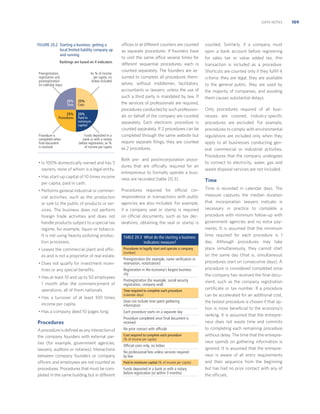
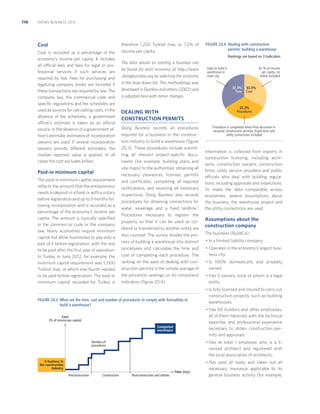
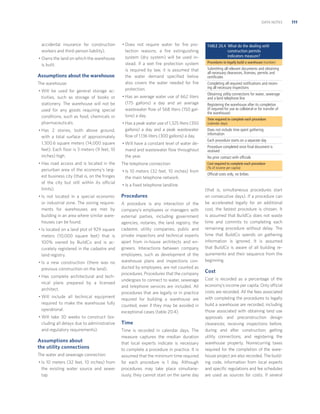
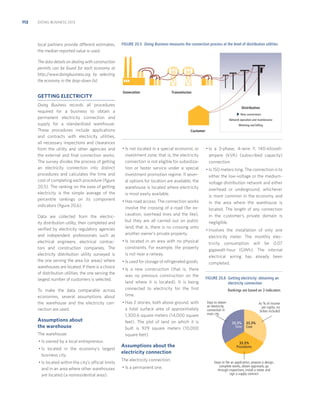
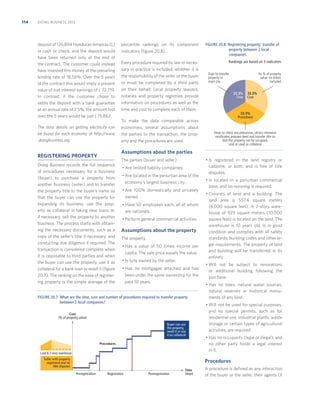
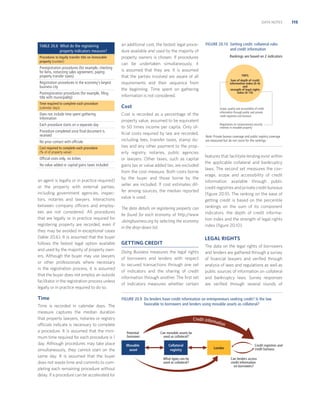
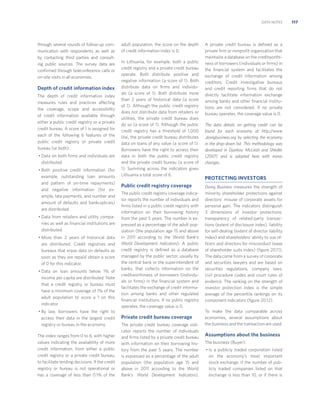
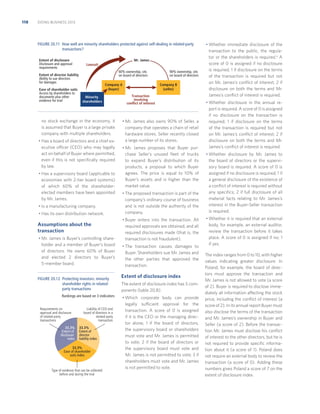
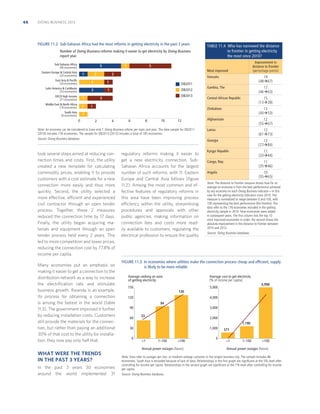
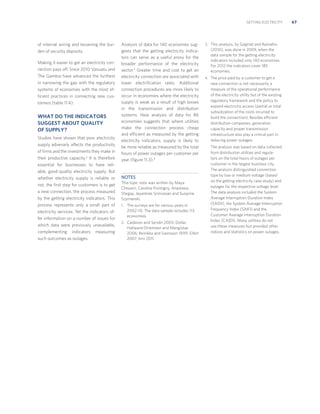
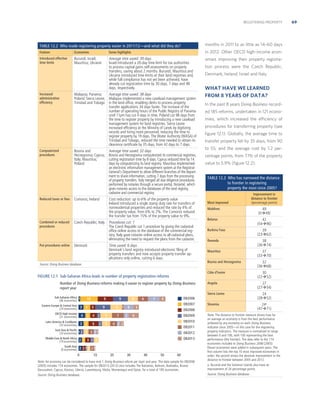
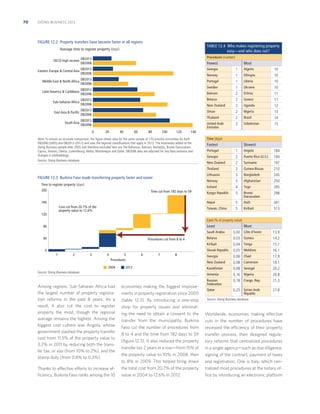
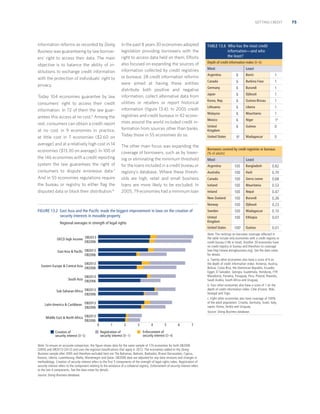
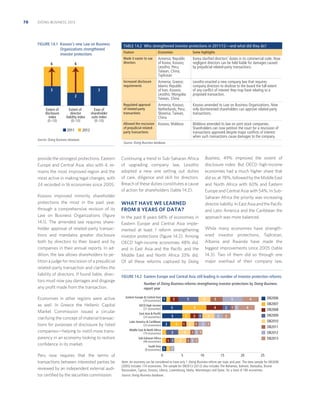
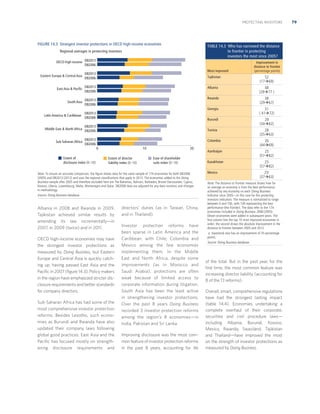
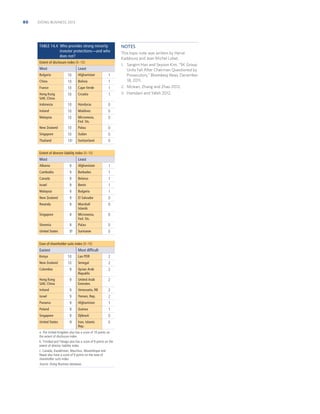
BUSINESS 2013
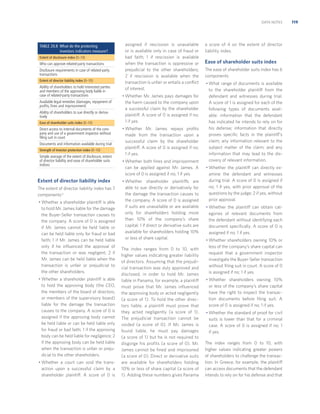
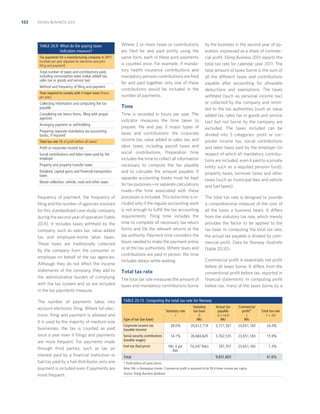
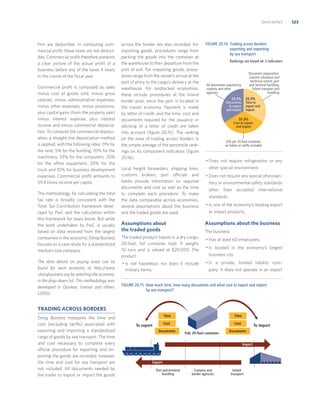
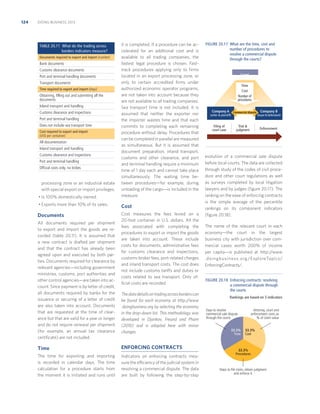
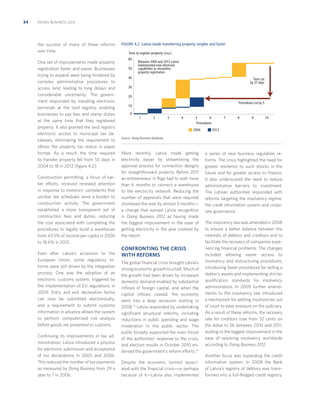
Smarter Regulations for
Small and Medium-Size Enterprises

2011

2007

2008 2006

2010

2004

2013

COMPARING BUSINESS REGULATIONS FOR DOMESTIC FIRMS IN 185 ECONOMIES

10TH EDITION
© 2013 International Bank for Reconstruction and Development / The World Bank
1818 H Street NW
Washington, DC 20433
Telephone: 202-473-1000
Internet: www.worldbank.org
Some rights reserved.
1 2 3 4 15 14 13 12
A copublication of The World Bank and the International Finance Corporation.
This work is a product of the staff of The World Bank with external contributions. Note that The World Bank
does not necessarily own each component of the content included in the work. The World Bank therefore
does not warrant that the use of the content contained in the work will not infringe on the rights of third
parties. The risk of claims resulting from such infringement rests solely with you.
The findings, interpretations, and conclusions expressed in this work do not necessarily reflect the views of
The World Bank, its Board of Executive Directors, or the governments they represent. The World Bank does
not guarantee the accuracy of the data included in this work. The boundaries, colors, denominations, and
other information shown on any map in this work do not imply any judgment on the part of The World Bank
concerning the legal status of any territory or the endorsement or acceptance of such boundaries.
Nothing herein shall constitute or be considered to be a limitation upon or waiver of the privileges and
immunities of The World Bank, all of which are specifically reserved.
Rights and Permissions

This work is available under the Creative Commons Attribution 3.0 Unported license (CC BY 3.0) http://
creativecommons.org/licenses/by/3.0. Under the Creative Commons Attribution license, you are free to
copy, distribute, transmit, and adapt this work, including for commercial purposes, under the following
conditions:
Attribution—Please cite the work as follows: World Bank. 2013. Doing Business 2013: Smarter Regulations for
Small and Medium-Size Enterprises. Washington, DC: World Bank Group. DOI: 10.1596/978-0-8213-9615-5.
License: Creative Commons Attribution CC BY 3.0
Translations—If you create a translation of this work, please add the following disclaimer along with the
attribution: This translation was not created by The World Bank and should not be considered an official World
Bank translation. The World Bank shall not be liable for any content or error in this translation.
All queries on rights and licenses should be addressed to the Office of the Publisher, The World Bank, 1818
H Street NW, Washington, DC 20433, USA; fax: 202-522-2625; e-mail: pubrights@worldbank.org.
Additional copies of all 10 editions of Doing Business may be purchased at www.doingbusiness.org.
ISBN (paper): 978-0-8213-9615-5
ISBN (electronic): 978-0-8213-9624-7
DOI: 10.1596/978-0-8213-9615-5
ISSN: 1729-2638
Design and Layout: Corporate Visions, Inc.
2013

Smarter Regulations for
Small and Medium-Size Enterprises

COMPARING BUSINESS REGULATIONS FOR DOMESTIC FIRMS IN 185 ECONOMIES
A COPUBLICATION OF THE WORLD BANK AND THE INTERNATIONAL FINANCE CORPORATION
RESOURCES ON THE DOING BUSINESS WEBSITE
Current features
News on the Doing Business project
http://www.doingbusiness.org
Rankings
How economies rank—from 1 to 185
http://www.doingbusiness.org/rankings/
Data
All the data for 185 economies—topic rankings,
indicator values, lists of regulatory procedures and
details underlying indicators
http://www.doingbusiness.org/data/
Reports
Access to Doing Business reports as well as
subnational and regional reports, reform case
studies and customized economy and regional
profiles
http://www.doingbusiness.org/reports/
Methodology
The methodologies and research papers underlying
Doing Business
http://www.doingbusiness.org/methodology/
Research
Abstracts of papers on Doing Business topics and
related policy issues
http://www.doingbusiness.org/research/

Doing Business reforms
Short summaries of DB2013 business regulation
reforms, lists of reforms since DB2008 and a
ranking simulation tool
http://www.doingbusiness.org/reforms/
Historical data
Customized data sets since DB2004
http://www.doingbusiness.org/custom-query/
Law library
Online collection of business laws
and regulations relating to business and
gender issues
http://www.doingbusiness.org/law-library/
http://wbl.worldbank.org/
Contributors
More than 9,600 specialists in 185 economies
who participate in Doing Business
http://www.doingbusiness.org/contributors/
doing-business/
NEW! Entrepreneurship data
Data on business density for 130 economies
http://www.doingbusiness.org/data/exploretopics/
entrepreneurship/
More to come
Coming soon—information on good practices
and data on transparency and on the distance
to frontier
Contents
v

Preface

1

Executive summary

15

About Doing Business: measuring for impact

Case studies
26

Colombia: sustaining reforms over time

32

Latvia: maintaining a reform state of mind

37

Rwanda: fostering prosperity by promoting entrepreneurship

42

APEC: sharing goals and experience

47

Does Doing Business matter for foreign direct investment?

51

How transparent is business regulation around the world?

Topic notes
56

Starting a business

60

Dealing with construction permits

64

Getting electricity

68

Registering property

72
Doing Business 2013 is the 10th in a
series of annual reports investigating
the regulations that enhance business
activity and those that constrain it. Doing
Business presents quantitative indicators
on business regulations and the protection
of property rights that can be compared
across 185 economies—from Afghanistan
to Zimbabwe—and over time.
Regulations affecting 11 areas of the life
of a business are covered: starting a business, dealing with construction permits,
getting electricity, registering property,
getting credit, protecting investors, paying
taxes, trading across borders, enforcing
contracts, resolving insolvency and employing workers. The employing workers
data are not included in this year’s ranking
on the ease of doing business.
Data in Doing Business 2013 are current as
of June 1, 2012. The indicators are used to
analyze economic outcomes and identify
what reforms of business regulation have
worked, where and why.

Getting credit

77

Protecting investors

81

Paying taxes

86

Trading across borders

90

Enforcing contracts

94

Resolving insolvency

98

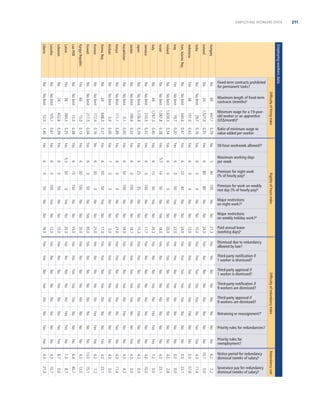
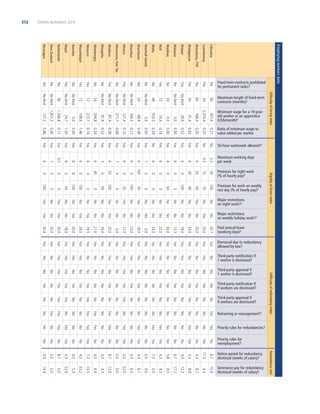
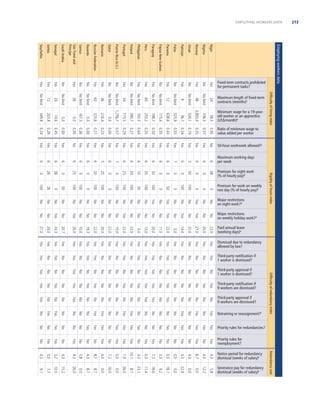
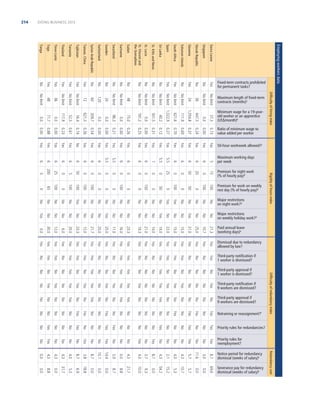
Annex: employing workers

101

References

106

Data notes

131

Ease of doing business and distance to frontier

135

Summaries of Doing Business reforms in 2011/12

145

Country tables

207

Employing workers data

216

Acknowledgments
v

Preface
This is the 10th edition of the Doing Business report. First published in 2003 with 5
indicator sets measuring business regulation in 133 economies, the report has grown
into an annual publication covering 11 indicator sets and 185 economies. In these 10
years Doing Business has recorded nearly 2,000 business regulation reforms in the areas covered by the indicators. And researchers have produced well over 1,000 articles
in peer-reviewed journals using the data published by Doing Business—work that helps
explore many of the key development questions of our time.
Doing Business 2013 holds new information to inspire policy makers and researchers. One finding is that Poland improved the most in the Doing Business measures in
2011/12, while Singapore maintains its top spot in the overall ranking. Another finding
is that European economies in fiscal distress are making efforts to improve the business
climate, and this is beginning to be reflected in the indicators tracked by Doing Business,
with Greece being among the 10 economies that improved the most in the Doing
Business measures in the past year. Part of the solution to high debt is the recovery of
economic growth, and there is broad recognition that creating a friendlier environment
for entrepreneurs is central to this goal. But perhaps the most exciting finding is that of
a steady march from 2003 to 2012 toward better business regulation across the wide
range of economies included. With a handful of exceptions, every economy covered by
Doing Business has narrowed the gap in business regulatory practice with the top global
performance in the areas measured by the indicators. This is a welcome race to the top.
Collecting the more than 57,000 unique Doing Business data points each year and
placing them in a broader context of economic policy and development is a major
undertaking. We thank the team and the Doing Business contributors for their efforts.
Data collection and analysis for Doing Business 2013 were conducted through the Global
Indicators and Analysis Department under the general direction of Augusto LopezClaros. The project was managed by Sylvia Solf and Rita Ramalho, with the support
of Carolin Geginat and Adrian Gonzalez. Other team members included Beatriz Mejia
Asserias, Andres Baquero Franco, Karim O. Belayachi, Iryna Bilotserkivska, Mariana
Carvalho, Hayane Chang Dahmen, Rong Chen, Maya Choueiri, Dariga Chukmaitova,
Santiago Croci Downes, Fernando Dancausa Diaz, Marie Lily Delion, Raian Divanbeigi,
Alejandro Espinosa-Wang, Margherita Fabbri, Caroline Frontigny, Betina Hennig,
Sarah Holmberg, Hussam Hussein, Joyce Ibrahim, Ludmila Jantuan, Nan Jiang, Hervé
Kaddoura, Paweł Kopko, Jean Michel Lobet, Jean-Philippe Lodugnon-Harding, Frédéric
Meunier, Robert Murillo, Joanna Nasr, Marie-Jeanne Ndiaye, Nuria de Oca, Mikiko Imai
Ollison, Nina Paustian, Galina Rudenko, Valentina Saltane, Lucas Seabra, Paula Garcia
Serna, Anastasia Shegay, Jayashree Srinivasan, Susanne Szymanski, Moussa Traoré,
Tea Trumbic, Marina Turlakova, Julien Vilquin, Yasmin Zand and Yucheng Zheng.
More than 9,600 lawyers and other professionals generously donated their time to
provide the legal assessments that underpin the data. We thank in particular the global
contributors: Advocates for International Development; Allen & Overy LLP; American
vi

DOING BUSINESS 2013

Bar Association, Section of International Law; Baker & McKenzie; Cleary Gottlieb
Steen & Hamilton LLP; Ernst & Young; Ius Laboris, Alliance of Labor, Employment,
Benefits and Pensions Law Firms; KPMG; the Law Society of England and Wales; Lex
Mundi, Association of Independent Law Firms; Panalpina; PwC; Raposo Bernardo &
Associados; Russell Bedford International; SDV International Logistics; and Security
Cargo Network. The efforts of all these contributors help maintain the distinctive voice
of Doing Business and its annual contribution to business regulation reform.
Ten years marks a good time to take stock of where the world has moved in business
regulatory practices and what challenges remain. We welcome you to give feedback on
the Doing Business website (http://www.doingbusiness.org) and join the conversation
as we shape the project in the years to come.
Sincerely,

Janamitra Devan
Vice President and Head of Network
Financial & Private Sector Development
World Bank Group
1

Executive summary
This 10th edition of the Doing Business
report marks a good time to take stock—
to look at how far the world has come in
business regulatory practices and what
challenges remain. In the first report one
of the main findings was that low-income
economies had very cumbersome regulatory systems. Ten years later it is apparent that business regulatory practices in
these economies have been gradually but
noticeably converging toward the more
efficient practices common in higherincome economies (box 1.1). How much
has the gap narrowed? Did some regions
close the regulatory gap more rapidly
than others? This year’s report tells that
story. It points to important trends in
regulatory reform and identifies the regions and economies making the biggest
improvements for local entrepreneurs.

And it highlights both the areas of business regulation that have received the
most attention and those where more
progress remains to be made.
The report also reviews research on
which regulatory reforms have worked
and how. After 10 years of data tracking
reforms and regulatory practices around
the world, more evidence is available to
address these questions. The report summarizes just some of the main findings.
Among the highlights: Smarter business
regulation supports economic growth.
Simpler business registration promotes
greater entrepreneurship and firm productivity, while lower-cost registration
improves formal employment opportunities. An effective regulatory environment
boosts trade performance. And sound

BOX 1.1 MAIN FINDINGS SINCE 2003 AND THE FIRST DOING BUSINESS REPORT

• Over these 10 years 180 economies implemented close to 2,000 business regulatory reforms as measured by Doing Business.

• Eastern Europe and Central Asia improved the most, overtaking East Asia and the
Pacific as the world’s second most business-friendly region according to Doing
Business indicators. OECD high-income economies continue to have the most
business-friendly environment.

• Business regulatory practices have been slowly converging as economies with
initially poor performance narrow the gap with better performers. Among the 50
economies with the biggest improvements since 2005, the largest share—a third—
are in Sub-Saharan Africa.

• Among the categories of business regulatory practices measured by Doing Business,
there has been more convergence in those that relate to the complexity and cost
of regulatory processes (business start-up, property registration, construction permitting, electricity connections, tax payment and trade procedures) than in those
that relate to the strength of legal institutions (contract enforcement, insolvency
regimes, credit information, legal rights of borrowers and lenders and the protection
of minority shareholders).

• Two-thirds of the nearly 2,000 reforms recorded by Doing Business were focused on
reducing the complexity and cost of regulatory processes.

• A growing body of research has traced out the effects of simpler business regulation
on a range of economic outcomes, such as faster job growth and an accelerated
pace of new business creation.

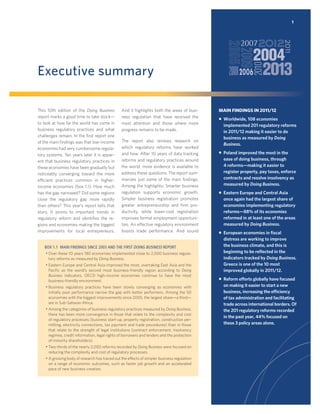
MAIN FINDINGS IN 2011/12
ƒ Worldwide, 108 economies
implemented 201 regulatory reforms
in 2011/12 making it easier to do
business as measured by Doing
Business.
ƒ Poland improved the most in the
ease of doing business, through
4 reforms—making it easier to
register property, pay taxes, enforce
contracts and resolve insolvency as
measured by Doing Business.
ƒ Eastern Europe and Central Asia
once again had the largest share of
economies implementing regulatory
reforms—88% of its economies
reformed in at least one of the areas
measured by Doing Business.
ƒ European economies in fiscal
distress are working to improve
the business climate, and this is
beginning to be reflected in the
indicators tracked by Doing Business.
Greece is one of the 10 most
improved globally in 2011/12.
ƒ Reform efforts globally have focused
on making it easier to start a new
business, increasing the efficiency
of tax administration and facilitating
trade across international borders. Of
the 201 regulatory reforms recorded
in the past year, 44% focused on
these 3 policy areas alone.
2

DOING BUSINESS 2013

financial market infrastructure—courts,
creditor and insolvency laws, and credit
and collateral registries—improves access to credit (see the chapter “About
Doing Business”).

resolving insolvency. Doing Business also
documents regulations on employing
workers, which are not included in this
year’s aggregate ranking or in the count
of reforms.

WHAT ARE SMART RULES FOR
BUSINESSES?

The economies that rank highest on the
ease of doing business are not those
where there is no regulation—but those
where governments have managed to
create rules that facilitate interactions
in the marketplace without needlessly
hindering the development of the private
sector. In essence, Doing Business is
about SMART business regulations—
Streamlined, Meaningful, Adaptable,
Relevant, Transparent—not necessarily
fewer regulations (see figure 2.1 in the
chapter “About Doing Business”).

Just as good rules are needed to allow
traffic to flow in a city, they are also essential to allow business transactions
to flow. Good business regulations
enable the private sector to thrive and
businesses to expand their transactions
network. But regulations put in place to
safeguard economic activity and facilitate
business operations, if poorly designed,
can become obstacles to doing business.
They can be like traffic lights put up to
prevent gridlock—ineffective if a red light
lasts for an hour. Most people would run
the red light, just as most businesses
facing burdensome regulations will try to
circumvent them to stay afloat.
Striking the right balance in business
regulation can be a challenge. It becomes
an even greater challenge in a changing
world, where regulations must continually adapt to new realities. Just as traffic
systems have to adjust when a new road
is being constructed, regulations need to
adapt to new demands from the market
and to changes in technology (such
as the growing use of information and
communication technology in business
processes).
This challenge is one focus of this report.
Through indicators benchmarking 185
economies, Doing Business measures
and tracks changes in the regulations
applying to domestic small and mediumsize companies in 11 areas in their life
cycle. This year’s aggregate ranking on
the ease of doing business is based on
indicator sets that measure and benchmark regulations affecting 10 of those
areas: starting a business, dealing with
construction permits, getting electricity, registering property, getting credit,
protecting investors, paying taxes, trading
across borders, enforcing contracts and

Doing Business encompasses 2 types of indicators: indicators relating to the strength
of legal institutions relevant to business
regulation and indicators relating to the
complexity and cost of regulatory processes.
Those in the first group focus on the legal
and regulatory framework for getting
credit, protecting investors, enforcing
contracts and resolving insolvency. Those
in the second focus on the cost and efficiency of regulatory processes for starting a business, dealing with construction
permits, getting electricity, registering
property, paying taxes and trading across
borders. Based on time-and-motion case
studies from the perspective of the business, these indicators measure the procedures, time and cost required to complete
a transaction in accordance with relevant
regulations. (For a detailed explanation of
the Doing Business methodology, see the
data notes and the chapter “About Doing
Business.”)
Economies that rank high on the ease of
doing business tend to combine efficient
regulatory processes with strong legal institutions that protect property and investor rights (figure 1.1). OECD high-income
economies have, by a large margin, the
most business-friendly regulatory environment on both dimensions. Regions
such as East Asia and the Pacific and
the Middle East and North Africa have

relatively efficient regulatory processes
but still lag in the strength of legal institutions relevant to business regulation.
Good practices around the world provide
insights into how governments have
improved the regulatory environment in
the past in the areas measured by Doing
Business (see table 1.4 at the end of the
executive summary).

WHO NARROWED THE
REGULATORY GAP IN 2011/12?
As reflected in the ranking on the ease of
doing business, the 10 economies with
the most business-friendly regulation are
Singapore; Hong Kong SAR, China; New
Zealand; the United States; Denmark;
Norway; the United Kingdom; the
Republic of Korea; Georgia; and Australia
(table 1.1). Singapore tops the global ranking for the seventh consecutive year.
A number 1 ranking on the ease of doing
business does not mean that an economy
ranks number 1 across all 10 regulatory
areas included in this aggregate measure.
Indeed, Singapore’s rankings range
from 1 in trading across borders to 36 in
registering property. Its top 3 rankings
(on trading across borders, dealing with
construction permits and protecting
investors) average 2, while its lowest 3
(on registering property, getting credit
and enforcing contracts) average 20.
Similarly, Guatemala’s top 3 (on getting
credit, registering property and getting
electricity) average 22, and its bottom
3 (on paying taxes, protecting investors
and starting a business) average 151. So
while the ease of doing business ranking
is a useful aggregate measure, analysis
based on this measure should also take
into account the dispersion of regulatory
efficiency across the areas measured by
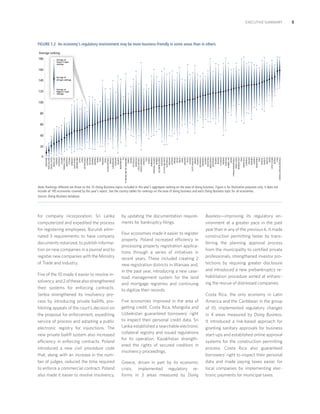
Doing Business (figure 1.2).
In the past year 58% of economies covered by Doing Business implemented at
least 1 institutional or regulatory reform
making it easier to do business in the areas measured, and 23 undertook reforms
in 3 or more areas. Of these 23 economies, 10 stand out as having jumped
EXECUTIVE SUMMARY

TABLE 1.1 Rankings on the ease of doing business
Rank
1
2
3
4
5
6
7
8
9
10
11
12
13
14
15
16
17
18
19
20
21
22
23
24
25
26
27
28
29
30
31
32
33
34
35
36
37
38
39
40
41
42
43
44
45
46
47
48
49
50
51
52
53
54
55
56
57
58
59
60
61
62

Economy
Singapore
Hong Kong SAR, China
New Zealand
United States
Denmark
Norway
United Kingdom
Korea, Rep.
Georgia
Australia
Finland
Malaysia
Sweden
Iceland
Ireland
Taiwan, China
Canada
Thailand
Mauritius
Germany
Estonia
Saudi Arabia
Macedonia, FYR
Japan
Latvia
United Arab Emirates
Lithuania
Switzerland
Austria
Portugal
Netherlands
Armenia
Belgium
France
Slovenia
Cyprus
Chile
Israel
South Africa
Qatar
Puerto Rico (U.S.)
Bahrain
Peru
Spain
Colombia
Slovak Republic
Oman
Mexico
Kazakhstan
Tunisia
Montenegro
Rwanda
St. Lucia
Hungary
Poland
Luxembourg
Samoa
Belarus
Botswana
Fiji
Panama
Tonga

DB2013
reforms
0
0
1
0
1
2
1
4
6
1
0
2
0
0
2
2
1
2
2
2
0
2
1
1
0
3
2
0
0
3
4
2
0
0
3
1
0
1
1
1
1
0
2
2
1
4
1
2
3
0
2
2
0
3
4
0
0
2
1
1
3
0

Rank
63
64
65
66
67
68
69
70
71
72
73
74
75
76
77
78
79
80
81
82
83
84
85
86
87
88
89
90
91
92
93
94
95
96
97
98
99
100
101
102
103
104
105
106
107
108
109
110
111
112
113
114
115
116
117
118
119
120
121
122
123
124

Economy
Antigua and Barbuda
Ghana
Czech Republic
Bulgaria
Azerbaijan
Dominica
Trinidad and Tobago
Kyrgyz Republic
Turkey
Romania
Italy
Seychelles
St. Vincent and the Grenadines
Mongolia
Bahamas, The
Greece
Brunei Darussalam
Vanuatu
Sri Lanka
Kuwait
Moldova
Croatia
Albania
Serbia
Namibia
Barbados
Uruguay
Jamaica
China
Solomon Islands
Guatemala
Zambia
Maldives
St. Kitts and Nevis
Morocco
Kosovo
Vietnam
Grenada
Marshall Islands
Malta
Paraguay
Papua New Guinea
Belize
Jordan
Pakistan
Nepal
Egypt, Arab Rep.
Costa Rica
Palau
Russian Federation
El Salvador
Guyana
Lebanon
Dominican Republic
Kiribati
Yemen, Rep.
Nicaragua
Uganda
Kenya
Cape Verde
Swaziland
Argentina

DB2013
reforms
0
0
3
1
0
1
2
0
2
2
2
0
0
3
0
3
2
0
4
0
2
1
2
3
1
0
2
2
2
0
1
1
0
0
1
2
1
1
0
0
0
0
1
0
0
0
0
4
0
2
1
0
0
0
0
0
0
1
1
0
1
0

Rank
125
126
127
128
129
130
131
132
133
134
135
136
137
138
139
140
141
142
143
144
145
146
147
148
149
150
151
152
153
154
155
156
157
158
159
160
161
162
163
164
165
166
167
168
169
170
171
172
173
174
175
176
177
178
179
180
181
182
183
184
185

Economy
Honduras
Bosnia and Herzegovina
Ethiopia
Indonesia
Bangladesh
Brazil
Nigeria
India
Cambodia
Tanzania
West Bank and Gaza
Lesotho
Ukraine
Philippines
Ecuador
Sierra Leone
Tajikistan
Madagascar
Sudan
Syrian Arab Republic
Iran, Islamic Rep.
Mozambique
Gambia, The
Bhutan
Liberia
Micronesia, Fed. Sts.
Mali
Algeria
Burkina Faso
Uzbekistan
Bolivia
Togo
Malawi
Comoros
Burundi
São Tomé and Príncipe
Cameroon
Equatorial Guinea
Lao PDR
Suriname
Iraq
Senegal
Mauritania
Afghanistan
Timor-Leste
Gabon
Djibouti
Angola
Zimbabwe
Haiti
Benin
Niger
Côte d’Ivoire
Guinea
Guinea-Bissau
Venezuela, RB
Congo, Dem. Rep.
Eritrea
Congo, Rep.
Chad
Central African Republic

DB2013
reforms
0
2
1
1
1
1
0
1
1
1
1
2
3
0
0
2
1
1
0
1
1
0
0
0
3
0
1
1
0
4
0
1
1
2
4
0
1
0
3
0
0
0
0
0
0
0
0
1
0
0
4
1
0
3
0
0
1
0
2
1
0

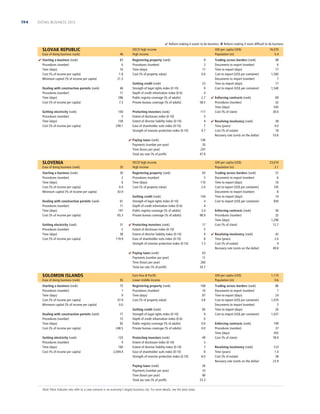
Note: The rankings for all economies are benchmarked to June 2012 and reported in the country tables. This year’s rankings on the ease of doing business are the average of the economy’s
percentile rankings on the 10 topics included in this year’s aggregate ranking. The number of reforms excludes those making it more difficult to do business.
Source: Doing Business database.

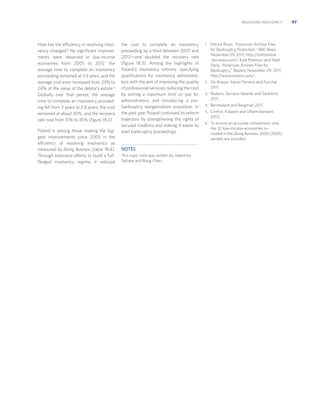
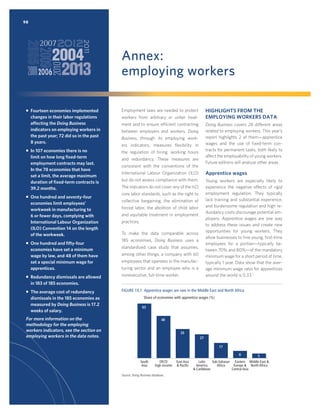
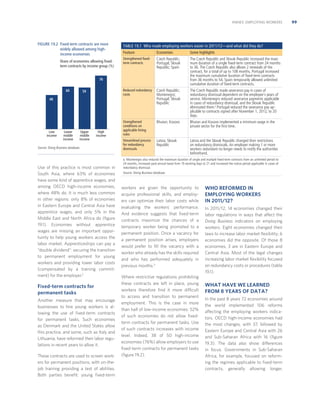
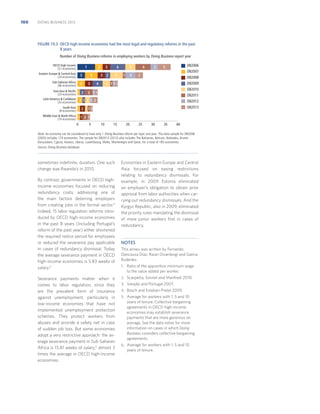
3
DOING BUSINESS 2013

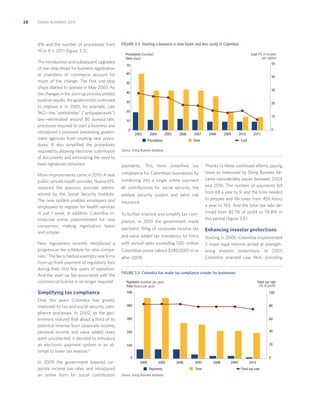
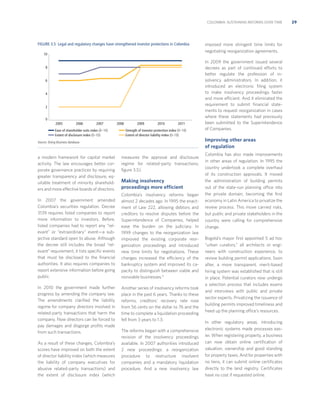
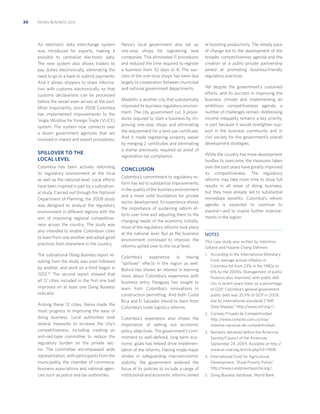
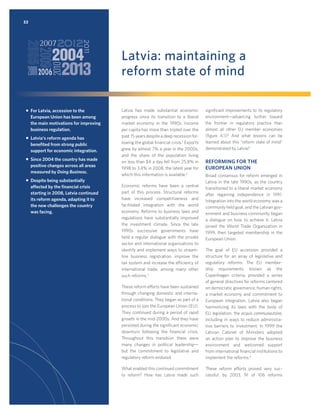
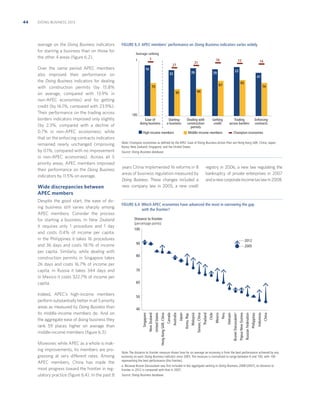
FIGURE 1.1 OECD high-income economies combine efficient regulatory processes with strong
legal institutions

ahead the most in the relative ranking
(table 1.2). Others in this group advanced
less in the global ranking because they
already ranked high. Two are Korea and
the Netherlands. Already among the
top 35 in last year’s global ranking, both
implemented regulatory reforms making
it easier to do business in 4 areas measured by Doing Business.

Average ranking on sets of Doing Business indicators
Stronger legal institutions but
more complex and expensive
regulatory processes

Stronger

Stronger legal institutions and
simpler and less expensive
regulatory processes

29

Eastern Europe
& Central Asia
Average ranking on ease
of doing business

Strength of legal institutions

4

OECD
high income
73

Size of bubble reflects
number of economies

Latin America
& Caribbean
97

86

Four of the 10 economies improving the
most in the ease of doing business are
in Eastern Europe and Central Asia—the
region that also had the largest number
of regulatory reforms per economy in the
past year. Four of the 10 are lower-middleincome economies; of the rest, 1 is low
income, 3 are upper middle income and
2 are high income. And for the first time
in 7 years, a South Asian economy—Sri
Lanka—ranks among those improving the
most in the ease of doing business.

East Asia
& Pacific

South Asia
121

98

Sub-Saharan
Africa
140

Middle East
& North Africa

Weaker legal institutions but
simpler and less expensive
regulatory processes

Weaker legal institutions and
more complex and expensive
regulatory processes

Weaker

Complex and
expensive

Simple and
inexpensive

Complexity and cost
of regulatory processes

Note: Strength of legal institutions refers to the average ranking on getting credit, protecting investors, enforcing contracts and
resolving insolvency. Complexity and cost of regulatory processes refers to the average ranking on starting a business, dealing
with construction permits, getting electricity, registering property, paying taxes and trading across borders.
Source: Doing Business database.

Eight of the 10 economies made it
easier to start a business. Kazakhstan,
Mongolia and Ukraine reduced or eliminated the minimum capital requirement

TABLE 1.2 The 10 economies improving the most across 3 or more areas measured by Doing Business in 2011/12
Reforms making it easier to do business

Economy

1 Poland

Ease of
doing
business
rank

Starting a
business

Dealing
with
construction
permits

Getting
electricity

Registering
property

Getting
credit


55

2 Sri Lanka

81


2 Ukraine

137


4 Uzbekistan

154


5 Burundi

159


6 Costa Rica

110


6 Mongolia

76


8 Greece

78

9 Serbia

86


Paying
taxes

Trading
across
borders


Enforcing
contracts

Resolving
insolvency


49

10 Kazakhstan

Protecting
investors


Note: Economies are ranked on the number of their reforms and on how much they improved in the ease of doing business ranking. First, Doing Business selects the economies that
implemented reforms making it easier to do business in 3 or more of the 10 topics included in this year’s aggregate ranking. Regulatory reforms making it more difficult to do business are
subtracted from the number of those making it easier to do business. Second, Doing Business ranks these economies on the increase in their ranking on the ease of doing business from the
previous year. The increase in economy rankings is not calculated using the published ranking of last year but by using a comparable ranking for DB2012 that captures the effects of other
factors, such as the inclusion this year of 2 new economies in the sample, Barbados and Malta. The choice of the most improved economies is determined by the largest improvement in
rankings, among those economies with at least 3 reforms.
Source: Doing Business database.
EXECUTIVE SUMMARY

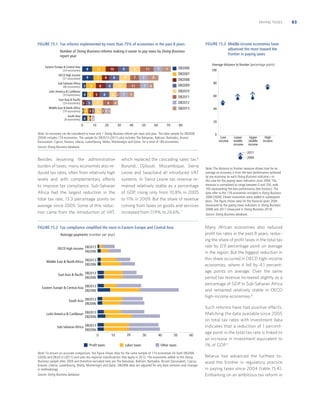
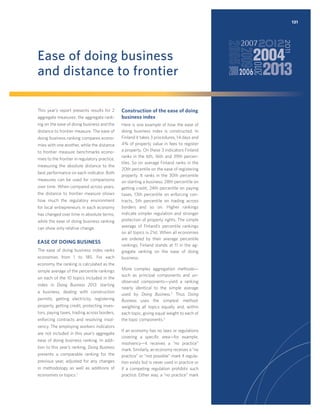
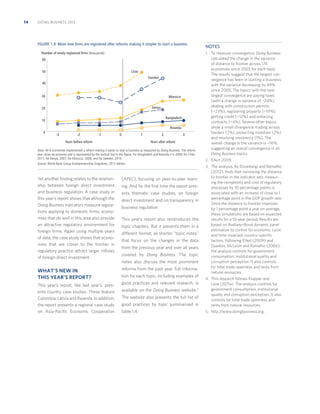
FIGURE 1.2 An economy’s regulatory environment may be more business-friendly in some areas than in others
Average ranking
180

Average of
lowest 3 topic
rankings

160
140
120

Average of
all topic rankings

Average of
highest 3 topic
rankings

100
80
60
40

0

SINGAPORE
NEW ZEALAND
UNITED STATES
KOREA, REP.
GEORGIA
AUSTRALIA
ICELAND
TAIWAN, CHINA
MAURITIUS
ESTONIA
GERMANY
SAUDI ARABIA
SWITZERLAND
LATVIA
JAPAN
NETHERLANDS
SLOVENIA
BELGIUM
BAHRAIN
ARMENIA
OMAN
PERU
RWANDA
ISRAEL
SLOVAK REPUBLIC
MEXICO
LUXEMBOURG
HUNGARY
BELARUS
MONTENEGRO
FIJI
ST. VINCENT AND THE GRENADINES
TURKEY
GHANA
SEYCHELLES
MONGOLIA
CZECH REPUBLIC
KYRGYZ REPUBLIC
VANUATU
ITALY
KUWAIT
BARBADOS
MARSHALL ISLANDS
NAMIBIA
SOLOMON ISLANDS
MOLDOVA
ST. KITTS AND NEVIS
GUATEMALA
URUGUAY
VIETNAM
JORDAN
BELIZE
MALTA
NEPAL
LEBANON
PALAU
GUYANA
EGYPT, ARAB REP.
KIRIBATI
ETHIOPIA
NICARAGUA
INDONESIA
UGANDA
ARGENTINA
BANGLADESH
PHILIPPINES
NIGERIA
BHUTAN
ECUADOR
UKRAINE
TAJIKISTAN
GAMBIA, THE
SUDAN
SYRIAN ARAB REPUBLIC
SIERRA LEONE
BURKINA FASO
IRAQ
TIMOR-LESTE
COMOROS
MALAWI
BURUNDI
ALGERIA
MAURITANIA
TOGO
SENEGAL
DJIBOUTI
ANGOLA
NIGER
CÔTE D’IVOIRE
ERITREA
CHAD
CENTRAL AFRICAN REPUBLIC

20

Note: Rankings reflected are those on the 10 Doing Business topics included in this year’s aggregate ranking on the ease of doing business. Figure is for illustrative purposes only; it does not
include all 185 economies covered by this year’s report. See the country tables for rankings on the ease of doing business and each Doing Business topic for all economies.
Source: Doing Business database.

for company incorporation. Sri Lanka
computerized and expedited the process
for registering employees. Burundi eliminated 3 requirements: to have company
documents notarized, to publish information on new companies in a journal and to
register new companies with the Ministry
of Trade and Industry.
Five of the 10 made it easier to resolve insolvency, and 2 of these also strengthened
their systems for enforcing contracts.
Serbia strengthened its insolvency process by introducing private bailiffs, prohibiting appeals of the court’s decision on
the proposal for enforcement, expediting
service of process and adopting a public
electronic registry for injunctions. The
new private bailiff system also increased
efficiency in enforcing contracts. Poland
introduced a new civil procedure code
that, along with an increase in the number of judges, reduced the time required
to enforce a commercial contract. Poland
also made it easier to resolve insolvency,

by updating the documentation requirements for bankruptcy filings.
Four economies made it easier to register
property. Poland increased efficiency in
processing property registration applications through a series of initiatives in
recent years. These included creating 2
new registration districts in Warsaw and,
in the past year, introducing a new caseload management system for the land
and mortgage registries and continuing
to digitize their records.
Five economies improved in the area of
getting credit. Costa Rica, Mongolia and
Uzbekistan guaranteed borrowers’ right
to inspect their personal credit data. Sri
Lanka established a searchable electronic
collateral registry and issued regulations
for its operation. Kazakhstan strengthened the rights of secured creditors in
insolvency proceedings.
Greece, driven in part by its economic
crisis, implemented regulatory reforms in 3 areas measured by Doing

Business—improving its regulatory environment at a greater pace in the past
year than in any of the previous 6. It made
construction permitting faster by transferring the planning approval process
from the municipality to certified private
professionals, strengthened investor protections by requiring greater disclosure
and introduced a new prebankruptcy rehabilitation procedure aimed at enhancing the rescue of distressed companies.
Costa Rica, the only economy in Latin
America and the Caribbean in the group
of 10, implemented regulatory changes
in 4 areas measured by Doing Business.
It introduced a risk-based approach for
granting sanitary approvals for business
start-ups and established online approval
systems for the construction permitting
process. Costa Rica also guaranteed
borrowers’ right to inspect their personal
data and made paying taxes easier for
local companies by implementing electronic payments for municipal taxes.

5
DOING BUSINESS 2013

While these 10 economies improved
the most in the ease of doing business,
they were far from alone in introducing
improvements in the areas measured
by Doing Business in 2011/12. A total
of 108 economies did so, through 201
institutional and regulatory reforms.
And in the years since the first report
was published in 2003, 180 of the 185
economies covered by Doing Business
made improvements in at least one of
these areas—through nearly 2,000 such
reforms in total.
In 2011/12 starting a business was again
the area with the most regulatory reforms.
In the past 8 years the start-up process
received more attention from policy makers than any other area of business regulation tracked by Doing Business—through
368 reforms in 149 economies. These
worldwide efforts reduced the average
time to start a business from 50 days
to 30 and the average cost from 89% of
income per capita to 31%.
In the past year Eastern Europe and Central
Asia once again had the largest share of

economies registering improvements,
with 88% of economies implementing at
least 1 institutional or regulatory reform
making it easier to do business and 67%
implementing at least 2 (figure 1.3).
This region has been consistently active
through all the years covered by Doing
Business, implementing 397 institutional
and regulatory reforms since 2005. At
least some of this regulatory reform push
reflects efforts by economies joining the
European Union in 2004 to continue to
narrow the gap in regulatory efficiency
with established EU members—as well
as similar efforts among economies now
engaged in EU accession negotiations.

WHO HAS NARROWED THE
GAP OVER THE LONG RUN?
To complement the ease of doing business ranking, a relative measure, last
year’s Doing Business report introduced
the distance to frontier, an absolute measure of business regulatory efficiency.
This measure aids in assessing how much
the regulatory environment for local entrepreneurs improves in absolute terms

over time by showing the distance of each
economy to the “frontier,” which represents the best performance observed
on each of the Doing Business indicators
across all economies and years included
since 2005. The measure is normalized
to range between 0 and 100, with 100
representing the frontier. A higher score
therefore indicates a more efficient business regulatory system (for a detailed
description of the methodology, see the
chapter on the ease of doing business and
distance to frontier).
Analysis based on the distance to frontier
measure shows that the burden of regulation has declined since 2005 in the areas
measured by Doing Business. On average
the 174 economies covered by Doing
Business since that year are today closer
to the frontier in regulatory practice (figure 1.4). In 2005 these economies were
46 percentage points from the frontier
on average, with the closest economy 10
percentage points away and the furthest
one 74 percentage points away. Now
these 174 economies are 40 percentage
points from the frontier on average, with

FIGURE 1.4 Almost all economies are closer to the frontier in regulatory practice today than they were in 2005
Distance to frontier (percentage points)
100
90
80
70
60
50
40
30
0

SINGAPORE
NEW ZEALAND
UNITED STATES
HONG KONG SAR, CHINA
IRELAND
CANADA
UNITED KINGDOM
NORWAY
DENMARK
FINLAND
AUSTRALIA
SWEDEN
GERMANY
ICELAND
JAPAN
AUSTRIA
KOREA, REP.
NETHERLANDS
ESTONIA
SWITZERLAND
BELGIUM
LITHUANIA
MALAYSIA
SPAIN
ISRAEL
SOUTH AFRICA
LATVIA
PUERTO RICO (U.S.)
TAIWAN, CHINA
THAILAND
FIJI
PORTUGAL
CHILE
SLOVAK REPUBLIC
ITALY
UNITED ARAB EMIRATES
ST. LUCIA
FRANCE
MAURITIUS
HUNGARY
MEXICO
NAMIBIA
TONGA
PANAMA
ANTIGUA AND BARBUDA
OMAN
BOTSWANA
DOMINICA
SAUDI ARABIA
SEYCHELLES
BULGARIA
PERU
JAMAICA
BELIZE
SLOVENIA
ROMANIA
TUNISIA
KUWAIT
MONGOLIA
SAMOA
ST. VINCENT AND THE GRENADINES
TURKEY
VANUATU
ARMENIA
MALDIVES
CZECH REPUBLIC
GRENADA
PAKISTAN
MACEDONIA, FYR
POLAND
TRINIDAD AND TOBAGO
GUYANA
ST. KITTS AND NEVIS
KIRIBATI
VIETNAM
MOLDOVA
KENYA
GREECE
LEBANON
COLOMBIA
SRI LANKA
NEPAL
GHANA
EL SALVADOR
PALAU
SWAZILAND
PAPUA NEW GUINEA

6

Note: The distance to frontier measure shows how far on average an economy is from the best performance achieved by any economy on each Doing Business indicator since 2005. The measure
is normalized to range between 0 and 100, with 100 representing the best performance (the frontier). The data refer to the 174 economies included in Doing Business 2006 (2005). Eleven
economies were added in subsequent years.
Source: Doing Business database.
EXECUTIVE SUMMARY

FIGURE 1.3 Eastern Europe and Central Asia had the largest share of economies reforming
business regulation in 2011/12
Share of economies with at least 2 Doing Business reforms making it easier
to do business (%)

reforms on average—and those in East
Asia and the Pacific, Latin America and
the Caribbean and South Asia about 8.
With its faster pace of improvement,

100

98
89

88

88

100

Eastern Europe and Central Asia overtook

88

East Asia and the Pacific as the second
most business-friendly region according
67

45

to Doing Business indicators.
But the variation within regions is large.
In Latin America and the Caribbean, for
example, Colombia implemented 25

29
21

institutional and regulatory reforms in the

13

11
Middle East
 North Africa

22

South
Asia

past 8 years, while Suriname had none. In
Latin America Sub-Saharan
 Caribbean
Africa
2004–12

East Asia
 Pacific

OECD Eastern Europe
high income  Central Asia

2011/12

East Asia and the Pacific, Vietnam implemented 18 reforms, and Kiribati none.
In a few economies (such as República
Bolivariana de Venezuela and Zimbabwe)

Source: Doing Business database.

the business environment deteriorated
the closest economy 8 percentage points
away and the furthest economy 69 percentage points away.
OECD high-income economies are closest to the frontier on average. But other
regions are narrowing the gap. Eastern

Europe and Central Asia has done so the
most, thanks to about 17 institutional
and regulatory reforms per economy
since 2005 (figure 1.5). Economies in
the Middle East and North Africa and
Sub-Saharan Africa have implemented
more than 9 institutional and regulatory

as measures added to the complexity
and cost of regulatory processes or
undermined property rights and investor
protections. Within the European Union,
4 Southern European economies have
recently accelerated regulatory reform
efforts (box 1.2).

2012

ZAMBIA
SERBIA
MOROCCO
ARGENTINA
SOLOMON ISLANDS
PARAGUAY
DOMINICAN REPUBLIC
MARSHALL ISLANDS
RUSSIAN FEDERATION
ECUADOR
NICARAGUA
KAZAKHSTAN
HONDURAS
JORDAN
URUGUAY
ALBANIA
CAPE VERDE
BANGLADESH
CROATIA
GUATEMALA
PHILIPPINES
BOSNIA AND HERZEGOVINA
COSTA RICA
IRAN, ISLAMIC REP.
AZERBAIJAN
TANZANIA
GEORGIA
WEST BANK AND GAZA
ETHIOPIA
UGANDA
GABON
LESOTHO
INDONESIA
ALGERIA
GAMBIA, THE
SUDAN
BRAZIL
BOLIVIA
KYRGYZ REPUBLIC
CHINA
YEMEN, REP.
BHUTAN
MALAWI
NIGERIA
IRAQ
SYRIAN ARAB REPUBLIC
BELARUS
MOZAMBIQUE
MADAGASCAR
ZIMBABWE
MICRONESIA, FED. STS.
UKRAINE
INDIA
VENEZUELA, RB
COMOROS
EGYPT, ARAB REP.
CAMBODIA
SURINAME
UZBEKISTAN
CAMEROON
SIERRA LEONE
DJIBOUTI
RWANDA
EQUATORIAL GUINEA
BENIN
LAO PDR
SENEGAL
SÃO TOMÉ AND PRÍNCIPE
HAITI
TOGO
CÔTE D’IVOIRE
GUINEA
MAURITANIA
MALI
ANGOLA
BURUNDI
GUINEA-BISSAU
CONGO, REP.
NIGER
TAJIKISTAN
AFGHANISTAN
BURKINA FASO
CONGO, DEM. REP.
CENTRAL AFRICAN REPUBLIC
TIMOR-LESTE
ERITREA
CHAD

2005

7
8

DOING BUSINESS 2013

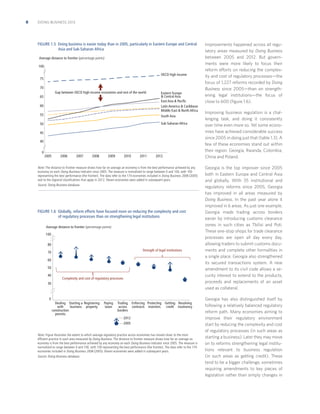
FIGURE 1.5 Doing business is easier today than in 2005, particularly in Eastern Europe and Central
Asia and Sub-Saharan Africa
Average distance to frontier (percentage points)
100
OECD high income
75
70
Gap between OECD high-income economies and rest of the world
65
60

Eastern Europe
 Central Asia
East Asia  Pacific
Latin America  Caribbean
Middle East  North Africa

55

South Asia

50

Sub-Saharan Africa

45
40
0
2005

2006

2007

2008

2009

2010

2011

2012

Note: The distance to frontier measure shows how far on average an economy is from the best performance achieved by any
economy on each Doing Business indicator since 2005. The measure is normalized to range between 0 and 100, with 100
representing the best performance (the frontier). The data refer to the 174 economies included in Doing Business 2006 (2005)
and to the regional classifications that apply in 2012. Eleven economies were added in subsequent years.
Source: Doing Business database.

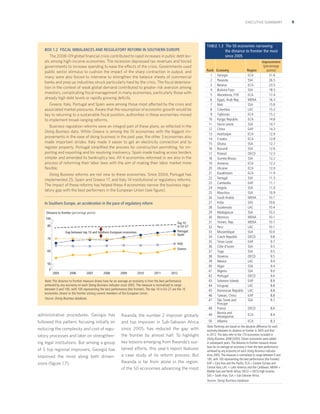
FIGURE 1.6 Globally, reform efforts have focused more on reducing the complexity and cost
of regulatory processes than on strengthening legal institutions
Average distance to frontier (percentage points)
100
80
Strength of legal institutions

70
60
50
40

Complexity and cost of regulatory processes

30

0
Dealing Starting a Registering
with
business property
construction
permits

Paying
taxes

Trading
across
borders

Enforcing Protecting Getting Resolving
contracts investors
credit insolvency

2012
2005
Note: Figure illustrates the extent to which average regulatory practice across economies has moved closer to the most
efficient practice in each area measured by Doing Business. The distance to frontier measure shows how far on average an
economy is from the best performance achieved by any economy on each Doing Business indicator since 2005. The measure is
normalized to range between 0 and 100, with 100 representing the best performance (the frontier). The data refer to the 174
economies included in Doing Business 2006 (2005). Eleven economies were added in subsequent years.
Source: Doing Business database.

Improvements happened across all regulatory areas measured by Doing Business
between 2005 and 2012. But governments were more likely to focus their
reform efforts on reducing the complexity and cost of regulatory processes—the
focus of 1,227 reforms recorded by Doing
Business since 2005—than on strengthening legal institutions—the focus of
close to 600 (figure 1.6).
Improving business regulation is a challenging task, and doing it consistently
over time even more so. Yet some economies have achieved considerable success
since 2005 in doing just that (table 1.3). A
few of these economies stand out within
their region: Georgia, Rwanda, Colombia,
China and Poland.
Georgia is the top improver since 2005
both in Eastern Europe and Central Asia
and globally. With 35 institutional and
regulatory reforms since 2005, Georgia
has improved in all areas measured by
Doing Business. In the past year alone it
improved in 6 areas. As just one example,
Georgia made trading across borders
easier by introducing customs clearance
zones in such cities as Tbilisi and Poti.
These one-stop shops for trade clearance
processes are open all day every day,
allowing traders to submit customs documents and complete other formalities in
a single place. Georgia also strengthened
its secured transactions system. A new
amendment to its civil code allows a security interest to extend to the products,
proceeds and replacements of an asset
used as collateral.
Georgia has also distinguished itself by
following a relatively balanced regulatory
reform path. Many economies aiming to
improve their regulatory environment
start by reducing the complexity and cost
of regulatory processes (in such areas as
starting a business). Later they may move
on to reforms strengthening legal institutions relevant to business regulation
(in such areas as getting credit). These
tend to be a bigger challenge, sometimes
requiring amendments to key pieces of
legislation rather than simply changes in
EXECUTIVE SUMMARY

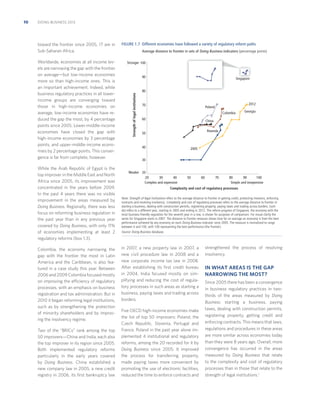
BOX 1.2 FISCAL IMBALANCES AND REGULATORY REFORM IN SOUTHERN EUROPE
The 2008–09 global financial crisis contributed to rapid increases in public debt levels among high-income economies. The recession depressed tax revenues and forced
governments to increase spending to ease the effects of the crisis. Governments used
public sector stimulus to cushion the impact of the sharp contraction in output, and
many were also forced to intervene to strengthen the balance sheets of commercial
banks and prop up industries struck particularly hard by the crisis. The fiscal deterioration in the context of weak global demand contributed to greater risk aversion among
investors, complicating fiscal management in many economies, particularly those with
already high debt levels or rapidly growing deficits.
Greece, Italy, Portugal and Spain were among those most affected by the crisis and
associated market pressures. Aware that the resumption of economic growth would be
key to returning to a sustainable fiscal position, authorities in these economies moved
to implement broad-ranging reforms.
Business regulation reforms were an integral part of these plans, as reflected in the
Doing Business data. While Greece is among the 10 economies with the biggest improvements in the ease of doing business in the past year, the other 3 economies also
made important strides. Italy made it easier to get an electricity connection and to
register property. Portugal simplified the process for construction permitting, for importing and exporting and for resolving insolvency. Spain made trading across borders
simpler and amended its bankruptcy law. All 4 economies reformed or are also in the
process of reforming their labor laws with the aim of making their labor market more
flexible.
Doing Business reforms are not new to these economies. Since 2004, Portugal has
implemented 25, Spain and Greece 17, and Italy 14 institutional or regulatory reforms.
The impact of these reforms has helped these 4 economies narrow the business regulatory gap with the best performers in the European Union (see figure).
In Southern Europe, an acceleration in the pace of regulatory reform
Distance to frontier (percentage points)
100
Top 10
in EU-27
Portugal
Spain

80
Gap between top 10 and Southern European economies
70

Italy
Greece

60

50
0
2005

2006

2007

2008

2009

2010

2011

2012

Note: The distance to frontier measure shows how far on average an economy is from the best performance
achieved by any economy on each Doing Business indicator since 2005. The measure is normalized to range
between 0 and 100, with 100 representing the best performance (the frontier). The top 10 in EU-27 are the 10
economies closest to the frontier among current members of the European Union.
Source: Doing Business database.

TABLE 1.3 The 50 economies narrowing
the distance to frontier the most
since 2005

Rank
1
2
3
4
5
6
7
8
9
10
11
12
13
14
15
16
17
18
19
20
21
22
23
24
25
26
27
28
29
30
31
32
33
34
35
36
37
38
39
40
41
42
43
44
45
46
47
48

administrative procedures. Georgia has
followed this pattern, focusing initially on
reducing the complexity and cost of regulatory processes and later on strengthening legal institutions. But among a group
of 5 top regional improvers, Georgia has
improved the most along both dimensions (figure 1.7).

Rwanda, the number 2 improver globally
and top improver in Sub-Saharan Africa
since 2005, has reduced the gap with
the frontier by almost half. To highlight
key lessons emerging from Rwanda’s sustained efforts, this year’s report features
a case study of its reform process. But
Rwanda is far from alone in the region:
of the 50 economies advancing the most

49
50

Economy
Region
Georgia
ECA
Rwanda
SSA
Belarus
ECA
Burkina Faso
SSA
Macedonia, FYR
ECA
Egypt, Arab Rep.
MENA
Mali
SSA
Colombia
LAC
Tajikistan
ECA
Kyrgyz Republic
ECA
Sierra Leone
SSA
China
EAP
Azerbaijan
ECA
Croatia
ECA
Ghana
SSA
Burundi
SSA
Poland
OECD
Guinea-Bissau
SSA
Armenia
ECA
Ukraine
ECA
Kazakhstan
ECA
Senegal
SSA
Cambodia
EAP
Angola
SSA
Mauritius
SSA
Saudi Arabia
MENA
India
SAS
Guatemala
LAC
Madagascar
SSA
Morocco
MENA
Yemen, Rep.
MENA
Peru
LAC
Mozambique
SSA
Czech Republic
OECD
Timor-Leste
EAP
Côte d’Ivoire
SSA
Togo
SSA
Slovenia
OECD
Mexico
LAC
Niger
SSA
Nigeria
SSA
Portugal
OECD
Solomon Islands
EAP
Uruguay
LAC
Dominican Republic LAC
Taiwan, China
EAP
São Tomé and
SSA
Príncipe
France
OECD
Bosnia and
ECA
Herzegovina
Albania
ECA

Improvement
(percentage
points)
31.6
26.5
23.5
18.5
17.4
16.3
15.8
15.3
15.2
14.8
14.7
14.3
12.9
12.8
12.7
12.6
12.3
12.2
12.2
12.0
11.9
11.5
11.1
11.0
10.9
10.7
10.6
10.4
10.3
10.1
10.1
10.1
10.0
9.8
9.7
9.5
9.5
9.5
9.4
9.4
9.0
9.0
8.9
8.8
8.8
8.8
8.7
8.6
8.4
8.3

Note: Rankings are based on the absolute difference for each
economy between its distance to frontier in 2005 and that
in 2012. The data refer to the 174 economies included in
Doing Business 2006 (2005). Eleven economies were added
in subsequent years. The distance to frontier measure shows
how far on average an economy is from the best performance
achieved by any economy on each Doing Business indicator
since 2005. The measure is normalized to range between 0 and
100, with 100 representing the best performance (the frontier).
EAP = East Asia and the Pacific; ECA = Eastern Europe and
Central Asia; LAC = Latin America and the Caribbean; MENA =
Middle East and North Africa; OECD = OECD high income;
SAS = South Asia; SSA = Sub-Saharan Africa.
Source: Doing Business database.

9
DOING BUSINESS 2013

toward the frontier since 2005, 17 are in
Sub-Saharan Africa.
Worldwide, economies at all income levels are narrowing the gap with the frontier
on average—but low-income economies
more so than high-income ones. This is
an important achievement. Indeed, while
business regulatory practices in all lowerincome groups are converging toward
those in high-income economies on
average, low-income economies have reduced the gap the most, by 4 percentage
points since 2005. Lower-middle-income
economies have closed the gap with
high-income economies by 3 percentage
points, and upper-middle-income economies by 2 percentage points. This convergence is far from complete, however.
While the Arab Republic of Egypt is the
top improver in the Middle East and North
Africa since 2005, its improvement was
concentrated in the years before 2009.
In the past 4 years there was no visible
improvement in the areas measured by
Doing Business. Regionally, there was less
focus on reforming business regulation in
the past year than in any previous year
covered by Doing Business, with only 11%
of economies implementing at least 2
regulatory reforms (box 1.3).
Colombia, the economy narrowing the
gap with the frontier the most in Latin
America and the Caribbean, is also featured in a case study this year. Between
2006 and 2009 Colombia focused mostly
on improving the efficiency of regulatory
processes, with an emphasis on business
registration and tax administration. But in
2010 it began reforming legal institutions,
such as by strengthening the protection
of minority shareholders and by improving the insolvency regime.
Two of the “BRICs” rank among the top
50 improvers—China and India, each also
the top improver in its region since 2005.
Both implemented regulatory reforms
particularly in the early years covered
by Doing Business. China established a
new company law in 2005, a new credit
registry in 2006, its first bankruptcy law

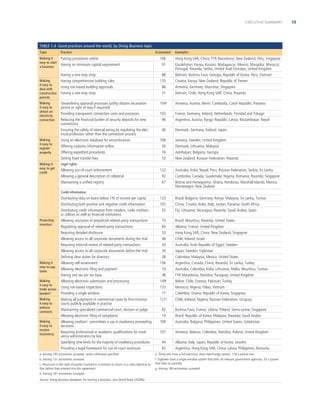
FIGURE 1.7 Different economies have followed a variety of regulatory reform paths
Average distance to frontier in sets of Doing Business indicators (percentage points)
Stronger 100

90

Strength of legal institutions

10

Singapore

80

70

2012

Poland
Colombia

60

Georgia

China
Rwanda

50

40

2005

30
Weaker 20
20
30
40
Complex and expensive

50

60

70

80
90
100
Simple and inexpensive

Complexity and cost of regulatory processes
Note: Strength of legal institutions refers to the average distance to frontier in getting credit, protecting investors, enforcing
contracts and resolving insolvency. Complexity and cost of regulatory processes refers to the average distance to frontier in
starting a business, dealing with construction permits, registering property, paying taxes and trading across borders. Each
dot refers to a different year, starting in 2005 and ending in 2012. The reform progress of Singapore, the economy with the
most business-friendly regulation for the seventh year in a row, is shown for purposes of comparison. For visual clarity the
series for Singapore starts in 2007. The distance to frontier measure shows how far on average an economy is from the best
performance achieved by any economy on each Doing Business indicator since 2005. The measure is normalized to range
between 0 and 100, with 100 representing the best performance (the frontier).
Source: Doing Business database.

in 2007, a new property law in 2007, a
new civil procedure law in 2008 and a
new corporate income tax law in 2008.
After establishing its first credit bureau
in 2004, India focused mostly on simplifying and reducing the cost of regulatory processes in such areas as starting a
business, paying taxes and trading across
borders.
Five OECD high-income economies make
the list of top 50 improvers: Poland, the
Czech Republic, Slovenia, Portugal and
France. Poland in the past year alone implemented 4 institutional and regulatory
reforms, among the 20 recorded for it by
Doing Business since 2005. It improved
the process for transferring property,
made paying taxes more convenient by
promoting the use of electronic facilities,
reduced the time to enforce contracts and

strengthened the process of resolving
insolvency.

IN WHAT AREAS IS THE GAP
NARROWING THE MOST?
Since 2005 there has been a convergence
in business regulatory practices in twothirds of the areas measured by Doing
Business: starting a business, paying
taxes, dealing with construction permits,
registering property, getting credit and
enforcing contracts. This means that laws,
regulations and procedures in these areas
are more similar across economies today
than they were 8 years ago. Overall, more
convergence has occurred in the areas
measured by Doing Business that relate
to the complexity and cost of regulatory
processes than in those that relate to the
strength of legal institutions.1
EXECUTIVE SUMMARY

The greatest convergence in regulatory
practice has occurred in business startup. Among the 174 economies covered
by Doing Business since 2005, the time
to start a business in that year averaged
112 days in the worst quartile of the
economies as ranked by performance
on this indicator, while it averaged 29
days for the rest (figure 1.8). Since then,
thanks to 368 reforms in 149 economies,
the average time for the worst quartile
has fallen to 63 days, getting closer to the
average of 18 for the rest. Similar but less
strong patterns are observed for indicators
of time, procedures and cost for paying
taxes, dealing with construction permits
and registering property.

remain constant over time when doing
analysis across economies—something
not possible in the earlier cross-country
analyses. Based on a 5-year panel of
economies, one such study finds that in
low-income economies that implemented
reforms making it easier to do business,
the growth rate increased by 0.4 percentage point in the following year.2 Emerging
evidence from analysis based on 8 years
of Doing Business data and building on the
earlier studies shows that improvements
in business entry and other aspects of
business regulation matter for aggregate
growth as well. Credibly pinning down the
magnitude of this effect is more difficult,
however.3

FIGURE 1.8 Strong convergence across
economies since 2005
Averages by quartile
Time to start a business (days)
120
100
80
60
40
Best 3 quartiles
20
0
2005 2006 2007 2008 2009 2010 2011 2012
Time to deal with construction permits (days)
450
400
350

But in 3 areas the trend runs weakly in
the other direction. In protecting investors, trading across borders and resolving
insolvency the realities in different economies have slowly drifted apart rather than
converged. This does not mean that in
these 3 areas the average regulatory environment is worse today than in 2005;
it is actually better (see figure 1.6). But it
does mean that economies that were in
the best 3 quartiles of the distribution in
these 3 areas in 2005 have strengthened
practices and institutions somewhat
faster than those in the worst quartile.

WHAT IS THE IMPACT ON
ECONOMIC OUTCOMES?
Beyond what Doing Business measures,
have the business regulation reforms undertaken by governments since 2005 had
an impact? In presenting analysis of this
question, earlier editions of Doing Business
focused on cross-country analyses linking
business regulation to economic variables
such as corruption or rates of informality
in the economy.
With more years of data now available,
previous research on the impact of
reforms in the areas measured by Doing
Business can be extended over time and
linked to more economic outcomes.
Using several years of data for the same
economy makes it possible to take into
account country characteristics that

Research on the effect of regulatory
reforms is advancing especially rapidly
around the question of business start-up.
A growing body of research has shown
that simpler entry regulations encourage
the creation of more new firms and new
jobs in the formal sector. Economies at
varying income levels and in different
regions saw noticeable increases in the
number of new firm registrations after
implementing such reforms (figure 1.9).
Within-country studies have confirmed
the positive association between improvements in business registration and
registration of new firms in such countries
as Colombia, India, Mexico and Portugal.
These studies have found increases of
5–17% in the number of newly registered
businesses after reforms of the business
registration process (for more discussion,
see the chapter “About Doing Business”).
Better business regulation as measured
by Doing Business is also associated
with greater new business registration.
Ongoing research by Doing Business using 8 years of data shows that reducing
the distance to frontier by 10 percentage
points is associated with an increase of 1
newly registered business for every 1,000
working-age people, a meaningful result
given the world average of 3.2 newly
registered businesses for every 1,000
working-age people per year.4

Worst
quartile

300

Worst
quartile

250
200

Best 3 quartiles

150
100
50
0
2005 2006 2007 2008 2009 2010 2011 2012
Time to pay taxes (hours per year)
800
700
600
500

Worst
quartile

400
300

Best 3 quartiles

200
100
0
2005 2006 2007 2008 2009 2010 2011 2012
Time to register property (days)
250
200
150

Worst
quartile

100
50

Best 3 quartiles

0
2005 2006 2007 2008 2009 2010 2011 2012
Note: Economies are ranked in quartiles by performance
in 2005 on the indicator shown. The data refer to the 174
economies included in Doing Business 2006 (2005). Eleven
economies were added in subsequent years.
Source: Doing Business database.

11
DOING BUSINESS 2013

BOX 1.3 BUSINESS REGULATION IN THE MIDDLE EAST AND NORTH AFRICA—THE CHALLENGES AHEAD
Earlier editions of the Doing Business rank corruption, anticompetitive practices complexity and cost of regulatory processreport highlighted substantial efforts by and regulatory policy uncertainty high on es, entrepreneurs across the region still congovernments in the Middle East and North their list of concerns. At the same time 60% tend with weak investor and property rights
Africa to improve business regulation for of public officials interviewed across the protections (see figure). With an average
local entrepreneurs. But the reform mo- region perceive the private sector as rent ease of doing business ranking of 98, the rementum has slowed since the beginning of seeking and corrupt. And banks cite lack of gion still has much room for making the life
the Arab Spring in January 2011, as some corporate transparency as among the main of local businesses easier through clearer
countries have entered a complex process obstacles to extending more finance to and more transparent rules applied more
of transition to more democratic forms of small and medium-size enterprises.2
consistently. Such rules would facilitate
governance. The post–Arab Spring governSome governments in the region have rather than impede private sector activity
ments have had a broad range of economic, tried to aggressively reform the business in economies where the state has traditionsocial and political issues to address, and environment in the past, but have seen the ally had an outsized presence in the national
this in turn has resulted in a slower overall impact of their efforts lessened by a lack of economy and in a region where the need to
reform process, as new governments have sustained commitment to in-depth changes encourage entrepreneurship is thus perhaps
struggled to adjust to important shifts in the and the related risk of upsetting the estab- more intense than in any other.
political and economic landscape.
lished order. A common view is that only
All these challenges notwithstanding,
The region faces structural challenges connected entrepreneurs are successful, the recent political changes in the region—
that can impede private sector activity. A suggesting a dual set of rules with prefer- fast, hectic, unpredictable, far-reaching in
history of government intervention has ential treatment for those close to the ruling their effects—provide a unique opportunity
created more opportunities for rent seek- elites. This suggests a need for governments for governments to substantively address
ing than for entrepreneurship. Firm surveys to invest in governance structures and in- many of the impediments to private sector
show that manufacturing firms as well as crease transparency in parallel with efforts development that have plagued the region
their managers are older on average than to improve the business regulatory environ- in recent decades. Moving to a system of
those in other regions, indicating weaker ment. The case study on transparency in more transparent and sensible rules—rules
entry and exit mechanisms. Firm entry den- this year’s report points to one area where that are better able to respond to the needs
sity in the Middle East and North Africa is they could start: the Middle East and North of the business community and that provide
among the lowest in the world.1
Africa is one of the regions with the most incentives to narrow the gap between the
Moreover, the region suffers from a crisis constrained access to basic regulatory infor- law as written and the law as practiced—
will go a long way toward creating the conof governance and trust: businesses do not mation such as fee schedules.
Although economies in the region ditions for more equitable economic growth
trust officials, and officials do not trust businesses. Business managers in the region have made some strides in reducing the and a faster pace of job creation.
Entrepreneurs across the Middle East and North Africa face relatively weak investor and property rights protections
Average ranking on sets of Doing Business indicators by economy and global income group
Stronger

Strength of legal institutions

12

Weaker

Stronger legal institutions but
more complex and expensive
regulatory processes

High
income
Size of bubble reflects
average population size

Size of bubble reflects
population size

Algeria

Saudi
Arabia

Upper middle
income

Lower middle
income

Iran,
Islamic Rep.

Stronger legal institutions and
simpler and less expensive
regulatory processes

Tunisia
Kuwait

Qatar
Oman

Bahrain

Morocco
Egypt,
Arab Rep.

Low
income

Weaker legal institutions and Djibouti
more complex and expensive
regulatory processes

Complex and
expensive

West Bank
and Gaza

United Arab
Emirates

Lebanon
Yemen, Rep.

Syrian Arab Republic
Iraq
Complexity and cost
of regulatory processes

Jordan
Weaker legal institutions but
simpler and less expensive
regulatory processes

Simple and
inexpensive

Note: Strength of legal institutions refers to the average ranking on getting credit, protecting investors, enforcing contracts and resolving insolvency. Complexity and cost of regulatory
processes refers to the average ranking on starting a business, dealing with construction permits, getting electricity, registering property, paying taxes and trading across borders. The
global income groups exclude economies in the Middle East and North Africa.
Source: Doing Business database.

1. World Bank, From Privilege to Competition: Unlocking Private-Led Growth in the Middle East and North Africa (Washington, DC: World Bank, 2009). Firm entry
density is defined as the number of newly registered limited liability companies per 1,000 working-age people (ages 15–64).
2. Roberto Rocha, Subika Farazi, Rania Khouri and Douglas Pearce, “The Status of Bank Lending to SMEs in the Middle East and North Africa Region: The
Results of a Joint Survey of the Union of Arab Banks and the World Bank” (World Bank, Washington, DC; and Union of Arab Banks, Beirut, 2010).
EXECUTIVE SUMMARY

TABLE 1.4 Good practices around the world, by Doing Business topic
Economiesa

Topic

Practice

Making it
easy to start
a business

Putting procedures online
Having no minimum capital requirement

106
91

Having a one-stop shop
Having comprehensive building rules
Using risk-based building approvals
Having a one-stop shop

88
135
86
31

Hong Kong SAR, China; FYR Macedonia; New Zealand; Peru; Singapore
Kazakhstan; Kenya; Kosovo; Madagascar; Mexico; Mongolia; Morocco;
Portugal; Rwanda; Serbia; United Arab Emirates; United Kingdom
Bahrain; Burkina Faso; Georgia; Republic of Korea; Peru; Vietnam
Croatia; Kenya; New Zealand; Republic of Yemen
Armenia; Germany; Mauritius; Singapore
Bahrain; Chile; Hong Kong SAR, China; Rwanda

Streamlining approval processes (utility obtains excavation
permit or right of way if required)
Providing transparent connection costs and processes
Reducing the financial burden of security deposits for new
connections
Ensuring the safety of internal wiring by regulating the electrical profession rather than the connection process
Using an electronic database for encumbrances
Offering cadastre information online
Offering expedited procedures
Setting fixed transfer fees

104b

Armenia; Austria; Benin; Cambodia; Czech Republic; Panama

103
96

France; Germany; Ireland; Netherlands; Trinidad and Tobago
Argentina; Austria; Kyrgyz Republic; Latvia; Mozambique; Nepal

Making
it easy to
deal with
construction
permits
Making
it easy to
obtain an
electricity
connection

Making
it easy to
register
property
Making it
easy to get
credit

40

Examples

Denmark; Germany; Iceland; Japan

108
50
16
10

Jamaica; Sweden; United Kingdom
Denmark; Lithuania; Malaysia
Azerbaijan; Bulgaria; Georgia
New Zealand; Russian Federation; Rwanda

122
92
67

Australia; India; Nepal; Peru; Russian Federation; Serbia; Sri Lanka
Cambodia; Canada; Guatemala; Nigeria; Romania; Rwanda; Singapore
Bosnia and Herzegovina; Ghana; Honduras; Marshall Islands; Mexico;
Montenegro; New Zealand

Distributing data on loans below 1% of income per capita
Distributing both positive and negative credit information
Distributing credit information from retailers, trade creditors
or utilities as well as financial institutions
Allowing rescission of prejudicial related-party transactionsc

123
105
55

Brazil; Bulgaria; Germany; Kenya; Malaysia; Sri Lanka; Tunisia
China; Croatia; India; Italy; Jordan; Panama; South Africa
Fiji; Lithuania; Nicaragua; Rwanda; Saudi Arabia; Spain

Regulating approval of related-party transactions
Requiring detailed disclosure
Allowing access to all corporate documents during the trial
Requiring external review of related-party transactions
Allowing access to all corporate documents before the trial
Defining clear duties for directors
Allowing self-assessment
Allowing electronic filing and payment
Having one tax per tax base
Allowing electronic submission and processing
Using risk-based inspections
Providing a single window

60
53
46
43
30
28
156
74
48
149e
133
71f

Albania; France; United Kingdom
Hong Kong SAR, China; New Zealand; Singapore
Chile; Ireland; Israel
Australia; Arab Republic of Egypt; Sweden
Japan; Sweden; Tajikistan
Colombia; Malaysia; Mexico; United States
Argentina; Canada; China; Rwanda; Sri Lanka; Turkey
Australia; Colombia; India; Lithuania; Malta; Mauritius; Tunisia
FYR Macedonia; Namibia; Paraguay; United Kingdom
Belize; Chile; Estonia; Pakistan; Turkey
Morocco; Nigeria; Palau; Vietnam
Colombia; Ghana; Republic of Korea; Singapore

Making all judgments in commercial cases by first-instance
courts publicly available in practice
Maintaining specialized commercial court, division or judge
Allowing electronic filing of complaints
Allowing creditors’ committees a say in insolvency proceeding
decisions
Requiring professional or academic qualifications for insolvency administrators by law
Specifying time limits for the majority of insolvency procedures
Providing a legal framework for out-of-court workouts

121g

Chile; Iceland; Nigeria; Russian Federation; Uruguay

82
19
109

Burkina Faso; France; Liberia; Poland; Sierra Leone; Singapore
Brazil; Republic of Korea; Malaysia; Rwanda; Saudi Arabia
Australia; Bulgaria; Philippines; United States; Uzbekistan

107

Armenia; Belarus; Colombia; Namibia; Poland; United Kingdom

94
82

Albania; Italy; Japan; Republic of Korea; Lesotho
Argentina; Hong Kong SAR, China; Latvia; Philippines; Romania

Legal rights

Allowing out-of-court enforcement
Allowing a general description of collateral
Maintaining a unified registry
Credit information

Protecting
investors

Making it
easy to pay
taxes
Making
it easy to
trade across
bordersd
Making
it easy to
enforce
contracts
Making
it easy to
resolve
insolvency

73

Brazil; Mauritius; Rwanda; United States

a. Among 185 economies surveyed, unless otherwise specified.

e. Thirty-one have a full electronic data interchange system, 118 a partial one.

b. Among 151 economies surveyed.

f. Eighteen have a single-window system that links all relevant government agencies, 53 a system
that does so partially.

c. Rescission is the right of parties involved in a contract to return to a state identical to
that before they entered into the agreement.
d. Among 181 economies surveyed.

Source: Doing Business database; for starting a business, also World Bank (2009b).

g. Among 184 economies surveyed.

13
14

DOING BUSINESS 2013

FIGURE 1.9 More new firms are registered after reforms making it simpler to start a business

60
50

Chile
Sweden

40

30

Morocco
Kenya

20

Bangladesh

10

Rwanda
0

-3

-2

-1

0

Years before reform

1

2

3

Years after reform

Note: All 6 economies implemented a reform making it easier to start a business as measured by Doing Business. The reform
year varies by economy and is represented by the vertical line in the figure. For Bangladesh and Rwanda it is 2009; for Chile,
2011; for Kenya, 2007; for Morocco, 2006; and for Sweden, 2010.
Source: World Bank Group Entrepreneurship Snapshots, 2012 edition.

Yet another finding relates to the relationship between foreign direct investment
and business regulation. A case study in
this year’s report shows that although the
Doing Business indicators measure regulations applying to domestic firms, economies that do well in this area also provide
an attractive regulatory environment for
foreign firms. Again using multiple years
of data, the case study shows that economies that are closer to the frontier in
regulatory practice attract larger inflows
of foreign direct investment.

NOTES
1. To measure convergence, Doing Business

Number of newly registered firms (thousands)

(APEC), focusing on peer-to-peer learning. And for the first time the report presents thematic case studies, on foreign
direct investment and on transparency in
business regulation.
This year’s report also reintroduces the
topic chapters. But it presents them in a
different format, as shorter “topic notes”
that focus on the changes in the data
from the previous year and over all years
covered by Doing Business. The topic
notes also discuss the most prominent

WHAT’S NEW IN
THIS YEAR’S REPORT?

reforms from the past year. Full informa-

This year’s report, like last year’s, presents country case studies. These feature
Colombia, Latvia and Rwanda. In addition,
the report presents a regional case study
on Asia-Pacific Economic Cooperation

good practices and relevant research, is

tion for each topic, including examples of
available on the Doing Business website.5
The website also presents the full list of
good practices by topic summarized in
table 1.4.

calculated the change in the variance
of distance to frontier across 174
economies since 2005 for each topic.
The results suggest that the largest convergence has been in starting a business,
with the variance decreasing by 49%
since 2005. The topics with the next
largest convergence are paying taxes
(with a change in variance of −24%),
dealing with construction permits
(−23%), registering property (−19%),
getting credit (−12%) and enforcing
contracts (−4%). Several other topics
show a small divergence: trading across
borders (7%), protecting investors (2%)
and resolving insolvency (1%). The
overall change in the variance is −16%,
suggesting an overall convergence in all
Doing Business topics.
2. Eifert 2009.
3. The analysis, by Divanbeigi and Ramalho

(2012), finds that narrowing the distance
to frontier in the indicator sets measuring the complexity and cost of regulatory
processes by 10 percentage points is
associated with an increase of close to 1
percentage point in the GDP growth rate.
Since the distance to frontier improves
by 1 percentage point a year on average,
these simulations are based on expected
results for a 10-year period. Results are
based on Arellano-Bond dynamic panel
estimation to control for economic cycle
and time-invariant country-specific
factors. Following Eifert (2009) and
Djankov, McLeish and Ramalho (2006),
the analysis controls for government
consumption, institutional quality and
corruption perception. It also controls
for total trade openness and rents from
natural resources.
4. This research follows Klapper and

Love (2011a). The analysis controls for
government consumption, institutional
quality and corruption perception. It also
controls for total trade openness and
rents from natural resources.
5. http://www.doingbusiness.org.
15

About Doing Business:
measuring for impact
The private sector provides an estimated
90% of jobs in developing economies.1
Where government policies support a
dynamic business environment—with
firms making investments, creating jobs
and increasing productivity—all people
have greater opportunities. A growing
body of evidence suggests that policy
makers seeking to strengthen the private
sector need to pay attention not only to
macroeconomic factors but also to the
quality of laws, regulations and institutional arrangements that shape daily
economic life.2
This is the 10th Doing Business report.
When the first report was produced, in
2003, there were few globally available
and regularly updated indicators for
monitoring such microeconomic issues
as business regulations affecting local
firms. Earlier efforts from the 1980s drew
on perceptions data, but these expert
or business surveys focused on broad
aspects of the business environment
and often captured the experiences of
businesses. These surveys also lacked
the specificity and cross-country comparability that Doing Business provides—by
focusing on well-defined transactions,
laws and institutions rather than generic,
perceptions-based questions on the business environment.
Doing Business seeks to measure business
regulations for domestic firms through an
objective lens. The project looks primarily at small and medium-size companies
in the largest business city. Based on
standardized case studies, it presents
quantitative indicators on the regulations
that apply to firms at different stages
of their life cycle. The results for each

economy can be compared with those for
184 other economies and over time.
Over the years the choice of indicators for
Doing Business has been guided by a rich
pool of data collected through the World
Bank Enterprise Surveys. These data
highlight the main obstacles to business
activity as reported by entrepreneurs in
well over 100 economies. Among the
factors that the surveys have identified as
important to businesses have been taxes
(tax administration as well as tax rates)
and electricity—inspiring the design of
the paying taxes and getting electricity
indicators. In addition, the design of the
Doing Business indicators has drawn
on theoretical insights gleaned from
extensive research literature.3 The Doing
Business methodology makes it possible
to update the indicators in a relatively
inexpensive and replicable way.
The Doing Business methodology is also
responsive to the needs of policy makers.
Rules and regulations are under the direct
control of policy makers—and policy
makers intending to change the experience and behavior of businesses will
often start by changing rules and regulations that affect them. Doing Business
goes beyond identifying that a problem
exists and points to specific regulations
or regulatory procedures that may lend
themselves to regulatory reform. And
its quantitative measures of business
regulation enable research on how specific regulations affect firm behavior and
economic outcomes.
The first Doing Business report covered 5
topics and 133 economies. This year’s report covers 11 topics and 185 economies.
16

DOING BUSINESS 2013

Ten topics are included in the aggregate
ranking on the ease of doing business,
and 9 in the distance to frontier measure.4
The project has benefited from feedback
from governments, academics, practitioners and reviewers.5 The initial goal
remains: to provide an objective basis for
understanding and improving the regulatory environment for business.

WHAT DOING BUSINESS COVERS
Doing Business captures several important
dimensions of the regulatory environment as they apply to local firms. It
provides quantitative measures of regulations for starting a business, dealing with
construction permits, getting electricity,
registering property, getting credit, protecting investors, paying taxes, trading
across borders, enforcing contracts and
resolving insolvency. Doing Business also
looks at regulations on employing workers. Pending further progress on research
in this area, this year’s report does not
present rankings of economies on the
employing workers indicators or include
the topic in the aggregate ranking on the
ease of doing business. It does present the
data on the employing workers indicators.
Additional data on labor regulations collected in 185 economies are available on
the Doing Business website.6
The foundation of Doing Business is the
notion that economic activity, particularly
private sector development, benefits from
clear and coherent rules: Rules that set out
and clarify property rights and facilitate
the resolution of disputes. And rules that
enhance the predictability of economic
interactions and provide contractual partners with essential protections against
arbitrariness and abuse. Where such
rules are reasonably efficient in design,
are transparent and accessible to those
for whom they are intended and can be
implemented at a reasonable cost, they
are much more effective in shaping the
incentives of economic agents in ways
that promote growth and development.
The quality of the rules also has a crucial
bearing on how societies distribute the

benefits and bear the costs of development strategies and policies.
Consistent with the view that rules matter, some Doing Business indicators give
a higher score for more regulation and
better-functioning institutions (such as
courts or credit bureaus). In the area of
protecting investors, for example, higher
scores are given for stricter disclosure requirements for related-party transactions.
Higher scores are also given for a simplified way of applying regulation that keeps
compliance costs for firms low—such as
by allowing firms to comply with business
start-up formalities in a one-stop shop
or through a single online portal. Finally,
Doing Business scores reward economies
that apply a risk-based approach to
regulation as a way to address social
and environmental concerns—such as
by imposing a greater regulatory burden
on activities that pose a high risk to the
population and a lesser one on lower-risk
activities.
Thus the economies that rank highest on
the ease of doing business are not those
where there is no regulation—but those
where governments have managed to
create rules that facilitate interactions
in the marketplace without needlessly
hindering the development of the private
sector. In essence, Doing Business is about
smart business regulations, not necessarily fewer regulations (figure 2.1).
In constructing the indicators the Doing
Business project uses 2 types of data.
The first come from readings of laws and
regulations in each economy. The Doing
Business team, in collaboration with local
expert respondents, examines the company law to find the disclosure requirements for related-party transactions. It
reads the civil law to find the number of
procedures necessary to resolve a commercial sale dispute before local courts.
It reviews the labor code to find data on
a range of issues concerning employeremployee relations. And it plumbs other
legal instruments for other key pieces
of data used in the indicators, several
of which have a large legal dimension.

FIGURE 2.1 What are SMART business
regulations as defined
by Doing Business?

S
M
A
R
T

STREAMLINED—regulations
that accomplish the desired
outcome in the most efficient way

MEANINGFUL—regulations
that have a measurable positive
impact in facilitating
interactions in the marketplace

ADAPTABLE—regulations
that adapt to changes in the
environment

RELEVANT—regulations that are
proportionate to the problem they
are designed to solve

TRANSPARENT—regulations
that are clear and accessible to
anyone who needs to use them

Indeed, about three-quarters of the data
used in Doing Business are of this factual
type, reducing the need to have a larger
sample size of experts in order to improve
accuracy. The local expert respondents
play a vital role in corroborating the Doing
Business team’s understanding and interpretation of rules and laws.
Data of the second type serve as inputs
into indicators on the complexity and cost
of regulatory processes. These indicators
measure the efficiency in achieving a
regulatory goal, such as the number of
procedures to obtain a building permit
or the time taken to grant legal identity
to a business. In this group of indicators
cost estimates are recorded from official
fee schedules where applicable. Time
estimates often involve an element of
judgment by respondents who routinely
administer the relevant regulations or
undertake the relevant transactions.7
These experts have several rounds of
interaction with the Doing Business team,
involving conference calls, written correspondence and visits by the team until
ABOUT DOING BUSINESS: MEASURING FOR IMPACT

there is convergence on the final answer.
To construct the time indicators, a regulatory process such as starting a business
is broken down into clearly defined steps
and procedures (for more details, see
the discussion on methodology in this
chapter). Here Doing Business builds on
Hernando de Soto’s pioneering work in
applying the time-and-motion approach
in the 1980s to show the obstacles to setting up a garment factory on the outskirts
of Lima.8

TABLE 2.1 Doing Business—benchmarking 11 areas of business regulation
Complexity and cost of regulatory processes
Starting a business

Procedures, time, cost and paid-in minimum capital requirement

Dealing with construction permits

Procedures, time and cost

Getting electricity

Procedures, time and cost

Registering property

Procedures, time and cost

Paying taxes

Payments, time and total tax rate

Trading across borders

Documents, time and cost

Strength of legal institutions

The Doing Business data have key limitations that should be kept in mind by those
who use them.

Limited in scope
The Doing Business indicators are limited
in scope. In particular:
• Doing Business does not measure the
full range of factors, policies and institutions that affect the quality of the
business environment in an economy
or its national competitiveness. It does
not, for example, capture aspects of
security, the prevalence of bribery
and corruption, market size, macroeconomic stability (including whether
the government manages its public finances in a sustainable way), the state
of the financial system or the level of
training and skills of the labor force.
• Even within the relatively small set of
indicators included in Doing Business,
the focus is deliberately narrow. The
getting electricity indicators, for example, capture the procedures, time
and cost involved for a business to obtain a permanent electricity connection
to supply a standardized warehouse.
Through these indicators Doing
Business thus provides a narrow perspective on the range of infrastructure
challenges that firms face, particularly
in the developing world. It does not address the extent to which inadequate
roads, rail, ports and communications
may add to firms’ costs and undermine
competitiveness. Doing Business covers 11 areas of a company’s life cycle,

Movable collateral laws and credit information systems

Protecting investors

Disclosure and liability in related-party transactions

Enforcing contracts

Procedures, time and cost to resolve a commercial dispute

Resolving insolvency

WHAT DOING BUSINESS
DOES NOT COVER

Getting credit

Time, cost, outcome and recovery rate

Employing workersa

Flexibility in the regulation of employment

a. The employing workers indicators are not included in this year’s ranking on the ease of doing business nor in the
calculation of any data on the strength of legal institutions included in figures in the report.

through 11 specific sets of indicators
(table 2.1). Similar to the indicators
on getting electricity, those on starting a business or protecting investors
do not cover all aspects of commercial
legislation. And those on employing
workers do not cover all areas of labor
regulation; for example, they do not
measure regulations addressing health
and safety issues at work or the right of
collective bargaining.

One such assumption is the location of a
notional business in the largest business
city of the economy. The reality is that
business regulations and their enforcement very often differ within a country,
particularly in federal states and large
economies. But gathering data for every
relevant jurisdiction in each of the 185
economies covered by Doing Business
would be far too costly.

• Doing Business does not attempt to
measure all costs and benefits of a
particular law or regulation to society
as a whole. The paying taxes indicators,
for example, measure the total tax rate,
which in isolation is a cost to the business. The indicators do not measure,
nor are they intended to measure, the
benefits of the social and economic
programs funded through tax revenues. Measuring business laws and
regulations provides one input into
the debate on the regulatory burden
associated with achieving regulatory
objectives. Those objectives can differ
across economies.

Limited to standardized
case scenarios

Doing Business recognizes the limitations
of the standardized case scenarios and
assumptions. But while such assumptions come at the expense of generality,
they also help ensure the comparability
of data. For this reason it is common to
see limiting assumptions of this kind in
economic indicators. Inflation statistics,
for example, are often based on prices of
a set of consumer goods in a few urban
areas, since collecting nationally representative price data at high frequencies
may be prohibitively costly in many countries. To capture regional variation in the
business environment within economies,
Doing Business has complemented its
global indicators with subnational studies
in some economies where resources and
interest have come together (box 2.1).

A key consideration for the Doing Business
indicators is that they should ensure
comparability of the data across a global
set of economies. The indicators are
therefore developed around standardized
case scenarios with specific assumptions.

Some Doing Business topics include complex and highly differentiated areas. Here
the standardized cases and assumptions
are carefully considered and defined. For
example, the standardized case scenario

17
18

DOING BUSINESS 2013

usually involves a limited liability company

investors are encouraged to venture into

or its legal equivalent. The considerations

business when potential losses are lim-

in defining this assumption are twofold.

ited to their capital participation.

First, private limited liability companies
are, empirically, the most prevalent busi-

Limited to the formal sector

ness form in many economies around

The Doing Business indicators assume

the world. Second, this choice reflects

that entrepreneurs have knowledge of

the focus of Doing Business on expand-

and comply with applicable regulations.

ing opportunities for entrepreneurship:

In practice, entrepreneurs may not know

BOX 2.1 COMPARING REGULATIONS AT THE LOCAL LEVEL: SUBNATIONAL DOING
BUSINESS REPORTS
Subnational Doing Business reports expand the indicators beyond the largest business city in an economy. They capture local differences in regulations or in the implementation of national regulations across cities within an economy (as in Colombia)
or region (as in South East Europe). Projects are undertaken at the request of central
governments, which often contribute financing, as in Mexico. In some cases local governments also provide funding, as in the Russian Federation.
Subnational indicators provide governments with standard measures, based on laws
and regulations, that allow objective comparisons both domestically and internationally. As a diagnostic tool, they identify bottlenecks as well as highlight good practices
that are easily replicable in other cities sharing a similar legal framework.
Governments take ownership of a subnational project by participating in all steps of
its design and implementation—choosing the cities to be benchmarked, the indicators
that can capture local differences and the frequency of benchmarking. All levels of
government are involved—national, regional and municipal.
Subnational projects create a space for discussing regulatory reform and provide
opportunities for governments and agencies to learn from one another, through the
report and through peer-to-peer learning workshops. Even after the report is launched,
knowledge sharing continues. In Mexico 28 of 32 states hold regular exchanges.
Repeated benchmarking creates healthy competition between cities to improve
their regulatory environment. The dissemination of the results reinforces this process and gives cities an opportunity to tell their stories. Fifteen economies have
requested 2 or more rounds of benchmarking since 2005 (including Colombia,
Indonesia and Nigeria), and many have expanded the geographic coverage to
more cities (including Russia). In Mexico each successive round has captured an
increase in the number of states improving their regulatory environment in each of
the 4 indicator sets included—reaching 100% of states in 2011.
Since 2005 subnational reports have covered 335 cities in 54 economies, including Brazil,
China, the Arab Republic of Egypt, India, Kenya, Morocco, Pakistan and the Philippines.1
This year studies were updated in Indonesia, Kenya, Mexico, Russia and the United
Arab Emirates. Studies are ongoing in Hargeisa (Somaliland) as well as in 23 cities and
4 ports in Colombia, 15 cities and 3 ports in Egypt and 13 cities and 7 ports in Italy. In
addition, 3 regional reports were published:

• Doing Business in OHADA, comparing business regulations in the 16 member states
of the Organization for the Harmonization of Business Law in Africa (Benin, Burkina
Faso, Cameroon, the Central African Republic, Chad, the Comoros, the Republic of
Congo, Côte d’Ivoire, Equatorial Guinea, Gabon, Guinea, Guinea-Bissau, Mali, Niger,
Senegal and Togo).

• Doing Business in the East African Community, covering 5 economies (Burundi, Kenya,
Rwanda, Tanzania and Uganda).

• Doing Business in the Arab World, covering 20 economies (Algeria, Bahrain, the
Comoros, Djibouti, Egypt, Iraq, Jordan, Kuwait, Lebanon, Mauritania, Morocco,
Oman, Qatar, Saudi Arabia, Sudan, the Syrian Arab Republic, Tunisia, the United
Arab Emirates, West Bank and Gaza, and the Republic of Yemen).
1. Subnational reports are available on the Doing Business website at http://www.doingbusiness.org/
subnational.

what needs to be done or how to comply
and may lose considerable time in trying
to find out. Or they may deliberately avoid
compliance altogether—by not registering for social security, for example. Where
regulation is particularly onerous, levels of
informality tend to be higher (figure 2.2).
Informality comes at a cost. Compared
with their formal sector counterparts,
firms in the informal sector typically grow
more slowly, have poorer access to credit
and employ fewer workers—and these
workers remain outside the protections of
labor law.9 All this may be even more so
for female-owned businesses, according
to country-specific research.10 Firms in
the informal sector are also less likely to
pay taxes.
Doing Business measures one set of factors
that help explain the occurrence of informality and give policy makers insights
into potential areas of reform. Gaining
a fuller understanding of the broader
business environment, and a broader
perspective on policy challenges, requires
combining insights from Doing Business
with data from other sources, such as the
World Bank Enterprise Surveys.11

WHY THIS FOCUS?
Why does Doing Business focus on the
regulatory environment for small and medium-size enterprises? These enterprises
are key drivers of competition, growth and
job creation, particularly in developing
economies. But in these economies up to
65% of economic activity takes place in
the informal sector, often because of excessive bureaucracy and regulation—and
in the informal sector firms lack access
to the opportunities and protections that
the law provides. Even firms operating in
the formal sector might not have equal
access to these opportunities and protections. Where regulation is burdensome
and competition limited, success tends to
depend on whom one knows. But where
regulation is transparent, efficient and
implemented in a simple way, it becomes
easier for aspiring entrepreneurs to compete, innovate and grow.
ABOUT DOING BUSINESS: MEASURING FOR IMPACT

FIGURE 2.2 Higher levels of informality are associated with lower Doing Business rankings
Informal sector
as % of GDP, 2007
70
60
50
40
30
20
10
0

0

20

40

60

80

100

120

140

160

180

DB2013 ranking on the ease of doing business
Note: The correlation between the 2 variables is 0.57. Relationships are significant at the 5% level after controlling for income
per capita. The data sample includes 143 economies.
Source: Doing Business database; Schneider, Buehn and Montenegro 2010.

Do the focus areas of Doing Business matter for development and poverty reduction? The World Bank study Voices of the
Poor asked 60,000 poor people around
the world how they thought they might
escape poverty.12 The answers were unequivocal: women and men alike pin their
hopes, above all, on income from their
own business or wages earned in employment. Enabling growth—and ensuring
that all people, regardless of income level,
can participate in its benefits—requires
an environment where new entrants with
drive and good ideas can get started in
business and where good firms can invest
and grow, thereby generating more jobs.
In this sense Doing Business values good
rules as a key to social inclusion.
In effect, Doing Business functions as a
barometer of the regulatory environment
for domestic businesses. To use a medical analogy, Doing Business is similar to a
cholesterol test. A cholesterol test does
not tell us everything about our health.
But our cholesterol level is easier to measure than our overall health, and the test
provides us with important information,
warning us when we need to adjust our
behavior. Similarly, Doing Business does
not tell us everything we need to know
about the regulatory environment for
domestic businesses. But its indicators

cover aspects that are more easily measured than the entire regulatory environment, and they provide important information about where change is needed.
What type of change or regulatory reform
is right, however, can vary substantially
across economies.
To test whether Doing Business serves
as a proxy for the broader business
environment and for competitiveness,
one approach is to look at correlations
between the Doing Business rankings and

other major economic benchmarks. The
indicator set closest to Doing Business in
what it measures is the set of indicators
on product market regulation compiled
by the Organisation for Economic Cooperation and Development (OECD).
These are designed to help assess the
extent to which the regulatory environment promotes or inhibits competition.
They include measures of the extent of
price controls, the licensing and permit
system, the degree of simplification of
rules and procedures, the administrative
burdens and legal and regulatory barriers, the prevalence of discriminatory
procedures and the degree of government
control over business enterprises.13 These
indicators—for the 39 countries that are
covered, several of them large emerging
markets—are correlated with the Doing
Business rankings (the correlation here is
0.53) (figure 2.3).
There is a high correlation (0.83) between the Doing Business rankings and the
rankings on the World Economic Forum’s
Global Competitiveness Index, a much
broader measure capturing such factors
as macroeconomic stability, aspects of
human capital, the soundness of public
institutions and the sophistication of
the business community (figure 2.4).14
Self-reported experiences with business
regulations, such as those captured by the

FIGURE 2.3 A significant correlation between Doing Business rankings and OECD rankings on
product market regulation
2008 ranking on OECD product
market regulation indicators
40

30

20

10

0
0

20

40

60

80

100

120

DB2013 ranking on the ease of doing business
Note: Relationships are significant at the 5% level after controlling for income per capita.
Source: Doing Business database; OECD data.

140

160

180

19
20

DOING BUSINESS 2013

FIGURE 2.4 A strong correlation between Doing Business rankings and World Economic Forum
rankings on global competitiveness
2012/13 ranking on Global
Competitiveness Index
140
120
100
80
60
40
20
0
0

20

40

60

80

100

120

140

160

180

DB2013 ranking on the ease of doing business
Note: Relationships are significant at the 5% level after controlling for income per capita.
Source: Doing Business database; WEF 2012.

Global Competitiveness Index, often vary
much more within economies (across
respondents in the same economy) than
across economies.15 A high correlation
such as this one can therefore coexist with
significant differences within economies.

DOING BUSINESS AS A
BENCHMARKING EXERCISE
By capturing key dimensions of regulatory regimes, Doing Business provides a
rich opportunity for benchmarking. Such
a benchmarking exercise is necessarily incomplete, just as the Doing Business data
are limited in scope. It is useful when it
aids judgment, but not when it supplants
judgment.
Since 2006 Doing Business has sought to
provide 2 perspectives on the data it collects: it presents “absolute” indicators for
each economy for each of the 11 regulatory topics it addresses, and it provides
rankings of economies for 10 topics, by
topic and also in the aggregate. Judgment
is required in interpreting these measures
for any economy and in determining a
sensible and politically feasible path for
regulatory reform.
Reviewing the Doing Business rankings in
isolation may reveal unexpected results.
Some economies may rank unexpectedly high on some topics. And some

At any point in time the distance to frontier measure shows how far an economy is
from the highest performance. And comparing an economy’s score at 2 points in
time allows users to assess the absolute
change over time in the economy’s regulatory environment as measured by Doing
Business, rather than simply the change
in the economy’s performance relative to
others. In this way the distance to frontier
measure complements the yearly ease of
doing business ranking, which compares
economies with one another at a point in
time.

economies that have had rapid growth or
attracted a great deal of investment may
rank lower than others that appear to be
less dynamic.
As economies develop, they may add to
or improve on regulations that protect
investor and property rights. Many also
tend to streamline existing regulations
and prune outdated ones. One finding
of Doing Business is that dynamic and
growing economies continually reform
and update their business regulations and
the implementation of those regulations,
while many poor economies still work
with regulatory systems dating to the late
1800s.
For reform-minded governments, how
much the regulatory environment for local entrepreneurs improves in an absolute
sense matters far more than their economy’s ranking relative to other economies.
To aid in assessing the absolute level of
regulatory performance and how it improves over time, this year’s report again
presents the distance to frontier measure.
This measure shows the distance of
each economy to the “frontier,” which
represents the highest performance
observed on each of the indicators across
all economies included in Doing Business
since 2003.

Each topic covered by Doing Business
relates to a different aspect of the business regulatory environment. The rankings of each economy vary, sometimes
significantly, across topics. A quick way
to assess the variability of an economy’s
regulatory performance across the different areas of business regulation is to look
at the topic rankings (see the country
tables). Guatemala, for example, stands
at 93 in the overall ease of doing business
ranking. Its ranking is 12 on the ease of
getting credit, 20 on the ease of registering property and 34 on the ease of getting
electricity. At the same time, it has a ranking of 124 on the ease of paying taxes, 158
on the strength of investor protections
and 172 on the ease of starting a business
(see figure 1.2 in the executive summary).

WHAT 10 YEARS
OF DATA SHOW
A growing body of empirical research
shows that particular areas of business
regulation, and particular regulatory reforms in those areas, are associated with
vital social and economic outcomes—
including firm creation, employment,
formality, international trade, access
to financial services and the survival of
struggling but viable firms.16 This research
has been made possible by a decade of
Doing Business data combined with other
data sets. Some 1,245 research articles
published in peer-reviewed academic
journals, and about 4,071 working papers
available through Google Scholar, refer to
the Doing Business data.17
ABOUT DOING BUSINESS: MEASURING FOR IMPACT

Determining the empirical impact of
regulatory reforms is not easy. One possible approach is cross-country correlation analysis. But with this method it is
difficult to isolate the effect of a particular
regulatory reform because of all the other
factors that may vary across economies
and that may not have been taken into
account in the analysis. How then do
researchers determine whether social or
economic outcomes would have been
different without a specific regulatory reform? A growing number of studies have
been able to investigate such questions
by analyzing regulatory changes within a
country over time or by using panel estimations. Others have focused on regulatory reforms relevant only for particular
firms or industries within a country. The
broader literature, using a range of different empirical strategies, has produced a
number of interesting findings, including
those described below.
Smarter business regulation promotes
economic growth. Economies with better
business regulation grow faster. One
study found that for economies in the
best quartile of business regulation as
measured by Doing Business, the difference in business regulation with those
in the worst quartile is associated with a
2.3 percentage point increase in annual
growth rates.18 Another found that regulatory reforms making it easier to do business in relatively low-income economies
are associated with an increase in growth
rates of 0.4 percentage point in the following year.19
Simpler business registration promotes
greater entrepreneurship and firm productivity. Economies that have efficient
business registration also tend to have
a higher entry rate by new firms and
greater business density.20 Faster business registration is associated with more
businesses registering in industries with
the strongest potential for growth, such
as those experiencing expansionary
global demand or technology shifts.21 And
easier start-up is associated with more
investment in industries often sheltered
from competition, including transport,

utilities and communications.22 Empirical
evidence also suggests that more efficient business entry regulations improve
firm productivity and macroeconomic
performance.23
Lower costs for business registration improve
formal employment opportunities. Because
new firms are often set up by high-skilled
workers, lowering entry costs often leads
to higher take-up rates for education,
more jobs for high-skilled workers and
higher average productivity.24 And by
increasing formal registration, it can also
boost legal certainty—because the newly
formal firms are now covered by the legal
system, benefiting themselves as well as
their customers and suppliers.25
Country-specific studies confirm that
simplifying entry regulations can promote
the establishment of new formal sector
firms:
• In Colombia the introduction of onestop shops for business registration in
different cities across the country was
followed by a 5.2% increase in new
firm registrations.26
• In Mexico a study analyzing the effects
of a program simplifying municipal
licensing found that it led to a 5%
increase in the number of registered
businesses and a 2.2% increase in
employment. Moreover, competition
from new entrants lowered prices by
0.6% and the income of incumbent
businesses by 3.2%.27 A second study
found that the program was more
effective in municipalities with less
corruption and cheaper additional
registration procedures.28 Yet another
found that simpler licensing may result
in both more wage workers and more
formal enterprises, depending on the
personal characteristics of informal
business owners: those with characteristics similar to wage workers were
more likely to become wage workers,
while those with characteristics similar
to entrepreneurs in the formal sector
were more likely to become formal
business owners.29

• In India a study found that the progressive elimination of the “license
raj”—the system regulating entry and
production in industry—led to a 6%
increase in new firm registrations.30
Another study found that simpler entry
regulation and labor market flexibility
were complementary: in Indian states
with more flexible employment regulations informal firms decreased by 25%
more, and real output grew by 18%
more, than in states with less flexible
regulations.31 A third study found that
the licensing reform resulted in an aggregate productivity increase of 22%
among the firms affected.32
• In Portugal the introduction of a onestop shop for businesses led to a 17%
increase in new firm registrations. The
reform favored mostly small-scale
entrepreneurs with low levels of education operating in low-tech sectors such
as agriculture, construction and retail.33
An effective regulatory environment improves trade performance. Strengthening
the institutional environment for
trade—such as by increasing customs
efficiency—can boost trade volumes.34
In Sub-Saharan Africa an inefficient trade
environment was found to be among the
main factors in poor trade performance.35
One study found that a 1-day reduction in
inland travel times leads to a 7% increase
in exports.36 Another found that among
the factors that improve trade performance are access to finance, the quality
of infrastructure and the government’s
ability to formulate and implement sound
policies and regulations that promote
private sector development.37 The same
study showed that the more constrained
economies are in their access to foreign
markets, the more they can benefit from
improvements in the investment climate.
Yet another study found that improvements in transport efficiency and the
business environment have a greater
marginal effect on exports in lowerincome economies than in high-income
ones.38 One study even suggests that
behind-the-border measures to improve
logistics performance and facilitate trade

21
22

DOING BUSINESS 2013

may have a larger effect on trade, especially on exports, than tariff reduction
would.39
Other areas of regulation matter for trade
performance. Economies with good contract enforcement tend to produce and
export more customized products than
those with poor contract enforcement.40
Since production of high-quality output
is a precondition for firms to become
exporters, reforms that lower the cost of
high-quality production increase the positive effect of trade reforms.41 Moreover,
reforms removing barriers to trade need
to be accompanied by other reforms,
such as those making labor markets more
flexible, to increase productivity and
growth.42
Sound financial market infrastructure—
including courts, creditor and insolvency
laws, and credit and collateral registries—
improves access to credit. Businesses
worldwide identify access to credit as one
of the main obstacles they face.43 Good
credit information systems and strong
collateral laws help overcome this obstacle. An analysis of reforms improving
collateral law in 12 transition economies
concludes that they had a positive effect
on the volume of bank lending.44 Greater
information sharing through credit
bureaus is associated with higher bank
profitability and lower bank risk. And
stronger creditor rights and the existence
of public or private credit registries are
associated with a higher ratio of private
credit to GDP.45
Country-specific studies confirm that
efficient debt recovery and exit processes
are key in determining credit conditions
and in ensuring that less productive firms
are either restructured or exit the market:
• In India the establishment of specialized debt recovery tribunals had a
range of positive effects, including
speeding up the resolution of debt recovery claims, allowing lenders to seize
more collateral on defaulting loans,
increasing the probability of repayment
by 28% and reducing interest rates on
loans by 1–2 percentage points.46

• Brazil’s extensive bankruptcy reform
in 2005 was associated with a 22%
reduction in the cost of debt and a
39% increase in the aggregate level of
credit.47
• Introducing streamlined mechanisms
for reorganization has been shown
to reduce the number of liquidations
because it encourages more viable
firms to opt for reorganization. Indeed,
it reduced the number of liquidations
by 14% in Colombia and by 8.4% in
Belgium.48 One important feature of
Colombia’s new system is that it better distinguishes between viable and
nonviable firms, making it more likely
that financially distressed but fundamentally viable firms will survive.
• Improving
investor
protections,
developing financial markets and
promoting more active markets for corporate control reduce the persistence
of family-controlled firms over time,
expanding opportunity for firms with
more diversified capital structures.49

HOW GOVERNMENTS USE
DOING BUSINESS
Doing Business offers policy makers a
benchmarking tool useful in stimulating
policy debate, both by exposing potential challenges and by identifying good
practices and lessons learned. The initial
debate on the results highlighted by the
data typically turns into a deeper discussion on the relevance of the data to the
economy and on areas where business
regulation reform is needed, including
areas well beyond those measured by
Doing Business.
Reform-minded governments seeking
success stories in business regulation
refer to Doing Business for examples (box
2.2). Saudi Arabia, for example, used
the company law of France as a model
for revising its own law. Many African
governments look to Mauritius—the
region’s strongest performer on Doing
Business indicators—as a source of good
practices to inspire regulatory reforms in
their own countries. Governments shared
knowledge of business regulations before

the Doing Business project began. But
Doing Business made it easier by creating
a common language comparing business
regulations around the world.
Over the past 10 years governments
worldwide have been actively improving
the regulatory environment for domestic
companies. Most reforms relating to
Doing Business topics have been nested
in broader reform programs aimed at
enhancing economic competitiveness, as
in Colombia, Kenya and Liberia. In structuring reform programs for the business
environment, governments use multiple
data sources and indicators. This recognizes the reality that the Doing Business
data on their own provide an incomplete
roadmap for successful business regulation reforms.50 It also reflects the need to
respond to many stakeholders and interest groups, all of whom bring important
issues and concerns to the reform debate.
When the World Bank Group engages with
governments on the subject of improving
the investment climate, the dialogue aims
to encourage the critical use of the Doing
Business data—to sharpen judgment
and promote broad-based reforms that
enhance the investment climate rather
than a narrow focus on improving the
Doing Business rankings. The World Bank
Group uses a vast range of indicators and
analytics in this policy dialogue, including
its Global Poverty Monitoring Indicators,
World Development Indicators, Logistics
Performance Indicators and many others.
The open data initiative has made data
for many such indicators conveniently
available to the public at http://data
.worldbank.org.

METHODOLOGY AND DATA
The Doing Business data are based on
domestic laws and regulations as well
as administrative requirements. The data
cover 185 economies—including small
economies and some of the poorest
economies, for which little or no data
are available in other data sets. (For a
detailed explanation of the Doing Business
methodology, see the data notes.)
ABOUT DOING BUSINESS: MEASURING FOR IMPACT

BOX 2.2 HOW ECONOMIES HAVE USED DOING BUSINESS IN REGULATORY REFORM
PROGRAMS
To ensure the coordination of efforts across agencies, such economies as Brunei
Darussalam, Colombia and Rwanda have formed regulatory reform committees, reporting directly to the president. These committees use the Doing Business indicators as
one input to inform their programs for improving the business environment. More than
35 other economies have formed such committees at the interministerial level. In East
and South Asia they include India; Korea; Malaysia; the Philippines; Taiwan, China; and
Vietnam. In the Middle East and North Africa: Morocco, Saudi Arabia and the United
Arab Emirates. In Eastern Europe and Central Asia: Georgia, Kazakhstan, Kosovo, the
Kyrgyz Republic, the former Yugoslav Republic of Macedonia, Moldova, Montenegro
and Tajikistan. In Sub-Saharan Africa: Botswana, Burundi, the Central African Republic,
the Comoros, the Democratic Republic of Congo, the Republic of Congo, Côte d’Ivoire,
Kenya, Liberia, Malawi, Mali, Nigeria, Sierra Leone, Togo and Zambia. And in Latin
America: Chile, the Dominican Republic, Guatemala, Mexico, Panama and Peru. Since
2003 governments have reported more than 350 regulatory reforms that have been
informed by Doing Business.1
Many economies share knowledge on the regulatory reform process related to the
areas measured in Doing Business. Among the most common venues for this knowledge sharing are peer-to-peer learning events—workshops where officials from different governments across a region or even across the globe meet to discuss the challenges of regulatory reform and share their experiences. In recent years such events
have taken place in Colombia (for Latin America and the Caribbean), in Rwanda (for
Sub-Saharan Africa), in Georgia (for Eastern Europe and Central Asia), in Malaysia (for
East Asia and the Pacific) and in Morocco (for the Middle East and North Africa). In
addition, regional organizations such as APEC, featured in a case study in this year’s
report, use the Doing Business data as a tool and common language to set an agenda for
business regulation reform.
1. These are reforms for which Doing Business is aware that information provided by the Doing
Business report was used in shaping the reform agenda.

Doing Business respondents
Over the past 10 years more than 18,000
professionals in 185 economies have assisted in providing the data that inform
the Doing Business indicators. This year’s
report draws on the inputs of more than
9,600 professionals.51 Table 20.2 in the
data notes lists the number of respondents for each indicator set. The Doing
Business website shows the number of
respondents for each economy and each
indicator. Respondents are professionals
who routinely administer or advise on
the legal and regulatory requirements
covered in each Doing Business topic.
They are selected on the basis of their
expertise in the specific areas covered by
Doing Business. Because of the focus on
legal and regulatory arrangements, most
of the respondents are legal professionals
such as lawyers, judges or notaries. The
credit information survey is answered by
officials of the credit registry or bureau.
Freight forwarders, accountants, architects, engineers and other professionals

answer the surveys related to trading
across borders, taxes and construction
permits. Certain public officials (such as
registrars from the commercial or property registry) also provide information
that is incorporated into the indicators.

Information sources for the data
Most of the Doing Business indicators
are based on laws and regulations. In
addition, most of the cost indicators are
backed by official fee schedules. Doing
Business respondents both fill out written
questionnaires and provide references
to the relevant laws, regulations and
fee schedules, aiding data checking and
quality assurance. Having representative
samples of respondents is not an issue, as
the texts of the relevant laws and regulations are collected and answers checked
for accuracy.
For some indicators—for example,
those on dealing with construction permits, enforcing contracts and resolving

insolvency—the time component and
part of the cost component (where fee
schedules are lacking) are based on actual practice rather than the law on the
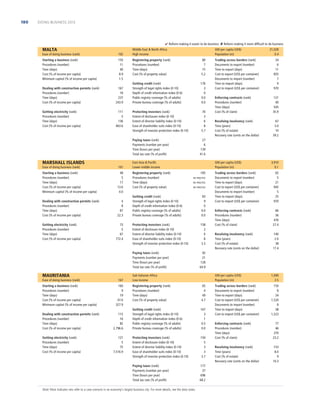
books. This introduces a degree of judgment. The Doing Business approach has
therefore been to work with legal practitioners or professionals who regularly
undertake the transactions involved.
Following the standard methodological
approach for time-and-motion studies, Doing Business breaks down each
process or transaction, such as starting
a business or registering a building,
into separate steps to ensure a better
estimate of time. The time estimate for
each step is given by practitioners with
significant and routine experience in
the transaction. When time estimates
differ, further interactions with respondents are pursued to converge on one
estimate that reflects the majority of
applicable cases.
The Doing Business approach to data collection contrasts with that of firm surveys,
which capture perceptions and experiences of businesses. A corporate lawyer
registering 100–150 businesses a year will
be more familiar with the process than an
entrepreneur, who will register a business
only once or maybe twice. A bankruptcy
attorney or judge dealing with dozens of
cases a year will have more insight into
bankruptcy than a company that may
undergo the process once.

Development of the methodology
The methodology for calculating each
indicator is transparent, objective and
easily replicable. Leading academics
collaborate in the development of the
indicators, ensuring academic rigor. Eight
of the background papers underlying the
indicators have been published in leading
economic journals.52
Doing Business uses a simple averaging
approach for weighting component
indicators and calculating rankings and
the distance to frontier measure. Other
approaches were explored, including
using principal components and unobserved components.53 They turn out to

23
24

DOING BUSINESS 2013

yield results nearly identical to those
of simple averaging. In the absence of a
strong theoretical framework that assigns
different weights to the topics covered
for the 185 economies by Doing Business,
the simplest method is used: weighting
all topics equally and, within each topic,
giving equal weight to each of the topic
components (for more details, see the
chapter on the ease of doing business and
distance to frontier).54

Improvements to the
methodology
The methodology has undergone continual improvement over the years. For
enforcing contracts, for example, the
amount of the disputed claim in the case
study was increased from 50% of income
per capita to 200% after the first year of
data collection, as it became clear that
smaller claims were unlikely to go to
court.
Another change related to starting a
business. The minimum capital requirement can be an obstacle for potential
entrepreneurs. Doing Business measured
the required minimum capital regardless
of whether it had to be paid up front or
not. In many economies only part of the
minimum capital has to be paid up front.
To reflect the relevant barrier to entry, the
paid-in minimum capital has been used
rather than the required minimum capital.
This year’s report includes an update in
the ranking methodology for paying taxes.
Last year’s report introduced a threshold
for the total tax rate for the purpose of
calculating the ranking on the ease of paying taxes. This change came as a result of
consultations on the survey instrument
and methodology for the paying taxes
indicators with external stakeholders,
including participants in the International
Tax Dialogue. All economies with a total
tax rate below the threshold (which is
calculated and adjusted on a yearly basis)
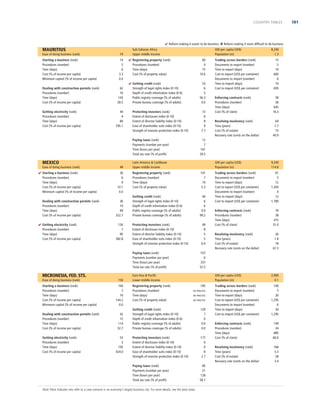
now receive the same ranking on the total
tax rate indicator. This year’s threshold is
set at the 15th percentile of the total tax
rate distribution, which translates into a
threshold for the total tax rate of 25.7%.

(2008), input from the International
Tax Dialogue and regular input from the
Indicators Advisory Group.

Data adjustments
All changes in methodology are explained
in the data notes as well as on the Doing
Business website. In addition, data time
series for each indicator and economy are
available on the website, beginning with
the first year the indicator or economy
was included in the report. To provide a
comparable time series for research, the
data set is back-calculated to adjust for
changes in methodology and any revisions in data due to corrections. The data
set is not back-calculated for year-to-year
revisions in income per capita data (that
is, when the income per capita data are
revised by the original data sources, Doing
Business does not update the cost measures for previous years). The website
also makes available all original data sets
used for background papers.
Information on data corrections is provided in the data notes and on the website. A
transparent complaint procedure allows
anyone to challenge the data. If errors
are confirmed after a data verification
process, they are expeditiously corrected.

NOTES
1.

World Bank 2005; Stampini and others
2011.

2.

See, for example, Alesina and others
(2005); Perotti and Volpin (2005);
Fisman and Sarria-Allende (2010);
Antunes and Cavalcanti (2007);
Barseghyan (2008); Klapper, Lewin
and Quesada Delgado (2009); Freund
and Bolaky (2008); Chang, Kaltani and
Loayza (2009); Helpman, Melitz and
Rubinstein (2008); Klapper, Laeven and
Rajan (2006); World Bank (2005); and
Ardagna and Lusardi (2010).

3.

This includes Djankov and others
(2002); Djankov, McLiesh and Shleifer
(2007); Djankov, La Porta and others
(2008); Djankov, Freund and Pham
(2010); Djankov and others (2003);
Djankov, Hart and others (2008);
Botero and others (2004); and Djankov
and others (2010).

4.

For more details on how the aggregate
ranking is created, see the chapter on
the ease of doing business and distance
to frontier.

5.

This has included a review by the World
Bank Independent Evaluation Group

6.

http://www.doingbusiness.org.

7.

Local experts in 185 economies are
surveyed annually to collect and
update the data. The local experts
for each economy are listed on the
Doing Business website (http://www
.doingbusiness.org) and in the
acknowledgments at the end of
this report.

8.

De Soto 2000.

9.

Schneider 2005; La Porta and Shleifer
2008.

10. Amin 2011.
11. http://www.enterprisesurveys.org.
12. Narayan and others 2000.
13. OECD, “Indicators of Product Market

Regulation,” http://www.oecd.org/.
The measures are aggregated into
3 broad families that capture state
control, barriers to entrepreneurship
and barriers to international trade and
investment. The 39 countries included
in the OECD market regulation indicators are Australia, Austria, Belgium,
Brazil, Canada, Chile, China, the Czech
Republic, Denmark, Estonia, Finland,
France, Germany, Greece, Hungary,
Iceland, India, Ireland, Israel, Italy,
Japan, Korea, Luxembourg, Mexico, the
Netherlands, New Zealand, Norway,
Poland, Portugal, Russia, the Slovak
Republic, Slovenia, South Africa, Spain,
Sweden, Switzerland, Turkey, the United
Kingdom and the United States.
14. The World Economic Forum’s Global

Competitiveness Report uses Doing
Business data sets on starting a business, employing workers, protecting
investors and getting credit (legal
rights), representing 7 of a total of 113
different indicators (or 6.19%).
15. Hallward-Driemeier, Khun-Jush and

Pritchett (2010), analyzing data from
World Bank Enterprise Surveys for
Sub-Saharan Africa, show that de
jure measures such as Doing Business
indicators are virtually uncorrelated
with ex post firm-level responses,
providing evidence that deals rather
than rules prevail in Africa. The authors
find that the gap between de jure and de
facto conditions grows with the formal
regulatory burden. The evidence also
shows that more burdensome processes
open up more space for making deals
and that firms may not incur the official
costs of compliance but still pay to
avoid them.
ABOUT DOING BUSINESS: MEASURING FOR IMPACT

16. Much attention has been given to

exploring links to microeconomic
outcomes, such as firm creation and
employment. Recent research focuses
on how business regulations affect the
behavior of firms by creating incentives
(or disincentives) to register and operate formally, to create jobs, to innovate
and to increase productivity. For details,
see Djankov and others (2002); Alesina
and others (2005); Banerjee and Duflo
(2005); Perotti and Volpin (2005);
Klapper, Laeven and Rajan (2006);
Fisman and Sarria-Allende (2010);
Antunes and Cavalcanti (2007);
Barseghyan (2008); Eifert (2009);
Klapper, Lewin and Quesada Delgado
(2009); Djankov, Freund and Pham
(2010); Klapper and Love (2011a); Chari
(2011); and Bruhn (2011).
17. According to searches for citations of

the 9 background papers that serve as
the basis for the Doing Business indicators in the Social Science Citation Index
and on Google Scholar (http://scholar
.google.com).
18. Djankov, McLiesh and Ramalho 2006.
19. Eifert 2009.
20. Klapper, Lewin and Quesada Delgado

2009. Entry rate refers to newly
registered firms as a percentage of total
registered firms. Business density is defined as the total number of businesses
as a percentage of the working-age
population (ages 18–65).
21. Ciccone and Papaioannou 2007.
22. Alesina and others 2005.
23. Loayza, Oviedo and Servén 2005;

Barseghyan 2008.
24. Dulleck, Frijters and Winter-Ebmer

2006; Calderon, Chong and Leon 2007;
Micco and Pagés 2006.
25. Masatlioglu and Rigolini 2008; Djankov

2009.
26. Cardenas and Rozo 2009.

27. Bruhn 2011.
28. Kaplan, Piedra and Seira 2007.
29. Bruhn 2012.
30. Aghion and others 2008.
31. Sharma 2009.
32. Chari 2011.
33. Branstetter and others 2010.

their resources and the credit supply
becomes elastic.
47. Funchal 2008.
48. Giné and Love (2010) on Colombia;

Dewaelheyns and Van Hulle (2008) on
Belgium.

34. Djankov, Freund and Pham 2010.

49. Franks and others 2011.

35. Iwanow and Kirkpatrick 2009.

50. One recent study using Doing Business

36. Freund and Rocha 2011.
37. Seker 2011.
38. Portugal-Perez and Wilson 2011.
39. Hoekman and Nicita 2011.
40. Nunn 2007.
41. Rauch 2010.
42. Chang, Kaltani and Loayza 2009; Cuñat

and Melitz 2007.

indicators illustrates the difficulties in
using highly disaggregated indicators
to identify reform priorities (Kraay and
Tawara 2011).
51. While about 9,600 contributors

provided data for this year’s report,
many of them completed a survey for

43. http://www.enterprisesurveys.org.

more than one Doing Business indicator

44. Haselmann, Pistor and Vig 2010.

set. Indeed, the total number of surveys

The countries studied were Bulgaria,
Croatia, the Czech Republic, Estonia,
Hungary, Latvia, Lithuania, Poland,
Romania, the Slovak Republic, Slovenia
and Ukraine.
45. Djankov, McLiesh and Shleifer 2007;

Houston and others 2010.

completed for this year’s report is more
than 12,000, which represents a truer
measure of the inputs received. The
average number of surveys per indicator
set and economy is just under 6.

46. Visaria 2009. In a follow-up study, von

For more details, see http://www

Lilienfeld-Toal, Mookherjee and Visaria
(2012) found that the average effects
identified by Visaria (2009) differ
between wealthy and poor borrowers
when the credit supply is inelastic
(because of limits in such resources
as funds, staff and information). In
particular, they found that in the short
term after the debt recovery tribunals
are introduced, borrowers with less
collateral may experience a reduction
in access to credit while those with
more collateral may experience an
increase. But the authors also point out
that this short-term effect disappears
over time as banks are able to increase

.doingbusiness.org/contributors/
doing-business.
52. All background papers are available on

the Doing Business website (http://www
.doingbusiness.org).
53. For more details, see the chapter on the

ease of doing business and distance to
frontier.
54. A technical note on the different

aggregation and weighting methods is
available on the Doing Business website
(http://www.doingbusiness.org).

25
26

Colombia: sustaining
reforms over time
ƒ Colombia’s experience shows the
importance of sustaining reform
efforts over time and adjusting
them to the changing needs of the
economy, whether at the national
or local level.
ƒ Colombia is a regional leader in
narrowing the gap with the world’s
most efficient regulatory practice.
ƒ Over time, the focus of Colombia’s
reform efforts has shifted from
reducing the cost and complexity
of business regulation to
strengthening legal institutions.
ƒ Colombia’s most notable
regulatory improvements have
been in the areas of starting a
business, paying taxes, protecting
investors and resolving insolvency.
ƒ While development hurdles
remain, Colombia’s regulatory
reforms have increased its
competitiveness and have had local
and regional “spillover” effects.

Over the past several decades Colombia
has pursued a broad range of structural
and institutional reforms. The emphasis
has shifted over the years, reflecting the
priorities of different administrations and
the perceived needs of the economy. In
the 1980s and early 1990s much of the
focus was on macroeconomic management.1 As progress was made in laying
a firm foundation of macroeconomic
stability, the focus shifted to other areas. The government gave particular
emphasis to policies and institutions
seen as central to enhancing productivity
and growth and boosting the country’s
competitiveness. As part of this, it set
in motion reforms aimed at improving
the regulatory framework and the rules
underpinning private sector activity. The
Ministry of Commerce, Industry and
Tourism led a coordinated reform effort
bringing together government agencies,
the Congress and the judiciary as well as
the private sector.
In 2007 Colombia’s government further
institutionalized its commitment to regulatory reform by establishing the Private
Council for Competitiveness. A publicprivate partnership, the council is made
up of business associations and private
sector players working closely with the
government to promote sound, businessfriendly regulatory practices.2
Recent administrations have continued
to use national development plans to
establish a clear economic agenda. In
2009 President Alvaro Uribe highlighted
Colombia’s progress and his government’s plans for new regulatory reforms
aimed at further gains in competitiveness.3 And since the change of legislature

in August 2010, the new government,
led by President Juan Manuel Santos,
has been pushing forward an economic
reform agenda through the “Prosperity
for All” national development plan for
2010–14. The plan’s overall goals are
to reduce poverty, increase income,
generate employment, improve security,
ensure the sustainable use of natural resources and improve the quality of the
business environment.4

SUSTAINED EFFORT
AT THE NATIONAL LEVEL
As Colombia has improved its business
regulatory environment, results have
shown in Doing Business indicators—
including those on starting a business,
paying taxes, protecting investors and
resolving insolvency. Indeed, thanks
to its sustained efforts, Colombia has
made greater progress toward the
frontier in regulatory practice since
2005 than any other Latin American
economy (figure 3.1).
Other indicators also reflect the improvements. The total number of newly
registered businesses in the country
rose from 33,752 in 2006 to 57,768
in 2011.5 Colombia’s performance on
several relevant measures compiled by
the Worldwide Governance Indicators
project improved between 2002 and
2010—including the Rule of Law Index
(reflecting perceptions of the extent
to which firms have confidence in and
abide by the rules of society) and the
Regulatory Quality Index (capturing
perceptions of the government’s ability to formulate and implement sound
policies and regulations that permit and
promote private sector development).6
COLOMBIA: SUSTAINING REFORMS OVER TIME

FIGURE 3.1 Colombia has outpaced the region in advancing toward the frontier in regulatory practice
Progress in narrowing distance to frontier since 2005 (percentage points)

9.4

8.8 8.8
6.7 6.6 6.6 6.5

5

4.6 4.3
3.9 3.9 3.6 3.6

Suriname

St. Lucia

Brazil

Dominica
St. Vincent and
the Grenadines

Argentina

Belize

Panama

Guyana

Grenada

0.6 0.5 0.0
1.7 1.5 1.4 1.4
1.2 1.1 0.9 0.9

Puerto Rico (U.S.)

Trinidad and Tobago

Haiti

Chile

Ecuador

Jamaica

El Salvador
Latin America 
Caribbean average

Paraguay

Honduras

Nicaragua

Costa Rica

Dominican Republic

Mexico

Uruguay

Peru

Colombia

Guatemala

2.6 2.5
0
5

Venezuela, RB

10.4 10.1

St. Kitts and Nevis

0

Antigua and Barbuda

15.3

Bolivia

5

-0.5 -0.5
-3.7

lombia
Guatemala Peru Uruguay CostaNicaragua ParaguayEl Salvador Ecuador Chile Haiti Rico (U.S.) Guyana St. VincentArgentina
Dominican Republic Rica Honduras  Caribbean average Trinidad Puerto
Mexico
Latin America Jamaica
and Tobago
Bolivia Grenada Panama the GrenadinesBrazil Antigua and Venezuela, RB
Belize and Dominica
St. Lucia and Nevis
St. Kitts
Suriname Barbuda

Note: The distance to frontier measure shows how far on average an economy is from the best performance achieved by any economy on each Doing Business indicator since 2005. The measure
is normalized to range between 0 and 100, with 100 representing the best performance (the frontier). The figure shows the absolute difference for each economy between its distance to frontier
in 2005 and that in 2012. No data are shown for The Bahamas and Barbados, which were added to the Doing Business sample after 2005.
Source: Doing Business database.

And Colombia’s ranking on the ease of
doing business rose from 79 among the
175 economies included in 2006 to 45
among the 185 included in 2012.

Choosing a reform path
While Colombia simultaneously pursued very different types of regulatory

FIGURE 3.2 A trend toward stronger legal institutions and less expensive regulatory processes in
Colombia
Average distance to frontier in sets of Doing Business indicators
Stronger legal institutions but more
complex and expensive regulatory processes

Strength of legal institutions

Stronger

Weaker

Stronger legal institutions and simpler and
less expensive regulatory processes

2012

2006
2012
2006

Weaker legal institutions and more
complex and expensive regulatory processes
Complex and
expensive

Weaker legal institutions but simpler and
less expensive regulatory processes

Complexity and cost
of regulatory processes
Colombia

Simple and
inexpensive

Global average

Note: Strength of legal institutions refers to the average distance to frontier in getting credit, protecting investors, enforcing
contracts and resolving insolvency. Complexity and cost of regulatory processes refers to the average distance to frontier
in starting a business, dealing with construction permits, registering property, paying taxes and trading across borders. The
distance to frontier measure shows how far on average an economy is from the best performance achieved by any economy on
each Doing Business indicator since 2005.
Source: Doing Business database.

reforms, it first completed those aimed
at streamlining business regulation and
reducing its cost to companies. Until
2008 the focus was largely on reducing
transactions costs, such as by simplifying business start-up procedures or tax
administration. These types of reforms
have continued since 2008, but the focus
has shifted toward strengthening legal
institutions such as bankruptcy systems
and investor protections (figure 3.2).
This sequencing of reforms is not unusual. Many economies have focused first
on simplifying regulatory transactions
for businesses, then moved on to more
complex and time-consuming reforms
aimed at improving legal institutions
such as court systems. Such reforms
require more sustained efforts, often over
a period of several years.

Encouraging business start-ups
Regulatory reforms implemented by
Colombia in recent years have made a
clear difference in the ease of starting a
business as measured by Doing Business.
They have reduced the time required to
start a business from 60 days to 14, the
cost from 28% of income per capita to

27
28

DOING BUSINESS 2013

8% and the number of procedures from
19 to 9 in 2011 (figure 3.3).
The introduction and subsequent upgrades
of one-stop shops for business registration
at chambers of commerce account for
much of the change. The first one-stop
shops started to operate in May 2003. As
the changes in the start-up process yielded
positive results, the government continued
to improve it. In 2005, for example, Law
962—the “antitrámites“ (“antipaperwork”)
law—eliminated around 80 bureaucratic
processes required to start a business and
introduced a provision preventing government agencies from creating new procedures. It also simplified the procedures
required by allowing electronic submission
of documents and eliminating the need to
have signatures notarized.
More improvements came in 2010. A new
public-private health provider, Nueva EPS,
replaced the previous provider administered by the Social Security Institute.
The new system enables employers and
employees to register for health services
in just 1 week. In addition, Colombia introduced online preenrollment for new
companies, making registration faster
and simpler.
New regulations recently introduced a
progressive fee schedule for new companies.7 The fee schedule exempts new firms
from up-front payment of regulatory fees
during their first few years of operation.
And the start-up fee associated with the
commercial license is no longer required.

Simplifying tax compliance
Over the years Colombia has greatly
improved its tax and social security compliance processes. In 2002, as the government realized that about a third of its
potential revenue from corporate income,
personal income and value added taxes
went uncollected, it decided to introduce
an electronic payment system in an attempt to lower tax evasion.8

FIGURE 3.3 Starting a business is now faster and less costly in Colombia
Procedures (number)
Time (days)

Cost (% of income
per capita)
50

70
60

40

50
30

40
30

20

20
10
10
0

0
2003

2004

2005

2006

Procedures

2007

2008

2009

2010

Time

2011

Cost

Source: Doing Business database.

payments. This form simplified tax
compliance for Colombian businesses by
combining into a single online payment
all contributions for social security, the
welfare security system and labor risk
insurance.
To further improve and simplify tax compliance, in 2010 the government made

Thanks to these continued efforts, paying
taxes as measured by Doing Business became considerably easier between 2004
and 2010. The number of payments fell
from 69 a year to 9, and the time needed
to prepare and file taxes from 456 hours
a year to 193. And the total tax rate declined from 82.1% of profit to 74.8% in
this period (figure 3.4).

electronic filing of corporate income tax

Enhancing investor protections

and value added tax mandatory for firms

Starting in 2005, Colombia implemented
3 major legal reforms aimed at strengthening investor protections. In 2005
Colombia enacted Law 964, providing

with annual sales exceeding 500 million
Colombian pesos (about $280,000) in or
after 2008.

FIGURE 3.4 Colombia has made tax compliance simpler for businesses
Payments (number per year)
Time (hours per year)

Total tax rate
(% of profit)

500

100

400

80

300

60

200

40

100

20

0

0

In 2009 the government lowered corporate income tax rates and introduced
an online form for social contribution

2004

2005
Payments

Source: Doing Business database.

2006

2007
Time

2008

2009

2010
Total tax rate
COLOMBIA: SUSTAINING REFORMS OVER TIME

FIGURE 3.5 Legal and regulatory changes have strengthened investor protections in Colombia
10

8

6

4

2
0
2005

2006

2007

Ease of shareholder suits index (0–10)
Extent of disclosure index (0–10)

2008

2009

2010

2011

Strength of investor protection index (0–10)
Extent of director liability index (0–10)

In 2007 the government amended
Colombia’s securities regulation. Decree
3139 requires listed companies to report
more information to investors. Before,
listed companies had to report any “relevant” or “extraordinary” event—a subjective standard open to abuse. Although
the decree still includes the broad “relevant” requirement, it lists specific events
that must be disclosed to the financial
authorities. It also requires companies to
report extensive information before going
public.
In 2010 the government made further
progress by amending the company law.
The amendments clarified the liability
regime for company directors involved in
related-party transactions that harm the
company. Now directors can be forced to
pay damages and disgorge profits made
from such transactions.
As a result of these changes, Colombia’s
scores have improved on both the extent
of director liability index (which measures
the liability of company executives for
abusive related-party transactions) and
the extent of disclosure index (which

In 2009 the government issued several
decrees as part of continued efforts to
better regulate the profession of insolvency administrators. In addition, it
introduced an electronic filing system
to make insolvency proceedings faster
and more efficient. And it eliminated the
requirement to submit financial statements to request reorganization in cases
where these statements had previously
been submitted to the Superintendence
of Companies.

Improving other areas
of regulation

Source: Doing Business database.

a modern framework for capital market
activity. The law encourages better corporate governance practices by requiring
greater transparency and disclosure, equitable treatment of minority shareholders and more effective boards of directors.

imposed more stringent time limits for
negotiating reorganization agreements.

measures the approval and disclosure
regime for related-party transactions;
figure 3.5).

Making insolvency
proceedings more efficient
Colombia’s insolvency reforms began
almost 2 decades ago. In 1995 the enactment of Law 222, allowing debtors and
creditors to resolve disputes before the
Superintendence of Companies, helped
ease the burden on the judiciary. In
1999 changes to the reorganization law
improved the existing corporate reorganization proceedings and introduced
new time limits for negotiations. These
changes increased the efficiency of the
bankruptcy system and improved its capacity to distinguish between viable and
nonviable businesses.9
Another series of insolvency reforms took
place in the past 6 years. Thanks to these
reforms, creditors’ recovery rate rose
from 56 cents on the dollar to 76 and the
time to complete a liquidation proceeding
fell from 3 years to 1.3.
The reforms began with a comprehensive
revision of the insolvency proceedings
available. In 2007 authorities introduced
2 new proceedings: a reorganization
procedure to restructure insolvent
companies and a mandatory liquidation
procedure. And a new insolvency law

Colombia has also made improvements
in other areas of regulation. In 1995 the
country undertook a complete overhaul
of its construction approvals. It moved
the administration of building permits
out of the state-run planning office into
the private domain, becoming the first
economy in Latin America to privatize the
review process. This move carried risks,
but public and private stakeholders in the
country were calling for comprehensive
change.
Bogotá’s mayor first appointed 5 ad hoc
“urban curators,” all architects or engineers with construction experience, to
review building permit applications. Soon
after, a more transparent, merit-based
hiring system was established that is still
in place. Potential curators now undergo
a selection process that includes exams
and interviews with public and private
sector experts. Privatizing the issuance of
building permits improved timeliness and
freed up the planning office’s resources.
In other regulatory areas, introducing
electronic systems made processes easier. When registering property, a business
can now obtain online certification of
valuation, ownership and good standing
for property taxes. And for properties with
no liens, it can submit online certificates
directly to the land registry. Certificates
have no cost if requested online.

29
30

DOING BUSINESS 2013

An electronic data interchange system
was introduced for exports, making it
possible to centralize electronic data.
The new system also allows traders to
pay duties electronically, eliminating the
need to go to a bank to submit payments.
And it allows shippers to share information with customs electronically, so that
customs declarations can be processed
before the vessel even arrives at the port.
Most importantly, since 2008 Colombia
has implemented improvements to the
Single Window for Foreign Trade (VUCE)
system. The system now connects over
a dozen government agencies that are
involved in import and export procedures.

SPILLOVER TO THE
LOCAL LEVEL

Neiva’s local government also set up
one-stop shops for registering new
companies. This eliminated 11 procedures
and reduced the time required to register
a business from 32 days to 8. The success of the one-stop shops has been due
largely to cooperation between municipal
and national government departments.
Medellín is another city that substantially
improved its business regulatory environment. The city government cut 3 procedures required to start a business by improving one-stop shops and eliminating
the requirement for a land use certificate.
And it made registering property easier
by merging 2 certificates and eliminating
a stamp previously required as proof of
registration tax compliance.

Colombia has been actively reforming
its regulatory environment at the local
as well as the national level. Local efforts
have been inspired in part by a subnational study. Carried out through the National
Department of Planning, the 2008 study
was designed to analyze the regulatory
environment in different regions with the
aim of improving regional competitiveness across the country. The study was
also intended to enable Colombian cities
to learn from one another and adopt good
practices from elsewhere in the country.

CONCLUSION

The subnational Doing Business report resulting from the study was soon followed
by another, and work on a third began in
2012.10 The second report showed that
all 12 cities included in the first one had
improved on at least one Doing Business
indicator.

Colombia’s
experience
is
having
“spillover” effects in the region as well.
Bolivia has shown an interest in learning
more about Colombia’s experience with
business entry. Paraguay has sought to
learn from Colombia’s innovations in
construction permitting. And both Costa
Rica and El Salvador intend to learn from
Colombia’s trade logistics reforms.

Among these 12 cities, Neiva made the
most progress in improving the ease of
doing business. Local authorities took
several measures to increase the city’s
competitiveness, including creating an
anti-red-tape committee to reduce the
regulatory burden on the private sector. The committee encompassed wide
representation, with participants from the
municipality, the chamber of commerce,
business associations and national agencies such as police and tax authorities.

Colombia’s commitment to regulatory reform has led to substantial improvements
in the quality of the business environment
and a more solid foundation for private
sector development. Its experience shows
the importance of sustaining reform efforts over time and adjusting them to the
changing needs of the economy. Initially,
most of the regulatory reforms took place
at the national level. But as the business
environment continued to improve, the
reforms spilled over to the local level.

at boosting productivity. The steady pace
of change led to the development of the
broader competitiveness agenda and the
creation of a public-private partnership
aimed at promoting business-friendly
regulatory practices.
Yet despite the government’s sustained
efforts, and its success in improving the
business climate and implementing an
ambitious competitiveness agenda, a
number of challenges remain. Addressing
income inequality remains a key priority,
in part because it would strengthen support in the business community and in
civil society for the government’s overall
development strategies.
While the country has more development
hurdles to overcome, the measures taken
over the past years have greatly improved
its competitiveness. The regulatory
reforms may take more time to show full
results in all areas of doing business,
but they have already led to substantial
immediate benefits. Colombia’s reform
agenda is expected to continue to
expand—and to inspire further improvements in the region.

NOTES
This case study was written by Valentina
Saltane and Hayane Chang Dahmen.
1. According to the International Monetary

Fund, average annual inflation in
Colombia fell from 23% in the 1980s to
6% by the 2000s. Management of public
finances also improved, with public deficits in recent years lower as a percentage
of GDP. Colombia’s general government
public debt was 35.9% of GDP in 2009,
low by international standards (“IMF
Data Mapper,” http://www.imf.org/).
2. Consejo Privado de Competitividad,

Colombia’s experience also shows the
importance of setting out economic
policy objectives. The government’s commitment to well-defined, long-term economic goals has helped drive implementation of the reforms. Having made major
strides in safeguarding macroeconomic
stability, the government widened the
focus of its policies to include a range of
institutional and economic reforms aimed

http://www.compite.com.co/site/
sistema-nacional-de-competitividad/.
3. Remarks delivered before the Americas

Society/Council of the Americas,
September 24, 2009. Available at http://
www.as-coa.org/article.php?id=1908.
4. International Fund for Agricultural

Development, “Rural Poverty Portal,”
http://www.ruralpovertyportal.org/.
5. Doing Business database; World Bank
COLOMBIA: SUSTAINING REFORMS OVER TIME

Group Entrepreneurship Snapshots
database.
6. World Bank, Worldwide Governance

Indicators, “2011 Update,” http://www
.govindicators.org. The Rule of Law Index
and the Regulatory Quality Index both
range from −2.5 (weak) to 2.5 (strong).
On the Rule of Law Index Colombia’s
score rose from −0.84 in 2002 to −0.33
in 2010. On the Regulatory Quality Index
its score rose from 0.05 in 2002 to 0.31
in 2010.
7. Law 1429 of 2010 and Decree 545 of

2011.
8. Sohn 2008.
9. Giné and Love 2010.
10. Subnational Doing Business reports are

available at http://www.doingbusiness
.org/reports/subnational-reports.

31
32

Latvia: maintaining a
reform state of mind
ƒ For Latvia, accession to the
European Union has been among
the main motivations for improving
business regulation.
ƒ Latvia’s reform agenda has
benefited from strong public
support for economic integration.
ƒ Since 2004 the country has made
positive changes across all areas
measured by Doing Business.
ƒ Despite being substantially
affected by the financial crisis
starting in 2008, Latvia continued
its reform agenda, adapting it to
the new challenges the country
was facing.

Latvia has made substantial economic
progress since its transition to a liberal
market economy in the 1990s. Income
per capita has more than tripled over the
past 15 years despite a deep recession following the global financial crisis.1 Exports
grew by almost 7% a year in the 2000s,
and the share of the population living
on less than $4 a day fell from 25.8% in
1998 to 3.4% in 2008, the latest year for
which this information is available.2
Economic reforms have been a central
part of this process. Structural reforms
have increased competitiveness and
facilitated integration with the world
economy. Reforms to business laws and
regulations have substantially improved
the investment climate. Since the late
1990s successive governments have
held a regular dialogue with the private
sector and international organizations to
identify and implement ways to streamline business registration, improve the
tax system and increase the efficiency of
international trade, among many other
such reforms.3

significant improvements to its regulatory
environment—advancing further toward
the frontier in regulatory practice than
almost all other EU member economies
(figure 4.1)? And what lessons can be
learned about this “reform state of mind”
demonstrated by Latvia?

REFORMING FOR THE
EUROPEAN UNION
Broad consensus for reform emerged in
Latvia in the late 1990s, as the country
transitioned to a liberal market economy
after regaining independence in 1991.
Integration into the world economy was a
commonly held goal, and the Latvian government and business community began
a dialogue on how to achieve it. Latvia
joined the World Trade Organization in
1999, then targeted membership in the
European Union.

These reform efforts have been sustained
through changing domestic and international conditions. They began as part of a
process to join the European Union (EU).
They continued during a period of rapid
growth in the mid-2000s. And they have
persisted during the significant economic
downturn following the financial crisis.
Throughout this transition there were
many changes in political leadership—
but the commitment to legislative and
regulatory reform endured.

The goal of EU accession provided a
structure for an array of legislative and
regulatory reforms. The EU membership requirements, known as the
Copenhagen criteria, provided a series
of general directives for reforms centered
on democratic governance, human rights,
a market economy and commitment to
European integration. Latvia also began
harmonizing its laws with the body of
EU legislation, the acquis communautaire,
including in ways to reduce administrative barriers to investment. In 1999 the
Latvian Cabinet of Ministers adopted
an action plan to improve the business
environment and welcomed support
from international financial institutions to
implement the reforms.4

What enabled this continued commitment
to reform? How has Latvia made such

These reform efforts proved very successful: by 2003, 91 of 106 reforms
LATVIA: MAINTAINING A REFORM STATE OF MIND

FIGURE 4.1 Latvia has made big advances toward the frontier in regulatory practice
Progress in narrowing distance to frontier since 2005 (percentage points)

12.3

9.5
8.2
7.0
4.9

4.5

4.4
3.5

3.5

3.0

2.6

2.5
1.9

1.8

1.5

1.4

0.8

0.1

-0.5

Germany

5.0

Estonia

7.1

6

Ireland

8.6

Austria

9.0

Italy

9.8

9

Lithuania

Finland

Belgium

United Kingdom

Spain

Netherlands

Sweden

Hungary

Slovak Republic

Denmark

Bulgaria

Greece

Romania

Latvia

France

Portugal

Slovenia

Czech Republic

Poland

0

Note: The distance to frontier measure shows how far on average an economy is from the best performance achieved by any economy on each Doing Business indicator since 2005. The measure
is normalized to range between 0 and 100, with 100 representing the best performance (the frontier). The figure shows the absolute difference for each economy between its distance to frontier
in 2005 and that in 2012. It shows data for all current EU members except Cyprus, Luxembourg and Malta, which were added to the Doing Business sample after 2005.
Source: Doing Business database.

initially identified in 1999 had been implemented.5 During this initial reform phase
the government focused on improving
aspects of the investment climate that
had been raised as issues by the Latvian
business community.
One focus was streamlining business
registration. The government simplified
the procedures required, such as by
combining company and tax registration.
By 2004 starting a business in Latvia took
only 5 procedures and 16 days—less time
than in all but 21 economies covered by
Doing Business 2005. The change was
dramatic: in 1999 opening a business in
Latvia had required 17 procedures and 114
days.
The government also improved business
inspections. Most business inspectorates
in Latvia were perceived as obstructing
rather than enabling legitimate business
in their enforcement of government
regulations. The government requested
that inspectorate reform be included as a
conditionality of financing from the World
Bank.6 Later efforts provided new instruction on the rights and responsibilities

of government inspectors and private
firms, introduced a requirement for
written reports after all inspections and
developed performance indicators for
inspectorates.7
Construction permitting was another
target of regulatory reform. In 2001 it
took Latvian businesses 2 years to obtain
all the licenses and inspections required
to build a warehouse. By 2004 the government had reduced the time required
to obtain a building permit by 2 months,
simply by preparing a flowchart showing
what offices to visit and which documents to take.8 Further improvements
followed, including amendments to the
construction code and the establishment of a public register for construction
companies.
The government improved tax administration by amending the laws on
value added and corporate income tax
to resolve specific issues identified by
businesses. Draft tax legislation was
posted online for public comment, and an
appeals body was established in the State
Revenue Service.9

Latvia enjoyed significant growth during
this initial reform period. From 2000 to
2004 GDP growth averaged 7.5%, and
unemployment fell from 14.2% to 9.9%.10
In May 2004 Latvia achieved its goal of
joining the European Union.

CONTINUING THE AGENDA
Latvia’s strong economic performance
continued after the country became an
EU member. From 2005 to 2007 economic growth averaged nearly 11% a year.
The number of newly registered firms
rose from around 7,000 a year to 12,000.
And exports of goods and services grew
by more than 5% a year, with a peak in
growth of 20% in 2005.11
Business regulation reforms continued
as well. Rather than relaxing the reform
agenda after becoming an EU member,
Latvia continued working to enhance its
competitiveness by bringing its economic
laws, regulations and institutions further
into line with those of Western European
countries.12 The action plan initially established in 1999 was regularly amended to
identify new areas to target with regulatory reforms. Doing Business has tracked

33
34

DOING BUSINESS 2013

the success of many of these reforms
over time.
One set of improvements made property
registration faster and easier. Businesses
trying to expand were being hindered by
complex administrative procedures to
access land, leading to long delays and
considerable uncertainty. The government responded by installing electronic
terminals at the land registry, enabling
businesses to pay fees and stamp duties
at the same time that they registered
property. It also granted the land registry
electronic access to municipal tax databases, eliminating the requirement to
obtain the property tax status in paper
format. As a result, the time required
to transfer property fell from 55 days in
2004 to 18 in 2012 (figure 4.2).
Construction permitting, a focus of earlier efforts, received renewed attention
in response to investors’ complaints that
unclear fee schedules were a burden to
construction activity. The government
established a more transparent set of
construction fees and duties, reducing
the cost associated with completing the
procedures to legally build a warehouse
from 43.5% of income per capita in 2006
to 18.6% in 2012.
Even after Latvia’s accession to the
European Union, some regulatory reforms were still driven by the integration
process. One was the adoption of an
electronic customs system, triggered by
the implementation of EU regulations in
2009. Entry and exit declaration forms
can now be submitted electronically,
and a requirement to submit customs
information in advance allows the system
to perform computerized risk analysis
before goods are presented to customs.
Continuing its improvements in tax administration, Latvia introduced a process
for electronic submission and acceptance
of tax declarations in 2005 and 2006.
This reduced the number of tax payments
as measured by Doing Business from 29 a
year to 7 in 2006.

FIGURE 4.2 Latvia made transferring property simpler and faster
Time to register property (days)
60
50

Between 2004 and 2012 Latvia
implemented new electronic
capabilities to streamline
property registration

40

Time cut
by 37 days

30
20
Procedures cut by 5

10
0
1

2

3

4

5
6
Procedures
2004

7

8

9

10

2012

Source: Doing Business database.

More recently, Latvia made getting
electricity easier by streamlining the
approval process for connection designs
for straightforward projects. Before 2011
an entrepreneur in Riga had to wait more
than 6 months to connect a warehouse
to the electricity network. Reducing the
number of approvals that were required
shortened the wait by almost 3 months—
a change that earned Latvia recognition
in Doing Business 2012 as having made
the biggest improvement in the ease of
getting electricity in the year covered by
the report.

CONFRONTING THE CRISIS
WITH REFORMS
The global financial crisis brought Latvia’s
strong economic growth to a halt. Much of
the growth had been driven by increased
domestic demand enabled by substantial
inflows of foreign capital, and when the
capital inflows ceased, the economy
went into a deep recession starting in
2008.13 Latvia responded by undertaking
significant structural reforms, including
reductions in public spending and wage
moderation in the public sector. The
public broadly supported the main thrust
of the authorities’ response to the crisis,
and election results in October 2010 endorsed the government’s reform efforts.14
Despite the economic turmoil associated with the financial crisis—or perhaps
because of it—Latvia also implemented

a series of new business regulation reforms. The crisis highlighted the need for
greater resilience to such shocks in the
future and for greater access to finance.
It also underscored the need to reduce
administrative barriers to investment.
The Latvian authorities responded with
reforms targeting the insolvency regime,
the credit information system and corporate governance.
The insolvency law was amended in 2008
to ensure a better balance between the
interests of debtors and creditors and to
facilitate the recovery of companies experiencing financial problems. The changes
included allowing easier access to
insolvency and restructuring procedures,
introducing faster procedures for selling a
debtor’s assets and implementing stricter
qualification standards for insolvency
administrators. In 2009 further amendments to the insolvency law introduced
a mechanism for settling insolvencies out
of court to ease pressure on the judiciary.
As a result of these reforms, the recovery
rate for creditors rose from 32 cents on
the dollar to 56 between 2010 and 2011,
leading to the biggest improvement in the
ease of resolving insolvency worldwide
according to Doing Business 2012.
Another focus was expanding the credit
information system. In 2008 the Bank
of Latvia’s registry of debtors was transformed into a full-fledged credit registry.
LATVIA: MAINTAINING A REFORM STATE OF MIND

FIGURE 4.3 More and better credit information in Latvia
Borrowers covered by credit registries
(% of adults)

Depth of credit information index
(0–6)

70

6

60

5

50

4

40
3

30
20

2

10

1

0

0
2004

2005

2006

2007

2008

Depth of credit information index

2009

2010

2011

2012

Borrowers covered by credit registries

Source: Doing Business database.

It now collects both positive and negative
information on borrowers, borrower guarantors and their obligations. The registry
is also able to record more precise information, such as the type of settlement of
the borrower’s obligations and the date on
which settlement of a delayed payment is
registered. And the registry expanded its
coverage from 3.5% of adults in 2008 to
63.8% in 2012 (figure 4.3).
With the goal of increasing investors’
confidence in the market, Latvia also
introduced more robust corporate
governance measures. The government
amended the company law to harmonize
with the EU acquis communautaire, including by improving disclosure mechanisms
and increasing transparency.15 And in
2010 the Riga Stock Exchange issued
corporate governance principles and
recommendations related to disclosure
requirements, remuneration policy and
conflicts of interest, further strengthening corporate governance rules for listed
companies.

WHAT ARE THE LESSONS?
Latvia has sustained a clear commitment
to business regulation reform over more
than a decade, under changing political
leadership and through economic booms
and downturns. What factors have enabled this impressive commitment?
One is the structural incentive provided by economic integration. The

EU requirements of committing to
democratic institutions and processes,
strengthening the institutional underpinnings of a free market and harmonizing
laws with EU legislation provided an actionable roadmap. Results are reflected in
Latvia’s improvement on the Worldwide
Governance Indicators between 2000
and 2005, including on the Regulatory
Quality Index.16 In addition, the potential
economic benefits of joining the European
Union created strong public support for
the reform agenda. This combination of
EU requirements and potential economic
benefits made it possible to sustain the
implementation of both broad structural
reforms and specific business regulation
reforms.
Similar support for economic reform after
the crisis can be linked to a desire for further integration with the European Union,
including as a future full member of the
euro zone. Devaluation of the Latvian
currency against the euro was a policy
option for mitigating the effects of the
crisis, and it might arguably have implied
lower short-term economic costs than
cuts in public spending. But the government opted instead to intensify the pace
of structural reforms; it viewed maintaining the currency peg less in terms of
the purely macroeconomic effects and
more as part of its long-term strategy for
strengthening links with the European
Union, particularly the members of the
euro zone.17 This approach was broadly

endorsed by the business community and
the population.
That economic integration can provide
useful incentives is not a new lesson:
Doing Business 2012 identified a similar
association between successful reforms
in FYR Macedonia and its preparations
ahead of eventual EU entry. But the case
of Latvia provides another example of
how economic integration can serve as
a powerful stimulus for economic and institutional reforms—and how integration
and reform together can create a virtuous
circle of development.
The case of Latvia also shows that local
circumstances matter as well. Latvia has
benefited from a high-quality technocratic bureaucracy through which pro-reform
civil servants were able to provide competent support to the reform process over
time. The presence of a stable cadre of
well-qualified civil servants, maintained
through changes in political leadership,
almost certainly aided the development
and implementation of what has been
a largely successful reform agenda. In
addition, the ability to establish an ongoing dialogue between the government
and the business community may have
helped build and sustain the broad political consensus for the reform process.
Whatever the combination of causes,
Latvia has maintained a state of mind
focused on reform of the business environment and the broader economy. Doing
Business measures just one component of
the reforms that Latvia has implemented.
But the results are clear: in the areas
tracked by Doing Business indicators, the
quality of the business environment has
improved substantially over the past
decade and a half.

CONCLUSION
Latvia’s reform process is likely to continue. The authorities have signaled their
determination to continue to implement
cautious macroeconomic policies that
will support continued investments in
infrastructure, education and training,
seen as key elements of an ambitious

35
36

DOING BUSINESS 2013

competitiveness agenda.18 Further business regulatory reforms are planned
as well, as part of Latvia’s program to
implement the “Europe 2020” strategy.19
The objectives include, among others, the
reduction of administrative barriers and
the strengthening of access to finance
as well as support for access to external
markets and encouragement of greater
inflows of foreign direct investment to
export-oriented sectors. These reforms
should enable Latvia to fully overcome
the economic effects of the financial crisis
and allow it to continue on its path toward
successful long-term development.

at purchasing power parity.
2. Export growth data are from the World

Bank’s World Development Indicators
database (http://data.worldbank.org/).
Poverty data are based on the poverty
headcount ratio at purchasing power
parity and are from PovcalNet, the online
tool for poverty measurement developed
by the World Bank’s Development
Research Group (http://iresearch
.worldbank.org/PovcalNet).
3. See, for example, Coolidge, Grava and

Putnina (2003).
4. Liepina, Coolidge and Grava 2008.
5. Liepina, Coolidge and Grava 2008.
6. World Bank 2001.
7. Coolidge, Grava and Putnina 2003.
8. World Bank 2007.

NOTES
This case study was written by Caroline
Frontigny and Betina Tirelli Hennig.
1. World Bank, World Development

Indicators database, http://data
.worldbank.org/. The income measure is
gross national income (GNI) per capita

9. Liepina, Coolidge and Grava 2008.
10. World Bank, World Development

Indicators database, http://data
.worldbank.org/.
11. World Bank, World Development

Indicators database, http://data
.worldbank.org/.

12. Liepina, Coolidge and Grava 2008.
13. Latvia, Ministry of Economics 2011.
14. EBRD 2011.
15. EBRD 2011.
16. The Regulatory Quality Index captures

perceptions of the government’s ability to formulate and implement sound
policies and regulations that permit and
promote private sector development.
It ranges from -2.5 (weak government
performance) to 2.5 (strong government
performance). Latvia’s score rose from
0.74 in 2000 to 0.94 in 2005, then rose
to 0.98 in 2010.
17. See, for example, Åslund (2009).

Another consideration in the government’s policy choice may have been a
desire to protect the significant share
of the population with debt in euros
and other foreign currencies from the
consequences of a devaluation.
18. EBRD 2011.
19. Latvia, Ministry of Economics 2011.
37

Rwanda: fostering
prosperity by promoting
entrepreneurship
Emerging from a decade marked by civil
war and political instability, Rwanda
began a comprehensive and ambitious
campaign in 2000 to rebuild, foster
national reconciliation and drastically
reduce poverty. The government’s
agenda gave priority to health, education,
infrastructure, and private and financial
sector
development,
showing
a
commitment to improving citizens’ living
conditions and building a solid foundation
for reconciliation.
Starting early on in the reform campaign,
Rwanda has implemented many
business regulation reforms. These have
transformed the life of the private sector
and made it noticeably easier to do
business. While challenges remain, the
country has achieved much success in
its reform agenda since the early 2000s.
This success stems from many factors,
and Rwanda’s experience may provide
useful lessons for other nations seeking
to improve their business climate,
particularly for those coming out of
conflict.

DESIGNING A STRATEGY
Between 2005 and 2011 Rwanda’s real
GDP per capita grew by 4.5% a year,
reflecting a sustained expansion of
exports and domestic investment, with
inflows of foreign direct investment also
increasing substantially.1 In addition,
the government strengthened the
foundations of macroeconomic stability
by implementing cautious fiscal policies
supported by a number of structural and
institutional reforms. Underpinning this
policy stance was a strong and sustained
commitment by national authorities to
private sector development.

Building on a 2-year consultation process,
the government designed a long-term
development strategy, Rwanda Vision
2020, aimed at transforming Rwanda
into a middle-income economy by
raising income per capita from $290 to
$900 before 2020.2 Introduced in 2000,
the strategy recognized and sought to
overcome Rwanda’s multiple development
challenges—including past civil war,
poor governance, weak infrastructure,
underdeveloped financial and private
sectors, unemployment, overwhelming
public debt, a poorly developed education
system, HIV and the rapid growth of a
population expected to reach 13 million by
2020.
In 2001 the World Bank set up the
Competitiveness and Enterprise Development Project, designed to help the
government establish an environment
conducive to private sector growth and
the emergence of a more competitive
investment climate. The project focused on
developing and updating the commercial
law and supporting the government’s
privatization program through technical
assistance, capacity building and advice
on bank restructuring. This program
contributed to an overhaul of the
country’s financial sector that led to the
recapitalization of banks, the establishment
of an insurance market and the introduction
of microfinance lenders. In addition,
the Competitiveness and Enterprise
Development Project collaborated with the
World Bank’s Rwanda Investment Climate
Reform Program to develop a robust reform
agenda. The project helped establish
the Doing Business Unit, the institution
responsible for spearheading Rwanda’s
reform initiatives, while the investment

ƒ Rwanda’s commitment to private
sector development has facilitated
growth in exports, domestic
investment and foreign direct
investment inflows—and the
implementation of effective fiscal
policies supported by structural
and institutional reforms.
ƒ Starting in 2000, Rwanda
developed a strong institutional
pipeline for designing and
implementing business regulation
reforms.
ƒ Since 2004 Rwanda has
substantially improved access to
credit, streamlined procedures
for starting a business, reduced
the time to register property,
simplified cross-border trade and
made courts more accessible for
resolving commercial disputes.
ƒ Rwanda is among more than 35
economies where the executive
branch has made private sector
development a priority by
establishing institutions whose
main purpose is to design and
implement business regulation
reforms.
38

DOING BUSINESS 2013

climate reform program provided technical
assistance and expertise to support the
implementation of planned legal, regulatory
and institutional reforms.
Rwanda’s 2007 Economic Development
and Poverty Reduction Strategy, like its
Vision 2020, emphasized private sector
development as the key to creating
jobs, bringing peace, generating wealth
and ultimately eliminating poverty.3 In
addition, aware of its scarce natural
resources and landlocked location,
Rwanda has focused on business
regulation reform to attract foreign
investment.
Dubbed “Africa’s new Singapore” by
The Economist for its positive economic
reforms,4 Rwanda has been effectively
learning from the success stories of
economies like Singapore since the early
2000s. And in 2007 it started using the
Doing Business report as a tool to identify
and learn from good practices in business
regulation and to monitor improvement.
Several elements of a successful reform
program were present, including political
will and commitment at the highest
level and a broadly appropriate set of
macroeconomic policies that created
room in the budget to invest in reforms
and gained strong support from the donor
community.

BUILDING AN EFFECTIVE
REFORM PIPELINE
Government responsibility for improving
the investment climate in Rwanda and
driving through the reforms has shifted
over time. The responsibility was initially
assigned to the Rwanda Investment
Promotion Agency. In August 2008 this
agency was joined by 7 others to create
the Rwanda Development Board.5
The board’s creation marked not only
a change in name and gains in size,
resources and efficiency but also a
fundamental increase in political will and
support. The president of Rwanda made
business regulation reform a priority,
as did the leaders of more than 35

other economies—including economies
that have made some of the biggest
improvements in the ease of doing
business, such as Burundi, Colombia
and Georgia.6 The approach has proved
effective in triggering reforms. In Rwanda
it helped put investment climate reforms
at the top of the economic policy agenda
for promoting private sector development
and helped consolidate and unify the
multiple reform efforts.
Since reforms to the investment climate
require changes across many areas
of government, the Doing Business
Steering Committee, bringing together
representatives from different ministries,
was created in early 2009 to lead the
reform efforts at the cabinet level. While
other countries have created similar
institutions to promote reform, Rwanda
has made effective use of the steering
committee in implementing successful
regulatory reforms (as detailed in the
following section).
Below the steering committee is a
technical task force made up of 6 working
groups focusing on business entry,
licensing reform, legislative changes,
taxes and trade logistics, construction
permits and property registration. One
key to the working groups’ effectiveness
has been their inclusion of private
sector representatives. This has helped
ensure private sector buy-in and allowed
participants to share their experiences
during discussions about reform design.
To ensure success, the organizational
structure still needed something to
bring all the pieces together. For this
purpose the Doing Business Unit was
created. A small, full-time team, this unit
links the working groups to the steering
committee, coordinates with donors
providing technical support, manages
development funding to ensure proper
use and promotes efforts to improve
the investment climate. It also advises
agencies, explains the reforms to the
private sector and monitors progress
through internal indicators.

The Doing Business Unit identifies reform
opportunities; the technical task force
and the steering committee approve the
reform proposals. The annual plan for
regulatory reforms is then communicated
to the cabinet. The steering committee
and the technical task force commit
to the new priorities that are agreed
on at the national leadership’s annual
retreats.7 The Doing Business Unit
monitors implementation and reports
to the steering committee and to
the prime minister, who is ultimately
responsible for ensuring the execution
of goals.8 Besides reporting directly to
the Rwanda Development Board, the unit
also periodically informs the head of the
Strategy and Policy Unit in the Office of
the President about reform progress.
Far from being rigid, this structure
has been further improved by the
involvement of other stakeholders. Ahead
of the promulgation of major pieces of
legislation, the Rwanda Development
Board has worked closely with the
parliament and the judiciary, both of
which have helped in meeting targets
and deadlines. Civil society, development
partners and institutions such as the
Presidential Advisory Council have also
provided crucial input in shaping the
reform agenda.9

LAUNCHING REGULATORY
REFORMS
Even as the internal organization was
evolving, the government was enacting
reforms: since 2005 Rwanda has
implemented 26 business regulation
reforms as recorded by Doing Business.

Improving access to credit
A series of changes improved conditions
for getting credit. In 2005 the public
credit registry expanded its database of
financial institutions and improved the
content of its credit reporting system. In
2009 a new secured transactions law
was introduced, allowing a wider range
of assets to be used as collateral and
permitting out-of-court enforcement
proceedings.10
RWANDA: FOSTERING PROSPERITY BY PROMOTING ENTREPRENEURSHIP

In 2010 the legislature passed a law
regulating the distribution of information
from credit bureaus. This led to the
creation of the country’s first private
credit bureau, which provides wider
coverage than the public registry because
it includes information from utilities. In
addition, the public registry expanded
coverage to loans of all sizes. In December
2011 the public registry stopped issuing
credit reports, and now only the private
bureau shares credit information. The
public registry still collects information
from regulated financial institutions but
only for supervisory purposes.

FIGURE 5.1 Rwanda streamlined the procedures for starting a business

Streamlining regulatory
processes

Source: Doing Business database.

Other changes streamlined regulatory
processes. In 2006 the introduction of
hundreds of new notaries made starting
a business faster. Before, only 1 notary
had been available countrywide, and the
high volume of requests meant a long
wait for entrepreneurs wanting to register
a new business. After an overhaul of the
company law in 2009, entrepreneurs
no longer needed to use the services of
a notary; they could use standard forms
instead. An online system for publishing
the
registration
notice
replaced
requirements for physical publication.
And a new one-stop shop streamlined
business registration by reducing the
number of interactions required from 9 to
2 (figure 5.1). The time required to start
a business fell from 18 days to 3, and the
cost from 235% of income per capita to
4%.
Rwanda also made it easier to transfer
property. In 2008 it eliminated mortgage
registration fees and shifted from a
6% transfer tax to a flat rate of 20,000
Rwandan francs (about $33). In 2010 the
government decentralized the Office of
the Registrar and Land Titles and created
5 branches throughout the country,
purging the backlog of cases in Kigali. It
also introduced strict time limits for some
procedures. One was the issuance of tax
clearance certificates, which had been
the lengthiest part of the process.

Time (days)
18
Rwanda eliminated 7 procedures
15 and cut the time by 15 days
12
9
6
3
0

1

2

3

4

5

6

7

8

9

Procedures
2004

The administrative reorganization and
the statutory time limits reduced the
time required to transfer property by 346
days—from more than a year in 2004 to
less than a month (figure 5.2). And the
changes in the transfer fees reduced the
cost from 10.3% of the property value to
5.6%.11
Changes over several years made
trading across borders faster. In 2005
Rwanda made it possible to submit
customs declarations electronically. In
2007 the customs authority introduced
more acceptance points for customs
declarations, reducing the waiting time
to submit them. In 2008 the government

2012

extended operating hours for border
posts and implemented an electronic
data interchange system and risk-based
inspections. And in 2010 it streamlined
trade documentation requirements and
improved border cooperation.
Results are clear. In 2006 exporting
goods in Rwanda required 14 documents
and 60 days (figure 5.3). Today it takes
only 8 documents and 29 days. The story
is similar for importing.

Strengthening laws and
the judiciary
The new company law adopted in 2009
introduced several concepts into Rwanda’s

FIGURE 5.2 Rwanda cut the time for property transfers by almost a year
Time to register property (days)
400
300

Rwanda reduced the time
required to complete procedures
from 371 days to 25

200
100
0

1

2

3

4

Procedures
2004
Source: Doing Business database.

2012

5

39
40

DOING BUSINESS 2013

FIGURE 5.3 Big reduction in time and documents to trade across borders in Rwanda
Time and documents to export

Time (days)

Documents (number)

80

14

70

12

60

10

50

8

40

(financed by the Competitiveness and
Enterprise Development Project) and the
Institute for Legal Practice are training
judges, legal officers and lawyers to work
in a mixed legal system, where the civil
law tradition dominates but common law
and customary law tendencies are also
evident.15

6
30
4

20

2

10
0

0
2006

2007

2008

2009

2010

2011

Time and documents to import

Time (days)
100

2012

Documents (number)
20

80

15

60

With the aim of increasing efficiency
in resolving corporate insolvencies, the
government enacted a new insolvency law
in 2009. But resolving insolvency remains
the one area among all those included
in the ease of doing business index in
which Rwanda still has great room for
improvement. Achieving widespread use
of the law in insolvency cases has been
among the greatest regulatory reform
challenges in this area.16

10

SEEING MEASURABLE RESULTS

40
5

20
0

0
2006

2007

2008

2009

2010

2011

2012

Time
Inland transport
Terminal handling

Customs clearance
Document preparation

Documents

Source: Doing Business database.

corporate legal system for the first time:
minority shareholder rights, regulation of
conflicts of interest, extensive corporate
disclosure and directors’ duties. The new
law introduced rules requiring approval
by the board of directors for related-party
transactions representing less than 5% of
the company’s assets and by shareholders
for those representing more than 5%. The
law strengthened the director liability
regime for breach of fiduciary duties and
for related-party transactions that harm
the company. And it increased corporate
transparency by improving disclosure
requirements and minority shareholders’
access to corporate information.
In 2005 the government made contract
enforcement more of a reality by
establishing more commercial courts12
and creating the Business Law Reform
Cell, whose review of 14 commercial

The ultimate goal of the reform program
is a private sector that promotes
economic growth and job creation.17 And
the program is achieving measurable
progress toward this goal.

laws proved crucial for the approval of
important legal reforms. The government
further enhanced the court system in
2008 by creating lower commercial
courts.
Consistent with its emphasis on bringing
in the skills and expertise needed
to ensure the success of the reform
process, the government also hired nonRwandan expatriate judges: 2 Mauritian
judges to help local judges run the new
commercial courts during the first 3
years of operation.13 In addition, the
government has provided incentives
for Western-educated members of the
diaspora to repatriate and has promoted
an exchange of skills by opening the job
market to immigrants from neighboring
countries, including Burundi, Kenya,
Tanzania and Uganda.14 Moreover,
the Capacity Strengthening Program

After Rwanda simplified formalities for
business registration in 2006, 77% more
firms registered in the following year.18 In
2008 more than 3,000 firms registered,
up from an average of 700 in previous
years. In 2009 the number rose to 6,905.
And in 2010 the government managed to
register 18,447 new businesses—nearly
achieving its goal of registering 20,000
that year.19 The jump in registration
numbers cannot be attributed solely to
the simplification of the start-up process;
the business registration reforms were
part of a wider government agenda
to promote private sector growth and
entrepreneurship in Rwanda. Even so, the
increase points to a positive trend.
Good results are also showing up in
the area of contract enforcement: the
commercial courts started operating in
Kigali in May 2008 and had fully cleared
the case backlog by the end of 2009.20
Rwanda’s consistent reforms to make
trade easier improved the productivity
RWANDA: FOSTERING PROSPERITY BY PROMOTING ENTREPRENEURSHIP

of customs officials, who increased the
number of documents they cleared
annually by 39% between 2006 and
2009. And according to the Ministry of
Trade and Industry, Rwanda’s exports
rose from $147 million in 2006 to $193
million in 2009.
Rwanda recently adjusted some of the
targets set in Vision 2020. Most notably,
it raised the income per capita target from
$900 to $3,500. This brings the target
into line with levels in middle-income
economies today and reflects Rwanda’s
recent growth, which increased income
per capita to around $570 in 2011.21

CONCLUSION
Every country faces different development
challenges. But Rwanda’s ambitious
and complex reform program may offer
lessons for others seeking to reform
through private sector development.
One key to its achievements has been
the strong commitment to reform shown
by Rwanda’s leaders and its citizens. The
government has established structures
for building a foundation for private
sector development and coordinating
government-wide reform efforts. And
it has created a well-defined, long-term
reform strategy that informs all of the
country’s short-term development goals.
The government entities involved in
the process have had clearly defined
roles and responsibilities, and they
have respected the goals set in initial
implementation strategy documents. The
Doing Business Unit has played a pivotal
role not only in ensuring coordination
within the government and between
the government and donors but also
in coordinating development funding
initiatives so as to avoid duplication.
The government has worked to meet the
needs of entrepreneurs by streamlining
regulatory processes involved in starting,
operating and closing a business. Beyond
undertaking legal and administrative
reforms, the government has invested
in training for professionals—including

lawyers
and
judges—to
ensure
proper administration of the reforms.
Recognizing the benefits of a diverse
knowledge base, Rwanda has also
imported technical expertise from other
countries, to replicate good practices and
build capacity. And the government has
involved the private sector in the reform
process and maintained an open line of
communication to keep entrepreneurs,
civil society and other stakeholders
apprised of developments.
All these efforts are showing results in
Rwanda’s regulatory performance. And
Rwanda’s dedication to private sector
development, in triggering positive legal
reforms, has contributed substantially to
its overarching goal of promoting national
reconciliation and prosperity.

NOTES
This case study was written by Moussa
Traoré, Adrian Gonzalez, César Chaparro
Yedro, Jean Michel Lobet and Jonathan
Bailey.
1. World Bank, World Development

Indicators database, http://data
.worldbank.org/.
2. Rwanda, Ministry of Finance and

Economic Planning 2000.
3. Rwanda, Ministry of Finance and

Economic Planning 2007.
4. “Africa’s New Singapore?”

The Economist, February 25, 2012,
http://www.economist.com/.
5. The 7 agencies were Tourism and

Conservation, the Registrar General’s
Office, the Privatization Unit, Human and
Institutional Development, the Center
for the Support to Small and MediumSized Enterprises (CAPMER), the IT
Agency and the National Environment
Management Authority.
6. See box 2.2 in the chapter “About Doing

Business” for a list of economies using
this approach.
7. These retreats, which gather about 300

top members of the administration, have
included Doing Business reforms on the
agenda since 2007.
8. Presentation by Emmanuel Hategeka,

permanent secretary, Ministry of Trade
and Industry, Kigali, March 16, 2011;
Karim 2011.
9. In particular, the U.K. Department for

International Development’s multiyear

program to support the Rwanda Revenue
Authority is considered a success,
enabling the agency both to improve
its tax collection rate and to simplify its
interactions with businesses.
10. Legal changes often require only

modest investments. For the secured
transactions law, for example, Rwanda
invested $55,320 (excluding technical
assistance from donors) in the validation
and translation of the new law as well as
in the legislative process.
11. World Bank 2010a.
12. World Bank 2006.
13. Hertveldt 2008.
14. “Africa’s New Singapore?”

The Economist, February 25, 2012,
http://www.economist.com/.
15. The Institute for Legal Practice was

established by an organic law in 2006
and started to operate in May 2008.
16. “Rwanda: Country Struggles on

Insolvency Law,” East African Business
Week, May 13, 2012, http://allafrica
.com/.
17. Edmund Kagire, “New Reforms Set Up

to Boost Doing Business,” New Times
(Kigali), April 18, 2010.
18. World Bank 2010a.
19. Frank Kanyesigye, “Rwanda

Development Board Targets to Register
20,000 New Businesses,” New Times
(Kigali), May 14, 2010.
20. Interview by Business Times (Kigali) with

Benoit Gatete, vice president of the
commercial high court, January 12, 2010,
http://allafrica.com/.
21. “Government to Adjust Vision 2020,”

New Times (Kigali), February 25, 2010;
World Bank, World Development
Indicators database, http://data
.worldbank.org/.

41
42

APEC: sharing goals
and experience
ƒ Asia-Pacific Economic Cooperation
(APEC), a regional forum of 21
member economies, has as its
primary goal to ensure sustainable
economic growth and prosperity
through voluntary cooperation.
ƒ A key focus is promoting regulatory
reforms, and in 2009 the APEC
Ease of Doing Business Action
Plan was launched as a way to set
collective targets and measure
progress.
ƒ Using 5 Doing Business indicator
sets, the action plan targets an
APEC-wide aspirational goal of
making it 25% cheaper, faster and
easier to do business by 2015,
with an interim target of 5%
improvement by 2011.
ƒ Between 2009 and 2012 APEC
members improved their
performance on the 5 indicator
sets by 11.5% on average. But much
variation remains among APEC
members in the ease of doing
business and in the rate of progress
being made.
ƒ Consistent with APEC’s view
of capacity building as central
to enhancing cooperation and
accelerating progress, the
action plan identifies “champion
economies” to share information
and experience and to assist
other members through tailored
diagnostic studies.

Many factors can drive reforms in
an economy’s business regulatory
environment—from domestic factors
such as financial crises to international
ones such as binding agreements in the
World Trade Organization (WTO). For
economies in the Asia-Pacific region, regional factors play a part, including commitments made in Asia-Pacific Economic
Cooperation (APEC). Improving the
region’s business regulatory environment
is a focus of APEC, and member economies have pledged to carry out regulatory
reforms both collectively and unilaterally.
To help monitor and assess members’
progress toward these commitments,
APEC sets measurable targets with
specific timelines. While these targets
are set at the regional level, APEC also
encourages members to draft plans for
their own economy that will aid in achieving APEC-wide targets. One set of targets
that APEC has chosen for this purpose is
based on Doing Business indicators.
APEC also encourages capacity building
activities among members in support of
its goals. Toward the goal of improving the
region’s regulatory environment, APEC
has selected “champion economies” to
provide capacity building assistance to
other members.

A HISTORY OF COLLECTIVE
GOAL SETTING
Established in 1989, APEC is a forum
for supporting economic growth, cooperation, trade and investment in the
Asia-Pacific region. APEC operates on
a voluntary and consensual basis, with
activities and work programs centered
on 3 main pillars: trade and investment

liberalization, business facilitation, and
economic and technical cooperation.1
Meeting in Bogor, Indonesia, in 1994,
leaders of APEC members committed to
achieving free and open trade and investment by 2010 for developed economy
members and by 2020 for developing
economy members—targets that became known as the Bogor Goals. Today
APEC’s 21 members account for about
54% of world GDP and about 44% of
world trade.2 APEC members’ total trade
grew by 10% a year on average between
1989 and 2010. This rate, though impressive, only slightly exceeded the world’s
overall trade growth rate of 9%.3 On the
other hand, APEC members reduced
their average applied tariff from 16.9% to
5.8% over this period.4
As tariffs declined in APEC members,
attention shifted to addressing the
structural and regulatory obstacles that
inhibit cross-border trade and investment by removing behind-the-border
barriers to doing business.5 At the same
time, economic integration between
APEC members highlighted difficult
new challenges—such as how to ensure
that growth and economic integration
are sustainable and shared by all APEC
members in a constantly changing economic environment.
To address these challenges, in 2010
APEC leaders embraced the APEC
Growth Strategy, which takes into consideration new global realities—including
energy and environmental constraints,
human security concerns and disparities
in opportunity across and within economies. APEC leaders also endorsed the
APEC: SHARING GOALS AND EXPERIENCE

FIGURE 6.1 Milestones in the APEC Ease of Doing Business Action Plan
Interim target of 5%
improvement

Action plan launched

2009

2010

2011

2012 APEC Economic Policy Report focusing
on members’ work in the 5 priority areas

2012

Phase 1 (2009–11)
Champion economies share experience with
successful reforms and systems

2013

APEC-wide target of
25% improvement

2014

2015

Phase 2 (2012–15)
Champion economies provide diagnostics and facilitate capacity building for
members committed to reform

Source: Based on information from APEC Policy Support Unit.

New Strategy for Structural Reform, a
broad work program that calls on each
member economy to undertake demonstrable and significant structural reform,
consistent with the objective of achieving
strong, inclusive and balanced growth.
Recognizing the importance of capacity
building to assist members in undertaking structural reform, APEC is supporting
workshops, peer-to-peer events and
knowledge sharing tools in such areas
as regulatory reform and public sector
governance.

AN ACTION PLAN FOR MAKING
IT EASIER TO DO BUSINESS
Another APEC initiative focuses more
closely on improving the business regulatory environment. To provide a pragmatic
way of addressing priorities, senior government officials of APEC members
agreed to put in place the APEC Ease of
Doing Business Action Plan in 2009.6 The
action plan uses Doing Business indicators
to set collective targets and encourage
measurable progress in regulatory reform. The overall goal is to make it 25%
cheaper, faster and easier to do business
in the region by 2015, with an interim
target of 5% improvement by 2011.
The action plan focuses on 5 priority
areas. These were identified through a
survey asking APEC members to rank by
priority the 11 areas measured by Doing
Business. The 5 priority areas are starting
a business, getting credit, trading across
borders, enforcing contracts and dealing
with construction permits.

The action plan has highlighted the
importance of measuring results since
the beginning. And the APEC Secretariat
has agreed to regularly assess progress
toward the targets set (figure 6.1).7

Encouraging early results
Early results are encouraging. Among the
5 areas covered by the action plan, APEC
members made the biggest improvements
in starting a business between 2009 and
2012. On average, they reduced the number of procedures to start a business by
19.3% (from 7.9 to 6.4), the time by 22.5%
(from 28.1 days to 21.8), the cost by 16.5%
(from 8.8% of income per capita to 7.4%)
and the paid-in minimum capital requirement by 35.3% (from 9.8% of income per

capita to 6.4%). Economies in the rest of
the world made smaller improvements on
average on 3 of these indicators, reducing
the number of procedures by 8.2%, the
time by 17.7% and the paid-in minimum
capital requirement by 32.4%. But they
improved more than APEC members on
the cost to start a business, reducing it by
29.1%.
Overall, APEC members improved the
ease of starting a business by 23.4% on
average, while non-APEC economies
improved it by 21.9%. Beyond the differences with the rest of the world, what
makes these improvements by APEC
particularly impressive is that in 2009
the region already performed better on

FIGURE 6.2 APEC members have advanced furthest toward the frontier in regulatory practice for
starting a business
Average distance to frontier
(percentage points)
100
2012
2009

80

60
Starting
a business

Dealing with
construction
permits

Getting
credit

Trading
Enforcing
across borders contracts

Average
for all 5
indicator sets

Note: The distance to frontier measure shows how far on average an economy is from the best performance achieved by any
economy on each Doing Business indicator since 2005. The measure is normalized to range between 0 and 100, with 100
representing the best performance (the frontier).
Source: Doing Business database.

43
DOING BUSINESS 2013

Moreover, while APEC as a whole is making improvements, its members are progressing at very different rates. Among
APEC members, China has made the
most progress toward the frontier in regulatory practice (figure 6.4). In the past 8

16

26

32

12

14

22

29

41
65

67

75

74

94

95

185
Ease of
doing business

Starting
a business

High-income members

Dealing with
construction
permits

Getting
credit

Trading
across borders

Middle-income members

Enforcing
contracts

Champion economies

Note: Champion economies as defined by the APEC Ease of Doing Business Action Plan are Hong Kong SAR, China; Japan;
Korea; New Zealand; Singapore; and the United States.
Source: Doing Business database.

years China implemented 16 reforms in 8
areas of business regulation measured by
Doing Business. These changes included a
new company law in 2005, a new credit

registry in 2006, a new law regulating the
bankruptcy of private enterprises in 2007
and a new corporate income tax law in 2008.

FIGURE 6.4 Which APEC economies have advanced the most in narrowing the gap
with the frontier?
Distance to frontier
(percentage points)
100
2012
2005

90
80

70
60

50

China

Indonesia

Philippines

Russian Federation

Papua New Guinea

Brunei Darussalama

Peru

Vietnam

Chile

Mexico

Thailand

Malaysia

Taiwan, China

Japan

Korea, Rep.

40
Canada

Indeed, APEC’s high-income members
perform substantially better in all 5 priority
areas as measured by Doing Business than
its middle-income members do. And on
the aggregate ease of doing business they
rank 59 places higher on average than
middle-income members (figure 6.3).

10

21

27

Australia

Despite the good start, the ease of doing business still varies sharply among
APEC members. Consider the process
for starting a business. In New Zealand
it requires only 1 procedure and 1 day
and costs 0.4% of income per capita;
in the Philippines it takes 16 procedures
and 36 days and costs 18.1% of income
per capita. Similarly, while dealing with
construction permits in Singapore takes
26 days and costs 16.7% of income per
capita, in Russia it takes 344 days and
in Mexico it costs 322.7% of income per
capita.

7

United States

Wide discrepancies between
APEC members

Average ranking

1

Hong Kong SAR, China

Over the same period APEC members
also improved their performance on
the Doing Business indicators for dealing
with construction permits (by 15.8%
on average, compared with 13.9% in
non-APEC economies) and for getting
credit (by 16.1%, compared with 23.9%).
Their performance on the trading across
borders indicators improved only slightly
(by 2.3%, compared with a decline of
0.7% in non-APEC economies), while
that on the enforcing contracts indicators
remained nearly unchanged (improving
by 0.1%, compared with no improvement
in non-APEC economies). Across all 5
priority areas, APEC members improved
their performance on the Doing Business
indicators by 11.5% on average.

FIGURE 6.3 APEC members’ performance on Doing Business indicators varies widely

Singapore

average on the Doing Business indicators
for starting a business than on those for
the other 4 areas (figure 6.2).

New Zealand

44

Note: The distance to frontier measure shows how far on average an economy is from the best performance achieved by any
economy on each Doing Business indicator since 2005. The measure is normalized to range between 0 and 100, with 100
representing the best performance (the frontier).
a. Because Brunei Darussalam was first included in the aggregate ranking in Doing Business 2008 (2007), its distance to
frontier in 2012 is compared with that in 2007.
Source: Doing Business database.
APEC: SHARING GOALS AND EXPERIENCE

What does all this mean for APEC’s
prospects of meeting its ambitious goal?
APEC’s 2011 interim report on the initiative delivered a clear message: if APEC
is to improve the ease of doing business
by 25% by 2015, it must intensify and
accelerate its efforts, including through
capacity building programs.8

Sharing of information
and experience
While APEC members advocate building
capacity and sharing experience as a
way of enhancing cooperation in a range
of areas, such efforts feature strongly
in the initiative to improve the ease of
doing business. The action plan identifies champion economies with strong
performance in each of the 5 priority
areas to lead capacity building activities
in those areas.
In phase 1 (2009–11) the focus was on
building awareness through seminars
and workshops to share information and
experience in each of the 5 priority areas.
The APEC Secretariat and the champion
economies organized 6 topic-specific
seminars and workshops.9
In phase 2 (2012–15) the focus is on
developing more customized capacity
building programs for economies seeking
specific assistance in their regulatory reform efforts. In these programs technical
experts conduct diagnostic studies of an
economy’s priority area and develop practical recommendations for improvement.
While designed to directly benefit the
participating economies, the programs
also help move APEC closer to its collective goal of making it 25% cheaper, faster
and easier to do business by 2015.10
Several programs focus on the area of
starting a business. One is in Indonesia,
where an expert from New Zealand and
another from the United States made a
joint visit in July 2010 to collect data and
information. The diagnostic report, issued
in August 2010, contains 8 concrete recommendations. Among them is a recommendation to consolidate the procedure
for labor and social insurance registration

with those for issuing the trade license
and registering the business at the onestop shop.11

again play a role, by assisting other
member economies in implementing
regulatory reforms.

In Thailand an assessment by U.S.
experts in July 2011 went beyond the
aspects of business start-up measured
by Doing Business, resulting in a comprehensive report and policy recommendations. The study found that Thailand,
by creating a customer-friendly and
demand-driven system for business
registration, had made it substantially
easier to start a business as measured
by Doing Business. It also recommended
that the government broaden the focus
of its efforts to improve business registration beyond the aspects captured by
the Doing Business indicators.12

CONCLUSION

Korea, a champion for the topic of enforcing contracts, is assisting Indonesia
and Peru in developing customized
solutions. A Korean delegation visited
Indonesia in January 2011 and Peru in
July 2011 to review the systems and procedures in place for enforcing contracts.
In addition, international seminars
were held in the 2 countries on ways to
improve such systems. Together, these
attracted more than 100 participants,
including judges, attorneys, professors
and government officials. In October
2011 the Korean government brought
together legal experts and high-level
policy makers from Indonesia and Peru
to discuss the future of both countries’
systems for enforcing contracts.13
Japan, a champion for the topic of getting
credit, is preparing a study on financing
for small and medium-size enterprises
in Thailand. Singapore is preparing a diagnostic study on trading across borders
for Peru and planning similar ones for
Mexico and Vietnam. Singapore is also
planning diagnostic studies on dealing
with construction permits for Indonesia,
Peru and Thailand.14
The next phase of capacity building
activities will focus on converting the
diagnostic studies’ recommendations
into actions. Champion economies will

APEC has focused on institutional,
regulatory and policy reforms to encourage efficient functioning of markets and
reduce barriers to regional trade since
the early 2000s. The APEC Ease of Doing
Business Action Plan represents only one
set of targets that APEC uses to encourage regulatory reforms. But it provides a
useful example of the application of Doing
Business indicators in setting concrete
collective targets and in monitoring and
assessing progress.
The framework of capacity building
activities created through the action
plan has proved useful in promoting
exchanges between member economies.
Here, the diversity of APEC’s 21 member
economies—with different income
levels and located in different geographic
regions—has contributed to success.
By sharing experience and providing assistance to other APEC members, those
identified as champions in each of the
priority areas can lift the APEC-wide
performance.
Other regional bodies can learn from this
model of capacity building. Doing Business
2012 found that in many economies the
degree to which regulations and institutions are business-friendly varies fairly
widely across different areas of regulation.15 Regional bodies can take advantage
of these differences, encouraging each
member economy to capitalize on its
strengths by providing assistance in areas
of strong performance to members with
weaker performance.
APEC appears poised to continue its capacity building efforts, with talks already
under way on a new phase related to
policy implementation. Because APEC
is a voluntary and nonbinding forum,
sustained engagement by top government officials from every APEC member
is needed to accelerate progress toward
the goals it has set for itself.

45
46

DOING BUSINESS 2013

NOTES

and Vietnam in 1998—bringing the
current membership to 21.

This case study was written by Mikiko Imai
Ollison, Paula Garcia Serna and Anastasia
Shegay.

3. WTO Statistics Database, Trade Profile,

1. APEC 2010a.

4. WTO Statistics Database, Tariff Profile,

2. APEC 2010b. The founding members of

APEC are Australia, Brunei Darussalam,
Canada, Indonesia, Japan, Korea,
Malaysia, New Zealand, the Philippines,
Singapore, Thailand and the United
States. China; Hong Kong SAR, China;
and Taiwan, China, joined in 1991.
Mexico and Papua New Guinea followed
in 1993, Chile in 1994 and Peru, Russia

http://stat.wto.org/.

9. Based on information provided by the

APEC Policy Support Unit as of June
2012.
10. APEC 2011b.
11. USAID and New Zealand Ministry of

Foreign Affairs and Trade 2010.

5. APEC 2005.

12. APEC 2012.

6. APEC 2011a.

13. Republic of Korea, Ministry of Justice

7. As Doing Business 2013 was going to

press, the 2012 APEC Economic Policy
Report was scheduled to be released in
early October 2012.
8. APEC 2011b.

2011.
14. Based on information provided by the

APEC Policy Support Unit as of June
2012.
15. World Bank 2011a, p. 7.
47

Does Doing Business
matter for foreign
direct investment?
Many people who use Doing Business
data—particularly in policy-making circles and in the private sector—associate
better performance on the Doing Business
indicators with greater inflows of foreign
direct investment (FDI), even though the
methodology is not explicitly designed
for this purpose. Since the launch of last
year’s report nearly 2,000 articles in the
international press have drawn a connection between FDI and Doing Business.
Such articles often suggest that higher
Doing Business rankings will be associated
with more foreign investment, which is
believed to create jobs, bring in new technologies and processes and have other
beneficial collateral effects on the real
economy. And many senior government
officials have suggested that a better
ranking for an economy implies that its
investment climate is more favorable to
foreign investors.
The case studies underpinning the Doing
Business indicators focus on small to
medium-size domestic firms, so the laws,
regulations and practices tracked by the
project are not necessarily relevant to
larger foreign-owned firms. But the quality of the laws and regulations, and the
extent to which this quality is reflected
in their implementation, may be a useful

signal to foreign investors of the overall
quality of the business environment. And
some laws may indeed affect foreignowned firms in the same way that they
affect domestic firms.
Given the interest of so many governments in attracting more foreign investment, this raises an important question:
does Doing Business actually matter for
FDI? If so, does this suggest that Doing
Business indicators reflect the quality
of the investment climate at a broader
level? This case study presents evidence
suggesting that they do—supporting
a broader claim that economies that
provide a good regulatory environment
for domestic firms tend to also provide a
good one for foreign-owned firms.

A FIRST LOOK AT THE LINK
There is certainly a correlation between
the overall ease of doing business and FDI
flows. Grouping economies by the Doing
Business distance to frontier score for
2011,1 table 7.1 shows that those closest
to the frontier in regulatory practice received substantially more FDI than those
in the middle, which in turn received substantially more than those furthest from
the frontier. Figure 7.1 demonstrates this

TABLE 7.1 Average FDI inflows and stocks by tiers of economies grouped by their distance to
frontier, 2011
Economies grouped by
distance to frontier

Average FDI inflows
(US$ millions)

Average FDI stocks
(US$ millions)

Average distance
to frontier
(percentage points)

Top 10

50,384

768,496

86.0

Middle 10

14,362

89,776

58.9

Lowest 10

1,257

8,179

34.2

Note: The distance to frontier measure is normalized to range between 0 and 100, with 100 representing the best
performance (the frontier).
Source: Doing Business database; United Nations Conference on Trade and Development, UNCTADstat database.

ƒ Even though Doing Business
indicators focus on small to
medium-size domestic firms, many
policy makers have associated
improvements in the indicators
with greater inflows of foreign
direct investment (FDI).
ƒ Cross-country correlations show
that FDI inflows are indeed higher
for economies performing better
on Doing Business indicators,
even when taking into account
differences across economies in
other factors considered important
for FDI.
ƒ Results suggest that on average
across economies, a difference of
1 percentage point in regulatory
quality as measured by Doing
Business distance to frontier scores
is associated with a difference in
annual FDI inflows of $250–500
million.
ƒ Although this correlation does
not imply causation, the evidence
suggests that Doing Business
reflects more about the overall
investment climate than what
matters only to small and mediumsize domestic firms.
ƒ In particular, these findings
support the claim that economies
that provide a good regulatory
environment for domestic firms
tend to also provide a good one for
foreign firms.
48

DOING BUSINESS 2013

FIGURE 7.1 Better overall regulation is correlated with more FDI inflows per capita

well. Using a data set of regulations specific to foreign investment, a study finds
that the number of procedures required
to start a foreign-owned business and the
strength of the arbitration regime both
have a significant and robust effect on
FDI.6

Distance to frontier, 2011
(percentage points)
100

80

60

40

20

0
0

300

600

900

1,200

1,500

FDI inflows per capita, 2011 (US$)
Note: The distance to frontier measure is normalized to range between 0 and 100, with 100 representing the best performance
(the frontier). Sample includes 157 economies with positive 2011 FDI inflows per capita of $1,500 or less. This includes all
economies covered by Doing Business 2012 for which data are available, excluding outliers with negative inflows or inflows
greater than $1,500 per capita. Dropping these outliers does not significantly affect the trend line.
Source: Doing Business database; United Nations Conference on Trade and Development, UNCTADstat database.

graphically, using a different measure of
FDI: it shows that FDI inflows per person
in 2011 were higher for economies that
were closer to the frontier.
But these are simple statistical correlations looking at the relationship between
performance on the distance to frontier
measure and FDI at a particular point in
time. What does more robust research
say about the determinants of FDI flows?

RESEARCH ON FDI
DETERMINANTS
A large body of research has looked at
the question of what the key drivers of
FDI are. One approach in the literature
sees FDI as being market-seeking (driven
by economy size and country location),
efficiency-seeking (driven by human
capital or infrastructure quality) or
resource-seeking (driven by the availability of natural resources or other
strategic assets). Numerous studies have
measured the significance of these and
other explanatory variables.2
Many studies use a “gravity model,”
which seeks to explain what causes FDI
flows between 2 specific countries. This
research confirms that such factors as

the size of the market and its growth
prospects, distance to important markets,
relative labor endowments and openness
to trade tend to be important drivers of
FDI. For example, the larger the market,
the greater the scope for economies of
scale in production and thus the greater
the chances for producing at competitive
prices. Economies in Central and Eastern
Europe have received large inflows of FDI
over the past couple of decades because
they are seen as entry points into the
huge European market and also because
they have relatively well-educated labor
forces.
The institutional and regulatory framework has also been shown to be an
important determinant of FDI. One study
finds that judicial independence and labor
market flexibility are significantly associated with FDI inflows, depending on the
sector of the investment.3 Another finds
that corruption is a significant deterrent
to FDI, having an effect comparable to the
impact of substantial increases in the tax
rate on foreign firms.4 Indirect taxes on
foreign investors, which are higher than
the direct foreign income taxes in many
countries, also significantly reduce FDI
inflows.5 Business regulations matter as

What about Doing Business? Using 4
years of Doing Business data, a recent
study finds that a better Doing Business
ranking is significantly associated with
larger FDI inflows7—strong support for
the claim that higher Doing Business rankings are a broad indicator of an attractive
investment climate. But the study is unable to find evidence for smaller subsets
of economies, such as for developing
economies.8 Related research finds that
business regulations as measured by
Doing Business influence the impact of
FDI inflows: economies with more effective regulations for starting a business
benefit more from the FDI flows that they
receive.9

WHAT DO THE DATA TELL US?
To expand on this existing body of
research, Doing Business conducted its
own econometric analysis of the relationship between Doing Business indicators
and FDI flows. The analysis generally
follows the model established by an earlier study,10 considering the relationship
between an economy’s performance on
Doing Business indicators and total FDI
inflows from all other economies and
taking into account differences in macroeconomic and governance conditions.
But it also adds to prior analysis in several
ways. It uses distance to frontier scores
rather than economy rankings, as a more
precise measure of how far business
regulations are from the most efficient
practice. Most specifications use 1 year
of distance to frontier scores to explain
subsequent years of FDI inflows, rather
than panel data over time. The analysis
considers differences in natural resource
exports, and it covers a larger sample of
between 145 and 160 economies across
specifications.11
DOES DOING BUSINESS MATTER FOR FOREIGN DIRECT INVESTMENT?

The basic model considers whether
distance to frontier scores in 1 year are
associated with total FDI inflows in the
following year. When taking into account
differences in income, inflation, population size, governance measures, openness
to trade and exports of primary goods, the
analysis finds significant results: a better
distance to frontier score is significantly
associated with larger inflows of FDI.
To account for potential fluctuations
in annual FDI flows, a different model
examines the distance to frontier score
for 2005 and average FDI inflows for the
subsequent 5 years, and finds similar
results. When considering population
and income levels, as well as when using
several other model specifications, the
analysis finds a significant positive association between the distance to frontier
score and FDI inflows. Other research has
shown that Doing Business reforms are
associated with greater domestic investment and GDP growth,12 supporting the
general finding that reforms that improve
the quality of the regulatory environment
are positively associated with FDI inflows.
In general, these results need to be
interpreted cautiously. Correlation of
course does not imply causation. But the
estimated magnitudes suggest that the
laws, regulations and practices captured
by Doing Business may have a strong influence on FDI flows. Results suggest that
for an economy with an average distance
to frontier score, moving 1 percentage
point closer to the frontier regulatory environment is associated with $250–500
million more in annual FDI inflows. These
strong correlations, if upheld by further
and more refined research, would have
significant policy implications: they
suggest that relatively modest improvements in the regulatory environment
could potentially attract substantial
increases in foreign investment. Consider
the example of Costa Rica. If causation
is proven, the correlations suggest that
improving its score by just a percentage point—to a regulatory environment
comparable to that of Uruguay—would

FIGURE 7.2 Complexity and cost of starting a domestic business are strongly correlated with
complexity of starting a foreign one
Complexity of starting a foreign business, 2010
(distance to frontier, percentage points)
100

80

60

40

20

0
20

40

60

80

100

Complexity and cost of starting a domestic business, 2010
(distance to frontier, percentage points)
Note: Figure plots the distance to frontier in starting a (domestic) business as measured by Doing Business and the distance to
frontier in starting a foreign business as measured by Investing Across Borders. The distance to frontier measure is normalized
to range between 0 and 100, with 100 representing the best performance (the frontier). Scores are shown for the 92
economies for which Investing Across Borders collected data in 2010.
Source: Doing Business database; Investing Across Borders database.

be associated with a 21% increase in its
annual FDI inflows.13

GOOD REGULATIONS
ALL AROUND
The strong and statistically significant
relationship between FDI and the overall
level of regulation as measured by Doing
Business indicators supports the claim
that Doing Business data reflect more
about the overall investment climate
than what matters only to small and
medium-size local firms. These findings
also support the more general claim that
governments that regulate well in one
area, such as domestic business, tend
to also regulate well in other areas, such
as foreign investment. For example, a
working paper on transparency for this
year’s report highlights the positive correlation between a transparent approach
to governance in one regulatory area and
efficient regulation in other areas.14
Comparing the Doing Business indicators
with other measures of the regulatory
environment also supports this perspective. For example, some Doing Business
indicators are strongly correlated with

similar indicators from the Investing
Across Borders project, which focuses on
regulation of foreign direct investment.15
The correlation between the distance to
frontier measures of the 2 sets of indicators is 57%.
This general relationship also holds for
comparable individual indicators from
Doing Business and Investing Across Borders
(figure 7.2). The correlation between the
complexity and cost of starting a local
company as measured by Doing Business
and the complexity of starting a local subsidiary of a foreign firm as measured by
Investing Across Borders is 81%.16 This correlation does not imply that the level of
complexity is identical, however—indeed,
while it takes 8 procedures and 26 days
on average to start a local business in the
economies covered by Investing Across
Borders, it takes 10 procedures and 41
days on average to start a foreign-owned
company in those economies.

CONCLUSION
This case study presents evidence of a
significant correlation between the Doing
Business indicators and flows of FDI.

49
50

DOING BUSINESS 2013

Although this does not imply causation,
the findings do support the claim that
Doing Business reflects more about the
overall investment climate than what
matters only to small and medium-size
domestic firms. More definitive conclusions about the relationship between
Doing Business indicators and FDI will
require more refined research. One initial
step could be to disaggregate FDI by
sector—for example, to compare the
effect of business regulations on manufacturing FDI with their effect on resource
extraction FDI. If such research supports
the association between regulatory quality as measured by Doing Business and the
size of FDI flows, government officials and
business analysts will have even stronger
justification for claims that better Doing
Business rankings should attract more FDI.

doing business index, which ranks
economies from 1 to 185. Another is the
distance to frontier, which measures how
far an economy is from the most efficient
practice or highest score achieved by
any economy since 2005 for each
Doing Business indicator. This case study
uses the distance to frontier measure
to capture not only how an economy
ranks relative to others but also how
far it is from the most efficient business regulatory practices identified by
Doing Business. For more details, see the
chapter on the ease of doing business
and distance to frontier.
2. For an overview of such studies, see, for

example, Blonigen and Piger (2011); and
Hornberger, Battat and Kusek (2011).
3. Walsh and Yu 2010.
4. Wei 2000.
5. Desai, Foley and Hines 2003.
6. Waglé 2011.
7. Jayasuriya 2011.
8. This suggests that the results may be

NOTES
This case study was written by John
Anderson and Adrian Gonzalez.
1. The Doing Business indicators can be

aggregated in multiple ways to create
composite measures of the investment
climate. One approach is the ease of

driven by differences between higherand lower-income economies, not by
variation within groups of economies.
9. Busse and Groizard 2008.
10. Jayasuriya 2011.
11. Jayasuriya (2011) estimates the influence

of Doing Business rankings across 84

economies, noting that this smaller
sample of economies is due to the use of
an unbalanced panel.
12. See, for example, Eifert (2009); and

Haidar (2012).
13. These calculations were made using

distance to frontier scores for 2009 and
data on FDI inflows in 2010 from the
United Nations Conference on Trade and
Development’s UNCTADstat database.
The calculation for Costa Rica uses a
lower-end estimate of $300 million in
FDI flows being associated with a 1 percentage point difference in the distance
to frontier score.
14. Geginat, Gonzalez and Saltane 2012.
15. The Investing Across Borders database

launched by the World Bank Group
in 2010 presents indicators of FDI regulation across economies. The Investing
Across Borders indicators referenced in
this case study are based on data for
87 economies published in the 2010
Investing Across Borders report plus 5 additional economies for which data were
collected but not included in that report.
16. This correlation is calculated between

the distance to frontier in starting a
business as measured by Doing Business
and the distance to frontier in starting
a foreign business as measured by
Investing Across Borders, the same data as
those shown in figure 7.2.
51

How transparent is
business regulation
around the world?
Nobel Prize–winning economist Amartya
Sen wrote in 2009 that lack of transparency in the global financial system was
among the main factors contributing to
the financial crisis that began in 2008.1
Had there been greater disclosure of
information, regulatory authorities could
have more effectively monitored the
explosive growth of increasingly sophisticated and opaque financial instruments—and the crisis might have been
less severe.
An institutional environment characterized by openness and transparency is of
central importance not only for private
markets but also for the effective and efficient management of public resources.2
Lack of transparency around the decisions
made by policy makers and government
officials can lead to resource misallocation as funds, rather than being directed
toward their most productive ends, are
instead captured for private gain. Lack
of transparency can also undermine the
credibility of those who are perceived as
being its beneficiaries and thus sharply
limit their ability to gain public support
for economic and other reforms.
Access to information can empower
citizens to monitor the quality of government services and the use of public
resources. Because government markets
are usually monopolistic, the consumers
of public services have no “exit” option—
they cannot “vote with their feet” by
going to a competitor for better services.
Access to information is therefore critical
if citizens are to exercise their “voice”
in demanding greater accountability
from public servants.3 The government
of Uganda demonstrated this by having

newspapers publish data on monthly
transfers of school grants to local governments. By improving the ability of schools
and parents to monitor how local officials
handled the grants, the program reduced
the share of grant funding lost to corruption from 80% to 20%.4 With more
information, people can better evaluate
different options and manage risks more
effectively.5
How much can transparency and access to information affect the quality of
the government services relevant for
businesses? A sizable body of literature
already attests to the importance of
information in ensuring the quality of
public services in such areas as health,
sanitation and education.6 But thus far
little attention has been paid to this
role of information in the administrative
branches of government that implement
business regulation, such as company
and property registries, building departments and power distribution utilities.
Yet the World Bank Enterprise Surveys
suggest that there is much room for
improvement in service quality and accountability in business regulation. The
companies surveyed report that in a
typical week their senior managers spend
on average 11% of their time dealing with
government regulations. More than 50%
of them disagree with the notion that
regulations are implemented consistently
and predictably. And what’s worse, companies often have to pay a bribe to get
things done. Worldwide, 19% of firms
report having had to pay bribes in connection with their application for an operating license or electricity connection.7

ƒ It is in OECD high-income
economies that businesses can
expect the most consistently easy
access to regulatory information
through websites or printed
brochures.
ƒ Access to fee schedules for
regulatory processes is most
limited in Sub-Saharan Africa and
the Middle East and North Africa,
where it is more common to have
to meet with an official to obtain
this information.
ƒ The accessibility of regulatory
information varies with income
level and internet penetration,
but resources are not the only
explanation.
ƒ Access to regulatory information
is easier in economies that are
characterized by greater political
accountability and that guarantee
greater political and civil rights.
ƒ Economies providing greater
access to regulatory information
tend to have more efficient
regulatory processes and lower
regulatory compliance costs.
52

DOING BUSINESS 2013

About two-thirds of these are small or
medium-size firms.
This year’s report presents new data
that speak to the efforts at transparency
made by government agencies tasked
with implementing business regulation.
The data capture how governments
make basic regulatory information such
as fee schedules available to businesses.
Because agencies in many developing
economies may be unable to rely on
online solutions, the data also consider
other ways of making information available, such as brochures and notice boards
(see box 8.1 for a description of the new
data and the Doing Business website for
detailed data at the economy level).8

HOW TRANSPARENT IS
BUSINESS REGULATION?
Company registries, property registries,
building departments and power distribution utilities in too many economies make
it difficult to access basic information

such as fee schedules for their services.
In only 25% of economies do all 4 agencies make fee schedules easily accessible
through their websites or through brochures or notice boards. These are mostly
higher-income economies, but they also
include low- and lower-middle-income
economies such as Armenia, Burkina
Faso, El Salvador, Georgia and Tanzania.
Around the world company registries are
most likely to make information available
online or through brochures or notice
boards, and building departments least
likely to do so (figure 8.1). On the brighter
side, in only 7 of 176 economies do all 4
of these agencies require that customers meet with an official to obtain fee
schedules.

FIGURE 8.1 Which agencies are more likely to
make information accessible?

Access to fee schedules is most limited in
Sub-Saharan Africa and the Middle East
and North Africa. Of the 7 economies
globally where fee schedules cannot be
obtained from any of the agencies surveyed without meeting with an official, 6

Source: Doing Business database.

BOX 8.1 HOW IS THE ACCESSIBILITY OF REGULATORY INFORMATION MEASURED?
The new data on the accessibility of regulatory information, collected between
January and August 2012, measure how easy it is to access fee schedules for 4 regulatory processes in the largest business city of an economy: incorporating a new company, obtaining a building permit, connecting a business to electricity and transferring
property. Fee schedules are considered easily accessible if they can be obtained either
through the website of the relevant agency or through public notices (brochures or
notice boards) available at that agency or a related one, without a need to meet with
an official. They are considered not easily accessible if they can be obtained only by
meeting with an official.
For incorporation fees the relevant agency is the company registry; for building permit fees, the building department; for electricity connection fees, the distribution utility
or electricity regulator; and for property transfer fees, the property registry.
For each regulatory area, economies where information is easily accessible are assigned a score of 1; those where information is not easily accessible are assigned a
score of 0.
Computed as a simple average of the scores for these 4 areas, an aggregate accessibility of information index is constructed for a sample of 176 economies for which
the data are available for all 4 (see table). The index illustrates how consistent governments are in their transparency efforts across different agencies and branches of
government.
Sample sizes for accessibility of information data
Measure

Sample

Accessibility of information on incorporation fees

185 economies

Accessibility of information on building permit fees

176 economies

Accessibility of information on electricity connection fees

185 economies

Accessibility of information on property transfer fees

185 economies

Accessibility of information index

176 economies

Share of economies where agency makes
fee schedules easily accessible (%)
79

64
56

Company
registry

Property
registry

53

Distribution Building
utility
department

are in Sub-Saharan Africa and the other
in the Middle East and North Africa.9 On
average in these regions businesses are
unable to find fee schedules online or in
a brochure for 2 of the 4 agencies. But
there are notable exceptions. In SubSaharan Africa, Burkina Faso, Mauritius,
South Africa and Tanzania guarantee
easy access to information in all 4
regulatory areas. In the Middle East and
North Africa, Oman and the United Arab
Emirates provide the easiest access: in
both these countries 3 of the 4 agencies
provide information without a need for a
meeting with an official.
Businesses can expect consistently easy
access to information in OECD highincome economies. More than 60% of
these economies make it easy to access
information in all 4 regulatory areas
covered by the new data. In Australia,
Belgium, Denmark, Finland, Sweden and
the United States, for example, company
registries, property registries, building
departments and power distribution
utilities all make fee schedules associated with their services available on the
internet or through brochures. Greece,
Hungary and Luxembourg are the only
OECD high-income economies where
businesses still have to meet with an
official at 2 of the 4 agencies to get
this information.
HOW TRANSPARENT IS BUSINESS REGULATION AROUND THE WORLD?

FIGURE 8.2 Accessibility of regulatory information varies with economies’ income level and internet
penetration
Internet users
(% of population)

Accessibility of
information index
High

60

0.9
0.8
27

0.7

40

0.6
40

0.5
0.4
0.3
0.2
0.1
Low

50

73

30

43
20

50
57

60

Lower middle
income

Upper middle
income

10

50

0

0
Low income

High income

Economies where fee schedules are available through brochures (%)
Economies where fee schedules are available through websites (%)
Internet users

MORE INFORMATION, BETTER
BUSINESS REGULATION?

Note: For an explanation of the accessibility of information index, see box 8.1. Relationships are significant at the 5% level
after controlling for income per capita.
Source: Doing Business database; World Bank, World Development Indicators database (2008 data).

WHO MAKES REGULATORY
INFORMATION EASY TO
ACCESS?
The accessibility of regulatory information varies with income level and internet
penetration: low-income economies have
the least regulatory transparency on
average, and high-income economies the
most (figure 8.2). In OECD high-income
economies the accessibility of regulatory information as measured by Doing
Business is 38% higher than the average
for the sample. Is the reason simply that
richer economies have more resources
to invest in online solutions and in other
ways to make information easily accessible to the public?
Variation within income groups suggests
that making information easily accessible may not be entirely a question of
resources; for many governments it may
also be a question of choice. Tanzania, a
low-income economy, makes more information easily accessible than such highincome economies as Greece, Kuwait and
the United Arab Emirates. Cape Verde
and Georgia, two lower-middle-income
economies, also have higher accessibility levels than some richer economies.
Moreover, as figure 8.2 illustrates, there

taken into account, economies with
easy access to regulatory information
are more likely to be democratic, to be
generally more transparent and to guarantee greater political and civil rights
(figure 8.3). Governments that provide
greater transparency in their business
regulatory environment are also more
transparent in other areas. To take 2
examples, they disclose more budgetary
information (as measured by the Open
Budget Index of the International Budget
Partnership), and they make greater efforts to publicize laws and make them
comprehensible to the wider public (as
measured by the Rule of Law Index of the
World Justice Project).10

are multiple ways in which governments
can share information with the public.
Where internet access might be difficult,
for example, information can be distributed though brochures and notice boards.
Low-income economies such as Burkina
Faso and Tanzania show that brochures
can be an effective means of creating
more transparency around regulatory
information.
The new data show that even when
differences in income per capita are

Greater access to regulatory information
is also associated with more efficient
regulatory processes. Economies that
make fee schedules consistently easy to
access rank higher on the ease of doing
business—and they keep regulatory compliance costs for firms significantly lower.
Take the cost of starting a business. The
global average is a significant 31% of income per capita. Entrepreneurs in lowerincome economies face even higher
costs, reaching 87% of income per capita
in Sub-Saharan Africa. But regardless of
income levels, official incorporation fees

FIGURE 8.3 Access to regulatory information is greater where democracy and political rights
are greater
More
political
rights

Low access
(72)

Moderate
access
(53)

High
access
(44)

No access
(7)
Fewer
political
rights
Less democratic

More democratic

Note: The 176 economies in the sample are divided into 4 groups based on the accessibility of information index, and averages
are taken for the economies in each group on institutionalized democracy ratings (for 2012) and political rights ratings (for
2010). Numbers in parentheses are the number of economies in each group. Relationships are significant at the 5% level after
controlling for income per capita.
Source: Freedom House 2012; Center for Systemic Peace, Integrated Network for Societal Conflict Research; Doing Business
database.

53
54

DOING BUSINESS 2013

FIGURE 8.4 Incorporation and electricity
connection fees are lower in
economies with greater disclosure
of fee schedules and structures

FIGURE 8.5 Greater access to regulatory information is associated with greater trust in
regulatory quality
Regulatory quality
High 1.5

Average cost to start a business
(% of income per capita)

High access
1.0
52
0.5
No access
0

26
-0.5
Low -1.0
Economies by accessibility of regulatory information
Economies where
fee schedules are
easily accessible

Economies where
fee schedules are not
easily accessible

Average cost to connect to electricity
(% of income per capita)
2,351

1,148

Economies where
fee schedules are
easily accessible

Economies where
fee schedules are not
easily accessible

Note: Fee schedules are considered easily accessible if
they can be obtained through the website of the relevant
authority or another government agency or through public
notices, without a need for a meeting with an official. The
data sample includes 185 economies. Relationships are
significant at the 5% level after controlling for income per
capita.
Source: Doing Business database.

tend to be significantly lower in economies where fee schedules are easily accessible (figure 8.4).11 Starting a business
costs 26% of income per capita on average in economies where fee schedules
are publicly available, but 52% where
they are not. Similarly, getting a new electricity connection costs more than twice
as much in economies where information
on the connection fees is more difficult to

Note: The 176 economies in the sample are divided into 5 groups based on the accessibility of information index, and averages
are taken for the economies in each group on the Regulatory Quality Index ranking of the Worldwide Governance Indicators
for 2009. The Regulatory Quality Index, ranging from -2.5 (weak) to 2.5 (strong), measures public perception of government’s
ability to formulate and implement sound policies. Relationships are significant at the 5% level after controlling for income per
capita.
Source: World Bank, Worldwide Governance Indicators; Doing Business database.

access. Similar results were found for the
fees to register property and to obtain a
construction permit.
Moreover, access to basic regulatory
information is also positively associated
with the trust the public places in its government. Where regulatory information is
more consistently accessible, businesses
perceive their government as being better
able to formulate and implement sound
policies and regulations that permit and
promote private sector development
(figure 8.5).

CONCLUSION
A growing body of empirical research
suggests that while transparency alone
might not be enough to increase government accountability, it is certainly
necessary.12 A study of Brazilian municipalities shows that mayors are less
corrupt where citizens can gain access
to municipal budget reports, but only in
the municipalities where electoral rules
stipulate the possibility for reelection
of a mayor. Where mayors cannot be
reelected, access to budgetary information has no effect in reducing corruption.13
Similarly, a study in India found evidence
that local governments’ responsiveness

to newspaper reports on drops in food
production and flood damage to crops is
more pronounced where elections loom
close, political competition is strong and
voter turnout high.14 In short, information
is more powerful when it is complemented by incentives that hold officials
accountable.
The data and analysis presented here
suggest that easier access to regulatory information such as fee schedules
is associated with greater regulatory efficiency, lower compliance costs and better regulatory quality for businesses. This
seems to confirm the findings of others
who have shown that more transparency
and better-quality government tend to go
hand in hand.15
The correlations cannot answer the question whether greater transparency might
lead to better governments or whether
better governments might also simply
be more transparent. Yet it seems that
improving transparency could at least be
a good start in increasing the accountability of public agencies charged with
implementing regulations. Only when
citizens have access to information do
they also have a chance to act on the
HOW TRANSPARENT IS BUSINESS REGULATION AROUND THE WORLD?

information and use it to pressure for
greater accountability of public agents.
The effort appears to be worth making,
and as the data here show, it need not
always be costly. Sometimes printing a
simple brochure might be enough.

7. In addition, research suggests that

NOTES

8. Fee schedules are generally made

This case study was written by Carolin
Geginat.
1. Amartya Sen, “Adam Smith’s Market

Never Stood Alone,” Financial Times,
March 11, 2009, http://www.ft.com/.
2. Hirschman 1970; Paul 1992; Stiglitz

2003; Kaufmann 2003.
3. Exit and voice are terms introduced by

Hirschman (1970) in his discussion on
how consumers can respond to poorquality provision of goods and services.
4. Reinikka and Svensson 2005.
5. Akerlof 1970; Stiglitz and Weiss 1981;

Hirshleifer 1980; Stigler 1971.
6. See, for example, World Bank (2004);

Reinikka and Svensson (2005); Deininger
and Mpuga (2005); and Besley and
Burgess (2002).

enterprise surveys in corrupt countries
tend to understate the gravity of the corruption problem. Jensen, Li and Rahman
(2010) find that enterprises in countries
with less press freedom are more likely to
provide no responses or false responses
on the issue of corruption. Corruption is
understated in such countries.
available by implementing agencies and
are not part of national legislation. The
accessibility of this type of regulatory
information therefore speaks directly to
the openness and transparency efforts of
particular government agencies.
9. These economies are Botswana, the

Republic of Congo, Equatorial Guinea,
Eritrea, Gabon and Mauritania in SubSaharan Africa and Iraq in the Middle
East and North Africa.
10. Geginat, Gonzalez and Saltane 2012.
11. The correlations were calculated on the

basis of official regulatory compliance
costs only. Bribes that might have to be
paid as well in some economies are not
captured by the cost estimates.
12. See Olken (2007); Besley and Burgess

(2002); and Ferraz and Finan (2011).

13. Ferraz and Finan 2011.
14. Besley and Burgess 2002.
15. See, for example, Islam (2006); and

Williams (2009). Islam (2006) finds
that governments that are timelier in releasing important political and
macroeconomic data also rank better on
various measures of good governance.
Using Granger causality regressions,
Williams (2009) shows that the release
of information by governments has
a positive short-term effect on the
quality of bureaucracy. The analysis
uses data similar to those employed by
Islam (2006) as well as measures of
corruption, the size of government and
education, along with trade variables as
control variables.

55
56

Starting a business
ƒ Starting a business is easiest in
New Zealand, where it takes 1
procedure, 1 day, less than 1% of
income per capita and no paid-in
minimum capital.
ƒ From June 2011 to June 2012 Doing
Business recorded 36 reforms
making it easier to start a business.
ƒ Burundi made the biggest
improvement in the ease of starting
a business in the past year.
ƒ Madagascar is among the
economies advancing the furthest
toward the frontier in regulatory
practice in starting a business
since 2005.
ƒ Simplifying company registration
formalities was the most common
feature of business start-up
reforms in the past 8 years.
ƒ Among regions, Eastern Europe
and Central Asia has improved the
business start-up process the most
since 2005.
For more information on good practices
and research related to starting a
business, visit http://www
.doingbusiness.org/data/
exploretopics/starting-a-business.
For more on the methodology, see the
section on starting a business in the
data notes.

Entrepreneurs around the world face
a range of challenges. One of them is
inefficient regulation. Doing Business
measures the procedures, time, cost and
paid-in minimum capital required for a
small or medium-size limited liability
company to start up and formally operate. To make the data comparable across
185 economies, Doing Business uses a
standardized business that is 100%
domestically owned, has start-up capital
equivalent to 10 times income per capita,
engages in general industrial or commercial activities and employs between
10 and 50 people within the first month
of operations.

the number of newly registered firms
and sustained gains in economic performance, including improvements in employment and productivity.1 For example,
in both Canada and the United States
empirical research finds that economic
growth is driven by the entry of new formal businesses rather than by the growth
of existing firms.2 In Mexico the number
of registered businesses increased by 5%
and employment by 2.2% after business
registration was simplified in different
municipalities.3

According to a recent review, evidence
from several studies shows that reforms
making it easier to start a formal business are associated with increases in

In 2011/12, 36 economies made it easier
to start a business (table 9.1). Five others
made the process more difficult. Among
those making it easier, some created online

WHO REFORMED IN STARTING
A BUSINESS IN 2011/12?

TABLE 9.1 Who made starting a business easier in 2011/12—and what did they do?
Feature

Economies

Some highlights

Simplified registration
formalities (seal, publication,
notarization, inspection, other
requirements)

Albania; Benin; Bulgaria;
Burundi; China; Colombia;
Comoros; Democratic
Republic of Congo; Republic
of Congo; Lesotho; FYR
Macedonia; Netherlands;
Romania; Slovak Republic;
Tanzania; Togo; Ukraine;
Uzbekistan; Vietnam

Albania made the notarization of
incorporation documents optional, cutting
procedures by 1, time by 1 day and cost by
7% of income per capita. The Netherlands
eliminated the requirement for a declaration of nonobjection before incorporation,
cutting procedures by 1, time by 3 days
and cost by €91.

Abolished or reduced minimum
capital requirement

Kazakhstan; Kosovo; Mexico;
Mongolia; Morocco; Norway;
Serbia

Mexico eliminated its minimum capital
requirement for limited liability companies.
Norway reduced its requirement by 70%.

Created or improved one-stop
shop

Burundi; Chad; Guinea;
Lao PDR; Lesotho;
Madagascar; Thailand

Guinea created a one-stop shop for business start-up, cutting 6 procedures and 5
days from the start-up process.

Cut or simplified
postregistration procedures
(tax registration, social security
registration, licensing)

Costa Rica; Sri Lanka; United
Arab Emirates

Sri Lanka computerized and expedited the
process of obtaining registration numbers
with the Employees Provident Fund and
Employees Trust Fund. This cut time by
29 days.

Introduced or improved online
procedures

Ireland; Lithuania

Ireland introduced an online facility for
business registration, reducing time by 3
days and cost by a third.

Source: Doing Business database.
STARTING A BUSINESS

FIGURE 9.1 Burundi made starting a business easier in 2011/12 by setting up a one-stop shop
Time (days)
14

In 2005 only 2 low-income economies
made it easier to start a business. Seven
years later 9 did so. As a result, today 2
low- or lower-middle-income economies
rank among the top 10 globally on the
ease of starting a business (table 9.2).

12
10
8

Before one-stop shop
After one-stop shop

6
4

Changes in 2011/12 eliminated 4 procedures, cut
time by 5 days and reduced cost by 98.4% of income
per capita

2
0
1

2

3

4

5
Procedures

6

7

8

Source: Doing Business database.

Globally, Burundi improved the most
in the ease of starting a business in the
past year. The government reduced tax
registration costs and created a one-stop
shop at the Burundi Revenue Authority,
bringing together representatives from
several agencies involved in the business
start-up process (figure 9.1).

services and standard registration documents, which go a long way in facilitating
swift and legally sound incorporation.
Lithuania introduced an online facility for business registration. Sri Lanka
computerized and expedited the process
of obtaining registration numbers with
the social security agencies. Other
economies—including Mongolia and
Serbia—eliminated the paid-in minimum
capital requirement. Norway reduced it.
To encourage entrepreneurship among
youth, Italy created a new type of limited liability company with a simplified
incorporation process for people under
age 35. Now it is working to extend this
option to all entrepreneurs.

WHAT HAVE WE LEARNED
FROM 8 YEARS OF DATA?
In the past 8 years Doing Business recorded
368 business registration reforms in 149
economies (figure 9.2). Globally since
2005, the average time to start a business
has fallen from 50 days to 30—and in
low-income economies the average has
been reduced by half. Many economies

FIGURE 9.2 Sub-Saharan Africa and Eastern Europe  Central Asia still lead in start-up reforms
Number of Doing Business reforms making it easier to start a business by Doing Business
report year
Sub-Saharan Africa
(46 economies)

3

Eastern Europe  Central Asia
(24 economies)

10

12

9

Latin America  Caribbean
(33 economies)

5

OECD high income
(31 economies)

10
9

9

East Asia  Pacific
(24 economies)

6

Middle East  North Africa
(19 economies)

4 4

8

4

7
9

11

9

8

4 3 3

16

8

6

8

4

14

10

8

9

9
3

9
8

6

6

7

6

10

15

11
DB2006

10

DB2007

3

DB2008

4 4

DB2009
DB2010

5

DB2011

6 2

DB2012

South Asia
(8 economies) 212 2 3 211

0

have abolished the paid-in minimum
capital requirement (figure 9.3).

10

DB2013
20

30

40

50

60

70

80

90

Note: An economy can be considered to have only 1 Doing Business reform per topic and year. The data sample for DB2006
(2005) includes 174 economies. The sample for DB2013 (2012) also includes The Bahamas, Bahrain, Barbados, Brunei
Darussalam, Cyprus, Kosovo, Liberia, Luxembourg, Malta, Montenegro and Qatar, for a total of 185 economies.
Source: Doing Business database.

Madagascar is among the economies
advancing furthest toward the frontier in
regulatory practice in starting a business
since 2005 (table 9.3). This is thanks to 6
reforms making business start-up easier.
The country set up a one-stop shop and
improved its services over time. It also
simplified registration formalities and
the publication requirement. Finally, it reduced and then progressively eliminated
the paid-in minimum capital requirement.
Other economies also made steady
progress over time: Guinea-Bissau and
Tajikistan both implemented a one-stop
shop and simplified business registration
procedures.
Introducing information and communication technology has been a common
feature of start-up reforms, and today
106 economies use it for services ranging from name search to full online
business registration. Of these, more
than 40 offer electronic registration
services. Several economies with the
fastest business start-up offer electronic

57
58

DOING BUSINESS 2013

FIGURE 9.3 Worldwide, big cuts in the time and paid-in minimum capital requirement to
start a business

TABLE 9.2 Where is starting a business
easiest—and where most difficult?
Easiest

10

20

30

40

50

60

70

80

Share of economies with no paid-in minimum capital requirement (%)
OECD high income DB2013
DB2006
Eastern Europe  Central Asia

DB2013
DB2006

Middle East  North Africa

DB2013
DB2006

East Asia  Pacific

DB2013
DB2006

West Bank and
Gaza

179

5

Congo, Rep.

180

6

Chad

181

7

Equatorial
Guinea

182

8

Eritrea

183

9

Haiti

183

Ireland

10

Djibouti

185

Note: Rankings are the average of the economy’s
rankings on the procedures, time, cost and paid-in
minimum capital for starting a business. See the data
notes for details. Economies shown with the same
number are tied in the ranking.
Source: Doing Business database.

DB2013
DB2006

South Asia

178

4

Belarus
0

Suriname

Rwanda

Latin America  Caribbean DB2013
DB2006

177

3

Georgia

Sub-Saharan Africa DB2013
DB2006

Iraq

Hong Kong
SAR, China

East Asia  Pacific DB2013
DB2006

176

2

Macedonia,
FYR

Middle East  North Africa DB2013
DB2006

1

Singapore

South Asia DB2013
DB2006

RANK

Côte d’Ivoire

Canada

Eastern Europe  Central Asia DB2013
DB2006

Most difficult

Australia

OECD high income DB2013
DB2006

RANK

New Zealand

Average time to start a business (days)

TABLE 9.3 Who has narrowed the distance to
frontier in starting a business the
most since 2005?

Most improved

DB2013
Sub-Saharan Africa DB2006

Improvement in
distance to frontier
(percentage points)

Guinea-Bissau

63
(0Æ63)

Yemen, Rep.

57
(17Æ74)

Tajikistan

55
(30Æ85)

Angola

53
(7Æ60)

Madagascar

52
(43Æ95)

Saudi Arabia

50
(31Æ81)

Egypt, Arab Rep.

46
(42Æ88)

Timor-Leste

45
(16Æ61)

minimum capital, and many others have

Mali

41
(26Æ67)

lowered the requirement. The average

Mozambique

41
(40Æ81)

DB2013
Latin America  Caribbean DB2006
0

15

30

45

60

75

Note: To ensure an accurate comparison, the figure shows data for the same sample of 174 economies for both DB2006
(2005) and DB2013 (2012) and uses the regional classifications that apply in 2012. The economies added to the Doing
Business sample after 2005 and therefore excluded here are The Bahamas, Bahrain, Barbados, Brunei Darussalam, Cyprus,
Kosovo, Liberia, Luxembourg, Malta, Montenegro and Qatar. DB2006 data are adjusted for any data revisions and changes in
methodology.
Source: Doing Business database.

registration—New Zealand, Australia,
Singapore, Canada, Portugal, Denmark
and Estonia (table 9.4). And online
services are increasingly being offered in
developing economies.
Eighty-eight economies have some sort
of one-stop shop for business registration, including the 58 that established

or improved theirs in the past 8 years.
Ninety-one economies require no paid-in

paid-in minimum capital requirement has
fallen from 183% of income per capita to
only 44% since 2005.

Note: The distance to frontier measure shows how far on
average an economy is from the best performance achieved
by any economy on each Doing Business indicator since
2005—in this case for the starting a business indicators.
The measure is normalized to range between 0 and 100,
with 100 representing the best performance (the frontier).
The data refer to the 174 economies included in Doing
Business 2006 (2005). Eleven economies were added in
subsequent years. The first column lists the top 10 most
improved economies in order; the second shows the
absolute improvement in the distance to frontier between
2005 and 2012.
Source: Doing Business database.
STARTING A BUSINESS

TABLE 9.4 Who makes starting a business easy—and who does not?
Procedures (number)

NOTES

Cost (% of income per capita)

Canada

1

Honduras

13

Slovenia

0.0

Côte d’Ivoire

130.0

This topic note was written by Karim O.
Belayachi, Paula Garcia Serna, Hussam
Hussein and Frédéric Meunier.

New Zealand

1

Suriname

13

Denmark

0.2

Ethiopia

135.3

1. Motta, Oviedo and Santini 2010.

Fewest

Most

Least

Most

2

Algeria

14

Ireland

0.3

Micronesia, Fed. Sts.

144.2

2. Klapper and Love 2011b.

Georgia

2

Argentina

14

South Africa

0.3

Comoros

150.0

3. Bruhn 2011.

Kyrgyz Republic

2

Bolivia

15

Canada

0.4

Djibouti

150.7

Macedonia, FYR

2

Brunei
Darussalam

15

New Zealand

0.4

Gambia, The

158.7

Madagascar

2

Uganda

15

Sweden

0.5

Central African
Republic

172.6

Rwanda

2

Philippines

16

Singapore

0.6

Chad

202.0

Slovenia

2

Venezuela, RB

17

Kazakhstan

0.6

Congo, Dem. Rep.

284.7

Armenia

3

Equatorial Guinea

18

Australia

0.7

Haiti

286.6

Australia

Time (days)

Paid-in minimum capital

Fastest

Most

Slowest

% of income
per capita

US$

New Zealand

1

Zimbabwe

90

Chad

289

1,997

Australia

2

Lao PDR

92

Guinea

325

1,428

Georgia

2

Timor-Leste

94

Mauritania

328

3,279

Macedonia, FYR

2

Brunei
Darussalam

101

Mali

332

2,025

Hong Kong SAR,
China

3

Haiti

105

Guinea-Bissau

338

2,028

Rwanda

3

Brazil

119

Burkina Faso

354

2,017

Singapore

3

Equatorial Guinea

135

Togo

366

2,047

Albania

4

Venezuela, RB

144

Djibouti

384

5,627

Belgium

4

Congo, Rep.

161

Central African Republic

444

2,087

Canada

5

Suriname

694

Niger

573

2,062

Note: Ninety-one economies have no paid-in minimum capital requirement.
Source: Doing Business database.

59
60

Dealing with
construction permits
ƒ Dealing with construction permits
is easiest in Hong Kong SAR, China,
where it takes 6 procedures and 67
days to complete this process.
ƒ From June 2011 to June 2012 Doing
Business recorded 20 reforms
making it easier to deal with
construction permits.
ƒ Taiwan, China, made the biggest
improvement in the ease of dealing
with construction permits in the
past year.
ƒ FYR Macedonia has advanced the
furthest toward the frontier in
regulatory practice in construction
permitting since 2005.
ƒ Among regions, Eastern Europe
and Central Asia has made the
biggest improvements in the
ease of dealing with construction
permits since 2005.
ƒ Introducing or improving onestop shops was among the most
common features of construction
permitting reforms in the past 8
years.

For more information on good
practices and research related to
dealing with construction permits,
visit http://www.doingbusiness
.org/data/exploretopics/dealingwith-construction-permits. For more
on the methodology, see the section
on dealing with construction permits
in the data notes.

Construction regulation matters for
public safety. If procedures are too
complicated or costly, builders tend
to proceed without a permit.1 By some
estimates 60–80% of building projects
in developing economies are undertaken
without the proper permits and approvals.2 Construction regulation also matters
for the health of the building sector and
the economy as a whole. According to a
recent study, the construction industry
accounts on average for 6.5% of GDP
in OECD economies.3 Good regulations
help ensure the safety standards that
protect the public while making the permitting process efficient, transparent and
affordable.
To measure the ease of dealing with construction permits, Doing Business records
the procedures, time and cost required
for a small to medium-size business to
obtain all the necessary approvals to
build a simple commercial warehouse
and connect it to water, sewerage and a
fixed telephone line (table 10.1). The case
study includes all types of inspections
and certificates needed before, during
and after construction of the warehouse.
To make the data comparable across 185
economies, the case study assumes that
the warehouse is located in the periurban
area of the largest business city, is not in
a special economic or industrial zone and
will be used for general storage activities.

WHO REFORMED IN DEALING
WITH CONSTRUCTION
PERMITS IN 2011/12?
From June 2011 to June 2012 Doing
Business recorded 20 reforms making it
easier to deal with construction permits
(table 10.2). Six others made the process

TABLE 10.1 Where is dealing with
construction permits easiest—
and where most difficult?
Easiest

RANK

Most difficult

RANK

Hong Kong
SAR, China

1

Montenegro

176

Singapore

2

Azerbaijan

177

Georgia

3

Russian
Federation

178

Marshall
Islands

4

Serbia

179

St. Vincent and
the Grenadines

5

Tajikistan

180

New Zealand

6

China

181

Bahrain

7

India

182

Denmark

8

Ukraine

183

Taiwan, China

9

Albaniaa

185

10

Eritreaa

185

Grenada

Note: Rankings are the average of the economy’s
rankings on the procedures, time and cost to comply
with formalities to build a warehouse. See the data notes
for details.
a. Albania and Eritrea are both “no practice” economies
with barriers preventing private builders from legally
obtaining a building permit. They are tied in the ranking.
Source: Doing Business database.

longer and costlier. East Asia and the
Pacific, Latin America and the Caribbean,
OECD high-income economies and SubSaharan Africa had the largest number
making it easier, all with 4, followed by
Eastern Europe and Central Asia with 3
and South Asia with 1. The Middle East
and North Africa implemented no major
regulatory improvements in the area
of dealing with construction permits in
2011/12.
Taiwan, China, made the biggest improvement in the ease of dealing with
construction permits in the past year (figure 10.1). By early 2012 the city of Taipei
had finished implementing a single window for preconstruction approvals and
DEALING WITH CONSTRUCTION PERMITS

TABLE 10.2 Who made dealing with construction permits easier in 2011/12—
and what did they do?
Feature

Economies

Streamlined
procedures

Burundi; China;
Burundi eliminated the requirement to obtain a clearance
Costa Rica;
from the Ministry of Health and reduced the cost of the
Netherlands; Panama; geotechnical study.
Peru; Portugal;
Russian Federation

Procedures (number)
Hong Kong
SAR, China

6

Azerbaijan

28

Benin; Burundi;
Greece; India;
Malaysia; Norway;
Portugal

New Zealand

6

Guinea

29

St. Lucia

7

Philippines

29

Sweden

7

Poland

29

Colombia

8

Kazakhstan

32

Denmark

8

Czech Republic

33

Jamaica

8

El Salvador

33

Spain

8

India

34

St. Vincent and
the Grenadines

8

Malaysia

37

Thailand

8a

Russian
Federation

42

Reduced time for
processing permit
applications

Some highlights

TABLE 10.3 Who makes dealing with
construction permits easy—
and who does not?

India implemented strict time limits at the municipality for
processing building permits.

Introduced or
improved one-stop
shop

Brunei Darussalam;
Malaysia; Taiwan,
China

Taiwan, China, introduced a risk-based, self-regulatory
inspection system and improved operational features of its
one-stop shop for building permits.

Reduced fees

Republic of Congo;
Guinea; Montenegro

The Republic of Congo reduced the cost of first-time
registration of the building.

Improved electronic
platforms or online
services

Costa Rica;
Netherlands

The Netherlands merged several types of approvals and
implemented online application systems.

Introduced risk-based
approvals

Guatemala; Turkey

Fewest

Most

Guatemala introduced a risk-based approval system for
building permits.
Time (days)

Source: Doing Business database.

Fastest

another for postconstruction approvals in
its one-stop shop. In addition, authorities
issued new rules on private inspections.
These allow builders to perform inspections during the construction of lowerrisk commercial buildings with fewer
than 5 floors. The changes eliminated 14
procedures and 31 days from the process
of dealing with construction permits.

WHAT HAVE WE LEARNED
FROM 8 YEARS OF DATA?
In the past 8 years 83 economies around
the world implemented 146 reforms

Slowest

Economies in Eastern Europe and Central
Asia have achieved the biggest time savings since 2005, reducing the time to deal
with construction permits by 88 days on
average (figure 10.3).

26

Mozambique

377

United States

27

Venezuela, RB

381

Korea, Rep.

29

Barbados

416

Bahrain

43

Suriname

461

Colombia

46

Brazil

469

United Arab
Emirates

46

Côte d’Ivoire

475

Vanuatu

54

Zimbabwe

614

Qatar

62

Cambodia

652

Finland

making it easier to deal with construction
permits (figure 10.2). Eastern Europe and
Central Asia had the most, with 39, followed by Sub-Saharan Africa (33), Latin
America and the Caribbean (22), OECD
high-income economies (22), East Asia
and the Pacific (16), the Middle East and
North Africa (13) and South Asia (1).

Singapore

66

Cyprus

Hong Kong
SAR, China

67

Haiti

677
1,129

Cost (% of income per capita)

Least

Most

80
60
40

Improving the one-stop shop and introducing private
inspections cut procedures and time

20
0

1

2

3

4

5

6

7

8

9 10 11 12 13 14 15 16 17 18 19 20 21 22 23 24 25
Procedures
2011

Source: Doing Business database.

2012

Niger

1,612.8

5.3

Zambia

1,679.1

St. Kitts and
Nevis

5.4

Burundi

1,911.9

5.7

Djibouti

2,023.6

7.3

Mauritania

2,796.6

7.6

Kosovo

2,986.0

7.6

Afghanistan

4,308.6

Maldives

100

4.0

Dominica

31 days
saved

Brunei
Darussalam

Palau

120

1,582.7

Slovak
Republic

14 procedures eliminated

140

Congo, Dem.
Rep.

Hungary

Time (days)

1.1

Trinidad and
Tobago

FIGURE 10.1 Taiwan, China, made dealing with construction permits faster and easier

Qatar

8.2

Zimbabwe

4,423.4

Barbados

8.3

Chad

5,106.8

a. Five other economies also have 8 procedures for
dealing with construction permits: Belize, Grenada,
Guyana, Maldives and the Marshall Islands.

Source: Doing Business database.

61
62

DOING BUSINESS 2013

FIGURE 10.2 Eastern Europe and Central Asia keeps up its fast pace in construction permitting
reforms
Number of Doing Business reforms making it easier to deal with construction permits by
Doing Business report year
Eastern Europe  Central Asia
(24 economies)

4

6

3

5

10

5

3

TABLE 10.4 Who has narrowed the distance
to frontier in dealing with
construction permits the most
since 2005?

DB2006

3

Improvement in
distance to frontier
(percentage points)

DB2007
3

4

4

4

5

11

East Asia  Pacific
(24 economies)

1 2 2

3

3

3 1

7

4

Macedonia, FYR

46
(36Æ82)

Kyrgyz Republic

42
(39Æ81)

Tajikistan

41
(11Æ52)

Burkina Faso

39
(43Æ82)
34
(44Æ78)

Georgia

31
(61Æ92)

Equatorial Guinea

30
(45Æ75)
30
(67Æ97)

Guatemala

26
(51Æ77)

São Tomé and Príncipe

26a
(53Æ79)

DB2009

4

2 11

South Asia
(8 economies)

5

4

4 1 2

OECD high income
(31 economies)

Middle East  North Africa
(19 economies)

7

Most improved

Hong Kong SAR, China

6

DB2008

Nigeria

Sub-Saharan Africa
3
5
(46 economies)
Latin America  Caribbean
(33 economies) 1 2 2 2

DB2010
DB2011

4

DB2012
DB2013

11

1
0

5

10

15

20

25

30

35

40

45

Note: An economy can be considered to have only 1 Doing Business reform per topic and year. The data sample for DB2006
(2005) includes 174 economies. The sample for DB2013 (2012) also includes The Bahamas, Bahrain, Barbados, Brunei
Darussalam, Cyprus, Kosovo, Liberia, Luxembourg, Malta, Montenegro and Qatar, for a total of 185 economies.
Source: Doing Business database.

Among the most difficult changes to implement is the introduction or improvement of a one-stop shop. Construction
approval systems usually involve many
different agencies. To prevent overlap in
their roles and ensure efficiency, many
economies have opted to put representatives from many agencies in a single

location. These one-stop shops improve
the organization of the review process—
not by reducing the number of checks
needed but by better coordinating the
efforts of the agencies involved. In the
past 8 years 18 regulatory reforms were
implemented to set up or improve onestop shops, including the efforts made

FIGURE 10.3 Biggest time savings in Eastern Europe and Central Asia
Average time to deal with construction permits (days)
OECD high income DB2013
DB2006

Note: The distance to frontier measure shows how far
on average an economy is from the best performance
achieved by any economy on each Doing Business
indicator since 2005—in this case for the dealing
with construction permits indicators. The measure is
normalized to range between 0 and 100, with 100
representing the best performance (the frontier). The
data refer to the 174 economies included in Doing
Business 2006 (2005). Eleven economies were added in
subsequent years. The first column lists the top 10 most
improved economies in order; the second shows the
absolute improvement in the distance to frontier between
2005 and 2012.
a. The Democratic Republic of Congo and Croatia also
have an improvement of 26 percentage points.
Source: Doing Business database.

East Asia  Pacific DB2013
DB2006

by Brunei Darussalam, Malaysia and
Taiwan, China, in 2011/12. The 2 regions
with the most such reforms are East
Asia and the Pacific (with 5) and Eastern
Europe and Central Asia (with 5).

Middle East  North Africa DB2013
DB2006
Sub-Saharan Africa DB2013
DB2006
South Asia DB2013
DB2006
Eastern Europe  Central Asia DB2013
DB2006
Latin America  Caribbean DB2013
DB2006
0

50

100

150

200

250

300

Before construction (including building permit)
During and after construction, utility connections
Note: To ensure an accurate comparison, the figure data includes172 practice economies for both DB2006 (2005) and DB2013
(2012) and uses the regional classifications that apply in 2012. The economies added to the Doing Business sample after 2005
and therefore excluded here are The Bahamas, Bahrain, Barbados, Brunei Darussalam, Cyprus, Kosovo, Liberia, Luxembourg,
Malta, Montenegro and Qatar. DB2006 data are adjusted for any data revisions and changes in methodology.
Source: Doing Business database.

Introducing risk-based approval systems
is also a complex yet important change.
Not all building projects are associated
with the same economic or environmental
risks. It therefore makes sense to differentiate construction permitting processes to
treat buildings according to their risk level
and location. This saves time for both entrepreneurs and authorities and allows
them to direct their efforts and resources
more efficiently. Seventeen regulatory
reforms introduced risk-based approvals
DEALING WITH CONSTRUCTION PERMITS

in the past 8 years, including those in
Guatemala and Turkey in 2011/12. Eastern
Europe and Central Asia led the way with
7 such reforms, followed by Latin America
and the Caribbean with 4.
Many economies have gone particularly
far in closing the gap with the most efficient regulatory systems for dealing
with construction permits, such as those
in Hong Kong SAR, China, and Georgia
(table 10.3). Those making the greatest
progress toward the frontier in regulatory practice in this area have been able
to do so thanks to a continual effort to

improve regulations. FYR Macedonia has
advanced the furthest toward this frontier
since 2005 (table 10.4).
Authorities in Skopje implemented 4
reforms making it easier to deal with construction permits, including passing new
construction laws, privatizing part of the
inspection process and reducing several
fees. The changes made a difference for
builders in FYR Macedonia. In 2005 complying with all regulatory requirements
for constructing the standard warehouse
took 20 procedures and 244 days and
cost the equivalent of 2,439% of income

per capita. Today it takes 10 procedures
and 117 days and costs 518% of income
per capita.

NOTES
This topic note was written by
Marie Lily Delion, Anastasia Shegay,
Alejandro Espinosa-Wang and
Yucheng Zheng.
1. Moullier 2009.
2. De Soto 2000.
3. OECD 2010. 

63
64

Getting electricity
ƒ Getting an electricity connection is
easiest in Iceland, where it takes 4
procedures and 22 days.
ƒ From June 2011 to June 2012 Doing
Business recorded 13 reforms
making it easier to get electricity.
ƒ Armenia made the biggest
improvement in the ease of getting
electricity in the past year.
ƒ Vanuatu and The Gambia have
advanced the furthest in narrowing
the gap with the most efficient
regulations governing electricity
connections since 2010.
ƒ Sub-Saharan Africa, the region
where improvements are most
needed, leads in the number
of reforms making electricity
regulations more business-friendly.
For more information on good
practices and research related to
getting electricity, visit http://www.
doingbusiness.org/data/exploretopics/
getting-electricity. For more on the
methodology, see the section on getting
electricity in the data notes.

Infrastructure services, particularly electricity, are a concern for businesses around
the world. World Bank Enterprise Surveys
show that managers in 109 economies, 71
of them low or lower middle income, consider electricity to be among the biggest
constraints to their business. In addition,
managers estimate losses due to power
outages at an average 5.1% of annual
sales.1

TABLE 11.1 Where is getting electricity
easiest—and where most
difficult?

Doing Business measures the procedures,
time and cost for a small to medium-size
business to get a new electricity connection for a warehouse. To make the data
comparable across 185 economies, Doing
Business uses a standardized case study of
a newly established warehouse requiring
a connection 150 meters long and with
a power need of 140 kilovolt-amperes
(kVA). The warehouse is assumed to be
located in the largest business city, in an
area where warehouses usually locate
and electricity is most easily available.

WHO REFORMED IN GETTING
ELECTRICITY IN 2011/12?
Economies where getting an electricity connection is easy have several good
practices in common (table 11.1). Other
economies are adopting some of these
practices. From June 2011 to June 2012
Doing Business recorded 13 reforms that
made getting electricity easier (table
11.2). Two economies introduced changes
that made connections costlier.
Improving process efficiency within
the utility and streamlining approvals
with other public agencies are the most
common features of reforms making it
easier to get electricity. These are also
among the most effective ways to reduce

Easiest

RANK

Most difficult

RANK

Iceland

1

Sierra Leone

176

Germany

2

Kyrgyz Republic

177

Korea, Rep.

3

Nigeria

178

Hong Kong
SAR, China

4

Malawi

179

Singapore

5

Senegal

180

Taiwan, China

6

Tajikistan

181

United Arab
Emirates

7

Guinea-Bissau

182

Switzerland

8

Madagascar

183

Sweden

9

Russian
Federation

184

Thailand

10

Bangladesh

185

Note: Rankings are the average of the economy’s
rankings on the procedures, time and cost to get an
electricity connection. See the data notes for details.
Source: Doing Business database.

connection delays and the duplication of
formalities. In Canada a more efficient
process for obtaining the excavation
permit and materials needed for the
connection reduced the time to get a
new electricity connection by 26 days. In
Indonesia in 2011 the utility PT PLN set
up a call center enabling customers to
request a new electricity connection by
phone. It further simplified the application process by eliminating the requirement to bring in a copy of a neighbor’s
bill to help determine the exact address
of the new customer’s business.
As these examples show, small adjustments can lead to big gains in time
and efficiency. Other economies have
adopted broader approaches. Armenia
and Georgia streamlined procedures
and revised connection costs through
several amendments to the regulations
GETTING ELECTRICITY

TABLE 11.3 Who makes getting electricity
easy—and who does not?

TABLE 11.2 Who made getting electricity easier in 2011/12—and what did they do?
Feature

Economies

Some highlights

Improved process
efficiency

Canada; Indonesia;
Italy; Liberia; Mexico;
Namibia; United
Arab Emirates

In Italy the utility Acea Distribuzione reorganized its
departmental workflow, increasing efficiency and reducing
the time to complete external connection works. In Liberia
the materials needed for an electricity connection are now
readily available in the utility’s stock, reducing the time
to obtain a connection. The purchase of materials was
facilitated by increased donor funding.

Procedures (number)

In Armenia the Public Services Regulatory Commission
adopted resolutions giving customers more technical
options for connecting to electricity. As a result, customers
no longer have to wait for a permit from the State Energy
Inspectorate. The commission also revised its fee structure,
reducing the costs customers pay for a new connection.

Streamlined approval
process

Angola; Armenia;
Georgia; Guinea

Fewest

Most

Comoros

3

Nigeria

8

Germany

3

Senegal

8

Japan

3

Sierra Leone

8

Micronesia,
Fed. Sts.

3

Azerbaijan

9

St. Vincent
and the
Grenadines

3

Bangladesh

9

Sweden

Republic of Korea;
Rwanda

In Rwanda the installation cost that a customer must pay
the Energy, Water and Sanitation Authority for the external
connection works was reduced from 30% of the materials
cost to 15% when the customer provides the materials.

3

Mozambique

9

Switzerland

3

Tajikistan

9

Timor-Leste

3

Uzbekistan

9

Afghanistan

4

Russian
Federation

10

Iceland

Improved regulation
of connection costs
and processes

4

Ukraine

11

Source: Doing Business database.

governing the process of connecting new
customers. In Armenia the new connection process eliminated 1 procedure while
a revised fee structure reduced the cost of
new connections. In Georgia the National
Commission on Energy and Water
Regulation, through a resolution adopted
in November 2011, also introduced a new

enhancement to its SAP system. The
new system allows customers to both
submit and track their application online.
It also streamlines their interactions
with the utility and with their electrical
contractor by offering a single interface.
Implementation of the new system reduced the time to get a new connection
by 15 days.

dures by 1, the time by a quarter and the
cost by a fifth (figure 11.1).
In the United Arab Emirates the Dubai
Electricity and Water Authority introduced a “one window, one step” application for getting electricity as the latest

Fastest

Slowest

Other utilities have reduced connection
costs and wait times by improving procurement practices. The Liberia Electricity
Corporation reduced the time to get a
new connection by 120 days by ensuring
that the materials needed for the connection are readily available in its stock. The
utility of the Namibian city of Windhoek

Germany

17

Cyprus

247

St. Kitts and
Nevis

18

Hungary

252

Iceland

22

Nigeria

260

Austria

23

Czech
Republic

279

Taiwan,
China

24

Russian
Federation

281

St. Lucia

process and a revised fee structure. The
changes reduced the number of proce-

Time (days)

25

Ukraine

285

Korea, Rep.

28

Bangladesh

404

Rwanda

30

Madagascar

450

Chile

31

GuineaBissau

455

Puerto Rico
(U.S.)

32

Liberia

465

Cost (% of income per capita)

Least

Most

Japan

80
60
40

Procedures cut from
5 to 4

20

3.9

Malawi

8,854.9

6.5

Madagascar

Trinidad and
Tobago

6.6

Chad

11,017.6

Australia

8.7

Central
African
Republic

12,603.6

13.6

Burkina Faso

12,662.0

Israel

Time cut
from 96 days
to 71

8,377.7

Panama

Cost cut from
$20,209 to $16,068

Guinea

Norway

100

7,776.4

1.6

Qatar

Time to get
electricity (days)

Djibouti

Hong Kong
SAR, China

FIGURE 11.1 Georgia made obtaining an electricity connection faster and cheaper

0.0

13.8

Benin

14,343.1

Uruguay

14.3

Burundi

21,481.7

Iceland

14.9

Congo, Dem.
Rep.

27,211.6

Source: Doing Business database.

0
1

2

3
Procedures
2011

Source: Doing Business database.

4
2012

5

9,056.7

65
66

DOING BUSINESS 2013

FIGURE 11.2 Sub-Saharan Africa had the most reforms in getting electricity in the past 3 years
Number of Doing Business reforms making it easier to get electricity by Doing Business
report year
Sub-Saharan Africa
(46 economies)

5

Eastern Europe  Central Asia
(24 economies)

1

1

2

TABLE 11.4 Who has narrowed the distance
to frontier in getting electricity
the most since 2010?
Improvement in
distance to frontier
(percentage points)

5
Most improved

2

Vanuatu

3

1

3

1

DB2012

Gambia, The

17
(46Æ63)

Central African Republic

15
(13Æ28)
13
(40Æ53)

Afghanistan

12
(55Æ67)

Latvia

12
(61Æ73)

Georgia

12
(72Æ84)

Kyrgyz Republic

11
(33Æ44)

Congo, Rep.

11
(35Æ46)

Angola

10
(55Æ65)

DB2011

Latin America  Caribbean
(33 economies)

19
(48Æ67)

Zimbabwe

East Asia  Pacific
(24 economies)

OECD high income
(31 economies)

1

Middle East  North Africa
(19 economies)

1

South Asia
(8 economies)

DB2013

1
0

3
1

2

4

6

8

10

12

Note: An economy can be considered to have only 1 Doing Business reform per topic and year. The data sample for DB2011
(2010) includes 176 economies. The sample for DB2013 (2012) includes a total of 185 economies.
Source: Doing Business database.

took several steps aimed at reducing connection times and costs. First, the utility
created a new template for calculating
commodity prices, enabling it to provide
customers with a cost estimate for a new
connection more easily and thus more
quickly. Second, the utility selected a
more effective, efficient and experienced
civil contractor through an open tender
process. Together, these 2 measures
reduced the connection time by 17 days.
Finally, the utility began acquiring materials and equipment through an open
tender process held every 2 years. This
led to more competition and lower prices,
reducing the connection cost by 77.8% of
income per capita.
Many economies put an emphasis on
making it easier to get a connection to the
distribution network as a way to increase
the electrification rate and stimulate
business growth. Rwanda is an example.
Its process for obtaining a connection
is among the fastest in the world (table
11.3). The government improved it further
by reducing installation costs. Customers
still provide the materials for the connection, but rather than paying an additional
30% of that cost to the utility for installation, they now pay only half that.

regulatory reforms making it easier to
get a new electricity connection. SubSaharan Africa accounts for the largest
number of such reforms, with 11. Eastern
Europe and Central Asia follows (figure
11.2). Among the most common and effective features of regulatory reforms in
this area have been improving process
efficiency within the utility, streamlining
procedures and approvals with other
public agencies, making information on
connection fees and costs more readily available to customers, regulating the
electrical profession to ensure the quality

In the past 3 years 30 economies
around the world implemented 31

Source: Doing Business database.

FIGURE 11.3 In economies where utilities make the connection process cheap and efficient, supply
is likely to be more reliable
Average ranking on ease
of getting electricity

Average cost to get electricity
(% of income per capita)

150

5,000

4,998

130
120

4,000
94

90
60

3,000
53

2,000
1,190

30
0

1,000

1

1–100

100

Annual power outages (hours)

WHAT WERE THE TRENDS
IN THE PAST 3 YEARS?

Note: The distance to frontier measure shows how far on
average an economy is from the best performance achieved
by any economy on each Doing Business indicator—in this
case for the getting electricity indicators since 2010. The
measure is normalized to range between 0 and 100, with
100 representing the best performance (the frontier). The
data refer to the 176 economies included in the getting
electricity sample in 2010. Nine economies were added
in subsequent years. The first column lists the top 10
most improved economies in order; the second shows the
absolute improvement in the distance to frontier between
2010 and 2012.

0

571
1

1–100

100

Annual power outages (hours)

Note: Data refer to outages per low- or medium-voltage customer in the largest business city. The sample includes 86
economies. South Asia is excluded because of lack of data. Relationships in the first graph are significant at the 5% level after
controlling for income per capita. Relationships in the second graph are significant at the 1% level after controlling for income
per capita.
Source: Doing Business database.
GETTING ELECTRICITY

of internal wiring and lessening the burden of security deposits.
Making it easier to get an electricity connection pays off. Since 2010 Vanuatu and
The Gambia have advanced the furthest
in narrowing the gap with the regulatory
systems of economies with the most efficient practices in connecting new customers (table 11.4).

WHAT DO THE INDICATORS
SUGGEST ABOUT QUALITY
OF SUPPLY?
Studies have shown that poor electricity
supply adversely affects the productivity
of firms and the investments they make in
their productive capacity.2 It is therefore
essential for businesses to have reliable, good-quality electricity supply. But
whether electricity supply is reliable or
not, the first step for customers is to get
a new connection, the process measured
by the getting electricity indicators. This
process represents only a small part of
electricity services. Yet the indicators offer information on a number of issues for
which data were previously unavailable,
complementing indicators measuring
such outcomes as outages.

Analysis of data for 140 economies suggests that the getting electricity indicators can serve as a useful proxy for the
broader performance of the electricity
sector.3 Greater time and cost to get an
electricity connection are associated with
lower electrification rates. Additional
connection procedures are more likely to
occur in economies where the electricity
supply is weak as a result of high losses
in the transmission and distribution
systems. New analysis of data for 86
economies suggests that where utilities
make the connection process cheap
and efficient as measured by the getting
electricity indicators, supply is likely to
be more reliable as measured by the total
hours of power outages per customer per
year (figure 11.3).4

NOTES
This topic note was written by Maya
Choueiri, Caroline Frontigny, Anastasia
Shegay, Jayashree Srinivasan and Susanne
Szymanski.
1. The surveys are for various years in

2002–10. The data sample includes 113
economies.
2. Calderon and Servén 2003; Dollar,

Hallward-Driemeier and Mengistae
2006; Reinikka and Svensson 1999; Eifert
2007; Iimi 2011.

3. This analysis, by Geginat and Ramalho

(2010), was done in 2009, when the
data sample for the getting electricity
indicators included only 140 economies.
For 2012 the indicators cover 185
economies.
4. The price paid by a customer to get a

new connection is not necessarily a
measure of the operational performance
of the electricity utility but of the existing
regulatory framework and the policy to
expand electricity access (partial or total
subsidization of the costs incurred to
build the connection). Besides efficient
distribution companies, generation
capacity and proper transmission
infrastructure also play a critical part in
reducing power outages.
The analysis was based on data collected
from distribution utilities and regulators on the total hours of outages per
customer in the largest business city.
The analysis distinguished connection
type by low or medium voltage (based
on the getting electricity case study) and
outages for the respective voltage level.
The data analysis included the System
Average Interruption Duration Index
(SAIDI), the System Average Interruption
Frequency Index (SAIFI) and the
Customer Average Interruption Duration
Index (CAIDI). Many utilities do not
use these measures but provided other
indices and statistics on power outages.

67
68

Registering property
ƒ As measured by Doing Business,
registering property is easiest in
Georgia.
ƒ From June 2011 to June 2012 Doing
Business recorded 17 reforms
making it easier to register property.
ƒ Malaysia made the biggest
improvement in the ease of
registering property in the past year.
ƒ Angola, Burkina Faso, Côte
d’Ivoire, Mauritius, Rwanda and
Sierra Leone rank among the 10
economies making the biggest
improvements since 2005, giving
Sub-Saharan Africa the largest
representation in this group.
ƒ Economies making effective cuts in
the procedures to register property
have centralized procedures in
a single agency. And they use
information and communication
technology or better caseload
management systems to make the
process faster and less costly.

For more information on good
practices and research related to
registering property, visit http://
www.doingbusiness.org/data/
exploretopics/registering-property.
For more on the methodology, see the
section on registering property in the
data notes.

Doing Business records the procedures
necessary for a business to purchase a
property from another business and to
formally transfer the property title to the
buyer’s name. The process starts with
obtaining the necessary documents,
such as a copy of the seller’s title, and
ends when the buyer is registered as
the new owner of the property. Every
procedure required by law or necessary
in practice is included, whether it is the
responsibility of the seller or the buyer
and even if it must be completed by a
third party on their behalf. As measured
by Doing Business, formally transferring
and registering property is easiest in
Georgia (table 12.1).

WHO REFORMED IN
REGISTERING PROPERTY
IN 2011/12?
In 2011/12, 17 economies made it easier
for local businesses to register property
by reducing the procedures, time or cost
required (table 12.2). The most common
improvements were introducing time
limits or expedited procedures, increasing administrative efficiency, streamlining
procedures and computerizing cadastres
and registries. Nine other economies
made it more difficult to transfer property by increasing the procedures, time or
cost involved.
Malaysia made the biggest improvement
in the ease of registering property in the
past year by introducing a new caseload
management system at the land registry.
Inspired by Toyota’s effective supply
chain management strategy, the registry
reduced registration time from 41 days
in 2011 to 7 days in 2012 for nonstrata
properties (those that are not part of a

subdivision or common-interest community). Malaysia is now working to bring
registration times for strata properties,
still in the range of 90–100 days, down to
a similar time frame.
The OECD high-income group had both
the largest share of economies with a
property registration reform and the largest number of such reforms in 2011/12,
accounting for 6 of the 17 such reforms
recorded worldwide (figure 12.1). Poland,
with the biggest improvement in the
group, increased the efficiency of its land
and mortgage registries through a series
of coordinated changes. These included
creating 2 new registration districts in
Warsaw, introducing a new caseload
management system and digitizing the
records of the registries. Thanks to the
changes, the time to process property
applications at the registries fell from 3–6
TABLE 12.1 Where is registering property
easiest—and where most
difficult?
Easiest

RANK

Georgia

1

Most difficult
Belgium

RANK

176

New Zealand

2

Trinidad and
Tobago

177

Belarus

3

Liberia

178

Armenia

4

Bahamas, The

179

Lithuania

5

Guinea-Bissau

180

Denmark

6

Eritrea

181

Norway

7

Nigeria

182

Slovak Republic

8

Marshall
Islands

185

Azerbaijan

9

Micronesia,
Fed. Sts.

185

Iceland

9

Timor-Leste

185

Note: Rankings are the average of the economy’s
rankings on the procedures, time and cost to register
property. See the data notes for details. Economies shown
with the same number are tied in the ranking.
Source: Doing Business database.
REGISTERING PROPERTY

TABLE 12.2 Who made registering property easier in 2011/12—and what did they do?

months in 2011 to as little as 14–60 days

Feature

Economies

Some highlights

in 2012. Other OECD high-income econ-

Introduced effective
time limits

Burundi; Israel;
Mauritius; Ukraine

Average time saved: 39 days
Israel introduced a 20-day time limit for tax authorities
to process capital gains self-assessments on property
transfers, saving about 2 months. Burundi, Mauritius and
Ukraine introduced time limits at their land registries and,
while full compliance has not yet been achieved, have
already cut registration time by 30 days, 7 days and 48
days, respectively.

omies improving their property registra-

Malaysia; Panama;
Average time saved: 38 days
Poland; Sierra Leone; Malaysia implemented a new caseload management system
Trinidad and Tobago in the land office, enabling clerks to process property
transfer applications 34 days faster. The increase of the
number of operating hours of the Public Registry of Panama
until 11pm has cut 4 days in time. Poland cut 98 days from
the time to register property by introducing a new caseload
management system for land registries. Sierra Leone
increased efficiency at the Ministry of Lands by digitizing
records and hiring more personnel, reducing the time to
register property by 19 days. The Water Authority (WASA) of
Trinidad and Tobago, reduced the time needed to obtain its
clearance certificate by 35 days, from 42 days to 7 days.

Increased
administrative
efficiency

Computerized
procedures

Average time saved: 32 days
Bosnia and Herzegovina computerized its commercial registries,
cutting registration time by 8 days. Cyprus reduced time by 14
days by computerizing its land registry. Mauritius implemented
an electronic information management system at the RegistrarGeneral’s Department to allow different branches of the department to share information, cutting 7 days from the processing
of property transfers. Italy merged all due diligence procedures
performed by notaries through a secure portal, Notartel, which
gives notaries access to the databases of the land registry,
cadastre and commercial registry.

Bosnia and
Herzegovina; Cyprus;
Italy; Mauritius;
Poland

Reduced taxes or fees

Cost reduction: up to 6% of the property value
Ireland introduced a single stamp duty rate for transfers of
nonresidential properties and reduced the rate by 4% of
the property value, from 6% to 2%. The Comoros reduced
the transfer tax from 15% of the property value to 9%.

Comoros; Ireland

tion process were the Czech Republic,
Denmark, Ireland, Israel and Italy.

WHAT HAVE WE LEARNED
FROM 8 YEARS OF DATA?
In the past 8 years Doing Business recorded 185 reforms, undertaken in 121 economies, which increased the efficiency of
procedures for transferring property (see
figure 12.1). Globally, the average time to
transfer property fell by 35 days, from 90
to 55, and the average cost by 1.2 percentage points, from 7.1% of the property
value to 5.9% (figure 12.2).
TABLE 12.3 Who has narrowed the distance
to frontier in registering
property the most since 2005?

Most improved

Improvement in
distance to frontier
(percentage points)

Source: Doing Business database.

42
(54Æ96)

Burkina Faso

39
(23Æ62)

Rwanda

38
(36Æ74)

Mauritius

37
(33Æ70)

Bosnia and Herzegovina

Time saved: 6 days
Denmark’s land registry introduced electronic filing of
property transfers and now accepts property transfer applications only online, cutting 6 days.

Denmark

Belarus

32
(36Æ68)
30
(22Æ52)

Angola

27
(27Æ54)

Sierra Leone

Put procedures online

Procedures cut: 1
The Czech Republic cut 1 procedure by giving the cadastral
office online access to the database of the commercial registry. Italy gave notaries online access to all cadastral plans,
eliminating the need to request the plans from the cadastre.

Czech Republic; Italy

49
(0Æ49)

Côte d’Ivoire

Combined or reduced
procedures

Maldives

24
(28Æ52)

Slovenia

24a
(47Æ71)

FIGURE 12.1 Sub-Saharan Africa leads in number of property registration reforms
Number of Doing Business reforms making it easier to register property by Doing Business
report year
Sub-Saharan Africa 1
(46 economies)

10

Eastern Europe  Central Asia
(24 economies) 3
OECD high income
(31 economies)

4

4
3

Latin America  Caribbean
(33 economies) 3 3
East Asia  Pacific
(24 economies) 1 2 3

9
3

9

4 2
6

9

2

7
7
5

6
1

7

6
3

6

7

DB2006

4

DB2007

3

DB2008

6

DB2009
DB2010

4 2 2

DB2011

3 21

DB2012

Middle East  North Africa
(19 economies) 2 2 3 2 3

DB2013

South Asia
(8 economies) 2 2 1 2 2 1

0

10

20

30

40

50

60

Note: An economy can be considered to have only 1 Doing Business reform per topic and year. The data sample for DB2006
(2005) includes 174 economies. The sample for DB2013 (2012) also includes The Bahamas, Bahrain, Barbados, Brunei
Darussalam, Cyprus, Kosovo, Liberia, Luxembourg, Malta, Montenegro and Qatar, for a total of 185 economies.
Source: Doing Business database.

Note: The distance to frontier measure shows how far
on average an economy is from the best performance
achieved by any economy on each Doing Business
indicator since 2005—in this case for the registering
property indicators. The measure is normalized to range
between 0 and 100, with 100 representing the best
performance (the frontier). The data refer to the 174
economies included in Doing Business 2006 (2005).
Eleven economies were added in subsequent years. The
first column lists the top 10 most improved economies in
order; the second shows the absolute improvement in the
distance to frontier between 2005 and 2012.
a. Burundi and the Solomon Islands also have an
improvement of 24 percentage points.
Source: Doing Business database.

69
70

DOING BUSINESS 2013

FIGURE 12.2 Property transfers have become faster in all regions

TABLE 12.4 Who makes registering property
easy—and who does not?

Average time to register property (days)

Procedures (number)

OECD high income DB2013
DB2006

Fewest

DB2013
Eastern Europe  Central Asia
DB2006

Georgia

DB2013
DB2006

Portugal

Middle East  North Africa
Latin America  Caribbean

Norway
Sweden

DB2013
DB2006

Bahrain

DB2013
Sub-Saharan Africa
DB2006

Belarus

DB2013
East Asia  Pacific
DB2006

Oman

South Asia

New Zealand
Thailand

DB2013
DB2006

United Arab
Emirates
0

20

40

60

80

100

120

Algeria

1
2
2
2
3
3
4
5

Angola

5
5

Haiti

Ethiopia
Liberia
Ukraine
Eritrea
Greece
Uganda
Nigeria
Brazil
Uzbekistan

10
10
10
10
11
11
12
13
14
15

140

Note: To ensure an accurate comparison, the figure shows data for the same sample of 170 practice economies for both
DB2006 (2005) and DB2013 (2012) and uses the regional classifications that apply in 2012. The economies added to the
Doing Business sample after 2005 and therefore excluded here are The Bahamas, Bahrain, Barbados, Brunei Darussalam,
Cyprus, Kosovo, Liberia, Luxembourg, Malta, Montenegro and Qatar. DB2006 data are adjusted for any data revisions and
changes in methodology.
Source: Doing Business database.

Time (days)

Fastest
Portugal
Georgia
New Zealand
Thailand
Lithuania

FIGURE 12.3 Burkina Faso made transferring property faster and easier

Norway

Time to register property (days)

Iceland

200

Most
1
1
1
1
2
2
2
2
2
2

Time cut from 182 days to 59

Kyrgyz Republic
Nepal

160
Cost cut from 20.7% of the
property value to 12.6%

Taiwan, China

Slowest
Puerto Rico (U.S.)
Suriname
Guinea-Bissau
Bangladesh
Afghanistan
Togo
Brunei
Darussalam
Kiribati

184
194
197
210
245
250
295
298
301
513

120
Cost (% of property value)

Least

80

Saudi Arabia
40

Procedures cut from 8 to 4

Belarus
Kiribati
Slovak Republic

0
1

2

3

4

5
Procedures

2004

6

7

8

2012

Source: Doing Business database.

Among regions, Sub-Saharan Africa had
the largest number of property registration reforms in the past 8 years. As a
result, it also cut the cost to register
property the most, though the regional
average remains the highest. Among the
biggest cost cutters was Angola, whose
government slashed the property transfer
cost from 11.5% of the property value to
3.2% in 2011 by reducing both the transfer tax, or sisa (from 10% to 2%), and the
stamp duty (from 0.8% to 0.3%).
Thanks to effective efforts to increase efficiency, Burkina Faso ranks among the 10

Georgia
New Zealand
Kazakhstan
Armenia

economies making the biggest improvements in property registration since 2005
(table 12.3). By introducing a one-stop
shop for property issues and eliminating the need to obtain a consent to the
transfer from the municipality, Burkina
Faso cut the number of procedures from
8 to 4 and the time from 182 days to 59
(figure 12.3). It also reduced the property
transfer tax 2 years in a row—from 15% of
the property value to 10% in 2008, then
to 8% in 2009. This helped bring down
the total cost from 20.7% of the property
value in 2004 to 12.6% in 2012.

Russian
Federation
Qatar

Most
0.00
0.03
0.04
0.05
0.06
0.08
0.08
0.16
0.18

Congo, Rep.

13.9
14.2
15.1
16.1
17.9
19.1
20.2
20.8
21.3

0.25 Syrian Arab

27.8

Côte d’Ivoire
Guinea
Tonga
Maldives
Chad
Cameroon
Senegal
Nigeria

Republic

Source: Doing Business database.

Worldwide, economies making effective
cuts in the number of procedures have
reviewed the efficiency of their property
transfer process, then designed regulatory reforms that centralized procedures
in a single agency—such as due diligence,
signing of the contract, payment of taxes
and registration. One is Italy, which centralized most procedures at the notary office by introducing an electronic platform
REGISTERING PROPERTY

(Notartel). Now notaries can electronically access the databases of all agencies
involved in property transfers.
Economies making effective reductions
in time have reorganized the workflow
of their registries, introduced time limits
(taking into account the capacity of
the institutions involved) or paired the
computerization of their registries with
the introduction of efficient caseload
management systems. Portugal made
its land registry one of the world’s most
efficient by introducing an effective 1-day
time limit for urgent transfers and a 10day time limit for others (table 12.4).

NOTE
This topic note was written by
Dariga Chukmaitova, Nuria de Oca
and Moussa Traoré.

71
72

Getting credit
ƒ Malaysia, South Africa and the United
Kingdom remain tied at the top of the
ranking on the ease of getting credit.
ƒ Between June 2011 and June
2012 Doing Business recorded 5
reforms strengthening legal rights
of borrowers and lenders and 16
improving credit information systems.
ƒ Cambodia improved the most in the
ease of getting credit in the past year.
ƒ Guatemala is among the 10
economies advancing the furthest
toward the frontier in regulatory
practice in the area of getting credit
since 2005. Of the rest, 5 are in
Eastern Europe and Central Asia.
ƒ Among regions, Sub-Saharan Africa
had the most reforms strengthening
legal rights of borrowers and lenders
in the past 8 years, while Eastern
Europe and Central Asia had the most
improving credit information systems.
ƒ Among reforms strengthening legal
rights in the past year, the most
common feature was implementing
collateral registries. Among those
improving credit information
systems, the most common was
guaranteeing by law borrowers’ right
to inspect their own credit data.
For more information on good practices
and research related to getting credit,
visit http://www.doingbusiness.org/data/
exploretopics/getting-credit. For more
on the methodology, see the section on
getting credit in the data notes.

The United Nations Commission on
International Trade Law (UNCITRAL),
in its Legislative Guide on Secured
Transactions, emphasizes the importance
the international community places
on secured credit: “All businesses,
whether engaged in mining, lumbering,
agriculture, manufacturing, distributing,
providing services or retailing, require
working capital to operate, to grow and to
compete successfully in the marketplace.
It is well established that one of the most
effective means of providing working
capital to commercial enterprises is
through secured credit.”1

TABLE 13.1 Where is getting credit easiest—
and where most difficult?

These 2 types of institutions are measured by 2 sets of indicators. One set
analyzes the legal framework for secured
transactions by looking at how well collateral and bankruptcy laws facilitate
lending. The other looks at the coverage,
scope and quality of credit information

RANK

Most difficult

RANK

Malaysia

1

Congo, Dem.
Rep.

176

South Africa

1

Iraq

176

United
Kingdom

1

Malta

176

Australia

4

Syrian Arab
Republic

176

Georgia

4

Djibouti

180

Hong Kong
SAR, China

4

Eritrea

180

Latvia

4

Madagascar

180

Montenegro

4

São Tomé and
Príncipe

180

New Zealand

4

Tajikistan

180

Poland

In that spirit Doing Business measures 2
types of institutions and systems that can
facilitate access to finance and improve
its allocation: credit registries or credit
bureaus and the legal rights of borrowers
and lenders in secured transactions and
bankruptcy laws. These institutions and
systems work best together.2 Information
sharing through credit registries or
bureaus helps creditors assess the
creditworthiness of clients (though it is
not the only risk assessment tool), while
legal rights can facilitate the use of collateral and the ability to enforce claims
in the event of default. Creditors’ rights
and insolvency regimes are fundamental
to a sound investment climate and can
help promote commerce and economic
growth.3

Easiest

4a

Palau

185

Note: Rankings on the ease of getting credit are based
on the sum of the strength of legal rights index and the
depth of credit information index. See the data notes for
details. Economies shown with the same number are tied
in the ranking.
a. The United States is also tied in the ranking at 4.
Source: Doing Business database.

available through credit registries and
credit bureaus.
Rankings on the ease of getting credit
are based on the sum of the strength of
legal rights index and the depth of credit
information index (table 13.1).

WHO REFORMED IN GETTING
CREDIT IN 2011/12?
In 2011/12, 5 economies improved access to credit by reforming their secured
transactions legislation or strengthening
the rights of secured creditors during
bankruptcy proceedings (table 13.2).
Three of the 5 reforming economies
are in Eastern Europe and Central Asia.
Considered one of the success stories of
collateral reform in the 1990s, Romania
GETTING CREDIT

TABLE 13.2 Who strengthened legal rights of borrowers and lenders in 2011/12—
and what did they do?
Feature

Economies

Some highlights

Expanded range
of movable assets
that can be used as
collateral

Georgia; Romania

In Romania a new civil code repealed the previous legal
framework for secured transactions while maintaining
most of its modern principles. The new code introduced
the concept of hypothèque, allowing security interests in
immovable as well as movable property.

TABLE 13.4 Who has the most legal rights
for borrowers and lenders—
and who the least?
Strength of legal rights index (0–10)

Most

Least

Australia; Sri Lanka

Strengthened rights
of secured creditors
during reorganization
procedures

Kazakhstan

In Kazakhstan a new law introduced changes to the
regulation of the rehabilitation procedure under bankruptcy
legislation, specifying several conditions under which
secured creditors can apply for relief during the procedure.

Eritrea

2

Hong Kong
SAR, China

10

São Tomé and
Príncipe

2

Kyrgyz Republic

10

Timor-Leste

2

Latvia

10

Yemen, Rep.

2b

Malaysia

10

Bolivia

1

Montenegro

10

Djibouti

1

New Zealand

10

Palau

1

Singapore

10

Syrian Arab
Republic

1

South Africa

In Australia the Personal Property Securities Act 2009
and associated regulations came into effect, and a single,
national online registry began operating. The web-based
registry allows creditors to conduct searches and register
security interests in personal property at any time.a

10

10

Venezuela, RB

1

United
Kingdom

Created a unified
registry for movable
property

Australia

10a

West Bank and
Gaza

1

a. Accessible at http://www.ppsr.gov.au.

Source: Doing Business database.

went a step further in harmonizing its secured transactions legislation. It adopted
a new civil code, entering into force in
October 2011, that repealed the previous
legal framework for secured transactions.
Inspired in part by the law of the Canadian
province of Quebec, the new code
introduces the concept of hypothèque
to cover security interests in movable
and immovable assets. While positive
overall, this reform also rendered outof-court enforcement procedures more
formalistic. Kazakhstan introduced new
grounds for relief from an automatic stay
for secured creditors during rehabilitation

proceedings. Georgia amended its civil
code to allow a security interest to extend
to the products, proceeds and replacements of an asset used as collateral.
Sixteen economies improved their
credit reporting system in the past year
(table 13.3); 1 economy made access
to credit information more difficult.
Seven of these economies—Costa Rica,
Ethiopia, Mongolia, Montenegro, Oman,
Uzbekistan, and West Bank and Gaza—
introduced new laws or regulations guaranteeing the right of borrowers to inspect
their personal data.

TABLE 13.3 Who improved the sharing of credit information in 2011/12—and what did they do?
Feature

Economies

Costa Rica;
Ethiopia; Mongolia;
Montenegro; Oman;
Uzbekistan; West
Bank and Gaza

In West Bank and Gaza a new ordinance gave borrowers
the right to inspect their credit data.

Improved regulatory
framework for sharing
credit information

El Salvador;
Hungary; New
Zealand

New Zealand adopted a legal framework for expanding the
set of information collected by credit bureaus.

Provided online
access to data at
credit registry or
bureau

Bangladesh;
Ethiopia introduced a new online system for sharing credit
Ethiopia; Syrian Arab information.
Republic

Expanded set of
information collected
in credit registry or
bureau

Ethiopia; Mauritius

In Mauritius the public credit registry developed a new
format for credit reports that includes on-time payments
and unpaid installments and also began collecting data
from retailers.

Created a new credit
registry or bureau

Cambodia;
Sierra Leone

Cambodia’s first private credit bureau started operations,
covering more than 1.1 million individuals.

Lowered or
eliminated threshold
for loans reported

Algeria

Algeria eliminated the minimum threshold for loans
included in the database.

b. Four other economies also have a score of 2 on the
strength of legal rights index: Jordan, Madagascar,
Tajikistan and Uzbekistan.

Source: Doing Business database.

Cambodia established its first private
credit bureau, which began operating
in March 2012. The bureau collects and
distributes both positive and negative
credit information on individuals and
includes all loans in its database, regardless of size. In addition, a regulation on
credit information sharing issued in May
2011 guarantees the right of borrowers to
inspect their own data. The country made
the biggest improvement in the ease of
getting credit in 2011/12.

Some highlights

Guaranteed by law
borrowers’ right to
access data

a. Kenya also has a score of 10 on the strength of legal
rights index.

Source: Doing Business database.

Mauritius also improved access to credit
information in the past year. Its credit
registry now reports both positive and
negative data and collects payment information from retailers.

WHAT HAVE WE LEARNED
FROM 8 YEARS OF DATA?
Several economies have incorporated
good practices in their legal framework
for secured transactions with the aim of
improving access to finance for small and
medium-size enterprises. Such reforms
are usually reflected in a change in score
on the strength of legal rights index (table
13.4).

73
74

DOING BUSINESS 2013

FIGURE 13.1 Sub-Saharan Africa leads in number of legal rights reforms
Number of Doing Business reforms strengthening legal rights of borrowers and lenders by
Doing Business report year
Sub-Saharan Africa
(46 economies)

1 1

Eastern Europe  Central Asia
(24 economies)

3

2

17a

1
3

2

1 1

2

1

TABLE 13.5 Who has narrowed the distance
to frontier in getting credit the
most since 2005?

Most improved

DB2006

3

Improvement in
distance to frontier
(percentage points)

Cambodia

69
(0Æ69)

Georgia

63
(31Æ94)

Rwanda

56
(25Æ81)

Croatia

44
(31Æ75)

Ghana

43
(38Æ81)

Guatemala

38
(50Æ88)

Kyrgyz Republic

38
(50Æ88)

Kazakhstan

37
(19Æ56)

India

31
(50Æ81)

Russian Federation

31a
(19Æ50)

DB2007

East Asia  Pacific
(24 economies)

1

OECD high income
(31 economies)

3
2

Latin America  Caribbean
(33 economies) 1 1
South Asia
(8 economies)

4
3

1

2

2

2

2

1

DB2008
DB2009

1 1

DB2010

3

DB2011

1 1 1 1

DB2012

Middle East  North Africa
(19 economies) 1

0

DB2013
5

10

15

20

25

Note: An economy can be considered to have only 1 Doing Business reform per topic and year. The data sample for DB2006
(2005) includes 174 economies. The sample for DB2013 (2012) also includes The Bahamas, Bahrain, Barbados, Brunei
Darussalam, Cyprus, Kosovo, Liberia, Luxembourg, Malta, Montenegro and Qatar, for a total of 185 economies.
a. During the period covered by Doing Business 2012, amendments to the Uniform Act on Secured Transactions strengthened
legal rights in the 16 member economies of the Organization for the Harmonization of Business Law in Africa (OHADA).
Source: Doing Business database.

One example is Guatemala, which enhanced its secured transactions regime
by issuing a decree in 2007 that broadened the range of movable assets that
can be used as collateral and created a
registry for movable property that began
operating in January 2009. In addition,
Guatemala strengthened its credit information system in 2009 through a decree
guaranteeing the right of borrowers to inspect their own data in any public institution. Thanks to these changes, Guatemala
ranks among the 10 economies advancing
the furthest toward the frontier in regulatory practice in the area of getting credit
since 2005 (table 13.5).
Guatemala is far from being the only example. In the past 8 years Doing Business
recorded 72 reforms strengthening legal
rights of borrowers and lenders in 58
economies. Sub-Saharan Africa and East
Asia and the Pacific are among the regions
with the most such reforms (figure 13.1).
The data also reflect a difference in
focus. Governments in East Asia and the
Pacific focused more on aspects relating
to the creation and publicity of security interests in movable property (figure
13.2). Those in Sub-Saharan Africa gave
greater emphasis to aspects relating to
the enforcement of security interests. For

example, the new Uniform Act on Secured
Transactions adopted by the Organization
for the Harmonization of Business Law in
Africa (OHADA) introduced a novel provision allowing out-of-court enforcement
between “professionals.”
Worldwide, creating a collateral registry
was among the most common features
of legal rights reforms. While there are
different types of collateral registries,
notice-based registries are widely considered the most effective.4 Since 2005 a
number of economies have tried to unify
the information on collateral under some
sort of centralized registry: Australia,
Chile, France, Georgia, Ghana, Guatemala,
Honduras, the Marshall Islands, Mexico,
the Federated States of Micronesia, Peru,
Rwanda, the Solomon Islands, Sri Lanka,
Vanuatu and Vietnam. Some of these
new registries, accompanied by legal
reform, have proved to be a real success
story. One example is Mexico’s registry,
which began operating in September
2010. By April 2012 the number of filings
had increased by 4 times, and the secured
amounts registered totaled $172 billion.5
The past 8 years also saw 171
regulatory reforms to improve credit
information systems, implemented in
99 economies—more than half of the

Note: The distance to frontier measure shows how far
on average an economy is from the best performance
achieved by any economy on each Doing Business
indicator since 2005—in this case for the getting
credit indicators. The measure is normalized to range
between 0 and 100, with 100 representing the best
performance (the frontier). The data refer to the 174
economies included in Doing Business 2006 (2005).
Eleven economies were added in subsequent years. The
first column lists the top 10 most improved economies in
order; the second shows the absolute improvement in the
distance to frontier between 2005 and 2012.
a. Afghanistan, Mauritius, the Solomon Islands, Uganda
and Zambia also have an improvement of 31 percentage
points.

Source: Doing Business database.

146 economies with a credit reporting
system as recorded by Doing Business
(figure 13.3). Eastern Europe and Central
Asia had the largest share of economies
with improvements: 85% implemented
at least 1 such reform, for a total of 43.
And 14 of the 18 economies with 100%
coverage of borrowers are in the OECD
high-income group (table 13.6).
The efforts to improve credit reporting should be no surprise: responsible
finance is much in the news these days.
But since the onset of the financial crisis
in 2008, consumer protection issues
have also received attention worldwide.
In the past year, for the first time since
2005, the most common feature of credit
GETTING CREDIT

information reforms as recorded by Doing
Business was guaranteeing by law borrowers’ right to access their data. The main
objective is to balance the ability of institutions to exchange credit information
with the protection of individuals’ right to
privacy.
Today 104 economies guarantee by law
consumers’ right to access their credit
information. In 72 of them the law guarantees this access at no cost.6 Among the
rest, consumers can obtain a credit report
at no cost in 9 economies in practice,
at little cost in 7 economies ($2.60 on
average) and at a relatively high cost in 14
economies ($13.30 on average). In 100 of
the 146 economies with a credit reporting
system the law guarantees the right of
consumers to dispute erroneous data.7
And in 55 economies regulations require
the bureau or registry to either flag the
disputed data or block their distribution.8

In the past 8 years 30 economies adopted
legislation providing borrowers with the
right to access data held on them. Efforts
also focused on expanding the sources of
information collected by credit registries
or bureaus: 28 credit information reforms
were aimed at having these entities
distribute both positive and negative
information, collect alternative data from
utilities or retailers or report historical
information (figure 13.4). In 2005 credit
registries and credit bureaus in 42 economies around the world included credit information from sources other than banks.
Today those in 55 economies do so.
The other main focus was expanding the
coverage of borrowers, such as by lowering or eliminating the minimum threshold
for the loans included in a credit bureau or
registry’s database. Where these thresholds are high, retail and small business
loans are more likely to be excluded. In
2005, 79 economies had a minimum loan

TABLE 13.6 Who has the most credit
information—and who
the least?
Depth of credit information index (0–6)

Most

Least

Argentina

6

Benin

1

Canada

6

Burkina Faso

1

Germany

6

Burundi

1

Japan

6

Djibouti

1

Korea, Rep.

6

Guinea-Bissau

1

Lithuania

6

Liberia

1

Malaysia

6

Mauritania

1

Mexico

6

Niger

1b

United
Kingdom

6

Guinea

0

United States

6a

Madagascar

0

Borrowers covered by credit registries or bureaus
(% of adults)

Most

Least

East Asia  Pacific DB2013
DB2006
DB2013
DB2006
DB2013
DB2006

Sub-Saharan Africa DB2013
DB2006
Latin America  Caribbean DB2013
DB2006
Middle East  North Africa DB2013
DB2006
0
Creation of
security interest (0–5)

1

2

Registration of
security interest (0–1)

3

4

5

6

7

Enforcement of
security interest (0–4)

Note: To ensure an accurate comparison, the figure shows data for the same sample of 174 economies for both DB2006
(2005) and DB2013 (2012) and uses the regional classifications that apply in 2012. The economies added to the Doing
Business sample after 2005 and therefore excluded here are The Bahamas, Bahrain, Barbados, Brunei Darussalam, Cyprus,
Kosovo, Liberia, Luxembourg, Malta, Montenegro and Qatar. DB2006 data are adjusted for any data revisions and changes in
methodology. Creation of security interest refers to the first 5 components of the strength of legal rights index. Registration of
security interest refers to the component relating to the existence of a collateral registry. Enforcement of security interest refers
to the last 4 components. See the data notes for details.
Source: Doing Business database.

100

Sierra Leone

0.68

Iceland

100

Mauritania

0.53

Ireland

100

Nepal

0.47

100

Burundi

0.26

100

Djibouti

0.23

Sweden

100

Madagascar

0.10

United
Kingdom

100

Ethiopia

0.07

100c

Guinea

0.01

Australia

Note: The rankings on borrower coverage reflected in
the table include only economies with a credit registry or
credit bureau (146 in total). Another 39 economies have
no credit registry or bureau and therefore no coverage
(see http://www.doingbusiness.org). See the data notes
for details.
a. Twenty other economies also have a score of 6 on
the depth of credit information index: Armenia, Austria,
Bolivia, Costa Rica, the Dominican Republic, Ecuador,
Egypt, El Salvador, Georgia, Guatemala, Honduras, FYR
Macedonia, Panama, Paraguay, Peru, Poland, Rwanda,
Saudi Arabia, South Africa and Uruguay.
b. Four other economies also have a score of 1 on the
depth of credit information index: Côte d’Ivoire, Mali,
Senegal and Togo.
c. Eight other economies also have coverage of 100%
of the adult population: Croatia, Germany, Israel, Italy,
Japan, Korea, Serbia and Uruguay.
Source: Doing Business database.

OECD high income DB2013
DB2006

South Asia

0.70

Canada

United States

Eastern Europe  Central Asia

Haiti

Norway

Regional averages in strength of legal rights

0.82

100

New Zealand

FIGURE 13.2 East Asia and the Pacific made the biggest improvement in laws on the creation of
security interests in movable property

100

Bangladesh

Argentina

75
76

DOING BUSINESS 2013

FIGURE 13.3 Eastern Europe and Central Asia leads in number of credit information reforms
Number of Doing Business reforms improving credit information systems by Doing Business
report year
Eastern Europe  Central Asia
(24 economies)

9

4

4

10

7

3

4

DB2006

2

DB2007

Sub-Saharan Africa
(46 economies)

4 12

Middle East  North Africa
(19 economies)

3 2

Latin America  Caribbean
(33 economies)

3

8
5

7

2

5

South Asia
(8 economies)

4

4

3

5

East Asia  Pacific
(24 economies) 2 2 1 2 1 3
OECD high income
(31 economies)

4

6

5

4

3

DB2008
DB2009

4

DB2010

4 1 3 2
3

DB2011

2

DB2012
DB2013

2 212

3 1 2 1 2 11
0

15

30

45

Note: An economy can be considered to have only 1 Doing Business reform per topic and year. The data sample for DB2006
(2005) includes 123 economies. The sample for DB2013 (2012) includes a total of 146 economies.
Source: Doing Business database.

FIGURE 13.4 Guaranteeing by law borrowers’ right to access data was the biggest focus of credit
information reform worldwide in the past 8 years
Regional averages in depth of credit information

threshold below 1% of income per capita
(including those in which loans of all sizes
are reported). Today 123 economies do.
An encouraging trend over the past 8
years has been the establishment of new
credit bureaus or registries in economies
that previously had none—25 in total,
mainly in Eastern Europe and Central Asia.
Credit information is still hardly shared in
Sub-Saharan Africa, despite the pickup in
efforts to develop credit information systems starting in 2008. Since then Ghana,
Liberia, Rwanda, Sierra Leone, Uganda
and Zambia have established new credit
reporting systems. In East Asia and the
Pacific 10 of 24 economies still have no
credit bureau or registry. But things are
improving. Brunei Darussalam, Lao PDR,
Samoa, the Solomon Islands, Tonga and
Vanuatu are all working to get their credit
reporting systems operating.9

Latin America  Caribbean

DB2013
DB2006

Eastern Europe  Central Asia

DB2013
DB2006

OECD high income

DB2013
DB2006

East Asia  Pacific

DB2013
DB2006

2. Djankov, McLiesh and Shleifer 2007.

Middle East  North Africa

DB2013
DB2006

4. Alvarez de la Campa, Croci Downes and

NOTES

South Asia

This topic note was written by Santiago Croci
Downes, Hayane Chang Dahmen and Joanna
Nasr.
1. UNCITRAL 2007, p. 1.
3. World Bank 2011b.

Tirelli Hennig 2012.
5. Estimates were provided by the Mexican

DB2013
DB2006

government.
6. No data are available for 2 economies.

Sub-Saharan Africa

DB2013
DB2006

7. No data are available for 7 economies.
0

Who is covered (0–2)

2
Type of information (0–3)

4

6

Consumers’ right (0–1)

Note: To ensure an accurate comparison, the figure shows data for the same sample of 123 economies for both DB2006
(2005) and DB2013 (2012) and uses the regional classifications that apply in 2012. DB2006 data are adjusted for any data
revisions and changes in methodology. Who is covered refers to whether both individuals and firms are covered by a bureau
or registry and whether loans below 1% of income per capita are included. Type of information refers to the availability of
information from retailers or utilities, distribution of positive and negative information and availability of historical data.
Consumers’ right refers to whether the law guarantees borrowers’ right to inspect their own data.
Source: Doing Business database.

8. No data are available for 13 economies.
9. As of June 1, 2012, the credit bureaus

in Tonga and Vanuatu had loaded the
information into their systems but the
databases were not yet accessible to
banks.
77

Protecting investors
Corporations are instruments of entrepreneurship and growth. They can
also be abused for personal gain. In July
2012 authorities in Korea imposed a $30
million fine on SK Group, the country’s
third-largest conglomerate, for illicit
related-party transactions. The transactions were priced significantly above
market averages and allegedly allowed
the group’s founder to misappropriate
$87 million. The group’s market capitalization declined sharply as a result.1
Korea’s strong institutions and extensive
disclosure requirements played an essential part in addressing this situation and
protecting minority investors.
Doing Business measures the strength of
minority shareholder protections against
directors’ misuse of corporate assets for
personal gain. The indicators distinguish
3 dimensions of investor protections:
approval and transparency of relatedparty transactions (extent of disclosure
index), liability of company directors for
self-dealing (extent of director liability
index) and shareholders’ ability to obtain
corporate documents before and during litigation (ease of shareholder suits
index). The standard case study assumes
a related-party transaction between
Company A (“Buyer”) and Company
B (“Seller”) where “Mr. James” is the
controlling shareholder of both Buyer and
Seller and a member of both their boards
of directors. The transaction is overpriced
and causes damages to Buyer.
Protecting minority investors matters for
companies. Without adequate regulations, equity markets fail to develop and
banks become the only source of the
finance that companies need to grow,

innovate, diversify and compete. A recent
study shows that in economies with
stronger investor protections, investment in firms is less sensitive to financial
constraints and leads to greater growth in
revenue and profitability.2 Another study
shows that regulating conflicts of interest
is essential to successfully empowering
minority shareholders.3
New Zealand provides the strongest
minority investor protections as measured by Doing Business, ranking highest
in this area for the eighth year in a row
(table 14.1).

WHO IMPROVED INVESTOR
PROTECTIONS IN 2011/12?
In the past year 13 economies strengthened investor protections as measured by
Doing Business. OECD high-income economies, with 4 legal changes, continue to
TABLE 14.1 Where are investors most
protected—and where least?
Most protected

Least protected

RANK

New Zealand

1

Haiti

176

Singapore

2

Gambia, The

177

Hong Kong
SAR, China

3

Guinea

177

Canada

4

Micronesia,
Fed. Sts.

177

Malaysia

4

Palau

177

Colombia

6

Djibouti

181

Ireland

6

Venezuela, RB

181

Israel

6

Suriname

183

United States

6

Lao PDR

184

Afghanistan

185

United
Kingdom

RANK

10

Note: Rankings are based on the strength of investor
protection index. See the data notes for details.
Economies shown with the same number are tied in the
ranking.
Source: Doing Business database.

ƒ New Zealand has the strongest
minority investor protections in
related-party transactions, for the
eighth year in a row.
ƒ From June 2011 to June 2012 Doing
Business recorded 13 legal changes
strengthening the protections of
minority investors.
ƒ Kosovo made the biggest
improvement in the strength of
investor protections in the past
year.
ƒ Tajikistan has advanced the
furthest toward the frontier in
regulatory practice in protecting
investors since 2005.
ƒ Improving disclosure was the
most common feature of investor
protection reforms in the past 8
years.
ƒ Among regions, Eastern Europe
and Central Asia has strengthened
investor protections the most since
2005—and is quickly catching
up with OECD high-income
economies.

For more information on good
practices and research related to
protecting investors, visit http://
www.doingbusiness.org/data/
exploretopics/protecting-investors.
For more on the methodology, see the
section on protecting investors in the
data notes.
78

DOING BUSINESS 2013

FIGURE 14.1 Kosovo’s new Law on Business
Organizations strengthened
investor protections

TABLE 14.2 Who strengthened investor protections in 2011/12—and what did they do?

6

3

Economies

Some highlights

Made it easier to sue
directors

Armenia; Republic
of Korea; Kosovo;
Lesotho; Peru;
Taiwan, China;
Tajikistan

Korea clarified directors’ duties in its commercial code. Now
negligent directors can be held liable for damages caused
by prejudicial related-party transactions.

Increased disclosure
requirements

6

Feature

Armenia; Greece;
Islamic Republic
of Iran; Kosovo;
Lesotho; Mongolia;
Taiwan, China

Lesotho enacted a new company law that requires
company directors to disclose to the board the full extent
of any conflict of interest they may have relating to a
proposed transaction.

Regulated approval
of related-party
transactions

Armenia; Kosovo;
Netherlands; Peru;
Slovenia; Taiwan,
China

Kosovo amended its Law on Business Organizations. Now
only disinterested shareholders can approve related-party
transactions.

Allowed the rescission
of prejudicial relatedparty transactions

Kosovo; Moldova

Moldova amended its law on joint stock companies.
Shareholders can now petition the court for a rescission of
transactions approved despite major conflicts of interest
when such transactions cause damages to the company.

3
2

Extent of
disclosure
index
(0–10)

Extent of
director
liability index
(0–10)

2011

Ease of
shareholder
suits index
(0–10)

2012

Source: Doing Business database.

provide the strongest protections. Eastern
Europe and Central Asia, also with 4, remains the most improved region and the
most active in making legal changes, with
24 recorded in 16 economies since 2005.
Kosovo improved minority shareholder
protections the most in the past year,
through a comprehensive revision of its
Law on Business Organizations (figure
14.1). The amended law requires shareholder approval of related-party transactions and mandates greater disclosure
both by directors to their board and by
companies in their annual reports. In addition, the law allows shareholders to petition a judge for rescission of a prejudicial
related-party transaction and clarifies the
liability of directors. If found liable, directors must now pay damages and disgorge
any profit made from the transaction.
Economies in other regions were active
as well. In Greece the Hellenic Capital
Market Commission issued a circular
clarifying the concept of material transactions for purposes of disclosure by listed
companies—helping to instill more transparency in an economy looking to restore
confidence in its market.
Peru now requires that the terms of
transactions between interested parties be
reviewed by an independent external auditor certified by the securities commission.

Source: Doing Business database.

Business, 49% improved the extent of
disclosure index. But OECD high-income
economies had a much higher share that
did so, at 78%, followed by the Middle East
and North Africa with 60% and Eastern
Europe and Central Asia with 54%. In SubSaharan Africa the priority was increasing
director liability. In East Asia and the Pacific
and Latin America and the Caribbean the
approach was more balanced.

Continuing a trend in Sub-Saharan Africa
of upgrading company law, Lesotho
adopted a new one setting out duties
of care, diligence and skill for directors.
Breach of these duties constitutes a cause
of action for shareholders (table 14.2).

WHAT HAVE WE LEARNED
FROM 8 YEARS OF DATA?
In the past 8 years 68% of economies in
Eastern Europe and Central Asia implemented at least 1 reform strengthening
investor protections (figure 14.2). Among
OECD high-income economies 48% did,
and in East Asia and the Pacific and the
Middle East and North Africa 33% did.
Of all these reforms captured by Doing

While many economies have strengthened investor protections, Tajikistan,
Albania and Rwanda have made the
biggest improvements since 2005 (table
14.3). Two of them did so through one
major overhaul of their company law,

FIGURE 14.2 Eastern Europe and Central Asia still leading in number of investor protection reforms
Number of Doing Business reforms strengthening investor protections by Doing Business
report year
Eastern Europe  Central Asia
(24 economies) 1 1

2

OECD high income
(31 economies)

5

East Asia  Pacific
(24 economies)

5

5

Latin America  Caribbean
(33 economies)

2

Middle East  North Africa
(19 economies) 1

3

6
2
3

2

1 2

3

Sub-Saharan Africa
(46 economies) 1 1 1

3

3
3

5

4
1

1

3

2
2

DB2006
DB2007
DB2008
DB2009
DB2010
DB2011
DB2012
DB2013

4

1 1

4

2

2 1

1 1 1
1 1 1

South Asia
(8 economies) 1 1 1

0

5

10

15

20

25

Note: An economy can be considered to have only 1 Doing Business reform per topic and year. The data sample for DB2006
(2005) includes 174 economies. The sample for DB2013 (2012) also includes The Bahamas, Bahrain, Barbados, Brunei
Darussalam, Cyprus, Kosovo, Liberia, Luxembourg, Malta, Montenegro and Qatar, for a total of 185 economies.
Source: Doing Business database.
PROTECTING INVESTORS

FIGURE 14.3 Strongest investor protections in OECD high-income economies

TABLE 14.3 Who has narrowed the distance
to frontier in protecting
investors the most since 2005?

Regional averages in protecting investors
OECD high income DB2013
DB2006
Eastern Europe  Central Asia

East Asia  Pacific

DB2013
DB2006

South Asia

DB2013
DB2006

Latin America  Caribbean

DB2013
DB2006

Middle East  North Africa

Sub-Saharan Africa

Most improved

DB2013
DB2006

Improvement in
distance to frontier
(percentage points)

Tajikistan

52
(17Æ69)

Albania

48
(29Æ77 )

Rwanda

38
(29Æ67)

Georgia

31
( 41Æ72)

Burundi

DB2013
DB2006

29
(34Æ62)

Tunisia

28
(35Æ63)

DB2013
DB2006

Colombia

26
(44Æ69)

Azerbaijan

25
(57Æ82)

Kazakhstan

25
(57Æ82)

Mexico

25a
(37Æ63)

0
Extent of
disclosure index (0–10)

10
Extent of director
liability index (0–10)

20
Ease of shareholder
suits index (0–10)

Note: To ensure an accurate comparison, the figure shows data for the same sample of 174 economies for both DB2006
(2005) and DB2013 (2012) and uses the regional classifications that apply in 2012. The economies added to the Doing
Business sample after 2005 and therefore excluded here are The Bahamas, Bahrain, Barbados, Brunei Darussalam, Cyprus,
Kosovo, Liberia, Luxembourg, Malta, Montenegro and Qatar. DB2006 data are adjusted for any data revisions and changes
in methodology.
Source: Doing Business database.

Albania in 2008 and Rwanda in 2009.
Tajikistan achieved similar results by
amending its law incrementally—in
2007, in 2009 (twice) and in 2011.
OECD high-income economies may have
the strongest investor protections as
measured by Doing Business, but Eastern
Europe and Central Asia is quickly catching up, having passed East Asia and the
Pacific in 2007 (figure 14.3). Policy makers
in the region have emphasized stricter disclosure requirements and better standards
for company directors.
Sub-Saharan Africa has had some of the
most comprehensive investor protection
reforms. Besides Lesotho, such economies as Burundi and Rwanda have also
updated their company laws following
global good practices. East Asia and the
Pacific has focused mostly on strengthening disclosure requirements and

directors’ duties (as in Taiwan, China,
and in Thailand).
Investor protection reforms have
been sparse in Latin America and the
Caribbean, with Chile, Colombia and
Mexico among the few economies
implementing them. In the Middle
East and North Africa, despite some
improvements (as in Morocco and
Saudi Arabia), protections are often
weak because of limited access to
corporate information during litigation.
South Asia has been the least active
in strengthening investor protections.
Over the past 8 years Doing Business
recorded 3 investor protection reforms
among the region’s 8 economies—in
India, Pakistan and Sri Lanka.
Improving disclosure was the most common feature of investor protection reforms
in the past 8 years, accounting for 46

Note: The distance to frontier measure shows how far
on average an economy is from the best performance
achieved by any economy on each Doing Business
indicator since 2005—in this case for the protecting
investors indicators. The measure is normalized to range
between 0 and 100, with 100 representing the best
performance (the frontier). The data refer to the 174
economies included in Doing Business 2006 (2005).
Eleven economies were added in subsequent years. The
first column lists the top 10 most improved economies in
order; the second shows the absolute improvement in the
distance to frontier between 2005 and 2012.
a. Swaziland also has an improvement of 25 percentage
points.
Source: Doing Business database.

of the total. But in the past year, for the
first time, the most common feature was
increasing director liability (accounting for
8 of the 13 reforms).
Overall, smart, comprehensive regulations
have had the strongest lasting impact
(table 14.4). Economies undertaking a
complete overhaul of their corporate,
securities and civil procedure laws—
including Albania, Burundi, Kosovo,
Mexico, Rwanda, Swaziland, Tajikistan
and Thailand—have improved the most
on the strength of investor protections as
measured by Doing Business.

79
80

DOING BUSINESS 2013

TABLE 14.4 Who provides strong minority
investor protections—and who
does not?
Extent of disclosure index (0–10)

Most

NOTES
This topic note was written by Hervé
Kaddoura and Jean Michel Lobet.
1. Sangim Han and Seyoon Kim, “SK Group

Least

Units Fall After Chairman Questioned by
Prosecutors,” Bloomberg News, December
18, 2011.

Bulgaria

10

Afghanistan

1

China

10

Bolivia

1

France

10

Cape Verde

1

2. Mclean, Zhang and Zhao 2012.

Hong Kong
SAR, China

10

Croatia

1

3. Hamdani and Yafeh 2012.

Indonesia

10

Honduras

0

Ireland

10

Maldives

0

Malaysia

10

Micronesia,
Fed. Sts.

0

New Zealand

10

Palau

0

Singapore

10

Sudan

0

Thailand

10a

Switzerland

0

Extent of director liability index (0–10)

Most

Least

Albania

9

Afghanistan

1

Cambodia

9

Barbados

1

Canada

9

Belarus

1

Israel

9

Benin

1

Malaysia

9

Bulgaria

1

New Zealand

9

El Salvador

0

Rwanda

9

Marshall
Islands

0

Singapore

9

Micronesia,
Fed. Sts.

0

Slovenia

9

Palau

0

United States

9b

Suriname

0

Ease of shareholder suits index (0–10)

Easiest

Most difficult

Kenya

10

Lao PDR

2

New Zealand

10

Senegal

2

Colombia

9

Syrian Arab
Republic

2

Hong Kong
SAR, China

9

United Arab
Emirates

2

Ireland

9

Venezuela, RB

2

Israel

9

Yemen, Rep.

2

Panama

9

Afghanistan

1

Poland

9

Guinea

1

Singapore

9

Djibouti

0

United States

9c

Iran, Islamic
Rep.

0

a. The United Kingdom also has a score of 10 points on
the extent of disclosure index.
b. Trinidad and Tobago also has a score of 9 points on the
extent of director liability index.
c. Canada, Kazakhstan, Mauritius, Mozambique and
Nepal also have a score of 9 points on the ease of
shareholder suits index.

Source: Doing Business database.
81

Paying taxes
Jean-Baptiste Colbert, French philosopher and minister of finance to King Louis
XIV, once remarked that “the art of taxation consists in so plucking the goose as
to obtain the largest possible amount
of feathers with the smallest possible
amount of hissing.” How taxes are collected and paid has changed a great deal
since then. But governments still face the
challenge of maximizing revenue collection while minimizing distortions.
Doing Business records the taxes and
mandatory contributions that a mediumsize company must pay in a given year
and also measures the administrative
burden of paying taxes and contributions.
It does this with 3 indicators: number of
payments, time and total tax rate for the
Doing Business case study firm. The number of payments indicates the frequency
with which the company has to file and
pay different types of taxes and contributions, adjusted for the way in which those
filings and payments are made.1 The time
indicator captures the number of hours it
takes to prepare, file and pay 3 major types
of taxes: profit taxes, consumption taxes,
and labor taxes and mandatory contributions. The total tax rate measures the tax
cost (as a percentage of profit) borne by
the standard firm. The indicators do not
measure the fiscal health of economies,
the macroeconomic conditions under
which governments collect revenue or
the provision of public services supported
by taxation. The ranking on the ease of
paying taxes is the simple average of the
percentile rankings on its component
indicators, with a threshold applied to the
total tax rate (table 15.1).2

WHO REFORMED IN PAYING
TAXES IN 2011/12?
From June 2011 to June 2012 Doing
Business recorded 31 reforms making
it easier or less costly for firms to pay
taxes (table 15.2). Sixteen economies
mandated or enhanced electronic filing,
eliminating the need for 196 separate
tax payments and reducing compliance time by 134 days (1,070 hours)
in total. In Uruguay small and mediumsize companies can now file and pay
corporate income tax, value added tax
and capital tax online. This option was
available only for large taxpayers until
2011. Seven other economies implemented electronic filing for the first
time, raising the number offering this
option from 67 in 2010 to 74 in 2011.3
Thanks to improvements in electronic
systems for filing and paying social
security contributions, Saudi Arabia

TABLE 15.1 Where is paying taxes easiest—
and where most difficult?
Easiest

RANK

Most difficult

RANK

United Arab
Emirates

1

Cameroon

176

Qatar

2

Mauritania

177

Saudi Arabia

3

Senegal

178

Hong Kong
SAR, China

4

Gambia, The

179

Singapore

5

Bolivia

180

Ireland

6

Central African
Republic

181

Bahrain

7

Congo, Rep.

182

Canada

8

Guinea

183

Kiribati

9

Chad

184

Oman

10

Venezuela, RB

185

Note: Rankings are the average of the economy’s
rankings on the number of payments, time and total tax
rate, with a threshold imposed on the total tax rate. See
the data notes for details.
Source: Doing Business database.

ƒ Firms in the United Arab Emirates
face the lightest administrative
burden in paying taxes. They must
make only 4 payments a year and
spend 12 hours doing so.
ƒ From June 2011 to June 2012 Doing
Business recorded 31 reforms
making it easier and less costly for
companies to comply with taxes.
ƒ Liberia made the biggest
improvement in the ease of paying
taxes in the past year.
ƒ Belarus has advanced the most
toward the frontier in regulatory
practice in paying taxes since 2004.
ƒ The most common feature of tax
reforms in the past 8 years was to
reduce profit tax rates, often in the
context of parallel efforts to improve
tax compliance. But in the past 2
years more economies focused on
introducing electronic systems.
ƒ Among regions, Eastern Europe
and Central Asia had the biggest
improvement in the ease of paying
taxes in the past 8 years.

For more information on good
practices and research related
to paying taxes, visit http://
www.doingbusiness.org/data/
exploretopics/paying-taxes. For more
on the methodology, see the section on
paying taxes in the data notes.
82

DOING BUSINESS 2013

TABLE 15.2 Who made paying taxes easier and lowered the tax burden in 2011/12—
and what did they do?
Feature

Economies

Some highlights

Introduced or enhanced
electronic systems

Albania; Belarus; Bosnia and
Herzegovina; Costa Rica; Czech
Republic; Georgia; Germany; Kenya;
Panama; Russian Federation; Saudi
Arabia; Slovak Republic; Slovenia;
Ukraine; United Arab Emirates;
Uruguay

Ukraine introduced an online filing
and payment system and made its use
mandatory for medium-size and large
enterprises.

Belarus; Brunei Darussalam; Fiji;
Japan; Republic of Korea; Lao PDR;
Liberia; Mali; Puerto Rico (U.S.);
Slovenia; Thailand; United Kingdom

The United Kingdom reduced 2
corporate income tax rates: the main
rate from 28% to 26% and the smallcompany rate from 21% to 20%.

Merged or eliminated
taxes other than profit tax

Albania; Hungary; Liberia

Liberia abolished the turnover tax.

Simplified tax compliance
process

Jamaica; Mali; Panama; Poland

Jamaica introduced joint filing and
payment of all 5 types of social security
contributions that firms must make.

Reduced profit tax rate
by 2 percentage points
or more

TABLE 15.3 Who makes paying taxes easy
and who does not—and where
is the total tax rate highest?
Payments (number per year)

Fewest

Most

Hong Kong
SAR, China

3

Antigua and
Barbuda

57

Saudi Arabia

3

Guinea

58

Norway

4

Senegal

59

Qatar

4

Panama

60

Sweden

4

Congo, Rep.

61

United Arab
Emirates

4

Sri Lanka

61

Georgia

5

Côte d’Ivoire

62

Singapore

5

Serbia

66

Chile

6

Tajikistan

69

6

Venezuela, RB

71

Reduced labor taxes and
mandatory contributions

Croatia

Croatia made paying taxes less costly by
reducing health insurance contributions.

Malta

Introduced change in
cascading sales tax

Swaziland

Swaziland introduced value added tax
to replace its cascading sales tax.

Time (hours per year)

Fastest

Source: Doing Business database.

Slowest

United Arab
Emirates

this year ranks among the 10 economies
with the fewest payments and lowest
tax compliance time (table 15.3).
Electronic systems for filing and paying
taxes eliminate excessive paperwork
and interaction with tax officers. They
can reduce the time businesses spend
on complying with tax laws, increase tax
compliance and reduce the cost of revenue administration.4 But achieving these
results requires effective implementation
and high-quality security systems.
Twelve economies reduced profit
tax rates in 2011/12: 6 high-income
economies (Brunei Darussalam, Japan,
Korea, Puerto Rico [territory of the
United States], Slovenia and the United
Kingdom), 4 middle-income ones
(Belarus, Fiji, Lao PDR and Thailand) and
2 low-income ones (Liberia and Mali).
Reductions in profit tax rates are often
combined with efforts to widen the tax
base by removing exemptions and with
increases in the rates of other taxes,
such as value added tax (VAT). Liberia
improved the most in the ease of paying
taxes. It reduced the corporate income
tax rate from 35% to 25% and abolished
the turnover tax. The total tax rate fell
from 43.7% of profit to 27.4%.

Eleven economies introduced new
taxes (Cambodia, Costa Rica, Cyprus,
El Salvador, Ethiopia, Japan, Malawi,
Maldives, Mali, Nigeria and República
Bolivariana de Venezuela). Others
increased profit or income tax rates
(Botswana, the Dominican Republic and
Moldova)5 or social security contributions (Hungary and Poland).

WHAT HAVE WE LEARNED
FROM 8 YEARS OF DATA?
Since 2005 Doing Business has recorded
296 tax reforms in 142 economies
(figure 15.1). Some of these reforms
introduced online filing, added in 29
economies in the past 8 years. These
and other improvements to simplify tax
compliance reduced the time required to
comply with the 3 major taxes measured
(profit, labor and consumption taxes) by
54 hours on average, and the number
of payments by 7. Eastern Europe and
Central Asia had the biggest improvement, with the time reduced by 181
hours and the number of payments by
24 (figure 15.2). Upper-middle-income
economies have advanced the most toward the frontier in regulatory practice in
paying taxes, followed by lower-middleincome economies (figure 15.3).

12

Cameroon

654

Bahrain

36

Ecuador

654

Qatar

48

Senegal

666

Bahamas, The

58

Mauritania

696

Luxembourg

59

Chad

732

Oman

62

Venezuela, RB

792

Switzerland

63

Vietnam

872

Saudi Arabia

72

Nigeria

956

Seychelles

76

Bolivia

1,025

Hong Kong
SAR, China

78

Brazil

2,600

Total tax rate (% of profit)

Highest
Colombia

74.8

Palau

75.7

Bolivia

83.4

Tajikistan

84.5

Eritrea

84.5

Uzbekistan

98.5

Argentina

108.3a

Comoros

217.9a

Gambia, The

283.5a

Congo, Dem. Rep.

339.7a

Note: The indicator on payments is adjusted for the
possibility of electronic or joint filing and payment when
used by the majority of firms in an economy. See the data
notes for more details.
a. As a result of assumptions about the profit margin used
to standardize the financial statements of the case study
company, in 4 economies the amount of taxes due would
exceed the profit of the company. To be able to comply
with its tax obligations in these economies, the company
would therefore have to charge more for its products and
generate a higher profit. The methodology does not allow
for price adjustments and assumes a standard cost markup
of 120%. See the data notes for more details.
Source: Doing Business database.
PAYING TAXES

FIGURE 15.3 Middle-income economies have
advanced the most toward the
frontier in paying taxes

FIGURE 15.1 Tax reforms implemented by more than 75% of economies in the past 8 years
Number of Doing Business reforms making it easier to pay taxes by Doing Business
report year
Eastern Europe  Central Asia
(24 economies)

8

11

OECD high income
(31 economies)

9

7

Sub-Saharan Africa
(46 economies) 3
Latin America  Caribbean
(33 economies)

8

6

4 5

5

9

8

8

East Asia  Pacific
(24 economies) 3 5
9
Middle East  North Africa
(19 economies) 1 4 3 2 6
South Asia
(8 economies)

10

6
8

9

11

7

7

7

7

7

11

11
6 2

8

9

DB2006
DB2007
DB2008
DB2009
DB2010
DB2011
DB2012
DB2013

7

9
4

5

4

232

4 2112
0

10

20

30

40

50

60

70

which replaced the cascading sales tax.6
Burundi, Djibouti, Mozambique, Sierra
Leone and Swaziland all introduced VAT
systems. In Sierra Leone tax revenue remained relatively stable as a percentage
of GDP, rising only from 10.8% in 2005
to 11% in 2009. But the share of revenue
coming from taxes on goods and services
increased from 11.9% to 24.6%.7

Average payments (number per year)
OECD high income DB2013
DB2006
Middle East  North Africa DB2013
DB2006
East Asia  Pacific DB2013
DB2006
Eastern Europe  Central Asia DB2013
DB2006
South Asia DB2013
DB2006
Latin America  Caribbean DB2013
DB2006
Sub-Saharan Africa DB2013
DB2006

Profit taxes

10

20
Labor taxes

30

40

50

60

Other taxes

Note: To ensure an accurate comparison, the figure shows data for the same sample of 174 economies for both DB2006
(2004) and DB2013 (2011) and uses the regional classifications that apply in 2012. The economies added to the Doing
Business sample after 2004 and therefore excluded here are The Bahamas, Bahrain, Barbados, Brunei Darussalam, Cyprus,
Kosovo, Liberia, Luxembourg, Malta, Montenegro and Qatar. DB2006 data are adjusted for any data revisions and changes
in methodology.
Source: Doing Business database.

60

40

0

Low
income

Lower
middle
income

Upper
middle
income

High
income

2011
2004
Note: The distance to frontier measure shows how far on
average an economy is from the best performance achieved
by any economy on each Doing Business indicator—in
this case for the paying taxes indicators since 2004. The
measure is normalized to range between 0 and 100, with
100 representing the best performance (the frontier). The
data refer to the 174 economies included in Doing Business
2006 (2004). Eleven economies were added in subsequent
years. The figure shows data for the financial years 2004
(measured by the paying taxes indicators in Doing Business
2006) and 2011 (measured in Doing Business 2013).
Source: Doing Business database.

Many African economies also reduced
profit tax rates in the past 8 years, reducing the share of profit taxes in the total tax
rate by 0.9 percentage point on average
in the region. But the biggest reduction in
this share occurred in OECD high-income
economies, where it fell by 4.1 percentage points on average. Over the same
period tax revenue increased slightly as a
percentage of GDP in Sub-Saharan Africa
and remained relatively stable in OECD
high-income economies.8

FIGURE 15.2 Tax compliance simplified the most in Eastern Europe and Central Asia

0

80

20

80

Note: An economy can be considered to have only 1 Doing Business reform per topic and year. The data sample for DB2006
(2004) includes 174 economies. The sample for DB2013 (2011) also includes The Bahamas, Bahrain, Barbados, Brunei
Darussalam, Cyprus, Kosovo, Liberia, Luxembourg, Malta, Montenegro and Qatar, for a total of 185 economies.
Source: Doing Business database.

Besides lessening the administrative
burden of taxes, many economies also reduced tax rates, often from relatively high
levels and with complementary efforts
to improve tax compliance. Sub-Saharan
Africa had the largest reduction in the
total tax rate, 13.3 percentage points on
average since 2005. Some of this reduction came from the introduction of VAT,

Average distance to frontier (percentage points)
100

Such reforms have had positive effects.
Matching the data available since 2005
on total tax rates with investment data
indicates that a reduction of 1 percentage point in the total tax rate is linked to
an increase in investment equivalent to
1% of GDP.9
Belarus has advanced the furthest toward the frontier in regulatory practice
in paying taxes since 2004 (table 15.4).
Embarking on an ambitious tax reform in

83
84

DOING BUSINESS 2013

TABLE 15.4 Who has narrowed the distance
to frontier in paying taxes the
most since 2004?

Most improved

Improvement in
distance to frontier
(percentage points)

Belarus

61
(0Æ61)

Colombia

47
(13Æ60)

Georgia

47
(39Æ86)

China

42
(19Æ61)

Azerbaijan

37
(38Æ75)

Ukraine

30
(14Æ44)

Sierra Leone

30
(31Æ61)

Yemen, Rep.

30
(33Æ63)

Time (hours)

150

1,000

120

800

90

600

60

400

30

200

30
(34Æ64)

Uruguay

Payments (number per year)
Total tax rate (% of profit)

31
(16Æ47)

Argentina

FIGURE 15.4 Broad tax reform in Belarus reduces payments, time and total tax rate

Note: The distance to frontier measure shows how far
on average an economy is from the best performance
achieved by any economy on each Doing Business
indicator—in this case for the paying taxes indicators
since 2004. The measure is normalized to range
between 0 and 100, with 100 representing the best
performance (the frontier). The data refer to the 174
economies included in Doing Business 2006 (2004).
Eleven economies were added in subsequent years. The
first column lists the top 10 most improved economies
in order; the second shows the absolute improvement
in the distance to frontier between financial years 2004
and 2011.
Source: Doing Business database.

2005, Belarus abolished several taxes,
reduced tax rates, broadened the tax
base, simplified filing forms and the tax
law and invested in electronic systems
that make it easier to file and pay taxes.
These changes reduced the number of
annual payments from 125 to 10, the
time from 987 hours a year to 338 and
the total tax rate from 137.5% of profit to
60.7% (figure 15.4). The efforts to make
tax compliance easier and less costly
are paying off. While 1,681 new limited
liability corporations registered for the
first time in 2005 in Belarus, 6,142 did
so in 2011. Indeed, the total number
registered in this period increased by
68.9% (from 27,619 to 46,653).10

0
2004

2005

2006

2007

Payments

2008

Total tax rate

2009

2010

2011

0

Time

Source: Doing Business database.

NOTES
This topic note was written by Nan Jiang,
Pawel Kopko, Nina Paustian, Momodou
Salifu Sey and Tea Trumbic.
1. Companies sometimes prefer more

frequent payments, to smooth cash flow,
and less frequent filing.
2. The threshold is set at the 15th percentile

of the total tax rate distribution, and this
year is 25.7%. All economies with a total
tax rate below this level receive the same
percentile ranking on this component. The
threshold is not based on any economic
theory of an “optimal tax rate” that minimizes distortions or maximizes efficiency
in the tax system of an economy overall.
Instead, it is mainly empirical in nature, set
at the lower end of the distribution of tax
rates levied on medium-size enterprises
in the manufacturing sector as observed
through the paying taxes indicators. This
reduces the bias in the indicators toward
economies that do not need to levy significant taxes on companies like the Doing
Business standardized case study company
because they raise public revenue in
other ways—for example, through taxes
on foreign companies, through taxes on
sectors other than manufacturing or from
natural resources (all of which are outside
the scope of the methodology).
3. One of the economies added to the

sample in this year’s report, Malta, has
offered electronic filing for several years
and so is included in the count for 2010.
4. Mexico, for example, has relied heavily

on technology and the use of electronic

systems to lessen the administrative
burden for taxpayers. These efforts
simplified requirements for firms, reducing the number of annual tax payments
recorded by Doing Business from 27 in
2007 to 6 in 2011 and the time to comply
with major taxes from 549 hours to 337.
5. At the same time Moldova reduced the

withholding tax for dividends from 15%
to 6% and lowered the withholding tax
for payments other than dividends from
15% to 12%. In addition, it introduced a
new tax regime for small and mediumsize enterprises under which small
companies pay a single tax of 3% of
revenues from operational activities.
6. VAT is collected by the firm and its

cost is fully passed on to the consumer.
Because the firm has to make the payments and spend time filling out the
returns, VAT is included in the indicators
on payments and time. But the amount
of VAT paid is not included in the total
tax rate. Cascading sales tax, which is
paid at every point of the supply chain,
is included in the total tax rate, because
the firm cannot deduct the sales tax it
pays on its supplies from the amount it
owes on its sales. Economies introducing
VAT regimes to replace the sales tax
regime have therefore seen a reduction
in their total tax rate.
7. World Bank, World Development

Indicators database, http://data
.worldbank.org/.
8. World Bank, World Development

Indicators database, http://data
.worldbank.org/.
PAYING TAXES

9. Following Eifert (2009) and Djankov,

McLiesh and Ramalho (2006), the
analysis controls for government
consumption, institutional quality and
corruption perception. It also controls
for total trade openness and rents from
natural resources.
10. World Bank Group Entrepreneurship

Snapshots. The full data set is available
on the Doing Business website (http://
www.doingbusiness.org).

85
86

Trading across borders
ƒ Trading across borders remains
easiest in Singapore.
ƒ From June 2011 to June 2012 Doing
Business recorded 22 reforms
making it easier to trade across
borders.
ƒ South Africa made the biggest
improvement in the ease of trading
across borders in the past year.
ƒ Georgia has made the greatest
progress toward the frontier in
regulatory practice in trading
across borders since 2005. Among
the 10 economies making the most
progress, 4 are in Sub-Saharan
Africa.
ƒ The most common feature of
trade facilitation reforms in the
past 8 years was the introduction
or improvement of electronic
submission and processing.
ƒ Economies in Latin America and
the Caribbean have made the
biggest reductions in the time to
trade across borders since 2005.
Those in the Middle East and North
Africa have made the biggest
reductions in the documents
required to export and import.
For more information on good
practices and research related
to trading across borders, visit
http://www.doingbusiness.org/data/
exploretopics/trading-across-borders.
For more on the methodology, see the
section on trading across borders
in the data notes.

“Inefficiencies in processing and clearing
goods put traders in developing countries
at a competitive disadvantage,” declared
the heads of the World Bank and regional
development banks in a statement urging the international community to
commit to a new WTO trade facilitation
agreement. “Developing countries stand
to gain the most from improving trade
facilitation. The right support will help
traders in poorer countries compete and
integrate into global supply chains.”1

TABLE 16.1 Where is trading across borders
easiest—and where most
difficult?

To shed light on the bureaucratic and
logistical hurdles facing traders, Doing
Business measures the time and cost
(excluding tariffs) associated with exporting and importing by sea transport
and the number of documents necessary
to complete the transaction.2 The indicators cover documentation requirements
and procedures at customs and other
regulatory agencies as well as at the port.
They also cover logistical aspects, including the time and cost of inland transport
between the largest business city and the
main port used by traders. As measured
by Doing Business, trading across borders
remains easiest in Singapore (tables 16.1
and 16.2).
Outdated and inefficient border procedures, inadequate infrastructure and lack
of reliable logistics services often mean
high transactions costs and long delays,
particularly for landlocked economies.3
The more costly and time consuming it
is to export or import, the more difficult
it is for local companies to be competitive and to reach international markets.
Indeed, a study in Sub-Saharan Africa
shows that reducing inland travel time by
1 day increases exports by 7%.4

Easiest

RANK

Most difficult

RANK

Singapore

1

Niger

176

Hong Kong
SAR, China

2

Burundi

177

Korea, Rep.

3

Afghanistan

178

Denmark

4

Iraq

179

United Arab
Emirates

5

Chad

180

Finland

6

Congo, Rep.

181

Estonia

7

Central African
Republic

182

Sweden

8

Kazakhstan

182

Panama

9

Tajikistan

184

10

Uzbekistan

185

Israel

Note: Rankings are the average of the economy’s
rankings on the documents, time and cost required
to export and import. See the data notes for details.
Economies shown with the same number are tied in the
ranking.
Source: Doing Business database.

WHO REFORMED IN TRADING
ACROSS BORDERS IN 2011/12?
In 2011/12 South Africa improved the
most in the ease of trading across
borders as measured by Doing Business.
Through its customs modernization
program it implemented measures that
reduced the time, cost and documents
required for international trade (figure
16.1). Improvements in South Africa have
effects throughout southern Africa. Since
overseas goods to and from Botswana,
Lesotho, Swaziland and Zimbabwe transit through South Africa, traders in these
economies are also enjoying the benefits.
South Africa was not alone. Doing
Business recorded reforms making it
easier to trade across borders in 21 other
economies in the past year, for a total of
22 (table 16.3). Latin America and the
TRADING ACROSS BORDERS

TABLE 16.2 Who makes exporting easy—
and who does not?
Documents (number)

FIGURE 16.1 Modernizing customs made
importing faster in South Africa

Who makes importing easy—
and who does not?
Documents (number)

Fewest

Most

Time to import (days)

Fewest

Most

France

2

Afghanistan

10

France

2

Chad

11

32

Canada

3

Burkina Faso

10

Denmark

3

Niger

11

3

Estonia

3

Côte d’Ivoire

10

Korea, Rep.

3

Russian
Federation

11

4

Japan

3

Iraq

10

Panama

3

Tajikistan

11

Korea, Rep.

3

Angola

11

Sweden

3

Bhutan

12

Panama

3

Cameroon

11

Hong Kong
SAR, China

4

Cameroon

12

Sweden

3

Congo, Rep.

11

Israel

4

Eritrea

12

Finland

4

Nepal

11

Netherlands

4

Kazakhstan

12

Hong Kong
SAR, China

4

Tajikistan

11

Singapore

4

Uzbekistan

14

Singapore

4

Uzbekistan

13

United
Kingdom

4

Central African
Republic

17

23
3
11

11
14
7
2011

Time (days)

Time (days)

Fastest

Slowest

Fastest

Slowest

Denmark

5

Zimbabwe

53

Singapore

4

Niger

64

Estonia

5

Central African
Republic

54

Cyprus

5

Kazakhstan

5

Niger

59

Denmark

5

Venezuela, RB

5

Kyrgyz Republic

63

Estonia

5

Tajikistan

72

Netherlands

6

Tajikistan

71

Hong Kong
SAR, China

5

Zimbabwe

73

United States

6

Afghanistan

74

United States

5

Kyrgyz Republic

75

Germany

7

Chad

75

Netherlands

6

Afghanistan

77

Luxembourg

7

Iraq

80

Sweden

6

Iraq

82

Norway

7

Uzbekistan

80

United
Kingdom

6

Uzbekistan

99

United
Kingdom

7

Kazakhstan

81

Luxembourg

7

Chad

2012
Port and terminal
handling
Document
preparation

71

Singapore

Inland transport
Customs clearance
and technical
control

69

Hong Kong
SAR, China

2

Source: Doing Business database.

Cost (US$ per container)

Least

101

Cost (US$ per container)

Most

Least

Most

Malaysia

435

Afghanistan

3,545

Malaysia

420

Kazakhstan

4,665

Singapore

456

Iraq

3,550

Singapore

439

Kyrgyz Republic

4,700

Finland

540

Niger

3,676

Hong Kong
SAR, China

565

Uzbekistan

4,750

Hong Kong
SAR, China

575

Congo, Rep.

3,818

Israel

565

Rwanda

4,990

Morocco

577

Kyrgyz Republic

4,160

São Tomé and
Príncipe

577

Burundi

5,005

China

580

Uzbekistan

4,585

United Arab
Emirates

590

Zimbabwe

5,200

Philippines

585

Kazakhstan

4,685

Vietnam

600

Central African
Republic

5,554

Thailand

585

Central African
Republic

5,491

China

615

Congo, Rep.

7,709

Latvia

600

Chad

5,902

Finland

620

Chad

8,525

610

Tajikistan

8,450

Fiji

635

Tajikistan

9,800

Vietnam

Source: Doing Business database.

Caribbean and Sub-Saharan Africa had
the most, with 6 each, followed by OECD
high-income economies (5) and Eastern
Europe and Central Asia (2). One reform
each was also recorded in East Asia and
the Pacific, the Middle East and North
Africa and South Asia. Six economies
made trading across borders more difficult as measured by Doing Business—4
in Latin America and the Caribbean and 2
in Sub-Saharan Africa.
Automation has continued to play an important part in facilitating the processing
and clearance of goods in many economies. In the past year 6 economies—Belize,
Dominica, Grenada, Lao PDR, Sri Lanka,
and Trinidad and Tobago—implemented
computerized customs management systems that allow web-based submission of
customs declarations.

WHAT HAVE WE LEARNED
FROM 8 YEARS OF DATA?
In the past 8 years Doing Business recorded 212 trade facilitation reforms around
the world (figure 16.2). Eastern Europe
and Central Asia and the Middle East
and North Africa had the largest share

87
88

DOING BUSINESS 2013

TABLE 16.3 Who made trading across borders easier in 2011/12—and what did they do?
Feature

Economies

Some highlights

Introduced or
improved electronic
submission and
processing

Belize; Botswana;
Lao PDR launched the ASYCUDA electronic data interBurundi; Czech
change system at the Thanaleng–Friendship Bridge border
Republic; Dominica; crossing.
Grenada; Hungary;
Lao PDR; Niger;
Qatar; South Africa;
Spain; Sri Lanka;
Trinidad and Tobago;
Uruguay

TABLE 16.4 Who has narrowed the distance
to frontier in trading across
borders the most since 2005?

Most improved

Improvement in
distance to frontier
(percentage points)

Georgia

49
(28Æ77)

France

31
(57Æ88)

Improved customs
administration

Georgia; Jamaica;
Jamaica facilitated overnight processing of customs declaMalawi; South Africa rations by extending the hours for lodging customs entries.

Rwanda

30
(0Æ30)

Introduced electronic
single window

Benin; Portugal;
Uzbekistan

Thailand

28
(52Æ80)

Djibouti

25
(50Æ75)

Madagascar

25
(38Æ63)

Senegal

23
(48Æ71)

Romania

20
(50Æ70)

Kenya

19
(26Æ45)

Korea, Rep.

17
(74Æ91)

Benin implemented an electronic single-window and
unique payment system integrating customs, control
agencies, port authorities and other service providers at the
Cotonou port.

Introduced or
improved risk-based
inspections

Botswana; Lao PDR

Botswana introduced a scanner at the Kopfontein–
Tlokweng border crossing, replacing physical inspections.
Trucks are selected for scanning on the basis of their risk.

Improved port
procedures

Netherlands;
Uruguay

The Netherlands introduced a new web-based system for
cargo release at the port terminals in Rotterdam.

Source: Doing Business database.

a standardized cargo of goods by ocean

of economies with such reforms: in both
regions 83% implemented at least 1. Latin
America and the Caribbean had the next
largest share, with 73% of economies
implementing at least 1, followed closely
by Sub-Saharan Africa with 72%. The
share in East Asia and the Pacific was
63%, in South Asia 50% and among the
OECD high-income economies 42%.

transport (with every official procedure
recorded but actual time in the ocean excluded). Today it takes only 22.2 days on
average to export and 25.0 to import (figure 16.3). Analysis shows that such gains
have had positive effects. Matching the
data available since 2005 on the time to
trade across borders with GDP per capita

Thanks to these efforts, trading across
borders as measured by Doing Business
has become faster and easier around
the world. In 2006 it took 26.0 days on
average to export and 30.4 days to import

growth data indicates that a reduction
of 4 days in the time to import or export
is linked to an increase in the per capita
growth rate of 0.1 percentage point.5

FIGURE 16.2 Sub-Saharan Africa leads in number of trade facilitation reforms
Number of Doing Business reforms making it easier to trade across borders by Doing
Business report year
Sub-Saharan Africa
(46 economies)

5

Latin America  Caribbean
(33 economies)

5

Middle East  North Africa
(19 economies)

4 2 4

5

6

11

14

9

7

6

DB2006
DB2007

3

6

8

4

Eastern Europe  Central Asia
(24 economies) 1 3 3 4

7

6

6

6

6

East Asia  Pacific
(24 economies)

4 11 2 2 2 4

4 2

6

DB2008
DB2009

21

DB2010

22

DB2011

4 3 2 4 2 5 11

OECD high income
(31 economies)

DB2012
DB2013

5

South Asia 12 2 1111
(8 economies)

0

10

20

Note: The distance to frontier measure shows how far
on average an economy is from the best performance
achieved by any economy on each Doing Business
indicator since 2005—in this case for the trading across
borders indicators. The measure is normalized to range
between 0 and 100, with 100 representing the best
performance (the frontier). The data refer to the 174
economies included in Doing Business 2006 (2005).
Eleven economies were added in subsequent years. The
first column lists the top 10 most improved economies in
order; the second shows the absolute improvement in the
distance to frontier between 2005 and 2012.
Source: Doing Business database.

30

40

50

60

70

Note: An economy can be considered to have only 1 Doing Business reform per topic and year. The data sample for DB2006
(2005) includes 174 economies. The sample for DB2013 (2012) also includes The Bahamas, Bahrain, Barbados, Brunei
Darussalam, Cyprus, Kosovo, Liberia, Luxembourg, Malta, Montenegro and Qatar, for a total of 185 economies.
Source: Doing Business database.

While many economies have made
strides in improving international trade
practices, Georgia has made the greatest
progress toward the frontier in regulatory practice in trading across borders
since 2005 (table 16.4). It did so through
improvements over several years. In
2006 Georgia enacted a new customs
code, simplifying the customs clearance
process and better aligning it with international good practices. Three years later
it reduced the cost to trade and simplified the documentation requirements
for imports and exports. And in the past
year Georgia created customs clearance
zones—one-stop shops for different
clearance processes.
The most common feature of trade facilitation reforms in all regions over the past 8
TRADING ACROSS BORDERS

FIGURE 16.3 Large decline in document preparation time across regions

years was the introduction or improvement
of electronic submission and processing
of customs declarations—implemented
in 110 economies. The improvement of
customs administration was the second
most common feature, undertaken by 61
economies. Improving port procedures
was the third most common among
economies in Sub-Saharan Africa and the
Middle East and North Africa. By contrast,
among other economies, including those
in Eastern Europe and Central Asia, Latin
America and the Caribbean and the OECD
high-income group, introducing or improving risk-based inspection systems was
more common.

Average time to export (days)
OECD high income DB2013
DB2007
Latin America  Caribbean DB2013
DB2007
Middle East  North Africa DB2013
DB2007
East Asia  Pacific DB2013
DB2007
Eastern Europe  Central Asia DB2013
DB2007
Sub-Saharan Africa DB2013
DB2007
South Asia DB2013
DB2007
0

20

10

30

40

NOTES
Average time to import (days)

This topic note was written by Iryna
Bilotserkivska, Robert Murillo and Mikiko
Imai Ollison.

OECD high income DB2013
DB2007

1. Zoellick and others 2012.

Latin America  Caribbean DB2013
DB2007

2. To ensure comparability across econo-

mies, the Doing Business methodology
assumes that trade is by sea transport
and therefore may not capture regional
trade in some regions, such as SubSaharan Africa and Eastern Europe and
Central Asia. While sea transport still
accounts for the majority of world trade,
regional trade is becoming increasingly
important for small and medium-size
enterprises.

Middle East  North Africa DB2013
DB2007
East Asia  Pacific DB2013
DB2007
Eastern Europe  Central Asia DB2013
DB2007
Sub-Saharan Africa DB2013
DB2007

3. Arvis, Marteau and Raballand 2010.

South Asia DB2013
DB2007

4. Freund and Rocha 2011. The authors use
0

Document
preparation

10

20

Customs clearance
and technical control

30

40

Port and
terminal handling

50
Inland
transport

Note: To ensure an accurate comparison, the figure shows data for the same sample of 174 economies for both DB2007
(2006) and DB2013 (2012) and uses the regional classifications that apply in 2012. The economies added to the Doing
Business sample after 2006 and therefore excluded here are The Bahamas, Bahrain, Barbados, Brunei Darussalam, Cyprus,
Kosovo, Liberia, Luxembourg, Malta, Montenegro and Qatar. DB2007 data are adjusted for any data revisions and changes in
methodology.
Source: Doing Business database.

a modified gravity equation that controls
for importer fixed effects and exporter
remoteness to understand whether
different types of export costs affect
trade differently. All 3 techniques used
to analyze the effect on trade values of
export times for key components lead to
the same conclusion: that inland transit
delays have a robust negative effect on
export values.
5. Results are based on Arellano-Bond

dynamic panel estimation to control
for economic cycle and time-invariant
country-specific factors. Following Eifert
(2009) and Djankov, McLiesh and
Ramalho (2006), the analysis controls
for initial level of education, initial level
of income per capita and institutional
quality. It also controls for total trade
openness and rents from natural
resources.

89
90

Enforcing contracts
ƒ Enforcing contracts is easiest in
Luxembourg, where it takes 321
days and 26 procedures and costs
9.7% of the value of the claim.
ƒ From June 2011 to June 2012
Doing Business recorded 11
reforms making it easier to enforce
contracts.
ƒ In the past year Poland improved
the most in the ease of enforcing
contracts.
ƒ Bhutan has advanced the furthest
toward the frontier in regulatory
practice in contract enforcement
since 2005. Among the 10
economies making the greatest
progress in this period, 6 are in
Sub-Saharan Africa.
ƒ Introducing specialized commercial
courts or divisions was the most
common feature of reforms making
it easier to enforce contracts in the
past 8 years.

For more information on good
practices and research related to
enforcing contracts, visit http://www
.doingbusiness.org/data/
exploretopics/enforcing-contracts.
For more on the methodology, see the
section on enforcing contracts in the
data notes.

A judicial system that provides effective
commercial dispute resolution is crucial
to a healthy economy.1 Without one,
firms risk finding themselves operating in
an environment where compliance with
contractual obligations is not the norm.
While using alternative dispute resolution systems may have benefits, Doing
Business focuses on how public institutions function in the case of a commercial
dispute.2 Doing Business measures the
time, cost and procedural complexity of
resolving a commercial lawsuit between
2 domestic businesses. The dispute
involves the breach of a sales contract
worth twice the income per capita of the
economy. The case study assumes that
the court hears arguments on the merits
and that an expert provides an opinion on
the quality of the goods in dispute. This
distinguishes the case from simple debt
enforcement. The time, cost and procedures are measured from the perspective
of an entrepreneur (the plaintiff) pursuing the standardized case through local
courts.
Efficiency in this process matters. A
study in Eastern Europe found that in
countries with slower courts, firms on average tend to have less bank financing for
new investment. The study shows that
reforms in other areas, such as creditors’
rights, help increase bank lending only
if contracts can be enforced before the
courts.3 Another recent study, analyzing
98 developing economies, suggests that
foreign direct investment tends to be
greater where the cost of contract enforcement in debt collection and property
eviction cases is lower, particularly when
the host economy is more indebted.4

Among the 185 economies covered by
Doing Business, Luxembourg has the top
ranking on the ease of enforcing contracts
(table 17.1). But contract enforcement is
fastest in Singapore, where it takes only
150 days to resolve the standardized case
measured by Doing Business (table 17.2).

WHO REFORMED IN
ENFORCING CONTRACTS
IN 2011/12?
From June 2011 to June 2012 Doing
Business recorded 11 reforms making it
easier to enforce contracts and 1 making it
more difficult (table 17.3). Brazil, Rwanda
and Saudi Arabia improved electronic
systems in their courts. Such systems offer multiple benefits. By allowing litigants
to file complaints electronically in commercial cases, they can speed up the filing
and service process. They can prevent the
TABLE 17.1 Where is enforcing contracts
easiest—and where most
difficult?
Easiest

Most difficult

RANK

Luxembourg

1

Syrian Arab
Republic

176

Korea, Rep.

2

Central African
Republic

177

Iceland

3

Benin

178

Norway

4

Honduras

179

Germany

5

Suriname

180

United States

6

São Tomé and
Príncipe

181

Austria

7

Bangladesh

182

France

8

Angola

183

Finland

9

India

184

Timor-Leste

185

Hong Kong
SAR, China

RANK

10

Note: Rankings are the average of the economy’s
rankings on the procedures, time and cost to resolve
a commercial dispute through the courts. See the data
notes for details.
Source: Doing Business database.
ENFORCING CONTRACTS

TABLE 17.2 Who makes enforcing contracts
easy—and who does not?
Procedures (number of steps)

Fewest

Most

FIGURE 17.1 Sub-Saharan Africa continues to lead in number of contract enforcement reforms
Number of Doing Business reforms making it easier to enforce contracts by Doing Business
report year
Sub-Saharan Africa
(46 economies)

Ireland

21

Armenia

49

Singapore

21

Guinea

49

Rwanda

23

Kuwait

50

Austria

25

Belize

51

Belgium

26

Iraq

51

Luxembourg

26

Oman

51

Netherlands

26

Timor-Leste

51

Middle East  North Africa
(19 economies)

Czech Republic

27

Kosovo

53

South Asia
(8 economies)

Hong Kong
SAR, China

27

Sudan

53

Iceland

27

Syrian Arab
Republic

55

OECD high income
(31 economies)
Eastern Europe  Central Asia
(24 economies)
Latin America  Caribbean
(33 economies)
East Asia  Pacific
(24 economies)

6

2

6

5

8

5

4

1

4

2

2

2 1 2

1

4

2
2

2
3

5
3

6
3

1 3

5

2

4

4
DB2006

1 2

3

DB2007
DB2008

11

DB2009
DB2010

2 1

DB2011

11

DB2012
DB2013

111
0

5

10

15

20

25

30

35

Note: An economy can be considered to have only 1 Doing Business reform per topic and year. The data sample for DB2006
(2005) includes 174 economies. The sample for DB2013 (2012) also includes The Bahamas, Bahrain, Barbados, Brunei
Darussalam, Cyprus, Kosovo, Liberia, Luxembourg, Malta, Montenegro and Qatar, for a total of 185 economies.
Source: Doing Business database.

Time (days)

Fastest

Slowest

Singapore

150

Sri Lanka

1,318

Uzbekistan

195

Barbados

1,340

New Zealand

216

Trinidad and
Tobago

1,340

Bhutan

225

Colombia

1,346

Korea, Rep.

230

India

1,420

Rwanda

230

Bangladesh

1,442

Azerbaijan

237

Guatemala

which involves monitoring and managing
cases in the court docket from the filing
of the claim until the judgment is issued,
has proved to be an effective tool for
reducing procedural delays at court and
for monitoring the performance of judges
and court officers.

to increase court efficiency in recent

Increasing the specialization of judges,
divisions or courts in commercial cases
has been a common feature of reforms

within its courts of first instance. Benin

1,459

Kyrgyz Republic

260

Afghanistan

1,642

Namibia

270

Guinea-Bissau

1,715

Russian
Federation

270

Suriname

1,715

years. Two economies implemented such
reforms in the past year. Liberia launched
a

specialized

commercial

court

in

November 2011 and has already appointed 3 new judges for the court. Cameroon
created specialized commercial divisions
appointed more judges and bailiffs in
commercial courts. And it introduced the

FIGURE 17.2 Contract enforcement has become faster in most regions

Cost (% of claim)

Least

Average time to enforce contracts (days)

Most

Bhutan

0.1

Comoros

89.4

Iceland

8.2

Malawi

94.1

Luxembourg

9.7

Cambodia

103.4

Norway

9.9

Papua New
Guinea

110.3

OECD high income DB2013
DB2008

Korea, Rep.

10.3

Zimbabwe

113.1

East Asia  Pacific DB2013
DB2008

China

11.1

Indonesia

139.4

Slovenia

12.7

Mozambique

142.5

Portugal

13.0

Congo, Dem.
Rep.

147.6

Finland

13.3

Sierra Leone

149.5

Russian
Federation

13.4

Timor-Leste

163.2

Eastern Europe  Central Asia DB2013
DB2008

Middle East  North Africa DB2013
DB2008
Sub-Saharan Africa DB2013
DB2008
Latin America  Caribbean DB2013
DB2008

Source: Doing Business database.

South Asia DB2013
DB2008

loss, destruction or concealment of court
records. And they can increase transparency and limit opportunities for corruption in the judiciary. Even more beneficial
is the use of computerized systems for
case management. Case management,

0

200
Filing and service

400

600

800

Trial and judgment

1,000

1,200

Enforcement

Note: To ensure an accurate comparison, the figure shows data for the same sample of 178 economies for both DB2008
(2007) and DB2013 (2012) and uses the regional classifications that apply in 2012. The economies added to the Doing
Business sample after 2007 and therefore excluded here are The Bahamas, Bahrain, Barbados, Cyprus, Kosovo, Malta and
Qatar. DB2008 data are adjusted for any data revisions and changes in methodology.
Source: Doing Business database.

91
92

DOING BUSINESS 2013

TABLE 17.3 Who made enforcing contracts easier in 2011/12—and what did they do?
Feature

Economies

Some highlights

Increased procedural
efficiency at main trial
court

Georgia; Poland;
Slovak Republic;
Turkey

The Slovak Republic amended its civil procedure code to
simplify and speed up proceedings and to limit obstructive
tactics by the parties to a case.

Introduced
or expanded
computerized case
management system

Brazil; Rwanda;
Saudi Arabia

Saudi Arabia expanded the computerization of its courts
and introduced an electronic filing system for commercial
cases, allowing attorneys to submit a summons online
through a dedicated website.

Significantly increased
number of judges

Benin; Liberia;
Poland

Poland appointed more judges and bailiffs in commercial
courts.

Made enforcement
of judgment more
efficient

Poland; Serbia

Serbia introduced private bailiffs.

Introduced specialized
commercial court

Cameroon; Liberia

Liberia launched a specialized commercial court in November 2011 and has appointed 3 new judges for the court.

Source: Doing Business database.

concept of managing judges as well as
enforcement judges.
Serbia made it easier to enforce contracts
by introducing a private bailiff system,
providing competitive options for enforcing a binding decision. The winning party
in a commercial case may now choose
between private and court bailiffs to carry
out enforcement proceedings.
Georgia, Poland, the Slovak Republic and
Turkey amended the procedural rules
applying to commercial cases, mainly to
simplify and speed up proceedings and to
limit obstructive tactics by the parties to a
case. New legislation adopted in January
2012 by the Slovak Republic imposes
new individual deadlines on the parties
at different stages of the proceedings.
For example, courts are now obliged to

deliver a complaint to the defendant in
less than 60 days.

WHAT HAVE WE LEARNED
FROM 8 YEARS OF DATA?
In the past 8 years Doing Business recorded 116 reforms that helped improve
court efficiency in commercial dispute
resolution. Sub-Saharan Africa had the
most reforms, with 35 (figure 17.1). But
Eastern Europe and Central Asia, the
region where contract enforcement is
the fastest on average (figure 17.2), had
the largest share of economies with such
reforms: 15 of 24 economies in the region
implemented at least 1.
Some economies introduced specialized
commercial courts. Others overhauled
the organization of their courts or their
system of judicial case management for
commercial dispute resolution. In the past

FIGURE 17.3 How Poland cut the time to enforce contracts by a third in Warsaw
Time (days)
1,000

980
830

800

Introduced a simpler
procedure for small claims

600

685
Deregulated the bailiff
profession and created
the first electronic court

400
200
0

Cut procedural steps in
commercial cases and
appointed more judges
and bailiffs

Introduced court management systems in 2003 and launched the Praetor software in 2007,
streamlining document handling and improving case monitoring
2005

Source: Doing Business database.

2007

2012

year the implementation of electronic
filing systems was among the most common improvements recorded by Doing
Business. Today 19 economies allow electronic filing of complaints, including 12
OECD high-income economies. Among
all OECD high-income economies, the
average time for filing and service fell by 9
days between 2007 and 2012 (see figure
17.2).
Specialized courts tend to improve efficiency.5 Creating specialized commercial
courts can result in faster and less costly
contract enforcement, particularly where
the commercial caseload is large. Today
82 of the 185 economies covered by Doing
Business have a dedicated stand-alone
court, a specialized commercial section
within an existing court or specialized
judges within a general civil court. In 7
Sub-Saharan African economies that
introduced commercial courts or sections
in the past 10 years—the Democratic
Republic of Congo, Ghana, Lesotho,
Mauritania, Mozambique, Nigeria and
Rwanda—the average time to resolve the
standardized case measured by Doing
Business dropped by more than 5 months.
Poland improved the most in the ease of
enforcing contracts in the past year and is
also among the 10 economies advancing
the furthest toward the frontier in regulatory practice in this area since 2005
(table 17.4). In 2003 resolving a commercial dispute in Warsaw took 1,000 days.
Today, thanks to extensive efforts, it takes
685 (figure 17.3).
What did Poland do? In 2007 it started
deregulating the bailiff profession,
increasing the number of service providers. That same year it created its first
electronic court, in Lublin; the new court,
which processes cases and assigns them
to judges in only 2–3 weeks on average,
has already dealt with more than 3 million
cases. In a parallel effort Poland launched
an information technology system in
2003, then the Praetor software in 2007,
improving the internal operations of
courts over time. The software system
facilitates the circulation of documents
ENFORCING CONTRACTS

TABLE 17.4 Who has narrowed the distance
to frontier in enforcing contracts
the most since 2005?

Most improved

Improvement in
distance to frontier
(percentage points)

Bhutan

35
(31Æ66)

Gambia, The

14
(50Æ64)

Poland

13
(50Æ63)

Botswana

11
(56Æ67)

Georgia

11
(59Æ70)

Mozambique

10
(29Æ39)

Nigeria

8
(48Æ56)

Lesotho

7
(44Æ51)

Mali

6
(43Æ49)

Portugal

6a
(64Æ70)

Note: The distance to frontier measure shows how far
on average an economy is from the best performance
achieved by any economy on each Doing Business
indicator since 2005—in this case for the enforcing
contracts indicators. The measure is normalized to range
between 0 and 100, with 100 representing the best
performance (the frontier). The data refer to the 174
economies included in Doing Business 2006 (2005).
Eleven economies were added in subsequent years. The
first column lists the top 10 most improved economies in
order; the second shows the absolute improvement in the
distance to frontier between 2005 and 2012.
a. Ethiopia, FYR Macedonia and Malaysia also have an
improvement of 6 percentage points.

Source: Doing Business database.

within the court and allows users to trace
the history of the decision stage for particular documents. By 2007 the implementation of these court management
systems had already reduced the backlog
of cases by 36% compared with 2004.
Efforts are ongoing. In May 2012 Poland
amended its civil procedure code,
eliminating separate procedural steps in
commercial cases. Poland also appointed
more judges and bailiffs to the district and
regional commercial courts, expanded
the role of judges in managing processes
(particularly in the introduction of evidence), expanded the responsibilities of
assistant judges (such as in overseeing
bailiffs and enforcing court judgments),
allowed new electronic processes and introduced economic incentives for debtors
to comply with judgments.

NOTES
This topic note was written by Joyce Antone
Ibrahim and Julien Vilquin.
1. Ramello and Voigt 2012.
2. World Bank Facility for Investment

Climate Advisory Services 2011.
3. Safavian and Sharma 2007.
4. Ahlquist and Prakash 2010.
5. Botero and others 2003.

93
94

Resolving insolvency
ƒ Creditors of firms facing insolvency
benefit from the highest recovery
rate in Japan.
ƒ From June 2011 to June 2012 Doing
Business recorded 17 reforms
aimed at improving insolvency
proceedings.
ƒ Poland is among the 10 economies
advancing the furthest toward the
frontier in regulatory practice in
resolving insolvency since 2005.
ƒ Common features of insolvency
reforms in the past 8 years
include passing new bankruptcy
laws, promoting reorganization
proceedings, shortening time
limits, regulating the qualifications
of insolvency administrators and
strengthening the rights of secured
creditors.
ƒ Eastern Europe and Central
Asia had the biggest increase in
the recovery rate in the past 8
years, while OECD high-income
economies had the most insolvency
reforms.

For more information on good
practices and research related
to resolving insolvency, visit
http://www.doingbusiness.org/data/
exploretopics/resolving-insolvency.
For more on the methodology, see the
section on resolving insolvency in the
data notes.

Driven by steeper labor costs and the high
fuel prices and dampened travel demand
resulting from the global financial crisis,
American Airlines, the third largest U.S.
carrier, filed for Chapter 11 bankruptcy in
November 2011. Its core business is still
viable, and if allowed to reorganize its
finances and operations the company
could avoid failure—to the benefit of its
creditors, shareholders and employees.
Thanks to the solid insolvency laws in
the United States, American Airlines had
the opportunity to file for restructuring,
and if the company’s viability is proven,
it is expected to survive.1 This does not
happen in the many economies that lack
restructuring frameworks.
Doing Business measures the time, cost
and outcome of insolvency proceedings
involving domestic entities. The time required for creditors to recover their credit
is recorded in calendar years. The cost of
the proceedings is recorded as a percentage of the value of the debtor’s estate. The
recovery rate for creditors depends on
whether the case study company (a hotel
business) emerges from the proceedings as a going concern or its assets are
sold piecemeal. The rate is recorded as
cents on the dollar recouped by creditors
through reorganization, liquidation or debt
enforcement (foreclosure) proceedings.
If an economy had zero insolvency cases
a year over the past 5 years, it receives a
“no practice” classification. This means
that creditors are unlikely to recover their
money through a formal legal process (in
or out of court). The recovery rate for “no
practice” economies is zero. The ranking on the ease of resolving insolvency
is based on the recovery rate, which is

affected by the key variables of time, cost
and outcome (tables 18.1 and 18.2).
Whether insolvency proceedings are
efficient matters not just for firms that
are struggling. A recent study shows
that Brazil’s 2005 bankruptcy reform,
which strengthened the rights of secured
creditors, led to a significant reduction in
the cost of debt and an increase in both
short- and long-term debt.2 However, an
analysis of Italy’s 2005–06 reform of its
bankruptcy law shows that excessive use
of reorganization proceedings increases
interest rates on loan financing because it
reduces the incentives for entrepreneurs
to act prudently.3 Another study, focusing
on U.S. airlines, shows that bankruptcies
reduce the collateral value of other firms
in the same industry, increasing the cost
TABLE 18.1 Where is resolving insolvency
easiest—and where most difficult?
Recovery rate

Easiest

Most difficult

Japan

92.8

Angola

8.0

Singapore

91.3

Venezuela, RB

6.4

Norway

90.8

São Tomé and
Príncipe

5.2

Canada

90.7

Philippines

4.9

Finland

89.7

Micronesia,
Fed. Sts.

3.4

Netherlands

88.8

Rwanda

3.1

Belgium

88.7

Congo, Dem.
Rep.

1.6

United
Kingdom

88.6

Zimbabwe

0.1

Ireland

87.5

Central African
Republic

0.0

Denmark

87.1

Eritrea

0.0a

Note: Rankings are based on the recovery rate: how
many cents on the dollar creditors recover from an
insolvent firm as calculated by Doing Business. See the
data notes for details.
a. Sixteen economies have a recovery rate of 0, including
14 “no practice” economies.

Source: Doing Business database.
RESOLVING INSOLVENCY

TABLE 18.2 Who makes resolving insolvency
easy—and who does not?

TABLE 18.3 Who made resolving insolvency easier in 2011/12—and what did they do?
Feature

Economies

Some highlights

Time (years)

Established
or promoted
reorganization,
liquidation or
foreclosure
procedures

Belarus; Germany;
Greece; Kazakhstan;
Lithuania; Moldova;
Poland; Serbia;
Slovak Republic;
Spain; Uzbekistan

Germany amended its insolvency law to facilitate in-court
restructuring of distressed companies, providing new
opportunities for creditors and debtors.

Eliminated formalities
or introduced or
tightened time limits

Belarus; Georgia;
Kazakhstan;
Republic of Korea;
Lithuania; Slovenia;
Uganda; Uzbekistan

Georgia streamlined all insolvency procedures, introducing
a deadline for the creditors’ first meeting and shorter time
limits for the submission of documentation and creditors’
claims, for decisions on the outcome of insolvency proceedings and for the duration of the auction.

Regulated profession
of insolvency
administrators

Kazakhstan;
Moldova; Poland;
Slovenia; Uganda;
Zambia

Zambia established qualification requirements, professional
duties and provisions on pay for liquidators and receivers.

Granted priority to
secured creditors

Kazakhstan; Slovak
Republic

The Slovak Republic strengthened the rights of secured
creditors, prioritizing their claims and granting them voting
power over the restructuring plan.

Increased
transparency of
insolvency system

Lithuania; Serbia

Serbia introduced an online public registry, making public
all injunctions issued by the court.

Introduced framework
for out-of-court
restructurings

Portugal; Spain

Spain improved its framework for out-of-court restructuring by facilitating the approval of an agreement between
creditors and debtors.

Fastest

Slowest

Ireland

0.4

Congo, Dem.
Rep.

5.2

Japan

0.6

Ecuador

5.3

Canada

0.8

Micronesia,
Fed. Sts.

5.3

Singapore

0.8

Indonesia

5.5

Belgium

0.9

Haiti

5.7

Finland

0.9

Philippines

5.7

Norway

0.9

Cambodia

6.0

Australia

1.0

Angola

6.2

Belize

1.0

São Tomé and
Príncipe

6.2

Denmark

1.0a

Mauritania

8.0

Norway

1

Dominican
Republic

38

Singapore

1

Marshall
Islands

38

Armenia

4

Micronesia,
Fed. Sts.

38

Bahamas, The

4

Philippines

38c

Belgium

4

Sierra Leone

42

Brunei
Darussalam

4

Ukraine

42

Canada

4

Liberia

43

Denmark

4

Rwanda

50

Finland

4

Chad

60

Georgia

4b

Central African
Republic

76

Cost (% of estate)

Least

Most

a. Four other economies also have a time of 1 year:
Iceland; Palau; the Solomon Islands; and the United
Kingdom.
b. Eleven other economies also have a cost of 4% of
the estate value: Iceland; Japan; Korea; Maldives; the
Netherlands; New Zealand; Oman; Pakistan; Slovenia;
Switzerland; and Taiwan, China.
c. Four other economies also have a cost of 38% of the
estate value: Samoa; the Solomon Islands; Vanuatu; and
República Bolivariana de Venezuela.

Source: Doing Business database.

WHO REFORMED IN RESOLVING
INSOLVENCY IN 2011/12?

procedures and introducing a debt-forequity swap remedy. It also strengthened
the rights of secured creditors by involving creditors in the restructuring process
and establishing a preliminary creditors’
committee. The Slovak Republic adopted
a new amendment to its bankruptcy and
restructuring law that clearly defines the
roles and powers of creditors, secured
creditors and trustees with the aim of
increasing the efficiency of the insolvency
process.

From June 2011 to June 2012 Doing
Business recorded 17 reforms making it
easier to resolve insolvency (table 18.3).
Most were in Eastern Europe and Central
Asia, where 29% of economies had
such reforms, and in OECD high-income
economies, of which 26% did.
Germany promoted its reorganization
proceedings by streamlining insolvency

FIGURE 18.1 Eastern Europe  Central Asia and OECD high-income economies keep up fast pace in
insolvency reforms
Number of Doing Business reforms making it easier to resolve insolvency by Doing Business
report year

Source: Doing Business database.
OECD high income
(31 economies)

of external debt financing for all firms
in the industry.4 In the aftermath of the
financial crisis, researchers, practitioners
and policy makers have been emphasizing the importance of efficient bankruptcy
regimes to strengthen local economies
while also discussing the challenges of
implementing bankruptcy reforms.5

3

5

Eastern Europe  Central Asia
(24 economies) 1 3

4

4
3

Sub-Saharan Africa
(46 economies) 1 11 4

7
4

4

9

10

7

8

8

7

DB2006
DB2007

6

2

DB2008

East Asia  Pacific
(24 economies) 2 11 2 2 3

DB2009
DB2010

Latin America  Caribbean
(33 economies) 1 2 3 2 1

DB2011

Middle East  North Africa
(19 economies) 11 1

DB2012
DB2013

South Asia
(8 economies) 1

0

10

20

30

40

50

Note: An economy can be considered to have only 1 Doing Business reform per topic and year. The data sample for DB2006
(2005) includes 174 economies. The sample for DB2013 (2012) also includes The Bahamas, Bahrain, Barbados, Brunei
Darussalam, Cyprus, Kosovo, Liberia, Luxembourg, Malta, Montenegro and Qatar, for a total of 185 economies.
Source: Doing Business database.

95
96

DOING BUSINESS 2013

FIGURE 18.2 Big increase in recovery rate in Eastern Europe and Central Asia

TABLE 18.4 Who has narrowed the distance
to frontier in resolving insolvency
the most since 2005?

Average recovery rate by type of outcome (cents on the dollar)
OECD high income DB2013
DB2006

Most improved
Czech Republic

South Asia

Latin America  Caribbean

0

20

40

60

80

Outcome as piecemeal sale

100

120

Outcome as going concern

Note: To ensure an accurate comparison, the figure shows data for the same sample of 174 economies for both DB2006
(2005) and DB2013 (2012) and uses the regional classifications that apply in 2012. The economies added to the Doing
Business sample after 2005 and therefore excluded here are The Bahamas, Bahrain, Barbados, Brunei Darussalam, Cyprus,
Kosovo, Liberia, Luxembourg, Malta, Montenegro and Qatar. DB2006 data are adjusted for any data revisions and changes in
methodology. All outcomes are recorded as piecemeal sales for economies in the Middle East and North Africa and South Asia.
Source: Doing Business database.

Kazakhstan further developed its rehabilitation process by introducing an accelerated proceeding, setting clear time
limits for developing a rehabilitation plan
and clearly defining the roles and powers
of the court in the process. Lithuania also
specified time limits for some insolvency
procedures, including for creditors to file
their claims and for the court to hear an
appeal of the ruling to initiate bankruptcy
proceedings or dismiss the administrator.

WHAT HAVE WE LEARNED
FROM 8 YEARS OF DATA?
In the past 8 years Doing Business
recorded 126 insolvency reforms in 74
economies (figure 18.1). While economies
focused their efforts on different aspects
of insolvency, these reforms still shared
some common features. For example, 27
economies passed new bankruptcy laws
over the past 8 years. Many economies
promoted reorganization proceedings by
simplifying and accelerating procedures,
defining the roles of the parties involved
and introducing innovative instruments

such as out-of-court workouts. Shortening
the time limits for different procedures
was also a common feature of insolvency
reforms. Other common features were
regulating and refining standards for the
profession of insolvency administrators
and strengthening the rights of secured
creditors.
The financial crisis prompted many
economies to take immediate action to
improve their insolvency regimes. Doing
Business 2012 reported a record number

23
(23Æ46)

Côte d’Ivoire

Sub-Saharan Africa DB2013
DB2006

26
(55Æ81)

Belarus

DB2013
DB2006

27
(37Æ64)

Colombia

DB2013
DB2006

29
(12Æ41)

Latvia

DB2013
Middle East  North Africa
DB2006

29
(0Æ29)

Uzbekistan

DB2013
DB2006

40
(20Æ60)

Afghanistan

DB2013
Eastern Europe  Central Asia
DB2006
East Asia  Pacific

Improvement in
distance to frontier
(percentage points)

23
(17Æ40)

Poland

23
(35Æ58)

Burkina Faso

22
(8Æ30)

Senegal

22
(13Æ35)

Note: The distance to frontier measure shows how far on
average an economy is from the best performance achieved
by any economy on each Doing Business indicator since
2005—in this case for the resolving insolvency indicator.
The measure is normalized to range between 0 and 100,
with 100 representing the best performance (the frontier).
The data refer to the 174 economies included in Doing
Business 2006 (2005). Eleven economies were added in
subsequent years. The first column lists the top 10 most
improved economies in order; the second shows the
absolute improvement in the distance to frontier between
2005 and 2012.
Source: Doing Business database.

of insolvency reforms globally: 29. Doing
Business 2006 recorded only 8. In the past
year 4 regions had no insolvency reforms:
East Asia and the Pacific, Latin America
and the Caribbean, the Middle East and
North Africa, and South Asia.

FIGURE 18.3 Poland improved the efficiency of insolvency proceedings in the past 6 years
Recovery rate doubled
54.5

Cost cut by a third

27.8

22.0
15.0
Cost (% of estate)

Recovery rate (cents on the dollar)

2007
Source: Doing Business database.

2012
RESOLVING INSOLVENCY

How has the efficiency in resolving insolvency changed? No significant improvements were observed in low-income
economies from 2005 to 2012: the
average time to complete an insolvency
proceeding remained at 3.9 years, and the
average cost even increased from 23% to
24% of the value of the debtor’s estate.6
Globally over that period, the average
time to complete an insolvency proceeding fell from 3 years to 2.8 years, the cost
remained at about 20%, and the recovery
rate rose from 31% to 35% (figure 18.2).
Poland is among those making the biggest improvements since 2005 in the
efficiency of resolving insolvency as
measured by Doing Business (table 18.4).
Through extensive efforts to build a fullfledged insolvency regime, it reduced

the cost to complete an insolvency
proceeding by a third between 2007 and
2012—and doubled the recovery rate
(figure 18.3). Among the highlights of
Poland’s insolvency reforms: specifying
qualifications for insolvency administrators with the aim of improving the quality
of professional services, reducing the cost
by setting a maximum limit on pay for
administrators, and introducing a prebankruptcy reorganization procedure. In
the past year Poland continued its reform
trajectory by strengthening the rights of
secured creditors and making it easier to
start bankruptcy proceedings.

NOTES
This topic note was written by Valentina
Saltane and Rong Chen.

1. Patrick Rizzo, “American Airlines Files

for Bankruptcy Protection,” NBC News,
November 29, 2011, http://bottomline
.nbcnews.com/; Kyle Peterson and Matt
Daily, “American Airlines Files for
Bankruptcy,” Reuters, November 29, 2011,
http://www.reuters.com/.
2. De Araujo, Xavier Ferreira and Funchal

2011.
3. Rodano, Serrano-Velarde and Tarantino

2011.
4. Benmelech and Bergman 2011.
5. Cirmizi, Klapper and Uttamchandani

2012.
6. To ensure an accurate comparison, only

the 32 low-income economies included in the Doing Business 2006 (2005)
sample are included.

97
98

Annex:
employing workers
ƒ Fourteen economies implemented
changes in their labor regulations
affecting the Doing Business
indicators on employing workers in
the past year; 72 did so in the past
8 years.
ƒ In 107 economies there is no
limit on how long fixed-term
employment contracts may last.
In the 78 economies that have
set a limit, the average maximum
duration of fixed-term contracts is
39.2 months.

HIGHLIGHTS FROM THE
EMPLOYING WORKERS DATA

Employment laws are needed to protect
workers from arbitrary or unfair treatment and to ensure efficient contracting

Doing Business covers 28 different areas
related to employing workers. This year’s
report highlights 2 of them—apprentice
wages and the use of fixed-term contracts for permanent tasks, both likely to
affect the employability of young workers.
Future editions will analyze other areas.

between employers and workers. Doing
Business, through its employing workers indicators, measures flexibility in
the regulation of hiring, working hours
and redundancy. These measures are
consistent with the conventions of the
International Labour Organization (ILO)

Apprentice wages

but do not assess compliance with them.

Young workers are especially likely to
experience the negative effects of rigid
employment regulation. They typically
lack training and substantial experience,
and burdensome regulation and high redundancy costs discourage potential employers. Apprentice wages are one way
to address these issues and create new
opportunities for young workers. They
allow businesses to hire young, first-time
employees for a portion—typically between 70% and 80%—of the mandatory
minimum wage for a short period of time,
typically 1 year. Data show that the average minimum wage ratio for apprentices
around the world is 0.33.1

The indicators do not cover any of the ILO

ƒ One hundred and seventy-four
economies limit employees’
workweek in manufacturing to
6 or fewer days, complying with
International Labour Organization
(ILO) Convention 14 on the length
of the workweek.

core labor standards, such as the right to

ƒ One hundred and fifty-four
economies have set a minimum
wage by law, and 48 of them have
set a special minimum wage for
apprentices.

185 economies, Doing Business uses a

ƒ Redundancy dismissals are allowed
in 183 of 185 economies.

nonexecutive, full-time worker.

ƒ The average cost of redundancy
dismissals in the 185 economies as
measured by Doing Business is 17.2
weeks of salary.

FIGURE 19.1 Apprentice wages are rare in the Middle East and North Africa

collective bargaining, the elimination of
forced labor, the abolition of child labor
and equitable treatment in employment
practices.
To make the data comparable across
standardized case study that assumes,
among other things, a company with 60
employees that operates in the manufacturing sector and an employee who is a

Share of economies with apprentice wages (%)
63

For more information on the
methodology for the employing
workers indicators, see the section on
employing workers in the data notes.

48

33
27
17
8
South
Asia

OECD
high income

Source: Doing Business database.

East Asia
 Pacific

5

Latin
Sub-Saharan Eastern Middle East 
America
Africa
Europe  North Africa
 Caribbean
Central Asia
ANNEX: EMPLOYING WORKERS

FIGURE 19.2 Fixed-term contracts are more
widely allowed among highincome economies

TABLE 19.1 Who made employing workers easier in 2011/12—and what did they do?
Economies

Some highlights

Strengthened fixedterm contracts

Czech Republic;
Portugal; Slovak
Republic; Spain

The Czech Republic and Slovak Republic increased the maximum duration of a single fixed-term contract from 24 months
to 36. The Czech Republic also allows 2 renewals of the
contract, for a total of up to 108 months. Portugal increased
the maximum cumulative duration of fixed-term contracts
from 36 months to 54. Spain temporarily allowed unlimited
cumulative duration of fixed-term contracts.

Reduced redundancy
costs

Share of economies allowing fixedterm contracts by income group (%)

Feature

Czech Republic;
Montenegro;
Portugal; Slovak
Republic

The Czech Republic made severance pay in cases of
redundancy dismissal dependent on the employee’s years of
service. Montenegro reduced severance payments applicable
in cases of redundancy dismissal, and the Slovak Republic
eliminated them.a Portugal reduced the severance pay applicable to contracts signed after November 1, 2012, to 20
days.

Strengthened
conditions on
applicable hiring
rules

Bhutan; Kosovo

Bhutan and Kosovo implemented a minimum wage in the
private sector for the first time.

Streamlined process
for redundancy
dismissals

Latvia; Slovak
Republic

Latvia and the Slovak Republic changed their restrictions
on redundancy dismissals. An employer making 1 or more
workers redundant no longer needs to notify the authorities
beforehand.

76
60

59

48

Low
income

Lower
middle
income

Upper
middle
income

High
income

Source: Doing Business database.

Use of this practice is most common in
South Asia, where 63% of economies
have some kind of apprentice wages, and
among OECD high-income economies,
where 48% do. It is much less common
in other regions: only 8% of economies
in Eastern Europe and Central Asia have
apprentice wages, and only 5% in the
Middle East and North Africa do (figure
19.1). Economies without apprentice
wages are missing an important opportunity to help young workers access the
labor market. Apprenticeships can pay a
“double dividend”: securing the transition
to permanent employment for young
workers and providing lower labor costs
(compensated by a training commitment) for the employer.2

Fixed-term contracts for
permanent tasks
Another measure that may encourage
businesses to hire young workers is allowing the use of fixed-term contracts
for permanent tasks. Such economies
as Denmark and the United States allow
this practice, and some, such as Italy and
Lithuania, have reformed their labor regulations in recent years to allow it.
These contracts are used to screen workers for permanent positions, with on-thejob training providing a test of abilities.
Both parties benefit: young fixed-term

a. Montenegro also reduced the maximum duration of single and multiple fixed-term contracts from an unlimited period to
24 months, increased paid annual leave from 19 working days to 21 and increased the notice period applicable in cases of
redundancy dismissal.

Source: Doing Business database.

workers are given the opportunity to
acquire professional skills, and employers can optimize their labor costs while
evaluating the workers’ performance.
And evidence suggests that fixed-term
contracts maximize the chances of a
temporary worker being promoted to a
permanent position. Once a vacancy for
a permanent position arises, employers
would prefer to fill the vacancy with a
worker who already has the skills required
and who has performed adequately in
previous months.3
Where restrictive regulations prohibiting
these contracts are left in place, young
workers therefore find it more difficult
to access and transition to permanent
employment. This is the case in more
than half of low-income economies: 52%
of such economies do not allow fixedterm contracts for permanent tasks. Use
of such contracts increases with income
level. Indeed, 38 of 50 high-income
economies (76%) allow employers to use
fixed-term contracts for permanent tasks
(figure 19.2).

WHO REFORMED IN
EMPLOYING WORKERS
IN 2011/12?
In 2011/12, 14 economies changed their
labor regulations in ways that affect the
Doing Business indicators on employing
workers. Eight economies changed their
laws to increase labor market flexibility; 6
economies did the opposite. Of those 8
economies, 3 are in Eastern Europe and
Central Asia. Most of the legal changes
increasing labor market flexibility focused
on redundancy costs or procedures (table
19.1).

WHAT HAVE WE LEARNED
FROM 8 YEARS OF DATA?
In the past 8 years 72 economies around
the world implemented 106 reforms
affecting the employing workers indicators. OECD high-income economies had
the most changes, with 37, followed by
Eastern Europe and Central Asia with 26
and Sub-Saharan Africa with 16 (figure
19.3). The data also show differences
in focus. Governments in Sub-Saharan
Africa, for example, focused on reforming the regimes applicable to fixed-term
contracts, generally allowing longer,

99
100

DOING BUSINESS 2013

FIGURE 19.3 OECD high-income economies had the most legal and regulatory reforms in the past
8 years
Number of Doing Business reforms in employing workers by Doing Business report year
OECD high income
(31 economies)

7

Eastern Europe  Central Asia
(24 economies)

3

Sub-Saharan Africa
(46 economies)

3

3
5
3

3

6

3 2
4

4

5

4

1

6

3

5

DB2006
DB2007
DB2008
DB2009
DB2010
DB2011
DB2012
DB2013

37

3 26

3 1 1 1 16

East Asia  Pacific
(24 economies) 1 2 3 1 1 8
Latin America  Caribbean
(33 economies) 2 1 2 1 2 8
South Asia 1 2 1 1 1 6
(8 economies)
Middle East  North Africa 1 1 2 1 5
(19 economies)

0

5

10

15

20

25

30

35

40

Note: An economy can be considered to have only 1 Doing Business reform per topic and year. The data sample for DB2006
(2005) includes 174 economies. The sample for DB2013 (2012) also includes The Bahamas, Bahrain, Barbados, Brunei
Darussalam, Cyprus, Kosovo, Liberia, Luxembourg, Malta, Montenegro and Qatar, for a total of 185 economies.
Source: Doing Business database.

sometimes indefinite, duration. One such
change was Rwanda’s in 2010.
By contrast, governments in OECD highincome economies focused on reducing
redundancy costs, addressing one of
the main factors deterring employers
from creating jobs in the formal sector.4
Indeed, 15 labor regulation reforms introduced by OECD high-income economies
in the past 8 years (including Portugal’s
reform of the past year) either shortened
the required notice period for employees
or reduced the severance pay applicable
in cases of redundancy dismissal. Today
the average severance payment in OECD
high-income economies is 5.83 weeks of
salary.5
Severance payments matter when it
comes to labor regulation, since they
are the prevalent form of insurance
against unemployment, particularly in
low-income economies that have not
implemented unemployment protection
schemes. They protect workers from
abuses and provide a safety net in case
of sudden job loss. But some economies
adopt a very restrictive approach: the average severance payment in Sub-Saharan
Africa is 15.81 weeks of salary,6 almost 3
times the average in OECD high-income
economies.

Economies in Eastern Europe and Central
Asia focused on easing restrictions
relating to redundancy dismissals. For
example, in 2009 Estonia eliminated
an employer’s obligation to obtain prior
approval from labor authorities when carrying out redundancy dismissals. And the
Kyrgyz Republic, also in 2009, eliminated
the priority rules mandating the dismissal
of more junior workers first in cases of
redundancy.

NOTES
This annex was written by Fernando
Dancausa Diaz, Raian Divanbeigi and Galina
Rudenko.
1. Ratio of the apprentice minimum wage

to the value added per worker.
2. Scarpetta, Sonnet and Manfredi 2010.
3. Varejão and Portugal 2007.
4. Bosch and Esteban-Pretel 2009.
5. Average for workers with 1, 5 and 10

years of tenure. Collective bargaining
agreements in OECD high-income
economies may establish severance
payments that are more generous on
average. See the data notes for more
information on cases in which Doing
Business considers collective bargaining
agreements.
6. Average for workers with 1, 5 and 10

years of tenure.
101

References
Aghion, Philippe, Robin Burgess, Stephen
Redding and Fabrizio Zilibotti. 2008.
“The Unequal Effects of Liberalization:
Evidence from Dismantling the License
Raj in India.” American Economic Review
98 (4): 1397–412.
Ahlquist, John S., and Aseem Prakash.
2010. “FDI and the Costs of Contract
Enforcement in Developing Countries.”
Policy Sciences 43 (2): 181–200.
Akerlof, George A. 1970. “The Market for
Lemons: Quality Uncertainty and the
Market Mechanism.” Quarterly Journal of
Economics 84 (3): 488–500.
Alesina, Alberto, Silvia Ardagna, Giuseppe
Nicoletti and Fabio Schiantarelli. 2005.
“Regulation and Investment.” Journal of
the European Economic Association 3 (4):
791–825.
Alvarez de la Campa, Alejandro, Santiago
Croci Downes and Betina Tirelli
Hennig. 2012. Making Security Interests
Public: Registration Mechanisms in
35 Jurisdictions. Washington, DC:
International Finance Corporation.
Amin, Mohammad. 2011. “Labor
Productivity, Firm-Size and Gender:
The Case of Informal Firms in Argentina
and Peru.” Enterprise Note 22,
Enterprise Analysis Unit, World Bank
Group, Washington, DC. http://www
.enterprisesurveys.org/.
Antunes, Antonio, and Tiago Cavalcanti.
2007. “Start Up Costs, Limited
Enforcement, and the Hidden Economy.”
European Economic Review 51 (1): 203–24.
APEC (Asia-Pacific Economic Cooperation).
2005. A Mid-Term Stocktake of Progress
towards the Bogor Goals: Busan Roadmap
to Bogor Goals. http://publications.apec
.org/.
___. 2010a. APEC at Glance, 2010.
APEC#210-SE-05.2. http://publications
.apec.org/.
___. 2010b. The Kyoto Report on Growth
Strategy and Finance: 2010 APEC Finance
Ministerial Meeting. http://apec.org.
___. 2011a. APEC New Strategy for Structural
Reform: Economy Priorities and Progress

Assessment Measures. http://publications
.apec.org/.
___. 2011b. APEC’s Ease of Doing Business:
Interim Assessment. http://publications
.apec.org/.
___. 2012. “EoDB Starting a Business in
Thailand.” http://aimp.apec.org/.
Ardagna, Silvia, and Annamaria Lusardi.
2010. “Explaining International
Differences in Entrepreneurship: The
Role of Individual Characteristics and
Regulatory Constraints.” In International
Differences in Entrepreneurship, ed. Josh
Lerner and Antoinette Schoar, 17–62.
Chicago: University of Chicago Press.
Arvis, Jean-François, Jean-François Marteau
and Gaël Raballand. 2010. The Cost of
Being Landlocked: Logistics Costs and
Supply Chain Reliability. Washington, DC:
World Bank.
Åslund, Anders. 2009. “How Latvia Can
Escape from the Financial Crisis.” Paper
presented at the Annual Conference
of the Bank of Latvia, Riga. Available at
http://www.iie.com/.
Banerjee, Abhijit, and Esther Duflo. 2005.
“Growth Theory through the Lens of
Development Economics.” In Handbook
of Development Economics, ed. Philippe
Aghion and Steven Durlauf, vol. 1A:
473–552. Amsterdam: Elsevier.
Barseghyan, Levon. 2008. “Entry Costs
and Cross-Country Differences in
Productivity and Output.” Journal of
Economic Growth 13 (2): 145–67.
Benmelech, Efraim, and Nittai K. Bergman.
2011. “Bankruptcy and the Collateral
Channel.” Journal of Finance 66 (2):
337–78.
Besley, Timothy, and Robin Burgess. 2002.
“The Political Economy of Government
Responsiveness: Theory and Evidence
from India.” Quarterly Journal of
Economics 117 (4): 1415–51.
Blonigen, Bruce, and Jeremy Piger. 2011.
“Determinants of Foreign Direct
Investment.” NBER Working Paper
16704, National Bureau of Economic
Research, Cambridge, MA.
102

DOING BUSINESS 2013

Bosch, Mariano, and Julen EstebanPretel. 2009. “Cyclical Informality and
Unemployment.” CIRJE Discussion Paper
613, Center for International Research on
the Japanese Economy, Tokyo.
Botero, Juan Carlos, Simeon Djankov, Rafael
La Porta, Florencio López-de-Silanes and
Andrei Shleifer. 2004. “The Regulation of
Labor.” Quarterly Journal of Economics 119
(4): 1339–82.
Botero, Juan Carlos, Rafael La Porta,
Florencio López-de-Silanes, Andrei
Shleifer and Alexander Volokh. 2003.
“Judicial Reform.” World Bank Research
Observer 18 (1): 67–88.
Branstetter, Lee G., Francisco Lima, Lowell
J. Taylor and Ana Venâncio. 2010. “Do
Entry Regulations Deter Entrepreneurship
and Job Creation? Evidence from Recent
Reforms in Portugal.” NBER Working
Paper 16473, National Bureau of
Economic Research, Cambridge, MA.
Bruhn, Miriam. 2011. “License to Sell: The
Effect of Business Registration Reform
on Entrepreneurial Activity in Mexico.”
Review of Economics and Statistics 93 (1):
382–86.
___. 2012. “A Tale of Two Species: Revisiting
the Effect of Registration Reform on
Informal Business Owners in Mexico.”
Policy Research Working Paper 5971,
World Bank, Washington, DC.
Busse, Matthias, and José Luis Groizard.
2008. “Foreign Direct Investment,
Regulations, and Growth.” World Economy
31 (7): 861–86.
Calderon, César, Alberto Chong and
Gianmarco Leon. 2007. “Institutional
Enforcement, Labor-Market Rigidities,
and Economic Performance.” Emerging
Markets Review 8 (1): 38–49.
Calderon, César, and Luis Servén. 2003.
“The Output Cost of Latin America’s
Infrastructure Gap.” In The Limits
of Stabilization: Infrastructure, Public
Deficits, and Growth in Latin America,
ed. William R. Easterly and Luis Servén.
Washington, DC: World Bank.

American Economic Journal: Economic
Policy 3: 66–96.
Ciccone, Antonio, and Elias Papaioannou.
2007. “Red Tape and Delayed Entry.”
Journal of the European Economic
Association 5 (2–3): 444–58.
Cirmizi, Elena, Leora Klapper and Mahesh
Uttamchandani. 2012. “The Challenges of
Bankruptcy Reform.” World Bank Research
Observer 27 (2): 185–203.
Coolidge, Jacqueline, Lars Grava and Sanda
Putnina. 2003. “Case Study: Inspectorate
Reform in Latvia 1999–2003.”
Background paper prepared for World
Bank, World Development Report 2005.
Available at https://openknowledge
.worldbank.org/.
Cuñat, Alejandro, and Marc J. Melitz. 2007.
“Volatility, Labor Market Flexibility, and
the Pattern of Comparative Advantage.”
NBER Working Paper 13062, National
Bureau of Economic Research,
Cambridge, MA.
de Araujo, Aloisio Pessoa, Rafael De
Vasconcelos Xavier Ferreira and
Bruno Funchal. 2011. “The Brazilian
Bankruptcy Law Experiment.” Working
paper. Available at http://ssrn.com/
abstract=1853984.
Deininger, Klaus, and Paul Mpuga. 2005.
“Does Greater Accountability Improve
the Quality of Public Service Delivery?
Evidence from Uganda.” World
Development 33 (1): 171–91.
Desai, Mihir, C. Fritz Foley and James Hines
Jr. 2003. “Foreign Direct Investment in a
World of Multiple Taxes.” Journal of Public
Economics 88: 2727–44.
de Soto, Hernando. 2000. The Mystery of
Capital: Why Capitalism Triumphs in the
West and Fails Everywhere Else. New York:
Basic Books.
Dewaelheyns, Nico, and Cynthia Van Hulle.
2008. “Legal Reform and Aggregate
Small and Micro Business Bankruptcy
Rates: Evidence from the 1997 Belgian
Bankruptcy Code.” Small Business
Economics 31 (4): 409–24.

Cardenas, Mauricio, and Sandra Rozo. 2009.
“Firm Informality in Colombia: Problems
and Solutions.” Desarrollo y Sociedad,
no. 63: 211–43.

Divanbeigi, Raian, and Rita Ramalho. 2012.
“Smart Regulations and Growth.” Draft
paper, Doing Business Unit, World Bank
Group, Washington, DC.

Chang, Roberto, Linda Kaltani and
Norman Loayza. 2009. “Openness
Can Be Good for Growth: The Role of
Policy Complementarities.” Journal of
Development Economics 90: 33–49.

Djankov, Simeon. 2009. “The Regulation of
Entry: A Survey.” World Bank Research
Observer 24 (2): 183–203.

Chari, Anusha. 2011. “Identifying the
Aggregate Productivity Effects of Entry
and Size Restrictions: An Empirical
Analysis of License Reform in India.”

Corporate Taxes on Investment and
Entrepreneurship.” American Economic
Journal: Macroeconomics 2 (3): 31–64.
Djankov, Simeon, Oliver Hart, Caralee
McLiesh and Andrei Shleifer. 2008.
“Debt Enforcement around the World.”
Journal of Political Economy 116 (6):
1105–49.
Djankov, Simeon, Rafael La Porta, Florencio
López-de-Silanes and Andrei Shleifer.
2002. “The Regulation of Entry.”
Quarterly Journal of Economics 117 (1):
1–37.
___. 2003. “Courts.” Quarterly Journal of
Economics 118 (2): 453–517.
___. 2008. “The Law and Economics of SelfDealing.” Journal of Financial Economics 88
(3): 430–65.
Djankov, Simeon, Darshini Manraj, Caralee
McLiesh and Rita Ramalho. 2005. “Doing
Business Indicators: Why Aggregate,
and How to Do It.” World Bank,
Washington, DC.
Djankov, Simeon, Caralee McLiesh and
Rita Ramalho. 2006. “Regulation and
Growth.” Economics Letters 92 (3):
395–401.
Djankov, Simeon, Caralee McLiesh and
Andrei Shleifer. 2007. “Private Credit
in 129 Countries.” Journal of Financial
Economics 84 (2): 299–329.
Dollar, David, Mary Hallward-Driemeier
and Taye Mengistae. 2006. “Investment
Climate and International Integration.”
World Development 34 (9): 1498–516.
Dulleck, Uwe, Paul Frijters and R. WinterEbmer. 2006. “Reducing Start-up Costs
for New Firms: The Double Dividend on
the Labor Market.” Scandinavian Journal of
Economics 108: 317–37.
EBRD (European Bank for Reconstruction
and Development). 2011. “Strategy for
Latvia.” http://www.ebrd.com/.
Eifert, Benjamin. 2007. “Infrastructure and
Market Structure in Least-Developed
Countries.” Department of Economics,
University of California, Berkeley.
___. 2009. “Do Regulatory Reforms
Stimulate Investment and Growth?
Evidence from the Doing Business Data,
2003–07.” Working Paper 159, Center for
Global Development, Washington, DC.

Djankov, Simeon, Caroline Freund and Cong
S. Pham. 2010. “Trading on Time.” Review
of Economics and Statistics 92 (1): 166–73.

Ferraz, Claudio, and Frederico Finan. 2011.
“Electoral Accountability and Corruption:
Evidence from the Audits of Local
Governments.” American Economic Review
101: 1274–311.

Djankov, Simeon, Tim Ganser, Caralee
McLiesh, Rita Ramalho and Andrei
Shleifer. 2010. “The Effect of

Fisman, Raymond, and Virginia SarriaAllende. 2010. “Regulation of Entry and
the Distortion of Industrial Organization.”
REFERENCES

Journal of Applied Economics 13 (1):
91–120.
Franks, Julian, Colin Mayer, Paolo Volpin
and Hannes F. Wagner. 2011. “The Life
Cycle of Family Ownership: International
Evidence.” Review of Financial Studies 25
(8): 1–38.
Freedom House. 2012. Freedom in the World
2012. Washington, DC: Freedom House.
Freund, Caroline, and Bineswaree Bolaky.
2008. “Trade, Regulations and Income.”
Journal of Development Economics 87:
309–21.

Volumes.” Quarterly Journal of Economics
123 (2): 441–87.
Hertveldt, Sabine. 2008. “Rwanda:
Pragmatism Leads the Way in Setting Up
Specialized Commercial Courts.” World
Bank Group, Washington, DC.
Hirschman, Albert O. 1970. Exit, Voice, and
Loyalty: Responses to Decline in Firms,
Organizations, and States. Cambridge, MA:
Harvard University Press.
Hirshleifer, Jack. 1980. “Privacy: Its Origin,
Function and Future.” Journal of Legal
Studies 9 (4): 649–64.

Freund, Caroline, and Nadia Rocha. 2011.
“What Constrains Africa’s Exports?”
World Bank Economic Review 25 (3):
361–86.

Hoekman, Bernard, and Alessandro Nicita.
2011. “Trade Policy, Trade Cost and
Developing Country Trade.” World
Development 39 (12): 2069–79.

Funchal, Bruno. 2008. “The Effects of the
2005 Bankruptcy Reform in Brazil.”
Economics Letters 101: 84–86.

Hornberger, Kusi, Joseph Battat and Peter
Kusek. 2011. “Attracting FDI: How Much
Does Investment Climate Matter?”
Viewpoint Note 327, World Bank Group,
Washington, DC.

Geginat, Carolin, Adrian Gonzalez and
Valentina Saltane. 2012. “Cutting Out the
Middle Man: Transparent Government
and Business Regulation.” Draft paper,
Doing Business Unit, World Bank Group,
Washington, DC.
Geginat, Carolin, and Rita Ramalho. 2010.
“Connecting Businesses to the Electrical
Grid in 140 Economies.” Paper presented at the International Conference
on Infrastructure Economics and
Development, Toulouse, January 14–15.
Giné, Xavier, and Inessa Love. 2010.
“Do Reorganization Costs Matter for
Efficiency? Evidence from a Bankruptcy
Reform in Colombia.” Journal of Law and
Economics 53 (4): 833–64.
Haidar, Jamal. 2012. “The Impact of Business
Regulatory Reforms on Economic
Growth.” Journal of the Japanese and
International Economies. Published online
May 25. http://dx.doi.org/10.1016/
j.jjie.2012.05.004.
Hallward-Driemeier, Mary, Gita Khun-Jush
and Lant Pritchett. 2010. “Deals versus
Rules: Policy Implementation Uncertainty
and Why Firms Hate It.” NBER Working
Paper 16001, National Bureau of
Economic Research, Cambridge, MA.
Hamdani, Assaf, and Yishay Yafeh. 2012.
“Institutional Investors as Minority
Shareholders.” Review of Finance.
Published online February 7. doi:10.1093/
rof/rfr039.
Haselmann, Rainer, Katharina Pistor and
Vikrant Vig. 2010. “How Law Affects
Lending.” Review of Financial Studies 23
(2): 549–80.
Helpman, Elhanan, Marc Melitz and Yona
Rubinstein. 2008. “Estimating Trade
Flows: Trading Partners and Trading

Houston, Joel, Chen Lin, Ping Lin and Yue
Ma. 2010. “Creditor Rights, Information
Sharing, and Bank Risk Taking.” Journal of
Financial Economics 96 (3): 485–512.
Iimi, Atsushi. 2011. “Effects of Improving
Infrastructure Quality on Business Costs:
Evidence from Firm-Level Data in Eastern
Europe and Central Asia.” Developing
Economies 49 (2): 121–47.
Islam, Roumeen. 2006. “Does More
Transparency Go Along with Better
Governance?” Economics and Politics 18
(2): 121–67.
Iwanow, Thomasz, and Colin Kirkpatrick.
2009. “Trade Facilitation and
Manufacturing Exports: Is Africa
Different?” World Development 37 (6):
1039–50.
Jayasuriya, Dinuk. 2011. “Improvements in
the World Bank’s Ease of Doing Business
Rankings: Do They Translate into Greater
Foreign Direct Investment Inflows?”
Policy Research Working Paper 5787,
World Bank, Washington, DC.
Jensen, Nate, Quan Li and Aminur Rahman.
2010. “Understanding Corruption and
Firm Responses in Cross-National Firm
Level Surveys.” Journal of International
Business Studies 41: 1481–504.

Kaufmann, Daniel. 2003. “Governance
Redux: The Empirical Challenge.” In
World Economic Forum, The Global
Competitiveness Report 2003–2004.
New York: Oxford University Press.
Kaufmann, Daniel, Aart Kraay and Massimo
Mastruzzi. 2010. “The Worldwide
Governance Indicators: Methodology
and Analytical Issues.” Policy Research
Working Paper 5430, World Bank,
Washington, DC.
Klapper, Leora, Luc Laeven and Raghuram
Rajan. 2006. “Entry Regulation as a
Barrier to Entrepreneurship.” Journal of
Financial Economics 82 (3): 591–629.
Klapper, Leora, Anat Lewin and Juan Manuel
Quesada Delgado. 2009. “The Impact
of the Business Environment on the
Business Creation Process.” Policy
Research Working Paper 4937, World
Bank, Washington, DC.
Klapper, Leora, and Inessa Love. 2011a.
“The Impact of Business Environment
Reforms on New Firm Registration.”
Policy Research Working Paper 5493,
World Bank, Washington, DC.
___. 2011b. “The Impact of the Financial
Crisis on New Firm Registration.”
Economics Letters 113 (1): 1–4.
Kraay, Aart, and Norikazu Tawara. 2011.
“Can Disaggregated Indicators Identify
Governance Reform Priorities?” Policy
Research Working Paper 5254, World
Bank, Washington, DC.
Lagarde, Christine. 2012. “Latvia and the
Baltics—a Story of Recovery.” Speech
as prepared for delivery in Riga, Latvia.
http://www.imf.org/.
La Porta, Rafael, and Andrei Shleifer. 2008.
“The Unofficial Economy and Economic
Development.” Tuck School of Business
Working Paper 2009-57. Available at
http://ssrn.com/abstract=1304760.
Latvia, Ministry of Economics. 2011.
“National Reform Programme of Latvia
for the Implementation of the ‘Europe
2020’ Strategy.” Available at http://
ec.europa.eu/europe2020/.

Kaplan, David, Eduardo Piedra and Enrique
Seira. 2007. “Entry Regulation and
Business Start-Ups: Evidence from
Mexico.” Policy Research Working Paper
4322, World Bank, Washington, DC.

Liepina, Sanda, Jacqueline Coolidge and Lars
Grava. 2008. “Improving the Business
Environment in Latvia: The Impact of
FIAS Assistance.” Foreign Investment
Advisory Service Occasional Paper 18,
World Bank Group, Washington, DC.

Karim, Tushabe. 2011. “Doing Business
Reforms: Rwandan Experience.”
Presentation at U.S. Agency for
International Development, Speed Program.
http://www.speed-program.com/.

Loayza, Norman, Ana Maria Oviedo and
Luis Servén. 2005. “Regulation and
Macroeconomic Performance.” Policy
Research Working Paper 3469, World
Bank, Washington, DC.

103
104

DOING BUSINESS 2013

Masatlioglu, Yusufcan, and Jamele Rigolini.
2008. “Informality Traps.” B.E. Journal of
Economic Analysis  Policy 8 (1).

Response and Constraints in Uganda.”
Policy Research Working Paper 2242,
World Bank, Washington, DC.

Mclean, R. D., T. Zhang and M. Zhao. 2012.
“Why Does the Law Matter? Investor
Protection and Its Effects on Investment,
Finance, and Growth.” Journal of Finance
67: 313–50.

___. 2005. “Fighting Corruption to Improve
Schooling: Evidence from a Newspaper
Campaign in Uganda.” Journal of the
European Economic Association 3 (2–3):
259–67.

Micco, Alejandro, and Carmen Pagés. 2006.
“The Economic Effects of Employment
Protection: Evidence from International
Industry-Level Data.” IZA Discussion
Paper 2433, Institute for the Study of
Labor (IZA), Bonn.

Republic of Korea, Ministry of Justice.
2011. “Ease of Doing Business Enforcing
Contracts of Indonesia and Peru.”
Available at http://aimp.apec.org.

Motta, Marialisa, Ana Maria Oviedo and
Massimiliano Santini. 2010. “An Open
Door for Firms: The Impact of Business
Entry Reforms.” Viewpoint Note 323,
World Bank Group, Washington, DC.
Moullier, Thomas. 2009. “Reforming
Building Permits: Why Is It Important and
What Can IFC Really Do?” International
Finance Corporation, Washington, DC.
Narayan, Deepa, Robert Chambers, Meer
Kaul Shah and Patti Petesh. 2000.
Voices of the Poor: Crying Out for Change.
Washington, DC: World Bank.
Nunn, Nathan. 2007. “RelationshipSpecificity, Incomplete Contracts, and
the Pattern of Trade.” Quarterly Journal of
Economics 122 (2): 569–600.

Rocha, Roberto, Subika Farazi, Rania Khouri
and Douglas Pearce. 2010. “The Status of
Bank Lending to SMEs in the Middle East
and North Africa Region: The Results
of a Joint Survey of the Union of Arab
Banks and the World Bank.” World Bank,
Washington, DC; and Union of Arab
Banks, Beirut.
Rodano, Giacomo, Nicolas Andre Benigno
Serrano-Velarde and Emanuele Tarantino.
2011. “The Causal Effect of Bankruptcy
Law on the Cost of Finance.” Available at
http://ssrn.com/abstract=1967485.
Rwanda, Ministry of Finance and Economic
Planning. 2000. Rwanda Vision 2020.
Available at http://www.gesci.org/.
___. 2007. Economic Development and Poverty
Reduction Strategy, 2008–2012. Available
at http://planipolis.iiep.unesco.org/.

OECD (Organisation for Economic Cooperation and Development). 2010.
“Construction Industry.” OECD Journal of
Competition Law and Policy 10 (1).

Safavian, Mehnaz, and Siddharth Sharma.
2007. “When Do Creditor Rights Work?”
Journal of Comparative Economics 35 (3):
484–508.

Olken, Benjamin A. 2007. “Monitoring
Corruption: Evidence from a Field
Experiment in Indonesia.” Journal of
Political Economy 115 (2): 200–49.

Scarpetta, Stefano, Anne Sonnet and
Thomas Manfredi. 2010. “Rising Youth
Unemployment during the Crisis:
How to Prevent Negative Long-Term
Consequences on a Generation?” OECD
Social, Employment and Migration
Working Paper 106, Organisation
for Economic Co-operation and
Development, Paris.

Paul, Samuel. 1992. “Accountability in Public
Services: Exit, Voice and Control.” World
Development 20 (7): 1047–60.
Perotti, Enrico, and Paolo Volpin. 2005. “The
Political Economy of Entry: Lobbying and
Financial Development.” Paper presented
at the American Finance Association
2005 Philadelphia Meetings.

Schneider, Friedrich. 2005. “The Informal
Sector in 145 Countries.” Department of
Economics, University Linz, Austria.

Sohn, Ira. 2008. “Back from the Brink:
Economic and Financial Reform in
Colombia.” International Trade and
Finance Association Working Paper,
International Trade and Finance
Association, Kingsville, TX.
Stampini, Marco, Ron Leung, Setou M.
Diarra and Lauréline Pla. 2011. “How
Large Is the Private Sector in Africa?
Evidence from National Accounts and
Labor Markets.” IZA Discussion Paper
6267, Institute for the Study of Labor
(IZA), Bonn.
Stigler, George J. 1961. “The Economics of
Information.” Journal of Political Economy
69 (3): 213–25.
___. 1971. “The Theory of Economic
Regulation.” Bell Journal of Economics and
Management Science 2: 3–21.
Stiglitz, Joseph E. 2003. “Transparency
of Government (Part 1): Breakthrough
for Reforming the Shape of a Nation.”
Economics Review (Research Institute of
Economy, Trade and Industry).
http://www.rieti.go.jp/en/.
Stiglitz, Joseph E., and Andrew Weiss.
1981. “Credit Rationing in Markets
with Imperfect Information.” American
Economic Review 71 (3): 393–410.
UNCITRAL (United Nations Commission
on International Trade Law). 2004.
Legislative Guide on Insolvency Law.
New York: United Nations.
___. 2007. Legislative Guide on Secured
Transactions. New York: United Nations.
USAID (U.S. Agency for International
Development) and New Zealand
Ministry of Foreign Affairs and Trade.
2010. “Making It Easier to Start a
Business in Indonesia: Diagnostic Study.”
Available at http://aimp.apec.org.
Varejão, José, and Pedro Portugal. 2007.
“Employment Dynamics and the
Structure of Labor Adjustment Costs.”
Journal of Labor Economics 25: 137–65.
Visaria, Sujata. 2009. “Legal Reform and
Loan Repayment: The Microeconomic
Impact of Debt Recovery Tribunals in
India.” American Economic Journal: Applied
Economics 1 (3): 59–81.

Portugal-Perez, Alberto, and John Wilson.
2011. “Export Performance and Trade
Facilitation Reform: Hard and Soft
Infrastructure.” World Development 40
(7): 1295–307.

Schneider, Friedrich, Andreas Buehn and
Claudio E. Montenegro. 2010. “New
Estimates for the Shadow Economies All
Over the World.” International Economic
Journal 24 (4): 443–61.

Ramello, Giovanni, and Stephen Voigt. 2012.
“The Economics of Efficiency and the
Judicial System.” International Review of
Law and Economics 32: 1–2.

Seker, Murat. 2011. “Trade Policies,
Investment Climate, and Exports.” Policy
Research Working Paper 5654, World
Bank, Washington, DC.

von Lilienfeld-Toal, Ulf, Dilip Mookherjee and
Sujata Visaria. 2012. “The Distributive
Impact of Reforms in Credit Enforcement:
Evidence from Indian Debt Recovery
Tribunals.” Econometrica 80 (2):
497–558.

Rauch, James. 2010. “Development
through Synergistic Reforms.” Journal of
Development Economics 93 (2): 153–61.

Sharma, Siddharth. 2009. “Entry Regulation,
Labor Laws and Informality: Evidence
from India.” Enterprise Survey Working
Paper, Enterprise Analysis Unit, World
Bank Group, Washington, DC.

Waglé, Swarnim. 2011. “Investing across
Borders with Heterogeneous Firms: Do
FDI-Specific Regulations Matter?” Policy
Research Working Paper 5914, World
Bank, Washington, DC.

Reinikka, Ritva, and Jakob Svensson. 1999.
“Confronting Competition: Investment
REFERENCES

Walsh, James, and Jiangyan Yu. 2010.
“Determinants of Foreign Direct
Investment: A Sectoral and Institutional
Approach.” IMF Working Paper
WP/10/87, International Monetary Fund,
Washington, DC.
WEF (World Economic Forum). 2012. The
Global Competitiveness Report 2012–2013.
Geneva: WEF.
Wei, Shang-Jin. 2000. “How Taxing Is
Corruption on International Investors?”
Review of Economics and Statistics 82 (1):
1–11.
Williams, Andrew. 2009. “On the Release
of Information by Governments:
Causes and Consequences.” Journal of
Development Economics 89 (1): 124–38.
World Bank. 2001. “Latvia: Programmatic
Structural Adjustment Loan Project.”
Report 22457, Europe and Central Asia
Region, World Bank, Washington, DC.
___. 2003. Doing Business in 2004:
Understanding Regulation.
Washington, DC: World Bank Group.

___. 2004. World Development Report 2004:
Making Services Work for Poor People.
Washington, DC: World Bank.

___. 2011a. Doing Business 2012: Doing
Business in a More Transparent World.
Washington, DC: World Bank Group.

___. 2005. World Development Report 2005:
A Better Investment Climate for Everyone.
Washington, DC: World Bank.

___. 2011b. “Principles for Effective Creditor
Rights and Insolvency Systems.” Revised
draft, January 20. http://www.worldbank
.org/ifa/rosc_icr.html.

___. 2006. Doing Business in 2007: How to
Reform. Washington, DC: World Bank
Group.
___. 2007. Doing Business in 2008.
Washington, DC: World Bank Group.
___. 2009a. From Privilege to Competition:
Unlocking Private-Led Growth in the Middle
East and North Africa. Washington, DC:
World Bank.
___. 2009b. How Many Stops in a One-Stop
Shop? Washington, DC: World Bank
Group.
___. 2010a. Doing Business 2011: Making
a Difference for Entrepreneurs.
Washington, DC: World Bank Group.
___. 2010b. Investing Across Borders 2010.
Washington, DC: World Bank Group.

___. 2012. World Development Indicators
2012. Washington, DC: World Bank.
World Bank Facility for Investment Climate
Advisory Services. 2011. Managing
for Impact: FIAS Strategy for FY12–16.
Washington, DC: World Bank Group.
World Bank Independent Evaluation Group.
2008. Doing Business: An Independent
Evaluation—Taking the Measure of the
World Bank–IFC Doing Business Indicators.
Washington, DC: World Bank.
Zoellick, Robert B., Ahmad M. Al-Madani,
Donald Kaberuka, Haruhiko Kuroda,
Thomas Mirow and Luis A. Moreno.
2012. “How to Make Trade Easier.”
Commentary, Project Syndicate.
http://www.project-syndicate.org/.

105
106

Data notes
The indicators presented and analyzed
in Doing Business measure business
regulation and the protection of property
rights—and their effect on businesses, especially small and medium-size domestic
firms. First, the indicators document the
complexity of regulation, such as the
number of procedures to start a business
or to register and transfer commercial
property. Second, they gauge the time
and cost of achieving a regulatory goal
or complying with regulation, such as the
time and cost to enforce a contract, go
through bankruptcy or trade across borders. Third, they measure the extent of
legal protections of property, for example,
the protections of investors against looting by company directors or the range
of assets that can be used as collateral
according to secured transactions laws.
Fourth, a set of indicators documents the
tax burden on businesses. Finally, a set of
data covers different aspects of employment regulation. The 11 sets of indicators
measured in Doing Business were added
over time, and the sample of economies
expanded (table 20.1).

The data for all sets of indicators in Doing
Business 2013 are for June 2012.1

METHODOLOGY
The Doing Business data are collected
in a standardized way. To start, the
Doing Business team, with academic
advisers, designs a questionnaire. The
questionnaire uses a simple business
case to ensure comparability across
economies and over time—with assumptions about the legal form of the
business, its size, its location and the
nature of its operations. Questionnaires
are administered through more than
9,600 local experts, including lawyers,
business consultants, accountants,
freight forwarders, government officials and other professionals routinely
administering or advising on legal and
regulatory requirements (table 20.2).
These experts have several rounds
of interaction with the Doing Business
team, involving conference calls, written correspondence and visits by the
team. For Doing Business 2013 team

TABLE 20.1 Topics and economies covered by each Doing Business report
Topic

DB
2004

DB
2005

DB
2006

DB
2007

DB
2008

DB
2009

DB
2010

DB
2011

DB
2012

DB
2013

133

145

155

175

178

181

183

183

183

185

Starting a business
Employing workers
Enforcing contracts
Resolving insolvency
Getting credit
Registering property
Protecting investors
Paying taxes
Trading across borders
Dealing with
construction permits
Getting electricity
Number of economies

Note: Data for the economies added to the sample each year are back-calculated to the previous year. The exception is
Kosovo, which was added to the sample after it became a member of the World Bank Group.
DATA NOTES

TABLE 20.2 How many experts does Doing
Business consult?
Indicator set
Starting a business
Dealing with construction permits
Getting electricity

Contributors

1,585
852
830

Registering property

1,069

Getting credit

1,325

Protecting investors

1,083

Paying taxes

1,173

Trading across borders

933

Enforcing contracts

1,146

Resolving insolvency

1,085

Employing workers

1,052

members visited 24 economies to verify
data and recruit respondents. The data
from questionnaires are subjected to
numerous rounds of verification, leading to revisions or expansions of the
information collected.
The Doing Business methodology offers
several advantages. It is transparent, using factual information about what laws
and regulations say and allowing multiple
interactions with local respondents to
clarify potential misinterpretations of
questions. Having representative samples of respondents is not an issue; Doing
Business is not a statistical survey, and the
texts of the relevant laws and regulations
are collected and answers checked for
accuracy. The methodology is inexpensive and easily replicable, so data can be
collected in a large sample of economies.
Because standard assumptions are used
in the data collection, comparisons and
benchmarks are valid across economies.
Finally, the data not only highlight the
extent of specific regulatory obstacles
to business but also identify their source
and point to what might be reformed.

LIMITS TO WHAT IS MEASURED
The Doing Business methodology has 5
limitations that should be considered
when interpreting the data. First, the
collected data refer to businesses in the
economy’s largest business city (which
in some economies differs from the
capital) and may not be representative of
regulation in other parts of the economy.

To address this limitation, subnational
Doing Business indicators were created
(box 20.1). Second, the data often focus
on a specific business form—generally a limited liability company (or its
legal equivalent) of a specified size—and
may not be representative of the regulation on other businesses, for example,
sole proprietorships. Third, transactions
described in a standardized case scenario
refer to a specific set of issues and may not
represent the full set of issues a business
encounters. Fourth, the measures of time
involve an element of judgment by the expert respondents. When sources indicate
different estimates, the time indicators
reported in Doing Business represent the
median values of several responses given
under the assumptions of the standardized
case.
Finally, the methodology assumes that a
business has full information on what is
required and does not waste time when
completing procedures. In practice,

BOX 20.1 SUBNATIONAL DOING
BUSINESS INDICATORS
This year Doing Business completed subnational studies for
Indonesia, Kenya, Mexico, Russia
and the United Arab Emirates. Each
of these countries had already asked
to have subnational data in the past,
and this year Doing Business updated
the indicators, measured improvements over time and expanded geographic coverage to additional cities
or added additional indicators. Doing
Business also published regional
studies for the Arab world, the East
African Community and member
states of the Organization for the
Harmonization of Business Law in
Africa (OHADA).
The subnational studies point to
differences in business regulation and
its implementation—as well as in the
pace of regulatory reform—across
cities in the same economy. For several economies subnational studies
are now periodically updated to measure change over time or to expand
geographic coverage to additional cities. This year that is the case for all the
subnational studies published.

completing a procedure may take longer
if the business lacks information or is unable to follow up promptly. Alternatively,
the business may choose to disregard
some burdensome procedures. For both
reasons the time delays reported in Doing
Business 2013 would differ from the recollection of entrepreneurs reported in the
World Bank Enterprise Surveys or other
perception surveys.

ECONOMY CHARACTERISTICS
Gross national income per capita
Doing Business 2013 reports 2011
income per capita as published in
the World Bank’s World Development
Indicators 2012. Income is calculated
using the Atlas method (current
U.S. dollars). For cost indicators expressed as a percentage of income
per capita, 2011 gross national income (GNI) in U.S. dollars is used
as the denominator. GNI data were
not available from the World Bank
for Afghanistan, Australia, The
Bahamas, Bahrain, Barbados, Brunei
Darussalam,
Cyprus,
Djibouti,
Guyana, the Islamic Republic of
Iran, Kuwait, Malta, New Zealand,
Oman, Puerto Rico (territory of the
United States), Sudan, Suriname,
the Syrian Arab Republic, TimorLeste, West Bank and Gaza, and the
Republic of Yemen. In these cases
GDP or GNP per capita data and
growth rates from the International
Monetary Fund’s World Economic
Outlook database and the Economist
Intelligence Unit were used.
Region and income group
Doing Business uses the World
Bank regional and income group
classifications, available at http://
data.worldbank.org/about/countryclassifications. The World Bank does
not assign regional classifications
to high-income economies. For the
purpose of the Doing Business report,
high-income OECD economies are
assigned the “regional” classification
OECD high income. Figures and tables
presenting regional averages include
economies from all income groups
(low, lower middle, upper middle and
high income).
Population
Doing Business 2013 reports midyear 2011 population statistics as
published in World Development
Indicators 2012.

107
108

DOING BUSINESS 2013

CHANGES IN WHAT
IS MEASURED
The ranking methodology for paying taxes
was updated this year. The threshold for
the total tax rate introduced last year for
the purpose of calculating the ranking on
the ease of paying taxes was updated. All
economies with a total tax rate below the
threshold (which is calculated and adjusted on a yearly basis) receive the same
ranking on the total tax rate indicator. The
threshold is not based on any economic
theory of an “optimal tax rate” that minimizes distortions or maximizes efficiency
in the tax system of an economy overall.
Instead, it is mainly empirical in nature, set
at the lower end of the distribution of tax
rates levied on medium-size enterprises
in the manufacturing sector as observed
through the paying taxes indicators. This
reduces the bias in the indicators toward
economies that do not need to levy significant taxes on companies like the Doing
Business standardized case study company because they raise public revenue in
other ways—for example, through taxes
on foreign companies, through taxes on
sectors other than manufacturing or from
natural resources (all of which are outside
the scope of the methodology). Giving
the same ranking to all economies whose
total tax rate is below the threshold avoids
awarding economies in the scoring for
having an unusually low total tax rate, often for reasons unrelated to government
policies toward enterprises. For example,
economies that are very small or that are
rich in natural resources do not need to
levy broad-based taxes.

DATA CHALLENGES
AND REVISIONS
Most laws and regulations underlying
the Doing Business data are available
on the Doing Business website at http:/
/
www.doingbusiness.org. All the sample
questionnaires and the details underlying
the indicators are also published on the
website. Questions on the methodology
and challenges to data can be submitted
through the website’s “Ask a Question”
function at http:/
/www.doingbusiness.org.

Doing Business publishes 9,620 indicators
each year. To create these indicators, the
team measures more than 57,000 data
points, each of which is made available
on the Doing Business website. Historical
data for each indicator and economy are
available on the website, beginning with
the first year the indicator or economy
was included in the report. To provide a
comparable time series for research, the
data set is back-calculated to adjust for
changes in methodology and any revisions in data due to corrections. The website also makes available all original data
sets used for background papers. The
correction rate between Doing Business
2012 and Doing Business 2013 is 8.6%.2

STARTING A BUSINESS
Doing Business records all procedures
officially required, or commonly done
in practice, for an entrepreneur to start
up and formally operate an industrial
or commercial business, as well as the
time and cost to complete them and the
paid-in minimum capital requirement
(figure 20.1). These procedures include
obtaining all necessary licenses and
permits and completing any required
notifications, verifications or inscriptions
for the company and employees with
relevant authorities. The ranking on the
ease of starting a business is the simple
average of the percentile rankings on its
component indicators (figure 20.2).

After a study of laws, regulations and
publicly available information on business entry, a detailed list of procedures is
developed, along with the time and cost of
complying with each procedure under normal circumstances and the paid-in minimum capital requirement. Subsequently,
local incorporation lawyers, notaries and
government officials complete and verify
the data.
Information is also collected on the
sequence in which procedures are to
be completed and whether procedures
may be carried out simultaneously. It is
assumed that any required information
is readily available and that the entrepreneur will pay no bribes. If answers by local
experts differ, inquiries continue until the
data are reconciled.
To make the data comparable across
economies, several assumptions about
the business and the procedures are used.

Assumptions about the business
The business:
• Is a limited liability company (or its
legal equivalent). If there is more than
one type of limited liability company in
the economy, the limited liability form
most popular among domestic firms is
chosen. Information on the most popular form is obtained from incorporation
lawyers or the statistical office.
• Operates in the economy’s largest
business city.

FIGURE 20.1 What are the time, cost, paid-in minimum capital and number of procedures to get a
local limited liability company up and running?
Cost
(% of income per capita)
Formal
operation
Paid-in
minimum
capital

Number of
procedures

$

Entrepreneur
Preregistration

Registration,
incorporation

Time (days)
Postregistration
DATA NOTES

FIGURE 20.2 Starting a business: getting a
local limited liability company up
and running
Rankings are based on 4 indicators
Preregistration,
registration and
postregistration
(in calendar days)

As % of income
per capita, no
bribes included

25%
Time
25%
Procedures

Procedure is
completed when
final document
is received

25%
Cost
25%
Paid-in
minimum
capital
Funds deposited in a
bank or with a notary
before registration, as %
of income per capita

• Is 100% domestically owned and has 5
owners, none of whom is a legal entity.
• Has start-up capital of 10 times income
per capita, paid in cash.
• Performs general industrial or commercial activities, such as the production
or sale to the public of products or services. The business does not perform
foreign trade activities and does not
handle products subject to a special tax
regime, for example, liquor or tobacco.
It is not using heavily polluting production processes.
• Leases the commercial plant and offices and is not a proprietor of real estate.
• Does not qualify for investment incentives or any special benefits.
• Has at least 10 and up to 50 employees
1 month after the commencement of
operations, all of them nationals.
• Has a turnover of at least 100 times
income per capita.

offices or at different counters are counted
as separate procedures. If founders have
to visit the same office several times for
different sequential procedures, each is
counted separately. The founders are assumed to complete all procedures themselves, without middlemen, facilitators,
accountants or lawyers, unless the use of
such a third party is mandated by law. If
the services of professionals are required,
procedures conducted by such professionals on behalf of the company are counted
separately. Each electronic procedure is
counted separately. If 2 procedures can be
completed through the same website but
require separate filings, they are counted
as 2 procedures.
Both pre- and postincorporation procedures that are officially required for an
entrepreneur to formally operate a business are recorded (table 20.3).
Procedures required for official correspondence or transactions with public
agencies are also included. For example,
if a company seal or stamp is required
on official documents, such as tax declarations, obtaining the seal or stamp is
TABLE 20.3 What do the starting a business
indicators measure?
Procedures to legally start and operate a company
(number)

Preregistration (for example, name verification or
reservation, notarization)
Registration in the economy’s largest business
city
Postregistration (for example, social security
registration, company seal)
Time required to complete each procedure
(calendar days)

Does not include time spent gathering
information

• Has a company deed 10 pages long.

Each procedure starts on a separate day

Procedures

Procedure completed once final document is
received

A procedure is defined as any interaction of
the company founders with external parties (for example, government agencies,
lawyers, auditors or notaries). Interactions
between company founders or company
officers and employees are not counted as
procedures. Procedures that must be completed in the same building but in different

No prior contact with officials
Cost required to complete each procedure
(% of income per capita)

Official costs only, no bribes
No professional fees unless services required
by law
Paid-in minimum capital (% of income per capita)

Funds deposited in a bank or with a notary
before registration (or within 3 months)

counted. Similarly, if a company must
open a bank account before registering
for sales tax or value added tax, this
transaction is included as a procedure.
Shortcuts are counted only if they fulfill 4
criteria: they are legal, they are available
to the general public, they are used by
the majority of companies, and avoiding
them causes substantial delays.
Only procedures required of all businesses are covered. Industry-specific
procedures are excluded. For example,
procedures to comply with environmental
regulations are included only when they
apply to all businesses conducting general commercial or industrial activities.
Procedures that the company undergoes
to connect to electricity, water, gas and
waste disposal services are not included.

Time
Time is recorded in calendar days. The
measure captures the median duration
that incorporation lawyers indicate is
necessary in practice to complete a
procedure with minimum follow-up with
government agencies and no extra payments. It is assumed that the minimum
time required for each procedure is 1
day. Although procedures may take
place simultaneously, they cannot start
on the same day (that is, simultaneous
procedures start on consecutive days). A
procedure is considered completed once
the company has received the final document, such as the company registration
certificate or tax number. If a procedure
can be accelerated for an additional cost,
the fastest procedure is chosen if that option is more beneficial to the economy’s
ranking. It is assumed that the entrepreneur does not waste time and commits
to completing each remaining procedure
without delay. The time that the entrepreneur spends on gathering information is
ignored. It is assumed that the entrepreneur is aware of all entry requirements
and their sequence from the beginning
but has had no prior contact with any of
the officials.

109
110

DOING BUSINESS 2013

Cost
Cost is recorded as a percentage of the
economy’s income per capita. It includes
all official fees and fees for legal or professional services if such services are
required by law. Fees for purchasing and
legalizing company books are included if
these transactions are required by law. The
company law, the commercial code and
specific regulations and fee schedules are
used as sources for calculating costs. In the
absence of fee schedules, a government
officer’s estimate is taken as an official
source. In the absence of a government officer’s estimate, estimates of incorporation
lawyers are used. If several incorporation
lawyers provide different estimates, the
median reported value is applied. In all
cases the cost excludes bribes.

Paid-in minimum capital
The paid-in minimum capital requirement
reflects the amount that the entrepreneur
needs to deposit in a bank or with a notary
before registration and up to 3 months following incorporation and is recorded as a
percentage of the economy’s income per
capita. The amount is typically specified
in the commercial code or the company
law. Many economies require minimum
capital but allow businesses to pay only a
part of it before registration, with the rest
to be paid after the first year of operation.
In Turkey in June 2012, for example, the
minimum capital requirement was 5,000
Turkish liras, of which one-fourth needed
to be paid before registration. The paid-in
minimum capital recorded for Turkey is

therefore 1,250 Turkish liras, or 7.2% of
income per capita.

Rankings are based on 3 indicators

The data details on starting a business can
be found for each economy at http://www
.doingbusiness.org by selecting the economy
in the drop-down list. This methodology was
developed in Djankov and others (2002) and
is adopted here with minor changes.

DEALING WITH
CONSTRUCTION PERMITS
Doing Business records all procedures
required for a business in the construction industry to build a warehouse (figure
20.3). These procedures include submitting all relevant project-specific documents (for example, building plans and
site maps) to the authorities; obtaining all
necessary clearances, licenses, permits
and certificates; completing all required
notifications; and receiving all necessary
inspections. Doing Business also records
procedures for obtaining connections for
water, sewerage and a fixed landline.3
Procedures necessary to register the
property so that it can be used as collateral or transferred to another entity are
also counted. The survey divides the process of building a warehouse into distinct
procedures and calculates the time and
cost of completing each procedure. The
ranking on the ease of dealing with construction permits is the simple average of
the percentile rankings on its component
indicators (figure 20.4).

FIGURE 20.3 What are the time, cost and number of procedures to comply with formalities to
build a warehouse?

Completed
warehouse

As % of income
per capita, no
bribes included
33.3%
Time

33.3%
Cost

33.3%
Procedures

Procedure is completed when final document is
received; construction permits, inspections and
utility connections included

Information is collected from experts in
construction licensing, including architects, construction lawyers, construction
firms, utility service providers and public
officials who deal with building regulations, including approvals and inspections.
To make the data comparable across
economies, several assumptions about
the business, the warehouse project and
the utility connections are used.

Assumptions about the
construction company
The business (BuildCo):
• Is a limited liability company.
• Operates in the economy’s largest business city.
• Is 100% domestically and privately
owned.
• Has 5 owners, none of whom is a legal
entity.
• Is fully licensed and insured to carry out
construction projects, such as building
warehouses.

• Has at least 1 employee who is a licensed architect and registered with
the local association of architects.

Number of
procedures

A business in
the construction
industry
Time (days)
Construction

Days to build a
warehouse in
main city

• Has 60 builders and other employees,
all of them nationals with the technical
expertise and professional experience
necessary to obtain construction permits and approvals.

Cost
(% of income per capita)

Preconstruction

FIGURE 20.4 Dealing with construction
permits: building a warehouse

Postconstruction and utilities

• Has paid all taxes and taken out all
necessary insurance applicable to its
general business activity (for example,
DATA NOTES

accidental insurance for construction
workers and third-person liability).
• Owns the land on which the warehouse
is built.

Assumptions about the warehouse
The warehouse:
• Will be used for general storage activities, such as storage of books or
stationery. The warehouse will not be
used for any goods requiring special
conditions, such as food, chemicals or
pharmaceuticals.
• Has 2 stories, both above ground,
with a total surface of approximately
1,300.6 square meters (14,000 square
feet). Each floor is 3 meters (9 feet, 10
inches) high.

• Does not require water for fire protection reasons; a fire extinguishing
system (dry system) will be used instead. If a wet fire protection system
is required by law, it is assumed that
the water demand specified below
also covers the water needed for fire
protection.
• Has an average water use of 662 liters
(175 gallons) a day and an average
wastewater flow of 568 liters (150 gallons) a day.
• Has a peak water use of 1,325 liters (350
gallons) a day and a peak wastewater
flow of 1,136 liters (300 gallons) a day.
• Will have a constant level of water demand and wastewater flow throughout
the year.

• Has road access and is located in the
periurban area of the economy’s largest business city (that is, on the fringes
of the city but still within its official
limits).

The telephone connection:

• Is not located in a special economic
or industrial zone. The zoning requirements for warehouses are met by
building in an area where similar warehouses can be found.

Procedures

• Is located on a land plot of 929 square
meters (10,000 square feet) that is
100% owned by BuildCo and is accurately registered in the cadastre and
land registry.
• Is a new construction (there was no
previous construction on the land).
• Has complete architectural and technical plans prepared by a licensed
architect.
• Will include all technical equipment
required to make the warehouse fully
operational.
• Will take 30 weeks to construct (excluding all delays due to administrative
and regulatory requirements).

Assumptions about
the utility connections
The water and sewerage connection:
• Is 10 meters (32 feet, 10 inches) from
the existing water source and sewer
tap.

• Is 10 meters (32 feet, 10 inches) from
the main telephone network.

TABLE 20.4 What do the dealing with
construction permits
indicators measure?
Procedures to legally build a warehouse (number)

Submitting all relevant documents and obtaining
all necessary clearances, licenses, permits and
certificates
Completing all required notifications and receiving all necessary inspections
Obtaining utility connections for water, sewerage
and a land telephone line
Registering the warehouse after its completion
(if required for use as collateral or for transfer of
the warehouse)
Time required to complete each procedure
(calendar days)

Does not include time spent gathering
information
Each procedure starts on a separate day
Procedure completed once final document is
received
No prior contact with officials
Cost required to complete each procedure
(% of income per capita)

Official costs only, no bribes

• Is a fixed telephone landline.

A procedure is any interaction of the
company’s employees or managers with
external parties, including government
agencies, notaries, the land registry, the
cadastre, utility companies, public and
private inspectors and technical experts
apart from in-house architects and engineers. Interactions between company
employees, such as development of the
warehouse plans and inspections conducted by employees, are not counted as
procedures. Procedures that the company
undergoes to connect to water, sewerage
and telephone services are included. All
procedures that are legally or in practice
required for building a warehouse are
counted, even if they may be avoided in
exceptional cases (table 20.4).

Time
Time is recorded in calendar days. The
measure captures the median duration
that local experts indicate is necessary
to complete a procedure in practice. It is
assumed that the minimum time required
for each procedure is 1 day. Although
procedures may take place simultaneously, they cannot start on the same day

(that is, simultaneous procedures start
on consecutive days). If a procedure can
be accelerated legally for an additional
cost, the fastest procedure is chosen. It
is assumed that BuildCo does not waste
time and commits to completing each
remaining procedure without delay. The
time that BuildCo spends on gathering
information is ignored. It is assumed
that BuildCo is aware of all building requirements and their sequence from the
beginning.

Cost
Cost is recorded as a percentage of the
economy’s income per capita. Only official
costs are recorded. All the fees associated
with completing the procedures to legally
build a warehouse are recorded, including
those associated with obtaining land use
approvals and preconstruction design
clearances; receiving inspections before,
during and after construction; getting
utility connections; and registering the
warehouse property. Nonrecurring taxes
required for the completion of the warehouse project are also recorded. The building code, information from local experts
and specific regulations and fee schedules
are used as sources for costs. If several

111
112

DOING BUSINESS 2013

local partners provide different estimates,
the median reported value is used.

FIGURE 20.5 Doing Business measures the connection process at the level of distribution utilities

The data details on dealing with construction
permits can be found for each economy at
http://www.doingbusiness.org by selecting
the economy in the drop-down list.

GETTING ELECTRICITY
Doing Business records all procedures
required for a business to obtain a
permanent electricity connection and
supply for a standardized warehouse.
These procedures include applications
and contracts with electricity utilities,
all necessary inspections and clearances
from the utility and other agencies and
the external and final connection works.
The survey divides the process of getting
an electricity connection into distinct
procedures and calculates the time and
cost of completing each procedure (figure
20.5). The ranking on the ease of getting
electricity is the simple average of the
percentile rankings on its component
indicators (figure 20.6).
Data are collected from the electricity distribution utility, then completed and
verified by electricity regulatory agencies
and independent professionals such as
electrical engineers, electrical contractors and construction companies. The
electricity distribution utility surveyed is
the one serving the area (or areas) where
warehouses are located. If there is a choice
of distribution utilities, the one serving the
largest number of customers is selected.
To make the data comparable across
economies, several assumptions about
the warehouse and the electricity connection are used.

Assumptions about
the warehouse
The warehouse:
• Is owned by a local entrepreneur.
• Is located in the economy’s largest
business city.
• Is located within the city’s official limits
and in an area where other warehouses
are located (a nonresidential area).

Generation

Transmission

Distribution
New connections
Network operation and maintenance
Metering and billing

Customer

• Is not located in a special economic or
investment zone; that is, the electricity
connection is not eligible for subsidization or faster service under a special
investment promotion regime. If several options for location are available, the
warehouse is located where electricity
is most easily available.
• Has road access. The connection works
involve the crossing of a road (for excavation, overhead lines and the like),
but they are all carried out on public
land; that is, there is no crossing onto
another owner’s private property.
• Is located in an area with no physical
constraints. For example, the property
is not near a railway.
• Is used for storage of refrigerated goods.
• Is a new construction (that is, there
was no previous construction on the
land where it is located). It is being
connected to electricity for the first
time.
• Has 2 stories, both above ground, with
a total surface area of approximately
1,300.6 square meters (14,000 square
feet). The plot of land on which it is
built is 929 square meters (10,000
square feet).

Assumptions about the
electricity connection
The electricity connection:
• Is a permanent one.

• Is a 3-phase, 4-wire Y, 140-kilovoltampere (kVA) (subscribed capacity)
connection.
• Is 150 meters long. The connection is to
either the low-voltage or the mediumvoltage distribution network and either
overhead or underground, whichever
is more common in the economy and
in the area where the warehouse is
located. The length of any connection
in the customer’s private domain is
negligible.
• Involves the installation of only one
electricity meter. The monthly electricity consumption will be 0.07
gigawatt-hour (GWh). The internal
electrical wiring has already been
completed.
FIGURE 20.6 Getting electricity: obtaining an
electricity connection
Rankings are based on 3 indicators
Days to obtain
an electricity
connection in
main city

As % of income
per capita, no
bribes included
33.3%
Time

33.3%
Cost

33.3%
Procedures

Steps to file an application, prepare a design,
complete works, obtain approvals, go
through inspections, install a meter and
sign a supply contract
DATA NOTES

Procedures
A procedure is defined as any interaction
of the company’s employees or its main
electrician or electrical engineer (that is,
the one who may have done the internal
wiring) with external parties such as the
electricity distribution utility, electricity
supply utilities, government agencies,
electrical contractors and electrical
firms. Interactions between company
employees and steps related to the internal electrical wiring, such as the design
and execution of the internal electrical
installation plans, are not counted as
procedures. Procedures that must be
completed with the same utility but with
different departments are counted as
separate procedures (table 20.5).
The company’s employees are assumed
to complete all procedures themselves
unless the use of a third party is mandated
(for example, if only an electrician registered with the utility is allowed to submit
an application). If the company can, but
is not required to, request the services of
professionals (such as a private firm rather than the utility for the external works),
these procedures are recorded if they are
commonly done. For all procedures, only
the most likely cases (for example, more
TABLE 20.5 What do the getting electricity
indicators measure?
Procedures to obtain an electricity connection
(number)

Submitting all relevant documents and obtaining
all necessary clearances and permits
Completing all required notifications and
receiving all necessary inspections
Obtaining external installation works and
possibly purchasing material for these works
Concluding any necessary supply contract and
obtaining final supply
Time required to complete each procedure
(calendar days)

Is at least 1 calendar day
Each procedure starts on a separate day
Does not include time spent gathering
information
Reflects the time spent in practice, with little
follow-up and no prior contact with officials
Cost required to complete each procedure
(% of income per capita)

Official costs only, no bribes
Value added tax excluded

than 50% of the time the utility has the
material) and those followed in practice
for connecting a warehouse to electricity
are counted.

Time
Time is recorded in calendar days. The
measure captures the median duration
that the electricity utility and experts
indicate is necessary in practice, rather
than required by law, to complete a procedure with minimum follow-up and no
extra payments. It is also assumed that
the minimum time required for each procedure is 1 day. Although procedures may
take place simultaneously, they cannot
start on the same day (that is, simultaneous procedures start on consecutive
days). It is assumed that the company
does not waste time and commits to completing each remaining procedure without
delay. The time that the company spends
on gathering information is ignored. It is
assumed that the company is aware of all
electricity connection requirements and
their sequence from the beginning.

Cost
Cost is recorded as a percentage of the
economy’s income per capita. Costs are
recorded exclusive of value added tax.
All the fees and costs associated with
completing the procedures to connect
a warehouse to electricity are recorded,
including those related to obtaining
clearances from government agencies,
applying for the connection, receiving inspections of both the site and the internal
wiring, purchasing material, getting the
actual connection works and paying a
security deposit. Information from local
experts and specific regulations and fee
schedules are used as sources for costs.
If several local partners provide different
estimates, the median reported value is
used. In all cases the cost excludes bribes.

Security deposit
Utilities require security deposits as a
guarantee against the possible failure of
customers to pay their consumption bills.
For this reason the security deposit for a
new customer is most often calculated

as a function of the customer’s estimated
consumption.
Doing Business does not record the full
amount of the security deposit. If the
deposit is based on the customer’s
actual consumption, this basis is the
one assumed in the case study. Rather
than the full amount of the security deposit, Doing Business records the present
value of the losses in interest earnings
experienced by the customer because
the utility holds the security deposit over
a prolonged period, in most cases until
the end of the contract (assumed to be
after 5 years). In cases where the security
deposit is used to cover the first monthly
consumption bills, it is not recorded. To
calculate the present value of the lost
interest earnings, the end-2011 lending
rates from the International Monetary
Fund’s International Financial Statistics are
used. In cases where the security deposit
is returned with interest, the difference
between the lending rate and the interest
paid by the utility is used to calculate the
present value.
In some economies the security deposit
can be put up in the form of a bond: the
company can obtain from a bank or an
insurance company a guarantee issued
on the assets it holds with that financial
institution. In contrast to the scenario
in which the customer pays the deposit
in cash to the utility, in this scenario the
company does not lose ownership control
over the full amount and can continue
using it. In return the company will pay
the bank a commission for obtaining
the bond. The commission charged may
vary depending on the credit standing of
the company. The best possible credit
standing and thus the lowest possible
commission are assumed. Where a bond
can be put up, the value recorded for the
deposit is the annual commission times
the 5 years assumed to be the length of
the contract. If both options exist, the
cheaper alternative is recorded.
In Honduras in June 2012 a customer
requesting a 140-kVA electricity connection would have had to put up a security

113
114

DOING BUSINESS 2013

deposit of 126,894 Honduran lempiras (L)
in cash or check, and the deposit would
have been returned only at the end of
the contract. The customer could instead
have invested this money at the prevailing
lending rate of 18.56%. Over the 5 years
of the contract this would imply a present
value of lost interest earnings of L 72,719.
In contrast, if the customer chose to
settle the deposit with a bank guarantee
at an annual rate of 2.5%, the amount lost
over the 5 years would be just L 15,862.
The data details on getting electricity can
be found for each economy at http://www
.doingbusiness.org.

percentile rankings on its component
indicators (figure 20.8).
Every procedure required by law or necessary in practice is included, whether it is
the responsibility of the seller or the buyer
or must be completed by a third party
on their behalf. Local property lawyers,
notaries and property registries provide
information on procedures as well as the
time and cost to complete each of them.
To make the data comparable across
economies, several assumptions about
the parties to the transaction, the property and the procedures are used.

FIGURE 20.8 Registering property: transfer of
property between 2 local
companies
Rankings are based on 3 indicators
As % of property
value, no bribes
included

Days to transfer
property in
main city
33.3%
Time

33.3%
Cost

33.3%
Procedures

Steps to check encumbrances, obtain clearance
certificates, prepare deed and transfer title so
that the property can be occupied,
sold or used as collateral

Assumptions about the parties

REGISTERING PROPERTY

The parties (buyer and seller):

Doing Business records the full sequence
of procedures necessary for a business
(buyer) to purchase a property from
another business (seller) and to transfer
the property title to the buyer’s name so
that the buyer can use the property for
expanding its business, use the property as collateral in taking new loans or,
if necessary, sell the property to another
business. The process starts with obtaining the necessary documents, such as a
copy of the seller’s title if necessary, and
conducting due diligence if required. The
transaction is considered complete when
it is opposable to third parties and when
the buyer can use the property, use it as
collateral for a bank loan or resell it (figure
20.7). The ranking on the ease of registering property is the simple average of the

• Are limited liability companies.
• Are located in the periurban area of the
economy’s largest business city.
• Are 100% domestically and privately
owned.
• Have 50 employees each, all of whom
are nationals.
• Perform general commercial activities.

Assumptions about the property
The property:
• Has a value of 50 times income per
capita. The sale price equals the value.
• Is fully owned by the seller.
• Has no mortgages attached and has
been under the same ownership for the
past 10 years.

FIGURE 20.7 What are the time, cost and number of procedures required to transfer property
between 2 local companies?
Cost
(% of property value)
Buyer can use
the property,
resell it or use
it as collateral
Procedures
Land  2-story warehouse
Seller with property
registered and no
title disputes

• Is registered in the land registry or
cadastre, or both, and is free of title
disputes.
• Is located in a periurban commercial
zone, and no rezoning is required.
• Consists of land and a building. The
land area is 557.4 square meters
(6,000 square feet). A 2-story warehouse of 929 square meters (10,000
square feet) is located on the land. The
warehouse is 10 years old, is in good
condition and complies with all safety
standards, building codes and other legal requirements. The property of land
and building will be transferred in its
entirety.
• Will not be subject to renovations
or additional building following the
purchase.
• Has no trees, natural water sources,
natural reserves or historical monuments of any kind.
• Will not be used for special purposes,
and no special permits, such as for
residential use, industrial plants, waste
storage or certain types of agricultural
activities, are required.
• Has no occupants (legal or illegal), and
no other party holds a legal interest
in it.

Procedures
Preregistration

Registration

Postregistration

Time
(days)

A procedure is defined as any interaction
of the buyer or the seller, their agents (if
DATA NOTES

Postregistration procedures (for example, filing
title with municipality)

an additional cost, the fastest legal procedure available and used by the majority of
property owners is chosen. If procedures
can be undertaken simultaneously, it
is assumed that they are. It is assumed
that the parties involved are aware of all
requirements and their sequence from
the beginning. Time spent on gathering
information is not considered.

Time required to complete each procedure
(calendar days)

Cost

TABLE 20.6 What do the registering
property indicators measure?
Procedures to legally transfer title on immovable
property (number)

Preregistration procedures (for example, checking
for liens, notarizing sales agreement, paying
property transfer taxes)
Registration procedures in the economy’s largest
business city

Does not include time spent gathering
information
Each procedure starts on a separate day
Procedure completed once final document is
received
No prior contact with officials
Cost required to complete each procedure
(% of of property value)

Official costs only, no bribes
No value added or capital gains taxes included

an agent is legally or in practice required)
or the property with external parties,
including government agencies, inspectors, notaries and lawyers. Interactions
between company officers and employees are not considered. All procedures
that are legally or in practice required for
registering property are recorded, even if
they may be avoided in exceptional cases
(table 20.6). It is assumed that the buyer
follows the fastest legal option available
and used by the majority of property owners. Although the buyer may use lawyers
or other professionals where necessary
in the registration process, it is assumed
that the buyer does not employ an outside
facilitator in the registration process unless
legally or in practice required to do so.

Time
Time is recorded in calendar days. The
measure captures the median duration
that property lawyers, notaries or registry
officials indicate is necessary to complete
a procedure. It is assumed that the minimum time required for each procedure is 1
day. Although procedures may take place
simultaneously, they cannot start on the
same day. It is assumed that the buyer
does not waste time and commits to completing each remaining procedure without
delay. If a procedure can be accelerated for

Cost is recorded as a percentage of the
property value, assumed to be equivalent
to 50 times income per capita. Only official costs required by law are recorded,
including fees, transfer taxes, stamp duties and any other payment to the property registry, notaries, public agencies
or lawyers. Other taxes, such as capital
gains tax or value added tax, are excluded
from the cost measure. Both costs borne
by the buyer and those borne by the
seller are included. If cost estimates differ among sources, the median reported
value is used.
The data details on registering property can
be found for each economy at http://www
.doingbusiness.org by selecting the economy
in the drop-down list.

FIGURE 20.10 Getting credit: collateral rules
and credit information
Rankings are based on 2 indicators

100%
Sum of depth of credit
information index (0–6)
and
strength of legal rights
index (0–10)

Scope, quality and accessibility of credit
information through public and private
credit registries and bureaus
Regulations on nonpossessory security
interests in movable property

Note: Private bureau coverage and public registry coverage
are measured but do not count for the rankings.

features that facilitate lending exist within
the applicable collateral and bankruptcy
laws. The second set measures the coverage, scope and accessibility of credit
information available through public
credit registries and private credit bureaus
(figure 20.9). The ranking on the ease of
getting credit is based on the percentile
rankings on the sum of its component
indicators: the depth of credit information index and the strength of legal rights
index (figure 20.10).

LEGAL RIGHTS

GETTING CREDIT
Doing Business measures the legal rights
of borrowers and lenders with respect
to secured transactions through one set
of indicators and the sharing of credit
information through another. The first set
of indicators measures whether certain

The data on the legal rights of borrowers
and lenders are gathered through a survey
of financial lawyers and verified through
analysis of laws and regulations as well as
public sources of information on collateral
and bankruptcy laws. Survey responses
are verified through several rounds of

FIGURE 20.9 Do lenders have credit information on entrepreneurs seeking credit? Is the law
favorable to borrowers and lenders using movable assets as collateral?

Credit inform
ation
Potential
borrower

Can movable assets be
used as collateral?

Movable
asset

Collateral
registry
What types can be
used as collateral?

Lender

Credit registries and
credit bureaus
Can lenders access
credit information
on borrowers?

115
116

DOING BUSINESS 2013

follow-up communication with respondents as well as by contacting third parties
and consulting public sources. The survey
data are confirmed through teleconference
calls or on-site visits in all economies.

Strength of legal rights index
The strength of legal rights index measures
the degree to which collateral and bankruptcy laws protect the rights of borrowers
and lenders and thus facilitate lending
(table 20.7). Two case scenarios, case
A and case B, are used to determine the
scope of the secured transactions system.
The case scenarios involve a secured borrower, the company ABC, and a secured
lender, BizBank. In some economies the
legal framework for secured transactions
will allow only case A or case B to apply
(not both). Both cases examine the same
set of legal provisions relating to the use of
movable collateral.
Several assumptions about the secured
borrower and lender are used:
• ABC is a domestically incorporated,
limited liability company.
• The company has up to 100 employees.
• ABC has its headquarters and only
base of operations in the economy’s
largest business city.
• Both ABC and BizBank are 100% domestically owned.
TABLE 20.7 What do the getting credit
indicators measure?
Strength of legal rights index (0–10)

Protection of rights of borrowers and lenders
through collateral laws
Protection of secured creditors’ rights through
bankruptcy laws
Depth of credit information index (0–6)

Scope and accessibility of credit information
distributed by public credit registries and private
credit bureaus
Public credit registry coverage (% of adults)

Number of individuals and firms listed in a public
credit registry as percentage of adult population
Private credit bureau coverage (% of adults)

Number of individuals and firms listed in largest
private credit bureau as percentage of adult
population

The case scenarios also involve assumptions. In case A, as collateral for the loan,
ABC grants BizBank a nonpossessory security interest in one category of movable
assets, for example, its machinery or its
inventory. ABC wants to keep both possession and ownership of the collateral.
In economies where the law does not
allow nonpossessory security interests in
movable property, ABC and BizBank use
a fiduciary transfer-of-title arrangement
(or a similar substitute for nonpossessory
security interests). The strength of legal
rights index does not cover functional
equivalents to security over movable assets (for example, leasing or reservation
of title).
In case B, ABC grants BizBank a business charge, enterprise charge, floating
charge or any charge that gives BizBank
a security interest over ABC’s combined
movable assets (or as much of ABC’s
movable assets as possible). ABC keeps
ownership and possession of the assets.
The strength of legal rights index includes
8 aspects related to legal rights in collateral law and 2 aspects in bankruptcy
law. A score of 1 is assigned for each of
the following features of the laws:
• Any business may use movable assets
as collateral while keeping possession of the assets, and any financial
institution may accept such assets as
collateral.

• A general description of debts and
obligations is permitted in the collateral agreement and in registration
documents; all types of debts and obligations can be secured between the
parties, and the collateral agreement
can include a maximum amount for
which the assets are encumbered.
• A collateral registry or registration
institution for security interests over
movable property is in operation, unified geographically and by asset type,
with an electronic database indexed by
debtors’ names.
• Secured creditors are paid first (for
example, before general tax claims and
employee claims) when a debtor defaults outside an insolvency procedure.
• Secured creditors are paid first (for
example, before general tax claims and
employee claims) when a business is
liquidated.
• Secured creditors either are not subject
to an automatic stay or moratorium
on enforcement procedures when a
debtor enters a court-supervised
reorganization procedure, or the
law provides secured creditors with
grounds for relief from an automatic
stay or moratorium (for example, if the
movable property is in danger) or sets
a time limit for the automatic stay.
• The law allows parties to agree in a collateral agreement that the lender may
enforce its security right out of court.

• The law allows a business to grant a
nonpossessory security right in a single
category of movable assets (such as
accounts receivable or inventory),
without requiring a specific description
of the collateral.

The index ranges from 0 to 10, with higher
scores indicating that collateral and bankruptcy laws are better designed to expand
access to credit.

• The law allows a business to grant
a nonpossessory security right in
substantially all its movable assets,
without requiring a specific description
of the collateral.

The data on credit information sharing are
built in 2 stages. First, banking supervision
authorities and public information sources
are surveyed to confirm the presence of a
public credit registry or private credit bureau. Second, when applicable, a detailed
survey on the public credit registry’s or
private credit bureau’s structure, laws and
associated rules is administered to the
entity itself. Survey responses are verified

• A security right may extend to future or
after-acquired assets and may extend
automatically to the products, proceeds or replacements of the original
assets.

CREDIT INFORMATION
DATA NOTES

through several rounds of follow-up communication with respondents as well as
by contacting third parties and consulting public sources. The survey data are
confirmed through teleconference calls or
on-site visits in all economies.

Depth of credit information index
The depth of credit information index
measures rules and practices affecting
the coverage, scope and accessibility
of credit information available through
either a public credit registry or a private
credit bureau. A score of 1 is assigned for
each of the following 6 features of the
public credit registry or private credit
bureau (or both):
• Data on both firms and individuals are
distributed.
• Both positive credit information (for
example, outstanding loan amounts
and pattern of on-time repayments)
and negative information (for example, late payments, and number and
amount of defaults and bankruptcies)
are distributed.
• Data from retailers and utility companies as well as financial institutions are
distributed.
• More than 2 years of historical data
are distributed. Credit registries and
bureaus that erase data on defaults as
soon as they are repaid obtain a score
of 0 for this indicator.
• Data on loan amounts below 1% of
income per capita are distributed. Note
that a credit registry or bureau must
have a minimum coverage of 1% of the
adult population to score a 1 on this
indicator.
• By law, borrowers have the right to
access their data in the largest credit
registry or bureau in the economy.
The index ranges from 0 to 6, with higher
values indicating the availability of more
credit information, from either a public
credit registry or a private credit bureau,
to facilitate lending decisions. If the credit
registry or bureau is not operational or
has a coverage of less than 0.1% of the

adult population, the score on the depth
of credit information index is 0.
In Lithuania, for example, both a public
credit registry and a private credit bureau
operate. Both distribute positive and
negative information (a score of 1). Both
distribute data on firms and individuals (a score of 1). Both distribute more
than 2 years of historical data (a score
of 1). Although the public credit registry
does not distribute data from retailers or
utilities, the private credit bureau does
do so (a score of 1). Although the public
credit registry has a threshold of 1,000
litai, the private credit bureau distributes
data on loans of any value (a score of 1).
Borrowers have the right to access their
data in both the public credit registry
and the private credit bureau (a score of
1). Summing across the indicators gives
Lithuania a total score of 6.

Public credit registry coverage
The public credit registry coverage indicator reports the number of individuals and
firms listed in a public credit registry with
information on their borrowing history
from the past 5 years. The number is expressed as a percentage of the adult population (the population age 15 and above
in 2011 according to the World Bank’s
World Development Indicators). A public
credit registry is defined as a database
managed by the public sector, usually by
the central bank or the superintendent of
banks, that collects information on the
creditworthiness of borrowers (individuals or firms) in the financial system and
facilitates the exchange of credit information among banks and other regulated
financial institutions. If no public registry
operates, the coverage value is 0.

Private credit bureau coverage
The private credit bureau coverage indicator reports the number of individuals
and firms listed by a private credit bureau
with information on their borrowing history from the past 5 years. The number
is expressed as a percentage of the adult
population (the population age 15 and
above in 2011 according to the World
Bank’s World Development Indicators).

A private credit bureau is defined as a
private firm or nonprofit organization that
maintains a database on the creditworthiness of borrowers (individuals or firms) in
the financial system and facilitates the
exchange of credit information among
creditors. Credit investigative bureaus
and credit reporting firms that do not
directly facilitate information exchange
among banks and other financial institutions are not considered. If no private
bureau operates, the coverage value is 0.
The data details on getting credit can be
found for each economy at http://www
.doingbusiness.org by selecting the economy
in the drop-down list. This methodology was
developed in Djankov, McLiesh and Shleifer
(2007) and is adopted here with minor
changes.

PROTECTING INVESTORS
Doing Business measures the strength of
minority shareholder protections against
directors’ misuse of corporate assets for
personal gain. The indicators distinguish
3 dimensions of investor protections:
transparency of related-party transactions (extent of disclosure index), liability
for self-dealing (extent of director liability
index) and shareholders’ ability to sue officers and directors for misconduct (ease
of shareholder suits index) (figure 20.11).
The data come from a survey of corporate
and securities lawyers and are based on
securities regulations, company laws,
civil procedure codes and court rules of
evidence. The ranking on the strength of
investor protection index is the simple
average of the percentile rankings on its
component indicators (figure 20.12).
To make the data comparable across
economies, several assumptions about
the business and the transaction are used.

Assumptions about the business
The business (Buyer):
• Is a publicly traded corporation listed
on the economy’s most important
stock exchange. If the number of publicly traded companies listed on that
exchange is less than 10, or if there is

117
118

DOING BUSINESS 2013

FIGURE 20.11 How well are minority shareholders protected against self-dealing in related-party
transactions?
Extent of disclosure
Disclosure and approval
requirements

Mr. James
Lawsuit
60% ownership, sits
on board of directors

Extent of director liability
Ability to sue directors
for damages
Ease of shareholder suits
Access by shareholders to
documents plus other
evidence for trial

Company A
(buyer)
Minority
shareholders

no stock exchange in the economy, it
is assumed that Buyer is a large private
company with multiple shareholders.
• Has a board of directors and a chief executive officer (CEO) who may legally
act on behalf of Buyer where permitted,
even if this is not specifically required
by law.
• Has a supervisory board (applicable to
economies with 2-tier board systems)
of which 60% of the shareholderelected members have been appointed
by Mr. James.
• Is a manufacturing company.
• Has its own distribution network.

Assumptions about the
transaction
• Mr. James is Buyer’s controlling shareholder and a member of Buyer’s board
of directors. He owns 60% of Buyer
and elected 2 directors to Buyer’s
5-member board.
FIGURE 20.12 Protecting investors: minority
shareholder rights in relatedparty transactions
Rankings are based on 3 indicators
Requirements on
approval and disclosure
of related-party
transactions
33.3%
Extent of
disclosure
index

Liability of CEO and
board of directors in a
related-party
transaction
33.3%
Extent of
director
liability index

33.3%
Ease of shareholder
suits index

Type of evidence that can be collected
before and during the trial

90% ownership, sits
on board of directors
Company B
(seller)

Transaction
involving
conflict of interest

• Mr. James also owns 90% of Seller, a
company that operates a chain of retail
hardware stores. Seller recently closed
a large number of its stores.
• Mr. James proposes that Buyer purchase Seller’s unused fleet of trucks
to expand Buyer’s distribution of its
products, a proposal to which Buyer
agrees. The price is equal to 10% of
Buyer’s assets and is higher than the
market value.
• The proposed transaction is part of the
company’s ordinary course of business
and is not outside the authority of the
company.
• Buyer enters into the transaction. All
required approvals are obtained, and all
required disclosures made (that is, the
transaction is not fraudulent).
• The transaction causes damages to
Buyer. Shareholders sue Mr. James and
the other parties that approved the
transaction.

Extent of disclosure index
The extent of disclosure index has 5 components (table 20.8):
• Which corporate body can provide
legally sufficient approval for the
transaction. A score of 0 is assigned
if it is the CEO or the managing director alone; 1 if the board of directors,
the supervisory board or shareholders
must vote and Mr. James is permitted
to vote; 2 if the board of directors or
the supervisory board must vote and
Mr. James is not permitted to vote; 3 if
shareholders must vote and Mr. James
is not permitted to vote.

• Whether immediate disclosure of the
transaction to the public, the regulator or the shareholders is required.4 A
score of 0 is assigned if no disclosure
is required; 1 if disclosure on the terms
of the transaction is required but not
on Mr. James’s conflict of interest; 2 if
disclosure on both the terms and Mr.
James’s conflict of interest is required.
• Whether disclosure in the annual report is required. A score of 0 is assigned
if no disclosure on the transaction is
required; 1 if disclosure on the terms
of the transaction is required but not
on Mr. James’s conflict of interest; 2 if
disclosure on both the terms and Mr.
James’s conflict of interest is required.
• Whether disclosure by Mr. James to
the board of directors or the supervisory board is required. A score of 0 is
assigned if no disclosure is required; 1 if
a general disclosure of the existence of
a conflict of interest is required without
any specifics; 2 if full disclosure of all
material facts relating to Mr. James’s
interest in the Buyer-Seller transaction
is required.
• Whether it is required that an external
body, for example, an external auditor,
review the transaction before it takes
place. A score of 0 is assigned if no; 1
if yes.
The index ranges from 0 to 10, with higher
values indicating greater disclosure. In
Poland, for example, the board of directors must approve the transaction and
Mr. James is not allowed to vote (a score
of 2). Buyer is required to disclose immediately all information affecting the stock
price, including the conflict of interest (a
score of 2). In its annual report Buyer must
also disclose the terms of the transaction
and Mr. James’s ownership in Buyer and
Seller (a score of 2). Before the transaction Mr. James must disclose his conflict
of interest to the other directors, but he is
not required to provide specific information about it (a score of 1). Poland does
not require an external body to review the
transaction (a score of 0). Adding these
numbers gives Poland a score of 7 on the
extent of disclosure index.
DATA NOTES

TABLE 20.8 What do the protecting
investors indicators measure?
Extent of disclosure index (0–10)

Who can approve related-party transactions
Disclosure requirements in case of related-party
transactions
Extent of director liability index (0–10)

Ability of shareholders to hold interested parties
and members of the approving body liable in
case of related-party transactions
Available legal remedies (damages, repayment of
profits, fines and imprisonment)
Ability of shareholders to sue directly or derivatively
Ease of shareholder suits index (0–10)

Direct access to internal documents of the company and use of a government inspector without
filing suit in court
Documents and information available during trial
Strength of investor protection index (0–10)

Simple average of the extent of disclosure, extent
of director liability and ease of shareholder suits
indices

Extent of director liability index
The extent of director liability index has 7
components:5
• Whether a shareholder plaintiff is able
to hold Mr. James liable for the damage
the Buyer-Seller transaction causes to
the company. A score of 0 is assigned
if Mr. James cannot be held liable or
can be held liable only for fraud or bad
faith; 1 if Mr. James can be held liable
only if he influenced the approval of
the transaction or was negligent; 2 if
Mr. James can be held liable when the
transaction is unfair or prejudicial to
the other shareholders.
• Whether a shareholder plaintiff is able
to hold the approving body (the CEO,
the members of the board of directors,
or members of the supervisory board)
liable for the damage the transaction
causes to the company. A score of 0 is
assigned if the approving body cannot
be held liable or can be held liable only
for fraud or bad faith; 1 if the approving
body can be held liable for negligence; 2
if the approving body can be held liable
when the transaction is unfair or prejudicial to the other shareholders.
• Whether a court can void the transaction upon a successful claim by a
shareholder plaintiff. A score of 0 is

assigned if rescission is unavailable
or is available only in case of fraud or
bad faith; 1 if rescission is available
when the transaction is oppressive or
prejudicial to the other shareholders;
2 if rescission is available when the
transaction is unfair or entails a conflict
of interest.
• Whether Mr. James pays damages for
the harm caused to the company upon
a successful claim by the shareholder
plaintiff. A score of 0 is assigned if no;
1 if yes.
• Whether Mr. James repays profits
made from the transaction upon a
successful claim by the shareholder
plaintiff. A score of 0 is assigned if no;
1 if yes.
• Whether both fines and imprisonment
can be applied against Mr. James. A
score of 0 is assigned if no; 1 if yes.
• Whether shareholder plaintiffs are
able to sue directly or derivatively for
the damage the transaction causes to
the company. A score of 0 is assigned
if suits are unavailable or are available
only for shareholders holding more
than 10% of the company’s share
capital; 1 if direct or derivative suits are
available for shareholders holding 10%
or less of share capital.
The index ranges from 0 to 10, with
higher values indicating greater liability
of directors. Assuming that the prejudicial transaction was duly approved and
disclosed, in order to hold Mr. James
liable in Panama, for example, a plaintiff
must prove that Mr. James influenced
the approving body or acted negligently
(a score of 1). To hold the other directors liable, a plaintiff must prove that
they acted negligently (a score of 1).
The prejudicial transaction cannot be
voided (a score of 0). If Mr. James is
found liable, he must pay damages
(a score of 1) but he is not required to
disgorge his profits (a score of 0). Mr.
James cannot be fined and imprisoned
(a score of 0). Direct or derivative suits
are available for shareholders holding
10% or less of share capital (a score of
1). Adding these numbers gives Panama

a score of 4 on the extent of director
liability index.

Ease of shareholder suits index
The ease of shareholder suits index has 6
components:
• What range of documents is available
to the shareholder plaintiff from the
defendant and witnesses during trial.
A score of 1 is assigned for each of the
following types of documents available: information that the defendant
has indicated he intends to rely on for
his defense; information that directly
proves specific facts in the plaintiff ’s
claim; any information relevant to the
subject matter of the claim; and any
information that may lead to the discovery of relevant information.
• Whether the plaintiff can directly examine the defendant and witnesses
during trial. A score of 0 is assigned if
no; 1 if yes, with prior approval of the
questions by the judge; 2 if yes, without
prior approval.
• Whether the plaintiff can obtain categories of relevant documents from
the defendant without identifying each
document specifically. A score of 0 is
assigned if no; 1 if yes.
• Whether shareholders owning 10% or
less of the company’s share capital can
request that a government inspector
investigate the Buyer-Seller transaction
without filing suit in court. A score of 0
is assigned if no; 1 if yes.
• Whether shareholders owning 10%
or less of the company’s share capital
have the right to inspect the transaction documents before filing suit. A
score of 0 is assigned if no; 1 if yes.
• Whether the standard of proof for civil
suits is lower than that for a criminal
case. A score of 0 is assigned if no; 1
if yes.
The index ranges from 0 to 10, with
higher values indicating greater powers
of shareholders to challenge the transaction. In Greece, for example, the plaintiff
can access documents that the defendant
intends to rely on for his defense and that

119
120

DOING BUSINESS 2013

directly prove facts in the plaintiff’s claim
(a score of 2). The plaintiff can examine
the defendant and witnesses during trial,
though only with prior approval of the
questions by the court (a score of 1). The
plaintiff must specifically identify the
documents being sought (for example,
the Buyer-Seller purchase agreement of
July 15, 2006) and cannot just request
categories (for example, all documents
related to the transaction) (a score of
0). A shareholder holding 5% of Buyer’s
shares can request that a government
inspector review suspected mismanagement by Mr. James and the CEO without
filing suit in court (a score of 1). Any
shareholder can inspect the transaction
documents before deciding whether to
sue (a score of 1). The standard of proof
for civil suits is the same as that for a
criminal case (a score of 0). Adding these
numbers gives Greece a score of 5 on the
ease of shareholder suits index.

Strength of investor
protection index
The strength of investor protection index
is the average of the extent of disclosure
index, the extent of director liability index
and the ease of shareholder suits index.
The index ranges from 0 to 10, with
higher values indicating more investor
protection.
The data details on protecting investors can
be found for each economy at http://www
.doingbusiness.org by selecting the economy in the drop-down list. This methodology
was developed in Djankov, La Porta and
others (2008).

PAYING TAXES
Doing Business records the taxes and
mandatory contributions that a mediumsize company must pay in a given year as
well as measures of the administrative
burden of paying taxes and contributions.
The project was developed and implemented in cooperation with PwC.6 Taxes
and contributions measured include the
profit or corporate income tax, social
contributions and labor taxes paid by
the employer, property taxes, property

FIGURE 20.13 What are the time, total tax rate and number of payments necessary for a local
medium-size company to pay all taxes?
Total tax rate

Time

To prepare, file and pay
value added or sales tax,
profit tax and labor
taxes and contributions

Hours per year

% of profit
before all taxes

Number of payments
(per year)

transfer taxes, dividend tax, capital gains
tax, financial transactions tax, waste
collection taxes, vehicle and road taxes,
and any other small taxes or fees (figure
20.13).
The ranking on the ease of paying taxes
is the simple average of the percentile
rankings on its component indicators,
with a threshold being applied to one of
the component indicators, the total tax
rate (figure 20.14). The threshold is defined as the highest total tax rate among
the top 15% of economies in the ranking
on the total tax rate. It is calculated and
adjusted on a yearly basis. This year’s
threshold is 25.7%. All economies with a
total tax rate below this threshold receive
the same score as the economy at the
threshold. The threshold is not based
on any economic theory of an “optimal
tax rate” that minimizes distortions or
maximizes efficiency in the tax system of
an economy overall. Instead, it is mainly
empirical in nature, set at the lower end
of the distribution of tax rates levied on
medium-size enterprises in the manufacturing sector as observed through the
paying taxes indicators. This reduces the
bias in the indicators toward economies
that do not need to levy significant taxes
on companies like the Doing Business
standardized case study company because they raise public revenue in other
ways—for example, through taxes on
foreign companies, through taxes on
sectors other than manufacturing or from

natural resources (all of which are outside
the scope of the methodology).
Doing Business measures all taxes and contributions that are government mandated
(at any level—federal, state or local) and
that apply to the standardized business
and have an impact in its financial statements. In doing so, Doing Business goes
beyond the traditional definition of a tax.
As defined for the purposes of government national accounts, taxes include
only compulsory, unrequited payments
to general government. Doing Business
departs from this definition because it
measures imposed charges that affect
business accounts, not government accounts. One main difference relates to
labor contributions. The Doing Business
measure includes government-mandated
contributions paid by the employer to a
FIGURE 20.14 Paying taxes: tax compliance
for a local manufacturing
company
Rankings are based on 3 indicators
Number of hours per year
to prepare, file returns
and pay taxes
33.3%
Time

Firm tax liability as %
of profits before all
taxes borne
33.3%
Total
tax rate

33.3%
Payments

Number of tax payments per year
DATA NOTES

requited private pension fund or workers’
insurance fund. The indicator includes,
for example, Australia’s compulsory
superannuation guarantee and workers’
compensation insurance. For the purpose
of calculating the total tax rate (defined
below), only taxes borne are included. For
example, value added taxes are generally
excluded (provided they are not irrecoverable) because they do not affect the
accounting profits of the business—that
is, they are not reflected in the income
statement. They are, however, included for
the purpose of the compliance measures
(time and payments), as they add to the
burden of complying with the tax system.
Doing Business uses a case scenario to
measure the taxes and contributions
paid by a standardized business and the
complexity of an economy’s tax compliance system. This case scenario uses a
set of financial statements and assumptions about transactions made over the
course of the year. In each economy tax
experts from a number of different firms
(in many economies these include PwC)
compute the taxes and mandatory contributions due in their jurisdiction based
on the standardized case study facts.
Information is also compiled on the frequency of filing and payments as well as
time taken to comply with tax laws in an
economy. To make the data comparable
across economies, several assumptions
about the business and the taxes and
contributions are used.
The methodology for the paying taxes
indicators has benefited from discussion
with members of the International Tax
Dialogue and other stakeholders, which
led to a refinement of the survey questions
on the time to pay taxes, the collection of
additional data on the labor tax wedge for
further research and the introduction of a
threshold applied to the total tax rate for
the purpose of calculating the ranking on
the ease of paying taxes.

Assumptions about the business
The business:
• Is a limited liability, taxable company. If
there is more than one type of limited

liability company in the economy, the
limited liability form most common
among domestic firms is chosen. The
most common form is reported by incorporation lawyers or the statistical office.
• Started operations on January 1, 2010.
At that time the company purchased
all the assets shown in its balance
sheet and hired all its workers.
• Operates in the economy’s largest
business city.
• Is 100% domestically owned and has
5 owners, all of whom are natural
persons.
• At the end of 2010, has a start-up capital of 102 times income per capita.
• Performs general industrial or commercial activities. Specifically, it produces
ceramic flowerpots and sells them at
retail. It does not participate in foreign
trade (no import or export) and does not
handle products subject to a special tax
regime, for example, liquor or tobacco.
• At the beginning of 2011, owns 2 plots
of land, 1 building, machinery, office
equipment, computers and 1 truck and
leases 1 truck.
• Does not qualify for investment incentives or any benefits apart from those
related to the age or size of the company.
• Has 60 employees—4 managers, 8
assistants and 48 workers. All are nationals, and 1 manager is also an owner.
The company pays for additional medical insurance for employees (not
mandated by any law) as an additional
benefit. In addition, in some economies
reimbursable business travel and client
entertainment expenses are considered fringe benefits. When applicable,
it is assumed that the company pays
the fringe benefit tax on this expense
or that the benefit becomes taxable income for the employee. The case study
assumes no additional salary additions
for meals, transportation, education
or others. Therefore, even when such
benefits are frequent, they are not
added to or removed from the taxable
gross salaries to arrive at the labor tax
or contribution calculation.

• Has a turnover of 1,050 times income
per capita.
• Makes a loss in the first year of
operation.
• Has a gross margin (pretax) of 20%
(that is, sales are 120% of the cost of
goods sold).
• Distributes 50% of its net profits as
dividends to the owners at the end of
the second year.
• Sells one of its plots of land at a profit
at the beginning of the second year.
• Has annual fuel costs for its trucks
equal to twice income per capita.
• Is subject to a series of detailed assumptions on expenses and transactions to
further standardize the case. All financial
statement variables are proportional to
2005 income per capita. For example,
the owner who is also a manager spends
10% of income per capita on traveling
for the company (20% of this owner’s
expenses are purely private, 20% are
for entertaining customers and 60% for
business travel).

Assumptions about the taxes and
contributions
• All the taxes and contributions recorded are those paid in the second year of
operation (calendar year 2011). A tax
or contribution is considered distinct if
it has a different name or is collected by
a different agency. Taxes and contributions with the same name and agency,
but charged at different rates depending on the business, are counted as the
same tax or contribution.
• The number of times the company
pays taxes and contributions in a year
is the number of different taxes or
contributions multiplied by the frequency of payment (or withholding)
for each tax. The frequency of payment
includes advance payments (or withholding) as well as regular payments
(or withholding).

Tax payments
The tax payments indicator reflects the
total number of taxes and contributions paid, the method of payment, the

121
122

DOING BUSINESS 2013

Time required to comply with 3 major taxes (hours
per year)

Where 2 or more taxes or contributions
are filed for and paid jointly using the
same form, each of these joint payments
is counted once. For example, if mandatory health insurance contributions and
mandatory pension contributions are filed
for and paid together, only one of these
contributions would be included in the
number of payments.

Collecting information and computing the tax
payable

Time

TABLE 20.9 What do the paying taxes
indicators measure?
Tax payments for a manufacturing company in 2011
(number per year adjusted for electronic and joint
filing and payment)

Total number of taxes and contributions paid,
including consumption taxes (value added tax,
sales tax or goods and service tax)
Method and frequency of filing and payment

Completing tax return forms, filing with proper
agencies
Arranging payment or withholding
Preparing separate mandatory tax accounting
books, if required
Total tax rate (% of profit before all taxes)

Profit or corporate income tax
Social contributions and labor taxes paid by the
employer
Property and property transfer taxes
Dividend, capital gains and financial transactions
taxes
Waste collection, vehicle, road and other taxes

frequency of payment, the frequency of
filing and the number of agencies involved
for this standardized case study company
during the second year of operation (table
20.9). It includes taxes withheld by the
company, such as sales tax, value added
tax and employee-borne labor taxes.
These taxes are traditionally collected
by the company from the consumer or
employee on behalf of the tax agencies.
Although they do not affect the income
statements of the company, they add to
the administrative burden of complying
with the tax system and so are included
in the tax payments measure.
The number of payments takes into
account electronic filing. Where full electronic filing and payment is allowed and
it is used by the majority of medium-size
businesses, the tax is counted as paid
once a year even if filings and payments
are more frequent. For payments made
through third parties, such as tax on
interest paid by a financial institution or
fuel tax paid by a fuel distributor, only one
payment is included even if payments are
more frequent.

Time is recorded in hours per year. The
indicator measures the time taken to
prepare, file and pay 3 major types of
taxes and contributions: the corporate
income tax, value added or sales tax, and
labor taxes, including payroll taxes and
social contributions. Preparation time
includes the time to collect all information
necessary to compute the tax payable
and to calculate the amount payable. If
separate accounting books must be kept
for tax purposes—or separate calculations
made—the time associated with these
processes is included. This extra time is included only if the regular accounting work
is not enough to fulfill the tax accounting
requirements. Filing time includes the
time to complete all necessary tax return
forms and file the relevant returns at the
tax authority. Payment time considers the
hours needed to make the payment online
or at the tax authorities. Where taxes and
contributions are paid in person, the time
includes delays while waiting.

Total tax rate
The total tax rate measures the amount of
taxes and mandatory contributions borne

by the business in the second year of operation, expressed as a share of commercial profit. Doing Business 2013 reports the
total tax rate for calendar year 2011. The
total amount of taxes borne is the sum of
all the different taxes and contributions
payable after accounting for allowable
deductions and exemptions. The taxes
withheld (such as personal income tax)
or collected by the company and remitted to the tax authorities (such as value
added tax, sales tax or goods and service
tax) but not borne by the company are
excluded. The taxes included can be
divided into 5 categories: profit or corporate income tax, social contributions
and labor taxes paid by the employer (in
respect of which all mandatory contributions are included, even if paid to a private
entity such as a requited pension fund),
property taxes, turnover taxes and other
taxes (such as municipal fees and vehicle
and fuel taxes).
The total tax rate is designed to provide
a comprehensive measure of the cost of
all the taxes a business bears. It differs
from the statutory tax rate, which merely
provides the factor to be applied to the
tax base. In computing the total tax rate,
the actual tax payable is divided by commercial profit. Data for Norway illustrate
(table 20.10).
Commercial profit is essentially net profit
before all taxes borne. It differs from the
conventional profit before tax, reported in
financial statements. In computing profit
before tax, many of the taxes borne by a

TABLE 20.10 Computing the total tax rate for Norway
Commercial
profit*

Total tax rate

c

t = a/c

NKr

Actual tax
payable
a=r xb
NKr

Statutory rate

Statutory
tax base

r

b

Type of tax (tax base)

NKr

Corporate income tax
(taxable income)

28.0%

20,612,719

5,771,561

23,651,183

24.4%

Social security contributions
(taxable wages)

14.1%

26,684,645

3,762,535

23,651,183

15.9%

NKr 4 per
liter

74,247 liters

297,707

23,651,183

1.3%

Fuel tax (fuel price)

Total

9,831,803

* Profit before all taxes borne.

Note: NKr is Norwegian kroner. Commercial profit is assumed to be 59.4 times income per capita.
Source: Doing Business database.

41.6%
DATA NOTES

firm are deductible. In computing commercial profit, these taxes are not deductible. Commercial profit therefore presents
a clear picture of the actual profit of a
business before any of the taxes it bears
in the course of the fiscal year.
Commercial profit is computed as sales
minus cost of goods sold, minus gross
salaries, minus administrative expenses,
minus other expenses, minus provisions,
plus capital gains (from the property sale)
minus interest expense, plus interest
income and minus commercial depreciation. To compute the commercial depreciation, a straight-line depreciation method
is applied, with the following rates: 0% for
the land, 5% for the building, 10% for the
machinery, 33% for the computers, 20%
for the office equipment, 20% for the
truck and 10% for business development
expenses. Commercial profit amounts to
59.4 times income per capita.
The methodology for calculating the total
tax rate is broadly consistent with the
Total Tax Contribution framework developed by PwC and the calculation within
this framework for taxes borne. But while
the work undertaken by PwC is usually
based on data received from the largest
companies in the economy, Doing Business
focuses on a case study for a standardized
medium-size company.
The data details on paying taxes can be
found for each economy at http://www
.doingbusiness.org by selecting the economy
in the drop-down list. This methodology was
developed in Djankov, Ganser and others
(2010).

across the border are also recorded. For
exporting goods, procedures range from
packing the goods into the container at
the warehouse to their departure from the
port of exit. For importing goods, procedures range from the vessel’s arrival at the
port of entry to the cargo’s delivery at the
warehouse. For landlocked economies,
these include procedures at the inland
border post, since the port is located in
the transit economy. Payment is made
by letter of credit, and the time, cost and
documents required for the issuance or
advising of a letter of credit are taken
into account (figure 20.15). The ranking
on the ease of trading across borders is
the simple average of the percentile rankings on its component indicators (figure
20.16).
Local freight forwarders, shipping lines,
customs brokers, port officials and
banks provide information on required
documents and cost as well as the time
to complete each procedure. To make
the data comparable across economies,
several assumptions about the business
and the traded goods are used.

FIGURE 20.16 Trading across borders:
exporting and importing
by sea transport
Rankings are based on 3 indicators
Document preparation,
customs clearance and
technical control, port
and terminal handling,
inland transport and
handling

All documents required by
customs and other
agencies
33.3%
Documents
to export
and import

33.3%
Time to
export and
import

33.3%
Cost to export
and import

US$ per 20-foot container,
no bribes or tariffs included

• Does not require refrigeration or any
other special environment.
• Does not require any special phytosanitary or environmental safety standards
other

than

accepted

international

standards.
• Is one of the economy’s leading export
or import products.

Assumptions about the business

Assumptions about
the traded goods

The business:

The traded product travels in a dry-cargo,
20-foot, full container load. It weighs
10 tons and is valued at $20,000. The
product:
• Is not hazardous nor does it include
military items.

• Has at least 60 employees.
• Is located in the economy’s largest
business city.
• Is a private, limited liability company. It does not operate in an export

FIGURE 20.15 How much time, how many documents and what cost to export and import
by sea transport?

TRADING ACROSS BORDERS
Doing Business measures the time and
cost (excluding tariffs) associated with
exporting and importing a standardized
cargo of goods by sea transport. The time
and cost necessary to complete every
official procedure for exporting and importing the goods are recorded; however,
the time and cost for sea transport are
not included. All documents needed by
the trader to export or import the goods

Time

Time

Cost

Cost

Documents

Documents

To export

Full, 20-foot container

To import

Import

Export
Port and terminal
handling

Customs and
border agencies

Inland
transport

123
124

DOING BUSINESS 2013

• Is 100% domestically owned.

it is completed. If a procedure can be accelerated for an additional cost and is
available to all trading companies, the
fastest legal procedure is chosen. Fasttrack procedures applying only to firms
located in an export processing zone, or
only to certain accredited firms under
authorized economic operator programs,
are not taken into account because they
are not available to all trading companies.
Sea transport time is not included. It is
assumed that neither the exporter nor
the importer wastes time and that each
commits to completing each remaining
procedure without delay. Procedures that
can be completed in parallel are measured
as simultaneous. But it is assumed that
document preparation, inland transport,
customs and other clearance, and port
and terminal handling require a minimum
time of 1 day each and cannot take place
simultaneously. The waiting time between procedures—for example, during
unloading of the cargo—is included in the
measure.

• Exports more than 10% of its sales.

Cost

Documents

Cost measures the fees levied on a
20-foot container in U.S. dollars. All the
fees associated with completing the
procedures to export or import the goods
are taken into account. These include
costs for documents, administrative fees
for customs clearance and inspections,
customs broker fees, port-related charges
and inland transport costs. The cost does
not include customs tariffs and duties or
costs related to sea transport. Only official costs are recorded.

TABLE 20.11 What do the trading across
borders indicators measure?
Documents required to export and import (number)

Bank documents
Customs clearance documents
Port and terminal handling documents
Transport documents
Time required to export and import (days)

Obtaining, filling out and submitting all the
documents
Inland transport and handling
Customs clearance and inspections
Port and terminal handling
Does not include sea transport time
Cost required to export and import
(US$ per container)

All documentation
Inland transport and handling
Customs clearance and inspections
Port and terminal handling
Official costs only, no bribes

processing zone or an industrial estate
with special export or import privileges.

All documents required per shipment
to export and import the goods are recorded (table 20.11). It is assumed that
a new contract is drafted per shipment
and that the contract has already been
agreed upon and executed by both parties. Documents required for clearance by
relevant agencies—including government
ministries, customs, port authorities and
other control agencies—are taken into account. Since payment is by letter of credit,
all documents required by banks for the
issuance or securing of a letter of credit
are also taken into account. Documents
that are requested at the time of clearance but that are valid for a year or longer
and do not require renewal per shipment
(for example, an annual tax clearance
certificate) are not included.

The data details on trading across borders can
be found for each economy at http://www
.doingbusiness.org by selecting the economy
in the drop-down list. This methodology was
developed in Djankov, Freund and Pham
(2010) and is adopted here with minor
changes.

Time

ENFORCING CONTRACTS

The time for exporting and importing
is recorded in calendar days. The time
calculation for a procedure starts from
the moment it is initiated and runs until

Indicators on enforcing contracts measure the efficiency of the judicial system in
resolving a commercial dispute. The data
are built by following the step-by-step

FIGURE 20.17 What are the time, cost and
number of procedures to
resolve a commercial dispute
through the courts?

Court
Time
Cost
Number of
procedures
Company A
(seller  plaintiff)

Filing of
court case

Commercial dispute

Trial 
judgment

Company B
(buyer  defendant)

Enforcement

evolution of a commercial sale dispute
before local courts. The data are collected
through study of the codes of civil procedure and other court regulations as well
as surveys completed by local litigation
lawyers and by judges (figure 20.17). The
ranking on the ease of enforcing contracts
is the simple average of the percentile
rankings on its component indicators
(figure 20.18).
The name of the relevant court in each
economy—the court in the largest
business city with jurisdiction over commercial cases worth 200% of income
per capita—is published at http:/
/www
.doingbusiness.org /ExploreTopics/
EnforcingContracts/.
FIGURE 20.18 Enforcing contracts: resolving
a commercial dispute through
the courts
Rankings are based on 3 indicators
Days to resolve
commercial sale dispute
through the courts
33.3%
Time

Attorney, court and
enforcement costs as
% of claim value
33.3%
Cost

33.3%
Procedures

Steps to file claim, obtain judgment
and enforce it
DATA NOTES

Assumptions about the case
• The value of the claim equals 200% of
the economy’s income per capita.
• The dispute concerns a lawful transaction between 2 businesses (Seller
and Buyer), located in the economy’s
largest business city. Seller sells goods
worth 200% of the economy’s income
per capita to Buyer. After Seller delivers the goods to Buyer, Buyer refuses
to pay for the goods on the grounds
that the delivered goods were not of
adequate quality.
• Seller (the plaintiff) sues Buyer (the
defendant) to recover the amount
under the sales agreement (that is,
200% of the economy’s income per
capita). Buyer opposes Seller’s claim,
saying that the quality of the goods is
not adequate. The claim is disputed on
the merits. The court cannot decide
the case on the basis of documentary
evidence or legal title alone.
• A court in the economy’s largest
business city with jurisdiction over
commercial cases worth 200% of income per capita decides the dispute.
• Seller attaches Buyer’s movable assets
(for example, office equipment and
vehicles) before obtaining a judgment
because Seller fears that Buyer may
become insolvent.

• Seller takes all required steps for
prompt enforcement of the judgment.
The money is successfully collected
through a public sale of Buyer’s
movable assets (for example, office
equipment and vehicles).

number for economies that have specialized commercial courts, and 1 procedure
for economies that allow electronic filing
of the initial complaint in court cases.
Some procedural steps that are part of
others are not counted in the total number of procedures.

Procedures
The list of procedural steps compiled for
each economy traces the chronology of
a commercial dispute before the relevant
court. A procedure is defined as any
interaction, required by law or commonly
used in practice, between the parties or
between them and the judge or court
officer. Other procedural steps, internal
to the court or between the parties and
their counsel, may be counted as well.
Procedural steps include steps to file and
serve the case, steps to assign the case to
a judge, steps for trial and judgment and
steps necessary to enforce the judgment
(table 20.12).

Time

The survey allows respondents to record
procedures that exist in civil law but not
common law jurisdictions and vice versa.
For example, in civil law jurisdictions the
judge can appoint an independent expert,
while in common law jurisdictions each
party submits a list of expert witnesses
to the court. To indicate overall efficiency,
1 procedure is subtracted from the total

Cost is recorded as a percentage of the
claim, assumed to be equivalent to 200%
of income per capita. No bribes are recorded. Three types of costs are recorded:
court costs, enforcement costs and average
attorney fees.

• An expert opinion is given on the
quality of the delivered goods. If it is
standard practice in the economy for
each party to call its own expert witness, the parties each call one expert
witness. If it is standard practice for the
judge to appoint an independent expert, the judge does so. In this case the
judge does not allow opposing expert
testimony.

TABLE 20.12 What do the enforcing
contracts indicators measure?

• The judgment is 100% in favor of Seller:
the judge decides that the goods are of
adequate quality and that Buyer must
pay the agreed price.

Time to file and serve the case

• Buyer does not appeal the judgment.
Seller decides to start enforcing the
judgment as soon as the time allocated
by law for appeal expires.

Time is recorded in calendar days,
counted from the moment the plaintiff
decides to file the lawsuit in court until
payment. This includes both the days
when actions take place and the waiting
periods between. The average duration
of different stages of dispute resolution
is recorded: the completion of service of
process (time to file and serve the case),
the issuance of judgment (time for the
trial and obtaining the judgment) and the
moment of payment (time for enforcement of the judgment).

Cost

Court costs include all court costs that
Seller (plaintiff) must advance to the
court, regardless of the final cost to Seller.
Enforcement costs are all costs that Seller
(plaintiff) must advance to enforce the
judgment through a public sale of Buyer’s
movable assets, regardless of the final cost
to Seller. Average attorney fees are the
fees that Seller (plaintiff) must advance to
a local attorney to represent Seller in the
standardized case.

No bribes

Procedures to enforce a contract through the courts
(number)

Any interaction between the parties in a
commercial dispute, or between them and
the judge or court officer
Steps to file and serve the case
Steps for trial and judgment
Steps to enforce the judgment
Time required to complete procedures
(calendar days)

Time for trial and obtaining judgment
Time to enforce the judgment
Cost required to complete procedures (% of claim)

The data details on enforcing contracts can
be found for each economy at http://www
.doingbusiness.org by selecting the economy
in the drop-down list. This methodology was
developed in Djankov and others (2003) and
is adopted here with minor changes.

Average attorney fees

RESOLVING INSOLVENCY

Court costs

Doing Business studies the time, cost
and outcome of insolvency proceedings

Enforcement costs

125
126

DOING BUSINESS 2013

involving domestic entities. The name of
this indicator set was changed from closing a
business to resolving insolvency to more accurately reflect the content of the indicators.
The indicators did not change in content or
scope. The data are derived from questionnaire responses by local insolvency
practitioners and verified through a study
of laws and regulations as well as public
information on bankruptcy systems
(figure 20.19). The ranking on the ease
of resolving insolvency is based on the
recovery rate (figure 20.20).
To make the data comparable across
economies, several assumptions about
the business and the case are used.

Assumptions about the business
The business:
• Is a limited liability company.
• Operates in the economy’s largest
business city.
• Is 100% domestically owned, with the
founder, who is also the chairman of
the supervisory board, owning 51% (no
other shareholder holds more than 5%
of shares).
• Has downtown real estate, where it
runs a hotel, as its major asset. The
hotel is valued at 100 times income
per capita or $200,000, whichever is
larger.
• Has a professional general manager.
FIGURE 20.19 What are the time, cost and
outcome of the insolvency
proceedings against a local
company?

Court
Outcome
Time
Cost
Recovery rate

Secured
creditor
(bank)
Secured
loan

Insolvent
company

Unsecured
creditors

Other
claims

FIGURE 20.20 Resolving insolvency: time, cost
and outcome of the insolvency
proceedings against a local
company
Rankings are based on 1 indicator
Recovery rate is a function of time, cost and other
factors such as lending rate and the likelihood of the
company continuing to operate

100%
Recovery
rate

Note: Time and cost do not count separately for the rankings.

• Has 201 employees and 50 suppliers,
each of which is owed money for the last
delivery.
• Has a 10-year loan agreement with a
domestic bank secured by a universal
business charge (for example, a floating charge) in economies where such
collateral is recognized or by the hotel
property. If the laws of the economy do
not specifically provide for a universal
business charge but contracts commonly use some other provision to that
effect, this provision is specified in the
loan agreement.
• Has observed the payment schedule
and all other conditions of the loan up
to now.
• Has a mortgage, with the value of the
mortgage principal being exactly equal
to the market value of the hotel.

Assumptions about the case
The business is experiencing liquidity
problems. The company’s loss in 2011 reduced its net worth to a negative figure.
It is January 1, 2012. There is no cash to
pay the bank interest or principal in full,
due the next day, January 2. The business will therefore default on its loan.
Management believes that losses will be
incurred in 2012 and 2013 as well.
The amount outstanding under the loan
agreement is exactly equal to the market

value of the hotel business and represents
74% of the company’s total debt. The
other 26% of its debt is held by unsecured creditors (suppliers, employees, tax
authorities).
The company has too many creditors to
negotiate an informal out-of-court workout. The following options are available: a
judicial procedure aimed at the rehabilitation or reorganization of the company to
permit its continued operation; a judicial
procedure aimed at the liquidation or
winding-up of the company; or a debt
enforcement or foreclosure procedure
against the company, enforced either in
court (or through another government
authority) or out of court (for example, by
appointing a receiver).

Assumptions about the parties
The bank wants to recover as much as
possible of its loan, as quickly and cheaply as possible. The unsecured creditors
will do everything permitted under the
applicable laws to avoid a piecemeal sale
of the assets. The majority shareholder
wants to keep the company operating
and under its control. Management
wants to keep the company operating
and preserve its employees’ jobs. All the
parties are local entities or citizens; no
foreign parties are involved.

Time
Time for creditors to recover their credit is
recorded in calendar years (table 20.13).
The period of time measured by Doing
Business is from the company’s default
until the payment of some or all of the
money owed to the bank. Potential delay
tactics by the parties, such as the filing of
dilatory appeals or requests for extension,
are taken into consideration.

Cost
The cost of the proceedings is recorded as
a percentage of the value of the debtor’s
estate. The cost is calculated on the basis
of questionnaire responses and includes
court fees and government levies; fees of
insolvency administrators, auctioneers,
assessors and lawyers; and all other fees
and costs.
DATA NOTES

TABLE 20.13 What do the resolving
insolvency indicators measure?
Time required to recover debt (years)

Measured in calendar years
Appeals and requests for extension are included
Cost required to recover debt (% of debtor’s estate)

Measured as percentage of estate value
Court fees
Fees of insolvency administrators
Lawyers’ fees
Assessors’ and auctioneers’ fees
Other related fees
Recovery rate for creditors (cents on the dollar)

Measures the cents on the dollar recovered by
creditors
Present value of debt recovered
Official costs of the insolvency proceedings are
deducted
Depreciation of furniture is taken into account
Outcome for the business (survival or not) affects
the maximum value that can be recovered

Outcome
Recovery by creditors depends on whether
the hotel business emerges from the
proceedings as a going concern or the
company’s assets are sold piecemeal. If
the business keeps operating, no value is
lost and the bank can satisfy its claim in
full, or recover 100 cents on the dollar. If
the assets are sold piecemeal, the maximum amount that can be recovered will
not exceed 70% of the bank’s claim, which
translates into 70 cents on the dollar.

Recovery rate
The recovery rate is recorded as cents on
the dollar recouped by creditors through
reorganization, liquidation or debt enforcement (foreclosure) proceedings. The
calculation takes into account the outcome: whether the business emerges from
the proceedings as a going concern or the
assets are sold piecemeal. Then the costs
of the proceedings are deducted (1 cent
for each percentage point of the value of
the debtor’s estate). Finally, the value lost
as a result of the time the money remains
tied up in insolvency proceedings is taken
into account, including the loss of value
due to depreciation of the hotel furniture.
Consistent with international accounting
practice, the annual depreciation rate for

furniture is taken to be 20%. The furniture
is assumed to account for a quarter of the
total value of assets. The recovery rate is
the present value of the remaining proceeds, based on end-2011 lending rates
from the International Monetary Fund’s
International Financial Statistics, supplemented with data from central banks and
the Economist Intelligence Unit.

No practice
If an economy had zero cases a year
over the past 5 years involving a judicial
reorganization, judicial liquidation or debt
enforcement procedure (foreclosure), the
economy receives a “no practice” ranking.
This means that creditors are unlikely to
recover their money through a formal
legal process (in or out of court). The
recovery rate for “no practice” economies
is zero.
This methodology was developed in Djankov,
Hart and others (2008) and is adopted here
with minor changes.

EMPLOYING WORKERS
Doing Business measures flexibility in the
regulation of employment, specifically
as it affects the hiring and redundancy
of workers and the rigidity of working
hours. Over the period from 2007 to 2011
improvements were made to align the
methodology for the employing workers
indicators with the letter and spirit of the
ILO conventions. Only 4 of the 188 ILO
conventions cover areas measured by
Doing Business: employee termination,
weekend work, holiday with pay and
night work. The Doing Business methodology is fully consistent with these 4 conventions. The ILO conventions covering
areas related to the employing workers
indicators do not include the ILO core
labor standards—8 conventions covering the right to collective bargaining, the
elimination of forced labor, the abolition
of child labor and equitable treatment in
employment practices.
Between 2009 and 2011 the World Bank
Group worked with a consultative group—
including labor lawyers, employer and

employee representatives, and experts
from the ILO, the OECD, civil society and
the private sector—to review the employing workers methodology and explore future areas of research.7 A full report with
the conclusions of the consultative group
is available at http://www.doingbusiness
.org/methodology/employing-workers.
This year Doing Business continued
research initiated last year, collecting
additional data on regulations covering
worker protection. The data will serve
as a basis for developing a joint analysis
of worker protection by the World Bank
Group and the ILO and for developing
new areas of research in the area of
worker protection measures.
Doing Business 2013 does not present
rankings of economies on the employing workers indicators or include the
topic in the aggregate ranking on the
ease of doing business. The report
does present the data on the employing
workers indicators in an annex. Detailed
data collected on labor regulations are
available on the Doing Business website
(http://www.doingbusiness.org).
The data on employing workers are
based on a detailed survey of employment regulations that is completed
by local lawyers and public officials.
Employment laws and regulations as
well as secondary sources are reviewed
to ensure accuracy. To make the data
comparable across economies, several
assumptions about the worker and the
business are used.

Assumptions about the worker
The worker:
• Earns a salary plus benefits equal to the
economy’s average wage during the
entire period of his employment.
• Has a pay period that is the most common for workers in the economy.
• Is a lawful citizen who belongs to the
same race and religion as the majority
of the economy’s population.
• Resides in the economy’s largest business city.

127
128

DOING BUSINESS 2013

• Is not a member of a labor union, unless membership is mandatory.

TABLE 20.14 What do the employing workers indicators measure?

Assumptions about the business

Rigidity of employment index (0–100)

The business:

Simple average of the difficulty of hiring, rigidity of hours and difficulty
of redundancy indices

• Is a limited liability company.
• Operates in the economy’s largest
business city.
• Is 100% domestically owned.
• Operates in the manufacturing sector.
• Has 60 employees.
• Is subject to collective bargaining
agreements in economies where such
agreements cover more than half the
manufacturing sector and apply even
to firms not party to them.
• Abides by every law and regulation but
does not grant workers more benefits
than mandated by law, regulation or
(if applicable) collective bargaining
agreement.

Rigidity of employment index
The rigidity of employment index is the
average of 3 subindices: the difficulty of
hiring index, rigidity of hours index and
difficulty of redundancy index. Data and
scores for a particular country (country X)
are provided as an example (table 20.14).
All the subindices have several components. And all take values between 0 and
100, with higher values indicating more
rigid regulation.
The difficulty of hiring index measures
(i) whether fixed-term contracts are
prohibited for permanent tasks; (ii) the
maximum cumulative duration of fixedterm contracts; and (iii) the ratio of the
minimum wage for a trainee or first-time
employee to the average value added per
worker.8 An economy is assigned a score
of 1 if fixed-term contracts are prohibited
for permanent tasks and a score of 0 if
they can be used for any task. A score of
1 is assigned if the maximum cumulative
duration of fixed-term contracts is less
than 3 years; 0.5 if it is 3 years or more
but less than 5 years; and 0 if fixed-term
contracts can last 5 years or more. Finally,
a score of 1 is assigned if the ratio of the
minimum wage to the average value

Data for
country X

Score for
country X

45.33
56 + 10 + 70

Difficulty of hiring index (0–100)

56

Fixed-term contracts prohibited for permanent tasks?

Yes

Maximum duration of fixed-term contracts

6 years

Ratio of minimum wage for trainee or first-time employee to value
added per worker

0.61

Rigidity of hours index (0–100)

1
0
0.67
10

Restrictions on night work and weekend work?

No

Allowed maximum length of the workweek in days and hours, including
overtime
Fifty-hour workweeks permitted for 2 months due to an increase in
production?
Paid annual vacation days

0

5.5 days

0

Yes

0

22 days

Difficulty of redundancy index (0–100)

0.5
70

Redundancy allowed as grounds for termination?

Yes

0

Notification required for termination of a redundant worker or group
of workers?

Yes

2

Approval required for termination of a redundant worker or group of
workers?

Yes

3

Employer obligated to reassign or retrain and to follow priority rules for
redundancy and reemployment?

Yes

2

Redundancy cost (weeks of salary)

23.9

Notice requirements, severance payments and penalties due when
terminating a redundant worker, expressed in weeks of salary

8.66 weeks
+15.22 weeks

23.9

Source: Doing Business database.

added per worker is 0.75 or more; 0.67
for a ratio of 0.50 or more but less than
0.75; 0.33 for a ratio of 0.25 or more but
less than 0.50; and 0 for a ratio of less
than 0.25. A score of 0 is also assigned
if the minimum wage is set by a collective bargaining agreement that applies to
less than half the manufacturing sector
or does not apply to firms not party to it,
or if the minimum wage is set by law but
does not apply to workers who are in their
apprentice period. A ratio of 0.251 (and
therefore a score of 0.33) is automatically
assigned in 4 cases: if there is no minimum wage; if the law provides a regulatory mechanism for the minimum wage
that is not enforced in practice; if there is
no minimum wage set by law but there is
a wage amount that is customarily used
as a minimum; or if there is no minimum
wage set by law in the private sector but
there is one in the public sector.

In country X, for example, fixed-term
contracts are prohibited for permanent
tasks (a score of 1), and they can be used
for a maximum of 6 years (a score of 0).
The ratio of the mandated minimum wage
to the value added per worker is 0.61 (a
score of 0.67). Averaging the 3 values and
scaling the index to 100 gives country X a
score of 56.
The rigidity of hours index has 5 components: (i) whether there are restrictions
on night work; (ii) whether there are
restrictions on weekly holiday work; (iii)
whether the workweek can consist of 5.5
days or is more than 6 days; (iv) whether
the workweek can extend to 50 hours or
more (including overtime) for 2 months
a year to respond to a seasonal increase
in production; and (v) whether the average paid annual leave for a worker with 1
year of tenure, a worker with 5 years and
a worker with 10 years is more than 26
working days or fewer than 15 working
DATA NOTES

days. For questions (i) and (ii), if restrictions other than premiums apply, a score
of 1 is given. If the only restriction is a
premium for night work or weekly holiday
work, a score of 0, 0.33, 0.66 or 1 is given,
depending on the quartile in which the
economy’s premium falls. If there are no
restrictions, the economy receives a score
of 0. For question (iii) a score of 1 is assigned if the legally permitted workweek
is less than 5.5 days or more than 6 days;
otherwise a score of 0 is assigned. For
question (iv), if the answer is no, a score
of 1 is assigned; otherwise a score of 0 is
assigned. For question (v) a score of 0 is
assigned if the average paid annual leave
is between 15 and 21 working days, a score
of 0.5 if it is more than 21 but less than 26
working days and a score of 1 if it is less
than 15 or more than 26 working days.
For example, country X does not impose
any restrictions either on night work (a
score of 0) or on weekly holiday work (a
score of 0), allows 5.5-day workweeks (a
score of 0), permits 50-hour workweeks
for 2 months (a score of 0) and requires
average paid annual leave of 22 working days (a score of 0.5). Averaging the
scores and scaling the result to 100 gives
a final index of 10 for country X.
The difficulty of redundancy index has
8 components: (i) whether redundancy
is disallowed as a basis for terminating
workers; (ii) whether the employer needs
to notify a third party (such as a government agency) to terminate 1 redundant
worker; (iii) whether the employer needs
to notify a third party to terminate a group
of 9 redundant workers; (iv) whether the
employer needs approval from a third
party to terminate 1 redundant worker;
(v) whether the employer needs approval
from a third party to terminate a group
of 9 redundant workers; (vi) whether the
law requires the employer to reassign
or retrain a worker before making the
worker redundant; (vii) whether priority
rules apply for redundancies; and (viii)
whether priority rules apply for reemployment. For question (i) an answer of yes
for workers of any income level gives a
score of 10 and means that the rest of

the questions do not apply. An answer of
yes to question (iv) gives a score of 2. For
every other question, if the answer is yes,
a score of 1 is assigned; otherwise a score
of 0 is given. Questions (i) and (iv), as the
most restrictive regulations, have greater
weight in the construction of the index.

a worker with 5 years and a worker with
10 years equals 3.5 months of wages
(15.22 weeks). No penalty is levied and
the workers cannot benefit from any type
of unemployment protection. Altogether,
the employer pays the equivalent of 23.9
weeks of salary to dismiss a worker.

In country X, for example, redundancy
is allowed as grounds for termination (a
score of 0). An employer has to notify a
third party to terminate a single redundant worker (a score of 1) as well as to
terminate a group of 9 redundant workers
(a score of 1), and the approval of a third
party is also required in both these cases
(a score of 3). The law does not mandate
any retraining or alternative placement
before termination (a score of 0). There
are priority rules for termination (a score
of 1) and reemployment (a score of 1).
Adding the scores and scaling to 100
gives a final index of 70.

The data details on employing workers can
be found for each economy at http://www
.doingbusiness.org. The Doing Business
website provides historical data sets to allow comparison of data across years. The
employing workers methodology was developed by Botero and others (2004). Doing
Business 2013 does not present rankings
of economies on the employing workers
indicators.

Redundancy cost

3. Following the inclusion of getting electric-

NOTES
1. The data for paying taxes refer to January–

December 2011.
2. This correction rate reflects changes that

exceed 5% up or down.

The redundancy cost indicator measures
the cost of advance notice requirements,
severance payments and penalties due
when terminating a redundant worker,
expressed in weeks of salary. The average
value of notice requirements and severance payments applicable to a worker
with 1 year of tenure, a worker with 5
years and a worker with 10 years is used
to assign the score. If the redundancy
cost adds up to 8 or fewer weeks of salary and the workers can benefit from
unemployment protection, a score of 0 is
assigned, but the actual number of weeks
is published. If the redundancy cost adds
up to 8 or fewer weeks of salary and the
workers cannot benefit from any type of
unemployment protection, a score of 8.1
is assigned, although the actual number
of weeks is published. If the cost adds up
to more than 8 weeks of salary, the score
is the number of weeks. One month is
recorded as 4 and 1/3 weeks.
In country X, for example, an employer is
required to give an average of 2 months’
notice (8.66 weeks) before a redundancy
termination, and the average severance
pay for a worker with 1 year of service,

ity indicators in the ease of doing business
index in Doing Business 2012, additional
procedures, time and cost related to
obtaining an electricity connection in the
preconstruction stage were removed from
the dealing with construction permits
indicators this year to avoid double
counting.
4. This question is usually regulated by

stock exchange or securities laws. Points
are awarded only to economies with
more than 10 listed firms in their most
important stock exchange.
5. When evaluating the regime of liability

for company directors for a prejudicial
related-party transaction, Doing Business
assumes that the transaction was duly
disclosed and approved. Doing Business
does not measure director liability in the
event of fraud.
6. PwC refers to the network of member

firms of PricewaterhouseCoopers
International Limited (PwCIL), or, as the
context requires, individual member firms
of the PwC network. Each member firm
is a separate legal entity and does not act
as agent of PwCIL or any other member
firm. PwCIL does not provide any services
to clients. PwCIL is not responsible or
liable for the acts or omissions of any of
its member firms nor can it control the
exercise of their professional judgment
or bind them in any way. No member
firm is responsible or liable for the acts

129
130

DOING BUSINESS 2013

or omissions of any other member firm
nor can it control the exercise of another
member firm’s professional judgment or
bind another member firm or PwCIL in
any way.
7. For the terms of reference and com-

position of the consultative group, see
World Bank, “Doing Business Employing
Workers Indicator Consultative Group,”
http:/
/www.doingbusiness.org.
8. The average value added per worker is the

ratio of an economy’s GNI per capita to
the working-age population as a percentage of the total population.
131

Ease of doing business
and distance to frontier
This year’s report presents results for 2
aggregate measures: the aggregate ranking on the ease of doing business and the
distance to frontier measure. The ease of
doing business ranking compares economies with one another, while the distance
to frontier measure benchmarks economies to the frontier in regulatory practice,
measuring the absolute distance to the
best performance on each indicator. Both
measures can be used for comparisons
over time. When compared across years,
the distance to frontier measure shows
how much the regulatory environment
for local entrepreneurs in each economy
has changed over time in absolute terms,
while the ease of doing business ranking
can show only relative change.

EASE OF DOING BUSINESS
The ease of doing business index ranks
economies from 1 to 185. For each

Construction of the ease of doing
business index
Here is one example of how the ease of
doing business index is constructed. In
Finland it takes 3 procedures, 14 days and
4% of property value in fees to register
a property. On these 3 indicators Finland
ranks in the 6th, 16th and 39th percentiles. So on average Finland ranks in the
20th percentile on the ease of registering
property. It ranks in the 30th percentile
on starting a business, 28th percentile on
getting credit, 24th percentile on paying
taxes, 13th percentile on enforcing contracts, 5th percentile on trading across
borders and so on. Higher rankings
indicate simpler regulation and stronger
protection of property rights. The simple
average of Finland’s percentile rankings
on all topics is 21st. When all economies
are ordered by their average percentile
rankings, Finland stands at 11 in the aggregate ranking on the ease of doing
business.

economy the ranking is calculated as the
simple average of the percentile rankings
on each of the 10 topics included in the
index in Doing Business 2013: starting
a business, dealing with construction
permits, getting electricity, registering
property, getting credit, protecting investors, paying taxes, trading across borders,
enforcing contracts and resolving insol-

More complex aggregation methods—
such as principal components and unobserved components—yield a ranking
nearly identical to the simple average
used by Doing Business.2 Thus Doing
Business uses the simplest method:
weighting all topics equally and, within
each topic, giving equal weight to each of
the topic components.3

vency. The employing workers indicators
are not included in this year’s aggregate
ease of doing business ranking. In addition to this year’s ranking, Doing Business
presents a comparable ranking for the
previous year, adjusted for any changes
in methodology as well as additions of
economies or topics.1

If an economy has no laws or regulations
covering a specific area—for example,
insolvency—it receives a “no practice”
mark. Similarly, an economy receives a “no
practice” or “not possible” mark if regulation exists but is never used in practice or
if a competing regulation prohibits such
practice. Either way, a “no practice” mark
132

DOING BUSINESS 2013

TABLE 21.1 Correlations between economy rankings on Doing Business topics
Dealing with
construction
permits
Starting a
business

Registering
property

Getting credit

Protecting
investors

Paying taxes

Trading across
borders

Enforcing
contracts

Resolving
insolvency

Getting
electricity

0.34

0.30

0.44

0.60

0.40

0.40

0.40

0.44

0.28

0.24

0.19

0.21

0.41

0.49

0.23

0.36

0.49

0.37

0.33

0.37

0.29

0.50

0.38

0.26

0.49

0.26

0.38

0.43

0.49

0.22

0.39

0.36

0.30

0.41

0.22

0.50

0.33

0.42

0.46

0.36

0.55

0.58

0.46

0.24

Dealing with
construction
permits
Registering
property
Getting credit
Protecting
investors
Paying taxes
Trading across
borders
Enforcing
contracts
Resolving
insolvency

0.32

Source: Doing Business database.

puts the economy at the bottom of the
ranking on the relevant indicator.
The ease of doing business index is
limited in scope. It does not account for
an economy’s proximity to large markets,
the quality of its infrastructure services
(other than services related to trading
across borders and getting electricity),
the strength of its financial system, the
security of property from theft and looting, macroeconomic conditions or the
strength of underlying institutions.

Variability of economies’
rankings across topics
Each indicator set measures a different
aspect of the business regulatory environment. The rankings of an economy
can vary, sometimes significantly, across
indicator sets. The average correlation
coefficient between the 10 indicator sets
included in the aggregate ranking is 0.37,
and the coefficients between any 2 sets of
indicators range from 0.19 (between dealing with construction permits and getting
credit) to 0.60 (between starting a business and protecting investors). These
correlations suggest that economies
rarely score universally well or universally
badly on the indicators (table 21.1).

Consider the example of Canada. It stands
at 17 in the aggregate ranking on the ease
of doing business. Its ranking is 3 on starting a business, and 4 on both resolving
insolvency and protecting investors. But its
ranking is only 62 on enforcing contracts,
69 on dealing with construction permits
and 152 on getting electricity.

areas of business regulation reform and
the ability of different government agencies to deliver tangible results in their area
of responsibility.

Economies that improved the
most across 3 or more Doing
Business topics in 2011/12

Figure 1.2 in the executive summary
illustrates the degree of variability in
each economy’s performance across the
different areas of business regulation
covered by Doing Business. The figure
draws attention to economies with a particularly uneven performance by showing
the distance between the average of the
highest 3 topic rankings and the average
of the lowest 3 for each of 185 economies
across the 10 topics included in this year’s
aggregate ranking. While a relatively
small distance between these 2 averages
suggests a broadly consistent approach
across the areas of business regulation
measured by Doing Business, a relatively
large distance suggests a more uneven
approach, with greater room for improvement in some areas than in others.

Doing Business 2013 uses a simple
method to calculate which economies
improved the most in the ease of doing
business. First, it selects the economies
that in 2011/12 implemented regulatory
reforms making it easier to do business
in 3 or more of the 10 topics included in
this year’s ease of doing business ranking.4 Twenty-three economies meet this
criterion: Benin, Burundi, Costa Rica, the
Czech Republic, Georgia, Greece, Guinea,
Kazakhstan, Korea, Lao PDR, Liberia,
Mongolia, the Netherlands, Panama,
Poland, Portugal, Serbia, the Slovak
Republic, Slovenia, Sri Lanka, Ukraine, the
United Arab Emirates and Uzbekistan.
Second, Doing Business ranks these
economies on the increase in their ranking on the ease of doing business from the
previous year using comparable rankings.

Variation in performance across the indicator sets is not at all unusual. It reflects
differences in the degree of priority that
government authorities give to particular

Selecting the economies that implemented regulatory reforms in at least
3 topics and improved the most in the
aggregate ranking is intended to highlight
EASE OF DOING BUSINESS AND DISTANCE TO FRONTIER

economies with ongoing, broad-based
reform programs.

DISTANCE TO
FRONTIER MEASURE
A drawback of the ease of doing business
ranking is that it can measure the regulatory
performance of economies only relative
to the performance of others. It does not
provide information on how the absolute
quality of the regulatory environment is
improving over time. Nor does it provide
information on how large the gaps are between economies at a single point in time.
The distance to frontier measure is
designed to address both shortcomings,
complementing the ease of doing business ranking. This measure illustrates the
distance of an economy to the “frontier,”
and the change in the measure over time
shows the extent to which the economy
has closed this gap. The frontier is a score
derived from the most efficient practice
or highest score achieved on each of the
component indicators in 9 Doing Business
indicator sets (excluding the employing
workers and getting electricity indicators)
by any economy since 2005. In starting
a business, for example, New Zealand
has achieved the highest performance
on the time (1 day), Canada and New
Zealand on the number of procedures
required (1), Slovenia on the cost (0% of
income per capita) and Australia and 90
other economies on the paid-in minimum
capital requirement (0% of income per
capita) (table 21.2).
Calculating the distance to frontier for
each economy involves 2 main steps.
First, individual indicator scores are normalized to a common unit: except for the
total tax rate, each of the 28 component
indicators y is rescaled to (max  −  y)/
(max  −  min), with the minimum value
(min) representing the frontier—the
highest performance on that indicator
across all economies since 2005. For the
total tax rate, consistent with the calculation of the rankings, the frontier is defined
as the total tax rate corresponding to
the 15th percentile based on the overall

distribution of total tax rates for all years.
Second, for each economy the scores obtained for individual indicators are aggregated through simple averaging into one
distance to frontier score. An economy’s
distance to frontier is indicated on a scale
from 0 to 100, where 0 represents the
lowest performance and 100 the frontier.5

TABLE 21.2 What is the frontier in
regulatory practice?

The difference between an economy’s
distance to frontier score in 2005 and
its score in 2012 illustrates the extent
to which the economy has closed the
gap to the frontier over time. And in any
given year the score measures how far an
economy is from the highest performance
at that time.

Dealing with construction permits

Topic and indicator

Frontier

Starting a business
Procedures (number)

1

Time (days)

1

Cost (% of income per capita)

0

Minimum capital (% of income per
capita)

0

Procedures (number)

6

Time (days)

25

Cost (% of income per capita)

0.2

Registering property
Procedures (number)

1

Time (days)

1

Cost (% of property value)

0

Getting credit

The maximum (max) and minimum
(min) observed values are computed
for the 174 economies included in the
Doing Business sample since 2005 and
for all years (from 2005 to 2012). The
year 2005 was chosen as the baseline
for the economy sample because it was
the first year in which data were available
for the majority of economies (a total of
174) and for all 9 indicator sets included
in the measure. To mitigate the effects of
extreme outliers in the distributions of the
rescaled data (very few economies need
694 days to complete the procedures
to start a business, but many need 9
days), the maximum (max) is defined
as the 95th percentile of the pooled data
for all economies and all years for each
indicator. The exceptions are the getting
credit, protecting investors and resolving
insolvency indicators, whose construction precludes outliers.
Take Ghana, which has a score of 67
on the distance to frontier measure
for 2012. This score indicates that the
economy is 33 percentage points away
from the frontier constructed from the
best performances across all economies
and all years. Ghana was further from the
frontier in 2005, with a score of 54. The
difference between the scores shows an
improvement over time.
The distance to frontier measure can
also be used for comparisons across

Strength of legal rights index (0–10)
Depth of credit information index
(0–6)

10
6

Protecting investors
Extent of disclosure index (0–10)

10

Extent of director liability index
(0–10)

9

Ease of shareholder suits index
(0–10)

10

Paying taxes
Payments (number per year)
Time (hours per year)
Total tax rate (% of profit)

3
0a
27.5b

Trading across borders
Documents to export (number)

2

Time to export (days)

5

Cost to export (US$ per container)

390

Documents to import (number)

2

Time to import (days)

4

Cost to import (US$ per container)

317

Enforcing contracts
Procedures (number)

21

Time (days)

120

Cost (% of claim)

0.1

Resolving insolvency
Recovery rate (cents on the dollar)

94.4

a. The time of 0 hours refers to Maldives, where the 3
major taxes covered by the paying taxes indicators did
not exist until 2011.
b. The frontier total tax rate differs from the threshold
set for the indicator this year. See the data notes for
more details.

Source: Doing Business database.

133
134

DOING BUSINESS 2013

economies in the same year, complementing the ease of doing business ranking. For example, Ghana stands at 64 this
year in the ease of doing business ranking,
while Peru, which is 29 percentage points
from the frontier, stands at 43.

NOTES
1. In case of revisions to the methodology

or corrections to the underlying data,
the data are back-calculated to provide
a comparable time series since the year
the relevant economy or topic was first
included in the data set. The time series
is available on the Doing Business website

(http://www.doingbusiness.org). Six
topics and more than 50 economies
have been added since the inception
of the project. Earlier rankings on the
ease of doing business are therefore not
comparable.
2. See Djankov and others (2005). Principal

components and unobserved components methods yield a ranking nearly
identical to that from the simple average
method because both these methods
assign roughly equal weights to the
topics, since the pairwise correlations
among indicators do not differ much. An
alternative to the simple average method
is to give different weights to the topics,
depending on which are considered of

more or less importance in the context of
a specific economy.
3. A technical note on the different

aggregation and weighting methods is
available on the Doing Business website
(http://www.doingbusiness.org).
4. Doing Business reforms making it more

difficult to do business are subtracted
from the total number of those making it
easier to do business.
5. This represents a change from last year’s

report, where 100 represented the lowest
performance and 0 the frontier.
135

Summaries of Doing
Business reforms in 2011/12
Doing Business reforms affecting all sets
of indicators included in this year’s report,
implemented from June 2011 to June 2012.

by expanding the list of products requiring
nonautomatic licenses and introducing
new preapproval procedures for all imports.


Doing Business reform making it easier to
do business
 Doing Business reform making it more difficult to do business

ARMENIA


Getting electricity
Armenia made getting electricity easier
by streamlining procedures and reducing
connection fees.


Protecting investors
Armenia strengthened investor protections by introducing a requirement for
shareholder approval of related-party
transactions, requiring greater disclosure
of such transactions in the annual report
and making it easier to sue directors when
such transactions are prejudicial.

ALBANIA


Starting a business
Albania made starting a business easier by
making the notarization of incorporation
documents optional.


Paying taxes
Albania made paying taxes easier for
companies by abolishing the vehicle tax
and encouraging electronic filing for taxes.

AUSTRALIA

ALGERIA


Getting credit
Algeria improved access to credit information by eliminating the minimum threshold
for loans to be included in the database.


ANGOLA


Getting electricity
Angola made getting electricity easier by
eliminating the requirement for customers
applying for an electricity connection to
obtain authorizations from the 2 utility
companies.

BANGLADESH


Getting electricity
Bangladesh made getting electricity more
difficult by requiring all customers to meet
7% of their electricity needs through solar
energy, making it necessary to install solar
panels.


Getting credit
Bangladesh improved access to credit
information by establishing an online
platform for sharing such information.

ANTIGUA AND BARBUDA


Trading across borders
Antigua and Barbuda made trading across
borders more difficult by increasing the
number of documents required to import.

BELARUS

ARGENTINA


Trading across borders
Argentina increased the time, cost and
number of documents needed to import

Getting credit
Australia strengthened its secured transactions system by adopting a new national
legal regime governing the enforceability of
security interests in personal property and
implementing a unified collateral registry.


Starting a business
Belarus made starting a business more
difficult by increasing the cost of business

Reforms affecting the employing workers indicators are included here but do not affect the ranking on the
ease of doing business.
136

DOING BUSINESS 2013

registration and the cost to obtain a company seal.


Paying taxes
Belarus made paying taxes easier and
less costly for companies by reducing the
profit tax rate and encouraging the use of
electronic filing and payment systems.
Resolving insolvency
Belarus enhanced its insolvency process
by exempting the previously state-owned
property of a privatized company from the
bankruptcy proceeding, requiring that immovable property not sold in the auction
be offered to creditors for purchase and
allowing immovable property to be sold
without proof of state registration in a
bankruptcy auction if there are no funds to
pay for the registration.


Trading across borders
Belize reduced the time to export and
import by implementing the ASYCUDA
World electronic data interchange system.

Starting a business
Benin made starting a business easier by
appointing a representative of the commercial registry at the one-stop shop and
reducing some fees.


Dealing with construction permits
Benin reduced the time required to obtain
a construction permit by speeding up the
processing of applications.


Trading across borders
Benin reduced the time required to trade
across borders by implementing an electronic single-window system integrating
customs, control agencies, port authorities
and other service providers at the Cotonou
port.


Enforcing contracts
Benin made enforcing contracts easier by
introducing a new code of civil, administrative and social procedures.

BHUTAN

Paying taxes
Botswana made paying taxes more costly
for companies by increasing the profit tax
rate.
Trading across borders
In Botswana exporting and importing
became faster thanks to the introduction
of a scanner by the country’s customs
authority and an upgrade of South Africa’s
customs declaration system, both at the
Kopfontein–Tlokweng border post.


Dealing with construction permits
Burundi made obtaining a construction
permit easier by eliminating the requirement for a clearance from the Ministry
of Health and reducing the cost of the
geotechnical study.


Registering property
Burundi made property transfers faster
by establishing a statutory time limit for
processing property transfer requests at
the land registry.


Trading across borders
Burundi reduced the time to trade across
borders by enhancing its use of electronic
data interchange systems, introducing
a more efficient system for monitoring
goods going through transit countries and
improving border coordination with neighboring transit countries.

Registering property
Brazil made transferring property more
difficult by introducing a new certificate
of good standing on labor debts, adding to
the number of due diligence procedures.
Enforcing contracts
Brazil made enforcing contracts easier by
implementing an electronic system for filing initial complaints at the São Paulo civil
district court.

BRUNEI DARUSSALAM


BOSNIA AND HERZEGOVINA
Registering property
Bosnia and Herzegovina made it easier to
transfer property between companies by
computerizing the commercial registry.

Starting a business
Burundi made starting a business easier
by eliminating the requirements to have
company documents notarized, to publish
information on new companies in a journal
and to register new companies with the
Ministry of Trade and Industry.

CAMBODIA


Getting credit
Cambodia improved access to credit
information by establishing its first private
credit bureau.


Paying taxes
Cambodia introduced a new tax on immovable property.

Employing workers
Brazil increased the notice period applicable in cases of redundancy dismissal of
employees.

Employing workers
Bhutan introduced a minimum wage.


BRAZIL

BENIN


Paying taxes
Bosnia and Herzegovina eased the administrative burden of filing and paying social
security contributions by implementing
electronic filing and payment systems.

BURUNDI

BOTSWANA

BELIZE


Getting credit
Bosnia and Herzegovina made access to
credit information more difficult by stopping the private credit bureau’s collection
of credit information on individuals.

CAMEROON


Dealing with construction permits
Brunei Darussalam made dealing with
construction permits easier by creating
a one-stop shop for preconstruction
approvals.
Paying taxes
Brunei Darussalam made paying taxes less
costly for companies by reducing the profit
tax rate.

CANADA


Starting a business
Bulgaria made starting a business easier by
reducing the cost of registration.

Getting electricity
Canada made getting an electricity connection easier by reducing the time needed
for external connection works.

CENTRAL AFRICAN REPUBLIC

BULGARIA


Enforcing contracts
Cameroon made enforcing contracts
easier by creating specialized commercial
divisions within its courts of first instance.


Dealing with construction permits
The Central African Republic made obtaining a construction permit more costly.
SUMMARIES OF DOING BUSINESS REFORMS IN 2011/12

CHAD

COSTA RICA


Starting a business
Chad made starting a business easier by
setting up a one-stop shop.


CHINA


Dealing with construction permits
Costa Rica streamlined the process for
obtaining construction permits by implementing online approval systems.


Getting credit
Costa Rica improved access to credit information by guaranteeing borrowers’ right to
inspect their personal data.

Starting a business
China made starting a business less costly
by exempting micro and small companies
from paying several administrative fees
from January 2012 to December 2014.
Dealing with construction permits
China simplified the process of obtaining
a construction permit by streamlining and
centralizing preconstruction approvals.


COLOMBIA


Starting a business
Colombia made starting a business easier
by eliminating the requirement to purchase
and register accounting books at the time
of incorporation.


Starting a business
The Comoros made starting a business
easier and less costly by replacing the
requirement for a copy of the founders’
criminal records with one for a sworn
declaration at the time of the company’s
registration and by reducing the fees to
incorporate a company.


Registering property
Cyprus made property transfers faster by
computerizing its land registry.


Paying taxes
Cyprus made paying taxes more costly
for companies by increasing the special
defense contribution rate on interest
income and introducing a private sector
special contribution and a fixed annual fee
for companies registered in Cyprus. At the
same time, it simplified tax compliance by
introducing electronic filing for corporate
income tax.

DENMARK


Starting a business
The Republic of Congo made starting a
business easier by eliminating or reducing
several administrative costs associated
with incorporation.


Trading across borders
The Czech Republic reduced the time to
export and import by allowing electronic

Paying taxes
The Dominican Republic increased the
corporate income tax rate.

ECUADOR


Registering property
In Ecuador property transfers became
more time consuming as a result of
implementation problems in transferring
authority over property records to the
municipality of Quito.

EL SALVADOR


Getting credit
El Salvador improved access to credit
information through a new law regulating the management of personal credit
information.


Paying taxes
El Salvador introduced an alternative minimum tax.

ETHIOPIA


Getting credit
Ethiopia improved access to credit information by establishing an online platform
for sharing such information and by guaranteeing borrowers’ right to inspect their
personal data.


Paying taxes
Ethiopia introduced a social insurance
contribution.

Paying taxes
The Czech Republic made paying taxes
faster for companies by promoting the use
of electronic facilities.

Dealing with construction permits
The Republic of Congo made dealing
with construction permits less expensive
by reducing the cost of registering a new
building at the land registry.

Registering property
The Czech Republic made registering
property easier by allowing the cadastral
office online access to the commercial
registry’s database and thus eliminating
the need to obtain a paper certificate from
the registry before applying for registration
at the cadastre.

Trading across borders
Dominica reduced the time to import by
implementing the ASYCUDA World electronic data interchange system.

DOMINICAN REPUBLIC


CZECH REPUBLIC


Registering property
Denmark made registering property easier
by introducing electronic submission of
property transfer applications at the land
registry.

DOMINICA


Starting a business

CONGO, REP.


Paying taxes
Croatia made paying taxes less costly for
companies by reducing the health insurance contribution rate.


Registering property
The Comoros made it easier to transfer
property by reducing the property transfer
tax.

The Democratic Republic of Congo made
starting a business easier by appointing
additional public notaries.


Paying taxes
Costa Rica made paying taxes easier for
companies by implementing electronic
payment for municipal taxes—though it
also introduced a registration flat tax.

Employing workers
The Czech Republic increased the maximum duration of fixed-term contracts and
reduced the severance pay applicable in
cases of redundancy dismissal of employees with 1 year of service.

CYPRUS

CONGO, DEM. REP.


Starting a business
Costa Rica made starting a business easier
by streamlining the process of obtaining a
sanitary permit for low-risk activities.

CROATIA

COMOROS


submission of customs declarations and
other documents.

137
138

DOING BUSINESS 2013

FIJI


Starting a business
Fiji made starting a business more difficult
by requiring new companies applying for
a business license to obtain a certificate
from the national fire authority and a letter
of compliance from the Ministry of Labor.

time limits for all insolvency-related procedures, including auctions.

Paying taxes
Fiji made paying taxes less costly for
companies by reducing the profit tax rate.
At the same time, Fiji introduced a capital
gains tax.


Registering property
In Gabon registering property became
more difficult because of longer administrative delays at the land registry.


Getting electricity
Georgia made getting electricity easier by
simplifying the process of connecting new
customers to the distribution network and
reducing connection fees.
Getting credit
Georgia strengthened its secured transactions system through an amendment to
the civil code allowing a security interest
to extend to the products, proceeds and
replacements of collateral.

Enforcing contracts
Georgia made enforcing contracts easier
by simplifying and speeding up the proceedings for commercial disputes.
Resolving insolvency
Georgia expedited the process of resolving
insolvency by establishing or tightening


GREECE


HUNGARY


Dealing with construction permits

Protecting investors


Paying taxes
Hungary made paying taxes easier for
companies by abolishing the community
tax. At the same time, Hungary increased
health insurance contributions paid by the
employer.

Resolving insolvency
Greece enhanced its insolvency process
by abolishing the conciliation procedure
and introducing a new rehabilitation
proceeding.

Getting credit
Hungary improved access to credit
information by passing its first credit
bureau law mandating the creation of a
database with positive credit information
on individuals.

Greece strengthened investor protections
by requiring greater immediate and annual disclosure of material related-party
transactions.


Starting a business
Hungary made starting a business more
complex by increasing the registration
fees for limited liability companies and
adding a new tax registration at the time
of incorporation.

Greece reduced the time required to obtain a construction permit by introducing
strict time limits for processing permit
applications at the municipality.


Getting electricity
Guinea made getting electricity easier by
simplifying the process for connecting new
customers to the distribution network.

Ghana added to the time required to
import by increasing its scanning of imports and changing its customs clearance
system.

Paying taxes
Georgia made paying taxes easier for companies by enhancing the use of electronic
systems and providing more services to
taxpayers.
Trading across borders
Georgia reduced the time to export and import by creating customs clearance zones.

Trading across borders

Dealing with construction permits
Guinea made obtaining a building permit
less expensive by clarifying the method for
calculating the cost.

GHANA

GEORGIA


Resolving insolvency
Germany strengthened its insolvency
process by adopting a new insolvency
law that facilitates in-court restructurings
of distressed companies and increases
participation by creditors.

Starting a business
Guinea made starting a business easier by
setting up a one-stop shop for company
incorporation and by replacing the requirement for a copy of the founders’ criminal
records with one for a sworn declaration
at the time of the company’s registration.

Paying taxes
Germany made paying taxes more
convenient for companies by canceling
ELENA procedures and implementing an
electronic filing and payment system for
most taxes.

GABON


GERMANY

Dealing with construction permits
Fiji made obtaining a construction permit
more expensive by implementing a fee for
the fire department clearance.
Registering property
Fiji made transferring property more difficult by requiring parties to a property
transaction to obtain a capital gains tax
clearance certificate from the Fiji Revenue
and Customs Authority.

GUINEA


Trading across borders
Hungary reduced the time to export and
import by allowing electronic submission of customs declarations and other
documents.

GRENADA


ICELAND

Trading across borders
Grenada reduced the time to export and
import by implementing the ASYCUDA
World electronic data interchange system.


Iceland increased the corporate income
tax rate.

INDIA

GUATEMALA


Dealing with construction permits
Guatemala made dealing with construction permits easier by introducing a riskbased approval system.

Paying taxes


Dealing with construction permits
India reduced the time required to obtain a
building permit by establishing strict time
limits for preconstruction approvals.
SUMMARIES OF DOING BUSINESS REFORMS IN 2011/12

INDONESIA


Getting electricity
Indonesia made getting electricity easier
by eliminating the requirement for new
customers applying for an electricity connection to show a neighbor’s electricity bill
as a way to help determine their address.


Starting a business
The Islamic Republic of Iran made starting
a business more difficult by requiring company founders to obtain a criminal record
clearance to register a new company.

Starting a business
Kosovo made starting a business easier by
eliminating the minimum capital requirement and business registration fee and
streamlining the business registration
process.


Protecting investors
Kosovo strengthened investor protections by introducing a requirement for
shareholder approval of related-party
transactions, requiring greater disclosure
of such transactions in the annual report
and making it easier to sue directors when
such transactions are prejudicial.


Starting a business
Kazakhstan made starting a business
easier by eliminating the requirement to
pay in minimum capital within 3 months
after incorporation.
Getting credit
Kazakhstan strengthened secured
creditor rights by introducing new grounds
for relief from an automatic stay during
rehabilitation proceedings.

Protecting investors
The Islamic Republic of Iran strengthened
investor protections by requiring greater
immediate disclosure of related-party
transactions.


Starting a business
Ireland made starting a business easier by
introducing a new online facility for business registration.


Registering property
Ireland made property transfers less costly
by introducing a single stamp duty rate for
transfers of nonresidential property. It also
extended compulsory registration to all
property in Ireland.

ISRAEL


Registering property
Israel made transferring property easier by
tightening time limits for tax authorities to
process capital gains self-assessments on
property transfers.

ITALY


Getting electricity
Italy made getting electricity easier and
less costly by improving the efficiency of
the utility Acea Distribuzione and reducing
connection fees.
Registering property
Italy made transferring property easier
by digitizing cadastral maps of properties
and making the maps available to notaries
online.

Paying taxes
Jamaica made paying taxes easier for
companies by allowing joint filing and payment of all social security contributions.

LAO PDR


Starting a business
Lao PDR made starting a business easier
by allowing entrepreneurs to apply for tax
registration at the time of incorporation.


Paying taxes
Lao PDR made paying taxes less costly
for companies by reducing the corporate
income tax rate.


Trading across borders
Lao PDR reduced the time to export and
import by implementing the ASYCUDA
electronic data interchange system at
the Thanaleng–Friendship Bridge border
crossing.

Paying taxes
Kenya made paying taxes faster for
companies by enhancing electronic filing
systems.

LATVIA
Employing workers
Latvia eliminated requirements for notification of third parties in cases of redundancy dismissal.

KOREA, REP.


Getting electricity
Korea made getting electricity less
costly by introducing a new connection
fee schedule and an installment payment
system.


Paying taxes
Korea made paying taxes less costly for
companies by reducing the profit tax rate.

LESOTHO


Starting a business
Lesotho made starting a business easier
by creating a one-stop shop for company
incorporation and by eliminating the
requirements for paid-in minimum capital
and for notarization of the articles of
association.


Protecting investors
Lesotho strengthened investor protections
by increasing the disclosure requirements

Protecting investors
Korea strengthened investor protections
by making it easier to sue directors in cases
of prejudicial related-party transactions.

JAMAICA


Resolving insolvency
Kazakhstan strengthened its insolvency
process by introducing an accelerated
rehabilitation proceeding, extending the
period for rehabilitation, expanding the
powers of and improving qualification requirements for insolvency administrators,
changing requirements for bankruptcy
filings, extending the rights of creditors,
changing regulations related to the continuation of operations, introducing a time
limit for adopting a rehabilitation plan and
adding court supervision requirements.

Employing workers
Kosovo introduced a minimum wage.

KENYA


KOSOVO


KAZAKHSTAN

IRELAND


Resolving insolvency
Korea expedited the insolvency process
by implementing a fast track for company
rehabilitation.

Paying taxes
Japan made paying taxes less costly for
companies by reducing the corporate income tax rate—though it also introduced a
restoration surtax for a 3-year period.


JAPAN


IRAN, ISLAMIC REP.


Trading across borders
Jamaica reduced the time to import by
allowing customs entries to be lodged at
night.

139
140

DOING BUSINESS 2013


Paying taxes
Malawi introduced a mandatory pension
contribution for companies.


for related-party transactions and improving
the liability regime for company directors in
cases of abusive related-party transactions.

Trading across borders
Trading across borders became easier
in Malawi thanks to improvements in
customs clearance procedures and transport links between the port of Beira in
Mozambique and Blantyre.

LIBERIA


Getting electricity
In Liberia obtaining an electricity connection became easier thanks to the adoption
of better procurement practices by the
Liberia Electricity Corporation.
Paying taxes
Liberia made paying taxes easier for companies by reducing the profit tax rate and
abolishing the turnover tax.
Enforcing contracts
Liberia made enforcing contracts easier by
creating a specialized commercial court.


Starting a business
Lithuania made starting a business easier
by introducing online registration for limited liability companies and eliminating the
notarization requirement for incorporation
documents.
Resolving insolvency
Lithuania made resolving insolvency
easier by establishing which cases against
the company’s property shall be taken to
the bankruptcy court, tightening the time
frame for decisions on appeals, abolishing
the court’s obligation to individually notify
creditors and other stakeholders about restructuring proceedings and setting new
time limits for creditors to file claims.

MALAYSIA


Dealing with construction permits
Malaysia made dealing with construction
permits faster by improving the one-stop
center for new buildings and by reducing
the time to connect to telephone service.

Starting a business
FYR Macedonia made starting a business easier by simplifying the process for
obtaining a company seal.

Starting a business
Madagascar made starting a business
easier by allowing the one-stop shop to
deal with the publication of the notice of
incorporation.

Protecting investors
Moldova strengthened investor protections by allowing the rescission of prejudicial related-party transactions.


Paying taxes
Moldova made paying taxes more costly
for companies by reintroducing the corporate income tax—but also made tax compliance easier by encouraging electronic
filing and payment.
Enforcing contracts
Moldova made enforcing contracts more
difficult by abolishing the specialized
economic courts.


Resolving insolvency
Moldova strengthened its insolvency
process by extending the duration of the
reorganization proceeding and refining the
qualification requirements for insolvency
administrators.

Registering property
Malaysia substantially reduced the number of days it takes to register property
transfers.

MALDIVES


Paying taxes
Maldives introduced a goods and service
tax, a business profit tax and additional
social contributions.

MALI


Paying taxes
Mali made paying taxes less costly for
companies by reducing the corporate income tax rate—though it also introduced
a new tax on land. At the same time, Mali
simplified the process of paying taxes by
introducing a single form for joint filing and
payment of several taxes.

MONGOLIA


Starting a business
Mongolia made starting a business easier
by eliminating the minimum capital requirement for limited liability companies.


Getting credit
Mongolia improved access to credit information by guaranteeing borrowers’ right
to inspect their personal data.


Protecting investors
Mongolia strengthened investor protections by increasing the disclosure requirements for related-party transactions.

MAURITIUS


MADAGASCAR


MACEDONIA, FYR


Registering property
Mauritius made property transfers faster
by implementing an electronic information
management system at the RegistrarGeneral’s Department.
Getting credit
Mauritius improved access to credit information by starting to collect and distribute
payment information from retailers and
beginning to distribute both positive and
negative information.

MONTENEGRO


Dealing with construction permits
Montenegro made dealing with construction permits less expensive by reducing
the cost of pre- and postconstruction
procedures.


Getting credit
Montenegro improved access to credit
information by guaranteeing borrowers’
right to inspect their personal data.

MALAWI


Dealing with construction permits
Malawi made dealing with construction
permits more expensive by increasing the
cost to obtain the plan approval and to
register the property.

Getting electricity
In Mexico the distribution utility made
getting electricity easier by streamlining
procedures, offering training opportunities
to private contractors, using a geographic
information system (GIS) to map the electricity distribution network and increasing
the stock of materials.

MOLDOVA

LITHUANIA


MEXICO


Starting a business
Mexico made starting a business easier by
eliminating the minimum capital requirement for limited liability companies.
SUMMARIES OF DOING BUSINESS REFORMS IN 2011/12

Employing workers
Montenegro lowered redundancy costs—
though it also reduced the maximum duration of fixed-term contracts and increased
paid annual leave.

NIGER


Trading across borders
Niger reduced the time to import by
expanding and optimizing the use of an
electronic data interchange system for
customs clearance.

Dealing with construction permits
Peru made obtaining a construction permit easier by eliminating requirements for
several preconstruction approvals.


Paying taxes
Nigeria introduced a new compulsory
labor contribution paid by the employer.

Protecting investors
Peru strengthened investor protections
through a new law regulating the approval
of related-party transactions and making it
easier to sue directors when such transactions are prejudicial.

NORWAY

POLAND

MOROCCO


Starting a business
Morocco made starting a business easier
by eliminating the minimum capital requirement for limited liability companies.
Registering property
Morocco made registering property more
costly by increasing property registration
fees.

NIGERIA


Starting a business
Norway made starting a business easier
by reducing the minimum capital requirement for private joint stock companies.


Dealing with construction permits
Norway reduced the time required to
obtain a building permit by implementing
strict time limits for construction project
approvals.

NAMIBIA


Getting electricity
Namibia made getting electricity easier
by reducing the time required to provide
estimates and external connection works
and by lowering the connection costs.
Registering property
Namibia made transferring property more
difficult by requiring conveyancers to
obtain a building compliance certificate
beforehand.


Dealing with construction permits
The Netherlands made dealing with
construction permits simpler by merging
several approvals and implementing an
online application system.


Trading across borders
The Netherlands made importing easier
by introducing a new web-based system
for cargo release at the port terminals in
Rotterdam.

NEW ZEALAND


Getting credit
New Zealand improved access to credit
information by allowing credit bureaus to
collect positive information on individuals.

Registering property
Poland made property registration faster
by introducing a new caseload management system for the land and mortgage
registries and by continuing to digitize the
records of the registries.


Paying taxes
Poland made paying taxes easier for
companies by promoting the use of
electronic filing and payment systems—
though it also increased social security
contributions.


Enforcing contracts
Poland made enforcing contracts easier
by amending the civil procedure code and
appointing more judges to commercial
courts.


Resolving insolvency
Poland strengthened its insolvency
process by updating guidelines on the information and documents that need to be
included in the bankruptcy petition and by
granting secured creditors the right to take
over claims encumbered with financial
pledges in case of liquidation.

PANAMA


Protecting investors
The Netherlands strengthened investor
protections through a new law regulating
the approval of related-party transactions.


Getting credit
Oman improved access to credit information by guaranteeing borrowers’ right to
inspect their personal data.
Employing workers
Oman reduced the maximum number of
working days per week and increased the
paid annual leave applicable for employees with 1 year of service.

Starting a business
The Netherlands made starting a business
easier by eliminating the requirement
for a declaration of nonobjection by the
Ministry of Justice before incorporation.


OMAN

NETHERLANDS


PERU


Dealing with construction permits
Panama made dealing with construction
permits easier by reducing the fees for a
permit from the fire department’s safety
office and by accelerating the process at
the building registry for obtaining a certificate of good standing and for registering
the new building.
Registering property
Panama made property transfers faster by
increasing working hours at the registry
and reorganizing the caseload of its staff.
Paying taxes
Panama made paying taxes easier for
companies by enhancing the electronic
filing system for value added tax and
simplifying tax return forms for corporate
income tax—though it also began requiring companies to pay corporate income
tax monthly rather than quarterly.

PORTUGAL


Dealing with construction permits
Portugal made obtaining construction
permits easier by implementing strict
time limits to process urban projects and
simplifying the associated procedures.


Trading across borders
Portugal made trading across borders
easier by implementing an electronic
single window for port procedures.


Resolving insolvency
Portugal made resolving insolvency easier
by introducing a new insolvency law that
expedites liquidation procedures and creates fast-track mechanisms both in and
out of court.

141
142

DOING BUSINESS 2013

Employing workers
Portugal increased the maximum duration of fixed-term contracts and reduced
the severance pay applicable in cases of
redundancy dismissal.

SÃO TOMÉ AND PRÍNCIPE


PUERTO RICO (U.S.)


Paying taxes
Puerto Rico (territory of the United States)
made paying taxes easier and less costly
for companies by introducing a new internal revenue code and tax codification
and by reducing the effective corporate
income tax rate.

Trading across borders
Qatar reduced the time to export and import
by introducing a new online portal allowing
electronic submission of customs declarations for clearance at the Doha seaport.


Getting electricity
Saudi Arabia made getting electricity more
expensive by increasing the connection fees.


Paying taxes
Saudi Arabia made paying taxes easier
for companies by introducing online filing
and payment systems for social security
contributions.


Starting a business
Romania made starting a business easier
by reducing the time required to obtain
a clearance certificate from the fiscal
administration agency.
Getting credit
Romania strengthened its legal framework
for secured transactions by allowing the
automatic extension of security interests
to the products, proceeds and replacements of collateral.


Enforcing contracts
Serbia made enforcing contracts easier by
introducing a private bailiff system.


Resolving insolvency
The Slovak Republic improved its insolvency process by redefining the roles and
powers of creditors and trustees, strengthening the rights of secured creditors and
redefining rules for the conversion of restructuring into a bankruptcy proceeding.
Employing workers
The Slovak Republic increased the maximum duration of fixed-term contracts,
eliminated requirements for notification
of third parties in cases of redundancy
dismissal and reduced redundancy costs.

SLOVENIA

Resolving insolvency
Serbia strengthened its insolvency process
by introducing private bailiffs, reducing
the starting prices for the sale of assets,
prohibiting appeals, expediting service
of process and adopting an electronic
registry for injunctions to make public all
prohibitions on the disposal or pledge of
movable or immovable property.


Protecting investors
Slovenia strengthened investor protections through a new law regulating the
approval of related-party transactions.


Paying taxes
Slovenia made paying taxes easier and
less costly for companies by implementing electronic filing and payment of social
security contributions and by reducing the
corporate income tax rate.
Resolving insolvency
Slovenia strengthened its insolvency
process by requiring that the debtor offer
creditors payment of at least 50% of the
claims within 4 years; giving greater power
to the creditors’ committee in a bankruptcy proceeding; prohibiting insolvency
administrators from allowing relatives to
render services associated with the bankruptcy proceeding; and establishing fines
for members of management that violate
certain obligations or prohibitions.

SIERRA LEONE


Registering property
Sierra Leone made registering property easier by computerizing the Ministry of Lands,
Country Planning and the Environment.


Getting credit
Sierra Leone improved access to credit
information by establishing a public credit
registry at its central bank and guaranteeing borrowers’ right to inspect their
personal data.

Getting electricity
Rwanda made getting electricity easier
by reducing the cost of obtaining a new
connection.
Enforcing contracts
Rwanda made enforcing contracts easier
by implementing an electronic filing system for initial complaints.


RWANDA


Enforcing contracts
The Slovak Republic made enforcing
contracts easier by adopting several
amendments to the code of civil procedure intended to simplify and speed up
proceedings as well as to limit obstructive
tactics by the parties to a case.

Starting a business
Serbia made starting a business easier by
eliminating the paid-in minimum capital
requirement.

Dealing with construction permits
Russia made obtaining a construction permit simpler by eliminating requirements
for several preconstruction approvals.
Paying taxes
Russia eased the administrative burden of
taxes for firms by simplifying compliance
procedures for value added tax and by promoting the use of tax accounting software
and electronic services.


Enforcing contracts
Saudi Arabia made enforcing contracts
easier by expanding the computerization
of its courts and introducing an electronic
filing system.


RUSSIAN FEDERATION


Paying taxes
The Slovak Republic made paying taxes
easier for companies by implementing
electronic filing and payment of social security and health insurance contributions.

SERBIA

ROMANIA


SAUDI ARABIA

QATAR


Dealing with construction permits
São Tomé and Príncipe made obtaining a
construction permit more expensive by
increasing the fees.

trading licenses, income tax registration
and health insurance registration.

SOUTH AFRICA
SLOVAK REPUBLIC


Starting a business
The Slovak Republic made starting a business easier by speeding up the processing
of applications at the one-stop shop for


Trading across borders
South Africa reduced the time and
documents required to export and import
through its ongoing customs modernization program.
SUMMARIES OF DOING BUSINESS REFORMS IN 2011/12

SPAIN


Trading across borders
Spain reduced the time to import by
further expanding the use of electronic
submission of customs declarations and
improving the sharing of information
among customs and other agencies.
Resolving insolvency
Spain strengthened its insolvency process
by making workouts easier, offering more
protections for refinancing agreements, allowing conversion from reorganization into
liquidation at any time, allowing reliefs of
the stay under certain circumstances and
permitting the judge to determine whether
an asset of the insolvent company is necessary for its continued operation.

SWAZILAND


Paying taxes
Swaziland introduced a value added tax.


Registering property
In Sweden property transfers became
more time consuming during implementation of a new information technology
system at the land registry.


Dealing with construction permits
Taiwan, China, made dealing with construction permits easier by introducing a
risk-based and self-regulatory inspection
system and improving operational features
of the one-stop shop for building permits.


Protecting investors
Taiwan, China, strengthened investor protections by increasing disclosure requirements for related-party transactions and
improving the liability regime for company
directors in cases where such transactions
are abusive.

TAJIKISTAN


Trading across borders
Sri Lanka reduced the time to export by
implementing the ASYCUDA World electronic data interchange system.

SURINAME


Trading across borders
Suriname increased the time to export by
involving more customs departments in
clearing exports.

Protecting investors
Tajikistan strengthened investor protections by making it easier to sue directors
in cases of prejudicial related-party
transactions.

TRINIDAD AND TOBAGO


Registering property
In Trinidad and Tobago property transfers
became faster thanks to speedier issuance
of clearance certificates by the Water and
Sewerage Authority.


Trading across borders
Trinidad and Tobago reduced the time
to export and import by launching
the ASYCUDA World electronic data
interchange system and simplifying the
process for obtaining a certificate of origin.

Starting a business
Tanzania made starting a business easier
by eliminating the requirement for inspections by health, town and land officers as a
prerequisite for a business license.


Dealing with construction permits
Tanzania made dealing with construction
permits more expensive by increasing the
cost to obtain a building permit.


Trading across borders
Tanzania made importing more difficult by
introducing a requirement to obtain a certificate of conformity before the imported
goods are shipped.

Starting a business
Togo made starting a business easier
and less costly by reducing incorporation fees, improving the work flow at the
one-stop shop for company registration
and replacing the requirement for a copy
of the founders’ criminal records with one
for a sworn declaration at the time of the
company’s registration.
Employing workers
Togo increased the wage premium for
weekly holiday work and the severance
payment in cases of redundancy dismissal.

TANZANIA

ST. KITTS AND NEVIS
Trading across borders
St. Kitts and Nevis made it more expensive
to export by increasing the cost of operations at the port of Basseterre.

TOGO


Employing workers
Timor-Leste reduced the maximum duration of fixed-term contracts and also introduced a wage premium for night work.

Getting credit
Syria improved access to credit information by establishing an online system for
data exchange between all banks and
microfinance institutions and the central
bank’s credit registry.

TAIWAN, CHINA

Registering property
Sri Lanka made registering property faster
by introducing an electronic system at the
land registry in Colombo.
Getting credit
Sri Lanka strengthened its secured
transactions system by establishing an
electronic, searchable collateral registry
and issuing regulations for its operation.

Paying taxes
Thailand made paying taxes less costly for
companies by reducing the profit tax rate.

TIMOR-LESTE


SYRIAN ARAB REPUBLIC

SRI LANKA
Starting a business
Sri Lanka made starting a business easier
by computerizing and expediting the process of obtaining a registration number
for the Employees Provident Fund and
Employees Trust Fund.

Starting a business
Thailand made starting a business easier
by allowing the registrar at the Department
of Business Development to receive the
company’s work regulations.

SWEDEN

Employing workers
Spain temporarily allowed unlimited duration of fixed-term contracts.


THAILAND


TURKEY


Dealing with construction permits
Turkey made dealing with construction
permits easier by eliminating the requirement to build a shelter in nonresidential
buildings with a total area of less than
1,500 square meters.


Enforcing contracts
Turkey made enforcing contracts easier by
introducing a new civil procedure law.

143
144

DOING BUSINESS 2013

UGANDA


Registering property
Uganda made transferring property more
difficult by introducing a requirement for
property purchasers to obtain an income
tax certificate before registration, resulting
in delays at the Uganda Revenue Authority
and the Ministry of Finance. At the same
time, Uganda made it easier by digitizing
records at the title registry, increasing efficiency at the assessor’s office and making
it possible for more banks to accept the
stamp duty payment.
Resolving insolvency
Uganda strengthened its insolvency
process by clarifying rules on the creation
of mortgages, establishing the duties of
mortgagors and mortgagees, defining
priority rules, providing remedies for mortgagors and mortgagees and establishing
the powers of receivers.

an online filing and payment system for
social security contributions.

UNITED KINGDOM


Starting a business
Ukraine made starting a business easier by
eliminating the minimum capital requirement for company incorporation as well
as the requirement to have incorporation
documents notarized.
Registering property
Ukraine made property transfers faster
by introducing an effective time limit for
processing transfer applications at the
land cadastre in Kiev.

Employing workers

URUGUAY


Starting a business
The United Arab Emirates made starting a
business easier by eliminating the requirement for a company to prepare a name board
in English and Arabic after having received
clearance on the use of office premises.
Getting electricity
In the United Arab Emirates the Dubai
Electricity and Water Authority made getting
electricity easier by introducing an electronic
“one window, one step” application process
allowing customers to submit and track their
applications online and reducing the time for
processing the applications.
Paying taxes
The United Arab Emirates made paying
taxes easier for companies by establishing


Starting a business
República Bolivariana de Venezuela
made starting a business more difficult by increasing the cost of company
incorporation.


Paying taxes
República Bolivariana de Venezuela made
paying taxes more costly and difficult for
companies by introducing a sports, physical activities and physical education tax.

Paying taxes
Uruguay made paying taxes easier for
small and medium-size companies by fully
implementing an online filing and payment system for capital, value added and
corporate income taxes and by improving
the online facilities for social security
contributions.


Employing workers
República Bolivariana de Venezuela introduced a new labor code that prohibits
redundancy dismissals.

VIETNAM

Trading across borders
Uruguay reduced the time to import by
improving port efficiency and introducing
electronic payment and predeclaration
systems for customs.


Starting a business
Uzbekistan made starting a business
easier by introducing an online facility
for name reservation and eliminating the
fee to open a bank account for small
businesses.


Trading across borders
Uzbekistan reduced the time to export by
introducing a single window for customs
clearance and reduced the number of documents needed for each import transaction.


Registering property
West Bank and Gaza made transferring
property more costly by increasing the
property transfer fee.


Getting credit
West Bank and Gaza improved access to
credit information by guaranteeing borrowers’ right to inspect their personal data.

Getting credit
Uzbekistan improved access to credit
information by guaranteeing borrowers’
right to inspect their personal data.

Resolving insolvency
Uzbekistan strengthened its insolvency
process by introducing new time limits for
insolvency proceedings and new time limits and procedures for the second auction
and by making it possible for businesses to
continue operating throughout the liquidation proceeding.

Starting a business
Vietnam made starting a business easier
by allowing companies to use self-printed
value added tax invoices.

WEST BANK AND GAZA

UZBEKISTAN


Dealing with construction permits
Vanuatu made obtaining a construction
permit more cumbersome by making a
preliminary environmental assessment
mandatory and made it more expensive by
increasing the fees.

VENEZUELA, RB

The United Kingdom increased the severance pay applicable in cases of redundancy dismissal.

Paying taxes
Ukraine made paying taxes easier by implementing electronic filing and payment
for medium-size and large enterprises.

UNITED ARAB EMIRATES

Paying taxes
The United Kingdom made paying taxes
less costly for companies by reducing the
corporate income tax rate.

UKRAINE


VANUATU


ZAMBIA


Resolving insolvency
Zambia strengthened its insolvency process by introducing further qualification
requirements for receivers and liquidators
and by establishing specific duties and
remuneration rules for them.
145

Country tables
 Reform making it easier to do business  Reform making it more difficult to do business

AFGHANISTAN
Ease of doing business (rank)

168

Starting a business (rank)
Procedures (number)
Time (days)
Cost (% of income per capita)
Minimum capital (% of income per capita)

28
4
7
22.5
0.0

South Asia
Low income

GNI per capita (US$)
Population (m)

164
12
334
4,308.6

Getting electricity (rank)
Procedures (number)
Time (days)
Cost (% of income per capita)

110
4
109
3,494.3

ALBANIA
Ease of doing business (rank)
 Starting a business (rank)
Procedures (number)
Time (days)
Cost (% of income per capita)
Minimum capital (% of income per capita)
Dealing with construction permits (rank)
Procedures (number)
Time (days)
Cost (% of income per capita)
Getting electricity (rank)
Procedures (number)
Time (days)
Cost (% of income per capita)

85
62
4
4
22.1
0.0
185
NO PRACTICE
NO PRACTICE
NO PRACTICE

154
6
177
573.7

174
9
250
5.0

Getting credit (rank)
Strength of legal rights index (0-10)
Depth of credit information index (0-6)
Public registry coverage (% of adults)
Private bureau coverage (% of adults)

154
6
0
0.0
0.0

Protecting investors (rank)
Extent of disclosure index (0-10)
Extent of director liability index (0-10)
Ease of shareholder suits index (0-10)
Strength of investor protection index (0-10)

185
1
1
1
1.0

Paying taxes (rank)
Payments (number per year)
Time (hours per year)
Total tax rate (% of profit)

Dealing with construction permits (rank)
Procedures (number)
Time (days)
Cost (% of income per capita)

Registering property (rank)
Procedures (number)
Time (days)
Cost (% of property value)

585
35.3

94
20
275
36.4

Eastern Europe  Central Asia
Lower middle income
121
6
33
11.4

Getting credit (rank)
Strength of legal rights index (0-10)
Depth of credit information index (0-6)
Public registry coverage (% of adults)
Private bureau coverage (% of adults)

23
9
4
19.7
0.0

 Paying taxes (rank)
Payments (number per year)
Time (hours per year)
Total tax rate (% of profit)

Note: Most indicator sets refer to a case scenario in an economy’s largest business city. For more details, see the data notes.

178
10
74
3,545
10
77
3,830

Enforcing contracts (rank)
Procedures (number)
Time (days)
Cost (% of claim)

164
47
1,642
25.0

Resolving insolvency (rank)
Time (years)
Cost (% of estate)
Recovery rate (cents on the dollar)

GNI per capita (US$)
Population (m)

Registering property (rank)
Procedures (number)
Time (days)
Cost (% of property value)

Protecting investors (rank)
Extent of disclosure index (0-10)
Extent of director liability index (0-10)
Ease of shareholder suits index (0-10)
Strength of investor protection index (0-10)

Trading across borders (rank)
Documents to export (number)
Time to export (days)
Cost to export (US$ per container)
Documents to import (number)
Time to import (days)
Cost to import (US$ per container)

17
8
9
5
7.3
160
44
357
38.7

115
2.0
25
26.4

3,980
3.2

Trading across borders (rank)
Documents to export (number)
Time to export (days)
Cost to export (US$ per container)
Documents to import (number)
Time to import (days)
Cost to import (US$ per container)

79
7
19
745
8
18
730

Enforcing contracts (rank)
Procedures (number)
Time (days)
Cost (% of claim)

85
39
390
35.7

Resolving insolvency (rank)
Time (years)
Cost (% of estate)
Recovery rate (cents on the dollar)

66
2.0
10
39.6
146

DOING BUSINESS 2013

 Reform making it easier to do business  Reform making it more difficult to do business

ALGERIA
Ease of doing business (rank)

152

Starting a business (rank)
Procedures (number)
Time (days)
Cost (% of income per capita)
Minimum capital (% of income per capita)

156
14
25
12.1
27.2

Dealing with construction permits (rank)
Procedures (number)
Time (days)
Cost (% of income per capita)

138
19
281
54.6

Getting electricity (rank)
Procedures (number)
Time (days)
Cost (% of income per capita)

165
6
159
1,489.9

Middle East  North Africa
Upper middle income
Registering property (rank)
Procedures (number)
Time (days)
Cost (% of property value)
 Getting credit (rank)
Strength of legal rights index (0-10)
Depth of credit information index (0-6)
Public registry coverage (% of adults)
Private bureau coverage (% of adults)
Protecting investors (rank)
Extent of disclosure index (0-10)
Extent of director liability index (0-10)
Ease of shareholder suits index (0-10)
Strength of investor protection index (0-10)
Paying taxes (rank)
Payments (number per year)
Time (hours per year)
Total tax rate (% of profit)

ANGOLA
Ease of doing business (rank)

172

Starting a business (rank)
Procedures (number)
Time (days)
Cost (% of income per capita)
Minimum capital (% of income per capita)

171
8
68
105.4
24.6

Dealing with construction permits (rank)
Procedures (number)
Time (days)
Cost (% of income per capita)

124
12
348
153.6

 Getting electricity (rank)
Procedures (number)
Time (days)
Cost (% of income per capita)

113
7
55
754.9

Ease of doing business (rank)

63

Starting a business (rank)
Procedures (number)
Time (days)
Cost (% of income per capita)
Minimum capital (% of income per capita)

85
8
21
10.9
0.0

Dealing with construction permits (rank)
Procedures (number)
Time (days)
Cost (% of income per capita)

24
10
134
23.4

Getting electricity (rank)
Procedures (number)
Time (days)
Cost (% of income per capita)

18
4
42
131.3

172
10
63
7.1
129
3
4
2.3
0.0
82
6
6
4
5.3

131
7
184
3.1

Getting credit (rank)
Strength of legal rights index (0-10)
Depth of credit information index (0-6)
Public registry coverage (% of adults)
Private bureau coverage (% of adults)

129
3
4
1.8
0.0

Protecting investors (rank)
Extent of disclosure index (0-10)
Extent of director liability index (0-10)
Ease of shareholder suits index (0-10)
Strength of investor protection index (0-10)

70
5
6
6
5.7

129
8
17
1,260
9
27
1,330

Enforcing contracts (rank)
Procedures (number)
Time (days)
Cost (% of claim)

126
45
630
21.9

Resolving insolvency (rank)
Time (years)
Cost (% of estate)
Recovery rate (cents on the dollar)

62
2.5
7
41.7

4,060
19.6

Trading across borders (rank)
Documents to export (number)
Time to export (days)
Cost to export (US$ per container)
Documents to import (number)
Time to import (days)
Cost to import (US$ per container)

164
11
48
1,850
8
45
2,690

Enforcing contracts (rank)
Procedures (number)
Time (days)
Cost (% of claim)

183
46
1,011
44.4

Resolving insolvency (rank)
Time (years)
Cost (% of estate)
Recovery rate (cents on the dollar)

162
6.2
22
8.0

154
31
282
53.2
GNI per capita (US$)
Population (m)

Latin America  Caribbean
Upper middle income
Registering property (rank)
Procedures (number)
Time (days)
Cost (% of property value)

125
7
26
10.9

Getting credit (rank)
Strength of legal rights index (0-10)
Depth of credit information index (0-6)
Public registry coverage (% of adults)
Private bureau coverage (% of adults)

104
8
0
0.0
0.0

Protecting investors (rank)
Extent of disclosure index (0-10)
Extent of director liability index (0-10)
Ease of shareholder suits index (0-10)
Strength of investor protection index (0-10)

32
4
8
7
6.3

Note: Most indicator sets refer to a case scenario in an economy’s largest business city. For more details, see the data notes.

Trading across borders (rank)
Documents to export (number)
Time to export (days)
Cost to export (US$ per container)
Documents to import (number)
Time to import (days)
Cost to import (US$ per container)

GNI per capita (US$)
Population (m)

Registering property (rank)
Procedures (number)
Time (days)
Cost (% of property value)

Paying taxes (rank)
Payments (number per year)
Time (hours per year)
Total tax rate (% of profit)

4,470
36.0

170
29
451
72.0

Sub-Saharan Africa
Upper middle income

Paying taxes (rank)
Payments (number per year)
Time (hours per year)
Total tax rate (% of profit)

ANTIGUA AND BARBUDA

GNI per capita (US$)
Population (m)

142
57
207
41.5

 Trading across borders (rank)
Documents to export (number)
Time to export (days)
Cost to export (US$ per container)
Documents to import (number)
Time to import (days)
Cost to import (US$ per container)

12,060
0.1
110
5
16
1,440
8
23
1,870

Enforcing contracts (rank)
Procedures (number)
Time (days)
Cost (% of claim)

72
45
351
22.7

Resolving insolvency (rank)
Time (years)
Cost (% of estate)
Recovery rate (cents on the dollar)

85
3.0
7
35.2
COUNTRY TABLES

 Reform making it easier to do business  Reform making it more difficult to do business

ARGENTINA
Ease of doing business (rank)

124

Starting a business (rank)
Procedures (number)
Time (days)
Cost (% of income per capita)
Minimum capital (% of income per capita)

154
14
26
12.3
5.7

Dealing with construction permits (rank)
Procedures (number)
Time (days)
Cost (% of income per capita)

171
24
365
74.3

Getting electricity (rank)
Procedures (number)
Time (days)
Cost (% of income per capita)

74
6
91
36.0

Latin America  Caribbean
Upper middle income
Registering property (rank)
Procedures (number)
Time (days)
Cost (% of property value)
Getting credit (rank)
Strength of legal rights index (0-10)
Depth of credit information index (0-6)
Public registry coverage (% of adults)
Private bureau coverage (% of adults)
Protecting investors (rank)
Extent of disclosure index (0-10)
Extent of director liability index (0-10)
Ease of shareholder suits index (0-10)
Strength of investor protection index (0-10)
Paying taxes (rank)
Payments (number per year)
Time (hours per year)
Total tax rate (% of profit)

ARMENIA
Ease of doing business (rank)

32

Starting a business (rank)
Procedures (number)
Time (days)
Cost (% of income per capita)
Minimum capital (% of income per capita)

11
3
8
2.5
0.0

Dealing with construction permits (rank)
Procedures (number)
Time (days)
Cost (% of income per capita)
 Getting electricity (rank)
Procedures (number)
Time (days)
Cost (% of income per capita)

46
17
77
50.1
101
5
242
107.3

Ease of doing business (rank)

10

Starting a business (rank)
Procedures (number)
Time (days)
Cost (% of income per capita)
Minimum capital (% of income per capita)

2
2
2
0.7
0.0

Dealing with construction permits (rank)
Procedures (number)
Time (days)
Cost (% of income per capita)
Getting electricity (rank)
Procedures (number)
Time (days)
Cost (% of income per capita)

11
11
112
13.4
36
5
75
8.7

135
7
55
7.0
70
4
6
37.0
100.0
117
6
2
6
4.7

Registering property (rank)
Procedures (number)
Time (days)
Cost (% of property value)
Getting credit (rank)
Strength of legal rights index (0-10)
Depth of credit information index (0-6)
Public registry coverage (% of adults)
Private bureau coverage (% of adults)
 Protecting investors (rank)
Extent of disclosure index (0-10)
Extent of director liability index (0-10)
Ease of shareholder suits index (0-10)
Strength of investor protection index (0-10)

 Getting credit (rank)
Strength of legal rights index (0-10)
Depth of credit information index (0-6)
Public registry coverage (% of adults)
Private bureau coverage (% of adults)
Protecting investors (rank)
Extent of disclosure index (0-10)
Extent of director liability index (0-10)
Ease of shareholder suits index (0-10)
Strength of investor protection index (0-10)
Paying taxes (rank)
Payments (number per year)
Time (hours per year)
Total tax rate (% of profit)

Note: Most indicator sets refer to a case scenario in an economy’s largest business city. For more details, see the data notes.

139
7
13
1,650
10
30
2,260

Enforcing contracts (rank)
Procedures (number)
Time (days)
Cost (% of claim)

48
36
590
16.5

Resolving insolvency (rank)
Time (years)
Cost (% of estate)
Recovery rate (cents on the dollar)

94
2.8
12
30.8

GNI per capita (US$)
Population (m)
4
3
7
0.2
40
6
6
20.5
56.0
25
6
6
8
6.7

3,360
3.1

Trading across borders (rank)
Documents to export (number)
Time to export (days)
Cost to export (US$ per container)
Documents to import (number)
Time to import (days)
Cost to import (US$ per container)

107
5
13
1,815
8
18
2,195

Enforcing contracts (rank)
Procedures (number)
Time (days)
Cost (% of claim)

91
49
440
19.0

Resolving insolvency (rank)
Time (years)
Cost (% of estate)
Recovery rate (cents on the dollar)

63
1.9
4
41.2

108
13
380
38.8

OECD high income
High income
Registering property (rank)
Procedures (number)
Time (days)
Cost (% of property value)

 Trading across borders (rank)
Documents to export (number)
Time to export (days)
Cost to export (US$ per container)
Documents to import (number)
Time to import (days)
Cost to import (US$ per container)

9,740
40.8

149
9
405
108.3

Eastern Europe  Central Asia
Lower middle income

Paying taxes (rank)
Payments (number per year)
Time (hours per year)
Total tax rate (% of profit)

AUSTRALIA

GNI per capita (US$)
Population (m)

GNI per capita (US$)
Population (m)
37
5
5
5.1
4
10
5
0.0
100.0
70
8
2
7
5.7
48
11
109
47.5

Trading across borders (rank)
Documents to export (number)
Time to export (days)
Cost to export (US$ per container)
Documents to import (number)
Time to import (days)
Cost to import (US$ per container)

65,477
22.6
44
6
9
1,100
7
8
1,120

Enforcing contracts (rank)
Procedures (number)
Time (days)
Cost (% of claim)

15
28
395
21.8

Resolving insolvency (rank)
Time (years)
Cost (% of estate)
Recovery rate (cents on the dollar)

18
1.0
8
80.8

147
148

DOING BUSINESS 2013

 Reform making it easier to do business  Reform making it more difficult to do business

AUSTRIA
Ease of doing business (rank)

29

Starting a business (rank)
Procedures (number)
Time (days)
Cost (% of income per capita)
Minimum capital (% of income per capita)

134
8
25
4.9
49.1

Dealing with construction permits (rank)
Procedures (number)
Time (days)
Cost (% of income per capita)

75
13
194
57.3

OECD high income
High income
Registering property (rank)
Procedures (number)
Time (days)
Cost (% of property value)

GNI per capita (US$)
Population (m)
34
3
21
4.6

24
5
23
104.5

AZERBAIJAN
Ease of doing business (rank)

67

Starting a business (rank)
Procedures (number)
Time (days)
Cost (% of income per capita)
Minimum capital (% of income per capita)

18
6
8
2.3
0.0

Dealing with construction permits (rank)
Procedures (number)
Time (days)
Cost (% of income per capita)

177
28
212
292.4

Getting electricity (rank)
Procedures (number)
Time (days)
Cost (% of income per capita)

175
9
241
591.2

23
7
6
1.8
52.6

Protecting investors (rank)
Extent of disclosure index (0-10)
Extent of director liability index (0-10)
Ease of shareholder suits index (0-10)
Strength of investor protection index (0-10)

100
5
5
5
5.0

Paying taxes (rank)
Payments (number per year)
Time (hours per year)
Total tax rate (% of profit)

Getting electricity (rank)
Procedures (number)
Time (days)
Cost (% of income per capita)

Getting credit (rank)
Strength of legal rights index (0-10)
Depth of credit information index (0-6)
Public registry coverage (% of adults)
Private bureau coverage (% of adults)

Ease of doing business (rank)

77

Starting a business (rank)
Procedures (number)
Time (days)
Cost (% of income per capita)
Minimum capital (% of income per capita)

82
7
31
10.3
0.0

Dealing with construction permits (rank)
Procedures (number)
Time (days)
Cost (% of income per capita)

68
14
178
27.8

Eastern Europe  Central Asia
Upper middle income
Registering property (rank)
Procedures (number)
Time (days)
Cost (% of property value)
Getting credit (rank)
Strength of legal rights index (0-10)
Depth of credit information index (0-6)
Public registry coverage (% of adults)
Private bureau coverage (% of adults)
Protecting investors (rank)
Extent of disclosure index (0-10)
Extent of director liability index (0-10)
Ease of shareholder suits index (0-10)
Strength of investor protection index (0-10)

9
4
11
0.5
53
6
5
17.7
0.0
25
7
5
8
6.7

43
5
67
103.0

Resolving insolvency (rank)
Time (years)
Cost (% of estate)
Recovery rate (cents on the dollar)

12
1.1
10
83.3

5,290
9.2

Trading across borders (rank)
Documents to export (number)
Time to export (days)
Cost to export (US$ per container)
Documents to import (number)
Time to import (days)
Cost to import (US$ per container)

169
8
38
3,430
10
38
3,490

Enforcing contracts (rank)
Procedures (number)
Time (days)
Cost (% of claim)

25
39
237
18.5

Resolving insolvency (rank)
Time (years)
Cost (% of estate)
Recovery rate (cents on the dollar)

95
2.7
8
30.6

GNI per capita (US$)
Population (m)
179
7
122
13.5

Getting credit (rank)
Strength of legal rights index (0-10)
Depth of credit information index (0-6)
Public registry coverage (% of adults)
Private bureau coverage (% of adults)

83
9
0
0.0
0.0

Protecting investors (rank)
Extent of disclosure index (0-10)
Extent of director liability index (0-10)
Ease of shareholder suits index (0-10)
Strength of investor protection index (0-10)

117
2
5
7
4.7
51
18
58
47.8

Note: Most indicator sets refer to a case scenario in an economy’s largest business city. For more details, see the data notes.

7
25
397
18.0

76
18
214
40.0

Latin America  Caribbean
High income
Registering property (rank)
Procedures (number)
Time (days)
Cost (% of property value)

Enforcing contracts (rank)
Procedures (number)
Time (days)
Cost (% of claim)

GNI per capita (US$)
Population (m)

Paying taxes (rank)
Payments (number per year)
Time (hours per year)
Total tax rate (% of profit)

Getting electricity (rank)
Procedures (number)
Time (days)
Cost (% of income per capita)

26
4
8
1,090
5
8
1,155

77
12
170
53.1

Paying taxes (rank)
Payments (number per year)
Time (hours per year)
Total tax rate (% of profit)

BAHAMAS, THE

Trading across borders (rank)
Documents to export (number)
Time to export (days)
Cost to export (US$ per container)
Documents to import (number)
Time to import (days)
Cost to import (US$ per container)

48,300
8.4

Trading across borders (rank)
Documents to export (number)
Time to export (days)
Cost to export (US$ per container)
Documents to import (number)
Time to import (days)
Cost to import (US$ per container)

23,175
0.3
58
5
19
930
6
13
1,405

Enforcing contracts (rank)
Procedures (number)
Time (days)
Cost (% of claim)

123
49
427
28.9

Resolving insolvency (rank)
Time (years)
Cost (% of estate)
Recovery rate (cents on the dollar)

35
5.0
4
55.9
COUNTRY TABLES

 Reform making it easier to do business  Reform making it more difficult to do business

BAHRAIN
Ease of doing business (rank)
Starting a business (rank)
Procedures (number)
Time (days)
Cost (% of income per capita)
Minimum capital (% of income per capita)
Dealing with construction permits (rank)
Procedures (number)
Time (days)
Cost (% of income per capita)
Getting electricity (rank)
Procedures (number)
Time (days)
Cost (% of income per capita)

42
88
7
9
0.7
229.9
7
12
43
9.5
48
5
90
56.3

Middle East  North Africa
High income
Registering property (rank)
Procedures (number)
Time (days)
Cost (% of property value)
Getting credit (rank)
Strength of legal rights index (0-10)
Depth of credit information index (0-6)
Public registry coverage (% of adults)
Private bureau coverage (% of adults)
Protecting investors (rank)
Extent of disclosure index (0-10)
Extent of director liability index (0-10)
Ease of shareholder suits index (0-10)
Strength of investor protection index (0-10)
Paying taxes (rank)
Payments (number per year)
Time (hours per year)
Total tax rate (% of profit)

BANGLADESH
Ease of doing business (rank)

129

Starting a business (rank)
Procedures (number)
Time (days)
Cost (% of income per capita)
Minimum capital (% of income per capita)

95
7
19
25.1
0.0

Dealing with construction permits (rank)
Procedures (number)
Time (days)
Cost (% of income per capita)
 Getting electricity (rank)
Procedures (number)
Time (days)
Cost (% of income per capita)

83
11
201
126.5
185
9
404
5,193.8

Ease of doing business (rank)

88

Starting a business (rank)
Procedures (number)
Time (days)
Cost (% of income per capita)
Minimum capital (% of income per capita)

70
8
18
7.2
0.0

Dealing with construction permits (rank)
Procedures (number)
Time (days)
Cost (% of income per capita)

53
10
416
8.3

Getting electricity (rank)
Procedures (number)
Time (days)
Cost (% of income per capita)

81
7
65
60.3

29
2
31
2.7
129
4
3
0.0
23.5
82
8
4
4
5.3

Registering property (rank)
Procedures (number)
Time (days)
Cost (% of property value)
 Getting credit (rank)
Strength of legal rights index (0-10)
Depth of credit information index (0-6)
Public registry coverage (% of adults)
Private bureau coverage (% of adults)
Protecting investors (rank)
Extent of disclosure index (0-10)
Extent of director liability index (0-10)
Ease of shareholder suits index (0-10)
Strength of investor protection index (0-10)

Trading across borders (rank)
Documents to export (number)
Time to export (days)
Cost to export (US$ per container)
Documents to import (number)
Time to import (days)
Cost to import (US$ per container)

54
6
11
955
7
15
995

Enforcing contracts (rank)
Procedures (number)
Time (days)
Cost (% of claim)

113
48
635
14.7

Resolving insolvency (rank)
Time (years)
Cost (% of estate)
Recovery rate (cents on the dollar)

27
2.5
10
66.2

GNI per capita (US$)
Population (m)
175
8
245
6.8
83
7
2
0.8
0.0
25
6
7
7
6.7

770
150.5

Trading across borders (rank)
Documents to export (number)
Time to export (days)
Cost to export (US$ per container)
Documents to import (number)
Time to import (days)
Cost to import (US$ per container)

119
6
25
1,025
8
34
1,430

Enforcing contracts (rank)
Procedures (number)
Time (days)
Cost (% of claim)

182
41
1,442
63.3

Resolving insolvency (rank)
Time (years)
Cost (% of estate)
Recovery rate (cents on the dollar)

119
4.0
8
25.5

97
20
302
35.0

Latin America  Caribbean
High income

GNI per capita (US$)
Population (m)

Registering property (rank)
Procedures (number)
Time (days)
Cost (% of property value)

154
6
153
7.3

Getting credit (rank)
Strength of legal rights index (0-10)
Depth of credit information index (0-6)
Public registry coverage (% of adults)
Private bureau coverage (% of adults)

83
9
0
0.0
0.0

Protecting investors (rank)
Extent of disclosure index (0-10)
Extent of director liability index (0-10)
Ease of shareholder suits index (0-10)
Strength of investor protection index (0-10)

169
2
1
6
3.0

Paying taxes (rank)
Payments (number per year)
Time (hours per year)
Total tax rate (% of profit)

121
28
237
45.4

Note: Most indicator sets refer to a case scenario in an economy’s largest business city. For more details, see the data notes.

23,132
1.3

7
13
36
13.9

South Asia
Low income

Paying taxes (rank)
Payments (number per year)
Time (hours per year)
Total tax rate (% of profit)

BARBADOS

GNI per capita (US$)
Population (m)

16,149
0.3

Trading across borders (rank)
Documents to export (number)
Time to export (days)
Cost to export (US$ per container)
Documents to import (number)
Time to import (days)
Cost to import (US$ per container)

31
5
9
810
6
8
1,615

Enforcing contracts (rank)
Procedures (number)
Time (days)
Cost (% of claim)

105
38
1,340
19.7

Resolving insolvency (rank)
Time (years)
Cost (% of estate)
Recovery rate (cents on the dollar)

28
1.8
15
65.1

149
150

DOING BUSINESS 2013

 Reform making it easier to do business  Reform making it more difficult to do business

BELARUS
Ease of doing business (rank)
 Starting a business (rank)
Procedures (number)
Time (days)
Cost (% of income per capita)
Minimum capital (% of income per capita)
Dealing with construction permits (rank)
Procedures (number)
Time (days)
Cost (% of income per capita)
Getting electricity (rank)
Procedures (number)
Time (days)
Cost (% of income per capita)

58
9
5
5
2.3
0.0
30
12
130
24.8
171
7
179
838.8

Eastern Europe  Central Asia
Upper middle income
Registering property (rank)
Procedures (number)
Time (days)
Cost (% of property value)
Getting credit (rank)
Strength of legal rights index (0-10)
Depth of credit information index (0-6)
Public registry coverage (% of adults)
Private bureau coverage (% of adults)
Protecting investors (rank)
Extent of disclosure index (0-10)
Extent of director liability index (0-10)
Ease of shareholder suits index (0-10)
Strength of investor protection index (0-10)
 Paying taxes (rank)
Payments (number per year)
Time (hours per year)
Total tax rate (% of profit)

BELGIUM
Ease of doing business (rank)

33

Starting a business (rank)
Procedures (number)
Time (days)
Cost (% of income per capita)
Minimum capital (% of income per capita)

44
3
4
5.2
18.2

Dealing with construction permits (rank)
Procedures (number)
Time (days)
Cost (% of income per capita)

57
11
205
54.2

Getting electricity (rank)
Procedures (number)
Time (days)
Cost (% of income per capita)

82
6
88
92.6

Ease of doing business (rank)

105

Starting a business (rank)
Procedures (number)
Time (days)
Cost (% of income per capita)
Minimum capital (% of income per capita)

158
9
44
51.9
0.0

Dealing with construction permits (rank)
Procedures (number)
Time (days)
Cost (% of income per capita)

21
8
91
97.9

3
2
10
0.0
104
3
5
56.2
0.0
82
7
1
8
5.3

176
8
64
12.7

Getting credit (rank)
Strength of legal rights index (0-10)
Depth of credit information index (0-6)
Public registry coverage (% of adults)
Private bureau coverage (% of adults)

70
6
4
89.0
0.0
19
8
6
7
7.0

58
5
66
400.5

Latin America  Caribbean
Lower middle income

Enforcing contracts (rank)
Procedures (number)
Time (days)
Cost (% of claim)
 Resolving insolvency (rank)
Time (years)
Cost (% of estate)
Recovery rate (cents on the dollar)

Trading across borders (rank)
Documents to export (number)
Time to export (days)
Cost to export (US$ per container)
Documents to import (number)
Time to import (days)
Cost to import (US$ per container)

13
29
275
23.4
56
3.0
22
43.0

46,160
11.0
29
4
9
1,230
5
9
1,400

Enforcing contracts (rank)
Procedures (number)
Time (days)
Cost (% of claim)

18
26
505
17.7

Resolving insolvency (rank)
Time (years)
Cost (% of estate)
Recovery rate (cents on the dollar)

7
0.9
4
88.7

GNI per capita (US$)
Population (m)

Registering property (rank)
Procedures (number)
Time (days)
Cost (% of property value)

136
8
60
4.8

Getting credit (rank)
Strength of legal rights index (0-10)
Depth of credit information index (0-6)
Public registry coverage (% of adults)
Private bureau coverage (% of adults)

129
7
0
0.0
0.0

Protecting investors (rank)
Extent of disclosure index (0-10)
Extent of director liability index (0-10)
Ease of shareholder suits index (0-10)
Strength of investor protection index (0-10)

128
3
4
6
4.3
45
29
147
33.2

Note: Most indicator sets refer to a case scenario in an economy’s largest business city. For more details, see the data notes.

151
9
15
1,510
10
30
2,315

75
11
156
57.7

Paying taxes (rank)
Payments (number per year)
Time (hours per year)
Total tax rate (% of profit)

Getting electricity (rank)
Procedures (number)
Time (days)
Cost (% of income per capita)

Trading across borders (rank)
Documents to export (number)
Time to export (days)
Cost to export (US$ per container)
Documents to import (number)
Time to import (days)
Cost to import (US$ per container)

GNI per capita (US$)
Population (m)

Registering property (rank)
Procedures (number)
Time (days)
Cost (% of property value)

Protecting investors (rank)
Extent of disclosure index (0-10)
Extent of director liability index (0-10)
Ease of shareholder suits index (0-10)
Strength of investor protection index (0-10)

5,830
9.5

129
10
338
60.7

OECD high income
High income

Paying taxes (rank)
Payments (number per year)
Time (hours per year)
Total tax rate (% of profit)

BELIZE

GNI per capita (US$)
Population (m)

 Trading across borders (rank)
Documents to export (number)
Time to export (days)
Cost to export (US$ per container)
Documents to import (number)
Time to import (days)
Cost to import (US$ per container)

3,690
0.4
102
6
19
1,355
7
20
1,600

Enforcing contracts (rank)
Procedures (number)
Time (days)
Cost (% of claim)

169
51
892
27.5

Resolving insolvency (rank)
Time (years)
Cost (% of estate)
Recovery rate (cents on the dollar)

30
1.0
23
64.0
COUNTRY TABLES

 Reform making it easier to do business  Reform making it more difficult to do business

BENIN
Ease of doing business (rank)

175

 Starting a business (rank)
Procedures (number)
Time (days)
Cost (% of income per capita)
Minimum capital (% of income per capita)

153
5
26
126.8
264.5

 Dealing with construction permits (rank)
Procedures (number)
Time (days)
Cost (% of income per capita)

111
11
282
167.4

Sub-Saharan Africa
Low income

GNI per capita (US$)
Population (m)

141
4
158
14,343.1

BHUTAN
Ease of doing business (rank)

148

Starting a business (rank)
Procedures (number)
Time (days)
Cost (% of income per capita)
Minimum capital (% of income per capita)

94
8
36
6.5
0.0

133
4
120
11.8

Getting credit (rank)
Strength of legal rights index (0-10)
Depth of credit information index (0-6)
Public registry coverage (% of adults)
Private bureau coverage (% of adults)

129
6
1
10.9
0.0

Protecting investors (rank)
Extent of disclosure index (0-10)
Extent of director liability index (0-10)
Ease of shareholder suits index (0-10)
Strength of investor protection index (0-10)

158
6
1
3
3.3

Paying taxes (rank)
Payments (number per year)
Time (hours per year)
Total tax rate (% of profit)

Getting electricity (rank)
Procedures (number)
Time (days)
Cost (% of income per capita)

Registering property (rank)
Procedures (number)
Time (days)
Cost (% of property value)

173
55
270
65.9

South Asia
Lower middle income
Registering property (rank)
Procedures (number)
Time (days)
Cost (% of property value)

Getting electricity (rank)
Procedures (number)
Time (days)
Cost (% of income per capita)

124
22
150
92.7
136
6
90
1,149.6

BOLIVIA
Ease of doing business (rank)

155

Starting a business (rank)
Procedures (number)
Time (days)
Cost (% of income per capita)
Minimum capital (% of income per capita)

174
15
50
74.1
1.9

Dealing with construction permits (rank)
Procedures (number)
Time (days)
Cost (% of income per capita)

114
14
249
63.6

Getting electricity (rank)
Procedures (number)
Time (days)
Cost (% of income per capita)

126
8
42
1,036.1

 Enforcing contracts (rank)
Procedures (number)
Time (days)
Cost (% of claim)
Resolving insolvency (rank)
Time (years)
Cost (% of estate)
Recovery rate (cents on the dollar)

130
7
29
1,079
8
30
1,549
178
42
795
64.7
132
4.0
22
20.2

GNI per capita (US$)
Population (m)
85
3
92
5.0

Getting credit (rank)
Strength of legal rights index (0-10)
Depth of credit information index (0-6)
Public registry coverage (% of adults)
Private bureau coverage (% of adults)

129
3
4
13.5
0.0

Protecting investors (rank)
Extent of disclosure index (0-10)
Extent of director liability index (0-10)
Ease of shareholder suits index (0-10)
Strength of investor protection index (0-10)

150
4
3
4
3.7

Paying taxes (rank)
Payments (number per year)
Time (hours per year)
Total tax rate (% of profit)

Dealing with construction permits (rank)
Procedures (number)
Time (days)
Cost (% of income per capita)

 Trading across borders (rank)
Documents to export (number)
Time to export (days)
Cost to export (US$ per container)
Documents to import (number)
Time to import (days)
Cost to import (US$ per container)

780
9.1

2,070
0.7

Trading across borders (rank)
Documents to export (number)
Time to export (days)
Cost to export (US$ per container)
Documents to import (number)
Time to import (days)
Cost to import (US$ per container)

172
9
38
2,230
12
38
2,330

71
8
274
40.8

Latin America  Caribbean
Lower middle income
139
7
92
4.7

Getting credit (rank)
Strength of legal rights index (0-10)
Depth of credit information index (0-6)
Public registry coverage (% of adults)
Private bureau coverage (% of adults)

129
1
6
14.8
34.7

Protecting investors (rank)
Extent of disclosure index (0-10)
Extent of director liability index (0-10)
Ease of shareholder suits index (0-10)
Strength of investor protection index (0-10)

139
1
5
6
4.0

Note: Most indicator sets refer to a case scenario in an economy’s largest business city. For more details, see the data notes.

Resolving insolvency (rank)
Time (years)
Cost (% of estate)
Recovery rate (cents on the dollar)

37
47
225
0.1
185
NO PRACTICE
NO PRACTICE

0.0

GNI per capita (US$)
Population (m)

Registering property (rank)
Procedures (number)
Time (days)
Cost (% of property value)

Paying taxes (rank)
Payments (number per year)
Time (hours per year)
Total tax rate (% of profit)

Enforcing contracts (rank)
Procedures (number)
Time (days)
Cost (% of claim)

180
42
1,025
83.4

2,040
10.1

Trading across borders (rank)
Documents to export (number)
Time to export (days)
Cost to export (US$ per container)
Documents to import (number)
Time to import (days)
Cost to import (US$ per container)

125
8
19
1,425
7
23
1,747

Enforcing contracts (rank)
Procedures (number)
Time (days)
Cost (% of claim)

136
40
591
33.2

Resolving insolvency (rank)
Time (years)
Cost (% of estate)
Recovery rate (cents on the dollar)

68
1.8
15
39.0

151
152

DOING BUSINESS 2013

 Reform making it easier to do business  Reform making it more difficult to do business

BOSNIA AND HERZEGOVINA
Ease of doing business (rank)

126

Starting a business (rank)
Procedures (number)
Time (days)
Cost (% of income per capita)
Minimum capital (% of income per capita)

162
11
37
14.9
29.1

Dealing with construction permits (rank)
Procedures (number)
Time (days)
Cost (% of income per capita)
Getting electricity (rank)
Procedures (number)
Time (days)
Cost (% of income per capita)

163
17
180
1,102.1
158
8
125
493.3

 Registering property (rank)
Procedures (number)
Time (days)
Cost (% of property value)
 Getting credit (rank)
Strength of legal rights index (0-10)
Depth of credit information index (0-6)
Public registry coverage (% of adults)
Private bureau coverage (% of adults)
Protecting investors (rank)
Extent of disclosure index (0-10)
Extent of director liability index (0-10)
Ease of shareholder suits index (0-10)
Strength of investor protection index (0-10)
 Paying taxes (rank)
Payments (number per year)
Time (hours per year)
Total tax rate (% of profit)

BOTSWANA
Ease of doing business (rank)

59

Starting a business (rank)
Procedures (number)
Time (days)
Cost (% of income per capita)
Minimum capital (% of income per capita)

99
10
61
1.6
0.0

Dealing with construction permits (rank)
Procedures (number)
Time (days)
Cost (% of income per capita)

132
22
145
172.7

Getting electricity (rank)
Procedures (number)
Time (days)
Cost (% of income per capita)

90
5
121
353.8

Ease of doing business (rank)

130

Starting a business (rank)
Procedures (number)
Time (days)
Cost (% of income per capita)
Minimum capital (% of income per capita)

121
13
119
4.8
0.0

Dealing with construction permits (rank)
Procedures (number)
Time (days)
Cost (% of income per capita)

131
17
469
36.0

Getting electricity (rank)
Procedures (number)
Time (days)
Cost (% of income per capita)

60
6
57
116.7

93
7
25
5.3
70
5
5
36.2
4.8
100
3
6
6
5.0

Registering property (rank)
Procedures (number)
Time (days)
Cost (% of property value)
Getting credit (rank)
Strength of legal rights index (0-10)
Depth of credit information index (0-6)
Public registry coverage (% of adults)
Private bureau coverage (% of adults)
Protecting investors (rank)
Extent of disclosure index (0-10)
Extent of director liability index (0-10)
Ease of shareholder suits index (0-10)
Strength of investor protection index (0-10)

Getting credit (rank)
Strength of legal rights index (0-10)
Depth of credit information index (0-6)
Public registry coverage (% of adults)
Private bureau coverage (% of adults)
Protecting investors (rank)
Extent of disclosure index (0-10)
Extent of director liability index (0-10)
Ease of shareholder suits index (0-10)
Strength of investor protection index (0-10)
Paying taxes (rank)
Payments (number per year)
Time (hours per year)
Total tax rate (% of profit)

Note: Most indicator sets refer to a case scenario in an economy’s largest business city. For more details, see the data notes.

Trading across borders (rank)
Documents to export (number)
Time to export (days)
Cost to export (US$ per container)
Documents to import (number)
Time to import (days)
Cost to import (US$ per container)

103
8
15
1,240
9
13
1,200

Enforcing contracts (rank)
Procedures (number)
Time (days)
Cost (% of claim)

120
37
595
34.0

Resolving insolvency (rank)
Time (years)
Cost (% of estate)
Recovery rate (cents on the dollar)

83
3.3
9
35.4

GNI per capita (US$)
Population (m)
51
5
16
5.1
53
7
4
0.0
58.9
49
7
8
3
6.0

 Trading across borders (rank)
Documents to export (number)
Time to export (days)
Cost to export (US$ per container)
Documents to import (number)
Time to import (days)
Cost to import (US$ per container)

7,480
2.0
147
6
27
2,945
7
37
3,445

Enforcing contracts (rank)
Procedures (number)
Time (days)
Cost (% of claim)

68
28
625
28.1

Resolving insolvency (rank)
Time (years)
Cost (% of estate)
Recovery rate (cents on the dollar)

29
1.7
15
64.8

39
32
152
25.3

Latin America  Caribbean
Upper middle income
 Registering property (rank)
Procedures (number)
Time (days)
Cost (% of property value)

4,780
3.8

128
44
407
24.1

Sub-Saharan Africa
Upper middle income

 Paying taxes (rank)
Payments (number per year)
Time (hours per year)
Total tax rate (% of profit)

BRAZIL

GNI per capita (US$)
Population (m)

Eastern Europe  Central Asia
Upper middle income

GNI per capita (US$)
Population (m)
109
14
34
2.6
104
3
5
46.8
62.2
82
6
7
3
5.3
156
9
2,600
69.3

Trading across borders (rank)
Documents to export (number)
Time to export (days)
Cost to export (US$ per container)
Documents to import (number)
Time to import (days)
Cost to import (US$ per container)
 Enforcing contracts (rank)
Procedures (number)
Time (days)
Cost (% of claim)
Resolving insolvency (rank)
Time (years)
Cost (% of estate)
Recovery rate (cents on the dollar)

10,720
196.7
123
7
13
2,215
8
17
2,275
116
44
731
16.5
143
4.0
12
15.9
COUNTRY TABLES

 Reform making it easier to do business  Reform making it more difficult to do business

BRUNEI DARUSSALAM
Ease of doing business (rank)

79

Starting a business (rank)
Procedures (number)
Time (days)
Cost (% of income per capita)
Minimum capital (% of income per capita)

135
15
101
10.7
0.0

 Dealing with construction permits (rank)
Procedures (number)
Time (days)
Cost (% of income per capita)

43
22
95
4.0

Getting electricity (rank)
Procedures (number)
Time (days)
Cost (% of income per capita)

29
5
56
40.6

East Asia  Pacific
High income
Registering property (rank)
Procedures (number)
Time (days)
Cost (% of property value)

115
7
298
0.6

Getting credit (rank)
Strength of legal rights index (0-10)
Depth of credit information index (0-6)
Public registry coverage (% of adults)
Private bureau coverage (% of adults)

129
7
0
0.0
0.0

Protecting investors (rank)
Extent of disclosure index (0-10)
Extent of director liability index (0-10)
Ease of shareholder suits index (0-10)
Strength of investor protection index (0-10)

117
4
2
8
4.7

 Paying taxes (rank)
Payments (number per year)
Time (hours per year)
Total tax rate (% of profit)

BULGARIA
Ease of doing business (rank)
 Starting a business (rank)
Procedures (number)
Time (days)
Cost (% of income per capita)
Minimum capital (% of income per capita)

66
57
4
18
1.1
0.0

Dealing with construction permits (rank)
Procedures (number)
Time (days)
Cost (% of income per capita)

123
21
107
293.5

Getting electricity (rank)
Procedures (number)
Time (days)
Cost (% of income per capita)

128
6
130
340.7

Registering property (rank)
Procedures (number)
Time (days)
Cost (% of property value)
Getting credit (rank)
Strength of legal rights index (0-10)
Depth of credit information index (0-6)
Public registry coverage (% of adults)
Private bureau coverage (% of adults)
Protecting investors (rank)
Extent of disclosure index (0-10)
Extent of director liability index (0-10)
Ease of shareholder suits index (0-10)
Strength of investor protection index (0-10)

Ease of doing business (rank)

153

Starting a business (rank)
Procedures (number)
Time (days)
Cost (% of income per capita)
Minimum capital (% of income per capita)

120
3
13
46.8
353.9

Dealing with construction permits (rank)
Procedures (number)
Time (days)
Cost (% of income per capita)

64
12
98
380.7
139
4
158
12,662.0

68
8
15
2.9
40
8
4
56.3
0.0

40
6
19
680
6
15
745

Enforcing contracts (rank)
Procedures (number)
Time (days)
Cost (% of claim)

158
47
540
36.6

Resolving insolvency (rank)
Time (years)
Cost (% of estate)
Recovery rate (cents on the dollar)

46
2.5
4
47.2

6,550
7.5

Trading across borders (rank)
Documents to export (number)
Time to export (days)
Cost to export (US$ per container)
Documents to import (number)
Time to import (days)
Cost to import (US$ per container)

93
5
21
1,551
6
17
1,626

Enforcing contracts (rank)
Procedures (number)
Time (days)
Cost (% of claim)

86
39
564
23.8

Resolving insolvency (rank)
Time (years)
Cost (% of estate)
Recovery rate (cents on the dollar)

93
3.3
9
31.7

GNI per capita (US$)
Population (m)

49
10
1
7
6.0

570
17.0

91
15
454
28.7

Sub-Saharan Africa
Low income
Registering property (rank)
Procedures (number)
Time (days)
Cost (% of property value)

113
4
59
12.6

Getting credit (rank)
Strength of legal rights index (0-10)
Depth of credit information index (0-6)
Public registry coverage (% of adults)
Private bureau coverage (% of adults)

129
6
1
1.7
0.0

Protecting investors (rank)
Extent of disclosure index (0-10)
Extent of director liability index (0-10)
Ease of shareholder suits index (0-10)
Strength of investor protection index (0-10)

150
6
1
4
3.7
157
46
270
43.6

Note: Most indicator sets refer to a case scenario in an economy’s largest business city. For more details, see the data notes.

Trading across borders (rank)
Documents to export (number)
Time to export (days)
Cost to export (US$ per container)
Documents to import (number)
Time to import (days)
Cost to import (US$ per container)

GNI per capita (US$)
Population (m)

Paying taxes (rank)
Payments (number per year)
Time (hours per year)
Total tax rate (% of profit)

Getting electricity (rank)
Procedures (number)
Time (days)
Cost (% of income per capita)

36,584
0.4

22
27
96
16.8

Eastern Europe  Central Asia
Upper middle income

Paying taxes (rank)
Payments (number per year)
Time (hours per year)
Total tax rate (% of profit)

BURKINA FASO

GNI per capita (US$)
Population (m)

Trading across borders (rank)
Documents to export (number)
Time to export (days)
Cost to export (US$ per container)
Documents to import (number)
Time to import (days)
Cost to import (US$ per container)

173
10
41
2,412
10
47
4,030

Enforcing contracts (rank)
Procedures (number)
Time (days)
Cost (% of claim)

109
37
446
81.7

Resolving insolvency (rank)
Time (years)
Cost (% of estate)
Recovery rate (cents on the dollar)

113
4.0
9
27.3

153
154

DOING BUSINESS 2013

 Reform making it easier to do business  Reform making it more difficult to do business

BURUNDI
Ease of doing business (rank)
 Starting a business (rank)
Procedures (number)
Time (days)
Cost (% of income per capita)
Minimum capital (% of income per capita)
 Dealing with construction permits (rank)
Procedures (number)
Time (days)
Cost (% of income per capita)
Getting electricity (rank)
Procedures (number)
Time (days)
Cost (% of income per capita)

159
28
4
8
18.3
0.0
141
21
99
1,911.9
164
5
188
21,481.7

Sub-Saharan Africa
Low income
 Registering property (rank)
Procedures (number)
Time (days)
Cost (% of property value)

Ease of doing business (rank)
Starting a business (rank)
Procedures (number)
Time (days)
Cost (% of income per capita)
Minimum capital (% of income per capita)
Dealing with construction permits (rank)
Procedures (number)
Time (days)
Cost (% of income per capita)
Getting electricity (rank)
Procedures (number)
Time (days)
Cost (% of income per capita)

133
175
9
85
100.5
28.5
149
21
652
36.9
132
4
183
2,802.0

167
3
1
0.3
0.0

Protecting investors (rank)
Extent of disclosure index (0-10)
Extent of director liability index (0-10)
Ease of shareholder suits index (0-10)
Strength of investor protection index (0-10)

49
8
6
4
6.0

Registering property (rank)
Procedures (number)
Time (days)
Cost (% of property value)
 Getting credit (rank)
Strength of legal rights index (0-10)
Depth of credit information index (0-6)
Public registry coverage (% of adults)
Private bureau coverage (% of adults)
Protecting investors (rank)
Extent of disclosure index (0-10)
Extent of director liability index (0-10)
Ease of shareholder suits index (0-10)
Strength of investor protection index (0-10)

Ease of doing business (rank)
Starting a business (rank)
Procedures (number)
Time (days)
Cost (% of income per capita)
Minimum capital (% of income per capita)

161
125
5
15
35.8
168.3
95
11
147
1,008.7

Getting electricity (rank)
Procedures (number)
Time (days)
Cost (% of income per capita)

63
4
64
1,772.8

115
7
56
4.3
53
8
3
0.0
12.1
82
5
9
2
5.3

Enforcing contracts (rank)
Procedures (number)
Time (days)
Cost (% of claim)

175
44
832
38.6

Resolving insolvency (rank)
Time (years)
Cost (% of estate)
Recovery rate (cents on the dollar)

161
5.0
30
8.0

830
14.3

Trading across borders (rank)
Documents to export (number)
Time to export (days)
Cost to export (US$ per container)
Documents to import (number)
Time to import (days)
Cost to import (US$ per container)

118
9
22
755
10
26
900

Enforcing contracts (rank)
Procedures (number)
Time (days)
Cost (% of claim)
Resolving insolvency (rank)
Time (years)
Cost (% of estate)
Recovery rate (cents on the dollar)

142
44
401
103.4
152
6.0
15
12.8

66
40
173
22.5

Sub-Saharan Africa
Lower middle income

GNI per capita (US$)
Population (m)

Registering property (rank)
Procedures (number)
Time (days)
Cost (% of property value)

158
5
93
19.1

Getting credit (rank)
Strength of legal rights index (0-10)
Depth of credit information index (0-6)
Public registry coverage (% of adults)
Private bureau coverage (% of adults)

104
6
2
9.1
0.0

Protecting investors (rank)
Extent of disclosure index (0-10)
Extent of director liability index (0-10)
Ease of shareholder suits index (0-10)
Strength of investor protection index (0-10)

128
6
1
6
4.3
176
44
654
49.1

Note: Most indicator sets refer to a case scenario in an economy’s largest business city. For more details, see the data notes.

177
10
32
2,965
11
46
5,005

GNI per capita (US$)
Population (m)

Paying taxes (rank)
Payments (number per year)
Time (hours per year)
Total tax rate (% of profit)

Dealing with construction permits (rank)
Procedures (number)
Time (days)
Cost (% of income per capita)

 Trading across borders (rank)
Documents to export (number)
Time to export (days)
Cost to export (US$ per container)
Documents to import (number)
Time to import (days)
Cost to import (US$ per container)

250
8.6

137
25
274
53.0

East Asia  Pacific
Low income

 Paying taxes (rank)
Payments (number per year)
Time (hours per year)
Total tax rate (% of profit)

CAMEROON

127
8
64
3.3

Getting credit (rank)
Strength of legal rights index (0-10)
Depth of credit information index (0-6)
Public registry coverage (% of adults)
Private bureau coverage (% of adults)

Paying taxes (rank)
Payments (number per year)
Time (hours per year)
Total tax rate (% of profit)

CAMBODIA

GNI per capita (US$)
Population (m)

1,210
20.0

Trading across borders (rank)
Documents to export (number)
Time to export (days)
Cost to export (US$ per container)
Documents to import (number)
Time to import (days)
Cost to import (US$ per container)

157
11
23
1,379
12
25
2,167

 Enforcing contracts (rank)
Procedures (number)
Time (days)
Cost (% of claim)
Resolving insolvency (rank)
Time (years)
Cost (% of estate)
Recovery rate (cents on the dollar)

172
42
800
46.6
150
3.2
34
13.6
COUNTRY TABLES

 Reform making it easier to do business  Reform making it more difficult to do business

CANADA
Ease of doing business (rank)

17

Starting a business (rank)
Procedures (number)
Time (days)
Cost (% of income per capita)
Minimum capital (% of income per capita)

3
1
5
0.4
0.0

Dealing with construction permits (rank)
Procedures (number)
Time (days)
Cost (% of income per capita)
 Getting electricity (rank)
Procedures (number)
Time (days)
Cost (% of income per capita)

69
13
163
64.1
152
8
142
140.4

OECD high income
High income
Registering property (rank)
Procedures (number)
Time (days)
Cost (% of property value)
Getting credit (rank)
Strength of legal rights index (0-10)
Depth of credit information index (0-6)
Public registry coverage (% of adults)
Private bureau coverage (% of adults)
Protecting investors (rank)
Extent of disclosure index (0-10)
Extent of director liability index (0-10)
Ease of shareholder suits index (0-10)
Strength of investor protection index (0-10)
Paying taxes (rank)
Payments (number per year)
Time (hours per year)
Total tax rate (% of profit)

CAPE VERDE
Ease of doing business (rank)

122

Starting a business (rank)
Procedures (number)
Time (days)
Cost (% of income per capita)
Minimum capital (% of income per capita)

129
8
11
14.9
34.2

GNI per capita (US$)
Population (m)
54
6
17
3.4
23
7
6
0.0
100.0
4
8
9
9
8.7

122
17
122
459.4

Getting electricity (rank)
Procedures (number)
Time (days)
Cost (% of income per capita)

106
6
58
981.3

CENTRAL AFRICAN REPUBLIC
Ease of doing business (rank)

185

Starting a business (rank)
Procedures (number)
Time (days)
Cost (% of income per capita)
Minimum capital (% of income per capita)

170
8
22
172.6
444.1

 Dealing with construction permits (rank)
Procedures (number)
Time (days)
Cost (% of income per capita)

147
18
203
194.0

69
6
31
3.7

Getting credit (rank)
Strength of legal rights index (0-10)
Depth of credit information index (0-6)
Public registry coverage (% of adults)
Private bureau coverage (% of adults)

104
3
5
19.7
0.0

Protecting investors (rank)
Extent of disclosure index (0-10)
Extent of director liability index (0-10)
Ease of shareholder suits index (0-10)
Strength of investor protection index (0-10)

139
1
5
6
4.0

173
7
102
12,603.6

62
36
570
22.3

Resolving insolvency (rank)
Time (years)
Cost (% of estate)
Recovery rate (cents on the dollar)

4
0.8
4
90.7

3,540
0.5

Trading across borders (rank)
Documents to export (number)
Time to export (days)
Cost to export (US$ per container)
Documents to import (number)
Time to import (days)
Cost to import (US$ per container)

63
5
19
1,200
5
18
1,000

102
41
186
37.2

Sub-Saharan Africa
Low income
Registering property (rank)
Procedures (number)
Time (days)
Cost (% of property value)

132
5
75
11.0

Getting credit (rank)
Strength of legal rights index (0-10)
Depth of credit information index (0-6)
Public registry coverage (% of adults)
Private bureau coverage (% of adults)

104
6
2
2.4
0.0

Protecting investors (rank)
Extent of disclosure index (0-10)
Extent of director liability index (0-10)
Ease of shareholder suits index (0-10)
Strength of investor protection index (0-10)

139
6
1
5
4.0
181
55
504
65.2

Note: Most indicator sets refer to a case scenario in an economy’s largest business city. For more details, see the data notes.

Enforcing contracts (rank)
Procedures (number)
Time (days)
Cost (% of claim)
Resolving insolvency (rank)
Time (years)
Cost (% of estate)
Recovery rate (cents on the dollar)

GNI per capita (US$)
Population (m)

Paying taxes (rank)
Payments (number per year)
Time (hours per year)
Total tax rate (% of profit)

Getting electricity (rank)
Procedures (number)
Time (days)
Cost (% of income per capita)

Enforcing contracts (rank)
Procedures (number)
Time (days)
Cost (% of claim)

GNI per capita (US$)
Population (m)

Paying taxes (rank)
Payments (number per year)
Time (hours per year)
Total tax rate (% of profit)

Dealing with construction permits (rank)
Procedures (number)
Time (days)
Cost (% of income per capita)

44
3
7
1,610
4
11
1,660

8
8
131
26.9

Sub-Saharan Africa
Lower middle income
Registering property (rank)
Procedures (number)
Time (days)
Cost (% of property value)

Trading across borders (rank)
Documents to export (number)
Time to export (days)
Cost to export (US$ per container)
Documents to import (number)
Time to import (days)
Cost to import (US$ per container)

45,560
34.5

Trading across borders (rank)
Documents to export (number)
Time to export (days)
Cost to export (US$ per container)
Documents to import (number)
Time to import (days)
Cost to import (US$ per container)

38
37
425
19.8
185
NO PRACTICE
NO PRACTICE

0.0

470
4.5
182
9
54
5,491
17
62
5,554

Enforcing contracts (rank)
Procedures (number)
Time (days)
Cost (% of claim)

177
43
660
82.0

Resolving insolvency (rank)
Time (years)
Cost (% of estate)
Recovery rate (cents on the dollar)

185
4.8
76
0.0

155
156

DOING BUSINESS 2013

 Reform making it easier to do business  Reform making it more difficult to do business

CHAD
Ease of doing business (rank)
 Starting a business (rank)
Procedures (number)
Time (days)
Cost (% of income per capita)
Minimum capital (% of income per capita)

184

GNI per capita (US$)
Population (m)

Getting electricity (rank)
Procedures (number)
Time (days)
Cost (% of income per capita)

127
13
154
5,106.8
149
6
67
11,017.6

CHILE
Ease of doing business (rank)

37

Starting a business (rank)
Procedures (number)
Time (days)
Cost (% of income per capita)
Minimum capital (% of income per capita)

32
7
8
4.5
0.0

Dealing with construction permits (rank)
Procedures (number)
Time (days)
Cost (% of income per capita)

84
15
155
67.3

Getting electricity (rank)
Procedures (number)
Time (days)
Cost (% of income per capita)

40
6
31
67.6

Registering property (rank)
Procedures (number)
Time (days)
Cost (% of property value)

140
6
44
17.9

Getting credit (rank)
Strength of legal rights index (0-10)
Depth of credit information index (0-6)
Public registry coverage (% of adults)
Private bureau coverage (% of adults)

104
6
2
1.0
0.0

Protecting investors (rank)
Extent of disclosure index (0-10)
Extent of director liability index (0-10)
Ease of shareholder suits index (0-10)
Strength of investor protection index (0-10)

158
6
1
3
3.3

Paying taxes (rank)
Payments (number per year)
Time (hours per year)
Total tax rate (% of profit)

Dealing with construction permits (rank)
Procedures (number)
Time (days)
Cost (% of income per capita)

181
9
62
202.0
289.4

Sub-Saharan Africa
Low income

184
54
732
65.4

Latin America  Caribbean
Upper middle income
Registering property (rank)
Procedures (number)
Time (days)
Cost (% of property value)
Getting credit (rank)
Strength of legal rights index (0-10)
Depth of credit information index (0-6)
Public registry coverage (% of adults)
Private bureau coverage (% of adults)
Protecting investors (rank)
Extent of disclosure index (0-10)
Extent of director liability index (0-10)
Ease of shareholder suits index (0-10)
Strength of investor protection index (0-10)
Paying taxes (rank)
Payments (number per year)
Time (hours per year)
Total tax rate (% of profit)

CHINA
Ease of doing business (rank)
 Starting a business (rank)
Procedures (number)
Time (days)
Cost (% of income per capita)
Minimum capital (% of income per capita)

91
151
13
33
2.1
85.7

55
6
31
1.3
53
6
5
37.4
3.5
32
8
6
5
6.3

Getting electricity (rank)
Procedures (number)
Time (days)
Cost (% of income per capita)

181
28
270
375.3
114
5
145
547.0

Resolving insolvency (rank)
Time (years)
Cost (% of estate)
Recovery rate (cents on the dollar)

185
4.0
60
0.0

12,280
17.3

Trading across borders (rank)
Documents to export (number)
Time to export (days)
Cost to export (US$ per container)
Documents to import (number)
Time to import (days)
Cost to import (US$ per container)

48
6
15
980
6
12
965

Enforcing contracts (rank)
Procedures (number)
Time (days)
Cost (% of claim)

70
36
480
28.6

Resolving insolvency (rank)
Time (years)
Cost (% of estate)
Recovery rate (cents on the dollar)

98
3.2
15
30.0

GNI per capita (US$)
Population (m)
44
4
29
3.6

Getting credit (rank)
Strength of legal rights index (0-10)
Depth of credit information index (0-6)
Public registry coverage (% of adults)
Private bureau coverage (% of adults)

70
6
4
27.7
0.0

Protecting investors (rank)
Extent of disclosure index (0-10)
Extent of director liability index (0-10)
Ease of shareholder suits index (0-10)
Strength of investor protection index (0-10)

100
10
1
4
5.0
122
7
338
63.7

Note: Most indicator sets refer to a case scenario in an economy’s largest business city. For more details, see the data notes.

167
41
743
45.7

36
6
291
28.1

Paying taxes (rank)
Payments (number per year)
Time (hours per year)
Total tax rate (% of profit)

 Dealing with construction permits (rank)
Procedures (number)
Time (days)
Cost (% of income per capita)

180
8
75
5,902
11
101
8,525

Enforcing contracts (rank)
Procedures (number)
Time (days)
Cost (% of claim)

GNI per capita (US$)
Population (m)

East Asia  Pacific
Upper middle income
Registering property (rank)
Procedures (number)
Time (days)
Cost (% of property value)

Trading across borders (rank)
Documents to export (number)
Time to export (days)
Cost to export (US$ per container)
Documents to import (number)
Time to import (days)
Cost to import (US$ per container)

690
11.5

4,930
1,344.1

Trading across borders (rank)
Documents to export (number)
Time to export (days)
Cost to export (US$ per container)
Documents to import (number)
Time to import (days)
Cost to import (US$ per container)

68
8
21
580
5
24
615

Enforcing contracts (rank)
Procedures (number)
Time (days)
Cost (% of claim)

19
37
406
11.1

Resolving insolvency (rank)
Time (years)
Cost (% of estate)
Recovery rate (cents on the dollar)

82
1.7
22
35.7
COUNTRY TABLES

 Reform making it easier to do business  Reform making it more difficult to do business

COLOMBIA
Ease of doing business (rank)
 Starting a business (rank)
Procedures (number)
Time (days)
Cost (% of income per capita)
Minimum capital (% of income per capita)

45
61
8
13
7.3
0.0

Dealing with construction permits (rank)
Procedures (number)
Time (days)
Cost (% of income per capita)

27
8
46
312.0

Getting electricity (rank)
Procedures (number)
Time (days)
Cost (% of income per capita)

134
5
165
995.0

Latin America  Caribbean
Upper middle income
Registering property (rank)
Procedures (number)
Time (days)
Cost (% of property value)
Getting credit (rank)
Strength of legal rights index (0-10)
Depth of credit information index (0-6)
Public registry coverage (% of adults)
Private bureau coverage (% of adults)
Protecting investors (rank)
Extent of disclosure index (0-10)
Extent of director liability index (0-10)
Ease of shareholder suits index (0-10)
Strength of investor protection index (0-10)
Paying taxes (rank)
Payments (number per year)
Time (hours per year)
Total tax rate (% of profit)

COMOROS
Ease of doing business (rank)
 Starting a business (rank)
Procedures (number)
Time (days)
Cost (% of income per capita)
Minimum capital (% of income per capita)
Dealing with construction permits (rank)
Procedures (number)
Time (days)
Cost (% of income per capita)
Getting electricity (rank)
Procedures (number)
Time (days)
Cost (% of income per capita)

158
168
9
20
150.0
261.9
60
13
143
74.5
104
3
120
2,477.2

Ease of doing business (rank)
 Starting a business (rank)
Procedures (number)
Time (days)
Cost (% of income per capita)
Minimum capital (% of income per capita)
Dealing with construction permits (rank)
Procedures (number)
Time (days)
Cost (% of income per capita)
Getting electricity (rank)
Procedures (number)
Time (days)
Cost (% of income per capita)

181
149
10
58
284.7
0.0
81
11
117
1,582.7
140
6
58
27,211.6

52
7
15
2.0
70
5
5
0.0
72.5
6
8
8
9
8.3

 Registering property (rank)
Procedures (number)
Time (days)
Cost (% of property value)

77
4
30
10.5
154
6
0
0.0
0.0

Protecting investors (rank)
Extent of disclosure index (0-10)
Extent of director liability index (0-10)
Ease of shareholder suits index (0-10)
Strength of investor protection index (0-10)

139
6
1
5
4.0

91
5
14
2,255
6
13
2,830

Enforcing contracts (rank)
Procedures (number)
Time (days)
Cost (% of claim)

154
34
1,346
47.9

Resolving insolvency (rank)
Time (years)
Cost (% of estate)
Recovery rate (cents on the dollar)

21
1.3
6
76.2

770
0.8

Trading across borders (rank)
Documents to export (number)
Time to export (days)
Cost to export (US$ per container)
Documents to import (number)
Time to import (days)
Cost to import (US$ per container)
Enforcing contracts (rank)
Procedures (number)
Time (days)
Cost (% of claim)
Resolving insolvency (rank)
Time (years)
Cost (% of estate)
Recovery rate (cents on the dollar)

146
9
31
1,295
10
26
1,295
159
43
506
89.4
185
NO PRACTICE
NO PRACTICE

0.0

114
33
100
217.9

Sub-Saharan Africa
Low income

GNI per capita (US$)
Population (m)

Registering property (rank)
Procedures (number)
Time (days)
Cost (% of property value)

106
6
47
6.7

Getting credit (rank)
Strength of legal rights index (0-10)
Depth of credit information index (0-6)
Public registry coverage (% of adults)
Private bureau coverage (% of adults)

176
3
0
0.0
0.0

Protecting investors (rank)
Extent of disclosure index (0-10)
Extent of director liability index (0-10)
Ease of shareholder suits index (0-10)
Strength of investor protection index (0-10)

158
3
3
4
3.3

Note: Most indicator sets refer to a case scenario in an economy’s largest business city. For more details, see the data notes.

Trading across borders (rank)
Documents to export (number)
Time to export (days)
Cost to export (US$ per container)
Documents to import (number)
Time to import (days)
Cost to import (US$ per container)

GNI per capita (US$)
Population (m)

Getting credit (rank)
Strength of legal rights index (0-10)
Depth of credit information index (0-6)
Public registry coverage (% of adults)
Private bureau coverage (% of adults)

Paying taxes (rank)
Payments (number per year)
Time (hours per year)
Total tax rate (% of profit)

6,110
46.9

99
9
203
74.4

Sub-Saharan Africa
Low income

Paying taxes (rank)
Payments (number per year)
Time (hours per year)
Total tax rate (% of profit)

CONGO, DEM. REP.

GNI per capita (US$)
Population (m)

171
32
336
339.7

190
67.8

Trading across borders (rank)
Documents to export (number)
Time to export (days)
Cost to export (US$ per container)
Documents to import (number)
Time to import (days)
Cost to import (US$ per container)

170
8
44
3,155
9
63
3,435

Enforcing contracts (rank)
Procedures (number)
Time (days)
Cost (% of claim)

173
43
610
147.6

Resolving insolvency (rank)
Time (years)
Cost (% of estate)
Recovery rate (cents on the dollar)

168
5.2
29
1.6

157
158

DOING BUSINESS 2013

 Reform making it easier to do business  Reform making it more difficult to do business

CONGO, REP.
Ease of doing business (rank)
 Starting a business (rank)
Procedures (number)
Time (days)
Cost (% of income per capita)
Minimum capital (% of income per capita)

183

GNI per capita (US$)
Population (m)

Getting electricity (rank)
Procedures (number)
Time (days)
Cost (% of income per capita)

149
14
201
1,151.4
170
6
135
4,775.3

COSTA RICA
Ease of doing business (rank)
 Starting a business (rank)
Procedures (number)
Time (days)
Cost (% of income per capita)
Minimum capital (% of income per capita)
 Dealing with construction permits (rank)
Procedures (number)
Time (days)
Cost (% of income per capita)
Getting electricity (rank)
Procedures (number)
Time (days)
Cost (% of income per capita)

110
128
12
60
11.4
0.0
128
18
160
154.7
45
5
62
256.8

Registering property (rank)
Procedures (number)
Time (days)
Cost (% of property value)

156
6
55
21.3

Getting credit (rank)
Strength of legal rights index (0-10)
Depth of credit information index (0-6)
Public registry coverage (% of adults)
Private bureau coverage (% of adults)

104
6
2
8.3
0.0

Protecting investors (rank)
Extent of disclosure index (0-10)
Extent of director liability index (0-10)
Ease of shareholder suits index (0-10)
Strength of investor protection index (0-10)

158
6
1
3
3.3

Paying taxes (rank)
Payments (number per year)
Time (hours per year)
Total tax rate (% of profit)

 Dealing with construction permits (rank)
Procedures (number)
Time (days)
Cost (% of income per capita)

180
11
161
55.3
80.5

Sub-Saharan Africa
Lower middle income

Ease of doing business (rank)

177

Starting a business (rank)
Procedures (number)
Time (days)
Cost (% of income per capita)
Minimum capital (% of income per capita)

176
10
32
130.0
184.6

Dealing with construction permits (rank)
Procedures (number)
Time (days)
Cost (% of income per capita)

169
17
475
155.1

Latin America  Caribbean
Upper middle income

153
8
55
3,685.7

181
11
50
3,818
10
62
7,709

Registering property (rank)
Procedures (number)
Time (days)
Cost (% of property value)
 Getting credit (rank)
Strength of legal rights index (0-10)
Depth of credit information index (0-6)
Public registry coverage (% of adults)
Private bureau coverage (% of adults)
Protecting investors (rank)
Extent of disclosure index (0-10)
Extent of director liability index (0-10)
Ease of shareholder suits index (0-10)
Strength of investor protection index (0-10)

46
5
20
3.4
83
3
6
28.3
82.8
169
2
5
2
3.0

162
44
560
53.2

Resolving insolvency (rank)
Time (years)
Cost (% of estate)
Recovery rate (cents on the dollar)

136
3.3
25
17.8

7,660
4.7

Trading across borders (rank)
Documents to export (number)
Time to export (days)
Cost to export (US$ per container)
Documents to import (number)
Time to import (days)
Cost to import (US$ per container)

51
6
13
1,030
6
14
1,020

Enforcing contracts (rank)
Procedures (number)
Time (days)
Cost (% of claim)

128
40
852
24.3

Resolving insolvency (rank)
Time (years)
Cost (% of estate)
Recovery rate (cents on the dollar)

128
3.5
15
22.5

125
23
226
55.0

Sub-Saharan Africa
Lower middle income

GNI per capita (US$)
Population (m)

Registering property (rank)
Procedures (number)
Time (days)
Cost (% of property value)

159
6
62
13.9

Getting credit (rank)
Strength of legal rights index (0-10)
Depth of credit information index (0-6)
Public registry coverage (% of adults)
Private bureau coverage (% of adults)

129
6
1
2.9
0.0

Protecting investors (rank)
Extent of disclosure index (0-10)
Extent of director liability index (0-10)
Ease of shareholder suits index (0-10)
Strength of investor protection index (0-10)

158
6
1
3
3.3
159
62
270
39.5

Note: Most indicator sets refer to a case scenario in an economy’s largest business city. For more details, see the data notes.

Enforcing contracts (rank)
Procedures (number)
Time (days)
Cost (% of claim)

GNI per capita (US$)
Population (m)

Paying taxes (rank)
Payments (number per year)
Time (hours per year)
Total tax rate (% of profit)

Getting electricity (rank)
Procedures (number)
Time (days)
Cost (% of income per capita)

Trading across borders (rank)
Documents to export (number)
Time to export (days)
Cost to export (US$ per container)
Documents to import (number)
Time to import (days)
Cost to import (US$ per container)

182
61
606
62.9

 Paying taxes (rank)
Payments (number per year)
Time (hours per year)
Total tax rate (% of profit)

CÔTE D’IVOIRE

2,270
4.1

1,100
20.2

Trading across borders (rank)
Documents to export (number)
Time to export (days)
Cost to export (US$ per container)
Documents to import (number)
Time to import (days)
Cost to import (US$ per container)

163
10
25
1,999
10
34
2,710

Enforcing contracts (rank)
Procedures (number)
Time (days)
Cost (% of claim)

127
33
770
41.7

Resolving insolvency (rank)
Time (years)
Cost (% of estate)
Recovery rate (cents on the dollar)

76
2.2
18
37.6
COUNTRY TABLES

 Reform making it easier to do business  Reform making it more difficult to do business

CROATIA
Ease of doing business (rank)
Starting a business (rank)
Procedures (number)
Time (days)
Cost (% of income per capita)
Minimum capital (% of income per capita)

84
80
6
9
7.3
13.4

Dealing with construction permits (rank)
Procedures (number)
Time (days)
Cost (% of income per capita)

143
12
317
573.3

Getting electricity (rank)
Procedures (number)
Time (days)
Cost (% of income per capita)

56
5
70
318.7

Eastern Europe  Central Asia
High income
Registering property (rank)
Procedures (number)
Time (days)
Cost (% of property value)
Getting credit (rank)
Strength of legal rights index (0-10)
Depth of credit information index (0-6)
Public registry coverage (% of adults)
Private bureau coverage (% of adults)
Protecting investors (rank)
Extent of disclosure index (0-10)
Extent of director liability index (0-10)
Ease of shareholder suits index (0-10)
Strength of investor protection index (0-10)
 Paying taxes (rank)
Payments (number per year)
Time (hours per year)
Total tax rate (% of profit)

CYPRUS
Ease of doing business (rank)

36

Starting a business (rank)
Procedures (number)
Time (days)
Cost (% of income per capita)
Minimum capital (% of income per capita)

37
6
8
12.4
0.0

Dealing with construction permits (rank)
Procedures (number)
Time (days)
Cost (% of income per capita)

80
9
677
51.1

Getting electricity (rank)
Procedures (number)
Time (days)
Cost (% of income per capita)

98
5
247
86.5

Ease of doing business (rank)

65

Starting a business (rank)
Procedures (number)
Time (days)
Cost (% of income per capita)
Minimum capital (% of income per capita)

140
9
20
8.2
29.7

Dealing with construction permits (rank)
Procedures (number)
Time (days)
Cost (% of income per capita)

74
33
120
10.5

Getting electricity (rank)
Procedures (number)
Time (days)
Cost (% of income per capita)

143
6
279
180.0

104
5
104
5.0
40
7
5
0.0
100.0
139
1
5
6
4.0

 Registering property (rank)
Procedures (number)
Time (days)
Cost (% of property value)

99
6
28
9.7
53
9
2
0.0
6.5

Protecting investors (rank)
Extent of disclosure index (0-10)
Extent of director liability index (0-10)
Ease of shareholder suits index (0-10)
Strength of investor protection index (0-10)

32
8
4
7
6.3

Resolving insolvency (rank)
Time (years)
Cost (% of estate)
Recovery rate (cents on the dollar)

97
3.1
15
30.1

30,571
1.1

Trading across borders (rank)
Documents to export (number)
Time to export (days)
Cost to export (US$ per container)
Documents to import (number)
Time to import (days)
Cost to import (US$ per container)

18
5
7
790
7
5
900

Enforcing contracts (rank)
Procedures (number)
Time (days)
Cost (% of claim)

108
43
735
16.4

Resolving insolvency (rank)
Time (years)
Cost (% of estate)
Recovery rate (cents on the dollar)

25
1.5
15
70.7

GNI per capita (US$)
Population (m)
27
3
24
3.0

Getting credit (rank)
Strength of legal rights index (0-10)
Depth of credit information index (0-6)
Public registry coverage (% of adults)
Private bureau coverage (% of adults)

53
6
5
6.1
98.7

Protecting investors (rank)
Extent of disclosure index (0-10)
Extent of director liability index (0-10)
Ease of shareholder suits index (0-10)
Strength of investor protection index (0-10)

100
2
5
8
5.0

Note: Most indicator sets refer to a case scenario in an economy’s largest business city. For more details, see the data notes.

52
38
572
13.8

31
28
147
23.0

OECD high income
High income

 Paying taxes (rank)
Payments (number per year)
Time (hours per year)
Total tax rate (% of profit)

105
7
20
1,300
8
16
1,180

Enforcing contracts (rank)
Procedures (number)
Time (days)
Cost (% of claim)

GNI per capita (US$)
Population (m)

Getting credit (rank)
Strength of legal rights index (0-10)
Depth of credit information index (0-6)
Public registry coverage (% of adults)
Private bureau coverage (% of adults)

 Registering property (rank)
Procedures (number)
Time (days)
Cost (% of property value)

Trading across borders (rank)
Documents to export (number)
Time to export (days)
Cost to export (US$ per container)
Documents to import (number)
Time to import (days)
Cost to import (US$ per container)

13,850
4.4

42
18
196
32.8

Eastern Europe  Central Asia
High income

 Paying taxes (rank)
Payments (number per year)
Time (hours per year)
Total tax rate (% of profit)

CZECH REPUBLIC

GNI per capita (US$)
Population (m)

120
8
413
49.2

 Trading across borders (rank)
Documents to export (number)
Time to export (days)
Cost to export (US$ per container)
Documents to import (number)
Time to import (days)
Cost to import (US$ per container)

18,520
10.5
68
4
16
1,145
7
17
1,180

Enforcing contracts (rank)
Procedures (number)
Time (days)
Cost (% of claim)

79
27
611
33.0

Resolving insolvency (rank)
Time (years)
Cost (% of estate)
Recovery rate (cents on the dollar)

34
3.2
17
56.3

159
160

DOING BUSINESS 2013

 Reform making it easier to do business  Reform making it more difficult to do business

DENMARK
Ease of doing business (rank)

5

Starting a business (rank)
Procedures (number)
Time (days)
Cost (% of income per capita)
Minimum capital (% of income per capita)

33
4
6
0.2
24.2

Dealing with construction permits (rank)
Procedures (number)
Time (days)
Cost (% of income per capita)

8
8
68
57.1

Getting electricity (rank)
Procedures (number)
Time (days)
Cost (% of income per capita)

14
4
38
119.7

OECD high income
High income
 Registering property (rank)
Procedures (number)
Time (days)
Cost (% of property value)

Ease of doing business (rank)
Starting a business (rank)
Procedures (number)
Time (days)
Cost (% of income per capita)
Minimum capital (% of income per capita)

171
185
11
37
150.7
383.6

6
3
10
0.6

Getting credit (rank)
Strength of legal rights index (0-10)
Depth of credit information index (0-6)
Public registry coverage (% of adults)
Private bureau coverage (% of adults)

23
9
4
0.0
7.3

Protecting investors (rank)
Extent of disclosure index (0-10)
Extent of director liability index (0-10)
Ease of shareholder suits index (0-10)
Strength of investor protection index (0-10)

32
7
5
7
6.3

Paying taxes (rank)
Payments (number per year)
Time (hours per year)
Total tax rate (% of profit)

DJIBOUTI

GNI per capita (US$)
Population (m)

145
15
172
2,023.6

Getting electricity (rank)
Procedures (number)
Time (days)
Cost (% of income per capita)

142
4
180
7,776.4

DOMINICA
Ease of doing business (rank)

68

Starting a business (rank)
Procedures (number)
Time (days)
Cost (% of income per capita)
Minimum capital (% of income per capita)

46
5
13
15.4
0.0

Dealing with construction permits (rank)
Procedures (number)
Time (days)
Cost (% of income per capita)

22
9
165
7.6

Getting electricity (rank)
Procedures (number)
Time (days)
Cost (% of income per capita)

61
5
61
593.4

Trading across borders (rank)
Documents to export (number)
Time to export (days)
Cost to export (US$ per container)
Documents to import (number)
Time to import (days)
Cost to import (US$ per container)

4
4
5
744
3
5
744

Enforcing contracts (rank)
Procedures (number)
Time (days)
Cost (% of claim)

34
35
410
23.3

Resolving insolvency (rank)
Time (years)
Cost (% of estate)
Recovery rate (cents on the dollar)

10
1.0
4
87.1

13
10
130
27.7

Middle East  North Africa
Lower middle income

GNI per capita (US$)
Population (m)

Registering property (rank)
Procedures (number)
Time (days)
Cost (% of property value)

148
7
40
12.9

Getting credit (rank)
Strength of legal rights index (0-10)
Depth of credit information index (0-6)
Public registry coverage (% of adults)
Private bureau coverage (% of adults)

180
1
1
0.2
0.0

Protecting investors (rank)
Extent of disclosure index (0-10)
Extent of director liability index (0-10)
Ease of shareholder suits index (0-10)
Strength of investor protection index (0-10)

181
5
2
0
2.3

Paying taxes (rank)
Payments (number per year)
Time (hours per year)
Total tax rate (% of profit)

Dealing with construction permits (rank)
Procedures (number)
Time (days)
Cost (% of income per capita)

60,390
5.6

67
35
82
38.7

Latin America  Caribbean
Upper middle income
Registering property (rank)
Procedures (number)
Time (days)
Cost (% of property value)

119
5
42
13.2
83
9
0
0.0
0.0

Protecting investors (rank)
Extent of disclosure index (0-10)
Extent of director liability index (0-10)
Ease of shareholder suits index (0-10)
Strength of investor protection index (0-10)

32
4
8
7
6.3

Note: Most indicator sets refer to a case scenario in an economy’s largest business city. For more details, see the data notes.

Enforcing contracts (rank)
Procedures (number)
Time (days)
Cost (% of claim)
Resolving insolvency (rank)
Time (years)
Cost (% of estate)
Recovery rate (cents on the dollar)

GNI per capita (US$)
Population (m)

Getting credit (rank)
Strength of legal rights index (0-10)
Depth of credit information index (0-6)
Public registry coverage (% of adults)
Private bureau coverage (% of adults)

Paying taxes (rank)
Payments (number per year)
Time (hours per year)
Total tax rate (% of profit)

Trading across borders (rank)
Documents to export (number)
Time to export (days)
Cost to export (US$ per container)
Documents to import (number)
Time to import (days)
Cost to import (US$ per container)

1,467
0.9

74
37
120
37.5

 Trading across borders (rank)
Documents to export (number)
Time to export (days)
Cost to export (US$ per container)
Documents to import (number)
Time to import (days)
Cost to import (US$ per container)

41
5
18
836
5
18
911
161
40
1,225
34.0
142
5.0
18
16.5

7,090
0.1
92
7
13
1,340
8
14
1,350

Enforcing contracts (rank)
Procedures (number)
Time (days)
Cost (% of claim)

170
47
681
36.0

Resolving insolvency (rank)
Time (years)
Cost (% of estate)
Recovery rate (cents on the dollar)

104
4.0
10
28.5
COUNTRY TABLES

 Reform making it easier to do business  Reform making it more difficult to do business

DOMINICAN REPUBLIC
Ease of doing business (rank)

116

Starting a business (rank)
Procedures (number)
Time (days)
Cost (% of income per capita)
Minimum capital (% of income per capita)

137
7
19
17.3
49.3

Dealing with construction permits (rank)
Procedures (number)
Time (days)
Cost (% of income per capita)

108
14
216
72.7

Getting electricity (rank)
Procedures (number)
Time (days)
Cost (% of income per capita)

122
7
87
322.3

Latin America  Caribbean
Upper middle income
Registering property (rank)
Procedures (number)
Time (days)
Cost (% of property value)

110
7
60
3.7

Getting credit (rank)
Strength of legal rights index (0-10)
Depth of credit information index (0-6)
Public registry coverage (% of adults)
Private bureau coverage (% of adults)

83
3
6
44.1
60.0

Protecting investors (rank)
Extent of disclosure index (0-10)
Extent of director liability index (0-10)
Ease of shareholder suits index (0-10)
Strength of investor protection index (0-10)

100
5
4
6
5.0

 Paying taxes (rank)
Payments (number per year)
Time (hours per year)
Total tax rate (% of profit)

ECUADOR
Ease of doing business (rank)

139

Starting a business (rank)
Procedures (number)
Time (days)
Cost (% of income per capita)
Minimum capital (% of income per capita)

169
13
56
29.9
4.5

GNI per capita (US$)
Population (m)

104
16
128
208.5

Getting electricity (rank)
Procedures (number)
Time (days)
Cost (% of income per capita)

146
7
89
860.9

EGYPT, ARAB REP.
Ease of doing business (rank)

109

Starting a business (rank)
Procedures (number)
Time (days)
Cost (% of income per capita)
Minimum capital (% of income per capita)

26
6
7
10.2
0.0

Dealing with construction permits (rank)
Procedures (number)
Time (days)
Cost (% of income per capita)

165
22
218
135.0

Getting electricity (rank)
Procedures (number)
Time (days)
Cost (% of income per capita)

99
7
54
396.0

46
6
8
1,040
7
10
1,150

Enforcing contracts (rank)
Procedures (number)
Time (days)
Cost (% of claim)

84
34
460
40.9

Resolving insolvency (rank)
Time (years)
Cost (% of estate)
Recovery rate (cents on the dollar)

156
3.5
38
8.7

GNI per capita (US$)
Population (m)
101
9
39
2.1

Getting credit (rank)
Strength of legal rights index (0-10)
Depth of credit information index (0-6)
Public registry coverage (% of adults)
Private bureau coverage (% of adults)

83
3
6
0.0
53.5

Protecting investors (rank)
Extent of disclosure index (0-10)
Extent of director liability index (0-10)
Ease of shareholder suits index (0-10)
Strength of investor protection index (0-10)

139
1
5
6
4.0

Paying taxes (rank)
Payments (number per year)
Time (hours per year)
Total tax rate (% of profit)

Dealing with construction permits (rank)
Procedures (number)
Time (days)
Cost (% of income per capita)

Trading across borders (rank)
Documents to export (number)
Time to export (days)
Cost to export (US$ per container)
Documents to import (number)
Time to import (days)
Cost to import (US$ per container)

98
9
324
42.5

Latin America  Caribbean
Upper middle income
 Registering property (rank)
Procedures (number)
Time (days)
Cost (% of property value)

5,240
10.1

4,140
14.7

Trading across borders (rank)
Documents to export (number)
Time to export (days)
Cost to export (US$ per container)
Documents to import (number)
Time to import (days)
Cost to import (US$ per container)

128
8
20
1,535
7
25
1,530

84
8
654
34.6

Middle East  North Africa
Lower middle income
Registering property (rank)
Procedures (number)
Time (days)
Cost (% of property value)
Getting credit (rank)
Strength of legal rights index (0-10)
Depth of credit information index (0-6)
Public registry coverage (% of adults)
Private bureau coverage (% of adults)
Protecting investors (rank)
Extent of disclosure index (0-10)
Extent of director liability index (0-10)
Ease of shareholder suits index (0-10)
Strength of investor protection index (0-10)
Paying taxes (rank)
Payments (number per year)
Time (hours per year)
Total tax rate (% of profit)

Note: Most indicator sets refer to a case scenario in an economy’s largest business city. For more details, see the data notes.

Enforcing contracts (rank)
Procedures (number)
Time (days)
Cost (% of claim)

99
39
588
27.2

Resolving insolvency (rank)
Time (years)
Cost (% of estate)
Recovery rate (cents on the dollar)

137
5.3
18
17.8

GNI per capita (US$)
Population (m)
95
7
72
0.7
83
3
6
4.3
16.4
82
8
3
5
5.3
145
29
392
42.6

Trading across borders (rank)
Documents to export (number)
Time to export (days)
Cost to export (US$ per container)
Documents to import (number)
Time to import (days)
Cost to import (US$ per container)
Enforcing contracts (rank)
Procedures (number)
Time (days)
Cost (% of claim)
Resolving insolvency (rank)
Time (years)
Cost (% of estate)
Recovery rate (cents on the dollar)

2,600
82.5
70
8
12
625
9
13
755
152
42
1,010
26.2
139
4.2
22
17.6

161
162

DOING BUSINESS 2013

 Reform making it easier to do business  Reform making it more difficult to do business

EL SALVADOR
Ease of doing business (rank)

113

Starting a business (rank)
Procedures (number)
Time (days)
Cost (% of income per capita)
Minimum capital (% of income per capita)

139
8
17
46.7
2.9

Dealing with construction permits (rank)
Procedures (number)
Time (days)
Cost (% of income per capita)

146
33
157
162.5

Getting electricity (rank)
Procedures (number)
Time (days)
Cost (% of income per capita)

131
7
78
554.8

Latin America  Caribbean
Lower middle income
Registering property (rank)
Procedures (number)
Time (days)
Cost (% of property value)
 Getting credit (rank)
Strength of legal rights index (0-10)
Depth of credit information index (0-6)
Public registry coverage (% of adults)
Private bureau coverage (% of adults)
Protecting investors (rank)
Extent of disclosure index (0-10)
Extent of director liability index (0-10)
Ease of shareholder suits index (0-10)
Strength of investor protection index (0-10)
 Paying taxes (rank)
Payments (number per year)
Time (hours per year)
Total tax rate (% of profit)

EQUATORIAL GUINEA
Ease of doing business (rank)

162

Starting a business (rank)
Procedures (number)
Time (days)
Cost (% of income per capita)
Minimum capital (% of income per capita)

182
18
135
98.2
11.7

GNI per capita (US$)
Population (m)
56
5
31
3.8
53
5
6
26.5
83.7
169
3
0
6
3.0

107
15
166
120.4

Getting electricity (rank)
Procedures (number)
Time (days)
Cost (% of income per capita)

86
5
106
456.5

ERITREA
Ease of doing business (rank)
Starting a business (rank)
Procedures (number)
Time (days)
Cost (% of income per capita)
Minimum capital (% of income per capita)

182

Sub-Saharan Africa
High income

Getting electricity (rank)
Procedures (number)
Time (days)
Cost (% of income per capita)

185
NO PRACTICE
NO PRACTICE
NO PRACTICE

93
5
59
3,508.0

80
8
14
980
8
10
980

Enforcing contracts (rank)
Procedures (number)
Time (days)
Cost (% of claim)

71
34
786
19.2

Resolving insolvency (rank)
Time (years)
Cost (% of estate)
Recovery rate (cents on the dollar)

89
4.0
9
32.2

GNI per capita (US$)
Population (m)

Registering property (rank)
Procedures (number)
Time (days)
Cost (% of property value)

103
6
23
12.5

Getting credit (rank)
Strength of legal rights index (0-10)
Depth of credit information index (0-6)
Public registry coverage (% of adults)
Private bureau coverage (% of adults)

104
6
2
3.9
0.0

Protecting investors (rank)
Extent of disclosure index (0-10)
Extent of director liability index (0-10)
Ease of shareholder suits index (0-10)
Strength of investor protection index (0-10)

150
6
1
4
3.7

Sub-Saharan Africa
Low income

Enforcing contracts (rank)
Procedures (number)
Time (days)
Cost (% of claim)
Resolving insolvency (rank)
Time (years)
Cost (% of estate)
Recovery rate (cents on the dollar)

GNI per capita (US$)
Population (m)

Registering property (rank)
Procedures (number)
Time (days)
Cost (% of property value)

181
11
78
9.1

Getting credit (rank)
Strength of legal rights index (0-10)
Depth of credit information index (0-6)
Public registry coverage (% of adults)
Private bureau coverage (% of adults)

180
2
0
0.0
0.0

Protecting investors (rank)
Extent of disclosure index (0-10)
Extent of director liability index (0-10)
Ease of shareholder suits index (0-10)
Strength of investor protection index (0-10)

117
4
5
5
4.7
146
30
216
84.5

Note: Most indicator sets refer to a case scenario in an economy’s largest business city. For more details, see the data notes.

Trading across borders (rank)
Documents to export (number)
Time to export (days)
Cost to export (US$ per container)
Documents to import (number)
Time to import (days)
Cost to import (US$ per container)

14,540
0.7

173
46
492
46.0

Paying taxes (rank)
Payments (number per year)
Time (hours per year)
Total tax rate (% of profit)

Dealing with construction permits (rank)
Procedures (number)
Time (days)
Cost (% of income per capita)

183
13
84
52.3
203.1

Trading across borders (rank)
Documents to export (number)
Time to export (days)
Cost to export (US$ per container)
Documents to import (number)
Time to import (days)
Cost to import (US$ per container)

153
53
320
35.0

Paying taxes (rank)
Payments (number per year)
Time (hours per year)
Total tax rate (% of profit)

Dealing with construction permits (rank)
Procedures (number)
Time (days)
Cost (% of income per capita)

3,480
6.2

Trading across borders (rank)
Documents to export (number)
Time to export (days)
Cost to export (US$ per container)
Documents to import (number)
Time to import (days)
Cost to import (US$ per container)
Enforcing contracts (rank)
Procedures (number)
Time (days)
Cost (% of claim)
Resolving insolvency (rank)
Time (years)
Cost (% of estate)
Recovery rate (cents on the dollar)

136
7
29
1,390
7
44
1,600
61
40
475
18.5
185
NO PRACTICE
NO PRACTICE

0.0

430
5.4
165
10
50
1,460
12
59
1,600
51
39
405
22.6
185
NO PRACTICE
NO PRACTICE

0.0
COUNTRY TABLES

 Reform making it easier to do business  Reform making it more difficult to do business

ESTONIA
Ease of doing business (rank)

21

Starting a business (rank)
Procedures (number)
Time (days)
Cost (% of income per capita)
Minimum capital (% of income per capita)

47
5
7
1.6
22.1

Dealing with construction permits (rank)
Procedures (number)
Time (days)
Cost (% of income per capita)

35
13
148
16.1

Getting electricity (rank)
Procedures (number)
Time (days)
Cost (% of income per capita)

52
4
111
201.4

OECD high income
High income
Registering property (rank)
Procedures (number)
Time (days)
Cost (% of property value)
Getting credit (rank)
Strength of legal rights index (0-10)
Depth of credit information index (0-6)
Public registry coverage (% of adults)
Private bureau coverage (% of adults)
Protecting investors (rank)
Extent of disclosure index (0-10)
Extent of director liability index (0-10)
Ease of shareholder suits index (0-10)
Strength of investor protection index (0-10)
Paying taxes (rank)
Payments (number per year)
Time (hours per year)
Total tax rate (% of profit)

ETHIOPIA
Ease of doing business (rank)

127

Starting a business (rank)
Procedures (number)
Time (days)
Cost (% of income per capita)
Minimum capital (% of income per capita)

163
9
15
135.3
249.1

Dealing with construction permits (rank)
Procedures (number)
Time (days)
Cost (% of income per capita)

53
9
128
275.6

Getting electricity (rank)
Procedures (number)
Time (days)
Cost (% of income per capita)

94
4
95
2,544.3

Ease of doing business (rank)

60

 Starting a business (rank)
Procedures (number)
Time (days)
Cost (% of income per capita)
Minimum capital (% of income per capita)

138
11
58
24.0
0.0

 Dealing with construction permits (rank)
Procedures (number)
Time (days)
Cost (% of income per capita)

82
17
148
43.8

Getting electricity (rank)
Procedures (number)
Time (days)
Cost (% of income per capita)

79
4
81
1,904.7

14
3
18
0.4

Registering property (rank)
Procedures (number)
Time (days)
Cost (% of property value)
 Getting credit (rank)
Strength of legal rights index (0-10)
Depth of credit information index (0-6)
Public registry coverage (% of adults)
Private bureau coverage (% of adults)
Protecting investors (rank)
Extent of disclosure index (0-10)
Extent of director liability index (0-10)
Ease of shareholder suits index (0-10)
Strength of investor protection index (0-10)

70
8
3
6
5.7

Getting credit (rank)
Strength of legal rights index (0-10)
Depth of credit information index (0-6)
Public registry coverage (% of adults)
Private bureau coverage (% of adults)
Protecting investors (rank)
Extent of disclosure index (0-10)
Extent of director liability index (0-10)
Ease of shareholder suits index (0-10)
Strength of investor protection index (0-10)
 Paying taxes (rank)
Payments (number per year)
Time (hours per year)
Total tax rate (% of profit)

Note: Most indicator sets refer to a case scenario in an economy’s largest business city. For more details, see the data notes.

Trading across borders (rank)
Documents to export (number)
Time to export (days)
Cost to export (US$ per container)
Documents to import (number)
Time to import (days)
Cost to import (US$ per container)

7
3
5
745
4
5
795

Enforcing contracts (rank)
Procedures (number)
Time (days)
Cost (% of claim)

31
35
425
22.3

Resolving insolvency (rank)
Time (years)
Cost (% of estate)
Recovery rate (cents on the dollar)

72
3.0
9
38.5

400
84.7

50
8
85
67.3

112
10
41
2.1
104
4
4
0.1
0.0
128
4
4
5
4.3

Trading across borders (rank)
Documents to export (number)
Time to export (days)
Cost to export (US$ per container)
Documents to import (number)
Time to import (days)
Cost to import (US$ per container)

161
7
42
2,160
9
44
2,660

Enforcing contracts (rank)
Procedures (number)
Time (days)
Cost (% of claim)

50
38
530
15.2

Resolving insolvency (rank)
Time (years)
Cost (% of estate)
Recovery rate (cents on the dollar)

117
3.0
15
25.9

103
31
306
33.3

East Asia  Pacific
Lower middle income
 Registering property (rank)
Procedures (number)
Time (days)
Cost (% of property value)

15,200
1.3

GNI per capita (US$)
Population (m)

40
7
5
0.0
33.4

Sub-Saharan Africa
Low income

 Paying taxes (rank)
Payments (number per year)
Time (hours per year)
Total tax rate (% of profit)

FIJI

GNI per capita (US$)
Population (m)

GNI per capita (US$)
Population (m)
58
4
69
2.0
70
7
3
0.0
69.5
49
3
8
7
6.0
85
34
163
37.6

3,680
0.9

Trading across borders (rank)
Documents to export (number)
Time to export (days)
Cost to export (US$ per container)
Documents to import (number)
Time to import (days)
Cost to import (US$ per container)

111
10
22
655
10
23
635

Enforcing contracts (rank)
Procedures (number)
Time (days)
Cost (% of claim)

67
34
397
38.9

Resolving insolvency (rank)
Time (years)
Cost (% of estate)
Recovery rate (cents on the dollar)

48
1.8
10
45.2

163
164

DOING BUSINESS 2013

 Reform making it easier to do business  Reform making it more difficult to do business

FINLAND
Ease of doing business (rank)

11

Starting a business (rank)
Procedures (number)
Time (days)
Cost (% of income per capita)
Minimum capital (% of income per capita)

49
3
14
1.0
7.0

Dealing with construction permits (rank)
Procedures (number)
Time (days)
Cost (% of income per capita)

34
16
66
43.3

Getting electricity (rank)
Procedures (number)
Time (days)
Cost (% of income per capita)

21
5
47
29.6

OECD high income
High income
Registering property (rank)
Procedures (number)
Time (days)
Cost (% of property value)
Getting credit (rank)
Strength of legal rights index (0-10)
Depth of credit information index (0-6)
Public registry coverage (% of adults)
Private bureau coverage (% of adults)
Protecting investors (rank)
Extent of disclosure index (0-10)
Extent of director liability index (0-10)
Ease of shareholder suits index (0-10)
Strength of investor protection index (0-10)
Paying taxes (rank)
Payments (number per year)
Time (hours per year)
Total tax rate (% of profit)

FRANCE
Ease of doing business (rank)

34

Starting a business (rank)
Procedures (number)
Time (days)
Cost (% of income per capita)
Minimum capital (% of income per capita)

27
5
7
0.9
0.0

Dealing with construction permits (rank)
Procedures (number)
Time (days)
Cost (% of income per capita)

52
9
184
68.0

Getting electricity (rank)
Procedures (number)
Time (days)
Cost (% of income per capita)

42
5
79
43.9

Ease of doing business (rank)

170

Starting a business (rank)
Procedures (number)
Time (days)
Cost (% of income per capita)
Minimum capital (% of income per capita)

157
9
58
14.5
22.3

Dealing with construction permits (rank)
Procedures (number)
Time (days)
Cost (% of income per capita)

110
13
243
79.3

24
3
14
4.0
40
8
4
0.0
18.9
70
6
4
7
5.7

146
8
59
6.1

Getting credit (rank)
Strength of legal rights index (0-10)
Depth of credit information index (0-6)
Public registry coverage (% of adults)
Private bureau coverage (% of adults)

53
7
4
42.4
0.0
82
10
1
5
5.3

135
6
141
354.2

170
7
104
10.5

Getting credit (rank)
Strength of legal rights index (0-10)
Depth of credit information index (0-6)
Public registry coverage (% of adults)
Private bureau coverage (% of adults)

104
6
2
53.8
0.0

Protecting investors (rank)
Extent of disclosure index (0-10)
Extent of director liability index (0-10)
Ease of shareholder suits index (0-10)
Strength of investor protection index (0-10)

158
6
1
3
3.3
146
26
488
43.5

Note: Most indicator sets refer to a case scenario in an economy’s largest business city. For more details, see the data notes.

Enforcing contracts (rank)
Procedures (number)
Time (days)
Cost (% of claim)

9
33
375
13.3

Resolving insolvency (rank)
Time (years)
Cost (% of estate)
Recovery rate (cents on the dollar)

5
0.9
4
89.7

Trading across borders (rank)
Documents to export (number)
Time to export (days)
Cost to export (US$ per container)
Documents to import (number)
Time to import (days)
Cost to import (US$ per container)

42,420
65.4
27
2
9
1,078
2
11
1,248

Enforcing contracts (rank)
Procedures (number)
Time (days)
Cost (% of claim)

8
29
390
17.4

Resolving insolvency (rank)
Time (years)
Cost (% of estate)
Recovery rate (cents on the dollar)

43
1.9
9
48.4

GNI per capita (US$)
Population (m)

Paying taxes (rank)
Payments (number per year)
Time (hours per year)
Total tax rate (% of profit)

Getting electricity (rank)
Procedures (number)
Time (days)
Cost (% of income per capita)

6
4
8
540
5
7
620

53
7
132
65.7

Sub-Saharan Africa
Upper middle income
 Registering property (rank)
Procedures (number)
Time (days)
Cost (% of property value)

Trading across borders (rank)
Documents to export (number)
Time to export (days)
Cost to export (US$ per container)
Documents to import (number)
Time to import (days)
Cost to import (US$ per container)

GNI per capita (US$)
Population (m)

Registering property (rank)
Procedures (number)
Time (days)
Cost (% of property value)

Protecting investors (rank)
Extent of disclosure index (0-10)
Extent of director liability index (0-10)
Ease of shareholder suits index (0-10)
Strength of investor protection index (0-10)

48,420
5.4

23
8
93
40.6

OECD high income
High income

Paying taxes (rank)
Payments (number per year)
Time (hours per year)
Total tax rate (% of profit)

GABON

GNI per capita (US$)
Population (m)

7,980
1.5

Trading across borders (rank)
Documents to export (number)
Time to export (days)
Cost to export (US$ per container)
Documents to import (number)
Time to import (days)
Cost to import (US$ per container)

135
7
20
1,945
8
22
1,955

Enforcing contracts (rank)
Procedures (number)
Time (days)
Cost (% of claim)

153
38
1,070
34.3

Resolving insolvency (rank)
Time (years)
Cost (% of estate)
Recovery rate (cents on the dollar)

145
5.0
15
15.2
COUNTRY TABLES

 Reform making it easier to do business  Reform making it more difficult to do business

GAMBIA, THE
Ease of doing business (rank)

147

Starting a business (rank)
Procedures (number)
Time (days)
Cost (% of income per capita)
Minimum capital (% of income per capita)

123
8
27
158.7
0.0

Dealing with construction permits (rank)
Procedures (number)
Time (days)
Cost (% of income per capita)

90
14
143
124.7

Getting electricity (rank)
Procedures (number)
Time (days)
Cost (% of income per capita)

119
5
78
3,976.8

Sub-Saharan Africa
Low income
Registering property (rank)
Procedures (number)
Time (days)
Cost (% of property value)

120
5
66
7.6

Getting credit (rank)
Strength of legal rights index (0-10)
Depth of credit information index (0-6)
Public registry coverage (% of adults)
Private bureau coverage (% of adults)

159
5
0
0.0
0.0

Protecting investors (rank)
Extent of disclosure index (0-10)
Extent of director liability index (0-10)
Ease of shareholder suits index (0-10)
Strength of investor protection index (0-10)

177
2
1
5
2.7

Paying taxes (rank)
Payments (number per year)
Time (hours per year)
Total tax rate (% of profit)

GEORGIA
Ease of doing business (rank)
Starting a business (rank)
Procedures (number)
Time (days)
Cost (% of income per capita)
Minimum capital (% of income per capita)
Dealing with construction permits (rank)
Procedures (number)
Time (days)
Cost (% of income per capita)
 Getting electricity (rank)
Procedures (number)
Time (days)
Cost (% of income per capita)

9
7
2
2
3.8
0.0
3
9
74
17.7
50
4
71
561.8

Registering property (rank)
Procedures (number)
Time (days)
Cost (% of property value)
 Getting credit (rank)
Strength of legal rights index (0-10)
Depth of credit information index (0-6)
Public registry coverage (% of adults)
Private bureau coverage (% of adults)
Protecting investors (rank)
Extent of disclosure index (0-10)
Extent of director liability index (0-10)
Ease of shareholder suits index (0-10)
Strength of investor protection index (0-10)

Ease of doing business (rank)

20

Starting a business (rank)
Procedures (number)
Time (days)
Cost (% of income per capita)
Minimum capital (% of income per capita)

106
9
15
4.9
0.0

Dealing with construction permits (rank)
Procedures (number)
Time (days)
Cost (% of income per capita)

14
9
97
48.1

Getting electricity (rank)
Procedures (number)
Time (days)
Cost (% of income per capita)

2
3
17
48.3

Getting credit (rank)
Strength of legal rights index (0-10)
Depth of credit information index (0-6)
Public registry coverage (% of adults)
Private bureau coverage (% of adults)
Protecting investors (rank)
Extent of disclosure index (0-10)
Extent of director liability index (0-10)
Ease of shareholder suits index (0-10)
Strength of investor protection index (0-10)
 Paying taxes (rank)
Payments (number per year)
Time (hours per year)
Total tax rate (% of profit)

Note: Most indicator sets refer to a case scenario in an economy’s largest business city. For more details, see the data notes.

87
6
23
1,180
7
21
885

Enforcing contracts (rank)
Procedures (number)
Time (days)
Cost (% of claim)

65
33
407
37.9

Resolving insolvency (rank)
Time (years)
Cost (% of estate)
Recovery rate (cents on the dollar)

108
2.0
15
27.8

GNI per capita (US$)
Population (m)
1
1
2
0.1
4
9
6
0.0
35.5
19
9
6
6
7.0

 Trading across borders (rank)
Documents to export (number)
Time to export (days)
Cost to export (US$ per container)
Documents to import (number)
Time to import (days)
Cost to import (US$ per container)

2,860
4.5
38
4
9
1,355
4
10
1,595

 Enforcing contracts (rank)
Procedures (number)
Time (days)
Cost (% of claim)

30
33
285
29.9

 Resolving insolvency (rank)
Time (years)
Cost (% of estate)
Recovery rate (cents on the dollar)

81
2.0
4
35.7

33
5
280
16.5

OECD high income
High income
Registering property (rank)
Procedures (number)
Time (days)
Cost (% of property value)

Trading across borders (rank)
Documents to export (number)
Time to export (days)
Cost to export (US$ per container)
Documents to import (number)
Time to import (days)
Cost to import (US$ per container)

610
1.8

179
50
376
283.5

Eastern Europe  Central Asia
Lower middle income

 Paying taxes (rank)
Payments (number per year)
Time (hours per year)
Total tax rate (% of profit)

GERMANY

GNI per capita (US$)
Population (m)

GNI per capita (US$)
Population (m)
81
5
40
5.7
23
7
6
1.3
100.0
100
5
5
5
5.0
72
9
207
46.8

43,980
81.7

Trading across borders (rank)
Documents to export (number)
Time to export (days)
Cost to export (US$ per container)
Documents to import (number)
Time to import (days)
Cost to import (US$ per container)

13
4
7
872
5
7
937

Enforcing contracts (rank)
Procedures (number)
Time (days)
Cost (% of claim)

5
30
394
14.4

 Resolving insolvency (rank)
Time (years)
Cost (% of estate)
Recovery rate (cents on the dollar)

19
1.2
8
78.1

165
166

DOING BUSINESS 2013

 Reform making it easier to do business  Reform making it more difficult to do business

GHANA
Ease of doing business (rank)
Starting a business (rank)
Procedures (number)
Time (days)
Cost (% of income per capita)
Minimum capital (% of income per capita)

64
112
7
12
18.5
4.3

Dealing with construction permits (rank)
Procedures (number)
Time (days)
Cost (% of income per capita)

162
16
218
481.2

Getting electricity (rank)
Procedures (number)
Time (days)
Cost (% of income per capita)

63
4
78
957.3

Sub-Saharan Africa
Lower middle income
Registering property (rank)
Procedures (number)
Time (days)
Cost (% of property value)

45
5
34
1.2

Getting credit (rank)
Strength of legal rights index (0-10)
Depth of credit information index (0-6)
Public registry coverage (% of adults)
Private bureau coverage (% of adults)

23
8
5
0.0
5.7

Protecting investors (rank)
Extent of disclosure index (0-10)
Extent of director liability index (0-10)
Ease of shareholder suits index (0-10)
Strength of investor protection index (0-10)

49
7
5
6
6.0

Paying taxes (rank)
Payments (number per year)
Time (hours per year)
Total tax rate (% of profit)

GREECE
Ease of doing business (rank)

78

Starting a business (rank)
Procedures (number)
Time (days)
Cost (% of income per capita)
Minimum capital (% of income per capita)

146
11
11
20.5
24.4

 Dealing with construction permits (rank)
Procedures (number)
Time (days)
Cost (% of income per capita)

31
15
89
27.5

Getting electricity (rank)
Procedures (number)
Time (days)
Cost (% of income per capita)

59
6
62
62.4

Ease of doing business (rank)

100

Starting a business (rank)
Procedures (number)
Time (days)
Cost (% of income per capita)
Minimum capital (% of income per capita)

65
6
15
19.1
0.0

Dealing with construction permits (rank)
Procedures (number)
Time (days)
Cost (% of income per capita)

10
8
123
17.9

Getting electricity (rank)
Procedures (number)
Time (days)
Cost (% of income per capita)

66
6
49
283.5

150
11
18
11.8

Getting credit (rank)
Strength of legal rights index (0-10)
Depth of credit information index (0-6)
Public registry coverage (% of adults)
Private bureau coverage (% of adults)

83
4
5
0.0
84.0
117
5
4
5
4.7

Resolving insolvency (rank)
Time (years)
Cost (% of estate)
Recovery rate (cents on the dollar)

114
1.9
22
26.9

Trading across borders (rank)
Documents to export (number)
Time to export (days)
Cost to export (US$ per container)
Documents to import (number)
Time to import (days)
Cost to import (US$ per container)
Enforcing contracts (rank)
Procedures (number)
Time (days)
Cost (% of claim)
 Resolving insolvency (rank)
Time (years)
Cost (% of estate)
Recovery rate (cents on the dollar)

GNI per capita (US$)
Population (m)

Registering property (rank)
Procedures (number)
Time (days)
Cost (% of property value)

151
8
47
7.4

Getting credit (rank)
Strength of legal rights index (0-10)
Depth of credit information index (0-6)
Public registry coverage (% of adults)
Private bureau coverage (% of adults)

104
8
0
0.0
0.0

Protecting investors (rank)
Extent of disclosure index (0-10)
Extent of director liability index (0-10)
Ease of shareholder suits index (0-10)
Strength of investor protection index (0-10)

32
4
8
7
6.3

Note: Most indicator sets refer to a case scenario in an economy’s largest business city. For more details, see the data notes.

48
36
487
23.0

25,030
11.3
62
5
19
1,115
6
15
1,135
87
39
819
14.4
50
2.0
9
44.5

56
8
202
44.6

Latin America  Caribbean
Upper middle income

Paying taxes (rank)
Payments (number per year)
Time (hours per year)
Total tax rate (% of profit)

99
7
19
815
7
34
1,315

Enforcing contracts (rank)
Procedures (number)
Time (days)
Cost (% of claim)

GNI per capita (US$)
Population (m)

Registering property (rank)
Procedures (number)
Time (days)
Cost (% of property value)

 Protecting investors (rank)
Extent of disclosure index (0-10)
Extent of director liability index (0-10)
Ease of shareholder suits index (0-10)
Strength of investor protection index (0-10)

 Trading across borders (rank)
Documents to export (number)
Time to export (days)
Cost to export (US$ per container)
Documents to import (number)
Time to import (days)
Cost to import (US$ per container)

1,410
25.0

89
32
224
33.5

OECD high income
High income

Paying taxes (rank)
Payments (number per year)
Time (hours per year)
Total tax rate (% of profit)

GRENADA

GNI per capita (US$)
Population (m)

85
30
140
45.3

 Trading across borders (rank)
Documents to export (number)
Time to export (days)
Cost to export (US$ per container)
Documents to import (number)
Time to import (days)
Cost to import (US$ per container)
Enforcing contracts (rank)
Procedures (number)
Time (days)
Cost (% of claim)
Resolving insolvency (rank)
Time (years)
Cost (% of estate)
Recovery rate (cents on the dollar)

7,220
0.1
71
5
9
1,300
7
9
2,235
165
47
688
32.6
185
NO PRACTICE
NO PRACTICE

0.0
COUNTRY TABLES

 Reform making it easier to do business  Reform making it more difficult to do business

GUATEMALA
Ease of doing business (rank)

93

Starting a business (rank)
Procedures (number)
Time (days)
Cost (% of income per capita)
Minimum capital (% of income per capita)

172
12
40
48.1
20.9

 Dealing with construction permits (rank)
Procedures (number)
Time (days)
Cost (% of income per capita)

94
11
158
500.4

Latin America  Caribbean
Lower middle income
Registering property (rank)
Procedures (number)
Time (days)
Cost (% of property value)

GNI per capita (US$)
Population (m)
20
4
23
0.8

34
4
39
594.8

GUINEA
Ease of doing business (rank)
 Starting a business (rank)
Procedures (number)
Time (days)
Cost (% of income per capita)
Minimum capital (% of income per capita)

178

Protecting investors (rank)
Extent of disclosure index (0-10)
Extent of director liability index (0-10)
Ease of shareholder suits index (0-10)
Strength of investor protection index (0-10)

158
3
2
5
3.3

 Getting electricity (rank)
Procedures (number)
Time (days)
Cost (% of income per capita)

152
29
197
94.8
88
4
69
8,377.7

GUINEA-BISSAU
Ease of doing business (rank)

179

Starting a business (rank)
Procedures (number)
Time (days)
Cost (% of income per capita)
Minimum capital (% of income per capita)

148
9
9
42.2
338.0

Dealing with construction permits (rank)
Procedures (number)
Time (days)
Cost (% of income per capita)

117
12
163
785.2
182
7
455
1,737.2

117
9
17
1,307
8
17
1,425

Enforcing contracts (rank)
Procedures (number)
Time (days)
Cost (% of claim)

96
31
1,459
26.5

Registering property (rank)
Procedures (number)
Time (days)
Cost (% of property value)

151
6
59
14.2

Getting credit (rank)
Strength of legal rights index (0-10)
Depth of credit information index (0-6)
Public registry coverage (% of adults)
Private bureau coverage (% of adults)

154
6
0
0.0
0.0

Protecting investors (rank)
Extent of disclosure index (0-10)
Extent of director liability index (0-10)
Ease of shareholder suits index (0-10)
Strength of investor protection index (0-10)

177
6
1
1
2.7

Resolving insolvency (rank)
Time (years)
Cost (% of estate)
Recovery rate (cents on the dollar)

109
3.0
15
27.8

GNI per capita (US$)
Population (m)

Sub-Saharan Africa
Low income

440
10.2

183
58
416
73.2

Registering property (rank)
Procedures (number)
Time (days)
Cost (% of property value)

180
8
210
10.5

Getting credit (rank)
Strength of legal rights index (0-10)
Depth of credit information index (0-6)
Public registry coverage (% of adults)
Private bureau coverage (% of adults)

129
6
1
1.1
0.0

Protecting investors (rank)
Extent of disclosure index (0-10)
Extent of director liability index (0-10)
Ease of shareholder suits index (0-10)
Strength of investor protection index (0-10)

139
6
1
5
4.0
146
46
208
45.9

Note: Most indicator sets refer to a case scenario in an economy’s largest business city. For more details, see the data notes.

Trading across borders (rank)
Documents to export (number)
Time to export (days)
Cost to export (US$ per container)
Documents to import (number)
Time to import (days)
Cost to import (US$ per container)

133
7
35
855
9
32
1,391

Enforcing contracts (rank)
Procedures (number)
Time (days)
Cost (% of claim)

131
49
276
45.0

Resolving insolvency (rank)
Time (years)
Cost (% of estate)
Recovery rate (cents on the dollar)

141
3.8
8
17.1

GNI per capita (US$)
Population (m)

Sub-Saharan Africa
Low income

Paying taxes (rank)
Payments (number per year)
Time (hours per year)
Total tax rate (% of profit)

Getting electricity (rank)
Procedures (number)
Time (days)
Cost (% of income per capita)

Trading across borders (rank)
Documents to export (number)
Time to export (days)
Cost to export (US$ per container)
Documents to import (number)
Time to import (days)
Cost to import (US$ per container)

124
24
332
40.9

Paying taxes (rank)
Payments (number per year)
Time (hours per year)
Total tax rate (% of profit)

 Dealing with construction permits (rank)
Procedures (number)
Time (days)
Cost (% of income per capita)

158
6
35
96.9
324.7

12
8
6
18.0
8.7

Paying taxes (rank)
Payments (number per year)
Time (hours per year)
Total tax rate (% of profit)

Getting electricity (rank)
Procedures (number)
Time (days)
Cost (% of income per capita)

Getting credit (rank)
Strength of legal rights index (0-10)
Depth of credit information index (0-6)
Public registry coverage (% of adults)
Private bureau coverage (% of adults)

2,870
14.8

600
1.5

Trading across borders (rank)
Documents to export (number)
Time to export (days)
Cost to export (US$ per container)
Documents to import (number)
Time to import (days)
Cost to import (US$ per container)

116
6
23
1,448
6
22
2,006

Enforcing contracts (rank)
Procedures (number)
Time (days)
Cost (% of claim)

142
40
1,715
25.0

Resolving insolvency (rank)
Time (years)
Cost (% of estate)
Recovery rate (cents on the dollar)

185
NO PRACTICE
NO PRACTICE

0.0

167
168

DOING BUSINESS 2013

 Reform making it easier to do business  Reform making it more difficult to do business

GUYANA
Ease of doing business (rank)

114

Starting a business (rank)
Procedures (number)
Time (days)
Cost (% of income per capita)
Minimum capital (% of income per capita)

89
8
20
13.9
0.0

Dealing with construction permits (rank)
Procedures (number)
Time (days)
Cost (% of income per capita)

29
8
195
18.3

Getting electricity (rank)
Procedures (number)
Time (days)
Cost (% of income per capita)

148
7
109
542.9

Latin America  Caribbean
Lower middle income
Registering property (rank)
Procedures (number)
Time (days)
Cost (% of property value)

114
6
75
4.6

Getting credit (rank)
Strength of legal rights index (0-10)
Depth of credit information index (0-6)
Public registry coverage (% of adults)
Private bureau coverage (% of adults)

167
4
0
0.0
0.0

Protecting investors (rank)
Extent of disclosure index (0-10)
Extent of director liability index (0-10)
Ease of shareholder suits index (0-10)
Strength of investor protection index (0-10)

82
5
5
6
5.3

Paying taxes (rank)
Payments (number per year)
Time (hours per year)
Total tax rate (% of profit)

HAITI
Ease of doing business (rank)

174

Starting a business (rank)
Procedures (number)
Time (days)
Cost (% of income per capita)
Minimum capital (% of income per capita)

183
12
105
286.6
21.0

Dealing with construction permits (rank)
Procedures (number)
Time (days)
Cost (% of income per capita)

136
9
1,129
692.0

GNI per capita (US$)
Population (m)

71
4
60
4,599.0

HONDURAS
Ease of doing business (rank)

125

Starting a business (rank)
Procedures (number)
Time (days)
Cost (% of income per capita)
Minimum capital (% of income per capita)

155
13
14
45.9
15.7
65
13
94
274.3

Getting electricity (rank)
Procedures (number)
Time (days)
Cost (% of income per capita)

117
8
33
997.9

84
7
19
730
8
22
745

Enforcing contracts (rank)
Procedures (number)
Time (days)
Cost (% of claim)

75
36
581
25.2

Resolving insolvency (rank)
Time (years)
Cost (% of estate)
Recovery rate (cents on the dollar)

138
3.0
29
17.6

GNI per capita (US$)
Population (m)

Latin America  Caribbean
Low income
Registering property (rank)
Procedures (number)
Time (days)
Cost (% of property value)

130
5
301
6.6

Getting credit (rank)
Strength of legal rights index (0-10)
Depth of credit information index (0-6)
Public registry coverage (% of adults)
Private bureau coverage (% of adults)

159
3
2
0.7
0.0

Protecting investors (rank)
Extent of disclosure index (0-10)
Extent of director liability index (0-10)
Ease of shareholder suits index (0-10)
Strength of investor protection index (0-10)

169
2
3
4
3.0

700
10.1

123
46
184
40.8

Latin America  Caribbean
Lower middle income
Registering property (rank)
Procedures (number)
Time (days)
Cost (% of property value)

92
7
23
5.7

Getting credit (rank)
Strength of legal rights index (0-10)
Depth of credit information index (0-6)
Public registry coverage (% of adults)
Private bureau coverage (% of adults)

12
8
6
20.7
32.9

Protecting investors (rank)
Extent of disclosure index (0-10)
Extent of director liability index (0-10)
Ease of shareholder suits index (0-10)
Strength of investor protection index (0-10)

169
0
5
4
3.0
139
47
224
40.3

Note: Most indicator sets refer to a case scenario in an economy’s largest business city. For more details, see the data notes.

Trading across borders (rank)
Documents to export (number)
Time to export (days)
Cost to export (US$ per container)
Documents to import (number)
Time to import (days)
Cost to import (US$ per container)

149
8
33
1,185
10
31
1,545

Enforcing contracts (rank)
Procedures (number)
Time (days)
Cost (% of claim)

97
35
530
42.6

Resolving insolvency (rank)
Time (years)
Cost (% of estate)
Recovery rate (cents on the dollar)

160
5.7
30
8.3

GNI per capita (US$)
Population (m)

Paying taxes (rank)
Payments (number per year)
Time (hours per year)
Total tax rate (% of profit)

Dealing with construction permits (rank)
Procedures (number)
Time (days)
Cost (% of income per capita)

Trading across borders (rank)
Documents to export (number)
Time to export (days)
Cost to export (US$ per container)
Documents to import (number)
Time to import (days)
Cost to import (US$ per container)

118
35
263
36.1

Paying taxes (rank)
Payments (number per year)
Time (hours per year)
Total tax rate (% of profit)

Getting electricity (rank)
Procedures (number)
Time (days)
Cost (% of income per capita)

3,202
0.8

1,970
7.8

Trading across borders (rank)
Documents to export (number)
Time to export (days)
Cost to export (US$ per container)
Documents to import (number)
Time to import (days)
Cost to import (US$ per container)

90
6
12
1,342
8
16
1,510

Enforcing contracts (rank)
Procedures (number)
Time (days)
Cost (% of claim)

179
47
920
35.2

Resolving insolvency (rank)
Time (years)
Cost (% of estate)
Recovery rate (cents on the dollar)

133
3.8
15
19.4
COUNTRY TABLES

 Reform making it easier to do business  Reform making it more difficult to do business

HONG KONG SAR, CHINA
Ease of doing business (rank)
Starting a business (rank)
Procedures (number)
Time (days)
Cost (% of income per capita)
Minimum capital (% of income per capita)
Dealing with construction permits (rank)
Procedures (number)
Time (days)
Cost (% of income per capita)
Getting electricity (rank)
Procedures (number)
Time (days)
Cost (% of income per capita)

2
6
3
3
1.9
0.0
1
6
67
16.3
4
4
41
1.6

East Asia  Pacific
High income
Registering property (rank)
Procedures (number)
Time (days)
Cost (% of property value)
Getting credit (rank)
Strength of legal rights index (0-10)
Depth of credit information index (0-6)
Public registry coverage (% of adults)
Private bureau coverage (% of adults)
Protecting investors (rank)
Extent of disclosure index (0-10)
Extent of director liability index (0-10)
Ease of shareholder suits index (0-10)
Strength of investor protection index (0-10)
Paying taxes (rank)
Payments (number per year)
Time (hours per year)
Total tax rate (% of profit)

HUNGARY
Ease of doing business (rank)
 Starting a business (rank)
Procedures (number)
Time (days)
Cost (% of income per capita)
Minimum capital (% of income per capita)
Dealing with construction permits (rank)
Procedures (number)
Time (days)
Cost (% of income per capita)
Getting electricity (rank)
Procedures (number)
Time (days)
Cost (% of income per capita)

54
52
4
5
8.9
9.4
55
26
102
5.7
109
5
252
116.9

Ease of doing business (rank)

14

Starting a business (rank)
Procedures (number)
Time (days)
Cost (% of income per capita)
Minimum capital (% of income per capita)

45
5
5
3.0
11.5

Dealing with construction permits (rank)
Procedures (number)
Time (days)
Cost (% of income per capita)

40
18
77
27.4

Getting electricity (rank)
Procedures (number)
Time (days)
Cost (% of income per capita)

1
4
22
14.9

60
5
36
4.0
4
10
5
0.0
89.4
3
10
8
9
9.0

Registering property (rank)
Procedures (number)
Time (days)
Cost (% of property value)
 Getting credit (rank)
Strength of legal rights index (0-10)
Depth of credit information index (0-6)
Public registry coverage (% of adults)
Private bureau coverage (% of adults)
Protecting investors (rank)
Extent of disclosure index (0-10)
Extent of director liability index (0-10)
Ease of shareholder suits index (0-10)
Strength of investor protection index (0-10)

Getting credit (rank)
Strength of legal rights index (0-10)
Depth of credit information index (0-6)
Public registry coverage (% of adults)
Private bureau coverage (% of adults)
Protecting investors (rank)
Extent of disclosure index (0-10)
Extent of director liability index (0-10)
Ease of shareholder suits index (0-10)
Strength of investor protection index (0-10)
 Paying taxes (rank)
Payments (number per year)
Time (hours per year)
Total tax rate (% of profit)

Note: Most indicator sets refer to a case scenario in an economy’s largest business city. For more details, see the data notes.

Trading across borders (rank)
Documents to export (number)
Time to export (days)
Cost to export (US$ per container)
Documents to import (number)
Time to import (days)
Cost to import (US$ per container)

2
4
5
575
4
5
565

Enforcing contracts (rank)
Procedures (number)
Time (days)
Cost (% of claim)

10
27
360
21.2

Resolving insolvency (rank)
Time (years)
Cost (% of estate)
Recovery rate (cents on the dollar)

17
1.1
9
81.2

GNI per capita (US$)
Population (m)
43
4
17
5.0
53
7
4
0.0
15.8
128
2
4
7
4.3

 Trading across borders (rank)
Documents to export (number)
Time to export (days)
Cost to export (US$ per container)
Documents to import (number)
Time to import (days)
Cost to import (US$ per container)

12,730
10.0
73
6
17
885
7
19
875

Enforcing contracts (rank)
Procedures (number)
Time (days)
Cost (% of claim)

16
35
395
15.0

Resolving insolvency (rank)
Time (years)
Cost (% of estate)
Recovery rate (cents on the dollar)

70
2.0
15
38.8

118
12
277
50.3

OECD high income
High income
Registering property (rank)
Procedures (number)
Time (days)
Cost (% of property value)

35,160
7.1

4
3
78
23.0

OECD high income
High income

 Paying taxes (rank)
Payments (number per year)
Time (hours per year)
Total tax rate (% of profit)

ICELAND

GNI per capita (US$)
Population (m)

GNI per capita (US$)
Population (m)
9
3
4
2.4
40
7
5
0.0
100.0
49
7
5
6
6.0
41
29
140
33.0

Trading across borders (rank)
Documents to export (number)
Time to export (days)
Cost to export (US$ per container)
Documents to import (number)
Time to import (days)
Cost to import (US$ per container)

35,020
0.3
82
5
19
1,465
5
14
1,620

Enforcing contracts (rank)
Procedures (number)
Time (days)
Cost (% of claim)

3
27
417
8.2

Resolving insolvency (rank)
Time (years)
Cost (% of estate)
Recovery rate (cents on the dollar)

11
1.0
4
85.0

169
170

DOING BUSINESS 2013

 Reform making it easier to do business  Reform making it more difficult to do business

INDIA
Ease of doing business (rank)
Starting a business (rank)
Procedures (number)
Time (days)
Cost (% of income per capita)
Minimum capital (% of income per capita)
 Dealing with construction permits (rank)
Procedures (number)
Time (days)
Cost (% of income per capita)
Getting electricity (rank)
Procedures (number)
Time (days)
Cost (% of income per capita)

132
173
12
27
49.8
140.1
182
34
196
1,528.0
105
7
67
247.3

South Asia
Lower middle income
Registering property (rank)
Procedures (number)
Time (days)
Cost (% of property value)
Getting credit (rank)
Strength of legal rights index (0-10)
Depth of credit information index (0-6)
Public registry coverage (% of adults)
Private bureau coverage (% of adults)
Protecting investors (rank)
Extent of disclosure index (0-10)
Extent of director liability index (0-10)
Ease of shareholder suits index (0-10)
Strength of investor protection index (0-10)
Paying taxes (rank)
Payments (number per year)
Time (hours per year)
Total tax rate (% of profit)

INDONESIA
Ease of doing business (rank)

128

Starting a business (rank)
Procedures (number)
Time (days)
Cost (% of income per capita)
Minimum capital (% of income per capita)

166
9
47
22.7
42.0

Dealing with construction permits (rank)
Procedures (number)
Time (days)
Cost (% of income per capita)

75
13
158
95.0

 Getting electricity (rank)
Procedures (number)
Time (days)
Cost (% of income per capita)

147
6
108
1,243.7

Ease of doing business (rank)
 Starting a business (rank)
Procedures (number)
Time (days)
Cost (% of income per capita)
Minimum capital (% of income per capita)

145
87
7
13
3.3
0.5

Dealing with construction permits (rank)
Procedures (number)
Time (days)
Cost (% of income per capita)

166
16
320
262.3

Getting electricity (rank)
Procedures (number)
Time (days)
Cost (% of income per capita)

163
7
140
788.4

94
5
44
7.3
23
8
5
0.0
14.9
49
7
4
7
6.0

98
6
22
10.8

Getting credit (rank)
Strength of legal rights index (0-10)
Depth of credit information index (0-6)
Public registry coverage (% of adults)
Private bureau coverage (% of adults)

129
3
4
36.0
0.0
49
10
5
3
6.0

165
9
36
10.5

Getting credit (rank)
Strength of legal rights index (0-10)
Depth of credit information index (0-6)
Public registry coverage (% of adults)
Private bureau coverage (% of adults)

83
4
5
25.9
31.9

Note: Most indicator sets refer to a case scenario in an economy’s largest business city. For more details, see the data notes.

Enforcing contracts (rank)
Procedures (number)
Time (days)
Cost (% of claim)

184
46
1,420
39.6

Resolving insolvency (rank)
Time (years)
Cost (% of estate)
Recovery rate (cents on the dollar)

116
4.3
9
26.0

Trading across borders (rank)
Documents to export (number)
Time to export (days)
Cost to export (US$ per container)
Documents to import (number)
Time to import (days)
Cost to import (US$ per container)
Enforcing contracts (rank)
Procedures (number)
Time (days)
Cost (% of claim)
Resolving insolvency (rank)
Time (years)
Cost (% of estate)
Recovery rate (cents on the dollar)

2,940
242.3
37
4
17
644
7
23
660
144
40
498
139.4
148
5.5
18
14.2

GNI per capita (US$)
Population (m)

Registering property (rank)
Procedures (number)
Time (days)
Cost (% of property value)

Paying taxes (rank)
Payments (number per year)
Time (hours per year)
Total tax rate (% of profit)

127
9
16
1,120
11
20
1,200

131
51
259
34.5

Middle East  North Africa
Upper middle income

 Protecting investors (rank)
Extent of disclosure index (0-10)
Extent of director liability index (0-10)
Ease of shareholder suits index (0-10)
Strength of investor protection index (0-10)

Trading across borders (rank)
Documents to export (number)
Time to export (days)
Cost to export (US$ per container)
Documents to import (number)
Time to import (days)
Cost to import (US$ per container)

GNI per capita (US$)
Population (m)

Registering property (rank)
Procedures (number)
Time (days)
Cost (% of property value)

Protecting investors (rank)
Extent of disclosure index (0-10)
Extent of director liability index (0-10)
Ease of shareholder suits index (0-10)
Strength of investor protection index (0-10)

1,420
1,241.5

152
33
243
61.8

East Asia  Pacific
Lower middle income

Paying taxes (rank)
Payments (number per year)
Time (hours per year)
Total tax rate (% of profit)

IRAN, ISLAMIC REP.

GNI per capita (US$)
Population (m)

150
7
4
0
3.7
129
20
344
44.1

6,360
74.8

Trading across borders (rank)
Documents to export (number)
Time to export (days)
Cost to export (US$ per container)
Documents to import (number)
Time to import (days)
Cost to import (US$ per container)

143
7
25
1,470
8
32
2,100

Enforcing contracts (rank)
Procedures (number)
Time (days)
Cost (% of claim)

53
39
505
17.0

Resolving insolvency (rank)
Time (years)
Cost (% of estate)
Recovery rate (cents on the dollar)

126
4.5
9
23.1
COUNTRY TABLES

 Reform making it easier to do business  Reform making it more difficult to do business

IRAQ
Ease of doing business (rank)

165

Starting a business (rank)
Procedures (number)
Time (days)
Cost (% of income per capita)
Minimum capital (% of income per capita)

177
10
74
81.1
25.2

Middle East  North Africa
Lower middle income

GNI per capita (US$)
Population (m)

84
12
187
109.8

Getting electricity (rank)
Procedures (number)
Time (days)
Cost (% of income per capita)

46
5
47
516.7

IRELAND
Ease of doing business (rank)
 Starting a business (rank)
Procedures (number)
Time (days)
Cost (% of income per capita)
Minimum capital (% of income per capita)
Dealing with construction permits (rank)
Procedures (number)
Time (days)
Cost (% of income per capita)
Getting electricity (rank)
Procedures (number)
Time (days)
Cost (% of income per capita)

15
10
4
10
0.3
0.0
106
12
156
626.1
95
5
205
94.2

100
5
51
7.5

Getting credit (rank)
Strength of legal rights index (0-10)
Depth of credit information index (0-6)
Public registry coverage (% of adults)
Private bureau coverage (% of adults)

176
3
0
0.0
0.0

Protecting investors (rank)
Extent of disclosure index (0-10)
Extent of director liability index (0-10)
Ease of shareholder suits index (0-10)
Strength of investor protection index (0-10)

128
4
5
4
4.3

Paying taxes (rank)
Payments (number per year)
Time (hours per year)
Total tax rate (% of profit)

Dealing with construction permits (rank)
Procedures (number)
Time (days)
Cost (% of income per capita)

Registering property (rank)
Procedures (number)
Time (days)
Cost (% of property value)

Ease of doing business (rank)

38

Starting a business (rank)
Procedures (number)
Time (days)
Cost (% of income per capita)
Minimum capital (% of income per capita)

41
5
21
4.0
0.0

Dealing with construction permits (rank)
Procedures (number)
Time (days)
Cost (% of income per capita)

139
19
212
86.4

Getting electricity (rank)
Procedures (number)
Time (days)
Cost (% of income per capita)

91
6
132
13.8

Trading across borders (rank)
Documents to export (number)
Time to export (days)
Cost to export (US$ per container)
Documents to import (number)
Time to import (days)
Cost to import (US$ per container)

179
10
80
3,550
10
82
3,650

65
13
312
28.1

OECD high income
High income
 Registering property (rank)
Procedures (number)
Time (days)
Cost (% of property value)
Getting credit (rank)
Strength of legal rights index (0-10)
Depth of credit information index (0-6)
Public registry coverage (% of adults)
Private bureau coverage (% of adults)
Protecting investors (rank)
Extent of disclosure index (0-10)
Extent of director liability index (0-10)
Ease of shareholder suits index (0-10)
Strength of investor protection index (0-10)
Paying taxes (rank)
Payments (number per year)
Time (hours per year)
Total tax rate (% of profit)

ISRAEL

2,640
33.0

Getting credit (rank)
Strength of legal rights index (0-10)
Depth of credit information index (0-6)
Public registry coverage (% of adults)
Private bureau coverage (% of adults)
Protecting investors (rank)
Extent of disclosure index (0-10)
Extent of director liability index (0-10)
Ease of shareholder suits index (0-10)
Strength of investor protection index (0-10)
Paying taxes (rank)
Payments (number per year)
Time (hours per year)
Total tax rate (% of profit)

Note: Most indicator sets refer to a case scenario in an economy’s largest business city. For more details, see the data notes.

Resolving insolvency (rank)
Time (years)
Cost (% of estate)
Recovery rate (cents on the dollar)

GNI per capita (US$)
Population (m)
53
5
38
2.5
12
9
5
0.0
100.0
6
10
6
9
8.3

Trading across borders (rank)
Documents to export (number)
Time to export (days)
Cost to export (US$ per container)
Documents to import (number)
Time to import (days)
Cost to import (US$ per container)

141
51
520
28.1
185
NO PRACTICE
NO PRACTICE

0.0

38,580
4.5
28
4
7
1,135
4
12
1,121

Enforcing contracts (rank)
Procedures (number)
Time (days)
Cost (% of claim)

63
21
650
26.9

Resolving insolvency (rank)
Time (years)
Cost (% of estate)
Recovery rate (cents on the dollar)

9
0.4
9
87.5

6
8
80
26.4

OECD high income
High income
 Registering property (rank)
Procedures (number)
Time (days)
Cost (% of property value)

Enforcing contracts (rank)
Procedures (number)
Time (days)
Cost (% of claim)

GNI per capita (US$)
Population (m)
144
6
81
7.3
12
9
5
0.0
100.0
6
7
9
9
8.3
82
33
235
30.5

28,930
7.8

Trading across borders (rank)
Documents to export (number)
Time to export (days)
Cost to export (US$ per container)
Documents to import (number)
Time to import (days)
Cost to import (US$ per container)

10
5
10
620
4
10
565

Enforcing contracts (rank)
Procedures (number)
Time (days)
Cost (% of claim)

94
35
890
25.3

Resolving insolvency (rank)
Time (years)
Cost (% of estate)
Recovery rate (cents on the dollar)

47
4.0
23
45.9

171
172

DOING BUSINESS 2013

 Reform making it easier to do business  Reform making it more difficult to do business

ITALY
Ease of doing business (rank)
Starting a business (rank)
Procedures (number)
Time (days)
Cost (% of income per capita)
Minimum capital (% of income per capita)
Dealing with construction permits (rank)
Procedures (number)
Time (days)
Cost (% of income per capita)
 Getting electricity (rank)
Procedures (number)
Time (days)
Cost (% of income per capita)

73
84
6
6
16.5
9.7
103
11
234
184.2
107
5
155
319.2

OECD high income
High income
 Registering property (rank)
Procedures (number)
Time (days)
Cost (% of property value)
Getting credit (rank)
Strength of legal rights index (0-10)
Depth of credit information index (0-6)
Public registry coverage (% of adults)
Private bureau coverage (% of adults)
Protecting investors (rank)
Extent of disclosure index (0-10)
Extent of director liability index (0-10)
Ease of shareholder suits index (0-10)
Strength of investor protection index (0-10)
Paying taxes (rank)
Payments (number per year)
Time (hours per year)
Total tax rate (% of profit)

JAMAICA
Ease of doing business (rank)

90

Starting a business (rank)
Procedures (number)
Time (days)
Cost (% of income per capita)
Minimum capital (% of income per capita)

21
6
7
6.7
0.0

Dealing with construction permits (rank)
Procedures (number)
Time (days)
Cost (% of income per capita)

50
8
145
212.4

Getting electricity (rank)
Procedures (number)
Time (days)
Cost (% of income per capita)

123
6
96
557.0

Ease of doing business (rank)

24

Starting a business (rank)
Procedures (number)
Time (days)
Cost (% of income per capita)
Minimum capital (% of income per capita)

114
8
23
7.5
0.0

Dealing with construction permits (rank)
Procedures (number)
Time (days)
Cost (% of income per capita)

72
14
193
28.5

Getting electricity (rank)
Procedures (number)
Time (days)
Cost (% of income per capita)

27
3
105
0.0

39
3
24
4.5
104
3
5
24.1
100.0
49
7
4
7
6.0

105
6
37
7.5

Getting credit (rank)
Strength of legal rights index (0-10)
Depth of credit information index (0-6)
Public registry coverage (% of adults)
Private bureau coverage (% of adults)

104
8
0
0.0
0.0

Protecting investors (rank)
Extent of disclosure index (0-10)
Extent of director liability index (0-10)
Ease of shareholder suits index (0-10)
Strength of investor protection index (0-10)

82
4
8
4
5.3

Protecting investors (rank)
Extent of disclosure index (0-10)
Extent of director liability index (0-10)
Ease of shareholder suits index (0-10)
Strength of investor protection index (0-10)
 Paying taxes (rank)
Payments (number per year)
Time (hours per year)
Total tax rate (% of profit)

Note: Most indicator sets refer to a case scenario in an economy’s largest business city. For more details, see the data notes.

55
4
19
1,145
4
18
1,145

Enforcing contracts (rank)
Procedures (number)
Time (days)
Cost (% of claim)

160
41
1,210
29.9

Resolving insolvency (rank)
Time (years)
Cost (% of estate)
Recovery rate (cents on the dollar)

31
1.8
22
63.4

 Trading across borders (rank)
Documents to export (number)
Time to export (days)
Cost to export (US$ per container)
Documents to import (number)
Time to import (days)
Cost to import (US$ per container)

4,980
2.7
106
6
20
1,500
7
17
1,560

Enforcing contracts (rank)
Procedures (number)
Time (days)
Cost (% of claim)

129
35
655
45.6

Resolving insolvency (rank)
Time (years)
Cost (% of estate)
Recovery rate (cents on the dollar)

32
1.1
18
63.1

163
36
368
45.6

OECD high income
High income

Getting credit (rank)
Strength of legal rights index (0-10)
Depth of credit information index (0-6)
Public registry coverage (% of adults)
Private bureau coverage (% of adults)

Trading across borders (rank)
Documents to export (number)
Time to export (days)
Cost to export (US$ per container)
Documents to import (number)
Time to import (days)
Cost to import (US$ per container)

GNI per capita (US$)
Population (m)

Registering property (rank)
Procedures (number)
Time (days)
Cost (% of property value)

Registering property (rank)
Procedures (number)
Time (days)
Cost (% of property value)

35,330
60.8

131
15
269
68.3

Latin America  Caribbean
Upper middle income

 Paying taxes (rank)
Payments (number per year)
Time (hours per year)
Total tax rate (% of profit)

JAPAN

GNI per capita (US$)
Population (m)

GNI per capita (US$)
Population (m)
64
6
14
5.8
23
7
6
0.0
100.0
19
7
6
8
7.0
127
14
330
50.0

45,180
127.8

Trading across borders (rank)
Documents to export (number)
Time to export (days)
Cost to export (US$ per container)
Documents to import (number)
Time to import (days)
Cost to import (US$ per container)

19
3
10
880
5
11
970

Enforcing contracts (rank)
Procedures (number)
Time (days)
Cost (% of claim)

35
30
360
32.2

Resolving insolvency (rank)
Time (years)
Cost (% of estate)
Recovery rate (cents on the dollar)

1
0.6
4
92.8
COUNTRY TABLES

 Reform making it easier to do business  Reform making it more difficult to do business

JORDAN
Ease of doing business (rank)

106

Starting a business (rank)
Procedures (number)
Time (days)
Cost (% of income per capita)
Minimum capital (% of income per capita)

103
7
12
13.8
0.0

Middle East  North Africa
Upper middle income

GNI per capita (US$)
Population (m)

102
17
70
529.8

Getting electricity (rank)
Procedures (number)
Time (days)
Cost (% of income per capita)

38
5
47
292.3

KAZAKHSTAN
Ease of doing business (rank)
 Starting a business (rank)
Procedures (number)
Time (days)
Cost (% of income per capita)
Minimum capital (% of income per capita)
Dealing with construction permits (rank)
Procedures (number)
Time (days)
Cost (% of income per capita)
Getting electricity (rank)
Procedures (number)
Time (days)
Cost (% of income per capita)

49
25
6
19
0.6
0.0
155
32
189
103.5
80
6
88
71.1

102
7
21
7.5

Getting credit (rank)
Strength of legal rights index (0-10)
Depth of credit information index (0-6)
Public registry coverage (% of adults)
Private bureau coverage (% of adults)

167
2
2
1.9
0.0

Protecting investors (rank)
Extent of disclosure index (0-10)
Extent of director liability index (0-10)
Ease of shareholder suits index (0-10)
Strength of investor protection index (0-10)

128
5
4
4
4.3

Paying taxes (rank)
Payments (number per year)
Time (hours per year)
Total tax rate (% of profit)

Dealing with construction permits (rank)
Procedures (number)
Time (days)
Cost (% of income per capita)

Registering property (rank)
Procedures (number)
Time (days)
Cost (% of property value)

Ease of doing business (rank)

121

Starting a business (rank)
Procedures (number)
Time (days)
Cost (% of income per capita)
Minimum capital (% of income per capita)

126
10
32
40.4
0.0

Dealing with construction permits (rank)
Procedures (number)
Time (days)
Cost (% of income per capita)
Getting electricity (rank)
Procedures (number)
Time (days)
Cost (% of income per capita)

45
9
125
211.9
162
6
146
1,208.2

Trading across borders (rank)
Documents to export (number)
Time to export (days)
Cost to export (US$ per container)
Documents to import (number)
Time to import (days)
Cost to import (US$ per container)

52
5
13
825
7
15
1,335

35
25
151
28.1

Eastern Europe  Central Asia
Upper middle income
Registering property (rank)
Procedures (number)
Time (days)
Cost (% of property value)
 Getting credit (rank)
Strength of legal rights index (0-10)
Depth of credit information index (0-6)
Public registry coverage (% of adults)
Private bureau coverage (% of adults)
Protecting investors (rank)
Extent of disclosure index (0-10)
Extent of director liability index (0-10)
Ease of shareholder suits index (0-10)
Strength of investor protection index (0-10)
Paying taxes (rank)
Payments (number per year)
Time (hours per year)
Total tax rate (% of profit)

KENYA

4,380
6.2

28
4
40
0.1
83
4
5
0.0
39.3
10
9
6
9
8.0

Resolving insolvency (rank)
Time (years)
Cost (% of estate)
Recovery rate (cents on the dollar)

112
4.3
9
27.4

8,220
16.6

Trading across borders (rank)
Documents to export (number)
Time to export (days)
Cost to export (US$ per container)
Documents to import (number)
Time to import (days)
Cost to import (US$ per container)

182
9
81
4,685
12
69
4,665

Enforcing contracts (rank)
Procedures (number)
Time (days)
Cost (% of claim)
 Resolving insolvency (rank)
Time (years)
Cost (% of estate)
Recovery rate (cents on the dollar)

28
37
370
22.0
55
1.5
15
43.1

17
7
188
28.6
GNI per capita (US$)
Population (m)

Registering property (rank)
Procedures (number)
Time (days)
Cost (% of property value)

161
9
73
4.3

Getting credit (rank)
Strength of legal rights index (0-10)
Depth of credit information index (0-6)
Public registry coverage (% of adults)
Private bureau coverage (% of adults)

12
10
4
0.0
4.9

Protecting investors (rank)
Extent of disclosure index (0-10)
Extent of director liability index (0-10)
Ease of shareholder suits index (0-10)
Strength of investor protection index (0-10)

100
3
2
10
5.0

Note: Most indicator sets refer to a case scenario in an economy’s largest business city. For more details, see the data notes.

129
38
689
31.2

GNI per capita (US$)
Population (m)

Sub-Saharan Africa
Low income

 Paying taxes (rank)
Payments (number per year)
Time (hours per year)
Total tax rate (% of profit)

Enforcing contracts (rank)
Procedures (number)
Time (days)
Cost (% of claim)

164
41
340
44.4

Trading across borders (rank)
Documents to export (number)
Time to export (days)
Cost to export (US$ per container)
Documents to import (number)
Time to import (days)
Cost to import (US$ per container)

820
41.6
148
8
26
2,255
7
26
2,350

Enforcing contracts (rank)
Procedures (number)
Time (days)
Cost (% of claim)

149
44
465
47.2

Resolving insolvency (rank)
Time (years)
Cost (% of estate)
Recovery rate (cents on the dollar)

100
4.5
22
29.5

173
174

DOING BUSINESS 2013

 Reform making it easier to do business  Reform making it more difficult to do business

KIRIBATI
Ease of doing business (rank)

117

Starting a business (rank)
Procedures (number)
Time (days)
Cost (% of income per capita)
Minimum capital (% of income per capita)

145
7
31
22.3
21.3

Dealing with construction permits (rank)
Procedures (number)
Time (days)
Cost (% of income per capita)
Getting electricity (rank)
Procedures (number)
Time (days)
Cost (% of income per capita)

120
16
170
164.8
159
6
97
5,199.7

East Asia  Pacific
Lower middle income
Registering property (rank)
Procedures (number)
Time (days)
Cost (% of property value)

71
5
513
0.0

Getting credit (rank)
Strength of legal rights index (0-10)
Depth of credit information index (0-6)
Public registry coverage (% of adults)
Private bureau coverage (% of adults)

159
5
0
0.0
0.0

Protecting investors (rank)
Extent of disclosure index (0-10)
Extent of director liability index (0-10)
Ease of shareholder suits index (0-10)
Strength of investor protection index (0-10)

49
6
5
7
6.0

Paying taxes (rank)
Payments (number per year)
Time (hours per year)
Total tax rate (% of profit)

KOREA, REP.
Ease of doing business (rank)
Starting a business (rank)
Procedures (number)
Time (days)
Cost (% of income per capita)
Minimum capital (% of income per capita)
Dealing with construction permits (rank)
Procedures (number)
Time (days)
Cost (% of income per capita)
 Getting electricity (rank)
Procedures (number)
Time (days)
Cost (% of income per capita)

8
24
5
7
14.6
0.0
26
11
29
127.2
3
4
28
33.3

Registering property (rank)
Procedures (number)
Time (days)
Cost (% of property value)
Getting credit (rank)
Strength of legal rights index (0-10)
Depth of credit information index (0-6)
Public registry coverage (% of adults)
Private bureau coverage (% of adults)
 Protecting investors (rank)
Extent of disclosure index (0-10)
Extent of director liability index (0-10)
Ease of shareholder suits index (0-10)
Strength of investor protection index (0-10)

Ease of doing business (rank)
 Starting a business (rank)
Procedures (number)
Time (days)
Cost (% of income per capita)
Minimum capital (% of income per capita)
Dealing with construction permits (rank)
Procedures (number)
Time (days)
Cost (% of income per capita)
Getting electricity (rank)
Procedures (number)
Time (days)
Cost (% of income per capita)

98
126
9
52
23.0
0.0
144
16
156
2,986.0
116
7
48
915.4

Getting credit (rank)
Strength of legal rights index (0-10)
Depth of credit information index (0-6)
Public registry coverage (% of adults)
Private bureau coverage (% of adults)
 Protecting investors (rank)
Extent of disclosure index (0-10)
Extent of director liability index (0-10)
Ease of shareholder suits index (0-10)
Strength of investor protection index (0-10)
Paying taxes (rank)
Payments (number per year)
Time (hours per year)
Total tax rate (% of profit)

Note: Most indicator sets refer to a case scenario in an economy’s largest business city. For more details, see the data notes.

Trading across borders (rank)
Documents to export (number)
Time to export (days)
Cost to export (US$ per container)
Documents to import (number)
Time to import (days)
Cost to import (US$ per container)

88
6
21
1,120
7
21
1,120

Enforcing contracts (rank)
Procedures (number)
Time (days)
Cost (% of claim)
Resolving insolvency (rank)
Time (years)
Cost (% of estate)
Recovery rate (cents on the dollar)

GNI per capita (US$)
Population (m)
75
7
11
5.1
12
8
6
0.0
100.0
49
7
4
7
6.0

73
32
660
25.8
185
NO PRACTICE
NO PRACTICE

0.0

20,870
49.8

Trading across borders (rank)
Documents to export (number)
Time to export (days)
Cost to export (US$ per container)
Documents to import (number)
Time to import (days)
Cost to import (US$ per container)

3
3
7
665
3
7
695

Enforcing contracts (rank)
Procedures (number)
Time (days)
Cost (% of claim)

2
33
230
10.3

 Resolving insolvency (rank)
Time (years)
Cost (% of estate)
Recovery rate (cents on the dollar)

14
1.5
4
81.8

30
10
207
29.8

Eastern Europe  Central Asia
Lower middle income
Registering property (rank)
Procedures (number)
Time (days)
Cost (% of property value)

2,110
0.1

9
7
120
31.8

OECD high income
High income

 Paying taxes (rank)
Payments (number per year)
Time (hours per year)
Total tax rate (% of profit)

KOSOVO

GNI per capita (US$)
Population (m)

GNI per capita (US$)
Population (m)
76
8
33
0.6
23
8
5
22.2
0.0
100
6
6
3
5.0
44
33
164
15.4

3,520
1.8

Trading across borders (rank)
Documents to export (number)
Time to export (days)
Cost to export (US$ per container)
Documents to import (number)
Time to import (days)
Cost to import (US$ per container)

124
8
15
1,775
8
15
1,810

Enforcing contracts (rank)
Procedures (number)
Time (days)
Cost (% of claim)

138
53
420
33.0

Resolving insolvency (rank)
Time (years)
Cost (% of estate)
Recovery rate (cents on the dollar)

87
2.0
15
34.7
COUNTRY TABLES

 Reform making it easier to do business  Reform making it more difficult to do business

KUWAIT
Ease of doing business (rank)

82

Starting a business (rank)
Procedures (number)
Time (days)
Cost (% of income per capita)
Minimum capital (% of income per capita)

142
12
32
1.1
56.7

Dealing with construction permits (rank)
Procedures (number)
Time (days)
Cost (% of income per capita)

119
24
130
96.1

Getting electricity (rank)
Procedures (number)
Time (days)
Cost (% of income per capita)

55
7
42
43.6

Middle East  North Africa
High income
Registering property (rank)
Procedures (number)
Time (days)
Cost (% of property value)
Getting credit (rank)
Strength of legal rights index (0-10)
Depth of credit information index (0-6)
Public registry coverage (% of adults)
Private bureau coverage (% of adults)
Protecting investors (rank)
Extent of disclosure index (0-10)
Extent of director liability index (0-10)
Ease of shareholder suits index (0-10)
Strength of investor protection index (0-10)
Paying taxes (rank)
Payments (number per year)
Time (hours per year)
Total tax rate (% of profit)

KYRGYZ REPUBLIC
Ease of doing business (rank)

70

Starting a business (rank)
Procedures (number)
Time (days)
Cost (% of income per capita)
Minimum capital (% of income per capita)

15
2
10
2.8
0.0

Dealing with construction permits (rank)
Procedures (number)
Time (days)
Cost (% of income per capita)
Getting electricity (rank)
Procedures (number)
Time (days)
Cost (% of income per capita)

67
12
142
140.6
177
7
159
2,428.6

Ease of doing business (rank)
 Starting a business (rank)
Procedures (number)
Time (days)
Cost (% of income per capita)
Minimum capital (% of income per capita)
Dealing with construction permits (rank)
Procedures (number)
Time (days)
Cost (% of income per capita)
Getting electricity (rank)
Procedures (number)
Time (days)
Cost (% of income per capita)

163
81
6
92
7.1
0.0
87
23
108
48.6
138
5
134
2,130.5

89
8
47
0.5
104
4
4
0.0
31.0

Registering property (rank)
Procedures (number)
Time (days)
Cost (% of property value)
Getting credit (rank)
Strength of legal rights index (0-10)
Depth of credit information index (0-6)
Public registry coverage (% of adults)
Private bureau coverage (% of adults)
Protecting investors (rank)
Extent of disclosure index (0-10)
Extent of director liability index (0-10)
Ease of shareholder suits index (0-10)
Strength of investor protection index (0-10)

11
4
5
1.8
12
10
4
0.0
24.6
13
8
7
8
7.7

Enforcing contracts (rank)
Procedures (number)
Time (days)
Cost (% of claim)

117
50
566
18.8

Resolving insolvency (rank)
Time (years)
Cost (% of estate)
Recovery rate (cents on the dollar)

92
4.2
10
31.7

920
5.5

Trading across borders (rank)
Documents to export (number)
Time to export (days)
Cost to export (US$ per container)
Documents to import (number)
Time to import (days)
Cost to import (US$ per container)

174
8
63
4,160
10
75
4,700

Enforcing contracts (rank)
Procedures (number)
Time (days)
Cost (% of claim)

47
38
260
29.0

Resolving insolvency (rank)
Time (years)
Cost (% of estate)
Recovery rate (cents on the dollar)

155
4.0
15
9.1

168
51
210
68.9
GNI per capita (US$)
Population (m)

Registering property (rank)
Procedures (number)
Time (days)
Cost (% of property value)

74
5
98
1.1

Getting credit (rank)
Strength of legal rights index (0-10)
Depth of credit information index (0-6)
Public registry coverage (% of adults)
Private bureau coverage (% of adults)

167
4
0
0.0
0.0

Protecting investors (rank)
Extent of disclosure index (0-10)
Extent of director liability index (0-10)
Ease of shareholder suits index (0-10)
Strength of investor protection index (0-10)

184
2
1
2
1.7

Note: Most indicator sets refer to a case scenario in an economy’s largest business city. For more details, see the data notes.

113
7
16
1,085
10
19
1,242

11
12
98
10.7

East Asia  Pacific
Lower middle income

 Paying taxes (rank)
Payments (number per year)
Time (hours per year)
Total tax rate (% of profit)

Trading across borders (rank)
Documents to export (number)
Time to export (days)
Cost to export (US$ per container)
Documents to import (number)
Time to import (days)
Cost to import (US$ per container)

47,982
2.8

GNI per capita (US$)
Population (m)

32
7
7
5
6.3

Eastern Europe  Central Asia
Low income

Paying taxes (rank)
Payments (number per year)
Time (hours per year)
Total tax rate (% of profit)

LAO PDR

GNI per capita (US$)
Population (m)

126
34
362
33.3

 Trading across borders (rank)
Documents to export (number)
Time to export (days)
Cost to export (US$ per container)
Documents to import (number)
Time to import (days)
Cost to import (US$ per container)
Enforcing contracts (rank)
Procedures (number)
Time (days)
Cost (% of claim)
Resolving insolvency (rank)
Time (years)
Cost (% of estate)
Recovery rate (cents on the dollar)

1,130
6.3
160
10
26
2,140
10
26
2,125
114
42
443
31.6
185
NO PRACTICE
NO PRACTICE

0.0

175
176

DOING BUSINESS 2013

 Reform making it easier to do business  Reform making it more difficult to do business

LATVIA
Ease of doing business (rank)

25

Starting a business (rank)
Procedures (number)
Time (days)
Cost (% of income per capita)
Minimum capital (% of income per capita)

59
4
16
2.3
0.0

Dealing with construction permits (rank)
Procedures (number)
Time (days)
Cost (% of income per capita)
Getting electricity (rank)
Procedures (number)
Time (days)
Cost (% of income per capita)

113
21
203
18.6
83
5
108
389.1

Eastern Europe  Central Asia
Upper middle income
Registering property (rank)
Procedures (number)
Time (days)
Cost (% of property value)
Getting credit (rank)
Strength of legal rights index (0-10)
Depth of credit information index (0-6)
Public registry coverage (% of adults)
Private bureau coverage (% of adults)
Protecting investors (rank)
Extent of disclosure index (0-10)
Extent of director liability index (0-10)
Ease of shareholder suits index (0-10)
Strength of investor protection index (0-10)
Paying taxes (rank)
Payments (number per year)
Time (hours per year)
Total tax rate (% of profit)

LEBANON
Ease of doing business (rank)

115

Starting a business (rank)
Procedures (number)
Time (days)
Cost (% of income per capita)
Minimum capital (% of income per capita)

114
5
9
67.0
35.2

GNI per capita (US$)
Population (m)
31
5
18
2.0
4
10
5
63.8
0.0
70
5
4
8
5.7

Getting electricity (rank)
Procedures (number)
Time (days)
Cost (% of income per capita)

172
19
219
301.8
47
5
75
99.5

LESOTHO
Ease of doing business (rank)
 Starting a business (rank)
Procedures (number)
Time (days)
Cost (% of income per capita)
Minimum capital (% of income per capita)
Dealing with construction permits (rank)
Procedures (number)
Time (days)
Cost (% of income per capita)
Getting electricity (rank)
Procedures (number)
Time (days)
Cost (% of income per capita)

136
79
7
24
13.0
0.0
140
11
330
950.4
133
5
125
2,275.9

Trading across borders (rank)
Documents to export (number)
Time to export (days)
Cost to export (US$ per container)
Documents to import (number)
Time to import (days)
Cost to import (US$ per container)

16
5
10
600
6
11
801

Enforcing contracts (rank)
Procedures (number)
Time (days)
Cost (% of claim)

24
27
469
23.1

Resolving insolvency (rank)
Time (years)
Cost (% of estate)
Recovery rate (cents on the dollar)

33
3.0
13
59.8

52
7
264
36.6

Middle East  North Africa
Upper middle income

GNI per capita (US$)
Population (m)

Registering property (rank)
Procedures (number)
Time (days)
Cost (% of property value)

108
8
25
5.8

Getting credit (rank)
Strength of legal rights index (0-10)
Depth of credit information index (0-6)
Public registry coverage (% of adults)
Private bureau coverage (% of adults)

104
3
5
18.6
0.0

Protecting investors (rank)
Extent of disclosure index (0-10)
Extent of director liability index (0-10)
Ease of shareholder suits index (0-10)
Strength of investor protection index (0-10)

100
9
1
5
5.0

Paying taxes (rank)
Payments (number per year)
Time (hours per year)
Total tax rate (% of profit)

Dealing with construction permits (rank)
Procedures (number)
Time (days)
Cost (% of income per capita)

12,350
2.2

9,110
4.3

Trading across borders (rank)
Documents to export (number)
Time to export (days)
Cost to export (US$ per container)
Documents to import (number)
Time to import (days)
Cost to import (US$ per container)

95
5
22
1,080
7
30
1,365

37
19
180
30.2

Sub-Saharan Africa
Lower middle income
157
6
101
7.9

Getting credit (rank)
Strength of legal rights index (0-10)
Depth of credit information index (0-6)
Public registry coverage (% of adults)
Private bureau coverage (% of adults)

154
6
0
0.0
0.0

Paying taxes (rank)
Payments (number per year)
Time (hours per year)
Total tax rate (% of profit)

Note: Most indicator sets refer to a case scenario in an economy’s largest business city. For more details, see the data notes.

121
37
721
30.8

Resolving insolvency (rank)
Time (years)
Cost (% of estate)
Recovery rate (cents on the dollar)

131
4.0
22
20.9

GNI per capita (US$)
Population (m)

Registering property (rank)
Procedures (number)
Time (days)
Cost (% of property value)

 Protecting investors (rank)
Extent of disclosure index (0-10)
Extent of director liability index (0-10)
Ease of shareholder suits index (0-10)
Strength of investor protection index (0-10)

Enforcing contracts (rank)
Procedures (number)
Time (days)
Cost (% of claim)

100
3
4
8
5.0
95
33
324
16.0

1,220
2.2

Trading across borders (rank)
Documents to export (number)
Time to export (days)
Cost to export (US$ per container)
Documents to import (number)
Time to import (days)
Cost to import (US$ per container)

144
7
31
1,695
7
35
1,945

Enforcing contracts (rank)
Procedures (number)
Time (days)
Cost (% of claim)

139
41
615
31.3

Resolving insolvency (rank)
Time (years)
Cost (% of estate)
Recovery rate (cents on the dollar)

75
2.6
8
37.6
COUNTRY TABLES

 Reform making it easier to do business  Reform making it more difficult to do business

LIBERIA
Ease of doing business (rank)

149

Starting a business (rank)
Procedures (number)
Time (days)
Cost (% of income per capita)
Minimum capital (% of income per capita)

38
4
6
52.7
0.0

Dealing with construction permits (rank)
Procedures (number)
Time (days)
Cost (% of income per capita)
 Getting electricity (rank)
Procedures (number)
Time (days)
Cost (% of income per capita)

126
23
75
559.7
145
4
465
3,528.6

Sub-Saharan Africa
Low income
Registering property (rank)
Procedures (number)
Time (days)
Cost (% of property value)

178
10
50
13.1

Getting credit (rank)
Strength of legal rights index (0-10)
Depth of credit information index (0-6)
Public registry coverage (% of adults)
Private bureau coverage (% of adults)

104
7
1
1.1
0.0

Protecting investors (rank)
Extent of disclosure index (0-10)
Extent of director liability index (0-10)
Ease of shareholder suits index (0-10)
Strength of investor protection index (0-10)

150
4
1
6
3.7

 Paying taxes (rank)
Payments (number per year)
Time (hours per year)
Total tax rate (% of profit)

LITHUANIA
Ease of doing business (rank)
 Starting a business (rank)
Procedures (number)
Time (days)
Cost (% of income per capita)
Minimum capital (% of income per capita)

27
107
7
20
1.1
31.3

Dealing with construction permits (rank)
Procedures (number)
Time (days)
Cost (% of income per capita)

48
15
142
22.3

Getting electricity (rank)
Procedures (number)
Time (days)
Cost (% of income per capita)

75
5
148
55.4

Registering property (rank)
Procedures (number)
Time (days)
Cost (% of property value)
Getting credit (rank)
Strength of legal rights index (0-10)
Depth of credit information index (0-6)
Public registry coverage (% of adults)
Private bureau coverage (% of adults)
Protecting investors (rank)
Extent of disclosure index (0-10)
Extent of director liability index (0-10)
Ease of shareholder suits index (0-10)
Strength of investor protection index (0-10)

Ease of doing business (rank)

56

Starting a business (rank)
Procedures (number)
Time (days)
Cost (% of income per capita)
Minimum capital (% of income per capita)

93
6
19
1.9
20.9

Dealing with construction permits (rank)
Procedures (number)
Time (days)
Cost (% of income per capita)

33
12
157
19.2

Getting electricity (rank)
Procedures (number)
Time (days)
Cost (% of income per capita)

63
5
120
58.0

 Enforcing contracts (rank)
Procedures (number)
Time (days)
Cost (% of claim)
Resolving insolvency (rank)
Time (years)
Cost (% of estate)
Recovery rate (cents on the dollar)

GNI per capita (US$)
Population (m)
5
3
3
0.8
53
5
6
24.4
81.2
70
7
4
6
5.7

137
10
15
1,220
11
28
1,320
163
40
1,280
35.0
159
3.0
43
8.5

12,280
3.2

Trading across borders (rank)
Documents to export (number)
Time to export (days)
Cost to export (US$ per container)
Documents to import (number)
Time to import (days)
Cost to import (US$ per container)

24
5
9
825
6
8
980

Enforcing contracts (rank)
Procedures (number)
Time (days)
Cost (% of claim)

14
30
275
23.6

 Resolving insolvency (rank)
Time (years)
Cost (% of estate)
Recovery rate (cents on the dollar)

40
1.5
7
51.0

60
11
175
43.7

OECD high income
High income

GNI per capita (US$)
Population (m)

Registering property (rank)
Procedures (number)
Time (days)
Cost (% of property value)

134
8
29
10.1

Getting credit (rank)
Strength of legal rights index (0-10)
Depth of credit information index (0-6)
Public registry coverage (% of adults)
Private bureau coverage (% of adults)

159
5
0
0.0
0.0

Protecting investors (rank)
Extent of disclosure index (0-10)
Extent of director liability index (0-10)
Ease of shareholder suits index (0-10)
Strength of investor protection index (0-10)

128
6
4
3
4.3

Paying taxes (rank)
Payments (number per year)
Time (hours per year)
Total tax rate (% of profit)

14
23
59
21.0

Note: Most indicator sets refer to a case scenario in an economy’s largest business city. For more details, see the data notes.

Trading across borders (rank)
Documents to export (number)
Time to export (days)
Cost to export (US$ per container)
Documents to import (number)
Time to import (days)
Cost to import (US$ per container)

240
4.1

45
33
158
27.4

Eastern Europe  Central Asia
Upper middle income

Paying taxes (rank)
Payments (number per year)
Time (hours per year)
Total tax rate (% of profit)

LUXEMBOURG

GNI per capita (US$)
Population (m)

Trading across borders (rank)
Documents to export (number)
Time to export (days)
Cost to export (US$ per container)
Documents to import (number)
Time to import (days)
Cost to import (US$ per container)

78,130
0.5
32
5
7
1,420
4
7
1,420

Enforcing contracts (rank)
Procedures (number)
Time (days)
Cost (% of claim)

1
26
321
9.7

Resolving insolvency (rank)
Time (years)
Cost (% of estate)
Recovery rate (cents on the dollar)

52
2.0
15
43.5

177
178

DOING BUSINESS 2013

 Reform making it easier to do business  Reform making it more difficult to do business

MACEDONIA, FYR
Ease of doing business (rank)
 Starting a business (rank)
Procedures (number)
Time (days)
Cost (% of income per capita)
Minimum capital (% of income per capita)

23
5
2
2
1.9
0.0

Dealing with construction permits (rank)
Procedures (number)
Time (days)
Cost (% of income per capita)

65
10
117
517.8

Getting electricity (rank)
Procedures (number)
Time (days)
Cost (% of income per capita)

101
5
151
296.1

Eastern Europe  Central Asia
Upper middle income
Registering property (rank)
Procedures (number)
Time (days)
Cost (% of property value)
Getting credit (rank)
Strength of legal rights index (0-10)
Depth of credit information index (0-6)
Public registry coverage (% of adults)
Private bureau coverage (% of adults)

GNI per capita (US$)
Population (m)
50
4
40
3.2
23
7
6
34.8
72.2

Ease of doing business (rank)
 Starting a business (rank)
Procedures (number)
Time (days)
Cost (% of income per capita)
Minimum capital (% of income per capita)

142
17
2
8
10.8
0.0

Dealing with construction permits (rank)
Procedures (number)
Time (days)
Cost (% of income per capita)

148
16
172
1,116.9

Getting electricity (rank)
Procedures (number)
Time (days)
Cost (% of income per capita)

183
6
450
9,056.7

19
9
7
5
7.0

Ease of doing business (rank)

157

Starting a business (rank)
Procedures (number)
Time (days)
Cost (% of income per capita)
Minimum capital (% of income per capita)

141
10
39
83.7
0.0

 Dealing with construction permits (rank)
Procedures (number)
Time (days)
Cost (% of income per capita)
Getting electricity (rank)
Procedures (number)
Time (days)
Cost (% of income per capita)

175
18
200
1,198.3
179
6
222
8,854.9

76
6
12
1,376
6
11
1,380

Enforcing contracts (rank)
Procedures (number)
Time (days)
Cost (% of claim)

59
37
370
31.1

Resolving insolvency (rank)
Time (years)
Cost (% of estate)
Recovery rate (cents on the dollar)

60
2.0
10
42.2

430
21.3

24
29
119
9.4

Sub-Saharan Africa
Low income
Registering property (rank)
Procedures (number)
Time (days)
Cost (% of property value)

147
6
74
10.5

Getting credit (rank)
Strength of legal rights index (0-10)
Depth of credit information index (0-6)
Public registry coverage (% of adults)
Private bureau coverage (% of adults)

180
2
0
0.1
0.0

Protecting investors (rank)
Extent of disclosure index (0-10)
Extent of director liability index (0-10)
Ease of shareholder suits index (0-10)
Strength of investor protection index (0-10)

70
5
6
6
5.7

Paying taxes (rank)
Payments (number per year)
Time (hours per year)
Total tax rate (% of profit)

MALAWI

Trading across borders (rank)
Documents to export (number)
Time to export (days)
Cost to export (US$ per container)
Documents to import (number)
Time to import (days)
Cost to import (US$ per container)

GNI per capita (US$)
Population (m)

Protecting investors (rank)
Extent of disclosure index (0-10)
Extent of director liability index (0-10)
Ease of shareholder suits index (0-10)
Strength of investor protection index (0-10)
Paying taxes (rank)
Payments (number per year)
Time (hours per year)
Total tax rate (% of profit)

MADAGASCAR

4,730
2.1

Enforcing contracts (rank)
Procedures (number)
Time (days)
Cost (% of claim)

156
38
871
42.4

Resolving insolvency (rank)
Time (years)
Cost (% of estate)
Recovery rate (cents on the dollar)

151
2.0
30
12.9

GNI per capita (US$)
Population (m)

Registering property (rank)
Procedures (number)
Time (days)
Cost (% of property value)

97
6
69
3.6

Getting credit (rank)
Strength of legal rights index (0-10)
Depth of credit information index (0-6)
Public registry coverage (% of adults)
Private bureau coverage (% of adults)

129
7
0
0.0
0.0

Protecting investors (rank)
Extent of disclosure index (0-10)
Extent of director liability index (0-10)
Ease of shareholder suits index (0-10)
Strength of investor protection index (0-10)

82
4
7
5
5.3

Note: Most indicator sets refer to a case scenario in an economy’s largest business city. For more details, see the data notes.

112
4
21
1,197
9
24
1,555

340
15.4

68
23
201
36.0

Sub-Saharan Africa
Low income

 Paying taxes (rank)
Payments (number per year)
Time (hours per year)
Total tax rate (% of profit)

Trading across borders (rank)
Documents to export (number)
Time to export (days)
Cost to export (US$ per container)
Documents to import (number)
Time to import (days)
Cost to import (US$ per container)

58
26
175
34.7

 Trading across borders (rank)
Documents to export (number)
Time to export (days)
Cost to export (US$ per container)
Documents to import (number)
Time to import (days)
Cost to import (US$ per container)

168
10
34
2,175
9
43
2,870

Enforcing contracts (rank)
Procedures (number)
Time (days)
Cost (% of claim)

144
42
432
94.1

Resolving insolvency (rank)
Time (years)
Cost (% of estate)
Recovery rate (cents on the dollar)

134
2.6
25
18.5
COUNTRY TABLES

 Reform making it easier to do business  Reform making it more difficult to do business

MALAYSIA
Ease of doing business (rank)

12

Starting a business (rank)
Procedures (number)
Time (days)
Cost (% of income per capita)
Minimum capital (% of income per capita)

54
3
6
15.1
0.0

 Dealing with construction permits (rank)
Procedures (number)
Time (days)
Cost (% of income per capita)

96
37
140
17.5

Getting electricity (rank)
Procedures (number)
Time (days)
Cost (% of income per capita)

28
5
46
53.9

East Asia  Pacific
Upper middle income
 Registering property (rank)
Procedures (number)
Time (days)
Cost (% of property value)
Getting credit (rank)
Strength of legal rights index (0-10)
Depth of credit information index (0-6)
Public registry coverage (% of adults)
Private bureau coverage (% of adults)
Protecting investors (rank)
Extent of disclosure index (0-10)
Extent of director liability index (0-10)
Ease of shareholder suits index (0-10)
Strength of investor protection index (0-10)
Paying taxes (rank)
Payments (number per year)
Time (hours per year)
Total tax rate (% of profit)

MALDIVES
Ease of doing business (rank)

95

Starting a business (rank)
Procedures (number)
Time (days)
Cost (% of income per capita)
Minimum capital (% of income per capita)

63
5
9
6.7
2.2

Dealing with construction permits (rank)
Procedures (number)
Time (days)
Cost (% of income per capita)

19
8
174
8.2

Getting electricity (rank)
Procedures (number)
Time (days)
Cost (% of income per capita)

120
6
108
380.5

Ease of doing business (rank)

151

Starting a business (rank)
Procedures (number)
Time (days)
Cost (% of income per capita)
Minimum capital (% of income per capita)

118
4
8
86.2
331.9

Dealing with construction permits (rank)
Procedures (number)
Time (days)
Cost (% of income per capita)

99
11
179
418.6

Getting electricity (rank)
Procedures (number)
Time (days)
Cost (% of income per capita)

115
4
120
4,187.8

33
5
14
3.3
1
10
6
56.1
81.8
4
10
9
7
8.7

151
6
57
16.1

Getting credit (rank)
Strength of legal rights index (0-10)
Depth of credit information index (0-6)
Public registry coverage (% of adults)
Private bureau coverage (% of adults)

167
4
0
0.0
0.0

Protecting investors (rank)
Extent of disclosure index (0-10)
Extent of director liability index (0-10)
Ease of shareholder suits index (0-10)
Strength of investor protection index (0-10)

82
0
8
8
5.3

11
5
11
435
6
8
420

Enforcing contracts (rank)
Procedures (number)
Time (days)
Cost (% of claim)

33
29
425
27.5

Resolving insolvency (rank)
Time (years)
Cost (% of estate)
Recovery rate (cents on the dollar)

49
1.5
15
44.7

6,530
0.3

Trading across borders (rank)
Documents to export (number)
Time to export (days)
Cost to export (US$ per container)
Documents to import (number)
Time to import (days)
Cost to import (US$ per container)

138
8
21
1,550
9
22
1,526

Enforcing contracts (rank)
Procedures (number)
Time (days)
Cost (% of claim)

92
41
665
16.5

Resolving insolvency (rank)
Time (years)
Cost (% of estate)
Recovery rate (cents on the dollar)

41
1.5
4
50.6

GNI per capita (US$)
Population (m)

610
15.8

57
17
252
30.7

Sub-Saharan Africa
Low income
Registering property (rank)
Procedures (number)
Time (days)
Cost (% of property value)

91
5
29
12.0

Getting credit (rank)
Strength of legal rights index (0-10)
Depth of credit information index (0-6)
Public registry coverage (% of adults)
Private bureau coverage (% of adults)

129
6
1
3.3
0.0

Protecting investors (rank)
Extent of disclosure index (0-10)
Extent of director liability index (0-10)
Ease of shareholder suits index (0-10)
Strength of investor protection index (0-10)

150
6
1
4
3.7

Note: Most indicator sets refer to a case scenario in an economy’s largest business city. For more details, see the data notes.

Trading across borders (rank)
Documents to export (number)
Time to export (days)
Cost to export (US$ per container)
Documents to import (number)
Time to import (days)
Cost to import (US$ per container)

GNI per capita (US$)
Population (m)

Registering property (rank)
Procedures (number)
Time (days)
Cost (% of property value)

 Paying taxes (rank)
Payments (number per year)
Time (hours per year)
Total tax rate (% of profit)

8,420
28.9

15
13
133
24.5

South Asia
Upper middle income

 Paying taxes (rank)
Payments (number per year)
Time (hours per year)
Total tax rate (% of profit)

MALI

GNI per capita (US$)
Population (m)

166
45
270
51.7

Trading across borders (rank)
Documents to export (number)
Time to export (days)
Cost to export (US$ per container)
Documents to import (number)
Time to import (days)
Cost to import (US$ per container)

152
6
26
2,202
9
31
3,067

Enforcing contracts (rank)
Procedures (number)
Time (days)
Cost (% of claim)

133
36
620
52.0

Resolving insolvency (rank)
Time (years)
Cost (% of estate)
Recovery rate (cents on the dollar)

120
3.6
18
25.0

179
180

DOING BUSINESS 2013

 Reform making it easier to do business  Reform making it more difficult to do business

MALTA
Ease of doing business (rank)

102

Starting a business (rank)
Procedures (number)
Time (days)
Cost (% of income per capita)
Minimum capital (% of income per capita)

150
11
40
8.9
1.5

Dealing with construction permits (rank)
Procedures (number)
Time (days)
Cost (% of income per capita)

167
18
237
243.9

Getting electricity (rank)
Procedures (number)
Time (days)
Cost (% of income per capita)

111
5
136
463.6

Middle East  North Africa
High income

GNI per capita (US$)
Population (m)

Registering property (rank)
Procedures (number)
Time (days)
Cost (% of property value)

80
7
15
5.2

Getting credit (rank)
Strength of legal rights index (0-10)
Depth of credit information index (0-6)
Public registry coverage (% of adults)
Private bureau coverage (% of adults)

176
3
0
0.0
0.0

Protecting investors (rank)
Extent of disclosure index (0-10)
Extent of director liability index (0-10)
Ease of shareholder suits index (0-10)
Strength of investor protection index (0-10)

70
3
6
8
5.7

Paying taxes (rank)
Payments (number per year)
Time (hours per year)
Total tax rate (% of profit)

MARSHALL ISLANDS
Ease of doing business (rank)

101

Starting a business (rank)
Procedures (number)
Time (days)
Cost (% of income per capita)
Minimum capital (% of income per capita)

48
5
17
13.6
0.0

Dealing with construction permits (rank)
Procedures (number)
Time (days)
Cost (% of income per capita)

4
8
87
22.3
73
5
67
772.4

MAURITANIA
Ease of doing business (rank)
Starting a business (rank)
Procedures (number)
Time (days)
Cost (% of income per capita)
Minimum capital (% of income per capita)

167
160
9
19
47.6
327.9

185
NO PRACTICE
NO PRACTICE
NO PRACTICE

Getting credit (rank)
Strength of legal rights index (0-10)
Depth of credit information index (0-6)
Public registry coverage (% of adults)
Private bureau coverage (% of adults)

83
9
0
0.0
0.0

Protecting investors (rank)
Extent of disclosure index (0-10)
Extent of director liability index (0-10)
Ease of shareholder suits index (0-10)
Strength of investor protection index (0-10)

158
2
0
8
3.3

115
16
82
2,796.6

Getting electricity (rank)
Procedures (number)
Time (days)
Cost (% of income per capita)

121
5
75
7,516.9

Enforcing contracts (rank)
Procedures (number)
Time (days)
Cost (% of claim)

121
40
505
35.9

Resolving insolvency (rank)
Time (years)
Cost (% of estate)
Recovery rate (cents on the dollar)

67
3.0
10
39.2

3,910
0.1

Trading across borders (rank)
Documents to export (number)
Time to export (days)
Cost to export (US$ per container)
Documents to import (number)
Time to import (days)
Cost to import (US$ per container)

65
5
21
945
5
25
970

Enforcing contracts (rank)
Procedures (number)
Time (days)
Cost (% of claim)

66
36
476
27.4

Resolving insolvency (rank)
Time (years)
Cost (% of estate)
Recovery rate (cents on the dollar)

140
2.0
38
17.4

92
21
128
64.9

Sub-Saharan Africa
Low income

GNI per capita (US$)
Population (m)

Registering property (rank)
Procedures (number)
Time (days)
Cost (% of property value)

65
4
49
4.7

Getting credit (rank)
Strength of legal rights index (0-10)
Depth of credit information index (0-6)
Public registry coverage (% of adults)
Private bureau coverage (% of adults)

167
3
1
0.5
0.0

Protecting investors (rank)
Extent of disclosure index (0-10)
Extent of director liability index (0-10)
Ease of shareholder suits index (0-10)
Strength of investor protection index (0-10)

150
5
3
3
3.7

Paying taxes (rank)
Payments (number per year)
Time (hours per year)
Total tax rate (% of profit)

Dealing with construction permits (rank)
Procedures (number)
Time (days)
Cost (% of income per capita)

34
6
11
855
7
9
970

GNI per capita (US$)
Population (m)

Paying taxes (rank)
Payments (number per year)
Time (hours per year)
Total tax rate (% of profit)

Getting electricity (rank)
Procedures (number)
Time (days)
Cost (% of income per capita)

Trading across borders (rank)
Documents to export (number)
Time to export (days)
Cost to export (US$ per container)
Documents to import (number)
Time to import (days)
Cost to import (US$ per container)

27
6
139
41.6

East Asia  Pacific
Lower middle income
Registering property (rank)
Procedures (number)
Time (days)
Cost (% of property value)

21,028
0.4

177
37
696
68.2

Note: Most indicator sets refer to a case scenario in an economy’s largest business city. For more details, see the data notes.

1,000
3.5

Trading across borders (rank)
Documents to export (number)
Time to export (days)
Cost to export (US$ per container)
Documents to import (number)
Time to import (days)
Cost to import (US$ per container)

150
8
34
1,520
8
38
1,523

Enforcing contracts (rank)
Procedures (number)
Time (days)
Cost (% of claim)

77
46
370
23.2

Resolving insolvency (rank)
Time (years)
Cost (% of estate)
Recovery rate (cents on the dollar)

153
8.0
9
10.3
COUNTRY TABLES

 Reform making it easier to do business  Reform making it more difficult to do business

MAURITIUS
Ease of doing business (rank)

19

Starting a business (rank)
Procedures (number)
Time (days)
Cost (% of income per capita)
Minimum capital (% of income per capita)

14
5
6
3.3
0.0

Dealing with construction permits (rank)
Procedures (number)
Time (days)
Cost (% of income per capita)
Getting electricity (rank)
Procedures (number)
Time (days)
Cost (% of income per capita)

62
16
143
28.5
44
4
84
295.1

Sub-Saharan Africa
Upper middle income

GNI per capita (US$)
Population (m)

 Registering property (rank)
Procedures (number)
Time (days)
Cost (% of property value)

60
4
15
10.6

 Getting credit (rank)
Strength of legal rights index (0-10)
Depth of credit information index (0-6)
Public registry coverage (% of adults)
Private bureau coverage (% of adults)

53
6
5
56.3
0.0

Protecting investors (rank)
Extent of disclosure index (0-10)
Extent of director liability index (0-10)
Ease of shareholder suits index (0-10)
Strength of investor protection index (0-10)

13
6
8
9
7.7

Paying taxes (rank)
Payments (number per year)
Time (hours per year)
Total tax rate (% of profit)

MEXICO
Ease of doing business (rank)
 Starting a business (rank)
Procedures (number)
Time (days)
Cost (% of income per capita)
Minimum capital (% of income per capita)
Dealing with construction permits (rank)
Procedures (number)
Time (days)
Cost (% of income per capita)
 Getting electricity (rank)
Procedures (number)
Time (days)
Cost (% of income per capita)

48
36
6
9
10.1
0.0
36
10
69
322.7
130
7
95
382.8

Ease of doing business (rank)
Starting a business (rank)
Procedures (number)
Time (days)
Cost (% of income per capita)
Minimum capital (% of income per capita)

150
104
7
16
144.2
0.0

Latin America  Caribbean
Upper middle income
141
7
74
5.3

Getting credit (rank)
Strength of legal rights index (0-10)
Depth of credit information index (0-6)
Public registry coverage (% of adults)
Private bureau coverage (% of adults)

40
6
6
0.0
99.2

Protecting investors (rank)
Extent of disclosure index (0-10)
Extent of director liability index (0-10)
Ease of shareholder suits index (0-10)
Strength of investor protection index (0-10)

49
8
5
5
6.0

Getting electricity (rank)
Procedures (number)
Time (days)
Cost (% of income per capita)

42
15
114
32.7
53
3
105
424.0

Enforcing contracts (rank)
Procedures (number)
Time (days)
Cost (% of claim)

58
36
645
16.3

Resolving insolvency (rank)
Time (years)
Cost (% of estate)
Recovery rate (cents on the dollar)

64
1.7
15
40.9

9,240
114.8

Trading across borders (rank)
Documents to export (number)
Time to export (days)
Cost to export (US$ per container)
Documents to import (number)
Time to import (days)
Cost to import (US$ per container)

61
5
12
1,450
4
12
1,780

Enforcing contracts (rank)
Procedures (number)
Time (days)
Cost (% of claim)

76
38
415
31.0

Resolving insolvency (rank)
Time (years)
Cost (% of estate)
Recovery rate (cents on the dollar)

26
1.8
18
67.3

107
6
337
52.5

East Asia  Pacific
Lower middle income

GNI per capita (US$)
Population (m)
185
NO PRACTICE
NO PRACTICE
NO PRACTICE

Getting credit (rank)
Strength of legal rights index (0-10)
Depth of credit information index (0-6)
Public registry coverage (% of adults)
Private bureau coverage (% of adults)

129
7
0
0.0
0.0

Protecting investors (rank)
Extent of disclosure index (0-10)
Extent of director liability index (0-10)
Ease of shareholder suits index (0-10)
Strength of investor protection index (0-10)

177
0
0
8
2.7

Paying taxes (rank)
Payments (number per year)
Time (hours per year)
Total tax rate (% of profit)

Dealing with construction permits (rank)
Procedures (number)
Time (days)
Cost (% of income per capita)

15
5
10
660
6
10
695

GNI per capita (US$)
Population (m)

Registering property (rank)
Procedures (number)
Time (days)
Cost (% of property value)

Registering property (rank)
Procedures (number)
Time (days)
Cost (% of property value)

Trading across borders (rank)
Documents to export (number)
Time to export (days)
Cost to export (US$ per container)
Documents to import (number)
Time to import (days)
Cost to import (US$ per container)

12
7
161
28.5

Paying taxes (rank)
Payments (number per year)
Time (hours per year)
Total tax rate (% of profit)

MICRONESIA, FED. STS.

8,240
1.3

85
21
128
58.7

Note: Most indicator sets refer to a case scenario in an economy’s largest business city. For more details, see the data notes.

2,900
0.1

Trading across borders (rank)
Documents to export (number)
Time to export (days)
Cost to export (US$ per container)
Documents to import (number)
Time to import (days)
Cost to import (US$ per container)

100
5
30
1,295
6
30
1,295

Enforcing contracts (rank)
Procedures (number)
Time (days)
Cost (% of claim)

149
34
885
66.0

Resolving insolvency (rank)
Time (years)
Cost (% of estate)
Recovery rate (cents on the dollar)

166
5.3
38
3.4

181
182

DOING BUSINESS 2013

 Reform making it easier to do business  Reform making it more difficult to do business

MOLDOVA

ș ă

Ease of doing business (rank)

83

Starting a business (rank)
Procedures (number)
Time (days)
Cost (% of income per capita)
Minimum capital (% of income per capita)

92
7
9
5.7
8.7

Dealing with construction permits (rank)
Procedures (number)
Time (days)
Cost (% of income per capita)
Getting electricity (rank)
Procedures (number)
Time (days)
Cost (% of income per capita)

168
26
291
69.3
161
7
140
578.0

Eastern Europe  Central Asia
Lower middle income
Registering property (rank)
Procedures (number)
Time (days)
Cost (% of property value)

16
5
5
0.9

Getting credit (rank)
Strength of legal rights index (0-10)
Depth of credit information index (0-6)
Public registry coverage (% of adults)
Private bureau coverage (% of adults)

40
8
4
0.0
3.9

 Protecting investors (rank)
Extent of disclosure index (0-10)
Extent of director liability index (0-10)
Ease of shareholder suits index (0-10)
Strength of investor protection index (0-10)
 Paying taxes (rank)
Payments (number per year)
Time (hours per year)
Total tax rate (% of profit)

MONGOLIA
Ease of doing business (rank)
 Starting a business (rank)
Procedures (number)
Time (days)
Cost (% of income per capita)
Minimum capital (% of income per capita)
Dealing with construction permits (rank)
Procedures (number)
Time (days)
Cost (% of income per capita)
Getting electricity (rank)
Procedures (number)
Time (days)
Cost (% of income per capita)

76
39
7
12
2.4
0.0
121
19
208
39.2
169
8
126
1,012.6

Ease of doing business (rank)

51

Starting a business (rank)
Procedures (number)
Time (days)
Cost (% of income per capita)
Minimum capital (% of income per capita)

58
6
10
1.6
0.0

 Dealing with construction permits (rank)
Procedures (number)
Time (days)
Cost (% of income per capita)
Getting electricity (rank)
Procedures (number)
Time (days)
Cost (% of income per capita)

176
16
267
1,169.6
69
5
71
490.3

82
7
3
6
5.3

Registering property (rank)
Procedures (number)
Time (days)
Cost (% of property value)
 Getting credit (rank)
Strength of legal rights index (0-10)
Depth of credit information index (0-6)
Public registry coverage (% of adults)
Private bureau coverage (% of adults)
 Protecting investors (rank)
Extent of disclosure index (0-10)
Extent of director liability index (0-10)
Ease of shareholder suits index (0-10)
Strength of investor protection index (0-10)

 Getting credit (rank)
Strength of legal rights index (0-10)
Depth of credit information index (0-6)
Public registry coverage (% of adults)
Private bureau coverage (% of adults)
Protecting investors (rank)
Extent of disclosure index (0-10)
Extent of director liability index (0-10)
Ease of shareholder suits index (0-10)
Strength of investor protection index (0-10)
Paying taxes (rank)
Payments (number per year)
Time (hours per year)
Total tax rate (% of profit)

Note: Most indicator sets refer to a case scenario in an economy’s largest business city. For more details, see the data notes.

Trading across borders (rank)
Documents to export (number)
Time to export (days)
Cost to export (US$ per container)
Documents to import (number)
Time to import (days)
Cost to import (US$ per container)

142
7
32
1,545
7
35
1,870

 Enforcing contracts (rank)
Procedures (number)
Time (days)
Cost (% of claim)

26
31
327
28.6

 Resolving insolvency (rank)
Time (years)
Cost (% of estate)
Recovery rate (cents on the dollar)

91
2.8
9
32.0

GNI per capita (US$)
Population (m)
22
5
11
2.1
53
6
5
58.9
0.0
25
6
8
6
6.7

2,320
2.8

Trading across borders (rank)
Documents to export (number)
Time to export (days)
Cost to export (US$ per container)
Documents to import (number)
Time to import (days)
Cost to import (US$ per container)

175
10
49
2,555
11
50
2,710

Enforcing contracts (rank)
Procedures (number)
Time (days)
Cost (% of claim)

29
32
314
30.6

Resolving insolvency (rank)
Time (years)
Cost (% of estate)
Recovery rate (cents on the dollar)

127
4.0
8
22.7

70
41
192
24.6

Eastern Europe  Central Asia
Upper middle income
Registering property (rank)
Procedures (number)
Time (days)
Cost (% of property value)

1,980
3.6

109
48
220
31.2

East Asia  Pacific
Lower middle income

Paying taxes (rank)
Payments (number per year)
Time (hours per year)
Total tax rate (% of profit)

MONTENEGRO

GNI per capita (US$)
Population (m)

GNI per capita (US$)
Population (m)
117
7
71
3.1
4
10
5
25.2
0.0
32
5
8
6
6.3
81
29
320
22.3

7,060
0.6

Trading across borders (rank)
Documents to export (number)
Time to export (days)
Cost to export (US$ per container)
Documents to import (number)
Time to import (days)
Cost to import (US$ per container)

42
6
14
855
6
14
915

Enforcing contracts (rank)
Procedures (number)
Time (days)
Cost (% of claim)

135
49
545
25.7

Resolving insolvency (rank)
Time (years)
Cost (% of estate)
Recovery rate (cents on the dollar)

44
1.4
8
48.3
COUNTRY TABLES

 Reform making it easier to do business  Reform making it more difficult to do business

MOROCCO
Ease of doing business (rank)
 Starting a business (rank)
Procedures (number)
Time (days)
Cost (% of income per capita)
Minimum capital (% of income per capita)

97
56
6
12
15.5
0.0

Middle East  North Africa
Lower middle income
 Registering property (rank)
Procedures (number)
Time (days)
Cost (% of property value)

GNI per capita (US$)
Population (m)
163
8
75
5.9

Getting electricity (rank)
Procedures (number)
Time (days)
Cost (% of income per capita)

79
15
97
220.2
92
5
62
2,515.2

MOZAMBIQUE
Ease of doing business (rank)

146

Starting a business (rank)
Procedures (number)
Time (days)
Cost (% of income per capita)
Minimum capital (% of income per capita)

96
9
13
19.7
0.0

Dealing with construction permits (rank)
Procedures (number)
Time (days)
Cost (% of income per capita)
Getting electricity (rank)
Procedures (number)
Time (days)
Cost (% of income per capita)

135
14
377
113.3
174
9
117
2,394.7

104
3
5
0.0
17.2

Protecting investors (rank)
Extent of disclosure index (0-10)
Extent of director liability index (0-10)
Ease of shareholder suits index (0-10)
Strength of investor protection index (0-10)

100
7
2
6
5.0

Ease of doing business (rank)
Starting a business (rank)
Procedures (number)
Time (days)
Cost (% of income per capita)
Minimum capital (% of income per capita)
Dealing with construction permits (rank)
Procedures (number)
Time (days)
Cost (% of income per capita)
 Getting electricity (rank)
Procedures (number)
Time (days)
Cost (% of income per capita)

87
133
10
66
18.5
0.0
56
12
139
110.9
87
7
38
482.2

47
6
11
577
8
16
950

Enforcing contracts (rank)
Procedures (number)
Time (days)
Cost (% of claim)

88
40
510
25.2

Resolving insolvency (rank)
Time (years)
Cost (% of estate)
Recovery rate (cents on the dollar)

86
1.8
18
35.1

470
23.9

110
17
238
49.6

Sub-Saharan Africa
Low income
Registering property (rank)
Procedures (number)
Time (days)
Cost (% of property value)

155
8
42
8.0

Getting credit (rank)
Strength of legal rights index (0-10)
Depth of credit information index (0-6)
Public registry coverage (% of adults)
Private bureau coverage (% of adults)

129
3
4
4.4
0.0

Protecting investors (rank)
Extent of disclosure index (0-10)
Extent of director liability index (0-10)
Ease of shareholder suits index (0-10)
Strength of investor protection index (0-10)

49
5
4
9
6.0

Paying taxes (rank)
Payments (number per year)
Time (hours per year)
Total tax rate (% of profit)

NAMIBIA

Trading across borders (rank)
Documents to export (number)
Time to export (days)
Cost to export (US$ per container)
Documents to import (number)
Time to import (days)
Cost to import (US$ per container)

GNI per capita (US$)
Population (m)

Getting credit (rank)
Strength of legal rights index (0-10)
Depth of credit information index (0-6)
Public registry coverage (% of adults)
Private bureau coverage (% of adults)

Paying taxes (rank)
Payments (number per year)
Time (hours per year)
Total tax rate (% of profit)

Dealing with construction permits (rank)
Procedures (number)
Time (days)
Cost (% of income per capita)

2,970
32.3

Getting credit (rank)
Strength of legal rights index (0-10)
Depth of credit information index (0-6)
Public registry coverage (% of adults)
Private bureau coverage (% of adults)
Protecting investors (rank)
Extent of disclosure index (0-10)
Extent of director liability index (0-10)
Ease of shareholder suits index (0-10)
Strength of investor protection index (0-10)
Paying taxes (rank)
Payments (number per year)
Time (hours per year)
Total tax rate (% of profit)

Note: Most indicator sets refer to a case scenario in an economy’s largest business city. For more details, see the data notes.

134
7
23
1,100
10
28
1,545

Enforcing contracts (rank)
Procedures (number)
Time (days)
Cost (% of claim)

132
30
730
142.5

Resolving insolvency (rank)
Time (years)
Cost (% of estate)
Recovery rate (cents on the dollar)

147
5.0
9
15.0

105
37
230
34.3

Sub-Saharan Africa
Upper middle income
 Registering property (rank)
Procedures (number)
Time (days)
Cost (% of property value)

Trading across borders (rank)
Documents to export (number)
Time to export (days)
Cost to export (US$ per container)
Documents to import (number)
Time to import (days)
Cost to import (US$ per container)

GNI per capita (US$)
Population (m)
169
8
46
13.8
40
8
4
0.0
63.9
82
5
5
6
5.3
112
37
350
22.7

4,700
2.3

Trading across borders (rank)
Documents to export (number)
Time to export (days)
Cost to export (US$ per container)
Documents to import (number)
Time to import (days)
Cost to import (US$ per container)

140
9
25
1,800
7
20
1,905

Enforcing contracts (rank)
Procedures (number)
Time (days)
Cost (% of claim)

41
33
270
35.8

Resolving insolvency (rank)
Time (years)
Cost (% of estate)
Recovery rate (cents on the dollar)

59
1.5
15
42.3

183
184

DOING BUSINESS 2013

 Reform making it easier to do business  Reform making it more difficult to do business

NEPAL
Ease of doing business (rank)

108

Starting a business (rank)
Procedures (number)
Time (days)
Cost (% of income per capita)
Minimum capital (% of income per capita)

105
7
29
33.0
0.0

Dealing with construction permits (rank)
Procedures (number)
Time (days)
Cost (% of income per capita)
Getting electricity (rank)
Procedures (number)
Time (days)
Cost (% of income per capita)

97
13
115
654.6
96
5
70
1,762.8

South Asia
Low income
Registering property (rank)
Procedures (number)
Time (days)
Cost (% of property value)

21
3
5
4.9

Getting credit (rank)
Strength of legal rights index (0-10)
Depth of credit information index (0-6)
Public registry coverage (% of adults)
Private bureau coverage (% of adults)

70
7
3
0.0
0.5

Protecting investors (rank)
Extent of disclosure index (0-10)
Extent of director liability index (0-10)
Ease of shareholder suits index (0-10)
Strength of investor protection index (0-10)

82
6
1
9
5.3

Paying taxes (rank)
Payments (number per year)
Time (hours per year)
Total tax rate (% of profit)

NETHERLANDS
Ease of doing business (rank)

31

 Starting a business (rank)
Procedures (number)
Time (days)
Cost (% of income per capita)
Minimum capital (% of income per capita)

67
5
5
5.1
49.4

 Dealing with construction permits (rank)
Procedures (number)
Time (days)
Cost (% of income per capita)

89
14
159
78.9

Getting electricity (rank)
Procedures (number)
Time (days)
Cost (% of income per capita)

67
5
143
33.5

Registering property (rank)
Procedures (number)
Time (days)
Cost (% of property value)
Getting credit (rank)
Strength of legal rights index (0-10)
Depth of credit information index (0-6)
Public registry coverage (% of adults)
Private bureau coverage (% of adults)
 Protecting investors (rank)
Extent of disclosure index (0-10)
Extent of director liability index (0-10)
Ease of shareholder suits index (0-10)
Strength of investor protection index (0-10)

Ease of doing business (rank)
Starting a business (rank)
Procedures (number)
Time (days)
Cost (% of income per capita)
Minimum capital (% of income per capita)

3
1
1
1
0.4
0.0

Dealing with construction permits (rank)
Procedures (number)
Time (days)
Cost (% of income per capita)

6
6
89
29.8

Getting electricity (rank)
Procedures (number)
Time (days)
Cost (% of income per capita)

32
5
50
76.1

 Getting credit (rank)
Strength of legal rights index (0-10)
Depth of credit information index (0-6)
Public registry coverage (% of adults)
Private bureau coverage (% of adults)
Protecting investors (rank)
Extent of disclosure index (0-10)
Extent of director liability index (0-10)
Ease of shareholder suits index (0-10)
Strength of investor protection index (0-10)
Paying taxes (rank)
Payments (number per year)
Time (hours per year)
Total tax rate (% of profit)

Note: Most indicator sets refer to a case scenario in an economy’s largest business city. For more details, see the data notes.

171
11
41
1,975
11
38
2,095

Enforcing contracts (rank)
Procedures (number)
Time (days)
Cost (% of claim)

137
39
910
26.8

Resolving insolvency (rank)
Time (years)
Cost (% of estate)
Recovery rate (cents on the dollar)

121
5.0
9
24.5

GNI per capita (US$)
Population (m)
49
5
7
6.1
53
6
5
0.0
81.7
117
4
4
6
4.7

 Trading across borders (rank)
Documents to export (number)
Time to export (days)
Cost to export (US$ per container)
Documents to import (number)
Time to import (days)
Cost to import (US$ per container)

49,730
16.7
12
4
6
895
4
6
975

Enforcing contracts (rank)
Procedures (number)
Time (days)
Cost (% of claim)

32
26
514
23.9

Resolving insolvency (rank)
Time (years)
Cost (% of estate)
Recovery rate (cents on the dollar)

6
1.1
4
88.8

29
9
127
40.1

OECD high income
High income
Registering property (rank)
Procedures (number)
Time (days)
Cost (% of property value)

Trading across borders (rank)
Documents to export (number)
Time to export (days)
Cost to export (US$ per container)
Documents to import (number)
Time to import (days)
Cost to import (US$ per container)

540
30.5

114
34
326
31.5

OECD high income
High income

Paying taxes (rank)
Payments (number per year)
Time (hours per year)
Total tax rate (% of profit)

NEW ZEALAND

GNI per capita (US$)
Population (m)

GNI per capita (US$)
Population (m)
2
2
2
0.1
4
10
5
0.0
100.0
1
10
9
10
9.7
21
8
152
33.5

36,648
4.4

Trading across borders (rank)
Documents to export (number)
Time to export (days)
Cost to export (US$ per container)
Documents to import (number)
Time to import (days)
Cost to import (US$ per container)

25
5
10
870
6
9
825

Enforcing contracts (rank)
Procedures (number)
Time (days)
Cost (% of claim)

17
30
216
27.2

Resolving insolvency (rank)
Time (years)
Cost (% of estate)
Recovery rate (cents on the dollar)

13
1.3
4
83.0
COUNTRY TABLES

 Reform making it easier to do business  Reform making it more difficult to do business

NICARAGUA
Ease of doing business (rank)

119

Starting a business (rank)
Procedures (number)
Time (days)
Cost (% of income per capita)
Minimum capital (% of income per capita)

131
8
39
100.6
0.0

Dealing with construction permits (rank)
Procedures (number)
Time (days)
Cost (% of income per capita)

154
16
218
362.0

Latin America  Caribbean
Lower middle income

GNI per capita (US$)
Population (m)

129
6
70
1,526.6

NIGER
Ease of doing business (rank)
Starting a business (rank)
Procedures (number)
Time (days)
Cost (% of income per capita)
Minimum capital (% of income per capita)

176
167
9
17
112.8
572.8

123
8
49
4.2

Getting credit (rank)
Strength of legal rights index (0-10)
Depth of credit information index (0-6)
Public registry coverage (% of adults)
Private bureau coverage (% of adults)

104
3
5
10.8
29.5

Protecting investors (rank)
Extent of disclosure index (0-10)
Extent of director liability index (0-10)
Ease of shareholder suits index (0-10)
Strength of investor protection index (0-10)

100
4
5
6
5.0

Paying taxes (rank)
Payments (number per year)
Time (hours per year)
Total tax rate (% of profit)

Getting electricity (rank)
Procedures (number)
Time (days)
Cost (% of income per capita)

Registering property (rank)
Procedures (number)
Time (days)
Cost (% of property value)

160
12
326
1,612.8

Getting electricity (rank)
Procedures (number)
Time (days)
Cost (% of income per capita)

118
4
115
6,562.4

NIGERIA
Ease of doing business (rank)

131

Starting a business (rank)
Procedures (number)
Time (days)
Cost (% of income per capita)
Minimum capital (% of income per capita)

119
8
34
60.4
0.0

Dealing with construction permits (rank)
Procedures (number)
Time (days)
Cost (% of income per capita)

88
15
85
417.7

Getting electricity (rank)
Procedures (number)
Time (days)
Cost (% of income per capita)

178
8
260
873.9

Trading across borders (rank)
Documents to export (number)
Time to export (days)
Cost to export (US$ per container)
Documents to import (number)
Time to import (days)
Cost to import (US$ per container)

81
5
21
1,140
6
20
1,245

158
42
207
65.0

Registering property (rank)
Procedures (number)
Time (days)
Cost (% of property value)

87
4
35
11.0

Getting credit (rank)
Strength of legal rights index (0-10)
Depth of credit information index (0-6)
Public registry coverage (% of adults)
Private bureau coverage (% of adults)

129
6
1
0.8
0.0

Protecting investors (rank)
Extent of disclosure index (0-10)
Extent of director liability index (0-10)
Ease of shareholder suits index (0-10)
Strength of investor protection index (0-10)

158
6
1
3
3.3

Enforcing contracts (rank)
Procedures (number)
Time (days)
Cost (% of claim)

55
37
409
26.8

Resolving insolvency (rank)
Time (years)
Cost (% of estate)
Recovery rate (cents on the dollar)

80
2.2
15
36.0

GNI per capita (US$)
Population (m)

Sub-Saharan Africa
Low income

Paying taxes (rank)
Payments (number per year)
Time (hours per year)
Total tax rate (% of profit)

Dealing with construction permits (rank)
Procedures (number)
Time (days)
Cost (% of income per capita)

1,170
5.9

360
16.1

 Trading across borders (rank)
Documents to export (number)
Time to export (days)
Cost to export (US$ per container)
Documents to import (number)
Time to import (days)
Cost to import (US$ per container)

176
8
59
3,676
11
64
3,711

151
41
270
43.8

Sub-Saharan Africa
Lower middle income
Registering property (rank)
Procedures (number)
Time (days)
Cost (% of property value)

182
13
86
20.8
23
9
4
0.1
4.1

Protecting investors (rank)
Extent of disclosure index (0-10)
Extent of director liability index (0-10)
Ease of shareholder suits index (0-10)
Strength of investor protection index (0-10)

70
5
7
5
5.7

Note: Most indicator sets refer to a case scenario in an economy’s largest business city. For more details, see the data notes.

140
39
545
59.6

Resolving insolvency (rank)
Time (years)
Cost (% of estate)
Recovery rate (cents on the dollar)

130
5.0
18
21.7

GNI per capita (US$)
Population (m)

Getting credit (rank)
Strength of legal rights index (0-10)
Depth of credit information index (0-6)
Public registry coverage (% of adults)
Private bureau coverage (% of adults)

 Paying taxes (rank)
Payments (number per year)
Time (hours per year)
Total tax rate (% of profit)

Enforcing contracts (rank)
Procedures (number)
Time (days)
Cost (% of claim)

155
41
956
33.8

1,200
162.5

Trading across borders (rank)
Documents to export (number)
Time to export (days)
Cost to export (US$ per container)
Documents to import (number)
Time to import (days)
Cost to import (US$ per container)

154
10
24
1,380
10
39
1,540

Enforcing contracts (rank)
Procedures (number)
Time (days)
Cost (% of claim)

98
40
457
32.0

Resolving insolvency (rank)
Time (years)
Cost (% of estate)
Recovery rate (cents on the dollar)

105
2.0
22
28.2

185
186

DOING BUSINESS 2013

 Reform making it easier to do business  Reform making it more difficult to do business

NORWAY
Ease of doing business (rank)
 Starting a business (rank)
Procedures (number)
Time (days)
Cost (% of income per capita)
Minimum capital (% of income per capita)
 Dealing with construction permits (rank)
Procedures (number)
Time (days)
Cost (% of income per capita)
Getting electricity (rank)
Procedures (number)
Time (days)
Cost (% of income per capita)

6
43
5
7
1.7
5.4
23
10
123
30.2
14
4
66
6.5

OECD high income
High income
Registering property (rank)
Procedures (number)
Time (days)
Cost (% of property value)
Getting credit (rank)
Strength of legal rights index (0-10)
Depth of credit information index (0-6)
Public registry coverage (% of adults)
Private bureau coverage (% of adults)
Protecting investors (rank)
Extent of disclosure index (0-10)
Extent of director liability index (0-10)
Ease of shareholder suits index (0-10)
Strength of investor protection index (0-10)
Paying taxes (rank)
Payments (number per year)
Time (hours per year)
Total tax rate (% of profit)

OMAN
Ease of doing business (rank)
Starting a business (rank)
Procedures (number)
Time (days)
Cost (% of income per capita)
Minimum capital (% of income per capita)

47
73
5
8
2.6
223.1

Dealing with construction permits (rank)
Procedures (number)
Time (days)
Cost (% of income per capita)

59
13
174
37.6

Getting electricity (rank)
Procedures (number)
Time (days)
Cost (% of income per capita)

54
6
62
51.3

GNI per capita (US$)
Population (m)
7
1
3
2.5
70
6
4
0.0
100.0
25
7
6
7
6.7

 Getting credit (rank)
Strength of legal rights index (0-10)
Depth of credit information index (0-6)
Public registry coverage (% of adults)
Private bureau coverage (% of adults)

Ease of doing business (rank)

107

Starting a business (rank)
Procedures (number)
Time (days)
Cost (% of income per capita)
Minimum capital (% of income per capita)

98
10
21
9.9
0.0

Dealing with construction permits (rank)
Procedures (number)
Time (days)
Cost (% of income per capita)
Getting electricity (rank)
Procedures (number)
Time (days)
Cost (% of income per capita)

105
11
222
216.0
171
6
206
1,673.7

Enforcing contracts (rank)
Procedures (number)
Time (days)
Cost (% of claim)

4
34
280
9.9

Resolving insolvency (rank)
Time (years)
Cost (% of estate)
Recovery rate (cents on the dollar)

3
0.9
1
90.8

GNI per capita (US$)
Population (m)
18
2
16
3.0
83
4
5
37.3
0.0

Protecting investors (rank)
Extent of disclosure index (0-10)
Extent of director liability index (0-10)
Ease of shareholder suits index (0-10)
Strength of investor protection index (0-10)

100
8
5
2
5.0

Paying taxes (rank)
Payments (number per year)
Time (hours per year)
Total tax rate (% of profit)

PAKISTAN

21
4
7
1,125
5
7
1,100

19
4
87
41.6

Middle East  North Africa
High income
Registering property (rank)
Procedures (number)
Time (days)
Cost (% of property value)

Trading across borders (rank)
Documents to export (number)
Time to export (days)
Cost to export (US$ per container)
Documents to import (number)
Time to import (days)
Cost to import (US$ per container)

88,890
5.0

23,315
2.8

Trading across borders (rank)
Documents to export (number)
Time to export (days)
Cost to export (US$ per container)
Documents to import (number)
Time to import (days)
Cost to import (US$ per container)

49
8
10
745
8
9
680

Enforcing contracts (rank)
Procedures (number)
Time (days)
Cost (% of claim)

107
51
598
13.5

Resolving insolvency (rank)
Time (years)
Cost (% of estate)
Recovery rate (cents on the dollar)

77
4.0
4
36.6

10
14
62
22.0

South Asia
Lower middle income

GNI per capita (US$)
Population (m)

Registering property (rank)
Procedures (number)
Time (days)
Cost (% of property value)

126
6
50
7.8

Getting credit (rank)
Strength of legal rights index (0-10)
Depth of credit information index (0-6)
Public registry coverage (% of adults)
Private bureau coverage (% of adults)

70
6
4
7.2
2.0

Protecting investors (rank)
Extent of disclosure index (0-10)
Extent of director liability index (0-10)
Ease of shareholder suits index (0-10)
Strength of investor protection index (0-10)

32
6
6
7
6.3

Paying taxes (rank)
Payments (number per year)
Time (hours per year)
Total tax rate (% of profit)

Note: Most indicator sets refer to a case scenario in an economy’s largest business city. For more details, see the data notes.

162
47
560
35.3

1,120
176.7

Trading across borders (rank)
Documents to export (number)
Time to export (days)
Cost to export (US$ per container)
Documents to import (number)
Time to import (days)
Cost to import (US$ per container)

85
8
21
660
8
18
705

Enforcing contracts (rank)
Procedures (number)
Time (days)
Cost (% of claim)

155
46
976
23.8

Resolving insolvency (rank)
Time (years)
Cost (% of estate)
Recovery rate (cents on the dollar)

78
2.8
4
36.2
COUNTRY TABLES

 Reform making it easier to do business  Reform making it more difficult to do business

PALAU
Ease of doing business (rank)

111

Starting a business (rank)
Procedures (number)
Time (days)
Cost (% of income per capita)
Minimum capital (% of income per capita)

130
8
28
5.2
13.8

East Asia  Pacific
Upper middle income

GNI per capita (US$)
Population (m)

Getting electricity (rank)
Procedures (number)
Time (days)
Cost (% of income per capita)

44
22
93
7.6
78
5
125
173.8

PANAMA
Ease of doing business (rank)

61

Starting a business (rank)
Procedures (number)
Time (days)
Cost (% of income per capita)
Minimum capital (% of income per capita)

23
6
7
8.8
0.0

 Dealing with construction permits (rank)
Procedures (number)
Time (days)
Cost (% of income per capita)

73
17
101
83.7

Getting electricity (rank)
Procedures (number)
Time (days)
Cost (% of income per capita)

16
5
35
13.6

17
5
14
0.4

Getting credit (rank)
Strength of legal rights index (0-10)
Depth of credit information index (0-6)
Public registry coverage (% of adults)
Private bureau coverage (% of adults)

185
1
0
0.0
0.0

Protecting investors (rank)
Extent of disclosure index (0-10)
Extent of director liability index (0-10)
Ease of shareholder suits index (0-10)
Strength of investor protection index (0-10)

177
0
0
8
2.7

Paying taxes (rank)
Payments (number per year)
Time (hours per year)
Total tax rate (% of profit)

Dealing with construction permits (rank)
Procedures (number)
Time (days)
Cost (% of income per capita)

Registering property (rank)
Procedures (number)
Time (days)
Cost (% of property value)

83
11
142
75.7

Latin America  Caribbean
Upper middle income
 Registering property (rank)
Procedures (number)
Time (days)
Cost (% of property value)
Getting credit (rank)
Strength of legal rights index (0-10)
Depth of credit information index (0-6)
Public registry coverage (% of adults)
Private bureau coverage (% of adults)
Protecting investors (rank)
Extent of disclosure index (0-10)
Extent of director liability index (0-10)
Ease of shareholder suits index (0-10)
Strength of investor protection index (0-10)
 Paying taxes (rank)
Payments (number per year)
Time (hours per year)
Total tax rate (% of profit)

PAPUA NEW GUINEA
Ease of doing business (rank)

104

Starting a business (rank)
Procedures (number)
Time (days)
Cost (% of income per capita)
Minimum capital (% of income per capita)

91
6
51
13.6
0.0

Dealing with construction permits (rank)
Procedures (number)
Time (days)
Cost (% of income per capita)
Getting electricity (rank)
Procedures (number)
Time (days)
Cost (% of income per capita)

159
21
219
114.7
23
4
66
59.9

7,250
0.0

107
8
28
5.3
53
5
6
0.0
57.9
82
3
4
9
5.3

Enforcing contracts (rank)
Procedures (number)
Time (days)
Cost (% of claim)

146
38
810
35.3

Resolving insolvency (rank)
Time (years)
Cost (% of estate)
Recovery rate (cents on the dollar)

71
1.0
23
38.6

7,910
3.6

Trading across borders (rank)
Documents to export (number)
Time to export (days)
Cost to export (US$ per container)
Documents to import (number)
Time to import (days)
Cost to import (US$ per container)

9
3
9
615
3
9
965

Enforcing contracts (rank)
Procedures (number)
Time (days)
Cost (% of claim)

125
32
686
50.0

Resolving insolvency (rank)
Time (years)
Cost (% of estate)
Recovery rate (cents on the dollar)

110
2.5
25
27.5

172
60
431
42.0
GNI per capita (US$)
Population (m)

Registering property (rank)
Procedures (number)
Time (days)
Cost (% of property value)

88
4
72
5.1

Getting credit (rank)
Strength of legal rights index (0-10)
Depth of credit information index (0-6)
Public registry coverage (% of adults)
Private bureau coverage (% of adults)

83
5
4
0.0
2.9

Protecting investors (rank)
Extent of disclosure index (0-10)
Extent of director liability index (0-10)
Ease of shareholder suits index (0-10)
Strength of investor protection index (0-10)

49
5
5
8
6.0

Note: Most indicator sets refer to a case scenario in an economy’s largest business city. For more details, see the data notes.

108
5
29
970
9
33
930

GNI per capita (US$)
Population (m)

East Asia  Pacific
Lower middle income

Paying taxes (rank)
Payments (number per year)
Time (hours per year)
Total tax rate (% of profit)

Trading across borders (rank)
Documents to export (number)
Time to export (days)
Cost to export (US$ per container)
Documents to import (number)
Time to import (days)
Cost to import (US$ per container)

106
33
207
42.2

1,480
7.0

Trading across borders (rank)
Documents to export (number)
Time to export (days)
Cost to export (US$ per container)
Documents to import (number)
Time to import (days)
Cost to import (US$ per container)

120
7
23
949
9
32
1,130

Enforcing contracts (rank)
Procedures (number)
Time (days)
Cost (% of claim)

166
42
591
110.3

Resolving insolvency (rank)
Time (years)
Cost (% of estate)
Recovery rate (cents on the dollar)

125
3.0
23
23.5

187
188

DOING BUSINESS 2013

 Reform making it easier to do business  Reform making it more difficult to do business

PARAGUAY
Ease of doing business (rank)

103

Starting a business (rank)
Procedures (number)
Time (days)
Cost (% of income per capita)
Minimum capital (% of income per capita)

111
7
35
46.8
0.0

Dealing with construction permits (rank)
Procedures (number)
Time (days)
Cost (% of income per capita)

71
12
137
223.6

Getting electricity (rank)
Procedures (number)
Time (days)
Cost (% of income per capita)

26
4
53
221.7

Latin America  Caribbean
Lower middle income
Registering property (rank)
Procedures (number)
Time (days)
Cost (% of property value)
Getting credit (rank)
Strength of legal rights index (0-10)
Depth of credit information index (0-6)
Public registry coverage (% of adults)
Private bureau coverage (% of adults)
Protecting investors (rank)
Extent of disclosure index (0-10)
Extent of director liability index (0-10)
Ease of shareholder suits index (0-10)
Strength of investor protection index (0-10)
Paying taxes (rank)
Payments (number per year)
Time (hours per year)
Total tax rate (% of profit)

PERU
Ease of doing business (rank)

43

Starting a business (rank)
Procedures (number)
Time (days)
Cost (% of income per capita)
Minimum capital (% of income per capita)

60
5
26
10.6
0.0

 Dealing with construction permits (rank)
Procedures (number)
Time (days)
Cost (% of income per capita)

86
14
173
62.8

Getting electricity (rank)
Procedures (number)
Time (days)
Cost (% of income per capita)

77
5
100
378.2

Ease of doing business (rank)

138

Starting a business (rank)
Procedures (number)
Time (days)
Cost (% of income per capita)
Minimum capital (% of income per capita)

161
16
36
18.1
4.8

67
6
46
1.9
83
3
6
16.7
47.5
70
6
5
6
5.7

Registering property (rank)
Procedures (number)
Time (days)
Cost (% of property value)
Getting credit (rank)
Strength of legal rights index (0-10)
Depth of credit information index (0-6)
Public registry coverage (% of adults)
Private bureau coverage (% of adults)
 Protecting investors (rank)
Extent of disclosure index (0-10)
Extent of director liability index (0-10)
Ease of shareholder suits index (0-10)
Strength of investor protection index (0-10)

100
29
84
103.0

Getting electricity (rank)
Procedures (number)
Time (days)
Cost (% of income per capita)

57
5
50
833.3

19
4
7
3.3
23
7
6
31.2
42.5
13
9
6
8
7.7

155
8
33
1,440
10
33
1,750

Enforcing contracts (rank)
Procedures (number)
Time (days)
Cost (% of claim)

106
38
591
30.0

Resolving insolvency (rank)
Time (years)
Cost (% of estate)
Recovery rate (cents on the dollar)

144
3.9
9
15.3

5,500
29.4

Trading across borders (rank)
Documents to export (number)
Time to export (days)
Cost to export (US$ per container)
Documents to import (number)
Time to import (days)
Cost to import (US$ per container)

60
6
12
890
8
17
880

Enforcing contracts (rank)
Procedures (number)
Time (days)
Cost (% of claim)

115
41
428
35.7

Resolving insolvency (rank)
Time (years)
Cost (% of estate)
Recovery rate (cents on the dollar)

106
3.1
7
28.1

85
9
293
40.5

East Asia  Pacific
Lower middle income

GNI per capita (US$)
Population (m)

Registering property (rank)
Procedures (number)
Time (days)
Cost (% of property value)

122
8
39
4.8

Getting credit (rank)
Strength of legal rights index (0-10)
Depth of credit information index (0-6)
Public registry coverage (% of adults)
Private bureau coverage (% of adults)

129
4
3
0.0
9.0

Protecting investors (rank)
Extent of disclosure index (0-10)
Extent of director liability index (0-10)
Ease of shareholder suits index (0-10)
Strength of investor protection index (0-10)

128
2
3
8
4.3
143
47
193
46.6

Note: Most indicator sets refer to a case scenario in an economy’s largest business city. For more details, see the data notes.

Trading across borders (rank)
Documents to export (number)
Time to export (days)
Cost to export (US$ per container)
Documents to import (number)
Time to import (days)
Cost to import (US$ per container)

GNI per capita (US$)
Population (m)

Paying taxes (rank)
Payments (number per year)
Time (hours per year)
Total tax rate (% of profit)

Dealing with construction permits (rank)
Procedures (number)
Time (days)
Cost (% of income per capita)

2,970
6.6

141
35
387
35.0

Latin America  Caribbean
Upper middle income

Paying taxes (rank)
Payments (number per year)
Time (hours per year)
Total tax rate (% of profit)

PHILIPPINES

GNI per capita (US$)
Population (m)

2,210
94.9

Trading across borders (rank)
Documents to export (number)
Time to export (days)
Cost to export (US$ per container)
Documents to import (number)
Time to import (days)
Cost to import (US$ per container)

53
7
15
585
8
14
660

Enforcing contracts (rank)
Procedures (number)
Time (days)
Cost (% of claim)

111
37
842
26.0

Resolving insolvency (rank)
Time (years)
Cost (% of estate)
Recovery rate (cents on the dollar)

165
5.7
38
4.9
COUNTRY TABLES

 Reform making it easier to do business  Reform making it more difficult to do business

POLAND
Ease of doing business (rank)

55

Starting a business (rank)
Procedures (number)
Time (days)
Cost (% of income per capita)
Minimum capital (% of income per capita)

124
6
32
14.4
13.0

Dealing with construction permits (rank)
Procedures (number)
Time (days)
Cost (% of income per capita)

161
29
301
49.4

Getting electricity (rank)
Procedures (number)
Time (days)
Cost (% of income per capita)

137
6
186
208.3

OECD high income
High income
 Registering property (rank)
Procedures (number)
Time (days)
Cost (% of property value)
Getting credit (rank)
Strength of legal rights index (0-10)
Depth of credit information index (0-6)
Public registry coverage (% of adults)
Private bureau coverage (% of adults)
Protecting investors (rank)
Extent of disclosure index (0-10)
Extent of director liability index (0-10)
Ease of shareholder suits index (0-10)
Strength of investor protection index (0-10)
 Paying taxes (rank)
Payments (number per year)
Time (hours per year)
Total tax rate (% of profit)

PORTUGAL
Ease of doing business (rank)

30

Starting a business (rank)
Procedures (number)
Time (days)
Cost (% of income per capita)
Minimum capital (% of income per capita)

31
5
5
2.3
0.0

 Dealing with construction permits (rank)
Procedures (number)
Time (days)
Cost (% of income per capita)
Getting electricity (rank)
Procedures (number)
Time (days)
Cost (% of income per capita)

78
13
108
370.0
35
5
64
52.7

Ease of doing business (rank)

41

Starting a business (rank)
Procedures (number)
Time (days)
Cost (% of income per capita)
Minimum capital (% of income per capita)

12
6
6
0.9
0.0

Dealing with construction permits (rank)
Procedures (number)
Time (days)
Cost (% of income per capita)

156
18
189
361.3

Getting electricity (rank)
Procedures (number)
Time (days)
Cost (% of income per capita)

37
5
32
384.0

62
6
54
0.4
4
9
6
0.0
76.9
49
7
2
9
6.0

Registering property (rank)
Procedures (number)
Time (days)
Cost (% of property value)
Getting credit (rank)
Strength of legal rights index (0-10)
Depth of credit information index (0-6)
Public registry coverage (% of adults)
Private bureau coverage (% of adults)
Protecting investors (rank)
Extent of disclosure index (0-10)
Extent of director liability index (0-10)
Ease of shareholder suits index (0-10)
Strength of investor protection index (0-10)

30
1
1
7.3
104
3
5
90.7
22.9
49
6
5
7
6.0

 Resolving insolvency (rank)
Time (years)
Cost (% of estate)
Recovery rate (cents on the dollar)

37
3.0
15
54.5

 Trading across borders (rank)
Documents to export (number)
Time to export (days)
Cost to export (US$ per container)
Documents to import (number)
Time to import (days)
Cost to import (US$ per container)
Enforcing contracts (rank)
Procedures (number)
Time (days)
Cost (% of claim)
 Resolving insolvency (rank)
Time (years)
Cost (% of estate)
Recovery rate (cents on the dollar)

GNI per capita (US$)
Population (m)
128
8
194
0.9

Getting credit (rank)
Strength of legal rights index (0-10)
Depth of credit information index (0-6)
Public registry coverage (% of adults)
Private bureau coverage (% of adults)

12
9
5
0.0
81.5

Note: Most indicator sets refer to a case scenario in an economy’s largest business city. For more details, see the data notes.

56
33
685
19.0

21,250
10.6
17
4
13
685
5
12
899
22
32
547
13.0
23
2.0
9
74.6

77
8
275
42.6

Registering property (rank)
Procedures (number)
Time (days)
Cost (% of property value)

 Paying taxes (rank)
Payments (number per year)
Time (hours per year)
Total tax rate (% of profit)

50
5
17
1,050
5
16
1,025

 Enforcing contracts (rank)
Procedures (number)
Time (days)
Cost (% of claim)

GNI per capita (US$)
Population (m)

Latin America  Caribbean
High income

Protecting investors (rank)
Extent of disclosure index (0-10)
Extent of director liability index (0-10)
Ease of shareholder suits index (0-10)
Strength of investor protection index (0-10)

Trading across borders (rank)
Documents to export (number)
Time to export (days)
Cost to export (US$ per container)
Documents to import (number)
Time to import (days)
Cost to import (US$ per container)

12,480
38.2

114
18
286
43.8

OECD high income
High income

Paying taxes (rank)
Payments (number per year)
Time (hours per year)
Total tax rate (% of profit)

PUERTO RICO (U.S.)

GNI per capita (US$)
Population (m)

19
7
6
8
7.0
104
16
218
50.7

Trading across borders (rank)
Documents to export (number)
Time to export (days)
Cost to export (US$ per container)
Documents to import (number)
Time to import (days)
Cost to import (US$ per container)

17,655
3.7
96
6
15
1,300
9
15
1,350

Enforcing contracts (rank)
Procedures (number)
Time (days)
Cost (% of claim)

101
39
620
25.6

Resolving insolvency (rank)
Time (years)
Cost (% of estate)
Recovery rate (cents on the dollar)

24
2.5
8
73.4

189
190

DOING BUSINESS 2013

 Reform making it easier to do business  Reform making it more difficult to do business

QATAR
Ease of doing business (rank)
Starting a business (rank)
Procedures (number)
Time (days)
Cost (% of income per capita)
Minimum capital (% of income per capita)

40
109
8
9
4.9
60.7

Middle East  North Africa
High income
Registering property (rank)
Procedures (number)
Time (days)
Cost (% of property value)

GNI per capita (US$)
Population (m)
40
7
13
0.3

18
16
62
1.1

Getting electricity (rank)
Procedures (number)
Time (days)
Cost (% of income per capita)

25
4
90
3.9

ROMANIA
Ease of doing business (rank)
 Starting a business (rank)
Procedures (number)
Time (days)
Cost (% of income per capita)
Minimum capital (% of income per capita)
Dealing with construction permits (rank)
Procedures (number)
Time (days)
Cost (% of income per capita)
Getting electricity (rank)
Procedures (number)
Time (days)
Cost (% of income per capita)

72
68
6
10
2.8
0.8
129
15
287
79.1
168
7
223
584.2

Getting credit (rank)
Strength of legal rights index (0-10)
Depth of credit information index (0-6)
Public registry coverage (% of adults)
Private bureau coverage (% of adults)

104
4
4
25.2
0.0

Protecting investors (rank)
Extent of disclosure index (0-10)
Extent of director liability index (0-10)
Ease of shareholder suits index (0-10)
Strength of investor protection index (0-10)

100
5
6
4
5.0

Paying taxes (rank)
Payments (number per year)
Time (hours per year)
Total tax rate (% of profit)

Dealing with construction permits (rank)
Procedures (number)
Time (days)
Cost (% of income per capita)

Ease of doing business (rank)

112

Starting a business (rank)
Procedures (number)
Time (days)
Cost (% of income per capita)
Minimum capital (% of income per capita)

101
8
18
2.0
1.4

 Dealing with construction permits (rank)
Procedures (number)
Time (days)
Cost (% of income per capita)
Getting electricity (rank)
Procedures (number)
Time (days)
Cost (% of income per capita)

178
42
344
129.2
184
10
281
1,573.7

58
5
17
885
7
17
1,033

2
4
48
11.3

Eastern Europe  Central Asia
Upper middle income
Registering property (rank)
Procedures (number)
Time (days)
Cost (% of property value)
 Getting credit (rank)
Strength of legal rights index (0-10)
Depth of credit information index (0-6)
Public registry coverage (% of adults)
Private bureau coverage (% of adults)
Protecting investors (rank)
Extent of disclosure index (0-10)
Extent of director liability index (0-10)
Ease of shareholder suits index (0-10)
Strength of investor protection index (0-10)
Paying taxes (rank)
Payments (number per year)
Time (hours per year)
Total tax rate (% of profit)

RUSSIAN FEDERATION

 Trading across borders (rank)
Documents to export (number)
Time to export (days)
Cost to export (US$ per container)
Documents to import (number)
Time to import (days)
Cost to import (US$ per container)

80,440
1.9

72
8
26
1.2
12
9
5
14.0
44.9
49
9
5
4
6.0

36
2.8
22
55.5

7,910
21.4

Trading across borders (rank)
Documents to export (number)
Time to export (days)
Cost to export (US$ per container)
Documents to import (number)
Time to import (days)
Cost to import (US$ per container)

72
5
12
1,485
6
13
1,495

Enforcing contracts (rank)
Procedures (number)
Time (days)
Cost (% of claim)

60
32
512
28.9

Resolving insolvency (rank)
Time (years)
Cost (% of estate)
Recovery rate (cents on the dollar)

102
3.3
11
29.2

GNI per capita (US$)
Population (m)
46
5
44
0.2
104
3
5
0.0
45.4

Protecting investors (rank)
Extent of disclosure index (0-10)
Extent of director liability index (0-10)
Ease of shareholder suits index (0-10)
Strength of investor protection index (0-10)

117
6
2
6
4.7

Note: Most indicator sets refer to a case scenario in an economy’s largest business city. For more details, see the data notes.

Resolving insolvency (rank)
Time (years)
Cost (% of estate)
Recovery rate (cents on the dollar)

136
41
216
44.2

Getting credit (rank)
Strength of legal rights index (0-10)
Depth of credit information index (0-6)
Public registry coverage (% of adults)
Private bureau coverage (% of adults)

 Paying taxes (rank)
Payments (number per year)
Time (hours per year)
Total tax rate (% of profit)

95
43
570
21.6

GNI per capita (US$)
Population (m)

Eastern Europe  Central Asia
Upper middle income
Registering property (rank)
Procedures (number)
Time (days)
Cost (% of property value)

Enforcing contracts (rank)
Procedures (number)
Time (days)
Cost (% of claim)

64
7
177
54.1

Trading across borders (rank)
Documents to export (number)
Time to export (days)
Cost to export (US$ per container)
Documents to import (number)
Time to import (days)
Cost to import (US$ per container)

10,400
141.9
162
8
21
2,820
11
36
2,920

Enforcing contracts (rank)
Procedures (number)
Time (days)
Cost (% of claim)

11
36
270
13.4

Resolving insolvency (rank)
Time (years)
Cost (% of estate)
Recovery rate (cents on the dollar)

53
2.0
9
43.4
COUNTRY TABLES

 Reform making it easier to do business  Reform making it more difficult to do business

RWANDA
Ease of doing business (rank)

52

Starting a business (rank)
Procedures (number)
Time (days)
Cost (% of income per capita)
Minimum capital (% of income per capita)

8
2
3
4.3
0.0

Dealing with construction permits (rank)
Procedures (number)
Time (days)
Cost (% of income per capita)
 Getting electricity (rank)
Procedures (number)
Time (days)
Cost (% of income per capita)

98
12
164
278.4
49
4
30
3,948.1

Sub-Saharan Africa
Low income
Registering property (rank)
Procedures (number)
Time (days)
Cost (% of property value)

63
5
25
5.6

Getting credit (rank)
Strength of legal rights index (0-10)
Depth of credit information index (0-6)
Public registry coverage (% of adults)
Private bureau coverage (% of adults)

23
7
6
0.0
7.1

Protecting investors (rank)
Extent of disclosure index (0-10)
Extent of director liability index (0-10)
Ease of shareholder suits index (0-10)
Strength of investor protection index (0-10)

32
7
9
3
6.3

Paying taxes (rank)
Payments (number per year)
Time (hours per year)
Total tax rate (% of profit)

SAMOA
Ease of doing business (rank)

57

Starting a business (rank)
Procedures (number)
Time (days)
Cost (% of income per capita)
Minimum capital (% of income per capita)

20
4
9
9.5
0.0

Dealing with construction permits (rank)
Procedures (number)
Time (days)
Cost (% of income per capita)
Getting electricity (rank)
Procedures (number)
Time (days)
Cost (% of income per capita)

70
21
87
57.7
33
4
34
790.8

Ease of doing business (rank)

160

Starting a business (rank)
Procedures (number)
Time (days)
Cost (% of income per capita)
Minimum capital (% of income per capita)

100
4
7
19.1
285.8

 Dealing with construction permits (rank)
Procedures (number)
Time (days)
Cost (% of income per capita)

91
13
118
386.7
72
4
89
1,066.6

Registering property (rank)
Procedures (number)
Time (days)
Cost (% of property value)

23
5
15
1.6

Getting credit (rank)
Strength of legal rights index (0-10)
Depth of credit information index (0-6)
Public registry coverage (% of adults)
Private bureau coverage (% of adults)

129
7
0
0.0
0.0

Protecting investors (rank)
Extent of disclosure index (0-10)
Extent of director liability index (0-10)
Ease of shareholder suits index (0-10)
Strength of investor protection index (0-10)

32
5
6
8
6.3

Resolving insolvency (rank)
Time (years)
Cost (% of estate)
Recovery rate (cents on the dollar)

158
8
29
3,245
8
31
4,990
39
23
230
78.7
167
3.0
50
3.1

3,190
0.2

Trading across borders (rank)
Documents to export (number)
Time to export (days)
Cost to export (US$ per container)
Documents to import (number)
Time to import (days)
Cost to import (US$ per container)

66
5
25
690
6
28
775

Enforcing contracts (rank)
Procedures (number)
Time (days)
Cost (% of claim)

81
44
455
19.7

Resolving insolvency (rank)
Time (years)
Cost (% of estate)
Recovery rate (cents on the dollar)

146
2.5
38
15.2

79
37
224
18.9

Sub-Saharan Africa
Lower middle income

GNI per capita (US$)
Population (m)

Registering property (rank)
Procedures (number)
Time (days)
Cost (% of property value)

161
7
62
9.0

Getting credit (rank)
Strength of legal rights index (0-10)
Depth of credit information index (0-6)
Public registry coverage (% of adults)
Private bureau coverage (% of adults)

180
2
0
0.0
0.0

Protecting investors (rank)
Extent of disclosure index (0-10)
Extent of director liability index (0-10)
Ease of shareholder suits index (0-10)
Strength of investor protection index (0-10)

158
3
1
6
3.3
144
42
424
32.5

Note: Most indicator sets refer to a case scenario in an economy’s largest business city. For more details, see the data notes.

 Enforcing contracts (rank)
Procedures (number)
Time (days)
Cost (% of claim)

GNI per capita (US$)
Population (m)

Paying taxes (rank)
Payments (number per year)
Time (hours per year)
Total tax rate (% of profit)

Getting electricity (rank)
Procedures (number)
Time (days)
Cost (% of income per capita)

Trading across borders (rank)
Documents to export (number)
Time to export (days)
Cost to export (US$ per container)
Documents to import (number)
Time to import (days)
Cost to import (US$ per container)

570
10.9

25
17
134
31.3

East Asia  Pacific
Lower middle income

Paying taxes (rank)
Payments (number per year)
Time (hours per year)
Total tax rate (% of profit)

SÃO TOMÉ AND PRÍNCIPE

GNI per capita (US$)
Population (m)

Trading across borders (rank)
Documents to export (number)
Time to export (days)
Cost to export (US$ per container)
Documents to import (number)
Time to import (days)
Cost to import (US$ per container)
Enforcing contracts (rank)
Procedures (number)
Time (days)
Cost (% of claim)
Resolving insolvency (rank)
Time (years)
Cost (% of estate)
Recovery rate (cents on the dollar)

1,360
0.2
89
8
26
690
7
28
577
181
43
1,185
50.5
164
6.2
22
5.2

191
192

DOING BUSINESS 2013

 Reform making it easier to do business  Reform making it more difficult to do business

SAUDI ARABIA
Ease of doing business (rank)

22

Starting a business (rank)
Procedures (number)
Time (days)
Cost (% of income per capita)
Minimum capital (% of income per capita)

78
9
21
5.0
0.0

Dealing with construction permits (rank)
Procedures (number)
Time (days)
Cost (% of income per capita)
 Getting electricity (rank)
Procedures (number)
Time (days)
Cost (% of income per capita)

32
14
103
24.7
12
4
61
31.5

Middle East  North Africa
High income
Registering property (rank)
Procedures (number)
Time (days)
Cost (% of property value)
Getting credit (rank)
Strength of legal rights index (0-10)
Depth of credit information index (0-6)
Public registry coverage (% of adults)
Private bureau coverage (% of adults)
Protecting investors (rank)
Extent of disclosure index (0-10)
Extent of director liability index (0-10)
Ease of shareholder suits index (0-10)
Strength of investor protection index (0-10)
 Paying taxes (rank)
Payments (number per year)
Time (hours per year)
Total tax rate (% of profit)

SENEGAL
Ease of doing business (rank)

166

Starting a business (rank)
Procedures (number)
Time (days)
Cost (% of income per capita)
Minimum capital (% of income per capita)

102
3
5
64.4
192.3

Dealing with construction permits (rank)
Procedures (number)
Time (days)
Cost (% of income per capita)

133
13
210
529.1

GNI per capita (US$)
Population (m)
12
5
8
0.0
53
5
6
0.0
33.3
19
9
8
4
7.0

180
8
125
5,624.9

SERBIA
Ease of doing business (rank)
 Starting a business (rank)
Procedures (number)
Time (days)
Cost (% of income per capita)
Minimum capital (% of income per capita)
Dealing with construction permits (rank)
Procedures (number)
Time (days)
Cost (% of income per capita)
Getting electricity (rank)
Procedures (number)
Time (days)
Cost (% of income per capita)

86
42
6
12
7.7
0.0
179
18
269
1,427.2
76
4
131
502.6

 Enforcing contracts (rank)
Procedures (number)
Time (days)
Cost (% of claim)
Resolving insolvency (rank)
Time (years)
Cost (% of estate)
Recovery rate (cents on the dollar)

36
5
13
935
5
17
1,054
124
40
635
27.5
107
2.8
22
28.0

3
3
72
14.5

Sub-Saharan Africa
Lower middle income

GNI per capita (US$)
Population (m)

Registering property (rank)
Procedures (number)
Time (days)
Cost (% of property value)

173
6
122
20.2

Getting credit (rank)
Strength of legal rights index (0-10)
Depth of credit information index (0-6)
Public registry coverage (% of adults)
Private bureau coverage (% of adults)

129
6
1
4.6
0.0

Protecting investors (rank)
Extent of disclosure index (0-10)
Extent of director liability index (0-10)
Ease of shareholder suits index (0-10)
Strength of investor protection index (0-10)

169
6
1
2
3.0

Paying taxes (rank)
Payments (number per year)
Time (hours per year)
Total tax rate (% of profit)

Getting electricity (rank)
Procedures (number)
Time (days)
Cost (% of income per capita)

Trading across borders (rank)
Documents to export (number)
Time to export (days)
Cost to export (US$ per container)
Documents to import (number)
Time to import (days)
Cost to import (US$ per container)

17,820
28.1

1,070
12.8

Trading across borders (rank)
Documents to export (number)
Time to export (days)
Cost to export (US$ per container)
Documents to import (number)
Time to import (days)
Cost to import (US$ per container)

67
6
11
1,098
5
14
1,740

178
59
666
46.0

Eastern Europe  Central Asia
Upper middle income
Registering property (rank)
Procedures (number)
Time (days)
Cost (% of property value)
Getting credit (rank)
Strength of legal rights index (0-10)
Depth of credit information index (0-6)
Public registry coverage (% of adults)
Private bureau coverage (% of adults)
Protecting investors (rank)
Extent of disclosure index (0-10)
Extent of director liability index (0-10)
Ease of shareholder suits index (0-10)
Strength of investor protection index (0-10)
Paying taxes (rank)
Payments (number per year)
Time (hours per year)
Total tax rate (% of profit)

Note: Most indicator sets refer to a case scenario in an economy’s largest business city. For more details, see the data notes.

Enforcing contracts (rank)
Procedures (number)
Time (days)
Cost (% of claim)

148
43
780
26.5

Resolving insolvency (rank)
Time (years)
Cost (% of estate)
Recovery rate (cents on the dollar)

90
3.0
7
32.0

GNI per capita (US$)
Population (m)
41
6
11
2.8
40
7
5
0.0
100.0
82
7
6
3
5.3
149
66
279
34.0

5,680
7.3

Trading across borders (rank)
Documents to export (number)
Time to export (days)
Cost to export (US$ per container)
Documents to import (number)
Time to import (days)
Cost to import (US$ per container)

94
7
12
1,455
7
14
1,660

 Enforcing contracts (rank)
Procedures (number)
Time (days)
Cost (% of claim)

103
36
635
31.3

 Resolving insolvency (rank)
Time (years)
Cost (% of estate)
Recovery rate (cents on the dollar)

103
2.0
20
29.1
COUNTRY TABLES

 Reform making it easier to do business  Reform making it more difficult to do business

SEYCHELLES
Ease of doing business (rank)

74

Starting a business (rank)
Procedures (number)
Time (days)
Cost (% of income per capita)
Minimum capital (% of income per capita)

117
10
39
14.3
0.0

Dealing with construction permits (rank)
Procedures (number)
Time (days)
Cost (% of income per capita)

57
17
126
25.3

Getting electricity (rank)
Procedures (number)
Time (days)
Cost (% of income per capita)

144
6
147
429.8

Sub-Saharan Africa
Upper middle income
Registering property (rank)
Procedures (number)
Time (days)
Cost (% of property value)

66
4
33
7.0

Getting credit (rank)
Strength of legal rights index (0-10)
Depth of credit information index (0-6)
Public registry coverage (% of adults)
Private bureau coverage (% of adults)

167
4
0
0.0
0.0

Protecting investors (rank)
Extent of disclosure index (0-10)
Extent of director liability index (0-10)
Ease of shareholder suits index (0-10)
Strength of investor protection index (0-10)

70
4
8
5
5.7

Paying taxes (rank)
Payments (number per year)
Time (hours per year)
Total tax rate (% of profit)

SIERRA LEONE
Ease of doing business (rank)

140

Starting a business (rank)
Procedures (number)
Time (days)
Cost (% of income per capita)
Minimum capital (% of income per capita)

76
6
12
80.4
0.0

Dealing with construction permits (rank)
Procedures (number)
Time (days)
Cost (% of income per capita)
Getting electricity (rank)
Procedures (number)
Time (days)
Cost (% of income per capita)

173
20
238
265.9
176
8
137
2,124.4

 Registering property (rank)
Procedures (number)
Time (days)
Cost (% of property value)
 Getting credit (rank)
Strength of legal rights index (0-10)
Depth of credit information index (0-6)
Public registry coverage (% of adults)
Private bureau coverage (% of adults)
Protecting investors (rank)
Extent of disclosure index (0-10)
Extent of director liability index (0-10)
Ease of shareholder suits index (0-10)
Strength of investor protection index (0-10)

Ease of doing business (rank)
Starting a business (rank)
Procedures (number)
Time (days)
Cost (% of income per capita)
Minimum capital (% of income per capita)

1
4
3
3
0.6
0.0

Dealing with construction permits (rank)
Procedures (number)
Time (days)
Cost (% of income per capita)

2
11
26
16.7

Getting electricity (rank)
Procedures (number)
Time (days)
Cost (% of income per capita)

5
4
36
28.6

Getting credit (rank)
Strength of legal rights index (0-10)
Depth of credit information index (0-6)
Public registry coverage (% of adults)
Private bureau coverage (% of adults)
Protecting investors (rank)
Extent of disclosure index (0-10)
Extent of director liability index (0-10)
Ease of shareholder suits index (0-10)
Strength of investor protection index (0-10)
Paying taxes (rank)
Payments (number per year)
Time (hours per year)
Total tax rate (% of profit)

Note: Most indicator sets refer to a case scenario in an economy’s largest business city. For more details, see the data notes.

Trading across borders (rank)
Documents to export (number)
Time to export (days)
Cost to export (US$ per container)
Documents to import (number)
Time to import (days)
Cost to import (US$ per container)

33
5
16
876
5
17
876

Enforcing contracts (rank)
Procedures (number)
Time (days)
Cost (% of claim)

83
37
915
15.4

Resolving insolvency (rank)
Time (years)
Cost (% of estate)
Recovery rate (cents on the dollar)

65
2.0
11
39.6

GNI per capita (US$)
Population (m)
167
7
67
11.6
83
7
2
0.7
0.0
32
6
7
6
6.3

340
6.0

Trading across borders (rank)
Documents to export (number)
Time to export (days)
Cost to export (US$ per container)
Documents to import (number)
Time to import (days)
Cost to import (US$ per container)

131
7
24
1,385
7
27
1,780

Enforcing contracts (rank)
Procedures (number)
Time (days)
Cost (% of claim)

147
39
515
149.5

Resolving insolvency (rank)
Time (years)
Cost (% of estate)
Recovery rate (cents on the dollar)

154
2.6
42
9.2

117
33
357
32.1

East Asia  Pacific
High income
Registering property (rank)
Procedures (number)
Time (days)
Cost (% of property value)

11,130
0.1

20
27
76
25.7

Sub-Saharan Africa
Low income

Paying taxes (rank)
Payments (number per year)
Time (hours per year)
Total tax rate (% of profit)

SINGAPORE

GNI per capita (US$)
Population (m)

GNI per capita (US$)
Population (m)
36
5
21
2.9
12
10
4
0.0
58.3
2
10
9
9
9.3
5
5
82
27.6

42,930
5.2

Trading across borders (rank)
Documents to export (number)
Time to export (days)
Cost to export (US$ per container)
Documents to import (number)
Time to import (days)
Cost to import (US$ per container)

1
4
5
456
4
4
439

Enforcing contracts (rank)
Procedures (number)
Time (days)
Cost (% of claim)

12
21
150
25.8

Resolving insolvency (rank)
Time (years)
Cost (% of estate)
Recovery rate (cents on the dollar)

2
0.8
1
91.3

193
194

DOING BUSINESS 2013

 Reform making it easier to do business  Reform making it more difficult to do business

SLOVAK REPUBLIC
Ease of doing business (rank)
 Starting a business (rank)
Procedures (number)
Time (days)
Cost (% of income per capita)
Minimum capital (% of income per capita)
Dealing with construction permits (rank)
Procedures (number)
Time (days)
Cost (% of income per capita)
Getting electricity (rank)
Procedures (number)
Time (days)
Cost (% of income per capita)

46
83
6
16
1.8
21.3
46
11
286
7.3
100
5
158
249.1

OECD high income
High income
Registering property (rank)
Procedures (number)
Time (days)
Cost (% of property value)

Ease of doing business (rank)

35

Starting a business (rank)
Procedures (number)
Time (days)
Cost (% of income per capita)
Minimum capital (% of income per capita)

30
2
6
0.0
43.9

Dealing with construction permits (rank)
Procedures (number)
Time (days)
Cost (% of income per capita)

61
11
197
65.3

Getting electricity (rank)
Procedures (number)
Time (days)
Cost (% of income per capita)

31
5
38
119.9

23
9
4
2.7
58.5

Protecting investors (rank)
Extent of disclosure index (0-10)
Extent of director liability index (0-10)
Ease of shareholder suits index (0-10)
Strength of investor protection index (0-10)

117
3
4
7
4.7

Ease of doing business (rank)
Starting a business (rank)
Procedures (number)
Time (days)
Cost (% of income per capita)
Minimum capital (% of income per capita)
Dealing with construction permits (rank)
Procedures (number)
Time (days)
Cost (% of income per capita)
Getting electricity (rank)
Procedures (number)
Time (days)
Cost (% of income per capita)

92
75
7
9
47.9
0.0
77
15
92
248.5
125
4
160
2,044.4

83
5
110
2.0

Getting credit (rank)
Strength of legal rights index (0-10)
Depth of credit information index (0-6)
Public registry coverage (% of adults)
Private bureau coverage (% of adults)

104
4
4
3.4
98.9
17
5
9
8
7.3

 Resolving insolvency (rank)
Time (years)
Cost (% of estate)
Recovery rate (cents on the dollar)

38
4.0
18
53.6

Trading across borders (rank)
Documents to export (number)
Time to export (days)
Cost to export (US$ per container)
Documents to import (number)
Time to import (days)
Cost to import (US$ per container)
Enforcing contracts (rank)
Procedures (number)
Time (days)
Cost (% of claim)
 Resolving insolvency (rank)
Time (years)
Cost (% of estate)
Recovery rate (cents on the dollar)

23,610
2.1
57
6
16
745
8
14
830
56
32
1,290
12.7
42
2.0
4
49.8

GNI per capita (US$)
Population (m)

Registering property (rank)
Procedures (number)
Time (days)
Cost (% of property value)

168
10
87
4.8

Getting credit (rank)
Strength of legal rights index (0-10)
Depth of credit information index (0-6)
Public registry coverage (% of adults)
Private bureau coverage (% of adults)

83
9
0
0.0
0.0

Protecting investors (rank)
Extent of disclosure index (0-10)
Extent of director liability index (0-10)
Ease of shareholder suits index (0-10)
Strength of investor protection index (0-10)

49
3
7
8
6.0

Note: Most indicator sets refer to a case scenario in an economy’s largest business city. For more details, see the data notes.

69
32
545
30.0

63
11
260
34.7

East Asia  Pacific
Lower middle income

Paying taxes (rank)
Payments (number per year)
Time (hours per year)
Total tax rate (% of profit)

98
6
17
1,560
7
17
1,540

 Enforcing contracts (rank)
Procedures (number)
Time (days)
Cost (% of claim)

GNI per capita (US$)
Population (m)

Registering property (rank)
Procedures (number)
Time (days)
Cost (% of property value)

 Protecting investors (rank)
Extent of disclosure index (0-10)
Extent of director liability index (0-10)
Ease of shareholder suits index (0-10)
Strength of investor protection index (0-10)

Trading across borders (rank)
Documents to export (number)
Time to export (days)
Cost to export (US$ per container)
Documents to import (number)
Time to import (days)
Cost to import (US$ per container)

16,070
5.4

100
20
207
47.9

OECD high income
High income

 Paying taxes (rank)
Payments (number per year)
Time (hours per year)
Total tax rate (% of profit)

SOLOMON ISLANDS

8
3
17
0.0

Getting credit (rank)
Strength of legal rights index (0-10)
Depth of credit information index (0-6)
Public registry coverage (% of adults)
Private bureau coverage (% of adults)

 Paying taxes (rank)
Payments (number per year)
Time (hours per year)
Total tax rate (% of profit)

SLOVENIA

GNI per capita (US$)
Population (m)

26
33
80
25.3

1,110
0.6

Trading across borders (rank)
Documents to export (number)
Time to export (days)
Cost to export (US$ per container)
Documents to import (number)
Time to import (days)
Cost to import (US$ per container)

86
7
24
1,070
5
20
1,037

Enforcing contracts (rank)
Procedures (number)
Time (days)
Cost (% of claim)

109
37
455
78.9

Resolving insolvency (rank)
Time (years)
Cost (% of estate)
Recovery rate (cents on the dollar)

123
1.0
38
23.9
COUNTRY TABLES

 Reform making it easier to do business  Reform making it more difficult to do business

SOUTH AFRICA
Ease of doing business (rank)

39

Starting a business (rank)
Procedures (number)
Time (days)
Cost (% of income per capita)
Minimum capital (% of income per capita)

53
5
19
0.3
0.0

Dealing with construction permits (rank)
Procedures (number)
Time (days)
Cost (% of income per capita)
Getting electricity (rank)
Procedures (number)
Time (days)
Cost (% of income per capita)

39
13
127
33.4
150
5
226
1,505.8

Sub-Saharan Africa
Upper middle income
Registering property (rank)
Procedures (number)
Time (days)
Cost (% of property value)
Getting credit (rank)
Strength of legal rights index (0-10)
Depth of credit information index (0-6)
Public registry coverage (% of adults)
Private bureau coverage (% of adults)
Protecting investors (rank)
Extent of disclosure index (0-10)
Extent of director liability index (0-10)
Ease of shareholder suits index (0-10)
Strength of investor protection index (0-10)
Paying taxes (rank)
Payments (number per year)
Time (hours per year)
Total tax rate (% of profit)

SPAIN
Ease of doing business (rank)

44

Starting a business (rank)
Procedures (number)
Time (days)
Cost (% of income per capita)
Minimum capital (% of income per capita)

136
10
28
4.7
13.2

Dealing with construction permits (rank)
Procedures (number)
Time (days)
Cost (% of income per capita)

38
8
182
51.8

GNI per capita (US$)
Population (m)
79
6
23
5.9
1
10
6
0.0
54.0
10
8
8
8
8.0

70
5
101
232.0

SRI LANKA
Ease of doing business (rank)
 Starting a business (rank)
Procedures (number)
Time (days)
Cost (% of income per capita)
Minimum capital (% of income per capita)
Dealing with construction permits (rank)
Procedures (number)
Time (days)
Cost (% of income per capita)
Getting electricity (rank)
Procedures (number)
Time (days)
Cost (% of income per capita)

81
33
5
7
19.1
0.0
112
17
216
35.4
103
4
132
1,257.5

Enforcing contracts (rank)
Procedures (number)
Time (days)
Cost (% of claim)

82
29
600
33.2

Resolving insolvency (rank)
Time (years)
Cost (% of estate)
Recovery rate (cents on the dollar)

84
2.0
18
35.4

GNI per capita (US$)
Population (m)
57
5
13
7.1

Getting credit (rank)
Strength of legal rights index (0-10)
Depth of credit information index (0-6)
Public registry coverage (% of adults)
Private bureau coverage (% of adults)

53
6
5
53.3
13.2

Protecting investors (rank)
Extent of disclosure index (0-10)
Extent of director liability index (0-10)
Ease of shareholder suits index (0-10)
Strength of investor protection index (0-10)

100
5
6
4
5.0

Paying taxes (rank)
Payments (number per year)
Time (hours per year)
Total tax rate (% of profit)

Getting electricity (rank)
Procedures (number)
Time (days)
Cost (% of income per capita)

115
6
16
1,620
7
23
1,940

32
9
200
33.3

OECD high income
High income
Registering property (rank)
Procedures (number)
Time (days)
Cost (% of property value)

 Trading across borders (rank)
Documents to export (number)
Time to export (days)
Cost to export (US$ per container)
Documents to import (number)
Time to import (days)
Cost to import (US$ per container)

6,960
50.6

 Trading across borders (rank)
Documents to export (number)
Time to export (days)
Cost to export (US$ per container)
Documents to import (number)
Time to import (days)
Cost to import (US$ per container)

30,990
46.2
39
5
9
1,260
6
9
1,350

34
8
167
38.7

South Asia
Lower middle income
143
8
60
5.1

 Getting credit (rank)
Strength of legal rights index (0-10)
Depth of credit information index (0-6)
Public registry coverage (% of adults)
Private bureau coverage (% of adults)

70
5
5
0.0
33.6

Paying taxes (rank)
Payments (number per year)
Time (hours per year)
Total tax rate (% of profit)

Note: Most indicator sets refer to a case scenario in an economy’s largest business city. For more details, see the data notes.

 Resolving insolvency (rank)
Time (years)
Cost (% of estate)
Recovery rate (cents on the dollar)

GNI per capita (US$)
Population (m)

 Registering property (rank)
Procedures (number)
Time (days)
Cost (% of property value)

Protecting investors (rank)
Extent of disclosure index (0-10)
Extent of director liability index (0-10)
Ease of shareholder suits index (0-10)
Strength of investor protection index (0-10)

Enforcing contracts (rank)
Procedures (number)
Time (days)
Cost (% of claim)

49
6
5
7
6.0
169
61
254
50.1

 Trading across borders (rank)
Documents to export (number)
Time to export (days)
Cost to export (US$ per container)
Documents to import (number)
Time to import (days)
Cost to import (US$ per container)
Enforcing contracts (rank)
Procedures (number)
Time (days)
Cost (% of claim)
Resolving insolvency (rank)
Time (years)
Cost (% of estate)
Recovery rate (cents on the dollar)

64
40
510
17.2
20
1.5
11
76.5

2,580
20.9
56
6
20
720
6
19
775
133
40
1,318
22.8
51
1.7
10
43.9

195
196

DOING BUSINESS 2013

 Reform making it easier to do business  Reform making it more difficult to do business

ST. KITTS AND NEVIS
Ease of doing business (rank)

96

Starting a business (rank)
Procedures (number)
Time (days)
Cost (% of income per capita)
Minimum capital (% of income per capita)

69
7
19
9.1
0.0

Dealing with construction permits (rank)
Procedures (number)
Time (days)
Cost (% of income per capita)

15
11
139
5.4

Getting electricity (rank)
Procedures (number)
Time (days)
Cost (% of income per capita)

17
4
18
304.3

Latin America  Caribbean
High income
Registering property (rank)
Procedures (number)
Time (days)
Cost (% of property value)

166
6
81
13.3

Getting credit (rank)
Strength of legal rights index (0-10)
Depth of credit information index (0-6)
Public registry coverage (% of adults)
Private bureau coverage (% of adults)

129
7
0
0.0
0.0

Protecting investors (rank)
Extent of disclosure index (0-10)
Extent of director liability index (0-10)
Ease of shareholder suits index (0-10)
Strength of investor protection index (0-10)

32
4
8
7
6.3

Paying taxes (rank)
Payments (number per year)
Time (hours per year)
Total tax rate (% of profit)

ST. LUCIA
Ease of doing business (rank)

53

Starting a business (rank)
Procedures (number)
Time (days)
Cost (% of income per capita)
Minimum capital (% of income per capita)

51
5
15
17.8
0.0

Dealing with construction permits (rank)
Procedures (number)
Time (days)
Cost (% of income per capita)

11
7
125
23.0

Getting electricity (rank)
Procedures (number)
Time (days)
Cost (% of income per capita)

12
4
25
202.8

Ease of doing business (rank)

75

Starting a business (rank)
Procedures (number)
Time (days)
Cost (% of income per capita)
Minimum capital (% of income per capita)

64
7
10
17.9
0.0

Dealing with construction permits (rank)
Procedures (number)
Time (days)
Cost (% of income per capita)

5
8
112
9.8

Getting electricity (rank)
Procedures (number)
Time (days)
Cost (% of income per capita)

22
3
52
246.7

117
8
17
7.6

Getting credit (rank)
Strength of legal rights index (0-10)
Depth of credit information index (0-6)
Public registry coverage (% of adults)
Private bureau coverage (% of adults)

104
8
0
0.0
0.0

Protecting investors (rank)
Extent of disclosure index (0-10)
Extent of director liability index (0-10)
Ease of shareholder suits index (0-10)
Strength of investor protection index (0-10)

32
4
8
7
6.3

Resolving insolvency (rank)
Time (years)
Cost (% of estate)
Recovery rate (cents on the dollar)

119
47
578
20.5
185
NO PRACTICE
NO PRACTICE

0.0

6,680
0.2

Trading across borders (rank)
Documents to export (number)
Time to export (days)
Cost to export (US$ per container)
Documents to import (number)
Time to import (days)
Cost to import (US$ per container)

109
5
14
1,375
9
17
2,675

Enforcing contracts (rank)
Procedures (number)
Time (days)
Cost (% of claim)

168
47
635
37.3

Resolving insolvency (rank)
Time (years)
Cost (% of estate)
Recovery rate (cents on the dollar)

61
2.0
9
42.0

43
32
92
34.6

Latin America  Caribbean
Upper middle income

GNI per capita (US$)
Population (m)

Registering property (rank)
Procedures (number)
Time (days)
Cost (% of property value)

145
7
38
11.9

Getting credit (rank)
Strength of legal rights index (0-10)
Depth of credit information index (0-6)
Public registry coverage (% of adults)
Private bureau coverage (% of adults)

129
7
0
0.0
0.0

Protecting investors (rank)
Extent of disclosure index (0-10)
Extent of director liability index (0-10)
Ease of shareholder suits index (0-10)
Strength of investor protection index (0-10)

32
4
8
7
6.3

Note: Most indicator sets refer to a case scenario in an economy’s largest business city. For more details, see the data notes.

Enforcing contracts (rank)
Procedures (number)
Time (days)
Cost (% of claim)

64
5
13
805
7
12
2,635

GNI per capita (US$)
Population (m)

Registering property (rank)
Procedures (number)
Time (days)
Cost (% of property value)

Paying taxes (rank)
Payments (number per year)
Time (hours per year)
Total tax rate (% of profit)

 Trading across borders (rank)
Documents to export (number)
Time to export (days)
Cost to export (US$ per container)
Documents to import (number)
Time to import (days)
Cost to import (US$ per container)

12,480
0.1

135
36
203
52.1

Latin America  Caribbean
Upper middle income

Paying taxes (rank)
Payments (number per year)
Time (hours per year)
Total tax rate (% of profit)

ST. VINCENT AND THE GRENADINES

GNI per capita (US$)
Population (m)

72
36
111
38.7

6,100
0.1

Trading across borders (rank)
Documents to export (number)
Time to export (days)
Cost to export (US$ per container)
Documents to import (number)
Time to import (days)
Cost to import (US$ per container)

43
5
12
935
5
13
1,575

Enforcing contracts (rank)
Procedures (number)
Time (days)
Cost (% of claim)
Resolving insolvency (rank)
Time (years)
Cost (% of estate)
Recovery rate (cents on the dollar)

99
45
394
30.3
185
NO PRACTICE
NO PRACTICE

0.0
COUNTRY TABLES

 Reform making it easier to do business  Reform making it more difficult to do business

SUDAN
Ease of doing business (rank)

143

Starting a business (rank)
Procedures (number)
Time (days)
Cost (% of income per capita)
Minimum capital (% of income per capita)

122
10
36
20.0
0.0

Sub-Saharan Africa
Lower middle income

GNI per capita (US$)
Population (m)

Getting electricity (rank)
Procedures (number)
Time (days)
Cost (% of income per capita)

156
16
270
240.3
108
5
70
2,527.3

SURINAME
Ease of doing business (rank)
Starting a business (rank)
Procedures (number)
Time (days)
Cost (% of income per capita)
Minimum capital (% of income per capita)

164

Getting credit (rank)
Strength of legal rights index (0-10)
Depth of credit information index (0-6)
Public registry coverage (% of adults)
Private bureau coverage (% of adults)

167
4
0
0.0
0.0

Protecting investors (rank)
Extent of disclosure index (0-10)
Extent of director liability index (0-10)
Ease of shareholder suits index (0-10)
Strength of investor protection index (0-10)

158
0
6
4
3.3

Getting electricity (rank)
Procedures (number)
Time (days)
Cost (% of income per capita)

92
11
461
60.4
39
4
58
634.4

SWAZILAND
Ease of doing business (rank)

123

Starting a business (rank)
Procedures (number)
Time (days)
Cost (% of income per capita)
Minimum capital (% of income per capita)

165
12
56
24.1
0.4

Dealing with construction permits (rank)
Procedures (number)
Time (days)
Cost (% of income per capita)

41
13
95
94.9

Getting electricity (rank)
Procedures (number)
Time (days)
Cost (% of income per capita)

156
6
137
1,071.8

Trading across borders (rank)
Documents to export (number)
Time to export (days)
Cost to export (US$ per container)
Documents to import (number)
Time to import (days)
Cost to import (US$ per container)

153
7
32
2,050
7
46
2,900

101
42
180
36.1

Latin America  Caribbean
Upper middle income

Enforcing contracts (rank)
Procedures (number)
Time (days)
Cost (% of claim)

151
53
810
19.8

Resolving insolvency (rank)
Time (years)
Cost (% of estate)
Recovery rate (cents on the dollar)

88
2.0
20
33.2

GNI per capita (US$)
Population (m)

Registering property (rank)
Procedures (number)
Time (days)
Cost (% of property value)

171
6
197
13.7

Getting credit (rank)
Strength of legal rights index (0-10)
Depth of credit information index (0-6)
Public registry coverage (% of adults)
Private bureau coverage (% of adults)

159
5
0
0.0
0.0

Protecting investors (rank)
Extent of disclosure index (0-10)
Extent of director liability index (0-10)
Ease of shareholder suits index (0-10)
Strength of investor protection index (0-10)

183
1
0
5
2.0

Paying taxes (rank)
Payments (number per year)
Time (hours per year)
Total tax rate (% of profit)

Dealing with construction permits (rank)
Procedures (number)
Time (days)
Cost (% of income per capita)

178
13
694
110.9
0.4

37
6
9
2.8

Paying taxes (rank)
Payments (number per year)
Time (hours per year)
Total tax rate (% of profit)

Dealing with construction permits (rank)
Procedures (number)
Time (days)
Cost (% of income per capita)

Registering property (rank)
Procedures (number)
Time (days)
Cost (% of property value)

1,982
34.3

 Trading across borders (rank)
Documents to export (number)
Time to export (days)
Cost to export (US$ per container)
Documents to import (number)
Time to import (days)
Cost to import (US$ per container)

7,096
0.5

49
29
199
27.9

Sub-Saharan Africa
Lower middle income
129
9
21
7.1

Getting credit (rank)
Strength of legal rights index (0-10)
Depth of credit information index (0-6)
Public registry coverage (% of adults)
Private bureau coverage (% of adults)

53
6
5
0.0
47.8

Protecting investors (rank)
Extent of disclosure index (0-10)
Extent of director liability index (0-10)
Ease of shareholder suits index (0-10)
Strength of investor protection index (0-10)

128
2
5
6
4.3

Note: Most indicator sets refer to a case scenario in an economy’s largest business city. For more details, see the data notes.

Resolving insolvency (rank)
Time (years)
Cost (% of estate)
Recovery rate (cents on the dollar)

180
44
1,715
37.1
158
5.0
30
8.6

GNI per capita (US$)
Population (m)

Registering property (rank)
Procedures (number)
Time (days)
Cost (% of property value)

 Paying taxes (rank)
Payments (number per year)
Time (hours per year)
Total tax rate (% of profit)

Enforcing contracts (rank)
Procedures (number)
Time (days)
Cost (% of claim)

97
8
23
1,000
6
21
1,165

58
33
104
36.8

3,300
1.1

Trading across borders (rank)
Documents to export (number)
Time to export (days)
Cost to export (US$ per container)
Documents to import (number)
Time to import (days)
Cost to import (US$ per container)

141
8
18
1,880
8
27
2,085

Enforcing contracts (rank)
Procedures (number)
Time (days)
Cost (% of claim)

174
40
956
56.1

Resolving insolvency (rank)
Time (years)
Cost (% of estate)
Recovery rate (cents on the dollar)

74
2.0
15
38.3

197
198

DOING BUSINESS 2013

 Reform making it easier to do business  Reform making it more difficult to do business

SWEDEN
Ease of doing business (rank)

13

Starting a business (rank)
Procedures (number)
Time (days)
Cost (% of income per capita)
Minimum capital (% of income per capita)

54
3
16
0.5
13.2

Dealing with construction permits (rank)
Procedures (number)
Time (days)
Cost (% of income per capita)

25
7
116
77.3

Getting electricity (rank)
Procedures (number)
Time (days)
Cost (% of income per capita)

9
3
52
37.1

OECD high income
High income
 Registering property (rank)
Procedures (number)
Time (days)
Cost (% of property value)
Getting credit (rank)
Strength of legal rights index (0-10)
Depth of credit information index (0-6)
Public registry coverage (% of adults)
Private bureau coverage (% of adults)
Protecting investors (rank)
Extent of disclosure index (0-10)
Extent of director liability index (0-10)
Ease of shareholder suits index (0-10)
Strength of investor protection index (0-10)
Paying taxes (rank)
Payments (number per year)
Time (hours per year)
Total tax rate (% of profit)

SWITZERLAND
Ease of doing business (rank)

28

Starting a business (rank)
Procedures (number)
Time (days)
Cost (% of income per capita)
Minimum capital (% of income per capita)

97
6
18
2.1
26.3

Dealing with construction permits (rank)
Procedures (number)
Time (days)
Cost (% of income per capita)

50
13
154
39.1

Getting electricity (rank)
Procedures (number)
Time (days)
Cost (% of income per capita)

8
3
39
61.1

GNI per capita (US$)
Population (m)
35
1
30
4.3
40
8
4
0.0
100.0
32
8
4
7
6.3

Ease of doing business (rank)

144

Starting a business (rank)
Procedures (number)
Time (days)
Cost (% of income per capita)
Minimum capital (% of income per capita)

132
7
13
15.6
122.6

Dealing with construction permits (rank)
Procedures (number)
Time (days)
Cost (% of income per capita)

134
23
104
483.9

Getting electricity (rank)
Procedures (number)
Time (days)
Cost (% of income per capita)

84
5
71
902.9

8
3
8
705
3
6
735

Enforcing contracts (rank)
Procedures (number)
Time (days)
Cost (% of claim)

27
30
314
31.2

Resolving insolvency (rank)
Time (years)
Cost (% of estate)
Recovery rate (cents on the dollar)

22
2.0
9
74.7

GNI per capita (US$)
Population (m)
15
4
16
0.4

Getting credit (rank)
Strength of legal rights index (0-10)
Depth of credit information index (0-6)
Public registry coverage (% of adults)
Private bureau coverage (% of adults)

23
8
5
0.0
26.8

Protecting investors (rank)
Extent of disclosure index (0-10)
Extent of director liability index (0-10)
Ease of shareholder suits index (0-10)
Strength of investor protection index (0-10)

169
0
5
4
3.0

Paying taxes (rank)
Payments (number per year)
Time (hours per year)
Total tax rate (% of profit)

SYRIAN ARAB REPUBLIC

Trading across borders (rank)
Documents to export (number)
Time to export (days)
Cost to export (US$ per container)
Documents to import (number)
Time to import (days)
Cost to import (US$ per container)

38
4
122
53.0

OECD high income
High income
Registering property (rank)
Procedures (number)
Time (days)
Cost (% of property value)

53,230
9.5

Trading across borders (rank)
Documents to export (number)
Time to export (days)
Cost to export (US$ per container)
Documents to import (number)
Time to import (days)
Cost to import (US$ per container)

76,380
7.9
35
4
8
1,435
5
9
1,440

18
19
63
30.2

Middle East  North Africa
Lower middle income
Registering property (rank)
Procedures (number)
Time (days)
Cost (% of property value)
 Getting credit (rank)
Strength of legal rights index (0-10)
Depth of credit information index (0-6)
Public registry coverage (% of adults)
Private bureau coverage (% of adults)

20
32
390
24.0

Resolving insolvency (rank)
Time (years)
Cost (% of estate)
Recovery rate (cents on the dollar)

45
3.0
4
47.5

GNI per capita (US$)
Population (m)
84
4
19
27.8
176
1
2
4.9
0.0

Protecting investors (rank)
Extent of disclosure index (0-10)
Extent of director liability index (0-10)
Ease of shareholder suits index (0-10)
Strength of investor protection index (0-10)

117
7
5
2
4.7

Paying taxes (rank)
Payments (number per year)
Time (hours per year)
Total tax rate (% of profit)

111
19
336
39.7

Note: Most indicator sets refer to a case scenario in an economy’s largest business city. For more details, see the data notes.

Enforcing contracts (rank)
Procedures (number)
Time (days)
Cost (% of claim)

2,803
20.8

Trading across borders (rank)
Documents to export (number)
Time to export (days)
Cost to export (US$ per container)
Documents to import (number)
Time to import (days)
Cost to import (US$ per container)

125
8
15
1,190
9
21
1,625

Enforcing contracts (rank)
Procedures (number)
Time (days)
Cost (% of claim)

176
55
872
29.3

Resolving insolvency (rank)
Time (years)
Cost (% of estate)
Recovery rate (cents on the dollar)

111
4.1
9
27.5
COUNTRY TABLES

 Reform making it easier to do business  Reform making it more difficult to do business

TAIWAN, CHINA
Ease of doing business (rank)

16

Starting a business (rank)
Procedures (number)
Time (days)
Cost (% of income per capita)
Minimum capital (% of income per capita)

16
3
10
2.4
0.0

 Dealing with construction permits (rank)
Procedures (number)
Time (days)
Cost (% of income per capita)

9
11
94
16.3

Getting electricity (rank)
Procedures (number)
Time (days)
Cost (% of income per capita)

6
4
24
50.4

East Asia  Pacific
High income
Registering property (rank)
Procedures (number)
Time (days)
Cost (% of property value)
Getting credit (rank)
Strength of legal rights index (0-10)
Depth of credit information index (0-6)
Public registry coverage (% of adults)
Private bureau coverage (% of adults)
 Protecting investors (rank)
Extent of disclosure index (0-10)
Extent of director liability index (0-10)
Ease of shareholder suits index (0-10)
Strength of investor protection index (0-10)
Paying taxes (rank)
Payments (number per year)
Time (hours per year)
Total tax rate (% of profit)

TAJIKISTAN
Ease of doing business (rank)

141

Starting a business (rank)
Procedures (number)
Time (days)
Cost (% of income per capita)
Minimum capital (% of income per capita)

77
5
24
27.1
0.0

Dealing with construction permits (rank)
Procedures (number)
Time (days)
Cost (% of income per capita)
Getting electricity (rank)
Procedures (number)
Time (days)
Cost (% of income per capita)

180
24
228
638.5
181
9
185
1,140.6

Ease of doing business (rank)
 Starting a business (rank)
Procedures (number)
Time (days)
Cost (% of income per capita)
Minimum capital (% of income per capita)

134

32
9
5
5
6.3

Getting electricity (rank)
Procedures (number)
Time (days)
Cost (% of income per capita)

174
19
206
564.6
96
4
109
1,944.1

82
6
37
4.3

Getting credit (rank)
Strength of legal rights index (0-10)
Depth of credit information index (0-6)
Public registry coverage (% of adults)
Private bureau coverage (% of adults)

180
2
0
0.0
0.0

23
6
10
655
6
10
720

Enforcing contracts (rank)
Procedures (number)
Time (days)
Cost (% of claim)

90
45
510
17.7

Resolving insolvency (rank)
Time (years)
Cost (% of estate)
Recovery rate (cents on the dollar)

15
1.9
4
81.8

870
7.0

Trading across borders (rank)
Documents to export (number)
Time to export (days)
Cost to export (US$ per container)
Documents to import (number)
Time to import (days)
Cost to import (US$ per container)

184
11
71
8,450
11
72
9,800

Enforcing contracts (rank)
Procedures (number)
Time (days)
Cost (% of claim)

43
35
430
25.5

Resolving insolvency (rank)
Time (years)
Cost (% of estate)
Recovery rate (cents on the dollar)

79
1.7
9
36.0

GNI per capita (US$)
Population (m)

25
8
6
6
6.7

540
46.2

175
69
224
84.5

Sub-Saharan Africa
Low income
Registering property (rank)
Procedures (number)
Time (days)
Cost (% of property value)

137
8
68
4.4

Getting credit (rank)
Strength of legal rights index (0-10)
Depth of credit information index (0-6)
Public registry coverage (% of adults)
Private bureau coverage (% of adults)

129
7
0
0.0
0.0

Protecting investors (rank)
Extent of disclosure index (0-10)
Extent of director liability index (0-10)
Ease of shareholder suits index (0-10)
Strength of investor protection index (0-10)

100
3
4
8
5.0
133
48
172
45.3

Note: Most indicator sets refer to a case scenario in an economy’s largest business city. For more details, see the data notes.

Trading across borders (rank)
Documents to export (number)
Time to export (days)
Cost to export (US$ per container)
Documents to import (number)
Time to import (days)
Cost to import (US$ per container)

54
12
221
34.8

Registering property (rank)
Procedures (number)
Time (days)
Cost (% of property value)

 Protecting investors (rank)
Extent of disclosure index (0-10)
Extent of director liability index (0-10)
Ease of shareholder suits index (0-10)
Strength of investor protection index (0-10)

20,200
23.2

GNI per capita (US$)
Population (m)

70
5
5
0.0
94.1

Paying taxes (rank)
Payments (number per year)
Time (hours per year)
Total tax rate (% of profit)

Dealing with construction permits (rank)
Procedures (number)
Time (days)
Cost (% of income per capita)

113
9
26
28.2
0.0

32
3
5
6.2

Eastern Europe  Central Asia
Low income

Paying taxes (rank)
Payments (number per year)
Time (hours per year)
Total tax rate (% of profit)

TANZANIA

GNI per capita (US$)
Population (m)

 Trading across borders (rank)
Documents to export (number)
Time to export (days)
Cost to export (US$ per container)
Documents to import (number)
Time to import (days)
Cost to import (US$ per container)

122
6
18
1,040
10
31
1,565

Enforcing contracts (rank)
Procedures (number)
Time (days)
Cost (% of claim)

36
38
462
14.3

Resolving insolvency (rank)
Time (years)
Cost (% of estate)
Recovery rate (cents on the dollar)

129
3.0
22
21.7

199
200

DOING BUSINESS 2013

 Reform making it easier to do business  Reform making it more difficult to do business

THAILAND
Ease of doing business (rank)
 Starting a business (rank)
Procedures (number)
Time (days)
Cost (% of income per capita)
Minimum capital (% of income per capita)

18
85
4
29
6.7
0.0

Dealing with construction permits (rank)
Procedures (number)
Time (days)
Cost (% of income per capita)

16
8
157
9.2

Getting electricity (rank)
Procedures (number)
Time (days)
Cost (% of income per capita)

10
4
35
75.3

East Asia  Pacific
Upper middle income

GNI per capita (US$)
Population (m)

Registering property (rank)
Procedures (number)
Time (days)
Cost (% of property value)

26
2
2
6.3

Getting credit (rank)
Strength of legal rights index (0-10)
Depth of credit information index (0-6)
Public registry coverage (% of adults)
Private bureau coverage (% of adults)

70
5
5
0.0
44.1

Protecting investors (rank)
Extent of disclosure index (0-10)
Extent of director liability index (0-10)
Ease of shareholder suits index (0-10)
Strength of investor protection index (0-10)

13
10
7
6
7.7

 Paying taxes (rank)
Payments (number per year)
Time (hours per year)
Total tax rate (% of profit)

TIMOR-LESTE
Ease of doing business (rank)
Starting a business (rank)
Procedures (number)
Time (days)
Cost (% of income per capita)
Minimum capital (% of income per capita)

169
147
8
94
2.9
126.6

Getting electricity (rank)
Procedures (number)
Time (days)
Cost (% of income per capita)

116
19
238
13.9
40
3
63
593.0

TOGO
Ease of doing business (rank)
 Starting a business (rank)
Procedures (number)
Time (days)
Cost (% of income per capita)
Minimum capital (% of income per capita)

156

185
NO PRACTICE
NO PRACTICE
NO PRACTICE

Getting credit (rank)
Strength of legal rights index (0-10)
Depth of credit information index (0-6)
Public registry coverage (% of adults)
Private bureau coverage (% of adults)

159
2
3
2.0
0.0

Protecting investors (rank)
Extent of disclosure index (0-10)
Extent of director liability index (0-10)
Ease of shareholder suits index (0-10)
Strength of investor protection index (0-10)

139
3
4
5
4.0

Getting electricity (rank)
Procedures (number)
Time (days)
Cost (% of income per capita)

137
12
309
431.5
89
4
74
4,732.5

Enforcing contracts (rank)
Procedures (number)
Time (days)
Cost (% of claim)

23
36
440
15.0

Resolving insolvency (rank)
Time (years)
Cost (% of estate)
Recovery rate (cents on the dollar)

58
2.7
36
42.4

Trading across borders (rank)
Documents to export (number)
Time to export (days)
Cost to export (US$ per container)
Documents to import (number)
Time to import (days)
Cost to import (US$ per container)

3,949
1.2
83
6
25
750
7
26
755

61
18
276
15.1

Sub-Saharan Africa
Low income
Registering property (rank)
Procedures (number)
Time (days)
Cost (% of property value)

160
5
295
12.5

Getting credit (rank)
Strength of legal rights index (0-10)
Depth of credit information index (0-6)
Public registry coverage (% of adults)
Private bureau coverage (% of adults)

129
6
1
2.8
0.0

Protecting investors (rank)
Extent of disclosure index (0-10)
Extent of director liability index (0-10)
Ease of shareholder suits index (0-10)
Strength of investor protection index (0-10)

150
6
1
4
3.7
167
53
270
49.5

Note: Most indicator sets refer to a case scenario in an economy’s largest business city. For more details, see the data notes.

Enforcing contracts (rank)
Procedures (number)
Time (days)
Cost (% of claim)
Resolving insolvency (rank)
Time (years)
Cost (% of estate)
Recovery rate (cents on the dollar)

GNI per capita (US$)
Population (m)

Paying taxes (rank)
Payments (number per year)
Time (hours per year)
Total tax rate (% of profit)

Dealing with construction permits (rank)
Procedures (number)
Time (days)
Cost (% of income per capita)

164
6
38
119.4
365.6

20
5
14
585
5
13
750

GNI per capita (US$)
Population (m)

Paying taxes (rank)
Payments (number per year)
Time (hours per year)
Total tax rate (% of profit)

Dealing with construction permits (rank)
Procedures (number)
Time (days)
Cost (% of income per capita)

Trading across borders (rank)
Documents to export (number)
Time to export (days)
Cost to export (US$ per container)
Documents to import (number)
Time to import (days)
Cost to import (US$ per container)

96
22
264
37.6

East Asia  Pacific
Lower middle income
Registering property (rank)
Procedures (number)
Time (days)
Cost (% of property value)

4,420
69.5

Trading across borders (rank)
Documents to export (number)
Time to export (days)
Cost to export (US$ per container)
Documents to import (number)
Time to import (days)
Cost to import (US$ per container)

185
51
1,285
163.2
185
NO PRACTICE
NO PRACTICE

0.0

560
6.2
101
6
24
940
8
28
1,109

Enforcing contracts (rank)
Procedures (number)
Time (days)
Cost (% of claim)

157
41
588
47.5

Resolving insolvency (rank)
Time (years)
Cost (% of estate)
Recovery rate (cents on the dollar)

96
3.0
15
30.5
COUNTRY TABLES

 Reform making it easier to do business  Reform making it more difficult to do business

TONGA
Ease of doing business (rank)

62

Starting a business (rank)
Procedures (number)
Time (days)
Cost (% of income per capita)
Minimum capital (% of income per capita)

35
4
16
8.3
0.0

East Asia  Pacific
Lower middle income
Registering property (rank)
Procedures (number)
Time (days)
Cost (% of property value)

GNI per capita (US$)
Population (m)
142
4
112
15.1

37
13
69
103.4

Getting electricity (rank)
Procedures (number)
Time (days)
Cost (% of income per capita)

30
5
42
101.5

TRINIDAD AND TOBAGO
Ease of doing business (rank)

69

Starting a business (rank)
Procedures (number)
Time (days)
Cost (% of income per capita)
Minimum capital (% of income per capita)

71
8
41
0.7
0.0

Dealing with construction permits (rank)
Procedures (number)
Time (days)
Cost (% of income per capita)

101
17
297
5.3

Getting electricity (rank)
Procedures (number)
Time (days)
Cost (% of income per capita)

11
4
61
6.6

Getting credit (rank)
Strength of legal rights index (0-10)
Depth of credit information index (0-6)
Public registry coverage (% of adults)
Private bureau coverage (% of adults)

83
9
0
0.0
0.0

Protecting investors (rank)
Extent of disclosure index (0-10)
Extent of director liability index (0-10)
Ease of shareholder suits index (0-10)
Strength of investor protection index (0-10)

117
3
3
8
4.7

Paying taxes (rank)
Payments (number per year)
Time (hours per year)
Total tax rate (% of profit)

Dealing with construction permits (rank)
Procedures (number)
Time (days)
Cost (% of income per capita)

Ease of doing business (rank)

50

Starting a business (rank)
Procedures (number)
Time (days)
Cost (% of income per capita)
Minimum capital (% of income per capita)

66
10
11
4.1
0.0

Dealing with construction permits (rank)
Procedures (number)
Time (days)
Cost (% of income per capita)

93
17
88
256.0

Getting electricity (rank)
Procedures (number)
Time (days)
Cost (% of income per capita)

51
4
65
878.5

Trading across borders (rank)
Documents to export (number)
Time to export (days)
Cost to export (US$ per container)
Documents to import (number)
Time to import (days)
Cost to import (US$ per container)

77
6
22
755
6
26
740

Enforcing contracts (rank)
Procedures (number)
Time (days)
Cost (% of claim)

54
37
350
30.5

Resolving insolvency (rank)
Time (years)
Cost (% of estate)
Recovery rate (cents on the dollar)

118
2.7
22
25.7

40
31
164
25.7

Latin America  Caribbean
High income
 Registering property (rank)
Procedures (number)
Time (days)
Cost (% of property value)
Getting credit (rank)
Strength of legal rights index (0-10)
Depth of credit information index (0-6)
Public registry coverage (% of adults)
Private bureau coverage (% of adults)
Protecting investors (rank)
Extent of disclosure index (0-10)
Extent of director liability index (0-10)
Ease of shareholder suits index (0-10)
Strength of investor protection index (0-10)
Paying taxes (rank)
Payments (number per year)
Time (hours per year)
Total tax rate (% of profit)

TUNISIA

3,580
0.1

GNI per capita (US$)
Population (m)
176
9
78
7.0
23
9
4
0.0
46.0
25
4
9
7
6.7

Getting credit (rank)
Strength of legal rights index (0-10)
Depth of credit information index (0-6)
Public registry coverage (% of adults)
Private bureau coverage (% of adults)
Protecting investors (rank)
Extent of disclosure index (0-10)
Extent of director liability index (0-10)
Ease of shareholder suits index (0-10)
Strength of investor protection index (0-10)
Paying taxes (rank)
Payments (number per year)
Time (hours per year)
Total tax rate (% of profit)

Note: Most indicator sets refer to a case scenario in an economy’s largest business city. For more details, see the data notes.

Enforcing contracts (rank)
Procedures (number)
Time (days)
Cost (% of claim)
Resolving insolvency (rank)
Time (years)
Cost (% of estate)
Recovery rate (cents on the dollar)

75
5
11
843
10
14
1,260
170
42
1,340
33.5
135
4.0
25
18.4

90
39
210
29.1

Middle East  North Africa
Upper middle income
Registering property (rank)
Procedures (number)
Time (days)
Cost (% of property value)

 Trading across borders (rank)
Documents to export (number)
Time to export (days)
Cost to export (US$ per container)
Documents to import (number)
Time to import (days)
Cost to import (US$ per container)

15,040
1.3

GNI per capita (US$)
Population (m)
70
4
39
6.1
104
3
5
27.8
0.0
49
5
7
6
6.0
62
8
144
62.9

4,070
10.7

Trading across borders (rank)
Documents to export (number)
Time to export (days)
Cost to export (US$ per container)
Documents to import (number)
Time to import (days)
Cost to import (US$ per container)

30
4
13
773
7
17
858

Enforcing contracts (rank)
Procedures (number)
Time (days)
Cost (% of claim)

78
39
565
21.8

Resolving insolvency (rank)
Time (years)
Cost (% of estate)
Recovery rate (cents on the dollar)

39
1.3
7
52.0

201
202

DOING BUSINESS 2013

 Reform making it easier to do business  Reform making it more difficult to do business

TURKEY
Ease of doing business (rank)

71

Starting a business (rank)
Procedures (number)
Time (days)
Cost (% of income per capita)
Minimum capital (% of income per capita)

72
6
6
10.5
7.2

 Dealing with construction permits (rank)
Procedures (number)
Time (days)
Cost (% of income per capita)

142
20
180
164.3

Getting electricity (rank)
Procedures (number)
Time (days)
Cost (% of income per capita)

68
5
70
517.9

Eastern Europe  Central Asia
Upper middle income
Registering property (rank)
Procedures (number)
Time (days)
Cost (% of property value)
Getting credit (rank)
Strength of legal rights index (0-10)
Depth of credit information index (0-6)
Public registry coverage (% of adults)
Private bureau coverage (% of adults)
Protecting investors (rank)
Extent of disclosure index (0-10)
Extent of director liability index (0-10)
Ease of shareholder suits index (0-10)
Strength of investor protection index (0-10)
Paying taxes (rank)
Payments (number per year)
Time (hours per year)
Total tax rate (% of profit)

UGANDA
Ease of doing business (rank)

120

Starting a business (rank)
Procedures (number)
Time (days)
Cost (% of income per capita)
Minimum capital (% of income per capita)

144
15
33
76.7
0.0

GNI per capita (US$)
Population (m)
42
6
6
3.3
83
4
5
23.5
63.0
70
9
4
4
5.7

Getting electricity (rank)
Procedures (number)
Time (days)
Cost (% of income per capita)

118
15
125
853.1
127
5
91
4,622.9

UKRAINE
Ease of doing business (rank)
 Starting a business (rank)
Procedures (number)
Time (days)
Cost (% of income per capita)
Minimum capital (% of income per capita)
Dealing with construction permits (rank)
Procedures (number)
Time (days)
Cost (% of income per capita)
Getting electricity (rank)
Procedures (number)
Time (days)
Cost (% of income per capita)

137
50
7
22
1.5
0.0
183
20
375
1,262.6
166
11
285
192.3

40
36
420
24.9

Resolving insolvency (rank)
Time (years)
Cost (% of estate)
Recovery rate (cents on the dollar)

124
3.3
15
23.6

GNI per capita (US$)
Population (m)
124
12
52
1.9

Getting credit (rank)
Strength of legal rights index (0-10)
Depth of credit information index (0-6)
Public registry coverage (% of adults)
Private bureau coverage (% of adults)

40
7
5
0.0
3.7

Protecting investors (rank)
Extent of disclosure index (0-10)
Extent of director liability index (0-10)
Ease of shareholder suits index (0-10)
Strength of investor protection index (0-10)

139
2
5
5
4.0

Paying taxes (rank)
Payments (number per year)
Time (hours per year)
Total tax rate (% of profit)

Dealing with construction permits (rank)
Procedures (number)
Time (days)
Cost (% of income per capita)

 Enforcing contracts (rank)
Procedures (number)
Time (days)
Cost (% of claim)

78
7
13
990
7
14
1,235

510
34.5

80
15
223
41.2

Sub-Saharan Africa
Low income
 Registering property (rank)
Procedures (number)
Time (days)
Cost (% of property value)

Trading across borders (rank)
Documents to export (number)
Time to export (days)
Cost to export (US$ per container)
Documents to import (number)
Time to import (days)
Cost to import (US$ per container)

10,410
73.6

Trading across borders (rank)
Documents to export (number)
Time to export (days)
Cost to export (US$ per container)
Documents to import (number)
Time to import (days)
Cost to import (US$ per container)

159
7
33
3,050
9
33
3,215

93
31
213
37.1

Eastern Europe  Central Asia
Lower middle income
 Registering property (rank)
Procedures (number)
Time (days)
Cost (% of property value)

149
10
69
3.7
23
9
4
0.0
23.3

Protecting investors (rank)
Extent of disclosure index (0-10)
Extent of director liability index (0-10)
Ease of shareholder suits index (0-10)
Strength of investor protection index (0-10)

117
5
2
7
4.7

Note: Most indicator sets refer to a case scenario in an economy’s largest business city. For more details, see the data notes.

 Resolving insolvency (rank)
Time (years)
Cost (% of estate)
Recovery rate (cents on the dollar)

117
38
490
44.9
69
2.2
30
38.9

GNI per capita (US$)
Population (m)

Getting credit (rank)
Strength of legal rights index (0-10)
Depth of credit information index (0-6)
Public registry coverage (% of adults)
Private bureau coverage (% of adults)

 Paying taxes (rank)
Payments (number per year)
Time (hours per year)
Total tax rate (% of profit)

Enforcing contracts (rank)
Procedures (number)
Time (days)
Cost (% of claim)

165
28
491
55.4

3,120
45.7

Trading across borders (rank)
Documents to export (number)
Time to export (days)
Cost to export (US$ per container)
Documents to import (number)
Time to import (days)
Cost to import (US$ per container)

145
6
30
1,865
8
33
2,155

Enforcing contracts (rank)
Procedures (number)
Time (days)
Cost (% of claim)

42
30
343
41.5

Resolving insolvency (rank)
Time (years)
Cost (% of estate)
Recovery rate (cents on the dollar)

157
2.9
42
8.7
COUNTRY TABLES

 Reform making it easier to do business  Reform making it more difficult to do business

UNITED ARAB EMIRATES
Ease of doing business (rank)
 Starting a business (rank)
Procedures (number)
Time (days)
Cost (% of income per capita)
Minimum capital (% of income per capita)
Dealing with construction permits (rank)
Procedures (number)
Time (days)
Cost (% of income per capita)
 Getting electricity (rank)
Procedures (number)
Time (days)
Cost (% of income per capita)

26
22
6
8
6.0
0.0
13
14
46
9.2
7
4
40
19.3

Middle East  North Africa
High income
Registering property (rank)
Procedures (number)
Time (days)
Cost (% of property value)

Ease of doing business (rank)
Starting a business (rank)
Procedures (number)
Time (days)
Cost (% of income per capita)
Minimum capital (% of income per capita)
Dealing with construction permits (rank)
Procedures (number)
Time (days)
Cost (% of income per capita)
Getting electricity (rank)
Procedures (number)
Time (days)
Cost (% of income per capita)

7
19
6
13
0.7
0.0
20
9
99
62.4
62
5
105
108.9

83
4
5
5.9
31.7

Protecting investors (rank)
Extent of disclosure index (0-10)
Extent of director liability index (0-10)
Ease of shareholder suits index (0-10)
Strength of investor protection index (0-10)

128
4
7
2
4.3

Registering property (rank)
Procedures (number)
Time (days)
Cost (% of property value)
Getting credit (rank)
Strength of legal rights index (0-10)
Depth of credit information index (0-6)
Public registry coverage (% of adults)
Private bureau coverage (% of adults)
Protecting investors (rank)
Extent of disclosure index (0-10)
Extent of director liability index (0-10)
Ease of shareholder suits index (0-10)
Strength of investor protection index (0-10)

Ease of doing business (rank)
Starting a business (rank)
Procedures (number)
Time (days)
Cost (% of income per capita)
Minimum capital (% of income per capita)

4
13
6
6
1.4
0.0

Dealing with construction permits (rank)
Procedures (number)
Time (days)
Cost (% of income per capita)

17
15
27
14.4

Getting electricity (rank)
Procedures (number)
Time (days)
Cost (% of income per capita)

19
4
68
16.1

Getting credit (rank)
Strength of legal rights index (0-10)
Depth of credit information index (0-6)
Public registry coverage (% of adults)
Private bureau coverage (% of adults)
Protecting investors (rank)
Extent of disclosure index (0-10)
Extent of director liability index (0-10)
Ease of shareholder suits index (0-10)
Strength of investor protection index (0-10)
Paying taxes (rank)
Payments (number per year)
Time (hours per year)
Total tax rate (% of profit)

Note: Most indicator sets refer to a case scenario in an economy’s largest business city. For more details, see the data notes.

Trading across borders (rank)
Documents to export (number)
Time to export (days)
Cost to export (US$ per container)
Documents to import (number)
Time to import (days)
Cost to import (US$ per container)

5
4
7
630
5
7
590

Enforcing contracts (rank)
Procedures (number)
Time (days)
Cost (% of claim)

104
49
524
19.5

Resolving insolvency (rank)
Time (years)
Cost (% of estate)
Recovery rate (cents on the dollar)

101
3.2
20
29.4

GNI per capita (US$)
Population (m)
73
6
29
4.7
1
10
6
0.0
100.0
10
10
7
7
8.0

Trading across borders (rank)
Documents to export (number)
Time to export (days)
Cost to export (US$ per container)
Documents to import (number)
Time to import (days)
Cost to import (US$ per container)

37,780
62.6
14
4
7
950
4
6
1,045

Enforcing contracts (rank)
Procedures (number)
Time (days)
Cost (% of claim)

21
28
399
25.9

Resolving insolvency (rank)
Time (years)
Cost (% of estate)
Recovery rate (cents on the dollar)

8
1.0
6
88.6

16
8
110
35.5

OECD high income
High income
Registering property (rank)
Procedures (number)
Time (days)
Cost (% of property value)

40,760
7.9

1
4
12
14.9

OECD high income
High income

 Paying taxes (rank)
Payments (number per year)
Time (hours per year)
Total tax rate (% of profit)

UNITED STATES

12
2
10
2.3

Getting credit (rank)
Strength of legal rights index (0-10)
Depth of credit information index (0-6)
Public registry coverage (% of adults)
Private bureau coverage (% of adults)

 Paying taxes (rank)
Payments (number per year)
Time (hours per year)
Total tax rate (% of profit)

UNITED KINGDOM

GNI per capita (US$)
Population (m)

GNI per capita (US$)
Population (m)
25
4
12
3.5
4
9
6
0.0
100.0
6
7
9
9
8.3
69
11
175
46.7

Trading across borders (rank)
Documents to export (number)
Time to export (days)
Cost to export (US$ per container)
Documents to import (number)
Time to import (days)
Cost to import (US$ per container)

48,450
311.6
22
4
6
1,090
5
5
1,315

Enforcing contracts (rank)
Procedures (number)
Time (days)
Cost (% of claim)

6
32
370
14.4

Resolving insolvency (rank)
Time (years)
Cost (% of estate)
Recovery rate (cents on the dollar)

16
1.5
7
81.5

203
204

DOING BUSINESS 2013

 Reform making it easier to do business  Reform making it more difficult to do business

URUGUAY
Ease of doing business (rank)

89

Starting a business (rank)
Procedures (number)
Time (days)
Cost (% of income per capita)
Minimum capital (% of income per capita)

39
5
7
24.3
0.0

Dealing with construction permits (rank)
Procedures (number)
Time (days)
Cost (% of income per capita)

158
27
234
67.0

Getting electricity (rank)
Procedures (number)
Time (days)
Cost (% of income per capita)

20
5
48
14.3

Latin America  Caribbean
Upper middle income
Registering property (rank)
Procedures (number)
Time (days)
Cost (% of property value)
Getting credit (rank)
Strength of legal rights index (0-10)
Depth of credit information index (0-6)
Public registry coverage (% of adults)
Private bureau coverage (% of adults)
Protecting investors (rank)
Extent of disclosure index (0-10)
Extent of director liability index (0-10)
Ease of shareholder suits index (0-10)
Strength of investor protection index (0-10)
 Paying taxes (rank)
Payments (number per year)
Time (hours per year)
Total tax rate (% of profit)

UZBEKISTAN
Ease of doing business (rank)
 Starting a business (rank)
Procedures (number)
Time (days)
Cost (% of income per capita)
Minimum capital (% of income per capita)
Dealing with construction permits (rank)
Procedures (number)
Time (days)
Cost (% of income per capita)
Getting electricity (rank)
Procedures (number)
Time (days)
Cost (% of income per capita)

154
90
6
12
3.8
27.4
152
25
243
60.7
167
9
108
1,420.3

GNI per capita (US$)
Population (m)
164
8
66
7.1
70
4
6
32.9
100.0
100
3
4
8
5.0

 Getting credit (rank)
Strength of legal rights index (0-10)
Depth of credit information index (0-6)
Public registry coverage (% of adults)
Private bureau coverage (% of adults)

Ease of doing business (rank)

80

Starting a business (rank)
Procedures (number)
Time (days)
Cost (% of income per capita)
Minimum capital (% of income per capita)

116
8
35
47.2
0.0

 Dealing with construction permits (rank)
Procedures (number)
Time (days)
Cost (% of income per capita)

48
12
54
431.2

138
15
78
1.0
154
2
4
0.0
15.7

Protecting investors (rank)
Extent of disclosure index (0-10)
Extent of director liability index (0-10)
Ease of shareholder suits index (0-10)
Strength of investor protection index (0-10)

139
4
1
7
4.0

124
5
122
1,248.1

102
41
725
19.0

Resolving insolvency (rank)
Time (years)
Cost (% of estate)
Recovery rate (cents on the dollar)

54
2.1
7
43.3

 Trading across borders (rank)
Documents to export (number)
Time to export (days)
Cost to export (US$ per container)
Documents to import (number)
Time to import (days)
Cost to import (US$ per container)
Enforcing contracts (rank)
Procedures (number)
Time (days)
Cost (% of claim)

1,510
29.3
185
13
80
4,585
14
99
4,750
46
42
195
22.2

161
41
205
98.5

East Asia  Pacific
Lower middle income
Registering property (rank)
Procedures (number)
Time (days)
Cost (% of property value)

110
4
118
7.0

Getting credit (rank)
Strength of legal rights index (0-10)
Depth of credit information index (0-6)
Public registry coverage (% of adults)
Private bureau coverage (% of adults)

83
9
0
0.0
0.0

Protecting investors (rank)
Extent of disclosure index (0-10)
Extent of director liability index (0-10)
Ease of shareholder suits index (0-10)
Strength of investor protection index (0-10)

82
5
6
5
5.3
28
31
120
8.4

Note: Most indicator sets refer to a case scenario in an economy’s largest business city. For more details, see the data notes.

 Resolving insolvency (rank)
Time (years)
Cost (% of estate)
Recovery rate (cents on the dollar)

73
2.0
10
38.5

GNI per capita (US$)
Population (m)

Paying taxes (rank)
Payments (number per year)
Time (hours per year)
Total tax rate (% of profit)

Getting electricity (rank)
Procedures (number)
Time (days)
Cost (% of income per capita)

Enforcing contracts (rank)
Procedures (number)
Time (days)
Cost (% of claim)

GNI per capita (US$)
Population (m)

Paying taxes (rank)
Payments (number per year)
Time (hours per year)
Total tax rate (% of profit)

VANUATU

104
7
16
1,125
8
18
1,440

140
33
310
42.0

Eastern Europe  Central Asia
Lower middle income
Registering property (rank)
Procedures (number)
Time (days)
Cost (% of property value)

 Trading across borders (rank)
Documents to export (number)
Time to export (days)
Cost to export (US$ per container)
Documents to import (number)
Time to import (days)
Cost to import (US$ per container)

11,860
3.4

2,870
0.2

Trading across borders (rank)
Documents to export (number)
Time to export (days)
Cost to export (US$ per container)
Documents to import (number)
Time to import (days)
Cost to import (US$ per container)

132
7
21
1,690
8
20
1,690

Enforcing contracts (rank)
Procedures (number)
Time (days)
Cost (% of claim)

74
30
430
56.0

Resolving insolvency (rank)
Time (years)
Cost (% of estate)
Recovery rate (cents on the dollar)

57
2.6
38
42.7
COUNTRY TABLES

 Reform making it easier to do business  Reform making it more difficult to do business

VENEZUELA, RB
Ease of doing business (rank)
 Starting a business (rank)
Procedures (number)
Time (days)
Cost (% of income per capita)
Minimum capital (% of income per capita)
Dealing with construction permits (rank)
Procedures (number)
Time (days)
Cost (% of income per capita)
Getting electricity (rank)
Procedures (number)
Time (days)
Cost (% of income per capita)

180
152
17
144
27.7
0.0
109
10
381
123.5
160
6
158
1,022.6

Latin America  Caribbean
Upper middle income
Registering property (rank)
Procedures (number)
Time (days)
Cost (% of property value)

Ease of doing business (rank)
 Starting a business (rank)
Procedures (number)
Time (days)
Cost (% of income per capita)
Minimum capital (% of income per capita)

99
108
10
34
8.7
0.0

90
8
38
2.5

Getting credit (rank)
Strength of legal rights index (0-10)
Depth of credit information index (0-6)
Public registry coverage (% of adults)
Private bureau coverage (% of adults)

159
1
4
0.0
15.7

Protecting investors (rank)
Extent of disclosure index (0-10)
Extent of director liability index (0-10)
Ease of shareholder suits index (0-10)
Strength of investor protection index (0-10)

181
3
2
2
2.3

 Paying taxes (rank)
Payments (number per year)
Time (hours per year)
Total tax rate (% of profit)

VIETNAM

GNI per capita (US$)
Population (m)

Getting electricity (rank)
Procedures (number)
Time (days)
Cost (% of income per capita)

28
11
110
67.3
155
6
115
1,988.3

WEST BANK AND GAZA
Ease of doing business (rank)

135

Starting a business (rank)
Procedures (number)
Time (days)
Cost (% of income per capita)
Minimum capital (% of income per capita)

179
11
48
91.0
206.7

Dealing with construction permits (rank)
Procedures (number)
Time (days)
Cost (% of income per capita)

130
17
119
948.1

Getting electricity (rank)
Procedures (number)
Time (days)
Cost (% of income per capita)

85
5
63
1,549.1

Enforcing contracts (rank)
Procedures (number)
Time (days)
Cost (% of claim)

80
30
510
43.7

Resolving insolvency (rank)
Time (years)
Cost (% of estate)
Recovery rate (cents on the dollar)

163
4.0
38
6.4

GNI per capita (US$)
Population (m)
48
4
57
0.6

Getting credit (rank)
Strength of legal rights index (0-10)
Depth of credit information index (0-6)
Public registry coverage (% of adults)
Private bureau coverage (% of adults)

40
8
4
37.8
0.0

Protecting investors (rank)
Extent of disclosure index (0-10)
Extent of director liability index (0-10)
Ease of shareholder suits index (0-10)
Strength of investor protection index (0-10)

169
6
1
2
3.0

Paying taxes (rank)
Payments (number per year)
Time (hours per year)
Total tax rate (% of profit)

Dealing with construction permits (rank)
Procedures (number)
Time (days)
Cost (% of income per capita)

166
8
49
2,590
9
71
2,868

185
71
792
62.7

East Asia  Pacific
Lower middle income
Registering property (rank)
Procedures (number)
Time (days)
Cost (% of property value)

Trading across borders (rank)
Documents to export (number)
Time to export (days)
Cost to export (US$ per container)
Documents to import (number)
Time to import (days)
Cost to import (US$ per container)

11,920
29.3

1,260
87.8

Trading across borders (rank)
Documents to export (number)
Time to export (days)
Cost to export (US$ per container)
Documents to import (number)
Time to import (days)
Cost to import (US$ per container)

74
6
21
610
8
21
600

Enforcing contracts (rank)
Procedures (number)
Time (days)
Cost (% of claim)

44
34
400
29.0

Resolving insolvency (rank)
Time (years)
Cost (% of estate)
Recovery rate (cents on the dollar)

149
5.0
15
13.9

138
32
872
34.5

Middle East  North Africa
Lower middle income

GNI per capita (US$)
Population (m)

 Registering property (rank)
Procedures (number)
Time (days)
Cost (% of property value)

78
7
30
3.0

 Getting credit (rank)
Strength of legal rights index (0-10)
Depth of credit information index (0-6)
Public registry coverage (% of adults)
Private bureau coverage (% of adults)

159
1
4
8.1
0.0

Protecting investors (rank)
Extent of disclosure index (0-10)
Extent of director liability index (0-10)
Ease of shareholder suits index (0-10)
Strength of investor protection index (0-10)
Paying taxes (rank)
Payments (number per year)
Time (hours per year)
Total tax rate (% of profit)

Note: Most indicator sets refer to a case scenario in an economy’s largest business city. For more details, see the data notes.

49
6
5
7
6.0
55
39
154
16.8

1,610
4.0

Trading across borders (rank)
Documents to export (number)
Time to export (days)
Cost to export (US$ per container)
Documents to import (number)
Time to import (days)
Cost to import (US$ per container)

114
6
23
1,310
6
38
1,295

Enforcing contracts (rank)
Procedures (number)
Time (days)
Cost (% of claim)
Resolving insolvency (rank)
Time (years)
Cost (% of estate)
Recovery rate (cents on the dollar)

93
44
540
21.2
185
NO PRACTICE
NO PRACTICE

0.0

205
206

DOING BUSINESS 2013

 Reform making it easier to do business  Reform making it more difficult to do business

YEMEN, REP.
Ease of doing business (rank)

118

Starting a business (rank)
Procedures (number)
Time (days)
Cost (% of income per capita)
Minimum capital (% of income per capita)

110
6
40
71.9
0.0

Dealing with construction permits (rank)
Procedures (number)
Time (days)
Cost (% of income per capita)

62
12
191
52.4

Middle East  North Africa
Lower middle income

GNI per capita (US$)
Population (m)

112
4
110
3,921.2

ZAMBIA
Ease of doing business (rank)
Starting a business (rank)
Procedures (number)
Time (days)
Cost (% of income per capita)
Minimum capital (% of income per capita)

94
74
6
17
26.6
0.0

Dealing with construction permits (rank)
Procedures (number)
Time (days)
Cost (% of income per capita)

151
14
196
1,679.1

Getting electricity (rank)
Procedures (number)
Time (days)
Cost (% of income per capita)

151
6
117
1,109.5

59
6
19
3.8

Getting credit (rank)
Strength of legal rights index (0-10)
Depth of credit information index (0-6)
Public registry coverage (% of adults)
Private bureau coverage (% of adults)

167
2
2
0.9
0.0

Protecting investors (rank)
Extent of disclosure index (0-10)
Extent of director liability index (0-10)
Ease of shareholder suits index (0-10)
Strength of investor protection index (0-10)

139
6
4
2
4.0

Paying taxes (rank)
Payments (number per year)
Time (hours per year)
Total tax rate (% of profit)

Getting electricity (rank)
Procedures (number)
Time (days)
Cost (% of income per capita)

Registering property (rank)
Procedures (number)
Time (days)
Cost (% of property value)

Ease of doing business (rank)
Starting a business (rank)
Procedures (number)
Time (days)
Cost (% of income per capita)
Minimum capital (% of income per capita)

172
143
9
90
107.0
0.0

Sub-Saharan Africa
Lower middle income

170
12
614
4,423.4

Getting electricity (rank)
Procedures (number)
Time (days)
Cost (% of income per capita)

157
6
106
3,917.2

121
6
29
995
9
25
1,490

Registering property (rank)
Procedures (number)
Time (days)
Cost (% of property value)

96
5
40
8.2

Getting credit (rank)
Strength of legal rights index (0-10)
Depth of credit information index (0-6)
Public registry coverage (% of adults)
Private bureau coverage (% of adults)

12
9
5
0.0
5.4

Protecting investors (rank)
Extent of disclosure index (0-10)
Extent of director liability index (0-10)
Ease of shareholder suits index (0-10)
Strength of investor protection index (0-10)

82
3
6
7
5.3

45
36
569
16.5

Resolving insolvency (rank)
Time (years)
Cost (% of estate)
Recovery rate (cents on the dollar)

122
3.0
8
24.1

1,160
13.5

Trading across borders (rank)
Documents to export (number)
Time to export (days)
Cost to export (US$ per container)
Documents to import (number)
Time to import (days)
Cost to import (US$ per container)

156
6
44
2,765
8
56
3,560

Enforcing contracts (rank)
Procedures (number)
Time (days)
Cost (% of claim)
 Resolving insolvency (rank)
Time (years)
Cost (% of estate)
Recovery rate (cents on the dollar)

89
35
471
38.7
99
2.7
9
29.8

47
37
132
15.2

Sub-Saharan Africa
Low income

GNI per capita (US$)
Population (m)

Registering property (rank)
Procedures (number)
Time (days)
Cost (% of property value)

85
5
31
7.8

Getting credit (rank)
Strength of legal rights index (0-10)
Depth of credit information index (0-6)
Public registry coverage (% of adults)
Private bureau coverage (% of adults)

129
7
0
0.0
0.0

Protecting investors (rank)
Extent of disclosure index (0-10)
Extent of director liability index (0-10)
Ease of shareholder suits index (0-10)
Strength of investor protection index (0-10)

128
8
1
4
4.3
134
49
242
35.8

Note: Most indicator sets refer to a case scenario in an economy’s largest business city. For more details, see the data notes.

Enforcing contracts (rank)
Procedures (number)
Time (days)
Cost (% of claim)

GNI per capita (US$)
Population (m)

Paying taxes (rank)
Payments (number per year)
Time (hours per year)
Total tax rate (% of profit)

Dealing with construction permits (rank)
Procedures (number)
Time (days)
Cost (% of income per capita)

Trading across borders (rank)
Documents to export (number)
Time to export (days)
Cost to export (US$ per container)
Documents to import (number)
Time to import (days)
Cost to import (US$ per container)

113
44
248
32.9

Paying taxes (rank)
Payments (number per year)
Time (hours per year)
Total tax rate (% of profit)

ZIMBABWE

1,070
24.8

640
12.8

Trading across borders (rank)
Documents to export (number)
Time to export (days)
Cost to export (US$ per container)
Documents to import (number)
Time to import (days)
Cost to import (US$ per container)

167
8
53
3,280
8
73
5,200

Enforcing contracts (rank)
Procedures (number)
Time (days)
Cost (% of claim)

111
38
410
113.1

Resolving insolvency (rank)
Time (years)
Cost (% of estate)
Recovery rate (cents on the dollar)

169
3.3
22
0.1
207

Employing
workers data
DOING BUSINESS 2013

208

Employing workers data

Albania

Afghanistan

Angola

Algeria

Argentina

Antigua and Barbuda

Australia

Armenia

Azerbaijan

Austria

Bahrain

Bahamas, The

Barbados

Bangladesh

Belgium

Belarus

Benin

Belize

Bhutan
Boliviag

Botswana

Bosnia and
Herzegovina

Brunei Darussalam

Brazil

Difficulty of hiring index

Yes

6
6
6
6

7

6

6

5.5

Rigidity of hours index

0
25
0
13

0

30

17
40
0
50

0
100
0
50

0

100

100
150
0
50

No
Yes
No
No

No

No

No
Yes

No

No

No
No

No
Yes
No
No

No

No

No
No

No

No

No
No

22.0
22.0

18.0

12.0

25.0

20.0

25.0
17.0
11.7
18.3
17.0
20.3
18.0
20.0

Yes
Yes
Yes
Yes

Yes

Yes

Yes
Yes

Yes

Yes

Yes
Yes
Yes
Yes

Yes
Yes
No
No

No

No

No

Yes

No

Yes

No

Yes

No
No
Yes
Yes
Yes
No

n.a.

Yes
No

No

Difficulty of redundancy index

No

No

No

No

n.a.

No

No

No

No

No

No

No

No

No

No

No

No

No

No

No

Yes

No

No

No

No

Yes

Yes

n.a.

Yes

Yes

Yes

No

No

No

Yes

No

Yes

No

Yes

No

No

No

No

Yes

Yes

No

No

No

Yes

Yes

No

No

No

No

No

No

Yes

No

No

No

Yes

Yes

No

No

No

No

No

No

No

No

No

No

Yes

Yes

No

No

No

Yes

No

No

No

No

No

No

n.a.

No

No

Yes

Yes

n.a.

No

No

No

No
No

No

No

n.a.

No

No

Redundancy cost

3.0

6.6

4.9

2.0

n.a.

8.3

4.3

3.3

7.2

8.7

2.7

4.3

4.3

2.0

8.7

2.0

2.7

6.0

7.2

3.4

4.3

10.1

No

No

Yes

Yes

n.a.

No

Yes

No

No

No

No

Yes

No

No

No

Yes

No

No

No

No

Yes

Yes

0.0

8.9

16.8

7.2

n.a.

0.0

7.3

5.0

0.0

13.0

13.3

26.7

0.0

10.7

13.0

0.0

8.7

5.0

23.1

12.8

26.7

13.0

10.7

17.3

Yes

6

5.5

0
0

No
Yes

Yes
Yes
Yes
No
Yes
Yes
Yes

Yes

No

4.3

0.12

Yes

0
0

No
No

10.0
24.0
15.0
21.7
18.0
15.0

Yes

Yes

0.17

Yes

6
7

100
100

No
No
No
No
No

20.0

No

0.25

Yes

4

20

No
No
No
No
No

No

No

0.00

Yes

6
6

0

50

0
20

100

Yes

No

0.41

Yes

0
0
0

25

No

0.00

Yes

6
6

50

No

0.31

Yes

6

Yes

0.30

Yes

6

30
30

No

13.3

26.0

4.3

Yes

0.77

Yes

6
6

No

No

No

No

No

0.54

Yes

100

No

Yes

Yes

Yes

0.00

Yes

0

50

100

Yes

Yes

0.36

6

0

20

No

20.0

0.70

Yes

6

6

Yes

No

0.09

Yes

Yes

No

No

0.00

0.27

Yes

50

196.6
219.1
110.6
569.2
508.1

208.1

65.2
0.0
103.0
393.6
92.5
0.0

349.4

No

25

60

No limit

1,845.9

No

No limit

No limit

723.0

Yes

No

Yes

60

No limit

84.1

No
101.9

No

0.0

693.3

No limit

No limit

No limit

1,757.4

No limit

No limit

No

No

Yes

No limit

No

No

381.9

0.0

No

48

No limit

41.0

No

No limit

No
No

24
24
No limit

No

Yes

No

No limit

24
No

Yes

Yes

Severance pay for redundancy
dismissal (weeks of salary)e

0.40

Notice period for redundancy
dismissal (weeks of salary)e

0.17

6

Priority rules for
reemployment?

12

Yes

Priority rules for redundancies?

No limit

Retraining or reassignment?f

Yes

Third-party approval if
9 workers are dismissed?

Yes

Third-party notification if
9 workers are dismissed?

No

Third-party approval if
1 worker is dismissed?

Yes

Yes

Third-party notification if
1 worker is dismissed?

No

0.40

Dismissal due to redundancy
allowed by law?

Yes

0.00

Paid annual leave
(working days)e

No

0.0

Major restrictions
on weekly holiday work?d

No

Major restrictions
on night work?d

Yes

Premium for work on weekly
rest day (% of hourly pay)d

Yes

Premium for night work
(% of hourly pay)d

0.36

No limit

Maximum working days
per week

0.40

No limit

50-hour workweek allowed?c
Yes

No

Ratio of minimum wage to
value added per worker
Yes

Minimum wage for a 19-yearold worker or an apprentice
(US$/month)b
0.23

Maximum length of fixed-term
contracts (months)a

0.21

Yes

Fixed-term contracts prohibited
for permanent tasks?
Employing workers data

Burkina Faso

Bulgaria

Cambodia

Burundi

Canada

Cameroon

Cape Verde
Central African
Republic
Chad

China

Chile

Colombia
Comoros
Congo, Dem. Rep.
Congo, Rep.

Côte d’Ivoire

Costa Rica

Croatia

Czech Republic

Cyprus

Djibouti

Denmark

Dominican Republic

Dominica

Difficulty of hiring index

Rigidity of hours index

Difficulty of redundancy index

Yes

Yes

No

Yes

No

Yes

Yes

No

Yes

Redundancy cost

8.7

7.9

5.0

7.2

4.3

6.4

7.2

4.3

4.3

13.0

0.0

Yes

4.3

10.3

No

Yes

4.0

5.8

4.3

0.0

8.7

5.7

7.9

5.8

4.3

Yes

No

Yes

Yes

No

Yes

No

Yes

No

Yes

22.2

9.3

0.0

0.0

11.6

0.0

7.2

7.3

14.4

6.5

0.0

23.1

16.7

23.1

23.1

5.8

17.3

23.1

5.0

8.1

11.4

7.2

6.1

3.2

Yes

Yes

No

4.3

4.3

No

Yes

Yes

Yes

No

No

Yes

No

Yes

No

No

Yes

Yes
No

No

No

No

No

No

No

Yes
No

Yes

No

No
No

Yes

No

No

Yes

No

No

Yes

No

No

Yes

Yes

No

No

No

No

No

Yes

No
No

No

No

No
No

No

No

Yes

No

No

No

Yes

No

No

Yes

Yes

Yes

No

Yes

Yes

Yes

No

Yes

Yes

Yes

Yes

Yes

No

Yes

Yes

Yes

Yes

No

No

No

No

No

No

No

No

No

No

Yes

Yes

No

No

No

No

No

No

Yes

No

Yes

No

No

No

Yes

No

No

Yes

No

No

Yes

Yes

No

No

Yes

Yes

Yes

No

Yes

Yes

Yes

Yes

Yes

No

Yes

No

No

No

No

Yes

Yes

Yes

Yes

Yes

Yes

Yes

Yes

Yes

Yes

Yes

Yes

Yes

Yes

Yes

Yes

Yes

Yes

Yes

Yes

Yes

Yes

Yes

No

14.0

13.3

30.0

25.0

20.0

20.0

20.0

27.4

12.0

29.0

13.0

22.0

15.0

6.7

15.0

24.7

25.3

22.0

10.0

19.0

19.3

21.0

22.0

No

Yes

No

No

No

No

No

Yes

No

No

Yes

No

Yes

No

No

No

No

Yes

No

No

No

No

Yes

No

No

No

No

No

No

No

No

No

No

Yes

No

No

No

No

No

No

No

No

No

No

No

No

No

No

No

100

100

0

0

10

0

35

0

100

50

0

0

75

100

0

100

50

100

0

0

100

100

0

No

0

0

0

0

10

0

10

38

0

0

25

0

35

39

0

0

0

25

0

50

30

35

0

No

5

6

6

6

6

6

6

Yes

Yes

Yes

6

6

6

6
6

6

5

6

6

6

6

6

6
6
6
6

Yes

20.0

66.8

0.00

Yes

0.56
1.08

Yes
Yes

Yes

Yes

0.36
0.36

0.00

0.00

Yes

Yes

No

Yes

0.27
0.45

2.11

0.00

Yes

Yes

0.31

Yes

Yes
0.00

Yes

Yes

0.00

Yes

0.00

0.25

0.20

0.40

Yes

No

No limit
2.9
43.0
57.5
1,652.9
0.0
39.3
119.8
0.0
204.2

0.0

277.8

65.0
92.1

0.0

420.4

521.5
0.0
440.1
0.0
0.0
234.1
277.2

No

Yes

No

48
No limit

No
No
60

48

48

Yes
Yes
No

No limit

24

No

36

No limit

No

No

108

30

36

24

12

24

48

No
Yes
Yes

No

Yes

Yes
No
No

24
No limit

No limit

No limit

No

No

Yes

Yes

No

Severance pay for redundancy
dismissal (weeks of salary)e
No

Notice period for redundancy
dismissal (weeks of salary)e
No

0

Priority rules for
reemployment?

Yes

10

Priority rules for redundancies?

Yes

Retraining or reassignment?f

0.08

Third-party approval if
9 workers are dismissed?

0.40

Third-party notification if
9 workers are dismissed?

24

Third-party approval if
1 worker is dismissed?

No limit

6

Third-party notification if
1 worker is dismissed?

No

Yes

Dismissal due to redundancy
allowed by law?

No

Yes

Paid annual leave
(working days)e

No

0.74

Major restrictions
on weekly holiday work?d

Yes

Major restrictions
on night work?d

No

Premium for work on weekly
rest day (% of hourly pay)d

No

Premium for night work
(% of hourly pay)d

No

0.25

Maximum working days
per week

Yes

197.0

50-hour workweek allowed?c
Yes

36

Ratio of minimum wage to
value added per worker
Yes

Minimum wage for a 19-yearold worker or an apprentice
(US$/month)b
0.30

Maximum length of fixed-term
contracts (months)a

0.32

No

Fixed-term contracts prohibited
for permanent tasks?

209
EMPLOYING WORKERS DATA
DOING BUSINESS 2013

210

Employing workers data

Egypt, Arab Rep.

Ecuador

Equatorial Guinea

El Salvador

Estonia

Eritrea

Fiji

Ethiopia

France

Finland

Gambia, The

Gabon

Germany

Georgia

Greece

Ghana

Guatemala

Grenada

Guinea-Bissau

Guinea

Guyana
Haiti
Honduras
Hong Kong SAR,
China

Difficulty of hiring index

Rigidity of hours index

Difficulty of redundancy index

No

Yes

No

Redundancy cost

4.3

3.1

8.6

4.3

8.7

7.2

10.1

26.0

10.4

Yes

Yes

10.0

0.0

No

0.0

3.6

0.0

7.2

0.0

2.1

4.3

7.2

10.1

4.3

No

No

No

No

Yes

No

No

No

No

No

No

Yes

Yes

No

No

No

No

Yes

10.1

1.5

23.1

0.0

12.3

26.0

5.8

27.0

5.3

15.9

46.2

11.6

4.3

0.0

4.3

4.6

0.0

5.3

10.5

4.3

12.3

34.3

22.9

26.7

31.8

No

Yes

Yes

Yes

No
Yes

Yes

Yes

No
No

No

No

Yes

No

Yes

Yes

No
No

No

No

Yes

Yes

No

No

No

No

No

Yes

Yes

Yes

No

No

No

No

No

Yes

No

Yes

Yes

No

No

No

No

No

No

No

No

Yes

No

No

No

No

0.0

No

Yes

No

Yes

Yes

Yes

No

No

Yes

Yes

Yes

No

Yes

Yes

Yes

Yes

Yes

Yes

No

Yes

Yes

No

Yes

No

No

Yes

No

No

Yes

No

No

No

No

Yes

No

No

No

Yes

No

No

No

No

No

No

Yes

No

Yes

No

No

Yes

Yes

No

Yes

Yes

No

Yes

Yes

No

No

No

Yes

No

Yes

Yes

Yes

Yes

Yes

Yes

Yes

Yes

Yes

Yes

Yes

Yes

Yes

Yes

Yes

No

24.0

24.0

21.0

24.0

30.0

30.0

10.0

18.3

24.0

19.0

22.0

11.0

24.0

No
No
Yes
Yes
No
No

No

No

No
Yes

No

No

No

No

Yes

Yes

No

No

Yes

Yes

Yes
No
Yes
No

0.0

No

No
Yes
Yes
No
Yes

No

No

No
No

No

No

No

No

22.3

15.0

Yes

Yes

Yes

Yes

Yes
Yes
Yes
Yes

No

Yes

0

50

100

0
0
0
100

0

100

0

100

0
100

No
Yes

15.0

13.3

21.0

30.0

12.0

16.7

13.0
10.3

No

Yes

0
25
25
0
25

3

0

8
0

0

50

0
13

No
No

No
Yes

No

Yes

No

No

No
No

Yes

No

6
6
6
6
5

6

6

6
6

5

6

7
6

0
75

No
Yes

No

No

No
No
Yes
No

No

Yes

Yes

0
25

0
50

50

45

100
50
100
0

No

Yes

Yes

5
5

0

0

25

20

0

25

50
0

No

12.0

No

Yes

0.06

Yes

6

6

6

6

7

6

6
6

Yes

No

113.0
91.7
279.0
0.0
389.5
0.0
304.2
0.32

0.20

Yes

Yes

0.15

Yes

0.21

Yes

Yes

0.00

0.74

Yes

Yes

Yes

0.00
0.00

Yes

Yes
Yes

1.26
0.00

1.44

0.00

0.39

0.06

0.14

Yes

No

120

No limit

No limit

Yes

No

Yes

No limit

No limit

782.3

1,983.8

No
60

0.0

396.9

122.5

0.0

0.0

0.0

325.3

355.9

672.2

29.7

1,126.1

21.7

0.0

66.7

18

Yes

Yes
Yes

No limit

48

No

No

No limit

24

No limit

No limit

No

No

Yes

No limit

No limit

No

Yes

No limit

12

24

Yes
No

No

24

No limit

Yes

No

No limit

Yes
No

Yes

Severance pay for redundancy
dismissal (weeks of salary)e

0.20

Notice period for redundancy
dismissal (weeks of salary)e

0.13

100

Priority rules for
reemployment?

24

25

Priority rules for redundancies?

No limit

Retraining or reassignment?f

Yes

Third-party approval if
9 workers are dismissed?

Yes

Third-party notification if
9 workers are dismissed?

No

Third-party approval if
1 worker is dismissed?

Yes

5

Third-party notification if
1 worker is dismissed?

No

Yes

Dismissal due to redundancy
allowed by law?

Yes

Yes

Paid annual leave
(working days)e

No

0.33

Major restrictions
on weekly holiday work?d

Yes

Major restrictions
on night work?d

Yes

Premium for work on weekly
rest day (% of hourly pay)d

Yes

Premium for night work
(% of hourly pay)d

0.00

0.47

Maximum working days
per week

0.21

251.9

50-hour workweek allowed?c
Yes

24

Ratio of minimum wage to
value added per worker
Yes

Minimum wage for a 19-yearold worker or an apprentice
(US$/month)b
0.66

Maximum length of fixed-term
contracts (months)a

0.00

No

Fixed-term contracts prohibited
for permanent tasks?
Employing workers data

Iceland

Hungary

India
Indonesia
Iran, Islamic Rep.
Iraq

Israel

Ireland

Jamaica

Italy

Jordan

Japan

Kenya

Kazakhstan

Korea, Rep.

Kiribati

Kuwait

Kosovo

Lao PDR

Kyrgyz Republic

Latvia

Lesotho

Lebanon

Liberia

Rigidity of hours index

Difficulty of redundancy index

Redundancy cost

7.2

Difficulty of hiring index

6.2

Yes
Yes

Yes

Yes

No

Yes

Yes
Yes

No

Yes

No
No

Yes
Yes
Yes
Yes

No

Yes

No

No

No

No

No

No

No

No

No

Yes

No

Yes

No

No
No

Yes

Yes

Yes

No

Yes

No

No

No

No

No

No

No

No

No

No

No

No

No

No

Yes

No

Yes

No

No

No

Yes

0.0

0.0

0.0

4.0

4.3

4.0

7.2

4.3

4.3

4.3

4.3

4.3

4.3

13.0

4.3

No

Yes

4.3

4.3

4.3

8.7

1.0

6.4

No

No

No

No

Yes

Yes

21.3

10.7

0.0

8.7

40.7

13.0

15.1

7.2

23.1

0.0

11.4

4.3

0.0

0.0

10.0

0.0

23.1

2.8

0.0

23.1

57.8

11.4

0.0

No

Yes
Yes
Yes
Yes
Yes
Yes

No

Yes

No

Yes

No

No

No

Yes

No

No

No

Yes

No

Yes

No

Yes

Yes

No

Yes

No

No

No

No

Yes

No

No

No

No

10.1

No

15.0
12.0

22.0

24.0

20.0
18.0

No

No

Yes
Yes
Yes
Yes

Yes

Yes

No

No

No
Yes
No

No

Yes

Yes

No

No
No
No

No

No

No
Yes

No

No

No
Yes
No
No

No

Yes

No
No
No
Yes
No

No

No

No

No

No

No
No
No
Yes
No
No

Yes

Yes

Yes
Yes
Yes
Yes

Yes

Yes

No

No

No
Yes
No

No

No

Yes

No

No

0
0

50

40

0
50

11.7

20.3

Yes
Yes
Yes
Yes

Yes

Yes

Yes

Yes

Yes
Yes
Yes

Yes

Yes

Yes

No

No

0
0

0

23

0
14

No

No

15.3
18.7
18.0
21.0
0.0
17.0

30.0

21.0

20.0
15.0
20.0

12.0

15.0

16.0

Yes

No

6
6

6

6

6
5.5

No

Yes

No
No

No

No

No

No

No
Yes

No

No

No

No

No

No

24.0

No

Yes

50
100

No
No
No
No
No
Yes
No
No

No

No

Yes
No
Yes
No

No

No

Yes

0

15

35
150

0

100

0
50
0
50

150

100

0
50
100
50

No

No

0.34

6

6

0

25

0

50

0
50

0

30

15

50

50
0
0
0

80

Yes

0.28

Yes

Yes

6

6

6

6

6

7

6
6

6

6

5.5

6

6

6

80

21.3

0.40

6

No

1,527.3
29.7
151.0

0.32

Yes

Yes

Yes

0.32

Yes

0.29

0.89

0.00

Yes
No

Yes

Yes

0.27
0.16

0.00

0.04

Yes

Yes

Yes

0.48
0.25

Yes

Yes

0.13

0.61

Yes

0.39

1.40

4.3

No

36

No limit

24

No

No

Yes

1,659.3

79.7

344.6

1,087.8

No limit
No limit

No limit

No limit

210.5

1,787.3

No

No

44

Yes

No

No limit

199.6

1,726.9

No
No

No limit

No limit

52.0

105.1

432.6

384.5

72.0

15.0

217.5

172.4

648.3

0.0

111.1

0.1

No

No limit

No limit

No

No

No

24
No limit

No limit

No limit

No

No

No

No

No limit

60
No

36

Yes

Yes

No limit

24
No

No limit

No

No

Yes

Severance pay for redundancy
dismissal (weeks of salary)e

No

Notice period for redundancy
dismissal (weeks of salary)e

Yes

100

Priority rules for
reemployment?
No

40

Priority rules for redundancies?
Yes

Retraining or reassignment?f
Yes

Third-party approval if
9 workers are dismissed?
Yes

Third-party notification if
9 workers are dismissed?

Yes

Third-party approval if
1 worker is dismissed?

Yes

5

Third-party notification if
1 worker is dismissed?

0.16

No

Dismissal due to redundancy
allowed by law?

0.42

Yes

Paid annual leave
(working days)e

No

0.29

Major restrictions
on weekly holiday work?d

No

Major restrictions
on night work?d

No

Premium for work on weekly
rest day (% of hourly pay)d

No

Premium for night work
(% of hourly pay)d

No

0.35

Maximum working days
per week

Yes

447.1

50-hour workweek allowed?c
Yes

60

Ratio of minimum wage to
value added per worker
Yes

Minimum wage for a 19-yearold worker or an apprentice
(US$/month)b
0.20

Maximum length of fixed-term
contracts (months)a

0.47

No

Fixed-term contracts prohibited
for permanent tasks?

211
EMPLOYING WORKERS DATA
DOING BUSINESS 2013

212

Employing workers data

Luxembourg

Lithuania

Madagascar

Macedonia, FYR

Malaysia

Malawi

Mali

Maldives

Marshall Islands

Malta

Mauritius

Mauritania

Micronesia, Fed. Sts.

Mexico

Mongolia

Moldova

Morocco

Montenegro

Namibia

Mozambique

Nepal
Netherlands
New Zealand
Nicaragua

Rigidity of hours index

Difficulty of redundancy index

Redundancy cost

15.9

Difficulty of hiring index

8.7

Yes

Yes

Yes

Yes

No

No

No

Yes

No

No

No

No

Yes

Yes

Yes

Yes

No
Yes

No

No

No

No

No

No

No

No

Yes

Yes

No

No

Yes

No

No

No

No

Yes

No

No

No

No

No

Yes

No

Yes

Yes

Yes

No
Yes

Yes

Yes

No
No

No

No

No

Yes

No

No

Yes

No

No

No

Yes

No
Yes

Yes

Yes

No

No

No

Yes

No

Yes

No

No

No

Yes

No

Yes

No

Yes

No

Yes

No

No

No

Yes

No

No

Yes

No

No

No

3.4

6.7

4.3

4.3

5.8

0.0

7.3

4.3

4.3

0.0

0.0

8.7

4.3

4.3

7.2

4.3

4.3

4.3

0.0

8.7

0.0

14.9

0.0

0.0

22.9

5.3

33.2

13.5

6.9

4.3

13.9

0.0

22.0

6.3

6.1

0.0

0.0

9.3

0.0

17.2

12.3

8.9

8.7

4.3

No

24.0

20.0

13.3

18.0

No

No

No

No

Yes

Yes

No

Yes

No

Yes

No
Yes

Yes

Yes

Yes

No

Yes

No

17.3

No

Yes

No

No

No

No

No
Yes

No

No

No

No

No

Yes

No

No

No

No

No

No

Yes

No

Yes

No

Yes

No

No

Yes

No

No

Yes

Yes

No

No

Yes

Yes

No

Yes

No

Yes

No

No

Yes
Yes
Yes

No

Yes

No

Yes

Yes

40

50

0

100

22.0

30.0

Yes

Yes

Yes

Yes

Yes
Yes

Yes

Yes

Yes

Yes

Yes

Yes

Yes

Yes

Yes

Yes

No

No

30

35

0

0

No

No

0.0

24.0

22.0

18.0

0.0

12.0

16.0

20.0

21.0
19.5

20.0

24.0

18.0

20.0

20.0

30.0

Yes

No

6
6
6
6

No

No

No

No

No

No

No
No

No

Yes

No
Yes

Yes

Yes

No

No

Yes

Yes

Yes

No

Yes

0

50

No

No

No

Yes

No

Yes

No

Yes

No

No

No

No

No

No

Yes

Yes

25.0

No

Yes

0

0

0

0

50
100

0

25

50

100

0

0

100

100

50

0

0

100

Yes

No

0.52

6
6

0

0

0

100

7

6

6

0

0

0

0

6

0

0

40

0

50

0

0

6

7

6

6
5

6

6

6

6

6

7

5.5

6

No

Yes

0.00

Yes
No

Yes

Yes

0.00

0.00

0.39

Yes

Yes

0.14

0.17

0.48

Yes

Yes

Yes

Yes

0.38

0.68

0.32

Yes

Yes

0.10

0.74

0.34

Yes

Yes

Yes

1.46

1.00

Yes

Yes

0.00

0.17

Yes

0.40
0.86

70

20.7

137.2

15

No

0.0

28.6

0.0
14.4

0.0

953.3

68.9
166.3
121.4
271.7
87.4
91.9

272.7

294.8

No

No limit

5.5

No

2,374.4

No limit

41.4

24

No limit

24

No

Yes

24
72

No limit

48

No

No limit

24

No
No limit

No limit

No limit

No limit

No

No

12

24

No limit

1,036.8

0.0
No limit

1,851.3

108.6
No

36

72

Yes

No limit
No

74.7
No

Yes

Yes

No

Yes

Yes

No

No

Yes

No

Yes

No

Yes

Severance pay for redundancy
dismissal (weeks of salary)e

4.3

Notice period for redundancy
dismissal (weeks of salary)e

No

100

Priority rules for
reemployment?

No

50

Priority rules for redundancies?

Yes

Retraining or reassignment?f
No

Third-party approval if
9 workers are dismissed?

No

Third-party notification if
9 workers are dismissed?

No

Third-party approval if
1 worker is dismissed?

Yes

5.5

Third-party notification if
1 worker is dismissed?

Yes

No

Dismissal due to redundancy
allowed by law?

Yes

No

Paid annual leave
(working days)e

0.63

0.21

Major restrictions
on weekly holiday work?d

0.30

Major restrictions
on night work?d

168.4

Premium for work on weekly
rest day (% of hourly pay)d

60

Premium for night work
(% of hourly pay)d

No

0.25

Maximum working days
per week

No

307.0

50-hour workweek allowed?c

No

60

Ratio of minimum wage to
value added per worker

No

Minimum wage for a 19-yearold worker or an apprentice
(US$/month)b

No

Maximum length of fixed-term
contracts (months)a

No

No

Fixed-term contracts prohibited
for permanent tasks?
Employing workers data

Nigeria

Niger

Oman

Norway

Palau

Pakistan

Papua New Guinea

Panama

Peru

Paraguay

Poland

Philippines

Puerto Rico (U.S.)

Portugal

Romania

Qatar

Rwanda

Russian Federation

Samoa
São Tomé and
Príncipe

Senegal

Saudi Arabia

Seychelles

Serbia

5.8

Redundancy cost

4.3

Difficulty of redundancy index

Yes

Rigidity of hours index

Yes

Difficulty of hiring index

Yes

Yes

Yes

Yes

Yes

Yes

Yes

Yes
Yes

No

No

No

No

No

Yes

Yes
Yes

No

Yes

No

No

No

No

No

Yes

Yes
Yes
No
No

No

No

No

No

No
No
No
Yes

No

No

No
Yes

No

No

No

No

No

Yes

Yes
Yes

No

Yes

No

Yes

No

No

Yes
Yes
No
Yes
No
Yes
No
Yes

No

No

No

Yes

No

Yes

No

No

Yes

No

No
No

No

No

Yes

No
Yes

Yes

Yes

Yes

No

No

Yes

Yes

No

Yes

No

No

Yes

Yes

Yes

No

Yes

No

No

No

Yes

No

No

No

No

Yes

No

No

No

No

No

Yes

No

Yes

No

No

No

Yes

No

Yes

No
No

No

Yes

No

Yes

No

Yes

No

No

Yes

Yes

4.3

8.7

0.0

4.3

3.3

0.0

0.0

7.5

4.3

10.1

No

Yes

4.3

0.0

3.2

4.3

4.3

5.8

4.3

8.7

4.0

7.2

0.0

7.9

Yes

Yes

No

Yes

No

No

No

Yes

No

Yes

No

Yes

9.1

7.7

10.5

15.2

26.0

0.0

8.7

8.7

0.0

16.0

0.0

26.0

8.7

23.1

11.4

18.6

9.2

18.1

0.0

22.9

0.0

0.0

12.2

No

Yes

22.0

21.0

0.0

14.0

11.0

22.0

20.0
13.0

Yes
Yes

No

Yes

No

No

Yes
Yes
No
Yes
No
Yes
No
Yes

4.0

No

No

Yes

No

Yes

No

Yes

No
No

5.0
22.0

Yes

Yes

Yes

Yes

Yes
Yes
Yes
Yes

Yes

Yes

Yes

Yes

No

No

No

Yes

No

No

No

Yes

No

Yes

No
No

15.0

22.0

20.0

22.0

22.0
19.3
10.0
26.0

24.3

20.7

21.0

20.0

Yes

Yes

0
100

0

100

0

50

100
100

No
No

No

Yes

No
No

No

No

No
Yes
No
Yes

No

No

No

No

0
50

0

0

0

0

30
35

30
100

No

No

No
No

No

No

No
No
No
No

No

No

No

Yes

6
5

7

6

6

6

6
6

10
20

100

100

0
100

0

100

100
100

0

50

26
100

Yes

Yes

Yes

Yes

Yes

6
6

0

25

0
25

0

20

0
25
0
38

0

26

20.0

22.0

0.55

0.24

Yes

Yes

0.50

Yes

Yes

0.35

Yes

0.55

0.64

0.43

0.27

7

6

6
5

6

6

6
6
6
6

6

6

No

No

36.7
525.9

115.4

438.6

198.7
253.2
192.5
390.7

Yes
Yes

Yes

Yes

0.57

0.23

0.00

Yes

Yes

0.29

0.00

0.27

Yes

No

Yes

Yes

0.00

0.36

0.45

Yes

Yes

0.00

0.24

0.29

No

No

No

No limit

9

No

Yes

No limit

12

No

Yes

60

No limit

No limit

Yes

No limit

Yes

No

Yes

1,256.7

775.5

No limit

0.0

54

No

36

No limit

Yes

No

349.8

203.8

74.6

0.0

0.0

167.5

0.0

325.6

216.4

Yes

No limit

60

No

36

No limit

Yes

No

24

No limit

Yes
No

No limit

12

Yes

Yes

Yes

0

Severance pay for redundancy
dismissal (weeks of salary)e

0

Notice period for redundancy
dismissal (weeks of salary)e

6

0

Priority rules for
reemployment?

106.5

38

Priority rules for redundancies?

No limit

Retraining or reassignment?f

No

Third-party approval if
9 workers are dismissed?

No

Third-party notification if
9 workers are dismissed?

Yes

Third-party approval if
1 worker is dismissed?

No

6

Third-party notification if
1 worker is dismissed?

Yes

No

Dismissal due to redundancy
allowed by law?

No

Yes

Paid annual leave
(working days)e

No

0.57

Major restrictions
on weekly holiday work?d

Yes

Major restrictions
on night work?d

Yes

Premium for work on weekly
rest day (% of hourly pay)d

0.19

Premium for night work
(% of hourly pay)d

0.35

0.95

Maximum working days
per week

520.1

58.5

50-hour workweek allowed?c

3,893.4

24

Ratio of minimum wage to
value added per worker

48

Minimum wage for a 19-yearold worker or an apprentice
(US$/month)b

No limit

Maximum length of fixed-term
contracts (months)a

Yes

Yes

Fixed-term contracts prohibited
for permanent tasks?

213
EMPLOYING WORKERS DATA
DOING BUSINESS 2013

214

Employing workers data

Singapore

Sierra Leone

Slovenia

Slovak Republic

South Africa

Solomon Islands

Sri Lanka

Spain

St. Kitts and Nevis
St. Lucia
St. Vincent and
the Grenadines
Sudan
Suriname
Swaziland
Sweden

Syrian Arab Republic

Switzerland

Taiwan, China

Tanzania

Tajikistan

Timor-Leste

Thailand

Tonga

Togo

Difficulty of hiring index

Rigidity of hours index

Difficulty of redundancy index

No

No

No

Yes

Yes

No

No

Yes

No

No

No

No

No

No

Yes

Yes

No

No

Redundancy cost

No

5.7

11.6

0.0

4.3

4.0

3.7

8.7

4.3

2.1

4.0

4.3

Yes

No

No

No

No

Yes

No

Yes

No

No

14.4

5.9

Yes

8.7

10.1

No

No

0.0

4.3

4.3

4.3

4.0

8.7

3.8

No

Yes

No

No

No

No

No

Yes

0.0

8.8

0.0

31.7

5.3

6.9

18.8

0.0

0.0

0.0

8.7

8.8

21.7

10.0

9.3

0.0

54.2

15.2

5.3

10.7

5.7

0.0

0.0

69.6

Yes

Yes

3.0

8.7

No

No

Yes

No

No

No

Yes

No

No

No

Yes

No

No

No

No

No

Yes

No

No

No

Yes

No

Yes

Yes

No

Yes

Yes

Yes

Yes

No

Yes

Yes

Yes

Yes

Yes

No

No

Yes

Yes

Yes

Yes

No

No

No

No

No

No

No

No

Yes

No

No

Yes

No

No

No

Yes

Yes

No

No

No

Yes

No

No

No

No

No

No

Yes

Yes

No

Yes

Yes

Yes

Yes

No

No

No

Yes

Yes

No

No

No

Yes

Yes

Yes

Yes

No

No

No

No

Yes

Yes

Yes

Yes
10.7

21.0

25.0

Yes

Yes

Yes

Yes

Yes
Yes
Yes
Yes
Yes
Yes
Yes
Yes
Yes
Yes

Yes

Yes

Yes
Yes

No

Yes

No

No
No
No
Yes

15.0

15.0

14.0

22.0

14.0
19.3

21.0

23.3
16.0
11.0
25.0
20.0
21.7
12.0
23.3
20.0
6.0
12.0

Yes

Yes

Yes

No

No

No

No

No

No

No
Yes
No
No
No
No
No
No
Yes
No
Yes
No

No

No

No
No

0.0

30.0

Yes

Yes

100
0
50

No
Yes

No

Yes

No
No

No

No
No
No
No
No
No
No

No

Yes

No
No

No
Yes

Yes

No

0

50

20

0
100
0
50
0
0

150

0
100
0
0
0
100
100

100

100

0
100

No

No

No

Yes

6
6
6

0

0

0

25

0
0

0

0

0

0
0
0
0
0

5

50

0
25

0

65

No

Yes

Yes

21.3

Yes

6

6

5.5

5.5

7
6

6

6
6
5.5
5.5

6

6

6
6
6
6

0

200

6

6

6

No

No

0.37

Yes

Yes

0.24

0.12
Yes

0.27

0.31
Yes
Yes

Yes

Yes

0.00

Yes

0.25

0.00

0.26

Yes

Yes

0.21

No

0.00

0.26

Yes

Yes

0.14

Yes

Yes

0.61

Yes

0.00

0.23

0.54

0.00

Yes

Yes

No

No

0.0
191.2

0.0

75.0

0.0

96.3

0.0
209.7
621.5
16.4
52.5

0.00

0.88

No

100

No limit

0.0

117.9

0.0

71.7

Yes

15

0.0

1,054.8

447.5

24

36

111.9

No

No limit

No limit

Yes
No
621.6

Yes

40.2

No limit

501.5

1,022.9

No limit

No limit

No limit

No limit

No
No limit

No

No

Yes

No

No limit

48

No

24

No limit

No

No

60

120

No
No
No

Yes

12

Yes

36

No limit

Yes

Yes

No limit

48

Yes

No

Yes

No

Severance pay for redundancy
dismissal (weeks of salary)e
No

Notice period for redundancy
dismissal (weeks of salary)e

Yes

5

Priority rules for
reemployment?

Yes

Yes

Priority rules for redundancies?

0.70

Retraining or reassignment?f

0.69

Third-party approval if
9 workers are dismissed?

No

Third-party notification if
9 workers are dismissed?

Yes

Third-party approval if
1 worker is dismissed?

No

Yes

Third-party notification if
1 worker is dismissed?

No

0.73

Dismissal due to redundancy
allowed by law?

No

0.00

Paid annual leave
(working days)e

Yes

37.3

Major restrictions
on weekly holiday work?d

No

Major restrictions
on night work?d

No

Premium for work on weekly
rest day (% of hourly pay)d

No

Premium for night work
(% of hourly pay)d

No

No limit

Maximum working days
per week

No

No limit

50-hour workweek allowed?c

No

No

Ratio of minimum wage to
value added per worker

No

Minimum wage for a 19-yearold worker or an apprentice
(US$/month)b

No

Maximum length of fixed-term
contracts (months)a

No

Yes

Fixed-term contracts prohibited
for permanent tasks?
Employing workers data

Trinidad and Tobago
Tunisia

Uganda

Turkey

United Arab Emirates

Ukraine

United States

United Kingdom

Uruguay
Uzbekistan
Vanuatu
Venezuela, RBg

West Bank and Gaza

Vietnam

Yemen, Rep.
Zambia

Rigidity of hours index

Difficulty of redundancy index

Redundancy cost

14.1

Difficulty of hiring index

6.4

No

No

No

No

n.a.

No

Yes

No

No

No

n.a.

No

Yes

No

No

No

No

Yes

No

Yes

No

No

No

No

No

n.a.

No

No

6.7

8.7

8.7

4.3

5.3

0.0

0.0

8.7

9.3

n.a.

0.0

4.3

4.3

4.3

13.0

69.3

46.2

23.1

23.1

24.6

n.a.

23.1

8.7

20.8

0.0

3.0

0.0

4.3

0.0

23.1

7.8

No

No

No

Yes

No

Yes

No

4.3

Yes

n.a.

No

No

Yes

No

No

No

No

No

Yes

No

No

Yes

Yes

Yes

Yes

Yes

Yes

Yes

Yes

Yes

n.a.

No

Yes

No

No

No

No

Yes

No

No

Yes

No

No

No

n.a.

No

No

No

No

No

No

No

No

No

Yes

Yes

Yes
No
No

No

Yes

No
No
No
No
No
n.a.
No
Yes

No

No

Yes

No

No
Yes
Yes
Yes
Yes
Yes
Yes
Yes
Yes
Yes

No

Yes

Yes
Yes

Yes

Yes

Yes

No

Yes

13.0
18.0
21.0

26.0

18.0

0.0

28.0

21.0
15.0

19.3

15.0

13.0
18.0

Yes

Yes

Yes

No

Yes
No
No
No
No
Yes
No
No
No
No

No

No

No
Yes

30.0
24.0
22.0

Yes

No

No

No

Yes

No
No
No
No
No
Yes
No
Yes
No
Yes

No

No

No

No

No

100

0

100

50

100

0
0
100
100

50

50

100
150

No

No

Yes

No

Yes

0
0
0

0

20

0
0
0
50

30

75

0

30

100

100

100

No

10.0

6
6
6

6

5.5

6
6
6
6

6

6

6
6

4

15

15

Yes

No

Yes

6
5.5
6

No

No

Yes

Yes

0.43

Yes

Yes

0.00

Yes

0.41

0.47

0.03

0.40

Yes

Yes

100

301.1

264.8

0.0

64.5

78.9
75.8

1.80

No

0

No limit

167.4

No

6

119.6

2.7

529.7

1,338.2

No limit

1,245.5

No limit

No limit

No

No limit

Yes

No

355.9

0.0

119.1

No

60

No limit

No limit

34.4

Yes

24

No limit

Yes
No

No

24

72

Yes
No

No

No limit

No

No

No

Severance pay for redundancy
dismissal (weeks of salary)e

Yes

Notice period for redundancy
dismissal (weeks of salary)e

0.32

Yes

Priority rules for
reemployment?

0.00

Yes

Priority rules for redundancies?

No limit

Retraining or reassignment?f

No limit

Third-party approval if
9 workers are dismissed?

No

Third-party notification if
9 workers are dismissed?

Yes

Third-party approval if
1 worker is dismissed?

Yes

0.00

Third-party notification if
1 worker is dismissed?

Yes

0.25

Dismissal due to redundancy
allowed by law?

0.28

0.0

Paid annual leave
(working days)e

0.21

48

Major restrictions
on weekly holiday work?d

Yes

Major restrictions
on night work?d

Yes

Premium for work on weekly
rest day (% of hourly pay)d

0.23

Premium for night work
(% of hourly pay)d

0.18

No limit

Maximum working days
per week

Yes

No

50-hour workweek allowed?c
Yes

No

Ratio of minimum wage to
value added per worker
0.20

Minimum wage for a 19-yearold worker or an apprentice
(US$/month)b
0.65

Maximum length of fixed-term
contracts (months)a

a. Including renewals.
b. Economies for which 0.0 is shown have no minimum wage.
c. For 2 months a year in case of a seasonal increase in production.
d. In case of continuous operations.
e. Average for workers with 1, 5 and 10 years of tenure.
f. Whether compulsory before redundancy.
g. Some answers are not applicable (“n.a.”) for economies where dismissal due to redundancy is disallowed.
Source: Doing Business database.

Zimbabwe

Fixed-term contracts prohibited
for permanent tasks?

215
EMPLOYING WORKERS DATA
216

Acknowledgments
Doing Business would not be possible
without the expertise and generous input
of a network of more than 9,600 local
partners, including legal experts, business
consultants, accountants, freight forwarders, government officials and other
professionals routinely administering or
advising on the relevant legal and regulatory requirements in the 185 economies
covered. Contact details for local partners
are available on the Doing Business website at http:/
/www.doingbusiness.org.
The online service of the Doing Business
database is managed by Andres Baquero
Franco, Varun Doiphode, Graeme Littler,
Kunal Patel, Mohan Pathapati, Vinod
Thottikkatu and Hashim Zia under the
direction of Preeti Endlaw. The Doing
Business 2013 report media and marketing
strategy is managed by Nadine Ghannam.
The events and road-show strategy is
managed by Sushmitha Malini Narsiah.
The team is grateful for valuable comments provided by colleagues across the
World Bank Group and for the guidance
of World Bank Group Executive Directors.
It would especially like to acknowledge
the comments and guidance of Aart C.
Kraay. Comments were also received
from Ali Abukumail, Hormoz Aghdaey,
Pedro Alba, Alejandro Alvarez de la
Campa, Inger Anderson, Nabila Assaf,
Simon Bell, Najy Benhassine, Alexander
Berg, Tony Bigio, Christopher Bleakley,
Frank Fulgence K. Byamugisha, Otaviano
Canuto, Kevin Carey, Guang Zhe Chen,
Pamela Cox, Boris Divjak, Grahame Dixie,
Delores Elliot, Fabrizio Fraboni, Jose Maria
Garrido, Frederico Gil Sander, Indermit S.
Gill, Eva M. Gutierrez, Mary HallwardDriemeier, Marek Hanusch, Caroline

Heider, Vijay Iyer, Karina Izaguirre,
Melissa Johns, Lisa Kaestner, Arvo Kuddo,
Sumir Lal, Giuseppe Larossi, Anne-Marie
Leroy, Oscar Madeddu, Marie Francoise
Marie-Nelly, Andres Federico Martinez,
Philippe De Meneval, Riz Mokal, Marcin
Piatkowski, Mohammad Zia M. Qureshi,
Fanja Sahondraniaina Ravoavy, Susan
Razzaz, Maria Camila Roberts, Michal
Rutkowski, Shalini Sankaranarayanan,
Massimiliano Santini, Jordan Schwartz,
Peter Sheerin, Victoria Stanley, Rodrigo
de Jesus Suescun, Mark Sundberg,
Stoyan Tenev, Axel van Trotsenburg,
Mahesh Uttamchandani, Tunc Uyanic,
Jan Walliser, Wendy Jo Werner and Grace
M. Yabrudy.
The paying taxes project was conducted
in collaboration with PwC, led by John
Preston. The development of the getting
electricity indicators was financed by
the Norwegian Trust Fund. The APEC
Secretariat commented on the APEC
case study. Jonathan Bailey, Omowunmi
Ladipo and César Chaparro Yedro commented on the Rwanda case study. Aart
C. Kraay and Alejandro Ponce commented on the case study on the transparency
of business regulation.
Alison Strong copyedited the manuscript.
Corporate Visions, Inc. designed the report and the graphs.
Quotations in this report are from Doing
Business local partners unless otherwise
indicated. The names of those wishing to
be acknowledged individually are listed
below. The global and regional contributors listed are firms that have completed
multiple surveys in their various offices
around the world.
ACKNOWLEDGMENTS

GLOBAL CONTRIBUTORS
ADVOCATES FOR INTERNATIONAL DEVELOPMENT

Ledia Beçi
HOXHA, MEMI  HOXHA

Aigest Milo
KALO  ASSOCIATES

ALLEN  OVERY LLP

Alban Bello
KPMG ALBANIA SHPK

Blerta Nesho
WOLF THEISS

Jona Bica
KALO  ASSOCIATES

Loreta Peci
PWC ALBANIA

Artan Bozo
BOZO  ASSOCIATES LAW FIRM

Florian Piperi
OPTIMA LEGAL AND FINANCIAL

Jonida Braja Melani
WOLF THEISS

Artila Rama
BOGA  ASSOCIATES TIRANA

Alban Caushi
KALO  ASSOCIATES

Loriana Robo
KALO  ASSOCIATES

Sajmir Dautaj
TONUCCI  PARTNERS

Anisa Rrumbullaku
KALO  ASSOCIATES

Eniana Dupi
AECO CONSULTING

Ergis Sefa
ERG MANAGERIAL

Erinda Duraj
BOZO  ASSOCIATES LAW FIRM

Enkelejd Seitllari
KALO  ASSOCIATES

Sokol Elmazaj
BOGA  ASSOCIATES TIRANA

Ardjana Shehi
KALO  ASSOCIATES

Alba Fagu
BANK OF ALBANIA

Elda Shuraja
HOXHA, MEMI  HOXHA

Lavdimir Fusha
ALB BB AUDITING SHPK CORRESPONDENT OF RUSSELL BEDFORD
INTERNATIONAL

Majlinda Sulstarova
TONUCCI  PARTNERS

AMERICAN BAR ASSOCIATION, SECTION OF INTERNATIONAL LAW
BAKER  MCKENZIE
CLEARY GOTTLIEB STEEN  HAMILTON LLP
ERNST  YOUNG
IUS LABORIS, ALLIANCE OF LABOR, EMPLOYMENT, BENEFITS AND PENSIONS LAW FIRMS
KPMG
LAW SOCIETY OF ENGLAND AND WALES
LEX MUNDI, ASSOCIATION OF INDEPENDENT LAW FIRMS
PANALPINA
PWC1
RAPOSO BERNARDO  ASSOCIADOS
RUSSELL BEDFORD INTERNATIONAL
SDV INTERNATIONAL LOGISTICS
SECURITY CARGO NETWORK

REGIONAL CONTRIBUTORS
A.P. MOLLER-MAERSK GROUP
ASSOCIATION OF CONSUMER CREDIT INFORMATION SUPPLIERS (ACCIS)
CABINET JOHN W. FFOOKS  CO.
GLOBALINK TRANSPORTATION  LOGISTICS WORLDWIDE LLP
GRATA LAW FIRM
JONES LANG LASALLE
SALANS INTERNATIONAL LAW FIRM

Aurela Gjokutaj
AL-TAX STUDIO

TALAL ABU GHAZALEH LEGAL (TAG-LEGAL)

Eduart Gjokutaj
AL-TAX STUDIO

TRANSUNION INTERNATIONAL

AFGHANISTAN
Mirza Taqi Ud Din Ahmad
A.F. FERGUSON  CO., CHARTERED
ACCOUNTANTS, A MEMBER FIRM OF
PWC NETWORK
Naseem Akbar
AFGHANISTAN INVESTMENT SUPPORT
AGENCY
Mirwais Alami
DA AFGHANISTAN BRESHNA SHERKAT
Zabiullah Amin
PSD CLUSTER
Ziaullah Astana
AFGHAN LAND CONSULTING
ORGANIZATION (ALCO)
Nadia Bazidwal
MINISTRY OF COMMERCE AND INDUSTRY

Lisjana Fusha
ALB BB AUDITING SHPK CORRESPONDENT OF RUSSELL BEDFORD
INTERNATIONAL

Gaurav Lekh Raj Kukreja
AFGHAN CONTAINER TRANSPORT
COMPANY
Ghulam Rabani Mansoori
AFGHANISTAN INVESTMENT SUPPORT
AGENCY
Tali Mohammed
AFGHANISTAN INVESTMENT SUPPORT
AGENCY
Shekeeb Nessar
DA AFGHANISTAN BRESHNA SHERKAT
Ateequlah Nosher
DA AFGHANISTAN BANK
Gul Pacha
AFGHANISTAN INVESTMENT SUPPORT
AGENCY

Shirli Gorenca
KALO  ASSOCIATES
Luan Gosnishti
ALB BB AUDITING SHPK CORRESPONDENT OF RUSSELL BEDFORD
INTERNATIONAL
Mateo Gosnishti
ALB BB AUDITING SHPK CORRESPONDENT OF RUSSELL BEDFORD
INTERNATIONAL
Emel Haxhillari
KALO  ASSOCIATES
Blerina Hilaj
AB BUSINESS CONSULTING
Shpati Hoxha
HOXHA, MEMI  HOXHA

Tamsil Rashid
AFGHANISTAN INTERNATIONAL BANK

Elona Hoxhaj
BOGA  ASSOCIATES TIRANA

Abdul Rahim Saeedi
MINISTRY OF COMMERCE AND INDUSTRY

Xhet Hushi
KALO  ASSOCIATES

Suleman Fatimie
AFGHANISTAN FINANCIAL SERVICES, LLC

Khalil Sediq
AFGHANISTAN INTERNATIONAL BANK

Evis Jani
DRAKOPOULOS LAW FIRM

Amanda Galton
ORRICK, HERRINGTON  SUTCLIFFE LLP

Sharifullah Shirzad
DA AFGHANISTAN BANK

Evandro Janka
BOZO  ASSOCIATES LAW FIRM

Abdul Hanan
AFGHAN LAND CONSULTING
ORGANIZATION (ALCO)

Najibullah Wardak
LARA

Ilir Johollari
HOXHA, MEMI  HOXHA

Mohammadi Khan Yaqoobi
DA AFGHANISTAN BANK

Sabina Lalaj
BOGA  ASSOCIATES TIRANA

Abdullah Dowrani
FINANCIAL DISPUTES RESOLUTION
COMMISSION (FDRC)

Rashid Ibrahim
A.F. FERGUSON  CO., CHARTERED
ACCOUNTANTS, A MEMBER FIRM OF
PWC NETWORK
Omar Joya
AFGHANISTAN INVESTMENT SUPPORT
AGENCY
Sanzar Kakar
AFGHANISTAN FINANCIAL SERVICES, LLC
Mohammed Masood Khwaja
DA AFGHANISTAN BRESHNA SHERKAT

ALBANIA
DYRRAHSPED SHPK
Eduart Ahmeti
BOGA  ASSOCIATES TIRANA
Artur Asllani
TONUCCI  PARTNERS
Sabina Baboci
KALO  ASSOCIATES
Redjan Basha
AB BUSINESS CONSULTING

Dorian Kashuri
KALO  ASSOCIATES
Erlind Kodhelaj
BOGA  ASSOCIATES TIRANA
Renata Leka
BOGA  ASSOCIATES TIRANA
Dorjana Maliqi
AB BUSINESS CONSULTING
Andi Memi
HOXHA, MEMI  HOXHA

Besa Tauzi
BOGA  ASSOCIATES TIRANA
Paul Tobin
PWC BULGARIA
Ketrin Topçiu
BOZO  ASSOCIATES LAW FIRM
Ened Topi
BOGA  ASSOCIATES TIRANA

Mohamed Dhif
CENTRE NATIONAL DU REGISTRE DU
COMMERCE
Said Dib
BANQUE D’ALGÉRIE
Nicolas Granier
LANDWELL  ASSOCIÉS
Ould Hocine
STUDIO A
Goussanem Khaled
LAW FIRM GOUSSANEM  ALOUI
Arezki Khelout
MINISTÈRE DES FINANCES - DIRECTION
GÉNÉRALE DU DOMAINE NATIONAL
Maya Laichoubi
GHELLAL  MEKERBA
Mohamed Lanouar
LEFÈVRE PELLETIER  ASSOCIÉS
Karine Lasne
LANDWELL  ASSOCIÉS
Vincent Lunel
LEFÈVRE PELLETIER  ASSOCIÉS
Bournissa Mehdi
LANDWELL  ASSOCIÉS
Sid-Ahmed Mekerba
GHELLAL  MEKERBA
Mohamed Mokrane
MINISTÈRE DES FINANCES - DIRECTION
GÉNÉRALE DU DOMAINE NATIONAL
Fares Ouzegdouh
TRANSPORT PORT LOGISTICS 
SOLUTIONS

Fioralba Trebicka
HOXHA, MEMI  HOXHA

Ahmed Rahou
MINISTÈRE DES FINANCES - DIRECTION
GÉNÉRALE DU DOMAINE NATIONAL

Alketa Uruçi
BOGA  ASSOCIATES TIRANA

Mourad Seghir
GHELLAL  MEKERBA

Gerhard Velaj
BOGA  ASSOCIATES TIRANA

Mohamed Smati
AVOCAT

Silva Velaj
BOGA  ASSOCIATES TIRANA

Benabid Mohammed Tahar
CABINET MOHAMMED TAHAR BENABID

Aspasi Xhori
CEZ SHPERNDARJE SH.A
Selena Ymeri
HOXHA, MEMI  HOXHA
Enida Zeneli
BOZO  ASSOCIATES LAW FIRM

ALGERIA
Branka Achari-Djokic
BANQUE D’ALGÉRIE
Salima Aloui
LAW FIRM GOUSSANEM  ALOUI
Mohamed Atbi
ETUDE NOTARIALE MOHAMED ATBI
Djamila Azzouz
CABINET D’AUDIT AZZOUZ CORRESPONDENT OF RUSSELL BEDFORD
INTERNATIONAL
Salim Azzouz
CABINET D’AUDIT AZZOUZ CORRESPONDENT OF RUSSELL BEDFORD
INTERNATIONAL
Khodja Bachir
SNC KHODJA  CO.
Samir Benslimane
CABINET BENSLIMANE
Adnane Bouchaib
BOUCHAIB LAW FIRM
Amin Bouhaddi
ENTREPRISE BOUHADDI
Selima Daadouche
LEFÈVRE PELLETIER  ASSOCIÉS

ANGOLA
ERNST  YOUNG
LOURDES CAPOSSO FERNANDES 
ASSOCIADOS
Alexandre Caldas Menezes
CALDAS MENEZES
Pedro Calixto
PWC ANGOLA
Anacleta Cipriano
FBL ADVOGADOS
Miguel Conceição
RGT- ADVOGADOS ASSOCIADOS
Miguel de Avillez Pereira
ABREU ADVOGADOS
Patricia Dias
AVM ADVOGADOS
Beatriz Ferreira de Andrade dos
Santos
BANCO NACIONAL DE ANGOLA
Adérito Figueira
MINISTÉRIO DA ENERGIA E ÁGUAS
Berta Grilo
FBL ADVOGADOS
Jacinto José
EDEL-EP
Victor Leonel
ORDEM DOS ARQUITECTOS
Teresinha Lopes
FBL ADVOGADOS
Zinga Lourença Correia João
EDEL-EP

1. PwC refers to the network of member firms of PricewaterhouseCoopers International Limited (PwCIL), or, as the context requires, individual member firms of the PwC network. Each
member firm is a separate legal entity and does not act as agent of PwCIL or any other member firm. PwCIL does not provide any services to clients. PwCIL is not responsible or liable for
the acts or omissions of any of its member firms nor can it control the exercise of their professional judgment or bind them in any way. No member firm is responsible or liable for the acts or
omissions of any other member firm nor can it control the exercise of another member firm’s professional judgment or bind another member firm or PwCIL in any way.

217
218

DOING BUSINESS 2013

Arlete Maia
CFRA ADVOGADOS ASSOCIADOS

Stacy A. Richards-Anjo
RICHARDS  CO.

Oscar Alberto del Río
CENTRAL BANK OF ARGENTINA

Jorge Miranda
CLIPPERS S.A.

Guirec Malfait
SDV-AMI ANGOLA LDA

Andrea Roberts
ROBERTS  CO.

Julio C. Durand
CASSAGNE ABOGADOS

Vitor Marques da Cruz
MCA, IN ASSOCIATION WITH MVA MOTA VEIGA ADVOGADOS

Cathrona Samuel
ANTIGUA PUBLIC UTILITY AUTHORITY

Andrés Edelstein
PWC ARGENTINA

Miguel P. Murray
MURRAY, ANGUILLESI, GUYOT, ROSSI 
SIRITO DE ZAVALÍA

Vanessa Mendes
NTA - NORONHA TINY ADVOGADOS

Lestroy Samuel
ANTIGUA AND BARBUDA INVESTMENT
AUTHORITY

Joaquín Eppens
MURRAY, ANGUILLESI, GUYOT, ROSSI 
SIRITO DE ZAVALÍA

Marcos Neto
BANCO NACIONAL DE ANGOLA

Patricia Simon-Forde
CHAMBERS PATRICIA SIMON-FORDE

Daniel Escolá
QUATTRINI, LAPRIDA  ASOCIADOS

Luis Miguel Nunes
AVM ADVOGADOS

Marsha Thomas
PWC ANTIGUA

Juan M. Espeso
JEBSEN  CO.

Janota Nzogi
EDEL-EP

Hesketh Williams
MINISTRY OF LABOR

Pablo Ferraro Mila
GONZALEZ  FERRARO MILA

ARGENTINA

Diego M. Fissore
G. BREUER

Sofia Oliveira
FBL ADVOGADOS
Eduardo Paiva
PWC ANGOLA
José Paxe
IRSE - INSTITUTO REGULADOR DO
SECTOR ELÉCTRICO
Nair Pitra
CFRA ADVOGADOS ASSOCIADOS
Laurinda Prazeres Cardoso
FBL ADVOGADOS
João Robles
F. CASTELO BRANCO  ASSOCIADOS
Tatiana Serrao
FBL ADVOGADOS
Cristina Teixeira
PWC ANGOLA
Kiluange Tiny
NTA - NORONHA TINY ADVOGADOS
Ludmilo Tiny
NTA - NORONHA TINY ADVOGADOS
N’Gunu Tiny
CFRA ADVOGADOS ASSOCIADOS
Antônio Vicente Marques
AVM ADVOGADOS

ANTIGUA AND BARBUDA
Ricki Camacho
ANTIGUA  BARBUDA INTELLECTUAL
PROPERTY  COMMERCE (ABIPCO)

Ignacio Acedo
GONZALEZ  FERRARO MILA
Fernando Aguinaga
ZANG, BERGEL  VIÑES ABOGADOS
Lisandro A. Allende
BRONS  SALAS ABOGADOS
Ignacio E. Aramburu
ESTUDIO MOLTEDO
Natalia Artmann
ALFARO ABOGADOS
Ariadna Artopoulos
M.  M. BOMCHIL
Alejo Baca Castex
G. BREUER
Vanesa Balda
VITALE, MANOFF  FEILBOGEN
Gonzalo Carlos Ballester
J.P. O’FARRELL ABOGADOS
Néstor J. Belgrano
M.  M. BOMCHIL
Nicolás Belgrano
M.  M. BOMCHIL
Sebastián Bittner
JEBSEN  CO.
Ignacio Fernández Borzese
LUNA REQUENA  FERNÁNDEZ BORZESE
TAX LAW FIRM

Eleanor R. Clark
CLARKE  CLARKE

Mariano Bourdieu
SEVERGNINI ROBIOLA GRINBERG 
LARRECHEA

Neil Coates
PWC ANTIGUA

Nicolás Bühler
HOPE, DUGGAN  SILVA

Brian D’Ornellas
OBM INTERNATIONAL, ANTIGUA LTD.

Adriana Paola Caballero
WIENER SOTO CAPARRÓS

Joy Dublin
JAMES  ASSOCIATES

Federico Carenzo
LEONHARDT, DIETL, GRAF  VON
DER FECHT

Vernon Edwards Jr.
FREIGHT FORWARDING 
DECONSOLIDATING
Robert Giraldo
CARIBTRANS
Sherelyn Hughes Thomas
ANTIGUA AND BARBUDA INVESTMENT
AUTHORITY

Mariano E. Carricart
FORNIELES LAW FIRM
Luciano Cativa
LUNA REQUENA  FERNÁNDEZ BORZESE
TAX LAW FIRM
Pablo L. Cavallaro
ESTUDIO CAVALLARO ABOGADOS

Alfred McKelly James
JAMES  ASSOCIATES

Guadalupe Cores
QUATTRINI, LAPRIDA  ASOCIADOS

Lenworth Johnson
JOHNSON GARDINER

Roberto H. Crouzel
ESTUDIO BECCAR VARELA

Lisa M. John Weste
THOMAS, JOHN  CO.

María Amalia Cruz
ZANG, BERGEL  VIÑES ABOGADOS

Hugh C. Marshall
MARSHALL  CO.

Valeria D’Alessandro
MARVAL, O’FARRELL  MAIRAL,
MEMBER OF LEX MUNDI

Gloria Martin
FRANCIS TRADING AGENCY LIMITED
Girvan Pigott
ANTIGUA PUBLIC UTILITY AUTHORITY
Septimus A. Rhudd
RHUDD  ASSOCIATES

Nicolás de Ezcurra
ESTUDIO BECCAR VARELA
Nicolás Debernardi
HOPE, DUGGAN  SILVA
Carola Del Rio
SEVERGNINI ROBIOLA GRINBERG 
LARRECHEA

Alejandro D. Fiuza
KL GATES LLP NEW YORK
Victoria Funes
M.  M. BOMCHIL
Martín Gastaldi
ESTUDIO BECCAR VARELA
Giselle Rita Geuna
ALFARO ABOGADOS
Juan Jose Glusman
PWC ARGENTINA
María Soledad Gonzalez
MARVAL, O’FARRELL  MAIRAL,
MEMBER OF LEX MUNDI
Eugenia Goya
ZANG, BERGEL  VIÑES ABOGADOS
Matías Grinberg
SEVERGNINI ROBIOLA GRINBERG 
LARRECHEA
Sandra S. Guillan
DE DIOS  GOYENA ABOGADOS
CONSULTORES
Daniel Intile
DANIEL INTILE  ASOC. - MEMBER OF
RUSSELL BEDFORD INTERNATIONAL
Martín Jebsen
JEBSEN  CO.
Luciano José Nístico
J.P. O’FARRELL ABOGADOS
Santiago Laclau
MARVAL, O’FARRELL  MAIRAL,
MEMBER OF LEX MUNDI
Federico Hernán Laprida
QUATTRINI, LAPRIDA  ASOCIADOS
Sofía Leggiero
SEVERGNINI ROBIOLA GRINBERG 
LARRECHEA
Bastiana Locurscio
RATTAGAN, MACCHIAVELLO AROCENA
 PEÑA ROBIROSA ABOGADOS
Alvaro Luna Requena
LUNA REQUENA  FERNÁNDEZ BORZESE
TAX LAW FIRM
Dolores Madueño
JEBSEN  CO.
Juan Manuel Magadan
PWC ARGENTINA
Rodrigo Marchan
META

Pablo Murray
FIORITO MURRAY  DIAZ CORDERO
Damián Mauricio Najenson
ESTUDIO SPOTA
Alfredo Miguel O’Farrell
MARVAL, O’FARRELL  MAIRAL,
MEMBER OF LEX MUNDI
Gonzalo Oliva Beltran
LLERENA AMADEO, DONDO  OLIVA
BELTRÁN
Javier M. Petrantonio
M.  M. BOMCHIL
Alejandro Poletto
ESTUDIO BECCAR VARELA
Luis Ponsati
J.P. O’FARRELL ABOGADOS
José Miguel Puccinelli
ESTUDIO BECCAR VARELA
Federico José Reibestein
REIBESTEIN  ASOCIADOS
Miguel Remmer
ESTUDIO BECCAR VARELA
Armando Ricci
ZANG, BERGEL  VIÑES ABOGADOS
Flavia Ríos
J.P. O’FARRELL ABOGADOS
Sebastián Rodrigo
ALFARO ABOGADOS
Andrés Sebastián Rojas
ESTUDIO BECCAR VARELA
Fernanda Sabbatini
WIENER SOTO CAPARRÓS
Jorge Sanchez Diaz
ECOBAMBOO S.A.
Esteban Aguirre Saravia
LUNA REQUENA  FERNÁNDEZ BORZESE
TAX LAW FIRM

Ruzan Alaverdyan
MINISTRY OF URBAN DEVELOPMENT
Sevak Aleksanyan
INVESTMENT LAW GROUP LLC
Armen Arzumanyan
FINSTAB LLC
Sedrak Asatryan
CONCERN-DIALOG LAW FIRM
Albert Babayan
MINISTRY OF ECONOMY OF ARMENIA
Karapet Badalyan
PRUDENCE LEGAL
Sayad S. Badalyan
INVESTMENT LAW GROUP LLC
Haykaz Bakhshetsyan
ELITE GROUP
Vardan Bezhanyan
LAW FACULTY, YEREVAN STATE
UNIVERSITY
Abgar Budaghyan
PUBLIC SERVICES REGULATORY
COMMISSION OF ARMENIA
Artyom Chakhalyan
LOGICON DEVELOPMENT LLC
Vahe Chibukhchyan
MINISTRY OF ECONOMY OF ARMENIA
Vahe Danielyan
MINISTRY OF ECONOMY OF ARMENIA
Kristina Dudukchyan
KPMG
Aikanush Edigaryan
TRANS-ALLIANCE
Gagik Galstyan
HORIZON 95
Koryun Gevorgyan
MINISTRY OF ECONOMY OF ARMENIA
Vahe Ghavalyan
PARADIGMA ARMENIA CJSC

Mariela Sas
M.  M. BOMCHIL

Hayk Ghazazyan
KPMG

Pablo Staszewski
STASZEWSKI  ASOC.

Suren Gomtsyan
CONCERN-DIALOG LAW FIRM

Maria Alejandra Stefanich
MARVAL, O’FARRELL  MAIRAL,
MEMBER OF LEX MUNDI

Armine Grigoryan
THE STATE COMMITTEE OF THE
REAL PROPERTY CADASTRE OF THE
GOVERNMENT OF THE REPUBLIC OF
ARMENIA

Javier Tarasido
SEVERGNINI ROBIOLA GRINBERG 
LARRECHEA
Adolfo Tombolini
DANIEL INTILE  ASOC. - MEMBER OF
RUSSELL BEDFORD INTERNATIONAL
Martín Torres Girotti
M.  M. BOMCHIL
María Paola Trigiani
ALFARO ABOGADOS
Susana Urresti
EDESUR ELECTRICIDAD DISTRIBUIDORA
SUR S.A.
Hernan Verly
ALFARO ABOGADOS

María Lucila Marchini
ESTUDIO BECCAR VARELA

Paz Villamil
RATTAGAN, MACCHIAVELLO AROCENA
 PEÑA ROBIROSA ABOGADOS

Gonzalo María Gros
J.P. O’FARRELL ABOGADOS

Saúl Zang
ZANG, BERGEL  VIÑES ABOGADOS

Pedro Mazer
ALFARO ABOGADOS

Joaquín Emilio Zappa
J.P. O’FARRELL ABOGADOS

Diego Melfi
ESTUDIO BECCAR VARELA

Carlos Zima
PWC ARGENTINA

Maria Fernanda Mierez
ESTUDIO BECCAR VARELA

ARMENIA

José Oscar Mira
CENTRAL BANK OF ARGENTINA

Armen Alaverdyan
STATE REVENUE COMMITTEE OF THE
GOVERNMENT OF THE REPUBLIC OF
ARMENIA

Yelena Adamyan
PHP AUDIT

Narek Grigoryan
THE STATE COMMITTEE OF THE
REAL PROPERTY CADASTRE OF THE
GOVERNMENT OF THE REPUBLIC OF
ARMENIA
Tigran Grigoryan
AMERIA CJSC
Sargis H. Martirosyan
TRANS-ALLIANCE
Gevorg Hakobyan
CONCERN-DIALOG LAW FIRM
Meri Hambardzumyan
ARMENIA JUDICAL DEPARTMENT
Davit Harutyunyan
PWC ARMENIA
Isabella Hovhannisyan
EBRD BUSINESS SUPPORT OFFICE
Davit Iskandarian
HSBC BANK
Paruyr Jangulyan
MINISTRY OF ECONOMY OF ARMENIA
Vahram Jotyan
GOSSELIN
Tigran Jrbashyan
AMERIABANK CJSC
ACKNOWLEDGMENTS

Artashes F. Kakoyan
INVESTMENT LAW GROUP LLC
Vahe G. Kakoyan
INVESTMENT LAW GROUP LLC
Arshak Karapetyan
INVESTMENT LAW GROUP LLC
Georgi Khachatryan
AMERIA CJSC
Aida Khachaturian
Karen Khachaturyan
THE STATE COMMITTEE OF THE
REAL PROPERTY CADASTRE OF THE
GOVERNMENT OF THE REPUBLIC OF
ARMENIA
Marine Khchoyan
LOGICON DEVELOPMENT LLC
Tigran Kocharyan
COMPACT REAL ESTATE AGENCY LLC
Karen Martirosyan
AMERIA CJSC
Lilit Martirosyan
HOVNANIAN INTERNATIONAL LTD.
Lilit Matevosyan
PWC ARMENIA
Arsen Matikyan
CMA CGM
Robin McCone
PWC ARMENIA
Armen Melkumyan
PRUDENCE LEGAL
Gurgen Migranovich Minasyan
UNION OF BUILDERS OF ARMENIA

Lilit Tunyan
FINCA UNIVERSAL CREDIT
ORGANIZATION CJSC
Araik Vardanyan
CHAMBER OF COMMERCE AND
INDUSTRY OF THE REPUBLIC OF ARMENIA
Arman Yesayan
ALFA SYSTEM TECHNOLOGIES
Aram Zakaryan
ACRA CREDIT BUREAU

VEDA ADVANTAGE
Zeallie Ainsworth
CLIFFORD CHANCE
Elizabeth Allen
PWC AUSTRALIA
Lynda Brumm
PWC AUSTRALIA
David Buda
RBHM COMMERCIAL LAWYERS
Chris Camillin
HOLMAN WEBB LAWYERS
Alicia Castillo
ALICIA CASTILLO WEALTHING GROUP
Joe Catanzariti
CLAYTON UTZ, MEMBER OF LEX MUNDI
Greg Channell
DEPARTMENT OF LANDS

Vahe Movsisyan
INVESTMENT LAW GROUP LLC

Philip Crawford
HENRY DAVIS YORK

Ashot Musayan
THE STATE COMMITTEE OF THE
REAL PROPERTY CADASTRE OF THE
GOVERNMENT OF THE REPUBLIC OF
ARMENIA

Mark Dalby
OFFICE OF STATE REVENUE, NSW
TREASURY

Anahit Petrosyan
PARADIGMA ARMENIA CJSC
Karen Petrosyan
INVESTMENT LAW GROUP LLC
Naira Petrosyan
PARADIGMA ARMENIA CJSC
Vahe Petrosyan
LOGICON DEVELOPMENT LLC
Aram Poghosyan
GRANT THORNTON LLP
Arman Porsughyan
AMERIA CJSC
Gagik Sahakyan
AMERIABANK CJSC
David Sargsyan
AMERIA CJSC
Ruben Shahmuradyan
COMFORT RV
Suzanna Shamakhyan
CONCERN-DIALOG LAW FIRM
Gayane Shimshiryan
Hakob Tadevosyan
GRANT THORNTON LLP
Artur Tunyan
JUDICIAL REFORM PROJECT

Przemek Kucharski
ALLENS ARTHUR ROBINSON

Chi-Yung Lee
M+K LAWYERS

Tim Cox
PWC AUSTRALIA

Aram Orbelyan
MINISTRY OF JUSTICE

Rachel Kong
MARQUE LAWYERS

FAYMAN INTERNATIONAL PTY. LTD.

Gagik Mkrtchyan
TECHNOMETRE LLC

Anna Nubaryan
AMERIA CJSC

Paul Kirton
M+K LAWYERS

David Larish
KING  WOOD MALLESONS

Armen Mkoyan
ELITE GROUP

Artur Nikoyan
TRANS-ALLIANCE

Melissa Kirby
HONEYWELL

AUSTRALIA
ALLEN  OVERY

Gaibrielle Cleary
GOULD RALPH PTY LTD. - MEMBER OF
RUSSELL BEDFORD INTERNATIONAL

Nerses Nersisyan
PWC ARMENIA

Stephen Jauncey
HENRY DAVIS YORK

Anne Davis
CLAYTON UTZ, MEMBER OF LEX MUNDI
Jenny Davis
ENERGYAUSTRALIA
Warren Davis
GADENS LAWYERS

John Lobban
ASHURST LLP
Prue Long
M+K LAWYERS
Suzy Madar
KING  WOOD MALLESONS
John Martin
THOMSON PLAYFORD
Melody Martin
ASHURST LLP
Mitchell Mathas
NORTON ROSE
Nathan Mattock
MARQUE LAWYERS
Nicholas Mavrakis
CLAYTON UTZ, MEMBER OF LEX MUNDI
Des Mooney
DEPARTMENT OF LANDS
Louise Murphy
MARQUE LAWYERS
Aparna Nanayakkara
ALLENS ARTHUR ROBINSON
William Nerlich
M+K LAWYERS
Claudia Newman-Martin
KING  WOOD MALLESONS
Meredith Paynter
KING  WOOD MALLESONS
Mark Pistilli
CLIFFORD CHANCE
Michael Quinlan
ALLENS ARTHUR ROBINSON

Chaz Dheer
MARQUE LAWYERS

John Reid
OFFICE OF STATE REVENUE, NSW
TREASURY

Kelly Dickson
M+K LAWYERS

Bob Ronai

Robert Downing
MACPHERSON + KELLEY LAWYERS
Sam Eichenbaum
M+K LAWYERS
Ian Farmer
PWC AUSTRALIA

Amber Sharp
MARQUE LAWYERS
Marisha Steinberg
KING  WOOD MALLESONS
Damian Sturzaker
MARQUE LAWYERS

Clemens Baerenthaler
DLA PIPER WEISS-TESSBACH
RECHTSANWÄLTE GMBH

Stephan Schmalzl
GRAF  PITKOWITZ RECHTSANWÄLTE
GMBH

Georg Bahn
FRESHFIELDS BRUCKHAUS DERINGER

Ernst Schmidt
HALPERN  PRINZ

Constantin Benes
SCHOENHERR

Christian Schuppich
CHSH CERHA HEMPEL SPIEGELFELD
HLAWATI

Georg Brandstetter
BRANDSTETTER PRITZ  PARTNER
Doris Buxbaum
HEGER  PARTNER
Bruno Clemente Palma
PWC AUSTRIA
Martin Eckel
E|N|W|C NATLACEN WALDERDORFF
CANCOLA RECHTSANWÄLTE GMBH
Agnes Eigner
BRANDSTETTER PRITZ  PARTNER
Tibor Fabian
BINDER GRÖSSWANG RECHTSANWÄLTE
GMBH
Julian Feichtinger
CHSH CERHA HEMPEL SPIEGELFELD
HLAWATI
Ferdinand Graf
GRAF  PITKOWITZ RECHTSANWÄLTE
GMBH
Andreas Hable
BINDER GRÖSSWANG RECHTSANWÄLTE
GMBH
Tina Hausensteiner
BPV HÜGEL RECHTSANWÄLTE OG
Friedrich Helml
SCWP SCHINDHELM AUSTRIA
Alexander Hofmann
RA DR. ALEXANDER HOFMANN, LL.M.
Lothar Hofmann
HLAW
Alexander Isola
GRAF  PITKOWITZ RECHTSANWÄLTE
GMBH
Rudolf Kaindl
KOEHLER, KAINDL, DUERR  PARTNER,
CIVIL LAW NOTARIES
Alexander Klauser
BRAUNEIS KLAUSER PRÄNDL
RECHTSANWÄLTE GMBH
Rudolf Krickl
PWC AUSTRIA
Barbara Luger
FRESHFIELDS BRUCKHAUS DERINGER
Peter Madl
SCHOENHERR
Wolfgang Messeritsch
OESTERREICHISCHE NATIONALBANK
Gerald Mitteregger
INTERNATIONAL LOGISTIC GATEWAY

Reinhard Schwarz
INTERNATIONAL LOGISTIC GATEWAY
Franz Schwarzinger
REVISIONSTREUHAND - MEMBER OF
RUSSELL BEDFORD INTERNATIONAL
Günther Sedlacek
OESTERREICHISCHE NATIONALBANK
Wolfgang Tichy
SCHOENHERR
Thomas Trettnak
CHSH CERHA HEMPEL SPIEGELFELD
HLAWATI
Christoph Twaroch
TECHNICAL UNIVERSITY VIENNA
Wolfgang Vanas
GRAF  PITKOWITZ RECHTSANWÄLTE
GMBH
Birgit Vogt-Majarek
KUNZ SCHIMA WALLENTIN
RECHTSANWÄLTE OG, MEMBER OF
IUS LABORIS
Gerhard Wagner
KSV 1870
Lukas A Weber
BRAUNEIS KLAUSER PRÄNDL
RECHTSANWÄLTE GMBH
Thomas Zottl
FRESHFIELDS BRUCKHAUS DERINGER
Christian Zwick
BINDER GRÖSSWANG RECHTSANWÄLTE
GMBH

AZERBAIJAN
OMNI LAW FIRM
Aliagha Akhundov
BAKER  MCKENZIE - CIS, LIMITED
Elnur Aliyev
BHM BAKU LAW CENTRE LLC
Rashid Aliyev
BAKER  MCKENZIE - CIS, LIMITED
Sevinj Aliyeva
MGB LAW OFFICES
Jamil Alizada
BAKER  MCKENZIE - CIS, LIMITED
Aykhan Asadov
BAKER  MCKENZIE - CIS, LIMITED
Ismail Askerov
MGB LAW OFFICES
Esmer Atakishiyeva
AZERBAIJAN GLOBAL LOGISTIC

Allira Swick
MARQUE LAWYERS

Gerhard Muggenhuber
BEV - FEDERAL OFFICE OF METROLOGY
 SURVEYING

Nick Thomas
CLAYTON UTZ, MEMBER OF LEX MUNDI

Elke Napokoj
BPV HÜGEL RECHTSANWÄLTE OG

Natavan Baghirova
BM MORRISON PARTNERS LAW FIRM

Rosie Thomas
KING  WOOD MALLESONS

Felix Neuwirther
FRESHFIELDS BRUCKHAUS DERINGER

Samir Balayev
UNIBANK

Robert Tracy
HENRY DAVIS YORK

Christian Pöchlinger
PWC AUSTRIA

Johanna Cronin
BHM BAKU LAW CENTRE LLC

Simon Truskett
CLAYTON UTZ, MEMBER OF LEX MUNDI

Barbara Pogacar
BPV HÜGEL RECHTSANWÄLTE OG

Sevil Gasimova
BAKER  MCKENZIE - CIS, LIMITED

David Twigg
ENERGYAUSTRALIA

Martina Raczova
GRAF  PITKOWITZ RECHTSANWÄLTE
GMBH

Abbas Guliyev
BAKER  MCKENZIE - CIS, LIMITED

Amelia Horvath
CLIFFORD CHANCE

AUSTRIA
AUSTRIAN REGULATORY AUTHORITY

Ian Humphreys
ASHURST LLP

VIENNA BUSINESS AGENCY

Ulla Reisch
URBANEK LIND SCHMIED REISCH
RECHTSANWÄLTE OG

Nicole Flint
ARNOLD BLOCH LEIBLER
Grant Guenther
M+K LAWYERS
Owen Hayford
CLAYTON UTZ, MEMBER OF LEX MUNDI
Jason Henniker
ENERGYAUSTRALIA
Erica Henshilwood
MARQUE LAWYERS
David Hopwood
M+K LAWYERS

Jennifer Ingram
CLAYTON UTZ, MEMBER OF LEX MUNDI

WIEN KANAL

Georg Schima
KUNZ SCHIMA WALLENTIN
RECHTSANWÄLTE OG, MEMBER OF
IUS LABORIS

Anar Baghirov
BHM BAKU LAW CENTRE LLC

Arif Guliyev
PWC AZERBAIJAN
Gulnar Gurbanova
BHM BAKU LAW CENTRE LLC
Elchin Habibov
CENTRAL BANK OF AZERBAIJAN

219
220

DOING BUSINESS 2013

Samir Hadjiyev
MICHAEL WILSON  PARTNERS LTD.
Nigar Hajiyeva
BAKER  MCKENZIE - CIS, LIMITED
Gulshan Hasanova
BHM BAKU LAW CENTRE LLC
Elmar Huseynov
BLUE WATER SHIPPING LTD.
Zaur Huseynov
OJSC BAKIELEKTRIKSHEBEKE
Jeyhun Huseynzada
PWC AZERBAIJAN
Ruhiyya Isayeva
SALANS
Delara Israfilova
BM MORRISON PARTNERS LAW FIRM
Vagif Karimli
BAKER  MCKENZIE - CIS, LIMITED
Fuad Karimov
KERMUR SPECIALIZED BUREAU OF
ADVOCATES
Emin Karimov
Rena Khalilova
DELOITTE LLP
Ferid Madatli
BM MORRISON PARTNERS LAW FIRM
Kamal Mamedzade
SALANS
Javanshir Mammadov
GRATA LAW FIRM

Surinder Deal

Saifuddin Mahmood
HASSAN RADHI  ASSOCIATES

Asif Khan
A. QASEM  CO.

Abdul-Haq Mohammed
TROWERS  HAMLINS

Sayeed Khan
A.S.  ASSOCIATES
Qazi Mahtab-uz-Zaman

Amos J. Ferguson Jr.
FERGUSON ASSOCIATES  PLANNERS

Eman Omar
QAYS H. ZU’BI ATTORNEYS  LEGAL
CONSULTANTS

Wendy Forsythe
IMPORT EXPORT BROKERS LTD.

Hassan Ali Radhi
HASSAN RADHI  ASSOCIATES

Vann P. Gaitor
HIGGS  JOHNSON

Najib Saade
ASAR – AL RUWAYEH  PARTNERS

Kenneth L. Lightbourne
GRAHAM, THOMPSON  CO.

Mohamed Salahuddin
MOHAMED SALAHUDDIN CONSULTING
ENGINEERING BUREAU

Craig G. Delancy
THE COMMONWEALTH OF THE
BAHAMAS, MINISTRY OF WORKS 
TRANSPORT

Portia Nicholson
HIGGS  JOHNSON
Andrew G.S O’Brien II
GLINTON, SWEETING,O’BRIEN LAW
FIRM
Sophie Rolle
LENNOX PATON
Castino D. Sands
LENNOX PATON
Rochelle Sealy
PWC BAHAMAS
Kevin Seymour
PWC BAHAMAS
Burlington Strachan
BAHAMAS ELECTRICITY CORPORATION
Jody Wells
LENNOX PATON

Faiq S. Manafov
UNIBANK

BAHRAIN
ELECTRICITY  WATER AUTHORITY

Daniel Matthews
BAKER  MCKENZIE - CIS, LIMITED

ERNST  YOUNG

Farhad Mirzayev
BM MORRISON PARTNERS LAW FIRM

Najma Abdul-Redha Hassan
MINISTRY OF MUNICIPALITIES AND
URBAN PLANNING

Ruslan Mukhtarov
BM MORRISON PARTNERS LAW FIRM
Atakishi Nadirov
PWC AZERBAIJAN
Mammad Nazaraliyev
STATE OIL COMPANY OF AZERBAIJAN
REPUBLIC
Naida Sadigova
SALANS
Ali Samedov
AZERBAIJAN GLOBAL LOGISTIC
Natig Shirinov
MINISTRY OF TAXES
Elvira Sirajzada
DELOITTE LLP
Mehman Sultanov
BHM BAKU LAW CENTRE LLC
Sona Tagieva
SALANS
Kamil Valiyev
STATE OIL COMPANY OF AZERBAIJAN
REPUBLIC
Murad Yahyayev
UNIBANK
Ulvia Zeynalova-Bockin
SALANS

BAHAMAS, THE
MCKINNEY, BANCROFT  HUGHES
David F. Allen
BAHAMAS LAW CHAMBERS
Kevin Basden
BAHAMAS ELECTRICITY CORPORATION
Natasha Bosfield
LENNOX PATON
Rodney W. Braynen
DESIGN HÄUS
Tara Cooper Burnside
HIGGS  JOHNSON

Amel Al Aseeri
ZEENAT AL MANSOORI  ASSOCIATES
Eman Al Haji
TALAL ABU GHAZALEH LEGAL
(TAG-LEGAL)
Zeenat Al Mansoori
ZEENAT AL MANSOORI  ASSOCIATES
Reem Al Rayes
ZEENAT AL MANSOORI  ASSOCIATES
Mohamed Al-Ahmadi
BAHRAIN INVESTORS CENTER
Haider Al-Noaimi
MOHAMED SALAHUDDIN CONSULTING
ENGINEERING BUREAU
Raju Alagarsamy
HASSAN RADHI  ASSOCIATES
Shaji Alukkal
PANALPINA WORLD TRANSPORT LLP
Rahiel Bhikhie
PWC BAHRAIN
Michael Durgavich
ASAR – AL RUWAYEH  PARTNERS
Ken Healy
PWC BAHRAIN
Hessa Hussain
THE BENEFIT COMPANY
Seema Isa Al-Thawadi
MINISTRY OF MUNICIPALITIES AND
URBAN PLANNING
Jawad Habib Jawad
BDO JAWAD HABIB
Shereen Karimi
TALAL ABU GHAZALEH LEGAL
(TAG-LEGAL)
Ebrahim Karolia
PWC BAHRAIN
Ronald Langat
HAYA RASHED AL KHALIFA

Thamer Salahuddin
MOHAMED SALAHUDDIN CONSULTING
ENGINEERING BUREAU
Cecile Scaros
QAYS H. ZU’BI ATTORNEYS  LEGAL
CONSULTANTS
Esmond Hugh Stokes
HATIM S. ZU’BI  PARTNERS
Baiju Thomas
AGILITY LOGISTICS
Hatim S. Zu’bi
HATIM S. ZU’BI  PARTNERS

BANGLADESH
Zainul Abedin
A. QASEM  CO.
Afrin Akhter
A. QASEM  CO.
Sharmin Akter
AMIR  AMIR LAW ASSOCIATES,
MEMBER OF LEX MUNDI
K. M. Tanzib Alam
TANJIB UL ALAM AND ASSOCIATES
Md. Shafiul Alam
THE HONGKONG AND SHANGHAI
BANKING CORPORATION LTD.
Noorul Azhar
AZHAR  ASSOCIATES
A.S.A. Bari
A.S.  ASSOCIATES
Anirban Bhowmik
BANK OF BANGLADESH
Taslim Uddin Bhuiyan
AMIR  AMIR LAW ASSOCIATES,
MEMBER OF LEX MUNDI
Gouranga Chakraborty
BANK OF BANGLADESH
Jamilur Reza Choudhury
Nasirud Doulah
DOULAH  DOULAH ADVOCATES
Shamsud Doulah
DOULAH  DOULAH ADVOCATES
K. M. A. Halim
UPRIGHT TEXTILE SUPPORTS
Mirza Quamrul Hasan
ADVISER’S LEGAL ALLIANCE FIRM
Farhana Hossain
ZOHA ZAMAN KABIR RASHID  CO.,
CHARTERED ACCOUNTANTS
Arif Imtiaz
FM ASSOCIATES
M. Amir-Ul Islam
AMIR  AMIR LAW ASSOCIATES,
MEMBER OF LEX MUNDI
Ariful Islam
BHUIYAN ISLAM  ZAIDI
Md Aminul Islam
CITY APPAREL-TEX CO.
Seema Karim
AMIR  AMIR LAW ASSOCIATES,
MEMBER OF LEX MUNDI
Sohel Kasem
A. QASEM  CO.

Shahjahan Mia
DHAKA ELECTRICITY SUPPLY COMPANY
LTD. (DESCO)
Mohammad Moniruzzaman
THE LAW COUNSEL
A.I.M. Monsoor
Sultana Nasrin
AMIR  AMIR LAW ASSOCIATES,
MEMBER OF LEX MUNDI
Eva Quasem
AMIR  AMIR LAW ASSOCIATES,
MEMBER OF LEX MUNDI
Ahmedur Rahim
REGISTRAR, JOINT STOCK COMPANIES
 FIRMS
Al Amin Rahman
FM ASSOCIATES
Ferdaus Rahman
A.S.  ASSOCIATES
Tarek Rashid
ZOHA ZAMAN KABIR RASHID  CO.,
CHARTERED ACCOUNTANTS
Abdus Samad
A.S.  ASSOCIATES
Imran Siddiq
THE LAW COUNSEL
Taposh
ENERGYPAC ENGINEERING LTD.
Sabrina Zarin
FM ASSOCIATES

BARBADOS
Ramone Alleyne
CLARKE GITTENS FARMER
Ricardo Anderson
SRM ARCHITECTS LTD.

Mark Cummins
TOWN AND COUNTRY DEVELOPMENT
PLANNING OFFICE
Marcel El-Daher
DAHER  ASSOCIATES
Adrian M. Elcock
EVERSON R. ELCOCK  CO. LTD.
Antonio Elcock
EVERSON R. ELCOCK  CO. LTD.
Andrew C. Ferreira
CHANCERY CHAMBERS
Lorenzo Forde
PWC BARBADOS
Basil A. Giles
YEARWOOD AND BOYCE
Stanton Gittens
STANGITTS LIMITED
Adam Godson
ROTHERLY CONSTRUCTION INC.
Anice C.N. Granville
LEX CARIBBEAN
Yolande F. Howard
MINISTRY OF LABOR AND SOCIAL
SECURITY
Russ Jones
PWC BARBADOS
Ruan C. Martinez
BCF
Jenevieve Maynard
INN CHAMBERS
David McCollin
LAND REGISTRY DEPARTMENT
Jennifer R. Murray
THE BANK OF NOVA SCOTIA
Percy Murrell
P CUSTOMS BROKERS AIR SEA AND
LAND TRANSPORT INC.
Ricardo Norville
MINISTRY OF LABOR AND SOCIAL
SECURITY

Alicia Archer
ARTEMIS LAW

Noel M. Nurse
THE BOOTH STEAMSHIP CO. (B’DOS)
LTD.

Patricia Boyce
EVERSON R. ELCOCK  CO. LTD.

Laurel Odle
PWC BARBADOS

Andrew F. Brathwaite
AFB CONSULTING

Gina D. Patrick
TOWN AND COUNTRY DEVELOPMENT
PLANNING OFFICE

Anthony Brooks
TONY BROOKS ARCHITECTS LTD.
George Browne
TOWN AND COUNTRY DEVELOPMENT
PLANNING OFFICE

Sheridan A. Reece
CARRINGTON  SEALY
P.E. Serrao
FITZWILLIAM, STONE  ALCAZAR

Louis Christie
TMR SALES  SERVICE LTD.

Joe Steinbok
ROTHERLY CONSTRUCTION INC.

Berkeley Clark
BJS CUSTOMS SERVICE INC.

Kaye A. Williams
MERIDIAN LAW

Grady M. Clarke
CARIBBEAN CREDIT BUREAU

Stephen Worme
THE BARBADOS LIGHT AND POWER
COMPANY LTD.

Heather A. Clarke
CORPORATE AFFAIRS AND INTELLECTUAL
PROPERTY OFFICE
Joy-Ann Clarke
LAND REGISTRY DEPARTMENT

BELARUS
Amir Al-Haidar
REVERA CONSULTING GROUP

Horace Cobham
RBC ROYAL BANK

Tatiana Aleksnina
CHSH CERHA HEMPEL SPIEGELFELD
HLAWATI

Andrew Cox
MINISTRY OF LABOR AND SOCIAL
SECURITY

Alexey Anischenko
SORAINEN

Madam Justice Maureen
Crane-Scott
SUPREME COURT OF BARBADOS
Sherica J. Mohammed
Cumberbatch
CARRINGTON  SEALY
Adrian W. Cummins
CARRINGTON  SEALY

Aliaksandr Anisovich
PROMAUDIT
Kiryl Apanasevich
VLASOVA MIKHEL  PARTNERS
Dmitry Arkhipenko
REVERA CONSULTING GROUP
Alexander Artsiukhevich
JURZNAK LAW FIRM LLC
ACKNOWLEDGMENTS

Dzmitry Barouka
ARZINGER  PARTNERS INTERNATIONAL
LAW FIRM
Irina A. Belskaya
THE SUPREME ECONOMIC COURT OF
THE REPUBLIC OF BELARUS
Vladimir G. Biruk
CAPITAL GROUP
Evgeniya Borisevich
Ekaterina V. Borovtsova
THE SUPREME ECONOMIC COURT OF
THE REPUBLIC OF BELARUS
Alexander Botian
BOROVTSOV  SALEI LAW OFFICES
Sergey Chistyakov
STEPANOVSKI, PAPAKUL AND PARTNERS
LTD.
Alexey Daryin
REVERA CONSULTING GROUP
Sergey Dubovik
NATIONAL BANK OF THE REPUBLIC OF
BELARUS
Tatiana Emelianova
VLASOVA MIKHEL  PARTNERS
Andrej Ermolenko
VLASOVA MIKHEL  PARTNERS
Alena Gavdur
ARZINGER  PARTNERS INTERNATIONAL
LAW FIRM

Anastasiya Kudryakova
NATIONAL CADASTRAL AGENCY
Elena Lefter
ARZINGER  PARTNERS INTERNATIONAL
LAW FIRM

Alesia Tsekhanava
LAW FIRM DICSA

Sergei Makarchuk
CHSH CERHA HEMPEL SPIEGELFELD
HLAWATI

Natalia Ulasevich
GLIMSTEDT

Sergei Makarchuk
CHSH CERHA HEMPEL SPIEGELFELD
HLAWATI
Mikalai Markounik
VLASOVA MIKHEL  PARTNERS
Sergey Mashonsky
ARZINGER  PARTNERS INTERNATIONAL
LAW FIRM
Dmitry Matveyev
LAW GROUP ARGUMENT
Tatiana I. Melnik
THE SUPREME ECONOMIC COURT OF
THE REPUBLIC OF BELARUS
Konstantin Mikhel
VLASOVA MIKHEL  PARTNERS
Dmitry Montik
INDIVIDUAL ENTREPRENEUR
Helen Mourashko
REVERA CONSULTING GROUP
Valiantsina Neizvestnaya
AUDIT AND CONSULTING LTD., BELARUS

Evgenia Goriounova
BOROVTSOV  SALEI LAW OFFICES

Anna Nikolaeva
REVERA CONSULTING GROUP

Tatiana Guretskaya
REVERA CONSULTING GROUP

Sergei Odintsov
PWC BELARUS

Oleg Gvozd
PWC BELARUS

Yulia Ovseichyk
REVERA CONSULTING GROUP

Elena Hmeleva
BUSINESSCONSULT LAW FIRM

Volha Parfenchyk
CHSH CERHA HEMPEL SPIEGELFELD
HLAWATI

Marina Kalinouskaya
JURZNAK LAW FIRM LLC
Alina Kalinovskaya
Uljana Karpekina
REVERA CONSULTING GROUP
Dmitry Khalimonchyk
JURZNAK LAW FIRM LLC
Maria Khomenko
PWC BELARUS
Sergey Khostovich
GS PLUS
Alexander Khrapoutski
SYSOUEV, BONDAR, KHRAPOUTSKI
LAW FIRM
Alexander Kirilenko
AGENCY OF TERNAROUND
TECHNOLOGIES
Nina Knyazeva
BUSINESSCONSULT LAW FIRM

Natalia Talai
VLASOVA MIKHEL  PARTNERS

Alexander Ließem
BNT LEGAL  TAX

Kirill Golovko
REVERA CONSULTING GROUP

Antonina Ivanova
LAW FIRM DICSA

Alla Sundukova
MINISTRY OF TAXES AND DUTIES
BELARUS

Ekaterina Pastukhovich
NATIONAL BANK OF THE REPUBLIC OF
BELARUS
Anastasiya Pavliuchenko
REVERA CONSULTING GROUP
Olga Pepenina
GLIMSTEDT
Vladimir Aleksandrovich
Polishuk
PROFELEKTROPROEKT
Olga Prokopova
NATIONAL BANK OF THE REPUBLIC OF
BELARUS
Alexandr Putyato
REVERA CONSULTING GROUP
Inesa Safronava
PWC BELARUS
Maksim Salahub
VLASOVA MIKHEL  PARTNERS
Vassili I. Salei
BOROVTSOV  SALEI LAW OFFICES

Eugenia Urodnich
GLIMSTEDT
Elena Usenia
ARZINGER  PARTNERS INTERNATIONAL
LAW FIRM

Frank Dierckx
PWC BELGIUM

José A. Bautista
PKF INTERNATIONAL

Camille Dümm
NATIONAL BANK OF BELGIUM

Emory K. Bennett
YOUNG’S ENGINEERING CONSULTANCY
LTD.

Jürgen Egger
LAGA
Aline Etienne
NAUTADUTILH
Alain François
EUBELIUS ATTORNEYS
Conny Grenson
EUBELIUS ATTORNEYS
Jean-Luc Hagon
LOYENS  LOEFF

Sviatlana Valuyeva
STEPANOVSKI, PAPAKUL AND PARTNERS
LTD.

Thomas Hürner
NATIONAL BANK OF BELGIUM

Alexander Vasilevsky
VALEX CONSULT

An Jacobs
LIEDEKERKE WOLTERS WAELBROECK
KIRKPATRICK, MEMBER OF LEX MUNDI

Oleg Veremeychik
NATIONAL BANK OF THE REPUBLIC OF
BELARUS

Grégoire Jakhian
LOYENS  LOEFF

Igor Verkhovodko
BUSINESSCONSULT LAW FIRM
Dmitry Viltovsky
ARZINGER  PARTNERS INTERNATIONAL
LAW FIRM
Irina Voronchuk
ARZINGER  PARTNERS INTERNATIONAL
LAW FIRM

Olivia Ledoux
NAUTADUTILH
Erika Leenknecht
EUBELIUS ATTORNEYS
Stephan Legein
FEDERAL PUBLIC SERVICE FINANCE
Luc Legon
PWC BELGIUM

Herbert Bradley
HERBERT BRADLEY CUSTOM HOUSE
BROKERS

Christopher Coye
COURTENAY COYE LLP
Julius Espat
STRUKTURE ARCHITECTS
Sherman Ferguson
BELIZE ELECTRICITY LTD.
Velda Flowers
BELIZE COMPANIES AND CORPORATE
AFFAIRS REGISTRY
Gian C. Gandhi
INTERNATIONAL FINANCIAL SERVICES
COMMISSION
Celina Gill
BELIZE ELECTRICITY LTD.
Glenn D. Godfrey S.C.
GLENN D. GODFREY  CO LLP
C. Victor Lewis
PUBLIC UTILITIES COMMISSION
Reynaldo F. Magana
FRONTIER INTERNATIONAL BUSINESS
SERVICES LIMITED
Tania Moody
BARROW  WILLIAMS

Alexey Voronchuk
REVERA CONSULTING GROUP

Axel Maeterlinck
SIMONT BRAUN

Maria Yurieva
SORAINEN

Philippe Massart
SIBELGA

Ekaterina Zabello
VLASOVA MIKHEL  PARTNERS

Glenn Moolenschot
EUBELIUS ATTORNEYS

Patricia Rodriguez
BELIZE COMPANIES AND CORPORATE
AFFAIRS REGISTRY

Olga Zdobnova
VLASOVA MIKHEL  PARTNERS

Dominique Mougenot
COMMERCIAL COURT MONS

Oscar Sabido S.C.
SABIDO  COMPANY

Dmitri Zikratsky
REVERA CONSULTING GROUP

Peter Neefs
NATIONAL BANK OF BELGIUM

Saidi Vaccaro
ARGUELLES  COMPANY LLC

Maxim Znak
JURZNAK LAW FIRM LLC

Sabrina Otten
PWC BELGIUM

Ryan Wrobel
WROBEL  CO., ATTORNEYS-AT-LAW

Nadezhda Znak
JURZNAK LAW FIRM LLC

Timothy Speelman
MCGUIRE WOODS LLP

Carlton Young
YOUNG’S ENGINEERING CONSULTANCY
LTD.

BELGIUM
CENTRE ADMINISTRATIF DE LA VILLE DE
BRUXELLES
STIBBE
WOUTERS, VAN MERODE 
CO. - MEMBER OF RUSSELL BEDFORD
INTERNATIONAL
Hubert André-Dumont
MCGUIRE WOODS LLP
Patrick Bissot
NATIONAL BANK OF BELGIUM
Géraldine Blairvacq
SPF FINANCES - AGDP
Erik Bomans
DEMINOR INTERNATIONAL SCRL

Damien Stas de Richelle
DLA PIPER UK LLP
Nicolas Stoffels
PWC BELGIUM
Jan Van Celst
DLA PIPER UK LLP
Erwin van de Velde
SPF FINANCES - AGDP
Bart Van Rossum
B.T.V.
Sibylle Vandenberghe
PWC BELGIUM
Grégory Vandenbussche
AREN ARCHITECTS AND ENGINEERS SPRL

Vanessa Retreage
W.H. COURTENAY  CO.

BENIN
CABINET JOHN W. FFOOKS  CO.
Safia Abdoulaye
CABINET D’HUISSIER DE JUSTICE
Ganiou Adechy
ETUDE DE ME GANIOU ADECHY
A. Abdou Kabir Adoumbou
CABINET MAÎTRE RAFIKOU ALABI
Saïdou Agbantou
CABINET D’AVOCATS
Rodolphe Kadoukpe Akoto
COMAN S.A.

Tom Vantroyen
ALTIUS

Sybel Akuesson
FIDUCIAIRE CONSEIL ET ASSISTANCE
(FCA)

Volha Samasiuk
BELARUS STATE UNIVERSITY

Hakim Boularbah
LIEDEKERKE WOLTERS WAELBROECK
KIRKPATRICK, MEMBER OF LEX MUNDI

Robert Vermetten
TRANSPORT  PROJECT LOGISTICS

Ahmadou Al Aminou Lo
BCEAO

Yury Samkov
BOROVTSOV  SALEI LAW OFFICES

Yves Brosens
DLA PIPER UK LLP

Ivan Verougstraete
COUR DE CASSATION

Rafikou Agnila Alabi
CABINET MAÎTRE RAFIKOU ALABI

Adriaan Dauwe
ALTIUS

Katrien Vorlat
STIBBE

Françoise Amoussou
NOUVELLE VISION

Kristina Shibeko

Astrid de Bandt
DEMINOR INTERNATIONAL SCRL

Bram Vuylsteke
NOTARY BRAM VUYLSTEKE

Jacques Moïse Atchade
CABINET DE MAÎTRE ATCHADE

Yulia Shuba
BOROVTSOV  SALEI LAW OFFICES

Koenraad De Bie
PWC BELGIUM

Christian Willems
LOYENS  LOEFF

Charles Badou
CABINET D’AVOCAT CHARLES BADOU

Dmitry Skorodulin
BELARUS STATE UNIVERSITY

Esther De Raymaeker
DLA PIPER UK LLP

BELIZE

Olga Kuchinskaya
VLASOVA MIKHEL  PARTNERS

Anna Skorodulina
JURZNAK LAW FIRM LLC

Kris De Schutter
LOYENS  LOEFF

Is-Dine Bouraima
GUICHET UNIQUE DE FORMALISATION
DES ENTREPRISES

Alexandra Kuchminskaya
REVERA CONSULTING GROUP

Sergey Strelchik
VALEX CONSULT

Didier De Vliegher
NAUTADUTILH

Irina Koikova
LAW FIRM DICSA
Alexander Korsak
ARZINGER  PARTNERS INTERNATIONAL
LAW FIRM
Dmitry Kovalchik
STEPANOVSKI, PAPAKUL AND PARTNERS
LTD.
Anna Kozlova
BNT LEGAL  TAX
Sergey G. Krasovsky
THE SUPREME ECONOMIC COURT OF
THE REPUBLIC OF BELARUS

Elena Sapego
STEPANOVSKI, PAPAKUL AND PARTNERS
LTD.

Emil Arguelles
ARGUELLES  COMPANY LLC
John Avery
PUBLIC UTILITIES COMMISSION

Alice Codjia-Sohouenou
CABINET D’AVOCATS ALICE CODJIA
SOHOUÉNOU

221
222

DOING BUSINESS 2013

Michel Djossouvi
OFFICE NOTARIAL OLAGNIKA SALAM
Guy Médard Agbo Fayemi
CABINET D’ARCHITECTURE ARCADE
INTERNATIONAL
Jean Claude Gnamien
PWC CÔTE D’IVOIRE
Irène Grimaud
CABINET D’AVOCATS
Taïrou Mama
SOCIÉTÉ INTERNATIONALE DE TRANSIT
TOURÉ
Jérémie Missihoun
CABINET D’HUISSIER DE JUSTICE
Emmanuella Moulod
PWC CÔTE D’IVOIRE
Taoïdi Osseni
SOCIÉTÉ BÉNINOISE D’ENERGIE
ELECTRIQUE
Olagnika Salam
OFFICE NOTARIAL OLAGNIKA SALAM
Hermann Senou
ENTREPRISE GÉNÉRALE DE
CONSTRUCTION MACKHO
Didier Sterlingot
BOLLORÉ AFRICA LOGISTICS
Nelly Tagnon Gambor
FIDUCIAIRE CONSEIL ET ASSISTANCE
(FCA)
Dominique Taty
PWC CÔTE D’IVOIRE
Jean-Bosco Todjinou
ECOPLAN SARL
José Tonato
IMPACT CONSULTANTS
Fousséni Traoré
PWC CÔTE D’IVOIRE
Francine Vittin
OFFICE NOTARIAL OLAGNIKA SALAM
Zacharie Yalo
MAIRIE DE LA VILLE DE COTONOU
Emmanuel Yehouessi
BCEAO
Brignon Zizindohoue

BHUTAN

Tashi Pem
Dorji Phuntsho
ROYAL SECURITIES EXCHANGE OF
BHUTAN LTD.
T. B. Rai
ZORIG CONSULTANCY
Yeshey Selden
MINISTRY OF ECONOMIC AFFAIRS
Govinda Sharma
THIMPHU CITY CORPORATION
Dorji Tshering
BHUTAN POWER CORPORATION LTD.
Gem Tshering
BHUTAN POWER CORPORATION LTD.
Sonam Tshering
MINISTRY OF FINANCE
Wang Tshering
PCT CONSULTANCY  CONSTRUCTION

Ugyen Dorji
DRUK INTEGRATED GREEN BUILDINGS
Chheku Dukpa
CONSTRUCTION ASSOCIATION OF
BHUTAN
N. B. Gurung
GLOBAL LOGISTICS
Sonam Gyeltshen
BHUTAN POWER CORPORATION LTD.
Deki Kesang
Shera Lhendup
SAYANG LAW CHAMBERS
Sonam Lhundrup
DRUK HOLDING AND INVESTMENTS

Alejandra Bernal Mercado
C.R.  F. ROJAS, MEMBER OF LEX
MUNDI
Ariel Morales Vasquez
C.R.  F. ROJAS, MEMBER OF LEX
MUNDI
Ana Carola Muñoz
WÜRTH KIM COSTA DU RELS

Pablo Ordonez
AYOROA  ORDONEZ

BOLIVIA

Alejandro Peláez Kay
INDACOCHEA  ASOCIADOS

Fernando Aguirre
BUFETE AGUIRRE SOC. CIV.
Ignacio Aguirre
BUFETE AGUIRRE SOC. CIV.
Carolina Aguirre Urioste
BUFETE AGUIRRE SOC. CIV.
David Alcózer
CRIALES, URCULLO  ANTEZANA
Christian Amestegui
ASESORES LEGALES CP
Daniela Aragones Cortez
SANJINÉS  ASOCIADOS SOC. CIV.
ABOGADOS
Eduardo Aramayo
PWC BOLIVIA
Miguel Angel Ardúz Ayllón
ELECTROPAZ S.A.
Johnny Arteaga Chavez
Maria del Carmen Ballivián
C.R.  F. ROJAS, MEMBER OF LEX
MUNDI

Cristian Bustos
FERRERE ATTORNEYS

Lhundub Dorji
EAST - WEST CONSTRUCTION

César Lora Moretto
PWC BOLIVIA

Karma Yeshey
MINISTRY OF ECONOMIC AFFAIRS

Tashi Chenzom
MINISTRY OF LABOUR AND HUMAN
RESOURCES

Kencho Dorji
LEKO PACKERS

Julio César Landívar Castro
GUEVARA  GUTIÉRREZ S.C.

Deki Wangmo
BHUTAN NATIONAL BANK

Fernando Bedoya
C.R.  F. ROJAS, MEMBER OF LEX
MUNDI

Bhim L. Dhungel
ZORIG CONSULTANCY

Paola Justiniano Arias
SANJINÉS  ASOCIADOS SOC. CIV.
ABOGADOS

Jaime Muñoz-Reyes G.
CORPORATIVE LAW BOLIVIA
CONSULTORES ASOCIADOS

Loknath Chapagai
MINISTRY OF ECONOMIC AFFAIRS

Eden Dema
ROYAL MONETARY AUTHORITY OF
BHUTAN

Rodrigo Jimenez-Cusicanqui
SALAZAR, SALAZAR  ASOCIADOS,
SOC. CIV.

Walter B. Calla Cardenas
COLEGIO DEPARTAMENTAL DE
ARQUITECTOS DE LA PAZ
Jose Callau
FERRERE ATTORNEYS
Mauricio Costa du Rels
WÜRTH KIM COSTA DU RELS
Jose Luis Diaz Romero
SERVICIOS GENERALES EN ELECTRICIDAD
Y CONSTRUCCIÓN (SGEC)
Salomon Eid
FERRERE ATTORNEYS
Isabel Ferrufino
FERRERE ATTORNEYS
Kattia Galdo
FERRERE ATTORNEYS
Roberto Gomez-Justiniano
SALAZAR, SALAZAR  ASOCIADOS,
SOC. CIV.
Primitivo Gutiérrez
GUEVARA  GUTIÉRREZ S.C.
Ana Carola Guzman Gonzales
SALAZAR, SALAZAR  ASOCIADOS,
SOC. CIV.
Jaime M. Jiménez Alvarez
COLEGIO DE INGENIEROS ELECTRICISTAS Y
ELECTRÓNICOS LA PAZ

Mariana Pereira Nava
INDACOCHEA  ASOCIADOS
Orlando Pérez
ELECTROPAZ S.A.
Carlos Pinto
FERRERE ATTORNEYS
Oscar Antonio Plaza Ponte Sosa
ENTIDAD DE SERVICIOS DE
INFORMACIÓN ENSERBIC S.A.
Patricio Rojas
C.R.  F. ROJAS, MEMBER OF LEX
MUNDI
Mariela Rojas de Hamel
ENTIDAD DE SERVICIOS DE
INFORMACIÓN ENSERBIC S.A.
Sergio Salazar-Machicado
SALAZAR, SALAZAR  ASOCIADOS,
SOC. CIV.
Fernando Salazar-Paredes
SALAZAR, SALAZAR  ASOCIADOS,
SOC. CIV.
Sandra Salinas
C.R.  F. ROJAS, MEMBER OF LEX
MUNDI
Mariela Sanchez
SUPERINTENDENCIA DE BANCOS Y
ENTIDADES FINANCIERAS

Stevan Dimitrijevic
KN KARANOVIĆ  NIKOLIĆ
Višnja Dizdarević
MARIĆ  CO LAW FIRM
Anel Droce
KEBO  GUZIN
Dina Duraković Morankić
LAW OFFICE DURAKOVIC
Stefan Dusanic
KN KARANOVIĆ  NIKOLIĆ
Entezam Dzubur
MARIĆ  CO LAW FIRM
Dzemila Gavrankapetanović
BEKIR GAVRANKAPETANOVIĆ, KOLDŽO
DAMIR AND KUKIĆ EMIR
Adis Gazibegović
CMS REICH-ROHRWIG HAINZ D.O.O.
Azer Guzin
KEBO  GUZIN
Semir Guzin
KEBO  GUZIN
Dulizara Hadzimustafic
FERK (REGULATORY COMMISSION
FOR ELECTRICITY IN THE FEDERATION OF
BOSNIA AND HERZEGOVINA)
Senada Havić Hrenovica
LRC CREDIT BUREAU
Nusmir Huskić
HUSKIC LAW OFFICE
Amra Isic
MARIĆ  CO LAW FIRM
Arela Jusufbasić-Goloman
LAWYERS OFFICE TKALCICDULIC, PREBANIC, RIZVIC 
JUSUFBASIC-GOLOMAN
Lejla Kaknjo
PKF INTERNATIONAL
Nedžada Kapidžić
NOTARY
Miro Kebo
KEBO  GUZIN
Damir Koldžo
BEKIR GAVRANKAPETANOVIĆ, KOLDŽO
DAMIR AND KUKIĆ EMIR
Anja Margetić
CENTRAL BANK OF BOSNIA AND
HERZEGOVINA
Branko Marić
MARIĆ  CO LAW FIRM
Davorin Marinkovic
KN KARANOVIĆ  NIKOLIĆ

Rodolfo Raúl Sanjinés Elizagoyen
SANJINÉS  ASOCIADOS SOC. CIV.
ABOGADOS

Adnan Mataradžija
MERFI, D.O.O. DRUŠTVO ZA REVIZIJU
SARAJEVO

Jorge Nelson Serrate
WÜRTH KIM COSTA DU RELS

Sead Miljković
WOLF THEISS D.O.O.

Javier Urcullo
CRIALES, URCULLO  ANTEZANA

Monija Nogulic
FERK (REGULATORY COMMISSION
FOR ELECTRICITY IN THE FEDERATION OF
BOSNIA AND HERZEGOVINA)

Ramiro Velasco
COLEGIO DE INGENIEROS ELECTRICISTAS Y
ELECTRÓNICOS LA PAZ
Karla Würth
WÜRTH KIM COSTA DU RELS

BOSNIA AND
HERZEGOVINA
Samir Bajrović
LAW OFFICE FEMIL CURT (PART OF
DLA PIPER GROUP)

Mehmed Omeragić
COVJEK I PROSTOR
Indir Osmić
CMS REICH-ROHRWIG HAINZ D.O.O.
Đorđe Racković
CENTRAL BANK OF BOSNIA AND
HERZEGOVINA
Predrag Radovanović
MARIĆ  CO LAW FIRM

Fedja Bicakcic
KN KARANOVIĆ  NIKOLIĆ

Alma Ramezić
PWC BOSNIA AND HERZEGOVINA

Dario Biščević
DB SCHENKER

Nedžida Salihović-Whalen
CMS REICH-ROHRWIG HAINZ D.O.O.

Petar Bosnić
USAID TAX AND FISCAL PROJECT IN
BIH (TAF)

Hasib Salkić
JUMP LOGISTICS D.O.O.

Mubera Brković
PWC BOSNIA AND HERZEGOVINA

Arjana Selimić
JP ELEKTROPRIVREDA BIH PODRUŽNICA
ELEKTRODISTRIBUCIJA SARAJEVO
Nihad Sijerčić
KN KARANOVIĆ  NIKOLIĆ
Maja Šimunac
WOLF THEISS D.O.O.
Bojana Tkalčić-Djulić
LAWYERS OFFICE TKALCICDULIC, PREBANIC, RIZVIC 
JUSUFBASIC-GOLOMAN
Vildana Uščuplić
WOLF THEISS D.O.O.
Edin Zametica
DERK (STATE ELECTRICITY REGULATORY
COMMISSION)

BOTSWANA
COLLINS NEWMAN  CO.
Jeffrey Bookbinder
BOOKBINDER BUSINESS LAW
Ofentse Chifedi
HOYA REMOVALS  FREIGHT
Edward W. Fasholé-Luke II
LUKE  ASSOCIATES
Snoeky Gobopaone Kebakile
MINISTRY OF LABOUR AND HOME
AFFAIRS
Godfrey Madanha
CHOCHOLOZA BUILDING CONSTRUCTION
PTY. LTD.
Jonathan Maphepa
GABORONE CITY COUNCIL
Finola McMahon
OSEI-OFEI SWABI  CO.
Tsametse Mmolai
BOTSWANA STOCK EXCHANGE
Neo Thelma Moatlhodi
Moilwa
ZISMO ENGINEERING (PTY) LTD.
Segametsi Mothibedi
GABORONE CITY COUNCIL
Mmatshipi Motsepe
MANICA AFRICA PTY. LTD.
Rajesh Narasimhan
GRANT THORNTON LLP
Buhle Ncube
LUKE  ASSOCIATES
Kwadwo Osei-Ofei
OSEI-OFEI SWABI  CO.
Chabo Peo
BOOKBINDER BUSINESS LAW
Anura Suren Perera
PWC BOTSWANA
Butler Phirie
PWC BOTSWANA
Samuel Rathedi
MINISTRY OF ENVIRONMENT, WILDLIFE
AND TOURISM
Claudio Rossi
SHARPS ELECTRICAL (PTY) LTD.
Daniel Swabi
OSEI-OFEI SWABI  CO.
Onkemetse Thomas
BOTSWANA STOCK EXCHANGE
Frederick Webb
ARMSTRONGS ATTORNEYS
Sipho Ziga
ARMSTRONGS ATTORNEYS

BRAZIL
ERNST  YOUNG
EXPERTNESS BRAZIL FREIGHT
FORWARDING  CONSULTING LTDA.
Marina Agueda
DE LUCA, DERENUSSON, SCHUTTOFF E
AZEVEDO ADVOGADOS
ACKNOWLEDGMENTS

Antônio Aires
DEMAREST E ALMEIDA ADVOGADOS

Gisela da Silva Freire
PORTO ADVOGADOS

Kleber Altale
MACHADO MEYER SENDACZ E OPICE
ADVOGADOS

Adriana Daiuto
DEMAREST E ALMEIDA ADVOGADOS

Flávia Cristina Altério
KLA-KOURY LOPES ADVOGADOS
Lúcia Aragao
VEIRANO ADVOGADOS
Ubajara Arcas Dias
GASPARINI, DE CRESCI E NOGUEIRA DE
LIMA ADVOGADOS
Bruna Argento
MACHADO MEYER SENDACZ E OPICE
ADVOGADOS
Bruno Balduccini
PINHEIRO NETO ADVOGADOS

João Luis Ribeiro de Almeida
DEMAREST E ALMEIDA ADVOGADOS
Anderson Rivas de Almeida
GUERRA E BATISTA ADVOGADOS
Rafael de Carvalho Passaro
MACHADO MEYER SENDACZ E OPICE
ADVOGADOS
Rafael De Conti
DE CONTI LAW OFFICE
Aldo de Cresci Neto
GASPARINI, DE CRESCI E NOGUEIRA DE
LIMA ADVOGADOS

Clarissa Freitas
MACHADO MEYER SENDACZ E OPICE
ADVOGADOS

Marianne Mendes Webber
SOUZA, CESCON, BARRIEU  FLESCH
ADVOGADOS

Rafael Gagliardi
DEMAREST E ALMEIDA ADVOGADOS

Sarah Mila Barbassa
SOUZA, CESCON, BARRIEU  FLESCH
ADVOGADOS

Bruna Luiza Gambogi Bertozzi
GASPARINI, DE CRESCI E NOGUEIRA DE
LIMA ADVOGADOS

Renata Morelli
RAYES  FAGUNDES ADVOGADOS

José Samurai Saiani
MACHADO MEYER SENDACZ E OPICE
ADVOGADOS

Michelle Giraldi Lacerda
PWC BRAZIL

Giorgia Nagalli
SOUZA, CESCON, BARRIEU  FLESCH
ADVOGADOS

Sérgio Savi
CASTRO, BARROS, SOBRAL, GOMES
ADVOGADOS

Cássio S. Namur
SOUZA, CESCON, BARRIEU  FLESCH
ADVOGADOS

Carolina Schreier
KLA-KOURY LOPES ADVOGADOS

Jorge Eduardo Gouvêa Vieira
GOUVÊA VIEIRA ADVOGADOS

Júlio Henrique Batista
GUERRA E BATISTA ADVOGADOS

Marcelo Viveiros de Moura
PINHEIRO NETO ADVOGADOS

Joao Mauricio Gumiero
DELOITTE TOUCHE TOHMATSU

Roberta Bessa
MACHADO MEYER SENDACZ E OPICE
ADVOGADOS

Marília de Paula
DE VIVO, WHITAKER, CASTRO E
GONÇALVES ADVOGADOS

Eduardo Ferraz Guerra
GUERRA E BATISTA ADVOGADOS

Paula Bichuete
RAYES  FAGUNDES ADVOGADOS

Andreza de Souza Ribeiro
SOUZA, CESCON, BARRIEU  FLESCH
ADVOGADOS

Carlos Braga
SOUZA, CESCON, BARRIEU  FLESCH
ADVOGADOS
Danilo Breve
SOUZA, CESCON, BARRIEU  FLESCH
ADVOGADOS
Sérgio Bronstein
VEIRANO ADVOGADOS
Paulo Campana
FELSBERG, PEDRETTI, MANNRICH E
AIDAR ADVOGADOS E CONSULTORES
LEGAIS

Eduardo Depassier
LOESER E PORTELA ADVOGADOS
Ana Luisa Derenusson
DE LUCA, DERENUSSON, SCHUTTOFF E
AZEVEDO ADVOGADOS
José Ricardo dos Santos Luz
Júnior
DUARTE GARCIA, CASELLI GUIMARÃES E
TERRA ADVOGADOS
Brigida Melo e Cruz
PINHEIRO NETO ADVOGADOS
João Paulo F.A. Fagundes
RAYES  FAGUNDES ADVOGADOS

Renato Canizares
DEMAREST E ALMEIDA ADVOGADOS

Vanessa Felício
VEIRANO ADVOGADOS

Érika Carvalho
SOUZA, CESCON, BARRIEU  FLESCH
ADVOGADOS

Iara Ferfoglia Gomes Dias
MACHADO MEYER SENDACZ E OPICE
ADVOGADOS

Ramon Castilho
SOUZA, CESCON, BARRIEU  FLESCH
ADVOGADOS

Raphael Fernandes da Silveira
Polito
RAYES  FAGUNDES ADVOGADOS

Veridiana Celestino
VEIRANO ADVOGADOS

Alexsander Fernandes de
Andrade
DUARTE GARCIA, CASELLI GUIMARÃES E
TERRA ADVOGADOS

Eduardo Chaves
RAYES  FAGUNDES ADVOGADOS
Alexandre Clapis
MACHADO MEYER SENDACZ E OPICE
ADVOGADOS
Ricardo E. Vieira Coelho
PINHEIRO NETO ADVOGADOS
Jarbas Contin
PWC BRAZIL
Adriana Correa
SOUZA, CESCON, BARRIEU  FLESCH
ADVOGADOS

Oswaldo Fernandes Neto
DE LUCA, DERENUSSON, SCHUTTOFF E
AZEVEDO ADVOGADOS
Isabelle Ferrarini Bueno
VEIRANO ADVOGADOS
Glaucia Ferreira
DEMAREST E ALMEIDA ADVOGADOS
José Fidalgo
DE LUCA, DERENUSSON, SCHUTTOFF E
AZEVEDO ADVOGADOS

Gilberto Deon Corrêa Junior
VEIRANO ADVOGADOS PORTO ALEGRE

Rafael Figueiredo
SOUZA, CESCON, BARRIEU  FLESCH
ADVOGADOS

Bruno Costa Altenfelder Silva
Mesquita
GASPARINI, DE CRESCI E NOGUEIRA DE
LIMA ADVOGADOS

Guilherme Filardi
DE LUCA, DERENUSSON, SCHUTTOFF E
AZEVEDO ADVOGADOS

Bruno Henrique Coutinho de
Aguiar
RAYES  FAGUNDES ADVOGADOS
Anderson Bispo da Silva
GUERRA E BATISTA ADVOGADOS
Gabriela da Silva Brandão
MINISTRY OF MINES AND ENERGY

Silvia Fiszman
MACHADO MEYER SENDACZ E OPICE
ADVOGADOS
Paulo Roberto Fogarolli Filho
DUARTE GARCIA, CASELLI GUIMARÃES E
TERRA ADVOGADOS

Luis Augusto Roux Azevedo
DE LUCA, DERENUSSON, SCHUTTOFF E
AZEVEDO ADVOGADOS

Thiago Giantomassi Medeiros
DEMAREST E ALMEIDA ADVOGADOS

Priscyla Barbosa
VEIRANO ADVOGADOS

Nádia Demoliner Lacerda
MESQUITA BARROS ADVOGADOS,
MEMBER OF IUS LABORIS

Gustavo Rotta
DELOITTE TOUCHE TOHMATSU

Gustavo Morel
VEIRANO ADVOGADOS

Vanessa Grosso da Silveria
Lardosa
GOUVÊA VIEIRA ADVOGADOS

Adriano Borges
DE VIVO, WHITAKER, CASTRO E
GONÇALVES ADVOGADOS

Lia Roston
RAYES  FAGUNDES ADVOGADOS

Alessandra Ganz
VEIRANO ADVOGADOS

João Claudio De Luca
DE LUCA, DERENUSSON, SCHUTTOFF E
AZEVEDO ADVOGADOS

Camila Biral
DEMAREST E ALMEIDA ADVOGADOS

Renata Moreira Lima
LAZZARINI MORETTI ADVOGADOS

César Rossi Machado
DEMAREST E ALMEIDA ADVOGADOS

Enrique Hadad
LOESER E PORTELA ADVOGADOS
Ricardo Higashitani
KLA-KOURY LOPES ADVOGADOS
Carlos Alberto Iacia
PWC BRAZIL
Marcelo Inglez de Souza
DEMAREST E ALMEIDA ADVOGADOS
Fernando Koury Lopes
KLA-KOURY LOPES ADVOGADOS

Marcelo Natale
DELOITTE TOUCHE TOHMATSU

Sabine Schuttoff
DE LUCA, DERENUSSON, SCHUTTOFF E
AZEVEDO ADVOGADOS

Diogo Nebias
SOUZA, CESCON, BARRIEU  FLESCH
ADVOGADOS

Gabriel Seijo
SOUZA, CESCON, BARRIEU  FLESCH
ADVOGADOS

Jorge Nemr
LEITE, TOSTO E BARROS

Donizetti A. Silva
DAS CONSULTORIA

Walter Nimir
DE VIVO, WHITAKER, CASTRO E
GONÇALVES ADVOGADOS

Beatriz Souza
SOUZA, CESCON, BARRIEU  FLESCH
ADVOGADOS

João Paulo Nogueira Barros
GOUVÊA VIEIRA ADVOGADOS

Walter Stuber
WALTER STUBER CONSULTORIA
JURÍDICA

Flávio Pinto Nunes
THYSSENKRUPP CSA SIDERURGICA DO
ATLANTICO

Paula Surerus
XAVIER BRAGANÇA ADVOGADOS

Miguel Kreling
PINHEIRO NETO ADVOGADOS

Daniel Oliveira
SOUZA, CESCON, BARRIEU  FLESCH
ADVOGADOS

Rodrigo Takano
MACHADO MEYER SENDACZ E OPICE
ADVOGADOS

Vilma Kutomi
DEMAREST E ALMEIDA ADVOGADOS

Evany Oliveira
PWC BRAZIL

Marcelo Tendolini Saciotto
RAYES  FAGUNDES ADVOGADOS

Sergio André Laclau
XAVIER BRAGANÇA ADVOGADOS

João Otávio Pinheiro Olivério
CAMPOS MELLO ADVOGADOS, IN
COOPERATION WITH DLA PIPER

Milena Tesser
RAYES  FAGUNDES ADVOGADOS

Flávio Lantelme
PREFEITURA DA CIDADE DE SAO PAULO
Juliano Lazzarini Moretti
LAZZARINI MORETTI ADVOGADOS
José Augusto Leal
CASTRO, BARROS, SOBRAL, GOMES
ADVOGADOS
Alexandre Leite
SOUZA, CESCON, BARRIEU  FLESCH
ADVOGADOS
Fernando Loeser
LOESER E PORTELA ADVOGADOS
Ricardo Loureiro
SERASA S.A.
Eduardo Luise Gonzalez
Bronzatti
PINHEIRO GUIMARÃES ADVOGADOS
Marina Maccabelli
DEMAREST E ALMEIDA ADVOGADOS
Tiago Machado Cortez
KLA-KOURY LOPES ADVOGADOS
João Gabriel A. L. Clark Magon
DEMAREST E ALMEIDA ADVOGADOS
Estêvão Mallet
MALLET E ADVOGADOS ASSOCIADOS
Camila Mansur
LAZZARINI MORETTI ADVOGADOS
André Marques
PINHEIRO NETO ADVOGADOS
Laura Massetto Meyer
PINHEIRO GUIMARÃES ADVOGADOS
Eduardo Augusto Mattar
PINHEIRO GUIMARÃES ADVOGADOS
Felipe Oliveira Mavignier
GASPARINI, DE CRESCI E NOGUEIRA DE
LIMA ADVOGADOS

Andréa Oricchio Kirsh
CUNHA ORICCHIO RICCA LOPES
ADVOGADOS
Gyedre Palma Carneiro de
Oliveira
SOUZA, CESCON, BARRIEU  FLESCH
ADVOGADOS
Eloisa Paulino
SOUZA, CESCON, BARRIEU  FLESCH
ADVOGADOS
Rogerio Rabelo Peixoto
BANCO CENTRAL DO BRASIL
Leila Pigozzi Alves
DE LUCA, DERENUSSON, SCHUTTOFF E
AZEVEDO ADVOGADOS
Luanda Pinto Backheuser
DE LUCA, DERENUSSON, SCHUTTOFF E
AZEVEDO ADVOGADOS
Durval Portela
LOESER E PORTELA ADVOGADOS
Daniela Prieto
VEIRANO ADVOGADOS
Dario Rabay
SOUZA, CESCON, BARRIEU  FLESCH
ADVOGADOS
Eliane Ribeiro Gago
DUARTE GARCIA, CASELLI GUIMARÃES E
TERRA ADVOGADOS
Laura Ribeiro Vissotto
1º CARTÓRIO DE NOTAS DE SÃO JOSÉ
DOS CAMPOS
Viviane Rodrigues
SOUZA, CESCON, BARRIEU  FLESCH
ADVOGADOS
Cezar Roedel
Maristela Rossetti
XAVIER BRAGANÇA ADVOGADOS

Marcos Tiraboschi
DE LUCA, DERENUSSON, SCHUTTOFF E
AZEVEDO ADVOGADOS
Ivandro Trevelim
SOUZA, CESCON, BARRIEU  FLESCH
ADVOGADOS
Priscila Trevisan
RAYES  FAGUNDES ADVOGADOS
Luiz Fernando Valente De Paiva
PINHEIRO NETO ADVOGADOS
Ronaldo C. Veirano
VEIRANO ADVOGADOS
Rafael Vitelli Depieri
1º CARTÓRIO DE NOTAS DE SÃO JOSÉ
DOS CAMPOS
Karina Vlahos
DE LUCA, DERENUSSON, SCHUTTOFF E
AZEVEDO ADVOGADOS
José Carlos Wahle
VEIRANO ADVOGADOS
Eduardo Guimarães Wanderley
VEIRANO ADVOGADOS
Thiago Wscieklica
SOUZA, CESCON, BARRIEU  FLESCH
ADVOGADOS
Celso Xavier
DEMAREST E ALMEIDA ADVOGADOS
Karin Yamauti Hatanaka
SOUZA, CESCON, BARRIEU  FLESCH
ADVOGADOS
Carolina Zanolo
MACHADO MEYER SENDACZ E OPICE
ADVOGADOS
Alessandra Zequi Salybe de
Moura
SOUZA, CESCON, BARRIEU  FLESCH
ADVOGADOS

223
224

DOING BUSINESS 2013

BRUNEI DARUSSALAM
HSE ENGINEERING SDN BHD

Lyudmila Chulkova
PENEV LLP

Yordan Naydenov
BOYANOV  CO.

Aimé Bonkoungou
SONABEL

Bouba Yaguibou
SCPA YAGUIBOU  YANOGO

Ahmad Basuni Abbas

Maria Danailova
DANAILOVA, TODOROV AND PARTNERS

Neli Nedkova
WOLF THEISS

Serge Damiba
ARCHI CONSULT

Emmanuel Yehouessi
BCEAO

Hafizah Alkaff
AKITEK SAA

LAW FIRM

Nedyalka Novakova
BOYANOV  CO.

Denis Dawende
OFFICE NOTARIAL ME JEAN CELESTIN
ZOURE

Francis Zagre
SONABEL

Jonathan Cheok
CHEOK ADVOCATES  SOLICITORS
Robin Cheok
CHEOK ADVOCATES  SOLICITORS
Danny Chua
BRUNEI TRANSPORTING COMPANY
Mohamad Daud Ismail
DAUD ISMAIL AND COMPANY
Nur al-Ain Haji Abdullah
ATTORNEY GENERAL’S CHAMBERS
Saipol Hj Abd Razak
ATTORNEY GENERAL’S CHAMBERS
Zaleha Hj Mat Zain
ATTORNEY GENERAL’S CHAMBERS
Zuleana Kassim
LEE CORPORATEHOUSE ASSOCIATES
Alice Khan
ATTORNEY GENERAL’S CHAMBERS
Cynthia Kong
WIDDOWS KONG  ASSOCIATES
Kin Chee Lee
LEE CORPORATEHOUSE ASSOCIATES
Lennon Lee
PWC SINGAPORE
Christina Lim
CHEOK ADVOCATES  SOLICITORS
Kelvin Lim
K. LIM  CO.
Siew Yen Lim
THE JUDICIAL DEPARTMENT
Colin Ong
DR. COLIN ONG LEGAL SERVICES
Pg Yusuf Pg Hj Mat Salleh
ATTORNEY GENERAL’S CHAMBERS
Mariani Hj Sabtu
MINISTRY OF INDUSTRY AND PRIMARY
RESOURCES BUILDING

Kostadinka Deleva
GUGUSHEV  PARTNERS
Alexandra Doytchinova
SCHOENHERR

Yulia Peeva
REX CONSULTING LTD. - MEMBER OF
RUSSELL BEDFORD INTERNATIONAL

Silvia Dulevska
BULGARIAN NATIONAL BANK

Lilia Pencheva
EXPERIAN BULGARIA EAD

Daniela Dzabarova
IKRP ROKAS  PARTNERS

Sergey Penev
PENEV LLP

Maria Endreva
DOBREV, KINKIN  LYUTSKANOV

Daniela Petkova
DOBREV, KINKIN  LYUTSKANOV

Slavcho Georgiev
PENEV LLP

Veselka Petrova
TSVETKOVA, BEBOV AND PARTNERS

Atanas Georgiev
PUBLIC SERVICES OOD

Gergana Popova
GEORGIEV, TODOROV  CO.

Marieta Getcheva
PWC BULGARIA

Alexander Rangelov
PWC BULGARIA

Issaka Kargougou
MAISON DE L’ENTREPRISE DU BURKINA
FASO

Matea Gospodinova
DJINGOV, GOUGINSKI, KYUTCHUKOV
 VELICHKOV

Svetoslav Shterev
VIRTUS

Barthélémy Kere
CABINET D’AVOCATS BARTHÉLEMY KERE

Julian Spassov
MCGREGOR  PARTNERS

Gilbert Kibtonré
CEFAC

Ange Gakundwakazi
GPO PARTNERS BURUNDI
CORRESPONDENT FIRM OF DELOITTE

Irina Stoeva
STOEVA, KUYUMDJIEVA  VITLIEMOV

Clarisse Kienou
MAISON DE L’ENTREPRISE DU BURKINA
FASO

Gerard Handika
GPO PARTNERS BURUNDI
CORRESPONDENT FIRM OF DELOITTE

Alain Gilbert Koala
ORDRE DES ARCHITECTES DU BURKINA

Augustin Mabushi
A  JN MABUSHI CABINET D’AVOCATS

Vincent Armand Kobiané
ARDI – ARCHITECTES CONSEILS

René Claude Madebari
MKONO  CO ADVOCATES

Moumouny Kopiho
CABINET D’AVOCATS MOUMOUNY
KOPIHO

Rodrigue Majambere
INTERCONTACT SERVICES

Ralitsa Gougleva
DJINGOV, GOUGINSKI, KYUTCHUKOV
 VELICHKOV
Stefan Gugushev
GUGUSHEV  PARTNERS
Tatyana Hristova
LEGALEX
Velyana Hristova
PENKOV, MARKOV  PARTNERS
Ginka Iskrova
PWC BULGARIA
Angel Kalaidjiev
KALAIDJIEV  GEORGIEV
Yavor Kambourov
KAMBOUROV  PARTNERS
Irena Karpe
KAMBOUROV  PARTNERS
Rositsa Kebedjieva
PENKOV, MARKOV  PARTNERS

Martin Sinnung Jr.
BRUNEI TRANSPORTING COMPANY

Hristina Kirilova
KAMBOUROV  PARTNERS

Shazali Sulaiman
KPMG

Diana Kiskinova
TAX ACCOUNT LTD.

Ting Tiu Pheng
ARKITEK TING

Nikolay Kolev
BOYANOV  CO.

Cecilia Wong
TRICOR (B) SDN BHD

Donko Kolev
RAIFFEISEN REAL ESTATE LTD.

BULGARIA

Ilya Komarevski
TSVETKOVA, BEBOV AND PARTNERS

Svetlin Adrianov
PENKOV, MARKOV  PARTNERS
Ekaterina Aleksova
PWC BULGARIA
Anton Andreev
SCHOENHERR

Hristiana Krivoshieva
ECONOMOU INTERNATIONAL SHIPPING
AGENCY LIMITED
Tsvetan Krumov
SCHOENHERR

Stefan Angelov
V CONSULTING BULGARIA

Stephan Kyutchukov
DJINGOV, GOUGINSKI, KYUTCHUKOV
 VELICHKOV

Rusalena Angelova
DJINGOV, GOUGINSKI, KYUTCHUKOV
 VELICHKOV

Dessislava Lukarova
ARSOV NATCHEV GANEVA

Iva Baeva
LEGALEX
Svetlana Balabanova
TRAVELINN LTD.
Ganka Belcheva
BELCHEVA  ASSOCIATES LAW OFFICE
Ilian Beslemeshki
GEORGIEV, TODOROV  CO.
Plamen Borissov
BORISSOV  PARTNERS
Christopher Christov
PENEV LLP

Jordan Manahilov
BULGARIAN NATIONAL BANK
Dimitrinka Metodieva
GUGUSHEV  PARTNERS
Slavi Mikinski
LEGALEX
Blagomir Minov
TSVETKOVA, BEBOV AND PARTNERS
Tzvetoslav Mitev
GEORGIEV, TODOROV  CO.
Vladimir Natchev
ARSOV NATCHEV GANEVA

Roman Stoyanov
PENKOV, MARKOV  PARTNERS
Margarita Stoyanova
KAMBOUROV  PARTNERS
Vessela Tcherneva Yankova
V CONSULTING BULGARIA
Yordan Terziev
ARSOV NATCHEV GANEVA
Aleksandrina Terziyska
GUGUSHEV  PARTNERS
Kaloyan Todorov
DANAILOVA, TODOROV AND PARTNERS
LAW FIRM

Svilen Todorov
TODOROV  DOYKOVA LAW FIRM
Lily Trifonova
REX CONSULTING LTD. - MEMBER OF
RUSSELL BEDFORD INTERNATIONAL
Georgi Tzvetkov
DJINGOV, GOUGINSKI, KYUTCHUKOV
 VELICHKOV

Moumouni Diarra
SONABEL
Seydou Diarra
Jean Claude Gnamien
PWC CÔTE D’IVOIRE
Jean Bedel Gouba
SONABEL
Karim Ilboudo
CEFAC
Olé Alain KAM
DEMBS ASSOCIATES SARL

Raphaël Kouraogo
SONABEL
Ange Laure M’Pow
SCPA YAGUIBOU  YANOGO
Adeline Messou
PWC CÔTE D’IVOIRE
Emmanuella Moulod
PWC CÔTE D’IVOIRE
S. Al Nadia
CABINET D’AVOCATS MOUMOUNY
KOPIHO
Moussa Ouedraogo
SCPA YAGUIBOU  YANOGO

Kamena Valcheva
TSVETKOVA, BEBOV AND PARTNERS

Oumarou Ouedraogo
CABINET OUEDRAOGO

Miroslav Varnaliev
UNIMASTERS LOGISTICS PLC.

Roger Omer Ouédraogo
ASSOCIATION PROFESSIONNELLE DES
TRANSITAIRES  COMMISSIONNAIRES EN
DOUANE AGRÉES

Venzi Vassilev
REX CONSULTING LTD. - MEMBER OF
RUSSELL BEDFORD INTERNATIONAL
Marina Voynova
KALAIDJIEV  GEORGIEV
Katya Yurukova
PENKOV, MARKOV  PARTNERS

Joseph Bahizi
BANQUE DE LA RÉPUBLIQUE DU
BURUNDI
Jean De Dieu Basabakwinshi
IMATCO
Mélance Bukera
BURUNDI GENERAL SERVICES

Trust Manjengwah
WINTERTONS LAW FIRM
Anatole Miburo
CABINET ANATOLE MIBURO
Ildephonse Nahimana
BANQUE DE LA RÉPUBLIQUE DU
BURUNDI
Patrick Ndayishimiye
Albert Ndereyimana
GETRA
Gregoire Nduwimana
SDV TRANSAMI BURUNDI
Bonaventure Nicimpaye
INTERCONTACT SERVICES
Lambert Nigarura
MKONO  CO ADVOCATES
Charles Nihangaza
Montfort Nininahazwe
SEACO

Prosper Niyoyankana

Hermann Lambert Sanon
GROUPE HAGE

Dieudonné Sawadogo
CABINET D’AVOCATS MOUMOUNY
KOPIHO
Olga Tamini
SCPA YAGUIBOU  YANOGO

Ahmadou Al Aminou Lo
BCEAO

Dieudonné Tapsoba
SECRÉTARIAT GÉNÉRAL DU MINISTÈRE DE
L’HABITAT ET DE L’URBANISME

Seydou Balama
ETUDE MAÎTRE BALAMA SEYDOU

Dominique Taty
PWC CÔTE D’IVOIRE

Joséphine Bassolet
SONABEL

Moussa Traore
MAISON DE L’ENTREPRISE DU BURKINA
FASO

Flora Josiane Bila
SCPA YAGUIBOU  YANOGO

BURUNDI

Bénéwendé S. Sankara
CABINET MAÎTRE SANKARA

CABINET BENOÎT J. SAWADOGO

Pierre Abadie
CABINET PIERRE ABADIE

Sylvie Zongo
CABINET PIERRE ABADIE

Gustave Niyonzima
MKONO  CO ADVOCATES

Adama Saouadogo
ONEA

JFA AFRIQUE

Bogore Zongo
CHAMBRE NATIONALE DES HUISSIERS DE
JUSTICE DU BURKINA FASO

Alain Serge Paré
CABINET YAGUIBOU  YANOGO

BURKINA FASO
BOLLORÉ AFRICA LOGISTICS
CABINET JOHN W. FFOOKS  CO.

K. Cyrille Zangre
CABINET D’AVOCATS MOUMOUNY
KOPIHO

Fousséni Traoré
PWC CÔTE D’IVOIRE

Jean-Marie Niyubahwe
SÉNAT DU BURUNDI
Jocelyne Ntibangana
CABINET DE MAÎTRE NTIBANGANA
Antoine Ntisigana
SODETRA LTD.
Happy Ntwari
MKONO  CO ADVOCATES
Patrick-Didier Nukuri
François Nyamoya
AVOCAT À LA COUR
Gilbert L.P. Nyatanyi
MKONO  CO ADVOCATES
Déogratias Nzemba
AVOCAT À LA COUR
Willy Rubeya
RUBEYA  CO - ADVOCATES
ACKNOWLEDGMENTS

Benjamin Rufagari
GPO PARTNERS BURUNDI
CORRESPONDENT FIRM OF DELOITTE

Chanthy Sin
LINEHAUL EXPRESS (CAMBODIA)
CO., LTD.

Hyacinthe Clément Fansi
Ngamou
SCP NGASSAM NJIKE  ASSOCIES

Nadine Tinen
PRICEWATERHOUSECOOPERS TAX 
LEGAL SARL

Thierry Rujerwaka
LABORATOIRE NATIONAL DU BÂTIMENT
ET DES TRAVAUX PUBLICS (LNBTP)
BURUNDI

Chea Sinhel
ELECTRICITE DU CAMBODGE

Oréol Marcel Fetue
NIMBA CONSEIL SARL

Duga Titanji
DUGA  CO. LAW FIRM

Antonin Pribetic
STEINBERG MORTON HOPE  ISRAEL
LLP

Vannarith Siv
B.N.G. - ADVOCATES  SOLICITORS

Isabelle Fomukong
CABINET D’AVOCATS FOMUKONG

Tamfu Ngarka Tristel Richard
LEGAL POWER LAW FIRM

Thomas Provost
MCMILLAN LLP

Billie Jean Slott
SCIARONI  ASSOCIATES

Georges Fopa
GIEA

Eliane Yomsi
KARVAN FINANCE

Bruce Reynolds
BORDEN LADNER GERVAIS LLP

Lor Sok
ARBITRATION COUNCIL FOUNDATION

Philippe Fouda Fouda
BEAC CAMEROON

Philippe Zouna
PWC CAMEROUN

Damian Rigolo
OSLER, HOSKIN  HARCOURT LLP

Chamnan Som
CAMBODIAN FEDERATION OF EMPLOYERS
AND BUSINESS ASSOCIATIONS

Nicaise Ibohn
THE ABENG LAW FIRM

Isaac Rwankineza
ENTREPRISE BTCE
Fabien Segatwa
ETUDE ME SEGATWA
Gabriel Sinarinzi
CABINET ME GABRIEL SINARINZI
Audace Sunzu
REGIDESO
Egide Uwimana
TRIBUNAL DU TRAVAIL DE BUJUMBURA

CAMBODIA
CAMBODIA COMMERCIAL BANK
ERNST  YOUNG
Chanmalise Bun
PWC CAMBODIA
Kosal Chan
ACLEDA BANK PLC.
Kearath Chan
LINEHAUL EXPRESS (CAMBODIA)
CO., LTD.
Phanin Cheam
MUNICIPALITY OF PHNOM PENH
BUREAU OF URBAN AFFAIRS
Rithy Chey
BNG LEGAL
Sokcheng Chou
ARBITRATION COUNCIL FOUNDATION
Susanna Coghlan
AAA CAMBODIA LTD.
Antoine Fontaine
BUN  ASSOCIATES
Leanghor Hak
LINEHAUL EXPRESS (CAMBODIA)
CO., LTD.
Hour Naryth Hem
BNG LEGAL
Sokpheaneath Huon
CAMBODIAN FEDERATION OF EMPLOYERS
AND BUSINESS ASSOCIATIONS
Phalla Im
CBD PARTNER  CONSULTANCY
Sophealeak Ing
BUN  ASSOCIATES
Visal Iv
ELECTRICITE DU CAMBODGE
Phoung Wattey Kemnay
BNG LEGAL
Chhorpornpisey Keo
ACLEDA BANK PLC.
Sambath Kheang
ACLEDA BANK PLC.
Vansok Khem
ARBITRATION COUNCIL FOUNDATION
Y Manou
BNG LEGAL
Sokvirak Pheang
PWC CAMBODIA
Thea Pheng
BNG LEGAL

Ny Som
SDV LOGISTICS
Sinoun Sous
ARBITRATION COUNCIL FOUNDATION
Vannaroth Sovann
BNG LEGAL
Ousaphea Suos
ACLEDA BANK PLC.
Rathvisal Thara
BNG LEGAL
Sopymakara Thong
ARBITRATION COUNCIL FOUNDATION
Heng Thy
PWC CAMBODIA
Janvibol Tip
TIP  PARTNERS
Sokhan Uch
ACLEDA BANK PLC.
Bun Youdy
BUN  ASSOCIATES
Potim Yun
DFDL MEKONG LAW GROUP

Samuel Iyug Iyug
GROUPEMENT DES ENTREPRISES DE
FRÊT ET MESSAGERIE DU CAMEROUN
(GEFMCAM)
Paul T. Jing
JING  PARTNERS
Eugène Romeo Kengne Sikadi
NIMBA CONSEIL SARL
Michel Kangmeni
CABINET AUDITEC-FOIRIER
Julienne Kengue Piam
NIMBA CONSEIL SARL
Jean Aime Kounga
CABINET D’AVOCATS ABENG ROLAND
Merlin Arsene Kouogang
CABINET D’AVOCATS FOMUKONG
Emmanuel Loga
BOLLORÉ AFRICA LOGISTICS
Thyerine Divine Masso Siche
BOYO  PATIMARK LLP
Alain Serges Mbebi
CADIRE
Augustin Yves Mbock Keked
CADIRE

CAMEROON
CABINET JOHN W. FFOOKS  CO.

Martial Mbongue Mpallawoh
LEGAL POWER LAW FIRM

Armelle Silvana Abel (epse)
Piskopanis
LEGAL POWER LAW FIRM

Patrick Menyeng Manga
THE ABENG LAW FIRM

Roland Abeng
THE ABENG LAW FIRM
Rosine Pauline Amboa
LEGAL POWER LAW FIRM
Armand Atono
AES SONEL
Caroline Barla
CEBCRÉA
Thomas Didier Remy
Batoumbouck
CADIRE
Pierre Bertin Simbafo
BICEC
David Boyo
BOYO  PATIMARK LLP
Olivier Buquet
BOLLORÉ AFRICA LOGISTICS
Joseph Dibabo
BOLLORÉ AFRICA LOGISTICS
Anne Marie Diboundje Njocke
CABINET DIBOUNDJE NJOCKE 
ASSOCIÉS
Paul Marie Djamen
MOBILE TELEPHONE NETWORKS
CAMEROON (MTN)

Sotheaphal Pho
SCIARONI  ASSOCIATES

Tognia Djanko
CABINET TOGNIA ET ASSOCIES

Matthew Rendall
SCIARONI  ASSOCIATES

Aurélien Djengue Kotte
CABINET EKOBO

Sovan Sa
ATTORNEY-AT-LAW

Laurent Dongmo
JING  PARTNERS

Muny Samreth
PWC CAMBODIA

Régine Dooh Collins
ETUDE ME RÉGINE DOOH COLLINS

Jules Minamo
KARVAN FINANCE
Nitua Tabot Moliki
LEGAL POWER LAW FIRM
Marie Agathe Ndeme
CADIRE
Bernard Ngaibe
THE ABENG LAW FIRM
Virgile Ngassam Njiké
SCP NGASSAM NJIKE  ASSOCIES
Francine Ngninkeu Yonda
ATANGA LAW OFFICE

CANADA
FRASER EXPORT
TORONTO HYDRO
TRANSUNION CANADA
Saad Ahmad
BLAKES, CASSELS  GRAYDON LLP,
MEMBER OF LEX MUNDI

Colin L. Campbell
SUPERIOR COURT OF JUSTICE OF
ONTARIO

Randal S. Van de Mosselaer
NORTON ROSE CANADA LLP

Adrian Cochrane
BLAKES, CASSELS  GRAYDON LLP,
MEMBER OF LEX MUNDI

Sharon Vogel
BORDEN LADNER GERVAIS LLP

John Craig
HEENAN BLAIKIE LLP, MEMBER OF IUS
LABORIS

Pierre Morgant Tchuikwa
CADIRE

George Waggot
MCMILLAN LLP
Andrea White
SHIBLEY RIGHTON LLP

Rod Davidge
OSLER, HOSKIN  HARCOURT LLP

CAPE VERDE

Isabelle Foley
CORPORATIONS CANADA

David Almada
D. HOPFFER ALMADA  ASSOCIADOS

Paul Gasparatto
ONTARIO ENERGY BOARD

Bruno Andrade Alves
PWC PORTUGAL

Marlow Gereluk
NORTON ROSE CANADA LLP

Salete Alves
SAMP - SOCIEDADES DE ADVOGADOS

Yoine Goldstein
MCMILLAN LLP

Quilda Domingas Andrade
Canto
AUDITEC - AUDITORES 
CONSULTORES

Pamela S. Hughes
BLAKES, CASSELS  GRAYDON LLP,
MEMBER OF LEX MUNDI
Armando Iannuzzi
KESTENBERG RABINOWICZ PARTNERS
LLP - MEMBER OF RUSSELL BEDFORD
INTERNATIONAL
Gloria Kim
PWC CANADA

Christopher Kong
PWC CANADA

Magloire Tchande
PRICEWATERHOUSECOOPERS TAX 
LEGAL SARL

Dmitry Uduman
PWC CANADA

Sally Chieng
THOMPSON, AHERN  CO. LTD.

Olivier Priso
VILLE DE DOUALA COMMUNAUTÉ
URBAINE DE DOUALA

Walson Emmanuel Tanwie
ATANGA LAW OFFICE

Lincoln Schreiner
PWC CANADA

Shane Todd
HEENAN BLAIKIE LLP, MEMBER OF IUS
LABORIS

Joshua Kochath
COMAGE CONTAINER LINES

Willy Ndie Tadmi
LEGAL POWER LAW FIRM

Nicholas Scheib
MCMILLAN LLP

Ann Borooah
TORONTO CITY HALL

Joel Penda
THE ABENG LAW FIRM

Abane Stanley
THE ABENG LAW FIRM

Gaynor Roger
SHIBLEY RIGHTON LLP

Elliot Smith
OSLER, HOSKIN  HARCOURT LLP

Harris Kligman
KESTENBERG RABINOWICZ PARTNERS
LLP - MEMBER OF RUSSELL BEDFORD
INTERNATIONAL

Noupoue Ngaffa Richard
LEGAL POWER LAW FIRM

Tony Rodrigues
SDV LOGISTICS

David Bish
TORYS LLP

Marie-Andrée Ngwe
CABINET MAÎTRE MARIE ANDRÉE
NGWE

Sylvester Qui
BOYO  PATIMARK LLP

Eric Paton
PWC CANADA

Jay Lefton
BORDEN LADNER GERVAIS LLP
Susan Leslie
FIRST CANADIAN TITLE
Terry McCann
MLG ENTERPRISES LTD.
William McCarthy
FIRST CANADIAN TITLE
Dave McKechnie
MCMILLAN LLP
Patricia Meehan
PWC CANADA
William Northcote
SHIBLEY RIGHTON LLP
Alfred Page
BORDEN LADNER GERVAIS LLP

Joana Andrade Correia
RAPOSO BERNARDO  ASSOCIADOS
Denise Barreto
PWC PORTUGAL
Liver Canuto
PWC PORTUGAL
Ana Catarina Carnaz
PWC PORTUGAL
Ana Raquel Costa
PWC PORTUGAL
Ilídio Cruz
ILIDIO CRUZ  ASSOCIADOSSOCIEDADE DE ADVOGADOS RL
Manuel de Pina
SAMP - SOCIEDADES DE ADVOGADOS
Victor Adolfo de Pinto Osório
ATTORNEY-AT-LAW
John Duggan
PWC PORTUGAL
Sofia Ferreira Enriquez
RAPOSO BERNARDO  ASSOCIADOS
Florentino Jorge Fonseca Jesus
ENGINEER
João Gomes
D. HOPFFER ALMADA  ASSOCIADOS
António Gonçalves
JD ADVOGADOS
Francisco Guimarães Melo
PWC PORTUGAL

225
226

DOING BUSINESS 2013

Julio Martins Junior
RAPOSO BERNARDO  ASSOCIADOS

Marious Guibaut Metongo
TRANSIMEX CENTRAFRIQUE

Issouf Traore
IMPERIAL TOBACCO

Jorge Hirmas
ALBAGLI ZALIASNIK ABOGADOS

Nelson Contador Rosales
NELSON CONTADOR Y CIA. ABOGADOS

João Medina
NEVILLE DE ROUGEMONT 
ASSOCIADOS

Jean Paul Maradas Nado
MINISTÈRE DE L’URBANISME

Abdoulaye Yacouba
MAIRIE DE N’DJAMENA

Alvaro Rosenblut
ALBAGLI ZALIASNIK ABOGADOS

Francisco Guimarães Melo
PWC PORTUGAL

Mauricette Monthe-Psimhis
CABINET D’AVOCATS  JURISTES
ASSOCIÉS

Sobdibé Zoua
CABINET SOBDIBE ZOUA

Javier Hurtado
CÁMARA CHILENA DE LA
CONSTRUCCIÓN

Ana Pinto Morais
PWC PORTUGAL

Yves Namkomokoina
TRIBUNAL DE COMMERCE DE BANGUI

CHILE

Catarina Nunes
PWC PORTUGAL

Jacob Ngaya
MINISTÈRE DES FINANCES - DIRECTION
GÉNÉRALE DES IMPÔTS ET DES
DOMAINES

João Pereira
FPS
José Manuel Pinto Monteiro
ADVOGADOS  JURISCONSULTOS
Nelson Raposo Bernardo
RAPOSO BERNARDO  ASSOCIADOS
Armando J.F. Rodrigues
PWC CAPE VERDE
Aguinaldo Rosario
José Rui de Sena
AGÊNCIA DE DESPACHO ADUANEIRO
FERREIRA E SENA LDA
Henrique Semedo Borges
LAW FIRM SEMEDO BORGES

François Sabegala
GUICHET UNIQUE DE FORMALITÉS DES
ENTREPRISES (GUFE)
Ghislain Samba Mokamanede
BAMELEC
Nicolas Tiangaye
NICOLAS TIANGAYE LAW FIRM
Salifou Yende
TRANSIMEX CENTRAFRIQUE
Jonas Zonaita
GUICHET UNIQUE DE FORMALITÉS DES
ENTREPRISES (GUFE)

Luís Filipe Sousa
PWC PORTUGAL

CHAD
CABINET JOHN W. FFOOKS  CO.

José Spinola
FPS

Dana Abdelkader Waya
CABINET NOTARIAL BONGORO

Frantz Tavares
INOVE - CONSULTORES EMPRESARIAIS

Adoum Daoud Adoum Haroun
SCGADA ET FILS

Mario Alberto Tavares
MUNICIPALITY OF PRAIA

Abdelkerim Ahmat
SDV LOGISTICS

Tereza Teixeira B. Amado
AMADO  MEDINA ADVOGADAS
Liza Helena Vaz
PWC PORTUGAL
Leendert Verschoor
PWC PORTUGAL

CENTRAL AFRICAN
REPUBLIC
CABINET JOHN W. FFOOKS  CO.
SDV LOGISTICS
Jean Christophe Bakossa
L’ORDRE CENTRAFICAIN DES
ARCHITECTES
Paul Bangonalia
GUICHET UNIQUE DE FORMALITÉS DES
ENTREPRISES (GUFE)
Jean-Noël Bangue
COUR DE CASSATION DE BANGUI
Blaise Banguitoumba
ENERCA (ENERGIE CENTRAFRICAINE)
Maurice Dibert- Dollet
MINISTÈRE DE LA JUSTICE
Désiré Blaise Dinguita
GUICHET UNIQUE DE FORMALITÉS DES
ENTREPRISES (GUFE)

Enrique Benitez Urrutia
URRUTIA  CÍA
Jorge Benitez Urrutia
URRUTIA  CÍA
Carolina Benito Kelly
NÚÑEZ MUÑOZ  CÍA LTDA.
ABOGADOS
Mario Bezanilla
ALCAÍNO RODRÍGUEZ ABOGADOS
Manuel Brunet Bofill
CÁMARA
Worls Bank Db2013 full-report

Worls Bank Db2013 full-report

  • 1.
    DOING BUSINESS 2013 Smarter Regulationsfor Small and Medium-Size Enterprises 2011 2007 2008 2006 2010 2004 2013 COMPARING BUSINESS REGULATIONS FOR DOMESTIC FIRMS IN 185 ECONOMIES 10TH EDITION
  • 2.
    © 2013 InternationalBank for Reconstruction and Development / The World Bank 1818 H Street NW Washington, DC 20433 Telephone: 202-473-1000 Internet: www.worldbank.org Some rights reserved. 1 2 3 4 15 14 13 12 A copublication of The World Bank and the International Finance Corporation. This work is a product of the staff of The World Bank with external contributions. Note that The World Bank does not necessarily own each component of the content included in the work. The World Bank therefore does not warrant that the use of the content contained in the work will not infringe on the rights of third parties. The risk of claims resulting from such infringement rests solely with you. The findings, interpretations, and conclusions expressed in this work do not necessarily reflect the views of The World Bank, its Board of Executive Directors, or the governments they represent. The World Bank does not guarantee the accuracy of the data included in this work. The boundaries, colors, denominations, and other information shown on any map in this work do not imply any judgment on the part of The World Bank concerning the legal status of any territory or the endorsement or acceptance of such boundaries. Nothing herein shall constitute or be considered to be a limitation upon or waiver of the privileges and immunities of The World Bank, all of which are specifically reserved. Rights and Permissions This work is available under the Creative Commons Attribution 3.0 Unported license (CC BY 3.0) http:// creativecommons.org/licenses/by/3.0. Under the Creative Commons Attribution license, you are free to copy, distribute, transmit, and adapt this work, including for commercial purposes, under the following conditions: Attribution—Please cite the work as follows: World Bank. 2013. Doing Business 2013: Smarter Regulations for Small and Medium-Size Enterprises. Washington, DC: World Bank Group. DOI: 10.1596/978-0-8213-9615-5. License: Creative Commons Attribution CC BY 3.0 Translations—If you create a translation of this work, please add the following disclaimer along with the attribution: This translation was not created by The World Bank and should not be considered an official World Bank translation. The World Bank shall not be liable for any content or error in this translation. All queries on rights and licenses should be addressed to the Office of the Publisher, The World Bank, 1818 H Street NW, Washington, DC 20433, USA; fax: 202-522-2625; e-mail: pubrights@worldbank.org. Additional copies of all 10 editions of Doing Business may be purchased at www.doingbusiness.org. ISBN (paper): 978-0-8213-9615-5 ISBN (electronic): 978-0-8213-9624-7 DOI: 10.1596/978-0-8213-9615-5 ISSN: 1729-2638 Design and Layout: Corporate Visions, Inc.
  • 3.
    2013 Smarter Regulations for Smalland Medium-Size Enterprises COMPARING BUSINESS REGULATIONS FOR DOMESTIC FIRMS IN 185 ECONOMIES A COPUBLICATION OF THE WORLD BANK AND THE INTERNATIONAL FINANCE CORPORATION
  • 4.
    RESOURCES ON THEDOING BUSINESS WEBSITE Current features News on the Doing Business project http://www.doingbusiness.org Rankings How economies rank—from 1 to 185 http://www.doingbusiness.org/rankings/ Data All the data for 185 economies—topic rankings, indicator values, lists of regulatory procedures and details underlying indicators http://www.doingbusiness.org/data/ Reports Access to Doing Business reports as well as subnational and regional reports, reform case studies and customized economy and regional profiles http://www.doingbusiness.org/reports/ Methodology The methodologies and research papers underlying Doing Business http://www.doingbusiness.org/methodology/ Research Abstracts of papers on Doing Business topics and related policy issues http://www.doingbusiness.org/research/ Doing Business reforms Short summaries of DB2013 business regulation reforms, lists of reforms since DB2008 and a ranking simulation tool http://www.doingbusiness.org/reforms/ Historical data Customized data sets since DB2004 http://www.doingbusiness.org/custom-query/ Law library Online collection of business laws and regulations relating to business and gender issues http://www.doingbusiness.org/law-library/ http://wbl.worldbank.org/ Contributors More than 9,600 specialists in 185 economies who participate in Doing Business http://www.doingbusiness.org/contributors/ doing-business/ NEW! Entrepreneurship data Data on business density for 130 economies http://www.doingbusiness.org/data/exploretopics/ entrepreneurship/ More to come Coming soon—information on good practices and data on transparency and on the distance to frontier
  • 5.
    Contents v Preface 1 Executive summary 15 About DoingBusiness: measuring for impact Case studies 26 Colombia: sustaining reforms over time 32 Latvia: maintaining a reform state of mind 37 Rwanda: fostering prosperity by promoting entrepreneurship 42 APEC: sharing goals and experience 47 Does Doing Business matter for foreign direct investment? 51 How transparent is business regulation around the world? Topic notes 56 Starting a business 60 Dealing with construction permits 64 Getting electricity 68 Registering property 72 Doing Business 2013 is the 10th in a series of annual reports investigating the regulations that enhance business activity and those that constrain it. Doing Business presents quantitative indicators on business regulations and the protection of property rights that can be compared across 185 economies—from Afghanistan to Zimbabwe—and over time. Regulations affecting 11 areas of the life of a business are covered: starting a business, dealing with construction permits, getting electricity, registering property, getting credit, protecting investors, paying taxes, trading across borders, enforcing contracts, resolving insolvency and employing workers. The employing workers data are not included in this year’s ranking on the ease of doing business. Data in Doing Business 2013 are current as of June 1, 2012. The indicators are used to analyze economic outcomes and identify what reforms of business regulation have worked, where and why. Getting credit 77 Protecting investors 81 Paying taxes 86 Trading across borders 90 Enforcing contracts 94 Resolving insolvency 98 Annex: employing workers 101 References 106 Data notes 131 Ease of doing business and distance to frontier 135 Summaries of Doing Business reforms in 2011/12 145 Country tables 207 Employing workers data 216 Acknowledgments
  • 7.
    v Preface This is the10th edition of the Doing Business report. First published in 2003 with 5 indicator sets measuring business regulation in 133 economies, the report has grown into an annual publication covering 11 indicator sets and 185 economies. In these 10 years Doing Business has recorded nearly 2,000 business regulation reforms in the areas covered by the indicators. And researchers have produced well over 1,000 articles in peer-reviewed journals using the data published by Doing Business—work that helps explore many of the key development questions of our time. Doing Business 2013 holds new information to inspire policy makers and researchers. One finding is that Poland improved the most in the Doing Business measures in 2011/12, while Singapore maintains its top spot in the overall ranking. Another finding is that European economies in fiscal distress are making efforts to improve the business climate, and this is beginning to be reflected in the indicators tracked by Doing Business, with Greece being among the 10 economies that improved the most in the Doing Business measures in the past year. Part of the solution to high debt is the recovery of economic growth, and there is broad recognition that creating a friendlier environment for entrepreneurs is central to this goal. But perhaps the most exciting finding is that of a steady march from 2003 to 2012 toward better business regulation across the wide range of economies included. With a handful of exceptions, every economy covered by Doing Business has narrowed the gap in business regulatory practice with the top global performance in the areas measured by the indicators. This is a welcome race to the top. Collecting the more than 57,000 unique Doing Business data points each year and placing them in a broader context of economic policy and development is a major undertaking. We thank the team and the Doing Business contributors for their efforts. Data collection and analysis for Doing Business 2013 were conducted through the Global Indicators and Analysis Department under the general direction of Augusto LopezClaros. The project was managed by Sylvia Solf and Rita Ramalho, with the support of Carolin Geginat and Adrian Gonzalez. Other team members included Beatriz Mejia Asserias, Andres Baquero Franco, Karim O. Belayachi, Iryna Bilotserkivska, Mariana Carvalho, Hayane Chang Dahmen, Rong Chen, Maya Choueiri, Dariga Chukmaitova, Santiago Croci Downes, Fernando Dancausa Diaz, Marie Lily Delion, Raian Divanbeigi, Alejandro Espinosa-Wang, Margherita Fabbri, Caroline Frontigny, Betina Hennig, Sarah Holmberg, Hussam Hussein, Joyce Ibrahim, Ludmila Jantuan, Nan Jiang, Hervé Kaddoura, Paweł Kopko, Jean Michel Lobet, Jean-Philippe Lodugnon-Harding, Frédéric Meunier, Robert Murillo, Joanna Nasr, Marie-Jeanne Ndiaye, Nuria de Oca, Mikiko Imai Ollison, Nina Paustian, Galina Rudenko, Valentina Saltane, Lucas Seabra, Paula Garcia Serna, Anastasia Shegay, Jayashree Srinivasan, Susanne Szymanski, Moussa Traoré, Tea Trumbic, Marina Turlakova, Julien Vilquin, Yasmin Zand and Yucheng Zheng. More than 9,600 lawyers and other professionals generously donated their time to provide the legal assessments that underpin the data. We thank in particular the global contributors: Advocates for International Development; Allen & Overy LLP; American
  • 8.
    vi DOING BUSINESS 2013 BarAssociation, Section of International Law; Baker & McKenzie; Cleary Gottlieb Steen & Hamilton LLP; Ernst & Young; Ius Laboris, Alliance of Labor, Employment, Benefits and Pensions Law Firms; KPMG; the Law Society of England and Wales; Lex Mundi, Association of Independent Law Firms; Panalpina; PwC; Raposo Bernardo & Associados; Russell Bedford International; SDV International Logistics; and Security Cargo Network. The efforts of all these contributors help maintain the distinctive voice of Doing Business and its annual contribution to business regulation reform. Ten years marks a good time to take stock of where the world has moved in business regulatory practices and what challenges remain. We welcome you to give feedback on the Doing Business website (http://www.doingbusiness.org) and join the conversation as we shape the project in the years to come. Sincerely, Janamitra Devan Vice President and Head of Network Financial & Private Sector Development World Bank Group
  • 9.
    1 Executive summary This 10thedition of the Doing Business report marks a good time to take stock— to look at how far the world has come in business regulatory practices and what challenges remain. In the first report one of the main findings was that low-income economies had very cumbersome regulatory systems. Ten years later it is apparent that business regulatory practices in these economies have been gradually but noticeably converging toward the more efficient practices common in higherincome economies (box 1.1). How much has the gap narrowed? Did some regions close the regulatory gap more rapidly than others? This year’s report tells that story. It points to important trends in regulatory reform and identifies the regions and economies making the biggest improvements for local entrepreneurs. And it highlights both the areas of business regulation that have received the most attention and those where more progress remains to be made. The report also reviews research on which regulatory reforms have worked and how. After 10 years of data tracking reforms and regulatory practices around the world, more evidence is available to address these questions. The report summarizes just some of the main findings. Among the highlights: Smarter business regulation supports economic growth. Simpler business registration promotes greater entrepreneurship and firm productivity, while lower-cost registration improves formal employment opportunities. An effective regulatory environment boosts trade performance. And sound BOX 1.1 MAIN FINDINGS SINCE 2003 AND THE FIRST DOING BUSINESS REPORT • Over these 10 years 180 economies implemented close to 2,000 business regulatory reforms as measured by Doing Business. • Eastern Europe and Central Asia improved the most, overtaking East Asia and the Pacific as the world’s second most business-friendly region according to Doing Business indicators. OECD high-income economies continue to have the most business-friendly environment. • Business regulatory practices have been slowly converging as economies with initially poor performance narrow the gap with better performers. Among the 50 economies with the biggest improvements since 2005, the largest share—a third— are in Sub-Saharan Africa. • Among the categories of business regulatory practices measured by Doing Business, there has been more convergence in those that relate to the complexity and cost of regulatory processes (business start-up, property registration, construction permitting, electricity connections, tax payment and trade procedures) than in those that relate to the strength of legal institutions (contract enforcement, insolvency regimes, credit information, legal rights of borrowers and lenders and the protection of minority shareholders). • Two-thirds of the nearly 2,000 reforms recorded by Doing Business were focused on reducing the complexity and cost of regulatory processes. • A growing body of research has traced out the effects of simpler business regulation on a range of economic outcomes, such as faster job growth and an accelerated pace of new business creation. MAIN FINDINGS IN 2011/12 ƒ Worldwide, 108 economies implemented 201 regulatory reforms in 2011/12 making it easier to do business as measured by Doing Business. ƒ Poland improved the most in the ease of doing business, through 4 reforms—making it easier to register property, pay taxes, enforce contracts and resolve insolvency as measured by Doing Business. ƒ Eastern Europe and Central Asia once again had the largest share of economies implementing regulatory reforms—88% of its economies reformed in at least one of the areas measured by Doing Business. ƒ European economies in fiscal distress are working to improve the business climate, and this is beginning to be reflected in the indicators tracked by Doing Business. Greece is one of the 10 most improved globally in 2011/12. ƒ Reform efforts globally have focused on making it easier to start a new business, increasing the efficiency of tax administration and facilitating trade across international borders. Of the 201 regulatory reforms recorded in the past year, 44% focused on these 3 policy areas alone.
  • 10.
    2 DOING BUSINESS 2013 financialmarket infrastructure—courts, creditor and insolvency laws, and credit and collateral registries—improves access to credit (see the chapter “About Doing Business”). resolving insolvency. Doing Business also documents regulations on employing workers, which are not included in this year’s aggregate ranking or in the count of reforms. WHAT ARE SMART RULES FOR BUSINESSES? The economies that rank highest on the ease of doing business are not those where there is no regulation—but those where governments have managed to create rules that facilitate interactions in the marketplace without needlessly hindering the development of the private sector. In essence, Doing Business is about SMART business regulations— Streamlined, Meaningful, Adaptable, Relevant, Transparent—not necessarily fewer regulations (see figure 2.1 in the chapter “About Doing Business”). Just as good rules are needed to allow traffic to flow in a city, they are also essential to allow business transactions to flow. Good business regulations enable the private sector to thrive and businesses to expand their transactions network. But regulations put in place to safeguard economic activity and facilitate business operations, if poorly designed, can become obstacles to doing business. They can be like traffic lights put up to prevent gridlock—ineffective if a red light lasts for an hour. Most people would run the red light, just as most businesses facing burdensome regulations will try to circumvent them to stay afloat. Striking the right balance in business regulation can be a challenge. It becomes an even greater challenge in a changing world, where regulations must continually adapt to new realities. Just as traffic systems have to adjust when a new road is being constructed, regulations need to adapt to new demands from the market and to changes in technology (such as the growing use of information and communication technology in business processes). This challenge is one focus of this report. Through indicators benchmarking 185 economies, Doing Business measures and tracks changes in the regulations applying to domestic small and mediumsize companies in 11 areas in their life cycle. This year’s aggregate ranking on the ease of doing business is based on indicator sets that measure and benchmark regulations affecting 10 of those areas: starting a business, dealing with construction permits, getting electricity, registering property, getting credit, protecting investors, paying taxes, trading across borders, enforcing contracts and Doing Business encompasses 2 types of indicators: indicators relating to the strength of legal institutions relevant to business regulation and indicators relating to the complexity and cost of regulatory processes. Those in the first group focus on the legal and regulatory framework for getting credit, protecting investors, enforcing contracts and resolving insolvency. Those in the second focus on the cost and efficiency of regulatory processes for starting a business, dealing with construction permits, getting electricity, registering property, paying taxes and trading across borders. Based on time-and-motion case studies from the perspective of the business, these indicators measure the procedures, time and cost required to complete a transaction in accordance with relevant regulations. (For a detailed explanation of the Doing Business methodology, see the data notes and the chapter “About Doing Business.”) Economies that rank high on the ease of doing business tend to combine efficient regulatory processes with strong legal institutions that protect property and investor rights (figure 1.1). OECD high-income economies have, by a large margin, the most business-friendly regulatory environment on both dimensions. Regions such as East Asia and the Pacific and the Middle East and North Africa have relatively efficient regulatory processes but still lag in the strength of legal institutions relevant to business regulation. Good practices around the world provide insights into how governments have improved the regulatory environment in the past in the areas measured by Doing Business (see table 1.4 at the end of the executive summary). WHO NARROWED THE REGULATORY GAP IN 2011/12? As reflected in the ranking on the ease of doing business, the 10 economies with the most business-friendly regulation are Singapore; Hong Kong SAR, China; New Zealand; the United States; Denmark; Norway; the United Kingdom; the Republic of Korea; Georgia; and Australia (table 1.1). Singapore tops the global ranking for the seventh consecutive year. A number 1 ranking on the ease of doing business does not mean that an economy ranks number 1 across all 10 regulatory areas included in this aggregate measure. Indeed, Singapore’s rankings range from 1 in trading across borders to 36 in registering property. Its top 3 rankings (on trading across borders, dealing with construction permits and protecting investors) average 2, while its lowest 3 (on registering property, getting credit and enforcing contracts) average 20. Similarly, Guatemala’s top 3 (on getting credit, registering property and getting electricity) average 22, and its bottom 3 (on paying taxes, protecting investors and starting a business) average 151. So while the ease of doing business ranking is a useful aggregate measure, analysis based on this measure should also take into account the dispersion of regulatory efficiency across the areas measured by Doing Business (figure 1.2). In the past year 58% of economies covered by Doing Business implemented at least 1 institutional or regulatory reform making it easier to do business in the areas measured, and 23 undertook reforms in 3 or more areas. Of these 23 economies, 10 stand out as having jumped
  • 11.
    EXECUTIVE SUMMARY TABLE 1.1Rankings on the ease of doing business Rank 1 2 3 4 5 6 7 8 9 10 11 12 13 14 15 16 17 18 19 20 21 22 23 24 25 26 27 28 29 30 31 32 33 34 35 36 37 38 39 40 41 42 43 44 45 46 47 48 49 50 51 52 53 54 55 56 57 58 59 60 61 62 Economy Singapore Hong Kong SAR, China New Zealand United States Denmark Norway United Kingdom Korea, Rep. Georgia Australia Finland Malaysia Sweden Iceland Ireland Taiwan, China Canada Thailand Mauritius Germany Estonia Saudi Arabia Macedonia, FYR Japan Latvia United Arab Emirates Lithuania Switzerland Austria Portugal Netherlands Armenia Belgium France Slovenia Cyprus Chile Israel South Africa Qatar Puerto Rico (U.S.) Bahrain Peru Spain Colombia Slovak Republic Oman Mexico Kazakhstan Tunisia Montenegro Rwanda St. Lucia Hungary Poland Luxembourg Samoa Belarus Botswana Fiji Panama Tonga DB2013 reforms 0 0 1 0 1 2 1 4 6 1 0 2 0 0 2 2 1 2 2 2 0 2 1 1 0 3 2 0 0 3 4 2 0 0 3 1 0 1 1 1 1 0 2 2 1 4 1 2 3 0 2 2 0 3 4 0 0 2 1 1 3 0 Rank 63 64 65 66 67 68 69 70 71 72 73 74 75 76 77 78 79 80 81 82 83 84 85 86 87 88 89 90 91 92 93 94 95 96 97 98 99 100 101 102 103 104 105 106 107 108 109 110 111 112 113 114 115 116 117 118 119 120 121 122 123 124 Economy Antigua and Barbuda Ghana Czech Republic Bulgaria Azerbaijan Dominica Trinidad and Tobago Kyrgyz Republic Turkey Romania Italy Seychelles St. Vincent and the Grenadines Mongolia Bahamas, The Greece Brunei Darussalam Vanuatu Sri Lanka Kuwait Moldova Croatia Albania Serbia Namibia Barbados Uruguay Jamaica China Solomon Islands Guatemala Zambia Maldives St. Kitts and Nevis Morocco Kosovo Vietnam Grenada Marshall Islands Malta Paraguay Papua New Guinea Belize Jordan Pakistan Nepal Egypt, Arab Rep. Costa Rica Palau Russian Federation El Salvador Guyana Lebanon Dominican Republic Kiribati Yemen, Rep. Nicaragua Uganda Kenya Cape Verde Swaziland Argentina DB2013 reforms 0 0 3 1 0 1 2 0 2 2 2 0 0 3 0 3 2 0 4 0 2 1 2 3 1 0 2 2 2 0 1 1 0 0 1 2 1 1 0 0 0 0 1 0 0 0 0 4 0 2 1 0 0 0 0 0 0 1 1 0 1 0 Rank 125 126 127 128 129 130 131 132 133 134 135 136 137 138 139 140 141 142 143 144 145 146 147 148 149 150 151 152 153 154 155 156 157 158 159 160 161 162 163 164 165 166 167 168 169 170 171 172 173 174 175 176 177 178 179 180 181 182 183 184 185 Economy Honduras Bosnia and Herzegovina Ethiopia Indonesia Bangladesh Brazil Nigeria India Cambodia Tanzania West Bank and Gaza Lesotho Ukraine Philippines Ecuador Sierra Leone Tajikistan Madagascar Sudan Syrian Arab Republic Iran, Islamic Rep. Mozambique Gambia, The Bhutan Liberia Micronesia, Fed. Sts. Mali Algeria Burkina Faso Uzbekistan Bolivia Togo Malawi Comoros Burundi São Tomé and Príncipe Cameroon Equatorial Guinea Lao PDR Suriname Iraq Senegal Mauritania Afghanistan Timor-Leste Gabon Djibouti Angola Zimbabwe Haiti Benin Niger Côte d’Ivoire Guinea Guinea-Bissau Venezuela, RB Congo, Dem. Rep. Eritrea Congo, Rep. Chad Central African Republic DB2013 reforms 0 2 1 1 1 1 0 1 1 1 1 2 3 0 0 2 1 1 0 1 1 0 0 0 3 0 1 1 0 4 0 1 1 2 4 0 1 0 3 0 0 0 0 0 0 0 0 1 0 0 4 1 0 3 0 0 1 0 2 1 0 Note: The rankings for all economies are benchmarked to June 2012 and reported in the country tables. This year’s rankings on the ease of doing business are the average of the economy’s percentile rankings on the 10 topics included in this year’s aggregate ranking. The number of reforms excludes those making it more difficult to do business. Source: Doing Business database. 3
  • 12.
    DOING BUSINESS 2013 FIGURE1.1 OECD high-income economies combine efficient regulatory processes with strong legal institutions ahead the most in the relative ranking (table 1.2). Others in this group advanced less in the global ranking because they already ranked high. Two are Korea and the Netherlands. Already among the top 35 in last year’s global ranking, both implemented regulatory reforms making it easier to do business in 4 areas measured by Doing Business. Average ranking on sets of Doing Business indicators Stronger legal institutions but more complex and expensive regulatory processes Stronger Stronger legal institutions and simpler and less expensive regulatory processes 29 Eastern Europe & Central Asia Average ranking on ease of doing business Strength of legal institutions 4 OECD high income 73 Size of bubble reflects number of economies Latin America & Caribbean 97 86 Four of the 10 economies improving the most in the ease of doing business are in Eastern Europe and Central Asia—the region that also had the largest number of regulatory reforms per economy in the past year. Four of the 10 are lower-middleincome economies; of the rest, 1 is low income, 3 are upper middle income and 2 are high income. And for the first time in 7 years, a South Asian economy—Sri Lanka—ranks among those improving the most in the ease of doing business. East Asia & Pacific South Asia 121 98 Sub-Saharan Africa 140 Middle East & North Africa Weaker legal institutions but simpler and less expensive regulatory processes Weaker legal institutions and more complex and expensive regulatory processes Weaker Complex and expensive Simple and inexpensive Complexity and cost of regulatory processes Note: Strength of legal institutions refers to the average ranking on getting credit, protecting investors, enforcing contracts and resolving insolvency. Complexity and cost of regulatory processes refers to the average ranking on starting a business, dealing with construction permits, getting electricity, registering property, paying taxes and trading across borders. Source: Doing Business database. Eight of the 10 economies made it easier to start a business. Kazakhstan, Mongolia and Ukraine reduced or eliminated the minimum capital requirement TABLE 1.2 The 10 economies improving the most across 3 or more areas measured by Doing Business in 2011/12 Reforms making it easier to do business Economy 1 Poland Ease of doing business rank Starting a business Dealing with construction permits Getting electricity Registering property Getting credit 55 2 Sri Lanka 81 2 Ukraine 137 4 Uzbekistan 154 5 Burundi 159 6 Costa Rica 110 6 Mongolia 76 8 Greece 78 9 Serbia 86 Paying taxes Trading across borders Enforcing contracts Resolving insolvency 49 10 Kazakhstan Protecting investors Note: Economies are ranked on the number of their reforms and on how much they improved in the ease of doing business ranking. First, Doing Business selects the economies that implemented reforms making it easier to do business in 3 or more of the 10 topics included in this year’s aggregate ranking. Regulatory reforms making it more difficult to do business are subtracted from the number of those making it easier to do business. Second, Doing Business ranks these economies on the increase in their ranking on the ease of doing business from the previous year. The increase in economy rankings is not calculated using the published ranking of last year but by using a comparable ranking for DB2012 that captures the effects of other factors, such as the inclusion this year of 2 new economies in the sample, Barbados and Malta. The choice of the most improved economies is determined by the largest improvement in rankings, among those economies with at least 3 reforms. Source: Doing Business database.
  • 13.
    EXECUTIVE SUMMARY FIGURE 1.2An economy’s regulatory environment may be more business-friendly in some areas than in others Average ranking 180 Average of lowest 3 topic rankings 160 140 120 Average of all topic rankings Average of highest 3 topic rankings 100 80 60 40 0 SINGAPORE NEW ZEALAND UNITED STATES KOREA, REP. GEORGIA AUSTRALIA ICELAND TAIWAN, CHINA MAURITIUS ESTONIA GERMANY SAUDI ARABIA SWITZERLAND LATVIA JAPAN NETHERLANDS SLOVENIA BELGIUM BAHRAIN ARMENIA OMAN PERU RWANDA ISRAEL SLOVAK REPUBLIC MEXICO LUXEMBOURG HUNGARY BELARUS MONTENEGRO FIJI ST. VINCENT AND THE GRENADINES TURKEY GHANA SEYCHELLES MONGOLIA CZECH REPUBLIC KYRGYZ REPUBLIC VANUATU ITALY KUWAIT BARBADOS MARSHALL ISLANDS NAMIBIA SOLOMON ISLANDS MOLDOVA ST. KITTS AND NEVIS GUATEMALA URUGUAY VIETNAM JORDAN BELIZE MALTA NEPAL LEBANON PALAU GUYANA EGYPT, ARAB REP. KIRIBATI ETHIOPIA NICARAGUA INDONESIA UGANDA ARGENTINA BANGLADESH PHILIPPINES NIGERIA BHUTAN ECUADOR UKRAINE TAJIKISTAN GAMBIA, THE SUDAN SYRIAN ARAB REPUBLIC SIERRA LEONE BURKINA FASO IRAQ TIMOR-LESTE COMOROS MALAWI BURUNDI ALGERIA MAURITANIA TOGO SENEGAL DJIBOUTI ANGOLA NIGER CÔTE D’IVOIRE ERITREA CHAD CENTRAL AFRICAN REPUBLIC 20 Note: Rankings reflected are those on the 10 Doing Business topics included in this year’s aggregate ranking on the ease of doing business. Figure is for illustrative purposes only; it does not include all 185 economies covered by this year’s report. See the country tables for rankings on the ease of doing business and each Doing Business topic for all economies. Source: Doing Business database. for company incorporation. Sri Lanka computerized and expedited the process for registering employees. Burundi eliminated 3 requirements: to have company documents notarized, to publish information on new companies in a journal and to register new companies with the Ministry of Trade and Industry. Five of the 10 made it easier to resolve insolvency, and 2 of these also strengthened their systems for enforcing contracts. Serbia strengthened its insolvency process by introducing private bailiffs, prohibiting appeals of the court’s decision on the proposal for enforcement, expediting service of process and adopting a public electronic registry for injunctions. The new private bailiff system also increased efficiency in enforcing contracts. Poland introduced a new civil procedure code that, along with an increase in the number of judges, reduced the time required to enforce a commercial contract. Poland also made it easier to resolve insolvency, by updating the documentation requirements for bankruptcy filings. Four economies made it easier to register property. Poland increased efficiency in processing property registration applications through a series of initiatives in recent years. These included creating 2 new registration districts in Warsaw and, in the past year, introducing a new caseload management system for the land and mortgage registries and continuing to digitize their records. Five economies improved in the area of getting credit. Costa Rica, Mongolia and Uzbekistan guaranteed borrowers’ right to inspect their personal credit data. Sri Lanka established a searchable electronic collateral registry and issued regulations for its operation. Kazakhstan strengthened the rights of secured creditors in insolvency proceedings. Greece, driven in part by its economic crisis, implemented regulatory reforms in 3 areas measured by Doing Business—improving its regulatory environment at a greater pace in the past year than in any of the previous 6. It made construction permitting faster by transferring the planning approval process from the municipality to certified private professionals, strengthened investor protections by requiring greater disclosure and introduced a new prebankruptcy rehabilitation procedure aimed at enhancing the rescue of distressed companies. Costa Rica, the only economy in Latin America and the Caribbean in the group of 10, implemented regulatory changes in 4 areas measured by Doing Business. It introduced a risk-based approach for granting sanitary approvals for business start-ups and established online approval systems for the construction permitting process. Costa Rica also guaranteed borrowers’ right to inspect their personal data and made paying taxes easier for local companies by implementing electronic payments for municipal taxes. 5
  • 14.
    DOING BUSINESS 2013 Whilethese 10 economies improved the most in the ease of doing business, they were far from alone in introducing improvements in the areas measured by Doing Business in 2011/12. A total of 108 economies did so, through 201 institutional and regulatory reforms. And in the years since the first report was published in 2003, 180 of the 185 economies covered by Doing Business made improvements in at least one of these areas—through nearly 2,000 such reforms in total. In 2011/12 starting a business was again the area with the most regulatory reforms. In the past 8 years the start-up process received more attention from policy makers than any other area of business regulation tracked by Doing Business—through 368 reforms in 149 economies. These worldwide efforts reduced the average time to start a business from 50 days to 30 and the average cost from 89% of income per capita to 31%. In the past year Eastern Europe and Central Asia once again had the largest share of economies registering improvements, with 88% of economies implementing at least 1 institutional or regulatory reform making it easier to do business and 67% implementing at least 2 (figure 1.3). This region has been consistently active through all the years covered by Doing Business, implementing 397 institutional and regulatory reforms since 2005. At least some of this regulatory reform push reflects efforts by economies joining the European Union in 2004 to continue to narrow the gap in regulatory efficiency with established EU members—as well as similar efforts among economies now engaged in EU accession negotiations. WHO HAS NARROWED THE GAP OVER THE LONG RUN? To complement the ease of doing business ranking, a relative measure, last year’s Doing Business report introduced the distance to frontier, an absolute measure of business regulatory efficiency. This measure aids in assessing how much the regulatory environment for local entrepreneurs improves in absolute terms over time by showing the distance of each economy to the “frontier,” which represents the best performance observed on each of the Doing Business indicators across all economies and years included since 2005. The measure is normalized to range between 0 and 100, with 100 representing the frontier. A higher score therefore indicates a more efficient business regulatory system (for a detailed description of the methodology, see the chapter on the ease of doing business and distance to frontier). Analysis based on the distance to frontier measure shows that the burden of regulation has declined since 2005 in the areas measured by Doing Business. On average the 174 economies covered by Doing Business since that year are today closer to the frontier in regulatory practice (figure 1.4). In 2005 these economies were 46 percentage points from the frontier on average, with the closest economy 10 percentage points away and the furthest one 74 percentage points away. Now these 174 economies are 40 percentage points from the frontier on average, with FIGURE 1.4 Almost all economies are closer to the frontier in regulatory practice today than they were in 2005 Distance to frontier (percentage points) 100 90 80 70 60 50 40 30 0 SINGAPORE NEW ZEALAND UNITED STATES HONG KONG SAR, CHINA IRELAND CANADA UNITED KINGDOM NORWAY DENMARK FINLAND AUSTRALIA SWEDEN GERMANY ICELAND JAPAN AUSTRIA KOREA, REP. NETHERLANDS ESTONIA SWITZERLAND BELGIUM LITHUANIA MALAYSIA SPAIN ISRAEL SOUTH AFRICA LATVIA PUERTO RICO (U.S.) TAIWAN, CHINA THAILAND FIJI PORTUGAL CHILE SLOVAK REPUBLIC ITALY UNITED ARAB EMIRATES ST. LUCIA FRANCE MAURITIUS HUNGARY MEXICO NAMIBIA TONGA PANAMA ANTIGUA AND BARBUDA OMAN BOTSWANA DOMINICA SAUDI ARABIA SEYCHELLES BULGARIA PERU JAMAICA BELIZE SLOVENIA ROMANIA TUNISIA KUWAIT MONGOLIA SAMOA ST. VINCENT AND THE GRENADINES TURKEY VANUATU ARMENIA MALDIVES CZECH REPUBLIC GRENADA PAKISTAN MACEDONIA, FYR POLAND TRINIDAD AND TOBAGO GUYANA ST. KITTS AND NEVIS KIRIBATI VIETNAM MOLDOVA KENYA GREECE LEBANON COLOMBIA SRI LANKA NEPAL GHANA EL SALVADOR PALAU SWAZILAND PAPUA NEW GUINEA 6 Note: The distance to frontier measure shows how far on average an economy is from the best performance achieved by any economy on each Doing Business indicator since 2005. The measure is normalized to range between 0 and 100, with 100 representing the best performance (the frontier). The data refer to the 174 economies included in Doing Business 2006 (2005). Eleven economies were added in subsequent years. Source: Doing Business database.
  • 15.
    EXECUTIVE SUMMARY FIGURE 1.3Eastern Europe and Central Asia had the largest share of economies reforming business regulation in 2011/12 Share of economies with at least 2 Doing Business reforms making it easier to do business (%) reforms on average—and those in East Asia and the Pacific, Latin America and the Caribbean and South Asia about 8. With its faster pace of improvement, 100 98 89 88 88 100 Eastern Europe and Central Asia overtook 88 East Asia and the Pacific as the second most business-friendly region according 67 45 to Doing Business indicators. But the variation within regions is large. In Latin America and the Caribbean, for example, Colombia implemented 25 29 21 institutional and regulatory reforms in the 13 11 Middle East North Africa 22 South Asia past 8 years, while Suriname had none. In Latin America Sub-Saharan Caribbean Africa 2004–12 East Asia Pacific OECD Eastern Europe high income Central Asia 2011/12 East Asia and the Pacific, Vietnam implemented 18 reforms, and Kiribati none. In a few economies (such as República Bolivariana de Venezuela and Zimbabwe) Source: Doing Business database. the business environment deteriorated the closest economy 8 percentage points away and the furthest economy 69 percentage points away. OECD high-income economies are closest to the frontier on average. But other regions are narrowing the gap. Eastern Europe and Central Asia has done so the most, thanks to about 17 institutional and regulatory reforms per economy since 2005 (figure 1.5). Economies in the Middle East and North Africa and Sub-Saharan Africa have implemented more than 9 institutional and regulatory as measures added to the complexity and cost of regulatory processes or undermined property rights and investor protections. Within the European Union, 4 Southern European economies have recently accelerated regulatory reform efforts (box 1.2). 2012 ZAMBIA SERBIA MOROCCO ARGENTINA SOLOMON ISLANDS PARAGUAY DOMINICAN REPUBLIC MARSHALL ISLANDS RUSSIAN FEDERATION ECUADOR NICARAGUA KAZAKHSTAN HONDURAS JORDAN URUGUAY ALBANIA CAPE VERDE BANGLADESH CROATIA GUATEMALA PHILIPPINES BOSNIA AND HERZEGOVINA COSTA RICA IRAN, ISLAMIC REP. AZERBAIJAN TANZANIA GEORGIA WEST BANK AND GAZA ETHIOPIA UGANDA GABON LESOTHO INDONESIA ALGERIA GAMBIA, THE SUDAN BRAZIL BOLIVIA KYRGYZ REPUBLIC CHINA YEMEN, REP. BHUTAN MALAWI NIGERIA IRAQ SYRIAN ARAB REPUBLIC BELARUS MOZAMBIQUE MADAGASCAR ZIMBABWE MICRONESIA, FED. STS. UKRAINE INDIA VENEZUELA, RB COMOROS EGYPT, ARAB REP. CAMBODIA SURINAME UZBEKISTAN CAMEROON SIERRA LEONE DJIBOUTI RWANDA EQUATORIAL GUINEA BENIN LAO PDR SENEGAL SÃO TOMÉ AND PRÍNCIPE HAITI TOGO CÔTE D’IVOIRE GUINEA MAURITANIA MALI ANGOLA BURUNDI GUINEA-BISSAU CONGO, REP. NIGER TAJIKISTAN AFGHANISTAN BURKINA FASO CONGO, DEM. REP. CENTRAL AFRICAN REPUBLIC TIMOR-LESTE ERITREA CHAD 2005 7
  • 16.
    8 DOING BUSINESS 2013 FIGURE1.5 Doing business is easier today than in 2005, particularly in Eastern Europe and Central Asia and Sub-Saharan Africa Average distance to frontier (percentage points) 100 OECD high income 75 70 Gap between OECD high-income economies and rest of the world 65 60 Eastern Europe Central Asia East Asia Pacific Latin America Caribbean Middle East North Africa 55 South Asia 50 Sub-Saharan Africa 45 40 0 2005 2006 2007 2008 2009 2010 2011 2012 Note: The distance to frontier measure shows how far on average an economy is from the best performance achieved by any economy on each Doing Business indicator since 2005. The measure is normalized to range between 0 and 100, with 100 representing the best performance (the frontier). The data refer to the 174 economies included in Doing Business 2006 (2005) and to the regional classifications that apply in 2012. Eleven economies were added in subsequent years. Source: Doing Business database. FIGURE 1.6 Globally, reform efforts have focused more on reducing the complexity and cost of regulatory processes than on strengthening legal institutions Average distance to frontier (percentage points) 100 80 Strength of legal institutions 70 60 50 40 Complexity and cost of regulatory processes 30 0 Dealing Starting a Registering with business property construction permits Paying taxes Trading across borders Enforcing Protecting Getting Resolving contracts investors credit insolvency 2012 2005 Note: Figure illustrates the extent to which average regulatory practice across economies has moved closer to the most efficient practice in each area measured by Doing Business. The distance to frontier measure shows how far on average an economy is from the best performance achieved by any economy on each Doing Business indicator since 2005. The measure is normalized to range between 0 and 100, with 100 representing the best performance (the frontier). The data refer to the 174 economies included in Doing Business 2006 (2005). Eleven economies were added in subsequent years. Source: Doing Business database. Improvements happened across all regulatory areas measured by Doing Business between 2005 and 2012. But governments were more likely to focus their reform efforts on reducing the complexity and cost of regulatory processes—the focus of 1,227 reforms recorded by Doing Business since 2005—than on strengthening legal institutions—the focus of close to 600 (figure 1.6). Improving business regulation is a challenging task, and doing it consistently over time even more so. Yet some economies have achieved considerable success since 2005 in doing just that (table 1.3). A few of these economies stand out within their region: Georgia, Rwanda, Colombia, China and Poland. Georgia is the top improver since 2005 both in Eastern Europe and Central Asia and globally. With 35 institutional and regulatory reforms since 2005, Georgia has improved in all areas measured by Doing Business. In the past year alone it improved in 6 areas. As just one example, Georgia made trading across borders easier by introducing customs clearance zones in such cities as Tbilisi and Poti. These one-stop shops for trade clearance processes are open all day every day, allowing traders to submit customs documents and complete other formalities in a single place. Georgia also strengthened its secured transactions system. A new amendment to its civil code allows a security interest to extend to the products, proceeds and replacements of an asset used as collateral. Georgia has also distinguished itself by following a relatively balanced regulatory reform path. Many economies aiming to improve their regulatory environment start by reducing the complexity and cost of regulatory processes (in such areas as starting a business). Later they may move on to reforms strengthening legal institutions relevant to business regulation (in such areas as getting credit). These tend to be a bigger challenge, sometimes requiring amendments to key pieces of legislation rather than simply changes in
  • 17.
    EXECUTIVE SUMMARY BOX 1.2FISCAL IMBALANCES AND REGULATORY REFORM IN SOUTHERN EUROPE The 2008–09 global financial crisis contributed to rapid increases in public debt levels among high-income economies. The recession depressed tax revenues and forced governments to increase spending to ease the effects of the crisis. Governments used public sector stimulus to cushion the impact of the sharp contraction in output, and many were also forced to intervene to strengthen the balance sheets of commercial banks and prop up industries struck particularly hard by the crisis. The fiscal deterioration in the context of weak global demand contributed to greater risk aversion among investors, complicating fiscal management in many economies, particularly those with already high debt levels or rapidly growing deficits. Greece, Italy, Portugal and Spain were among those most affected by the crisis and associated market pressures. Aware that the resumption of economic growth would be key to returning to a sustainable fiscal position, authorities in these economies moved to implement broad-ranging reforms. Business regulation reforms were an integral part of these plans, as reflected in the Doing Business data. While Greece is among the 10 economies with the biggest improvements in the ease of doing business in the past year, the other 3 economies also made important strides. Italy made it easier to get an electricity connection and to register property. Portugal simplified the process for construction permitting, for importing and exporting and for resolving insolvency. Spain made trading across borders simpler and amended its bankruptcy law. All 4 economies reformed or are also in the process of reforming their labor laws with the aim of making their labor market more flexible. Doing Business reforms are not new to these economies. Since 2004, Portugal has implemented 25, Spain and Greece 17, and Italy 14 institutional or regulatory reforms. The impact of these reforms has helped these 4 economies narrow the business regulatory gap with the best performers in the European Union (see figure). In Southern Europe, an acceleration in the pace of regulatory reform Distance to frontier (percentage points) 100 Top 10 in EU-27 Portugal Spain 80 Gap between top 10 and Southern European economies 70 Italy Greece 60 50 0 2005 2006 2007 2008 2009 2010 2011 2012 Note: The distance to frontier measure shows how far on average an economy is from the best performance achieved by any economy on each Doing Business indicator since 2005. The measure is normalized to range between 0 and 100, with 100 representing the best performance (the frontier). The top 10 in EU-27 are the 10 economies closest to the frontier among current members of the European Union. Source: Doing Business database. TABLE 1.3 The 50 economies narrowing the distance to frontier the most since 2005 Rank 1 2 3 4 5 6 7 8 9 10 11 12 13 14 15 16 17 18 19 20 21 22 23 24 25 26 27 28 29 30 31 32 33 34 35 36 37 38 39 40 41 42 43 44 45 46 47 48 administrative procedures. Georgia has followed this pattern, focusing initially on reducing the complexity and cost of regulatory processes and later on strengthening legal institutions. But among a group of 5 top regional improvers, Georgia has improved the most along both dimensions (figure 1.7). Rwanda, the number 2 improver globally and top improver in Sub-Saharan Africa since 2005, has reduced the gap with the frontier by almost half. To highlight key lessons emerging from Rwanda’s sustained efforts, this year’s report features a case study of its reform process. But Rwanda is far from alone in the region: of the 50 economies advancing the most 49 50 Economy Region Georgia ECA Rwanda SSA Belarus ECA Burkina Faso SSA Macedonia, FYR ECA Egypt, Arab Rep. MENA Mali SSA Colombia LAC Tajikistan ECA Kyrgyz Republic ECA Sierra Leone SSA China EAP Azerbaijan ECA Croatia ECA Ghana SSA Burundi SSA Poland OECD Guinea-Bissau SSA Armenia ECA Ukraine ECA Kazakhstan ECA Senegal SSA Cambodia EAP Angola SSA Mauritius SSA Saudi Arabia MENA India SAS Guatemala LAC Madagascar SSA Morocco MENA Yemen, Rep. MENA Peru LAC Mozambique SSA Czech Republic OECD Timor-Leste EAP Côte d’Ivoire SSA Togo SSA Slovenia OECD Mexico LAC Niger SSA Nigeria SSA Portugal OECD Solomon Islands EAP Uruguay LAC Dominican Republic LAC Taiwan, China EAP São Tomé and SSA Príncipe France OECD Bosnia and ECA Herzegovina Albania ECA Improvement (percentage points) 31.6 26.5 23.5 18.5 17.4 16.3 15.8 15.3 15.2 14.8 14.7 14.3 12.9 12.8 12.7 12.6 12.3 12.2 12.2 12.0 11.9 11.5 11.1 11.0 10.9 10.7 10.6 10.4 10.3 10.1 10.1 10.1 10.0 9.8 9.7 9.5 9.5 9.5 9.4 9.4 9.0 9.0 8.9 8.8 8.8 8.8 8.7 8.6 8.4 8.3 Note: Rankings are based on the absolute difference for each economy between its distance to frontier in 2005 and that in 2012. The data refer to the 174 economies included in Doing Business 2006 (2005). Eleven economies were added in subsequent years. The distance to frontier measure shows how far on average an economy is from the best performance achieved by any economy on each Doing Business indicator since 2005. The measure is normalized to range between 0 and 100, with 100 representing the best performance (the frontier). EAP = East Asia and the Pacific; ECA = Eastern Europe and Central Asia; LAC = Latin America and the Caribbean; MENA = Middle East and North Africa; OECD = OECD high income; SAS = South Asia; SSA = Sub-Saharan Africa. Source: Doing Business database. 9
  • 18.
    DOING BUSINESS 2013 towardthe frontier since 2005, 17 are in Sub-Saharan Africa. Worldwide, economies at all income levels are narrowing the gap with the frontier on average—but low-income economies more so than high-income ones. This is an important achievement. Indeed, while business regulatory practices in all lowerincome groups are converging toward those in high-income economies on average, low-income economies have reduced the gap the most, by 4 percentage points since 2005. Lower-middle-income economies have closed the gap with high-income economies by 3 percentage points, and upper-middle-income economies by 2 percentage points. This convergence is far from complete, however. While the Arab Republic of Egypt is the top improver in the Middle East and North Africa since 2005, its improvement was concentrated in the years before 2009. In the past 4 years there was no visible improvement in the areas measured by Doing Business. Regionally, there was less focus on reforming business regulation in the past year than in any previous year covered by Doing Business, with only 11% of economies implementing at least 2 regulatory reforms (box 1.3). Colombia, the economy narrowing the gap with the frontier the most in Latin America and the Caribbean, is also featured in a case study this year. Between 2006 and 2009 Colombia focused mostly on improving the efficiency of regulatory processes, with an emphasis on business registration and tax administration. But in 2010 it began reforming legal institutions, such as by strengthening the protection of minority shareholders and by improving the insolvency regime. Two of the “BRICs” rank among the top 50 improvers—China and India, each also the top improver in its region since 2005. Both implemented regulatory reforms particularly in the early years covered by Doing Business. China established a new company law in 2005, a new credit registry in 2006, its first bankruptcy law FIGURE 1.7 Different economies have followed a variety of regulatory reform paths Average distance to frontier in sets of Doing Business indicators (percentage points) Stronger 100 90 Strength of legal institutions 10 Singapore 80 70 2012 Poland Colombia 60 Georgia China Rwanda 50 40 2005 30 Weaker 20 20 30 40 Complex and expensive 50 60 70 80 90 100 Simple and inexpensive Complexity and cost of regulatory processes Note: Strength of legal institutions refers to the average distance to frontier in getting credit, protecting investors, enforcing contracts and resolving insolvency. Complexity and cost of regulatory processes refers to the average distance to frontier in starting a business, dealing with construction permits, registering property, paying taxes and trading across borders. Each dot refers to a different year, starting in 2005 and ending in 2012. The reform progress of Singapore, the economy with the most business-friendly regulation for the seventh year in a row, is shown for purposes of comparison. For visual clarity the series for Singapore starts in 2007. The distance to frontier measure shows how far on average an economy is from the best performance achieved by any economy on each Doing Business indicator since 2005. The measure is normalized to range between 0 and 100, with 100 representing the best performance (the frontier). Source: Doing Business database. in 2007, a new property law in 2007, a new civil procedure law in 2008 and a new corporate income tax law in 2008. After establishing its first credit bureau in 2004, India focused mostly on simplifying and reducing the cost of regulatory processes in such areas as starting a business, paying taxes and trading across borders. Five OECD high-income economies make the list of top 50 improvers: Poland, the Czech Republic, Slovenia, Portugal and France. Poland in the past year alone implemented 4 institutional and regulatory reforms, among the 20 recorded for it by Doing Business since 2005. It improved the process for transferring property, made paying taxes more convenient by promoting the use of electronic facilities, reduced the time to enforce contracts and strengthened the process of resolving insolvency. IN WHAT AREAS IS THE GAP NARROWING THE MOST? Since 2005 there has been a convergence in business regulatory practices in twothirds of the areas measured by Doing Business: starting a business, paying taxes, dealing with construction permits, registering property, getting credit and enforcing contracts. This means that laws, regulations and procedures in these areas are more similar across economies today than they were 8 years ago. Overall, more convergence has occurred in the areas measured by Doing Business that relate to the complexity and cost of regulatory processes than in those that relate to the strength of legal institutions.1
  • 19.
    EXECUTIVE SUMMARY The greatestconvergence in regulatory practice has occurred in business startup. Among the 174 economies covered by Doing Business since 2005, the time to start a business in that year averaged 112 days in the worst quartile of the economies as ranked by performance on this indicator, while it averaged 29 days for the rest (figure 1.8). Since then, thanks to 368 reforms in 149 economies, the average time for the worst quartile has fallen to 63 days, getting closer to the average of 18 for the rest. Similar but less strong patterns are observed for indicators of time, procedures and cost for paying taxes, dealing with construction permits and registering property. remain constant over time when doing analysis across economies—something not possible in the earlier cross-country analyses. Based on a 5-year panel of economies, one such study finds that in low-income economies that implemented reforms making it easier to do business, the growth rate increased by 0.4 percentage point in the following year.2 Emerging evidence from analysis based on 8 years of Doing Business data and building on the earlier studies shows that improvements in business entry and other aspects of business regulation matter for aggregate growth as well. Credibly pinning down the magnitude of this effect is more difficult, however.3 FIGURE 1.8 Strong convergence across economies since 2005 Averages by quartile Time to start a business (days) 120 100 80 60 40 Best 3 quartiles 20 0 2005 2006 2007 2008 2009 2010 2011 2012 Time to deal with construction permits (days) 450 400 350 But in 3 areas the trend runs weakly in the other direction. In protecting investors, trading across borders and resolving insolvency the realities in different economies have slowly drifted apart rather than converged. This does not mean that in these 3 areas the average regulatory environment is worse today than in 2005; it is actually better (see figure 1.6). But it does mean that economies that were in the best 3 quartiles of the distribution in these 3 areas in 2005 have strengthened practices and institutions somewhat faster than those in the worst quartile. WHAT IS THE IMPACT ON ECONOMIC OUTCOMES? Beyond what Doing Business measures, have the business regulation reforms undertaken by governments since 2005 had an impact? In presenting analysis of this question, earlier editions of Doing Business focused on cross-country analyses linking business regulation to economic variables such as corruption or rates of informality in the economy. With more years of data now available, previous research on the impact of reforms in the areas measured by Doing Business can be extended over time and linked to more economic outcomes. Using several years of data for the same economy makes it possible to take into account country characteristics that Research on the effect of regulatory reforms is advancing especially rapidly around the question of business start-up. A growing body of research has shown that simpler entry regulations encourage the creation of more new firms and new jobs in the formal sector. Economies at varying income levels and in different regions saw noticeable increases in the number of new firm registrations after implementing such reforms (figure 1.9). Within-country studies have confirmed the positive association between improvements in business registration and registration of new firms in such countries as Colombia, India, Mexico and Portugal. These studies have found increases of 5–17% in the number of newly registered businesses after reforms of the business registration process (for more discussion, see the chapter “About Doing Business”). Better business regulation as measured by Doing Business is also associated with greater new business registration. Ongoing research by Doing Business using 8 years of data shows that reducing the distance to frontier by 10 percentage points is associated with an increase of 1 newly registered business for every 1,000 working-age people, a meaningful result given the world average of 3.2 newly registered businesses for every 1,000 working-age people per year.4 Worst quartile 300 Worst quartile 250 200 Best 3 quartiles 150 100 50 0 2005 2006 2007 2008 2009 2010 2011 2012 Time to pay taxes (hours per year) 800 700 600 500 Worst quartile 400 300 Best 3 quartiles 200 100 0 2005 2006 2007 2008 2009 2010 2011 2012 Time to register property (days) 250 200 150 Worst quartile 100 50 Best 3 quartiles 0 2005 2006 2007 2008 2009 2010 2011 2012 Note: Economies are ranked in quartiles by performance in 2005 on the indicator shown. The data refer to the 174 economies included in Doing Business 2006 (2005). Eleven economies were added in subsequent years. Source: Doing Business database. 11
  • 20.
    DOING BUSINESS 2013 BOX1.3 BUSINESS REGULATION IN THE MIDDLE EAST AND NORTH AFRICA—THE CHALLENGES AHEAD Earlier editions of the Doing Business rank corruption, anticompetitive practices complexity and cost of regulatory processreport highlighted substantial efforts by and regulatory policy uncertainty high on es, entrepreneurs across the region still congovernments in the Middle East and North their list of concerns. At the same time 60% tend with weak investor and property rights Africa to improve business regulation for of public officials interviewed across the protections (see figure). With an average local entrepreneurs. But the reform mo- region perceive the private sector as rent ease of doing business ranking of 98, the rementum has slowed since the beginning of seeking and corrupt. And banks cite lack of gion still has much room for making the life the Arab Spring in January 2011, as some corporate transparency as among the main of local businesses easier through clearer countries have entered a complex process obstacles to extending more finance to and more transparent rules applied more of transition to more democratic forms of small and medium-size enterprises.2 consistently. Such rules would facilitate governance. The post–Arab Spring governSome governments in the region have rather than impede private sector activity ments have had a broad range of economic, tried to aggressively reform the business in economies where the state has traditionsocial and political issues to address, and environment in the past, but have seen the ally had an outsized presence in the national this in turn has resulted in a slower overall impact of their efforts lessened by a lack of economy and in a region where the need to reform process, as new governments have sustained commitment to in-depth changes encourage entrepreneurship is thus perhaps struggled to adjust to important shifts in the and the related risk of upsetting the estab- more intense than in any other. political and economic landscape. lished order. A common view is that only All these challenges notwithstanding, The region faces structural challenges connected entrepreneurs are successful, the recent political changes in the region— that can impede private sector activity. A suggesting a dual set of rules with prefer- fast, hectic, unpredictable, far-reaching in history of government intervention has ential treatment for those close to the ruling their effects—provide a unique opportunity created more opportunities for rent seek- elites. This suggests a need for governments for governments to substantively address ing than for entrepreneurship. Firm surveys to invest in governance structures and in- many of the impediments to private sector show that manufacturing firms as well as crease transparency in parallel with efforts development that have plagued the region their managers are older on average than to improve the business regulatory environ- in recent decades. Moving to a system of those in other regions, indicating weaker ment. The case study on transparency in more transparent and sensible rules—rules entry and exit mechanisms. Firm entry den- this year’s report points to one area where that are better able to respond to the needs sity in the Middle East and North Africa is they could start: the Middle East and North of the business community and that provide among the lowest in the world.1 Africa is one of the regions with the most incentives to narrow the gap between the Moreover, the region suffers from a crisis constrained access to basic regulatory infor- law as written and the law as practiced— will go a long way toward creating the conof governance and trust: businesses do not mation such as fee schedules. Although economies in the region ditions for more equitable economic growth trust officials, and officials do not trust businesses. Business managers in the region have made some strides in reducing the and a faster pace of job creation. Entrepreneurs across the Middle East and North Africa face relatively weak investor and property rights protections Average ranking on sets of Doing Business indicators by economy and global income group Stronger Strength of legal institutions 12 Weaker Stronger legal institutions but more complex and expensive regulatory processes High income Size of bubble reflects average population size Size of bubble reflects population size Algeria Saudi Arabia Upper middle income Lower middle income Iran, Islamic Rep. Stronger legal institutions and simpler and less expensive regulatory processes Tunisia Kuwait Qatar Oman Bahrain Morocco Egypt, Arab Rep. Low income Weaker legal institutions and Djibouti more complex and expensive regulatory processes Complex and expensive West Bank and Gaza United Arab Emirates Lebanon Yemen, Rep. Syrian Arab Republic Iraq Complexity and cost of regulatory processes Jordan Weaker legal institutions but simpler and less expensive regulatory processes Simple and inexpensive Note: Strength of legal institutions refers to the average ranking on getting credit, protecting investors, enforcing contracts and resolving insolvency. Complexity and cost of regulatory processes refers to the average ranking on starting a business, dealing with construction permits, getting electricity, registering property, paying taxes and trading across borders. The global income groups exclude economies in the Middle East and North Africa. Source: Doing Business database. 1. World Bank, From Privilege to Competition: Unlocking Private-Led Growth in the Middle East and North Africa (Washington, DC: World Bank, 2009). Firm entry density is defined as the number of newly registered limited liability companies per 1,000 working-age people (ages 15–64). 2. Roberto Rocha, Subika Farazi, Rania Khouri and Douglas Pearce, “The Status of Bank Lending to SMEs in the Middle East and North Africa Region: The Results of a Joint Survey of the Union of Arab Banks and the World Bank” (World Bank, Washington, DC; and Union of Arab Banks, Beirut, 2010).
  • 21.
    EXECUTIVE SUMMARY TABLE 1.4Good practices around the world, by Doing Business topic Economiesa Topic Practice Making it easy to start a business Putting procedures online Having no minimum capital requirement 106 91 Having a one-stop shop Having comprehensive building rules Using risk-based building approvals Having a one-stop shop 88 135 86 31 Hong Kong SAR, China; FYR Macedonia; New Zealand; Peru; Singapore Kazakhstan; Kenya; Kosovo; Madagascar; Mexico; Mongolia; Morocco; Portugal; Rwanda; Serbia; United Arab Emirates; United Kingdom Bahrain; Burkina Faso; Georgia; Republic of Korea; Peru; Vietnam Croatia; Kenya; New Zealand; Republic of Yemen Armenia; Germany; Mauritius; Singapore Bahrain; Chile; Hong Kong SAR, China; Rwanda Streamlining approval processes (utility obtains excavation permit or right of way if required) Providing transparent connection costs and processes Reducing the financial burden of security deposits for new connections Ensuring the safety of internal wiring by regulating the electrical profession rather than the connection process Using an electronic database for encumbrances Offering cadastre information online Offering expedited procedures Setting fixed transfer fees 104b Armenia; Austria; Benin; Cambodia; Czech Republic; Panama 103 96 France; Germany; Ireland; Netherlands; Trinidad and Tobago Argentina; Austria; Kyrgyz Republic; Latvia; Mozambique; Nepal Making it easy to deal with construction permits Making it easy to obtain an electricity connection Making it easy to register property Making it easy to get credit 40 Examples Denmark; Germany; Iceland; Japan 108 50 16 10 Jamaica; Sweden; United Kingdom Denmark; Lithuania; Malaysia Azerbaijan; Bulgaria; Georgia New Zealand; Russian Federation; Rwanda 122 92 67 Australia; India; Nepal; Peru; Russian Federation; Serbia; Sri Lanka Cambodia; Canada; Guatemala; Nigeria; Romania; Rwanda; Singapore Bosnia and Herzegovina; Ghana; Honduras; Marshall Islands; Mexico; Montenegro; New Zealand Distributing data on loans below 1% of income per capita Distributing both positive and negative credit information Distributing credit information from retailers, trade creditors or utilities as well as financial institutions Allowing rescission of prejudicial related-party transactionsc 123 105 55 Brazil; Bulgaria; Germany; Kenya; Malaysia; Sri Lanka; Tunisia China; Croatia; India; Italy; Jordan; Panama; South Africa Fiji; Lithuania; Nicaragua; Rwanda; Saudi Arabia; Spain Regulating approval of related-party transactions Requiring detailed disclosure Allowing access to all corporate documents during the trial Requiring external review of related-party transactions Allowing access to all corporate documents before the trial Defining clear duties for directors Allowing self-assessment Allowing electronic filing and payment Having one tax per tax base Allowing electronic submission and processing Using risk-based inspections Providing a single window 60 53 46 43 30 28 156 74 48 149e 133 71f Albania; France; United Kingdom Hong Kong SAR, China; New Zealand; Singapore Chile; Ireland; Israel Australia; Arab Republic of Egypt; Sweden Japan; Sweden; Tajikistan Colombia; Malaysia; Mexico; United States Argentina; Canada; China; Rwanda; Sri Lanka; Turkey Australia; Colombia; India; Lithuania; Malta; Mauritius; Tunisia FYR Macedonia; Namibia; Paraguay; United Kingdom Belize; Chile; Estonia; Pakistan; Turkey Morocco; Nigeria; Palau; Vietnam Colombia; Ghana; Republic of Korea; Singapore Making all judgments in commercial cases by first-instance courts publicly available in practice Maintaining specialized commercial court, division or judge Allowing electronic filing of complaints Allowing creditors’ committees a say in insolvency proceeding decisions Requiring professional or academic qualifications for insolvency administrators by law Specifying time limits for the majority of insolvency procedures Providing a legal framework for out-of-court workouts 121g Chile; Iceland; Nigeria; Russian Federation; Uruguay 82 19 109 Burkina Faso; France; Liberia; Poland; Sierra Leone; Singapore Brazil; Republic of Korea; Malaysia; Rwanda; Saudi Arabia Australia; Bulgaria; Philippines; United States; Uzbekistan 107 Armenia; Belarus; Colombia; Namibia; Poland; United Kingdom 94 82 Albania; Italy; Japan; Republic of Korea; Lesotho Argentina; Hong Kong SAR, China; Latvia; Philippines; Romania Legal rights Allowing out-of-court enforcement Allowing a general description of collateral Maintaining a unified registry Credit information Protecting investors Making it easy to pay taxes Making it easy to trade across bordersd Making it easy to enforce contracts Making it easy to resolve insolvency 73 Brazil; Mauritius; Rwanda; United States a. Among 185 economies surveyed, unless otherwise specified. e. Thirty-one have a full electronic data interchange system, 118 a partial one. b. Among 151 economies surveyed. f. Eighteen have a single-window system that links all relevant government agencies, 53 a system that does so partially. c. Rescission is the right of parties involved in a contract to return to a state identical to that before they entered into the agreement. d. Among 181 economies surveyed. Source: Doing Business database; for starting a business, also World Bank (2009b). g. Among 184 economies surveyed. 13
  • 22.
    14 DOING BUSINESS 2013 FIGURE1.9 More new firms are registered after reforms making it simpler to start a business 60 50 Chile Sweden 40 30 Morocco Kenya 20 Bangladesh 10 Rwanda 0 -3 -2 -1 0 Years before reform 1 2 3 Years after reform Note: All 6 economies implemented a reform making it easier to start a business as measured by Doing Business. The reform year varies by economy and is represented by the vertical line in the figure. For Bangladesh and Rwanda it is 2009; for Chile, 2011; for Kenya, 2007; for Morocco, 2006; and for Sweden, 2010. Source: World Bank Group Entrepreneurship Snapshots, 2012 edition. Yet another finding relates to the relationship between foreign direct investment and business regulation. A case study in this year’s report shows that although the Doing Business indicators measure regulations applying to domestic firms, economies that do well in this area also provide an attractive regulatory environment for foreign firms. Again using multiple years of data, the case study shows that economies that are closer to the frontier in regulatory practice attract larger inflows of foreign direct investment. NOTES 1. To measure convergence, Doing Business Number of newly registered firms (thousands) (APEC), focusing on peer-to-peer learning. And for the first time the report presents thematic case studies, on foreign direct investment and on transparency in business regulation. This year’s report also reintroduces the topic chapters. But it presents them in a different format, as shorter “topic notes” that focus on the changes in the data from the previous year and over all years covered by Doing Business. The topic notes also discuss the most prominent WHAT’S NEW IN THIS YEAR’S REPORT? reforms from the past year. Full informa- This year’s report, like last year’s, presents country case studies. These feature Colombia, Latvia and Rwanda. In addition, the report presents a regional case study on Asia-Pacific Economic Cooperation good practices and relevant research, is tion for each topic, including examples of available on the Doing Business website.5 The website also presents the full list of good practices by topic summarized in table 1.4. calculated the change in the variance of distance to frontier across 174 economies since 2005 for each topic. The results suggest that the largest convergence has been in starting a business, with the variance decreasing by 49% since 2005. The topics with the next largest convergence are paying taxes (with a change in variance of −24%), dealing with construction permits (−23%), registering property (−19%), getting credit (−12%) and enforcing contracts (−4%). Several other topics show a small divergence: trading across borders (7%), protecting investors (2%) and resolving insolvency (1%). The overall change in the variance is −16%, suggesting an overall convergence in all Doing Business topics. 2. Eifert 2009. 3. The analysis, by Divanbeigi and Ramalho (2012), finds that narrowing the distance to frontier in the indicator sets measuring the complexity and cost of regulatory processes by 10 percentage points is associated with an increase of close to 1 percentage point in the GDP growth rate. Since the distance to frontier improves by 1 percentage point a year on average, these simulations are based on expected results for a 10-year period. Results are based on Arellano-Bond dynamic panel estimation to control for economic cycle and time-invariant country-specific factors. Following Eifert (2009) and Djankov, McLeish and Ramalho (2006), the analysis controls for government consumption, institutional quality and corruption perception. It also controls for total trade openness and rents from natural resources. 4. This research follows Klapper and Love (2011a). The analysis controls for government consumption, institutional quality and corruption perception. It also controls for total trade openness and rents from natural resources. 5. http://www.doingbusiness.org.
  • 23.
    15 About Doing Business: measuringfor impact The private sector provides an estimated 90% of jobs in developing economies.1 Where government policies support a dynamic business environment—with firms making investments, creating jobs and increasing productivity—all people have greater opportunities. A growing body of evidence suggests that policy makers seeking to strengthen the private sector need to pay attention not only to macroeconomic factors but also to the quality of laws, regulations and institutional arrangements that shape daily economic life.2 This is the 10th Doing Business report. When the first report was produced, in 2003, there were few globally available and regularly updated indicators for monitoring such microeconomic issues as business regulations affecting local firms. Earlier efforts from the 1980s drew on perceptions data, but these expert or business surveys focused on broad aspects of the business environment and often captured the experiences of businesses. These surveys also lacked the specificity and cross-country comparability that Doing Business provides—by focusing on well-defined transactions, laws and institutions rather than generic, perceptions-based questions on the business environment. Doing Business seeks to measure business regulations for domestic firms through an objective lens. The project looks primarily at small and medium-size companies in the largest business city. Based on standardized case studies, it presents quantitative indicators on the regulations that apply to firms at different stages of their life cycle. The results for each economy can be compared with those for 184 other economies and over time. Over the years the choice of indicators for Doing Business has been guided by a rich pool of data collected through the World Bank Enterprise Surveys. These data highlight the main obstacles to business activity as reported by entrepreneurs in well over 100 economies. Among the factors that the surveys have identified as important to businesses have been taxes (tax administration as well as tax rates) and electricity—inspiring the design of the paying taxes and getting electricity indicators. In addition, the design of the Doing Business indicators has drawn on theoretical insights gleaned from extensive research literature.3 The Doing Business methodology makes it possible to update the indicators in a relatively inexpensive and replicable way. The Doing Business methodology is also responsive to the needs of policy makers. Rules and regulations are under the direct control of policy makers—and policy makers intending to change the experience and behavior of businesses will often start by changing rules and regulations that affect them. Doing Business goes beyond identifying that a problem exists and points to specific regulations or regulatory procedures that may lend themselves to regulatory reform. And its quantitative measures of business regulation enable research on how specific regulations affect firm behavior and economic outcomes. The first Doing Business report covered 5 topics and 133 economies. This year’s report covers 11 topics and 185 economies.
  • 24.
    16 DOING BUSINESS 2013 Tentopics are included in the aggregate ranking on the ease of doing business, and 9 in the distance to frontier measure.4 The project has benefited from feedback from governments, academics, practitioners and reviewers.5 The initial goal remains: to provide an objective basis for understanding and improving the regulatory environment for business. WHAT DOING BUSINESS COVERS Doing Business captures several important dimensions of the regulatory environment as they apply to local firms. It provides quantitative measures of regulations for starting a business, dealing with construction permits, getting electricity, registering property, getting credit, protecting investors, paying taxes, trading across borders, enforcing contracts and resolving insolvency. Doing Business also looks at regulations on employing workers. Pending further progress on research in this area, this year’s report does not present rankings of economies on the employing workers indicators or include the topic in the aggregate ranking on the ease of doing business. It does present the data on the employing workers indicators. Additional data on labor regulations collected in 185 economies are available on the Doing Business website.6 The foundation of Doing Business is the notion that economic activity, particularly private sector development, benefits from clear and coherent rules: Rules that set out and clarify property rights and facilitate the resolution of disputes. And rules that enhance the predictability of economic interactions and provide contractual partners with essential protections against arbitrariness and abuse. Where such rules are reasonably efficient in design, are transparent and accessible to those for whom they are intended and can be implemented at a reasonable cost, they are much more effective in shaping the incentives of economic agents in ways that promote growth and development. The quality of the rules also has a crucial bearing on how societies distribute the benefits and bear the costs of development strategies and policies. Consistent with the view that rules matter, some Doing Business indicators give a higher score for more regulation and better-functioning institutions (such as courts or credit bureaus). In the area of protecting investors, for example, higher scores are given for stricter disclosure requirements for related-party transactions. Higher scores are also given for a simplified way of applying regulation that keeps compliance costs for firms low—such as by allowing firms to comply with business start-up formalities in a one-stop shop or through a single online portal. Finally, Doing Business scores reward economies that apply a risk-based approach to regulation as a way to address social and environmental concerns—such as by imposing a greater regulatory burden on activities that pose a high risk to the population and a lesser one on lower-risk activities. Thus the economies that rank highest on the ease of doing business are not those where there is no regulation—but those where governments have managed to create rules that facilitate interactions in the marketplace without needlessly hindering the development of the private sector. In essence, Doing Business is about smart business regulations, not necessarily fewer regulations (figure 2.1). In constructing the indicators the Doing Business project uses 2 types of data. The first come from readings of laws and regulations in each economy. The Doing Business team, in collaboration with local expert respondents, examines the company law to find the disclosure requirements for related-party transactions. It reads the civil law to find the number of procedures necessary to resolve a commercial sale dispute before local courts. It reviews the labor code to find data on a range of issues concerning employeremployee relations. And it plumbs other legal instruments for other key pieces of data used in the indicators, several of which have a large legal dimension. FIGURE 2.1 What are SMART business regulations as defined by Doing Business? S M A R T STREAMLINED—regulations that accomplish the desired outcome in the most efficient way MEANINGFUL—regulations that have a measurable positive impact in facilitating interactions in the marketplace ADAPTABLE—regulations that adapt to changes in the environment RELEVANT—regulations that are proportionate to the problem they are designed to solve TRANSPARENT—regulations that are clear and accessible to anyone who needs to use them Indeed, about three-quarters of the data used in Doing Business are of this factual type, reducing the need to have a larger sample size of experts in order to improve accuracy. The local expert respondents play a vital role in corroborating the Doing Business team’s understanding and interpretation of rules and laws. Data of the second type serve as inputs into indicators on the complexity and cost of regulatory processes. These indicators measure the efficiency in achieving a regulatory goal, such as the number of procedures to obtain a building permit or the time taken to grant legal identity to a business. In this group of indicators cost estimates are recorded from official fee schedules where applicable. Time estimates often involve an element of judgment by respondents who routinely administer the relevant regulations or undertake the relevant transactions.7 These experts have several rounds of interaction with the Doing Business team, involving conference calls, written correspondence and visits by the team until
  • 25.
    ABOUT DOING BUSINESS:MEASURING FOR IMPACT there is convergence on the final answer. To construct the time indicators, a regulatory process such as starting a business is broken down into clearly defined steps and procedures (for more details, see the discussion on methodology in this chapter). Here Doing Business builds on Hernando de Soto’s pioneering work in applying the time-and-motion approach in the 1980s to show the obstacles to setting up a garment factory on the outskirts of Lima.8 TABLE 2.1 Doing Business—benchmarking 11 areas of business regulation Complexity and cost of regulatory processes Starting a business Procedures, time, cost and paid-in minimum capital requirement Dealing with construction permits Procedures, time and cost Getting electricity Procedures, time and cost Registering property Procedures, time and cost Paying taxes Payments, time and total tax rate Trading across borders Documents, time and cost Strength of legal institutions The Doing Business data have key limitations that should be kept in mind by those who use them. Limited in scope The Doing Business indicators are limited in scope. In particular: • Doing Business does not measure the full range of factors, policies and institutions that affect the quality of the business environment in an economy or its national competitiveness. It does not, for example, capture aspects of security, the prevalence of bribery and corruption, market size, macroeconomic stability (including whether the government manages its public finances in a sustainable way), the state of the financial system or the level of training and skills of the labor force. • Even within the relatively small set of indicators included in Doing Business, the focus is deliberately narrow. The getting electricity indicators, for example, capture the procedures, time and cost involved for a business to obtain a permanent electricity connection to supply a standardized warehouse. Through these indicators Doing Business thus provides a narrow perspective on the range of infrastructure challenges that firms face, particularly in the developing world. It does not address the extent to which inadequate roads, rail, ports and communications may add to firms’ costs and undermine competitiveness. Doing Business covers 11 areas of a company’s life cycle, Movable collateral laws and credit information systems Protecting investors Disclosure and liability in related-party transactions Enforcing contracts Procedures, time and cost to resolve a commercial dispute Resolving insolvency WHAT DOING BUSINESS DOES NOT COVER Getting credit Time, cost, outcome and recovery rate Employing workersa Flexibility in the regulation of employment a. The employing workers indicators are not included in this year’s ranking on the ease of doing business nor in the calculation of any data on the strength of legal institutions included in figures in the report. through 11 specific sets of indicators (table 2.1). Similar to the indicators on getting electricity, those on starting a business or protecting investors do not cover all aspects of commercial legislation. And those on employing workers do not cover all areas of labor regulation; for example, they do not measure regulations addressing health and safety issues at work or the right of collective bargaining. One such assumption is the location of a notional business in the largest business city of the economy. The reality is that business regulations and their enforcement very often differ within a country, particularly in federal states and large economies. But gathering data for every relevant jurisdiction in each of the 185 economies covered by Doing Business would be far too costly. • Doing Business does not attempt to measure all costs and benefits of a particular law or regulation to society as a whole. The paying taxes indicators, for example, measure the total tax rate, which in isolation is a cost to the business. The indicators do not measure, nor are they intended to measure, the benefits of the social and economic programs funded through tax revenues. Measuring business laws and regulations provides one input into the debate on the regulatory burden associated with achieving regulatory objectives. Those objectives can differ across economies. Limited to standardized case scenarios Doing Business recognizes the limitations of the standardized case scenarios and assumptions. But while such assumptions come at the expense of generality, they also help ensure the comparability of data. For this reason it is common to see limiting assumptions of this kind in economic indicators. Inflation statistics, for example, are often based on prices of a set of consumer goods in a few urban areas, since collecting nationally representative price data at high frequencies may be prohibitively costly in many countries. To capture regional variation in the business environment within economies, Doing Business has complemented its global indicators with subnational studies in some economies where resources and interest have come together (box 2.1). A key consideration for the Doing Business indicators is that they should ensure comparability of the data across a global set of economies. The indicators are therefore developed around standardized case scenarios with specific assumptions. Some Doing Business topics include complex and highly differentiated areas. Here the standardized cases and assumptions are carefully considered and defined. For example, the standardized case scenario 17
  • 26.
    18 DOING BUSINESS 2013 usuallyinvolves a limited liability company investors are encouraged to venture into or its legal equivalent. The considerations business when potential losses are lim- in defining this assumption are twofold. ited to their capital participation. First, private limited liability companies are, empirically, the most prevalent busi- Limited to the formal sector ness form in many economies around The Doing Business indicators assume the world. Second, this choice reflects that entrepreneurs have knowledge of the focus of Doing Business on expand- and comply with applicable regulations. ing opportunities for entrepreneurship: In practice, entrepreneurs may not know BOX 2.1 COMPARING REGULATIONS AT THE LOCAL LEVEL: SUBNATIONAL DOING BUSINESS REPORTS Subnational Doing Business reports expand the indicators beyond the largest business city in an economy. They capture local differences in regulations or in the implementation of national regulations across cities within an economy (as in Colombia) or region (as in South East Europe). Projects are undertaken at the request of central governments, which often contribute financing, as in Mexico. In some cases local governments also provide funding, as in the Russian Federation. Subnational indicators provide governments with standard measures, based on laws and regulations, that allow objective comparisons both domestically and internationally. As a diagnostic tool, they identify bottlenecks as well as highlight good practices that are easily replicable in other cities sharing a similar legal framework. Governments take ownership of a subnational project by participating in all steps of its design and implementation—choosing the cities to be benchmarked, the indicators that can capture local differences and the frequency of benchmarking. All levels of government are involved—national, regional and municipal. Subnational projects create a space for discussing regulatory reform and provide opportunities for governments and agencies to learn from one another, through the report and through peer-to-peer learning workshops. Even after the report is launched, knowledge sharing continues. In Mexico 28 of 32 states hold regular exchanges. Repeated benchmarking creates healthy competition between cities to improve their regulatory environment. The dissemination of the results reinforces this process and gives cities an opportunity to tell their stories. Fifteen economies have requested 2 or more rounds of benchmarking since 2005 (including Colombia, Indonesia and Nigeria), and many have expanded the geographic coverage to more cities (including Russia). In Mexico each successive round has captured an increase in the number of states improving their regulatory environment in each of the 4 indicator sets included—reaching 100% of states in 2011. Since 2005 subnational reports have covered 335 cities in 54 economies, including Brazil, China, the Arab Republic of Egypt, India, Kenya, Morocco, Pakistan and the Philippines.1 This year studies were updated in Indonesia, Kenya, Mexico, Russia and the United Arab Emirates. Studies are ongoing in Hargeisa (Somaliland) as well as in 23 cities and 4 ports in Colombia, 15 cities and 3 ports in Egypt and 13 cities and 7 ports in Italy. In addition, 3 regional reports were published: • Doing Business in OHADA, comparing business regulations in the 16 member states of the Organization for the Harmonization of Business Law in Africa (Benin, Burkina Faso, Cameroon, the Central African Republic, Chad, the Comoros, the Republic of Congo, Côte d’Ivoire, Equatorial Guinea, Gabon, Guinea, Guinea-Bissau, Mali, Niger, Senegal and Togo). • Doing Business in the East African Community, covering 5 economies (Burundi, Kenya, Rwanda, Tanzania and Uganda). • Doing Business in the Arab World, covering 20 economies (Algeria, Bahrain, the Comoros, Djibouti, Egypt, Iraq, Jordan, Kuwait, Lebanon, Mauritania, Morocco, Oman, Qatar, Saudi Arabia, Sudan, the Syrian Arab Republic, Tunisia, the United Arab Emirates, West Bank and Gaza, and the Republic of Yemen). 1. Subnational reports are available on the Doing Business website at http://www.doingbusiness.org/ subnational. what needs to be done or how to comply and may lose considerable time in trying to find out. Or they may deliberately avoid compliance altogether—by not registering for social security, for example. Where regulation is particularly onerous, levels of informality tend to be higher (figure 2.2). Informality comes at a cost. Compared with their formal sector counterparts, firms in the informal sector typically grow more slowly, have poorer access to credit and employ fewer workers—and these workers remain outside the protections of labor law.9 All this may be even more so for female-owned businesses, according to country-specific research.10 Firms in the informal sector are also less likely to pay taxes. Doing Business measures one set of factors that help explain the occurrence of informality and give policy makers insights into potential areas of reform. Gaining a fuller understanding of the broader business environment, and a broader perspective on policy challenges, requires combining insights from Doing Business with data from other sources, such as the World Bank Enterprise Surveys.11 WHY THIS FOCUS? Why does Doing Business focus on the regulatory environment for small and medium-size enterprises? These enterprises are key drivers of competition, growth and job creation, particularly in developing economies. But in these economies up to 65% of economic activity takes place in the informal sector, often because of excessive bureaucracy and regulation—and in the informal sector firms lack access to the opportunities and protections that the law provides. Even firms operating in the formal sector might not have equal access to these opportunities and protections. Where regulation is burdensome and competition limited, success tends to depend on whom one knows. But where regulation is transparent, efficient and implemented in a simple way, it becomes easier for aspiring entrepreneurs to compete, innovate and grow.
  • 27.
    ABOUT DOING BUSINESS:MEASURING FOR IMPACT FIGURE 2.2 Higher levels of informality are associated with lower Doing Business rankings Informal sector as % of GDP, 2007 70 60 50 40 30 20 10 0 0 20 40 60 80 100 120 140 160 180 DB2013 ranking on the ease of doing business Note: The correlation between the 2 variables is 0.57. Relationships are significant at the 5% level after controlling for income per capita. The data sample includes 143 economies. Source: Doing Business database; Schneider, Buehn and Montenegro 2010. Do the focus areas of Doing Business matter for development and poverty reduction? The World Bank study Voices of the Poor asked 60,000 poor people around the world how they thought they might escape poverty.12 The answers were unequivocal: women and men alike pin their hopes, above all, on income from their own business or wages earned in employment. Enabling growth—and ensuring that all people, regardless of income level, can participate in its benefits—requires an environment where new entrants with drive and good ideas can get started in business and where good firms can invest and grow, thereby generating more jobs. In this sense Doing Business values good rules as a key to social inclusion. In effect, Doing Business functions as a barometer of the regulatory environment for domestic businesses. To use a medical analogy, Doing Business is similar to a cholesterol test. A cholesterol test does not tell us everything about our health. But our cholesterol level is easier to measure than our overall health, and the test provides us with important information, warning us when we need to adjust our behavior. Similarly, Doing Business does not tell us everything we need to know about the regulatory environment for domestic businesses. But its indicators cover aspects that are more easily measured than the entire regulatory environment, and they provide important information about where change is needed. What type of change or regulatory reform is right, however, can vary substantially across economies. To test whether Doing Business serves as a proxy for the broader business environment and for competitiveness, one approach is to look at correlations between the Doing Business rankings and other major economic benchmarks. The indicator set closest to Doing Business in what it measures is the set of indicators on product market regulation compiled by the Organisation for Economic Cooperation and Development (OECD). These are designed to help assess the extent to which the regulatory environment promotes or inhibits competition. They include measures of the extent of price controls, the licensing and permit system, the degree of simplification of rules and procedures, the administrative burdens and legal and regulatory barriers, the prevalence of discriminatory procedures and the degree of government control over business enterprises.13 These indicators—for the 39 countries that are covered, several of them large emerging markets—are correlated with the Doing Business rankings (the correlation here is 0.53) (figure 2.3). There is a high correlation (0.83) between the Doing Business rankings and the rankings on the World Economic Forum’s Global Competitiveness Index, a much broader measure capturing such factors as macroeconomic stability, aspects of human capital, the soundness of public institutions and the sophistication of the business community (figure 2.4).14 Self-reported experiences with business regulations, such as those captured by the FIGURE 2.3 A significant correlation between Doing Business rankings and OECD rankings on product market regulation 2008 ranking on OECD product market regulation indicators 40 30 20 10 0 0 20 40 60 80 100 120 DB2013 ranking on the ease of doing business Note: Relationships are significant at the 5% level after controlling for income per capita. Source: Doing Business database; OECD data. 140 160 180 19
  • 28.
    20 DOING BUSINESS 2013 FIGURE2.4 A strong correlation between Doing Business rankings and World Economic Forum rankings on global competitiveness 2012/13 ranking on Global Competitiveness Index 140 120 100 80 60 40 20 0 0 20 40 60 80 100 120 140 160 180 DB2013 ranking on the ease of doing business Note: Relationships are significant at the 5% level after controlling for income per capita. Source: Doing Business database; WEF 2012. Global Competitiveness Index, often vary much more within economies (across respondents in the same economy) than across economies.15 A high correlation such as this one can therefore coexist with significant differences within economies. DOING BUSINESS AS A BENCHMARKING EXERCISE By capturing key dimensions of regulatory regimes, Doing Business provides a rich opportunity for benchmarking. Such a benchmarking exercise is necessarily incomplete, just as the Doing Business data are limited in scope. It is useful when it aids judgment, but not when it supplants judgment. Since 2006 Doing Business has sought to provide 2 perspectives on the data it collects: it presents “absolute” indicators for each economy for each of the 11 regulatory topics it addresses, and it provides rankings of economies for 10 topics, by topic and also in the aggregate. Judgment is required in interpreting these measures for any economy and in determining a sensible and politically feasible path for regulatory reform. Reviewing the Doing Business rankings in isolation may reveal unexpected results. Some economies may rank unexpectedly high on some topics. And some At any point in time the distance to frontier measure shows how far an economy is from the highest performance. And comparing an economy’s score at 2 points in time allows users to assess the absolute change over time in the economy’s regulatory environment as measured by Doing Business, rather than simply the change in the economy’s performance relative to others. In this way the distance to frontier measure complements the yearly ease of doing business ranking, which compares economies with one another at a point in time. economies that have had rapid growth or attracted a great deal of investment may rank lower than others that appear to be less dynamic. As economies develop, they may add to or improve on regulations that protect investor and property rights. Many also tend to streamline existing regulations and prune outdated ones. One finding of Doing Business is that dynamic and growing economies continually reform and update their business regulations and the implementation of those regulations, while many poor economies still work with regulatory systems dating to the late 1800s. For reform-minded governments, how much the regulatory environment for local entrepreneurs improves in an absolute sense matters far more than their economy’s ranking relative to other economies. To aid in assessing the absolute level of regulatory performance and how it improves over time, this year’s report again presents the distance to frontier measure. This measure shows the distance of each economy to the “frontier,” which represents the highest performance observed on each of the indicators across all economies included in Doing Business since 2003. Each topic covered by Doing Business relates to a different aspect of the business regulatory environment. The rankings of each economy vary, sometimes significantly, across topics. A quick way to assess the variability of an economy’s regulatory performance across the different areas of business regulation is to look at the topic rankings (see the country tables). Guatemala, for example, stands at 93 in the overall ease of doing business ranking. Its ranking is 12 on the ease of getting credit, 20 on the ease of registering property and 34 on the ease of getting electricity. At the same time, it has a ranking of 124 on the ease of paying taxes, 158 on the strength of investor protections and 172 on the ease of starting a business (see figure 1.2 in the executive summary). WHAT 10 YEARS OF DATA SHOW A growing body of empirical research shows that particular areas of business regulation, and particular regulatory reforms in those areas, are associated with vital social and economic outcomes— including firm creation, employment, formality, international trade, access to financial services and the survival of struggling but viable firms.16 This research has been made possible by a decade of Doing Business data combined with other data sets. Some 1,245 research articles published in peer-reviewed academic journals, and about 4,071 working papers available through Google Scholar, refer to the Doing Business data.17
  • 29.
    ABOUT DOING BUSINESS:MEASURING FOR IMPACT Determining the empirical impact of regulatory reforms is not easy. One possible approach is cross-country correlation analysis. But with this method it is difficult to isolate the effect of a particular regulatory reform because of all the other factors that may vary across economies and that may not have been taken into account in the analysis. How then do researchers determine whether social or economic outcomes would have been different without a specific regulatory reform? A growing number of studies have been able to investigate such questions by analyzing regulatory changes within a country over time or by using panel estimations. Others have focused on regulatory reforms relevant only for particular firms or industries within a country. The broader literature, using a range of different empirical strategies, has produced a number of interesting findings, including those described below. Smarter business regulation promotes economic growth. Economies with better business regulation grow faster. One study found that for economies in the best quartile of business regulation as measured by Doing Business, the difference in business regulation with those in the worst quartile is associated with a 2.3 percentage point increase in annual growth rates.18 Another found that regulatory reforms making it easier to do business in relatively low-income economies are associated with an increase in growth rates of 0.4 percentage point in the following year.19 Simpler business registration promotes greater entrepreneurship and firm productivity. Economies that have efficient business registration also tend to have a higher entry rate by new firms and greater business density.20 Faster business registration is associated with more businesses registering in industries with the strongest potential for growth, such as those experiencing expansionary global demand or technology shifts.21 And easier start-up is associated with more investment in industries often sheltered from competition, including transport, utilities and communications.22 Empirical evidence also suggests that more efficient business entry regulations improve firm productivity and macroeconomic performance.23 Lower costs for business registration improve formal employment opportunities. Because new firms are often set up by high-skilled workers, lowering entry costs often leads to higher take-up rates for education, more jobs for high-skilled workers and higher average productivity.24 And by increasing formal registration, it can also boost legal certainty—because the newly formal firms are now covered by the legal system, benefiting themselves as well as their customers and suppliers.25 Country-specific studies confirm that simplifying entry regulations can promote the establishment of new formal sector firms: • In Colombia the introduction of onestop shops for business registration in different cities across the country was followed by a 5.2% increase in new firm registrations.26 • In Mexico a study analyzing the effects of a program simplifying municipal licensing found that it led to a 5% increase in the number of registered businesses and a 2.2% increase in employment. Moreover, competition from new entrants lowered prices by 0.6% and the income of incumbent businesses by 3.2%.27 A second study found that the program was more effective in municipalities with less corruption and cheaper additional registration procedures.28 Yet another found that simpler licensing may result in both more wage workers and more formal enterprises, depending on the personal characteristics of informal business owners: those with characteristics similar to wage workers were more likely to become wage workers, while those with characteristics similar to entrepreneurs in the formal sector were more likely to become formal business owners.29 • In India a study found that the progressive elimination of the “license raj”—the system regulating entry and production in industry—led to a 6% increase in new firm registrations.30 Another study found that simpler entry regulation and labor market flexibility were complementary: in Indian states with more flexible employment regulations informal firms decreased by 25% more, and real output grew by 18% more, than in states with less flexible regulations.31 A third study found that the licensing reform resulted in an aggregate productivity increase of 22% among the firms affected.32 • In Portugal the introduction of a onestop shop for businesses led to a 17% increase in new firm registrations. The reform favored mostly small-scale entrepreneurs with low levels of education operating in low-tech sectors such as agriculture, construction and retail.33 An effective regulatory environment improves trade performance. Strengthening the institutional environment for trade—such as by increasing customs efficiency—can boost trade volumes.34 In Sub-Saharan Africa an inefficient trade environment was found to be among the main factors in poor trade performance.35 One study found that a 1-day reduction in inland travel times leads to a 7% increase in exports.36 Another found that among the factors that improve trade performance are access to finance, the quality of infrastructure and the government’s ability to formulate and implement sound policies and regulations that promote private sector development.37 The same study showed that the more constrained economies are in their access to foreign markets, the more they can benefit from improvements in the investment climate. Yet another study found that improvements in transport efficiency and the business environment have a greater marginal effect on exports in lowerincome economies than in high-income ones.38 One study even suggests that behind-the-border measures to improve logistics performance and facilitate trade 21
  • 30.
    22 DOING BUSINESS 2013 mayhave a larger effect on trade, especially on exports, than tariff reduction would.39 Other areas of regulation matter for trade performance. Economies with good contract enforcement tend to produce and export more customized products than those with poor contract enforcement.40 Since production of high-quality output is a precondition for firms to become exporters, reforms that lower the cost of high-quality production increase the positive effect of trade reforms.41 Moreover, reforms removing barriers to trade need to be accompanied by other reforms, such as those making labor markets more flexible, to increase productivity and growth.42 Sound financial market infrastructure— including courts, creditor and insolvency laws, and credit and collateral registries— improves access to credit. Businesses worldwide identify access to credit as one of the main obstacles they face.43 Good credit information systems and strong collateral laws help overcome this obstacle. An analysis of reforms improving collateral law in 12 transition economies concludes that they had a positive effect on the volume of bank lending.44 Greater information sharing through credit bureaus is associated with higher bank profitability and lower bank risk. And stronger creditor rights and the existence of public or private credit registries are associated with a higher ratio of private credit to GDP.45 Country-specific studies confirm that efficient debt recovery and exit processes are key in determining credit conditions and in ensuring that less productive firms are either restructured or exit the market: • In India the establishment of specialized debt recovery tribunals had a range of positive effects, including speeding up the resolution of debt recovery claims, allowing lenders to seize more collateral on defaulting loans, increasing the probability of repayment by 28% and reducing interest rates on loans by 1–2 percentage points.46 • Brazil’s extensive bankruptcy reform in 2005 was associated with a 22% reduction in the cost of debt and a 39% increase in the aggregate level of credit.47 • Introducing streamlined mechanisms for reorganization has been shown to reduce the number of liquidations because it encourages more viable firms to opt for reorganization. Indeed, it reduced the number of liquidations by 14% in Colombia and by 8.4% in Belgium.48 One important feature of Colombia’s new system is that it better distinguishes between viable and nonviable firms, making it more likely that financially distressed but fundamentally viable firms will survive. • Improving investor protections, developing financial markets and promoting more active markets for corporate control reduce the persistence of family-controlled firms over time, expanding opportunity for firms with more diversified capital structures.49 HOW GOVERNMENTS USE DOING BUSINESS Doing Business offers policy makers a benchmarking tool useful in stimulating policy debate, both by exposing potential challenges and by identifying good practices and lessons learned. The initial debate on the results highlighted by the data typically turns into a deeper discussion on the relevance of the data to the economy and on areas where business regulation reform is needed, including areas well beyond those measured by Doing Business. Reform-minded governments seeking success stories in business regulation refer to Doing Business for examples (box 2.2). Saudi Arabia, for example, used the company law of France as a model for revising its own law. Many African governments look to Mauritius—the region’s strongest performer on Doing Business indicators—as a source of good practices to inspire regulatory reforms in their own countries. Governments shared knowledge of business regulations before the Doing Business project began. But Doing Business made it easier by creating a common language comparing business regulations around the world. Over the past 10 years governments worldwide have been actively improving the regulatory environment for domestic companies. Most reforms relating to Doing Business topics have been nested in broader reform programs aimed at enhancing economic competitiveness, as in Colombia, Kenya and Liberia. In structuring reform programs for the business environment, governments use multiple data sources and indicators. This recognizes the reality that the Doing Business data on their own provide an incomplete roadmap for successful business regulation reforms.50 It also reflects the need to respond to many stakeholders and interest groups, all of whom bring important issues and concerns to the reform debate. When the World Bank Group engages with governments on the subject of improving the investment climate, the dialogue aims to encourage the critical use of the Doing Business data—to sharpen judgment and promote broad-based reforms that enhance the investment climate rather than a narrow focus on improving the Doing Business rankings. The World Bank Group uses a vast range of indicators and analytics in this policy dialogue, including its Global Poverty Monitoring Indicators, World Development Indicators, Logistics Performance Indicators and many others. The open data initiative has made data for many such indicators conveniently available to the public at http://data .worldbank.org. METHODOLOGY AND DATA The Doing Business data are based on domestic laws and regulations as well as administrative requirements. The data cover 185 economies—including small economies and some of the poorest economies, for which little or no data are available in other data sets. (For a detailed explanation of the Doing Business methodology, see the data notes.)
  • 31.
    ABOUT DOING BUSINESS:MEASURING FOR IMPACT BOX 2.2 HOW ECONOMIES HAVE USED DOING BUSINESS IN REGULATORY REFORM PROGRAMS To ensure the coordination of efforts across agencies, such economies as Brunei Darussalam, Colombia and Rwanda have formed regulatory reform committees, reporting directly to the president. These committees use the Doing Business indicators as one input to inform their programs for improving the business environment. More than 35 other economies have formed such committees at the interministerial level. In East and South Asia they include India; Korea; Malaysia; the Philippines; Taiwan, China; and Vietnam. In the Middle East and North Africa: Morocco, Saudi Arabia and the United Arab Emirates. In Eastern Europe and Central Asia: Georgia, Kazakhstan, Kosovo, the Kyrgyz Republic, the former Yugoslav Republic of Macedonia, Moldova, Montenegro and Tajikistan. In Sub-Saharan Africa: Botswana, Burundi, the Central African Republic, the Comoros, the Democratic Republic of Congo, the Republic of Congo, Côte d’Ivoire, Kenya, Liberia, Malawi, Mali, Nigeria, Sierra Leone, Togo and Zambia. And in Latin America: Chile, the Dominican Republic, Guatemala, Mexico, Panama and Peru. Since 2003 governments have reported more than 350 regulatory reforms that have been informed by Doing Business.1 Many economies share knowledge on the regulatory reform process related to the areas measured in Doing Business. Among the most common venues for this knowledge sharing are peer-to-peer learning events—workshops where officials from different governments across a region or even across the globe meet to discuss the challenges of regulatory reform and share their experiences. In recent years such events have taken place in Colombia (for Latin America and the Caribbean), in Rwanda (for Sub-Saharan Africa), in Georgia (for Eastern Europe and Central Asia), in Malaysia (for East Asia and the Pacific) and in Morocco (for the Middle East and North Africa). In addition, regional organizations such as APEC, featured in a case study in this year’s report, use the Doing Business data as a tool and common language to set an agenda for business regulation reform. 1. These are reforms for which Doing Business is aware that information provided by the Doing Business report was used in shaping the reform agenda. Doing Business respondents Over the past 10 years more than 18,000 professionals in 185 economies have assisted in providing the data that inform the Doing Business indicators. This year’s report draws on the inputs of more than 9,600 professionals.51 Table 20.2 in the data notes lists the number of respondents for each indicator set. The Doing Business website shows the number of respondents for each economy and each indicator. Respondents are professionals who routinely administer or advise on the legal and regulatory requirements covered in each Doing Business topic. They are selected on the basis of their expertise in the specific areas covered by Doing Business. Because of the focus on legal and regulatory arrangements, most of the respondents are legal professionals such as lawyers, judges or notaries. The credit information survey is answered by officials of the credit registry or bureau. Freight forwarders, accountants, architects, engineers and other professionals answer the surveys related to trading across borders, taxes and construction permits. Certain public officials (such as registrars from the commercial or property registry) also provide information that is incorporated into the indicators. Information sources for the data Most of the Doing Business indicators are based on laws and regulations. In addition, most of the cost indicators are backed by official fee schedules. Doing Business respondents both fill out written questionnaires and provide references to the relevant laws, regulations and fee schedules, aiding data checking and quality assurance. Having representative samples of respondents is not an issue, as the texts of the relevant laws and regulations are collected and answers checked for accuracy. For some indicators—for example, those on dealing with construction permits, enforcing contracts and resolving insolvency—the time component and part of the cost component (where fee schedules are lacking) are based on actual practice rather than the law on the books. This introduces a degree of judgment. The Doing Business approach has therefore been to work with legal practitioners or professionals who regularly undertake the transactions involved. Following the standard methodological approach for time-and-motion studies, Doing Business breaks down each process or transaction, such as starting a business or registering a building, into separate steps to ensure a better estimate of time. The time estimate for each step is given by practitioners with significant and routine experience in the transaction. When time estimates differ, further interactions with respondents are pursued to converge on one estimate that reflects the majority of applicable cases. The Doing Business approach to data collection contrasts with that of firm surveys, which capture perceptions and experiences of businesses. A corporate lawyer registering 100–150 businesses a year will be more familiar with the process than an entrepreneur, who will register a business only once or maybe twice. A bankruptcy attorney or judge dealing with dozens of cases a year will have more insight into bankruptcy than a company that may undergo the process once. Development of the methodology The methodology for calculating each indicator is transparent, objective and easily replicable. Leading academics collaborate in the development of the indicators, ensuring academic rigor. Eight of the background papers underlying the indicators have been published in leading economic journals.52 Doing Business uses a simple averaging approach for weighting component indicators and calculating rankings and the distance to frontier measure. Other approaches were explored, including using principal components and unobserved components.53 They turn out to 23
  • 32.
    24 DOING BUSINESS 2013 yieldresults nearly identical to those of simple averaging. In the absence of a strong theoretical framework that assigns different weights to the topics covered for the 185 economies by Doing Business, the simplest method is used: weighting all topics equally and, within each topic, giving equal weight to each of the topic components (for more details, see the chapter on the ease of doing business and distance to frontier).54 Improvements to the methodology The methodology has undergone continual improvement over the years. For enforcing contracts, for example, the amount of the disputed claim in the case study was increased from 50% of income per capita to 200% after the first year of data collection, as it became clear that smaller claims were unlikely to go to court. Another change related to starting a business. The minimum capital requirement can be an obstacle for potential entrepreneurs. Doing Business measured the required minimum capital regardless of whether it had to be paid up front or not. In many economies only part of the minimum capital has to be paid up front. To reflect the relevant barrier to entry, the paid-in minimum capital has been used rather than the required minimum capital. This year’s report includes an update in the ranking methodology for paying taxes. Last year’s report introduced a threshold for the total tax rate for the purpose of calculating the ranking on the ease of paying taxes. This change came as a result of consultations on the survey instrument and methodology for the paying taxes indicators with external stakeholders, including participants in the International Tax Dialogue. All economies with a total tax rate below the threshold (which is calculated and adjusted on a yearly basis) now receive the same ranking on the total tax rate indicator. This year’s threshold is set at the 15th percentile of the total tax rate distribution, which translates into a threshold for the total tax rate of 25.7%. (2008), input from the International Tax Dialogue and regular input from the Indicators Advisory Group. Data adjustments All changes in methodology are explained in the data notes as well as on the Doing Business website. In addition, data time series for each indicator and economy are available on the website, beginning with the first year the indicator or economy was included in the report. To provide a comparable time series for research, the data set is back-calculated to adjust for changes in methodology and any revisions in data due to corrections. The data set is not back-calculated for year-to-year revisions in income per capita data (that is, when the income per capita data are revised by the original data sources, Doing Business does not update the cost measures for previous years). The website also makes available all original data sets used for background papers. Information on data corrections is provided in the data notes and on the website. A transparent complaint procedure allows anyone to challenge the data. If errors are confirmed after a data verification process, they are expeditiously corrected. NOTES 1. World Bank 2005; Stampini and others 2011. 2. See, for example, Alesina and others (2005); Perotti and Volpin (2005); Fisman and Sarria-Allende (2010); Antunes and Cavalcanti (2007); Barseghyan (2008); Klapper, Lewin and Quesada Delgado (2009); Freund and Bolaky (2008); Chang, Kaltani and Loayza (2009); Helpman, Melitz and Rubinstein (2008); Klapper, Laeven and Rajan (2006); World Bank (2005); and Ardagna and Lusardi (2010). 3. This includes Djankov and others (2002); Djankov, McLiesh and Shleifer (2007); Djankov, La Porta and others (2008); Djankov, Freund and Pham (2010); Djankov and others (2003); Djankov, Hart and others (2008); Botero and others (2004); and Djankov and others (2010). 4. For more details on how the aggregate ranking is created, see the chapter on the ease of doing business and distance to frontier. 5. This has included a review by the World Bank Independent Evaluation Group 6. http://www.doingbusiness.org. 7. Local experts in 185 economies are surveyed annually to collect and update the data. The local experts for each economy are listed on the Doing Business website (http://www .doingbusiness.org) and in the acknowledgments at the end of this report. 8. De Soto 2000. 9. Schneider 2005; La Porta and Shleifer 2008. 10. Amin 2011. 11. http://www.enterprisesurveys.org. 12. Narayan and others 2000. 13. OECD, “Indicators of Product Market Regulation,” http://www.oecd.org/. The measures are aggregated into 3 broad families that capture state control, barriers to entrepreneurship and barriers to international trade and investment. The 39 countries included in the OECD market regulation indicators are Australia, Austria, Belgium, Brazil, Canada, Chile, China, the Czech Republic, Denmark, Estonia, Finland, France, Germany, Greece, Hungary, Iceland, India, Ireland, Israel, Italy, Japan, Korea, Luxembourg, Mexico, the Netherlands, New Zealand, Norway, Poland, Portugal, Russia, the Slovak Republic, Slovenia, South Africa, Spain, Sweden, Switzerland, Turkey, the United Kingdom and the United States. 14. The World Economic Forum’s Global Competitiveness Report uses Doing Business data sets on starting a business, employing workers, protecting investors and getting credit (legal rights), representing 7 of a total of 113 different indicators (or 6.19%). 15. Hallward-Driemeier, Khun-Jush and Pritchett (2010), analyzing data from World Bank Enterprise Surveys for Sub-Saharan Africa, show that de jure measures such as Doing Business indicators are virtually uncorrelated with ex post firm-level responses, providing evidence that deals rather than rules prevail in Africa. The authors find that the gap between de jure and de facto conditions grows with the formal regulatory burden. The evidence also shows that more burdensome processes open up more space for making deals and that firms may not incur the official costs of compliance but still pay to avoid them.
  • 33.
    ABOUT DOING BUSINESS:MEASURING FOR IMPACT 16. Much attention has been given to exploring links to microeconomic outcomes, such as firm creation and employment. Recent research focuses on how business regulations affect the behavior of firms by creating incentives (or disincentives) to register and operate formally, to create jobs, to innovate and to increase productivity. For details, see Djankov and others (2002); Alesina and others (2005); Banerjee and Duflo (2005); Perotti and Volpin (2005); Klapper, Laeven and Rajan (2006); Fisman and Sarria-Allende (2010); Antunes and Cavalcanti (2007); Barseghyan (2008); Eifert (2009); Klapper, Lewin and Quesada Delgado (2009); Djankov, Freund and Pham (2010); Klapper and Love (2011a); Chari (2011); and Bruhn (2011). 17. According to searches for citations of the 9 background papers that serve as the basis for the Doing Business indicators in the Social Science Citation Index and on Google Scholar (http://scholar .google.com). 18. Djankov, McLiesh and Ramalho 2006. 19. Eifert 2009. 20. Klapper, Lewin and Quesada Delgado 2009. Entry rate refers to newly registered firms as a percentage of total registered firms. Business density is defined as the total number of businesses as a percentage of the working-age population (ages 18–65). 21. Ciccone and Papaioannou 2007. 22. Alesina and others 2005. 23. Loayza, Oviedo and Servén 2005; Barseghyan 2008. 24. Dulleck, Frijters and Winter-Ebmer 2006; Calderon, Chong and Leon 2007; Micco and Pagés 2006. 25. Masatlioglu and Rigolini 2008; Djankov 2009. 26. Cardenas and Rozo 2009. 27. Bruhn 2011. 28. Kaplan, Piedra and Seira 2007. 29. Bruhn 2012. 30. Aghion and others 2008. 31. Sharma 2009. 32. Chari 2011. 33. Branstetter and others 2010. their resources and the credit supply becomes elastic. 47. Funchal 2008. 48. Giné and Love (2010) on Colombia; Dewaelheyns and Van Hulle (2008) on Belgium. 34. Djankov, Freund and Pham 2010. 49. Franks and others 2011. 35. Iwanow and Kirkpatrick 2009. 50. One recent study using Doing Business 36. Freund and Rocha 2011. 37. Seker 2011. 38. Portugal-Perez and Wilson 2011. 39. Hoekman and Nicita 2011. 40. Nunn 2007. 41. Rauch 2010. 42. Chang, Kaltani and Loayza 2009; Cuñat and Melitz 2007. indicators illustrates the difficulties in using highly disaggregated indicators to identify reform priorities (Kraay and Tawara 2011). 51. While about 9,600 contributors provided data for this year’s report, many of them completed a survey for 43. http://www.enterprisesurveys.org. more than one Doing Business indicator 44. Haselmann, Pistor and Vig 2010. set. Indeed, the total number of surveys The countries studied were Bulgaria, Croatia, the Czech Republic, Estonia, Hungary, Latvia, Lithuania, Poland, Romania, the Slovak Republic, Slovenia and Ukraine. 45. Djankov, McLiesh and Shleifer 2007; Houston and others 2010. completed for this year’s report is more than 12,000, which represents a truer measure of the inputs received. The average number of surveys per indicator set and economy is just under 6. 46. Visaria 2009. In a follow-up study, von For more details, see http://www Lilienfeld-Toal, Mookherjee and Visaria (2012) found that the average effects identified by Visaria (2009) differ between wealthy and poor borrowers when the credit supply is inelastic (because of limits in such resources as funds, staff and information). In particular, they found that in the short term after the debt recovery tribunals are introduced, borrowers with less collateral may experience a reduction in access to credit while those with more collateral may experience an increase. But the authors also point out that this short-term effect disappears over time as banks are able to increase .doingbusiness.org/contributors/ doing-business. 52. All background papers are available on the Doing Business website (http://www .doingbusiness.org). 53. For more details, see the chapter on the ease of doing business and distance to frontier. 54. A technical note on the different aggregation and weighting methods is available on the Doing Business website (http://www.doingbusiness.org). 25
  • 34.
    26 Colombia: sustaining reforms overtime ƒ Colombia’s experience shows the importance of sustaining reform efforts over time and adjusting them to the changing needs of the economy, whether at the national or local level. ƒ Colombia is a regional leader in narrowing the gap with the world’s most efficient regulatory practice. ƒ Over time, the focus of Colombia’s reform efforts has shifted from reducing the cost and complexity of business regulation to strengthening legal institutions. ƒ Colombia’s most notable regulatory improvements have been in the areas of starting a business, paying taxes, protecting investors and resolving insolvency. ƒ While development hurdles remain, Colombia’s regulatory reforms have increased its competitiveness and have had local and regional “spillover” effects. Over the past several decades Colombia has pursued a broad range of structural and institutional reforms. The emphasis has shifted over the years, reflecting the priorities of different administrations and the perceived needs of the economy. In the 1980s and early 1990s much of the focus was on macroeconomic management.1 As progress was made in laying a firm foundation of macroeconomic stability, the focus shifted to other areas. The government gave particular emphasis to policies and institutions seen as central to enhancing productivity and growth and boosting the country’s competitiveness. As part of this, it set in motion reforms aimed at improving the regulatory framework and the rules underpinning private sector activity. The Ministry of Commerce, Industry and Tourism led a coordinated reform effort bringing together government agencies, the Congress and the judiciary as well as the private sector. In 2007 Colombia’s government further institutionalized its commitment to regulatory reform by establishing the Private Council for Competitiveness. A publicprivate partnership, the council is made up of business associations and private sector players working closely with the government to promote sound, businessfriendly regulatory practices.2 Recent administrations have continued to use national development plans to establish a clear economic agenda. In 2009 President Alvaro Uribe highlighted Colombia’s progress and his government’s plans for new regulatory reforms aimed at further gains in competitiveness.3 And since the change of legislature in August 2010, the new government, led by President Juan Manuel Santos, has been pushing forward an economic reform agenda through the “Prosperity for All” national development plan for 2010–14. The plan’s overall goals are to reduce poverty, increase income, generate employment, improve security, ensure the sustainable use of natural resources and improve the quality of the business environment.4 SUSTAINED EFFORT AT THE NATIONAL LEVEL As Colombia has improved its business regulatory environment, results have shown in Doing Business indicators— including those on starting a business, paying taxes, protecting investors and resolving insolvency. Indeed, thanks to its sustained efforts, Colombia has made greater progress toward the frontier in regulatory practice since 2005 than any other Latin American economy (figure 3.1). Other indicators also reflect the improvements. The total number of newly registered businesses in the country rose from 33,752 in 2006 to 57,768 in 2011.5 Colombia’s performance on several relevant measures compiled by the Worldwide Governance Indicators project improved between 2002 and 2010—including the Rule of Law Index (reflecting perceptions of the extent to which firms have confidence in and abide by the rules of society) and the Regulatory Quality Index (capturing perceptions of the government’s ability to formulate and implement sound policies and regulations that permit and promote private sector development).6
  • 35.
    COLOMBIA: SUSTAINING REFORMSOVER TIME FIGURE 3.1 Colombia has outpaced the region in advancing toward the frontier in regulatory practice Progress in narrowing distance to frontier since 2005 (percentage points) 9.4 8.8 8.8 6.7 6.6 6.6 6.5 5 4.6 4.3 3.9 3.9 3.6 3.6 Suriname St. Lucia Brazil Dominica St. Vincent and the Grenadines Argentina Belize Panama Guyana Grenada 0.6 0.5 0.0 1.7 1.5 1.4 1.4 1.2 1.1 0.9 0.9 Puerto Rico (U.S.) Trinidad and Tobago Haiti Chile Ecuador Jamaica El Salvador Latin America Caribbean average Paraguay Honduras Nicaragua Costa Rica Dominican Republic Mexico Uruguay Peru Colombia Guatemala 2.6 2.5 0 5 Venezuela, RB 10.4 10.1 St. Kitts and Nevis 0 Antigua and Barbuda 15.3 Bolivia 5 -0.5 -0.5 -3.7 lombia Guatemala Peru Uruguay CostaNicaragua ParaguayEl Salvador Ecuador Chile Haiti Rico (U.S.) Guyana St. VincentArgentina Dominican Republic Rica Honduras Caribbean average Trinidad Puerto Mexico Latin America Jamaica and Tobago Bolivia Grenada Panama the GrenadinesBrazil Antigua and Venezuela, RB Belize and Dominica St. Lucia and Nevis St. Kitts Suriname Barbuda Note: The distance to frontier measure shows how far on average an economy is from the best performance achieved by any economy on each Doing Business indicator since 2005. The measure is normalized to range between 0 and 100, with 100 representing the best performance (the frontier). The figure shows the absolute difference for each economy between its distance to frontier in 2005 and that in 2012. No data are shown for The Bahamas and Barbados, which were added to the Doing Business sample after 2005. Source: Doing Business database. And Colombia’s ranking on the ease of doing business rose from 79 among the 175 economies included in 2006 to 45 among the 185 included in 2012. Choosing a reform path While Colombia simultaneously pursued very different types of regulatory FIGURE 3.2 A trend toward stronger legal institutions and less expensive regulatory processes in Colombia Average distance to frontier in sets of Doing Business indicators Stronger legal institutions but more complex and expensive regulatory processes Strength of legal institutions Stronger Weaker Stronger legal institutions and simpler and less expensive regulatory processes 2012 2006 2012 2006 Weaker legal institutions and more complex and expensive regulatory processes Complex and expensive Weaker legal institutions but simpler and less expensive regulatory processes Complexity and cost of regulatory processes Colombia Simple and inexpensive Global average Note: Strength of legal institutions refers to the average distance to frontier in getting credit, protecting investors, enforcing contracts and resolving insolvency. Complexity and cost of regulatory processes refers to the average distance to frontier in starting a business, dealing with construction permits, registering property, paying taxes and trading across borders. The distance to frontier measure shows how far on average an economy is from the best performance achieved by any economy on each Doing Business indicator since 2005. Source: Doing Business database. reforms, it first completed those aimed at streamlining business regulation and reducing its cost to companies. Until 2008 the focus was largely on reducing transactions costs, such as by simplifying business start-up procedures or tax administration. These types of reforms have continued since 2008, but the focus has shifted toward strengthening legal institutions such as bankruptcy systems and investor protections (figure 3.2). This sequencing of reforms is not unusual. Many economies have focused first on simplifying regulatory transactions for businesses, then moved on to more complex and time-consuming reforms aimed at improving legal institutions such as court systems. Such reforms require more sustained efforts, often over a period of several years. Encouraging business start-ups Regulatory reforms implemented by Colombia in recent years have made a clear difference in the ease of starting a business as measured by Doing Business. They have reduced the time required to start a business from 60 days to 14, the cost from 28% of income per capita to 27
  • 36.
    28 DOING BUSINESS 2013 8%and the number of procedures from 19 to 9 in 2011 (figure 3.3). The introduction and subsequent upgrades of one-stop shops for business registration at chambers of commerce account for much of the change. The first one-stop shops started to operate in May 2003. As the changes in the start-up process yielded positive results, the government continued to improve it. In 2005, for example, Law 962—the “antitrámites“ (“antipaperwork”) law—eliminated around 80 bureaucratic processes required to start a business and introduced a provision preventing government agencies from creating new procedures. It also simplified the procedures required by allowing electronic submission of documents and eliminating the need to have signatures notarized. More improvements came in 2010. A new public-private health provider, Nueva EPS, replaced the previous provider administered by the Social Security Institute. The new system enables employers and employees to register for health services in just 1 week. In addition, Colombia introduced online preenrollment for new companies, making registration faster and simpler. New regulations recently introduced a progressive fee schedule for new companies.7 The fee schedule exempts new firms from up-front payment of regulatory fees during their first few years of operation. And the start-up fee associated with the commercial license is no longer required. Simplifying tax compliance Over the years Colombia has greatly improved its tax and social security compliance processes. In 2002, as the government realized that about a third of its potential revenue from corporate income, personal income and value added taxes went uncollected, it decided to introduce an electronic payment system in an attempt to lower tax evasion.8 FIGURE 3.3 Starting a business is now faster and less costly in Colombia Procedures (number) Time (days) Cost (% of income per capita) 50 70 60 40 50 30 40 30 20 20 10 10 0 0 2003 2004 2005 2006 Procedures 2007 2008 2009 2010 Time 2011 Cost Source: Doing Business database. payments. This form simplified tax compliance for Colombian businesses by combining into a single online payment all contributions for social security, the welfare security system and labor risk insurance. To further improve and simplify tax compliance, in 2010 the government made Thanks to these continued efforts, paying taxes as measured by Doing Business became considerably easier between 2004 and 2010. The number of payments fell from 69 a year to 9, and the time needed to prepare and file taxes from 456 hours a year to 193. And the total tax rate declined from 82.1% of profit to 74.8% in this period (figure 3.4). electronic filing of corporate income tax Enhancing investor protections and value added tax mandatory for firms Starting in 2005, Colombia implemented 3 major legal reforms aimed at strengthening investor protections. In 2005 Colombia enacted Law 964, providing with annual sales exceeding 500 million Colombian pesos (about $280,000) in or after 2008. FIGURE 3.4 Colombia has made tax compliance simpler for businesses Payments (number per year) Time (hours per year) Total tax rate (% of profit) 500 100 400 80 300 60 200 40 100 20 0 0 In 2009 the government lowered corporate income tax rates and introduced an online form for social contribution 2004 2005 Payments Source: Doing Business database. 2006 2007 Time 2008 2009 2010 Total tax rate
  • 37.
    COLOMBIA: SUSTAINING REFORMSOVER TIME FIGURE 3.5 Legal and regulatory changes have strengthened investor protections in Colombia 10 8 6 4 2 0 2005 2006 2007 Ease of shareholder suits index (0–10) Extent of disclosure index (0–10) 2008 2009 2010 2011 Strength of investor protection index (0–10) Extent of director liability index (0–10) In 2007 the government amended Colombia’s securities regulation. Decree 3139 requires listed companies to report more information to investors. Before, listed companies had to report any “relevant” or “extraordinary” event—a subjective standard open to abuse. Although the decree still includes the broad “relevant” requirement, it lists specific events that must be disclosed to the financial authorities. It also requires companies to report extensive information before going public. In 2010 the government made further progress by amending the company law. The amendments clarified the liability regime for company directors involved in related-party transactions that harm the company. Now directors can be forced to pay damages and disgorge profits made from such transactions. As a result of these changes, Colombia’s scores have improved on both the extent of director liability index (which measures the liability of company executives for abusive related-party transactions) and the extent of disclosure index (which In 2009 the government issued several decrees as part of continued efforts to better regulate the profession of insolvency administrators. In addition, it introduced an electronic filing system to make insolvency proceedings faster and more efficient. And it eliminated the requirement to submit financial statements to request reorganization in cases where these statements had previously been submitted to the Superintendence of Companies. Improving other areas of regulation Source: Doing Business database. a modern framework for capital market activity. The law encourages better corporate governance practices by requiring greater transparency and disclosure, equitable treatment of minority shareholders and more effective boards of directors. imposed more stringent time limits for negotiating reorganization agreements. measures the approval and disclosure regime for related-party transactions; figure 3.5). Making insolvency proceedings more efficient Colombia’s insolvency reforms began almost 2 decades ago. In 1995 the enactment of Law 222, allowing debtors and creditors to resolve disputes before the Superintendence of Companies, helped ease the burden on the judiciary. In 1999 changes to the reorganization law improved the existing corporate reorganization proceedings and introduced new time limits for negotiations. These changes increased the efficiency of the bankruptcy system and improved its capacity to distinguish between viable and nonviable businesses.9 Another series of insolvency reforms took place in the past 6 years. Thanks to these reforms, creditors’ recovery rate rose from 56 cents on the dollar to 76 and the time to complete a liquidation proceeding fell from 3 years to 1.3. The reforms began with a comprehensive revision of the insolvency proceedings available. In 2007 authorities introduced 2 new proceedings: a reorganization procedure to restructure insolvent companies and a mandatory liquidation procedure. And a new insolvency law Colombia has also made improvements in other areas of regulation. In 1995 the country undertook a complete overhaul of its construction approvals. It moved the administration of building permits out of the state-run planning office into the private domain, becoming the first economy in Latin America to privatize the review process. This move carried risks, but public and private stakeholders in the country were calling for comprehensive change. Bogotá’s mayor first appointed 5 ad hoc “urban curators,” all architects or engineers with construction experience, to review building permit applications. Soon after, a more transparent, merit-based hiring system was established that is still in place. Potential curators now undergo a selection process that includes exams and interviews with public and private sector experts. Privatizing the issuance of building permits improved timeliness and freed up the planning office’s resources. In other regulatory areas, introducing electronic systems made processes easier. When registering property, a business can now obtain online certification of valuation, ownership and good standing for property taxes. And for properties with no liens, it can submit online certificates directly to the land registry. Certificates have no cost if requested online. 29
  • 38.
    30 DOING BUSINESS 2013 Anelectronic data interchange system was introduced for exports, making it possible to centralize electronic data. The new system also allows traders to pay duties electronically, eliminating the need to go to a bank to submit payments. And it allows shippers to share information with customs electronically, so that customs declarations can be processed before the vessel even arrives at the port. Most importantly, since 2008 Colombia has implemented improvements to the Single Window for Foreign Trade (VUCE) system. The system now connects over a dozen government agencies that are involved in import and export procedures. SPILLOVER TO THE LOCAL LEVEL Neiva’s local government also set up one-stop shops for registering new companies. This eliminated 11 procedures and reduced the time required to register a business from 32 days to 8. The success of the one-stop shops has been due largely to cooperation between municipal and national government departments. Medellín is another city that substantially improved its business regulatory environment. The city government cut 3 procedures required to start a business by improving one-stop shops and eliminating the requirement for a land use certificate. And it made registering property easier by merging 2 certificates and eliminating a stamp previously required as proof of registration tax compliance. Colombia has been actively reforming its regulatory environment at the local as well as the national level. Local efforts have been inspired in part by a subnational study. Carried out through the National Department of Planning, the 2008 study was designed to analyze the regulatory environment in different regions with the aim of improving regional competitiveness across the country. The study was also intended to enable Colombian cities to learn from one another and adopt good practices from elsewhere in the country. CONCLUSION The subnational Doing Business report resulting from the study was soon followed by another, and work on a third began in 2012.10 The second report showed that all 12 cities included in the first one had improved on at least one Doing Business indicator. Colombia’s experience is having “spillover” effects in the region as well. Bolivia has shown an interest in learning more about Colombia’s experience with business entry. Paraguay has sought to learn from Colombia’s innovations in construction permitting. And both Costa Rica and El Salvador intend to learn from Colombia’s trade logistics reforms. Among these 12 cities, Neiva made the most progress in improving the ease of doing business. Local authorities took several measures to increase the city’s competitiveness, including creating an anti-red-tape committee to reduce the regulatory burden on the private sector. The committee encompassed wide representation, with participants from the municipality, the chamber of commerce, business associations and national agencies such as police and tax authorities. Colombia’s commitment to regulatory reform has led to substantial improvements in the quality of the business environment and a more solid foundation for private sector development. Its experience shows the importance of sustaining reform efforts over time and adjusting them to the changing needs of the economy. Initially, most of the regulatory reforms took place at the national level. But as the business environment continued to improve, the reforms spilled over to the local level. at boosting productivity. The steady pace of change led to the development of the broader competitiveness agenda and the creation of a public-private partnership aimed at promoting business-friendly regulatory practices. Yet despite the government’s sustained efforts, and its success in improving the business climate and implementing an ambitious competitiveness agenda, a number of challenges remain. Addressing income inequality remains a key priority, in part because it would strengthen support in the business community and in civil society for the government’s overall development strategies. While the country has more development hurdles to overcome, the measures taken over the past years have greatly improved its competitiveness. The regulatory reforms may take more time to show full results in all areas of doing business, but they have already led to substantial immediate benefits. Colombia’s reform agenda is expected to continue to expand—and to inspire further improvements in the region. NOTES This case study was written by Valentina Saltane and Hayane Chang Dahmen. 1. According to the International Monetary Fund, average annual inflation in Colombia fell from 23% in the 1980s to 6% by the 2000s. Management of public finances also improved, with public deficits in recent years lower as a percentage of GDP. Colombia’s general government public debt was 35.9% of GDP in 2009, low by international standards (“IMF Data Mapper,” http://www.imf.org/). 2. Consejo Privado de Competitividad, Colombia’s experience also shows the importance of setting out economic policy objectives. The government’s commitment to well-defined, long-term economic goals has helped drive implementation of the reforms. Having made major strides in safeguarding macroeconomic stability, the government widened the focus of its policies to include a range of institutional and economic reforms aimed http://www.compite.com.co/site/ sistema-nacional-de-competitividad/. 3. Remarks delivered before the Americas Society/Council of the Americas, September 24, 2009. Available at http:// www.as-coa.org/article.php?id=1908. 4. International Fund for Agricultural Development, “Rural Poverty Portal,” http://www.ruralpovertyportal.org/. 5. Doing Business database; World Bank
  • 39.
    COLOMBIA: SUSTAINING REFORMSOVER TIME Group Entrepreneurship Snapshots database. 6. World Bank, Worldwide Governance Indicators, “2011 Update,” http://www .govindicators.org. The Rule of Law Index and the Regulatory Quality Index both range from −2.5 (weak) to 2.5 (strong). On the Rule of Law Index Colombia’s score rose from −0.84 in 2002 to −0.33 in 2010. On the Regulatory Quality Index its score rose from 0.05 in 2002 to 0.31 in 2010. 7. Law 1429 of 2010 and Decree 545 of 2011. 8. Sohn 2008. 9. Giné and Love 2010. 10. Subnational Doing Business reports are available at http://www.doingbusiness .org/reports/subnational-reports. 31
  • 40.
    32 Latvia: maintaining a reformstate of mind ƒ For Latvia, accession to the European Union has been among the main motivations for improving business regulation. ƒ Latvia’s reform agenda has benefited from strong public support for economic integration. ƒ Since 2004 the country has made positive changes across all areas measured by Doing Business. ƒ Despite being substantially affected by the financial crisis starting in 2008, Latvia continued its reform agenda, adapting it to the new challenges the country was facing. Latvia has made substantial economic progress since its transition to a liberal market economy in the 1990s. Income per capita has more than tripled over the past 15 years despite a deep recession following the global financial crisis.1 Exports grew by almost 7% a year in the 2000s, and the share of the population living on less than $4 a day fell from 25.8% in 1998 to 3.4% in 2008, the latest year for which this information is available.2 Economic reforms have been a central part of this process. Structural reforms have increased competitiveness and facilitated integration with the world economy. Reforms to business laws and regulations have substantially improved the investment climate. Since the late 1990s successive governments have held a regular dialogue with the private sector and international organizations to identify and implement ways to streamline business registration, improve the tax system and increase the efficiency of international trade, among many other such reforms.3 significant improvements to its regulatory environment—advancing further toward the frontier in regulatory practice than almost all other EU member economies (figure 4.1)? And what lessons can be learned about this “reform state of mind” demonstrated by Latvia? REFORMING FOR THE EUROPEAN UNION Broad consensus for reform emerged in Latvia in the late 1990s, as the country transitioned to a liberal market economy after regaining independence in 1991. Integration into the world economy was a commonly held goal, and the Latvian government and business community began a dialogue on how to achieve it. Latvia joined the World Trade Organization in 1999, then targeted membership in the European Union. These reform efforts have been sustained through changing domestic and international conditions. They began as part of a process to join the European Union (EU). They continued during a period of rapid growth in the mid-2000s. And they have persisted during the significant economic downturn following the financial crisis. Throughout this transition there were many changes in political leadership— but the commitment to legislative and regulatory reform endured. The goal of EU accession provided a structure for an array of legislative and regulatory reforms. The EU membership requirements, known as the Copenhagen criteria, provided a series of general directives for reforms centered on democratic governance, human rights, a market economy and commitment to European integration. Latvia also began harmonizing its laws with the body of EU legislation, the acquis communautaire, including in ways to reduce administrative barriers to investment. In 1999 the Latvian Cabinet of Ministers adopted an action plan to improve the business environment and welcomed support from international financial institutions to implement the reforms.4 What enabled this continued commitment to reform? How has Latvia made such These reform efforts proved very successful: by 2003, 91 of 106 reforms
  • 41.
    LATVIA: MAINTAINING AREFORM STATE OF MIND FIGURE 4.1 Latvia has made big advances toward the frontier in regulatory practice Progress in narrowing distance to frontier since 2005 (percentage points) 12.3 9.5 8.2 7.0 4.9 4.5 4.4 3.5 3.5 3.0 2.6 2.5 1.9 1.8 1.5 1.4 0.8 0.1 -0.5 Germany 5.0 Estonia 7.1 6 Ireland 8.6 Austria 9.0 Italy 9.8 9 Lithuania Finland Belgium United Kingdom Spain Netherlands Sweden Hungary Slovak Republic Denmark Bulgaria Greece Romania Latvia France Portugal Slovenia Czech Republic Poland 0 Note: The distance to frontier measure shows how far on average an economy is from the best performance achieved by any economy on each Doing Business indicator since 2005. The measure is normalized to range between 0 and 100, with 100 representing the best performance (the frontier). The figure shows the absolute difference for each economy between its distance to frontier in 2005 and that in 2012. It shows data for all current EU members except Cyprus, Luxembourg and Malta, which were added to the Doing Business sample after 2005. Source: Doing Business database. initially identified in 1999 had been implemented.5 During this initial reform phase the government focused on improving aspects of the investment climate that had been raised as issues by the Latvian business community. One focus was streamlining business registration. The government simplified the procedures required, such as by combining company and tax registration. By 2004 starting a business in Latvia took only 5 procedures and 16 days—less time than in all but 21 economies covered by Doing Business 2005. The change was dramatic: in 1999 opening a business in Latvia had required 17 procedures and 114 days. The government also improved business inspections. Most business inspectorates in Latvia were perceived as obstructing rather than enabling legitimate business in their enforcement of government regulations. The government requested that inspectorate reform be included as a conditionality of financing from the World Bank.6 Later efforts provided new instruction on the rights and responsibilities of government inspectors and private firms, introduced a requirement for written reports after all inspections and developed performance indicators for inspectorates.7 Construction permitting was another target of regulatory reform. In 2001 it took Latvian businesses 2 years to obtain all the licenses and inspections required to build a warehouse. By 2004 the government had reduced the time required to obtain a building permit by 2 months, simply by preparing a flowchart showing what offices to visit and which documents to take.8 Further improvements followed, including amendments to the construction code and the establishment of a public register for construction companies. The government improved tax administration by amending the laws on value added and corporate income tax to resolve specific issues identified by businesses. Draft tax legislation was posted online for public comment, and an appeals body was established in the State Revenue Service.9 Latvia enjoyed significant growth during this initial reform period. From 2000 to 2004 GDP growth averaged 7.5%, and unemployment fell from 14.2% to 9.9%.10 In May 2004 Latvia achieved its goal of joining the European Union. CONTINUING THE AGENDA Latvia’s strong economic performance continued after the country became an EU member. From 2005 to 2007 economic growth averaged nearly 11% a year. The number of newly registered firms rose from around 7,000 a year to 12,000. And exports of goods and services grew by more than 5% a year, with a peak in growth of 20% in 2005.11 Business regulation reforms continued as well. Rather than relaxing the reform agenda after becoming an EU member, Latvia continued working to enhance its competitiveness by bringing its economic laws, regulations and institutions further into line with those of Western European countries.12 The action plan initially established in 1999 was regularly amended to identify new areas to target with regulatory reforms. Doing Business has tracked 33
  • 42.
    34 DOING BUSINESS 2013 thesuccess of many of these reforms over time. One set of improvements made property registration faster and easier. Businesses trying to expand were being hindered by complex administrative procedures to access land, leading to long delays and considerable uncertainty. The government responded by installing electronic terminals at the land registry, enabling businesses to pay fees and stamp duties at the same time that they registered property. It also granted the land registry electronic access to municipal tax databases, eliminating the requirement to obtain the property tax status in paper format. As a result, the time required to transfer property fell from 55 days in 2004 to 18 in 2012 (figure 4.2). Construction permitting, a focus of earlier efforts, received renewed attention in response to investors’ complaints that unclear fee schedules were a burden to construction activity. The government established a more transparent set of construction fees and duties, reducing the cost associated with completing the procedures to legally build a warehouse from 43.5% of income per capita in 2006 to 18.6% in 2012. Even after Latvia’s accession to the European Union, some regulatory reforms were still driven by the integration process. One was the adoption of an electronic customs system, triggered by the implementation of EU regulations in 2009. Entry and exit declaration forms can now be submitted electronically, and a requirement to submit customs information in advance allows the system to perform computerized risk analysis before goods are presented to customs. Continuing its improvements in tax administration, Latvia introduced a process for electronic submission and acceptance of tax declarations in 2005 and 2006. This reduced the number of tax payments as measured by Doing Business from 29 a year to 7 in 2006. FIGURE 4.2 Latvia made transferring property simpler and faster Time to register property (days) 60 50 Between 2004 and 2012 Latvia implemented new electronic capabilities to streamline property registration 40 Time cut by 37 days 30 20 Procedures cut by 5 10 0 1 2 3 4 5 6 Procedures 2004 7 8 9 10 2012 Source: Doing Business database. More recently, Latvia made getting electricity easier by streamlining the approval process for connection designs for straightforward projects. Before 2011 an entrepreneur in Riga had to wait more than 6 months to connect a warehouse to the electricity network. Reducing the number of approvals that were required shortened the wait by almost 3 months— a change that earned Latvia recognition in Doing Business 2012 as having made the biggest improvement in the ease of getting electricity in the year covered by the report. CONFRONTING THE CRISIS WITH REFORMS The global financial crisis brought Latvia’s strong economic growth to a halt. Much of the growth had been driven by increased domestic demand enabled by substantial inflows of foreign capital, and when the capital inflows ceased, the economy went into a deep recession starting in 2008.13 Latvia responded by undertaking significant structural reforms, including reductions in public spending and wage moderation in the public sector. The public broadly supported the main thrust of the authorities’ response to the crisis, and election results in October 2010 endorsed the government’s reform efforts.14 Despite the economic turmoil associated with the financial crisis—or perhaps because of it—Latvia also implemented a series of new business regulation reforms. The crisis highlighted the need for greater resilience to such shocks in the future and for greater access to finance. It also underscored the need to reduce administrative barriers to investment. The Latvian authorities responded with reforms targeting the insolvency regime, the credit information system and corporate governance. The insolvency law was amended in 2008 to ensure a better balance between the interests of debtors and creditors and to facilitate the recovery of companies experiencing financial problems. The changes included allowing easier access to insolvency and restructuring procedures, introducing faster procedures for selling a debtor’s assets and implementing stricter qualification standards for insolvency administrators. In 2009 further amendments to the insolvency law introduced a mechanism for settling insolvencies out of court to ease pressure on the judiciary. As a result of these reforms, the recovery rate for creditors rose from 32 cents on the dollar to 56 between 2010 and 2011, leading to the biggest improvement in the ease of resolving insolvency worldwide according to Doing Business 2012. Another focus was expanding the credit information system. In 2008 the Bank of Latvia’s registry of debtors was transformed into a full-fledged credit registry.
  • 43.
    LATVIA: MAINTAINING AREFORM STATE OF MIND FIGURE 4.3 More and better credit information in Latvia Borrowers covered by credit registries (% of adults) Depth of credit information index (0–6) 70 6 60 5 50 4 40 3 30 20 2 10 1 0 0 2004 2005 2006 2007 2008 Depth of credit information index 2009 2010 2011 2012 Borrowers covered by credit registries Source: Doing Business database. It now collects both positive and negative information on borrowers, borrower guarantors and their obligations. The registry is also able to record more precise information, such as the type of settlement of the borrower’s obligations and the date on which settlement of a delayed payment is registered. And the registry expanded its coverage from 3.5% of adults in 2008 to 63.8% in 2012 (figure 4.3). With the goal of increasing investors’ confidence in the market, Latvia also introduced more robust corporate governance measures. The government amended the company law to harmonize with the EU acquis communautaire, including by improving disclosure mechanisms and increasing transparency.15 And in 2010 the Riga Stock Exchange issued corporate governance principles and recommendations related to disclosure requirements, remuneration policy and conflicts of interest, further strengthening corporate governance rules for listed companies. WHAT ARE THE LESSONS? Latvia has sustained a clear commitment to business regulation reform over more than a decade, under changing political leadership and through economic booms and downturns. What factors have enabled this impressive commitment? One is the structural incentive provided by economic integration. The EU requirements of committing to democratic institutions and processes, strengthening the institutional underpinnings of a free market and harmonizing laws with EU legislation provided an actionable roadmap. Results are reflected in Latvia’s improvement on the Worldwide Governance Indicators between 2000 and 2005, including on the Regulatory Quality Index.16 In addition, the potential economic benefits of joining the European Union created strong public support for the reform agenda. This combination of EU requirements and potential economic benefits made it possible to sustain the implementation of both broad structural reforms and specific business regulation reforms. Similar support for economic reform after the crisis can be linked to a desire for further integration with the European Union, including as a future full member of the euro zone. Devaluation of the Latvian currency against the euro was a policy option for mitigating the effects of the crisis, and it might arguably have implied lower short-term economic costs than cuts in public spending. But the government opted instead to intensify the pace of structural reforms; it viewed maintaining the currency peg less in terms of the purely macroeconomic effects and more as part of its long-term strategy for strengthening links with the European Union, particularly the members of the euro zone.17 This approach was broadly endorsed by the business community and the population. That economic integration can provide useful incentives is not a new lesson: Doing Business 2012 identified a similar association between successful reforms in FYR Macedonia and its preparations ahead of eventual EU entry. But the case of Latvia provides another example of how economic integration can serve as a powerful stimulus for economic and institutional reforms—and how integration and reform together can create a virtuous circle of development. The case of Latvia also shows that local circumstances matter as well. Latvia has benefited from a high-quality technocratic bureaucracy through which pro-reform civil servants were able to provide competent support to the reform process over time. The presence of a stable cadre of well-qualified civil servants, maintained through changes in political leadership, almost certainly aided the development and implementation of what has been a largely successful reform agenda. In addition, the ability to establish an ongoing dialogue between the government and the business community may have helped build and sustain the broad political consensus for the reform process. Whatever the combination of causes, Latvia has maintained a state of mind focused on reform of the business environment and the broader economy. Doing Business measures just one component of the reforms that Latvia has implemented. But the results are clear: in the areas tracked by Doing Business indicators, the quality of the business environment has improved substantially over the past decade and a half. CONCLUSION Latvia’s reform process is likely to continue. The authorities have signaled their determination to continue to implement cautious macroeconomic policies that will support continued investments in infrastructure, education and training, seen as key elements of an ambitious 35
  • 44.
    36 DOING BUSINESS 2013 competitivenessagenda.18 Further business regulatory reforms are planned as well, as part of Latvia’s program to implement the “Europe 2020” strategy.19 The objectives include, among others, the reduction of administrative barriers and the strengthening of access to finance as well as support for access to external markets and encouragement of greater inflows of foreign direct investment to export-oriented sectors. These reforms should enable Latvia to fully overcome the economic effects of the financial crisis and allow it to continue on its path toward successful long-term development. at purchasing power parity. 2. Export growth data are from the World Bank’s World Development Indicators database (http://data.worldbank.org/). Poverty data are based on the poverty headcount ratio at purchasing power parity and are from PovcalNet, the online tool for poverty measurement developed by the World Bank’s Development Research Group (http://iresearch .worldbank.org/PovcalNet). 3. See, for example, Coolidge, Grava and Putnina (2003). 4. Liepina, Coolidge and Grava 2008. 5. Liepina, Coolidge and Grava 2008. 6. World Bank 2001. 7. Coolidge, Grava and Putnina 2003. 8. World Bank 2007. NOTES This case study was written by Caroline Frontigny and Betina Tirelli Hennig. 1. World Bank, World Development Indicators database, http://data .worldbank.org/. The income measure is gross national income (GNI) per capita 9. Liepina, Coolidge and Grava 2008. 10. World Bank, World Development Indicators database, http://data .worldbank.org/. 11. World Bank, World Development Indicators database, http://data .worldbank.org/. 12. Liepina, Coolidge and Grava 2008. 13. Latvia, Ministry of Economics 2011. 14. EBRD 2011. 15. EBRD 2011. 16. The Regulatory Quality Index captures perceptions of the government’s ability to formulate and implement sound policies and regulations that permit and promote private sector development. It ranges from -2.5 (weak government performance) to 2.5 (strong government performance). Latvia’s score rose from 0.74 in 2000 to 0.94 in 2005, then rose to 0.98 in 2010. 17. See, for example, Åslund (2009). Another consideration in the government’s policy choice may have been a desire to protect the significant share of the population with debt in euros and other foreign currencies from the consequences of a devaluation. 18. EBRD 2011. 19. Latvia, Ministry of Economics 2011.
  • 45.
    37 Rwanda: fostering prosperity bypromoting entrepreneurship Emerging from a decade marked by civil war and political instability, Rwanda began a comprehensive and ambitious campaign in 2000 to rebuild, foster national reconciliation and drastically reduce poverty. The government’s agenda gave priority to health, education, infrastructure, and private and financial sector development, showing a commitment to improving citizens’ living conditions and building a solid foundation for reconciliation. Starting early on in the reform campaign, Rwanda has implemented many business regulation reforms. These have transformed the life of the private sector and made it noticeably easier to do business. While challenges remain, the country has achieved much success in its reform agenda since the early 2000s. This success stems from many factors, and Rwanda’s experience may provide useful lessons for other nations seeking to improve their business climate, particularly for those coming out of conflict. DESIGNING A STRATEGY Between 2005 and 2011 Rwanda’s real GDP per capita grew by 4.5% a year, reflecting a sustained expansion of exports and domestic investment, with inflows of foreign direct investment also increasing substantially.1 In addition, the government strengthened the foundations of macroeconomic stability by implementing cautious fiscal policies supported by a number of structural and institutional reforms. Underpinning this policy stance was a strong and sustained commitment by national authorities to private sector development. Building on a 2-year consultation process, the government designed a long-term development strategy, Rwanda Vision 2020, aimed at transforming Rwanda into a middle-income economy by raising income per capita from $290 to $900 before 2020.2 Introduced in 2000, the strategy recognized and sought to overcome Rwanda’s multiple development challenges—including past civil war, poor governance, weak infrastructure, underdeveloped financial and private sectors, unemployment, overwhelming public debt, a poorly developed education system, HIV and the rapid growth of a population expected to reach 13 million by 2020. In 2001 the World Bank set up the Competitiveness and Enterprise Development Project, designed to help the government establish an environment conducive to private sector growth and the emergence of a more competitive investment climate. The project focused on developing and updating the commercial law and supporting the government’s privatization program through technical assistance, capacity building and advice on bank restructuring. This program contributed to an overhaul of the country’s financial sector that led to the recapitalization of banks, the establishment of an insurance market and the introduction of microfinance lenders. In addition, the Competitiveness and Enterprise Development Project collaborated with the World Bank’s Rwanda Investment Climate Reform Program to develop a robust reform agenda. The project helped establish the Doing Business Unit, the institution responsible for spearheading Rwanda’s reform initiatives, while the investment ƒ Rwanda’s commitment to private sector development has facilitated growth in exports, domestic investment and foreign direct investment inflows—and the implementation of effective fiscal policies supported by structural and institutional reforms. ƒ Starting in 2000, Rwanda developed a strong institutional pipeline for designing and implementing business regulation reforms. ƒ Since 2004 Rwanda has substantially improved access to credit, streamlined procedures for starting a business, reduced the time to register property, simplified cross-border trade and made courts more accessible for resolving commercial disputes. ƒ Rwanda is among more than 35 economies where the executive branch has made private sector development a priority by establishing institutions whose main purpose is to design and implement business regulation reforms.
  • 46.
    38 DOING BUSINESS 2013 climatereform program provided technical assistance and expertise to support the implementation of planned legal, regulatory and institutional reforms. Rwanda’s 2007 Economic Development and Poverty Reduction Strategy, like its Vision 2020, emphasized private sector development as the key to creating jobs, bringing peace, generating wealth and ultimately eliminating poverty.3 In addition, aware of its scarce natural resources and landlocked location, Rwanda has focused on business regulation reform to attract foreign investment. Dubbed “Africa’s new Singapore” by The Economist for its positive economic reforms,4 Rwanda has been effectively learning from the success stories of economies like Singapore since the early 2000s. And in 2007 it started using the Doing Business report as a tool to identify and learn from good practices in business regulation and to monitor improvement. Several elements of a successful reform program were present, including political will and commitment at the highest level and a broadly appropriate set of macroeconomic policies that created room in the budget to invest in reforms and gained strong support from the donor community. BUILDING AN EFFECTIVE REFORM PIPELINE Government responsibility for improving the investment climate in Rwanda and driving through the reforms has shifted over time. The responsibility was initially assigned to the Rwanda Investment Promotion Agency. In August 2008 this agency was joined by 7 others to create the Rwanda Development Board.5 The board’s creation marked not only a change in name and gains in size, resources and efficiency but also a fundamental increase in political will and support. The president of Rwanda made business regulation reform a priority, as did the leaders of more than 35 other economies—including economies that have made some of the biggest improvements in the ease of doing business, such as Burundi, Colombia and Georgia.6 The approach has proved effective in triggering reforms. In Rwanda it helped put investment climate reforms at the top of the economic policy agenda for promoting private sector development and helped consolidate and unify the multiple reform efforts. Since reforms to the investment climate require changes across many areas of government, the Doing Business Steering Committee, bringing together representatives from different ministries, was created in early 2009 to lead the reform efforts at the cabinet level. While other countries have created similar institutions to promote reform, Rwanda has made effective use of the steering committee in implementing successful regulatory reforms (as detailed in the following section). Below the steering committee is a technical task force made up of 6 working groups focusing on business entry, licensing reform, legislative changes, taxes and trade logistics, construction permits and property registration. One key to the working groups’ effectiveness has been their inclusion of private sector representatives. This has helped ensure private sector buy-in and allowed participants to share their experiences during discussions about reform design. To ensure success, the organizational structure still needed something to bring all the pieces together. For this purpose the Doing Business Unit was created. A small, full-time team, this unit links the working groups to the steering committee, coordinates with donors providing technical support, manages development funding to ensure proper use and promotes efforts to improve the investment climate. It also advises agencies, explains the reforms to the private sector and monitors progress through internal indicators. The Doing Business Unit identifies reform opportunities; the technical task force and the steering committee approve the reform proposals. The annual plan for regulatory reforms is then communicated to the cabinet. The steering committee and the technical task force commit to the new priorities that are agreed on at the national leadership’s annual retreats.7 The Doing Business Unit monitors implementation and reports to the steering committee and to the prime minister, who is ultimately responsible for ensuring the execution of goals.8 Besides reporting directly to the Rwanda Development Board, the unit also periodically informs the head of the Strategy and Policy Unit in the Office of the President about reform progress. Far from being rigid, this structure has been further improved by the involvement of other stakeholders. Ahead of the promulgation of major pieces of legislation, the Rwanda Development Board has worked closely with the parliament and the judiciary, both of which have helped in meeting targets and deadlines. Civil society, development partners and institutions such as the Presidential Advisory Council have also provided crucial input in shaping the reform agenda.9 LAUNCHING REGULATORY REFORMS Even as the internal organization was evolving, the government was enacting reforms: since 2005 Rwanda has implemented 26 business regulation reforms as recorded by Doing Business. Improving access to credit A series of changes improved conditions for getting credit. In 2005 the public credit registry expanded its database of financial institutions and improved the content of its credit reporting system. In 2009 a new secured transactions law was introduced, allowing a wider range of assets to be used as collateral and permitting out-of-court enforcement proceedings.10
  • 47.
    RWANDA: FOSTERING PROSPERITYBY PROMOTING ENTREPRENEURSHIP In 2010 the legislature passed a law regulating the distribution of information from credit bureaus. This led to the creation of the country’s first private credit bureau, which provides wider coverage than the public registry because it includes information from utilities. In addition, the public registry expanded coverage to loans of all sizes. In December 2011 the public registry stopped issuing credit reports, and now only the private bureau shares credit information. The public registry still collects information from regulated financial institutions but only for supervisory purposes. FIGURE 5.1 Rwanda streamlined the procedures for starting a business Streamlining regulatory processes Source: Doing Business database. Other changes streamlined regulatory processes. In 2006 the introduction of hundreds of new notaries made starting a business faster. Before, only 1 notary had been available countrywide, and the high volume of requests meant a long wait for entrepreneurs wanting to register a new business. After an overhaul of the company law in 2009, entrepreneurs no longer needed to use the services of a notary; they could use standard forms instead. An online system for publishing the registration notice replaced requirements for physical publication. And a new one-stop shop streamlined business registration by reducing the number of interactions required from 9 to 2 (figure 5.1). The time required to start a business fell from 18 days to 3, and the cost from 235% of income per capita to 4%. Rwanda also made it easier to transfer property. In 2008 it eliminated mortgage registration fees and shifted from a 6% transfer tax to a flat rate of 20,000 Rwandan francs (about $33). In 2010 the government decentralized the Office of the Registrar and Land Titles and created 5 branches throughout the country, purging the backlog of cases in Kigali. It also introduced strict time limits for some procedures. One was the issuance of tax clearance certificates, which had been the lengthiest part of the process. Time (days) 18 Rwanda eliminated 7 procedures 15 and cut the time by 15 days 12 9 6 3 0 1 2 3 4 5 6 7 8 9 Procedures 2004 The administrative reorganization and the statutory time limits reduced the time required to transfer property by 346 days—from more than a year in 2004 to less than a month (figure 5.2). And the changes in the transfer fees reduced the cost from 10.3% of the property value to 5.6%.11 Changes over several years made trading across borders faster. In 2005 Rwanda made it possible to submit customs declarations electronically. In 2007 the customs authority introduced more acceptance points for customs declarations, reducing the waiting time to submit them. In 2008 the government 2012 extended operating hours for border posts and implemented an electronic data interchange system and risk-based inspections. And in 2010 it streamlined trade documentation requirements and improved border cooperation. Results are clear. In 2006 exporting goods in Rwanda required 14 documents and 60 days (figure 5.3). Today it takes only 8 documents and 29 days. The story is similar for importing. Strengthening laws and the judiciary The new company law adopted in 2009 introduced several concepts into Rwanda’s FIGURE 5.2 Rwanda cut the time for property transfers by almost a year Time to register property (days) 400 300 Rwanda reduced the time required to complete procedures from 371 days to 25 200 100 0 1 2 3 4 Procedures 2004 Source: Doing Business database. 2012 5 39
  • 48.
    40 DOING BUSINESS 2013 FIGURE5.3 Big reduction in time and documents to trade across borders in Rwanda Time and documents to export Time (days) Documents (number) 80 14 70 12 60 10 50 8 40 (financed by the Competitiveness and Enterprise Development Project) and the Institute for Legal Practice are training judges, legal officers and lawyers to work in a mixed legal system, where the civil law tradition dominates but common law and customary law tendencies are also evident.15 6 30 4 20 2 10 0 0 2006 2007 2008 2009 2010 2011 Time and documents to import Time (days) 100 2012 Documents (number) 20 80 15 60 With the aim of increasing efficiency in resolving corporate insolvencies, the government enacted a new insolvency law in 2009. But resolving insolvency remains the one area among all those included in the ease of doing business index in which Rwanda still has great room for improvement. Achieving widespread use of the law in insolvency cases has been among the greatest regulatory reform challenges in this area.16 10 SEEING MEASURABLE RESULTS 40 5 20 0 0 2006 2007 2008 2009 2010 2011 2012 Time Inland transport Terminal handling Customs clearance Document preparation Documents Source: Doing Business database. corporate legal system for the first time: minority shareholder rights, regulation of conflicts of interest, extensive corporate disclosure and directors’ duties. The new law introduced rules requiring approval by the board of directors for related-party transactions representing less than 5% of the company’s assets and by shareholders for those representing more than 5%. The law strengthened the director liability regime for breach of fiduciary duties and for related-party transactions that harm the company. And it increased corporate transparency by improving disclosure requirements and minority shareholders’ access to corporate information. In 2005 the government made contract enforcement more of a reality by establishing more commercial courts12 and creating the Business Law Reform Cell, whose review of 14 commercial The ultimate goal of the reform program is a private sector that promotes economic growth and job creation.17 And the program is achieving measurable progress toward this goal. laws proved crucial for the approval of important legal reforms. The government further enhanced the court system in 2008 by creating lower commercial courts. Consistent with its emphasis on bringing in the skills and expertise needed to ensure the success of the reform process, the government also hired nonRwandan expatriate judges: 2 Mauritian judges to help local judges run the new commercial courts during the first 3 years of operation.13 In addition, the government has provided incentives for Western-educated members of the diaspora to repatriate and has promoted an exchange of skills by opening the job market to immigrants from neighboring countries, including Burundi, Kenya, Tanzania and Uganda.14 Moreover, the Capacity Strengthening Program After Rwanda simplified formalities for business registration in 2006, 77% more firms registered in the following year.18 In 2008 more than 3,000 firms registered, up from an average of 700 in previous years. In 2009 the number rose to 6,905. And in 2010 the government managed to register 18,447 new businesses—nearly achieving its goal of registering 20,000 that year.19 The jump in registration numbers cannot be attributed solely to the simplification of the start-up process; the business registration reforms were part of a wider government agenda to promote private sector growth and entrepreneurship in Rwanda. Even so, the increase points to a positive trend. Good results are also showing up in the area of contract enforcement: the commercial courts started operating in Kigali in May 2008 and had fully cleared the case backlog by the end of 2009.20 Rwanda’s consistent reforms to make trade easier improved the productivity
  • 49.
    RWANDA: FOSTERING PROSPERITYBY PROMOTING ENTREPRENEURSHIP of customs officials, who increased the number of documents they cleared annually by 39% between 2006 and 2009. And according to the Ministry of Trade and Industry, Rwanda’s exports rose from $147 million in 2006 to $193 million in 2009. Rwanda recently adjusted some of the targets set in Vision 2020. Most notably, it raised the income per capita target from $900 to $3,500. This brings the target into line with levels in middle-income economies today and reflects Rwanda’s recent growth, which increased income per capita to around $570 in 2011.21 CONCLUSION Every country faces different development challenges. But Rwanda’s ambitious and complex reform program may offer lessons for others seeking to reform through private sector development. One key to its achievements has been the strong commitment to reform shown by Rwanda’s leaders and its citizens. The government has established structures for building a foundation for private sector development and coordinating government-wide reform efforts. And it has created a well-defined, long-term reform strategy that informs all of the country’s short-term development goals. The government entities involved in the process have had clearly defined roles and responsibilities, and they have respected the goals set in initial implementation strategy documents. The Doing Business Unit has played a pivotal role not only in ensuring coordination within the government and between the government and donors but also in coordinating development funding initiatives so as to avoid duplication. The government has worked to meet the needs of entrepreneurs by streamlining regulatory processes involved in starting, operating and closing a business. Beyond undertaking legal and administrative reforms, the government has invested in training for professionals—including lawyers and judges—to ensure proper administration of the reforms. Recognizing the benefits of a diverse knowledge base, Rwanda has also imported technical expertise from other countries, to replicate good practices and build capacity. And the government has involved the private sector in the reform process and maintained an open line of communication to keep entrepreneurs, civil society and other stakeholders apprised of developments. All these efforts are showing results in Rwanda’s regulatory performance. And Rwanda’s dedication to private sector development, in triggering positive legal reforms, has contributed substantially to its overarching goal of promoting national reconciliation and prosperity. NOTES This case study was written by Moussa Traoré, Adrian Gonzalez, César Chaparro Yedro, Jean Michel Lobet and Jonathan Bailey. 1. World Bank, World Development Indicators database, http://data .worldbank.org/. 2. Rwanda, Ministry of Finance and Economic Planning 2000. 3. Rwanda, Ministry of Finance and Economic Planning 2007. 4. “Africa’s New Singapore?” The Economist, February 25, 2012, http://www.economist.com/. 5. The 7 agencies were Tourism and Conservation, the Registrar General’s Office, the Privatization Unit, Human and Institutional Development, the Center for the Support to Small and MediumSized Enterprises (CAPMER), the IT Agency and the National Environment Management Authority. 6. See box 2.2 in the chapter “About Doing Business” for a list of economies using this approach. 7. These retreats, which gather about 300 top members of the administration, have included Doing Business reforms on the agenda since 2007. 8. Presentation by Emmanuel Hategeka, permanent secretary, Ministry of Trade and Industry, Kigali, March 16, 2011; Karim 2011. 9. In particular, the U.K. Department for International Development’s multiyear program to support the Rwanda Revenue Authority is considered a success, enabling the agency both to improve its tax collection rate and to simplify its interactions with businesses. 10. Legal changes often require only modest investments. For the secured transactions law, for example, Rwanda invested $55,320 (excluding technical assistance from donors) in the validation and translation of the new law as well as in the legislative process. 11. World Bank 2010a. 12. World Bank 2006. 13. Hertveldt 2008. 14. “Africa’s New Singapore?” The Economist, February 25, 2012, http://www.economist.com/. 15. The Institute for Legal Practice was established by an organic law in 2006 and started to operate in May 2008. 16. “Rwanda: Country Struggles on Insolvency Law,” East African Business Week, May 13, 2012, http://allafrica .com/. 17. Edmund Kagire, “New Reforms Set Up to Boost Doing Business,” New Times (Kigali), April 18, 2010. 18. World Bank 2010a. 19. Frank Kanyesigye, “Rwanda Development Board Targets to Register 20,000 New Businesses,” New Times (Kigali), May 14, 2010. 20. Interview by Business Times (Kigali) with Benoit Gatete, vice president of the commercial high court, January 12, 2010, http://allafrica.com/. 21. “Government to Adjust Vision 2020,” New Times (Kigali), February 25, 2010; World Bank, World Development Indicators database, http://data .worldbank.org/. 41
  • 50.
    42 APEC: sharing goals andexperience ƒ Asia-Pacific Economic Cooperation (APEC), a regional forum of 21 member economies, has as its primary goal to ensure sustainable economic growth and prosperity through voluntary cooperation. ƒ A key focus is promoting regulatory reforms, and in 2009 the APEC Ease of Doing Business Action Plan was launched as a way to set collective targets and measure progress. ƒ Using 5 Doing Business indicator sets, the action plan targets an APEC-wide aspirational goal of making it 25% cheaper, faster and easier to do business by 2015, with an interim target of 5% improvement by 2011. ƒ Between 2009 and 2012 APEC members improved their performance on the 5 indicator sets by 11.5% on average. But much variation remains among APEC members in the ease of doing business and in the rate of progress being made. ƒ Consistent with APEC’s view of capacity building as central to enhancing cooperation and accelerating progress, the action plan identifies “champion economies” to share information and experience and to assist other members through tailored diagnostic studies. Many factors can drive reforms in an economy’s business regulatory environment—from domestic factors such as financial crises to international ones such as binding agreements in the World Trade Organization (WTO). For economies in the Asia-Pacific region, regional factors play a part, including commitments made in Asia-Pacific Economic Cooperation (APEC). Improving the region’s business regulatory environment is a focus of APEC, and member economies have pledged to carry out regulatory reforms both collectively and unilaterally. To help monitor and assess members’ progress toward these commitments, APEC sets measurable targets with specific timelines. While these targets are set at the regional level, APEC also encourages members to draft plans for their own economy that will aid in achieving APEC-wide targets. One set of targets that APEC has chosen for this purpose is based on Doing Business indicators. APEC also encourages capacity building activities among members in support of its goals. Toward the goal of improving the region’s regulatory environment, APEC has selected “champion economies” to provide capacity building assistance to other members. A HISTORY OF COLLECTIVE GOAL SETTING Established in 1989, APEC is a forum for supporting economic growth, cooperation, trade and investment in the Asia-Pacific region. APEC operates on a voluntary and consensual basis, with activities and work programs centered on 3 main pillars: trade and investment liberalization, business facilitation, and economic and technical cooperation.1 Meeting in Bogor, Indonesia, in 1994, leaders of APEC members committed to achieving free and open trade and investment by 2010 for developed economy members and by 2020 for developing economy members—targets that became known as the Bogor Goals. Today APEC’s 21 members account for about 54% of world GDP and about 44% of world trade.2 APEC members’ total trade grew by 10% a year on average between 1989 and 2010. This rate, though impressive, only slightly exceeded the world’s overall trade growth rate of 9%.3 On the other hand, APEC members reduced their average applied tariff from 16.9% to 5.8% over this period.4 As tariffs declined in APEC members, attention shifted to addressing the structural and regulatory obstacles that inhibit cross-border trade and investment by removing behind-the-border barriers to doing business.5 At the same time, economic integration between APEC members highlighted difficult new challenges—such as how to ensure that growth and economic integration are sustainable and shared by all APEC members in a constantly changing economic environment. To address these challenges, in 2010 APEC leaders embraced the APEC Growth Strategy, which takes into consideration new global realities—including energy and environmental constraints, human security concerns and disparities in opportunity across and within economies. APEC leaders also endorsed the
  • 51.
    APEC: SHARING GOALSAND EXPERIENCE FIGURE 6.1 Milestones in the APEC Ease of Doing Business Action Plan Interim target of 5% improvement Action plan launched 2009 2010 2011 2012 APEC Economic Policy Report focusing on members’ work in the 5 priority areas 2012 Phase 1 (2009–11) Champion economies share experience with successful reforms and systems 2013 APEC-wide target of 25% improvement 2014 2015 Phase 2 (2012–15) Champion economies provide diagnostics and facilitate capacity building for members committed to reform Source: Based on information from APEC Policy Support Unit. New Strategy for Structural Reform, a broad work program that calls on each member economy to undertake demonstrable and significant structural reform, consistent with the objective of achieving strong, inclusive and balanced growth. Recognizing the importance of capacity building to assist members in undertaking structural reform, APEC is supporting workshops, peer-to-peer events and knowledge sharing tools in such areas as regulatory reform and public sector governance. AN ACTION PLAN FOR MAKING IT EASIER TO DO BUSINESS Another APEC initiative focuses more closely on improving the business regulatory environment. To provide a pragmatic way of addressing priorities, senior government officials of APEC members agreed to put in place the APEC Ease of Doing Business Action Plan in 2009.6 The action plan uses Doing Business indicators to set collective targets and encourage measurable progress in regulatory reform. The overall goal is to make it 25% cheaper, faster and easier to do business in the region by 2015, with an interim target of 5% improvement by 2011. The action plan focuses on 5 priority areas. These were identified through a survey asking APEC members to rank by priority the 11 areas measured by Doing Business. The 5 priority areas are starting a business, getting credit, trading across borders, enforcing contracts and dealing with construction permits. The action plan has highlighted the importance of measuring results since the beginning. And the APEC Secretariat has agreed to regularly assess progress toward the targets set (figure 6.1).7 Encouraging early results Early results are encouraging. Among the 5 areas covered by the action plan, APEC members made the biggest improvements in starting a business between 2009 and 2012. On average, they reduced the number of procedures to start a business by 19.3% (from 7.9 to 6.4), the time by 22.5% (from 28.1 days to 21.8), the cost by 16.5% (from 8.8% of income per capita to 7.4%) and the paid-in minimum capital requirement by 35.3% (from 9.8% of income per capita to 6.4%). Economies in the rest of the world made smaller improvements on average on 3 of these indicators, reducing the number of procedures by 8.2%, the time by 17.7% and the paid-in minimum capital requirement by 32.4%. But they improved more than APEC members on the cost to start a business, reducing it by 29.1%. Overall, APEC members improved the ease of starting a business by 23.4% on average, while non-APEC economies improved it by 21.9%. Beyond the differences with the rest of the world, what makes these improvements by APEC particularly impressive is that in 2009 the region already performed better on FIGURE 6.2 APEC members have advanced furthest toward the frontier in regulatory practice for starting a business Average distance to frontier (percentage points) 100 2012 2009 80 60 Starting a business Dealing with construction permits Getting credit Trading Enforcing across borders contracts Average for all 5 indicator sets Note: The distance to frontier measure shows how far on average an economy is from the best performance achieved by any economy on each Doing Business indicator since 2005. The measure is normalized to range between 0 and 100, with 100 representing the best performance (the frontier). Source: Doing Business database. 43
  • 52.
    DOING BUSINESS 2013 Moreover,while APEC as a whole is making improvements, its members are progressing at very different rates. Among APEC members, China has made the most progress toward the frontier in regulatory practice (figure 6.4). In the past 8 16 26 32 12 14 22 29 41 65 67 75 74 94 95 185 Ease of doing business Starting a business High-income members Dealing with construction permits Getting credit Trading across borders Middle-income members Enforcing contracts Champion economies Note: Champion economies as defined by the APEC Ease of Doing Business Action Plan are Hong Kong SAR, China; Japan; Korea; New Zealand; Singapore; and the United States. Source: Doing Business database. years China implemented 16 reforms in 8 areas of business regulation measured by Doing Business. These changes included a new company law in 2005, a new credit registry in 2006, a new law regulating the bankruptcy of private enterprises in 2007 and a new corporate income tax law in 2008. FIGURE 6.4 Which APEC economies have advanced the most in narrowing the gap with the frontier? Distance to frontier (percentage points) 100 2012 2005 90 80 70 60 50 China Indonesia Philippines Russian Federation Papua New Guinea Brunei Darussalama Peru Vietnam Chile Mexico Thailand Malaysia Taiwan, China Japan Korea, Rep. 40 Canada Indeed, APEC’s high-income members perform substantially better in all 5 priority areas as measured by Doing Business than its middle-income members do. And on the aggregate ease of doing business they rank 59 places higher on average than middle-income members (figure 6.3). 10 21 27 Australia Despite the good start, the ease of doing business still varies sharply among APEC members. Consider the process for starting a business. In New Zealand it requires only 1 procedure and 1 day and costs 0.4% of income per capita; in the Philippines it takes 16 procedures and 36 days and costs 18.1% of income per capita. Similarly, while dealing with construction permits in Singapore takes 26 days and costs 16.7% of income per capita, in Russia it takes 344 days and in Mexico it costs 322.7% of income per capita. 7 United States Wide discrepancies between APEC members Average ranking 1 Hong Kong SAR, China Over the same period APEC members also improved their performance on the Doing Business indicators for dealing with construction permits (by 15.8% on average, compared with 13.9% in non-APEC economies) and for getting credit (by 16.1%, compared with 23.9%). Their performance on the trading across borders indicators improved only slightly (by 2.3%, compared with a decline of 0.7% in non-APEC economies), while that on the enforcing contracts indicators remained nearly unchanged (improving by 0.1%, compared with no improvement in non-APEC economies). Across all 5 priority areas, APEC members improved their performance on the Doing Business indicators by 11.5% on average. FIGURE 6.3 APEC members’ performance on Doing Business indicators varies widely Singapore average on the Doing Business indicators for starting a business than on those for the other 4 areas (figure 6.2). New Zealand 44 Note: The distance to frontier measure shows how far on average an economy is from the best performance achieved by any economy on each Doing Business indicator since 2005. The measure is normalized to range between 0 and 100, with 100 representing the best performance (the frontier). a. Because Brunei Darussalam was first included in the aggregate ranking in Doing Business 2008 (2007), its distance to frontier in 2012 is compared with that in 2007. Source: Doing Business database.
  • 53.
    APEC: SHARING GOALSAND EXPERIENCE What does all this mean for APEC’s prospects of meeting its ambitious goal? APEC’s 2011 interim report on the initiative delivered a clear message: if APEC is to improve the ease of doing business by 25% by 2015, it must intensify and accelerate its efforts, including through capacity building programs.8 Sharing of information and experience While APEC members advocate building capacity and sharing experience as a way of enhancing cooperation in a range of areas, such efforts feature strongly in the initiative to improve the ease of doing business. The action plan identifies champion economies with strong performance in each of the 5 priority areas to lead capacity building activities in those areas. In phase 1 (2009–11) the focus was on building awareness through seminars and workshops to share information and experience in each of the 5 priority areas. The APEC Secretariat and the champion economies organized 6 topic-specific seminars and workshops.9 In phase 2 (2012–15) the focus is on developing more customized capacity building programs for economies seeking specific assistance in their regulatory reform efforts. In these programs technical experts conduct diagnostic studies of an economy’s priority area and develop practical recommendations for improvement. While designed to directly benefit the participating economies, the programs also help move APEC closer to its collective goal of making it 25% cheaper, faster and easier to do business by 2015.10 Several programs focus on the area of starting a business. One is in Indonesia, where an expert from New Zealand and another from the United States made a joint visit in July 2010 to collect data and information. The diagnostic report, issued in August 2010, contains 8 concrete recommendations. Among them is a recommendation to consolidate the procedure for labor and social insurance registration with those for issuing the trade license and registering the business at the onestop shop.11 again play a role, by assisting other member economies in implementing regulatory reforms. In Thailand an assessment by U.S. experts in July 2011 went beyond the aspects of business start-up measured by Doing Business, resulting in a comprehensive report and policy recommendations. The study found that Thailand, by creating a customer-friendly and demand-driven system for business registration, had made it substantially easier to start a business as measured by Doing Business. It also recommended that the government broaden the focus of its efforts to improve business registration beyond the aspects captured by the Doing Business indicators.12 CONCLUSION Korea, a champion for the topic of enforcing contracts, is assisting Indonesia and Peru in developing customized solutions. A Korean delegation visited Indonesia in January 2011 and Peru in July 2011 to review the systems and procedures in place for enforcing contracts. In addition, international seminars were held in the 2 countries on ways to improve such systems. Together, these attracted more than 100 participants, including judges, attorneys, professors and government officials. In October 2011 the Korean government brought together legal experts and high-level policy makers from Indonesia and Peru to discuss the future of both countries’ systems for enforcing contracts.13 Japan, a champion for the topic of getting credit, is preparing a study on financing for small and medium-size enterprises in Thailand. Singapore is preparing a diagnostic study on trading across borders for Peru and planning similar ones for Mexico and Vietnam. Singapore is also planning diagnostic studies on dealing with construction permits for Indonesia, Peru and Thailand.14 The next phase of capacity building activities will focus on converting the diagnostic studies’ recommendations into actions. Champion economies will APEC has focused on institutional, regulatory and policy reforms to encourage efficient functioning of markets and reduce barriers to regional trade since the early 2000s. The APEC Ease of Doing Business Action Plan represents only one set of targets that APEC uses to encourage regulatory reforms. But it provides a useful example of the application of Doing Business indicators in setting concrete collective targets and in monitoring and assessing progress. The framework of capacity building activities created through the action plan has proved useful in promoting exchanges between member economies. Here, the diversity of APEC’s 21 member economies—with different income levels and located in different geographic regions—has contributed to success. By sharing experience and providing assistance to other APEC members, those identified as champions in each of the priority areas can lift the APEC-wide performance. Other regional bodies can learn from this model of capacity building. Doing Business 2012 found that in many economies the degree to which regulations and institutions are business-friendly varies fairly widely across different areas of regulation.15 Regional bodies can take advantage of these differences, encouraging each member economy to capitalize on its strengths by providing assistance in areas of strong performance to members with weaker performance. APEC appears poised to continue its capacity building efforts, with talks already under way on a new phase related to policy implementation. Because APEC is a voluntary and nonbinding forum, sustained engagement by top government officials from every APEC member is needed to accelerate progress toward the goals it has set for itself. 45
  • 54.
    46 DOING BUSINESS 2013 NOTES andVietnam in 1998—bringing the current membership to 21. This case study was written by Mikiko Imai Ollison, Paula Garcia Serna and Anastasia Shegay. 3. WTO Statistics Database, Trade Profile, 1. APEC 2010a. 4. WTO Statistics Database, Tariff Profile, 2. APEC 2010b. The founding members of APEC are Australia, Brunei Darussalam, Canada, Indonesia, Japan, Korea, Malaysia, New Zealand, the Philippines, Singapore, Thailand and the United States. China; Hong Kong SAR, China; and Taiwan, China, joined in 1991. Mexico and Papua New Guinea followed in 1993, Chile in 1994 and Peru, Russia http://stat.wto.org/. http://stat.wto.org/. 9. Based on information provided by the APEC Policy Support Unit as of June 2012. 10. APEC 2011b. 11. USAID and New Zealand Ministry of Foreign Affairs and Trade 2010. 5. APEC 2005. 12. APEC 2012. 6. APEC 2011a. 13. Republic of Korea, Ministry of Justice 7. As Doing Business 2013 was going to press, the 2012 APEC Economic Policy Report was scheduled to be released in early October 2012. 8. APEC 2011b. 2011. 14. Based on information provided by the APEC Policy Support Unit as of June 2012. 15. World Bank 2011a, p. 7.
  • 55.
    47 Does Doing Business matterfor foreign direct investment? Many people who use Doing Business data—particularly in policy-making circles and in the private sector—associate better performance on the Doing Business indicators with greater inflows of foreign direct investment (FDI), even though the methodology is not explicitly designed for this purpose. Since the launch of last year’s report nearly 2,000 articles in the international press have drawn a connection between FDI and Doing Business. Such articles often suggest that higher Doing Business rankings will be associated with more foreign investment, which is believed to create jobs, bring in new technologies and processes and have other beneficial collateral effects on the real economy. And many senior government officials have suggested that a better ranking for an economy implies that its investment climate is more favorable to foreign investors. The case studies underpinning the Doing Business indicators focus on small to medium-size domestic firms, so the laws, regulations and practices tracked by the project are not necessarily relevant to larger foreign-owned firms. But the quality of the laws and regulations, and the extent to which this quality is reflected in their implementation, may be a useful signal to foreign investors of the overall quality of the business environment. And some laws may indeed affect foreignowned firms in the same way that they affect domestic firms. Given the interest of so many governments in attracting more foreign investment, this raises an important question: does Doing Business actually matter for FDI? If so, does this suggest that Doing Business indicators reflect the quality of the investment climate at a broader level? This case study presents evidence suggesting that they do—supporting a broader claim that economies that provide a good regulatory environment for domestic firms tend to also provide a good one for foreign-owned firms. A FIRST LOOK AT THE LINK There is certainly a correlation between the overall ease of doing business and FDI flows. Grouping economies by the Doing Business distance to frontier score for 2011,1 table 7.1 shows that those closest to the frontier in regulatory practice received substantially more FDI than those in the middle, which in turn received substantially more than those furthest from the frontier. Figure 7.1 demonstrates this TABLE 7.1 Average FDI inflows and stocks by tiers of economies grouped by their distance to frontier, 2011 Economies grouped by distance to frontier Average FDI inflows (US$ millions) Average FDI stocks (US$ millions) Average distance to frontier (percentage points) Top 10 50,384 768,496 86.0 Middle 10 14,362 89,776 58.9 Lowest 10 1,257 8,179 34.2 Note: The distance to frontier measure is normalized to range between 0 and 100, with 100 representing the best performance (the frontier). Source: Doing Business database; United Nations Conference on Trade and Development, UNCTADstat database. ƒ Even though Doing Business indicators focus on small to medium-size domestic firms, many policy makers have associated improvements in the indicators with greater inflows of foreign direct investment (FDI). ƒ Cross-country correlations show that FDI inflows are indeed higher for economies performing better on Doing Business indicators, even when taking into account differences across economies in other factors considered important for FDI. ƒ Results suggest that on average across economies, a difference of 1 percentage point in regulatory quality as measured by Doing Business distance to frontier scores is associated with a difference in annual FDI inflows of $250–500 million. ƒ Although this correlation does not imply causation, the evidence suggests that Doing Business reflects more about the overall investment climate than what matters only to small and mediumsize domestic firms. ƒ In particular, these findings support the claim that economies that provide a good regulatory environment for domestic firms tend to also provide a good one for foreign firms.
  • 56.
    48 DOING BUSINESS 2013 FIGURE7.1 Better overall regulation is correlated with more FDI inflows per capita well. Using a data set of regulations specific to foreign investment, a study finds that the number of procedures required to start a foreign-owned business and the strength of the arbitration regime both have a significant and robust effect on FDI.6 Distance to frontier, 2011 (percentage points) 100 80 60 40 20 0 0 300 600 900 1,200 1,500 FDI inflows per capita, 2011 (US$) Note: The distance to frontier measure is normalized to range between 0 and 100, with 100 representing the best performance (the frontier). Sample includes 157 economies with positive 2011 FDI inflows per capita of $1,500 or less. This includes all economies covered by Doing Business 2012 for which data are available, excluding outliers with negative inflows or inflows greater than $1,500 per capita. Dropping these outliers does not significantly affect the trend line. Source: Doing Business database; United Nations Conference on Trade and Development, UNCTADstat database. graphically, using a different measure of FDI: it shows that FDI inflows per person in 2011 were higher for economies that were closer to the frontier. But these are simple statistical correlations looking at the relationship between performance on the distance to frontier measure and FDI at a particular point in time. What does more robust research say about the determinants of FDI flows? RESEARCH ON FDI DETERMINANTS A large body of research has looked at the question of what the key drivers of FDI are. One approach in the literature sees FDI as being market-seeking (driven by economy size and country location), efficiency-seeking (driven by human capital or infrastructure quality) or resource-seeking (driven by the availability of natural resources or other strategic assets). Numerous studies have measured the significance of these and other explanatory variables.2 Many studies use a “gravity model,” which seeks to explain what causes FDI flows between 2 specific countries. This research confirms that such factors as the size of the market and its growth prospects, distance to important markets, relative labor endowments and openness to trade tend to be important drivers of FDI. For example, the larger the market, the greater the scope for economies of scale in production and thus the greater the chances for producing at competitive prices. Economies in Central and Eastern Europe have received large inflows of FDI over the past couple of decades because they are seen as entry points into the huge European market and also because they have relatively well-educated labor forces. The institutional and regulatory framework has also been shown to be an important determinant of FDI. One study finds that judicial independence and labor market flexibility are significantly associated with FDI inflows, depending on the sector of the investment.3 Another finds that corruption is a significant deterrent to FDI, having an effect comparable to the impact of substantial increases in the tax rate on foreign firms.4 Indirect taxes on foreign investors, which are higher than the direct foreign income taxes in many countries, also significantly reduce FDI inflows.5 Business regulations matter as What about Doing Business? Using 4 years of Doing Business data, a recent study finds that a better Doing Business ranking is significantly associated with larger FDI inflows7—strong support for the claim that higher Doing Business rankings are a broad indicator of an attractive investment climate. But the study is unable to find evidence for smaller subsets of economies, such as for developing economies.8 Related research finds that business regulations as measured by Doing Business influence the impact of FDI inflows: economies with more effective regulations for starting a business benefit more from the FDI flows that they receive.9 WHAT DO THE DATA TELL US? To expand on this existing body of research, Doing Business conducted its own econometric analysis of the relationship between Doing Business indicators and FDI flows. The analysis generally follows the model established by an earlier study,10 considering the relationship between an economy’s performance on Doing Business indicators and total FDI inflows from all other economies and taking into account differences in macroeconomic and governance conditions. But it also adds to prior analysis in several ways. It uses distance to frontier scores rather than economy rankings, as a more precise measure of how far business regulations are from the most efficient practice. Most specifications use 1 year of distance to frontier scores to explain subsequent years of FDI inflows, rather than panel data over time. The analysis considers differences in natural resource exports, and it covers a larger sample of between 145 and 160 economies across specifications.11
  • 57.
    DOES DOING BUSINESSMATTER FOR FOREIGN DIRECT INVESTMENT? The basic model considers whether distance to frontier scores in 1 year are associated with total FDI inflows in the following year. When taking into account differences in income, inflation, population size, governance measures, openness to trade and exports of primary goods, the analysis finds significant results: a better distance to frontier score is significantly associated with larger inflows of FDI. To account for potential fluctuations in annual FDI flows, a different model examines the distance to frontier score for 2005 and average FDI inflows for the subsequent 5 years, and finds similar results. When considering population and income levels, as well as when using several other model specifications, the analysis finds a significant positive association between the distance to frontier score and FDI inflows. Other research has shown that Doing Business reforms are associated with greater domestic investment and GDP growth,12 supporting the general finding that reforms that improve the quality of the regulatory environment are positively associated with FDI inflows. In general, these results need to be interpreted cautiously. Correlation of course does not imply causation. But the estimated magnitudes suggest that the laws, regulations and practices captured by Doing Business may have a strong influence on FDI flows. Results suggest that for an economy with an average distance to frontier score, moving 1 percentage point closer to the frontier regulatory environment is associated with $250–500 million more in annual FDI inflows. These strong correlations, if upheld by further and more refined research, would have significant policy implications: they suggest that relatively modest improvements in the regulatory environment could potentially attract substantial increases in foreign investment. Consider the example of Costa Rica. If causation is proven, the correlations suggest that improving its score by just a percentage point—to a regulatory environment comparable to that of Uruguay—would FIGURE 7.2 Complexity and cost of starting a domestic business are strongly correlated with complexity of starting a foreign one Complexity of starting a foreign business, 2010 (distance to frontier, percentage points) 100 80 60 40 20 0 20 40 60 80 100 Complexity and cost of starting a domestic business, 2010 (distance to frontier, percentage points) Note: Figure plots the distance to frontier in starting a (domestic) business as measured by Doing Business and the distance to frontier in starting a foreign business as measured by Investing Across Borders. The distance to frontier measure is normalized to range between 0 and 100, with 100 representing the best performance (the frontier). Scores are shown for the 92 economies for which Investing Across Borders collected data in 2010. Source: Doing Business database; Investing Across Borders database. be associated with a 21% increase in its annual FDI inflows.13 GOOD REGULATIONS ALL AROUND The strong and statistically significant relationship between FDI and the overall level of regulation as measured by Doing Business indicators supports the claim that Doing Business data reflect more about the overall investment climate than what matters only to small and medium-size local firms. These findings also support the more general claim that governments that regulate well in one area, such as domestic business, tend to also regulate well in other areas, such as foreign investment. For example, a working paper on transparency for this year’s report highlights the positive correlation between a transparent approach to governance in one regulatory area and efficient regulation in other areas.14 Comparing the Doing Business indicators with other measures of the regulatory environment also supports this perspective. For example, some Doing Business indicators are strongly correlated with similar indicators from the Investing Across Borders project, which focuses on regulation of foreign direct investment.15 The correlation between the distance to frontier measures of the 2 sets of indicators is 57%. This general relationship also holds for comparable individual indicators from Doing Business and Investing Across Borders (figure 7.2). The correlation between the complexity and cost of starting a local company as measured by Doing Business and the complexity of starting a local subsidiary of a foreign firm as measured by Investing Across Borders is 81%.16 This correlation does not imply that the level of complexity is identical, however—indeed, while it takes 8 procedures and 26 days on average to start a local business in the economies covered by Investing Across Borders, it takes 10 procedures and 41 days on average to start a foreign-owned company in those economies. CONCLUSION This case study presents evidence of a significant correlation between the Doing Business indicators and flows of FDI. 49
  • 58.
    50 DOING BUSINESS 2013 Althoughthis does not imply causation, the findings do support the claim that Doing Business reflects more about the overall investment climate than what matters only to small and medium-size domestic firms. More definitive conclusions about the relationship between Doing Business indicators and FDI will require more refined research. One initial step could be to disaggregate FDI by sector—for example, to compare the effect of business regulations on manufacturing FDI with their effect on resource extraction FDI. If such research supports the association between regulatory quality as measured by Doing Business and the size of FDI flows, government officials and business analysts will have even stronger justification for claims that better Doing Business rankings should attract more FDI. doing business index, which ranks economies from 1 to 185. Another is the distance to frontier, which measures how far an economy is from the most efficient practice or highest score achieved by any economy since 2005 for each Doing Business indicator. This case study uses the distance to frontier measure to capture not only how an economy ranks relative to others but also how far it is from the most efficient business regulatory practices identified by Doing Business. For more details, see the chapter on the ease of doing business and distance to frontier. 2. For an overview of such studies, see, for example, Blonigen and Piger (2011); and Hornberger, Battat and Kusek (2011). 3. Walsh and Yu 2010. 4. Wei 2000. 5. Desai, Foley and Hines 2003. 6. Waglé 2011. 7. Jayasuriya 2011. 8. This suggests that the results may be NOTES This case study was written by John Anderson and Adrian Gonzalez. 1. The Doing Business indicators can be aggregated in multiple ways to create composite measures of the investment climate. One approach is the ease of driven by differences between higherand lower-income economies, not by variation within groups of economies. 9. Busse and Groizard 2008. 10. Jayasuriya 2011. 11. Jayasuriya (2011) estimates the influence of Doing Business rankings across 84 economies, noting that this smaller sample of economies is due to the use of an unbalanced panel. 12. See, for example, Eifert (2009); and Haidar (2012). 13. These calculations were made using distance to frontier scores for 2009 and data on FDI inflows in 2010 from the United Nations Conference on Trade and Development’s UNCTADstat database. The calculation for Costa Rica uses a lower-end estimate of $300 million in FDI flows being associated with a 1 percentage point difference in the distance to frontier score. 14. Geginat, Gonzalez and Saltane 2012. 15. The Investing Across Borders database launched by the World Bank Group in 2010 presents indicators of FDI regulation across economies. The Investing Across Borders indicators referenced in this case study are based on data for 87 economies published in the 2010 Investing Across Borders report plus 5 additional economies for which data were collected but not included in that report. 16. This correlation is calculated between the distance to frontier in starting a business as measured by Doing Business and the distance to frontier in starting a foreign business as measured by Investing Across Borders, the same data as those shown in figure 7.2.
  • 59.
    51 How transparent is businessregulation around the world? Nobel Prize–winning economist Amartya Sen wrote in 2009 that lack of transparency in the global financial system was among the main factors contributing to the financial crisis that began in 2008.1 Had there been greater disclosure of information, regulatory authorities could have more effectively monitored the explosive growth of increasingly sophisticated and opaque financial instruments—and the crisis might have been less severe. An institutional environment characterized by openness and transparency is of central importance not only for private markets but also for the effective and efficient management of public resources.2 Lack of transparency around the decisions made by policy makers and government officials can lead to resource misallocation as funds, rather than being directed toward their most productive ends, are instead captured for private gain. Lack of transparency can also undermine the credibility of those who are perceived as being its beneficiaries and thus sharply limit their ability to gain public support for economic and other reforms. Access to information can empower citizens to monitor the quality of government services and the use of public resources. Because government markets are usually monopolistic, the consumers of public services have no “exit” option— they cannot “vote with their feet” by going to a competitor for better services. Access to information is therefore critical if citizens are to exercise their “voice” in demanding greater accountability from public servants.3 The government of Uganda demonstrated this by having newspapers publish data on monthly transfers of school grants to local governments. By improving the ability of schools and parents to monitor how local officials handled the grants, the program reduced the share of grant funding lost to corruption from 80% to 20%.4 With more information, people can better evaluate different options and manage risks more effectively.5 How much can transparency and access to information affect the quality of the government services relevant for businesses? A sizable body of literature already attests to the importance of information in ensuring the quality of public services in such areas as health, sanitation and education.6 But thus far little attention has been paid to this role of information in the administrative branches of government that implement business regulation, such as company and property registries, building departments and power distribution utilities. Yet the World Bank Enterprise Surveys suggest that there is much room for improvement in service quality and accountability in business regulation. The companies surveyed report that in a typical week their senior managers spend on average 11% of their time dealing with government regulations. More than 50% of them disagree with the notion that regulations are implemented consistently and predictably. And what’s worse, companies often have to pay a bribe to get things done. Worldwide, 19% of firms report having had to pay bribes in connection with their application for an operating license or electricity connection.7 ƒ It is in OECD high-income economies that businesses can expect the most consistently easy access to regulatory information through websites or printed brochures. ƒ Access to fee schedules for regulatory processes is most limited in Sub-Saharan Africa and the Middle East and North Africa, where it is more common to have to meet with an official to obtain this information. ƒ The accessibility of regulatory information varies with income level and internet penetration, but resources are not the only explanation. ƒ Access to regulatory information is easier in economies that are characterized by greater political accountability and that guarantee greater political and civil rights. ƒ Economies providing greater access to regulatory information tend to have more efficient regulatory processes and lower regulatory compliance costs.
  • 60.
    52 DOING BUSINESS 2013 Abouttwo-thirds of these are small or medium-size firms. This year’s report presents new data that speak to the efforts at transparency made by government agencies tasked with implementing business regulation. The data capture how governments make basic regulatory information such as fee schedules available to businesses. Because agencies in many developing economies may be unable to rely on online solutions, the data also consider other ways of making information available, such as brochures and notice boards (see box 8.1 for a description of the new data and the Doing Business website for detailed data at the economy level).8 HOW TRANSPARENT IS BUSINESS REGULATION? Company registries, property registries, building departments and power distribution utilities in too many economies make it difficult to access basic information such as fee schedules for their services. In only 25% of economies do all 4 agencies make fee schedules easily accessible through their websites or through brochures or notice boards. These are mostly higher-income economies, but they also include low- and lower-middle-income economies such as Armenia, Burkina Faso, El Salvador, Georgia and Tanzania. Around the world company registries are most likely to make information available online or through brochures or notice boards, and building departments least likely to do so (figure 8.1). On the brighter side, in only 7 of 176 economies do all 4 of these agencies require that customers meet with an official to obtain fee schedules. FIGURE 8.1 Which agencies are more likely to make information accessible? Access to fee schedules is most limited in Sub-Saharan Africa and the Middle East and North Africa. Of the 7 economies globally where fee schedules cannot be obtained from any of the agencies surveyed without meeting with an official, 6 Source: Doing Business database. BOX 8.1 HOW IS THE ACCESSIBILITY OF REGULATORY INFORMATION MEASURED? The new data on the accessibility of regulatory information, collected between January and August 2012, measure how easy it is to access fee schedules for 4 regulatory processes in the largest business city of an economy: incorporating a new company, obtaining a building permit, connecting a business to electricity and transferring property. Fee schedules are considered easily accessible if they can be obtained either through the website of the relevant agency or through public notices (brochures or notice boards) available at that agency or a related one, without a need to meet with an official. They are considered not easily accessible if they can be obtained only by meeting with an official. For incorporation fees the relevant agency is the company registry; for building permit fees, the building department; for electricity connection fees, the distribution utility or electricity regulator; and for property transfer fees, the property registry. For each regulatory area, economies where information is easily accessible are assigned a score of 1; those where information is not easily accessible are assigned a score of 0. Computed as a simple average of the scores for these 4 areas, an aggregate accessibility of information index is constructed for a sample of 176 economies for which the data are available for all 4 (see table). The index illustrates how consistent governments are in their transparency efforts across different agencies and branches of government. Sample sizes for accessibility of information data Measure Sample Accessibility of information on incorporation fees 185 economies Accessibility of information on building permit fees 176 economies Accessibility of information on electricity connection fees 185 economies Accessibility of information on property transfer fees 185 economies Accessibility of information index 176 economies Share of economies where agency makes fee schedules easily accessible (%) 79 64 56 Company registry Property registry 53 Distribution Building utility department are in Sub-Saharan Africa and the other in the Middle East and North Africa.9 On average in these regions businesses are unable to find fee schedules online or in a brochure for 2 of the 4 agencies. But there are notable exceptions. In SubSaharan Africa, Burkina Faso, Mauritius, South Africa and Tanzania guarantee easy access to information in all 4 regulatory areas. In the Middle East and North Africa, Oman and the United Arab Emirates provide the easiest access: in both these countries 3 of the 4 agencies provide information without a need for a meeting with an official. Businesses can expect consistently easy access to information in OECD highincome economies. More than 60% of these economies make it easy to access information in all 4 regulatory areas covered by the new data. In Australia, Belgium, Denmark, Finland, Sweden and the United States, for example, company registries, property registries, building departments and power distribution utilities all make fee schedules associated with their services available on the internet or through brochures. Greece, Hungary and Luxembourg are the only OECD high-income economies where businesses still have to meet with an official at 2 of the 4 agencies to get this information.
  • 61.
    HOW TRANSPARENT ISBUSINESS REGULATION AROUND THE WORLD? FIGURE 8.2 Accessibility of regulatory information varies with economies’ income level and internet penetration Internet users (% of population) Accessibility of information index High 60 0.9 0.8 27 0.7 40 0.6 40 0.5 0.4 0.3 0.2 0.1 Low 50 73 30 43 20 50 57 60 Lower middle income Upper middle income 10 50 0 0 Low income High income Economies where fee schedules are available through brochures (%) Economies where fee schedules are available through websites (%) Internet users MORE INFORMATION, BETTER BUSINESS REGULATION? Note: For an explanation of the accessibility of information index, see box 8.1. Relationships are significant at the 5% level after controlling for income per capita. Source: Doing Business database; World Bank, World Development Indicators database (2008 data). WHO MAKES REGULATORY INFORMATION EASY TO ACCESS? The accessibility of regulatory information varies with income level and internet penetration: low-income economies have the least regulatory transparency on average, and high-income economies the most (figure 8.2). In OECD high-income economies the accessibility of regulatory information as measured by Doing Business is 38% higher than the average for the sample. Is the reason simply that richer economies have more resources to invest in online solutions and in other ways to make information easily accessible to the public? Variation within income groups suggests that making information easily accessible may not be entirely a question of resources; for many governments it may also be a question of choice. Tanzania, a low-income economy, makes more information easily accessible than such highincome economies as Greece, Kuwait and the United Arab Emirates. Cape Verde and Georgia, two lower-middle-income economies, also have higher accessibility levels than some richer economies. Moreover, as figure 8.2 illustrates, there taken into account, economies with easy access to regulatory information are more likely to be democratic, to be generally more transparent and to guarantee greater political and civil rights (figure 8.3). Governments that provide greater transparency in their business regulatory environment are also more transparent in other areas. To take 2 examples, they disclose more budgetary information (as measured by the Open Budget Index of the International Budget Partnership), and they make greater efforts to publicize laws and make them comprehensible to the wider public (as measured by the Rule of Law Index of the World Justice Project).10 are multiple ways in which governments can share information with the public. Where internet access might be difficult, for example, information can be distributed though brochures and notice boards. Low-income economies such as Burkina Faso and Tanzania show that brochures can be an effective means of creating more transparency around regulatory information. The new data show that even when differences in income per capita are Greater access to regulatory information is also associated with more efficient regulatory processes. Economies that make fee schedules consistently easy to access rank higher on the ease of doing business—and they keep regulatory compliance costs for firms significantly lower. Take the cost of starting a business. The global average is a significant 31% of income per capita. Entrepreneurs in lowerincome economies face even higher costs, reaching 87% of income per capita in Sub-Saharan Africa. But regardless of income levels, official incorporation fees FIGURE 8.3 Access to regulatory information is greater where democracy and political rights are greater More political rights Low access (72) Moderate access (53) High access (44) No access (7) Fewer political rights Less democratic More democratic Note: The 176 economies in the sample are divided into 4 groups based on the accessibility of information index, and averages are taken for the economies in each group on institutionalized democracy ratings (for 2012) and political rights ratings (for 2010). Numbers in parentheses are the number of economies in each group. Relationships are significant at the 5% level after controlling for income per capita. Source: Freedom House 2012; Center for Systemic Peace, Integrated Network for Societal Conflict Research; Doing Business database. 53
  • 62.
    54 DOING BUSINESS 2013 FIGURE8.4 Incorporation and electricity connection fees are lower in economies with greater disclosure of fee schedules and structures FIGURE 8.5 Greater access to regulatory information is associated with greater trust in regulatory quality Regulatory quality High 1.5 Average cost to start a business (% of income per capita) High access 1.0 52 0.5 No access 0 26 -0.5 Low -1.0 Economies by accessibility of regulatory information Economies where fee schedules are easily accessible Economies where fee schedules are not easily accessible Average cost to connect to electricity (% of income per capita) 2,351 1,148 Economies where fee schedules are easily accessible Economies where fee schedules are not easily accessible Note: Fee schedules are considered easily accessible if they can be obtained through the website of the relevant authority or another government agency or through public notices, without a need for a meeting with an official. The data sample includes 185 economies. Relationships are significant at the 5% level after controlling for income per capita. Source: Doing Business database. tend to be significantly lower in economies where fee schedules are easily accessible (figure 8.4).11 Starting a business costs 26% of income per capita on average in economies where fee schedules are publicly available, but 52% where they are not. Similarly, getting a new electricity connection costs more than twice as much in economies where information on the connection fees is more difficult to Note: The 176 economies in the sample are divided into 5 groups based on the accessibility of information index, and averages are taken for the economies in each group on the Regulatory Quality Index ranking of the Worldwide Governance Indicators for 2009. The Regulatory Quality Index, ranging from -2.5 (weak) to 2.5 (strong), measures public perception of government’s ability to formulate and implement sound policies. Relationships are significant at the 5% level after controlling for income per capita. Source: World Bank, Worldwide Governance Indicators; Doing Business database. access. Similar results were found for the fees to register property and to obtain a construction permit. Moreover, access to basic regulatory information is also positively associated with the trust the public places in its government. Where regulatory information is more consistently accessible, businesses perceive their government as being better able to formulate and implement sound policies and regulations that permit and promote private sector development (figure 8.5). CONCLUSION A growing body of empirical research suggests that while transparency alone might not be enough to increase government accountability, it is certainly necessary.12 A study of Brazilian municipalities shows that mayors are less corrupt where citizens can gain access to municipal budget reports, but only in the municipalities where electoral rules stipulate the possibility for reelection of a mayor. Where mayors cannot be reelected, access to budgetary information has no effect in reducing corruption.13 Similarly, a study in India found evidence that local governments’ responsiveness to newspaper reports on drops in food production and flood damage to crops is more pronounced where elections loom close, political competition is strong and voter turnout high.14 In short, information is more powerful when it is complemented by incentives that hold officials accountable. The data and analysis presented here suggest that easier access to regulatory information such as fee schedules is associated with greater regulatory efficiency, lower compliance costs and better regulatory quality for businesses. This seems to confirm the findings of others who have shown that more transparency and better-quality government tend to go hand in hand.15 The correlations cannot answer the question whether greater transparency might lead to better governments or whether better governments might also simply be more transparent. Yet it seems that improving transparency could at least be a good start in increasing the accountability of public agencies charged with implementing regulations. Only when citizens have access to information do they also have a chance to act on the
  • 63.
    HOW TRANSPARENT ISBUSINESS REGULATION AROUND THE WORLD? information and use it to pressure for greater accountability of public agents. The effort appears to be worth making, and as the data here show, it need not always be costly. Sometimes printing a simple brochure might be enough. 7. In addition, research suggests that NOTES 8. Fee schedules are generally made This case study was written by Carolin Geginat. 1. Amartya Sen, “Adam Smith’s Market Never Stood Alone,” Financial Times, March 11, 2009, http://www.ft.com/. 2. Hirschman 1970; Paul 1992; Stiglitz 2003; Kaufmann 2003. 3. Exit and voice are terms introduced by Hirschman (1970) in his discussion on how consumers can respond to poorquality provision of goods and services. 4. Reinikka and Svensson 2005. 5. Akerlof 1970; Stiglitz and Weiss 1981; Hirshleifer 1980; Stigler 1971. 6. See, for example, World Bank (2004); Reinikka and Svensson (2005); Deininger and Mpuga (2005); and Besley and Burgess (2002). enterprise surveys in corrupt countries tend to understate the gravity of the corruption problem. Jensen, Li and Rahman (2010) find that enterprises in countries with less press freedom are more likely to provide no responses or false responses on the issue of corruption. Corruption is understated in such countries. available by implementing agencies and are not part of national legislation. The accessibility of this type of regulatory information therefore speaks directly to the openness and transparency efforts of particular government agencies. 9. These economies are Botswana, the Republic of Congo, Equatorial Guinea, Eritrea, Gabon and Mauritania in SubSaharan Africa and Iraq in the Middle East and North Africa. 10. Geginat, Gonzalez and Saltane 2012. 11. The correlations were calculated on the basis of official regulatory compliance costs only. Bribes that might have to be paid as well in some economies are not captured by the cost estimates. 12. See Olken (2007); Besley and Burgess (2002); and Ferraz and Finan (2011). 13. Ferraz and Finan 2011. 14. Besley and Burgess 2002. 15. See, for example, Islam (2006); and Williams (2009). Islam (2006) finds that governments that are timelier in releasing important political and macroeconomic data also rank better on various measures of good governance. Using Granger causality regressions, Williams (2009) shows that the release of information by governments has a positive short-term effect on the quality of bureaucracy. The analysis uses data similar to those employed by Islam (2006) as well as measures of corruption, the size of government and education, along with trade variables as control variables. 55
  • 64.
    56 Starting a business ƒStarting a business is easiest in New Zealand, where it takes 1 procedure, 1 day, less than 1% of income per capita and no paid-in minimum capital. ƒ From June 2011 to June 2012 Doing Business recorded 36 reforms making it easier to start a business. ƒ Burundi made the biggest improvement in the ease of starting a business in the past year. ƒ Madagascar is among the economies advancing the furthest toward the frontier in regulatory practice in starting a business since 2005. ƒ Simplifying company registration formalities was the most common feature of business start-up reforms in the past 8 years. ƒ Among regions, Eastern Europe and Central Asia has improved the business start-up process the most since 2005. For more information on good practices and research related to starting a business, visit http://www .doingbusiness.org/data/ exploretopics/starting-a-business. For more on the methodology, see the section on starting a business in the data notes. Entrepreneurs around the world face a range of challenges. One of them is inefficient regulation. Doing Business measures the procedures, time, cost and paid-in minimum capital required for a small or medium-size limited liability company to start up and formally operate. To make the data comparable across 185 economies, Doing Business uses a standardized business that is 100% domestically owned, has start-up capital equivalent to 10 times income per capita, engages in general industrial or commercial activities and employs between 10 and 50 people within the first month of operations. the number of newly registered firms and sustained gains in economic performance, including improvements in employment and productivity.1 For example, in both Canada and the United States empirical research finds that economic growth is driven by the entry of new formal businesses rather than by the growth of existing firms.2 In Mexico the number of registered businesses increased by 5% and employment by 2.2% after business registration was simplified in different municipalities.3 According to a recent review, evidence from several studies shows that reforms making it easier to start a formal business are associated with increases in In 2011/12, 36 economies made it easier to start a business (table 9.1). Five others made the process more difficult. Among those making it easier, some created online WHO REFORMED IN STARTING A BUSINESS IN 2011/12? TABLE 9.1 Who made starting a business easier in 2011/12—and what did they do? Feature Economies Some highlights Simplified registration formalities (seal, publication, notarization, inspection, other requirements) Albania; Benin; Bulgaria; Burundi; China; Colombia; Comoros; Democratic Republic of Congo; Republic of Congo; Lesotho; FYR Macedonia; Netherlands; Romania; Slovak Republic; Tanzania; Togo; Ukraine; Uzbekistan; Vietnam Albania made the notarization of incorporation documents optional, cutting procedures by 1, time by 1 day and cost by 7% of income per capita. The Netherlands eliminated the requirement for a declaration of nonobjection before incorporation, cutting procedures by 1, time by 3 days and cost by €91. Abolished or reduced minimum capital requirement Kazakhstan; Kosovo; Mexico; Mongolia; Morocco; Norway; Serbia Mexico eliminated its minimum capital requirement for limited liability companies. Norway reduced its requirement by 70%. Created or improved one-stop shop Burundi; Chad; Guinea; Lao PDR; Lesotho; Madagascar; Thailand Guinea created a one-stop shop for business start-up, cutting 6 procedures and 5 days from the start-up process. Cut or simplified postregistration procedures (tax registration, social security registration, licensing) Costa Rica; Sri Lanka; United Arab Emirates Sri Lanka computerized and expedited the process of obtaining registration numbers with the Employees Provident Fund and Employees Trust Fund. This cut time by 29 days. Introduced or improved online procedures Ireland; Lithuania Ireland introduced an online facility for business registration, reducing time by 3 days and cost by a third. Source: Doing Business database.
  • 65.
    STARTING A BUSINESS FIGURE9.1 Burundi made starting a business easier in 2011/12 by setting up a one-stop shop Time (days) 14 In 2005 only 2 low-income economies made it easier to start a business. Seven years later 9 did so. As a result, today 2 low- or lower-middle-income economies rank among the top 10 globally on the ease of starting a business (table 9.2). 12 10 8 Before one-stop shop After one-stop shop 6 4 Changes in 2011/12 eliminated 4 procedures, cut time by 5 days and reduced cost by 98.4% of income per capita 2 0 1 2 3 4 5 Procedures 6 7 8 Source: Doing Business database. Globally, Burundi improved the most in the ease of starting a business in the past year. The government reduced tax registration costs and created a one-stop shop at the Burundi Revenue Authority, bringing together representatives from several agencies involved in the business start-up process (figure 9.1). services and standard registration documents, which go a long way in facilitating swift and legally sound incorporation. Lithuania introduced an online facility for business registration. Sri Lanka computerized and expedited the process of obtaining registration numbers with the social security agencies. Other economies—including Mongolia and Serbia—eliminated the paid-in minimum capital requirement. Norway reduced it. To encourage entrepreneurship among youth, Italy created a new type of limited liability company with a simplified incorporation process for people under age 35. Now it is working to extend this option to all entrepreneurs. WHAT HAVE WE LEARNED FROM 8 YEARS OF DATA? In the past 8 years Doing Business recorded 368 business registration reforms in 149 economies (figure 9.2). Globally since 2005, the average time to start a business has fallen from 50 days to 30—and in low-income economies the average has been reduced by half. Many economies FIGURE 9.2 Sub-Saharan Africa and Eastern Europe Central Asia still lead in start-up reforms Number of Doing Business reforms making it easier to start a business by Doing Business report year Sub-Saharan Africa (46 economies) 3 Eastern Europe Central Asia (24 economies) 10 12 9 Latin America Caribbean (33 economies) 5 OECD high income (31 economies) 10 9 9 East Asia Pacific (24 economies) 6 Middle East North Africa (19 economies) 4 4 8 4 7 9 11 9 8 4 3 3 16 8 6 8 4 14 10 8 9 9 3 9 8 6 6 7 6 10 15 11 DB2006 10 DB2007 3 DB2008 4 4 DB2009 DB2010 5 DB2011 6 2 DB2012 South Asia (8 economies) 212 2 3 211 0 have abolished the paid-in minimum capital requirement (figure 9.3). 10 DB2013 20 30 40 50 60 70 80 90 Note: An economy can be considered to have only 1 Doing Business reform per topic and year. The data sample for DB2006 (2005) includes 174 economies. The sample for DB2013 (2012) also includes The Bahamas, Bahrain, Barbados, Brunei Darussalam, Cyprus, Kosovo, Liberia, Luxembourg, Malta, Montenegro and Qatar, for a total of 185 economies. Source: Doing Business database. Madagascar is among the economies advancing furthest toward the frontier in regulatory practice in starting a business since 2005 (table 9.3). This is thanks to 6 reforms making business start-up easier. The country set up a one-stop shop and improved its services over time. It also simplified registration formalities and the publication requirement. Finally, it reduced and then progressively eliminated the paid-in minimum capital requirement. Other economies also made steady progress over time: Guinea-Bissau and Tajikistan both implemented a one-stop shop and simplified business registration procedures. Introducing information and communication technology has been a common feature of start-up reforms, and today 106 economies use it for services ranging from name search to full online business registration. Of these, more than 40 offer electronic registration services. Several economies with the fastest business start-up offer electronic 57
  • 66.
    58 DOING BUSINESS 2013 FIGURE9.3 Worldwide, big cuts in the time and paid-in minimum capital requirement to start a business TABLE 9.2 Where is starting a business easiest—and where most difficult? Easiest 10 20 30 40 50 60 70 80 Share of economies with no paid-in minimum capital requirement (%) OECD high income DB2013 DB2006 Eastern Europe Central Asia DB2013 DB2006 Middle East North Africa DB2013 DB2006 East Asia Pacific DB2013 DB2006 West Bank and Gaza 179 5 Congo, Rep. 180 6 Chad 181 7 Equatorial Guinea 182 8 Eritrea 183 9 Haiti 183 Ireland 10 Djibouti 185 Note: Rankings are the average of the economy’s rankings on the procedures, time, cost and paid-in minimum capital for starting a business. See the data notes for details. Economies shown with the same number are tied in the ranking. Source: Doing Business database. DB2013 DB2006 South Asia 178 4 Belarus 0 Suriname Rwanda Latin America Caribbean DB2013 DB2006 177 3 Georgia Sub-Saharan Africa DB2013 DB2006 Iraq Hong Kong SAR, China East Asia Pacific DB2013 DB2006 176 2 Macedonia, FYR Middle East North Africa DB2013 DB2006 1 Singapore South Asia DB2013 DB2006 RANK Côte d’Ivoire Canada Eastern Europe Central Asia DB2013 DB2006 Most difficult Australia OECD high income DB2013 DB2006 RANK New Zealand Average time to start a business (days) TABLE 9.3 Who has narrowed the distance to frontier in starting a business the most since 2005? Most improved DB2013 Sub-Saharan Africa DB2006 Improvement in distance to frontier (percentage points) Guinea-Bissau 63 (0Æ63) Yemen, Rep. 57 (17Æ74) Tajikistan 55 (30Æ85) Angola 53 (7Æ60) Madagascar 52 (43Æ95) Saudi Arabia 50 (31Æ81) Egypt, Arab Rep. 46 (42Æ88) Timor-Leste 45 (16Æ61) minimum capital, and many others have Mali 41 (26Æ67) lowered the requirement. The average Mozambique 41 (40Æ81) DB2013 Latin America Caribbean DB2006 0 15 30 45 60 75 Note: To ensure an accurate comparison, the figure shows data for the same sample of 174 economies for both DB2006 (2005) and DB2013 (2012) and uses the regional classifications that apply in 2012. The economies added to the Doing Business sample after 2005 and therefore excluded here are The Bahamas, Bahrain, Barbados, Brunei Darussalam, Cyprus, Kosovo, Liberia, Luxembourg, Malta, Montenegro and Qatar. DB2006 data are adjusted for any data revisions and changes in methodology. Source: Doing Business database. registration—New Zealand, Australia, Singapore, Canada, Portugal, Denmark and Estonia (table 9.4). And online services are increasingly being offered in developing economies. Eighty-eight economies have some sort of one-stop shop for business registration, including the 58 that established or improved theirs in the past 8 years. Ninety-one economies require no paid-in paid-in minimum capital requirement has fallen from 183% of income per capita to only 44% since 2005. Note: The distance to frontier measure shows how far on average an economy is from the best performance achieved by any economy on each Doing Business indicator since 2005—in this case for the starting a business indicators. The measure is normalized to range between 0 and 100, with 100 representing the best performance (the frontier). The data refer to the 174 economies included in Doing Business 2006 (2005). Eleven economies were added in subsequent years. The first column lists the top 10 most improved economies in order; the second shows the absolute improvement in the distance to frontier between 2005 and 2012. Source: Doing Business database.
  • 67.
    STARTING A BUSINESS TABLE9.4 Who makes starting a business easy—and who does not? Procedures (number) NOTES Cost (% of income per capita) Canada 1 Honduras 13 Slovenia 0.0 Côte d’Ivoire 130.0 This topic note was written by Karim O. Belayachi, Paula Garcia Serna, Hussam Hussein and Frédéric Meunier. New Zealand 1 Suriname 13 Denmark 0.2 Ethiopia 135.3 1. Motta, Oviedo and Santini 2010. Fewest Most Least Most 2 Algeria 14 Ireland 0.3 Micronesia, Fed. Sts. 144.2 2. Klapper and Love 2011b. Georgia 2 Argentina 14 South Africa 0.3 Comoros 150.0 3. Bruhn 2011. Kyrgyz Republic 2 Bolivia 15 Canada 0.4 Djibouti 150.7 Macedonia, FYR 2 Brunei Darussalam 15 New Zealand 0.4 Gambia, The 158.7 Madagascar 2 Uganda 15 Sweden 0.5 Central African Republic 172.6 Rwanda 2 Philippines 16 Singapore 0.6 Chad 202.0 Slovenia 2 Venezuela, RB 17 Kazakhstan 0.6 Congo, Dem. Rep. 284.7 Armenia 3 Equatorial Guinea 18 Australia 0.7 Haiti 286.6 Australia Time (days) Paid-in minimum capital Fastest Most Slowest % of income per capita US$ New Zealand 1 Zimbabwe 90 Chad 289 1,997 Australia 2 Lao PDR 92 Guinea 325 1,428 Georgia 2 Timor-Leste 94 Mauritania 328 3,279 Macedonia, FYR 2 Brunei Darussalam 101 Mali 332 2,025 Hong Kong SAR, China 3 Haiti 105 Guinea-Bissau 338 2,028 Rwanda 3 Brazil 119 Burkina Faso 354 2,017 Singapore 3 Equatorial Guinea 135 Togo 366 2,047 Albania 4 Venezuela, RB 144 Djibouti 384 5,627 Belgium 4 Congo, Rep. 161 Central African Republic 444 2,087 Canada 5 Suriname 694 Niger 573 2,062 Note: Ninety-one economies have no paid-in minimum capital requirement. Source: Doing Business database. 59
  • 68.
    60 Dealing with construction permits ƒDealing with construction permits is easiest in Hong Kong SAR, China, where it takes 6 procedures and 67 days to complete this process. ƒ From June 2011 to June 2012 Doing Business recorded 20 reforms making it easier to deal with construction permits. ƒ Taiwan, China, made the biggest improvement in the ease of dealing with construction permits in the past year. ƒ FYR Macedonia has advanced the furthest toward the frontier in regulatory practice in construction permitting since 2005. ƒ Among regions, Eastern Europe and Central Asia has made the biggest improvements in the ease of dealing with construction permits since 2005. ƒ Introducing or improving onestop shops was among the most common features of construction permitting reforms in the past 8 years. For more information on good practices and research related to dealing with construction permits, visit http://www.doingbusiness .org/data/exploretopics/dealingwith-construction-permits. For more on the methodology, see the section on dealing with construction permits in the data notes. Construction regulation matters for public safety. If procedures are too complicated or costly, builders tend to proceed without a permit.1 By some estimates 60–80% of building projects in developing economies are undertaken without the proper permits and approvals.2 Construction regulation also matters for the health of the building sector and the economy as a whole. According to a recent study, the construction industry accounts on average for 6.5% of GDP in OECD economies.3 Good regulations help ensure the safety standards that protect the public while making the permitting process efficient, transparent and affordable. To measure the ease of dealing with construction permits, Doing Business records the procedures, time and cost required for a small to medium-size business to obtain all the necessary approvals to build a simple commercial warehouse and connect it to water, sewerage and a fixed telephone line (table 10.1). The case study includes all types of inspections and certificates needed before, during and after construction of the warehouse. To make the data comparable across 185 economies, the case study assumes that the warehouse is located in the periurban area of the largest business city, is not in a special economic or industrial zone and will be used for general storage activities. WHO REFORMED IN DEALING WITH CONSTRUCTION PERMITS IN 2011/12? From June 2011 to June 2012 Doing Business recorded 20 reforms making it easier to deal with construction permits (table 10.2). Six others made the process TABLE 10.1 Where is dealing with construction permits easiest— and where most difficult? Easiest RANK Most difficult RANK Hong Kong SAR, China 1 Montenegro 176 Singapore 2 Azerbaijan 177 Georgia 3 Russian Federation 178 Marshall Islands 4 Serbia 179 St. Vincent and the Grenadines 5 Tajikistan 180 New Zealand 6 China 181 Bahrain 7 India 182 Denmark 8 Ukraine 183 Taiwan, China 9 Albaniaa 185 10 Eritreaa 185 Grenada Note: Rankings are the average of the economy’s rankings on the procedures, time and cost to comply with formalities to build a warehouse. See the data notes for details. a. Albania and Eritrea are both “no practice” economies with barriers preventing private builders from legally obtaining a building permit. They are tied in the ranking. Source: Doing Business database. longer and costlier. East Asia and the Pacific, Latin America and the Caribbean, OECD high-income economies and SubSaharan Africa had the largest number making it easier, all with 4, followed by Eastern Europe and Central Asia with 3 and South Asia with 1. The Middle East and North Africa implemented no major regulatory improvements in the area of dealing with construction permits in 2011/12. Taiwan, China, made the biggest improvement in the ease of dealing with construction permits in the past year (figure 10.1). By early 2012 the city of Taipei had finished implementing a single window for preconstruction approvals and
  • 69.
    DEALING WITH CONSTRUCTIONPERMITS TABLE 10.2 Who made dealing with construction permits easier in 2011/12— and what did they do? Feature Economies Streamlined procedures Burundi; China; Burundi eliminated the requirement to obtain a clearance Costa Rica; from the Ministry of Health and reduced the cost of the Netherlands; Panama; geotechnical study. Peru; Portugal; Russian Federation Procedures (number) Hong Kong SAR, China 6 Azerbaijan 28 Benin; Burundi; Greece; India; Malaysia; Norway; Portugal New Zealand 6 Guinea 29 St. Lucia 7 Philippines 29 Sweden 7 Poland 29 Colombia 8 Kazakhstan 32 Denmark 8 Czech Republic 33 Jamaica 8 El Salvador 33 Spain 8 India 34 St. Vincent and the Grenadines 8 Malaysia 37 Thailand 8a Russian Federation 42 Reduced time for processing permit applications Some highlights TABLE 10.3 Who makes dealing with construction permits easy— and who does not? India implemented strict time limits at the municipality for processing building permits. Introduced or improved one-stop shop Brunei Darussalam; Malaysia; Taiwan, China Taiwan, China, introduced a risk-based, self-regulatory inspection system and improved operational features of its one-stop shop for building permits. Reduced fees Republic of Congo; Guinea; Montenegro The Republic of Congo reduced the cost of first-time registration of the building. Improved electronic platforms or online services Costa Rica; Netherlands The Netherlands merged several types of approvals and implemented online application systems. Introduced risk-based approvals Guatemala; Turkey Fewest Most Guatemala introduced a risk-based approval system for building permits. Time (days) Source: Doing Business database. Fastest another for postconstruction approvals in its one-stop shop. In addition, authorities issued new rules on private inspections. These allow builders to perform inspections during the construction of lowerrisk commercial buildings with fewer than 5 floors. The changes eliminated 14 procedures and 31 days from the process of dealing with construction permits. WHAT HAVE WE LEARNED FROM 8 YEARS OF DATA? In the past 8 years 83 economies around the world implemented 146 reforms Slowest Economies in Eastern Europe and Central Asia have achieved the biggest time savings since 2005, reducing the time to deal with construction permits by 88 days on average (figure 10.3). 26 Mozambique 377 United States 27 Venezuela, RB 381 Korea, Rep. 29 Barbados 416 Bahrain 43 Suriname 461 Colombia 46 Brazil 469 United Arab Emirates 46 Côte d’Ivoire 475 Vanuatu 54 Zimbabwe 614 Qatar 62 Cambodia 652 Finland making it easier to deal with construction permits (figure 10.2). Eastern Europe and Central Asia had the most, with 39, followed by Sub-Saharan Africa (33), Latin America and the Caribbean (22), OECD high-income economies (22), East Asia and the Pacific (16), the Middle East and North Africa (13) and South Asia (1). Singapore 66 Cyprus Hong Kong SAR, China 67 Haiti 677 1,129 Cost (% of income per capita) Least Most 80 60 40 Improving the one-stop shop and introducing private inspections cut procedures and time 20 0 1 2 3 4 5 6 7 8 9 10 11 12 13 14 15 16 17 18 19 20 21 22 23 24 25 Procedures 2011 Source: Doing Business database. 2012 Niger 1,612.8 5.3 Zambia 1,679.1 St. Kitts and Nevis 5.4 Burundi 1,911.9 5.7 Djibouti 2,023.6 7.3 Mauritania 2,796.6 7.6 Kosovo 2,986.0 7.6 Afghanistan 4,308.6 Maldives 100 4.0 Dominica 31 days saved Brunei Darussalam Palau 120 1,582.7 Slovak Republic 14 procedures eliminated 140 Congo, Dem. Rep. Hungary Time (days) 1.1 Trinidad and Tobago FIGURE 10.1 Taiwan, China, made dealing with construction permits faster and easier Qatar 8.2 Zimbabwe 4,423.4 Barbados 8.3 Chad 5,106.8 a. Five other economies also have 8 procedures for dealing with construction permits: Belize, Grenada, Guyana, Maldives and the Marshall Islands. Source: Doing Business database. 61
  • 70.
    62 DOING BUSINESS 2013 FIGURE10.2 Eastern Europe and Central Asia keeps up its fast pace in construction permitting reforms Number of Doing Business reforms making it easier to deal with construction permits by Doing Business report year Eastern Europe Central Asia (24 economies) 4 6 3 5 10 5 3 TABLE 10.4 Who has narrowed the distance to frontier in dealing with construction permits the most since 2005? DB2006 3 Improvement in distance to frontier (percentage points) DB2007 3 4 4 4 5 11 East Asia Pacific (24 economies) 1 2 2 3 3 3 1 7 4 Macedonia, FYR 46 (36Æ82) Kyrgyz Republic 42 (39Æ81) Tajikistan 41 (11Æ52) Burkina Faso 39 (43Æ82) 34 (44Æ78) Georgia 31 (61Æ92) Equatorial Guinea 30 (45Æ75) 30 (67Æ97) Guatemala 26 (51Æ77) São Tomé and Príncipe 26a (53Æ79) DB2009 4 2 11 South Asia (8 economies) 5 4 4 1 2 OECD high income (31 economies) Middle East North Africa (19 economies) 7 Most improved Hong Kong SAR, China 6 DB2008 Nigeria Sub-Saharan Africa 3 5 (46 economies) Latin America Caribbean (33 economies) 1 2 2 2 DB2010 DB2011 4 DB2012 DB2013 11 1 0 5 10 15 20 25 30 35 40 45 Note: An economy can be considered to have only 1 Doing Business reform per topic and year. The data sample for DB2006 (2005) includes 174 economies. The sample for DB2013 (2012) also includes The Bahamas, Bahrain, Barbados, Brunei Darussalam, Cyprus, Kosovo, Liberia, Luxembourg, Malta, Montenegro and Qatar, for a total of 185 economies. Source: Doing Business database. Among the most difficult changes to implement is the introduction or improvement of a one-stop shop. Construction approval systems usually involve many different agencies. To prevent overlap in their roles and ensure efficiency, many economies have opted to put representatives from many agencies in a single location. These one-stop shops improve the organization of the review process— not by reducing the number of checks needed but by better coordinating the efforts of the agencies involved. In the past 8 years 18 regulatory reforms were implemented to set up or improve onestop shops, including the efforts made FIGURE 10.3 Biggest time savings in Eastern Europe and Central Asia Average time to deal with construction permits (days) OECD high income DB2013 DB2006 Note: The distance to frontier measure shows how far on average an economy is from the best performance achieved by any economy on each Doing Business indicator since 2005—in this case for the dealing with construction permits indicators. The measure is normalized to range between 0 and 100, with 100 representing the best performance (the frontier). The data refer to the 174 economies included in Doing Business 2006 (2005). Eleven economies were added in subsequent years. The first column lists the top 10 most improved economies in order; the second shows the absolute improvement in the distance to frontier between 2005 and 2012. a. The Democratic Republic of Congo and Croatia also have an improvement of 26 percentage points. Source: Doing Business database. East Asia Pacific DB2013 DB2006 by Brunei Darussalam, Malaysia and Taiwan, China, in 2011/12. The 2 regions with the most such reforms are East Asia and the Pacific (with 5) and Eastern Europe and Central Asia (with 5). Middle East North Africa DB2013 DB2006 Sub-Saharan Africa DB2013 DB2006 South Asia DB2013 DB2006 Eastern Europe Central Asia DB2013 DB2006 Latin America Caribbean DB2013 DB2006 0 50 100 150 200 250 300 Before construction (including building permit) During and after construction, utility connections Note: To ensure an accurate comparison, the figure data includes172 practice economies for both DB2006 (2005) and DB2013 (2012) and uses the regional classifications that apply in 2012. The economies added to the Doing Business sample after 2005 and therefore excluded here are The Bahamas, Bahrain, Barbados, Brunei Darussalam, Cyprus, Kosovo, Liberia, Luxembourg, Malta, Montenegro and Qatar. DB2006 data are adjusted for any data revisions and changes in methodology. Source: Doing Business database. Introducing risk-based approval systems is also a complex yet important change. Not all building projects are associated with the same economic or environmental risks. It therefore makes sense to differentiate construction permitting processes to treat buildings according to their risk level and location. This saves time for both entrepreneurs and authorities and allows them to direct their efforts and resources more efficiently. Seventeen regulatory reforms introduced risk-based approvals
  • 71.
    DEALING WITH CONSTRUCTIONPERMITS in the past 8 years, including those in Guatemala and Turkey in 2011/12. Eastern Europe and Central Asia led the way with 7 such reforms, followed by Latin America and the Caribbean with 4. Many economies have gone particularly far in closing the gap with the most efficient regulatory systems for dealing with construction permits, such as those in Hong Kong SAR, China, and Georgia (table 10.3). Those making the greatest progress toward the frontier in regulatory practice in this area have been able to do so thanks to a continual effort to improve regulations. FYR Macedonia has advanced the furthest toward this frontier since 2005 (table 10.4). Authorities in Skopje implemented 4 reforms making it easier to deal with construction permits, including passing new construction laws, privatizing part of the inspection process and reducing several fees. The changes made a difference for builders in FYR Macedonia. In 2005 complying with all regulatory requirements for constructing the standard warehouse took 20 procedures and 244 days and cost the equivalent of 2,439% of income per capita. Today it takes 10 procedures and 117 days and costs 518% of income per capita. NOTES This topic note was written by Marie Lily Delion, Anastasia Shegay, Alejandro Espinosa-Wang and Yucheng Zheng. 1. Moullier 2009. 2. De Soto 2000. 3. OECD 2010.  63
  • 72.
    64 Getting electricity ƒ Gettingan electricity connection is easiest in Iceland, where it takes 4 procedures and 22 days. ƒ From June 2011 to June 2012 Doing Business recorded 13 reforms making it easier to get electricity. ƒ Armenia made the biggest improvement in the ease of getting electricity in the past year. ƒ Vanuatu and The Gambia have advanced the furthest in narrowing the gap with the most efficient regulations governing electricity connections since 2010. ƒ Sub-Saharan Africa, the region where improvements are most needed, leads in the number of reforms making electricity regulations more business-friendly. For more information on good practices and research related to getting electricity, visit http://www. doingbusiness.org/data/exploretopics/ getting-electricity. For more on the methodology, see the section on getting electricity in the data notes. Infrastructure services, particularly electricity, are a concern for businesses around the world. World Bank Enterprise Surveys show that managers in 109 economies, 71 of them low or lower middle income, consider electricity to be among the biggest constraints to their business. In addition, managers estimate losses due to power outages at an average 5.1% of annual sales.1 TABLE 11.1 Where is getting electricity easiest—and where most difficult? Doing Business measures the procedures, time and cost for a small to medium-size business to get a new electricity connection for a warehouse. To make the data comparable across 185 economies, Doing Business uses a standardized case study of a newly established warehouse requiring a connection 150 meters long and with a power need of 140 kilovolt-amperes (kVA). The warehouse is assumed to be located in the largest business city, in an area where warehouses usually locate and electricity is most easily available. WHO REFORMED IN GETTING ELECTRICITY IN 2011/12? Economies where getting an electricity connection is easy have several good practices in common (table 11.1). Other economies are adopting some of these practices. From June 2011 to June 2012 Doing Business recorded 13 reforms that made getting electricity easier (table 11.2). Two economies introduced changes that made connections costlier. Improving process efficiency within the utility and streamlining approvals with other public agencies are the most common features of reforms making it easier to get electricity. These are also among the most effective ways to reduce Easiest RANK Most difficult RANK Iceland 1 Sierra Leone 176 Germany 2 Kyrgyz Republic 177 Korea, Rep. 3 Nigeria 178 Hong Kong SAR, China 4 Malawi 179 Singapore 5 Senegal 180 Taiwan, China 6 Tajikistan 181 United Arab Emirates 7 Guinea-Bissau 182 Switzerland 8 Madagascar 183 Sweden 9 Russian Federation 184 Thailand 10 Bangladesh 185 Note: Rankings are the average of the economy’s rankings on the procedures, time and cost to get an electricity connection. See the data notes for details. Source: Doing Business database. connection delays and the duplication of formalities. In Canada a more efficient process for obtaining the excavation permit and materials needed for the connection reduced the time to get a new electricity connection by 26 days. In Indonesia in 2011 the utility PT PLN set up a call center enabling customers to request a new electricity connection by phone. It further simplified the application process by eliminating the requirement to bring in a copy of a neighbor’s bill to help determine the exact address of the new customer’s business. As these examples show, small adjustments can lead to big gains in time and efficiency. Other economies have adopted broader approaches. Armenia and Georgia streamlined procedures and revised connection costs through several amendments to the regulations
  • 73.
    GETTING ELECTRICITY TABLE 11.3Who makes getting electricity easy—and who does not? TABLE 11.2 Who made getting electricity easier in 2011/12—and what did they do? Feature Economies Some highlights Improved process efficiency Canada; Indonesia; Italy; Liberia; Mexico; Namibia; United Arab Emirates In Italy the utility Acea Distribuzione reorganized its departmental workflow, increasing efficiency and reducing the time to complete external connection works. In Liberia the materials needed for an electricity connection are now readily available in the utility’s stock, reducing the time to obtain a connection. The purchase of materials was facilitated by increased donor funding. Procedures (number) In Armenia the Public Services Regulatory Commission adopted resolutions giving customers more technical options for connecting to electricity. As a result, customers no longer have to wait for a permit from the State Energy Inspectorate. The commission also revised its fee structure, reducing the costs customers pay for a new connection. Streamlined approval process Angola; Armenia; Georgia; Guinea Fewest Most Comoros 3 Nigeria 8 Germany 3 Senegal 8 Japan 3 Sierra Leone 8 Micronesia, Fed. Sts. 3 Azerbaijan 9 St. Vincent and the Grenadines 3 Bangladesh 9 Sweden Republic of Korea; Rwanda In Rwanda the installation cost that a customer must pay the Energy, Water and Sanitation Authority for the external connection works was reduced from 30% of the materials cost to 15% when the customer provides the materials. 3 Mozambique 9 Switzerland 3 Tajikistan 9 Timor-Leste 3 Uzbekistan 9 Afghanistan 4 Russian Federation 10 Iceland Improved regulation of connection costs and processes 4 Ukraine 11 Source: Doing Business database. governing the process of connecting new customers. In Armenia the new connection process eliminated 1 procedure while a revised fee structure reduced the cost of new connections. In Georgia the National Commission on Energy and Water Regulation, through a resolution adopted in November 2011, also introduced a new enhancement to its SAP system. The new system allows customers to both submit and track their application online. It also streamlines their interactions with the utility and with their electrical contractor by offering a single interface. Implementation of the new system reduced the time to get a new connection by 15 days. dures by 1, the time by a quarter and the cost by a fifth (figure 11.1). In the United Arab Emirates the Dubai Electricity and Water Authority introduced a “one window, one step” application for getting electricity as the latest Fastest Slowest Other utilities have reduced connection costs and wait times by improving procurement practices. The Liberia Electricity Corporation reduced the time to get a new connection by 120 days by ensuring that the materials needed for the connection are readily available in its stock. The utility of the Namibian city of Windhoek Germany 17 Cyprus 247 St. Kitts and Nevis 18 Hungary 252 Iceland 22 Nigeria 260 Austria 23 Czech Republic 279 Taiwan, China 24 Russian Federation 281 St. Lucia process and a revised fee structure. The changes reduced the number of proce- Time (days) 25 Ukraine 285 Korea, Rep. 28 Bangladesh 404 Rwanda 30 Madagascar 450 Chile 31 GuineaBissau 455 Puerto Rico (U.S.) 32 Liberia 465 Cost (% of income per capita) Least Most Japan 80 60 40 Procedures cut from 5 to 4 20 3.9 Malawi 8,854.9 6.5 Madagascar Trinidad and Tobago 6.6 Chad 11,017.6 Australia 8.7 Central African Republic 12,603.6 13.6 Burkina Faso 12,662.0 Israel Time cut from 96 days to 71 8,377.7 Panama Cost cut from $20,209 to $16,068 Guinea Norway 100 7,776.4 1.6 Qatar Time to get electricity (days) Djibouti Hong Kong SAR, China FIGURE 11.1 Georgia made obtaining an electricity connection faster and cheaper 0.0 13.8 Benin 14,343.1 Uruguay 14.3 Burundi 21,481.7 Iceland 14.9 Congo, Dem. Rep. 27,211.6 Source: Doing Business database. 0 1 2 3 Procedures 2011 Source: Doing Business database. 4 2012 5 9,056.7 65
  • 74.
    66 DOING BUSINESS 2013 FIGURE11.2 Sub-Saharan Africa had the most reforms in getting electricity in the past 3 years Number of Doing Business reforms making it easier to get electricity by Doing Business report year Sub-Saharan Africa (46 economies) 5 Eastern Europe Central Asia (24 economies) 1 1 2 TABLE 11.4 Who has narrowed the distance to frontier in getting electricity the most since 2010? Improvement in distance to frontier (percentage points) 5 Most improved 2 Vanuatu 3 1 3 1 DB2012 Gambia, The 17 (46Æ63) Central African Republic 15 (13Æ28) 13 (40Æ53) Afghanistan 12 (55Æ67) Latvia 12 (61Æ73) Georgia 12 (72Æ84) Kyrgyz Republic 11 (33Æ44) Congo, Rep. 11 (35Æ46) Angola 10 (55Æ65) DB2011 Latin America Caribbean (33 economies) 19 (48Æ67) Zimbabwe East Asia Pacific (24 economies) OECD high income (31 economies) 1 Middle East North Africa (19 economies) 1 South Asia (8 economies) DB2013 1 0 3 1 2 4 6 8 10 12 Note: An economy can be considered to have only 1 Doing Business reform per topic and year. The data sample for DB2011 (2010) includes 176 economies. The sample for DB2013 (2012) includes a total of 185 economies. Source: Doing Business database. took several steps aimed at reducing connection times and costs. First, the utility created a new template for calculating commodity prices, enabling it to provide customers with a cost estimate for a new connection more easily and thus more quickly. Second, the utility selected a more effective, efficient and experienced civil contractor through an open tender process. Together, these 2 measures reduced the connection time by 17 days. Finally, the utility began acquiring materials and equipment through an open tender process held every 2 years. This led to more competition and lower prices, reducing the connection cost by 77.8% of income per capita. Many economies put an emphasis on making it easier to get a connection to the distribution network as a way to increase the electrification rate and stimulate business growth. Rwanda is an example. Its process for obtaining a connection is among the fastest in the world (table 11.3). The government improved it further by reducing installation costs. Customers still provide the materials for the connection, but rather than paying an additional 30% of that cost to the utility for installation, they now pay only half that. regulatory reforms making it easier to get a new electricity connection. SubSaharan Africa accounts for the largest number of such reforms, with 11. Eastern Europe and Central Asia follows (figure 11.2). Among the most common and effective features of regulatory reforms in this area have been improving process efficiency within the utility, streamlining procedures and approvals with other public agencies, making information on connection fees and costs more readily available to customers, regulating the electrical profession to ensure the quality In the past 3 years 30 economies around the world implemented 31 Source: Doing Business database. FIGURE 11.3 In economies where utilities make the connection process cheap and efficient, supply is likely to be more reliable Average ranking on ease of getting electricity Average cost to get electricity (% of income per capita) 150 5,000 4,998 130 120 4,000 94 90 60 3,000 53 2,000 1,190 30 0 1,000 1 1–100 100 Annual power outages (hours) WHAT WERE THE TRENDS IN THE PAST 3 YEARS? Note: The distance to frontier measure shows how far on average an economy is from the best performance achieved by any economy on each Doing Business indicator—in this case for the getting electricity indicators since 2010. The measure is normalized to range between 0 and 100, with 100 representing the best performance (the frontier). The data refer to the 176 economies included in the getting electricity sample in 2010. Nine economies were added in subsequent years. The first column lists the top 10 most improved economies in order; the second shows the absolute improvement in the distance to frontier between 2010 and 2012. 0 571 1 1–100 100 Annual power outages (hours) Note: Data refer to outages per low- or medium-voltage customer in the largest business city. The sample includes 86 economies. South Asia is excluded because of lack of data. Relationships in the first graph are significant at the 5% level after controlling for income per capita. Relationships in the second graph are significant at the 1% level after controlling for income per capita. Source: Doing Business database.
  • 75.
    GETTING ELECTRICITY of internalwiring and lessening the burden of security deposits. Making it easier to get an electricity connection pays off. Since 2010 Vanuatu and The Gambia have advanced the furthest in narrowing the gap with the regulatory systems of economies with the most efficient practices in connecting new customers (table 11.4). WHAT DO THE INDICATORS SUGGEST ABOUT QUALITY OF SUPPLY? Studies have shown that poor electricity supply adversely affects the productivity of firms and the investments they make in their productive capacity.2 It is therefore essential for businesses to have reliable, good-quality electricity supply. But whether electricity supply is reliable or not, the first step for customers is to get a new connection, the process measured by the getting electricity indicators. This process represents only a small part of electricity services. Yet the indicators offer information on a number of issues for which data were previously unavailable, complementing indicators measuring such outcomes as outages. Analysis of data for 140 economies suggests that the getting electricity indicators can serve as a useful proxy for the broader performance of the electricity sector.3 Greater time and cost to get an electricity connection are associated with lower electrification rates. Additional connection procedures are more likely to occur in economies where the electricity supply is weak as a result of high losses in the transmission and distribution systems. New analysis of data for 86 economies suggests that where utilities make the connection process cheap and efficient as measured by the getting electricity indicators, supply is likely to be more reliable as measured by the total hours of power outages per customer per year (figure 11.3).4 NOTES This topic note was written by Maya Choueiri, Caroline Frontigny, Anastasia Shegay, Jayashree Srinivasan and Susanne Szymanski. 1. The surveys are for various years in 2002–10. The data sample includes 113 economies. 2. Calderon and Servén 2003; Dollar, Hallward-Driemeier and Mengistae 2006; Reinikka and Svensson 1999; Eifert 2007; Iimi 2011. 3. This analysis, by Geginat and Ramalho (2010), was done in 2009, when the data sample for the getting electricity indicators included only 140 economies. For 2012 the indicators cover 185 economies. 4. The price paid by a customer to get a new connection is not necessarily a measure of the operational performance of the electricity utility but of the existing regulatory framework and the policy to expand electricity access (partial or total subsidization of the costs incurred to build the connection). Besides efficient distribution companies, generation capacity and proper transmission infrastructure also play a critical part in reducing power outages. The analysis was based on data collected from distribution utilities and regulators on the total hours of outages per customer in the largest business city. The analysis distinguished connection type by low or medium voltage (based on the getting electricity case study) and outages for the respective voltage level. The data analysis included the System Average Interruption Duration Index (SAIDI), the System Average Interruption Frequency Index (SAIFI) and the Customer Average Interruption Duration Index (CAIDI). Many utilities do not use these measures but provided other indices and statistics on power outages. 67
  • 76.
    68 Registering property ƒ Asmeasured by Doing Business, registering property is easiest in Georgia. ƒ From June 2011 to June 2012 Doing Business recorded 17 reforms making it easier to register property. ƒ Malaysia made the biggest improvement in the ease of registering property in the past year. ƒ Angola, Burkina Faso, Côte d’Ivoire, Mauritius, Rwanda and Sierra Leone rank among the 10 economies making the biggest improvements since 2005, giving Sub-Saharan Africa the largest representation in this group. ƒ Economies making effective cuts in the procedures to register property have centralized procedures in a single agency. And they use information and communication technology or better caseload management systems to make the process faster and less costly. For more information on good practices and research related to registering property, visit http:// www.doingbusiness.org/data/ exploretopics/registering-property. For more on the methodology, see the section on registering property in the data notes. Doing Business records the procedures necessary for a business to purchase a property from another business and to formally transfer the property title to the buyer’s name. The process starts with obtaining the necessary documents, such as a copy of the seller’s title, and ends when the buyer is registered as the new owner of the property. Every procedure required by law or necessary in practice is included, whether it is the responsibility of the seller or the buyer and even if it must be completed by a third party on their behalf. As measured by Doing Business, formally transferring and registering property is easiest in Georgia (table 12.1). WHO REFORMED IN REGISTERING PROPERTY IN 2011/12? In 2011/12, 17 economies made it easier for local businesses to register property by reducing the procedures, time or cost required (table 12.2). The most common improvements were introducing time limits or expedited procedures, increasing administrative efficiency, streamlining procedures and computerizing cadastres and registries. Nine other economies made it more difficult to transfer property by increasing the procedures, time or cost involved. Malaysia made the biggest improvement in the ease of registering property in the past year by introducing a new caseload management system at the land registry. Inspired by Toyota’s effective supply chain management strategy, the registry reduced registration time from 41 days in 2011 to 7 days in 2012 for nonstrata properties (those that are not part of a subdivision or common-interest community). Malaysia is now working to bring registration times for strata properties, still in the range of 90–100 days, down to a similar time frame. The OECD high-income group had both the largest share of economies with a property registration reform and the largest number of such reforms in 2011/12, accounting for 6 of the 17 such reforms recorded worldwide (figure 12.1). Poland, with the biggest improvement in the group, increased the efficiency of its land and mortgage registries through a series of coordinated changes. These included creating 2 new registration districts in Warsaw, introducing a new caseload management system and digitizing the records of the registries. Thanks to the changes, the time to process property applications at the registries fell from 3–6 TABLE 12.1 Where is registering property easiest—and where most difficult? Easiest RANK Georgia 1 Most difficult Belgium RANK 176 New Zealand 2 Trinidad and Tobago 177 Belarus 3 Liberia 178 Armenia 4 Bahamas, The 179 Lithuania 5 Guinea-Bissau 180 Denmark 6 Eritrea 181 Norway 7 Nigeria 182 Slovak Republic 8 Marshall Islands 185 Azerbaijan 9 Micronesia, Fed. Sts. 185 Iceland 9 Timor-Leste 185 Note: Rankings are the average of the economy’s rankings on the procedures, time and cost to register property. See the data notes for details. Economies shown with the same number are tied in the ranking. Source: Doing Business database.
  • 77.
    REGISTERING PROPERTY TABLE 12.2Who made registering property easier in 2011/12—and what did they do? months in 2011 to as little as 14–60 days Feature Economies Some highlights in 2012. Other OECD high-income econ- Introduced effective time limits Burundi; Israel; Mauritius; Ukraine Average time saved: 39 days Israel introduced a 20-day time limit for tax authorities to process capital gains self-assessments on property transfers, saving about 2 months. Burundi, Mauritius and Ukraine introduced time limits at their land registries and, while full compliance has not yet been achieved, have already cut registration time by 30 days, 7 days and 48 days, respectively. omies improving their property registra- Malaysia; Panama; Average time saved: 38 days Poland; Sierra Leone; Malaysia implemented a new caseload management system Trinidad and Tobago in the land office, enabling clerks to process property transfer applications 34 days faster. The increase of the number of operating hours of the Public Registry of Panama until 11pm has cut 4 days in time. Poland cut 98 days from the time to register property by introducing a new caseload management system for land registries. Sierra Leone increased efficiency at the Ministry of Lands by digitizing records and hiring more personnel, reducing the time to register property by 19 days. The Water Authority (WASA) of Trinidad and Tobago, reduced the time needed to obtain its clearance certificate by 35 days, from 42 days to 7 days. Increased administrative efficiency Computerized procedures Average time saved: 32 days Bosnia and Herzegovina computerized its commercial registries, cutting registration time by 8 days. Cyprus reduced time by 14 days by computerizing its land registry. Mauritius implemented an electronic information management system at the RegistrarGeneral’s Department to allow different branches of the department to share information, cutting 7 days from the processing of property transfers. Italy merged all due diligence procedures performed by notaries through a secure portal, Notartel, which gives notaries access to the databases of the land registry, cadastre and commercial registry. Bosnia and Herzegovina; Cyprus; Italy; Mauritius; Poland Reduced taxes or fees Cost reduction: up to 6% of the property value Ireland introduced a single stamp duty rate for transfers of nonresidential properties and reduced the rate by 4% of the property value, from 6% to 2%. The Comoros reduced the transfer tax from 15% of the property value to 9%. Comoros; Ireland tion process were the Czech Republic, Denmark, Ireland, Israel and Italy. WHAT HAVE WE LEARNED FROM 8 YEARS OF DATA? In the past 8 years Doing Business recorded 185 reforms, undertaken in 121 economies, which increased the efficiency of procedures for transferring property (see figure 12.1). Globally, the average time to transfer property fell by 35 days, from 90 to 55, and the average cost by 1.2 percentage points, from 7.1% of the property value to 5.9% (figure 12.2). TABLE 12.3 Who has narrowed the distance to frontier in registering property the most since 2005? Most improved Improvement in distance to frontier (percentage points) Source: Doing Business database. 42 (54Æ96) Burkina Faso 39 (23Æ62) Rwanda 38 (36Æ74) Mauritius 37 (33Æ70) Bosnia and Herzegovina Time saved: 6 days Denmark’s land registry introduced electronic filing of property transfers and now accepts property transfer applications only online, cutting 6 days. Denmark Belarus 32 (36Æ68) 30 (22Æ52) Angola 27 (27Æ54) Sierra Leone Put procedures online Procedures cut: 1 The Czech Republic cut 1 procedure by giving the cadastral office online access to the database of the commercial registry. Italy gave notaries online access to all cadastral plans, eliminating the need to request the plans from the cadastre. Czech Republic; Italy 49 (0Æ49) Côte d’Ivoire Combined or reduced procedures Maldives 24 (28Æ52) Slovenia 24a (47Æ71) FIGURE 12.1 Sub-Saharan Africa leads in number of property registration reforms Number of Doing Business reforms making it easier to register property by Doing Business report year Sub-Saharan Africa 1 (46 economies) 10 Eastern Europe Central Asia (24 economies) 3 OECD high income (31 economies) 4 4 3 Latin America Caribbean (33 economies) 3 3 East Asia Pacific (24 economies) 1 2 3 9 3 9 4 2 6 9 2 7 7 5 6 1 7 6 3 6 7 DB2006 4 DB2007 3 DB2008 6 DB2009 DB2010 4 2 2 DB2011 3 21 DB2012 Middle East North Africa (19 economies) 2 2 3 2 3 DB2013 South Asia (8 economies) 2 2 1 2 2 1 0 10 20 30 40 50 60 Note: An economy can be considered to have only 1 Doing Business reform per topic and year. The data sample for DB2006 (2005) includes 174 economies. The sample for DB2013 (2012) also includes The Bahamas, Bahrain, Barbados, Brunei Darussalam, Cyprus, Kosovo, Liberia, Luxembourg, Malta, Montenegro and Qatar, for a total of 185 economies. Source: Doing Business database. Note: The distance to frontier measure shows how far on average an economy is from the best performance achieved by any economy on each Doing Business indicator since 2005—in this case for the registering property indicators. The measure is normalized to range between 0 and 100, with 100 representing the best performance (the frontier). The data refer to the 174 economies included in Doing Business 2006 (2005). Eleven economies were added in subsequent years. The first column lists the top 10 most improved economies in order; the second shows the absolute improvement in the distance to frontier between 2005 and 2012. a. Burundi and the Solomon Islands also have an improvement of 24 percentage points. Source: Doing Business database. 69
  • 78.
    70 DOING BUSINESS 2013 FIGURE12.2 Property transfers have become faster in all regions TABLE 12.4 Who makes registering property easy—and who does not? Average time to register property (days) Procedures (number) OECD high income DB2013 DB2006 Fewest DB2013 Eastern Europe Central Asia DB2006 Georgia DB2013 DB2006 Portugal Middle East North Africa Latin America Caribbean Norway Sweden DB2013 DB2006 Bahrain DB2013 Sub-Saharan Africa DB2006 Belarus DB2013 East Asia Pacific DB2006 Oman South Asia New Zealand Thailand DB2013 DB2006 United Arab Emirates 0 20 40 60 80 100 120 Algeria 1 2 2 2 3 3 4 5 Angola 5 5 Haiti Ethiopia Liberia Ukraine Eritrea Greece Uganda Nigeria Brazil Uzbekistan 10 10 10 10 11 11 12 13 14 15 140 Note: To ensure an accurate comparison, the figure shows data for the same sample of 170 practice economies for both DB2006 (2005) and DB2013 (2012) and uses the regional classifications that apply in 2012. The economies added to the Doing Business sample after 2005 and therefore excluded here are The Bahamas, Bahrain, Barbados, Brunei Darussalam, Cyprus, Kosovo, Liberia, Luxembourg, Malta, Montenegro and Qatar. DB2006 data are adjusted for any data revisions and changes in methodology. Source: Doing Business database. Time (days) Fastest Portugal Georgia New Zealand Thailand Lithuania FIGURE 12.3 Burkina Faso made transferring property faster and easier Norway Time to register property (days) Iceland 200 Most 1 1 1 1 2 2 2 2 2 2 Time cut from 182 days to 59 Kyrgyz Republic Nepal 160 Cost cut from 20.7% of the property value to 12.6% Taiwan, China Slowest Puerto Rico (U.S.) Suriname Guinea-Bissau Bangladesh Afghanistan Togo Brunei Darussalam Kiribati 184 194 197 210 245 250 295 298 301 513 120 Cost (% of property value) Least 80 Saudi Arabia 40 Procedures cut from 8 to 4 Belarus Kiribati Slovak Republic 0 1 2 3 4 5 Procedures 2004 6 7 8 2012 Source: Doing Business database. Among regions, Sub-Saharan Africa had the largest number of property registration reforms in the past 8 years. As a result, it also cut the cost to register property the most, though the regional average remains the highest. Among the biggest cost cutters was Angola, whose government slashed the property transfer cost from 11.5% of the property value to 3.2% in 2011 by reducing both the transfer tax, or sisa (from 10% to 2%), and the stamp duty (from 0.8% to 0.3%). Thanks to effective efforts to increase efficiency, Burkina Faso ranks among the 10 Georgia New Zealand Kazakhstan Armenia economies making the biggest improvements in property registration since 2005 (table 12.3). By introducing a one-stop shop for property issues and eliminating the need to obtain a consent to the transfer from the municipality, Burkina Faso cut the number of procedures from 8 to 4 and the time from 182 days to 59 (figure 12.3). It also reduced the property transfer tax 2 years in a row—from 15% of the property value to 10% in 2008, then to 8% in 2009. This helped bring down the total cost from 20.7% of the property value in 2004 to 12.6% in 2012. Russian Federation Qatar Most 0.00 0.03 0.04 0.05 0.06 0.08 0.08 0.16 0.18 Congo, Rep. 13.9 14.2 15.1 16.1 17.9 19.1 20.2 20.8 21.3 0.25 Syrian Arab 27.8 Côte d’Ivoire Guinea Tonga Maldives Chad Cameroon Senegal Nigeria Republic Source: Doing Business database. Worldwide, economies making effective cuts in the number of procedures have reviewed the efficiency of their property transfer process, then designed regulatory reforms that centralized procedures in a single agency—such as due diligence, signing of the contract, payment of taxes and registration. One is Italy, which centralized most procedures at the notary office by introducing an electronic platform
  • 79.
    REGISTERING PROPERTY (Notartel). Nownotaries can electronically access the databases of all agencies involved in property transfers. Economies making effective reductions in time have reorganized the workflow of their registries, introduced time limits (taking into account the capacity of the institutions involved) or paired the computerization of their registries with the introduction of efficient caseload management systems. Portugal made its land registry one of the world’s most efficient by introducing an effective 1-day time limit for urgent transfers and a 10day time limit for others (table 12.4). NOTE This topic note was written by Dariga Chukmaitova, Nuria de Oca and Moussa Traoré. 71
  • 80.
    72 Getting credit ƒ Malaysia,South Africa and the United Kingdom remain tied at the top of the ranking on the ease of getting credit. ƒ Between June 2011 and June 2012 Doing Business recorded 5 reforms strengthening legal rights of borrowers and lenders and 16 improving credit information systems. ƒ Cambodia improved the most in the ease of getting credit in the past year. ƒ Guatemala is among the 10 economies advancing the furthest toward the frontier in regulatory practice in the area of getting credit since 2005. Of the rest, 5 are in Eastern Europe and Central Asia. ƒ Among regions, Sub-Saharan Africa had the most reforms strengthening legal rights of borrowers and lenders in the past 8 years, while Eastern Europe and Central Asia had the most improving credit information systems. ƒ Among reforms strengthening legal rights in the past year, the most common feature was implementing collateral registries. Among those improving credit information systems, the most common was guaranteeing by law borrowers’ right to inspect their own credit data. For more information on good practices and research related to getting credit, visit http://www.doingbusiness.org/data/ exploretopics/getting-credit. For more on the methodology, see the section on getting credit in the data notes. The United Nations Commission on International Trade Law (UNCITRAL), in its Legislative Guide on Secured Transactions, emphasizes the importance the international community places on secured credit: “All businesses, whether engaged in mining, lumbering, agriculture, manufacturing, distributing, providing services or retailing, require working capital to operate, to grow and to compete successfully in the marketplace. It is well established that one of the most effective means of providing working capital to commercial enterprises is through secured credit.”1 TABLE 13.1 Where is getting credit easiest— and where most difficult? These 2 types of institutions are measured by 2 sets of indicators. One set analyzes the legal framework for secured transactions by looking at how well collateral and bankruptcy laws facilitate lending. The other looks at the coverage, scope and quality of credit information RANK Most difficult RANK Malaysia 1 Congo, Dem. Rep. 176 South Africa 1 Iraq 176 United Kingdom 1 Malta 176 Australia 4 Syrian Arab Republic 176 Georgia 4 Djibouti 180 Hong Kong SAR, China 4 Eritrea 180 Latvia 4 Madagascar 180 Montenegro 4 São Tomé and Príncipe 180 New Zealand 4 Tajikistan 180 Poland In that spirit Doing Business measures 2 types of institutions and systems that can facilitate access to finance and improve its allocation: credit registries or credit bureaus and the legal rights of borrowers and lenders in secured transactions and bankruptcy laws. These institutions and systems work best together.2 Information sharing through credit registries or bureaus helps creditors assess the creditworthiness of clients (though it is not the only risk assessment tool), while legal rights can facilitate the use of collateral and the ability to enforce claims in the event of default. Creditors’ rights and insolvency regimes are fundamental to a sound investment climate and can help promote commerce and economic growth.3 Easiest 4a Palau 185 Note: Rankings on the ease of getting credit are based on the sum of the strength of legal rights index and the depth of credit information index. See the data notes for details. Economies shown with the same number are tied in the ranking. a. The United States is also tied in the ranking at 4. Source: Doing Business database. available through credit registries and credit bureaus. Rankings on the ease of getting credit are based on the sum of the strength of legal rights index and the depth of credit information index (table 13.1). WHO REFORMED IN GETTING CREDIT IN 2011/12? In 2011/12, 5 economies improved access to credit by reforming their secured transactions legislation or strengthening the rights of secured creditors during bankruptcy proceedings (table 13.2). Three of the 5 reforming economies are in Eastern Europe and Central Asia. Considered one of the success stories of collateral reform in the 1990s, Romania
  • 81.
    GETTING CREDIT TABLE 13.2Who strengthened legal rights of borrowers and lenders in 2011/12— and what did they do? Feature Economies Some highlights Expanded range of movable assets that can be used as collateral Georgia; Romania In Romania a new civil code repealed the previous legal framework for secured transactions while maintaining most of its modern principles. The new code introduced the concept of hypothèque, allowing security interests in immovable as well as movable property. TABLE 13.4 Who has the most legal rights for borrowers and lenders— and who the least? Strength of legal rights index (0–10) Most Least Australia; Sri Lanka Strengthened rights of secured creditors during reorganization procedures Kazakhstan In Kazakhstan a new law introduced changes to the regulation of the rehabilitation procedure under bankruptcy legislation, specifying several conditions under which secured creditors can apply for relief during the procedure. Eritrea 2 Hong Kong SAR, China 10 São Tomé and Príncipe 2 Kyrgyz Republic 10 Timor-Leste 2 Latvia 10 Yemen, Rep. 2b Malaysia 10 Bolivia 1 Montenegro 10 Djibouti 1 New Zealand 10 Palau 1 Singapore 10 Syrian Arab Republic 1 South Africa In Australia the Personal Property Securities Act 2009 and associated regulations came into effect, and a single, national online registry began operating. The web-based registry allows creditors to conduct searches and register security interests in personal property at any time.a 10 10 Venezuela, RB 1 United Kingdom Created a unified registry for movable property Australia 10a West Bank and Gaza 1 a. Accessible at http://www.ppsr.gov.au. Source: Doing Business database. went a step further in harmonizing its secured transactions legislation. It adopted a new civil code, entering into force in October 2011, that repealed the previous legal framework for secured transactions. Inspired in part by the law of the Canadian province of Quebec, the new code introduces the concept of hypothèque to cover security interests in movable and immovable assets. While positive overall, this reform also rendered outof-court enforcement procedures more formalistic. Kazakhstan introduced new grounds for relief from an automatic stay for secured creditors during rehabilitation proceedings. Georgia amended its civil code to allow a security interest to extend to the products, proceeds and replacements of an asset used as collateral. Sixteen economies improved their credit reporting system in the past year (table 13.3); 1 economy made access to credit information more difficult. Seven of these economies—Costa Rica, Ethiopia, Mongolia, Montenegro, Oman, Uzbekistan, and West Bank and Gaza— introduced new laws or regulations guaranteeing the right of borrowers to inspect their personal data. TABLE 13.3 Who improved the sharing of credit information in 2011/12—and what did they do? Feature Economies Costa Rica; Ethiopia; Mongolia; Montenegro; Oman; Uzbekistan; West Bank and Gaza In West Bank and Gaza a new ordinance gave borrowers the right to inspect their credit data. Improved regulatory framework for sharing credit information El Salvador; Hungary; New Zealand New Zealand adopted a legal framework for expanding the set of information collected by credit bureaus. Provided online access to data at credit registry or bureau Bangladesh; Ethiopia introduced a new online system for sharing credit Ethiopia; Syrian Arab information. Republic Expanded set of information collected in credit registry or bureau Ethiopia; Mauritius In Mauritius the public credit registry developed a new format for credit reports that includes on-time payments and unpaid installments and also began collecting data from retailers. Created a new credit registry or bureau Cambodia; Sierra Leone Cambodia’s first private credit bureau started operations, covering more than 1.1 million individuals. Lowered or eliminated threshold for loans reported Algeria Algeria eliminated the minimum threshold for loans included in the database. b. Four other economies also have a score of 2 on the strength of legal rights index: Jordan, Madagascar, Tajikistan and Uzbekistan. Source: Doing Business database. Cambodia established its first private credit bureau, which began operating in March 2012. The bureau collects and distributes both positive and negative credit information on individuals and includes all loans in its database, regardless of size. In addition, a regulation on credit information sharing issued in May 2011 guarantees the right of borrowers to inspect their own data. The country made the biggest improvement in the ease of getting credit in 2011/12. Some highlights Guaranteed by law borrowers’ right to access data a. Kenya also has a score of 10 on the strength of legal rights index. Source: Doing Business database. Mauritius also improved access to credit information in the past year. Its credit registry now reports both positive and negative data and collects payment information from retailers. WHAT HAVE WE LEARNED FROM 8 YEARS OF DATA? Several economies have incorporated good practices in their legal framework for secured transactions with the aim of improving access to finance for small and medium-size enterprises. Such reforms are usually reflected in a change in score on the strength of legal rights index (table 13.4). 73
  • 82.
    74 DOING BUSINESS 2013 FIGURE13.1 Sub-Saharan Africa leads in number of legal rights reforms Number of Doing Business reforms strengthening legal rights of borrowers and lenders by Doing Business report year Sub-Saharan Africa (46 economies) 1 1 Eastern Europe Central Asia (24 economies) 3 2 17a 1 3 2 1 1 2 1 TABLE 13.5 Who has narrowed the distance to frontier in getting credit the most since 2005? Most improved DB2006 3 Improvement in distance to frontier (percentage points) Cambodia 69 (0Æ69) Georgia 63 (31Æ94) Rwanda 56 (25Æ81) Croatia 44 (31Æ75) Ghana 43 (38Æ81) Guatemala 38 (50Æ88) Kyrgyz Republic 38 (50Æ88) Kazakhstan 37 (19Æ56) India 31 (50Æ81) Russian Federation 31a (19Æ50) DB2007 East Asia Pacific (24 economies) 1 OECD high income (31 economies) 3 2 Latin America Caribbean (33 economies) 1 1 South Asia (8 economies) 4 3 1 2 2 2 2 1 DB2008 DB2009 1 1 DB2010 3 DB2011 1 1 1 1 DB2012 Middle East North Africa (19 economies) 1 0 DB2013 5 10 15 20 25 Note: An economy can be considered to have only 1 Doing Business reform per topic and year. The data sample for DB2006 (2005) includes 174 economies. The sample for DB2013 (2012) also includes The Bahamas, Bahrain, Barbados, Brunei Darussalam, Cyprus, Kosovo, Liberia, Luxembourg, Malta, Montenegro and Qatar, for a total of 185 economies. a. During the period covered by Doing Business 2012, amendments to the Uniform Act on Secured Transactions strengthened legal rights in the 16 member economies of the Organization for the Harmonization of Business Law in Africa (OHADA). Source: Doing Business database. One example is Guatemala, which enhanced its secured transactions regime by issuing a decree in 2007 that broadened the range of movable assets that can be used as collateral and created a registry for movable property that began operating in January 2009. In addition, Guatemala strengthened its credit information system in 2009 through a decree guaranteeing the right of borrowers to inspect their own data in any public institution. Thanks to these changes, Guatemala ranks among the 10 economies advancing the furthest toward the frontier in regulatory practice in the area of getting credit since 2005 (table 13.5). Guatemala is far from being the only example. In the past 8 years Doing Business recorded 72 reforms strengthening legal rights of borrowers and lenders in 58 economies. Sub-Saharan Africa and East Asia and the Pacific are among the regions with the most such reforms (figure 13.1). The data also reflect a difference in focus. Governments in East Asia and the Pacific focused more on aspects relating to the creation and publicity of security interests in movable property (figure 13.2). Those in Sub-Saharan Africa gave greater emphasis to aspects relating to the enforcement of security interests. For example, the new Uniform Act on Secured Transactions adopted by the Organization for the Harmonization of Business Law in Africa (OHADA) introduced a novel provision allowing out-of-court enforcement between “professionals.” Worldwide, creating a collateral registry was among the most common features of legal rights reforms. While there are different types of collateral registries, notice-based registries are widely considered the most effective.4 Since 2005 a number of economies have tried to unify the information on collateral under some sort of centralized registry: Australia, Chile, France, Georgia, Ghana, Guatemala, Honduras, the Marshall Islands, Mexico, the Federated States of Micronesia, Peru, Rwanda, the Solomon Islands, Sri Lanka, Vanuatu and Vietnam. Some of these new registries, accompanied by legal reform, have proved to be a real success story. One example is Mexico’s registry, which began operating in September 2010. By April 2012 the number of filings had increased by 4 times, and the secured amounts registered totaled $172 billion.5 The past 8 years also saw 171 regulatory reforms to improve credit information systems, implemented in 99 economies—more than half of the Note: The distance to frontier measure shows how far on average an economy is from the best performance achieved by any economy on each Doing Business indicator since 2005—in this case for the getting credit indicators. The measure is normalized to range between 0 and 100, with 100 representing the best performance (the frontier). The data refer to the 174 economies included in Doing Business 2006 (2005). Eleven economies were added in subsequent years. The first column lists the top 10 most improved economies in order; the second shows the absolute improvement in the distance to frontier between 2005 and 2012. a. Afghanistan, Mauritius, the Solomon Islands, Uganda and Zambia also have an improvement of 31 percentage points. Source: Doing Business database. 146 economies with a credit reporting system as recorded by Doing Business (figure 13.3). Eastern Europe and Central Asia had the largest share of economies with improvements: 85% implemented at least 1 such reform, for a total of 43. And 14 of the 18 economies with 100% coverage of borrowers are in the OECD high-income group (table 13.6). The efforts to improve credit reporting should be no surprise: responsible finance is much in the news these days. But since the onset of the financial crisis in 2008, consumer protection issues have also received attention worldwide. In the past year, for the first time since 2005, the most common feature of credit
  • 83.
    GETTING CREDIT information reformsas recorded by Doing Business was guaranteeing by law borrowers’ right to access their data. The main objective is to balance the ability of institutions to exchange credit information with the protection of individuals’ right to privacy. Today 104 economies guarantee by law consumers’ right to access their credit information. In 72 of them the law guarantees this access at no cost.6 Among the rest, consumers can obtain a credit report at no cost in 9 economies in practice, at little cost in 7 economies ($2.60 on average) and at a relatively high cost in 14 economies ($13.30 on average). In 100 of the 146 economies with a credit reporting system the law guarantees the right of consumers to dispute erroneous data.7 And in 55 economies regulations require the bureau or registry to either flag the disputed data or block their distribution.8 In the past 8 years 30 economies adopted legislation providing borrowers with the right to access data held on them. Efforts also focused on expanding the sources of information collected by credit registries or bureaus: 28 credit information reforms were aimed at having these entities distribute both positive and negative information, collect alternative data from utilities or retailers or report historical information (figure 13.4). In 2005 credit registries and credit bureaus in 42 economies around the world included credit information from sources other than banks. Today those in 55 economies do so. The other main focus was expanding the coverage of borrowers, such as by lowering or eliminating the minimum threshold for the loans included in a credit bureau or registry’s database. Where these thresholds are high, retail and small business loans are more likely to be excluded. In 2005, 79 economies had a minimum loan TABLE 13.6 Who has the most credit information—and who the least? Depth of credit information index (0–6) Most Least Argentina 6 Benin 1 Canada 6 Burkina Faso 1 Germany 6 Burundi 1 Japan 6 Djibouti 1 Korea, Rep. 6 Guinea-Bissau 1 Lithuania 6 Liberia 1 Malaysia 6 Mauritania 1 Mexico 6 Niger 1b United Kingdom 6 Guinea 0 United States 6a Madagascar 0 Borrowers covered by credit registries or bureaus (% of adults) Most Least East Asia Pacific DB2013 DB2006 DB2013 DB2006 DB2013 DB2006 Sub-Saharan Africa DB2013 DB2006 Latin America Caribbean DB2013 DB2006 Middle East North Africa DB2013 DB2006 0 Creation of security interest (0–5) 1 2 Registration of security interest (0–1) 3 4 5 6 7 Enforcement of security interest (0–4) Note: To ensure an accurate comparison, the figure shows data for the same sample of 174 economies for both DB2006 (2005) and DB2013 (2012) and uses the regional classifications that apply in 2012. The economies added to the Doing Business sample after 2005 and therefore excluded here are The Bahamas, Bahrain, Barbados, Brunei Darussalam, Cyprus, Kosovo, Liberia, Luxembourg, Malta, Montenegro and Qatar. DB2006 data are adjusted for any data revisions and changes in methodology. Creation of security interest refers to the first 5 components of the strength of legal rights index. Registration of security interest refers to the component relating to the existence of a collateral registry. Enforcement of security interest refers to the last 4 components. See the data notes for details. Source: Doing Business database. 100 Sierra Leone 0.68 Iceland 100 Mauritania 0.53 Ireland 100 Nepal 0.47 100 Burundi 0.26 100 Djibouti 0.23 Sweden 100 Madagascar 0.10 United Kingdom 100 Ethiopia 0.07 100c Guinea 0.01 Australia Note: The rankings on borrower coverage reflected in the table include only economies with a credit registry or credit bureau (146 in total). Another 39 economies have no credit registry or bureau and therefore no coverage (see http://www.doingbusiness.org). See the data notes for details. a. Twenty other economies also have a score of 6 on the depth of credit information index: Armenia, Austria, Bolivia, Costa Rica, the Dominican Republic, Ecuador, Egypt, El Salvador, Georgia, Guatemala, Honduras, FYR Macedonia, Panama, Paraguay, Peru, Poland, Rwanda, Saudi Arabia, South Africa and Uruguay. b. Four other economies also have a score of 1 on the depth of credit information index: Côte d’Ivoire, Mali, Senegal and Togo. c. Eight other economies also have coverage of 100% of the adult population: Croatia, Germany, Israel, Italy, Japan, Korea, Serbia and Uruguay. Source: Doing Business database. OECD high income DB2013 DB2006 South Asia 0.70 Canada United States Eastern Europe Central Asia Haiti Norway Regional averages in strength of legal rights 0.82 100 New Zealand FIGURE 13.2 East Asia and the Pacific made the biggest improvement in laws on the creation of security interests in movable property 100 Bangladesh Argentina 75
  • 84.
    76 DOING BUSINESS 2013 FIGURE13.3 Eastern Europe and Central Asia leads in number of credit information reforms Number of Doing Business reforms improving credit information systems by Doing Business report year Eastern Europe Central Asia (24 economies) 9 4 4 10 7 3 4 DB2006 2 DB2007 Sub-Saharan Africa (46 economies) 4 12 Middle East North Africa (19 economies) 3 2 Latin America Caribbean (33 economies) 3 8 5 7 2 5 South Asia (8 economies) 4 4 3 5 East Asia Pacific (24 economies) 2 2 1 2 1 3 OECD high income (31 economies) 4 6 5 4 3 DB2008 DB2009 4 DB2010 4 1 3 2 3 DB2011 2 DB2012 DB2013 2 212 3 1 2 1 2 11 0 15 30 45 Note: An economy can be considered to have only 1 Doing Business reform per topic and year. The data sample for DB2006 (2005) includes 123 economies. The sample for DB2013 (2012) includes a total of 146 economies. Source: Doing Business database. FIGURE 13.4 Guaranteeing by law borrowers’ right to access data was the biggest focus of credit information reform worldwide in the past 8 years Regional averages in depth of credit information threshold below 1% of income per capita (including those in which loans of all sizes are reported). Today 123 economies do. An encouraging trend over the past 8 years has been the establishment of new credit bureaus or registries in economies that previously had none—25 in total, mainly in Eastern Europe and Central Asia. Credit information is still hardly shared in Sub-Saharan Africa, despite the pickup in efforts to develop credit information systems starting in 2008. Since then Ghana, Liberia, Rwanda, Sierra Leone, Uganda and Zambia have established new credit reporting systems. In East Asia and the Pacific 10 of 24 economies still have no credit bureau or registry. But things are improving. Brunei Darussalam, Lao PDR, Samoa, the Solomon Islands, Tonga and Vanuatu are all working to get their credit reporting systems operating.9 Latin America Caribbean DB2013 DB2006 Eastern Europe Central Asia DB2013 DB2006 OECD high income DB2013 DB2006 East Asia Pacific DB2013 DB2006 2. Djankov, McLiesh and Shleifer 2007. Middle East North Africa DB2013 DB2006 4. Alvarez de la Campa, Croci Downes and NOTES South Asia This topic note was written by Santiago Croci Downes, Hayane Chang Dahmen and Joanna Nasr. 1. UNCITRAL 2007, p. 1. 3. World Bank 2011b. Tirelli Hennig 2012. 5. Estimates were provided by the Mexican DB2013 DB2006 government. 6. No data are available for 2 economies. Sub-Saharan Africa DB2013 DB2006 7. No data are available for 7 economies. 0 Who is covered (0–2) 2 Type of information (0–3) 4 6 Consumers’ right (0–1) Note: To ensure an accurate comparison, the figure shows data for the same sample of 123 economies for both DB2006 (2005) and DB2013 (2012) and uses the regional classifications that apply in 2012. DB2006 data are adjusted for any data revisions and changes in methodology. Who is covered refers to whether both individuals and firms are covered by a bureau or registry and whether loans below 1% of income per capita are included. Type of information refers to the availability of information from retailers or utilities, distribution of positive and negative information and availability of historical data. Consumers’ right refers to whether the law guarantees borrowers’ right to inspect their own data. Source: Doing Business database. 8. No data are available for 13 economies. 9. As of June 1, 2012, the credit bureaus in Tonga and Vanuatu had loaded the information into their systems but the databases were not yet accessible to banks.
  • 85.
    77 Protecting investors Corporations areinstruments of entrepreneurship and growth. They can also be abused for personal gain. In July 2012 authorities in Korea imposed a $30 million fine on SK Group, the country’s third-largest conglomerate, for illicit related-party transactions. The transactions were priced significantly above market averages and allegedly allowed the group’s founder to misappropriate $87 million. The group’s market capitalization declined sharply as a result.1 Korea’s strong institutions and extensive disclosure requirements played an essential part in addressing this situation and protecting minority investors. Doing Business measures the strength of minority shareholder protections against directors’ misuse of corporate assets for personal gain. The indicators distinguish 3 dimensions of investor protections: approval and transparency of relatedparty transactions (extent of disclosure index), liability of company directors for self-dealing (extent of director liability index) and shareholders’ ability to obtain corporate documents before and during litigation (ease of shareholder suits index). The standard case study assumes a related-party transaction between Company A (“Buyer”) and Company B (“Seller”) where “Mr. James” is the controlling shareholder of both Buyer and Seller and a member of both their boards of directors. The transaction is overpriced and causes damages to Buyer. Protecting minority investors matters for companies. Without adequate regulations, equity markets fail to develop and banks become the only source of the finance that companies need to grow, innovate, diversify and compete. A recent study shows that in economies with stronger investor protections, investment in firms is less sensitive to financial constraints and leads to greater growth in revenue and profitability.2 Another study shows that regulating conflicts of interest is essential to successfully empowering minority shareholders.3 New Zealand provides the strongest minority investor protections as measured by Doing Business, ranking highest in this area for the eighth year in a row (table 14.1). WHO IMPROVED INVESTOR PROTECTIONS IN 2011/12? In the past year 13 economies strengthened investor protections as measured by Doing Business. OECD high-income economies, with 4 legal changes, continue to TABLE 14.1 Where are investors most protected—and where least? Most protected Least protected RANK New Zealand 1 Haiti 176 Singapore 2 Gambia, The 177 Hong Kong SAR, China 3 Guinea 177 Canada 4 Micronesia, Fed. Sts. 177 Malaysia 4 Palau 177 Colombia 6 Djibouti 181 Ireland 6 Venezuela, RB 181 Israel 6 Suriname 183 United States 6 Lao PDR 184 Afghanistan 185 United Kingdom RANK 10 Note: Rankings are based on the strength of investor protection index. See the data notes for details. Economies shown with the same number are tied in the ranking. Source: Doing Business database. ƒ New Zealand has the strongest minority investor protections in related-party transactions, for the eighth year in a row. ƒ From June 2011 to June 2012 Doing Business recorded 13 legal changes strengthening the protections of minority investors. ƒ Kosovo made the biggest improvement in the strength of investor protections in the past year. ƒ Tajikistan has advanced the furthest toward the frontier in regulatory practice in protecting investors since 2005. ƒ Improving disclosure was the most common feature of investor protection reforms in the past 8 years. ƒ Among regions, Eastern Europe and Central Asia has strengthened investor protections the most since 2005—and is quickly catching up with OECD high-income economies. For more information on good practices and research related to protecting investors, visit http:// www.doingbusiness.org/data/ exploretopics/protecting-investors. For more on the methodology, see the section on protecting investors in the data notes.
  • 86.
    78 DOING BUSINESS 2013 FIGURE14.1 Kosovo’s new Law on Business Organizations strengthened investor protections TABLE 14.2 Who strengthened investor protections in 2011/12—and what did they do? 6 3 Economies Some highlights Made it easier to sue directors Armenia; Republic of Korea; Kosovo; Lesotho; Peru; Taiwan, China; Tajikistan Korea clarified directors’ duties in its commercial code. Now negligent directors can be held liable for damages caused by prejudicial related-party transactions. Increased disclosure requirements 6 Feature Armenia; Greece; Islamic Republic of Iran; Kosovo; Lesotho; Mongolia; Taiwan, China Lesotho enacted a new company law that requires company directors to disclose to the board the full extent of any conflict of interest they may have relating to a proposed transaction. Regulated approval of related-party transactions Armenia; Kosovo; Netherlands; Peru; Slovenia; Taiwan, China Kosovo amended its Law on Business Organizations. Now only disinterested shareholders can approve related-party transactions. Allowed the rescission of prejudicial relatedparty transactions Kosovo; Moldova Moldova amended its law on joint stock companies. Shareholders can now petition the court for a rescission of transactions approved despite major conflicts of interest when such transactions cause damages to the company. 3 2 Extent of disclosure index (0–10) Extent of director liability index (0–10) 2011 Ease of shareholder suits index (0–10) 2012 Source: Doing Business database. provide the strongest protections. Eastern Europe and Central Asia, also with 4, remains the most improved region and the most active in making legal changes, with 24 recorded in 16 economies since 2005. Kosovo improved minority shareholder protections the most in the past year, through a comprehensive revision of its Law on Business Organizations (figure 14.1). The amended law requires shareholder approval of related-party transactions and mandates greater disclosure both by directors to their board and by companies in their annual reports. In addition, the law allows shareholders to petition a judge for rescission of a prejudicial related-party transaction and clarifies the liability of directors. If found liable, directors must now pay damages and disgorge any profit made from the transaction. Economies in other regions were active as well. In Greece the Hellenic Capital Market Commission issued a circular clarifying the concept of material transactions for purposes of disclosure by listed companies—helping to instill more transparency in an economy looking to restore confidence in its market. Peru now requires that the terms of transactions between interested parties be reviewed by an independent external auditor certified by the securities commission. Source: Doing Business database. Business, 49% improved the extent of disclosure index. But OECD high-income economies had a much higher share that did so, at 78%, followed by the Middle East and North Africa with 60% and Eastern Europe and Central Asia with 54%. In SubSaharan Africa the priority was increasing director liability. In East Asia and the Pacific and Latin America and the Caribbean the approach was more balanced. Continuing a trend in Sub-Saharan Africa of upgrading company law, Lesotho adopted a new one setting out duties of care, diligence and skill for directors. Breach of these duties constitutes a cause of action for shareholders (table 14.2). WHAT HAVE WE LEARNED FROM 8 YEARS OF DATA? In the past 8 years 68% of economies in Eastern Europe and Central Asia implemented at least 1 reform strengthening investor protections (figure 14.2). Among OECD high-income economies 48% did, and in East Asia and the Pacific and the Middle East and North Africa 33% did. Of all these reforms captured by Doing While many economies have strengthened investor protections, Tajikistan, Albania and Rwanda have made the biggest improvements since 2005 (table 14.3). Two of them did so through one major overhaul of their company law, FIGURE 14.2 Eastern Europe and Central Asia still leading in number of investor protection reforms Number of Doing Business reforms strengthening investor protections by Doing Business report year Eastern Europe Central Asia (24 economies) 1 1 2 OECD high income (31 economies) 5 East Asia Pacific (24 economies) 5 5 Latin America Caribbean (33 economies) 2 Middle East North Africa (19 economies) 1 3 6 2 3 2 1 2 3 Sub-Saharan Africa (46 economies) 1 1 1 3 3 3 5 4 1 1 3 2 2 DB2006 DB2007 DB2008 DB2009 DB2010 DB2011 DB2012 DB2013 4 1 1 4 2 2 1 1 1 1 1 1 1 South Asia (8 economies) 1 1 1 0 5 10 15 20 25 Note: An economy can be considered to have only 1 Doing Business reform per topic and year. The data sample for DB2006 (2005) includes 174 economies. The sample for DB2013 (2012) also includes The Bahamas, Bahrain, Barbados, Brunei Darussalam, Cyprus, Kosovo, Liberia, Luxembourg, Malta, Montenegro and Qatar, for a total of 185 economies. Source: Doing Business database.
  • 87.
    PROTECTING INVESTORS FIGURE 14.3Strongest investor protections in OECD high-income economies TABLE 14.3 Who has narrowed the distance to frontier in protecting investors the most since 2005? Regional averages in protecting investors OECD high income DB2013 DB2006 Eastern Europe Central Asia East Asia Pacific DB2013 DB2006 South Asia DB2013 DB2006 Latin America Caribbean DB2013 DB2006 Middle East North Africa Sub-Saharan Africa Most improved DB2013 DB2006 Improvement in distance to frontier (percentage points) Tajikistan 52 (17Æ69) Albania 48 (29Æ77 ) Rwanda 38 (29Æ67) Georgia 31 ( 41Æ72) Burundi DB2013 DB2006 29 (34Æ62) Tunisia 28 (35Æ63) DB2013 DB2006 Colombia 26 (44Æ69) Azerbaijan 25 (57Æ82) Kazakhstan 25 (57Æ82) Mexico 25a (37Æ63) 0 Extent of disclosure index (0–10) 10 Extent of director liability index (0–10) 20 Ease of shareholder suits index (0–10) Note: To ensure an accurate comparison, the figure shows data for the same sample of 174 economies for both DB2006 (2005) and DB2013 (2012) and uses the regional classifications that apply in 2012. The economies added to the Doing Business sample after 2005 and therefore excluded here are The Bahamas, Bahrain, Barbados, Brunei Darussalam, Cyprus, Kosovo, Liberia, Luxembourg, Malta, Montenegro and Qatar. DB2006 data are adjusted for any data revisions and changes in methodology. Source: Doing Business database. Albania in 2008 and Rwanda in 2009. Tajikistan achieved similar results by amending its law incrementally—in 2007, in 2009 (twice) and in 2011. OECD high-income economies may have the strongest investor protections as measured by Doing Business, but Eastern Europe and Central Asia is quickly catching up, having passed East Asia and the Pacific in 2007 (figure 14.3). Policy makers in the region have emphasized stricter disclosure requirements and better standards for company directors. Sub-Saharan Africa has had some of the most comprehensive investor protection reforms. Besides Lesotho, such economies as Burundi and Rwanda have also updated their company laws following global good practices. East Asia and the Pacific has focused mostly on strengthening disclosure requirements and directors’ duties (as in Taiwan, China, and in Thailand). Investor protection reforms have been sparse in Latin America and the Caribbean, with Chile, Colombia and Mexico among the few economies implementing them. In the Middle East and North Africa, despite some improvements (as in Morocco and Saudi Arabia), protections are often weak because of limited access to corporate information during litigation. South Asia has been the least active in strengthening investor protections. Over the past 8 years Doing Business recorded 3 investor protection reforms among the region’s 8 economies—in India, Pakistan and Sri Lanka. Improving disclosure was the most common feature of investor protection reforms in the past 8 years, accounting for 46 Note: The distance to frontier measure shows how far on average an economy is from the best performance achieved by any economy on each Doing Business indicator since 2005—in this case for the protecting investors indicators. The measure is normalized to range between 0 and 100, with 100 representing the best performance (the frontier). The data refer to the 174 economies included in Doing Business 2006 (2005). Eleven economies were added in subsequent years. The first column lists the top 10 most improved economies in order; the second shows the absolute improvement in the distance to frontier between 2005 and 2012. a. Swaziland also has an improvement of 25 percentage points. Source: Doing Business database. of the total. But in the past year, for the first time, the most common feature was increasing director liability (accounting for 8 of the 13 reforms). Overall, smart, comprehensive regulations have had the strongest lasting impact (table 14.4). Economies undertaking a complete overhaul of their corporate, securities and civil procedure laws— including Albania, Burundi, Kosovo, Mexico, Rwanda, Swaziland, Tajikistan and Thailand—have improved the most on the strength of investor protections as measured by Doing Business. 79
  • 88.
    80 DOING BUSINESS 2013 TABLE14.4 Who provides strong minority investor protections—and who does not? Extent of disclosure index (0–10) Most NOTES This topic note was written by Hervé Kaddoura and Jean Michel Lobet. 1. Sangim Han and Seyoon Kim, “SK Group Least Units Fall After Chairman Questioned by Prosecutors,” Bloomberg News, December 18, 2011. Bulgaria 10 Afghanistan 1 China 10 Bolivia 1 France 10 Cape Verde 1 2. Mclean, Zhang and Zhao 2012. Hong Kong SAR, China 10 Croatia 1 3. Hamdani and Yafeh 2012. Indonesia 10 Honduras 0 Ireland 10 Maldives 0 Malaysia 10 Micronesia, Fed. Sts. 0 New Zealand 10 Palau 0 Singapore 10 Sudan 0 Thailand 10a Switzerland 0 Extent of director liability index (0–10) Most Least Albania 9 Afghanistan 1 Cambodia 9 Barbados 1 Canada 9 Belarus 1 Israel 9 Benin 1 Malaysia 9 Bulgaria 1 New Zealand 9 El Salvador 0 Rwanda 9 Marshall Islands 0 Singapore 9 Micronesia, Fed. Sts. 0 Slovenia 9 Palau 0 United States 9b Suriname 0 Ease of shareholder suits index (0–10) Easiest Most difficult Kenya 10 Lao PDR 2 New Zealand 10 Senegal 2 Colombia 9 Syrian Arab Republic 2 Hong Kong SAR, China 9 United Arab Emirates 2 Ireland 9 Venezuela, RB 2 Israel 9 Yemen, Rep. 2 Panama 9 Afghanistan 1 Poland 9 Guinea 1 Singapore 9 Djibouti 0 United States 9c Iran, Islamic Rep. 0 a. The United Kingdom also has a score of 10 points on the extent of disclosure index. b. Trinidad and Tobago also has a score of 9 points on the extent of director liability index. c. Canada, Kazakhstan, Mauritius, Mozambique and Nepal also have a score of 9 points on the ease of shareholder suits index. Source: Doing Business database.
  • 89.
    81 Paying taxes Jean-Baptiste Colbert,French philosopher and minister of finance to King Louis XIV, once remarked that “the art of taxation consists in so plucking the goose as to obtain the largest possible amount of feathers with the smallest possible amount of hissing.” How taxes are collected and paid has changed a great deal since then. But governments still face the challenge of maximizing revenue collection while minimizing distortions. Doing Business records the taxes and mandatory contributions that a mediumsize company must pay in a given year and also measures the administrative burden of paying taxes and contributions. It does this with 3 indicators: number of payments, time and total tax rate for the Doing Business case study firm. The number of payments indicates the frequency with which the company has to file and pay different types of taxes and contributions, adjusted for the way in which those filings and payments are made.1 The time indicator captures the number of hours it takes to prepare, file and pay 3 major types of taxes: profit taxes, consumption taxes, and labor taxes and mandatory contributions. The total tax rate measures the tax cost (as a percentage of profit) borne by the standard firm. The indicators do not measure the fiscal health of economies, the macroeconomic conditions under which governments collect revenue or the provision of public services supported by taxation. The ranking on the ease of paying taxes is the simple average of the percentile rankings on its component indicators, with a threshold applied to the total tax rate (table 15.1).2 WHO REFORMED IN PAYING TAXES IN 2011/12? From June 2011 to June 2012 Doing Business recorded 31 reforms making it easier or less costly for firms to pay taxes (table 15.2). Sixteen economies mandated or enhanced electronic filing, eliminating the need for 196 separate tax payments and reducing compliance time by 134 days (1,070 hours) in total. In Uruguay small and mediumsize companies can now file and pay corporate income tax, value added tax and capital tax online. This option was available only for large taxpayers until 2011. Seven other economies implemented electronic filing for the first time, raising the number offering this option from 67 in 2010 to 74 in 2011.3 Thanks to improvements in electronic systems for filing and paying social security contributions, Saudi Arabia TABLE 15.1 Where is paying taxes easiest— and where most difficult? Easiest RANK Most difficult RANK United Arab Emirates 1 Cameroon 176 Qatar 2 Mauritania 177 Saudi Arabia 3 Senegal 178 Hong Kong SAR, China 4 Gambia, The 179 Singapore 5 Bolivia 180 Ireland 6 Central African Republic 181 Bahrain 7 Congo, Rep. 182 Canada 8 Guinea 183 Kiribati 9 Chad 184 Oman 10 Venezuela, RB 185 Note: Rankings are the average of the economy’s rankings on the number of payments, time and total tax rate, with a threshold imposed on the total tax rate. See the data notes for details. Source: Doing Business database. ƒ Firms in the United Arab Emirates face the lightest administrative burden in paying taxes. They must make only 4 payments a year and spend 12 hours doing so. ƒ From June 2011 to June 2012 Doing Business recorded 31 reforms making it easier and less costly for companies to comply with taxes. ƒ Liberia made the biggest improvement in the ease of paying taxes in the past year. ƒ Belarus has advanced the most toward the frontier in regulatory practice in paying taxes since 2004. ƒ The most common feature of tax reforms in the past 8 years was to reduce profit tax rates, often in the context of parallel efforts to improve tax compliance. But in the past 2 years more economies focused on introducing electronic systems. ƒ Among regions, Eastern Europe and Central Asia had the biggest improvement in the ease of paying taxes in the past 8 years. For more information on good practices and research related to paying taxes, visit http:// www.doingbusiness.org/data/ exploretopics/paying-taxes. For more on the methodology, see the section on paying taxes in the data notes.
  • 90.
    82 DOING BUSINESS 2013 TABLE15.2 Who made paying taxes easier and lowered the tax burden in 2011/12— and what did they do? Feature Economies Some highlights Introduced or enhanced electronic systems Albania; Belarus; Bosnia and Herzegovina; Costa Rica; Czech Republic; Georgia; Germany; Kenya; Panama; Russian Federation; Saudi Arabia; Slovak Republic; Slovenia; Ukraine; United Arab Emirates; Uruguay Ukraine introduced an online filing and payment system and made its use mandatory for medium-size and large enterprises. Belarus; Brunei Darussalam; Fiji; Japan; Republic of Korea; Lao PDR; Liberia; Mali; Puerto Rico (U.S.); Slovenia; Thailand; United Kingdom The United Kingdom reduced 2 corporate income tax rates: the main rate from 28% to 26% and the smallcompany rate from 21% to 20%. Merged or eliminated taxes other than profit tax Albania; Hungary; Liberia Liberia abolished the turnover tax. Simplified tax compliance process Jamaica; Mali; Panama; Poland Jamaica introduced joint filing and payment of all 5 types of social security contributions that firms must make. Reduced profit tax rate by 2 percentage points or more TABLE 15.3 Who makes paying taxes easy and who does not—and where is the total tax rate highest? Payments (number per year) Fewest Most Hong Kong SAR, China 3 Antigua and Barbuda 57 Saudi Arabia 3 Guinea 58 Norway 4 Senegal 59 Qatar 4 Panama 60 Sweden 4 Congo, Rep. 61 United Arab Emirates 4 Sri Lanka 61 Georgia 5 Côte d’Ivoire 62 Singapore 5 Serbia 66 Chile 6 Tajikistan 69 6 Venezuela, RB 71 Reduced labor taxes and mandatory contributions Croatia Croatia made paying taxes less costly by reducing health insurance contributions. Malta Introduced change in cascading sales tax Swaziland Swaziland introduced value added tax to replace its cascading sales tax. Time (hours per year) Fastest Source: Doing Business database. Slowest United Arab Emirates this year ranks among the 10 economies with the fewest payments and lowest tax compliance time (table 15.3). Electronic systems for filing and paying taxes eliminate excessive paperwork and interaction with tax officers. They can reduce the time businesses spend on complying with tax laws, increase tax compliance and reduce the cost of revenue administration.4 But achieving these results requires effective implementation and high-quality security systems. Twelve economies reduced profit tax rates in 2011/12: 6 high-income economies (Brunei Darussalam, Japan, Korea, Puerto Rico [territory of the United States], Slovenia and the United Kingdom), 4 middle-income ones (Belarus, Fiji, Lao PDR and Thailand) and 2 low-income ones (Liberia and Mali). Reductions in profit tax rates are often combined with efforts to widen the tax base by removing exemptions and with increases in the rates of other taxes, such as value added tax (VAT). Liberia improved the most in the ease of paying taxes. It reduced the corporate income tax rate from 35% to 25% and abolished the turnover tax. The total tax rate fell from 43.7% of profit to 27.4%. Eleven economies introduced new taxes (Cambodia, Costa Rica, Cyprus, El Salvador, Ethiopia, Japan, Malawi, Maldives, Mali, Nigeria and República Bolivariana de Venezuela). Others increased profit or income tax rates (Botswana, the Dominican Republic and Moldova)5 or social security contributions (Hungary and Poland). WHAT HAVE WE LEARNED FROM 8 YEARS OF DATA? Since 2005 Doing Business has recorded 296 tax reforms in 142 economies (figure 15.1). Some of these reforms introduced online filing, added in 29 economies in the past 8 years. These and other improvements to simplify tax compliance reduced the time required to comply with the 3 major taxes measured (profit, labor and consumption taxes) by 54 hours on average, and the number of payments by 7. Eastern Europe and Central Asia had the biggest improvement, with the time reduced by 181 hours and the number of payments by 24 (figure 15.2). Upper-middle-income economies have advanced the most toward the frontier in regulatory practice in paying taxes, followed by lower-middleincome economies (figure 15.3). 12 Cameroon 654 Bahrain 36 Ecuador 654 Qatar 48 Senegal 666 Bahamas, The 58 Mauritania 696 Luxembourg 59 Chad 732 Oman 62 Venezuela, RB 792 Switzerland 63 Vietnam 872 Saudi Arabia 72 Nigeria 956 Seychelles 76 Bolivia 1,025 Hong Kong SAR, China 78 Brazil 2,600 Total tax rate (% of profit) Highest Colombia 74.8 Palau 75.7 Bolivia 83.4 Tajikistan 84.5 Eritrea 84.5 Uzbekistan 98.5 Argentina 108.3a Comoros 217.9a Gambia, The 283.5a Congo, Dem. Rep. 339.7a Note: The indicator on payments is adjusted for the possibility of electronic or joint filing and payment when used by the majority of firms in an economy. See the data notes for more details. a. As a result of assumptions about the profit margin used to standardize the financial statements of the case study company, in 4 economies the amount of taxes due would exceed the profit of the company. To be able to comply with its tax obligations in these economies, the company would therefore have to charge more for its products and generate a higher profit. The methodology does not allow for price adjustments and assumes a standard cost markup of 120%. See the data notes for more details. Source: Doing Business database.
  • 91.
    PAYING TAXES FIGURE 15.3Middle-income economies have advanced the most toward the frontier in paying taxes FIGURE 15.1 Tax reforms implemented by more than 75% of economies in the past 8 years Number of Doing Business reforms making it easier to pay taxes by Doing Business report year Eastern Europe Central Asia (24 economies) 8 11 OECD high income (31 economies) 9 7 Sub-Saharan Africa (46 economies) 3 Latin America Caribbean (33 economies) 8 6 4 5 5 9 8 8 East Asia Pacific (24 economies) 3 5 9 Middle East North Africa (19 economies) 1 4 3 2 6 South Asia (8 economies) 10 6 8 9 11 7 7 7 7 7 11 11 6 2 8 9 DB2006 DB2007 DB2008 DB2009 DB2010 DB2011 DB2012 DB2013 7 9 4 5 4 232 4 2112 0 10 20 30 40 50 60 70 which replaced the cascading sales tax.6 Burundi, Djibouti, Mozambique, Sierra Leone and Swaziland all introduced VAT systems. In Sierra Leone tax revenue remained relatively stable as a percentage of GDP, rising only from 10.8% in 2005 to 11% in 2009. But the share of revenue coming from taxes on goods and services increased from 11.9% to 24.6%.7 Average payments (number per year) OECD high income DB2013 DB2006 Middle East North Africa DB2013 DB2006 East Asia Pacific DB2013 DB2006 Eastern Europe Central Asia DB2013 DB2006 South Asia DB2013 DB2006 Latin America Caribbean DB2013 DB2006 Sub-Saharan Africa DB2013 DB2006 Profit taxes 10 20 Labor taxes 30 40 50 60 Other taxes Note: To ensure an accurate comparison, the figure shows data for the same sample of 174 economies for both DB2006 (2004) and DB2013 (2011) and uses the regional classifications that apply in 2012. The economies added to the Doing Business sample after 2004 and therefore excluded here are The Bahamas, Bahrain, Barbados, Brunei Darussalam, Cyprus, Kosovo, Liberia, Luxembourg, Malta, Montenegro and Qatar. DB2006 data are adjusted for any data revisions and changes in methodology. Source: Doing Business database. 60 40 0 Low income Lower middle income Upper middle income High income 2011 2004 Note: The distance to frontier measure shows how far on average an economy is from the best performance achieved by any economy on each Doing Business indicator—in this case for the paying taxes indicators since 2004. The measure is normalized to range between 0 and 100, with 100 representing the best performance (the frontier). The data refer to the 174 economies included in Doing Business 2006 (2004). Eleven economies were added in subsequent years. The figure shows data for the financial years 2004 (measured by the paying taxes indicators in Doing Business 2006) and 2011 (measured in Doing Business 2013). Source: Doing Business database. Many African economies also reduced profit tax rates in the past 8 years, reducing the share of profit taxes in the total tax rate by 0.9 percentage point on average in the region. But the biggest reduction in this share occurred in OECD high-income economies, where it fell by 4.1 percentage points on average. Over the same period tax revenue increased slightly as a percentage of GDP in Sub-Saharan Africa and remained relatively stable in OECD high-income economies.8 FIGURE 15.2 Tax compliance simplified the most in Eastern Europe and Central Asia 0 80 20 80 Note: An economy can be considered to have only 1 Doing Business reform per topic and year. The data sample for DB2006 (2004) includes 174 economies. The sample for DB2013 (2011) also includes The Bahamas, Bahrain, Barbados, Brunei Darussalam, Cyprus, Kosovo, Liberia, Luxembourg, Malta, Montenegro and Qatar, for a total of 185 economies. Source: Doing Business database. Besides lessening the administrative burden of taxes, many economies also reduced tax rates, often from relatively high levels and with complementary efforts to improve tax compliance. Sub-Saharan Africa had the largest reduction in the total tax rate, 13.3 percentage points on average since 2005. Some of this reduction came from the introduction of VAT, Average distance to frontier (percentage points) 100 Such reforms have had positive effects. Matching the data available since 2005 on total tax rates with investment data indicates that a reduction of 1 percentage point in the total tax rate is linked to an increase in investment equivalent to 1% of GDP.9 Belarus has advanced the furthest toward the frontier in regulatory practice in paying taxes since 2004 (table 15.4). Embarking on an ambitious tax reform in 83
  • 92.
    84 DOING BUSINESS 2013 TABLE15.4 Who has narrowed the distance to frontier in paying taxes the most since 2004? Most improved Improvement in distance to frontier (percentage points) Belarus 61 (0Æ61) Colombia 47 (13Æ60) Georgia 47 (39Æ86) China 42 (19Æ61) Azerbaijan 37 (38Æ75) Ukraine 30 (14Æ44) Sierra Leone 30 (31Æ61) Yemen, Rep. 30 (33Æ63) Time (hours) 150 1,000 120 800 90 600 60 400 30 200 30 (34Æ64) Uruguay Payments (number per year) Total tax rate (% of profit) 31 (16Æ47) Argentina FIGURE 15.4 Broad tax reform in Belarus reduces payments, time and total tax rate Note: The distance to frontier measure shows how far on average an economy is from the best performance achieved by any economy on each Doing Business indicator—in this case for the paying taxes indicators since 2004. The measure is normalized to range between 0 and 100, with 100 representing the best performance (the frontier). The data refer to the 174 economies included in Doing Business 2006 (2004). Eleven economies were added in subsequent years. The first column lists the top 10 most improved economies in order; the second shows the absolute improvement in the distance to frontier between financial years 2004 and 2011. Source: Doing Business database. 2005, Belarus abolished several taxes, reduced tax rates, broadened the tax base, simplified filing forms and the tax law and invested in electronic systems that make it easier to file and pay taxes. These changes reduced the number of annual payments from 125 to 10, the time from 987 hours a year to 338 and the total tax rate from 137.5% of profit to 60.7% (figure 15.4). The efforts to make tax compliance easier and less costly are paying off. While 1,681 new limited liability corporations registered for the first time in 2005 in Belarus, 6,142 did so in 2011. Indeed, the total number registered in this period increased by 68.9% (from 27,619 to 46,653).10 0 2004 2005 2006 2007 Payments 2008 Total tax rate 2009 2010 2011 0 Time Source: Doing Business database. NOTES This topic note was written by Nan Jiang, Pawel Kopko, Nina Paustian, Momodou Salifu Sey and Tea Trumbic. 1. Companies sometimes prefer more frequent payments, to smooth cash flow, and less frequent filing. 2. The threshold is set at the 15th percentile of the total tax rate distribution, and this year is 25.7%. All economies with a total tax rate below this level receive the same percentile ranking on this component. The threshold is not based on any economic theory of an “optimal tax rate” that minimizes distortions or maximizes efficiency in the tax system of an economy overall. Instead, it is mainly empirical in nature, set at the lower end of the distribution of tax rates levied on medium-size enterprises in the manufacturing sector as observed through the paying taxes indicators. This reduces the bias in the indicators toward economies that do not need to levy significant taxes on companies like the Doing Business standardized case study company because they raise public revenue in other ways—for example, through taxes on foreign companies, through taxes on sectors other than manufacturing or from natural resources (all of which are outside the scope of the methodology). 3. One of the economies added to the sample in this year’s report, Malta, has offered electronic filing for several years and so is included in the count for 2010. 4. Mexico, for example, has relied heavily on technology and the use of electronic systems to lessen the administrative burden for taxpayers. These efforts simplified requirements for firms, reducing the number of annual tax payments recorded by Doing Business from 27 in 2007 to 6 in 2011 and the time to comply with major taxes from 549 hours to 337. 5. At the same time Moldova reduced the withholding tax for dividends from 15% to 6% and lowered the withholding tax for payments other than dividends from 15% to 12%. In addition, it introduced a new tax regime for small and mediumsize enterprises under which small companies pay a single tax of 3% of revenues from operational activities. 6. VAT is collected by the firm and its cost is fully passed on to the consumer. Because the firm has to make the payments and spend time filling out the returns, VAT is included in the indicators on payments and time. But the amount of VAT paid is not included in the total tax rate. Cascading sales tax, which is paid at every point of the supply chain, is included in the total tax rate, because the firm cannot deduct the sales tax it pays on its supplies from the amount it owes on its sales. Economies introducing VAT regimes to replace the sales tax regime have therefore seen a reduction in their total tax rate. 7. World Bank, World Development Indicators database, http://data .worldbank.org/. 8. World Bank, World Development Indicators database, http://data .worldbank.org/.
  • 93.
    PAYING TAXES 9. FollowingEifert (2009) and Djankov, McLiesh and Ramalho (2006), the analysis controls for government consumption, institutional quality and corruption perception. It also controls for total trade openness and rents from natural resources. 10. World Bank Group Entrepreneurship Snapshots. The full data set is available on the Doing Business website (http:// www.doingbusiness.org). 85
  • 94.
    86 Trading across borders ƒTrading across borders remains easiest in Singapore. ƒ From June 2011 to June 2012 Doing Business recorded 22 reforms making it easier to trade across borders. ƒ South Africa made the biggest improvement in the ease of trading across borders in the past year. ƒ Georgia has made the greatest progress toward the frontier in regulatory practice in trading across borders since 2005. Among the 10 economies making the most progress, 4 are in Sub-Saharan Africa. ƒ The most common feature of trade facilitation reforms in the past 8 years was the introduction or improvement of electronic submission and processing. ƒ Economies in Latin America and the Caribbean have made the biggest reductions in the time to trade across borders since 2005. Those in the Middle East and North Africa have made the biggest reductions in the documents required to export and import. For more information on good practices and research related to trading across borders, visit http://www.doingbusiness.org/data/ exploretopics/trading-across-borders. For more on the methodology, see the section on trading across borders in the data notes. “Inefficiencies in processing and clearing goods put traders in developing countries at a competitive disadvantage,” declared the heads of the World Bank and regional development banks in a statement urging the international community to commit to a new WTO trade facilitation agreement. “Developing countries stand to gain the most from improving trade facilitation. The right support will help traders in poorer countries compete and integrate into global supply chains.”1 TABLE 16.1 Where is trading across borders easiest—and where most difficult? To shed light on the bureaucratic and logistical hurdles facing traders, Doing Business measures the time and cost (excluding tariffs) associated with exporting and importing by sea transport and the number of documents necessary to complete the transaction.2 The indicators cover documentation requirements and procedures at customs and other regulatory agencies as well as at the port. They also cover logistical aspects, including the time and cost of inland transport between the largest business city and the main port used by traders. As measured by Doing Business, trading across borders remains easiest in Singapore (tables 16.1 and 16.2). Outdated and inefficient border procedures, inadequate infrastructure and lack of reliable logistics services often mean high transactions costs and long delays, particularly for landlocked economies.3 The more costly and time consuming it is to export or import, the more difficult it is for local companies to be competitive and to reach international markets. Indeed, a study in Sub-Saharan Africa shows that reducing inland travel time by 1 day increases exports by 7%.4 Easiest RANK Most difficult RANK Singapore 1 Niger 176 Hong Kong SAR, China 2 Burundi 177 Korea, Rep. 3 Afghanistan 178 Denmark 4 Iraq 179 United Arab Emirates 5 Chad 180 Finland 6 Congo, Rep. 181 Estonia 7 Central African Republic 182 Sweden 8 Kazakhstan 182 Panama 9 Tajikistan 184 10 Uzbekistan 185 Israel Note: Rankings are the average of the economy’s rankings on the documents, time and cost required to export and import. See the data notes for details. Economies shown with the same number are tied in the ranking. Source: Doing Business database. WHO REFORMED IN TRADING ACROSS BORDERS IN 2011/12? In 2011/12 South Africa improved the most in the ease of trading across borders as measured by Doing Business. Through its customs modernization program it implemented measures that reduced the time, cost and documents required for international trade (figure 16.1). Improvements in South Africa have effects throughout southern Africa. Since overseas goods to and from Botswana, Lesotho, Swaziland and Zimbabwe transit through South Africa, traders in these economies are also enjoying the benefits. South Africa was not alone. Doing Business recorded reforms making it easier to trade across borders in 21 other economies in the past year, for a total of 22 (table 16.3). Latin America and the
  • 95.
    TRADING ACROSS BORDERS TABLE16.2 Who makes exporting easy— and who does not? Documents (number) FIGURE 16.1 Modernizing customs made importing faster in South Africa Who makes importing easy— and who does not? Documents (number) Fewest Most Time to import (days) Fewest Most France 2 Afghanistan 10 France 2 Chad 11 32 Canada 3 Burkina Faso 10 Denmark 3 Niger 11 3 Estonia 3 Côte d’Ivoire 10 Korea, Rep. 3 Russian Federation 11 4 Japan 3 Iraq 10 Panama 3 Tajikistan 11 Korea, Rep. 3 Angola 11 Sweden 3 Bhutan 12 Panama 3 Cameroon 11 Hong Kong SAR, China 4 Cameroon 12 Sweden 3 Congo, Rep. 11 Israel 4 Eritrea 12 Finland 4 Nepal 11 Netherlands 4 Kazakhstan 12 Hong Kong SAR, China 4 Tajikistan 11 Singapore 4 Uzbekistan 14 Singapore 4 Uzbekistan 13 United Kingdom 4 Central African Republic 17 23 3 11 11 14 7 2011 Time (days) Time (days) Fastest Slowest Fastest Slowest Denmark 5 Zimbabwe 53 Singapore 4 Niger 64 Estonia 5 Central African Republic 54 Cyprus 5 Kazakhstan 5 Niger 59 Denmark 5 Venezuela, RB 5 Kyrgyz Republic 63 Estonia 5 Tajikistan 72 Netherlands 6 Tajikistan 71 Hong Kong SAR, China 5 Zimbabwe 73 United States 6 Afghanistan 74 United States 5 Kyrgyz Republic 75 Germany 7 Chad 75 Netherlands 6 Afghanistan 77 Luxembourg 7 Iraq 80 Sweden 6 Iraq 82 Norway 7 Uzbekistan 80 United Kingdom 6 Uzbekistan 99 United Kingdom 7 Kazakhstan 81 Luxembourg 7 Chad 2012 Port and terminal handling Document preparation 71 Singapore Inland transport Customs clearance and technical control 69 Hong Kong SAR, China 2 Source: Doing Business database. Cost (US$ per container) Least 101 Cost (US$ per container) Most Least Most Malaysia 435 Afghanistan 3,545 Malaysia 420 Kazakhstan 4,665 Singapore 456 Iraq 3,550 Singapore 439 Kyrgyz Republic 4,700 Finland 540 Niger 3,676 Hong Kong SAR, China 565 Uzbekistan 4,750 Hong Kong SAR, China 575 Congo, Rep. 3,818 Israel 565 Rwanda 4,990 Morocco 577 Kyrgyz Republic 4,160 São Tomé and Príncipe 577 Burundi 5,005 China 580 Uzbekistan 4,585 United Arab Emirates 590 Zimbabwe 5,200 Philippines 585 Kazakhstan 4,685 Vietnam 600 Central African Republic 5,554 Thailand 585 Central African Republic 5,491 China 615 Congo, Rep. 7,709 Latvia 600 Chad 5,902 Finland 620 Chad 8,525 610 Tajikistan 8,450 Fiji 635 Tajikistan 9,800 Vietnam Source: Doing Business database. Caribbean and Sub-Saharan Africa had the most, with 6 each, followed by OECD high-income economies (5) and Eastern Europe and Central Asia (2). One reform each was also recorded in East Asia and the Pacific, the Middle East and North Africa and South Asia. Six economies made trading across borders more difficult as measured by Doing Business—4 in Latin America and the Caribbean and 2 in Sub-Saharan Africa. Automation has continued to play an important part in facilitating the processing and clearance of goods in many economies. In the past year 6 economies—Belize, Dominica, Grenada, Lao PDR, Sri Lanka, and Trinidad and Tobago—implemented computerized customs management systems that allow web-based submission of customs declarations. WHAT HAVE WE LEARNED FROM 8 YEARS OF DATA? In the past 8 years Doing Business recorded 212 trade facilitation reforms around the world (figure 16.2). Eastern Europe and Central Asia and the Middle East and North Africa had the largest share 87
  • 96.
    88 DOING BUSINESS 2013 TABLE16.3 Who made trading across borders easier in 2011/12—and what did they do? Feature Economies Some highlights Introduced or improved electronic submission and processing Belize; Botswana; Lao PDR launched the ASYCUDA electronic data interBurundi; Czech change system at the Thanaleng–Friendship Bridge border Republic; Dominica; crossing. Grenada; Hungary; Lao PDR; Niger; Qatar; South Africa; Spain; Sri Lanka; Trinidad and Tobago; Uruguay TABLE 16.4 Who has narrowed the distance to frontier in trading across borders the most since 2005? Most improved Improvement in distance to frontier (percentage points) Georgia 49 (28Æ77) France 31 (57Æ88) Improved customs administration Georgia; Jamaica; Jamaica facilitated overnight processing of customs declaMalawi; South Africa rations by extending the hours for lodging customs entries. Rwanda 30 (0Æ30) Introduced electronic single window Benin; Portugal; Uzbekistan Thailand 28 (52Æ80) Djibouti 25 (50Æ75) Madagascar 25 (38Æ63) Senegal 23 (48Æ71) Romania 20 (50Æ70) Kenya 19 (26Æ45) Korea, Rep. 17 (74Æ91) Benin implemented an electronic single-window and unique payment system integrating customs, control agencies, port authorities and other service providers at the Cotonou port. Introduced or improved risk-based inspections Botswana; Lao PDR Botswana introduced a scanner at the Kopfontein– Tlokweng border crossing, replacing physical inspections. Trucks are selected for scanning on the basis of their risk. Improved port procedures Netherlands; Uruguay The Netherlands introduced a new web-based system for cargo release at the port terminals in Rotterdam. Source: Doing Business database. a standardized cargo of goods by ocean of economies with such reforms: in both regions 83% implemented at least 1. Latin America and the Caribbean had the next largest share, with 73% of economies implementing at least 1, followed closely by Sub-Saharan Africa with 72%. The share in East Asia and the Pacific was 63%, in South Asia 50% and among the OECD high-income economies 42%. transport (with every official procedure recorded but actual time in the ocean excluded). Today it takes only 22.2 days on average to export and 25.0 to import (figure 16.3). Analysis shows that such gains have had positive effects. Matching the data available since 2005 on the time to trade across borders with GDP per capita Thanks to these efforts, trading across borders as measured by Doing Business has become faster and easier around the world. In 2006 it took 26.0 days on average to export and 30.4 days to import growth data indicates that a reduction of 4 days in the time to import or export is linked to an increase in the per capita growth rate of 0.1 percentage point.5 FIGURE 16.2 Sub-Saharan Africa leads in number of trade facilitation reforms Number of Doing Business reforms making it easier to trade across borders by Doing Business report year Sub-Saharan Africa (46 economies) 5 Latin America Caribbean (33 economies) 5 Middle East North Africa (19 economies) 4 2 4 5 6 11 14 9 7 6 DB2006 DB2007 3 6 8 4 Eastern Europe Central Asia (24 economies) 1 3 3 4 7 6 6 6 6 East Asia Pacific (24 economies) 4 11 2 2 2 4 4 2 6 DB2008 DB2009 21 DB2010 22 DB2011 4 3 2 4 2 5 11 OECD high income (31 economies) DB2012 DB2013 5 South Asia 12 2 1111 (8 economies) 0 10 20 Note: The distance to frontier measure shows how far on average an economy is from the best performance achieved by any economy on each Doing Business indicator since 2005—in this case for the trading across borders indicators. The measure is normalized to range between 0 and 100, with 100 representing the best performance (the frontier). The data refer to the 174 economies included in Doing Business 2006 (2005). Eleven economies were added in subsequent years. The first column lists the top 10 most improved economies in order; the second shows the absolute improvement in the distance to frontier between 2005 and 2012. Source: Doing Business database. 30 40 50 60 70 Note: An economy can be considered to have only 1 Doing Business reform per topic and year. The data sample for DB2006 (2005) includes 174 economies. The sample for DB2013 (2012) also includes The Bahamas, Bahrain, Barbados, Brunei Darussalam, Cyprus, Kosovo, Liberia, Luxembourg, Malta, Montenegro and Qatar, for a total of 185 economies. Source: Doing Business database. While many economies have made strides in improving international trade practices, Georgia has made the greatest progress toward the frontier in regulatory practice in trading across borders since 2005 (table 16.4). It did so through improvements over several years. In 2006 Georgia enacted a new customs code, simplifying the customs clearance process and better aligning it with international good practices. Three years later it reduced the cost to trade and simplified the documentation requirements for imports and exports. And in the past year Georgia created customs clearance zones—one-stop shops for different clearance processes. The most common feature of trade facilitation reforms in all regions over the past 8
  • 97.
    TRADING ACROSS BORDERS FIGURE16.3 Large decline in document preparation time across regions years was the introduction or improvement of electronic submission and processing of customs declarations—implemented in 110 economies. The improvement of customs administration was the second most common feature, undertaken by 61 economies. Improving port procedures was the third most common among economies in Sub-Saharan Africa and the Middle East and North Africa. By contrast, among other economies, including those in Eastern Europe and Central Asia, Latin America and the Caribbean and the OECD high-income group, introducing or improving risk-based inspection systems was more common. Average time to export (days) OECD high income DB2013 DB2007 Latin America Caribbean DB2013 DB2007 Middle East North Africa DB2013 DB2007 East Asia Pacific DB2013 DB2007 Eastern Europe Central Asia DB2013 DB2007 Sub-Saharan Africa DB2013 DB2007 South Asia DB2013 DB2007 0 20 10 30 40 NOTES Average time to import (days) This topic note was written by Iryna Bilotserkivska, Robert Murillo and Mikiko Imai Ollison. OECD high income DB2013 DB2007 1. Zoellick and others 2012. Latin America Caribbean DB2013 DB2007 2. To ensure comparability across econo- mies, the Doing Business methodology assumes that trade is by sea transport and therefore may not capture regional trade in some regions, such as SubSaharan Africa and Eastern Europe and Central Asia. While sea transport still accounts for the majority of world trade, regional trade is becoming increasingly important for small and medium-size enterprises. Middle East North Africa DB2013 DB2007 East Asia Pacific DB2013 DB2007 Eastern Europe Central Asia DB2013 DB2007 Sub-Saharan Africa DB2013 DB2007 3. Arvis, Marteau and Raballand 2010. South Asia DB2013 DB2007 4. Freund and Rocha 2011. The authors use 0 Document preparation 10 20 Customs clearance and technical control 30 40 Port and terminal handling 50 Inland transport Note: To ensure an accurate comparison, the figure shows data for the same sample of 174 economies for both DB2007 (2006) and DB2013 (2012) and uses the regional classifications that apply in 2012. The economies added to the Doing Business sample after 2006 and therefore excluded here are The Bahamas, Bahrain, Barbados, Brunei Darussalam, Cyprus, Kosovo, Liberia, Luxembourg, Malta, Montenegro and Qatar. DB2007 data are adjusted for any data revisions and changes in methodology. Source: Doing Business database. a modified gravity equation that controls for importer fixed effects and exporter remoteness to understand whether different types of export costs affect trade differently. All 3 techniques used to analyze the effect on trade values of export times for key components lead to the same conclusion: that inland transit delays have a robust negative effect on export values. 5. Results are based on Arellano-Bond dynamic panel estimation to control for economic cycle and time-invariant country-specific factors. Following Eifert (2009) and Djankov, McLiesh and Ramalho (2006), the analysis controls for initial level of education, initial level of income per capita and institutional quality. It also controls for total trade openness and rents from natural resources. 89
  • 98.
    90 Enforcing contracts ƒ Enforcingcontracts is easiest in Luxembourg, where it takes 321 days and 26 procedures and costs 9.7% of the value of the claim. ƒ From June 2011 to June 2012 Doing Business recorded 11 reforms making it easier to enforce contracts. ƒ In the past year Poland improved the most in the ease of enforcing contracts. ƒ Bhutan has advanced the furthest toward the frontier in regulatory practice in contract enforcement since 2005. Among the 10 economies making the greatest progress in this period, 6 are in Sub-Saharan Africa. ƒ Introducing specialized commercial courts or divisions was the most common feature of reforms making it easier to enforce contracts in the past 8 years. For more information on good practices and research related to enforcing contracts, visit http://www .doingbusiness.org/data/ exploretopics/enforcing-contracts. For more on the methodology, see the section on enforcing contracts in the data notes. A judicial system that provides effective commercial dispute resolution is crucial to a healthy economy.1 Without one, firms risk finding themselves operating in an environment where compliance with contractual obligations is not the norm. While using alternative dispute resolution systems may have benefits, Doing Business focuses on how public institutions function in the case of a commercial dispute.2 Doing Business measures the time, cost and procedural complexity of resolving a commercial lawsuit between 2 domestic businesses. The dispute involves the breach of a sales contract worth twice the income per capita of the economy. The case study assumes that the court hears arguments on the merits and that an expert provides an opinion on the quality of the goods in dispute. This distinguishes the case from simple debt enforcement. The time, cost and procedures are measured from the perspective of an entrepreneur (the plaintiff) pursuing the standardized case through local courts. Efficiency in this process matters. A study in Eastern Europe found that in countries with slower courts, firms on average tend to have less bank financing for new investment. The study shows that reforms in other areas, such as creditors’ rights, help increase bank lending only if contracts can be enforced before the courts.3 Another recent study, analyzing 98 developing economies, suggests that foreign direct investment tends to be greater where the cost of contract enforcement in debt collection and property eviction cases is lower, particularly when the host economy is more indebted.4 Among the 185 economies covered by Doing Business, Luxembourg has the top ranking on the ease of enforcing contracts (table 17.1). But contract enforcement is fastest in Singapore, where it takes only 150 days to resolve the standardized case measured by Doing Business (table 17.2). WHO REFORMED IN ENFORCING CONTRACTS IN 2011/12? From June 2011 to June 2012 Doing Business recorded 11 reforms making it easier to enforce contracts and 1 making it more difficult (table 17.3). Brazil, Rwanda and Saudi Arabia improved electronic systems in their courts. Such systems offer multiple benefits. By allowing litigants to file complaints electronically in commercial cases, they can speed up the filing and service process. They can prevent the TABLE 17.1 Where is enforcing contracts easiest—and where most difficult? Easiest Most difficult RANK Luxembourg 1 Syrian Arab Republic 176 Korea, Rep. 2 Central African Republic 177 Iceland 3 Benin 178 Norway 4 Honduras 179 Germany 5 Suriname 180 United States 6 São Tomé and Príncipe 181 Austria 7 Bangladesh 182 France 8 Angola 183 Finland 9 India 184 Timor-Leste 185 Hong Kong SAR, China RANK 10 Note: Rankings are the average of the economy’s rankings on the procedures, time and cost to resolve a commercial dispute through the courts. See the data notes for details. Source: Doing Business database.
  • 99.
    ENFORCING CONTRACTS TABLE 17.2Who makes enforcing contracts easy—and who does not? Procedures (number of steps) Fewest Most FIGURE 17.1 Sub-Saharan Africa continues to lead in number of contract enforcement reforms Number of Doing Business reforms making it easier to enforce contracts by Doing Business report year Sub-Saharan Africa (46 economies) Ireland 21 Armenia 49 Singapore 21 Guinea 49 Rwanda 23 Kuwait 50 Austria 25 Belize 51 Belgium 26 Iraq 51 Luxembourg 26 Oman 51 Netherlands 26 Timor-Leste 51 Middle East North Africa (19 economies) Czech Republic 27 Kosovo 53 South Asia (8 economies) Hong Kong SAR, China 27 Sudan 53 Iceland 27 Syrian Arab Republic 55 OECD high income (31 economies) Eastern Europe Central Asia (24 economies) Latin America Caribbean (33 economies) East Asia Pacific (24 economies) 6 2 6 5 8 5 4 1 4 2 2 2 1 2 1 4 2 2 2 3 5 3 6 3 1 3 5 2 4 4 DB2006 1 2 3 DB2007 DB2008 11 DB2009 DB2010 2 1 DB2011 11 DB2012 DB2013 111 0 5 10 15 20 25 30 35 Note: An economy can be considered to have only 1 Doing Business reform per topic and year. The data sample for DB2006 (2005) includes 174 economies. The sample for DB2013 (2012) also includes The Bahamas, Bahrain, Barbados, Brunei Darussalam, Cyprus, Kosovo, Liberia, Luxembourg, Malta, Montenegro and Qatar, for a total of 185 economies. Source: Doing Business database. Time (days) Fastest Slowest Singapore 150 Sri Lanka 1,318 Uzbekistan 195 Barbados 1,340 New Zealand 216 Trinidad and Tobago 1,340 Bhutan 225 Colombia 1,346 Korea, Rep. 230 India 1,420 Rwanda 230 Bangladesh 1,442 Azerbaijan 237 Guatemala which involves monitoring and managing cases in the court docket from the filing of the claim until the judgment is issued, has proved to be an effective tool for reducing procedural delays at court and for monitoring the performance of judges and court officers. to increase court efficiency in recent Increasing the specialization of judges, divisions or courts in commercial cases has been a common feature of reforms within its courts of first instance. Benin 1,459 Kyrgyz Republic 260 Afghanistan 1,642 Namibia 270 Guinea-Bissau 1,715 Russian Federation 270 Suriname 1,715 years. Two economies implemented such reforms in the past year. Liberia launched a specialized commercial court in November 2011 and has already appointed 3 new judges for the court. Cameroon created specialized commercial divisions appointed more judges and bailiffs in commercial courts. And it introduced the FIGURE 17.2 Contract enforcement has become faster in most regions Cost (% of claim) Least Average time to enforce contracts (days) Most Bhutan 0.1 Comoros 89.4 Iceland 8.2 Malawi 94.1 Luxembourg 9.7 Cambodia 103.4 Norway 9.9 Papua New Guinea 110.3 OECD high income DB2013 DB2008 Korea, Rep. 10.3 Zimbabwe 113.1 East Asia Pacific DB2013 DB2008 China 11.1 Indonesia 139.4 Slovenia 12.7 Mozambique 142.5 Portugal 13.0 Congo, Dem. Rep. 147.6 Finland 13.3 Sierra Leone 149.5 Russian Federation 13.4 Timor-Leste 163.2 Eastern Europe Central Asia DB2013 DB2008 Middle East North Africa DB2013 DB2008 Sub-Saharan Africa DB2013 DB2008 Latin America Caribbean DB2013 DB2008 Source: Doing Business database. South Asia DB2013 DB2008 loss, destruction or concealment of court records. And they can increase transparency and limit opportunities for corruption in the judiciary. Even more beneficial is the use of computerized systems for case management. Case management, 0 200 Filing and service 400 600 800 Trial and judgment 1,000 1,200 Enforcement Note: To ensure an accurate comparison, the figure shows data for the same sample of 178 economies for both DB2008 (2007) and DB2013 (2012) and uses the regional classifications that apply in 2012. The economies added to the Doing Business sample after 2007 and therefore excluded here are The Bahamas, Bahrain, Barbados, Cyprus, Kosovo, Malta and Qatar. DB2008 data are adjusted for any data revisions and changes in methodology. Source: Doing Business database. 91
  • 100.
    92 DOING BUSINESS 2013 TABLE17.3 Who made enforcing contracts easier in 2011/12—and what did they do? Feature Economies Some highlights Increased procedural efficiency at main trial court Georgia; Poland; Slovak Republic; Turkey The Slovak Republic amended its civil procedure code to simplify and speed up proceedings and to limit obstructive tactics by the parties to a case. Introduced or expanded computerized case management system Brazil; Rwanda; Saudi Arabia Saudi Arabia expanded the computerization of its courts and introduced an electronic filing system for commercial cases, allowing attorneys to submit a summons online through a dedicated website. Significantly increased number of judges Benin; Liberia; Poland Poland appointed more judges and bailiffs in commercial courts. Made enforcement of judgment more efficient Poland; Serbia Serbia introduced private bailiffs. Introduced specialized commercial court Cameroon; Liberia Liberia launched a specialized commercial court in November 2011 and has appointed 3 new judges for the court. Source: Doing Business database. concept of managing judges as well as enforcement judges. Serbia made it easier to enforce contracts by introducing a private bailiff system, providing competitive options for enforcing a binding decision. The winning party in a commercial case may now choose between private and court bailiffs to carry out enforcement proceedings. Georgia, Poland, the Slovak Republic and Turkey amended the procedural rules applying to commercial cases, mainly to simplify and speed up proceedings and to limit obstructive tactics by the parties to a case. New legislation adopted in January 2012 by the Slovak Republic imposes new individual deadlines on the parties at different stages of the proceedings. For example, courts are now obliged to deliver a complaint to the defendant in less than 60 days. WHAT HAVE WE LEARNED FROM 8 YEARS OF DATA? In the past 8 years Doing Business recorded 116 reforms that helped improve court efficiency in commercial dispute resolution. Sub-Saharan Africa had the most reforms, with 35 (figure 17.1). But Eastern Europe and Central Asia, the region where contract enforcement is the fastest on average (figure 17.2), had the largest share of economies with such reforms: 15 of 24 economies in the region implemented at least 1. Some economies introduced specialized commercial courts. Others overhauled the organization of their courts or their system of judicial case management for commercial dispute resolution. In the past FIGURE 17.3 How Poland cut the time to enforce contracts by a third in Warsaw Time (days) 1,000 980 830 800 Introduced a simpler procedure for small claims 600 685 Deregulated the bailiff profession and created the first electronic court 400 200 0 Cut procedural steps in commercial cases and appointed more judges and bailiffs Introduced court management systems in 2003 and launched the Praetor software in 2007, streamlining document handling and improving case monitoring 2005 Source: Doing Business database. 2007 2012 year the implementation of electronic filing systems was among the most common improvements recorded by Doing Business. Today 19 economies allow electronic filing of complaints, including 12 OECD high-income economies. Among all OECD high-income economies, the average time for filing and service fell by 9 days between 2007 and 2012 (see figure 17.2). Specialized courts tend to improve efficiency.5 Creating specialized commercial courts can result in faster and less costly contract enforcement, particularly where the commercial caseload is large. Today 82 of the 185 economies covered by Doing Business have a dedicated stand-alone court, a specialized commercial section within an existing court or specialized judges within a general civil court. In 7 Sub-Saharan African economies that introduced commercial courts or sections in the past 10 years—the Democratic Republic of Congo, Ghana, Lesotho, Mauritania, Mozambique, Nigeria and Rwanda—the average time to resolve the standardized case measured by Doing Business dropped by more than 5 months. Poland improved the most in the ease of enforcing contracts in the past year and is also among the 10 economies advancing the furthest toward the frontier in regulatory practice in this area since 2005 (table 17.4). In 2003 resolving a commercial dispute in Warsaw took 1,000 days. Today, thanks to extensive efforts, it takes 685 (figure 17.3). What did Poland do? In 2007 it started deregulating the bailiff profession, increasing the number of service providers. That same year it created its first electronic court, in Lublin; the new court, which processes cases and assigns them to judges in only 2–3 weeks on average, has already dealt with more than 3 million cases. In a parallel effort Poland launched an information technology system in 2003, then the Praetor software in 2007, improving the internal operations of courts over time. The software system facilitates the circulation of documents
  • 101.
    ENFORCING CONTRACTS TABLE 17.4Who has narrowed the distance to frontier in enforcing contracts the most since 2005? Most improved Improvement in distance to frontier (percentage points) Bhutan 35 (31Æ66) Gambia, The 14 (50Æ64) Poland 13 (50Æ63) Botswana 11 (56Æ67) Georgia 11 (59Æ70) Mozambique 10 (29Æ39) Nigeria 8 (48Æ56) Lesotho 7 (44Æ51) Mali 6 (43Æ49) Portugal 6a (64Æ70) Note: The distance to frontier measure shows how far on average an economy is from the best performance achieved by any economy on each Doing Business indicator since 2005—in this case for the enforcing contracts indicators. The measure is normalized to range between 0 and 100, with 100 representing the best performance (the frontier). The data refer to the 174 economies included in Doing Business 2006 (2005). Eleven economies were added in subsequent years. The first column lists the top 10 most improved economies in order; the second shows the absolute improvement in the distance to frontier between 2005 and 2012. a. Ethiopia, FYR Macedonia and Malaysia also have an improvement of 6 percentage points. Source: Doing Business database. within the court and allows users to trace the history of the decision stage for particular documents. By 2007 the implementation of these court management systems had already reduced the backlog of cases by 36% compared with 2004. Efforts are ongoing. In May 2012 Poland amended its civil procedure code, eliminating separate procedural steps in commercial cases. Poland also appointed more judges and bailiffs to the district and regional commercial courts, expanded the role of judges in managing processes (particularly in the introduction of evidence), expanded the responsibilities of assistant judges (such as in overseeing bailiffs and enforcing court judgments), allowed new electronic processes and introduced economic incentives for debtors to comply with judgments. NOTES This topic note was written by Joyce Antone Ibrahim and Julien Vilquin. 1. Ramello and Voigt 2012. 2. World Bank Facility for Investment Climate Advisory Services 2011. 3. Safavian and Sharma 2007. 4. Ahlquist and Prakash 2010. 5. Botero and others 2003. 93
  • 102.
    94 Resolving insolvency ƒ Creditorsof firms facing insolvency benefit from the highest recovery rate in Japan. ƒ From June 2011 to June 2012 Doing Business recorded 17 reforms aimed at improving insolvency proceedings. ƒ Poland is among the 10 economies advancing the furthest toward the frontier in regulatory practice in resolving insolvency since 2005. ƒ Common features of insolvency reforms in the past 8 years include passing new bankruptcy laws, promoting reorganization proceedings, shortening time limits, regulating the qualifications of insolvency administrators and strengthening the rights of secured creditors. ƒ Eastern Europe and Central Asia had the biggest increase in the recovery rate in the past 8 years, while OECD high-income economies had the most insolvency reforms. For more information on good practices and research related to resolving insolvency, visit http://www.doingbusiness.org/data/ exploretopics/resolving-insolvency. For more on the methodology, see the section on resolving insolvency in the data notes. Driven by steeper labor costs and the high fuel prices and dampened travel demand resulting from the global financial crisis, American Airlines, the third largest U.S. carrier, filed for Chapter 11 bankruptcy in November 2011. Its core business is still viable, and if allowed to reorganize its finances and operations the company could avoid failure—to the benefit of its creditors, shareholders and employees. Thanks to the solid insolvency laws in the United States, American Airlines had the opportunity to file for restructuring, and if the company’s viability is proven, it is expected to survive.1 This does not happen in the many economies that lack restructuring frameworks. Doing Business measures the time, cost and outcome of insolvency proceedings involving domestic entities. The time required for creditors to recover their credit is recorded in calendar years. The cost of the proceedings is recorded as a percentage of the value of the debtor’s estate. The recovery rate for creditors depends on whether the case study company (a hotel business) emerges from the proceedings as a going concern or its assets are sold piecemeal. The rate is recorded as cents on the dollar recouped by creditors through reorganization, liquidation or debt enforcement (foreclosure) proceedings. If an economy had zero insolvency cases a year over the past 5 years, it receives a “no practice” classification. This means that creditors are unlikely to recover their money through a formal legal process (in or out of court). The recovery rate for “no practice” economies is zero. The ranking on the ease of resolving insolvency is based on the recovery rate, which is affected by the key variables of time, cost and outcome (tables 18.1 and 18.2). Whether insolvency proceedings are efficient matters not just for firms that are struggling. A recent study shows that Brazil’s 2005 bankruptcy reform, which strengthened the rights of secured creditors, led to a significant reduction in the cost of debt and an increase in both short- and long-term debt.2 However, an analysis of Italy’s 2005–06 reform of its bankruptcy law shows that excessive use of reorganization proceedings increases interest rates on loan financing because it reduces the incentives for entrepreneurs to act prudently.3 Another study, focusing on U.S. airlines, shows that bankruptcies reduce the collateral value of other firms in the same industry, increasing the cost TABLE 18.1 Where is resolving insolvency easiest—and where most difficult? Recovery rate Easiest Most difficult Japan 92.8 Angola 8.0 Singapore 91.3 Venezuela, RB 6.4 Norway 90.8 São Tomé and Príncipe 5.2 Canada 90.7 Philippines 4.9 Finland 89.7 Micronesia, Fed. Sts. 3.4 Netherlands 88.8 Rwanda 3.1 Belgium 88.7 Congo, Dem. Rep. 1.6 United Kingdom 88.6 Zimbabwe 0.1 Ireland 87.5 Central African Republic 0.0 Denmark 87.1 Eritrea 0.0a Note: Rankings are based on the recovery rate: how many cents on the dollar creditors recover from an insolvent firm as calculated by Doing Business. See the data notes for details. a. Sixteen economies have a recovery rate of 0, including 14 “no practice” economies. Source: Doing Business database.
  • 103.
    RESOLVING INSOLVENCY TABLE 18.2Who makes resolving insolvency easy—and who does not? TABLE 18.3 Who made resolving insolvency easier in 2011/12—and what did they do? Feature Economies Some highlights Time (years) Established or promoted reorganization, liquidation or foreclosure procedures Belarus; Germany; Greece; Kazakhstan; Lithuania; Moldova; Poland; Serbia; Slovak Republic; Spain; Uzbekistan Germany amended its insolvency law to facilitate in-court restructuring of distressed companies, providing new opportunities for creditors and debtors. Eliminated formalities or introduced or tightened time limits Belarus; Georgia; Kazakhstan; Republic of Korea; Lithuania; Slovenia; Uganda; Uzbekistan Georgia streamlined all insolvency procedures, introducing a deadline for the creditors’ first meeting and shorter time limits for the submission of documentation and creditors’ claims, for decisions on the outcome of insolvency proceedings and for the duration of the auction. Regulated profession of insolvency administrators Kazakhstan; Moldova; Poland; Slovenia; Uganda; Zambia Zambia established qualification requirements, professional duties and provisions on pay for liquidators and receivers. Granted priority to secured creditors Kazakhstan; Slovak Republic The Slovak Republic strengthened the rights of secured creditors, prioritizing their claims and granting them voting power over the restructuring plan. Increased transparency of insolvency system Lithuania; Serbia Serbia introduced an online public registry, making public all injunctions issued by the court. Introduced framework for out-of-court restructurings Portugal; Spain Spain improved its framework for out-of-court restructuring by facilitating the approval of an agreement between creditors and debtors. Fastest Slowest Ireland 0.4 Congo, Dem. Rep. 5.2 Japan 0.6 Ecuador 5.3 Canada 0.8 Micronesia, Fed. Sts. 5.3 Singapore 0.8 Indonesia 5.5 Belgium 0.9 Haiti 5.7 Finland 0.9 Philippines 5.7 Norway 0.9 Cambodia 6.0 Australia 1.0 Angola 6.2 Belize 1.0 São Tomé and Príncipe 6.2 Denmark 1.0a Mauritania 8.0 Norway 1 Dominican Republic 38 Singapore 1 Marshall Islands 38 Armenia 4 Micronesia, Fed. Sts. 38 Bahamas, The 4 Philippines 38c Belgium 4 Sierra Leone 42 Brunei Darussalam 4 Ukraine 42 Canada 4 Liberia 43 Denmark 4 Rwanda 50 Finland 4 Chad 60 Georgia 4b Central African Republic 76 Cost (% of estate) Least Most a. Four other economies also have a time of 1 year: Iceland; Palau; the Solomon Islands; and the United Kingdom. b. Eleven other economies also have a cost of 4% of the estate value: Iceland; Japan; Korea; Maldives; the Netherlands; New Zealand; Oman; Pakistan; Slovenia; Switzerland; and Taiwan, China. c. Four other economies also have a cost of 38% of the estate value: Samoa; the Solomon Islands; Vanuatu; and República Bolivariana de Venezuela. Source: Doing Business database. WHO REFORMED IN RESOLVING INSOLVENCY IN 2011/12? procedures and introducing a debt-forequity swap remedy. It also strengthened the rights of secured creditors by involving creditors in the restructuring process and establishing a preliminary creditors’ committee. The Slovak Republic adopted a new amendment to its bankruptcy and restructuring law that clearly defines the roles and powers of creditors, secured creditors and trustees with the aim of increasing the efficiency of the insolvency process. From June 2011 to June 2012 Doing Business recorded 17 reforms making it easier to resolve insolvency (table 18.3). Most were in Eastern Europe and Central Asia, where 29% of economies had such reforms, and in OECD high-income economies, of which 26% did. Germany promoted its reorganization proceedings by streamlining insolvency FIGURE 18.1 Eastern Europe Central Asia and OECD high-income economies keep up fast pace in insolvency reforms Number of Doing Business reforms making it easier to resolve insolvency by Doing Business report year Source: Doing Business database. OECD high income (31 economies) of external debt financing for all firms in the industry.4 In the aftermath of the financial crisis, researchers, practitioners and policy makers have been emphasizing the importance of efficient bankruptcy regimes to strengthen local economies while also discussing the challenges of implementing bankruptcy reforms.5 3 5 Eastern Europe Central Asia (24 economies) 1 3 4 4 3 Sub-Saharan Africa (46 economies) 1 11 4 7 4 4 9 10 7 8 8 7 DB2006 DB2007 6 2 DB2008 East Asia Pacific (24 economies) 2 11 2 2 3 DB2009 DB2010 Latin America Caribbean (33 economies) 1 2 3 2 1 DB2011 Middle East North Africa (19 economies) 11 1 DB2012 DB2013 South Asia (8 economies) 1 0 10 20 30 40 50 Note: An economy can be considered to have only 1 Doing Business reform per topic and year. The data sample for DB2006 (2005) includes 174 economies. The sample for DB2013 (2012) also includes The Bahamas, Bahrain, Barbados, Brunei Darussalam, Cyprus, Kosovo, Liberia, Luxembourg, Malta, Montenegro and Qatar, for a total of 185 economies. Source: Doing Business database. 95
  • 104.
    96 DOING BUSINESS 2013 FIGURE18.2 Big increase in recovery rate in Eastern Europe and Central Asia TABLE 18.4 Who has narrowed the distance to frontier in resolving insolvency the most since 2005? Average recovery rate by type of outcome (cents on the dollar) OECD high income DB2013 DB2006 Most improved Czech Republic South Asia Latin America Caribbean 0 20 40 60 80 Outcome as piecemeal sale 100 120 Outcome as going concern Note: To ensure an accurate comparison, the figure shows data for the same sample of 174 economies for both DB2006 (2005) and DB2013 (2012) and uses the regional classifications that apply in 2012. The economies added to the Doing Business sample after 2005 and therefore excluded here are The Bahamas, Bahrain, Barbados, Brunei Darussalam, Cyprus, Kosovo, Liberia, Luxembourg, Malta, Montenegro and Qatar. DB2006 data are adjusted for any data revisions and changes in methodology. All outcomes are recorded as piecemeal sales for economies in the Middle East and North Africa and South Asia. Source: Doing Business database. Kazakhstan further developed its rehabilitation process by introducing an accelerated proceeding, setting clear time limits for developing a rehabilitation plan and clearly defining the roles and powers of the court in the process. Lithuania also specified time limits for some insolvency procedures, including for creditors to file their claims and for the court to hear an appeal of the ruling to initiate bankruptcy proceedings or dismiss the administrator. WHAT HAVE WE LEARNED FROM 8 YEARS OF DATA? In the past 8 years Doing Business recorded 126 insolvency reforms in 74 economies (figure 18.1). While economies focused their efforts on different aspects of insolvency, these reforms still shared some common features. For example, 27 economies passed new bankruptcy laws over the past 8 years. Many economies promoted reorganization proceedings by simplifying and accelerating procedures, defining the roles of the parties involved and introducing innovative instruments such as out-of-court workouts. Shortening the time limits for different procedures was also a common feature of insolvency reforms. Other common features were regulating and refining standards for the profession of insolvency administrators and strengthening the rights of secured creditors. The financial crisis prompted many economies to take immediate action to improve their insolvency regimes. Doing Business 2012 reported a record number 23 (23Æ46) Côte d’Ivoire Sub-Saharan Africa DB2013 DB2006 26 (55Æ81) Belarus DB2013 DB2006 27 (37Æ64) Colombia DB2013 DB2006 29 (12Æ41) Latvia DB2013 Middle East North Africa DB2006 29 (0Æ29) Uzbekistan DB2013 DB2006 40 (20Æ60) Afghanistan DB2013 Eastern Europe Central Asia DB2006 East Asia Pacific Improvement in distance to frontier (percentage points) 23 (17Æ40) Poland 23 (35Æ58) Burkina Faso 22 (8Æ30) Senegal 22 (13Æ35) Note: The distance to frontier measure shows how far on average an economy is from the best performance achieved by any economy on each Doing Business indicator since 2005—in this case for the resolving insolvency indicator. The measure is normalized to range between 0 and 100, with 100 representing the best performance (the frontier). The data refer to the 174 economies included in Doing Business 2006 (2005). Eleven economies were added in subsequent years. The first column lists the top 10 most improved economies in order; the second shows the absolute improvement in the distance to frontier between 2005 and 2012. Source: Doing Business database. of insolvency reforms globally: 29. Doing Business 2006 recorded only 8. In the past year 4 regions had no insolvency reforms: East Asia and the Pacific, Latin America and the Caribbean, the Middle East and North Africa, and South Asia. FIGURE 18.3 Poland improved the efficiency of insolvency proceedings in the past 6 years Recovery rate doubled 54.5 Cost cut by a third 27.8 22.0 15.0 Cost (% of estate) Recovery rate (cents on the dollar) 2007 Source: Doing Business database. 2012
  • 105.
    RESOLVING INSOLVENCY How hasthe efficiency in resolving insolvency changed? No significant improvements were observed in low-income economies from 2005 to 2012: the average time to complete an insolvency proceeding remained at 3.9 years, and the average cost even increased from 23% to 24% of the value of the debtor’s estate.6 Globally over that period, the average time to complete an insolvency proceeding fell from 3 years to 2.8 years, the cost remained at about 20%, and the recovery rate rose from 31% to 35% (figure 18.2). Poland is among those making the biggest improvements since 2005 in the efficiency of resolving insolvency as measured by Doing Business (table 18.4). Through extensive efforts to build a fullfledged insolvency regime, it reduced the cost to complete an insolvency proceeding by a third between 2007 and 2012—and doubled the recovery rate (figure 18.3). Among the highlights of Poland’s insolvency reforms: specifying qualifications for insolvency administrators with the aim of improving the quality of professional services, reducing the cost by setting a maximum limit on pay for administrators, and introducing a prebankruptcy reorganization procedure. In the past year Poland continued its reform trajectory by strengthening the rights of secured creditors and making it easier to start bankruptcy proceedings. NOTES This topic note was written by Valentina Saltane and Rong Chen. 1. Patrick Rizzo, “American Airlines Files for Bankruptcy Protection,” NBC News, November 29, 2011, http://bottomline .nbcnews.com/; Kyle Peterson and Matt Daily, “American Airlines Files for Bankruptcy,” Reuters, November 29, 2011, http://www.reuters.com/. 2. De Araujo, Xavier Ferreira and Funchal 2011. 3. Rodano, Serrano-Velarde and Tarantino 2011. 4. Benmelech and Bergman 2011. 5. Cirmizi, Klapper and Uttamchandani 2012. 6. To ensure an accurate comparison, only the 32 low-income economies included in the Doing Business 2006 (2005) sample are included. 97
  • 106.
    98 Annex: employing workers ƒ Fourteeneconomies implemented changes in their labor regulations affecting the Doing Business indicators on employing workers in the past year; 72 did so in the past 8 years. ƒ In 107 economies there is no limit on how long fixed-term employment contracts may last. In the 78 economies that have set a limit, the average maximum duration of fixed-term contracts is 39.2 months. HIGHLIGHTS FROM THE EMPLOYING WORKERS DATA Employment laws are needed to protect workers from arbitrary or unfair treatment and to ensure efficient contracting Doing Business covers 28 different areas related to employing workers. This year’s report highlights 2 of them—apprentice wages and the use of fixed-term contracts for permanent tasks, both likely to affect the employability of young workers. Future editions will analyze other areas. between employers and workers. Doing Business, through its employing workers indicators, measures flexibility in the regulation of hiring, working hours and redundancy. These measures are consistent with the conventions of the International Labour Organization (ILO) Apprentice wages but do not assess compliance with them. Young workers are especially likely to experience the negative effects of rigid employment regulation. They typically lack training and substantial experience, and burdensome regulation and high redundancy costs discourage potential employers. Apprentice wages are one way to address these issues and create new opportunities for young workers. They allow businesses to hire young, first-time employees for a portion—typically between 70% and 80%—of the mandatory minimum wage for a short period of time, typically 1 year. Data show that the average minimum wage ratio for apprentices around the world is 0.33.1 The indicators do not cover any of the ILO ƒ One hundred and seventy-four economies limit employees’ workweek in manufacturing to 6 or fewer days, complying with International Labour Organization (ILO) Convention 14 on the length of the workweek. core labor standards, such as the right to ƒ One hundred and fifty-four economies have set a minimum wage by law, and 48 of them have set a special minimum wage for apprentices. 185 economies, Doing Business uses a ƒ Redundancy dismissals are allowed in 183 of 185 economies. nonexecutive, full-time worker. ƒ The average cost of redundancy dismissals in the 185 economies as measured by Doing Business is 17.2 weeks of salary. FIGURE 19.1 Apprentice wages are rare in the Middle East and North Africa collective bargaining, the elimination of forced labor, the abolition of child labor and equitable treatment in employment practices. To make the data comparable across standardized case study that assumes, among other things, a company with 60 employees that operates in the manufacturing sector and an employee who is a Share of economies with apprentice wages (%) 63 For more information on the methodology for the employing workers indicators, see the section on employing workers in the data notes. 48 33 27 17 8 South Asia OECD high income Source: Doing Business database. East Asia Pacific 5 Latin Sub-Saharan Eastern Middle East America Africa Europe North Africa Caribbean Central Asia
  • 107.
    ANNEX: EMPLOYING WORKERS FIGURE19.2 Fixed-term contracts are more widely allowed among highincome economies TABLE 19.1 Who made employing workers easier in 2011/12—and what did they do? Economies Some highlights Strengthened fixedterm contracts Czech Republic; Portugal; Slovak Republic; Spain The Czech Republic and Slovak Republic increased the maximum duration of a single fixed-term contract from 24 months to 36. The Czech Republic also allows 2 renewals of the contract, for a total of up to 108 months. Portugal increased the maximum cumulative duration of fixed-term contracts from 36 months to 54. Spain temporarily allowed unlimited cumulative duration of fixed-term contracts. Reduced redundancy costs Share of economies allowing fixedterm contracts by income group (%) Feature Czech Republic; Montenegro; Portugal; Slovak Republic The Czech Republic made severance pay in cases of redundancy dismissal dependent on the employee’s years of service. Montenegro reduced severance payments applicable in cases of redundancy dismissal, and the Slovak Republic eliminated them.a Portugal reduced the severance pay applicable to contracts signed after November 1, 2012, to 20 days. Strengthened conditions on applicable hiring rules Bhutan; Kosovo Bhutan and Kosovo implemented a minimum wage in the private sector for the first time. Streamlined process for redundancy dismissals Latvia; Slovak Republic Latvia and the Slovak Republic changed their restrictions on redundancy dismissals. An employer making 1 or more workers redundant no longer needs to notify the authorities beforehand. 76 60 59 48 Low income Lower middle income Upper middle income High income Source: Doing Business database. Use of this practice is most common in South Asia, where 63% of economies have some kind of apprentice wages, and among OECD high-income economies, where 48% do. It is much less common in other regions: only 8% of economies in Eastern Europe and Central Asia have apprentice wages, and only 5% in the Middle East and North Africa do (figure 19.1). Economies without apprentice wages are missing an important opportunity to help young workers access the labor market. Apprenticeships can pay a “double dividend”: securing the transition to permanent employment for young workers and providing lower labor costs (compensated by a training commitment) for the employer.2 Fixed-term contracts for permanent tasks Another measure that may encourage businesses to hire young workers is allowing the use of fixed-term contracts for permanent tasks. Such economies as Denmark and the United States allow this practice, and some, such as Italy and Lithuania, have reformed their labor regulations in recent years to allow it. These contracts are used to screen workers for permanent positions, with on-thejob training providing a test of abilities. Both parties benefit: young fixed-term a. Montenegro also reduced the maximum duration of single and multiple fixed-term contracts from an unlimited period to 24 months, increased paid annual leave from 19 working days to 21 and increased the notice period applicable in cases of redundancy dismissal. Source: Doing Business database. workers are given the opportunity to acquire professional skills, and employers can optimize their labor costs while evaluating the workers’ performance. And evidence suggests that fixed-term contracts maximize the chances of a temporary worker being promoted to a permanent position. Once a vacancy for a permanent position arises, employers would prefer to fill the vacancy with a worker who already has the skills required and who has performed adequately in previous months.3 Where restrictive regulations prohibiting these contracts are left in place, young workers therefore find it more difficult to access and transition to permanent employment. This is the case in more than half of low-income economies: 52% of such economies do not allow fixedterm contracts for permanent tasks. Use of such contracts increases with income level. Indeed, 38 of 50 high-income economies (76%) allow employers to use fixed-term contracts for permanent tasks (figure 19.2). WHO REFORMED IN EMPLOYING WORKERS IN 2011/12? In 2011/12, 14 economies changed their labor regulations in ways that affect the Doing Business indicators on employing workers. Eight economies changed their laws to increase labor market flexibility; 6 economies did the opposite. Of those 8 economies, 3 are in Eastern Europe and Central Asia. Most of the legal changes increasing labor market flexibility focused on redundancy costs or procedures (table 19.1). WHAT HAVE WE LEARNED FROM 8 YEARS OF DATA? In the past 8 years 72 economies around the world implemented 106 reforms affecting the employing workers indicators. OECD high-income economies had the most changes, with 37, followed by Eastern Europe and Central Asia with 26 and Sub-Saharan Africa with 16 (figure 19.3). The data also show differences in focus. Governments in Sub-Saharan Africa, for example, focused on reforming the regimes applicable to fixed-term contracts, generally allowing longer, 99
  • 108.
    100 DOING BUSINESS 2013 FIGURE19.3 OECD high-income economies had the most legal and regulatory reforms in the past 8 years Number of Doing Business reforms in employing workers by Doing Business report year OECD high income (31 economies) 7 Eastern Europe Central Asia (24 economies) 3 Sub-Saharan Africa (46 economies) 3 3 5 3 3 6 3 2 4 4 5 4 1 6 3 5 DB2006 DB2007 DB2008 DB2009 DB2010 DB2011 DB2012 DB2013 37 3 26 3 1 1 1 16 East Asia Pacific (24 economies) 1 2 3 1 1 8 Latin America Caribbean (33 economies) 2 1 2 1 2 8 South Asia 1 2 1 1 1 6 (8 economies) Middle East North Africa 1 1 2 1 5 (19 economies) 0 5 10 15 20 25 30 35 40 Note: An economy can be considered to have only 1 Doing Business reform per topic and year. The data sample for DB2006 (2005) includes 174 economies. The sample for DB2013 (2012) also includes The Bahamas, Bahrain, Barbados, Brunei Darussalam, Cyprus, Kosovo, Liberia, Luxembourg, Malta, Montenegro and Qatar, for a total of 185 economies. Source: Doing Business database. sometimes indefinite, duration. One such change was Rwanda’s in 2010. By contrast, governments in OECD highincome economies focused on reducing redundancy costs, addressing one of the main factors deterring employers from creating jobs in the formal sector.4 Indeed, 15 labor regulation reforms introduced by OECD high-income economies in the past 8 years (including Portugal’s reform of the past year) either shortened the required notice period for employees or reduced the severance pay applicable in cases of redundancy dismissal. Today the average severance payment in OECD high-income economies is 5.83 weeks of salary.5 Severance payments matter when it comes to labor regulation, since they are the prevalent form of insurance against unemployment, particularly in low-income economies that have not implemented unemployment protection schemes. They protect workers from abuses and provide a safety net in case of sudden job loss. But some economies adopt a very restrictive approach: the average severance payment in Sub-Saharan Africa is 15.81 weeks of salary,6 almost 3 times the average in OECD high-income economies. Economies in Eastern Europe and Central Asia focused on easing restrictions relating to redundancy dismissals. For example, in 2009 Estonia eliminated an employer’s obligation to obtain prior approval from labor authorities when carrying out redundancy dismissals. And the Kyrgyz Republic, also in 2009, eliminated the priority rules mandating the dismissal of more junior workers first in cases of redundancy. NOTES This annex was written by Fernando Dancausa Diaz, Raian Divanbeigi and Galina Rudenko. 1. Ratio of the apprentice minimum wage to the value added per worker. 2. Scarpetta, Sonnet and Manfredi 2010. 3. Varejão and Portugal 2007. 4. Bosch and Esteban-Pretel 2009. 5. Average for workers with 1, 5 and 10 years of tenure. Collective bargaining agreements in OECD high-income economies may establish severance payments that are more generous on average. See the data notes for more information on cases in which Doing Business considers collective bargaining agreements. 6. Average for workers with 1, 5 and 10 years of tenure.
  • 109.
    101 References Aghion, Philippe, RobinBurgess, Stephen Redding and Fabrizio Zilibotti. 2008. “The Unequal Effects of Liberalization: Evidence from Dismantling the License Raj in India.” American Economic Review 98 (4): 1397–412. Ahlquist, John S., and Aseem Prakash. 2010. “FDI and the Costs of Contract Enforcement in Developing Countries.” Policy Sciences 43 (2): 181–200. Akerlof, George A. 1970. “The Market for Lemons: Quality Uncertainty and the Market Mechanism.” Quarterly Journal of Economics 84 (3): 488–500. Alesina, Alberto, Silvia Ardagna, Giuseppe Nicoletti and Fabio Schiantarelli. 2005. “Regulation and Investment.” Journal of the European Economic Association 3 (4): 791–825. Alvarez de la Campa, Alejandro, Santiago Croci Downes and Betina Tirelli Hennig. 2012. Making Security Interests Public: Registration Mechanisms in 35 Jurisdictions. Washington, DC: International Finance Corporation. Amin, Mohammad. 2011. “Labor Productivity, Firm-Size and Gender: The Case of Informal Firms in Argentina and Peru.” Enterprise Note 22, Enterprise Analysis Unit, World Bank Group, Washington, DC. http://www .enterprisesurveys.org/. Antunes, Antonio, and Tiago Cavalcanti. 2007. “Start Up Costs, Limited Enforcement, and the Hidden Economy.” European Economic Review 51 (1): 203–24. APEC (Asia-Pacific Economic Cooperation). 2005. A Mid-Term Stocktake of Progress towards the Bogor Goals: Busan Roadmap to Bogor Goals. http://publications.apec .org/. ___. 2010a. APEC at Glance, 2010. APEC#210-SE-05.2. http://publications .apec.org/. ___. 2010b. The Kyoto Report on Growth Strategy and Finance: 2010 APEC Finance Ministerial Meeting. http://apec.org. ___. 2011a. APEC New Strategy for Structural Reform: Economy Priorities and Progress Assessment Measures. http://publications .apec.org/. ___. 2011b. APEC’s Ease of Doing Business: Interim Assessment. http://publications .apec.org/. ___. 2012. “EoDB Starting a Business in Thailand.” http://aimp.apec.org/. Ardagna, Silvia, and Annamaria Lusardi. 2010. “Explaining International Differences in Entrepreneurship: The Role of Individual Characteristics and Regulatory Constraints.” In International Differences in Entrepreneurship, ed. Josh Lerner and Antoinette Schoar, 17–62. Chicago: University of Chicago Press. Arvis, Jean-François, Jean-François Marteau and Gaël Raballand. 2010. The Cost of Being Landlocked: Logistics Costs and Supply Chain Reliability. Washington, DC: World Bank. Åslund, Anders. 2009. “How Latvia Can Escape from the Financial Crisis.” Paper presented at the Annual Conference of the Bank of Latvia, Riga. Available at http://www.iie.com/. Banerjee, Abhijit, and Esther Duflo. 2005. “Growth Theory through the Lens of Development Economics.” In Handbook of Development Economics, ed. Philippe Aghion and Steven Durlauf, vol. 1A: 473–552. Amsterdam: Elsevier. Barseghyan, Levon. 2008. “Entry Costs and Cross-Country Differences in Productivity and Output.” Journal of Economic Growth 13 (2): 145–67. Benmelech, Efraim, and Nittai K. Bergman. 2011. “Bankruptcy and the Collateral Channel.” Journal of Finance 66 (2): 337–78. Besley, Timothy, and Robin Burgess. 2002. “The Political Economy of Government Responsiveness: Theory and Evidence from India.” Quarterly Journal of Economics 117 (4): 1415–51. Blonigen, Bruce, and Jeremy Piger. 2011. “Determinants of Foreign Direct Investment.” NBER Working Paper 16704, National Bureau of Economic Research, Cambridge, MA.
  • 110.
    102 DOING BUSINESS 2013 Bosch,Mariano, and Julen EstebanPretel. 2009. “Cyclical Informality and Unemployment.” CIRJE Discussion Paper 613, Center for International Research on the Japanese Economy, Tokyo. Botero, Juan Carlos, Simeon Djankov, Rafael La Porta, Florencio López-de-Silanes and Andrei Shleifer. 2004. “The Regulation of Labor.” Quarterly Journal of Economics 119 (4): 1339–82. Botero, Juan Carlos, Rafael La Porta, Florencio López-de-Silanes, Andrei Shleifer and Alexander Volokh. 2003. “Judicial Reform.” World Bank Research Observer 18 (1): 67–88. Branstetter, Lee G., Francisco Lima, Lowell J. Taylor and Ana Venâncio. 2010. “Do Entry Regulations Deter Entrepreneurship and Job Creation? Evidence from Recent Reforms in Portugal.” NBER Working Paper 16473, National Bureau of Economic Research, Cambridge, MA. Bruhn, Miriam. 2011. “License to Sell: The Effect of Business Registration Reform on Entrepreneurial Activity in Mexico.” Review of Economics and Statistics 93 (1): 382–86. ___. 2012. “A Tale of Two Species: Revisiting the Effect of Registration Reform on Informal Business Owners in Mexico.” Policy Research Working Paper 5971, World Bank, Washington, DC. Busse, Matthias, and José Luis Groizard. 2008. “Foreign Direct Investment, Regulations, and Growth.” World Economy 31 (7): 861–86. Calderon, César, Alberto Chong and Gianmarco Leon. 2007. “Institutional Enforcement, Labor-Market Rigidities, and Economic Performance.” Emerging Markets Review 8 (1): 38–49. Calderon, César, and Luis Servén. 2003. “The Output Cost of Latin America’s Infrastructure Gap.” In The Limits of Stabilization: Infrastructure, Public Deficits, and Growth in Latin America, ed. William R. Easterly and Luis Servén. Washington, DC: World Bank. American Economic Journal: Economic Policy 3: 66–96. Ciccone, Antonio, and Elias Papaioannou. 2007. “Red Tape and Delayed Entry.” Journal of the European Economic Association 5 (2–3): 444–58. Cirmizi, Elena, Leora Klapper and Mahesh Uttamchandani. 2012. “The Challenges of Bankruptcy Reform.” World Bank Research Observer 27 (2): 185–203. Coolidge, Jacqueline, Lars Grava and Sanda Putnina. 2003. “Case Study: Inspectorate Reform in Latvia 1999–2003.” Background paper prepared for World Bank, World Development Report 2005. Available at https://openknowledge .worldbank.org/. Cuñat, Alejandro, and Marc J. Melitz. 2007. “Volatility, Labor Market Flexibility, and the Pattern of Comparative Advantage.” NBER Working Paper 13062, National Bureau of Economic Research, Cambridge, MA. de Araujo, Aloisio Pessoa, Rafael De Vasconcelos Xavier Ferreira and Bruno Funchal. 2011. “The Brazilian Bankruptcy Law Experiment.” Working paper. Available at http://ssrn.com/ abstract=1853984. Deininger, Klaus, and Paul Mpuga. 2005. “Does Greater Accountability Improve the Quality of Public Service Delivery? Evidence from Uganda.” World Development 33 (1): 171–91. Desai, Mihir, C. Fritz Foley and James Hines Jr. 2003. “Foreign Direct Investment in a World of Multiple Taxes.” Journal of Public Economics 88: 2727–44. de Soto, Hernando. 2000. The Mystery of Capital: Why Capitalism Triumphs in the West and Fails Everywhere Else. New York: Basic Books. Dewaelheyns, Nico, and Cynthia Van Hulle. 2008. “Legal Reform and Aggregate Small and Micro Business Bankruptcy Rates: Evidence from the 1997 Belgian Bankruptcy Code.” Small Business Economics 31 (4): 409–24. Cardenas, Mauricio, and Sandra Rozo. 2009. “Firm Informality in Colombia: Problems and Solutions.” Desarrollo y Sociedad, no. 63: 211–43. Divanbeigi, Raian, and Rita Ramalho. 2012. “Smart Regulations and Growth.” Draft paper, Doing Business Unit, World Bank Group, Washington, DC. Chang, Roberto, Linda Kaltani and Norman Loayza. 2009. “Openness Can Be Good for Growth: The Role of Policy Complementarities.” Journal of Development Economics 90: 33–49. Djankov, Simeon. 2009. “The Regulation of Entry: A Survey.” World Bank Research Observer 24 (2): 183–203. Chari, Anusha. 2011. “Identifying the Aggregate Productivity Effects of Entry and Size Restrictions: An Empirical Analysis of License Reform in India.” Corporate Taxes on Investment and Entrepreneurship.” American Economic Journal: Macroeconomics 2 (3): 31–64. Djankov, Simeon, Oliver Hart, Caralee McLiesh and Andrei Shleifer. 2008. “Debt Enforcement around the World.” Journal of Political Economy 116 (6): 1105–49. Djankov, Simeon, Rafael La Porta, Florencio López-de-Silanes and Andrei Shleifer. 2002. “The Regulation of Entry.” Quarterly Journal of Economics 117 (1): 1–37. ___. 2003. “Courts.” Quarterly Journal of Economics 118 (2): 453–517. ___. 2008. “The Law and Economics of SelfDealing.” Journal of Financial Economics 88 (3): 430–65. Djankov, Simeon, Darshini Manraj, Caralee McLiesh and Rita Ramalho. 2005. “Doing Business Indicators: Why Aggregate, and How to Do It.” World Bank, Washington, DC. Djankov, Simeon, Caralee McLiesh and Rita Ramalho. 2006. “Regulation and Growth.” Economics Letters 92 (3): 395–401. Djankov, Simeon, Caralee McLiesh and Andrei Shleifer. 2007. “Private Credit in 129 Countries.” Journal of Financial Economics 84 (2): 299–329. Dollar, David, Mary Hallward-Driemeier and Taye Mengistae. 2006. “Investment Climate and International Integration.” World Development 34 (9): 1498–516. Dulleck, Uwe, Paul Frijters and R. WinterEbmer. 2006. “Reducing Start-up Costs for New Firms: The Double Dividend on the Labor Market.” Scandinavian Journal of Economics 108: 317–37. EBRD (European Bank for Reconstruction and Development). 2011. “Strategy for Latvia.” http://www.ebrd.com/. Eifert, Benjamin. 2007. “Infrastructure and Market Structure in Least-Developed Countries.” Department of Economics, University of California, Berkeley. ___. 2009. “Do Regulatory Reforms Stimulate Investment and Growth? Evidence from the Doing Business Data, 2003–07.” Working Paper 159, Center for Global Development, Washington, DC. Djankov, Simeon, Caroline Freund and Cong S. Pham. 2010. “Trading on Time.” Review of Economics and Statistics 92 (1): 166–73. Ferraz, Claudio, and Frederico Finan. 2011. “Electoral Accountability and Corruption: Evidence from the Audits of Local Governments.” American Economic Review 101: 1274–311. Djankov, Simeon, Tim Ganser, Caralee McLiesh, Rita Ramalho and Andrei Shleifer. 2010. “The Effect of Fisman, Raymond, and Virginia SarriaAllende. 2010. “Regulation of Entry and the Distortion of Industrial Organization.”
  • 111.
    REFERENCES Journal of AppliedEconomics 13 (1): 91–120. Franks, Julian, Colin Mayer, Paolo Volpin and Hannes F. Wagner. 2011. “The Life Cycle of Family Ownership: International Evidence.” Review of Financial Studies 25 (8): 1–38. Freedom House. 2012. Freedom in the World 2012. Washington, DC: Freedom House. Freund, Caroline, and Bineswaree Bolaky. 2008. “Trade, Regulations and Income.” Journal of Development Economics 87: 309–21. Volumes.” Quarterly Journal of Economics 123 (2): 441–87. Hertveldt, Sabine. 2008. “Rwanda: Pragmatism Leads the Way in Setting Up Specialized Commercial Courts.” World Bank Group, Washington, DC. Hirschman, Albert O. 1970. Exit, Voice, and Loyalty: Responses to Decline in Firms, Organizations, and States. Cambridge, MA: Harvard University Press. Hirshleifer, Jack. 1980. “Privacy: Its Origin, Function and Future.” Journal of Legal Studies 9 (4): 649–64. Freund, Caroline, and Nadia Rocha. 2011. “What Constrains Africa’s Exports?” World Bank Economic Review 25 (3): 361–86. Hoekman, Bernard, and Alessandro Nicita. 2011. “Trade Policy, Trade Cost and Developing Country Trade.” World Development 39 (12): 2069–79. Funchal, Bruno. 2008. “The Effects of the 2005 Bankruptcy Reform in Brazil.” Economics Letters 101: 84–86. Hornberger, Kusi, Joseph Battat and Peter Kusek. 2011. “Attracting FDI: How Much Does Investment Climate Matter?” Viewpoint Note 327, World Bank Group, Washington, DC. Geginat, Carolin, Adrian Gonzalez and Valentina Saltane. 2012. “Cutting Out the Middle Man: Transparent Government and Business Regulation.” Draft paper, Doing Business Unit, World Bank Group, Washington, DC. Geginat, Carolin, and Rita Ramalho. 2010. “Connecting Businesses to the Electrical Grid in 140 Economies.” Paper presented at the International Conference on Infrastructure Economics and Development, Toulouse, January 14–15. Giné, Xavier, and Inessa Love. 2010. “Do Reorganization Costs Matter for Efficiency? Evidence from a Bankruptcy Reform in Colombia.” Journal of Law and Economics 53 (4): 833–64. Haidar, Jamal. 2012. “The Impact of Business Regulatory Reforms on Economic Growth.” Journal of the Japanese and International Economies. Published online May 25. http://dx.doi.org/10.1016/ j.jjie.2012.05.004. Hallward-Driemeier, Mary, Gita Khun-Jush and Lant Pritchett. 2010. “Deals versus Rules: Policy Implementation Uncertainty and Why Firms Hate It.” NBER Working Paper 16001, National Bureau of Economic Research, Cambridge, MA. Hamdani, Assaf, and Yishay Yafeh. 2012. “Institutional Investors as Minority Shareholders.” Review of Finance. Published online February 7. doi:10.1093/ rof/rfr039. Haselmann, Rainer, Katharina Pistor and Vikrant Vig. 2010. “How Law Affects Lending.” Review of Financial Studies 23 (2): 549–80. Helpman, Elhanan, Marc Melitz and Yona Rubinstein. 2008. “Estimating Trade Flows: Trading Partners and Trading Houston, Joel, Chen Lin, Ping Lin and Yue Ma. 2010. “Creditor Rights, Information Sharing, and Bank Risk Taking.” Journal of Financial Economics 96 (3): 485–512. Iimi, Atsushi. 2011. “Effects of Improving Infrastructure Quality on Business Costs: Evidence from Firm-Level Data in Eastern Europe and Central Asia.” Developing Economies 49 (2): 121–47. Islam, Roumeen. 2006. “Does More Transparency Go Along with Better Governance?” Economics and Politics 18 (2): 121–67. Iwanow, Thomasz, and Colin Kirkpatrick. 2009. “Trade Facilitation and Manufacturing Exports: Is Africa Different?” World Development 37 (6): 1039–50. Jayasuriya, Dinuk. 2011. “Improvements in the World Bank’s Ease of Doing Business Rankings: Do They Translate into Greater Foreign Direct Investment Inflows?” Policy Research Working Paper 5787, World Bank, Washington, DC. Jensen, Nate, Quan Li and Aminur Rahman. 2010. “Understanding Corruption and Firm Responses in Cross-National Firm Level Surveys.” Journal of International Business Studies 41: 1481–504. Kaufmann, Daniel. 2003. “Governance Redux: The Empirical Challenge.” In World Economic Forum, The Global Competitiveness Report 2003–2004. New York: Oxford University Press. Kaufmann, Daniel, Aart Kraay and Massimo Mastruzzi. 2010. “The Worldwide Governance Indicators: Methodology and Analytical Issues.” Policy Research Working Paper 5430, World Bank, Washington, DC. Klapper, Leora, Luc Laeven and Raghuram Rajan. 2006. “Entry Regulation as a Barrier to Entrepreneurship.” Journal of Financial Economics 82 (3): 591–629. Klapper, Leora, Anat Lewin and Juan Manuel Quesada Delgado. 2009. “The Impact of the Business Environment on the Business Creation Process.” Policy Research Working Paper 4937, World Bank, Washington, DC. Klapper, Leora, and Inessa Love. 2011a. “The Impact of Business Environment Reforms on New Firm Registration.” Policy Research Working Paper 5493, World Bank, Washington, DC. ___. 2011b. “The Impact of the Financial Crisis on New Firm Registration.” Economics Letters 113 (1): 1–4. Kraay, Aart, and Norikazu Tawara. 2011. “Can Disaggregated Indicators Identify Governance Reform Priorities?” Policy Research Working Paper 5254, World Bank, Washington, DC. Lagarde, Christine. 2012. “Latvia and the Baltics—a Story of Recovery.” Speech as prepared for delivery in Riga, Latvia. http://www.imf.org/. La Porta, Rafael, and Andrei Shleifer. 2008. “The Unofficial Economy and Economic Development.” Tuck School of Business Working Paper 2009-57. Available at http://ssrn.com/abstract=1304760. Latvia, Ministry of Economics. 2011. “National Reform Programme of Latvia for the Implementation of the ‘Europe 2020’ Strategy.” Available at http:// ec.europa.eu/europe2020/. Kaplan, David, Eduardo Piedra and Enrique Seira. 2007. “Entry Regulation and Business Start-Ups: Evidence from Mexico.” Policy Research Working Paper 4322, World Bank, Washington, DC. Liepina, Sanda, Jacqueline Coolidge and Lars Grava. 2008. “Improving the Business Environment in Latvia: The Impact of FIAS Assistance.” Foreign Investment Advisory Service Occasional Paper 18, World Bank Group, Washington, DC. Karim, Tushabe. 2011. “Doing Business Reforms: Rwandan Experience.” Presentation at U.S. Agency for International Development, Speed Program. http://www.speed-program.com/. Loayza, Norman, Ana Maria Oviedo and Luis Servén. 2005. “Regulation and Macroeconomic Performance.” Policy Research Working Paper 3469, World Bank, Washington, DC. 103
  • 112.
    104 DOING BUSINESS 2013 Masatlioglu,Yusufcan, and Jamele Rigolini. 2008. “Informality Traps.” B.E. Journal of Economic Analysis Policy 8 (1). Response and Constraints in Uganda.” Policy Research Working Paper 2242, World Bank, Washington, DC. Mclean, R. D., T. Zhang and M. Zhao. 2012. “Why Does the Law Matter? Investor Protection and Its Effects on Investment, Finance, and Growth.” Journal of Finance 67: 313–50. ___. 2005. “Fighting Corruption to Improve Schooling: Evidence from a Newspaper Campaign in Uganda.” Journal of the European Economic Association 3 (2–3): 259–67. Micco, Alejandro, and Carmen Pagés. 2006. “The Economic Effects of Employment Protection: Evidence from International Industry-Level Data.” IZA Discussion Paper 2433, Institute for the Study of Labor (IZA), Bonn. Republic of Korea, Ministry of Justice. 2011. “Ease of Doing Business Enforcing Contracts of Indonesia and Peru.” Available at http://aimp.apec.org. Motta, Marialisa, Ana Maria Oviedo and Massimiliano Santini. 2010. “An Open Door for Firms: The Impact of Business Entry Reforms.” Viewpoint Note 323, World Bank Group, Washington, DC. Moullier, Thomas. 2009. “Reforming Building Permits: Why Is It Important and What Can IFC Really Do?” International Finance Corporation, Washington, DC. Narayan, Deepa, Robert Chambers, Meer Kaul Shah and Patti Petesh. 2000. Voices of the Poor: Crying Out for Change. Washington, DC: World Bank. Nunn, Nathan. 2007. “RelationshipSpecificity, Incomplete Contracts, and the Pattern of Trade.” Quarterly Journal of Economics 122 (2): 569–600. Rocha, Roberto, Subika Farazi, Rania Khouri and Douglas Pearce. 2010. “The Status of Bank Lending to SMEs in the Middle East and North Africa Region: The Results of a Joint Survey of the Union of Arab Banks and the World Bank.” World Bank, Washington, DC; and Union of Arab Banks, Beirut. Rodano, Giacomo, Nicolas Andre Benigno Serrano-Velarde and Emanuele Tarantino. 2011. “The Causal Effect of Bankruptcy Law on the Cost of Finance.” Available at http://ssrn.com/abstract=1967485. Rwanda, Ministry of Finance and Economic Planning. 2000. Rwanda Vision 2020. Available at http://www.gesci.org/. ___. 2007. Economic Development and Poverty Reduction Strategy, 2008–2012. Available at http://planipolis.iiep.unesco.org/. OECD (Organisation for Economic Cooperation and Development). 2010. “Construction Industry.” OECD Journal of Competition Law and Policy 10 (1). Safavian, Mehnaz, and Siddharth Sharma. 2007. “When Do Creditor Rights Work?” Journal of Comparative Economics 35 (3): 484–508. Olken, Benjamin A. 2007. “Monitoring Corruption: Evidence from a Field Experiment in Indonesia.” Journal of Political Economy 115 (2): 200–49. Scarpetta, Stefano, Anne Sonnet and Thomas Manfredi. 2010. “Rising Youth Unemployment during the Crisis: How to Prevent Negative Long-Term Consequences on a Generation?” OECD Social, Employment and Migration Working Paper 106, Organisation for Economic Co-operation and Development, Paris. Paul, Samuel. 1992. “Accountability in Public Services: Exit, Voice and Control.” World Development 20 (7): 1047–60. Perotti, Enrico, and Paolo Volpin. 2005. “The Political Economy of Entry: Lobbying and Financial Development.” Paper presented at the American Finance Association 2005 Philadelphia Meetings. Schneider, Friedrich. 2005. “The Informal Sector in 145 Countries.” Department of Economics, University Linz, Austria. Sohn, Ira. 2008. “Back from the Brink: Economic and Financial Reform in Colombia.” International Trade and Finance Association Working Paper, International Trade and Finance Association, Kingsville, TX. Stampini, Marco, Ron Leung, Setou M. Diarra and Lauréline Pla. 2011. “How Large Is the Private Sector in Africa? Evidence from National Accounts and Labor Markets.” IZA Discussion Paper 6267, Institute for the Study of Labor (IZA), Bonn. Stigler, George J. 1961. “The Economics of Information.” Journal of Political Economy 69 (3): 213–25. ___. 1971. “The Theory of Economic Regulation.” Bell Journal of Economics and Management Science 2: 3–21. Stiglitz, Joseph E. 2003. “Transparency of Government (Part 1): Breakthrough for Reforming the Shape of a Nation.” Economics Review (Research Institute of Economy, Trade and Industry). http://www.rieti.go.jp/en/. Stiglitz, Joseph E., and Andrew Weiss. 1981. “Credit Rationing in Markets with Imperfect Information.” American Economic Review 71 (3): 393–410. UNCITRAL (United Nations Commission on International Trade Law). 2004. Legislative Guide on Insolvency Law. New York: United Nations. ___. 2007. Legislative Guide on Secured Transactions. New York: United Nations. USAID (U.S. Agency for International Development) and New Zealand Ministry of Foreign Affairs and Trade. 2010. “Making It Easier to Start a Business in Indonesia: Diagnostic Study.” Available at http://aimp.apec.org. Varejão, José, and Pedro Portugal. 2007. “Employment Dynamics and the Structure of Labor Adjustment Costs.” Journal of Labor Economics 25: 137–65. Visaria, Sujata. 2009. “Legal Reform and Loan Repayment: The Microeconomic Impact of Debt Recovery Tribunals in India.” American Economic Journal: Applied Economics 1 (3): 59–81. Portugal-Perez, Alberto, and John Wilson. 2011. “Export Performance and Trade Facilitation Reform: Hard and Soft Infrastructure.” World Development 40 (7): 1295–307. Schneider, Friedrich, Andreas Buehn and Claudio E. Montenegro. 2010. “New Estimates for the Shadow Economies All Over the World.” International Economic Journal 24 (4): 443–61. Ramello, Giovanni, and Stephen Voigt. 2012. “The Economics of Efficiency and the Judicial System.” International Review of Law and Economics 32: 1–2. Seker, Murat. 2011. “Trade Policies, Investment Climate, and Exports.” Policy Research Working Paper 5654, World Bank, Washington, DC. von Lilienfeld-Toal, Ulf, Dilip Mookherjee and Sujata Visaria. 2012. “The Distributive Impact of Reforms in Credit Enforcement: Evidence from Indian Debt Recovery Tribunals.” Econometrica 80 (2): 497–558. Rauch, James. 2010. “Development through Synergistic Reforms.” Journal of Development Economics 93 (2): 153–61. Sharma, Siddharth. 2009. “Entry Regulation, Labor Laws and Informality: Evidence from India.” Enterprise Survey Working Paper, Enterprise Analysis Unit, World Bank Group, Washington, DC. Waglé, Swarnim. 2011. “Investing across Borders with Heterogeneous Firms: Do FDI-Specific Regulations Matter?” Policy Research Working Paper 5914, World Bank, Washington, DC. Reinikka, Ritva, and Jakob Svensson. 1999. “Confronting Competition: Investment
  • 113.
    REFERENCES Walsh, James, andJiangyan Yu. 2010. “Determinants of Foreign Direct Investment: A Sectoral and Institutional Approach.” IMF Working Paper WP/10/87, International Monetary Fund, Washington, DC. WEF (World Economic Forum). 2012. The Global Competitiveness Report 2012–2013. Geneva: WEF. Wei, Shang-Jin. 2000. “How Taxing Is Corruption on International Investors?” Review of Economics and Statistics 82 (1): 1–11. Williams, Andrew. 2009. “On the Release of Information by Governments: Causes and Consequences.” Journal of Development Economics 89 (1): 124–38. World Bank. 2001. “Latvia: Programmatic Structural Adjustment Loan Project.” Report 22457, Europe and Central Asia Region, World Bank, Washington, DC. ___. 2003. Doing Business in 2004: Understanding Regulation. Washington, DC: World Bank Group. ___. 2004. World Development Report 2004: Making Services Work for Poor People. Washington, DC: World Bank. ___. 2011a. Doing Business 2012: Doing Business in a More Transparent World. Washington, DC: World Bank Group. ___. 2005. World Development Report 2005: A Better Investment Climate for Everyone. Washington, DC: World Bank. ___. 2011b. “Principles for Effective Creditor Rights and Insolvency Systems.” Revised draft, January 20. http://www.worldbank .org/ifa/rosc_icr.html. ___. 2006. Doing Business in 2007: How to Reform. Washington, DC: World Bank Group. ___. 2007. Doing Business in 2008. Washington, DC: World Bank Group. ___. 2009a. From Privilege to Competition: Unlocking Private-Led Growth in the Middle East and North Africa. Washington, DC: World Bank. ___. 2009b. How Many Stops in a One-Stop Shop? Washington, DC: World Bank Group. ___. 2010a. Doing Business 2011: Making a Difference for Entrepreneurs. Washington, DC: World Bank Group. ___. 2010b. Investing Across Borders 2010. Washington, DC: World Bank Group. ___. 2012. World Development Indicators 2012. Washington, DC: World Bank. World Bank Facility for Investment Climate Advisory Services. 2011. Managing for Impact: FIAS Strategy for FY12–16. Washington, DC: World Bank Group. World Bank Independent Evaluation Group. 2008. Doing Business: An Independent Evaluation—Taking the Measure of the World Bank–IFC Doing Business Indicators. Washington, DC: World Bank. Zoellick, Robert B., Ahmad M. Al-Madani, Donald Kaberuka, Haruhiko Kuroda, Thomas Mirow and Luis A. Moreno. 2012. “How to Make Trade Easier.” Commentary, Project Syndicate. http://www.project-syndicate.org/. 105
  • 114.
    106 Data notes The indicatorspresented and analyzed in Doing Business measure business regulation and the protection of property rights—and their effect on businesses, especially small and medium-size domestic firms. First, the indicators document the complexity of regulation, such as the number of procedures to start a business or to register and transfer commercial property. Second, they gauge the time and cost of achieving a regulatory goal or complying with regulation, such as the time and cost to enforce a contract, go through bankruptcy or trade across borders. Third, they measure the extent of legal protections of property, for example, the protections of investors against looting by company directors or the range of assets that can be used as collateral according to secured transactions laws. Fourth, a set of indicators documents the tax burden on businesses. Finally, a set of data covers different aspects of employment regulation. The 11 sets of indicators measured in Doing Business were added over time, and the sample of economies expanded (table 20.1). The data for all sets of indicators in Doing Business 2013 are for June 2012.1 METHODOLOGY The Doing Business data are collected in a standardized way. To start, the Doing Business team, with academic advisers, designs a questionnaire. The questionnaire uses a simple business case to ensure comparability across economies and over time—with assumptions about the legal form of the business, its size, its location and the nature of its operations. Questionnaires are administered through more than 9,600 local experts, including lawyers, business consultants, accountants, freight forwarders, government officials and other professionals routinely administering or advising on legal and regulatory requirements (table 20.2). These experts have several rounds of interaction with the Doing Business team, involving conference calls, written correspondence and visits by the team. For Doing Business 2013 team TABLE 20.1 Topics and economies covered by each Doing Business report Topic DB 2004 DB 2005 DB 2006 DB 2007 DB 2008 DB 2009 DB 2010 DB 2011 DB 2012 DB 2013 133 145 155 175 178 181 183 183 183 185 Starting a business Employing workers Enforcing contracts Resolving insolvency Getting credit Registering property Protecting investors Paying taxes Trading across borders Dealing with construction permits Getting electricity Number of economies Note: Data for the economies added to the sample each year are back-calculated to the previous year. The exception is Kosovo, which was added to the sample after it became a member of the World Bank Group.
  • 115.
    DATA NOTES TABLE 20.2How many experts does Doing Business consult? Indicator set Starting a business Dealing with construction permits Getting electricity Contributors 1,585 852 830 Registering property 1,069 Getting credit 1,325 Protecting investors 1,083 Paying taxes 1,173 Trading across borders 933 Enforcing contracts 1,146 Resolving insolvency 1,085 Employing workers 1,052 members visited 24 economies to verify data and recruit respondents. The data from questionnaires are subjected to numerous rounds of verification, leading to revisions or expansions of the information collected. The Doing Business methodology offers several advantages. It is transparent, using factual information about what laws and regulations say and allowing multiple interactions with local respondents to clarify potential misinterpretations of questions. Having representative samples of respondents is not an issue; Doing Business is not a statistical survey, and the texts of the relevant laws and regulations are collected and answers checked for accuracy. The methodology is inexpensive and easily replicable, so data can be collected in a large sample of economies. Because standard assumptions are used in the data collection, comparisons and benchmarks are valid across economies. Finally, the data not only highlight the extent of specific regulatory obstacles to business but also identify their source and point to what might be reformed. LIMITS TO WHAT IS MEASURED The Doing Business methodology has 5 limitations that should be considered when interpreting the data. First, the collected data refer to businesses in the economy’s largest business city (which in some economies differs from the capital) and may not be representative of regulation in other parts of the economy. To address this limitation, subnational Doing Business indicators were created (box 20.1). Second, the data often focus on a specific business form—generally a limited liability company (or its legal equivalent) of a specified size—and may not be representative of the regulation on other businesses, for example, sole proprietorships. Third, transactions described in a standardized case scenario refer to a specific set of issues and may not represent the full set of issues a business encounters. Fourth, the measures of time involve an element of judgment by the expert respondents. When sources indicate different estimates, the time indicators reported in Doing Business represent the median values of several responses given under the assumptions of the standardized case. Finally, the methodology assumes that a business has full information on what is required and does not waste time when completing procedures. In practice, BOX 20.1 SUBNATIONAL DOING BUSINESS INDICATORS This year Doing Business completed subnational studies for Indonesia, Kenya, Mexico, Russia and the United Arab Emirates. Each of these countries had already asked to have subnational data in the past, and this year Doing Business updated the indicators, measured improvements over time and expanded geographic coverage to additional cities or added additional indicators. Doing Business also published regional studies for the Arab world, the East African Community and member states of the Organization for the Harmonization of Business Law in Africa (OHADA). The subnational studies point to differences in business regulation and its implementation—as well as in the pace of regulatory reform—across cities in the same economy. For several economies subnational studies are now periodically updated to measure change over time or to expand geographic coverage to additional cities. This year that is the case for all the subnational studies published. completing a procedure may take longer if the business lacks information or is unable to follow up promptly. Alternatively, the business may choose to disregard some burdensome procedures. For both reasons the time delays reported in Doing Business 2013 would differ from the recollection of entrepreneurs reported in the World Bank Enterprise Surveys or other perception surveys. ECONOMY CHARACTERISTICS Gross national income per capita Doing Business 2013 reports 2011 income per capita as published in the World Bank’s World Development Indicators 2012. Income is calculated using the Atlas method (current U.S. dollars). For cost indicators expressed as a percentage of income per capita, 2011 gross national income (GNI) in U.S. dollars is used as the denominator. GNI data were not available from the World Bank for Afghanistan, Australia, The Bahamas, Bahrain, Barbados, Brunei Darussalam, Cyprus, Djibouti, Guyana, the Islamic Republic of Iran, Kuwait, Malta, New Zealand, Oman, Puerto Rico (territory of the United States), Sudan, Suriname, the Syrian Arab Republic, TimorLeste, West Bank and Gaza, and the Republic of Yemen. In these cases GDP or GNP per capita data and growth rates from the International Monetary Fund’s World Economic Outlook database and the Economist Intelligence Unit were used. Region and income group Doing Business uses the World Bank regional and income group classifications, available at http:// data.worldbank.org/about/countryclassifications. The World Bank does not assign regional classifications to high-income economies. For the purpose of the Doing Business report, high-income OECD economies are assigned the “regional” classification OECD high income. Figures and tables presenting regional averages include economies from all income groups (low, lower middle, upper middle and high income). Population Doing Business 2013 reports midyear 2011 population statistics as published in World Development Indicators 2012. 107
  • 116.
    108 DOING BUSINESS 2013 CHANGESIN WHAT IS MEASURED The ranking methodology for paying taxes was updated this year. The threshold for the total tax rate introduced last year for the purpose of calculating the ranking on the ease of paying taxes was updated. All economies with a total tax rate below the threshold (which is calculated and adjusted on a yearly basis) receive the same ranking on the total tax rate indicator. The threshold is not based on any economic theory of an “optimal tax rate” that minimizes distortions or maximizes efficiency in the tax system of an economy overall. Instead, it is mainly empirical in nature, set at the lower end of the distribution of tax rates levied on medium-size enterprises in the manufacturing sector as observed through the paying taxes indicators. This reduces the bias in the indicators toward economies that do not need to levy significant taxes on companies like the Doing Business standardized case study company because they raise public revenue in other ways—for example, through taxes on foreign companies, through taxes on sectors other than manufacturing or from natural resources (all of which are outside the scope of the methodology). Giving the same ranking to all economies whose total tax rate is below the threshold avoids awarding economies in the scoring for having an unusually low total tax rate, often for reasons unrelated to government policies toward enterprises. For example, economies that are very small or that are rich in natural resources do not need to levy broad-based taxes. DATA CHALLENGES AND REVISIONS Most laws and regulations underlying the Doing Business data are available on the Doing Business website at http:/ / www.doingbusiness.org. All the sample questionnaires and the details underlying the indicators are also published on the website. Questions on the methodology and challenges to data can be submitted through the website’s “Ask a Question” function at http:/ /www.doingbusiness.org. Doing Business publishes 9,620 indicators each year. To create these indicators, the team measures more than 57,000 data points, each of which is made available on the Doing Business website. Historical data for each indicator and economy are available on the website, beginning with the first year the indicator or economy was included in the report. To provide a comparable time series for research, the data set is back-calculated to adjust for changes in methodology and any revisions in data due to corrections. The website also makes available all original data sets used for background papers. The correction rate between Doing Business 2012 and Doing Business 2013 is 8.6%.2 STARTING A BUSINESS Doing Business records all procedures officially required, or commonly done in practice, for an entrepreneur to start up and formally operate an industrial or commercial business, as well as the time and cost to complete them and the paid-in minimum capital requirement (figure 20.1). These procedures include obtaining all necessary licenses and permits and completing any required notifications, verifications or inscriptions for the company and employees with relevant authorities. The ranking on the ease of starting a business is the simple average of the percentile rankings on its component indicators (figure 20.2). After a study of laws, regulations and publicly available information on business entry, a detailed list of procedures is developed, along with the time and cost of complying with each procedure under normal circumstances and the paid-in minimum capital requirement. Subsequently, local incorporation lawyers, notaries and government officials complete and verify the data. Information is also collected on the sequence in which procedures are to be completed and whether procedures may be carried out simultaneously. It is assumed that any required information is readily available and that the entrepreneur will pay no bribes. If answers by local experts differ, inquiries continue until the data are reconciled. To make the data comparable across economies, several assumptions about the business and the procedures are used. Assumptions about the business The business: • Is a limited liability company (or its legal equivalent). If there is more than one type of limited liability company in the economy, the limited liability form most popular among domestic firms is chosen. Information on the most popular form is obtained from incorporation lawyers or the statistical office. • Operates in the economy’s largest business city. FIGURE 20.1 What are the time, cost, paid-in minimum capital and number of procedures to get a local limited liability company up and running? Cost (% of income per capita) Formal operation Paid-in minimum capital Number of procedures $ Entrepreneur Preregistration Registration, incorporation Time (days) Postregistration
  • 117.
    DATA NOTES FIGURE 20.2Starting a business: getting a local limited liability company up and running Rankings are based on 4 indicators Preregistration, registration and postregistration (in calendar days) As % of income per capita, no bribes included 25% Time 25% Procedures Procedure is completed when final document is received 25% Cost 25% Paid-in minimum capital Funds deposited in a bank or with a notary before registration, as % of income per capita • Is 100% domestically owned and has 5 owners, none of whom is a legal entity. • Has start-up capital of 10 times income per capita, paid in cash. • Performs general industrial or commercial activities, such as the production or sale to the public of products or services. The business does not perform foreign trade activities and does not handle products subject to a special tax regime, for example, liquor or tobacco. It is not using heavily polluting production processes. • Leases the commercial plant and offices and is not a proprietor of real estate. • Does not qualify for investment incentives or any special benefits. • Has at least 10 and up to 50 employees 1 month after the commencement of operations, all of them nationals. • Has a turnover of at least 100 times income per capita. offices or at different counters are counted as separate procedures. If founders have to visit the same office several times for different sequential procedures, each is counted separately. The founders are assumed to complete all procedures themselves, without middlemen, facilitators, accountants or lawyers, unless the use of such a third party is mandated by law. If the services of professionals are required, procedures conducted by such professionals on behalf of the company are counted separately. Each electronic procedure is counted separately. If 2 procedures can be completed through the same website but require separate filings, they are counted as 2 procedures. Both pre- and postincorporation procedures that are officially required for an entrepreneur to formally operate a business are recorded (table 20.3). Procedures required for official correspondence or transactions with public agencies are also included. For example, if a company seal or stamp is required on official documents, such as tax declarations, obtaining the seal or stamp is TABLE 20.3 What do the starting a business indicators measure? Procedures to legally start and operate a company (number) Preregistration (for example, name verification or reservation, notarization) Registration in the economy’s largest business city Postregistration (for example, social security registration, company seal) Time required to complete each procedure (calendar days) Does not include time spent gathering information • Has a company deed 10 pages long. Each procedure starts on a separate day Procedures Procedure completed once final document is received A procedure is defined as any interaction of the company founders with external parties (for example, government agencies, lawyers, auditors or notaries). Interactions between company founders or company officers and employees are not counted as procedures. Procedures that must be completed in the same building but in different No prior contact with officials Cost required to complete each procedure (% of income per capita) Official costs only, no bribes No professional fees unless services required by law Paid-in minimum capital (% of income per capita) Funds deposited in a bank or with a notary before registration (or within 3 months) counted. Similarly, if a company must open a bank account before registering for sales tax or value added tax, this transaction is included as a procedure. Shortcuts are counted only if they fulfill 4 criteria: they are legal, they are available to the general public, they are used by the majority of companies, and avoiding them causes substantial delays. Only procedures required of all businesses are covered. Industry-specific procedures are excluded. For example, procedures to comply with environmental regulations are included only when they apply to all businesses conducting general commercial or industrial activities. Procedures that the company undergoes to connect to electricity, water, gas and waste disposal services are not included. Time Time is recorded in calendar days. The measure captures the median duration that incorporation lawyers indicate is necessary in practice to complete a procedure with minimum follow-up with government agencies and no extra payments. It is assumed that the minimum time required for each procedure is 1 day. Although procedures may take place simultaneously, they cannot start on the same day (that is, simultaneous procedures start on consecutive days). A procedure is considered completed once the company has received the final document, such as the company registration certificate or tax number. If a procedure can be accelerated for an additional cost, the fastest procedure is chosen if that option is more beneficial to the economy’s ranking. It is assumed that the entrepreneur does not waste time and commits to completing each remaining procedure without delay. The time that the entrepreneur spends on gathering information is ignored. It is assumed that the entrepreneur is aware of all entry requirements and their sequence from the beginning but has had no prior contact with any of the officials. 109
  • 118.
    110 DOING BUSINESS 2013 Cost Costis recorded as a percentage of the economy’s income per capita. It includes all official fees and fees for legal or professional services if such services are required by law. Fees for purchasing and legalizing company books are included if these transactions are required by law. The company law, the commercial code and specific regulations and fee schedules are used as sources for calculating costs. In the absence of fee schedules, a government officer’s estimate is taken as an official source. In the absence of a government officer’s estimate, estimates of incorporation lawyers are used. If several incorporation lawyers provide different estimates, the median reported value is applied. In all cases the cost excludes bribes. Paid-in minimum capital The paid-in minimum capital requirement reflects the amount that the entrepreneur needs to deposit in a bank or with a notary before registration and up to 3 months following incorporation and is recorded as a percentage of the economy’s income per capita. The amount is typically specified in the commercial code or the company law. Many economies require minimum capital but allow businesses to pay only a part of it before registration, with the rest to be paid after the first year of operation. In Turkey in June 2012, for example, the minimum capital requirement was 5,000 Turkish liras, of which one-fourth needed to be paid before registration. The paid-in minimum capital recorded for Turkey is therefore 1,250 Turkish liras, or 7.2% of income per capita. Rankings are based on 3 indicators The data details on starting a business can be found for each economy at http://www .doingbusiness.org by selecting the economy in the drop-down list. This methodology was developed in Djankov and others (2002) and is adopted here with minor changes. DEALING WITH CONSTRUCTION PERMITS Doing Business records all procedures required for a business in the construction industry to build a warehouse (figure 20.3). These procedures include submitting all relevant project-specific documents (for example, building plans and site maps) to the authorities; obtaining all necessary clearances, licenses, permits and certificates; completing all required notifications; and receiving all necessary inspections. Doing Business also records procedures for obtaining connections for water, sewerage and a fixed landline.3 Procedures necessary to register the property so that it can be used as collateral or transferred to another entity are also counted. The survey divides the process of building a warehouse into distinct procedures and calculates the time and cost of completing each procedure. The ranking on the ease of dealing with construction permits is the simple average of the percentile rankings on its component indicators (figure 20.4). FIGURE 20.3 What are the time, cost and number of procedures to comply with formalities to build a warehouse? Completed warehouse As % of income per capita, no bribes included 33.3% Time 33.3% Cost 33.3% Procedures Procedure is completed when final document is received; construction permits, inspections and utility connections included Information is collected from experts in construction licensing, including architects, construction lawyers, construction firms, utility service providers and public officials who deal with building regulations, including approvals and inspections. To make the data comparable across economies, several assumptions about the business, the warehouse project and the utility connections are used. Assumptions about the construction company The business (BuildCo): • Is a limited liability company. • Operates in the economy’s largest business city. • Is 100% domestically and privately owned. • Has 5 owners, none of whom is a legal entity. • Is fully licensed and insured to carry out construction projects, such as building warehouses. • Has at least 1 employee who is a licensed architect and registered with the local association of architects. Number of procedures A business in the construction industry Time (days) Construction Days to build a warehouse in main city • Has 60 builders and other employees, all of them nationals with the technical expertise and professional experience necessary to obtain construction permits and approvals. Cost (% of income per capita) Preconstruction FIGURE 20.4 Dealing with construction permits: building a warehouse Postconstruction and utilities • Has paid all taxes and taken out all necessary insurance applicable to its general business activity (for example,
  • 119.
    DATA NOTES accidental insurancefor construction workers and third-person liability). • Owns the land on which the warehouse is built. Assumptions about the warehouse The warehouse: • Will be used for general storage activities, such as storage of books or stationery. The warehouse will not be used for any goods requiring special conditions, such as food, chemicals or pharmaceuticals. • Has 2 stories, both above ground, with a total surface of approximately 1,300.6 square meters (14,000 square feet). Each floor is 3 meters (9 feet, 10 inches) high. • Does not require water for fire protection reasons; a fire extinguishing system (dry system) will be used instead. If a wet fire protection system is required by law, it is assumed that the water demand specified below also covers the water needed for fire protection. • Has an average water use of 662 liters (175 gallons) a day and an average wastewater flow of 568 liters (150 gallons) a day. • Has a peak water use of 1,325 liters (350 gallons) a day and a peak wastewater flow of 1,136 liters (300 gallons) a day. • Will have a constant level of water demand and wastewater flow throughout the year. • Has road access and is located in the periurban area of the economy’s largest business city (that is, on the fringes of the city but still within its official limits). The telephone connection: • Is not located in a special economic or industrial zone. The zoning requirements for warehouses are met by building in an area where similar warehouses can be found. Procedures • Is located on a land plot of 929 square meters (10,000 square feet) that is 100% owned by BuildCo and is accurately registered in the cadastre and land registry. • Is a new construction (there was no previous construction on the land). • Has complete architectural and technical plans prepared by a licensed architect. • Will include all technical equipment required to make the warehouse fully operational. • Will take 30 weeks to construct (excluding all delays due to administrative and regulatory requirements). Assumptions about the utility connections The water and sewerage connection: • Is 10 meters (32 feet, 10 inches) from the existing water source and sewer tap. • Is 10 meters (32 feet, 10 inches) from the main telephone network. TABLE 20.4 What do the dealing with construction permits indicators measure? Procedures to legally build a warehouse (number) Submitting all relevant documents and obtaining all necessary clearances, licenses, permits and certificates Completing all required notifications and receiving all necessary inspections Obtaining utility connections for water, sewerage and a land telephone line Registering the warehouse after its completion (if required for use as collateral or for transfer of the warehouse) Time required to complete each procedure (calendar days) Does not include time spent gathering information Each procedure starts on a separate day Procedure completed once final document is received No prior contact with officials Cost required to complete each procedure (% of income per capita) Official costs only, no bribes • Is a fixed telephone landline. A procedure is any interaction of the company’s employees or managers with external parties, including government agencies, notaries, the land registry, the cadastre, utility companies, public and private inspectors and technical experts apart from in-house architects and engineers. Interactions between company employees, such as development of the warehouse plans and inspections conducted by employees, are not counted as procedures. Procedures that the company undergoes to connect to water, sewerage and telephone services are included. All procedures that are legally or in practice required for building a warehouse are counted, even if they may be avoided in exceptional cases (table 20.4). Time Time is recorded in calendar days. The measure captures the median duration that local experts indicate is necessary to complete a procedure in practice. It is assumed that the minimum time required for each procedure is 1 day. Although procedures may take place simultaneously, they cannot start on the same day (that is, simultaneous procedures start on consecutive days). If a procedure can be accelerated legally for an additional cost, the fastest procedure is chosen. It is assumed that BuildCo does not waste time and commits to completing each remaining procedure without delay. The time that BuildCo spends on gathering information is ignored. It is assumed that BuildCo is aware of all building requirements and their sequence from the beginning. Cost Cost is recorded as a percentage of the economy’s income per capita. Only official costs are recorded. All the fees associated with completing the procedures to legally build a warehouse are recorded, including those associated with obtaining land use approvals and preconstruction design clearances; receiving inspections before, during and after construction; getting utility connections; and registering the warehouse property. Nonrecurring taxes required for the completion of the warehouse project are also recorded. The building code, information from local experts and specific regulations and fee schedules are used as sources for costs. If several 111
  • 120.
    112 DOING BUSINESS 2013 localpartners provide different estimates, the median reported value is used. FIGURE 20.5 Doing Business measures the connection process at the level of distribution utilities The data details on dealing with construction permits can be found for each economy at http://www.doingbusiness.org by selecting the economy in the drop-down list. GETTING ELECTRICITY Doing Business records all procedures required for a business to obtain a permanent electricity connection and supply for a standardized warehouse. These procedures include applications and contracts with electricity utilities, all necessary inspections and clearances from the utility and other agencies and the external and final connection works. The survey divides the process of getting an electricity connection into distinct procedures and calculates the time and cost of completing each procedure (figure 20.5). The ranking on the ease of getting electricity is the simple average of the percentile rankings on its component indicators (figure 20.6). Data are collected from the electricity distribution utility, then completed and verified by electricity regulatory agencies and independent professionals such as electrical engineers, electrical contractors and construction companies. The electricity distribution utility surveyed is the one serving the area (or areas) where warehouses are located. If there is a choice of distribution utilities, the one serving the largest number of customers is selected. To make the data comparable across economies, several assumptions about the warehouse and the electricity connection are used. Assumptions about the warehouse The warehouse: • Is owned by a local entrepreneur. • Is located in the economy’s largest business city. • Is located within the city’s official limits and in an area where other warehouses are located (a nonresidential area). Generation Transmission Distribution New connections Network operation and maintenance Metering and billing Customer • Is not located in a special economic or investment zone; that is, the electricity connection is not eligible for subsidization or faster service under a special investment promotion regime. If several options for location are available, the warehouse is located where electricity is most easily available. • Has road access. The connection works involve the crossing of a road (for excavation, overhead lines and the like), but they are all carried out on public land; that is, there is no crossing onto another owner’s private property. • Is located in an area with no physical constraints. For example, the property is not near a railway. • Is used for storage of refrigerated goods. • Is a new construction (that is, there was no previous construction on the land where it is located). It is being connected to electricity for the first time. • Has 2 stories, both above ground, with a total surface area of approximately 1,300.6 square meters (14,000 square feet). The plot of land on which it is built is 929 square meters (10,000 square feet). Assumptions about the electricity connection The electricity connection: • Is a permanent one. • Is a 3-phase, 4-wire Y, 140-kilovoltampere (kVA) (subscribed capacity) connection. • Is 150 meters long. The connection is to either the low-voltage or the mediumvoltage distribution network and either overhead or underground, whichever is more common in the economy and in the area where the warehouse is located. The length of any connection in the customer’s private domain is negligible. • Involves the installation of only one electricity meter. The monthly electricity consumption will be 0.07 gigawatt-hour (GWh). The internal electrical wiring has already been completed. FIGURE 20.6 Getting electricity: obtaining an electricity connection Rankings are based on 3 indicators Days to obtain an electricity connection in main city As % of income per capita, no bribes included 33.3% Time 33.3% Cost 33.3% Procedures Steps to file an application, prepare a design, complete works, obtain approvals, go through inspections, install a meter and sign a supply contract
  • 121.
    DATA NOTES Procedures A procedureis defined as any interaction of the company’s employees or its main electrician or electrical engineer (that is, the one who may have done the internal wiring) with external parties such as the electricity distribution utility, electricity supply utilities, government agencies, electrical contractors and electrical firms. Interactions between company employees and steps related to the internal electrical wiring, such as the design and execution of the internal electrical installation plans, are not counted as procedures. Procedures that must be completed with the same utility but with different departments are counted as separate procedures (table 20.5). The company’s employees are assumed to complete all procedures themselves unless the use of a third party is mandated (for example, if only an electrician registered with the utility is allowed to submit an application). If the company can, but is not required to, request the services of professionals (such as a private firm rather than the utility for the external works), these procedures are recorded if they are commonly done. For all procedures, only the most likely cases (for example, more TABLE 20.5 What do the getting electricity indicators measure? Procedures to obtain an electricity connection (number) Submitting all relevant documents and obtaining all necessary clearances and permits Completing all required notifications and receiving all necessary inspections Obtaining external installation works and possibly purchasing material for these works Concluding any necessary supply contract and obtaining final supply Time required to complete each procedure (calendar days) Is at least 1 calendar day Each procedure starts on a separate day Does not include time spent gathering information Reflects the time spent in practice, with little follow-up and no prior contact with officials Cost required to complete each procedure (% of income per capita) Official costs only, no bribes Value added tax excluded than 50% of the time the utility has the material) and those followed in practice for connecting a warehouse to electricity are counted. Time Time is recorded in calendar days. The measure captures the median duration that the electricity utility and experts indicate is necessary in practice, rather than required by law, to complete a procedure with minimum follow-up and no extra payments. It is also assumed that the minimum time required for each procedure is 1 day. Although procedures may take place simultaneously, they cannot start on the same day (that is, simultaneous procedures start on consecutive days). It is assumed that the company does not waste time and commits to completing each remaining procedure without delay. The time that the company spends on gathering information is ignored. It is assumed that the company is aware of all electricity connection requirements and their sequence from the beginning. Cost Cost is recorded as a percentage of the economy’s income per capita. Costs are recorded exclusive of value added tax. All the fees and costs associated with completing the procedures to connect a warehouse to electricity are recorded, including those related to obtaining clearances from government agencies, applying for the connection, receiving inspections of both the site and the internal wiring, purchasing material, getting the actual connection works and paying a security deposit. Information from local experts and specific regulations and fee schedules are used as sources for costs. If several local partners provide different estimates, the median reported value is used. In all cases the cost excludes bribes. Security deposit Utilities require security deposits as a guarantee against the possible failure of customers to pay their consumption bills. For this reason the security deposit for a new customer is most often calculated as a function of the customer’s estimated consumption. Doing Business does not record the full amount of the security deposit. If the deposit is based on the customer’s actual consumption, this basis is the one assumed in the case study. Rather than the full amount of the security deposit, Doing Business records the present value of the losses in interest earnings experienced by the customer because the utility holds the security deposit over a prolonged period, in most cases until the end of the contract (assumed to be after 5 years). In cases where the security deposit is used to cover the first monthly consumption bills, it is not recorded. To calculate the present value of the lost interest earnings, the end-2011 lending rates from the International Monetary Fund’s International Financial Statistics are used. In cases where the security deposit is returned with interest, the difference between the lending rate and the interest paid by the utility is used to calculate the present value. In some economies the security deposit can be put up in the form of a bond: the company can obtain from a bank or an insurance company a guarantee issued on the assets it holds with that financial institution. In contrast to the scenario in which the customer pays the deposit in cash to the utility, in this scenario the company does not lose ownership control over the full amount and can continue using it. In return the company will pay the bank a commission for obtaining the bond. The commission charged may vary depending on the credit standing of the company. The best possible credit standing and thus the lowest possible commission are assumed. Where a bond can be put up, the value recorded for the deposit is the annual commission times the 5 years assumed to be the length of the contract. If both options exist, the cheaper alternative is recorded. In Honduras in June 2012 a customer requesting a 140-kVA electricity connection would have had to put up a security 113
  • 122.
    114 DOING BUSINESS 2013 depositof 126,894 Honduran lempiras (L) in cash or check, and the deposit would have been returned only at the end of the contract. The customer could instead have invested this money at the prevailing lending rate of 18.56%. Over the 5 years of the contract this would imply a present value of lost interest earnings of L 72,719. In contrast, if the customer chose to settle the deposit with a bank guarantee at an annual rate of 2.5%, the amount lost over the 5 years would be just L 15,862. The data details on getting electricity can be found for each economy at http://www .doingbusiness.org. percentile rankings on its component indicators (figure 20.8). Every procedure required by law or necessary in practice is included, whether it is the responsibility of the seller or the buyer or must be completed by a third party on their behalf. Local property lawyers, notaries and property registries provide information on procedures as well as the time and cost to complete each of them. To make the data comparable across economies, several assumptions about the parties to the transaction, the property and the procedures are used. FIGURE 20.8 Registering property: transfer of property between 2 local companies Rankings are based on 3 indicators As % of property value, no bribes included Days to transfer property in main city 33.3% Time 33.3% Cost 33.3% Procedures Steps to check encumbrances, obtain clearance certificates, prepare deed and transfer title so that the property can be occupied, sold or used as collateral Assumptions about the parties REGISTERING PROPERTY The parties (buyer and seller): Doing Business records the full sequence of procedures necessary for a business (buyer) to purchase a property from another business (seller) and to transfer the property title to the buyer’s name so that the buyer can use the property for expanding its business, use the property as collateral in taking new loans or, if necessary, sell the property to another business. The process starts with obtaining the necessary documents, such as a copy of the seller’s title if necessary, and conducting due diligence if required. The transaction is considered complete when it is opposable to third parties and when the buyer can use the property, use it as collateral for a bank loan or resell it (figure 20.7). The ranking on the ease of registering property is the simple average of the • Are limited liability companies. • Are located in the periurban area of the economy’s largest business city. • Are 100% domestically and privately owned. • Have 50 employees each, all of whom are nationals. • Perform general commercial activities. Assumptions about the property The property: • Has a value of 50 times income per capita. The sale price equals the value. • Is fully owned by the seller. • Has no mortgages attached and has been under the same ownership for the past 10 years. FIGURE 20.7 What are the time, cost and number of procedures required to transfer property between 2 local companies? Cost (% of property value) Buyer can use the property, resell it or use it as collateral Procedures Land 2-story warehouse Seller with property registered and no title disputes • Is registered in the land registry or cadastre, or both, and is free of title disputes. • Is located in a periurban commercial zone, and no rezoning is required. • Consists of land and a building. The land area is 557.4 square meters (6,000 square feet). A 2-story warehouse of 929 square meters (10,000 square feet) is located on the land. The warehouse is 10 years old, is in good condition and complies with all safety standards, building codes and other legal requirements. The property of land and building will be transferred in its entirety. • Will not be subject to renovations or additional building following the purchase. • Has no trees, natural water sources, natural reserves or historical monuments of any kind. • Will not be used for special purposes, and no special permits, such as for residential use, industrial plants, waste storage or certain types of agricultural activities, are required. • Has no occupants (legal or illegal), and no other party holds a legal interest in it. Procedures Preregistration Registration Postregistration Time (days) A procedure is defined as any interaction of the buyer or the seller, their agents (if
  • 123.
    DATA NOTES Postregistration procedures(for example, filing title with municipality) an additional cost, the fastest legal procedure available and used by the majority of property owners is chosen. If procedures can be undertaken simultaneously, it is assumed that they are. It is assumed that the parties involved are aware of all requirements and their sequence from the beginning. Time spent on gathering information is not considered. Time required to complete each procedure (calendar days) Cost TABLE 20.6 What do the registering property indicators measure? Procedures to legally transfer title on immovable property (number) Preregistration procedures (for example, checking for liens, notarizing sales agreement, paying property transfer taxes) Registration procedures in the economy’s largest business city Does not include time spent gathering information Each procedure starts on a separate day Procedure completed once final document is received No prior contact with officials Cost required to complete each procedure (% of of property value) Official costs only, no bribes No value added or capital gains taxes included an agent is legally or in practice required) or the property with external parties, including government agencies, inspectors, notaries and lawyers. Interactions between company officers and employees are not considered. All procedures that are legally or in practice required for registering property are recorded, even if they may be avoided in exceptional cases (table 20.6). It is assumed that the buyer follows the fastest legal option available and used by the majority of property owners. Although the buyer may use lawyers or other professionals where necessary in the registration process, it is assumed that the buyer does not employ an outside facilitator in the registration process unless legally or in practice required to do so. Time Time is recorded in calendar days. The measure captures the median duration that property lawyers, notaries or registry officials indicate is necessary to complete a procedure. It is assumed that the minimum time required for each procedure is 1 day. Although procedures may take place simultaneously, they cannot start on the same day. It is assumed that the buyer does not waste time and commits to completing each remaining procedure without delay. If a procedure can be accelerated for Cost is recorded as a percentage of the property value, assumed to be equivalent to 50 times income per capita. Only official costs required by law are recorded, including fees, transfer taxes, stamp duties and any other payment to the property registry, notaries, public agencies or lawyers. Other taxes, such as capital gains tax or value added tax, are excluded from the cost measure. Both costs borne by the buyer and those borne by the seller are included. If cost estimates differ among sources, the median reported value is used. The data details on registering property can be found for each economy at http://www .doingbusiness.org by selecting the economy in the drop-down list. FIGURE 20.10 Getting credit: collateral rules and credit information Rankings are based on 2 indicators 100% Sum of depth of credit information index (0–6) and strength of legal rights index (0–10) Scope, quality and accessibility of credit information through public and private credit registries and bureaus Regulations on nonpossessory security interests in movable property Note: Private bureau coverage and public registry coverage are measured but do not count for the rankings. features that facilitate lending exist within the applicable collateral and bankruptcy laws. The second set measures the coverage, scope and accessibility of credit information available through public credit registries and private credit bureaus (figure 20.9). The ranking on the ease of getting credit is based on the percentile rankings on the sum of its component indicators: the depth of credit information index and the strength of legal rights index (figure 20.10). LEGAL RIGHTS GETTING CREDIT Doing Business measures the legal rights of borrowers and lenders with respect to secured transactions through one set of indicators and the sharing of credit information through another. The first set of indicators measures whether certain The data on the legal rights of borrowers and lenders are gathered through a survey of financial lawyers and verified through analysis of laws and regulations as well as public sources of information on collateral and bankruptcy laws. Survey responses are verified through several rounds of FIGURE 20.9 Do lenders have credit information on entrepreneurs seeking credit? Is the law favorable to borrowers and lenders using movable assets as collateral? Credit inform ation Potential borrower Can movable assets be used as collateral? Movable asset Collateral registry What types can be used as collateral? Lender Credit registries and credit bureaus Can lenders access credit information on borrowers? 115
  • 124.
    116 DOING BUSINESS 2013 follow-upcommunication with respondents as well as by contacting third parties and consulting public sources. The survey data are confirmed through teleconference calls or on-site visits in all economies. Strength of legal rights index The strength of legal rights index measures the degree to which collateral and bankruptcy laws protect the rights of borrowers and lenders and thus facilitate lending (table 20.7). Two case scenarios, case A and case B, are used to determine the scope of the secured transactions system. The case scenarios involve a secured borrower, the company ABC, and a secured lender, BizBank. In some economies the legal framework for secured transactions will allow only case A or case B to apply (not both). Both cases examine the same set of legal provisions relating to the use of movable collateral. Several assumptions about the secured borrower and lender are used: • ABC is a domestically incorporated, limited liability company. • The company has up to 100 employees. • ABC has its headquarters and only base of operations in the economy’s largest business city. • Both ABC and BizBank are 100% domestically owned. TABLE 20.7 What do the getting credit indicators measure? Strength of legal rights index (0–10) Protection of rights of borrowers and lenders through collateral laws Protection of secured creditors’ rights through bankruptcy laws Depth of credit information index (0–6) Scope and accessibility of credit information distributed by public credit registries and private credit bureaus Public credit registry coverage (% of adults) Number of individuals and firms listed in a public credit registry as percentage of adult population Private credit bureau coverage (% of adults) Number of individuals and firms listed in largest private credit bureau as percentage of adult population The case scenarios also involve assumptions. In case A, as collateral for the loan, ABC grants BizBank a nonpossessory security interest in one category of movable assets, for example, its machinery or its inventory. ABC wants to keep both possession and ownership of the collateral. In economies where the law does not allow nonpossessory security interests in movable property, ABC and BizBank use a fiduciary transfer-of-title arrangement (or a similar substitute for nonpossessory security interests). The strength of legal rights index does not cover functional equivalents to security over movable assets (for example, leasing or reservation of title). In case B, ABC grants BizBank a business charge, enterprise charge, floating charge or any charge that gives BizBank a security interest over ABC’s combined movable assets (or as much of ABC’s movable assets as possible). ABC keeps ownership and possession of the assets. The strength of legal rights index includes 8 aspects related to legal rights in collateral law and 2 aspects in bankruptcy law. A score of 1 is assigned for each of the following features of the laws: • Any business may use movable assets as collateral while keeping possession of the assets, and any financial institution may accept such assets as collateral. • A general description of debts and obligations is permitted in the collateral agreement and in registration documents; all types of debts and obligations can be secured between the parties, and the collateral agreement can include a maximum amount for which the assets are encumbered. • A collateral registry or registration institution for security interests over movable property is in operation, unified geographically and by asset type, with an electronic database indexed by debtors’ names. • Secured creditors are paid first (for example, before general tax claims and employee claims) when a debtor defaults outside an insolvency procedure. • Secured creditors are paid first (for example, before general tax claims and employee claims) when a business is liquidated. • Secured creditors either are not subject to an automatic stay or moratorium on enforcement procedures when a debtor enters a court-supervised reorganization procedure, or the law provides secured creditors with grounds for relief from an automatic stay or moratorium (for example, if the movable property is in danger) or sets a time limit for the automatic stay. • The law allows parties to agree in a collateral agreement that the lender may enforce its security right out of court. • The law allows a business to grant a nonpossessory security right in a single category of movable assets (such as accounts receivable or inventory), without requiring a specific description of the collateral. The index ranges from 0 to 10, with higher scores indicating that collateral and bankruptcy laws are better designed to expand access to credit. • The law allows a business to grant a nonpossessory security right in substantially all its movable assets, without requiring a specific description of the collateral. The data on credit information sharing are built in 2 stages. First, banking supervision authorities and public information sources are surveyed to confirm the presence of a public credit registry or private credit bureau. Second, when applicable, a detailed survey on the public credit registry’s or private credit bureau’s structure, laws and associated rules is administered to the entity itself. Survey responses are verified • A security right may extend to future or after-acquired assets and may extend automatically to the products, proceeds or replacements of the original assets. CREDIT INFORMATION
  • 125.
    DATA NOTES through severalrounds of follow-up communication with respondents as well as by contacting third parties and consulting public sources. The survey data are confirmed through teleconference calls or on-site visits in all economies. Depth of credit information index The depth of credit information index measures rules and practices affecting the coverage, scope and accessibility of credit information available through either a public credit registry or a private credit bureau. A score of 1 is assigned for each of the following 6 features of the public credit registry or private credit bureau (or both): • Data on both firms and individuals are distributed. • Both positive credit information (for example, outstanding loan amounts and pattern of on-time repayments) and negative information (for example, late payments, and number and amount of defaults and bankruptcies) are distributed. • Data from retailers and utility companies as well as financial institutions are distributed. • More than 2 years of historical data are distributed. Credit registries and bureaus that erase data on defaults as soon as they are repaid obtain a score of 0 for this indicator. • Data on loan amounts below 1% of income per capita are distributed. Note that a credit registry or bureau must have a minimum coverage of 1% of the adult population to score a 1 on this indicator. • By law, borrowers have the right to access their data in the largest credit registry or bureau in the economy. The index ranges from 0 to 6, with higher values indicating the availability of more credit information, from either a public credit registry or a private credit bureau, to facilitate lending decisions. If the credit registry or bureau is not operational or has a coverage of less than 0.1% of the adult population, the score on the depth of credit information index is 0. In Lithuania, for example, both a public credit registry and a private credit bureau operate. Both distribute positive and negative information (a score of 1). Both distribute data on firms and individuals (a score of 1). Both distribute more than 2 years of historical data (a score of 1). Although the public credit registry does not distribute data from retailers or utilities, the private credit bureau does do so (a score of 1). Although the public credit registry has a threshold of 1,000 litai, the private credit bureau distributes data on loans of any value (a score of 1). Borrowers have the right to access their data in both the public credit registry and the private credit bureau (a score of 1). Summing across the indicators gives Lithuania a total score of 6. Public credit registry coverage The public credit registry coverage indicator reports the number of individuals and firms listed in a public credit registry with information on their borrowing history from the past 5 years. The number is expressed as a percentage of the adult population (the population age 15 and above in 2011 according to the World Bank’s World Development Indicators). A public credit registry is defined as a database managed by the public sector, usually by the central bank or the superintendent of banks, that collects information on the creditworthiness of borrowers (individuals or firms) in the financial system and facilitates the exchange of credit information among banks and other regulated financial institutions. If no public registry operates, the coverage value is 0. Private credit bureau coverage The private credit bureau coverage indicator reports the number of individuals and firms listed by a private credit bureau with information on their borrowing history from the past 5 years. The number is expressed as a percentage of the adult population (the population age 15 and above in 2011 according to the World Bank’s World Development Indicators). A private credit bureau is defined as a private firm or nonprofit organization that maintains a database on the creditworthiness of borrowers (individuals or firms) in the financial system and facilitates the exchange of credit information among creditors. Credit investigative bureaus and credit reporting firms that do not directly facilitate information exchange among banks and other financial institutions are not considered. If no private bureau operates, the coverage value is 0. The data details on getting credit can be found for each economy at http://www .doingbusiness.org by selecting the economy in the drop-down list. This methodology was developed in Djankov, McLiesh and Shleifer (2007) and is adopted here with minor changes. PROTECTING INVESTORS Doing Business measures the strength of minority shareholder protections against directors’ misuse of corporate assets for personal gain. The indicators distinguish 3 dimensions of investor protections: transparency of related-party transactions (extent of disclosure index), liability for self-dealing (extent of director liability index) and shareholders’ ability to sue officers and directors for misconduct (ease of shareholder suits index) (figure 20.11). The data come from a survey of corporate and securities lawyers and are based on securities regulations, company laws, civil procedure codes and court rules of evidence. The ranking on the strength of investor protection index is the simple average of the percentile rankings on its component indicators (figure 20.12). To make the data comparable across economies, several assumptions about the business and the transaction are used. Assumptions about the business The business (Buyer): • Is a publicly traded corporation listed on the economy’s most important stock exchange. If the number of publicly traded companies listed on that exchange is less than 10, or if there is 117
  • 126.
    118 DOING BUSINESS 2013 FIGURE20.11 How well are minority shareholders protected against self-dealing in related-party transactions? Extent of disclosure Disclosure and approval requirements Mr. James Lawsuit 60% ownership, sits on board of directors Extent of director liability Ability to sue directors for damages Ease of shareholder suits Access by shareholders to documents plus other evidence for trial Company A (buyer) Minority shareholders no stock exchange in the economy, it is assumed that Buyer is a large private company with multiple shareholders. • Has a board of directors and a chief executive officer (CEO) who may legally act on behalf of Buyer where permitted, even if this is not specifically required by law. • Has a supervisory board (applicable to economies with 2-tier board systems) of which 60% of the shareholderelected members have been appointed by Mr. James. • Is a manufacturing company. • Has its own distribution network. Assumptions about the transaction • Mr. James is Buyer’s controlling shareholder and a member of Buyer’s board of directors. He owns 60% of Buyer and elected 2 directors to Buyer’s 5-member board. FIGURE 20.12 Protecting investors: minority shareholder rights in relatedparty transactions Rankings are based on 3 indicators Requirements on approval and disclosure of related-party transactions 33.3% Extent of disclosure index Liability of CEO and board of directors in a related-party transaction 33.3% Extent of director liability index 33.3% Ease of shareholder suits index Type of evidence that can be collected before and during the trial 90% ownership, sits on board of directors Company B (seller) Transaction involving conflict of interest • Mr. James also owns 90% of Seller, a company that operates a chain of retail hardware stores. Seller recently closed a large number of its stores. • Mr. James proposes that Buyer purchase Seller’s unused fleet of trucks to expand Buyer’s distribution of its products, a proposal to which Buyer agrees. The price is equal to 10% of Buyer’s assets and is higher than the market value. • The proposed transaction is part of the company’s ordinary course of business and is not outside the authority of the company. • Buyer enters into the transaction. All required approvals are obtained, and all required disclosures made (that is, the transaction is not fraudulent). • The transaction causes damages to Buyer. Shareholders sue Mr. James and the other parties that approved the transaction. Extent of disclosure index The extent of disclosure index has 5 components (table 20.8): • Which corporate body can provide legally sufficient approval for the transaction. A score of 0 is assigned if it is the CEO or the managing director alone; 1 if the board of directors, the supervisory board or shareholders must vote and Mr. James is permitted to vote; 2 if the board of directors or the supervisory board must vote and Mr. James is not permitted to vote; 3 if shareholders must vote and Mr. James is not permitted to vote. • Whether immediate disclosure of the transaction to the public, the regulator or the shareholders is required.4 A score of 0 is assigned if no disclosure is required; 1 if disclosure on the terms of the transaction is required but not on Mr. James’s conflict of interest; 2 if disclosure on both the terms and Mr. James’s conflict of interest is required. • Whether disclosure in the annual report is required. A score of 0 is assigned if no disclosure on the transaction is required; 1 if disclosure on the terms of the transaction is required but not on Mr. James’s conflict of interest; 2 if disclosure on both the terms and Mr. James’s conflict of interest is required. • Whether disclosure by Mr. James to the board of directors or the supervisory board is required. A score of 0 is assigned if no disclosure is required; 1 if a general disclosure of the existence of a conflict of interest is required without any specifics; 2 if full disclosure of all material facts relating to Mr. James’s interest in the Buyer-Seller transaction is required. • Whether it is required that an external body, for example, an external auditor, review the transaction before it takes place. A score of 0 is assigned if no; 1 if yes. The index ranges from 0 to 10, with higher values indicating greater disclosure. In Poland, for example, the board of directors must approve the transaction and Mr. James is not allowed to vote (a score of 2). Buyer is required to disclose immediately all information affecting the stock price, including the conflict of interest (a score of 2). In its annual report Buyer must also disclose the terms of the transaction and Mr. James’s ownership in Buyer and Seller (a score of 2). Before the transaction Mr. James must disclose his conflict of interest to the other directors, but he is not required to provide specific information about it (a score of 1). Poland does not require an external body to review the transaction (a score of 0). Adding these numbers gives Poland a score of 7 on the extent of disclosure index.
  • 127.
    DATA NOTES TABLE 20.8What do the protecting investors indicators measure? Extent of disclosure index (0–10) Who can approve related-party transactions Disclosure requirements in case of related-party transactions Extent of director liability index (0–10) Ability of shareholders to hold interested parties and members of the approving body liable in case of related-party transactions Available legal remedies (damages, repayment of profits, fines and imprisonment) Ability of shareholders to sue directly or derivatively Ease of shareholder suits index (0–10) Direct access to internal documents of the company and use of a government inspector without filing suit in court Documents and information available during trial Strength of investor protection index (0–10) Simple average of the extent of disclosure, extent of director liability and ease of shareholder suits indices Extent of director liability index The extent of director liability index has 7 components:5 • Whether a shareholder plaintiff is able to hold Mr. James liable for the damage the Buyer-Seller transaction causes to the company. A score of 0 is assigned if Mr. James cannot be held liable or can be held liable only for fraud or bad faith; 1 if Mr. James can be held liable only if he influenced the approval of the transaction or was negligent; 2 if Mr. James can be held liable when the transaction is unfair or prejudicial to the other shareholders. • Whether a shareholder plaintiff is able to hold the approving body (the CEO, the members of the board of directors, or members of the supervisory board) liable for the damage the transaction causes to the company. A score of 0 is assigned if the approving body cannot be held liable or can be held liable only for fraud or bad faith; 1 if the approving body can be held liable for negligence; 2 if the approving body can be held liable when the transaction is unfair or prejudicial to the other shareholders. • Whether a court can void the transaction upon a successful claim by a shareholder plaintiff. A score of 0 is assigned if rescission is unavailable or is available only in case of fraud or bad faith; 1 if rescission is available when the transaction is oppressive or prejudicial to the other shareholders; 2 if rescission is available when the transaction is unfair or entails a conflict of interest. • Whether Mr. James pays damages for the harm caused to the company upon a successful claim by the shareholder plaintiff. A score of 0 is assigned if no; 1 if yes. • Whether Mr. James repays profits made from the transaction upon a successful claim by the shareholder plaintiff. A score of 0 is assigned if no; 1 if yes. • Whether both fines and imprisonment can be applied against Mr. James. A score of 0 is assigned if no; 1 if yes. • Whether shareholder plaintiffs are able to sue directly or derivatively for the damage the transaction causes to the company. A score of 0 is assigned if suits are unavailable or are available only for shareholders holding more than 10% of the company’s share capital; 1 if direct or derivative suits are available for shareholders holding 10% or less of share capital. The index ranges from 0 to 10, with higher values indicating greater liability of directors. Assuming that the prejudicial transaction was duly approved and disclosed, in order to hold Mr. James liable in Panama, for example, a plaintiff must prove that Mr. James influenced the approving body or acted negligently (a score of 1). To hold the other directors liable, a plaintiff must prove that they acted negligently (a score of 1). The prejudicial transaction cannot be voided (a score of 0). If Mr. James is found liable, he must pay damages (a score of 1) but he is not required to disgorge his profits (a score of 0). Mr. James cannot be fined and imprisoned (a score of 0). Direct or derivative suits are available for shareholders holding 10% or less of share capital (a score of 1). Adding these numbers gives Panama a score of 4 on the extent of director liability index. Ease of shareholder suits index The ease of shareholder suits index has 6 components: • What range of documents is available to the shareholder plaintiff from the defendant and witnesses during trial. A score of 1 is assigned for each of the following types of documents available: information that the defendant has indicated he intends to rely on for his defense; information that directly proves specific facts in the plaintiff ’s claim; any information relevant to the subject matter of the claim; and any information that may lead to the discovery of relevant information. • Whether the plaintiff can directly examine the defendant and witnesses during trial. A score of 0 is assigned if no; 1 if yes, with prior approval of the questions by the judge; 2 if yes, without prior approval. • Whether the plaintiff can obtain categories of relevant documents from the defendant without identifying each document specifically. A score of 0 is assigned if no; 1 if yes. • Whether shareholders owning 10% or less of the company’s share capital can request that a government inspector investigate the Buyer-Seller transaction without filing suit in court. A score of 0 is assigned if no; 1 if yes. • Whether shareholders owning 10% or less of the company’s share capital have the right to inspect the transaction documents before filing suit. A score of 0 is assigned if no; 1 if yes. • Whether the standard of proof for civil suits is lower than that for a criminal case. A score of 0 is assigned if no; 1 if yes. The index ranges from 0 to 10, with higher values indicating greater powers of shareholders to challenge the transaction. In Greece, for example, the plaintiff can access documents that the defendant intends to rely on for his defense and that 119
  • 128.
    120 DOING BUSINESS 2013 directlyprove facts in the plaintiff’s claim (a score of 2). The plaintiff can examine the defendant and witnesses during trial, though only with prior approval of the questions by the court (a score of 1). The plaintiff must specifically identify the documents being sought (for example, the Buyer-Seller purchase agreement of July 15, 2006) and cannot just request categories (for example, all documents related to the transaction) (a score of 0). A shareholder holding 5% of Buyer’s shares can request that a government inspector review suspected mismanagement by Mr. James and the CEO without filing suit in court (a score of 1). Any shareholder can inspect the transaction documents before deciding whether to sue (a score of 1). The standard of proof for civil suits is the same as that for a criminal case (a score of 0). Adding these numbers gives Greece a score of 5 on the ease of shareholder suits index. Strength of investor protection index The strength of investor protection index is the average of the extent of disclosure index, the extent of director liability index and the ease of shareholder suits index. The index ranges from 0 to 10, with higher values indicating more investor protection. The data details on protecting investors can be found for each economy at http://www .doingbusiness.org by selecting the economy in the drop-down list. This methodology was developed in Djankov, La Porta and others (2008). PAYING TAXES Doing Business records the taxes and mandatory contributions that a mediumsize company must pay in a given year as well as measures of the administrative burden of paying taxes and contributions. The project was developed and implemented in cooperation with PwC.6 Taxes and contributions measured include the profit or corporate income tax, social contributions and labor taxes paid by the employer, property taxes, property FIGURE 20.13 What are the time, total tax rate and number of payments necessary for a local medium-size company to pay all taxes? Total tax rate Time To prepare, file and pay value added or sales tax, profit tax and labor taxes and contributions Hours per year % of profit before all taxes Number of payments (per year) transfer taxes, dividend tax, capital gains tax, financial transactions tax, waste collection taxes, vehicle and road taxes, and any other small taxes or fees (figure 20.13). The ranking on the ease of paying taxes is the simple average of the percentile rankings on its component indicators, with a threshold being applied to one of the component indicators, the total tax rate (figure 20.14). The threshold is defined as the highest total tax rate among the top 15% of economies in the ranking on the total tax rate. It is calculated and adjusted on a yearly basis. This year’s threshold is 25.7%. All economies with a total tax rate below this threshold receive the same score as the economy at the threshold. The threshold is not based on any economic theory of an “optimal tax rate” that minimizes distortions or maximizes efficiency in the tax system of an economy overall. Instead, it is mainly empirical in nature, set at the lower end of the distribution of tax rates levied on medium-size enterprises in the manufacturing sector as observed through the paying taxes indicators. This reduces the bias in the indicators toward economies that do not need to levy significant taxes on companies like the Doing Business standardized case study company because they raise public revenue in other ways—for example, through taxes on foreign companies, through taxes on sectors other than manufacturing or from natural resources (all of which are outside the scope of the methodology). Doing Business measures all taxes and contributions that are government mandated (at any level—federal, state or local) and that apply to the standardized business and have an impact in its financial statements. In doing so, Doing Business goes beyond the traditional definition of a tax. As defined for the purposes of government national accounts, taxes include only compulsory, unrequited payments to general government. Doing Business departs from this definition because it measures imposed charges that affect business accounts, not government accounts. One main difference relates to labor contributions. The Doing Business measure includes government-mandated contributions paid by the employer to a FIGURE 20.14 Paying taxes: tax compliance for a local manufacturing company Rankings are based on 3 indicators Number of hours per year to prepare, file returns and pay taxes 33.3% Time Firm tax liability as % of profits before all taxes borne 33.3% Total tax rate 33.3% Payments Number of tax payments per year
  • 129.
    DATA NOTES requited privatepension fund or workers’ insurance fund. The indicator includes, for example, Australia’s compulsory superannuation guarantee and workers’ compensation insurance. For the purpose of calculating the total tax rate (defined below), only taxes borne are included. For example, value added taxes are generally excluded (provided they are not irrecoverable) because they do not affect the accounting profits of the business—that is, they are not reflected in the income statement. They are, however, included for the purpose of the compliance measures (time and payments), as they add to the burden of complying with the tax system. Doing Business uses a case scenario to measure the taxes and contributions paid by a standardized business and the complexity of an economy’s tax compliance system. This case scenario uses a set of financial statements and assumptions about transactions made over the course of the year. In each economy tax experts from a number of different firms (in many economies these include PwC) compute the taxes and mandatory contributions due in their jurisdiction based on the standardized case study facts. Information is also compiled on the frequency of filing and payments as well as time taken to comply with tax laws in an economy. To make the data comparable across economies, several assumptions about the business and the taxes and contributions are used. The methodology for the paying taxes indicators has benefited from discussion with members of the International Tax Dialogue and other stakeholders, which led to a refinement of the survey questions on the time to pay taxes, the collection of additional data on the labor tax wedge for further research and the introduction of a threshold applied to the total tax rate for the purpose of calculating the ranking on the ease of paying taxes. Assumptions about the business The business: • Is a limited liability, taxable company. If there is more than one type of limited liability company in the economy, the limited liability form most common among domestic firms is chosen. The most common form is reported by incorporation lawyers or the statistical office. • Started operations on January 1, 2010. At that time the company purchased all the assets shown in its balance sheet and hired all its workers. • Operates in the economy’s largest business city. • Is 100% domestically owned and has 5 owners, all of whom are natural persons. • At the end of 2010, has a start-up capital of 102 times income per capita. • Performs general industrial or commercial activities. Specifically, it produces ceramic flowerpots and sells them at retail. It does not participate in foreign trade (no import or export) and does not handle products subject to a special tax regime, for example, liquor or tobacco. • At the beginning of 2011, owns 2 plots of land, 1 building, machinery, office equipment, computers and 1 truck and leases 1 truck. • Does not qualify for investment incentives or any benefits apart from those related to the age or size of the company. • Has 60 employees—4 managers, 8 assistants and 48 workers. All are nationals, and 1 manager is also an owner. The company pays for additional medical insurance for employees (not mandated by any law) as an additional benefit. In addition, in some economies reimbursable business travel and client entertainment expenses are considered fringe benefits. When applicable, it is assumed that the company pays the fringe benefit tax on this expense or that the benefit becomes taxable income for the employee. The case study assumes no additional salary additions for meals, transportation, education or others. Therefore, even when such benefits are frequent, they are not added to or removed from the taxable gross salaries to arrive at the labor tax or contribution calculation. • Has a turnover of 1,050 times income per capita. • Makes a loss in the first year of operation. • Has a gross margin (pretax) of 20% (that is, sales are 120% of the cost of goods sold). • Distributes 50% of its net profits as dividends to the owners at the end of the second year. • Sells one of its plots of land at a profit at the beginning of the second year. • Has annual fuel costs for its trucks equal to twice income per capita. • Is subject to a series of detailed assumptions on expenses and transactions to further standardize the case. All financial statement variables are proportional to 2005 income per capita. For example, the owner who is also a manager spends 10% of income per capita on traveling for the company (20% of this owner’s expenses are purely private, 20% are for entertaining customers and 60% for business travel). Assumptions about the taxes and contributions • All the taxes and contributions recorded are those paid in the second year of operation (calendar year 2011). A tax or contribution is considered distinct if it has a different name or is collected by a different agency. Taxes and contributions with the same name and agency, but charged at different rates depending on the business, are counted as the same tax or contribution. • The number of times the company pays taxes and contributions in a year is the number of different taxes or contributions multiplied by the frequency of payment (or withholding) for each tax. The frequency of payment includes advance payments (or withholding) as well as regular payments (or withholding). Tax payments The tax payments indicator reflects the total number of taxes and contributions paid, the method of payment, the 121
  • 130.
    122 DOING BUSINESS 2013 Timerequired to comply with 3 major taxes (hours per year) Where 2 or more taxes or contributions are filed for and paid jointly using the same form, each of these joint payments is counted once. For example, if mandatory health insurance contributions and mandatory pension contributions are filed for and paid together, only one of these contributions would be included in the number of payments. Collecting information and computing the tax payable Time TABLE 20.9 What do the paying taxes indicators measure? Tax payments for a manufacturing company in 2011 (number per year adjusted for electronic and joint filing and payment) Total number of taxes and contributions paid, including consumption taxes (value added tax, sales tax or goods and service tax) Method and frequency of filing and payment Completing tax return forms, filing with proper agencies Arranging payment or withholding Preparing separate mandatory tax accounting books, if required Total tax rate (% of profit before all taxes) Profit or corporate income tax Social contributions and labor taxes paid by the employer Property and property transfer taxes Dividend, capital gains and financial transactions taxes Waste collection, vehicle, road and other taxes frequency of payment, the frequency of filing and the number of agencies involved for this standardized case study company during the second year of operation (table 20.9). It includes taxes withheld by the company, such as sales tax, value added tax and employee-borne labor taxes. These taxes are traditionally collected by the company from the consumer or employee on behalf of the tax agencies. Although they do not affect the income statements of the company, they add to the administrative burden of complying with the tax system and so are included in the tax payments measure. The number of payments takes into account electronic filing. Where full electronic filing and payment is allowed and it is used by the majority of medium-size businesses, the tax is counted as paid once a year even if filings and payments are more frequent. For payments made through third parties, such as tax on interest paid by a financial institution or fuel tax paid by a fuel distributor, only one payment is included even if payments are more frequent. Time is recorded in hours per year. The indicator measures the time taken to prepare, file and pay 3 major types of taxes and contributions: the corporate income tax, value added or sales tax, and labor taxes, including payroll taxes and social contributions. Preparation time includes the time to collect all information necessary to compute the tax payable and to calculate the amount payable. If separate accounting books must be kept for tax purposes—or separate calculations made—the time associated with these processes is included. This extra time is included only if the regular accounting work is not enough to fulfill the tax accounting requirements. Filing time includes the time to complete all necessary tax return forms and file the relevant returns at the tax authority. Payment time considers the hours needed to make the payment online or at the tax authorities. Where taxes and contributions are paid in person, the time includes delays while waiting. Total tax rate The total tax rate measures the amount of taxes and mandatory contributions borne by the business in the second year of operation, expressed as a share of commercial profit. Doing Business 2013 reports the total tax rate for calendar year 2011. The total amount of taxes borne is the sum of all the different taxes and contributions payable after accounting for allowable deductions and exemptions. The taxes withheld (such as personal income tax) or collected by the company and remitted to the tax authorities (such as value added tax, sales tax or goods and service tax) but not borne by the company are excluded. The taxes included can be divided into 5 categories: profit or corporate income tax, social contributions and labor taxes paid by the employer (in respect of which all mandatory contributions are included, even if paid to a private entity such as a requited pension fund), property taxes, turnover taxes and other taxes (such as municipal fees and vehicle and fuel taxes). The total tax rate is designed to provide a comprehensive measure of the cost of all the taxes a business bears. It differs from the statutory tax rate, which merely provides the factor to be applied to the tax base. In computing the total tax rate, the actual tax payable is divided by commercial profit. Data for Norway illustrate (table 20.10). Commercial profit is essentially net profit before all taxes borne. It differs from the conventional profit before tax, reported in financial statements. In computing profit before tax, many of the taxes borne by a TABLE 20.10 Computing the total tax rate for Norway Commercial profit* Total tax rate c t = a/c NKr Actual tax payable a=r xb NKr Statutory rate Statutory tax base r b Type of tax (tax base) NKr Corporate income tax (taxable income) 28.0% 20,612,719 5,771,561 23,651,183 24.4% Social security contributions (taxable wages) 14.1% 26,684,645 3,762,535 23,651,183 15.9% NKr 4 per liter 74,247 liters 297,707 23,651,183 1.3% Fuel tax (fuel price) Total 9,831,803 * Profit before all taxes borne. Note: NKr is Norwegian kroner. Commercial profit is assumed to be 59.4 times income per capita. Source: Doing Business database. 41.6%
  • 131.
    DATA NOTES firm aredeductible. In computing commercial profit, these taxes are not deductible. Commercial profit therefore presents a clear picture of the actual profit of a business before any of the taxes it bears in the course of the fiscal year. Commercial profit is computed as sales minus cost of goods sold, minus gross salaries, minus administrative expenses, minus other expenses, minus provisions, plus capital gains (from the property sale) minus interest expense, plus interest income and minus commercial depreciation. To compute the commercial depreciation, a straight-line depreciation method is applied, with the following rates: 0% for the land, 5% for the building, 10% for the machinery, 33% for the computers, 20% for the office equipment, 20% for the truck and 10% for business development expenses. Commercial profit amounts to 59.4 times income per capita. The methodology for calculating the total tax rate is broadly consistent with the Total Tax Contribution framework developed by PwC and the calculation within this framework for taxes borne. But while the work undertaken by PwC is usually based on data received from the largest companies in the economy, Doing Business focuses on a case study for a standardized medium-size company. The data details on paying taxes can be found for each economy at http://www .doingbusiness.org by selecting the economy in the drop-down list. This methodology was developed in Djankov, Ganser and others (2010). across the border are also recorded. For exporting goods, procedures range from packing the goods into the container at the warehouse to their departure from the port of exit. For importing goods, procedures range from the vessel’s arrival at the port of entry to the cargo’s delivery at the warehouse. For landlocked economies, these include procedures at the inland border post, since the port is located in the transit economy. Payment is made by letter of credit, and the time, cost and documents required for the issuance or advising of a letter of credit are taken into account (figure 20.15). The ranking on the ease of trading across borders is the simple average of the percentile rankings on its component indicators (figure 20.16). Local freight forwarders, shipping lines, customs brokers, port officials and banks provide information on required documents and cost as well as the time to complete each procedure. To make the data comparable across economies, several assumptions about the business and the traded goods are used. FIGURE 20.16 Trading across borders: exporting and importing by sea transport Rankings are based on 3 indicators Document preparation, customs clearance and technical control, port and terminal handling, inland transport and handling All documents required by customs and other agencies 33.3% Documents to export and import 33.3% Time to export and import 33.3% Cost to export and import US$ per 20-foot container, no bribes or tariffs included • Does not require refrigeration or any other special environment. • Does not require any special phytosanitary or environmental safety standards other than accepted international standards. • Is one of the economy’s leading export or import products. Assumptions about the business Assumptions about the traded goods The business: The traded product travels in a dry-cargo, 20-foot, full container load. It weighs 10 tons and is valued at $20,000. The product: • Is not hazardous nor does it include military items. • Has at least 60 employees. • Is located in the economy’s largest business city. • Is a private, limited liability company. It does not operate in an export FIGURE 20.15 How much time, how many documents and what cost to export and import by sea transport? TRADING ACROSS BORDERS Doing Business measures the time and cost (excluding tariffs) associated with exporting and importing a standardized cargo of goods by sea transport. The time and cost necessary to complete every official procedure for exporting and importing the goods are recorded; however, the time and cost for sea transport are not included. All documents needed by the trader to export or import the goods Time Time Cost Cost Documents Documents To export Full, 20-foot container To import Import Export Port and terminal handling Customs and border agencies Inland transport 123
  • 132.
    124 DOING BUSINESS 2013 •Is 100% domestically owned. it is completed. If a procedure can be accelerated for an additional cost and is available to all trading companies, the fastest legal procedure is chosen. Fasttrack procedures applying only to firms located in an export processing zone, or only to certain accredited firms under authorized economic operator programs, are not taken into account because they are not available to all trading companies. Sea transport time is not included. It is assumed that neither the exporter nor the importer wastes time and that each commits to completing each remaining procedure without delay. Procedures that can be completed in parallel are measured as simultaneous. But it is assumed that document preparation, inland transport, customs and other clearance, and port and terminal handling require a minimum time of 1 day each and cannot take place simultaneously. The waiting time between procedures—for example, during unloading of the cargo—is included in the measure. • Exports more than 10% of its sales. Cost Documents Cost measures the fees levied on a 20-foot container in U.S. dollars. All the fees associated with completing the procedures to export or import the goods are taken into account. These include costs for documents, administrative fees for customs clearance and inspections, customs broker fees, port-related charges and inland transport costs. The cost does not include customs tariffs and duties or costs related to sea transport. Only official costs are recorded. TABLE 20.11 What do the trading across borders indicators measure? Documents required to export and import (number) Bank documents Customs clearance documents Port and terminal handling documents Transport documents Time required to export and import (days) Obtaining, filling out and submitting all the documents Inland transport and handling Customs clearance and inspections Port and terminal handling Does not include sea transport time Cost required to export and import (US$ per container) All documentation Inland transport and handling Customs clearance and inspections Port and terminal handling Official costs only, no bribes processing zone or an industrial estate with special export or import privileges. All documents required per shipment to export and import the goods are recorded (table 20.11). It is assumed that a new contract is drafted per shipment and that the contract has already been agreed upon and executed by both parties. Documents required for clearance by relevant agencies—including government ministries, customs, port authorities and other control agencies—are taken into account. Since payment is by letter of credit, all documents required by banks for the issuance or securing of a letter of credit are also taken into account. Documents that are requested at the time of clearance but that are valid for a year or longer and do not require renewal per shipment (for example, an annual tax clearance certificate) are not included. The data details on trading across borders can be found for each economy at http://www .doingbusiness.org by selecting the economy in the drop-down list. This methodology was developed in Djankov, Freund and Pham (2010) and is adopted here with minor changes. Time ENFORCING CONTRACTS The time for exporting and importing is recorded in calendar days. The time calculation for a procedure starts from the moment it is initiated and runs until Indicators on enforcing contracts measure the efficiency of the judicial system in resolving a commercial dispute. The data are built by following the step-by-step FIGURE 20.17 What are the time, cost and number of procedures to resolve a commercial dispute through the courts? Court Time Cost Number of procedures Company A (seller plaintiff) Filing of court case Commercial dispute Trial judgment Company B (buyer defendant) Enforcement evolution of a commercial sale dispute before local courts. The data are collected through study of the codes of civil procedure and other court regulations as well as surveys completed by local litigation lawyers and by judges (figure 20.17). The ranking on the ease of enforcing contracts is the simple average of the percentile rankings on its component indicators (figure 20.18). The name of the relevant court in each economy—the court in the largest business city with jurisdiction over commercial cases worth 200% of income per capita—is published at http:/ /www .doingbusiness.org /ExploreTopics/ EnforcingContracts/. FIGURE 20.18 Enforcing contracts: resolving a commercial dispute through the courts Rankings are based on 3 indicators Days to resolve commercial sale dispute through the courts 33.3% Time Attorney, court and enforcement costs as % of claim value 33.3% Cost 33.3% Procedures Steps to file claim, obtain judgment and enforce it
  • 133.
    DATA NOTES Assumptions aboutthe case • The value of the claim equals 200% of the economy’s income per capita. • The dispute concerns a lawful transaction between 2 businesses (Seller and Buyer), located in the economy’s largest business city. Seller sells goods worth 200% of the economy’s income per capita to Buyer. After Seller delivers the goods to Buyer, Buyer refuses to pay for the goods on the grounds that the delivered goods were not of adequate quality. • Seller (the plaintiff) sues Buyer (the defendant) to recover the amount under the sales agreement (that is, 200% of the economy’s income per capita). Buyer opposes Seller’s claim, saying that the quality of the goods is not adequate. The claim is disputed on the merits. The court cannot decide the case on the basis of documentary evidence or legal title alone. • A court in the economy’s largest business city with jurisdiction over commercial cases worth 200% of income per capita decides the dispute. • Seller attaches Buyer’s movable assets (for example, office equipment and vehicles) before obtaining a judgment because Seller fears that Buyer may become insolvent. • Seller takes all required steps for prompt enforcement of the judgment. The money is successfully collected through a public sale of Buyer’s movable assets (for example, office equipment and vehicles). number for economies that have specialized commercial courts, and 1 procedure for economies that allow electronic filing of the initial complaint in court cases. Some procedural steps that are part of others are not counted in the total number of procedures. Procedures The list of procedural steps compiled for each economy traces the chronology of a commercial dispute before the relevant court. A procedure is defined as any interaction, required by law or commonly used in practice, between the parties or between them and the judge or court officer. Other procedural steps, internal to the court or between the parties and their counsel, may be counted as well. Procedural steps include steps to file and serve the case, steps to assign the case to a judge, steps for trial and judgment and steps necessary to enforce the judgment (table 20.12). Time The survey allows respondents to record procedures that exist in civil law but not common law jurisdictions and vice versa. For example, in civil law jurisdictions the judge can appoint an independent expert, while in common law jurisdictions each party submits a list of expert witnesses to the court. To indicate overall efficiency, 1 procedure is subtracted from the total Cost is recorded as a percentage of the claim, assumed to be equivalent to 200% of income per capita. No bribes are recorded. Three types of costs are recorded: court costs, enforcement costs and average attorney fees. • An expert opinion is given on the quality of the delivered goods. If it is standard practice in the economy for each party to call its own expert witness, the parties each call one expert witness. If it is standard practice for the judge to appoint an independent expert, the judge does so. In this case the judge does not allow opposing expert testimony. TABLE 20.12 What do the enforcing contracts indicators measure? • The judgment is 100% in favor of Seller: the judge decides that the goods are of adequate quality and that Buyer must pay the agreed price. Time to file and serve the case • Buyer does not appeal the judgment. Seller decides to start enforcing the judgment as soon as the time allocated by law for appeal expires. Time is recorded in calendar days, counted from the moment the plaintiff decides to file the lawsuit in court until payment. This includes both the days when actions take place and the waiting periods between. The average duration of different stages of dispute resolution is recorded: the completion of service of process (time to file and serve the case), the issuance of judgment (time for the trial and obtaining the judgment) and the moment of payment (time for enforcement of the judgment). Cost Court costs include all court costs that Seller (plaintiff) must advance to the court, regardless of the final cost to Seller. Enforcement costs are all costs that Seller (plaintiff) must advance to enforce the judgment through a public sale of Buyer’s movable assets, regardless of the final cost to Seller. Average attorney fees are the fees that Seller (plaintiff) must advance to a local attorney to represent Seller in the standardized case. No bribes Procedures to enforce a contract through the courts (number) Any interaction between the parties in a commercial dispute, or between them and the judge or court officer Steps to file and serve the case Steps for trial and judgment Steps to enforce the judgment Time required to complete procedures (calendar days) Time for trial and obtaining judgment Time to enforce the judgment Cost required to complete procedures (% of claim) The data details on enforcing contracts can be found for each economy at http://www .doingbusiness.org by selecting the economy in the drop-down list. This methodology was developed in Djankov and others (2003) and is adopted here with minor changes. Average attorney fees RESOLVING INSOLVENCY Court costs Doing Business studies the time, cost and outcome of insolvency proceedings Enforcement costs 125
  • 134.
    126 DOING BUSINESS 2013 involvingdomestic entities. The name of this indicator set was changed from closing a business to resolving insolvency to more accurately reflect the content of the indicators. The indicators did not change in content or scope. The data are derived from questionnaire responses by local insolvency practitioners and verified through a study of laws and regulations as well as public information on bankruptcy systems (figure 20.19). The ranking on the ease of resolving insolvency is based on the recovery rate (figure 20.20). To make the data comparable across economies, several assumptions about the business and the case are used. Assumptions about the business The business: • Is a limited liability company. • Operates in the economy’s largest business city. • Is 100% domestically owned, with the founder, who is also the chairman of the supervisory board, owning 51% (no other shareholder holds more than 5% of shares). • Has downtown real estate, where it runs a hotel, as its major asset. The hotel is valued at 100 times income per capita or $200,000, whichever is larger. • Has a professional general manager. FIGURE 20.19 What are the time, cost and outcome of the insolvency proceedings against a local company? Court Outcome Time Cost Recovery rate Secured creditor (bank) Secured loan Insolvent company Unsecured creditors Other claims FIGURE 20.20 Resolving insolvency: time, cost and outcome of the insolvency proceedings against a local company Rankings are based on 1 indicator Recovery rate is a function of time, cost and other factors such as lending rate and the likelihood of the company continuing to operate 100% Recovery rate Note: Time and cost do not count separately for the rankings. • Has 201 employees and 50 suppliers, each of which is owed money for the last delivery. • Has a 10-year loan agreement with a domestic bank secured by a universal business charge (for example, a floating charge) in economies where such collateral is recognized or by the hotel property. If the laws of the economy do not specifically provide for a universal business charge but contracts commonly use some other provision to that effect, this provision is specified in the loan agreement. • Has observed the payment schedule and all other conditions of the loan up to now. • Has a mortgage, with the value of the mortgage principal being exactly equal to the market value of the hotel. Assumptions about the case The business is experiencing liquidity problems. The company’s loss in 2011 reduced its net worth to a negative figure. It is January 1, 2012. There is no cash to pay the bank interest or principal in full, due the next day, January 2. The business will therefore default on its loan. Management believes that losses will be incurred in 2012 and 2013 as well. The amount outstanding under the loan agreement is exactly equal to the market value of the hotel business and represents 74% of the company’s total debt. The other 26% of its debt is held by unsecured creditors (suppliers, employees, tax authorities). The company has too many creditors to negotiate an informal out-of-court workout. The following options are available: a judicial procedure aimed at the rehabilitation or reorganization of the company to permit its continued operation; a judicial procedure aimed at the liquidation or winding-up of the company; or a debt enforcement or foreclosure procedure against the company, enforced either in court (or through another government authority) or out of court (for example, by appointing a receiver). Assumptions about the parties The bank wants to recover as much as possible of its loan, as quickly and cheaply as possible. The unsecured creditors will do everything permitted under the applicable laws to avoid a piecemeal sale of the assets. The majority shareholder wants to keep the company operating and under its control. Management wants to keep the company operating and preserve its employees’ jobs. All the parties are local entities or citizens; no foreign parties are involved. Time Time for creditors to recover their credit is recorded in calendar years (table 20.13). The period of time measured by Doing Business is from the company’s default until the payment of some or all of the money owed to the bank. Potential delay tactics by the parties, such as the filing of dilatory appeals or requests for extension, are taken into consideration. Cost The cost of the proceedings is recorded as a percentage of the value of the debtor’s estate. The cost is calculated on the basis of questionnaire responses and includes court fees and government levies; fees of insolvency administrators, auctioneers, assessors and lawyers; and all other fees and costs.
  • 135.
    DATA NOTES TABLE 20.13What do the resolving insolvency indicators measure? Time required to recover debt (years) Measured in calendar years Appeals and requests for extension are included Cost required to recover debt (% of debtor’s estate) Measured as percentage of estate value Court fees Fees of insolvency administrators Lawyers’ fees Assessors’ and auctioneers’ fees Other related fees Recovery rate for creditors (cents on the dollar) Measures the cents on the dollar recovered by creditors Present value of debt recovered Official costs of the insolvency proceedings are deducted Depreciation of furniture is taken into account Outcome for the business (survival or not) affects the maximum value that can be recovered Outcome Recovery by creditors depends on whether the hotel business emerges from the proceedings as a going concern or the company’s assets are sold piecemeal. If the business keeps operating, no value is lost and the bank can satisfy its claim in full, or recover 100 cents on the dollar. If the assets are sold piecemeal, the maximum amount that can be recovered will not exceed 70% of the bank’s claim, which translates into 70 cents on the dollar. Recovery rate The recovery rate is recorded as cents on the dollar recouped by creditors through reorganization, liquidation or debt enforcement (foreclosure) proceedings. The calculation takes into account the outcome: whether the business emerges from the proceedings as a going concern or the assets are sold piecemeal. Then the costs of the proceedings are deducted (1 cent for each percentage point of the value of the debtor’s estate). Finally, the value lost as a result of the time the money remains tied up in insolvency proceedings is taken into account, including the loss of value due to depreciation of the hotel furniture. Consistent with international accounting practice, the annual depreciation rate for furniture is taken to be 20%. The furniture is assumed to account for a quarter of the total value of assets. The recovery rate is the present value of the remaining proceeds, based on end-2011 lending rates from the International Monetary Fund’s International Financial Statistics, supplemented with data from central banks and the Economist Intelligence Unit. No practice If an economy had zero cases a year over the past 5 years involving a judicial reorganization, judicial liquidation or debt enforcement procedure (foreclosure), the economy receives a “no practice” ranking. This means that creditors are unlikely to recover their money through a formal legal process (in or out of court). The recovery rate for “no practice” economies is zero. This methodology was developed in Djankov, Hart and others (2008) and is adopted here with minor changes. EMPLOYING WORKERS Doing Business measures flexibility in the regulation of employment, specifically as it affects the hiring and redundancy of workers and the rigidity of working hours. Over the period from 2007 to 2011 improvements were made to align the methodology for the employing workers indicators with the letter and spirit of the ILO conventions. Only 4 of the 188 ILO conventions cover areas measured by Doing Business: employee termination, weekend work, holiday with pay and night work. The Doing Business methodology is fully consistent with these 4 conventions. The ILO conventions covering areas related to the employing workers indicators do not include the ILO core labor standards—8 conventions covering the right to collective bargaining, the elimination of forced labor, the abolition of child labor and equitable treatment in employment practices. Between 2009 and 2011 the World Bank Group worked with a consultative group— including labor lawyers, employer and employee representatives, and experts from the ILO, the OECD, civil society and the private sector—to review the employing workers methodology and explore future areas of research.7 A full report with the conclusions of the consultative group is available at http://www.doingbusiness .org/methodology/employing-workers. This year Doing Business continued research initiated last year, collecting additional data on regulations covering worker protection. The data will serve as a basis for developing a joint analysis of worker protection by the World Bank Group and the ILO and for developing new areas of research in the area of worker protection measures. Doing Business 2013 does not present rankings of economies on the employing workers indicators or include the topic in the aggregate ranking on the ease of doing business. The report does present the data on the employing workers indicators in an annex. Detailed data collected on labor regulations are available on the Doing Business website (http://www.doingbusiness.org). The data on employing workers are based on a detailed survey of employment regulations that is completed by local lawyers and public officials. Employment laws and regulations as well as secondary sources are reviewed to ensure accuracy. To make the data comparable across economies, several assumptions about the worker and the business are used. Assumptions about the worker The worker: • Earns a salary plus benefits equal to the economy’s average wage during the entire period of his employment. • Has a pay period that is the most common for workers in the economy. • Is a lawful citizen who belongs to the same race and religion as the majority of the economy’s population. • Resides in the economy’s largest business city. 127
  • 136.
    128 DOING BUSINESS 2013 •Is not a member of a labor union, unless membership is mandatory. TABLE 20.14 What do the employing workers indicators measure? Assumptions about the business Rigidity of employment index (0–100) The business: Simple average of the difficulty of hiring, rigidity of hours and difficulty of redundancy indices • Is a limited liability company. • Operates in the economy’s largest business city. • Is 100% domestically owned. • Operates in the manufacturing sector. • Has 60 employees. • Is subject to collective bargaining agreements in economies where such agreements cover more than half the manufacturing sector and apply even to firms not party to them. • Abides by every law and regulation but does not grant workers more benefits than mandated by law, regulation or (if applicable) collective bargaining agreement. Rigidity of employment index The rigidity of employment index is the average of 3 subindices: the difficulty of hiring index, rigidity of hours index and difficulty of redundancy index. Data and scores for a particular country (country X) are provided as an example (table 20.14). All the subindices have several components. And all take values between 0 and 100, with higher values indicating more rigid regulation. The difficulty of hiring index measures (i) whether fixed-term contracts are prohibited for permanent tasks; (ii) the maximum cumulative duration of fixedterm contracts; and (iii) the ratio of the minimum wage for a trainee or first-time employee to the average value added per worker.8 An economy is assigned a score of 1 if fixed-term contracts are prohibited for permanent tasks and a score of 0 if they can be used for any task. A score of 1 is assigned if the maximum cumulative duration of fixed-term contracts is less than 3 years; 0.5 if it is 3 years or more but less than 5 years; and 0 if fixed-term contracts can last 5 years or more. Finally, a score of 1 is assigned if the ratio of the minimum wage to the average value Data for country X Score for country X 45.33 56 + 10 + 70 Difficulty of hiring index (0–100) 56 Fixed-term contracts prohibited for permanent tasks? Yes Maximum duration of fixed-term contracts 6 years Ratio of minimum wage for trainee or first-time employee to value added per worker 0.61 Rigidity of hours index (0–100) 1 0 0.67 10 Restrictions on night work and weekend work? No Allowed maximum length of the workweek in days and hours, including overtime Fifty-hour workweeks permitted for 2 months due to an increase in production? Paid annual vacation days 0 5.5 days 0 Yes 0 22 days Difficulty of redundancy index (0–100) 0.5 70 Redundancy allowed as grounds for termination? Yes 0 Notification required for termination of a redundant worker or group of workers? Yes 2 Approval required for termination of a redundant worker or group of workers? Yes 3 Employer obligated to reassign or retrain and to follow priority rules for redundancy and reemployment? Yes 2 Redundancy cost (weeks of salary) 23.9 Notice requirements, severance payments and penalties due when terminating a redundant worker, expressed in weeks of salary 8.66 weeks +15.22 weeks 23.9 Source: Doing Business database. added per worker is 0.75 or more; 0.67 for a ratio of 0.50 or more but less than 0.75; 0.33 for a ratio of 0.25 or more but less than 0.50; and 0 for a ratio of less than 0.25. A score of 0 is also assigned if the minimum wage is set by a collective bargaining agreement that applies to less than half the manufacturing sector or does not apply to firms not party to it, or if the minimum wage is set by law but does not apply to workers who are in their apprentice period. A ratio of 0.251 (and therefore a score of 0.33) is automatically assigned in 4 cases: if there is no minimum wage; if the law provides a regulatory mechanism for the minimum wage that is not enforced in practice; if there is no minimum wage set by law but there is a wage amount that is customarily used as a minimum; or if there is no minimum wage set by law in the private sector but there is one in the public sector. In country X, for example, fixed-term contracts are prohibited for permanent tasks (a score of 1), and they can be used for a maximum of 6 years (a score of 0). The ratio of the mandated minimum wage to the value added per worker is 0.61 (a score of 0.67). Averaging the 3 values and scaling the index to 100 gives country X a score of 56. The rigidity of hours index has 5 components: (i) whether there are restrictions on night work; (ii) whether there are restrictions on weekly holiday work; (iii) whether the workweek can consist of 5.5 days or is more than 6 days; (iv) whether the workweek can extend to 50 hours or more (including overtime) for 2 months a year to respond to a seasonal increase in production; and (v) whether the average paid annual leave for a worker with 1 year of tenure, a worker with 5 years and a worker with 10 years is more than 26 working days or fewer than 15 working
  • 137.
    DATA NOTES days. Forquestions (i) and (ii), if restrictions other than premiums apply, a score of 1 is given. If the only restriction is a premium for night work or weekly holiday work, a score of 0, 0.33, 0.66 or 1 is given, depending on the quartile in which the economy’s premium falls. If there are no restrictions, the economy receives a score of 0. For question (iii) a score of 1 is assigned if the legally permitted workweek is less than 5.5 days or more than 6 days; otherwise a score of 0 is assigned. For question (iv), if the answer is no, a score of 1 is assigned; otherwise a score of 0 is assigned. For question (v) a score of 0 is assigned if the average paid annual leave is between 15 and 21 working days, a score of 0.5 if it is more than 21 but less than 26 working days and a score of 1 if it is less than 15 or more than 26 working days. For example, country X does not impose any restrictions either on night work (a score of 0) or on weekly holiday work (a score of 0), allows 5.5-day workweeks (a score of 0), permits 50-hour workweeks for 2 months (a score of 0) and requires average paid annual leave of 22 working days (a score of 0.5). Averaging the scores and scaling the result to 100 gives a final index of 10 for country X. The difficulty of redundancy index has 8 components: (i) whether redundancy is disallowed as a basis for terminating workers; (ii) whether the employer needs to notify a third party (such as a government agency) to terminate 1 redundant worker; (iii) whether the employer needs to notify a third party to terminate a group of 9 redundant workers; (iv) whether the employer needs approval from a third party to terminate 1 redundant worker; (v) whether the employer needs approval from a third party to terminate a group of 9 redundant workers; (vi) whether the law requires the employer to reassign or retrain a worker before making the worker redundant; (vii) whether priority rules apply for redundancies; and (viii) whether priority rules apply for reemployment. For question (i) an answer of yes for workers of any income level gives a score of 10 and means that the rest of the questions do not apply. An answer of yes to question (iv) gives a score of 2. For every other question, if the answer is yes, a score of 1 is assigned; otherwise a score of 0 is given. Questions (i) and (iv), as the most restrictive regulations, have greater weight in the construction of the index. a worker with 5 years and a worker with 10 years equals 3.5 months of wages (15.22 weeks). No penalty is levied and the workers cannot benefit from any type of unemployment protection. Altogether, the employer pays the equivalent of 23.9 weeks of salary to dismiss a worker. In country X, for example, redundancy is allowed as grounds for termination (a score of 0). An employer has to notify a third party to terminate a single redundant worker (a score of 1) as well as to terminate a group of 9 redundant workers (a score of 1), and the approval of a third party is also required in both these cases (a score of 3). The law does not mandate any retraining or alternative placement before termination (a score of 0). There are priority rules for termination (a score of 1) and reemployment (a score of 1). Adding the scores and scaling to 100 gives a final index of 70. The data details on employing workers can be found for each economy at http://www .doingbusiness.org. The Doing Business website provides historical data sets to allow comparison of data across years. The employing workers methodology was developed by Botero and others (2004). Doing Business 2013 does not present rankings of economies on the employing workers indicators. Redundancy cost 3. Following the inclusion of getting electric- NOTES 1. The data for paying taxes refer to January– December 2011. 2. This correction rate reflects changes that exceed 5% up or down. The redundancy cost indicator measures the cost of advance notice requirements, severance payments and penalties due when terminating a redundant worker, expressed in weeks of salary. The average value of notice requirements and severance payments applicable to a worker with 1 year of tenure, a worker with 5 years and a worker with 10 years is used to assign the score. If the redundancy cost adds up to 8 or fewer weeks of salary and the workers can benefit from unemployment protection, a score of 0 is assigned, but the actual number of weeks is published. If the redundancy cost adds up to 8 or fewer weeks of salary and the workers cannot benefit from any type of unemployment protection, a score of 8.1 is assigned, although the actual number of weeks is published. If the cost adds up to more than 8 weeks of salary, the score is the number of weeks. One month is recorded as 4 and 1/3 weeks. In country X, for example, an employer is required to give an average of 2 months’ notice (8.66 weeks) before a redundancy termination, and the average severance pay for a worker with 1 year of service, ity indicators in the ease of doing business index in Doing Business 2012, additional procedures, time and cost related to obtaining an electricity connection in the preconstruction stage were removed from the dealing with construction permits indicators this year to avoid double counting. 4. This question is usually regulated by stock exchange or securities laws. Points are awarded only to economies with more than 10 listed firms in their most important stock exchange. 5. When evaluating the regime of liability for company directors for a prejudicial related-party transaction, Doing Business assumes that the transaction was duly disclosed and approved. Doing Business does not measure director liability in the event of fraud. 6. PwC refers to the network of member firms of PricewaterhouseCoopers International Limited (PwCIL), or, as the context requires, individual member firms of the PwC network. Each member firm is a separate legal entity and does not act as agent of PwCIL or any other member firm. PwCIL does not provide any services to clients. PwCIL is not responsible or liable for the acts or omissions of any of its member firms nor can it control the exercise of their professional judgment or bind them in any way. No member firm is responsible or liable for the acts 129
  • 138.
    130 DOING BUSINESS 2013 oromissions of any other member firm nor can it control the exercise of another member firm’s professional judgment or bind another member firm or PwCIL in any way. 7. For the terms of reference and com- position of the consultative group, see World Bank, “Doing Business Employing Workers Indicator Consultative Group,” http:/ /www.doingbusiness.org. 8. The average value added per worker is the ratio of an economy’s GNI per capita to the working-age population as a percentage of the total population.
  • 139.
    131 Ease of doingbusiness and distance to frontier This year’s report presents results for 2 aggregate measures: the aggregate ranking on the ease of doing business and the distance to frontier measure. The ease of doing business ranking compares economies with one another, while the distance to frontier measure benchmarks economies to the frontier in regulatory practice, measuring the absolute distance to the best performance on each indicator. Both measures can be used for comparisons over time. When compared across years, the distance to frontier measure shows how much the regulatory environment for local entrepreneurs in each economy has changed over time in absolute terms, while the ease of doing business ranking can show only relative change. EASE OF DOING BUSINESS The ease of doing business index ranks economies from 1 to 185. For each Construction of the ease of doing business index Here is one example of how the ease of doing business index is constructed. In Finland it takes 3 procedures, 14 days and 4% of property value in fees to register a property. On these 3 indicators Finland ranks in the 6th, 16th and 39th percentiles. So on average Finland ranks in the 20th percentile on the ease of registering property. It ranks in the 30th percentile on starting a business, 28th percentile on getting credit, 24th percentile on paying taxes, 13th percentile on enforcing contracts, 5th percentile on trading across borders and so on. Higher rankings indicate simpler regulation and stronger protection of property rights. The simple average of Finland’s percentile rankings on all topics is 21st. When all economies are ordered by their average percentile rankings, Finland stands at 11 in the aggregate ranking on the ease of doing business. economy the ranking is calculated as the simple average of the percentile rankings on each of the 10 topics included in the index in Doing Business 2013: starting a business, dealing with construction permits, getting electricity, registering property, getting credit, protecting investors, paying taxes, trading across borders, enforcing contracts and resolving insol- More complex aggregation methods— such as principal components and unobserved components—yield a ranking nearly identical to the simple average used by Doing Business.2 Thus Doing Business uses the simplest method: weighting all topics equally and, within each topic, giving equal weight to each of the topic components.3 vency. The employing workers indicators are not included in this year’s aggregate ease of doing business ranking. In addition to this year’s ranking, Doing Business presents a comparable ranking for the previous year, adjusted for any changes in methodology as well as additions of economies or topics.1 If an economy has no laws or regulations covering a specific area—for example, insolvency—it receives a “no practice” mark. Similarly, an economy receives a “no practice” or “not possible” mark if regulation exists but is never used in practice or if a competing regulation prohibits such practice. Either way, a “no practice” mark
  • 140.
    132 DOING BUSINESS 2013 TABLE21.1 Correlations between economy rankings on Doing Business topics Dealing with construction permits Starting a business Registering property Getting credit Protecting investors Paying taxes Trading across borders Enforcing contracts Resolving insolvency Getting electricity 0.34 0.30 0.44 0.60 0.40 0.40 0.40 0.44 0.28 0.24 0.19 0.21 0.41 0.49 0.23 0.36 0.49 0.37 0.33 0.37 0.29 0.50 0.38 0.26 0.49 0.26 0.38 0.43 0.49 0.22 0.39 0.36 0.30 0.41 0.22 0.50 0.33 0.42 0.46 0.36 0.55 0.58 0.46 0.24 Dealing with construction permits Registering property Getting credit Protecting investors Paying taxes Trading across borders Enforcing contracts Resolving insolvency 0.32 Source: Doing Business database. puts the economy at the bottom of the ranking on the relevant indicator. The ease of doing business index is limited in scope. It does not account for an economy’s proximity to large markets, the quality of its infrastructure services (other than services related to trading across borders and getting electricity), the strength of its financial system, the security of property from theft and looting, macroeconomic conditions or the strength of underlying institutions. Variability of economies’ rankings across topics Each indicator set measures a different aspect of the business regulatory environment. The rankings of an economy can vary, sometimes significantly, across indicator sets. The average correlation coefficient between the 10 indicator sets included in the aggregate ranking is 0.37, and the coefficients between any 2 sets of indicators range from 0.19 (between dealing with construction permits and getting credit) to 0.60 (between starting a business and protecting investors). These correlations suggest that economies rarely score universally well or universally badly on the indicators (table 21.1). Consider the example of Canada. It stands at 17 in the aggregate ranking on the ease of doing business. Its ranking is 3 on starting a business, and 4 on both resolving insolvency and protecting investors. But its ranking is only 62 on enforcing contracts, 69 on dealing with construction permits and 152 on getting electricity. areas of business regulation reform and the ability of different government agencies to deliver tangible results in their area of responsibility. Economies that improved the most across 3 or more Doing Business topics in 2011/12 Figure 1.2 in the executive summary illustrates the degree of variability in each economy’s performance across the different areas of business regulation covered by Doing Business. The figure draws attention to economies with a particularly uneven performance by showing the distance between the average of the highest 3 topic rankings and the average of the lowest 3 for each of 185 economies across the 10 topics included in this year’s aggregate ranking. While a relatively small distance between these 2 averages suggests a broadly consistent approach across the areas of business regulation measured by Doing Business, a relatively large distance suggests a more uneven approach, with greater room for improvement in some areas than in others. Doing Business 2013 uses a simple method to calculate which economies improved the most in the ease of doing business. First, it selects the economies that in 2011/12 implemented regulatory reforms making it easier to do business in 3 or more of the 10 topics included in this year’s ease of doing business ranking.4 Twenty-three economies meet this criterion: Benin, Burundi, Costa Rica, the Czech Republic, Georgia, Greece, Guinea, Kazakhstan, Korea, Lao PDR, Liberia, Mongolia, the Netherlands, Panama, Poland, Portugal, Serbia, the Slovak Republic, Slovenia, Sri Lanka, Ukraine, the United Arab Emirates and Uzbekistan. Second, Doing Business ranks these economies on the increase in their ranking on the ease of doing business from the previous year using comparable rankings. Variation in performance across the indicator sets is not at all unusual. It reflects differences in the degree of priority that government authorities give to particular Selecting the economies that implemented regulatory reforms in at least 3 topics and improved the most in the aggregate ranking is intended to highlight
  • 141.
    EASE OF DOINGBUSINESS AND DISTANCE TO FRONTIER economies with ongoing, broad-based reform programs. DISTANCE TO FRONTIER MEASURE A drawback of the ease of doing business ranking is that it can measure the regulatory performance of economies only relative to the performance of others. It does not provide information on how the absolute quality of the regulatory environment is improving over time. Nor does it provide information on how large the gaps are between economies at a single point in time. The distance to frontier measure is designed to address both shortcomings, complementing the ease of doing business ranking. This measure illustrates the distance of an economy to the “frontier,” and the change in the measure over time shows the extent to which the economy has closed this gap. The frontier is a score derived from the most efficient practice or highest score achieved on each of the component indicators in 9 Doing Business indicator sets (excluding the employing workers and getting electricity indicators) by any economy since 2005. In starting a business, for example, New Zealand has achieved the highest performance on the time (1 day), Canada and New Zealand on the number of procedures required (1), Slovenia on the cost (0% of income per capita) and Australia and 90 other economies on the paid-in minimum capital requirement (0% of income per capita) (table 21.2). Calculating the distance to frontier for each economy involves 2 main steps. First, individual indicator scores are normalized to a common unit: except for the total tax rate, each of the 28 component indicators y is rescaled to (max  −  y)/ (max  −  min), with the minimum value (min) representing the frontier—the highest performance on that indicator across all economies since 2005. For the total tax rate, consistent with the calculation of the rankings, the frontier is defined as the total tax rate corresponding to the 15th percentile based on the overall distribution of total tax rates for all years. Second, for each economy the scores obtained for individual indicators are aggregated through simple averaging into one distance to frontier score. An economy’s distance to frontier is indicated on a scale from 0 to 100, where 0 represents the lowest performance and 100 the frontier.5 TABLE 21.2 What is the frontier in regulatory practice? The difference between an economy’s distance to frontier score in 2005 and its score in 2012 illustrates the extent to which the economy has closed the gap to the frontier over time. And in any given year the score measures how far an economy is from the highest performance at that time. Dealing with construction permits Topic and indicator Frontier Starting a business Procedures (number) 1 Time (days) 1 Cost (% of income per capita) 0 Minimum capital (% of income per capita) 0 Procedures (number) 6 Time (days) 25 Cost (% of income per capita) 0.2 Registering property Procedures (number) 1 Time (days) 1 Cost (% of property value) 0 Getting credit The maximum (max) and minimum (min) observed values are computed for the 174 economies included in the Doing Business sample since 2005 and for all years (from 2005 to 2012). The year 2005 was chosen as the baseline for the economy sample because it was the first year in which data were available for the majority of economies (a total of 174) and for all 9 indicator sets included in the measure. To mitigate the effects of extreme outliers in the distributions of the rescaled data (very few economies need 694 days to complete the procedures to start a business, but many need 9 days), the maximum (max) is defined as the 95th percentile of the pooled data for all economies and all years for each indicator. The exceptions are the getting credit, protecting investors and resolving insolvency indicators, whose construction precludes outliers. Take Ghana, which has a score of 67 on the distance to frontier measure for 2012. This score indicates that the economy is 33 percentage points away from the frontier constructed from the best performances across all economies and all years. Ghana was further from the frontier in 2005, with a score of 54. The difference between the scores shows an improvement over time. The distance to frontier measure can also be used for comparisons across Strength of legal rights index (0–10) Depth of credit information index (0–6) 10 6 Protecting investors Extent of disclosure index (0–10) 10 Extent of director liability index (0–10) 9 Ease of shareholder suits index (0–10) 10 Paying taxes Payments (number per year) Time (hours per year) Total tax rate (% of profit) 3 0a 27.5b Trading across borders Documents to export (number) 2 Time to export (days) 5 Cost to export (US$ per container) 390 Documents to import (number) 2 Time to import (days) 4 Cost to import (US$ per container) 317 Enforcing contracts Procedures (number) 21 Time (days) 120 Cost (% of claim) 0.1 Resolving insolvency Recovery rate (cents on the dollar) 94.4 a. The time of 0 hours refers to Maldives, where the 3 major taxes covered by the paying taxes indicators did not exist until 2011. b. The frontier total tax rate differs from the threshold set for the indicator this year. See the data notes for more details. Source: Doing Business database. 133
  • 142.
    134 DOING BUSINESS 2013 economiesin the same year, complementing the ease of doing business ranking. For example, Ghana stands at 64 this year in the ease of doing business ranking, while Peru, which is 29 percentage points from the frontier, stands at 43. NOTES 1. In case of revisions to the methodology or corrections to the underlying data, the data are back-calculated to provide a comparable time series since the year the relevant economy or topic was first included in the data set. The time series is available on the Doing Business website (http://www.doingbusiness.org). Six topics and more than 50 economies have been added since the inception of the project. Earlier rankings on the ease of doing business are therefore not comparable. 2. See Djankov and others (2005). Principal components and unobserved components methods yield a ranking nearly identical to that from the simple average method because both these methods assign roughly equal weights to the topics, since the pairwise correlations among indicators do not differ much. An alternative to the simple average method is to give different weights to the topics, depending on which are considered of more or less importance in the context of a specific economy. 3. A technical note on the different aggregation and weighting methods is available on the Doing Business website (http://www.doingbusiness.org). 4. Doing Business reforms making it more difficult to do business are subtracted from the total number of those making it easier to do business. 5. This represents a change from last year’s report, where 100 represented the lowest performance and 0 the frontier.
  • 143.
    135 Summaries of Doing Businessreforms in 2011/12 Doing Business reforms affecting all sets of indicators included in this year’s report, implemented from June 2011 to June 2012. by expanding the list of products requiring nonautomatic licenses and introducing new preapproval procedures for all imports. Doing Business reform making it easier to do business Doing Business reform making it more difficult to do business ARMENIA Getting electricity Armenia made getting electricity easier by streamlining procedures and reducing connection fees. Protecting investors Armenia strengthened investor protections by introducing a requirement for shareholder approval of related-party transactions, requiring greater disclosure of such transactions in the annual report and making it easier to sue directors when such transactions are prejudicial. ALBANIA Starting a business Albania made starting a business easier by making the notarization of incorporation documents optional. Paying taxes Albania made paying taxes easier for companies by abolishing the vehicle tax and encouraging electronic filing for taxes. AUSTRALIA ALGERIA Getting credit Algeria improved access to credit information by eliminating the minimum threshold for loans to be included in the database. ANGOLA Getting electricity Angola made getting electricity easier by eliminating the requirement for customers applying for an electricity connection to obtain authorizations from the 2 utility companies. BANGLADESH Getting electricity Bangladesh made getting electricity more difficult by requiring all customers to meet 7% of their electricity needs through solar energy, making it necessary to install solar panels. Getting credit Bangladesh improved access to credit information by establishing an online platform for sharing such information. ANTIGUA AND BARBUDA Trading across borders Antigua and Barbuda made trading across borders more difficult by increasing the number of documents required to import. BELARUS ARGENTINA Trading across borders Argentina increased the time, cost and number of documents needed to import Getting credit Australia strengthened its secured transactions system by adopting a new national legal regime governing the enforceability of security interests in personal property and implementing a unified collateral registry. Starting a business Belarus made starting a business more difficult by increasing the cost of business Reforms affecting the employing workers indicators are included here but do not affect the ranking on the ease of doing business.
  • 144.
    136 DOING BUSINESS 2013 registrationand the cost to obtain a company seal. Paying taxes Belarus made paying taxes easier and less costly for companies by reducing the profit tax rate and encouraging the use of electronic filing and payment systems. Resolving insolvency Belarus enhanced its insolvency process by exempting the previously state-owned property of a privatized company from the bankruptcy proceeding, requiring that immovable property not sold in the auction be offered to creditors for purchase and allowing immovable property to be sold without proof of state registration in a bankruptcy auction if there are no funds to pay for the registration. Trading across borders Belize reduced the time to export and import by implementing the ASYCUDA World electronic data interchange system. Starting a business Benin made starting a business easier by appointing a representative of the commercial registry at the one-stop shop and reducing some fees. Dealing with construction permits Benin reduced the time required to obtain a construction permit by speeding up the processing of applications. Trading across borders Benin reduced the time required to trade across borders by implementing an electronic single-window system integrating customs, control agencies, port authorities and other service providers at the Cotonou port. Enforcing contracts Benin made enforcing contracts easier by introducing a new code of civil, administrative and social procedures. BHUTAN Paying taxes Botswana made paying taxes more costly for companies by increasing the profit tax rate. Trading across borders In Botswana exporting and importing became faster thanks to the introduction of a scanner by the country’s customs authority and an upgrade of South Africa’s customs declaration system, both at the Kopfontein–Tlokweng border post. Dealing with construction permits Burundi made obtaining a construction permit easier by eliminating the requirement for a clearance from the Ministry of Health and reducing the cost of the geotechnical study. Registering property Burundi made property transfers faster by establishing a statutory time limit for processing property transfer requests at the land registry. Trading across borders Burundi reduced the time to trade across borders by enhancing its use of electronic data interchange systems, introducing a more efficient system for monitoring goods going through transit countries and improving border coordination with neighboring transit countries. Registering property Brazil made transferring property more difficult by introducing a new certificate of good standing on labor debts, adding to the number of due diligence procedures. Enforcing contracts Brazil made enforcing contracts easier by implementing an electronic system for filing initial complaints at the São Paulo civil district court. BRUNEI DARUSSALAM BOSNIA AND HERZEGOVINA Registering property Bosnia and Herzegovina made it easier to transfer property between companies by computerizing the commercial registry. Starting a business Burundi made starting a business easier by eliminating the requirements to have company documents notarized, to publish information on new companies in a journal and to register new companies with the Ministry of Trade and Industry. CAMBODIA Getting credit Cambodia improved access to credit information by establishing its first private credit bureau. Paying taxes Cambodia introduced a new tax on immovable property. Employing workers Brazil increased the notice period applicable in cases of redundancy dismissal of employees. Employing workers Bhutan introduced a minimum wage. BRAZIL BENIN Paying taxes Bosnia and Herzegovina eased the administrative burden of filing and paying social security contributions by implementing electronic filing and payment systems. BURUNDI BOTSWANA BELIZE Getting credit Bosnia and Herzegovina made access to credit information more difficult by stopping the private credit bureau’s collection of credit information on individuals. CAMEROON Dealing with construction permits Brunei Darussalam made dealing with construction permits easier by creating a one-stop shop for preconstruction approvals. Paying taxes Brunei Darussalam made paying taxes less costly for companies by reducing the profit tax rate. CANADA Starting a business Bulgaria made starting a business easier by reducing the cost of registration. Getting electricity Canada made getting an electricity connection easier by reducing the time needed for external connection works. CENTRAL AFRICAN REPUBLIC BULGARIA Enforcing contracts Cameroon made enforcing contracts easier by creating specialized commercial divisions within its courts of first instance. Dealing with construction permits The Central African Republic made obtaining a construction permit more costly.
  • 145.
    SUMMARIES OF DOINGBUSINESS REFORMS IN 2011/12 CHAD COSTA RICA Starting a business Chad made starting a business easier by setting up a one-stop shop. CHINA Dealing with construction permits Costa Rica streamlined the process for obtaining construction permits by implementing online approval systems. Getting credit Costa Rica improved access to credit information by guaranteeing borrowers’ right to inspect their personal data. Starting a business China made starting a business less costly by exempting micro and small companies from paying several administrative fees from January 2012 to December 2014. Dealing with construction permits China simplified the process of obtaining a construction permit by streamlining and centralizing preconstruction approvals. COLOMBIA Starting a business Colombia made starting a business easier by eliminating the requirement to purchase and register accounting books at the time of incorporation. Starting a business The Comoros made starting a business easier and less costly by replacing the requirement for a copy of the founders’ criminal records with one for a sworn declaration at the time of the company’s registration and by reducing the fees to incorporate a company. Registering property Cyprus made property transfers faster by computerizing its land registry. Paying taxes Cyprus made paying taxes more costly for companies by increasing the special defense contribution rate on interest income and introducing a private sector special contribution and a fixed annual fee for companies registered in Cyprus. At the same time, it simplified tax compliance by introducing electronic filing for corporate income tax. DENMARK Starting a business The Republic of Congo made starting a business easier by eliminating or reducing several administrative costs associated with incorporation. Trading across borders The Czech Republic reduced the time to export and import by allowing electronic Paying taxes The Dominican Republic increased the corporate income tax rate. ECUADOR Registering property In Ecuador property transfers became more time consuming as a result of implementation problems in transferring authority over property records to the municipality of Quito. EL SALVADOR Getting credit El Salvador improved access to credit information through a new law regulating the management of personal credit information. Paying taxes El Salvador introduced an alternative minimum tax. ETHIOPIA Getting credit Ethiopia improved access to credit information by establishing an online platform for sharing such information and by guaranteeing borrowers’ right to inspect their personal data. Paying taxes Ethiopia introduced a social insurance contribution. Paying taxes The Czech Republic made paying taxes faster for companies by promoting the use of electronic facilities. Dealing with construction permits The Republic of Congo made dealing with construction permits less expensive by reducing the cost of registering a new building at the land registry. Registering property The Czech Republic made registering property easier by allowing the cadastral office online access to the commercial registry’s database and thus eliminating the need to obtain a paper certificate from the registry before applying for registration at the cadastre. Trading across borders Dominica reduced the time to import by implementing the ASYCUDA World electronic data interchange system. DOMINICAN REPUBLIC CZECH REPUBLIC Registering property Denmark made registering property easier by introducing electronic submission of property transfer applications at the land registry. DOMINICA Starting a business CONGO, REP. Paying taxes Croatia made paying taxes less costly for companies by reducing the health insurance contribution rate. Registering property The Comoros made it easier to transfer property by reducing the property transfer tax. The Democratic Republic of Congo made starting a business easier by appointing additional public notaries. Paying taxes Costa Rica made paying taxes easier for companies by implementing electronic payment for municipal taxes—though it also introduced a registration flat tax. Employing workers The Czech Republic increased the maximum duration of fixed-term contracts and reduced the severance pay applicable in cases of redundancy dismissal of employees with 1 year of service. CYPRUS CONGO, DEM. REP. Starting a business Costa Rica made starting a business easier by streamlining the process of obtaining a sanitary permit for low-risk activities. CROATIA COMOROS submission of customs declarations and other documents. 137
  • 146.
    138 DOING BUSINESS 2013 FIJI Startinga business Fiji made starting a business more difficult by requiring new companies applying for a business license to obtain a certificate from the national fire authority and a letter of compliance from the Ministry of Labor. time limits for all insolvency-related procedures, including auctions. Paying taxes Fiji made paying taxes less costly for companies by reducing the profit tax rate. At the same time, Fiji introduced a capital gains tax. Registering property In Gabon registering property became more difficult because of longer administrative delays at the land registry. Getting electricity Georgia made getting electricity easier by simplifying the process of connecting new customers to the distribution network and reducing connection fees. Getting credit Georgia strengthened its secured transactions system through an amendment to the civil code allowing a security interest to extend to the products, proceeds and replacements of collateral. Enforcing contracts Georgia made enforcing contracts easier by simplifying and speeding up the proceedings for commercial disputes. Resolving insolvency Georgia expedited the process of resolving insolvency by establishing or tightening GREECE HUNGARY Dealing with construction permits Protecting investors Paying taxes Hungary made paying taxes easier for companies by abolishing the community tax. At the same time, Hungary increased health insurance contributions paid by the employer. Resolving insolvency Greece enhanced its insolvency process by abolishing the conciliation procedure and introducing a new rehabilitation proceeding. Getting credit Hungary improved access to credit information by passing its first credit bureau law mandating the creation of a database with positive credit information on individuals. Greece strengthened investor protections by requiring greater immediate and annual disclosure of material related-party transactions. Starting a business Hungary made starting a business more complex by increasing the registration fees for limited liability companies and adding a new tax registration at the time of incorporation. Greece reduced the time required to obtain a construction permit by introducing strict time limits for processing permit applications at the municipality. Getting electricity Guinea made getting electricity easier by simplifying the process for connecting new customers to the distribution network. Ghana added to the time required to import by increasing its scanning of imports and changing its customs clearance system. Paying taxes Georgia made paying taxes easier for companies by enhancing the use of electronic systems and providing more services to taxpayers. Trading across borders Georgia reduced the time to export and import by creating customs clearance zones. Trading across borders Dealing with construction permits Guinea made obtaining a building permit less expensive by clarifying the method for calculating the cost. GHANA GEORGIA Resolving insolvency Germany strengthened its insolvency process by adopting a new insolvency law that facilitates in-court restructurings of distressed companies and increases participation by creditors. Starting a business Guinea made starting a business easier by setting up a one-stop shop for company incorporation and by replacing the requirement for a copy of the founders’ criminal records with one for a sworn declaration at the time of the company’s registration. Paying taxes Germany made paying taxes more convenient for companies by canceling ELENA procedures and implementing an electronic filing and payment system for most taxes. GABON GERMANY Dealing with construction permits Fiji made obtaining a construction permit more expensive by implementing a fee for the fire department clearance. Registering property Fiji made transferring property more difficult by requiring parties to a property transaction to obtain a capital gains tax clearance certificate from the Fiji Revenue and Customs Authority. GUINEA Trading across borders Hungary reduced the time to export and import by allowing electronic submission of customs declarations and other documents. GRENADA ICELAND Trading across borders Grenada reduced the time to export and import by implementing the ASYCUDA World electronic data interchange system. Iceland increased the corporate income tax rate. INDIA GUATEMALA Dealing with construction permits Guatemala made dealing with construction permits easier by introducing a riskbased approval system. Paying taxes Dealing with construction permits India reduced the time required to obtain a building permit by establishing strict time limits for preconstruction approvals.
  • 147.
    SUMMARIES OF DOINGBUSINESS REFORMS IN 2011/12 INDONESIA Getting electricity Indonesia made getting electricity easier by eliminating the requirement for new customers applying for an electricity connection to show a neighbor’s electricity bill as a way to help determine their address. Starting a business The Islamic Republic of Iran made starting a business more difficult by requiring company founders to obtain a criminal record clearance to register a new company. Starting a business Kosovo made starting a business easier by eliminating the minimum capital requirement and business registration fee and streamlining the business registration process. Protecting investors Kosovo strengthened investor protections by introducing a requirement for shareholder approval of related-party transactions, requiring greater disclosure of such transactions in the annual report and making it easier to sue directors when such transactions are prejudicial. Starting a business Kazakhstan made starting a business easier by eliminating the requirement to pay in minimum capital within 3 months after incorporation. Getting credit Kazakhstan strengthened secured creditor rights by introducing new grounds for relief from an automatic stay during rehabilitation proceedings. Protecting investors The Islamic Republic of Iran strengthened investor protections by requiring greater immediate disclosure of related-party transactions. Starting a business Ireland made starting a business easier by introducing a new online facility for business registration. Registering property Ireland made property transfers less costly by introducing a single stamp duty rate for transfers of nonresidential property. It also extended compulsory registration to all property in Ireland. ISRAEL Registering property Israel made transferring property easier by tightening time limits for tax authorities to process capital gains self-assessments on property transfers. ITALY Getting electricity Italy made getting electricity easier and less costly by improving the efficiency of the utility Acea Distribuzione and reducing connection fees. Registering property Italy made transferring property easier by digitizing cadastral maps of properties and making the maps available to notaries online. Paying taxes Jamaica made paying taxes easier for companies by allowing joint filing and payment of all social security contributions. LAO PDR Starting a business Lao PDR made starting a business easier by allowing entrepreneurs to apply for tax registration at the time of incorporation. Paying taxes Lao PDR made paying taxes less costly for companies by reducing the corporate income tax rate. Trading across borders Lao PDR reduced the time to export and import by implementing the ASYCUDA electronic data interchange system at the Thanaleng–Friendship Bridge border crossing. Paying taxes Kenya made paying taxes faster for companies by enhancing electronic filing systems. LATVIA Employing workers Latvia eliminated requirements for notification of third parties in cases of redundancy dismissal. KOREA, REP. Getting electricity Korea made getting electricity less costly by introducing a new connection fee schedule and an installment payment system. Paying taxes Korea made paying taxes less costly for companies by reducing the profit tax rate. LESOTHO Starting a business Lesotho made starting a business easier by creating a one-stop shop for company incorporation and by eliminating the requirements for paid-in minimum capital and for notarization of the articles of association. Protecting investors Lesotho strengthened investor protections by increasing the disclosure requirements Protecting investors Korea strengthened investor protections by making it easier to sue directors in cases of prejudicial related-party transactions. JAMAICA Resolving insolvency Kazakhstan strengthened its insolvency process by introducing an accelerated rehabilitation proceeding, extending the period for rehabilitation, expanding the powers of and improving qualification requirements for insolvency administrators, changing requirements for bankruptcy filings, extending the rights of creditors, changing regulations related to the continuation of operations, introducing a time limit for adopting a rehabilitation plan and adding court supervision requirements. Employing workers Kosovo introduced a minimum wage. KENYA KOSOVO KAZAKHSTAN IRELAND Resolving insolvency Korea expedited the insolvency process by implementing a fast track for company rehabilitation. Paying taxes Japan made paying taxes less costly for companies by reducing the corporate income tax rate—though it also introduced a restoration surtax for a 3-year period. JAPAN IRAN, ISLAMIC REP. Trading across borders Jamaica reduced the time to import by allowing customs entries to be lodged at night. 139
  • 148.
    140 DOING BUSINESS 2013 Payingtaxes Malawi introduced a mandatory pension contribution for companies. for related-party transactions and improving the liability regime for company directors in cases of abusive related-party transactions. Trading across borders Trading across borders became easier in Malawi thanks to improvements in customs clearance procedures and transport links between the port of Beira in Mozambique and Blantyre. LIBERIA Getting electricity In Liberia obtaining an electricity connection became easier thanks to the adoption of better procurement practices by the Liberia Electricity Corporation. Paying taxes Liberia made paying taxes easier for companies by reducing the profit tax rate and abolishing the turnover tax. Enforcing contracts Liberia made enforcing contracts easier by creating a specialized commercial court. Starting a business Lithuania made starting a business easier by introducing online registration for limited liability companies and eliminating the notarization requirement for incorporation documents. Resolving insolvency Lithuania made resolving insolvency easier by establishing which cases against the company’s property shall be taken to the bankruptcy court, tightening the time frame for decisions on appeals, abolishing the court’s obligation to individually notify creditors and other stakeholders about restructuring proceedings and setting new time limits for creditors to file claims. MALAYSIA Dealing with construction permits Malaysia made dealing with construction permits faster by improving the one-stop center for new buildings and by reducing the time to connect to telephone service. Starting a business FYR Macedonia made starting a business easier by simplifying the process for obtaining a company seal. Starting a business Madagascar made starting a business easier by allowing the one-stop shop to deal with the publication of the notice of incorporation. Protecting investors Moldova strengthened investor protections by allowing the rescission of prejudicial related-party transactions. Paying taxes Moldova made paying taxes more costly for companies by reintroducing the corporate income tax—but also made tax compliance easier by encouraging electronic filing and payment. Enforcing contracts Moldova made enforcing contracts more difficult by abolishing the specialized economic courts. Resolving insolvency Moldova strengthened its insolvency process by extending the duration of the reorganization proceeding and refining the qualification requirements for insolvency administrators. Registering property Malaysia substantially reduced the number of days it takes to register property transfers. MALDIVES Paying taxes Maldives introduced a goods and service tax, a business profit tax and additional social contributions. MALI Paying taxes Mali made paying taxes less costly for companies by reducing the corporate income tax rate—though it also introduced a new tax on land. At the same time, Mali simplified the process of paying taxes by introducing a single form for joint filing and payment of several taxes. MONGOLIA Starting a business Mongolia made starting a business easier by eliminating the minimum capital requirement for limited liability companies. Getting credit Mongolia improved access to credit information by guaranteeing borrowers’ right to inspect their personal data. Protecting investors Mongolia strengthened investor protections by increasing the disclosure requirements for related-party transactions. MAURITIUS MADAGASCAR MACEDONIA, FYR Registering property Mauritius made property transfers faster by implementing an electronic information management system at the RegistrarGeneral’s Department. Getting credit Mauritius improved access to credit information by starting to collect and distribute payment information from retailers and beginning to distribute both positive and negative information. MONTENEGRO Dealing with construction permits Montenegro made dealing with construction permits less expensive by reducing the cost of pre- and postconstruction procedures. Getting credit Montenegro improved access to credit information by guaranteeing borrowers’ right to inspect their personal data. MALAWI Dealing with construction permits Malawi made dealing with construction permits more expensive by increasing the cost to obtain the plan approval and to register the property. Getting electricity In Mexico the distribution utility made getting electricity easier by streamlining procedures, offering training opportunities to private contractors, using a geographic information system (GIS) to map the electricity distribution network and increasing the stock of materials. MOLDOVA LITHUANIA MEXICO Starting a business Mexico made starting a business easier by eliminating the minimum capital requirement for limited liability companies.
  • 149.
    SUMMARIES OF DOINGBUSINESS REFORMS IN 2011/12 Employing workers Montenegro lowered redundancy costs— though it also reduced the maximum duration of fixed-term contracts and increased paid annual leave. NIGER Trading across borders Niger reduced the time to import by expanding and optimizing the use of an electronic data interchange system for customs clearance. Dealing with construction permits Peru made obtaining a construction permit easier by eliminating requirements for several preconstruction approvals. Paying taxes Nigeria introduced a new compulsory labor contribution paid by the employer. Protecting investors Peru strengthened investor protections through a new law regulating the approval of related-party transactions and making it easier to sue directors when such transactions are prejudicial. NORWAY POLAND MOROCCO Starting a business Morocco made starting a business easier by eliminating the minimum capital requirement for limited liability companies. Registering property Morocco made registering property more costly by increasing property registration fees. NIGERIA Starting a business Norway made starting a business easier by reducing the minimum capital requirement for private joint stock companies. Dealing with construction permits Norway reduced the time required to obtain a building permit by implementing strict time limits for construction project approvals. NAMIBIA Getting electricity Namibia made getting electricity easier by reducing the time required to provide estimates and external connection works and by lowering the connection costs. Registering property Namibia made transferring property more difficult by requiring conveyancers to obtain a building compliance certificate beforehand. Dealing with construction permits The Netherlands made dealing with construction permits simpler by merging several approvals and implementing an online application system. Trading across borders The Netherlands made importing easier by introducing a new web-based system for cargo release at the port terminals in Rotterdam. NEW ZEALAND Getting credit New Zealand improved access to credit information by allowing credit bureaus to collect positive information on individuals. Registering property Poland made property registration faster by introducing a new caseload management system for the land and mortgage registries and by continuing to digitize the records of the registries. Paying taxes Poland made paying taxes easier for companies by promoting the use of electronic filing and payment systems— though it also increased social security contributions. Enforcing contracts Poland made enforcing contracts easier by amending the civil procedure code and appointing more judges to commercial courts. Resolving insolvency Poland strengthened its insolvency process by updating guidelines on the information and documents that need to be included in the bankruptcy petition and by granting secured creditors the right to take over claims encumbered with financial pledges in case of liquidation. PANAMA Protecting investors The Netherlands strengthened investor protections through a new law regulating the approval of related-party transactions. Getting credit Oman improved access to credit information by guaranteeing borrowers’ right to inspect their personal data. Employing workers Oman reduced the maximum number of working days per week and increased the paid annual leave applicable for employees with 1 year of service. Starting a business The Netherlands made starting a business easier by eliminating the requirement for a declaration of nonobjection by the Ministry of Justice before incorporation. OMAN NETHERLANDS PERU Dealing with construction permits Panama made dealing with construction permits easier by reducing the fees for a permit from the fire department’s safety office and by accelerating the process at the building registry for obtaining a certificate of good standing and for registering the new building. Registering property Panama made property transfers faster by increasing working hours at the registry and reorganizing the caseload of its staff. Paying taxes Panama made paying taxes easier for companies by enhancing the electronic filing system for value added tax and simplifying tax return forms for corporate income tax—though it also began requiring companies to pay corporate income tax monthly rather than quarterly. PORTUGAL Dealing with construction permits Portugal made obtaining construction permits easier by implementing strict time limits to process urban projects and simplifying the associated procedures. Trading across borders Portugal made trading across borders easier by implementing an electronic single window for port procedures. Resolving insolvency Portugal made resolving insolvency easier by introducing a new insolvency law that expedites liquidation procedures and creates fast-track mechanisms both in and out of court. 141
  • 150.
    142 DOING BUSINESS 2013 Employingworkers Portugal increased the maximum duration of fixed-term contracts and reduced the severance pay applicable in cases of redundancy dismissal. SÃO TOMÉ AND PRÍNCIPE PUERTO RICO (U.S.) Paying taxes Puerto Rico (territory of the United States) made paying taxes easier and less costly for companies by introducing a new internal revenue code and tax codification and by reducing the effective corporate income tax rate. Trading across borders Qatar reduced the time to export and import by introducing a new online portal allowing electronic submission of customs declarations for clearance at the Doha seaport. Getting electricity Saudi Arabia made getting electricity more expensive by increasing the connection fees. Paying taxes Saudi Arabia made paying taxes easier for companies by introducing online filing and payment systems for social security contributions. Starting a business Romania made starting a business easier by reducing the time required to obtain a clearance certificate from the fiscal administration agency. Getting credit Romania strengthened its legal framework for secured transactions by allowing the automatic extension of security interests to the products, proceeds and replacements of collateral. Enforcing contracts Serbia made enforcing contracts easier by introducing a private bailiff system. Resolving insolvency The Slovak Republic improved its insolvency process by redefining the roles and powers of creditors and trustees, strengthening the rights of secured creditors and redefining rules for the conversion of restructuring into a bankruptcy proceeding. Employing workers The Slovak Republic increased the maximum duration of fixed-term contracts, eliminated requirements for notification of third parties in cases of redundancy dismissal and reduced redundancy costs. SLOVENIA Resolving insolvency Serbia strengthened its insolvency process by introducing private bailiffs, reducing the starting prices for the sale of assets, prohibiting appeals, expediting service of process and adopting an electronic registry for injunctions to make public all prohibitions on the disposal or pledge of movable or immovable property. Protecting investors Slovenia strengthened investor protections through a new law regulating the approval of related-party transactions. Paying taxes Slovenia made paying taxes easier and less costly for companies by implementing electronic filing and payment of social security contributions and by reducing the corporate income tax rate. Resolving insolvency Slovenia strengthened its insolvency process by requiring that the debtor offer creditors payment of at least 50% of the claims within 4 years; giving greater power to the creditors’ committee in a bankruptcy proceeding; prohibiting insolvency administrators from allowing relatives to render services associated with the bankruptcy proceeding; and establishing fines for members of management that violate certain obligations or prohibitions. SIERRA LEONE Registering property Sierra Leone made registering property easier by computerizing the Ministry of Lands, Country Planning and the Environment. Getting credit Sierra Leone improved access to credit information by establishing a public credit registry at its central bank and guaranteeing borrowers’ right to inspect their personal data. Getting electricity Rwanda made getting electricity easier by reducing the cost of obtaining a new connection. Enforcing contracts Rwanda made enforcing contracts easier by implementing an electronic filing system for initial complaints. RWANDA Enforcing contracts The Slovak Republic made enforcing contracts easier by adopting several amendments to the code of civil procedure intended to simplify and speed up proceedings as well as to limit obstructive tactics by the parties to a case. Starting a business Serbia made starting a business easier by eliminating the paid-in minimum capital requirement. Dealing with construction permits Russia made obtaining a construction permit simpler by eliminating requirements for several preconstruction approvals. Paying taxes Russia eased the administrative burden of taxes for firms by simplifying compliance procedures for value added tax and by promoting the use of tax accounting software and electronic services. Enforcing contracts Saudi Arabia made enforcing contracts easier by expanding the computerization of its courts and introducing an electronic filing system. RUSSIAN FEDERATION Paying taxes The Slovak Republic made paying taxes easier for companies by implementing electronic filing and payment of social security and health insurance contributions. SERBIA ROMANIA SAUDI ARABIA QATAR Dealing with construction permits São Tomé and Príncipe made obtaining a construction permit more expensive by increasing the fees. trading licenses, income tax registration and health insurance registration. SOUTH AFRICA SLOVAK REPUBLIC Starting a business The Slovak Republic made starting a business easier by speeding up the processing of applications at the one-stop shop for Trading across borders South Africa reduced the time and documents required to export and import through its ongoing customs modernization program.
  • 151.
    SUMMARIES OF DOINGBUSINESS REFORMS IN 2011/12 SPAIN Trading across borders Spain reduced the time to import by further expanding the use of electronic submission of customs declarations and improving the sharing of information among customs and other agencies. Resolving insolvency Spain strengthened its insolvency process by making workouts easier, offering more protections for refinancing agreements, allowing conversion from reorganization into liquidation at any time, allowing reliefs of the stay under certain circumstances and permitting the judge to determine whether an asset of the insolvent company is necessary for its continued operation. SWAZILAND Paying taxes Swaziland introduced a value added tax. Registering property In Sweden property transfers became more time consuming during implementation of a new information technology system at the land registry. Dealing with construction permits Taiwan, China, made dealing with construction permits easier by introducing a risk-based and self-regulatory inspection system and improving operational features of the one-stop shop for building permits. Protecting investors Taiwan, China, strengthened investor protections by increasing disclosure requirements for related-party transactions and improving the liability regime for company directors in cases where such transactions are abusive. TAJIKISTAN Trading across borders Sri Lanka reduced the time to export by implementing the ASYCUDA World electronic data interchange system. SURINAME Trading across borders Suriname increased the time to export by involving more customs departments in clearing exports. Protecting investors Tajikistan strengthened investor protections by making it easier to sue directors in cases of prejudicial related-party transactions. TRINIDAD AND TOBAGO Registering property In Trinidad and Tobago property transfers became faster thanks to speedier issuance of clearance certificates by the Water and Sewerage Authority. Trading across borders Trinidad and Tobago reduced the time to export and import by launching the ASYCUDA World electronic data interchange system and simplifying the process for obtaining a certificate of origin. Starting a business Tanzania made starting a business easier by eliminating the requirement for inspections by health, town and land officers as a prerequisite for a business license. Dealing with construction permits Tanzania made dealing with construction permits more expensive by increasing the cost to obtain a building permit. Trading across borders Tanzania made importing more difficult by introducing a requirement to obtain a certificate of conformity before the imported goods are shipped. Starting a business Togo made starting a business easier and less costly by reducing incorporation fees, improving the work flow at the one-stop shop for company registration and replacing the requirement for a copy of the founders’ criminal records with one for a sworn declaration at the time of the company’s registration. Employing workers Togo increased the wage premium for weekly holiday work and the severance payment in cases of redundancy dismissal. TANZANIA ST. KITTS AND NEVIS Trading across borders St. Kitts and Nevis made it more expensive to export by increasing the cost of operations at the port of Basseterre. TOGO Employing workers Timor-Leste reduced the maximum duration of fixed-term contracts and also introduced a wage premium for night work. Getting credit Syria improved access to credit information by establishing an online system for data exchange between all banks and microfinance institutions and the central bank’s credit registry. TAIWAN, CHINA Registering property Sri Lanka made registering property faster by introducing an electronic system at the land registry in Colombo. Getting credit Sri Lanka strengthened its secured transactions system by establishing an electronic, searchable collateral registry and issuing regulations for its operation. Paying taxes Thailand made paying taxes less costly for companies by reducing the profit tax rate. TIMOR-LESTE SYRIAN ARAB REPUBLIC SRI LANKA Starting a business Sri Lanka made starting a business easier by computerizing and expediting the process of obtaining a registration number for the Employees Provident Fund and Employees Trust Fund. Starting a business Thailand made starting a business easier by allowing the registrar at the Department of Business Development to receive the company’s work regulations. SWEDEN Employing workers Spain temporarily allowed unlimited duration of fixed-term contracts. THAILAND TURKEY Dealing with construction permits Turkey made dealing with construction permits easier by eliminating the requirement to build a shelter in nonresidential buildings with a total area of less than 1,500 square meters. Enforcing contracts Turkey made enforcing contracts easier by introducing a new civil procedure law. 143
  • 152.
    144 DOING BUSINESS 2013 UGANDA Registeringproperty Uganda made transferring property more difficult by introducing a requirement for property purchasers to obtain an income tax certificate before registration, resulting in delays at the Uganda Revenue Authority and the Ministry of Finance. At the same time, Uganda made it easier by digitizing records at the title registry, increasing efficiency at the assessor’s office and making it possible for more banks to accept the stamp duty payment. Resolving insolvency Uganda strengthened its insolvency process by clarifying rules on the creation of mortgages, establishing the duties of mortgagors and mortgagees, defining priority rules, providing remedies for mortgagors and mortgagees and establishing the powers of receivers. an online filing and payment system for social security contributions. UNITED KINGDOM Starting a business Ukraine made starting a business easier by eliminating the minimum capital requirement for company incorporation as well as the requirement to have incorporation documents notarized. Registering property Ukraine made property transfers faster by introducing an effective time limit for processing transfer applications at the land cadastre in Kiev. Employing workers URUGUAY Starting a business The United Arab Emirates made starting a business easier by eliminating the requirement for a company to prepare a name board in English and Arabic after having received clearance on the use of office premises. Getting electricity In the United Arab Emirates the Dubai Electricity and Water Authority made getting electricity easier by introducing an electronic “one window, one step” application process allowing customers to submit and track their applications online and reducing the time for processing the applications. Paying taxes The United Arab Emirates made paying taxes easier for companies by establishing Starting a business República Bolivariana de Venezuela made starting a business more difficult by increasing the cost of company incorporation. Paying taxes República Bolivariana de Venezuela made paying taxes more costly and difficult for companies by introducing a sports, physical activities and physical education tax. Paying taxes Uruguay made paying taxes easier for small and medium-size companies by fully implementing an online filing and payment system for capital, value added and corporate income taxes and by improving the online facilities for social security contributions. Employing workers República Bolivariana de Venezuela introduced a new labor code that prohibits redundancy dismissals. VIETNAM Trading across borders Uruguay reduced the time to import by improving port efficiency and introducing electronic payment and predeclaration systems for customs. Starting a business Uzbekistan made starting a business easier by introducing an online facility for name reservation and eliminating the fee to open a bank account for small businesses. Trading across borders Uzbekistan reduced the time to export by introducing a single window for customs clearance and reduced the number of documents needed for each import transaction. Registering property West Bank and Gaza made transferring property more costly by increasing the property transfer fee. Getting credit West Bank and Gaza improved access to credit information by guaranteeing borrowers’ right to inspect their personal data. Getting credit Uzbekistan improved access to credit information by guaranteeing borrowers’ right to inspect their personal data. Resolving insolvency Uzbekistan strengthened its insolvency process by introducing new time limits for insolvency proceedings and new time limits and procedures for the second auction and by making it possible for businesses to continue operating throughout the liquidation proceeding. Starting a business Vietnam made starting a business easier by allowing companies to use self-printed value added tax invoices. WEST BANK AND GAZA UZBEKISTAN Dealing with construction permits Vanuatu made obtaining a construction permit more cumbersome by making a preliminary environmental assessment mandatory and made it more expensive by increasing the fees. VENEZUELA, RB The United Kingdom increased the severance pay applicable in cases of redundancy dismissal. Paying taxes Ukraine made paying taxes easier by implementing electronic filing and payment for medium-size and large enterprises. UNITED ARAB EMIRATES Paying taxes The United Kingdom made paying taxes less costly for companies by reducing the corporate income tax rate. UKRAINE VANUATU ZAMBIA Resolving insolvency Zambia strengthened its insolvency process by introducing further qualification requirements for receivers and liquidators and by establishing specific duties and remuneration rules for them.
  • 153.
    145 Country tables Reformmaking it easier to do business Reform making it more difficult to do business AFGHANISTAN Ease of doing business (rank) 168 Starting a business (rank) Procedures (number) Time (days) Cost (% of income per capita) Minimum capital (% of income per capita) 28 4 7 22.5 0.0 South Asia Low income GNI per capita (US$) Population (m) 164 12 334 4,308.6 Getting electricity (rank) Procedures (number) Time (days) Cost (% of income per capita) 110 4 109 3,494.3 ALBANIA Ease of doing business (rank) Starting a business (rank) Procedures (number) Time (days) Cost (% of income per capita) Minimum capital (% of income per capita) Dealing with construction permits (rank) Procedures (number) Time (days) Cost (% of income per capita) Getting electricity (rank) Procedures (number) Time (days) Cost (% of income per capita) 85 62 4 4 22.1 0.0 185 NO PRACTICE NO PRACTICE NO PRACTICE 154 6 177 573.7 174 9 250 5.0 Getting credit (rank) Strength of legal rights index (0-10) Depth of credit information index (0-6) Public registry coverage (% of adults) Private bureau coverage (% of adults) 154 6 0 0.0 0.0 Protecting investors (rank) Extent of disclosure index (0-10) Extent of director liability index (0-10) Ease of shareholder suits index (0-10) Strength of investor protection index (0-10) 185 1 1 1 1.0 Paying taxes (rank) Payments (number per year) Time (hours per year) Total tax rate (% of profit) Dealing with construction permits (rank) Procedures (number) Time (days) Cost (% of income per capita) Registering property (rank) Procedures (number) Time (days) Cost (% of property value) 585 35.3 94 20 275 36.4 Eastern Europe Central Asia Lower middle income 121 6 33 11.4 Getting credit (rank) Strength of legal rights index (0-10) Depth of credit information index (0-6) Public registry coverage (% of adults) Private bureau coverage (% of adults) 23 9 4 19.7 0.0 Paying taxes (rank) Payments (number per year) Time (hours per year) Total tax rate (% of profit) Note: Most indicator sets refer to a case scenario in an economy’s largest business city. For more details, see the data notes. 178 10 74 3,545 10 77 3,830 Enforcing contracts (rank) Procedures (number) Time (days) Cost (% of claim) 164 47 1,642 25.0 Resolving insolvency (rank) Time (years) Cost (% of estate) Recovery rate (cents on the dollar) GNI per capita (US$) Population (m) Registering property (rank) Procedures (number) Time (days) Cost (% of property value) Protecting investors (rank) Extent of disclosure index (0-10) Extent of director liability index (0-10) Ease of shareholder suits index (0-10) Strength of investor protection index (0-10) Trading across borders (rank) Documents to export (number) Time to export (days) Cost to export (US$ per container) Documents to import (number) Time to import (days) Cost to import (US$ per container) 17 8 9 5 7.3 160 44 357 38.7 115 2.0 25 26.4 3,980 3.2 Trading across borders (rank) Documents to export (number) Time to export (days) Cost to export (US$ per container) Documents to import (number) Time to import (days) Cost to import (US$ per container) 79 7 19 745 8 18 730 Enforcing contracts (rank) Procedures (number) Time (days) Cost (% of claim) 85 39 390 35.7 Resolving insolvency (rank) Time (years) Cost (% of estate) Recovery rate (cents on the dollar) 66 2.0 10 39.6
  • 154.
    146 DOING BUSINESS 2013 Reform making it easier to do business Reform making it more difficult to do business ALGERIA Ease of doing business (rank) 152 Starting a business (rank) Procedures (number) Time (days) Cost (% of income per capita) Minimum capital (% of income per capita) 156 14 25 12.1 27.2 Dealing with construction permits (rank) Procedures (number) Time (days) Cost (% of income per capita) 138 19 281 54.6 Getting electricity (rank) Procedures (number) Time (days) Cost (% of income per capita) 165 6 159 1,489.9 Middle East North Africa Upper middle income Registering property (rank) Procedures (number) Time (days) Cost (% of property value) Getting credit (rank) Strength of legal rights index (0-10) Depth of credit information index (0-6) Public registry coverage (% of adults) Private bureau coverage (% of adults) Protecting investors (rank) Extent of disclosure index (0-10) Extent of director liability index (0-10) Ease of shareholder suits index (0-10) Strength of investor protection index (0-10) Paying taxes (rank) Payments (number per year) Time (hours per year) Total tax rate (% of profit) ANGOLA Ease of doing business (rank) 172 Starting a business (rank) Procedures (number) Time (days) Cost (% of income per capita) Minimum capital (% of income per capita) 171 8 68 105.4 24.6 Dealing with construction permits (rank) Procedures (number) Time (days) Cost (% of income per capita) 124 12 348 153.6 Getting electricity (rank) Procedures (number) Time (days) Cost (% of income per capita) 113 7 55 754.9 Ease of doing business (rank) 63 Starting a business (rank) Procedures (number) Time (days) Cost (% of income per capita) Minimum capital (% of income per capita) 85 8 21 10.9 0.0 Dealing with construction permits (rank) Procedures (number) Time (days) Cost (% of income per capita) 24 10 134 23.4 Getting electricity (rank) Procedures (number) Time (days) Cost (% of income per capita) 18 4 42 131.3 172 10 63 7.1 129 3 4 2.3 0.0 82 6 6 4 5.3 131 7 184 3.1 Getting credit (rank) Strength of legal rights index (0-10) Depth of credit information index (0-6) Public registry coverage (% of adults) Private bureau coverage (% of adults) 129 3 4 1.8 0.0 Protecting investors (rank) Extent of disclosure index (0-10) Extent of director liability index (0-10) Ease of shareholder suits index (0-10) Strength of investor protection index (0-10) 70 5 6 6 5.7 129 8 17 1,260 9 27 1,330 Enforcing contracts (rank) Procedures (number) Time (days) Cost (% of claim) 126 45 630 21.9 Resolving insolvency (rank) Time (years) Cost (% of estate) Recovery rate (cents on the dollar) 62 2.5 7 41.7 4,060 19.6 Trading across borders (rank) Documents to export (number) Time to export (days) Cost to export (US$ per container) Documents to import (number) Time to import (days) Cost to import (US$ per container) 164 11 48 1,850 8 45 2,690 Enforcing contracts (rank) Procedures (number) Time (days) Cost (% of claim) 183 46 1,011 44.4 Resolving insolvency (rank) Time (years) Cost (% of estate) Recovery rate (cents on the dollar) 162 6.2 22 8.0 154 31 282 53.2 GNI per capita (US$) Population (m) Latin America Caribbean Upper middle income Registering property (rank) Procedures (number) Time (days) Cost (% of property value) 125 7 26 10.9 Getting credit (rank) Strength of legal rights index (0-10) Depth of credit information index (0-6) Public registry coverage (% of adults) Private bureau coverage (% of adults) 104 8 0 0.0 0.0 Protecting investors (rank) Extent of disclosure index (0-10) Extent of director liability index (0-10) Ease of shareholder suits index (0-10) Strength of investor protection index (0-10) 32 4 8 7 6.3 Note: Most indicator sets refer to a case scenario in an economy’s largest business city. For more details, see the data notes. Trading across borders (rank) Documents to export (number) Time to export (days) Cost to export (US$ per container) Documents to import (number) Time to import (days) Cost to import (US$ per container) GNI per capita (US$) Population (m) Registering property (rank) Procedures (number) Time (days) Cost (% of property value) Paying taxes (rank) Payments (number per year) Time (hours per year) Total tax rate (% of profit) 4,470 36.0 170 29 451 72.0 Sub-Saharan Africa Upper middle income Paying taxes (rank) Payments (number per year) Time (hours per year) Total tax rate (% of profit) ANTIGUA AND BARBUDA GNI per capita (US$) Population (m) 142 57 207 41.5 Trading across borders (rank) Documents to export (number) Time to export (days) Cost to export (US$ per container) Documents to import (number) Time to import (days) Cost to import (US$ per container) 12,060 0.1 110 5 16 1,440 8 23 1,870 Enforcing contracts (rank) Procedures (number) Time (days) Cost (% of claim) 72 45 351 22.7 Resolving insolvency (rank) Time (years) Cost (% of estate) Recovery rate (cents on the dollar) 85 3.0 7 35.2
  • 155.
    COUNTRY TABLES Reformmaking it easier to do business Reform making it more difficult to do business ARGENTINA Ease of doing business (rank) 124 Starting a business (rank) Procedures (number) Time (days) Cost (% of income per capita) Minimum capital (% of income per capita) 154 14 26 12.3 5.7 Dealing with construction permits (rank) Procedures (number) Time (days) Cost (% of income per capita) 171 24 365 74.3 Getting electricity (rank) Procedures (number) Time (days) Cost (% of income per capita) 74 6 91 36.0 Latin America Caribbean Upper middle income Registering property (rank) Procedures (number) Time (days) Cost (% of property value) Getting credit (rank) Strength of legal rights index (0-10) Depth of credit information index (0-6) Public registry coverage (% of adults) Private bureau coverage (% of adults) Protecting investors (rank) Extent of disclosure index (0-10) Extent of director liability index (0-10) Ease of shareholder suits index (0-10) Strength of investor protection index (0-10) Paying taxes (rank) Payments (number per year) Time (hours per year) Total tax rate (% of profit) ARMENIA Ease of doing business (rank) 32 Starting a business (rank) Procedures (number) Time (days) Cost (% of income per capita) Minimum capital (% of income per capita) 11 3 8 2.5 0.0 Dealing with construction permits (rank) Procedures (number) Time (days) Cost (% of income per capita) Getting electricity (rank) Procedures (number) Time (days) Cost (% of income per capita) 46 17 77 50.1 101 5 242 107.3 Ease of doing business (rank) 10 Starting a business (rank) Procedures (number) Time (days) Cost (% of income per capita) Minimum capital (% of income per capita) 2 2 2 0.7 0.0 Dealing with construction permits (rank) Procedures (number) Time (days) Cost (% of income per capita) Getting electricity (rank) Procedures (number) Time (days) Cost (% of income per capita) 11 11 112 13.4 36 5 75 8.7 135 7 55 7.0 70 4 6 37.0 100.0 117 6 2 6 4.7 Registering property (rank) Procedures (number) Time (days) Cost (% of property value) Getting credit (rank) Strength of legal rights index (0-10) Depth of credit information index (0-6) Public registry coverage (% of adults) Private bureau coverage (% of adults) Protecting investors (rank) Extent of disclosure index (0-10) Extent of director liability index (0-10) Ease of shareholder suits index (0-10) Strength of investor protection index (0-10) Getting credit (rank) Strength of legal rights index (0-10) Depth of credit information index (0-6) Public registry coverage (% of adults) Private bureau coverage (% of adults) Protecting investors (rank) Extent of disclosure index (0-10) Extent of director liability index (0-10) Ease of shareholder suits index (0-10) Strength of investor protection index (0-10) Paying taxes (rank) Payments (number per year) Time (hours per year) Total tax rate (% of profit) Note: Most indicator sets refer to a case scenario in an economy’s largest business city. For more details, see the data notes. 139 7 13 1,650 10 30 2,260 Enforcing contracts (rank) Procedures (number) Time (days) Cost (% of claim) 48 36 590 16.5 Resolving insolvency (rank) Time (years) Cost (% of estate) Recovery rate (cents on the dollar) 94 2.8 12 30.8 GNI per capita (US$) Population (m) 4 3 7 0.2 40 6 6 20.5 56.0 25 6 6 8 6.7 3,360 3.1 Trading across borders (rank) Documents to export (number) Time to export (days) Cost to export (US$ per container) Documents to import (number) Time to import (days) Cost to import (US$ per container) 107 5 13 1,815 8 18 2,195 Enforcing contracts (rank) Procedures (number) Time (days) Cost (% of claim) 91 49 440 19.0 Resolving insolvency (rank) Time (years) Cost (% of estate) Recovery rate (cents on the dollar) 63 1.9 4 41.2 108 13 380 38.8 OECD high income High income Registering property (rank) Procedures (number) Time (days) Cost (% of property value) Trading across borders (rank) Documents to export (number) Time to export (days) Cost to export (US$ per container) Documents to import (number) Time to import (days) Cost to import (US$ per container) 9,740 40.8 149 9 405 108.3 Eastern Europe Central Asia Lower middle income Paying taxes (rank) Payments (number per year) Time (hours per year) Total tax rate (% of profit) AUSTRALIA GNI per capita (US$) Population (m) GNI per capita (US$) Population (m) 37 5 5 5.1 4 10 5 0.0 100.0 70 8 2 7 5.7 48 11 109 47.5 Trading across borders (rank) Documents to export (number) Time to export (days) Cost to export (US$ per container) Documents to import (number) Time to import (days) Cost to import (US$ per container) 65,477 22.6 44 6 9 1,100 7 8 1,120 Enforcing contracts (rank) Procedures (number) Time (days) Cost (% of claim) 15 28 395 21.8 Resolving insolvency (rank) Time (years) Cost (% of estate) Recovery rate (cents on the dollar) 18 1.0 8 80.8 147
  • 156.
    148 DOING BUSINESS 2013 Reform making it easier to do business Reform making it more difficult to do business AUSTRIA Ease of doing business (rank) 29 Starting a business (rank) Procedures (number) Time (days) Cost (% of income per capita) Minimum capital (% of income per capita) 134 8 25 4.9 49.1 Dealing with construction permits (rank) Procedures (number) Time (days) Cost (% of income per capita) 75 13 194 57.3 OECD high income High income Registering property (rank) Procedures (number) Time (days) Cost (% of property value) GNI per capita (US$) Population (m) 34 3 21 4.6 24 5 23 104.5 AZERBAIJAN Ease of doing business (rank) 67 Starting a business (rank) Procedures (number) Time (days) Cost (% of income per capita) Minimum capital (% of income per capita) 18 6 8 2.3 0.0 Dealing with construction permits (rank) Procedures (number) Time (days) Cost (% of income per capita) 177 28 212 292.4 Getting electricity (rank) Procedures (number) Time (days) Cost (% of income per capita) 175 9 241 591.2 23 7 6 1.8 52.6 Protecting investors (rank) Extent of disclosure index (0-10) Extent of director liability index (0-10) Ease of shareholder suits index (0-10) Strength of investor protection index (0-10) 100 5 5 5 5.0 Paying taxes (rank) Payments (number per year) Time (hours per year) Total tax rate (% of profit) Getting electricity (rank) Procedures (number) Time (days) Cost (% of income per capita) Getting credit (rank) Strength of legal rights index (0-10) Depth of credit information index (0-6) Public registry coverage (% of adults) Private bureau coverage (% of adults) Ease of doing business (rank) 77 Starting a business (rank) Procedures (number) Time (days) Cost (% of income per capita) Minimum capital (% of income per capita) 82 7 31 10.3 0.0 Dealing with construction permits (rank) Procedures (number) Time (days) Cost (% of income per capita) 68 14 178 27.8 Eastern Europe Central Asia Upper middle income Registering property (rank) Procedures (number) Time (days) Cost (% of property value) Getting credit (rank) Strength of legal rights index (0-10) Depth of credit information index (0-6) Public registry coverage (% of adults) Private bureau coverage (% of adults) Protecting investors (rank) Extent of disclosure index (0-10) Extent of director liability index (0-10) Ease of shareholder suits index (0-10) Strength of investor protection index (0-10) 9 4 11 0.5 53 6 5 17.7 0.0 25 7 5 8 6.7 43 5 67 103.0 Resolving insolvency (rank) Time (years) Cost (% of estate) Recovery rate (cents on the dollar) 12 1.1 10 83.3 5,290 9.2 Trading across borders (rank) Documents to export (number) Time to export (days) Cost to export (US$ per container) Documents to import (number) Time to import (days) Cost to import (US$ per container) 169 8 38 3,430 10 38 3,490 Enforcing contracts (rank) Procedures (number) Time (days) Cost (% of claim) 25 39 237 18.5 Resolving insolvency (rank) Time (years) Cost (% of estate) Recovery rate (cents on the dollar) 95 2.7 8 30.6 GNI per capita (US$) Population (m) 179 7 122 13.5 Getting credit (rank) Strength of legal rights index (0-10) Depth of credit information index (0-6) Public registry coverage (% of adults) Private bureau coverage (% of adults) 83 9 0 0.0 0.0 Protecting investors (rank) Extent of disclosure index (0-10) Extent of director liability index (0-10) Ease of shareholder suits index (0-10) Strength of investor protection index (0-10) 117 2 5 7 4.7 51 18 58 47.8 Note: Most indicator sets refer to a case scenario in an economy’s largest business city. For more details, see the data notes. 7 25 397 18.0 76 18 214 40.0 Latin America Caribbean High income Registering property (rank) Procedures (number) Time (days) Cost (% of property value) Enforcing contracts (rank) Procedures (number) Time (days) Cost (% of claim) GNI per capita (US$) Population (m) Paying taxes (rank) Payments (number per year) Time (hours per year) Total tax rate (% of profit) Getting electricity (rank) Procedures (number) Time (days) Cost (% of income per capita) 26 4 8 1,090 5 8 1,155 77 12 170 53.1 Paying taxes (rank) Payments (number per year) Time (hours per year) Total tax rate (% of profit) BAHAMAS, THE Trading across borders (rank) Documents to export (number) Time to export (days) Cost to export (US$ per container) Documents to import (number) Time to import (days) Cost to import (US$ per container) 48,300 8.4 Trading across borders (rank) Documents to export (number) Time to export (days) Cost to export (US$ per container) Documents to import (number) Time to import (days) Cost to import (US$ per container) 23,175 0.3 58 5 19 930 6 13 1,405 Enforcing contracts (rank) Procedures (number) Time (days) Cost (% of claim) 123 49 427 28.9 Resolving insolvency (rank) Time (years) Cost (% of estate) Recovery rate (cents on the dollar) 35 5.0 4 55.9
  • 157.
    COUNTRY TABLES Reformmaking it easier to do business Reform making it more difficult to do business BAHRAIN Ease of doing business (rank) Starting a business (rank) Procedures (number) Time (days) Cost (% of income per capita) Minimum capital (% of income per capita) Dealing with construction permits (rank) Procedures (number) Time (days) Cost (% of income per capita) Getting electricity (rank) Procedures (number) Time (days) Cost (% of income per capita) 42 88 7 9 0.7 229.9 7 12 43 9.5 48 5 90 56.3 Middle East North Africa High income Registering property (rank) Procedures (number) Time (days) Cost (% of property value) Getting credit (rank) Strength of legal rights index (0-10) Depth of credit information index (0-6) Public registry coverage (% of adults) Private bureau coverage (% of adults) Protecting investors (rank) Extent of disclosure index (0-10) Extent of director liability index (0-10) Ease of shareholder suits index (0-10) Strength of investor protection index (0-10) Paying taxes (rank) Payments (number per year) Time (hours per year) Total tax rate (% of profit) BANGLADESH Ease of doing business (rank) 129 Starting a business (rank) Procedures (number) Time (days) Cost (% of income per capita) Minimum capital (% of income per capita) 95 7 19 25.1 0.0 Dealing with construction permits (rank) Procedures (number) Time (days) Cost (% of income per capita) Getting electricity (rank) Procedures (number) Time (days) Cost (% of income per capita) 83 11 201 126.5 185 9 404 5,193.8 Ease of doing business (rank) 88 Starting a business (rank) Procedures (number) Time (days) Cost (% of income per capita) Minimum capital (% of income per capita) 70 8 18 7.2 0.0 Dealing with construction permits (rank) Procedures (number) Time (days) Cost (% of income per capita) 53 10 416 8.3 Getting electricity (rank) Procedures (number) Time (days) Cost (% of income per capita) 81 7 65 60.3 29 2 31 2.7 129 4 3 0.0 23.5 82 8 4 4 5.3 Registering property (rank) Procedures (number) Time (days) Cost (% of property value) Getting credit (rank) Strength of legal rights index (0-10) Depth of credit information index (0-6) Public registry coverage (% of adults) Private bureau coverage (% of adults) Protecting investors (rank) Extent of disclosure index (0-10) Extent of director liability index (0-10) Ease of shareholder suits index (0-10) Strength of investor protection index (0-10) Trading across borders (rank) Documents to export (number) Time to export (days) Cost to export (US$ per container) Documents to import (number) Time to import (days) Cost to import (US$ per container) 54 6 11 955 7 15 995 Enforcing contracts (rank) Procedures (number) Time (days) Cost (% of claim) 113 48 635 14.7 Resolving insolvency (rank) Time (years) Cost (% of estate) Recovery rate (cents on the dollar) 27 2.5 10 66.2 GNI per capita (US$) Population (m) 175 8 245 6.8 83 7 2 0.8 0.0 25 6 7 7 6.7 770 150.5 Trading across borders (rank) Documents to export (number) Time to export (days) Cost to export (US$ per container) Documents to import (number) Time to import (days) Cost to import (US$ per container) 119 6 25 1,025 8 34 1,430 Enforcing contracts (rank) Procedures (number) Time (days) Cost (% of claim) 182 41 1,442 63.3 Resolving insolvency (rank) Time (years) Cost (% of estate) Recovery rate (cents on the dollar) 119 4.0 8 25.5 97 20 302 35.0 Latin America Caribbean High income GNI per capita (US$) Population (m) Registering property (rank) Procedures (number) Time (days) Cost (% of property value) 154 6 153 7.3 Getting credit (rank) Strength of legal rights index (0-10) Depth of credit information index (0-6) Public registry coverage (% of adults) Private bureau coverage (% of adults) 83 9 0 0.0 0.0 Protecting investors (rank) Extent of disclosure index (0-10) Extent of director liability index (0-10) Ease of shareholder suits index (0-10) Strength of investor protection index (0-10) 169 2 1 6 3.0 Paying taxes (rank) Payments (number per year) Time (hours per year) Total tax rate (% of profit) 121 28 237 45.4 Note: Most indicator sets refer to a case scenario in an economy’s largest business city. For more details, see the data notes. 23,132 1.3 7 13 36 13.9 South Asia Low income Paying taxes (rank) Payments (number per year) Time (hours per year) Total tax rate (% of profit) BARBADOS GNI per capita (US$) Population (m) 16,149 0.3 Trading across borders (rank) Documents to export (number) Time to export (days) Cost to export (US$ per container) Documents to import (number) Time to import (days) Cost to import (US$ per container) 31 5 9 810 6 8 1,615 Enforcing contracts (rank) Procedures (number) Time (days) Cost (% of claim) 105 38 1,340 19.7 Resolving insolvency (rank) Time (years) Cost (% of estate) Recovery rate (cents on the dollar) 28 1.8 15 65.1 149
  • 158.
    150 DOING BUSINESS 2013 Reform making it easier to do business Reform making it more difficult to do business BELARUS Ease of doing business (rank) Starting a business (rank) Procedures (number) Time (days) Cost (% of income per capita) Minimum capital (% of income per capita) Dealing with construction permits (rank) Procedures (number) Time (days) Cost (% of income per capita) Getting electricity (rank) Procedures (number) Time (days) Cost (% of income per capita) 58 9 5 5 2.3 0.0 30 12 130 24.8 171 7 179 838.8 Eastern Europe Central Asia Upper middle income Registering property (rank) Procedures (number) Time (days) Cost (% of property value) Getting credit (rank) Strength of legal rights index (0-10) Depth of credit information index (0-6) Public registry coverage (% of adults) Private bureau coverage (% of adults) Protecting investors (rank) Extent of disclosure index (0-10) Extent of director liability index (0-10) Ease of shareholder suits index (0-10) Strength of investor protection index (0-10) Paying taxes (rank) Payments (number per year) Time (hours per year) Total tax rate (% of profit) BELGIUM Ease of doing business (rank) 33 Starting a business (rank) Procedures (number) Time (days) Cost (% of income per capita) Minimum capital (% of income per capita) 44 3 4 5.2 18.2 Dealing with construction permits (rank) Procedures (number) Time (days) Cost (% of income per capita) 57 11 205 54.2 Getting electricity (rank) Procedures (number) Time (days) Cost (% of income per capita) 82 6 88 92.6 Ease of doing business (rank) 105 Starting a business (rank) Procedures (number) Time (days) Cost (% of income per capita) Minimum capital (% of income per capita) 158 9 44 51.9 0.0 Dealing with construction permits (rank) Procedures (number) Time (days) Cost (% of income per capita) 21 8 91 97.9 3 2 10 0.0 104 3 5 56.2 0.0 82 7 1 8 5.3 176 8 64 12.7 Getting credit (rank) Strength of legal rights index (0-10) Depth of credit information index (0-6) Public registry coverage (% of adults) Private bureau coverage (% of adults) 70 6 4 89.0 0.0 19 8 6 7 7.0 58 5 66 400.5 Latin America Caribbean Lower middle income Enforcing contracts (rank) Procedures (number) Time (days) Cost (% of claim) Resolving insolvency (rank) Time (years) Cost (% of estate) Recovery rate (cents on the dollar) Trading across borders (rank) Documents to export (number) Time to export (days) Cost to export (US$ per container) Documents to import (number) Time to import (days) Cost to import (US$ per container) 13 29 275 23.4 56 3.0 22 43.0 46,160 11.0 29 4 9 1,230 5 9 1,400 Enforcing contracts (rank) Procedures (number) Time (days) Cost (% of claim) 18 26 505 17.7 Resolving insolvency (rank) Time (years) Cost (% of estate) Recovery rate (cents on the dollar) 7 0.9 4 88.7 GNI per capita (US$) Population (m) Registering property (rank) Procedures (number) Time (days) Cost (% of property value) 136 8 60 4.8 Getting credit (rank) Strength of legal rights index (0-10) Depth of credit information index (0-6) Public registry coverage (% of adults) Private bureau coverage (% of adults) 129 7 0 0.0 0.0 Protecting investors (rank) Extent of disclosure index (0-10) Extent of director liability index (0-10) Ease of shareholder suits index (0-10) Strength of investor protection index (0-10) 128 3 4 6 4.3 45 29 147 33.2 Note: Most indicator sets refer to a case scenario in an economy’s largest business city. For more details, see the data notes. 151 9 15 1,510 10 30 2,315 75 11 156 57.7 Paying taxes (rank) Payments (number per year) Time (hours per year) Total tax rate (% of profit) Getting electricity (rank) Procedures (number) Time (days) Cost (% of income per capita) Trading across borders (rank) Documents to export (number) Time to export (days) Cost to export (US$ per container) Documents to import (number) Time to import (days) Cost to import (US$ per container) GNI per capita (US$) Population (m) Registering property (rank) Procedures (number) Time (days) Cost (% of property value) Protecting investors (rank) Extent of disclosure index (0-10) Extent of director liability index (0-10) Ease of shareholder suits index (0-10) Strength of investor protection index (0-10) 5,830 9.5 129 10 338 60.7 OECD high income High income Paying taxes (rank) Payments (number per year) Time (hours per year) Total tax rate (% of profit) BELIZE GNI per capita (US$) Population (m) Trading across borders (rank) Documents to export (number) Time to export (days) Cost to export (US$ per container) Documents to import (number) Time to import (days) Cost to import (US$ per container) 3,690 0.4 102 6 19 1,355 7 20 1,600 Enforcing contracts (rank) Procedures (number) Time (days) Cost (% of claim) 169 51 892 27.5 Resolving insolvency (rank) Time (years) Cost (% of estate) Recovery rate (cents on the dollar) 30 1.0 23 64.0
  • 159.
    COUNTRY TABLES Reformmaking it easier to do business Reform making it more difficult to do business BENIN Ease of doing business (rank) 175 Starting a business (rank) Procedures (number) Time (days) Cost (% of income per capita) Minimum capital (% of income per capita) 153 5 26 126.8 264.5 Dealing with construction permits (rank) Procedures (number) Time (days) Cost (% of income per capita) 111 11 282 167.4 Sub-Saharan Africa Low income GNI per capita (US$) Population (m) 141 4 158 14,343.1 BHUTAN Ease of doing business (rank) 148 Starting a business (rank) Procedures (number) Time (days) Cost (% of income per capita) Minimum capital (% of income per capita) 94 8 36 6.5 0.0 133 4 120 11.8 Getting credit (rank) Strength of legal rights index (0-10) Depth of credit information index (0-6) Public registry coverage (% of adults) Private bureau coverage (% of adults) 129 6 1 10.9 0.0 Protecting investors (rank) Extent of disclosure index (0-10) Extent of director liability index (0-10) Ease of shareholder suits index (0-10) Strength of investor protection index (0-10) 158 6 1 3 3.3 Paying taxes (rank) Payments (number per year) Time (hours per year) Total tax rate (% of profit) Getting electricity (rank) Procedures (number) Time (days) Cost (% of income per capita) Registering property (rank) Procedures (number) Time (days) Cost (% of property value) 173 55 270 65.9 South Asia Lower middle income Registering property (rank) Procedures (number) Time (days) Cost (% of property value) Getting electricity (rank) Procedures (number) Time (days) Cost (% of income per capita) 124 22 150 92.7 136 6 90 1,149.6 BOLIVIA Ease of doing business (rank) 155 Starting a business (rank) Procedures (number) Time (days) Cost (% of income per capita) Minimum capital (% of income per capita) 174 15 50 74.1 1.9 Dealing with construction permits (rank) Procedures (number) Time (days) Cost (% of income per capita) 114 14 249 63.6 Getting electricity (rank) Procedures (number) Time (days) Cost (% of income per capita) 126 8 42 1,036.1 Enforcing contracts (rank) Procedures (number) Time (days) Cost (% of claim) Resolving insolvency (rank) Time (years) Cost (% of estate) Recovery rate (cents on the dollar) 130 7 29 1,079 8 30 1,549 178 42 795 64.7 132 4.0 22 20.2 GNI per capita (US$) Population (m) 85 3 92 5.0 Getting credit (rank) Strength of legal rights index (0-10) Depth of credit information index (0-6) Public registry coverage (% of adults) Private bureau coverage (% of adults) 129 3 4 13.5 0.0 Protecting investors (rank) Extent of disclosure index (0-10) Extent of director liability index (0-10) Ease of shareholder suits index (0-10) Strength of investor protection index (0-10) 150 4 3 4 3.7 Paying taxes (rank) Payments (number per year) Time (hours per year) Total tax rate (% of profit) Dealing with construction permits (rank) Procedures (number) Time (days) Cost (% of income per capita) Trading across borders (rank) Documents to export (number) Time to export (days) Cost to export (US$ per container) Documents to import (number) Time to import (days) Cost to import (US$ per container) 780 9.1 2,070 0.7 Trading across borders (rank) Documents to export (number) Time to export (days) Cost to export (US$ per container) Documents to import (number) Time to import (days) Cost to import (US$ per container) 172 9 38 2,230 12 38 2,330 71 8 274 40.8 Latin America Caribbean Lower middle income 139 7 92 4.7 Getting credit (rank) Strength of legal rights index (0-10) Depth of credit information index (0-6) Public registry coverage (% of adults) Private bureau coverage (% of adults) 129 1 6 14.8 34.7 Protecting investors (rank) Extent of disclosure index (0-10) Extent of director liability index (0-10) Ease of shareholder suits index (0-10) Strength of investor protection index (0-10) 139 1 5 6 4.0 Note: Most indicator sets refer to a case scenario in an economy’s largest business city. For more details, see the data notes. Resolving insolvency (rank) Time (years) Cost (% of estate) Recovery rate (cents on the dollar) 37 47 225 0.1 185 NO PRACTICE NO PRACTICE 0.0 GNI per capita (US$) Population (m) Registering property (rank) Procedures (number) Time (days) Cost (% of property value) Paying taxes (rank) Payments (number per year) Time (hours per year) Total tax rate (% of profit) Enforcing contracts (rank) Procedures (number) Time (days) Cost (% of claim) 180 42 1,025 83.4 2,040 10.1 Trading across borders (rank) Documents to export (number) Time to export (days) Cost to export (US$ per container) Documents to import (number) Time to import (days) Cost to import (US$ per container) 125 8 19 1,425 7 23 1,747 Enforcing contracts (rank) Procedures (number) Time (days) Cost (% of claim) 136 40 591 33.2 Resolving insolvency (rank) Time (years) Cost (% of estate) Recovery rate (cents on the dollar) 68 1.8 15 39.0 151
  • 160.
    152 DOING BUSINESS 2013 Reform making it easier to do business Reform making it more difficult to do business BOSNIA AND HERZEGOVINA Ease of doing business (rank) 126 Starting a business (rank) Procedures (number) Time (days) Cost (% of income per capita) Minimum capital (% of income per capita) 162 11 37 14.9 29.1 Dealing with construction permits (rank) Procedures (number) Time (days) Cost (% of income per capita) Getting electricity (rank) Procedures (number) Time (days) Cost (% of income per capita) 163 17 180 1,102.1 158 8 125 493.3 Registering property (rank) Procedures (number) Time (days) Cost (% of property value) Getting credit (rank) Strength of legal rights index (0-10) Depth of credit information index (0-6) Public registry coverage (% of adults) Private bureau coverage (% of adults) Protecting investors (rank) Extent of disclosure index (0-10) Extent of director liability index (0-10) Ease of shareholder suits index (0-10) Strength of investor protection index (0-10) Paying taxes (rank) Payments (number per year) Time (hours per year) Total tax rate (% of profit) BOTSWANA Ease of doing business (rank) 59 Starting a business (rank) Procedures (number) Time (days) Cost (% of income per capita) Minimum capital (% of income per capita) 99 10 61 1.6 0.0 Dealing with construction permits (rank) Procedures (number) Time (days) Cost (% of income per capita) 132 22 145 172.7 Getting electricity (rank) Procedures (number) Time (days) Cost (% of income per capita) 90 5 121 353.8 Ease of doing business (rank) 130 Starting a business (rank) Procedures (number) Time (days) Cost (% of income per capita) Minimum capital (% of income per capita) 121 13 119 4.8 0.0 Dealing with construction permits (rank) Procedures (number) Time (days) Cost (% of income per capita) 131 17 469 36.0 Getting electricity (rank) Procedures (number) Time (days) Cost (% of income per capita) 60 6 57 116.7 93 7 25 5.3 70 5 5 36.2 4.8 100 3 6 6 5.0 Registering property (rank) Procedures (number) Time (days) Cost (% of property value) Getting credit (rank) Strength of legal rights index (0-10) Depth of credit information index (0-6) Public registry coverage (% of adults) Private bureau coverage (% of adults) Protecting investors (rank) Extent of disclosure index (0-10) Extent of director liability index (0-10) Ease of shareholder suits index (0-10) Strength of investor protection index (0-10) Getting credit (rank) Strength of legal rights index (0-10) Depth of credit information index (0-6) Public registry coverage (% of adults) Private bureau coverage (% of adults) Protecting investors (rank) Extent of disclosure index (0-10) Extent of director liability index (0-10) Ease of shareholder suits index (0-10) Strength of investor protection index (0-10) Paying taxes (rank) Payments (number per year) Time (hours per year) Total tax rate (% of profit) Note: Most indicator sets refer to a case scenario in an economy’s largest business city. For more details, see the data notes. Trading across borders (rank) Documents to export (number) Time to export (days) Cost to export (US$ per container) Documents to import (number) Time to import (days) Cost to import (US$ per container) 103 8 15 1,240 9 13 1,200 Enforcing contracts (rank) Procedures (number) Time (days) Cost (% of claim) 120 37 595 34.0 Resolving insolvency (rank) Time (years) Cost (% of estate) Recovery rate (cents on the dollar) 83 3.3 9 35.4 GNI per capita (US$) Population (m) 51 5 16 5.1 53 7 4 0.0 58.9 49 7 8 3 6.0 Trading across borders (rank) Documents to export (number) Time to export (days) Cost to export (US$ per container) Documents to import (number) Time to import (days) Cost to import (US$ per container) 7,480 2.0 147 6 27 2,945 7 37 3,445 Enforcing contracts (rank) Procedures (number) Time (days) Cost (% of claim) 68 28 625 28.1 Resolving insolvency (rank) Time (years) Cost (% of estate) Recovery rate (cents on the dollar) 29 1.7 15 64.8 39 32 152 25.3 Latin America Caribbean Upper middle income Registering property (rank) Procedures (number) Time (days) Cost (% of property value) 4,780 3.8 128 44 407 24.1 Sub-Saharan Africa Upper middle income Paying taxes (rank) Payments (number per year) Time (hours per year) Total tax rate (% of profit) BRAZIL GNI per capita (US$) Population (m) Eastern Europe Central Asia Upper middle income GNI per capita (US$) Population (m) 109 14 34 2.6 104 3 5 46.8 62.2 82 6 7 3 5.3 156 9 2,600 69.3 Trading across borders (rank) Documents to export (number) Time to export (days) Cost to export (US$ per container) Documents to import (number) Time to import (days) Cost to import (US$ per container) Enforcing contracts (rank) Procedures (number) Time (days) Cost (% of claim) Resolving insolvency (rank) Time (years) Cost (% of estate) Recovery rate (cents on the dollar) 10,720 196.7 123 7 13 2,215 8 17 2,275 116 44 731 16.5 143 4.0 12 15.9
  • 161.
    COUNTRY TABLES Reformmaking it easier to do business Reform making it more difficult to do business BRUNEI DARUSSALAM Ease of doing business (rank) 79 Starting a business (rank) Procedures (number) Time (days) Cost (% of income per capita) Minimum capital (% of income per capita) 135 15 101 10.7 0.0 Dealing with construction permits (rank) Procedures (number) Time (days) Cost (% of income per capita) 43 22 95 4.0 Getting electricity (rank) Procedures (number) Time (days) Cost (% of income per capita) 29 5 56 40.6 East Asia Pacific High income Registering property (rank) Procedures (number) Time (days) Cost (% of property value) 115 7 298 0.6 Getting credit (rank) Strength of legal rights index (0-10) Depth of credit information index (0-6) Public registry coverage (% of adults) Private bureau coverage (% of adults) 129 7 0 0.0 0.0 Protecting investors (rank) Extent of disclosure index (0-10) Extent of director liability index (0-10) Ease of shareholder suits index (0-10) Strength of investor protection index (0-10) 117 4 2 8 4.7 Paying taxes (rank) Payments (number per year) Time (hours per year) Total tax rate (% of profit) BULGARIA Ease of doing business (rank) Starting a business (rank) Procedures (number) Time (days) Cost (% of income per capita) Minimum capital (% of income per capita) 66 57 4 18 1.1 0.0 Dealing with construction permits (rank) Procedures (number) Time (days) Cost (% of income per capita) 123 21 107 293.5 Getting electricity (rank) Procedures (number) Time (days) Cost (% of income per capita) 128 6 130 340.7 Registering property (rank) Procedures (number) Time (days) Cost (% of property value) Getting credit (rank) Strength of legal rights index (0-10) Depth of credit information index (0-6) Public registry coverage (% of adults) Private bureau coverage (% of adults) Protecting investors (rank) Extent of disclosure index (0-10) Extent of director liability index (0-10) Ease of shareholder suits index (0-10) Strength of investor protection index (0-10) Ease of doing business (rank) 153 Starting a business (rank) Procedures (number) Time (days) Cost (% of income per capita) Minimum capital (% of income per capita) 120 3 13 46.8 353.9 Dealing with construction permits (rank) Procedures (number) Time (days) Cost (% of income per capita) 64 12 98 380.7 139 4 158 12,662.0 68 8 15 2.9 40 8 4 56.3 0.0 40 6 19 680 6 15 745 Enforcing contracts (rank) Procedures (number) Time (days) Cost (% of claim) 158 47 540 36.6 Resolving insolvency (rank) Time (years) Cost (% of estate) Recovery rate (cents on the dollar) 46 2.5 4 47.2 6,550 7.5 Trading across borders (rank) Documents to export (number) Time to export (days) Cost to export (US$ per container) Documents to import (number) Time to import (days) Cost to import (US$ per container) 93 5 21 1,551 6 17 1,626 Enforcing contracts (rank) Procedures (number) Time (days) Cost (% of claim) 86 39 564 23.8 Resolving insolvency (rank) Time (years) Cost (% of estate) Recovery rate (cents on the dollar) 93 3.3 9 31.7 GNI per capita (US$) Population (m) 49 10 1 7 6.0 570 17.0 91 15 454 28.7 Sub-Saharan Africa Low income Registering property (rank) Procedures (number) Time (days) Cost (% of property value) 113 4 59 12.6 Getting credit (rank) Strength of legal rights index (0-10) Depth of credit information index (0-6) Public registry coverage (% of adults) Private bureau coverage (% of adults) 129 6 1 1.7 0.0 Protecting investors (rank) Extent of disclosure index (0-10) Extent of director liability index (0-10) Ease of shareholder suits index (0-10) Strength of investor protection index (0-10) 150 6 1 4 3.7 157 46 270 43.6 Note: Most indicator sets refer to a case scenario in an economy’s largest business city. For more details, see the data notes. Trading across borders (rank) Documents to export (number) Time to export (days) Cost to export (US$ per container) Documents to import (number) Time to import (days) Cost to import (US$ per container) GNI per capita (US$) Population (m) Paying taxes (rank) Payments (number per year) Time (hours per year) Total tax rate (% of profit) Getting electricity (rank) Procedures (number) Time (days) Cost (% of income per capita) 36,584 0.4 22 27 96 16.8 Eastern Europe Central Asia Upper middle income Paying taxes (rank) Payments (number per year) Time (hours per year) Total tax rate (% of profit) BURKINA FASO GNI per capita (US$) Population (m) Trading across borders (rank) Documents to export (number) Time to export (days) Cost to export (US$ per container) Documents to import (number) Time to import (days) Cost to import (US$ per container) 173 10 41 2,412 10 47 4,030 Enforcing contracts (rank) Procedures (number) Time (days) Cost (% of claim) 109 37 446 81.7 Resolving insolvency (rank) Time (years) Cost (% of estate) Recovery rate (cents on the dollar) 113 4.0 9 27.3 153
  • 162.
    154 DOING BUSINESS 2013 Reform making it easier to do business Reform making it more difficult to do business BURUNDI Ease of doing business (rank) Starting a business (rank) Procedures (number) Time (days) Cost (% of income per capita) Minimum capital (% of income per capita) Dealing with construction permits (rank) Procedures (number) Time (days) Cost (% of income per capita) Getting electricity (rank) Procedures (number) Time (days) Cost (% of income per capita) 159 28 4 8 18.3 0.0 141 21 99 1,911.9 164 5 188 21,481.7 Sub-Saharan Africa Low income Registering property (rank) Procedures (number) Time (days) Cost (% of property value) Ease of doing business (rank) Starting a business (rank) Procedures (number) Time (days) Cost (% of income per capita) Minimum capital (% of income per capita) Dealing with construction permits (rank) Procedures (number) Time (days) Cost (% of income per capita) Getting electricity (rank) Procedures (number) Time (days) Cost (% of income per capita) 133 175 9 85 100.5 28.5 149 21 652 36.9 132 4 183 2,802.0 167 3 1 0.3 0.0 Protecting investors (rank) Extent of disclosure index (0-10) Extent of director liability index (0-10) Ease of shareholder suits index (0-10) Strength of investor protection index (0-10) 49 8 6 4 6.0 Registering property (rank) Procedures (number) Time (days) Cost (% of property value) Getting credit (rank) Strength of legal rights index (0-10) Depth of credit information index (0-6) Public registry coverage (% of adults) Private bureau coverage (% of adults) Protecting investors (rank) Extent of disclosure index (0-10) Extent of director liability index (0-10) Ease of shareholder suits index (0-10) Strength of investor protection index (0-10) Ease of doing business (rank) Starting a business (rank) Procedures (number) Time (days) Cost (% of income per capita) Minimum capital (% of income per capita) 161 125 5 15 35.8 168.3 95 11 147 1,008.7 Getting electricity (rank) Procedures (number) Time (days) Cost (% of income per capita) 63 4 64 1,772.8 115 7 56 4.3 53 8 3 0.0 12.1 82 5 9 2 5.3 Enforcing contracts (rank) Procedures (number) Time (days) Cost (% of claim) 175 44 832 38.6 Resolving insolvency (rank) Time (years) Cost (% of estate) Recovery rate (cents on the dollar) 161 5.0 30 8.0 830 14.3 Trading across borders (rank) Documents to export (number) Time to export (days) Cost to export (US$ per container) Documents to import (number) Time to import (days) Cost to import (US$ per container) 118 9 22 755 10 26 900 Enforcing contracts (rank) Procedures (number) Time (days) Cost (% of claim) Resolving insolvency (rank) Time (years) Cost (% of estate) Recovery rate (cents on the dollar) 142 44 401 103.4 152 6.0 15 12.8 66 40 173 22.5 Sub-Saharan Africa Lower middle income GNI per capita (US$) Population (m) Registering property (rank) Procedures (number) Time (days) Cost (% of property value) 158 5 93 19.1 Getting credit (rank) Strength of legal rights index (0-10) Depth of credit information index (0-6) Public registry coverage (% of adults) Private bureau coverage (% of adults) 104 6 2 9.1 0.0 Protecting investors (rank) Extent of disclosure index (0-10) Extent of director liability index (0-10) Ease of shareholder suits index (0-10) Strength of investor protection index (0-10) 128 6 1 6 4.3 176 44 654 49.1 Note: Most indicator sets refer to a case scenario in an economy’s largest business city. For more details, see the data notes. 177 10 32 2,965 11 46 5,005 GNI per capita (US$) Population (m) Paying taxes (rank) Payments (number per year) Time (hours per year) Total tax rate (% of profit) Dealing with construction permits (rank) Procedures (number) Time (days) Cost (% of income per capita) Trading across borders (rank) Documents to export (number) Time to export (days) Cost to export (US$ per container) Documents to import (number) Time to import (days) Cost to import (US$ per container) 250 8.6 137 25 274 53.0 East Asia Pacific Low income Paying taxes (rank) Payments (number per year) Time (hours per year) Total tax rate (% of profit) CAMEROON 127 8 64 3.3 Getting credit (rank) Strength of legal rights index (0-10) Depth of credit information index (0-6) Public registry coverage (% of adults) Private bureau coverage (% of adults) Paying taxes (rank) Payments (number per year) Time (hours per year) Total tax rate (% of profit) CAMBODIA GNI per capita (US$) Population (m) 1,210 20.0 Trading across borders (rank) Documents to export (number) Time to export (days) Cost to export (US$ per container) Documents to import (number) Time to import (days) Cost to import (US$ per container) 157 11 23 1,379 12 25 2,167 Enforcing contracts (rank) Procedures (number) Time (days) Cost (% of claim) Resolving insolvency (rank) Time (years) Cost (% of estate) Recovery rate (cents on the dollar) 172 42 800 46.6 150 3.2 34 13.6
  • 163.
    COUNTRY TABLES Reformmaking it easier to do business Reform making it more difficult to do business CANADA Ease of doing business (rank) 17 Starting a business (rank) Procedures (number) Time (days) Cost (% of income per capita) Minimum capital (% of income per capita) 3 1 5 0.4 0.0 Dealing with construction permits (rank) Procedures (number) Time (days) Cost (% of income per capita) Getting electricity (rank) Procedures (number) Time (days) Cost (% of income per capita) 69 13 163 64.1 152 8 142 140.4 OECD high income High income Registering property (rank) Procedures (number) Time (days) Cost (% of property value) Getting credit (rank) Strength of legal rights index (0-10) Depth of credit information index (0-6) Public registry coverage (% of adults) Private bureau coverage (% of adults) Protecting investors (rank) Extent of disclosure index (0-10) Extent of director liability index (0-10) Ease of shareholder suits index (0-10) Strength of investor protection index (0-10) Paying taxes (rank) Payments (number per year) Time (hours per year) Total tax rate (% of profit) CAPE VERDE Ease of doing business (rank) 122 Starting a business (rank) Procedures (number) Time (days) Cost (% of income per capita) Minimum capital (% of income per capita) 129 8 11 14.9 34.2 GNI per capita (US$) Population (m) 54 6 17 3.4 23 7 6 0.0 100.0 4 8 9 9 8.7 122 17 122 459.4 Getting electricity (rank) Procedures (number) Time (days) Cost (% of income per capita) 106 6 58 981.3 CENTRAL AFRICAN REPUBLIC Ease of doing business (rank) 185 Starting a business (rank) Procedures (number) Time (days) Cost (% of income per capita) Minimum capital (% of income per capita) 170 8 22 172.6 444.1 Dealing with construction permits (rank) Procedures (number) Time (days) Cost (% of income per capita) 147 18 203 194.0 69 6 31 3.7 Getting credit (rank) Strength of legal rights index (0-10) Depth of credit information index (0-6) Public registry coverage (% of adults) Private bureau coverage (% of adults) 104 3 5 19.7 0.0 Protecting investors (rank) Extent of disclosure index (0-10) Extent of director liability index (0-10) Ease of shareholder suits index (0-10) Strength of investor protection index (0-10) 139 1 5 6 4.0 173 7 102 12,603.6 62 36 570 22.3 Resolving insolvency (rank) Time (years) Cost (% of estate) Recovery rate (cents on the dollar) 4 0.8 4 90.7 3,540 0.5 Trading across borders (rank) Documents to export (number) Time to export (days) Cost to export (US$ per container) Documents to import (number) Time to import (days) Cost to import (US$ per container) 63 5 19 1,200 5 18 1,000 102 41 186 37.2 Sub-Saharan Africa Low income Registering property (rank) Procedures (number) Time (days) Cost (% of property value) 132 5 75 11.0 Getting credit (rank) Strength of legal rights index (0-10) Depth of credit information index (0-6) Public registry coverage (% of adults) Private bureau coverage (% of adults) 104 6 2 2.4 0.0 Protecting investors (rank) Extent of disclosure index (0-10) Extent of director liability index (0-10) Ease of shareholder suits index (0-10) Strength of investor protection index (0-10) 139 6 1 5 4.0 181 55 504 65.2 Note: Most indicator sets refer to a case scenario in an economy’s largest business city. For more details, see the data notes. Enforcing contracts (rank) Procedures (number) Time (days) Cost (% of claim) Resolving insolvency (rank) Time (years) Cost (% of estate) Recovery rate (cents on the dollar) GNI per capita (US$) Population (m) Paying taxes (rank) Payments (number per year) Time (hours per year) Total tax rate (% of profit) Getting electricity (rank) Procedures (number) Time (days) Cost (% of income per capita) Enforcing contracts (rank) Procedures (number) Time (days) Cost (% of claim) GNI per capita (US$) Population (m) Paying taxes (rank) Payments (number per year) Time (hours per year) Total tax rate (% of profit) Dealing with construction permits (rank) Procedures (number) Time (days) Cost (% of income per capita) 44 3 7 1,610 4 11 1,660 8 8 131 26.9 Sub-Saharan Africa Lower middle income Registering property (rank) Procedures (number) Time (days) Cost (% of property value) Trading across borders (rank) Documents to export (number) Time to export (days) Cost to export (US$ per container) Documents to import (number) Time to import (days) Cost to import (US$ per container) 45,560 34.5 Trading across borders (rank) Documents to export (number) Time to export (days) Cost to export (US$ per container) Documents to import (number) Time to import (days) Cost to import (US$ per container) 38 37 425 19.8 185 NO PRACTICE NO PRACTICE 0.0 470 4.5 182 9 54 5,491 17 62 5,554 Enforcing contracts (rank) Procedures (number) Time (days) Cost (% of claim) 177 43 660 82.0 Resolving insolvency (rank) Time (years) Cost (% of estate) Recovery rate (cents on the dollar) 185 4.8 76 0.0 155
  • 164.
    156 DOING BUSINESS 2013 Reform making it easier to do business Reform making it more difficult to do business CHAD Ease of doing business (rank) Starting a business (rank) Procedures (number) Time (days) Cost (% of income per capita) Minimum capital (% of income per capita) 184 GNI per capita (US$) Population (m) Getting electricity (rank) Procedures (number) Time (days) Cost (% of income per capita) 127 13 154 5,106.8 149 6 67 11,017.6 CHILE Ease of doing business (rank) 37 Starting a business (rank) Procedures (number) Time (days) Cost (% of income per capita) Minimum capital (% of income per capita) 32 7 8 4.5 0.0 Dealing with construction permits (rank) Procedures (number) Time (days) Cost (% of income per capita) 84 15 155 67.3 Getting electricity (rank) Procedures (number) Time (days) Cost (% of income per capita) 40 6 31 67.6 Registering property (rank) Procedures (number) Time (days) Cost (% of property value) 140 6 44 17.9 Getting credit (rank) Strength of legal rights index (0-10) Depth of credit information index (0-6) Public registry coverage (% of adults) Private bureau coverage (% of adults) 104 6 2 1.0 0.0 Protecting investors (rank) Extent of disclosure index (0-10) Extent of director liability index (0-10) Ease of shareholder suits index (0-10) Strength of investor protection index (0-10) 158 6 1 3 3.3 Paying taxes (rank) Payments (number per year) Time (hours per year) Total tax rate (% of profit) Dealing with construction permits (rank) Procedures (number) Time (days) Cost (% of income per capita) 181 9 62 202.0 289.4 Sub-Saharan Africa Low income 184 54 732 65.4 Latin America Caribbean Upper middle income Registering property (rank) Procedures (number) Time (days) Cost (% of property value) Getting credit (rank) Strength of legal rights index (0-10) Depth of credit information index (0-6) Public registry coverage (% of adults) Private bureau coverage (% of adults) Protecting investors (rank) Extent of disclosure index (0-10) Extent of director liability index (0-10) Ease of shareholder suits index (0-10) Strength of investor protection index (0-10) Paying taxes (rank) Payments (number per year) Time (hours per year) Total tax rate (% of profit) CHINA Ease of doing business (rank) Starting a business (rank) Procedures (number) Time (days) Cost (% of income per capita) Minimum capital (% of income per capita) 91 151 13 33 2.1 85.7 55 6 31 1.3 53 6 5 37.4 3.5 32 8 6 5 6.3 Getting electricity (rank) Procedures (number) Time (days) Cost (% of income per capita) 181 28 270 375.3 114 5 145 547.0 Resolving insolvency (rank) Time (years) Cost (% of estate) Recovery rate (cents on the dollar) 185 4.0 60 0.0 12,280 17.3 Trading across borders (rank) Documents to export (number) Time to export (days) Cost to export (US$ per container) Documents to import (number) Time to import (days) Cost to import (US$ per container) 48 6 15 980 6 12 965 Enforcing contracts (rank) Procedures (number) Time (days) Cost (% of claim) 70 36 480 28.6 Resolving insolvency (rank) Time (years) Cost (% of estate) Recovery rate (cents on the dollar) 98 3.2 15 30.0 GNI per capita (US$) Population (m) 44 4 29 3.6 Getting credit (rank) Strength of legal rights index (0-10) Depth of credit information index (0-6) Public registry coverage (% of adults) Private bureau coverage (% of adults) 70 6 4 27.7 0.0 Protecting investors (rank) Extent of disclosure index (0-10) Extent of director liability index (0-10) Ease of shareholder suits index (0-10) Strength of investor protection index (0-10) 100 10 1 4 5.0 122 7 338 63.7 Note: Most indicator sets refer to a case scenario in an economy’s largest business city. For more details, see the data notes. 167 41 743 45.7 36 6 291 28.1 Paying taxes (rank) Payments (number per year) Time (hours per year) Total tax rate (% of profit) Dealing with construction permits (rank) Procedures (number) Time (days) Cost (% of income per capita) 180 8 75 5,902 11 101 8,525 Enforcing contracts (rank) Procedures (number) Time (days) Cost (% of claim) GNI per capita (US$) Population (m) East Asia Pacific Upper middle income Registering property (rank) Procedures (number) Time (days) Cost (% of property value) Trading across borders (rank) Documents to export (number) Time to export (days) Cost to export (US$ per container) Documents to import (number) Time to import (days) Cost to import (US$ per container) 690 11.5 4,930 1,344.1 Trading across borders (rank) Documents to export (number) Time to export (days) Cost to export (US$ per container) Documents to import (number) Time to import (days) Cost to import (US$ per container) 68 8 21 580 5 24 615 Enforcing contracts (rank) Procedures (number) Time (days) Cost (% of claim) 19 37 406 11.1 Resolving insolvency (rank) Time (years) Cost (% of estate) Recovery rate (cents on the dollar) 82 1.7 22 35.7
  • 165.
    COUNTRY TABLES Reformmaking it easier to do business Reform making it more difficult to do business COLOMBIA Ease of doing business (rank) Starting a business (rank) Procedures (number) Time (days) Cost (% of income per capita) Minimum capital (% of income per capita) 45 61 8 13 7.3 0.0 Dealing with construction permits (rank) Procedures (number) Time (days) Cost (% of income per capita) 27 8 46 312.0 Getting electricity (rank) Procedures (number) Time (days) Cost (% of income per capita) 134 5 165 995.0 Latin America Caribbean Upper middle income Registering property (rank) Procedures (number) Time (days) Cost (% of property value) Getting credit (rank) Strength of legal rights index (0-10) Depth of credit information index (0-6) Public registry coverage (% of adults) Private bureau coverage (% of adults) Protecting investors (rank) Extent of disclosure index (0-10) Extent of director liability index (0-10) Ease of shareholder suits index (0-10) Strength of investor protection index (0-10) Paying taxes (rank) Payments (number per year) Time (hours per year) Total tax rate (% of profit) COMOROS Ease of doing business (rank) Starting a business (rank) Procedures (number) Time (days) Cost (% of income per capita) Minimum capital (% of income per capita) Dealing with construction permits (rank) Procedures (number) Time (days) Cost (% of income per capita) Getting electricity (rank) Procedures (number) Time (days) Cost (% of income per capita) 158 168 9 20 150.0 261.9 60 13 143 74.5 104 3 120 2,477.2 Ease of doing business (rank) Starting a business (rank) Procedures (number) Time (days) Cost (% of income per capita) Minimum capital (% of income per capita) Dealing with construction permits (rank) Procedures (number) Time (days) Cost (% of income per capita) Getting electricity (rank) Procedures (number) Time (days) Cost (% of income per capita) 181 149 10 58 284.7 0.0 81 11 117 1,582.7 140 6 58 27,211.6 52 7 15 2.0 70 5 5 0.0 72.5 6 8 8 9 8.3 Registering property (rank) Procedures (number) Time (days) Cost (% of property value) 77 4 30 10.5 154 6 0 0.0 0.0 Protecting investors (rank) Extent of disclosure index (0-10) Extent of director liability index (0-10) Ease of shareholder suits index (0-10) Strength of investor protection index (0-10) 139 6 1 5 4.0 91 5 14 2,255 6 13 2,830 Enforcing contracts (rank) Procedures (number) Time (days) Cost (% of claim) 154 34 1,346 47.9 Resolving insolvency (rank) Time (years) Cost (% of estate) Recovery rate (cents on the dollar) 21 1.3 6 76.2 770 0.8 Trading across borders (rank) Documents to export (number) Time to export (days) Cost to export (US$ per container) Documents to import (number) Time to import (days) Cost to import (US$ per container) Enforcing contracts (rank) Procedures (number) Time (days) Cost (% of claim) Resolving insolvency (rank) Time (years) Cost (% of estate) Recovery rate (cents on the dollar) 146 9 31 1,295 10 26 1,295 159 43 506 89.4 185 NO PRACTICE NO PRACTICE 0.0 114 33 100 217.9 Sub-Saharan Africa Low income GNI per capita (US$) Population (m) Registering property (rank) Procedures (number) Time (days) Cost (% of property value) 106 6 47 6.7 Getting credit (rank) Strength of legal rights index (0-10) Depth of credit information index (0-6) Public registry coverage (% of adults) Private bureau coverage (% of adults) 176 3 0 0.0 0.0 Protecting investors (rank) Extent of disclosure index (0-10) Extent of director liability index (0-10) Ease of shareholder suits index (0-10) Strength of investor protection index (0-10) 158 3 3 4 3.3 Note: Most indicator sets refer to a case scenario in an economy’s largest business city. For more details, see the data notes. Trading across borders (rank) Documents to export (number) Time to export (days) Cost to export (US$ per container) Documents to import (number) Time to import (days) Cost to import (US$ per container) GNI per capita (US$) Population (m) Getting credit (rank) Strength of legal rights index (0-10) Depth of credit information index (0-6) Public registry coverage (% of adults) Private bureau coverage (% of adults) Paying taxes (rank) Payments (number per year) Time (hours per year) Total tax rate (% of profit) 6,110 46.9 99 9 203 74.4 Sub-Saharan Africa Low income Paying taxes (rank) Payments (number per year) Time (hours per year) Total tax rate (% of profit) CONGO, DEM. REP. GNI per capita (US$) Population (m) 171 32 336 339.7 190 67.8 Trading across borders (rank) Documents to export (number) Time to export (days) Cost to export (US$ per container) Documents to import (number) Time to import (days) Cost to import (US$ per container) 170 8 44 3,155 9 63 3,435 Enforcing contracts (rank) Procedures (number) Time (days) Cost (% of claim) 173 43 610 147.6 Resolving insolvency (rank) Time (years) Cost (% of estate) Recovery rate (cents on the dollar) 168 5.2 29 1.6 157
  • 166.
    158 DOING BUSINESS 2013 Reform making it easier to do business Reform making it more difficult to do business CONGO, REP. Ease of doing business (rank) Starting a business (rank) Procedures (number) Time (days) Cost (% of income per capita) Minimum capital (% of income per capita) 183 GNI per capita (US$) Population (m) Getting electricity (rank) Procedures (number) Time (days) Cost (% of income per capita) 149 14 201 1,151.4 170 6 135 4,775.3 COSTA RICA Ease of doing business (rank) Starting a business (rank) Procedures (number) Time (days) Cost (% of income per capita) Minimum capital (% of income per capita) Dealing with construction permits (rank) Procedures (number) Time (days) Cost (% of income per capita) Getting electricity (rank) Procedures (number) Time (days) Cost (% of income per capita) 110 128 12 60 11.4 0.0 128 18 160 154.7 45 5 62 256.8 Registering property (rank) Procedures (number) Time (days) Cost (% of property value) 156 6 55 21.3 Getting credit (rank) Strength of legal rights index (0-10) Depth of credit information index (0-6) Public registry coverage (% of adults) Private bureau coverage (% of adults) 104 6 2 8.3 0.0 Protecting investors (rank) Extent of disclosure index (0-10) Extent of director liability index (0-10) Ease of shareholder suits index (0-10) Strength of investor protection index (0-10) 158 6 1 3 3.3 Paying taxes (rank) Payments (number per year) Time (hours per year) Total tax rate (% of profit) Dealing with construction permits (rank) Procedures (number) Time (days) Cost (% of income per capita) 180 11 161 55.3 80.5 Sub-Saharan Africa Lower middle income Ease of doing business (rank) 177 Starting a business (rank) Procedures (number) Time (days) Cost (% of income per capita) Minimum capital (% of income per capita) 176 10 32 130.0 184.6 Dealing with construction permits (rank) Procedures (number) Time (days) Cost (% of income per capita) 169 17 475 155.1 Latin America Caribbean Upper middle income 153 8 55 3,685.7 181 11 50 3,818 10 62 7,709 Registering property (rank) Procedures (number) Time (days) Cost (% of property value) Getting credit (rank) Strength of legal rights index (0-10) Depth of credit information index (0-6) Public registry coverage (% of adults) Private bureau coverage (% of adults) Protecting investors (rank) Extent of disclosure index (0-10) Extent of director liability index (0-10) Ease of shareholder suits index (0-10) Strength of investor protection index (0-10) 46 5 20 3.4 83 3 6 28.3 82.8 169 2 5 2 3.0 162 44 560 53.2 Resolving insolvency (rank) Time (years) Cost (% of estate) Recovery rate (cents on the dollar) 136 3.3 25 17.8 7,660 4.7 Trading across borders (rank) Documents to export (number) Time to export (days) Cost to export (US$ per container) Documents to import (number) Time to import (days) Cost to import (US$ per container) 51 6 13 1,030 6 14 1,020 Enforcing contracts (rank) Procedures (number) Time (days) Cost (% of claim) 128 40 852 24.3 Resolving insolvency (rank) Time (years) Cost (% of estate) Recovery rate (cents on the dollar) 128 3.5 15 22.5 125 23 226 55.0 Sub-Saharan Africa Lower middle income GNI per capita (US$) Population (m) Registering property (rank) Procedures (number) Time (days) Cost (% of property value) 159 6 62 13.9 Getting credit (rank) Strength of legal rights index (0-10) Depth of credit information index (0-6) Public registry coverage (% of adults) Private bureau coverage (% of adults) 129 6 1 2.9 0.0 Protecting investors (rank) Extent of disclosure index (0-10) Extent of director liability index (0-10) Ease of shareholder suits index (0-10) Strength of investor protection index (0-10) 158 6 1 3 3.3 159 62 270 39.5 Note: Most indicator sets refer to a case scenario in an economy’s largest business city. For more details, see the data notes. Enforcing contracts (rank) Procedures (number) Time (days) Cost (% of claim) GNI per capita (US$) Population (m) Paying taxes (rank) Payments (number per year) Time (hours per year) Total tax rate (% of profit) Getting electricity (rank) Procedures (number) Time (days) Cost (% of income per capita) Trading across borders (rank) Documents to export (number) Time to export (days) Cost to export (US$ per container) Documents to import (number) Time to import (days) Cost to import (US$ per container) 182 61 606 62.9 Paying taxes (rank) Payments (number per year) Time (hours per year) Total tax rate (% of profit) CÔTE D’IVOIRE 2,270 4.1 1,100 20.2 Trading across borders (rank) Documents to export (number) Time to export (days) Cost to export (US$ per container) Documents to import (number) Time to import (days) Cost to import (US$ per container) 163 10 25 1,999 10 34 2,710 Enforcing contracts (rank) Procedures (number) Time (days) Cost (% of claim) 127 33 770 41.7 Resolving insolvency (rank) Time (years) Cost (% of estate) Recovery rate (cents on the dollar) 76 2.2 18 37.6
  • 167.
    COUNTRY TABLES Reformmaking it easier to do business Reform making it more difficult to do business CROATIA Ease of doing business (rank) Starting a business (rank) Procedures (number) Time (days) Cost (% of income per capita) Minimum capital (% of income per capita) 84 80 6 9 7.3 13.4 Dealing with construction permits (rank) Procedures (number) Time (days) Cost (% of income per capita) 143 12 317 573.3 Getting electricity (rank) Procedures (number) Time (days) Cost (% of income per capita) 56 5 70 318.7 Eastern Europe Central Asia High income Registering property (rank) Procedures (number) Time (days) Cost (% of property value) Getting credit (rank) Strength of legal rights index (0-10) Depth of credit information index (0-6) Public registry coverage (% of adults) Private bureau coverage (% of adults) Protecting investors (rank) Extent of disclosure index (0-10) Extent of director liability index (0-10) Ease of shareholder suits index (0-10) Strength of investor protection index (0-10) Paying taxes (rank) Payments (number per year) Time (hours per year) Total tax rate (% of profit) CYPRUS Ease of doing business (rank) 36 Starting a business (rank) Procedures (number) Time (days) Cost (% of income per capita) Minimum capital (% of income per capita) 37 6 8 12.4 0.0 Dealing with construction permits (rank) Procedures (number) Time (days) Cost (% of income per capita) 80 9 677 51.1 Getting electricity (rank) Procedures (number) Time (days) Cost (% of income per capita) 98 5 247 86.5 Ease of doing business (rank) 65 Starting a business (rank) Procedures (number) Time (days) Cost (% of income per capita) Minimum capital (% of income per capita) 140 9 20 8.2 29.7 Dealing with construction permits (rank) Procedures (number) Time (days) Cost (% of income per capita) 74 33 120 10.5 Getting electricity (rank) Procedures (number) Time (days) Cost (% of income per capita) 143 6 279 180.0 104 5 104 5.0 40 7 5 0.0 100.0 139 1 5 6 4.0 Registering property (rank) Procedures (number) Time (days) Cost (% of property value) 99 6 28 9.7 53 9 2 0.0 6.5 Protecting investors (rank) Extent of disclosure index (0-10) Extent of director liability index (0-10) Ease of shareholder suits index (0-10) Strength of investor protection index (0-10) 32 8 4 7 6.3 Resolving insolvency (rank) Time (years) Cost (% of estate) Recovery rate (cents on the dollar) 97 3.1 15 30.1 30,571 1.1 Trading across borders (rank) Documents to export (number) Time to export (days) Cost to export (US$ per container) Documents to import (number) Time to import (days) Cost to import (US$ per container) 18 5 7 790 7 5 900 Enforcing contracts (rank) Procedures (number) Time (days) Cost (% of claim) 108 43 735 16.4 Resolving insolvency (rank) Time (years) Cost (% of estate) Recovery rate (cents on the dollar) 25 1.5 15 70.7 GNI per capita (US$) Population (m) 27 3 24 3.0 Getting credit (rank) Strength of legal rights index (0-10) Depth of credit information index (0-6) Public registry coverage (% of adults) Private bureau coverage (% of adults) 53 6 5 6.1 98.7 Protecting investors (rank) Extent of disclosure index (0-10) Extent of director liability index (0-10) Ease of shareholder suits index (0-10) Strength of investor protection index (0-10) 100 2 5 8 5.0 Note: Most indicator sets refer to a case scenario in an economy’s largest business city. For more details, see the data notes. 52 38 572 13.8 31 28 147 23.0 OECD high income High income Paying taxes (rank) Payments (number per year) Time (hours per year) Total tax rate (% of profit) 105 7 20 1,300 8 16 1,180 Enforcing contracts (rank) Procedures (number) Time (days) Cost (% of claim) GNI per capita (US$) Population (m) Getting credit (rank) Strength of legal rights index (0-10) Depth of credit information index (0-6) Public registry coverage (% of adults) Private bureau coverage (% of adults) Registering property (rank) Procedures (number) Time (days) Cost (% of property value) Trading across borders (rank) Documents to export (number) Time to export (days) Cost to export (US$ per container) Documents to import (number) Time to import (days) Cost to import (US$ per container) 13,850 4.4 42 18 196 32.8 Eastern Europe Central Asia High income Paying taxes (rank) Payments (number per year) Time (hours per year) Total tax rate (% of profit) CZECH REPUBLIC GNI per capita (US$) Population (m) 120 8 413 49.2 Trading across borders (rank) Documents to export (number) Time to export (days) Cost to export (US$ per container) Documents to import (number) Time to import (days) Cost to import (US$ per container) 18,520 10.5 68 4 16 1,145 7 17 1,180 Enforcing contracts (rank) Procedures (number) Time (days) Cost (% of claim) 79 27 611 33.0 Resolving insolvency (rank) Time (years) Cost (% of estate) Recovery rate (cents on the dollar) 34 3.2 17 56.3 159
  • 168.
    160 DOING BUSINESS 2013 Reform making it easier to do business Reform making it more difficult to do business DENMARK Ease of doing business (rank) 5 Starting a business (rank) Procedures (number) Time (days) Cost (% of income per capita) Minimum capital (% of income per capita) 33 4 6 0.2 24.2 Dealing with construction permits (rank) Procedures (number) Time (days) Cost (% of income per capita) 8 8 68 57.1 Getting electricity (rank) Procedures (number) Time (days) Cost (% of income per capita) 14 4 38 119.7 OECD high income High income Registering property (rank) Procedures (number) Time (days) Cost (% of property value) Ease of doing business (rank) Starting a business (rank) Procedures (number) Time (days) Cost (% of income per capita) Minimum capital (% of income per capita) 171 185 11 37 150.7 383.6 6 3 10 0.6 Getting credit (rank) Strength of legal rights index (0-10) Depth of credit information index (0-6) Public registry coverage (% of adults) Private bureau coverage (% of adults) 23 9 4 0.0 7.3 Protecting investors (rank) Extent of disclosure index (0-10) Extent of director liability index (0-10) Ease of shareholder suits index (0-10) Strength of investor protection index (0-10) 32 7 5 7 6.3 Paying taxes (rank) Payments (number per year) Time (hours per year) Total tax rate (% of profit) DJIBOUTI GNI per capita (US$) Population (m) 145 15 172 2,023.6 Getting electricity (rank) Procedures (number) Time (days) Cost (% of income per capita) 142 4 180 7,776.4 DOMINICA Ease of doing business (rank) 68 Starting a business (rank) Procedures (number) Time (days) Cost (% of income per capita) Minimum capital (% of income per capita) 46 5 13 15.4 0.0 Dealing with construction permits (rank) Procedures (number) Time (days) Cost (% of income per capita) 22 9 165 7.6 Getting electricity (rank) Procedures (number) Time (days) Cost (% of income per capita) 61 5 61 593.4 Trading across borders (rank) Documents to export (number) Time to export (days) Cost to export (US$ per container) Documents to import (number) Time to import (days) Cost to import (US$ per container) 4 4 5 744 3 5 744 Enforcing contracts (rank) Procedures (number) Time (days) Cost (% of claim) 34 35 410 23.3 Resolving insolvency (rank) Time (years) Cost (% of estate) Recovery rate (cents on the dollar) 10 1.0 4 87.1 13 10 130 27.7 Middle East North Africa Lower middle income GNI per capita (US$) Population (m) Registering property (rank) Procedures (number) Time (days) Cost (% of property value) 148 7 40 12.9 Getting credit (rank) Strength of legal rights index (0-10) Depth of credit information index (0-6) Public registry coverage (% of adults) Private bureau coverage (% of adults) 180 1 1 0.2 0.0 Protecting investors (rank) Extent of disclosure index (0-10) Extent of director liability index (0-10) Ease of shareholder suits index (0-10) Strength of investor protection index (0-10) 181 5 2 0 2.3 Paying taxes (rank) Payments (number per year) Time (hours per year) Total tax rate (% of profit) Dealing with construction permits (rank) Procedures (number) Time (days) Cost (% of income per capita) 60,390 5.6 67 35 82 38.7 Latin America Caribbean Upper middle income Registering property (rank) Procedures (number) Time (days) Cost (% of property value) 119 5 42 13.2 83 9 0 0.0 0.0 Protecting investors (rank) Extent of disclosure index (0-10) Extent of director liability index (0-10) Ease of shareholder suits index (0-10) Strength of investor protection index (0-10) 32 4 8 7 6.3 Note: Most indicator sets refer to a case scenario in an economy’s largest business city. For more details, see the data notes. Enforcing contracts (rank) Procedures (number) Time (days) Cost (% of claim) Resolving insolvency (rank) Time (years) Cost (% of estate) Recovery rate (cents on the dollar) GNI per capita (US$) Population (m) Getting credit (rank) Strength of legal rights index (0-10) Depth of credit information index (0-6) Public registry coverage (% of adults) Private bureau coverage (% of adults) Paying taxes (rank) Payments (number per year) Time (hours per year) Total tax rate (% of profit) Trading across borders (rank) Documents to export (number) Time to export (days) Cost to export (US$ per container) Documents to import (number) Time to import (days) Cost to import (US$ per container) 1,467 0.9 74 37 120 37.5 Trading across borders (rank) Documents to export (number) Time to export (days) Cost to export (US$ per container) Documents to import (number) Time to import (days) Cost to import (US$ per container) 41 5 18 836 5 18 911 161 40 1,225 34.0 142 5.0 18 16.5 7,090 0.1 92 7 13 1,340 8 14 1,350 Enforcing contracts (rank) Procedures (number) Time (days) Cost (% of claim) 170 47 681 36.0 Resolving insolvency (rank) Time (years) Cost (% of estate) Recovery rate (cents on the dollar) 104 4.0 10 28.5
  • 169.
    COUNTRY TABLES Reformmaking it easier to do business Reform making it more difficult to do business DOMINICAN REPUBLIC Ease of doing business (rank) 116 Starting a business (rank) Procedures (number) Time (days) Cost (% of income per capita) Minimum capital (% of income per capita) 137 7 19 17.3 49.3 Dealing with construction permits (rank) Procedures (number) Time (days) Cost (% of income per capita) 108 14 216 72.7 Getting electricity (rank) Procedures (number) Time (days) Cost (% of income per capita) 122 7 87 322.3 Latin America Caribbean Upper middle income Registering property (rank) Procedures (number) Time (days) Cost (% of property value) 110 7 60 3.7 Getting credit (rank) Strength of legal rights index (0-10) Depth of credit information index (0-6) Public registry coverage (% of adults) Private bureau coverage (% of adults) 83 3 6 44.1 60.0 Protecting investors (rank) Extent of disclosure index (0-10) Extent of director liability index (0-10) Ease of shareholder suits index (0-10) Strength of investor protection index (0-10) 100 5 4 6 5.0 Paying taxes (rank) Payments (number per year) Time (hours per year) Total tax rate (% of profit) ECUADOR Ease of doing business (rank) 139 Starting a business (rank) Procedures (number) Time (days) Cost (% of income per capita) Minimum capital (% of income per capita) 169 13 56 29.9 4.5 GNI per capita (US$) Population (m) 104 16 128 208.5 Getting electricity (rank) Procedures (number) Time (days) Cost (% of income per capita) 146 7 89 860.9 EGYPT, ARAB REP. Ease of doing business (rank) 109 Starting a business (rank) Procedures (number) Time (days) Cost (% of income per capita) Minimum capital (% of income per capita) 26 6 7 10.2 0.0 Dealing with construction permits (rank) Procedures (number) Time (days) Cost (% of income per capita) 165 22 218 135.0 Getting electricity (rank) Procedures (number) Time (days) Cost (% of income per capita) 99 7 54 396.0 46 6 8 1,040 7 10 1,150 Enforcing contracts (rank) Procedures (number) Time (days) Cost (% of claim) 84 34 460 40.9 Resolving insolvency (rank) Time (years) Cost (% of estate) Recovery rate (cents on the dollar) 156 3.5 38 8.7 GNI per capita (US$) Population (m) 101 9 39 2.1 Getting credit (rank) Strength of legal rights index (0-10) Depth of credit information index (0-6) Public registry coverage (% of adults) Private bureau coverage (% of adults) 83 3 6 0.0 53.5 Protecting investors (rank) Extent of disclosure index (0-10) Extent of director liability index (0-10) Ease of shareholder suits index (0-10) Strength of investor protection index (0-10) 139 1 5 6 4.0 Paying taxes (rank) Payments (number per year) Time (hours per year) Total tax rate (% of profit) Dealing with construction permits (rank) Procedures (number) Time (days) Cost (% of income per capita) Trading across borders (rank) Documents to export (number) Time to export (days) Cost to export (US$ per container) Documents to import (number) Time to import (days) Cost to import (US$ per container) 98 9 324 42.5 Latin America Caribbean Upper middle income Registering property (rank) Procedures (number) Time (days) Cost (% of property value) 5,240 10.1 4,140 14.7 Trading across borders (rank) Documents to export (number) Time to export (days) Cost to export (US$ per container) Documents to import (number) Time to import (days) Cost to import (US$ per container) 128 8 20 1,535 7 25 1,530 84 8 654 34.6 Middle East North Africa Lower middle income Registering property (rank) Procedures (number) Time (days) Cost (% of property value) Getting credit (rank) Strength of legal rights index (0-10) Depth of credit information index (0-6) Public registry coverage (% of adults) Private bureau coverage (% of adults) Protecting investors (rank) Extent of disclosure index (0-10) Extent of director liability index (0-10) Ease of shareholder suits index (0-10) Strength of investor protection index (0-10) Paying taxes (rank) Payments (number per year) Time (hours per year) Total tax rate (% of profit) Note: Most indicator sets refer to a case scenario in an economy’s largest business city. For more details, see the data notes. Enforcing contracts (rank) Procedures (number) Time (days) Cost (% of claim) 99 39 588 27.2 Resolving insolvency (rank) Time (years) Cost (% of estate) Recovery rate (cents on the dollar) 137 5.3 18 17.8 GNI per capita (US$) Population (m) 95 7 72 0.7 83 3 6 4.3 16.4 82 8 3 5 5.3 145 29 392 42.6 Trading across borders (rank) Documents to export (number) Time to export (days) Cost to export (US$ per container) Documents to import (number) Time to import (days) Cost to import (US$ per container) Enforcing contracts (rank) Procedures (number) Time (days) Cost (% of claim) Resolving insolvency (rank) Time (years) Cost (% of estate) Recovery rate (cents on the dollar) 2,600 82.5 70 8 12 625 9 13 755 152 42 1,010 26.2 139 4.2 22 17.6 161
  • 170.
    162 DOING BUSINESS 2013 Reform making it easier to do business Reform making it more difficult to do business EL SALVADOR Ease of doing business (rank) 113 Starting a business (rank) Procedures (number) Time (days) Cost (% of income per capita) Minimum capital (% of income per capita) 139 8 17 46.7 2.9 Dealing with construction permits (rank) Procedures (number) Time (days) Cost (% of income per capita) 146 33 157 162.5 Getting electricity (rank) Procedures (number) Time (days) Cost (% of income per capita) 131 7 78 554.8 Latin America Caribbean Lower middle income Registering property (rank) Procedures (number) Time (days) Cost (% of property value) Getting credit (rank) Strength of legal rights index (0-10) Depth of credit information index (0-6) Public registry coverage (% of adults) Private bureau coverage (% of adults) Protecting investors (rank) Extent of disclosure index (0-10) Extent of director liability index (0-10) Ease of shareholder suits index (0-10) Strength of investor protection index (0-10) Paying taxes (rank) Payments (number per year) Time (hours per year) Total tax rate (% of profit) EQUATORIAL GUINEA Ease of doing business (rank) 162 Starting a business (rank) Procedures (number) Time (days) Cost (% of income per capita) Minimum capital (% of income per capita) 182 18 135 98.2 11.7 GNI per capita (US$) Population (m) 56 5 31 3.8 53 5 6 26.5 83.7 169 3 0 6 3.0 107 15 166 120.4 Getting electricity (rank) Procedures (number) Time (days) Cost (% of income per capita) 86 5 106 456.5 ERITREA Ease of doing business (rank) Starting a business (rank) Procedures (number) Time (days) Cost (% of income per capita) Minimum capital (% of income per capita) 182 Sub-Saharan Africa High income Getting electricity (rank) Procedures (number) Time (days) Cost (% of income per capita) 185 NO PRACTICE NO PRACTICE NO PRACTICE 93 5 59 3,508.0 80 8 14 980 8 10 980 Enforcing contracts (rank) Procedures (number) Time (days) Cost (% of claim) 71 34 786 19.2 Resolving insolvency (rank) Time (years) Cost (% of estate) Recovery rate (cents on the dollar) 89 4.0 9 32.2 GNI per capita (US$) Population (m) Registering property (rank) Procedures (number) Time (days) Cost (% of property value) 103 6 23 12.5 Getting credit (rank) Strength of legal rights index (0-10) Depth of credit information index (0-6) Public registry coverage (% of adults) Private bureau coverage (% of adults) 104 6 2 3.9 0.0 Protecting investors (rank) Extent of disclosure index (0-10) Extent of director liability index (0-10) Ease of shareholder suits index (0-10) Strength of investor protection index (0-10) 150 6 1 4 3.7 Sub-Saharan Africa Low income Enforcing contracts (rank) Procedures (number) Time (days) Cost (% of claim) Resolving insolvency (rank) Time (years) Cost (% of estate) Recovery rate (cents on the dollar) GNI per capita (US$) Population (m) Registering property (rank) Procedures (number) Time (days) Cost (% of property value) 181 11 78 9.1 Getting credit (rank) Strength of legal rights index (0-10) Depth of credit information index (0-6) Public registry coverage (% of adults) Private bureau coverage (% of adults) 180 2 0 0.0 0.0 Protecting investors (rank) Extent of disclosure index (0-10) Extent of director liability index (0-10) Ease of shareholder suits index (0-10) Strength of investor protection index (0-10) 117 4 5 5 4.7 146 30 216 84.5 Note: Most indicator sets refer to a case scenario in an economy’s largest business city. For more details, see the data notes. Trading across borders (rank) Documents to export (number) Time to export (days) Cost to export (US$ per container) Documents to import (number) Time to import (days) Cost to import (US$ per container) 14,540 0.7 173 46 492 46.0 Paying taxes (rank) Payments (number per year) Time (hours per year) Total tax rate (% of profit) Dealing with construction permits (rank) Procedures (number) Time (days) Cost (% of income per capita) 183 13 84 52.3 203.1 Trading across borders (rank) Documents to export (number) Time to export (days) Cost to export (US$ per container) Documents to import (number) Time to import (days) Cost to import (US$ per container) 153 53 320 35.0 Paying taxes (rank) Payments (number per year) Time (hours per year) Total tax rate (% of profit) Dealing with construction permits (rank) Procedures (number) Time (days) Cost (% of income per capita) 3,480 6.2 Trading across borders (rank) Documents to export (number) Time to export (days) Cost to export (US$ per container) Documents to import (number) Time to import (days) Cost to import (US$ per container) Enforcing contracts (rank) Procedures (number) Time (days) Cost (% of claim) Resolving insolvency (rank) Time (years) Cost (% of estate) Recovery rate (cents on the dollar) 136 7 29 1,390 7 44 1,600 61 40 475 18.5 185 NO PRACTICE NO PRACTICE 0.0 430 5.4 165 10 50 1,460 12 59 1,600 51 39 405 22.6 185 NO PRACTICE NO PRACTICE 0.0
  • 171.
    COUNTRY TABLES Reformmaking it easier to do business Reform making it more difficult to do business ESTONIA Ease of doing business (rank) 21 Starting a business (rank) Procedures (number) Time (days) Cost (% of income per capita) Minimum capital (% of income per capita) 47 5 7 1.6 22.1 Dealing with construction permits (rank) Procedures (number) Time (days) Cost (% of income per capita) 35 13 148 16.1 Getting electricity (rank) Procedures (number) Time (days) Cost (% of income per capita) 52 4 111 201.4 OECD high income High income Registering property (rank) Procedures (number) Time (days) Cost (% of property value) Getting credit (rank) Strength of legal rights index (0-10) Depth of credit information index (0-6) Public registry coverage (% of adults) Private bureau coverage (% of adults) Protecting investors (rank) Extent of disclosure index (0-10) Extent of director liability index (0-10) Ease of shareholder suits index (0-10) Strength of investor protection index (0-10) Paying taxes (rank) Payments (number per year) Time (hours per year) Total tax rate (% of profit) ETHIOPIA Ease of doing business (rank) 127 Starting a business (rank) Procedures (number) Time (days) Cost (% of income per capita) Minimum capital (% of income per capita) 163 9 15 135.3 249.1 Dealing with construction permits (rank) Procedures (number) Time (days) Cost (% of income per capita) 53 9 128 275.6 Getting electricity (rank) Procedures (number) Time (days) Cost (% of income per capita) 94 4 95 2,544.3 Ease of doing business (rank) 60 Starting a business (rank) Procedures (number) Time (days) Cost (% of income per capita) Minimum capital (% of income per capita) 138 11 58 24.0 0.0 Dealing with construction permits (rank) Procedures (number) Time (days) Cost (% of income per capita) 82 17 148 43.8 Getting electricity (rank) Procedures (number) Time (days) Cost (% of income per capita) 79 4 81 1,904.7 14 3 18 0.4 Registering property (rank) Procedures (number) Time (days) Cost (% of property value) Getting credit (rank) Strength of legal rights index (0-10) Depth of credit information index (0-6) Public registry coverage (% of adults) Private bureau coverage (% of adults) Protecting investors (rank) Extent of disclosure index (0-10) Extent of director liability index (0-10) Ease of shareholder suits index (0-10) Strength of investor protection index (0-10) 70 8 3 6 5.7 Getting credit (rank) Strength of legal rights index (0-10) Depth of credit information index (0-6) Public registry coverage (% of adults) Private bureau coverage (% of adults) Protecting investors (rank) Extent of disclosure index (0-10) Extent of director liability index (0-10) Ease of shareholder suits index (0-10) Strength of investor protection index (0-10) Paying taxes (rank) Payments (number per year) Time (hours per year) Total tax rate (% of profit) Note: Most indicator sets refer to a case scenario in an economy’s largest business city. For more details, see the data notes. Trading across borders (rank) Documents to export (number) Time to export (days) Cost to export (US$ per container) Documents to import (number) Time to import (days) Cost to import (US$ per container) 7 3 5 745 4 5 795 Enforcing contracts (rank) Procedures (number) Time (days) Cost (% of claim) 31 35 425 22.3 Resolving insolvency (rank) Time (years) Cost (% of estate) Recovery rate (cents on the dollar) 72 3.0 9 38.5 400 84.7 50 8 85 67.3 112 10 41 2.1 104 4 4 0.1 0.0 128 4 4 5 4.3 Trading across borders (rank) Documents to export (number) Time to export (days) Cost to export (US$ per container) Documents to import (number) Time to import (days) Cost to import (US$ per container) 161 7 42 2,160 9 44 2,660 Enforcing contracts (rank) Procedures (number) Time (days) Cost (% of claim) 50 38 530 15.2 Resolving insolvency (rank) Time (years) Cost (% of estate) Recovery rate (cents on the dollar) 117 3.0 15 25.9 103 31 306 33.3 East Asia Pacific Lower middle income Registering property (rank) Procedures (number) Time (days) Cost (% of property value) 15,200 1.3 GNI per capita (US$) Population (m) 40 7 5 0.0 33.4 Sub-Saharan Africa Low income Paying taxes (rank) Payments (number per year) Time (hours per year) Total tax rate (% of profit) FIJI GNI per capita (US$) Population (m) GNI per capita (US$) Population (m) 58 4 69 2.0 70 7 3 0.0 69.5 49 3 8 7 6.0 85 34 163 37.6 3,680 0.9 Trading across borders (rank) Documents to export (number) Time to export (days) Cost to export (US$ per container) Documents to import (number) Time to import (days) Cost to import (US$ per container) 111 10 22 655 10 23 635 Enforcing contracts (rank) Procedures (number) Time (days) Cost (% of claim) 67 34 397 38.9 Resolving insolvency (rank) Time (years) Cost (% of estate) Recovery rate (cents on the dollar) 48 1.8 10 45.2 163
  • 172.
    164 DOING BUSINESS 2013 Reform making it easier to do business Reform making it more difficult to do business FINLAND Ease of doing business (rank) 11 Starting a business (rank) Procedures (number) Time (days) Cost (% of income per capita) Minimum capital (% of income per capita) 49 3 14 1.0 7.0 Dealing with construction permits (rank) Procedures (number) Time (days) Cost (% of income per capita) 34 16 66 43.3 Getting electricity (rank) Procedures (number) Time (days) Cost (% of income per capita) 21 5 47 29.6 OECD high income High income Registering property (rank) Procedures (number) Time (days) Cost (% of property value) Getting credit (rank) Strength of legal rights index (0-10) Depth of credit information index (0-6) Public registry coverage (% of adults) Private bureau coverage (% of adults) Protecting investors (rank) Extent of disclosure index (0-10) Extent of director liability index (0-10) Ease of shareholder suits index (0-10) Strength of investor protection index (0-10) Paying taxes (rank) Payments (number per year) Time (hours per year) Total tax rate (% of profit) FRANCE Ease of doing business (rank) 34 Starting a business (rank) Procedures (number) Time (days) Cost (% of income per capita) Minimum capital (% of income per capita) 27 5 7 0.9 0.0 Dealing with construction permits (rank) Procedures (number) Time (days) Cost (% of income per capita) 52 9 184 68.0 Getting electricity (rank) Procedures (number) Time (days) Cost (% of income per capita) 42 5 79 43.9 Ease of doing business (rank) 170 Starting a business (rank) Procedures (number) Time (days) Cost (% of income per capita) Minimum capital (% of income per capita) 157 9 58 14.5 22.3 Dealing with construction permits (rank) Procedures (number) Time (days) Cost (% of income per capita) 110 13 243 79.3 24 3 14 4.0 40 8 4 0.0 18.9 70 6 4 7 5.7 146 8 59 6.1 Getting credit (rank) Strength of legal rights index (0-10) Depth of credit information index (0-6) Public registry coverage (% of adults) Private bureau coverage (% of adults) 53 7 4 42.4 0.0 82 10 1 5 5.3 135 6 141 354.2 170 7 104 10.5 Getting credit (rank) Strength of legal rights index (0-10) Depth of credit information index (0-6) Public registry coverage (% of adults) Private bureau coverage (% of adults) 104 6 2 53.8 0.0 Protecting investors (rank) Extent of disclosure index (0-10) Extent of director liability index (0-10) Ease of shareholder suits index (0-10) Strength of investor protection index (0-10) 158 6 1 3 3.3 146 26 488 43.5 Note: Most indicator sets refer to a case scenario in an economy’s largest business city. For more details, see the data notes. Enforcing contracts (rank) Procedures (number) Time (days) Cost (% of claim) 9 33 375 13.3 Resolving insolvency (rank) Time (years) Cost (% of estate) Recovery rate (cents on the dollar) 5 0.9 4 89.7 Trading across borders (rank) Documents to export (number) Time to export (days) Cost to export (US$ per container) Documents to import (number) Time to import (days) Cost to import (US$ per container) 42,420 65.4 27 2 9 1,078 2 11 1,248 Enforcing contracts (rank) Procedures (number) Time (days) Cost (% of claim) 8 29 390 17.4 Resolving insolvency (rank) Time (years) Cost (% of estate) Recovery rate (cents on the dollar) 43 1.9 9 48.4 GNI per capita (US$) Population (m) Paying taxes (rank) Payments (number per year) Time (hours per year) Total tax rate (% of profit) Getting electricity (rank) Procedures (number) Time (days) Cost (% of income per capita) 6 4 8 540 5 7 620 53 7 132 65.7 Sub-Saharan Africa Upper middle income Registering property (rank) Procedures (number) Time (days) Cost (% of property value) Trading across borders (rank) Documents to export (number) Time to export (days) Cost to export (US$ per container) Documents to import (number) Time to import (days) Cost to import (US$ per container) GNI per capita (US$) Population (m) Registering property (rank) Procedures (number) Time (days) Cost (% of property value) Protecting investors (rank) Extent of disclosure index (0-10) Extent of director liability index (0-10) Ease of shareholder suits index (0-10) Strength of investor protection index (0-10) 48,420 5.4 23 8 93 40.6 OECD high income High income Paying taxes (rank) Payments (number per year) Time (hours per year) Total tax rate (% of profit) GABON GNI per capita (US$) Population (m) 7,980 1.5 Trading across borders (rank) Documents to export (number) Time to export (days) Cost to export (US$ per container) Documents to import (number) Time to import (days) Cost to import (US$ per container) 135 7 20 1,945 8 22 1,955 Enforcing contracts (rank) Procedures (number) Time (days) Cost (% of claim) 153 38 1,070 34.3 Resolving insolvency (rank) Time (years) Cost (% of estate) Recovery rate (cents on the dollar) 145 5.0 15 15.2
  • 173.
    COUNTRY TABLES Reformmaking it easier to do business Reform making it more difficult to do business GAMBIA, THE Ease of doing business (rank) 147 Starting a business (rank) Procedures (number) Time (days) Cost (% of income per capita) Minimum capital (% of income per capita) 123 8 27 158.7 0.0 Dealing with construction permits (rank) Procedures (number) Time (days) Cost (% of income per capita) 90 14 143 124.7 Getting electricity (rank) Procedures (number) Time (days) Cost (% of income per capita) 119 5 78 3,976.8 Sub-Saharan Africa Low income Registering property (rank) Procedures (number) Time (days) Cost (% of property value) 120 5 66 7.6 Getting credit (rank) Strength of legal rights index (0-10) Depth of credit information index (0-6) Public registry coverage (% of adults) Private bureau coverage (% of adults) 159 5 0 0.0 0.0 Protecting investors (rank) Extent of disclosure index (0-10) Extent of director liability index (0-10) Ease of shareholder suits index (0-10) Strength of investor protection index (0-10) 177 2 1 5 2.7 Paying taxes (rank) Payments (number per year) Time (hours per year) Total tax rate (% of profit) GEORGIA Ease of doing business (rank) Starting a business (rank) Procedures (number) Time (days) Cost (% of income per capita) Minimum capital (% of income per capita) Dealing with construction permits (rank) Procedures (number) Time (days) Cost (% of income per capita) Getting electricity (rank) Procedures (number) Time (days) Cost (% of income per capita) 9 7 2 2 3.8 0.0 3 9 74 17.7 50 4 71 561.8 Registering property (rank) Procedures (number) Time (days) Cost (% of property value) Getting credit (rank) Strength of legal rights index (0-10) Depth of credit information index (0-6) Public registry coverage (% of adults) Private bureau coverage (% of adults) Protecting investors (rank) Extent of disclosure index (0-10) Extent of director liability index (0-10) Ease of shareholder suits index (0-10) Strength of investor protection index (0-10) Ease of doing business (rank) 20 Starting a business (rank) Procedures (number) Time (days) Cost (% of income per capita) Minimum capital (% of income per capita) 106 9 15 4.9 0.0 Dealing with construction permits (rank) Procedures (number) Time (days) Cost (% of income per capita) 14 9 97 48.1 Getting electricity (rank) Procedures (number) Time (days) Cost (% of income per capita) 2 3 17 48.3 Getting credit (rank) Strength of legal rights index (0-10) Depth of credit information index (0-6) Public registry coverage (% of adults) Private bureau coverage (% of adults) Protecting investors (rank) Extent of disclosure index (0-10) Extent of director liability index (0-10) Ease of shareholder suits index (0-10) Strength of investor protection index (0-10) Paying taxes (rank) Payments (number per year) Time (hours per year) Total tax rate (% of profit) Note: Most indicator sets refer to a case scenario in an economy’s largest business city. For more details, see the data notes. 87 6 23 1,180 7 21 885 Enforcing contracts (rank) Procedures (number) Time (days) Cost (% of claim) 65 33 407 37.9 Resolving insolvency (rank) Time (years) Cost (% of estate) Recovery rate (cents on the dollar) 108 2.0 15 27.8 GNI per capita (US$) Population (m) 1 1 2 0.1 4 9 6 0.0 35.5 19 9 6 6 7.0 Trading across borders (rank) Documents to export (number) Time to export (days) Cost to export (US$ per container) Documents to import (number) Time to import (days) Cost to import (US$ per container) 2,860 4.5 38 4 9 1,355 4 10 1,595 Enforcing contracts (rank) Procedures (number) Time (days) Cost (% of claim) 30 33 285 29.9 Resolving insolvency (rank) Time (years) Cost (% of estate) Recovery rate (cents on the dollar) 81 2.0 4 35.7 33 5 280 16.5 OECD high income High income Registering property (rank) Procedures (number) Time (days) Cost (% of property value) Trading across borders (rank) Documents to export (number) Time to export (days) Cost to export (US$ per container) Documents to import (number) Time to import (days) Cost to import (US$ per container) 610 1.8 179 50 376 283.5 Eastern Europe Central Asia Lower middle income Paying taxes (rank) Payments (number per year) Time (hours per year) Total tax rate (% of profit) GERMANY GNI per capita (US$) Population (m) GNI per capita (US$) Population (m) 81 5 40 5.7 23 7 6 1.3 100.0 100 5 5 5 5.0 72 9 207 46.8 43,980 81.7 Trading across borders (rank) Documents to export (number) Time to export (days) Cost to export (US$ per container) Documents to import (number) Time to import (days) Cost to import (US$ per container) 13 4 7 872 5 7 937 Enforcing contracts (rank) Procedures (number) Time (days) Cost (% of claim) 5 30 394 14.4 Resolving insolvency (rank) Time (years) Cost (% of estate) Recovery rate (cents on the dollar) 19 1.2 8 78.1 165
  • 174.
    166 DOING BUSINESS 2013 Reform making it easier to do business Reform making it more difficult to do business GHANA Ease of doing business (rank) Starting a business (rank) Procedures (number) Time (days) Cost (% of income per capita) Minimum capital (% of income per capita) 64 112 7 12 18.5 4.3 Dealing with construction permits (rank) Procedures (number) Time (days) Cost (% of income per capita) 162 16 218 481.2 Getting electricity (rank) Procedures (number) Time (days) Cost (% of income per capita) 63 4 78 957.3 Sub-Saharan Africa Lower middle income Registering property (rank) Procedures (number) Time (days) Cost (% of property value) 45 5 34 1.2 Getting credit (rank) Strength of legal rights index (0-10) Depth of credit information index (0-6) Public registry coverage (% of adults) Private bureau coverage (% of adults) 23 8 5 0.0 5.7 Protecting investors (rank) Extent of disclosure index (0-10) Extent of director liability index (0-10) Ease of shareholder suits index (0-10) Strength of investor protection index (0-10) 49 7 5 6 6.0 Paying taxes (rank) Payments (number per year) Time (hours per year) Total tax rate (% of profit) GREECE Ease of doing business (rank) 78 Starting a business (rank) Procedures (number) Time (days) Cost (% of income per capita) Minimum capital (% of income per capita) 146 11 11 20.5 24.4 Dealing with construction permits (rank) Procedures (number) Time (days) Cost (% of income per capita) 31 15 89 27.5 Getting electricity (rank) Procedures (number) Time (days) Cost (% of income per capita) 59 6 62 62.4 Ease of doing business (rank) 100 Starting a business (rank) Procedures (number) Time (days) Cost (% of income per capita) Minimum capital (% of income per capita) 65 6 15 19.1 0.0 Dealing with construction permits (rank) Procedures (number) Time (days) Cost (% of income per capita) 10 8 123 17.9 Getting electricity (rank) Procedures (number) Time (days) Cost (% of income per capita) 66 6 49 283.5 150 11 18 11.8 Getting credit (rank) Strength of legal rights index (0-10) Depth of credit information index (0-6) Public registry coverage (% of adults) Private bureau coverage (% of adults) 83 4 5 0.0 84.0 117 5 4 5 4.7 Resolving insolvency (rank) Time (years) Cost (% of estate) Recovery rate (cents on the dollar) 114 1.9 22 26.9 Trading across borders (rank) Documents to export (number) Time to export (days) Cost to export (US$ per container) Documents to import (number) Time to import (days) Cost to import (US$ per container) Enforcing contracts (rank) Procedures (number) Time (days) Cost (% of claim) Resolving insolvency (rank) Time (years) Cost (% of estate) Recovery rate (cents on the dollar) GNI per capita (US$) Population (m) Registering property (rank) Procedures (number) Time (days) Cost (% of property value) 151 8 47 7.4 Getting credit (rank) Strength of legal rights index (0-10) Depth of credit information index (0-6) Public registry coverage (% of adults) Private bureau coverage (% of adults) 104 8 0 0.0 0.0 Protecting investors (rank) Extent of disclosure index (0-10) Extent of director liability index (0-10) Ease of shareholder suits index (0-10) Strength of investor protection index (0-10) 32 4 8 7 6.3 Note: Most indicator sets refer to a case scenario in an economy’s largest business city. For more details, see the data notes. 48 36 487 23.0 25,030 11.3 62 5 19 1,115 6 15 1,135 87 39 819 14.4 50 2.0 9 44.5 56 8 202 44.6 Latin America Caribbean Upper middle income Paying taxes (rank) Payments (number per year) Time (hours per year) Total tax rate (% of profit) 99 7 19 815 7 34 1,315 Enforcing contracts (rank) Procedures (number) Time (days) Cost (% of claim) GNI per capita (US$) Population (m) Registering property (rank) Procedures (number) Time (days) Cost (% of property value) Protecting investors (rank) Extent of disclosure index (0-10) Extent of director liability index (0-10) Ease of shareholder suits index (0-10) Strength of investor protection index (0-10) Trading across borders (rank) Documents to export (number) Time to export (days) Cost to export (US$ per container) Documents to import (number) Time to import (days) Cost to import (US$ per container) 1,410 25.0 89 32 224 33.5 OECD high income High income Paying taxes (rank) Payments (number per year) Time (hours per year) Total tax rate (% of profit) GRENADA GNI per capita (US$) Population (m) 85 30 140 45.3 Trading across borders (rank) Documents to export (number) Time to export (days) Cost to export (US$ per container) Documents to import (number) Time to import (days) Cost to import (US$ per container) Enforcing contracts (rank) Procedures (number) Time (days) Cost (% of claim) Resolving insolvency (rank) Time (years) Cost (% of estate) Recovery rate (cents on the dollar) 7,220 0.1 71 5 9 1,300 7 9 2,235 165 47 688 32.6 185 NO PRACTICE NO PRACTICE 0.0
  • 175.
    COUNTRY TABLES Reformmaking it easier to do business Reform making it more difficult to do business GUATEMALA Ease of doing business (rank) 93 Starting a business (rank) Procedures (number) Time (days) Cost (% of income per capita) Minimum capital (% of income per capita) 172 12 40 48.1 20.9 Dealing with construction permits (rank) Procedures (number) Time (days) Cost (% of income per capita) 94 11 158 500.4 Latin America Caribbean Lower middle income Registering property (rank) Procedures (number) Time (days) Cost (% of property value) GNI per capita (US$) Population (m) 20 4 23 0.8 34 4 39 594.8 GUINEA Ease of doing business (rank) Starting a business (rank) Procedures (number) Time (days) Cost (% of income per capita) Minimum capital (% of income per capita) 178 Protecting investors (rank) Extent of disclosure index (0-10) Extent of director liability index (0-10) Ease of shareholder suits index (0-10) Strength of investor protection index (0-10) 158 3 2 5 3.3 Getting electricity (rank) Procedures (number) Time (days) Cost (% of income per capita) 152 29 197 94.8 88 4 69 8,377.7 GUINEA-BISSAU Ease of doing business (rank) 179 Starting a business (rank) Procedures (number) Time (days) Cost (% of income per capita) Minimum capital (% of income per capita) 148 9 9 42.2 338.0 Dealing with construction permits (rank) Procedures (number) Time (days) Cost (% of income per capita) 117 12 163 785.2 182 7 455 1,737.2 117 9 17 1,307 8 17 1,425 Enforcing contracts (rank) Procedures (number) Time (days) Cost (% of claim) 96 31 1,459 26.5 Registering property (rank) Procedures (number) Time (days) Cost (% of property value) 151 6 59 14.2 Getting credit (rank) Strength of legal rights index (0-10) Depth of credit information index (0-6) Public registry coverage (% of adults) Private bureau coverage (% of adults) 154 6 0 0.0 0.0 Protecting investors (rank) Extent of disclosure index (0-10) Extent of director liability index (0-10) Ease of shareholder suits index (0-10) Strength of investor protection index (0-10) 177 6 1 1 2.7 Resolving insolvency (rank) Time (years) Cost (% of estate) Recovery rate (cents on the dollar) 109 3.0 15 27.8 GNI per capita (US$) Population (m) Sub-Saharan Africa Low income 440 10.2 183 58 416 73.2 Registering property (rank) Procedures (number) Time (days) Cost (% of property value) 180 8 210 10.5 Getting credit (rank) Strength of legal rights index (0-10) Depth of credit information index (0-6) Public registry coverage (% of adults) Private bureau coverage (% of adults) 129 6 1 1.1 0.0 Protecting investors (rank) Extent of disclosure index (0-10) Extent of director liability index (0-10) Ease of shareholder suits index (0-10) Strength of investor protection index (0-10) 139 6 1 5 4.0 146 46 208 45.9 Note: Most indicator sets refer to a case scenario in an economy’s largest business city. For more details, see the data notes. Trading across borders (rank) Documents to export (number) Time to export (days) Cost to export (US$ per container) Documents to import (number) Time to import (days) Cost to import (US$ per container) 133 7 35 855 9 32 1,391 Enforcing contracts (rank) Procedures (number) Time (days) Cost (% of claim) 131 49 276 45.0 Resolving insolvency (rank) Time (years) Cost (% of estate) Recovery rate (cents on the dollar) 141 3.8 8 17.1 GNI per capita (US$) Population (m) Sub-Saharan Africa Low income Paying taxes (rank) Payments (number per year) Time (hours per year) Total tax rate (% of profit) Getting electricity (rank) Procedures (number) Time (days) Cost (% of income per capita) Trading across borders (rank) Documents to export (number) Time to export (days) Cost to export (US$ per container) Documents to import (number) Time to import (days) Cost to import (US$ per container) 124 24 332 40.9 Paying taxes (rank) Payments (number per year) Time (hours per year) Total tax rate (% of profit) Dealing with construction permits (rank) Procedures (number) Time (days) Cost (% of income per capita) 158 6 35 96.9 324.7 12 8 6 18.0 8.7 Paying taxes (rank) Payments (number per year) Time (hours per year) Total tax rate (% of profit) Getting electricity (rank) Procedures (number) Time (days) Cost (% of income per capita) Getting credit (rank) Strength of legal rights index (0-10) Depth of credit information index (0-6) Public registry coverage (% of adults) Private bureau coverage (% of adults) 2,870 14.8 600 1.5 Trading across borders (rank) Documents to export (number) Time to export (days) Cost to export (US$ per container) Documents to import (number) Time to import (days) Cost to import (US$ per container) 116 6 23 1,448 6 22 2,006 Enforcing contracts (rank) Procedures (number) Time (days) Cost (% of claim) 142 40 1,715 25.0 Resolving insolvency (rank) Time (years) Cost (% of estate) Recovery rate (cents on the dollar) 185 NO PRACTICE NO PRACTICE 0.0 167
  • 176.
    168 DOING BUSINESS 2013 Reform making it easier to do business Reform making it more difficult to do business GUYANA Ease of doing business (rank) 114 Starting a business (rank) Procedures (number) Time (days) Cost (% of income per capita) Minimum capital (% of income per capita) 89 8 20 13.9 0.0 Dealing with construction permits (rank) Procedures (number) Time (days) Cost (% of income per capita) 29 8 195 18.3 Getting electricity (rank) Procedures (number) Time (days) Cost (% of income per capita) 148 7 109 542.9 Latin America Caribbean Lower middle income Registering property (rank) Procedures (number) Time (days) Cost (% of property value) 114 6 75 4.6 Getting credit (rank) Strength of legal rights index (0-10) Depth of credit information index (0-6) Public registry coverage (% of adults) Private bureau coverage (% of adults) 167 4 0 0.0 0.0 Protecting investors (rank) Extent of disclosure index (0-10) Extent of director liability index (0-10) Ease of shareholder suits index (0-10) Strength of investor protection index (0-10) 82 5 5 6 5.3 Paying taxes (rank) Payments (number per year) Time (hours per year) Total tax rate (% of profit) HAITI Ease of doing business (rank) 174 Starting a business (rank) Procedures (number) Time (days) Cost (% of income per capita) Minimum capital (% of income per capita) 183 12 105 286.6 21.0 Dealing with construction permits (rank) Procedures (number) Time (days) Cost (% of income per capita) 136 9 1,129 692.0 GNI per capita (US$) Population (m) 71 4 60 4,599.0 HONDURAS Ease of doing business (rank) 125 Starting a business (rank) Procedures (number) Time (days) Cost (% of income per capita) Minimum capital (% of income per capita) 155 13 14 45.9 15.7 65 13 94 274.3 Getting electricity (rank) Procedures (number) Time (days) Cost (% of income per capita) 117 8 33 997.9 84 7 19 730 8 22 745 Enforcing contracts (rank) Procedures (number) Time (days) Cost (% of claim) 75 36 581 25.2 Resolving insolvency (rank) Time (years) Cost (% of estate) Recovery rate (cents on the dollar) 138 3.0 29 17.6 GNI per capita (US$) Population (m) Latin America Caribbean Low income Registering property (rank) Procedures (number) Time (days) Cost (% of property value) 130 5 301 6.6 Getting credit (rank) Strength of legal rights index (0-10) Depth of credit information index (0-6) Public registry coverage (% of adults) Private bureau coverage (% of adults) 159 3 2 0.7 0.0 Protecting investors (rank) Extent of disclosure index (0-10) Extent of director liability index (0-10) Ease of shareholder suits index (0-10) Strength of investor protection index (0-10) 169 2 3 4 3.0 700 10.1 123 46 184 40.8 Latin America Caribbean Lower middle income Registering property (rank) Procedures (number) Time (days) Cost (% of property value) 92 7 23 5.7 Getting credit (rank) Strength of legal rights index (0-10) Depth of credit information index (0-6) Public registry coverage (% of adults) Private bureau coverage (% of adults) 12 8 6 20.7 32.9 Protecting investors (rank) Extent of disclosure index (0-10) Extent of director liability index (0-10) Ease of shareholder suits index (0-10) Strength of investor protection index (0-10) 169 0 5 4 3.0 139 47 224 40.3 Note: Most indicator sets refer to a case scenario in an economy’s largest business city. For more details, see the data notes. Trading across borders (rank) Documents to export (number) Time to export (days) Cost to export (US$ per container) Documents to import (number) Time to import (days) Cost to import (US$ per container) 149 8 33 1,185 10 31 1,545 Enforcing contracts (rank) Procedures (number) Time (days) Cost (% of claim) 97 35 530 42.6 Resolving insolvency (rank) Time (years) Cost (% of estate) Recovery rate (cents on the dollar) 160 5.7 30 8.3 GNI per capita (US$) Population (m) Paying taxes (rank) Payments (number per year) Time (hours per year) Total tax rate (% of profit) Dealing with construction permits (rank) Procedures (number) Time (days) Cost (% of income per capita) Trading across borders (rank) Documents to export (number) Time to export (days) Cost to export (US$ per container) Documents to import (number) Time to import (days) Cost to import (US$ per container) 118 35 263 36.1 Paying taxes (rank) Payments (number per year) Time (hours per year) Total tax rate (% of profit) Getting electricity (rank) Procedures (number) Time (days) Cost (% of income per capita) 3,202 0.8 1,970 7.8 Trading across borders (rank) Documents to export (number) Time to export (days) Cost to export (US$ per container) Documents to import (number) Time to import (days) Cost to import (US$ per container) 90 6 12 1,342 8 16 1,510 Enforcing contracts (rank) Procedures (number) Time (days) Cost (% of claim) 179 47 920 35.2 Resolving insolvency (rank) Time (years) Cost (% of estate) Recovery rate (cents on the dollar) 133 3.8 15 19.4
  • 177.
    COUNTRY TABLES Reformmaking it easier to do business Reform making it more difficult to do business HONG KONG SAR, CHINA Ease of doing business (rank) Starting a business (rank) Procedures (number) Time (days) Cost (% of income per capita) Minimum capital (% of income per capita) Dealing with construction permits (rank) Procedures (number) Time (days) Cost (% of income per capita) Getting electricity (rank) Procedures (number) Time (days) Cost (% of income per capita) 2 6 3 3 1.9 0.0 1 6 67 16.3 4 4 41 1.6 East Asia Pacific High income Registering property (rank) Procedures (number) Time (days) Cost (% of property value) Getting credit (rank) Strength of legal rights index (0-10) Depth of credit information index (0-6) Public registry coverage (% of adults) Private bureau coverage (% of adults) Protecting investors (rank) Extent of disclosure index (0-10) Extent of director liability index (0-10) Ease of shareholder suits index (0-10) Strength of investor protection index (0-10) Paying taxes (rank) Payments (number per year) Time (hours per year) Total tax rate (% of profit) HUNGARY Ease of doing business (rank) Starting a business (rank) Procedures (number) Time (days) Cost (% of income per capita) Minimum capital (% of income per capita) Dealing with construction permits (rank) Procedures (number) Time (days) Cost (% of income per capita) Getting electricity (rank) Procedures (number) Time (days) Cost (% of income per capita) 54 52 4 5 8.9 9.4 55 26 102 5.7 109 5 252 116.9 Ease of doing business (rank) 14 Starting a business (rank) Procedures (number) Time (days) Cost (% of income per capita) Minimum capital (% of income per capita) 45 5 5 3.0 11.5 Dealing with construction permits (rank) Procedures (number) Time (days) Cost (% of income per capita) 40 18 77 27.4 Getting electricity (rank) Procedures (number) Time (days) Cost (% of income per capita) 1 4 22 14.9 60 5 36 4.0 4 10 5 0.0 89.4 3 10 8 9 9.0 Registering property (rank) Procedures (number) Time (days) Cost (% of property value) Getting credit (rank) Strength of legal rights index (0-10) Depth of credit information index (0-6) Public registry coverage (% of adults) Private bureau coverage (% of adults) Protecting investors (rank) Extent of disclosure index (0-10) Extent of director liability index (0-10) Ease of shareholder suits index (0-10) Strength of investor protection index (0-10) Getting credit (rank) Strength of legal rights index (0-10) Depth of credit information index (0-6) Public registry coverage (% of adults) Private bureau coverage (% of adults) Protecting investors (rank) Extent of disclosure index (0-10) Extent of director liability index (0-10) Ease of shareholder suits index (0-10) Strength of investor protection index (0-10) Paying taxes (rank) Payments (number per year) Time (hours per year) Total tax rate (% of profit) Note: Most indicator sets refer to a case scenario in an economy’s largest business city. For more details, see the data notes. Trading across borders (rank) Documents to export (number) Time to export (days) Cost to export (US$ per container) Documents to import (number) Time to import (days) Cost to import (US$ per container) 2 4 5 575 4 5 565 Enforcing contracts (rank) Procedures (number) Time (days) Cost (% of claim) 10 27 360 21.2 Resolving insolvency (rank) Time (years) Cost (% of estate) Recovery rate (cents on the dollar) 17 1.1 9 81.2 GNI per capita (US$) Population (m) 43 4 17 5.0 53 7 4 0.0 15.8 128 2 4 7 4.3 Trading across borders (rank) Documents to export (number) Time to export (days) Cost to export (US$ per container) Documents to import (number) Time to import (days) Cost to import (US$ per container) 12,730 10.0 73 6 17 885 7 19 875 Enforcing contracts (rank) Procedures (number) Time (days) Cost (% of claim) 16 35 395 15.0 Resolving insolvency (rank) Time (years) Cost (% of estate) Recovery rate (cents on the dollar) 70 2.0 15 38.8 118 12 277 50.3 OECD high income High income Registering property (rank) Procedures (number) Time (days) Cost (% of property value) 35,160 7.1 4 3 78 23.0 OECD high income High income Paying taxes (rank) Payments (number per year) Time (hours per year) Total tax rate (% of profit) ICELAND GNI per capita (US$) Population (m) GNI per capita (US$) Population (m) 9 3 4 2.4 40 7 5 0.0 100.0 49 7 5 6 6.0 41 29 140 33.0 Trading across borders (rank) Documents to export (number) Time to export (days) Cost to export (US$ per container) Documents to import (number) Time to import (days) Cost to import (US$ per container) 35,020 0.3 82 5 19 1,465 5 14 1,620 Enforcing contracts (rank) Procedures (number) Time (days) Cost (% of claim) 3 27 417 8.2 Resolving insolvency (rank) Time (years) Cost (% of estate) Recovery rate (cents on the dollar) 11 1.0 4 85.0 169
  • 178.
    170 DOING BUSINESS 2013 Reform making it easier to do business Reform making it more difficult to do business INDIA Ease of doing business (rank) Starting a business (rank) Procedures (number) Time (days) Cost (% of income per capita) Minimum capital (% of income per capita) Dealing with construction permits (rank) Procedures (number) Time (days) Cost (% of income per capita) Getting electricity (rank) Procedures (number) Time (days) Cost (% of income per capita) 132 173 12 27 49.8 140.1 182 34 196 1,528.0 105 7 67 247.3 South Asia Lower middle income Registering property (rank) Procedures (number) Time (days) Cost (% of property value) Getting credit (rank) Strength of legal rights index (0-10) Depth of credit information index (0-6) Public registry coverage (% of adults) Private bureau coverage (% of adults) Protecting investors (rank) Extent of disclosure index (0-10) Extent of director liability index (0-10) Ease of shareholder suits index (0-10) Strength of investor protection index (0-10) Paying taxes (rank) Payments (number per year) Time (hours per year) Total tax rate (% of profit) INDONESIA Ease of doing business (rank) 128 Starting a business (rank) Procedures (number) Time (days) Cost (% of income per capita) Minimum capital (% of income per capita) 166 9 47 22.7 42.0 Dealing with construction permits (rank) Procedures (number) Time (days) Cost (% of income per capita) 75 13 158 95.0 Getting electricity (rank) Procedures (number) Time (days) Cost (% of income per capita) 147 6 108 1,243.7 Ease of doing business (rank) Starting a business (rank) Procedures (number) Time (days) Cost (% of income per capita) Minimum capital (% of income per capita) 145 87 7 13 3.3 0.5 Dealing with construction permits (rank) Procedures (number) Time (days) Cost (% of income per capita) 166 16 320 262.3 Getting electricity (rank) Procedures (number) Time (days) Cost (% of income per capita) 163 7 140 788.4 94 5 44 7.3 23 8 5 0.0 14.9 49 7 4 7 6.0 98 6 22 10.8 Getting credit (rank) Strength of legal rights index (0-10) Depth of credit information index (0-6) Public registry coverage (% of adults) Private bureau coverage (% of adults) 129 3 4 36.0 0.0 49 10 5 3 6.0 165 9 36 10.5 Getting credit (rank) Strength of legal rights index (0-10) Depth of credit information index (0-6) Public registry coverage (% of adults) Private bureau coverage (% of adults) 83 4 5 25.9 31.9 Note: Most indicator sets refer to a case scenario in an economy’s largest business city. For more details, see the data notes. Enforcing contracts (rank) Procedures (number) Time (days) Cost (% of claim) 184 46 1,420 39.6 Resolving insolvency (rank) Time (years) Cost (% of estate) Recovery rate (cents on the dollar) 116 4.3 9 26.0 Trading across borders (rank) Documents to export (number) Time to export (days) Cost to export (US$ per container) Documents to import (number) Time to import (days) Cost to import (US$ per container) Enforcing contracts (rank) Procedures (number) Time (days) Cost (% of claim) Resolving insolvency (rank) Time (years) Cost (% of estate) Recovery rate (cents on the dollar) 2,940 242.3 37 4 17 644 7 23 660 144 40 498 139.4 148 5.5 18 14.2 GNI per capita (US$) Population (m) Registering property (rank) Procedures (number) Time (days) Cost (% of property value) Paying taxes (rank) Payments (number per year) Time (hours per year) Total tax rate (% of profit) 127 9 16 1,120 11 20 1,200 131 51 259 34.5 Middle East North Africa Upper middle income Protecting investors (rank) Extent of disclosure index (0-10) Extent of director liability index (0-10) Ease of shareholder suits index (0-10) Strength of investor protection index (0-10) Trading across borders (rank) Documents to export (number) Time to export (days) Cost to export (US$ per container) Documents to import (number) Time to import (days) Cost to import (US$ per container) GNI per capita (US$) Population (m) Registering property (rank) Procedures (number) Time (days) Cost (% of property value) Protecting investors (rank) Extent of disclosure index (0-10) Extent of director liability index (0-10) Ease of shareholder suits index (0-10) Strength of investor protection index (0-10) 1,420 1,241.5 152 33 243 61.8 East Asia Pacific Lower middle income Paying taxes (rank) Payments (number per year) Time (hours per year) Total tax rate (% of profit) IRAN, ISLAMIC REP. GNI per capita (US$) Population (m) 150 7 4 0 3.7 129 20 344 44.1 6,360 74.8 Trading across borders (rank) Documents to export (number) Time to export (days) Cost to export (US$ per container) Documents to import (number) Time to import (days) Cost to import (US$ per container) 143 7 25 1,470 8 32 2,100 Enforcing contracts (rank) Procedures (number) Time (days) Cost (% of claim) 53 39 505 17.0 Resolving insolvency (rank) Time (years) Cost (% of estate) Recovery rate (cents on the dollar) 126 4.5 9 23.1
  • 179.
    COUNTRY TABLES Reformmaking it easier to do business Reform making it more difficult to do business IRAQ Ease of doing business (rank) 165 Starting a business (rank) Procedures (number) Time (days) Cost (% of income per capita) Minimum capital (% of income per capita) 177 10 74 81.1 25.2 Middle East North Africa Lower middle income GNI per capita (US$) Population (m) 84 12 187 109.8 Getting electricity (rank) Procedures (number) Time (days) Cost (% of income per capita) 46 5 47 516.7 IRELAND Ease of doing business (rank) Starting a business (rank) Procedures (number) Time (days) Cost (% of income per capita) Minimum capital (% of income per capita) Dealing with construction permits (rank) Procedures (number) Time (days) Cost (% of income per capita) Getting electricity (rank) Procedures (number) Time (days) Cost (% of income per capita) 15 10 4 10 0.3 0.0 106 12 156 626.1 95 5 205 94.2 100 5 51 7.5 Getting credit (rank) Strength of legal rights index (0-10) Depth of credit information index (0-6) Public registry coverage (% of adults) Private bureau coverage (% of adults) 176 3 0 0.0 0.0 Protecting investors (rank) Extent of disclosure index (0-10) Extent of director liability index (0-10) Ease of shareholder suits index (0-10) Strength of investor protection index (0-10) 128 4 5 4 4.3 Paying taxes (rank) Payments (number per year) Time (hours per year) Total tax rate (% of profit) Dealing with construction permits (rank) Procedures (number) Time (days) Cost (% of income per capita) Registering property (rank) Procedures (number) Time (days) Cost (% of property value) Ease of doing business (rank) 38 Starting a business (rank) Procedures (number) Time (days) Cost (% of income per capita) Minimum capital (% of income per capita) 41 5 21 4.0 0.0 Dealing with construction permits (rank) Procedures (number) Time (days) Cost (% of income per capita) 139 19 212 86.4 Getting electricity (rank) Procedures (number) Time (days) Cost (% of income per capita) 91 6 132 13.8 Trading across borders (rank) Documents to export (number) Time to export (days) Cost to export (US$ per container) Documents to import (number) Time to import (days) Cost to import (US$ per container) 179 10 80 3,550 10 82 3,650 65 13 312 28.1 OECD high income High income Registering property (rank) Procedures (number) Time (days) Cost (% of property value) Getting credit (rank) Strength of legal rights index (0-10) Depth of credit information index (0-6) Public registry coverage (% of adults) Private bureau coverage (% of adults) Protecting investors (rank) Extent of disclosure index (0-10) Extent of director liability index (0-10) Ease of shareholder suits index (0-10) Strength of investor protection index (0-10) Paying taxes (rank) Payments (number per year) Time (hours per year) Total tax rate (% of profit) ISRAEL 2,640 33.0 Getting credit (rank) Strength of legal rights index (0-10) Depth of credit information index (0-6) Public registry coverage (% of adults) Private bureau coverage (% of adults) Protecting investors (rank) Extent of disclosure index (0-10) Extent of director liability index (0-10) Ease of shareholder suits index (0-10) Strength of investor protection index (0-10) Paying taxes (rank) Payments (number per year) Time (hours per year) Total tax rate (% of profit) Note: Most indicator sets refer to a case scenario in an economy’s largest business city. For more details, see the data notes. Resolving insolvency (rank) Time (years) Cost (% of estate) Recovery rate (cents on the dollar) GNI per capita (US$) Population (m) 53 5 38 2.5 12 9 5 0.0 100.0 6 10 6 9 8.3 Trading across borders (rank) Documents to export (number) Time to export (days) Cost to export (US$ per container) Documents to import (number) Time to import (days) Cost to import (US$ per container) 141 51 520 28.1 185 NO PRACTICE NO PRACTICE 0.0 38,580 4.5 28 4 7 1,135 4 12 1,121 Enforcing contracts (rank) Procedures (number) Time (days) Cost (% of claim) 63 21 650 26.9 Resolving insolvency (rank) Time (years) Cost (% of estate) Recovery rate (cents on the dollar) 9 0.4 9 87.5 6 8 80 26.4 OECD high income High income Registering property (rank) Procedures (number) Time (days) Cost (% of property value) Enforcing contracts (rank) Procedures (number) Time (days) Cost (% of claim) GNI per capita (US$) Population (m) 144 6 81 7.3 12 9 5 0.0 100.0 6 7 9 9 8.3 82 33 235 30.5 28,930 7.8 Trading across borders (rank) Documents to export (number) Time to export (days) Cost to export (US$ per container) Documents to import (number) Time to import (days) Cost to import (US$ per container) 10 5 10 620 4 10 565 Enforcing contracts (rank) Procedures (number) Time (days) Cost (% of claim) 94 35 890 25.3 Resolving insolvency (rank) Time (years) Cost (% of estate) Recovery rate (cents on the dollar) 47 4.0 23 45.9 171
  • 180.
    172 DOING BUSINESS 2013 Reform making it easier to do business Reform making it more difficult to do business ITALY Ease of doing business (rank) Starting a business (rank) Procedures (number) Time (days) Cost (% of income per capita) Minimum capital (% of income per capita) Dealing with construction permits (rank) Procedures (number) Time (days) Cost (% of income per capita) Getting electricity (rank) Procedures (number) Time (days) Cost (% of income per capita) 73 84 6 6 16.5 9.7 103 11 234 184.2 107 5 155 319.2 OECD high income High income Registering property (rank) Procedures (number) Time (days) Cost (% of property value) Getting credit (rank) Strength of legal rights index (0-10) Depth of credit information index (0-6) Public registry coverage (% of adults) Private bureau coverage (% of adults) Protecting investors (rank) Extent of disclosure index (0-10) Extent of director liability index (0-10) Ease of shareholder suits index (0-10) Strength of investor protection index (0-10) Paying taxes (rank) Payments (number per year) Time (hours per year) Total tax rate (% of profit) JAMAICA Ease of doing business (rank) 90 Starting a business (rank) Procedures (number) Time (days) Cost (% of income per capita) Minimum capital (% of income per capita) 21 6 7 6.7 0.0 Dealing with construction permits (rank) Procedures (number) Time (days) Cost (% of income per capita) 50 8 145 212.4 Getting electricity (rank) Procedures (number) Time (days) Cost (% of income per capita) 123 6 96 557.0 Ease of doing business (rank) 24 Starting a business (rank) Procedures (number) Time (days) Cost (% of income per capita) Minimum capital (% of income per capita) 114 8 23 7.5 0.0 Dealing with construction permits (rank) Procedures (number) Time (days) Cost (% of income per capita) 72 14 193 28.5 Getting electricity (rank) Procedures (number) Time (days) Cost (% of income per capita) 27 3 105 0.0 39 3 24 4.5 104 3 5 24.1 100.0 49 7 4 7 6.0 105 6 37 7.5 Getting credit (rank) Strength of legal rights index (0-10) Depth of credit information index (0-6) Public registry coverage (% of adults) Private bureau coverage (% of adults) 104 8 0 0.0 0.0 Protecting investors (rank) Extent of disclosure index (0-10) Extent of director liability index (0-10) Ease of shareholder suits index (0-10) Strength of investor protection index (0-10) 82 4 8 4 5.3 Protecting investors (rank) Extent of disclosure index (0-10) Extent of director liability index (0-10) Ease of shareholder suits index (0-10) Strength of investor protection index (0-10) Paying taxes (rank) Payments (number per year) Time (hours per year) Total tax rate (% of profit) Note: Most indicator sets refer to a case scenario in an economy’s largest business city. For more details, see the data notes. 55 4 19 1,145 4 18 1,145 Enforcing contracts (rank) Procedures (number) Time (days) Cost (% of claim) 160 41 1,210 29.9 Resolving insolvency (rank) Time (years) Cost (% of estate) Recovery rate (cents on the dollar) 31 1.8 22 63.4 Trading across borders (rank) Documents to export (number) Time to export (days) Cost to export (US$ per container) Documents to import (number) Time to import (days) Cost to import (US$ per container) 4,980 2.7 106 6 20 1,500 7 17 1,560 Enforcing contracts (rank) Procedures (number) Time (days) Cost (% of claim) 129 35 655 45.6 Resolving insolvency (rank) Time (years) Cost (% of estate) Recovery rate (cents on the dollar) 32 1.1 18 63.1 163 36 368 45.6 OECD high income High income Getting credit (rank) Strength of legal rights index (0-10) Depth of credit information index (0-6) Public registry coverage (% of adults) Private bureau coverage (% of adults) Trading across borders (rank) Documents to export (number) Time to export (days) Cost to export (US$ per container) Documents to import (number) Time to import (days) Cost to import (US$ per container) GNI per capita (US$) Population (m) Registering property (rank) Procedures (number) Time (days) Cost (% of property value) Registering property (rank) Procedures (number) Time (days) Cost (% of property value) 35,330 60.8 131 15 269 68.3 Latin America Caribbean Upper middle income Paying taxes (rank) Payments (number per year) Time (hours per year) Total tax rate (% of profit) JAPAN GNI per capita (US$) Population (m) GNI per capita (US$) Population (m) 64 6 14 5.8 23 7 6 0.0 100.0 19 7 6 8 7.0 127 14 330 50.0 45,180 127.8 Trading across borders (rank) Documents to export (number) Time to export (days) Cost to export (US$ per container) Documents to import (number) Time to import (days) Cost to import (US$ per container) 19 3 10 880 5 11 970 Enforcing contracts (rank) Procedures (number) Time (days) Cost (% of claim) 35 30 360 32.2 Resolving insolvency (rank) Time (years) Cost (% of estate) Recovery rate (cents on the dollar) 1 0.6 4 92.8
  • 181.
    COUNTRY TABLES Reformmaking it easier to do business Reform making it more difficult to do business JORDAN Ease of doing business (rank) 106 Starting a business (rank) Procedures (number) Time (days) Cost (% of income per capita) Minimum capital (% of income per capita) 103 7 12 13.8 0.0 Middle East North Africa Upper middle income GNI per capita (US$) Population (m) 102 17 70 529.8 Getting electricity (rank) Procedures (number) Time (days) Cost (% of income per capita) 38 5 47 292.3 KAZAKHSTAN Ease of doing business (rank) Starting a business (rank) Procedures (number) Time (days) Cost (% of income per capita) Minimum capital (% of income per capita) Dealing with construction permits (rank) Procedures (number) Time (days) Cost (% of income per capita) Getting electricity (rank) Procedures (number) Time (days) Cost (% of income per capita) 49 25 6 19 0.6 0.0 155 32 189 103.5 80 6 88 71.1 102 7 21 7.5 Getting credit (rank) Strength of legal rights index (0-10) Depth of credit information index (0-6) Public registry coverage (% of adults) Private bureau coverage (% of adults) 167 2 2 1.9 0.0 Protecting investors (rank) Extent of disclosure index (0-10) Extent of director liability index (0-10) Ease of shareholder suits index (0-10) Strength of investor protection index (0-10) 128 5 4 4 4.3 Paying taxes (rank) Payments (number per year) Time (hours per year) Total tax rate (% of profit) Dealing with construction permits (rank) Procedures (number) Time (days) Cost (% of income per capita) Registering property (rank) Procedures (number) Time (days) Cost (% of property value) Ease of doing business (rank) 121 Starting a business (rank) Procedures (number) Time (days) Cost (% of income per capita) Minimum capital (% of income per capita) 126 10 32 40.4 0.0 Dealing with construction permits (rank) Procedures (number) Time (days) Cost (% of income per capita) Getting electricity (rank) Procedures (number) Time (days) Cost (% of income per capita) 45 9 125 211.9 162 6 146 1,208.2 Trading across borders (rank) Documents to export (number) Time to export (days) Cost to export (US$ per container) Documents to import (number) Time to import (days) Cost to import (US$ per container) 52 5 13 825 7 15 1,335 35 25 151 28.1 Eastern Europe Central Asia Upper middle income Registering property (rank) Procedures (number) Time (days) Cost (% of property value) Getting credit (rank) Strength of legal rights index (0-10) Depth of credit information index (0-6) Public registry coverage (% of adults) Private bureau coverage (% of adults) Protecting investors (rank) Extent of disclosure index (0-10) Extent of director liability index (0-10) Ease of shareholder suits index (0-10) Strength of investor protection index (0-10) Paying taxes (rank) Payments (number per year) Time (hours per year) Total tax rate (% of profit) KENYA 4,380 6.2 28 4 40 0.1 83 4 5 0.0 39.3 10 9 6 9 8.0 Resolving insolvency (rank) Time (years) Cost (% of estate) Recovery rate (cents on the dollar) 112 4.3 9 27.4 8,220 16.6 Trading across borders (rank) Documents to export (number) Time to export (days) Cost to export (US$ per container) Documents to import (number) Time to import (days) Cost to import (US$ per container) 182 9 81 4,685 12 69 4,665 Enforcing contracts (rank) Procedures (number) Time (days) Cost (% of claim) Resolving insolvency (rank) Time (years) Cost (% of estate) Recovery rate (cents on the dollar) 28 37 370 22.0 55 1.5 15 43.1 17 7 188 28.6 GNI per capita (US$) Population (m) Registering property (rank) Procedures (number) Time (days) Cost (% of property value) 161 9 73 4.3 Getting credit (rank) Strength of legal rights index (0-10) Depth of credit information index (0-6) Public registry coverage (% of adults) Private bureau coverage (% of adults) 12 10 4 0.0 4.9 Protecting investors (rank) Extent of disclosure index (0-10) Extent of director liability index (0-10) Ease of shareholder suits index (0-10) Strength of investor protection index (0-10) 100 3 2 10 5.0 Note: Most indicator sets refer to a case scenario in an economy’s largest business city. For more details, see the data notes. 129 38 689 31.2 GNI per capita (US$) Population (m) Sub-Saharan Africa Low income Paying taxes (rank) Payments (number per year) Time (hours per year) Total tax rate (% of profit) Enforcing contracts (rank) Procedures (number) Time (days) Cost (% of claim) 164 41 340 44.4 Trading across borders (rank) Documents to export (number) Time to export (days) Cost to export (US$ per container) Documents to import (number) Time to import (days) Cost to import (US$ per container) 820 41.6 148 8 26 2,255 7 26 2,350 Enforcing contracts (rank) Procedures (number) Time (days) Cost (% of claim) 149 44 465 47.2 Resolving insolvency (rank) Time (years) Cost (% of estate) Recovery rate (cents on the dollar) 100 4.5 22 29.5 173
  • 182.
    174 DOING BUSINESS 2013 Reform making it easier to do business Reform making it more difficult to do business KIRIBATI Ease of doing business (rank) 117 Starting a business (rank) Procedures (number) Time (days) Cost (% of income per capita) Minimum capital (% of income per capita) 145 7 31 22.3 21.3 Dealing with construction permits (rank) Procedures (number) Time (days) Cost (% of income per capita) Getting electricity (rank) Procedures (number) Time (days) Cost (% of income per capita) 120 16 170 164.8 159 6 97 5,199.7 East Asia Pacific Lower middle income Registering property (rank) Procedures (number) Time (days) Cost (% of property value) 71 5 513 0.0 Getting credit (rank) Strength of legal rights index (0-10) Depth of credit information index (0-6) Public registry coverage (% of adults) Private bureau coverage (% of adults) 159 5 0 0.0 0.0 Protecting investors (rank) Extent of disclosure index (0-10) Extent of director liability index (0-10) Ease of shareholder suits index (0-10) Strength of investor protection index (0-10) 49 6 5 7 6.0 Paying taxes (rank) Payments (number per year) Time (hours per year) Total tax rate (% of profit) KOREA, REP. Ease of doing business (rank) Starting a business (rank) Procedures (number) Time (days) Cost (% of income per capita) Minimum capital (% of income per capita) Dealing with construction permits (rank) Procedures (number) Time (days) Cost (% of income per capita) Getting electricity (rank) Procedures (number) Time (days) Cost (% of income per capita) 8 24 5 7 14.6 0.0 26 11 29 127.2 3 4 28 33.3 Registering property (rank) Procedures (number) Time (days) Cost (% of property value) Getting credit (rank) Strength of legal rights index (0-10) Depth of credit information index (0-6) Public registry coverage (% of adults) Private bureau coverage (% of adults) Protecting investors (rank) Extent of disclosure index (0-10) Extent of director liability index (0-10) Ease of shareholder suits index (0-10) Strength of investor protection index (0-10) Ease of doing business (rank) Starting a business (rank) Procedures (number) Time (days) Cost (% of income per capita) Minimum capital (% of income per capita) Dealing with construction permits (rank) Procedures (number) Time (days) Cost (% of income per capita) Getting electricity (rank) Procedures (number) Time (days) Cost (% of income per capita) 98 126 9 52 23.0 0.0 144 16 156 2,986.0 116 7 48 915.4 Getting credit (rank) Strength of legal rights index (0-10) Depth of credit information index (0-6) Public registry coverage (% of adults) Private bureau coverage (% of adults) Protecting investors (rank) Extent of disclosure index (0-10) Extent of director liability index (0-10) Ease of shareholder suits index (0-10) Strength of investor protection index (0-10) Paying taxes (rank) Payments (number per year) Time (hours per year) Total tax rate (% of profit) Note: Most indicator sets refer to a case scenario in an economy’s largest business city. For more details, see the data notes. Trading across borders (rank) Documents to export (number) Time to export (days) Cost to export (US$ per container) Documents to import (number) Time to import (days) Cost to import (US$ per container) 88 6 21 1,120 7 21 1,120 Enforcing contracts (rank) Procedures (number) Time (days) Cost (% of claim) Resolving insolvency (rank) Time (years) Cost (% of estate) Recovery rate (cents on the dollar) GNI per capita (US$) Population (m) 75 7 11 5.1 12 8 6 0.0 100.0 49 7 4 7 6.0 73 32 660 25.8 185 NO PRACTICE NO PRACTICE 0.0 20,870 49.8 Trading across borders (rank) Documents to export (number) Time to export (days) Cost to export (US$ per container) Documents to import (number) Time to import (days) Cost to import (US$ per container) 3 3 7 665 3 7 695 Enforcing contracts (rank) Procedures (number) Time (days) Cost (% of claim) 2 33 230 10.3 Resolving insolvency (rank) Time (years) Cost (% of estate) Recovery rate (cents on the dollar) 14 1.5 4 81.8 30 10 207 29.8 Eastern Europe Central Asia Lower middle income Registering property (rank) Procedures (number) Time (days) Cost (% of property value) 2,110 0.1 9 7 120 31.8 OECD high income High income Paying taxes (rank) Payments (number per year) Time (hours per year) Total tax rate (% of profit) KOSOVO GNI per capita (US$) Population (m) GNI per capita (US$) Population (m) 76 8 33 0.6 23 8 5 22.2 0.0 100 6 6 3 5.0 44 33 164 15.4 3,520 1.8 Trading across borders (rank) Documents to export (number) Time to export (days) Cost to export (US$ per container) Documents to import (number) Time to import (days) Cost to import (US$ per container) 124 8 15 1,775 8 15 1,810 Enforcing contracts (rank) Procedures (number) Time (days) Cost (% of claim) 138 53 420 33.0 Resolving insolvency (rank) Time (years) Cost (% of estate) Recovery rate (cents on the dollar) 87 2.0 15 34.7
  • 183.
    COUNTRY TABLES Reformmaking it easier to do business Reform making it more difficult to do business KUWAIT Ease of doing business (rank) 82 Starting a business (rank) Procedures (number) Time (days) Cost (% of income per capita) Minimum capital (% of income per capita) 142 12 32 1.1 56.7 Dealing with construction permits (rank) Procedures (number) Time (days) Cost (% of income per capita) 119 24 130 96.1 Getting electricity (rank) Procedures (number) Time (days) Cost (% of income per capita) 55 7 42 43.6 Middle East North Africa High income Registering property (rank) Procedures (number) Time (days) Cost (% of property value) Getting credit (rank) Strength of legal rights index (0-10) Depth of credit information index (0-6) Public registry coverage (% of adults) Private bureau coverage (% of adults) Protecting investors (rank) Extent of disclosure index (0-10) Extent of director liability index (0-10) Ease of shareholder suits index (0-10) Strength of investor protection index (0-10) Paying taxes (rank) Payments (number per year) Time (hours per year) Total tax rate (% of profit) KYRGYZ REPUBLIC Ease of doing business (rank) 70 Starting a business (rank) Procedures (number) Time (days) Cost (% of income per capita) Minimum capital (% of income per capita) 15 2 10 2.8 0.0 Dealing with construction permits (rank) Procedures (number) Time (days) Cost (% of income per capita) Getting electricity (rank) Procedures (number) Time (days) Cost (% of income per capita) 67 12 142 140.6 177 7 159 2,428.6 Ease of doing business (rank) Starting a business (rank) Procedures (number) Time (days) Cost (% of income per capita) Minimum capital (% of income per capita) Dealing with construction permits (rank) Procedures (number) Time (days) Cost (% of income per capita) Getting electricity (rank) Procedures (number) Time (days) Cost (% of income per capita) 163 81 6 92 7.1 0.0 87 23 108 48.6 138 5 134 2,130.5 89 8 47 0.5 104 4 4 0.0 31.0 Registering property (rank) Procedures (number) Time (days) Cost (% of property value) Getting credit (rank) Strength of legal rights index (0-10) Depth of credit information index (0-6) Public registry coverage (% of adults) Private bureau coverage (% of adults) Protecting investors (rank) Extent of disclosure index (0-10) Extent of director liability index (0-10) Ease of shareholder suits index (0-10) Strength of investor protection index (0-10) 11 4 5 1.8 12 10 4 0.0 24.6 13 8 7 8 7.7 Enforcing contracts (rank) Procedures (number) Time (days) Cost (% of claim) 117 50 566 18.8 Resolving insolvency (rank) Time (years) Cost (% of estate) Recovery rate (cents on the dollar) 92 4.2 10 31.7 920 5.5 Trading across borders (rank) Documents to export (number) Time to export (days) Cost to export (US$ per container) Documents to import (number) Time to import (days) Cost to import (US$ per container) 174 8 63 4,160 10 75 4,700 Enforcing contracts (rank) Procedures (number) Time (days) Cost (% of claim) 47 38 260 29.0 Resolving insolvency (rank) Time (years) Cost (% of estate) Recovery rate (cents on the dollar) 155 4.0 15 9.1 168 51 210 68.9 GNI per capita (US$) Population (m) Registering property (rank) Procedures (number) Time (days) Cost (% of property value) 74 5 98 1.1 Getting credit (rank) Strength of legal rights index (0-10) Depth of credit information index (0-6) Public registry coverage (% of adults) Private bureau coverage (% of adults) 167 4 0 0.0 0.0 Protecting investors (rank) Extent of disclosure index (0-10) Extent of director liability index (0-10) Ease of shareholder suits index (0-10) Strength of investor protection index (0-10) 184 2 1 2 1.7 Note: Most indicator sets refer to a case scenario in an economy’s largest business city. For more details, see the data notes. 113 7 16 1,085 10 19 1,242 11 12 98 10.7 East Asia Pacific Lower middle income Paying taxes (rank) Payments (number per year) Time (hours per year) Total tax rate (% of profit) Trading across borders (rank) Documents to export (number) Time to export (days) Cost to export (US$ per container) Documents to import (number) Time to import (days) Cost to import (US$ per container) 47,982 2.8 GNI per capita (US$) Population (m) 32 7 7 5 6.3 Eastern Europe Central Asia Low income Paying taxes (rank) Payments (number per year) Time (hours per year) Total tax rate (% of profit) LAO PDR GNI per capita (US$) Population (m) 126 34 362 33.3 Trading across borders (rank) Documents to export (number) Time to export (days) Cost to export (US$ per container) Documents to import (number) Time to import (days) Cost to import (US$ per container) Enforcing contracts (rank) Procedures (number) Time (days) Cost (% of claim) Resolving insolvency (rank) Time (years) Cost (% of estate) Recovery rate (cents on the dollar) 1,130 6.3 160 10 26 2,140 10 26 2,125 114 42 443 31.6 185 NO PRACTICE NO PRACTICE 0.0 175
  • 184.
    176 DOING BUSINESS 2013 Reform making it easier to do business Reform making it more difficult to do business LATVIA Ease of doing business (rank) 25 Starting a business (rank) Procedures (number) Time (days) Cost (% of income per capita) Minimum capital (% of income per capita) 59 4 16 2.3 0.0 Dealing with construction permits (rank) Procedures (number) Time (days) Cost (% of income per capita) Getting electricity (rank) Procedures (number) Time (days) Cost (% of income per capita) 113 21 203 18.6 83 5 108 389.1 Eastern Europe Central Asia Upper middle income Registering property (rank) Procedures (number) Time (days) Cost (% of property value) Getting credit (rank) Strength of legal rights index (0-10) Depth of credit information index (0-6) Public registry coverage (% of adults) Private bureau coverage (% of adults) Protecting investors (rank) Extent of disclosure index (0-10) Extent of director liability index (0-10) Ease of shareholder suits index (0-10) Strength of investor protection index (0-10) Paying taxes (rank) Payments (number per year) Time (hours per year) Total tax rate (% of profit) LEBANON Ease of doing business (rank) 115 Starting a business (rank) Procedures (number) Time (days) Cost (% of income per capita) Minimum capital (% of income per capita) 114 5 9 67.0 35.2 GNI per capita (US$) Population (m) 31 5 18 2.0 4 10 5 63.8 0.0 70 5 4 8 5.7 Getting electricity (rank) Procedures (number) Time (days) Cost (% of income per capita) 172 19 219 301.8 47 5 75 99.5 LESOTHO Ease of doing business (rank) Starting a business (rank) Procedures (number) Time (days) Cost (% of income per capita) Minimum capital (% of income per capita) Dealing with construction permits (rank) Procedures (number) Time (days) Cost (% of income per capita) Getting electricity (rank) Procedures (number) Time (days) Cost (% of income per capita) 136 79 7 24 13.0 0.0 140 11 330 950.4 133 5 125 2,275.9 Trading across borders (rank) Documents to export (number) Time to export (days) Cost to export (US$ per container) Documents to import (number) Time to import (days) Cost to import (US$ per container) 16 5 10 600 6 11 801 Enforcing contracts (rank) Procedures (number) Time (days) Cost (% of claim) 24 27 469 23.1 Resolving insolvency (rank) Time (years) Cost (% of estate) Recovery rate (cents on the dollar) 33 3.0 13 59.8 52 7 264 36.6 Middle East North Africa Upper middle income GNI per capita (US$) Population (m) Registering property (rank) Procedures (number) Time (days) Cost (% of property value) 108 8 25 5.8 Getting credit (rank) Strength of legal rights index (0-10) Depth of credit information index (0-6) Public registry coverage (% of adults) Private bureau coverage (% of adults) 104 3 5 18.6 0.0 Protecting investors (rank) Extent of disclosure index (0-10) Extent of director liability index (0-10) Ease of shareholder suits index (0-10) Strength of investor protection index (0-10) 100 9 1 5 5.0 Paying taxes (rank) Payments (number per year) Time (hours per year) Total tax rate (% of profit) Dealing with construction permits (rank) Procedures (number) Time (days) Cost (% of income per capita) 12,350 2.2 9,110 4.3 Trading across borders (rank) Documents to export (number) Time to export (days) Cost to export (US$ per container) Documents to import (number) Time to import (days) Cost to import (US$ per container) 95 5 22 1,080 7 30 1,365 37 19 180 30.2 Sub-Saharan Africa Lower middle income 157 6 101 7.9 Getting credit (rank) Strength of legal rights index (0-10) Depth of credit information index (0-6) Public registry coverage (% of adults) Private bureau coverage (% of adults) 154 6 0 0.0 0.0 Paying taxes (rank) Payments (number per year) Time (hours per year) Total tax rate (% of profit) Note: Most indicator sets refer to a case scenario in an economy’s largest business city. For more details, see the data notes. 121 37 721 30.8 Resolving insolvency (rank) Time (years) Cost (% of estate) Recovery rate (cents on the dollar) 131 4.0 22 20.9 GNI per capita (US$) Population (m) Registering property (rank) Procedures (number) Time (days) Cost (% of property value) Protecting investors (rank) Extent of disclosure index (0-10) Extent of director liability index (0-10) Ease of shareholder suits index (0-10) Strength of investor protection index (0-10) Enforcing contracts (rank) Procedures (number) Time (days) Cost (% of claim) 100 3 4 8 5.0 95 33 324 16.0 1,220 2.2 Trading across borders (rank) Documents to export (number) Time to export (days) Cost to export (US$ per container) Documents to import (number) Time to import (days) Cost to import (US$ per container) 144 7 31 1,695 7 35 1,945 Enforcing contracts (rank) Procedures (number) Time (days) Cost (% of claim) 139 41 615 31.3 Resolving insolvency (rank) Time (years) Cost (% of estate) Recovery rate (cents on the dollar) 75 2.6 8 37.6
  • 185.
    COUNTRY TABLES Reformmaking it easier to do business Reform making it more difficult to do business LIBERIA Ease of doing business (rank) 149 Starting a business (rank) Procedures (number) Time (days) Cost (% of income per capita) Minimum capital (% of income per capita) 38 4 6 52.7 0.0 Dealing with construction permits (rank) Procedures (number) Time (days) Cost (% of income per capita) Getting electricity (rank) Procedures (number) Time (days) Cost (% of income per capita) 126 23 75 559.7 145 4 465 3,528.6 Sub-Saharan Africa Low income Registering property (rank) Procedures (number) Time (days) Cost (% of property value) 178 10 50 13.1 Getting credit (rank) Strength of legal rights index (0-10) Depth of credit information index (0-6) Public registry coverage (% of adults) Private bureau coverage (% of adults) 104 7 1 1.1 0.0 Protecting investors (rank) Extent of disclosure index (0-10) Extent of director liability index (0-10) Ease of shareholder suits index (0-10) Strength of investor protection index (0-10) 150 4 1 6 3.7 Paying taxes (rank) Payments (number per year) Time (hours per year) Total tax rate (% of profit) LITHUANIA Ease of doing business (rank) Starting a business (rank) Procedures (number) Time (days) Cost (% of income per capita) Minimum capital (% of income per capita) 27 107 7 20 1.1 31.3 Dealing with construction permits (rank) Procedures (number) Time (days) Cost (% of income per capita) 48 15 142 22.3 Getting electricity (rank) Procedures (number) Time (days) Cost (% of income per capita) 75 5 148 55.4 Registering property (rank) Procedures (number) Time (days) Cost (% of property value) Getting credit (rank) Strength of legal rights index (0-10) Depth of credit information index (0-6) Public registry coverage (% of adults) Private bureau coverage (% of adults) Protecting investors (rank) Extent of disclosure index (0-10) Extent of director liability index (0-10) Ease of shareholder suits index (0-10) Strength of investor protection index (0-10) Ease of doing business (rank) 56 Starting a business (rank) Procedures (number) Time (days) Cost (% of income per capita) Minimum capital (% of income per capita) 93 6 19 1.9 20.9 Dealing with construction permits (rank) Procedures (number) Time (days) Cost (% of income per capita) 33 12 157 19.2 Getting electricity (rank) Procedures (number) Time (days) Cost (% of income per capita) 63 5 120 58.0 Enforcing contracts (rank) Procedures (number) Time (days) Cost (% of claim) Resolving insolvency (rank) Time (years) Cost (% of estate) Recovery rate (cents on the dollar) GNI per capita (US$) Population (m) 5 3 3 0.8 53 5 6 24.4 81.2 70 7 4 6 5.7 137 10 15 1,220 11 28 1,320 163 40 1,280 35.0 159 3.0 43 8.5 12,280 3.2 Trading across borders (rank) Documents to export (number) Time to export (days) Cost to export (US$ per container) Documents to import (number) Time to import (days) Cost to import (US$ per container) 24 5 9 825 6 8 980 Enforcing contracts (rank) Procedures (number) Time (days) Cost (% of claim) 14 30 275 23.6 Resolving insolvency (rank) Time (years) Cost (% of estate) Recovery rate (cents on the dollar) 40 1.5 7 51.0 60 11 175 43.7 OECD high income High income GNI per capita (US$) Population (m) Registering property (rank) Procedures (number) Time (days) Cost (% of property value) 134 8 29 10.1 Getting credit (rank) Strength of legal rights index (0-10) Depth of credit information index (0-6) Public registry coverage (% of adults) Private bureau coverage (% of adults) 159 5 0 0.0 0.0 Protecting investors (rank) Extent of disclosure index (0-10) Extent of director liability index (0-10) Ease of shareholder suits index (0-10) Strength of investor protection index (0-10) 128 6 4 3 4.3 Paying taxes (rank) Payments (number per year) Time (hours per year) Total tax rate (% of profit) 14 23 59 21.0 Note: Most indicator sets refer to a case scenario in an economy’s largest business city. For more details, see the data notes. Trading across borders (rank) Documents to export (number) Time to export (days) Cost to export (US$ per container) Documents to import (number) Time to import (days) Cost to import (US$ per container) 240 4.1 45 33 158 27.4 Eastern Europe Central Asia Upper middle income Paying taxes (rank) Payments (number per year) Time (hours per year) Total tax rate (% of profit) LUXEMBOURG GNI per capita (US$) Population (m) Trading across borders (rank) Documents to export (number) Time to export (days) Cost to export (US$ per container) Documents to import (number) Time to import (days) Cost to import (US$ per container) 78,130 0.5 32 5 7 1,420 4 7 1,420 Enforcing contracts (rank) Procedures (number) Time (days) Cost (% of claim) 1 26 321 9.7 Resolving insolvency (rank) Time (years) Cost (% of estate) Recovery rate (cents on the dollar) 52 2.0 15 43.5 177
  • 186.
    178 DOING BUSINESS 2013 Reform making it easier to do business Reform making it more difficult to do business MACEDONIA, FYR Ease of doing business (rank) Starting a business (rank) Procedures (number) Time (days) Cost (% of income per capita) Minimum capital (% of income per capita) 23 5 2 2 1.9 0.0 Dealing with construction permits (rank) Procedures (number) Time (days) Cost (% of income per capita) 65 10 117 517.8 Getting electricity (rank) Procedures (number) Time (days) Cost (% of income per capita) 101 5 151 296.1 Eastern Europe Central Asia Upper middle income Registering property (rank) Procedures (number) Time (days) Cost (% of property value) Getting credit (rank) Strength of legal rights index (0-10) Depth of credit information index (0-6) Public registry coverage (% of adults) Private bureau coverage (% of adults) GNI per capita (US$) Population (m) 50 4 40 3.2 23 7 6 34.8 72.2 Ease of doing business (rank) Starting a business (rank) Procedures (number) Time (days) Cost (% of income per capita) Minimum capital (% of income per capita) 142 17 2 8 10.8 0.0 Dealing with construction permits (rank) Procedures (number) Time (days) Cost (% of income per capita) 148 16 172 1,116.9 Getting electricity (rank) Procedures (number) Time (days) Cost (% of income per capita) 183 6 450 9,056.7 19 9 7 5 7.0 Ease of doing business (rank) 157 Starting a business (rank) Procedures (number) Time (days) Cost (% of income per capita) Minimum capital (% of income per capita) 141 10 39 83.7 0.0 Dealing with construction permits (rank) Procedures (number) Time (days) Cost (% of income per capita) Getting electricity (rank) Procedures (number) Time (days) Cost (% of income per capita) 175 18 200 1,198.3 179 6 222 8,854.9 76 6 12 1,376 6 11 1,380 Enforcing contracts (rank) Procedures (number) Time (days) Cost (% of claim) 59 37 370 31.1 Resolving insolvency (rank) Time (years) Cost (% of estate) Recovery rate (cents on the dollar) 60 2.0 10 42.2 430 21.3 24 29 119 9.4 Sub-Saharan Africa Low income Registering property (rank) Procedures (number) Time (days) Cost (% of property value) 147 6 74 10.5 Getting credit (rank) Strength of legal rights index (0-10) Depth of credit information index (0-6) Public registry coverage (% of adults) Private bureau coverage (% of adults) 180 2 0 0.1 0.0 Protecting investors (rank) Extent of disclosure index (0-10) Extent of director liability index (0-10) Ease of shareholder suits index (0-10) Strength of investor protection index (0-10) 70 5 6 6 5.7 Paying taxes (rank) Payments (number per year) Time (hours per year) Total tax rate (% of profit) MALAWI Trading across borders (rank) Documents to export (number) Time to export (days) Cost to export (US$ per container) Documents to import (number) Time to import (days) Cost to import (US$ per container) GNI per capita (US$) Population (m) Protecting investors (rank) Extent of disclosure index (0-10) Extent of director liability index (0-10) Ease of shareholder suits index (0-10) Strength of investor protection index (0-10) Paying taxes (rank) Payments (number per year) Time (hours per year) Total tax rate (% of profit) MADAGASCAR 4,730 2.1 Enforcing contracts (rank) Procedures (number) Time (days) Cost (% of claim) 156 38 871 42.4 Resolving insolvency (rank) Time (years) Cost (% of estate) Recovery rate (cents on the dollar) 151 2.0 30 12.9 GNI per capita (US$) Population (m) Registering property (rank) Procedures (number) Time (days) Cost (% of property value) 97 6 69 3.6 Getting credit (rank) Strength of legal rights index (0-10) Depth of credit information index (0-6) Public registry coverage (% of adults) Private bureau coverage (% of adults) 129 7 0 0.0 0.0 Protecting investors (rank) Extent of disclosure index (0-10) Extent of director liability index (0-10) Ease of shareholder suits index (0-10) Strength of investor protection index (0-10) 82 4 7 5 5.3 Note: Most indicator sets refer to a case scenario in an economy’s largest business city. For more details, see the data notes. 112 4 21 1,197 9 24 1,555 340 15.4 68 23 201 36.0 Sub-Saharan Africa Low income Paying taxes (rank) Payments (number per year) Time (hours per year) Total tax rate (% of profit) Trading across borders (rank) Documents to export (number) Time to export (days) Cost to export (US$ per container) Documents to import (number) Time to import (days) Cost to import (US$ per container) 58 26 175 34.7 Trading across borders (rank) Documents to export (number) Time to export (days) Cost to export (US$ per container) Documents to import (number) Time to import (days) Cost to import (US$ per container) 168 10 34 2,175 9 43 2,870 Enforcing contracts (rank) Procedures (number) Time (days) Cost (% of claim) 144 42 432 94.1 Resolving insolvency (rank) Time (years) Cost (% of estate) Recovery rate (cents on the dollar) 134 2.6 25 18.5
  • 187.
    COUNTRY TABLES Reformmaking it easier to do business Reform making it more difficult to do business MALAYSIA Ease of doing business (rank) 12 Starting a business (rank) Procedures (number) Time (days) Cost (% of income per capita) Minimum capital (% of income per capita) 54 3 6 15.1 0.0 Dealing with construction permits (rank) Procedures (number) Time (days) Cost (% of income per capita) 96 37 140 17.5 Getting electricity (rank) Procedures (number) Time (days) Cost (% of income per capita) 28 5 46 53.9 East Asia Pacific Upper middle income Registering property (rank) Procedures (number) Time (days) Cost (% of property value) Getting credit (rank) Strength of legal rights index (0-10) Depth of credit information index (0-6) Public registry coverage (% of adults) Private bureau coverage (% of adults) Protecting investors (rank) Extent of disclosure index (0-10) Extent of director liability index (0-10) Ease of shareholder suits index (0-10) Strength of investor protection index (0-10) Paying taxes (rank) Payments (number per year) Time (hours per year) Total tax rate (% of profit) MALDIVES Ease of doing business (rank) 95 Starting a business (rank) Procedures (number) Time (days) Cost (% of income per capita) Minimum capital (% of income per capita) 63 5 9 6.7 2.2 Dealing with construction permits (rank) Procedures (number) Time (days) Cost (% of income per capita) 19 8 174 8.2 Getting electricity (rank) Procedures (number) Time (days) Cost (% of income per capita) 120 6 108 380.5 Ease of doing business (rank) 151 Starting a business (rank) Procedures (number) Time (days) Cost (% of income per capita) Minimum capital (% of income per capita) 118 4 8 86.2 331.9 Dealing with construction permits (rank) Procedures (number) Time (days) Cost (% of income per capita) 99 11 179 418.6 Getting electricity (rank) Procedures (number) Time (days) Cost (% of income per capita) 115 4 120 4,187.8 33 5 14 3.3 1 10 6 56.1 81.8 4 10 9 7 8.7 151 6 57 16.1 Getting credit (rank) Strength of legal rights index (0-10) Depth of credit information index (0-6) Public registry coverage (% of adults) Private bureau coverage (% of adults) 167 4 0 0.0 0.0 Protecting investors (rank) Extent of disclosure index (0-10) Extent of director liability index (0-10) Ease of shareholder suits index (0-10) Strength of investor protection index (0-10) 82 0 8 8 5.3 11 5 11 435 6 8 420 Enforcing contracts (rank) Procedures (number) Time (days) Cost (% of claim) 33 29 425 27.5 Resolving insolvency (rank) Time (years) Cost (% of estate) Recovery rate (cents on the dollar) 49 1.5 15 44.7 6,530 0.3 Trading across borders (rank) Documents to export (number) Time to export (days) Cost to export (US$ per container) Documents to import (number) Time to import (days) Cost to import (US$ per container) 138 8 21 1,550 9 22 1,526 Enforcing contracts (rank) Procedures (number) Time (days) Cost (% of claim) 92 41 665 16.5 Resolving insolvency (rank) Time (years) Cost (% of estate) Recovery rate (cents on the dollar) 41 1.5 4 50.6 GNI per capita (US$) Population (m) 610 15.8 57 17 252 30.7 Sub-Saharan Africa Low income Registering property (rank) Procedures (number) Time (days) Cost (% of property value) 91 5 29 12.0 Getting credit (rank) Strength of legal rights index (0-10) Depth of credit information index (0-6) Public registry coverage (% of adults) Private bureau coverage (% of adults) 129 6 1 3.3 0.0 Protecting investors (rank) Extent of disclosure index (0-10) Extent of director liability index (0-10) Ease of shareholder suits index (0-10) Strength of investor protection index (0-10) 150 6 1 4 3.7 Note: Most indicator sets refer to a case scenario in an economy’s largest business city. For more details, see the data notes. Trading across borders (rank) Documents to export (number) Time to export (days) Cost to export (US$ per container) Documents to import (number) Time to import (days) Cost to import (US$ per container) GNI per capita (US$) Population (m) Registering property (rank) Procedures (number) Time (days) Cost (% of property value) Paying taxes (rank) Payments (number per year) Time (hours per year) Total tax rate (% of profit) 8,420 28.9 15 13 133 24.5 South Asia Upper middle income Paying taxes (rank) Payments (number per year) Time (hours per year) Total tax rate (% of profit) MALI GNI per capita (US$) Population (m) 166 45 270 51.7 Trading across borders (rank) Documents to export (number) Time to export (days) Cost to export (US$ per container) Documents to import (number) Time to import (days) Cost to import (US$ per container) 152 6 26 2,202 9 31 3,067 Enforcing contracts (rank) Procedures (number) Time (days) Cost (% of claim) 133 36 620 52.0 Resolving insolvency (rank) Time (years) Cost (% of estate) Recovery rate (cents on the dollar) 120 3.6 18 25.0 179
  • 188.
    180 DOING BUSINESS 2013 Reform making it easier to do business Reform making it more difficult to do business MALTA Ease of doing business (rank) 102 Starting a business (rank) Procedures (number) Time (days) Cost (% of income per capita) Minimum capital (% of income per capita) 150 11 40 8.9 1.5 Dealing with construction permits (rank) Procedures (number) Time (days) Cost (% of income per capita) 167 18 237 243.9 Getting electricity (rank) Procedures (number) Time (days) Cost (% of income per capita) 111 5 136 463.6 Middle East North Africa High income GNI per capita (US$) Population (m) Registering property (rank) Procedures (number) Time (days) Cost (% of property value) 80 7 15 5.2 Getting credit (rank) Strength of legal rights index (0-10) Depth of credit information index (0-6) Public registry coverage (% of adults) Private bureau coverage (% of adults) 176 3 0 0.0 0.0 Protecting investors (rank) Extent of disclosure index (0-10) Extent of director liability index (0-10) Ease of shareholder suits index (0-10) Strength of investor protection index (0-10) 70 3 6 8 5.7 Paying taxes (rank) Payments (number per year) Time (hours per year) Total tax rate (% of profit) MARSHALL ISLANDS Ease of doing business (rank) 101 Starting a business (rank) Procedures (number) Time (days) Cost (% of income per capita) Minimum capital (% of income per capita) 48 5 17 13.6 0.0 Dealing with construction permits (rank) Procedures (number) Time (days) Cost (% of income per capita) 4 8 87 22.3 73 5 67 772.4 MAURITANIA Ease of doing business (rank) Starting a business (rank) Procedures (number) Time (days) Cost (% of income per capita) Minimum capital (% of income per capita) 167 160 9 19 47.6 327.9 185 NO PRACTICE NO PRACTICE NO PRACTICE Getting credit (rank) Strength of legal rights index (0-10) Depth of credit information index (0-6) Public registry coverage (% of adults) Private bureau coverage (% of adults) 83 9 0 0.0 0.0 Protecting investors (rank) Extent of disclosure index (0-10) Extent of director liability index (0-10) Ease of shareholder suits index (0-10) Strength of investor protection index (0-10) 158 2 0 8 3.3 115 16 82 2,796.6 Getting electricity (rank) Procedures (number) Time (days) Cost (% of income per capita) 121 5 75 7,516.9 Enforcing contracts (rank) Procedures (number) Time (days) Cost (% of claim) 121 40 505 35.9 Resolving insolvency (rank) Time (years) Cost (% of estate) Recovery rate (cents on the dollar) 67 3.0 10 39.2 3,910 0.1 Trading across borders (rank) Documents to export (number) Time to export (days) Cost to export (US$ per container) Documents to import (number) Time to import (days) Cost to import (US$ per container) 65 5 21 945 5 25 970 Enforcing contracts (rank) Procedures (number) Time (days) Cost (% of claim) 66 36 476 27.4 Resolving insolvency (rank) Time (years) Cost (% of estate) Recovery rate (cents on the dollar) 140 2.0 38 17.4 92 21 128 64.9 Sub-Saharan Africa Low income GNI per capita (US$) Population (m) Registering property (rank) Procedures (number) Time (days) Cost (% of property value) 65 4 49 4.7 Getting credit (rank) Strength of legal rights index (0-10) Depth of credit information index (0-6) Public registry coverage (% of adults) Private bureau coverage (% of adults) 167 3 1 0.5 0.0 Protecting investors (rank) Extent of disclosure index (0-10) Extent of director liability index (0-10) Ease of shareholder suits index (0-10) Strength of investor protection index (0-10) 150 5 3 3 3.7 Paying taxes (rank) Payments (number per year) Time (hours per year) Total tax rate (% of profit) Dealing with construction permits (rank) Procedures (number) Time (days) Cost (% of income per capita) 34 6 11 855 7 9 970 GNI per capita (US$) Population (m) Paying taxes (rank) Payments (number per year) Time (hours per year) Total tax rate (% of profit) Getting electricity (rank) Procedures (number) Time (days) Cost (% of income per capita) Trading across borders (rank) Documents to export (number) Time to export (days) Cost to export (US$ per container) Documents to import (number) Time to import (days) Cost to import (US$ per container) 27 6 139 41.6 East Asia Pacific Lower middle income Registering property (rank) Procedures (number) Time (days) Cost (% of property value) 21,028 0.4 177 37 696 68.2 Note: Most indicator sets refer to a case scenario in an economy’s largest business city. For more details, see the data notes. 1,000 3.5 Trading across borders (rank) Documents to export (number) Time to export (days) Cost to export (US$ per container) Documents to import (number) Time to import (days) Cost to import (US$ per container) 150 8 34 1,520 8 38 1,523 Enforcing contracts (rank) Procedures (number) Time (days) Cost (% of claim) 77 46 370 23.2 Resolving insolvency (rank) Time (years) Cost (% of estate) Recovery rate (cents on the dollar) 153 8.0 9 10.3
  • 189.
    COUNTRY TABLES Reformmaking it easier to do business Reform making it more difficult to do business MAURITIUS Ease of doing business (rank) 19 Starting a business (rank) Procedures (number) Time (days) Cost (% of income per capita) Minimum capital (% of income per capita) 14 5 6 3.3 0.0 Dealing with construction permits (rank) Procedures (number) Time (days) Cost (% of income per capita) Getting electricity (rank) Procedures (number) Time (days) Cost (% of income per capita) 62 16 143 28.5 44 4 84 295.1 Sub-Saharan Africa Upper middle income GNI per capita (US$) Population (m) Registering property (rank) Procedures (number) Time (days) Cost (% of property value) 60 4 15 10.6 Getting credit (rank) Strength of legal rights index (0-10) Depth of credit information index (0-6) Public registry coverage (% of adults) Private bureau coverage (% of adults) 53 6 5 56.3 0.0 Protecting investors (rank) Extent of disclosure index (0-10) Extent of director liability index (0-10) Ease of shareholder suits index (0-10) Strength of investor protection index (0-10) 13 6 8 9 7.7 Paying taxes (rank) Payments (number per year) Time (hours per year) Total tax rate (% of profit) MEXICO Ease of doing business (rank) Starting a business (rank) Procedures (number) Time (days) Cost (% of income per capita) Minimum capital (% of income per capita) Dealing with construction permits (rank) Procedures (number) Time (days) Cost (% of income per capita) Getting electricity (rank) Procedures (number) Time (days) Cost (% of income per capita) 48 36 6 9 10.1 0.0 36 10 69 322.7 130 7 95 382.8 Ease of doing business (rank) Starting a business (rank) Procedures (number) Time (days) Cost (% of income per capita) Minimum capital (% of income per capita) 150 104 7 16 144.2 0.0 Latin America Caribbean Upper middle income 141 7 74 5.3 Getting credit (rank) Strength of legal rights index (0-10) Depth of credit information index (0-6) Public registry coverage (% of adults) Private bureau coverage (% of adults) 40 6 6 0.0 99.2 Protecting investors (rank) Extent of disclosure index (0-10) Extent of director liability index (0-10) Ease of shareholder suits index (0-10) Strength of investor protection index (0-10) 49 8 5 5 6.0 Getting electricity (rank) Procedures (number) Time (days) Cost (% of income per capita) 42 15 114 32.7 53 3 105 424.0 Enforcing contracts (rank) Procedures (number) Time (days) Cost (% of claim) 58 36 645 16.3 Resolving insolvency (rank) Time (years) Cost (% of estate) Recovery rate (cents on the dollar) 64 1.7 15 40.9 9,240 114.8 Trading across borders (rank) Documents to export (number) Time to export (days) Cost to export (US$ per container) Documents to import (number) Time to import (days) Cost to import (US$ per container) 61 5 12 1,450 4 12 1,780 Enforcing contracts (rank) Procedures (number) Time (days) Cost (% of claim) 76 38 415 31.0 Resolving insolvency (rank) Time (years) Cost (% of estate) Recovery rate (cents on the dollar) 26 1.8 18 67.3 107 6 337 52.5 East Asia Pacific Lower middle income GNI per capita (US$) Population (m) 185 NO PRACTICE NO PRACTICE NO PRACTICE Getting credit (rank) Strength of legal rights index (0-10) Depth of credit information index (0-6) Public registry coverage (% of adults) Private bureau coverage (% of adults) 129 7 0 0.0 0.0 Protecting investors (rank) Extent of disclosure index (0-10) Extent of director liability index (0-10) Ease of shareholder suits index (0-10) Strength of investor protection index (0-10) 177 0 0 8 2.7 Paying taxes (rank) Payments (number per year) Time (hours per year) Total tax rate (% of profit) Dealing with construction permits (rank) Procedures (number) Time (days) Cost (% of income per capita) 15 5 10 660 6 10 695 GNI per capita (US$) Population (m) Registering property (rank) Procedures (number) Time (days) Cost (% of property value) Registering property (rank) Procedures (number) Time (days) Cost (% of property value) Trading across borders (rank) Documents to export (number) Time to export (days) Cost to export (US$ per container) Documents to import (number) Time to import (days) Cost to import (US$ per container) 12 7 161 28.5 Paying taxes (rank) Payments (number per year) Time (hours per year) Total tax rate (% of profit) MICRONESIA, FED. STS. 8,240 1.3 85 21 128 58.7 Note: Most indicator sets refer to a case scenario in an economy’s largest business city. For more details, see the data notes. 2,900 0.1 Trading across borders (rank) Documents to export (number) Time to export (days) Cost to export (US$ per container) Documents to import (number) Time to import (days) Cost to import (US$ per container) 100 5 30 1,295 6 30 1,295 Enforcing contracts (rank) Procedures (number) Time (days) Cost (% of claim) 149 34 885 66.0 Resolving insolvency (rank) Time (years) Cost (% of estate) Recovery rate (cents on the dollar) 166 5.3 38 3.4 181
  • 190.
    182 DOING BUSINESS 2013 Reform making it easier to do business Reform making it more difficult to do business MOLDOVA ș ă Ease of doing business (rank) 83 Starting a business (rank) Procedures (number) Time (days) Cost (% of income per capita) Minimum capital (% of income per capita) 92 7 9 5.7 8.7 Dealing with construction permits (rank) Procedures (number) Time (days) Cost (% of income per capita) Getting electricity (rank) Procedures (number) Time (days) Cost (% of income per capita) 168 26 291 69.3 161 7 140 578.0 Eastern Europe Central Asia Lower middle income Registering property (rank) Procedures (number) Time (days) Cost (% of property value) 16 5 5 0.9 Getting credit (rank) Strength of legal rights index (0-10) Depth of credit information index (0-6) Public registry coverage (% of adults) Private bureau coverage (% of adults) 40 8 4 0.0 3.9 Protecting investors (rank) Extent of disclosure index (0-10) Extent of director liability index (0-10) Ease of shareholder suits index (0-10) Strength of investor protection index (0-10) Paying taxes (rank) Payments (number per year) Time (hours per year) Total tax rate (% of profit) MONGOLIA Ease of doing business (rank) Starting a business (rank) Procedures (number) Time (days) Cost (% of income per capita) Minimum capital (% of income per capita) Dealing with construction permits (rank) Procedures (number) Time (days) Cost (% of income per capita) Getting electricity (rank) Procedures (number) Time (days) Cost (% of income per capita) 76 39 7 12 2.4 0.0 121 19 208 39.2 169 8 126 1,012.6 Ease of doing business (rank) 51 Starting a business (rank) Procedures (number) Time (days) Cost (% of income per capita) Minimum capital (% of income per capita) 58 6 10 1.6 0.0 Dealing with construction permits (rank) Procedures (number) Time (days) Cost (% of income per capita) Getting electricity (rank) Procedures (number) Time (days) Cost (% of income per capita) 176 16 267 1,169.6 69 5 71 490.3 82 7 3 6 5.3 Registering property (rank) Procedures (number) Time (days) Cost (% of property value) Getting credit (rank) Strength of legal rights index (0-10) Depth of credit information index (0-6) Public registry coverage (% of adults) Private bureau coverage (% of adults) Protecting investors (rank) Extent of disclosure index (0-10) Extent of director liability index (0-10) Ease of shareholder suits index (0-10) Strength of investor protection index (0-10) Getting credit (rank) Strength of legal rights index (0-10) Depth of credit information index (0-6) Public registry coverage (% of adults) Private bureau coverage (% of adults) Protecting investors (rank) Extent of disclosure index (0-10) Extent of director liability index (0-10) Ease of shareholder suits index (0-10) Strength of investor protection index (0-10) Paying taxes (rank) Payments (number per year) Time (hours per year) Total tax rate (% of profit) Note: Most indicator sets refer to a case scenario in an economy’s largest business city. For more details, see the data notes. Trading across borders (rank) Documents to export (number) Time to export (days) Cost to export (US$ per container) Documents to import (number) Time to import (days) Cost to import (US$ per container) 142 7 32 1,545 7 35 1,870 Enforcing contracts (rank) Procedures (number) Time (days) Cost (% of claim) 26 31 327 28.6 Resolving insolvency (rank) Time (years) Cost (% of estate) Recovery rate (cents on the dollar) 91 2.8 9 32.0 GNI per capita (US$) Population (m) 22 5 11 2.1 53 6 5 58.9 0.0 25 6 8 6 6.7 2,320 2.8 Trading across borders (rank) Documents to export (number) Time to export (days) Cost to export (US$ per container) Documents to import (number) Time to import (days) Cost to import (US$ per container) 175 10 49 2,555 11 50 2,710 Enforcing contracts (rank) Procedures (number) Time (days) Cost (% of claim) 29 32 314 30.6 Resolving insolvency (rank) Time (years) Cost (% of estate) Recovery rate (cents on the dollar) 127 4.0 8 22.7 70 41 192 24.6 Eastern Europe Central Asia Upper middle income Registering property (rank) Procedures (number) Time (days) Cost (% of property value) 1,980 3.6 109 48 220 31.2 East Asia Pacific Lower middle income Paying taxes (rank) Payments (number per year) Time (hours per year) Total tax rate (% of profit) MONTENEGRO GNI per capita (US$) Population (m) GNI per capita (US$) Population (m) 117 7 71 3.1 4 10 5 25.2 0.0 32 5 8 6 6.3 81 29 320 22.3 7,060 0.6 Trading across borders (rank) Documents to export (number) Time to export (days) Cost to export (US$ per container) Documents to import (number) Time to import (days) Cost to import (US$ per container) 42 6 14 855 6 14 915 Enforcing contracts (rank) Procedures (number) Time (days) Cost (% of claim) 135 49 545 25.7 Resolving insolvency (rank) Time (years) Cost (% of estate) Recovery rate (cents on the dollar) 44 1.4 8 48.3
  • 191.
    COUNTRY TABLES Reformmaking it easier to do business Reform making it more difficult to do business MOROCCO Ease of doing business (rank) Starting a business (rank) Procedures (number) Time (days) Cost (% of income per capita) Minimum capital (% of income per capita) 97 56 6 12 15.5 0.0 Middle East North Africa Lower middle income Registering property (rank) Procedures (number) Time (days) Cost (% of property value) GNI per capita (US$) Population (m) 163 8 75 5.9 Getting electricity (rank) Procedures (number) Time (days) Cost (% of income per capita) 79 15 97 220.2 92 5 62 2,515.2 MOZAMBIQUE Ease of doing business (rank) 146 Starting a business (rank) Procedures (number) Time (days) Cost (% of income per capita) Minimum capital (% of income per capita) 96 9 13 19.7 0.0 Dealing with construction permits (rank) Procedures (number) Time (days) Cost (% of income per capita) Getting electricity (rank) Procedures (number) Time (days) Cost (% of income per capita) 135 14 377 113.3 174 9 117 2,394.7 104 3 5 0.0 17.2 Protecting investors (rank) Extent of disclosure index (0-10) Extent of director liability index (0-10) Ease of shareholder suits index (0-10) Strength of investor protection index (0-10) 100 7 2 6 5.0 Ease of doing business (rank) Starting a business (rank) Procedures (number) Time (days) Cost (% of income per capita) Minimum capital (% of income per capita) Dealing with construction permits (rank) Procedures (number) Time (days) Cost (% of income per capita) Getting electricity (rank) Procedures (number) Time (days) Cost (% of income per capita) 87 133 10 66 18.5 0.0 56 12 139 110.9 87 7 38 482.2 47 6 11 577 8 16 950 Enforcing contracts (rank) Procedures (number) Time (days) Cost (% of claim) 88 40 510 25.2 Resolving insolvency (rank) Time (years) Cost (% of estate) Recovery rate (cents on the dollar) 86 1.8 18 35.1 470 23.9 110 17 238 49.6 Sub-Saharan Africa Low income Registering property (rank) Procedures (number) Time (days) Cost (% of property value) 155 8 42 8.0 Getting credit (rank) Strength of legal rights index (0-10) Depth of credit information index (0-6) Public registry coverage (% of adults) Private bureau coverage (% of adults) 129 3 4 4.4 0.0 Protecting investors (rank) Extent of disclosure index (0-10) Extent of director liability index (0-10) Ease of shareholder suits index (0-10) Strength of investor protection index (0-10) 49 5 4 9 6.0 Paying taxes (rank) Payments (number per year) Time (hours per year) Total tax rate (% of profit) NAMIBIA Trading across borders (rank) Documents to export (number) Time to export (days) Cost to export (US$ per container) Documents to import (number) Time to import (days) Cost to import (US$ per container) GNI per capita (US$) Population (m) Getting credit (rank) Strength of legal rights index (0-10) Depth of credit information index (0-6) Public registry coverage (% of adults) Private bureau coverage (% of adults) Paying taxes (rank) Payments (number per year) Time (hours per year) Total tax rate (% of profit) Dealing with construction permits (rank) Procedures (number) Time (days) Cost (% of income per capita) 2,970 32.3 Getting credit (rank) Strength of legal rights index (0-10) Depth of credit information index (0-6) Public registry coverage (% of adults) Private bureau coverage (% of adults) Protecting investors (rank) Extent of disclosure index (0-10) Extent of director liability index (0-10) Ease of shareholder suits index (0-10) Strength of investor protection index (0-10) Paying taxes (rank) Payments (number per year) Time (hours per year) Total tax rate (% of profit) Note: Most indicator sets refer to a case scenario in an economy’s largest business city. For more details, see the data notes. 134 7 23 1,100 10 28 1,545 Enforcing contracts (rank) Procedures (number) Time (days) Cost (% of claim) 132 30 730 142.5 Resolving insolvency (rank) Time (years) Cost (% of estate) Recovery rate (cents on the dollar) 147 5.0 9 15.0 105 37 230 34.3 Sub-Saharan Africa Upper middle income Registering property (rank) Procedures (number) Time (days) Cost (% of property value) Trading across borders (rank) Documents to export (number) Time to export (days) Cost to export (US$ per container) Documents to import (number) Time to import (days) Cost to import (US$ per container) GNI per capita (US$) Population (m) 169 8 46 13.8 40 8 4 0.0 63.9 82 5 5 6 5.3 112 37 350 22.7 4,700 2.3 Trading across borders (rank) Documents to export (number) Time to export (days) Cost to export (US$ per container) Documents to import (number) Time to import (days) Cost to import (US$ per container) 140 9 25 1,800 7 20 1,905 Enforcing contracts (rank) Procedures (number) Time (days) Cost (% of claim) 41 33 270 35.8 Resolving insolvency (rank) Time (years) Cost (% of estate) Recovery rate (cents on the dollar) 59 1.5 15 42.3 183
  • 192.
    184 DOING BUSINESS 2013 Reform making it easier to do business Reform making it more difficult to do business NEPAL Ease of doing business (rank) 108 Starting a business (rank) Procedures (number) Time (days) Cost (% of income per capita) Minimum capital (% of income per capita) 105 7 29 33.0 0.0 Dealing with construction permits (rank) Procedures (number) Time (days) Cost (% of income per capita) Getting electricity (rank) Procedures (number) Time (days) Cost (% of income per capita) 97 13 115 654.6 96 5 70 1,762.8 South Asia Low income Registering property (rank) Procedures (number) Time (days) Cost (% of property value) 21 3 5 4.9 Getting credit (rank) Strength of legal rights index (0-10) Depth of credit information index (0-6) Public registry coverage (% of adults) Private bureau coverage (% of adults) 70 7 3 0.0 0.5 Protecting investors (rank) Extent of disclosure index (0-10) Extent of director liability index (0-10) Ease of shareholder suits index (0-10) Strength of investor protection index (0-10) 82 6 1 9 5.3 Paying taxes (rank) Payments (number per year) Time (hours per year) Total tax rate (% of profit) NETHERLANDS Ease of doing business (rank) 31 Starting a business (rank) Procedures (number) Time (days) Cost (% of income per capita) Minimum capital (% of income per capita) 67 5 5 5.1 49.4 Dealing with construction permits (rank) Procedures (number) Time (days) Cost (% of income per capita) 89 14 159 78.9 Getting electricity (rank) Procedures (number) Time (days) Cost (% of income per capita) 67 5 143 33.5 Registering property (rank) Procedures (number) Time (days) Cost (% of property value) Getting credit (rank) Strength of legal rights index (0-10) Depth of credit information index (0-6) Public registry coverage (% of adults) Private bureau coverage (% of adults) Protecting investors (rank) Extent of disclosure index (0-10) Extent of director liability index (0-10) Ease of shareholder suits index (0-10) Strength of investor protection index (0-10) Ease of doing business (rank) Starting a business (rank) Procedures (number) Time (days) Cost (% of income per capita) Minimum capital (% of income per capita) 3 1 1 1 0.4 0.0 Dealing with construction permits (rank) Procedures (number) Time (days) Cost (% of income per capita) 6 6 89 29.8 Getting electricity (rank) Procedures (number) Time (days) Cost (% of income per capita) 32 5 50 76.1 Getting credit (rank) Strength of legal rights index (0-10) Depth of credit information index (0-6) Public registry coverage (% of adults) Private bureau coverage (% of adults) Protecting investors (rank) Extent of disclosure index (0-10) Extent of director liability index (0-10) Ease of shareholder suits index (0-10) Strength of investor protection index (0-10) Paying taxes (rank) Payments (number per year) Time (hours per year) Total tax rate (% of profit) Note: Most indicator sets refer to a case scenario in an economy’s largest business city. For more details, see the data notes. 171 11 41 1,975 11 38 2,095 Enforcing contracts (rank) Procedures (number) Time (days) Cost (% of claim) 137 39 910 26.8 Resolving insolvency (rank) Time (years) Cost (% of estate) Recovery rate (cents on the dollar) 121 5.0 9 24.5 GNI per capita (US$) Population (m) 49 5 7 6.1 53 6 5 0.0 81.7 117 4 4 6 4.7 Trading across borders (rank) Documents to export (number) Time to export (days) Cost to export (US$ per container) Documents to import (number) Time to import (days) Cost to import (US$ per container) 49,730 16.7 12 4 6 895 4 6 975 Enforcing contracts (rank) Procedures (number) Time (days) Cost (% of claim) 32 26 514 23.9 Resolving insolvency (rank) Time (years) Cost (% of estate) Recovery rate (cents on the dollar) 6 1.1 4 88.8 29 9 127 40.1 OECD high income High income Registering property (rank) Procedures (number) Time (days) Cost (% of property value) Trading across borders (rank) Documents to export (number) Time to export (days) Cost to export (US$ per container) Documents to import (number) Time to import (days) Cost to import (US$ per container) 540 30.5 114 34 326 31.5 OECD high income High income Paying taxes (rank) Payments (number per year) Time (hours per year) Total tax rate (% of profit) NEW ZEALAND GNI per capita (US$) Population (m) GNI per capita (US$) Population (m) 2 2 2 0.1 4 10 5 0.0 100.0 1 10 9 10 9.7 21 8 152 33.5 36,648 4.4 Trading across borders (rank) Documents to export (number) Time to export (days) Cost to export (US$ per container) Documents to import (number) Time to import (days) Cost to import (US$ per container) 25 5 10 870 6 9 825 Enforcing contracts (rank) Procedures (number) Time (days) Cost (% of claim) 17 30 216 27.2 Resolving insolvency (rank) Time (years) Cost (% of estate) Recovery rate (cents on the dollar) 13 1.3 4 83.0
  • 193.
    COUNTRY TABLES Reformmaking it easier to do business Reform making it more difficult to do business NICARAGUA Ease of doing business (rank) 119 Starting a business (rank) Procedures (number) Time (days) Cost (% of income per capita) Minimum capital (% of income per capita) 131 8 39 100.6 0.0 Dealing with construction permits (rank) Procedures (number) Time (days) Cost (% of income per capita) 154 16 218 362.0 Latin America Caribbean Lower middle income GNI per capita (US$) Population (m) 129 6 70 1,526.6 NIGER Ease of doing business (rank) Starting a business (rank) Procedures (number) Time (days) Cost (% of income per capita) Minimum capital (% of income per capita) 176 167 9 17 112.8 572.8 123 8 49 4.2 Getting credit (rank) Strength of legal rights index (0-10) Depth of credit information index (0-6) Public registry coverage (% of adults) Private bureau coverage (% of adults) 104 3 5 10.8 29.5 Protecting investors (rank) Extent of disclosure index (0-10) Extent of director liability index (0-10) Ease of shareholder suits index (0-10) Strength of investor protection index (0-10) 100 4 5 6 5.0 Paying taxes (rank) Payments (number per year) Time (hours per year) Total tax rate (% of profit) Getting electricity (rank) Procedures (number) Time (days) Cost (% of income per capita) Registering property (rank) Procedures (number) Time (days) Cost (% of property value) 160 12 326 1,612.8 Getting electricity (rank) Procedures (number) Time (days) Cost (% of income per capita) 118 4 115 6,562.4 NIGERIA Ease of doing business (rank) 131 Starting a business (rank) Procedures (number) Time (days) Cost (% of income per capita) Minimum capital (% of income per capita) 119 8 34 60.4 0.0 Dealing with construction permits (rank) Procedures (number) Time (days) Cost (% of income per capita) 88 15 85 417.7 Getting electricity (rank) Procedures (number) Time (days) Cost (% of income per capita) 178 8 260 873.9 Trading across borders (rank) Documents to export (number) Time to export (days) Cost to export (US$ per container) Documents to import (number) Time to import (days) Cost to import (US$ per container) 81 5 21 1,140 6 20 1,245 158 42 207 65.0 Registering property (rank) Procedures (number) Time (days) Cost (% of property value) 87 4 35 11.0 Getting credit (rank) Strength of legal rights index (0-10) Depth of credit information index (0-6) Public registry coverage (% of adults) Private bureau coverage (% of adults) 129 6 1 0.8 0.0 Protecting investors (rank) Extent of disclosure index (0-10) Extent of director liability index (0-10) Ease of shareholder suits index (0-10) Strength of investor protection index (0-10) 158 6 1 3 3.3 Enforcing contracts (rank) Procedures (number) Time (days) Cost (% of claim) 55 37 409 26.8 Resolving insolvency (rank) Time (years) Cost (% of estate) Recovery rate (cents on the dollar) 80 2.2 15 36.0 GNI per capita (US$) Population (m) Sub-Saharan Africa Low income Paying taxes (rank) Payments (number per year) Time (hours per year) Total tax rate (% of profit) Dealing with construction permits (rank) Procedures (number) Time (days) Cost (% of income per capita) 1,170 5.9 360 16.1 Trading across borders (rank) Documents to export (number) Time to export (days) Cost to export (US$ per container) Documents to import (number) Time to import (days) Cost to import (US$ per container) 176 8 59 3,676 11 64 3,711 151 41 270 43.8 Sub-Saharan Africa Lower middle income Registering property (rank) Procedures (number) Time (days) Cost (% of property value) 182 13 86 20.8 23 9 4 0.1 4.1 Protecting investors (rank) Extent of disclosure index (0-10) Extent of director liability index (0-10) Ease of shareholder suits index (0-10) Strength of investor protection index (0-10) 70 5 7 5 5.7 Note: Most indicator sets refer to a case scenario in an economy’s largest business city. For more details, see the data notes. 140 39 545 59.6 Resolving insolvency (rank) Time (years) Cost (% of estate) Recovery rate (cents on the dollar) 130 5.0 18 21.7 GNI per capita (US$) Population (m) Getting credit (rank) Strength of legal rights index (0-10) Depth of credit information index (0-6) Public registry coverage (% of adults) Private bureau coverage (% of adults) Paying taxes (rank) Payments (number per year) Time (hours per year) Total tax rate (% of profit) Enforcing contracts (rank) Procedures (number) Time (days) Cost (% of claim) 155 41 956 33.8 1,200 162.5 Trading across borders (rank) Documents to export (number) Time to export (days) Cost to export (US$ per container) Documents to import (number) Time to import (days) Cost to import (US$ per container) 154 10 24 1,380 10 39 1,540 Enforcing contracts (rank) Procedures (number) Time (days) Cost (% of claim) 98 40 457 32.0 Resolving insolvency (rank) Time (years) Cost (% of estate) Recovery rate (cents on the dollar) 105 2.0 22 28.2 185
  • 194.
    186 DOING BUSINESS 2013 Reform making it easier to do business Reform making it more difficult to do business NORWAY Ease of doing business (rank) Starting a business (rank) Procedures (number) Time (days) Cost (% of income per capita) Minimum capital (% of income per capita) Dealing with construction permits (rank) Procedures (number) Time (days) Cost (% of income per capita) Getting electricity (rank) Procedures (number) Time (days) Cost (% of income per capita) 6 43 5 7 1.7 5.4 23 10 123 30.2 14 4 66 6.5 OECD high income High income Registering property (rank) Procedures (number) Time (days) Cost (% of property value) Getting credit (rank) Strength of legal rights index (0-10) Depth of credit information index (0-6) Public registry coverage (% of adults) Private bureau coverage (% of adults) Protecting investors (rank) Extent of disclosure index (0-10) Extent of director liability index (0-10) Ease of shareholder suits index (0-10) Strength of investor protection index (0-10) Paying taxes (rank) Payments (number per year) Time (hours per year) Total tax rate (% of profit) OMAN Ease of doing business (rank) Starting a business (rank) Procedures (number) Time (days) Cost (% of income per capita) Minimum capital (% of income per capita) 47 73 5 8 2.6 223.1 Dealing with construction permits (rank) Procedures (number) Time (days) Cost (% of income per capita) 59 13 174 37.6 Getting electricity (rank) Procedures (number) Time (days) Cost (% of income per capita) 54 6 62 51.3 GNI per capita (US$) Population (m) 7 1 3 2.5 70 6 4 0.0 100.0 25 7 6 7 6.7 Getting credit (rank) Strength of legal rights index (0-10) Depth of credit information index (0-6) Public registry coverage (% of adults) Private bureau coverage (% of adults) Ease of doing business (rank) 107 Starting a business (rank) Procedures (number) Time (days) Cost (% of income per capita) Minimum capital (% of income per capita) 98 10 21 9.9 0.0 Dealing with construction permits (rank) Procedures (number) Time (days) Cost (% of income per capita) Getting electricity (rank) Procedures (number) Time (days) Cost (% of income per capita) 105 11 222 216.0 171 6 206 1,673.7 Enforcing contracts (rank) Procedures (number) Time (days) Cost (% of claim) 4 34 280 9.9 Resolving insolvency (rank) Time (years) Cost (% of estate) Recovery rate (cents on the dollar) 3 0.9 1 90.8 GNI per capita (US$) Population (m) 18 2 16 3.0 83 4 5 37.3 0.0 Protecting investors (rank) Extent of disclosure index (0-10) Extent of director liability index (0-10) Ease of shareholder suits index (0-10) Strength of investor protection index (0-10) 100 8 5 2 5.0 Paying taxes (rank) Payments (number per year) Time (hours per year) Total tax rate (% of profit) PAKISTAN 21 4 7 1,125 5 7 1,100 19 4 87 41.6 Middle East North Africa High income Registering property (rank) Procedures (number) Time (days) Cost (% of property value) Trading across borders (rank) Documents to export (number) Time to export (days) Cost to export (US$ per container) Documents to import (number) Time to import (days) Cost to import (US$ per container) 88,890 5.0 23,315 2.8 Trading across borders (rank) Documents to export (number) Time to export (days) Cost to export (US$ per container) Documents to import (number) Time to import (days) Cost to import (US$ per container) 49 8 10 745 8 9 680 Enforcing contracts (rank) Procedures (number) Time (days) Cost (% of claim) 107 51 598 13.5 Resolving insolvency (rank) Time (years) Cost (% of estate) Recovery rate (cents on the dollar) 77 4.0 4 36.6 10 14 62 22.0 South Asia Lower middle income GNI per capita (US$) Population (m) Registering property (rank) Procedures (number) Time (days) Cost (% of property value) 126 6 50 7.8 Getting credit (rank) Strength of legal rights index (0-10) Depth of credit information index (0-6) Public registry coverage (% of adults) Private bureau coverage (% of adults) 70 6 4 7.2 2.0 Protecting investors (rank) Extent of disclosure index (0-10) Extent of director liability index (0-10) Ease of shareholder suits index (0-10) Strength of investor protection index (0-10) 32 6 6 7 6.3 Paying taxes (rank) Payments (number per year) Time (hours per year) Total tax rate (% of profit) Note: Most indicator sets refer to a case scenario in an economy’s largest business city. For more details, see the data notes. 162 47 560 35.3 1,120 176.7 Trading across borders (rank) Documents to export (number) Time to export (days) Cost to export (US$ per container) Documents to import (number) Time to import (days) Cost to import (US$ per container) 85 8 21 660 8 18 705 Enforcing contracts (rank) Procedures (number) Time (days) Cost (% of claim) 155 46 976 23.8 Resolving insolvency (rank) Time (years) Cost (% of estate) Recovery rate (cents on the dollar) 78 2.8 4 36.2
  • 195.
    COUNTRY TABLES Reformmaking it easier to do business Reform making it more difficult to do business PALAU Ease of doing business (rank) 111 Starting a business (rank) Procedures (number) Time (days) Cost (% of income per capita) Minimum capital (% of income per capita) 130 8 28 5.2 13.8 East Asia Pacific Upper middle income GNI per capita (US$) Population (m) Getting electricity (rank) Procedures (number) Time (days) Cost (% of income per capita) 44 22 93 7.6 78 5 125 173.8 PANAMA Ease of doing business (rank) 61 Starting a business (rank) Procedures (number) Time (days) Cost (% of income per capita) Minimum capital (% of income per capita) 23 6 7 8.8 0.0 Dealing with construction permits (rank) Procedures (number) Time (days) Cost (% of income per capita) 73 17 101 83.7 Getting electricity (rank) Procedures (number) Time (days) Cost (% of income per capita) 16 5 35 13.6 17 5 14 0.4 Getting credit (rank) Strength of legal rights index (0-10) Depth of credit information index (0-6) Public registry coverage (% of adults) Private bureau coverage (% of adults) 185 1 0 0.0 0.0 Protecting investors (rank) Extent of disclosure index (0-10) Extent of director liability index (0-10) Ease of shareholder suits index (0-10) Strength of investor protection index (0-10) 177 0 0 8 2.7 Paying taxes (rank) Payments (number per year) Time (hours per year) Total tax rate (% of profit) Dealing with construction permits (rank) Procedures (number) Time (days) Cost (% of income per capita) Registering property (rank) Procedures (number) Time (days) Cost (% of property value) 83 11 142 75.7 Latin America Caribbean Upper middle income Registering property (rank) Procedures (number) Time (days) Cost (% of property value) Getting credit (rank) Strength of legal rights index (0-10) Depth of credit information index (0-6) Public registry coverage (% of adults) Private bureau coverage (% of adults) Protecting investors (rank) Extent of disclosure index (0-10) Extent of director liability index (0-10) Ease of shareholder suits index (0-10) Strength of investor protection index (0-10) Paying taxes (rank) Payments (number per year) Time (hours per year) Total tax rate (% of profit) PAPUA NEW GUINEA Ease of doing business (rank) 104 Starting a business (rank) Procedures (number) Time (days) Cost (% of income per capita) Minimum capital (% of income per capita) 91 6 51 13.6 0.0 Dealing with construction permits (rank) Procedures (number) Time (days) Cost (% of income per capita) Getting electricity (rank) Procedures (number) Time (days) Cost (% of income per capita) 159 21 219 114.7 23 4 66 59.9 7,250 0.0 107 8 28 5.3 53 5 6 0.0 57.9 82 3 4 9 5.3 Enforcing contracts (rank) Procedures (number) Time (days) Cost (% of claim) 146 38 810 35.3 Resolving insolvency (rank) Time (years) Cost (% of estate) Recovery rate (cents on the dollar) 71 1.0 23 38.6 7,910 3.6 Trading across borders (rank) Documents to export (number) Time to export (days) Cost to export (US$ per container) Documents to import (number) Time to import (days) Cost to import (US$ per container) 9 3 9 615 3 9 965 Enforcing contracts (rank) Procedures (number) Time (days) Cost (% of claim) 125 32 686 50.0 Resolving insolvency (rank) Time (years) Cost (% of estate) Recovery rate (cents on the dollar) 110 2.5 25 27.5 172 60 431 42.0 GNI per capita (US$) Population (m) Registering property (rank) Procedures (number) Time (days) Cost (% of property value) 88 4 72 5.1 Getting credit (rank) Strength of legal rights index (0-10) Depth of credit information index (0-6) Public registry coverage (% of adults) Private bureau coverage (% of adults) 83 5 4 0.0 2.9 Protecting investors (rank) Extent of disclosure index (0-10) Extent of director liability index (0-10) Ease of shareholder suits index (0-10) Strength of investor protection index (0-10) 49 5 5 8 6.0 Note: Most indicator sets refer to a case scenario in an economy’s largest business city. For more details, see the data notes. 108 5 29 970 9 33 930 GNI per capita (US$) Population (m) East Asia Pacific Lower middle income Paying taxes (rank) Payments (number per year) Time (hours per year) Total tax rate (% of profit) Trading across borders (rank) Documents to export (number) Time to export (days) Cost to export (US$ per container) Documents to import (number) Time to import (days) Cost to import (US$ per container) 106 33 207 42.2 1,480 7.0 Trading across borders (rank) Documents to export (number) Time to export (days) Cost to export (US$ per container) Documents to import (number) Time to import (days) Cost to import (US$ per container) 120 7 23 949 9 32 1,130 Enforcing contracts (rank) Procedures (number) Time (days) Cost (% of claim) 166 42 591 110.3 Resolving insolvency (rank) Time (years) Cost (% of estate) Recovery rate (cents on the dollar) 125 3.0 23 23.5 187
  • 196.
    188 DOING BUSINESS 2013 Reform making it easier to do business Reform making it more difficult to do business PARAGUAY Ease of doing business (rank) 103 Starting a business (rank) Procedures (number) Time (days) Cost (% of income per capita) Minimum capital (% of income per capita) 111 7 35 46.8 0.0 Dealing with construction permits (rank) Procedures (number) Time (days) Cost (% of income per capita) 71 12 137 223.6 Getting electricity (rank) Procedures (number) Time (days) Cost (% of income per capita) 26 4 53 221.7 Latin America Caribbean Lower middle income Registering property (rank) Procedures (number) Time (days) Cost (% of property value) Getting credit (rank) Strength of legal rights index (0-10) Depth of credit information index (0-6) Public registry coverage (% of adults) Private bureau coverage (% of adults) Protecting investors (rank) Extent of disclosure index (0-10) Extent of director liability index (0-10) Ease of shareholder suits index (0-10) Strength of investor protection index (0-10) Paying taxes (rank) Payments (number per year) Time (hours per year) Total tax rate (% of profit) PERU Ease of doing business (rank) 43 Starting a business (rank) Procedures (number) Time (days) Cost (% of income per capita) Minimum capital (% of income per capita) 60 5 26 10.6 0.0 Dealing with construction permits (rank) Procedures (number) Time (days) Cost (% of income per capita) 86 14 173 62.8 Getting electricity (rank) Procedures (number) Time (days) Cost (% of income per capita) 77 5 100 378.2 Ease of doing business (rank) 138 Starting a business (rank) Procedures (number) Time (days) Cost (% of income per capita) Minimum capital (% of income per capita) 161 16 36 18.1 4.8 67 6 46 1.9 83 3 6 16.7 47.5 70 6 5 6 5.7 Registering property (rank) Procedures (number) Time (days) Cost (% of property value) Getting credit (rank) Strength of legal rights index (0-10) Depth of credit information index (0-6) Public registry coverage (% of adults) Private bureau coverage (% of adults) Protecting investors (rank) Extent of disclosure index (0-10) Extent of director liability index (0-10) Ease of shareholder suits index (0-10) Strength of investor protection index (0-10) 100 29 84 103.0 Getting electricity (rank) Procedures (number) Time (days) Cost (% of income per capita) 57 5 50 833.3 19 4 7 3.3 23 7 6 31.2 42.5 13 9 6 8 7.7 155 8 33 1,440 10 33 1,750 Enforcing contracts (rank) Procedures (number) Time (days) Cost (% of claim) 106 38 591 30.0 Resolving insolvency (rank) Time (years) Cost (% of estate) Recovery rate (cents on the dollar) 144 3.9 9 15.3 5,500 29.4 Trading across borders (rank) Documents to export (number) Time to export (days) Cost to export (US$ per container) Documents to import (number) Time to import (days) Cost to import (US$ per container) 60 6 12 890 8 17 880 Enforcing contracts (rank) Procedures (number) Time (days) Cost (% of claim) 115 41 428 35.7 Resolving insolvency (rank) Time (years) Cost (% of estate) Recovery rate (cents on the dollar) 106 3.1 7 28.1 85 9 293 40.5 East Asia Pacific Lower middle income GNI per capita (US$) Population (m) Registering property (rank) Procedures (number) Time (days) Cost (% of property value) 122 8 39 4.8 Getting credit (rank) Strength of legal rights index (0-10) Depth of credit information index (0-6) Public registry coverage (% of adults) Private bureau coverage (% of adults) 129 4 3 0.0 9.0 Protecting investors (rank) Extent of disclosure index (0-10) Extent of director liability index (0-10) Ease of shareholder suits index (0-10) Strength of investor protection index (0-10) 128 2 3 8 4.3 143 47 193 46.6 Note: Most indicator sets refer to a case scenario in an economy’s largest business city. For more details, see the data notes. Trading across borders (rank) Documents to export (number) Time to export (days) Cost to export (US$ per container) Documents to import (number) Time to import (days) Cost to import (US$ per container) GNI per capita (US$) Population (m) Paying taxes (rank) Payments (number per year) Time (hours per year) Total tax rate (% of profit) Dealing with construction permits (rank) Procedures (number) Time (days) Cost (% of income per capita) 2,970 6.6 141 35 387 35.0 Latin America Caribbean Upper middle income Paying taxes (rank) Payments (number per year) Time (hours per year) Total tax rate (% of profit) PHILIPPINES GNI per capita (US$) Population (m) 2,210 94.9 Trading across borders (rank) Documents to export (number) Time to export (days) Cost to export (US$ per container) Documents to import (number) Time to import (days) Cost to import (US$ per container) 53 7 15 585 8 14 660 Enforcing contracts (rank) Procedures (number) Time (days) Cost (% of claim) 111 37 842 26.0 Resolving insolvency (rank) Time (years) Cost (% of estate) Recovery rate (cents on the dollar) 165 5.7 38 4.9
  • 197.
    COUNTRY TABLES Reformmaking it easier to do business Reform making it more difficult to do business POLAND Ease of doing business (rank) 55 Starting a business (rank) Procedures (number) Time (days) Cost (% of income per capita) Minimum capital (% of income per capita) 124 6 32 14.4 13.0 Dealing with construction permits (rank) Procedures (number) Time (days) Cost (% of income per capita) 161 29 301 49.4 Getting electricity (rank) Procedures (number) Time (days) Cost (% of income per capita) 137 6 186 208.3 OECD high income High income Registering property (rank) Procedures (number) Time (days) Cost (% of property value) Getting credit (rank) Strength of legal rights index (0-10) Depth of credit information index (0-6) Public registry coverage (% of adults) Private bureau coverage (% of adults) Protecting investors (rank) Extent of disclosure index (0-10) Extent of director liability index (0-10) Ease of shareholder suits index (0-10) Strength of investor protection index (0-10) Paying taxes (rank) Payments (number per year) Time (hours per year) Total tax rate (% of profit) PORTUGAL Ease of doing business (rank) 30 Starting a business (rank) Procedures (number) Time (days) Cost (% of income per capita) Minimum capital (% of income per capita) 31 5 5 2.3 0.0 Dealing with construction permits (rank) Procedures (number) Time (days) Cost (% of income per capita) Getting electricity (rank) Procedures (number) Time (days) Cost (% of income per capita) 78 13 108 370.0 35 5 64 52.7 Ease of doing business (rank) 41 Starting a business (rank) Procedures (number) Time (days) Cost (% of income per capita) Minimum capital (% of income per capita) 12 6 6 0.9 0.0 Dealing with construction permits (rank) Procedures (number) Time (days) Cost (% of income per capita) 156 18 189 361.3 Getting electricity (rank) Procedures (number) Time (days) Cost (% of income per capita) 37 5 32 384.0 62 6 54 0.4 4 9 6 0.0 76.9 49 7 2 9 6.0 Registering property (rank) Procedures (number) Time (days) Cost (% of property value) Getting credit (rank) Strength of legal rights index (0-10) Depth of credit information index (0-6) Public registry coverage (% of adults) Private bureau coverage (% of adults) Protecting investors (rank) Extent of disclosure index (0-10) Extent of director liability index (0-10) Ease of shareholder suits index (0-10) Strength of investor protection index (0-10) 30 1 1 7.3 104 3 5 90.7 22.9 49 6 5 7 6.0 Resolving insolvency (rank) Time (years) Cost (% of estate) Recovery rate (cents on the dollar) 37 3.0 15 54.5 Trading across borders (rank) Documents to export (number) Time to export (days) Cost to export (US$ per container) Documents to import (number) Time to import (days) Cost to import (US$ per container) Enforcing contracts (rank) Procedures (number) Time (days) Cost (% of claim) Resolving insolvency (rank) Time (years) Cost (% of estate) Recovery rate (cents on the dollar) GNI per capita (US$) Population (m) 128 8 194 0.9 Getting credit (rank) Strength of legal rights index (0-10) Depth of credit information index (0-6) Public registry coverage (% of adults) Private bureau coverage (% of adults) 12 9 5 0.0 81.5 Note: Most indicator sets refer to a case scenario in an economy’s largest business city. For more details, see the data notes. 56 33 685 19.0 21,250 10.6 17 4 13 685 5 12 899 22 32 547 13.0 23 2.0 9 74.6 77 8 275 42.6 Registering property (rank) Procedures (number) Time (days) Cost (% of property value) Paying taxes (rank) Payments (number per year) Time (hours per year) Total tax rate (% of profit) 50 5 17 1,050 5 16 1,025 Enforcing contracts (rank) Procedures (number) Time (days) Cost (% of claim) GNI per capita (US$) Population (m) Latin America Caribbean High income Protecting investors (rank) Extent of disclosure index (0-10) Extent of director liability index (0-10) Ease of shareholder suits index (0-10) Strength of investor protection index (0-10) Trading across borders (rank) Documents to export (number) Time to export (days) Cost to export (US$ per container) Documents to import (number) Time to import (days) Cost to import (US$ per container) 12,480 38.2 114 18 286 43.8 OECD high income High income Paying taxes (rank) Payments (number per year) Time (hours per year) Total tax rate (% of profit) PUERTO RICO (U.S.) GNI per capita (US$) Population (m) 19 7 6 8 7.0 104 16 218 50.7 Trading across borders (rank) Documents to export (number) Time to export (days) Cost to export (US$ per container) Documents to import (number) Time to import (days) Cost to import (US$ per container) 17,655 3.7 96 6 15 1,300 9 15 1,350 Enforcing contracts (rank) Procedures (number) Time (days) Cost (% of claim) 101 39 620 25.6 Resolving insolvency (rank) Time (years) Cost (% of estate) Recovery rate (cents on the dollar) 24 2.5 8 73.4 189
  • 198.
    190 DOING BUSINESS 2013 Reform making it easier to do business Reform making it more difficult to do business QATAR Ease of doing business (rank) Starting a business (rank) Procedures (number) Time (days) Cost (% of income per capita) Minimum capital (% of income per capita) 40 109 8 9 4.9 60.7 Middle East North Africa High income Registering property (rank) Procedures (number) Time (days) Cost (% of property value) GNI per capita (US$) Population (m) 40 7 13 0.3 18 16 62 1.1 Getting electricity (rank) Procedures (number) Time (days) Cost (% of income per capita) 25 4 90 3.9 ROMANIA Ease of doing business (rank) Starting a business (rank) Procedures (number) Time (days) Cost (% of income per capita) Minimum capital (% of income per capita) Dealing with construction permits (rank) Procedures (number) Time (days) Cost (% of income per capita) Getting electricity (rank) Procedures (number) Time (days) Cost (% of income per capita) 72 68 6 10 2.8 0.8 129 15 287 79.1 168 7 223 584.2 Getting credit (rank) Strength of legal rights index (0-10) Depth of credit information index (0-6) Public registry coverage (% of adults) Private bureau coverage (% of adults) 104 4 4 25.2 0.0 Protecting investors (rank) Extent of disclosure index (0-10) Extent of director liability index (0-10) Ease of shareholder suits index (0-10) Strength of investor protection index (0-10) 100 5 6 4 5.0 Paying taxes (rank) Payments (number per year) Time (hours per year) Total tax rate (% of profit) Dealing with construction permits (rank) Procedures (number) Time (days) Cost (% of income per capita) Ease of doing business (rank) 112 Starting a business (rank) Procedures (number) Time (days) Cost (% of income per capita) Minimum capital (% of income per capita) 101 8 18 2.0 1.4 Dealing with construction permits (rank) Procedures (number) Time (days) Cost (% of income per capita) Getting electricity (rank) Procedures (number) Time (days) Cost (% of income per capita) 178 42 344 129.2 184 10 281 1,573.7 58 5 17 885 7 17 1,033 2 4 48 11.3 Eastern Europe Central Asia Upper middle income Registering property (rank) Procedures (number) Time (days) Cost (% of property value) Getting credit (rank) Strength of legal rights index (0-10) Depth of credit information index (0-6) Public registry coverage (% of adults) Private bureau coverage (% of adults) Protecting investors (rank) Extent of disclosure index (0-10) Extent of director liability index (0-10) Ease of shareholder suits index (0-10) Strength of investor protection index (0-10) Paying taxes (rank) Payments (number per year) Time (hours per year) Total tax rate (% of profit) RUSSIAN FEDERATION Trading across borders (rank) Documents to export (number) Time to export (days) Cost to export (US$ per container) Documents to import (number) Time to import (days) Cost to import (US$ per container) 80,440 1.9 72 8 26 1.2 12 9 5 14.0 44.9 49 9 5 4 6.0 36 2.8 22 55.5 7,910 21.4 Trading across borders (rank) Documents to export (number) Time to export (days) Cost to export (US$ per container) Documents to import (number) Time to import (days) Cost to import (US$ per container) 72 5 12 1,485 6 13 1,495 Enforcing contracts (rank) Procedures (number) Time (days) Cost (% of claim) 60 32 512 28.9 Resolving insolvency (rank) Time (years) Cost (% of estate) Recovery rate (cents on the dollar) 102 3.3 11 29.2 GNI per capita (US$) Population (m) 46 5 44 0.2 104 3 5 0.0 45.4 Protecting investors (rank) Extent of disclosure index (0-10) Extent of director liability index (0-10) Ease of shareholder suits index (0-10) Strength of investor protection index (0-10) 117 6 2 6 4.7 Note: Most indicator sets refer to a case scenario in an economy’s largest business city. For more details, see the data notes. Resolving insolvency (rank) Time (years) Cost (% of estate) Recovery rate (cents on the dollar) 136 41 216 44.2 Getting credit (rank) Strength of legal rights index (0-10) Depth of credit information index (0-6) Public registry coverage (% of adults) Private bureau coverage (% of adults) Paying taxes (rank) Payments (number per year) Time (hours per year) Total tax rate (% of profit) 95 43 570 21.6 GNI per capita (US$) Population (m) Eastern Europe Central Asia Upper middle income Registering property (rank) Procedures (number) Time (days) Cost (% of property value) Enforcing contracts (rank) Procedures (number) Time (days) Cost (% of claim) 64 7 177 54.1 Trading across borders (rank) Documents to export (number) Time to export (days) Cost to export (US$ per container) Documents to import (number) Time to import (days) Cost to import (US$ per container) 10,400 141.9 162 8 21 2,820 11 36 2,920 Enforcing contracts (rank) Procedures (number) Time (days) Cost (% of claim) 11 36 270 13.4 Resolving insolvency (rank) Time (years) Cost (% of estate) Recovery rate (cents on the dollar) 53 2.0 9 43.4
  • 199.
    COUNTRY TABLES Reformmaking it easier to do business Reform making it more difficult to do business RWANDA Ease of doing business (rank) 52 Starting a business (rank) Procedures (number) Time (days) Cost (% of income per capita) Minimum capital (% of income per capita) 8 2 3 4.3 0.0 Dealing with construction permits (rank) Procedures (number) Time (days) Cost (% of income per capita) Getting electricity (rank) Procedures (number) Time (days) Cost (% of income per capita) 98 12 164 278.4 49 4 30 3,948.1 Sub-Saharan Africa Low income Registering property (rank) Procedures (number) Time (days) Cost (% of property value) 63 5 25 5.6 Getting credit (rank) Strength of legal rights index (0-10) Depth of credit information index (0-6) Public registry coverage (% of adults) Private bureau coverage (% of adults) 23 7 6 0.0 7.1 Protecting investors (rank) Extent of disclosure index (0-10) Extent of director liability index (0-10) Ease of shareholder suits index (0-10) Strength of investor protection index (0-10) 32 7 9 3 6.3 Paying taxes (rank) Payments (number per year) Time (hours per year) Total tax rate (% of profit) SAMOA Ease of doing business (rank) 57 Starting a business (rank) Procedures (number) Time (days) Cost (% of income per capita) Minimum capital (% of income per capita) 20 4 9 9.5 0.0 Dealing with construction permits (rank) Procedures (number) Time (days) Cost (% of income per capita) Getting electricity (rank) Procedures (number) Time (days) Cost (% of income per capita) 70 21 87 57.7 33 4 34 790.8 Ease of doing business (rank) 160 Starting a business (rank) Procedures (number) Time (days) Cost (% of income per capita) Minimum capital (% of income per capita) 100 4 7 19.1 285.8 Dealing with construction permits (rank) Procedures (number) Time (days) Cost (% of income per capita) 91 13 118 386.7 72 4 89 1,066.6 Registering property (rank) Procedures (number) Time (days) Cost (% of property value) 23 5 15 1.6 Getting credit (rank) Strength of legal rights index (0-10) Depth of credit information index (0-6) Public registry coverage (% of adults) Private bureau coverage (% of adults) 129 7 0 0.0 0.0 Protecting investors (rank) Extent of disclosure index (0-10) Extent of director liability index (0-10) Ease of shareholder suits index (0-10) Strength of investor protection index (0-10) 32 5 6 8 6.3 Resolving insolvency (rank) Time (years) Cost (% of estate) Recovery rate (cents on the dollar) 158 8 29 3,245 8 31 4,990 39 23 230 78.7 167 3.0 50 3.1 3,190 0.2 Trading across borders (rank) Documents to export (number) Time to export (days) Cost to export (US$ per container) Documents to import (number) Time to import (days) Cost to import (US$ per container) 66 5 25 690 6 28 775 Enforcing contracts (rank) Procedures (number) Time (days) Cost (% of claim) 81 44 455 19.7 Resolving insolvency (rank) Time (years) Cost (% of estate) Recovery rate (cents on the dollar) 146 2.5 38 15.2 79 37 224 18.9 Sub-Saharan Africa Lower middle income GNI per capita (US$) Population (m) Registering property (rank) Procedures (number) Time (days) Cost (% of property value) 161 7 62 9.0 Getting credit (rank) Strength of legal rights index (0-10) Depth of credit information index (0-6) Public registry coverage (% of adults) Private bureau coverage (% of adults) 180 2 0 0.0 0.0 Protecting investors (rank) Extent of disclosure index (0-10) Extent of director liability index (0-10) Ease of shareholder suits index (0-10) Strength of investor protection index (0-10) 158 3 1 6 3.3 144 42 424 32.5 Note: Most indicator sets refer to a case scenario in an economy’s largest business city. For more details, see the data notes. Enforcing contracts (rank) Procedures (number) Time (days) Cost (% of claim) GNI per capita (US$) Population (m) Paying taxes (rank) Payments (number per year) Time (hours per year) Total tax rate (% of profit) Getting electricity (rank) Procedures (number) Time (days) Cost (% of income per capita) Trading across borders (rank) Documents to export (number) Time to export (days) Cost to export (US$ per container) Documents to import (number) Time to import (days) Cost to import (US$ per container) 570 10.9 25 17 134 31.3 East Asia Pacific Lower middle income Paying taxes (rank) Payments (number per year) Time (hours per year) Total tax rate (% of profit) SÃO TOMÉ AND PRÍNCIPE GNI per capita (US$) Population (m) Trading across borders (rank) Documents to export (number) Time to export (days) Cost to export (US$ per container) Documents to import (number) Time to import (days) Cost to import (US$ per container) Enforcing contracts (rank) Procedures (number) Time (days) Cost (% of claim) Resolving insolvency (rank) Time (years) Cost (% of estate) Recovery rate (cents on the dollar) 1,360 0.2 89 8 26 690 7 28 577 181 43 1,185 50.5 164 6.2 22 5.2 191
  • 200.
    192 DOING BUSINESS 2013 Reform making it easier to do business Reform making it more difficult to do business SAUDI ARABIA Ease of doing business (rank) 22 Starting a business (rank) Procedures (number) Time (days) Cost (% of income per capita) Minimum capital (% of income per capita) 78 9 21 5.0 0.0 Dealing with construction permits (rank) Procedures (number) Time (days) Cost (% of income per capita) Getting electricity (rank) Procedures (number) Time (days) Cost (% of income per capita) 32 14 103 24.7 12 4 61 31.5 Middle East North Africa High income Registering property (rank) Procedures (number) Time (days) Cost (% of property value) Getting credit (rank) Strength of legal rights index (0-10) Depth of credit information index (0-6) Public registry coverage (% of adults) Private bureau coverage (% of adults) Protecting investors (rank) Extent of disclosure index (0-10) Extent of director liability index (0-10) Ease of shareholder suits index (0-10) Strength of investor protection index (0-10) Paying taxes (rank) Payments (number per year) Time (hours per year) Total tax rate (% of profit) SENEGAL Ease of doing business (rank) 166 Starting a business (rank) Procedures (number) Time (days) Cost (% of income per capita) Minimum capital (% of income per capita) 102 3 5 64.4 192.3 Dealing with construction permits (rank) Procedures (number) Time (days) Cost (% of income per capita) 133 13 210 529.1 GNI per capita (US$) Population (m) 12 5 8 0.0 53 5 6 0.0 33.3 19 9 8 4 7.0 180 8 125 5,624.9 SERBIA Ease of doing business (rank) Starting a business (rank) Procedures (number) Time (days) Cost (% of income per capita) Minimum capital (% of income per capita) Dealing with construction permits (rank) Procedures (number) Time (days) Cost (% of income per capita) Getting electricity (rank) Procedures (number) Time (days) Cost (% of income per capita) 86 42 6 12 7.7 0.0 179 18 269 1,427.2 76 4 131 502.6 Enforcing contracts (rank) Procedures (number) Time (days) Cost (% of claim) Resolving insolvency (rank) Time (years) Cost (% of estate) Recovery rate (cents on the dollar) 36 5 13 935 5 17 1,054 124 40 635 27.5 107 2.8 22 28.0 3 3 72 14.5 Sub-Saharan Africa Lower middle income GNI per capita (US$) Population (m) Registering property (rank) Procedures (number) Time (days) Cost (% of property value) 173 6 122 20.2 Getting credit (rank) Strength of legal rights index (0-10) Depth of credit information index (0-6) Public registry coverage (% of adults) Private bureau coverage (% of adults) 129 6 1 4.6 0.0 Protecting investors (rank) Extent of disclosure index (0-10) Extent of director liability index (0-10) Ease of shareholder suits index (0-10) Strength of investor protection index (0-10) 169 6 1 2 3.0 Paying taxes (rank) Payments (number per year) Time (hours per year) Total tax rate (% of profit) Getting electricity (rank) Procedures (number) Time (days) Cost (% of income per capita) Trading across borders (rank) Documents to export (number) Time to export (days) Cost to export (US$ per container) Documents to import (number) Time to import (days) Cost to import (US$ per container) 17,820 28.1 1,070 12.8 Trading across borders (rank) Documents to export (number) Time to export (days) Cost to export (US$ per container) Documents to import (number) Time to import (days) Cost to import (US$ per container) 67 6 11 1,098 5 14 1,740 178 59 666 46.0 Eastern Europe Central Asia Upper middle income Registering property (rank) Procedures (number) Time (days) Cost (% of property value) Getting credit (rank) Strength of legal rights index (0-10) Depth of credit information index (0-6) Public registry coverage (% of adults) Private bureau coverage (% of adults) Protecting investors (rank) Extent of disclosure index (0-10) Extent of director liability index (0-10) Ease of shareholder suits index (0-10) Strength of investor protection index (0-10) Paying taxes (rank) Payments (number per year) Time (hours per year) Total tax rate (% of profit) Note: Most indicator sets refer to a case scenario in an economy’s largest business city. For more details, see the data notes. Enforcing contracts (rank) Procedures (number) Time (days) Cost (% of claim) 148 43 780 26.5 Resolving insolvency (rank) Time (years) Cost (% of estate) Recovery rate (cents on the dollar) 90 3.0 7 32.0 GNI per capita (US$) Population (m) 41 6 11 2.8 40 7 5 0.0 100.0 82 7 6 3 5.3 149 66 279 34.0 5,680 7.3 Trading across borders (rank) Documents to export (number) Time to export (days) Cost to export (US$ per container) Documents to import (number) Time to import (days) Cost to import (US$ per container) 94 7 12 1,455 7 14 1,660 Enforcing contracts (rank) Procedures (number) Time (days) Cost (% of claim) 103 36 635 31.3 Resolving insolvency (rank) Time (years) Cost (% of estate) Recovery rate (cents on the dollar) 103 2.0 20 29.1
  • 201.
    COUNTRY TABLES Reformmaking it easier to do business Reform making it more difficult to do business SEYCHELLES Ease of doing business (rank) 74 Starting a business (rank) Procedures (number) Time (days) Cost (% of income per capita) Minimum capital (% of income per capita) 117 10 39 14.3 0.0 Dealing with construction permits (rank) Procedures (number) Time (days) Cost (% of income per capita) 57 17 126 25.3 Getting electricity (rank) Procedures (number) Time (days) Cost (% of income per capita) 144 6 147 429.8 Sub-Saharan Africa Upper middle income Registering property (rank) Procedures (number) Time (days) Cost (% of property value) 66 4 33 7.0 Getting credit (rank) Strength of legal rights index (0-10) Depth of credit information index (0-6) Public registry coverage (% of adults) Private bureau coverage (% of adults) 167 4 0 0.0 0.0 Protecting investors (rank) Extent of disclosure index (0-10) Extent of director liability index (0-10) Ease of shareholder suits index (0-10) Strength of investor protection index (0-10) 70 4 8 5 5.7 Paying taxes (rank) Payments (number per year) Time (hours per year) Total tax rate (% of profit) SIERRA LEONE Ease of doing business (rank) 140 Starting a business (rank) Procedures (number) Time (days) Cost (% of income per capita) Minimum capital (% of income per capita) 76 6 12 80.4 0.0 Dealing with construction permits (rank) Procedures (number) Time (days) Cost (% of income per capita) Getting electricity (rank) Procedures (number) Time (days) Cost (% of income per capita) 173 20 238 265.9 176 8 137 2,124.4 Registering property (rank) Procedures (number) Time (days) Cost (% of property value) Getting credit (rank) Strength of legal rights index (0-10) Depth of credit information index (0-6) Public registry coverage (% of adults) Private bureau coverage (% of adults) Protecting investors (rank) Extent of disclosure index (0-10) Extent of director liability index (0-10) Ease of shareholder suits index (0-10) Strength of investor protection index (0-10) Ease of doing business (rank) Starting a business (rank) Procedures (number) Time (days) Cost (% of income per capita) Minimum capital (% of income per capita) 1 4 3 3 0.6 0.0 Dealing with construction permits (rank) Procedures (number) Time (days) Cost (% of income per capita) 2 11 26 16.7 Getting electricity (rank) Procedures (number) Time (days) Cost (% of income per capita) 5 4 36 28.6 Getting credit (rank) Strength of legal rights index (0-10) Depth of credit information index (0-6) Public registry coverage (% of adults) Private bureau coverage (% of adults) Protecting investors (rank) Extent of disclosure index (0-10) Extent of director liability index (0-10) Ease of shareholder suits index (0-10) Strength of investor protection index (0-10) Paying taxes (rank) Payments (number per year) Time (hours per year) Total tax rate (% of profit) Note: Most indicator sets refer to a case scenario in an economy’s largest business city. For more details, see the data notes. Trading across borders (rank) Documents to export (number) Time to export (days) Cost to export (US$ per container) Documents to import (number) Time to import (days) Cost to import (US$ per container) 33 5 16 876 5 17 876 Enforcing contracts (rank) Procedures (number) Time (days) Cost (% of claim) 83 37 915 15.4 Resolving insolvency (rank) Time (years) Cost (% of estate) Recovery rate (cents on the dollar) 65 2.0 11 39.6 GNI per capita (US$) Population (m) 167 7 67 11.6 83 7 2 0.7 0.0 32 6 7 6 6.3 340 6.0 Trading across borders (rank) Documents to export (number) Time to export (days) Cost to export (US$ per container) Documents to import (number) Time to import (days) Cost to import (US$ per container) 131 7 24 1,385 7 27 1,780 Enforcing contracts (rank) Procedures (number) Time (days) Cost (% of claim) 147 39 515 149.5 Resolving insolvency (rank) Time (years) Cost (% of estate) Recovery rate (cents on the dollar) 154 2.6 42 9.2 117 33 357 32.1 East Asia Pacific High income Registering property (rank) Procedures (number) Time (days) Cost (% of property value) 11,130 0.1 20 27 76 25.7 Sub-Saharan Africa Low income Paying taxes (rank) Payments (number per year) Time (hours per year) Total tax rate (% of profit) SINGAPORE GNI per capita (US$) Population (m) GNI per capita (US$) Population (m) 36 5 21 2.9 12 10 4 0.0 58.3 2 10 9 9 9.3 5 5 82 27.6 42,930 5.2 Trading across borders (rank) Documents to export (number) Time to export (days) Cost to export (US$ per container) Documents to import (number) Time to import (days) Cost to import (US$ per container) 1 4 5 456 4 4 439 Enforcing contracts (rank) Procedures (number) Time (days) Cost (% of claim) 12 21 150 25.8 Resolving insolvency (rank) Time (years) Cost (% of estate) Recovery rate (cents on the dollar) 2 0.8 1 91.3 193
  • 202.
    194 DOING BUSINESS 2013 Reform making it easier to do business Reform making it more difficult to do business SLOVAK REPUBLIC Ease of doing business (rank) Starting a business (rank) Procedures (number) Time (days) Cost (% of income per capita) Minimum capital (% of income per capita) Dealing with construction permits (rank) Procedures (number) Time (days) Cost (% of income per capita) Getting electricity (rank) Procedures (number) Time (days) Cost (% of income per capita) 46 83 6 16 1.8 21.3 46 11 286 7.3 100 5 158 249.1 OECD high income High income Registering property (rank) Procedures (number) Time (days) Cost (% of property value) Ease of doing business (rank) 35 Starting a business (rank) Procedures (number) Time (days) Cost (% of income per capita) Minimum capital (% of income per capita) 30 2 6 0.0 43.9 Dealing with construction permits (rank) Procedures (number) Time (days) Cost (% of income per capita) 61 11 197 65.3 Getting electricity (rank) Procedures (number) Time (days) Cost (% of income per capita) 31 5 38 119.9 23 9 4 2.7 58.5 Protecting investors (rank) Extent of disclosure index (0-10) Extent of director liability index (0-10) Ease of shareholder suits index (0-10) Strength of investor protection index (0-10) 117 3 4 7 4.7 Ease of doing business (rank) Starting a business (rank) Procedures (number) Time (days) Cost (% of income per capita) Minimum capital (% of income per capita) Dealing with construction permits (rank) Procedures (number) Time (days) Cost (% of income per capita) Getting electricity (rank) Procedures (number) Time (days) Cost (% of income per capita) 92 75 7 9 47.9 0.0 77 15 92 248.5 125 4 160 2,044.4 83 5 110 2.0 Getting credit (rank) Strength of legal rights index (0-10) Depth of credit information index (0-6) Public registry coverage (% of adults) Private bureau coverage (% of adults) 104 4 4 3.4 98.9 17 5 9 8 7.3 Resolving insolvency (rank) Time (years) Cost (% of estate) Recovery rate (cents on the dollar) 38 4.0 18 53.6 Trading across borders (rank) Documents to export (number) Time to export (days) Cost to export (US$ per container) Documents to import (number) Time to import (days) Cost to import (US$ per container) Enforcing contracts (rank) Procedures (number) Time (days) Cost (% of claim) Resolving insolvency (rank) Time (years) Cost (% of estate) Recovery rate (cents on the dollar) 23,610 2.1 57 6 16 745 8 14 830 56 32 1,290 12.7 42 2.0 4 49.8 GNI per capita (US$) Population (m) Registering property (rank) Procedures (number) Time (days) Cost (% of property value) 168 10 87 4.8 Getting credit (rank) Strength of legal rights index (0-10) Depth of credit information index (0-6) Public registry coverage (% of adults) Private bureau coverage (% of adults) 83 9 0 0.0 0.0 Protecting investors (rank) Extent of disclosure index (0-10) Extent of director liability index (0-10) Ease of shareholder suits index (0-10) Strength of investor protection index (0-10) 49 3 7 8 6.0 Note: Most indicator sets refer to a case scenario in an economy’s largest business city. For more details, see the data notes. 69 32 545 30.0 63 11 260 34.7 East Asia Pacific Lower middle income Paying taxes (rank) Payments (number per year) Time (hours per year) Total tax rate (% of profit) 98 6 17 1,560 7 17 1,540 Enforcing contracts (rank) Procedures (number) Time (days) Cost (% of claim) GNI per capita (US$) Population (m) Registering property (rank) Procedures (number) Time (days) Cost (% of property value) Protecting investors (rank) Extent of disclosure index (0-10) Extent of director liability index (0-10) Ease of shareholder suits index (0-10) Strength of investor protection index (0-10) Trading across borders (rank) Documents to export (number) Time to export (days) Cost to export (US$ per container) Documents to import (number) Time to import (days) Cost to import (US$ per container) 16,070 5.4 100 20 207 47.9 OECD high income High income Paying taxes (rank) Payments (number per year) Time (hours per year) Total tax rate (% of profit) SOLOMON ISLANDS 8 3 17 0.0 Getting credit (rank) Strength of legal rights index (0-10) Depth of credit information index (0-6) Public registry coverage (% of adults) Private bureau coverage (% of adults) Paying taxes (rank) Payments (number per year) Time (hours per year) Total tax rate (% of profit) SLOVENIA GNI per capita (US$) Population (m) 26 33 80 25.3 1,110 0.6 Trading across borders (rank) Documents to export (number) Time to export (days) Cost to export (US$ per container) Documents to import (number) Time to import (days) Cost to import (US$ per container) 86 7 24 1,070 5 20 1,037 Enforcing contracts (rank) Procedures (number) Time (days) Cost (% of claim) 109 37 455 78.9 Resolving insolvency (rank) Time (years) Cost (% of estate) Recovery rate (cents on the dollar) 123 1.0 38 23.9
  • 203.
    COUNTRY TABLES Reformmaking it easier to do business Reform making it more difficult to do business SOUTH AFRICA Ease of doing business (rank) 39 Starting a business (rank) Procedures (number) Time (days) Cost (% of income per capita) Minimum capital (% of income per capita) 53 5 19 0.3 0.0 Dealing with construction permits (rank) Procedures (number) Time (days) Cost (% of income per capita) Getting electricity (rank) Procedures (number) Time (days) Cost (% of income per capita) 39 13 127 33.4 150 5 226 1,505.8 Sub-Saharan Africa Upper middle income Registering property (rank) Procedures (number) Time (days) Cost (% of property value) Getting credit (rank) Strength of legal rights index (0-10) Depth of credit information index (0-6) Public registry coverage (% of adults) Private bureau coverage (% of adults) Protecting investors (rank) Extent of disclosure index (0-10) Extent of director liability index (0-10) Ease of shareholder suits index (0-10) Strength of investor protection index (0-10) Paying taxes (rank) Payments (number per year) Time (hours per year) Total tax rate (% of profit) SPAIN Ease of doing business (rank) 44 Starting a business (rank) Procedures (number) Time (days) Cost (% of income per capita) Minimum capital (% of income per capita) 136 10 28 4.7 13.2 Dealing with construction permits (rank) Procedures (number) Time (days) Cost (% of income per capita) 38 8 182 51.8 GNI per capita (US$) Population (m) 79 6 23 5.9 1 10 6 0.0 54.0 10 8 8 8 8.0 70 5 101 232.0 SRI LANKA Ease of doing business (rank) Starting a business (rank) Procedures (number) Time (days) Cost (% of income per capita) Minimum capital (% of income per capita) Dealing with construction permits (rank) Procedures (number) Time (days) Cost (% of income per capita) Getting electricity (rank) Procedures (number) Time (days) Cost (% of income per capita) 81 33 5 7 19.1 0.0 112 17 216 35.4 103 4 132 1,257.5 Enforcing contracts (rank) Procedures (number) Time (days) Cost (% of claim) 82 29 600 33.2 Resolving insolvency (rank) Time (years) Cost (% of estate) Recovery rate (cents on the dollar) 84 2.0 18 35.4 GNI per capita (US$) Population (m) 57 5 13 7.1 Getting credit (rank) Strength of legal rights index (0-10) Depth of credit information index (0-6) Public registry coverage (% of adults) Private bureau coverage (% of adults) 53 6 5 53.3 13.2 Protecting investors (rank) Extent of disclosure index (0-10) Extent of director liability index (0-10) Ease of shareholder suits index (0-10) Strength of investor protection index (0-10) 100 5 6 4 5.0 Paying taxes (rank) Payments (number per year) Time (hours per year) Total tax rate (% of profit) Getting electricity (rank) Procedures (number) Time (days) Cost (% of income per capita) 115 6 16 1,620 7 23 1,940 32 9 200 33.3 OECD high income High income Registering property (rank) Procedures (number) Time (days) Cost (% of property value) Trading across borders (rank) Documents to export (number) Time to export (days) Cost to export (US$ per container) Documents to import (number) Time to import (days) Cost to import (US$ per container) 6,960 50.6 Trading across borders (rank) Documents to export (number) Time to export (days) Cost to export (US$ per container) Documents to import (number) Time to import (days) Cost to import (US$ per container) 30,990 46.2 39 5 9 1,260 6 9 1,350 34 8 167 38.7 South Asia Lower middle income 143 8 60 5.1 Getting credit (rank) Strength of legal rights index (0-10) Depth of credit information index (0-6) Public registry coverage (% of adults) Private bureau coverage (% of adults) 70 5 5 0.0 33.6 Paying taxes (rank) Payments (number per year) Time (hours per year) Total tax rate (% of profit) Note: Most indicator sets refer to a case scenario in an economy’s largest business city. For more details, see the data notes. Resolving insolvency (rank) Time (years) Cost (% of estate) Recovery rate (cents on the dollar) GNI per capita (US$) Population (m) Registering property (rank) Procedures (number) Time (days) Cost (% of property value) Protecting investors (rank) Extent of disclosure index (0-10) Extent of director liability index (0-10) Ease of shareholder suits index (0-10) Strength of investor protection index (0-10) Enforcing contracts (rank) Procedures (number) Time (days) Cost (% of claim) 49 6 5 7 6.0 169 61 254 50.1 Trading across borders (rank) Documents to export (number) Time to export (days) Cost to export (US$ per container) Documents to import (number) Time to import (days) Cost to import (US$ per container) Enforcing contracts (rank) Procedures (number) Time (days) Cost (% of claim) Resolving insolvency (rank) Time (years) Cost (% of estate) Recovery rate (cents on the dollar) 64 40 510 17.2 20 1.5 11 76.5 2,580 20.9 56 6 20 720 6 19 775 133 40 1,318 22.8 51 1.7 10 43.9 195
  • 204.
    196 DOING BUSINESS 2013 Reform making it easier to do business Reform making it more difficult to do business ST. KITTS AND NEVIS Ease of doing business (rank) 96 Starting a business (rank) Procedures (number) Time (days) Cost (% of income per capita) Minimum capital (% of income per capita) 69 7 19 9.1 0.0 Dealing with construction permits (rank) Procedures (number) Time (days) Cost (% of income per capita) 15 11 139 5.4 Getting electricity (rank) Procedures (number) Time (days) Cost (% of income per capita) 17 4 18 304.3 Latin America Caribbean High income Registering property (rank) Procedures (number) Time (days) Cost (% of property value) 166 6 81 13.3 Getting credit (rank) Strength of legal rights index (0-10) Depth of credit information index (0-6) Public registry coverage (% of adults) Private bureau coverage (% of adults) 129 7 0 0.0 0.0 Protecting investors (rank) Extent of disclosure index (0-10) Extent of director liability index (0-10) Ease of shareholder suits index (0-10) Strength of investor protection index (0-10) 32 4 8 7 6.3 Paying taxes (rank) Payments (number per year) Time (hours per year) Total tax rate (% of profit) ST. LUCIA Ease of doing business (rank) 53 Starting a business (rank) Procedures (number) Time (days) Cost (% of income per capita) Minimum capital (% of income per capita) 51 5 15 17.8 0.0 Dealing with construction permits (rank) Procedures (number) Time (days) Cost (% of income per capita) 11 7 125 23.0 Getting electricity (rank) Procedures (number) Time (days) Cost (% of income per capita) 12 4 25 202.8 Ease of doing business (rank) 75 Starting a business (rank) Procedures (number) Time (days) Cost (% of income per capita) Minimum capital (% of income per capita) 64 7 10 17.9 0.0 Dealing with construction permits (rank) Procedures (number) Time (days) Cost (% of income per capita) 5 8 112 9.8 Getting electricity (rank) Procedures (number) Time (days) Cost (% of income per capita) 22 3 52 246.7 117 8 17 7.6 Getting credit (rank) Strength of legal rights index (0-10) Depth of credit information index (0-6) Public registry coverage (% of adults) Private bureau coverage (% of adults) 104 8 0 0.0 0.0 Protecting investors (rank) Extent of disclosure index (0-10) Extent of director liability index (0-10) Ease of shareholder suits index (0-10) Strength of investor protection index (0-10) 32 4 8 7 6.3 Resolving insolvency (rank) Time (years) Cost (% of estate) Recovery rate (cents on the dollar) 119 47 578 20.5 185 NO PRACTICE NO PRACTICE 0.0 6,680 0.2 Trading across borders (rank) Documents to export (number) Time to export (days) Cost to export (US$ per container) Documents to import (number) Time to import (days) Cost to import (US$ per container) 109 5 14 1,375 9 17 2,675 Enforcing contracts (rank) Procedures (number) Time (days) Cost (% of claim) 168 47 635 37.3 Resolving insolvency (rank) Time (years) Cost (% of estate) Recovery rate (cents on the dollar) 61 2.0 9 42.0 43 32 92 34.6 Latin America Caribbean Upper middle income GNI per capita (US$) Population (m) Registering property (rank) Procedures (number) Time (days) Cost (% of property value) 145 7 38 11.9 Getting credit (rank) Strength of legal rights index (0-10) Depth of credit information index (0-6) Public registry coverage (% of adults) Private bureau coverage (% of adults) 129 7 0 0.0 0.0 Protecting investors (rank) Extent of disclosure index (0-10) Extent of director liability index (0-10) Ease of shareholder suits index (0-10) Strength of investor protection index (0-10) 32 4 8 7 6.3 Note: Most indicator sets refer to a case scenario in an economy’s largest business city. For more details, see the data notes. Enforcing contracts (rank) Procedures (number) Time (days) Cost (% of claim) 64 5 13 805 7 12 2,635 GNI per capita (US$) Population (m) Registering property (rank) Procedures (number) Time (days) Cost (% of property value) Paying taxes (rank) Payments (number per year) Time (hours per year) Total tax rate (% of profit) Trading across borders (rank) Documents to export (number) Time to export (days) Cost to export (US$ per container) Documents to import (number) Time to import (days) Cost to import (US$ per container) 12,480 0.1 135 36 203 52.1 Latin America Caribbean Upper middle income Paying taxes (rank) Payments (number per year) Time (hours per year) Total tax rate (% of profit) ST. VINCENT AND THE GRENADINES GNI per capita (US$) Population (m) 72 36 111 38.7 6,100 0.1 Trading across borders (rank) Documents to export (number) Time to export (days) Cost to export (US$ per container) Documents to import (number) Time to import (days) Cost to import (US$ per container) 43 5 12 935 5 13 1,575 Enforcing contracts (rank) Procedures (number) Time (days) Cost (% of claim) Resolving insolvency (rank) Time (years) Cost (% of estate) Recovery rate (cents on the dollar) 99 45 394 30.3 185 NO PRACTICE NO PRACTICE 0.0
  • 205.
    COUNTRY TABLES Reformmaking it easier to do business Reform making it more difficult to do business SUDAN Ease of doing business (rank) 143 Starting a business (rank) Procedures (number) Time (days) Cost (% of income per capita) Minimum capital (% of income per capita) 122 10 36 20.0 0.0 Sub-Saharan Africa Lower middle income GNI per capita (US$) Population (m) Getting electricity (rank) Procedures (number) Time (days) Cost (% of income per capita) 156 16 270 240.3 108 5 70 2,527.3 SURINAME Ease of doing business (rank) Starting a business (rank) Procedures (number) Time (days) Cost (% of income per capita) Minimum capital (% of income per capita) 164 Getting credit (rank) Strength of legal rights index (0-10) Depth of credit information index (0-6) Public registry coverage (% of adults) Private bureau coverage (% of adults) 167 4 0 0.0 0.0 Protecting investors (rank) Extent of disclosure index (0-10) Extent of director liability index (0-10) Ease of shareholder suits index (0-10) Strength of investor protection index (0-10) 158 0 6 4 3.3 Getting electricity (rank) Procedures (number) Time (days) Cost (% of income per capita) 92 11 461 60.4 39 4 58 634.4 SWAZILAND Ease of doing business (rank) 123 Starting a business (rank) Procedures (number) Time (days) Cost (% of income per capita) Minimum capital (% of income per capita) 165 12 56 24.1 0.4 Dealing with construction permits (rank) Procedures (number) Time (days) Cost (% of income per capita) 41 13 95 94.9 Getting electricity (rank) Procedures (number) Time (days) Cost (% of income per capita) 156 6 137 1,071.8 Trading across borders (rank) Documents to export (number) Time to export (days) Cost to export (US$ per container) Documents to import (number) Time to import (days) Cost to import (US$ per container) 153 7 32 2,050 7 46 2,900 101 42 180 36.1 Latin America Caribbean Upper middle income Enforcing contracts (rank) Procedures (number) Time (days) Cost (% of claim) 151 53 810 19.8 Resolving insolvency (rank) Time (years) Cost (% of estate) Recovery rate (cents on the dollar) 88 2.0 20 33.2 GNI per capita (US$) Population (m) Registering property (rank) Procedures (number) Time (days) Cost (% of property value) 171 6 197 13.7 Getting credit (rank) Strength of legal rights index (0-10) Depth of credit information index (0-6) Public registry coverage (% of adults) Private bureau coverage (% of adults) 159 5 0 0.0 0.0 Protecting investors (rank) Extent of disclosure index (0-10) Extent of director liability index (0-10) Ease of shareholder suits index (0-10) Strength of investor protection index (0-10) 183 1 0 5 2.0 Paying taxes (rank) Payments (number per year) Time (hours per year) Total tax rate (% of profit) Dealing with construction permits (rank) Procedures (number) Time (days) Cost (% of income per capita) 178 13 694 110.9 0.4 37 6 9 2.8 Paying taxes (rank) Payments (number per year) Time (hours per year) Total tax rate (% of profit) Dealing with construction permits (rank) Procedures (number) Time (days) Cost (% of income per capita) Registering property (rank) Procedures (number) Time (days) Cost (% of property value) 1,982 34.3 Trading across borders (rank) Documents to export (number) Time to export (days) Cost to export (US$ per container) Documents to import (number) Time to import (days) Cost to import (US$ per container) 7,096 0.5 49 29 199 27.9 Sub-Saharan Africa Lower middle income 129 9 21 7.1 Getting credit (rank) Strength of legal rights index (0-10) Depth of credit information index (0-6) Public registry coverage (% of adults) Private bureau coverage (% of adults) 53 6 5 0.0 47.8 Protecting investors (rank) Extent of disclosure index (0-10) Extent of director liability index (0-10) Ease of shareholder suits index (0-10) Strength of investor protection index (0-10) 128 2 5 6 4.3 Note: Most indicator sets refer to a case scenario in an economy’s largest business city. For more details, see the data notes. Resolving insolvency (rank) Time (years) Cost (% of estate) Recovery rate (cents on the dollar) 180 44 1,715 37.1 158 5.0 30 8.6 GNI per capita (US$) Population (m) Registering property (rank) Procedures (number) Time (days) Cost (% of property value) Paying taxes (rank) Payments (number per year) Time (hours per year) Total tax rate (% of profit) Enforcing contracts (rank) Procedures (number) Time (days) Cost (% of claim) 97 8 23 1,000 6 21 1,165 58 33 104 36.8 3,300 1.1 Trading across borders (rank) Documents to export (number) Time to export (days) Cost to export (US$ per container) Documents to import (number) Time to import (days) Cost to import (US$ per container) 141 8 18 1,880 8 27 2,085 Enforcing contracts (rank) Procedures (number) Time (days) Cost (% of claim) 174 40 956 56.1 Resolving insolvency (rank) Time (years) Cost (% of estate) Recovery rate (cents on the dollar) 74 2.0 15 38.3 197
  • 206.
    198 DOING BUSINESS 2013 Reform making it easier to do business Reform making it more difficult to do business SWEDEN Ease of doing business (rank) 13 Starting a business (rank) Procedures (number) Time (days) Cost (% of income per capita) Minimum capital (% of income per capita) 54 3 16 0.5 13.2 Dealing with construction permits (rank) Procedures (number) Time (days) Cost (% of income per capita) 25 7 116 77.3 Getting electricity (rank) Procedures (number) Time (days) Cost (% of income per capita) 9 3 52 37.1 OECD high income High income Registering property (rank) Procedures (number) Time (days) Cost (% of property value) Getting credit (rank) Strength of legal rights index (0-10) Depth of credit information index (0-6) Public registry coverage (% of adults) Private bureau coverage (% of adults) Protecting investors (rank) Extent of disclosure index (0-10) Extent of director liability index (0-10) Ease of shareholder suits index (0-10) Strength of investor protection index (0-10) Paying taxes (rank) Payments (number per year) Time (hours per year) Total tax rate (% of profit) SWITZERLAND Ease of doing business (rank) 28 Starting a business (rank) Procedures (number) Time (days) Cost (% of income per capita) Minimum capital (% of income per capita) 97 6 18 2.1 26.3 Dealing with construction permits (rank) Procedures (number) Time (days) Cost (% of income per capita) 50 13 154 39.1 Getting electricity (rank) Procedures (number) Time (days) Cost (% of income per capita) 8 3 39 61.1 GNI per capita (US$) Population (m) 35 1 30 4.3 40 8 4 0.0 100.0 32 8 4 7 6.3 Ease of doing business (rank) 144 Starting a business (rank) Procedures (number) Time (days) Cost (% of income per capita) Minimum capital (% of income per capita) 132 7 13 15.6 122.6 Dealing with construction permits (rank) Procedures (number) Time (days) Cost (% of income per capita) 134 23 104 483.9 Getting electricity (rank) Procedures (number) Time (days) Cost (% of income per capita) 84 5 71 902.9 8 3 8 705 3 6 735 Enforcing contracts (rank) Procedures (number) Time (days) Cost (% of claim) 27 30 314 31.2 Resolving insolvency (rank) Time (years) Cost (% of estate) Recovery rate (cents on the dollar) 22 2.0 9 74.7 GNI per capita (US$) Population (m) 15 4 16 0.4 Getting credit (rank) Strength of legal rights index (0-10) Depth of credit information index (0-6) Public registry coverage (% of adults) Private bureau coverage (% of adults) 23 8 5 0.0 26.8 Protecting investors (rank) Extent of disclosure index (0-10) Extent of director liability index (0-10) Ease of shareholder suits index (0-10) Strength of investor protection index (0-10) 169 0 5 4 3.0 Paying taxes (rank) Payments (number per year) Time (hours per year) Total tax rate (% of profit) SYRIAN ARAB REPUBLIC Trading across borders (rank) Documents to export (number) Time to export (days) Cost to export (US$ per container) Documents to import (number) Time to import (days) Cost to import (US$ per container) 38 4 122 53.0 OECD high income High income Registering property (rank) Procedures (number) Time (days) Cost (% of property value) 53,230 9.5 Trading across borders (rank) Documents to export (number) Time to export (days) Cost to export (US$ per container) Documents to import (number) Time to import (days) Cost to import (US$ per container) 76,380 7.9 35 4 8 1,435 5 9 1,440 18 19 63 30.2 Middle East North Africa Lower middle income Registering property (rank) Procedures (number) Time (days) Cost (% of property value) Getting credit (rank) Strength of legal rights index (0-10) Depth of credit information index (0-6) Public registry coverage (% of adults) Private bureau coverage (% of adults) 20 32 390 24.0 Resolving insolvency (rank) Time (years) Cost (% of estate) Recovery rate (cents on the dollar) 45 3.0 4 47.5 GNI per capita (US$) Population (m) 84 4 19 27.8 176 1 2 4.9 0.0 Protecting investors (rank) Extent of disclosure index (0-10) Extent of director liability index (0-10) Ease of shareholder suits index (0-10) Strength of investor protection index (0-10) 117 7 5 2 4.7 Paying taxes (rank) Payments (number per year) Time (hours per year) Total tax rate (% of profit) 111 19 336 39.7 Note: Most indicator sets refer to a case scenario in an economy’s largest business city. For more details, see the data notes. Enforcing contracts (rank) Procedures (number) Time (days) Cost (% of claim) 2,803 20.8 Trading across borders (rank) Documents to export (number) Time to export (days) Cost to export (US$ per container) Documents to import (number) Time to import (days) Cost to import (US$ per container) 125 8 15 1,190 9 21 1,625 Enforcing contracts (rank) Procedures (number) Time (days) Cost (% of claim) 176 55 872 29.3 Resolving insolvency (rank) Time (years) Cost (% of estate) Recovery rate (cents on the dollar) 111 4.1 9 27.5
  • 207.
    COUNTRY TABLES Reformmaking it easier to do business Reform making it more difficult to do business TAIWAN, CHINA Ease of doing business (rank) 16 Starting a business (rank) Procedures (number) Time (days) Cost (% of income per capita) Minimum capital (% of income per capita) 16 3 10 2.4 0.0 Dealing with construction permits (rank) Procedures (number) Time (days) Cost (% of income per capita) 9 11 94 16.3 Getting electricity (rank) Procedures (number) Time (days) Cost (% of income per capita) 6 4 24 50.4 East Asia Pacific High income Registering property (rank) Procedures (number) Time (days) Cost (% of property value) Getting credit (rank) Strength of legal rights index (0-10) Depth of credit information index (0-6) Public registry coverage (% of adults) Private bureau coverage (% of adults) Protecting investors (rank) Extent of disclosure index (0-10) Extent of director liability index (0-10) Ease of shareholder suits index (0-10) Strength of investor protection index (0-10) Paying taxes (rank) Payments (number per year) Time (hours per year) Total tax rate (% of profit) TAJIKISTAN Ease of doing business (rank) 141 Starting a business (rank) Procedures (number) Time (days) Cost (% of income per capita) Minimum capital (% of income per capita) 77 5 24 27.1 0.0 Dealing with construction permits (rank) Procedures (number) Time (days) Cost (% of income per capita) Getting electricity (rank) Procedures (number) Time (days) Cost (% of income per capita) 180 24 228 638.5 181 9 185 1,140.6 Ease of doing business (rank) Starting a business (rank) Procedures (number) Time (days) Cost (% of income per capita) Minimum capital (% of income per capita) 134 32 9 5 5 6.3 Getting electricity (rank) Procedures (number) Time (days) Cost (% of income per capita) 174 19 206 564.6 96 4 109 1,944.1 82 6 37 4.3 Getting credit (rank) Strength of legal rights index (0-10) Depth of credit information index (0-6) Public registry coverage (% of adults) Private bureau coverage (% of adults) 180 2 0 0.0 0.0 23 6 10 655 6 10 720 Enforcing contracts (rank) Procedures (number) Time (days) Cost (% of claim) 90 45 510 17.7 Resolving insolvency (rank) Time (years) Cost (% of estate) Recovery rate (cents on the dollar) 15 1.9 4 81.8 870 7.0 Trading across borders (rank) Documents to export (number) Time to export (days) Cost to export (US$ per container) Documents to import (number) Time to import (days) Cost to import (US$ per container) 184 11 71 8,450 11 72 9,800 Enforcing contracts (rank) Procedures (number) Time (days) Cost (% of claim) 43 35 430 25.5 Resolving insolvency (rank) Time (years) Cost (% of estate) Recovery rate (cents on the dollar) 79 1.7 9 36.0 GNI per capita (US$) Population (m) 25 8 6 6 6.7 540 46.2 175 69 224 84.5 Sub-Saharan Africa Low income Registering property (rank) Procedures (number) Time (days) Cost (% of property value) 137 8 68 4.4 Getting credit (rank) Strength of legal rights index (0-10) Depth of credit information index (0-6) Public registry coverage (% of adults) Private bureau coverage (% of adults) 129 7 0 0.0 0.0 Protecting investors (rank) Extent of disclosure index (0-10) Extent of director liability index (0-10) Ease of shareholder suits index (0-10) Strength of investor protection index (0-10) 100 3 4 8 5.0 133 48 172 45.3 Note: Most indicator sets refer to a case scenario in an economy’s largest business city. For more details, see the data notes. Trading across borders (rank) Documents to export (number) Time to export (days) Cost to export (US$ per container) Documents to import (number) Time to import (days) Cost to import (US$ per container) 54 12 221 34.8 Registering property (rank) Procedures (number) Time (days) Cost (% of property value) Protecting investors (rank) Extent of disclosure index (0-10) Extent of director liability index (0-10) Ease of shareholder suits index (0-10) Strength of investor protection index (0-10) 20,200 23.2 GNI per capita (US$) Population (m) 70 5 5 0.0 94.1 Paying taxes (rank) Payments (number per year) Time (hours per year) Total tax rate (% of profit) Dealing with construction permits (rank) Procedures (number) Time (days) Cost (% of income per capita) 113 9 26 28.2 0.0 32 3 5 6.2 Eastern Europe Central Asia Low income Paying taxes (rank) Payments (number per year) Time (hours per year) Total tax rate (% of profit) TANZANIA GNI per capita (US$) Population (m) Trading across borders (rank) Documents to export (number) Time to export (days) Cost to export (US$ per container) Documents to import (number) Time to import (days) Cost to import (US$ per container) 122 6 18 1,040 10 31 1,565 Enforcing contracts (rank) Procedures (number) Time (days) Cost (% of claim) 36 38 462 14.3 Resolving insolvency (rank) Time (years) Cost (% of estate) Recovery rate (cents on the dollar) 129 3.0 22 21.7 199
  • 208.
    200 DOING BUSINESS 2013 Reform making it easier to do business Reform making it more difficult to do business THAILAND Ease of doing business (rank) Starting a business (rank) Procedures (number) Time (days) Cost (% of income per capita) Minimum capital (% of income per capita) 18 85 4 29 6.7 0.0 Dealing with construction permits (rank) Procedures (number) Time (days) Cost (% of income per capita) 16 8 157 9.2 Getting electricity (rank) Procedures (number) Time (days) Cost (% of income per capita) 10 4 35 75.3 East Asia Pacific Upper middle income GNI per capita (US$) Population (m) Registering property (rank) Procedures (number) Time (days) Cost (% of property value) 26 2 2 6.3 Getting credit (rank) Strength of legal rights index (0-10) Depth of credit information index (0-6) Public registry coverage (% of adults) Private bureau coverage (% of adults) 70 5 5 0.0 44.1 Protecting investors (rank) Extent of disclosure index (0-10) Extent of director liability index (0-10) Ease of shareholder suits index (0-10) Strength of investor protection index (0-10) 13 10 7 6 7.7 Paying taxes (rank) Payments (number per year) Time (hours per year) Total tax rate (% of profit) TIMOR-LESTE Ease of doing business (rank) Starting a business (rank) Procedures (number) Time (days) Cost (% of income per capita) Minimum capital (% of income per capita) 169 147 8 94 2.9 126.6 Getting electricity (rank) Procedures (number) Time (days) Cost (% of income per capita) 116 19 238 13.9 40 3 63 593.0 TOGO Ease of doing business (rank) Starting a business (rank) Procedures (number) Time (days) Cost (% of income per capita) Minimum capital (% of income per capita) 156 185 NO PRACTICE NO PRACTICE NO PRACTICE Getting credit (rank) Strength of legal rights index (0-10) Depth of credit information index (0-6) Public registry coverage (% of adults) Private bureau coverage (% of adults) 159 2 3 2.0 0.0 Protecting investors (rank) Extent of disclosure index (0-10) Extent of director liability index (0-10) Ease of shareholder suits index (0-10) Strength of investor protection index (0-10) 139 3 4 5 4.0 Getting electricity (rank) Procedures (number) Time (days) Cost (% of income per capita) 137 12 309 431.5 89 4 74 4,732.5 Enforcing contracts (rank) Procedures (number) Time (days) Cost (% of claim) 23 36 440 15.0 Resolving insolvency (rank) Time (years) Cost (% of estate) Recovery rate (cents on the dollar) 58 2.7 36 42.4 Trading across borders (rank) Documents to export (number) Time to export (days) Cost to export (US$ per container) Documents to import (number) Time to import (days) Cost to import (US$ per container) 3,949 1.2 83 6 25 750 7 26 755 61 18 276 15.1 Sub-Saharan Africa Low income Registering property (rank) Procedures (number) Time (days) Cost (% of property value) 160 5 295 12.5 Getting credit (rank) Strength of legal rights index (0-10) Depth of credit information index (0-6) Public registry coverage (% of adults) Private bureau coverage (% of adults) 129 6 1 2.8 0.0 Protecting investors (rank) Extent of disclosure index (0-10) Extent of director liability index (0-10) Ease of shareholder suits index (0-10) Strength of investor protection index (0-10) 150 6 1 4 3.7 167 53 270 49.5 Note: Most indicator sets refer to a case scenario in an economy’s largest business city. For more details, see the data notes. Enforcing contracts (rank) Procedures (number) Time (days) Cost (% of claim) Resolving insolvency (rank) Time (years) Cost (% of estate) Recovery rate (cents on the dollar) GNI per capita (US$) Population (m) Paying taxes (rank) Payments (number per year) Time (hours per year) Total tax rate (% of profit) Dealing with construction permits (rank) Procedures (number) Time (days) Cost (% of income per capita) 164 6 38 119.4 365.6 20 5 14 585 5 13 750 GNI per capita (US$) Population (m) Paying taxes (rank) Payments (number per year) Time (hours per year) Total tax rate (% of profit) Dealing with construction permits (rank) Procedures (number) Time (days) Cost (% of income per capita) Trading across borders (rank) Documents to export (number) Time to export (days) Cost to export (US$ per container) Documents to import (number) Time to import (days) Cost to import (US$ per container) 96 22 264 37.6 East Asia Pacific Lower middle income Registering property (rank) Procedures (number) Time (days) Cost (% of property value) 4,420 69.5 Trading across borders (rank) Documents to export (number) Time to export (days) Cost to export (US$ per container) Documents to import (number) Time to import (days) Cost to import (US$ per container) 185 51 1,285 163.2 185 NO PRACTICE NO PRACTICE 0.0 560 6.2 101 6 24 940 8 28 1,109 Enforcing contracts (rank) Procedures (number) Time (days) Cost (% of claim) 157 41 588 47.5 Resolving insolvency (rank) Time (years) Cost (% of estate) Recovery rate (cents on the dollar) 96 3.0 15 30.5
  • 209.
    COUNTRY TABLES Reformmaking it easier to do business Reform making it more difficult to do business TONGA Ease of doing business (rank) 62 Starting a business (rank) Procedures (number) Time (days) Cost (% of income per capita) Minimum capital (% of income per capita) 35 4 16 8.3 0.0 East Asia Pacific Lower middle income Registering property (rank) Procedures (number) Time (days) Cost (% of property value) GNI per capita (US$) Population (m) 142 4 112 15.1 37 13 69 103.4 Getting electricity (rank) Procedures (number) Time (days) Cost (% of income per capita) 30 5 42 101.5 TRINIDAD AND TOBAGO Ease of doing business (rank) 69 Starting a business (rank) Procedures (number) Time (days) Cost (% of income per capita) Minimum capital (% of income per capita) 71 8 41 0.7 0.0 Dealing with construction permits (rank) Procedures (number) Time (days) Cost (% of income per capita) 101 17 297 5.3 Getting electricity (rank) Procedures (number) Time (days) Cost (% of income per capita) 11 4 61 6.6 Getting credit (rank) Strength of legal rights index (0-10) Depth of credit information index (0-6) Public registry coverage (% of adults) Private bureau coverage (% of adults) 83 9 0 0.0 0.0 Protecting investors (rank) Extent of disclosure index (0-10) Extent of director liability index (0-10) Ease of shareholder suits index (0-10) Strength of investor protection index (0-10) 117 3 3 8 4.7 Paying taxes (rank) Payments (number per year) Time (hours per year) Total tax rate (% of profit) Dealing with construction permits (rank) Procedures (number) Time (days) Cost (% of income per capita) Ease of doing business (rank) 50 Starting a business (rank) Procedures (number) Time (days) Cost (% of income per capita) Minimum capital (% of income per capita) 66 10 11 4.1 0.0 Dealing with construction permits (rank) Procedures (number) Time (days) Cost (% of income per capita) 93 17 88 256.0 Getting electricity (rank) Procedures (number) Time (days) Cost (% of income per capita) 51 4 65 878.5 Trading across borders (rank) Documents to export (number) Time to export (days) Cost to export (US$ per container) Documents to import (number) Time to import (days) Cost to import (US$ per container) 77 6 22 755 6 26 740 Enforcing contracts (rank) Procedures (number) Time (days) Cost (% of claim) 54 37 350 30.5 Resolving insolvency (rank) Time (years) Cost (% of estate) Recovery rate (cents on the dollar) 118 2.7 22 25.7 40 31 164 25.7 Latin America Caribbean High income Registering property (rank) Procedures (number) Time (days) Cost (% of property value) Getting credit (rank) Strength of legal rights index (0-10) Depth of credit information index (0-6) Public registry coverage (% of adults) Private bureau coverage (% of adults) Protecting investors (rank) Extent of disclosure index (0-10) Extent of director liability index (0-10) Ease of shareholder suits index (0-10) Strength of investor protection index (0-10) Paying taxes (rank) Payments (number per year) Time (hours per year) Total tax rate (% of profit) TUNISIA 3,580 0.1 GNI per capita (US$) Population (m) 176 9 78 7.0 23 9 4 0.0 46.0 25 4 9 7 6.7 Getting credit (rank) Strength of legal rights index (0-10) Depth of credit information index (0-6) Public registry coverage (% of adults) Private bureau coverage (% of adults) Protecting investors (rank) Extent of disclosure index (0-10) Extent of director liability index (0-10) Ease of shareholder suits index (0-10) Strength of investor protection index (0-10) Paying taxes (rank) Payments (number per year) Time (hours per year) Total tax rate (% of profit) Note: Most indicator sets refer to a case scenario in an economy’s largest business city. For more details, see the data notes. Enforcing contracts (rank) Procedures (number) Time (days) Cost (% of claim) Resolving insolvency (rank) Time (years) Cost (% of estate) Recovery rate (cents on the dollar) 75 5 11 843 10 14 1,260 170 42 1,340 33.5 135 4.0 25 18.4 90 39 210 29.1 Middle East North Africa Upper middle income Registering property (rank) Procedures (number) Time (days) Cost (% of property value) Trading across borders (rank) Documents to export (number) Time to export (days) Cost to export (US$ per container) Documents to import (number) Time to import (days) Cost to import (US$ per container) 15,040 1.3 GNI per capita (US$) Population (m) 70 4 39 6.1 104 3 5 27.8 0.0 49 5 7 6 6.0 62 8 144 62.9 4,070 10.7 Trading across borders (rank) Documents to export (number) Time to export (days) Cost to export (US$ per container) Documents to import (number) Time to import (days) Cost to import (US$ per container) 30 4 13 773 7 17 858 Enforcing contracts (rank) Procedures (number) Time (days) Cost (% of claim) 78 39 565 21.8 Resolving insolvency (rank) Time (years) Cost (% of estate) Recovery rate (cents on the dollar) 39 1.3 7 52.0 201
  • 210.
    202 DOING BUSINESS 2013 Reform making it easier to do business Reform making it more difficult to do business TURKEY Ease of doing business (rank) 71 Starting a business (rank) Procedures (number) Time (days) Cost (% of income per capita) Minimum capital (% of income per capita) 72 6 6 10.5 7.2 Dealing with construction permits (rank) Procedures (number) Time (days) Cost (% of income per capita) 142 20 180 164.3 Getting electricity (rank) Procedures (number) Time (days) Cost (% of income per capita) 68 5 70 517.9 Eastern Europe Central Asia Upper middle income Registering property (rank) Procedures (number) Time (days) Cost (% of property value) Getting credit (rank) Strength of legal rights index (0-10) Depth of credit information index (0-6) Public registry coverage (% of adults) Private bureau coverage (% of adults) Protecting investors (rank) Extent of disclosure index (0-10) Extent of director liability index (0-10) Ease of shareholder suits index (0-10) Strength of investor protection index (0-10) Paying taxes (rank) Payments (number per year) Time (hours per year) Total tax rate (% of profit) UGANDA Ease of doing business (rank) 120 Starting a business (rank) Procedures (number) Time (days) Cost (% of income per capita) Minimum capital (% of income per capita) 144 15 33 76.7 0.0 GNI per capita (US$) Population (m) 42 6 6 3.3 83 4 5 23.5 63.0 70 9 4 4 5.7 Getting electricity (rank) Procedures (number) Time (days) Cost (% of income per capita) 118 15 125 853.1 127 5 91 4,622.9 UKRAINE Ease of doing business (rank) Starting a business (rank) Procedures (number) Time (days) Cost (% of income per capita) Minimum capital (% of income per capita) Dealing with construction permits (rank) Procedures (number) Time (days) Cost (% of income per capita) Getting electricity (rank) Procedures (number) Time (days) Cost (% of income per capita) 137 50 7 22 1.5 0.0 183 20 375 1,262.6 166 11 285 192.3 40 36 420 24.9 Resolving insolvency (rank) Time (years) Cost (% of estate) Recovery rate (cents on the dollar) 124 3.3 15 23.6 GNI per capita (US$) Population (m) 124 12 52 1.9 Getting credit (rank) Strength of legal rights index (0-10) Depth of credit information index (0-6) Public registry coverage (% of adults) Private bureau coverage (% of adults) 40 7 5 0.0 3.7 Protecting investors (rank) Extent of disclosure index (0-10) Extent of director liability index (0-10) Ease of shareholder suits index (0-10) Strength of investor protection index (0-10) 139 2 5 5 4.0 Paying taxes (rank) Payments (number per year) Time (hours per year) Total tax rate (% of profit) Dealing with construction permits (rank) Procedures (number) Time (days) Cost (% of income per capita) Enforcing contracts (rank) Procedures (number) Time (days) Cost (% of claim) 78 7 13 990 7 14 1,235 510 34.5 80 15 223 41.2 Sub-Saharan Africa Low income Registering property (rank) Procedures (number) Time (days) Cost (% of property value) Trading across borders (rank) Documents to export (number) Time to export (days) Cost to export (US$ per container) Documents to import (number) Time to import (days) Cost to import (US$ per container) 10,410 73.6 Trading across borders (rank) Documents to export (number) Time to export (days) Cost to export (US$ per container) Documents to import (number) Time to import (days) Cost to import (US$ per container) 159 7 33 3,050 9 33 3,215 93 31 213 37.1 Eastern Europe Central Asia Lower middle income Registering property (rank) Procedures (number) Time (days) Cost (% of property value) 149 10 69 3.7 23 9 4 0.0 23.3 Protecting investors (rank) Extent of disclosure index (0-10) Extent of director liability index (0-10) Ease of shareholder suits index (0-10) Strength of investor protection index (0-10) 117 5 2 7 4.7 Note: Most indicator sets refer to a case scenario in an economy’s largest business city. For more details, see the data notes. Resolving insolvency (rank) Time (years) Cost (% of estate) Recovery rate (cents on the dollar) 117 38 490 44.9 69 2.2 30 38.9 GNI per capita (US$) Population (m) Getting credit (rank) Strength of legal rights index (0-10) Depth of credit information index (0-6) Public registry coverage (% of adults) Private bureau coverage (% of adults) Paying taxes (rank) Payments (number per year) Time (hours per year) Total tax rate (% of profit) Enforcing contracts (rank) Procedures (number) Time (days) Cost (% of claim) 165 28 491 55.4 3,120 45.7 Trading across borders (rank) Documents to export (number) Time to export (days) Cost to export (US$ per container) Documents to import (number) Time to import (days) Cost to import (US$ per container) 145 6 30 1,865 8 33 2,155 Enforcing contracts (rank) Procedures (number) Time (days) Cost (% of claim) 42 30 343 41.5 Resolving insolvency (rank) Time (years) Cost (% of estate) Recovery rate (cents on the dollar) 157 2.9 42 8.7
  • 211.
    COUNTRY TABLES Reformmaking it easier to do business Reform making it more difficult to do business UNITED ARAB EMIRATES Ease of doing business (rank) Starting a business (rank) Procedures (number) Time (days) Cost (% of income per capita) Minimum capital (% of income per capita) Dealing with construction permits (rank) Procedures (number) Time (days) Cost (% of income per capita) Getting electricity (rank) Procedures (number) Time (days) Cost (% of income per capita) 26 22 6 8 6.0 0.0 13 14 46 9.2 7 4 40 19.3 Middle East North Africa High income Registering property (rank) Procedures (number) Time (days) Cost (% of property value) Ease of doing business (rank) Starting a business (rank) Procedures (number) Time (days) Cost (% of income per capita) Minimum capital (% of income per capita) Dealing with construction permits (rank) Procedures (number) Time (days) Cost (% of income per capita) Getting electricity (rank) Procedures (number) Time (days) Cost (% of income per capita) 7 19 6 13 0.7 0.0 20 9 99 62.4 62 5 105 108.9 83 4 5 5.9 31.7 Protecting investors (rank) Extent of disclosure index (0-10) Extent of director liability index (0-10) Ease of shareholder suits index (0-10) Strength of investor protection index (0-10) 128 4 7 2 4.3 Registering property (rank) Procedures (number) Time (days) Cost (% of property value) Getting credit (rank) Strength of legal rights index (0-10) Depth of credit information index (0-6) Public registry coverage (% of adults) Private bureau coverage (% of adults) Protecting investors (rank) Extent of disclosure index (0-10) Extent of director liability index (0-10) Ease of shareholder suits index (0-10) Strength of investor protection index (0-10) Ease of doing business (rank) Starting a business (rank) Procedures (number) Time (days) Cost (% of income per capita) Minimum capital (% of income per capita) 4 13 6 6 1.4 0.0 Dealing with construction permits (rank) Procedures (number) Time (days) Cost (% of income per capita) 17 15 27 14.4 Getting electricity (rank) Procedures (number) Time (days) Cost (% of income per capita) 19 4 68 16.1 Getting credit (rank) Strength of legal rights index (0-10) Depth of credit information index (0-6) Public registry coverage (% of adults) Private bureau coverage (% of adults) Protecting investors (rank) Extent of disclosure index (0-10) Extent of director liability index (0-10) Ease of shareholder suits index (0-10) Strength of investor protection index (0-10) Paying taxes (rank) Payments (number per year) Time (hours per year) Total tax rate (% of profit) Note: Most indicator sets refer to a case scenario in an economy’s largest business city. For more details, see the data notes. Trading across borders (rank) Documents to export (number) Time to export (days) Cost to export (US$ per container) Documents to import (number) Time to import (days) Cost to import (US$ per container) 5 4 7 630 5 7 590 Enforcing contracts (rank) Procedures (number) Time (days) Cost (% of claim) 104 49 524 19.5 Resolving insolvency (rank) Time (years) Cost (% of estate) Recovery rate (cents on the dollar) 101 3.2 20 29.4 GNI per capita (US$) Population (m) 73 6 29 4.7 1 10 6 0.0 100.0 10 10 7 7 8.0 Trading across borders (rank) Documents to export (number) Time to export (days) Cost to export (US$ per container) Documents to import (number) Time to import (days) Cost to import (US$ per container) 37,780 62.6 14 4 7 950 4 6 1,045 Enforcing contracts (rank) Procedures (number) Time (days) Cost (% of claim) 21 28 399 25.9 Resolving insolvency (rank) Time (years) Cost (% of estate) Recovery rate (cents on the dollar) 8 1.0 6 88.6 16 8 110 35.5 OECD high income High income Registering property (rank) Procedures (number) Time (days) Cost (% of property value) 40,760 7.9 1 4 12 14.9 OECD high income High income Paying taxes (rank) Payments (number per year) Time (hours per year) Total tax rate (% of profit) UNITED STATES 12 2 10 2.3 Getting credit (rank) Strength of legal rights index (0-10) Depth of credit information index (0-6) Public registry coverage (% of adults) Private bureau coverage (% of adults) Paying taxes (rank) Payments (number per year) Time (hours per year) Total tax rate (% of profit) UNITED KINGDOM GNI per capita (US$) Population (m) GNI per capita (US$) Population (m) 25 4 12 3.5 4 9 6 0.0 100.0 6 7 9 9 8.3 69 11 175 46.7 Trading across borders (rank) Documents to export (number) Time to export (days) Cost to export (US$ per container) Documents to import (number) Time to import (days) Cost to import (US$ per container) 48,450 311.6 22 4 6 1,090 5 5 1,315 Enforcing contracts (rank) Procedures (number) Time (days) Cost (% of claim) 6 32 370 14.4 Resolving insolvency (rank) Time (years) Cost (% of estate) Recovery rate (cents on the dollar) 16 1.5 7 81.5 203
  • 212.
    204 DOING BUSINESS 2013 Reform making it easier to do business Reform making it more difficult to do business URUGUAY Ease of doing business (rank) 89 Starting a business (rank) Procedures (number) Time (days) Cost (% of income per capita) Minimum capital (% of income per capita) 39 5 7 24.3 0.0 Dealing with construction permits (rank) Procedures (number) Time (days) Cost (% of income per capita) 158 27 234 67.0 Getting electricity (rank) Procedures (number) Time (days) Cost (% of income per capita) 20 5 48 14.3 Latin America Caribbean Upper middle income Registering property (rank) Procedures (number) Time (days) Cost (% of property value) Getting credit (rank) Strength of legal rights index (0-10) Depth of credit information index (0-6) Public registry coverage (% of adults) Private bureau coverage (% of adults) Protecting investors (rank) Extent of disclosure index (0-10) Extent of director liability index (0-10) Ease of shareholder suits index (0-10) Strength of investor protection index (0-10) Paying taxes (rank) Payments (number per year) Time (hours per year) Total tax rate (% of profit) UZBEKISTAN Ease of doing business (rank) Starting a business (rank) Procedures (number) Time (days) Cost (% of income per capita) Minimum capital (% of income per capita) Dealing with construction permits (rank) Procedures (number) Time (days) Cost (% of income per capita) Getting electricity (rank) Procedures (number) Time (days) Cost (% of income per capita) 154 90 6 12 3.8 27.4 152 25 243 60.7 167 9 108 1,420.3 GNI per capita (US$) Population (m) 164 8 66 7.1 70 4 6 32.9 100.0 100 3 4 8 5.0 Getting credit (rank) Strength of legal rights index (0-10) Depth of credit information index (0-6) Public registry coverage (% of adults) Private bureau coverage (% of adults) Ease of doing business (rank) 80 Starting a business (rank) Procedures (number) Time (days) Cost (% of income per capita) Minimum capital (% of income per capita) 116 8 35 47.2 0.0 Dealing with construction permits (rank) Procedures (number) Time (days) Cost (% of income per capita) 48 12 54 431.2 138 15 78 1.0 154 2 4 0.0 15.7 Protecting investors (rank) Extent of disclosure index (0-10) Extent of director liability index (0-10) Ease of shareholder suits index (0-10) Strength of investor protection index (0-10) 139 4 1 7 4.0 124 5 122 1,248.1 102 41 725 19.0 Resolving insolvency (rank) Time (years) Cost (% of estate) Recovery rate (cents on the dollar) 54 2.1 7 43.3 Trading across borders (rank) Documents to export (number) Time to export (days) Cost to export (US$ per container) Documents to import (number) Time to import (days) Cost to import (US$ per container) Enforcing contracts (rank) Procedures (number) Time (days) Cost (% of claim) 1,510 29.3 185 13 80 4,585 14 99 4,750 46 42 195 22.2 161 41 205 98.5 East Asia Pacific Lower middle income Registering property (rank) Procedures (number) Time (days) Cost (% of property value) 110 4 118 7.0 Getting credit (rank) Strength of legal rights index (0-10) Depth of credit information index (0-6) Public registry coverage (% of adults) Private bureau coverage (% of adults) 83 9 0 0.0 0.0 Protecting investors (rank) Extent of disclosure index (0-10) Extent of director liability index (0-10) Ease of shareholder suits index (0-10) Strength of investor protection index (0-10) 82 5 6 5 5.3 28 31 120 8.4 Note: Most indicator sets refer to a case scenario in an economy’s largest business city. For more details, see the data notes. Resolving insolvency (rank) Time (years) Cost (% of estate) Recovery rate (cents on the dollar) 73 2.0 10 38.5 GNI per capita (US$) Population (m) Paying taxes (rank) Payments (number per year) Time (hours per year) Total tax rate (% of profit) Getting electricity (rank) Procedures (number) Time (days) Cost (% of income per capita) Enforcing contracts (rank) Procedures (number) Time (days) Cost (% of claim) GNI per capita (US$) Population (m) Paying taxes (rank) Payments (number per year) Time (hours per year) Total tax rate (% of profit) VANUATU 104 7 16 1,125 8 18 1,440 140 33 310 42.0 Eastern Europe Central Asia Lower middle income Registering property (rank) Procedures (number) Time (days) Cost (% of property value) Trading across borders (rank) Documents to export (number) Time to export (days) Cost to export (US$ per container) Documents to import (number) Time to import (days) Cost to import (US$ per container) 11,860 3.4 2,870 0.2 Trading across borders (rank) Documents to export (number) Time to export (days) Cost to export (US$ per container) Documents to import (number) Time to import (days) Cost to import (US$ per container) 132 7 21 1,690 8 20 1,690 Enforcing contracts (rank) Procedures (number) Time (days) Cost (% of claim) 74 30 430 56.0 Resolving insolvency (rank) Time (years) Cost (% of estate) Recovery rate (cents on the dollar) 57 2.6 38 42.7
  • 213.
    COUNTRY TABLES Reformmaking it easier to do business Reform making it more difficult to do business VENEZUELA, RB Ease of doing business (rank) Starting a business (rank) Procedures (number) Time (days) Cost (% of income per capita) Minimum capital (% of income per capita) Dealing with construction permits (rank) Procedures (number) Time (days) Cost (% of income per capita) Getting electricity (rank) Procedures (number) Time (days) Cost (% of income per capita) 180 152 17 144 27.7 0.0 109 10 381 123.5 160 6 158 1,022.6 Latin America Caribbean Upper middle income Registering property (rank) Procedures (number) Time (days) Cost (% of property value) Ease of doing business (rank) Starting a business (rank) Procedures (number) Time (days) Cost (% of income per capita) Minimum capital (% of income per capita) 99 108 10 34 8.7 0.0 90 8 38 2.5 Getting credit (rank) Strength of legal rights index (0-10) Depth of credit information index (0-6) Public registry coverage (% of adults) Private bureau coverage (% of adults) 159 1 4 0.0 15.7 Protecting investors (rank) Extent of disclosure index (0-10) Extent of director liability index (0-10) Ease of shareholder suits index (0-10) Strength of investor protection index (0-10) 181 3 2 2 2.3 Paying taxes (rank) Payments (number per year) Time (hours per year) Total tax rate (% of profit) VIETNAM GNI per capita (US$) Population (m) Getting electricity (rank) Procedures (number) Time (days) Cost (% of income per capita) 28 11 110 67.3 155 6 115 1,988.3 WEST BANK AND GAZA Ease of doing business (rank) 135 Starting a business (rank) Procedures (number) Time (days) Cost (% of income per capita) Minimum capital (% of income per capita) 179 11 48 91.0 206.7 Dealing with construction permits (rank) Procedures (number) Time (days) Cost (% of income per capita) 130 17 119 948.1 Getting electricity (rank) Procedures (number) Time (days) Cost (% of income per capita) 85 5 63 1,549.1 Enforcing contracts (rank) Procedures (number) Time (days) Cost (% of claim) 80 30 510 43.7 Resolving insolvency (rank) Time (years) Cost (% of estate) Recovery rate (cents on the dollar) 163 4.0 38 6.4 GNI per capita (US$) Population (m) 48 4 57 0.6 Getting credit (rank) Strength of legal rights index (0-10) Depth of credit information index (0-6) Public registry coverage (% of adults) Private bureau coverage (% of adults) 40 8 4 37.8 0.0 Protecting investors (rank) Extent of disclosure index (0-10) Extent of director liability index (0-10) Ease of shareholder suits index (0-10) Strength of investor protection index (0-10) 169 6 1 2 3.0 Paying taxes (rank) Payments (number per year) Time (hours per year) Total tax rate (% of profit) Dealing with construction permits (rank) Procedures (number) Time (days) Cost (% of income per capita) 166 8 49 2,590 9 71 2,868 185 71 792 62.7 East Asia Pacific Lower middle income Registering property (rank) Procedures (number) Time (days) Cost (% of property value) Trading across borders (rank) Documents to export (number) Time to export (days) Cost to export (US$ per container) Documents to import (number) Time to import (days) Cost to import (US$ per container) 11,920 29.3 1,260 87.8 Trading across borders (rank) Documents to export (number) Time to export (days) Cost to export (US$ per container) Documents to import (number) Time to import (days) Cost to import (US$ per container) 74 6 21 610 8 21 600 Enforcing contracts (rank) Procedures (number) Time (days) Cost (% of claim) 44 34 400 29.0 Resolving insolvency (rank) Time (years) Cost (% of estate) Recovery rate (cents on the dollar) 149 5.0 15 13.9 138 32 872 34.5 Middle East North Africa Lower middle income GNI per capita (US$) Population (m) Registering property (rank) Procedures (number) Time (days) Cost (% of property value) 78 7 30 3.0 Getting credit (rank) Strength of legal rights index (0-10) Depth of credit information index (0-6) Public registry coverage (% of adults) Private bureau coverage (% of adults) 159 1 4 8.1 0.0 Protecting investors (rank) Extent of disclosure index (0-10) Extent of director liability index (0-10) Ease of shareholder suits index (0-10) Strength of investor protection index (0-10) Paying taxes (rank) Payments (number per year) Time (hours per year) Total tax rate (% of profit) Note: Most indicator sets refer to a case scenario in an economy’s largest business city. For more details, see the data notes. 49 6 5 7 6.0 55 39 154 16.8 1,610 4.0 Trading across borders (rank) Documents to export (number) Time to export (days) Cost to export (US$ per container) Documents to import (number) Time to import (days) Cost to import (US$ per container) 114 6 23 1,310 6 38 1,295 Enforcing contracts (rank) Procedures (number) Time (days) Cost (% of claim) Resolving insolvency (rank) Time (years) Cost (% of estate) Recovery rate (cents on the dollar) 93 44 540 21.2 185 NO PRACTICE NO PRACTICE 0.0 205
  • 214.
    206 DOING BUSINESS 2013 Reform making it easier to do business Reform making it more difficult to do business YEMEN, REP. Ease of doing business (rank) 118 Starting a business (rank) Procedures (number) Time (days) Cost (% of income per capita) Minimum capital (% of income per capita) 110 6 40 71.9 0.0 Dealing with construction permits (rank) Procedures (number) Time (days) Cost (% of income per capita) 62 12 191 52.4 Middle East North Africa Lower middle income GNI per capita (US$) Population (m) 112 4 110 3,921.2 ZAMBIA Ease of doing business (rank) Starting a business (rank) Procedures (number) Time (days) Cost (% of income per capita) Minimum capital (% of income per capita) 94 74 6 17 26.6 0.0 Dealing with construction permits (rank) Procedures (number) Time (days) Cost (% of income per capita) 151 14 196 1,679.1 Getting electricity (rank) Procedures (number) Time (days) Cost (% of income per capita) 151 6 117 1,109.5 59 6 19 3.8 Getting credit (rank) Strength of legal rights index (0-10) Depth of credit information index (0-6) Public registry coverage (% of adults) Private bureau coverage (% of adults) 167 2 2 0.9 0.0 Protecting investors (rank) Extent of disclosure index (0-10) Extent of director liability index (0-10) Ease of shareholder suits index (0-10) Strength of investor protection index (0-10) 139 6 4 2 4.0 Paying taxes (rank) Payments (number per year) Time (hours per year) Total tax rate (% of profit) Getting electricity (rank) Procedures (number) Time (days) Cost (% of income per capita) Registering property (rank) Procedures (number) Time (days) Cost (% of property value) Ease of doing business (rank) Starting a business (rank) Procedures (number) Time (days) Cost (% of income per capita) Minimum capital (% of income per capita) 172 143 9 90 107.0 0.0 Sub-Saharan Africa Lower middle income 170 12 614 4,423.4 Getting electricity (rank) Procedures (number) Time (days) Cost (% of income per capita) 157 6 106 3,917.2 121 6 29 995 9 25 1,490 Registering property (rank) Procedures (number) Time (days) Cost (% of property value) 96 5 40 8.2 Getting credit (rank) Strength of legal rights index (0-10) Depth of credit information index (0-6) Public registry coverage (% of adults) Private bureau coverage (% of adults) 12 9 5 0.0 5.4 Protecting investors (rank) Extent of disclosure index (0-10) Extent of director liability index (0-10) Ease of shareholder suits index (0-10) Strength of investor protection index (0-10) 82 3 6 7 5.3 45 36 569 16.5 Resolving insolvency (rank) Time (years) Cost (% of estate) Recovery rate (cents on the dollar) 122 3.0 8 24.1 1,160 13.5 Trading across borders (rank) Documents to export (number) Time to export (days) Cost to export (US$ per container) Documents to import (number) Time to import (days) Cost to import (US$ per container) 156 6 44 2,765 8 56 3,560 Enforcing contracts (rank) Procedures (number) Time (days) Cost (% of claim) Resolving insolvency (rank) Time (years) Cost (% of estate) Recovery rate (cents on the dollar) 89 35 471 38.7 99 2.7 9 29.8 47 37 132 15.2 Sub-Saharan Africa Low income GNI per capita (US$) Population (m) Registering property (rank) Procedures (number) Time (days) Cost (% of property value) 85 5 31 7.8 Getting credit (rank) Strength of legal rights index (0-10) Depth of credit information index (0-6) Public registry coverage (% of adults) Private bureau coverage (% of adults) 129 7 0 0.0 0.0 Protecting investors (rank) Extent of disclosure index (0-10) Extent of director liability index (0-10) Ease of shareholder suits index (0-10) Strength of investor protection index (0-10) 128 8 1 4 4.3 134 49 242 35.8 Note: Most indicator sets refer to a case scenario in an economy’s largest business city. For more details, see the data notes. Enforcing contracts (rank) Procedures (number) Time (days) Cost (% of claim) GNI per capita (US$) Population (m) Paying taxes (rank) Payments (number per year) Time (hours per year) Total tax rate (% of profit) Dealing with construction permits (rank) Procedures (number) Time (days) Cost (% of income per capita) Trading across borders (rank) Documents to export (number) Time to export (days) Cost to export (US$ per container) Documents to import (number) Time to import (days) Cost to import (US$ per container) 113 44 248 32.9 Paying taxes (rank) Payments (number per year) Time (hours per year) Total tax rate (% of profit) ZIMBABWE 1,070 24.8 640 12.8 Trading across borders (rank) Documents to export (number) Time to export (days) Cost to export (US$ per container) Documents to import (number) Time to import (days) Cost to import (US$ per container) 167 8 53 3,280 8 73 5,200 Enforcing contracts (rank) Procedures (number) Time (days) Cost (% of claim) 111 38 410 113.1 Resolving insolvency (rank) Time (years) Cost (% of estate) Recovery rate (cents on the dollar) 169 3.3 22 0.1
  • 215.
  • 216.
    DOING BUSINESS 2013 208 Employingworkers data Albania Afghanistan Angola Algeria Argentina Antigua and Barbuda Australia Armenia Azerbaijan Austria Bahrain Bahamas, The Barbados Bangladesh Belgium Belarus Benin Belize Bhutan Boliviag Botswana Bosnia and Herzegovina Brunei Darussalam Brazil Difficulty of hiring index Yes 6 6 6 6 7 6 6 5.5 Rigidity of hours index 0 25 0 13 0 30 17 40 0 50 0 100 0 50 0 100 100 150 0 50 No Yes No No No No No Yes No No No No No Yes No No No No No No No No No No 22.0 22.0 18.0 12.0 25.0 20.0 25.0 17.0 11.7 18.3 17.0 20.3 18.0 20.0 Yes Yes Yes Yes Yes Yes Yes Yes Yes Yes Yes Yes Yes Yes Yes Yes No No No No No Yes No Yes No Yes No No Yes Yes Yes No n.a. Yes No No Difficulty of redundancy index No No No No n.a. No No No No No No No No No No No No No No No Yes No No No No Yes Yes n.a. Yes Yes Yes No No No Yes No Yes No Yes No No No No Yes Yes No No No Yes Yes No No No No No No Yes No No No Yes Yes No No No No No No No No No No Yes Yes No No No Yes No No No No No No n.a. No No Yes Yes n.a. No No No No No No No n.a. No No Redundancy cost 3.0 6.6 4.9 2.0 n.a. 8.3 4.3 3.3 7.2 8.7 2.7 4.3 4.3 2.0 8.7 2.0 2.7 6.0 7.2 3.4 4.3 10.1 No No Yes Yes n.a. No Yes No No No No Yes No No No Yes No No No No Yes Yes 0.0 8.9 16.8 7.2 n.a. 0.0 7.3 5.0 0.0 13.0 13.3 26.7 0.0 10.7 13.0 0.0 8.7 5.0 23.1 12.8 26.7 13.0 10.7 17.3 Yes 6 5.5 0 0 No Yes Yes Yes Yes No Yes Yes Yes Yes No 4.3 0.12 Yes 0 0 No No 10.0 24.0 15.0 21.7 18.0 15.0 Yes Yes 0.17 Yes 6 7 100 100 No No No No No 20.0 No 0.25 Yes 4 20 No No No No No No No 0.00 Yes 6 6 0 50 0 20 100 Yes No 0.41 Yes 0 0 0 25 No 0.00 Yes 6 6 50 No 0.31 Yes 6 Yes 0.30 Yes 6 30 30 No 13.3 26.0 4.3 Yes 0.77 Yes 6 6 No No No No No 0.54 Yes 100 No Yes Yes Yes 0.00 Yes 0 50 100 Yes Yes 0.36 6 0 20 No 20.0 0.70 Yes 6 6 Yes No 0.09 Yes Yes No No 0.00 0.27 Yes 50 196.6 219.1 110.6 569.2 508.1 208.1 65.2 0.0 103.0 393.6 92.5 0.0 349.4 No 25 60 No limit 1,845.9 No No limit No limit 723.0 Yes No Yes 60 No limit 84.1 No 101.9 No 0.0 693.3 No limit No limit No limit 1,757.4 No limit No limit No No Yes No limit No No 381.9 0.0 No 48 No limit 41.0 No No limit No No 24 24 No limit No Yes No No limit 24 No Yes Yes Severance pay for redundancy dismissal (weeks of salary)e 0.40 Notice period for redundancy dismissal (weeks of salary)e 0.17 6 Priority rules for reemployment? 12 Yes Priority rules for redundancies? No limit Retraining or reassignment?f Yes Third-party approval if 9 workers are dismissed? Yes Third-party notification if 9 workers are dismissed? No Third-party approval if 1 worker is dismissed? Yes Yes Third-party notification if 1 worker is dismissed? No 0.40 Dismissal due to redundancy allowed by law? Yes 0.00 Paid annual leave (working days)e No 0.0 Major restrictions on weekly holiday work?d No Major restrictions on night work?d Yes Premium for work on weekly rest day (% of hourly pay)d Yes Premium for night work (% of hourly pay)d 0.36 No limit Maximum working days per week 0.40 No limit 50-hour workweek allowed?c Yes No Ratio of minimum wage to value added per worker Yes Minimum wage for a 19-yearold worker or an apprentice (US$/month)b 0.23 Maximum length of fixed-term contracts (months)a 0.21 Yes Fixed-term contracts prohibited for permanent tasks?
  • 217.
    Employing workers data BurkinaFaso Bulgaria Cambodia Burundi Canada Cameroon Cape Verde Central African Republic Chad China Chile Colombia Comoros Congo, Dem. Rep. Congo, Rep. Côte d’Ivoire Costa Rica Croatia Czech Republic Cyprus Djibouti Denmark Dominican Republic Dominica Difficulty of hiring index Rigidity of hours index Difficulty of redundancy index Yes Yes No Yes No Yes Yes No Yes Redundancy cost 8.7 7.9 5.0 7.2 4.3 6.4 7.2 4.3 4.3 13.0 0.0 Yes 4.3 10.3 No Yes 4.0 5.8 4.3 0.0 8.7 5.7 7.9 5.8 4.3 Yes No Yes Yes No Yes No Yes No Yes 22.2 9.3 0.0 0.0 11.6 0.0 7.2 7.3 14.4 6.5 0.0 23.1 16.7 23.1 23.1 5.8 17.3 23.1 5.0 8.1 11.4 7.2 6.1 3.2 Yes Yes No 4.3 4.3 No Yes Yes Yes No No Yes No Yes No No Yes Yes No No No No No No No Yes No Yes No No No Yes No No Yes No No Yes No No Yes Yes No No No No No Yes No No No No No No No No Yes No No No Yes No No Yes Yes Yes No Yes Yes Yes No Yes Yes Yes Yes Yes No Yes Yes Yes Yes No No No No No No No No No No Yes Yes No No No No No No Yes No Yes No No No Yes No No Yes No No Yes Yes No No Yes Yes Yes No Yes Yes Yes Yes Yes No Yes No No No No Yes Yes Yes Yes Yes Yes Yes Yes Yes Yes Yes Yes Yes Yes Yes Yes Yes Yes Yes Yes Yes Yes Yes No 14.0 13.3 30.0 25.0 20.0 20.0 20.0 27.4 12.0 29.0 13.0 22.0 15.0 6.7 15.0 24.7 25.3 22.0 10.0 19.0 19.3 21.0 22.0 No Yes No No No No No Yes No No Yes No Yes No No No No Yes No No No No Yes No No No No No No No No No No Yes No No No No No No No No No No No No No No No 100 100 0 0 10 0 35 0 100 50 0 0 75 100 0 100 50 100 0 0 100 100 0 No 0 0 0 0 10 0 10 38 0 0 25 0 35 39 0 0 0 25 0 50 30 35 0 No 5 6 6 6 6 6 6 Yes Yes Yes 6 6 6 6 6 6 5 6 6 6 6 6 6 6 6 6 Yes 20.0 66.8 0.00 Yes 0.56 1.08 Yes Yes Yes Yes 0.36 0.36 0.00 0.00 Yes Yes No Yes 0.27 0.45 2.11 0.00 Yes Yes 0.31 Yes Yes 0.00 Yes Yes 0.00 Yes 0.00 0.25 0.20 0.40 Yes No No limit 2.9 43.0 57.5 1,652.9 0.0 39.3 119.8 0.0 204.2 0.0 277.8 65.0 92.1 0.0 420.4 521.5 0.0 440.1 0.0 0.0 234.1 277.2 No Yes No 48 No limit No No 60 48 48 Yes Yes No No limit 24 No 36 No limit No No 108 30 36 24 12 24 48 No Yes Yes No Yes Yes No No 24 No limit No limit No limit No No Yes Yes No Severance pay for redundancy dismissal (weeks of salary)e No Notice period for redundancy dismissal (weeks of salary)e No 0 Priority rules for reemployment? Yes 10 Priority rules for redundancies? Yes Retraining or reassignment?f 0.08 Third-party approval if 9 workers are dismissed? 0.40 Third-party notification if 9 workers are dismissed? 24 Third-party approval if 1 worker is dismissed? No limit 6 Third-party notification if 1 worker is dismissed? No Yes Dismissal due to redundancy allowed by law? No Yes Paid annual leave (working days)e No 0.74 Major restrictions on weekly holiday work?d Yes Major restrictions on night work?d No Premium for work on weekly rest day (% of hourly pay)d No Premium for night work (% of hourly pay)d No 0.25 Maximum working days per week Yes 197.0 50-hour workweek allowed?c Yes 36 Ratio of minimum wage to value added per worker Yes Minimum wage for a 19-yearold worker or an apprentice (US$/month)b 0.30 Maximum length of fixed-term contracts (months)a 0.32 No Fixed-term contracts prohibited for permanent tasks? 209 EMPLOYING WORKERS DATA
  • 218.
    DOING BUSINESS 2013 210 Employingworkers data Egypt, Arab Rep. Ecuador Equatorial Guinea El Salvador Estonia Eritrea Fiji Ethiopia France Finland Gambia, The Gabon Germany Georgia Greece Ghana Guatemala Grenada Guinea-Bissau Guinea Guyana Haiti Honduras Hong Kong SAR, China Difficulty of hiring index Rigidity of hours index Difficulty of redundancy index No Yes No Redundancy cost 4.3 3.1 8.6 4.3 8.7 7.2 10.1 26.0 10.4 Yes Yes 10.0 0.0 No 0.0 3.6 0.0 7.2 0.0 2.1 4.3 7.2 10.1 4.3 No No No No Yes No No No No No No Yes Yes No No No No Yes 10.1 1.5 23.1 0.0 12.3 26.0 5.8 27.0 5.3 15.9 46.2 11.6 4.3 0.0 4.3 4.6 0.0 5.3 10.5 4.3 12.3 34.3 22.9 26.7 31.8 No Yes Yes Yes No Yes Yes Yes No No No No Yes No Yes Yes No No No No Yes Yes No No No No No Yes Yes Yes No No No No No Yes No Yes Yes No No No No No No No No Yes No No No No 0.0 No Yes No Yes Yes Yes No No Yes Yes Yes No Yes Yes Yes Yes Yes Yes No Yes Yes No Yes No No Yes No No Yes No No No No Yes No No No Yes No No No No No No Yes No Yes No No Yes Yes No Yes Yes No Yes Yes No No No Yes No Yes Yes Yes Yes Yes Yes Yes Yes Yes Yes Yes Yes Yes Yes Yes No 24.0 24.0 21.0 24.0 30.0 30.0 10.0 18.3 24.0 19.0 22.0 11.0 24.0 No No Yes Yes No No No No No Yes No No No No Yes Yes No No Yes Yes Yes No Yes No 0.0 No No Yes Yes No Yes No No No No No No No No 22.3 15.0 Yes Yes Yes Yes Yes Yes Yes Yes No Yes 0 50 100 0 0 0 100 0 100 0 100 0 100 No Yes 15.0 13.3 21.0 30.0 12.0 16.7 13.0 10.3 No Yes 0 25 25 0 25 3 0 8 0 0 50 0 13 No No No Yes No Yes No No No No Yes No 6 6 6 6 5 6 6 6 6 5 6 7 6 0 75 No Yes No No No No Yes No No Yes Yes 0 25 0 50 50 45 100 50 100 0 No Yes Yes 5 5 0 0 25 20 0 25 50 0 No 12.0 No Yes 0.06 Yes 6 6 6 6 7 6 6 6 Yes No 113.0 91.7 279.0 0.0 389.5 0.0 304.2 0.32 0.20 Yes Yes 0.15 Yes 0.21 Yes Yes 0.00 0.74 Yes Yes Yes 0.00 0.00 Yes Yes Yes 1.26 0.00 1.44 0.00 0.39 0.06 0.14 Yes No 120 No limit No limit Yes No Yes No limit No limit 782.3 1,983.8 No 60 0.0 396.9 122.5 0.0 0.0 0.0 325.3 355.9 672.2 29.7 1,126.1 21.7 0.0 66.7 18 Yes Yes Yes No limit 48 No No No limit 24 No limit No limit No No Yes No limit No limit No Yes No limit 12 24 Yes No No 24 No limit Yes No No limit Yes No Yes Severance pay for redundancy dismissal (weeks of salary)e 0.20 Notice period for redundancy dismissal (weeks of salary)e 0.13 100 Priority rules for reemployment? 24 25 Priority rules for redundancies? No limit Retraining or reassignment?f Yes Third-party approval if 9 workers are dismissed? Yes Third-party notification if 9 workers are dismissed? No Third-party approval if 1 worker is dismissed? Yes 5 Third-party notification if 1 worker is dismissed? No Yes Dismissal due to redundancy allowed by law? Yes Yes Paid annual leave (working days)e No 0.33 Major restrictions on weekly holiday work?d Yes Major restrictions on night work?d Yes Premium for work on weekly rest day (% of hourly pay)d Yes Premium for night work (% of hourly pay)d 0.00 0.47 Maximum working days per week 0.21 251.9 50-hour workweek allowed?c Yes 24 Ratio of minimum wage to value added per worker Yes Minimum wage for a 19-yearold worker or an apprentice (US$/month)b 0.66 Maximum length of fixed-term contracts (months)a 0.00 No Fixed-term contracts prohibited for permanent tasks?
  • 219.
    Employing workers data Iceland Hungary India Indonesia Iran,Islamic Rep. Iraq Israel Ireland Jamaica Italy Jordan Japan Kenya Kazakhstan Korea, Rep. Kiribati Kuwait Kosovo Lao PDR Kyrgyz Republic Latvia Lesotho Lebanon Liberia Rigidity of hours index Difficulty of redundancy index Redundancy cost 7.2 Difficulty of hiring index 6.2 Yes Yes Yes Yes No Yes Yes Yes No Yes No No Yes Yes Yes Yes No Yes No No No No No No No No No Yes No Yes No No No Yes Yes Yes No Yes No No No No No No No No No No No No No No Yes No Yes No No No Yes 0.0 0.0 0.0 4.0 4.3 4.0 7.2 4.3 4.3 4.3 4.3 4.3 4.3 13.0 4.3 No Yes 4.3 4.3 4.3 8.7 1.0 6.4 No No No No Yes Yes 21.3 10.7 0.0 8.7 40.7 13.0 15.1 7.2 23.1 0.0 11.4 4.3 0.0 0.0 10.0 0.0 23.1 2.8 0.0 23.1 57.8 11.4 0.0 No Yes Yes Yes Yes Yes Yes No Yes No Yes No No No Yes No No No Yes No Yes No Yes Yes No Yes No No No No Yes No No No No 10.1 No 15.0 12.0 22.0 24.0 20.0 18.0 No No Yes Yes Yes Yes Yes Yes No No No Yes No No Yes Yes No No No No No No No Yes No No No Yes No No No Yes No No No Yes No No No No No No No No No Yes No No Yes Yes Yes Yes Yes Yes Yes Yes No No No Yes No No No Yes No No 0 0 50 40 0 50 11.7 20.3 Yes Yes Yes Yes Yes Yes Yes Yes Yes Yes Yes Yes Yes Yes No No 0 0 0 23 0 14 No No 15.3 18.7 18.0 21.0 0.0 17.0 30.0 21.0 20.0 15.0 20.0 12.0 15.0 16.0 Yes No 6 6 6 6 6 5.5 No Yes No No No No No No No Yes No No No No No No 24.0 No Yes 50 100 No No No No No Yes No No No No Yes No Yes No No No Yes 0 15 35 150 0 100 0 50 0 50 150 100 0 50 100 50 No No 0.34 6 6 0 25 0 50 0 50 0 30 15 50 50 0 0 0 80 Yes 0.28 Yes Yes 6 6 6 6 6 7 6 6 6 6 5.5 6 6 6 80 21.3 0.40 6 No 1,527.3 29.7 151.0 0.32 Yes Yes Yes 0.32 Yes 0.29 0.89 0.00 Yes No Yes Yes 0.27 0.16 0.00 0.04 Yes Yes Yes 0.48 0.25 Yes Yes 0.13 0.61 Yes 0.39 1.40 4.3 No 36 No limit 24 No No Yes 1,659.3 79.7 344.6 1,087.8 No limit No limit No limit No limit 210.5 1,787.3 No No 44 Yes No No limit 199.6 1,726.9 No No No limit No limit 52.0 105.1 432.6 384.5 72.0 15.0 217.5 172.4 648.3 0.0 111.1 0.1 No No limit No limit No No No 24 No limit No limit No limit No No No No No limit 60 No 36 Yes Yes No limit 24 No No limit No No Yes Severance pay for redundancy dismissal (weeks of salary)e No Notice period for redundancy dismissal (weeks of salary)e Yes 100 Priority rules for reemployment? No 40 Priority rules for redundancies? Yes Retraining or reassignment?f Yes Third-party approval if 9 workers are dismissed? Yes Third-party notification if 9 workers are dismissed? Yes Third-party approval if 1 worker is dismissed? Yes 5 Third-party notification if 1 worker is dismissed? 0.16 No Dismissal due to redundancy allowed by law? 0.42 Yes Paid annual leave (working days)e No 0.29 Major restrictions on weekly holiday work?d No Major restrictions on night work?d No Premium for work on weekly rest day (% of hourly pay)d No Premium for night work (% of hourly pay)d No 0.35 Maximum working days per week Yes 447.1 50-hour workweek allowed?c Yes 60 Ratio of minimum wage to value added per worker Yes Minimum wage for a 19-yearold worker or an apprentice (US$/month)b 0.20 Maximum length of fixed-term contracts (months)a 0.47 No Fixed-term contracts prohibited for permanent tasks? 211 EMPLOYING WORKERS DATA
  • 220.
    DOING BUSINESS 2013 212 Employingworkers data Luxembourg Lithuania Madagascar Macedonia, FYR Malaysia Malawi Mali Maldives Marshall Islands Malta Mauritius Mauritania Micronesia, Fed. Sts. Mexico Mongolia Moldova Morocco Montenegro Namibia Mozambique Nepal Netherlands New Zealand Nicaragua Rigidity of hours index Difficulty of redundancy index Redundancy cost 15.9 Difficulty of hiring index 8.7 Yes Yes Yes Yes No No No Yes No No No No Yes Yes Yes Yes No Yes No No No No No No No No Yes Yes No No Yes No No No No Yes No No No No No Yes No Yes Yes Yes No Yes Yes Yes No No No No No Yes No No Yes No No No Yes No Yes Yes Yes No No No Yes No Yes No No No Yes No Yes No Yes No Yes No No No Yes No No Yes No No No 3.4 6.7 4.3 4.3 5.8 0.0 7.3 4.3 4.3 0.0 0.0 8.7 4.3 4.3 7.2 4.3 4.3 4.3 0.0 8.7 0.0 14.9 0.0 0.0 22.9 5.3 33.2 13.5 6.9 4.3 13.9 0.0 22.0 6.3 6.1 0.0 0.0 9.3 0.0 17.2 12.3 8.9 8.7 4.3 No 24.0 20.0 13.3 18.0 No No No No Yes Yes No Yes No Yes No Yes Yes Yes Yes No Yes No 17.3 No Yes No No No No No Yes No No No No No Yes No No No No No No Yes No Yes No Yes No No Yes No No Yes Yes No No Yes Yes No Yes No Yes No No Yes Yes Yes No Yes No Yes Yes 40 50 0 100 22.0 30.0 Yes Yes Yes Yes Yes Yes Yes Yes Yes Yes Yes Yes Yes Yes Yes Yes No No 30 35 0 0 No No 0.0 24.0 22.0 18.0 0.0 12.0 16.0 20.0 21.0 19.5 20.0 24.0 18.0 20.0 20.0 30.0 Yes No 6 6 6 6 No No No No No No No No No Yes No Yes Yes Yes No No Yes Yes Yes No Yes 0 50 No No No Yes No Yes No Yes No No No No No No Yes Yes 25.0 No Yes 0 0 0 0 50 100 0 25 50 100 0 0 100 100 50 0 0 100 Yes No 0.52 6 6 0 0 0 100 7 6 6 0 0 0 0 6 0 0 40 0 50 0 0 6 7 6 6 5 6 6 6 6 6 7 5.5 6 No Yes 0.00 Yes No Yes Yes 0.00 0.00 0.39 Yes Yes 0.14 0.17 0.48 Yes Yes Yes Yes 0.38 0.68 0.32 Yes Yes 0.10 0.74 0.34 Yes Yes Yes 1.46 1.00 Yes Yes 0.00 0.17 Yes 0.40 0.86 70 20.7 137.2 15 No 0.0 28.6 0.0 14.4 0.0 953.3 68.9 166.3 121.4 271.7 87.4 91.9 272.7 294.8 No No limit 5.5 No 2,374.4 No limit 41.4 24 No limit 24 No Yes 24 72 No limit 48 No No limit 24 No No limit No limit No limit No limit No No 12 24 No limit 1,036.8 0.0 No limit 1,851.3 108.6 No 36 72 Yes No limit No 74.7 No Yes Yes No Yes Yes No No Yes No Yes No Yes Severance pay for redundancy dismissal (weeks of salary)e 4.3 Notice period for redundancy dismissal (weeks of salary)e No 100 Priority rules for reemployment? No 50 Priority rules for redundancies? Yes Retraining or reassignment?f No Third-party approval if 9 workers are dismissed? No Third-party notification if 9 workers are dismissed? No Third-party approval if 1 worker is dismissed? Yes 5.5 Third-party notification if 1 worker is dismissed? Yes No Dismissal due to redundancy allowed by law? Yes No Paid annual leave (working days)e 0.63 0.21 Major restrictions on weekly holiday work?d 0.30 Major restrictions on night work?d 168.4 Premium for work on weekly rest day (% of hourly pay)d 60 Premium for night work (% of hourly pay)d No 0.25 Maximum working days per week No 307.0 50-hour workweek allowed?c No 60 Ratio of minimum wage to value added per worker No Minimum wage for a 19-yearold worker or an apprentice (US$/month)b No Maximum length of fixed-term contracts (months)a No No Fixed-term contracts prohibited for permanent tasks?
  • 221.
    Employing workers data Nigeria Niger Oman Norway Palau Pakistan PapuaNew Guinea Panama Peru Paraguay Poland Philippines Puerto Rico (U.S.) Portugal Romania Qatar Rwanda Russian Federation Samoa São Tomé and Príncipe Senegal Saudi Arabia Seychelles Serbia 5.8 Redundancy cost 4.3 Difficulty of redundancy index Yes Rigidity of hours index Yes Difficulty of hiring index Yes Yes Yes Yes Yes Yes Yes Yes Yes No No No No No Yes Yes Yes No Yes No No No No No Yes Yes Yes No No No No No No No No No Yes No No No Yes No No No No No Yes Yes Yes No Yes No Yes No No Yes Yes No Yes No Yes No Yes No No No Yes No Yes No No Yes No No No No No Yes No Yes Yes Yes Yes No No Yes Yes No Yes No No Yes Yes Yes No Yes No No No Yes No No No No Yes No No No No No Yes No Yes No No No Yes No Yes No No No Yes No Yes No Yes No No Yes Yes 4.3 8.7 0.0 4.3 3.3 0.0 0.0 7.5 4.3 10.1 No Yes 4.3 0.0 3.2 4.3 4.3 5.8 4.3 8.7 4.0 7.2 0.0 7.9 Yes Yes No Yes No No No Yes No Yes No Yes 9.1 7.7 10.5 15.2 26.0 0.0 8.7 8.7 0.0 16.0 0.0 26.0 8.7 23.1 11.4 18.6 9.2 18.1 0.0 22.9 0.0 0.0 12.2 No Yes 22.0 21.0 0.0 14.0 11.0 22.0 20.0 13.0 Yes Yes No Yes No No Yes Yes No Yes No Yes No Yes 4.0 No No Yes No Yes No Yes No No 5.0 22.0 Yes Yes Yes Yes Yes Yes Yes Yes Yes Yes Yes Yes No No No Yes No No No Yes No Yes No No 15.0 22.0 20.0 22.0 22.0 19.3 10.0 26.0 24.3 20.7 21.0 20.0 Yes Yes 0 100 0 100 0 50 100 100 No No No Yes No No No No No Yes No Yes No No No No 0 50 0 0 0 0 30 35 30 100 No No No No No No No No No No No No No Yes 6 5 7 6 6 6 6 6 10 20 100 100 0 100 0 100 100 100 0 50 26 100 Yes Yes Yes Yes Yes 6 6 0 25 0 25 0 20 0 25 0 38 0 26 20.0 22.0 0.55 0.24 Yes Yes 0.50 Yes Yes 0.35 Yes 0.55 0.64 0.43 0.27 7 6 6 5 6 6 6 6 6 6 6 6 No No 36.7 525.9 115.4 438.6 198.7 253.2 192.5 390.7 Yes Yes Yes Yes 0.57 0.23 0.00 Yes Yes 0.29 0.00 0.27 Yes No Yes Yes 0.00 0.36 0.45 Yes Yes 0.00 0.24 0.29 No No No No limit 9 No Yes No limit 12 No Yes 60 No limit No limit Yes No limit Yes No Yes 1,256.7 775.5 No limit 0.0 54 No 36 No limit Yes No 349.8 203.8 74.6 0.0 0.0 167.5 0.0 325.6 216.4 Yes No limit 60 No 36 No limit Yes No 24 No limit Yes No No limit 12 Yes Yes Yes 0 Severance pay for redundancy dismissal (weeks of salary)e 0 Notice period for redundancy dismissal (weeks of salary)e 6 0 Priority rules for reemployment? 106.5 38 Priority rules for redundancies? No limit Retraining or reassignment?f No Third-party approval if 9 workers are dismissed? No Third-party notification if 9 workers are dismissed? Yes Third-party approval if 1 worker is dismissed? No 6 Third-party notification if 1 worker is dismissed? Yes No Dismissal due to redundancy allowed by law? No Yes Paid annual leave (working days)e No 0.57 Major restrictions on weekly holiday work?d Yes Major restrictions on night work?d Yes Premium for work on weekly rest day (% of hourly pay)d 0.19 Premium for night work (% of hourly pay)d 0.35 0.95 Maximum working days per week 520.1 58.5 50-hour workweek allowed?c 3,893.4 24 Ratio of minimum wage to value added per worker 48 Minimum wage for a 19-yearold worker or an apprentice (US$/month)b No limit Maximum length of fixed-term contracts (months)a Yes Yes Fixed-term contracts prohibited for permanent tasks? 213 EMPLOYING WORKERS DATA
  • 222.
    DOING BUSINESS 2013 214 Employingworkers data Singapore Sierra Leone Slovenia Slovak Republic South Africa Solomon Islands Sri Lanka Spain St. Kitts and Nevis St. Lucia St. Vincent and the Grenadines Sudan Suriname Swaziland Sweden Syrian Arab Republic Switzerland Taiwan, China Tanzania Tajikistan Timor-Leste Thailand Tonga Togo Difficulty of hiring index Rigidity of hours index Difficulty of redundancy index No No No Yes Yes No No Yes No No No No No No Yes Yes No No Redundancy cost No 5.7 11.6 0.0 4.3 4.0 3.7 8.7 4.3 2.1 4.0 4.3 Yes No No No No Yes No Yes No No 14.4 5.9 Yes 8.7 10.1 No No 0.0 4.3 4.3 4.3 4.0 8.7 3.8 No Yes No No No No No Yes 0.0 8.8 0.0 31.7 5.3 6.9 18.8 0.0 0.0 0.0 8.7 8.8 21.7 10.0 9.3 0.0 54.2 15.2 5.3 10.7 5.7 0.0 0.0 69.6 Yes Yes 3.0 8.7 No No Yes No No No Yes No No No Yes No No No No No Yes No No No Yes No Yes Yes No Yes Yes Yes Yes No Yes Yes Yes Yes Yes No No Yes Yes Yes Yes No No No No No No No No Yes No No Yes No No No Yes Yes No No No Yes No No No No No No Yes Yes No Yes Yes Yes Yes No No No Yes Yes No No No Yes Yes Yes Yes No No No No Yes Yes Yes Yes 10.7 21.0 25.0 Yes Yes Yes Yes Yes Yes Yes Yes Yes Yes Yes Yes Yes Yes Yes Yes Yes Yes No Yes No No No No Yes 15.0 15.0 14.0 22.0 14.0 19.3 21.0 23.3 16.0 11.0 25.0 20.0 21.7 12.0 23.3 20.0 6.0 12.0 Yes Yes Yes No No No No No No No Yes No No No No No No Yes No Yes No No No No No 0.0 30.0 Yes Yes 100 0 50 No Yes No Yes No No No No No No No No No No No Yes No No No Yes Yes No 0 50 20 0 100 0 50 0 0 150 0 100 0 0 0 100 100 100 100 0 100 No No No Yes 6 6 6 0 0 0 25 0 0 0 0 0 0 0 0 0 0 5 50 0 25 0 65 No Yes Yes 21.3 Yes 6 6 5.5 5.5 7 6 6 6 6 5.5 5.5 6 6 6 6 6 6 0 200 6 6 6 No No 0.37 Yes Yes 0.24 0.12 Yes 0.27 0.31 Yes Yes Yes Yes 0.00 Yes 0.25 0.00 0.26 Yes Yes 0.21 No 0.00 0.26 Yes Yes 0.14 Yes Yes 0.61 Yes 0.00 0.23 0.54 0.00 Yes Yes No No 0.0 191.2 0.0 75.0 0.0 96.3 0.0 209.7 621.5 16.4 52.5 0.00 0.88 No 100 No limit 0.0 117.9 0.0 71.7 Yes 15 0.0 1,054.8 447.5 24 36 111.9 No No limit No limit Yes No 621.6 Yes 40.2 No limit 501.5 1,022.9 No limit No limit No limit No limit No No limit No No Yes No No limit 48 No 24 No limit No No 60 120 No No No Yes 12 Yes 36 No limit Yes Yes No limit 48 Yes No Yes No Severance pay for redundancy dismissal (weeks of salary)e No Notice period for redundancy dismissal (weeks of salary)e Yes 5 Priority rules for reemployment? Yes Yes Priority rules for redundancies? 0.70 Retraining or reassignment?f 0.69 Third-party approval if 9 workers are dismissed? No Third-party notification if 9 workers are dismissed? Yes Third-party approval if 1 worker is dismissed? No Yes Third-party notification if 1 worker is dismissed? No 0.73 Dismissal due to redundancy allowed by law? No 0.00 Paid annual leave (working days)e Yes 37.3 Major restrictions on weekly holiday work?d No Major restrictions on night work?d No Premium for work on weekly rest day (% of hourly pay)d No Premium for night work (% of hourly pay)d No No limit Maximum working days per week No No limit 50-hour workweek allowed?c No No Ratio of minimum wage to value added per worker No Minimum wage for a 19-yearold worker or an apprentice (US$/month)b No Maximum length of fixed-term contracts (months)a No Yes Fixed-term contracts prohibited for permanent tasks?
  • 223.
    Employing workers data Trinidadand Tobago Tunisia Uganda Turkey United Arab Emirates Ukraine United States United Kingdom Uruguay Uzbekistan Vanuatu Venezuela, RBg West Bank and Gaza Vietnam Yemen, Rep. Zambia Rigidity of hours index Difficulty of redundancy index Redundancy cost 14.1 Difficulty of hiring index 6.4 No No No No n.a. No Yes No No No n.a. No Yes No No No No Yes No Yes No No No No No n.a. No No 6.7 8.7 8.7 4.3 5.3 0.0 0.0 8.7 9.3 n.a. 0.0 4.3 4.3 4.3 13.0 69.3 46.2 23.1 23.1 24.6 n.a. 23.1 8.7 20.8 0.0 3.0 0.0 4.3 0.0 23.1 7.8 No No No Yes No Yes No 4.3 Yes n.a. No No Yes No No No No No Yes No No Yes Yes Yes Yes Yes Yes Yes Yes Yes n.a. No Yes No No No No Yes No No Yes No No No n.a. No No No No No No No No No Yes Yes Yes No No No Yes No No No No No n.a. No Yes No No Yes No No Yes Yes Yes Yes Yes Yes Yes Yes Yes No Yes Yes Yes Yes Yes Yes No Yes 13.0 18.0 21.0 26.0 18.0 0.0 28.0 21.0 15.0 19.3 15.0 13.0 18.0 Yes Yes Yes No Yes No No No No Yes No No No No No No No Yes 30.0 24.0 22.0 Yes No No No Yes No No No No No Yes No Yes No Yes No No No No No 100 0 100 50 100 0 0 100 100 50 50 100 150 No No Yes No Yes 0 0 0 0 20 0 0 0 50 30 75 0 30 100 100 100 No 10.0 6 6 6 6 5.5 6 6 6 6 6 6 6 6 4 15 15 Yes No Yes 6 5.5 6 No No Yes Yes 0.43 Yes Yes 0.00 Yes 0.41 0.47 0.03 0.40 Yes Yes 100 301.1 264.8 0.0 64.5 78.9 75.8 1.80 No 0 No limit 167.4 No 6 119.6 2.7 529.7 1,338.2 No limit 1,245.5 No limit No limit No No limit Yes No 355.9 0.0 119.1 No 60 No limit No limit 34.4 Yes 24 No limit Yes No No 24 72 Yes No No No limit No No No Severance pay for redundancy dismissal (weeks of salary)e Yes Notice period for redundancy dismissal (weeks of salary)e 0.32 Yes Priority rules for reemployment? 0.00 Yes Priority rules for redundancies? No limit Retraining or reassignment?f No limit Third-party approval if 9 workers are dismissed? No Third-party notification if 9 workers are dismissed? Yes Third-party approval if 1 worker is dismissed? Yes 0.00 Third-party notification if 1 worker is dismissed? Yes 0.25 Dismissal due to redundancy allowed by law? 0.28 0.0 Paid annual leave (working days)e 0.21 48 Major restrictions on weekly holiday work?d Yes Major restrictions on night work?d Yes Premium for work on weekly rest day (% of hourly pay)d 0.23 Premium for night work (% of hourly pay)d 0.18 No limit Maximum working days per week Yes No 50-hour workweek allowed?c Yes No Ratio of minimum wage to value added per worker 0.20 Minimum wage for a 19-yearold worker or an apprentice (US$/month)b 0.65 Maximum length of fixed-term contracts (months)a a. Including renewals. b. Economies for which 0.0 is shown have no minimum wage. c. For 2 months a year in case of a seasonal increase in production. d. In case of continuous operations. e. Average for workers with 1, 5 and 10 years of tenure. f. Whether compulsory before redundancy. g. Some answers are not applicable (“n.a.”) for economies where dismissal due to redundancy is disallowed. Source: Doing Business database. Zimbabwe Fixed-term contracts prohibited for permanent tasks? 215 EMPLOYING WORKERS DATA
  • 224.
    216 Acknowledgments Doing Business wouldnot be possible without the expertise and generous input of a network of more than 9,600 local partners, including legal experts, business consultants, accountants, freight forwarders, government officials and other professionals routinely administering or advising on the relevant legal and regulatory requirements in the 185 economies covered. Contact details for local partners are available on the Doing Business website at http:/ /www.doingbusiness.org. The online service of the Doing Business database is managed by Andres Baquero Franco, Varun Doiphode, Graeme Littler, Kunal Patel, Mohan Pathapati, Vinod Thottikkatu and Hashim Zia under the direction of Preeti Endlaw. The Doing Business 2013 report media and marketing strategy is managed by Nadine Ghannam. The events and road-show strategy is managed by Sushmitha Malini Narsiah. The team is grateful for valuable comments provided by colleagues across the World Bank Group and for the guidance of World Bank Group Executive Directors. It would especially like to acknowledge the comments and guidance of Aart C. Kraay. Comments were also received from Ali Abukumail, Hormoz Aghdaey, Pedro Alba, Alejandro Alvarez de la Campa, Inger Anderson, Nabila Assaf, Simon Bell, Najy Benhassine, Alexander Berg, Tony Bigio, Christopher Bleakley, Frank Fulgence K. Byamugisha, Otaviano Canuto, Kevin Carey, Guang Zhe Chen, Pamela Cox, Boris Divjak, Grahame Dixie, Delores Elliot, Fabrizio Fraboni, Jose Maria Garrido, Frederico Gil Sander, Indermit S. Gill, Eva M. Gutierrez, Mary HallwardDriemeier, Marek Hanusch, Caroline Heider, Vijay Iyer, Karina Izaguirre, Melissa Johns, Lisa Kaestner, Arvo Kuddo, Sumir Lal, Giuseppe Larossi, Anne-Marie Leroy, Oscar Madeddu, Marie Francoise Marie-Nelly, Andres Federico Martinez, Philippe De Meneval, Riz Mokal, Marcin Piatkowski, Mohammad Zia M. Qureshi, Fanja Sahondraniaina Ravoavy, Susan Razzaz, Maria Camila Roberts, Michal Rutkowski, Shalini Sankaranarayanan, Massimiliano Santini, Jordan Schwartz, Peter Sheerin, Victoria Stanley, Rodrigo de Jesus Suescun, Mark Sundberg, Stoyan Tenev, Axel van Trotsenburg, Mahesh Uttamchandani, Tunc Uyanic, Jan Walliser, Wendy Jo Werner and Grace M. Yabrudy. The paying taxes project was conducted in collaboration with PwC, led by John Preston. The development of the getting electricity indicators was financed by the Norwegian Trust Fund. The APEC Secretariat commented on the APEC case study. Jonathan Bailey, Omowunmi Ladipo and César Chaparro Yedro commented on the Rwanda case study. Aart C. Kraay and Alejandro Ponce commented on the case study on the transparency of business regulation. Alison Strong copyedited the manuscript. Corporate Visions, Inc. designed the report and the graphs. Quotations in this report are from Doing Business local partners unless otherwise indicated. The names of those wishing to be acknowledged individually are listed below. The global and regional contributors listed are firms that have completed multiple surveys in their various offices around the world.
  • 225.
    ACKNOWLEDGMENTS GLOBAL CONTRIBUTORS ADVOCATES FORINTERNATIONAL DEVELOPMENT Ledia Beçi HOXHA, MEMI HOXHA Aigest Milo KALO ASSOCIATES ALLEN OVERY LLP Alban Bello KPMG ALBANIA SHPK Blerta Nesho WOLF THEISS Jona Bica KALO ASSOCIATES Loreta Peci PWC ALBANIA Artan Bozo BOZO ASSOCIATES LAW FIRM Florian Piperi OPTIMA LEGAL AND FINANCIAL Jonida Braja Melani WOLF THEISS Artila Rama BOGA ASSOCIATES TIRANA Alban Caushi KALO ASSOCIATES Loriana Robo KALO ASSOCIATES Sajmir Dautaj TONUCCI PARTNERS Anisa Rrumbullaku KALO ASSOCIATES Eniana Dupi AECO CONSULTING Ergis Sefa ERG MANAGERIAL Erinda Duraj BOZO ASSOCIATES LAW FIRM Enkelejd Seitllari KALO ASSOCIATES Sokol Elmazaj BOGA ASSOCIATES TIRANA Ardjana Shehi KALO ASSOCIATES Alba Fagu BANK OF ALBANIA Elda Shuraja HOXHA, MEMI HOXHA Lavdimir Fusha ALB BB AUDITING SHPK CORRESPONDENT OF RUSSELL BEDFORD INTERNATIONAL Majlinda Sulstarova TONUCCI PARTNERS AMERICAN BAR ASSOCIATION, SECTION OF INTERNATIONAL LAW BAKER MCKENZIE CLEARY GOTTLIEB STEEN HAMILTON LLP ERNST YOUNG IUS LABORIS, ALLIANCE OF LABOR, EMPLOYMENT, BENEFITS AND PENSIONS LAW FIRMS KPMG LAW SOCIETY OF ENGLAND AND WALES LEX MUNDI, ASSOCIATION OF INDEPENDENT LAW FIRMS PANALPINA PWC1 RAPOSO BERNARDO ASSOCIADOS RUSSELL BEDFORD INTERNATIONAL SDV INTERNATIONAL LOGISTICS SECURITY CARGO NETWORK REGIONAL CONTRIBUTORS A.P. MOLLER-MAERSK GROUP ASSOCIATION OF CONSUMER CREDIT INFORMATION SUPPLIERS (ACCIS) CABINET JOHN W. FFOOKS CO. GLOBALINK TRANSPORTATION LOGISTICS WORLDWIDE LLP GRATA LAW FIRM JONES LANG LASALLE SALANS INTERNATIONAL LAW FIRM Aurela Gjokutaj AL-TAX STUDIO TALAL ABU GHAZALEH LEGAL (TAG-LEGAL) Eduart Gjokutaj AL-TAX STUDIO TRANSUNION INTERNATIONAL AFGHANISTAN Mirza Taqi Ud Din Ahmad A.F. FERGUSON CO., CHARTERED ACCOUNTANTS, A MEMBER FIRM OF PWC NETWORK Naseem Akbar AFGHANISTAN INVESTMENT SUPPORT AGENCY Mirwais Alami DA AFGHANISTAN BRESHNA SHERKAT Zabiullah Amin PSD CLUSTER Ziaullah Astana AFGHAN LAND CONSULTING ORGANIZATION (ALCO) Nadia Bazidwal MINISTRY OF COMMERCE AND INDUSTRY Lisjana Fusha ALB BB AUDITING SHPK CORRESPONDENT OF RUSSELL BEDFORD INTERNATIONAL Gaurav Lekh Raj Kukreja AFGHAN CONTAINER TRANSPORT COMPANY Ghulam Rabani Mansoori AFGHANISTAN INVESTMENT SUPPORT AGENCY Tali Mohammed AFGHANISTAN INVESTMENT SUPPORT AGENCY Shekeeb Nessar DA AFGHANISTAN BRESHNA SHERKAT Ateequlah Nosher DA AFGHANISTAN BANK Gul Pacha AFGHANISTAN INVESTMENT SUPPORT AGENCY Shirli Gorenca KALO ASSOCIATES Luan Gosnishti ALB BB AUDITING SHPK CORRESPONDENT OF RUSSELL BEDFORD INTERNATIONAL Mateo Gosnishti ALB BB AUDITING SHPK CORRESPONDENT OF RUSSELL BEDFORD INTERNATIONAL Emel Haxhillari KALO ASSOCIATES Blerina Hilaj AB BUSINESS CONSULTING Shpati Hoxha HOXHA, MEMI HOXHA Tamsil Rashid AFGHANISTAN INTERNATIONAL BANK Elona Hoxhaj BOGA ASSOCIATES TIRANA Abdul Rahim Saeedi MINISTRY OF COMMERCE AND INDUSTRY Xhet Hushi KALO ASSOCIATES Suleman Fatimie AFGHANISTAN FINANCIAL SERVICES, LLC Khalil Sediq AFGHANISTAN INTERNATIONAL BANK Evis Jani DRAKOPOULOS LAW FIRM Amanda Galton ORRICK, HERRINGTON SUTCLIFFE LLP Sharifullah Shirzad DA AFGHANISTAN BANK Evandro Janka BOZO ASSOCIATES LAW FIRM Abdul Hanan AFGHAN LAND CONSULTING ORGANIZATION (ALCO) Najibullah Wardak LARA Ilir Johollari HOXHA, MEMI HOXHA Mohammadi Khan Yaqoobi DA AFGHANISTAN BANK Sabina Lalaj BOGA ASSOCIATES TIRANA Abdullah Dowrani FINANCIAL DISPUTES RESOLUTION COMMISSION (FDRC) Rashid Ibrahim A.F. FERGUSON CO., CHARTERED ACCOUNTANTS, A MEMBER FIRM OF PWC NETWORK Omar Joya AFGHANISTAN INVESTMENT SUPPORT AGENCY Sanzar Kakar AFGHANISTAN FINANCIAL SERVICES, LLC Mohammed Masood Khwaja DA AFGHANISTAN BRESHNA SHERKAT ALBANIA DYRRAHSPED SHPK Eduart Ahmeti BOGA ASSOCIATES TIRANA Artur Asllani TONUCCI PARTNERS Sabina Baboci KALO ASSOCIATES Redjan Basha AB BUSINESS CONSULTING Dorian Kashuri KALO ASSOCIATES Erlind Kodhelaj BOGA ASSOCIATES TIRANA Renata Leka BOGA ASSOCIATES TIRANA Dorjana Maliqi AB BUSINESS CONSULTING Andi Memi HOXHA, MEMI HOXHA Besa Tauzi BOGA ASSOCIATES TIRANA Paul Tobin PWC BULGARIA Ketrin Topçiu BOZO ASSOCIATES LAW FIRM Ened Topi BOGA ASSOCIATES TIRANA Mohamed Dhif CENTRE NATIONAL DU REGISTRE DU COMMERCE Said Dib BANQUE D’ALGÉRIE Nicolas Granier LANDWELL ASSOCIÉS Ould Hocine STUDIO A Goussanem Khaled LAW FIRM GOUSSANEM ALOUI Arezki Khelout MINISTÈRE DES FINANCES - DIRECTION GÉNÉRALE DU DOMAINE NATIONAL Maya Laichoubi GHELLAL MEKERBA Mohamed Lanouar LEFÈVRE PELLETIER ASSOCIÉS Karine Lasne LANDWELL ASSOCIÉS Vincent Lunel LEFÈVRE PELLETIER ASSOCIÉS Bournissa Mehdi LANDWELL ASSOCIÉS Sid-Ahmed Mekerba GHELLAL MEKERBA Mohamed Mokrane MINISTÈRE DES FINANCES - DIRECTION GÉNÉRALE DU DOMAINE NATIONAL Fares Ouzegdouh TRANSPORT PORT LOGISTICS SOLUTIONS Fioralba Trebicka HOXHA, MEMI HOXHA Ahmed Rahou MINISTÈRE DES FINANCES - DIRECTION GÉNÉRALE DU DOMAINE NATIONAL Alketa Uruçi BOGA ASSOCIATES TIRANA Mourad Seghir GHELLAL MEKERBA Gerhard Velaj BOGA ASSOCIATES TIRANA Mohamed Smati AVOCAT Silva Velaj BOGA ASSOCIATES TIRANA Benabid Mohammed Tahar CABINET MOHAMMED TAHAR BENABID Aspasi Xhori CEZ SHPERNDARJE SH.A Selena Ymeri HOXHA, MEMI HOXHA Enida Zeneli BOZO ASSOCIATES LAW FIRM ALGERIA Branka Achari-Djokic BANQUE D’ALGÉRIE Salima Aloui LAW FIRM GOUSSANEM ALOUI Mohamed Atbi ETUDE NOTARIALE MOHAMED ATBI Djamila Azzouz CABINET D’AUDIT AZZOUZ CORRESPONDENT OF RUSSELL BEDFORD INTERNATIONAL Salim Azzouz CABINET D’AUDIT AZZOUZ CORRESPONDENT OF RUSSELL BEDFORD INTERNATIONAL Khodja Bachir SNC KHODJA CO. Samir Benslimane CABINET BENSLIMANE Adnane Bouchaib BOUCHAIB LAW FIRM Amin Bouhaddi ENTREPRISE BOUHADDI Selima Daadouche LEFÈVRE PELLETIER ASSOCIÉS ANGOLA ERNST YOUNG LOURDES CAPOSSO FERNANDES ASSOCIADOS Alexandre Caldas Menezes CALDAS MENEZES Pedro Calixto PWC ANGOLA Anacleta Cipriano FBL ADVOGADOS Miguel Conceição RGT- ADVOGADOS ASSOCIADOS Miguel de Avillez Pereira ABREU ADVOGADOS Patricia Dias AVM ADVOGADOS Beatriz Ferreira de Andrade dos Santos BANCO NACIONAL DE ANGOLA Adérito Figueira MINISTÉRIO DA ENERGIA E ÁGUAS Berta Grilo FBL ADVOGADOS Jacinto José EDEL-EP Victor Leonel ORDEM DOS ARQUITECTOS Teresinha Lopes FBL ADVOGADOS Zinga Lourença Correia João EDEL-EP 1. PwC refers to the network of member firms of PricewaterhouseCoopers International Limited (PwCIL), or, as the context requires, individual member firms of the PwC network. Each member firm is a separate legal entity and does not act as agent of PwCIL or any other member firm. PwCIL does not provide any services to clients. PwCIL is not responsible or liable for the acts or omissions of any of its member firms nor can it control the exercise of their professional judgment or bind them in any way. No member firm is responsible or liable for the acts or omissions of any other member firm nor can it control the exercise of another member firm’s professional judgment or bind another member firm or PwCIL in any way. 217
  • 226.
    218 DOING BUSINESS 2013 ArleteMaia CFRA ADVOGADOS ASSOCIADOS Stacy A. Richards-Anjo RICHARDS CO. Oscar Alberto del Río CENTRAL BANK OF ARGENTINA Jorge Miranda CLIPPERS S.A. Guirec Malfait SDV-AMI ANGOLA LDA Andrea Roberts ROBERTS CO. Julio C. Durand CASSAGNE ABOGADOS Vitor Marques da Cruz MCA, IN ASSOCIATION WITH MVA MOTA VEIGA ADVOGADOS Cathrona Samuel ANTIGUA PUBLIC UTILITY AUTHORITY Andrés Edelstein PWC ARGENTINA Miguel P. Murray MURRAY, ANGUILLESI, GUYOT, ROSSI SIRITO DE ZAVALÍA Vanessa Mendes NTA - NORONHA TINY ADVOGADOS Lestroy Samuel ANTIGUA AND BARBUDA INVESTMENT AUTHORITY Joaquín Eppens MURRAY, ANGUILLESI, GUYOT, ROSSI SIRITO DE ZAVALÍA Marcos Neto BANCO NACIONAL DE ANGOLA Patricia Simon-Forde CHAMBERS PATRICIA SIMON-FORDE Daniel Escolá QUATTRINI, LAPRIDA ASOCIADOS Luis Miguel Nunes AVM ADVOGADOS Marsha Thomas PWC ANTIGUA Juan M. Espeso JEBSEN CO. Janota Nzogi EDEL-EP Hesketh Williams MINISTRY OF LABOR Pablo Ferraro Mila GONZALEZ FERRARO MILA ARGENTINA Diego M. Fissore G. BREUER Sofia Oliveira FBL ADVOGADOS Eduardo Paiva PWC ANGOLA José Paxe IRSE - INSTITUTO REGULADOR DO SECTOR ELÉCTRICO Nair Pitra CFRA ADVOGADOS ASSOCIADOS Laurinda Prazeres Cardoso FBL ADVOGADOS João Robles F. CASTELO BRANCO ASSOCIADOS Tatiana Serrao FBL ADVOGADOS Cristina Teixeira PWC ANGOLA Kiluange Tiny NTA - NORONHA TINY ADVOGADOS Ludmilo Tiny NTA - NORONHA TINY ADVOGADOS N’Gunu Tiny CFRA ADVOGADOS ASSOCIADOS Antônio Vicente Marques AVM ADVOGADOS ANTIGUA AND BARBUDA Ricki Camacho ANTIGUA BARBUDA INTELLECTUAL PROPERTY COMMERCE (ABIPCO) Ignacio Acedo GONZALEZ FERRARO MILA Fernando Aguinaga ZANG, BERGEL VIÑES ABOGADOS Lisandro A. Allende BRONS SALAS ABOGADOS Ignacio E. Aramburu ESTUDIO MOLTEDO Natalia Artmann ALFARO ABOGADOS Ariadna Artopoulos M. M. BOMCHIL Alejo Baca Castex G. BREUER Vanesa Balda VITALE, MANOFF FEILBOGEN Gonzalo Carlos Ballester J.P. O’FARRELL ABOGADOS Néstor J. Belgrano M. M. BOMCHIL Nicolás Belgrano M. M. BOMCHIL Sebastián Bittner JEBSEN CO. Ignacio Fernández Borzese LUNA REQUENA FERNÁNDEZ BORZESE TAX LAW FIRM Eleanor R. Clark CLARKE CLARKE Mariano Bourdieu SEVERGNINI ROBIOLA GRINBERG LARRECHEA Neil Coates PWC ANTIGUA Nicolás Bühler HOPE, DUGGAN SILVA Brian D’Ornellas OBM INTERNATIONAL, ANTIGUA LTD. Adriana Paola Caballero WIENER SOTO CAPARRÓS Joy Dublin JAMES ASSOCIATES Federico Carenzo LEONHARDT, DIETL, GRAF VON DER FECHT Vernon Edwards Jr. FREIGHT FORWARDING DECONSOLIDATING Robert Giraldo CARIBTRANS Sherelyn Hughes Thomas ANTIGUA AND BARBUDA INVESTMENT AUTHORITY Mariano E. Carricart FORNIELES LAW FIRM Luciano Cativa LUNA REQUENA FERNÁNDEZ BORZESE TAX LAW FIRM Pablo L. Cavallaro ESTUDIO CAVALLARO ABOGADOS Alfred McKelly James JAMES ASSOCIATES Guadalupe Cores QUATTRINI, LAPRIDA ASOCIADOS Lenworth Johnson JOHNSON GARDINER Roberto H. Crouzel ESTUDIO BECCAR VARELA Lisa M. John Weste THOMAS, JOHN CO. María Amalia Cruz ZANG, BERGEL VIÑES ABOGADOS Hugh C. Marshall MARSHALL CO. Valeria D’Alessandro MARVAL, O’FARRELL MAIRAL, MEMBER OF LEX MUNDI Gloria Martin FRANCIS TRADING AGENCY LIMITED Girvan Pigott ANTIGUA PUBLIC UTILITY AUTHORITY Septimus A. Rhudd RHUDD ASSOCIATES Nicolás de Ezcurra ESTUDIO BECCAR VARELA Nicolás Debernardi HOPE, DUGGAN SILVA Carola Del Rio SEVERGNINI ROBIOLA GRINBERG LARRECHEA Alejandro D. Fiuza KL GATES LLP NEW YORK Victoria Funes M. M. BOMCHIL Martín Gastaldi ESTUDIO BECCAR VARELA Giselle Rita Geuna ALFARO ABOGADOS Juan Jose Glusman PWC ARGENTINA María Soledad Gonzalez MARVAL, O’FARRELL MAIRAL, MEMBER OF LEX MUNDI Eugenia Goya ZANG, BERGEL VIÑES ABOGADOS Matías Grinberg SEVERGNINI ROBIOLA GRINBERG LARRECHEA Sandra S. Guillan DE DIOS GOYENA ABOGADOS CONSULTORES Daniel Intile DANIEL INTILE ASOC. - MEMBER OF RUSSELL BEDFORD INTERNATIONAL Martín Jebsen JEBSEN CO. Luciano José Nístico J.P. O’FARRELL ABOGADOS Santiago Laclau MARVAL, O’FARRELL MAIRAL, MEMBER OF LEX MUNDI Federico Hernán Laprida QUATTRINI, LAPRIDA ASOCIADOS Sofía Leggiero SEVERGNINI ROBIOLA GRINBERG LARRECHEA Bastiana Locurscio RATTAGAN, MACCHIAVELLO AROCENA PEÑA ROBIROSA ABOGADOS Alvaro Luna Requena LUNA REQUENA FERNÁNDEZ BORZESE TAX LAW FIRM Dolores Madueño JEBSEN CO. Juan Manuel Magadan PWC ARGENTINA Rodrigo Marchan META Pablo Murray FIORITO MURRAY DIAZ CORDERO Damián Mauricio Najenson ESTUDIO SPOTA Alfredo Miguel O’Farrell MARVAL, O’FARRELL MAIRAL, MEMBER OF LEX MUNDI Gonzalo Oliva Beltran LLERENA AMADEO, DONDO OLIVA BELTRÁN Javier M. Petrantonio M. M. BOMCHIL Alejandro Poletto ESTUDIO BECCAR VARELA Luis Ponsati J.P. O’FARRELL ABOGADOS José Miguel Puccinelli ESTUDIO BECCAR VARELA Federico José Reibestein REIBESTEIN ASOCIADOS Miguel Remmer ESTUDIO BECCAR VARELA Armando Ricci ZANG, BERGEL VIÑES ABOGADOS Flavia Ríos J.P. O’FARRELL ABOGADOS Sebastián Rodrigo ALFARO ABOGADOS Andrés Sebastián Rojas ESTUDIO BECCAR VARELA Fernanda Sabbatini WIENER SOTO CAPARRÓS Jorge Sanchez Diaz ECOBAMBOO S.A. Esteban Aguirre Saravia LUNA REQUENA FERNÁNDEZ BORZESE TAX LAW FIRM Ruzan Alaverdyan MINISTRY OF URBAN DEVELOPMENT Sevak Aleksanyan INVESTMENT LAW GROUP LLC Armen Arzumanyan FINSTAB LLC Sedrak Asatryan CONCERN-DIALOG LAW FIRM Albert Babayan MINISTRY OF ECONOMY OF ARMENIA Karapet Badalyan PRUDENCE LEGAL Sayad S. Badalyan INVESTMENT LAW GROUP LLC Haykaz Bakhshetsyan ELITE GROUP Vardan Bezhanyan LAW FACULTY, YEREVAN STATE UNIVERSITY Abgar Budaghyan PUBLIC SERVICES REGULATORY COMMISSION OF ARMENIA Artyom Chakhalyan LOGICON DEVELOPMENT LLC Vahe Chibukhchyan MINISTRY OF ECONOMY OF ARMENIA Vahe Danielyan MINISTRY OF ECONOMY OF ARMENIA Kristina Dudukchyan KPMG Aikanush Edigaryan TRANS-ALLIANCE Gagik Galstyan HORIZON 95 Koryun Gevorgyan MINISTRY OF ECONOMY OF ARMENIA Vahe Ghavalyan PARADIGMA ARMENIA CJSC Mariela Sas M. M. BOMCHIL Hayk Ghazazyan KPMG Pablo Staszewski STASZEWSKI ASOC. Suren Gomtsyan CONCERN-DIALOG LAW FIRM Maria Alejandra Stefanich MARVAL, O’FARRELL MAIRAL, MEMBER OF LEX MUNDI Armine Grigoryan THE STATE COMMITTEE OF THE REAL PROPERTY CADASTRE OF THE GOVERNMENT OF THE REPUBLIC OF ARMENIA Javier Tarasido SEVERGNINI ROBIOLA GRINBERG LARRECHEA Adolfo Tombolini DANIEL INTILE ASOC. - MEMBER OF RUSSELL BEDFORD INTERNATIONAL Martín Torres Girotti M. M. BOMCHIL María Paola Trigiani ALFARO ABOGADOS Susana Urresti EDESUR ELECTRICIDAD DISTRIBUIDORA SUR S.A. Hernan Verly ALFARO ABOGADOS María Lucila Marchini ESTUDIO BECCAR VARELA Paz Villamil RATTAGAN, MACCHIAVELLO AROCENA PEÑA ROBIROSA ABOGADOS Gonzalo María Gros J.P. O’FARRELL ABOGADOS Saúl Zang ZANG, BERGEL VIÑES ABOGADOS Pedro Mazer ALFARO ABOGADOS Joaquín Emilio Zappa J.P. O’FARRELL ABOGADOS Diego Melfi ESTUDIO BECCAR VARELA Carlos Zima PWC ARGENTINA Maria Fernanda Mierez ESTUDIO BECCAR VARELA ARMENIA José Oscar Mira CENTRAL BANK OF ARGENTINA Armen Alaverdyan STATE REVENUE COMMITTEE OF THE GOVERNMENT OF THE REPUBLIC OF ARMENIA Yelena Adamyan PHP AUDIT Narek Grigoryan THE STATE COMMITTEE OF THE REAL PROPERTY CADASTRE OF THE GOVERNMENT OF THE REPUBLIC OF ARMENIA Tigran Grigoryan AMERIA CJSC Sargis H. Martirosyan TRANS-ALLIANCE Gevorg Hakobyan CONCERN-DIALOG LAW FIRM Meri Hambardzumyan ARMENIA JUDICAL DEPARTMENT Davit Harutyunyan PWC ARMENIA Isabella Hovhannisyan EBRD BUSINESS SUPPORT OFFICE Davit Iskandarian HSBC BANK Paruyr Jangulyan MINISTRY OF ECONOMY OF ARMENIA Vahram Jotyan GOSSELIN Tigran Jrbashyan AMERIABANK CJSC
  • 227.
    ACKNOWLEDGMENTS Artashes F. Kakoyan INVESTMENTLAW GROUP LLC Vahe G. Kakoyan INVESTMENT LAW GROUP LLC Arshak Karapetyan INVESTMENT LAW GROUP LLC Georgi Khachatryan AMERIA CJSC Aida Khachaturian Karen Khachaturyan THE STATE COMMITTEE OF THE REAL PROPERTY CADASTRE OF THE GOVERNMENT OF THE REPUBLIC OF ARMENIA Marine Khchoyan LOGICON DEVELOPMENT LLC Tigran Kocharyan COMPACT REAL ESTATE AGENCY LLC Karen Martirosyan AMERIA CJSC Lilit Martirosyan HOVNANIAN INTERNATIONAL LTD. Lilit Matevosyan PWC ARMENIA Arsen Matikyan CMA CGM Robin McCone PWC ARMENIA Armen Melkumyan PRUDENCE LEGAL Gurgen Migranovich Minasyan UNION OF BUILDERS OF ARMENIA Lilit Tunyan FINCA UNIVERSAL CREDIT ORGANIZATION CJSC Araik Vardanyan CHAMBER OF COMMERCE AND INDUSTRY OF THE REPUBLIC OF ARMENIA Arman Yesayan ALFA SYSTEM TECHNOLOGIES Aram Zakaryan ACRA CREDIT BUREAU VEDA ADVANTAGE Zeallie Ainsworth CLIFFORD CHANCE Elizabeth Allen PWC AUSTRALIA Lynda Brumm PWC AUSTRALIA David Buda RBHM COMMERCIAL LAWYERS Chris Camillin HOLMAN WEBB LAWYERS Alicia Castillo ALICIA CASTILLO WEALTHING GROUP Joe Catanzariti CLAYTON UTZ, MEMBER OF LEX MUNDI Greg Channell DEPARTMENT OF LANDS Vahe Movsisyan INVESTMENT LAW GROUP LLC Philip Crawford HENRY DAVIS YORK Ashot Musayan THE STATE COMMITTEE OF THE REAL PROPERTY CADASTRE OF THE GOVERNMENT OF THE REPUBLIC OF ARMENIA Mark Dalby OFFICE OF STATE REVENUE, NSW TREASURY Anahit Petrosyan PARADIGMA ARMENIA CJSC Karen Petrosyan INVESTMENT LAW GROUP LLC Naira Petrosyan PARADIGMA ARMENIA CJSC Vahe Petrosyan LOGICON DEVELOPMENT LLC Aram Poghosyan GRANT THORNTON LLP Arman Porsughyan AMERIA CJSC Gagik Sahakyan AMERIABANK CJSC David Sargsyan AMERIA CJSC Ruben Shahmuradyan COMFORT RV Suzanna Shamakhyan CONCERN-DIALOG LAW FIRM Gayane Shimshiryan Hakob Tadevosyan GRANT THORNTON LLP Artur Tunyan JUDICIAL REFORM PROJECT Przemek Kucharski ALLENS ARTHUR ROBINSON Chi-Yung Lee M+K LAWYERS Tim Cox PWC AUSTRALIA Aram Orbelyan MINISTRY OF JUSTICE Rachel Kong MARQUE LAWYERS FAYMAN INTERNATIONAL PTY. LTD. Gagik Mkrtchyan TECHNOMETRE LLC Anna Nubaryan AMERIA CJSC Paul Kirton M+K LAWYERS David Larish KING WOOD MALLESONS Armen Mkoyan ELITE GROUP Artur Nikoyan TRANS-ALLIANCE Melissa Kirby HONEYWELL AUSTRALIA ALLEN OVERY Gaibrielle Cleary GOULD RALPH PTY LTD. - MEMBER OF RUSSELL BEDFORD INTERNATIONAL Nerses Nersisyan PWC ARMENIA Stephen Jauncey HENRY DAVIS YORK Anne Davis CLAYTON UTZ, MEMBER OF LEX MUNDI Jenny Davis ENERGYAUSTRALIA Warren Davis GADENS LAWYERS John Lobban ASHURST LLP Prue Long M+K LAWYERS Suzy Madar KING WOOD MALLESONS John Martin THOMSON PLAYFORD Melody Martin ASHURST LLP Mitchell Mathas NORTON ROSE Nathan Mattock MARQUE LAWYERS Nicholas Mavrakis CLAYTON UTZ, MEMBER OF LEX MUNDI Des Mooney DEPARTMENT OF LANDS Louise Murphy MARQUE LAWYERS Aparna Nanayakkara ALLENS ARTHUR ROBINSON William Nerlich M+K LAWYERS Claudia Newman-Martin KING WOOD MALLESONS Meredith Paynter KING WOOD MALLESONS Mark Pistilli CLIFFORD CHANCE Michael Quinlan ALLENS ARTHUR ROBINSON Chaz Dheer MARQUE LAWYERS John Reid OFFICE OF STATE REVENUE, NSW TREASURY Kelly Dickson M+K LAWYERS Bob Ronai Robert Downing MACPHERSON + KELLEY LAWYERS Sam Eichenbaum M+K LAWYERS Ian Farmer PWC AUSTRALIA Amber Sharp MARQUE LAWYERS Marisha Steinberg KING WOOD MALLESONS Damian Sturzaker MARQUE LAWYERS Clemens Baerenthaler DLA PIPER WEISS-TESSBACH RECHTSANWÄLTE GMBH Stephan Schmalzl GRAF PITKOWITZ RECHTSANWÄLTE GMBH Georg Bahn FRESHFIELDS BRUCKHAUS DERINGER Ernst Schmidt HALPERN PRINZ Constantin Benes SCHOENHERR Christian Schuppich CHSH CERHA HEMPEL SPIEGELFELD HLAWATI Georg Brandstetter BRANDSTETTER PRITZ PARTNER Doris Buxbaum HEGER PARTNER Bruno Clemente Palma PWC AUSTRIA Martin Eckel E|N|W|C NATLACEN WALDERDORFF CANCOLA RECHTSANWÄLTE GMBH Agnes Eigner BRANDSTETTER PRITZ PARTNER Tibor Fabian BINDER GRÖSSWANG RECHTSANWÄLTE GMBH Julian Feichtinger CHSH CERHA HEMPEL SPIEGELFELD HLAWATI Ferdinand Graf GRAF PITKOWITZ RECHTSANWÄLTE GMBH Andreas Hable BINDER GRÖSSWANG RECHTSANWÄLTE GMBH Tina Hausensteiner BPV HÜGEL RECHTSANWÄLTE OG Friedrich Helml SCWP SCHINDHELM AUSTRIA Alexander Hofmann RA DR. ALEXANDER HOFMANN, LL.M. Lothar Hofmann HLAW Alexander Isola GRAF PITKOWITZ RECHTSANWÄLTE GMBH Rudolf Kaindl KOEHLER, KAINDL, DUERR PARTNER, CIVIL LAW NOTARIES Alexander Klauser BRAUNEIS KLAUSER PRÄNDL RECHTSANWÄLTE GMBH Rudolf Krickl PWC AUSTRIA Barbara Luger FRESHFIELDS BRUCKHAUS DERINGER Peter Madl SCHOENHERR Wolfgang Messeritsch OESTERREICHISCHE NATIONALBANK Gerald Mitteregger INTERNATIONAL LOGISTIC GATEWAY Reinhard Schwarz INTERNATIONAL LOGISTIC GATEWAY Franz Schwarzinger REVISIONSTREUHAND - MEMBER OF RUSSELL BEDFORD INTERNATIONAL Günther Sedlacek OESTERREICHISCHE NATIONALBANK Wolfgang Tichy SCHOENHERR Thomas Trettnak CHSH CERHA HEMPEL SPIEGELFELD HLAWATI Christoph Twaroch TECHNICAL UNIVERSITY VIENNA Wolfgang Vanas GRAF PITKOWITZ RECHTSANWÄLTE GMBH Birgit Vogt-Majarek KUNZ SCHIMA WALLENTIN RECHTSANWÄLTE OG, MEMBER OF IUS LABORIS Gerhard Wagner KSV 1870 Lukas A Weber BRAUNEIS KLAUSER PRÄNDL RECHTSANWÄLTE GMBH Thomas Zottl FRESHFIELDS BRUCKHAUS DERINGER Christian Zwick BINDER GRÖSSWANG RECHTSANWÄLTE GMBH AZERBAIJAN OMNI LAW FIRM Aliagha Akhundov BAKER MCKENZIE - CIS, LIMITED Elnur Aliyev BHM BAKU LAW CENTRE LLC Rashid Aliyev BAKER MCKENZIE - CIS, LIMITED Sevinj Aliyeva MGB LAW OFFICES Jamil Alizada BAKER MCKENZIE - CIS, LIMITED Aykhan Asadov BAKER MCKENZIE - CIS, LIMITED Ismail Askerov MGB LAW OFFICES Esmer Atakishiyeva AZERBAIJAN GLOBAL LOGISTIC Allira Swick MARQUE LAWYERS Gerhard Muggenhuber BEV - FEDERAL OFFICE OF METROLOGY SURVEYING Nick Thomas CLAYTON UTZ, MEMBER OF LEX MUNDI Elke Napokoj BPV HÜGEL RECHTSANWÄLTE OG Natavan Baghirova BM MORRISON PARTNERS LAW FIRM Rosie Thomas KING WOOD MALLESONS Felix Neuwirther FRESHFIELDS BRUCKHAUS DERINGER Samir Balayev UNIBANK Robert Tracy HENRY DAVIS YORK Christian Pöchlinger PWC AUSTRIA Johanna Cronin BHM BAKU LAW CENTRE LLC Simon Truskett CLAYTON UTZ, MEMBER OF LEX MUNDI Barbara Pogacar BPV HÜGEL RECHTSANWÄLTE OG Sevil Gasimova BAKER MCKENZIE - CIS, LIMITED David Twigg ENERGYAUSTRALIA Martina Raczova GRAF PITKOWITZ RECHTSANWÄLTE GMBH Abbas Guliyev BAKER MCKENZIE - CIS, LIMITED Amelia Horvath CLIFFORD CHANCE AUSTRIA AUSTRIAN REGULATORY AUTHORITY Ian Humphreys ASHURST LLP VIENNA BUSINESS AGENCY Ulla Reisch URBANEK LIND SCHMIED REISCH RECHTSANWÄLTE OG Nicole Flint ARNOLD BLOCH LEIBLER Grant Guenther M+K LAWYERS Owen Hayford CLAYTON UTZ, MEMBER OF LEX MUNDI Jason Henniker ENERGYAUSTRALIA Erica Henshilwood MARQUE LAWYERS David Hopwood M+K LAWYERS Jennifer Ingram CLAYTON UTZ, MEMBER OF LEX MUNDI WIEN KANAL Georg Schima KUNZ SCHIMA WALLENTIN RECHTSANWÄLTE OG, MEMBER OF IUS LABORIS Anar Baghirov BHM BAKU LAW CENTRE LLC Arif Guliyev PWC AZERBAIJAN Gulnar Gurbanova BHM BAKU LAW CENTRE LLC Elchin Habibov CENTRAL BANK OF AZERBAIJAN 219
  • 228.
    220 DOING BUSINESS 2013 SamirHadjiyev MICHAEL WILSON PARTNERS LTD. Nigar Hajiyeva BAKER MCKENZIE - CIS, LIMITED Gulshan Hasanova BHM BAKU LAW CENTRE LLC Elmar Huseynov BLUE WATER SHIPPING LTD. Zaur Huseynov OJSC BAKIELEKTRIKSHEBEKE Jeyhun Huseynzada PWC AZERBAIJAN Ruhiyya Isayeva SALANS Delara Israfilova BM MORRISON PARTNERS LAW FIRM Vagif Karimli BAKER MCKENZIE - CIS, LIMITED Fuad Karimov KERMUR SPECIALIZED BUREAU OF ADVOCATES Emin Karimov Rena Khalilova DELOITTE LLP Ferid Madatli BM MORRISON PARTNERS LAW FIRM Kamal Mamedzade SALANS Javanshir Mammadov GRATA LAW FIRM Surinder Deal Saifuddin Mahmood HASSAN RADHI ASSOCIATES Asif Khan A. QASEM CO. Abdul-Haq Mohammed TROWERS HAMLINS Sayeed Khan A.S. ASSOCIATES Qazi Mahtab-uz-Zaman Amos J. Ferguson Jr. FERGUSON ASSOCIATES PLANNERS Eman Omar QAYS H. ZU’BI ATTORNEYS LEGAL CONSULTANTS Wendy Forsythe IMPORT EXPORT BROKERS LTD. Hassan Ali Radhi HASSAN RADHI ASSOCIATES Vann P. Gaitor HIGGS JOHNSON Najib Saade ASAR – AL RUWAYEH PARTNERS Kenneth L. Lightbourne GRAHAM, THOMPSON CO. Mohamed Salahuddin MOHAMED SALAHUDDIN CONSULTING ENGINEERING BUREAU Craig G. Delancy THE COMMONWEALTH OF THE BAHAMAS, MINISTRY OF WORKS TRANSPORT Portia Nicholson HIGGS JOHNSON Andrew G.S O’Brien II GLINTON, SWEETING,O’BRIEN LAW FIRM Sophie Rolle LENNOX PATON Castino D. Sands LENNOX PATON Rochelle Sealy PWC BAHAMAS Kevin Seymour PWC BAHAMAS Burlington Strachan BAHAMAS ELECTRICITY CORPORATION Jody Wells LENNOX PATON Faiq S. Manafov UNIBANK BAHRAIN ELECTRICITY WATER AUTHORITY Daniel Matthews BAKER MCKENZIE - CIS, LIMITED ERNST YOUNG Farhad Mirzayev BM MORRISON PARTNERS LAW FIRM Najma Abdul-Redha Hassan MINISTRY OF MUNICIPALITIES AND URBAN PLANNING Ruslan Mukhtarov BM MORRISON PARTNERS LAW FIRM Atakishi Nadirov PWC AZERBAIJAN Mammad Nazaraliyev STATE OIL COMPANY OF AZERBAIJAN REPUBLIC Naida Sadigova SALANS Ali Samedov AZERBAIJAN GLOBAL LOGISTIC Natig Shirinov MINISTRY OF TAXES Elvira Sirajzada DELOITTE LLP Mehman Sultanov BHM BAKU LAW CENTRE LLC Sona Tagieva SALANS Kamil Valiyev STATE OIL COMPANY OF AZERBAIJAN REPUBLIC Murad Yahyayev UNIBANK Ulvia Zeynalova-Bockin SALANS BAHAMAS, THE MCKINNEY, BANCROFT HUGHES David F. Allen BAHAMAS LAW CHAMBERS Kevin Basden BAHAMAS ELECTRICITY CORPORATION Natasha Bosfield LENNOX PATON Rodney W. Braynen DESIGN HÄUS Tara Cooper Burnside HIGGS JOHNSON Amel Al Aseeri ZEENAT AL MANSOORI ASSOCIATES Eman Al Haji TALAL ABU GHAZALEH LEGAL (TAG-LEGAL) Zeenat Al Mansoori ZEENAT AL MANSOORI ASSOCIATES Reem Al Rayes ZEENAT AL MANSOORI ASSOCIATES Mohamed Al-Ahmadi BAHRAIN INVESTORS CENTER Haider Al-Noaimi MOHAMED SALAHUDDIN CONSULTING ENGINEERING BUREAU Raju Alagarsamy HASSAN RADHI ASSOCIATES Shaji Alukkal PANALPINA WORLD TRANSPORT LLP Rahiel Bhikhie PWC BAHRAIN Michael Durgavich ASAR – AL RUWAYEH PARTNERS Ken Healy PWC BAHRAIN Hessa Hussain THE BENEFIT COMPANY Seema Isa Al-Thawadi MINISTRY OF MUNICIPALITIES AND URBAN PLANNING Jawad Habib Jawad BDO JAWAD HABIB Shereen Karimi TALAL ABU GHAZALEH LEGAL (TAG-LEGAL) Ebrahim Karolia PWC BAHRAIN Ronald Langat HAYA RASHED AL KHALIFA Thamer Salahuddin MOHAMED SALAHUDDIN CONSULTING ENGINEERING BUREAU Cecile Scaros QAYS H. ZU’BI ATTORNEYS LEGAL CONSULTANTS Esmond Hugh Stokes HATIM S. ZU’BI PARTNERS Baiju Thomas AGILITY LOGISTICS Hatim S. Zu’bi HATIM S. ZU’BI PARTNERS BANGLADESH Zainul Abedin A. QASEM CO. Afrin Akhter A. QASEM CO. Sharmin Akter AMIR AMIR LAW ASSOCIATES, MEMBER OF LEX MUNDI K. M. Tanzib Alam TANJIB UL ALAM AND ASSOCIATES Md. Shafiul Alam THE HONGKONG AND SHANGHAI BANKING CORPORATION LTD. Noorul Azhar AZHAR ASSOCIATES A.S.A. Bari A.S. ASSOCIATES Anirban Bhowmik BANK OF BANGLADESH Taslim Uddin Bhuiyan AMIR AMIR LAW ASSOCIATES, MEMBER OF LEX MUNDI Gouranga Chakraborty BANK OF BANGLADESH Jamilur Reza Choudhury Nasirud Doulah DOULAH DOULAH ADVOCATES Shamsud Doulah DOULAH DOULAH ADVOCATES K. M. A. Halim UPRIGHT TEXTILE SUPPORTS Mirza Quamrul Hasan ADVISER’S LEGAL ALLIANCE FIRM Farhana Hossain ZOHA ZAMAN KABIR RASHID CO., CHARTERED ACCOUNTANTS Arif Imtiaz FM ASSOCIATES M. Amir-Ul Islam AMIR AMIR LAW ASSOCIATES, MEMBER OF LEX MUNDI Ariful Islam BHUIYAN ISLAM ZAIDI Md Aminul Islam CITY APPAREL-TEX CO. Seema Karim AMIR AMIR LAW ASSOCIATES, MEMBER OF LEX MUNDI Sohel Kasem A. QASEM CO. Shahjahan Mia DHAKA ELECTRICITY SUPPLY COMPANY LTD. (DESCO) Mohammad Moniruzzaman THE LAW COUNSEL A.I.M. Monsoor Sultana Nasrin AMIR AMIR LAW ASSOCIATES, MEMBER OF LEX MUNDI Eva Quasem AMIR AMIR LAW ASSOCIATES, MEMBER OF LEX MUNDI Ahmedur Rahim REGISTRAR, JOINT STOCK COMPANIES FIRMS Al Amin Rahman FM ASSOCIATES Ferdaus Rahman A.S. ASSOCIATES Tarek Rashid ZOHA ZAMAN KABIR RASHID CO., CHARTERED ACCOUNTANTS Abdus Samad A.S. ASSOCIATES Imran Siddiq THE LAW COUNSEL Taposh ENERGYPAC ENGINEERING LTD. Sabrina Zarin FM ASSOCIATES BARBADOS Ramone Alleyne CLARKE GITTENS FARMER Ricardo Anderson SRM ARCHITECTS LTD. Mark Cummins TOWN AND COUNTRY DEVELOPMENT PLANNING OFFICE Marcel El-Daher DAHER ASSOCIATES Adrian M. Elcock EVERSON R. ELCOCK CO. LTD. Antonio Elcock EVERSON R. ELCOCK CO. LTD. Andrew C. Ferreira CHANCERY CHAMBERS Lorenzo Forde PWC BARBADOS Basil A. Giles YEARWOOD AND BOYCE Stanton Gittens STANGITTS LIMITED Adam Godson ROTHERLY CONSTRUCTION INC. Anice C.N. Granville LEX CARIBBEAN Yolande F. Howard MINISTRY OF LABOR AND SOCIAL SECURITY Russ Jones PWC BARBADOS Ruan C. Martinez BCF Jenevieve Maynard INN CHAMBERS David McCollin LAND REGISTRY DEPARTMENT Jennifer R. Murray THE BANK OF NOVA SCOTIA Percy Murrell P CUSTOMS BROKERS AIR SEA AND LAND TRANSPORT INC. Ricardo Norville MINISTRY OF LABOR AND SOCIAL SECURITY Alicia Archer ARTEMIS LAW Noel M. Nurse THE BOOTH STEAMSHIP CO. (B’DOS) LTD. Patricia Boyce EVERSON R. ELCOCK CO. LTD. Laurel Odle PWC BARBADOS Andrew F. Brathwaite AFB CONSULTING Gina D. Patrick TOWN AND COUNTRY DEVELOPMENT PLANNING OFFICE Anthony Brooks TONY BROOKS ARCHITECTS LTD. George Browne TOWN AND COUNTRY DEVELOPMENT PLANNING OFFICE Sheridan A. Reece CARRINGTON SEALY P.E. Serrao FITZWILLIAM, STONE ALCAZAR Louis Christie TMR SALES SERVICE LTD. Joe Steinbok ROTHERLY CONSTRUCTION INC. Berkeley Clark BJS CUSTOMS SERVICE INC. Kaye A. Williams MERIDIAN LAW Grady M. Clarke CARIBBEAN CREDIT BUREAU Stephen Worme THE BARBADOS LIGHT AND POWER COMPANY LTD. Heather A. Clarke CORPORATE AFFAIRS AND INTELLECTUAL PROPERTY OFFICE Joy-Ann Clarke LAND REGISTRY DEPARTMENT BELARUS Amir Al-Haidar REVERA CONSULTING GROUP Horace Cobham RBC ROYAL BANK Tatiana Aleksnina CHSH CERHA HEMPEL SPIEGELFELD HLAWATI Andrew Cox MINISTRY OF LABOR AND SOCIAL SECURITY Alexey Anischenko SORAINEN Madam Justice Maureen Crane-Scott SUPREME COURT OF BARBADOS Sherica J. Mohammed Cumberbatch CARRINGTON SEALY Adrian W. Cummins CARRINGTON SEALY Aliaksandr Anisovich PROMAUDIT Kiryl Apanasevich VLASOVA MIKHEL PARTNERS Dmitry Arkhipenko REVERA CONSULTING GROUP Alexander Artsiukhevich JURZNAK LAW FIRM LLC
  • 229.
    ACKNOWLEDGMENTS Dzmitry Barouka ARZINGER PARTNERS INTERNATIONAL LAW FIRM Irina A. Belskaya THE SUPREME ECONOMIC COURT OF THE REPUBLIC OF BELARUS Vladimir G. Biruk CAPITAL GROUP Evgeniya Borisevich Ekaterina V. Borovtsova THE SUPREME ECONOMIC COURT OF THE REPUBLIC OF BELARUS Alexander Botian BOROVTSOV SALEI LAW OFFICES Sergey Chistyakov STEPANOVSKI, PAPAKUL AND PARTNERS LTD. Alexey Daryin REVERA CONSULTING GROUP Sergey Dubovik NATIONAL BANK OF THE REPUBLIC OF BELARUS Tatiana Emelianova VLASOVA MIKHEL PARTNERS Andrej Ermolenko VLASOVA MIKHEL PARTNERS Alena Gavdur ARZINGER PARTNERS INTERNATIONAL LAW FIRM Anastasiya Kudryakova NATIONAL CADASTRAL AGENCY Elena Lefter ARZINGER PARTNERS INTERNATIONAL LAW FIRM Alesia Tsekhanava LAW FIRM DICSA Sergei Makarchuk CHSH CERHA HEMPEL SPIEGELFELD HLAWATI Natalia Ulasevich GLIMSTEDT Sergei Makarchuk CHSH CERHA HEMPEL SPIEGELFELD HLAWATI Mikalai Markounik VLASOVA MIKHEL PARTNERS Sergey Mashonsky ARZINGER PARTNERS INTERNATIONAL LAW FIRM Dmitry Matveyev LAW GROUP ARGUMENT Tatiana I. Melnik THE SUPREME ECONOMIC COURT OF THE REPUBLIC OF BELARUS Konstantin Mikhel VLASOVA MIKHEL PARTNERS Dmitry Montik INDIVIDUAL ENTREPRENEUR Helen Mourashko REVERA CONSULTING GROUP Valiantsina Neizvestnaya AUDIT AND CONSULTING LTD., BELARUS Evgenia Goriounova BOROVTSOV SALEI LAW OFFICES Anna Nikolaeva REVERA CONSULTING GROUP Tatiana Guretskaya REVERA CONSULTING GROUP Sergei Odintsov PWC BELARUS Oleg Gvozd PWC BELARUS Yulia Ovseichyk REVERA CONSULTING GROUP Elena Hmeleva BUSINESSCONSULT LAW FIRM Volha Parfenchyk CHSH CERHA HEMPEL SPIEGELFELD HLAWATI Marina Kalinouskaya JURZNAK LAW FIRM LLC Alina Kalinovskaya Uljana Karpekina REVERA CONSULTING GROUP Dmitry Khalimonchyk JURZNAK LAW FIRM LLC Maria Khomenko PWC BELARUS Sergey Khostovich GS PLUS Alexander Khrapoutski SYSOUEV, BONDAR, KHRAPOUTSKI LAW FIRM Alexander Kirilenko AGENCY OF TERNAROUND TECHNOLOGIES Nina Knyazeva BUSINESSCONSULT LAW FIRM Natalia Talai VLASOVA MIKHEL PARTNERS Alexander Ließem BNT LEGAL TAX Kirill Golovko REVERA CONSULTING GROUP Antonina Ivanova LAW FIRM DICSA Alla Sundukova MINISTRY OF TAXES AND DUTIES BELARUS Ekaterina Pastukhovich NATIONAL BANK OF THE REPUBLIC OF BELARUS Anastasiya Pavliuchenko REVERA CONSULTING GROUP Olga Pepenina GLIMSTEDT Vladimir Aleksandrovich Polishuk PROFELEKTROPROEKT Olga Prokopova NATIONAL BANK OF THE REPUBLIC OF BELARUS Alexandr Putyato REVERA CONSULTING GROUP Inesa Safronava PWC BELARUS Maksim Salahub VLASOVA MIKHEL PARTNERS Vassili I. Salei BOROVTSOV SALEI LAW OFFICES Eugenia Urodnich GLIMSTEDT Elena Usenia ARZINGER PARTNERS INTERNATIONAL LAW FIRM Frank Dierckx PWC BELGIUM José A. Bautista PKF INTERNATIONAL Camille Dümm NATIONAL BANK OF BELGIUM Emory K. Bennett YOUNG’S ENGINEERING CONSULTANCY LTD. Jürgen Egger LAGA Aline Etienne NAUTADUTILH Alain François EUBELIUS ATTORNEYS Conny Grenson EUBELIUS ATTORNEYS Jean-Luc Hagon LOYENS LOEFF Sviatlana Valuyeva STEPANOVSKI, PAPAKUL AND PARTNERS LTD. Thomas Hürner NATIONAL BANK OF BELGIUM Alexander Vasilevsky VALEX CONSULT An Jacobs LIEDEKERKE WOLTERS WAELBROECK KIRKPATRICK, MEMBER OF LEX MUNDI Oleg Veremeychik NATIONAL BANK OF THE REPUBLIC OF BELARUS Grégoire Jakhian LOYENS LOEFF Igor Verkhovodko BUSINESSCONSULT LAW FIRM Dmitry Viltovsky ARZINGER PARTNERS INTERNATIONAL LAW FIRM Irina Voronchuk ARZINGER PARTNERS INTERNATIONAL LAW FIRM Olivia Ledoux NAUTADUTILH Erika Leenknecht EUBELIUS ATTORNEYS Stephan Legein FEDERAL PUBLIC SERVICE FINANCE Luc Legon PWC BELGIUM Herbert Bradley HERBERT BRADLEY CUSTOM HOUSE BROKERS Christopher Coye COURTENAY COYE LLP Julius Espat STRUKTURE ARCHITECTS Sherman Ferguson BELIZE ELECTRICITY LTD. Velda Flowers BELIZE COMPANIES AND CORPORATE AFFAIRS REGISTRY Gian C. Gandhi INTERNATIONAL FINANCIAL SERVICES COMMISSION Celina Gill BELIZE ELECTRICITY LTD. Glenn D. Godfrey S.C. GLENN D. GODFREY CO LLP C. Victor Lewis PUBLIC UTILITIES COMMISSION Reynaldo F. Magana FRONTIER INTERNATIONAL BUSINESS SERVICES LIMITED Tania Moody BARROW WILLIAMS Alexey Voronchuk REVERA CONSULTING GROUP Axel Maeterlinck SIMONT BRAUN Maria Yurieva SORAINEN Philippe Massart SIBELGA Ekaterina Zabello VLASOVA MIKHEL PARTNERS Glenn Moolenschot EUBELIUS ATTORNEYS Patricia Rodriguez BELIZE COMPANIES AND CORPORATE AFFAIRS REGISTRY Olga Zdobnova VLASOVA MIKHEL PARTNERS Dominique Mougenot COMMERCIAL COURT MONS Oscar Sabido S.C. SABIDO COMPANY Dmitri Zikratsky REVERA CONSULTING GROUP Peter Neefs NATIONAL BANK OF BELGIUM Saidi Vaccaro ARGUELLES COMPANY LLC Maxim Znak JURZNAK LAW FIRM LLC Sabrina Otten PWC BELGIUM Ryan Wrobel WROBEL CO., ATTORNEYS-AT-LAW Nadezhda Znak JURZNAK LAW FIRM LLC Timothy Speelman MCGUIRE WOODS LLP Carlton Young YOUNG’S ENGINEERING CONSULTANCY LTD. BELGIUM CENTRE ADMINISTRATIF DE LA VILLE DE BRUXELLES STIBBE WOUTERS, VAN MERODE CO. - MEMBER OF RUSSELL BEDFORD INTERNATIONAL Hubert André-Dumont MCGUIRE WOODS LLP Patrick Bissot NATIONAL BANK OF BELGIUM Géraldine Blairvacq SPF FINANCES - AGDP Erik Bomans DEMINOR INTERNATIONAL SCRL Damien Stas de Richelle DLA PIPER UK LLP Nicolas Stoffels PWC BELGIUM Jan Van Celst DLA PIPER UK LLP Erwin van de Velde SPF FINANCES - AGDP Bart Van Rossum B.T.V. Sibylle Vandenberghe PWC BELGIUM Grégory Vandenbussche AREN ARCHITECTS AND ENGINEERS SPRL Vanessa Retreage W.H. COURTENAY CO. BENIN CABINET JOHN W. FFOOKS CO. Safia Abdoulaye CABINET D’HUISSIER DE JUSTICE Ganiou Adechy ETUDE DE ME GANIOU ADECHY A. Abdou Kabir Adoumbou CABINET MAÎTRE RAFIKOU ALABI Saïdou Agbantou CABINET D’AVOCATS Rodolphe Kadoukpe Akoto COMAN S.A. Tom Vantroyen ALTIUS Sybel Akuesson FIDUCIAIRE CONSEIL ET ASSISTANCE (FCA) Volha Samasiuk BELARUS STATE UNIVERSITY Hakim Boularbah LIEDEKERKE WOLTERS WAELBROECK KIRKPATRICK, MEMBER OF LEX MUNDI Robert Vermetten TRANSPORT PROJECT LOGISTICS Ahmadou Al Aminou Lo BCEAO Yury Samkov BOROVTSOV SALEI LAW OFFICES Yves Brosens DLA PIPER UK LLP Ivan Verougstraete COUR DE CASSATION Rafikou Agnila Alabi CABINET MAÎTRE RAFIKOU ALABI Adriaan Dauwe ALTIUS Katrien Vorlat STIBBE Françoise Amoussou NOUVELLE VISION Kristina Shibeko Astrid de Bandt DEMINOR INTERNATIONAL SCRL Bram Vuylsteke NOTARY BRAM VUYLSTEKE Jacques Moïse Atchade CABINET DE MAÎTRE ATCHADE Yulia Shuba BOROVTSOV SALEI LAW OFFICES Koenraad De Bie PWC BELGIUM Christian Willems LOYENS LOEFF Charles Badou CABINET D’AVOCAT CHARLES BADOU Dmitry Skorodulin BELARUS STATE UNIVERSITY Esther De Raymaeker DLA PIPER UK LLP BELIZE Olga Kuchinskaya VLASOVA MIKHEL PARTNERS Anna Skorodulina JURZNAK LAW FIRM LLC Kris De Schutter LOYENS LOEFF Is-Dine Bouraima GUICHET UNIQUE DE FORMALISATION DES ENTREPRISES Alexandra Kuchminskaya REVERA CONSULTING GROUP Sergey Strelchik VALEX CONSULT Didier De Vliegher NAUTADUTILH Irina Koikova LAW FIRM DICSA Alexander Korsak ARZINGER PARTNERS INTERNATIONAL LAW FIRM Dmitry Kovalchik STEPANOVSKI, PAPAKUL AND PARTNERS LTD. Anna Kozlova BNT LEGAL TAX Sergey G. Krasovsky THE SUPREME ECONOMIC COURT OF THE REPUBLIC OF BELARUS Elena Sapego STEPANOVSKI, PAPAKUL AND PARTNERS LTD. Emil Arguelles ARGUELLES COMPANY LLC John Avery PUBLIC UTILITIES COMMISSION Alice Codjia-Sohouenou CABINET D’AVOCATS ALICE CODJIA SOHOUÉNOU 221
  • 230.
    222 DOING BUSINESS 2013 MichelDjossouvi OFFICE NOTARIAL OLAGNIKA SALAM Guy Médard Agbo Fayemi CABINET D’ARCHITECTURE ARCADE INTERNATIONAL Jean Claude Gnamien PWC CÔTE D’IVOIRE Irène Grimaud CABINET D’AVOCATS Taïrou Mama SOCIÉTÉ INTERNATIONALE DE TRANSIT TOURÉ Jérémie Missihoun CABINET D’HUISSIER DE JUSTICE Emmanuella Moulod PWC CÔTE D’IVOIRE Taoïdi Osseni SOCIÉTÉ BÉNINOISE D’ENERGIE ELECTRIQUE Olagnika Salam OFFICE NOTARIAL OLAGNIKA SALAM Hermann Senou ENTREPRISE GÉNÉRALE DE CONSTRUCTION MACKHO Didier Sterlingot BOLLORÉ AFRICA LOGISTICS Nelly Tagnon Gambor FIDUCIAIRE CONSEIL ET ASSISTANCE (FCA) Dominique Taty PWC CÔTE D’IVOIRE Jean-Bosco Todjinou ECOPLAN SARL José Tonato IMPACT CONSULTANTS Fousséni Traoré PWC CÔTE D’IVOIRE Francine Vittin OFFICE NOTARIAL OLAGNIKA SALAM Zacharie Yalo MAIRIE DE LA VILLE DE COTONOU Emmanuel Yehouessi BCEAO Brignon Zizindohoue BHUTAN Tashi Pem Dorji Phuntsho ROYAL SECURITIES EXCHANGE OF BHUTAN LTD. T. B. Rai ZORIG CONSULTANCY Yeshey Selden MINISTRY OF ECONOMIC AFFAIRS Govinda Sharma THIMPHU CITY CORPORATION Dorji Tshering BHUTAN POWER CORPORATION LTD. Gem Tshering BHUTAN POWER CORPORATION LTD. Sonam Tshering MINISTRY OF FINANCE Wang Tshering PCT CONSULTANCY CONSTRUCTION Ugyen Dorji DRUK INTEGRATED GREEN BUILDINGS Chheku Dukpa CONSTRUCTION ASSOCIATION OF BHUTAN N. B. Gurung GLOBAL LOGISTICS Sonam Gyeltshen BHUTAN POWER CORPORATION LTD. Deki Kesang Shera Lhendup SAYANG LAW CHAMBERS Sonam Lhundrup DRUK HOLDING AND INVESTMENTS Alejandra Bernal Mercado C.R. F. ROJAS, MEMBER OF LEX MUNDI Ariel Morales Vasquez C.R. F. ROJAS, MEMBER OF LEX MUNDI Ana Carola Muñoz WÜRTH KIM COSTA DU RELS Pablo Ordonez AYOROA ORDONEZ BOLIVIA Alejandro Peláez Kay INDACOCHEA ASOCIADOS Fernando Aguirre BUFETE AGUIRRE SOC. CIV. Ignacio Aguirre BUFETE AGUIRRE SOC. CIV. Carolina Aguirre Urioste BUFETE AGUIRRE SOC. CIV. David Alcózer CRIALES, URCULLO ANTEZANA Christian Amestegui ASESORES LEGALES CP Daniela Aragones Cortez SANJINÉS ASOCIADOS SOC. CIV. ABOGADOS Eduardo Aramayo PWC BOLIVIA Miguel Angel Ardúz Ayllón ELECTROPAZ S.A. Johnny Arteaga Chavez Maria del Carmen Ballivián C.R. F. ROJAS, MEMBER OF LEX MUNDI Cristian Bustos FERRERE ATTORNEYS Lhundub Dorji EAST - WEST CONSTRUCTION César Lora Moretto PWC BOLIVIA Karma Yeshey MINISTRY OF ECONOMIC AFFAIRS Tashi Chenzom MINISTRY OF LABOUR AND HUMAN RESOURCES Kencho Dorji LEKO PACKERS Julio César Landívar Castro GUEVARA GUTIÉRREZ S.C. Deki Wangmo BHUTAN NATIONAL BANK Fernando Bedoya C.R. F. ROJAS, MEMBER OF LEX MUNDI Bhim L. Dhungel ZORIG CONSULTANCY Paola Justiniano Arias SANJINÉS ASOCIADOS SOC. CIV. ABOGADOS Jaime Muñoz-Reyes G. CORPORATIVE LAW BOLIVIA CONSULTORES ASOCIADOS Loknath Chapagai MINISTRY OF ECONOMIC AFFAIRS Eden Dema ROYAL MONETARY AUTHORITY OF BHUTAN Rodrigo Jimenez-Cusicanqui SALAZAR, SALAZAR ASOCIADOS, SOC. CIV. Walter B. Calla Cardenas COLEGIO DEPARTAMENTAL DE ARQUITECTOS DE LA PAZ Jose Callau FERRERE ATTORNEYS Mauricio Costa du Rels WÜRTH KIM COSTA DU RELS Jose Luis Diaz Romero SERVICIOS GENERALES EN ELECTRICIDAD Y CONSTRUCCIÓN (SGEC) Salomon Eid FERRERE ATTORNEYS Isabel Ferrufino FERRERE ATTORNEYS Kattia Galdo FERRERE ATTORNEYS Roberto Gomez-Justiniano SALAZAR, SALAZAR ASOCIADOS, SOC. CIV. Primitivo Gutiérrez GUEVARA GUTIÉRREZ S.C. Ana Carola Guzman Gonzales SALAZAR, SALAZAR ASOCIADOS, SOC. CIV. Jaime M. Jiménez Alvarez COLEGIO DE INGENIEROS ELECTRICISTAS Y ELECTRÓNICOS LA PAZ Mariana Pereira Nava INDACOCHEA ASOCIADOS Orlando Pérez ELECTROPAZ S.A. Carlos Pinto FERRERE ATTORNEYS Oscar Antonio Plaza Ponte Sosa ENTIDAD DE SERVICIOS DE INFORMACIÓN ENSERBIC S.A. Patricio Rojas C.R. F. ROJAS, MEMBER OF LEX MUNDI Mariela Rojas de Hamel ENTIDAD DE SERVICIOS DE INFORMACIÓN ENSERBIC S.A. Sergio Salazar-Machicado SALAZAR, SALAZAR ASOCIADOS, SOC. CIV. Fernando Salazar-Paredes SALAZAR, SALAZAR ASOCIADOS, SOC. CIV. Sandra Salinas C.R. F. ROJAS, MEMBER OF LEX MUNDI Mariela Sanchez SUPERINTENDENCIA DE BANCOS Y ENTIDADES FINANCIERAS Stevan Dimitrijevic KN KARANOVIĆ NIKOLIĆ Višnja Dizdarević MARIĆ CO LAW FIRM Anel Droce KEBO GUZIN Dina Duraković Morankić LAW OFFICE DURAKOVIC Stefan Dusanic KN KARANOVIĆ NIKOLIĆ Entezam Dzubur MARIĆ CO LAW FIRM Dzemila Gavrankapetanović BEKIR GAVRANKAPETANOVIĆ, KOLDŽO DAMIR AND KUKIĆ EMIR Adis Gazibegović CMS REICH-ROHRWIG HAINZ D.O.O. Azer Guzin KEBO GUZIN Semir Guzin KEBO GUZIN Dulizara Hadzimustafic FERK (REGULATORY COMMISSION FOR ELECTRICITY IN THE FEDERATION OF BOSNIA AND HERZEGOVINA) Senada Havić Hrenovica LRC CREDIT BUREAU Nusmir Huskić HUSKIC LAW OFFICE Amra Isic MARIĆ CO LAW FIRM Arela Jusufbasić-Goloman LAWYERS OFFICE TKALCICDULIC, PREBANIC, RIZVIC JUSUFBASIC-GOLOMAN Lejla Kaknjo PKF INTERNATIONAL Nedžada Kapidžić NOTARY Miro Kebo KEBO GUZIN Damir Koldžo BEKIR GAVRANKAPETANOVIĆ, KOLDŽO DAMIR AND KUKIĆ EMIR Anja Margetić CENTRAL BANK OF BOSNIA AND HERZEGOVINA Branko Marić MARIĆ CO LAW FIRM Davorin Marinkovic KN KARANOVIĆ NIKOLIĆ Rodolfo Raúl Sanjinés Elizagoyen SANJINÉS ASOCIADOS SOC. CIV. ABOGADOS Adnan Mataradžija MERFI, D.O.O. DRUŠTVO ZA REVIZIJU SARAJEVO Jorge Nelson Serrate WÜRTH KIM COSTA DU RELS Sead Miljković WOLF THEISS D.O.O. Javier Urcullo CRIALES, URCULLO ANTEZANA Monija Nogulic FERK (REGULATORY COMMISSION FOR ELECTRICITY IN THE FEDERATION OF BOSNIA AND HERZEGOVINA) Ramiro Velasco COLEGIO DE INGENIEROS ELECTRICISTAS Y ELECTRÓNICOS LA PAZ Karla Würth WÜRTH KIM COSTA DU RELS BOSNIA AND HERZEGOVINA Samir Bajrović LAW OFFICE FEMIL CURT (PART OF DLA PIPER GROUP) Mehmed Omeragić COVJEK I PROSTOR Indir Osmić CMS REICH-ROHRWIG HAINZ D.O.O. Đorđe Racković CENTRAL BANK OF BOSNIA AND HERZEGOVINA Predrag Radovanović MARIĆ CO LAW FIRM Fedja Bicakcic KN KARANOVIĆ NIKOLIĆ Alma Ramezić PWC BOSNIA AND HERZEGOVINA Dario Biščević DB SCHENKER Nedžida Salihović-Whalen CMS REICH-ROHRWIG HAINZ D.O.O. Petar Bosnić USAID TAX AND FISCAL PROJECT IN BIH (TAF) Hasib Salkić JUMP LOGISTICS D.O.O. Mubera Brković PWC BOSNIA AND HERZEGOVINA Arjana Selimić JP ELEKTROPRIVREDA BIH PODRUŽNICA ELEKTRODISTRIBUCIJA SARAJEVO Nihad Sijerčić KN KARANOVIĆ NIKOLIĆ Maja Šimunac WOLF THEISS D.O.O. Bojana Tkalčić-Djulić LAWYERS OFFICE TKALCICDULIC, PREBANIC, RIZVIC JUSUFBASIC-GOLOMAN Vildana Uščuplić WOLF THEISS D.O.O. Edin Zametica DERK (STATE ELECTRICITY REGULATORY COMMISSION) BOTSWANA COLLINS NEWMAN CO. Jeffrey Bookbinder BOOKBINDER BUSINESS LAW Ofentse Chifedi HOYA REMOVALS FREIGHT Edward W. Fasholé-Luke II LUKE ASSOCIATES Snoeky Gobopaone Kebakile MINISTRY OF LABOUR AND HOME AFFAIRS Godfrey Madanha CHOCHOLOZA BUILDING CONSTRUCTION PTY. LTD. Jonathan Maphepa GABORONE CITY COUNCIL Finola McMahon OSEI-OFEI SWABI CO. Tsametse Mmolai BOTSWANA STOCK EXCHANGE Neo Thelma Moatlhodi Moilwa ZISMO ENGINEERING (PTY) LTD. Segametsi Mothibedi GABORONE CITY COUNCIL Mmatshipi Motsepe MANICA AFRICA PTY. LTD. Rajesh Narasimhan GRANT THORNTON LLP Buhle Ncube LUKE ASSOCIATES Kwadwo Osei-Ofei OSEI-OFEI SWABI CO. Chabo Peo BOOKBINDER BUSINESS LAW Anura Suren Perera PWC BOTSWANA Butler Phirie PWC BOTSWANA Samuel Rathedi MINISTRY OF ENVIRONMENT, WILDLIFE AND TOURISM Claudio Rossi SHARPS ELECTRICAL (PTY) LTD. Daniel Swabi OSEI-OFEI SWABI CO. Onkemetse Thomas BOTSWANA STOCK EXCHANGE Frederick Webb ARMSTRONGS ATTORNEYS Sipho Ziga ARMSTRONGS ATTORNEYS BRAZIL ERNST YOUNG EXPERTNESS BRAZIL FREIGHT FORWARDING CONSULTING LTDA. Marina Agueda DE LUCA, DERENUSSON, SCHUTTOFF E AZEVEDO ADVOGADOS
  • 231.
    ACKNOWLEDGMENTS Antônio Aires DEMAREST EALMEIDA ADVOGADOS Gisela da Silva Freire PORTO ADVOGADOS Kleber Altale MACHADO MEYER SENDACZ E OPICE ADVOGADOS Adriana Daiuto DEMAREST E ALMEIDA ADVOGADOS Flávia Cristina Altério KLA-KOURY LOPES ADVOGADOS Lúcia Aragao VEIRANO ADVOGADOS Ubajara Arcas Dias GASPARINI, DE CRESCI E NOGUEIRA DE LIMA ADVOGADOS Bruna Argento MACHADO MEYER SENDACZ E OPICE ADVOGADOS Bruno Balduccini PINHEIRO NETO ADVOGADOS João Luis Ribeiro de Almeida DEMAREST E ALMEIDA ADVOGADOS Anderson Rivas de Almeida GUERRA E BATISTA ADVOGADOS Rafael de Carvalho Passaro MACHADO MEYER SENDACZ E OPICE ADVOGADOS Rafael De Conti DE CONTI LAW OFFICE Aldo de Cresci Neto GASPARINI, DE CRESCI E NOGUEIRA DE LIMA ADVOGADOS Clarissa Freitas MACHADO MEYER SENDACZ E OPICE ADVOGADOS Marianne Mendes Webber SOUZA, CESCON, BARRIEU FLESCH ADVOGADOS Rafael Gagliardi DEMAREST E ALMEIDA ADVOGADOS Sarah Mila Barbassa SOUZA, CESCON, BARRIEU FLESCH ADVOGADOS Bruna Luiza Gambogi Bertozzi GASPARINI, DE CRESCI E NOGUEIRA DE LIMA ADVOGADOS Renata Morelli RAYES FAGUNDES ADVOGADOS José Samurai Saiani MACHADO MEYER SENDACZ E OPICE ADVOGADOS Michelle Giraldi Lacerda PWC BRAZIL Giorgia Nagalli SOUZA, CESCON, BARRIEU FLESCH ADVOGADOS Sérgio Savi CASTRO, BARROS, SOBRAL, GOMES ADVOGADOS Cássio S. Namur SOUZA, CESCON, BARRIEU FLESCH ADVOGADOS Carolina Schreier KLA-KOURY LOPES ADVOGADOS Jorge Eduardo Gouvêa Vieira GOUVÊA VIEIRA ADVOGADOS Júlio Henrique Batista GUERRA E BATISTA ADVOGADOS Marcelo Viveiros de Moura PINHEIRO NETO ADVOGADOS Joao Mauricio Gumiero DELOITTE TOUCHE TOHMATSU Roberta Bessa MACHADO MEYER SENDACZ E OPICE ADVOGADOS Marília de Paula DE VIVO, WHITAKER, CASTRO E GONÇALVES ADVOGADOS Eduardo Ferraz Guerra GUERRA E BATISTA ADVOGADOS Paula Bichuete RAYES FAGUNDES ADVOGADOS Andreza de Souza Ribeiro SOUZA, CESCON, BARRIEU FLESCH ADVOGADOS Carlos Braga SOUZA, CESCON, BARRIEU FLESCH ADVOGADOS Danilo Breve SOUZA, CESCON, BARRIEU FLESCH ADVOGADOS Sérgio Bronstein VEIRANO ADVOGADOS Paulo Campana FELSBERG, PEDRETTI, MANNRICH E AIDAR ADVOGADOS E CONSULTORES LEGAIS Eduardo Depassier LOESER E PORTELA ADVOGADOS Ana Luisa Derenusson DE LUCA, DERENUSSON, SCHUTTOFF E AZEVEDO ADVOGADOS José Ricardo dos Santos Luz Júnior DUARTE GARCIA, CASELLI GUIMARÃES E TERRA ADVOGADOS Brigida Melo e Cruz PINHEIRO NETO ADVOGADOS João Paulo F.A. Fagundes RAYES FAGUNDES ADVOGADOS Renato Canizares DEMAREST E ALMEIDA ADVOGADOS Vanessa Felício VEIRANO ADVOGADOS Érika Carvalho SOUZA, CESCON, BARRIEU FLESCH ADVOGADOS Iara Ferfoglia Gomes Dias MACHADO MEYER SENDACZ E OPICE ADVOGADOS Ramon Castilho SOUZA, CESCON, BARRIEU FLESCH ADVOGADOS Raphael Fernandes da Silveira Polito RAYES FAGUNDES ADVOGADOS Veridiana Celestino VEIRANO ADVOGADOS Alexsander Fernandes de Andrade DUARTE GARCIA, CASELLI GUIMARÃES E TERRA ADVOGADOS Eduardo Chaves RAYES FAGUNDES ADVOGADOS Alexandre Clapis MACHADO MEYER SENDACZ E OPICE ADVOGADOS Ricardo E. Vieira Coelho PINHEIRO NETO ADVOGADOS Jarbas Contin PWC BRAZIL Adriana Correa SOUZA, CESCON, BARRIEU FLESCH ADVOGADOS Oswaldo Fernandes Neto DE LUCA, DERENUSSON, SCHUTTOFF E AZEVEDO ADVOGADOS Isabelle Ferrarini Bueno VEIRANO ADVOGADOS Glaucia Ferreira DEMAREST E ALMEIDA ADVOGADOS José Fidalgo DE LUCA, DERENUSSON, SCHUTTOFF E AZEVEDO ADVOGADOS Gilberto Deon Corrêa Junior VEIRANO ADVOGADOS PORTO ALEGRE Rafael Figueiredo SOUZA, CESCON, BARRIEU FLESCH ADVOGADOS Bruno Costa Altenfelder Silva Mesquita GASPARINI, DE CRESCI E NOGUEIRA DE LIMA ADVOGADOS Guilherme Filardi DE LUCA, DERENUSSON, SCHUTTOFF E AZEVEDO ADVOGADOS Bruno Henrique Coutinho de Aguiar RAYES FAGUNDES ADVOGADOS Anderson Bispo da Silva GUERRA E BATISTA ADVOGADOS Gabriela da Silva Brandão MINISTRY OF MINES AND ENERGY Silvia Fiszman MACHADO MEYER SENDACZ E OPICE ADVOGADOS Paulo Roberto Fogarolli Filho DUARTE GARCIA, CASELLI GUIMARÃES E TERRA ADVOGADOS Luis Augusto Roux Azevedo DE LUCA, DERENUSSON, SCHUTTOFF E AZEVEDO ADVOGADOS Thiago Giantomassi Medeiros DEMAREST E ALMEIDA ADVOGADOS Priscyla Barbosa VEIRANO ADVOGADOS Nádia Demoliner Lacerda MESQUITA BARROS ADVOGADOS, MEMBER OF IUS LABORIS Gustavo Rotta DELOITTE TOUCHE TOHMATSU Gustavo Morel VEIRANO ADVOGADOS Vanessa Grosso da Silveria Lardosa GOUVÊA VIEIRA ADVOGADOS Adriano Borges DE VIVO, WHITAKER, CASTRO E GONÇALVES ADVOGADOS Lia Roston RAYES FAGUNDES ADVOGADOS Alessandra Ganz VEIRANO ADVOGADOS João Claudio De Luca DE LUCA, DERENUSSON, SCHUTTOFF E AZEVEDO ADVOGADOS Camila Biral DEMAREST E ALMEIDA ADVOGADOS Renata Moreira Lima LAZZARINI MORETTI ADVOGADOS César Rossi Machado DEMAREST E ALMEIDA ADVOGADOS Enrique Hadad LOESER E PORTELA ADVOGADOS Ricardo Higashitani KLA-KOURY LOPES ADVOGADOS Carlos Alberto Iacia PWC BRAZIL Marcelo Inglez de Souza DEMAREST E ALMEIDA ADVOGADOS Fernando Koury Lopes KLA-KOURY LOPES ADVOGADOS Marcelo Natale DELOITTE TOUCHE TOHMATSU Sabine Schuttoff DE LUCA, DERENUSSON, SCHUTTOFF E AZEVEDO ADVOGADOS Diogo Nebias SOUZA, CESCON, BARRIEU FLESCH ADVOGADOS Gabriel Seijo SOUZA, CESCON, BARRIEU FLESCH ADVOGADOS Jorge Nemr LEITE, TOSTO E BARROS Donizetti A. Silva DAS CONSULTORIA Walter Nimir DE VIVO, WHITAKER, CASTRO E GONÇALVES ADVOGADOS Beatriz Souza SOUZA, CESCON, BARRIEU FLESCH ADVOGADOS João Paulo Nogueira Barros GOUVÊA VIEIRA ADVOGADOS Walter Stuber WALTER STUBER CONSULTORIA JURÍDICA Flávio Pinto Nunes THYSSENKRUPP CSA SIDERURGICA DO ATLANTICO Paula Surerus XAVIER BRAGANÇA ADVOGADOS Miguel Kreling PINHEIRO NETO ADVOGADOS Daniel Oliveira SOUZA, CESCON, BARRIEU FLESCH ADVOGADOS Rodrigo Takano MACHADO MEYER SENDACZ E OPICE ADVOGADOS Vilma Kutomi DEMAREST E ALMEIDA ADVOGADOS Evany Oliveira PWC BRAZIL Marcelo Tendolini Saciotto RAYES FAGUNDES ADVOGADOS Sergio André Laclau XAVIER BRAGANÇA ADVOGADOS João Otávio Pinheiro Olivério CAMPOS MELLO ADVOGADOS, IN COOPERATION WITH DLA PIPER Milena Tesser RAYES FAGUNDES ADVOGADOS Flávio Lantelme PREFEITURA DA CIDADE DE SAO PAULO Juliano Lazzarini Moretti LAZZARINI MORETTI ADVOGADOS José Augusto Leal CASTRO, BARROS, SOBRAL, GOMES ADVOGADOS Alexandre Leite SOUZA, CESCON, BARRIEU FLESCH ADVOGADOS Fernando Loeser LOESER E PORTELA ADVOGADOS Ricardo Loureiro SERASA S.A. Eduardo Luise Gonzalez Bronzatti PINHEIRO GUIMARÃES ADVOGADOS Marina Maccabelli DEMAREST E ALMEIDA ADVOGADOS Tiago Machado Cortez KLA-KOURY LOPES ADVOGADOS João Gabriel A. L. Clark Magon DEMAREST E ALMEIDA ADVOGADOS Estêvão Mallet MALLET E ADVOGADOS ASSOCIADOS Camila Mansur LAZZARINI MORETTI ADVOGADOS André Marques PINHEIRO NETO ADVOGADOS Laura Massetto Meyer PINHEIRO GUIMARÃES ADVOGADOS Eduardo Augusto Mattar PINHEIRO GUIMARÃES ADVOGADOS Felipe Oliveira Mavignier GASPARINI, DE CRESCI E NOGUEIRA DE LIMA ADVOGADOS Andréa Oricchio Kirsh CUNHA ORICCHIO RICCA LOPES ADVOGADOS Gyedre Palma Carneiro de Oliveira SOUZA, CESCON, BARRIEU FLESCH ADVOGADOS Eloisa Paulino SOUZA, CESCON, BARRIEU FLESCH ADVOGADOS Rogerio Rabelo Peixoto BANCO CENTRAL DO BRASIL Leila Pigozzi Alves DE LUCA, DERENUSSON, SCHUTTOFF E AZEVEDO ADVOGADOS Luanda Pinto Backheuser DE LUCA, DERENUSSON, SCHUTTOFF E AZEVEDO ADVOGADOS Durval Portela LOESER E PORTELA ADVOGADOS Daniela Prieto VEIRANO ADVOGADOS Dario Rabay SOUZA, CESCON, BARRIEU FLESCH ADVOGADOS Eliane Ribeiro Gago DUARTE GARCIA, CASELLI GUIMARÃES E TERRA ADVOGADOS Laura Ribeiro Vissotto 1º CARTÓRIO DE NOTAS DE SÃO JOSÉ DOS CAMPOS Viviane Rodrigues SOUZA, CESCON, BARRIEU FLESCH ADVOGADOS Cezar Roedel Maristela Rossetti XAVIER BRAGANÇA ADVOGADOS Marcos Tiraboschi DE LUCA, DERENUSSON, SCHUTTOFF E AZEVEDO ADVOGADOS Ivandro Trevelim SOUZA, CESCON, BARRIEU FLESCH ADVOGADOS Priscila Trevisan RAYES FAGUNDES ADVOGADOS Luiz Fernando Valente De Paiva PINHEIRO NETO ADVOGADOS Ronaldo C. Veirano VEIRANO ADVOGADOS Rafael Vitelli Depieri 1º CARTÓRIO DE NOTAS DE SÃO JOSÉ DOS CAMPOS Karina Vlahos DE LUCA, DERENUSSON, SCHUTTOFF E AZEVEDO ADVOGADOS José Carlos Wahle VEIRANO ADVOGADOS Eduardo Guimarães Wanderley VEIRANO ADVOGADOS Thiago Wscieklica SOUZA, CESCON, BARRIEU FLESCH ADVOGADOS Celso Xavier DEMAREST E ALMEIDA ADVOGADOS Karin Yamauti Hatanaka SOUZA, CESCON, BARRIEU FLESCH ADVOGADOS Carolina Zanolo MACHADO MEYER SENDACZ E OPICE ADVOGADOS Alessandra Zequi Salybe de Moura SOUZA, CESCON, BARRIEU FLESCH ADVOGADOS 223
  • 232.
    224 DOING BUSINESS 2013 BRUNEIDARUSSALAM HSE ENGINEERING SDN BHD Lyudmila Chulkova PENEV LLP Yordan Naydenov BOYANOV CO. Aimé Bonkoungou SONABEL Bouba Yaguibou SCPA YAGUIBOU YANOGO Ahmad Basuni Abbas Maria Danailova DANAILOVA, TODOROV AND PARTNERS Neli Nedkova WOLF THEISS Serge Damiba ARCHI CONSULT Emmanuel Yehouessi BCEAO Hafizah Alkaff AKITEK SAA LAW FIRM Nedyalka Novakova BOYANOV CO. Denis Dawende OFFICE NOTARIAL ME JEAN CELESTIN ZOURE Francis Zagre SONABEL Jonathan Cheok CHEOK ADVOCATES SOLICITORS Robin Cheok CHEOK ADVOCATES SOLICITORS Danny Chua BRUNEI TRANSPORTING COMPANY Mohamad Daud Ismail DAUD ISMAIL AND COMPANY Nur al-Ain Haji Abdullah ATTORNEY GENERAL’S CHAMBERS Saipol Hj Abd Razak ATTORNEY GENERAL’S CHAMBERS Zaleha Hj Mat Zain ATTORNEY GENERAL’S CHAMBERS Zuleana Kassim LEE CORPORATEHOUSE ASSOCIATES Alice Khan ATTORNEY GENERAL’S CHAMBERS Cynthia Kong WIDDOWS KONG ASSOCIATES Kin Chee Lee LEE CORPORATEHOUSE ASSOCIATES Lennon Lee PWC SINGAPORE Christina Lim CHEOK ADVOCATES SOLICITORS Kelvin Lim K. LIM CO. Siew Yen Lim THE JUDICIAL DEPARTMENT Colin Ong DR. COLIN ONG LEGAL SERVICES Pg Yusuf Pg Hj Mat Salleh ATTORNEY GENERAL’S CHAMBERS Mariani Hj Sabtu MINISTRY OF INDUSTRY AND PRIMARY RESOURCES BUILDING Kostadinka Deleva GUGUSHEV PARTNERS Alexandra Doytchinova SCHOENHERR Yulia Peeva REX CONSULTING LTD. - MEMBER OF RUSSELL BEDFORD INTERNATIONAL Silvia Dulevska BULGARIAN NATIONAL BANK Lilia Pencheva EXPERIAN BULGARIA EAD Daniela Dzabarova IKRP ROKAS PARTNERS Sergey Penev PENEV LLP Maria Endreva DOBREV, KINKIN LYUTSKANOV Daniela Petkova DOBREV, KINKIN LYUTSKANOV Slavcho Georgiev PENEV LLP Veselka Petrova TSVETKOVA, BEBOV AND PARTNERS Atanas Georgiev PUBLIC SERVICES OOD Gergana Popova GEORGIEV, TODOROV CO. Marieta Getcheva PWC BULGARIA Alexander Rangelov PWC BULGARIA Issaka Kargougou MAISON DE L’ENTREPRISE DU BURKINA FASO Matea Gospodinova DJINGOV, GOUGINSKI, KYUTCHUKOV VELICHKOV Svetoslav Shterev VIRTUS Barthélémy Kere CABINET D’AVOCATS BARTHÉLEMY KERE Julian Spassov MCGREGOR PARTNERS Gilbert Kibtonré CEFAC Ange Gakundwakazi GPO PARTNERS BURUNDI CORRESPONDENT FIRM OF DELOITTE Irina Stoeva STOEVA, KUYUMDJIEVA VITLIEMOV Clarisse Kienou MAISON DE L’ENTREPRISE DU BURKINA FASO Gerard Handika GPO PARTNERS BURUNDI CORRESPONDENT FIRM OF DELOITTE Alain Gilbert Koala ORDRE DES ARCHITECTES DU BURKINA Augustin Mabushi A JN MABUSHI CABINET D’AVOCATS Vincent Armand Kobiané ARDI – ARCHITECTES CONSEILS René Claude Madebari MKONO CO ADVOCATES Moumouny Kopiho CABINET D’AVOCATS MOUMOUNY KOPIHO Rodrigue Majambere INTERCONTACT SERVICES Ralitsa Gougleva DJINGOV, GOUGINSKI, KYUTCHUKOV VELICHKOV Stefan Gugushev GUGUSHEV PARTNERS Tatyana Hristova LEGALEX Velyana Hristova PENKOV, MARKOV PARTNERS Ginka Iskrova PWC BULGARIA Angel Kalaidjiev KALAIDJIEV GEORGIEV Yavor Kambourov KAMBOUROV PARTNERS Irena Karpe KAMBOUROV PARTNERS Rositsa Kebedjieva PENKOV, MARKOV PARTNERS Martin Sinnung Jr. BRUNEI TRANSPORTING COMPANY Hristina Kirilova KAMBOUROV PARTNERS Shazali Sulaiman KPMG Diana Kiskinova TAX ACCOUNT LTD. Ting Tiu Pheng ARKITEK TING Nikolay Kolev BOYANOV CO. Cecilia Wong TRICOR (B) SDN BHD Donko Kolev RAIFFEISEN REAL ESTATE LTD. BULGARIA Ilya Komarevski TSVETKOVA, BEBOV AND PARTNERS Svetlin Adrianov PENKOV, MARKOV PARTNERS Ekaterina Aleksova PWC BULGARIA Anton Andreev SCHOENHERR Hristiana Krivoshieva ECONOMOU INTERNATIONAL SHIPPING AGENCY LIMITED Tsvetan Krumov SCHOENHERR Stefan Angelov V CONSULTING BULGARIA Stephan Kyutchukov DJINGOV, GOUGINSKI, KYUTCHUKOV VELICHKOV Rusalena Angelova DJINGOV, GOUGINSKI, KYUTCHUKOV VELICHKOV Dessislava Lukarova ARSOV NATCHEV GANEVA Iva Baeva LEGALEX Svetlana Balabanova TRAVELINN LTD. Ganka Belcheva BELCHEVA ASSOCIATES LAW OFFICE Ilian Beslemeshki GEORGIEV, TODOROV CO. Plamen Borissov BORISSOV PARTNERS Christopher Christov PENEV LLP Jordan Manahilov BULGARIAN NATIONAL BANK Dimitrinka Metodieva GUGUSHEV PARTNERS Slavi Mikinski LEGALEX Blagomir Minov TSVETKOVA, BEBOV AND PARTNERS Tzvetoslav Mitev GEORGIEV, TODOROV CO. Vladimir Natchev ARSOV NATCHEV GANEVA Roman Stoyanov PENKOV, MARKOV PARTNERS Margarita Stoyanova KAMBOUROV PARTNERS Vessela Tcherneva Yankova V CONSULTING BULGARIA Yordan Terziev ARSOV NATCHEV GANEVA Aleksandrina Terziyska GUGUSHEV PARTNERS Kaloyan Todorov DANAILOVA, TODOROV AND PARTNERS LAW FIRM Svilen Todorov TODOROV DOYKOVA LAW FIRM Lily Trifonova REX CONSULTING LTD. - MEMBER OF RUSSELL BEDFORD INTERNATIONAL Georgi Tzvetkov DJINGOV, GOUGINSKI, KYUTCHUKOV VELICHKOV Moumouni Diarra SONABEL Seydou Diarra Jean Claude Gnamien PWC CÔTE D’IVOIRE Jean Bedel Gouba SONABEL Karim Ilboudo CEFAC Olé Alain KAM DEMBS ASSOCIATES SARL Raphaël Kouraogo SONABEL Ange Laure M’Pow SCPA YAGUIBOU YANOGO Adeline Messou PWC CÔTE D’IVOIRE Emmanuella Moulod PWC CÔTE D’IVOIRE S. Al Nadia CABINET D’AVOCATS MOUMOUNY KOPIHO Moussa Ouedraogo SCPA YAGUIBOU YANOGO Kamena Valcheva TSVETKOVA, BEBOV AND PARTNERS Oumarou Ouedraogo CABINET OUEDRAOGO Miroslav Varnaliev UNIMASTERS LOGISTICS PLC. Roger Omer Ouédraogo ASSOCIATION PROFESSIONNELLE DES TRANSITAIRES COMMISSIONNAIRES EN DOUANE AGRÉES Venzi Vassilev REX CONSULTING LTD. - MEMBER OF RUSSELL BEDFORD INTERNATIONAL Marina Voynova KALAIDJIEV GEORGIEV Katya Yurukova PENKOV, MARKOV PARTNERS Joseph Bahizi BANQUE DE LA RÉPUBLIQUE DU BURUNDI Jean De Dieu Basabakwinshi IMATCO Mélance Bukera BURUNDI GENERAL SERVICES Trust Manjengwah WINTERTONS LAW FIRM Anatole Miburo CABINET ANATOLE MIBURO Ildephonse Nahimana BANQUE DE LA RÉPUBLIQUE DU BURUNDI Patrick Ndayishimiye Albert Ndereyimana GETRA Gregoire Nduwimana SDV TRANSAMI BURUNDI Bonaventure Nicimpaye INTERCONTACT SERVICES Lambert Nigarura MKONO CO ADVOCATES Charles Nihangaza Montfort Nininahazwe SEACO Prosper Niyoyankana Hermann Lambert Sanon GROUPE HAGE Dieudonné Sawadogo CABINET D’AVOCATS MOUMOUNY KOPIHO Olga Tamini SCPA YAGUIBOU YANOGO Ahmadou Al Aminou Lo BCEAO Dieudonné Tapsoba SECRÉTARIAT GÉNÉRAL DU MINISTÈRE DE L’HABITAT ET DE L’URBANISME Seydou Balama ETUDE MAÎTRE BALAMA SEYDOU Dominique Taty PWC CÔTE D’IVOIRE Joséphine Bassolet SONABEL Moussa Traore MAISON DE L’ENTREPRISE DU BURKINA FASO Flora Josiane Bila SCPA YAGUIBOU YANOGO BURUNDI Bénéwendé S. Sankara CABINET MAÎTRE SANKARA CABINET BENOÎT J. SAWADOGO Pierre Abadie CABINET PIERRE ABADIE Sylvie Zongo CABINET PIERRE ABADIE Gustave Niyonzima MKONO CO ADVOCATES Adama Saouadogo ONEA JFA AFRIQUE Bogore Zongo CHAMBRE NATIONALE DES HUISSIERS DE JUSTICE DU BURKINA FASO Alain Serge Paré CABINET YAGUIBOU YANOGO BURKINA FASO BOLLORÉ AFRICA LOGISTICS CABINET JOHN W. FFOOKS CO. K. Cyrille Zangre CABINET D’AVOCATS MOUMOUNY KOPIHO Fousséni Traoré PWC CÔTE D’IVOIRE Jean-Marie Niyubahwe SÉNAT DU BURUNDI Jocelyne Ntibangana CABINET DE MAÎTRE NTIBANGANA Antoine Ntisigana SODETRA LTD. Happy Ntwari MKONO CO ADVOCATES Patrick-Didier Nukuri François Nyamoya AVOCAT À LA COUR Gilbert L.P. Nyatanyi MKONO CO ADVOCATES Déogratias Nzemba AVOCAT À LA COUR Willy Rubeya RUBEYA CO - ADVOCATES
  • 233.
    ACKNOWLEDGMENTS Benjamin Rufagari GPO PARTNERSBURUNDI CORRESPONDENT FIRM OF DELOITTE Chanthy Sin LINEHAUL EXPRESS (CAMBODIA) CO., LTD. Hyacinthe Clément Fansi Ngamou SCP NGASSAM NJIKE ASSOCIES Nadine Tinen PRICEWATERHOUSECOOPERS TAX LEGAL SARL Thierry Rujerwaka LABORATOIRE NATIONAL DU BÂTIMENT ET DES TRAVAUX PUBLICS (LNBTP) BURUNDI Chea Sinhel ELECTRICITE DU CAMBODGE Oréol Marcel Fetue NIMBA CONSEIL SARL Duga Titanji DUGA CO. LAW FIRM Antonin Pribetic STEINBERG MORTON HOPE ISRAEL LLP Vannarith Siv B.N.G. - ADVOCATES SOLICITORS Isabelle Fomukong CABINET D’AVOCATS FOMUKONG Tamfu Ngarka Tristel Richard LEGAL POWER LAW FIRM Thomas Provost MCMILLAN LLP Billie Jean Slott SCIARONI ASSOCIATES Georges Fopa GIEA Eliane Yomsi KARVAN FINANCE Bruce Reynolds BORDEN LADNER GERVAIS LLP Lor Sok ARBITRATION COUNCIL FOUNDATION Philippe Fouda Fouda BEAC CAMEROON Philippe Zouna PWC CAMEROUN Damian Rigolo OSLER, HOSKIN HARCOURT LLP Chamnan Som CAMBODIAN FEDERATION OF EMPLOYERS AND BUSINESS ASSOCIATIONS Nicaise Ibohn THE ABENG LAW FIRM Isaac Rwankineza ENTREPRISE BTCE Fabien Segatwa ETUDE ME SEGATWA Gabriel Sinarinzi CABINET ME GABRIEL SINARINZI Audace Sunzu REGIDESO Egide Uwimana TRIBUNAL DU TRAVAIL DE BUJUMBURA CAMBODIA CAMBODIA COMMERCIAL BANK ERNST YOUNG Chanmalise Bun PWC CAMBODIA Kosal Chan ACLEDA BANK PLC. Kearath Chan LINEHAUL EXPRESS (CAMBODIA) CO., LTD. Phanin Cheam MUNICIPALITY OF PHNOM PENH BUREAU OF URBAN AFFAIRS Rithy Chey BNG LEGAL Sokcheng Chou ARBITRATION COUNCIL FOUNDATION Susanna Coghlan AAA CAMBODIA LTD. Antoine Fontaine BUN ASSOCIATES Leanghor Hak LINEHAUL EXPRESS (CAMBODIA) CO., LTD. Hour Naryth Hem BNG LEGAL Sokpheaneath Huon CAMBODIAN FEDERATION OF EMPLOYERS AND BUSINESS ASSOCIATIONS Phalla Im CBD PARTNER CONSULTANCY Sophealeak Ing BUN ASSOCIATES Visal Iv ELECTRICITE DU CAMBODGE Phoung Wattey Kemnay BNG LEGAL Chhorpornpisey Keo ACLEDA BANK PLC. Sambath Kheang ACLEDA BANK PLC. Vansok Khem ARBITRATION COUNCIL FOUNDATION Y Manou BNG LEGAL Sokvirak Pheang PWC CAMBODIA Thea Pheng BNG LEGAL Ny Som SDV LOGISTICS Sinoun Sous ARBITRATION COUNCIL FOUNDATION Vannaroth Sovann BNG LEGAL Ousaphea Suos ACLEDA BANK PLC. Rathvisal Thara BNG LEGAL Sopymakara Thong ARBITRATION COUNCIL FOUNDATION Heng Thy PWC CAMBODIA Janvibol Tip TIP PARTNERS Sokhan Uch ACLEDA BANK PLC. Bun Youdy BUN ASSOCIATES Potim Yun DFDL MEKONG LAW GROUP Samuel Iyug Iyug GROUPEMENT DES ENTREPRISES DE FRÊT ET MESSAGERIE DU CAMEROUN (GEFMCAM) Paul T. Jing JING PARTNERS Eugène Romeo Kengne Sikadi NIMBA CONSEIL SARL Michel Kangmeni CABINET AUDITEC-FOIRIER Julienne Kengue Piam NIMBA CONSEIL SARL Jean Aime Kounga CABINET D’AVOCATS ABENG ROLAND Merlin Arsene Kouogang CABINET D’AVOCATS FOMUKONG Emmanuel Loga BOLLORÉ AFRICA LOGISTICS Thyerine Divine Masso Siche BOYO PATIMARK LLP Alain Serges Mbebi CADIRE Augustin Yves Mbock Keked CADIRE CAMEROON CABINET JOHN W. FFOOKS CO. Martial Mbongue Mpallawoh LEGAL POWER LAW FIRM Armelle Silvana Abel (epse) Piskopanis LEGAL POWER LAW FIRM Patrick Menyeng Manga THE ABENG LAW FIRM Roland Abeng THE ABENG LAW FIRM Rosine Pauline Amboa LEGAL POWER LAW FIRM Armand Atono AES SONEL Caroline Barla CEBCRÉA Thomas Didier Remy Batoumbouck CADIRE Pierre Bertin Simbafo BICEC David Boyo BOYO PATIMARK LLP Olivier Buquet BOLLORÉ AFRICA LOGISTICS Joseph Dibabo BOLLORÉ AFRICA LOGISTICS Anne Marie Diboundje Njocke CABINET DIBOUNDJE NJOCKE ASSOCIÉS Paul Marie Djamen MOBILE TELEPHONE NETWORKS CAMEROON (MTN) Sotheaphal Pho SCIARONI ASSOCIATES Tognia Djanko CABINET TOGNIA ET ASSOCIES Matthew Rendall SCIARONI ASSOCIATES Aurélien Djengue Kotte CABINET EKOBO Sovan Sa ATTORNEY-AT-LAW Laurent Dongmo JING PARTNERS Muny Samreth PWC CAMBODIA Régine Dooh Collins ETUDE ME RÉGINE DOOH COLLINS Jules Minamo KARVAN FINANCE Nitua Tabot Moliki LEGAL POWER LAW FIRM Marie Agathe Ndeme CADIRE Bernard Ngaibe THE ABENG LAW FIRM Virgile Ngassam Njiké SCP NGASSAM NJIKE ASSOCIES Francine Ngninkeu Yonda ATANGA LAW OFFICE CANADA FRASER EXPORT TORONTO HYDRO TRANSUNION CANADA Saad Ahmad BLAKES, CASSELS GRAYDON LLP, MEMBER OF LEX MUNDI Colin L. Campbell SUPERIOR COURT OF JUSTICE OF ONTARIO Randal S. Van de Mosselaer NORTON ROSE CANADA LLP Adrian Cochrane BLAKES, CASSELS GRAYDON LLP, MEMBER OF LEX MUNDI Sharon Vogel BORDEN LADNER GERVAIS LLP John Craig HEENAN BLAIKIE LLP, MEMBER OF IUS LABORIS Pierre Morgant Tchuikwa CADIRE George Waggot MCMILLAN LLP Andrea White SHIBLEY RIGHTON LLP Rod Davidge OSLER, HOSKIN HARCOURT LLP CAPE VERDE Isabelle Foley CORPORATIONS CANADA David Almada D. HOPFFER ALMADA ASSOCIADOS Paul Gasparatto ONTARIO ENERGY BOARD Bruno Andrade Alves PWC PORTUGAL Marlow Gereluk NORTON ROSE CANADA LLP Salete Alves SAMP - SOCIEDADES DE ADVOGADOS Yoine Goldstein MCMILLAN LLP Quilda Domingas Andrade Canto AUDITEC - AUDITORES CONSULTORES Pamela S. Hughes BLAKES, CASSELS GRAYDON LLP, MEMBER OF LEX MUNDI Armando Iannuzzi KESTENBERG RABINOWICZ PARTNERS LLP - MEMBER OF RUSSELL BEDFORD INTERNATIONAL Gloria Kim PWC CANADA Christopher Kong PWC CANADA Magloire Tchande PRICEWATERHOUSECOOPERS TAX LEGAL SARL Dmitry Uduman PWC CANADA Sally Chieng THOMPSON, AHERN CO. LTD. Olivier Priso VILLE DE DOUALA COMMUNAUTÉ URBAINE DE DOUALA Walson Emmanuel Tanwie ATANGA LAW OFFICE Lincoln Schreiner PWC CANADA Shane Todd HEENAN BLAIKIE LLP, MEMBER OF IUS LABORIS Joshua Kochath COMAGE CONTAINER LINES Willy Ndie Tadmi LEGAL POWER LAW FIRM Nicholas Scheib MCMILLAN LLP Ann Borooah TORONTO CITY HALL Joel Penda THE ABENG LAW FIRM Abane Stanley THE ABENG LAW FIRM Gaynor Roger SHIBLEY RIGHTON LLP Elliot Smith OSLER, HOSKIN HARCOURT LLP Harris Kligman KESTENBERG RABINOWICZ PARTNERS LLP - MEMBER OF RUSSELL BEDFORD INTERNATIONAL Noupoue Ngaffa Richard LEGAL POWER LAW FIRM Tony Rodrigues SDV LOGISTICS David Bish TORYS LLP Marie-Andrée Ngwe CABINET MAÎTRE MARIE ANDRÉE NGWE Sylvester Qui BOYO PATIMARK LLP Eric Paton PWC CANADA Jay Lefton BORDEN LADNER GERVAIS LLP Susan Leslie FIRST CANADIAN TITLE Terry McCann MLG ENTERPRISES LTD. William McCarthy FIRST CANADIAN TITLE Dave McKechnie MCMILLAN LLP Patricia Meehan PWC CANADA William Northcote SHIBLEY RIGHTON LLP Alfred Page BORDEN LADNER GERVAIS LLP Joana Andrade Correia RAPOSO BERNARDO ASSOCIADOS Denise Barreto PWC PORTUGAL Liver Canuto PWC PORTUGAL Ana Catarina Carnaz PWC PORTUGAL Ana Raquel Costa PWC PORTUGAL Ilídio Cruz ILIDIO CRUZ ASSOCIADOSSOCIEDADE DE ADVOGADOS RL Manuel de Pina SAMP - SOCIEDADES DE ADVOGADOS Victor Adolfo de Pinto Osório ATTORNEY-AT-LAW John Duggan PWC PORTUGAL Sofia Ferreira Enriquez RAPOSO BERNARDO ASSOCIADOS Florentino Jorge Fonseca Jesus ENGINEER João Gomes D. HOPFFER ALMADA ASSOCIADOS António Gonçalves JD ADVOGADOS Francisco Guimarães Melo PWC PORTUGAL 225
  • 234.
    226 DOING BUSINESS 2013 JulioMartins Junior RAPOSO BERNARDO ASSOCIADOS Marious Guibaut Metongo TRANSIMEX CENTRAFRIQUE Issouf Traore IMPERIAL TOBACCO Jorge Hirmas ALBAGLI ZALIASNIK ABOGADOS Nelson Contador Rosales NELSON CONTADOR Y CIA. ABOGADOS João Medina NEVILLE DE ROUGEMONT ASSOCIADOS Jean Paul Maradas Nado MINISTÈRE DE L’URBANISME Abdoulaye Yacouba MAIRIE DE N’DJAMENA Alvaro Rosenblut ALBAGLI ZALIASNIK ABOGADOS Francisco Guimarães Melo PWC PORTUGAL Mauricette Monthe-Psimhis CABINET D’AVOCATS JURISTES ASSOCIÉS Sobdibé Zoua CABINET SOBDIBE ZOUA Javier Hurtado CÁMARA CHILENA DE LA CONSTRUCCIÓN Ana Pinto Morais PWC PORTUGAL Yves Namkomokoina TRIBUNAL DE COMMERCE DE BANGUI CHILE Catarina Nunes PWC PORTUGAL Jacob Ngaya MINISTÈRE DES FINANCES - DIRECTION GÉNÉRALE DES IMPÔTS ET DES DOMAINES João Pereira FPS José Manuel Pinto Monteiro ADVOGADOS JURISCONSULTOS Nelson Raposo Bernardo RAPOSO BERNARDO ASSOCIADOS Armando J.F. Rodrigues PWC CAPE VERDE Aguinaldo Rosario José Rui de Sena AGÊNCIA DE DESPACHO ADUANEIRO FERREIRA E SENA LDA Henrique Semedo Borges LAW FIRM SEMEDO BORGES François Sabegala GUICHET UNIQUE DE FORMALITÉS DES ENTREPRISES (GUFE) Ghislain Samba Mokamanede BAMELEC Nicolas Tiangaye NICOLAS TIANGAYE LAW FIRM Salifou Yende TRANSIMEX CENTRAFRIQUE Jonas Zonaita GUICHET UNIQUE DE FORMALITÉS DES ENTREPRISES (GUFE) Luís Filipe Sousa PWC PORTUGAL CHAD CABINET JOHN W. FFOOKS CO. José Spinola FPS Dana Abdelkader Waya CABINET NOTARIAL BONGORO Frantz Tavares INOVE - CONSULTORES EMPRESARIAIS Adoum Daoud Adoum Haroun SCGADA ET FILS Mario Alberto Tavares MUNICIPALITY OF PRAIA Abdelkerim Ahmat SDV LOGISTICS Tereza Teixeira B. Amado AMADO MEDINA ADVOGADAS Liza Helena Vaz PWC PORTUGAL Leendert Verschoor PWC PORTUGAL CENTRAL AFRICAN REPUBLIC CABINET JOHN W. FFOOKS CO. SDV LOGISTICS Jean Christophe Bakossa L’ORDRE CENTRAFICAIN DES ARCHITECTES Paul Bangonalia GUICHET UNIQUE DE FORMALITÉS DES ENTREPRISES (GUFE) Jean-Noël Bangue COUR DE CASSATION DE BANGUI Blaise Banguitoumba ENERCA (ENERGIE CENTRAFRICAINE) Maurice Dibert- Dollet MINISTÈRE DE LA JUSTICE Désiré Blaise Dinguita GUICHET UNIQUE DE FORMALITÉS DES ENTREPRISES (GUFE) Enrique Benitez Urrutia URRUTIA CÍA Jorge Benitez Urrutia URRUTIA CÍA Carolina Benito Kelly NÚÑEZ MUÑOZ CÍA LTDA. ABOGADOS Mario Bezanilla ALCAÍNO RODRÍGUEZ ABOGADOS Manuel Brunet Bofill CÁMARA