Delivering eBay's CI Solution
with Apache Mesos & Docker
Mohit Soni
Software Engineer
Ashish Hunnargikar
Software Engineer
Why we did it....
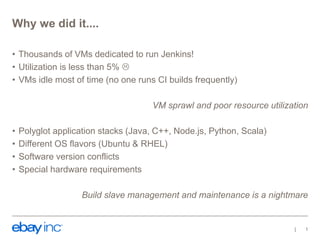
• Thousands of VMs dedicated to run Jenkins!
• Utilization is less than 5% 
• VMs idle most of time (no one runs CI builds frequently)
VM sprawl and poor resource utilization
• Polyglot application stacks (Java, C++, Node.js, Python, Scala)
• Different OS flavors (Ubuntu & RHEL)
• Software version conflicts
• Special hardware requirements
Build slave management and maintenance is a nightmare
1
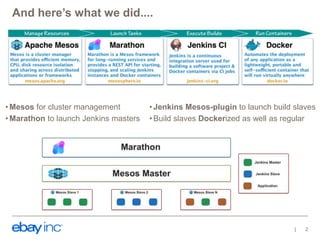
And here’s what we did....
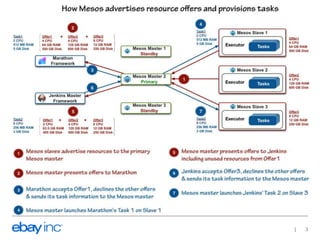
•Mesos for cluster management
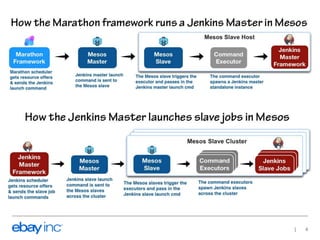
•Marathon to launch Jenkins masters
•Jenkins Mesos-plugin to launch build slaves
•Build slaves Dockerized as well as regular
2
3
4
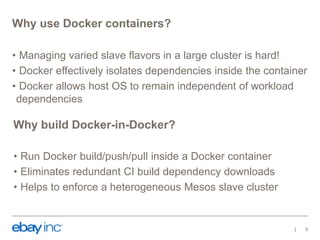
Why use Docker containers?
• Managing varied slave flavors in a large cluster is hard!
• Docker effectively isolates dependencies inside the container
• Docker allows host OS to remain independent of workload
dependencies
Why build Docker-in-Docker?
• Run Docker build/push/pull inside a Docker container
• Eliminates redundant CI build dependency downloads
• Helps to enforce a heterogeneous Mesos slave cluster
5
Basic Use Case
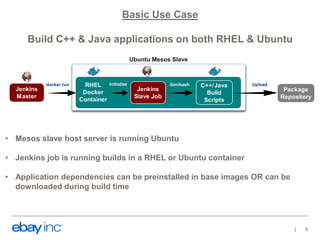
Build C++ & Java applications on both RHEL & Ubuntu
Jenkins
Slave Job
Package
Repository
Jenkins
Master
docker run Upload
Ubuntu Mesos Slave
/bin/bash C++/Java
Build
Scripts
RHEL
Docker
Container
Initialize
• Mesos slave host server is running Ubuntu
• Jenkins job is running builds in a RHEL or Ubuntu container
• Application dependencies can be preinstalled in base images OR can be
downloaded during build time
6
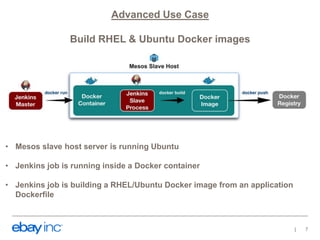
Advanced Use Case
Build RHEL & Ubuntu Docker images
• Mesos slave host server is running Ubuntu
• Jenkins job is running inside a Docker container
• Jenkins job is building a RHEL/Ubuntu Docker image from an application
Dockerfile
7
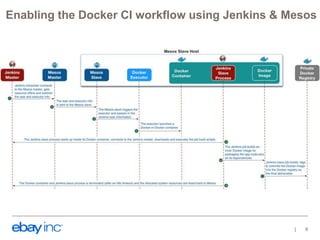
Enabling the Docker CI workflow using Jenkins & Mesos
8
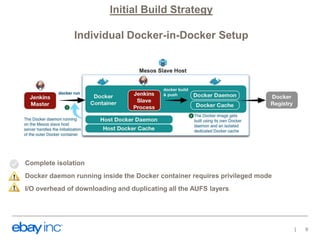
Initial Build Strategy
Individual Docker-in-Docker Setup
Complete isolation
Docker daemon running inside the Docker container requires privileged mode
I/O overhead of downloading and duplicating all the AUFS layers
9
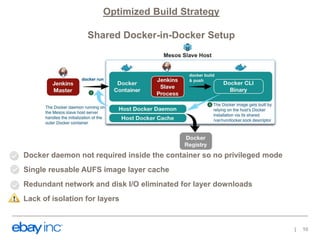
Optimized Build Strategy
Shared Docker-in-Docker Setup
Docker daemon not required inside the container so no privileged mode
Single reusable AUFS image layer cache
Redundant network and disk I/O eliminated for layer downloads
Lack of isolation for layers
10
For more information visit:
1. Apache Mesos: http://mesos.apache.org
2. Jenkins Mesos Plugin: https://github.com/jenkinsci/mesos-plugin
3. Docker: https://www.docker.io
4. Marathon Framework: https://github.com/mesosphere/marathon
Q&A
http://www.ebaytechblog.com/2014/04/04/delivering-ebays-ci-solution-with-apache-
mesos-part-i/
http://www.ebaytechblog.com/2014/05/12/delivering-ebays-ci-solution-with-apache-
mesos-part-ii/
www.ebaytechblog.com
11

Delivering eBay's CI Solution with Apache Mesos & Docker - DockerCon 2014

  • 1.
    Delivering eBay's CISolution with Apache Mesos & Docker Mohit Soni Software Engineer Ashish Hunnargikar Software Engineer
  • 2.
    Why we didit.... • Thousands of VMs dedicated to run Jenkins! • Utilization is less than 5%  • VMs idle most of time (no one runs CI builds frequently) VM sprawl and poor resource utilization • Polyglot application stacks (Java, C++, Node.js, Python, Scala) • Different OS flavors (Ubuntu & RHEL) • Software version conflicts • Special hardware requirements Build slave management and maintenance is a nightmare 1
  • 3.
    And here’s whatwe did.... •Mesos for cluster management •Marathon to launch Jenkins masters •Jenkins Mesos-plugin to launch build slaves •Build slaves Dockerized as well as regular 2
  • 4.
  • 5.
  • 6.
    Why use Dockercontainers? • Managing varied slave flavors in a large cluster is hard! • Docker effectively isolates dependencies inside the container • Docker allows host OS to remain independent of workload dependencies Why build Docker-in-Docker? • Run Docker build/push/pull inside a Docker container • Eliminates redundant CI build dependency downloads • Helps to enforce a heterogeneous Mesos slave cluster 5
  • 7.
    Basic Use Case BuildC++ & Java applications on both RHEL & Ubuntu Jenkins Slave Job Package Repository Jenkins Master docker run Upload Ubuntu Mesos Slave /bin/bash C++/Java Build Scripts RHEL Docker Container Initialize • Mesos slave host server is running Ubuntu • Jenkins job is running builds in a RHEL or Ubuntu container • Application dependencies can be preinstalled in base images OR can be downloaded during build time 6
  • 8.
    Advanced Use Case BuildRHEL & Ubuntu Docker images • Mesos slave host server is running Ubuntu • Jenkins job is running inside a Docker container • Jenkins job is building a RHEL/Ubuntu Docker image from an application Dockerfile 7
  • 9.
    Enabling the DockerCI workflow using Jenkins & Mesos 8
  • 10.
    Initial Build Strategy IndividualDocker-in-Docker Setup Complete isolation Docker daemon running inside the Docker container requires privileged mode I/O overhead of downloading and duplicating all the AUFS layers 9
  • 11.
    Optimized Build Strategy SharedDocker-in-Docker Setup Docker daemon not required inside the container so no privileged mode Single reusable AUFS image layer cache Redundant network and disk I/O eliminated for layer downloads Lack of isolation for layers 10
  • 12.
    For more informationvisit: 1. Apache Mesos: http://mesos.apache.org 2. Jenkins Mesos Plugin: https://github.com/jenkinsci/mesos-plugin 3. Docker: https://www.docker.io 4. Marathon Framework: https://github.com/mesosphere/marathon Q&A http://www.ebaytechblog.com/2014/04/04/delivering-ebays-ci-solution-with-apache- mesos-part-i/ http://www.ebaytechblog.com/2014/05/12/delivering-ebays-ci-solution-with-apache- mesos-part-ii/ www.ebaytechblog.com 11

Editor's Notes

  • #7 Allow different OS flavors Prevent software version conflicts Application dependencies Hardware independence