Introduction- Evolution of
Community Medicine
By:-Kamlesh Sharma
Group No.:-217
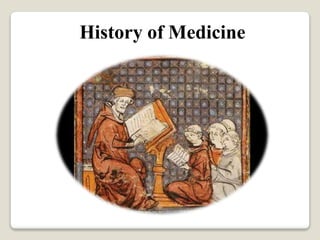
History of Medicine
MEDICINEINANTIQUITY
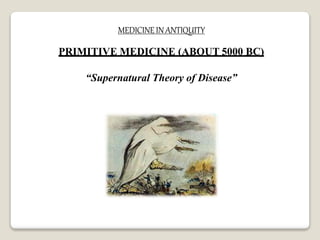
PRIMITIVE MEDICINE (ABOUT 5000 BC)
“Supernatural Theory of Disease”
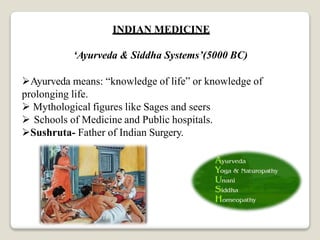
INDIAN MEDICINE
‘Ayurveda & Siddha Systems’(5000 BC)
Ayurveda means: “knowledge of life” or knowledge of
prolonging life.
 Mythological figures like Sages and seers
 Schools of Medicine and Public hospitals.
Sushruta- Father of Indian Surgery.
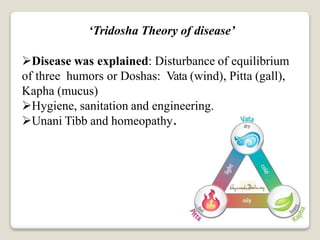
‘Tridosha Theory of disease’
Disease was explained: Disturbance of equilibrium
of three humors or Doshas: Vata (wind), Pitta (gall),
Kapha (mucus)
Hygiene, sanitation and engineering.
Unani Tibb and homeopathy.
CHINESE MEDICINE (2700 BC)
First organized body of medical knowledge.
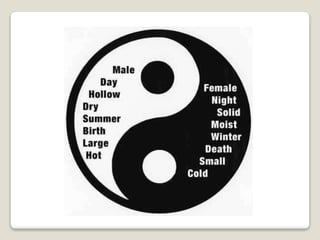
‘Yang and Yin’-Two Principles
Yang: Active masculine principle.
Yin : Negative feminine principle.
The balance of these two opposing forces meant
good health.
Hygiene, dietetics, hydrotherapy, massage, drugs
were used by physicians.
 Early pioneers of Immunization.
 Accupuncture.
EGYPTIAN MEDICINE (2000 BC)
Oldest civilization.
Art of medicine was mingled with religion.
 Pulse- speech of heart.
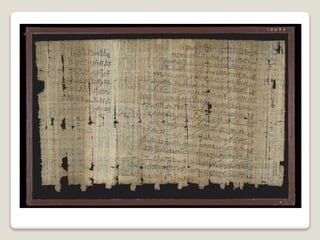
Picture writing and Papyrus recording.
Prescriptions (800 based on 700 drugs).
Planned cities, Inoculation against smallpox.
MESOPOTAMIAN MEDICINE
Cradle of civilization.
Basic concepts of medicine were religious, practised
by herb doctors, knife doctors and spell doctors.
Magic, necromancy, demons
Geomancy and Hepatoscopic divination.
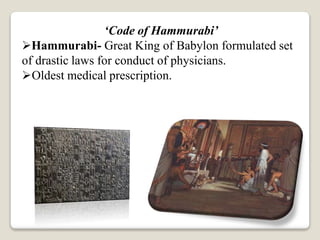
‘Code of Hammurabi’
Hammurabi- Great King of Babylon formulated set
of drastic laws for conduct of physicians.
Oldest medical prescription.
GREEK MEDICINE(460-136 BC)
Civilizers of the ancient world.
They taught man to think ‘why’and ‘how’.
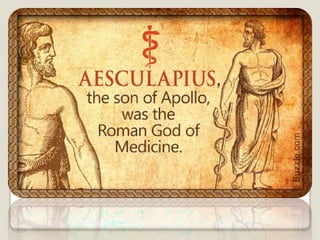
‘Aesculapius bore two daughters’
Hygiea : Goddess of health
Panacea: Goddess of medicine
Dynasty of healers (Curative medicine)
Hygienists (Preventive medicine).
GREEK MEDICINE (CONT’D)
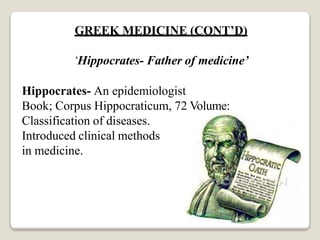
‘Hippocrates- Father of medicine’
Hippocrates- An epidemiologist
Book; Corpus Hippocraticum, 72 Volume:
Classification of diseases.
Introduced clinical methods
in medicine.
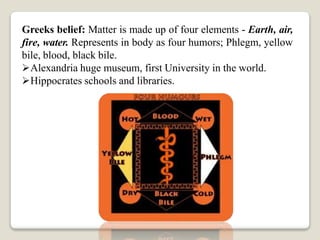
Greeks belief: Matter is made up of four elements - Earth, air,
fire, water. Represents in body as four humors; Phlegm, yellow
bile, blood, black bile.
Alexandria huge museum, first University in the world.
Hippocrates schools and libraries.
ROMAN MEDICINE
More powerful and practical minded than Greeks.
Sense of sanitation.
Public health awareness: baths, sewers, roads, pure
water, hospitals, and malaria treatment.
Galen- Amedical dictator.
Speciality in comparative anatomy and experimental
physiology.
Standard textbooks of medicine for 14 centuries.
Disease was due to: Predisposing, exciting and
environmental factors.
DOC-20221111-WA0056..pptx

DOC-20221111-WA0056..pptx

  • 1.
    Introduction- Evolution of CommunityMedicine By:-Kamlesh Sharma Group No.:-217
  • 2.
  • 4.
    MEDICINEINANTIQUITY PRIMITIVE MEDICINE (ABOUT5000 BC) “Supernatural Theory of Disease”
  • 5.
    INDIAN MEDICINE ‘Ayurveda &Siddha Systems’(5000 BC) Ayurveda means: “knowledge of life” or knowledge of prolonging life.  Mythological figures like Sages and seers  Schools of Medicine and Public hospitals. Sushruta- Father of Indian Surgery.
  • 6.
    ‘Tridosha Theory ofdisease’ Disease was explained: Disturbance of equilibrium of three humors or Doshas: Vata (wind), Pitta (gall), Kapha (mucus) Hygiene, sanitation and engineering. Unani Tibb and homeopathy.
  • 7.
    CHINESE MEDICINE (2700BC) First organized body of medical knowledge. ‘Yang and Yin’-Two Principles Yang: Active masculine principle. Yin : Negative feminine principle. The balance of these two opposing forces meant good health. Hygiene, dietetics, hydrotherapy, massage, drugs were used by physicians.  Early pioneers of Immunization.  Accupuncture.
  • 9.
    EGYPTIAN MEDICINE (2000BC) Oldest civilization. Art of medicine was mingled with religion.  Pulse- speech of heart. Picture writing and Papyrus recording. Prescriptions (800 based on 700 drugs). Planned cities, Inoculation against smallpox.
  • 11.
    MESOPOTAMIAN MEDICINE Cradle ofcivilization. Basic concepts of medicine were religious, practised by herb doctors, knife doctors and spell doctors. Magic, necromancy, demons Geomancy and Hepatoscopic divination.
  • 12.
    ‘Code of Hammurabi’ Hammurabi-Great King of Babylon formulated set of drastic laws for conduct of physicians. Oldest medical prescription.
  • 13.
    GREEK MEDICINE(460-136 BC) Civilizersof the ancient world. They taught man to think ‘why’and ‘how’. ‘Aesculapius bore two daughters’ Hygiea : Goddess of health Panacea: Goddess of medicine Dynasty of healers (Curative medicine) Hygienists (Preventive medicine).
  • 15.
    GREEK MEDICINE (CONT’D) ‘Hippocrates-Father of medicine’ Hippocrates- An epidemiologist Book; Corpus Hippocraticum, 72 Volume: Classification of diseases. Introduced clinical methods in medicine.
  • 16.
    Greeks belief: Matteris made up of four elements - Earth, air, fire, water. Represents in body as four humors; Phlegm, yellow bile, blood, black bile. Alexandria huge museum, first University in the world. Hippocrates schools and libraries.
  • 17.
    ROMAN MEDICINE More powerfuland practical minded than Greeks. Sense of sanitation. Public health awareness: baths, sewers, roads, pure water, hospitals, and malaria treatment. Galen- Amedical dictator. Speciality in comparative anatomy and experimental physiology. Standard textbooks of medicine for 14 centuries. Disease was due to: Predisposing, exciting and environmental factors.