Sharing Memories of Family Lives:
The power of the personal
Ms Sarah Finney
Research Communications
Officer
University of Leeds
When Nations Remember
Singapore
12th
October 2010
o Timescapes background
o Public engagement
o Turning points exhibition
o Personal accounts / narratives
o Public generated narrative (limitations & positives)
Contents
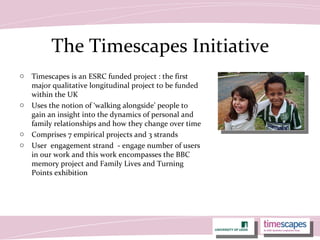
The Timescapes Initiative
o Timescapes is an ESRC funded project : the first
major qualitative longitudinal project to be funded
within the UK
o Uses the notion of ‘walking alongside’ people to
gain an insight into the dynamics of personal and
family relationships and how they change over time
o Comprises 7 empirical projects and 3 strands
o User engagement strand - engage number of users
in our work and this work encompasses the BBC
memory project and Family Lives and Turning
Points exhibition
Public Engagement
What is public engagement?
o Fluid and elusive term – has recently moved away from the terminology of
‘public understanding ‘ of science
o ‘’Public engagement describes the myriad ways in which the activity and
benefits ………can be shared with the public. Engagement is by definition a
two way process involving interaction and listening, with the goal of
generating mutual benefit.’’ (NCCPE) [in this instance would be research as
apposed to higher education]
o “ ….an umbrella term for any activity that engages with research, from science
communication in science centres or festivals,……to public dialogue. Any
good engagement activity should involve two-way aspects of listening and
interaction’’ (RCUK)
Why Engage?
o For society to share in the benefits of that research
o Increasing awareness of the value of research
o Enhance the quality of research by listening to and taking on board the
public’s reaction to the research, research will therefore be better informed
o Publicity and to raise the profile of the research
o Opportunity to gather more data
Family Lives and Turning Points
Exhibition
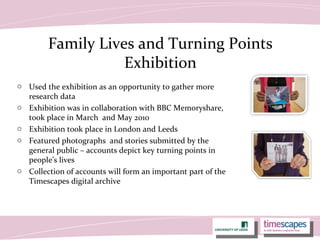
o Used the exhibition as an opportunity to gather more
research data
o Exhibition was in collaboration with BBC Memoryshare,
took place in March and May 2010
o Exhibition took place in London and Leeds
o Featured photographs and stories submitted by the
general public – accounts depict key turning points in
people’s lives
o Collection of accounts will form an important part of the
Timescapes digital archive
Engagement initiatives
o Turning points photography competition
o Photograph entries, all with accompanying narratives
o ‘Share Your Memories’ initiative
o Visited a school and day care centre for older people
Publicity
o Radio stations – local & national
o Press release
o Flyers – distribution lists
o Media screen in millennium square
o Local community groups
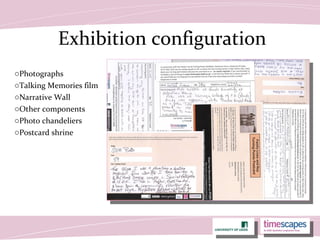
Exhibition configuration
oPhotographs
oTalking Memories film
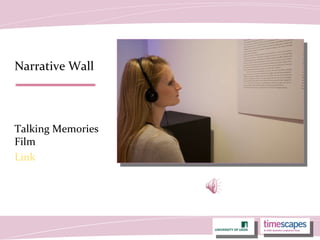
oNarrative Wall
oOther components
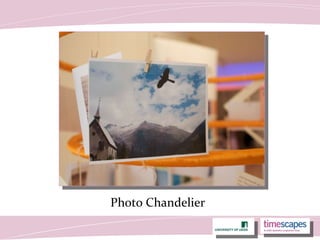
oPhoto chandeliers
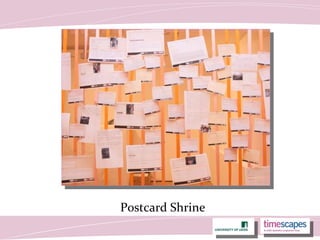
oPostcard shrine
Postcard Shrine
Photo Chandelier
Narrative Wall
Talking Memories
Film
Link
The opening event
‘’I went to the exhibition yesterday and I can't tell you how thrilled I was. It was
excellent. You exceeded all my expectations. Lis and I have been inspired by
the piece by the chap with depression (recognising some of the same
history!) and will begin to write again. I just loved the word art version of our
writing…. There were lots of people looking at the exhibition and I chatted
for a while with one of them about my Mam's photo and that turning point in
my life. So well done … for enriching our lives and I hope we can continue to
be involved in any way you think appropriate. In friendship, Phil.’’
[email from Phillipa O’Hare].
Creating your own Memory
Project
o Be Innovative
o Be Brave
o Be Inclusive
o Be Brash
The Power of Personal accounts
‘’ ….the memories of the past are a constant play, flashing beneath this
still surface in a still lake’’ (Rosen in Sheridan)
o Incredibly distinctive in its power to capture the past and bring it to
the present in a tangible and insightful way
o Snapshot of a society’s life history
o Narratives –oral & life history
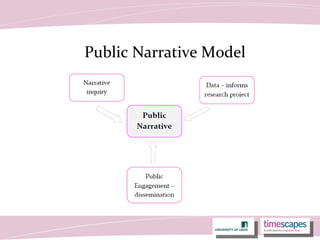
Public Narrative Model
Public generated narrative –
where does it sit?
o Limited literature in this area – closest piece of work ‘’Mass
Observation’’ project
o Representative? (Sheridan & Irwin)
o Shifting paradigms (Znaniecki, Rosen & Plummer)
o Narrative ambiguity
o The ‘self-selected’ sample
Public Narrative – The nation’s
memories
o No power dynamics
o Sense of freedom and empowerment
o Researching the un-researched
o Supplemented by research-generated data
o Stories represent ‘the public’
o Public narrative – sits between action research and public
engagement
Thank you for your attention
Sarah Finney
Research Communications Officer
Email: S.J.Finney@leeds.ac.uk
Web: www.timescapes.leeds.ac.uk

WNR.sg - Sharing Memories of the Family Lives : The Power of the Personal

  • 1.
    Sharing Memories ofFamily Lives: The power of the personal Ms Sarah Finney Research Communications Officer University of Leeds When Nations Remember Singapore 12th October 2010
  • 2.
    o Timescapes background oPublic engagement o Turning points exhibition o Personal accounts / narratives o Public generated narrative (limitations & positives) Contents
  • 3.
    The Timescapes Initiative oTimescapes is an ESRC funded project : the first major qualitative longitudinal project to be funded within the UK o Uses the notion of ‘walking alongside’ people to gain an insight into the dynamics of personal and family relationships and how they change over time o Comprises 7 empirical projects and 3 strands o User engagement strand - engage number of users in our work and this work encompasses the BBC memory project and Family Lives and Turning Points exhibition
  • 4.
    Public Engagement What ispublic engagement? o Fluid and elusive term – has recently moved away from the terminology of ‘public understanding ‘ of science o ‘’Public engagement describes the myriad ways in which the activity and benefits ………can be shared with the public. Engagement is by definition a two way process involving interaction and listening, with the goal of generating mutual benefit.’’ (NCCPE) [in this instance would be research as apposed to higher education] o “ ….an umbrella term for any activity that engages with research, from science communication in science centres or festivals,……to public dialogue. Any good engagement activity should involve two-way aspects of listening and interaction’’ (RCUK)
  • 5.
    Why Engage? o Forsociety to share in the benefits of that research o Increasing awareness of the value of research o Enhance the quality of research by listening to and taking on board the public’s reaction to the research, research will therefore be better informed o Publicity and to raise the profile of the research o Opportunity to gather more data
  • 6.
    Family Lives andTurning Points Exhibition o Used the exhibition as an opportunity to gather more research data o Exhibition was in collaboration with BBC Memoryshare, took place in March and May 2010 o Exhibition took place in London and Leeds o Featured photographs and stories submitted by the general public – accounts depict key turning points in people’s lives o Collection of accounts will form an important part of the Timescapes digital archive
  • 7.
    Engagement initiatives o Turningpoints photography competition o Photograph entries, all with accompanying narratives o ‘Share Your Memories’ initiative o Visited a school and day care centre for older people Publicity o Radio stations – local & national o Press release o Flyers – distribution lists o Media screen in millennium square o Local community groups
  • 8.
    Exhibition configuration oPhotographs oTalking Memoriesfilm oNarrative Wall oOther components oPhoto chandeliers oPostcard shrine
  • 9.
  • 10.
  • 11.
  • 12.
    The opening event ‘’Iwent to the exhibition yesterday and I can't tell you how thrilled I was. It was excellent. You exceeded all my expectations. Lis and I have been inspired by the piece by the chap with depression (recognising some of the same history!) and will begin to write again. I just loved the word art version of our writing…. There were lots of people looking at the exhibition and I chatted for a while with one of them about my Mam's photo and that turning point in my life. So well done … for enriching our lives and I hope we can continue to be involved in any way you think appropriate. In friendship, Phil.’’ [email from Phillipa O’Hare].
  • 13.
    Creating your ownMemory Project o Be Innovative o Be Brave o Be Inclusive o Be Brash
  • 14.
    The Power ofPersonal accounts ‘’ ….the memories of the past are a constant play, flashing beneath this still surface in a still lake’’ (Rosen in Sheridan) o Incredibly distinctive in its power to capture the past and bring it to the present in a tangible and insightful way o Snapshot of a society’s life history o Narratives –oral & life history
  • 15.
  • 16.
    Public generated narrative– where does it sit? o Limited literature in this area – closest piece of work ‘’Mass Observation’’ project o Representative? (Sheridan & Irwin) o Shifting paradigms (Znaniecki, Rosen & Plummer) o Narrative ambiguity o The ‘self-selected’ sample
  • 17.
    Public Narrative –The nation’s memories o No power dynamics o Sense of freedom and empowerment o Researching the un-researched o Supplemented by research-generated data o Stories represent ‘the public’ o Public narrative – sits between action research and public engagement
  • 18.
    Thank you foryour attention Sarah Finney Research Communications Officer Email: S.J.Finney@leeds.ac.uk Web: www.timescapes.leeds.ac.uk

Editor's Notes

  • #5 From the definitions get a real sense that it is two-way process and that it is not a one way stream of information – reciprocal.