Do you know which “Hernia” you
are suffering from?
What is Hernia?
A Hernia occurs when an organ or a tissue bulges out within a
muscle weakening called fascia. It occurs due to increased
pressure in weak areas in the body. The hernia can be
developed in any part of the body, however, abdominal and
pelvic, anterior abdominal wall and diaphragm are the most
common parts. Hips and chest may also develop hernia if
excessive pressure is put on those areas.
How are Hernias classified?
Hernias are classified on the basis of the location where in the
body it has occurred and the reason behind the occurrence.
They are mainly divided into three divisions such as Abdominal
and Pelvic Floor, Anterior Abdominal Floor,
Diaphragm and Ventral Hernia.
Abdominal and Pelvic Floor Hernias
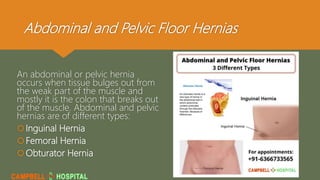
An abdominal or pelvic hernia
occurs when tissue bulges out from
the weak part of the muscle and
mostly it is the colon that breaks out
of the muscle. Abdominal and pelvic
hernias are of different types:
Inguinal Hernia
Femoral Hernia
Obturator Hernia
Inguinal Hernia
When the part of the intestine or bladder into the inguinal canal
or the groin. The inguinal canal is the opening that allows the
spermatic cord and testicle from the abdomen to the scrotum as
the fetus develops. It is most common among men.
Femoral Hernia
Femoral Hernia occurs through the opening of the lower
abdomen where the nerve passes from the lower abdomen to
the upper part of the leg as the bone structure is wide. It is most
common among women.
Obturator Hernia
Obturator Hernia is very rare among women and occurs near
the pelvic area. Obturator Hernia occurs when a woman
undergoes multiple pregnancies and there is some weight loss
in the process.
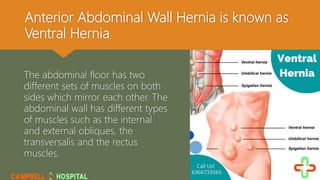
Anterior Abdominal Wall Hernia is known as
Ventral Hernia
The abdominal floor has two
different sets of muscles on both
sides which mirror each other. The
abdominal wall has different types
of muscles such as the internal
and external obliques, the
transversalis and the rectus
muscles.
Epigastric Hernia
When the muscles between the muscles of the rectus and the
breast bones and belly button weaken, Epigastric Hernia occurs.
Parts of bowel, fats or omentum are generally trapped in this
hernia. This kind of hernia does not become evident until the
child/infant grows into an adult.
Umbilical Hernia
The umbilical hernia occurs mostly in babies, near the belly
button where the umbilical cord is attached to the mother’s
body. Generally, it does not need any treatment and heals
automatically. However, if it does not heal by the passage of
time then further treatment may be required.
Spigelian Hernia
This kind of hernia tends to occur under the layers of fat which is
why they are undetected for a longer time as they do not bulge
out immediately. Spigelian Hernia is small and has a high risk of
strangulated hernia. However, the occurrence of Spigelian
Hernia is very rare.
Incisional Hernia
Incisional Hernia occurs when the wall of the abdomen is
weakened by surgery. It is a common hernia as it happens due
to abdominal weakening and makes it easy for the tissue to
protrude or bulge. It may occur soon after the surgery or maybe
after a few months or years.
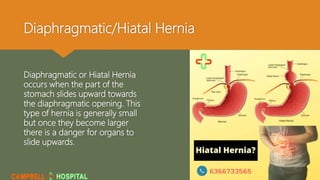
Diaphragmatic/Hiatal Hernia
Diaphragmatic or Hiatal Hernia
occurs when the part of the
stomach slides upward towards
the diaphragmatic opening. This
type of hernia is generally small
but once they become larger
there is a danger for organs to
slide upwards.
Diaphragmatic Hernias are of different types
Sliding Hernia
Paraesophageal hernia
Traumatic Diaphragmatic Hernia
Congenital Hernia
Sliding Hernia
These are one of the most common types of hernia where the
lower food pipe or the esophagus and portions of the stomach
slide through the diaphragm to the chest.
Paraesophageal hernia
These types of hernia occur when the stomach herniates into
the chest by the side of the esophagus.
Traumatic Diaphragmatic Hernia
It occurs due to a trauma that weakens or tears the tissues
resulting in the herniation in the chest cavity either immediately
or after the passage of time.
Congenital Hernia
It is caused due to the failure of the diaphragm which can lead
to lung failure as well.
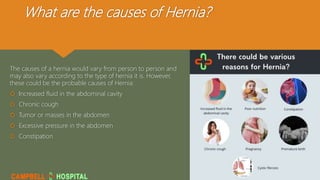
What are the causes of Hernia?
The causes of a hernia would vary from person to person and
may also vary according to the type of hernia it is. However,
these could be the probable causes of Hernia:
 Increased fluid in the abdominal cavity
 Chronic cough
 Tumor or masses in the abdomen
 Excessive pressure in the abdomen
 Constipation
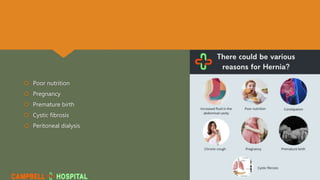
 Poor nutrition
 Pregnancy
 Premature birth
 Cystic fibrosis
 Peritoneal dialysis
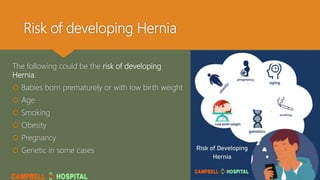
Risk of developing Hernia
The following could be the risk of developing
Hernia:
 Babies born prematurely or with low birth weight
 Age
 Smoking
 Obesity
 Pregnancy
 Genetic in some cases
What are the signs and symptoms of Hernia?
A Hernia could be painful for some and painless for some
because of which Hernia at times goes undetected for a long
time. In case a person feels soreness or discomfort, it is
necessary that the issue should be brought to the doctor’s
attention.
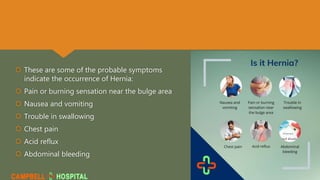
 These are some of the probable symptoms
indicate the occurrence of Hernia:
 Pain or burning sensation near the bulge area
 Nausea and vomiting
 Trouble in swallowing
 Chest pain
 Acid reflux
 Abdominal bleeding
How is Hernia diagnosed?
For the diagnosis of Hernia, the doctor may ask about the
medical history if the person has undergone any surgery in the
past because of which hernia would have caused. The doctor
may perform some physical examination, he may ask the patient
to stand and cough or strain which could be the better for the
diagnosis. In some cases, the doctor may also opt for a CT Scan
or X-Rays in the suspected areas.
How is Hernia treated?
Treatment for hernia depends on its type, accordingly, the
doctor may proceed with the treatment. However, surgery is the
only safe and secure option for the treatment for hernia. Some
hernia does not show any signs or symptoms because of which
it gets undiagnosed, in that case, if it is not a problem then the
doctor may recommend for a regular check-up.
FAQs on Hernia
What is the preferred food for Hernia
patients?
A person suffering from Hernia may add the following
things to their diet which could help with the Hernia until
it is operated:
 Green leafy vegetables
 Nuts & seeds
 Whole grains
A person suffering from Hernia may add the following things to their diet which could help
with the Hernia until it is operated:
 Green leafy vegetables
 Nuts & seeds
 Whole grains
 Peas & beans
 Non-citrus fruits & juices
 Lean proteins
 Fish & tofu
 Cinnamon
 Ginger
 Apple cider vinegar
What food should be avoided while suffering
from Hernia?
Intake of food which is oily and fried, red meat, caffeine, alcohol,
tomatoes, chocolates, and carbonated drinks are restricted for
the betterment of patients suffering from a hernia.
How to manage symptoms of a small hernia?
As small hernia which does not show any symptoms and does
not need to be operated could be managed by avoiding large
meals, bending down, smoking and exerting pressure on the
affected areas.
What is the best treatment for Hernia?
A proper check-up with the doctor could be the first step for the
best step. In the case of strangulated and incarcerated hernia
doctors straight away go ahead with surgery without any delay.
What are the probable risks of Hernia
surgery?
There could be the following complication in case of surgery
such as infection, blood clots, pain, nerve damage and
sometimes the hernia may reoccur.
Reach out to Campbell Hospital for regular check-up and
treatment, call us at 6366733565.
We are located at 186/165. Ground Floor, 9th Main Rd, Sector 6,
HSR Layout, Bengaluru, Karnataka 560102
Visit us at https://campbellhospital.in/

DO YOU KNOW WHICH “HERNIA” YOU ARE SUFFERING FROM?

  • 1.
    Do you knowwhich “Hernia” you are suffering from?
  • 2.
    What is Hernia? AHernia occurs when an organ or a tissue bulges out within a muscle weakening called fascia. It occurs due to increased pressure in weak areas in the body. The hernia can be developed in any part of the body, however, abdominal and pelvic, anterior abdominal wall and diaphragm are the most common parts. Hips and chest may also develop hernia if excessive pressure is put on those areas.
  • 3.
    How are Herniasclassified? Hernias are classified on the basis of the location where in the body it has occurred and the reason behind the occurrence. They are mainly divided into three divisions such as Abdominal and Pelvic Floor, Anterior Abdominal Floor, Diaphragm and Ventral Hernia.
  • 4.
    Abdominal and PelvicFloor Hernias An abdominal or pelvic hernia occurs when tissue bulges out from the weak part of the muscle and mostly it is the colon that breaks out of the muscle. Abdominal and pelvic hernias are of different types: Inguinal Hernia Femoral Hernia Obturator Hernia
  • 5.
    Inguinal Hernia When thepart of the intestine or bladder into the inguinal canal or the groin. The inguinal canal is the opening that allows the spermatic cord and testicle from the abdomen to the scrotum as the fetus develops. It is most common among men.
  • 6.
    Femoral Hernia Femoral Herniaoccurs through the opening of the lower abdomen where the nerve passes from the lower abdomen to the upper part of the leg as the bone structure is wide. It is most common among women.
  • 7.
    Obturator Hernia Obturator Herniais very rare among women and occurs near the pelvic area. Obturator Hernia occurs when a woman undergoes multiple pregnancies and there is some weight loss in the process.
  • 8.
    Anterior Abdominal WallHernia is known as Ventral Hernia The abdominal floor has two different sets of muscles on both sides which mirror each other. The abdominal wall has different types of muscles such as the internal and external obliques, the transversalis and the rectus muscles.
  • 9.
    Epigastric Hernia When themuscles between the muscles of the rectus and the breast bones and belly button weaken, Epigastric Hernia occurs. Parts of bowel, fats or omentum are generally trapped in this hernia. This kind of hernia does not become evident until the child/infant grows into an adult.
  • 10.
    Umbilical Hernia The umbilicalhernia occurs mostly in babies, near the belly button where the umbilical cord is attached to the mother’s body. Generally, it does not need any treatment and heals automatically. However, if it does not heal by the passage of time then further treatment may be required.
  • 11.
    Spigelian Hernia This kindof hernia tends to occur under the layers of fat which is why they are undetected for a longer time as they do not bulge out immediately. Spigelian Hernia is small and has a high risk of strangulated hernia. However, the occurrence of Spigelian Hernia is very rare.
  • 12.
    Incisional Hernia Incisional Herniaoccurs when the wall of the abdomen is weakened by surgery. It is a common hernia as it happens due to abdominal weakening and makes it easy for the tissue to protrude or bulge. It may occur soon after the surgery or maybe after a few months or years.
  • 13.
    Diaphragmatic/Hiatal Hernia Diaphragmatic orHiatal Hernia occurs when the part of the stomach slides upward towards the diaphragmatic opening. This type of hernia is generally small but once they become larger there is a danger for organs to slide upwards.
  • 14.
    Diaphragmatic Hernias areof different types Sliding Hernia Paraesophageal hernia Traumatic Diaphragmatic Hernia Congenital Hernia
  • 15.
    Sliding Hernia These areone of the most common types of hernia where the lower food pipe or the esophagus and portions of the stomach slide through the diaphragm to the chest.
  • 16.
    Paraesophageal hernia These typesof hernia occur when the stomach herniates into the chest by the side of the esophagus.
  • 17.
    Traumatic Diaphragmatic Hernia Itoccurs due to a trauma that weakens or tears the tissues resulting in the herniation in the chest cavity either immediately or after the passage of time.
  • 18.
    Congenital Hernia It iscaused due to the failure of the diaphragm which can lead to lung failure as well.
  • 19.
    What are thecauses of Hernia? The causes of a hernia would vary from person to person and may also vary according to the type of hernia it is. However, these could be the probable causes of Hernia:  Increased fluid in the abdominal cavity  Chronic cough  Tumor or masses in the abdomen  Excessive pressure in the abdomen  Constipation
  • 20.
     Poor nutrition Pregnancy  Premature birth  Cystic fibrosis  Peritoneal dialysis
  • 21.
    Risk of developingHernia The following could be the risk of developing Hernia:  Babies born prematurely or with low birth weight  Age  Smoking  Obesity  Pregnancy  Genetic in some cases
  • 22.
    What are thesigns and symptoms of Hernia? A Hernia could be painful for some and painless for some because of which Hernia at times goes undetected for a long time. In case a person feels soreness or discomfort, it is necessary that the issue should be brought to the doctor’s attention.
  • 23.
     These aresome of the probable symptoms indicate the occurrence of Hernia:  Pain or burning sensation near the bulge area  Nausea and vomiting  Trouble in swallowing  Chest pain  Acid reflux  Abdominal bleeding
  • 24.
    How is Herniadiagnosed? For the diagnosis of Hernia, the doctor may ask about the medical history if the person has undergone any surgery in the past because of which hernia would have caused. The doctor may perform some physical examination, he may ask the patient to stand and cough or strain which could be the better for the diagnosis. In some cases, the doctor may also opt for a CT Scan or X-Rays in the suspected areas.
  • 25.
    How is Herniatreated? Treatment for hernia depends on its type, accordingly, the doctor may proceed with the treatment. However, surgery is the only safe and secure option for the treatment for hernia. Some hernia does not show any signs or symptoms because of which it gets undiagnosed, in that case, if it is not a problem then the doctor may recommend for a regular check-up.
  • 26.
  • 27.
    What is thepreferred food for Hernia patients? A person suffering from Hernia may add the following things to their diet which could help with the Hernia until it is operated:  Green leafy vegetables  Nuts & seeds  Whole grains
  • 28.
    A person sufferingfrom Hernia may add the following things to their diet which could help with the Hernia until it is operated:  Green leafy vegetables  Nuts & seeds  Whole grains  Peas & beans  Non-citrus fruits & juices  Lean proteins  Fish & tofu  Cinnamon  Ginger  Apple cider vinegar
  • 29.
    What food shouldbe avoided while suffering from Hernia? Intake of food which is oily and fried, red meat, caffeine, alcohol, tomatoes, chocolates, and carbonated drinks are restricted for the betterment of patients suffering from a hernia.
  • 30.
    How to managesymptoms of a small hernia? As small hernia which does not show any symptoms and does not need to be operated could be managed by avoiding large meals, bending down, smoking and exerting pressure on the affected areas.
  • 31.
    What is thebest treatment for Hernia? A proper check-up with the doctor could be the first step for the best step. In the case of strangulated and incarcerated hernia doctors straight away go ahead with surgery without any delay.
  • 32.
    What are theprobable risks of Hernia surgery? There could be the following complication in case of surgery such as infection, blood clots, pain, nerve damage and sometimes the hernia may reoccur.
  • 33.
    Reach out toCampbell Hospital for regular check-up and treatment, call us at 6366733565. We are located at 186/165. Ground Floor, 9th Main Rd, Sector 6, HSR Layout, Bengaluru, Karnataka 560102 Visit us at https://campbellhospital.in/