SSPPAAIINN 
((EESSPPAAÑÑAA 
))
WWHHAATT IISS 
SSPPAAIINN?? 
• Officially the Kingdom of Spain 
• Member of the European Union 
• Located in South-Western 
Europe 
• Capital: Madrid
GGEEOOGGRRAAPPHHYY
GGEEOOGGRRAAPPHHYY 
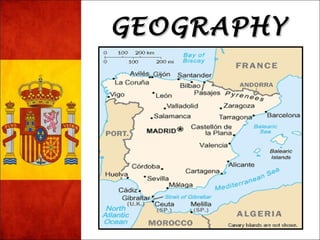
• Located in the Iberian 
Peninsula(occupies about 85% of it) 
• Borders Portugal on the West, 
Gibraltar and Morocco on the South 
and France and Andorra on the 
North-east 
• Spain includes the Balearic Islands in 
the Mediterranean Sea, the Canary 
Islands in the Atlantic Ocean and a 
number of uninhabited islands in the 
Mediterranean Sea.
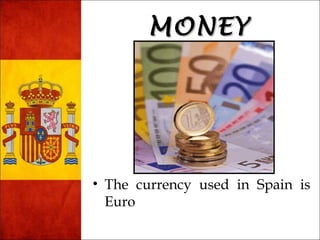
MMOONNEEYY 
• The currency used in Spain is 
Euro
PPEEOOPPLLEE 
• The people in Spain are referred to as 
Spaniards 
• Approximately 87.8% of the people are 
natives and the rest are immigrants 
• Part of the Spanish population is the 
Spanish Roma (formerly-nomadic 
community that holds importance in 
Spanish culture and folklore) 
• Religion: 
– Catholics: 76% 
– Other religions: 5% 
– Atheists: 19% 
• Literacy rate: 97.9%
CCOONNFFOORRMMIITTIIEE 
SS 
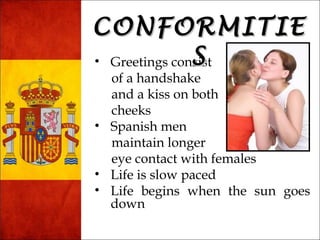
• Greetings consist 
of a handshake 
and a kiss on both 
cheeks 
• Spanish men 
maintain longer 
eye contact with females 
• Life is slow paced 
• Life begins when the sun goes 
down
FFAAMMIILLYY 
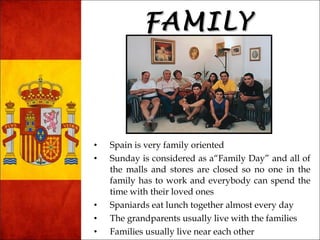
• Spain is very family oriented 
• Sunday is considered as a“Family Day” and all of 
the malls and stores are closed so no one in the 
family has to work and everybody can spend the 
time with their loved ones 
• Spaniards eat lunch together almost every day 
• The grandparents usually live with the families 
• Families usually live near each other
SSIIEESSTTAA 
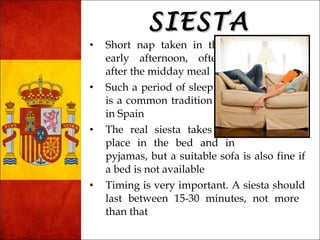
• Short nap taken in the 
early afternoon, often 
after the midday meal 
• Such a period of sleep 
is a common tradition 
in Spain 
• The real siesta takes 
place in the bed and in 
pyjamas, but a suitable sofa is also fine if 
a bed is not available 
• Timing is very important. A siesta should 
last between 15-30 minutes, not more 
than that
NNIIGGHHTTLLIIFFEE 
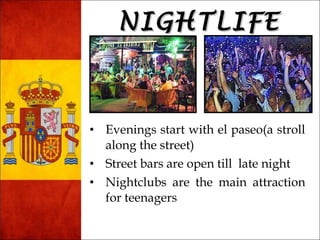
• Evenings start with el paseo(a stroll 
along the street) 
• Street bars are open till late night 
• Nightclubs are the main attraction 
for teenagers
LLAANNGGUUAAGGEE 
• Spanish (Español) is the 
official language of Spain 
• Second most spoken language 
in the world- 6.15%- percent of 
world population
CCHHRRIISSTTMMAASS
CCHHRRIISSTTMMAASS 
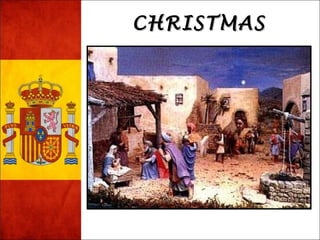
• December 23: 
– Sing, pray, and eat together at every 
house 
– Sing villancicos (carols) together 
– Asaltos – surprise visits by groups 
of friends going from one house to 
another 
– Children ask for aguinaldo (or small 
gift) 
• December 24 “La noche buena”: 
– Everyone attends midnight mass 
– Drink, dance, open presents, eat 
foods such as tamales and turkey
CHRISTMAS EVE 
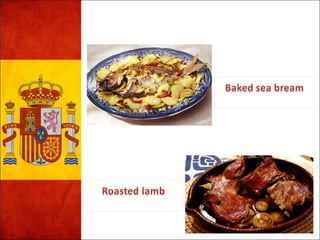
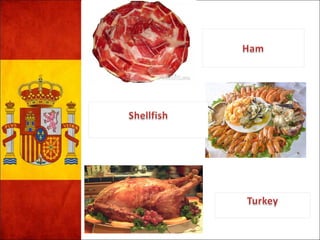
• The typical courses of this special 
dinner are shellfish, fish ( sea 
bream, gilt head bream, see bass, 
hake), lamb, turkey, ham 
• To drink it is drunk wine, cider and 
cava (spanish sparkling wine 
similar to french champagne) 
• After dinner are eaten the typical 
christmas sweets ( nougat candy, 
marzipan, polvoron…)
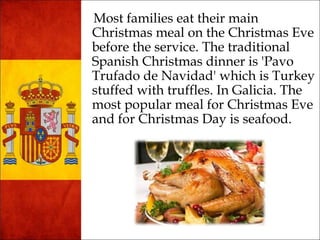
Most families eat their main 
Christmas meal on the Christmas Eve 
before the service. The traditional 
Spanish Christmas dinner is 'Pavo 
Trufado de Navidad' which is Turkey 
stuffed with truffles. In Galicia. The 
most popular meal for Christmas Eve 
and for Christmas Day is seafood.
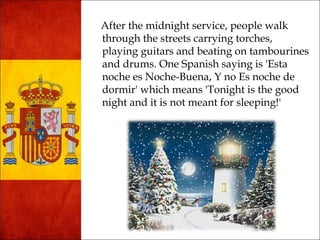
After the mi dnight service, people walk 
through the streets carrying torches, 
playing guitars and beating on tambourines 
and drums. One Spanish saying is 'Esta 
noche es Noche-Buena, Y no Es noche de 
dormir' which means 'Tonight is the good 
night and it is not meant for sleeping!'
Typical drinks of 
christmas 
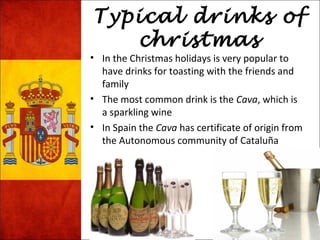
• In the Christmas holidays is very popular to 
have drinks for toasting with the friends and 
family 
• The most common drink is the Cava, which is 
a sparkling wine 
• In Spain the Cava has certificate of origin from 
the Autonomous community of Cataluña
Christmas sweets 
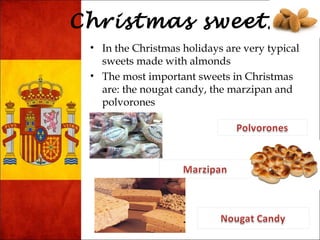
• In the Christmas holidays are very typical 
sweets made with almonds 
• The most important sweets in Christmas 
are: the nougat candy, the marzipan and 
polvorones
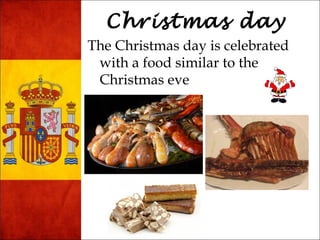
Christmas day 
The Christmas day is celebrated 
with a food similar to the 
Christmas eve
A few different languages are 
spoken in different regions in Spain. 
In Spanish Happy/Merry Christmas 
is 'Feliz Navidad'; 
in Catalan it's 'Bon Nadal'; and 
in Galician 'Bo Nadal'.
Día de los santos 
inocentes 
• December 28th is 'Día de los santos 
inocentes' or 'Day of the Innocent Saints' and 
is very like Aprils Fools Day in the UK and 
USA. People try to trick each other into 
believing silly stories and jokes. Newspapers 
and TV stations also run silly stories. If you 
trick someone, you can call them 'Inocente, 
inocente' which means 'innocent, innocent'. 
28th December is when people all over the 
world remember the babies that were killed 
on the orders of King Herod when he was 
trying to kill the baby Jesus.
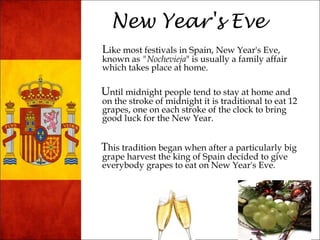
New Year's Eve 
Like most festivals in Spain, New Year's Eve, 
known as "Nochevieja" is usually a family affair 
which takes place at home. 
Until midnight people tend to stay at home and 
on the stroke of midnight it is traditional to eat 12 
grapes, one on each stroke of the clock to bring 
good luck for the New Year. 
This tradition began when after a particularly big 
grape harvest the king of Spain decided to give 
everybody grapes to eat on New Year's Eve.
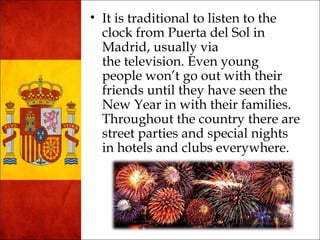
• It is traditional to listen to the 
clock from Puerta del Sol in 
Madrid, usually via 
the television. Even young 
people won’t go out with their 
friends until they have seen the 
New Year in with their families. 
Throughout the country there are 
street parties and special nights 
in hotels and clubs everywhere.
New year day 
( 1 of January) 
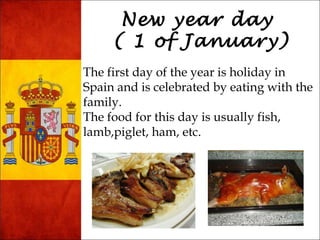
The first day of the year is holiday in 
Spain and is celebrated by eating with the 
family. 
The food for this day is usually fish, 
lamb,piglet, ham, etc.
Apart fr om Christmas, there is 
another festival that is celebrated 
in Spain that is about the 
Christmas Story. It is called 
Epiphany and is celebrated on 6th 
January. This is the twelfth night 
after Christmas. In Spanish, 
Epiphany is called 'Fiesta de Los 
tres Reyes Mages': in English this 
means 'The festival of the three 
Magic Kings'. Epiphany celebrates 
when the Kings or Wise 
men brought gifts to the baby 
Jesus.
DDÍÍAA DDEE LLOOSS TTRREESS 
RREEYYEESS ((TTHHRREEEE KKIINNGGSS 
DDAAYY)) 
• Children fill small boxes with 
grass for the King’s horses and 
parents replace the grass with 
gifts 
• Christmas decorations are taken 
down 
• Boys play the part of the three 
kings and wear fake beards, 
crowns, and long robes and sit in 
the plazas of towns where 
children go to have their pictures 
taken
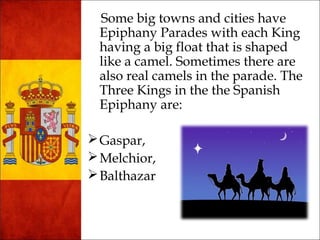
Some big towns and cities have 
Epiphany Parades with each King 
having a big float that is shaped 
like a camel. Sometimes there are 
also real camels in the parade. The 
Three Kings in the the Spanish 
Epiphany are: 
Gaspar, 
Melchior, 
Balthazar
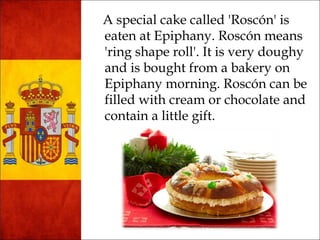
A special cake called 'Roscón' is 
eaten at Epiphany. Roscón means 
'ring shape roll'. It is very doughy 
and is bought from a bakery on 
Epiphany morning. Roscón can be 
filled with cream or chocolate and 
contain a little gift.
Christmas in the 
Basque Country 
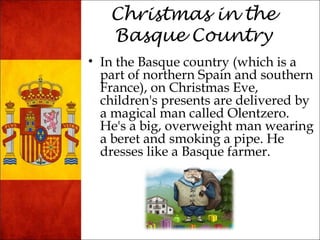
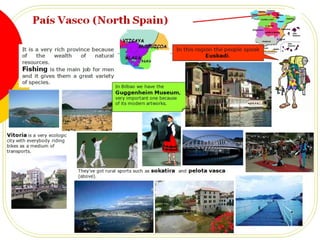
• In the Basque country (which is a 
part of northern Spain and southern 
France), on Christmas Eve, 
children's presents are delivered by 
a magical man called Olentzero. 
He's a big, overweight man wearing 
a beret and smoking a pipe. He 
dresses like a Basque farmer.
Christmas in 
Catalonia 
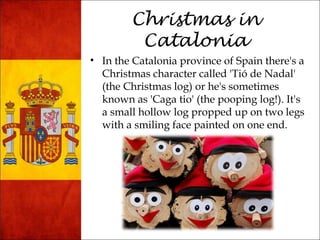
• In the Catalonia province of Spain there's a 
Christmas character called 'Tió de Nadal' 
(the Christmas log) or he's sometimes 
known as 'Caga tio' (the pooping log!). It's 
a small hollow log propped up on two legs 
with a smiling face painted on one end.
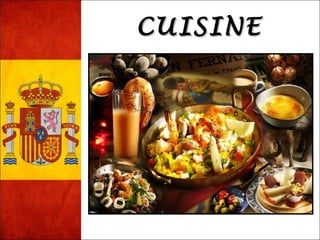
CCUUIISSIINNEE
CCUUIISSIINNEE 
• Is influenced by the Phoenicians, Greeks, 
Romans, Jews, Moors and Muslim 
Andulicians 
• Their traditional pattern is composed of four 
meals a day plus some snacks: 
– A light breakfast (desayuno): coffee or 
chocolate, bread, or churros 
– Midmorning breakfast: grilled sausages, 
fried squid, bread with tomato or an 
omelet 
– Light snack: tapas 
– Lunch (comida): soup or salad, fish or 
meat, and dessert 
– Tea and pastries (merienda) 
– Supper: soup or omelets and fruit
TTAAPPAASS 
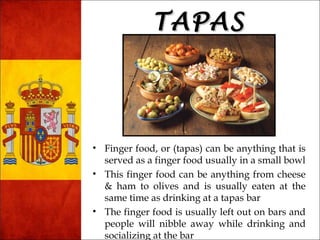
• Finger food, or (tapas) can be anything that is 
served as a finger food usually in a small bowl 
• This finger food can be anything from cheese 
& ham to olives and is usually eaten at the 
same time as drinking at a tapas bar 
• The finger food is usually left out on bars and 
people will nibble away while drinking and 
socializing at the bar
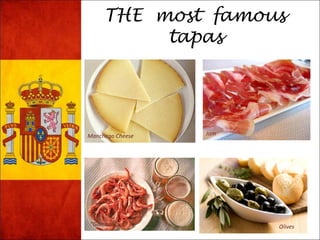
THE most famous 
tapas 
Manchego Cheese Jam 
“Gambas” Olives
PPAAEELLLLAA 
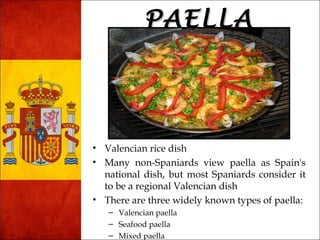
• Valencian rice dish 
• Many non-Spaniards view paella as Spain's 
national dish, but most Spaniards consider it 
to be a regional Valencian dish 
• There are three widely known types of paella: 
– Valencian paella 
– Seafood paella 
– Mixed paella
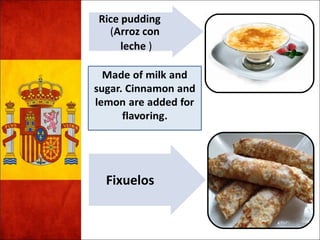
Rice pudding 
(Arroz con 
leche ) 
Fixuelos
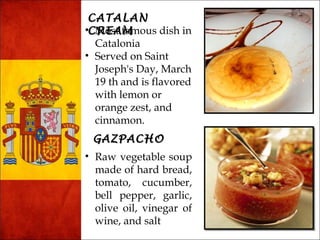
CCAATTAALLAANN 
•CCMRRoEEsAAt fMMamous dish in 
Catalonia 
• Served on Saint 
Joseph's Day, March 
19 th and is flavored 
with lemon or 
orange zest, and 
cinnamon. 
GGAAZZPPAACCHHOO 
• Raw vegetable soup 
made of hard bread, 
tomato, cucumber, 
bell pepper, garlic, 
olive oil, vinegar of 
wine, and salt
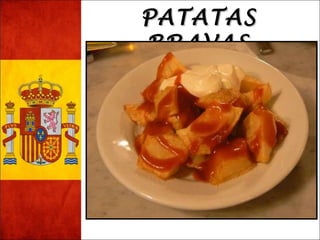
PPAATTAATTAASS 
BBRRAAVVAASS
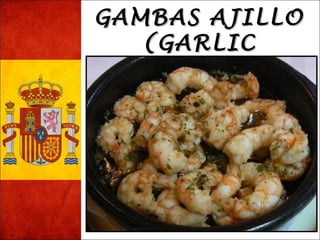
GGAAMMBBAASS AAJJIILLLLOO 
((GGAARRLLIICC 
PPRRAAWWNNSS))
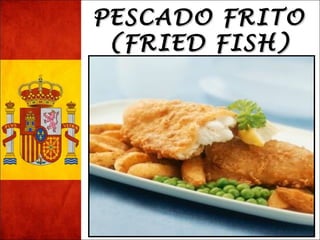
PPEESSCCAADDOO FFRRIITTOO 
((FFRRIIEEDD FFIISSHH))
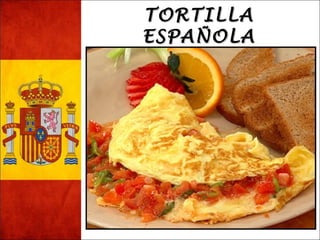
TTOORRTTIILLLLAA 
EESSPPAAÑÑOOLLAA 
((SSPPAANNIISSHH OOMMEELLEETT))
GGRRAACCIIAASS

Do ukostpenjinia

  • 1.
  • 2.
    WWHHAATT IISS SSPPAAIINN?? • Officially the Kingdom of Spain • Member of the European Union • Located in South-Western Europe • Capital: Madrid
  • 3.
  • 4.
    GGEEOOGGRRAAPPHHYY • Locatedin the Iberian Peninsula(occupies about 85% of it) • Borders Portugal on the West, Gibraltar and Morocco on the South and France and Andorra on the North-east • Spain includes the Balearic Islands in the Mediterranean Sea, the Canary Islands in the Atlantic Ocean and a number of uninhabited islands in the Mediterranean Sea.
  • 5.
    MMOONNEEYY • Thecurrency used in Spain is Euro
  • 6.
    PPEEOOPPLLEE • Thepeople in Spain are referred to as Spaniards • Approximately 87.8% of the people are natives and the rest are immigrants • Part of the Spanish population is the Spanish Roma (formerly-nomadic community that holds importance in Spanish culture and folklore) • Religion: – Catholics: 76% – Other religions: 5% – Atheists: 19% • Literacy rate: 97.9%
  • 7.
    CCOONNFFOORRMMIITTIIEE SS •Greetings consist of a handshake and a kiss on both cheeks • Spanish men maintain longer eye contact with females • Life is slow paced • Life begins when the sun goes down
  • 8.
    FFAAMMIILLYY • Spainis very family oriented • Sunday is considered as a“Family Day” and all of the malls and stores are closed so no one in the family has to work and everybody can spend the time with their loved ones • Spaniards eat lunch together almost every day • The grandparents usually live with the families • Families usually live near each other
  • 9.
    SSIIEESSTTAA • Shortnap taken in the early afternoon, often after the midday meal • Such a period of sleep is a common tradition in Spain • The real siesta takes place in the bed and in pyjamas, but a suitable sofa is also fine if a bed is not available • Timing is very important. A siesta should last between 15-30 minutes, not more than that
  • 10.
    NNIIGGHHTTLLIIFFEE • Eveningsstart with el paseo(a stroll along the street) • Street bars are open till late night • Nightclubs are the main attraction for teenagers
  • 11.
    LLAANNGGUUAAGGEE • Spanish(Español) is the official language of Spain • Second most spoken language in the world- 6.15%- percent of world population
  • 12.
  • 13.
    CCHHRRIISSTTMMAASS • December23: – Sing, pray, and eat together at every house – Sing villancicos (carols) together – Asaltos – surprise visits by groups of friends going from one house to another – Children ask for aguinaldo (or small gift) • December 24 “La noche buena”: – Everyone attends midnight mass – Drink, dance, open presents, eat foods such as tamales and turkey
  • 14.
    CHRISTMAS EVE •The typical courses of this special dinner are shellfish, fish ( sea bream, gilt head bream, see bass, hake), lamb, turkey, ham • To drink it is drunk wine, cider and cava (spanish sparkling wine similar to french champagne) • After dinner are eaten the typical christmas sweets ( nougat candy, marzipan, polvoron…)
  • 15.
    Most families eattheir main Christmas meal on the Christmas Eve before the service. The traditional Spanish Christmas dinner is 'Pavo Trufado de Navidad' which is Turkey stuffed with truffles. In Galicia. The most popular meal for Christmas Eve and for Christmas Day is seafood.
  • 16.
    After the midnight service, people walk through the streets carrying torches, playing guitars and beating on tambourines and drums. One Spanish saying is 'Esta noche es Noche-Buena, Y no Es noche de dormir' which means 'Tonight is the good night and it is not meant for sleeping!'
  • 19.
    Typical drinks of christmas • In the Christmas holidays is very popular to have drinks for toasting with the friends and family • The most common drink is the Cava, which is a sparkling wine • In Spain the Cava has certificate of origin from the Autonomous community of Cataluña
  • 20.
    Christmas sweets •In the Christmas holidays are very typical sweets made with almonds • The most important sweets in Christmas are: the nougat candy, the marzipan and polvorones
  • 21.
    Christmas day TheChristmas day is celebrated with a food similar to the Christmas eve
  • 22.
    A few differentlanguages are spoken in different regions in Spain. In Spanish Happy/Merry Christmas is 'Feliz Navidad'; in Catalan it's 'Bon Nadal'; and in Galician 'Bo Nadal'.
  • 23.
    Día de lossantos inocentes • December 28th is 'Día de los santos inocentes' or 'Day of the Innocent Saints' and is very like Aprils Fools Day in the UK and USA. People try to trick each other into believing silly stories and jokes. Newspapers and TV stations also run silly stories. If you trick someone, you can call them 'Inocente, inocente' which means 'innocent, innocent'. 28th December is when people all over the world remember the babies that were killed on the orders of King Herod when he was trying to kill the baby Jesus.
  • 24.
    New Year's Eve Like most festivals in Spain, New Year's Eve, known as "Nochevieja" is usually a family affair which takes place at home. Until midnight people tend to stay at home and on the stroke of midnight it is traditional to eat 12 grapes, one on each stroke of the clock to bring good luck for the New Year. This tradition began when after a particularly big grape harvest the king of Spain decided to give everybody grapes to eat on New Year's Eve.
  • 25.
    • It istraditional to listen to the clock from Puerta del Sol in Madrid, usually via the television. Even young people won’t go out with their friends until they have seen the New Year in with their families. Throughout the country there are street parties and special nights in hotels and clubs everywhere.
  • 26.
    New year day ( 1 of January) The first day of the year is holiday in Spain and is celebrated by eating with the family. The food for this day is usually fish, lamb,piglet, ham, etc.
  • 27.
    Apart fr omChristmas, there is another festival that is celebrated in Spain that is about the Christmas Story. It is called Epiphany and is celebrated on 6th January. This is the twelfth night after Christmas. In Spanish, Epiphany is called 'Fiesta de Los tres Reyes Mages': in English this means 'The festival of the three Magic Kings'. Epiphany celebrates when the Kings or Wise men brought gifts to the baby Jesus.
  • 28.
    DDÍÍAA DDEE LLOOSSTTRREESS RREEYYEESS ((TTHHRREEEE KKIINNGGSS DDAAYY)) • Children fill small boxes with grass for the King’s horses and parents replace the grass with gifts • Christmas decorations are taken down • Boys play the part of the three kings and wear fake beards, crowns, and long robes and sit in the plazas of towns where children go to have their pictures taken
  • 29.
    Some big townsand cities have Epiphany Parades with each King having a big float that is shaped like a camel. Sometimes there are also real camels in the parade. The Three Kings in the the Spanish Epiphany are: Gaspar, Melchior, Balthazar
  • 30.
    A special cakecalled 'Roscón' is eaten at Epiphany. Roscón means 'ring shape roll'. It is very doughy and is bought from a bakery on Epiphany morning. Roscón can be filled with cream or chocolate and contain a little gift.
  • 31.
    Christmas in the Basque Country • In the Basque country (which is a part of northern Spain and southern France), on Christmas Eve, children's presents are delivered by a magical man called Olentzero. He's a big, overweight man wearing a beret and smoking a pipe. He dresses like a Basque farmer.
  • 32.
    Christmas in Catalonia • In the Catalonia province of Spain there's a Christmas character called 'Tió de Nadal' (the Christmas log) or he's sometimes known as 'Caga tio' (the pooping log!). It's a small hollow log propped up on two legs with a smiling face painted on one end.
  • 33.
  • 34.
    CCUUIISSIINNEE • Isinfluenced by the Phoenicians, Greeks, Romans, Jews, Moors and Muslim Andulicians • Their traditional pattern is composed of four meals a day plus some snacks: – A light breakfast (desayuno): coffee or chocolate, bread, or churros – Midmorning breakfast: grilled sausages, fried squid, bread with tomato or an omelet – Light snack: tapas – Lunch (comida): soup or salad, fish or meat, and dessert – Tea and pastries (merienda) – Supper: soup or omelets and fruit
  • 35.
    TTAAPPAASS • Fingerfood, or (tapas) can be anything that is served as a finger food usually in a small bowl • This finger food can be anything from cheese & ham to olives and is usually eaten at the same time as drinking at a tapas bar • The finger food is usually left out on bars and people will nibble away while drinking and socializing at the bar
  • 36.
    THE most famous tapas Manchego Cheese Jam “Gambas” Olives
  • 37.
    PPAAEELLLLAA • Valencianrice dish • Many non-Spaniards view paella as Spain's national dish, but most Spaniards consider it to be a regional Valencian dish • There are three widely known types of paella: – Valencian paella – Seafood paella – Mixed paella
  • 38.
    Rice pudding (Arrozcon leche ) Fixuelos
  • 39.
    CCAATTAALLAANN •CCMRRoEEsAAt fMMamousdish in Catalonia • Served on Saint Joseph's Day, March 19 th and is flavored with lemon or orange zest, and cinnamon. GGAAZZPPAACCHHOO • Raw vegetable soup made of hard bread, tomato, cucumber, bell pepper, garlic, olive oil, vinegar of wine, and salt
  • 40.
  • 41.
  • 42.
  • 43.
  • 64.