Diabetes mellitus is a group of metabolic
diseases characterized by hyperglycemia
resulting from defects in insulin
secretion, insulin action, or both. The
chronic hyperglycemia of diabetes is
associated with long term damage,
dysfunction, and failure of various
organs, especially the eyes, kidneys,
nerves, heart and blood vessels.
Definition of Diabetes Mellitus
1. Symptoms of diabetes plus casual plasma glucose
concentration ≥ 200 mg/dl (11.1 mmol/l)
Casual is defined as any time of day without regard to
time since last meal. The classic symptoms of diabetes
include polyuria,polydipsia,and unexplained weight loss.
or
2. FPG ≥ 126 mg/dl (7.0 mmol/l). Fasting is defined as no
caloric intake for at least 8 h.
or
3. 2-h post load glucose ≥ 200 mg/dl (11.1 mmol/l) during an
OGTT.The test should be performed as described by WHO.
In the absence of unequivocal hyperglycemia, these criteria should be confirmed by
repeat testing on a different day. The third measure (OGTT) is not recommended for
routine clinical use. Diabetes Care, Jan 2009
Criteria for the diagnosis of
diabetes mellitus
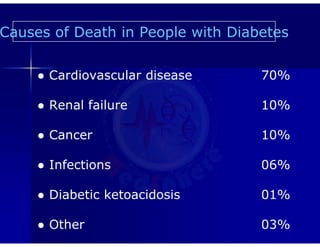
Causes of Death in People with Diabetes
● Cardiovascular disease 70%
● Renal failure 10%
● Cancer 10%
● Infections 06%
● Diabetic ketoacidosis 01%
● Other 03%
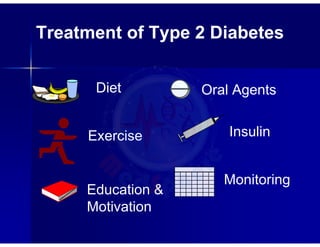
Insulin
Monitoring
Education &
Motivation
Diet
Exercise
Oral Agents
Treatment of Type 2 Diabetes
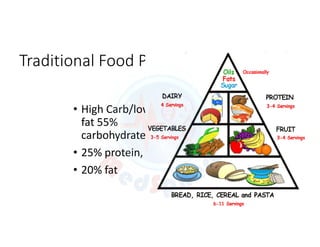
Traditional Food Pyramid
• High Carb/low
fat 55%
carbohydrate,
• 25% protein,
• 20% fat
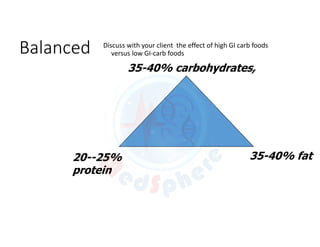
Balanced Discuss with your client the effect of high GI carb foods
versus low GI-carb foods
35-40% carbohydrates,
20--25%
protein
35-40% fat
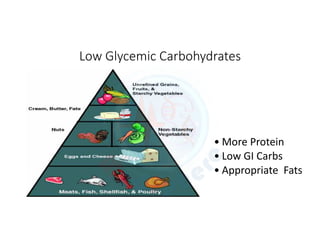
Low Glycemic Carbohydrates
• More Protein
• Low GI Carbs
• Appropriate Fats
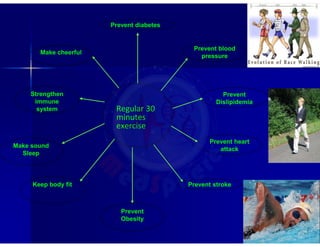
Regular 30
minutes
exercise
Prevent diabetes
Prevent blood
pressure
Prevent
Dislipidemia
Prevent heart
attack
Prevent stroke
Prevent
Obesity
Make cheerful
Strengthen
immune
system
Make sound
Sleep
Keep body fit
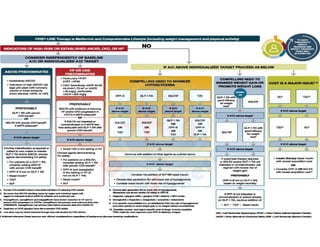
Diabetes
Management
Algorithm
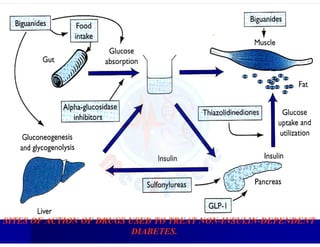
SITES OF ACTION OF DRUGS USED TO TREAT NON-INSULIN-DEPENDENT
DIABETES.
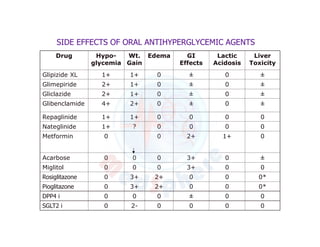
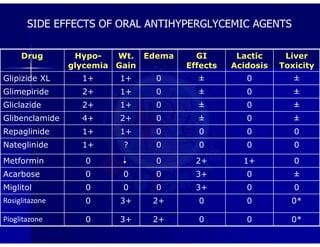
SIDE EFFECTS OF ORAL ANTIHYPERGLYCEMIC AGENTS
Liver
Toxicity
Lactic
Acidosis
GI
Effects
Edema
Wt.
Gain
Hypo-
glycemia
Drug
±
0
±
0
1+
1+
Glipizide XL
±
0
±
0
1+
2+
Glimepiride
±
0
±
0
1+
2+
Gliclazide
±
0
±
0
2+
4+
Glibenclamide
0
0
0
0
1+
1+
Repaglinide
0
0
0
0
?
1+
Nateglinide
0
1+
2+
0
0
Metformin
±
0
3+
0
0
0
Acarbose
0
0
3+
0
0
0
Miglitol
0*
0
0
2+
3+
0
Rosiglitazone
0*
0
0
2+
3+
0
Pioglitazone
0
0
±
0
0
0
DPP4 i
0
0
0
0
2-
0
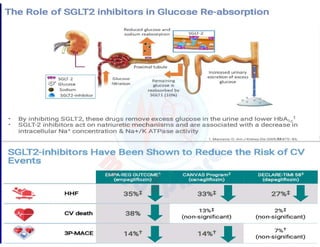
SGLT2 i
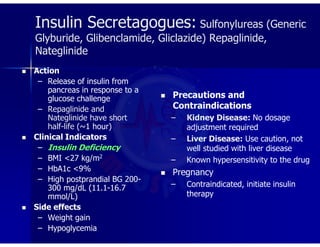
Insulin Secretagogues: Sulfonylureas (Generic
Glyburide, Glibenclamide, Gliclazide) Repaglinide,
Nateglinide
 Action
– Release of insulin from
pancreas in response to a
glucose challenge
– Repaglinide and
Nateglinide have short
half-life (~1 hour)
 Clinical Indicators
– Insulin Deficiency
– BMI <27 kg/m2
– HbA1c <9%
– High postprandial BG 200-
300 mg/dL (11.1-16.7
mmol/L)
 Side effects
– Weight gain
– Hypoglycemia
 Precautions and
Contraindications
– Kidney Disease: No dosage
adjustment required
– Liver Disease: Use caution, not
well studied with liver disease
– Known hypersensitivity to the drug
 Pregnancy
– Contraindicated, initiate insulin
therapy
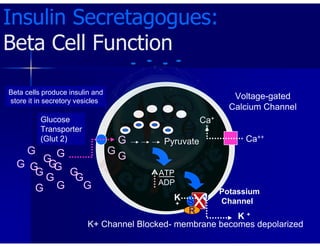
Beta cells produce insulin and
store it in secretory vesicles
ATP
ADP
Pyruvate
Voltage-gated
Calcium Channel
Ca++
Ca+
+
G
G G
G
G
G
Glucose
Transporter
(Glut 2) G
G
G
G
G
G
G
G
G
G
G
Potassium
Channel
K
+
Insulin Secretagogues:
Beta Cell Function
N
X
K+ Channel Blocked- membrane becomes depolarized
S
R
K +
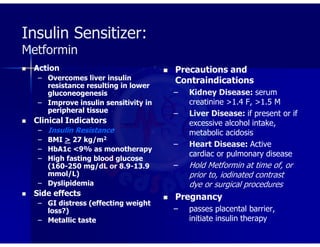
Insulin Sensitizer:
Metformin
 Action
– Overcomes liver insulin
resistance resulting in lower
gluconeogenesis
– Improve insulin sensitivity in
peripheral tissue
 Clinical Indicators
– Insulin Resistance
– BMI > 27 kg/m2
– HbA1c <9% as monotherapy
– High fasting blood glucose
(160-250 mg/dL or 8.9-13.9
mmol/L)
– Dyslipidemia
 Side effects
– GI distress (effecting weight
loss?)
– Metallic taste
 Precautions and
Contraindications
– Kidney Disease: serum
creatinine >1.4 F, >1.5 M
– Liver Disease: if present or if
excessive alcohol intake,
metabolic acidosis
– Heart Disease: Active
cardiac or pulmonary disease
– Hold Metformin at time of, or
prior to, iodinated contrast
dye or surgical procedures
 Pregnancy
– passes placental barrier,
initiate insulin therapy
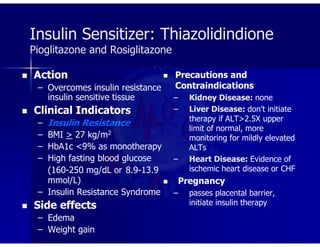
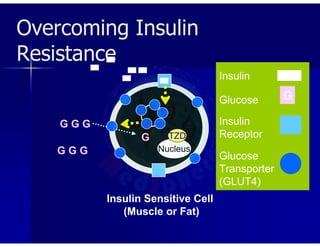
Insulin Sensitizer: Thiazolidindione
Pioglitazone and Rosiglitazone
 Action
– Overcomes insulin resistance
insulin sensitive tissue
 Clinical Indicators
– Insulin Resistance
– BMI > 27 kg/m2
– HbA1c <9% as monotherapy
– High fasting blood glucose
(160-250 mg/dL or 8.9-13.9
mmol/L)
– Insulin Resistance Syndrome
 Side effects
– Edema
– Weight gain
 Precautions and
Contraindications
– Kidney Disease: none
– Liver Disease: don’t initiate
therapy if ALT>2.5X upper
limit of normal, more
monitoring for mildly elevated
ALTs
– Heart Disease: Evidence of
ischemic heart disease or CHF
 Pregnancy
– passes placental barrier,
initiate insulin therapy
Overcoming Insulin
Resistance
Nucleus
Insulin Sensitive Cell
(Muscle or Fat)
Insulin
Glucose
Insulin
Receptor
Glucose
Transporter
(GLUT4)
G
G G G
G TZD
G G G
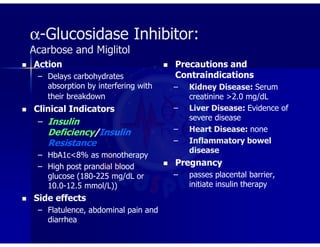
α-Glucosidase Inhibitor:
Acarbose and Miglitol
 Action
– Delays carbohydrates
absorption by interfering with
their breakdown
 Clinical Indicators
– Insulin
Deficiency/Insulin
Resistance
– HbA1c<8% as monotherapy
– High post prandial blood
glucose (180-225 mg/dL or
10.0-12.5 mmol/L))
 Side effects
– Flatulence, abdominal pain and
diarrhea
 Precautions and
Contraindications
– Kidney Disease: Serum
creatinine >2.0 mg/dL
– Liver Disease: Evidence of
severe disease
– Heart Disease: none
– Inflammatory bowel
disease
 Pregnancy
– passes placental barrier,
initiate insulin therapy
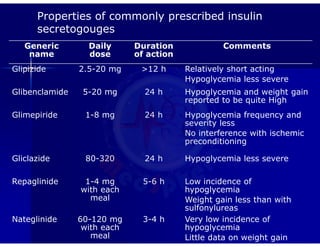
Properties of commonly prescribed insulin
secretogouges
Comments
Duration
of action
Daily
dose
Generic
name
Relatively short acting
Hypoglycemia less severe
>12 h
2.5-20 mg
Glipizide
Hypoglycemia and weight gain
reported to be quite High
24 h
5-20 mg
Glibenclamide
Hypoglycemia frequency and
severity less
No interference with ischemic
preconditioning
24 h
1-8 mg
Glimepiride
Hypoglycemia less severe
24 h
80-320
Gliclazide
Low incidence of
hypoglycemia
Weight gain less than with
sulfonylureas
5-6 h
1-4 mg
with each
meal
Repaglinide
Very low incidence of
hypoglycemia
Little data on weight gain
3-4 h
60-120 mg
with each
meal
Nateglinide
SIDE EFFECTS OF ORAL ANTIHYPERGLYCEMIC AGENTS
Liver
Toxicity
Lactic
Acidosis
GI
Effects
Edema
Wt.
Gain
Hypo-
glycemia
Drug
±
0
±
0
1+
1+
Glipizide XL
±
0
±
0
1+
2+
Glimepiride
±
0
±
0
1+
2+
Gliclazide
±
0
±
0
2+
4+
Glibenclamide
0
0
0
0
1+
1+
Repaglinide
0
0
0
0
?
1+
Nateglinide
0
1+
2+
0
0
Metformin
±
0
3+
0
0
0
Acarbose
0
0
3+
0
0
0
Miglitol
0*
0
0
2+
3+
0
Rosiglitazone
0*
0
0
2+
3+
0
Pioglitazone
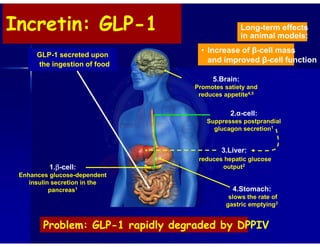
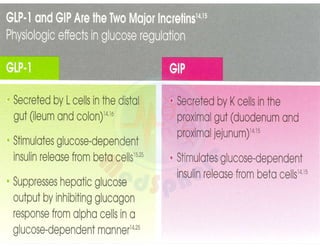
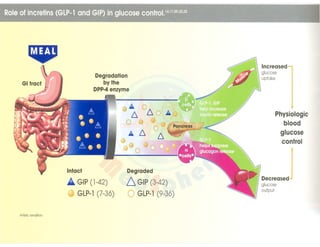
Incretin: GLP-1
GLP-1 secreted upon
the ingestion of food
1.β-cell:
Enhances glucose-dependent
insulin secretion in the
pancreas1
3.Liver:
reduces hepatic glucose
output2
2.α-cell:
Suppresses postprandial
glucagon secretion1
4.Stomach:
slows the rate of
gastric emptying3
5.Brain:
Promotes satiety and
reduces appetite4,5
Problem: GLP-1 rapidly degraded by DPPIV
Long-term effects
in animal models:
• Increase of β-cell mass
and improved β-cell function
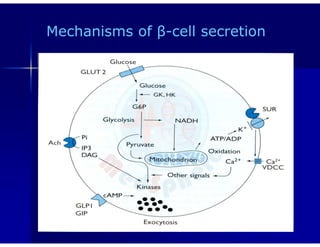
Mechanisms of β-cell secretion
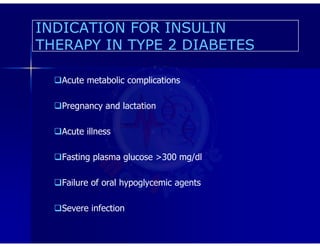
INDICATION FOR INSULIN
THERAPY IN TYPE 2 DIABETES
Acute metabolic complications
Pregnancy and lactation
Acute illness
Fasting plasma glucose >300 mg/dl
Failure of oral hypoglycemic agents
Severe infection
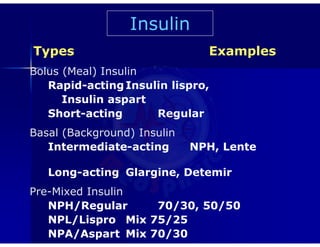
Types Examples
Bolus (Meal) Insulin
Rapid-actingInsulin lispro,
Insulin aspart
Short-acting Regular
Basal (Background) Insulin
Intermediate-acting NPH, Lente
Long-acting Glargine, Detemir
Pre-Mixed Insulin
NPH/Regular 70/30, 50/50
NPL/Lispro Mix 75/25
NPA/Aspart Mix 70/30
Insulin
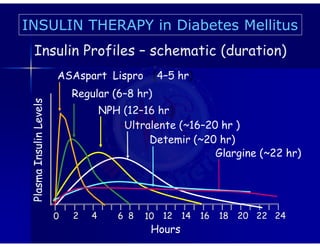
0 2 4 8 10 12 14 16 18 20 22 24
Plasma
Insulin
Levels
Hours
NPH (12–16 hr)
Regular (6–8 hr)
Glargine (~22 hr)
ASAspart, Lispro (4–5 hr)
Ultralente (~16–20 hr )
Insulin Profiles – schematic (duration)
Detemir (~20 hr)
INSULIN THERAPY in Diabetes Mellitus
6
0
10
20
30
40
50
0 2 4 6 8 10 12 14 16 18 20 22 24
Normal Insulin Secretion
Serum
insulin
(mU/L)
Time (Hours)
Meal Meal Meal
Basal Insulin Needs
Bolus insulin needs
Moins lecture collection 1.(DM Lec)pdf

Moins lecture collection 1.(DM Lec)pdf

  • 1.
    Diabetes mellitus isa group of metabolic diseases characterized by hyperglycemia resulting from defects in insulin secretion, insulin action, or both. The chronic hyperglycemia of diabetes is associated with long term damage, dysfunction, and failure of various organs, especially the eyes, kidneys, nerves, heart and blood vessels. Definition of Diabetes Mellitus
  • 2.
    1. Symptoms ofdiabetes plus casual plasma glucose concentration ≥ 200 mg/dl (11.1 mmol/l) Casual is defined as any time of day without regard to time since last meal. The classic symptoms of diabetes include polyuria,polydipsia,and unexplained weight loss. or 2. FPG ≥ 126 mg/dl (7.0 mmol/l). Fasting is defined as no caloric intake for at least 8 h. or 3. 2-h post load glucose ≥ 200 mg/dl (11.1 mmol/l) during an OGTT.The test should be performed as described by WHO. In the absence of unequivocal hyperglycemia, these criteria should be confirmed by repeat testing on a different day. The third measure (OGTT) is not recommended for routine clinical use. Diabetes Care, Jan 2009 Criteria for the diagnosis of diabetes mellitus
  • 4.
    Causes of Deathin People with Diabetes ● Cardiovascular disease 70% ● Renal failure 10% ● Cancer 10% ● Infections 06% ● Diabetic ketoacidosis 01% ● Other 03%
  • 5.
  • 6.
    Traditional Food Pyramid •High Carb/low fat 55% carbohydrate, • 25% protein, • 20% fat
  • 7.
    Balanced Discuss withyour client the effect of high GI carb foods versus low GI-carb foods 35-40% carbohydrates, 20--25% protein 35-40% fat
  • 8.
    Low Glycemic Carbohydrates •More Protein • Low GI Carbs • Appropriate Fats
  • 9.
    Regular 30 minutes exercise Prevent diabetes Preventblood pressure Prevent Dislipidemia Prevent heart attack Prevent stroke Prevent Obesity Make cheerful Strengthen immune system Make sound Sleep Keep body fit
  • 10.
  • 11.
    SITES OF ACTIONOF DRUGS USED TO TREAT NON-INSULIN-DEPENDENT DIABETES.
  • 12.
    SIDE EFFECTS OFORAL ANTIHYPERGLYCEMIC AGENTS Liver Toxicity Lactic Acidosis GI Effects Edema Wt. Gain Hypo- glycemia Drug ± 0 ± 0 1+ 1+ Glipizide XL ± 0 ± 0 1+ 2+ Glimepiride ± 0 ± 0 1+ 2+ Gliclazide ± 0 ± 0 2+ 4+ Glibenclamide 0 0 0 0 1+ 1+ Repaglinide 0 0 0 0 ? 1+ Nateglinide 0 1+ 2+ 0 0 Metformin ± 0 3+ 0 0 0 Acarbose 0 0 3+ 0 0 0 Miglitol 0* 0 0 2+ 3+ 0 Rosiglitazone 0* 0 0 2+ 3+ 0 Pioglitazone 0 0 ± 0 0 0 DPP4 i 0 0 0 0 2- 0 SGLT2 i
  • 13.
    Insulin Secretagogues: Sulfonylureas(Generic Glyburide, Glibenclamide, Gliclazide) Repaglinide, Nateglinide  Action – Release of insulin from pancreas in response to a glucose challenge – Repaglinide and Nateglinide have short half-life (~1 hour)  Clinical Indicators – Insulin Deficiency – BMI <27 kg/m2 – HbA1c <9% – High postprandial BG 200- 300 mg/dL (11.1-16.7 mmol/L)  Side effects – Weight gain – Hypoglycemia  Precautions and Contraindications – Kidney Disease: No dosage adjustment required – Liver Disease: Use caution, not well studied with liver disease – Known hypersensitivity to the drug  Pregnancy – Contraindicated, initiate insulin therapy
  • 14.
    Beta cells produceinsulin and store it in secretory vesicles ATP ADP Pyruvate Voltage-gated Calcium Channel Ca++ Ca+ + G G G G G G Glucose Transporter (Glut 2) G G G G G G G G G G G Potassium Channel K + Insulin Secretagogues: Beta Cell Function N X K+ Channel Blocked- membrane becomes depolarized S R K +
  • 15.
    Insulin Sensitizer: Metformin  Action –Overcomes liver insulin resistance resulting in lower gluconeogenesis – Improve insulin sensitivity in peripheral tissue  Clinical Indicators – Insulin Resistance – BMI > 27 kg/m2 – HbA1c <9% as monotherapy – High fasting blood glucose (160-250 mg/dL or 8.9-13.9 mmol/L) – Dyslipidemia  Side effects – GI distress (effecting weight loss?) – Metallic taste  Precautions and Contraindications – Kidney Disease: serum creatinine >1.4 F, >1.5 M – Liver Disease: if present or if excessive alcohol intake, metabolic acidosis – Heart Disease: Active cardiac or pulmonary disease – Hold Metformin at time of, or prior to, iodinated contrast dye or surgical procedures  Pregnancy – passes placental barrier, initiate insulin therapy
  • 16.
    Insulin Sensitizer: Thiazolidindione Pioglitazoneand Rosiglitazone  Action – Overcomes insulin resistance insulin sensitive tissue  Clinical Indicators – Insulin Resistance – BMI > 27 kg/m2 – HbA1c <9% as monotherapy – High fasting blood glucose (160-250 mg/dL or 8.9-13.9 mmol/L) – Insulin Resistance Syndrome  Side effects – Edema – Weight gain  Precautions and Contraindications – Kidney Disease: none – Liver Disease: don’t initiate therapy if ALT>2.5X upper limit of normal, more monitoring for mildly elevated ALTs – Heart Disease: Evidence of ischemic heart disease or CHF  Pregnancy – passes placental barrier, initiate insulin therapy
  • 17.
    Overcoming Insulin Resistance Nucleus Insulin SensitiveCell (Muscle or Fat) Insulin Glucose Insulin Receptor Glucose Transporter (GLUT4) G G G G G TZD G G G
  • 18.
    α-Glucosidase Inhibitor: Acarbose andMiglitol  Action – Delays carbohydrates absorption by interfering with their breakdown  Clinical Indicators – Insulin Deficiency/Insulin Resistance – HbA1c<8% as monotherapy – High post prandial blood glucose (180-225 mg/dL or 10.0-12.5 mmol/L))  Side effects – Flatulence, abdominal pain and diarrhea  Precautions and Contraindications – Kidney Disease: Serum creatinine >2.0 mg/dL – Liver Disease: Evidence of severe disease – Heart Disease: none – Inflammatory bowel disease  Pregnancy – passes placental barrier, initiate insulin therapy
  • 19.
    Properties of commonlyprescribed insulin secretogouges Comments Duration of action Daily dose Generic name Relatively short acting Hypoglycemia less severe >12 h 2.5-20 mg Glipizide Hypoglycemia and weight gain reported to be quite High 24 h 5-20 mg Glibenclamide Hypoglycemia frequency and severity less No interference with ischemic preconditioning 24 h 1-8 mg Glimepiride Hypoglycemia less severe 24 h 80-320 Gliclazide Low incidence of hypoglycemia Weight gain less than with sulfonylureas 5-6 h 1-4 mg with each meal Repaglinide Very low incidence of hypoglycemia Little data on weight gain 3-4 h 60-120 mg with each meal Nateglinide
  • 22.
    SIDE EFFECTS OFORAL ANTIHYPERGLYCEMIC AGENTS Liver Toxicity Lactic Acidosis GI Effects Edema Wt. Gain Hypo- glycemia Drug ± 0 ± 0 1+ 1+ Glipizide XL ± 0 ± 0 1+ 2+ Glimepiride ± 0 ± 0 1+ 2+ Gliclazide ± 0 ± 0 2+ 4+ Glibenclamide 0 0 0 0 1+ 1+ Repaglinide 0 0 0 0 ? 1+ Nateglinide 0 1+ 2+ 0 0 Metformin ± 0 3+ 0 0 0 Acarbose 0 0 3+ 0 0 0 Miglitol 0* 0 0 2+ 3+ 0 Rosiglitazone 0* 0 0 2+ 3+ 0 Pioglitazone
  • 23.
    Incretin: GLP-1 GLP-1 secretedupon the ingestion of food 1.β-cell: Enhances glucose-dependent insulin secretion in the pancreas1 3.Liver: reduces hepatic glucose output2 2.α-cell: Suppresses postprandial glucagon secretion1 4.Stomach: slows the rate of gastric emptying3 5.Brain: Promotes satiety and reduces appetite4,5 Problem: GLP-1 rapidly degraded by DPPIV Long-term effects in animal models: • Increase of β-cell mass and improved β-cell function
  • 24.
  • 28.
    INDICATION FOR INSULIN THERAPYIN TYPE 2 DIABETES Acute metabolic complications Pregnancy and lactation Acute illness Fasting plasma glucose >300 mg/dl Failure of oral hypoglycemic agents Severe infection
  • 29.
    Types Examples Bolus (Meal)Insulin Rapid-actingInsulin lispro, Insulin aspart Short-acting Regular Basal (Background) Insulin Intermediate-acting NPH, Lente Long-acting Glargine, Detemir Pre-Mixed Insulin NPH/Regular 70/30, 50/50 NPL/Lispro Mix 75/25 NPA/Aspart Mix 70/30 Insulin
  • 30.
    0 2 48 10 12 14 16 18 20 22 24 Plasma Insulin Levels Hours NPH (12–16 hr) Regular (6–8 hr) Glargine (~22 hr) ASAspart, Lispro (4–5 hr) Ultralente (~16–20 hr ) Insulin Profiles – schematic (duration) Detemir (~20 hr) INSULIN THERAPY in Diabetes Mellitus 6
  • 31.
    0 10 20 30 40 50 0 2 46 8 10 12 14 16 18 20 22 24 Normal Insulin Secretion Serum insulin (mU/L) Time (Hours) Meal Meal Meal Basal Insulin Needs Bolus insulin needs