Django
Performance
Recipes
September 2015
Jon Atkinson
Technical Director
FARM Digital
Me
• I am not a very good programmer.
• I’m quite a good problem solver.
• I have made a lot of mistakes.
• I prefer valuable solutions.
My Context
• “Fast-moving agency environment”.
• We often participate in launches; demand is
spiky.
• Complex software.
Shared Context
• Traffic is unpredictable.
• We probably host in the cloud.
• The Django ecosystem.
Performance Matters
Speed is all about perception, but:
0-100ms Instant!
100-300ms Small delay.
300-1000ms Something is happening.
1000ms+ Likely task switch.
10000ms+ Abandoned task.
Rule of thumb
50% of users will abandon a task after
3 seconds.
Environment
A web server, talking to:
A managed python process, talking to:
A cache, and a database.
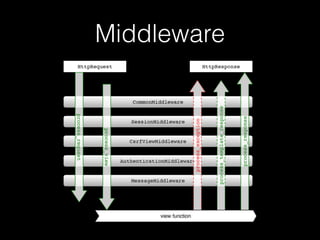
Request Cycle
Web Server
ORM
Middleware
Views + Templates
Web Server
Tools
!
ORM
• Optimising your database is a separate
presentation entirely.
• There are no ‘slow’ databases any more.
• In a read-heavy environment, caching Querysets
is a huge advantage.
ORM
django-cachalot
Caches your Django ORM queries and
automatically invalidates them.
ORM
$ pip install django-cachalot
INSTALLED_APPS += (‘cachalot’)
settings.CACHALOT_ENABLED = True
ORM
from django.conf import settings
from django.test.utils import override_settings
with override_settings(CACHALOT_ENABLED=False):
# SQL queries are not cached in this block
@override_settings(CACHALOT_CACHE=‘second_cache')
def your_function():
# What’s in this function uses another cache
# Globally disables SQL caching until you set it back to True
settings.CACHALOT_ENABLED = False
ORM
• A few other data access tips:
• Is your database doing DNS lookups?
• Do you have a connection timeout set? The
default is 0, and setup/teardown costs time.
settings.DATABASES[‘…’][‘CONN_MAX_AGE’] = 600
Middleware
Middleware is dumb.
Middleware
Middleware
• Think hard. Milliseconds add up.
• Middleware (and context processors!) often
becomes a dumping ground for common
features.
Middleware
Middleware is helpful.
Middleware
django.middleware.http.ConditionalGetMiddleware
Optimises GET requests from modern browsers
django.middleware.http.GZipMiddleware
Compresses responses. But be aware of BREACH!
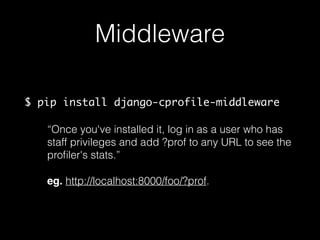
Middleware
$ pip install django-cprofile-middleware
“Once you've installed it, log in as a user who has
staff privileges and add ?prof to any URL to see the
profiler's stats.”
eg. http://localhost:8000/foo/?prof.
Middleware
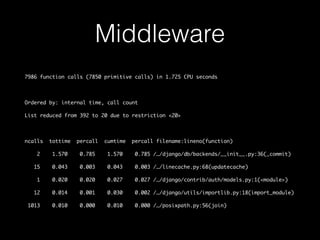
7986 function calls (7850 primitive calls) in 1.725 CPU seconds
Ordered by: internal time, call count
List reduced from 392 to 20 due to restriction <20>
ncalls tottime percall cumtime percall filename:lineno(function)
2 1.570 0.785 1.570 0.785 /…/django/db/backends/__init__.py:36(_commit)
15 0.043 0.003 0.043 0.003 /…/linecache.py:68(updatecache)
1 0.020 0.020 0.027 0.027 /…/django/contrib/auth/models.py:1(<module>)
12 0.014 0.001 0.030 0.002 /…/django/utils/importlib.py:18(import_module)
1013 0.010 0.000 0.010 0.000 /…/posixpath.py:56(join)
Views & Templates
• View performance problems are usually obvious:
• Avoid nested loops (especially when generating
QuerySets!)
• Cache where you can.
• Always return at the earliest possible moment.
Views & Templates
• Templates are more interesting.
• It’s easy to duplicate ORM calls already made in
the view.
• It’s easy to traverse relationships in the template
language.
• Templates are loaded from disk by default.
Views & Templates
class Person(models.Model):
def friends(self):
# Hit the database here for something complex…
return friends
# View:
if person.friends():
# Do something here…
# Template:
{% for friend in person.friends %}
Views & Templates
from django.utils.functional import
cached_property
@cached_property
def friends(self):
# Hit the database here for something complex…
return friends
Views & Templates
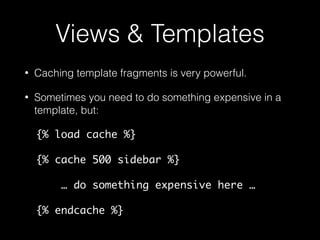
• Caching template fragments is very powerful.
• Sometimes you need to do something expensive in a
template, but:
{% load cache %}
{% cache 500 sidebar %}
… do something expensive here …
{% endcache %}
Views & Templates
• Where do your templates actually live?
• Cloud disk performance can be erratic.
Views & Templates
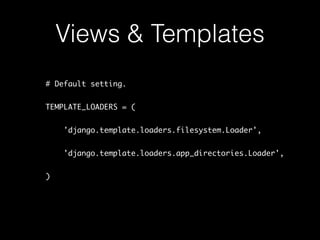
# Default setting.
TEMPLATE_LOADERS = (
'django.template.loaders.filesystem.Loader',
'django.template.loaders.app_directories.Loader',
)
Views & Templates
TEMPLATE_LOADERS = (
('django.template.loaders.cached.Loader', (
'django.template.loaders.filesystem.Loader',
'django.template.loaders.app_directories.Loader',
)),
)
nginx
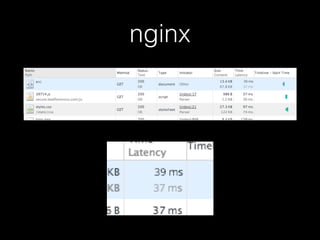
This is my “one weird tip”…
… with a trade-off.
uwsgi_cache_path /tmp/nginx levels=1:2 keys_zone=my_zone:10m;
server {
listen 80;
server_name example.com;
…
uwsgi_cache_use_stale error timeout invalid_header http_500;
uwsgi_cache_valid 10m;
location / {
include uwsgi_params;
uwsgi_pass unix:///tmp/example.sock;
uwsgi_cache cache;
uwsgi_cache_key $scheme:$host$request_uri:$request_method;
uwsgi_cache_bypass $http_pragma $http_authorization;
uwsgi_no_cache $http_pragma $http_authorization;
}
nginx
Tools
• The tool ecosystem is richer now than ever
before.
$ pip install django-debug-toolbar
$ pip install dogslow
• Measure twice, cut once.
• Remember, Schrödinger’s web app.
Tools
Tools
import newrelic.agent
from django.core.wsgi import get_wsgi_application
application = get_wsgi_application()
# This needs to be called after we bootstrapped the application
# otherwise the settings wouldn't be configured
from django.conf import settings # noqa
if hasattr(settings, 'NEWRELIC_CONFIG'):
newrelic.agent.initialize(settings.NEWRELIC_CONFIG 
getattr(settings, 'NEWRELIC_ENVIRONMENT', None))
application = newrelic.agent.WSGIApplicationWrapper(application)
Meta 1
Performance can be personal.
Meta 2
Meta 2
Meta 3
Performance is of huge value.
10x programmers probably don’t exist.
Keep your eyes up.
Concentrate on where the value lies.
Thank You
Questions?
Resources & Credits: http://blog.wearefarm.com

Django Performance Recipes

  • 1.
  • 2.
    Me • I amnot a very good programmer. • I’m quite a good problem solver. • I have made a lot of mistakes. • I prefer valuable solutions.
  • 3.
    My Context • “Fast-movingagency environment”. • We often participate in launches; demand is spiky. • Complex software.
  • 4.
    Shared Context • Trafficis unpredictable. • We probably host in the cloud. • The Django ecosystem.
  • 5.
    Performance Matters Speed isall about perception, but: 0-100ms Instant! 100-300ms Small delay. 300-1000ms Something is happening. 1000ms+ Likely task switch. 10000ms+ Abandoned task.
  • 6.
    Rule of thumb 50%of users will abandon a task after 3 seconds.
  • 7.
    Environment A web server,talking to: A managed python process, talking to: A cache, and a database.
  • 8.
  • 9.
  • 10.
    ORM • Optimising yourdatabase is a separate presentation entirely. • There are no ‘slow’ databases any more. • In a read-heavy environment, caching Querysets is a huge advantage.
  • 11.
    ORM django-cachalot Caches your DjangoORM queries and automatically invalidates them.
  • 12.
    ORM $ pip installdjango-cachalot INSTALLED_APPS += (‘cachalot’) settings.CACHALOT_ENABLED = True
  • 13.
    ORM from django.conf importsettings from django.test.utils import override_settings with override_settings(CACHALOT_ENABLED=False): # SQL queries are not cached in this block @override_settings(CACHALOT_CACHE=‘second_cache') def your_function(): # What’s in this function uses another cache # Globally disables SQL caching until you set it back to True settings.CACHALOT_ENABLED = False
  • 14.
    ORM • A fewother data access tips: • Is your database doing DNS lookups? • Do you have a connection timeout set? The default is 0, and setup/teardown costs time. settings.DATABASES[‘…’][‘CONN_MAX_AGE’] = 600
  • 15.
  • 16.
  • 17.
    Middleware • Think hard.Milliseconds add up. • Middleware (and context processors!) often becomes a dumping ground for common features.
  • 18.
  • 19.
    Middleware django.middleware.http.ConditionalGetMiddleware Optimises GET requestsfrom modern browsers django.middleware.http.GZipMiddleware Compresses responses. But be aware of BREACH!
  • 20.
    Middleware $ pip installdjango-cprofile-middleware “Once you've installed it, log in as a user who has staff privileges and add ?prof to any URL to see the profiler's stats.” eg. http://localhost:8000/foo/?prof.
  • 21.
    Middleware 7986 function calls(7850 primitive calls) in 1.725 CPU seconds Ordered by: internal time, call count List reduced from 392 to 20 due to restriction <20> ncalls tottime percall cumtime percall filename:lineno(function) 2 1.570 0.785 1.570 0.785 /…/django/db/backends/__init__.py:36(_commit) 15 0.043 0.003 0.043 0.003 /…/linecache.py:68(updatecache) 1 0.020 0.020 0.027 0.027 /…/django/contrib/auth/models.py:1(<module>) 12 0.014 0.001 0.030 0.002 /…/django/utils/importlib.py:18(import_module) 1013 0.010 0.000 0.010 0.000 /…/posixpath.py:56(join)
  • 22.
    Views & Templates •View performance problems are usually obvious: • Avoid nested loops (especially when generating QuerySets!) • Cache where you can. • Always return at the earliest possible moment.
  • 23.
    Views & Templates •Templates are more interesting. • It’s easy to duplicate ORM calls already made in the view. • It’s easy to traverse relationships in the template language. • Templates are loaded from disk by default.
  • 24.
    Views & Templates classPerson(models.Model): def friends(self): # Hit the database here for something complex… return friends # View: if person.friends(): # Do something here… # Template: {% for friend in person.friends %}
  • 25.
    Views & Templates fromdjango.utils.functional import cached_property @cached_property def friends(self): # Hit the database here for something complex… return friends
  • 26.
    Views & Templates •Caching template fragments is very powerful. • Sometimes you need to do something expensive in a template, but: {% load cache %} {% cache 500 sidebar %} … do something expensive here … {% endcache %}
  • 27.
    Views & Templates •Where do your templates actually live? • Cloud disk performance can be erratic.
  • 28.
    Views & Templates #Default setting. TEMPLATE_LOADERS = ( 'django.template.loaders.filesystem.Loader', 'django.template.loaders.app_directories.Loader', )
  • 29.
    Views & Templates TEMPLATE_LOADERS= ( ('django.template.loaders.cached.Loader', ( 'django.template.loaders.filesystem.Loader', 'django.template.loaders.app_directories.Loader', )), )
  • 30.
    nginx This is my“one weird tip”… … with a trade-off.
  • 31.
    uwsgi_cache_path /tmp/nginx levels=1:2keys_zone=my_zone:10m; server { listen 80; server_name example.com; … uwsgi_cache_use_stale error timeout invalid_header http_500; uwsgi_cache_valid 10m; location / { include uwsgi_params; uwsgi_pass unix:///tmp/example.sock; uwsgi_cache cache; uwsgi_cache_key $scheme:$host$request_uri:$request_method; uwsgi_cache_bypass $http_pragma $http_authorization; uwsgi_no_cache $http_pragma $http_authorization; }
  • 32.
  • 33.
    Tools • The toolecosystem is richer now than ever before. $ pip install django-debug-toolbar $ pip install dogslow • Measure twice, cut once. • Remember, Schrödinger’s web app.
  • 34.
  • 35.
  • 36.
    import newrelic.agent from django.core.wsgiimport get_wsgi_application application = get_wsgi_application() # This needs to be called after we bootstrapped the application # otherwise the settings wouldn't be configured from django.conf import settings # noqa if hasattr(settings, 'NEWRELIC_CONFIG'): newrelic.agent.initialize(settings.NEWRELIC_CONFIG getattr(settings, 'NEWRELIC_ENVIRONMENT', None)) application = newrelic.agent.WSGIApplicationWrapper(application)
  • 37.
  • 38.
  • 39.
  • 40.
    Meta 3 Performance isof huge value. 10x programmers probably don’t exist. Keep your eyes up. Concentrate on where the value lies.
  • 41.
    Thank You Questions? Resources &Credits: http://blog.wearefarm.com