Name _____________________
© 2009 – Norm Mitchell (Math6.org) – All Rights Reserved
Freely reproducible for “non-profit” educational purposes – visit http://www.math6.org/legal.htm for more details concerning “non-profit”.
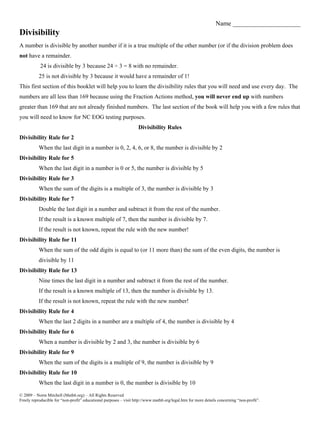
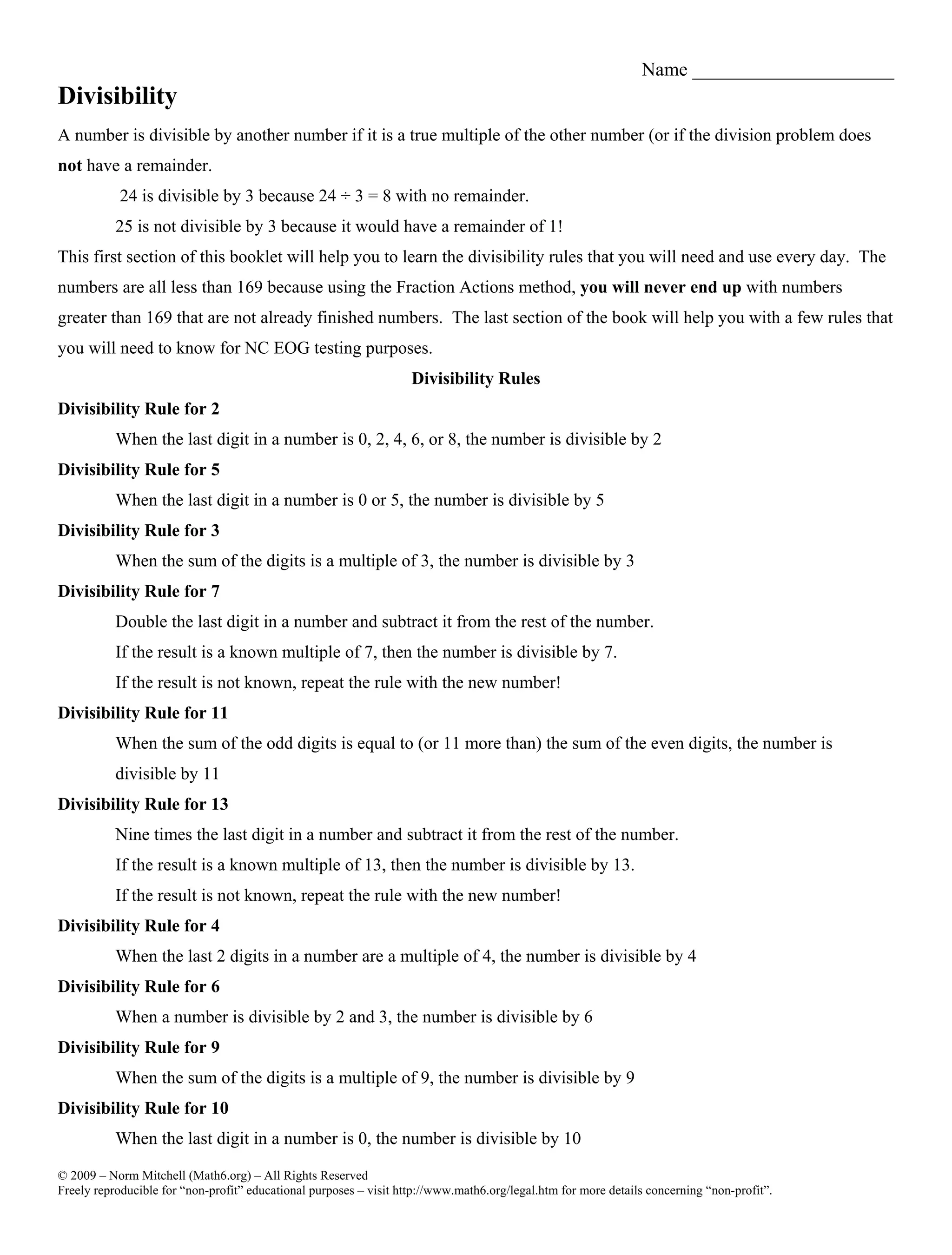
Divisibility
A number is divisible by another number if it is a true multiple of the other number (or if the division problem does
not have a remainder.
24 is divisible by 3 because 24 ÷ 3 = 8 with no remainder.
25 is not divisible by 3 because it would have a remainder of 1!
This first section of this booklet will help you to learn the divisibility rules that you will need and use every day. The
numbers are all less than 169 because using the Fraction Actions method, you will never end up with numbers
greater than 169 that are not already finished numbers. The last section of the book will help you with a few rules that
you will need to know for NC EOG testing purposes.
Divisibility Rules
Divisibility Rule for 2
When the last digit in a number is 0, 2, 4, 6, or 8, the number is divisible by 2
Divisibility Rule for 5
When the last digit in a number is 0 or 5, the number is divisible by 5
Divisibility Rule for 3
When the sum of the digits is a multiple of 3, the number is divisible by 3
Divisibility Rule for 7
Double the last digit in a number and subtract it from the rest of the number.
If the result is a known multiple of 7, then the number is divisible by 7.
If the result is not known, repeat the rule with the new number!
Divisibility Rule for 11
When the sum of the odd digits is equal to (or 11 more than) the sum of the even digits, the number is
divisible by 11
Divisibility Rule for 13
Nine times the last digit in a number and subtract it from the rest of the number.
If the result is a known multiple of 13, then the number is divisible by 13.
If the result is not known, repeat the rule with the new number!
Divisibility Rule for 4
When the last 2 digits in a number are a multiple of 4, the number is divisible by 4
Divisibility Rule for 6
When a number is divisible by 2 and 3, the number is divisible by 6
Divisibility Rule for 9
When the sum of the digits is a multiple of 9, the number is divisible by 9
Divisibility Rule for 10
When the last digit in a number is 0, the number is divisible by 10
Divisibility (2 and 5)
Lesson Box
The divisibility rule for 2 and 5 ask you to look at the
last digit of the number.
If the last digit is 0, 2, 4, 6, or 8 the number is divisible
by 2.
If the last digit is 0 or 5, the number is divisible by 5.
Models
2, 5 80
80 ends with 0. According to the rules, numbers that
end with 0 are divisible by 2 and 5.
2 158
158 ends with 8. 8 is part of the 2 rule.
Ø 151
151 ends with 1. 1 is not part of either rule, so 151 is
not divisible by 2 or 5.
5 215
215 ends with 5. Twenty-five is divisible by 5!
Apply the divisibility rules for 2 and 5. If the number is divisible by 2 or 5, write which ever answer is true. You do
not need to write both answers. (example: 110 is divisible by both 2 and 5, you may answer 2) If the number is not
divisible by these rules, enter Ø.
________ 160
________ 80
________ 158
________ 151
________ 76
________ 25
________ 108
________ 66
________ 87
________ 72
________ 29
________ 145
________ 136
________ 133
________ 124
________ 78
________ 106
________ 36
________ 103
________ 73
________ 130
________ 154
________ 107
________ 115
________ 120
________ 35
________ 141
________ 159
________ 44
________ 111
________ 157
________ 46
________ 74
________ 37
________ 20
________ 137
________ 105
________ 24
________ 23
________ 68
________ 167
________ 67
________ 54
________ 89
________ 41
________ 156
________ 59
________ 34
________ 112
________ 162
________ 61
________ 100
________ 96
________ 30
________ 99
[use Key 1 to check your answers]
Divisibility (3)
Lesson Box
The divisibility rule for 3 asks you to find the sum of
the digits.
If the sum of the digits is a multiple of 3, then the
number is divisible by 3.
257
2 + 5 + 7 = 14.
14 is not a multiple of 3.
257 is not divisible by 3.
342
3 + 4 + 2 = 9.
9 is a multiple of 3.
342 is divisible by 3.
To cast out 3’s don’t add any 3, 6 or 9’s.
342 … 4 + 2 = 6
268 … 2 + 8 = 10
692 … 2 = 2
Models
3 138
1 + 8 = 9 (or 1 + 3 + 8 = 12)
Ø 58
5 + 8 = 13
3 126
1 + 2 = 3 (or 1 + 2 + 6 = 9)
Ø 101
1 + 1 = 2
Apply the divisibility rule for 3. If the number is divisible by 3, write 3. If the number is not divisible by 3, enter Ø.
________ 47
________ 70
________ 122
________ 140
________ 169
________ 51
________ 111
________ 60
________ 86
________ 100
________ 38
________ 14
________ 164
________ 68
________ 77
________ 61
________ 148
________ 145
________ 46
________ 64
________ 81
________ 131
________ 119
________ 26
________ 54
________ 137
________ 92
________ 83
________ 141
________ 56
________ 90
________ 44
________ 75
________ 159
________ 166
________ 50
________ 156
________ 55
________ 107
________ 87
________ 78
________ 96
________ 155
________ 72
________ 167
________ 134
________ 69
________ 40
________ 108
________ 117
________ 106
________ 31
________ 41
________ 74
________ 19
________ 124
________ 36
________ 95
________ 59
________ 29
[use Key 2 to check your answers]
Divisibility Drills 2, 3 and 5
Apply the divisibility rules for 2, 3 and 5. If the number is divisible by 2, 3 or 5, write which ever answer is true.
You do not need to write all of the answers. (example: 110 is divisible by both 2 and 5, you may answer 2) If the
number is not divisible by these rules, enter Ø.
________ 103
________ 24
________ 53
________ 49
________ 50
________ 31
________ 169
________ 19
________ 36
________ 141
________ 75
________ 112
________ 143
________ 90
________ 152
________ 81
________ 107
________ 165
________ 127
________ 32
________ 65
________ 28
________ 64
________ 164
________ 111
________ 145
________ 95
________ 149
________ 137
________ 63
________ 30
________ 105
________ 26
________ 140
________ 104
________ 71
________ 131
________ 29
________ 84
________ 100
________ 139
________ 123
________ 136
________ 96
________ 125
________ 113
________ 129
________ 124
________ 109
________ 14
Apply the divisibility rules for 2, 3 and 5. If the number is divisible by 2, 3 or 5, write which ever answer is true.
You do not need to write all of the answers. (example: 110 is divisible by both 2 and 5, you may answer 2) If the
number is not divisible by these rules, enter Ø.
________ 55
________ 119
________ 51
________ 17
________ 120
________ 101
________ 153
________ 44
________ 162
________ 154
________ 48
________ 155
________ 106
________ 70
________ 156
________ 41
________ 146
________ 134
________ 161
________ 12
________ 98
________ 130
________ 116
________ 25
________ 160
________ 133
________ 159
________ 167
________ 67
________ 110
________ 40
________ 151
________ 135
________ 117
________ 62
________ 121
________ 148
________ 122
________ 168
________ 85
________ 83
________ 157
________ 27
________ 42
________ 34
________ 72
________ 45
________ 79
________ 126
________ 23
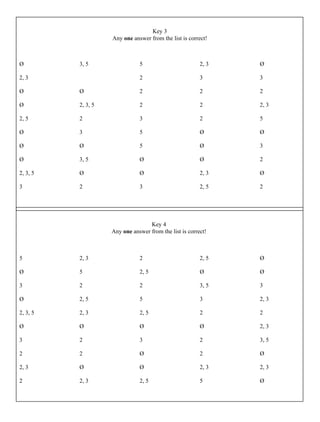
[use Key 3 to check your answers]
[use Key 4 to check your answers]
Divisibility (7)
Lesson Box
• Double the last digit in a number and subtract it
from the rest of the number.
• If the result is a known multiple of 7, then the
number is divisible by 7.
• If the result is not known, repeat the rule with
the new number!
257
7 * 2 = 14.
25 – 14 = 11.
257 is not divisible by 7.
343
3 * 2 = 6.
34 – 6 = 28.
343 is divisible by 7.
49
9 * 2 = 18.
18 – 4 = 14.
49 is divisible by 7. (notice you can subtract the first
digits from the doubled last if you need to!)
Models
Ø 138
8*2 = 16 ; 16-13 = 3 ; 138 is not divisible by 7
7 168
8*2 = 16 ; 16-16 = 0 ; 168 is divisible by 7
7 133
3*2 = 6 ; 13-6 = 7 ; 133 is divisible by 7
Ø 101
1*2 = 2 ; 10-2 = 8 ; 101 is not divisible by 7
Apply the divisibility rule for 7. If the number is divisible by 7, write 7. If the number is not divisible by 7, enter Ø.
________ 46
________ 55
________ 111
________ 49
________ 141
________ 156
________ 15
________ 60
________ 133
________ 92
________ 30
________ 152
________ 117
________ 161
________ 153
________ 132
________ 28
________ 88
________ 155
________ 166
________ 59
________ 160
________ 102
________ 142
________ 139
________ 140
________ 35
________ 105
________ 93
________ 121
________ 54
________ 72
________ 167
________ 45
________ 43
________ 83
________ 66
________ 31
________ 63
________ 13
________ 110
________ 143
________ 21
________ 23
________ 17
________ 168
________ 68
________ 149
________ 70
________ 69
________ 119
________ 78
________ 130
________ 95
________ 136
________ 123
________ 107
________ 145
________ 41
________ 124
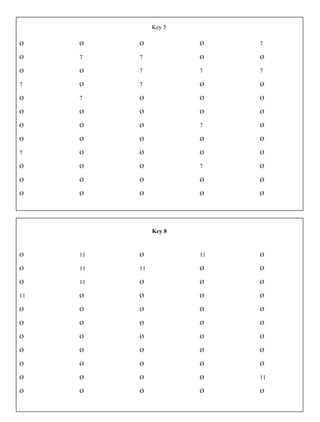
[use Key 5 to check your answers]
Divisibility Drills 2, 3, 5, and 7
Apply the divisibility rules for 2, 3, 5 and 7. If the number is divisible by 2, 3, 5 or 7, write which ever answer is true.
You do not need to write all of the answers. (example: 110 is divisible by both 2 and 5, you may answer 2) If the
number is not divisible by these rules, enter Ø.
________ 163
________ 142
________ 28
________ 80
________ 129
________ 136
________ 124
________ 141
________ 92
________ 65
________ 95
________ 29
________ 69
________ 31
________ 160
________ 97
________ 32
________ 146
________ 169
________ 107
________ 128
________ 38
________ 101
________ 162
________ 34
________ 58
________ 139
________ 88
________ 78
________ 96
________ 81
________ 149
________ 156
________ 90
________ 77
________ 167
________ 126
________ 140
________ 19
________ 123
________ 18
________ 40
________ 117
________ 16
________ 67
________ 105
________ 144
________ 111
________ 15
________ 89
Apply the divisibility rules for 2, 3, 5 and 7. If the number is divisible by 2, 3, 5 or 7, write which ever answer is true.
You do not need to write all of the answers. (example: 110 is divisible by both 2 and 5, you may answer 2) If the
number is not divisible by these rules, enter Ø.
________ 147
________ 158
________ 33
________ 68
________ 75
________ 64
________ 72
________ 85
________ 104
________ 61
________ 35
________ 132
________ 76
________ 52
________ 21
________ 166
________ 130
________ 24
________ 62
________ 134
________ 164
________ 93
________ 113
________ 43
________ 119
________ 168
________ 51
________ 45
________ 120
________ 137
________ 47
________ 118
________ 49
________ 22
________ 154
________ 42
________ 103
________ 39
________ 56
________ 159
________ 82
________ 110
________ 133
________ 57
________ 70
________ 27
________ 79
________ 100
________ 63
________ 145
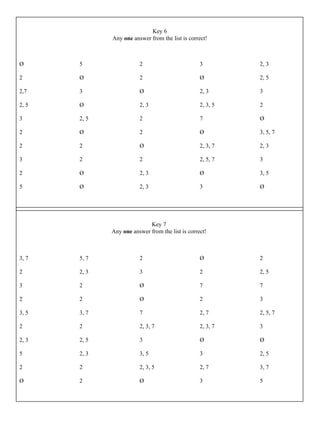
[use Key 6 to check your answers]
[use Key 7 to check your answers]
Divisibility (11)
Lesson Box
When the sum of the odd digits is equal to (or 11 more
than) the sum of the even digits, the number is divisible
by 11.
257
7 + 2 ≠ 5.
257 is not divisible by 11.
2574
2 + 7 = 5 + 4.
257 is divisible by 11.
346
3 + 6 ≠ 4.
346 is not by 11.
209
2 + 9 = 0 (+ 11more)
209 is divisible by 11.
Models
11 264
2 + 4 = 6
Ø 235
2 + 5 ≠ 3
11 220
2 + 0 = 2
Ø 212
2 + 2 ≠ 1
11 968
9 + 8 = 6 (+ 11 more)
Apply the divisibility rule for 11. If the number is divisible by 11, write 11. If the number is not divisible by 11,
enter Ø.
________ 151
________ 129
________ 166
________ 143
________ 117
________ 107
________ 149
________ 160
________ 118
________ 167
________ 125
________ 110
________ 154
________ 165
________ 162
________ 155
________ 158
________ 139
________ 124
________ 114
________ 148
________ 134
________ 153
________ 99
________ 113
________ 109
________ 159
________ 106
________ 123
________ 142
________ 102
________ 157
________ 101
________ 132
________ 141
________ 135
________ 120
________ 104
________ 163
________ 150
________ 128
________ 133
________ 130
________ 100
________ 119
________ 147
________ 112
________ 156
________ 146
________ 126
________ 103
________ 131
________ 164
________ 121
________ 168
[use Key 8 to check your answers]
Divisibility Drills 2, 3, 5, 7, and 11
Apply the divisibility rules for 2, 3, 5, 7, and 11. If the number is divisible by 2, 3, 5, 7, and 11, write which ever
answer is true. You do not need to write all of the answers. (example: 110 is divisible by both 2 and 5, you may
answer 2) If the number is not divisible by these rules, enter Ø.
________ 27
________ 90
________ 57
________ 47
________ 42
________ 125
________ 73
________ 161
________ 31
________ 15
________ 159
________ 53
________ 40
________ 100
________ 129
________ 75
________ 156
________ 145
________ 128
________ 99
________ 43
________ 84
________ 45
________ 21
________ 142
________ 101
________ 56
________ 86
________ 98
________ 164
________ 126
________ 110
________ 46
________ 96
________ 140
________ 78
________ 97
________ 150
________ 106
________ 79
________ 143
________ 51
________ 92
________ 131
________ 26
________ 83
________ 34
________ 49
________ 16
________ 112
Apply the divisibility rules for 2, 3, 5, 7, and 11. If the number is divisible by 2, 3, 5, 7, and 11, write which ever
answer is true. You do not need to write all of the answers. (example: 110 is divisible by both 2 and 5, you may
answer 2) If the number is not divisible by these rules, enter Ø.
________ 28
________ 148
________ 154
________ 162
________ 155
________ 160
________ 32
________ 59
________ 121
________ 60
________ 146
________ 74
________ 20
________ 94
________ 70
________ 118
________ 107
________ 113
________ 149
________ 52
________ 111
________ 141
________ 58
________ 127
________ 82
________ 30
________ 139
________ 48
________ 157
________ 64
________ 12
________ 13
________ 63
________ 29
________ 71
________ 152
________ 135
________ 41
________ 33
________ 24
________ 103
________ 50
________ 167
________ 144
________ 19
________ 69
________ 85
________ 72
________ 80
________ 67
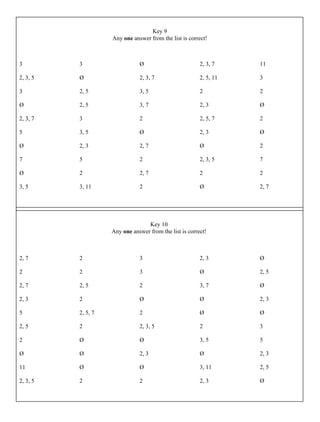
[use Key 9 to check your answers]
[use Key 10 to check your answers]
Divisibility Drills – Proof of Mastery – No Errors Allowed!
Apply the divisibility rules for 2, 3, 5, 7, and 11. If the number is divisible by 2, 3, 5, 7, and 11, write which ever
answer is true. You do not need to write all of the answers. (example: 110 is divisible by both 2 and 5, you may
answer 2) If the number is not divisible by these rules, enter Ø.
________ 129
________ 72
________ 120
________ 26
________ 23
________ 33
________ 141
________ 96
________ 103
________ 154
________ 36
________ 47
________ 157
________ 92
________ 168
________ 56
________ 150
________ 152
________ 156
________ 107
________ 105
________ 34
________ 146
________ 149
________ 73
________ 59
________ 158
________ 153
________ 25
________ 54
________ 99
________ 87
________ 17
________ 31
________ 16
________ 169
________ 122
________ 42
________ 82
________ 130
________ 112
________ 46
________ 135
________ 83
________ 123
________ 49
________ 138
________ 35
________ 79
________ 65
Apply the divisibility rules for 2, 3, 5, 7, and 11. If the number is divisible by 2, 3, 5, 7, and 11, write which ever
answer is true. You do not need to write all of the answers. (example: 110 is divisible by both 2 and 5, you may
answer 2) If the number is not divisible by these rules, enter Ø.
________ 139
________ 85
________ 50
________ 95
________ 101
________ 84
________ 21
________ 113
________ 108
________ 134
________ 164
________ 80
________ 159
________ 69
________ 70
________ 29
________ 116
________ 43
________ 63
________ 98
________ 12
________ 45
________ 110
________ 62
________ 148
________ 37
________ 60
________ 28
________ 137
________ 74
________ 32
________ 163
________ 161
________ 75
________ 67
________ 44
________ 143
________ 145
________ 78
________ 89
________ 144
________ 81
________ 102
________ 53
________ 115
________ 30
________ 142
________ 27
________ 40
________ 88
[use Key 11 to check your answers]
[use Key 12 to check your answers]
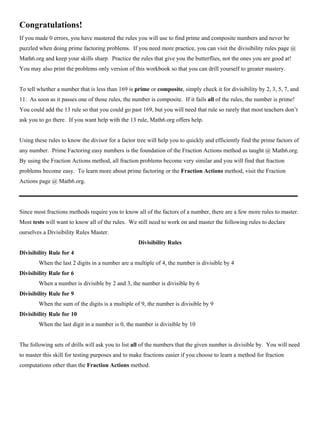
Congratulations!
If you made 0 errors, you have mastered the rules you will use to find prime and composite numbers and never be
puzzled when doing prime factoring problems. If you need more practice, you can visit the divisibility rules page @
Math6.org and keep your skills sharp. Practice the rules that give you the butterflies, not the ones you are good at!
You may also print the problems only version of this workbook so that you can drill yourself to greater mastery.
To tell whether a number that is less than 169 is prime or composite, simply check it for divisibility by 2, 3, 5, 7, and
11. As soon as it passes one of those rules, the number is composite. If it fails all of the rules, the number is prime!
You could add the 13 rule so that you could go past 169, but you will need that rule so rarely that most teachers don’t
ask you to go there. If you want help with the 13 rule, Math6.org offers help.
Using these rules to know the divisor for a factor tree will help you to quickly and efficiently find the prime factors of
any number. Prime Factoring easy numbers is the foundation of the Fraction Actions method as taught @ Math6.org.
By using the Fraction Actions method, all fraction problems become very similar and you will find that fraction
problems become easy. To learn more about prime factoring or the Fraction Actions method, visit the Fraction
Actions page @ Math6.org.
Since most fractions methods require you to know all of the factors of a number, there are a few more rules to master.
Most tests will want to know all of the rules. We still need to work on and master the following rules to declare
ourselves a Divisibility Rules Master.
Divisibility Rules
Divisibility Rule for 4
When the last 2 digits in a number are a multiple of 4, the number is divisible by 4
Divisibility Rule for 6
When a number is divisible by 2 and 3, the number is divisible by 6
Divisibility Rule for 9
When the sum of the digits is a multiple of 9, the number is divisible by 9
Divisibility Rule for 10
When the last digit in a number is 0, the number is divisible by 10
The following sets of drills will ask you to list all of the numbers that the given number is divisible by. You will need
to master this skill for testing purposes and to make fractions easier if you choose to learn a method for fraction
computations other than the Fraction Actions method.
Divisibility (4)
Lesson Box
When the last 2 digits in a number are a multiple of 4,
the number is divisible by 4. (if the 10’s digit is even,
the final digit will be 4 or 8. If the 10’s digit is odd, the
final digit will be 0, 2 or 6.
338 and 2738
38 is not a multiple of 4.
338 and 2738 are not divisible by 4.
272 and 3172
72 is a multiple of 4.
272 and 3172 are divisible by 4.
285 and 47285
85 is not a multiple of 4.
285 and 47285 are not divisible by 4.
312 and 916312
12 is a multiple of 4.
312 and 916312 are divisible by 4.
Models
4 276
76 is a multiple of 4.
4 248
48 is a multiple of 4.
Ø 170
70 is not a multiple of 4.
Ø 455
55 is not a multiple of 4.
4 392
92 is a multiple of 4.
Apply the divisibility rule for 4. If the number is divisible by 4, write 4. If the number is not divisible by 4, enter Ø.
________ 32
________ 62
________ 118
________ 66
________ 128
________ 88
________ 132
________ 112
________ 122
________ 86
________ 148
________ 135
________ 127
________ 56
________ 34
________ 48
________ 124
________ 94
________ 136
________ 130
________ 106
________ 123
________ 74
________ 138
________ 90
________ 54
________ 100
________ 28
________ 131
________ 38
________ 165
________ 78
________ 80
________ 36
________ 146
________ 30
________ 134
________ 166
________ 98
________ 149
________ 52
________ 44
________ 108
________ 115
________ 160
________ 142
________ 167
________ 76
________ 143
________ 114
________ 144
________ 40
________ 60
________ 168
________ 104
________ 92
________ 158
________ 58
________ 162
________ 26
[use Key 13 to check your answers]
Divisibility Drills 2, 3, 4, 5, 7, and 11
Tell whether each number is divisible by 2, 3, 4, 5, 7, and 11. If the number is not divisible by these rules, enter Ø.
_____________________ 56
_____________________ 28
_____________________ 49
_____________________ 38
_____________________ 163
_____________________ 82
_____________________ 45
_____________________ 71
_____________________ 168
_____________________ 16
_____________________ 111
_____________________ 88
_____________________ 92
_____________________ 87
_____________________ 25
_____________________ 31
_____________________ 57
_____________________ 122
_____________________ 145
_____________________ 135
_____________________ 160
_____________________ 23
_____________________ 12
_____________________ 32
_____________________ 150
_____________________ 65
_____________________ 147
_____________________ 36
_____________________ 18
_____________________ 128
_____________________ 62
_____________________ 35
_____________________ 126
_____________________ 79
_____________________ 14
_____________________ 151
Tell whether each number is divisible by 2, 3, 4, 5, 7, and 11. If the number is not divisible by these rules, enter Ø.
_____________________ 72
_____________________ 85
_____________________ 100
_____________________ 166
_____________________ 134
_____________________ 156
_____________________ 61
_____________________ 47
_____________________ 157
_____________________ 117
_____________________ 13
_____________________ 59
_____________________ 78
_____________________ 149
_____________________ 69
_____________________ 53
_____________________ 96
_____________________ 52
_____________________ 64
_____________________ 131
_____________________ 127
_____________________ 29
_____________________ 120
_____________________ 123
_____________________ 63
_____________________ 99
_____________________ 70
_____________________ 138
_____________________ 105
_____________________ 86
_____________________ 121
_____________________ 80
_____________________ 169
_____________________ 165
_____________________ 144
_____________________ 162
[use Key 14 to check your answers]
[use Key 15 to check your answers]
Divisibility (6)
Lesson Box
If a number is divisibly by both 2 and 3, the number is
also divisible by 6!
312
312 is divisible by 2.
1 + 2 = 3
312 is divisible by 6.
320
320 is divisible by 2.
2 is not a multiple of 3
320 is not divisible by 6.
297
297 is not divisible by 2.
297 is not divisible by 6.
228
228 is divisible by 2.
2 + 8 + 2 = 12
228 is divisible by 6.
Models
6 144
4 works for 2. 1 + 4 + 4 = 9
Ø 328
4 works for 2. 2 + 8 = 10
Ø 260
0 works for 2. 2 + 6 = 8
Ø 275
5 does not work for 2.
6 336
6 works for 2. I tossed out all of the numbers!
Apply the divisibility rule for 6. If the number is divisible by 6, write 6. If the number is not divisible by 6, enter Ø.
________ 66
________ 158
________ 86
________ 49
________ 90
________ 155
________ 92
________ 38
________ 12
________ 115
________ 18
________ 134
________ 154
________ 58
________ 32
________ 60
________ 85
________ 40
________ 106
________ 44
________ 114
________ 104
________ 27
________ 89
________ 105
________ 56
________ 150
________ 64
________ 145
________ 87
________ 24
________ 62
________ 100
________ 142
________ 111
________ 136
________ 96
________ 22
________ 117
________ 144
________ 118
________ 130
________ 128
________ 26
________ 88
________ 138
________ 15
________ 30
________ 135
________ 102
________ 126
________ 20
________ 148
________ 78
________ 162
________ 69
________ 54
________ 140
________ 46
________ 120
[use Key 16 to check your answers]
Divisibility Drills 2, 3, 4, 5, 6, 7, and 11
Tell whether each number is divisible by 2, 3, 4, 5, 6, 7, and 11. If the number is not divisible by these rules, enter Ø.
_____________________ 153
_____________________ 31
_____________________ 64
_____________________ 24
_____________________ 83
_____________________ 36
_____________________ 12
_____________________ 19
_____________________ 21
_____________________ 139
_____________________ 107
_____________________ 47
_____________________ 149
_____________________ 55
_____________________ 147
_____________________ 129
_____________________ 75
_____________________ 35
_____________________ 60
_____________________ 72
_____________________ 51
_____________________ 16
_____________________ 57
_____________________ 30
_____________________ 92
_____________________ 28
_____________________ 106
_____________________ 32
_____________________ 81
_____________________ 102
_____________________ 101
_____________________ 168
_____________________ 115
_____________________ 112
_____________________ 122
_____________________ 56
Tell whether each number is divisible by 2, 3, 4, 5, 6, 7, and 11. If the number is not divisible by these rules, enter Ø.
_____________________ 71
_____________________ 134
_____________________ 23
_____________________ 90
_____________________ 155
_____________________ 138
_____________________ 49
_____________________ 86
_____________________ 69
_____________________ 150
_____________________ 158
_____________________ 116
_____________________ 114
_____________________ 159
_____________________ 152
_____________________ 131
_____________________ 109
_____________________ 87
_____________________ 135
_____________________ 119
_____________________ 97
_____________________ 74
_____________________ 15
_____________________ 126
_____________________ 66
_____________________ 63
_____________________ 111
_____________________ 165
_____________________ 22
_____________________ 95
_____________________ 13
_____________________ 27
_____________________ 125
_____________________ 85
_____________________ 117
_____________________ 166
[use Key 17 to check your answers]
[use Key 18 to check your answers]
Divisibility (9)
Lesson Box
The divisibility rule for 9 asks you to find the sum of
the digits. If the sum of the digits is a multiple of 9,
then the number is divisible by 9.
297
2 + 9 + 7 = 18.
18 is a multiple of 9.
297 is divisible by 9.
342
3 + 4 + 2 = 9.
9 is a multiple of 9.
342 is divisible by 9.
To cast out 9’s don’t add any 9’s.
954 … 5 + 4 = 9
298 … 2 + 8 = 10
692 … 2 + 6 = 8
Models
Ø 581
5 + 8 + 1 = 14
9 657
6 + 5 + 7 = 18
Ø 921
2 + 1 = 3 (or 9 + 2 + 1 = 12)
9 369
3 + 6 = 9 (or 3 + 6 + 9 = 18)
9 783
7 + 8 + 3 = 18
Apply the divisibility rule for 9. If the number is divisible by 9, write 9. If the number is not divisible by 9, enter Ø.
________ 129
________ 117
________ 254
________ 206
________ 143
________ 144
________ 208
________ 111
________ 157
________ 222
________ 103
________ 114
________ 110
________ 288
________ 290
________ 256
________ 226
________ 162
________ 252
________ 113
________ 216
________ 105
________ 116
________ 260
________ 166
________ 324
________ 210
________ 298
________ 270
________ 125
________ 234
________ 126
________ 286
________ 332
________ 135
________ 224
________ 104
________ 127
________ 228
________ 153
________ 322
________ 268
________ 142
________ 108
________ 161
________ 167
________ 134
________ 468
________ 572
________ 664
________ 448
________ 208
________ 456
________ 306
________ 644
________ 536
________ 284
________ 216
________ 334
________ 592
[use Key 19 to check your answers]
Divisibility Drills 2, 3, 4, 5, 6, 7, 9, 10 and 11 (all rules)
Tell whether each number is divisible by 2, 3, 4, 5, 6, 7, 9, 10 and 11. If not enter Ø.
_____________________ 134
_____________________ 154
_____________________ 108
_____________________ 49
_____________________ 82
_____________________ 31
_____________________ 45
_____________________ 15
_____________________ 62
_____________________ 131
_____________________ 42
_____________________ 84
_____________________ 111
_____________________ 68
_____________________ 133
_____________________ 63
_____________________ 17
_____________________ 90
_____________________ 64
_____________________ 88
_____________________ 158
_____________________ 104
_____________________ 47
_____________________ 148
_____________________ 79
_____________________ 109
_____________________ 105
_____________________ 48
_____________________ 120
_____________________ 76
_____________________ 119
_____________________ 59
_____________________ 13
_____________________ 20
_____________________ 95
_____________________ 92
Tell whether each number is divisible by 2, 3, 4, 5, 6, 7, 9, 10 and 11. If not enter Ø.
_____________________ 37
_____________________ 145
_____________________ 152
_____________________ 22
_____________________ 132
_____________________ 24
_____________________ 23
_____________________ 99
_____________________ 126
_____________________ 16
_____________________ 61
_____________________ 144
_____________________ 166
_____________________ 124
_____________________ 116
_____________________ 149
_____________________ 107
_____________________ 141
_____________________ 87
_____________________ 150
_____________________ 85
_____________________ 32
_____________________ 83
_____________________ 50
_____________________ 101
_____________________ 167
_____________________ 89
_____________________ 71
_____________________ 159
_____________________ 163
_____________________ 53
_____________________ 29
_____________________ 106
_____________________ 103
_____________________ 143
_____________________ 78
[use Key 20 to check your answers]
[use Key 21 to check your answers]
Apply the divisibility rules for 2 and 5. If the number is divisible by 2 or 5, write which ever answer is true. You do
not need to write both answers. (example: 110 is divisible by both 2 and 5, you may answer 2) If the number is not
divisible by these rules, enter Ø.
2,5
2,5
2
Ø
2
5
2
2
Ø
2
Ø
5
2
Ø
2
2
2
2
Ø
Ø
2,5
2
Ø
5
2,5
5
Ø
Ø
2
Ø
Ø
2
2
Ø
2
Ø
5
2
Ø
2
Ø
Ø
2
Ø
Ø
2
Ø
2
2
2
Ø
2,5
2
2,5
Ø
Apply the divisibility rule for 3. If the number is divisible by 3, write 3. If the number is not divisible by 3, enter Ø.
Ø
Ø
Ø
Ø
Ø
3
3
3
Ø
Ø
Ø
Ø
Ø
Ø
Ø
Ø
Ø
Ø
Ø
Ø
3
Ø
Ø
Ø
3
Ø
Ø
Ø
3
Ø
3
Ø
3
3
Ø
Ø
3
Ø
Ø
3
3
3
Ø
3
Ø
Ø
3
Ø
3
3
Ø
Ø
Ø
Ø
Ø
Ø
3
Ø
Ø
Ø
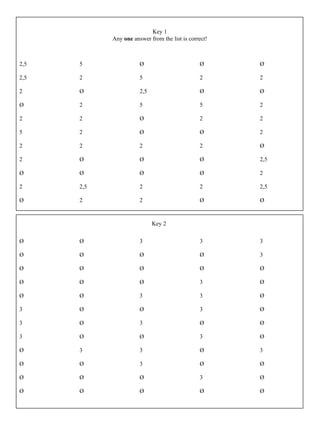
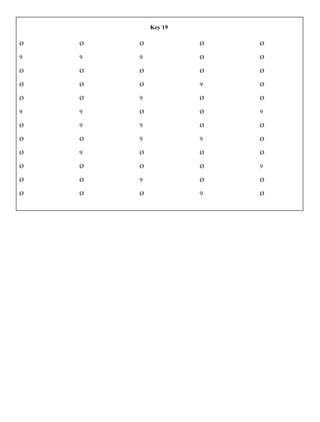
Key 1
Any one answer from the list is correct!
Key 2
Apply the divisibility rules for 2, 3 and 5. If the number is divisible by 2, 3 or 5, write which ever answer is true.
You do not need to write all of the answers. (example: 110 is divisible by both 2 and 5, you may answer 2) If the
number is not divisible by these rules, enter Ø.
Ø
2, 3
Ø
Ø
2, 5
Ø
Ø
Ø
2, 3, 5
3
3, 5
Ø
2, 3, 5
2
3
Ø
3, 5
Ø
2
5
2
2
2
3
5
5
Ø
Ø
3
2, 3
3
2
2
2
Ø
Ø
Ø
2, 3
2, 5
Ø
3
2
2, 3
5
Ø
3
2
Ø
2
Apply the divisibility rules for 2, 3 and 5. If the number is divisible by 2, 3 or 5, write which ever answer is true.
You do not need to write all of the answers. (example: 110 is divisible by both 2 and 5, you may answer 2) If the
number is not divisible by these rules, enter Ø.
5
Ø
3
Ø
2, 3, 5
Ø
3
2
2, 3
2
2, 3
5
2
2, 5
2, 3
Ø
2
2
Ø
2, 3
2
2, 5
2
5
2, 5
Ø
3
Ø
Ø
2, 5
2, 5
Ø
3, 5
3
2
Ø
2
2
2, 3
5
Ø
Ø
3
2, 3
2
2, 3
3, 5
Ø
2, 3
Ø
Key 3
Any one answer from the list is correct!
Key 4
Any one answer from the list is correct!
Apply the divisibility rule for 7. If the number is divisible by 7, write 7. If the number is not divisible by 7, enter Ø.
Ø
Ø
Ø
7
Ø
Ø
Ø
Ø
7
Ø
Ø
Ø
Ø
7
Ø
Ø
7
Ø
Ø
Ø
Ø
Ø
Ø
Ø
Ø
7
7
7
Ø
Ø
Ø
Ø
Ø
Ø
Ø
Ø
Ø
Ø
7
Ø
Ø
Ø
7
Ø
Ø
7
Ø
Ø
7
Ø
7
Ø
Ø
Ø
Ø
Ø
Ø
Ø
Ø
Ø
Apply the divisibility rule for 11. If the number is divisible by 11, write 11. If the number is not divisible by 11,
enter Ø.
Ø
Ø
Ø
11
Ø
Ø
Ø
Ø
Ø
Ø
Ø
11
11
11
Ø
Ø
Ø
Ø
Ø
Ø
Ø
Ø
Ø
11
Ø
Ø
Ø
Ø
Ø
Ø
Ø
Ø
Ø
11
Ø
Ø
Ø
Ø
Ø
Ø
Ø
Ø
Ø
Ø
Ø
Ø
Ø
Ø
Ø
Ø
Ø
Ø
Ø
11
Ø
Key 5
Key 8
Apply the divisibility rules for 2, 3 and 5. If the number is divisible by 2, 3 or 5, write which ever answer is true.
You do not need to write all of the answers. (example: 110 is divisible by both 2 and 5, you may answer 2) If the
number is not divisible by these rules, enter Ø.
Ø
2
2,7
2, 5
3
2
2
3
2
5
5
Ø
3
Ø
2, 5
Ø
2
2
Ø
Ø
2
2
Ø
2, 3
2
2
Ø
2
2, 3
2, 3
3
Ø
2, 3
2, 3, 5
7
Ø
2, 3, 7
2, 5, 7
Ø
3
2, 3
2, 5
3
2
Ø
3, 5, 7
2, 3
3
3, 5
Ø
Apply the divisibility rules for 2, 3 and 5. If the number is divisible by 2, 3 or 5, write which ever answer is true.
You do not need to write all of the answers. (example: 110 is divisible by both 2 and 5, you may answer 2) If the
number is not divisible by these rules, enter Ø.
3, 7
2
3
2
3, 5
2
2, 3
5
2
Ø
5, 7
2, 3
2
2
3, 7
2
2, 5
2, 3
2
2
2
3
Ø
Ø
7
2, 3, 7
3
3, 5
2, 3, 5
Ø
Ø
2
7
2
2, 7
2, 3, 7
Ø
3
2, 7
3
2
2, 5
7
3
2, 5, 7
3
Ø
2, 5
3, 7
5
Key 6
Any one answer from the list is correct!
Key 7
Any one answer from the list is correct!
Apply the divisibility rules for 2, 3 and 5. If the number is divisible by 2, 3 or 5, write which ever answer is true.
You do not need to write all of the answers. (example: 110 is divisible by both 2 and 5, you may answer 2) If the
number is not divisible by these rules, enter Ø.
3
2, 3, 5
3
Ø
2, 3, 7
5
Ø
7
Ø
3, 5
3
Ø
2, 5
2, 5
3
3, 5
2, 3
5
2
3, 11
Ø
2, 3, 7
3, 5
3, 7
2
Ø
2, 7
2
2, 7
2
2, 3, 7
2, 5, 11
2
2, 3
2, 5, 7
2, 3
Ø
2, 3, 5
2
Ø
11
3
2
Ø
2
Ø
2
7
2
2, 7
Apply the divisibility rules for 2, 3 and 5. If the number is divisible by 2, 3 or 5, write which ever answer is true.
You do not need to write all of the answers. (example: 110 is divisible by both 2 and 5, you may answer 2) If the
number is not divisible by these rules, enter Ø.
2, 7
2
2, 7
2, 3
5
2, 5
2
Ø
11
2, 3, 5
2
2
2, 5
2
2, 5, 7
2
Ø
Ø
Ø
2
3
3
2
Ø
2
2, 3, 5
Ø
2, 3
Ø
2
2, 3
Ø
3, 7
Ø
Ø
2
3, 5
Ø
3, 11
2, 3
Ø
2, 5
Ø
2, 3
Ø
3
5
2, 3
2, 5
Ø
Key 9
Any one answer from the list is correct!
Key 10
Any one answer from the list is correct!
Apply the divisibility rules for 2, 3 and 5. If the number is divisible by 2, 3 or 5, write which ever answer is true.
You do not need to write all of the answers. (example: 110 is divisible by both 2 and 5, you may answer 2) If the
number is not divisible by these rules, enter Ø.
3
2, 3
2, 3, 5
2
Ø
3, 11
3
2, 3
Ø
2, 7, 11
2, 3
Ø
Ø
2,
2, 3, 7
2, 7
2, 3, 5
2
2, 3
Ø
3, 5, 7
2
2
Ø
Ø
Ø
2
3
5
2, 3
3, 11
3
Ø
Ø
2,
Ø
2
2, 3, 7
2
2, 5
2, 7
2
3, 5
Ø
3
7
2, 3
5, 7
Ø
5
Apply the divisibility rules for 2, 3 and 5. If the number is divisible by 2, 3 or 5, write which ever answer is true.
You do not need to write all of the answers. (example: 110 is divisible by both 2 and 5, you may answer 2) If the
number is not divisible by these rules, enter Ø.
Ø
5
2, 5
5
Ø
2, 3, 7
3, 7
Ø
2, 3
2
2
2, 5
3
3
2, 5, 7
Ø
2
Ø
3, 7
2, 7
2, 3
3, 5
2, 5, 11
2
2
Ø
2, 3, 5
2, 7
Ø
2
2
Ø
7
3, 5
Ø
2, 11
11
5
2, 3
Ø
2, 3
3
2, 3
Ø
5
2, 3, 5
2
3,
2, 5
2, 11
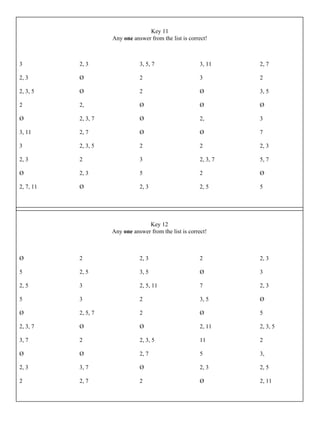
Key 11
Any one answer from the list is correct!
Key 12
Any one answer from the list is correct!
Apply the divisibility rule for 7. If the number is divisible by 7, write 7. If the number is not divisible by 7, enter Ø.
4
Ø
Ø
Ø
4
4
4
4
Ø
Ø
4
Ø
Ø
4
Ø
4
4
Ø
4
Ø
Ø
Ø
Ø
Ø
Ø
Ø
4
4
Ø
Ø
Ø
Ø
4
4
Ø
Ø
Ø
Ø
Ø
Ø
4
4
4
Ø
4
Ø
Ø
4
Ø
Ø
4
4
4
4
4
4
Ø
Ø
Ø
Ø
Apply the divisibility rule for 6. If the number is divisible by 6, write 6. If the number is not divisible by 6, enter Ø.
6
Ø
Ø
Ø
6
Ø
Ø
Ø
6
Ø
6
Ø
Ø
Ø
Ø
6
Ø
Ø
Ø
Ø
6
Ø
Ø
Ø
Ø
Ø
6
Ø
Ø
Ø
6
Ø
Ø
Ø
Ø
Ø
6
Ø
Ø
6
Ø
Ø
Ø
Ø
Ø
6
Ø
6
Ø
6
6
Ø
Ø
6
6
Ø
6
Ø
Ø
6
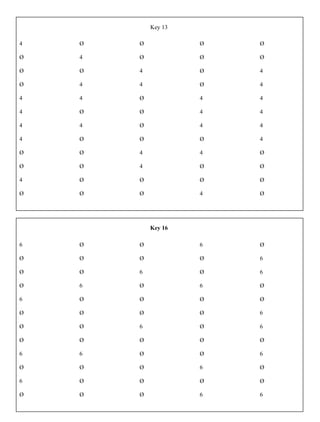
Key 13
Key 16
Tell whether each number is divisible by 2, 3, 4, 5, 7, and 11. If the number is not divisible by these rules, enter Ø.
2, 4, 7
2, 4, 7
7
2
Ø
2
3, 5
Ø
2, 3, 4, 7
2, 4
3
2, 4, 11
2, 4
3
5
Ø
3
2
5
3, 5
2, 4, 5
Ø
2, 3, 4
2, 4
2, 3, 5
5
3, 7
2, 3, 4
2, 3
2, 4
2
5, 7
2, 3, 7
Ø
2, 7
Ø
Tell whether each number is divisible by 2, 3, 4, 5, 7, and 11. If the number is not divisible by these rules, enter Ø.
2, 3, 4
5
2, 4, 5
2
2
2, 3, 4
Ø
Ø
Ø
3
Ø
Ø
2, 3
Ø
3
Ø
2, 3, 4
2, 4
2, 4
Ø
Ø
Ø
2, 3, 4, 5
3
3, 7
3, 11
2, 5, 7
2, 3
3, 5, 7
2
11
2, 4, 5
13
3, 5, 11
2, 3, 4
2, 3
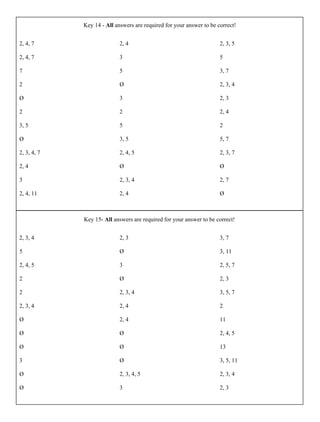
Key 14 - All answers are required for your answer to be correct!
Key 15- All answers are required for your answer to be correct!
Tell whether each number is divisible by 2, 3, 4, 5, 7, and 11. If the number is not divisible by these rules, enter Ø.
3
Ø
2, 4
2, 3, 4, 6
Ø
2, 3, 4, 6
2, 3, 4, 6
Ø
3, 7
Ø
Ø
Ø
Ø
5, 11
3, 7
3
3, 5
5, 7
2, 3, 4, 5, 6
2, 3, 4, 6
3
2, 4
3
2, 3, 5, 6
2, 4
2, 4, 7
2
2, 4
3,
2, 3, 6
Ø
2, 3, 4, 6, 7
5
2, 4, 7
2
2, 4, 7
Tell whether each number is divisible by 2, 3, 4, 5, 7, and 11. If the number is not divisible by these rules, enter Ø.
Ø
2
Ø
2, 3, 5, 6
5
2, 3, 6
7
2
3
2, 3, 5, 6
2
2, 4
2, 3, 6
3
2, 4
Ø
Ø
3
3, 5
7
Ø
2
3, 5
2, 3, 6, 7
2, 3, 6, 11
3, 7
3
3, 5, 11
2, 11
5
Ø
3
5
5
3
2
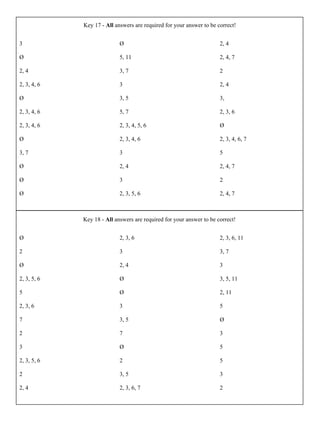
Key 17 - All answers are required for your answer to be correct!
Key 18 - All answers are required for your answer to be correct!
Apply the divisibility rule for 7. If the number is divis , write 7. If the number is not divisible by 7, enter Ø.
ible by 7
Ø
9
Ø
Ø
Ø
9
Ø
Ø
Ø
Ø
Ø
Ø
Ø
9
Ø
Ø
Ø
9
9
Ø
9
Ø
Ø
Ø
Ø
9
Ø
Ø
9
Ø
9
9
Ø
Ø
9
Ø
Ø
Ø
Ø
9
Ø
Ø
Ø
9
Ø
Ø
Ø
9
Ø
Ø
Ø
Ø
Ø
9
Ø
Ø
Ø
9
Ø
Ø
Key 19
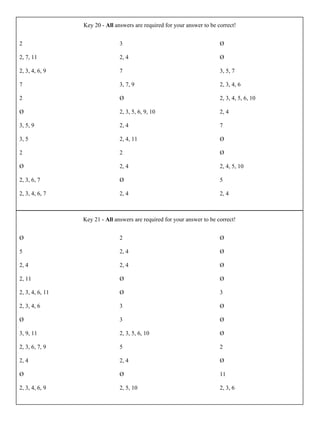
Tell whether each number is divisible by 2, 3, 4, 5, 7, and 11. If the number is not divisible by these rules, enter Ø.
2
2, 7, 11
2, 3, 4, 6, 9
7
2
Ø
3, 5, 9
3, 5
2
Ø
2, 3, 6, 7
2, 3, 4, 6, 7
3
2, 4
7
3, 7, 9
Ø
2, 3, 5, 6, 9, 10
2, 4
2, 4, 11
2
2, 4
Ø
2, 4
Ø
Ø
3, 5, 7
2, 3, 4, 6
2, 3, 4, 5, 6, 10
2, 4
7
Ø
Ø
2, 4, 5, 10
5
2, 4
Tell whether each number is divisible by 2, 3, 4, 5, 7, and 11. If the number is not divisible by these rules, enter Ø.
Ø
5
2, 4
2, 11
2, 3, 4, 6, 11
2, 3, 4, 6
Ø
3, 9, 11
2, 3, 6, 7, 9
2, 4
Ø
2, 3, 4, 6, 9
2
2, 4
2, 4
Ø
Ø
3
3
2, 3, 5, 6, 10
5
2, 4
Ø
2, 5, 10
Ø
Ø
Ø
Ø
3
Ø
Ø
Ø
2
Ø
11
2, 3, 6
Key 20 - All answers are required for your answer to be correct!
Key 21 - All answers are required for your answer to be correct!

divisibility_rules_workbook.pdf

  • 1.
    Name _____________________ © 2009– Norm Mitchell (Math6.org) – All Rights Reserved Freely reproducible for “non-profit” educational purposes – visit http://www.math6.org/legal.htm for more details concerning “non-profit”. Divisibility A number is divisible by another number if it is a true multiple of the other number (or if the division problem does not have a remainder. 24 is divisible by 3 because 24 ÷ 3 = 8 with no remainder. 25 is not divisible by 3 because it would have a remainder of 1! This first section of this booklet will help you to learn the divisibility rules that you will need and use every day. The numbers are all less than 169 because using the Fraction Actions method, you will never end up with numbers greater than 169 that are not already finished numbers. The last section of the book will help you with a few rules that you will need to know for NC EOG testing purposes. Divisibility Rules Divisibility Rule for 2 When the last digit in a number is 0, 2, 4, 6, or 8, the number is divisible by 2 Divisibility Rule for 5 When the last digit in a number is 0 or 5, the number is divisible by 5 Divisibility Rule for 3 When the sum of the digits is a multiple of 3, the number is divisible by 3 Divisibility Rule for 7 Double the last digit in a number and subtract it from the rest of the number. If the result is a known multiple of 7, then the number is divisible by 7. If the result is not known, repeat the rule with the new number! Divisibility Rule for 11 When the sum of the odd digits is equal to (or 11 more than) the sum of the even digits, the number is divisible by 11 Divisibility Rule for 13 Nine times the last digit in a number and subtract it from the rest of the number. If the result is a known multiple of 13, then the number is divisible by 13. If the result is not known, repeat the rule with the new number! Divisibility Rule for 4 When the last 2 digits in a number are a multiple of 4, the number is divisible by 4 Divisibility Rule for 6 When a number is divisible by 2 and 3, the number is divisible by 6 Divisibility Rule for 9 When the sum of the digits is a multiple of 9, the number is divisible by 9 Divisibility Rule for 10 When the last digit in a number is 0, the number is divisible by 10
  • 2.
    Divisibility (2 and5) Lesson Box The divisibility rule for 2 and 5 ask you to look at the last digit of the number. If the last digit is 0, 2, 4, 6, or 8 the number is divisible by 2. If the last digit is 0 or 5, the number is divisible by 5. Models 2, 5 80 80 ends with 0. According to the rules, numbers that end with 0 are divisible by 2 and 5. 2 158 158 ends with 8. 8 is part of the 2 rule. Ø 151 151 ends with 1. 1 is not part of either rule, so 151 is not divisible by 2 or 5. 5 215 215 ends with 5. Twenty-five is divisible by 5! Apply the divisibility rules for 2 and 5. If the number is divisible by 2 or 5, write which ever answer is true. You do not need to write both answers. (example: 110 is divisible by both 2 and 5, you may answer 2) If the number is not divisible by these rules, enter Ø. ________ 160 ________ 80 ________ 158 ________ 151 ________ 76 ________ 25 ________ 108 ________ 66 ________ 87 ________ 72 ________ 29 ________ 145 ________ 136 ________ 133 ________ 124 ________ 78 ________ 106 ________ 36 ________ 103 ________ 73 ________ 130 ________ 154 ________ 107 ________ 115 ________ 120 ________ 35 ________ 141 ________ 159 ________ 44 ________ 111 ________ 157 ________ 46 ________ 74 ________ 37 ________ 20 ________ 137 ________ 105 ________ 24 ________ 23 ________ 68 ________ 167 ________ 67 ________ 54 ________ 89 ________ 41 ________ 156 ________ 59 ________ 34 ________ 112 ________ 162 ________ 61 ________ 100 ________ 96 ________ 30 ________ 99 [use Key 1 to check your answers]
  • 3.
    Divisibility (3) Lesson Box Thedivisibility rule for 3 asks you to find the sum of the digits. If the sum of the digits is a multiple of 3, then the number is divisible by 3. 257 2 + 5 + 7 = 14. 14 is not a multiple of 3. 257 is not divisible by 3. 342 3 + 4 + 2 = 9. 9 is a multiple of 3. 342 is divisible by 3. To cast out 3’s don’t add any 3, 6 or 9’s. 342 … 4 + 2 = 6 268 … 2 + 8 = 10 692 … 2 = 2 Models 3 138 1 + 8 = 9 (or 1 + 3 + 8 = 12) Ø 58 5 + 8 = 13 3 126 1 + 2 = 3 (or 1 + 2 + 6 = 9) Ø 101 1 + 1 = 2 Apply the divisibility rule for 3. If the number is divisible by 3, write 3. If the number is not divisible by 3, enter Ø. ________ 47 ________ 70 ________ 122 ________ 140 ________ 169 ________ 51 ________ 111 ________ 60 ________ 86 ________ 100 ________ 38 ________ 14 ________ 164 ________ 68 ________ 77 ________ 61 ________ 148 ________ 145 ________ 46 ________ 64 ________ 81 ________ 131 ________ 119 ________ 26 ________ 54 ________ 137 ________ 92 ________ 83 ________ 141 ________ 56 ________ 90 ________ 44 ________ 75 ________ 159 ________ 166 ________ 50 ________ 156 ________ 55 ________ 107 ________ 87 ________ 78 ________ 96 ________ 155 ________ 72 ________ 167 ________ 134 ________ 69 ________ 40 ________ 108 ________ 117 ________ 106 ________ 31 ________ 41 ________ 74 ________ 19 ________ 124 ________ 36 ________ 95 ________ 59 ________ 29 [use Key 2 to check your answers]
  • 4.
    Divisibility Drills 2,3 and 5 Apply the divisibility rules for 2, 3 and 5. If the number is divisible by 2, 3 or 5, write which ever answer is true. You do not need to write all of the answers. (example: 110 is divisible by both 2 and 5, you may answer 2) If the number is not divisible by these rules, enter Ø. ________ 103 ________ 24 ________ 53 ________ 49 ________ 50 ________ 31 ________ 169 ________ 19 ________ 36 ________ 141 ________ 75 ________ 112 ________ 143 ________ 90 ________ 152 ________ 81 ________ 107 ________ 165 ________ 127 ________ 32 ________ 65 ________ 28 ________ 64 ________ 164 ________ 111 ________ 145 ________ 95 ________ 149 ________ 137 ________ 63 ________ 30 ________ 105 ________ 26 ________ 140 ________ 104 ________ 71 ________ 131 ________ 29 ________ 84 ________ 100 ________ 139 ________ 123 ________ 136 ________ 96 ________ 125 ________ 113 ________ 129 ________ 124 ________ 109 ________ 14 Apply the divisibility rules for 2, 3 and 5. If the number is divisible by 2, 3 or 5, write which ever answer is true. You do not need to write all of the answers. (example: 110 is divisible by both 2 and 5, you may answer 2) If the number is not divisible by these rules, enter Ø. ________ 55 ________ 119 ________ 51 ________ 17 ________ 120 ________ 101 ________ 153 ________ 44 ________ 162 ________ 154 ________ 48 ________ 155 ________ 106 ________ 70 ________ 156 ________ 41 ________ 146 ________ 134 ________ 161 ________ 12 ________ 98 ________ 130 ________ 116 ________ 25 ________ 160 ________ 133 ________ 159 ________ 167 ________ 67 ________ 110 ________ 40 ________ 151 ________ 135 ________ 117 ________ 62 ________ 121 ________ 148 ________ 122 ________ 168 ________ 85 ________ 83 ________ 157 ________ 27 ________ 42 ________ 34 ________ 72 ________ 45 ________ 79 ________ 126 ________ 23 [use Key 3 to check your answers] [use Key 4 to check your answers]
  • 5.
    Divisibility (7) Lesson Box •Double the last digit in a number and subtract it from the rest of the number. • If the result is a known multiple of 7, then the number is divisible by 7. • If the result is not known, repeat the rule with the new number! 257 7 * 2 = 14. 25 – 14 = 11. 257 is not divisible by 7. 343 3 * 2 = 6. 34 – 6 = 28. 343 is divisible by 7. 49 9 * 2 = 18. 18 – 4 = 14. 49 is divisible by 7. (notice you can subtract the first digits from the doubled last if you need to!) Models Ø 138 8*2 = 16 ; 16-13 = 3 ; 138 is not divisible by 7 7 168 8*2 = 16 ; 16-16 = 0 ; 168 is divisible by 7 7 133 3*2 = 6 ; 13-6 = 7 ; 133 is divisible by 7 Ø 101 1*2 = 2 ; 10-2 = 8 ; 101 is not divisible by 7 Apply the divisibility rule for 7. If the number is divisible by 7, write 7. If the number is not divisible by 7, enter Ø. ________ 46 ________ 55 ________ 111 ________ 49 ________ 141 ________ 156 ________ 15 ________ 60 ________ 133 ________ 92 ________ 30 ________ 152 ________ 117 ________ 161 ________ 153 ________ 132 ________ 28 ________ 88 ________ 155 ________ 166 ________ 59 ________ 160 ________ 102 ________ 142 ________ 139 ________ 140 ________ 35 ________ 105 ________ 93 ________ 121 ________ 54 ________ 72 ________ 167 ________ 45 ________ 43 ________ 83 ________ 66 ________ 31 ________ 63 ________ 13 ________ 110 ________ 143 ________ 21 ________ 23 ________ 17 ________ 168 ________ 68 ________ 149 ________ 70 ________ 69 ________ 119 ________ 78 ________ 130 ________ 95 ________ 136 ________ 123 ________ 107 ________ 145 ________ 41 ________ 124 [use Key 5 to check your answers]
  • 6.
    Divisibility Drills 2,3, 5, and 7 Apply the divisibility rules for 2, 3, 5 and 7. If the number is divisible by 2, 3, 5 or 7, write which ever answer is true. You do not need to write all of the answers. (example: 110 is divisible by both 2 and 5, you may answer 2) If the number is not divisible by these rules, enter Ø. ________ 163 ________ 142 ________ 28 ________ 80 ________ 129 ________ 136 ________ 124 ________ 141 ________ 92 ________ 65 ________ 95 ________ 29 ________ 69 ________ 31 ________ 160 ________ 97 ________ 32 ________ 146 ________ 169 ________ 107 ________ 128 ________ 38 ________ 101 ________ 162 ________ 34 ________ 58 ________ 139 ________ 88 ________ 78 ________ 96 ________ 81 ________ 149 ________ 156 ________ 90 ________ 77 ________ 167 ________ 126 ________ 140 ________ 19 ________ 123 ________ 18 ________ 40 ________ 117 ________ 16 ________ 67 ________ 105 ________ 144 ________ 111 ________ 15 ________ 89 Apply the divisibility rules for 2, 3, 5 and 7. If the number is divisible by 2, 3, 5 or 7, write which ever answer is true. You do not need to write all of the answers. (example: 110 is divisible by both 2 and 5, you may answer 2) If the number is not divisible by these rules, enter Ø. ________ 147 ________ 158 ________ 33 ________ 68 ________ 75 ________ 64 ________ 72 ________ 85 ________ 104 ________ 61 ________ 35 ________ 132 ________ 76 ________ 52 ________ 21 ________ 166 ________ 130 ________ 24 ________ 62 ________ 134 ________ 164 ________ 93 ________ 113 ________ 43 ________ 119 ________ 168 ________ 51 ________ 45 ________ 120 ________ 137 ________ 47 ________ 118 ________ 49 ________ 22 ________ 154 ________ 42 ________ 103 ________ 39 ________ 56 ________ 159 ________ 82 ________ 110 ________ 133 ________ 57 ________ 70 ________ 27 ________ 79 ________ 100 ________ 63 ________ 145 [use Key 6 to check your answers] [use Key 7 to check your answers]
  • 7.
    Divisibility (11) Lesson Box Whenthe sum of the odd digits is equal to (or 11 more than) the sum of the even digits, the number is divisible by 11. 257 7 + 2 ≠ 5. 257 is not divisible by 11. 2574 2 + 7 = 5 + 4. 257 is divisible by 11. 346 3 + 6 ≠ 4. 346 is not by 11. 209 2 + 9 = 0 (+ 11more) 209 is divisible by 11. Models 11 264 2 + 4 = 6 Ø 235 2 + 5 ≠ 3 11 220 2 + 0 = 2 Ø 212 2 + 2 ≠ 1 11 968 9 + 8 = 6 (+ 11 more) Apply the divisibility rule for 11. If the number is divisible by 11, write 11. If the number is not divisible by 11, enter Ø. ________ 151 ________ 129 ________ 166 ________ 143 ________ 117 ________ 107 ________ 149 ________ 160 ________ 118 ________ 167 ________ 125 ________ 110 ________ 154 ________ 165 ________ 162 ________ 155 ________ 158 ________ 139 ________ 124 ________ 114 ________ 148 ________ 134 ________ 153 ________ 99 ________ 113 ________ 109 ________ 159 ________ 106 ________ 123 ________ 142 ________ 102 ________ 157 ________ 101 ________ 132 ________ 141 ________ 135 ________ 120 ________ 104 ________ 163 ________ 150 ________ 128 ________ 133 ________ 130 ________ 100 ________ 119 ________ 147 ________ 112 ________ 156 ________ 146 ________ 126 ________ 103 ________ 131 ________ 164 ________ 121 ________ 168 [use Key 8 to check your answers]
  • 8.
    Divisibility Drills 2,3, 5, 7, and 11 Apply the divisibility rules for 2, 3, 5, 7, and 11. If the number is divisible by 2, 3, 5, 7, and 11, write which ever answer is true. You do not need to write all of the answers. (example: 110 is divisible by both 2 and 5, you may answer 2) If the number is not divisible by these rules, enter Ø. ________ 27 ________ 90 ________ 57 ________ 47 ________ 42 ________ 125 ________ 73 ________ 161 ________ 31 ________ 15 ________ 159 ________ 53 ________ 40 ________ 100 ________ 129 ________ 75 ________ 156 ________ 145 ________ 128 ________ 99 ________ 43 ________ 84 ________ 45 ________ 21 ________ 142 ________ 101 ________ 56 ________ 86 ________ 98 ________ 164 ________ 126 ________ 110 ________ 46 ________ 96 ________ 140 ________ 78 ________ 97 ________ 150 ________ 106 ________ 79 ________ 143 ________ 51 ________ 92 ________ 131 ________ 26 ________ 83 ________ 34 ________ 49 ________ 16 ________ 112 Apply the divisibility rules for 2, 3, 5, 7, and 11. If the number is divisible by 2, 3, 5, 7, and 11, write which ever answer is true. You do not need to write all of the answers. (example: 110 is divisible by both 2 and 5, you may answer 2) If the number is not divisible by these rules, enter Ø. ________ 28 ________ 148 ________ 154 ________ 162 ________ 155 ________ 160 ________ 32 ________ 59 ________ 121 ________ 60 ________ 146 ________ 74 ________ 20 ________ 94 ________ 70 ________ 118 ________ 107 ________ 113 ________ 149 ________ 52 ________ 111 ________ 141 ________ 58 ________ 127 ________ 82 ________ 30 ________ 139 ________ 48 ________ 157 ________ 64 ________ 12 ________ 13 ________ 63 ________ 29 ________ 71 ________ 152 ________ 135 ________ 41 ________ 33 ________ 24 ________ 103 ________ 50 ________ 167 ________ 144 ________ 19 ________ 69 ________ 85 ________ 72 ________ 80 ________ 67 [use Key 9 to check your answers] [use Key 10 to check your answers]
  • 9.
    Divisibility Drills –Proof of Mastery – No Errors Allowed! Apply the divisibility rules for 2, 3, 5, 7, and 11. If the number is divisible by 2, 3, 5, 7, and 11, write which ever answer is true. You do not need to write all of the answers. (example: 110 is divisible by both 2 and 5, you may answer 2) If the number is not divisible by these rules, enter Ø. ________ 129 ________ 72 ________ 120 ________ 26 ________ 23 ________ 33 ________ 141 ________ 96 ________ 103 ________ 154 ________ 36 ________ 47 ________ 157 ________ 92 ________ 168 ________ 56 ________ 150 ________ 152 ________ 156 ________ 107 ________ 105 ________ 34 ________ 146 ________ 149 ________ 73 ________ 59 ________ 158 ________ 153 ________ 25 ________ 54 ________ 99 ________ 87 ________ 17 ________ 31 ________ 16 ________ 169 ________ 122 ________ 42 ________ 82 ________ 130 ________ 112 ________ 46 ________ 135 ________ 83 ________ 123 ________ 49 ________ 138 ________ 35 ________ 79 ________ 65 Apply the divisibility rules for 2, 3, 5, 7, and 11. If the number is divisible by 2, 3, 5, 7, and 11, write which ever answer is true. You do not need to write all of the answers. (example: 110 is divisible by both 2 and 5, you may answer 2) If the number is not divisible by these rules, enter Ø. ________ 139 ________ 85 ________ 50 ________ 95 ________ 101 ________ 84 ________ 21 ________ 113 ________ 108 ________ 134 ________ 164 ________ 80 ________ 159 ________ 69 ________ 70 ________ 29 ________ 116 ________ 43 ________ 63 ________ 98 ________ 12 ________ 45 ________ 110 ________ 62 ________ 148 ________ 37 ________ 60 ________ 28 ________ 137 ________ 74 ________ 32 ________ 163 ________ 161 ________ 75 ________ 67 ________ 44 ________ 143 ________ 145 ________ 78 ________ 89 ________ 144 ________ 81 ________ 102 ________ 53 ________ 115 ________ 30 ________ 142 ________ 27 ________ 40 ________ 88 [use Key 11 to check your answers] [use Key 12 to check your answers]
  • 10.
    Congratulations! If you made0 errors, you have mastered the rules you will use to find prime and composite numbers and never be puzzled when doing prime factoring problems. If you need more practice, you can visit the divisibility rules page @ Math6.org and keep your skills sharp. Practice the rules that give you the butterflies, not the ones you are good at! You may also print the problems only version of this workbook so that you can drill yourself to greater mastery. To tell whether a number that is less than 169 is prime or composite, simply check it for divisibility by 2, 3, 5, 7, and 11. As soon as it passes one of those rules, the number is composite. If it fails all of the rules, the number is prime! You could add the 13 rule so that you could go past 169, but you will need that rule so rarely that most teachers don’t ask you to go there. If you want help with the 13 rule, Math6.org offers help. Using these rules to know the divisor for a factor tree will help you to quickly and efficiently find the prime factors of any number. Prime Factoring easy numbers is the foundation of the Fraction Actions method as taught @ Math6.org. By using the Fraction Actions method, all fraction problems become very similar and you will find that fraction problems become easy. To learn more about prime factoring or the Fraction Actions method, visit the Fraction Actions page @ Math6.org. Since most fractions methods require you to know all of the factors of a number, there are a few more rules to master. Most tests will want to know all of the rules. We still need to work on and master the following rules to declare ourselves a Divisibility Rules Master. Divisibility Rules Divisibility Rule for 4 When the last 2 digits in a number are a multiple of 4, the number is divisible by 4 Divisibility Rule for 6 When a number is divisible by 2 and 3, the number is divisible by 6 Divisibility Rule for 9 When the sum of the digits is a multiple of 9, the number is divisible by 9 Divisibility Rule for 10 When the last digit in a number is 0, the number is divisible by 10 The following sets of drills will ask you to list all of the numbers that the given number is divisible by. You will need to master this skill for testing purposes and to make fractions easier if you choose to learn a method for fraction computations other than the Fraction Actions method.
  • 11.
    Divisibility (4) Lesson Box Whenthe last 2 digits in a number are a multiple of 4, the number is divisible by 4. (if the 10’s digit is even, the final digit will be 4 or 8. If the 10’s digit is odd, the final digit will be 0, 2 or 6. 338 and 2738 38 is not a multiple of 4. 338 and 2738 are not divisible by 4. 272 and 3172 72 is a multiple of 4. 272 and 3172 are divisible by 4. 285 and 47285 85 is not a multiple of 4. 285 and 47285 are not divisible by 4. 312 and 916312 12 is a multiple of 4. 312 and 916312 are divisible by 4. Models 4 276 76 is a multiple of 4. 4 248 48 is a multiple of 4. Ø 170 70 is not a multiple of 4. Ø 455 55 is not a multiple of 4. 4 392 92 is a multiple of 4. Apply the divisibility rule for 4. If the number is divisible by 4, write 4. If the number is not divisible by 4, enter Ø. ________ 32 ________ 62 ________ 118 ________ 66 ________ 128 ________ 88 ________ 132 ________ 112 ________ 122 ________ 86 ________ 148 ________ 135 ________ 127 ________ 56 ________ 34 ________ 48 ________ 124 ________ 94 ________ 136 ________ 130 ________ 106 ________ 123 ________ 74 ________ 138 ________ 90 ________ 54 ________ 100 ________ 28 ________ 131 ________ 38 ________ 165 ________ 78 ________ 80 ________ 36 ________ 146 ________ 30 ________ 134 ________ 166 ________ 98 ________ 149 ________ 52 ________ 44 ________ 108 ________ 115 ________ 160 ________ 142 ________ 167 ________ 76 ________ 143 ________ 114 ________ 144 ________ 40 ________ 60 ________ 168 ________ 104 ________ 92 ________ 158 ________ 58 ________ 162 ________ 26 [use Key 13 to check your answers]
  • 12.
    Divisibility Drills 2,3, 4, 5, 7, and 11 Tell whether each number is divisible by 2, 3, 4, 5, 7, and 11. If the number is not divisible by these rules, enter Ø. _____________________ 56 _____________________ 28 _____________________ 49 _____________________ 38 _____________________ 163 _____________________ 82 _____________________ 45 _____________________ 71 _____________________ 168 _____________________ 16 _____________________ 111 _____________________ 88 _____________________ 92 _____________________ 87 _____________________ 25 _____________________ 31 _____________________ 57 _____________________ 122 _____________________ 145 _____________________ 135 _____________________ 160 _____________________ 23 _____________________ 12 _____________________ 32 _____________________ 150 _____________________ 65 _____________________ 147 _____________________ 36 _____________________ 18 _____________________ 128 _____________________ 62 _____________________ 35 _____________________ 126 _____________________ 79 _____________________ 14 _____________________ 151 Tell whether each number is divisible by 2, 3, 4, 5, 7, and 11. If the number is not divisible by these rules, enter Ø. _____________________ 72 _____________________ 85 _____________________ 100 _____________________ 166 _____________________ 134 _____________________ 156 _____________________ 61 _____________________ 47 _____________________ 157 _____________________ 117 _____________________ 13 _____________________ 59 _____________________ 78 _____________________ 149 _____________________ 69 _____________________ 53 _____________________ 96 _____________________ 52 _____________________ 64 _____________________ 131 _____________________ 127 _____________________ 29 _____________________ 120 _____________________ 123 _____________________ 63 _____________________ 99 _____________________ 70 _____________________ 138 _____________________ 105 _____________________ 86 _____________________ 121 _____________________ 80 _____________________ 169 _____________________ 165 _____________________ 144 _____________________ 162 [use Key 14 to check your answers] [use Key 15 to check your answers]
  • 13.
    Divisibility (6) Lesson Box Ifa number is divisibly by both 2 and 3, the number is also divisible by 6! 312 312 is divisible by 2. 1 + 2 = 3 312 is divisible by 6. 320 320 is divisible by 2. 2 is not a multiple of 3 320 is not divisible by 6. 297 297 is not divisible by 2. 297 is not divisible by 6. 228 228 is divisible by 2. 2 + 8 + 2 = 12 228 is divisible by 6. Models 6 144 4 works for 2. 1 + 4 + 4 = 9 Ø 328 4 works for 2. 2 + 8 = 10 Ø 260 0 works for 2. 2 + 6 = 8 Ø 275 5 does not work for 2. 6 336 6 works for 2. I tossed out all of the numbers! Apply the divisibility rule for 6. If the number is divisible by 6, write 6. If the number is not divisible by 6, enter Ø. ________ 66 ________ 158 ________ 86 ________ 49 ________ 90 ________ 155 ________ 92 ________ 38 ________ 12 ________ 115 ________ 18 ________ 134 ________ 154 ________ 58 ________ 32 ________ 60 ________ 85 ________ 40 ________ 106 ________ 44 ________ 114 ________ 104 ________ 27 ________ 89 ________ 105 ________ 56 ________ 150 ________ 64 ________ 145 ________ 87 ________ 24 ________ 62 ________ 100 ________ 142 ________ 111 ________ 136 ________ 96 ________ 22 ________ 117 ________ 144 ________ 118 ________ 130 ________ 128 ________ 26 ________ 88 ________ 138 ________ 15 ________ 30 ________ 135 ________ 102 ________ 126 ________ 20 ________ 148 ________ 78 ________ 162 ________ 69 ________ 54 ________ 140 ________ 46 ________ 120 [use Key 16 to check your answers]
  • 14.
    Divisibility Drills 2,3, 4, 5, 6, 7, and 11 Tell whether each number is divisible by 2, 3, 4, 5, 6, 7, and 11. If the number is not divisible by these rules, enter Ø. _____________________ 153 _____________________ 31 _____________________ 64 _____________________ 24 _____________________ 83 _____________________ 36 _____________________ 12 _____________________ 19 _____________________ 21 _____________________ 139 _____________________ 107 _____________________ 47 _____________________ 149 _____________________ 55 _____________________ 147 _____________________ 129 _____________________ 75 _____________________ 35 _____________________ 60 _____________________ 72 _____________________ 51 _____________________ 16 _____________________ 57 _____________________ 30 _____________________ 92 _____________________ 28 _____________________ 106 _____________________ 32 _____________________ 81 _____________________ 102 _____________________ 101 _____________________ 168 _____________________ 115 _____________________ 112 _____________________ 122 _____________________ 56 Tell whether each number is divisible by 2, 3, 4, 5, 6, 7, and 11. If the number is not divisible by these rules, enter Ø. _____________________ 71 _____________________ 134 _____________________ 23 _____________________ 90 _____________________ 155 _____________________ 138 _____________________ 49 _____________________ 86 _____________________ 69 _____________________ 150 _____________________ 158 _____________________ 116 _____________________ 114 _____________________ 159 _____________________ 152 _____________________ 131 _____________________ 109 _____________________ 87 _____________________ 135 _____________________ 119 _____________________ 97 _____________________ 74 _____________________ 15 _____________________ 126 _____________________ 66 _____________________ 63 _____________________ 111 _____________________ 165 _____________________ 22 _____________________ 95 _____________________ 13 _____________________ 27 _____________________ 125 _____________________ 85 _____________________ 117 _____________________ 166 [use Key 17 to check your answers] [use Key 18 to check your answers]
  • 15.
    Divisibility (9) Lesson Box Thedivisibility rule for 9 asks you to find the sum of the digits. If the sum of the digits is a multiple of 9, then the number is divisible by 9. 297 2 + 9 + 7 = 18. 18 is a multiple of 9. 297 is divisible by 9. 342 3 + 4 + 2 = 9. 9 is a multiple of 9. 342 is divisible by 9. To cast out 9’s don’t add any 9’s. 954 … 5 + 4 = 9 298 … 2 + 8 = 10 692 … 2 + 6 = 8 Models Ø 581 5 + 8 + 1 = 14 9 657 6 + 5 + 7 = 18 Ø 921 2 + 1 = 3 (or 9 + 2 + 1 = 12) 9 369 3 + 6 = 9 (or 3 + 6 + 9 = 18) 9 783 7 + 8 + 3 = 18 Apply the divisibility rule for 9. If the number is divisible by 9, write 9. If the number is not divisible by 9, enter Ø. ________ 129 ________ 117 ________ 254 ________ 206 ________ 143 ________ 144 ________ 208 ________ 111 ________ 157 ________ 222 ________ 103 ________ 114 ________ 110 ________ 288 ________ 290 ________ 256 ________ 226 ________ 162 ________ 252 ________ 113 ________ 216 ________ 105 ________ 116 ________ 260 ________ 166 ________ 324 ________ 210 ________ 298 ________ 270 ________ 125 ________ 234 ________ 126 ________ 286 ________ 332 ________ 135 ________ 224 ________ 104 ________ 127 ________ 228 ________ 153 ________ 322 ________ 268 ________ 142 ________ 108 ________ 161 ________ 167 ________ 134 ________ 468 ________ 572 ________ 664 ________ 448 ________ 208 ________ 456 ________ 306 ________ 644 ________ 536 ________ 284 ________ 216 ________ 334 ________ 592 [use Key 19 to check your answers]
  • 16.
    Divisibility Drills 2,3, 4, 5, 6, 7, 9, 10 and 11 (all rules) Tell whether each number is divisible by 2, 3, 4, 5, 6, 7, 9, 10 and 11. If not enter Ø. _____________________ 134 _____________________ 154 _____________________ 108 _____________________ 49 _____________________ 82 _____________________ 31 _____________________ 45 _____________________ 15 _____________________ 62 _____________________ 131 _____________________ 42 _____________________ 84 _____________________ 111 _____________________ 68 _____________________ 133 _____________________ 63 _____________________ 17 _____________________ 90 _____________________ 64 _____________________ 88 _____________________ 158 _____________________ 104 _____________________ 47 _____________________ 148 _____________________ 79 _____________________ 109 _____________________ 105 _____________________ 48 _____________________ 120 _____________________ 76 _____________________ 119 _____________________ 59 _____________________ 13 _____________________ 20 _____________________ 95 _____________________ 92 Tell whether each number is divisible by 2, 3, 4, 5, 6, 7, 9, 10 and 11. If not enter Ø. _____________________ 37 _____________________ 145 _____________________ 152 _____________________ 22 _____________________ 132 _____________________ 24 _____________________ 23 _____________________ 99 _____________________ 126 _____________________ 16 _____________________ 61 _____________________ 144 _____________________ 166 _____________________ 124 _____________________ 116 _____________________ 149 _____________________ 107 _____________________ 141 _____________________ 87 _____________________ 150 _____________________ 85 _____________________ 32 _____________________ 83 _____________________ 50 _____________________ 101 _____________________ 167 _____________________ 89 _____________________ 71 _____________________ 159 _____________________ 163 _____________________ 53 _____________________ 29 _____________________ 106 _____________________ 103 _____________________ 143 _____________________ 78 [use Key 20 to check your answers] [use Key 21 to check your answers]
  • 17.
    Apply the divisibilityrules for 2 and 5. If the number is divisible by 2 or 5, write which ever answer is true. You do not need to write both answers. (example: 110 is divisible by both 2 and 5, you may answer 2) If the number is not divisible by these rules, enter Ø. 2,5 2,5 2 Ø 2 5 2 2 Ø 2 Ø 5 2 Ø 2 2 2 2 Ø Ø 2,5 2 Ø 5 2,5 5 Ø Ø 2 Ø Ø 2 2 Ø 2 Ø 5 2 Ø 2 Ø Ø 2 Ø Ø 2 Ø 2 2 2 Ø 2,5 2 2,5 Ø Apply the divisibility rule for 3. If the number is divisible by 3, write 3. If the number is not divisible by 3, enter Ø. Ø Ø Ø Ø Ø 3 3 3 Ø Ø Ø Ø Ø Ø Ø Ø Ø Ø Ø Ø 3 Ø Ø Ø 3 Ø Ø Ø 3 Ø 3 Ø 3 3 Ø Ø 3 Ø Ø 3 3 3 Ø 3 Ø Ø 3 Ø 3 3 Ø Ø Ø Ø Ø Ø 3 Ø Ø Ø Key 1 Any one answer from the list is correct! Key 2
  • 18.
    Apply the divisibilityrules for 2, 3 and 5. If the number is divisible by 2, 3 or 5, write which ever answer is true. You do not need to write all of the answers. (example: 110 is divisible by both 2 and 5, you may answer 2) If the number is not divisible by these rules, enter Ø. Ø 2, 3 Ø Ø 2, 5 Ø Ø Ø 2, 3, 5 3 3, 5 Ø 2, 3, 5 2 3 Ø 3, 5 Ø 2 5 2 2 2 3 5 5 Ø Ø 3 2, 3 3 2 2 2 Ø Ø Ø 2, 3 2, 5 Ø 3 2 2, 3 5 Ø 3 2 Ø 2 Apply the divisibility rules for 2, 3 and 5. If the number is divisible by 2, 3 or 5, write which ever answer is true. You do not need to write all of the answers. (example: 110 is divisible by both 2 and 5, you may answer 2) If the number is not divisible by these rules, enter Ø. 5 Ø 3 Ø 2, 3, 5 Ø 3 2 2, 3 2 2, 3 5 2 2, 5 2, 3 Ø 2 2 Ø 2, 3 2 2, 5 2 5 2, 5 Ø 3 Ø Ø 2, 5 2, 5 Ø 3, 5 3 2 Ø 2 2 2, 3 5 Ø Ø 3 2, 3 2 2, 3 3, 5 Ø 2, 3 Ø Key 3 Any one answer from the list is correct! Key 4 Any one answer from the list is correct!
  • 19.
    Apply the divisibilityrule for 7. If the number is divisible by 7, write 7. If the number is not divisible by 7, enter Ø. Ø Ø Ø 7 Ø Ø Ø Ø 7 Ø Ø Ø Ø 7 Ø Ø 7 Ø Ø Ø Ø Ø Ø Ø Ø 7 7 7 Ø Ø Ø Ø Ø Ø Ø Ø Ø Ø 7 Ø Ø Ø 7 Ø Ø 7 Ø Ø 7 Ø 7 Ø Ø Ø Ø Ø Ø Ø Ø Ø Apply the divisibility rule for 11. If the number is divisible by 11, write 11. If the number is not divisible by 11, enter Ø. Ø Ø Ø 11 Ø Ø Ø Ø Ø Ø Ø 11 11 11 Ø Ø Ø Ø Ø Ø Ø Ø Ø 11 Ø Ø Ø Ø Ø Ø Ø Ø Ø 11 Ø Ø Ø Ø Ø Ø Ø Ø Ø Ø Ø Ø Ø Ø Ø Ø Ø Ø Ø 11 Ø Key 5 Key 8
  • 20.
    Apply the divisibilityrules for 2, 3 and 5. If the number is divisible by 2, 3 or 5, write which ever answer is true. You do not need to write all of the answers. (example: 110 is divisible by both 2 and 5, you may answer 2) If the number is not divisible by these rules, enter Ø. Ø 2 2,7 2, 5 3 2 2 3 2 5 5 Ø 3 Ø 2, 5 Ø 2 2 Ø Ø 2 2 Ø 2, 3 2 2 Ø 2 2, 3 2, 3 3 Ø 2, 3 2, 3, 5 7 Ø 2, 3, 7 2, 5, 7 Ø 3 2, 3 2, 5 3 2 Ø 3, 5, 7 2, 3 3 3, 5 Ø Apply the divisibility rules for 2, 3 and 5. If the number is divisible by 2, 3 or 5, write which ever answer is true. You do not need to write all of the answers. (example: 110 is divisible by both 2 and 5, you may answer 2) If the number is not divisible by these rules, enter Ø. 3, 7 2 3 2 3, 5 2 2, 3 5 2 Ø 5, 7 2, 3 2 2 3, 7 2 2, 5 2, 3 2 2 2 3 Ø Ø 7 2, 3, 7 3 3, 5 2, 3, 5 Ø Ø 2 7 2 2, 7 2, 3, 7 Ø 3 2, 7 3 2 2, 5 7 3 2, 5, 7 3 Ø 2, 5 3, 7 5 Key 6 Any one answer from the list is correct! Key 7 Any one answer from the list is correct!
  • 21.
    Apply the divisibilityrules for 2, 3 and 5. If the number is divisible by 2, 3 or 5, write which ever answer is true. You do not need to write all of the answers. (example: 110 is divisible by both 2 and 5, you may answer 2) If the number is not divisible by these rules, enter Ø. 3 2, 3, 5 3 Ø 2, 3, 7 5 Ø 7 Ø 3, 5 3 Ø 2, 5 2, 5 3 3, 5 2, 3 5 2 3, 11 Ø 2, 3, 7 3, 5 3, 7 2 Ø 2, 7 2 2, 7 2 2, 3, 7 2, 5, 11 2 2, 3 2, 5, 7 2, 3 Ø 2, 3, 5 2 Ø 11 3 2 Ø 2 Ø 2 7 2 2, 7 Apply the divisibility rules for 2, 3 and 5. If the number is divisible by 2, 3 or 5, write which ever answer is true. You do not need to write all of the answers. (example: 110 is divisible by both 2 and 5, you may answer 2) If the number is not divisible by these rules, enter Ø. 2, 7 2 2, 7 2, 3 5 2, 5 2 Ø 11 2, 3, 5 2 2 2, 5 2 2, 5, 7 2 Ø Ø Ø 2 3 3 2 Ø 2 2, 3, 5 Ø 2, 3 Ø 2 2, 3 Ø 3, 7 Ø Ø 2 3, 5 Ø 3, 11 2, 3 Ø 2, 5 Ø 2, 3 Ø 3 5 2, 3 2, 5 Ø Key 9 Any one answer from the list is correct! Key 10 Any one answer from the list is correct!
  • 22.
    Apply the divisibilityrules for 2, 3 and 5. If the number is divisible by 2, 3 or 5, write which ever answer is true. You do not need to write all of the answers. (example: 110 is divisible by both 2 and 5, you may answer 2) If the number is not divisible by these rules, enter Ø. 3 2, 3 2, 3, 5 2 Ø 3, 11 3 2, 3 Ø 2, 7, 11 2, 3 Ø Ø 2, 2, 3, 7 2, 7 2, 3, 5 2 2, 3 Ø 3, 5, 7 2 2 Ø Ø Ø 2 3 5 2, 3 3, 11 3 Ø Ø 2, Ø 2 2, 3, 7 2 2, 5 2, 7 2 3, 5 Ø 3 7 2, 3 5, 7 Ø 5 Apply the divisibility rules for 2, 3 and 5. If the number is divisible by 2, 3 or 5, write which ever answer is true. You do not need to write all of the answers. (example: 110 is divisible by both 2 and 5, you may answer 2) If the number is not divisible by these rules, enter Ø. Ø 5 2, 5 5 Ø 2, 3, 7 3, 7 Ø 2, 3 2 2 2, 5 3 3 2, 5, 7 Ø 2 Ø 3, 7 2, 7 2, 3 3, 5 2, 5, 11 2 2 Ø 2, 3, 5 2, 7 Ø 2 2 Ø 7 3, 5 Ø 2, 11 11 5 2, 3 Ø 2, 3 3 2, 3 Ø 5 2, 3, 5 2 3, 2, 5 2, 11 Key 11 Any one answer from the list is correct! Key 12 Any one answer from the list is correct!
  • 23.
    Apply the divisibilityrule for 7. If the number is divisible by 7, write 7. If the number is not divisible by 7, enter Ø. 4 Ø Ø Ø 4 4 4 4 Ø Ø 4 Ø Ø 4 Ø 4 4 Ø 4 Ø Ø Ø Ø Ø Ø Ø 4 4 Ø Ø Ø Ø 4 4 Ø Ø Ø Ø Ø Ø 4 4 4 Ø 4 Ø Ø 4 Ø Ø 4 4 4 4 4 4 Ø Ø Ø Ø Apply the divisibility rule for 6. If the number is divisible by 6, write 6. If the number is not divisible by 6, enter Ø. 6 Ø Ø Ø 6 Ø Ø Ø 6 Ø 6 Ø Ø Ø Ø 6 Ø Ø Ø Ø 6 Ø Ø Ø Ø Ø 6 Ø Ø Ø 6 Ø Ø Ø Ø Ø 6 Ø Ø 6 Ø Ø Ø Ø Ø 6 Ø 6 Ø 6 6 Ø Ø 6 6 Ø 6 Ø Ø 6 Key 13 Key 16
  • 24.
    Tell whether eachnumber is divisible by 2, 3, 4, 5, 7, and 11. If the number is not divisible by these rules, enter Ø. 2, 4, 7 2, 4, 7 7 2 Ø 2 3, 5 Ø 2, 3, 4, 7 2, 4 3 2, 4, 11 2, 4 3 5 Ø 3 2 5 3, 5 2, 4, 5 Ø 2, 3, 4 2, 4 2, 3, 5 5 3, 7 2, 3, 4 2, 3 2, 4 2 5, 7 2, 3, 7 Ø 2, 7 Ø Tell whether each number is divisible by 2, 3, 4, 5, 7, and 11. If the number is not divisible by these rules, enter Ø. 2, 3, 4 5 2, 4, 5 2 2 2, 3, 4 Ø Ø Ø 3 Ø Ø 2, 3 Ø 3 Ø 2, 3, 4 2, 4 2, 4 Ø Ø Ø 2, 3, 4, 5 3 3, 7 3, 11 2, 5, 7 2, 3 3, 5, 7 2 11 2, 4, 5 13 3, 5, 11 2, 3, 4 2, 3 Key 14 - All answers are required for your answer to be correct! Key 15- All answers are required for your answer to be correct!
  • 25.
    Tell whether eachnumber is divisible by 2, 3, 4, 5, 7, and 11. If the number is not divisible by these rules, enter Ø. 3 Ø 2, 4 2, 3, 4, 6 Ø 2, 3, 4, 6 2, 3, 4, 6 Ø 3, 7 Ø Ø Ø Ø 5, 11 3, 7 3 3, 5 5, 7 2, 3, 4, 5, 6 2, 3, 4, 6 3 2, 4 3 2, 3, 5, 6 2, 4 2, 4, 7 2 2, 4 3, 2, 3, 6 Ø 2, 3, 4, 6, 7 5 2, 4, 7 2 2, 4, 7 Tell whether each number is divisible by 2, 3, 4, 5, 7, and 11. If the number is not divisible by these rules, enter Ø. Ø 2 Ø 2, 3, 5, 6 5 2, 3, 6 7 2 3 2, 3, 5, 6 2 2, 4 2, 3, 6 3 2, 4 Ø Ø 3 3, 5 7 Ø 2 3, 5 2, 3, 6, 7 2, 3, 6, 11 3, 7 3 3, 5, 11 2, 11 5 Ø 3 5 5 3 2 Key 17 - All answers are required for your answer to be correct! Key 18 - All answers are required for your answer to be correct!
  • 26.
    Apply the divisibilityrule for 7. If the number is divis , write 7. If the number is not divisible by 7, enter Ø. ible by 7 Ø 9 Ø Ø Ø 9 Ø Ø Ø Ø Ø Ø Ø 9 Ø Ø Ø 9 9 Ø 9 Ø Ø Ø Ø 9 Ø Ø 9 Ø 9 9 Ø Ø 9 Ø Ø Ø Ø 9 Ø Ø Ø 9 Ø Ø Ø 9 Ø Ø Ø Ø Ø 9 Ø Ø Ø 9 Ø Ø Key 19
  • 27.
    Tell whether eachnumber is divisible by 2, 3, 4, 5, 7, and 11. If the number is not divisible by these rules, enter Ø. 2 2, 7, 11 2, 3, 4, 6, 9 7 2 Ø 3, 5, 9 3, 5 2 Ø 2, 3, 6, 7 2, 3, 4, 6, 7 3 2, 4 7 3, 7, 9 Ø 2, 3, 5, 6, 9, 10 2, 4 2, 4, 11 2 2, 4 Ø 2, 4 Ø Ø 3, 5, 7 2, 3, 4, 6 2, 3, 4, 5, 6, 10 2, 4 7 Ø Ø 2, 4, 5, 10 5 2, 4 Tell whether each number is divisible by 2, 3, 4, 5, 7, and 11. If the number is not divisible by these rules, enter Ø. Ø 5 2, 4 2, 11 2, 3, 4, 6, 11 2, 3, 4, 6 Ø 3, 9, 11 2, 3, 6, 7, 9 2, 4 Ø 2, 3, 4, 6, 9 2 2, 4 2, 4 Ø Ø 3 3 2, 3, 5, 6, 10 5 2, 4 Ø 2, 5, 10 Ø Ø Ø Ø 3 Ø Ø Ø 2 Ø 11 2, 3, 6 Key 20 - All answers are required for your answer to be correct! Key 21 - All answers are required for your answer to be correct!