Dividing Startup Equity
Timothy Jones, TBJ Investments
Background
● 7X Startups
● 3x Founding CEO
● 2X Early Employee IPO
● 2X University Spinout
● 2 Years as VC
● 22 Years as VC Limited Partner
● 1000+ deals viewed
● TONS of mistakes
“It is better to own a slice of a
watermelon, than the whole of a
grape…”
- Richard Brock, Founder of Brock Control Systems
A Few Things Learned Along The Way
● Equity belongs to the role, not to the person
● Everyone vests
● Seven Long Years
● Pareto Principle of Ownership; 80/20
● Leave room in the stock pool to recruit your future hires
● Rule of 10
● Alignment of incentives => success in the long run
● Tax efficiency is more important than you think
● The IPO as a beginning
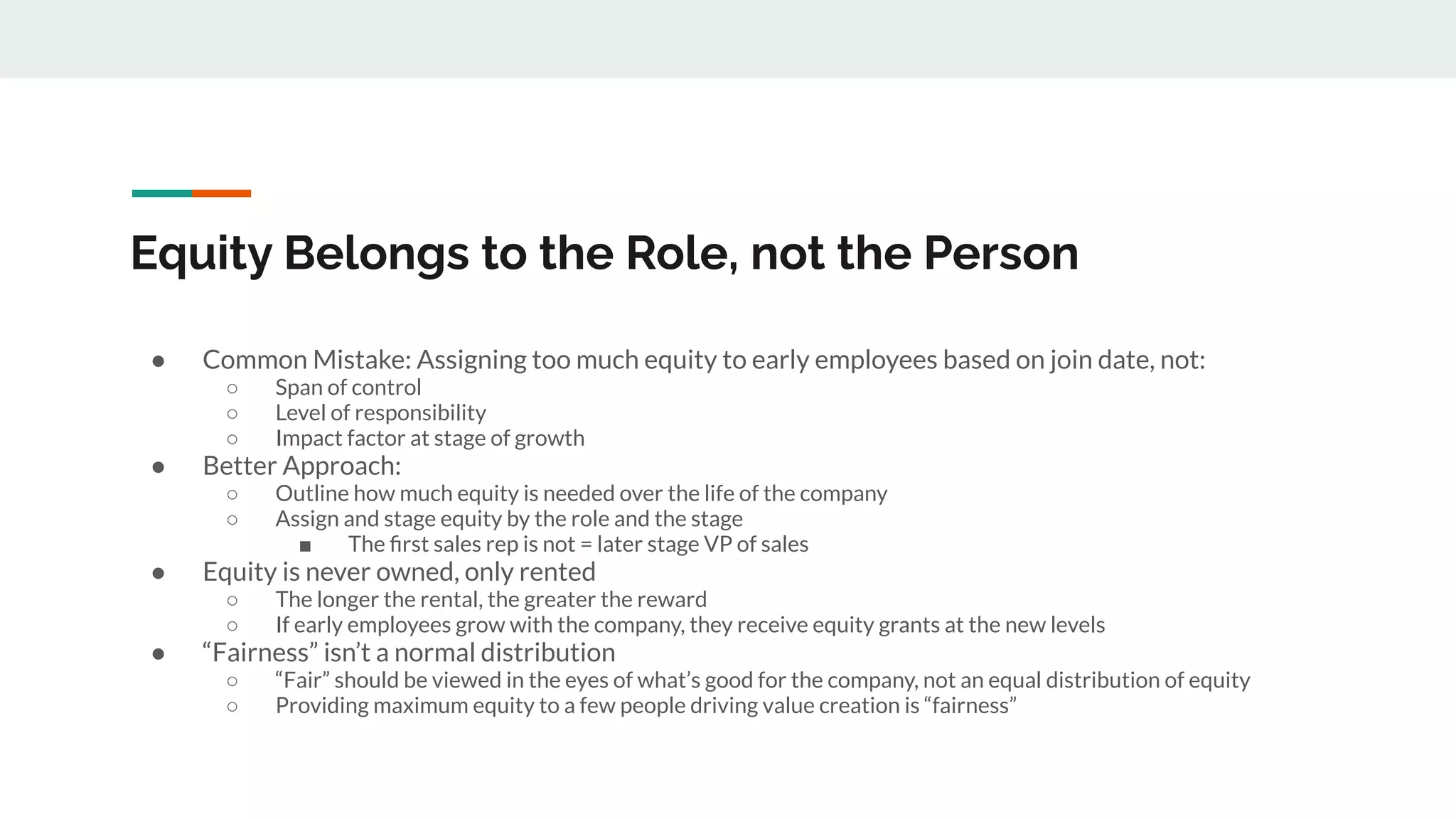
Equity Belongs to the Role, not the Person
● Common Mistake: Assigning too much equity to early employees based on join date, not:
○ Span of control
○ Level of responsibility
○ Impact factor at stage of growth
● Better Approach:
○ Outline how much equity is needed over the life of the company
○ Assign and stage equity by the role and the stage
■ The first sales rep is not = later stage VP of sales
● Equity is never owned, only rented
○ The longer the rental, the greater the reward
○ If early employees grow with the company, they receive equity grants at the new levels
● “Fairness” isn’t a normal distribution
○ “Fair” should be viewed in the eyes of what’s good for the company, not an equal distribution of equity
○ Providing maximum equity to a few people driving value creation is “fairness”
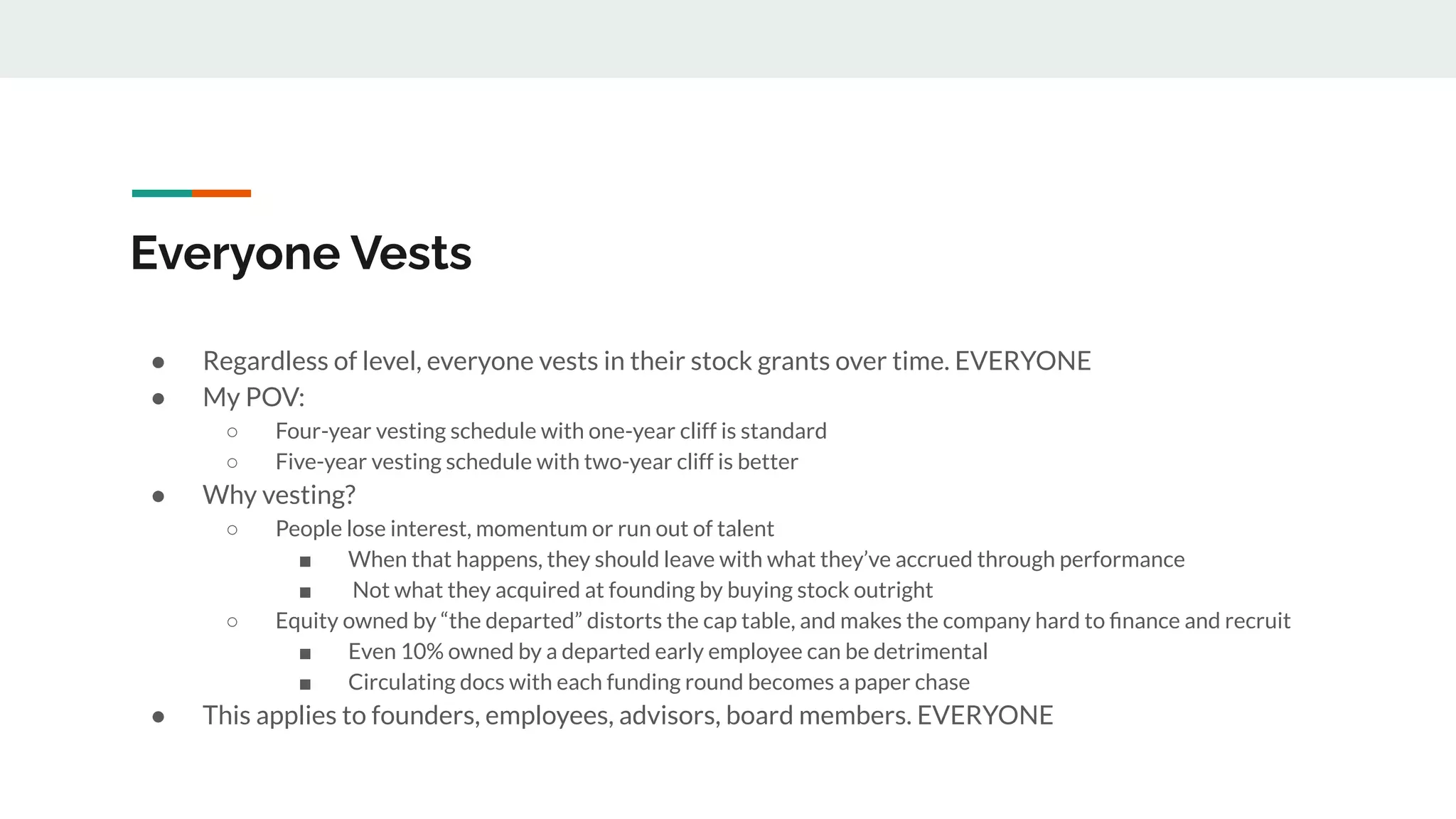
Everyone Vests
● Regardless of level, everyone vests in their stock grants over time. EVERYONE
● My POV:
○ Four-year vesting schedule with one-year cliff is standard
○ Five-year vesting schedule with two-year cliff is better
● Why vesting?
○ People lose interest, momentum or run out of talent
■ When that happens, they should leave with what they’ve accrued through performance
■ Not what they acquired at founding by buying stock outright
○ Equity owned by “the departed” distorts the cap table, and makes the company hard to finance and recruit
■ Even 10% owned by a departed early employee can be detrimental
■ Circulating docs with each funding round becomes a paper chase
● This applies to founders, employees, advisors, board members. EVERYONE
Seven Long Years
● Ignore the vesting schedule; it always takes at least seven years to either:
○ Know it’s not working
○ Know that it IS working
○ Get to the point of maturity where the venture is stable
● It might take less, it might take more, but buckle in for at least seven
● From an equity perspective:
○ Assume full vesting of the initial package
○ Have a plan to re-up/issue additional grants to keep early employees engaged
Pareto Principle of Ownership
● After multiple rounds of Angel and VC funding (From Seed through Series A-D), expect:
○ 80% of the company to be owned by investors
○ 20% by management and key employees
● The less $ you raise, the better the ownership ratio
○ Sybase vs. Oracle
○ Veeva
● Know this going in to adjust expectations:
○ Founders and C-Level Hires: 2-5%
○ VPs: .5-1.5%
○ Directors: .25-.5%
● What you read on Techcrunch is the exception, not the rule
Leave Room in the Pool
● Leave 10-15% of the equity in a stock pool in the beginning, untouched and unallocated
● Fuel that allows you to recruit in VPs/C-level hires who enable scale
● With every round of financing, replenish the pool if possible
○ Founders dilute, not the VCs
● Outside capital is the fuel that enables you to fund the company
● Inside Equity is the fuel that enables you to incentivize people needed to build the venture
● Put clawback/repurchase options in vesting agreements to replenish the pool
Rule of 10
● Never run out of equity before the next round of financing
○ Second only to running out of cash is running out of distributable equity when you need to make key hires
● A good method is the “Rule of 10”
○ Each level is 1/10 the number of shares of the level most directly above
■ CEO receives 1,000,000 shares
■ VP receives 100,0000
■ Director receives 10,000
■ Manager receives 1000
● Back of envelope calculation to maintain a margin of safety in equity allocation
Alignment of Incentives => Success in Long Run
● The best companies provide equity-based incentives for high performance
● Equity Incentives for performance align corporate goals with individual performance
○ Developers with non-linear productivity/creation
○ Sales people delivering “elephant” deals or revenue generating partnerships
● Equity awards need to be very visible, very public when performance-derived
○ “Developers driving Ferraris”
○ Incentivize everyone to increase their ownership potential => creates a more valuable company
○ Equity awards to non-founding employees do wonders for motivation and morale
■ Oracle Secretaries
Tax Efficiency Is More Important Than You Think
● The Long Term Capital Gain shot clock is your friend
● Founders should exploit 83(b) Election ASAP after founding
● QSBS Election under Section 1202 is another founder/investor benefit
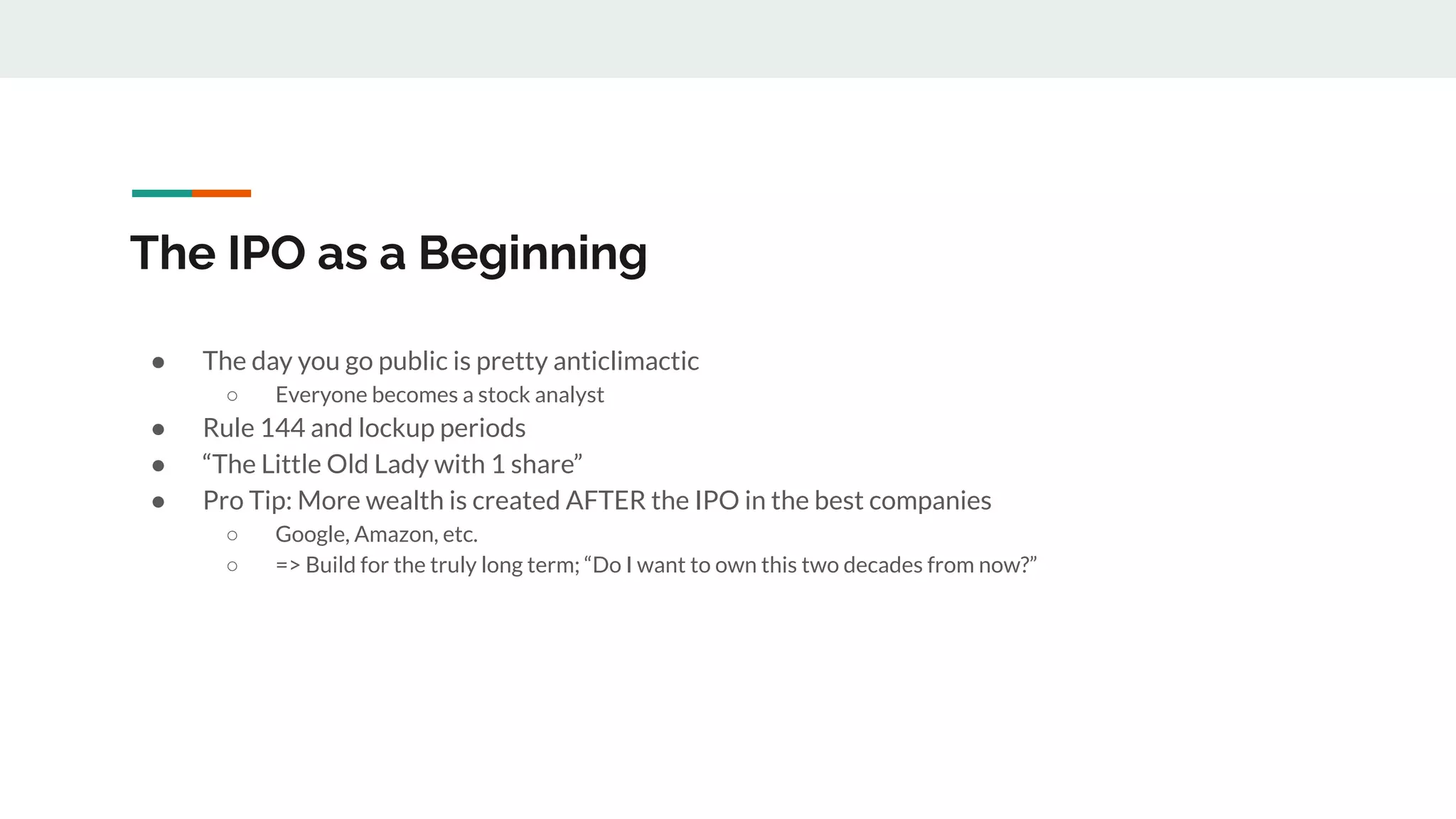
The IPO as a Beginning
● The day you go public is pretty anticlimactic
○ Everyone becomes a stock analyst
● Rule 144 and lockup periods
● “The Little Old Lady with 1 share”
● Pro Tip: More wealth is created AFTER the IPO in the best companies
○ Google, Amazon, etc.
○ => Build for the truly long term; “Do I want to own this two decades from now?”
Resources
● “High Tech Startup”, John Nesheim
● “Engineering Your Startup”, John Nesheim
● “Family Fortunes”, Bill Bonner
● “Early Exits”, Basil Peters
Thanks for your time!
Contact: tbj@tbjinvestmentsllc.com
https://www.linkedin.com/in/timothybernardjones/
https://angel.co/p/timbeejones

Dividing Startup Equity

  • 1.
    Dividing Startup Equity TimothyJones, TBJ Investments
  • 2.
    Background ● 7X Startups ●3x Founding CEO ● 2X Early Employee IPO ● 2X University Spinout ● 2 Years as VC ● 22 Years as VC Limited Partner ● 1000+ deals viewed ● TONS of mistakes
  • 3.
    “It is betterto own a slice of a watermelon, than the whole of a grape…” - Richard Brock, Founder of Brock Control Systems
  • 4.
    A Few ThingsLearned Along The Way ● Equity belongs to the role, not to the person ● Everyone vests ● Seven Long Years ● Pareto Principle of Ownership; 80/20 ● Leave room in the stock pool to recruit your future hires ● Rule of 10 ● Alignment of incentives => success in the long run ● Tax efficiency is more important than you think ● The IPO as a beginning
  • 5.
    Equity Belongs tothe Role, not the Person ● Common Mistake: Assigning too much equity to early employees based on join date, not: ○ Span of control ○ Level of responsibility ○ Impact factor at stage of growth ● Better Approach: ○ Outline how much equity is needed over the life of the company ○ Assign and stage equity by the role and the stage ■ The first sales rep is not = later stage VP of sales ● Equity is never owned, only rented ○ The longer the rental, the greater the reward ○ If early employees grow with the company, they receive equity grants at the new levels ● “Fairness” isn’t a normal distribution ○ “Fair” should be viewed in the eyes of what’s good for the company, not an equal distribution of equity ○ Providing maximum equity to a few people driving value creation is “fairness”
  • 6.
    Everyone Vests ● Regardlessof level, everyone vests in their stock grants over time. EVERYONE ● My POV: ○ Four-year vesting schedule with one-year cliff is standard ○ Five-year vesting schedule with two-year cliff is better ● Why vesting? ○ People lose interest, momentum or run out of talent ■ When that happens, they should leave with what they’ve accrued through performance ■ Not what they acquired at founding by buying stock outright ○ Equity owned by “the departed” distorts the cap table, and makes the company hard to finance and recruit ■ Even 10% owned by a departed early employee can be detrimental ■ Circulating docs with each funding round becomes a paper chase ● This applies to founders, employees, advisors, board members. EVERYONE
  • 7.
    Seven Long Years ●Ignore the vesting schedule; it always takes at least seven years to either: ○ Know it’s not working ○ Know that it IS working ○ Get to the point of maturity where the venture is stable ● It might take less, it might take more, but buckle in for at least seven ● From an equity perspective: ○ Assume full vesting of the initial package ○ Have a plan to re-up/issue additional grants to keep early employees engaged
  • 8.
    Pareto Principle ofOwnership ● After multiple rounds of Angel and VC funding (From Seed through Series A-D), expect: ○ 80% of the company to be owned by investors ○ 20% by management and key employees ● The less $ you raise, the better the ownership ratio ○ Sybase vs. Oracle ○ Veeva ● Know this going in to adjust expectations: ○ Founders and C-Level Hires: 2-5% ○ VPs: .5-1.5% ○ Directors: .25-.5% ● What you read on Techcrunch is the exception, not the rule
  • 12.
    Leave Room inthe Pool ● Leave 10-15% of the equity in a stock pool in the beginning, untouched and unallocated ● Fuel that allows you to recruit in VPs/C-level hires who enable scale ● With every round of financing, replenish the pool if possible ○ Founders dilute, not the VCs ● Outside capital is the fuel that enables you to fund the company ● Inside Equity is the fuel that enables you to incentivize people needed to build the venture ● Put clawback/repurchase options in vesting agreements to replenish the pool
  • 13.
    Rule of 10 ●Never run out of equity before the next round of financing ○ Second only to running out of cash is running out of distributable equity when you need to make key hires ● A good method is the “Rule of 10” ○ Each level is 1/10 the number of shares of the level most directly above ■ CEO receives 1,000,000 shares ■ VP receives 100,0000 ■ Director receives 10,000 ■ Manager receives 1000 ● Back of envelope calculation to maintain a margin of safety in equity allocation
  • 14.
    Alignment of Incentives=> Success in Long Run ● The best companies provide equity-based incentives for high performance ● Equity Incentives for performance align corporate goals with individual performance ○ Developers with non-linear productivity/creation ○ Sales people delivering “elephant” deals or revenue generating partnerships ● Equity awards need to be very visible, very public when performance-derived ○ “Developers driving Ferraris” ○ Incentivize everyone to increase their ownership potential => creates a more valuable company ○ Equity awards to non-founding employees do wonders for motivation and morale ■ Oracle Secretaries
  • 15.
    Tax Efficiency IsMore Important Than You Think ● The Long Term Capital Gain shot clock is your friend ● Founders should exploit 83(b) Election ASAP after founding ● QSBS Election under Section 1202 is another founder/investor benefit
  • 16.
    The IPO asa Beginning ● The day you go public is pretty anticlimactic ○ Everyone becomes a stock analyst ● Rule 144 and lockup periods ● “The Little Old Lady with 1 share” ● Pro Tip: More wealth is created AFTER the IPO in the best companies ○ Google, Amazon, etc. ○ => Build for the truly long term; “Do I want to own this two decades from now?”
  • 17.
    Resources ● “High TechStartup”, John Nesheim ● “Engineering Your Startup”, John Nesheim ● “Family Fortunes”, Bill Bonner ● “Early Exits”, Basil Peters
  • 18.
    Thanks for yourtime! Contact: tbj@tbjinvestmentsllc.com https://www.linkedin.com/in/timothybernardjones/ https://angel.co/p/timbeejones