august 2020 a development monthly ` 22
ISSN-0971-8400
YOJANA
Lead Article
Philosophical Nature of Indian Music
Dr Pranshu Samdarshi
Focus
Northeast Region: Unique Identity
Dr Tapati Baruah Kashyap
SPECIAL ARTICLE
Bamboo: Rejuvenating Rural Economy
Suresh Prabhu
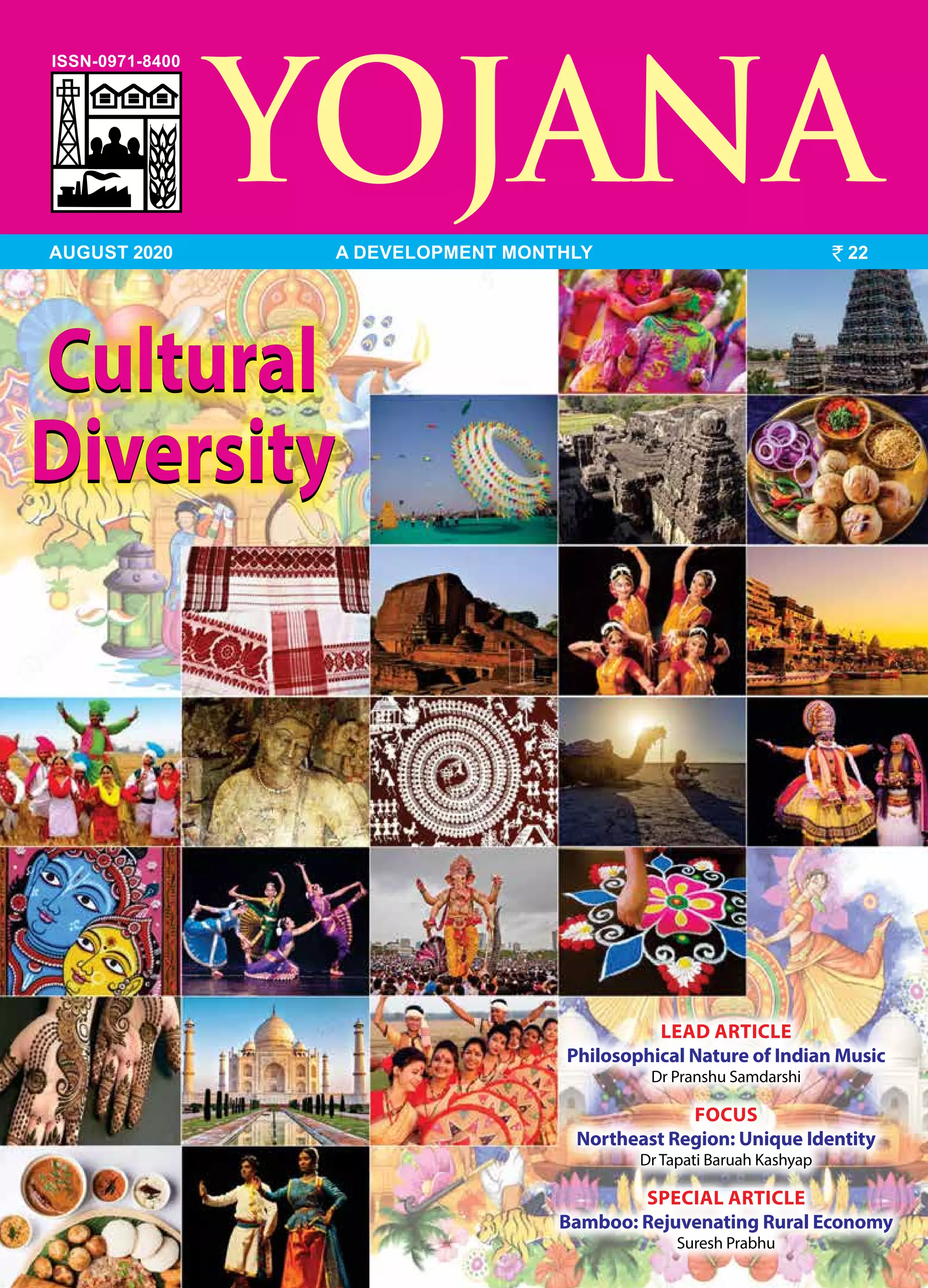
Cultural
Diversity
Cultural
Diversity
34	 YOJANA August 2020
Diverse Millet Culture
Pallavi Upadhyaya
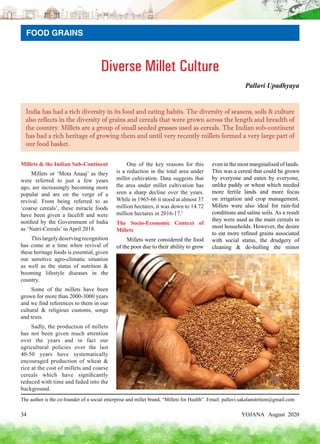
Millets & the Indian Sub-Continent
Millets or ‘Mota Anaaj’ as they
were referred to just a few years
ago, are increasingly becoming more
popular and are on the verge of a
revival. From being referred to as
‘coarse cereals’, these miracle foods
have been given a facelift and were
notified by the Government of India
as ‘Nutri-Cereals’ in April 2018.
Thislargelydeservingrecognition
has come at a time when revival of
these heritage foods is essential, given
our sensitive agro-climatic situation
as well as the status of nutrition &
booming lifestyle diseases in the
country.
Some of the millets have been
grown for more than 2000-3000 years
and we find references to them in our
cultural & religious customs, songs
and texts.
Sadly, the production of millets
has not been given much attention
over the years and in fact our
agricultural policies over the last
40-50 years have systematically
encouraged production of wheat &
rice at the cost of millets and coarse
cereals which have significantly
reduced with time and faded into the
background.
India has had a rich diversity in its food and eating habits. The diversity of seasons, soils & culture
also reflects in the diversity of grains and cereals that were grown across the length and breadth of
the country. Millets are a group of small seeded grasses used as cereals. The Indian sub-continent
has had a rich heritage of growing them and until very recently millets formed a very large part of
our food basket.
FOOD GRAINS
The author is the co-founder of a social enterprise and millet brand, “Millets for Health”. Email: pallavi.sakalanutrition@gmail.com
One of the key reasons for this
is a reduction in the total area under
millet cultivation. Data suggests that
the area under millet cultivation has
seen a sharp decline over the years.
While in 1965-66 it stood at almost 37
million hectares, it was down to 14.72
million hectares in 2016-17.1
The Socio-Economic Context of
Millets
Millets were considered the food
of the poor due to their ability to grow
even in the most marginalised of lands.
This was a cereal that could be grown
by everyone and eaten by everyone,
unlike paddy or wheat which needed
more fertile lands and more focus
on irrigation and crop management.
Millets were also ideal for rain-fed
conditions and saline soils. As a result
they were used as the main cereals in
most households. However, the desire
to eat more refined grains associated
with social status, the drudgery of
cleaning & de-hulling the minor
YOJANA August 2020	 35
millets, upward mobility & favourable
policies like easy availability of wheat
& paddy rice in the public distribution
system also contributed to a reduction
in the demand for millets.
A declining diversity in diet
which was traditionally a part of our
food culture had many significant
impacts in terms of the nutrition status
amongst women and children. Diet
diversity and eating a wide range of
cereals meant nutrition diversity. The
focus on just wheat and paddy rice
reduced nutrition in food to a large
extent.
However, recent trends show
a renewed interest in millets. Many
millet evangelists are spreading the
word about these wonder cereal
crops. The government policies are
also starting to reflect this renewal.
Millets have been included in the
public distribution system in Odisha
and the government is also promoting
millets under the National Food
Security Act. In fact at the behest of
the Indian government, the UN Food
and Agricultural Organisation has
approved its proposal to declare the
year 2023 as the International Year of
Millets.
Millets – Good for Health, Farmers,
& Environment
This renewed interest in millets
has been sparked by a multitude of
reasons. In the current changing agro-
climatic narrative across the world, it is
essential that our agricultural policies
see a shift from existing practices.
A study published in June 2018
has found that in the coming years
there will be a reduction in production
rates of various cereal crops due to
climate change. The only crops that
could withstand these climate vagaries
and not see a negative impact on yield
are millets.2
With this expected decrease
in yield, farming livelihoods are at
risk, making it imperative to move to
climate resilient crops & farming to
solve the double challenge of nutrition
& livelihood security. Joanna Kane-
Potaka, Assistant Director General,
ICRISAT & Executive Director, Smart
Food says, “Millets have a double
value in tackling climate change
because they contribute to both
adaptation and mitigation.  Millets
survive in much higher temperatures
than most crops and can survive with
much less water (1/4  of the water
required by rice (Deccan Development
Society).  Their overall resilience
makes them climate smart and a
good adaptation strategy for farmers.
Millets also are farmed with minimal
fertilizers and pesticides, so they have
a lower carbon footprint. Millets
compared to rice reduces GHGs 2%
to 13% (Davis, K. et al, 2019). This
makes them good for the farmer and
planet. Add this to their high nutrition
value, making them good for you,
millets are truly a Smart Food with
a triple win and triple bottom line.
The biggest gap is building consumer
awareness.”
At the same time millets are
also highly nutritious and have
the potential to be a solution to the
nutrition crisis facing the country.
A study by International Crops
Research Institute for the Semi-
Arid Tropics (ICRISAT) published
in September 2019, conducted on
1500 children in Karnataka, found
that children grew up to 50% more
in weight and height parameters on a
millet based diet.3
This finding clearly
highlights the significant potential of
millets for overcoming nutritional
deficiencies.
Millets were considered the
food of the poor due to their
ability to grow even in the
most marginalised of lands.
This was a cereal that could
be grown by everyone and
eaten by everyone, unlike
paddy or wheat which needed
more fertile lands and more
focus on irrigation and crop
management. Millets were also
ideal for rain-fed conditions
and saline soils.
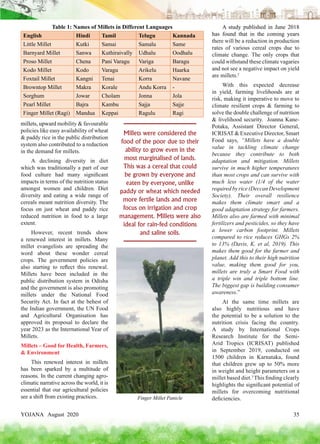
Table 1: Names of Millets in Different Languages
English Hindi Tamil Telugu Kannada
Little Millet Kutki Samai Samalu Same
Barnyard Millet Sanwa Kuthiraivally Udhalu Oodhalu
Proso Millet Chena Pani Varagu Variga Baragu
Kodo Millet Kodo Varagu Arikelu Haarka
Foxtail Millet Kangni Tenai Korra Navane
Browntop Millet Makra Korale Andu Korra -
Sorghum Jowar Cholam Jonna Jola
Pearl Millet Bajra Kambu Sajja Sajje
Finger Millet (Ragi) Mandua Keppai Ragulu Ragi
Finger Millet Panicle
36	 YOJANA August 2020
Millets are also being hailed
as the solution for many lifestyle
diseases like diabetes, high blood
pressure, digestive disorders, gluten
allergies and much more. There are
inspiring stories of diabetes reversal,
children on the autism spectrum
benefiting from a millet based diet and
even cancer survivors who have felt
the benefits of these miracle foods.
The Cultural Significance of Millets
One of the ways in which millets
didsurvivethesystemicdisappearance
from our tables and remained in our
memory is their cultural relevance.
There are many customs and rituals
during which millets were made
mandatory. This could be due to the
health benefits experienced by our
ancestors who then incorporated them
into customs. For example, Barnyard
Millet or Sanwa as it is called in Hindi
was reserved for fasting as it is light
and easy to digest and keeps one high
on energy. Finger Millet or Madua
Rotis are mandatory to be eaten by
women in eastern Indian states of
Bihar & Jharkhand before beginning
a 3 day long fast for their children.
Perhaps they understood that it would
keep them full for longer and not
cause bloating and acidity during this
strenuous fast.
Millets have found their way
into songs sung by women during
sowing and harvesting crops. Among
many communities, they are used for
blessing the bride & groom during
marriage ceremonies. In fact one can
even find them mentioned in religious
stories and day to day sayings in many
languages.
India has a deep connection with
millets and discussion with elders
in the family, tribal communities
and other guardians of traditional
knowledge may reveal many more of
these ‘millet stories’than we currently
know.
Types of Millets
There are many lost varieties of
traditional millets that were grown
across the country, many of which
have been lost over time. With the
untiring efforts of NGOs working
on the ground with tribal farmers,
many local and lost varieties of
millets like Batu in Maharashtra
and Sikiya in Madhya Pradesh are
being rediscovered and conserved.
However, these are yet to reach
commercial production levels. At
present in India, there are 9 varieties
Table 2: Nutritional Profile of Millets vs. Wheat and Paddy Rice
English
Pro-
tein
Carbo-
hydrates
(In Gms)
Fat
(In
Gms)
Miner-
als (In
Gms)
Fibre
(In
Gms)
Calci-
um (In
MGs)
Phospho-
rous (In
Mgs)
Iron
(In
MGs)
Ener-
gy (In
Kcals)
Thia-
min (In
Mgs)
Niacin
(In
Mgs)
Little Millet 7.7 67 4.7 1.7 7.6 17 220 9.3 329 0.3 3.2
Barnyard Millet 6.2 65.5 4.8 3.7 13.6 22 280 18.6 300 0.33 4.2
Proso Millet 12.5 70.4 1.1 1.9 5.2 8 206 2.9 354 0.41 4.5
Kodo Millet 8.3 65.9 1.4 2.6 5.2 35 188 1.7 353 0.15 2
Foxtail Millet 12.3 60.2 4.3 4 6.7 31 290 2.8 351 0.59 3.2
Browntop Millet 8.9 71.3 1.9 3.9 8.2 28 276 7.7 338    
Sorghum 10.4 70.7 3.1 1.2 2 25 222 5.4 329 0.38 4.3
Pearl Millet 11.8 67 4.8 2.2 2.3 42 240 11 363 0.38 4.3
Finger Millet (Ragi) 7.3 72 1.3 2.7 3.6 344 283 3.9 336 0.42 1.1
Wheat 11.8 71.2 1.5 1.5 2 30 306 3.5 348 0.41 5.1
Paddy Rice 6.8 78.2 0.5 0.6 1 33 160 1.8 362 0.41 4.3
(www.millets.wordpress.com)
YOJANA August 2020	 37
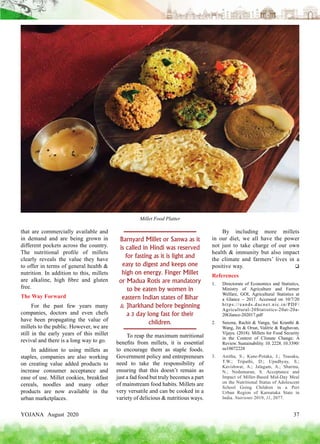
that are commercially available and
in demand and are being grown in
different pockets across the country.
The nutritional profile of millets
clearly reveals the value they have
to offer in terms of general health &
nutrition. In addition to this, millets
are alkaline, high fibre and gluten
free.
The Way Forward
For the past few years many
companies, doctors and even chefs
have been propagating the value of
millets to the public. However, we are
still in the early years of this millet
revival and there is a long way to go.
In addition to using millets as
staples, companies are also working
on creating value added products to
increase consumer acceptance and
ease of use. Millet cookies, breakfast
cereals, noodles and many other
products are now available in the
urban marketplaces.
To reap the maximum nutritional
benefits from millets, it is essential
to encourage them as staple foods.
Government policy and entrepreneurs
need to take the responsibility of
ensuring that this doesn’t remain as
just a fad food but truly becomes a part
of mainstream food habits. Millets are
very versatile and can be cooked in a
variety of delicious & nutritious ways.
By including more millets
in our diet, we all have the power
not just to take charge of our own
health & immunity but also impact
the climate and farmers’ lives in a
positive way. 
References
1.	 Directorate of Economics and Statistics,
Ministry of Agriculture and Farmer
Welfare, GOI, Agricultural Statistics at
a Glance – 2017. Accessed on 10/7/20
https://eands.dacnet.nic.in/PDF/
Agricultural-20Statistics-20at-20a-
20Glance-202017.pdf
2.	 Saxena, Rachit & Vanga, Sai Kranthi &
Wang, Jin & Orsat, Valérie & Raghavan,
Vijaya. (2018). Millets for Food Security
in the Context of Climate Change: A
Review. Sustainability. 10. 2228. 10.3390/
su10072228
3.	 Anitha, S.; Kane-Potaka, J.; Tsusaka,
T.W.; Tripathi, D.; Upadhyay, S.;
Kavishwar, A.; Jalagam, A.; Sharma,
N.; Nedumaran, S. Acceptance and
Impact of Millet-Based Mid-Day Meal
on the Nutritional Status of Adolescent
School Going Children in a Peri
Urban Region of Karnataka State in
India. Nutrients 2019, 11, 2077.
Barnyard Millet or Sanwa as it
is called in Hindi was reserved
for fasting as it is light and
easy to digest and keeps one
high on energy. Finger Millet
or Madua Rotis are mandatory
to be eaten by women in
eastern Indian states of Bihar
& Jharkhand before beginning
a 3 day long fast for their
children.
Millet Food Platter

Diverse Millet Culture

  • 1.
    august 2020 adevelopment monthly ` 22 ISSN-0971-8400 YOJANA Lead Article Philosophical Nature of Indian Music Dr Pranshu Samdarshi Focus Northeast Region: Unique Identity Dr Tapati Baruah Kashyap SPECIAL ARTICLE Bamboo: Rejuvenating Rural Economy Suresh Prabhu Cultural Diversity Cultural Diversity
  • 2.
    34 YOJANA August2020 Diverse Millet Culture Pallavi Upadhyaya Millets & the Indian Sub-Continent Millets or ‘Mota Anaaj’ as they were referred to just a few years ago, are increasingly becoming more popular and are on the verge of a revival. From being referred to as ‘coarse cereals’, these miracle foods have been given a facelift and were notified by the Government of India as ‘Nutri-Cereals’ in April 2018. Thislargelydeservingrecognition has come at a time when revival of these heritage foods is essential, given our sensitive agro-climatic situation as well as the status of nutrition & booming lifestyle diseases in the country. Some of the millets have been grown for more than 2000-3000 years and we find references to them in our cultural & religious customs, songs and texts. Sadly, the production of millets has not been given much attention over the years and in fact our agricultural policies over the last 40-50 years have systematically encouraged production of wheat & rice at the cost of millets and coarse cereals which have significantly reduced with time and faded into the background. India has had a rich diversity in its food and eating habits. The diversity of seasons, soils & culture also reflects in the diversity of grains and cereals that were grown across the length and breadth of the country. Millets are a group of small seeded grasses used as cereals. The Indian sub-continent has had a rich heritage of growing them and until very recently millets formed a very large part of our food basket. FOOD GRAINS The author is the co-founder of a social enterprise and millet brand, “Millets for Health”. Email: pallavi.sakalanutrition@gmail.com One of the key reasons for this is a reduction in the total area under millet cultivation. Data suggests that the area under millet cultivation has seen a sharp decline over the years. While in 1965-66 it stood at almost 37 million hectares, it was down to 14.72 million hectares in 2016-17.1 The Socio-Economic Context of Millets Millets were considered the food of the poor due to their ability to grow even in the most marginalised of lands. This was a cereal that could be grown by everyone and eaten by everyone, unlike paddy or wheat which needed more fertile lands and more focus on irrigation and crop management. Millets were also ideal for rain-fed conditions and saline soils. As a result they were used as the main cereals in most households. However, the desire to eat more refined grains associated with social status, the drudgery of cleaning & de-hulling the minor
  • 3.
    YOJANA August 2020 35 millets, upward mobility & favourable policies like easy availability of wheat & paddy rice in the public distribution system also contributed to a reduction in the demand for millets. A declining diversity in diet which was traditionally a part of our food culture had many significant impacts in terms of the nutrition status amongst women and children. Diet diversity and eating a wide range of cereals meant nutrition diversity. The focus on just wheat and paddy rice reduced nutrition in food to a large extent. However, recent trends show a renewed interest in millets. Many millet evangelists are spreading the word about these wonder cereal crops. The government policies are also starting to reflect this renewal. Millets have been included in the public distribution system in Odisha and the government is also promoting millets under the National Food Security Act. In fact at the behest of the Indian government, the UN Food and Agricultural Organisation has approved its proposal to declare the year 2023 as the International Year of Millets. Millets – Good for Health, Farmers, & Environment This renewed interest in millets has been sparked by a multitude of reasons. In the current changing agro- climatic narrative across the world, it is essential that our agricultural policies see a shift from existing practices. A study published in June 2018 has found that in the coming years there will be a reduction in production rates of various cereal crops due to climate change. The only crops that could withstand these climate vagaries and not see a negative impact on yield are millets.2 With this expected decrease in yield, farming livelihoods are at risk, making it imperative to move to climate resilient crops & farming to solve the double challenge of nutrition & livelihood security. Joanna Kane- Potaka, Assistant Director General, ICRISAT & Executive Director, Smart Food says, “Millets have a double value in tackling climate change because they contribute to both adaptation and mitigation.  Millets survive in much higher temperatures than most crops and can survive with much less water (1/4  of the water required by rice (Deccan Development Society).  Their overall resilience makes them climate smart and a good adaptation strategy for farmers. Millets also are farmed with minimal fertilizers and pesticides, so they have a lower carbon footprint. Millets compared to rice reduces GHGs 2% to 13% (Davis, K. et al, 2019). This makes them good for the farmer and planet. Add this to their high nutrition value, making them good for you, millets are truly a Smart Food with a triple win and triple bottom line. The biggest gap is building consumer awareness.” At the same time millets are also highly nutritious and have the potential to be a solution to the nutrition crisis facing the country. A study by International Crops Research Institute for the Semi- Arid Tropics (ICRISAT) published in September 2019, conducted on 1500 children in Karnataka, found that children grew up to 50% more in weight and height parameters on a millet based diet.3 This finding clearly highlights the significant potential of millets for overcoming nutritional deficiencies. Millets were considered the food of the poor due to their ability to grow even in the most marginalised of lands. This was a cereal that could be grown by everyone and eaten by everyone, unlike paddy or wheat which needed more fertile lands and more focus on irrigation and crop management. Millets were also ideal for rain-fed conditions and saline soils. Table 1: Names of Millets in Different Languages English Hindi Tamil Telugu Kannada Little Millet Kutki Samai Samalu Same Barnyard Millet Sanwa Kuthiraivally Udhalu Oodhalu Proso Millet Chena Pani Varagu Variga Baragu Kodo Millet Kodo Varagu Arikelu Haarka Foxtail Millet Kangni Tenai Korra Navane Browntop Millet Makra Korale Andu Korra - Sorghum Jowar Cholam Jonna Jola Pearl Millet Bajra Kambu Sajja Sajje Finger Millet (Ragi) Mandua Keppai Ragulu Ragi Finger Millet Panicle
  • 4.
    36 YOJANA August2020 Millets are also being hailed as the solution for many lifestyle diseases like diabetes, high blood pressure, digestive disorders, gluten allergies and much more. There are inspiring stories of diabetes reversal, children on the autism spectrum benefiting from a millet based diet and even cancer survivors who have felt the benefits of these miracle foods. The Cultural Significance of Millets One of the ways in which millets didsurvivethesystemicdisappearance from our tables and remained in our memory is their cultural relevance. There are many customs and rituals during which millets were made mandatory. This could be due to the health benefits experienced by our ancestors who then incorporated them into customs. For example, Barnyard Millet or Sanwa as it is called in Hindi was reserved for fasting as it is light and easy to digest and keeps one high on energy. Finger Millet or Madua Rotis are mandatory to be eaten by women in eastern Indian states of Bihar & Jharkhand before beginning a 3 day long fast for their children. Perhaps they understood that it would keep them full for longer and not cause bloating and acidity during this strenuous fast. Millets have found their way into songs sung by women during sowing and harvesting crops. Among many communities, they are used for blessing the bride & groom during marriage ceremonies. In fact one can even find them mentioned in religious stories and day to day sayings in many languages. India has a deep connection with millets and discussion with elders in the family, tribal communities and other guardians of traditional knowledge may reveal many more of these ‘millet stories’than we currently know. Types of Millets There are many lost varieties of traditional millets that were grown across the country, many of which have been lost over time. With the untiring efforts of NGOs working on the ground with tribal farmers, many local and lost varieties of millets like Batu in Maharashtra and Sikiya in Madhya Pradesh are being rediscovered and conserved. However, these are yet to reach commercial production levels. At present in India, there are 9 varieties Table 2: Nutritional Profile of Millets vs. Wheat and Paddy Rice English Pro- tein Carbo- hydrates (In Gms) Fat (In Gms) Miner- als (In Gms) Fibre (In Gms) Calci- um (In MGs) Phospho- rous (In Mgs) Iron (In MGs) Ener- gy (In Kcals) Thia- min (In Mgs) Niacin (In Mgs) Little Millet 7.7 67 4.7 1.7 7.6 17 220 9.3 329 0.3 3.2 Barnyard Millet 6.2 65.5 4.8 3.7 13.6 22 280 18.6 300 0.33 4.2 Proso Millet 12.5 70.4 1.1 1.9 5.2 8 206 2.9 354 0.41 4.5 Kodo Millet 8.3 65.9 1.4 2.6 5.2 35 188 1.7 353 0.15 2 Foxtail Millet 12.3 60.2 4.3 4 6.7 31 290 2.8 351 0.59 3.2 Browntop Millet 8.9 71.3 1.9 3.9 8.2 28 276 7.7 338     Sorghum 10.4 70.7 3.1 1.2 2 25 222 5.4 329 0.38 4.3 Pearl Millet 11.8 67 4.8 2.2 2.3 42 240 11 363 0.38 4.3 Finger Millet (Ragi) 7.3 72 1.3 2.7 3.6 344 283 3.9 336 0.42 1.1 Wheat 11.8 71.2 1.5 1.5 2 30 306 3.5 348 0.41 5.1 Paddy Rice 6.8 78.2 0.5 0.6 1 33 160 1.8 362 0.41 4.3 (www.millets.wordpress.com)
  • 5.
    YOJANA August 2020 37 that are commercially available and in demand and are being grown in different pockets across the country. The nutritional profile of millets clearly reveals the value they have to offer in terms of general health & nutrition. In addition to this, millets are alkaline, high fibre and gluten free. The Way Forward For the past few years many companies, doctors and even chefs have been propagating the value of millets to the public. However, we are still in the early years of this millet revival and there is a long way to go. In addition to using millets as staples, companies are also working on creating value added products to increase consumer acceptance and ease of use. Millet cookies, breakfast cereals, noodles and many other products are now available in the urban marketplaces. To reap the maximum nutritional benefits from millets, it is essential to encourage them as staple foods. Government policy and entrepreneurs need to take the responsibility of ensuring that this doesn’t remain as just a fad food but truly becomes a part of mainstream food habits. Millets are very versatile and can be cooked in a variety of delicious & nutritious ways. By including more millets in our diet, we all have the power not just to take charge of our own health & immunity but also impact the climate and farmers’ lives in a positive way.  References 1. Directorate of Economics and Statistics, Ministry of Agriculture and Farmer Welfare, GOI, Agricultural Statistics at a Glance – 2017. Accessed on 10/7/20 https://eands.dacnet.nic.in/PDF/ Agricultural-20Statistics-20at-20a- 20Glance-202017.pdf 2. Saxena, Rachit & Vanga, Sai Kranthi & Wang, Jin & Orsat, Valérie & Raghavan, Vijaya. (2018). Millets for Food Security in the Context of Climate Change: A Review. Sustainability. 10. 2228. 10.3390/ su10072228 3. Anitha, S.; Kane-Potaka, J.; Tsusaka, T.W.; Tripathi, D.; Upadhyay, S.; Kavishwar, A.; Jalagam, A.; Sharma, N.; Nedumaran, S. Acceptance and Impact of Millet-Based Mid-Day Meal on the Nutritional Status of Adolescent School Going Children in a Peri Urban Region of Karnataka State in India. Nutrients 2019, 11, 2077. Barnyard Millet or Sanwa as it is called in Hindi was reserved for fasting as it is light and easy to digest and keeps one high on energy. Finger Millet or Madua Rotis are mandatory to be eaten by women in eastern Indian states of Bihar & Jharkhand before beginning a 3 day long fast for their children. Millet Food Platter