Ditch the Diet Dogma
Useful Guidelines for Managing
Weight without Metabolic Decline
Ben Brown, MS, CSCS
Body Systems Healing & Performance
www.bodysystemsaz.com
About Me
Do diets work?
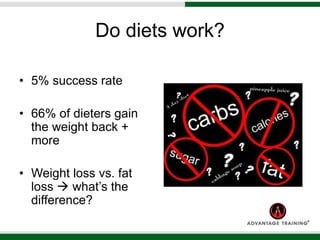
• 5% success rate
• 66% of dieters gain
the weight back +
more
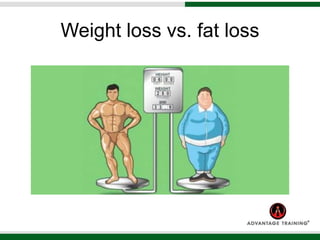
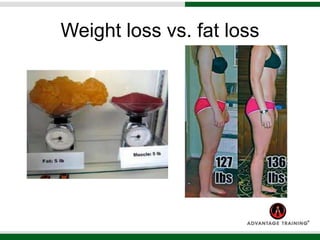
• Weight loss vs. fat
loss  what’s the
difference?
Weight loss vs. fat loss
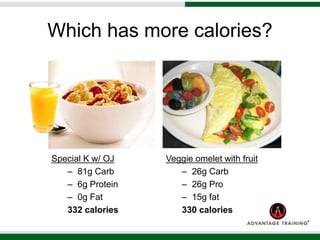
Which has more calories?
Special K w/ OJ
– 81g Carb
– 6g Protein
– 0g Fat
332 calories
Veggie omelet with fruit
– 26g Carb
– 26g Pro
– 15g fat
330 calories
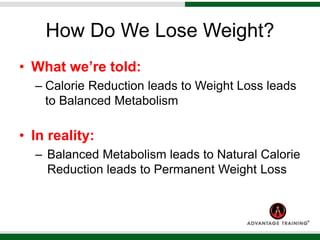
How Do We Lose Weight?
• What we’re told:
– Calorie Reduction leads to Weight Loss leads
to Balanced Metabolism
• In reality:
– Balanced Metabolism leads to Natural Calorie
Reduction leads to Permanent Weight Loss
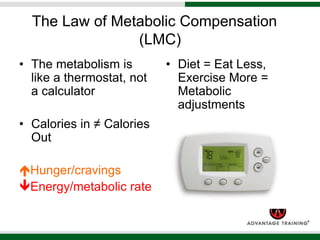
The Law of Metabolic Compensation
(LMC)
• The metabolism is
like a thermostat, not
a calculator
• Calories in ≠ Calories
Out
Hunger/cravings
Energy/metabolic rate
• Diet = Eat Less,
Exercise More =
Metabolic
adjustments
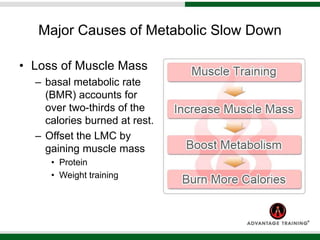
Major Causes of Metabolic Slow Down
• Loss of Muscle Mass
– basal metabolic rate
(BMR) accounts for
over two-thirds of the
calories burned at rest.
– Offset the LMC by
gaining muscle mass
• Protein
• Weight training
Major Causes of Metabolic Slow Down
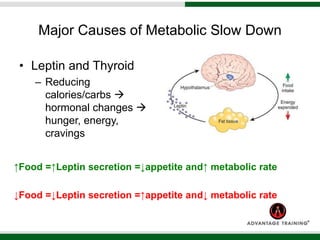
• Leptin and Thyroid
– Reducing
calories/carbs 
hormonal changes 
hunger, energy,
cravings
↑Food =↑Leptin secretion =↓appetite and↑ metabolic rate
↓Food =↓Leptin secretion =↑appetite and↓ metabolic rate
Major Causes of Metabolic Slow Down
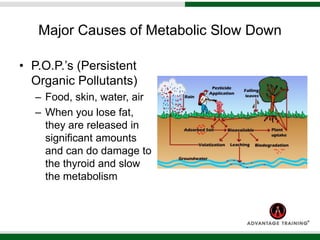
• P.O.P.’s (Persistent
Organic Pollutants)
– Food, skin, water, air
– When you lose fat,
they are released in
significant amounts
and can do damage to
the thyroid and slow
the metabolism
Circumvent the LMC
• Break the diet cycle
• Exercise based on
energy intake
• Set protein goals
• Manage your carbs
• Minimize P.O.P.’s
• Eat your veggies
MIND
BODY
NUTRITION
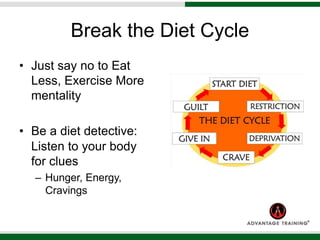
Break the Diet Cycle
• Just say no to Eat
Less, Exercise More
mentality
• Be a diet detective:
Listen to your body
for clues
– Hunger, Energy,
Cravings
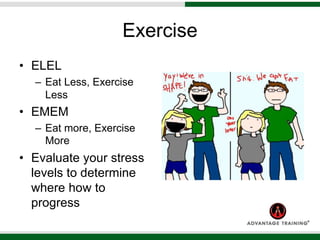
Exercise
• ELEL
– Eat Less, Exercise
Less
• EMEM
– Eat more, Exercise
More
• Evaluate your stress
levels to determine
where how to
progress
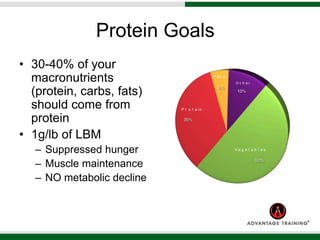
Protein Goals
• 30-40% of your
macronutrients
(protein, carbs, fats)
should come from
protein
• 1g/lb of LBM
– Suppressed hunger
– Muscle maintenance
– NO metabolic decline
O t h e r - G r a in s , D a ir y , N u t s a n d S e e d s
P l a n t s - m o r e v e g e t a b l e s t h a n f r u it
P r o t e in - n a t u r a l l y c o m b in e d w it h f a t s
P u r e , u n p r o c e s s e d f a t s a n d o il s
V e g e t a b l e s
O t h e r
F a t s
P r o t e in
H E A L T H Y E A T IN G P L A T E
C o p y r ig h t A d v a n t a g e T r a in in g 2 0 13
Choosing Hormonal Impact Carbs
• Choose ā€œwetā€ carbs vs dry carbs
– Oats, beans, rice, quinoa
– Vegetables
– High in fiber
• Carb Calculator
• Hormonal Carbs = total carbs – (protein +
fiber)
• # should be less than 10 (negative
numbers are best)
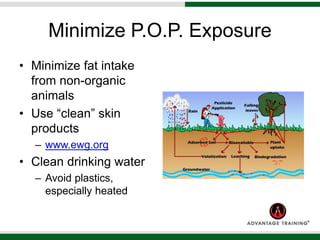
Minimize P.O.P. Exposure
• Minimize fat intake
from non-organic
animals
• Use ā€œcleanā€ skin
products
– www.ewg.org
• Clean drinking water
– Avoid plastics,
especially heated
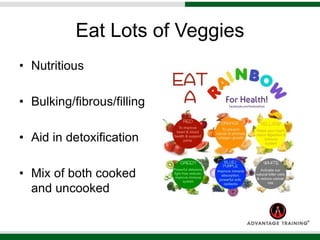
Eat Lots of Veggies
• Nutritious
• Bulking/fibrous/filling
• Aid in detoxification
• Mix of both cooked
and uncooked
Dieting Stops Here!
Ben Brown, MS, CSCS
ben@bodysystemsaz.com
520-661-8273

Ditch the diet dogma

  • 1.
    Ditch the DietDogma Useful Guidelines for Managing Weight without Metabolic Decline Ben Brown, MS, CSCS Body Systems Healing & Performance www.bodysystemsaz.com
  • 2.
  • 3.
    Do diets work? •5% success rate • 66% of dieters gain the weight back + more • Weight loss vs. fat loss  what’s the difference?
  • 4.
  • 5.
  • 6.
    Which has morecalories? Special K w/ OJ – 81g Carb – 6g Protein – 0g Fat 332 calories Veggie omelet with fruit – 26g Carb – 26g Pro – 15g fat 330 calories
  • 7.
    How Do WeLose Weight? • What we’re told: – Calorie Reduction leads to Weight Loss leads to Balanced Metabolism • In reality: – Balanced Metabolism leads to Natural Calorie Reduction leads to Permanent Weight Loss
  • 8.
    The Law ofMetabolic Compensation (LMC) • The metabolism is like a thermostat, not a calculator • Calories in ≠ Calories Out Hunger/cravings Energy/metabolic rate • Diet = Eat Less, Exercise More = Metabolic adjustments
  • 9.
    Major Causes ofMetabolic Slow Down • Loss of Muscle Mass – basal metabolic rate (BMR) accounts for over two-thirds of the calories burned at rest. – Offset the LMC by gaining muscle mass • Protein • Weight training
  • 10.
    Major Causes ofMetabolic Slow Down • Leptin and Thyroid – Reducing calories/carbs  hormonal changes  hunger, energy, cravings ↑Food =↑Leptin secretion =↓appetite and↑ metabolic rate ↓Food =↓Leptin secretion =↑appetite and↓ metabolic rate
  • 11.
    Major Causes ofMetabolic Slow Down • P.O.P.’s (Persistent Organic Pollutants) – Food, skin, water, air – When you lose fat, they are released in significant amounts and can do damage to the thyroid and slow the metabolism
  • 12.
    Circumvent the LMC •Break the diet cycle • Exercise based on energy intake • Set protein goals • Manage your carbs • Minimize P.O.P.’s • Eat your veggies MIND BODY NUTRITION
  • 13.
    Break the DietCycle • Just say no to Eat Less, Exercise More mentality • Be a diet detective: Listen to your body for clues – Hunger, Energy, Cravings
  • 14.
    Exercise • ELEL – EatLess, Exercise Less • EMEM – Eat more, Exercise More • Evaluate your stress levels to determine where how to progress
  • 15.
    Protein Goals • 30-40%of your macronutrients (protein, carbs, fats) should come from protein • 1g/lb of LBM – Suppressed hunger – Muscle maintenance – NO metabolic decline O t h e r - G r a in s , D a ir y , N u t s a n d S e e d s P l a n t s - m o r e v e g e t a b l e s t h a n f r u it P r o t e in - n a t u r a l l y c o m b in e d w it h f a t s P u r e , u n p r o c e s s e d f a t s a n d o il s V e g e t a b l e s O t h e r F a t s P r o t e in H E A L T H Y E A T IN G P L A T E C o p y r ig h t A d v a n t a g e T r a in in g 2 0 13
  • 16.
    Choosing Hormonal ImpactCarbs • Choose ā€œwetā€ carbs vs dry carbs – Oats, beans, rice, quinoa – Vegetables – High in fiber • Carb Calculator • Hormonal Carbs = total carbs – (protein + fiber) • # should be less than 10 (negative numbers are best)
  • 17.
    Minimize P.O.P. Exposure •Minimize fat intake from non-organic animals • Use ā€œcleanā€ skin products – www.ewg.org • Clean drinking water – Avoid plastics, especially heated
  • 18.
    Eat Lots ofVeggies • Nutritious • Bulking/fibrous/filling • Aid in detoxification • Mix of both cooked and uncooked
  • 19.
    Dieting Stops Here! BenBrown, MS, CSCS ben@bodysystemsaz.com 520-661-8273

Editor's Notes

  • #3Ā I learned very quickly, that there’s something else going on – it’s not just about calories and diets and exercise
  • #4Ā Low calorie dieting, on average, decreases the amount of calories you burn per day by about 300. But that is the average. For some, this effect is much larger, and for others it is less.
  • #5Ā What’s the difference with weight loss vs. fat loss? Weight loss: losing fat, muscle, bone, organ, water Fat loss: lose fat, typically to be healthier… 10-12% for men, 15-20% for women Tracking weight is unreliable and irrelevant based on BMI Carbs bind to water – less carbs, less water Tracking fat loss requires specific measurements: circumference, pictures, calipers. Weight may not change.
  • #7Ā To understand weight loss vs fat loss, you have to understand this question – which has more calories If these 2 are equal, then what’s the difference Difference is in macronutrient ratio – different messages to the body The types of calories affect the hormones we produce *calculated using myfitnesspal.com
  • #9Ā The metabolism is not a calculator, rather a thermostat in that it is adaptive and reactive to everything you do. There is no exact magic math formula to determine how to lose fat. This metabolic compensatory effect is undisputed in research on weight loss and means the harder you push on one end of your metabolism, the harder and more forcibly it will push back in the other direction.
  • #11Ā Leptin is considered by many to be the most important metabolic hormone as far as setting metabolic output and weight regain. ↑ Food = ↑ Triglycerides in adipocytes =↑Leptin secretion = ↓ appetite and ↑ metabolic rate. ↓ Food = ↓ Triglycerides in adipocytes =↓Leptin secretion = ↑ appetite and ↓ metabolic rate.
  • #12Ā POPs primarily impact the thyroid gland by decreasing its ability to make thyroid hormone, disrupting thyroid hormones once they are made, and causing thyroid hormones to be removed from the body faster. If your metabolism is a large jumbo jetliner, the thyroid gland is one of the engines. POPs appear to work in part by ā€œblowing outā€ the thyroid engine. In particular they increase thyroid hormone breakdown, decrease thyroid hormone production and block thyroid activity in cells. In other words, POPs shut down thyroid function and drastically suppress metabolic function. And if you think this effect is small, it may surprise you to know these POPs have a greater impact on metabolic rate than the all mighty hormone leptin. In other words, this is a very big deal. Intentionally produced chemicals currently or once used in agriculture, disease control, manufacturing, or industrial processes. Examples include PCBs, which have been useful in a variety of industrial applications (e.g., in electrical transformers and large capacitors, as hydraulic and heat exchange fluids, and as additives to paints and lubricants) and DDT, which is still used to control mosquitoes that carry malaria in some parts of the world. Unintentionally produced chemicals, such as dioxins, that result from some industrial processes and from combustion (for example, municipal and medical waste incineration and backyard burning of trash).
  • #13Ā POPs primarily impact the thyroid gland by decreasing its ability to make thyroid hormone, disrupting thyroid hormones once they are made, and causing thyroid hormones to be removed from the body faster. If your metabolism is a large jumbo jetliner, the thyroid gland is one of the engines. POPs appear to work in part by ā€œblowing outā€ the thyroid engine. In particular they increase thyroid hormone breakdown, decrease thyroid hormone production and block thyroid activity in cells. In other words, POPs shut down thyroid function and drastically suppress metabolic function. And if you think this effect is small, it may surprise you to know these POPs have a greater impact on metabolic rate than the all mighty hormone leptin. In other words, this is a very big deal. Intentionally produced chemicals currently or once used in agriculture, disease control, manufacturing, or industrial processes. Examples include PCBs, which have been useful in a variety of industrial applications (e.g., in electrical transformers and large capacitors, as hydraulic and heat exchange fluids, and as additives to paints and lubricants) and DDT, which is still used to control mosquitoes that carry malaria in some parts of the world. Unintentionally produced chemicals, such as dioxins, that result from some industrial processes and from combustion (for example, municipal and medical waste incineration and backyard burning of trash).