1
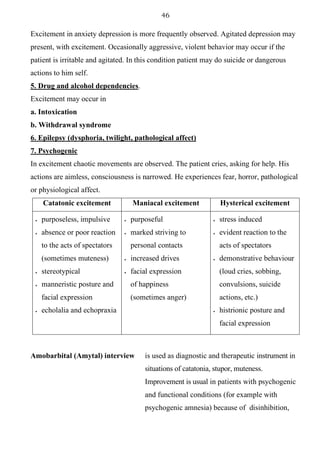
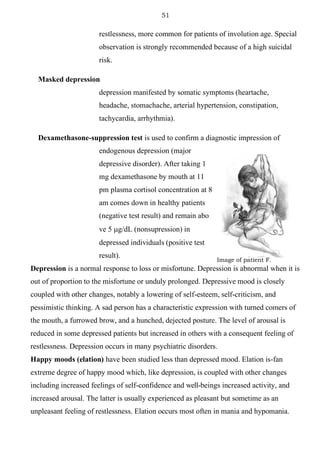
Smolensk State Medical University
General Medicine Faculty
Department of Psychiatry, Addiction and Medical Psychology
E.A.Severova, A.S.Okhapkin,
T.V.Ulasen, G.Y.Kosheleva
PSYCHIATRY
Practical guide
Faculty for Foreign Students Training
SMOLENSK 2015
2
ББК 52.5
УДК 616.89
К 67
Рецензенты:
Доктор медицинских наук, профессор кафедры психиатрии Шустов Дмитрий Иванович
ГБОУ ВПО Рязанский государственный медицинский университет Минздрава России;
Главный внештатный психиатр Смоленской области департамента по здравоохранению,
заместитель главного врача ОГБУЗ СОПКД по лечебной работе Маргарита Александровна
Даутова
Заведующая кафедрой иностранных языков ГБОУ ВПО Смоленский государственный
медицинский университет Минздрава России Николаева Татьяна Владимировна
Корректор: старший преподаватель кафедры иностранных языков ГБОУ ВПО Смоленский
государственный медицинский университет Минздрава России Ковалькова Марина Валерьевна
Северова Е.А., Охапкин А.С., Уласень Т.В., Кошелева Г.Я.
PSYCHIATRY: учебное пособие / Северова Е.А., Охапкин А.С., Уласень
Т.В., Кошелева Г.Я. – Смоленск: СГМУ, 2015. – 209 с.
Учебное пособие посвящено вопросам общей психопатологии и частной
психиатрии. В нем отражены вопросы этиологии, классификации и
осложнений различных наиболее актуальных психических заболеваний,
таких как: неврозы, шизофрения, биполярное аффективное
расстройство, эпилепсия, алкоголизм, наркомании, токсикомании
органических поражений головного мозга. Отдельный раздел посвящен
общей психопатологии и лечению психических расстройств.
Пособие предназначено для студентов пятого курса факультета
иностранных учащихся медицинского вуза для самостоятельной
подготовки.
Учебное пособие рекомендовано Центральным методическим советом ГОУ ВПО
СГМУ Минздрава России № « » июня 2015 г.
ББК 54.15
УДК 616.89+15:378.661(07.07)
© Северова Е.А.., Охапкин А.С. 2015
© ГБОУ ВПО СГМУ Минздрава РФ, 2015
3
CONTENTS
Theme Page
DISTURBANCES IN PERCEPTION 4
PSYCHOSENSORY DISORDERS 17
DISORDERS OF MEMORY 21
DISORDERS OF COGNITION 25
THOUGHT DISTURBANCES 27
DISORDERS OF ATTENTION AND
CONCENTRATION
41
DISORDERS OF MOTOR BEHAVIOUR 42
DISORDERS OF THE MOOD 48
DISTURBANCES OF CONSCIOUSNESS 53
DISORDERS OF THE WILL 59
IMPULSE-CONTROL DISORDERS 61
CONCEPTS OF SYMPTOM AND SYNDROME IN
PSYCHICAL DISEASES CLINICAL PICTURE. THEIR
DIAGNOSTIC AND PROGNOSTIC MEANING
70
GENERAL PSYCHOPATHOLOGICAL
SYNDROMS
76
MENTAL STATUS EXAMINATION 78
ТEST QUESTIONS ON GENERAL
PSYCHOPATHOLOGY
90
TREATMENT OF MENTAL DISORDERS
93
CLASSIFICATIONS OF MENTAL
DISORDERS
100
BIPOLAR PSYCHOSIS AND OTHER AFFECTIVE
DISORDERS (F3)
111
SCHIZOPHRENIA (F20) 113
ORGANIC MENTAL DISORDERS 118
EPILEPSY 121
PSYCHOGENOUS REACTIONS AND
NEUROSES
126
PSYCHOTHERAPY 131
PERSONALITY DISORDERS 134
EXOGENOUS (SYMPTOMATIC) MENTAL
DISORDERS
145
HEAD INJURY
150
PSYCHIATRY OF THE ELDERLY. 154
DISORDERS DUE TO PSYCHOACTIVE
SUBSTANCE USE
156
TYPES OF PERSONALITY CHANGES 163
TEST QUESTIONS 2 168
GLOSSARY OF SIGNS AND SYMPTOMS 170
4
DISTURBANCES IN PERCEPTION
Normal perception first requires that the individual is capable of receiving information as
sensations. The data must then be organized to make them meaningful and
comprehensible, such as distinguishing figure from ground, or focusing attention
selectively on some part of the sensory field. The organized entities are called percepts.
In states of sensory deficit such as blindness, deafness, and anesthesia perception is
impaired but is still possible because individuals generally perceive information about an
object through several sensory modalities concurrently. The intensity of sensation and
perception is affected by vigilance and attention. Highly focused attention, as in intense
concentration or hypnosis, may result in unusually acute sensation and perception—
hyperesthesia, hyperacusis, or extraordinary visual acuity focused attention may also
result in failure to sense or perceive: deep anesthesia and negative hallucinations induced
by hypnosis are simply induced failures to perceive what exists in the world.
Humans usually operate in an average expectable environment in which certain types and
levels of sensory input are expected, and for which the nervous system is primed.
Excessive or inadequate stimulation in any sensory modality, levels of input that are
extraordinarily intense, or the presentation of novel stimuli that are entirely different
from anything previously experienced by the individual can provoke distorted
perceptions in most normal people. For example, total sensory deprivation produced in
carefully controlled artificial environments may elicit visual and auditory illusions and
hallucinations.
Individuals generally exhibit selective perception of the world, depending on what is
salient at the moment and on their individual memories, emotions, fantasies, and values.
Pregnant women are more likely to perceive babies around them than are people who are
not as preoccupied with childbearing.
The intensity of perceptions depends on individual sensitivities as well as on mood,
anxiety, and substance use. Depressed patients often describe that colors look faded, that
the world looks washed out or gray, even though their capacity to recognize specific
colors is unchanged. Similarly, mania is often characterized by heightened perceptions,
hyperesthesia. When extreme, these intense perceptions are uncomfortable.
5
Hyperesthesia can also be seen during benzodiazepine withdrawal, hallucinogen
intoxication, and occasionally as part of an epileptic aura.
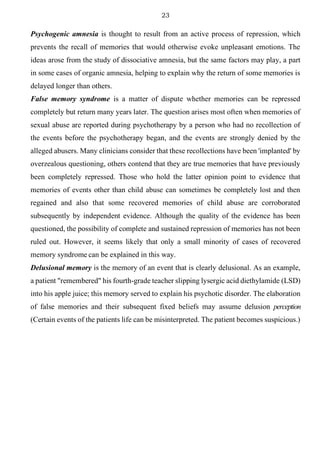
Tab. Quantitative and qualitative disorders of perception
Quantitative disorders Qualitative disorders
hyperesthesia hyposthesia
anesthesia synesthesia
paresthesia
The intensity of perception may vary with cognitive style and other psychological and
neurological factors. Some individuals tend to be augmenters and others minimizers of
bodily experiences. Chronic pain and some hypochondriacal syndromes may occur more
commonly among somatic augmenters.
Selective deficits may occur in the perception of emotions. Emotional aprosodies have
been described in which patients with specific neurological deficits or depression are
selectively unable to recognize the expression of facial emotion. These have been linked
by position emission tomography (PET) scan to blunted activity in the right prefrontal
cortex and insula.
Illusions
Perceptual distortions in estimating size, shape, and spatial relations arc common even in
the absence of psychiatric disorders, especially when one is fatigued or excessively
aroused.
Illusions are misperceptions of real sensory stimuli
such as when a child in a dark bedroom at night sees monsters emanating from shadows
on the walls. Pareidolias are playful mid whimsical voluntary illusions that can be seen
when one looks at ambiguously defined or evanescent images, such as flames in a
fireplace or clouds. Both the onset and termination of these perceptions arc voluntary.
Trailing, another visual illusion is the perception that an object moving steadily in space
is followed by temporally distinct, after-images of itself. The effect is that of a series of
6
stroboscopic photos. This phenomenon may occur with fatigue and is typically seen with
marijuana and mescaline intoxication.
Types of illusions
1. According to etiological pathogenic
factors
2. According to sensory modality
physiological olfactory
physical auditory
pareidolical visual
affective tactile
Hallucinations.
Hallucinations are perceptions that occur in the absence of corresponding sensory
stimuli.
Phenomenologically,
hallucinations are ordinarily
subjectively indistinguishable
from normal perceptions.
Hallucinations are often
experienced as being private,
so that others are not able to
sec or hear the same
perceptions. The patient's
explanation for this is
typically delusional.
Hallucinations can affect any sensory system and sometimes occur in several
concurrently. When perception is altered, illusions and hallucinations, and often delusions
as well, are frequently experienced together. Some studies have found that 90 percent of
patients with hallucinations also have delusions, and about 35 percent of patients with
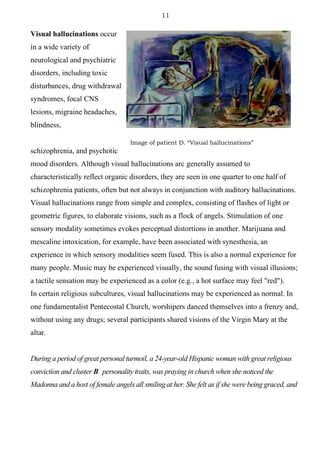
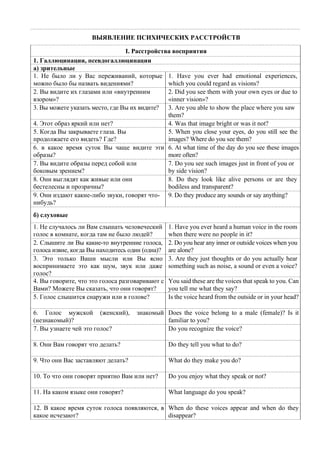
Image of patient N. “Hallucinatins”
7
delusions have hallucinations. About 20 percent of patients have mixed sensory
hallucinations (mostly auditory and visual) that may accompany functional as well as
organic conditions. A given external stimulus may evoke very different perceptual
distortions in different persons. For example, of three scientists who floated in sensory
deprivation tanks for long periods of time one experienced a few illusions and no
hallucinations; the second had many illusions and a few faint auditory and visual
hallucinations; the third had vivid, dramatic, and complex visual and auditory
hallucinations.
Types of hallucinations
1. According to etiological pathogenic factors
- hypnagogic and hypnopompic
- affective
- extracampine
- suggestional
2. According to sensory modality
- auditory (second-person, third-person)
- visual
- olfactory
- tactile
- deep sensation
3. True and pseudohallucinations
Hallucinations are experienced by many normal people under unusual conditions. It has
been estimated that between 10 to 27 percent of the general population have
experienced unmemorable hallucinations, most commonly visual hallucinations.
Hypnagogic and hypnopompic hallucinations are common, predominantly visual
hallucinations that occur during the moments immediately preceding falling asleep and
during the transition from sleep to wakefulness, respectively. Hypnagogic and
hypnopompic hallucinations both occur in normal persons and are also characteristic
symptoms of narcolepsy. In acute bereavement, up to 50 percent of grieving spouses have
8
reported hallucinating the voice or presence of the deceased, and following amputations,
phantom limb hallucinations are common. Patients-who become visually impaired often
develop pseudohallucinations (i.e. visual hallucinations with preserved insight) with
preserved cognitive status, called Bonnet syndrome. These observations suggest a
supersensitivity deprivation hypothesis, that when deprived of important and anticipated
perceptual stimuli, the mental apparatus may overinterpret any sensory stimulation as
evidence of the presence of the needed objects. A perceptual release theory suggests that
hallucinations emerge from the combined presence of intense states of internal arousal
and diminished sensory input (including poor attention and poor capacity to sort out
relevant from irrelevant input). Thus, diminished input from the environment (as in
sensory deprivation) or reduced capacity to attend to and take in the input (as in delirious
states) heighten the likelihood that internal sensations, images, and thoughts will be
interpreted as originating in the outside environment.
Hallucinations very according to sensory modality, degree of complexity of the
hallucinated experience, the levels of conviction about their reality, the clarity of
their contents, the location of their sources of origin, the degree of volitional control
over them, and the degree to which the hallucination influences the person's
behavior.
Auditory hallucinations range in complexity from hearing unstructured sounds such as
whirring noises or muffled whispers to ongoing multiperson discussions about the
patient. Simple auditory hallucinations are more commonly associated with organic
psychoses, such as delirium, complex partial seizures, and toxic and metabolic
encephalopathies. Deafness can produce hallucinations consisting of noises or of formed
music. Auditory hallucinations are classically associated with schizophrenia (seen in 60
to 90 percent of patients) but are also frequently seen in mood disorders with psychotic
features; 20 percent of manic patients and less than 10 percent of depressed patients
experience auditory hallucinations.
Three types of auditory hallucinations commonly associated with schizophrenia (also
seen less commonly in patients with psychotic depressions and mania) are: audible
thoughts described as hallucinated voices that speak aloud what the patient is thinking;
9
voices that give a running commentary on the patient’s actions; and hearing two or more
voices arguing with each other, often about the patient who is referred to in the third
person.
According to the content:
1. • commenting (which comment the patient's actions)
2. • blaming (under the guidance of these hallucinations the patient can commit
suicide)
3. • imperative (which order the patient to do some activity; the patient may be
aggressive)
─ Second-person (voices address the person directly)
─ Third-person (voices speak to one another about the patient)
─ Gedankenlautwerden (voices speak the patient's thoughts as he's thinking
─ them),
─ Echo de la pensee (voices repeat the patient's thoughts after he has thought
them)
A 23-year-old woman with schizophrenia heard severed choruses of angels and "higher beings'"
who intermittently argued with each other about how she should be spending her time, and what
she should do to hasten the arrival of the Messiah on earth. The multitudes of voices also
addressed her directly, but the cacophony was often so great that she could distinguish only one
or two voices, belonging, to the more powerful or influential angels. She ordinarily took their
advice and recommendations to heart, but she was quite perplexed by the fact that the angels
often could not agree.
Although auditory hallucinations in schizophrenia are frequently mood-neutral,
hallucinations in patients with mood disorders are characteristically consistent with their
mood. In psychotic depression, the voices may be unrelievedly critical.
10
A 50~year~old former schoolteacher with bipolar disorder had characteristic auditory
hallucinations during, each of her episodes of mania and of melancholia. During manias she
heard celestial voices praising her and instructing her to start elaborate international businesses.
When melancholic she heard accusatory voices telling her that she had deeply hurt, offended, and
harmed many of her students by not grading them accurately, and that as a result the FBI was
searching for her and was certain to jail and torture her for the rest of her life.
Command hallucinations order patients to do things. Often the commands are benign
reminders about everyday tasks: "Pick up your shoes" or «Сlean the table." However, the
voices may also be frightening or dangerous, commanding acts of violence toward the
self or others, such as "Jump off the roof, you're not worth anything," or "Pick up the
knife and kill your mother." These voices vary in insistence and persistence, and patients
differ in their capacities to ignore these commands. Patients with marked passivity may
be helpless in the face of command hallucinations, and may feel impelled to carry out the
orders. Even though one study did not find command hallucinations to be associated with
a higher risk of harm to the patient or others, the presence of command hallucinations
and the patient's ability to resist must be assessed carefully.
A young man with schizophrenia heard an insistent voice ordering him to attack his mother with
a kitchen knife because she was really an agent of the Devil. He was terrified, and told his mother
and his psychiatrist about the voices, assuring them that he was aware that the voices were bad,
and that he could resist them. When he stopped taking his medications for a few weeks, he felt
that the voices become stronger, more insistent, and was less able to resist obeying them. At one
point, immediately after telling his mother about his great anguish in fending off the voices, he
grabbed a large kitchen knife and started to slash his own arm in an effort to deflect an attack on
her. He was hospitalized and re-medicated, as a result of which the intensity of the voices abated,
although- they remained constantly in the background.
11
Visual hallucinations occur
in a wide variety of
neurological and psychiatric
disorders, including toxic
disturbances, drug withdrawal
syndromes, focal CNS
lesions, migraine headaches,
blindness,
schizophrenia, and psychotic
mood disorders. Although visual hallucinations arc generally assumed to
characteristically reflect organic disorders, they are seen in one quarter to one half of
schizophrenia patients, often but not always in conjunction with auditory hallucinations.
Visual hallucinations range from simple and complex, consisting of flashes of light or
geometric figures, to elaborate visions, such as a flock of angels. Stimulation of one
sensory modality sometimes evokes perceptual distortions in another. Marijuana and
mescaline intoxication, for example, have been associated with synesthesia, an
experience in which sensory modalities seem fused. This is also a normal experience for
many people. Music may be experienced visually, the sound fusing with visual illusions;
a tactile sensation may be experienced as a color (e.g., a hot surface may feel "red").
In certain religious subcultures, visual hallucinations may be experienced as normal. In
one fundamentalist Pentecostal Church, worshipers danced themselves into a frenzy and,
without using any drugs; several participants shared visions of the Virgin Mary at the
altar.
During a period of great personal turmoil, a 24-year-old Hispanic woman with great religious
conviction and cluster B personality traits, was praying in church when she noticed the
Madonna and a host of female angels all smiling at her. She felt as if she were being graced, and
Image of patient D. “Visual hallucinations”
12
experienced a profound sense of peace and relief. On subsequent visits to the same church, these
visions returned and were always
comforting to her.
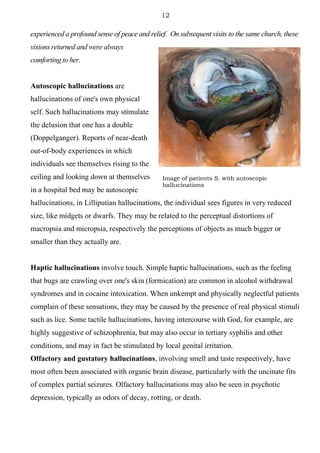
Autoscopic hallucinations are
hallucinations of one's own physical
self. Such hallucinations may stimulate
the delusion that one has a double
(Doppelganger). Reports of near-death
out-of-body experiences in which
individuals see themselves rising to the
ceiling and looking down at themselves
in a hospital bed may be autoscopic
hallucinations, in Lilliputian hallucinations, the individual sees figures in very reduced
size, like midgets or dwarfs. They may be related to the perceptual distortions of
macropsia and micropsia, respectively the perceptions of objects as much bigger or
smaller than they actually are.
Haptic hallucinations involve touch. Simple haptic hallucinations, such as the feeling
that bugs are crawling over one's skin (formication) are common in alcohol withdrawal
syndromes and in cocaine intoxication. When unkempt and physically neglectful patients
complain of these sensations, they may be caused by the presence of real physical stimuli
such as lice. Some tactile hallucinations, having intercourse with God, for example, are
highly suggestive of schizophrenia, but may also occur in tertiary syphilis and other
conditions, and may in fact be stimulated by local genital irritation.
Olfactory and gustatory hallucinations, involving smell and taste respectively, have
most often been associated with organic brain disease, particularly with the uncinate fits
of complex partial seizures. Olfactory hallucinations may also be seen in psychotic
depression, typically as odors of decay, rotting, or death.
Image of patients S. with autoscopic
hallucinations
13
The term pseudohallucination has been used in two ways. First
pseudohallucination refers to perceptions experienced as coming from within the mind
(i.e., not at the boundary or outside the mind). Using this definition, loud voices that are
alien, ascribed to other beings, but that the patient knows are actually within the mind
rather than out in space, are pseudohallucinations. The term has also been used to
describe hallucinatory experiences whose validity the patient doubts. A better term for
this second phenomenon is partial hallucination, analogous to partial delusion.
True hallucinations Pseudohallucinations
Bright vivid perception just like the
natural one
The lack of the vividness (for example
impossible to distinguish male and female
voices)
Patient got it with natural way of
perception (with eyes or ears) from the
real perceptual space (extraprojection)
Patient got it with other (double)
perception (internal vision or hearing)
from out of perceptual space (for example
intraprojection)
Confidence in the fact that other people
have the same perceptions
Ideas of distant influence organized
especially for the patient
Excitement or attempts to act with the
false objects. More abundant in the
evening and night
Indifferent behaviour or passive defense
(for example attempts to shield with metal
net or screen)
Typical for delirium and other organic
disorders
Typical for paranoid schizophrenia
Functional hallucinations are rare hallucinations that occur only in connection with a
specific external perception, for example, in the presence of a sound such as running
water, or a color, or a particular place. However, unlike illusions, the hallucinated sounds
are not elaborations of the perception but are simply triggered only in that specific
context.
A 25-year-old farmer with schizophrenia told of a talking tree on his property. During
previous episodes he had experienced a variety of auditory hallucinations that were
generally well controlled with medication. However, each time he came near to this
14
large, old Wee, he would hear a profound, wise voice as if the tree were one with the
earth and the universe, and had important guidance for him. He often came to the tree
when he was troubled seeking the hallucinatory experiences.
Ictal hallucinations, occurring as part of seizure activity, are typically brief lasting only
seconds to minutes, and stereotyped. They may be simple images such as flashes of light
or elaborate ones, such as visual recollections of past experiences. During the
hallucinations the patient ordinarily experiences altered consciousness or a twilight sleep.
A flashback is an intense visual re-experience of highly charged past events, which are
often replays of hallucinations. They are typically associated with heavy use of
hallucinogens such as LSI) and mescaline and often occur months after the last drug
ingestion. The images may be simple or complex geometric patterns or they may consist
of previously experienced elaborate drug-induced hallucinations. Flashback phenomena
may be state-dependent. For example, visual hallucinations initially experienced with
hallucinogens are more likely to be subsequently experienced as flashbacks when the
subject is smoking marijuana. In posttraumatic stress disorder, some complex intrusive
flashback-like images may attain a hallucinatory vividness. Images often include
horrifying memories of traumatic events that may force themselves repeatedly into
consciousness until they are acknowledged.
A 35 year-old man with a history of polysubstance abuse and who constantly smoked marijuana
estimated that he had used hallucinogens including LSD and mescaline more than 100 times
before having a series of devastatingly frightening hallucinatory experiences of devils, of his body
being consumed and eaten by wild animals, and of burning in hell- fires. These were
accompanied by such profound paranoia and panic attacks that he swore off "heavy drugs», but
continued to use alcohol and marijuana. Several months later, during a period of personal crisis
during which he smoked an unusually large amount of powerful marijuana he suddenly re-
experienced the worst devil filled flashback; this experience lasted for several hours in spite of the
efforts ofseveralof his friends to talk him down.
15
Hallucinosis is a state of active hallucination occurring in someone who is alert and well
oriented. This condition is seen most often in alcoholic withdrawal, but it may also occur
during acute intoxications and other drug-mediated states.
HALLUCINOSIS syndrome is characterized by abundant hallucinations of
only one modality (most often auditory), that occur
within a clear sensorium. Symptoms resemble delirium,
but exist in the context of clear consciousness.
(typical for organic disorders)
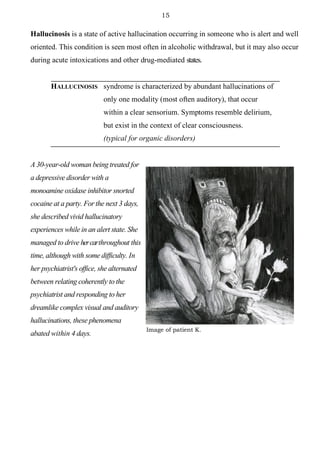
A 30-year-old woman being treated for
a depressive disorder with a
monoamine oxidase inhibitor snorted
cocaine at a party. For the next 3 days,
she described vivid hallucinatory
experiences while in an alert state. She
managed to drive hercarthroughout this
time, although with some difficulty. In
her psychiatrist's office, she alternated
between relating coherently to the
psychiatrist and responding to her
dreamlike complex visual and auditory
hallucinations, these phenomena
abated within 4 days.
Image of patient K.
16
Psychosensory Disorders
1. Depersonalization
2. Derealization
3. Disorders of the body shape
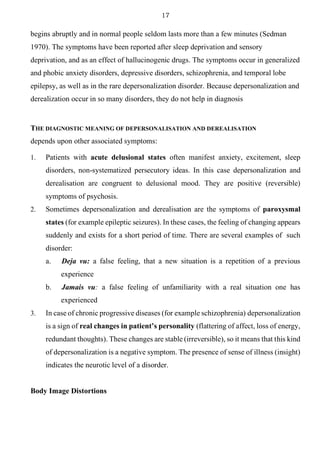
Depersonalization is a change of self-
awareness such that the person feels unreal,
detached from his own experience and
unable to feel emotion. Derealization is a
similar change in relation to the
environment, such that objects appear
unreal and people appear as lifeless, two-
dimensional cardboard figures. Despite the
complaint of inability to feel emotion,
both depersonalization and derealization are described as highly unpleasant experiences.
These central features are often accompanied by other morbid experiences. There is
some disagreement as to whether these other experiences are part of depersonalization
and derealization or separate symptoms since they do not occur in every case. These
accompanying features include changes in the experience of time, changes in the body
image such as a feeling that a limb has altered in size or shape, and occasionally a feeling
of being outside one's own body and observing one's own actions, often from above.
Because patients find it difficult to describe the feelings of depersonalization and
derealization, they often resort to metaphor and this can lead to confusion between
depersonalization and delusional ideas. For example, a patient may say that he feels 'as if
part of my brain had stopped working, or 'as if the people I meet are lifeless creatures'.
Such statements should be explored carefully to distinguish depersonalization and
derealization from delusional beliefs that the brain is no longer working or that people
have really changed. Sometimes it is difficult to make the distinction.
Depersonalization and derealization are experienced quite commonly as transient
phenomena by healthy adults and children, especially when tired. The experience usually
“Deperonalisation and derealisation in
depression”, image of patient T.
17
begins abruptly and in normal people seldom lasts more than a few minutes (Sedman
1970). The symptoms have been reported after sleep deprivation and sensory
deprivation, and as an effect of hallucinogenic drugs. The symptoms occur in generalized
and phobic anxiety disorders, depressive disorders, schizophrenia, and temporal lobe
epilepsy, as well as in the rare depersonalization disorder. Because depersonalization and
derealization occur in so many disorders, they do not help in diagnosis
THE DIAGNOSTIC MEANING OF DEPERSONALISATION AND DEREALISATION
depends upon other associated symptoms:
1. Patients with acute delusional states often manifest anxiety, excitement, sleep
disorders, non-systematized persecutory ideas. In this case depersonalization and
derealisation are congruent to delusional mood. They are positive (reversible)
symptoms of psychosis.
2. Sometimes depersonalization and derealisation are the symptoms of paroxysmal
states (for example epileptic seizures). In these cases, the feeling of changing appears
suddenly and exists for a short period of time. There are several examples of such
disorder:
a. Deja vu: a false feeling, that a new situation is a repetition of a previous
experience
b. Jamais vu: a false feeling of unfamiliarity with a real situation one has
experienced
3. In case of chronic progressive diseases (for example schizophrenia) depersonalization
is a sign of real changes in patient’s personality (flattering of affect, loss of energy,
redundant thoughts). These changes are stable (irreversible), so it means that this kind
of depersonalization is a negative symptom. The presence of sense of illness (insight)
indicates the neurotic level of a disorder.
Body Image Distortions
18
Body image includes both perceptual and ideational components, and may reflect
primarily perceptual distortions or combinations of disturbed perception and self-
appraisal. Body image disturbances can occur as normal responses to abrupt changes in
the body (e.g., following amputation), in brain disease, and in psychiatric disorders.
Phantom-limb phenomena are classic body image problems in which an amputated limb
is still felt to be present. The sensation may diminish gradually over time; the patient
feels as if the phantom is receding into the stump.
Agnosia, lack of awareness of some parts of the body, may-accompany brain damage,
most often of the non-dominant parietal lobe. Patients with obvious motor or sensory
deficits may deny that any deficit exists at all (anosognosia), or the denial may be limited
to half of the body (hemiagnosia), usually the left side. In hemidepersonalization
syndromes, a less common disorder (hemisomatognosia), patients feel that one of their
limbs is missing, again usually on the left side. Body image distortions in which a limb
feels too heavy (hyperschemazia) or weightless (hyposchemazia) can occur as a
consequence of neurological conditions such as infarction of the parietal lobe. In
duplication phenomena, patients feel as if part of all of them has doubled (e.g., that they
have two heads or two bodies). These rare
phenomena may occur in schizophrenia, complex
partial seizures, and migraine.
Dysmorphophobia refers to conditions in which
patients distortedly perceive and intensely dislike
the shape of a particular body part As such, these
symptoms are misnamed because there is no true
phobic component,:
such as fear or avoidant
behavior. Fine lines exist between perceptual
distortions and realistic but unhappy appraisals of
one’s body, given the high social value placed on
physical appearance.
Depersonalization of patient with
anorexia(mnogoboleznei.ru)
(https://yandex.ru/images/search)nevrosa
19
Dysmorphophobia may occur in the context of some personality disorders or as an
isolated disorder, called body dysmorphic disorder. In some ways, dysmorphophobia
resembles an overvalued idea. Patients may develop dysmorphophobias in relation to any
body part; common concerns are hair, breasts, penis, nose, or the entire body. For some,
changing the body part, as in rhinoplasty for those who do not like their noses, seems to
effect a lasting positive change in body image, with patients becoming happier with
themselves and feeling more attractive for years or a lifetime. Patients with severe
dysmorphophobia may undergo multiple plastic surgeries and feel dissatisfied with every
result. At times, the condition forms part of a larger and more pervasive syndrome, such
as anorexia nervosa.
A 24-year-old engineering student from a rigid, devout, and loving home was convinced
that his mild pectus excavatum condition was an atrocious deformity that accounted for
his never having had a girlfriend. A mild deformity did exist, but his reaction to it was
far in excess of the actual problem. He was embarrassed to take showers in the dorm,
afraid that other students would see him and make fun of his deformity. He sought the
services of a surgeon to fix the deformity; the surgeon sent him for psychiatric
consultation prior to performing the surgery. No other psychiatric difficulties were
evident, and the results of psychological testing were nonrevealing. His father, a rather
literally-minded man, was in full agreement with the son's desires to have the corrective
surgery. With no clear contraindication, the surgeon agreed to perform the operation. A
6-month follow-up revealed that the student was much happier, and was now dating for
the first time in his life.
Hypochondriacal complaints also combine perceptual and ideational distortions.
Selective hypervigilance to bodily sensations may result in a higher likelihood of
perceptions of unpleasant and potentially pathological body experiences among the
worried well, hypochondriacal populations, patients with somatization disorder (Briquet's
syndrome), and some patients with a panic disorder.
20
Body image distortions may at times be severe or bizarre. Some psychotic patients with
schizophrenia or depression develop somatic delusions. In depression, this often
expresses itself as a delusion that part of the body or the entire body is rotting or
cancerous. Some culture-bound syndromes in non-Western culture express themselves
with body image distortions, such as koro, in which the man fears that his penis is
shrinking into his abdomen.
DISORDERS OF MEMORY
Memory is the ability of remember, retain in one's memory and recall information as a
subjective reflection of personal past experience.
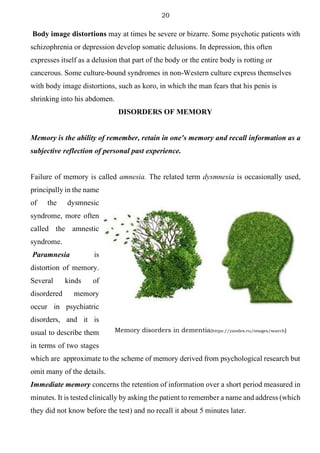
Failure of memory is called amnesia. The related term dysmnesia is occasionally used,
principally in the name
of the dysmnesic
syndrome, more often
called the amnestic
syndrome.
Paramnesia is
distortion of memory.
Several kinds of
disordered memory
occur in psychiatric
disorders, and it is
usual to describe them
in terms of two stages
which are approximate to the scheme of memory derived from psychological research but
omit many of the details.
Immediate memory concerns the retention of information over a short period measured in
minutes. It is tested clinically by asking the patient to remember a name and address (which
they did not know before the test) and no recall it about 5 minutes later.
Memory disorders in dementia(https://yandex.ru/images/search)
21
Recent memory concerns events in the last few days. It is tested clinically by asking about
events in the patients daily life which are known also to the interviewer directly or via an
informant (for example, what they have eaten) or in the wider environment (for example,
well-known news items).
Long-term (remote) memory concerns events over longer periods of time. It is tested by
asking about events before the presumed onset of memory disorder.
In testing any state of memory, a distinction is made between spontaneous recall and
recognition of information. In some conditions, patients who cannot recall information can
recognize it correctly.
Memory can also be classified according to type of information stored:
1. Semantic memory is concerned with factual information, the meaning of words, and
the attributes of objects. Memory-disordered patients have difficulty adding to this store
of knowledge though they usually retain most of what they have stored already,
2. Episodic memory is for experiences such as a meeting with a friend or an item seen
on television,
3. Procedural memory is for skills such as riding a bicycle. This kind of memory is
also called implicit memory, in contrast to explicit memory, in which the learned
information can be recalled.(We can remember howto ride a bicycle, but cannot say what
we learnt.) Procedural memory is preserved in amnesic patients; though they may forget
the occasion on which the skill was learnt (they have lost the corresponding episodic
memory).
After a period of unconsciousness, memory is impaired for the interval between the ending
of complete unconsciousness and the restoration of full consciousness (anterograde amnesia).
Some causes of unconsciousness (e.g. head injury and electroconvulsive therapy) lead also
to inability to recall events before the onset of unconsciousness (retrogradeamnesia).
Recall of events can be biased bythe mood at the time of recall. Importantly, in depressive
disorders, memories of unhappy events are recalled more readily than other events, a
process which adds to the patient's low mood.
Disorders of memory can be classified according to their intensity and quality.
22
1- According to their intensity
• Amnesia (absence of memory)
- anterograde amnesia (the patient can't recall events between full unconsciousness and
restoration of consciousness)
- retrograde amnesia (the patient can't recall events before unconsciousness)
-anteroretrograde amnesia (the patient can't recall both periods)
- progressive amnesia (amnestic syndrome, herpes encephalitis, vascular disorder, head
injury)
- transient amnesia(transient global amnesia, transient epileptic amnesia, head injury,
alcoholic blackouts, postelectroconvulsive therapy, posttraumatic stress disorder, amnesia
for criminal offence)
2. According to their quality (These disorders are named paramnesia)
Paramnesia is distortion of memory.
- confabulation (memory about event that never involved the patient).
- pseudoreminiscention (the events that the patient recollects are imaginary. The events
happened to the patient but in some other time).
Memory loss caused by organic conditions affects recall or recent events. It is not a total
loss. There are disorders of recognition: jamais vu (the patient can't recognize events that
happened before); deja vu (the patient thinks that the event repeats though it is new).
Amnestic disorder is a condition in which a person can't remember events occurring a few
minutes before, but can recall remote events. This trouble is fixation amnesia. Ribeau
described this law in his works in the 18th
century.
Amnestic syndrome (Korsacov-syndrome):
1. decrease of psychical activity
2. the patient is not oriented in time, in space
3. fixation of amnesia
4. anterograde and(or) retrograde amnesia
5. paramnesia (confabulation and/or pseudoreminiscention)
23
Psychogenic amnesia is thought to result from an active process of repression, which
prevents the recall of memories that would otherwise evoke unpleasant emotions. The
ideas arose from the study of dissociative amnesia, but the same factors may play, a part
in some cases of organic amnesia, helping to explain why the return of some memories is
delayed longer than others.
False memory syndrome is a matter of dispute whether memories can be repressed
completely but return many years later. The question arises most often when memories of
sexual abuse are reported during psychotherapy by a person who had no recollection of
the events before the psychotherapy began, and the events are strongly denied by the
alleged abusers. Many clinicians consider that these recollections have been 'implanted' by
overzealous questioning, others contend that they are true memories that have previously
been completely repressed. Those who hold the latter opinion point to evidence that
memories of events other than child abuse can sometimes be completely lost and then
regained and also that some recovered memories of child abuse are corroborated
subsequently by independent evidence. Although the quality of the evidence has been
questioned, the possibility of complete and sustained repression of memories has not been
ruled out. However, it seems likely that only a small minority of cases of recovered
memory syndrome can be explained in this way.
Delusional memory is the memory of an event that is clearly delusional. As an example,
a patient "remembered" his fourth-grade teacher slipping lysergic acid diethylamide (LSD)
into his apple juice; this memory served to explain his psychotic disorder. The elaboration
of false memories and their subsequent fixed beliefs may assume delusion perception
(Certain events of the patients life can be misinterpreted. The patient becomes suspicious.)
24
DISORDERS OF COGNITION
Components of intellect: ✓ prerequisites (memory, associations)
✓ store of knowledge
✓ ability to understand, abstract thinking
Valuation of
intellect IQ =
(Intelligence
Quotient)
Mental age
 100%
Specific tests Wechsler-test
(WAIS, WISC), Progressive
Matrices Test, Stanford-Binet
Intelligence Scale
(for age 2 – 23).
Chronological age
I. Mental Handicap (Mental Retardation) is retarded intellectual and cognitive
development
Causes: a) genetic (chromosomal and
inherited); b) embryopathy (intoxication,
rubella, other infections); c) fetopathy and
perinatal pathology (hypoxia, trauma,
infection, Rhesus-conflict etc.)
Patient with mental retardation
(http://morozovka.net)
25
Levels: ICD-10 IQ (%) Clinical classification
F70 Mild mental retardation 50 – 69 Moronic
F71 Moderate mental
retardation
35 – 49
Imbecile
F72 Severe mental retardation 20 – 34
F73 Profound mental retardation below 20 Idiocy
II. Dementia loss of intelligence after a period of its normal
development
Organic Dementia
Dysmnestic (Arteriosclerotic) is primary marked disorder of memory
− slight deficiency in understanding
− mild personality changes (expression of prior personality traits)
− good insight (sadness because of the sense of illness)
Total
(due to GPI, atrophy, frontal lobe tumors etc.)
− primary marked impairment of understanding
− severe personality changes (destruction of nuclear personality traits)
− poor insight (no sense of illness) or formal critical judgement
Epileptic
− severe personality changes (egoism, stiffness, emotional rigidity)
− marked impairment of cognition (loss of ability for abstract thinking) and memory
− poor vocabulary and perseverative thinking
Schizophrenic Dementia
severe personality changes (indifference, laziness, autism, apathy, abulia);
− marked cognitive difficulties (schizopasia, paralogia, reasoning etc);
− absence or mild disorders of memory
26
THOUGHT DISTURBANCES
Normal Thinking
Thinking refers to the ideational components of mental activity, processes used to
imagine, appraise, evaluate, forecast, plan, create, and will. Thinking as the highest stage
of the objective reality reflection by the human brain.
Function of thinking:
1. comparison,
2. analysis,
3. generalization and the essence distinguishing
4. abstraction.
1. Classification of thinking disorders according to their rapidity:
Thinking can be unusually slow or accelerated.
Slowed (or retarded) thought, (e.g., asseen in depression), is typically goal directed but
characterized by little initiative or planning. Patients experiencing retarded thought often
describe feeling that even simple thought requires great effort, as if molasses were
cluttering their thinking. These difficulties are expressed as slowness in decision-making
and as long latency of response, increased pause times when speech is initiated and
during speech. Thought blocking, seen in schizophrenia, is experienced as the snapping
off or as a sudden break in a train of thought, as if a wall suddenly came down
interrupting thinking (and speaking) in midsentence. To an outside observer, without
further explanation from the patient, thought blocking may appear identical to thought
withdrawal, a disturbance in the control of thought in which the patient feels as if some
alien force has intentionally withdrawn the thoughts from consciousness. The patient's
further description and explanation of the inner experience is necessary to distinguish
these two symptoms.
A 26-year-old man with paranoid schizophrenia frequently broke off his conversation in mid-
sentence. To the puzzled examiner he explained that the mysterious force that controlled him with
a computer chip in his brain closely monitored his thought and speech and would shut him down
whenever it was concerned that he might inadvertently say something that was classified
information.
27
Image of patien H. “Mentizm”
Accelerated rates of thinking, typically accompanied by fast talking,can be seen as a
normal variant. Rapid rates of speech, influenced heavily by cultural and situational
factors, only sometimes reflects truly rapid thought. (For example, it is not at all clear
that New Yorkers, who characteristically speak more quickly than people from some
other cities, actually think at a faster rate. Similarly, auctioneers and some radio and
television announcers can speak with astonishing rapidity, probably reflecting both
innate capacities as well as learned psychomotor skills.) Pressure of speech—-speech
that is rapid, excessive, and typically loud is characteristic of mania (or hypomania),
stimulant intoxication and, occasionally, anxiety. Flight of ideas occurs when the flow of
thought increases to the point where the train of thought switches direction frequently
and rapidly. The associative links between conceptual topics during flight of ideas are
comprehensible to the listener, sometimes with considerable effort! Listening to a flight
of ideas that is not overwhelmingly fast can be both a dizzying and enjoyable experience
for the listener, as exemplified by the successful performance style of certain
contemporary comedians, notably Robin Williams.
2. Disturbances of thought may take several
forms
In circumstantiality, the flow of thought
includes many digressive turns and associations,
often including a great deal of unnecessary detail.
Transcripts of circumstantial thought or speech
are marked by multiple commas, subclauses, and
parenthetical asides. Nonetheless, in
circumstantial thought or speech the speaker
eventually returns to the point that was initially
intended without having to be prompted by the
listener.
28
In contrast, in tangentially, the person's thought wanders further and further away from
the intended point, without ever returning, so that the person may not even remember
what the original point was supposed to be.
In vorbeireden, a form of tangentially, the person talks past the point and never quite
gets to the central idea. Tangentially is a mild form of derailment, in which there is a
breakdown in associations.
Loose associations exemplify more severe derailment, in which the flow of ideas is no
longer comprehensible to the listener because the individual thoughts seem to have no
logical relation to one another. Loose associations are classically a hallmark feature of
schizophrenia. In extreme cases, the associations of phrases and even individual words
are incomprehensible, and words into phrases may be disrupted.
Word salad describes the stringing together of words that seem to have no logical
association.
Verbigeration describes the disappearance of understandable speech, replaced by
strings of incoherent utterances.
Perseveration and stereotypy are two other associative abnormalities in which the flow
of thought or speech appears to get stuck.
In perseveration, a sentence or phrase is repeated, sometimes several times over, after it
is no longer relevant; perseveration is commonly seen in delirium and other organic
mental disorders.
Stereotypy refers to the constant repetition of a phrase or a behavior in many different
settings, irrespective of context (Verbigeration),
Fruitless thinking - a person can speculate over different abstractive ideas without any
real result.
Noncontinuous - illogical stream of thinking with proper grammar structure of the
sentence, incoherence (thought that generally is not understandable).
Intermittent thinking (unconnected speech; sentences without any logical and
grammar structure).
Mentism - a patient complains of continuous flow of thoughts and ideas which he
considers "a flood".
29
Blockage - sudden interruption of the stream of thinking or a pause in the stream of
thinking.
Autism - a person is oriented to his/her private world own ideas and feelings. Symbolism
- all the life events are assessed or interpreted by the patient according to his own
symbols or illogical ideas.
Ambivalention - in the patient's head there are two different thoughts in one time and
about one subject.
Neologism - creation of new unusual words.
30
3. Disturbances in Thought Content
The normal content of thought, the buzzing, booming stream of consciousness that
constitutes the stuff of everyday life, is composed of awareness, concerns, beliefs,
preoccupations, wishes, and fantasies occurring with various degrees of clarity,
vividness, differentiation, imagination, and strength. Normal thought is often illogical
containing many beliefs and prejudices that, although clearly contradictory, arc
nevertheless held with passion and conviction.
Disorders of the possession and the content of thought
✓ Delusion
false belief of great value to a patient, based on incorrect inference about external reality,
which arises from internal morbid process (not consistent with patient’s intelligence and
cultural background) and cannot be corrected by reasoning.
(unspecific productive symptom of different psychoses)
✓ Overvalued Ideas
sustained ideas of great personal value, which are not absolutely false but inadequately
significant in such way, that it disturbs the adaptation of individual.
(productive disorder of subpsychotic level, typical for paranoid disorder of personality)
✓ Obsessions
pathological persistence of an irresistible thought or feeling that cannot be
eliminated from consciousness by logical effort, usually associated with hypothymia and
anxiety.
(unspecific productive symptom of neurotic level, usual for neuroses and schizotypal
disorder)
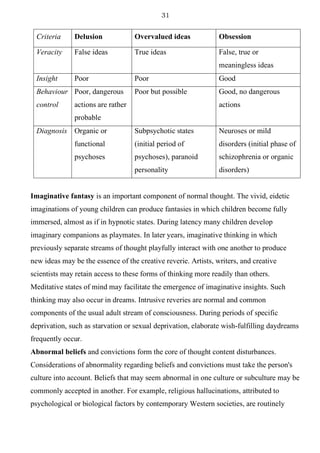
31
Criteria Delusion Overvalued ideas Obsession
Veracity False ideas True ideas False, true or
meaningless ideas
Insight Poor Poor Good
Behaviour
control
Poor, dangerous
actions are rather
probable
Poor but possible Good, no dangerous
actions
Diagnosis Organic or
functional
psychoses
Subpsychotic states
(initial period of
psychoses), paranoid
personality
Neuroses or mild
disorders (initial phase of
schizophrenia or organic
disorders)
Imaginative fantasy is an important component of normal thought. The vivid, eidetic
imaginations of young children can produce fantasies in which children become fully
immersed, almost as if in hypnotic states. During latency many children develop
imaginary companions as playmates. In later years, imaginative thinking in which
previously separate streams of thought playfully interact with one another to produce
new ideas may be the essence of the creative reverie. Artists, writers, and creative
scientists may retain access to these forms of thinking more readily than others.
Meditative states of mind may facilitate the emergence of imaginative insights. Such
thinking may also occur in dreams. Intrusive reveries are normal and common
components of the usual adult stream of consciousness. During periods of specific
deprivation, such as starvation or sexual deprivation, elaborate wish-fulfilling daydreams
frequently occur.
Abnormal beliefs and convictions form the core of thought content disturbances.
Considerations of abnormality regarding beliefs and convictions must take the person's
culture into account. Beliefs that may seem abnormal in one culture or subculture may be
commonly accepted in another. For example, religious hallucinations, attributed to
psychological or biological factors by contemporary Western societies, are routinely
32
attributed to religious and spiritual causes by many other cultures. With regard to
intensity of conviction, distorted beliefs range on a continuum from overvalued ideas to
the determined, unshakable belief that is characteristic of fixed delusions. Abnormal
beliefs and delusions are, in most circumstances, diagnostically nonspecific.
Delusions are commonly seen in mood disorders, schizoaffective disorder, delirium,
dementia, and substance-related disorders, as well as in schizophrenia and delusional
disorders.
Overvalued ideas are unreasonable and sustained abnormal beliefs that are held beyond
the bounds of reason. Patients with overvalued ideas have little or no insight into the fact
that their ideas are very unlikely to be valid; however, the ideas themselves are not as
patently unbelievable as most delusions. The distorted body images of body dysmorphic
disorder exemplify overvalued ideas. Morbid jealousy and preoccupation with a spouse's
possible infidelity may constitute an overvalued idea if no real evidence has ever existed
to warrant such suspicion.
A 32-year-old woman, fatigued for many months-complained of being "allergic to
everything". She initially associated her fatigue with eating certain foods, then with
using certain cosmetics and soap products, then with wearing certain types of clothing,
and then with being around certain types of house paints, carpets, and draperies. These
beliefs resulted in severe restrictions and functional limitations in her work and social
life.
Ideas of reference are false personalized interpretations of actual events in which
individuals believe that occurrences or remarks refer specifically to them, when in fact
they do not. Ideas of reference may be less firmly held than delusional beliefs.
Obsessional thinking, in delusional thought passivity, patients experience their own
thoughts as being under the control of other forces. Thought passivity may take several
forms: in thought insertion thoughts are experienced as having been placed within the
patient's mind from the outside; in thought withdrawal thoughts are whisked out of the
mind; in thought broadcasting patients experience their thoughts as escaping their minds
33
to be heard by others. These experiences are often combined with specific delusions of
control, seemingly to explain the passivity experiences. Several of these phenomena
were included by Kurt Schneider among the first-rank symptoms of schizophrenia.
Today, these symptoms are viewed more broadly as non-specific psychotic symptoms,
and are no longer considered to be pathognomonic of schizophrenia.
A 40-year-old man who had been living in a state hospital for many' years described how
he was the outer shell in a set of nested beings. A homunculus-like figure in the center
controlled another being surrounding him, and the patient himself was simply the outer
wrapping. The inner homunculus made all the decisions, and pulled all the strings, so
that the patient was simply a passive recipient of his thoughts and of the instructions that
ordered him to carry out each and every act in his life.
Obsessional thinking is stereotyped, repetitive, persistent thinking that is recognized as
one's own thoughts. In contrast to patients with delusional thought passivity, obsessional
patients do not experience their thoughts as being controlled by outside forces.
Nonetheless, they experience only partial control over the obsessional thoughts. They
can, with great effort, stop thinking the obsessional thoughts but cannot prevent them
from recurring. Thus, characteristic of obsessions is the subjective experience of
compulsion, the resistance to it, and the preservation of insight. As bizarre as some
obsessions are, patients know that these thoughts are irrational and their own. At times,
obsessions may be pervasive enough to dominate the patient's consciousness. Obsessions
may be simple a sequence of words or elaborate -such as enumerating the possible
consequences of a past behavior and elaborating a cascading sequence of typically
catastrophic events. Typical obsessional themes in obsessive-compulsive disorder
involve preoccupations with dirt and contamination, fear of harming others, symmetry,
and those related to health and appearance.
A 24-year-old woman was preoccupied, with the fear that she would be contaminated by
germs that were all around her. These thoughts were inescapable, and led her to narrow
34
her range of activities considerably, to the point of being nearly housebound She had to
comply with a series of ritualistic acts to ward off contamination in her house.
Obsessional thoughts are usually seen in conjunction with compulsive behaviors, which
are rituals linked to the obsessions, typically constructed to undo the effects of the
thought.
There are various forms of obsession:
Obsessional thoughts (for example: connected words or phrases which upset the
patient)
Obsessional ruminations (worrying themes)
Obsessional doubts. The patient can be expressing uncertainty about previous actions.
The patient checks many times if the door is locked or gas is switched.
Obsessional impulses are urges to carry out actions which are not common for him
(especially aggressive)
Obsessional phobia
All the obsessional phobia can be grouped into eight categories:
1 .dirt and contamination
2. aggression
3. order (the way objects are arranged)
4. illness
5. sex
6. religion
7. places where medical aid is not available
8. social
Obsessions frequently are accompanied by rituals, but not always. Rituals are repetitive
actions caused by obsessions. They are also senseless. Rituals may have protective
nature.
There are four types of rituals:
1. checking
2. cleaning
35
3. counting
4. dressing
Many obsessional patients perform actions slowly; because rituals take certain time.
Delusions.
Delusions are fixed, false beliefs, strongly held and immutable in the face of refuting
evidence, that are not consonant with the person's education, social, and cultural
background.
Thus, delusional thoughts can only be understood or evaluated with at least some
knowledge of patients' interpersonal worlds, such as their involvements with religious or
political groups. One of the mind's primary functions is to generate beliefs, including
myths and meaning systems. These beliefs provide the individual with a sense of
personal and group identity and with ways of understanding reality. They are most
noticeable when shared untestable beliefs form the basis for group cohesion as in
religions and cults. Some groups adhere to their cherished beliefs despite the abundance
of plausible contrary evidence, for example, some fundamentalist sects take the biblical
creation story literally. In the face of contrary evidence or grave personal threat,
individuals often cling to their primary beliefs as matters of faith (i.e., alternative, non-
refutable bases for understanding). The strong faith with which religious, political, and
nationalistic convictions are held, even at the cost of death, shows the power that
untestable beliefs can have on behavior. Potential mental health advantages of religious
beliefs have been demonstrated in epidemiological studies showing that those with a
sense of personal devotion report fewer depressive symptoms.
Subjectively, delusions are indistinguishable from everyday beliefs. Therefore, the
subjective experience of a delusion is no different from the subjective experience of
believing that the earth is round or that my spouse is the same person I married on my
wedding day. Because of the identical experience of delusions and other strongly held
beliefs, it is generally impossible to argue a patient out of a delusional belief. The content
of delusions is highly influenced by culture. Whereas centuries ago delusions of
36
persecution often concerned persecution by the devil and had religious connotations,
persecutory delusions today often take on contemporary political and social perspectives.
A 42-year-old Native American Vietnam veteran fled to a remote area of the Rocky-
Mountains to escape a world-wide conspiracy that he believed was trying to control each
and every individual, including him. He was aware of this conspiracy because when he lay
on the ground at night he could see countless stars and knew that they, and everything on
earth, were all connected by "the Web”. Confirming this belief, he heard the murmurings
of all computer messages, radio and television transmissions, phone calls, and even face-
to-face conversations as part and parcel of this web.
Types according to content:
Persecutory delusions
Depressive
delusions
Grandiose delusions
✓ ideas of persecution
✓ ideas of control
(of distant influence)
✓ ideas of poisoning
✓ ideas of jealousy
✓ ideas of self-reference
✓ ideas of fabrication, staging,
putting-up, personal doubles
(Capgras’ syndrome)
✓ ideas of pilferage
✓ querulous ideas
✓ ideas of guilt
✓ ideas of poverty
✓ hypochondriacal ideas
✓ dysmorphophobic
✓ nihilistic delusions
(Cotard’s syndrome)
✓ ideas of self-
importance
✓ ideas of riches
✓ erotic ideas
✓ ideas of power and
might
Emotions of fear, anxiety or
anger
Depressive mood Euphoria or indifference
Danger of aggression in some
cases
Danger of suicide Dangerous behaviour is
not typical
37
Although delusions are diagnostically nonspecific, some specific types of delusions
are more prevalent in one disorder than another.
For example, although delusions of control and delusional percepts are often seen in
schizophrenia, they also occur, albeit less frequently, in psychotic mood disorders.
Similarly, classic mood-congruent delusions with grandiose themes seen in mania or
delusions of poverty characteristic of depression may also be seen in schizophrenia.
Systematized delusions are usually restricted or circumscribed to well-delineated areas,
and are ordinarily associated with a clear sensorium and absence of hallucinations. They
are often isolated from other aspects of behavior.
In contrast, non-systematized delusions usually extend into many areas of life, and new
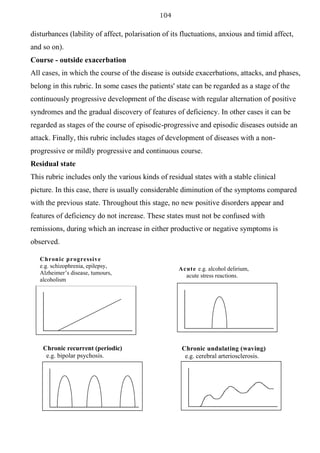
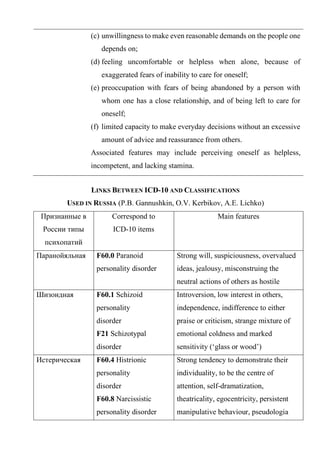
data-new people and situations are constantly incorporated to further support the
delusion. The patient usually has concurrent mental confusion, hallucinations, and some
affective lability. Where as the patient with a closed systematized delusional system may
go about life relatively unperturbed, the patient with a non-systematized delusion
frequently has poor social functioning and often behaves in response to the delusional
beliefs.
Complete delusions are those held utterly without doubt. In contrast, partial delusions arc
those in which the patient entertains doubts about the delusional beliefs. Such doubts
may be seen during the slow development of a delusion, as the delusion is gradually
given up, or intermittently throughout its course.
Delusions have also been categorized into primary and secondary forms.
Primary delusion develops on the basis of overvalued ideas or can develop as any
other mental disorders. It can also occur due to the disturbance of analysis and synthesis
function of thinking. The most characteristic features of the disorder are absence of
hallucination and mood disorders. The idea can have continues develop in the patient's
mind. The patient can select information, which according to his opinion can be very
important or connected for with the idea. Unsuitable information is not taken into
consideration.
Secondary delusion arise on the basis of different mental disorders, such as
hallucinations, change of mood, or an existing delusion.
38
Systematised delusion
false ideas confirmed with some logic
associations (in case of persecution patient
can in details describe the persecutors,
their aims and methods, so he can answer
the questions «Who?», «Why?», How?»)
(symptom of chronic delusional states)
Non-systematised delusion
fragmentary, not associated false ideas
(symptom of either acute delusional states
or of late stages of chronic processes)
Error of interpretation
based on logic, systematised
(usually chronic process)
Error of perception
delusional mood, delusional perception,
autochtonous delusion
(usually acute disorders)
Criteria of Acute Delusion:
• non-systematised
• bright affect (fear, anxiety, mania, depression, happiness, guilt)
• mood-congruent ideas of self-reference, fabrication, staging
Acute delusional states can be well controlled by antipsychotic drugs; there is a real
possibility of remission or full recovery.
Stage of delusion development:
Delusional percept refers to the experience of interpreting a normal perception with a
delusional meaning, which has enormous personal significance to the patient.
Delusional atmosphere or delusional mood is a state of perplexity, a sense that
something uncanny or odd is going on that involves the patient, but in unspecified ways.
Ordinary events may take on heightened significance but the delusional interpretations
are fleeting whereas the uncanny feeling lingers. Typically, after a period of time full-
blown delusions develop, replacing the delusional mood. The stage is characterized by
anxiety, depressive change in mood).
39
Delusional memory is the memory of an event that is clearly delusional. As an example,
a patient "remembered" his fourth-grade teacher slipping lysergic acid diethylamide
(LSD) into his apple juice; this memory served to explain his psychotic disorder. The
elaboration of false memories and their subsequent fixed beliefs may assume delusional
proportions delusion perception (Certain events of the patients life can be misinterpreted.
The patient becomes suspicious.)
Crystallization of delusion. The stage is characterized by clear understanding of the
reality. It is a delusion but the patient considers it as reality. After the affective content of
delusion is lost, delusion becomes less and less sensible.
Stages of Chronic Delusion by V.Magnan:
(typical for paranoid schizophrenia)
I. Paranoia - primary systematised ideas of persecution, jealousy or invention without
hallucinations
II. Paranoid hallucinational and delusional states with persecutory ideas of control
(distant influence) or poisoning, often associated with mental automatism
III. Paraphrenia hallucinational and delusional states with bizarre ideas of grandeur or
persecution, delusional memories, falsification of memory usually associated with
mental automatism, often non-systematised
Chronic delusional states can be partially controlled by antipsychotic drugs, remission of
high quality and full recovery are not possible.
Syndrome of Mental Automatism
(Schneiderian first rank symptoms of schizophrenia – FRS):
✓ Pseudohallucinations
✓ Mental Automatism
Alienation of Thoughts
Alienation of Perceptions and Emotions
Alienation of Movements
✓ Delusion of control (of distant influence)
40
DISORDERS OF ATTENTION AND CONCENTRATION
Attention is the ability to focus on the matter. Attention is characterized by
concentration, capacity and exhaustration.
Concentration is the ability to maintain that focus. The ability to focus on a selected part
of the information reaching the brain is important in many everyday situations, for
example, when conversing in a noisy place. It is also important to be able to attend to
more than one source of information at the same time, for example, when conversing
while driving a car.
Capacity of attention is the ability to focus and retain attention on some objects.
Exhaustration is the impossibility to focus attention on the object for a long time. It is
found in asthenic syndrome.
Attention and concentration may be impaired in a wide variety of psychiatric disorders
including depressive disorders, mania, anxiety disorders, schizophrenia, and organic
disorders. The finding of abnormalities of attention and concentration does not assist in
diagnosis. However, these abnormalities are important in management; for example, they
affect patients' ability to give or receive information when interviewed, and can interfere
with the patient's ability to work, drive a car, or take part in leisure activities.
Diminished attention. It occurs at asthenia, organic mental disorders,
Distractibility attention inability to concentrate attention. State in which attention is
drown to unimportant or irrelevant external stimuli.
Selective inattention - blocking out only those things that generate anxiety.
Hyperviligance-excessive attention and focus on all internal and external stimuli,
usually secondary to delusional or paranoid states, similar to hyperphragia, excessive
thinking a mental activity.
Pathological fixation attention. These disorders occur at epilepsy.
41
DISORDERS OF MOTOR BEHAVIOUR
Abnormalities of social behavior, facial expression, and posture occur frequently in
mental disorders of all kinds.
Tics arc irregular repeated movements involving a group of muscles, for example,
sideways movement of the head or the raising of one shoulder.
Mannerisms are repeated movements that appear to have some functional significance,
for example, abuse of gestures in the social situation, the gestures have grotesque
character.
Stereotypes are repeated movements that are regular (unlike tics) and without obvious
significance (unlike mannerisms), for example, rocking to and fix).
Posturing is the adoption of unusual bodily postures continuously for a long time. The
posture may have a symbolic meaning, for example, standing with both arms
outstretched as if being crucified, or may have no apparent significance, for example,
standing on one leg.
Grimacing has the same meaning as in everyday speech. The term Schawikrampf (snout
cramp or spasm) is used occasionally to denote pouting of the lips to biting them closer
to the nose.
Negativism. Patients arc said to show negativism when they do the opposite of what is
asked and actively resist efforts to persuade them to comply.
Echopraxia is the imitation of the interviewer's movement automatically even when
asked not to do so.
Ambitendence. Patients are said to exhibit ambitendence when they alternate between
opposite movements, for example, putting out the arm to shake hands, then withdrawing
it, extending it again, and so on repeatedly.
Catatonia is a state of increased muscle tone affecting extension and flexion and
abolished by voluntary movement.
Waxy flexibility is a term to describe the tonus in catatonia. It is detected when a
patient's limbs can be placed in a position in which they then remain for long periods
whilst at the same time muscle tone is uniformly increased. Patients with this
42
Waxy flexibility(Wall VK)
abnormality sometimes maintain the head a little way above the
pillow In a position that a healthy person could not maintain
without extreme discomfort (psychological pillow).
Stupor in the sense used in
psychiatry, refers to a
condition in which the
patient is immobile,
mute, and unresponsive but appears to be fully conscious in that the eyes are usually
open and follow external objects. If the eyes are closed, the patient resists attempts to
open them. Reflexes are normal and resting posture is maintained.
Stupor is defined as a clinical syndrome of akinesis and mutism but with relative
preservation of conscious awareness.
43
Embrionic posture in depressive stupor
(mnogoboleznei.ru)
TYPES OF STUPOR:
1. Depressive
2. Stupor catatonia (or retarded catatonia)
3. Psychogenic (functional)
Depressive stupor
In severe depressive
disorder, slowing of
movement and poverty
of speech may become
so extreme that the
patient is motionless
and mute. Such
depressive stupor is
rarely seen now ,
because active
treatment is available.
Therefore, the description by Kraepelin is of particular interest:
The patients lie mute in bed, give no answer of any sort, at most withdraw themselves
timidly from approaches, but often do not defend themselves from pinpricks. They sit
helpless before their food, perhaps; however, they let themselves be spoon-fed without
making any difficulty.
Catatonia
Stupor: strange non-convenient posture, waxy flexibility (catalepsy), negativism (active
and passive), automatic obedience
Excitement: purposeless actions, impulsive, brutality, stereotypic speech and movement
(verbigerations, perseverations)
Non-adaptive movements: echo-symptoms (echopraxia, echolalia, echomimia),
44
manneristic behavior
This is characterized by extreme retardation of psychomotor function. The characteristic
catatonic signs are usually observed. Some important clinical features of retarded
catatonia.
Mutism: Complete absence of speech.
Rigidity: Maintenance of a rigid posture against efforts to be moved.
Negativism: An apparently motiveless resistance to all commands and attempts to be
moved, or doing just the opposite.
Posturing: Voluntary assumption of an inappropriate and often bizarre posture for long
periods of time
Stupor: Akinesis (no movement) with mutism but with evidence of relative
preservation of conscious awareness
Echolalia: Repetition, echo or mimicking of phrases or words heard
Ehopraxia: Repetition, echo or mimicking of actions observed
Waxy flexibility: Parts of body can be placed in positions that will be maintained for
long periods of time, even if very uncomfortable; flexible like wax.
In psychogenic stupor partial or complete numbness, mutisms, reduced reactions to
external stimuli, including pain are observed. Self-defense is low.
Catatonic stupor Depressive stupor
• bizarre inconvenient posture
(i.e. foetal posture)
• manneristic facial expression
• muteness (sometimes paradoxical
answers to whispering speech)
• negativism
(often eating is absolutely refused)
• echolalia and echopraxia
• posture of suffering
• facial expression of sadness or anguish
• poor associations, one word answers,
but no muteness
• the loss of appetite but no active
resistance while eating
45
Exitement in paranoid schisophrenia(mnogoboleznei.ru)
EXCITEMENT
Excitement is a common reason for a referral to an emergency
psychiatry setting. Although, a large majority of psychiatric patients
is not dangerously violent, some patients can indeed be aggressive
especially during the acute phase of the illness.
Some common causes of excited behavior are listed below.
1. Organic psychiatric disorders
a. Delirium
b. Dementia
c. Wernicke Korsakoff’s
psychosis.
2. Non - organic psychiatric
disorders
a. Schizophreni-form psychosis.
b. Catatonic (excited) schizophrenia
is characterized by an increase in psychomotor activity, ranging from restlessness,
aggressiveness to, increase in speech production, with increased spontaneity, pressure of
speech, loosening of associations and frank incoherence. The excitement has no apparent
relationship with the external environment; instead, inner stimuli influence the excited
behavior. Therefore, the excitement is not goal-directed.
c. Paranoid schizophrenia. Behavior of the patient depends on the content of delusion
and hallucinations.
3. Mania (elation).
Although excitement is common, violence occurs usually only when the patient is
prevented from engaging in his activities, or when he is irritable. Similarly, patients with
dysphoria, mania or mixed affective states may occasionally present similarly.
4. Depression (raptus melancholicus).
46
Excitement in anxiety depression is more frequently observed. Agitated depression may
present, with excitement. Occasionally aggressive, violent behavior may occur if the
patient is irritable and agitated. In this condition patient may do suicide or dangerous
actions to him self.
5. Drug and alcohol dependencies.
Excitement may occur in
a. Intoxication
b. Withdrawal syndrome
6. Epilepsy (dysphoria, twilight, pathological affect)
7. Psychogenic
In excitement chaotic movements are observed. The patient cries, asking for help. His
actions are aimless, consciousness is narrowed. He experiences fear, horror, pathological
or physiological affect.
Catatonic excitement Maniacal excitement Hysterical excitement
• purposeless, impulsive
• absence or poor reaction
to the acts of spectators
(sometimes muteness)
• stereotypical
• manneristic posture and
facial expression
• echolalia and echopraxia
• purposeful
• marked striving to
personal contacts
• increased drives
• facial expression
of happiness
(sometimes anger)
• stress induced
• evident reaction to the
acts of spectators
• demonstrative behaviour
(loud cries, sobbing,
convulsions, suicide
actions, etc.)
• histrionic posture and
facial expression
Amobarbital (Amytal) interview is used as diagnostic and therapeutic instrument in
situations of catatonia, stupor, muteness.
Improvement is usual in patients with psychogenic
and functional conditions (for example with
psychogenic amnesia) because of disinhibition,
47
decreased anxiety and relaxation. Powerful
benzodiazepines (lorazepam, diazepam) showed
the same effects as amobarbital.
DISORDERS OF THE MOOD
In psychiatry, two terms are used to refer to an emotional state mood and affect.
Changes in the nature of mood can be anxiety, depression, elation, or irritability and
anger.
Normal mood varies in relation to the person's circumstances and preoccupations. In
abnormal states, mood may continue to vary with circumstances but the variations may
be greater or less than normal.
✓ Hypothymia - stable unreasonable feeling of sadness
(symptom of depression)
✓ Hyperthymia - stable unreasonable elevation of mood
(symptom of mania)
✓ Euphoria - elevated but serene careless mood, complacency often
associated with poor insight or even dementia
(symptom of organic disorders, e.g. intoxication)
✓ Dysphoria - sullenness and grumbling, unpleasant mood, up to anger and
irritation, often paroxysmal. It is a depression mood that is
accompanied irritability, spite, grudge and anguish.
(symptom of organic disorders, e.g. epilepsy)
✓ Apathy - dulled emotional tone associated with detachment or
indifference. It is total indifference accompanied absence of
desires, impulses for some activity.
(symptom of schizophrenic defect or frontal lobe damage)
48
✓ Blunting or flattening is reduced variation of mood. Sometimes, patients show no
emotion in circumstances which would normally elicit an
emotional response.
✓ Anaesthesia psychyca dolorosa - painful feeling that the patient lost his feelings
(symptom of depression). It is depression mood accompanied
anguish, feeling of psychical vacuum and loss emotional
resonance.
✓ Anxiety - feelings of tension and apprehension caused by anticipation
of uncertain danger
(often is the debut symptom of acute psychosis)
Anxiety is a normal response to danger. It is directional in
the future fear. Anxiety is abnormal when its severity is out
of proportion to the threat of danger or when it outlasts the
threat. Anxious mood is closely related to somatic and
autonomic components, and with psychological ones.
Psychological components: the essential feelings of dread
and apprehension are accompanied by restlessness,
narrowing of attention to focus on the source of danger,
worrying thoughts, increased alertness (with insomnia) and
irritability (that is a readiness to become angry).
Somatic components: muscle tension and respiration
increase. If these changes are not followed by physical
activity, they may be experienced as muscle tension tremor,
or the effects of hyperventilation.
Autonomic components: heart rate and sweating increase,
the mouth becomes dry, and there may be an urge to urinate
or defecate.
49
✓ Ambivalence - coexistence of two opposing impulses toward the same thing
in the same person at the same time
(symptom of schizophrenic personality changes)
✓ Emotional (affective) rigidity, stiffness - pathologic steadfastness (persistence) of
emotions, often accompanied by obstinacy and rancour
(symptom of organic and epileptic personality changes)
✓ Emotional (affective) lability - fast changes in mood from tears to laughter.
(symptom of neurosis, e.g. hysteria)
✓ Emotional Incontinence - subject bursts to tears for little or no reason, e.g. being
touched with sad or pleasant event
(symptom of encephalopathy due to vascular
deficiency)
✓ Incongruous it does not match the patient's circumstances and thoughts.
✓ Irritability is a state of increased readiness for anger.
✓ Anger is the feeling of intense indignation and resentment. Both
irritability and anger may occur in many kinds of disorder so
that they are of little value in diagnosis. Irritability and
depression may occur in anxiety disorders, mood disorders,
schizophrenia, dementia and intoxication with alcohol or
drugs. In some cases they may result not only in harm to others
but also in self-harm.
✓ Euphoria is elation accompanied by passivity, absence or decrease speech
activity.
✓ Physiological affect is a state of intense anger and loss unconsciousness. These state
can be accompanied of perception's constriction. This affect is
adequate in psychogenic situation.
✓ Pathological affect is a short-term psychogenic disorder that appear twilight,
excitement, vegetative symptoms and after total amnesia .
50
AFFECTIVE SYNDROMES
Depression Mania Apathy and abulia
• hypothymia (up to anguish)
• inhibition of thought
• motor retardation (except
when agitated)
• hyperthymia
• pressure of talk
• pressure of activity
• apathy (indifference)
• normal speech but short
answers
• passivity but no difficulties
in movement
• self-concerned
• painful thoughts
• mood-congruent delusion
(ideas of guilt)
• self-over-rating
• mood-congruent
delusion (ideas of
granduer)
• no special disorder of
thought
• loss of appetite
• hyposexuality
• loss of interests
• anhedonia
• bulimia, abuse of
alcohol, spending
money
• hypersexuality
• distractibility
• normal appetite
• unexpected sexual behavior
• passivity
• insomnia (early wake up,
the loss of the sense of sleep)
• insomnia (sleeps
shortly but without
sense of tiredness)
• no disorders of sleeping
• dry skin
• arterial hypertension
• constipation
• tachycardia
• mydriasis
• well healthy, no
somatic complaints
• well healthy, no somatic
complaints
Depression with anxiety up to agitation
depression associated with severe anxiety, excitement and motor
51
“Depresson”
Image of patient F.
restlessness, more common for patients of involution age. Special
observation is strongly recommended because of a high suicidal
risk.
Masked depression
depression manifested by somatic symptoms (heartache,
headache, stomachache, arterial hypertension, constipation,
tachycardia, arrhythmia).
Dexamethasone-suppression test is used to confirm a diagnostic impression of
endogenous depression (major
depressive disorder). After taking 1
mg dexamethasone by mouth at 11
pm plasma cortisol concentration at 8
am comes down in healthy patients
(negative test result) and remain abo
ve 5 g/dL (nonsupression) in
depressed individuals (positive test
result).
Depression is a normal response to loss or misfortune. Depression is abnormal when it is
out of proportion to the misfortune or unduly prolonged. Depressive mood is closely
coupled with other changes, notably a lowering of self-esteem, self-criticism, and
pessimistic thinking. A sad person has a characteristic expression with turned comers of
the mouth, a furrowed brow, and a hunched, dejected posture. The level of arousal is
reduced in some depressed patients but increased in others with a consequent feeling of
restlessness. Depression occurs in many psychiatric disorders.
Happy moods (elation) have been studied less than depressed mood. Elation is-fan
extreme degree of happy mood which, like depression, is coupled with other changes
including increased feelings of self-confidence and well-beings increased activity, and
increased arousal. The latter is usually experienced as pleasant but sometime as an
unpleasant feeling of restlessness. Elation occurs most often in mania and hypomania.
52
DISTURBANCES OF CONSCIOUSNESS
Consciousness can be defined as subjective awareness of the self and environment.
Disorders of consciousness are the most severe states in psychiatric clinic. They are usually
acute. Timely diagnostics of this state is very important for prevention of the dangerous
acts of patients and complications of the disease.
Signs of disturbances of consciousness:
1. impossibility of exact perception of the environment
2. disturbances of orientation in time, in space, in oneself
3. impossibility to understand the situation, incoherence of thinking
4. partial or total amnesia
First sing “impossibility of exact perception of environment” is the most important one. It
is usually accompanied by the decrease of active and passive attention. A patient has
unawareness of speech, questions, and instructions. Sometimes a patient answers the
question after being repeatedly asked.
Orientation of a patient is evaluated by three characteristics: time (a patient can't determine
day, year, month), place (a patient-is mistaken with the identity of his whereabouts),
oneself (a patient can't determine his name, age, personality or believes that he is
somebody else).
Incoherence of thinking interferes with logic thinking, decision of some tasks, establishing
the correlations between facts. A patient makes an impression of feebleminded, but this
state is not constant. Sometimes the patient's speech can be word salad.
Amnesia may be partial and total. In mild cases, a patient can remember basic events, but
forgets details or changes their order. In severe cases, total amnesia is observed.
To make the diagnosis "disturbance of consciousness" all four sings of disturbances of
consciousness must be present.
Clinically, consciousness can be considered from both qualitative as well as quantitative
viewpoints. Qualitatively, consciousness does not seem to be an all-or-none phenomenon.
53
Rather, conscious experiences may gradually shift in focus, intensity, and clarity; altered
states of consciousness may occur in which some aspects of consciousness, such as
sensation, perception, memory, orientation, and judgment are enhanced or impaired
relative to other aspects. Quantitatively, crude divisions can be made between states
depending on the relative presence, impairment, or total absence of consciousness. Even
within a single individual consciousness is not a unitary phenomenon. Multiple streams of
thought, operating at multiple levels of preconsciousness, appear to exist in all of us almost
all the time, with various elements in these coexisting streams constantly shifting into
higher or lower levels of conscious awareness. In pathological states, even more
remarkable properties of consciousness are seen; for example, the existence of co-
consciousness in humans who have had commissurotomies, and of seemingly multiple
discrete consciousnesses in patients with dissociative identity disorders. There are
syndromes of confusion (changes in the quality of consciousness) and “switching off” of
consciousness (changes in the level of consciousness up to coma).
54
DISTURBANCES IN THE LEVEL OF CONSCIOUSNESS
Levels of consciousness (i.e., alertness, awareness, and attentiveness) may be
pathologically increased or decreased. Such changes are diagnostically nonspecific and
can occur in many different disorders. When levels of arousal and alertness are mildly
elevated, as in hypomania or with the ingestion of small amounts of psychostimulants,
subjective experiences are typically positive, in these situations the person experiences
intense alertness, prolonged concentrating ability, and hyperesthesias in which perceptual
vividness is heightened: colors are brighter, sounds are sharper, and touch is more
intense than usual. With further increases in arousal and consciousness as seen in mania,
more severe intoxications with amphetamines and cocaine, and catatonic excitement,
attention deteriorates. Heightened alertness transforms into hypervigilance and paranoia,
and hyperesthesia’s become unpleasant.
Diminished levels of consciousness can be described on a continuum. Secondary-process
thinking is most notably compromised, and more primary-process thinking emerges into
consciousness. In this state, one's ability to appreciate subtleties and to think in a nuanced
manner is diminished, and is replaced by more dichotomous all-or-none, stereotypic
thinking.
The level of consciousness may fluctuate rapidly in relation to the internal
physiological state or to the degree of external stimulation. The syndrome
"switching off appears as decrease of psychical process.
This is perpetual series of states between clear awareness and coma. "Switching off
syndromes aren't accompanied by positive symptoms. Patients are torpid, inert, sleepy or
absolutely difficult to contact.
Torpor is a condition in which the patient is drowsy, falls asleep easily, and shows a
narrowed range of perception and slowed thinking.
Stupor is a stale of diminished consciousness in which the patient remains mute and still
although the eyes are open and may follow external objects. In the most extreme
impairment of consciousness, coma, there is no evidence of mental activity at all. The
patient appears essentially to be functioning on a decorticate or decerebrate level, in
55
Zooptique visual hallucination in delirium
(press-topic.ru)
akinetic mutism or coma vigil, patients with profound brainstem lesions appear to be
awake with their eyes open, but there is in fact no evidence of consciousness.
CLOUDING OF CONSCIOUSNESS
Clouding of consciousness is marked by diminished awareness of sensory cues and
diminished attentiveness to the environment and to the self.
Clouding of consciousness is the least state of switching off which ranges from
perceptible impairment to drowsiness in which the person reacts incompletely to stimuli.
Attention, concentration, and memory are impaired. Thinking is confused and events
may be interpreted incorrectly. A patient has some simple activity, but the answer is not
adequate and time-lagged.
In alterations of consciousness, confusion may occur with disorientation to time, place, or
person. The patient is usually highly distractible and unable to pay sustained attention to a
single stimulus. This is a series of acute psychosis with severe productive symptoms:
impairment of behavior, psychomotor excitement, thinking, delusion and hallucinations.
True reality is not perceived by the patient, because it is replaced by pathological reality
(delusions and hallucinations). Patients with confusion states are very active and can do
dangerous acts.
States of impaired consciousness
are
-oneiroid state
- twilight
- delirium
- amentia
Delirium, an acute state, is usually
characterized by a relatively abrupt
onset and a short duration of clouded,
reduced, and fragmented
attention; impaired memory and learning; perceptual and cognitive abnormalities such as
hallucinations and delusions; disrupted sleep; and other autonomic dysfunction, it is
56
“oneiroid”
image of patient S.
characterized by disorientation in time and place, but orientation in self is normal. It is
more common in the elderly and in patients who are intoxicated (alcohol, drugs). The
patient has perceptual impairment, hyperesthesia, illusions (fantastic), visual
hallucinations (also tactile and auditory), persecutory delusion, sleep impairment.
The level of consciousness may be consistently diminished or may fluctuate. The
electroencephalogram (EEG) usually shows diffuse slowing. Typical motor abnormalities
include an increase in general restlessness, fine and coarse tremors, and myoclonic jerks.
Autonomic disturbances commonly include tachycardia, fever, elevated blood pressure,
diaphoresis, and pupillary dilatation. The causes of delirium are legion, including systemic
medical disorders such as metabolic, imbalances or infections; intracranial disorders
caused by traumatic, structural, and electrical causes; and substance intoxication and
withdrawal states. Symptoms vary at different times of the day, becoming worse in the
evening.
Amentia develops in severe somatic pathology, in worsening of delirium symptoms. It
can lead to death or amnesia. The patient is restless in bed, totally disoriented, has tactile
and visual hallucinations. The speech is not clear, consists of single words, moans. It's
impossible to contact him. Thinking is intermittent or word salad. Activity of the patient
is senselessness, automatic and stereotype. Severe
organic defects after amentia are developed.
Oneiroid state develops slowly; it begins with
impairment of mood, anxiety, impairment of motion
(catatonic stupor), disorientation in place and time
occurs. The patient has fantastic hallucinations with a
definite plot, in which he thinks he takes part. The
patient has delusions (concerning religion, the end of
world, war with aliens). Sometimes the patient can
have double orientation. In this case fantastic and real
events mix in mind of the patient, the feeing of time
changes.
57
Behaviour of the patient is passive; the face reflexes ambivalent emotions (horror, ecstasy,
despair, bliss, vigilance). Speech of the patient is non-continuous. Oneiroid can last from
some hours to several days. The patient forgets the events. Durations of this psychosis is
1-2 weeks. The state finishes slowly. Oneiroid can last from some hours to several days.
The patient forgets the events.
Twilight occurs and ends suddenly, and has all characteristics of paroxysm. Perception is
fragmentary. The patient is disoriented in place and time and self. It is difficult or
impossible to contact him. The patient has hallucinations and delusions, and acts according
to them. Affects of the patient are unpredictable, more often evil and angry. The patient
can be aggressive, act criminally with special cruelty. Patients can't voluntarily control his
act. Behavior depends on delusion and hallucinations. When the state ends, the patient has
total amnesia. Types of twilight are ambulance automatism, fuga, somnambulism, trans,
delusion and hallucination variant. It is characteristic of epilepsy, impairment of
personality.
Suggestibility
Pathological suggestibility may be seen in several clinical conditions. Automatic
obedience has been described in echolalia (the automatic repetition of a sentence or
phrase just uttered by another person), echopraxia (the automatic mimicking of a
movement performed by another person), and waxy flexibility (maintaining for a
prolonged period of time a posture in which one is placed), symptoms' common in
catatonic states. In situations of group delusions and sometimes in cults, passive
individuals adopt the delusional beliefs of stronger ones. In epidemic hysteria, as
described so beautifully among young women at the Salem witch trials in Arthur Miller's
The Crucible, distorted and even delusional perceptions and beliefs may sweep over a
group that has been highly aroused by a charismatic, leader.
Autosuggestibility can be seen in the constructions of false memories, in which an
individual progressively comes to believe that something that never happened in fact
occurred. Such false memories may be held with such great conviction that they are
indistinguishable from the memories of real events. Various types and degrees of self-
deception may be more common in individuals who are more suggestible.
58
Bulimia (www.medokno.com)
DISORDERS OF THE WILL
Psychologically, will is linked to the concepts of intentionality and of transforming
awareness and knowledge into initiating action, as the bridge between desire and action.
To manifest normal will, individuals must be aware and feel desires, and these desires
must arise from within themselves. Concepts related to the will that may become the
focus of clinical attention when motivation and decision making are disturbed (i.e., the
capacity to make choices).
Quantitative disorders of the will:
• abulia (aspontance) is total absence of all desires and impulses. This disorder is
frequently accompanied by apathy, depressions, dementia, schizophrenia.
• hyperbulia is increase of volition.
• hypobulia is decrease of volition.
• contrast volition. This impulse is contrary to environment, social, ethic and moral
purposes of patient.
• obsessional impulses are urges to carry out actions which are not common for the
patient (especially aggressive).
• anorexia is absence of appetite in presence of physiological needs of nutrition.
Bulimia is increase of hunger feeling and needs of nutrition.
The term abulia has been used to describe the
loss of desires, or impairment of the power of
the will to execute what is in mind. Individuals
with abulia show a diminished sense of motive
or desire and impairment in making the
transition from motive and desire to execution
of action. Deficiencies in the will may be seen
in a variety of psychiatric disorders, and at the
59
end of life when patients have surrendered their will to live and are simply waiting to
die. In schizophrenia a diminished sense of will can be seen in passivity phenomena,
as well as in other negative (or deficit) symptoms that may affect thoughts, feelings,
and behaviors. These include lack of drive, impersistence at tasks, and a general inner
flatness. Depressed patients also describe volitional disturbances, as in their general
apathy and anhedonia. Patients who chronically inhale solvents (e.g., glue, gasoline,
and toluene), smoke marijuana very heavily, and chronically use hallucinogens have a
characteristic amotivational syndrome. The extent to which this lack of motivation
results from or contributes to the chronic substance abuse is a matter of debate.
Disturbances of volition are among the more common complaints of patients with
personality disturbances who request psychotherapy. Individuals with dependent
personalities are characterized by difficulties in making decisions by themselves and
often engage in courses of action contrary to their own desires. Similarly, individuals
with passive-aggressive personality disorder obscure their own desires by being
excessively involved in the demands made upon them by others. Their courses of
action do not reflect their own decisions. People with compulsive personalities use
inflexible rules, thereby precluding courses of action based on independent
evaluation, individual desires, and decisions. In other situations, they are indecisive,
sometimes making impulsive decisions at the last minute when forced to decide.
Finally, many individuals seek treatment because of self-designated disturbances of
willing: they do not know what they want, they are unable to make choices among
several options, or they procrastinate excessively. Often these problems may mask
other fears—of wanting, commitments taking initiative, hard work, success, making a
mistake, being criticized, angering others, and of all the consequences related to such
actions.
Drive disorders:
- Diminished food-anorexia-loss ordecrease in, appetite.
- Hyperphagia- increase in intake of food.
- Bulimia-insatiable hunger and voracious eating seen in bulimia nervosa.
- Suicidal behavior
60
- Diminished libido-decreased sexual interest, drive, and performance ( increased
libido is often associated with manic state.
- Pica-craving and eating nonfood substances, such aspaint and clay.
Qualitative disorders of will (IMPULSE-CONTROL DISORDERS or parabulia):
IMPULSE-CONTROL DISORDERS
• Kleptomania
• Pathological Gambling
• Trichotillomania
• Pyromania
• Intermittent Explosive Disorder
insight behavior control
Obsessive bent + +
Compulsive bent + –
Impulsive acts – –
All of the disorders in this grouping are characterized by the failure to resist an impulse,
drive, or temptation to perform some act that is harmful to the patient or others. In most
cases, the person senses increasing tension or arousal prior to the act and experiences
pleasure, gratification, or relief during or following the act. Impulse-control disorders not
elsewhere classified include six disorders: kleptomania, pathological gambling,
trichotillomania, pyromania, intermittent explosive disorder, and the residual category of
impulse-control disorder not otherwise specified, which includes clinical entities such as
self-mutilation and compulsive buying.
61
Cleptomania
(www.medokno.ru)
KLEPTOMANIA
References to kleptomania, a disorder of nonsensical pilfering, date to the early nineteenth
century. The term kleptomaniac was coined in 1838 by Jean Etienne Esquirol and Charles-
Chretien-Henri Marc, who used it to describe the behavior of a number of kings who stole
worthless objects. Kleptomania was also historically considered part of a hysterical
disorder in women, often felt to be associated with diseases of the uterus. Kleptomania is
included as a disease of impulse control because of the characteristic irresistible urge to
steal that is relieved by the act of stealing. Persons with kleptomania do not steal items for
personal use or monetary gain, they can often afford the objects, and may give away, hide,
or return the stolen goods. The stealing behavior is usually inconsistent with the general
character of the individual. Since the
original reference to the disorder more
than 150 years ago, there have been no
formal, rigorous studies of kleptomania.
Most patients describe their impulse to
steal as intrusive and unpleasurable.
However, during the act of stealing, many
patients report feeling a sense of pleasure
or thrill.
Some individuals sexualize the act in some fashion. The act is often done impulsively
without any premeditation. Most patients describe their activity as neutralizing a sense of
discomfort. Once the impulse has arisen, they report mounting anxiety if they do not carry
out the act of stealing. Afterward, individuals frequently feel shame or remorse about the
act. Most patients feel that what they do is wrong. Some go to great lengths to protect
others and themselves from their impulse to steal and to relieve their sense of guilt about
their activity. Individuals may warn shops that are identified as a potential target, return to
stores to pay for stolen items, or donate stolen goods to charity. They may avoid places
where stealing is a temptation or avoid shopping completely. These individuals rarely
reveal their problem to family or friends.
62
pathological gamblers
(www.medokno.ru)
Many individuals report traumatic childhoods, but few pinpoint one traumatic event as an
immediate precipitant for stealing. Patients with kleptomania have an increased lifetime
rate of major mood disorders, anxiety disorders, and eating disorders. They frequently have
a history of sexual dysfunction. Persons with kleptomania do not meet the criteria for
antisocial personality disorder. Those with a psychiatric disorder in addition to
kleptomania generally state that of all their difficulties, stealing causes them the greatest
grief.
Kleptomania is a chronic illness, generally beginning in late adolescence and continuing
over many years. The spontaneous remission rate and long-term prognosis are unknown.
PATHOLOGICAL GAMBLING
Pathological gambling is characterized by the failure to resist the impulse to gamble
despite severe and devastating personal, family, or vocational consequences.
Pathological gambling should be distinguished from heavy social
gambling, professional gambling, or gambling problems that do not
meet criteria for pathological gambling.
Up to 3 percent of adults in the general population may be classified
with probable pathological gambling. Based
on treatment samples, the typical
pathological gambler is an upper-middle-
class or middle-class white man between
the ages of 40 and 50. However, pathological gamblers in treatment may differ
significantly from those in the general population. Surveys demonstrate that rates of
pathological gambling are higher among the poor and minorities and that these
individuals are underserved by current treatment resources.
Although male pathological gamblers outnumber women, the previous ratio of 2 to 1
may be high. Individuals under the age of 30 are probably underrepresented in treatment
centers, and data suggest that the prevalence of pathological gambling among
adolescents is increasing.
63
Some surveys have shown higher rates of pathological gambling among high school
students than in the general population. Pathological gamblers tend to have had an
alcohol- or other substance-abusing parent, and approximately 25 percent had a parent
who was probably a pathological gambler. Surveys also demonstrate that rates of
pathological gambling are considerably higher in locations where gambling is legal.
Course and Prognosis
The course of pathological gambling is insidious, and conversion to pathological
gambling probably is precipitated either by increased exposure to gambling or by the
occurrence of a psychological stressor or significant loss. In males, the onset of
pathological gambling begins in adolescence; in females, the onset occurs later in life.
The natural history of the illness has been divided into four phases.
In the first (winning) phase, a big win stimulates feelings of omnipotence. Women do not
generally experience a big win initially. They may see gambling as a means of escaping
overwhelming problems in their environment or in their past. Thus, there are apparently
two possible motivators for ongoing gambling activity: action seeking (characterized by
the big win) or escape seeking. In the second (losing) phase, the person has a string of bad
luck or begins to find losing intolerable. Gamblers then alter their strategy in an attempt to
win back everything at once (chasing). Debts accrue, and there is a sense of urgency and
an attempt to cover up both the behavior and the losses by lies. Relationships suffer as the
gambler becomes irritable and secretive.
In the third (desperation) phase gamblers engage in uncharacteristic, often illegal
behaviors. Bad checks are written, funds are embezzled, and they desperately seek ways
to obtain money to continue gambling, both to recoup losses and to regain the feeling of
arousal characteristic of the initial phase. Relationships deteriorate further. Symptoms of
depression appear, including neurovegetative signs, suicidal ideation, and suicide
attempts.
The fourth and final phase (hopelessness) involves an acceptance that losses can never be
made good. Nevertheless, gambling continues, with the main motivator being the
attainment of arousal or excitement. Although a few gamblers seek help while in the
64
winning phase, most seek help much later; generally, because their relationships are
threatened of they have committed illegal acts.
The course of the disorder is accelerated by the use of alcohol or drugs, the death or loss
(possibly through divorce) of a significant other, the birth of a child, physical illness, a job
or career disappointment, or increasing interpersonal difficulties; job promotion or success
may also hasten the course of the disorder.
Treatment
Psychodynamic psychotherapy attempts to confront the sense of omnipotence and self-
deceptions and should address the maladaptive nature of the various defenses. Family
therapy is often valuable. Comorbid disorders such as major depressive disorder or
substance abuse should be addressed and treated. Inpatient hospitalization may be
considered, particularly if the patient is severely depressed and suicidal. Behavioral
approaches such as imaginal desensitization, in which relaxation is paired with
visualization of avoidance of gambling, have had some success. Little is known about the
efficacy of psychopharmacology with pathological gambling. Case reports indicate some
benefit from lithium and clomipramine (Anafranil), fluoxetine.
TRICHOTILLOMANIA
Definition and History
Trichotillomania is a chronic disorder characterized by the irresistible urge to pull out one's
hair.
Trichotillomania was first characterized by the French dermatologist Francois Hallopeau
in 1889.
Researchers have questioned whether trichotillomania is in fact more similar to the other
impulse-control disorders or whether the ritualistic, repetitive nature of the disorder is
more properly related to obsessive-compulsive disorder. Some have proposed that hair-
pullers are heterogeneous in their presentation; some patients describe class symptoms of
impulse-control disorder including a rising tension preceding the action and relief
following, while others pull or pluck their hair without these tension and gratification
experiences. Many describe pulling their hair in an automatic ritualistic fashion during
sedentary activity such as watching television. Still others describe a more highly ritualized
65
behavior including searching for particular kinds of hair, pulling the hair out in a particular
manner, ingestion of all or part of the hair, or having to pull out hair to retain body
symmetry. The mean age of onset of trichotillomania is in the early teens, most frequently
before age 17. Most patients do not present for treatment at this time and may wait for
decades before detection. The early-onset form, beginning before age 6, appears to have a
more evenly divided sex distribution and tends to remit more readily, responding to simple
interventions such as suggestion, support, and simple behavioral techniques. The late-onset
form, typically occurring after age 13, tends to become a chronic disorder with a less
hopeful prognosis.
Course and Prognosis
The clinical course is varied. Some evidence suggests that early-onset trichotillomania
may be more self-limited and more easily treated, whereas the later-onset version is more
chronic and tends to be refractory to treatment.
Treatment
Treatment strategies include a wide range of psychotherapeutic and pharmacological
modalities. Regardless of the method used, the treating physician must tell the patient what
is known about the condition and underscore that the patient is not alone with the problem.
The physician must remember that patients often wait decades before seeking treatment
and frequently feel both humiliated and devalued when their condition is finally revealed.
Case reports have also shown efficacy of some of the tricyclic drugs, lithium, the MAO
inhibitor isocarboxazide (Marplan), the anxiolytic agents buspirone (BuSpar) and
clonazepam (Klonopin), the progestogen levonorgestrei (Ovnette), and the anorectic agent
fenfluramine. One placebo-controlled study of the opioid antagonist naltrexone (ReVia)
showed reduction in the severity of symptoms.
66
PYROMANIA
Pyromania is the recurrent, deliberate, purposeful setting of fires. The disorder has been
identified as a discrete entity for more than a century.
To qualify as pyromania, fire-setting behavior must, like other impulse-control disorders,
be a response to an irresistible urge and a rise in tension and be followed by relief, pleasure,
or gratification on commission of the act or behavior. Fire setting for purposes of monetary
gain (arson), expression of political ideas, concealment of criminal activity, or
demonstration of anger or vengeance may not be classified as pyromania.
Treatment
There is little to suggest a predictably effective treatment for pyromania.
Psychodynamie psychotherapy is limited by patients' denial, lack of insight, and the
frequent coexistence of alcohol abuse. Behavioral techniques include aversive therapy and
positive reinforcement, though the usefulness of this approach is questionable. Conclusive
information regarding the efficacy of pharmacotherapy is also lacking until substantive
studies suggest the benefits of a single modality of treatment, an appropriate approach
would be to invoke a number of associated treatments, including behavioral approaches
and, in the case of children, adolescents, or young adults, family therapy.
INTERMITTENT EXPLOSIVE DISORDER
The notion that explosive violence may be linked to a discrete diagnosable condition is
controversial. In DSM-IV intermittent explosive disorder is characterized by aggressive
impulses out of proportion to any precipitating psychosocial stressor. In the intervals
between episodes, there is no sign of impulsiveness or aggressiveness. The existence of
intermittent explosive disorder as a unique entity remains controversial. Many have
difficulty with the idea of a normal baseline with superimposed periods of aggressive
episodes. In addition, anger outbursts are a part of many other disease entities.
Researchers supporting biological causes of aggression cite a number of important facts.
In most case series of individuals with aggression, an extremely high number appear to
display organic causes, a medical condition resulting in rage outbursts or neurological soft
signs of neuropathology. One small case study of patients with episodic rage showed that
they had lower levels of platelet serotonin reuptake than control subjects. Another sample
67
demonstrated an association between a low CSF 5-HIAA concentration and impulsivity,
whereas a high CSF testosterone concentration correlated with aggressiveness and
interpersonal violence. Restoring serotonergic activity by administration of the serotonin
precursor L-tryptophan ordrugs that increase synaptic serotonergic levels appears to
restore control of episodic violent tendencies.
Further, biological relatives of patients meeting criteria for categories A and B of DSM-
IV criteria for this disorder were found more likely to have histories of temper outbursts
than were adopted relatives of these patients.
Diagnosis and Clinical Features
Intermittent explosive disorder should not be diagnosed on the basis of one discrete
episode of violence. A complete developmental history is needed to make the diagnosis,
since the condition is characterized by recurrent episodic aggressive outbursts. Patients
with this disorder also characteristically have a developmental history that includes alcohol
dependence, violence, and emotional instability. Unstable interpersonal relationships,
repeated job losses, and illegal behavior are also typical.
Intermittent explosive disorder is mainly a diagnosis of exclusion. The clinician must first
rule out medical conditions that can account for recurrent aggression.
Assessment includes a comprehensive neurological examination and blood chemistry
(with fasting blood glucose, liver function tests, electrolytes, and thyroid function tests),
syphilis serology, urinalysis, and a urine toxicology screen. Further evaluation would
include neuropsychological assessment, a computed tomographic (CT) scan of the head,
and an electroencephalogram. If an organic condition is detected, a diagnosis of
personality change due to a general medical condition, disinhibited type, should be made.
If the diagnosis, of a medical condition is equivocal, then other psychiatric disorders that
might account for the rage episodes must be ruled out (e.g., borderline and antisocial
personality disorders or mood disorders). If the condition not clearly due to organic causes
or other psychiatric conditions, the diagnosis of intermittent explosive disorder is made.
Course and prognosis.
The course of intermittent explosive disorder is episodic and chronic. The unpredictable
aggressive outbursts result in impaired interpersonal relationships and social isolation.
68
Treatment methods include both pharmacological and psychosocial approach.
Anticonvulsants and b-adrenergic receptor antagonists have been used for episodic
aggressive outbursts. Some reports suggest that carbamazapine (Tegretol) may be
preferable for intermittent explosive disorder and b-adrenergic receptor antagonists for
temper proneness of organic etiology. Antianxiety agents have been used to decrease the
anxiety that may lead to temper outbursts, though at times these agents in fact disinhibit
certain patients, making control of their aggression more difficult. Multiple studies have
evaluated the use of SSRIs to control anger across multiple diagnoses. Patients with a
personality disorder and impulsive aggression appear to show significantly reduced anger
and irritability after treatment with these agents. Additional studies need to assess the
efficacy of these drugs for individuals specifically diagnosed with intermittent explosive
disorder. An important adjunct to treatment with pharmacological agents is an ongoing
and supportive therapeutic alliance between clinician and patient. Such a relationship
increases the likelihood that a patient will immediately seek help in time of stress and thus
avoid a dangerous outburst.
COMPULSIVE BUYING
Although little attention has been paid until
recently to compulsive buying, the entity
was recognized by both Emil Kraeplin and
Eugen Bleulcr. It was originally referred to
as oniomania and categorized as one of the
"reactive impulses" or "impulsive
insanities." Although not recognized by
DSM-IV or ICD-10 as a unique
subcategory of the impulse-control
disorders, some attempt has been made to
develop a
compulsive buying
(modnica. Info)
69
formal definition and diagnostic criteria of compulsive buying for both research and
clinical purposes, based on the phenomenology of cases in the literature to date.
Diagnosis and Clinical Features
Compulsive buyers frequently describe feelings of tension, power, or excitement before
and while shopping, with relief or pleasure immediately following the experience.
Nevertheless, at times distant from shopping, the experience is ego-dystonic; compulsive
buyers appreciate the negative impact that the behavior has on their lives. Buying urges
are episodic and tend to last about an hour.
Urges may be as frequent as every hour but can occur as infrequently as once a month. I
Urges most commonly arise at home but can arise anywhere and anytime throughout. I he
day. Most people at some point attempt to resist the urges but are often unsuccessful.
Compulsive shoppers generally buy for themselves, although sometimes they shop for
others. They tend to purchase items that they do not need and often give the purchases
away as gifts. They generally shop in stores but also use catalogs and the home shopping
network. Most purchases are made on credit, and these individuals tend to have numerous
credit cards.
Buying urges occur throughout the year and are not centered specifically on holidays and
birthdays. Buyers frequently shop alone and tend to buy a large number of inexpensive
things rather than a few expensive items. Frequently purchased items are those that are
worn (e.g., clothing and perfume), though men tend to focus somewhat more on electronic
equipment, automobile equipment, and hardware. Course and Prognosis Compulsive
buying is a chronic condition that can have devastating financial, marital, and vocational
consequences. Though individuals frequently attempt to stop the behavior on their own,
they are usually unsuccessful. Limiting access to shopping including credit cards, home
catalogs, the Internet, and the home shopping network has met with some success for this
disorder.
70
CONCEPTS OF SYMPTOM AND SYNDROME IN PSYCHICAL
DISEASES CLINICAL PICTURE. THEIR DIAGNOSTIC AND
PROGNOSTIC MEANING.
In psychiatry, the clinical method is of prime importance. It consist of inquiry and
examination. Inquiry is purposeful interview. During the interview, a doctor clears up
patient's complaints, psychiatric status, personality characteristics, life events and course
of the disease. At the same time, a doctor observes mimic movement, intonations, reactions
of the patient. This psychiatric information is also very important. A doctor must write
down only facts and objective information without subjective and emotional assessment
in case history for the other doctor to come to his own conclusion after reading the case
history.
When the doctor makes conclusion, he is guided by syndromes. A syndrome is
combination of symptoms that have common pathogenesis. To avoid overdiagnosis, a
doctor uses only those phenomena that disturb social adaptation of the patient.
A symptom of a psychical disease is a repeatable phenomena pointing out pathology,
unhealthy deviation of the normal course of psychical processes and arouses the
disadaptation of the patient. Symptoms are basis for diagnostics, but their diagnostic
significance can be very different. Only some of the symptoms have specific significance.
For example, the feeling of "reading of thoughts" and suggested thoughts are characterized
by paranoid schizophrenia. But most symptoms in psychiatry are not specific. For
example, disturbances of sleep, decreases of mood, anxiety, excitement, rapid fatigability
may appear in many psychiatric disease. Delusion and hallucination may appear in severe
psychiatric disease, but they are not specific.
The basic diagnostic meaning of symptoms is realized by their association (syndrome).
Symptoms may vary according to the place in the structure of a syndrome. A symptom
may be obligate, leading in a syndrome. For example, decrease of mood is an obligate sign
of depression, fixation amnesia is obligate sign of Korsacov's syndrome. Facultative
symptoms (less important) can establish the course of the disease. For example, anxiety
and psychomotor excitement are atypical for depression, but they are very important being
the signs of high risk of suicide.
71
Occasionally a symptom can point to the necessity of special measures: psychomotor
excitement is indication to hospitalization. Refusal of food, tendency to suicide require
active actions of a doctor before making diagnosis.
There are over-syndrome characteristics. For example, "splitting" is not a symptom, but
the basic characteristic of all symptoms of schizophrenia. This characteristic appears in all
psychical sphere of schizophrenic of the patient (perception, emotion, ranking, volition,
consciousness, speech). Other over-syndrome characteristic is paroxysm. Paroxysm is the
sign of epilepsy. Hysterical symptoms also have common features such as functionality,
reversibility, which appear only after psycotraumatic situations and depend on the
presence of public.
A syndrome is the repeatable combination of symptoms that are closely related to common
mechanisms of origin. A syndrome describes the present status of the patient. The basis of
a syndrome is common pathogenesis. For example, sympathotonia in depression includes
tachycardia, constipations and dilatation of pupils. But pathogenesis of many psychical
disease is not clear, that is why typical character and repeatability are very important for
doctors. Sometimes the combination of symptoms can be explicable to logic. For example,
inability to remember events occurring a few minutes before is the cause of confusion and
disorientation in time and space.
A syndrome is the most important category in psychiatry. A psychiatrist decides many
questions (drug treatment, rehabilitation, psychotherapy, type of supervision, question of
hospitalization) according to syndrome diagnosis. In the course of the disease, a patient
can have changes in syndromes, period of intermission and the period when many different
syndromes are present.
Syndrome diagnosis makes it possible for scientists of different countries understand
each other. Syndrome characteristic is more concretive, it has no theoretical ambitions.
ICD-IO bases on syndrome diagnosis.
In psychiatry, there is the conception of psychical level structure, which is not anatomic
structure. These levels reflect filogenesis and ontogenesis of psychical functions.
Younger functions are more instable and disturb in the first order. According to this
72
theory during examination, a doctor sees all affected levels of psychic. The basic formula
is "Any psychosis includes neurosis".
BASIC DEFINITIONS OF GENERAL PSYCHOPATHOLOGY
SYMPTOM A manifestation of a pathologic condition. Symptom must not only
differ the patient from other individuals, but provoke the loss of
adaptation. For example, memory which is better than others is not a
symptom, but poor memory causes the loss of adaptation, so it is a
symptom.
SYNDROME A group of signs and symptoms that occur together in a recognisable
pattern. Since the true pathogenesis of psychiatric syndromes is not
well known, the repetition of these symptoms in different patients is a
feature of great significance for diagnostic. Syndrome defines the
actual condition of the patient. It is not only a stage of nosologic
diagnosis. Syndrome is a base of psychopharmacological treatment (for
example, a good effect of neuroleptics in all kinds of paranoid states or
antidepressants in all kinds of depression).
73
PRODUCTIVE
AND
NEGATIVE
SYMPTOMS:
Productive symptoms (plus-symptoms) — new additional functions
and phenomena which are not known in healthy individuals,
appearance of some surplus traits over a normal level of functioning.
These symptoms are reversible, they usually occur in patients with
acute disorders. The majority of psychopharmacological drugs are
intended for treatment of productive symptoms.
Negative symptoms (deficiency) — the loss of normal functions (for
example the loss of memory). Usually these symptoms are irreversible
but it is a mistake to value the negative symptoms through the acute
phase of the illness (for example, the loss of appetite is reversible if it is
a symptom of acute depression). Some negative symptoms can be
corrected by vicarious drugs, but they appears again after the
withdrawal.
As a rule severe diseases (psychoses) are manifested not only with severe
symptoms but with mild as well. We can see «neurosis inside any psychosis» (see
the picture).
74
Levels of Mental Disorders
Neurotic Disorders
Functional Psychoses
Organic Psychoses
Paroxysmal disorders,
Delirium etc.
Dementia,
Korsakoff’s syndrome etc.
Schizophasia,
Apathy,
Abulia etc.
Oneiroid,
Catatonia,
Hallucinations,
Delusions etc.
Cenesthopathy,
Hyperthymia,
Hypothymia,
Anxiety,
Obsessions,
Phobias,
Hysteric
conversion etc.
Depersona-
lization,
Asociality etc.
Asthenia
75
PRODUCTIVE DISORDERS NEGATIVE DISORDERS
76
LEVELS OF
MENTAL
DISORDERS.
It is customary to divide mental disorder into severe (psychoses) and
mild (neuroses). There is no satisfactory way for distinction between
these two groups.
Usually the following criteria are used.
Psychoses — severe mental disorders, so patients:
✓ construct a false environment which they can not distinguish from the
reality (hallucinations, delusions etc.);
✓ show absurd or even dangerous behaviour (aggression, suicide,
excitement etc.) which can not be interpreted as understandable
development of the personality;
✓ have poor insight (no sense of illness).
Neuroses — mild mental disorders, so patients:
✓ apprehend the real environment and situation without significant
mistakes;
✓ do not assume rash, dangerous or antisocial actions;
✓ realise that they are mentally ill, suffer, seek help (have good insight)
Organic disorders include trauma, tumour, intoxication (i.e. alcohol),
epilepsy, degenerative diseases (Alzheimer’s disease, Pick’s disease
etc.), consequences of somatic diseases (arteriosclerosis, endocrine
pathology, etc.) and others. In psychiatry, we cannot directly observe the
condition of brain, so the diagnosis is based on characteristic symptoms
and syndromes: delirium, paroxysmal disorders, impairment of memory
and intelligence. Organic disorders are irreversible excepting some acute
states (i.e. delirium and paroxysms).
Functional disorders include stress induced diseases (reactive psychoses
and neuroses), bipolar psychosis, schizophrenia and some others.
Nevident impairment of brain can be revealed with special instrumental
77
methods. All the symptoms are reversible. The exception is deep
personality changes in schizophrenic patients which are irreversible (so
some scientists concern schizophrenia as partially organic disorder).
Scheme of levels (Snegnevsky A.V.):
I. asthenic disorders
II. affective disorders (depression, mania)
III. neurosis and depersonalization
IV. paranoic syndromes and verbal hallucinosis
V. paranoid, paraphrenic, catatonic syndromes
VI. consciousness disorders
VII. paramnesias
VIII. convulsions
IX. psycho-organic disorders
In the beginning of a disease, syndromes are observed. After that more severe, incurable
syndromes are developed. Less complicated syndromes and severe syndromes are present
at the same time. This process is called meshing of a syndrome. The higher the place of a
syndrome the more specific it is and vice versa.
GENERAL PSYCHOPATHOLOGICAL SYNDROMS
Paranoic syndrome
1. primary delusion
2. absence of hallucination and psychical automatism
3. illogical thinking
4. absence of disorders of consciousness
Paranoid syndrome (Kandinskiy-Clerambo)
1. False hallucinations
2. Delusion of persecution and influence
78
3. Psychical automatisms (ideological, sensory, motoric)
Paraphrenic syndrome
1. False hallucinations
2. Delusion of persecution and influence
3. Psychical automatisms (ideological, sensory, motoric)
4. Delusion grandeur
5. elation of mood
Gebephrenic syndrome
1. motoric excitement
2. speech excitement
3. emotional instability
4. foolish bahaviour
Catatonic syndrome
1. catatonic stupor
2. catatonic excitement
3. catatonic mutism and negativism
Syndrome of Cotard
1. depression mood
2. nihilistic delusion
Amnestic syndrome (Korsacov-syndrome):
1 .decrease of psychicological activity
2.the patient is not oriented in time, in space
3.fixation amnesia
4.anterograde and (or) retrograde amnesia
5.paramnesia (confabulation arid/or pseudoreminiscention)
Depressive syndrome
1. decrease of thinking rapidity
2. decrease of motoric activity
3. depression mood
Maniacal syndrome
79
1.Increase of thinking rapidity
2. increase of motoric activity
3. elation of mood
Apatho-abuiic syndrome
1. Apathy or indifference to the environment
2. abulia
3. akinesia
Asthenic syndrome
1. weakness
2. irritability
3. rapid fatigability
Obsessive-phobic syndrome
1. Obsession
2. phobia
3. depression mood
4. vegetovascular crisis
Hysteric syndrome
1. vegetatic; sensory and motoric disorders
2. emotional instability § reactive stressful nature of the disease
Psycho-organic syndrome
1. asthenia
2. disorders of memory (fixation and progression amnesia)
3. disorders of attention
4. decrease of intellect
MENTAL STATUS EXAMINATION
The mental status examination of psychiatric patients is analogous to the physical
examination in physical medicine. It provides a format for the systematic observation
and recording of information about a person's thinking, emotions, and behavior. These
data combined with information from the history are the basis for formulating a
80
differential diagnosis. As is true for the physical examination, a physician conducting a
mental status examination notes only those findings present at the time of interview.
Historical information is excluded. A patient may report having had auditory
hallucinations the day before, but unless they are present when the examination is
conducted, hallucinations are not recorded in the mental status examination.
The physician must also be as objective as possible in making mental status observations.
The formal organization of the mental status examination ensures completeness. In the
actual interview of a psychiatric patient, it is seldom necessary to proceed with an
inflexible, prescribed series of questions. Much of the mental status examination is
observational and can be made in the course taking the history. There are several specific
tests of cognitive function, but much of this information can be obtained simply by talking
with a patient. The experienced clinician does several things simultaneously in conducting
a psychiatric interview: establishing rapport, eliciting important historical information,
recognizing areas of greater or lesser emotional intensity, and making ongoing mental
status observations.
ORGANIZATION OF THE MENTAL STATUS EXAMINATION
Appearance
Brief description is given of the patient's appearance, behavior, and manner of relating to
the examiner, with particular attention paid to abnormalities. Is the patient overdressed or
undepressed? Is the patient wearing excessive, garish make-up? Is the patient disheveled,
unkempt, or ungroomed? Is the patient cooperative, oppositional, hostile, seductive, or
impassive? Are there unusual movements? Is the patient making smacking or chewing
motions? Is there a tremor? Is the patient pacing? Although a comprehensive psychiatric
assessment always includes a physical examination, obvious signs of physical illness
(e.g., pallor, jaundice, labored breathing, or dilated pupils) are also mentioned under
"appearance."
The patient is a muscular young man appearing his stated age, wearing jeans, a white t-
shirt, and sneakers. He wears several rings on his fingers and bracelets on both wrists.
There is an obvious healing cut on his upper lip, which is slightly swollen. He is
81
unshaven, but has an overall neat appearance and adequate hygiene. He sits with his
arms crossed in a chair that swivels and uses his feet to swivel through roughly 90
degrees back and forth throughout the interview. He maintains good eye contact.
Speech
The speech section of the mental status examination describes the physical production of
speech, not the ideas being conveyed. Observations may be made about volume, rate,
spontaneity, syntax, and vocabulary. Any speech abnormality such as dysarthria or
aphasia is described. The speech of a manic patient may be loud and pressured.
Conversely, the speech of a depressed patient may be soft and hesitant.
He speaks spontaneously and very rapidly, becoming pressured at times, but he is
interruptible. Volume is occasionally loud. Rhythm and expressive intonation are
normal. Speech is understandable, but some words are poorly articulated because of the
high rate of speech production.
Emotional Expression
It has been a convention for many years to describe emotional expression in terms of
mood and affect, and those terms are still used extensively. Mood has commonly been
described as the prevailing emotional state, and affect as the expression and expressivity
of a patient's emotions. The term affect derives from the psychoanalytical literature and
was originally intended to describe the feeling tone accompanying ideas or mental
representations of external objects. Mood in turn was believed to derive from the
summation of affects. By definition, affect would fluctuate with an individual's changing
thoughts. Mood was more constant over time.
In this author's opinion, there are compelling reasons to abandon the distinction between
mood and affect and no longer include a description of affect in the mental status
examination, in its original psychoanalytic meaning, affect could be inferred but not
directly observed because it was an intrapsychological phenomenon.
Rather than attempting to distinguish mood and affect, the author's position is that in the
mental status examination it is preferable to describe subjective and objective
components of emotional expression separately.
82
The subjective component is how individuals describe their inner emotional state: I feel
happy; I feel sad, anxious, hopeless, exhilarated, etc.
The objective component describes the way in which emotion is communicated through
facial expression, vocal tone, and body posture. The two may be discordant. A patient
whose eyes are filling up with tears may describe himself as feeling "fine."
Both objective and subjective components of emotions may fluctuate rapidly or remain
unvarying. Both may be intense or blunted, and both may be appropriate or inappropriate
to the topic being discussed.
The long-term predisposition to jollity, melancholy, exuberance, or restraint is
temperament rather than mood. Because the mental status examination describes only
what is observed at the time of interview, an evaluation of temperament is not possible.
As mentioned above however, the terms mood and affect are in common use and are to
be found in most outlines of the psychiatric report and mental status.
Subjectively he reports feeling angry and depressed because he is being kept on a locked
ward. Objectively he appears tense, angry, and sad at different times. His emotional
expression is labile, of full range, and appropriate to content. His eyes fill with tears at
times.
Thinking and Perception
If psychotic symptoms exist, they are most likely to be described in this section.
Thinking is subdivided into two subcategories: form and content.
Thought Form
Thought form refers to the way in which ideas are linked, not the ideas themselves.
Thoughts may be logically associated and goal directed. If they are not, a disorder of
thought form (also formal thought disorder) may exist. No thought disorder is
pathognomonic for a particular disorder. However, a specific disorder of thought form is
sometimes more characteristic of one diagnosis than another and may thereby convey
diagnostic significance. For example, clang associations and flight of ideas are most
closely associated with manic states, derailment and thought blocking with
schizophrenia.
Thoughts are generally logical and goal directed, although he is quite circumstantial,
83
launching into emotional accounts of relevant ideas but including many irrelevant details.
There is no evidence of flight of ideas, loosening of associations, perseveration,
tangentiality, or thought blocking.
Thought Content
Thought content describes a patient's ideas. Abnormalities of content include delusions,
ideas of reference, and obsessions.
Delusions
are fixed false beliefs that are not shared by others as part of a religious or subcultural
group. They are rigidly held regardless of evidence to the contrary. Except for delusional
disorders, the type of delusion is not pathognomonic but may be associated closely
enough with a particular disorder to have diagnostic implications. For example, delusions
of guilt and somatic delusions are characteristic of (but not unique to) major depression
with psychotic features. Delusions of persecution may be seen in schizophrenia and
mania.
The patient who believes that everyday neutral occurrences carry specific, unique, and
personal significance is said to have ideas of reference. A person may believe, for
example, that a television announcer is attempting to convey a hidden message or that a
stranger passing by on the street is signaling something of significance by brushing his
hair or blowing his nose. Depending on the fixity and details of the belief, some ideas of
reference may also be delusional.
Obsessions
are unwanted, intrusive thoughts experienced by patients as symptomatic and beyond
their control. The content of an obsession may be virtually anything but is often a
disturbing thought of doing something embarrassing, hurtful, or dangerous. For example
a young father may have thoughts of his daughter being sexually molested, a middle-
aged woman of shouting obscenities during a church service. Because of the effort to
control their thinking and because patients with obsessions are often deeply chagrined by
their content, it is necessary to inquire specifically about their presence and not rely on
voluntary reporting. Preoccupations are thoughts that predominate a person's thinking but
are usually not experienced as unwanted or symptomatic. Examples include
84
preoccupations with health, with money or social status, or with injustices.
A careful psychiatric examination always includes an assessment of suicide potential
even if there is no evidence of suicidality in the history and of the potential for violence
toward others.
It is best to ask simple and direct questions; for example, Do you think about hurting
yourself or about taking your life?
Mistrustful, suspicious thought is evident: The patient is preoccupied with thoughts that
the boyfriend may have cheated. The patient also expresses extreme mistrust of the staff
motives, believing that the staff overanalyzes and carelessly misinterprets the statements
and actions. The patient threatens to elope from the unit, claiming to know several ways
to escape. The patient has inflated self-esteem, claiming to be extremely talented in a lot
of areas, conceding that there are people who are better, but that with a little practice, for
example, claim to become the best musician ever. The patient denies current suicidal or
homicidal thoughts, intent, or plan.
Perception
Perceptual abnormalities include hallucinations and illusions. Hallucinations are sensory
perceptions generated wholly within the central nervous system (CNS) in the absence of
any external stimulus. They can occur in any sensory modality: auditory, visual, tactile,
olfactory, or gustatory. Auditory and visual hallucination are the most common. The
modality of hallucination has no diagnostic significance, with the exception of
formication, a tactile hallucination of insects crawling over or under the skin, which is
strongly associated with withdrawal from alcohol and other central nervous system
(CNS) sedatives. Illusions originate with true sensory stimuli, which are then
misprocessed or misinterpreted. A patient looking at the shadows created on a wall by a
rustling curtain may actually see threatening monsters. Illusions are widely believed to
be more common in delirium than in other psychiatric disorders, despite the absence of
empirical confirmation.
Depersonalization and derealization (the sense that oneself or the world are not real)
may also be recorded as perceptual abnormalities in the mental status examination, they
are described hearing a man's voice, muffled, but at times intelligible, saying his name or
85
short phrases such as "they're wrong." There was no evidence of hallucinations in any
other modality.
Sensorium
This section includes assessment of several cognitive functions that collectively describe
the overall intactness of the CNS. Cognitive disorders such as the syndromes of delirium
and dementia and psychiatric disorders caused by drugs or general medical conditions
are particularly likely to result in abnormalities in the sensorium. The set of cognitive
functions described in this section are subserved by different brain regions and, taken as
a whole, provide a survey of whole brain functioning.
Alertness
Alertness describes the degree of wakefulness and may range from fully awake and alert
to comatose and nonresponsive. The degree of alertness may be stable or fluctuating.
Orientation
Orientation is conventionally described in three spheres: person, place, and time.
Orientation to person reflects an understanding of who one is and one's relationship to
others. Orientation to time and place exists in multiple dimensions. If a patient is
disoriented it is important to establish the degree. Is a patient aware of being in a hospital
but not know which hospital? Does the patient believe it is a hotel instead of a hospital?
Does the patient know the city in which the interview is being conducted? The date, day
of the week, and time of day? The calendar year? If not, can the patient describe the
season or distinguish morning from afternoon? It is common for hospitalized patients
who are removed from normal environmental cues to be mildly disoriented to time.
Concentration
Concentration describes the ability to sustain attention over time. Concentration is one of
the cognitive functions most easily assessed simply by talking with a patient. Patients,
who forget the examiner's question, are distracted by extraneous stimuli, or Jose track of
what they are saying have impaired concentration. Concentration may be more formally
tested in several ways. One of the most commonly taught and frequently misused tests is
"serial sevens" in which a patient is asked to count backward from 100 by 7s. This is a
valid test of concentration only if the person can comfortably perform the mental
86
subtractions and if it is carried out for a substantial period of time. It is not intended to
test the ability to perform calculations: the ability to concentrate and the ability- to
perform calculations should be evaluated separately. Alternative tests of concentration
include counting backward by 3s, reciting the alphabet backward, spelling world
backward, and naming the months of the year backward.
Memory
Memory must be evaluated across the spectrum of immediate to remote. The brain
substrates for long-term memory are different from those for immediate recall and short-
term memory. This is illustrated clinically by patients with an anterograde amnesia such
as Korsakoff s syndrome, in which long-term and immediate recall may be intact but
recent memory is grossly, impaired. As with concentration, much information about
memory will be revealed in the course of the general interview. One test of immediate
recall is to say (without inflection or verbal spacing) a series of numbers and have the
patient repeat the series. A progressively longer sequence of numbers is presented, and
both forward and backward recall are tested. Most adults can easily recall five r six
numbers forward and three or four in reverse. Recent memory is for events several
minutes to hours old and may be evaluated by giving patients the names of three or four
unrelated objects and asking them to repeat them after 5 to 10 minutes. Remote memory
describes events 2 or more years old. It is usually revealed in the course of obtaining
patients histories, although it may be necessary to confirm facts through collateral
sources.
Calculations
Calculations describe the ability to manipulate numbers mentally. Simple addition,
subtraction, or multiplication questions may be used. Problems of money and change are
often helpful with patients with limited educational background. For example, if a
magazine costs 70 roubles and you pay with a one hundred rouble bill, how much change
should you be given? As noted above, the person should not be asked to perform serial
subtractions to test calculating ability since it also requires concentration.
Fund of knowledge
Fund of knowledge must be tailored to the unique circumstances and educational level of
87
the individual. In the United States, for example, patients are often asked to name
presidents, starting with the incumbent and proceeding backward as far as can be
remembered. This is not appropriate for everyone; recent immigrants to the United States
may have difficulty with this even though they could give a detailed political history of
their home country. Questions about current events, key geographical facts (what ocean
lies between South America and Africa?), and sports may further help in the assessment.
Abstract Reasoning
Abstract reasoning describes the ability to mentally shift back and forth between general
concepts and specific examples. The capacity for abstract reasoning is usually not
achieved before ages 12 to 13, and for some people is never achieved. The patient's use
of jokes, metaphors, or aphorisms during the interview often reveals this ability. Of all
the frequently used ways to test abstract reasoning, asking proverb interpretation is
probably the least useful. For example, a clinician might ask the patient, "What does it
mean, when someone says, "People who live in glass houses shouldn't throw stones'?" A
conventional response, one that is able to generalize from the specifics of the proverb to
the generalization might be "Don't criticize others of what you are guilty yourself: A
non-abstract response would address the concrete particulars without grasping the larger
meaning, for example, "You would break the glass." (Some answers will be idiosyncratic
and difficult to classify as either abstract or concrete: "The police would see you and
would come to arrest you.")
Insight
This portion of the mental status examination describes patients' capacity to recognize
and understand their own symptoms and illness. It does not measure the severity of
illness. Patients with mild somatoform disorders may fall to recognize the emotional
origins of their physical symptoms. On the other hand, some psychotic patients
understand that their hallucinations are a symptom of a psychiatric-disturbance that
needs better control.
Judgment
Observations about judgment in the mental status examination address two issues: can
the person recognize prevailing social norms of behavior and comply, and will this
88
person be able to cooperate with medical evaluation and treatment. Of all areas in the
mental status examination, this is the least descriptive and most inferential. The
psychiatrist must often draw from information in the history' to supplement mental status
findings. Some writers have advocated posing hypothetical situations to patients, asking,
for example, "What would you do if you found a sealed, stamped, addressed envelope
lying on the sidewalk?" Problems arise in using these kinds of data, particularly to the
exclusion of other information. The presumed correct response to such scenarios is often
obvious, and the answer may be very different from the patient's actual behavior.
Moreover, such questions often miss the complexity of variables shaping behavior and
are simplistic in assuming a single correct response. An indigent homeless person who
would open the envelope to see if there was money inside may be demonstrating good
judgment in the context of his or her circumstances. Judgment may be more usefully
assessed by observing the patient's behavior during the interview and by asking for
elaboration on true incidents in the recent history, for example, "Why did you stop taking
the medication?" or "Tell me what you were thinking when you gave away your car keys
and registration to a stranger. Does it seem like a good idea now? Would you do it
again?"
Some psychiatrists advocate describing intelligence in the mental status examination.
This cannot be done with any validity or reliability without the use of standardized
instruments, and even then, it may be difficult to distinguish between intelligence and
education. Rather than record an impressionistic hunch, the examiner will do better to
present the data of the evaluation without interpretation. Areas that loosely correlate with
intelligence are vocabulary (under speech) and fund of knowledge and abstract reasoning
in the sensorium.
EXAMPLE
Alertness: Alert and awake throughout the interview.
Orientation: Intact to person, place, and time.
Concentration: Spelled word backward correctly: serial 7s performed correctly and
without hesitation.
89
Memory: Registration and recent memory (5 minutes) intact for 3/3 phrases (blue rose,
37, happiness); long-term memory appears intact as evidenced by his detailed recall of
past events in the history.
Calculations: 6 x 12 = 72;
Fund of knowledge: Good. He knew presidents back to Carter. He said WWII started
around 1940 and then spontaneously added, "Hitler and Normandy." He knew that
Einstein was responsible for the theory of relativity.
Abstract thinking: Somewhat concrete; similarities: apple/orange—"both fruits";
poem/statue"-both have form 7; fly /tree"-both are nature, both are iridescent green, flics
fly around crap, which is brown, the same color as tree bark"
Insight: Poor. The patient does not recognize the presence of any illness or that his
behavior is dangerous, stating, "Maybe I have a very mild case of mania, but if I need to
be here, then 90 percent of everyone in the world needs to be locked up." He initially
refused to take medication and repeatedly says he does not need to be "locked up/ that he
can take care of his minor relationship problems as an outpatient. He calls his drinking
"minimal" and does not realize that it precipitates dangerous, self-destructive behavior.
Judgment: Fair. He cooperates with staff even though he does not think he needs
hospitalization because he fears that a history of involuntary commitment would make it
difficult for him to realize his goal of becoming a teacher. He says that the next time he
is angry, he will "work it out," and not try to kill himself.
Questions for the examinations
First question
Answering these questions (characterizing syndrome) you should mark the following:
1. Clinical types of the disorder (if exist);
2. Symptoms;
3. Diagnostic significance:
- Productive – Negative;
- Psychotic – Neurotic level;
- Functional – Organic;
90
- Reversible – Irreversible;
- Acute – Chronic;
- Nosological specialty.
1. Asthenic syndrome
2. Obsessive-phobic syndrome
3. Depressive states
4. Maniacal states
5. Catatonic states
6. Apathy and abulia
7. Clerambault’s syndrome (mental automatism syndrome)
8. Paranoid states (paranoia, paranoid, paraphrenia)
9. Organic brain syndrome (psychoorganic syndrom)
10. Korsakov`s syndrome
11. Obscured (disturbance of) consciousness
12. Deterioration (decreasing) of consciousness
13. Delirium
14. Abstinent (withdrawal) syndrome
15. Mental retardation
16. Dementia
17. Types of psychomotor excitement
18. Paroxysmal disorders
Second question
Answering these questions (characterizing nosology) you should mark the following:
⎯ Aetiology, cause of the disorder
⎯ Deterioration of structure
⎯ Type of course and prognosis
⎯ Signs, symptoms and syndromes
1) Affective psychoses (including bipolar psychosis)
2) Schizophrenia: Nosological definition
91
3) Schizophrenia: Syndromal forms
4) Schizophrenia: Types of course
5) Neuroses: Nosological definition
6) Neuroses: Neurasthenia
7) Neuroses: Dissociative disorders
8) Neuroses: Obsessive-compulsive disorder
9) Acute stress induced disorders
10)Personality disorders: Nosological definition
11)Personality disorders: Clinical types
12)Degenerative disorders (Alzheimer`s, Pick`s)
13)Alcoholism and alcohol psychoses
14)Substance-related disorders
15)Infection induced mental disorders
16)Mental disorders due to cerebral trauma
17)Epilepsy
18)Mental disorders due to somatic diseases
Third question
(Please answer these questions briefly and concrete)
Explain the difference between:
1. True hallucinations – Pseudohallucinations
2. Depression – Apathy
3. Acute delusions – Chronic delusions
4. Obsessions – Overvalued Ideas – Delusions
Define:
5. Diagnostic criteria for the disorders of consciousness
6. Diagnostic criteria for the psychogenous disorders
7. Exogenous types of reaction
Tell about:
8. Indications for neuroleptic therapy
9. Neurological adverse-affects of neuroleptic therapy
92
10. Somatic adverse-affects of neuroleptic therapy
11. Classification of the antidepressants
12. Adverse-affects of tricyclic antidepressants
13. Indications for using tranquilizers
14. Precautions and adverse-affects of using tranquilizers
15. Precautions and adverse-affects of using anticonvulsant drugs
16. Indications for psychotherapy
17. Indications for ECT
18. Indications for hospitalization
19. Treatment of alcohol abstinent syndrome
20. Treatment of status epilepticus
ТEST QUESTIONS ON GENERAL PSYCHOPATHOLOGY
1. Illusions, objective signs of their presence. Diseases in which perception disorders
are common.
2. Hallucinations and psychic-sensory synthesis disorders: objective signs of their
presence. Diseases in which perception disorders are common. Syndrome of acute
hallucinosis.
3. Psycho -sensory disorders. Derealization and depersonalization. Diseases in which
perception disorders are common.
4. Intellect: definition, method of determination of intelligence. Dementia in
schizophrenia, epilepsy, organic brain disorders.
5. Memory disorders classification. Diseases in which memory disorders occur.
6. Thinking disorders, definition, classification, operation of thinking.
7. Thinking disorders (rapidity and form). Diseases in which thinking disorders occur.
8. Delusion: notion and definition, classification. Delusion formation stages.
9. Over-valued and obsessive ideas (classification, definition). Rituals, types.
10. Symptom and syndrome concepts in psychical diseases clinical picture. Their
diagnostic and prognostic meaning.
11. Will disorders. Classification of will disorders.
93
12. Impulse-control disorders.
13. Disguised depression, its clinical manifestations, and types.
14. Maniac and catatonic excitement characteristics, main differential criteria; Methods
of control.
15. Korsakov’s syndrome. Diseases in which it may be observed.
16. Psycho-motor excitement forms: clinical picture, differential diagnosis.
17. Psycho-motor disorders (forms of stupor): clinical picture, differential diagnosis.
18. Intellectual retardation: definition, etiology of occurrence, clinical manifestation
forms.
19. Consciousness disorders: clinical signs, different types of the “turning-off” of
consciousness characteristics.
20. State of impaired consciousness: different type, clinical signs, diseases in which they
occur.
21. Psychotique automatisme syndrome (Kandinskiy-Clerambo syndrome).
22. Depressive syndrome, its psychopathological structure. Types of depressive
syndrome in different nosological forms.
23. Affective disorders symptoms and syndromes.
24. Psychopathological structure of maniac, depressive and apatho-abulic syndromes.
25. Organic psycho-syndrome and its clinical signs.
26. Thinking, its definition. Thinking processes, thinking types (concretive and
abstractive).
27. Catatonic syndrome (parts, symptoms, differential diagnosis).
28. Apatho-abulic syndrome. Diseases in which these disorders are common.
29. Attention disorders. Diseases in which these disorders are common.
30. Mental status examination.
31. Neurotic syndromes (aesthetic, obsessive-compulsive, hysteric).
32. Delirium, amentia. Diseases in which these disorders are common.
33. Twilight. Clinical picture. Diseases in which these disorders are common.
34. Oneiroid. Clinical picture. Diseases in which these disorders are common.
94
TREATMENT OF MENTAL DISORDERS
HISTORY OF BIOLOGIC TREATMENT OF MENTAL DISEASES
1869 — Chloral hydrate introduced as a treatment for melancholia and mania
1882 — Paraldehyde introduced for a treatment of epilepsy
1903 — Barbiturates introduced as a sedative and anticonvulsant
1917 — Malaria fever therapy of GPI (psychosis of syphilis) [Ju.Wagner von Jauregg]
1927 — Insulin shock for treatment of schizophrenia [M.Sakel]
1934 — Cardiazol (pentylenetetrazol) induced convulsions [L.Meduna]
1936 — Frontal lobotomies [E.Moniz]
1938 — Electroconvulsive therapy [U.Cerletti, L.Bini]
1940 — Phenytoin introduced as anticonvulsant [T.Putnam]
1948 — Disulphiram introduced for treatment of alcohol dependence [E.Jacobsen, J.Hald]
1949 — Lithium introduced for treatment of bipolar psychosis [J.F.Cade]
1952 — Chlorpromazine introduced [J.Delay, P.Deniker]
1953 — Monoanine oxidase inhibitors treatment of depression [G.E.Crain, N.S.Kline]
1956 — Imipramine (the first tricyclic drug) for treatment of depression [R.Kuhn]
1960 — First tranquilizer — chlordiazepoxide introduced [Roche Laboratories, France]
1963 — Valproic acid introduced as anticonvulsant [France]
1963 — Pyracetam introduced [UCB, Belgium]
1965 — First atypical neuroleptic — clozapine introduced
1971-1988— Several serotonin-specific reuptake inhibitors introduced
1986 — Atypical tranquilizer — buspirone introduced
CLASSIFICATION OF PSYCHOPHARMACOLOGICAL DRUGS
Antipsychotics (neuroleptics) — treat the symptoms of psychosis (excitement,
delusions, hallucinations etc.), usually by blocking dopamine and
serotonin receptors.
Antidepressants — treat depressed mood, usually by increasing the activity of
95
monoamine receptors. The effect develops slowly (in 2-3 weeks).
Mood stabilizers (lithium, carbamazepine, valproic acid) — treat elevated mood and
prevent new exacerbations of affective psychoses.
Tranquilizers and sedative — treat anxiety and sleep disorders, usually by inducing
GABA-receptors. The effect is fast and short. Long treatment is not
recommended because of the possibility of dependence.
Stimulating drugs (caffeine, amphetamine, methylphenidate, sydnocarb, mesocarb) —
increase activity, decrease appetite, disturb the sleep, intensify psychosis
(delusion, hallucination, excitement). High risk of dependence.
Nootrops (pyracetam, GABA, pyriditol, ACTH, semax, acetylcholinesterase
inhibitors etc.) — bioactive substances which correct deficiency of
memory and thinking. Effect is possible only after long treatment.
INDICATIONS FOR NEUROLEPTIC TREATMENT
THERAPEUTIC INDICATIONS EXAMPLES
Excitement Chlorpromazine (Thorazine, Largactil)
Levomepromazine (Nosinan, Tisercin)
Chlorprothixene (Taractan, Truxal)
Clozapine (Leponex, Azaleptin)
Droperidol (Inapsine)
Zuclopenthixol (Clopixol)
Productive symptoms: delusions,
hallucinations, catatonia
Haloperidol (Haldol)
Trifluoperazine (Stelazine, Trazin)
Trifluperidol (Trisedil)
Progression of negative symptoms
of schizophrenia
Clozapine (Leponex, Azaleptin)
Thioproperazine (Majeptil)
Perphenazine (Trilafon, Aethaperazin)
Trifluperidol (Trisedil)
96
Pipothiazine (Piportil)
Risperidone (Risperdal, Rispolept)
Olanzapine (Ziprexa)
Loss of energy (for activation) Methophenazine (Frenolon)
Fluphenazine (Prolixin, Permitil, Moditen)
Sulpiride (Eglonil, Dogmatil)
Flupenthixol (Fluanxol)
Correction of behavior of patients
with neuroses, organic disorders
and personality disorders
Thioridazine (Melleril, Mellaril, Sonapax)
Periciazine (Neuleptil)
Alimemazine (Theralen)
Sulpiride (Eglonil, Dogmatil)
Perphenazine (Trilafon, Aethaperazin)
Long-term treatment of patients
with chronic psychoses
Haloperidol-decanoat
Clopixol-depo
Fluphenazine-depo (Moditen-depo)
Pimoside (Orap)
Penfluridol (Semap)
Fluspirelen (Imap)
Depression with anxiety and
agitation
Levomepromazine (Nosinan, Tisercin)
Sulpiride (Eglonil, Dogmatil)
Chlorprothixene (Taractan, Truxal)
97
CLASSIFICATION OF NEUROLEPTICS BY CHEMICAL STRUCTURE
Chemical class — derived from: Examples
PHENATHYAZINE:
aliphatic Chlorpromazine (Thorazine, Largactil)
Levomepromazine (Nozinan,Tisercin)
Alimemazine (Theralen)
Promethazine (Diprazine, Pipolphen)
piperazine Trifluoperazine (Stelazine, Trazin)
Perphenazine (Trilafon, Aethaperazinum)
Thioproperazine (Majeptil)
Fluphenazine (Permitil, Prolixin, Moditen)
Metofenazat (Frenolon)
Prochlorperazine (Compazine, Metherazine)
piperidine Thioridazine (Mellaril, Sonapax)
Periciazine (Neuleptil)
Pipothiazine (Piportil))
BUTIROPHENONE: Haloperidol (Haldol, Senorm)
Trifluperidol (Trisedil)
Droperidol (Inapsine)
Melperone (Eunerpan)
Pipamperone (Dipiperon)
DIPHENILBUTHYLPIPERIDINE: Pimozide (ORAP)
Penfluridole (Semap)
Fluspirilene (IMAP)
THIOXANTENE: Chlorprothixene (Taractan, Truxal)
Thiotixene (Navan)
Flupentixol (Fluaxol)
98
Zuclopentixol (Clopixol)
BENZAMIDE: Sulpiride (Eglonil, Dogmatil)
Tiapride (Tiapridal)
Sultopride (Topral)
Metoclopramide (Cerucal, Reglan)
DIBENZODIAZEPINE Clozapine (Leponex, Azaleptin)
DIBENZOXAZEPINE Loxapine (Loxitan, Loxapac)
THIENOBENZODIAZENINE Olanzapine (Ziprexa)
BENZISOXAZOL Risperidone (Risperdal)
DIBENZOTHIAZEPINE Quetiapine (Seroquel)
ANTIDEPRESSANT SUBSTANCES
INHIBITORS OF MONOAMINE (norepinephrine, serotonin, dopamin) REUPTAKE
Non-selective: Tricyclic and
Heterocyclic Drugs
Serotonin (5-hydroxitryptamin) Specific
Reuptake Inhibitors - SSRI
Imipramine (Imizine, Tofranil,
Melipramin)
Amitriptyline (Elavil, Elivel, Triptizole,
Sarotene)
Clomipramine (Anafranil)
Doxepin (Sinequan, Adapin)
Nortriptylin (Pamelor, Aventyl)
Desipramine (Pertofran)
Trimipramine (Surmontil, Herfonal)
Maprotilin (Ludiomil)
Cardiotoxic and anticholinergic
Fluoxetine (Prozac, Prodep)
Sertraline (Zoloft)
Paroxetine (Paxil)
Citalopram (Cipramil)
Fluvoxamine (Fevarin)
No cardiotoxic or anticholinergic effects, no
weight gain. If combined with monoamine
oxidase inhibitors malignant serotonin
syndrome is possible
99
effects: tachicardia, dry mouth,
constipation, blurred vision, urinary
retention, weight gain.
MONOAMINE OXIDASE INHIBITORS
Non-selective (hydrazine) non-
reversible:
Selective reversible:
Isocarboxazid (Marplan)
Phenelzine (Nardil)
Tranylcypromine (Parnate)
Nialamid (Nuredal)
No anticholinergic effects, severe
adverse effects if combined with
other psychoactive drugs
Monocyclic:
Befol
Moclobemide (Aurorix)
Tetracyclic:
Pyrazidol
Tetrindol
Rather safe but less effective
O T H E R
Mianserine (Lerivon)
Mirtazapine (Remeron)
Milnazipran (Ixel)
Tianeptine (Coaxil)
Ademethionin (Heptral)
High safety is the main distinguishing
feature of new drugs.
TRANQUILIZERS AND SEDATIVE (including benzodiazepines)
THERAPEUTIC INDICATIONS EXAMPLES
Sleep disorders:
— effect of long duration Nitrazepam, flurazepam, flunitrazepam
— effect of short duration Zopiclone, zolpidem, triazolam,
estazolam, midazolam
Anxiety and excitement:
— effect of long duration Chlordiazepoxide, phenazepam, bromazepam
— effect of short duration Lorazepam, oxazepam
Anxiety and loss of energy:
— effect of long duration Diazepam, medazepam
100
— effect of short duration Alprazolam
Atypical epileptic seizures: Clonazepam, clorazepate, clobabazam
(all these drugs of long lasting
effect)
ADDITIONAL SHORT-TERM EFFECT OF ANTIDEPRESSANTS
SEDATIVE HARMONIZING STIMULATING
Amitriptyline
Mianserine
Fluvoxamine
Trimipramine
Maprotilin
Tianeptine
Paroxetine
Sertraline
Imipramine
Fluoxetine
Monoamine oxidase
inhibitors
ADVERSE EFFECTS OF PSYCHOACTIVE DRUGS
Neuroleptics: Induce the symptoms of parkinsonism (muscle stiffness, stooped posture,
tremor), attacks of acute dystonia (muscular spasm involving the neck, the jaw, the
tongue or entire body), akathisia (subjective feeling of muscular discomfort, restlessness
which is difficult distinguish from the psychosis), tardive dyskinesia (choreoathetoid
movements of head, limbs, trunk, chewing, lip puckering, facial grimacing).
Somatic adverse effects: dryness of the mouth or hypersalivation, postural hypotension,
tachycardia, gain of weight, sexual disorders due to high prolactin level. Neuroleptic
malignant syndrome is a rare life-threatening state (fever, sweating, tachicardia,
increased level of creatinin phosphokinase and myoglobinuria).
Treatment of parkinsonism, akathisia and acute dystonia: anticholinergics (biperiden —
akineton, trihexiphenidil — parkopan), antihistaminergics (diphenhydramin —
dimedrol), benzodiazepines or barbiturates. No effective methods of treatment of tardive
dyskinesia exist. Treatment of neuroleptic malignant syndrome — symptomatic
(immediate disconuation of antipsychotic drugs, cooling, monitoring of vital signs,
correction of renal output), bromocriptine or amantadine can be added.
Tricyclic antidepressants: anticholinergic effects, e.g. retention of urine, tachycardia,
101
heart failure, postural hypotension, constipation, difficulty with visual
accommodation, mydriasis, danger of glaucoma attack.
Tranquilizers: drowsiness, muscular relaxation, danger of breathing stoppage (especially
in case of myasthenia!), slow reactions (transport driving is restricted), dependence.
Lithium carbonate: tremor, taste of metal, nausea, vomiting, hypofunction of thyroid
gland, thirst and polyuria. Control of serum level should be regular (therapeutic
level is within 0,6 — 0,9 mmol/l, never more than 1,2 mmol/l)
Stimulants: anxiety, sleep disorders, loss of appetite, dependence.
CLASSIFICATIONS OF MENTAL DISORDERS
Nosological Classification
Based on knowledge of:
1. Aetiology, cause of the disorder: endogenous, exogenous (and somatogenous),
psychogenous.
2. Deterioration of structure: organic or functional.
3. Type of course and prognosis:
PROCESS by К.Jaspers (disease):
different types of course (acute, chronic with progression or regression,
recurrent, undulating)
STABLE DEFECT: no course
PATHOLOGICAL DEVELOPMENT by K. Jaspers:
no course after the development is finished.
4. Signs, symptoms and syndromes: neurosis and psychosis
5. Outcome: recovery, death, personality changes or other stable defect.
Official Classification
Basic concepts:
102
✓ Definition of mental disorder (but not only social deviance)
✓ Descriptive and nontheoretic approach
✓ Reliable and valid categories and criteria
ICD-10
F0 — Organic, including symptomatic,
mental disorders
F1 — Mental and behaviour disorders
due to psycho-active substance use
F2 — Schizophrenia, schizotypal states,
and delusional disorders
F3 — Mood (affective) disorders
F4 — Neurotic, stress-related, and
somatoform disorders
F5 — Physiological dysfunction,
associated with mental and behavioural
factors
F6 — Abnormalities of adult personality
and behaviour
F7 — Mental retardation
F8 — Development disorders
F9 — Behavioural and emotional
disorders with onset usually occurring in
childhood or adolescence
DSM IV
(criteria of inclusion and exclusion, multiaxial diagnosis, special glossaries)
Axis I
Clinical Disorders
Other Conditions That
May Be a Focus of
Clinical Attention
Axis III
General Medical
Conditions
Axis IV
Psychosocial and
Environmental
Problems
Axis II
Personality Disorders
Mental Retardation
Axis V
Global Assessment
of Functioning
103
Aethiologic classification
Diagnostic traits of endogenous diseases:
spontaneous onset, autochtonous course in accordance with internal biological rhythms,
pathologic heredity, and specific traits of patient’s constitution before the beginning of
the disease.
Course of the disease
Exacerbation, attack, phase
Cases when the clinical picture of the patient's state is characterized by the onset of a
new syndrome compared with the previous one (most frequently more severe), or by a
temporary and sudden exacerbation of existing disorders belong in this rubric. In these
cases features of the acuteness of the state are always found: an acute or subacute onset,
phenomena of confusion and acute sensory delusions (in acute psychotic attacks),
polymorphism of productive disorders, and invariably the presence of marked affective
C A U S E S
I n t e r n a l E x t e r n a l
Heredity and
physiologic constitution
Vascular,
deficiency,
tumours,
somatic
diseases
Trauma,
intoxication,
infection,
radiation
Emotional stress and
intrapsychic conflict
ENDOGENOUS EXOGENOUS
(and somatogenous)
PSYCHOGENOUS
o Schizophrenia
o Bipolar psychosis
o Epilepsy
o Alzheimer’s disease
o Pick’s disease
o Extracranial and
intracranial tumours
o GPI (syphilitic psychosis)
o Symptomatic psychoses
o Traumatic, toxic and
infectious psychoses
o Acute stress induced
psychoses
o Neuroses
o PTSD (post-traumatic stress
disorder)
104
disturbances (lability of affect, polarisation of its fluctuations, anxious and timid affect,
and so on).
Course - outside exacerbation
All cases, in which the course of the disease is outside exacerbations, attacks, and phases,
belong in this rubric. In some cases the patients' state can be regarded as a stage of the
continuously progressive development of the disease with regular alternation of positive
syndromes and the gradual discovery of features of deficiency. In other cases it can be
regarded as stages of the course of episodic-progressive and episodic diseases outside an
attack. Finally, this rubric includes stages of development of diseases with a non-
progressive or mildly progressive and continuous course.
Residual state
This rubric includes only the various kinds of residual states with a stable clinical
picture. In this case, there is usually considerable diminution of the symptoms compared
with the previous state. Throughout this stage, no new positive disorders appear and
features of deficiency do not increase. These states must not be confused with
remissions, during which an increase in either productive or negative symptoms is
observed.
Chronic undulating (waving)
e.g. cerebral arteriosclerosis.
Chronic recurrent (periodic)
e.g. bipolar psychosis.
Acute e.g. alcohol delirium,
acute stress reactions.
Chronic progressive
e.g. schizophrenia, epilepsy,
Alzheimer’s disease, tumours,
alcoholism
105
Official Statistical Classifications
ICD-10 — International Classification of Mental Disorders
Mental and behavioral disorders are housed within Chapter V of ICD-10 and are coded
with the letter F. The use of the sixth letter of the Gregorian alphabet to denote chapter V
is explained by the assignment of two letters to a very lengthy list of conditions in chapters
on infectious and parasitic diseases. After the letter F, the first digit of the Chapter V
diagnostic codes denotes 10 major classes of mental and behavioral disorders: F0 through
F9. The second and third digits (third and fourth characters) identify progressively finer
categories. For example, the code F30.2 sequentially denotes the mental chapter, mood
disorders class, manic episode, and the presence of psychotic symptoms. In this manner,
1000 four-character mental disorder categorical slots are available in ICD-10.
F0 – Organic, Including Symptomatic, Mental Disorders. This class is etiologically
based on physical disorders or conditions involving or leading to brain damage or
dysfunction. The first clusters have disturbances of cognitive functions as prominent
features and include the dementias (Alzheimer's, vascular, associated with other diseases,
and unspecified), organic amnestic syndrome, and delirium not induced by psychoactive
substances. The second cluster has as its most conspicuous manifestations alterations in
perception (hallucinations), thought (delusions), mood (depressed or manic), various
emotional domains (such as anxiety and dissociation), and personality.
F1 – Mental and Behavioral Disorders Due to Psychoactive Substance. Use In
contrast to earlier classifications, this class subsumes all mental disorders related to
Acute e.g. alcohol delirium,
acute stress reactions.
Chronic regressive
e.g. trauma, consequences of
intoxication, Korsakov’s disease.
106
psychoactive substance use, from patterns of dependence and harmful use to various
organic brain syndromes induced by substances. The diagnostic process and coding starts
with identification of the substance involved (i.e., alcohol, opioids, cannabinoids,
sedatives, or hypnotics, cocaine, other stimulants, hallucinogens, tobacco, volatile
solvents, and other substances and combinations of them). Identified next in the code is
the involved clinical condition: acute intoxication, harmful use (previously known as
abuse and characterized by a pattern of use causing damage to physical or mental health),
dependence syndrome, withdrawal state (with or without delirium), psychotic disorder,
amnesic syndrome, residual and late-onset psychotic disorder, and other and unspecified
mental disorders.
F2 – Schizophrenia, Schizotypal, and Delusional Disorders. This class has
schizophrenia as its centerpiece, a disorder characterized by fundamental and distinctive
distortions of thinking and perception and by inappropriate or blunted affect. The
remaining categories of nonorganic, nonaffective psychoses are considered somewhat
related, phenomenologically or genetically, to schizophrenia. Particularly interesting is
the cluster of acute and transient psychotic disorders, which encompasses a heterogeneous
set of acute-onset and relatively short-lived psychoses (polymorphic with or without
schizophrenic symptoms, acute schizophrenia-like, and others) reportedly frequent in
industrially developing countries (where most of the world population lives).
F3 – Mood (Affective) Disorders. The fundamental disturbance in this class is a change
in mood or affect, usually involving depression or elation, often accompanied by a change
in level of activity. Included here are manic episode, bipolar affective disorder
(characterized by recurrent episodes involving both depression and elation), depressive
episode, recurrent depressive disorder, persistent mood disorder (cyclothymia,
dysthymia), and other and unspecified mood disorders.
F4 – Neurotic, Stress-Related, and Somatoform Disorders. This grouping is based on
a historical concept of neurosis that presumes a substantial role played by psychological
causation and that mixtures of symptoms are common, particularly in less severe forms
often seen in primary care. Included in this book are phobic anxiety and other anxiety
disorders, obsessive-compulsive disorder, reactions to severe stress and adjustment
107
disorders, dissociative and conversion disorders, somatoform disorders, and other
neurotic disorders (e.g., neurasthenia and depersonalization-derealization syndrome).
F5 – Behavioral Syndromes Associated With Physiological Disturbances and
Physical Factors. Included here are eating disorders, nonorganic sleep disorders, and
sexual dysfunction, mental disorders associated with the puerperium and not elsewhere
classified, psychological factors influencing physical disorders, and abuse of non-
dependence-producing substances (e.g., antidepressants, hormones, analgesics, and many
folk remedies).
F6 – Disorders of Adult Personality and Behavior. This class includes clinical
conditions and behavioral patterns that tend to persist and the expression of an individual's
characteristic lifestyle and mode of relating to self and others. The main subclass involves
personality disorders, which are deeply ingrained and enduring behavior patterns,
manifesting as inflexible responses to a broad range of personal and social situations. An
innovative category is that of enduring personality change, neither developmental nor
attributable to brain damage or disease, and usually emerging after catastrophic
experiences or another psychiatric illness. The broad class also includes impulse, gender
identity, sexual preference, and sexual development and orientation disorders.
F7 – Mental Retardation. Mental retardation, one of the oldest in the history of
psychiatric classifications, involves arrested or incomplete mental development,
characterized by impaired cognitive, language, motor, and social skills evidenced during
the person's formative period and contributing to the overall level of intelligence. Its
subcategories correspond to various levels of severity: mild, moderate, severe, and
profound mental retardation. Extent of behavioral impairment is also coded.
F8 – Disorders of Psychological Development. Disorders of psychological development
are characterized, as a class, by the following attributes: onset during infancy or
childhood, impairment or delay of functions connected to the maturation of the central
nervous system, and a steady course unlike the remissions and relapses usual in many
mental disorders. The functions affected most frequently include language, visuospatial
skills, and motor coordination. A major subclass encompasses a variety of specific
developmental disorders, classified by the abilities involved: speech and language,
108
scholastic skills, and motor function. The other major subclass corresponds to pervasive
developmental disorders, many of which are more saliently characterized by deviance
rather than delay in development but always involving some degree of delay. Most
conspicuous here are childhood and atypical autistic disorder and Rett's syndrome and
other childhood disintegrative disorders.
F9 – Behavioral and Emotional Disorders. With Onset Usually Occurring in Childhood
and Adolescence This complex class complements F7 and F8. Child-onset disorders
included first are hyperkinetic disorders characterized by early onset, overactive and
poorly modulated behavior associated with marked inattention, lack of persistent task
involvement, and pervasiveness over situations and time. Conduct disorders are defined
by a repetitive and persistent pattern of dissocial, aggressive, or defiant behavior. Also
included in this class are emotional, social-functioning, tic, and other disorders usually
starting in childhood or adolescence.
The full ICD-10 classification of mental disorders has three presentations corresponding
to various degrees of definitional detail, aimed at serving different purposes and uses:
1. An abbreviated glossary containing the principal features of each disorder, for the use
of statistical coders and medical librarians, published within the ICD-10 general
volume
2. Clinical descriptions and diagnostic guidelines, containing widely accepted
characterizations of an intermediate level of specificity, intended for regular patient
care and broad clinical studies
3. Diagnostic criteria for research, characterized by more-precise and rigorous
definitions
109
DSM-IV
Diagnostic & Statistical Manual of Mental Disorders
DSM-IV is a multiaxial system that comprises five axes and evaluates the patient along
each. Axis I and Axis II comprise the entire classification of mental disorders: 17 major
groupings, more than 300 specific disorders, and almost 400 categories. In many
instances, the patient has one or more disorders on both Axes I and II. For example, a
patient may have major depressive disorder noted on Axis I and borderline and
narcissistic personality disorders on Axis II. In general, multiple diagnoses on each axis
are encouraged.
Axis I consists of all mental disorders except those listed under Axis II, and other
conditions that may be a focus of clinical attention.
Axis II consists of personality disorders and mental retardation. The habitual use of a
particular defense mechanism can be indicated on Axis II.
Axis III lists any physical disorder or general medical condition that is present in addition
to the mental disorder. The identified physical condition may be causative (e.g., hepatic
failure causing delirium), interactive (e.g., gastritis secondary to alcohol dependence), an
effect (e.g., dementia and human immunodeficiency virus [HIV]-related pneumonia), or
unrelated to the mental disorder. When a medical condition is causally related to a mental
disorder, a mental disorder due to a general condition is listed on Axis I and the general
medical condition is listed on both Axis I and III.
Axis IV is used to code psychosocial and environmental problems that contribute
significantly to the development or the exacerbation of the current disorder (Table 9.1-4).
The evaluation of stressors is based on the clinician's assessment of the stress that an
average person with similar sociocultural values and circumstances would experience
from psychosocial stressors.
Axis IV: Psychosocial and Environmental Problems
✓ Problems with primary support group
✓ Problems related to the social environment
✓ Educational problems
✓ Occupational problems
110
✓ Housing problems
✓ Economic problems
✓ Problems with access to health care services
✓ Problems related to interaction with the legal system/crime
✓ Other psychosocial and environmental problems
Axis V is the Global Assessment of Functioning (GAP) scale with which the clinician
judges the patient's overall level of functioning during a particular time period (e.g., the
patient's level of functioning at the time of the evaluation or the patient's highest level of
functioning for at least a few months during the past year). Functioning is conceptualized
as a composite of three major areas: social functioning, occupational functioning, and
psychological functioning. The GAF scale, based on a continuum of severity, is a 100-
point scale with 100 representing the highest level of functioning in all areas.
Global Assessment of Functioning (GAF) Scale
Consider psychological, social, and occupation functioning on hypothetical continuum of
mental health-illness. Do not include impairment in functioning due to physical (or
enviromental) limitations.
Code (Note: Use intermediate codes when appropriate, e.g., 45,68,72)
100-91 Superior functioning in a wide range of activities, life’s problems never seem
to get out of hand, is sought out by others because of his or her many positive
qualities. No symptoms.
90-81 Absent or minimal symptoms (e.g., mild anxiety before an exam), good
functioning in all areas, interested and involves in a wide range of activities,
socially effective, generally satisfied with life, no more than everyday
problems or concerns (e.g., an occasional argument with family members).
80-71 If symptoms are present, they are transient and expectable reactions to
psychosocial stressors (e.g., difficulty concentrating after family argument);
no more than slight impairment in social, occupational, or school functioning
111
(e.g., temporarily falling behind in schoolwork).
70-61 Some mild symptoms (e.g., depressed mood and mild insomnia) OR some
difficulty in social, occupation, or school functioning (e.g., occasional
truancy, or theft within the household), but generally functioning pretty well,
has some meaningful interpersonal relationships.
60-51 Moderate symptoms (e.g., flat affect and circumstantial speech, occasional
panic attacks) OR moderate difficulty in social, occupational, or school
functioning (e.g., few friends, conflicts with peers or coworkers).
50-41 Serious symptoms (e.g., suicidal ideation, severe obsessional rituals, frequent
shoplifting) OR any serious impairment in social, occupational, or school
functioning (e.g., no friend, unable to keep a job)
40-31 Some impairment in reality testing or communication (e.g., speech is at times
illogical, obscure, or irrelevant) OR major impairment in several areas, such
as work or school, family relations, judgment, thinking, or mood (e.g.,
depressed man avoids friends, neglects family, and is unable to work; child
frequently beats up younger children, is defiant at home, and is failing at
school).
30-21 Behavior is considerably influenced by delusions or hallucinations OR serious
impairment in communications or judgment (e.g. sometimes incoherent, acts
grossly inappropriately, suicidal preoccupation) OR inability to function in
almost all areas (e.g., stays in bad all day; no job, home or friends).
20-11 Some danger of hurting self or others (e.g., suicide attempts without clear
expectation of death, frequently violent, manic excitement) OR occasionally
fails to maintain minimal personal hygiene (e.g., smears feces) OR gross
impairment in communication (e.g., largely incoherent or mute).
10-0 Persistent danger of severely hurting self or others (e.g., recurrent violence)
OR persistent inability to maintain minimal personal hygiene OR serious
suicidal act with clear expectation of death.
0 Inadequate information
112
Bipolar affective disorders
(ya-dar.ru)
BIPOLAR PSYCHOSIS AND OTHER AFFECTIVE DISORDERS (F3)
Nosological definition
1. Etiology: endogenous
2. Structure deterioration: no, functional disorder
3. Course: chronic without progression, cyclic
(phasic). Outcome: chronic course without stable
defect of personality or intelligence
4. Symptoms and syndromes: Depression
(subdepression) or mania (hypomania)
Productive symptoms Negative symptoms
Disorders of sensation
and perception
Depersonalisation, derealisation not typical
Thought disorders mood congruent delusions,
overvalued ideas, obsessions
not typical
Affective disorders hyper- or hypothymia, mania or
depression
not typical
Disorders of will and
behaviour
hyper- or hypobulia, increased
sexuality etc.
not typical
Memory disorders not typical
Disorders of cognition not typical
Disorders of motor
behaviour
depressive stupor, manic
excitement etc.
not typical
Disorders of consciousness not typical
113
Types of course
BIPOLAR
AFFECTIVE
DISORDER
F31
This disorder is characterised by repeated (i.e. at least two)
episodes in which patient’s mood and activity levels are
significantly disturbed, this disturbance consisting on some
occasion of an elevation of mood and increased energy and activity
(MANIA or hypomania), and on others of lowering of mood and
decreased energy and activity (DEPRESSION). Characteristically,
recovery is usually complete between episodes (INTERMISSION).
Manic episodes usually begin abruptly and last for between 2 weeks
and 4-5 months (median duration 4 months). Depressions tend to
last longer (median length about 6 months), though rarely for more
then a year, except in the elderly. Episodes of both kinds often
follow stressful life events or other mental trauma, but the
presence of such stress is not essential for the diagnosis. The first
episode may occur at any age from childhood to old age.
TYPE CONTINUA appears with cyclic prominent changing in mood
without any periods of intermission.
114
Reccurent
Depressive
Disorder
F33
The disorder is characterised by repeated episodes of depression
without any history of independent episodes of mood elevation and
overactivity, which can be verified as mania.
Recovery is usually complete between episodes, but a minority of
patients may develop a persistent depression, mainly in old age.
The risk that a patient with reccurent depressive disorder will have
an episode an episode of mania never disappears completely,
however many depressive episodes there were be. If a manic
episode occurs, the diagnosis should change to bipolar affective
disorder.
Persistent Affective Disorders F34
CYCLOTHYMIA
F34.0
A persistent instability of mood, involving numerous periods of
mild depression and mild elevation. This instability usually
develops early in adult life and pursues a chronic course, although
at times the mood may normal and stable for months at time. The
mood swings are usually perceived by the individuals as being
unrelated to life events.
DYSTHYMIA
F34.1
A chronic disorder characterised by the presence of a depressed (or
irritable in children and adolescents) mood that lasts most of the
day and is present on most days. Earlier most patients now
classified as having dysthymic disorder were classified as having
depressive neuroses (also called neurotic depression), although
some patients - cyclothymic personality.
SCHIZOPHRENIA (F20)
115
Schisophrenia
(www.feldsher.ru)
(dementia praecox)
Nosological definition
(by Emil Kraepelin and Eugen Bleuler)
1. Aetiology: Endogenous
2. Structure deterioration: no, functional disorder
3. Course: chronic progressive. Outcome: stable
defect of personality
[with autism, formal disorders of thought and
impoverishment of will and emotions, up to apathy,
abulia and schizophrenic dementia (if malignant
cases)].
4. Symptoms and syndromes:
Productive symptoms Negative symptoms
Disorders of sensation
and perception
cenesthopathy,
pseudohallucinations,
depersonalisation,
derealisation
subjective feeling of self-
changing (depersonalisation)
Thought disorders alienation of thoughts,
mentism, thought blocking,
persecutory
delusions (delusion of
control), overvalued ideas,
obsessions
autism, ambivalence,
reasoning, schizophasia,
obscurity of expression,
paralogia, symbolism,
philosophical intoxication,
pontifical woolliness (up to
incoherence) etc.
Affective disorders anxiety, perplexity (acute
delusion), mania or
depression may be, but not
specific
ambivalence, decreased
affect (monotonous,
flattering and incongruity of
affect), apathy
116
Disorders of will and
behaviour
ambivalence, loss of will
and energy, abulia,
parabulias, unexpected
sexual behaviour, laziness,
passivity
Memory disorders not typical
Disorders of cognition not typical
Disorders of motor
behaviour
catatonia (stupor, excitement,
echo-symptoms)
non-adaptive movements
(mannerism)
Disorders of
consciousness
dual orientation, oneiroid not typical
The four A’s
(primary symptoms of schizophrenia described by E.Bleuler):
1. Associational disturbances (thought disorder)
2. Affective disturbances (flattering of affect)
3. Autism
4. Ambivalence
First-rank symptoms
(K.Schneider, 1925)
These symptoms coincide with the features of mental automatism syndrome (V. H.
Kandinskiy, 1880; G. de Clerambault, 1920). They are not absolutely specific, diagnosis
of schizophrenia should be made in certain patients who failed to show first-rank
symptoms.
a) Audible thoughts
b) Voices arguing or discussing or both
c) Voices commenting
d) Somatic passivity experience
e) Thought withdrawal and other experience of influenced thought
117
f) Thought broadcasting
g) Delusional perceptions
h) All other experiences involving volition, made affects,
and made impulses
ICD-10
According to ICD-10 the diagnosis of schizophrenia cannot be established without 1-
month duration criterion. Conditions clinically equal to schizophrenia but of duration less
than 1 month (whether treated or not) should be diagnosed in the first instance as acute
schizophrenia-like psychotic disorder [F23.2] and reclassified as schizophrenia if
symptoms persist for longer periods.
It is specially marked that 1-moth duration criterion applies only to the specific
symptoms (like listed above) and not to any prodromal nonpsychotic phase.
Also mentioned that diagnosis of schizophrenia should not be made in the presence of
extensive depressive or manic symptoms unless it is clear that schizophrenic symptoms
antedated the affective disturbance.
118
SCHIZOPHRENIA (continuation)
Syndromal forms
PARANOID
SCHIZOPHRENIA
F20.0
This is characterized by the development of delusions (of
persecution, of distant influence, of grandeur, sometimes
hypochondriacal). It usually has a later age of onset and patients
have a better preservation of personality than in other forms of
schizophrenia. The delusions may be variable, transient and
poorly held in some patients whereas in others delusions are
systematized, highly complex and relatively fixed. It is usually
characterized with the syndrome of mental automatism.
It was customary in the past to regard Paraphrenia and Paranoia,
which are really subtypes of paranoid schizophrenia, as distinct
diseases.
Paraphrenia is characterised by a late age of onset with the
existence of semi-systematised delusions occurring with
hallucinations, thought disorder becoming more apparent when
the patient talks about his delusions or when he get emotionally
disturbed.
Paranoia was the term given to patients showing fixed delusional
system without evidence of thought disorder and without
hallucinations and good preservation of personality.
HEBEPHRENIA
(DISORGANISED
TYPE)
F20.1
This has an insidious onset in early life and is characterized by
thought disorder and emotional abnormalities.
Characteristically the affect is inappropriate and fatuous, with
meaningless giggles and often a self-satisfied smile. Thought
disorder and delusions, which are often changeable, are common.
Hallucinations occur, particularly auditory hallucinations.
Behaviour is often silly, mischievous, eccentric, showing much
grimacing and mannerism, or the patient may be inert and
119
apathetic.
CATATONIC
SCHIZOPHRENIA
F20.2
Clinical picture is dominated by disturbance of behaviour and
motor phenomena (catatonic syndrome).
The onset is in adolescence or early adult life, but occasionally in
the fourth decade or later. The course of the illness often shows
extreme alterations in behaviour, varying from stupor to
excitement.
Catatonic schizophrenia provides the best examples of
disconnection in conduct, ranging from mannerism, constrained
attitudes, automatic responses to stimuli including automatic
obedience, echolalia, echopraxia; spontaneous purposeless over-
activity, the maintenance of imposed postures, negativism.
Hallucinations, delusions, thought disorder and emotional
disorder are also present but less prominent than motor
phenomena.
SIMPLE
SCHIZOPHRENIA
F20.6
This is characterised by an insidious onset, with a gradual
deterioration socially and very often a difficulty in establishing
the exact time of onset because of its insidious development.
Clinically, it takes the form mainly of withdrawal of interest from
the environment, apathy, difficulty in making social contacts,
poverty of ideation, a decline in total performance with marked
sensitivity and ideas of reference.
Simple schizophrenics go downhill socially and many become
tramps, beggars, thieves or dupes for criminals.
ATYPICAL (SPECIAL) FORMS:
Schizo-affective (cycloid)
psychosis — F25
Acute psychosis with bright affect (mania,
depression, fear) and specific symptoms of
schizophrenia (nonsystematized delusion,
120
oneiroid states, pseudohallutinations etc.)
Pseudoneurotic schizophrenia
(e.g. cenesthopathic schizophrenia)
F21 — mild disorder which has no connection
with stress and appears with subpsychotic
symptoms (obsession, phobia, depersonalization,
overvalued ideas) and sluggish progression of
schizophrenic negative symptoms.
F20.8 — endogenous form of hypochondria
with strange inner sensations (cenesthopathia).
Types of course
F20.*0 Continuous progression
F20.*1 Progression with acute attacks [German - Schub]
F20.*3 Periodic (recurrent)
F21 Special type with slow (sluggish) progression — In ICD-10 Schizotypal disorder
(eccentric, bizarre behavior — German – Verschroben).
progression with acute attacks
slow (sluggish) progression
periodic (recurrent)
with slow progression
P +
N -
—
P +
N -
—
P +
N -
—
continuous progression
P +
N -
—
121
ORGANIC MENTAL DISORDERS F00 - F09
SPECIFIC SYMPTOMS (Walter-Buel H. triad):
1. Difficulties in retention (up to amnesia – F04)
2. Difficulties in understanding (up to dementia – F00-F03)
3. Difficulties in keeping feelings in (e.g. disphoria or emotional incontinence)
ADDITIONAL SYMPTOMS:
4. Changes in personality and general behaviour [F07]
5. Neurological signs and symptoms
6. Asthenia (emotional hyperaesthetic syndrome)
7. Somatic symptoms (headache etc.)
8. Weather sensitivity.
METHODS OF DIAGNOSTIC:
✓ EEG
5
Hallucinations in delirium
(www.feldsher.ru)
✓ CT (Computer Tomography) or
MRI (Magnetic Resonance Imaging)
✓ Ophthalmologist examination
✓ Neurologist examination
✓ Rheoencepalography
✓ Doppler ultrasound
✓ Cerebro-spinal fluid (CSF) tests
✓ Neuropsychological tests
PSYCHO-ORGANIC SYNDROME
A heterogeneous group of states usually
observed in individual stages of the course
of various organic diseases. In the first
stages of development, increasing manifestations of mental weakness and increased
fatigability are usually discovered. Later these are joined by disorders of attention,
memory and intellectual activity, psychopathic like disturbances, and various emotional
disorders. Delirium [F05], true hallucinations and delusional disturbances [F06] may be
observed. Delusional disturbances are fleeting and fragmentary, with no tendency
towards systematization, and they vary in content. Affective disorders fluctuate from an
uplifted mood with euphoria to depression and increased irritability, peevishness,
sometimes with an overlay of dysphoria and maliciousness.
DEGENERATIVE
CEREBRAL
DISEASES
Alzheimer’s disease [F00, G30] – degenerative disease with
insidious onset at age 55—65 or later (occur in women 3-5
times more often than in men) with prominence of features of
parietal and temporal lobe damage (loss of memory, apraxia,
acalculia, dysgraphia, dysartria). It develops slowly but
steadily. Formal complaints coexist with poor insight (total
Рисунок 2 – Деперсонализация при нервной анорексии
dementia).
Pick’s disease [F02, G31] – a progressive dementia with onset
at age 50-60 with features of selective atrophy of frontal and
temporal lobe (apathy, euphoria, severe character changes,
verbal and motor stereotypy). The course is rather malignant;
no sense of illness exists (total dementia).
CEREBRAL
ARTERIOSCLEROSIS
System disease with slow progression and evident waving
course. Cerebral symptoms coexist with features of ischaemia
of heart or extremities. The first symptoms are asthenia and
hypomnesia. Dementia appears later, insight is rather good
(partial dementia – F01)
TUMOURS Neurological symptoms are common in onset (paralysis,
disorders of co-ordination of movement, disorders of vision,
epileptic seizures etc.). If the frontal lobes are impaired, the
changes of character, apathy and poor insight are typical. The
symptoms of cranial hypertension are common (headache
with retching increasing by the morning, clouding of
consciousness).
TRAUMA Acute or chronic regressive course. Stages are: loss of
consciousness (up to coma), acute period (sometimes with
acute psychosis, for example delirium), convalescence
(through the stage of asthenia), consequences (cerbrasthenia,
Korsakov’s syndrome, dementia, epileptic seizures,
personality disorder).
INFECTIONS GPI (general paralysis of insane – F02.8, A52.1) – syphilitic
psychosis which appears in some patients in 10-15 years after
infection. The symptoms of encephalitis are the loss of
insight, euphoria, dementia, severe personality changes,
delusions of grandeur. Neurological signs: Argyll-Robertson
symptom, asymmetry of tendon reflexes. Wassermann test is
positive in 95% of patients. Treatment: antibiotics,
iodotherapy, bismuth drugs.
AIDS dementia [F02.4, B22.0] – up to total is common in
terminal phase. Treatment is symptomatical.
EPILEPSY G40
Nosological definition:
1. Aetiology: Endogenous
2. Structure deterioration:
organic
3. Course:chronic
progressive.
Outcome: Epileptic dementia (if malignant cases).
4. Symptoms and syndromes:
Productive symptoms: rather different but ever paroximal.
Negative symptoms: stable defect of personality with egocentrism (selfishness),
circumstantiality (stiffness), emotional rigidity and
explosivity.
Epilepsy
(rus-img.com)
PAROXYSMAL DISORDERS:
With deterioration of consciousness Without deterioration of consciousness
Grand mal
Petit mal
Twilight states
Dysphoria
Paroxysmal derealisation
(déja vu, jamais vu)
Paroxysmal hallucinations and delusions –
INTERNATIONAL CLASSIFICATION OF SEIZURES:
Primary generalised seizures Partial (focal) seizures
Abrupt loss of consciousness (up to
coma) without any prodromal
symptoms (no aura)
Total amnesia
Simultaneous changes in all areas in
EEG
Examples: petit mal (absence,
myoclonic seizures), grand mal
without aura (tonic, clonic, tonic-
clonic, atonic)
No loss of consciousness or partial changed
consciousness
Partial or no amnesia
Focal changes in EEG
Examples: abrupt attacks of hallucination,
delusion, disorders of drives
Secondary generalised seizures
Loss of consciousness after a stage of
prodromal symptoms (aura)
Examples: grand mal with aura
DIFFERENTIAL DIAGNOSIS
should be done against the tumours, alcoholic or sedative drug withdrawal syndrome,
child fever convulsions, hysterical conversion.
GRAND MAL HYSTERICAL CONVULSIONS
(pseudoseizures)
Abrupt spontaneous onset with sharp fall
often with self-injury. Nocturnal seizures
are common.
Induced by emotional stress. Careful
falling without self-injury.
The face is pale at the beginning and then
cyanotic
Flushing or no changes in face colour.
No deep reflexes, no reaction in case of
suggestion
Deep reflexes are vivacious, affection by
suggestion
Stereotypical tonic and clonic convulsions Non-stereotyped asynchronous body
movements
Convulsive meaningless facial expression Facial expression of suffering, fear or
delight
Duration — 30 s up to 2 min Long duration (several min up to an hour)
Spikes, pathologic waves and postictal
slowing on EEG
No specific EEG changes
Abrupt spontaneous recovery through the
stage of somnolence, postictal confusion.
Total amnesia
Sometimes partial amnesia, good effect of
psychotherapy
TREATMENT OF EPILEPSIA
should be continuous without any kind of stop or fast dose changes because of the danger
of status epilepticus. Cautious dose titration (‘low and slow’). The aim of treatment –
best adaptation (control over the seizures without prominent adverse affects). The drugs
with universal action are preferable.
All kinds of seizures: valproates, carbamazepine, lamotrigin, topiramate
Petit mal: valproates, ethosuximide, clobazam, clorazepate, clonazepam
Grand mal: phenobarbital, phenytoin, vigabatrin, gabapentin, topiramate
Partial (focal) seizures: carbamazepine
STATUS EPILEPTICUS — repeated seizures on the background of coma.
Psychogenous Reactions
(www/psyportal.com)
Cause: abrupt withdrawal of anticonvulsants, cerebral tumours, eclampsia.
Outcome: Death because of the respiratory deficiency induced by cerebral oedema.
Treatment:
1. anticonvulsants — diazepam intravenously; chloral hydrate, valproates or barbiturates
per rectum.
2. For the treatment of oedema — diuretics, corticosteroid hormones (prednisolone,
cortisol), heamodynamics correction, anticoagulants (heparin).
PSYCHOGENOUS REACTIONS AND NEUROSES
Diagnostic tirade (Jaspers K., 1913):
• Close temporary relation between the stressor and the development of the disease
• Symptoms show
the reflection of the
nature of the
traumatic experience
• Generally benign
course of the disease
with the complete
recovery after the
psychological
problem is solved
CLASSIFICATION:
russian terminology ICD-10 categories
ACUTE STRESS INDUCED PSYCHOSES
Аффективно-шоковые реакции F43.0 – Acute stress reaction
Истерические психозы
F44.80 – Ganser’s syndrome, or
F44.1-F44.3 – Dissociative fugue, stupor,
trance
Реактивная депрессия F32 – Depressive episode
Посттравматическое стрессовое
расстройство (ПТСР)
F43.1 – Post-traumatic stress disorder
Реактивный параноид
F23.31 – Other acute predominantly
delusional psychotic disorders (including
paranoid reaction)
NEUROSES (неврозы)
Неврастения
F48.0 – Neurasthenia
Невроз навязчивых состояний
F40 – Phobic anxiety disorders,
F41 – Other anxiety disorders
(including panic disorder),
F42 – Obsessive-compulsive disorder,
F45.2 – Hypochondriacal disorder
(including nosophobia)
Истерический невроз
F44 – Dissociative [conversion] disorders,
F45 – Somatoform disorders
Ипохондрический невроз
F45.2 – Hypochondriacal disorder
(nondelusional)
Депрессивный невроз
F34.1 – Dysthymia,
F43.2 – Adjustment disorders,
F43.1 – Post-traumatic stress disorder
Acute Stress Induced Psychoses
Nosological definition:
1. Aetiology: psychogenous, the result of acute irresistible stressors concerning the
primary personal needs (safety, health, honour, freedom and so on)
2. Structure deterioration: functional
3. Course: acute (no longer than several months). Outcome: full recovery.
4. Symptoms and syndromes:
Productive symptoms: rather prominent (psychotic level), often with dangerous
(or suicidal) behaviour, sometimes with obscured consciousness.
Negative symptoms: no.
Clinical forms:
Acute stress reaction – a short period of excitement or stupor, associated with disorder
of consciousness and amnesia in case of real threat of death.
Hysterical psychoses — psychotic symptoms (regression to childish or animal
behaviour, imaginary ‘dementia’, twilight states, hallucinations), produced
unconsciously by autosuggestion in case of acute irresistible stress.
Variants: Ganser’s syndrome, pseudodementia, dissociative fugue, puerility.
Reactive depression — depression as a result of irresistible loss (the death of a relative,
divorce, fired from work, loss of money, being a victim of crime and so on).
Suicidal behaviour is possible.
Reactive paranoid — delusional ideas of persecution provoked by the situation of
uncertain threat (unusual vague situation, incomprehensible language, war threat,
fast changed events and so on).
Post-traumatic stress disorder (PTSD) – a mixture of anxiety symptoms (panic,
intrusive thoughts, memories or images of event, sleep disorders) that occur in a
person who has experienced a severe psychological trauma and last longer than a
month.
Treatment:
In case of anxiety and panic — tranquilizers (one injection or short course).
In case of hysterical (dissociative) disorders and psychogenous stupor — suggestive
psychotherapy, tranquilizers (once or short course), placebo.
In case of depression or PTSD — group and supportive psychotherapy, antidepressants,
short course of sedatives for correction of sleep disorders
In case of delusional states — neuroleptics and supportive psychotherapy
Psychogenous Reactions and Neuroses (CONTINUATION)
Neuroses
Neuroses — a spectrum of illnesses appeared with mild mental or somatic symptoms,
which production is unconscious and originated from unconscious motives and conflicts.
Nosological definition:
1. Aetiology: psychogenous, the result of internal conflicts
2. Structure deterioration: functional
3. Course: prolonged without progression. Outcome: recovery or stabilization with
pathologic development of personality (pathologic personality).
4. Symptoms and syndromes:
Productive symptoms: rather different but ever mild (neurotic level).
Negative symptoms: no.
SOME THEORETICAL APPROACHES
in investigations of the origin of neuroses
Interpersonal conflicts — the result of irreconcilable contradictions between the
interests or motives of two or several individuals.
Intrapersonal (internal) conflicts — the result of irreconcilable contradictions between
two or several motives of one person.
Individuals, who provoke interpersonal conflicts, make other people to suffer a lot
and tend to be diagnosed as psychopaths. Individuals, who provoke intrapersonal
conflicts, make themselves suffer a lot and tend to be diagnosed as neurotics.
According to I.P.Pavlov
the kind of neurosis depends upon the type of personality.
‘intellectual’ type with predominance of the second set of conditioned stimuli (language,
logic, operating with symbols) over the first is common for patients with
obsessive-phobic neurosis
‘artistic’ type with predominance of the first set of conditioned stimuli (emotions,
sensations and intuition) over the second is common for patients with hysteric
neurosis
According to S.Freud
the symptoms of neuroses represent unconscious psychological defense against the
irresistible internal conflicts (often sexual problems). Unconscious motives are the cause
of the poor insight and resistance against the treatment.
CLINICAL FORMS
Neurasthenia appears with the symptoms of asthenia (fatigability in combination with
irritability) that are linked to meaningful psychological stressors.
Symptoms:
Psychological: tiredness, poor memory, sleep disorders, lack of restraint,
psychological sensibility (appeared with tears or verbal violence).
Somatic: functional pain (headache, stomachache, and backache), arterial hypo- or
hypertension, palpitation, sweating, linked to psychological troubles or
physical difficulties.
Hysteria (dissociative [conversion] disorders, somatoform disorders, somatization
disorder) is characterized by physical or psychological symptoms for which no physical
cause can be identified but which are linked to meaningful psychological stressors. The
symptoms may help patients unconsciously deal with internal conflicts. It is more
common in women and patients with demonstrative (histrionic) features of personality.
It is strongly recommended to make special investigation to exclude any other cause of
the somatic symptoms because about 30% of patients with preliminary diagnose of
hysteria are later diagnosed with organic disorders (cancer, multiple sclerosis,
Wilson’s disease, duodenal ulcers and so on).
Symptoms:
Neurological: loss or change in
sensory or motor function,
blindness, gait or coordination
disturbances, seizures and so on.
Somatic: functional pain
(headache, stomachache, painful
extremities), lump in throat
(difficulty swallowing), vomiting,
palpitation, shortness of breath, dysmenorrhea, burning in sex organ and
so on.
Psychological: amnesia, false visions, unstable fears, bright emotional reactions
(crying, laughing), substance abuse.
Obsessive-phobic neurosis (phobic disorder, obsessive-compulsive disorder, anxiety
disorder) — a spectrum of illnesses appeared with the symptoms of anxiety,
unreasonable fears, obsessions and rituals, associated with internal conflicts.
Symptoms:
Psychological: phobias, obsessions, compulsive acts, panic attacks (sudden,
unexpected episode of intense fear), obsessive hypochondriac ideas,
diffidence, low self-appraisal and so on.
Somatic: all the kind of somatic sensations, which make the patients to pay especial
attention, often the episodes of palpitation, sweating, shaking, chest pain
or discomfort, dizziness, chills or hot flashes and so on.
Pseudoparalisis in dissosiative disorders
(www.psyportal.com)
PSYCHOTHERAPY психотерапия
PSYCHOTHERAPY is a method of working with patients to assist them to modify, change
or reduce factors/disorders that interfere with effective living. These factors may localize
in individual psychic functioning and patterns of functioning as well as in interpersonal
systems. Psychotherapy relates on the whole to interventions directed to patterns of
functioning and interpersonal systems. As to interventions directed to individual psychic
functions they are called training of functions (for instance training of memory). Both of
these concepts contain an aspect of psychotherapy.
All psychotherapeutic methods have:
General time organization (fazes):
1) definition of indications (diagnosis, choosing of psychotherapeutic method,
information, and informed consent);
2) creation of therapeutic alliance and explanation of problem and therapeutic goals;
3) therapeutic learning;
4) assessment before and after the end of psychotherapy.
General mechanisms (refers to those processes that make psychotherapy work):
• Mastery/coping – refers to patient’s ability to acquire skills and habits to cope that are
absent on disease;
• Clarification on meaning – for instance help to patient to aware that anxiety may have a
source in estimation some situation as threatening;
• Actualizing of problem – activating of emotional patterns that are connected with a
problem to create best conditions for learning;
• Activation of resources - mobilization of patient’s forces for changers take place and
become stable.
General processes (undisguised and hidden kinds of activity of individual that becomes
involved to change his problem/unhealthy behavior):
➢ Self-exploration/consciousness raising – receiving new information about self and
problems: superintendence, confrontation, interpretation; bibliotherapy;
➢ Self-reevaluation – statement how individual experiences and thinks about himself in
respect to some problem: clarification of meaning, work of notions, correcting emotional
experience;
➢ Self-liberation – making a decision to change behavior, enforcement of confidence in
ability for changing: decision-making therapy, logo therapy, motivating therapy;
➢ Counter-conditioning – substitution of problem behavior by adaptive one: relaxation,
desensibilization, self-confidence training, positive self-instructions;
➢ Stimulus control – avoidance or fight with stimuli that provoked problem behavior,
avoidance of dangerous situations of risk;
➢ Reinforcement management – self-reinforcement or reinforcement by others health
behavior: contract about strict frame of behavior, undisguised and hidden reinforcement,
self-reward;
➢ Helping relationships – trust people able to help: therapeutic alliance, social support,
self-help groups;
➢ Dramatic relief – skill to revile and to express senses with reference to problems and
their solution: psychodrama, role playing;
➢ Reevaluation of others – awareness about other’s being influenced by their own
problems, empathy training;
➢ Social liberation – acquisition or consolidating constructive social behavior: coming
out in defense of oppressed people, active position in life.
General psychological tools of therapeutic learning:
• Forming of stereotypes by training – it means those tools that enforce affective,
cognitive, motor and other disposals by repetition of behavior, including mental training
(behavior is repeated accordingly notion);
• Confrontation with situation that provokes anxiety for reduction of affective reactions;
• Positive or negative, verbal or inverbal feedback from psychotherapist (motivate
feedback);
• Psychotherapist as a model of adequate human relations and interactions;
• Cognitive tools – exploration, persuasion, informative feedback are directed to
influencing on cognitive representations and expectations;
• Psychophysiology oriented methods – involvement of soma into psychotherapy (body
oriented psychotherapy, biofeedback).
General factors of psychotherapeutic influence:
1) changing of self-feeling;
2) changing of symptoms;
3) changing of personality’s structure.
The first two factors precede the third one.
General variables of a psychotherapist:
o Age, gender, ethnicity comparable with patient’s ones may have positive influence;
o Ability to establish warm, respectable and no anxiety evoking relations with patient
(three Roger’s variables – warmth, empathy and authenticity);
o Personal features – self-confidence, self-accept, calm, frustration tolerance, general
and meaning establishment;
o Variable of experience – more experienced psychotherapists achieve better results with
difficult patients.
General variables of a patient:
▪ Attractiveness – it is easier to establish positive relations with YAVIS-patients (young,
attractive, verbal talented, intelligent, successful);
▪ Therapeutic expectations, including expectation of success and trust to
psychotherapist;
▪ Measure of defense that correlate with readiness to start psychotherapy and variable
of self-exploration;
▪ Features of personality – age, gender, strength of Ego, level of intelligence;
▪ Gravity and kind of disorder.
General features of relations between a psychotherapist and a patient:
❑ Reciprocal affirmation;
❑ Correspondence of features to each other in sense of personal resemblance and
supplement to each other;
❑ Formal signs of interactions: rhythm of interchange of remarks, reciprocal social
reinforcement and punishment.
Multiple personality in personality
disorders (www. blogdoma.ru)
PERSONALITY DISORDERS F6
Diagnostic criteria (P.B. Gannushkin, 1933):
1. Относительная стабильность — Relative stability (appear during childhood or
adolescence and continue into adulthood without evident progression)
2. Тотальность — Marked disharmony, involving several areas of functioning
(affectivity, arousal, impulse control, ways of perceiving and thinking, style of relating to
others). Behaviour pattern is pervasive and clearly maladaptive to a broad range of
personal and social situations.
3. Дезадаптация — Poor adaptation (significant problems in family, occupational and
social performance)
Nosological definition:
1. Aetiology: complex of endogenous,
biological, psychological and social
factors (the result of pathological heredity
and problems of development due to poor
health or bad breeding).
2. Structure deterioration: functional
3. Course: no course in adults, but
some dynamics is possible (evolutional,
decompensation due to bad situation,
endogenous affective cyclic changes).
Outcome: stable, no outcome.
4. Symptoms and syndromes:
Productive symptoms: rather different but ever non-psychotic, more prominent during
the periods of decompensation.
Negative symptoms: stable peculiarities of the behaviour and emotional reactions
(disorders of the will and behaviour).
Accentuated personalities — nonpathologic variants of personality some traits of which
are a little bit out of usual limits. Being generally well adapted these people can show
better possibility (talent) to stand some special kinds of situations but greater sensitivity
(marked desadaptation) to some other kinds.
Decompensation — disease induced by poor adaptability to situation of individual with
personality disorder (for example, neurosis, reactive depression, reactive paranoid
psychosis, alcoholism, drug dependence, pathologic affects).
Treatment — the aim is not recovery but compensation:
Biologic: the usa of tranquilizers is not recommended because of high risk of
dependence.
Neuroleptics (neuleptil, risperidon, melleril, chlorprotixene and others) — often show
good effect in low doses in case of antisociality, aggressiveness, low control upon
behavior.
Antidepressants — show good effect in case of obsessions, hypothimia, pessimism, low
self-rating.
Anticonvulsants (carbamazepine, valproates) — should be indicated in case of mood
instability, dysphoria, aggression, self-aggression
Psychotherapy: more effective - group-therapy and different methods of psychodynamic
therapy
CLASSIFICATIONS:
Etiology classification (O. V. Kerbikov, 1968)
Constitutional («nuclear») Pathologic development
Induced by genetic predisposition or early
organic disorder affected constitution
Induced by microsocial situation and
social education
Poor prognosis.
Correction by drugs.
Favourable prognosis.
Correction by psychotherapy
Socially oriented classification of O.V. Kerbikov (1968)
Возбудимые типы —
excessive behaviour
Тормозимые типы —
restrictive behaviour
Asocial behaviour and antisocial acts No antisocial acts
Paranoid
Dissocial
Emotionally unstable
Histrionic
Hyperthymic
Schizoid (expansive group)
Anankastic
Anxious
Dependent (Asthenic)
Dysthymic
Schizoid (sensitive group)
Symptomatically oriented classification — DSM IV
Cluster A Cluster B Cluster C
odd or eccentric dramatic, erratic and
labile
fearful, inhibited and
anxious
Paranoid
Shizoid
Schizotypal
Antisocial
Borderline
Histrionic
Narcissistic
Avoidant
Dependent
Obsessive-compulsive
Provided for further study: Depressive
Passive-agressive (negativistic)
Personality Disorders (CONTINUATION)
ICD-10
A personality disorder is a severe disturbance in the characterological constitution and
behavioural tendencies of the individual, usually involving several areas of the personality,
and nearly always associated with considerable personal and social disruption. A
personality disorder tends to appear in late childhood or adolescence and continues to be
manifest into adulthood. It is therefore unlikely that the diagnosis of personality disorder
will be appropriate before the age of 16 or 17 years.
General Diagnostic Guidelines
Conditions not directly attributable to gross brain damage or disease, or to another
psychiatric disorder, meeting the following criteria:
(a) markedly disharmonious attitudes and behaviour, involving usually several areas of
functioning, e.g. affectivity, arousal, impulse control, ways of perceiving and thinking, and
style of relating to others;
(b) the abnormal behaviour pattern is enduring, long standing, and not limited to episodes
of mental illness;
(c) the abnormal behaviour pattern is pervasive and clearly maladaptive to a broad range
of personal and social situations;
(d) the above manifestations always appear during childhood or adolescence and continue
into adulthood;
(e) the disorder leads to a considerable personal distress but this may only become
apparent late in its course;
(f) the disorder is usually, but not invariably, associated with significant problems in
occupational and social performance.
For different cultures, it may be necessary to develop specific sets of criteria with regard
to social norms, rules and obligations.
F60.0
PARANOID
PERSONALITY
Personality disorder characterized by at least 3 of the following:
(a) excessive sensitiveness to setbacks and rebuffs;
DISORDER (b) tendency to bear grudges persistently, i.e. refusal to forgive insults
and injuries or slights;
(c) suspiciousness and a pervasive tendency to distort experience by
misconstruing the neutral or friendly actions of others as hostile or
contemptuous;
(d) a combative and tenacious sense of personal rights out of keeping
with the actual situation;
(e) recurrent suspicions, without justification, regarding sexual
fidelity of spouse or sexual partner;
(f) tendency to experience excessive self-importance, manifest in a
persistent self-referential attitude;
(g) preoccupation with unsubstantiated "conspiratorial" explanations of
events both immediate to the patient and in the world at large.
F60.1
SCHIZOID
PERSONALITY
DISORDER
Personality disorder characterized by at least 3 of the following:
(a) few, if any, activities, provide pleasure;
(b) emotional coldness, detachment or flattened affectivity;
(c) limited capacity to express either warm, tender feelings or anger
towards others;
(d) apparent indifference to either praise or criticism;
(e) little interest in having sexual experiences with another person
(taking into account age);
(f) almost invariable preference for solitary activities;
(g) excessive preoccupation with fantasy and introspection;
(h) lack of close friends or confiding relationships (or having only
one) and of desire for such relationships;
(i) marked insensitivity to prevailing social norms and conventions.
F60.2
DISSOCIAL
(ANTISOCIAL)
PERSONALITY
DISORDER
Personality disorder, usually coming to attention because of a gross
disparity between behaviour and the prevailing social norms, and
characterized by at least 3 of the following:
(a) callous unconcern for the feelings of others;
(b) gross and persistent attitude of irresponsibility and disregard for
social norms, rules and obligations;
(c) incapacity to maintain enduring relationships, though having no
difficulty in establishing them;
(d) very low tolerance to frustration and a low threshold for discharge
of aggression, including violence;
(e) incapacity to experience guilt and to profit from experience,
particularly punishment;
(f) marked proneness to blame others, or to offer plausible
rationalizations, for the behaviour that has brought the patient into
conflict with society.
There may also be persistent irritability as an associated feature.
Conduct disorder during childhood and adolescence, though not
invariably present, may further support the diagnosis.
F60.3
EMOTIONALLY
UNSTABLE
(BORDERLINE)
PERSONALITY
DISORDER
A personality disorder in which there is a marked tendency to act
impulsively without consideration of the consequences, together with
affective instability. The ability to plan ahead may be minimal, and
outbursts of intense anger may often lead to violence or "behavioural
explosions"; these are easily precipitated when impulsive acts are
criticized or thwarted by others. Two variants of this personality
disorder are specified, and both share this general theme of
impulsiveness and lack of self-control.
Impulsive type:
The predominant characteristics are emotional instability and lack of
impulse control. Outbursts of violence or threatening behaviour are
common, particularly in response to criticism by others.
Borderline type:
Several of the characteristics of emotional instability are present; in
addition, the patient's own self-image, aims, and internal preferences
(including sexual) are often unclear or disturbed. There are usually
chronic feelings of emptiness. A liability to become involved in
intense and unstable relationships may cause repeated emotional crises
and may be associated with excessive efforts to avoid abandonment
and a series of suicidal threats or acts of self-harm (although these may
occur without obvious precipitants).
F60.4
HISTRIONIC
PERSONALITY
DISORDER
Personality disorder characterized by at least 3 of the following:
(a) self-dramatization, theatricality, exaggerated expression of
emotions;
(b) suggestibility, easily influenced by others or by circumstances;
(c) shallow and labile affectivity;
(d) continual seeking for excitement, appreciation by others, and
activities in which the patient is the centre of attention;
(e) inappropriate seductiveness in appearance or behaviour;
(f) over-concern with physical attractiveness.
Associated features may include egocentricity, self-indulgence,
continuous longing for appreciation, feelings that are easily hurt, and
persistent manipulative behaviour to achieve own needs.
F60.5
ANANKASTIC
(OBSESSIVE-
COMPULSIVE)
PERSONALITY
Personality disorder characterized by at least 3 of the following:
(a) feelings of excessive doubt and caution;
(b) perfectionism that interferes with task completion;
DISORDER (c) excessive conscientiousness, scrupulousness, and undue
preoccupation with productivity to the exclusion of pleasure and
interpersonal relationships;
(d) excessive pedantry and adherence to social conventions;
(e) rigidity and stubbornness;
(f) unreasonable insistence by the patient that others submit to exactly
his or her way of doing things, or unreasonable reluctance to allow
others to do things;
(g) intrusion of insistent and unwelcome thoughts or impulses.
F60.6
ANXIOUS
(AVOIDANT)
PERSONALITY
DISORDER
Personality disorder characterized by at least 3 of the following:
(a) persistent and pervasive feelings of tension and apprehension;
(b) belief that one is socially inept, personally unappealing, or inferior to
others;
(c) excessive preoccupation with being criticized or rejected in social
situations;
(d) unwillingness to become involved with people unless certain of being
liked;
(e) restrictions in lifestyle because of need to have physical security;
(f) avoidance of social or occupational activities that involve significant
interpersonal contact because of fear of criticism, disapproval, or
rejection.
Associated features may include hypersensitivity to rejection and
criticism.
F60.7
DEPENDENT
PERSONALITY
DISORDER
Personality disorder characterized by at least 3 of the following:
(a) encouraging or allowing others to make most of one's important
life decisions;
(b) subordination of one's own needs to those of others on whom one
is dependent, and undue compliance with their wishes;
(c) unwillingness to make even reasonable demands on the people one
depends on;
(d) feeling uncomfortable or helpless when alone, because of
exaggerated fears of inability to care for oneself;
(e) preoccupation with fears of being abandoned by a person with
whom one has a close relationship, and of being left to care for
oneself;
(f) limited capacity to make everyday decisions without an excessive
amount of advice and reassurance from others.
Associated features may include perceiving oneself as helpless,
incompetent, and lacking stamina.
LINKS BETWEEN ICD-10 AND CLASSIFICATIONS
USED IN RUSSIA (P.B. Gannushkin, O.V. Kerbikov, A.E. Lichko)
Признанные в
России типы
психопатий
Correspond to
ICD-10 items
Main features
Паранойяльная F60.0 Paranoid
personality disorder
Strong will, suspiciousness, overvalued
ideas, jealousy, misconstruing the
neutral actions of others as hostile
Шизоидная F60.1 Schizoid
personality
disorder
F21 Schizotypal
disorder
Introversion, low interest in others,
independence, indifference to either
praise or criticism, strange mixture of
emotional coldness and marked
sensitivity (‘glass or wood’)
Истерическая F60.4 Histrionic
personality
disorder
F60.8 Narcissistic
personality disorder
Strong tendency to demonstrate their
individuality, to be the centre of
attention, self-dramatization,
theatricality, egocentricity, persistent
manipulative behaviour, pseudologia
phantastica.
Неустойчивая F60.2 Dissocial
(antisocial)
personality disorder
F60.3 Emotionally
unstable
(borderline) personality
disorder: borderline
type.
The lack of will and patience, tendency
to realize any need immediately without
regard for the circumstances, hedonism,
uncontrolled use of drugs and alcohol,
antisocial acts due to influence of
friends, irresponsibility.
Возбудимая F60.2 Dissocial
(antisocial)
personality disorder
F60.3 Emotionally
unstable
(borderline) personality
disorder: impulsive
type.
The lack of impulse control, outbursts of
violence, aggressiveness, intolerance to
criticism by others.
Гипертимная F34.0 Cyclothymia Excessive activity, optimism,
distractibility, low ability to lead the
deals to the end.
Дистимическая F34.1 Dysthymia Pessimistic predisposition, low self-
appraisal, passiveness
Психастения F60.5 Anankastic
(obsessive-compulsive)
personality disorder
F60.6 Anxious
(avoidant) personality
disorder
F60.7 Dependent
personality disorder
Over-anxious person, which cannot
make his own decision because of the
fear to make a mistake. The rigidity,
pedantic attitude towards others are the
defense mechanism against the fear of
novelty.
Астеническая F60.6 Anxious
(avoidant) personality
disorder
F60.7 Dependent
personality disorder
Excessive fatigability and irritability,
low energy and poor health.
Accentuation personality
Diagnostic criteria:
1. Single traits personality are increased.
2. There are selective voidability of personality to same stressful situations
3. Good or increased steadiness to other stressful situations.
Leogard’s classification of accentuations personality:
1. Hyperexcitability type (constantly increased mood, boldness, tendency to be
leader). Weak point: intolerance of isolation, monotonic work, monotonous
atmosphere.
2. Cyclotymique (tendency to changes of mood, prevalence subdepressions). Weak
point: breaking of life stereotype.
3. Lability type ( neurotic reactions, emotional instability). Weak point: dependent of
other people, emotional isolation.
4. Asthenic type (fatigability, tendency to hypochondriac ideas, anxiety, bed sleep,
appetite, irritability). Weak point: intolerance of physical and psychical activity.
5. Anxiety type (shyness, diffident, timid, fearful, responsibility, conscientious).
Weak point: intolerance of gibe, unkind relation.
6. Dystimique type (depressive mood, ideomotoric dormancy)
7. Demonstrative type (egotism, suggestibility, demonstrative behavior, desire to be
in the centre of attention). Weak point: blow of egotism.
8. Exaltive type (wide variety of emotional reaction).
Weak point: social and emotional isolation.
9. Pedantical type (rigidity of all psychical process, frugality, pettiness, dysphoria,
perfectionism). Weak point: inability to decide rapidly.
10.Hypertymique type (increased mood, thirst for business is constantly present,
hyperactivity, enterprise).
EXOGENOUS (SYMPTOMATIC) MENTAL DISORDERS
Bonhoeffer’s forms of exogenous reactions (acute brain syndromes) (Bonhoeffer K.,
1908, 1910): on the whole the type of mental disorder produced by coarse brain damage
depends on the site, extent, and tempo of the morbid process rather than on the specific
nature of the brain disease.
Typical are the syndromes mentioned below:
1) Asthenia
2) Disorders of consciousness: clouding of consciousness, coma, delirium, twilight
states, amentia
3) Hallucinosis: acute psychosis with abundant true hallucinations without disorder of
consciousness
4) Paroxysmal states: epileptic seizures
Later:
5) Korsakov’s syndrome
6) Dementia
CARDIOVASCULAR DISORDERS
Cardiovascular disease is the leading cause of death in the United States and in most of
the industrialized world. About one-third of all adults over age 35 will ultimately die of
cardiovascular disease, most often of complications of atherosclerotic coronary artery
disease.
Psychiatric disorders frequently occur as complications or comorbid conditions in
individuals with cardiovascular disease. Depression, anxiety, delirium, and cognitive
disorders are especially prevalent problems. Surveys of ambulatory cardiology patients
with documented heart disease indicate a point prevalence of 5 to 10 percent with anxiety
disorders (predominantly panic attacks and phobias) and 10 to 15 percent with mood
disorders (predominantly depressive episodes and minor depression or dysthymia). Major
depressive disorder occurs in 15 to 20 percent of patients following myocardial infarction.
Depression
In overwhelming support of long-held popular views, numerous recent investigations
strongly support the hypothesis that depression increases the risk of development and
progression of coronary artery disease. Over the past 60 years, several studies of
institutionalized or treated mentally ill patients suggested an excess of cardiovascular
mortality in those with depression compared with the general population, but these studies
were potentially confounded by effects of the setting or treatment that defined the
population. More recently, numerous large-scale, prospective epidemiological studies of
community-dwelling subjects who were not psychiatric patients have yielded converging
estimates of increased relative risks of incident myocardial infarction and cardiac related
mortality of about 1.6-2.2 to 1 in association with depression. This finding holds even after
controlling for smoking, a potent risk factor for cardiovascular morbidity and mortality,
which is far more prevalent in those with depression than in the population at large, and
the effect of depression persists, even in long-term follow-up over 10 to 20 years.
Furthermore, studies of patients with preexisting coronary artery disease also demonstrate
a near doubling of risk for adverse coronary disease–related outcomes, including
myocardial infarction, revascularization procedures for unstable angina, and death, in
association with depression. Symptoms of depression and the diagnosis of major
depressive disorder carry a 3.5 to 6.6-fold increased adjusted relative risk of death in 6-
and 18-month follow-up of myocardial infarction patients. In these patients, the
predominant mode of death is sudden cardiac death. Co-occurrence of depression and
frequent premature ventricular contractions after myocardial infarction appears to increase
mortality risk substantially, suggesting arrhythmia as the mechanism of death. Whether
this risk can be reduced by treatment of depression is currently under investigation. One
recent study of psychosocial intervention for postmyocardial infarction patients with
depression or social isolation used monthly telephone contact, followed by a nurse's home
visit to patients who expressed distress, and variable subsequent contacts. Although a
preliminary study in men had suggested a beneficial effect of this program on recurrent
cardiac event and mortality rates, replication in a cohort of both men and women failed to
demonstrate an overall benefit, and women receiving the intervention had a poorer
outcome than a control group receiving usual care. Further psychosocial intervention and
pharmacotherapy trials are ongoing.
Possible Mechanisms
Mechanisms by which depression may increase coronary disease risk are uncertain.
Autonomic dysregulation with diminished cardiac vagal modulation occurs in depression
and may provide a substrate for increased arrhythmic activity and sudden death.
Disordered platelet aggregation leading to increased thrombus formation may also play a
role in increasing risk of coronary events in depression. Measures of in vivo platelet
activation and aggregation after overnight bed rest and following orthostatic challenge in
medication-free, otherwise healthy depressed patients and normal control subjects show
that depressed patients exhibit greater procoagulant activity at baseline and greater platelet
activation on orthostatic challenge. The findings suggest that increased concentrations of
plasma neuroregulators that can induce platelet activation (e.g., epinephrine or serotonin),
intrinsic platelet factors, intraplatelet catecholamine or monoamine concentration changes,
or a combination of these increase platelet reactivity in depressed patients. Patients with
ischemic heart disease and depression have significantly elevated concentrations of
circulating platelet factor 4 and b-thromboglobulin, factors associated with platelet
activation; patients with ischemic heart disease alone also have elevated levels of these
factors, but to a much lesser extent than patients with depression. Treatment with the
serotonergic antidepressant paroxetine, but not with the tricyclic antidepressant
nortriptyline, was associated with reduced levels of these indexes of platelet activation in
one small study.
Hostility and Type A Behavior Pattern
The relation between a behavior pattern characterized by easily aroused anger, impatience,
aggression, competitive striving, and time urgency (Type A) and coronary heart disease
dominated studies in psychosomatic cardiology in the 1970s and 1980s.
Arrhythmias Ventricular arrhythmias may be asymptomatic or may cause palpitations,
lightheadedness, dizziness, syncope, or sudden cardiac death. Patients who experience life-
threatening rhythm disturbances are prone to secondary adjustment, mood, and anxiety
disorders. The cardiovascular symptoms may lead to profound disruption of social roles
and capacity for autonomous functioning. Even patients without symptoms may be
counseled to avoid activities such as driving, which may be hazardous in the event of an
arrhythmic event. Psychodynamically, because of the recurring, unpredictable, and sudden
quality of the course of illness, issues of dependence on others and loss of control are
especially prominent, as well as anxiety about death itself
Delirium
Delirium is a common problem in severely ill cardiac patients. Three main categories of
patients are at risk: patients with severe congestive heart failure, patients receiving
antiarrhythmic agents for tachyarrhythmias early after myocardial infarction or cardiac
surgery, and patients following cardiac surgery. In congestive heart failure patients,
delirium commonly results from hypoxia, hyponatremia, hyperammonemia, or azotemia,
as pulmonary congestion and poor end-organ perfusion progress. Patients receiving
lidocaine and procainamide may appear psychotic or delirious, even at nominally
therapeutic blood levels. The clinical picture in postoperative patients may include all of
these elements; in addition, cerebrovascular incidents during surgery, infection, sedatives,
and narcotics may contribute to delirium. Management relies on correcting the underlying
abnormality while treating psychosis or agitation with antipsychotic agents. Other
sedatives should generally be avoided, although the agitated patient may benefit from
concurrent administration of lorazepam (Ativan) with haloperidol (Haldol). Intravenous
haloperidol can be administered frequently, especially if hemodynamic monitoring is in
place. Very high dosages, however, may be associated with arrhythmias, including torsade
de pointes. Prolonged cardiac conduction can occur with thioridazine (Mellaril) and
chlorpromazine (Thorazine), especially in patients taking type 1A antiarrhythmic agents.
B-Adrenergic receptor antagonists (beta-blockers) may cause elevated concentrations of
antipsychotic drugs.
CARDIOVASCULAR PRESENTATIONS OF PSYCHIATRIC DISORDERS:
CHEST PAIN, ARRHYTHMIA, PALPITATIONS
Somatization disorder, panic disorder, anxiety, and depression can all present with somatic
complaints and represent a substantial issue in ambulatory and emergency cardiology
practice. In studies of patients presenting with the chief complaint of palpitations, these
diagnoses account for about 30 percent of cases. In this population, psychiatric disorder is
associated with more frequent recurrent symptoms, emergency room visits,
hypochondriacal concerns, and impairment in activities of daily living.
Progressive pulsy (dementia paralytica, general paresis, Boule's disease, cerebral tabes,
syphilitic meningoencephalitis).
It is organic brain disturbances as a result of lues, characterized by progressive
disturbances of psychical activity, dementia with neurological and somatic symptoms.
The course of progressive pulsy includes 3 stages:
1. Neurasthenic-like stage (increased irritability, fatigability, headache, sleep
disorders, personality change, disturbances of faith, inadequate behavior).
There are decrease of working ability. Changes of personality may also be observed in this
stage: loss of awareness of ethic norms, feeling of shame, decrease critic of the state.
2. Paralytic stage(flowering) (severe change of personality, decrease of intellect and
memory, depraved behavior, euphoria, loss of self-critics and environment,
hallucination, delusion grandeur and progressive dementia). Changes of personality
and behavior disorders prevail in clinical picture. Individual traits of personality are
lost. Patient do absurd actions, their jokes are also absurd and indiscreet. Absurd
delusion grandeur, true auditory and visual hallucinations and euphoria are present.
In this period, speech disorders may be observed (disturbances of spontaneous
speech and difficult words, dysarthria). There are also disturbances of count and
writing. The patient has an unstable gait, epileptic-like seizers, mono- or
hemiparesis. Wassermann’s reaction is positive.
3. Marasmic stage (total disintegration of psychiatric activity). Euphoria changes to
apathy spontaneously. There are severe dementia, decreased of judgement, absurd
opinions. Patient does not answer questions, and is helplessness. There are
disturbances of swallowing, incontinence of urine and defecation. Aphasia, apraxia,
epileptic-like seizers, paresis, paraplegia are observed.
Basic principles of treatment:
1. Antibiotic drugs (pénicilline groupe, érythromycine, céphalosporine groupe)
2. Bismuth drugs
3. Antipsychotique drugs
HEAD INJURY
Most head injury do not have serious long-term consequences. Can be divided
two main groups of patients who have suffered a head injury:
• a small number of patients with serious, permanent cognitive sequel
• a larger group with emotional symptoms and personality change
Acute psychological effects. Impairment of consciousness occurs after
all but the mildest closed injures, but is less common after penetrating
injures. On recovery of consciences, defects of memory are usually apparent.
Even apparently ‘”minor” head injury can cause an acute brain damage.
Diffuse shear caused by rotational force may give rise to both structural and
metabolic axonal damage.
After severe injury, there is often a prolonged phase of delirium, with
disordered behavior, anxiety, and mood disturbance, aspontanesation. The
duration of post-traumatic amnesia correlated closely to neurological
complications, persistent deficits in memory, psychiatric disability,
generalized intellectual impairment, and personality change. Conversely, the
period of retrograde amnesia is not a good predictor outcome.
Chronic psychological effects. There are neurological and cognitive
deficits. Long-term outcome is also influenced by premorbid personality
traits, occupational attainment, availability of social supports, and
compensation issues. It develops in 3 months to 3 years in post-traumatic
epilepsy, changes of personality, suicide, psycho organic syndrome, post-
traumatic dementia, and post-traumatic psychosis.
Psychoorganic syndrome (post-concussional syndrome) includes anxiety,
depression, and irritability, accompanied by headache, dizziness, fatigue,
poor concentration, and insomnia. The duration and severity are highly
variable.
Lasting cognitive impairments appear in diffuse brain damage and
especially penetrating injuries. Cognitive impairments appears after post-
traumatic amnesia and is proportional to their severity. Cognitive
impairments are related to organic psychological symptoms such as apathy,
euphoria, poor judgment.
Personality changes are common after severe injuries (frontal lobe
damage) when there may be irritability, apathy, loss of spontaneity and drive,
disinhibition and occasionally reduce control of aggressive impulses.
Emotional disorders are depression and anxiety.
Organic affective disorders (F 06.3)
These disorders are represented by subdepression, depression,
hypomania, mania and bipolar disorders, also distimia and dysphoria. All
patients have a psychoorganic syndrome. Cognitive function decreases
insignificantly.
Organic asthenic disorders (F 06.6)
These disorders are represented by increased irritability, decrease
memory, weakness, fatigability, vegetative disorders, emotional instability,
headache, unpleasant sensation of somatic fields.
Organic anxiety disorders (F 06.4)
These disorders show up obsessive ideas, ruminations, vegetative
disorders, may be impulsive volition, dysphoria, insignificant cognitive
disorders, and psychoorganic syndrome.
Organic personality disorders (F 07)
To establish this diagnosis we must have objective data of presence of
head injury or/and organic disease; absence of consciousness or severe
memory disorders. Patients are characterized by a decrease of possibility in
goal-seeking behavior, absence in control of their emotion, cognitive
disturbances (suspicion, inclination to fixation in some theme, for example,
religious); fuzziness of conception, change of sexual behavior.
Neurosis-like syndromes:
1. asthenic syndrome (increased irritability, decreased memory,
weakness, fatigability, vegetative disorders)
2. asthenic-depressive syndromes (weakness, sleep disorders,
depression mood, languor)
3. obsessive-phobic syndrome (obsessive ideas, ruminations,
vegetative disorders)
4. hysterioform syndrome (increase suggestibility, affective
instability, demonstrative behavior)
5. pseudologic syndrome (inclination to lie, simulation, aggravation of
the disease)
6. paranoiac syndrome (inclination to creation of overvalued ideas,
sthenic behavior, suspicion)
7. asthenic-hypochondriac syndrome (many somatic complaints,
anxiety misgiving, depression mood, asthenia)
Subdural haematoma
Subdural haematoma is not uncommon after falls in elderly patients, and especially those
associated with alcoholism. A history of head trauma is commonly lacking. Acute
haematomas may cause coma or fluctuating impairment of consciousness, and are often
associated with hemiparesis and oculomotor signs. The psychiatrist is more likely to see
the chronic syndromes, in which patients present with headache, poor concentration,
vague physical complaints, and fluctuating consciousness, but often few localizing
neurological signs. It is particularly important to consider this possibility as a cause for
accelerated deterioration in patients with a neurodegenerative dementia. Treatment is
by surgical evacuation, which may reverse the symptoms.
Principle of treatement
Acute head injury:
Treatments must be performed in special hospital in common neurosurgeries and
neurology.
• Prevention aspiration
• Antihypotensive therapy
• Analgesic drugs
• Correction of respiratory function and vascular disturbances
• Dehydration
• Anti-inflammatory therapy
• Surgical treatment
Chronic head injury disorders (treatment is frequently ambulance):
• Psychopharmacotherapy
1. nootropic drugs
2. metabolic and cerebrovascular drugs
3. psychostimulators
4. anxiolytics
5. antipsychotic
6. antidepressants
7. normothimic
8. vegetocorrectors
• Physiotherapy
• Psychotherapy (suggestive, rational, behavior, millien therapy, occupational
therapy, work therapy)
PSYCHIATRY OF THE ELDERLY.
Presenility disorders
Etiology
1. involution process (senility)
2. additional malefaction
3. psychotrauma
4. changes of personality
5. social separation
Clinical features:
Involution melancholia occurs in depressive syndrome, ideas of self-incrimination, self-
humiliation, nihilistic delusion, derealization, and depersonalization, periods of
agitation or stupor, without signs of organic dementia.
Involution paranoid occurs in amplification of premorbid property of personality, egotism,
suspicious; overvalued and delusion ideas (jealousy, persecution, damage).
Senility psychosis
Etiology
1. death of cortex neurons,
2. excrescence of glia cells
3. heredity
4. somatogenic factors
Clinical feature
Dementia is accompanied by vascular diseases, is characterized by short-term memory
loss, emotional instability, partial intellect impairment, professional skills are present,
meteosensitivity, tiredness, irritability, psycopathisation of personality.
Dementia in Alzheimer’s disease begins with progressive memory loss. The patient is
Dementia
(www.spooo.ru)
helpless, confused, disoriented in time and place because of memory loss. Identification
of objects, the ability to count, write, read, praxis are impaired. The patient cannot take
care of himself, sometimes has auditory hallucinations, and epilepsy-like attacks.
Awareness of the intellectual defect is present, but the patient conceals it. The patient is
upset about his defect. Disturbances speech, cognition, logoclonia, progressive
amnesia, hyperkinesis, parkinsonism.
Dementia in Pik’s disease occurs in disturbances of cognitive activity, understanding of
life situation, absence of critics, severe behavior disorders, disorders of speech
(stereotypes, decrease of speech activity), memory loss, total dementia, without critics.
DISORDERS DUE TO PSYCHOACTIVE SUBSTANCE USE F1
Diagnostic criteria:
1. Dependence:
Persistent desire and
unsuccessful efforts to cut
down or control substance use,
a great deal of time is spent in
activity necessary to obtain the
substance
Physiological dependence
(Withdrawal syndrome)
2. Tolerance changes
3. Social disadaptation — Important social, occupational or recreational activities are
given up or reduced because of substance use
4. The substance use is continued despite awareness of having a persistent or recurrent
physical or psychological problem caused or exacerbated by the substance.
SPECIAL TYPES OF DRUG ABUSE
Group Drugs Duration
of effect
Symptoms of
intoxication
Withdrawal
syndrome
Opiates Opium,
morphine,
heroin,
methadone
(F11)
3 - 6 h,
methadon
e — 12-24
h
Drowsiness, motor
retardation, altered
mood, pupillary
constriction,
bradycardia and
bradypnoea
Dysphoric mood,
nausea, muscle
aches, rhinorrhea,
pupillary
dilatation,
insomnia,
diarrhea
Stimulants Cocaine (F14),
amphetamines
2 - 4 h Motor agitation,
pupillary
Depression,
fatigue, sleep
Narcotic dependence
(www.spooo.ru)
(F15) dilatation, elevated
blood pressure,
nausea, chest pain,
weight loss
disorder, vivid
unpleasant
dreams, increased
appetite
Psychotomim
etica
Cannabis
sativa
(marihuana,
hashish)
(F12)
up to
8-12 h
Aroused drives,
dry mouse,
conjunctival
injection,
tachycardia,
increased appetite
Insomnia,
anxiety,
perspiration, loss
of appetite
LSD, DMT,
ibogaine
(F16)
up to days Not ever euphoria,
illusions,
hallucinations,
derealisation,
pupillary
dilatation, tremors
Not marked
Sedative Barbiturates,
benzodiazepin
es,
meprobamate,
chloral
hydrate,
potassium
oxybutirate
etc. (F13)
4-6 h, up
to 12-20 h
(diazepam
,
phenobarb
ital)
Motor retardation,
nystagmus,
incoordination,
unsteady gait,
slurred speech,
impairment in
attention or
memory
Tremor,
insomnia, nausea,
anxiety, agitation,
tachycardia,
delirium, seizures
Lighter fluids Glue, acetone,
petroleum
(F18)
1-3 h The same The same
Anticholinerg
ic
Belladonna,
antiasthmatic
up to days Mydriasis, hot
skin, dry mouth,
Not marked
and
antiparkinsoni
c drugs (F19)
urinary retention,
confusion,
excitement,
delirium
DISORDERS DUE TO PSYCHOACTIVE SUBSTANCE USE (continuation)
ALCOHOL DEPENDENCE (ALCOHOLISM) F10
Nosological definition
1. Etiology: chronic alcohol abuse
2. Structure deterioration: organic changes
(except the early stages)
3. Course: chronic progressive. Outcome: toxic
encephalopathy (up to dementia) with special
personality changes (alcohol degradation)
4. Symptoms and syndromes: Psychological and
often physiological dependence (abstinent
syndrome),
changes in tolerance, marked personality changes
(the loss of will, disregard of duties and norms of behaviour, moral degradation)
Classification by E.M. Jellinek (1952)
(1) Alpha alcoholism. Excessive and inappropriate drinking without loss of control or
ability to abstain.
(2) Beta alcoholism. Excessive and inappropriate drinking without clear psychological or
physical dependence but with physical complications such as cirrhosis, neuritis or
gastritis.
(3) Gamma alcoholism, characterized by physical dependence, tolerance, and inability to
control drinking, with a progressive course.
(4) Delta alcoholism. This type occurs in wine-consuming countries and is characterized
by inability to abstain, tolerance, withdrawal symptoms, but the quantity consumed can
be controlled.
(5) Epsilon alcoholism. Intermittent or spree drinking. The prevalence of alcoholism is
difficult to assess reliably for a variety of reasons.
Russian Traditional Classification
Alcogolic dependence
(www.medplusazbuka.ru)
(Strelchuk I.V., 1940; Portnov A.A., 1959, Ivanets N.N., 1988).
Stage I — only psychological dependence, loss of dose control, increase of tolerance (up
to loss of vomiting reflex), amnestic forms of intoxication (blackouts, palimpsests).
Stage II — psychological and physiological dependence (abstinent syndrome, alcohol
withdrawal syndrome), alcohol psychoses, marked personality changes, loss of situation
control, highest tolerance (plateau of tolerance), drinking of nonbeverage alcohol,
repeated efforts to control drinking, periods of binge and temporary abstinence caused by
situation.
Stage III — reduced tolerance (more frequent consuming of low doses of alcohol,
periods of intolerance), irreversible changes in internal organs, peripheral neuropathy,
encephalopathy (up to dementia or Korsakov’s syndrome).
Alcohol Withdrawal Syndrome
(www.typora.ru)
Alcohol Withdrawal Syndrome F10.3
Symptoms: desire to drink alcohol, affective instability (dysphoria, depression, anxiety),
neurologic symptoms (nystagmus, tremor
— «morning shakes», ataxia), malaise,
sleep disorders, facial flushing, arterial
hypertension, tachycardia (heart-hurry),
breath disorder (air shortage), sweating,
nausea and retching, epileptic seizures.
Treatment: fluids by mouse or i.v.,
diuretics, vitamins (C, B1), nootrops,
benzodiazepines, magnesium sulfate i.v.,
clonidin, carbamazepine, sometimes
neuroleptics (haloperidol, perphenazine,
neuleptil, chlorprothixene).
Alcohol Psychoses
Delirium tremens – F10.4 — acute psychosis induced by severe alcohol withdrawal
syndrome. Symptoms: illusions, true hallucinations and excitement on the background of
obscured consciousness. Treatment: sedative (benzodiazepines, potassium oxybutirat or
barbiturates; antipsychotics are not recommended but the use of haloperidol is possible in
case of excitement), treatment of
withdrawal syndrome (fluids,
diuretics, nootrops, vitamins, adequate
nutrition etc.).
Alcohol hallucinosis – F10.5 — acute
psychosis induced by severe alcohol
withdrawal syndrome. Symptoms:
abundant true hallucinations without
disorder of consciousness. Treatment:
antipsychotics, benzodiazepines.
Delusional alcohol psychosis – F10.5— acute psychosis induced by severe alcohol
withdrawal syndrome. Symptoms: non-systematized persecutory delusions (sometimes
ideas of jealousy). Treatment: antipsychotics, benzodiazepines.
Korsakov’s psychosis – F10.6 - encephalopathy induced by severe alcohol delirium.
Symptoms: amnestic syndrome with peripheral neuropathy. Treatment: vitamin B1
(thiamin), nootrops (pyracetam).
Gayet-Wernicke encephalopathy – F10.6— acute alcohol encephalopathy. Symptoms:
ataxia, vestibular dysfunction, ocular motility abnormalities, disorder of consciousness.
Treatment: thiamin (up to 300-500 mg per day), treatment of cerebral edema (diuretics,
corticosteroid hormones, heamodynamics correction, anticoagulants).
Treatment of Alcohol Dependence
• Psychotherapy
• Aversive drugs (disulfiram — antabus, naltrexon)
• Correction of affective disorders: antidepressants, carbamazepine, valproates
• Drug control of drives: low doses of neuroleptics (e.g. sulpiride, thioridazine).
TYPES OF PERSONALITY CHANGES
Absence of personality changes
States in which the clinical picture comprises only the so-called positive symptoms, and
no changes can be found in the premorbid properties of the personality, are included
here. It should be remembered that when acute psychotic states arise it is extremely
difficult to assess personality changes, and sometimes may be virtually impossible. In
such cases the code number corresponding to the pattern of personality changes before
the onset of the particular state, i.e., changes observed before the onset of the psychotic
attack, should be used.
Personality changes in schizophrenia
Mild schizophrenic personality changes
The degree of the changes in the premorbid personality features to be included in this
rubric is slight. Mild manifestations of autism, narrowing of the circle of interests, some
weakening and monotony of emotional experiences and loss of emotional flexibility are
observed in this case. Sometimes increased vulnerability, sensitivity, shyness, and
indecision (a tendency towards self-analysis and lack of self-confidence) may appear, or
if present previously, may increase abruptly in severity. Although intellectual-creative
and occupational abilities may remain intact, the patient shows passiveness, contacts
with other people are limited, and there is incomplete awareness by patients of their
position in society and in the family. Sometimes patients become submissive and
"controlled" by relatives and friends. In other cases, the patients become rigid and
sthenic, with a tendency towards monotonous, stereotyped activity, poverty of interests,
and monotony of emotional responses. Sometimes personality changes are manifested as
exaggerated, at times caricature-like exacerbation of premorbid features. In all cases,
however, features of autism, weakening of emotional experiences, and diminution of
creative powers are observed. Thinking becomes a pile of arguments. Powers of
adaptation to new conditions are impaired.
Marked schizophrenic personality changes
In this case, further development of the negative changes is observed. There is a marked
increase in severity of the autistic features and emotional impoverishment. These patients
need for contacts with other people is greatly reduced; they become reserved, reticent,
and often taciturn. They gradually lose interest in their surroundings, their work, and
creative activities. Their emotional responses become gradually less clear and
differentiated, and they lose their relevance. Emotional coldness predominates, and they
often exhibit callousness, egoism and cruelty. The patients' mental activity and the
productivity of their work are drastically reduced. The patients' entire mental activity
becomes monotonous and stereotyped in character. They cease to be able to adapt
themselves in practical problems of life. In some cases, they appear apathetic and
indifferent, in others their behaviour is dominated by eccentricity and strangeness. Motor
disorders become even more prominent.
Schizophrenic dementia
States with the severest schizophrenic personality changes are included in this rubric.
Profound emotional impoverishment, loss of mental activity, a drastic decline in
productivity, and inability to learn anything new dominate this state. Even if productive
symptoms are absent or mild, these patients' ability to work is greatly reduced and not
only do they not acquire new occupational skills, but they also lose the old ones acquired
previously. The patients are completely helpless in practical tasks and become entirely
dependent on the care of relatives. Sometimes predominant features are the oddity of
their appearance, movements and behaviour, and their movements lose their harmony
and plasticity. In other cases, the predominant features are diminution of motivations,
indifference, aloofness from their surroundings, and complete helplessness. If
encouraged by others the patients can do simple tasks, but usually do not complete them,
and if the slightest difficulty arises, all activity is immediately discontinued. All patients
exhibit a complete loss of their previous interests, sympathies and attachments, and
considerable general hardening and levelling of the personality are characteristic. In the
severest cases, against the background of general apathy and inertia, sometimes gross
disinhibition and perversion of instinctive activity may stand out in a sharp contrast
(extreme gluttony, masturbation, and slovenliness, with manifestations of coprophagy).
Personality changes in epilepsy
Mild epileptic personality changes
This code is used for mild personality changes, expressed as the appearance of a hitherto
untypical tendency towards pedantry, overpunctuality and excessive accuracy, great
attention to detail, rigidity of thinking with difficulty in switching the attention, and so
on. The patients' circle of interests is somewhat narrowed and their creative powers
diminished. A tendency towards explosive outbursts appears. However, the patients'
ability to work is usually preserved or only a little impaired. In some cases, on the other
hand, "oversociability" is observed, with exaggerated conscientiousness and diligence in
the performance of their routine tasks.
Marked epileptic personality changes
In this case, the changes are much more profound. All the patients' mental processes
gradually lose their plasticity. Thinking becomes inert, rigid and inflexible, unproductive,
and with a tendency to freeze on a particular theme. The patients’ circle of interests is
considerably narrowed and their direction is changed — principally towards their own
illness and condition. Egocentrism develops. A combination of feeblemindedness with
rancorousness and vindictiveness is observed. Pedantry and overaccuracy in all patients
become caricature-like in character. Gradually their creative powers are completely lost
and their ability to work drastically impaired. Turgidity of affect becomes more
pronounced in all patients.
Epileptic dementia
This term is used to describe profound personality changes with obliteration of individual
personality traits, severe loss of memory, and often with a reduction of the vocabulary.
Thinking becomes concrete and descriptive, with inability to distinguish what is most
important, or to reflect abstract connections between phenomena. The circle of interests
is extremely narrowed. Servile obsequiousness is combined with bad-temperedness,
maliciousness and extreme cruelty. The patients' critical attitude toward their own state
and their surroundings and their ability to work are completely lost.
Personality changes of the organic type
Deterioration of the personality
This rubric includes mild initial stages of changes in the premorbid personality makeup
observed in organic diseases, including alcoholism, atherosclerosis, and the senile type. In
some cases, this is manifested as accentuation of the premorbid properties of the
personality, whereas in others some levelling of individual personality features is found.
Some degree of simplification of all mental activity arises, with lowering of the level of
mental activity and of the productivity of intellectual activity, impairment of adaptive
powers and of ability to utilize previous experience. Initial signs of intellectual
deterioration are also found: slight loss of memory, deterioration of judgements and critical
awareness, some narrowing of interests, and weakening of initiative. Depending on the
genesis of the state quite substantial differences in the clinical picture may be observed:
rigidity, egocentrism, and peevishness in the senile type, complacency and "flat humour"
in alcoholism, and so on.
Considerable organic deterioration of the personality
In this degree of organic changes, a considerable further aggravation of the disturbances
described previously is observed. Memory disorders become increasingly pronounced,
attention lapses, quickness of wit declines, and ideas and concepts are impoverished.
Ability to acquire new knowledge and skills is completely lost. The patient's previous
distinctive personality qualities and his former emotional resonance are considerably
obliterated. Their ability to work is drastically reduced or completely lost. Cases with
marked deterioration of personality associated with alcoholism, atherosclerosis, and of the
senile type belong in this rubric.
Organic dementia
This code is used in the severest cases of personality changes of varied exogenous-organic
nature, with profound general intellectual disorders. Complete loss of the premorbid
personality qualities and profound amnestic disorders are observed in this case. Often not
only critical awareness of the patients own state, but also awareness of their mental
insufficiency (illness) is lost. The patients are dependent on the care of relatives, and are
often completely unable to care for themselves.
Syndrome of retardation of mental development
Retardation of mental development to the feebleminded degree
This code is used for states with a very mild degree of retardation of mental development.
These patients have a certain store of abstract concepts and their speech is sufficiently well
developed. They exhibit some capacity for learning and acquisition of occupational skills.
However, poverty of ideas and fantasies is observed, and capacity for abstract thinking and
for determining logical connections between phenomena is weak. Knowledge and skills
are concrete, and speech is characterized by limited vocabulary there is some poverty of
emotions. The patients’ ability to adapt themselves independently to the demands of
practical life is often limited.
Retardation of mental development to the imbecility degree
These patients have marked retardation of mental development. The clinical picture is
determined by the extreme primitiveness of thinking, drastic limitation of vocabulary,
concreteness of thought, and absence of generalizing words in the vocabulary. Articulation
is poorly developed. By systematic training, the patients can acquire simple skills for
physical work, but need constant guidance. The patients' emotions are distinguished by
extreme poverty, monotonousness and shallowness.
Retardation of mental development to the idiocy degree
Cases of total or almost total absence of development of mental activity are included in
this rubric. Thinking and ability to comprehend what is going on around are virtually
absent. Speech is either absent or limited to the use of single words.
TEST QUESTIONS
1. Paraclinical methods of patient examination (liquor analyses, encephalography,
reoencephalography), basic indications.
2. Refusal of food in psychiatric patients. Common reasons and methods of refusal of
food control.
3. Anti-psychotic substances significance in psychic diseases.
4. Side effects of anti-psychotropic drugs.
5. Antidepressant, classification, indications, side effects.
6.
7. Hebephrenic form of schizophrenia, clinical picture, treatment.
8. Paranoid form of schizophrenia, clinical picture, treatment.
9. Simple form of schizophrenia, clinical picture, treatment.
10.Schizophrenia. Forms and types of the course.
11.Schizotypical personality disorder. Clinical variants.
12.Schizophrenia, course variations and basic psychopathological symptoms.
13. Psychopathological structure of catatonic manifestations in schizophrenia.
14.Schizophrenia treatment methods.
15.Schizophrenia outcome. Social and labor rehabilitation aspects.
16.Bipolar affective disorders and cyclothimia. Basic course objective laws, clinical
variations.
17.Dysthymia and cyclothimia, clinical picture.
18.Schizoaffective disorders, clinical picture, differential diagnosis.
19.Alcoholism: definition criterions, clinical picture of different stages.
20.Narcotic abuse: definition, social meaning, their formation conditions and
classification.
21.Alcohol hallucinosis: clinical picture, course, differential diagnostics aspects.
22.Acute alcohol intoxication clinical pictures, its stages. Intoxication expertise.
23.Delirium tremens: clinical picture, course and treatment.
24.Anti-alcohol therapy methods.
25.Narcotic abuse. General signs of narcotic abuse. Classification, clinical picture.
26.Alcoholism diagnostic criteria, stages and types of its course.
27.Alcoholism, its clinical picture, course stages, treatment.
28.Withdrawal syndrome: clinical picture, conditions of occurrence.
29.
30.Progressive pulsy (clinical stages, neurological symptoms, serological diagnostics).
31.Psychical clinical manifestations in vascular brain diseases (cerebral
atherosclerosis, hypertonia, pancreatic diabetes).
32.Psychical disorders in cardio-vascular diseases.
33.Pres-senile psychoses. Main clinical forms and leading symptoms of different forms
of involution psychoses.
34.Psychical disorders in brain traumas (initial and acute period clinical picture).
35.Clinical picture and course of psychotic disorders in brain trauma in acute and
follow-up periods.
36.Basic psychopathological syndromes in somatic diseases (asthenia, affective
syndromes, consciousness disorders syndromes).
37.Psychoorganic syndrome, clinical picture.
38. Epilepsy. Clinical picture, methods of control.
39. Status epilepticus. Clinical picture, control.
40.Paroxysmal disorders clinics in epilepsy(convulsive and unconvalsive).
41. Epileptic dementia and character changes structure.
42.Psychic equivalents in epilepsy and their forensic-psychiatric expertise.
43.Epilepsy treatment (principes, drugs).
44.
45.The doctor tactics in case of hysterical seizure. What is the difference between this
type of seizure and the epileptic one? Curative measures.
46. Neurasthenia. Clinical picture, course. Treatment principles.
47.Reactions to stressful events: classification, clinical variants of acute (shock)
reactive conditions.
48.Psychotherapy: basic methods and indications for their application.
49.Prolonged reactive conditions. Treatment principles.
50.Obsession-compulsive disorder (obsessive neurosis). Clinical picture, course.
51.Dissociative disorder (hysterical neurosis). Basic clinical signs. Treatment
principles.
52.Post-trauma stressful disorder: clinical picture, course and treatment.
53.Hysterical paroxysmal seizure characteristics: their differential diagnostics.
54.Neurosis, classification, methods of treatment and rehabilitation.
55.Personality and behavior disorders. Their clinical characteristics and dynamics.
56.Character, accentuated personality, Leongard’s classification.
57.Personality change, types.
58.Congenital and acquired dementia. Psychic development retardation.
59.Mental retardation, clinical form, measures of rehabilitations.
GLOSSARY OF SIGNS AND SYMPTOMS
abreaction A process by which repressed material, particularly a painful experience or a
conflict, is brought back to consciousness; in this process, the person not only recalls but
relives the repressed material, which is accompanied by the appropriate affective response.
abstract thinking Thinking characterized by the ability to grasp the essentials of a whole,
to break a whole into its parts and to discern common properties. To think symbolically.
abulia Reduced impulse to act and think, associated with indifference about consequences
of action. Occurs as a result of neurological deficit, depression, schizophrenia.
acalculia Loss of ability to do calculations; not caused by anxiety or impairment in
concentration. Occurs with neurological deficit, learning disorder.
acataphasia Disordered speech in which statements are incorrectly formulated. Patients
may express themselves with words that sound like the ones intended but are not
appropriate to the thoughts, or they may use totally inappropriate expressions.
acathexis Lack of feeling associated with an ordinarily emotion-charged subject; in
psychoanalysis, it denotes the patient's detaching or transferring of emotion from thoughts
and ideas. Also called decathexis. Occurs in anxiety, dissociative, schizophrenic, and
bipolar disorders.
acenesthesia Loss of sensation of physical existence.
acrophobia Dread of high places.
acting out Behavioral response to an unconscious drive or impulse that brings about
temporary partial relief of inner tension; relief is attained by reacting to a present situation
as if it were the situation that originally gave rise to the drive or impulse. Common in
borderline states.
aculalia Nonsense speech associated with marked impairment of comprehension. Occurs
in mania, schizophrenia, neurological deficit.
adiadochokinesia Inability to perform rapid alternating movements. Occurs with
neurological deficit, cerebellar lesions.
adynamia Weakness and fatigability, characteristic of neurasthenia and depression.
aerophagia Excessive swallowing of air. Seen in anxiety disorder.
affect The subjective and immediate experience of emotion attached to ideas or mental
representations of objects. Affect has outward manifestations that may be classified as
restricted, blunted, flattened, broad, labile, appropriate, or inappropriate. See also mood.
ageusia Lack or impairment of the sense of taste. Seen in depression, neurological deficit.
aggression Forceful, goal-directed action that may be verbal or physical; the motor
counterpart of the affect of rage, anger, or hostility. Seen in neurological deficit, temporal
lobe disorder, impulse-control disorders, mania, schizophrenia.
agitation Severe anxiety associated with motor restlessness.
agnosia Inability to understand the import or significance of sensory stimuli; cannot be
explained by a defect in sensory pathways or cerebral lesion; the term has also been used
to refer to the selective loss or disuse of knowledge of specific objects because of
emotional circumstances, as seen in certain schizophrenic, anxious, and depressed patients.
Occurs with neurological deficit. For types of agnosia, see the specific term.
agoraphobia Morbid fear of open places or leaving the familiar setting of the home. May
be present with or without panic attacks.
agraphia Loss or impairment of a previously possessed ability to write.
ailurophobia Dread of cats.
akathisia Subjective feeling of motor restlessness manifested by a compelling need to be
in constant movement; may be seen as an extrapyramidal adverse effect of antipsychotic
medication. May be mistaken for psychotic agitation.
akinesia Lack of physical movement, as in the extreme immobility of catatonic
schizophrenia; may also occur as an extrapyramidal effect of antipsychotic medication.
akinetic mutism Absence of voluntary motor movement or speech in a patient who is
apparently alert (as evidenced by eye movements). Seen in psychotic depression, catatonic
states.
alexia Loss of a previously possessed reading facility; not explained by defective visual
acuity. Compare dyslexia.
alexithymia Inability or difficulty in describing or being aware of one's emotions or
moods; or elaboration of fantasies associated with depression, substance abuse, and
posttraumatic stress disorder.
algophobia Dread of pain.
alogia Inability to speak because of a mental deficiency or an episode of dementia.
ambivalence Coexistence of two opposing impulses toward the same thing in the same
person at the same time. Seen in schizophrenia, borderline states, obsessive-compulsive
disorders.
amimia Lack of ability to make gestures or to comprehend those made by others.
amnesia Partial or total inability to recall past experiences; may be organic (amnestic
disorder) or emotional (dissociative amnesia) in origin.
amnestic aphasia Disturbed capacity to name objects, even though they are known to the
patient. Also called anomic aphasia.
anaclitic Depending on others, especially as the infant on the mother; anaclitic depression
in children results from an absence of mothering.
analgesia State in which one feels little or no pain. Can occur under hypnosis and in
dissociative disorder.
anankasm Repetitious or stereotyped behavior or thought usually used as a tension-
relieving device; used as a synonym for obsession and seen in obsessive-compulsive
(anakastic) personality.
androgyny Combination of culturally determined female and male characteristics in one
person.
anergia Lack of energy.
anhedonia Loss of interest in and withdrawal from all regular and pleasurable activities.
Often associated with depression.
anomia Inability to recall the names of objects.
anorexia Loss or decrease in appetite. In anorexia nervosa appetite may be preserved but
patient refuses to eat.
anosognosia Inability to recognize a physical deficit in oneself (e.g., patient denies
paralyzed limb).
anterograde amnesia Loss of memory for events subsequent to the onset of the amnesia
common after trauma. Compare retrograde amnesia.
anxiety Feeling of apprehension caused by anticipation of danger, which may be internal
or external.
apathy Dulled emotional tone associated with detachment or indifference; observed in
certain types of schizophrenia and depression.
aphasia Any disturbance in the comprehension or expression of language caused by a
brain lesion. For types of aphasia, see the specific term.
aphonia Loss of voice. Seen in conversion disorder.
apperception Awareness of the meaning and significance of a particular sensory stimulus
as modified by one's own experiences, knowledge, thoughts, and emotions. See also
perception.
appropriate affect Emotional tone in harmony with the accompanying idea, thought, or
speech.
apraxia Inability to perform a voluntary purposeful motor activity; cannot be explained
by paralysis or other motor or sensory impairment. In constructional apraxia, a patient
cannot draw two- or three-dimensional forms.
astasia abasia Inability to stand or walk in a normal manner, even though normal leg
movements can be performed in a sitting or lying down position. Seen in conversion
disorder.
astereognosis Inability to identify familiar objects by touch. Seen with neurological
deficit. See also neurological amnesia.
asyndesis Disorder of language in which the patient combines unconnected ideas and
images. Commonly seen in schizophrenia.
ataxia Lack of coordination, either physical or mental. 1. In neurology, refers to loss of
muscular coordination. 2. In psychiatry, the term intrapsychic ataxia refers to lack of
coordination between feelings and thoughts; seen in schizophrenia and in severe obsessive-
compulsive disorder.
atonia Lack of muscle tone. See waxy flexibility.
attention Concentration; the aspect of consciousness that relates to the amount of effort
exerted in focusing on certain aspects of an experience, activity, or task. Usually impaired
in anxiety and depressive disorders.
auditory hallucination False perception of sound, usually voices but also other noises
such as music. Most common hallucination in psychiatric disorders.
aura 1. Warning sensations such as automatisms, fullness in the stomach, blushing, and
changes in respiration, cognitive sensations, and mood states usually experienced before a
seizure. 2. A sensory prodrome that precedes a classic migraine headache.
autistic thinking Thinking in which the thoughts are largely narcissistic and egocentric,
with emphasis on subjectivity rather than objectivity, and without regard for reality; used
interchangeably with autism and dereism. Seen in schizophrenia, autistic disorder.
behavior Sum total of the psyche that includes impulses, motivations, wishes, drives,
instincts, and cravings, as expressed by a person's behavior or motor activity. Also called
conation.
bereavement Feeling of grief or desolation, especially at the death or loss of a loved one.
bizarre delusion False belief that is patently absurd or fantastic (e.g., invaders from space
have implanted electrodes in a person's brain). Common in schizophrenia. In nonbizarre
delusion content is usually within range of possibility.
blackout Amnesia experienced by alcoholics about behavior during drinking bouts;
usually indicates reversible brain damage.
blocking Abrupt interruption in train of thinking before a thought or idea is finished; after
a brief pause, person indicates no recall of what was being said or was going to be said
(also known as thought deprivation). Common in schizophrenia and severe anxiety.
blunted affect Disturbance of affect manifested by a severe reduction in the intensity of
externalized feeling tone; one of the fundamental symptoms of schizophrenia, as outlined
by Eugen Bleuler.
bradykinesia Slowness of motor activity, with a decrease in normal spontaneous
movement.
bradylalia Abnormally slow speech. Common in depression.
bradylexia Inability to read at normal speed.
bruxism Grinding or gnashing of the teeth, typically occurring during sleep. Seen in
anxiety disorder.
carebaria Sensation of discomfort or pressure in the head.
catalepsy Condition in which persons maintain the body position into which they are
placed; observed in severe cases of catatonic schizophrenia. Also called waxy flexibility;
cerea flexibilitas. See also command automatism.
cataplexy Temporary sudden loss of muscle tone, causing weakness and immobilization;
can be precipitated by a variety of emotional states and is often followed by sleep.
Commonly seen in narcolepsy.
catatonic excitement Excited, uncontrolled motor activity seen in catatonic
schizophrenia. Patients in catatonic state may suddenly erupt into excited state and be
violent.
catatonic posturing Voluntary assumption of an inappropriate or bizarre posture,
generally maintained for long periods of time. May switch unexpectedly with catatonic
excitement.
catatonic rigidity Fixed and sustained motoric position that is resistant to change.
catatonic stupor Stupor in which patients ordinarily are well aware of their surroundings.
cathexis In psychoanalysis, a conscious or unconscious investment of psychic energy in
an idea, concept, object or person. Compare acathexis.
causalgia Burning pain that may be either organic or psychic in origin.
cephalagia Headache.
cenesthetia Change in the normal quality of feeling tone in a part of the body.
cerea flexibilitas Condition of a person who can be molded into a position that is then
maintained; when an examiner moves the person's limb, the limb feels as if it were made
of wax. Also called catalepsy or waxy flexibility. Seen in schizophrenia.
chorea Movement disorder characterized by random and involuntary quick, jerky,
purposeless movements. Seen in Huntington's disease.
circumstantiality Disturbance in the associative thought and speech processes in which a
patient digresses into unnecessary details and inappropriate thoughts before
communicating the central idea. Observed in schizophrenia, obsessional disturbances, and
certain cases of dementia. See also tangentiality.
clang association Association or speech directed by the sound of a word rather than by its
meaning; words have no logical connection; punning and rhyming may dominate the
verbal behavior. Seen most frequently in schizophrenia or mania.
claustrophobia Abnormal fear of closed or confining spaces.
clonic convulsion An involuntary, violent muscular contraction or spasm in which the
muscles alternately contract and relax. Characteristic phase in grand mal epileptic seizure.
clouding of consciousness Any disturbance of consciousness in which the person is not
fully awake, alert, and oriented. Occurs in delirium, dementia, and cognitive disorder.
cluttering Disturbance of fluency involving an abnormally rapid rate and erratic rhythm
of speech that impedes intelligibility; the affected individual is usually unaware of
communicative impairment.
cognition Mental process of knowing and becoming aware; function closely associated
with judgment.
coma State of profound unconsciousness from which a person cannot be roused, with
minimal or no detectable responsiveness to stimuli; seen in injury or disease of the brain,
in such systemic conditions as diabetic ketoacidosis and uremia, and in intoxications with
alcohol and other drugs. Coma may also occur in severe catatonic states and in conversion
disorder.
coma vigil Coma in which a patient appears to be asleep but can be aroused (also known
as akinetic mutism).
command automatism Condition associated with catalepsy in which suggestions are
followed automatically.
command hallucination False perception of orders that a person may feel obliged to obey
or unable to resist.
complex A feeling-toned idea.
complex partial seizure A seizure characterized by alterations in consciousness that may
be accompanied by complex hallucinations (sometimes olfactory) or illusions. During the
seizure, a state of impaired consciousness resembling a dreamlike state may occur, and the
patient may exhibit repetitive, automatic, or semipurposeful behavior.
compulsion Pathological need to act on an impulse that, if resisted, produces anxiety;
repetitive behavior in response to an obsession or performed according to certain rules,
with no true end in itself other than to prevent something from occurring in the future.
conation That part of a person's mental life concerned with cravings, strivings,
motivations, drives, and wishes as expressed through behavior or motor activity.
concrete thinking Thinking characterized by actual things, events, and immediate
experience, rather than by abstractions; seen in young children, in those who have lost or
never developed the ability to generalize (as in certain cognitive mental disorders), and in
schizophrenic persons. Compare abstract thinking.
condensation Mental process in which one symbol stands for a number of components.
confabulation Unconscious filling of gaps in memory by imagining experiences or events
that have no basis in fact, commonly seen in amnestic syndromes; should be differentiated
from lying. See also paramnesia.
confusion Disturbances of consciousness manifested by a disordered orientation in
relation to time, place, or person.
consciousness State of awareness, with response to external stimuli.
constipation Inability to defecate or difficulty in defecating.
constricted affect Reduction in intensity of feeling tone less severe than that of blunted
affect.
constructional apraxia Inability to copy a drawing, such as a cube, clock, or pentagon, as
a result of a brain lesion.
conversion phenomena The development of symbolic physical symptoms and distortions
involving the voluntary muscles or special sense organs; not under voluntary control and
not explained by any physical disorder. Most common in conversion disorder, but also
seen in a variety of mental disorders.
convulsion An involuntary, violent muscular contraction or spasm. See also clonic
convulsion and tonic convulsion.
coprolalia Involuntary use of vulgar or obscene language. Observed in some cases of
schizophrenia and in Tourette's disorder.
coprophagia Eating of filth or feces.
cryptolalia A private spoken language.
cryptographia A private written language.
cycloplegia Paralysis of the muscles of accommodation in the eye; observed at times as
an autonomic adverse effect (anticholinergic effect) of antipsychotic or antidepressant
medication.
decompensation Deterioration of psychic functioning caused by a breakdown of defense
mechanisms. Seen in psychotic states.
déjà entendu Illusion that what one is hearing one has heard previously. See also
paramnesia.
déjà pensé Condition in which a thought never entertained before is incorrectly regarded
as a repetition of a previous thought. See also paramnesia.
déjà vu Illusion of visual recognition in which a new situation is incorrectly regarded as a
repetition of a previous experience. See also paramnesia.
delirium Acute reversible mental disorder characterized by confusion and some
impairment of consciousness; generally associated with emotional lability, hallucinations
or illusions, and inappropriate, impulsive, irrational, or violent behavior.
delirium tremens Acute and sometimes fatal reaction to withdrawal from alcohol, usually
occurring 72 to 96 hours after the cessation of heavy drinking; distinctive characteristics
are marked autonomic hyperactivity (tachycardia, fever, hyperhidrosis, dilated pupils),
usually accompanied by tremulousness, hallucinations, illusions, and delusions. Called
alcohol withdrawal delirium in the fourth edition of Diagnostic and Statistical Manual of
Mental Disorders (DSM-IV). See also formication.
delusion False belief, based on incorrect inference about external reality, that is firmly
held despite objective and obvious contradictory proof or evidence and despite the fact
that other members of the culture do not share the belief.
delusion of control False belief that a person's will, thoughts, or feelings are being
controlled by external forces.
delusion of grandeur Exaggerated conception of one's importance, power, or identity.
delusion of infidelity False belief that one's lover is unfaithful. Sometimes called
pathological jealousy.
delusion of persecution False belief of being harassed or persecuted; often found in
litigious patients who have a pathological tendency to take legal action because of
imagined mistreatment. Most common delusion.
delusion of poverty False belief that one is bereft or will be deprived of all material
possessions.
delusion of reference False belief that the behavior of others refers to oneself; that events,
objects, or other people have a particular and unusual significance, usually of a negative
nature; derived from idea of reference, in which persons falsely feel that others are talking
about them (e.g., belief that people on television or radio are talking to or about the person).
See also thought broadcasting.
delusion of self-accusation False feeling of remorse and guilt. Seen in depression with
psychotic features.
dementia Mental disorder characterized by general impairment in intellectual functioning
without clouding of consciousness; characterized by failing memory, difficulty with
calculations, distractibility, alterations in mood and affect, impaired judgment and
abstraction, reduced facility with language, and disturbance of orientation. Although
irreversible because of underlying progressive degenerative brain disease, dementia may
be reversible if the cause can be treated.
denial Defense mechanism in which the existence of unpleasant realities is disavowed;
refers to keeping out of conscious awareness any aspects of external reality that, if
acknowledged, would produce anxiety.
depersonalization Sensation of unreality concerning oneself, parts of oneself, or one's
environment that occurs under extreme stress or fatigue. Seen in schizophrenia,
depersonalization disorder, and schizotypal personality disorder.
depression Mental state characterized by feelings of sadness, loneliness, despair, low self-
esteem, and self-reproach; accompanying signs include psychomotor retardation or at
times agitation, withdrawal from interpersonal contact, and vegetative symptoms such as
insomnia and anorexia. The term refers to either a mood that is so characterized or a mood
disorder.
derailment Gradual or sudden deviation in train of thought without blocking; sometimes
used synonymously with loosening of association.
derealization Sensation of changed reality or that one's surroundings have altered. Usually
seen in schizophrenia, panic attacks, dissociative disorders.
dereism Mental activity that follows a totally subjective and idiosyncratic system of logic
and fails to take the facts of reality or experience into consideration. Characteristic of
schizophrenia. See also autistic thinking.
detachment Characterized by distant interpersonal relationships and lack of emotional
involvement.
devaluation Defense mechanism in which a person attributes excessively negative
qualities to self or others. Seen in depression, paranoid personality disorder.
diminished libido Decreased sexual interest and drive. (Increased libido is often
associated with mania.)
dipsomania Compulsion to drink alcoholic beverages.
disinhibition 1. Removal of an inhibitory effect, as in the reduction of the inhibitory
function of the cerebral cortex by alcohol. 2. In psychiatry, a greater freedom to act in
accordance with inner drives or feelings and with less regard for restraints dictated by
cultural norms or one's superego.
disorientation Confusion; impairment of awareness of time, place, and person (the
position of the self in relation to other persons). Characteristic of cognitive disorders.
displacement Unconscious defense mechanism by which the emotional component of an
unacceptable idea or object is transferred to a more acceptable one. Seen in phobias.
dissociation Unconscious defense mechanism involving the segregation of any group of
mental or behavioral processes from the rest of the person's psychic activity; may entail
the separation of an idea from its accompanying emotional tone, as seen in dissociative
and conversion disorders. Seen in dissociative disorders.
distractibility Inability to focus one's attention; the patient does not respond to the task at
hand but attends to irrelevant phenomena in the environment.
dread Massive or pervasive anxiety, usually related to a specific danger.
dreamy state Altered state of consciousness, likened to a dream situation, that develops
suddenly and usually lasts a few minutes; accompanied by visual, auditory, and olfactory
hallucinations. Commonly associated with temporal lobe lesions.
drowsiness State of impaired awareness associated with a desire or inclination to sleep.
dysarthria Difficulty in articulation, the motor activity of shaping phonated sounds into
speech, not in word finding or in grammar.
dyscalculia Difficulty in performing calculations.
dysgeusia Impaired sense of taste.
dysgraphia Difficulty in writing.
dyskinesia Difficulty in performing movements. Seen in extrapyramidal disorders.
dyslalia Faulty articulation caused by structural abnormalities of the articulatory organs
or impaired hearing.
dyslexia Specific learning disability syndrome involving an impairment of the previously
acquired ability to read; unrelated to the person's intelligence. Compare alexia.
dysmetria Impaired ability to gauge distance relative to movements. Seen in neurological
deficit.
dysmnesia Impaired memory.
dyspareunia Physical pain in sexual intercourse, usually emotionally caused and more
commonly experienced by women; may also result from cystitis, urethritis, or other
medical conditions.
dysphagia Difficulty in swallowing.
dysphasia Difficulty in comprehending oral language (reception dysphasia) or in trying to
express verbal language (expressive dysphasia).
dysphonia Difficulty or pain in speaking.
dysphoria Feeling of unpleasantness or discomfort; a mood of general dissatisfaction and
restlessness. Occurs in depression and anxiety.
dysprosody Loss of normal speech melody (prosody). Common in depression.
dystonia Extrapyramidal motor disturbance consisting of slow, sustained contractions of
the axial or appendicular musculature; one movement often predominates, leading to
relatively sustained postural deviations; acute dystonic reactions (facial grimacing,
torticollis) are occasionally seen with the initiation of antipsychotic drug therapy.
echolalia Psychopathological repeating of words or phrases of one person by another;
tends to be repetitive and persistent. Seen in certain kinds of schizophrenia, particularly
the catatonic types.
ego-alien Denoting aspects of a person's personality that are viewed as repugnant,
unacceptable, or inconsistent with the rest of the personality. Also called ego-dystonia.
Compare ego-syntonic.
egocentric Self-centered; selfishly preoccupied with one's own needs; lacking interest in
others.
ego-dystonic See ego-alien.
egomania Morbid self-preoccupation or self-centeredness. See also narcissism.
ego-syntonic Denoting aspects of a personality that are viewed as acceptable and
consistent with that person's total personality. Personality traits are usually ego-syntonic.
Compare ego-alien.
eidetic image Unusually vivid or exact mental image of objects previously seen or
imagined.
elation Mood consisting of feelings of joy, euphoria, triumph, and intense self-satisfaction,
or optimism. Occurs in mania when not grounded in reality.
elevated mood Air of confidence and enjoyment; a mood more cheerful than normal but
not necessarily pathological.
emotion Complex feeling state with psychic, somatic, and behavioral components;
external manifestation of emotion is affect.
emotional insight A level of understanding or awareness that one has emotional problems.
It facilitates positive changes in personality and behavior when present.
emotional lability Excessive emotional responsiveness characterized by unstable and
rapidly changing emotions.
encopresis Involuntary passage of feces, usually occurring at night or during sleep.
enuresis Incontinence of urine during sleep.
erotomania Delusional belief, more common in women than in men, that someone is
deeply in love with them (also known as De Clérembault's syndrome).
erythrophobia Abnormal fear of blushing.
euphoria Exaggerated feeling of well-being that is inappropriate to real events. Can occur
with drugs such as opiates, amphetamines, and alcohol.
euthymia Normal range of mood, implying absence of depressed or elevated mood.
evasion Act of not facing up to, or strategically eluding, something; consists of suppressing
an idea that is next in a thought series and replacing it with another idea closely related to
it. Also called paralogia; perverted logic.
exaltation Feeling of intense elation and grandeur.
excited Agitated, purposeless motor activity uninfluenced by external stimuli.
expansive mood Expression of feelings without restraint, frequently with an
overestimation of their significance or importance. Seen in mania, grandiose delusional
disorder.
expressive aphasia Disturbance of speech in which understanding remains but ability to
speak is grossly impaired; halting, laborious, and inaccurate speech (also known as
Broca's, nonfluent, and motor aphasia).
expressive dysphasia Difficulty in expressing verbal language; the ability to understand
language is intact.
externalization More general term than projection that refers to the tendency to perceive
in the external world and in external objects elements of one's own personality, including
instinctual impulses, conflicts, moods, attitudes, and styles of thinking.
extroversion State of one's energies being directed outside oneself. Compare introversion.
fantasy Daydream; fabricated mental picture of a situation or chain of events. A normal
form of thinking dominated by unconsciousness material that seeks wish fulfillment and
solutions to conflicts; may serve as the matrix for creativity. The content of the fantasy
may indicate mental illness.
false memory A person's recollection and belief by the patient of an event that did not
actually occur. In false memory syndrome persons erroneously believe that they sustained
an emotional or physical (e.g., sexual) trauma in early life.
fatigue A feeling of weariness, sleepiness, or irritability following a period of mental or
bodily activity. Seen in depression, anxiety, neurasthenia, and somatoform disorders.
fausse reconnaissance False recognition, a feature of paramnesia. Can occur in delusional
disorders.
fear Unpleasurable emotional state consisting of psychophysiological changes in response
to a realistic threat or danger. Compare anxiety.
flat affect Absence or near absence of any signs of affective expression.
flight of ideas Rapid succession of fragmentary thoughts or speech in which content
floccillation Aimless plucking or picking, usually at bedclothes or clothing, changes
abruptly and speech may be incoherent. Seen in mania, commonly seen in dementia and
delirium.
fluent aphasia Aphasia characterized by inability to understand the spoken word; fluent
but incoherent speech is present. Also called Wernicke's, sensory, and receptive aphasia.
folie à deux Mental illness shared by two persons, usually involving a common delusional
system; if it involves three persons, it is referred to as folie à trois, etc. Also called shared
psychotic disorder.
formal thought disorder Disturbance in the form of thought rather than the content of
thought; thinking characterized by loosened associations, neologisms, and illogical
constructs; thought process is disordered, and the person is defined as psychotic.
Characteristic of schizophrenia.
formication Tactile hallucination involving the sensation that tiny insects are crawling
over the skin. Seen in cocaine addiction and delirium tremens.
free-floating anxiety Severe, pervasive, generalized anxiety that is not attached to any
particular idea, object, or event. Observed particularly in anxiety disorders, although it
may be seen in some cases of schizophrenia.
fugue Dissociative disorder characterized by a period of almost complete amnesia, during
which a person actually flees from an immediate life situation and begins a different life
pattern; apart from the amnesia, mental faculties and skills are usually unimpaired.
galactorrhea Abnormal discharge of milk from the breast; may result from the endocrine
influence (e.g., prolactin) of dopamine receptor antagonists, such as phenothiazines.
generalized tonic-clonic seizure Generalized onset of tonic-clonic movements of the
limbs, tongue biting, and incontinence followed by slow, gradual recovery of
consciousness and cognition; also called grand mal seizure.
global aphasia Combination of grossly nonfluent aphasia and severe fluent aphasia.
glossolalia Unintelligible jargon that has meaning to the speaker but not to the listener.
Occurs in schizophrenia.
grandiosity Exaggerated feelings of one's importance, power, knowledge, or identity.
Occurs in delusional disorder, manic states.
grief Alteration in mood and affect consisting of sadness appropriate to a real loss;
normally, it is self limited. See also depression; mourning.
guilt Emotional state associated with self-reproach and the need for punishment. In
psychoanalysis, refers to a feeling of culpability that stems from a conflict between the ego
and the superego (conscience). Guilt has normal psychological and social functions, but
special intensity or absence of guilt characterizes many mental disorders, such as
depression and antisocial personality disorder, respectively. Psychiatrists distinguish
shame as a less internalized form of guilt that relates more to others than to the self. See
also shame.
gustatory hallucination Hallucination primarily involving taste.
gynecomastia Femalelike development of the male breasts; may occur as an adverse
effect of antipsychotic and antidepressant drugs because of increased prolactin levels or
anabolic-androgenic steroid abuse.
hallucination False sensory perception occurring in the absence of any relevant external
stimulation of the sensory modality involved. For types of hallucinations, see the specific
term.
hallucinosis State in which a person experiences hallucinations without any impairment
of consciousness.
haptic hallucination Hallucination of touch.
hebephrenia Complex of symptoms, considered a form of schizophrenia, characterized
by wild or silly behavior or mannerisms, inappropriate affect, and delusions and
hallucinations that are transient and unsystematized. Hebephrenic schizophrenia is now
called disorganized schizophrenia.
holophrastic Using a single word to express a combination of ideas. Seen in
schizophrenia.
hyperactivity Increased muscular activity. The term is commonly used to describe a
disturbance found in children that is manifested by constant restlessness, overactivity,
distractibility, and difficulties in learning. Seen in attention-deficit/hyperactivity disorder.
hyperalgesia Excessive sensitivity to pain. Seen in somatoform disorder.
hyperesthesia Increased sensitivity to tactile stimulation.
hypermnesia Exaggerated degree of retention and recall. It can be elicited by hypnosis
and may be seen in certain prodigies; also may be a feature of obsessive-compulsive
disorder, some cases of schizophrenia, and manic episodes of bipolar I disorder.
hyperphagia Increase in appetite and intake of food.
hyperpragia Excessive thinking and mental activity. Generally associated with manic
episodes of bipolar I disorder.
hypersomnia Excessive time spent asleep. May be associated with underlying medical or
psychiatric disorder, narcolepsy, be part of the Klein-Levin syndrome, or be primary.
hyperventilation Excessive breathing, generally associated with anxiety, which can
reduce blood carbon dioxide concentration and produce lightheadedness, palpitations,
numbness, and tingling periorally and in the extremities, and occasionally syncope.
hypervigilance Excessive attention to, and focus on, all internal and external stimuli;
usually seen in delusional or paranoid states.
hypesthesia Diminished sensitivity to tactile stimulation.
hypnagogic hallucination Hallucination occurring while falling asleep, not ordinarily
considered pathological.
hypnopompic hallucination Hallucination occurring while awakening from sleep,
ordinarily not considered pathological.
hypnosis Artificially induced alteration of consciousness characterized by increased
suggestibility and receptivity to direction.
hypoactivity Decreased motor and cognitive activity, as in psychomotor retardation;
visible slowing of thought, speech, and movements. Also called hypokinesis.
hypochondria Exaggerated concern about health that is based not on real medical
pathology but on unrealistic interpretations of physical signs or sensations as abnormal.
hypomania Mood abnormality with the qualitative characteristics of mania but somewhat
less intense. Seen in cyclothymic disorder.
idea of reference Misinterpretation of incidents and events in the outside world as having
direct personal reference to oneself; occasionally observed in normal persons, but
frequently seen in paranoid patients. If present with sufficient frequency or intensity or if
organized and systematized, they constitute delusions of reference.
illogical thinking Thinking containing erroneous conclusions or internal contradictions;
psychopathological only when it is marked and not caused by cultural values or intellectual
deficit.
illusion Perceptual misinterpretation of a real external stimulus. Compare hallucination.
immediate memory Reproduction, recognition, or recall of perceived material within
seconds after presentation. Compare long-term memory; short-term memory.
impaired insight Diminished ability to understand the objective reality of a situation.
impaired judgment Diminished ability to understand a situation correctly and to act
appropriately.
impulse control Ability to resist an impulse, drive, or temptation to perform some action.
inappropriate affect Emotional tone out of harmony with the idea, thought, or speech
accompanying it. Seen in schizophrenia.
incoherence Communication that is disconnected, disorganized, or incomprehensible. See
also word salad.
incorporation Primitive unconscious defense mechanism in which the psychic
representation of another person or aspects of another person are assimilated into oneself
through a figurative process of symbolic oral ingestion; represents a special form of
introjection and is the earliest mechanism of identification.
increased libido Increase in sexual interest and drive.
ineffability Ecstatic state in which persons insist that their experience is inexpressible and
indescribable, that it is impossible to convey what it is like to one who never experienced
it.
initial insomnia Falling asleep with difficulty; usually seen in anxiety disorder. Compare
middle insomnia; terminal insomnia.
insight Conscious recognition of one's own condition. In psychiatry, it refers to the
conscious awareness and understanding of one's own psychodynamics and symptoms of
maladaptive behavior; highly important in effecting changes in the personality and
behavior of a person.
insomnia Difficulty in falling asleep or difficulty in staying asleep. It can be related to a
mental disorder, can be related to a physical disorder or an adverse effect of medication,
or can be primary (not related to a known medical factor or another mental disorder). See
also initial insomnia; middle insomnia; terminal insomnia.
intellectual insight Knowledge of the reality of a situation without the ability to use that
knowledge successfully to effect an adaptive change in behavior or master the situation.
Compare true insight.
intelligence Capacity for learning and ability to recall, integrate constructively, and apply
what one has learned; the capacity to understand and think rationally.
intoxication Mental disorder caused by recent ingestion or presence in the body of an
exogenous substance producing maladaptive behavior by virtue of its effects on the central
nervous system. The most common psychiatric changes involve disturbances of
perception, wakefulness, attention, thinking, judgment, emotional control, and
psychomotor behavior; the specific clinical picture depends on the substance ingested.
intropunitive Turning anger inward toward oneself. Commonly observed in depressed
patients.
introspection Contemplating one's own mental processes to achieve insight.
introversion State in which a person's energies are directed inward toward the self, with
little or no interest in the external world.
irrelevant answer Answer that is not responsive to the question.
irritability Abnormal or excessive excitability, with easily triggered anger, annoyance, or
impatience.
irritable mood State in which one is easily annoyed and provoked to anger. See also
irritability.
jamais vu Paramnestic phenomenon characterized by a false feeling of unfamiliarity
with a real situation that one has previously experienced.
jargon aphasia Aphasia in which the words produced are neologistic; that is, nonsense
words created by the patient.
judgment Mental act of comparing or evaluating choices within the framework of a given
set of values for the purpose of electing a course of action. If the course of action chosen
is consonant with reality or with mature adult standards of behavior, judgment is said to
be intact or normal; judgement is said to be impaired if the chosen course of action is
frankly maladaptive, results from impulsive decisions based on the need for immediate
gratification, or is otherwise not consistent with reality as measured by mature adult
standards.
kleptomania Pathological compulsion to steal.
la belle indifférence Inappropriate attitude of calm or lack of concern about one's
disability. May be seen in patients with conversion disorder.
labile affect Affective expression characterized by rapid and abrupt changes, unrelated to
external stimuli.
labile mood Oscillations in mood between euphoria and depression or anxiety.
laconic speech Condition characterized by a reduction in the quantity of spontaneous
speech; replies to questions are brief and unelaborated, and little or no unprompted
additional information is provided. Occurs in major depression, schizophrenia, and organic
mental disorders. Also called poverty of speech.
lethologica Momentary forgetting of a name or proper noun. See blocking.
Lilliputian hallucination Visual sensation that persons or objects are reduced in size,
more properly regarded as an illusion. See also micropsia.
localized amnesia Partial loss of memory; amnesia restricted to specific or isolated
experiences. Also called lacunar amnesia; patch amnesia.
logorrhea Copious, pressured, coherent speech; uncontrollable, excessive talking;
observed in manic episodes of bipolar disorder. Also called tachylogia; verbomania;
volubility.
loosening of associations Characteristic schizophrenic thinking or speech disturbance
involving a disorder in the logical progression of thoughts, manifested as a failure to
communicate verbally adequately; unrelated and unconnected ideas shift from one subject
to another. See also tangentiality.
macropsia False perception that objects are larger than they really are. Compare
micropsia.
magical thinking A form of dereistic thought; thinking similar to that of the preoperational
phase in children (Jean Piaget), in which thoughts, words, or actions assume power (e.g.,
to cause or prevent events).
malingering Feigning disease to achieve a specific goal, for example, to avoid an
unpleasant responsibility. Compare factitious disorder.
mania Mood state characterized by elation, agitation, hyperactivity, hypersexuality, and
accelerated thinking and speaking (flight of ideas). Seen in bipolar I disorder. See also
hypomania.
manipulation Maneuvering by patients to get their own way, characteristic of antisocial
personalities.
mannerism Ingrained, habitual involuntary movement.
melancholia Severe depressive state. Used in the term involutional melancholia as a
descriptive term and also in reference to a distinct diagnostic entity.
memory Process whereby what is experienced or learned is established as a record in the
central nervous system (registration), where it persists with a variable degree of
permanence (retention) and can be recollected or retrieved from storage at will (recall).
For types of memory, see the specific term.
mental disorder Psychiatric illness or disease whose manifestations are primarily
characterized by behavioral or psychological impairment of function, measured in terms
of deviation from some normative concept; associated with distress or disease, not just an
expected response to a particular event or limited to relations between a person and society.
mental retardation Subaverage general intellectual functioning that originates in the
developmental period and is associated with impaired maturation and learning, and social
maladjustment. Retardation is commonly defined in terms of intelligence quotient (I.Q.):
mild (50–55 to 70), moderate (35–40 to 50–55), severe (20–25 to 35–40) and profound
(below 20–25).
metonymy Speech disturbance common in schizophrenia in which the affected person
uses a word or phrase that is related to the proper one but is not the one ordinarily used;
for example, the patient speaks of consuming a “menu” rather than a “meal,” or refers to
losing the “piece of string” of the conversation, rather than the “thread” of the
conversation. See also paraphasia; word approximation.
microcephaly Condition in which the head is unusually small as a result of defective brain
development and premature ossification of the skull.
micropsia False perception that objects are smaller than they really are. Sometimes called
Lilliputian hallucination. Compare macropsia.
middle insomnia Waking up after falling asleep without difficulty and then having
difficulty in falling asleep again. Compare initial insomnia; terminal insomnia.
mimicry Simple, imitative motion activity of childhood.
mood Pervasive and sustained feeling tone that is experienced internally and that, in the
extreme, can markedly influence virtually all aspects of a person's behavior and perception
of the world. Distinguished from affect, the external expression of the internal feeling tone.
For types of mood, see the specific term.
mood-congruent delusion Delusion with content that is mood appropriate (e.g., depressed
patients who believe they are responsible for the destruction of the world).
mood-congruent hallucination Hallucination with content that is consistent with either a
depressed or manic mood (e.g., depressed patients hearing voices telling them that they
are bad persons; manic patients hearing voices telling them that they have inflated worth,
power, or knowledge).
mood-incongruent delusion Delusion based on incorrect reference about external reality,
with content that has no association to mood or is mood inappropriate (e.g., depressed
patients who believe that they are the new Messiah).
mood-incongruent hallucination Hallucination not associated with real external stimuli,
with content that is not consistent with either depressed or manic mood (e.g., in depression,
hallucinations not involving such themes as guilt, deserved punishment, or inadequacy; in
mania, not involving such themes as inflated worth or power).
mood swings Oscillation of a person's emotional feeling tone between periods of elation
and periods of depression.
motor aphasia Aphasia in which understanding is intact but the ability to speak is lost.
Also called Broca's expressive or nonfluent aphasia.
mourning Syndrome following loss of a loved one, consisting of preoccupation with the
lost individual, weeping, sadness, and repeated reliving of memories. See also
bereavement; grief.
muscle rigidity State in which the muscles remain immovable; seen in schizophrenia.
mutism Organic or functional absence of the faculty of speech. See also stupor.
mydriasis Dilation of the pupil; sometimes occurs as an autonomic (anticholinergic) or
atropine-like adverse effect of some antipsychotic and antidepressant drugs.
needle phobia The persistent, intense, pathological fear of receiving an injection.
negativism Verbal or nonverbal opposition or resistance to outside suggestions and
advice; commonly seen in catatonic schizophrenia in which the patient resists any effort
to be moved or does the opposite of what is asked.
negative signs In schizophrenia: flat affect, alogia, abulia, apathy.
neologism New word or phrase whose derivation cannot be understood; often seen in
schizophrenia. It has also been used to mean a word that has been incorrectly constructed
but whose origins are nonetheless understandable (e.g., “headshoe” to mean “hat”), but
such constructions are more properly referred to as word approximations.
neurological amnesia 1. Auditory amnesia: loss of ability to comprehend sounds or
speech. 2. Tactile amnesia: loss of ability to judge the shape of objects by touch. See also
astereognosis. 3. Verbal amnesia: loss of ability to remember words. 4. Visual amnesia:
loss of ability to recall or recognize familiar objects or printed words.
nihilism Delusion of the nonexistence of the self or part of the self; also refers to an attitude
of total rejection of established values or extreme skepticism regarding moral and value
judments.
nihilistic delusion Depressive delusion that the world and everything related to it have
ceased to exist.
noeisis Revelation in which immense illumination occurs in association with a sense that
one has been chosen to lead and command. Can occur in manic or dissociative states.
nominal aphasia Aphasia characterized by difficulty in giving the correct name of an
object. See also anomia; amnestic aphasia.
nymphomania Abnormal, excessive, insatiable desire in a female for sexual intercourse.
Compare satyriasis.
obsession Persistent and recurrent idea, thought, or impulse that cannot be eliminated from
consciousness by logic or reasoning; obsessions are involuntary and ego-dystonic. See also
compulsion.
olfactory hallucination Hallucination primarily involving smell or odors; most common
in medical disorders, especially in the temporal lobe.
orientation State of awareness of oneself and one's surroundings in terms of time, place,
and person.
overactivity Abnormality in motor behavior that can manifest itself as psychomotor
agitation, hyperactivity (hyperkinesis), tics, sleepwalking, or compulsions.
overvalued idea False or unreasonable belief or idea that is sustained beyond the bounds
of reason. It is held with less intensity or duration than a delusion, but is usually associated
with mental illness.
panic Acute, intense attack of anxiety associated with personality disorganization; the
anxiety is overwhelming and accompanied by feelings of impending doom.
panphobia Overwhelming fear of everything.
pantomime Gesticulation; psychodrama without the use of words.
paramnesia Disturbance of memory in which reality and fantasy are confused. It is
observed in dreams and in certain types of schizophrenia and organic mental disorders;
includes phenomena such as déjà vu and déjà entendu, which may occur occasionally in
normal persons.
paranoia Rare psychiatric syndrome marked by the gradual development of a highly
elaborate and complex delusional system, generally involving persecutory or grandiose
delusions, with few other signs of personality disorganization or thought disorder.
paranoid delusions Includes persecutory delusions and delusions of reference, control,
and grandeur.
paranoid ideation Thinking dominated by suspicious, persecutory, or grandiose content
of less than delusional proportions.
paraphasia Abnormal speech in which one word is substituted for another, the irrelevant
word generally resembling the required one in morphology, meaning, or phonetic
composition; the inappropriate word may be either a legitimate one used incorrectly, such
as “clover” instead of “hand,” or a bizarre nonsense expression, such as “treen” instead of
“train.” Paraphasic speech may be seen in organic aphasias and in mental disorders such
as schizophrenia. See also metonymy; word approximation.
parapraxis Faulty act, such as a slip of the tongue or the misplacement of an article. Freud
ascribed parapraxes to unconscious motives.
paresis Weakness or partial paralysis of organic origin.
paresthesia Abnormal spontaneous tactile sensation, such as a burning, tingling, or pins-
and-needles sensation.
perception Conscious awareness of elements in the environment by the mental processing
of sensory stimuli; sometimes used in a broader sense to refer to the mental process by
which all kinds of data, intellectual, emotional, as well as sensory, are meaningfully
organized. See also apperception.
perseveration 1. Pathological repetition of the same response to different stimuli, as in a
repetition of the same verbal response to different questions. 2. Persistent repetition of
specific words or concepts in the process of speaking. Seen in cognitive disorders,
schizophrenia, and other mental illness. See also verbigeration.
phantom limb False sensation that an extremity that has been lost is in fact present.
phobia Persistent, pathological, unrealistic, intense fear of an object or situation; the
phobic person may realize that the fear is irrational but, nonetheless, cannot dispel it. For
types of phobias, see the specific term.
pica Craving and eating of nonfood substances, such as paint and clay.
polyphagia Pathological overeating.
positive signs In schizophrenia: hallucinations, delusions, thought disorder.
posturing Strange, fixed, and bizarre bodily positions held by a patient for an extended
time. See also catatonia.
poverty of content of speech Speech that is adequate in amount but conveys little
information because of vagueness, emptiness, or stereotyped phrases.
poverty of speech Restriction in the amount of speech used; replies may be monosyllabic.
See also laconic speech.
preoccupation of thought Centering of thought content on a particular idea, associated
with a strong affective tone, such as a paranoid trend or a suicidal or homicidal
preoccupation.
pressured speech Increase in the amount of spontaneous speech; rapid, loud, accelerated
speech, as occurs in mania, schizophrenia, and cognitive disorders.
primary process thinking In psychoanalysis, the mental activity directly related to the
functions of the id and characteristic of unconscious mental processes; marked by
primitive, prelogical thinking and by the tendency to seek immediate discharge and
gratification of instinctual demands. Includes thinking that is dereistic, illogical, magical;
normally found in dreams, abnormally in psychosis. Compare secondary process thinking.
projection Unconscious defense mechanism in which persons attribute to another those
generally unconscious ideas, thoughts, feelings, and impulses that are in themselves
undesirable or unacceptable as a form of protection from anxiety arising from an inner
conflict; by externalizing whatever is unacceptable, they deal with it as a situation apart
from themselves.
prosopagnosia Inability to recognize familiar faces that is not due to impaired visual
acuity or level of consciousness.
pseudocyesis Rare condition in which a nonpregnant patient has the signs and symptoms
of pregnancy, such as abdominal distention, breast enlargement, pigmentation, cessation
of menses, and morning sickness.
pseudodementia 1. Dementia-like disorder that can be reversed by appropriate treatment
and is not caused by organic brain disease. 2. Condition in which patients show
exaggerated indifference to their surroundings in the absence of a mental disorder; also
occurs in depression and factitious disorders.
pseudologia phantastica Disorder characterized by uncontrollable lying in which patients
elaborate extensive fantasies that they freely communicate and act upon.
psychomotor agitation Physical and mental overactivity that is usually nonproductive and
is associated with a feeling of inner turmoil, as seen in agitated depression.
psychosis Mental disorder in which the thoughts, affective response, ability to recognize
reality, and ability to communicate and relate to others are sufficiently impaired to interfere
grossly with the capacity to deal with reality; the classical characteristics of psychosis are
impaired reality testing, hallucinations, delusions, and illusions.
psychotic 1. Person suffering from psychosis. 2. Denoting or characteristic of psychosis.
rationalization An unconscious defense mechanism in which irrational or unacceptable
behavior, motives, or feelings are logically justified or made consciously tolerable by
plausible means.
reaction formation Unconscious defense mechanism in which a person develops a
socialized attitude or interest that is the direct antithesis of some infantile wish or impulse
that is harbored either consciously or unconsciously. One of the earliest and most unstable
defense mechanisms, closely related to repression; both are defenses against impulses or
urges that are unacceptable to the ego.
reality testing Fundamental ego function that consists of tentative actions that test and
objectively evaluate the nature and limits of the environment; includes the ability to
differentiate between the external world and the internal world and to accurately judge the
relation between the self and the environment.
recall Process of bringing stored memories into consciousness. See also memory.
recent memory Recall of events over the past few days.
recent past memory Recall of events over the past few months.
receptive aphasia Organic loss of ability to comprehend the meaning of words; fluid and
spontaneous but incoherent and nonsensical speech. See also fluent aphasia; sensory
aphasia.
receptive dysphasia Difficulty in comprehending oral language; the impairment involves
both comprehension and production of language.
regression Unconscious defense mechanism in which a person undergoes a partial or total
return to earlier patterns of adaptation; observed in many psychiatric conditions,
particularly schizophrenia.
remote memory Recall of events in distant past.
repression Freud's term for an unconscious defense mechanism in which unacceptable
mental contents are banished or kept out of consciousness; important in both normal
psychological development and in neurotic and psychotic symptom formation. Freud
recognized two kinds of repression: (1) repression proper, in which the repressed material
was once in the conscious domain and (2) primal repression, in which the repressed
material was never in the conscious realm. Compare suppression.
restricted affect Reduction in intensity of feeling tone less severe than in blunted affect
but clearly reduced. See also constricted affect.
retrograde amnesia Loss of memory for events preceding the onset of the amnesia.
Compare anterograde amnesia.
retrospective falsification Memory becomes unintentionally (unconsciously) distorted by
being filtered through a person's present emotional, cognitive, and experiential state.
rigidity In psychiatry, a person's resistance to change, a personality trait.
ritual 1. Formalized activity practiced by a person to reduce anxiety, as in obsessive-
compulsive disorder. 2. Ceremonial activity of cultural origin.
rumination Constant preoccupation with thinking about a single idea or theme, as in
obsessive-compulsive disorder.
satyriasis Morbid, insatiable sexual need or desire in a male. Compare nymphomania.
scotoma 1. In psychiatry, a figurative blind spot in a person's psychological awareness. 2.
In neurology, a localized visual field defect.
secondary process thinking In psychoanalysis, the form of thinking that is logical,
organized, reality oriented, and influenced by the demands of the environment;
characterizes the mental activity of the ego. Compare primary process thinking.
seizure An attack or sudden onset of certain symptoms, such as convulsions, loss of
consciousness, and psychic or sensory disturbances; seen in epilepsy and can be substance
induced. For types of seizures, see the specific term.
sensorium Hypothetical sensory center in the brain that is involved with clarity of
awareness about oneself and one's surroundings, including the ability to perceive and
process ongoing events in light of past experiences, future options, and current
circumstances; sometimes used interchangeably with consciousness.
sensory aphasia Organic loss of ability to comprehend the meaning of words; fluid and
spontaneous but incoherent and nonsensical speech. See also fluent aphasia; receptive
aphasia.
sensory extinction Neurological sign operationally defined as failure to report one of two
simultaneously presented sensory stimuli, despite the fact that either stimulus alone is
correctly reported. Also called sensory inattention.
shame Failure to live up to self-expectations; often associated with fantasy of how person
will be seen by others. See also guilt.
simultanagnosia Impairment in the perception or integration of visual stimuli appearing
simultaneously.
somatic delusion Delusion pertaining to the functioning of one's body.
somatic hallucination Hallucination involving the perception of a physical experience
localized within the body.
somatopagnosia Inability to recognize a part as one's own (also called ignorance of the
body and autotopagnosia).
somnolence Pathological sleepiness or drowsiness from which one can be aroused to a
normal state of consciousness.
spatial agnosia Inability to recognize spatial relations.
speaking in tongues Expression of a revelatory message through unintelligible words; not
considered a disorder of thought if associated with practices of specific Pentecostal
religions. See also glossolalia.
stereotypy Continuous mechanical repetition of speech or physical activities; observed in
catatonic schizophrenia.
stupor 1. State of decreased reactivity to stimuli and less than full awareness of one's
surroundings; as a disturbance of consciousness, it indicates a condition of partial coma or
semicoma. 2. In psychiatry, used synonymously with mutism and does not necessarily
imply a disturbance of consciousness; in catatonic stupor, patients are ordinarily aware of
their surroundings.
stuttering Frequent repetition or prolongation of a sound or syllable, leading to markedly
impaired speech fluency.
sublimation Unconscious defense mechanism in which the energy associated with
unacceptable impulses or drives is diverted into personally and socially acceptable
channels; unlike other defense mechanisms, it offers some minimal gratification of the
instinctual drive or impulse.
substitution Unconscious defense mechanism in which a person replaces an unacceptable
wish, drive, emotion, or goal with one that is more acceptable.
suggestibility State of uncritical compliance with influence or of uncritical acceptance of
an idea, belief, or attitude; commonly observed among persons with hysterical traits.
suicidal ideation Thoughts or act of taking one's own life.
suppression Conscious act of controlling and inhibiting an unacceptable impulse,
emotion, or idea; differentiated from repression in that repression is an unconscious
process.
symbolization Unconscious defense mechanism in which one idea or object comes to
stand for another because of some common aspect or quality in both; based on similarity
and association; the symbols formed protect the person from the anxiety that may be
attached to the original idea or object.
synesthesia Condition in which the stimulation of one sensory modality is perceived as
sensation in a different modality, as when a sound produces a sensation of color.
syntactical aphasia Aphasia characterized by difficulty in understanding spoken speech,
associated with gross disorder of thought and expression.
systematized delusion Group of elaborate delusions related to a single event or theme.
tactile hallucination Hallucination primarily involving the sense of touch. Also called
haptic hallucination.
tangentiality Oblique, degressive, or even irrelevant manner of speech in which the
central idea is not communicated.
tension Physiological or psychic arousal, uneasiness, or pressure toward action; an
unpleasurable alteration in mental or physical state that seeks relief through action.
terminal insomnia Early morning awakening or waking up at least 2 hours before
planning to. Compare initial insomnia; middle insomnia.
thought broadcasting Feeling that one's thoughts are being broadcast or projected into
the environment. See also thought withdrawal.
thought disorder Any disturbance of thinking that affects language, communication, or
thought content; the hallmark feature of schizophrenia. Manifestations range from simple
blocking and mild circumstantiality to profound loosening of associations, incoherence,
and delusions; characterized by a failure to follow semantic and syntactic rules which is
inconsistent with the person's education, intelligence, or cultural background.
thought insertion Delusion that thoughts are being implanted in one's mind by other people
or forces.
thought withdrawal Delusion that one's thoughts are being removed from one's mind by
other people or forces. See also thought broadcasting.
tinnitus Noises in one or both ears, such as ringing, buzzing, or clicking; an adverse effect
of some psychotropic drugs.
tonic convulsion Convulsion in which the muscle contraction is sustained.
trailing phenomenon Perceptual abnormality associated with hallucinogenic drugs in
which moving objects are seen as a series of discrete and discontinuous images.
trance Sleeplike state of reduced consciousness and activity.
tremor Rhythmical alteration in movement, which is usually faster than one beat a second;
typically, tremors decrease during periods of relaxation and sleep and increase during
periods of anger and increased tension.
true insight Understanding of the objective reality of a situation coupled with the
motivational and emotional impetus to master the situation or change behavior.
twilight state Disturbed consciousness with hallucinations.
twirling Sign present in autistic children who continually rotate in the direction in which
their head is turned.
unconscious 1. One of three divisions of Freud's topographic theory of the mind (the others
being the conscious and the preconscious) in which the psychic material is not readily
accessible to conscious awareness by ordinary means; its existence may be manifest in
symptom formation, in dreams, or under the influence of drugs. 2. In popular (but more
ambiguous) usage, any mental material not in the immediate field of awareness. 3.
Denoting a state of unawareness, with lack of response to external stimuli, as in a coma.
undoing Unconscious primitive defense mechanism, repetitive in nature, by which a
person symbolically acts out in reverse something unacceptable that has already been done
or against which the ego must defend itself; a form of magical expiatory action, commonly
observed in obsessive-compulsive disorder.
unio mystica Feeling of mystic unity with an infinite power.
vegetative signs In depression, denoting characteristic symptoms such as sleep
disturbance (especially early morning awakening), decreased appetite, constipation,
weight loss, and loss of sexual response.
verbigeration Meaningless and stereotyped repetition of words or phrases as seen in
schizophrenia. Also called cataphasia. See also perseveration.
vertigo Sensation that one or the world around one is spinning or revolving; a hallmark of
vestibular dysfunction, not to be confused with dizziness.
visual agnosia Inability to recognize objects or persons.
visual amnesia See neurological amnesia.
visual hallucination Hallucination primarily involving the sense of sight.
waxy flexibility Condition in which person maintains the body position into which they
are placed. Also called catalepsy.
word approximation Use of conventional words in an unconventional or inappropriate
way (metonymy or of new words that are developed by conventional rules of word
formation) (e.g., “handshoes” for gloves and “time measure” for clock); distinguished
from a neologism, which is a new word whose derivation cannot be understood. See also
paraphasia.
word salad Incoherent, essentially incomprehensible mixture of words and phrases
commonly seen in far-advanced cases of schizophrenia. See also incoherence.
xenophobia Abnormal fear of strangers.
zoophobia Abnormal fear of animals.
Опросник русско-английский для курации пациента с психическими
расстройствами
ОБЩИЕ АНКЕТНЫЕ СВЕДЕНИЯ
1. Имя, фамилия, отчество? Напишите
пожалуйста.
1. (What is) your full name? Will you write it here,
please?
2. Ваш возраст (сколько Вам лет)? Напишите
цифрой.
2. How old are you? (Your age?) Put down the
figures.
3. Ваша национальность? 3. (What’s) your nationality?
4. Вы холосты (не замужем), женаты (замужем)? 4. Are you single, married?
5. Образование (высшее, среднее, начальное)? 5. (What's) your education?
6. Ваша профессия? 6. What do you do? (What is your occupation?)
7. Где Вы работаете? 7. Where do you work?
8. Чем Вы занимаетесь? 8. What work are you engaged in?
9. Вы на пенсии? По инвалидности или по
возрасту?
9. Are you on а pension? Are you on a pension
because of or your health?
10. Вы инвалид? 10. Are you an invalid?
11. Вы инвалид какой группы? 11. What type оf invalid are you?
12. Ваш домашний адрес? 12. Your home address, рlеace?
13. Адрес Вашей работы? 13. Your business address?
14. Дата рождения? 14. (What’s) your date of birth?
15. Место рождения? 15. (Your) place of birth?
16. Ваш домашний (рабочий) телефон 16. Your home (business) telephone number.
ЖАЛОБЫ БОЛЬНОГО
1. На что жалуетесь? 1. What is your complaint?
2. Что с Вами случилось? 2. What is the matter?
3. Что еще беспокоит? 3. What (else) is wrong with you?
4. Что привело Вас в больницу? 4. What has brought you to the hospital?
5. Как Вы себя чувствуете? 5. How do you feel?
6. Есть еще какие-нибудь жалобы? 6. Any other problems (complaints)?
АНАМНЕЗ ЖИЗНИ.
Наследственность и семейный анамнез.
1. Сколько человек в семье? 1. How many of you are there in your family?
2. У Вас есть дети? Сколько? 2. Have you got children? How many?
3. Дети здоровы? 3. Are your children well?
4. Ваши родители живы, умерли? 4. Are your parents living or dead?
5. От чего они умерли? 5. What caused their death? At what age?
6. У Вас есть братья, сестры? 6. Do you have brothers, sisters?
7. Они здоровы? 7. Are they healthy?
8. В Вашей семье кто-нибудь серьезно болел? 8. Is anyone in your family seriously ill? (Has
anyone in your family been seriously ill?)
9. В Вашей семье были (есть) больные
эпилепсией (шизофренией, другими
психическими заболеваниями)?
9. Is there any history of epilepsy (schizophrenia or
other mental diseases)?
10. У Вас в семье есть (были) душевнобольные
или покончившие жизнь самоубийством?
10. Has there been anyone in your family who is
(was) insane or committed suicide?
11. В Вашей семье еще кто-нибудь имеет
подобные жалобы?
11 Is there anybody in your family who has
similar complaints?
ИСТОРИЯ ЖИЗНИ И РАЗВИТИЯ ЗАБОЛЕВАНИЯ
1. Каким по счету ребенком Вы были в семье 1. Which child are you in your family?
2. Сколько лет было Вашим родителям, когда
Вы родились?
2. How old were your parents when you were born?
3. He было ли у матери самопроизвольных
выкидышей?
3. Did your mother have any spontaneous
miscarriages?
4. Как протекали беременность и роды у Вашей
матери?
4. What was the history of your mother’s
pregnancy and labor (delivery birth activity)?
5. Как Вы развивались в детском возрасте
(прорезывание зубов, начало стояния и ходьбы,
развитие речи)?
5. What was your mental and physical
development in childhood? (teething, the
beginning of standing and walking, speech
development)
6. Не было ли детских ночных страхов
(сноговорения, снохождения, ночного
недержания мочи, судорожных явлений,
заикания)?
6. Did you have nightmares, did you speak or walk
while sleeping; lunatic urination (night urinary
incontinences) any episodes of cramps
(convulsions) or stammer in your childhood?
7. Какая успеваемость в школе была? 7. How did your progress at school? Did you have
any schoolmates?
8. Были ли друзья в школе? Сколько? 8. Did you have friends in school? How many?
9. Вы легко заводите друзей? 9. Do you make friends easily?
10. С какого возраста Вы начали работать? 10. At what age did you begin working?
11. Где и кем? 11. Where and what position?
12. сколько лет Вы работали на этом
предприятии (по этой профессии)?
12. For how many years have you been working at
this place (in this profession)?
13. Прочему поменяли место работы? 13. Why have you changed your work?
14. Какие санитарные условия у Вас на работе? 14. What sanitary conditions are there at your place
of work?
15. Какие производственные вредности на
вашем предприятии?
15. What industrial hazards are there at your place
of work?
16. Работа дневная (ночная), сменная? 16. Are you on nightshifts (dayshifts)? (Are you a
shell-worker)?
17. Какая у Вас квартира? 17. What kind of flat do you live in?
18. На каком этаже? Сколько комнат? 18. On what floor? How many rooms do you have?
19. Сколько человек проживает в квартире
вместе с Вами?
19. How many people live in your flat?
20. Какие санитарные условия в Вашей квартире? 20. What are your home sanitary conditions?
21. Помещение сухое (сырое, теплое), хорошо
(плохо) проветриваемое?
21. Is the flat dry (damp, warm), well (poorly)
ventilated?
22. Каковы материальные условия в Вашей
семье?
22.What’s your financial status?
ПЕРЕНЕСЕННЫЕ БОЛЕЗНИ И ВРЕДНЫЕ ПРИВЫЧКИ
1. Какими болезнями Вы болели в прошлом? What diseases did you have in the past?
2. Какие болезни Вы перенесли в детстве? What disease did you have in childhood?
3. какими детскими болезнями Вы болели? What childhood diseases did you have?
4. вы болели венерическими заболеваниями
(сифилис, гонорея)?
Have you ever had venereal diseases (syphilis,
gonorrhea)?
5. У Вас не было инфекционных заболеваний
(туберкулез, менингит, энцефалит)?
Have you ever had an infectious disease
(tuberculosis, meningitis, encephalitis)?
6. Не было ли у Вас черепно-мозговых травм? Have you ever had any skull injuries?
7. есть ли у вас повышенная чувствительность
к некоторым лекарствам?
Are you allergic to any drugs?
8. Вы курите? Сколько сигарет в течение дня? Do you smoke? How many cigarettes a day do you
smoke?
9. Есть у Вас пристрастие к спиртным напиткам
(наркотикам) какому-нибудь лекарству?
Do you have addiction to excessive drinking, some
drug habits?
10. Как часто Вы употребляете спиртные
напитки? Какие?
How often do you take alcoholic drinks? What kind
of drinks?
11. Возникает ли у Вас похмелье? Do you develop hangover syndrome?
12. много ли Вам нужно выпить, чтобы
захмелеть?
How much alcohol should you drink to get tipsy?
ХАРАКТЕР БОЛЬНОГО (ДО НАЧАЛА ПСИХИЧЕСКОГО ЗАБОЛЕВАНИЯ)
1. Каким Вы были по характеру в детстве?
(Общительным или замкнутым, смелым или
робким, общительным или застенчивым)?
What kind of character did you have in childhood
(cooperative or unsociable, bold or shy, energetic
or calm)?
2. Какие у Вас были отношения м родителями,
товарищами, учителями в школе?
What kind of relationships did you have with your
parents, friends and school teachers?
3. Каким Вы были по характеру в зрелом
возрасте?
What kind of character do you have when matured?
ИСТОРИЯ НАСТОЯЩЕГО ЗАБОЛЕВАНИЯ
4. В чем состояло лечение? 4. What did the treatment consist оf?
5. Наступило ли улучшение после лечения? 5. Did you have a relief alter the treatment?
6. Болезнь нарастала постепенно или
наступали периоды улучшения?
6. Has your disease progresses gradually or are
there any periods of remission?
7. С чем Вы связываете начало заболевания и
его обострениЯ?
7. What are possible causes for the onset and
worsening of your disease?
ВЫЯВЛЕНИЕ ПСИХИЧЕСКИХ РАССТРОЙСТВ
I. Расстройства восприятия
1. Галлюцинации, псевдогаллюцинации
а) зрительные
1. Не было ли у Вас переживаний, которые
можно было бы назвать видениями?
1. Have you ever had emotional experiences,
which you could regard as visions?
2. Вы видите их глазами или «внутренним
взором»?
2. Did you see them with your own eyes or due to
«inner vision»?
3. Вы можете указать место, где Вы их видите? 3. Are you able to show the place where you saw
them?
4. Этот образ яркий или нет? 4. Was that image bright or was it not?
5. Когда Вы закрываете глаза. Вы
продолжаете его видеть? Где?
5. When you close your eyes, do you still see the
images? Where do you see them?
6. в какое время суток Вы чаще видите эти
образы?
6. At what time of the day do you see these images
more often?
7. Вы видите образы перед собой или
боковым зрением?
7. Do you see such images just in front of you or
by side vision?
8. Они выглядят как живые или они
бестелесны и прозрачны?
8. Do they look like alive persons or are they
bodiless and transparent?
9. Они издают какие-либо звуки, говорят что-
нибудь?
9. Do theу produce any sounds or say anything?
б) слуховые
1. He случалось ли Вам слышать человеческий
голос в комнате, когда там не было людей?
1. Have you ever heard a human voice in the room
when there were no people in it?
2. Слышите ли Вы какие-то внутренние голоса,
голоса извне, когда Вы находитесь один (одна)?
2. Do you hear any inner or outside voices when you
are alone?
3. Это только Ваши мысли или Вы ясно
воспринимаете это как шум, звук или даже
голос?
3. Are they just thoughts or do you actually hear
something such as noise, a sound or even a voice?
4. Вы говорите, что это голоса разговаривают с
Вами? Можете Вы сказать, что они говорят?
You said these are the voices that speak to you. Can
you tell me what they say?
5. Голос слышится снаружи или в голове? Is the voice heard from the outside or in your head?
6. Голос мужской (женский), знакомый
(незнакомый)?
Does the voice belong to a male (female)? Is it
familiar to you?
7. Вы узнаете чей это голос? Do you recognize the voice?
8. Они Вам говорят что делать? Do they tell you what to do?
9. Что они Вас заставляют делать? What do they make you do?
10. То что они говорят приятно Вам или нет? Do you enjoy what they speak or not?
11. На каком языке они говорят? What language do you speak?
12. В какое время суток голоса появляются, в
какое исчезают?
When do these voices appear and when do they
disappear?
13. голоса носят дружелюбный или
враждебный характер?
Do these voices sound friendly or hostile?
14. Это живая речь или голос слышится как по
радио или магнитофона?
Is it real speech or does it sound like from the radio
or type-recorder?
15. Вы слышите голоса обоими ушами или
одним?
Do you hear the voices with one or both ears?
16. Если заткнуть уши слышны голоса? Do you hear voices when you ears are stuck?
в) обонятельные
1. Замечали ли Вы , что стали ощущать
привычные запахи как-то по другому?
Have you noticed that you begin to feel familiar
smells somewhat differently?
2. Чувствуете ли Вы какие-то необычные
запахи?
Do you feel any unusual smells?
3. Откуда идет этот запах? Where does the smell come from?
4. С чем по вашему это связано? What is it connected to?
г) вкусовые
1. Чувствуете ли Вы что обычная пища
изменила свой вкус?
Do you feel that usual food changes its taste?
2. Ощущаете ли Вы какой-либо вкус вне приема
пищи?
Do you have a sensation of any taste if not given
food?
3. Какой вкус имеет обычная пища? What taste does the usual food have?
д) кожного чувства
1. Бывает ли у Вас ощущение инородного тела
на коже?
Do you have any sensations of foreign body on the
skin?
2. Ощущаете ли Вы прикосновение,
дотрагивание, поглаживание и другие
воздействия когда рядом никого нет?
Do you feel touches, stroking and other influences
when nobody is near you?
е) другие вопросы
1. Нет ли у Вас ощущения, что кто-то
специально создает у Вас голоса, видения или
запахи?
Do you have any sensations that someone
deliberately produces voices, visions or smells in
you?
2. Связаны ли они с реальными
переживаниями? С какими?
Are they connected with real emotional
experiences?
2. Дереализация
1. Бывают ли у Вас ощущения когда
окружающие вас предметы кажутся
искаженными, странными, непохожими на
себя, расположенными на более дальнем или
близком от вас расстоянии, совсем
незнакомыми?
Do you feel things are unreal at times (strange,
different, distant or quite unfamiliar to you)?
2. Не кажется ли Вам, что форма предметов
необычная (уменьшенная, увеличенная)?
Does it seem to you that objects take strange shapes
(are diminished, are greater in size)?
3. Не бывает ли так, что место в котором Вы
находитесь первый раз уже знакомым, уже
виденным?
Does the place, which you are in, seem already
seen to you?
3. Деперсонализация
а) небредовая
Ощущали ли Вы временное уменьшение
(увеличение) своего тела или его частей при
закрытых или открытых глазах?
Have you ever felt temporary decrease (increase)
of your body or its parts when your eyes are closed
(open)?
а) бредовая
1. Не было ли у Вас ощущений что ваши мысли,
чувства чужды вам?
Do you have a sensation that your thoughts and
feelings are not yours?
2. Не бывало ли у Вас ощущения, что все что
происходит с вами вы наблюдаете как бы со
стороны, что это происходит с другим
человеком?
Does it seem to you that things that happened to
you, are perceived by you from the outside?
II. Расстройства эмоций
1. Есть ли у Вас ощущение страха? Do you feel fear?
2. Есть ли причины для страха? Are there any reasons to be afraid?
3. какое у Вас настроение? What mood are you in?
4. У Вас всегда хорошее настроение? Are you always in a good spirit?
5. Вы легко поддаете переменам настроения
(впадаете в депрессию)?
Are you a moody person? (Do you easily get
depressed?)
6. У Вас часто бывает плохое настроение? Are you often in a bad mood?
7. Вы говорите, что у Вас упадок настроения.
Вы чувствуете, что сделали что-то не так?
You said you feel discouraged. Do you feel you
have done something wrong?
8. Насколько сильно Вы чувствуете это? How strong do you feel about this?
9. Вы часто плачете, впадаете в гнев? Do you often cry (get furious)?
10. Вы часто волнуетесь, почему? Are you often anxious? Why?
III. Расстройства двигательно-волевые
1. Вы всегда были такой вялый? Are you always as listless as you are now?
2. Как Вы представляете свое будущее? How do you imagine your future?
3. Бывают ли у Вас мысли что жить не стоит
(что Вам лучше умереть, покончить жизнь
самоубийством)?
Do you ever think that is not worth living (that you
would be better dead, to commit suicide)?
4. если бы Вы умерли, что могло случиться
после этого?
What would happen after you were dead?
5. Вам трудно вставать по утрам? Is it hard for you to get up in the morning?
6. Было ли у Вас желание заснуть и не
проснуться?
Have you ever wished you could go to sleep and
not wake up?
IV. Расстройства памяти
1. У вас есть какие-либо нарушения памяти? Do you have any disturbances of memory?
2. У Вас хорошая (плохая) память? Do you have good (bad) memory?
3. Вы хорошо запоминаете прочитанное
(заучиваете наизусть)?
How do you learn by heart, do you remember what
you have already read?
4. Вы помните мое имя? Do you remember my name?
5. Если Вы не возражаете, я хотела бы
предложить несколько простых тестов? Чтобы
посмотреть, как Вы с ними справитесь?
If you do not mind, I would like to give you a few
simple tests to see how well you can do them.
6. Вы можете сказать сколько времени
находитесь в больнице?
Can you tell me how long you have been in the
hospital?
7. Какое сегодня число? What date is it today?
8. Где Вы сейчас находитесь? Where are you now?
9. Кто эти люди, находящиеся вокруг Вас? Who are those people around you?
10. Что Вы сегодня ели на завтрак? What have you eaten for breakfast today?
V. Расстройства сознания
1. Не было ли у Вас когда-нибудь явлений
похожих на сновидения в то время когда вы не
спали?
Have you ever had experiences like dreams while
you were not asleep?
2. Вам нравилось такое состояние7 Do you like such states?
3. Это были кошмарные сны? Were they nightmare dreams?
4. Вы были участником этих снов или видели со
стороны?
Did you participate in dream actions or did you
watch them from the outside?
5. Как долго длилось это состояние? How long did this state last?
6. Как оно заканчивалось, сразу или
постепенно?
How did it finish: at once or gradually?
7. Где Вы находитесь? Where are you?
8. Какой сегодня день недели? Время Года? What day of the week is it today, what season?
9. вы считаете себя больным человеком? Do you consider you are a sick person?
10. У Вас бывают приступы с потерей
сознания? (кратковременные потери сознания)
Do you have fits with loss of consciousness (short
fainting spells)?
11. Страдаете ли Вы эпилептическими
припадкамия7
Do you suffer from epileptic seizures?
12. Как часто они возникают, сопровождаются
ли судорогами?
How often do they come on?
13. Во время припадков у Вас бывает
непроизвольно мочеиспускание, стул, пена изо
рта? Вы прикусываете язык?
Are the seizures accompanied by involuntary
urination, defecation, foaming at the mouth? Do
you bite your tongue?
VI. Расстройства мышления
1. По темпу и стройности
1. Не бывает ли у Вас состояние при котором
бывает трудно справиться с потоком мыслей
(происходит обрыв мыслей)?
Do you ever have a state when it is difficult to
withstand the flow of thoughts (when sudden break
in thoughts occurs)?
2. Не ощущаете ли ВЫ внезапно возникающей
пустоты в голове, провала, закупорки мыслей?
Do you have a feeling of emptiness in your head?
3. Бывают ли у Вас такие состояния при
которых Вы не узнаете слова при чтении, плохо
понимаете значения длинных фраз?
Do you ever have the state when you stop
recognizing words while reading, when you badly
understand long phrases meaning?
2. По продуктивности
а) навязчивые явления
1. Беспокоят ли Вас неприятные навязчивые
мысли или побуждения?
Do unpleasant (annoying) thoughts or urges
trouble you?
2. Бывают ли у Вас мысли о том, что Вы можете
сказать или сделать что-то против своей воли,
ударить кого-нибудь, выкрикнуть какую-то
непристойность (ругательство)?
Do you ever have the thought that you may say or
do something contrary to your wishes: strike
someone (strike an object), shout a rude word?
3. Есть ли у Вас какие-то воспоминания или
сны от которых Вы не можете отделаться?
Do you have memories or dreams, which you want
but fail to get rid of?
4. Есть ли подобные мысли или черты
поведения?
Do you have similar thoughts or behavioristic
features?
5. Чего (кого) Вы боитесь или избегаете? What or who are you afraid of?
6. Вы боитесь темноты (высоты, полетов на
самолете, толпы, открытых пространств,
ограниченных пространств, острых предметов,
Are you afraid of the dark (heights, flying, open
spaces, small confined spaces, sharp or pointed
things, death, serious disease, loneliness)?
смерти, тяжелого заболевания, одиночества)?
7. Возникает ли у Вас чувство неловкости в
толпе?
Do you feel uncomfortable in crowds?
8. Не возникает ли у Вас сомнения в
правильности и законченности своих
действий?
Do you feel uncertain in the correctness and
completeness of your actions carried out?
б) элементы бредовых идей
1. Не кажется ли Вам что за вами следят
(преследуют)?
Does it seem to you that you are followed (are
being talked about, are being pursued)?
2. Вы чувствуете, что ваша жизнь в опасности
и имеется заговор против вас?
Do you feel your life is in danger, that there might
be a plot to get you?
3. Есть ли у Вас чувство, что на Вас
воздействуют? Кто, с какой целью?
Do you ever have a sense that you are influenced
by somebody? Who does it? With what purpose?
4. Не думаете ли что Вас хотят отравить
(ограбить, завладеть вашей квартирой)?
Do you think that somebody wants to poison you
(to rob you, your flat)?
5. Не подозреваете ли Вы вашу жену (мужа) в
измене?
Do you suspect your wife (husband) of treachery?
6. Вы считаете себя необычным человеком? Do you consider you are a prominent person?
7. Не обладаете ли Вы необычными
способностями (огромной властью,
могуществом, бессмертием, богатством,
большими научными открытиями)?
Are you capable of doing something salient, might
(power), tremendous wealth, big outstanding
scientific discoveries?
8. Вы обвиняете себя (окружающих) в чем
либо?
Do you blame yourself (anybody) for anything?
9. У Вас есть физические недостатки (телесные
уродства) бросающиеся в глаза окружающим?
Do you think that you have any physical defect
(body abnormality), which is striking?
10. Не думаете ли Вы, что больны неизлечимой
болезнью?
Do you ever have thoughts of having incurable
disease?
11. Нет ли у Вас ощущения, что все
происходящее вокруг кем-то подстроено, что
вы постоянно находитесь в центре внимания
окружающих, что окружающие знают о ваших
недостатках, что ваши родственники чужие вам
люди но подделываются под родных, что врачи
принимают облик родственников?
Do you ever have a sensation that somebody
arranges everything around you, that you are
always the object of attention, everyone around
you knows your defects, that you relatives are
strangers for you, but try to imitate your people,
that doctors accept your relatives’ appearance?
THE REFERENCE LIST
1. Handbook of Clinical Psychiatry. Kaplan and Sadoks Pocket. 2005,p.p.512
2. New oxford textbook of psychiatry. Oxford Universal Press, USA. Volume 2,
2003, p.p.2432
3. Shorter Oxford textbook of psychiatry5/e. Gelder, Michael; Paul; Cowen, Philip,
Oxford Academ.5Edition. Oxford textbook. 2006, p.p.856
4. Structured Clinical Interview for the positive and negative syndrome scale. L.A.
Opler, M.D., Ph.D., S.R.Kay, Ph.D., J.P. Lindenmayer, M.D., Friszbein, M.D.
Copyright 1998, MULty-Health System
5. Textbook of Psychiatry. Busant Puri, M.A., Ph.D., M.B., Laking M.B., Ch.B.;
I.Treasaden, M.D., B.S. Second Edition. 2002, p.p.484
6. Practical guade in general psychopatology for fifth-yeare students of the
department for foreign students treaning. A.S.Okhapkin, T.V. Ulasen, G.Y.Kosheleva,
E.A.Severova, Smolensk, 2009, p.p.102
7.УЧЕБНО-МЕТОДИЧЕСКОЕ ПОСОБИЕ по ПСИХИАТРИИ и НАРКОЛОГИИ
для студентов факультетов медицинских ВУЗов с частичным преподаванием на
английском языке Под общей редакцией члена-корреспондента РАМН профессора
Иванца Н.Н., Москва 2005, с.с 96.

DISTURBANCES IN PERCEPTION.pdf

  • 1.
    1 Smolensk State MedicalUniversity General Medicine Faculty Department of Psychiatry, Addiction and Medical Psychology E.A.Severova, A.S.Okhapkin, T.V.Ulasen, G.Y.Kosheleva PSYCHIATRY Practical guide Faculty for Foreign Students Training SMOLENSK 2015
  • 2.
    2 ББК 52.5 УДК 616.89 К67 Рецензенты: Доктор медицинских наук, профессор кафедры психиатрии Шустов Дмитрий Иванович ГБОУ ВПО Рязанский государственный медицинский университет Минздрава России; Главный внештатный психиатр Смоленской области департамента по здравоохранению, заместитель главного врача ОГБУЗ СОПКД по лечебной работе Маргарита Александровна Даутова Заведующая кафедрой иностранных языков ГБОУ ВПО Смоленский государственный медицинский университет Минздрава России Николаева Татьяна Владимировна Корректор: старший преподаватель кафедры иностранных языков ГБОУ ВПО Смоленский государственный медицинский университет Минздрава России Ковалькова Марина Валерьевна Северова Е.А., Охапкин А.С., Уласень Т.В., Кошелева Г.Я. PSYCHIATRY: учебное пособие / Северова Е.А., Охапкин А.С., Уласень Т.В., Кошелева Г.Я. – Смоленск: СГМУ, 2015. – 209 с. Учебное пособие посвящено вопросам общей психопатологии и частной психиатрии. В нем отражены вопросы этиологии, классификации и осложнений различных наиболее актуальных психических заболеваний, таких как: неврозы, шизофрения, биполярное аффективное расстройство, эпилепсия, алкоголизм, наркомании, токсикомании органических поражений головного мозга. Отдельный раздел посвящен общей психопатологии и лечению психических расстройств. Пособие предназначено для студентов пятого курса факультета иностранных учащихся медицинского вуза для самостоятельной подготовки. Учебное пособие рекомендовано Центральным методическим советом ГОУ ВПО СГМУ Минздрава России № « » июня 2015 г. ББК 54.15 УДК 616.89+15:378.661(07.07) © Северова Е.А.., Охапкин А.С. 2015 © ГБОУ ВПО СГМУ Минздрава РФ, 2015
  • 3.
    3 CONTENTS Theme Page DISTURBANCES INPERCEPTION 4 PSYCHOSENSORY DISORDERS 17 DISORDERS OF MEMORY 21 DISORDERS OF COGNITION 25 THOUGHT DISTURBANCES 27 DISORDERS OF ATTENTION AND CONCENTRATION 41 DISORDERS OF MOTOR BEHAVIOUR 42 DISORDERS OF THE MOOD 48 DISTURBANCES OF CONSCIOUSNESS 53 DISORDERS OF THE WILL 59 IMPULSE-CONTROL DISORDERS 61 CONCEPTS OF SYMPTOM AND SYNDROME IN PSYCHICAL DISEASES CLINICAL PICTURE. THEIR DIAGNOSTIC AND PROGNOSTIC MEANING 70 GENERAL PSYCHOPATHOLOGICAL SYNDROMS 76 MENTAL STATUS EXAMINATION 78 ТEST QUESTIONS ON GENERAL PSYCHOPATHOLOGY 90 TREATMENT OF MENTAL DISORDERS 93 CLASSIFICATIONS OF MENTAL DISORDERS 100 BIPOLAR PSYCHOSIS AND OTHER AFFECTIVE DISORDERS (F3) 111 SCHIZOPHRENIA (F20) 113 ORGANIC MENTAL DISORDERS 118 EPILEPSY 121 PSYCHOGENOUS REACTIONS AND NEUROSES 126 PSYCHOTHERAPY 131 PERSONALITY DISORDERS 134 EXOGENOUS (SYMPTOMATIC) MENTAL DISORDERS 145 HEAD INJURY 150 PSYCHIATRY OF THE ELDERLY. 154 DISORDERS DUE TO PSYCHOACTIVE SUBSTANCE USE 156 TYPES OF PERSONALITY CHANGES 163 TEST QUESTIONS 2 168 GLOSSARY OF SIGNS AND SYMPTOMS 170
  • 4.
    4 DISTURBANCES IN PERCEPTION Normalperception first requires that the individual is capable of receiving information as sensations. The data must then be organized to make them meaningful and comprehensible, such as distinguishing figure from ground, or focusing attention selectively on some part of the sensory field. The organized entities are called percepts. In states of sensory deficit such as blindness, deafness, and anesthesia perception is impaired but is still possible because individuals generally perceive information about an object through several sensory modalities concurrently. The intensity of sensation and perception is affected by vigilance and attention. Highly focused attention, as in intense concentration or hypnosis, may result in unusually acute sensation and perception— hyperesthesia, hyperacusis, or extraordinary visual acuity focused attention may also result in failure to sense or perceive: deep anesthesia and negative hallucinations induced by hypnosis are simply induced failures to perceive what exists in the world. Humans usually operate in an average expectable environment in which certain types and levels of sensory input are expected, and for which the nervous system is primed. Excessive or inadequate stimulation in any sensory modality, levels of input that are extraordinarily intense, or the presentation of novel stimuli that are entirely different from anything previously experienced by the individual can provoke distorted perceptions in most normal people. For example, total sensory deprivation produced in carefully controlled artificial environments may elicit visual and auditory illusions and hallucinations. Individuals generally exhibit selective perception of the world, depending on what is salient at the moment and on their individual memories, emotions, fantasies, and values. Pregnant women are more likely to perceive babies around them than are people who are not as preoccupied with childbearing. The intensity of perceptions depends on individual sensitivities as well as on mood, anxiety, and substance use. Depressed patients often describe that colors look faded, that the world looks washed out or gray, even though their capacity to recognize specific colors is unchanged. Similarly, mania is often characterized by heightened perceptions, hyperesthesia. When extreme, these intense perceptions are uncomfortable.
  • 5.
    5 Hyperesthesia can alsobe seen during benzodiazepine withdrawal, hallucinogen intoxication, and occasionally as part of an epileptic aura. Tab. Quantitative and qualitative disorders of perception Quantitative disorders Qualitative disorders hyperesthesia hyposthesia anesthesia synesthesia paresthesia The intensity of perception may vary with cognitive style and other psychological and neurological factors. Some individuals tend to be augmenters and others minimizers of bodily experiences. Chronic pain and some hypochondriacal syndromes may occur more commonly among somatic augmenters. Selective deficits may occur in the perception of emotions. Emotional aprosodies have been described in which patients with specific neurological deficits or depression are selectively unable to recognize the expression of facial emotion. These have been linked by position emission tomography (PET) scan to blunted activity in the right prefrontal cortex and insula. Illusions Perceptual distortions in estimating size, shape, and spatial relations arc common even in the absence of psychiatric disorders, especially when one is fatigued or excessively aroused. Illusions are misperceptions of real sensory stimuli such as when a child in a dark bedroom at night sees monsters emanating from shadows on the walls. Pareidolias are playful mid whimsical voluntary illusions that can be seen when one looks at ambiguously defined or evanescent images, such as flames in a fireplace or clouds. Both the onset and termination of these perceptions arc voluntary. Trailing, another visual illusion is the perception that an object moving steadily in space is followed by temporally distinct, after-images of itself. The effect is that of a series of
  • 6.
    6 stroboscopic photos. Thisphenomenon may occur with fatigue and is typically seen with marijuana and mescaline intoxication. Types of illusions 1. According to etiological pathogenic factors 2. According to sensory modality physiological olfactory physical auditory pareidolical visual affective tactile Hallucinations. Hallucinations are perceptions that occur in the absence of corresponding sensory stimuli. Phenomenologically, hallucinations are ordinarily subjectively indistinguishable from normal perceptions. Hallucinations are often experienced as being private, so that others are not able to sec or hear the same perceptions. The patient's explanation for this is typically delusional. Hallucinations can affect any sensory system and sometimes occur in several concurrently. When perception is altered, illusions and hallucinations, and often delusions as well, are frequently experienced together. Some studies have found that 90 percent of patients with hallucinations also have delusions, and about 35 percent of patients with Image of patient N. “Hallucinatins”
  • 7.
    7 delusions have hallucinations.About 20 percent of patients have mixed sensory hallucinations (mostly auditory and visual) that may accompany functional as well as organic conditions. A given external stimulus may evoke very different perceptual distortions in different persons. For example, of three scientists who floated in sensory deprivation tanks for long periods of time one experienced a few illusions and no hallucinations; the second had many illusions and a few faint auditory and visual hallucinations; the third had vivid, dramatic, and complex visual and auditory hallucinations. Types of hallucinations 1. According to etiological pathogenic factors - hypnagogic and hypnopompic - affective - extracampine - suggestional 2. According to sensory modality - auditory (second-person, third-person) - visual - olfactory - tactile - deep sensation 3. True and pseudohallucinations Hallucinations are experienced by many normal people under unusual conditions. It has been estimated that between 10 to 27 percent of the general population have experienced unmemorable hallucinations, most commonly visual hallucinations. Hypnagogic and hypnopompic hallucinations are common, predominantly visual hallucinations that occur during the moments immediately preceding falling asleep and during the transition from sleep to wakefulness, respectively. Hypnagogic and hypnopompic hallucinations both occur in normal persons and are also characteristic symptoms of narcolepsy. In acute bereavement, up to 50 percent of grieving spouses have
  • 8.
    8 reported hallucinating thevoice or presence of the deceased, and following amputations, phantom limb hallucinations are common. Patients-who become visually impaired often develop pseudohallucinations (i.e. visual hallucinations with preserved insight) with preserved cognitive status, called Bonnet syndrome. These observations suggest a supersensitivity deprivation hypothesis, that when deprived of important and anticipated perceptual stimuli, the mental apparatus may overinterpret any sensory stimulation as evidence of the presence of the needed objects. A perceptual release theory suggests that hallucinations emerge from the combined presence of intense states of internal arousal and diminished sensory input (including poor attention and poor capacity to sort out relevant from irrelevant input). Thus, diminished input from the environment (as in sensory deprivation) or reduced capacity to attend to and take in the input (as in delirious states) heighten the likelihood that internal sensations, images, and thoughts will be interpreted as originating in the outside environment. Hallucinations very according to sensory modality, degree of complexity of the hallucinated experience, the levels of conviction about their reality, the clarity of their contents, the location of their sources of origin, the degree of volitional control over them, and the degree to which the hallucination influences the person's behavior. Auditory hallucinations range in complexity from hearing unstructured sounds such as whirring noises or muffled whispers to ongoing multiperson discussions about the patient. Simple auditory hallucinations are more commonly associated with organic psychoses, such as delirium, complex partial seizures, and toxic and metabolic encephalopathies. Deafness can produce hallucinations consisting of noises or of formed music. Auditory hallucinations are classically associated with schizophrenia (seen in 60 to 90 percent of patients) but are also frequently seen in mood disorders with psychotic features; 20 percent of manic patients and less than 10 percent of depressed patients experience auditory hallucinations. Three types of auditory hallucinations commonly associated with schizophrenia (also seen less commonly in patients with psychotic depressions and mania) are: audible thoughts described as hallucinated voices that speak aloud what the patient is thinking;
  • 9.
    9 voices that givea running commentary on the patient’s actions; and hearing two or more voices arguing with each other, often about the patient who is referred to in the third person. According to the content: 1. • commenting (which comment the patient's actions) 2. • blaming (under the guidance of these hallucinations the patient can commit suicide) 3. • imperative (which order the patient to do some activity; the patient may be aggressive) ─ Second-person (voices address the person directly) ─ Third-person (voices speak to one another about the patient) ─ Gedankenlautwerden (voices speak the patient's thoughts as he's thinking ─ them), ─ Echo de la pensee (voices repeat the patient's thoughts after he has thought them) A 23-year-old woman with schizophrenia heard severed choruses of angels and "higher beings'" who intermittently argued with each other about how she should be spending her time, and what she should do to hasten the arrival of the Messiah on earth. The multitudes of voices also addressed her directly, but the cacophony was often so great that she could distinguish only one or two voices, belonging, to the more powerful or influential angels. She ordinarily took their advice and recommendations to heart, but she was quite perplexed by the fact that the angels often could not agree. Although auditory hallucinations in schizophrenia are frequently mood-neutral, hallucinations in patients with mood disorders are characteristically consistent with their mood. In psychotic depression, the voices may be unrelievedly critical.
  • 10.
    10 A 50~year~old formerschoolteacher with bipolar disorder had characteristic auditory hallucinations during, each of her episodes of mania and of melancholia. During manias she heard celestial voices praising her and instructing her to start elaborate international businesses. When melancholic she heard accusatory voices telling her that she had deeply hurt, offended, and harmed many of her students by not grading them accurately, and that as a result the FBI was searching for her and was certain to jail and torture her for the rest of her life. Command hallucinations order patients to do things. Often the commands are benign reminders about everyday tasks: "Pick up your shoes" or «Сlean the table." However, the voices may also be frightening or dangerous, commanding acts of violence toward the self or others, such as "Jump off the roof, you're not worth anything," or "Pick up the knife and kill your mother." These voices vary in insistence and persistence, and patients differ in their capacities to ignore these commands. Patients with marked passivity may be helpless in the face of command hallucinations, and may feel impelled to carry out the orders. Even though one study did not find command hallucinations to be associated with a higher risk of harm to the patient or others, the presence of command hallucinations and the patient's ability to resist must be assessed carefully. A young man with schizophrenia heard an insistent voice ordering him to attack his mother with a kitchen knife because she was really an agent of the Devil. He was terrified, and told his mother and his psychiatrist about the voices, assuring them that he was aware that the voices were bad, and that he could resist them. When he stopped taking his medications for a few weeks, he felt that the voices become stronger, more insistent, and was less able to resist obeying them. At one point, immediately after telling his mother about his great anguish in fending off the voices, he grabbed a large kitchen knife and started to slash his own arm in an effort to deflect an attack on her. He was hospitalized and re-medicated, as a result of which the intensity of the voices abated, although- they remained constantly in the background.
  • 11.
    11 Visual hallucinations occur ina wide variety of neurological and psychiatric disorders, including toxic disturbances, drug withdrawal syndromes, focal CNS lesions, migraine headaches, blindness, schizophrenia, and psychotic mood disorders. Although visual hallucinations arc generally assumed to characteristically reflect organic disorders, they are seen in one quarter to one half of schizophrenia patients, often but not always in conjunction with auditory hallucinations. Visual hallucinations range from simple and complex, consisting of flashes of light or geometric figures, to elaborate visions, such as a flock of angels. Stimulation of one sensory modality sometimes evokes perceptual distortions in another. Marijuana and mescaline intoxication, for example, have been associated with synesthesia, an experience in which sensory modalities seem fused. This is also a normal experience for many people. Music may be experienced visually, the sound fusing with visual illusions; a tactile sensation may be experienced as a color (e.g., a hot surface may feel "red"). In certain religious subcultures, visual hallucinations may be experienced as normal. In one fundamentalist Pentecostal Church, worshipers danced themselves into a frenzy and, without using any drugs; several participants shared visions of the Virgin Mary at the altar. During a period of great personal turmoil, a 24-year-old Hispanic woman with great religious conviction and cluster B personality traits, was praying in church when she noticed the Madonna and a host of female angels all smiling at her. She felt as if she were being graced, and Image of patient D. “Visual hallucinations”
  • 12.
    12 experienced a profoundsense of peace and relief. On subsequent visits to the same church, these visions returned and were always comforting to her. Autoscopic hallucinations are hallucinations of one's own physical self. Such hallucinations may stimulate the delusion that one has a double (Doppelganger). Reports of near-death out-of-body experiences in which individuals see themselves rising to the ceiling and looking down at themselves in a hospital bed may be autoscopic hallucinations, in Lilliputian hallucinations, the individual sees figures in very reduced size, like midgets or dwarfs. They may be related to the perceptual distortions of macropsia and micropsia, respectively the perceptions of objects as much bigger or smaller than they actually are. Haptic hallucinations involve touch. Simple haptic hallucinations, such as the feeling that bugs are crawling over one's skin (formication) are common in alcohol withdrawal syndromes and in cocaine intoxication. When unkempt and physically neglectful patients complain of these sensations, they may be caused by the presence of real physical stimuli such as lice. Some tactile hallucinations, having intercourse with God, for example, are highly suggestive of schizophrenia, but may also occur in tertiary syphilis and other conditions, and may in fact be stimulated by local genital irritation. Olfactory and gustatory hallucinations, involving smell and taste respectively, have most often been associated with organic brain disease, particularly with the uncinate fits of complex partial seizures. Olfactory hallucinations may also be seen in psychotic depression, typically as odors of decay, rotting, or death. Image of patients S. with autoscopic hallucinations
  • 13.
    13 The term pseudohallucinationhas been used in two ways. First pseudohallucination refers to perceptions experienced as coming from within the mind (i.e., not at the boundary or outside the mind). Using this definition, loud voices that are alien, ascribed to other beings, but that the patient knows are actually within the mind rather than out in space, are pseudohallucinations. The term has also been used to describe hallucinatory experiences whose validity the patient doubts. A better term for this second phenomenon is partial hallucination, analogous to partial delusion. True hallucinations Pseudohallucinations Bright vivid perception just like the natural one The lack of the vividness (for example impossible to distinguish male and female voices) Patient got it with natural way of perception (with eyes or ears) from the real perceptual space (extraprojection) Patient got it with other (double) perception (internal vision or hearing) from out of perceptual space (for example intraprojection) Confidence in the fact that other people have the same perceptions Ideas of distant influence organized especially for the patient Excitement or attempts to act with the false objects. More abundant in the evening and night Indifferent behaviour or passive defense (for example attempts to shield with metal net or screen) Typical for delirium and other organic disorders Typical for paranoid schizophrenia Functional hallucinations are rare hallucinations that occur only in connection with a specific external perception, for example, in the presence of a sound such as running water, or a color, or a particular place. However, unlike illusions, the hallucinated sounds are not elaborations of the perception but are simply triggered only in that specific context. A 25-year-old farmer with schizophrenia told of a talking tree on his property. During previous episodes he had experienced a variety of auditory hallucinations that were generally well controlled with medication. However, each time he came near to this
  • 14.
    14 large, old Wee,he would hear a profound, wise voice as if the tree were one with the earth and the universe, and had important guidance for him. He often came to the tree when he was troubled seeking the hallucinatory experiences. Ictal hallucinations, occurring as part of seizure activity, are typically brief lasting only seconds to minutes, and stereotyped. They may be simple images such as flashes of light or elaborate ones, such as visual recollections of past experiences. During the hallucinations the patient ordinarily experiences altered consciousness or a twilight sleep. A flashback is an intense visual re-experience of highly charged past events, which are often replays of hallucinations. They are typically associated with heavy use of hallucinogens such as LSI) and mescaline and often occur months after the last drug ingestion. The images may be simple or complex geometric patterns or they may consist of previously experienced elaborate drug-induced hallucinations. Flashback phenomena may be state-dependent. For example, visual hallucinations initially experienced with hallucinogens are more likely to be subsequently experienced as flashbacks when the subject is smoking marijuana. In posttraumatic stress disorder, some complex intrusive flashback-like images may attain a hallucinatory vividness. Images often include horrifying memories of traumatic events that may force themselves repeatedly into consciousness until they are acknowledged. A 35 year-old man with a history of polysubstance abuse and who constantly smoked marijuana estimated that he had used hallucinogens including LSD and mescaline more than 100 times before having a series of devastatingly frightening hallucinatory experiences of devils, of his body being consumed and eaten by wild animals, and of burning in hell- fires. These were accompanied by such profound paranoia and panic attacks that he swore off "heavy drugs», but continued to use alcohol and marijuana. Several months later, during a period of personal crisis during which he smoked an unusually large amount of powerful marijuana he suddenly re- experienced the worst devil filled flashback; this experience lasted for several hours in spite of the efforts ofseveralof his friends to talk him down.
  • 15.
    15 Hallucinosis is astate of active hallucination occurring in someone who is alert and well oriented. This condition is seen most often in alcoholic withdrawal, but it may also occur during acute intoxications and other drug-mediated states. HALLUCINOSIS syndrome is characterized by abundant hallucinations of only one modality (most often auditory), that occur within a clear sensorium. Symptoms resemble delirium, but exist in the context of clear consciousness. (typical for organic disorders) A 30-year-old woman being treated for a depressive disorder with a monoamine oxidase inhibitor snorted cocaine at a party. For the next 3 days, she described vivid hallucinatory experiences while in an alert state. She managed to drive hercarthroughout this time, although with some difficulty. In her psychiatrist's office, she alternated between relating coherently to the psychiatrist and responding to her dreamlike complex visual and auditory hallucinations, these phenomena abated within 4 days. Image of patient K.
  • 16.
    16 Psychosensory Disorders 1. Depersonalization 2.Derealization 3. Disorders of the body shape Depersonalization is a change of self- awareness such that the person feels unreal, detached from his own experience and unable to feel emotion. Derealization is a similar change in relation to the environment, such that objects appear unreal and people appear as lifeless, two- dimensional cardboard figures. Despite the complaint of inability to feel emotion, both depersonalization and derealization are described as highly unpleasant experiences. These central features are often accompanied by other morbid experiences. There is some disagreement as to whether these other experiences are part of depersonalization and derealization or separate symptoms since they do not occur in every case. These accompanying features include changes in the experience of time, changes in the body image such as a feeling that a limb has altered in size or shape, and occasionally a feeling of being outside one's own body and observing one's own actions, often from above. Because patients find it difficult to describe the feelings of depersonalization and derealization, they often resort to metaphor and this can lead to confusion between depersonalization and delusional ideas. For example, a patient may say that he feels 'as if part of my brain had stopped working, or 'as if the people I meet are lifeless creatures'. Such statements should be explored carefully to distinguish depersonalization and derealization from delusional beliefs that the brain is no longer working or that people have really changed. Sometimes it is difficult to make the distinction. Depersonalization and derealization are experienced quite commonly as transient phenomena by healthy adults and children, especially when tired. The experience usually “Deperonalisation and derealisation in depression”, image of patient T.
  • 17.
    17 begins abruptly andin normal people seldom lasts more than a few minutes (Sedman 1970). The symptoms have been reported after sleep deprivation and sensory deprivation, and as an effect of hallucinogenic drugs. The symptoms occur in generalized and phobic anxiety disorders, depressive disorders, schizophrenia, and temporal lobe epilepsy, as well as in the rare depersonalization disorder. Because depersonalization and derealization occur in so many disorders, they do not help in diagnosis THE DIAGNOSTIC MEANING OF DEPERSONALISATION AND DEREALISATION depends upon other associated symptoms: 1. Patients with acute delusional states often manifest anxiety, excitement, sleep disorders, non-systematized persecutory ideas. In this case depersonalization and derealisation are congruent to delusional mood. They are positive (reversible) symptoms of psychosis. 2. Sometimes depersonalization and derealisation are the symptoms of paroxysmal states (for example epileptic seizures). In these cases, the feeling of changing appears suddenly and exists for a short period of time. There are several examples of such disorder: a. Deja vu: a false feeling, that a new situation is a repetition of a previous experience b. Jamais vu: a false feeling of unfamiliarity with a real situation one has experienced 3. In case of chronic progressive diseases (for example schizophrenia) depersonalization is a sign of real changes in patient’s personality (flattering of affect, loss of energy, redundant thoughts). These changes are stable (irreversible), so it means that this kind of depersonalization is a negative symptom. The presence of sense of illness (insight) indicates the neurotic level of a disorder. Body Image Distortions
  • 18.
    18 Body image includesboth perceptual and ideational components, and may reflect primarily perceptual distortions or combinations of disturbed perception and self- appraisal. Body image disturbances can occur as normal responses to abrupt changes in the body (e.g., following amputation), in brain disease, and in psychiatric disorders. Phantom-limb phenomena are classic body image problems in which an amputated limb is still felt to be present. The sensation may diminish gradually over time; the patient feels as if the phantom is receding into the stump. Agnosia, lack of awareness of some parts of the body, may-accompany brain damage, most often of the non-dominant parietal lobe. Patients with obvious motor or sensory deficits may deny that any deficit exists at all (anosognosia), or the denial may be limited to half of the body (hemiagnosia), usually the left side. In hemidepersonalization syndromes, a less common disorder (hemisomatognosia), patients feel that one of their limbs is missing, again usually on the left side. Body image distortions in which a limb feels too heavy (hyperschemazia) or weightless (hyposchemazia) can occur as a consequence of neurological conditions such as infarction of the parietal lobe. In duplication phenomena, patients feel as if part of all of them has doubled (e.g., that they have two heads or two bodies). These rare phenomena may occur in schizophrenia, complex partial seizures, and migraine. Dysmorphophobia refers to conditions in which patients distortedly perceive and intensely dislike the shape of a particular body part As such, these symptoms are misnamed because there is no true phobic component,: such as fear or avoidant behavior. Fine lines exist between perceptual distortions and realistic but unhappy appraisals of one’s body, given the high social value placed on physical appearance. Depersonalization of patient with anorexia(mnogoboleznei.ru) (https://yandex.ru/images/search)nevrosa
  • 19.
    19 Dysmorphophobia may occurin the context of some personality disorders or as an isolated disorder, called body dysmorphic disorder. In some ways, dysmorphophobia resembles an overvalued idea. Patients may develop dysmorphophobias in relation to any body part; common concerns are hair, breasts, penis, nose, or the entire body. For some, changing the body part, as in rhinoplasty for those who do not like their noses, seems to effect a lasting positive change in body image, with patients becoming happier with themselves and feeling more attractive for years or a lifetime. Patients with severe dysmorphophobia may undergo multiple plastic surgeries and feel dissatisfied with every result. At times, the condition forms part of a larger and more pervasive syndrome, such as anorexia nervosa. A 24-year-old engineering student from a rigid, devout, and loving home was convinced that his mild pectus excavatum condition was an atrocious deformity that accounted for his never having had a girlfriend. A mild deformity did exist, but his reaction to it was far in excess of the actual problem. He was embarrassed to take showers in the dorm, afraid that other students would see him and make fun of his deformity. He sought the services of a surgeon to fix the deformity; the surgeon sent him for psychiatric consultation prior to performing the surgery. No other psychiatric difficulties were evident, and the results of psychological testing were nonrevealing. His father, a rather literally-minded man, was in full agreement with the son's desires to have the corrective surgery. With no clear contraindication, the surgeon agreed to perform the operation. A 6-month follow-up revealed that the student was much happier, and was now dating for the first time in his life. Hypochondriacal complaints also combine perceptual and ideational distortions. Selective hypervigilance to bodily sensations may result in a higher likelihood of perceptions of unpleasant and potentially pathological body experiences among the worried well, hypochondriacal populations, patients with somatization disorder (Briquet's syndrome), and some patients with a panic disorder.
  • 20.
    20 Body image distortionsmay at times be severe or bizarre. Some psychotic patients with schizophrenia or depression develop somatic delusions. In depression, this often expresses itself as a delusion that part of the body or the entire body is rotting or cancerous. Some culture-bound syndromes in non-Western culture express themselves with body image distortions, such as koro, in which the man fears that his penis is shrinking into his abdomen. DISORDERS OF MEMORY Memory is the ability of remember, retain in one's memory and recall information as a subjective reflection of personal past experience. Failure of memory is called amnesia. The related term dysmnesia is occasionally used, principally in the name of the dysmnesic syndrome, more often called the amnestic syndrome. Paramnesia is distortion of memory. Several kinds of disordered memory occur in psychiatric disorders, and it is usual to describe them in terms of two stages which are approximate to the scheme of memory derived from psychological research but omit many of the details. Immediate memory concerns the retention of information over a short period measured in minutes. It is tested clinically by asking the patient to remember a name and address (which they did not know before the test) and no recall it about 5 minutes later. Memory disorders in dementia(https://yandex.ru/images/search)
  • 21.
    21 Recent memory concernsevents in the last few days. It is tested clinically by asking about events in the patients daily life which are known also to the interviewer directly or via an informant (for example, what they have eaten) or in the wider environment (for example, well-known news items). Long-term (remote) memory concerns events over longer periods of time. It is tested by asking about events before the presumed onset of memory disorder. In testing any state of memory, a distinction is made between spontaneous recall and recognition of information. In some conditions, patients who cannot recall information can recognize it correctly. Memory can also be classified according to type of information stored: 1. Semantic memory is concerned with factual information, the meaning of words, and the attributes of objects. Memory-disordered patients have difficulty adding to this store of knowledge though they usually retain most of what they have stored already, 2. Episodic memory is for experiences such as a meeting with a friend or an item seen on television, 3. Procedural memory is for skills such as riding a bicycle. This kind of memory is also called implicit memory, in contrast to explicit memory, in which the learned information can be recalled.(We can remember howto ride a bicycle, but cannot say what we learnt.) Procedural memory is preserved in amnesic patients; though they may forget the occasion on which the skill was learnt (they have lost the corresponding episodic memory). After a period of unconsciousness, memory is impaired for the interval between the ending of complete unconsciousness and the restoration of full consciousness (anterograde amnesia). Some causes of unconsciousness (e.g. head injury and electroconvulsive therapy) lead also to inability to recall events before the onset of unconsciousness (retrogradeamnesia). Recall of events can be biased bythe mood at the time of recall. Importantly, in depressive disorders, memories of unhappy events are recalled more readily than other events, a process which adds to the patient's low mood. Disorders of memory can be classified according to their intensity and quality.
  • 22.
    22 1- According totheir intensity • Amnesia (absence of memory) - anterograde amnesia (the patient can't recall events between full unconsciousness and restoration of consciousness) - retrograde amnesia (the patient can't recall events before unconsciousness) -anteroretrograde amnesia (the patient can't recall both periods) - progressive amnesia (amnestic syndrome, herpes encephalitis, vascular disorder, head injury) - transient amnesia(transient global amnesia, transient epileptic amnesia, head injury, alcoholic blackouts, postelectroconvulsive therapy, posttraumatic stress disorder, amnesia for criminal offence) 2. According to their quality (These disorders are named paramnesia) Paramnesia is distortion of memory. - confabulation (memory about event that never involved the patient). - pseudoreminiscention (the events that the patient recollects are imaginary. The events happened to the patient but in some other time). Memory loss caused by organic conditions affects recall or recent events. It is not a total loss. There are disorders of recognition: jamais vu (the patient can't recognize events that happened before); deja vu (the patient thinks that the event repeats though it is new). Amnestic disorder is a condition in which a person can't remember events occurring a few minutes before, but can recall remote events. This trouble is fixation amnesia. Ribeau described this law in his works in the 18th century. Amnestic syndrome (Korsacov-syndrome): 1. decrease of psychical activity 2. the patient is not oriented in time, in space 3. fixation of amnesia 4. anterograde and(or) retrograde amnesia 5. paramnesia (confabulation and/or pseudoreminiscention)
  • 23.
    23 Psychogenic amnesia isthought to result from an active process of repression, which prevents the recall of memories that would otherwise evoke unpleasant emotions. The ideas arose from the study of dissociative amnesia, but the same factors may play, a part in some cases of organic amnesia, helping to explain why the return of some memories is delayed longer than others. False memory syndrome is a matter of dispute whether memories can be repressed completely but return many years later. The question arises most often when memories of sexual abuse are reported during psychotherapy by a person who had no recollection of the events before the psychotherapy began, and the events are strongly denied by the alleged abusers. Many clinicians consider that these recollections have been 'implanted' by overzealous questioning, others contend that they are true memories that have previously been completely repressed. Those who hold the latter opinion point to evidence that memories of events other than child abuse can sometimes be completely lost and then regained and also that some recovered memories of child abuse are corroborated subsequently by independent evidence. Although the quality of the evidence has been questioned, the possibility of complete and sustained repression of memories has not been ruled out. However, it seems likely that only a small minority of cases of recovered memory syndrome can be explained in this way. Delusional memory is the memory of an event that is clearly delusional. As an example, a patient "remembered" his fourth-grade teacher slipping lysergic acid diethylamide (LSD) into his apple juice; this memory served to explain his psychotic disorder. The elaboration of false memories and their subsequent fixed beliefs may assume delusion perception (Certain events of the patients life can be misinterpreted. The patient becomes suspicious.)
  • 24.
    24 DISORDERS OF COGNITION Componentsof intellect: ✓ prerequisites (memory, associations) ✓ store of knowledge ✓ ability to understand, abstract thinking Valuation of intellect IQ = (Intelligence Quotient) Mental age  100% Specific tests Wechsler-test (WAIS, WISC), Progressive Matrices Test, Stanford-Binet Intelligence Scale (for age 2 – 23). Chronological age I. Mental Handicap (Mental Retardation) is retarded intellectual and cognitive development Causes: a) genetic (chromosomal and inherited); b) embryopathy (intoxication, rubella, other infections); c) fetopathy and perinatal pathology (hypoxia, trauma, infection, Rhesus-conflict etc.) Patient with mental retardation (http://morozovka.net)
  • 25.
    25 Levels: ICD-10 IQ(%) Clinical classification F70 Mild mental retardation 50 – 69 Moronic F71 Moderate mental retardation 35 – 49 Imbecile F72 Severe mental retardation 20 – 34 F73 Profound mental retardation below 20 Idiocy II. Dementia loss of intelligence after a period of its normal development Organic Dementia Dysmnestic (Arteriosclerotic) is primary marked disorder of memory − slight deficiency in understanding − mild personality changes (expression of prior personality traits) − good insight (sadness because of the sense of illness) Total (due to GPI, atrophy, frontal lobe tumors etc.) − primary marked impairment of understanding − severe personality changes (destruction of nuclear personality traits) − poor insight (no sense of illness) or formal critical judgement Epileptic − severe personality changes (egoism, stiffness, emotional rigidity) − marked impairment of cognition (loss of ability for abstract thinking) and memory − poor vocabulary and perseverative thinking Schizophrenic Dementia severe personality changes (indifference, laziness, autism, apathy, abulia); − marked cognitive difficulties (schizopasia, paralogia, reasoning etc); − absence or mild disorders of memory
  • 26.
    26 THOUGHT DISTURBANCES Normal Thinking Thinkingrefers to the ideational components of mental activity, processes used to imagine, appraise, evaluate, forecast, plan, create, and will. Thinking as the highest stage of the objective reality reflection by the human brain. Function of thinking: 1. comparison, 2. analysis, 3. generalization and the essence distinguishing 4. abstraction. 1. Classification of thinking disorders according to their rapidity: Thinking can be unusually slow or accelerated. Slowed (or retarded) thought, (e.g., asseen in depression), is typically goal directed but characterized by little initiative or planning. Patients experiencing retarded thought often describe feeling that even simple thought requires great effort, as if molasses were cluttering their thinking. These difficulties are expressed as slowness in decision-making and as long latency of response, increased pause times when speech is initiated and during speech. Thought blocking, seen in schizophrenia, is experienced as the snapping off or as a sudden break in a train of thought, as if a wall suddenly came down interrupting thinking (and speaking) in midsentence. To an outside observer, without further explanation from the patient, thought blocking may appear identical to thought withdrawal, a disturbance in the control of thought in which the patient feels as if some alien force has intentionally withdrawn the thoughts from consciousness. The patient's further description and explanation of the inner experience is necessary to distinguish these two symptoms. A 26-year-old man with paranoid schizophrenia frequently broke off his conversation in mid- sentence. To the puzzled examiner he explained that the mysterious force that controlled him with a computer chip in his brain closely monitored his thought and speech and would shut him down whenever it was concerned that he might inadvertently say something that was classified information.
  • 27.
    27 Image of patienH. “Mentizm” Accelerated rates of thinking, typically accompanied by fast talking,can be seen as a normal variant. Rapid rates of speech, influenced heavily by cultural and situational factors, only sometimes reflects truly rapid thought. (For example, it is not at all clear that New Yorkers, who characteristically speak more quickly than people from some other cities, actually think at a faster rate. Similarly, auctioneers and some radio and television announcers can speak with astonishing rapidity, probably reflecting both innate capacities as well as learned psychomotor skills.) Pressure of speech—-speech that is rapid, excessive, and typically loud is characteristic of mania (or hypomania), stimulant intoxication and, occasionally, anxiety. Flight of ideas occurs when the flow of thought increases to the point where the train of thought switches direction frequently and rapidly. The associative links between conceptual topics during flight of ideas are comprehensible to the listener, sometimes with considerable effort! Listening to a flight of ideas that is not overwhelmingly fast can be both a dizzying and enjoyable experience for the listener, as exemplified by the successful performance style of certain contemporary comedians, notably Robin Williams. 2. Disturbances of thought may take several forms In circumstantiality, the flow of thought includes many digressive turns and associations, often including a great deal of unnecessary detail. Transcripts of circumstantial thought or speech are marked by multiple commas, subclauses, and parenthetical asides. Nonetheless, in circumstantial thought or speech the speaker eventually returns to the point that was initially intended without having to be prompted by the listener.
  • 28.
    28 In contrast, intangentially, the person's thought wanders further and further away from the intended point, without ever returning, so that the person may not even remember what the original point was supposed to be. In vorbeireden, a form of tangentially, the person talks past the point and never quite gets to the central idea. Tangentially is a mild form of derailment, in which there is a breakdown in associations. Loose associations exemplify more severe derailment, in which the flow of ideas is no longer comprehensible to the listener because the individual thoughts seem to have no logical relation to one another. Loose associations are classically a hallmark feature of schizophrenia. In extreme cases, the associations of phrases and even individual words are incomprehensible, and words into phrases may be disrupted. Word salad describes the stringing together of words that seem to have no logical association. Verbigeration describes the disappearance of understandable speech, replaced by strings of incoherent utterances. Perseveration and stereotypy are two other associative abnormalities in which the flow of thought or speech appears to get stuck. In perseveration, a sentence or phrase is repeated, sometimes several times over, after it is no longer relevant; perseveration is commonly seen in delirium and other organic mental disorders. Stereotypy refers to the constant repetition of a phrase or a behavior in many different settings, irrespective of context (Verbigeration), Fruitless thinking - a person can speculate over different abstractive ideas without any real result. Noncontinuous - illogical stream of thinking with proper grammar structure of the sentence, incoherence (thought that generally is not understandable). Intermittent thinking (unconnected speech; sentences without any logical and grammar structure). Mentism - a patient complains of continuous flow of thoughts and ideas which he considers "a flood".
  • 29.
    29 Blockage - suddeninterruption of the stream of thinking or a pause in the stream of thinking. Autism - a person is oriented to his/her private world own ideas and feelings. Symbolism - all the life events are assessed or interpreted by the patient according to his own symbols or illogical ideas. Ambivalention - in the patient's head there are two different thoughts in one time and about one subject. Neologism - creation of new unusual words.
  • 30.
    30 3. Disturbances inThought Content The normal content of thought, the buzzing, booming stream of consciousness that constitutes the stuff of everyday life, is composed of awareness, concerns, beliefs, preoccupations, wishes, and fantasies occurring with various degrees of clarity, vividness, differentiation, imagination, and strength. Normal thought is often illogical containing many beliefs and prejudices that, although clearly contradictory, arc nevertheless held with passion and conviction. Disorders of the possession and the content of thought ✓ Delusion false belief of great value to a patient, based on incorrect inference about external reality, which arises from internal morbid process (not consistent with patient’s intelligence and cultural background) and cannot be corrected by reasoning. (unspecific productive symptom of different psychoses) ✓ Overvalued Ideas sustained ideas of great personal value, which are not absolutely false but inadequately significant in such way, that it disturbs the adaptation of individual. (productive disorder of subpsychotic level, typical for paranoid disorder of personality) ✓ Obsessions pathological persistence of an irresistible thought or feeling that cannot be eliminated from consciousness by logical effort, usually associated with hypothymia and anxiety. (unspecific productive symptom of neurotic level, usual for neuroses and schizotypal disorder)
  • 31.
    31 Criteria Delusion Overvaluedideas Obsession Veracity False ideas True ideas False, true or meaningless ideas Insight Poor Poor Good Behaviour control Poor, dangerous actions are rather probable Poor but possible Good, no dangerous actions Diagnosis Organic or functional psychoses Subpsychotic states (initial period of psychoses), paranoid personality Neuroses or mild disorders (initial phase of schizophrenia or organic disorders) Imaginative fantasy is an important component of normal thought. The vivid, eidetic imaginations of young children can produce fantasies in which children become fully immersed, almost as if in hypnotic states. During latency many children develop imaginary companions as playmates. In later years, imaginative thinking in which previously separate streams of thought playfully interact with one another to produce new ideas may be the essence of the creative reverie. Artists, writers, and creative scientists may retain access to these forms of thinking more readily than others. Meditative states of mind may facilitate the emergence of imaginative insights. Such thinking may also occur in dreams. Intrusive reveries are normal and common components of the usual adult stream of consciousness. During periods of specific deprivation, such as starvation or sexual deprivation, elaborate wish-fulfilling daydreams frequently occur. Abnormal beliefs and convictions form the core of thought content disturbances. Considerations of abnormality regarding beliefs and convictions must take the person's culture into account. Beliefs that may seem abnormal in one culture or subculture may be commonly accepted in another. For example, religious hallucinations, attributed to psychological or biological factors by contemporary Western societies, are routinely
  • 32.
    32 attributed to religiousand spiritual causes by many other cultures. With regard to intensity of conviction, distorted beliefs range on a continuum from overvalued ideas to the determined, unshakable belief that is characteristic of fixed delusions. Abnormal beliefs and delusions are, in most circumstances, diagnostically nonspecific. Delusions are commonly seen in mood disorders, schizoaffective disorder, delirium, dementia, and substance-related disorders, as well as in schizophrenia and delusional disorders. Overvalued ideas are unreasonable and sustained abnormal beliefs that are held beyond the bounds of reason. Patients with overvalued ideas have little or no insight into the fact that their ideas are very unlikely to be valid; however, the ideas themselves are not as patently unbelievable as most delusions. The distorted body images of body dysmorphic disorder exemplify overvalued ideas. Morbid jealousy and preoccupation with a spouse's possible infidelity may constitute an overvalued idea if no real evidence has ever existed to warrant such suspicion. A 32-year-old woman, fatigued for many months-complained of being "allergic to everything". She initially associated her fatigue with eating certain foods, then with using certain cosmetics and soap products, then with wearing certain types of clothing, and then with being around certain types of house paints, carpets, and draperies. These beliefs resulted in severe restrictions and functional limitations in her work and social life. Ideas of reference are false personalized interpretations of actual events in which individuals believe that occurrences or remarks refer specifically to them, when in fact they do not. Ideas of reference may be less firmly held than delusional beliefs. Obsessional thinking, in delusional thought passivity, patients experience their own thoughts as being under the control of other forces. Thought passivity may take several forms: in thought insertion thoughts are experienced as having been placed within the patient's mind from the outside; in thought withdrawal thoughts are whisked out of the mind; in thought broadcasting patients experience their thoughts as escaping their minds
  • 33.
    33 to be heardby others. These experiences are often combined with specific delusions of control, seemingly to explain the passivity experiences. Several of these phenomena were included by Kurt Schneider among the first-rank symptoms of schizophrenia. Today, these symptoms are viewed more broadly as non-specific psychotic symptoms, and are no longer considered to be pathognomonic of schizophrenia. A 40-year-old man who had been living in a state hospital for many' years described how he was the outer shell in a set of nested beings. A homunculus-like figure in the center controlled another being surrounding him, and the patient himself was simply the outer wrapping. The inner homunculus made all the decisions, and pulled all the strings, so that the patient was simply a passive recipient of his thoughts and of the instructions that ordered him to carry out each and every act in his life. Obsessional thinking is stereotyped, repetitive, persistent thinking that is recognized as one's own thoughts. In contrast to patients with delusional thought passivity, obsessional patients do not experience their thoughts as being controlled by outside forces. Nonetheless, they experience only partial control over the obsessional thoughts. They can, with great effort, stop thinking the obsessional thoughts but cannot prevent them from recurring. Thus, characteristic of obsessions is the subjective experience of compulsion, the resistance to it, and the preservation of insight. As bizarre as some obsessions are, patients know that these thoughts are irrational and their own. At times, obsessions may be pervasive enough to dominate the patient's consciousness. Obsessions may be simple a sequence of words or elaborate -such as enumerating the possible consequences of a past behavior and elaborating a cascading sequence of typically catastrophic events. Typical obsessional themes in obsessive-compulsive disorder involve preoccupations with dirt and contamination, fear of harming others, symmetry, and those related to health and appearance. A 24-year-old woman was preoccupied, with the fear that she would be contaminated by germs that were all around her. These thoughts were inescapable, and led her to narrow
  • 34.
    34 her range ofactivities considerably, to the point of being nearly housebound She had to comply with a series of ritualistic acts to ward off contamination in her house. Obsessional thoughts are usually seen in conjunction with compulsive behaviors, which are rituals linked to the obsessions, typically constructed to undo the effects of the thought. There are various forms of obsession: Obsessional thoughts (for example: connected words or phrases which upset the patient) Obsessional ruminations (worrying themes) Obsessional doubts. The patient can be expressing uncertainty about previous actions. The patient checks many times if the door is locked or gas is switched. Obsessional impulses are urges to carry out actions which are not common for him (especially aggressive) Obsessional phobia All the obsessional phobia can be grouped into eight categories: 1 .dirt and contamination 2. aggression 3. order (the way objects are arranged) 4. illness 5. sex 6. religion 7. places where medical aid is not available 8. social Obsessions frequently are accompanied by rituals, but not always. Rituals are repetitive actions caused by obsessions. They are also senseless. Rituals may have protective nature. There are four types of rituals: 1. checking 2. cleaning
  • 35.
    35 3. counting 4. dressing Manyobsessional patients perform actions slowly; because rituals take certain time. Delusions. Delusions are fixed, false beliefs, strongly held and immutable in the face of refuting evidence, that are not consonant with the person's education, social, and cultural background. Thus, delusional thoughts can only be understood or evaluated with at least some knowledge of patients' interpersonal worlds, such as their involvements with religious or political groups. One of the mind's primary functions is to generate beliefs, including myths and meaning systems. These beliefs provide the individual with a sense of personal and group identity and with ways of understanding reality. They are most noticeable when shared untestable beliefs form the basis for group cohesion as in religions and cults. Some groups adhere to their cherished beliefs despite the abundance of plausible contrary evidence, for example, some fundamentalist sects take the biblical creation story literally. In the face of contrary evidence or grave personal threat, individuals often cling to their primary beliefs as matters of faith (i.e., alternative, non- refutable bases for understanding). The strong faith with which religious, political, and nationalistic convictions are held, even at the cost of death, shows the power that untestable beliefs can have on behavior. Potential mental health advantages of religious beliefs have been demonstrated in epidemiological studies showing that those with a sense of personal devotion report fewer depressive symptoms. Subjectively, delusions are indistinguishable from everyday beliefs. Therefore, the subjective experience of a delusion is no different from the subjective experience of believing that the earth is round or that my spouse is the same person I married on my wedding day. Because of the identical experience of delusions and other strongly held beliefs, it is generally impossible to argue a patient out of a delusional belief. The content of delusions is highly influenced by culture. Whereas centuries ago delusions of
  • 36.
    36 persecution often concernedpersecution by the devil and had religious connotations, persecutory delusions today often take on contemporary political and social perspectives. A 42-year-old Native American Vietnam veteran fled to a remote area of the Rocky- Mountains to escape a world-wide conspiracy that he believed was trying to control each and every individual, including him. He was aware of this conspiracy because when he lay on the ground at night he could see countless stars and knew that they, and everything on earth, were all connected by "the Web”. Confirming this belief, he heard the murmurings of all computer messages, radio and television transmissions, phone calls, and even face- to-face conversations as part and parcel of this web. Types according to content: Persecutory delusions Depressive delusions Grandiose delusions ✓ ideas of persecution ✓ ideas of control (of distant influence) ✓ ideas of poisoning ✓ ideas of jealousy ✓ ideas of self-reference ✓ ideas of fabrication, staging, putting-up, personal doubles (Capgras’ syndrome) ✓ ideas of pilferage ✓ querulous ideas ✓ ideas of guilt ✓ ideas of poverty ✓ hypochondriacal ideas ✓ dysmorphophobic ✓ nihilistic delusions (Cotard’s syndrome) ✓ ideas of self- importance ✓ ideas of riches ✓ erotic ideas ✓ ideas of power and might Emotions of fear, anxiety or anger Depressive mood Euphoria or indifference Danger of aggression in some cases Danger of suicide Dangerous behaviour is not typical
  • 37.
    37 Although delusions arediagnostically nonspecific, some specific types of delusions are more prevalent in one disorder than another. For example, although delusions of control and delusional percepts are often seen in schizophrenia, they also occur, albeit less frequently, in psychotic mood disorders. Similarly, classic mood-congruent delusions with grandiose themes seen in mania or delusions of poverty characteristic of depression may also be seen in schizophrenia. Systematized delusions are usually restricted or circumscribed to well-delineated areas, and are ordinarily associated with a clear sensorium and absence of hallucinations. They are often isolated from other aspects of behavior. In contrast, non-systematized delusions usually extend into many areas of life, and new data-new people and situations are constantly incorporated to further support the delusion. The patient usually has concurrent mental confusion, hallucinations, and some affective lability. Where as the patient with a closed systematized delusional system may go about life relatively unperturbed, the patient with a non-systematized delusion frequently has poor social functioning and often behaves in response to the delusional beliefs. Complete delusions are those held utterly without doubt. In contrast, partial delusions arc those in which the patient entertains doubts about the delusional beliefs. Such doubts may be seen during the slow development of a delusion, as the delusion is gradually given up, or intermittently throughout its course. Delusions have also been categorized into primary and secondary forms. Primary delusion develops on the basis of overvalued ideas or can develop as any other mental disorders. It can also occur due to the disturbance of analysis and synthesis function of thinking. The most characteristic features of the disorder are absence of hallucination and mood disorders. The idea can have continues develop in the patient's mind. The patient can select information, which according to his opinion can be very important or connected for with the idea. Unsuitable information is not taken into consideration. Secondary delusion arise on the basis of different mental disorders, such as hallucinations, change of mood, or an existing delusion.
  • 38.
    38 Systematised delusion false ideasconfirmed with some logic associations (in case of persecution patient can in details describe the persecutors, their aims and methods, so he can answer the questions «Who?», «Why?», How?») (symptom of chronic delusional states) Non-systematised delusion fragmentary, not associated false ideas (symptom of either acute delusional states or of late stages of chronic processes) Error of interpretation based on logic, systematised (usually chronic process) Error of perception delusional mood, delusional perception, autochtonous delusion (usually acute disorders) Criteria of Acute Delusion: • non-systematised • bright affect (fear, anxiety, mania, depression, happiness, guilt) • mood-congruent ideas of self-reference, fabrication, staging Acute delusional states can be well controlled by antipsychotic drugs; there is a real possibility of remission or full recovery. Stage of delusion development: Delusional percept refers to the experience of interpreting a normal perception with a delusional meaning, which has enormous personal significance to the patient. Delusional atmosphere or delusional mood is a state of perplexity, a sense that something uncanny or odd is going on that involves the patient, but in unspecified ways. Ordinary events may take on heightened significance but the delusional interpretations are fleeting whereas the uncanny feeling lingers. Typically, after a period of time full- blown delusions develop, replacing the delusional mood. The stage is characterized by anxiety, depressive change in mood).
  • 39.
    39 Delusional memory isthe memory of an event that is clearly delusional. As an example, a patient "remembered" his fourth-grade teacher slipping lysergic acid diethylamide (LSD) into his apple juice; this memory served to explain his psychotic disorder. The elaboration of false memories and their subsequent fixed beliefs may assume delusional proportions delusion perception (Certain events of the patients life can be misinterpreted. The patient becomes suspicious.) Crystallization of delusion. The stage is characterized by clear understanding of the reality. It is a delusion but the patient considers it as reality. After the affective content of delusion is lost, delusion becomes less and less sensible. Stages of Chronic Delusion by V.Magnan: (typical for paranoid schizophrenia) I. Paranoia - primary systematised ideas of persecution, jealousy or invention without hallucinations II. Paranoid hallucinational and delusional states with persecutory ideas of control (distant influence) or poisoning, often associated with mental automatism III. Paraphrenia hallucinational and delusional states with bizarre ideas of grandeur or persecution, delusional memories, falsification of memory usually associated with mental automatism, often non-systematised Chronic delusional states can be partially controlled by antipsychotic drugs, remission of high quality and full recovery are not possible. Syndrome of Mental Automatism (Schneiderian first rank symptoms of schizophrenia – FRS): ✓ Pseudohallucinations ✓ Mental Automatism Alienation of Thoughts Alienation of Perceptions and Emotions Alienation of Movements ✓ Delusion of control (of distant influence)
  • 40.
    40 DISORDERS OF ATTENTIONAND CONCENTRATION Attention is the ability to focus on the matter. Attention is characterized by concentration, capacity and exhaustration. Concentration is the ability to maintain that focus. The ability to focus on a selected part of the information reaching the brain is important in many everyday situations, for example, when conversing in a noisy place. It is also important to be able to attend to more than one source of information at the same time, for example, when conversing while driving a car. Capacity of attention is the ability to focus and retain attention on some objects. Exhaustration is the impossibility to focus attention on the object for a long time. It is found in asthenic syndrome. Attention and concentration may be impaired in a wide variety of psychiatric disorders including depressive disorders, mania, anxiety disorders, schizophrenia, and organic disorders. The finding of abnormalities of attention and concentration does not assist in diagnosis. However, these abnormalities are important in management; for example, they affect patients' ability to give or receive information when interviewed, and can interfere with the patient's ability to work, drive a car, or take part in leisure activities. Diminished attention. It occurs at asthenia, organic mental disorders, Distractibility attention inability to concentrate attention. State in which attention is drown to unimportant or irrelevant external stimuli. Selective inattention - blocking out only those things that generate anxiety. Hyperviligance-excessive attention and focus on all internal and external stimuli, usually secondary to delusional or paranoid states, similar to hyperphragia, excessive thinking a mental activity. Pathological fixation attention. These disorders occur at epilepsy.
  • 41.
    41 DISORDERS OF MOTORBEHAVIOUR Abnormalities of social behavior, facial expression, and posture occur frequently in mental disorders of all kinds. Tics arc irregular repeated movements involving a group of muscles, for example, sideways movement of the head or the raising of one shoulder. Mannerisms are repeated movements that appear to have some functional significance, for example, abuse of gestures in the social situation, the gestures have grotesque character. Stereotypes are repeated movements that are regular (unlike tics) and without obvious significance (unlike mannerisms), for example, rocking to and fix). Posturing is the adoption of unusual bodily postures continuously for a long time. The posture may have a symbolic meaning, for example, standing with both arms outstretched as if being crucified, or may have no apparent significance, for example, standing on one leg. Grimacing has the same meaning as in everyday speech. The term Schawikrampf (snout cramp or spasm) is used occasionally to denote pouting of the lips to biting them closer to the nose. Negativism. Patients arc said to show negativism when they do the opposite of what is asked and actively resist efforts to persuade them to comply. Echopraxia is the imitation of the interviewer's movement automatically even when asked not to do so. Ambitendence. Patients are said to exhibit ambitendence when they alternate between opposite movements, for example, putting out the arm to shake hands, then withdrawing it, extending it again, and so on repeatedly. Catatonia is a state of increased muscle tone affecting extension and flexion and abolished by voluntary movement. Waxy flexibility is a term to describe the tonus in catatonia. It is detected when a patient's limbs can be placed in a position in which they then remain for long periods whilst at the same time muscle tone is uniformly increased. Patients with this
  • 42.
    42 Waxy flexibility(Wall VK) abnormalitysometimes maintain the head a little way above the pillow In a position that a healthy person could not maintain without extreme discomfort (psychological pillow). Stupor in the sense used in psychiatry, refers to a condition in which the patient is immobile, mute, and unresponsive but appears to be fully conscious in that the eyes are usually open and follow external objects. If the eyes are closed, the patient resists attempts to open them. Reflexes are normal and resting posture is maintained. Stupor is defined as a clinical syndrome of akinesis and mutism but with relative preservation of conscious awareness.
  • 43.
    43 Embrionic posture indepressive stupor (mnogoboleznei.ru) TYPES OF STUPOR: 1. Depressive 2. Stupor catatonia (or retarded catatonia) 3. Psychogenic (functional) Depressive stupor In severe depressive disorder, slowing of movement and poverty of speech may become so extreme that the patient is motionless and mute. Such depressive stupor is rarely seen now , because active treatment is available. Therefore, the description by Kraepelin is of particular interest: The patients lie mute in bed, give no answer of any sort, at most withdraw themselves timidly from approaches, but often do not defend themselves from pinpricks. They sit helpless before their food, perhaps; however, they let themselves be spoon-fed without making any difficulty. Catatonia Stupor: strange non-convenient posture, waxy flexibility (catalepsy), negativism (active and passive), automatic obedience Excitement: purposeless actions, impulsive, brutality, stereotypic speech and movement (verbigerations, perseverations) Non-adaptive movements: echo-symptoms (echopraxia, echolalia, echomimia),
  • 44.
    44 manneristic behavior This ischaracterized by extreme retardation of psychomotor function. The characteristic catatonic signs are usually observed. Some important clinical features of retarded catatonia. Mutism: Complete absence of speech. Rigidity: Maintenance of a rigid posture against efforts to be moved. Negativism: An apparently motiveless resistance to all commands and attempts to be moved, or doing just the opposite. Posturing: Voluntary assumption of an inappropriate and often bizarre posture for long periods of time Stupor: Akinesis (no movement) with mutism but with evidence of relative preservation of conscious awareness Echolalia: Repetition, echo or mimicking of phrases or words heard Ehopraxia: Repetition, echo or mimicking of actions observed Waxy flexibility: Parts of body can be placed in positions that will be maintained for long periods of time, even if very uncomfortable; flexible like wax. In psychogenic stupor partial or complete numbness, mutisms, reduced reactions to external stimuli, including pain are observed. Self-defense is low. Catatonic stupor Depressive stupor • bizarre inconvenient posture (i.e. foetal posture) • manneristic facial expression • muteness (sometimes paradoxical answers to whispering speech) • negativism (often eating is absolutely refused) • echolalia and echopraxia • posture of suffering • facial expression of sadness or anguish • poor associations, one word answers, but no muteness • the loss of appetite but no active resistance while eating
  • 45.
    45 Exitement in paranoidschisophrenia(mnogoboleznei.ru) EXCITEMENT Excitement is a common reason for a referral to an emergency psychiatry setting. Although, a large majority of psychiatric patients is not dangerously violent, some patients can indeed be aggressive especially during the acute phase of the illness. Some common causes of excited behavior are listed below. 1. Organic psychiatric disorders a. Delirium b. Dementia c. Wernicke Korsakoff’s psychosis. 2. Non - organic psychiatric disorders a. Schizophreni-form psychosis. b. Catatonic (excited) schizophrenia is characterized by an increase in psychomotor activity, ranging from restlessness, aggressiveness to, increase in speech production, with increased spontaneity, pressure of speech, loosening of associations and frank incoherence. The excitement has no apparent relationship with the external environment; instead, inner stimuli influence the excited behavior. Therefore, the excitement is not goal-directed. c. Paranoid schizophrenia. Behavior of the patient depends on the content of delusion and hallucinations. 3. Mania (elation). Although excitement is common, violence occurs usually only when the patient is prevented from engaging in his activities, or when he is irritable. Similarly, patients with dysphoria, mania or mixed affective states may occasionally present similarly. 4. Depression (raptus melancholicus).
  • 46.
    46 Excitement in anxietydepression is more frequently observed. Agitated depression may present, with excitement. Occasionally aggressive, violent behavior may occur if the patient is irritable and agitated. In this condition patient may do suicide or dangerous actions to him self. 5. Drug and alcohol dependencies. Excitement may occur in a. Intoxication b. Withdrawal syndrome 6. Epilepsy (dysphoria, twilight, pathological affect) 7. Psychogenic In excitement chaotic movements are observed. The patient cries, asking for help. His actions are aimless, consciousness is narrowed. He experiences fear, horror, pathological or physiological affect. Catatonic excitement Maniacal excitement Hysterical excitement • purposeless, impulsive • absence or poor reaction to the acts of spectators (sometimes muteness) • stereotypical • manneristic posture and facial expression • echolalia and echopraxia • purposeful • marked striving to personal contacts • increased drives • facial expression of happiness (sometimes anger) • stress induced • evident reaction to the acts of spectators • demonstrative behaviour (loud cries, sobbing, convulsions, suicide actions, etc.) • histrionic posture and facial expression Amobarbital (Amytal) interview is used as diagnostic and therapeutic instrument in situations of catatonia, stupor, muteness. Improvement is usual in patients with psychogenic and functional conditions (for example with psychogenic amnesia) because of disinhibition,
  • 47.
    47 decreased anxiety andrelaxation. Powerful benzodiazepines (lorazepam, diazepam) showed the same effects as amobarbital. DISORDERS OF THE MOOD In psychiatry, two terms are used to refer to an emotional state mood and affect. Changes in the nature of mood can be anxiety, depression, elation, or irritability and anger. Normal mood varies in relation to the person's circumstances and preoccupations. In abnormal states, mood may continue to vary with circumstances but the variations may be greater or less than normal. ✓ Hypothymia - stable unreasonable feeling of sadness (symptom of depression) ✓ Hyperthymia - stable unreasonable elevation of mood (symptom of mania) ✓ Euphoria - elevated but serene careless mood, complacency often associated with poor insight or even dementia (symptom of organic disorders, e.g. intoxication) ✓ Dysphoria - sullenness and grumbling, unpleasant mood, up to anger and irritation, often paroxysmal. It is a depression mood that is accompanied irritability, spite, grudge and anguish. (symptom of organic disorders, e.g. epilepsy) ✓ Apathy - dulled emotional tone associated with detachment or indifference. It is total indifference accompanied absence of desires, impulses for some activity. (symptom of schizophrenic defect or frontal lobe damage)
  • 48.
    48 ✓ Blunting orflattening is reduced variation of mood. Sometimes, patients show no emotion in circumstances which would normally elicit an emotional response. ✓ Anaesthesia psychyca dolorosa - painful feeling that the patient lost his feelings (symptom of depression). It is depression mood accompanied anguish, feeling of psychical vacuum and loss emotional resonance. ✓ Anxiety - feelings of tension and apprehension caused by anticipation of uncertain danger (often is the debut symptom of acute psychosis) Anxiety is a normal response to danger. It is directional in the future fear. Anxiety is abnormal when its severity is out of proportion to the threat of danger or when it outlasts the threat. Anxious mood is closely related to somatic and autonomic components, and with psychological ones. Psychological components: the essential feelings of dread and apprehension are accompanied by restlessness, narrowing of attention to focus on the source of danger, worrying thoughts, increased alertness (with insomnia) and irritability (that is a readiness to become angry). Somatic components: muscle tension and respiration increase. If these changes are not followed by physical activity, they may be experienced as muscle tension tremor, or the effects of hyperventilation. Autonomic components: heart rate and sweating increase, the mouth becomes dry, and there may be an urge to urinate or defecate.
  • 49.
    49 ✓ Ambivalence -coexistence of two opposing impulses toward the same thing in the same person at the same time (symptom of schizophrenic personality changes) ✓ Emotional (affective) rigidity, stiffness - pathologic steadfastness (persistence) of emotions, often accompanied by obstinacy and rancour (symptom of organic and epileptic personality changes) ✓ Emotional (affective) lability - fast changes in mood from tears to laughter. (symptom of neurosis, e.g. hysteria) ✓ Emotional Incontinence - subject bursts to tears for little or no reason, e.g. being touched with sad or pleasant event (symptom of encephalopathy due to vascular deficiency) ✓ Incongruous it does not match the patient's circumstances and thoughts. ✓ Irritability is a state of increased readiness for anger. ✓ Anger is the feeling of intense indignation and resentment. Both irritability and anger may occur in many kinds of disorder so that they are of little value in diagnosis. Irritability and depression may occur in anxiety disorders, mood disorders, schizophrenia, dementia and intoxication with alcohol or drugs. In some cases they may result not only in harm to others but also in self-harm. ✓ Euphoria is elation accompanied by passivity, absence or decrease speech activity. ✓ Physiological affect is a state of intense anger and loss unconsciousness. These state can be accompanied of perception's constriction. This affect is adequate in psychogenic situation. ✓ Pathological affect is a short-term psychogenic disorder that appear twilight, excitement, vegetative symptoms and after total amnesia .
  • 50.
    50 AFFECTIVE SYNDROMES Depression ManiaApathy and abulia • hypothymia (up to anguish) • inhibition of thought • motor retardation (except when agitated) • hyperthymia • pressure of talk • pressure of activity • apathy (indifference) • normal speech but short answers • passivity but no difficulties in movement • self-concerned • painful thoughts • mood-congruent delusion (ideas of guilt) • self-over-rating • mood-congruent delusion (ideas of granduer) • no special disorder of thought • loss of appetite • hyposexuality • loss of interests • anhedonia • bulimia, abuse of alcohol, spending money • hypersexuality • distractibility • normal appetite • unexpected sexual behavior • passivity • insomnia (early wake up, the loss of the sense of sleep) • insomnia (sleeps shortly but without sense of tiredness) • no disorders of sleeping • dry skin • arterial hypertension • constipation • tachycardia • mydriasis • well healthy, no somatic complaints • well healthy, no somatic complaints Depression with anxiety up to agitation depression associated with severe anxiety, excitement and motor
  • 51.
    51 “Depresson” Image of patientF. restlessness, more common for patients of involution age. Special observation is strongly recommended because of a high suicidal risk. Masked depression depression manifested by somatic symptoms (heartache, headache, stomachache, arterial hypertension, constipation, tachycardia, arrhythmia). Dexamethasone-suppression test is used to confirm a diagnostic impression of endogenous depression (major depressive disorder). After taking 1 mg dexamethasone by mouth at 11 pm plasma cortisol concentration at 8 am comes down in healthy patients (negative test result) and remain abo ve 5 g/dL (nonsupression) in depressed individuals (positive test result). Depression is a normal response to loss or misfortune. Depression is abnormal when it is out of proportion to the misfortune or unduly prolonged. Depressive mood is closely coupled with other changes, notably a lowering of self-esteem, self-criticism, and pessimistic thinking. A sad person has a characteristic expression with turned comers of the mouth, a furrowed brow, and a hunched, dejected posture. The level of arousal is reduced in some depressed patients but increased in others with a consequent feeling of restlessness. Depression occurs in many psychiatric disorders. Happy moods (elation) have been studied less than depressed mood. Elation is-fan extreme degree of happy mood which, like depression, is coupled with other changes including increased feelings of self-confidence and well-beings increased activity, and increased arousal. The latter is usually experienced as pleasant but sometime as an unpleasant feeling of restlessness. Elation occurs most often in mania and hypomania.
  • 52.
    52 DISTURBANCES OF CONSCIOUSNESS Consciousnesscan be defined as subjective awareness of the self and environment. Disorders of consciousness are the most severe states in psychiatric clinic. They are usually acute. Timely diagnostics of this state is very important for prevention of the dangerous acts of patients and complications of the disease. Signs of disturbances of consciousness: 1. impossibility of exact perception of the environment 2. disturbances of orientation in time, in space, in oneself 3. impossibility to understand the situation, incoherence of thinking 4. partial or total amnesia First sing “impossibility of exact perception of environment” is the most important one. It is usually accompanied by the decrease of active and passive attention. A patient has unawareness of speech, questions, and instructions. Sometimes a patient answers the question after being repeatedly asked. Orientation of a patient is evaluated by three characteristics: time (a patient can't determine day, year, month), place (a patient-is mistaken with the identity of his whereabouts), oneself (a patient can't determine his name, age, personality or believes that he is somebody else). Incoherence of thinking interferes with logic thinking, decision of some tasks, establishing the correlations between facts. A patient makes an impression of feebleminded, but this state is not constant. Sometimes the patient's speech can be word salad. Amnesia may be partial and total. In mild cases, a patient can remember basic events, but forgets details or changes their order. In severe cases, total amnesia is observed. To make the diagnosis "disturbance of consciousness" all four sings of disturbances of consciousness must be present. Clinically, consciousness can be considered from both qualitative as well as quantitative viewpoints. Qualitatively, consciousness does not seem to be an all-or-none phenomenon.
  • 53.
    53 Rather, conscious experiencesmay gradually shift in focus, intensity, and clarity; altered states of consciousness may occur in which some aspects of consciousness, such as sensation, perception, memory, orientation, and judgment are enhanced or impaired relative to other aspects. Quantitatively, crude divisions can be made between states depending on the relative presence, impairment, or total absence of consciousness. Even within a single individual consciousness is not a unitary phenomenon. Multiple streams of thought, operating at multiple levels of preconsciousness, appear to exist in all of us almost all the time, with various elements in these coexisting streams constantly shifting into higher or lower levels of conscious awareness. In pathological states, even more remarkable properties of consciousness are seen; for example, the existence of co- consciousness in humans who have had commissurotomies, and of seemingly multiple discrete consciousnesses in patients with dissociative identity disorders. There are syndromes of confusion (changes in the quality of consciousness) and “switching off” of consciousness (changes in the level of consciousness up to coma).
  • 54.
    54 DISTURBANCES IN THELEVEL OF CONSCIOUSNESS Levels of consciousness (i.e., alertness, awareness, and attentiveness) may be pathologically increased or decreased. Such changes are diagnostically nonspecific and can occur in many different disorders. When levels of arousal and alertness are mildly elevated, as in hypomania or with the ingestion of small amounts of psychostimulants, subjective experiences are typically positive, in these situations the person experiences intense alertness, prolonged concentrating ability, and hyperesthesias in which perceptual vividness is heightened: colors are brighter, sounds are sharper, and touch is more intense than usual. With further increases in arousal and consciousness as seen in mania, more severe intoxications with amphetamines and cocaine, and catatonic excitement, attention deteriorates. Heightened alertness transforms into hypervigilance and paranoia, and hyperesthesia’s become unpleasant. Diminished levels of consciousness can be described on a continuum. Secondary-process thinking is most notably compromised, and more primary-process thinking emerges into consciousness. In this state, one's ability to appreciate subtleties and to think in a nuanced manner is diminished, and is replaced by more dichotomous all-or-none, stereotypic thinking. The level of consciousness may fluctuate rapidly in relation to the internal physiological state or to the degree of external stimulation. The syndrome "switching off appears as decrease of psychical process. This is perpetual series of states between clear awareness and coma. "Switching off syndromes aren't accompanied by positive symptoms. Patients are torpid, inert, sleepy or absolutely difficult to contact. Torpor is a condition in which the patient is drowsy, falls asleep easily, and shows a narrowed range of perception and slowed thinking. Stupor is a stale of diminished consciousness in which the patient remains mute and still although the eyes are open and may follow external objects. In the most extreme impairment of consciousness, coma, there is no evidence of mental activity at all. The patient appears essentially to be functioning on a decorticate or decerebrate level, in
  • 55.
    55 Zooptique visual hallucinationin delirium (press-topic.ru) akinetic mutism or coma vigil, patients with profound brainstem lesions appear to be awake with their eyes open, but there is in fact no evidence of consciousness. CLOUDING OF CONSCIOUSNESS Clouding of consciousness is marked by diminished awareness of sensory cues and diminished attentiveness to the environment and to the self. Clouding of consciousness is the least state of switching off which ranges from perceptible impairment to drowsiness in which the person reacts incompletely to stimuli. Attention, concentration, and memory are impaired. Thinking is confused and events may be interpreted incorrectly. A patient has some simple activity, but the answer is not adequate and time-lagged. In alterations of consciousness, confusion may occur with disorientation to time, place, or person. The patient is usually highly distractible and unable to pay sustained attention to a single stimulus. This is a series of acute psychosis with severe productive symptoms: impairment of behavior, psychomotor excitement, thinking, delusion and hallucinations. True reality is not perceived by the patient, because it is replaced by pathological reality (delusions and hallucinations). Patients with confusion states are very active and can do dangerous acts. States of impaired consciousness are -oneiroid state - twilight - delirium - amentia Delirium, an acute state, is usually characterized by a relatively abrupt onset and a short duration of clouded, reduced, and fragmented attention; impaired memory and learning; perceptual and cognitive abnormalities such as hallucinations and delusions; disrupted sleep; and other autonomic dysfunction, it is
  • 56.
    56 “oneiroid” image of patientS. characterized by disorientation in time and place, but orientation in self is normal. It is more common in the elderly and in patients who are intoxicated (alcohol, drugs). The patient has perceptual impairment, hyperesthesia, illusions (fantastic), visual hallucinations (also tactile and auditory), persecutory delusion, sleep impairment. The level of consciousness may be consistently diminished or may fluctuate. The electroencephalogram (EEG) usually shows diffuse slowing. Typical motor abnormalities include an increase in general restlessness, fine and coarse tremors, and myoclonic jerks. Autonomic disturbances commonly include tachycardia, fever, elevated blood pressure, diaphoresis, and pupillary dilatation. The causes of delirium are legion, including systemic medical disorders such as metabolic, imbalances or infections; intracranial disorders caused by traumatic, structural, and electrical causes; and substance intoxication and withdrawal states. Symptoms vary at different times of the day, becoming worse in the evening. Amentia develops in severe somatic pathology, in worsening of delirium symptoms. It can lead to death or amnesia. The patient is restless in bed, totally disoriented, has tactile and visual hallucinations. The speech is not clear, consists of single words, moans. It's impossible to contact him. Thinking is intermittent or word salad. Activity of the patient is senselessness, automatic and stereotype. Severe organic defects after amentia are developed. Oneiroid state develops slowly; it begins with impairment of mood, anxiety, impairment of motion (catatonic stupor), disorientation in place and time occurs. The patient has fantastic hallucinations with a definite plot, in which he thinks he takes part. The patient has delusions (concerning religion, the end of world, war with aliens). Sometimes the patient can have double orientation. In this case fantastic and real events mix in mind of the patient, the feeing of time changes.
  • 57.
    57 Behaviour of thepatient is passive; the face reflexes ambivalent emotions (horror, ecstasy, despair, bliss, vigilance). Speech of the patient is non-continuous. Oneiroid can last from some hours to several days. The patient forgets the events. Durations of this psychosis is 1-2 weeks. The state finishes slowly. Oneiroid can last from some hours to several days. The patient forgets the events. Twilight occurs and ends suddenly, and has all characteristics of paroxysm. Perception is fragmentary. The patient is disoriented in place and time and self. It is difficult or impossible to contact him. The patient has hallucinations and delusions, and acts according to them. Affects of the patient are unpredictable, more often evil and angry. The patient can be aggressive, act criminally with special cruelty. Patients can't voluntarily control his act. Behavior depends on delusion and hallucinations. When the state ends, the patient has total amnesia. Types of twilight are ambulance automatism, fuga, somnambulism, trans, delusion and hallucination variant. It is characteristic of epilepsy, impairment of personality. Suggestibility Pathological suggestibility may be seen in several clinical conditions. Automatic obedience has been described in echolalia (the automatic repetition of a sentence or phrase just uttered by another person), echopraxia (the automatic mimicking of a movement performed by another person), and waxy flexibility (maintaining for a prolonged period of time a posture in which one is placed), symptoms' common in catatonic states. In situations of group delusions and sometimes in cults, passive individuals adopt the delusional beliefs of stronger ones. In epidemic hysteria, as described so beautifully among young women at the Salem witch trials in Arthur Miller's The Crucible, distorted and even delusional perceptions and beliefs may sweep over a group that has been highly aroused by a charismatic, leader. Autosuggestibility can be seen in the constructions of false memories, in which an individual progressively comes to believe that something that never happened in fact occurred. Such false memories may be held with such great conviction that they are indistinguishable from the memories of real events. Various types and degrees of self- deception may be more common in individuals who are more suggestible.
  • 58.
    58 Bulimia (www.medokno.com) DISORDERS OFTHE WILL Psychologically, will is linked to the concepts of intentionality and of transforming awareness and knowledge into initiating action, as the bridge between desire and action. To manifest normal will, individuals must be aware and feel desires, and these desires must arise from within themselves. Concepts related to the will that may become the focus of clinical attention when motivation and decision making are disturbed (i.e., the capacity to make choices). Quantitative disorders of the will: • abulia (aspontance) is total absence of all desires and impulses. This disorder is frequently accompanied by apathy, depressions, dementia, schizophrenia. • hyperbulia is increase of volition. • hypobulia is decrease of volition. • contrast volition. This impulse is contrary to environment, social, ethic and moral purposes of patient. • obsessional impulses are urges to carry out actions which are not common for the patient (especially aggressive). • anorexia is absence of appetite in presence of physiological needs of nutrition. Bulimia is increase of hunger feeling and needs of nutrition. The term abulia has been used to describe the loss of desires, or impairment of the power of the will to execute what is in mind. Individuals with abulia show a diminished sense of motive or desire and impairment in making the transition from motive and desire to execution of action. Deficiencies in the will may be seen in a variety of psychiatric disorders, and at the
  • 59.
    59 end of lifewhen patients have surrendered their will to live and are simply waiting to die. In schizophrenia a diminished sense of will can be seen in passivity phenomena, as well as in other negative (or deficit) symptoms that may affect thoughts, feelings, and behaviors. These include lack of drive, impersistence at tasks, and a general inner flatness. Depressed patients also describe volitional disturbances, as in their general apathy and anhedonia. Patients who chronically inhale solvents (e.g., glue, gasoline, and toluene), smoke marijuana very heavily, and chronically use hallucinogens have a characteristic amotivational syndrome. The extent to which this lack of motivation results from or contributes to the chronic substance abuse is a matter of debate. Disturbances of volition are among the more common complaints of patients with personality disturbances who request psychotherapy. Individuals with dependent personalities are characterized by difficulties in making decisions by themselves and often engage in courses of action contrary to their own desires. Similarly, individuals with passive-aggressive personality disorder obscure their own desires by being excessively involved in the demands made upon them by others. Their courses of action do not reflect their own decisions. People with compulsive personalities use inflexible rules, thereby precluding courses of action based on independent evaluation, individual desires, and decisions. In other situations, they are indecisive, sometimes making impulsive decisions at the last minute when forced to decide. Finally, many individuals seek treatment because of self-designated disturbances of willing: they do not know what they want, they are unable to make choices among several options, or they procrastinate excessively. Often these problems may mask other fears—of wanting, commitments taking initiative, hard work, success, making a mistake, being criticized, angering others, and of all the consequences related to such actions. Drive disorders: - Diminished food-anorexia-loss ordecrease in, appetite. - Hyperphagia- increase in intake of food. - Bulimia-insatiable hunger and voracious eating seen in bulimia nervosa. - Suicidal behavior
  • 60.
    60 - Diminished libido-decreasedsexual interest, drive, and performance ( increased libido is often associated with manic state. - Pica-craving and eating nonfood substances, such aspaint and clay. Qualitative disorders of will (IMPULSE-CONTROL DISORDERS or parabulia): IMPULSE-CONTROL DISORDERS • Kleptomania • Pathological Gambling • Trichotillomania • Pyromania • Intermittent Explosive Disorder insight behavior control Obsessive bent + + Compulsive bent + – Impulsive acts – – All of the disorders in this grouping are characterized by the failure to resist an impulse, drive, or temptation to perform some act that is harmful to the patient or others. In most cases, the person senses increasing tension or arousal prior to the act and experiences pleasure, gratification, or relief during or following the act. Impulse-control disorders not elsewhere classified include six disorders: kleptomania, pathological gambling, trichotillomania, pyromania, intermittent explosive disorder, and the residual category of impulse-control disorder not otherwise specified, which includes clinical entities such as self-mutilation and compulsive buying.
  • 61.
    61 Cleptomania (www.medokno.ru) KLEPTOMANIA References to kleptomania,a disorder of nonsensical pilfering, date to the early nineteenth century. The term kleptomaniac was coined in 1838 by Jean Etienne Esquirol and Charles- Chretien-Henri Marc, who used it to describe the behavior of a number of kings who stole worthless objects. Kleptomania was also historically considered part of a hysterical disorder in women, often felt to be associated with diseases of the uterus. Kleptomania is included as a disease of impulse control because of the characteristic irresistible urge to steal that is relieved by the act of stealing. Persons with kleptomania do not steal items for personal use or monetary gain, they can often afford the objects, and may give away, hide, or return the stolen goods. The stealing behavior is usually inconsistent with the general character of the individual. Since the original reference to the disorder more than 150 years ago, there have been no formal, rigorous studies of kleptomania. Most patients describe their impulse to steal as intrusive and unpleasurable. However, during the act of stealing, many patients report feeling a sense of pleasure or thrill. Some individuals sexualize the act in some fashion. The act is often done impulsively without any premeditation. Most patients describe their activity as neutralizing a sense of discomfort. Once the impulse has arisen, they report mounting anxiety if they do not carry out the act of stealing. Afterward, individuals frequently feel shame or remorse about the act. Most patients feel that what they do is wrong. Some go to great lengths to protect others and themselves from their impulse to steal and to relieve their sense of guilt about their activity. Individuals may warn shops that are identified as a potential target, return to stores to pay for stolen items, or donate stolen goods to charity. They may avoid places where stealing is a temptation or avoid shopping completely. These individuals rarely reveal their problem to family or friends.
  • 62.
    62 pathological gamblers (www.medokno.ru) Many individualsreport traumatic childhoods, but few pinpoint one traumatic event as an immediate precipitant for stealing. Patients with kleptomania have an increased lifetime rate of major mood disorders, anxiety disorders, and eating disorders. They frequently have a history of sexual dysfunction. Persons with kleptomania do not meet the criteria for antisocial personality disorder. Those with a psychiatric disorder in addition to kleptomania generally state that of all their difficulties, stealing causes them the greatest grief. Kleptomania is a chronic illness, generally beginning in late adolescence and continuing over many years. The spontaneous remission rate and long-term prognosis are unknown. PATHOLOGICAL GAMBLING Pathological gambling is characterized by the failure to resist the impulse to gamble despite severe and devastating personal, family, or vocational consequences. Pathological gambling should be distinguished from heavy social gambling, professional gambling, or gambling problems that do not meet criteria for pathological gambling. Up to 3 percent of adults in the general population may be classified with probable pathological gambling. Based on treatment samples, the typical pathological gambler is an upper-middle- class or middle-class white man between the ages of 40 and 50. However, pathological gamblers in treatment may differ significantly from those in the general population. Surveys demonstrate that rates of pathological gambling are higher among the poor and minorities and that these individuals are underserved by current treatment resources. Although male pathological gamblers outnumber women, the previous ratio of 2 to 1 may be high. Individuals under the age of 30 are probably underrepresented in treatment centers, and data suggest that the prevalence of pathological gambling among adolescents is increasing.
  • 63.
    63 Some surveys haveshown higher rates of pathological gambling among high school students than in the general population. Pathological gamblers tend to have had an alcohol- or other substance-abusing parent, and approximately 25 percent had a parent who was probably a pathological gambler. Surveys also demonstrate that rates of pathological gambling are considerably higher in locations where gambling is legal. Course and Prognosis The course of pathological gambling is insidious, and conversion to pathological gambling probably is precipitated either by increased exposure to gambling or by the occurrence of a psychological stressor or significant loss. In males, the onset of pathological gambling begins in adolescence; in females, the onset occurs later in life. The natural history of the illness has been divided into four phases. In the first (winning) phase, a big win stimulates feelings of omnipotence. Women do not generally experience a big win initially. They may see gambling as a means of escaping overwhelming problems in their environment or in their past. Thus, there are apparently two possible motivators for ongoing gambling activity: action seeking (characterized by the big win) or escape seeking. In the second (losing) phase, the person has a string of bad luck or begins to find losing intolerable. Gamblers then alter their strategy in an attempt to win back everything at once (chasing). Debts accrue, and there is a sense of urgency and an attempt to cover up both the behavior and the losses by lies. Relationships suffer as the gambler becomes irritable and secretive. In the third (desperation) phase gamblers engage in uncharacteristic, often illegal behaviors. Bad checks are written, funds are embezzled, and they desperately seek ways to obtain money to continue gambling, both to recoup losses and to regain the feeling of arousal characteristic of the initial phase. Relationships deteriorate further. Symptoms of depression appear, including neurovegetative signs, suicidal ideation, and suicide attempts. The fourth and final phase (hopelessness) involves an acceptance that losses can never be made good. Nevertheless, gambling continues, with the main motivator being the attainment of arousal or excitement. Although a few gamblers seek help while in the
  • 64.
    64 winning phase, mostseek help much later; generally, because their relationships are threatened of they have committed illegal acts. The course of the disorder is accelerated by the use of alcohol or drugs, the death or loss (possibly through divorce) of a significant other, the birth of a child, physical illness, a job or career disappointment, or increasing interpersonal difficulties; job promotion or success may also hasten the course of the disorder. Treatment Psychodynamic psychotherapy attempts to confront the sense of omnipotence and self- deceptions and should address the maladaptive nature of the various defenses. Family therapy is often valuable. Comorbid disorders such as major depressive disorder or substance abuse should be addressed and treated. Inpatient hospitalization may be considered, particularly if the patient is severely depressed and suicidal. Behavioral approaches such as imaginal desensitization, in which relaxation is paired with visualization of avoidance of gambling, have had some success. Little is known about the efficacy of psychopharmacology with pathological gambling. Case reports indicate some benefit from lithium and clomipramine (Anafranil), fluoxetine. TRICHOTILLOMANIA Definition and History Trichotillomania is a chronic disorder characterized by the irresistible urge to pull out one's hair. Trichotillomania was first characterized by the French dermatologist Francois Hallopeau in 1889. Researchers have questioned whether trichotillomania is in fact more similar to the other impulse-control disorders or whether the ritualistic, repetitive nature of the disorder is more properly related to obsessive-compulsive disorder. Some have proposed that hair- pullers are heterogeneous in their presentation; some patients describe class symptoms of impulse-control disorder including a rising tension preceding the action and relief following, while others pull or pluck their hair without these tension and gratification experiences. Many describe pulling their hair in an automatic ritualistic fashion during sedentary activity such as watching television. Still others describe a more highly ritualized
  • 65.
    65 behavior including searchingfor particular kinds of hair, pulling the hair out in a particular manner, ingestion of all or part of the hair, or having to pull out hair to retain body symmetry. The mean age of onset of trichotillomania is in the early teens, most frequently before age 17. Most patients do not present for treatment at this time and may wait for decades before detection. The early-onset form, beginning before age 6, appears to have a more evenly divided sex distribution and tends to remit more readily, responding to simple interventions such as suggestion, support, and simple behavioral techniques. The late-onset form, typically occurring after age 13, tends to become a chronic disorder with a less hopeful prognosis. Course and Prognosis The clinical course is varied. Some evidence suggests that early-onset trichotillomania may be more self-limited and more easily treated, whereas the later-onset version is more chronic and tends to be refractory to treatment. Treatment Treatment strategies include a wide range of psychotherapeutic and pharmacological modalities. Regardless of the method used, the treating physician must tell the patient what is known about the condition and underscore that the patient is not alone with the problem. The physician must remember that patients often wait decades before seeking treatment and frequently feel both humiliated and devalued when their condition is finally revealed. Case reports have also shown efficacy of some of the tricyclic drugs, lithium, the MAO inhibitor isocarboxazide (Marplan), the anxiolytic agents buspirone (BuSpar) and clonazepam (Klonopin), the progestogen levonorgestrei (Ovnette), and the anorectic agent fenfluramine. One placebo-controlled study of the opioid antagonist naltrexone (ReVia) showed reduction in the severity of symptoms.
  • 66.
    66 PYROMANIA Pyromania is therecurrent, deliberate, purposeful setting of fires. The disorder has been identified as a discrete entity for more than a century. To qualify as pyromania, fire-setting behavior must, like other impulse-control disorders, be a response to an irresistible urge and a rise in tension and be followed by relief, pleasure, or gratification on commission of the act or behavior. Fire setting for purposes of monetary gain (arson), expression of political ideas, concealment of criminal activity, or demonstration of anger or vengeance may not be classified as pyromania. Treatment There is little to suggest a predictably effective treatment for pyromania. Psychodynamie psychotherapy is limited by patients' denial, lack of insight, and the frequent coexistence of alcohol abuse. Behavioral techniques include aversive therapy and positive reinforcement, though the usefulness of this approach is questionable. Conclusive information regarding the efficacy of pharmacotherapy is also lacking until substantive studies suggest the benefits of a single modality of treatment, an appropriate approach would be to invoke a number of associated treatments, including behavioral approaches and, in the case of children, adolescents, or young adults, family therapy. INTERMITTENT EXPLOSIVE DISORDER The notion that explosive violence may be linked to a discrete diagnosable condition is controversial. In DSM-IV intermittent explosive disorder is characterized by aggressive impulses out of proportion to any precipitating psychosocial stressor. In the intervals between episodes, there is no sign of impulsiveness or aggressiveness. The existence of intermittent explosive disorder as a unique entity remains controversial. Many have difficulty with the idea of a normal baseline with superimposed periods of aggressive episodes. In addition, anger outbursts are a part of many other disease entities. Researchers supporting biological causes of aggression cite a number of important facts. In most case series of individuals with aggression, an extremely high number appear to display organic causes, a medical condition resulting in rage outbursts or neurological soft signs of neuropathology. One small case study of patients with episodic rage showed that they had lower levels of platelet serotonin reuptake than control subjects. Another sample
  • 67.
    67 demonstrated an associationbetween a low CSF 5-HIAA concentration and impulsivity, whereas a high CSF testosterone concentration correlated with aggressiveness and interpersonal violence. Restoring serotonergic activity by administration of the serotonin precursor L-tryptophan ordrugs that increase synaptic serotonergic levels appears to restore control of episodic violent tendencies. Further, biological relatives of patients meeting criteria for categories A and B of DSM- IV criteria for this disorder were found more likely to have histories of temper outbursts than were adopted relatives of these patients. Diagnosis and Clinical Features Intermittent explosive disorder should not be diagnosed on the basis of one discrete episode of violence. A complete developmental history is needed to make the diagnosis, since the condition is characterized by recurrent episodic aggressive outbursts. Patients with this disorder also characteristically have a developmental history that includes alcohol dependence, violence, and emotional instability. Unstable interpersonal relationships, repeated job losses, and illegal behavior are also typical. Intermittent explosive disorder is mainly a diagnosis of exclusion. The clinician must first rule out medical conditions that can account for recurrent aggression. Assessment includes a comprehensive neurological examination and blood chemistry (with fasting blood glucose, liver function tests, electrolytes, and thyroid function tests), syphilis serology, urinalysis, and a urine toxicology screen. Further evaluation would include neuropsychological assessment, a computed tomographic (CT) scan of the head, and an electroencephalogram. If an organic condition is detected, a diagnosis of personality change due to a general medical condition, disinhibited type, should be made. If the diagnosis, of a medical condition is equivocal, then other psychiatric disorders that might account for the rage episodes must be ruled out (e.g., borderline and antisocial personality disorders or mood disorders). If the condition not clearly due to organic causes or other psychiatric conditions, the diagnosis of intermittent explosive disorder is made. Course and prognosis. The course of intermittent explosive disorder is episodic and chronic. The unpredictable aggressive outbursts result in impaired interpersonal relationships and social isolation.
  • 68.
    68 Treatment methods includeboth pharmacological and psychosocial approach. Anticonvulsants and b-adrenergic receptor antagonists have been used for episodic aggressive outbursts. Some reports suggest that carbamazapine (Tegretol) may be preferable for intermittent explosive disorder and b-adrenergic receptor antagonists for temper proneness of organic etiology. Antianxiety agents have been used to decrease the anxiety that may lead to temper outbursts, though at times these agents in fact disinhibit certain patients, making control of their aggression more difficult. Multiple studies have evaluated the use of SSRIs to control anger across multiple diagnoses. Patients with a personality disorder and impulsive aggression appear to show significantly reduced anger and irritability after treatment with these agents. Additional studies need to assess the efficacy of these drugs for individuals specifically diagnosed with intermittent explosive disorder. An important adjunct to treatment with pharmacological agents is an ongoing and supportive therapeutic alliance between clinician and patient. Such a relationship increases the likelihood that a patient will immediately seek help in time of stress and thus avoid a dangerous outburst. COMPULSIVE BUYING Although little attention has been paid until recently to compulsive buying, the entity was recognized by both Emil Kraeplin and Eugen Bleulcr. It was originally referred to as oniomania and categorized as one of the "reactive impulses" or "impulsive insanities." Although not recognized by DSM-IV or ICD-10 as a unique subcategory of the impulse-control disorders, some attempt has been made to develop a compulsive buying (modnica. Info)
  • 69.
    69 formal definition anddiagnostic criteria of compulsive buying for both research and clinical purposes, based on the phenomenology of cases in the literature to date. Diagnosis and Clinical Features Compulsive buyers frequently describe feelings of tension, power, or excitement before and while shopping, with relief or pleasure immediately following the experience. Nevertheless, at times distant from shopping, the experience is ego-dystonic; compulsive buyers appreciate the negative impact that the behavior has on their lives. Buying urges are episodic and tend to last about an hour. Urges may be as frequent as every hour but can occur as infrequently as once a month. I Urges most commonly arise at home but can arise anywhere and anytime throughout. I he day. Most people at some point attempt to resist the urges but are often unsuccessful. Compulsive shoppers generally buy for themselves, although sometimes they shop for others. They tend to purchase items that they do not need and often give the purchases away as gifts. They generally shop in stores but also use catalogs and the home shopping network. Most purchases are made on credit, and these individuals tend to have numerous credit cards. Buying urges occur throughout the year and are not centered specifically on holidays and birthdays. Buyers frequently shop alone and tend to buy a large number of inexpensive things rather than a few expensive items. Frequently purchased items are those that are worn (e.g., clothing and perfume), though men tend to focus somewhat more on electronic equipment, automobile equipment, and hardware. Course and Prognosis Compulsive buying is a chronic condition that can have devastating financial, marital, and vocational consequences. Though individuals frequently attempt to stop the behavior on their own, they are usually unsuccessful. Limiting access to shopping including credit cards, home catalogs, the Internet, and the home shopping network has met with some success for this disorder.
  • 70.
    70 CONCEPTS OF SYMPTOMAND SYNDROME IN PSYCHICAL DISEASES CLINICAL PICTURE. THEIR DIAGNOSTIC AND PROGNOSTIC MEANING. In psychiatry, the clinical method is of prime importance. It consist of inquiry and examination. Inquiry is purposeful interview. During the interview, a doctor clears up patient's complaints, psychiatric status, personality characteristics, life events and course of the disease. At the same time, a doctor observes mimic movement, intonations, reactions of the patient. This psychiatric information is also very important. A doctor must write down only facts and objective information without subjective and emotional assessment in case history for the other doctor to come to his own conclusion after reading the case history. When the doctor makes conclusion, he is guided by syndromes. A syndrome is combination of symptoms that have common pathogenesis. To avoid overdiagnosis, a doctor uses only those phenomena that disturb social adaptation of the patient. A symptom of a psychical disease is a repeatable phenomena pointing out pathology, unhealthy deviation of the normal course of psychical processes and arouses the disadaptation of the patient. Symptoms are basis for diagnostics, but their diagnostic significance can be very different. Only some of the symptoms have specific significance. For example, the feeling of "reading of thoughts" and suggested thoughts are characterized by paranoid schizophrenia. But most symptoms in psychiatry are not specific. For example, disturbances of sleep, decreases of mood, anxiety, excitement, rapid fatigability may appear in many psychiatric disease. Delusion and hallucination may appear in severe psychiatric disease, but they are not specific. The basic diagnostic meaning of symptoms is realized by their association (syndrome). Symptoms may vary according to the place in the structure of a syndrome. A symptom may be obligate, leading in a syndrome. For example, decrease of mood is an obligate sign of depression, fixation amnesia is obligate sign of Korsacov's syndrome. Facultative symptoms (less important) can establish the course of the disease. For example, anxiety and psychomotor excitement are atypical for depression, but they are very important being the signs of high risk of suicide.
  • 71.
    71 Occasionally a symptomcan point to the necessity of special measures: psychomotor excitement is indication to hospitalization. Refusal of food, tendency to suicide require active actions of a doctor before making diagnosis. There are over-syndrome characteristics. For example, "splitting" is not a symptom, but the basic characteristic of all symptoms of schizophrenia. This characteristic appears in all psychical sphere of schizophrenic of the patient (perception, emotion, ranking, volition, consciousness, speech). Other over-syndrome characteristic is paroxysm. Paroxysm is the sign of epilepsy. Hysterical symptoms also have common features such as functionality, reversibility, which appear only after psycotraumatic situations and depend on the presence of public. A syndrome is the repeatable combination of symptoms that are closely related to common mechanisms of origin. A syndrome describes the present status of the patient. The basis of a syndrome is common pathogenesis. For example, sympathotonia in depression includes tachycardia, constipations and dilatation of pupils. But pathogenesis of many psychical disease is not clear, that is why typical character and repeatability are very important for doctors. Sometimes the combination of symptoms can be explicable to logic. For example, inability to remember events occurring a few minutes before is the cause of confusion and disorientation in time and space. A syndrome is the most important category in psychiatry. A psychiatrist decides many questions (drug treatment, rehabilitation, psychotherapy, type of supervision, question of hospitalization) according to syndrome diagnosis. In the course of the disease, a patient can have changes in syndromes, period of intermission and the period when many different syndromes are present. Syndrome diagnosis makes it possible for scientists of different countries understand each other. Syndrome characteristic is more concretive, it has no theoretical ambitions. ICD-IO bases on syndrome diagnosis. In psychiatry, there is the conception of psychical level structure, which is not anatomic structure. These levels reflect filogenesis and ontogenesis of psychical functions. Younger functions are more instable and disturb in the first order. According to this
  • 72.
    72 theory during examination,a doctor sees all affected levels of psychic. The basic formula is "Any psychosis includes neurosis". BASIC DEFINITIONS OF GENERAL PSYCHOPATHOLOGY SYMPTOM A manifestation of a pathologic condition. Symptom must not only differ the patient from other individuals, but provoke the loss of adaptation. For example, memory which is better than others is not a symptom, but poor memory causes the loss of adaptation, so it is a symptom. SYNDROME A group of signs and symptoms that occur together in a recognisable pattern. Since the true pathogenesis of psychiatric syndromes is not well known, the repetition of these symptoms in different patients is a feature of great significance for diagnostic. Syndrome defines the actual condition of the patient. It is not only a stage of nosologic diagnosis. Syndrome is a base of psychopharmacological treatment (for example, a good effect of neuroleptics in all kinds of paranoid states or antidepressants in all kinds of depression).
  • 73.
    73 PRODUCTIVE AND NEGATIVE SYMPTOMS: Productive symptoms (plus-symptoms)— new additional functions and phenomena which are not known in healthy individuals, appearance of some surplus traits over a normal level of functioning. These symptoms are reversible, they usually occur in patients with acute disorders. The majority of psychopharmacological drugs are intended for treatment of productive symptoms. Negative symptoms (deficiency) — the loss of normal functions (for example the loss of memory). Usually these symptoms are irreversible but it is a mistake to value the negative symptoms through the acute phase of the illness (for example, the loss of appetite is reversible if it is a symptom of acute depression). Some negative symptoms can be corrected by vicarious drugs, but they appears again after the withdrawal. As a rule severe diseases (psychoses) are manifested not only with severe symptoms but with mild as well. We can see «neurosis inside any psychosis» (see the picture).
  • 74.
    74 Levels of MentalDisorders Neurotic Disorders Functional Psychoses Organic Psychoses Paroxysmal disorders, Delirium etc. Dementia, Korsakoff’s syndrome etc. Schizophasia, Apathy, Abulia etc. Oneiroid, Catatonia, Hallucinations, Delusions etc. Cenesthopathy, Hyperthymia, Hypothymia, Anxiety, Obsessions, Phobias, Hysteric conversion etc. Depersona- lization, Asociality etc. Asthenia
  • 75.
  • 76.
    76 LEVELS OF MENTAL DISORDERS. It iscustomary to divide mental disorder into severe (psychoses) and mild (neuroses). There is no satisfactory way for distinction between these two groups. Usually the following criteria are used. Psychoses — severe mental disorders, so patients: ✓ construct a false environment which they can not distinguish from the reality (hallucinations, delusions etc.); ✓ show absurd or even dangerous behaviour (aggression, suicide, excitement etc.) which can not be interpreted as understandable development of the personality; ✓ have poor insight (no sense of illness). Neuroses — mild mental disorders, so patients: ✓ apprehend the real environment and situation without significant mistakes; ✓ do not assume rash, dangerous or antisocial actions; ✓ realise that they are mentally ill, suffer, seek help (have good insight) Organic disorders include trauma, tumour, intoxication (i.e. alcohol), epilepsy, degenerative diseases (Alzheimer’s disease, Pick’s disease etc.), consequences of somatic diseases (arteriosclerosis, endocrine pathology, etc.) and others. In psychiatry, we cannot directly observe the condition of brain, so the diagnosis is based on characteristic symptoms and syndromes: delirium, paroxysmal disorders, impairment of memory and intelligence. Organic disorders are irreversible excepting some acute states (i.e. delirium and paroxysms). Functional disorders include stress induced diseases (reactive psychoses and neuroses), bipolar psychosis, schizophrenia and some others. Nevident impairment of brain can be revealed with special instrumental
  • 77.
    77 methods. All thesymptoms are reversible. The exception is deep personality changes in schizophrenic patients which are irreversible (so some scientists concern schizophrenia as partially organic disorder). Scheme of levels (Snegnevsky A.V.): I. asthenic disorders II. affective disorders (depression, mania) III. neurosis and depersonalization IV. paranoic syndromes and verbal hallucinosis V. paranoid, paraphrenic, catatonic syndromes VI. consciousness disorders VII. paramnesias VIII. convulsions IX. psycho-organic disorders In the beginning of a disease, syndromes are observed. After that more severe, incurable syndromes are developed. Less complicated syndromes and severe syndromes are present at the same time. This process is called meshing of a syndrome. The higher the place of a syndrome the more specific it is and vice versa. GENERAL PSYCHOPATHOLOGICAL SYNDROMS Paranoic syndrome 1. primary delusion 2. absence of hallucination and psychical automatism 3. illogical thinking 4. absence of disorders of consciousness Paranoid syndrome (Kandinskiy-Clerambo) 1. False hallucinations 2. Delusion of persecution and influence
  • 78.
    78 3. Psychical automatisms(ideological, sensory, motoric) Paraphrenic syndrome 1. False hallucinations 2. Delusion of persecution and influence 3. Psychical automatisms (ideological, sensory, motoric) 4. Delusion grandeur 5. elation of mood Gebephrenic syndrome 1. motoric excitement 2. speech excitement 3. emotional instability 4. foolish bahaviour Catatonic syndrome 1. catatonic stupor 2. catatonic excitement 3. catatonic mutism and negativism Syndrome of Cotard 1. depression mood 2. nihilistic delusion Amnestic syndrome (Korsacov-syndrome): 1 .decrease of psychicological activity 2.the patient is not oriented in time, in space 3.fixation amnesia 4.anterograde and (or) retrograde amnesia 5.paramnesia (confabulation arid/or pseudoreminiscention) Depressive syndrome 1. decrease of thinking rapidity 2. decrease of motoric activity 3. depression mood Maniacal syndrome
  • 79.
    79 1.Increase of thinkingrapidity 2. increase of motoric activity 3. elation of mood Apatho-abuiic syndrome 1. Apathy or indifference to the environment 2. abulia 3. akinesia Asthenic syndrome 1. weakness 2. irritability 3. rapid fatigability Obsessive-phobic syndrome 1. Obsession 2. phobia 3. depression mood 4. vegetovascular crisis Hysteric syndrome 1. vegetatic; sensory and motoric disorders 2. emotional instability § reactive stressful nature of the disease Psycho-organic syndrome 1. asthenia 2. disorders of memory (fixation and progression amnesia) 3. disorders of attention 4. decrease of intellect MENTAL STATUS EXAMINATION The mental status examination of psychiatric patients is analogous to the physical examination in physical medicine. It provides a format for the systematic observation and recording of information about a person's thinking, emotions, and behavior. These data combined with information from the history are the basis for formulating a
  • 80.
    80 differential diagnosis. Asis true for the physical examination, a physician conducting a mental status examination notes only those findings present at the time of interview. Historical information is excluded. A patient may report having had auditory hallucinations the day before, but unless they are present when the examination is conducted, hallucinations are not recorded in the mental status examination. The physician must also be as objective as possible in making mental status observations. The formal organization of the mental status examination ensures completeness. In the actual interview of a psychiatric patient, it is seldom necessary to proceed with an inflexible, prescribed series of questions. Much of the mental status examination is observational and can be made in the course taking the history. There are several specific tests of cognitive function, but much of this information can be obtained simply by talking with a patient. The experienced clinician does several things simultaneously in conducting a psychiatric interview: establishing rapport, eliciting important historical information, recognizing areas of greater or lesser emotional intensity, and making ongoing mental status observations. ORGANIZATION OF THE MENTAL STATUS EXAMINATION Appearance Brief description is given of the patient's appearance, behavior, and manner of relating to the examiner, with particular attention paid to abnormalities. Is the patient overdressed or undepressed? Is the patient wearing excessive, garish make-up? Is the patient disheveled, unkempt, or ungroomed? Is the patient cooperative, oppositional, hostile, seductive, or impassive? Are there unusual movements? Is the patient making smacking or chewing motions? Is there a tremor? Is the patient pacing? Although a comprehensive psychiatric assessment always includes a physical examination, obvious signs of physical illness (e.g., pallor, jaundice, labored breathing, or dilated pupils) are also mentioned under "appearance." The patient is a muscular young man appearing his stated age, wearing jeans, a white t- shirt, and sneakers. He wears several rings on his fingers and bracelets on both wrists. There is an obvious healing cut on his upper lip, which is slightly swollen. He is
  • 81.
    81 unshaven, but hasan overall neat appearance and adequate hygiene. He sits with his arms crossed in a chair that swivels and uses his feet to swivel through roughly 90 degrees back and forth throughout the interview. He maintains good eye contact. Speech The speech section of the mental status examination describes the physical production of speech, not the ideas being conveyed. Observations may be made about volume, rate, spontaneity, syntax, and vocabulary. Any speech abnormality such as dysarthria or aphasia is described. The speech of a manic patient may be loud and pressured. Conversely, the speech of a depressed patient may be soft and hesitant. He speaks spontaneously and very rapidly, becoming pressured at times, but he is interruptible. Volume is occasionally loud. Rhythm and expressive intonation are normal. Speech is understandable, but some words are poorly articulated because of the high rate of speech production. Emotional Expression It has been a convention for many years to describe emotional expression in terms of mood and affect, and those terms are still used extensively. Mood has commonly been described as the prevailing emotional state, and affect as the expression and expressivity of a patient's emotions. The term affect derives from the psychoanalytical literature and was originally intended to describe the feeling tone accompanying ideas or mental representations of external objects. Mood in turn was believed to derive from the summation of affects. By definition, affect would fluctuate with an individual's changing thoughts. Mood was more constant over time. In this author's opinion, there are compelling reasons to abandon the distinction between mood and affect and no longer include a description of affect in the mental status examination, in its original psychoanalytic meaning, affect could be inferred but not directly observed because it was an intrapsychological phenomenon. Rather than attempting to distinguish mood and affect, the author's position is that in the mental status examination it is preferable to describe subjective and objective components of emotional expression separately.
  • 82.
    82 The subjective componentis how individuals describe their inner emotional state: I feel happy; I feel sad, anxious, hopeless, exhilarated, etc. The objective component describes the way in which emotion is communicated through facial expression, vocal tone, and body posture. The two may be discordant. A patient whose eyes are filling up with tears may describe himself as feeling "fine." Both objective and subjective components of emotions may fluctuate rapidly or remain unvarying. Both may be intense or blunted, and both may be appropriate or inappropriate to the topic being discussed. The long-term predisposition to jollity, melancholy, exuberance, or restraint is temperament rather than mood. Because the mental status examination describes only what is observed at the time of interview, an evaluation of temperament is not possible. As mentioned above however, the terms mood and affect are in common use and are to be found in most outlines of the psychiatric report and mental status. Subjectively he reports feeling angry and depressed because he is being kept on a locked ward. Objectively he appears tense, angry, and sad at different times. His emotional expression is labile, of full range, and appropriate to content. His eyes fill with tears at times. Thinking and Perception If psychotic symptoms exist, they are most likely to be described in this section. Thinking is subdivided into two subcategories: form and content. Thought Form Thought form refers to the way in which ideas are linked, not the ideas themselves. Thoughts may be logically associated and goal directed. If they are not, a disorder of thought form (also formal thought disorder) may exist. No thought disorder is pathognomonic for a particular disorder. However, a specific disorder of thought form is sometimes more characteristic of one diagnosis than another and may thereby convey diagnostic significance. For example, clang associations and flight of ideas are most closely associated with manic states, derailment and thought blocking with schizophrenia. Thoughts are generally logical and goal directed, although he is quite circumstantial,
  • 83.
    83 launching into emotionalaccounts of relevant ideas but including many irrelevant details. There is no evidence of flight of ideas, loosening of associations, perseveration, tangentiality, or thought blocking. Thought Content Thought content describes a patient's ideas. Abnormalities of content include delusions, ideas of reference, and obsessions. Delusions are fixed false beliefs that are not shared by others as part of a religious or subcultural group. They are rigidly held regardless of evidence to the contrary. Except for delusional disorders, the type of delusion is not pathognomonic but may be associated closely enough with a particular disorder to have diagnostic implications. For example, delusions of guilt and somatic delusions are characteristic of (but not unique to) major depression with psychotic features. Delusions of persecution may be seen in schizophrenia and mania. The patient who believes that everyday neutral occurrences carry specific, unique, and personal significance is said to have ideas of reference. A person may believe, for example, that a television announcer is attempting to convey a hidden message or that a stranger passing by on the street is signaling something of significance by brushing his hair or blowing his nose. Depending on the fixity and details of the belief, some ideas of reference may also be delusional. Obsessions are unwanted, intrusive thoughts experienced by patients as symptomatic and beyond their control. The content of an obsession may be virtually anything but is often a disturbing thought of doing something embarrassing, hurtful, or dangerous. For example a young father may have thoughts of his daughter being sexually molested, a middle- aged woman of shouting obscenities during a church service. Because of the effort to control their thinking and because patients with obsessions are often deeply chagrined by their content, it is necessary to inquire specifically about their presence and not rely on voluntary reporting. Preoccupations are thoughts that predominate a person's thinking but are usually not experienced as unwanted or symptomatic. Examples include
  • 84.
    84 preoccupations with health,with money or social status, or with injustices. A careful psychiatric examination always includes an assessment of suicide potential even if there is no evidence of suicidality in the history and of the potential for violence toward others. It is best to ask simple and direct questions; for example, Do you think about hurting yourself or about taking your life? Mistrustful, suspicious thought is evident: The patient is preoccupied with thoughts that the boyfriend may have cheated. The patient also expresses extreme mistrust of the staff motives, believing that the staff overanalyzes and carelessly misinterprets the statements and actions. The patient threatens to elope from the unit, claiming to know several ways to escape. The patient has inflated self-esteem, claiming to be extremely talented in a lot of areas, conceding that there are people who are better, but that with a little practice, for example, claim to become the best musician ever. The patient denies current suicidal or homicidal thoughts, intent, or plan. Perception Perceptual abnormalities include hallucinations and illusions. Hallucinations are sensory perceptions generated wholly within the central nervous system (CNS) in the absence of any external stimulus. They can occur in any sensory modality: auditory, visual, tactile, olfactory, or gustatory. Auditory and visual hallucination are the most common. The modality of hallucination has no diagnostic significance, with the exception of formication, a tactile hallucination of insects crawling over or under the skin, which is strongly associated with withdrawal from alcohol and other central nervous system (CNS) sedatives. Illusions originate with true sensory stimuli, which are then misprocessed or misinterpreted. A patient looking at the shadows created on a wall by a rustling curtain may actually see threatening monsters. Illusions are widely believed to be more common in delirium than in other psychiatric disorders, despite the absence of empirical confirmation. Depersonalization and derealization (the sense that oneself or the world are not real) may also be recorded as perceptual abnormalities in the mental status examination, they are described hearing a man's voice, muffled, but at times intelligible, saying his name or
  • 85.
    85 short phrases suchas "they're wrong." There was no evidence of hallucinations in any other modality. Sensorium This section includes assessment of several cognitive functions that collectively describe the overall intactness of the CNS. Cognitive disorders such as the syndromes of delirium and dementia and psychiatric disorders caused by drugs or general medical conditions are particularly likely to result in abnormalities in the sensorium. The set of cognitive functions described in this section are subserved by different brain regions and, taken as a whole, provide a survey of whole brain functioning. Alertness Alertness describes the degree of wakefulness and may range from fully awake and alert to comatose and nonresponsive. The degree of alertness may be stable or fluctuating. Orientation Orientation is conventionally described in three spheres: person, place, and time. Orientation to person reflects an understanding of who one is and one's relationship to others. Orientation to time and place exists in multiple dimensions. If a patient is disoriented it is important to establish the degree. Is a patient aware of being in a hospital but not know which hospital? Does the patient believe it is a hotel instead of a hospital? Does the patient know the city in which the interview is being conducted? The date, day of the week, and time of day? The calendar year? If not, can the patient describe the season or distinguish morning from afternoon? It is common for hospitalized patients who are removed from normal environmental cues to be mildly disoriented to time. Concentration Concentration describes the ability to sustain attention over time. Concentration is one of the cognitive functions most easily assessed simply by talking with a patient. Patients, who forget the examiner's question, are distracted by extraneous stimuli, or Jose track of what they are saying have impaired concentration. Concentration may be more formally tested in several ways. One of the most commonly taught and frequently misused tests is "serial sevens" in which a patient is asked to count backward from 100 by 7s. This is a valid test of concentration only if the person can comfortably perform the mental
  • 86.
    86 subtractions and ifit is carried out for a substantial period of time. It is not intended to test the ability to perform calculations: the ability to concentrate and the ability- to perform calculations should be evaluated separately. Alternative tests of concentration include counting backward by 3s, reciting the alphabet backward, spelling world backward, and naming the months of the year backward. Memory Memory must be evaluated across the spectrum of immediate to remote. The brain substrates for long-term memory are different from those for immediate recall and short- term memory. This is illustrated clinically by patients with an anterograde amnesia such as Korsakoff s syndrome, in which long-term and immediate recall may be intact but recent memory is grossly, impaired. As with concentration, much information about memory will be revealed in the course of the general interview. One test of immediate recall is to say (without inflection or verbal spacing) a series of numbers and have the patient repeat the series. A progressively longer sequence of numbers is presented, and both forward and backward recall are tested. Most adults can easily recall five r six numbers forward and three or four in reverse. Recent memory is for events several minutes to hours old and may be evaluated by giving patients the names of three or four unrelated objects and asking them to repeat them after 5 to 10 minutes. Remote memory describes events 2 or more years old. It is usually revealed in the course of obtaining patients histories, although it may be necessary to confirm facts through collateral sources. Calculations Calculations describe the ability to manipulate numbers mentally. Simple addition, subtraction, or multiplication questions may be used. Problems of money and change are often helpful with patients with limited educational background. For example, if a magazine costs 70 roubles and you pay with a one hundred rouble bill, how much change should you be given? As noted above, the person should not be asked to perform serial subtractions to test calculating ability since it also requires concentration. Fund of knowledge Fund of knowledge must be tailored to the unique circumstances and educational level of
  • 87.
    87 the individual. Inthe United States, for example, patients are often asked to name presidents, starting with the incumbent and proceeding backward as far as can be remembered. This is not appropriate for everyone; recent immigrants to the United States may have difficulty with this even though they could give a detailed political history of their home country. Questions about current events, key geographical facts (what ocean lies between South America and Africa?), and sports may further help in the assessment. Abstract Reasoning Abstract reasoning describes the ability to mentally shift back and forth between general concepts and specific examples. The capacity for abstract reasoning is usually not achieved before ages 12 to 13, and for some people is never achieved. The patient's use of jokes, metaphors, or aphorisms during the interview often reveals this ability. Of all the frequently used ways to test abstract reasoning, asking proverb interpretation is probably the least useful. For example, a clinician might ask the patient, "What does it mean, when someone says, "People who live in glass houses shouldn't throw stones'?" A conventional response, one that is able to generalize from the specifics of the proverb to the generalization might be "Don't criticize others of what you are guilty yourself: A non-abstract response would address the concrete particulars without grasping the larger meaning, for example, "You would break the glass." (Some answers will be idiosyncratic and difficult to classify as either abstract or concrete: "The police would see you and would come to arrest you.") Insight This portion of the mental status examination describes patients' capacity to recognize and understand their own symptoms and illness. It does not measure the severity of illness. Patients with mild somatoform disorders may fall to recognize the emotional origins of their physical symptoms. On the other hand, some psychotic patients understand that their hallucinations are a symptom of a psychiatric-disturbance that needs better control. Judgment Observations about judgment in the mental status examination address two issues: can the person recognize prevailing social norms of behavior and comply, and will this
  • 88.
    88 person be ableto cooperate with medical evaluation and treatment. Of all areas in the mental status examination, this is the least descriptive and most inferential. The psychiatrist must often draw from information in the history' to supplement mental status findings. Some writers have advocated posing hypothetical situations to patients, asking, for example, "What would you do if you found a sealed, stamped, addressed envelope lying on the sidewalk?" Problems arise in using these kinds of data, particularly to the exclusion of other information. The presumed correct response to such scenarios is often obvious, and the answer may be very different from the patient's actual behavior. Moreover, such questions often miss the complexity of variables shaping behavior and are simplistic in assuming a single correct response. An indigent homeless person who would open the envelope to see if there was money inside may be demonstrating good judgment in the context of his or her circumstances. Judgment may be more usefully assessed by observing the patient's behavior during the interview and by asking for elaboration on true incidents in the recent history, for example, "Why did you stop taking the medication?" or "Tell me what you were thinking when you gave away your car keys and registration to a stranger. Does it seem like a good idea now? Would you do it again?" Some psychiatrists advocate describing intelligence in the mental status examination. This cannot be done with any validity or reliability without the use of standardized instruments, and even then, it may be difficult to distinguish between intelligence and education. Rather than record an impressionistic hunch, the examiner will do better to present the data of the evaluation without interpretation. Areas that loosely correlate with intelligence are vocabulary (under speech) and fund of knowledge and abstract reasoning in the sensorium. EXAMPLE Alertness: Alert and awake throughout the interview. Orientation: Intact to person, place, and time. Concentration: Spelled word backward correctly: serial 7s performed correctly and without hesitation.
  • 89.
    89 Memory: Registration andrecent memory (5 minutes) intact for 3/3 phrases (blue rose, 37, happiness); long-term memory appears intact as evidenced by his detailed recall of past events in the history. Calculations: 6 x 12 = 72; Fund of knowledge: Good. He knew presidents back to Carter. He said WWII started around 1940 and then spontaneously added, "Hitler and Normandy." He knew that Einstein was responsible for the theory of relativity. Abstract thinking: Somewhat concrete; similarities: apple/orange—"both fruits"; poem/statue"-both have form 7; fly /tree"-both are nature, both are iridescent green, flics fly around crap, which is brown, the same color as tree bark" Insight: Poor. The patient does not recognize the presence of any illness or that his behavior is dangerous, stating, "Maybe I have a very mild case of mania, but if I need to be here, then 90 percent of everyone in the world needs to be locked up." He initially refused to take medication and repeatedly says he does not need to be "locked up/ that he can take care of his minor relationship problems as an outpatient. He calls his drinking "minimal" and does not realize that it precipitates dangerous, self-destructive behavior. Judgment: Fair. He cooperates with staff even though he does not think he needs hospitalization because he fears that a history of involuntary commitment would make it difficult for him to realize his goal of becoming a teacher. He says that the next time he is angry, he will "work it out," and not try to kill himself. Questions for the examinations First question Answering these questions (characterizing syndrome) you should mark the following: 1. Clinical types of the disorder (if exist); 2. Symptoms; 3. Diagnostic significance: - Productive – Negative; - Psychotic – Neurotic level; - Functional – Organic;
  • 90.
    90 - Reversible –Irreversible; - Acute – Chronic; - Nosological specialty. 1. Asthenic syndrome 2. Obsessive-phobic syndrome 3. Depressive states 4. Maniacal states 5. Catatonic states 6. Apathy and abulia 7. Clerambault’s syndrome (mental automatism syndrome) 8. Paranoid states (paranoia, paranoid, paraphrenia) 9. Organic brain syndrome (psychoorganic syndrom) 10. Korsakov`s syndrome 11. Obscured (disturbance of) consciousness 12. Deterioration (decreasing) of consciousness 13. Delirium 14. Abstinent (withdrawal) syndrome 15. Mental retardation 16. Dementia 17. Types of psychomotor excitement 18. Paroxysmal disorders Second question Answering these questions (characterizing nosology) you should mark the following: ⎯ Aetiology, cause of the disorder ⎯ Deterioration of structure ⎯ Type of course and prognosis ⎯ Signs, symptoms and syndromes 1) Affective psychoses (including bipolar psychosis) 2) Schizophrenia: Nosological definition
  • 91.
    91 3) Schizophrenia: Syndromalforms 4) Schizophrenia: Types of course 5) Neuroses: Nosological definition 6) Neuroses: Neurasthenia 7) Neuroses: Dissociative disorders 8) Neuroses: Obsessive-compulsive disorder 9) Acute stress induced disorders 10)Personality disorders: Nosological definition 11)Personality disorders: Clinical types 12)Degenerative disorders (Alzheimer`s, Pick`s) 13)Alcoholism and alcohol psychoses 14)Substance-related disorders 15)Infection induced mental disorders 16)Mental disorders due to cerebral trauma 17)Epilepsy 18)Mental disorders due to somatic diseases Third question (Please answer these questions briefly and concrete) Explain the difference between: 1. True hallucinations – Pseudohallucinations 2. Depression – Apathy 3. Acute delusions – Chronic delusions 4. Obsessions – Overvalued Ideas – Delusions Define: 5. Diagnostic criteria for the disorders of consciousness 6. Diagnostic criteria for the psychogenous disorders 7. Exogenous types of reaction Tell about: 8. Indications for neuroleptic therapy 9. Neurological adverse-affects of neuroleptic therapy
  • 92.
    92 10. Somatic adverse-affectsof neuroleptic therapy 11. Classification of the antidepressants 12. Adverse-affects of tricyclic antidepressants 13. Indications for using tranquilizers 14. Precautions and adverse-affects of using tranquilizers 15. Precautions and adverse-affects of using anticonvulsant drugs 16. Indications for psychotherapy 17. Indications for ECT 18. Indications for hospitalization 19. Treatment of alcohol abstinent syndrome 20. Treatment of status epilepticus ТEST QUESTIONS ON GENERAL PSYCHOPATHOLOGY 1. Illusions, objective signs of their presence. Diseases in which perception disorders are common. 2. Hallucinations and psychic-sensory synthesis disorders: objective signs of their presence. Diseases in which perception disorders are common. Syndrome of acute hallucinosis. 3. Psycho -sensory disorders. Derealization and depersonalization. Diseases in which perception disorders are common. 4. Intellect: definition, method of determination of intelligence. Dementia in schizophrenia, epilepsy, organic brain disorders. 5. Memory disorders classification. Diseases in which memory disorders occur. 6. Thinking disorders, definition, classification, operation of thinking. 7. Thinking disorders (rapidity and form). Diseases in which thinking disorders occur. 8. Delusion: notion and definition, classification. Delusion formation stages. 9. Over-valued and obsessive ideas (classification, definition). Rituals, types. 10. Symptom and syndrome concepts in psychical diseases clinical picture. Their diagnostic and prognostic meaning. 11. Will disorders. Classification of will disorders.
  • 93.
    93 12. Impulse-control disorders. 13.Disguised depression, its clinical manifestations, and types. 14. Maniac and catatonic excitement characteristics, main differential criteria; Methods of control. 15. Korsakov’s syndrome. Diseases in which it may be observed. 16. Psycho-motor excitement forms: clinical picture, differential diagnosis. 17. Psycho-motor disorders (forms of stupor): clinical picture, differential diagnosis. 18. Intellectual retardation: definition, etiology of occurrence, clinical manifestation forms. 19. Consciousness disorders: clinical signs, different types of the “turning-off” of consciousness characteristics. 20. State of impaired consciousness: different type, clinical signs, diseases in which they occur. 21. Psychotique automatisme syndrome (Kandinskiy-Clerambo syndrome). 22. Depressive syndrome, its psychopathological structure. Types of depressive syndrome in different nosological forms. 23. Affective disorders symptoms and syndromes. 24. Psychopathological structure of maniac, depressive and apatho-abulic syndromes. 25. Organic psycho-syndrome and its clinical signs. 26. Thinking, its definition. Thinking processes, thinking types (concretive and abstractive). 27. Catatonic syndrome (parts, symptoms, differential diagnosis). 28. Apatho-abulic syndrome. Diseases in which these disorders are common. 29. Attention disorders. Diseases in which these disorders are common. 30. Mental status examination. 31. Neurotic syndromes (aesthetic, obsessive-compulsive, hysteric). 32. Delirium, amentia. Diseases in which these disorders are common. 33. Twilight. Clinical picture. Diseases in which these disorders are common. 34. Oneiroid. Clinical picture. Diseases in which these disorders are common.
  • 94.
    94 TREATMENT OF MENTALDISORDERS HISTORY OF BIOLOGIC TREATMENT OF MENTAL DISEASES 1869 — Chloral hydrate introduced as a treatment for melancholia and mania 1882 — Paraldehyde introduced for a treatment of epilepsy 1903 — Barbiturates introduced as a sedative and anticonvulsant 1917 — Malaria fever therapy of GPI (psychosis of syphilis) [Ju.Wagner von Jauregg] 1927 — Insulin shock for treatment of schizophrenia [M.Sakel] 1934 — Cardiazol (pentylenetetrazol) induced convulsions [L.Meduna] 1936 — Frontal lobotomies [E.Moniz] 1938 — Electroconvulsive therapy [U.Cerletti, L.Bini] 1940 — Phenytoin introduced as anticonvulsant [T.Putnam] 1948 — Disulphiram introduced for treatment of alcohol dependence [E.Jacobsen, J.Hald] 1949 — Lithium introduced for treatment of bipolar psychosis [J.F.Cade] 1952 — Chlorpromazine introduced [J.Delay, P.Deniker] 1953 — Monoanine oxidase inhibitors treatment of depression [G.E.Crain, N.S.Kline] 1956 — Imipramine (the first tricyclic drug) for treatment of depression [R.Kuhn] 1960 — First tranquilizer — chlordiazepoxide introduced [Roche Laboratories, France] 1963 — Valproic acid introduced as anticonvulsant [France] 1963 — Pyracetam introduced [UCB, Belgium] 1965 — First atypical neuroleptic — clozapine introduced 1971-1988— Several serotonin-specific reuptake inhibitors introduced 1986 — Atypical tranquilizer — buspirone introduced CLASSIFICATION OF PSYCHOPHARMACOLOGICAL DRUGS Antipsychotics (neuroleptics) — treat the symptoms of psychosis (excitement, delusions, hallucinations etc.), usually by blocking dopamine and serotonin receptors. Antidepressants — treat depressed mood, usually by increasing the activity of
  • 95.
    95 monoamine receptors. Theeffect develops slowly (in 2-3 weeks). Mood stabilizers (lithium, carbamazepine, valproic acid) — treat elevated mood and prevent new exacerbations of affective psychoses. Tranquilizers and sedative — treat anxiety and sleep disorders, usually by inducing GABA-receptors. The effect is fast and short. Long treatment is not recommended because of the possibility of dependence. Stimulating drugs (caffeine, amphetamine, methylphenidate, sydnocarb, mesocarb) — increase activity, decrease appetite, disturb the sleep, intensify psychosis (delusion, hallucination, excitement). High risk of dependence. Nootrops (pyracetam, GABA, pyriditol, ACTH, semax, acetylcholinesterase inhibitors etc.) — bioactive substances which correct deficiency of memory and thinking. Effect is possible only after long treatment. INDICATIONS FOR NEUROLEPTIC TREATMENT THERAPEUTIC INDICATIONS EXAMPLES Excitement Chlorpromazine (Thorazine, Largactil) Levomepromazine (Nosinan, Tisercin) Chlorprothixene (Taractan, Truxal) Clozapine (Leponex, Azaleptin) Droperidol (Inapsine) Zuclopenthixol (Clopixol) Productive symptoms: delusions, hallucinations, catatonia Haloperidol (Haldol) Trifluoperazine (Stelazine, Trazin) Trifluperidol (Trisedil) Progression of negative symptoms of schizophrenia Clozapine (Leponex, Azaleptin) Thioproperazine (Majeptil) Perphenazine (Trilafon, Aethaperazin) Trifluperidol (Trisedil)
  • 96.
    96 Pipothiazine (Piportil) Risperidone (Risperdal,Rispolept) Olanzapine (Ziprexa) Loss of energy (for activation) Methophenazine (Frenolon) Fluphenazine (Prolixin, Permitil, Moditen) Sulpiride (Eglonil, Dogmatil) Flupenthixol (Fluanxol) Correction of behavior of patients with neuroses, organic disorders and personality disorders Thioridazine (Melleril, Mellaril, Sonapax) Periciazine (Neuleptil) Alimemazine (Theralen) Sulpiride (Eglonil, Dogmatil) Perphenazine (Trilafon, Aethaperazin) Long-term treatment of patients with chronic psychoses Haloperidol-decanoat Clopixol-depo Fluphenazine-depo (Moditen-depo) Pimoside (Orap) Penfluridol (Semap) Fluspirelen (Imap) Depression with anxiety and agitation Levomepromazine (Nosinan, Tisercin) Sulpiride (Eglonil, Dogmatil) Chlorprothixene (Taractan, Truxal)
  • 97.
    97 CLASSIFICATION OF NEUROLEPTICSBY CHEMICAL STRUCTURE Chemical class — derived from: Examples PHENATHYAZINE: aliphatic Chlorpromazine (Thorazine, Largactil) Levomepromazine (Nozinan,Tisercin) Alimemazine (Theralen) Promethazine (Diprazine, Pipolphen) piperazine Trifluoperazine (Stelazine, Trazin) Perphenazine (Trilafon, Aethaperazinum) Thioproperazine (Majeptil) Fluphenazine (Permitil, Prolixin, Moditen) Metofenazat (Frenolon) Prochlorperazine (Compazine, Metherazine) piperidine Thioridazine (Mellaril, Sonapax) Periciazine (Neuleptil) Pipothiazine (Piportil)) BUTIROPHENONE: Haloperidol (Haldol, Senorm) Trifluperidol (Trisedil) Droperidol (Inapsine) Melperone (Eunerpan) Pipamperone (Dipiperon) DIPHENILBUTHYLPIPERIDINE: Pimozide (ORAP) Penfluridole (Semap) Fluspirilene (IMAP) THIOXANTENE: Chlorprothixene (Taractan, Truxal) Thiotixene (Navan) Flupentixol (Fluaxol)
  • 98.
    98 Zuclopentixol (Clopixol) BENZAMIDE: Sulpiride(Eglonil, Dogmatil) Tiapride (Tiapridal) Sultopride (Topral) Metoclopramide (Cerucal, Reglan) DIBENZODIAZEPINE Clozapine (Leponex, Azaleptin) DIBENZOXAZEPINE Loxapine (Loxitan, Loxapac) THIENOBENZODIAZENINE Olanzapine (Ziprexa) BENZISOXAZOL Risperidone (Risperdal) DIBENZOTHIAZEPINE Quetiapine (Seroquel) ANTIDEPRESSANT SUBSTANCES INHIBITORS OF MONOAMINE (norepinephrine, serotonin, dopamin) REUPTAKE Non-selective: Tricyclic and Heterocyclic Drugs Serotonin (5-hydroxitryptamin) Specific Reuptake Inhibitors - SSRI Imipramine (Imizine, Tofranil, Melipramin) Amitriptyline (Elavil, Elivel, Triptizole, Sarotene) Clomipramine (Anafranil) Doxepin (Sinequan, Adapin) Nortriptylin (Pamelor, Aventyl) Desipramine (Pertofran) Trimipramine (Surmontil, Herfonal) Maprotilin (Ludiomil) Cardiotoxic and anticholinergic Fluoxetine (Prozac, Prodep) Sertraline (Zoloft) Paroxetine (Paxil) Citalopram (Cipramil) Fluvoxamine (Fevarin) No cardiotoxic or anticholinergic effects, no weight gain. If combined with monoamine oxidase inhibitors malignant serotonin syndrome is possible
  • 99.
    99 effects: tachicardia, drymouth, constipation, blurred vision, urinary retention, weight gain. MONOAMINE OXIDASE INHIBITORS Non-selective (hydrazine) non- reversible: Selective reversible: Isocarboxazid (Marplan) Phenelzine (Nardil) Tranylcypromine (Parnate) Nialamid (Nuredal) No anticholinergic effects, severe adverse effects if combined with other psychoactive drugs Monocyclic: Befol Moclobemide (Aurorix) Tetracyclic: Pyrazidol Tetrindol Rather safe but less effective O T H E R Mianserine (Lerivon) Mirtazapine (Remeron) Milnazipran (Ixel) Tianeptine (Coaxil) Ademethionin (Heptral) High safety is the main distinguishing feature of new drugs. TRANQUILIZERS AND SEDATIVE (including benzodiazepines) THERAPEUTIC INDICATIONS EXAMPLES Sleep disorders: — effect of long duration Nitrazepam, flurazepam, flunitrazepam — effect of short duration Zopiclone, zolpidem, triazolam, estazolam, midazolam Anxiety and excitement: — effect of long duration Chlordiazepoxide, phenazepam, bromazepam — effect of short duration Lorazepam, oxazepam Anxiety and loss of energy: — effect of long duration Diazepam, medazepam
  • 100.
    100 — effect ofshort duration Alprazolam Atypical epileptic seizures: Clonazepam, clorazepate, clobabazam (all these drugs of long lasting effect) ADDITIONAL SHORT-TERM EFFECT OF ANTIDEPRESSANTS SEDATIVE HARMONIZING STIMULATING Amitriptyline Mianserine Fluvoxamine Trimipramine Maprotilin Tianeptine Paroxetine Sertraline Imipramine Fluoxetine Monoamine oxidase inhibitors ADVERSE EFFECTS OF PSYCHOACTIVE DRUGS Neuroleptics: Induce the symptoms of parkinsonism (muscle stiffness, stooped posture, tremor), attacks of acute dystonia (muscular spasm involving the neck, the jaw, the tongue or entire body), akathisia (subjective feeling of muscular discomfort, restlessness which is difficult distinguish from the psychosis), tardive dyskinesia (choreoathetoid movements of head, limbs, trunk, chewing, lip puckering, facial grimacing). Somatic adverse effects: dryness of the mouth or hypersalivation, postural hypotension, tachycardia, gain of weight, sexual disorders due to high prolactin level. Neuroleptic malignant syndrome is a rare life-threatening state (fever, sweating, tachicardia, increased level of creatinin phosphokinase and myoglobinuria). Treatment of parkinsonism, akathisia and acute dystonia: anticholinergics (biperiden — akineton, trihexiphenidil — parkopan), antihistaminergics (diphenhydramin — dimedrol), benzodiazepines or barbiturates. No effective methods of treatment of tardive dyskinesia exist. Treatment of neuroleptic malignant syndrome — symptomatic (immediate disconuation of antipsychotic drugs, cooling, monitoring of vital signs, correction of renal output), bromocriptine or amantadine can be added. Tricyclic antidepressants: anticholinergic effects, e.g. retention of urine, tachycardia,
  • 101.
    101 heart failure, posturalhypotension, constipation, difficulty with visual accommodation, mydriasis, danger of glaucoma attack. Tranquilizers: drowsiness, muscular relaxation, danger of breathing stoppage (especially in case of myasthenia!), slow reactions (transport driving is restricted), dependence. Lithium carbonate: tremor, taste of metal, nausea, vomiting, hypofunction of thyroid gland, thirst and polyuria. Control of serum level should be regular (therapeutic level is within 0,6 — 0,9 mmol/l, never more than 1,2 mmol/l) Stimulants: anxiety, sleep disorders, loss of appetite, dependence. CLASSIFICATIONS OF MENTAL DISORDERS Nosological Classification Based on knowledge of: 1. Aetiology, cause of the disorder: endogenous, exogenous (and somatogenous), psychogenous. 2. Deterioration of structure: organic or functional. 3. Type of course and prognosis: PROCESS by К.Jaspers (disease): different types of course (acute, chronic with progression or regression, recurrent, undulating) STABLE DEFECT: no course PATHOLOGICAL DEVELOPMENT by K. Jaspers: no course after the development is finished. 4. Signs, symptoms and syndromes: neurosis and psychosis 5. Outcome: recovery, death, personality changes or other stable defect. Official Classification Basic concepts:
  • 102.
    102 ✓ Definition ofmental disorder (but not only social deviance) ✓ Descriptive and nontheoretic approach ✓ Reliable and valid categories and criteria ICD-10 F0 — Organic, including symptomatic, mental disorders F1 — Mental and behaviour disorders due to psycho-active substance use F2 — Schizophrenia, schizotypal states, and delusional disorders F3 — Mood (affective) disorders F4 — Neurotic, stress-related, and somatoform disorders F5 — Physiological dysfunction, associated with mental and behavioural factors F6 — Abnormalities of adult personality and behaviour F7 — Mental retardation F8 — Development disorders F9 — Behavioural and emotional disorders with onset usually occurring in childhood or adolescence DSM IV (criteria of inclusion and exclusion, multiaxial diagnosis, special glossaries) Axis I Clinical Disorders Other Conditions That May Be a Focus of Clinical Attention Axis III General Medical Conditions Axis IV Psychosocial and Environmental Problems Axis II Personality Disorders Mental Retardation Axis V Global Assessment of Functioning
  • 103.
    103 Aethiologic classification Diagnostic traitsof endogenous diseases: spontaneous onset, autochtonous course in accordance with internal biological rhythms, pathologic heredity, and specific traits of patient’s constitution before the beginning of the disease. Course of the disease Exacerbation, attack, phase Cases when the clinical picture of the patient's state is characterized by the onset of a new syndrome compared with the previous one (most frequently more severe), or by a temporary and sudden exacerbation of existing disorders belong in this rubric. In these cases features of the acuteness of the state are always found: an acute or subacute onset, phenomena of confusion and acute sensory delusions (in acute psychotic attacks), polymorphism of productive disorders, and invariably the presence of marked affective C A U S E S I n t e r n a l E x t e r n a l Heredity and physiologic constitution Vascular, deficiency, tumours, somatic diseases Trauma, intoxication, infection, radiation Emotional stress and intrapsychic conflict ENDOGENOUS EXOGENOUS (and somatogenous) PSYCHOGENOUS o Schizophrenia o Bipolar psychosis o Epilepsy o Alzheimer’s disease o Pick’s disease o Extracranial and intracranial tumours o GPI (syphilitic psychosis) o Symptomatic psychoses o Traumatic, toxic and infectious psychoses o Acute stress induced psychoses o Neuroses o PTSD (post-traumatic stress disorder)
  • 104.
    104 disturbances (lability ofaffect, polarisation of its fluctuations, anxious and timid affect, and so on). Course - outside exacerbation All cases, in which the course of the disease is outside exacerbations, attacks, and phases, belong in this rubric. In some cases the patients' state can be regarded as a stage of the continuously progressive development of the disease with regular alternation of positive syndromes and the gradual discovery of features of deficiency. In other cases it can be regarded as stages of the course of episodic-progressive and episodic diseases outside an attack. Finally, this rubric includes stages of development of diseases with a non- progressive or mildly progressive and continuous course. Residual state This rubric includes only the various kinds of residual states with a stable clinical picture. In this case, there is usually considerable diminution of the symptoms compared with the previous state. Throughout this stage, no new positive disorders appear and features of deficiency do not increase. These states must not be confused with remissions, during which an increase in either productive or negative symptoms is observed. Chronic undulating (waving) e.g. cerebral arteriosclerosis. Chronic recurrent (periodic) e.g. bipolar psychosis. Acute e.g. alcohol delirium, acute stress reactions. Chronic progressive e.g. schizophrenia, epilepsy, Alzheimer’s disease, tumours, alcoholism
  • 105.
    105 Official Statistical Classifications ICD-10— International Classification of Mental Disorders Mental and behavioral disorders are housed within Chapter V of ICD-10 and are coded with the letter F. The use of the sixth letter of the Gregorian alphabet to denote chapter V is explained by the assignment of two letters to a very lengthy list of conditions in chapters on infectious and parasitic diseases. After the letter F, the first digit of the Chapter V diagnostic codes denotes 10 major classes of mental and behavioral disorders: F0 through F9. The second and third digits (third and fourth characters) identify progressively finer categories. For example, the code F30.2 sequentially denotes the mental chapter, mood disorders class, manic episode, and the presence of psychotic symptoms. In this manner, 1000 four-character mental disorder categorical slots are available in ICD-10. F0 – Organic, Including Symptomatic, Mental Disorders. This class is etiologically based on physical disorders or conditions involving or leading to brain damage or dysfunction. The first clusters have disturbances of cognitive functions as prominent features and include the dementias (Alzheimer's, vascular, associated with other diseases, and unspecified), organic amnestic syndrome, and delirium not induced by psychoactive substances. The second cluster has as its most conspicuous manifestations alterations in perception (hallucinations), thought (delusions), mood (depressed or manic), various emotional domains (such as anxiety and dissociation), and personality. F1 – Mental and Behavioral Disorders Due to Psychoactive Substance. Use In contrast to earlier classifications, this class subsumes all mental disorders related to Acute e.g. alcohol delirium, acute stress reactions. Chronic regressive e.g. trauma, consequences of intoxication, Korsakov’s disease.
  • 106.
    106 psychoactive substance use,from patterns of dependence and harmful use to various organic brain syndromes induced by substances. The diagnostic process and coding starts with identification of the substance involved (i.e., alcohol, opioids, cannabinoids, sedatives, or hypnotics, cocaine, other stimulants, hallucinogens, tobacco, volatile solvents, and other substances and combinations of them). Identified next in the code is the involved clinical condition: acute intoxication, harmful use (previously known as abuse and characterized by a pattern of use causing damage to physical or mental health), dependence syndrome, withdrawal state (with or without delirium), psychotic disorder, amnesic syndrome, residual and late-onset psychotic disorder, and other and unspecified mental disorders. F2 – Schizophrenia, Schizotypal, and Delusional Disorders. This class has schizophrenia as its centerpiece, a disorder characterized by fundamental and distinctive distortions of thinking and perception and by inappropriate or blunted affect. The remaining categories of nonorganic, nonaffective psychoses are considered somewhat related, phenomenologically or genetically, to schizophrenia. Particularly interesting is the cluster of acute and transient psychotic disorders, which encompasses a heterogeneous set of acute-onset and relatively short-lived psychoses (polymorphic with or without schizophrenic symptoms, acute schizophrenia-like, and others) reportedly frequent in industrially developing countries (where most of the world population lives). F3 – Mood (Affective) Disorders. The fundamental disturbance in this class is a change in mood or affect, usually involving depression or elation, often accompanied by a change in level of activity. Included here are manic episode, bipolar affective disorder (characterized by recurrent episodes involving both depression and elation), depressive episode, recurrent depressive disorder, persistent mood disorder (cyclothymia, dysthymia), and other and unspecified mood disorders. F4 – Neurotic, Stress-Related, and Somatoform Disorders. This grouping is based on a historical concept of neurosis that presumes a substantial role played by psychological causation and that mixtures of symptoms are common, particularly in less severe forms often seen in primary care. Included in this book are phobic anxiety and other anxiety disorders, obsessive-compulsive disorder, reactions to severe stress and adjustment
  • 107.
    107 disorders, dissociative andconversion disorders, somatoform disorders, and other neurotic disorders (e.g., neurasthenia and depersonalization-derealization syndrome). F5 – Behavioral Syndromes Associated With Physiological Disturbances and Physical Factors. Included here are eating disorders, nonorganic sleep disorders, and sexual dysfunction, mental disorders associated with the puerperium and not elsewhere classified, psychological factors influencing physical disorders, and abuse of non- dependence-producing substances (e.g., antidepressants, hormones, analgesics, and many folk remedies). F6 – Disorders of Adult Personality and Behavior. This class includes clinical conditions and behavioral patterns that tend to persist and the expression of an individual's characteristic lifestyle and mode of relating to self and others. The main subclass involves personality disorders, which are deeply ingrained and enduring behavior patterns, manifesting as inflexible responses to a broad range of personal and social situations. An innovative category is that of enduring personality change, neither developmental nor attributable to brain damage or disease, and usually emerging after catastrophic experiences or another psychiatric illness. The broad class also includes impulse, gender identity, sexual preference, and sexual development and orientation disorders. F7 – Mental Retardation. Mental retardation, one of the oldest in the history of psychiatric classifications, involves arrested or incomplete mental development, characterized by impaired cognitive, language, motor, and social skills evidenced during the person's formative period and contributing to the overall level of intelligence. Its subcategories correspond to various levels of severity: mild, moderate, severe, and profound mental retardation. Extent of behavioral impairment is also coded. F8 – Disorders of Psychological Development. Disorders of psychological development are characterized, as a class, by the following attributes: onset during infancy or childhood, impairment or delay of functions connected to the maturation of the central nervous system, and a steady course unlike the remissions and relapses usual in many mental disorders. The functions affected most frequently include language, visuospatial skills, and motor coordination. A major subclass encompasses a variety of specific developmental disorders, classified by the abilities involved: speech and language,
  • 108.
    108 scholastic skills, andmotor function. The other major subclass corresponds to pervasive developmental disorders, many of which are more saliently characterized by deviance rather than delay in development but always involving some degree of delay. Most conspicuous here are childhood and atypical autistic disorder and Rett's syndrome and other childhood disintegrative disorders. F9 – Behavioral and Emotional Disorders. With Onset Usually Occurring in Childhood and Adolescence This complex class complements F7 and F8. Child-onset disorders included first are hyperkinetic disorders characterized by early onset, overactive and poorly modulated behavior associated with marked inattention, lack of persistent task involvement, and pervasiveness over situations and time. Conduct disorders are defined by a repetitive and persistent pattern of dissocial, aggressive, or defiant behavior. Also included in this class are emotional, social-functioning, tic, and other disorders usually starting in childhood or adolescence. The full ICD-10 classification of mental disorders has three presentations corresponding to various degrees of definitional detail, aimed at serving different purposes and uses: 1. An abbreviated glossary containing the principal features of each disorder, for the use of statistical coders and medical librarians, published within the ICD-10 general volume 2. Clinical descriptions and diagnostic guidelines, containing widely accepted characterizations of an intermediate level of specificity, intended for regular patient care and broad clinical studies 3. Diagnostic criteria for research, characterized by more-precise and rigorous definitions
  • 109.
    109 DSM-IV Diagnostic & StatisticalManual of Mental Disorders DSM-IV is a multiaxial system that comprises five axes and evaluates the patient along each. Axis I and Axis II comprise the entire classification of mental disorders: 17 major groupings, more than 300 specific disorders, and almost 400 categories. In many instances, the patient has one or more disorders on both Axes I and II. For example, a patient may have major depressive disorder noted on Axis I and borderline and narcissistic personality disorders on Axis II. In general, multiple diagnoses on each axis are encouraged. Axis I consists of all mental disorders except those listed under Axis II, and other conditions that may be a focus of clinical attention. Axis II consists of personality disorders and mental retardation. The habitual use of a particular defense mechanism can be indicated on Axis II. Axis III lists any physical disorder or general medical condition that is present in addition to the mental disorder. The identified physical condition may be causative (e.g., hepatic failure causing delirium), interactive (e.g., gastritis secondary to alcohol dependence), an effect (e.g., dementia and human immunodeficiency virus [HIV]-related pneumonia), or unrelated to the mental disorder. When a medical condition is causally related to a mental disorder, a mental disorder due to a general condition is listed on Axis I and the general medical condition is listed on both Axis I and III. Axis IV is used to code psychosocial and environmental problems that contribute significantly to the development or the exacerbation of the current disorder (Table 9.1-4). The evaluation of stressors is based on the clinician's assessment of the stress that an average person with similar sociocultural values and circumstances would experience from psychosocial stressors. Axis IV: Psychosocial and Environmental Problems ✓ Problems with primary support group ✓ Problems related to the social environment ✓ Educational problems ✓ Occupational problems
  • 110.
    110 ✓ Housing problems ✓Economic problems ✓ Problems with access to health care services ✓ Problems related to interaction with the legal system/crime ✓ Other psychosocial and environmental problems Axis V is the Global Assessment of Functioning (GAP) scale with which the clinician judges the patient's overall level of functioning during a particular time period (e.g., the patient's level of functioning at the time of the evaluation or the patient's highest level of functioning for at least a few months during the past year). Functioning is conceptualized as a composite of three major areas: social functioning, occupational functioning, and psychological functioning. The GAF scale, based on a continuum of severity, is a 100- point scale with 100 representing the highest level of functioning in all areas. Global Assessment of Functioning (GAF) Scale Consider psychological, social, and occupation functioning on hypothetical continuum of mental health-illness. Do not include impairment in functioning due to physical (or enviromental) limitations. Code (Note: Use intermediate codes when appropriate, e.g., 45,68,72) 100-91 Superior functioning in a wide range of activities, life’s problems never seem to get out of hand, is sought out by others because of his or her many positive qualities. No symptoms. 90-81 Absent or minimal symptoms (e.g., mild anxiety before an exam), good functioning in all areas, interested and involves in a wide range of activities, socially effective, generally satisfied with life, no more than everyday problems or concerns (e.g., an occasional argument with family members). 80-71 If symptoms are present, they are transient and expectable reactions to psychosocial stressors (e.g., difficulty concentrating after family argument); no more than slight impairment in social, occupational, or school functioning
  • 111.
    111 (e.g., temporarily fallingbehind in schoolwork). 70-61 Some mild symptoms (e.g., depressed mood and mild insomnia) OR some difficulty in social, occupation, or school functioning (e.g., occasional truancy, or theft within the household), but generally functioning pretty well, has some meaningful interpersonal relationships. 60-51 Moderate symptoms (e.g., flat affect and circumstantial speech, occasional panic attacks) OR moderate difficulty in social, occupational, or school functioning (e.g., few friends, conflicts with peers or coworkers). 50-41 Serious symptoms (e.g., suicidal ideation, severe obsessional rituals, frequent shoplifting) OR any serious impairment in social, occupational, or school functioning (e.g., no friend, unable to keep a job) 40-31 Some impairment in reality testing or communication (e.g., speech is at times illogical, obscure, or irrelevant) OR major impairment in several areas, such as work or school, family relations, judgment, thinking, or mood (e.g., depressed man avoids friends, neglects family, and is unable to work; child frequently beats up younger children, is defiant at home, and is failing at school). 30-21 Behavior is considerably influenced by delusions or hallucinations OR serious impairment in communications or judgment (e.g. sometimes incoherent, acts grossly inappropriately, suicidal preoccupation) OR inability to function in almost all areas (e.g., stays in bad all day; no job, home or friends). 20-11 Some danger of hurting self or others (e.g., suicide attempts without clear expectation of death, frequently violent, manic excitement) OR occasionally fails to maintain minimal personal hygiene (e.g., smears feces) OR gross impairment in communication (e.g., largely incoherent or mute). 10-0 Persistent danger of severely hurting self or others (e.g., recurrent violence) OR persistent inability to maintain minimal personal hygiene OR serious suicidal act with clear expectation of death. 0 Inadequate information
  • 112.
    112 Bipolar affective disorders (ya-dar.ru) BIPOLARPSYCHOSIS AND OTHER AFFECTIVE DISORDERS (F3) Nosological definition 1. Etiology: endogenous 2. Structure deterioration: no, functional disorder 3. Course: chronic without progression, cyclic (phasic). Outcome: chronic course without stable defect of personality or intelligence 4. Symptoms and syndromes: Depression (subdepression) or mania (hypomania) Productive symptoms Negative symptoms Disorders of sensation and perception Depersonalisation, derealisation not typical Thought disorders mood congruent delusions, overvalued ideas, obsessions not typical Affective disorders hyper- or hypothymia, mania or depression not typical Disorders of will and behaviour hyper- or hypobulia, increased sexuality etc. not typical Memory disorders not typical Disorders of cognition not typical Disorders of motor behaviour depressive stupor, manic excitement etc. not typical Disorders of consciousness not typical
  • 113.
    113 Types of course BIPOLAR AFFECTIVE DISORDER F31 Thisdisorder is characterised by repeated (i.e. at least two) episodes in which patient’s mood and activity levels are significantly disturbed, this disturbance consisting on some occasion of an elevation of mood and increased energy and activity (MANIA or hypomania), and on others of lowering of mood and decreased energy and activity (DEPRESSION). Characteristically, recovery is usually complete between episodes (INTERMISSION). Manic episodes usually begin abruptly and last for between 2 weeks and 4-5 months (median duration 4 months). Depressions tend to last longer (median length about 6 months), though rarely for more then a year, except in the elderly. Episodes of both kinds often follow stressful life events or other mental trauma, but the presence of such stress is not essential for the diagnosis. The first episode may occur at any age from childhood to old age. TYPE CONTINUA appears with cyclic prominent changing in mood without any periods of intermission.
  • 114.
    114 Reccurent Depressive Disorder F33 The disorder ischaracterised by repeated episodes of depression without any history of independent episodes of mood elevation and overactivity, which can be verified as mania. Recovery is usually complete between episodes, but a minority of patients may develop a persistent depression, mainly in old age. The risk that a patient with reccurent depressive disorder will have an episode an episode of mania never disappears completely, however many depressive episodes there were be. If a manic episode occurs, the diagnosis should change to bipolar affective disorder. Persistent Affective Disorders F34 CYCLOTHYMIA F34.0 A persistent instability of mood, involving numerous periods of mild depression and mild elevation. This instability usually develops early in adult life and pursues a chronic course, although at times the mood may normal and stable for months at time. The mood swings are usually perceived by the individuals as being unrelated to life events. DYSTHYMIA F34.1 A chronic disorder characterised by the presence of a depressed (or irritable in children and adolescents) mood that lasts most of the day and is present on most days. Earlier most patients now classified as having dysthymic disorder were classified as having depressive neuroses (also called neurotic depression), although some patients - cyclothymic personality. SCHIZOPHRENIA (F20)
  • 115.
    115 Schisophrenia (www.feldsher.ru) (dementia praecox) Nosological definition (byEmil Kraepelin and Eugen Bleuler) 1. Aetiology: Endogenous 2. Structure deterioration: no, functional disorder 3. Course: chronic progressive. Outcome: stable defect of personality [with autism, formal disorders of thought and impoverishment of will and emotions, up to apathy, abulia and schizophrenic dementia (if malignant cases)]. 4. Symptoms and syndromes: Productive symptoms Negative symptoms Disorders of sensation and perception cenesthopathy, pseudohallucinations, depersonalisation, derealisation subjective feeling of self- changing (depersonalisation) Thought disorders alienation of thoughts, mentism, thought blocking, persecutory delusions (delusion of control), overvalued ideas, obsessions autism, ambivalence, reasoning, schizophasia, obscurity of expression, paralogia, symbolism, philosophical intoxication, pontifical woolliness (up to incoherence) etc. Affective disorders anxiety, perplexity (acute delusion), mania or depression may be, but not specific ambivalence, decreased affect (monotonous, flattering and incongruity of affect), apathy
  • 116.
    116 Disorders of willand behaviour ambivalence, loss of will and energy, abulia, parabulias, unexpected sexual behaviour, laziness, passivity Memory disorders not typical Disorders of cognition not typical Disorders of motor behaviour catatonia (stupor, excitement, echo-symptoms) non-adaptive movements (mannerism) Disorders of consciousness dual orientation, oneiroid not typical The four A’s (primary symptoms of schizophrenia described by E.Bleuler): 1. Associational disturbances (thought disorder) 2. Affective disturbances (flattering of affect) 3. Autism 4. Ambivalence First-rank symptoms (K.Schneider, 1925) These symptoms coincide with the features of mental automatism syndrome (V. H. Kandinskiy, 1880; G. de Clerambault, 1920). They are not absolutely specific, diagnosis of schizophrenia should be made in certain patients who failed to show first-rank symptoms. a) Audible thoughts b) Voices arguing or discussing or both c) Voices commenting d) Somatic passivity experience e) Thought withdrawal and other experience of influenced thought
  • 117.
    117 f) Thought broadcasting g)Delusional perceptions h) All other experiences involving volition, made affects, and made impulses ICD-10 According to ICD-10 the diagnosis of schizophrenia cannot be established without 1- month duration criterion. Conditions clinically equal to schizophrenia but of duration less than 1 month (whether treated or not) should be diagnosed in the first instance as acute schizophrenia-like psychotic disorder [F23.2] and reclassified as schizophrenia if symptoms persist for longer periods. It is specially marked that 1-moth duration criterion applies only to the specific symptoms (like listed above) and not to any prodromal nonpsychotic phase. Also mentioned that diagnosis of schizophrenia should not be made in the presence of extensive depressive or manic symptoms unless it is clear that schizophrenic symptoms antedated the affective disturbance.
  • 118.
    118 SCHIZOPHRENIA (continuation) Syndromal forms PARANOID SCHIZOPHRENIA F20.0 Thisis characterized by the development of delusions (of persecution, of distant influence, of grandeur, sometimes hypochondriacal). It usually has a later age of onset and patients have a better preservation of personality than in other forms of schizophrenia. The delusions may be variable, transient and poorly held in some patients whereas in others delusions are systematized, highly complex and relatively fixed. It is usually characterized with the syndrome of mental automatism. It was customary in the past to regard Paraphrenia and Paranoia, which are really subtypes of paranoid schizophrenia, as distinct diseases. Paraphrenia is characterised by a late age of onset with the existence of semi-systematised delusions occurring with hallucinations, thought disorder becoming more apparent when the patient talks about his delusions or when he get emotionally disturbed. Paranoia was the term given to patients showing fixed delusional system without evidence of thought disorder and without hallucinations and good preservation of personality. HEBEPHRENIA (DISORGANISED TYPE) F20.1 This has an insidious onset in early life and is characterized by thought disorder and emotional abnormalities. Characteristically the affect is inappropriate and fatuous, with meaningless giggles and often a self-satisfied smile. Thought disorder and delusions, which are often changeable, are common. Hallucinations occur, particularly auditory hallucinations. Behaviour is often silly, mischievous, eccentric, showing much grimacing and mannerism, or the patient may be inert and
  • 119.
    119 apathetic. CATATONIC SCHIZOPHRENIA F20.2 Clinical picture isdominated by disturbance of behaviour and motor phenomena (catatonic syndrome). The onset is in adolescence or early adult life, but occasionally in the fourth decade or later. The course of the illness often shows extreme alterations in behaviour, varying from stupor to excitement. Catatonic schizophrenia provides the best examples of disconnection in conduct, ranging from mannerism, constrained attitudes, automatic responses to stimuli including automatic obedience, echolalia, echopraxia; spontaneous purposeless over- activity, the maintenance of imposed postures, negativism. Hallucinations, delusions, thought disorder and emotional disorder are also present but less prominent than motor phenomena. SIMPLE SCHIZOPHRENIA F20.6 This is characterised by an insidious onset, with a gradual deterioration socially and very often a difficulty in establishing the exact time of onset because of its insidious development. Clinically, it takes the form mainly of withdrawal of interest from the environment, apathy, difficulty in making social contacts, poverty of ideation, a decline in total performance with marked sensitivity and ideas of reference. Simple schizophrenics go downhill socially and many become tramps, beggars, thieves or dupes for criminals. ATYPICAL (SPECIAL) FORMS: Schizo-affective (cycloid) psychosis — F25 Acute psychosis with bright affect (mania, depression, fear) and specific symptoms of schizophrenia (nonsystematized delusion,
  • 120.
    120 oneiroid states, pseudohallutinationsetc.) Pseudoneurotic schizophrenia (e.g. cenesthopathic schizophrenia) F21 — mild disorder which has no connection with stress and appears with subpsychotic symptoms (obsession, phobia, depersonalization, overvalued ideas) and sluggish progression of schizophrenic negative symptoms. F20.8 — endogenous form of hypochondria with strange inner sensations (cenesthopathia). Types of course F20.*0 Continuous progression F20.*1 Progression with acute attacks [German - Schub] F20.*3 Periodic (recurrent) F21 Special type with slow (sluggish) progression — In ICD-10 Schizotypal disorder (eccentric, bizarre behavior — German – Verschroben). progression with acute attacks slow (sluggish) progression periodic (recurrent) with slow progression P + N - — P + N - — P + N - — continuous progression P + N - —
  • 121.
    121 ORGANIC MENTAL DISORDERSF00 - F09 SPECIFIC SYMPTOMS (Walter-Buel H. triad): 1. Difficulties in retention (up to amnesia – F04) 2. Difficulties in understanding (up to dementia – F00-F03) 3. Difficulties in keeping feelings in (e.g. disphoria or emotional incontinence) ADDITIONAL SYMPTOMS: 4. Changes in personality and general behaviour [F07] 5. Neurological signs and symptoms 6. Asthenia (emotional hyperaesthetic syndrome) 7. Somatic symptoms (headache etc.) 8. Weather sensitivity. METHODS OF DIAGNOSTIC: ✓ EEG
  • 122.
    5 Hallucinations in delirium (www.feldsher.ru) ✓CT (Computer Tomography) or MRI (Magnetic Resonance Imaging) ✓ Ophthalmologist examination ✓ Neurologist examination ✓ Rheoencepalography ✓ Doppler ultrasound ✓ Cerebro-spinal fluid (CSF) tests ✓ Neuropsychological tests PSYCHO-ORGANIC SYNDROME A heterogeneous group of states usually observed in individual stages of the course of various organic diseases. In the first stages of development, increasing manifestations of mental weakness and increased fatigability are usually discovered. Later these are joined by disorders of attention, memory and intellectual activity, psychopathic like disturbances, and various emotional disorders. Delirium [F05], true hallucinations and delusional disturbances [F06] may be observed. Delusional disturbances are fleeting and fragmentary, with no tendency towards systematization, and they vary in content. Affective disorders fluctuate from an uplifted mood with euphoria to depression and increased irritability, peevishness, sometimes with an overlay of dysphoria and maliciousness. DEGENERATIVE CEREBRAL DISEASES Alzheimer’s disease [F00, G30] – degenerative disease with insidious onset at age 55—65 or later (occur in women 3-5 times more often than in men) with prominence of features of parietal and temporal lobe damage (loss of memory, apraxia, acalculia, dysgraphia, dysartria). It develops slowly but steadily. Formal complaints coexist with poor insight (total
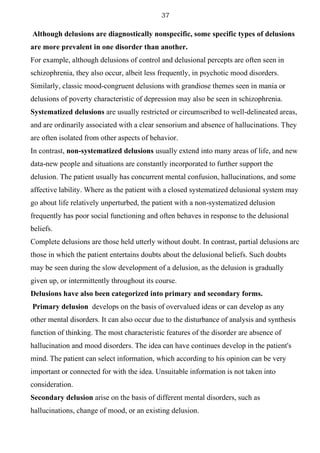
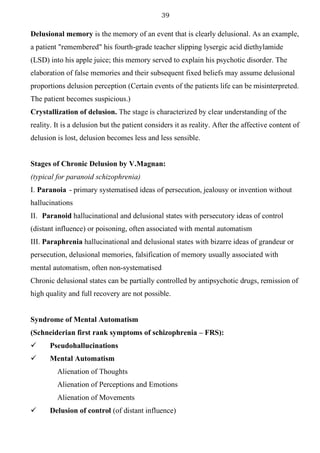
  • 123.
    Рисунок 2 –Деперсонализация при нервной анорексии dementia). Pick’s disease [F02, G31] – a progressive dementia with onset at age 50-60 with features of selective atrophy of frontal and temporal lobe (apathy, euphoria, severe character changes, verbal and motor stereotypy). The course is rather malignant; no sense of illness exists (total dementia). CEREBRAL ARTERIOSCLEROSIS System disease with slow progression and evident waving course. Cerebral symptoms coexist with features of ischaemia of heart or extremities. The first symptoms are asthenia and hypomnesia. Dementia appears later, insight is rather good (partial dementia – F01) TUMOURS Neurological symptoms are common in onset (paralysis, disorders of co-ordination of movement, disorders of vision, epileptic seizures etc.). If the frontal lobes are impaired, the changes of character, apathy and poor insight are typical. The symptoms of cranial hypertension are common (headache with retching increasing by the morning, clouding of consciousness). TRAUMA Acute or chronic regressive course. Stages are: loss of consciousness (up to coma), acute period (sometimes with acute psychosis, for example delirium), convalescence (through the stage of asthenia), consequences (cerbrasthenia, Korsakov’s syndrome, dementia, epileptic seizures, personality disorder). INFECTIONS GPI (general paralysis of insane – F02.8, A52.1) – syphilitic psychosis which appears in some patients in 10-15 years after infection. The symptoms of encephalitis are the loss of insight, euphoria, dementia, severe personality changes, delusions of grandeur. Neurological signs: Argyll-Robertson symptom, asymmetry of tendon reflexes. Wassermann test is
  • 124.
    positive in 95%of patients. Treatment: antibiotics, iodotherapy, bismuth drugs. AIDS dementia [F02.4, B22.0] – up to total is common in terminal phase. Treatment is symptomatical. EPILEPSY G40 Nosological definition: 1. Aetiology: Endogenous 2. Structure deterioration: organic 3. Course:chronic progressive. Outcome: Epileptic dementia (if malignant cases). 4. Symptoms and syndromes: Productive symptoms: rather different but ever paroximal. Negative symptoms: stable defect of personality with egocentrism (selfishness), circumstantiality (stiffness), emotional rigidity and explosivity. Epilepsy (rus-img.com)
  • 125.
    PAROXYSMAL DISORDERS: With deteriorationof consciousness Without deterioration of consciousness Grand mal Petit mal Twilight states Dysphoria Paroxysmal derealisation (déja vu, jamais vu) Paroxysmal hallucinations and delusions –
  • 126.
    INTERNATIONAL CLASSIFICATION OFSEIZURES: Primary generalised seizures Partial (focal) seizures Abrupt loss of consciousness (up to coma) without any prodromal symptoms (no aura) Total amnesia Simultaneous changes in all areas in EEG Examples: petit mal (absence, myoclonic seizures), grand mal without aura (tonic, clonic, tonic- clonic, atonic) No loss of consciousness or partial changed consciousness Partial or no amnesia Focal changes in EEG Examples: abrupt attacks of hallucination, delusion, disorders of drives Secondary generalised seizures Loss of consciousness after a stage of prodromal symptoms (aura) Examples: grand mal with aura DIFFERENTIAL DIAGNOSIS should be done against the tumours, alcoholic or sedative drug withdrawal syndrome, child fever convulsions, hysterical conversion. GRAND MAL HYSTERICAL CONVULSIONS (pseudoseizures) Abrupt spontaneous onset with sharp fall often with self-injury. Nocturnal seizures are common. Induced by emotional stress. Careful falling without self-injury. The face is pale at the beginning and then cyanotic Flushing or no changes in face colour. No deep reflexes, no reaction in case of suggestion Deep reflexes are vivacious, affection by suggestion Stereotypical tonic and clonic convulsions Non-stereotyped asynchronous body movements Convulsive meaningless facial expression Facial expression of suffering, fear or delight Duration — 30 s up to 2 min Long duration (several min up to an hour)
  • 127.
    Spikes, pathologic wavesand postictal slowing on EEG No specific EEG changes Abrupt spontaneous recovery through the stage of somnolence, postictal confusion. Total amnesia Sometimes partial amnesia, good effect of psychotherapy TREATMENT OF EPILEPSIA should be continuous without any kind of stop or fast dose changes because of the danger of status epilepticus. Cautious dose titration (‘low and slow’). The aim of treatment – best adaptation (control over the seizures without prominent adverse affects). The drugs with universal action are preferable. All kinds of seizures: valproates, carbamazepine, lamotrigin, topiramate Petit mal: valproates, ethosuximide, clobazam, clorazepate, clonazepam Grand mal: phenobarbital, phenytoin, vigabatrin, gabapentin, topiramate Partial (focal) seizures: carbamazepine STATUS EPILEPTICUS — repeated seizures on the background of coma.
  • 128.
    Psychogenous Reactions (www/psyportal.com) Cause: abruptwithdrawal of anticonvulsants, cerebral tumours, eclampsia. Outcome: Death because of the respiratory deficiency induced by cerebral oedema. Treatment: 1. anticonvulsants — diazepam intravenously; chloral hydrate, valproates or barbiturates per rectum. 2. For the treatment of oedema — diuretics, corticosteroid hormones (prednisolone, cortisol), heamodynamics correction, anticoagulants (heparin). PSYCHOGENOUS REACTIONS AND NEUROSES Diagnostic tirade (Jaspers K., 1913): • Close temporary relation between the stressor and the development of the disease • Symptoms show the reflection of the nature of the traumatic experience • Generally benign course of the disease with the complete recovery after the psychological problem is solved CLASSIFICATION: russian terminology ICD-10 categories ACUTE STRESS INDUCED PSYCHOSES Аффективно-шоковые реакции F43.0 – Acute stress reaction Истерические психозы F44.80 – Ganser’s syndrome, or F44.1-F44.3 – Dissociative fugue, stupor, trance
  • 129.
    Реактивная депрессия F32– Depressive episode Посттравматическое стрессовое расстройство (ПТСР) F43.1 – Post-traumatic stress disorder Реактивный параноид F23.31 – Other acute predominantly delusional psychotic disorders (including paranoid reaction) NEUROSES (неврозы) Неврастения F48.0 – Neurasthenia Невроз навязчивых состояний F40 – Phobic anxiety disorders, F41 – Other anxiety disorders (including panic disorder), F42 – Obsessive-compulsive disorder, F45.2 – Hypochondriacal disorder (including nosophobia) Истерический невроз F44 – Dissociative [conversion] disorders, F45 – Somatoform disorders Ипохондрический невроз F45.2 – Hypochondriacal disorder (nondelusional) Депрессивный невроз F34.1 – Dysthymia, F43.2 – Adjustment disorders, F43.1 – Post-traumatic stress disorder Acute Stress Induced Psychoses Nosological definition: 1. Aetiology: psychogenous, the result of acute irresistible stressors concerning the primary personal needs (safety, health, honour, freedom and so on)
  • 130.
    2. Structure deterioration:functional 3. Course: acute (no longer than several months). Outcome: full recovery. 4. Symptoms and syndromes: Productive symptoms: rather prominent (psychotic level), often with dangerous (or suicidal) behaviour, sometimes with obscured consciousness. Negative symptoms: no. Clinical forms: Acute stress reaction – a short period of excitement or stupor, associated with disorder of consciousness and amnesia in case of real threat of death. Hysterical psychoses — psychotic symptoms (regression to childish or animal behaviour, imaginary ‘dementia’, twilight states, hallucinations), produced unconsciously by autosuggestion in case of acute irresistible stress. Variants: Ganser’s syndrome, pseudodementia, dissociative fugue, puerility. Reactive depression — depression as a result of irresistible loss (the death of a relative, divorce, fired from work, loss of money, being a victim of crime and so on). Suicidal behaviour is possible. Reactive paranoid — delusional ideas of persecution provoked by the situation of uncertain threat (unusual vague situation, incomprehensible language, war threat, fast changed events and so on). Post-traumatic stress disorder (PTSD) – a mixture of anxiety symptoms (panic, intrusive thoughts, memories or images of event, sleep disorders) that occur in a person who has experienced a severe psychological trauma and last longer than a month. Treatment: In case of anxiety and panic — tranquilizers (one injection or short course). In case of hysterical (dissociative) disorders and psychogenous stupor — suggestive psychotherapy, tranquilizers (once or short course), placebo.
  • 131.
    In case ofdepression or PTSD — group and supportive psychotherapy, antidepressants, short course of sedatives for correction of sleep disorders In case of delusional states — neuroleptics and supportive psychotherapy Psychogenous Reactions and Neuroses (CONTINUATION) Neuroses Neuroses — a spectrum of illnesses appeared with mild mental or somatic symptoms, which production is unconscious and originated from unconscious motives and conflicts. Nosological definition: 1. Aetiology: psychogenous, the result of internal conflicts 2. Structure deterioration: functional 3. Course: prolonged without progression. Outcome: recovery or stabilization with pathologic development of personality (pathologic personality). 4. Symptoms and syndromes: Productive symptoms: rather different but ever mild (neurotic level). Negative symptoms: no. SOME THEORETICAL APPROACHES in investigations of the origin of neuroses Interpersonal conflicts — the result of irreconcilable contradictions between the interests or motives of two or several individuals. Intrapersonal (internal) conflicts — the result of irreconcilable contradictions between two or several motives of one person. Individuals, who provoke interpersonal conflicts, make other people to suffer a lot and tend to be diagnosed as psychopaths. Individuals, who provoke intrapersonal conflicts, make themselves suffer a lot and tend to be diagnosed as neurotics. According to I.P.Pavlov
  • 132.
    the kind ofneurosis depends upon the type of personality. ‘intellectual’ type with predominance of the second set of conditioned stimuli (language, logic, operating with symbols) over the first is common for patients with obsessive-phobic neurosis ‘artistic’ type with predominance of the first set of conditioned stimuli (emotions, sensations and intuition) over the second is common for patients with hysteric neurosis According to S.Freud the symptoms of neuroses represent unconscious psychological defense against the irresistible internal conflicts (often sexual problems). Unconscious motives are the cause of the poor insight and resistance against the treatment. CLINICAL FORMS Neurasthenia appears with the symptoms of asthenia (fatigability in combination with irritability) that are linked to meaningful psychological stressors. Symptoms: Psychological: tiredness, poor memory, sleep disorders, lack of restraint, psychological sensibility (appeared with tears or verbal violence). Somatic: functional pain (headache, stomachache, and backache), arterial hypo- or hypertension, palpitation, sweating, linked to psychological troubles or physical difficulties. Hysteria (dissociative [conversion] disorders, somatoform disorders, somatization disorder) is characterized by physical or psychological symptoms for which no physical cause can be identified but which are linked to meaningful psychological stressors. The symptoms may help patients unconsciously deal with internal conflicts. It is more common in women and patients with demonstrative (histrionic) features of personality. It is strongly recommended to make special investigation to exclude any other cause of the somatic symptoms because about 30% of patients with preliminary diagnose of hysteria are later diagnosed with organic disorders (cancer, multiple sclerosis,
  • 133.
    Wilson’s disease, duodenalulcers and so on). Symptoms: Neurological: loss or change in sensory or motor function, blindness, gait or coordination disturbances, seizures and so on. Somatic: functional pain (headache, stomachache, painful extremities), lump in throat (difficulty swallowing), vomiting, palpitation, shortness of breath, dysmenorrhea, burning in sex organ and so on. Psychological: amnesia, false visions, unstable fears, bright emotional reactions (crying, laughing), substance abuse. Obsessive-phobic neurosis (phobic disorder, obsessive-compulsive disorder, anxiety disorder) — a spectrum of illnesses appeared with the symptoms of anxiety, unreasonable fears, obsessions and rituals, associated with internal conflicts. Symptoms: Psychological: phobias, obsessions, compulsive acts, panic attacks (sudden, unexpected episode of intense fear), obsessive hypochondriac ideas, diffidence, low self-appraisal and so on. Somatic: all the kind of somatic sensations, which make the patients to pay especial attention, often the episodes of palpitation, sweating, shaking, chest pain or discomfort, dizziness, chills or hot flashes and so on. Pseudoparalisis in dissosiative disorders (www.psyportal.com)
  • 134.
    PSYCHOTHERAPY психотерапия PSYCHOTHERAPY isa method of working with patients to assist them to modify, change or reduce factors/disorders that interfere with effective living. These factors may localize in individual psychic functioning and patterns of functioning as well as in interpersonal systems. Psychotherapy relates on the whole to interventions directed to patterns of functioning and interpersonal systems. As to interventions directed to individual psychic functions they are called training of functions (for instance training of memory). Both of these concepts contain an aspect of psychotherapy. All psychotherapeutic methods have: General time organization (fazes): 1) definition of indications (diagnosis, choosing of psychotherapeutic method, information, and informed consent); 2) creation of therapeutic alliance and explanation of problem and therapeutic goals; 3) therapeutic learning; 4) assessment before and after the end of psychotherapy. General mechanisms (refers to those processes that make psychotherapy work): • Mastery/coping – refers to patient’s ability to acquire skills and habits to cope that are absent on disease; • Clarification on meaning – for instance help to patient to aware that anxiety may have a source in estimation some situation as threatening; • Actualizing of problem – activating of emotional patterns that are connected with a problem to create best conditions for learning; • Activation of resources - mobilization of patient’s forces for changers take place and become stable. General processes (undisguised and hidden kinds of activity of individual that becomes involved to change his problem/unhealthy behavior): ➢ Self-exploration/consciousness raising – receiving new information about self and problems: superintendence, confrontation, interpretation; bibliotherapy; ➢ Self-reevaluation – statement how individual experiences and thinks about himself in respect to some problem: clarification of meaning, work of notions, correcting emotional
  • 135.
    experience; ➢ Self-liberation –making a decision to change behavior, enforcement of confidence in ability for changing: decision-making therapy, logo therapy, motivating therapy; ➢ Counter-conditioning – substitution of problem behavior by adaptive one: relaxation, desensibilization, self-confidence training, positive self-instructions; ➢ Stimulus control – avoidance or fight with stimuli that provoked problem behavior, avoidance of dangerous situations of risk; ➢ Reinforcement management – self-reinforcement or reinforcement by others health behavior: contract about strict frame of behavior, undisguised and hidden reinforcement, self-reward; ➢ Helping relationships – trust people able to help: therapeutic alliance, social support, self-help groups; ➢ Dramatic relief – skill to revile and to express senses with reference to problems and their solution: psychodrama, role playing; ➢ Reevaluation of others – awareness about other’s being influenced by their own problems, empathy training; ➢ Social liberation – acquisition or consolidating constructive social behavior: coming out in defense of oppressed people, active position in life. General psychological tools of therapeutic learning: • Forming of stereotypes by training – it means those tools that enforce affective, cognitive, motor and other disposals by repetition of behavior, including mental training (behavior is repeated accordingly notion); • Confrontation with situation that provokes anxiety for reduction of affective reactions; • Positive or negative, verbal or inverbal feedback from psychotherapist (motivate feedback); • Psychotherapist as a model of adequate human relations and interactions; • Cognitive tools – exploration, persuasion, informative feedback are directed to influencing on cognitive representations and expectations; • Psychophysiology oriented methods – involvement of soma into psychotherapy (body oriented psychotherapy, biofeedback).
  • 136.
    General factors ofpsychotherapeutic influence: 1) changing of self-feeling; 2) changing of symptoms; 3) changing of personality’s structure. The first two factors precede the third one. General variables of a psychotherapist: o Age, gender, ethnicity comparable with patient’s ones may have positive influence; o Ability to establish warm, respectable and no anxiety evoking relations with patient (three Roger’s variables – warmth, empathy and authenticity); o Personal features – self-confidence, self-accept, calm, frustration tolerance, general and meaning establishment; o Variable of experience – more experienced psychotherapists achieve better results with difficult patients. General variables of a patient: ▪ Attractiveness – it is easier to establish positive relations with YAVIS-patients (young, attractive, verbal talented, intelligent, successful); ▪ Therapeutic expectations, including expectation of success and trust to psychotherapist; ▪ Measure of defense that correlate with readiness to start psychotherapy and variable of self-exploration; ▪ Features of personality – age, gender, strength of Ego, level of intelligence; ▪ Gravity and kind of disorder. General features of relations between a psychotherapist and a patient: ❑ Reciprocal affirmation; ❑ Correspondence of features to each other in sense of personal resemblance and supplement to each other; ❑ Formal signs of interactions: rhythm of interchange of remarks, reciprocal social reinforcement and punishment.
  • 137.
    Multiple personality inpersonality disorders (www. blogdoma.ru) PERSONALITY DISORDERS F6 Diagnostic criteria (P.B. Gannushkin, 1933): 1. Относительная стабильность — Relative stability (appear during childhood or adolescence and continue into adulthood without evident progression) 2. Тотальность — Marked disharmony, involving several areas of functioning (affectivity, arousal, impulse control, ways of perceiving and thinking, style of relating to others). Behaviour pattern is pervasive and clearly maladaptive to a broad range of personal and social situations. 3. Дезадаптация — Poor adaptation (significant problems in family, occupational and social performance) Nosological definition: 1. Aetiology: complex of endogenous, biological, psychological and social factors (the result of pathological heredity and problems of development due to poor health or bad breeding). 2. Structure deterioration: functional 3. Course: no course in adults, but some dynamics is possible (evolutional, decompensation due to bad situation, endogenous affective cyclic changes). Outcome: stable, no outcome. 4. Symptoms and syndromes: Productive symptoms: rather different but ever non-psychotic, more prominent during the periods of decompensation. Negative symptoms: stable peculiarities of the behaviour and emotional reactions (disorders of the will and behaviour).
  • 138.
    Accentuated personalities —nonpathologic variants of personality some traits of which are a little bit out of usual limits. Being generally well adapted these people can show better possibility (talent) to stand some special kinds of situations but greater sensitivity (marked desadaptation) to some other kinds. Decompensation — disease induced by poor adaptability to situation of individual with personality disorder (for example, neurosis, reactive depression, reactive paranoid psychosis, alcoholism, drug dependence, pathologic affects). Treatment — the aim is not recovery but compensation: Biologic: the usa of tranquilizers is not recommended because of high risk of dependence. Neuroleptics (neuleptil, risperidon, melleril, chlorprotixene and others) — often show good effect in low doses in case of antisociality, aggressiveness, low control upon behavior. Antidepressants — show good effect in case of obsessions, hypothimia, pessimism, low self-rating. Anticonvulsants (carbamazepine, valproates) — should be indicated in case of mood instability, dysphoria, aggression, self-aggression Psychotherapy: more effective - group-therapy and different methods of psychodynamic therapy CLASSIFICATIONS: Etiology classification (O. V. Kerbikov, 1968) Constitutional («nuclear») Pathologic development Induced by genetic predisposition or early organic disorder affected constitution Induced by microsocial situation and social education Poor prognosis. Correction by drugs. Favourable prognosis. Correction by psychotherapy
  • 139.
    Socially oriented classificationof O.V. Kerbikov (1968) Возбудимые типы — excessive behaviour Тормозимые типы — restrictive behaviour Asocial behaviour and antisocial acts No antisocial acts Paranoid Dissocial Emotionally unstable Histrionic Hyperthymic Schizoid (expansive group) Anankastic Anxious Dependent (Asthenic) Dysthymic Schizoid (sensitive group) Symptomatically oriented classification — DSM IV Cluster A Cluster B Cluster C odd or eccentric dramatic, erratic and labile fearful, inhibited and anxious Paranoid Shizoid Schizotypal Antisocial Borderline Histrionic Narcissistic Avoidant Dependent Obsessive-compulsive Provided for further study: Depressive Passive-agressive (negativistic)
  • 140.
    Personality Disorders (CONTINUATION) ICD-10 Apersonality disorder is a severe disturbance in the characterological constitution and behavioural tendencies of the individual, usually involving several areas of the personality, and nearly always associated with considerable personal and social disruption. A personality disorder tends to appear in late childhood or adolescence and continues to be manifest into adulthood. It is therefore unlikely that the diagnosis of personality disorder will be appropriate before the age of 16 or 17 years. General Diagnostic Guidelines Conditions not directly attributable to gross brain damage or disease, or to another psychiatric disorder, meeting the following criteria: (a) markedly disharmonious attitudes and behaviour, involving usually several areas of functioning, e.g. affectivity, arousal, impulse control, ways of perceiving and thinking, and style of relating to others; (b) the abnormal behaviour pattern is enduring, long standing, and not limited to episodes of mental illness; (c) the abnormal behaviour pattern is pervasive and clearly maladaptive to a broad range of personal and social situations; (d) the above manifestations always appear during childhood or adolescence and continue into adulthood; (e) the disorder leads to a considerable personal distress but this may only become apparent late in its course; (f) the disorder is usually, but not invariably, associated with significant problems in occupational and social performance. For different cultures, it may be necessary to develop specific sets of criteria with regard to social norms, rules and obligations. F60.0 PARANOID PERSONALITY Personality disorder characterized by at least 3 of the following: (a) excessive sensitiveness to setbacks and rebuffs;
  • 141.
    DISORDER (b) tendencyto bear grudges persistently, i.e. refusal to forgive insults and injuries or slights; (c) suspiciousness and a pervasive tendency to distort experience by misconstruing the neutral or friendly actions of others as hostile or contemptuous; (d) a combative and tenacious sense of personal rights out of keeping with the actual situation; (e) recurrent suspicions, without justification, regarding sexual fidelity of spouse or sexual partner; (f) tendency to experience excessive self-importance, manifest in a persistent self-referential attitude; (g) preoccupation with unsubstantiated "conspiratorial" explanations of events both immediate to the patient and in the world at large. F60.1 SCHIZOID PERSONALITY DISORDER Personality disorder characterized by at least 3 of the following: (a) few, if any, activities, provide pleasure; (b) emotional coldness, detachment or flattened affectivity; (c) limited capacity to express either warm, tender feelings or anger towards others; (d) apparent indifference to either praise or criticism; (e) little interest in having sexual experiences with another person (taking into account age); (f) almost invariable preference for solitary activities; (g) excessive preoccupation with fantasy and introspection; (h) lack of close friends or confiding relationships (or having only one) and of desire for such relationships; (i) marked insensitivity to prevailing social norms and conventions.
  • 142.
    F60.2 DISSOCIAL (ANTISOCIAL) PERSONALITY DISORDER Personality disorder, usuallycoming to attention because of a gross disparity between behaviour and the prevailing social norms, and characterized by at least 3 of the following: (a) callous unconcern for the feelings of others; (b) gross and persistent attitude of irresponsibility and disregard for social norms, rules and obligations; (c) incapacity to maintain enduring relationships, though having no difficulty in establishing them; (d) very low tolerance to frustration and a low threshold for discharge of aggression, including violence; (e) incapacity to experience guilt and to profit from experience, particularly punishment; (f) marked proneness to blame others, or to offer plausible rationalizations, for the behaviour that has brought the patient into conflict with society. There may also be persistent irritability as an associated feature. Conduct disorder during childhood and adolescence, though not invariably present, may further support the diagnosis. F60.3 EMOTIONALLY UNSTABLE (BORDERLINE) PERSONALITY DISORDER A personality disorder in which there is a marked tendency to act impulsively without consideration of the consequences, together with affective instability. The ability to plan ahead may be minimal, and outbursts of intense anger may often lead to violence or "behavioural explosions"; these are easily precipitated when impulsive acts are criticized or thwarted by others. Two variants of this personality disorder are specified, and both share this general theme of impulsiveness and lack of self-control. Impulsive type:
  • 143.
    The predominant characteristicsare emotional instability and lack of impulse control. Outbursts of violence or threatening behaviour are common, particularly in response to criticism by others. Borderline type: Several of the characteristics of emotional instability are present; in addition, the patient's own self-image, aims, and internal preferences (including sexual) are often unclear or disturbed. There are usually chronic feelings of emptiness. A liability to become involved in intense and unstable relationships may cause repeated emotional crises and may be associated with excessive efforts to avoid abandonment and a series of suicidal threats or acts of self-harm (although these may occur without obvious precipitants). F60.4 HISTRIONIC PERSONALITY DISORDER Personality disorder characterized by at least 3 of the following: (a) self-dramatization, theatricality, exaggerated expression of emotions; (b) suggestibility, easily influenced by others or by circumstances; (c) shallow and labile affectivity; (d) continual seeking for excitement, appreciation by others, and activities in which the patient is the centre of attention; (e) inappropriate seductiveness in appearance or behaviour; (f) over-concern with physical attractiveness. Associated features may include egocentricity, self-indulgence, continuous longing for appreciation, feelings that are easily hurt, and persistent manipulative behaviour to achieve own needs. F60.5 ANANKASTIC (OBSESSIVE- COMPULSIVE) PERSONALITY Personality disorder characterized by at least 3 of the following: (a) feelings of excessive doubt and caution; (b) perfectionism that interferes with task completion;
  • 144.
    DISORDER (c) excessiveconscientiousness, scrupulousness, and undue preoccupation with productivity to the exclusion of pleasure and interpersonal relationships; (d) excessive pedantry and adherence to social conventions; (e) rigidity and stubbornness; (f) unreasonable insistence by the patient that others submit to exactly his or her way of doing things, or unreasonable reluctance to allow others to do things; (g) intrusion of insistent and unwelcome thoughts or impulses. F60.6 ANXIOUS (AVOIDANT) PERSONALITY DISORDER Personality disorder characterized by at least 3 of the following: (a) persistent and pervasive feelings of tension and apprehension; (b) belief that one is socially inept, personally unappealing, or inferior to others; (c) excessive preoccupation with being criticized or rejected in social situations; (d) unwillingness to become involved with people unless certain of being liked; (e) restrictions in lifestyle because of need to have physical security; (f) avoidance of social or occupational activities that involve significant interpersonal contact because of fear of criticism, disapproval, or rejection. Associated features may include hypersensitivity to rejection and criticism. F60.7 DEPENDENT PERSONALITY DISORDER Personality disorder characterized by at least 3 of the following: (a) encouraging or allowing others to make most of one's important life decisions; (b) subordination of one's own needs to those of others on whom one is dependent, and undue compliance with their wishes;
  • 145.
    (c) unwillingness tomake even reasonable demands on the people one depends on; (d) feeling uncomfortable or helpless when alone, because of exaggerated fears of inability to care for oneself; (e) preoccupation with fears of being abandoned by a person with whom one has a close relationship, and of being left to care for oneself; (f) limited capacity to make everyday decisions without an excessive amount of advice and reassurance from others. Associated features may include perceiving oneself as helpless, incompetent, and lacking stamina. LINKS BETWEEN ICD-10 AND CLASSIFICATIONS USED IN RUSSIA (P.B. Gannushkin, O.V. Kerbikov, A.E. Lichko) Признанные в России типы психопатий Correspond to ICD-10 items Main features Паранойяльная F60.0 Paranoid personality disorder Strong will, suspiciousness, overvalued ideas, jealousy, misconstruing the neutral actions of others as hostile Шизоидная F60.1 Schizoid personality disorder F21 Schizotypal disorder Introversion, low interest in others, independence, indifference to either praise or criticism, strange mixture of emotional coldness and marked sensitivity (‘glass or wood’) Истерическая F60.4 Histrionic personality disorder F60.8 Narcissistic personality disorder Strong tendency to demonstrate their individuality, to be the centre of attention, self-dramatization, theatricality, egocentricity, persistent manipulative behaviour, pseudologia
  • 146.
    phantastica. Неустойчивая F60.2 Dissocial (antisocial) personalitydisorder F60.3 Emotionally unstable (borderline) personality disorder: borderline type. The lack of will and patience, tendency to realize any need immediately without regard for the circumstances, hedonism, uncontrolled use of drugs and alcohol, antisocial acts due to influence of friends, irresponsibility. Возбудимая F60.2 Dissocial (antisocial) personality disorder F60.3 Emotionally unstable (borderline) personality disorder: impulsive type. The lack of impulse control, outbursts of violence, aggressiveness, intolerance to criticism by others. Гипертимная F34.0 Cyclothymia Excessive activity, optimism, distractibility, low ability to lead the deals to the end. Дистимическая F34.1 Dysthymia Pessimistic predisposition, low self- appraisal, passiveness Психастения F60.5 Anankastic (obsessive-compulsive) personality disorder F60.6 Anxious (avoidant) personality disorder F60.7 Dependent personality disorder Over-anxious person, which cannot make his own decision because of the fear to make a mistake. The rigidity, pedantic attitude towards others are the defense mechanism against the fear of novelty.
  • 147.
    Астеническая F60.6 Anxious (avoidant)personality disorder F60.7 Dependent personality disorder Excessive fatigability and irritability, low energy and poor health. Accentuation personality Diagnostic criteria: 1. Single traits personality are increased. 2. There are selective voidability of personality to same stressful situations 3. Good or increased steadiness to other stressful situations. Leogard’s classification of accentuations personality: 1. Hyperexcitability type (constantly increased mood, boldness, tendency to be leader). Weak point: intolerance of isolation, monotonic work, monotonous atmosphere. 2. Cyclotymique (tendency to changes of mood, prevalence subdepressions). Weak point: breaking of life stereotype. 3. Lability type ( neurotic reactions, emotional instability). Weak point: dependent of other people, emotional isolation. 4. Asthenic type (fatigability, tendency to hypochondriac ideas, anxiety, bed sleep, appetite, irritability). Weak point: intolerance of physical and psychical activity. 5. Anxiety type (shyness, diffident, timid, fearful, responsibility, conscientious). Weak point: intolerance of gibe, unkind relation. 6. Dystimique type (depressive mood, ideomotoric dormancy) 7. Demonstrative type (egotism, suggestibility, demonstrative behavior, desire to be in the centre of attention). Weak point: blow of egotism. 8. Exaltive type (wide variety of emotional reaction). Weak point: social and emotional isolation. 9. Pedantical type (rigidity of all psychical process, frugality, pettiness, dysphoria,
  • 148.
    perfectionism). Weak point:inability to decide rapidly. 10.Hypertymique type (increased mood, thirst for business is constantly present, hyperactivity, enterprise).
  • 149.
    EXOGENOUS (SYMPTOMATIC) MENTALDISORDERS Bonhoeffer’s forms of exogenous reactions (acute brain syndromes) (Bonhoeffer K., 1908, 1910): on the whole the type of mental disorder produced by coarse brain damage depends on the site, extent, and tempo of the morbid process rather than on the specific nature of the brain disease. Typical are the syndromes mentioned below: 1) Asthenia 2) Disorders of consciousness: clouding of consciousness, coma, delirium, twilight states, amentia 3) Hallucinosis: acute psychosis with abundant true hallucinations without disorder of consciousness 4) Paroxysmal states: epileptic seizures Later: 5) Korsakov’s syndrome 6) Dementia CARDIOVASCULAR DISORDERS Cardiovascular disease is the leading cause of death in the United States and in most of the industrialized world. About one-third of all adults over age 35 will ultimately die of cardiovascular disease, most often of complications of atherosclerotic coronary artery disease. Psychiatric disorders frequently occur as complications or comorbid conditions in individuals with cardiovascular disease. Depression, anxiety, delirium, and cognitive disorders are especially prevalent problems. Surveys of ambulatory cardiology patients with documented heart disease indicate a point prevalence of 5 to 10 percent with anxiety disorders (predominantly panic attacks and phobias) and 10 to 15 percent with mood disorders (predominantly depressive episodes and minor depression or dysthymia). Major depressive disorder occurs in 15 to 20 percent of patients following myocardial infarction. Depression In overwhelming support of long-held popular views, numerous recent investigations strongly support the hypothesis that depression increases the risk of development and
  • 150.
    progression of coronaryartery disease. Over the past 60 years, several studies of institutionalized or treated mentally ill patients suggested an excess of cardiovascular mortality in those with depression compared with the general population, but these studies were potentially confounded by effects of the setting or treatment that defined the population. More recently, numerous large-scale, prospective epidemiological studies of community-dwelling subjects who were not psychiatric patients have yielded converging estimates of increased relative risks of incident myocardial infarction and cardiac related mortality of about 1.6-2.2 to 1 in association with depression. This finding holds even after controlling for smoking, a potent risk factor for cardiovascular morbidity and mortality, which is far more prevalent in those with depression than in the population at large, and the effect of depression persists, even in long-term follow-up over 10 to 20 years. Furthermore, studies of patients with preexisting coronary artery disease also demonstrate a near doubling of risk for adverse coronary disease–related outcomes, including myocardial infarction, revascularization procedures for unstable angina, and death, in association with depression. Symptoms of depression and the diagnosis of major depressive disorder carry a 3.5 to 6.6-fold increased adjusted relative risk of death in 6- and 18-month follow-up of myocardial infarction patients. In these patients, the predominant mode of death is sudden cardiac death. Co-occurrence of depression and frequent premature ventricular contractions after myocardial infarction appears to increase mortality risk substantially, suggesting arrhythmia as the mechanism of death. Whether this risk can be reduced by treatment of depression is currently under investigation. One recent study of psychosocial intervention for postmyocardial infarction patients with depression or social isolation used monthly telephone contact, followed by a nurse's home visit to patients who expressed distress, and variable subsequent contacts. Although a preliminary study in men had suggested a beneficial effect of this program on recurrent cardiac event and mortality rates, replication in a cohort of both men and women failed to demonstrate an overall benefit, and women receiving the intervention had a poorer outcome than a control group receiving usual care. Further psychosocial intervention and pharmacotherapy trials are ongoing. Possible Mechanisms
  • 151.
    Mechanisms by whichdepression may increase coronary disease risk are uncertain. Autonomic dysregulation with diminished cardiac vagal modulation occurs in depression and may provide a substrate for increased arrhythmic activity and sudden death. Disordered platelet aggregation leading to increased thrombus formation may also play a role in increasing risk of coronary events in depression. Measures of in vivo platelet activation and aggregation after overnight bed rest and following orthostatic challenge in medication-free, otherwise healthy depressed patients and normal control subjects show that depressed patients exhibit greater procoagulant activity at baseline and greater platelet activation on orthostatic challenge. The findings suggest that increased concentrations of plasma neuroregulators that can induce platelet activation (e.g., epinephrine or serotonin), intrinsic platelet factors, intraplatelet catecholamine or monoamine concentration changes, or a combination of these increase platelet reactivity in depressed patients. Patients with ischemic heart disease and depression have significantly elevated concentrations of circulating platelet factor 4 and b-thromboglobulin, factors associated with platelet activation; patients with ischemic heart disease alone also have elevated levels of these factors, but to a much lesser extent than patients with depression. Treatment with the serotonergic antidepressant paroxetine, but not with the tricyclic antidepressant nortriptyline, was associated with reduced levels of these indexes of platelet activation in one small study. Hostility and Type A Behavior Pattern The relation between a behavior pattern characterized by easily aroused anger, impatience, aggression, competitive striving, and time urgency (Type A) and coronary heart disease dominated studies in psychosomatic cardiology in the 1970s and 1980s. Arrhythmias Ventricular arrhythmias may be asymptomatic or may cause palpitations, lightheadedness, dizziness, syncope, or sudden cardiac death. Patients who experience life- threatening rhythm disturbances are prone to secondary adjustment, mood, and anxiety disorders. The cardiovascular symptoms may lead to profound disruption of social roles and capacity for autonomous functioning. Even patients without symptoms may be counseled to avoid activities such as driving, which may be hazardous in the event of an arrhythmic event. Psychodynamically, because of the recurring, unpredictable, and sudden
  • 152.
    quality of thecourse of illness, issues of dependence on others and loss of control are especially prominent, as well as anxiety about death itself Delirium Delirium is a common problem in severely ill cardiac patients. Three main categories of patients are at risk: patients with severe congestive heart failure, patients receiving antiarrhythmic agents for tachyarrhythmias early after myocardial infarction or cardiac surgery, and patients following cardiac surgery. In congestive heart failure patients, delirium commonly results from hypoxia, hyponatremia, hyperammonemia, or azotemia, as pulmonary congestion and poor end-organ perfusion progress. Patients receiving lidocaine and procainamide may appear psychotic or delirious, even at nominally therapeutic blood levels. The clinical picture in postoperative patients may include all of these elements; in addition, cerebrovascular incidents during surgery, infection, sedatives, and narcotics may contribute to delirium. Management relies on correcting the underlying abnormality while treating psychosis or agitation with antipsychotic agents. Other sedatives should generally be avoided, although the agitated patient may benefit from concurrent administration of lorazepam (Ativan) with haloperidol (Haldol). Intravenous haloperidol can be administered frequently, especially if hemodynamic monitoring is in place. Very high dosages, however, may be associated with arrhythmias, including torsade de pointes. Prolonged cardiac conduction can occur with thioridazine (Mellaril) and chlorpromazine (Thorazine), especially in patients taking type 1A antiarrhythmic agents. B-Adrenergic receptor antagonists (beta-blockers) may cause elevated concentrations of antipsychotic drugs. CARDIOVASCULAR PRESENTATIONS OF PSYCHIATRIC DISORDERS: CHEST PAIN, ARRHYTHMIA, PALPITATIONS Somatization disorder, panic disorder, anxiety, and depression can all present with somatic complaints and represent a substantial issue in ambulatory and emergency cardiology practice. In studies of patients presenting with the chief complaint of palpitations, these diagnoses account for about 30 percent of cases. In this population, psychiatric disorder is associated with more frequent recurrent symptoms, emergency room visits, hypochondriacal concerns, and impairment in activities of daily living.
  • 153.
    Progressive pulsy (dementiaparalytica, general paresis, Boule's disease, cerebral tabes, syphilitic meningoencephalitis). It is organic brain disturbances as a result of lues, characterized by progressive disturbances of psychical activity, dementia with neurological and somatic symptoms. The course of progressive pulsy includes 3 stages: 1. Neurasthenic-like stage (increased irritability, fatigability, headache, sleep disorders, personality change, disturbances of faith, inadequate behavior). There are decrease of working ability. Changes of personality may also be observed in this stage: loss of awareness of ethic norms, feeling of shame, decrease critic of the state. 2. Paralytic stage(flowering) (severe change of personality, decrease of intellect and memory, depraved behavior, euphoria, loss of self-critics and environment, hallucination, delusion grandeur and progressive dementia). Changes of personality and behavior disorders prevail in clinical picture. Individual traits of personality are lost. Patient do absurd actions, their jokes are also absurd and indiscreet. Absurd delusion grandeur, true auditory and visual hallucinations and euphoria are present. In this period, speech disorders may be observed (disturbances of spontaneous speech and difficult words, dysarthria). There are also disturbances of count and writing. The patient has an unstable gait, epileptic-like seizers, mono- or hemiparesis. Wassermann’s reaction is positive. 3. Marasmic stage (total disintegration of psychiatric activity). Euphoria changes to apathy spontaneously. There are severe dementia, decreased of judgement, absurd opinions. Patient does not answer questions, and is helplessness. There are disturbances of swallowing, incontinence of urine and defecation. Aphasia, apraxia, epileptic-like seizers, paresis, paraplegia are observed. Basic principles of treatment: 1. Antibiotic drugs (pénicilline groupe, érythromycine, céphalosporine groupe) 2. Bismuth drugs 3. Antipsychotique drugs
  • 154.
    HEAD INJURY Most headinjury do not have serious long-term consequences. Can be divided two main groups of patients who have suffered a head injury: • a small number of patients with serious, permanent cognitive sequel • a larger group with emotional symptoms and personality change Acute psychological effects. Impairment of consciousness occurs after all but the mildest closed injures, but is less common after penetrating injures. On recovery of consciences, defects of memory are usually apparent. Even apparently ‘”minor” head injury can cause an acute brain damage. Diffuse shear caused by rotational force may give rise to both structural and metabolic axonal damage. After severe injury, there is often a prolonged phase of delirium, with disordered behavior, anxiety, and mood disturbance, aspontanesation. The duration of post-traumatic amnesia correlated closely to neurological complications, persistent deficits in memory, psychiatric disability, generalized intellectual impairment, and personality change. Conversely, the period of retrograde amnesia is not a good predictor outcome. Chronic psychological effects. There are neurological and cognitive deficits. Long-term outcome is also influenced by premorbid personality traits, occupational attainment, availability of social supports, and compensation issues. It develops in 3 months to 3 years in post-traumatic epilepsy, changes of personality, suicide, psycho organic syndrome, post- traumatic dementia, and post-traumatic psychosis. Psychoorganic syndrome (post-concussional syndrome) includes anxiety, depression, and irritability, accompanied by headache, dizziness, fatigue, poor concentration, and insomnia. The duration and severity are highly variable.
  • 155.
    Lasting cognitive impairmentsappear in diffuse brain damage and especially penetrating injuries. Cognitive impairments appears after post- traumatic amnesia and is proportional to their severity. Cognitive impairments are related to organic psychological symptoms such as apathy, euphoria, poor judgment. Personality changes are common after severe injuries (frontal lobe damage) when there may be irritability, apathy, loss of spontaneity and drive, disinhibition and occasionally reduce control of aggressive impulses. Emotional disorders are depression and anxiety. Organic affective disorders (F 06.3) These disorders are represented by subdepression, depression, hypomania, mania and bipolar disorders, also distimia and dysphoria. All patients have a psychoorganic syndrome. Cognitive function decreases insignificantly. Organic asthenic disorders (F 06.6) These disorders are represented by increased irritability, decrease memory, weakness, fatigability, vegetative disorders, emotional instability, headache, unpleasant sensation of somatic fields. Organic anxiety disorders (F 06.4) These disorders show up obsessive ideas, ruminations, vegetative disorders, may be impulsive volition, dysphoria, insignificant cognitive disorders, and psychoorganic syndrome. Organic personality disorders (F 07) To establish this diagnosis we must have objective data of presence of head injury or/and organic disease; absence of consciousness or severe memory disorders. Patients are characterized by a decrease of possibility in goal-seeking behavior, absence in control of their emotion, cognitive disturbances (suspicion, inclination to fixation in some theme, for example, religious); fuzziness of conception, change of sexual behavior. Neurosis-like syndromes:
  • 156.
    1. asthenic syndrome(increased irritability, decreased memory, weakness, fatigability, vegetative disorders) 2. asthenic-depressive syndromes (weakness, sleep disorders, depression mood, languor) 3. obsessive-phobic syndrome (obsessive ideas, ruminations, vegetative disorders) 4. hysterioform syndrome (increase suggestibility, affective instability, demonstrative behavior) 5. pseudologic syndrome (inclination to lie, simulation, aggravation of the disease) 6. paranoiac syndrome (inclination to creation of overvalued ideas, sthenic behavior, suspicion) 7. asthenic-hypochondriac syndrome (many somatic complaints, anxiety misgiving, depression mood, asthenia) Subdural haematoma Subdural haematoma is not uncommon after falls in elderly patients, and especially those associated with alcoholism. A history of head trauma is commonly lacking. Acute haematomas may cause coma or fluctuating impairment of consciousness, and are often associated with hemiparesis and oculomotor signs. The psychiatrist is more likely to see the chronic syndromes, in which patients present with headache, poor concentration, vague physical complaints, and fluctuating consciousness, but often few localizing neurological signs. It is particularly important to consider this possibility as a cause for accelerated deterioration in patients with a neurodegenerative dementia. Treatment is by surgical evacuation, which may reverse the symptoms. Principle of treatement Acute head injury: Treatments must be performed in special hospital in common neurosurgeries and neurology.
  • 157.
    • Prevention aspiration •Antihypotensive therapy • Analgesic drugs • Correction of respiratory function and vascular disturbances • Dehydration • Anti-inflammatory therapy • Surgical treatment Chronic head injury disorders (treatment is frequently ambulance): • Psychopharmacotherapy 1. nootropic drugs 2. metabolic and cerebrovascular drugs 3. psychostimulators 4. anxiolytics 5. antipsychotic 6. antidepressants 7. normothimic 8. vegetocorrectors • Physiotherapy • Psychotherapy (suggestive, rational, behavior, millien therapy, occupational therapy, work therapy)
  • 158.
    PSYCHIATRY OF THEELDERLY. Presenility disorders Etiology 1. involution process (senility) 2. additional malefaction 3. psychotrauma 4. changes of personality 5. social separation Clinical features: Involution melancholia occurs in depressive syndrome, ideas of self-incrimination, self- humiliation, nihilistic delusion, derealization, and depersonalization, periods of agitation or stupor, without signs of organic dementia. Involution paranoid occurs in amplification of premorbid property of personality, egotism, suspicious; overvalued and delusion ideas (jealousy, persecution, damage). Senility psychosis Etiology 1. death of cortex neurons, 2. excrescence of glia cells 3. heredity 4. somatogenic factors Clinical feature Dementia is accompanied by vascular diseases, is characterized by short-term memory loss, emotional instability, partial intellect impairment, professional skills are present, meteosensitivity, tiredness, irritability, psycopathisation of personality. Dementia in Alzheimer’s disease begins with progressive memory loss. The patient is Dementia (www.spooo.ru)
  • 159.
    helpless, confused, disorientedin time and place because of memory loss. Identification of objects, the ability to count, write, read, praxis are impaired. The patient cannot take care of himself, sometimes has auditory hallucinations, and epilepsy-like attacks. Awareness of the intellectual defect is present, but the patient conceals it. The patient is upset about his defect. Disturbances speech, cognition, logoclonia, progressive amnesia, hyperkinesis, parkinsonism. Dementia in Pik’s disease occurs in disturbances of cognitive activity, understanding of life situation, absence of critics, severe behavior disorders, disorders of speech (stereotypes, decrease of speech activity), memory loss, total dementia, without critics.
  • 160.
    DISORDERS DUE TOPSYCHOACTIVE SUBSTANCE USE F1 Diagnostic criteria: 1. Dependence: Persistent desire and unsuccessful efforts to cut down or control substance use, a great deal of time is spent in activity necessary to obtain the substance Physiological dependence (Withdrawal syndrome) 2. Tolerance changes 3. Social disadaptation — Important social, occupational or recreational activities are given up or reduced because of substance use 4. The substance use is continued despite awareness of having a persistent or recurrent physical or psychological problem caused or exacerbated by the substance. SPECIAL TYPES OF DRUG ABUSE Group Drugs Duration of effect Symptoms of intoxication Withdrawal syndrome Opiates Opium, morphine, heroin, methadone (F11) 3 - 6 h, methadon e — 12-24 h Drowsiness, motor retardation, altered mood, pupillary constriction, bradycardia and bradypnoea Dysphoric mood, nausea, muscle aches, rhinorrhea, pupillary dilatation, insomnia, diarrhea Stimulants Cocaine (F14), amphetamines 2 - 4 h Motor agitation, pupillary Depression, fatigue, sleep Narcotic dependence (www.spooo.ru)
  • 161.
    (F15) dilatation, elevated bloodpressure, nausea, chest pain, weight loss disorder, vivid unpleasant dreams, increased appetite Psychotomim etica Cannabis sativa (marihuana, hashish) (F12) up to 8-12 h Aroused drives, dry mouse, conjunctival injection, tachycardia, increased appetite Insomnia, anxiety, perspiration, loss of appetite LSD, DMT, ibogaine (F16) up to days Not ever euphoria, illusions, hallucinations, derealisation, pupillary dilatation, tremors Not marked Sedative Barbiturates, benzodiazepin es, meprobamate, chloral hydrate, potassium oxybutirate etc. (F13) 4-6 h, up to 12-20 h (diazepam , phenobarb ital) Motor retardation, nystagmus, incoordination, unsteady gait, slurred speech, impairment in attention or memory Tremor, insomnia, nausea, anxiety, agitation, tachycardia, delirium, seizures Lighter fluids Glue, acetone, petroleum (F18) 1-3 h The same The same Anticholinerg ic Belladonna, antiasthmatic up to days Mydriasis, hot skin, dry mouth, Not marked
  • 162.
    and antiparkinsoni c drugs (F19) urinaryretention, confusion, excitement, delirium
  • 163.
    DISORDERS DUE TOPSYCHOACTIVE SUBSTANCE USE (continuation) ALCOHOL DEPENDENCE (ALCOHOLISM) F10 Nosological definition 1. Etiology: chronic alcohol abuse 2. Structure deterioration: organic changes (except the early stages) 3. Course: chronic progressive. Outcome: toxic encephalopathy (up to dementia) with special personality changes (alcohol degradation) 4. Symptoms and syndromes: Psychological and often physiological dependence (abstinent syndrome), changes in tolerance, marked personality changes (the loss of will, disregard of duties and norms of behaviour, moral degradation) Classification by E.M. Jellinek (1952) (1) Alpha alcoholism. Excessive and inappropriate drinking without loss of control or ability to abstain. (2) Beta alcoholism. Excessive and inappropriate drinking without clear psychological or physical dependence but with physical complications such as cirrhosis, neuritis or gastritis. (3) Gamma alcoholism, characterized by physical dependence, tolerance, and inability to control drinking, with a progressive course. (4) Delta alcoholism. This type occurs in wine-consuming countries and is characterized by inability to abstain, tolerance, withdrawal symptoms, but the quantity consumed can be controlled. (5) Epsilon alcoholism. Intermittent or spree drinking. The prevalence of alcoholism is difficult to assess reliably for a variety of reasons. Russian Traditional Classification Alcogolic dependence (www.medplusazbuka.ru)
  • 164.
    (Strelchuk I.V., 1940;Portnov A.A., 1959, Ivanets N.N., 1988). Stage I — only psychological dependence, loss of dose control, increase of tolerance (up to loss of vomiting reflex), amnestic forms of intoxication (blackouts, palimpsests). Stage II — psychological and physiological dependence (abstinent syndrome, alcohol withdrawal syndrome), alcohol psychoses, marked personality changes, loss of situation control, highest tolerance (plateau of tolerance), drinking of nonbeverage alcohol, repeated efforts to control drinking, periods of binge and temporary abstinence caused by situation. Stage III — reduced tolerance (more frequent consuming of low doses of alcohol, periods of intolerance), irreversible changes in internal organs, peripheral neuropathy, encephalopathy (up to dementia or Korsakov’s syndrome).
  • 165.
    Alcohol Withdrawal Syndrome (www.typora.ru) AlcoholWithdrawal Syndrome F10.3 Symptoms: desire to drink alcohol, affective instability (dysphoria, depression, anxiety), neurologic symptoms (nystagmus, tremor — «morning shakes», ataxia), malaise, sleep disorders, facial flushing, arterial hypertension, tachycardia (heart-hurry), breath disorder (air shortage), sweating, nausea and retching, epileptic seizures. Treatment: fluids by mouse or i.v., diuretics, vitamins (C, B1), nootrops, benzodiazepines, magnesium sulfate i.v., clonidin, carbamazepine, sometimes neuroleptics (haloperidol, perphenazine, neuleptil, chlorprothixene). Alcohol Psychoses Delirium tremens – F10.4 — acute psychosis induced by severe alcohol withdrawal syndrome. Symptoms: illusions, true hallucinations and excitement on the background of obscured consciousness. Treatment: sedative (benzodiazepines, potassium oxybutirat or barbiturates; antipsychotics are not recommended but the use of haloperidol is possible in case of excitement), treatment of withdrawal syndrome (fluids, diuretics, nootrops, vitamins, adequate nutrition etc.). Alcohol hallucinosis – F10.5 — acute psychosis induced by severe alcohol withdrawal syndrome. Symptoms: abundant true hallucinations without disorder of consciousness. Treatment:
  • 166.
    antipsychotics, benzodiazepines. Delusional alcoholpsychosis – F10.5— acute psychosis induced by severe alcohol withdrawal syndrome. Symptoms: non-systematized persecutory delusions (sometimes ideas of jealousy). Treatment: antipsychotics, benzodiazepines. Korsakov’s psychosis – F10.6 - encephalopathy induced by severe alcohol delirium. Symptoms: amnestic syndrome with peripheral neuropathy. Treatment: vitamin B1 (thiamin), nootrops (pyracetam). Gayet-Wernicke encephalopathy – F10.6— acute alcohol encephalopathy. Symptoms: ataxia, vestibular dysfunction, ocular motility abnormalities, disorder of consciousness. Treatment: thiamin (up to 300-500 mg per day), treatment of cerebral edema (diuretics, corticosteroid hormones, heamodynamics correction, anticoagulants). Treatment of Alcohol Dependence • Psychotherapy • Aversive drugs (disulfiram — antabus, naltrexon) • Correction of affective disorders: antidepressants, carbamazepine, valproates • Drug control of drives: low doses of neuroleptics (e.g. sulpiride, thioridazine).
  • 167.
    TYPES OF PERSONALITYCHANGES Absence of personality changes States in which the clinical picture comprises only the so-called positive symptoms, and no changes can be found in the premorbid properties of the personality, are included here. It should be remembered that when acute psychotic states arise it is extremely difficult to assess personality changes, and sometimes may be virtually impossible. In such cases the code number corresponding to the pattern of personality changes before the onset of the particular state, i.e., changes observed before the onset of the psychotic attack, should be used. Personality changes in schizophrenia Mild schizophrenic personality changes The degree of the changes in the premorbid personality features to be included in this rubric is slight. Mild manifestations of autism, narrowing of the circle of interests, some weakening and monotony of emotional experiences and loss of emotional flexibility are observed in this case. Sometimes increased vulnerability, sensitivity, shyness, and indecision (a tendency towards self-analysis and lack of self-confidence) may appear, or if present previously, may increase abruptly in severity. Although intellectual-creative and occupational abilities may remain intact, the patient shows passiveness, contacts with other people are limited, and there is incomplete awareness by patients of their position in society and in the family. Sometimes patients become submissive and "controlled" by relatives and friends. In other cases, the patients become rigid and sthenic, with a tendency towards monotonous, stereotyped activity, poverty of interests, and monotony of emotional responses. Sometimes personality changes are manifested as exaggerated, at times caricature-like exacerbation of premorbid features. In all cases, however, features of autism, weakening of emotional experiences, and diminution of creative powers are observed. Thinking becomes a pile of arguments. Powers of adaptation to new conditions are impaired. Marked schizophrenic personality changes In this case, further development of the negative changes is observed. There is a marked increase in severity of the autistic features and emotional impoverishment. These patients
  • 168.
    need for contactswith other people is greatly reduced; they become reserved, reticent, and often taciturn. They gradually lose interest in their surroundings, their work, and creative activities. Their emotional responses become gradually less clear and differentiated, and they lose their relevance. Emotional coldness predominates, and they often exhibit callousness, egoism and cruelty. The patients' mental activity and the productivity of their work are drastically reduced. The patients' entire mental activity becomes monotonous and stereotyped in character. They cease to be able to adapt themselves in practical problems of life. In some cases, they appear apathetic and indifferent, in others their behaviour is dominated by eccentricity and strangeness. Motor disorders become even more prominent. Schizophrenic dementia States with the severest schizophrenic personality changes are included in this rubric. Profound emotional impoverishment, loss of mental activity, a drastic decline in productivity, and inability to learn anything new dominate this state. Even if productive symptoms are absent or mild, these patients' ability to work is greatly reduced and not only do they not acquire new occupational skills, but they also lose the old ones acquired previously. The patients are completely helpless in practical tasks and become entirely dependent on the care of relatives. Sometimes predominant features are the oddity of their appearance, movements and behaviour, and their movements lose their harmony and plasticity. In other cases, the predominant features are diminution of motivations, indifference, aloofness from their surroundings, and complete helplessness. If encouraged by others the patients can do simple tasks, but usually do not complete them, and if the slightest difficulty arises, all activity is immediately discontinued. All patients exhibit a complete loss of their previous interests, sympathies and attachments, and considerable general hardening and levelling of the personality are characteristic. In the severest cases, against the background of general apathy and inertia, sometimes gross disinhibition and perversion of instinctive activity may stand out in a sharp contrast (extreme gluttony, masturbation, and slovenliness, with manifestations of coprophagy). Personality changes in epilepsy
  • 169.
    Mild epileptic personalitychanges This code is used for mild personality changes, expressed as the appearance of a hitherto untypical tendency towards pedantry, overpunctuality and excessive accuracy, great attention to detail, rigidity of thinking with difficulty in switching the attention, and so on. The patients' circle of interests is somewhat narrowed and their creative powers diminished. A tendency towards explosive outbursts appears. However, the patients' ability to work is usually preserved or only a little impaired. In some cases, on the other hand, "oversociability" is observed, with exaggerated conscientiousness and diligence in the performance of their routine tasks. Marked epileptic personality changes In this case, the changes are much more profound. All the patients' mental processes gradually lose their plasticity. Thinking becomes inert, rigid and inflexible, unproductive, and with a tendency to freeze on a particular theme. The patients’ circle of interests is considerably narrowed and their direction is changed — principally towards their own illness and condition. Egocentrism develops. A combination of feeblemindedness with rancorousness and vindictiveness is observed. Pedantry and overaccuracy in all patients become caricature-like in character. Gradually their creative powers are completely lost and their ability to work drastically impaired. Turgidity of affect becomes more pronounced in all patients. Epileptic dementia This term is used to describe profound personality changes with obliteration of individual personality traits, severe loss of memory, and often with a reduction of the vocabulary. Thinking becomes concrete and descriptive, with inability to distinguish what is most important, or to reflect abstract connections between phenomena. The circle of interests is extremely narrowed. Servile obsequiousness is combined with bad-temperedness, maliciousness and extreme cruelty. The patients' critical attitude toward their own state and their surroundings and their ability to work are completely lost. Personality changes of the organic type
  • 170.
    Deterioration of thepersonality This rubric includes mild initial stages of changes in the premorbid personality makeup observed in organic diseases, including alcoholism, atherosclerosis, and the senile type. In some cases, this is manifested as accentuation of the premorbid properties of the personality, whereas in others some levelling of individual personality features is found. Some degree of simplification of all mental activity arises, with lowering of the level of mental activity and of the productivity of intellectual activity, impairment of adaptive powers and of ability to utilize previous experience. Initial signs of intellectual deterioration are also found: slight loss of memory, deterioration of judgements and critical awareness, some narrowing of interests, and weakening of initiative. Depending on the genesis of the state quite substantial differences in the clinical picture may be observed: rigidity, egocentrism, and peevishness in the senile type, complacency and "flat humour" in alcoholism, and so on. Considerable organic deterioration of the personality In this degree of organic changes, a considerable further aggravation of the disturbances described previously is observed. Memory disorders become increasingly pronounced, attention lapses, quickness of wit declines, and ideas and concepts are impoverished. Ability to acquire new knowledge and skills is completely lost. The patient's previous distinctive personality qualities and his former emotional resonance are considerably obliterated. Their ability to work is drastically reduced or completely lost. Cases with marked deterioration of personality associated with alcoholism, atherosclerosis, and of the senile type belong in this rubric. Organic dementia This code is used in the severest cases of personality changes of varied exogenous-organic nature, with profound general intellectual disorders. Complete loss of the premorbid personality qualities and profound amnestic disorders are observed in this case. Often not only critical awareness of the patients own state, but also awareness of their mental insufficiency (illness) is lost. The patients are dependent on the care of relatives, and are often completely unable to care for themselves.
  • 171.
    Syndrome of retardationof mental development Retardation of mental development to the feebleminded degree This code is used for states with a very mild degree of retardation of mental development. These patients have a certain store of abstract concepts and their speech is sufficiently well developed. They exhibit some capacity for learning and acquisition of occupational skills. However, poverty of ideas and fantasies is observed, and capacity for abstract thinking and for determining logical connections between phenomena is weak. Knowledge and skills are concrete, and speech is characterized by limited vocabulary there is some poverty of emotions. The patients’ ability to adapt themselves independently to the demands of practical life is often limited. Retardation of mental development to the imbecility degree These patients have marked retardation of mental development. The clinical picture is determined by the extreme primitiveness of thinking, drastic limitation of vocabulary, concreteness of thought, and absence of generalizing words in the vocabulary. Articulation is poorly developed. By systematic training, the patients can acquire simple skills for physical work, but need constant guidance. The patients' emotions are distinguished by extreme poverty, monotonousness and shallowness. Retardation of mental development to the idiocy degree Cases of total or almost total absence of development of mental activity are included in this rubric. Thinking and ability to comprehend what is going on around are virtually absent. Speech is either absent or limited to the use of single words.
  • 172.
    TEST QUESTIONS 1. Paraclinicalmethods of patient examination (liquor analyses, encephalography, reoencephalography), basic indications. 2. Refusal of food in psychiatric patients. Common reasons and methods of refusal of food control. 3. Anti-psychotic substances significance in psychic diseases. 4. Side effects of anti-psychotropic drugs. 5. Antidepressant, classification, indications, side effects. 6. 7. Hebephrenic form of schizophrenia, clinical picture, treatment. 8. Paranoid form of schizophrenia, clinical picture, treatment. 9. Simple form of schizophrenia, clinical picture, treatment. 10.Schizophrenia. Forms and types of the course. 11.Schizotypical personality disorder. Clinical variants. 12.Schizophrenia, course variations and basic psychopathological symptoms. 13. Psychopathological structure of catatonic manifestations in schizophrenia. 14.Schizophrenia treatment methods. 15.Schizophrenia outcome. Social and labor rehabilitation aspects. 16.Bipolar affective disorders and cyclothimia. Basic course objective laws, clinical variations. 17.Dysthymia and cyclothimia, clinical picture. 18.Schizoaffective disorders, clinical picture, differential diagnosis. 19.Alcoholism: definition criterions, clinical picture of different stages. 20.Narcotic abuse: definition, social meaning, their formation conditions and classification. 21.Alcohol hallucinosis: clinical picture, course, differential diagnostics aspects. 22.Acute alcohol intoxication clinical pictures, its stages. Intoxication expertise. 23.Delirium tremens: clinical picture, course and treatment. 24.Anti-alcohol therapy methods. 25.Narcotic abuse. General signs of narcotic abuse. Classification, clinical picture. 26.Alcoholism diagnostic criteria, stages and types of its course. 27.Alcoholism, its clinical picture, course stages, treatment. 28.Withdrawal syndrome: clinical picture, conditions of occurrence. 29. 30.Progressive pulsy (clinical stages, neurological symptoms, serological diagnostics). 31.Psychical clinical manifestations in vascular brain diseases (cerebral atherosclerosis, hypertonia, pancreatic diabetes). 32.Psychical disorders in cardio-vascular diseases. 33.Pres-senile psychoses. Main clinical forms and leading symptoms of different forms of involution psychoses. 34.Psychical disorders in brain traumas (initial and acute period clinical picture). 35.Clinical picture and course of psychotic disorders in brain trauma in acute and follow-up periods.
  • 173.
    36.Basic psychopathological syndromesin somatic diseases (asthenia, affective syndromes, consciousness disorders syndromes). 37.Psychoorganic syndrome, clinical picture. 38. Epilepsy. Clinical picture, methods of control. 39. Status epilepticus. Clinical picture, control. 40.Paroxysmal disorders clinics in epilepsy(convulsive and unconvalsive). 41. Epileptic dementia and character changes structure. 42.Psychic equivalents in epilepsy and their forensic-psychiatric expertise. 43.Epilepsy treatment (principes, drugs). 44. 45.The doctor tactics in case of hysterical seizure. What is the difference between this type of seizure and the epileptic one? Curative measures. 46. Neurasthenia. Clinical picture, course. Treatment principles. 47.Reactions to stressful events: classification, clinical variants of acute (shock) reactive conditions. 48.Psychotherapy: basic methods and indications for their application. 49.Prolonged reactive conditions. Treatment principles. 50.Obsession-compulsive disorder (obsessive neurosis). Clinical picture, course. 51.Dissociative disorder (hysterical neurosis). Basic clinical signs. Treatment principles. 52.Post-trauma stressful disorder: clinical picture, course and treatment. 53.Hysterical paroxysmal seizure characteristics: their differential diagnostics. 54.Neurosis, classification, methods of treatment and rehabilitation. 55.Personality and behavior disorders. Their clinical characteristics and dynamics. 56.Character, accentuated personality, Leongard’s classification. 57.Personality change, types. 58.Congenital and acquired dementia. Psychic development retardation. 59.Mental retardation, clinical form, measures of rehabilitations.
  • 174.
    GLOSSARY OF SIGNSAND SYMPTOMS abreaction A process by which repressed material, particularly a painful experience or a conflict, is brought back to consciousness; in this process, the person not only recalls but relives the repressed material, which is accompanied by the appropriate affective response. abstract thinking Thinking characterized by the ability to grasp the essentials of a whole, to break a whole into its parts and to discern common properties. To think symbolically. abulia Reduced impulse to act and think, associated with indifference about consequences of action. Occurs as a result of neurological deficit, depression, schizophrenia. acalculia Loss of ability to do calculations; not caused by anxiety or impairment in concentration. Occurs with neurological deficit, learning disorder. acataphasia Disordered speech in which statements are incorrectly formulated. Patients may express themselves with words that sound like the ones intended but are not appropriate to the thoughts, or they may use totally inappropriate expressions. acathexis Lack of feeling associated with an ordinarily emotion-charged subject; in psychoanalysis, it denotes the patient's detaching or transferring of emotion from thoughts and ideas. Also called decathexis. Occurs in anxiety, dissociative, schizophrenic, and bipolar disorders. acenesthesia Loss of sensation of physical existence. acrophobia Dread of high places. acting out Behavioral response to an unconscious drive or impulse that brings about temporary partial relief of inner tension; relief is attained by reacting to a present situation as if it were the situation that originally gave rise to the drive or impulse. Common in borderline states. aculalia Nonsense speech associated with marked impairment of comprehension. Occurs in mania, schizophrenia, neurological deficit. adiadochokinesia Inability to perform rapid alternating movements. Occurs with neurological deficit, cerebellar lesions. adynamia Weakness and fatigability, characteristic of neurasthenia and depression. aerophagia Excessive swallowing of air. Seen in anxiety disorder. affect The subjective and immediate experience of emotion attached to ideas or mental representations of objects. Affect has outward manifestations that may be classified as restricted, blunted, flattened, broad, labile, appropriate, or inappropriate. See also mood.
  • 175.
    ageusia Lack orimpairment of the sense of taste. Seen in depression, neurological deficit. aggression Forceful, goal-directed action that may be verbal or physical; the motor counterpart of the affect of rage, anger, or hostility. Seen in neurological deficit, temporal lobe disorder, impulse-control disorders, mania, schizophrenia. agitation Severe anxiety associated with motor restlessness. agnosia Inability to understand the import or significance of sensory stimuli; cannot be explained by a defect in sensory pathways or cerebral lesion; the term has also been used to refer to the selective loss or disuse of knowledge of specific objects because of emotional circumstances, as seen in certain schizophrenic, anxious, and depressed patients. Occurs with neurological deficit. For types of agnosia, see the specific term. agoraphobia Morbid fear of open places or leaving the familiar setting of the home. May be present with or without panic attacks. agraphia Loss or impairment of a previously possessed ability to write. ailurophobia Dread of cats. akathisia Subjective feeling of motor restlessness manifested by a compelling need to be in constant movement; may be seen as an extrapyramidal adverse effect of antipsychotic medication. May be mistaken for psychotic agitation. akinesia Lack of physical movement, as in the extreme immobility of catatonic schizophrenia; may also occur as an extrapyramidal effect of antipsychotic medication. akinetic mutism Absence of voluntary motor movement or speech in a patient who is apparently alert (as evidenced by eye movements). Seen in psychotic depression, catatonic states. alexia Loss of a previously possessed reading facility; not explained by defective visual acuity. Compare dyslexia. alexithymia Inability or difficulty in describing or being aware of one's emotions or moods; or elaboration of fantasies associated with depression, substance abuse, and posttraumatic stress disorder. algophobia Dread of pain. alogia Inability to speak because of a mental deficiency or an episode of dementia. ambivalence Coexistence of two opposing impulses toward the same thing in the same person at the same time. Seen in schizophrenia, borderline states, obsessive-compulsive disorders.
  • 176.
    amimia Lack ofability to make gestures or to comprehend those made by others. amnesia Partial or total inability to recall past experiences; may be organic (amnestic disorder) or emotional (dissociative amnesia) in origin. amnestic aphasia Disturbed capacity to name objects, even though they are known to the patient. Also called anomic aphasia. anaclitic Depending on others, especially as the infant on the mother; anaclitic depression in children results from an absence of mothering. analgesia State in which one feels little or no pain. Can occur under hypnosis and in dissociative disorder. anankasm Repetitious or stereotyped behavior or thought usually used as a tension- relieving device; used as a synonym for obsession and seen in obsessive-compulsive (anakastic) personality. androgyny Combination of culturally determined female and male characteristics in one person. anergia Lack of energy. anhedonia Loss of interest in and withdrawal from all regular and pleasurable activities. Often associated with depression. anomia Inability to recall the names of objects. anorexia Loss or decrease in appetite. In anorexia nervosa appetite may be preserved but patient refuses to eat. anosognosia Inability to recognize a physical deficit in oneself (e.g., patient denies paralyzed limb). anterograde amnesia Loss of memory for events subsequent to the onset of the amnesia common after trauma. Compare retrograde amnesia. anxiety Feeling of apprehension caused by anticipation of danger, which may be internal or external. apathy Dulled emotional tone associated with detachment or indifference; observed in certain types of schizophrenia and depression. aphasia Any disturbance in the comprehension or expression of language caused by a brain lesion. For types of aphasia, see the specific term. aphonia Loss of voice. Seen in conversion disorder.
  • 177.
    apperception Awareness ofthe meaning and significance of a particular sensory stimulus as modified by one's own experiences, knowledge, thoughts, and emotions. See also perception. appropriate affect Emotional tone in harmony with the accompanying idea, thought, or speech. apraxia Inability to perform a voluntary purposeful motor activity; cannot be explained by paralysis or other motor or sensory impairment. In constructional apraxia, a patient cannot draw two- or three-dimensional forms. astasia abasia Inability to stand or walk in a normal manner, even though normal leg movements can be performed in a sitting or lying down position. Seen in conversion disorder. astereognosis Inability to identify familiar objects by touch. Seen with neurological deficit. See also neurological amnesia. asyndesis Disorder of language in which the patient combines unconnected ideas and images. Commonly seen in schizophrenia. ataxia Lack of coordination, either physical or mental. 1. In neurology, refers to loss of muscular coordination. 2. In psychiatry, the term intrapsychic ataxia refers to lack of coordination between feelings and thoughts; seen in schizophrenia and in severe obsessive- compulsive disorder. atonia Lack of muscle tone. See waxy flexibility. attention Concentration; the aspect of consciousness that relates to the amount of effort exerted in focusing on certain aspects of an experience, activity, or task. Usually impaired in anxiety and depressive disorders. auditory hallucination False perception of sound, usually voices but also other noises such as music. Most common hallucination in psychiatric disorders. aura 1. Warning sensations such as automatisms, fullness in the stomach, blushing, and changes in respiration, cognitive sensations, and mood states usually experienced before a seizure. 2. A sensory prodrome that precedes a classic migraine headache. autistic thinking Thinking in which the thoughts are largely narcissistic and egocentric, with emphasis on subjectivity rather than objectivity, and without regard for reality; used interchangeably with autism and dereism. Seen in schizophrenia, autistic disorder.
  • 178.
    behavior Sum totalof the psyche that includes impulses, motivations, wishes, drives, instincts, and cravings, as expressed by a person's behavior or motor activity. Also called conation. bereavement Feeling of grief or desolation, especially at the death or loss of a loved one. bizarre delusion False belief that is patently absurd or fantastic (e.g., invaders from space have implanted electrodes in a person's brain). Common in schizophrenia. In nonbizarre delusion content is usually within range of possibility. blackout Amnesia experienced by alcoholics about behavior during drinking bouts; usually indicates reversible brain damage. blocking Abrupt interruption in train of thinking before a thought or idea is finished; after a brief pause, person indicates no recall of what was being said or was going to be said (also known as thought deprivation). Common in schizophrenia and severe anxiety. blunted affect Disturbance of affect manifested by a severe reduction in the intensity of externalized feeling tone; one of the fundamental symptoms of schizophrenia, as outlined by Eugen Bleuler. bradykinesia Slowness of motor activity, with a decrease in normal spontaneous movement. bradylalia Abnormally slow speech. Common in depression. bradylexia Inability to read at normal speed. bruxism Grinding or gnashing of the teeth, typically occurring during sleep. Seen in anxiety disorder. carebaria Sensation of discomfort or pressure in the head. catalepsy Condition in which persons maintain the body position into which they are placed; observed in severe cases of catatonic schizophrenia. Also called waxy flexibility; cerea flexibilitas. See also command automatism. cataplexy Temporary sudden loss of muscle tone, causing weakness and immobilization; can be precipitated by a variety of emotional states and is often followed by sleep. Commonly seen in narcolepsy. catatonic excitement Excited, uncontrolled motor activity seen in catatonic schizophrenia. Patients in catatonic state may suddenly erupt into excited state and be violent.
  • 179.
    catatonic posturing Voluntaryassumption of an inappropriate or bizarre posture, generally maintained for long periods of time. May switch unexpectedly with catatonic excitement. catatonic rigidity Fixed and sustained motoric position that is resistant to change. catatonic stupor Stupor in which patients ordinarily are well aware of their surroundings. cathexis In psychoanalysis, a conscious or unconscious investment of psychic energy in an idea, concept, object or person. Compare acathexis. causalgia Burning pain that may be either organic or psychic in origin. cephalagia Headache. cenesthetia Change in the normal quality of feeling tone in a part of the body. cerea flexibilitas Condition of a person who can be molded into a position that is then maintained; when an examiner moves the person's limb, the limb feels as if it were made of wax. Also called catalepsy or waxy flexibility. Seen in schizophrenia. chorea Movement disorder characterized by random and involuntary quick, jerky, purposeless movements. Seen in Huntington's disease. circumstantiality Disturbance in the associative thought and speech processes in which a patient digresses into unnecessary details and inappropriate thoughts before communicating the central idea. Observed in schizophrenia, obsessional disturbances, and certain cases of dementia. See also tangentiality. clang association Association or speech directed by the sound of a word rather than by its meaning; words have no logical connection; punning and rhyming may dominate the verbal behavior. Seen most frequently in schizophrenia or mania. claustrophobia Abnormal fear of closed or confining spaces. clonic convulsion An involuntary, violent muscular contraction or spasm in which the muscles alternately contract and relax. Characteristic phase in grand mal epileptic seizure. clouding of consciousness Any disturbance of consciousness in which the person is not fully awake, alert, and oriented. Occurs in delirium, dementia, and cognitive disorder. cluttering Disturbance of fluency involving an abnormally rapid rate and erratic rhythm of speech that impedes intelligibility; the affected individual is usually unaware of communicative impairment.
  • 180.
    cognition Mental processof knowing and becoming aware; function closely associated with judgment. coma State of profound unconsciousness from which a person cannot be roused, with minimal or no detectable responsiveness to stimuli; seen in injury or disease of the brain, in such systemic conditions as diabetic ketoacidosis and uremia, and in intoxications with alcohol and other drugs. Coma may also occur in severe catatonic states and in conversion disorder. coma vigil Coma in which a patient appears to be asleep but can be aroused (also known as akinetic mutism). command automatism Condition associated with catalepsy in which suggestions are followed automatically. command hallucination False perception of orders that a person may feel obliged to obey or unable to resist. complex A feeling-toned idea. complex partial seizure A seizure characterized by alterations in consciousness that may be accompanied by complex hallucinations (sometimes olfactory) or illusions. During the seizure, a state of impaired consciousness resembling a dreamlike state may occur, and the patient may exhibit repetitive, automatic, or semipurposeful behavior. compulsion Pathological need to act on an impulse that, if resisted, produces anxiety; repetitive behavior in response to an obsession or performed according to certain rules, with no true end in itself other than to prevent something from occurring in the future. conation That part of a person's mental life concerned with cravings, strivings, motivations, drives, and wishes as expressed through behavior or motor activity. concrete thinking Thinking characterized by actual things, events, and immediate experience, rather than by abstractions; seen in young children, in those who have lost or never developed the ability to generalize (as in certain cognitive mental disorders), and in schizophrenic persons. Compare abstract thinking. condensation Mental process in which one symbol stands for a number of components. confabulation Unconscious filling of gaps in memory by imagining experiences or events that have no basis in fact, commonly seen in amnestic syndromes; should be differentiated from lying. See also paramnesia. confusion Disturbances of consciousness manifested by a disordered orientation in relation to time, place, or person.
  • 181.
    consciousness State ofawareness, with response to external stimuli. constipation Inability to defecate or difficulty in defecating. constricted affect Reduction in intensity of feeling tone less severe than that of blunted affect. constructional apraxia Inability to copy a drawing, such as a cube, clock, or pentagon, as a result of a brain lesion. conversion phenomena The development of symbolic physical symptoms and distortions involving the voluntary muscles or special sense organs; not under voluntary control and not explained by any physical disorder. Most common in conversion disorder, but also seen in a variety of mental disorders. convulsion An involuntary, violent muscular contraction or spasm. See also clonic convulsion and tonic convulsion. coprolalia Involuntary use of vulgar or obscene language. Observed in some cases of schizophrenia and in Tourette's disorder. coprophagia Eating of filth or feces. cryptolalia A private spoken language. cryptographia A private written language. cycloplegia Paralysis of the muscles of accommodation in the eye; observed at times as an autonomic adverse effect (anticholinergic effect) of antipsychotic or antidepressant medication. decompensation Deterioration of psychic functioning caused by a breakdown of defense mechanisms. Seen in psychotic states. déjà entendu Illusion that what one is hearing one has heard previously. See also paramnesia. déjà pensé Condition in which a thought never entertained before is incorrectly regarded as a repetition of a previous thought. See also paramnesia. déjà vu Illusion of visual recognition in which a new situation is incorrectly regarded as a repetition of a previous experience. See also paramnesia. delirium Acute reversible mental disorder characterized by confusion and some impairment of consciousness; generally associated with emotional lability, hallucinations or illusions, and inappropriate, impulsive, irrational, or violent behavior.
  • 182.
    delirium tremens Acuteand sometimes fatal reaction to withdrawal from alcohol, usually occurring 72 to 96 hours after the cessation of heavy drinking; distinctive characteristics are marked autonomic hyperactivity (tachycardia, fever, hyperhidrosis, dilated pupils), usually accompanied by tremulousness, hallucinations, illusions, and delusions. Called alcohol withdrawal delirium in the fourth edition of Diagnostic and Statistical Manual of Mental Disorders (DSM-IV). See also formication. delusion False belief, based on incorrect inference about external reality, that is firmly held despite objective and obvious contradictory proof or evidence and despite the fact that other members of the culture do not share the belief. delusion of control False belief that a person's will, thoughts, or feelings are being controlled by external forces. delusion of grandeur Exaggerated conception of one's importance, power, or identity. delusion of infidelity False belief that one's lover is unfaithful. Sometimes called pathological jealousy. delusion of persecution False belief of being harassed or persecuted; often found in litigious patients who have a pathological tendency to take legal action because of imagined mistreatment. Most common delusion. delusion of poverty False belief that one is bereft or will be deprived of all material possessions. delusion of reference False belief that the behavior of others refers to oneself; that events, objects, or other people have a particular and unusual significance, usually of a negative nature; derived from idea of reference, in which persons falsely feel that others are talking about them (e.g., belief that people on television or radio are talking to or about the person). See also thought broadcasting. delusion of self-accusation False feeling of remorse and guilt. Seen in depression with psychotic features. dementia Mental disorder characterized by general impairment in intellectual functioning without clouding of consciousness; characterized by failing memory, difficulty with calculations, distractibility, alterations in mood and affect, impaired judgment and abstraction, reduced facility with language, and disturbance of orientation. Although irreversible because of underlying progressive degenerative brain disease, dementia may be reversible if the cause can be treated.
  • 183.
    denial Defense mechanismin which the existence of unpleasant realities is disavowed; refers to keeping out of conscious awareness any aspects of external reality that, if acknowledged, would produce anxiety. depersonalization Sensation of unreality concerning oneself, parts of oneself, or one's environment that occurs under extreme stress or fatigue. Seen in schizophrenia, depersonalization disorder, and schizotypal personality disorder. depression Mental state characterized by feelings of sadness, loneliness, despair, low self- esteem, and self-reproach; accompanying signs include psychomotor retardation or at times agitation, withdrawal from interpersonal contact, and vegetative symptoms such as insomnia and anorexia. The term refers to either a mood that is so characterized or a mood disorder. derailment Gradual or sudden deviation in train of thought without blocking; sometimes used synonymously with loosening of association. derealization Sensation of changed reality or that one's surroundings have altered. Usually seen in schizophrenia, panic attacks, dissociative disorders. dereism Mental activity that follows a totally subjective and idiosyncratic system of logic and fails to take the facts of reality or experience into consideration. Characteristic of schizophrenia. See also autistic thinking. detachment Characterized by distant interpersonal relationships and lack of emotional involvement. devaluation Defense mechanism in which a person attributes excessively negative qualities to self or others. Seen in depression, paranoid personality disorder. diminished libido Decreased sexual interest and drive. (Increased libido is often associated with mania.) dipsomania Compulsion to drink alcoholic beverages. disinhibition 1. Removal of an inhibitory effect, as in the reduction of the inhibitory function of the cerebral cortex by alcohol. 2. In psychiatry, a greater freedom to act in accordance with inner drives or feelings and with less regard for restraints dictated by cultural norms or one's superego. disorientation Confusion; impairment of awareness of time, place, and person (the position of the self in relation to other persons). Characteristic of cognitive disorders. displacement Unconscious defense mechanism by which the emotional component of an unacceptable idea or object is transferred to a more acceptable one. Seen in phobias.
  • 184.
    dissociation Unconscious defensemechanism involving the segregation of any group of mental or behavioral processes from the rest of the person's psychic activity; may entail the separation of an idea from its accompanying emotional tone, as seen in dissociative and conversion disorders. Seen in dissociative disorders. distractibility Inability to focus one's attention; the patient does not respond to the task at hand but attends to irrelevant phenomena in the environment. dread Massive or pervasive anxiety, usually related to a specific danger. dreamy state Altered state of consciousness, likened to a dream situation, that develops suddenly and usually lasts a few minutes; accompanied by visual, auditory, and olfactory hallucinations. Commonly associated with temporal lobe lesions. drowsiness State of impaired awareness associated with a desire or inclination to sleep. dysarthria Difficulty in articulation, the motor activity of shaping phonated sounds into speech, not in word finding or in grammar. dyscalculia Difficulty in performing calculations. dysgeusia Impaired sense of taste. dysgraphia Difficulty in writing. dyskinesia Difficulty in performing movements. Seen in extrapyramidal disorders. dyslalia Faulty articulation caused by structural abnormalities of the articulatory organs or impaired hearing. dyslexia Specific learning disability syndrome involving an impairment of the previously acquired ability to read; unrelated to the person's intelligence. Compare alexia. dysmetria Impaired ability to gauge distance relative to movements. Seen in neurological deficit. dysmnesia Impaired memory. dyspareunia Physical pain in sexual intercourse, usually emotionally caused and more commonly experienced by women; may also result from cystitis, urethritis, or other medical conditions. dysphagia Difficulty in swallowing. dysphasia Difficulty in comprehending oral language (reception dysphasia) or in trying to express verbal language (expressive dysphasia).
  • 185.
    dysphonia Difficulty orpain in speaking. dysphoria Feeling of unpleasantness or discomfort; a mood of general dissatisfaction and restlessness. Occurs in depression and anxiety. dysprosody Loss of normal speech melody (prosody). Common in depression. dystonia Extrapyramidal motor disturbance consisting of slow, sustained contractions of the axial or appendicular musculature; one movement often predominates, leading to relatively sustained postural deviations; acute dystonic reactions (facial grimacing, torticollis) are occasionally seen with the initiation of antipsychotic drug therapy. echolalia Psychopathological repeating of words or phrases of one person by another; tends to be repetitive and persistent. Seen in certain kinds of schizophrenia, particularly the catatonic types. ego-alien Denoting aspects of a person's personality that are viewed as repugnant, unacceptable, or inconsistent with the rest of the personality. Also called ego-dystonia. Compare ego-syntonic. egocentric Self-centered; selfishly preoccupied with one's own needs; lacking interest in others. ego-dystonic See ego-alien. egomania Morbid self-preoccupation or self-centeredness. See also narcissism. ego-syntonic Denoting aspects of a personality that are viewed as acceptable and consistent with that person's total personality. Personality traits are usually ego-syntonic. Compare ego-alien. eidetic image Unusually vivid or exact mental image of objects previously seen or imagined. elation Mood consisting of feelings of joy, euphoria, triumph, and intense self-satisfaction, or optimism. Occurs in mania when not grounded in reality. elevated mood Air of confidence and enjoyment; a mood more cheerful than normal but not necessarily pathological. emotion Complex feeling state with psychic, somatic, and behavioral components; external manifestation of emotion is affect. emotional insight A level of understanding or awareness that one has emotional problems. It facilitates positive changes in personality and behavior when present.
  • 186.
    emotional lability Excessiveemotional responsiveness characterized by unstable and rapidly changing emotions. encopresis Involuntary passage of feces, usually occurring at night or during sleep. enuresis Incontinence of urine during sleep. erotomania Delusional belief, more common in women than in men, that someone is deeply in love with them (also known as De Clérembault's syndrome). erythrophobia Abnormal fear of blushing. euphoria Exaggerated feeling of well-being that is inappropriate to real events. Can occur with drugs such as opiates, amphetamines, and alcohol. euthymia Normal range of mood, implying absence of depressed or elevated mood. evasion Act of not facing up to, or strategically eluding, something; consists of suppressing an idea that is next in a thought series and replacing it with another idea closely related to it. Also called paralogia; perverted logic. exaltation Feeling of intense elation and grandeur. excited Agitated, purposeless motor activity uninfluenced by external stimuli. expansive mood Expression of feelings without restraint, frequently with an overestimation of their significance or importance. Seen in mania, grandiose delusional disorder. expressive aphasia Disturbance of speech in which understanding remains but ability to speak is grossly impaired; halting, laborious, and inaccurate speech (also known as Broca's, nonfluent, and motor aphasia). expressive dysphasia Difficulty in expressing verbal language; the ability to understand language is intact. externalization More general term than projection that refers to the tendency to perceive in the external world and in external objects elements of one's own personality, including instinctual impulses, conflicts, moods, attitudes, and styles of thinking. extroversion State of one's energies being directed outside oneself. Compare introversion. fantasy Daydream; fabricated mental picture of a situation or chain of events. A normal form of thinking dominated by unconsciousness material that seeks wish fulfillment and
  • 187.
    solutions to conflicts;may serve as the matrix for creativity. The content of the fantasy may indicate mental illness. false memory A person's recollection and belief by the patient of an event that did not actually occur. In false memory syndrome persons erroneously believe that they sustained an emotional or physical (e.g., sexual) trauma in early life. fatigue A feeling of weariness, sleepiness, or irritability following a period of mental or bodily activity. Seen in depression, anxiety, neurasthenia, and somatoform disorders. fausse reconnaissance False recognition, a feature of paramnesia. Can occur in delusional disorders. fear Unpleasurable emotional state consisting of psychophysiological changes in response to a realistic threat or danger. Compare anxiety. flat affect Absence or near absence of any signs of affective expression. flight of ideas Rapid succession of fragmentary thoughts or speech in which content floccillation Aimless plucking or picking, usually at bedclothes or clothing, changes abruptly and speech may be incoherent. Seen in mania, commonly seen in dementia and delirium. fluent aphasia Aphasia characterized by inability to understand the spoken word; fluent but incoherent speech is present. Also called Wernicke's, sensory, and receptive aphasia. folie à deux Mental illness shared by two persons, usually involving a common delusional system; if it involves three persons, it is referred to as folie à trois, etc. Also called shared psychotic disorder. formal thought disorder Disturbance in the form of thought rather than the content of thought; thinking characterized by loosened associations, neologisms, and illogical constructs; thought process is disordered, and the person is defined as psychotic. Characteristic of schizophrenia. formication Tactile hallucination involving the sensation that tiny insects are crawling over the skin. Seen in cocaine addiction and delirium tremens. free-floating anxiety Severe, pervasive, generalized anxiety that is not attached to any particular idea, object, or event. Observed particularly in anxiety disorders, although it may be seen in some cases of schizophrenia.
  • 188.
    fugue Dissociative disordercharacterized by a period of almost complete amnesia, during which a person actually flees from an immediate life situation and begins a different life pattern; apart from the amnesia, mental faculties and skills are usually unimpaired. galactorrhea Abnormal discharge of milk from the breast; may result from the endocrine influence (e.g., prolactin) of dopamine receptor antagonists, such as phenothiazines. generalized tonic-clonic seizure Generalized onset of tonic-clonic movements of the limbs, tongue biting, and incontinence followed by slow, gradual recovery of consciousness and cognition; also called grand mal seizure. global aphasia Combination of grossly nonfluent aphasia and severe fluent aphasia. glossolalia Unintelligible jargon that has meaning to the speaker but not to the listener. Occurs in schizophrenia. grandiosity Exaggerated feelings of one's importance, power, knowledge, or identity. Occurs in delusional disorder, manic states. grief Alteration in mood and affect consisting of sadness appropriate to a real loss; normally, it is self limited. See also depression; mourning. guilt Emotional state associated with self-reproach and the need for punishment. In psychoanalysis, refers to a feeling of culpability that stems from a conflict between the ego and the superego (conscience). Guilt has normal psychological and social functions, but special intensity or absence of guilt characterizes many mental disorders, such as depression and antisocial personality disorder, respectively. Psychiatrists distinguish shame as a less internalized form of guilt that relates more to others than to the self. See also shame. gustatory hallucination Hallucination primarily involving taste. gynecomastia Femalelike development of the male breasts; may occur as an adverse effect of antipsychotic and antidepressant drugs because of increased prolactin levels or anabolic-androgenic steroid abuse. hallucination False sensory perception occurring in the absence of any relevant external stimulation of the sensory modality involved. For types of hallucinations, see the specific term. hallucinosis State in which a person experiences hallucinations without any impairment of consciousness. haptic hallucination Hallucination of touch.
  • 189.
    hebephrenia Complex ofsymptoms, considered a form of schizophrenia, characterized by wild or silly behavior or mannerisms, inappropriate affect, and delusions and hallucinations that are transient and unsystematized. Hebephrenic schizophrenia is now called disorganized schizophrenia. holophrastic Using a single word to express a combination of ideas. Seen in schizophrenia. hyperactivity Increased muscular activity. The term is commonly used to describe a disturbance found in children that is manifested by constant restlessness, overactivity, distractibility, and difficulties in learning. Seen in attention-deficit/hyperactivity disorder. hyperalgesia Excessive sensitivity to pain. Seen in somatoform disorder. hyperesthesia Increased sensitivity to tactile stimulation. hypermnesia Exaggerated degree of retention and recall. It can be elicited by hypnosis and may be seen in certain prodigies; also may be a feature of obsessive-compulsive disorder, some cases of schizophrenia, and manic episodes of bipolar I disorder. hyperphagia Increase in appetite and intake of food. hyperpragia Excessive thinking and mental activity. Generally associated with manic episodes of bipolar I disorder. hypersomnia Excessive time spent asleep. May be associated with underlying medical or psychiatric disorder, narcolepsy, be part of the Klein-Levin syndrome, or be primary. hyperventilation Excessive breathing, generally associated with anxiety, which can reduce blood carbon dioxide concentration and produce lightheadedness, palpitations, numbness, and tingling periorally and in the extremities, and occasionally syncope. hypervigilance Excessive attention to, and focus on, all internal and external stimuli; usually seen in delusional or paranoid states. hypesthesia Diminished sensitivity to tactile stimulation. hypnagogic hallucination Hallucination occurring while falling asleep, not ordinarily considered pathological. hypnopompic hallucination Hallucination occurring while awakening from sleep, ordinarily not considered pathological. hypnosis Artificially induced alteration of consciousness characterized by increased suggestibility and receptivity to direction.
  • 190.
    hypoactivity Decreased motorand cognitive activity, as in psychomotor retardation; visible slowing of thought, speech, and movements. Also called hypokinesis. hypochondria Exaggerated concern about health that is based not on real medical pathology but on unrealistic interpretations of physical signs or sensations as abnormal. hypomania Mood abnormality with the qualitative characteristics of mania but somewhat less intense. Seen in cyclothymic disorder. idea of reference Misinterpretation of incidents and events in the outside world as having direct personal reference to oneself; occasionally observed in normal persons, but frequently seen in paranoid patients. If present with sufficient frequency or intensity or if organized and systematized, they constitute delusions of reference. illogical thinking Thinking containing erroneous conclusions or internal contradictions; psychopathological only when it is marked and not caused by cultural values or intellectual deficit. illusion Perceptual misinterpretation of a real external stimulus. Compare hallucination. immediate memory Reproduction, recognition, or recall of perceived material within seconds after presentation. Compare long-term memory; short-term memory. impaired insight Diminished ability to understand the objective reality of a situation. impaired judgment Diminished ability to understand a situation correctly and to act appropriately. impulse control Ability to resist an impulse, drive, or temptation to perform some action. inappropriate affect Emotional tone out of harmony with the idea, thought, or speech accompanying it. Seen in schizophrenia. incoherence Communication that is disconnected, disorganized, or incomprehensible. See also word salad. incorporation Primitive unconscious defense mechanism in which the psychic representation of another person or aspects of another person are assimilated into oneself through a figurative process of symbolic oral ingestion; represents a special form of introjection and is the earliest mechanism of identification. increased libido Increase in sexual interest and drive. ineffability Ecstatic state in which persons insist that their experience is inexpressible and indescribable, that it is impossible to convey what it is like to one who never experienced it.
  • 191.
    initial insomnia Fallingasleep with difficulty; usually seen in anxiety disorder. Compare middle insomnia; terminal insomnia. insight Conscious recognition of one's own condition. In psychiatry, it refers to the conscious awareness and understanding of one's own psychodynamics and symptoms of maladaptive behavior; highly important in effecting changes in the personality and behavior of a person. insomnia Difficulty in falling asleep or difficulty in staying asleep. It can be related to a mental disorder, can be related to a physical disorder or an adverse effect of medication, or can be primary (not related to a known medical factor or another mental disorder). See also initial insomnia; middle insomnia; terminal insomnia. intellectual insight Knowledge of the reality of a situation without the ability to use that knowledge successfully to effect an adaptive change in behavior or master the situation. Compare true insight. intelligence Capacity for learning and ability to recall, integrate constructively, and apply what one has learned; the capacity to understand and think rationally. intoxication Mental disorder caused by recent ingestion or presence in the body of an exogenous substance producing maladaptive behavior by virtue of its effects on the central nervous system. The most common psychiatric changes involve disturbances of perception, wakefulness, attention, thinking, judgment, emotional control, and psychomotor behavior; the specific clinical picture depends on the substance ingested. intropunitive Turning anger inward toward oneself. Commonly observed in depressed patients. introspection Contemplating one's own mental processes to achieve insight. introversion State in which a person's energies are directed inward toward the self, with little or no interest in the external world. irrelevant answer Answer that is not responsive to the question. irritability Abnormal or excessive excitability, with easily triggered anger, annoyance, or impatience. irritable mood State in which one is easily annoyed and provoked to anger. See also irritability. jamais vu Paramnestic phenomenon characterized by a false feeling of unfamiliarity with a real situation that one has previously experienced.
  • 192.
    jargon aphasia Aphasiain which the words produced are neologistic; that is, nonsense words created by the patient. judgment Mental act of comparing or evaluating choices within the framework of a given set of values for the purpose of electing a course of action. If the course of action chosen is consonant with reality or with mature adult standards of behavior, judgment is said to be intact or normal; judgement is said to be impaired if the chosen course of action is frankly maladaptive, results from impulsive decisions based on the need for immediate gratification, or is otherwise not consistent with reality as measured by mature adult standards. kleptomania Pathological compulsion to steal. la belle indifférence Inappropriate attitude of calm or lack of concern about one's disability. May be seen in patients with conversion disorder. labile affect Affective expression characterized by rapid and abrupt changes, unrelated to external stimuli. labile mood Oscillations in mood between euphoria and depression or anxiety. laconic speech Condition characterized by a reduction in the quantity of spontaneous speech; replies to questions are brief and unelaborated, and little or no unprompted additional information is provided. Occurs in major depression, schizophrenia, and organic mental disorders. Also called poverty of speech. lethologica Momentary forgetting of a name or proper noun. See blocking. Lilliputian hallucination Visual sensation that persons or objects are reduced in size, more properly regarded as an illusion. See also micropsia. localized amnesia Partial loss of memory; amnesia restricted to specific or isolated experiences. Also called lacunar amnesia; patch amnesia. logorrhea Copious, pressured, coherent speech; uncontrollable, excessive talking; observed in manic episodes of bipolar disorder. Also called tachylogia; verbomania; volubility. loosening of associations Characteristic schizophrenic thinking or speech disturbance involving a disorder in the logical progression of thoughts, manifested as a failure to communicate verbally adequately; unrelated and unconnected ideas shift from one subject to another. See also tangentiality. macropsia False perception that objects are larger than they really are. Compare micropsia.
  • 193.
    magical thinking Aform of dereistic thought; thinking similar to that of the preoperational phase in children (Jean Piaget), in which thoughts, words, or actions assume power (e.g., to cause or prevent events). malingering Feigning disease to achieve a specific goal, for example, to avoid an unpleasant responsibility. Compare factitious disorder. mania Mood state characterized by elation, agitation, hyperactivity, hypersexuality, and accelerated thinking and speaking (flight of ideas). Seen in bipolar I disorder. See also hypomania. manipulation Maneuvering by patients to get their own way, characteristic of antisocial personalities. mannerism Ingrained, habitual involuntary movement. melancholia Severe depressive state. Used in the term involutional melancholia as a descriptive term and also in reference to a distinct diagnostic entity. memory Process whereby what is experienced or learned is established as a record in the central nervous system (registration), where it persists with a variable degree of permanence (retention) and can be recollected or retrieved from storage at will (recall). For types of memory, see the specific term. mental disorder Psychiatric illness or disease whose manifestations are primarily characterized by behavioral or psychological impairment of function, measured in terms of deviation from some normative concept; associated with distress or disease, not just an expected response to a particular event or limited to relations between a person and society. mental retardation Subaverage general intellectual functioning that originates in the developmental period and is associated with impaired maturation and learning, and social maladjustment. Retardation is commonly defined in terms of intelligence quotient (I.Q.): mild (50–55 to 70), moderate (35–40 to 50–55), severe (20–25 to 35–40) and profound (below 20–25). metonymy Speech disturbance common in schizophrenia in which the affected person uses a word or phrase that is related to the proper one but is not the one ordinarily used; for example, the patient speaks of consuming a “menu” rather than a “meal,” or refers to losing the “piece of string” of the conversation, rather than the “thread” of the conversation. See also paraphasia; word approximation. microcephaly Condition in which the head is unusually small as a result of defective brain development and premature ossification of the skull.
  • 194.
    micropsia False perceptionthat objects are smaller than they really are. Sometimes called Lilliputian hallucination. Compare macropsia. middle insomnia Waking up after falling asleep without difficulty and then having difficulty in falling asleep again. Compare initial insomnia; terminal insomnia. mimicry Simple, imitative motion activity of childhood. mood Pervasive and sustained feeling tone that is experienced internally and that, in the extreme, can markedly influence virtually all aspects of a person's behavior and perception of the world. Distinguished from affect, the external expression of the internal feeling tone. For types of mood, see the specific term. mood-congruent delusion Delusion with content that is mood appropriate (e.g., depressed patients who believe they are responsible for the destruction of the world). mood-congruent hallucination Hallucination with content that is consistent with either a depressed or manic mood (e.g., depressed patients hearing voices telling them that they are bad persons; manic patients hearing voices telling them that they have inflated worth, power, or knowledge). mood-incongruent delusion Delusion based on incorrect reference about external reality, with content that has no association to mood or is mood inappropriate (e.g., depressed patients who believe that they are the new Messiah). mood-incongruent hallucination Hallucination not associated with real external stimuli, with content that is not consistent with either depressed or manic mood (e.g., in depression, hallucinations not involving such themes as guilt, deserved punishment, or inadequacy; in mania, not involving such themes as inflated worth or power). mood swings Oscillation of a person's emotional feeling tone between periods of elation and periods of depression. motor aphasia Aphasia in which understanding is intact but the ability to speak is lost. Also called Broca's expressive or nonfluent aphasia. mourning Syndrome following loss of a loved one, consisting of preoccupation with the lost individual, weeping, sadness, and repeated reliving of memories. See also bereavement; grief. muscle rigidity State in which the muscles remain immovable; seen in schizophrenia. mutism Organic or functional absence of the faculty of speech. See also stupor.
  • 195.
    mydriasis Dilation ofthe pupil; sometimes occurs as an autonomic (anticholinergic) or atropine-like adverse effect of some antipsychotic and antidepressant drugs. needle phobia The persistent, intense, pathological fear of receiving an injection. negativism Verbal or nonverbal opposition or resistance to outside suggestions and advice; commonly seen in catatonic schizophrenia in which the patient resists any effort to be moved or does the opposite of what is asked. negative signs In schizophrenia: flat affect, alogia, abulia, apathy. neologism New word or phrase whose derivation cannot be understood; often seen in schizophrenia. It has also been used to mean a word that has been incorrectly constructed but whose origins are nonetheless understandable (e.g., “headshoe” to mean “hat”), but such constructions are more properly referred to as word approximations. neurological amnesia 1. Auditory amnesia: loss of ability to comprehend sounds or speech. 2. Tactile amnesia: loss of ability to judge the shape of objects by touch. See also astereognosis. 3. Verbal amnesia: loss of ability to remember words. 4. Visual amnesia: loss of ability to recall or recognize familiar objects or printed words. nihilism Delusion of the nonexistence of the self or part of the self; also refers to an attitude of total rejection of established values or extreme skepticism regarding moral and value judments. nihilistic delusion Depressive delusion that the world and everything related to it have ceased to exist. noeisis Revelation in which immense illumination occurs in association with a sense that one has been chosen to lead and command. Can occur in manic or dissociative states. nominal aphasia Aphasia characterized by difficulty in giving the correct name of an object. See also anomia; amnestic aphasia. nymphomania Abnormal, excessive, insatiable desire in a female for sexual intercourse. Compare satyriasis. obsession Persistent and recurrent idea, thought, or impulse that cannot be eliminated from consciousness by logic or reasoning; obsessions are involuntary and ego-dystonic. See also compulsion. olfactory hallucination Hallucination primarily involving smell or odors; most common in medical disorders, especially in the temporal lobe.
  • 196.
    orientation State ofawareness of oneself and one's surroundings in terms of time, place, and person. overactivity Abnormality in motor behavior that can manifest itself as psychomotor agitation, hyperactivity (hyperkinesis), tics, sleepwalking, or compulsions. overvalued idea False or unreasonable belief or idea that is sustained beyond the bounds of reason. It is held with less intensity or duration than a delusion, but is usually associated with mental illness. panic Acute, intense attack of anxiety associated with personality disorganization; the anxiety is overwhelming and accompanied by feelings of impending doom. panphobia Overwhelming fear of everything. pantomime Gesticulation; psychodrama without the use of words. paramnesia Disturbance of memory in which reality and fantasy are confused. It is observed in dreams and in certain types of schizophrenia and organic mental disorders; includes phenomena such as déjà vu and déjà entendu, which may occur occasionally in normal persons. paranoia Rare psychiatric syndrome marked by the gradual development of a highly elaborate and complex delusional system, generally involving persecutory or grandiose delusions, with few other signs of personality disorganization or thought disorder. paranoid delusions Includes persecutory delusions and delusions of reference, control, and grandeur. paranoid ideation Thinking dominated by suspicious, persecutory, or grandiose content of less than delusional proportions. paraphasia Abnormal speech in which one word is substituted for another, the irrelevant word generally resembling the required one in morphology, meaning, or phonetic composition; the inappropriate word may be either a legitimate one used incorrectly, such as “clover” instead of “hand,” or a bizarre nonsense expression, such as “treen” instead of “train.” Paraphasic speech may be seen in organic aphasias and in mental disorders such as schizophrenia. See also metonymy; word approximation. parapraxis Faulty act, such as a slip of the tongue or the misplacement of an article. Freud ascribed parapraxes to unconscious motives. paresis Weakness or partial paralysis of organic origin.
  • 197.
    paresthesia Abnormal spontaneoustactile sensation, such as a burning, tingling, or pins- and-needles sensation. perception Conscious awareness of elements in the environment by the mental processing of sensory stimuli; sometimes used in a broader sense to refer to the mental process by which all kinds of data, intellectual, emotional, as well as sensory, are meaningfully organized. See also apperception. perseveration 1. Pathological repetition of the same response to different stimuli, as in a repetition of the same verbal response to different questions. 2. Persistent repetition of specific words or concepts in the process of speaking. Seen in cognitive disorders, schizophrenia, and other mental illness. See also verbigeration. phantom limb False sensation that an extremity that has been lost is in fact present. phobia Persistent, pathological, unrealistic, intense fear of an object or situation; the phobic person may realize that the fear is irrational but, nonetheless, cannot dispel it. For types of phobias, see the specific term. pica Craving and eating of nonfood substances, such as paint and clay. polyphagia Pathological overeating. positive signs In schizophrenia: hallucinations, delusions, thought disorder. posturing Strange, fixed, and bizarre bodily positions held by a patient for an extended time. See also catatonia. poverty of content of speech Speech that is adequate in amount but conveys little information because of vagueness, emptiness, or stereotyped phrases. poverty of speech Restriction in the amount of speech used; replies may be monosyllabic. See also laconic speech. preoccupation of thought Centering of thought content on a particular idea, associated with a strong affective tone, such as a paranoid trend or a suicidal or homicidal preoccupation. pressured speech Increase in the amount of spontaneous speech; rapid, loud, accelerated speech, as occurs in mania, schizophrenia, and cognitive disorders. primary process thinking In psychoanalysis, the mental activity directly related to the functions of the id and characteristic of unconscious mental processes; marked by primitive, prelogical thinking and by the tendency to seek immediate discharge and
  • 198.
    gratification of instinctualdemands. Includes thinking that is dereistic, illogical, magical; normally found in dreams, abnormally in psychosis. Compare secondary process thinking. projection Unconscious defense mechanism in which persons attribute to another those generally unconscious ideas, thoughts, feelings, and impulses that are in themselves undesirable or unacceptable as a form of protection from anxiety arising from an inner conflict; by externalizing whatever is unacceptable, they deal with it as a situation apart from themselves. prosopagnosia Inability to recognize familiar faces that is not due to impaired visual acuity or level of consciousness. pseudocyesis Rare condition in which a nonpregnant patient has the signs and symptoms of pregnancy, such as abdominal distention, breast enlargement, pigmentation, cessation of menses, and morning sickness. pseudodementia 1. Dementia-like disorder that can be reversed by appropriate treatment and is not caused by organic brain disease. 2. Condition in which patients show exaggerated indifference to their surroundings in the absence of a mental disorder; also occurs in depression and factitious disorders. pseudologia phantastica Disorder characterized by uncontrollable lying in which patients elaborate extensive fantasies that they freely communicate and act upon. psychomotor agitation Physical and mental overactivity that is usually nonproductive and is associated with a feeling of inner turmoil, as seen in agitated depression. psychosis Mental disorder in which the thoughts, affective response, ability to recognize reality, and ability to communicate and relate to others are sufficiently impaired to interfere grossly with the capacity to deal with reality; the classical characteristics of psychosis are impaired reality testing, hallucinations, delusions, and illusions. psychotic 1. Person suffering from psychosis. 2. Denoting or characteristic of psychosis. rationalization An unconscious defense mechanism in which irrational or unacceptable behavior, motives, or feelings are logically justified or made consciously tolerable by plausible means. reaction formation Unconscious defense mechanism in which a person develops a socialized attitude or interest that is the direct antithesis of some infantile wish or impulse that is harbored either consciously or unconsciously. One of the earliest and most unstable defense mechanisms, closely related to repression; both are defenses against impulses or urges that are unacceptable to the ego.
  • 199.
    reality testing Fundamentalego function that consists of tentative actions that test and objectively evaluate the nature and limits of the environment; includes the ability to differentiate between the external world and the internal world and to accurately judge the relation between the self and the environment. recall Process of bringing stored memories into consciousness. See also memory. recent memory Recall of events over the past few days. recent past memory Recall of events over the past few months. receptive aphasia Organic loss of ability to comprehend the meaning of words; fluid and spontaneous but incoherent and nonsensical speech. See also fluent aphasia; sensory aphasia. receptive dysphasia Difficulty in comprehending oral language; the impairment involves both comprehension and production of language. regression Unconscious defense mechanism in which a person undergoes a partial or total return to earlier patterns of adaptation; observed in many psychiatric conditions, particularly schizophrenia. remote memory Recall of events in distant past. repression Freud's term for an unconscious defense mechanism in which unacceptable mental contents are banished or kept out of consciousness; important in both normal psychological development and in neurotic and psychotic symptom formation. Freud recognized two kinds of repression: (1) repression proper, in which the repressed material was once in the conscious domain and (2) primal repression, in which the repressed material was never in the conscious realm. Compare suppression. restricted affect Reduction in intensity of feeling tone less severe than in blunted affect but clearly reduced. See also constricted affect. retrograde amnesia Loss of memory for events preceding the onset of the amnesia. Compare anterograde amnesia. retrospective falsification Memory becomes unintentionally (unconsciously) distorted by being filtered through a person's present emotional, cognitive, and experiential state. rigidity In psychiatry, a person's resistance to change, a personality trait. ritual 1. Formalized activity practiced by a person to reduce anxiety, as in obsessive- compulsive disorder. 2. Ceremonial activity of cultural origin.
  • 200.
    rumination Constant preoccupationwith thinking about a single idea or theme, as in obsessive-compulsive disorder. satyriasis Morbid, insatiable sexual need or desire in a male. Compare nymphomania. scotoma 1. In psychiatry, a figurative blind spot in a person's psychological awareness. 2. In neurology, a localized visual field defect. secondary process thinking In psychoanalysis, the form of thinking that is logical, organized, reality oriented, and influenced by the demands of the environment; characterizes the mental activity of the ego. Compare primary process thinking. seizure An attack or sudden onset of certain symptoms, such as convulsions, loss of consciousness, and psychic or sensory disturbances; seen in epilepsy and can be substance induced. For types of seizures, see the specific term. sensorium Hypothetical sensory center in the brain that is involved with clarity of awareness about oneself and one's surroundings, including the ability to perceive and process ongoing events in light of past experiences, future options, and current circumstances; sometimes used interchangeably with consciousness. sensory aphasia Organic loss of ability to comprehend the meaning of words; fluid and spontaneous but incoherent and nonsensical speech. See also fluent aphasia; receptive aphasia. sensory extinction Neurological sign operationally defined as failure to report one of two simultaneously presented sensory stimuli, despite the fact that either stimulus alone is correctly reported. Also called sensory inattention. shame Failure to live up to self-expectations; often associated with fantasy of how person will be seen by others. See also guilt. simultanagnosia Impairment in the perception or integration of visual stimuli appearing simultaneously. somatic delusion Delusion pertaining to the functioning of one's body. somatic hallucination Hallucination involving the perception of a physical experience localized within the body. somatopagnosia Inability to recognize a part as one's own (also called ignorance of the body and autotopagnosia). somnolence Pathological sleepiness or drowsiness from which one can be aroused to a normal state of consciousness.
  • 201.
    spatial agnosia Inabilityto recognize spatial relations. speaking in tongues Expression of a revelatory message through unintelligible words; not considered a disorder of thought if associated with practices of specific Pentecostal religions. See also glossolalia. stereotypy Continuous mechanical repetition of speech or physical activities; observed in catatonic schizophrenia. stupor 1. State of decreased reactivity to stimuli and less than full awareness of one's surroundings; as a disturbance of consciousness, it indicates a condition of partial coma or semicoma. 2. In psychiatry, used synonymously with mutism and does not necessarily imply a disturbance of consciousness; in catatonic stupor, patients are ordinarily aware of their surroundings. stuttering Frequent repetition or prolongation of a sound or syllable, leading to markedly impaired speech fluency. sublimation Unconscious defense mechanism in which the energy associated with unacceptable impulses or drives is diverted into personally and socially acceptable channels; unlike other defense mechanisms, it offers some minimal gratification of the instinctual drive or impulse. substitution Unconscious defense mechanism in which a person replaces an unacceptable wish, drive, emotion, or goal with one that is more acceptable. suggestibility State of uncritical compliance with influence or of uncritical acceptance of an idea, belief, or attitude; commonly observed among persons with hysterical traits. suicidal ideation Thoughts or act of taking one's own life. suppression Conscious act of controlling and inhibiting an unacceptable impulse, emotion, or idea; differentiated from repression in that repression is an unconscious process. symbolization Unconscious defense mechanism in which one idea or object comes to stand for another because of some common aspect or quality in both; based on similarity and association; the symbols formed protect the person from the anxiety that may be attached to the original idea or object. synesthesia Condition in which the stimulation of one sensory modality is perceived as sensation in a different modality, as when a sound produces a sensation of color. syntactical aphasia Aphasia characterized by difficulty in understanding spoken speech, associated with gross disorder of thought and expression.
  • 202.
    systematized delusion Groupof elaborate delusions related to a single event or theme. tactile hallucination Hallucination primarily involving the sense of touch. Also called haptic hallucination. tangentiality Oblique, degressive, or even irrelevant manner of speech in which the central idea is not communicated. tension Physiological or psychic arousal, uneasiness, or pressure toward action; an unpleasurable alteration in mental or physical state that seeks relief through action. terminal insomnia Early morning awakening or waking up at least 2 hours before planning to. Compare initial insomnia; middle insomnia. thought broadcasting Feeling that one's thoughts are being broadcast or projected into the environment. See also thought withdrawal. thought disorder Any disturbance of thinking that affects language, communication, or thought content; the hallmark feature of schizophrenia. Manifestations range from simple blocking and mild circumstantiality to profound loosening of associations, incoherence, and delusions; characterized by a failure to follow semantic and syntactic rules which is inconsistent with the person's education, intelligence, or cultural background. thought insertion Delusion that thoughts are being implanted in one's mind by other people or forces. thought withdrawal Delusion that one's thoughts are being removed from one's mind by other people or forces. See also thought broadcasting. tinnitus Noises in one or both ears, such as ringing, buzzing, or clicking; an adverse effect of some psychotropic drugs. tonic convulsion Convulsion in which the muscle contraction is sustained. trailing phenomenon Perceptual abnormality associated with hallucinogenic drugs in which moving objects are seen as a series of discrete and discontinuous images. trance Sleeplike state of reduced consciousness and activity. tremor Rhythmical alteration in movement, which is usually faster than one beat a second; typically, tremors decrease during periods of relaxation and sleep and increase during periods of anger and increased tension. true insight Understanding of the objective reality of a situation coupled with the motivational and emotional impetus to master the situation or change behavior.
  • 203.
    twilight state Disturbedconsciousness with hallucinations. twirling Sign present in autistic children who continually rotate in the direction in which their head is turned. unconscious 1. One of three divisions of Freud's topographic theory of the mind (the others being the conscious and the preconscious) in which the psychic material is not readily accessible to conscious awareness by ordinary means; its existence may be manifest in symptom formation, in dreams, or under the influence of drugs. 2. In popular (but more ambiguous) usage, any mental material not in the immediate field of awareness. 3. Denoting a state of unawareness, with lack of response to external stimuli, as in a coma. undoing Unconscious primitive defense mechanism, repetitive in nature, by which a person symbolically acts out in reverse something unacceptable that has already been done or against which the ego must defend itself; a form of magical expiatory action, commonly observed in obsessive-compulsive disorder. unio mystica Feeling of mystic unity with an infinite power. vegetative signs In depression, denoting characteristic symptoms such as sleep disturbance (especially early morning awakening), decreased appetite, constipation, weight loss, and loss of sexual response. verbigeration Meaningless and stereotyped repetition of words or phrases as seen in schizophrenia. Also called cataphasia. See also perseveration. vertigo Sensation that one or the world around one is spinning or revolving; a hallmark of vestibular dysfunction, not to be confused with dizziness. visual agnosia Inability to recognize objects or persons. visual amnesia See neurological amnesia. visual hallucination Hallucination primarily involving the sense of sight. waxy flexibility Condition in which person maintains the body position into which they are placed. Also called catalepsy. word approximation Use of conventional words in an unconventional or inappropriate way (metonymy or of new words that are developed by conventional rules of word formation) (e.g., “handshoes” for gloves and “time measure” for clock); distinguished from a neologism, which is a new word whose derivation cannot be understood. See also paraphasia.
  • 204.
    word salad Incoherent,essentially incomprehensible mixture of words and phrases commonly seen in far-advanced cases of schizophrenia. See also incoherence. xenophobia Abnormal fear of strangers. zoophobia Abnormal fear of animals.
  • 205.
    Опросник русско-английский длякурации пациента с психическими расстройствами ОБЩИЕ АНКЕТНЫЕ СВЕДЕНИЯ 1. Имя, фамилия, отчество? Напишите пожалуйста. 1. (What is) your full name? Will you write it here, please? 2. Ваш возраст (сколько Вам лет)? Напишите цифрой. 2. How old are you? (Your age?) Put down the figures. 3. Ваша национальность? 3. (What’s) your nationality? 4. Вы холосты (не замужем), женаты (замужем)? 4. Are you single, married? 5. Образование (высшее, среднее, начальное)? 5. (What's) your education? 6. Ваша профессия? 6. What do you do? (What is your occupation?) 7. Где Вы работаете? 7. Where do you work? 8. Чем Вы занимаетесь? 8. What work are you engaged in? 9. Вы на пенсии? По инвалидности или по возрасту? 9. Are you on а pension? Are you on a pension because of or your health? 10. Вы инвалид? 10. Are you an invalid? 11. Вы инвалид какой группы? 11. What type оf invalid are you? 12. Ваш домашний адрес? 12. Your home address, рlеace? 13. Адрес Вашей работы? 13. Your business address? 14. Дата рождения? 14. (What’s) your date of birth? 15. Место рождения? 15. (Your) place of birth? 16. Ваш домашний (рабочий) телефон 16. Your home (business) telephone number. ЖАЛОБЫ БОЛЬНОГО 1. На что жалуетесь? 1. What is your complaint? 2. Что с Вами случилось? 2. What is the matter? 3. Что еще беспокоит? 3. What (else) is wrong with you? 4. Что привело Вас в больницу? 4. What has brought you to the hospital? 5. Как Вы себя чувствуете? 5. How do you feel? 6. Есть еще какие-нибудь жалобы? 6. Any other problems (complaints)? АНАМНЕЗ ЖИЗНИ. Наследственность и семейный анамнез. 1. Сколько человек в семье? 1. How many of you are there in your family? 2. У Вас есть дети? Сколько? 2. Have you got children? How many? 3. Дети здоровы? 3. Are your children well? 4. Ваши родители живы, умерли? 4. Are your parents living or dead? 5. От чего они умерли? 5. What caused their death? At what age? 6. У Вас есть братья, сестры? 6. Do you have brothers, sisters? 7. Они здоровы? 7. Are they healthy? 8. В Вашей семье кто-нибудь серьезно болел? 8. Is anyone in your family seriously ill? (Has anyone in your family been seriously ill?) 9. В Вашей семье были (есть) больные эпилепсией (шизофренией, другими психическими заболеваниями)? 9. Is there any history of epilepsy (schizophrenia or other mental diseases)? 10. У Вас в семье есть (были) душевнобольные или покончившие жизнь самоубийством? 10. Has there been anyone in your family who is (was) insane or committed suicide?
  • 206.
    11. В Вашейсемье еще кто-нибудь имеет подобные жалобы? 11 Is there anybody in your family who has similar complaints?
  • 207.
    ИСТОРИЯ ЖИЗНИ ИРАЗВИТИЯ ЗАБОЛЕВАНИЯ 1. Каким по счету ребенком Вы были в семье 1. Which child are you in your family? 2. Сколько лет было Вашим родителям, когда Вы родились? 2. How old were your parents when you were born? 3. He было ли у матери самопроизвольных выкидышей? 3. Did your mother have any spontaneous miscarriages? 4. Как протекали беременность и роды у Вашей матери? 4. What was the history of your mother’s pregnancy and labor (delivery birth activity)? 5. Как Вы развивались в детском возрасте (прорезывание зубов, начало стояния и ходьбы, развитие речи)? 5. What was your mental and physical development in childhood? (teething, the beginning of standing and walking, speech development) 6. Не было ли детских ночных страхов (сноговорения, снохождения, ночного недержания мочи, судорожных явлений, заикания)? 6. Did you have nightmares, did you speak or walk while sleeping; lunatic urination (night urinary incontinences) any episodes of cramps (convulsions) or stammer in your childhood? 7. Какая успеваемость в школе была? 7. How did your progress at school? Did you have any schoolmates? 8. Были ли друзья в школе? Сколько? 8. Did you have friends in school? How many? 9. Вы легко заводите друзей? 9. Do you make friends easily? 10. С какого возраста Вы начали работать? 10. At what age did you begin working? 11. Где и кем? 11. Where and what position? 12. сколько лет Вы работали на этом предприятии (по этой профессии)? 12. For how many years have you been working at this place (in this profession)? 13. Прочему поменяли место работы? 13. Why have you changed your work? 14. Какие санитарные условия у Вас на работе? 14. What sanitary conditions are there at your place of work? 15. Какие производственные вредности на вашем предприятии? 15. What industrial hazards are there at your place of work? 16. Работа дневная (ночная), сменная? 16. Are you on nightshifts (dayshifts)? (Are you a shell-worker)? 17. Какая у Вас квартира? 17. What kind of flat do you live in? 18. На каком этаже? Сколько комнат? 18. On what floor? How many rooms do you have? 19. Сколько человек проживает в квартире вместе с Вами? 19. How many people live in your flat? 20. Какие санитарные условия в Вашей квартире? 20. What are your home sanitary conditions? 21. Помещение сухое (сырое, теплое), хорошо (плохо) проветриваемое? 21. Is the flat dry (damp, warm), well (poorly) ventilated? 22. Каковы материальные условия в Вашей семье? 22.What’s your financial status?
  • 208.
    ПЕРЕНЕСЕННЫЕ БОЛЕЗНИ ИВРЕДНЫЕ ПРИВЫЧКИ 1. Какими болезнями Вы болели в прошлом? What diseases did you have in the past? 2. Какие болезни Вы перенесли в детстве? What disease did you have in childhood? 3. какими детскими болезнями Вы болели? What childhood diseases did you have? 4. вы болели венерическими заболеваниями (сифилис, гонорея)? Have you ever had venereal diseases (syphilis, gonorrhea)? 5. У Вас не было инфекционных заболеваний (туберкулез, менингит, энцефалит)? Have you ever had an infectious disease (tuberculosis, meningitis, encephalitis)? 6. Не было ли у Вас черепно-мозговых травм? Have you ever had any skull injuries? 7. есть ли у вас повышенная чувствительность к некоторым лекарствам? Are you allergic to any drugs? 8. Вы курите? Сколько сигарет в течение дня? Do you smoke? How many cigarettes a day do you smoke? 9. Есть у Вас пристрастие к спиртным напиткам (наркотикам) какому-нибудь лекарству? Do you have addiction to excessive drinking, some drug habits? 10. Как часто Вы употребляете спиртные напитки? Какие? How often do you take alcoholic drinks? What kind of drinks? 11. Возникает ли у Вас похмелье? Do you develop hangover syndrome? 12. много ли Вам нужно выпить, чтобы захмелеть? How much alcohol should you drink to get tipsy? ХАРАКТЕР БОЛЬНОГО (ДО НАЧАЛА ПСИХИЧЕСКОГО ЗАБОЛЕВАНИЯ) 1. Каким Вы были по характеру в детстве? (Общительным или замкнутым, смелым или робким, общительным или застенчивым)? What kind of character did you have in childhood (cooperative or unsociable, bold or shy, energetic or calm)? 2. Какие у Вас были отношения м родителями, товарищами, учителями в школе? What kind of relationships did you have with your parents, friends and school teachers? 3. Каким Вы были по характеру в зрелом возрасте? What kind of character do you have when matured? ИСТОРИЯ НАСТОЯЩЕГО ЗАБОЛЕВАНИЯ 4. В чем состояло лечение? 4. What did the treatment consist оf? 5. Наступило ли улучшение после лечения? 5. Did you have a relief alter the treatment? 6. Болезнь нарастала постепенно или наступали периоды улучшения? 6. Has your disease progresses gradually or are there any periods of remission? 7. С чем Вы связываете начало заболевания и его обострениЯ? 7. What are possible causes for the onset and worsening of your disease?
  • 209.
    ВЫЯВЛЕНИЕ ПСИХИЧЕСКИХ РАССТРОЙСТВ I.Расстройства восприятия 1. Галлюцинации, псевдогаллюцинации а) зрительные 1. Не было ли у Вас переживаний, которые можно было бы назвать видениями? 1. Have you ever had emotional experiences, which you could regard as visions? 2. Вы видите их глазами или «внутренним взором»? 2. Did you see them with your own eyes or due to «inner vision»? 3. Вы можете указать место, где Вы их видите? 3. Are you able to show the place where you saw them? 4. Этот образ яркий или нет? 4. Was that image bright or was it not? 5. Когда Вы закрываете глаза. Вы продолжаете его видеть? Где? 5. When you close your eyes, do you still see the images? Where do you see them? 6. в какое время суток Вы чаще видите эти образы? 6. At what time of the day do you see these images more often? 7. Вы видите образы перед собой или боковым зрением? 7. Do you see such images just in front of you or by side vision? 8. Они выглядят как живые или они бестелесны и прозрачны? 8. Do they look like alive persons or are they bodiless and transparent? 9. Они издают какие-либо звуки, говорят что- нибудь? 9. Do theу produce any sounds or say anything? б) слуховые 1. He случалось ли Вам слышать человеческий голос в комнате, когда там не было людей? 1. Have you ever heard a human voice in the room when there were no people in it? 2. Слышите ли Вы какие-то внутренние голоса, голоса извне, когда Вы находитесь один (одна)? 2. Do you hear any inner or outside voices when you are alone? 3. Это только Ваши мысли или Вы ясно воспринимаете это как шум, звук или даже голос? 3. Are they just thoughts or do you actually hear something such as noise, a sound or even a voice? 4. Вы говорите, что это голоса разговаривают с Вами? Можете Вы сказать, что они говорят? You said these are the voices that speak to you. Can you tell me what they say? 5. Голос слышится снаружи или в голове? Is the voice heard from the outside or in your head? 6. Голос мужской (женский), знакомый (незнакомый)? Does the voice belong to a male (female)? Is it familiar to you? 7. Вы узнаете чей это голос? Do you recognize the voice? 8. Они Вам говорят что делать? Do they tell you what to do? 9. Что они Вас заставляют делать? What do they make you do? 10. То что они говорят приятно Вам или нет? Do you enjoy what they speak or not? 11. На каком языке они говорят? What language do you speak? 12. В какое время суток голоса появляются, в какое исчезают? When do these voices appear and when do they disappear?
  • 210.
    13. голоса носятдружелюбный или враждебный характер? Do these voices sound friendly or hostile? 14. Это живая речь или голос слышится как по радио или магнитофона? Is it real speech or does it sound like from the radio or type-recorder? 15. Вы слышите голоса обоими ушами или одним? Do you hear the voices with one or both ears? 16. Если заткнуть уши слышны голоса? Do you hear voices when you ears are stuck? в) обонятельные 1. Замечали ли Вы , что стали ощущать привычные запахи как-то по другому? Have you noticed that you begin to feel familiar smells somewhat differently? 2. Чувствуете ли Вы какие-то необычные запахи? Do you feel any unusual smells? 3. Откуда идет этот запах? Where does the smell come from? 4. С чем по вашему это связано? What is it connected to? г) вкусовые 1. Чувствуете ли Вы что обычная пища изменила свой вкус? Do you feel that usual food changes its taste? 2. Ощущаете ли Вы какой-либо вкус вне приема пищи? Do you have a sensation of any taste if not given food? 3. Какой вкус имеет обычная пища? What taste does the usual food have? д) кожного чувства 1. Бывает ли у Вас ощущение инородного тела на коже? Do you have any sensations of foreign body on the skin? 2. Ощущаете ли Вы прикосновение, дотрагивание, поглаживание и другие воздействия когда рядом никого нет? Do you feel touches, stroking and other influences when nobody is near you? е) другие вопросы 1. Нет ли у Вас ощущения, что кто-то специально создает у Вас голоса, видения или запахи? Do you have any sensations that someone deliberately produces voices, visions or smells in you? 2. Связаны ли они с реальными переживаниями? С какими? Are they connected with real emotional experiences?
  • 211.
    2. Дереализация 1. Бываютли у Вас ощущения когда окружающие вас предметы кажутся искаженными, странными, непохожими на себя, расположенными на более дальнем или близком от вас расстоянии, совсем незнакомыми? Do you feel things are unreal at times (strange, different, distant or quite unfamiliar to you)? 2. Не кажется ли Вам, что форма предметов необычная (уменьшенная, увеличенная)? Does it seem to you that objects take strange shapes (are diminished, are greater in size)? 3. Не бывает ли так, что место в котором Вы находитесь первый раз уже знакомым, уже виденным? Does the place, which you are in, seem already seen to you? 3. Деперсонализация а) небредовая Ощущали ли Вы временное уменьшение (увеличение) своего тела или его частей при закрытых или открытых глазах? Have you ever felt temporary decrease (increase) of your body or its parts when your eyes are closed (open)? а) бредовая 1. Не было ли у Вас ощущений что ваши мысли, чувства чужды вам? Do you have a sensation that your thoughts and feelings are not yours? 2. Не бывало ли у Вас ощущения, что все что происходит с вами вы наблюдаете как бы со стороны, что это происходит с другим человеком? Does it seem to you that things that happened to you, are perceived by you from the outside? II. Расстройства эмоций 1. Есть ли у Вас ощущение страха? Do you feel fear? 2. Есть ли причины для страха? Are there any reasons to be afraid? 3. какое у Вас настроение? What mood are you in? 4. У Вас всегда хорошее настроение? Are you always in a good spirit? 5. Вы легко поддаете переменам настроения (впадаете в депрессию)? Are you a moody person? (Do you easily get depressed?) 6. У Вас часто бывает плохое настроение? Are you often in a bad mood? 7. Вы говорите, что у Вас упадок настроения. Вы чувствуете, что сделали что-то не так? You said you feel discouraged. Do you feel you have done something wrong? 8. Насколько сильно Вы чувствуете это? How strong do you feel about this? 9. Вы часто плачете, впадаете в гнев? Do you often cry (get furious)? 10. Вы часто волнуетесь, почему? Are you often anxious? Why?
  • 212.
    III. Расстройства двигательно-волевые 1.Вы всегда были такой вялый? Are you always as listless as you are now? 2. Как Вы представляете свое будущее? How do you imagine your future? 3. Бывают ли у Вас мысли что жить не стоит (что Вам лучше умереть, покончить жизнь самоубийством)? Do you ever think that is not worth living (that you would be better dead, to commit suicide)? 4. если бы Вы умерли, что могло случиться после этого? What would happen after you were dead? 5. Вам трудно вставать по утрам? Is it hard for you to get up in the morning? 6. Было ли у Вас желание заснуть и не проснуться? Have you ever wished you could go to sleep and not wake up? IV. Расстройства памяти 1. У вас есть какие-либо нарушения памяти? Do you have any disturbances of memory? 2. У Вас хорошая (плохая) память? Do you have good (bad) memory? 3. Вы хорошо запоминаете прочитанное (заучиваете наизусть)? How do you learn by heart, do you remember what you have already read? 4. Вы помните мое имя? Do you remember my name? 5. Если Вы не возражаете, я хотела бы предложить несколько простых тестов? Чтобы посмотреть, как Вы с ними справитесь? If you do not mind, I would like to give you a few simple tests to see how well you can do them. 6. Вы можете сказать сколько времени находитесь в больнице? Can you tell me how long you have been in the hospital? 7. Какое сегодня число? What date is it today? 8. Где Вы сейчас находитесь? Where are you now? 9. Кто эти люди, находящиеся вокруг Вас? Who are those people around you? 10. Что Вы сегодня ели на завтрак? What have you eaten for breakfast today? V. Расстройства сознания 1. Не было ли у Вас когда-нибудь явлений похожих на сновидения в то время когда вы не спали? Have you ever had experiences like dreams while you were not asleep? 2. Вам нравилось такое состояние7 Do you like such states? 3. Это были кошмарные сны? Were they nightmare dreams? 4. Вы были участником этих снов или видели со стороны? Did you participate in dream actions or did you watch them from the outside?
  • 213.
    5. Как долгодлилось это состояние? How long did this state last? 6. Как оно заканчивалось, сразу или постепенно? How did it finish: at once or gradually? 7. Где Вы находитесь? Where are you? 8. Какой сегодня день недели? Время Года? What day of the week is it today, what season? 9. вы считаете себя больным человеком? Do you consider you are a sick person? 10. У Вас бывают приступы с потерей сознания? (кратковременные потери сознания) Do you have fits with loss of consciousness (short fainting spells)? 11. Страдаете ли Вы эпилептическими припадкамия7 Do you suffer from epileptic seizures? 12. Как часто они возникают, сопровождаются ли судорогами? How often do they come on? 13. Во время припадков у Вас бывает непроизвольно мочеиспускание, стул, пена изо рта? Вы прикусываете язык? Are the seizures accompanied by involuntary urination, defecation, foaming at the mouth? Do you bite your tongue? VI. Расстройства мышления 1. По темпу и стройности 1. Не бывает ли у Вас состояние при котором бывает трудно справиться с потоком мыслей (происходит обрыв мыслей)? Do you ever have a state when it is difficult to withstand the flow of thoughts (when sudden break in thoughts occurs)? 2. Не ощущаете ли ВЫ внезапно возникающей пустоты в голове, провала, закупорки мыслей? Do you have a feeling of emptiness in your head? 3. Бывают ли у Вас такие состояния при которых Вы не узнаете слова при чтении, плохо понимаете значения длинных фраз? Do you ever have the state when you stop recognizing words while reading, when you badly understand long phrases meaning? 2. По продуктивности а) навязчивые явления 1. Беспокоят ли Вас неприятные навязчивые мысли или побуждения? Do unpleasant (annoying) thoughts or urges trouble you? 2. Бывают ли у Вас мысли о том, что Вы можете сказать или сделать что-то против своей воли, ударить кого-нибудь, выкрикнуть какую-то непристойность (ругательство)? Do you ever have the thought that you may say or do something contrary to your wishes: strike someone (strike an object), shout a rude word? 3. Есть ли у Вас какие-то воспоминания или сны от которых Вы не можете отделаться? Do you have memories or dreams, which you want but fail to get rid of? 4. Есть ли подобные мысли или черты поведения? Do you have similar thoughts or behavioristic features? 5. Чего (кого) Вы боитесь или избегаете? What or who are you afraid of? 6. Вы боитесь темноты (высоты, полетов на самолете, толпы, открытых пространств, ограниченных пространств, острых предметов, Are you afraid of the dark (heights, flying, open spaces, small confined spaces, sharp or pointed things, death, serious disease, loneliness)?
  • 214.
    смерти, тяжелого заболевания,одиночества)? 7. Возникает ли у Вас чувство неловкости в толпе? Do you feel uncomfortable in crowds? 8. Не возникает ли у Вас сомнения в правильности и законченности своих действий? Do you feel uncertain in the correctness and completeness of your actions carried out? б) элементы бредовых идей 1. Не кажется ли Вам что за вами следят (преследуют)? Does it seem to you that you are followed (are being talked about, are being pursued)? 2. Вы чувствуете, что ваша жизнь в опасности и имеется заговор против вас? Do you feel your life is in danger, that there might be a plot to get you? 3. Есть ли у Вас чувство, что на Вас воздействуют? Кто, с какой целью? Do you ever have a sense that you are influenced by somebody? Who does it? With what purpose? 4. Не думаете ли что Вас хотят отравить (ограбить, завладеть вашей квартирой)? Do you think that somebody wants to poison you (to rob you, your flat)? 5. Не подозреваете ли Вы вашу жену (мужа) в измене? Do you suspect your wife (husband) of treachery? 6. Вы считаете себя необычным человеком? Do you consider you are a prominent person? 7. Не обладаете ли Вы необычными способностями (огромной властью, могуществом, бессмертием, богатством, большими научными открытиями)? Are you capable of doing something salient, might (power), tremendous wealth, big outstanding scientific discoveries? 8. Вы обвиняете себя (окружающих) в чем либо? Do you blame yourself (anybody) for anything? 9. У Вас есть физические недостатки (телесные уродства) бросающиеся в глаза окружающим? Do you think that you have any physical defect (body abnormality), which is striking? 10. Не думаете ли Вы, что больны неизлечимой болезнью? Do you ever have thoughts of having incurable disease? 11. Нет ли у Вас ощущения, что все происходящее вокруг кем-то подстроено, что вы постоянно находитесь в центре внимания окружающих, что окружающие знают о ваших недостатках, что ваши родственники чужие вам люди но подделываются под родных, что врачи принимают облик родственников? Do you ever have a sensation that somebody arranges everything around you, that you are always the object of attention, everyone around you knows your defects, that you relatives are strangers for you, but try to imitate your people, that doctors accept your relatives’ appearance?
  • 215.
    THE REFERENCE LIST 1.Handbook of Clinical Psychiatry. Kaplan and Sadoks Pocket. 2005,p.p.512 2. New oxford textbook of psychiatry. Oxford Universal Press, USA. Volume 2, 2003, p.p.2432 3. Shorter Oxford textbook of psychiatry5/e. Gelder, Michael; Paul; Cowen, Philip, Oxford Academ.5Edition. Oxford textbook. 2006, p.p.856 4. Structured Clinical Interview for the positive and negative syndrome scale. L.A. Opler, M.D., Ph.D., S.R.Kay, Ph.D., J.P. Lindenmayer, M.D., Friszbein, M.D. Copyright 1998, MULty-Health System 5. Textbook of Psychiatry. Busant Puri, M.A., Ph.D., M.B., Laking M.B., Ch.B.; I.Treasaden, M.D., B.S. Second Edition. 2002, p.p.484 6. Practical guade in general psychopatology for fifth-yeare students of the department for foreign students treaning. A.S.Okhapkin, T.V. Ulasen, G.Y.Kosheleva, E.A.Severova, Smolensk, 2009, p.p.102 7.УЧЕБНО-МЕТОДИЧЕСКОЕ ПОСОБИЕ по ПСИХИАТРИИ и НАРКОЛОГИИ для студентов факультетов медицинских ВУЗов с частичным преподаванием на английском языке Под общей редакцией члена-корреспондента РАМН профессора Иванца Н.Н., Москва 2005, с.с 96.