NADAR SARASWATHI COLLEGE OF ARTS AND SCIENCE,
VADAPUDUPATTI,THENI.
DEPARMENT OF COMPUTER SCIENCE
AND INFORMATION TECHNOLOGY
Presented by
NIBIYA.G
I-MSC(IT)
DISTRIBUTING COMPUTING
 Seminar topic:
DCOM and goble
DCOM- Distributed Component Object
Model
 In the last two decades, a massive range of
modifications took place in an object-oriented
and distributed component-oriented paradigm.
To fulfill this demand, Microsoft developed
Distributed Component Object Model.
 DCOM can be defined as COM with inclusion of
a long wire and this is an extension
to Component Object Model (COM). DCOM-
Distributed Component Object Model– helps
remote object via running on a protocol known
as the.
 (DCOM) both object and component paradigm
consists of a number of issues.
 1. Interoperability
 2. Versioning
 3. Language independence
 4. Size and complexity of system
Dynamic Data Exchange
 Dynamic Data Exchange or DDE, used to be
designed for Microsoft Windows to enable
applications to exchange information of any
specific type.
 As DDE protocol is actually a little complicated
and this complexity used to be interpreted by
using many software program vendors, Dynamic
Data Exchange Management Library (DDEML)
was created.
 This library simplified interfacing with DDE
protocol as well as furnished a frequent
interface for all developers.
DCOM Architecture
 DCOM structure is designed for promoting software
interoperability.The architecture supports a
“software bus” on which reusable software program
components can be used and built-in with one any
other seamlessly.
 In order to furnish support for this reusable software
component, complete object model is based totally on an
object-based programming model.
 Object model used to be selected due to fact of its
incapability to provide inheritance.
 This means that architecture is successful in keeping off
fragile base class syndrome which exists in different
models.
 The fragile base class syndrome seems when one
class inherits members and behavior of any other
class.
 Class which offers behavior and member functions
is recognized as base class while other class is
recognized as derived class.
 If the member and functionality of base class
modifications then behavior and member functions
of derived class additionally change.
 Changes like this end result in having to alter base
class which in turn requires compilation of all
dependent classes.
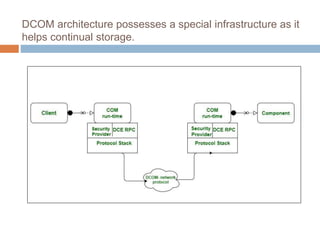
DCOM architecture possesses a special infrastructure as it
helps continual storage.
Working of DCOM
 For working of DCOM, COM object desires to
be configured effectively on both computer
systems and you hardly had to uninstall and
reinstall objects numerous times to get them to
work effectively on a particular task.
 Windows Registry consists of DCOM
configuration information in three identifiers i.e.
CLSID, PROGID, and APPID.
CLSID
 Class Identifier or CLSID is a Global Unique
Identifier or GUID to create a unique identity for
an entity. Windows stores this CLSID for every
setup class in a program for performing a
particular task. When you want to run a class,
you need right CLSID, so Windows is aware of
place to go and locate program
PROGID
 Programmatic Identifier or PROGID is a non-
obligatory or you can say an optional identifier a
programmer can use as an alternative for any
complex and strict CLSID. PROGIDs are
generally less complicated to read and can be
easily understood. There are no restrictions on
how many PROGIDs can have an identical
name, which motives problems on occasion.
APPID
 Application Identifier or APPID is a type of unique
identifier for every available app also called App
IDs helps in securing and authenticating your
apps. It identifies all of classes that are part of
identical executable andpermissions required to
get entry to it. DCOM can’t work if APPID isn’t
correct i.e. for DCOM to work perfectly you need
to have a correct APPID. You will likely get
permissions errors making an attempt to create
remote object, in my experience.
THANK YOU

distributing computing

  • 1.
    NADAR SARASWATHI COLLEGEOF ARTS AND SCIENCE, VADAPUDUPATTI,THENI. DEPARMENT OF COMPUTER SCIENCE AND INFORMATION TECHNOLOGY Presented by NIBIYA.G I-MSC(IT)
  • 2.
  • 3.
    DCOM- Distributed ComponentObject Model  In the last two decades, a massive range of modifications took place in an object-oriented and distributed component-oriented paradigm. To fulfill this demand, Microsoft developed Distributed Component Object Model.  DCOM can be defined as COM with inclusion of a long wire and this is an extension to Component Object Model (COM). DCOM- Distributed Component Object Model– helps remote object via running on a protocol known as the.
  • 4.
     (DCOM) bothobject and component paradigm consists of a number of issues.  1. Interoperability  2. Versioning  3. Language independence  4. Size and complexity of system
  • 5.
    Dynamic Data Exchange Dynamic Data Exchange or DDE, used to be designed for Microsoft Windows to enable applications to exchange information of any specific type.  As DDE protocol is actually a little complicated and this complexity used to be interpreted by using many software program vendors, Dynamic Data Exchange Management Library (DDEML) was created.  This library simplified interfacing with DDE protocol as well as furnished a frequent interface for all developers.
  • 6.
    DCOM Architecture  DCOMstructure is designed for promoting software interoperability.The architecture supports a “software bus” on which reusable software program components can be used and built-in with one any other seamlessly.  In order to furnish support for this reusable software component, complete object model is based totally on an object-based programming model.  Object model used to be selected due to fact of its incapability to provide inheritance.  This means that architecture is successful in keeping off fragile base class syndrome which exists in different models.
  • 7.
     The fragilebase class syndrome seems when one class inherits members and behavior of any other class.  Class which offers behavior and member functions is recognized as base class while other class is recognized as derived class.  If the member and functionality of base class modifications then behavior and member functions of derived class additionally change.  Changes like this end result in having to alter base class which in turn requires compilation of all dependent classes.
  • 8.
    DCOM architecture possessesa special infrastructure as it helps continual storage.
  • 9.
    Working of DCOM For working of DCOM, COM object desires to be configured effectively on both computer systems and you hardly had to uninstall and reinstall objects numerous times to get them to work effectively on a particular task.  Windows Registry consists of DCOM configuration information in three identifiers i.e. CLSID, PROGID, and APPID.
  • 10.
    CLSID  Class Identifieror CLSID is a Global Unique Identifier or GUID to create a unique identity for an entity. Windows stores this CLSID for every setup class in a program for performing a particular task. When you want to run a class, you need right CLSID, so Windows is aware of place to go and locate program
  • 11.
    PROGID  Programmatic Identifieror PROGID is a non- obligatory or you can say an optional identifier a programmer can use as an alternative for any complex and strict CLSID. PROGIDs are generally less complicated to read and can be easily understood. There are no restrictions on how many PROGIDs can have an identical name, which motives problems on occasion.
  • 12.
    APPID  Application Identifieror APPID is a type of unique identifier for every available app also called App IDs helps in securing and authenticating your apps. It identifies all of classes that are part of identical executable andpermissions required to get entry to it. DCOM can’t work if APPID isn’t correct i.e. for DCOM to work perfectly you need to have a correct APPID. You will likely get permissions errors making an attempt to create remote object, in my experience.
  • 13.